/


Author: Шахова Н.И. Рейнгольд В.Г. Салистра В.И. Басс Э.М. Дезен Н.Б. Трущенко И.А.
Tags: лингвистика английский английский язык языкознание
Year: 1980




Text
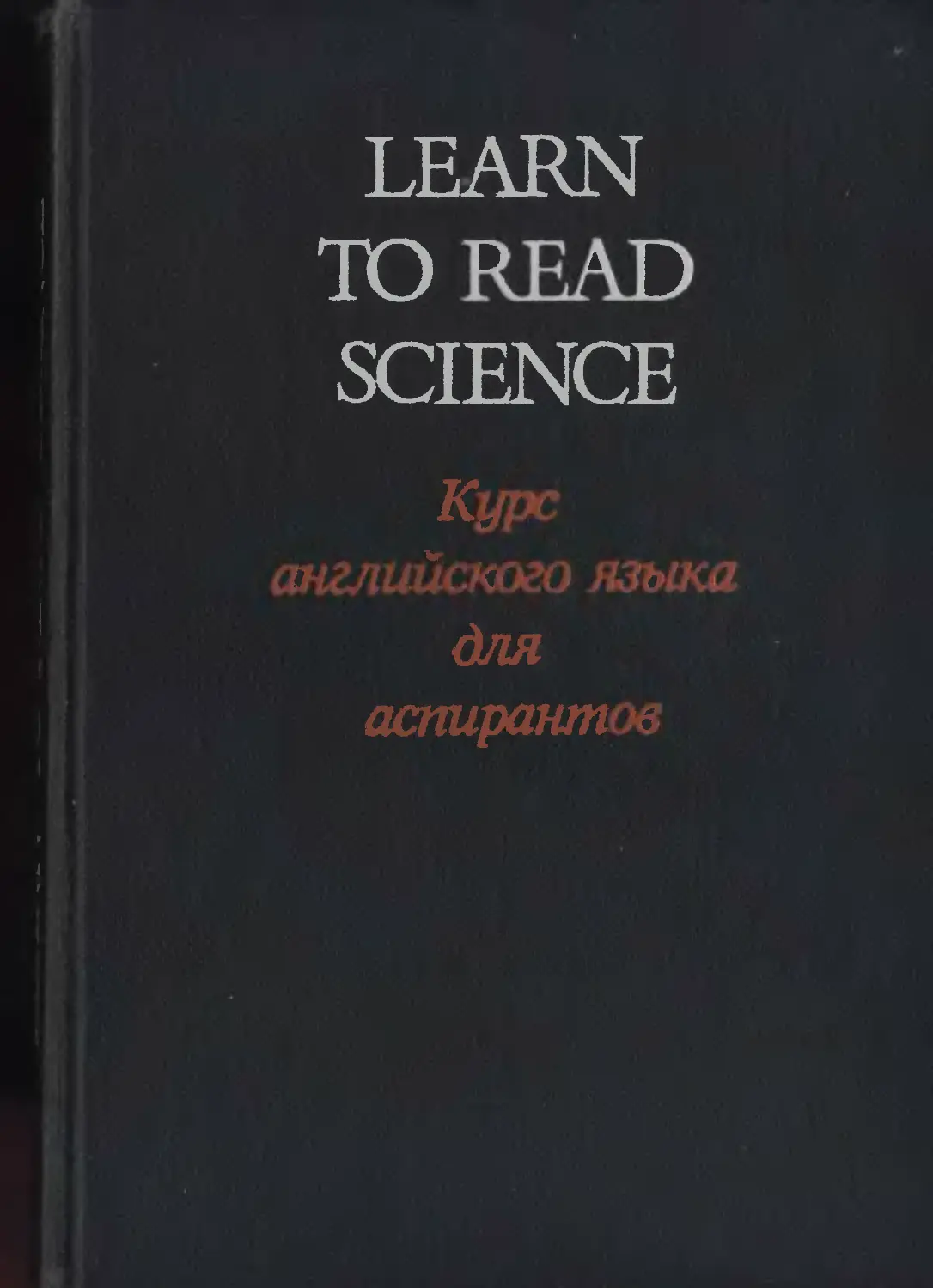
                    LEARN
TO READ
SCIENCE
Курс
английского языка
для
аспирантов

АКАДЕМИЯ НАУК СССР
КАФЕДРА ИНОСТРАННЫХ ЯЗЫКОВ
“Т I (/,
LEARN
ТО READ
SCIENCE
Курс
английского языка
для
аспирантов
ИЗДАТЕЛЬСТВО «НАУКА»
МОСКВА 1980
Ч
Книга представляет собой комплексный курс английского
языка для аспирантов и научных работников, готовящихся
к сдаче кандидатского экзамена, направленный на развитие
различных навыков чтения (просмотрового, поискового п изу-
чающего, чтения со словарем и без словаря) па базе знаний,
предусмотренных программой по английскому языку для не-
языковых вузов. Курс адресован в первую очередь лицам,
занимающимся точными п естественными пауками, но может
быть использован и в группах гуманитарного профиля. Посо-
бие состоит из текстов, предтекстовых упражнений и после-
текстовых заданий, а также заданий для развития навыка пись-
менной речи (умения напцсать резюме, тезпсы п т. п.). В него
включено краткое грамматическое приложение, охватываю-
щее материал, предусматриваемый программой подготовки к
сдаче кандидатского экзамена по английскому языку.
Коллектив авторов:
кандидат филологических наук
Н. И. ШАХОВА (руководитель),
В. Г. РЕЙНГОЛЬД, В. И. САЛИСТРА, Э. М. БАСС,
Н. Б. ДЕЗЕН, И. А. ТРУЩЕНКО, И. Н. БИБАНОВА,
Д. В. ВЕДЕРНИКОВА, Н. И. ГУРО, М. Ф. ДРОЗДОВА,
Т. И. КЛЕЩЕВНИКОВА, Н. П. РАФЕС
Ответственный редактор
Е. Э. БРЕХОВСКИХ
| Б8бл1ятэка НП1 |
70104-288
L «...ли,	«6-80. 4602010000
042(02)—80
© Издательство «Наука», 1980 г.
ОТ АВТОРОВ
Настоящее издание является результатом семилетней работы
коллектива преподавателей Кафедры иностранных языков
ЛН СССР. В течение этого периода разработанные материалы,
методические приемы, типы заданий, упражнений и т. и. апро-
бировались членами авторского коллектива в аспирантских
группах кандидатского семестра и дали хороший результат.
В качестве основы для составления текстов были использо-
ваны отрывки из работ ведущих американских и английских
ученых К. Сагана, Ф. Крика, Ф. Дайсона, Л. Сцилларда, К. Дэр-
роу, из специального выпуска журнала «Scientific American»,
посвященного проблемам биосферы, а также из американского
перевода статьи акад. Л. А. Арцимовича «Физик нашего времени»
и материалы, любезно предоставленные зав. отделом науки
«Литературной газеты» О. П. Морозом Составленные из этих
материалов основные тексты были затем тщательно отредактиро-
ваны высококвалифицированными специалистами Советского
Союза и Великобритании.
Работа среди членов авторского коллектива распределялась
следующим образом. Подбор материалов для текстов и упраж-
нений, первичная обработка словаря, отбор лексического мини-
мума, составление грамматических и лексических упражнений
были выполнены всеми членами коллектива. Основные тексты
были составлены В. Г. Рейнгольд, В. И. Салистра и Н. И. Ша-
ховой, грамматические и лексические микротексты — Э. М. Бас-
сом, Н. Б. Дезен, В. Г. Рейнгольд, В. И. Салистра и Н. И. Ша-
ховой. Основные принципы работы над текстом были предложены
В. И. Салистра. Задания к текстам А, В, С и микротекстам со-
ставлены В. Г. Рейнгольд и Н. И. Шаховой, к текстам D —
Э. М. Бассом и В. Г. Рейнгольд. Принципы работы над лексикой,
система лексических упражнений и таблицы были разработаны
,Н. И. Шаховой. Ею же написаны грамматические очерки, раз-
дел Structure Words, Приложение и методическая записка,
а также выполнена унификация всего курса.
’Техническую работу по оформлению рукописи проделали
Э. М. Басс, Д. В. Ведерникова, И. Н. Бибанова, Н. И. Гуро,
Н. Б. Дезен, М. Ф. Дроздова, Т. И. Клещевникова, Н. П. Рафес,
В. Г. Рейнгольд и И. А. Трущенко.
3 Принципы описания синтаксических структур и приемы
работы с ними были предложены канд. филолог, наук Л. И. Зиль-
берман, которая также принимала участие в работе на началь-
ном этапе.
!•
3
Кроме того, в Приложение включен возможный поурочный
план работы с данным курсом, назначение которого — помочь
преподавателю, впервые знакомящемуся с подобным подходом
к обучению чтению, организовать учебный процесс оптимальным
образом. Естественно, авторы далеки от мысли, что такое распре-
деление учебного материала по занятиям является единственно
возможным. План составлен ст. преподавателем кафедры
А. А. Серебряковой.
Авторы выражают благодарность Б. Е. Белицкому, перевод-
чику-консультанту Главной редакции вещания на США и Англию
Гостелерадио, и г-же Джин Мезонпьер, редактору (Лондонский
университет), за тщательное редактирование основных текстов;
ст. преподавателю кафедры иностранных языков Московского
автодорожного института М. А. Бух, рецензенту данной книги;
проф. Л. С. Бархударову, сделавшему ряд замечаний; своим
коллегам — преподавателям Ленинградского отделения ка-
федры за постоянный интерес к работе и ее обсуждение на всех
этапах. В заключение мы приносим благодарность нашим слуша-
телям — нашим первым помощникам и самым строгим критикам,
живой интерес и активная поддержка которых постоянно помо-
гали нам в работе.
О РАБОТЕ С ДАННЫМ КУРСОМ
ЗАДАЧИ КУРСА
Настоящая книга адресована людям, занимающимся науч-
ной работой, и максимально апеллирует к их способности к ана-
литическому мышлению.
Основная цель курса — научить будущего ученого свободно
пользоваться научной литературой (по специальности), напи-
санной на английском языке, и заложить в ходе обучения чтению
основы для перехода к развитию навыков устной речи, разговора
по специальности. В этом смысле данный курс можно рассма-
тривать как первую часть более общего целого «Учитесь читать
научную литературу и говорить о научных проблемах». Основ-
ная задача — обучение чтению научных работников — опреде-
лила как принцип отбора материала, так и принципы его
интерпретации: частотность грамматического явления или слова
в научном тексте и апеллирование к сознательному, аналити-
ческому восприятию их.
Курс рассчитан на лиц, владеющих ’^английским ^языком
в объеме, предусмотренном программой вуза, и в качестве
начального уровня предполагается как минимум знание форм
слов (т. е. морфология), служебно-строевой лексики и некоторый
(неопределенный) запас слов основного словарного фонда. В ка-
честве конечной цели ставится овладение всеми синтаксическими
структурами, характерными для научной речи, и основным фон-
дом слов, характерных для данного стиля речи независимо от
узкой области науки, а также создание предпосылок для непре-
рывного пополнения индивидуального словарного запаса в про-
цессе чтения.
Курс состоит из четырех разделов, каждый из которых по-
священ определенному грамматическому явлению: 1. Порядок
слов и смысловая структура предложения. Пассивные конструк-
ции. Формальная и структурная омонимия форм на -ed и -ing
и связанные с ней трудности чтения. 2. Инфинитив, его функции
в предложении и образуемые на его основе структуры. 3. Мо-
дальность как выражение авторского отношения к высказыванию.
4. Эмфаза и инверсия как языковые средства создания различ-
ных логических суждений.
~ Целью курса является развитие навыка опознания и пони-
мания синтаксических структур, описываемых моделями, навыка
понимания слов на основе их формы и окружения, а также на-
выка понимания текста как единого ” смыслового целого, т. е.
5
собственно чтения ради извлечения информации. При этом
очевидно/ что наличие первых двух умений служит базой для
развития третьего. В соответствии с этой тройной задачей каж-
дый из четырех разделов включает три подраздела: 1) Structure
Study, посвященный введению, отработке и закреплению соот-
ветствующего грамматического явления и дополненный граммати-
ческим очерком; 2) Word Study, посвященный закреплению сло-
варя урока и на его основе выработке навыков работы со словом
в тексте (эти два подраздела представляют собой предтекстовые
упражнения и готовят к основному разделу); 3) Text rStudy,
включающий четыре текста, тематически, грамматически и лекси-
чески связанных между собой и снабженных специальными
заданиями для развития навыка собственно чтения.
Кроме того, учитывая неодинаковую подготовку, обеспечивае-
мую различными учебными заведениями, а также общую направ-
ленность курса на смысловую сторону всех изучаемых явлений,
которая не всегда получает должное освещение в учебных мате-
риалах, в данную книгу включен некоторый материал для
повторения.
При существующем лимите аудиторного времени в 140 часов,
отводимых для работы на кандидатском семестре, курс предпо-
лагает использование 60 часов для работы в аудитории (от 12
до 18 часов на раздел). При наличии дополнительного аудитор-
ного времени это время может быть с пользой увеличено до 80
часов. С другой стороны, при хорошей предварительной подго-
товке учащихся прохождение курса может быть ускорено за
счет исключения более простых предтекстовых упражнений.
Сокращение времени работы над текстами не рекомендуется.
ЛИНГВОМЕТОДИЧЕСКИЕ ПРИНЦИПЫ
В основу пособия положен ряд лингвометодических принци-
пов современной теории преподавания иностранных языков,
некоторые из них были развиты авторами применительно к целям
данного курса:
1.	Использование формализованного описания грамматиче-
ских структур в виде моделей, представляющих эти структуры
как набор обязательных и факультативных компонентов, как
способ экономного и рационального введения грамматического
материала с учетом особенностей данного контингента учащихся.
2.	Использование внутриязыковых преобразований (транс-
формаций) как способ эффективного объяснения смысла струк-
туры предшествующей ее сравнению с эквивалентной ей струк-
турой русского языка.
3.	Анализ формы слова п его окружения и раскрытие смысла
слова (и словосочетания) путем интерпретации, предшествующие
выбору русских эквивалентов. Демонстрация отсутствия одно-
значного соответствия слов двух сопоставляемых языков.
6
к. Сознательное различение двух видов деятельности — чте-
ния и перевода как происходящих последовательно, а не парал-
лельно: чтение как процесс проникновения в смысл читаемого
текста и перевод как процесс передачи этого смысла средствами
другого языка. Использование перевода как этапа, завершаю-
щего процесс анализа и толкования.
5.	Систематический учет логической структуры высказыва-
ния и взаимосвязи логики и грамматики в процессе чтения и пере-
вода.	-
6.	Сознательное вычленение трех уровней, или этапов, ана-
лиза: а) уровень, предшествующий предложению, на котором
анализируется слово, словосочетание или структура, б) уровень
предложения, на котором устанавливается связь грамматической
структуры предложения и логической структуры высказывания,
и в) уровень текста, на котором анализируются средства, исполь-
зуемые для объединения отдельных высказываний в единое
смысловое целое.
7.	Учет последующего этапа обучения — развития навыков
устной речи — путем развития сознательного понимания соот-
ношения между языковыми средствами двух языков и того, что
коммуникативной единицей является не слово, не словосочета-
ние или структура, а предложение и текст.
МЕТОДИКА РАБОТЫ С РАЗЛИЧНЫМИ РАЗДЕЛАМИ
Работа над отдельными разделами осуществляется на основе
вышеизложенных общих принципов с учетом конкретных задач
раздела и особенностей прорабатываемого материала.
РАБОТА СО СТРУКТУРАМИ
Введение структуры
самом начале вводится система условных обозначений,
которые используются для записи в виде формул (моделей)
минимального синтаксического окружения соответствующей
синтаксической структуры. Такая форма записи позволяет не
только сэкономить время при введении материала, но и дает
возможность представить данную структуру в ее наиболее обоб-
щенном виде и показать внутреннюю системность грамматики,
взаимосвязи между отдельными структурами, их сходство и раз-
личия, не прибегая при этом к сложной лингвистической термино-
логии. Многолетний опыт работы авторов показывает, что пре-
имущества этого приема трудно переоценить.
Вся работа со структурами проводится последовательно
в три этапа: а) описание формальных признаков структуры через
ее формулу (модель), б) раскрытие смысла, выражаемого струк-
турой, в первую очередь через преобразование (трансформацию)
7
в структуру, имеющую русский эквивалент, или путем толкова-
ния ее смысла (если преобразование громоздко или_невозможно),
в) сопоставление с русской структурой и подбор русского экви-
валента. При этом преподаватель должен четко осознавать,
какой из этапов представляет особую трудность; например,
функционально Ved-форму трудно опознать в структуре слож-
ного (длинного) предложения, но ни ее понимание,; ни тем
более перевод на русский язык трудности не представляют.
Пассивные структуры, наоборот, легко выделяются в рамках
любого запутанного предложения, но понимание их информа-
ционной ценности (определение логического ударения на Nx
или N2) и особенно их перевод на русский язык требуют опреде-
ленного навыка.
La Выделение этих трех этапов анализа не означает обязатель-
ного соблюдения порядка введения материала, предлагаемого
авторами: от модели к иллюстративному примеру. Можно
вводить пример до модели, однако с обязательным последующим
анализом структуры.
Если вводимая структура имеет ограничения лексического
порядка, непосредственно после модели помещается список тех
лексических единиц, которыми ограничено ее употребление.
При этом каждая лексическая единица сопровождается русским
эквивалентом, при выборе которого авторы стремились к тому,
чтобы наиболее адекватно отразить основной смысл данной еди-
ницы и избежать конкретных£контекстных эквивалентов, пусть
даже и весьма^частотных.
Первичное закрепление структуры
Закрепление структуры осуществляется непосредственно
после ее введения с помощью упражнений, причем тип упраж-
нений определяется особенностями конкретной структуры, труд-
ностями, ей присущими, и конечной целью — рецептивным
и продуктивным усвоением.
Задания к упражнениям определены упомянутым выше трех-
этапным анализом. Основными рецептивными упражнениями
являются упражнения на опознание структуры в соответствии
с моделью и на преобразование в структуру, имеющую русский
аналог. Цель этих упражнений — развитие автоматизированного
навыка опознания и понимания структуры, «растворенной»
в достаточно сложном предложении. Подмена данных заданий
более привычным сплошным переводом всего предложения ли-
шает упражнение его целенаправленности и эффективности:
при переводе целого предложения внимание распыляется на
другие особенности предложения, единая цель исчезает, работа
продвигается медленно.
Наиболее распространенным упражнением продуктивного типа
является упражнение на подстановку. При этом возможности
сочетания отдельных элементов подстановочной таблицы ограни-
8
чены смыслом этих элементов, упражнение не носит автоматиче-
ского характера и не может быть осуществлено без понимания
смысла. Способность создавать осмысленные предложения, та-
ким образом, доказывает понимание без перевода.
Последним упражнением на закрепление структуры является
упражнение в переводе с русского. Имеются два типа задания:
передача смысла выделенной части русского предложения
с помощью 7 заданной структуры и свободный перевод целого
предложения. Работа над структурами в изолированном пред-
ложении Т завершаетсяJ работой ? над несколькими введенными
структурами в рамках небольшого отрезка текста, так называе-
мого микротекста. Методика работы с микротекстом описывается
в связи с методикой работы с основными текстами пособия.
Пройденные в аудитории модели задаются на дом для повто-
рения. Кроме того, учащимся предлагается прочесть соответ-
ствующий раздел Грамматических очерков и выполнить упраж-
нение Pattern Revision, завершающее данную «порцию» моделей.
Рекомендуется строго следить за выполнением домашней работы
в соответствии с заданием и не допускать сплошного перевода:
помимо очевидных возражений методического характера сплош-
ной перевод предложений сделает задание чрезмерно громозд-
ким и приведет к тому, что учащиеся не смогут с ним справиться.
РАБОТА СО СЛОВОМ И СЛОВОСОЧЕТАНИЕМ
Работа над лексикой ведется в двух направлениях: а) освое-
ние конкретного словарного запаса, заложенного в предтекстовые
упражнения, микротексты и тексты, и б) развитие аналитиче-
ского подхода к слову в контексте, т. е. развитие способности
к обоснованной языковой догадке, без чего невозможен ни даль-
нейший рост индивидуального словарного запаса, ни вообще
процесс чтения с целью извлечения информации.
Выполнение первой задачи осуществляется главным образом
за счет использования словаря текстов в предтекстовых упраж-
нениях и микротекстах, что дает возможность создать опреде-
ленную повторяемость хотя бы некоторых наиболее важных
слов и словосочетаний. Списки слов и словосочетаний, соответ-
ствующие каждой «порции» грамматики и разделу Word Study,
образующие поурочный инвентарь, имеют целью привлечь вни-
мание учащихся к наиболее важным лексическим единицам, с ко-
торыми они столкнутся в дальнейшем. Эти же списки могут быть
использованы преподавателем как контрольные для составления
тестов и осуществления других видов проверки усвоения мате-
риала-
Выполнение второй задачи осуществляется с помощью всей
системы’’лексических' упражнений, в которых последовательно
соблюдается тот же'принцип, что и в упражнениях предыдущего
раздела: от внешней (графической или структурной) формы
к внутреннему смыслу (содержанию) и от него к русскому экви-
9
валенту. Основным при этом является второй этап —"работа
по раскрытию содержания (путем анализа формы, толкования,
сопоставления с соседними словами и т. п.). Пренебрежение этим
этапом лишает данный раздел основного содержания — развития
навыка обоснованной языковой догадки — и ведет к механиче-
скому соединению английского слова с его русским эквивалентом,
без осознания внутренней обязательности этой связи. Анализ
содержания слова, предваряющий подбор русского эквивалента,
воспроизводим и потому даже с точки зрения запоминания
более эффективен, чем простое заучивание, при котором англий-
ское слово выступает в сознании учащихся как произвольный
код соответствующего русского слова.
Выделенные пять подразделов, в которые объединяются уп-
ражнения, целенаправленно концентрируют внимание учащегося
на разных характеристиках изучаемых слов. Особого внимания
при этом заслуживают упражнения раздела Learn to Deduce
the Meaning of English Words, призванные развивать чувство
языка у учащегося, помочь ему не только понять данное кон-
кретное слово, но и вооружить его навыком понимания" слов
в контексте и в словаре.
Авторы понимают, что выделенный в упражнениях «общий
элемент смысла» в качестве основы для понимания слова не во
всех случаях сформулирован максимально удачно, и будут бла-
годарны за все предложения, направленные на уточнение этого
основного смысла слова.
Как и в предыдущем разделе, следует избегать сплошного
перевода длинных предложений, использованных в качестве
контекста изучаемого слова.
Включение последнего раздела обусловлено особой важностью
служебно-строевых слов, нередко известных учащимся чисто
формально: значение артиклей, местоимений, количественных
и качественных определителей имени и т. п., как правило, усколь-
зает от внимания учащихся. Тем самым значительная информа-
ция, заложенная в этих словах, покрывающих до 50% текста,
в известной мере теряется или даже искажается. Эти упражне-
ния привязаны к соответствующим таблицам и рубрикам раз-
дела Structure Words.
РАБОТА С ТЕКСТОМ
Как уже отмечалось, предтекстовые упражнения являются
лишь подготовкой к выполнению основной задачи — к чтению
текста, вернее, к обучению чтению.
В основе методики работы с текстом лежит многократное
прочтение одного и того же текста, «вчитывание» в текст каждый
раз с конкретным заданием, результатом чего должно явиться
понимание заложенной в тексте информации. При этом задания
сформулированы таким образом, чтобы привлечь внимание к наи-
более трудным местам текста, с одной стороны, и к наиболее
информационно важным — с другой.
10
Работа начинается с чтения микротекстов, представляющих
собой небольшие отрывки, включенные в предтекстовые упраж-
нения и призванные стать промежуточным звеном между изолиро-
ванным предложением и основными текстами урока.
Первый текст (А) предназначен для подробного, в том числе
структурного, анализа с последующим письменным переводом
части текста на русский язык. Работа начинается в классе и за-
вершается дома. Второй текст (В) предназначен для чтения
в аудитории и не подразумевает подробного анализа языковой
формы. Задания в основном направлены на то, чтобы добиться
общего понимания заложенной в тексте информации, без подроб-
ного анализа каждого предложения. В связи с текстом В препо-
даватель может дополнительно ввести какой-либо письменный
вид работы и вернуться к этому тексту спустя некоторое время,
предложив составить резюме, план в форме вопросов и т. п.
Следующий текст (С) предназначен для работы дома и трени-
ровки всех навыков, отработанных в упражнениях и на преды-
дущих текстах. В связи с этим различные части текста прораба-
тываются с разной степенью углубления в языковую форму.
Последний текст (D) предназначен для устной работы в ауди-
тории (а при наличии соответствующих условий — и в лаборато-
рии устной речи). Цель работы — развитие навыка понимания
со слуха и подготовка к разговору по специальности. Побочной
целью является активизация словаря и грамматических структур
урока. Текст, разбитый на небольшие отрывки, снабженные
заданиями, записывается на пленку и прорабатывается со слуха
в аудитории или лаборатории. Характер заданий принципиально
не отличается от заданий к другим текстам, поскольку цель
является той же самой — развитие понимания текста в целом *.
Типы заданий
Задания к тексту, как правило, предусматривают его трех-
кратное прочтение. Первое чтение имеет целью общее знакомство
с содержанием, или тематикой, текста. Независимо от того,
осуществляется ли работа в аудитории или дома, рекомендуется
при первом чтении полностью исключить пользование словарем.
При чтении дома можно рекомендовать проверить в словаре зна-
чение двух-трех ведущих (повторяющихся) имен существитель-
ных, что может помочь в определении общей тематики текста.
В ходе первого чтения следует рекомендовать отмечать слова,
словосочетания и предложения, смысл которых остается непо-
нятым (частично или полностью).
Второе прочтение текста носит уже другой характер. При
работе дома пользование словарем допустимо, но только на основе
методики, отработанной в лексических упражнениях, — с пред-
* Использование этих текстов для развития навыков устной речи никоим
образом не рекомендуется.
11
верительным анализом слова и составлением гипотезы о его зна-
чении. Текст прочитывается медленно, предложение за предло-
жением, а по ходу ^чтения выполняются задания, помещенные
сразу после текста Л Результатом этого чтения должно явиться
понимание информации каждого предложения. Завершающее,
третье прочтение направлено на восприятие текста как единого
смыслового целого.
Конкретные задания к текстам, преследуя общую цель раз-
вития навыка понимания текста, могут быть направлены на:
а) понимание структуры, а через нее на восприятие информации
текста; б)>понимание слов и словосочетаний; в) понимание смыс-
ловых связей внутри текста; г) проверку понимания отдельных
трудных мест путем перевода на русский язык. Все задания
должны выполняться с максимальной опорой на текст, т. е. пре-
дусматривают воспроизведение соответствующей части текста.
Задания, связанные с опознанием структуры, могут быть
облечены в явную или^скрытую форму. К числу явных заданий
относится опознание структур по моделям. Более сложными,
но и более целенаправленными на основную задачу — чтение
и понимание — являются задания, в которых не содержится
прямого указания на структуру, но выполнение которых под-
разумевает ее опознание. Например, задается вопрос, требующий
ответа в активе, а ответ в тексте содержится в пассиве (см. Unit
One, Text 1, задание 5, с. 19), или требуется дать характеристику
явления, описанного в тексте, которая невозможна без преобра-
зования использованных в нем структур (см. Unit Two, Text А,
задание П, § 2, и. 3; § 3, и. 2), или требуется выделить предло-
жение — носитель информации абзаца, а это предложение
включает эмфатическую структуру (см. Unit Four, Text А, зада-
ние II, § 1, п. 1).
Задания, связанные с пониманием слов и словосочетаний,
также могут быть явными и скрытыми. В качестве явного задания
наиболее распространенным является требование дать русский
эквивалент явно неизвестного слова (или слов) на основе кон-
текста его употребления. Более сложное задание представляет
собой требование опознать в тексте слова (словосочетания) —
носители заданного смысла. Однако большинство заданий, свя-
занных с пониманием словаря текста, по сути дела, смыкаются
с заданиями, направленными на понимание его смысла.
Среди заданий, направленных непосредственно на раскрытие
информации, едва ли не самым важным является отождествление
местоимений и слов (словосочетаний) местоименного характера
с теми словами (и отрезками текста), которые они заменяют.
Важность этого навыка для процесса чтения невозможно переоце-
нить. Установление смыслового тождества = между . отдельными
словами и отрезками текста является основой процесса комму-
никации, который без этого невозможен. Процесс этот протекает
одинаково во всех языках. Однако в иностранном языке каждая
новая словарная единица, вводимая в текст (устный или пись-
12
менный), воспринимается нередко не как новый способ выраже-
ния уже упомянутого, а как нечто новое и по содержанию.
Особенно это относится к словам, призванным обобщить или
подытожить ранее сказанное (например, the situation — Unit
One, Text А, задание II, § 1, n. 2). В связи с этим данному зада-
нию следует уделить особое внимание.
Установление смысловых связей внутри текста базируется
также на различного рода связующих элементах — союзах,
вводных словах и т. п. В связи с этим введено задание как на
опознание, так и на осознание смысла таких элементов.
К заданиям, направленным на раскрытие смысла текста,
относится также просьба озаглавить текст, резюмировать его,
выделить основную и второстепенную информацию и т. п.
Предусматривается также ряд заданий, направленных на
проверку понимания отдельных элементов и отрезков текста
с помощью перевода на русский язык, которые вряд ли нужда-
ются в комментарии.
Вся система заданий направлена не только на прочтение дан-
ного конкретного текста, но и на развитие навыка чтения вообще,
на выработку стратегии чтения, на развитие навыков чтения
с разной целевой установкой и скоростью. Именно это явля-
ется основной целью работы не только данного раздела, но
и всего курса в целом.
О пользовании словарем
В связи с обучением чтению неизбежно встает вопрос о месте
словаря в процессе чтения. Несомненно, словарь является не-
заменимым источником информации справочного характера для
тех, кто умеет им пользоваться. Однако это умение далеко не
сводится к знанию алфавита и знакомству с системой организации
данного конкретного словаря. Правильное использование словаря
подразумевает предварительный анализ слова в тексте и создание
гипотезы о его значении, гипотезы, которая и проверяется затем
по словарю. Такая проверка означает вдумчивое прочтение всей
словарной статьи и попытку создать общее представление
о смысле слова и сопоставить это представление с его конкретным
использованием в данном тексте. Только при таком подходе сло-
варь может внести свой вклад в процесс обучения. В противном
случае словарь становится источником длинных списков слов
с механически привязанными, случайными русскими эквивален-
тами, которые плохо запоминаются людьми с аналитическим
складом мышления.
О технике чтения
Умение читать и извлекать информацию из прочитанного не
подразумевает автоматически умения членораздельного чтения
вслух с целью передачи информации другому лицу (или лицам).
13
Однако это умение необходимо для будущего ученого, если он
не собирается ограничить свое общение с иностранными колле-
гами печатным словом и планирует участие в различного рода
конференциях, где ему придется делать устные сообщения. Как
правило, такое выступление заключается в зачитывании ранее
написанного текста. В связи с этим очевидна необходимость раз-
вития навыка чтения вслух. При этом подразумевается не умение
внятно прочесть любой текст без подготовки, а способность пра-
вильно проинтонировать и подготовить для чтения заведомо
понятный и знакомый текст.
Этот навык предлагается отрабатывать на любом пройденном
тексте (предпочтительно на так называемых микротекстах).
О развитии навыка письменной речи
Вся методика работы с текстом одновременно закладывает
основу для развития навыков письменной речи. Такой основой
является навык рассматривать текст как источник информации,
выраженной определенными структурами и другими элементами
текста, связывать понятия непосредственно с формой их выра-
жения на английском языке и оперировать кусками текста для
выражения заданного смысла, не прибегая к переводу на русский
язык. Отсюда нетрудно перейти к письменным заданиям по
резюмированию и реферированию «словами текста», по сверты-
ванию текста в более концентрированную форму.
В настоящем издании заданий к тексту, которые можно рас-
сматривать как направленные на развитие навыка письменной
речи, явно недостаточно. В качестве компенсации в книгу вклю-
чено Приложение, содержащее некоторые сведения, необходимые
для составления аннотаций и тезисов. В дальнейшем авторы
намерены разработать более полную систему упражнений по раз-
витию навыка письменной речи на базе умения читать.
Nomenclature
Adj. — adjective
Adv. — adverb
Cl. — clause
Conj. — conjunction
D. — determinative
Emph. — emphatic
Inf. — infinitive
N — noun
N’s
Nr — subject
N2 — object
—	прилагательное
—	наречие
—	придаточное предложение
—	союз
—	определитель
—	усилительные слова и словосочетания
—	инфинитив
—	существительное пли эквивалентное
ему слово (группа слов)
—	имя существительное в притяжательном
падеже
—	N в функции подлежащего
—	N в функции дополнения
14
Neg. group	—
Num. — numeral	—
Part. I (II) — participle	I	(II)	—
Phr. — phrase	—
Prep. — preposition	—
Pron. — pronoun	—
Pron. poss. — pronoun possessive —
Pron. rel. — pronoun relative	—
S. — sentence	—
V — verb	—
Vact — verb active	—
VaUK — ve b auxiliary	—
Ved	—
Vf — verb finite	—
Vjmper — verb imperative
Ving
Vmod — verb modal	—
VBf — verb non-finite	—
Vpass — verb passive	—
Vs — verb, 3rd person, singular —
словосочетание, включающее слово
с ограничительно-отрицательным смыс-
лом
числительное
причастие I 'll)
словосочетание
предлог
местоимение
притяжательное местоимение
относительное местоимение
предложение
глагол в личной или неличной форме
глагол в действительном залоге
вспомогательный глагол
глагольная форма с окончанием -ed
личная форма глагола, а также любое
другое сказуемое
глагол в повелительном наклонении
глагольная форма с окончанием -ing
модальный глагол
неличная форма глагола
глагол в страдательном залоге
глагол в 3 л. ед. ч. наст. вр.
Indices
' ", ”	—	порядковый номер данного компонента
. . .	—	знак следования компонентов друг за	другом
/	—	возможность вариантов
( )	—	возможность отсутствия данного компонента
•	—	наличие лексического ограничения
without to —	употребление инфинитива без частицы	to
Л	—	указание на опущенный компонент
->	— знак трансформации одной структуры в другую
UNIT ONE
GRAMMAR: WORD ORDER IN THE SENTENCE AND ITS MES-
SAGE. PREDICATE VS. ATTRIBUTE. TOPIC: SCIENCE:
GENERAL PROBLEMS.
STRUCTURE STUDY:
1.	Passive Structures and Their Message (Patterns 1—2).
2.	Ambiguous Ved Forms (Patterns 3—5).
3.	Ving Forms: Position and Function in the Sentence:
a)	Unambiguous Ving Forms (Patterns 6—9);
b)	Unambiguous Combination of Ving and N (Pattern 10);
c)	Ambiguous Combination of Ving and N (Patterns 11—12).
WORD STUDY:
1.	English-Russian Word Relation.
2.	Word Structure (-er/-or, -ment, -tion, -(u)al, -ent/-ant, -ence/-ance,
N <> V).
3.	Word Meaning (background, case, facility, imply, involve, matter).
4.	Word Combinations.
5.	Structure Words (it/they, its/their, this/these, that/those, one/ones/
one’s, little/few, a little/a few, much/many).
TEXT STUDY:
Introduction.
Text A. Science and Technology (for class-room reading and analysis,
and home translation).
Text B. What Science Is (for class-room comprehension reading).
Text C. Research: Fundamental and Applied, and the Public (for home
practice in different reading skills).
Text D. Scientific Innovation: Its Impact on Technology (for class-
room practice in understanding spoken English).
16
STRUCTURE STUDY
1. PASSIVE STRUCTURES
AND THEIR MESSAGE
Pattern Study (1)
Pattern 1:
. . .Nj. . .VfpaSS (Prep.). . .(by/ with-phr.). . .
The idea was first suggested by Prof. X. Эта мысль была впер-
вые высказана проф. X.
An idea was suggested to use another method. Была высказана
мысль использовать другой метод.
Pattern Practice (1)
Ex. 1. Identify the passive structures and the logical predicates, translate
the sentences into Russian as shown in the following example.
Example: More evidence was obtained to support the idea.
„Evidence was obtained" is the passive structure, „more evi-
dence. . . to support the idea" is the logical predicate. Были полу-
чены новые данные в поддержку этой идеи.
The problem was first recognized in the XIX century. Later
an idea was suggested to apply it to practical things. Many possibi-
lities for practical applications were analysed. Some of these
were tested by experiment. The experimental results were not gen-
erally accepted, and the idea was discarded. Then other consequences
were deduced and a new model proposed. Recently the model has
been modified and is now being used in many practical situations.
Ex. 2. A. Practise orally by using impersonal passive structures as shown
in the following examlpe.
Example: We (the author, they, etc.) have found that. . . .
It has been found that. . . .
1. I must admit that. . . . 2. He has found that. ... 3. Every-
body accepts that. ... 4. I believe that .... 5. The author hopes
that .... 6. Scientists sometimes say that .... 7. Most people
assume that .... 8. Physicists recognize nowadays that ....
B. Give English equivalents of the following Russian phrases using imper-
sonal passive structures and adverbs „widely,” „generally” where required.
1. Говорят, что ... .2. Предполагается, что ... .3. Можно
надеяться, что .... 4. Следует признать, что .... 5. Было
найдено, что .... 6. Общепризнанно, что .... 7._ Считают,
что ... .8. Широко распространено мнепйЬ,
2 Заказ
Oh
|A
17
Pattern Vocabulary (1). List 1
Remember some of the verbs taking a direct object in English but equiva-
lent to Russian verbs followed by a preposition.
to affect — влиять (на);
to answer — отвечать (на);
to approach — подойти (к);
to attend — присутствовать (на) (и активно участвовать);
to consult — консультироваться (у, с);
to enjoy — получать удовольствие (от), пользоваться;
to follow — следовать, следить (за);
to influence — влиять (на);
to join — присоединяться (к);
to watch — наблюдать (за).
Ех. 3. Identify passive structures and give Russian equivalents of the
relevant part of the sentence as shown in the following example.
Example: Under these conditions the questions cannot be ans-
wered unambiguously. „The question cannot be answered" . . . .
На вопрос нельзя ответить ....
1. Some people are easily influenced by other people’s opinions.
2. The distribution of plants is greatly affected by local conditions.
3. The seminar was attended by all the participants. 4. His lectures
are always followed by heated discussions. 5. In several areas of re-
search the efforts of scientists are joined by those of philosophers
and sociologists. 6. At the university students are offered a curricu-
lum of study which is followed by a test and the award of a degree.
7. The members of the laboratory were consulted prior to this suc-
cessful operation.
Pattern Vocabulary (1). List 2
Remember some of the verbs followed by a preposition which is retained
in the passive structure.
to account for — объяснять (служить объяснением, учитывать);
to agree upon — договариваться (о);
to call for — требовать, призывать (к);
to deal with — иметь дело (с), рассматривать;
to refer to — ссылаться (на), упоминать, to refer to as — называть;
to rely on/upon — полагаться (на);
to substitute for — вводить, подставлять (вместо);
to think of — думать (о), to think of as — считать.
Ex. 4. Identify passive structures followed by a preposition and give
Russian equivalents of the relevant part of the sentence as shown in the follow-
ing example.
Example; Such things are not even thought of before the disco-
very is actually made. „Things are not thought of . . .”. О (таких)
вещах не думают ....
1. This method has been referred to in an earlier paper. 2. I do not
think this instrument can be relied upon. 3. The data cannot be
18
accounted for by the existing theory. 4. This theory has been referred
to as the „big bang” theory. 5. The best treatment of this syndrome
is generally agreed upon. 6. Rapid development of chemical techno-
logy has been called for by the needs of the national economy.
7. The prolongation of life may be thought of as a feat of endurance
rather than a race against time.
Reading Practice (Pattern 1)
Text 1. 1) Read the text to yourself and be ready for a comprehension
check-up.
SCIENTIFIC METHOD AND METHODS OF SCIENCE
It is sometimes said that there is no such thing as the so-called
„scientific method”; there are only the methods used in science.
Nevertheless, it seems clear that there is often a special sequence
of procedures which is involved in the establishment of the working
principles of science. This sequence is as follows: (1) a problem
is recognized, and as much information as possible is collected;
(2) a solution (i. e. a hypothesis) is proposed and the consequences
arising out of this solution are deduced; (3) these deductions are
tested by experiment, and as a result the hypothesis is accepted,
modified or discarded.
2) Check up for comprehension.
1. Find two sentences which express two different viewpoints on the
existence of „scientific method”. 2. What words show that the first sentence
is an opinion? 3. What word shows that these viewpoints are in opposition?
4. Find the words equivalent to „scientific method”. 5. What procedure does
the scientist follow in his research?
Pattern Study (2a)
Pattern 2a:
. . .Nj. . .Vf pass . . .Na/Inf. . . .by/with-phr. . . .
The laboratory was given new equipment. Лаборатории было
выделено новое оборудование.
The scientist was asked to give his point of view on this
hypothesis. Ученого попросили изложить свою точку зрения
относительно этой гипотезы.
Pattern Vocabulary (2а). List 3
Remember some of the verbs that may be followed by an indirect object
which becomes the subject in the passive structure.
to allow	позволять кому-л.
to ask	спрашивать кого-л.
to give	давать кому-л.
to offer	предлагать кому-л.
to promise	smb. обещать кому-л.
to recommend	рекомендовать кому-л.
to teach	учить кого-л.
to tell	сообщать кому-л.
2*
19
Pattern Practice (2a)
Ex- 5. Identify passive structures and give Russian equivalents of the
relevant part of the sentence as shown in the following example.
Example: During the examination the students are not al-
lowed to consult grammar- books.
„The students are not allowed . . .”. Студентам не разрешают
(не разрешается) ....
1. Не was not offered any help. 2. We have been given all the
necessary information. 3. The institute was promised financial
support. 4. The speaker was asked a lot of questions. 5. The teachers
are recommended to give the passage as a talk. 6. If the mixture
is allowed to stay overnight, it gradually decomposes. 7. At that
time girls were taught hardly more than three R’s (reading, writing
and ’rithmetic).
Pattern Study (2b, 2c)
Pattern 2b:
. . .Nj. . .Vfpass . . .N2 (Prep.)(by/with-phr.). . .
At present chemical methods of purifying water are exten-
sively made use of. В настоящее время химические методы
очистки воды широко используются.
Pattern 2с:
• • .Nf. • .Vfpass Prep. . . ,Na. . .(by/with-phr.). . .
At present extensive use is made of chemical methods of pu-
rifying water. В настоящее время широко используются хими-
ческие методы очистки воды.
Pattern Vocabulary (2b, 2с). List 4
Remember the following V. . .N-comhinations and their equivalents:
to give consideration to — to consider — рассматривать;
to make allowance for — to allow for — учитывать, делать по-
правку (на);
to make a contribution to — to contribute to — вносить вклад (в);
to make mention of — to mention — упоминать (о);
to make reference to — to refer to — ссылаться (на);
to make use, pf — to use — использовать, воспользоваться;
to take advantage of — to make use of — воспользоваться;
to take note of — to take notice of — to pay attention to — обра-
щать внимание.
Pattern Practice (2b, 2c)
Ex. 6. Identify passive structures according to Patterns 2b, 2c and give
Russian equivalents of the relevant part of the sentence.
1. This atmospheric interference has often been made reference
to by radio and TV commentators. 2. Unfortunately no advantage
was taken of the fast reaction rate. 3. So far no notice has been taken
20
of the obvious advantage^ofjthis technique. 4. His curiosity was
excited when reference was made to still earlier publications. 5. Re-
cently the problem has been given close consideration in connection
with a new space project. 6. Mention has already been made of the
fact that gold is slowly attacked by these substances. 7. Several
outstanding contributions have been made to the study of crystal
growth. 8. There is no doubt that in the course of further scientific
development extensive use will be made of modern computing ma-
chines and electronic devices.
Reading Practice (Patterns 1, 2)
TextA2. 1) Read the text to yourself and be ready for a comprehension
check up.
Recently much attention has been given to the study of thus
phenomenon. Ii^ this paper new experimental observations are pre-
sented and discussed. The data have been obtained assuming a new
model of the mechanism involved, which was suggested in an
earlier study by the author. The mebsufpments have been carried out
with a conventional apparatus slightly modified by the authop
All possible source? of error are taken into account and considera-
tion »is given to the advantages and shortcomings of the present
approach. The results are analysed and the analysis is followed by
a comparison of the da (a obtained with those available in literature..
It is hoped that the disagreement may be accounted for by an im-
proved experimental technique of the present investigation.
2) Check up for comprehension.
1. Is it an abstract, a summary or a conclusion? 2. What was the author’s
theoretical contribution? 3. Did anybody else study the phenomenon? (Find
two sentences to support your answer). 4. Do the author’s results agree with
those reported in literature? 5. How does he account for that? 6. How does
the author increase the accuracy of his results?
2. AMBIGUOUS VED FORMS
Pattern Study (3, 4, 5)
Pattern 3:	L
. . .N. . .Ved (Prep.). . .
1) Prof. X proposed a new working hypothesis. Профес-
сор X предложил новую рабочую гипотезу.
2) The hypothesis proposed (by Prof. X) accounts for all
the experimental observations made. -> The hypothesis which
is (was) proposed (by Prof. X) accounts for all experimental
observations which were made. Предложенная (профессором X)
гипотеза объясняет все сделанные экспериментальные наблю-
дения.
21
(/
Pattern 4:	1*\
. . . N. . .Ved' (Prep.). . .Ve<J”(Prep.). • •
1) The hypothesis proposed agreed with the experimental
observation. -> The hypothesis which is (was) proposed agreed
with the experimental observation. Предложенная гипотеза
была в согласии с экспериментальными наблюдениями.
2) For some time scientists remained interested in the prob-
lem. В течение некоторого времени ученые сохраняли интерес
к этой проблеме.
Pattern 5:
. . .N'. . .Ved' (Prep.). . .Ved” (Prep.). . .N"
1) The institute installed modernized equipment. В институте
установлено модернизированное оборудование. ,
2) The equipment installed modernized our laboratory too.
Установленное оборудование модернизировало и нашу лабо-
раторию.
Pattern Practice (3, 4, 5)
Ex. 7. Identify the predicate and give Russian equivalents of N. . .Ved
as shown in the following example.
Example: Later on scientists accepted the hypothesis rejected
previously for want of experimental evidence. nAccepted" is the
predicate; scientists accepted — ученые приняли; the hypothesis
rejected — отвергнутая гипотеза.
1. The method applied increased the accuracy of the results.
2. After a heated discussion the laboratory applied the method
improved by Dr. N. 3. The scientist theoretically predicted compli-
cated interaction between the components involved in the process.
4.	At that time the problem presented increased danger of radio-
active contamination and encountered opposition at mos't laboratories
concerned. 5. The hypothesis concerned synthesized materials and
did not apply to natural products. 6. Heat resistant materials devel-
oped in the last decade produced a revolution in a number of indus-
tries. 7. Automatized information processing radically modified
the method devised. 8. The crystal produced revealed cracked faces.
Ex. 8. Identify the structures according to Patterns 3—5 and give Russian
equivalents of the relevant part of the sentence.
A.	1. The plants affected by the cold produced low crops. 2. The
Conference attended by scientists from different countries discussed
new trends and methods in this field of research. 3. One of the
rights enjoyed by University scientists is that of combining research
with teaching. 4. The discovery followed by further experimental
work stimulated research in this area.
В.	1. Mathematics, mechanics, statics and geometrical optics
referred to as classical disciplines started mathematical traditions
in the history of natural science. 2. The heads of the laboratories
22
were asked questions formulated and agreed upon by a group of so-
ciologists. 3. The scientist’s eloquence substituted for logical argu-
mentation in defending an «extreme» viewpoint failed to win the
audience over. 4. The mixture allowed to stay overnight gradually
decomposed. 5. The physicists showed that particles thought of as
n elementary” were in fact „non-elementary”. 6. The subjects dealt
with under this topic aroused a heated discussion.
Reading Practice (Patterns 3, 4, 5)
Text 3. 1) Read the text to yourself and be ready for a comprehension
check-up.
Last month our laboratory developed a new technique required
for thermodynamic studies of a two-phase system. The technique
allowed us to obtain results predicted by theory. The results ob-
tained disagreed with earlier data reported by Dr. D^At our labora-
tory seminar Prof. S. suggested a new model to account for the, me-
chanism of the process involved in the system. The mpdel suggested
described adequately the thermodynamic peculiarities studied
by Dr. D.
2) Read the text. Follow the course of events concentrating on the Ved
predicates while omitting the Ved attributes.
Pattern Revision (Patterns 1—5)
(to be done at home in written form)
Ex. 9. A. Identify the structures according to Patterns 1—5 and give
Russian equivalents of the relevant part of the sentence.
1. The usual procedure is that information storage is followed
by information analysis. 2. The procedure proposed provided the
required mechanism of reaction. 3. The opening session of the Con-
gress was preceded by a meeting of the General Assembly to elect
a new president. 4. It must be admitted that the problem of science
classification can be approached from several viewpoints. 5. There
are fields which cannot be dealt with on a national scale only,
such as environmental protection, space exploration and so on.
6. The difficulties encountered by anyone who attempted to solve
the problem are much greater than those faced in the endeavour
to reach the summit of Mount Everest. 7. In most important appli-
cations cotton has been substituted for by synthetic fibres. 8. The
rate of the reaction is affected 17y the change in such parameters
as concentration, temperature and pressure. 9. Under these circum-
stances one is faced with a magnified form of a danger common
to all inventions: a tendency to use them whether or not the occasion
demand. 10. In most cases the solution of such problems is called
for by industrial needs. 11. It is often argued that in the XX century
we are left with no expansion of wisdom and with greater need
23
for it. 12. When at last the patient is allowed to sleep he will prob-
ably wake up after some 10—12 hours. 13. These ideas are hardly
recogni^d as^mathematics at all by the people trained in the clas-
sical branches of the subject. 14j Some aspects of the foregoing
topics are dealt with in the next chapter, and a number of problems
created by some of the new activities are mentioned but not dis-
cussed in detail. 15. Some diseases may show only when an organism
containing mutant genes is influenced by certain factors of the en-
vironment. 16. No attempts have been made to list all the contri-
butions in which different procedures have been developed and
later used. 17. Recent discoveries in all sciences have been greatly
assisted by the developments in contemporary research techniques
dealt with in the last section of this book. 18. The congress attended
by scientists from all the institutions concerned attracted much
attention and was referred to as a most representative forum in this
field. 19. An alternative to the models discussed above is the steady-
state theory of continuous creation referred to earlier and depicted
in Fig. 1.
B. Give English equivalents of the italicized part of the sentences, using
passive structures and the verbs: to affect, to allow, to attend, to develop,
to deal with, to face, to follow,rto make use of, to refer to.
1. За докладом последовала бурная дискуссия. 2. На скорость
реакции влияет множество других факторов. 3. Этот вопрос
будет подробно рассмотрен в главе III. 4. На этой стадии мы
столкнулись с новыми трудностями. 5. Ему не дали возможности
закончить эту работу. 6. В последнее время эта теория часто
упоминается во многих статьях. 7. Семинар, на котором присут-
ствовало всего 5 человек, протел вяло и неинтересно. 8. Для того
чтобы преодолеть эти недостатки, использовали новую методику,
специально разработанную дляданного эксперимента.
С. Translate into English.
1.’ Проблема была впервые поставлена (осознана) в XVIII веке
2. Предполагается, что полученные расчетные данные были про-
верены экспериментально. 3. ' Теория была принята большин-
ством ученых после того, как были получены новые доказатель-
ства в ее поддержку. 4. (В статье) представлены новые данные
относительно механизма этого процесса. 5. Это расхождение
можно объяснить разными методиками измерения. 6. (В работе)
использован новый метод расчета этого параметра и предложена
новая модель процесса. 7. Особое внимание уделено сравнению
экспериментально полученных результатов с результатами, пред-
сказанными теоретически. 8. В лаборатории установлено новое
оборудование.
24
3. VIND FORMS:
POSITION AND FUNCTION IN THE SENTENCE
a) UNAMBIGUOUS VING FORMS
Pattern Study (6, 7a)
Pattern 6:
.	. .Ving (N2). . .Vr. . .
Recognizing a problem is the first step to its solution. По-
становка проблемы означает первый шаг на пути к ее решению.
Pattern 7а:
.	. .Ving (N2). . .Ni. . .Vr. . .
Recognizing a problem the scientist makes the first step
to its solution. Поставив проблему (поняв, что проблема су-
ществует), ученый делает первый шаг на пути к ее решению.
Pattern Practice (6, 7а)
Ex. 10. Ideuniy the structures according to Patterns 6—7a and give
Russian equivalents of the relevant part of the sentence as shown in the follow-
ing example.
Example: Noticing relationships in his observations, the sci-
entist attempts to classify and explain them.
Noticing. . . the scientist attempts. . . . Заметив. . . ученый
пытается. . . .
Noticing relationship in his observations is very important for
every scientist.
Noticing. . . is important. . . . Замечать. . . важно. . . .
1. Establishing relationship between the phenomena of the
Universe is a major task of theory. 2. Having reported of his disco-
very of rays of unknown nature Bequerel excited the curiosity
of Marie Curie. 3. Realizing the necessity for a different approach
the physicists reluctantly abandoned the project. 4. Confining his
attention to one problem the scientist will surely achieve its solu-
tion much sooner. 5. Putting the discovery to use sometimes re-
quires more effort than making it. 6. Pointing out their mistakes
to some people is often quite difficult.
Pattern Study (7b, 8)
Pattern 7b:
.	. .Nj. . .Vr. . .(N2/Prep. phr.). . .Ving. • .
1)	The scientist is often interested in a problem, disregarding
possible consequences of its solution. Ученый часто интере-
суется проблемой, не обращая внимания на возможные по-
следствия ее решения.
26
2)	Normally the atom has equal amounts of positive and nega-
tive charges, making it „neutral”. В обычном состоянии атом
имеет равные количества положительного и отрицательного
зарядов, что делает его „нейтральным”.
3)	The lighter, negatively charged particles in the atom are
electrons moving in orbits around the nucleus. Более легкие,
отрицательно заряженные частицы в атоме — электроны, ко-
торые вращаются по орбитам вокруг ядра.
Pattern 8:
. . .V. . .Ving. . .
Nobody can avoid making occasional mistakes. Никто не мо-
жет избежать того, чтобы иногда не делать ошибок.
Pattern Vocabulary (8). List 5
Remember a few word groups followed by Ving.
it is no good, it is no use ~ бесполезно, не имеет смысла (делать);
it is worth (while) — стоит (делать), заслуживает (усилий, дей-
ствий и т. д.);
one cannot help — невозможно не (делать).
Pattern Practice (7b, 8)
Ex. 11. Identify the structures according to Patterns 7b, 8 and give Rus-
sian equivalents of the relevant part of the sentence.
1. Every new idea is immediately taken up and developed
further, forming the initial point of an avalanche-like process.
2. It has been shown that there is a distortion of the crystal lattice,
accompanying the charge-ordered state. 3. What is worth doing
is worth doing well. 4. At this stage innovation becomes a group
and not an individual activity, involving both a sophisticated body
of information and a sophisticated technology. 5. Soon Pierre Curie
joined Marie Curie in her search for the „mysterious” substance,
giving up his own research. 6. It is no good stressing a paradox 3jl’
if you wish to excite curiosity of the audience unprepared for the
lecture. 7. In 1913 Bohr propbsed the solar theory of the atonjT
giving rise to still greater activity in both theoretical and experi-
mental nuclear physics. 8. Some people have been so scared reading
about harmful effects of smoking that they gave up reading. 9. Now
mention should be made of the fact that geochemistry applies the
concepts of chemistry to terrestrial circumstances, studying the
distribution of elements in the course of geologic evolution. 10. The
editor could not help detecting many errors both of fact and of
thinking. 11. Are these prognoses really worth making? 12. To find
out more about the space scientists sent little moons, or satellites,
circling in orbits above the Earth.
ШаМ	r A-
26
Pattern Study (9)
Pattern 9:
. . .Prep. . . .Ving
The success of any research depends largely on precisely
defining its objective. Успех любого исследования в значитель-
ной степени зависит от четкого определения его цели.
Unfortunately the advantage of joining efforts for a compli-
cated job is not always understood. К сожалению, преимущество
объединения усилий для выполнения сложного дела не всегда
понимается.
By realizing the threat to our environment we have made
the first step to its preservation. Осознав угрозу окружающей
среде, мы сделали первый шаг на пути к ее охране.
Pattern Practice (9)
Ex. 12. Substitute the proper English words from the list below for the
Russian words in brackets.
1. His research (привело к установлению) a new principle.
The success of the space research program (явился результатом
соединения) the latest achievements in science and technology.
3. Using modern installations and techniques the scientists (уда-
лось решить) a complicated engineering problem. 4. Pure science
(стремится постичь) the laws of the material world. 5. Traditionally
chemists (занимались измерениями) the properties of matter and
(анализом) the reactions by which some chemical substances are
transformed into others. 6. A quantum chemist (интересует построе-
ние) adequate mathematical models of atomic and molecular struc-
tures. 7. Prof. E. was the first to see the advantages of the new ap-
proach and (настаивал на использовании) it to interpret the results.
8. Adequate theories often (избавляли ученых от проведения)
many useless experiments. 9. This group of engineers (ответственна
за модернизацию) the laboratory equipment. 10. The advent of elec-
tronic computers (способствовало освобождению) man’s brain
from the labour of measurement and computation.
to aid in freeing; to aim at understanding; to be concerned with
measuring and analysing; to be interested in constructing; to be res-
ponsible for modernizing; to insist on making use~of; to prevent scien-
tists from making; to result from combining; to result in establishing;
to succeed in working out)
Ex. 13. Read the first sentence and complete the second one using Pat-
tern 9. Make use of the prepositions and the word groups given below.
To test the idea, the scientists have carried out the experiment.
They did it ... .
1. without; in addition to; in spite of; instead of; in view of; by.
2. to install new equipment; to propose an explanation of their
own; to collect more evidence for its support; to modify the model;
to give up the idea; to establish the mechanism of the process; to join
27
the efforts of two laboratories; to encounter difficulties with conventional
equipment; to put to use a recent discovery; to make use of a new prin-
ciple; to modify a conventional device.
Ex. 14. Identify the structures according to Pattern 9 and give Russian
equivalents of the relevant part of the sentence.
1. If you never thought of asking a question you are not inte-
rested in having the answer. 2. If you want to succeed in interesting
the audience you should not try surprising them with an isolated
fact. 3. By having defined one’s research objective one has already
made the first, and the most important, step towards the final suc-
cess. 4. Modern chemistry is primarily concerned with building
structural bonds between the elements of matter. 5. Many useless
experiments were prevented from being made by an adequate theory.
6. A true scientist is interested in being told about his mistakes.
7. Research is searching without knowing what you are going to find.
8. Any single card should contain notes from only one source. This
will aid in arranging and organizing the materials for your re-
search paper. 9. We do not know how to solve the problem of inte-
resting schoolchildren in science. 10. His research resulted in esta-
blishing a new mechanism of the process. 11. Some people say
that theory is a device for saving time.
Reading Practice (Patterns 6—9)
Text 4. 1) Read the text to yourself and be ready for a comprehension
check-up.
[PURE AND APPLIED SCIENCE
As students of science you are probably sometimes puzzled
by the terms „pure” and „applied” science. Are these two totally
different activities, having little or no interconnection? Let us begin
by examining what is done by each.
Pure science is primarily concerned with the development of theo-
ries (or, as they are frequently called, models) establishing relation-
ships between the phenomena of the universe. When they are suff/
ciently validated these theories (hypotheses, models) become the
working laws or principles of science. In carrying out this work,
the pure scientist usually disregards its application to practical
affairs, confining his attention to explanations of how and why
events occur. /
2) Check up for comprehension.
1. Does the author give definition of both „pure” and „applied” science?
2. Find the word which is used as an equivalent of „sciences”. 3. When does
a hypothesis become a principle of science? 4. What questions is the pure sci-
entist concerned with? 5. Find the words equivalent to «how and why events
occur”. 6. What is usually disregarded by the pure_scientist?
28
Pattern Revision (6—9)
(to be done at home in written form)
Ex. 15. A. Identify the structures according to the Patterns 6—9 and give
Russian equivalents of the relevant part of the sentence.
1. It is correct to say that basic research is directed toward
understanding the foundations of nature without taking into account
their practical applicability. 2. Finding an adequate solution to this
most urgent technological problem will surely require much time
and still more effort. 3. Today we cannot help witnessing a tendency
in science to direct the collective efforts of a research team at the
achievement of a common goal. 4. Let’s proceed by dividing research
into three stages and examining each stage to find what functions
of the research process may be automated without endangering
creativity. 5. Such a configuration, in addition to being amenable
to analytical treatment, has significant practical importance.
6. Being interested in the subject which you are studying is the
best motivation for learning it. 7. Fundamental research is that
which you undertake without caring whether the results will be of
practical value or not. 8. The scientist and public must equally
share the responsibility for finding a desirable solution to many
modern technological and social problems. 9. In determining the
mechanism of genetic information transmission biochemists have
observed that Bthe language of life” is really a simple and elegant
code, 10. Taking into account individual components resulted in a rad-
ical change of the entire system. 11. One of the ways to solve the
problem of feeding the ever-growing world population is by turning
fishing from a hunting to a farming operation. 12. Several review
committees were formed, including a special environmental group.
13. Increasing the amount of available technical information sci-
entists also contribute to transformation of some well-rooted beliefs.
B. Give Russian equivalents of the italicized parts of the sentences, using
the verbs given below. Mind Pattern 9.
1. Руководитель работы всегда настаивал на проверке полу-
ченных результатов. 2. Такая проверка имела целью исключить
случайные ошибки и помогла получить надежные данные. 3. При-
сутствие примеси в образцах помешало получить воспроизводимые
результаты. 4. Каждое новое открытие приводит к возникновению
новых областей исследований. 5. Коренные изменения в такой
традиционно экспериментальной науке, как химия, явились
результатом применения в ней квантовой теории. 6. Через не-
сколько лет ученому удалось получить экспериментальные резуль-
таты, подтверждающие его теорию. 7. Ученые многих стран зани-
маются изучением этого явления и должны в равной мере нести
ответственность за применение ^его возможных результатов
на практике.
to aid in; to aim at; to be concerned with; to share the responsibility
for; to insist on; to prevent from; to result from; to result in; to suc-
ceed in.
29
b) UNAMBIGUOUS COMBINATION
OF VING AND N
Pattern Study (10)
Pattern 10:
. . .Pron. poss./N’s. . .Ving. . .
Immediate recognition of a discovery depends largely on its
being made at a proper moment. -»Immediate recognition of
a discovery depends largely on the fact that it is made at a pro-
per moment. Немедленное признание открытия в значительной
степени зависит от того, что оно совершено в нужный момент.
The story of radioactivity begins with Henry Bequerel’s
having reported his discovery of rays of unknown nature. ->
The story of radioactivity begins with the fact that Henry Beque-
rel reported his discovery of rays of unknown nature. История
открытия радиоактивности начинается с того, что Анри Бе-
керель сообщил о своем открытии лучей неизвестной природы.
Pattern Practice (10)
Ex. 16. Identify the structures according to Pattern 10; transform them
into clauses as shown above, and give Russian equivalents of the relevant
part of the sentence.
1. Mendeleev’s having established a periodic law of nature has
entered his name into the history book of the world science. 2. Suc-
cess in science often results from the scientist’s confining his atten-
tion to one problem for many a year. 3. The results of the experi-
ment depended upon his having applied the proper technique.
4. The idea of scientists’ being responsible for most ills of the pre-
sent day situation is unfortunately quite popular. 5. A brain-storm-
ing session consists in everybody’s proposing as many, and as wild,
ideas as possible, without being concerned as to whether they are
workable. 6. Science is sometimes humorously defined as a practice
of the scientist’s satisfying his curiosity at the expense of the Go-
vernment.
c) AMBIGUOUS COMBINATION OF VING AND
Pattern Study (11)
Pattern 11:
. . .N.  .Ving. • •
41) Some problems can be-solved only by the’world sicentists
joining their efforts. -> Some problems can be solved only if
the world scientists join their efforts. Некоторые проблемы "мо-
гут быть решены только объединением усилий ученых всего
мира.
2) Such problems can be solved only by a scientist fully
realizing the possible danger. Such problems can be solved
30
only by a scientist who fully realizes the possible danger. Такие
проблемы может решить только ученый, полностью осознаю-
щий возможную опасность.
Pattern Practice (It)
Ex. 17. Identify the structures according to Pattern 11; transform them
into clauses as shown above and give Russian equivalents of the relevant part
of the sentence.
1. The mid-20th century has witnessed the scientist becoming
the most valued member of society. 2. The original idea of a disco-
very is often the product of one man wprkjng in a group environment.
3. There is more chance now of this suggestion being true. 4. A true
scientist is prepared for his mistakes being pointed out to him.
5. The snobs at the institute could not tolerate electrical engineers
walking around with their dirty hands and spoiling the purity of the
scientific atmosphere. 6. It is believed that there is hardly any
chance of there being a mistake in these calculations.
Pattern Study (12)
Pattern 12a:
. . .(with) N. . .Ving/Ved, Nt. . .Vt. . .
With research involving more and more people, the profes-
sion of a scientist has become one of the most popular nowadays.—*
As research involves more and more people the profession of
a scientist has become one of the most popular nowadays. По мере
того как научное исследование требует участия все большего
числа людей, профессия ученого становится^одной из самых
популярных в наши дни.
Pattern 12b:
. . . Nj. . .Vf, (with) N. . .Ving/Ved. . .
Mathematization of science is witnessed in almost all its
branches, with specialists in humanities hurriedly joining the
process. -> Mathematization of science is witnessed in almost
all its branches, and specialists in the humanities hurriedly
join the process. Математизация науки наблюдается во всех
ее областях, и специалисты в области гуманитарных наук
спешат включиться в этот процесс.
Pattern Practice (12)
Ex. 18. Identify the structures according to Pattern 12 and give Russian
equivalents of the relevant part of the sentence.
1. Some scientists do not distinguish between pure and applied
mathematics, the distinction being, in fact, of recent origin. 2. At
one time a giant lake extended from Vienna to the Aral Sea, its
last descendants being the Caspian Sea and the Black Sea of today.
3. They took all the measurements during the actual operation
of the machine, this being the usual practice in those days. 4. With
31
everyone being a layman in most fields but'his own, it is very im-
portant to exchange information on major developments. 5. The
universe is now essentially composed of about 90 percent hydrogen
and 9 percent helium, with the remaining 1 percent accounting
for the more complex atoms. 6. The project abandoned, the leader-
ship in this field passed to another institute. 7. Originally a mathe-
matician, he became engaged first in theoretical physics and then
in space research, all these fields being closely interconnected.
Reading Practice (Patterns 1—12)
Text 5. 1) Read the text to yourself and be ready for a comprehension
check-up.
MATHEMATIZATION OF NATURAL SCIENCES
Exact science in its generally accepted sense can be referred
to as a family of specialized natural sciences, each of them providing
evidence and information about the different aspects of nature
by somewhat different working methods. It follows that mathematics
in its pure sense does not enter into this frame, its,object of study
being not nature itself. Being independent of all observations of the
outside world, it attempts to build logical systems based on axioms.
In other words, it concentrates on formulating the language of mathe-
matical symbols and equations which may be applied to the func-
tional relations found in nature.	f
This, „mathematization”, in the; opinion of most specialists,
is witnessed first in physics which deals with general laws of matter
and energy on subatomic, atomic and molecular levels. Further
application of these mathematical laws and studies is made by chem-
istry and results in structural bonds between the elements of mat-
ter being established.
2) Check up for comprehension.
1. What is generally understood by exact science? 2. How does the author
describe „specialized” natural sciences? 3. Why does mathematics not belong
to this family? 4. What is the objective of mathematics? 5. Is there only one
definition of the objective? 6. What does the application of mathematical
laws in chemistry result in?
Pattern Revision (10—12)
(to he done at home in written form)
Ex. 19. A. Identify the structures according to Patterns 10—12 and give
Russian equivalents of the relevant part of the sentence.
1. The possibility of there being life on Mars is very doubtful.,
2. The most interesting of these phenomena is the reduction of car-
bon, nitrogen and sulfur, each concentrated at a different interface,
two being out of immediate contact with air. 3. This is the principle
of inertia — if something is moving, with nothing touching it and
completely undisturbed, it will go on forever at a uniform speed
in a straight line. 4. An understanding of these particles, in spite
32
of their being connected with the basic forces of the universe, pre-
sents a tremendous challenge to the human intellect. 5. The test
consists of repeated measurements of intensity with various sizes
of apertures being used. 6. The difference between the two values
probably accounts for the measured sensitivity being higher than
that predicted by theory. 7. One of the objectives of carrying on re-
search at the university is to provide intellectual exercise for the
lecturer. This is achieved by the lecturer doing research between
lectures and other duties. This presupposes the necessary equipment
being available at the university. 8. Man’s principal function in space
being maintenance and repair work is beyond any doubt. 9. The
35-year gap in the appreciation of Mendel’s discovery is often attri-
buted to Mendel’s having been a modest monk living in an out-of-
the-way Moravian monastery. 10. A few more functional elements,
germanium perhaps being a good candidate, may be discovered
in the future.
B. Give English equivalents of the italicized part of the sentences.
1. Мысль о том, что и ученые и общественность несут ответ-
ственность за решение этой проблемы, кажется вполне логичной
в настоящее ’время. 2. История изучения пульсаров началась
в 1968 году с того, что радиоастрономы объявили об открытии
необычного класса объектов. 3. Эти объекты получили шутливое
название «пульсары», причем это название быстро стало стандарт-
ным термином. 4. Считают, что каждое исследование начинается
с постановки ученым проблемы. 5. Ученый получил новые доказа-
тельства того, что его гипотеза верна. 6. Так как большинство
субатомных частиц имеет очень короткий период жизни, элек-
трон, протон и нейтрон остаются основными объектами изучения
в электронике.
General Revision (1-12)
(to be done at home in written form)
Ex. 20. Identify the structures according to Patterns 1—12 and give
their Russian equivalents.
1. It is not claimed that the research is aimed at deriving an en-
tirely different set of axioms. 2. A bit of work was needed to estab-
lish this but once the result was accepted, it was the best instru-
ment for exploring the atom. 3. In the early days of World War
II many engineers were faced with the task of mastering the techni-
ques of using radar. 4. Methods employed in solving a problem
are strongly influenced by the research objective. 5. The inquiry
could be greatly helped by distinguishing two different classes
of research techniques. 6. In one’s search to understand what hap-
pens in this particular case, one cannot help being influenced by
the history of quite another problem. 7. The question of collective
scientific discoveries has already been raised, it having been sug-
gested that a solution of some urgent problems can be best achieved
that way. 8. During such experiments interfering influences must
3 Заказ Ks 1322
33
be excluded and an artificial environment created in which the con
tribution of the individual components can be taken account of
and possibly even measured. 9. If the scientist succeeds in confirm-
ing his repeated observations it may be stated that an empirical
law or rule of nature has been discovered. 10. Let us examine various
types of such mispronunciations, remembering, of course, that they
are mispronunciations only in the sense of being looked upon un-
favourably by cultured speakers. 11. Social scientists and physical
scientists, each group representing a diversity of specialized disci-
plines, were brought together to review some implications of the
interaction between science and society. 12. The oceans and the
atmosphere are strongly coupled systems and cannot very well
be treated separately. The final circulation pattern is determined
by the interaction of the two systems, each system influencing
the other in a complicated cycle of events. 13. The meteorological
working group concluded that meteorological research can be fur-
thered by a trained meteorologist making observations from an or-
biting station. 14. It is generally accepted that experiments in geo-
logy are far more difficult than in physics and chemistry because
of the greater size of the objects and because of the geologic time
scale exceeding the human time scale by a million and more times.
15. General scientific methods can be approached from a historical
point of view by giving a brief account of the development of scien-
tific concepts and theories. 16. Two types of scientific investigators
may be distinguished: classicists and romanticists, the former being
inclined to design schemes and to use the deductions from working
hypotheses, the latter more fit for intuitive discoveries of func-
tional relations between phenomena and, therefore, more able to open
up new fields of study. 17. With extended operation in space being
a design goal, special attention was given to reliability problems.
18. The lack of interest of neurophysiologists in the macromolecular
theory of memory can be accounted for by recognizing that the theory,
whether true or false, is clearly premature.
WORD STUDY
1. LEARN TO RECOGNIZE INTERNATIONAL WORDS
(to be done in class)
Ex. 21. A. Recognize familiar words:
archives ['arkaivz], chaos ['ke(i)os], cycle f'saikl], ocean ['ouf(a)n].
B. Give two Russian equivalents of different origin.
Example: deduction — дедукция, вывод.
Defect, to ignore, substance, to surprise, to transform, variation.
34
C. Make up English-Russian pairs of the words equivalent in meaning.
1. Decay; 2. derive; 3. determine; 4. essence; 5. goal; 6. prevent;
7. quality; 8. quantity; 9. ultimate; 10. valid.
1. Выводить (дериват, производный); 2. годный, действитель-
ный (инвалид, негодный); 3. качество (квалификация); 4. коли-
чество (квант, порция); 5. окончательный (ультиматум, последнее
условие); 6. определять (детерминизм, детерминанта); 7. пред-
отвращать (превентивный); 8. распад (декаданс, упадок); 9. суть
(эссенция, квинтэссенция); 10. цель (гол).
D. Give Russian equivalents of the following:
to focus attention on smth.; functional relations; general laws
of matter; individual components; intimate knowledge.
2. LEARN TO RECOGNIZE THE STRUCTURE
OF ENGLISH WORDS
(to be done at home in written form)
Ex. 22. Recognize the words formed according to the following patterns
and give their Russian equivalents.
Pattern 1: V+-er/-or -» N
Example: to work — работать, worker — рабочий, работ-
ник; to transform — трансформировать, transformer — транс-
форматор.
1. Theory is an intellectual instrument granting a deep content-
ment to its designer and to its users. 2. The founders of the Royal
Society were typical natural philosophers. 3. The isolated inventor
is still the usual source of innovation. 4. Some experimenters were
prevented from doing experiments by their faith in a fallacious
theory. 5. The lecturer should not try surprising his listeners.
Pattern 2: V+-ment -> N
Example: to develop — развивать, development — развитие,
(процесс), событие, явление (результат).
The announcement of discovery; the development of the national
economy; recent developments in nuclear physics; the achievement
of a solution; the achievements of the USSR in space research;
the establishment of the Siberian Department of the USSR Academy
of Sciences; the establishment of a new principle; educational esta-
blishments of the country; a clear statement of the hypothesis.
Pattern 3: V+-tion/-ion/-ition N
Example: to predict — предсказывать, prediction — пред-
сказывание (процесс), предсказание (результат).
1. Не announced his discovery in a special communication
to the French Academy of Sciences. 2, His motivation in carrying
3*
35
on this investigation was not properly understood at first. 3. Defi-
nition of most fundamental concepts is always difficult. 4. Pure
science is concerned with the establishment of fundamental rela-
tions among the phenomena of the universe. 5. Finding a satisfactory
Explanation for this sort of interaction is not so easy.
Pattern 4: N+-(u)al -+ Adj.
Example; condition — условие, conditional — условный.
National economy; such conceptual subjects as mathematics;
theory is an intellectual instrument; natural resources; individual
components.
Pattern 5: Adj. -ent/-ant -> N-ence/-ance
Example: different — различный, отличный, difference —
различие, разница, отличие.
A competent scientist — the competence of a scientist; a signi-
ficant statement — the significance of a statement; an ignorant
audience — the ignorance of an audience; relevant information —
the relevance of information.
Pattern 6: N ** V
Example: influence — влияние, to influence — оказывать
влияние; a question — вопрос, to question — ставить под вопрос,
сомневаться.
1. Problems of this kind usually interest pure scientists. 2. In-
formation theory aroused considerable interest among intellectuals.
3. This fact limits the scope of investigation. 4. In the same way
the necessary limits can be found for these coefficients. 5. We note
that these figures are much more reliable than the previous ones.
6. The text is difficult to read, there being too many reference notes
in it. 7. This argument will convince anyone who doubts this point.
8. There can be no doubt about it.
tt-
Ex. 23. Make up singular-plural pairs.
Foci, quanta, maximum, analyses, vacua, axis, maxima, radius,
genii, radii, locus, nuclei, analysis, focus, hypothesis, criteria,
nucleus, quantum, crisis, theses, crises, momenta, axes, synthesis,
criterion, phenomena, genius, species, loci, hypotheses, thesis,
momentum, syntheses, phenomenon, vacuum, species.
Ex. 24. Practise orally in using the names of specialities and sciences.
Example: I am a mathematician but I am concerned with
problems of economy.
Biologist, physicist, sociologist, theoretician, biochemist, histo-
rian, psychologist, geologist, experimentor, economist.
36
3. LEARN TO DEDUCE THE MEANING
OF ENGLISH WORDS
(to be done al home in written form
and to be discussed in class)
В разных употреблениях одного и того же английского
слова и его производных обычно обнаруживается общий
элемент смысла, который может присутствовать в не-
скольких разных русских словах. Выбор русского эквивалента
определяется английским контекстом и нормой русского
языка.
Ех. 25. A. Give adequate Russian equivalents of the italicized words:
Background — общий элемент смысла: предшество-
вание в пространстве или во времени.
Частотные русские эквиваленты: фон, задний план; образова-
ние, квалификация, биографические данные и т. д.
1. This vacancy can be filled only by a scientist with outstanding
record and background. 2. This text deals with the methods of geolo-
gical science, their historical background and development. 3. People
of all backgrounds and all ages all over the world need peace. 4. What
is the background of the problem? 5. Much depends on the personal
interest of the student, and on his linguistic and cultural background.
Case — общий элемент смысла: совокупность кон-
кретных условий или обстоятельств, ха-
рактеризующих ситуацию. Частотные русские эквиваленты:
случай, положение дел; доводы, доказательства, аргументы
и т. д.
1. In any case the results of the experiment will be of great
value. 2. If this is really the case, a true scientific breakthrough
of major importance must be anticipated in the next decade.
3. He presented a strong case against a proposed solution. 4. Research
workers in need of funds could apply for grants if they could make
out a convincing case. 5. He stated his case so well that the committee
supported the project. 6. I believe a case exists for revision of the
hypothesis.
Develop, development(s) — общий элемент смысла: раз-
витие во времени, развитие как изме-
нение, зарождение и развитие. Частотные
русские эквиваленты: to develop — развпвать(ся), разраба-
тывать, излагать, раскрывать, проявлять(ся) нт. д.; develop-
ment — развитие, разработка, изложение, результат разви-
тия и т. д.
1. Plants develop from seeds. 2. The hypothesis gradually developed
in the scientist’s mind. 3. No positive evidence has been developed
to support the.theory. 4. The solution of the energy problem depends
on developing alternative sources of energy. 5. Independent study
37
is one of the best habits that a. scientist can develop. 6. Since World
War II much has been done to develop national economies of some
developing countries of Asia and Africa. 7. The plasma is forced
to behave as a continuum, no instabilities developing. 8. Suddenly
a development occurred which prevented research in this area for
some time. 9. This paper deals with recent developments in theoretical
physics. 10. The development of photographic films requires a dark room.
Facilitate, facility (usually plural) — общий элемент смысла:
наилучшие условия, возможности для
осуществления чего-либо. Частотные русские
эквиваленты: to facilitate — облегчать, способствовать и т. д.;
facilities — возможность, удобства, средства, оборудование,
устройства и т. д.
1. The new equipment will facilitate the experiment. 2. After the
student acquires considerable facility in understanding and speaking,
he learns to read and write. 3. Novosibirsk is an industrial center
offering its inhabitants many urban advantages, educational faci-
lities and cultural opportunities. 4. We are planning the directions
and the scope of research and the provision of experimental facilities.
5. To carry out this task we need large engineering facilities. 6. To
complete the project we need adequate facilities for'research.
Imply, implication(s), implicit — общий элемент смысла:
невысказанное словами, но логически
вытекающее из чего-то. Частотные русские экви-
валенты: to imply — подразумевать, означать, иметь в виду;
implication — скрытый смысл, значение; что-то вытекает из
чего-либо и т. д.; implicit — подразумеваемый, не выражен-
ный прямо и т. д.
1. The book does not claim to give more than the name implies.
2. People are always talking about fundamental research, implying
the existence of a nameless opposite. 3. Recent observations of various
astronomical objects together with their theoretical implications
were discussed at the conference. 4. The cutting of sentences into
the subject and predicate groups was implicit in traditional grammar
analysis. 5. Dirac's theory implied that there should be the same
number of anti-particles as particles in the universe. 6. The speaker
implies (sends out information) and the listener infers (receives infor-
mation from the implication). 7. What are the implications of this
statement!
Involve — общий элемент смысла: включение в дея-
тельность, движение или объем. Частот-
ные русские эквиваленты: to involve — включать в себя;
влечь за собой, вызывать; вовлекать; запутывать, осложнять
и т. д.; to be involved — быть включенным, вовлеченным,
участвующим, сложным и т. д.
1. The first industrial revolution involved the replacement of hu-
man and animal muscle power by the power of machines. 2. A tech-
38
nical project often starts as a simple practical activity involving
only a few scientists or engineers. 3. This institute is involved in a re-
search project on laser techniques. 4. The activities involved in various
space programs have created a revolution in scientific research.
6. The solution of the equations involved is reduced to a sequence
of basic arithmetical operations.
Matter — общий элемент смысла: нечто матери-
альное, ощутимое, существенное; то, что
имеет значение. Частотные русские эквиваленты:
matter — материя, вещество; материал (статьи, книги и т. и.),
сущность, предмет; дело, вопрос и т. д.; to matter — иметь
значение.
1. Chemistry deals with changes in the composition of matter,
physics is concerned with changes in the location or size of matter.
2. Animal and human organisms fight off infections and other
invasions by foreign matter. 3. The subject matter of the lecture was
the influence of the climate on the development of a nation.
4. This collection of stories provides an interesting reading matter.
5. It is no easy matter to describe this phenomenon in detail.
6. His taking part in the discussion made the matters worse. 7. The
answer to this question, however, will hardly matter under present
conditions.
B. Make up English-Russian pairs of the word groups equivalent in mean-
ing.
As a matter of fact; in a matter of seconds; it does not matter;
it is a matter of common experience; it is a matter of common know-
ledge.
За какие-нибудь секунды; каждый знает из опыта; не имеет
значения (не важно); общеизвестно; фактически.
4. LEARN ТО DEDUCE THE MEANING
OF WORD COMBINATIONS
(exs 26—28 to be done in class;
exs 29, 30 to be done at home in written form)
Ex. 26. Give Russian equivalents of the N'. . ,N". . .N" groups and the
hyphenated word groups.
1. A group of people working together to make an invention can
be called a group inventor. 2. A research group produces a group
environment for its individual members. 3. Science is a Janus-headed
figure. 4. Scientific development is an avalanche like process.
5. The lecturer tries to bring the audience up-to-date by giving them
the latest information.
Ex. 27. Give Russian equivalents of the following word combinations:
1. to bear in mind (this should always be borne in mind); 2. to de-
sign the experiment (the experiment was not designed to measure
this quantity); 3. to hold possibilities for (the problems hold pos-
39
sibilities for practical application); 4. to make strides (science is mak-
ing greater strides every year); 5. to meet needs (to manufacture
commodities to meet human needs); 6. to open the way to (one
daring theory opens the way to'the next); 7. to put to the fore (they
say that nowadays the group inventor has been put to the fore and
replaced the isolated scientist); 8. to take pictures (the black and
white pictures of the process are taken regularly throughout the
experiment); 9. to take time (it takes more than 10 years to do this).
Ex. 28. Give Russian equivalents of the V-Adv. groups.
1. All mistakes in your calculations will be immediately pointed
out. 2. Every new idea is taken up and developed further. 3. It is not
clear now how a solution to the problem can be worked out. 4. It is
no easy matter to trace back the origin of this conception. 5. Not
all measurements and readings push science forward. 6. The idea
was put forward a few years ago.
Ex. 29. Make up English-Russian pairs of the word groups equivalent
in meaning.
1. At any rate; 2. at great expense; 3. at least; 4. at once; 5. as
soon as; 6. at the edge of; 7. by no means; 8. from now; 9. in full;
10. in general; 11. in the long run; 12. let alone; 13. not (no) . . .
at all; 14. of necessity; 15. of one’s own; 16. on the one hand . . .
on the other hand; 17. some day; 18. that long^
1. В конечном счете (в далеком будущем);Сг. в любом случае;
^вообще; 4. как только; 5. когда-нибудь^Б) на грани; 7. никоим
образом; 8. оставляя в стороне;' 9. отньще, с данного момента;
полностью; (11> по мегуьшей^ мере; (ТЗ. по необходимости;
(Г?) с большими затрата ми ;\14) собственный; 15. совсем не; (16) с од-
ной стороны. . . с другой стороны ;(£?. сразу; £$ртак долго.
Ех. 30. Identify the word groups formed according to the following pat-
terns and give their Russian equivalents:
Pattern A: N' . . . Prep. . . .N"
Note. N" belongs to a group of abstract nouns of the type:
Under: discussion, consideration, examination, study, review, way, etc.
I n: use, progress, question, motion, demand, etc.
Out of: date, reach, fashion, phase, etc.
О f: interest, value, importance, concern, use, etc.
A t: rest, issue, stake, etc.
Example: The work in progress will hardly produce immediate
practical results. «The work in progress». . . Проводимая (веду-
щаяся) работа. . .
1. The text includes fragments of the opinions concerning the
subject under discussion. 2. Results of great significance are very
rare. 3. The problem at issue — man and his environment — con-
cerns everybody. 4. It is rather difficult to point out all the defects
of the system under investigation. 5. The book in question was pub-
lished in 1967. 6. The portion of the particles at rest is insignificant.
7. The discussion concerns problems of common interest for most
scientists.
40
Pattern В: N'. . .bef. . .Prep. . . ,N*
Example: Similar work is in progress in many other labora-
tories. «.Work is in progress». . . Работа проводится. . .
1. At present a new system is under investigation. 2. It is not
clear at this point if the measurements are of any practical value.
3. The concept was in use in the XIX century. 4. By that time the
prediction will be of no interest to anybody. 5. These ideas are
absolutely out-of date. 6. Everyone knows tha^mathematicians
are in great ^demand currently.
5. REVISE IF YOU FORGET
(to be done at home in written form)
Ex. 31. Read the text, concentrating on the «quantity» words. Pay atten- «
tion to the difference in meaning due to the article used. Give Russian equi-- T
valents of the italicized words.
TO SMOKE OR NOT TO SMOKE?
.Tj The problem of smoking is much under discussion.,^ ome people
sinok^some ^on t- At	known for £erfain about the
tSliaccmeffect on the human organism. The amount of nicotine ab-
sorbed by a heavy smoker per day is capable of killing a horse. Yet
it does no visible harm to the smoker. At least no immediate harm.
As to Long-range effects much of what is attributed to tobacco can
be causea by different factprSj Quite a number of studies are carried
on in ortler^Jn establish^^SuXe-effect relationship between smoking
and some dangero'Us di^(fcwJs.l'he number of theories advanced is in-
creasing, but the many^papers^AosAing with the problem have to admit
that most evidence is ammgfiqus and that there is a little confusion
and a lot of controversy concerning the results obtained. However,
the little evidence that is conclusive makes all doctors say that the
practice is harmful.
Most of those smoking wish to give it up, and it is a matter of re-
cord that a great many heavy smokers often make several attempts
before they give up. . /either smoking or the attempts. It requires
npt a little will power and a great deal of determination. So only few
suclc&ed. And those few say that they have felt so much better ever
since.
Ex. 32. A. Fill in the blanks with it or its, they or their.
1. . . . follows that mathematics in . . . pure sense will not enter
into this frame, . . . object of study being not nature itself. 2. We see
that astronomy is still at the very opening of . . . existence. 3. Many
seek after knowledge for . . . own sake. 4. The number of elements
which make up organic compounds is quite restricted, although
the number of combinations into which . . . can enter is great indeed.
5. In . . . deductions the authors assumed that the third-order elas-
tic constants varied linearly with temperature.
41
/
В. Give Russian equivalents of the italicized words.
1. When it is said that a man weighs 160 lbs itmeansthat he is excit-
ing a force of 160 lbs on the floor. 2. It is likely that the reserves
of oil and coal will be exhausted in less than a century. 3. Lack
of figures may make it difficult to produce accurate statistics. 4. In any
case it is not difficult to devise a suitable computational scheme.
5. We found it more convenient to describe the structure in terms of bond
angles and bond distances.
Ex. 33. Identify the function of one and give Russian equivalents of the
Italicized words.
1. Reading books enlarges one's horizons. 2. It takes one much
time and effort to carry out calculation of this kind. 3. Your defi-
nition is somewhat different from the one mentioned above. 4. The choice
of the critical concentration is an arbitrary one. 5. One accepts stan-
dards which are specifically biological. 6. The technique does not
allow one to isolate each individual component. 7. One cannot be sur-
prised if one is not accustomed to the situation which is nullified
by the surprise.
Ex. 34. Identify the function of this (these) and give Russian equivalents
of the italicized words.
1. These outstanding discoveries were made by Russian scientists
at the beginning of this century. 2. Usually a second alloy-layer
appears between the outer coating and the base metal, and it is prob-
able that this consists of different compounds. 3. Two basic schemes
of replica are possible, these are illustrated in Fig. 1. 4. The definition
does not make any mention of the rates of adsorption. These may
be quite different for different materials. 5. I do not remember who
was the first at this laboratory to use this term.
Ex. 35. Identify the function of that (those) and give Russian equivalents
of the italicized words.
1. It will be better to say that fundamental research is that which
may have no immediate practical value. 2. The task of theory is
to enable one to calculate the result of an experiment in a shorter
time than that required to perform the experiment. 4. Those inte-
rested in the problem are referred to a more recent and complete
work by Dr. N. 5. The experimental results indicated the presence
of some foreign species and that confirmed an earlier idea concerning
the reaction^mechanism.
Ex. 36. Substitute the proper nouns for the italicized pronouns.
1. Physicists may also be mentioned in this connection but with-
out distinguishing between the_ practical and theoretical ones.
2. A great deal of attention has been devoted to problems generated
by the «information explosion» as it has been popularly termed.
3. One famous question was already raised: that of the «mathematical
dream». 4. The telescope admitted a hundred times as much light
as the unaided human eye, and according to Galileo, it showed
an object at fifty miles as clearly as if it was only five miles away.
5. The most wonderful instincts, those of the hive-bee and of the ant,
42
cannot be explained in this way. 6. There are men to whom nothing
seems great but reason. For men of this class it is a cosmos so admir-
able that to penetrate to its ways seems to them the only thing
that makes life worth living. 7. Electrolysis of sulfate and chloride
solution gave about the same type of deposit. This was composed
of both the amorphous and compact metal.
TEXT STUDY
(to be done in class)
I. Read the introduction to yourself and state its topic (follow the guide
words to the author’s thought equivalent to однако, скорее, поэтому). Answer
the questions: What is the main characteristic of the problems discussed in the
four units of this book? Are the problems discussed in detail and covered in full?
INTRODUCTION
In the four units, forming this book an attempt is made to keep
the discussion within the range of problems of common interest for
most scientists whatever their particular fields. However, it is by
no means claimed that t|ie items grouped under the same topic deal,
with the problem discussed in sufficient detail, let alone cover/
.it in full. Rather, it should be emphasized that the items include*
but fragments of opinions concerning the subject/under discussion
expressed by outstanding scientists on different occasions. Therefore,
what is presented here is, of necessity, only part of what was said
elsewhere.
The first discussion is focused on the relations between pure
and applied research, theory and experiment, science and techno-
logy, scientist and layman. The discussion is opened by the Soviet
physicist academician Lev Artsimovitch and concluded by the
American physicist prof. К. K. Darrow. It covers the following
items: A- Science and Technology. B. What Science Is. C. Research:
Fundamental and Applied, and the Public. D. Scientific Innova-
tion: Its Impact on Technology.
II. Give Russian equivalents of: an attempt is made', what is presented here
is. . . only part of what was said elsewhere.
Text A. Science and Technology
(to be done in class and continued at home)
I.	Look through the text concentrating on the beginning of each paragraph
and write down a plan, either in English or in Russian (time limit 10 min.).
1.	Science problems can be roughly classified as analytic and syn-
thetic. In analytic problems we seek the principles of the most pro-
found natural processes, the scientist working always at the edge
of the unknown. This is the situation today, for instance, within
the two extremes of research in physics — elementary particle
physics and astrophysics — both concerned with the properties
43
of matter, one on the smallest, the other on the grandest scale.
Research objectives in these fields are determined by the internal
logic of the development of the field itself. Revolutionary shocks
to the foundations of scientific ideas can be anticipated from these
very areas.
2.	As to synthetic problems, they are more often studied because
of the possibilities which they hold for practical applications, im-
mediate and distant, than because their solution is called for by the
logic of science. This kind of motivation strongly influences the
nature of scientific thinking and the methods employed in solving
problems. Instead of the traditional scientific question: «How is this
to be explained?» the question behind the research becomes «How
is this to be done?» The doing involves the production of a new sub-
stance or a new process with certain predetermined characteristics.
In many areas of science, the division between science and techno-
logy is being erased and the chain of research gradually becomes
the sequence of technological and engineering stages involved
in working out a problem.
3.	In this sense, science is a Janus-headed figure. On the one
hand, it is pure science, striving to reach the essence of the laws
of the material world. On the other hand, it is the basis of a new
technology, the workshop of bold technical ideas, and the driving
force behind continuous technical progress.
4.	In popular books and journals we often read that science
is making greater strides every year, that in various fields of sci-
ence discovery is followed by discovery in at steady stream of increas-
ing significance and that one daring theory opens the way to the
next. Such may be the impression with research becoming a collec-
tive doing and scientific data exchange a much faster process. Every
new idea should immediately be taken up and developed further,
forming the initial point of an avanlanche-like process.
5.	Things are, in fact, much more complex than that. Every
year scientists, are faced with the problems of working through
thicker and tougher material, phenomena at or пецг the surface
having long been explored, researched, and understood.- The new
relations that we study, say, in the world of elementary particles
at dimensions of the order of 1013 cm or in the world of superstel-
lar objectstit distances of billions of light years from us, demand ex-
tremely intense efforts on the part of physicists and astrophysicists,
the continuous modernization of laboratories with experimental
facilities becoming more and more grandiose and costing enormous
sums. ^Moreover, it should be stressed that scientific equipment
rapidly becomes obsolete. Consequently, the pace of scientific de-
velopment in the areas of greatest theoretical significance is drasti-
cally limited by the rate of building new research facilities, the lat-
ter depending on a number of economic and technological factors
not directly linked to the aims of the research. It may take, for
example, more than 10 years from the initial decision to build
a 100—2fXr~trrffion electron volt accelerator to its completion.
44
It should be borne in mind, too, that few measurements and readings
given by these great facilities push science forward, results of any
great significance being very rare. For instance, tens of thousands
of pictures taken during the operation of an accelerator will have
to be scrutinized in the hope of finding, among typically trite pro-
cesses, signs of a new interaction or of a new event whose presence
or absence may confirm a theoretical idea.
II. Paragraph Study.
Read paragraph 1.
1. Identify the topic sentence and the illustrating sentences. Find the
sentence containing the author’s prognosis and the word indicating that it is
a prognosis. 2. What is meant by the situation and these very areas'}
Read paragraph 2.
1. Identify the topic sentence. Answer the questions: What are the two
motive forces behind synthetic and analytic research? What are the consequen-
ces arising from the change in motivation for research? What is the present-day
relation between science and technology? What is meant by the doing} 2. Iden-
tify two sentences similar in meaning in paragraphs 1 and 2. 3. Identify the
words which reveal a comparison in the first sentence of paragraph 2. 4. Trans-
late the last sentence of the paragraph into Russian.
Read paragraph 3.
1. Identify the topic sentence and the sentences developing its idea.
2. Give Russian equivalents of striving to reach the essence. . . and the
workshop of bold technical ideas.
III. Look through the paragraphs again and indicate the words and word
groups used to connect the paragraphs and the sentences within them.
(to be continued at home in written form)
I. 1. Read the text again without consulting the dictionary. Identify
7 structures according to pattern 12 and give Russian equivalents of the relevant
part of the sentence, paying special attention to the choice of Russian conjunc-
tions.
II. Paragraph Study (consult the dictionary if necessary).
Read paragraph 4.
1. Follow the word science through the paragraph and copy out 'the words
related to it in meaning. State the main idea of the paragraph (in English or
in Russian). 2. Copy out the sentence summed up by the word impression.
3. Copy out the words equivalent to: непрерывный поток, дерзкая теория,
лавинообразный.
Read paragraph 5.
1. Divide the paragraph into three parts with the following titles: Subject
of Research, Tools of Research and Results of Research. Indicate the beginning
of each part. 2. Read the first sentence again and copy out the words indicat-
ing that the popular view on science is not adequate.
III. Translate paragraph 5 into Russian,
45
Text В. What Science Is
(to be done in class)
I. See if you remember: to meet human needs', to refer to', to distinguish;
to encounter difficulties; to emerge; at great expense; search for truth; to point out.
II Look through the text concentrating on the beginning and the end
of each paragraph, and write an outline, either in Russian or in English (time
limit — 10 min ).	i£,
1.	It can he said that science is a cumulative body of knowledge
about the natural world, obtained by the application of a peculiar
method practised by the scientist. It is known that the word sci-
ence itself is derived from the Latin «scire», to know, to have know-
ledge of, to experience. Fundamental and applied sciences are
commonly distinguished, the former being concerned with funda-
mental laws of nature, the latter engaged in application of the know-
ledge obtained. Technology is the fruit of applied science, being
the concrete practical expression of research done in the laboratory
and applied to manufacturing commodities to meei human needs.
2.	The word «scientist» was introduced only in 1840 by a Cam-
brige professor of philosophy who wrote: «We need a name for des-
cribing a cultivator of science in general. I should be inclined to call
him a scientist». «The cultivators of science» before that time were
known as «natural philosophers». They were curious, often eccentric,
persons who poked inquiring fingers at nature. In the process of doing
so they started a technique of inquiry which is now referred to as the
«scientific method».
3.	Briefly, the following steps can be distinguished in this
method. First comes the thought that initiates the inquiry. It is known,
for example, that in 1896 the physicist Henri Becquerel, in his com-
munication to the French Academy of Sciences, reported that
he had discovered rays of an unknown nature emitted spontaneously
by uranium salts. His discovery excited Marie Curie, and together
with her husband Pierre Curie she tried to obtain more knowledge
about the radiation. What was it exactly? Where did it come from?
4.	Second comes the collecting of facts: the techniques of doing
this will differ according to the problem which is to be solved.
But it is based on the experiment in which anything may be used
to gather the essential data — from a test-tube to an earth-satellite.
It is known that the Curies encountered great difficulties in gather-
ing their facts, as they investigated the mysterious uranium rays.
5.	This leads to step three: organizing the facts and studying
the relationships that emerge. Il was already noted that the above
rays were different from anything known. How to explain this?
Did this radiation come from the atom itself? It might be expected
that other materials also have the property of emitting radiation.
Some investigations made by Mme Curie proved that this was so.
The discovery was followed by further experiments with «active»
radioelements only.
46
6.	Step four consists in stating an hypothesis or theory: that is,
framing a general truth that has emerged, and that may be modified
as new facts emerge. In July 1898, the Curies announced the prob-
able presence in pitchblende ores of a new element possessing power-
ful radioactivity. This was the beginning of the discovery of ra-
dium.
7.	Then follows the clearer statement of the theory. In December
1898, the Curies reported to the Academy of Sciences: «The various
reasons enumerated lead us to believe that the new radioactive sub-
stance contains a new element to which we propose to give the name
of Radium. The new radioactive substance certainly contains a great
amount of barium, and still its radioactivity is considerable. It
can be suggested therefore that the radioactivity of radium must
be enormous».
8.	And the final step is the practical test of the theory, i. e. the
prediction of new facts. This is essential, because from this flows
the possibility of control by man of the forces of nature that are
newly revealed.
9.	Note should be taken of how Marie Curie used deductive rea-
soning in order to proceed with her research, this kind of «detective
work» being basic to the methodology of science. It should be stressed
further that she dealt with probability — and not with cer-
tainty— in her investigation. Also, although the Curies were doing
the basic research work at great expense to themselves in hard phy-
sical toil, they knew that they were part of an international group
of people all concerned with their search for truth. Their reports
were published and immediately examined by scientists all over
the world. Any defects in their arguments would be pointed out
to them immediately.
III. Paragraph Study.
Read paragraph 1.
1. Follow the dominant noun and the words related to it in meaning
through the paragraph and state the main idea. 2. Give Russian equivalents of:
a cumulative body of knowledge, a peculiar method practised by the scientist, ma-
nufacturing commodities to meet human needs.
Read paragraph 2.
1. Follow the dominant noun and its equivalents through the paragraph.
Identify the sentence which repeats the idea expressed in the first sentence
of the text. 2. Identify the words used by the author as equivalent to: направ-
ляли свой пытливый ум на. . . 3. Identify the words used by the author as
equivalent to doing so, a technique of inquiry.
Read paragraph 3.
1. Identify the topic sentence and the illustrating sentences. Among the
latter identify the dominant noun and follow it through its transformations
into its equivalents and pronouns. 2. Give a Russian equivalent of initiates.
47
Read paragraph 4.
1. Identify the topic sentence. Follow the words the collecting of facts
through their transformations into their equivalents and pronouns. 2. Identify
the words equivalent to: столкнуться с трудностями, пробирка в зависимости
от проблемы.
Read paragraph 5.
1. Identify the topic sentence and the illustrating sentences. Find the sen-
tence describing the first step on the way to a hypothesis (What modal verb
is used to show that it is only the first step?). 2. Identify the words used by
the author as equivalent to this was so. 3. Give a Russian equivalent of emerge.
Translate the last sentence of the paragraph into Russian.
Read paragraph 6.
1. Identify the topic sentence and the illustrating sentences. Find the
sentence describing the next step in the development of the hypothesis (What
word shows that it is a hypothesis?). State the function of that is and give its
Russian equivalent. 2. Translate the first sentence into Russian.
Read paragraphs 7 and 8.
1. Identify the topic sentence and the illustrating sentences. Find the
sentence describing the final step in the development of the hypothesis. 2. Find
the guide words to the author’s thought equivalent to: несомненно, несмотря
на это, на этом основании. 3. Try to explain the author’s choice of the modal
verbs. 4. Find the English equivalent of i. e. in paragraph 6.
Read paragraph 9.
1. State the role of deductive reasoning in science. Indicate the words
characterizing the conditions under which the Curies worked. 2. Translate
paragraph 9 into Russian.
IV. Read the whole text again and see if any corrections should be made
in your original outline. Write an abstract of the text in three sentences.
Text C. Research: Fundamental and Applied,
and the Public
(to be done at home in written form)
I. 1. Read the text without consulting the dictionary, pencil-mark
the words that you do not understand. Divide the text into three parts,
copy out the dominant noun in each part and suggest a title for each
part. 2. Identify 19 structures according to Pattern 9 and give their
Russian equivalents.
1.	People are always talking about fundamental research, imply-
ing thereby the existence of a nameless opposite. A good definition
of fundamental research will certainly be welcomed: let us see whether
we can invent one. We have to begin, of course, by defining
research. Unfortunately the concept of research contains a negative
element. Research is searching without knowing what you are going
to find: if you know what you are going to find you have already
found it, and your activity is not research. Now, since the outcome
48
of your research is unknown, how can you know whether it will
be fundamental or not?
2.	We may say for instance that fundamental research is that
which you undertake without caring whether the results will be of
practical value or not. It may not be reasonable to go further and
say that fundamental research is that which will be abandoned as soon
as it shows a sign of leading to results of practical value. By saying
this you may limit your own achievement. It will be better to say
that fundamental research is that which may have no immediate
practical value, but can be counted upon as leading to practical
value sooner or later. The extension of knowledge and understanding
of the world around us will always be profitable in the long run,
if not in the short.
3.	This is a very powerful argument for fundamental research
and it is a completely unassailable one, and yet there are people
who will not like it. Let us seek a definition that will give fundamen-
tal research a value of its own, not dependent upon other uses appear-
ing soon or late. We say for instance that fundamental research
is that which extends the theory. Now we have to theorize upon theory.
4.	There have been several viewpoints about theory. One is that
theory discerns the underlying simplicity of the universe. The non-
theorist sees a confused mass of phenomena; when he becomes a theo-
rist they fuse into a simple and dignified structure. But some con-
temporary theories are so intricate that an increasing number
of people prefer dealing with the confusion of the phenomena than
with the confusion of theory.
5.	A different idea suggests that theory enables one to calculate
the result of an experiment in a shorter time than it takes to per-
form the experiment. I do not think that the definition is very pleas-
ing to the theorists, for some problems are obviously solved more
quickly by experimenters than by theorists.
6.	Another viewpoint is that theory serves to suggest new expe-
riments. This is sound, but it makes the theorist the handman of the
experimenter, and he may not like this auxiliary role. Still another
viewpoint is that theory serves to discourage the waste of time
on making useless experiments.
7.	Let us try to flatter theory by giving it a definition that shall
not describe it as a mere handmaid of experiment or a mere device
for saving time. I suggest that theory is an intellectual instrument
granting a deep and indescribable contentment to its designer and
to its users. This instrument is made up of units which can be com-
pared, for instance, to different branches of physics: solid state phy-
sics, relativity, acoustics, elementary particles and others, which
sometimes have only a remote relation with one another and
may not even be interconnected at all.
8.	The rest of my talk will be devoted to a diffeient question which
is: how are we going to communicate to the layman some of our passion
for our science? This is a very important question, for everyone is a lay-
man until he becomes a scientist. If we can solve the problem of intere-
4 Заказ Ki 1322
49
sting the layman we may succeed in attracting the potential Ferinis,
Slaters, Lands and Fletchers of future into the field of, say, physics.
Nothing could be more desirable.
9.	A frequent technique is that of surprise. The trouble with this
is that one cannot be surprised if one is not accustomed to the situa-
tion which is nullified by the surprise. Imagine, for"example, a phy-
sicist trying to surprise an audience of laymen by telling them that
there are a dozen elementary particles instead of two or three, or that
the newest cyclotron imparts an energy of 500 mev to protons.
It simply will not work, because the listeners will have no back-
ground to compare this information with.
10.	It is also a mistake to think that we can excite an audience
by solving a mystery for them. The trouble here is that practically
no one is interested in the answer to a question which he never thought
of asking.
11.	Relativity had a wonderful build-up in the decade before
1905, for the physicists of that era were acquainted with the sequence
of experiments which were designed to show that the earth moves
relatively to the ether and which obstinately showed the opposite.
Each stage in the unfolding of quantum mechanics was exciting
to the physicists who knew the earlier stages, because they knew
the problems which were left unsolved. The writer of a detective
story creates the mystery before he solves it; but the mystery usually
begins with the discovery of a murdered man, and this is consider-
ably more exciting than a murdered theory. The corresponding
technique in physics consists in trying to create a particular state of
out-of-dateness in the mind of the public, in the expectation of bring
ing them up-to-date at the end of the lecture or paper. There is too
much risk of leaving the audience in the out-of date condition, and
this technique cannot be recommended.
12.	Another mistake, in my opinion at least, is that of stressing
a paradox. Try telling an audience that if you know the exact po-
sition of a particle you cannot know its momentum, and vice versa —
the effect is unpredictable but obviously not what you wanted.
Still another mistake is that of springing an isolated fact upon the
audience. An isolated fact is not science and it is not interesting.
Facts are of interest only as parts of a system. And we must strive
to interest the layman in the system.
II. Paragraph Study (consult the dictionary if necessary).
Read paragraphs 1—3.
1. Follow the nouns research, definition and argument through their trans-
formations into pronouns and state the main idea of the paragraphs, either
in English or in Russian 2. Copy out the words equivalent to: весьма жела-
тельно иметь хорошее определение', предпринять, не задумываясь', огра-
ничить возможные результаты своей деятельности; расширение знаний при-
носит пользу. 3. Give Russian equivalents of a nameless opposite; searching;
outcome of your research; immediate practical value; research can be counted upon
as leading; in the long run, if not in the short; a very powerful argument for.
50
Read paragraphs 4—7.
1. Follow the dominant noun through the paragraphs and copy out the de-
finitions of theory and the beginning of the sentences containing counter argu-
ments. 2. Copy out the words equivalent to: образуют простую, но строгую
систему, теории имеют настолько сложный и запутанный характер', вспо-
могательная функция', предотвращать потерю времени', приносящий глубокое
удовлетворение. 3. Give Russian equivalents of the underlying simplicity,
the handman of the experimenter', a device for saving time', a remote relation.
Read paragraphs 8—12.
1. Concentrate on the opening question and the possible answers considered
by the author. Make up a summary of the paragraphs in three sentences
in Russian.
III. Translate paragraphs 8—12 into Russian.
IV. Make up a list of words that you have looked up in the dictionary
and give their contextual Russian equivalents.
Text D. Scientific Innovation:
Its Impact on Technology
(to be done in class)
1.	Mr. A. The impact of scientific activity on technology is often
discussed today. But one thing is not clear. What is meant here:
the impact of today’s scientific activity on today’s technology or the
impact of today’s scientific developments on technology thirty
years from now?
2.	Mr. В. I think there is usually an interval of twenty years
or so between the discovery of a new scientific principle and its
impact on industry. In the case of the transistor, for example, it took
about that long. Some things move a bit faster but it must be admit-
ted that many are even slower.
3.	For example, our computers are based on fundamental discove-
ries in physics that may be traced back thirty, forty, even fifty
years. What will come out of contemporary science, out of the re-
search that is being done today — we just do not know.
4.	Mr. A. Do you think the isolated inventor is still the usual
source of innovation, or has the group inventor been put to the fore
now?
Mr. B. It seems that the lone inventor in most fields has been
replaced by the group. But more often than we realize the original
brilliant idea is still the product of one man’s genius. He may, how-
ever, live in a group environment and have the advantage of the
scientific and technical competence and intellectual contacts that
come from working with a large group of people.
5.	Mr. A. You are probably right. But as soon as a new idea
is put forward, it requires many people’s efforts before it can be trans-
formed into a product. And at this stage innovation becomes a group
and not an individual activity, involving both a sophisticated body
of information and a sophisticated technology.
4*
51
Tape 1. I. Listen to the following words and expressions:
1.	scientific innovation — новое в науке; 2. impact — влияние; 3. what
is meant — что имеется в виду.
II.	Listen to the words and expressions again and repeat them after the
speaker. Write them down.
III.	Listen to passage 1 and answer the questions:
1.	What is often discussed to day? (Key: the impact of scientific activity
on technology.) 2. What words are equivalent ^to scientific innovation? (Key:
scientific developments.)
IV.	Listen to the passage, sentence by sentence, and repeat them after
the speaker.
Tape 2. I. Listen to the following expressions:
1.	It took about that long — потребовалось примерно столько же вре-
мени; 2. it must be admitted — нужно признать; 3. a bit faster — немного
быстрее.
II.	Listen to the expressions again and repeat them after the speaker.
Write them down.
III.	Listen to passage 2 and answer the questions:
1. What is the usual interval between the discovery of a new scientific
principle and its impact on industry? (Key: an interval of twenty years or so).
2. What example is given to illustrate the above statement? (Key: In the case
of the transistor, for example, it took about that long.) 3. What period of time
is meant by it took about that long? (Key: an interval of twenty years or so.)
IV.	Listen to the passage, sentence by sentence, and repeat them after
the speaker.
Tape 3. I. Listen to the following words and expressions:
1.	to trace back — прослеживать; 2. contemporary — современный.
II.	Listen to the words and expressions again and repeat them after the
speaker. Write them down.
III.	Listen to passage 3 and answer the questions:
1.	What are computers based on? (Key: on fundamental discoveries in phy-
sics.) 2. Do we know what will come out of contemporary science? (Key: we
just do not know.) 3. How far back were fundamental discoveries in physics
made? (Key: thirty, forty, even fifty years.)
IV.	Listen to the text, sentence by sentence, and repeat them after the
speaker.
Tape 4. I. Listen to the following words and expressions:
1.	inventor — изобретатель; 2. source — источник; 3. to put to the fore —
выдвигать на первый план; 4. genius — генпп; 5. environment — окружаю-
щая среда; 6. to have the advantage — пользоваться преимуществом.
II.	Listen to the words and expressions again and repeat them after the
speaker. Write them down.
52
III.	Listen to passage 4 and answer the questions:
1. What kind of inventors are discussed in the text? (Key: the isolated
inventor and the group inventor.) 2. What words are equivalent to the isolated
inventori (Key: the lone inventor.) 3. Is the author sure that the lone inventor
has been replaced by the group? Give your reason. (Key: No, he is not; he says,
«it seems. , .») 4. What is the potential role of the lone inventor? (Key: The
original brilliant idea is still the product of one man’s genius.)
IV.	Listen to the text, sentence by sentence, and repeat them after the
speaker.
Tape 5. I. Listen to the following words and expressions:
1.	to put forward an idea — выдвигать идею; 2. to require — требовать;
3. effort — усплпе; 4. sophisticated technology — высокоразвитая, сложная
техника.
II.	Listen to the words and expressions again and repeat them after the
speaker. Write them down.
III.	Listen to passage 5 and answer the questions:
1.	When does science become a group and not an individual activity?
(Key: as soon as a new idea is put forward.) 2. What is the Russian equivalent
of a sophisticated body of information? (Key: всеобъемлющая информация.)
IV.	Listen to the passage, sentence by sentence, and repeat them after
the speaker.
Laboratory Work
Listen to the dialogue, write it down, hand it over to the teacher for
checking up, learn it by heart .
UNIT TWO
GRAMMAR: INFINITIVE: FUNCTIONS AND CONSTRUCTIONS.
TOPIC: SCIENCE: ITS FUTURE.
STRUCTURE STUDY:
1. Various Functions of Single Infinitive (Patterns 13—19).
2. Infinitive Constructions Equivalent to Clauses (Patterns 20—22).
WORD STUDY:
1.	English-Russian Word Relation.
2.	Word Structure (for(e)-, -able/-ible, -ful, -less, -ly, N <> V).
3.	Word Meaning (available, to argue, to consider, to fail, to prove,
to reason).
4.	Word Combinations.
5.	Structure Words (some, any, no, that (conj.), what, which,
whether).
TEXT STUDY:
Introduction.
Text A. Physics: Its Recent Past and the Lessons to Be Learned (for
class-room reading and analysis, and home translation).
Text B. Molecular Biology in the Year 2000 (for class-room com-
prehension reading).
Text C. Physics in the Next 30 Years (for home practice in different
reading skills).
Text D. Forecasts in Science: Are They W’orth Making? (for class-room
practice in understanding spoken English.)
54
STRUCTURE STUDY
1. VARIOUS FUNCTIONS
OF SINGLE INFINITIVE
Pattern Study (13, 14, 15)
Pattern 13:
Inf. (N2). . .Vf. . .
To appreciate the present requires some historical perspective.
Оценка настоящего требует некоторой исторической пер-
спективы.
Pattern 14:
Inf. (NJ. . .Vimper . . .
To appreciate the present try to look at it in historical per-
spective. Для того чтобы оценить настоящее, постарайтесь
взглянуть на него исторически.
Pattern 15:
Inf. (N2). . .Nv . .Vf . . .
1) (In order) to appreciate the present, one must have some
historical perspective. Для того чтобы оценить настоящее,
необходима некоторая историческая перспектива.
2) То be a successful scientist, one must possess certain
characteristic qualities. To begin with, one must be curious
about the world around him. Для того чтобы добиться успеха
в науке, необходимо обладать определенными специфическими
качествами. Прежде всего необходимо испытывать желание
познать окружающий мир.
Pattern Vocabulary (15.2). List 6
Remember the infinitives and infinitive phrases commonly used to connect
sentences in the text.
to begin with — прежде всего, начнем с того, что. . .; во-первых;
для начала;
to conclude — в заключение;
to generalize — обобщая, в общем, если обобщить (вышесказан-
ное);
to illustrate — для иллюстрации, например;
to make a long story short — короче говоря;
to mention — если упомянуть;
not to mention — не говоря уже о. . .;
to put it briefly — короче говоря;
to put it another way — иначе говоря, иными словами;
to say nothing of — не говоря уже о. . .;
so to say — так сказать;
55
to sum up — подводя итог, итак, если подвести итог;
to take an example — например;
to tell the truth — по правде говоря.
Pattern Practice (13—15)
Ex. 1. A. Identify the infinitives according to Patterns 13—15 and^give
Russian equivalents of the relevant part of the sentence.
1. To make a choice between these two alternatives is not an
easy task. 2. To be on the safe side, take special care of the accuracy
of the calculation. 3. To foresee what the future will be like requires
analysis of the past experience. 4. To tell the truth, the results
have no direct bearing on the problem under investigation. 5. To
argue about it is not fruitful at the moment. 6. To establish cause-
effect relationship between smoking and some diseases, extensive
research is being carried on at several research centers. 7. To sum
up, synthetic problems are studied for the possibilities which the;,
hold for practical applications. 8. To put it another way, the expe-
rimental procedure must suit the purpose of the experiment. 9. To be
able to forecast the future, we must begin by a thorough analysis
of the past course of events.
B. Give English equivalents of the italicized parts of the sentences.
1. Для того чтобы соответствовать цели эксперимента, метод
должен быть прост. 2. Установить причинно-следственные отно-
шения часто означает решить проблему. 3. Предвидеть будущее
невозможно без анализа прошлого. 4. Говоря по правде, все ожи-
дали совершенно других результатов. 5. Сделать выбор часто
бывает самым трудным. 6. Чтобы не рисковать, провеюьте аппа-
ратуру перед экспериментом еще раз.
Pattern Study (16)
Pattern 16:
. . .Nx. . .Vf. . .Inf. . . .
1)	A pure scientist wants to establish the underlying rela-
tionship of the events observed. Ученый, занимающийся чистой
наукой, стремится установить внутреннюю взаимосвязь наблю-
даемых явлений.
2)	The book has been written (so as/in order) to review recent
developments in this area of research. Книга написана с целью
сделать обзор последних достижений в этой области исследо-
ваний.
3)	These advanced concepts have been immediately applied
to practice, to give rise to a new branch of technology. Эти
передовые идеи были немедленно применены на практике,
породив новую область техники (=и породили новую область
техники).
56
Pattern Vocabulary (16.3). List 7
Remember the infinitives commonly used in Pattern 16.3.
to bring about — порождать, вызывать;
to give — давать, порождать; 1г”
to give rise to — порождать, приводить к;
to form — образовывать, давать;
to make — производить, делать;
to produce — производить, давать;
to yield — производить, давать.
Pattern Practice (16)
Ex. 2. A. Identify the structures according to Pattern 16 and give Russian
equivalents of the relevant part of the sentence.
1. The analysis has been extended (so as) to take into consi-
deration the unavoidable by-effects. 2. Two hydrogen atoms combine
to form a hydrogen molecule. 3. Under this assumption the equation
is reduced to yield a classical relation. 4. We do not expect to solve
all these problems by the turn of the century. 5. The new substance
readily reacts with alkali metals to give rise to alloys with predeter-
mined characteristics. 6. At this stage a new theory was advanced
to produce a revolutionary change in~our understanding of the
process.
B. Identify the structures according to Pattern 16 including perfect infi-
nitive and'give Russian equivalents of the relevant part of the sentence.
1. They claim to have accounted for the effect observed. 2. He
admits to have made a similar“mistake in his earlier publication.
3. He was sorry to have occupied himself with the problem for so
long, and not to have given it up earlier. 4. They admit to have
been informed of this possibility before'the experiment. 5. Mark
Twain allegedly remarked once that a classic is something which
nobody wants to read but everybody wants to have read. 6. To write
with precision, it is necessary to have thought logically first.
Pattern Study (17)
Pattern 17:
. . .Nx. . .bef. . .Inf. . . .
1) The traditional question behind the research is: tiHow
is this to be explained?11 or „How are we to explain this?” ->
„How can this be explained?" or „How must (can) we explain
this?” В основе научного исследования лежит традиционный
вопрос: «Как это (можно) объяснить?» или «Как мы это объяс-
няем (=можем объяснить)?»
2) The primary task of the laboratory head is to provide
conditions favorable for experimentation (. . . the task . . .
consists in providing . . .). Основная задача руководителя
лаборатории заключается в том, чтобы обеспечить условия,
благоприятные для экспериментальной работы.
57
Pattern Practice (17)
Ex. 3. Look through lists А, В, C and make up various meaningful sen-
tences according to Pattern 17.
A.	The aim of our seminars; the purpose of the book; the task
of the research group; the procedure; one important thing; we;
the research group.
B.	Is; are; was; were.
C.	To point out general tendencies; to review recent develop-
ments in the field; to take into consideration all the essential fac-
tors; to learn from the past experience; to suggest some fresh ideas
for research; to develop a special apparatus suited for the experi-
ment; to tackle the problem of ocean exploitation.
Ex. 4. Л. Identify the structure according to Pattern 17 and give Russian
equivalents of the relevant part of the sentence.
1. The aim was to discuss the impact of scientific activity on tech-
nology. 2. If we are to achieve the aim we must confine our atten-
tion to one point only. 3. Perhaps the greatest problem at present
is to get some understanding of the remarkable phenomenon of mem-
ory. 4. The original idea was to take advantage of the high tempe-
rature of the process. 5. Glass which is to be used for lenses must
be almost colourless. 6. The train is to reach its destination in 52
hours. 7. The joint programme of Soviet and foreign scientists on space
research is to be discussed at the next COSPAR conference. 8. Many
terrigenous bacteria which have become adapted to salt water are
to be found close inshore.
B. Give English equivalents of the italicized part of the sentences.
1. Если мы хотим добиться цели, мы должны принять во вни-
мание все источники ошибок. 2. Цель этой книги — дать обзор
последних достижений в этой области исследования. 3. Наша
задача заключается в том, чтобы обеспечить условия, наиболее
благоприятные для работы. 4. Самое важное — это сосредоточить
внимание на одном вопросе. 5. Нам предстоит подкрепить эту
интерпретацию новыми экспериментальными данными. 6. Задача
семинарских обсуждений заключается в том, чтобы предлагать
новые эксперименты.
Pattern Study (18)
Pattern 18:
. . .Adj./Adv. . . .(as) Inf. . . .
a)	The programme is sufficiently diversified (-diversified
enough) to excite the interest of most graduate students. -* The
programme is sufficiently diversified and it can excite the in-
terest of most graduate students. Программа достаточно разно-
образна для того, чтобы возбудить интерес большинства
студентов- выпускнике в.
b)	The concept was too advanced to be appreciated by con-
temporary scientists. —> The concept was too advanced and it
58
could not be appreciated by contemporary scientists. Идея
слишком опережала свое время, чтобы ее могли оценить совре-
менники.
Pattern Vocabulary (18). List 8
Remember the adjectives and adverbs used in Pattern 18:
a)	enough — достаточно;
sufficient(ly) — достаточный (о);
so . . . (as) — настолько. . . (что);
such . . . (as) ... — такой. . . (что);
b)	too — слишком.
Pattern Practice (18)
Ex. 5. A. Identify the structures according to Pattern 18 and give Russian
equivalents of the relevant part of the sentence.
1. The consequences might be so disastrous as to exceed anything
imaginable. 2. His story of the past is too personal to have any
bearing on other people’s experience. 3. The advantages of such
an approach are evident enough to be taken for granted. 4. The
experiment produced enough evidence to support the interpreta-
tion suggested. 5. The failure of the project was such as to discourage
further efforts for many a year. 6. The information available was
not sufficient to contribute to the clarification of the problem.
7. The assumption is reasonable enough to be valid.
B. Translate into English using Pattern 18.
1. Предположение было слишком неожиданным, чтобы его
можно было принять без доказательств. 2. Идеи слишком опере-
жают свое время, чтобы их можно было сразу же принять. 3. Ар-
гументы представляются достаточно разумными, чтоб изменить
ход обсуждения. 4. Данных было недостаточно, чтобы внести
ясность в эту проблему. 5. Это предложение не так важно, чтобы
его рассматривать на сегодняшнем заседании.
Reading Practice (Patterns 13—18)
Text 6. 1) Read the text to yourself and be ready for a comprehension
check-up.
To speculate about the future is one of the most basic qualities
of man. It involves two aspects: one is to foiecast what the future
development will be and the other is to determine in what appro-
ximate period of time it is going to take place. To make such(^ prog-
nosis means to learn from the past experience and to extrapolate
the knowledge into the future. Recently, however, the rate of change
has been so great as to make it difficult to learn from experience,
at least as far as the time factor is concerned. To take but one example,
a prediction of man’s possible landing on the Moon around the turn
of the century was made as late as 1961, only 8 years before the actual
\vent! So, to be on the safe side, we had better leave time to take
59
care of itself, and concentrate our attention on what the future may
be^like. <
^4 There is yet another problem involved: are we to accept submissiv-
ely any possible course of events, or are we to work for a future
most suited for most people? The choice is to be made, at different
levels, by every individual and by every society.
2) Check up for comprehension.
1. What are the two aspects of speculation about the future? 2. What are
the two steps of any prognosis? 3. Why has it been so difficult recently to make
any predictions concerning the future development? 4. What example is cited
to illustrate the difficulty? 5. Does the author make any suggestions concerning
this difficulty? Why does he suggest this? 6. What dilemma are we faced with
and what choice is to be made by every individual and every society? 7. What
are Russian equivalents of: before the actual event, leave time to take care of itself,
what the future may be like?
Pattern Revision (13—18)
(to be done at home in written form)
Ex. 6. A. Identify the infinitive according to Patterns 13—18 and give
Russian equivalents of the relevant part of the sentence.
1. What we try to do is to foretell a general tendency rather
than a particular development. 2. The subject is fascinating enough
to suggest itself for a wide discussion by people engaged in different
research areas. 3. The aim of the book is to present the case for
an extensive study of this complicated phenomenon. 4. The factor
is important enough to be taken into consideration even though
detailed analysis is not at present feasibly. 5. To tackle such a prob-
lem with any of the techniques available before the advent of the
computer would have been pointless. 6. To conclude, a definite
science politics is needed if the development of science is to favor
the best interests of the country. 7. It is generally accepted that
no outstandingly new or revolutionary theoretical concept in phy-
sics can be invented by anyone over the age of 25; by that age
one’s ideas are already too solidified to permit imagination to tri-
umph over rationality. 8. The definition was severely criticize!!,
to give rise to a long and heated argument on the pages of some
journals. 9. To appreciate the accuracy of the data, refer to Table I
on page 57. 10. This book is a first-rate introduction to the nature
and methods of scientific thought, to say nothing of its remarkably
clear style. It is an ideal book for a fresher, as to follow the author
no knowledge of science is needed. 11. To avoid making mistakes
is always very difficult, because, to begin with, to err is human.
12. He was strong enough to override the opposition, but after his
death the project was abandoned. 13. After World War II Von
Neumann’s group was to lead the world in ideas concerning the
development and the use of computers. 14. Some mathematicians
have alienated mathematics from the rest of human culture, to bring
60
it to the danger of becoming sterile. 15. He admitted to have over-
simplified the problem, but his only excuse was that it was too
complicated to be tackled directly.
B. Translate into English.
1. Этот фактор слишком важен, чтобы не принять его во вни-
мание. 2. Если мы хотим добиться цели, мы должны учесть также
фактор времени. 3. Цель книги заключается в том, чтобы пред-
ставить все доводы в пользу этих исследований. 4. Эта идея доста-
точно очевидна и сама собой напрашивается. 5. Извлекать уроки
из прошлого опыта не так просто, как зто может показаться.
6. Он был достаточно сильной личностью, чтобы преодолеть
сопротивление своих коллег. 7. Чтобы по достоинству оценить
значение этого эксперимента, необходимо сравнить его с осталь-
ными работами в этой области. 8. Избежать ошибок, как правило,
очень трудно.
Pattern Study (19)
Pattern 19:
. . .N. . .Inf. . . .
The technique of collecting information will differ according
to the problem to be solved. -+ The technique of collecting
information will differ according to the problem which is to
(can/must/will) be solved.
Pattern Practice (19)
Ex. 7. A. Identify the structures according to Patternl9 and practise
orally as shown in the following example.
Example: There are new problems and complexities to be dis-
entangled when the research range is extended.
. . . new problems and complexities to be disentangled . . .
. . . new problems and complexities which are to be disentangled.
1. What are the lessons to be learned? 2. This is not an opportu-
nity to be thrown away. 3. An interesting distinction to be made
here is between problems and techniques. 4. Another factor to be
taken into consideration is the power of modern experimental tech-
niques. 5. The rate of our knowledge growth will surely increase
in the years to come.
B. Give English equivalents of:
1. Проблема, которую надо решить. 2. Фактор, который надо
принять во внимание. 3. Задачи, которые стоят перед нами сегодня.
4. Сложности, которые необходимо распутать. 5. Грядущие года.
С. То distinguish between N. . .Ved and N. . .Inf. give Russian equiva-
lents of:
1. the data analysed — the data-to be analysed; 2. the lessons
learned — the lessons to be learned; 3. the choice made — the
choice to be made; 4. the factor taken into consideration — the
61
factor to be taken into consideration; 5. new complexities disen-
tangled — new complexities to be disentangled; 6. a distinction
made — a distinction to be made.
2. INFINITIVE CONSTRUCTIONS
EQUIVALENT TO CLAUSES
Pattern Study (20)
.r.vact(. .|n^. inf.*|...
Most scientis^cxpccV major development in the near future
to take place in biology. Большинство ученых ожидает, что
основные открытия в ближайшем будущем произойдут в био-
логии.
It is sometimes very difficult to make people see your
point. Иногда очень трудно добиться того, чтобы другие по-
няли то, что вы хотите сказать.
Pattern Vocabulary (20). List 9
Remember some of the verbs commonly used in Pattern 20.
1. Verbs of mental and sensual perception and estimation:
a) to assume — делать допущение, условно полагать;
to believe — считать верным, полагать;
to consider — приходить к заключению (мнению), полагать,
считать;
to estimate — оценивать, считать;
to expect — ожидать, полагать;
to find — находить, считать;
to hate — считать неприемлемым;
to hold — придерживаться мнения, считать;
to know — знать;
to like — считать желательным;
to prove — доказывать;
to regard as — рассматривать, считать;
to show — показывать;
to suppose — предполагать, полагать;
to take — принимать (за), считать;
to think — думать, полагать;
b) to feel ** — чувствовать;
to hear** — слышать;
to see ** — видеть;
to watch ** — наблюдать.
* Or Ving, Ved, Adj.
** These verbs are followed by infinitives without to.
62
2.	Verbs of causation and initiation:
to allow — дать возможность, позволить, допустить;
to cause — быть причиной, побудить;
to enable — сделать способным, позволить;
to force — принуждать, заставить;
to get — получать желаемое, добиваться;
to have * — иметь желаемое, добиться;
to make* — сделать так, чтобы. . .; заставить;
to permit — дать возможность, разрешить, позволить;
to require — побуждать к действию (требовать, чтобы. . .);
to want — хотеть, чтобы. . .
Pattern Practice (20)
Ex. 8. Identify the structures according to Pattern 20 and give Russian
equivalents of the relevant part of the sentence.
1. One can assume this to be self-evident. 2. One can expect
the scope of research to expand steadily. 3. Most people believe
the amount of effort in science to be somehow correlated with the
standard of living in the country. 4. Nowadays we see many new
areas of research come into being as a result of unexpected break-
throughs. 5. One can watch more and more people move into biology
from other areas of research. 6. The present-day situation forces
more and more countries to start contributing to this field of re-
search. 7. An efficient laboratory head always knows how to get his
people to do their work properly and on time. 8. If one is really
interested in science, one does not like any problem, however dif-
ficult, to be left unsolved. 9. Most scientists regard biology, rather
than physics, as the likely central ground of scientific advance
in the near future. 10. One will naturally think such course of events
(to be) disastrous not only for science but for the future of mankind.
11. One of the major problems at present for a university is to have
young people interested in long-range problems. 12. One can hardly
tolerate one’s ideas being criticized without an attempt to defend
them. 13. Assuming this to have direct bearing on the future of man,
the author goes into a detailed analysis of the present status of sci-
ence and scientists in advanced countries. 14. The author’s major
concern is to make the reader realize the full implications of genetic
engineering. 15. He achieves his aim by having the reader follow
his story of this new area of research from its early days up to now.
Ex. 9. Learn to distinguish between indefinite and perfect infinitives
in Pattern 20. Translate the sentences into Russian.
1. The history of the last 30 years shows him to have done very
well. 2. We know him to have established a school of his own. 3. We
do not expect him to throw away an opportunity like this. 4. We
know him to have objected to this style of research on previous
occasions. 5. They considered all water on the surface of this planet
to have been liberated by volcanic action.
* These verbs are followed by infinitives without to.
£3
Ex. 10. Learn to distinguish between active and passive infinitives in Pat-
tern 20. Translate the sentences into Russian.
1. This allowed him to follow the rules. This allowed the rules
to be followed. 2- This information enabled the scientist to
make a forecast for the next few years. This information
enabled forecasts for the next few years to be made. 3. This
analysis permitted them to tackle the problem directly. This analy-
sis permitted the problem to be tackled directly.
Ex. 11. Learn to distinguish between three different structures shown
in the following example. Translate the sentences into Russian.
Example: a) Before he gave up the research hehad represented
our research group at international symposia. До того как он пе-
рестал заниматься этим исследованием, он представлял нашу
исследовательскую группу на международных симпозиумах.
b) Не had our researh group represented at the last symposium.
Он устроил так, что наша группа была представлена на послед-
нем симпозиуме.
с) Не had his assistant represent our research group at the last
symposium. Он устроил так, что его помощник представлял
нашу группу на последнем симпозиуме.
1. They have supported the project both with money and man-
power. They got the project supported both with money and man-
power. They got the committee to support the project both with
money and manpower. 2. He has kept the discussion within reason-
able limits. He had the chairman keep the discussion within reason-
able limits. He had the discussion kept within reasonable limits.
3. They have left the problem out of the scope of their research.
They had the problem left out of the scope of their research. They
made him leave the problem out of the scope of his research. 4. He
has extended the range of his observations. He had the range of ob-
servations extended. He got his assistant to extend the range of ob-
servation.
Reading Practice (13—20)
Text 7. 1) Read the text to yourself and be ready for a comprehension
check up.
SCIENTIFIC ATTITUDE
What is the nature of the scientific attitude, the attitude of the
man or woman who studies and applies physics, biology, chemistry
or any other science? What are their special methods of thinking
and acting? What qualities do we usually expect them to possess?
( To begin with, we expect a successful scientist to be full of cu-
riosity — he wants to find out how and why the universe works.
He usually directs his attention towards problems which have
no satisfactory explanation, and his curiosity makes him look for
the underlying relationships even if the data to be analysed are not
64
apparently interrelated. He is a good obs/rver, accurate, patient
and objective. Furthermore, he is not only critical of the^work
of others, but also of his own, since he knows man to be the least
reliable of scientific instruments.
And to conclude, he is to be highly imaginative since he often
looks for data which are not only complex, but also incomplete.
2) Check up for comprehension.
1. What qualities do we expect to find in a successful scientist? 2. Why
do we say that a successful scientist is full of curiosity? 3. Why is it difficult
to see the underlying relationships? 4. Why is he critical of his own work?
5. Why is it necessary for him to be highly imaginative? 6. Give a Russian
equivalent of the title and of the data analysed and the data to be analysed.
Pattern Revision (19, 20)
(to be done at home in written form)
Ex. 12. A. Identify the structures according to Patterns 19 and 20 and give1
Russian equivalents of the relevant part of the sentence.
1. What enabled the scientist to do so well with this disastrous
situation? 2. They could not tolerate other. people taking up the
problem which they had been investigating for so long. 3. At that
time the project, later to be taken over by another laboratory,
was still in progress. 4. After a long discussion and argument they
still could not agree as to what might^be the best way to provide
an atmosphere necessary for research. 5. He was always the first
to take up a complicated problem and the last to give it up. 6. It is
highly desirable to get these values checked before another series
of experiments. 7. Instead of having astronomers watch the stars
go around each other, why can we not take a ball of lead and a marble
and watch the marble go toward the ball of lead? 8. The first section
of each article will be devoted to a short summary of the history
of the problem, to be followed by a review of the modern advance.
9. Philosophy is a distinct science with its own clearly defined sub-
ject matter to be studied in the same specific way as that of any
other science. 10. On assuming the body with the mass M to be acted
upon by force F, let us .calculate^, acceleration । 11. Later we find
Shakespeare using this style in prose dialogue; sometimes merely
in caricature, but at other times quite seriously. 12. An important
point to be dealt with in the next chapter is different techniques
of data-processing. 13. It is sometimes very difficult to get people
to agree upon most obvious things, although the things to be agreed
upon may be generally accepted as urgent. 14. One can hardly
expect a true scientist to keep within the limits of one narrow long-
established field, leaving most fascinating problems to be found
on the frontiers, out of the scope of his inquiry. 15. Good manage-
ment means getting things done rather than doing things. 16. This
amounts to assuming the rate of our knowledge growth to depend
on the amount of knowledge already accumulated. 17. It is time 5
5 Заказ № 1322
65
to pause at this stage of the story to have the readef realize its sig-
nificance for the evolution of physical thinking. 18. At that time
the scientist reported to have observed an unusual luminescence
during his experiments with cathode tubes.
B. Translate the following into English using Patterns 19 and 20.
1. Большинство ученых ожидает, что в ближайшие годы моле-
кулярная биология сделает новые успехи. 2. Мы не смогли заста-
вить его согласиться на изменение условий эксперимента. 3. Ваш
руководитель хочет, чтобы вы сосредоточили свое внимание
народной задаче. 4. Я не ожидаю, что он извлечет, из этого урок.
5. Он всегда первый берется за такие проблемы. 6. Желательно,
чтобы этщшзмерения^были проверены до начала новой серии
опытов. 7.^Мы часто видим, как биологи заимствуют методы
не только у физиков, но и у химиков.
Pattern Study (21)
P aJ tern 21:
/. Лог. . .N. . .Inf. . . .
There is an apparent tendency for science to become more
and more mathematical. Существует явная тенденция к тому,
чтобы наука все более математизировалась.
Pattern Practice (21)
Ex. 13. Look through lists A, B,C and make up various meaningful senten-
ces according to Pattern 21.
A.	It is necessary; it is important; it is often difficult; ^ it^is
sometimes impossible.
B.	Scientists; physics; a research center; us; physicists. | f,
C. To occupy themselves with vital problems; . to correlate
theory with experiment; to forsee the implications of their research;
to keep in touch with other fields; to guess what the future may
be like.
Ex. 14. Translate the following into English using Pattern 21.
1. Мне трудно об этом спорить. 2. Им важно подкрепить
теорию дополнительными^ экспериментальными данными. 3. Фи-
зикам важно поддерживать контакт с биологами. 4._ Ребенку
необходимо учиться^на собственном опыте. 5. Нам часто трудно
угадать, каким будетбудущее. 6. Естественно, что на такой анализ
затрачивается около^года. 7. Необходимо, чтобы реакция была
ускорена. 8. Чтобы две молекулы вступили в реакцию, они должны
столкнуться.
Ех. 15. Identify the structures according to Pattern 21 and give Russian
equivalents of the relevant part of the sentence.
1. This decision reflects a desire to make it as easy as possible
for members of the association and other guests to attend the con-
gress. 2. For such a large research center as this to become heavily
66
involved in a single project in a fashionable field would be more
than just a wrong practice, it would be a disaster. 3. The tendency
for pure mathematicians’to alienate mathematical research from
anything that might be somehow associated with the idea of «uti-
lization» is only too obvious. 4. For any scientific gathering to be
a success, the organizing committee must be firm on more than
one point. 5. There was a prevalent feeling at that time that for
the laboratory to revive its past glory no efforts were intensive
enough. 6. With so many people working in the same field, it is
enough-to come across’something new and remark it, for a crowd
of other researchers to appear from every side to work the thing
out before you have had time to reflect on your finding in peace.
Pattern'’Study (22)
Pattern 22;
. . .|n|. . .V. . . (by/with-phr.). . . Inf.*
Nowadays science is known to contribute to every aspect
of man’s life. It is known that nowadays science contributes
to every aspect of man’s life. Известно, что в наши дни наука
вносит свой вклад во все аспекты нашей жизни.
°""' With the advent of ' nuclear weapon some people seemed
to be disappointed in science. -> With the advent of nuclear
weapon it seemed that some people were disappointed in science.
С появлением атомного оружия некоторые люди, по-видимому,
разочаровались в науке.
Molecular biology is likely’to dominate science in the years
to come. -> It is likely that molecular biology will dominate
science in the years to’come. Весьма вероятно, что молекуляр-
ная биология займет в будущем доминирующее положение
в науке.
Pattern Vocabulary (22). List 10
Remember some of the verbs used to connect N with an Infinitive in Pat-
tern 22.
1.	Verbs of mental and sensual perception and estimation,
used in the passive:
a)	to assume — делать допущение, условно полагать;
to believe — считать верным, полагать;!
to consider — прийти к заключению'(мнению), полагать, счи-
"’тать;
]to estimate — оценивать, считать;^
to expect — ожидать, полагать;
to find — находить, считать;
to hold — придерживаться мнения, считать;
* Or as Ving, Ved, Adj., N.
5*
67
to know — знать;
to regard — рассматривать, считать;
to report — сообщать;
to say — говорить;
to show — показывать;
to state — утверждать;
to suppose — предполагать, полагать;
to take — принимать (за), считать;
to think — думать, полагать;
to understand — воспринимать, считать;
b)	to hear — слышать;
to see —' видеть, считать;
to feel — чувствовать, считать.
2.	Verbs"used in the active:
to appear — иметь вид, казаться, оказаться;
to chance ]
to happen J случайно оказаться;
to prove — в конечном счете оказаться;
to seem — создавать впечатление, казаться;
to turn'out — обернуться, неожпданно}'оказаться.
3.	Adjectives used as predicatives:
likely — вероятный; . . .is likely to. . . — вероятно;
unlikely — маловероятный; . . .is unlikely to. . . — маловеро-
ятно;
certain — определенный; . . .is certain to. . . — несомненно,
обязательно;
sure — уверенный; . . .is sure to. . . — наверняка, обязательно.
Pattern Practice (22)
Ex. 16. A. Identify the structures according to Pattern 22 and transform
them as shown above.
1.	Science is known to affect the lives of people. 2. Molecular
biology is expected to dominate other sciences. 3. The results of these
experiments are found to overlap. 4. The data are assumed to corre-
late with thepresent theory. 5. Some people seem to be disappointed
in "science. 6.’ He" happens to work at the same problem. 7. The
work is likely to contribute to the solution of the problem. 8. He is
sure’to”argue"'about it.
B. Render in English, using pattern 22.
1. Это, по всей вероятности, окажет влияние на дальнейшие
события. 2. Результаты оказались’в хорошем соответствии с тео
рией. 3. Решение этой проблемы, как известно, зависит от многих
факторов. 4. Ожидается, что работа будет закончена в этом'месяце.
Ех. 17. A. Learn to distinguish between indefinite and perfect infinitives
in Pattern 22. Translate the sentences into Russian.
” “1. He is said to have graduated from Oxford University. He is
said to avoid all sorts of arguments. 2. They seem to have taken ad-
68
vantage of the favourable conditions. He seems to mention the prob-
lem in the last chapter of his book. 3. He appeared to have lost in-
terest in physics altogether. The story may appear to be oversimpli-
fied. 4. He is known to' have established a school of his own. This
scientist is known to be keeping in touch with the latest developments
in his field of reserach.
B.	Translate the sentences into Russian (mind the negation).
1.	He does not appear to be concerned with the problem. 2. He
was not expected to spoil the sample. 3. The'human body is not
likely to tolerate such temperature. 4. He is not believed to represent
the majority. 5. The idea does not seem to be remarkably advanced.
6. The discussion is not claimed to cover the whole range of present-
day research.
C.	Identify the structures according to Pattern 22 and give Russian equi-
valents of the relevant part of the sentence.
1.	On such occasions the scientist was looked upon as represent-
ing the scientific community. 2. From this point of view the study
can be regarded as contributing to fundamental knowledge. 3. Prac-
tically, the problem can be considered as given up. 4. The theory
was counted upon as correlating with all the existing data.
D.	Identify the structures according to Pattern 22 and give Russian equi-
valents of the relevant part of the sentence.
1. He was deeply disappointed with the final results which
turned out to be not what he had expected. 2. Some scientists occupy
themselves primarily with problems likely to have direct bearing
on the lives of people. 3. The data found to correlate with more than
one interpretation, they attempted to approach the problem from
a different viewpoint. 4. The scientist reported to have spent five
years on the problem finally gave it up. 5. The danger of oversimpli-
fying the problem seeming (to be) quite real, they changed the line
of their attack. 6. By that time younger people thought to be bril-
liant physicists had left the laboratory.
Ek. 18. Identify the structures according to Patterns 21—22 and give
Russian equivalents of the relevant part of the sentence.
1. For scientific development to be of benefit for man, scientists
must occupy themselves with problems that have direct bearing
on our lives. 2. Molecular biologists are known to borrow their
techniques from other sciences, mainly from physics. 3. How the
application of his discovery will affect man is sometimes rather hard
for the scientist to foresee. 4. The author devoted a special chapter
of his book to what may be expected to dominate the science scene
in the near future. 5. The method of inductive reasoning known to
be established by Bacon leads from observation to general laws.
6. His idea was fruitful enough for others to take it up and develop
it further. 7. For an original idea to be a product of one man’s ge-
nius is quite natural. But for an idea to be transformed into a pro-
duct, many people’s effort is required. 8. Some people say that bio-
69
logy rather than physics is likely to he the central ground of scien-
tific advance during the remainder of our century. 9. There appear
no reasons for anybody to object to this style of research.
Reading Practice (Patterns 21—22)
Text 8. 1) Read the text to yourself and be ready for a comprehension
check-up.
«WOULD YOU LIKE YOUR SON OR DAUGHTER
TO BECOME A SCIENTIST? IF SO, IN WHAT FIELD?»
The questions were asked by the Literary Gazette and a British
scientist was reported to answer as follows.
«I would not like my son or daughter to become a scientist of the
kind typical in the world today. The development of science has
already led 'to many undesirable consequences and is likely to lead
to many more unless great effort is made to control the application
of scientific discoveries. If,' however, science could be developed
in a new way to become a meaningful social activity, I would be glad
to see my son or daughter doing science.
I So far as the field is concerned, I think there will be a growing
tendency for scientists to occupy themselves with problems which
affect fairly directly the Jives of people. There seems to exist a great
need to develop science ’which deals specially with the problems
of how the applications of science affect man.' To cite but a few
examples, there are such problems as urban development, education
and, of'course, the prevention of war. If the new knowledge about
the world is used for the benefit of man, rather than for death and
destruction, the human race can continue to ’benefit from science
for centuries to come.
2) Check up for comprehension.
1. What can you say about the form of the text and the title? 2. Is the
answer to the 1st question «yes» or «по»? 2. What are the author’s reasons for
this answer?T4. Under what condition would the^answer be different? 5. Does
the author indicate any specific science in his answer to the 2nd question?
6. What problems are considered by the author to be worth studying? Why?
7. What is necessary for science to remain beneficial for people?
Pattern Revision (21—22)
(to be done at home in written form)
Ex. 19. A. Identify the structures according to Patterns 21 and 22'and
give Russian equivalents of the relevant part of the sentence.
1. In the first place, this model of our own brain operation ap-
pears to be self-consistent — as it was designed to be. 2. The half-
life period is the number of seconds for’the radioactivity to’fall
to half its original value, i, e. for half the atoms to break’" ufu
70
3. There are indications that various elements in addition to those
found to be essential are beneficial to the growth of many plants.
4. The question whether the atom can or cannot be split up is known
to have interested scientists from ancient times. 5.^.This assumption
known to be invalid in some cases, may be expected to give useful
results for the conditions stated. 6. These stars are much too remote
for the astronomer to be able to solve the problem with the tools
now available. 7. At that time it seemed that the research could
be counted upon as leading Jo a better understanding of the process.
8. An illness unlikely to be identified at early stages manifests great
danger to people. 9. Some experiments prove that it i’s physically
possible for the ground ice of Alaska to have been formed by a pro-
cess of segregation. 10. He does not seem to have attempted to set
up a model to connect this strange behavior with the_ previous ob-
servations. 11. The book was designed as a kind of platform to pro-
vide an opportunity for prominent speakers to represent their respec-
tive fields of science. 12. The origin of the difficulty is easily seen
as resulting from summation of the diagrams. 13. This period of cat-
aclysmic bombardment seems to have been widespread throughout
the solar system. 14. Under what conditions will the reaction pro-
ceed rapidly enough for the method to be practicable? 15. Knowing
this theory to be inadequate, he suggested that it should be modi-
fied to be brought into better agreement with the observed facts.
B. Translate the following into English using Patterns 21 and 22:
1. Весьма вероятно, что биология займет доминирующее поло-
жение среди остальных наук. 2. Считается, что он представляет
мнение большинства ученых. 3. Говорят, что он внес определенный
вклад в решение этой проблемы. 4. Им не так-то просто было сле-
довать этому правилу. 5. Кажется, он полностью потерял интерес
к этой проблеме. 6. Нам необходимо поддерживать контакт с этой
лабораторией. 7. Им было важно создать благоприятные условия
для продолжения опытов. 8. Мне трудно угадать, каким будет
результат.
General Revision (Patterns 13—22)
(to be done at home in written form)
Ex. 20. Identify the structures according to Patterns 13 through 22 and give
Russian equivalents of the relevant part of the sentence.
1. To find the length of an object, we have to perform certain
physical operations. 2. To begin with, our nervous systems are ex-
tremely imperfect, and we see things only in terms of our training and
interests. 3. To put it another way, inventions seem to appear at
times when societies need them. 4. There is an English saying that
Satan will always find some work for idle hands to do. 5. There
is a need for scientists to be more closely in touch with the community
as a whole. 6. To say that poetry is sponsored, however, is not to say
that it is necessarily bad. 7. To illustrate, Virgil had a sponsor and
was working under assignment. . . the fulfilment of his assignment
71
turned out to be a great poem. 8. These decisions are simply the
only sensible ones to make under the circumstances. 9. For a man’s
life to be thoroughly satisfactory there has to be some underlying
conviction about life itself. 10. The only way to avoid this is to keep
definitions to a minimum. 11. Not to observe, consciously or uncon-
sciously, such principles of interpretation is to think and react
in primitive and infantile ways. 12. It is a completely wrong, and
unfortunately common, practice to have students^ memorise long
lists of foreign language^words. 13. To understand the great reacti-
vity of free radicals it is necessary to inderstand first why electrons
pair to form the normal two-electron bond. 14. Even Chinese, which
was cited as such a primitive language, was discovered to have pos-
sessed some inflection in its early history. As for «primitive languages»,
they have been shown to exhibit all the types of structures
found in any language spoken by «civilized peoples». 15. For a
patient to remove his own appendix under a local anaesthetic may be
physically possible, but the practice is regarded with disfavour.
16. Another possible cause of slow reading is the common practice
in English-as-a-second-language classes of having the students read
aloud. 17. Finally, aging itself has been postulated to involve ran-
dom, destructive reactions by radicals present in the body. 18. The
availability of much heavier ions with sufficient energy to produce
nuclear reactions, however, introduces an important new class of phe-
nomena for consideration. 19. It would not be wise for any parent
to dictate what field his child should enter for his life career. 20. The
electric Coulomb force between the particles is very effective and
accelerates the particles, causing them to be deflected through large
angles. 21. The paper too short to cover the period of the last ten
years in crystal physics still deserves some attention. 22. A good
manager always knows how to get people to do what they are ex-
pected to do properly and on time without having them feel uneasy.
WORD STUDY
1. LEARN TO RECOGNIZE INTERNATIONAL WORDS
(to be done in class)
Ex. 21. A. Recognize familiar words:
a haemoglobin molecule [^iimou'gloubin 'molikju:!], hierachy
['haiercuki], scale [skeil], unique [ju(:)'ni:k]..
B. Give two Russian equivalents of different origin.
Example: control — контролировать, управлять.
Central, communication, purist, modern, nature.
C. Make up English-Russian pairs.
1. The total knowledge, the total effect; 2. to become tolerant
with age, tolerant to heat; 3. a wide range of disciplines, out of the
72
range of one’s interests; 4. in actual fact, the actual position;
5. academic science, academic scientists.
1. He связанный с практикой, академический; 2. диапазон,
сфера, ранг; 3. фактический, действительный; 4. общий, суммар-
ный, всеобщий, тотальный; 5. терпимый, способный вынести что-л.,
толерантный.
D. Give Russian equivalents of the following:
1. standard of living; 2. X-ray analysis; 3. an academic centre;
4. intellectual level; 5. accurately controlled energy; 6. extreme
conditions; 7. a subject of a general nature.
2. LEARN TO RECOGNIZE THE STRUCTURE
OF ENGLISH WORDS
(to be done at home in written form)
Ex. 22. Recognize the words formed according to the following patterns
and give their Russian equivalents.
Pattern 7: for(e)4~Root
Example: to foresee is to see in advance.
1. Tomake long-range forecasts in science is not an easy matter.
2. In his foreword to the book the author makes an attempt to fore-
cast the future of the field. 3. The foregoing chapter is devoted to
Ved and Ving forms. 4. The author tries to foretell a general tend-
ency rather than a particular development.
Pattern 8: V+-able/-ible -> Adj.
Example: readable is something that can be read.
1. It is not reasonable to become heavily involved in fashionable
problems. 2. Their output of papers is indistinguishable from the
papers produced by other 20 institutes. 3. There will be a consider-
able amount of manpower available'* in the foreseeable future.
4. One of the tasks of electron microscope technology is to make
the structure of molecules directly visible.
Pattern 9: N-f--fulAdj.
Example: truthful is something full of truth.
1. To make such long-range forecasts is not always useful.
Short-range forecasts are more often successful. 2. His cheerful
remark was not understood properly. 3. There was a fruitful co-
operation between the two laboratories in the past. 4. Such results
could be obtained only with modern powerful research techniques.
Pattern 10: N+-less Adj.
Example: useless is something without use.
1. People are always talking about fundamental research imply-
ing therefore the existence of a nameless opposite. 2. We must
not think that the natural resources are limitless. 3. In this context
73
the results are absolutely meaningless. 4. It is pointless for anyone
to try to make a complete list of most urgent things to do.
Pattern 11: Adj.-|- -ly Adv.
Example: briefly is in a brief manner.
1. The period of 30 years was taken arbitrarily. 2. The research
is steadily expanding. 3. It can be safely stated that. . .; 4. Many
discoveries happen quite unexpectedly. 5. An increasingly greater
number of’people become heavily involved in the problem.
Pattern 6: N«-»V.
1. An outline of the experimental results; to outline the present
state of research. 2. A general principle is an enormous amount of ex-
perience in a compact form; the total sum amounts to 10 dollars
3. In my view. . .; this point of view is rather unusual; try to view
this matter from a different standpoint. 4. The chemist’s basic
concern is with the structure of molecules; the development of new
techniques is a matter of major concern for many countries; the
problem concerns manpower training and development.
Ex. 23. Group the words of the same prefix, give Russian equivalents
of the words, and explain the meaning of the prefixes.
Predetermine, overpopulation, overestimate, postgraduate, sub-
sonic, prehistory, underdeveloped, underestimate, postwar, over-
simplify, supersonic, undergraduate, presuppose, superpose, sub-
divide, preview.
Ex. 24. A. Group the words according to their spelling and meaning to form
two families. Give their Russian equivalents, use the dictionary if necessary.
1. Расширение в объеме; 2. распространение в пространстве:
to extend, expansively, extension, extent, to expand, extensively,
expansion, extensive, expansive.
R. Make up English-Russian pairs of word groups equivalent in meaning.
1. To extend one’s visit a few days longer; 2. to expand one’s
knowledge; 3. an extension of analysis; 4. volume expansion; 5. to
a greater extent; 6. an extensive course in English.
1. В большой степени; 2. дальнейший анализ; 3. увеличение
объема; 4. продлить визит на несколько дней; 5. курс английского
языка,"'рассчитанный на длительное время; 6. расширить знания.
С. In the sentences below recognize the words belonging to the above fam-
ilies and give their Russian equivalents.
1. We have grounds for extending the principle of relativity
to include bodies of reference which are accelerated with respect
to each other. 2. The production of food to feed the expanding popu-
lation of the world is even more important to mankind than the
production of energy. 3. When the thermometer becomes warmer,
the mercury expands, the amount of expansion measuring the tempe-
rature. 4. Computer now is an effective, efficient extension of the
engineers’ own skill, talent and capacity.
74
3. LEARN TO DEDUCE THE MEANING
OF ENGLISH WORDS
(to be done at home in written form
and to be discussed in class)
В разных употреблениях одного и того же слова и его про-
изводных обычно обнаруживается общий элемент
смысла, который может присутствовать в нескольких рус-
ских словах. Выбор русского эквивалента определяется ан-
глийским контекстом и нормой русского языка.
Ех. 25. Give adequate Russian equivalents of the italicized words.
Available, availability — общий элемент смысла: нали-
чие в^ момент надобности; то, чем можно
воспользоваться. Частотные русские эквиваленты:
available — имеющийся в наличии, в распоряжении, доступ-
ный, годный и т. д.; availability — наличие, доступность и т. д.
1. Future observation of these comets will surely be possible
i/ space vehicles are available to observe them. 2. Of these substances
the first three are available to the plant', carbon dioxide, water and
oxygen. 3. In what follows an outline of the results available at the
time of writing is given. 4. The availability of water-power makes
it easy to have electricity. 5. The latter effect is due to the non-avail-
ability of free electrons to associate with the broken bonds.
Concern — общий элемент смысла: непосредствен-
ное касательство, заинтересованность;
обеспокоенность. Частотные русские эквиваленты:
to concern — касаться, иметь отношение; беспокоить и т. д.;
to be concerned with — интересоваться, заниматься; concern —
отношение, касательство; забота; интерес; важность, значе-
ние и т. д.
1. The science of crystallography concerns the enumeration and
classification of all possible types of crystal structure. 2. The water
shortage concerns all of us. 3. The experiments can yield some in-
formation concerning the overall correctness of the basic theories
of physics. 4. The institute is also concerned with this project. 5. It is ne-
cessary to inform all those concerned with the problem. 6. So far as
their essential physiological functions are concerned, there is much
similarity among the plants. 7. The chemist's basic concern is with
the structure of molecules and the reactions in which these struc-
tures change. 8. It is a social problem of great concern to the scientists.
Consider, consideration, considerable — общий элемент
смысла: включение во внимание и учиты-
вание. Частотные русские эквиваленты: to consider — рас-
сматривать, обсуждать, обдумывать; принимать во внимание;
считать и т. д.; consideration — рассмотрение, обсуждение;
соображение ит.д.; considerable — значительный, важный и т.д.
75
1. They have not considered the project yet. 2. The authors do not
consider it necessary to include unimportant results in such a short
review. 3. The present study is a reason for considering Helmholtz
one of the three creators of the new scientific physiology. 4. The prob-
lem considered required further qualification. 5. No decision has been
taken yet as the problem is now under consideration. 6. The problem
is given a careful consideration in the next chapter. 7. All possible
sources of error are taken into consideration. 8. Several considerations
have influenced the decision. 9. As part of this work, considerable
effort was devoted to the design of supporting facilities for research
and material-testing.
Fail, failure — общий элемент смысла: невыполне-
ние ожидаемого или должного. Частотные
русские эквиваленты: to fail — терпеть неудачу; переставать
действовать, выходить из строя и т. д.; to fail to do smth. — не
суметь, оказаться неспособным сделать, не сделать и т. д.;
failure — неудача; недостаток, отсутствие; авария, отказ в ра-
боте и т. д.
1. In his book Prof. N. tried to succeed in what many scientists
had failed before him. 2. All precautions failed to prevent the explo-
sion. 3. Cells resulting from such division are often very small and
fail to divide further. 4. Success came after many failures. 5. Planck
was brought to the discovery of the quantum of energy by the failure
of the classical laws to account for the properties of heat. 6. They
could not complete the experiment in time because of the failure
of the equipment.
Ex. 26. Compare the meanings of the three English verbs and give Russian
equivalents of the italicized words.
Argue, argument — общий элемент смысла: оспарива-
ние и / или отстаивание некой точки зрения.
Частотные русские эквиваленты: to argue — спорить; ар-
гументировать, утверждать, доказывать, приводить доводы;
argument — довод, доказательство; аргументация; дискуссия
и т. д.
Prove, proof — общий элемент смысла: проверка
и установление истинности. Частотные русские
эквиваленты: to prove — доказывать; подвергать испытанию,
пробовать; (в результате) оказываться и т. д.; proof — дока-
зательство; испытание, проверка и т. д.
Reason, reasoning — общий элемент смысла: логич-
ность, обоснованность, разумность. Частот-
ные русские эквиваленты: to reason — размышлять, рас-
суждать логически, умозаключать; обсуждать и т. д.; reason —
разум, основание, соображение; причина и т. д.; reasoning —
рассуждение, логический ход мысли, аргументация и т. д.
А. 1. The author is not going to argue this point, since it is purely
a matter of formal definition. 2. As early as 1897 T. C. Chamber-
lain was arguing that the earth resulted from the aggregation of cold
76
particles. 3. The argument of this article is that these discoveries
are not products of pure reason, but the final outcome of a long chain
of empirical research. 4. The method of inductive reasoning was estab
lished which leads from observations to general laws. 5. One can
argue that modern solid-state physics is one of the fundamental
areas of physics. However, the truth of such a statement cannot
be proved by mere demonstrations. Many facts, postulates and axioms
of the science must be reasoned both by theory and experiment.
6. If the problem of parallels could be solved, it would be proved
that the fifth postulate is a theorem of absolute geometry. 7. This
was the final proof of the argument. 8. I have every reason to expect
you to object to this style of research. 9. There are good reasons to be-
lieve that pulsars are accelerators in which Nature makes cosmic
rays. 10. The hypothesis proved to be false. 11. The proof of the pudd-
ing is in the eating.
B. In the days before Space Age, astronomers learned to reason
out an extraordinary amount of theories, hypotheses and assump-
tions about the sun, primarily by studying the visible light that
shines from it. These investigations were important for two princi-
pal reasons. First, the sun is the heart of the solar system; second,
the sun is the only star near enough to permit reasonably close obser-
vation. Therefore, it stands to reason that astronomers should focus
their attention on the study of the sun’s characteristics, namely,
on its temperature and energy balance. For the reasons given above,
modern astronomy research techniques were developed, modified
and improved. These studies require a great variety of computa-
tional work, new instruments, let alone sound reasoning on the part
of the space scientist, to further unravel the mysteries of the sun.
Ex. 27. In the sentences below recognize the words that are similar in
meaning and give their Russian equivalents.
A.	Find three words meaning «неодинаковый».
1.	Different discoveries are made in different ways. 2. They
could not help admiring the landscape diversified by hills and woods.
3. They managed to grow new crystals varied in form and colour.
4. Nobody expected them to form diverse judgements upon the sub-
ject. 5. The effects of this disease are various in different cases
B.	Find threa words meaning «в настоящее время».
1.	At present a considerable amount of effort is being devoted
to the possible use of holography in data processing. 2. The study
of relations between the galaxies is usually distinguished nowadays
as the science of cosmology. 3. Currently, the development of new
techniques towards the maximum exploitation of scientific and
technical information is becoming a matter of major concern for
many countries.
C.	Find three words meaning «главный, основной».
1.	Automatic control is a major new movement in technology
and an increasing force in our social, political and economic life.
2. One of the principal areas of biological research is concerned with
77
how evolution happens and what brings it about. 3. Indeed, per-
haps one of the main contributions of all five volumes is to show the
English-speaking readers the work of some of their European col-
leagues.
4. LEARN TO DEDUCE THE MEANING
OF WORD COMBINATIONS
(exs 28 -30 to be done in class;
exs 31, 32 to be done at home)
Ex. 28. Give Russian equivalents of the N'. . ,N". . .N” groups and of the
hyphenated word groups.
t A. 1. A science student; a physics department (of an university);
a computer project. 2. In the text to follow people who were invol-
ved in the development of the first computer, are referred to as
«a computer group» or «computer people», and those who supported
the idea of an accelerator, are mentioned as «accelerator enthusiasts».
B. Short-range and long-range forecasts; a problem of a long-
term nature; an unexpected break-through into a new field; a self-
evident_statement.
Ex. 29. Give Russian equivalents of the following word groups:
1. to have room for (Earth has room for everything); 2. to give an
opportunity (He was given an opportunity to continue his research);
3. to have an opportunity; 4. to throw away an opportunity (Once
you have an opportunity, don’t throw it away); 5. to take place
(The process does not take place at such low temperatures); 6. to take
into consideration (To solve the problem one must take into consi-
deration all major factors involved); 7. to make an effort (He made
no effort to rebuild the laboratory); 8. to make forecasts (It is very
risky to make long-range forecasts); 9. to make smth. certain (All
these factors make rapid progress in this field practically certain);
10. to present the case for (Two physicists will speak and present the
respective cases for their fields of research); 11. to keep in touch
(It is good for physics to keep in close touch with biology); 12. to come
into being (New branches of science are coming into being); 13. to
come to one’s mind (An idea came to his mind of building quite
a different machine); 14. to do research (He is doing research in the
field of polymers); 15. to be of two minds (I don’t know what to do,
I am of two minds about it); 16. to be in a position (The Academy
of Sciences is in a position to influence the distribution of funds);
17. to be at home (He knows the subject very well, he is quite at home
in many fields); 18. to be in the forefront (Molecular biology is in the
forefront of the search for knowledge).
Ex. 30. Give Russian equivalents of V. . .Adv. groups.
1. Afterwards the field of accelerators was taken over by another
organization. 2. Francis Crick got interested in molecular biology
and gave up physics altogether. 3. Rain comes down upon the poor
and the rich alike. 4. Scientists move upwards in the scale of comple-
78
xity — they go from physics and chemistry into molecular biology.
5.'There are signs of new techniques coming along.
Ex. 31. Make up English-Russian pairs of the word groups equivalent
in meaning.
1. In some respects; 2. above all; 3. by far; 5. far and wide;
5. to come to one’s mind; 6. to have a bearing on; 7. let alone;
8. rather than; 9. beyond the reach of; 10. in spite of; 11. a piece
of luck; 12. in preferance to.
f^’l. He говоря утке о. . . (оставляя в стороне); 2. иметь отноше-
ние к; 3. вширь и вглубь; 4. прийти в голову; 5. отчасти (в неко-
торых отношениях); 6. намного (далеко превосходит); 7. прежде
всего (более всего); 8. удача; 9. скорее чем; 10. предпочтительно;
11. несмотря на; 12. недосягаемый (за пределами досягаемости).
Ех. 32. From the list below choose the English equivalents of the'itali-
cized Russian phrases.
A.	1. Прежде всего, нам следует обсудить этот вопрос. 2. В конце
концов это неплохой выход. 3. Во всяком случае, ваши основные
положения правильны. 4. Во многом такой подход вполне оправ-
дан. 5. Отчасти вы правы.
anyway, after all, in some respects, first of all, in many ways.
В.	Данная проблема будет рассматриваться в целом, хотя
некоторые ее аспекты надо обсудить подробно. ''В' частности,
необходимо оценить, в какой-то степени, фактор времени.
in detail, to some extent, as a whole, in particular.
С.	Более того, существует много других возможностей для
решения этой проблемы помимо только-что’’упомянутой.
moreover, apart from.
D.	До сих пор такой подход только осложнял решение этой
проблемы, которая в настоящее время требует поиска новых’путей.
so far, at present.
E.	Если взглянуть на проблему широко, то можно выделить
три основных положения, которые, по мнению автора, представ-
ляются спорными. Однако, по-моему, это слишком категорическое
утверждение. В научном плане может быть и неплохо, что наши
возможности ограничены.
scientifically speaking, to ту mind, in the author's opinion,
broadly speaking.
5. REVISE IF YOU FORGET
(to be done at home in written form)
Ex. 33. Read the text, concentrating on some, any, no, and their deriva-
tives. Give Russian equivalents of the italicized words.
’'Some people think that whatever is done in a research laboratory
is sure to result in something useful. Yet every scientist knows how dif-
ficult it is to produce results of some practical value. So far no attempt
79
has been made to work out a procedure to help us know in advance
whether'the output of a research may find any application somewhere
some day. No scientist is quite certain, when he starts the work, of what
he is going to have at the end. It happens only too often that the end
product has nothing to do with what he expected. However, no effort
is ever wasted altogether. One can paraphrase the English saying
mo news is good news» and say that mo positive result is also a result»,
sometimes even a better one than anything that was expected.
Ex. 34. Identify the structures including hat and give Russian equival-
ents of the relevant part of the sentence.
1. That this factor is too important to be ignored does not require
any further proof. 2. The main point that the author tries to make
is that biology rather than physics will be in the forefront of the search
for knowledge in the years to come. 3. That the leadership in high-
energy physics passed to Berkeley"turned out to be fortunate'for
the English Cambridge. 4. The only real danger for physics is that
it will become too pure and isolated from the practical problems
of life for young people to want to study it at all. 5. That the sun
is but a typical star is one of the most significant facts of modern
astronomy. 6. Moreover, human speech differs from all forms of ani-
mal speech in that it can be expressed and presented in writing.
7. That this was not'the' case"was’proved when they obtained more
data.
Ex. 35. Identify the structures including what and give Russian equival-
ents of the relevant part of the sentence.
1. What is done cannot be undone. 2. I would here refer to what
I'have already said’about these substances. 3. This” article will
review what has been achieved'in this field since 1951. 4. From
what has been said one concludes that'the results obtained depend
principally on the technique employed. 5. What we want to stress
is indivisibility and complexity of the environment. 6. In what may
seem too precise a form, the answer is as follows. 7. What follows
is extremely significant in its bearing on the problem of the relation-
ship of physics with other sciences. 8. Much of what we do in space,
much of what is expected of us strains our technology to the breaking
point. 9. In this article Dyson states what may be considered three
rules of managing a research laboratory. 10. What goes into a system
must eventually come out.
Ex. 36. Identify the element described by «which-clause» and give Russian
equivalents of which.
1. After Von Neuman’s tragic death the computer project’was
abandoned,” which was most unfortunate for Princeton. 2. It is
impossible to make a complete' list of things which physicists may
find interesting to do in the coming decade. 3. This idea, which
was wrong at that time, is no'less wrong today. 4. The other disastrous
thing seems to me to be a real danger, which can be avoided, however,
if we stayed diversified. 5. This technique was borrowed from phy-
sics, which is rather typical of the present-day biology. 6. The scien-
ce
tists expected the experiment to be completed by the end
of the month, which would allow them to participate in the sympo-
sium. 7. That this comes out to be the case is a conclusive proof
of the correctness of the theory. What is still doubtful is the details,
which does not prevent the theory from being useful, however.
Ex. 37. A. Give English equivalents of the italicized part of the sen-
tence using that, which or what.
1. To, что это действительно происходит, неудивительно.
2. Трудно попять, что происходит в этот момент на самом деле.
3. То, что происходит в действительности, нельзя объяснить
на основе этой гипотезы. 4. В этот момент температура резко
повышается, что трудно объяснить на основе этой гипотезы.
5. В этот момент они увидели то, что ученые наблюдают очень
давно, хотя и не могут объяснить природу этого явления. 6. Он при-
водил много фактов из жизни разных ученых, что делало его лек-
ции очень интересными.
f В. Choose English equivalents for the italicized part of the sentence from:
who, which, which of, what.
1. Трудно найти человека, который бы не задумывался над
этим. 2. Это вопрос, который касается всех. 3. Трудно сказать,
какая из этих проблем сложнее. 4. Необходимо решить, кто из них
возглавит эту работу. 5. Трудно сказать, какие вопросы будут
нас волновать через два десятка лет. 6. Никто не знает, кто
первым применил это устройство. 7. Лектор сказал, какую лите-
ратуру надо прочитать по этому предмету. 8. Трудно было решить,
кто из них был прав.
' Ех. 39. Give Russian equivalents of whether. . .Nj. . ,Vf.
1. The question is whether he will send you to the conference
or go himself. 2. Whether the project will be approved at present
is a matter of importance. 3. One of the fundamental questions
is whether petroleum migrates over considerable distances to form
pools, or whether it was formed essentially in place. 4. There was a dis-
agreement whether they should continue along the same line
or whether they should take another approach. 5. Whether this
difference of approach played a decisive role in the final solution
of the problem remains a subject for speculation. 6. One of the funda-
mental problems of today is whether we shall be able to meet the chal-
lenge of the environmental crisis.
TEXT STUDY
(to be done in class)
I. Read the introduction and answer the questions: How does the author
characterize the topic of the discussion? What does the author say about the
scientists contributing to the discussion? Why are physics and molecular bio-
logy chosen to represent science as a whole? Along what lines will the discus-
sion be carried on?
(j Заказ M 1322
81
INTRODUCTION
The topic chosen for the next four items seems to suggest itself
and to be undeniably exciting for any science student: the future
of science — what is it likely to be? And who are more competent
to make forecasts 'than scientists themselves? So the aim in this
part is to give an opportunity for two prominent scientists, repre-
senting two major sciences — physics and molecular biology,
to present the respective cases for their chosen fields of research,
to point out tendencies, and to forecast foreseeable future. As these
two fields are known to be in the forefront of the search for knowledge,
their future development will certainly have a direct bearing
on the future of science as a whole. The contributors are the Nobel
Laureate Francis Crick and professor Freeman Dyson, whose views
are presented in the following items: A. Physics: Its Recent Past
and the Lessons to be Learned. B. Molecular Biology in the Year 2000.
C. Physics in the Next 30 Years. D. Forecasts in Science: Are They
Worth Making?
II. Give Russian equivalents of: the topic. . . seems to suggest itself', . . .to
present the respective cases', . . .have a direct bearing on', . . .contributor. Explain
the difference between the verbs to present and to represent.
Text A. Physics: Its Recent Past
and the Lessons to Be Learned
(to be done in class and continued at home)
I. Look through the text, divide it into an introduction and two parts
in accordance with the title (time limit — 10 min.).
1.	What sort'of physics are we to do'between now and the end
of the century? I will try to look at the next 30 years of physics
not avoiding speculation but mainly concentrating on practical
questions to face us today. My remarks are sure to have a personal
and Princeton flavour *, but principles should apply to anyone,
anywhere. I will begin with an example from the’past, which proves
a forecast for 30 years to be sometimes possible and fruitful.
2.	When I came as a graduate student to the English Cambridge
24 years ago, I found most of my physicist friends cursing the name
of Sir Lawrence Bragg, who had become director in 1938, the year
after the death of Rutherford. By that time the younger men thought
to be brilliant physicists and known to be establishing schools
of their own had left the place. The leadership in high-energy physics
had passed to Berkeley. But Bragg made no effort to rebuild. He did
not appear to be interested in plans for a new accelerator to be devel-
oped. He said: «We have taught the world very successfully how
to do nuclear physics. Now let us teach them how to do something
else.»
To be influenced by the atmosphere of Princeton.
Ь2
3.	The people whom Bragg was interested in supporting were
thought to be a strange bunch, doing things which the high energy
people would hardly consider to be physics. There was Martin Ryle,
who was known to be looking for radio sources in the sky. There
was Max Perutz, who was said to have spent 10 years on X-ray analy-
sis of the structure of the haemoglobin molecule and to remark very
cheerfully that in another 15 years he would have it. There was
a crazy character called Francis Crick, who seemed to have lost inte-
rest in, and given up, physics altogether. The place which Bragg
was to leave in 7 years had become a centre of first-class international
standing in two fields of research that nowadays appear as important
as high energy physics: radio astronomy and molecular biology.
4.	This history of the last 30 years in Cambridge may seem
to be a little oversimplified. Nevertheless we can appreciate it if
we think of the important lessons which it can give us today. What
are the lessons? What enabled Bragg to do so well with what looked
in 1938 like a disastrous situation? Broadly speaking, he may be said
to have followed three rules. The rules are:
1.	Don’t try to revive past glories.
2.	Don’t do things just because they are fashionable.
3.	Don’t be afraid of the scorn of the theoreticians.
5.	The last 30 years have shown us, Princeton people, to be doing
not so well as Bragg did. As for the 1st rule I can say with confidence
that we score high on it. We have not since 1946 had a professor
working in the field of general relativity. It seemed unreasonable
to expect to find anybody in this particular field as good as Einstein.
On the second rule we score middling. We have always had room
for some unfashionable people, but a very high percentage of our
output of papers turns out to be in the fashionable part of particle
physics and seems to be quite indistinguishable from the papers
produced by 20 other institutes of theoretical physics. On the third
rule we score extremely bad. The most original, unfashionable and
worthwhile thing done by the Institute after Einstein was the design
and construction of Von Neumann’s prototype electronic computer,
the Maniac. In the ten years after World War II the group around
Von Neumann was to lead the world in ideas concerning the devel-
opment and use of computers. But the snobs at our Institute could
not tolerate electrical engineers walking around with their dirty
hands and spoiling the purity of our scholarly atmosphere. Von Neu-
mann was strong enough to override the opposition. But when he tra-
gically died, they took advantage of the opportunity, and the project
was given up.
6.	I always thought the failure of our computer group to be a dis-
aster not only for Princeton but for science as a whole. It. meant
that at that time no academic centre existed for computer people
of all kinds to get together at the highest intellectual level. The field
that was abandoned was to be taken over by IBM *. Although
* IBM — International Business Machines — a U. S. computer making com-
pany.
6*
83
it is a fine organization in many ways it cannot be expected to provide
the atmosphere of intellectual fertility which Von Neumann managed
to create here, at Princeton. We had the opportunity to do it, and
we threw the opportunity away.
7.	So much for the past. What about the future? Because our
computer project appeared unique and ahead of its time, I was sorry
at the news of its abandonment. But I am not equally sorry at the news
that our accelerator is to be abandoned next year. I believe the loss
of the accelerator is likely to put Princeton into a position similar,
in some respects, to _that of Cambridge in 1938. We shall have
an opportunity to do something different.
II. Paragraph Study.
Read paragraph 1.
1. Identify the sentence which serves as an introduction to the text below.
Identify the sentences which contain the author’s characterization of the talk
which he is going to give. Translate them into Russian.
Read paragraph 2.
1. State the topic of the paragraph. Identify the structures according
to patterns 21—24 and give their Russian equivalents. 2. What is meant by
the place and them? 3. Characterize the situation in Cambridge after the death
of Rutherford. Characterize the people who had left Cambridge by 1946 (use
simple sentences).
Read paragraph 3.
1. State the main idea of the paragraph. Identify the structures according
to patterns 19, 22, 24 and give their Russian equivalents. Identify it with the
noun which it stands for. 2. Characterize the people whom Bragg supported
and Cambridge in 1938 (use simple sentences). 3. Give a Russian equivalent
of a centre of first-class international standing.
Read paragraph 4.
1. State the topic of the paragraph. 2. Find the words equivalent to: оце-
нить no достоинству, катастрофический', возрождать', презрение. 3. Trans-
late the end of the paragraph into Russian beginning with «What enabled. . .»
(to be continued at home in written form)
I. Read the whole text again (without consulting the dictionary). In para-
graphs 5 through 7 identify the structures according to Patterns: 17 (3 strs),
18 (1 str.), 20 (3 strs), 21 (1 str.), 22 (4 strs), and give their Russian equivalents.
II. Paragraph Study (consult the dictionary if necessary).
Read paragraph 5.
1. Copy out the topic sentence and the three sentences expressing the au-
thor’s assessment of the situation in Princeton according to the above rules.
Translate the latter sentences into Russian. 2. Copy out the words implied
by the opposition and the opportunity. 3. Give Russian equivalents of: we have
always had room for. . .; the most original unfashionable and worthwhile thing',
the purity of our scholarly atmosphere.
84
Read paragraphs 6 and 7.
1. Copy out the topic sentence of paragraph 6 and state the main idea
of paragraph 7. 2. Identify the pronoun it with the nouns which it stands for
and copy them out.
III. Translate paragraphs 6 and 7 into Russian.
IV. Look through the text again and say whether the author answers
his opening question.
Text B. Molecular Biology in the Year 2000
(to be done in class)
I. See if you remember: to some extent; social implications; to come into
being; out of the scope; arbitrarily; distinction; to borrow; in spite of; ex-
haustion (to exhaust); to guess.
II. Look through the text concentrating on the beginning of each paragraph
and write an outline, either in Russian or in English (time limit — 10 min.).
1.	I want to consider the future of molecular biology and,
to a lesser extent, of cell biology. Applied biology, or the social
implications of biological research, or frontiers coming into being
are out of the scope of my paper as 1 want to keep the discussion
within reasonable limits. Long-range forecasts are hard to make
indeed, but those for a period of about 25 years have often proved
to be successful. This enables me (in any case) to take arbitrarily
a period of 30_years which brings me nicely to the year 2000.
2.	I shall argue that there are certain general factors which
make a big increase in biological knowledge during this period vir-
tually certain. In the first place, there is a very considerable amount
of manpower available, not only at present, but also on an even
greater scale in the future. It is fair to say that an increasingly
greater number of people in one way or another appear to be showing
an interest in biology and the scope of research is steadily expanding
far and wide in advanced countries. In fact, the amount of effort
seems to be strongly correlated with the standard of living. Because
there are many countries in the world with a standard of living
which is likely to rise, we can expect more countries to start contri-
buting to biological research. Now more and more people in all
countries are found to go into biology. Moreover, we can safely state
that the tendency is not only for biologists themselves to increase
in number, but also for quite a lot of people to move into biology
from other disciplines.
3.	An interesting distinction to be made here is between problems
and techniques. For problems, scientists seem to move upwards
in the scale of complexity. That is to say, they go from physics and
chemistry into molecular biology and from molecular biology
to cell biology and so on. For techniques, it appears to be_quite
a different matter, and one mayjind people borrowing techniques
in any direction. Broadly speaking, modern biologists are quite
85
at-home using recently developed techniques emerging in physical
sciences. In spite of this it is rare for biologists to leave biology
and to take up problems in chemistry and physics proper.
4.	Another extremely important factor to be taken into considera-
tion has been tremendous power of modern experimental techniques.
One has only to think of such examples as chromatography, radio-
active tracers, or the electron microscope (to mention only a few)
to see how powerful and varied they are. A molecular biologist who
would tackle any problem with the technique available before,
say, 1935, is sure to give up the effort. Moreover, there is little sign
of exhaustion of any one technique and still there are signs of new
ones coming along — for example the use of nuclear magnetic reso-
nance, on the one hand, and of computers, on the other. For these
reasons, we can expect a massive research effort in biology.
5.	If we are to accept that most of the problems that we are con-
cerned with today are likely to be solved by the year 2000, it is worth
while considering what problems can be expected to remain unsolved.
It seems to me there are subjects of a rather general nature which
appear to fall into this class. 1 certainly expect some progress to take
place in the intervening years, but I rather doubt whether we shall
be in a position to see the answers in broad outline, let alone in great
detail. Examples of such topics are: the origin of life on Earth;
the existence of life on other worlds, and communication with other
creatures in the galaxy, if we assume them to exist.
_^_6. Finally, one must consider the problems that are not to face
us immediately, or are of such a long-term nature that we cannot
expect them to be solved by the year 2000. These are by far the hard-
est to guess, because such problems depend partly on questions
which we have not learned to ask yet. Anyway, new and unexpected
developments are certain to make the whole field even more fasci-
nating in the year 2000 than it is today.
III. Paragraph Study.
Read paragraph 1.
1. State what problems are excluded from the discussion; state the
author’s reason for doing so and for choosing a period of 30 years. Formulate the
topic of the paragraph. 2. Give Russian equivalents of to a lesser extent', the
social implications of biological research', the frontiers coming into being', to take
arbitrarily.
Read paragraph 2.
1. Identify the topic sentence and state the main idea of the paragraph.
Enumerate the factors mentioned by the author to support this idea. State
the tendency observed in the present-day development of biology. 2. Find the
guide words to the author’s thought equivalent to: я берусь утверждать; во-
первых; справедливо утверждать; на самом деле; более того; можно без риска
утверждать. 3. Give a Russian equivalent of certain general factors. . . make
increase vertually certain.
86
Read paragraph 3.
1. Identify the topic sentence and state the main idea of the paragraph.
Formulate the different tendencies in the development of problems and techni-
ques in biology. Identify the words and word groups which join separate sen-
tences into a single text and show the direction of the author’s thought. 2. Give
Russian equivalents of biologists are quite at home using', it is rare for biologists
to take up problems in chemistry.
Read paragraph 4.
1. Identify the topic sentence and state which of the ideas of paragraph 3
is developed in this paragraph. Identify the dominant noun and follow it
through its transformations into pronouns. What conclusion does the author come
to as a result of his analysis? Enumerate the reasons for this conclusion. 2. What
does the author mean by the effort? 3. Find the words equivalent to: прини-
маться за решение проблемы; практически нет признаков того, что какая-либо
методика исчерпала свои возможности.
Read paragraph 5.
1. Identify the topic sentence. Identify the dominant noun and follow
it through its transformations into its equivalents. Find the sentence contain-
ing illustrative material. 2. Give Russian equivalents of: It Is worth while
considering', we shall be in a position', in broad outline', let alone tn great detail.
Read paragraph 6.
1. Identify the topic sentence. Follow the dominant noun through its
transformations into pronouns. How does the author characterize the problems
which he considers? How does he characterize molecular biology of the future?
IV. Read the whole text again and see if any corrections should be made
in the'original outline. Write an abstract of the text in three sentences.
Text C. Physics in the Next 30 Years
(to be done at home in written form)
I. 1. Read the text without consulting the dictionary, pencil-mark the
words that you do not understand. Make up a list of problems which the author
expects physicists to be primarily concerned with in the nearest future. 2. Copy
out sentences which may serve as illustrations to Patterns 13—22 (one sentence
for each pattern).
1.	I begin my prognostications of the future by taking a look
at what might be expected to happen in high-energy physics in
the next 30 years.
There are two main ways of doing research in this fieldJThe rich
man’s way is to build accelerators, which give high, accurately
controlled energy. The poor man’s way is to use cosmic rays, which
are known to come down upon poor and rich alike like the rain,
but have very low intensity and completely uncontrolled energy.
I think there is a better-than-even chance that the major discoveries
of the next 30 years in high-energy physics may be expected to be
made with cosmic rays. That is why I venture to say that it may
87
be good for us, scientifically speaking, to be poor. I may easily
happen to be wrong about the promise of cosmic rays physics. Going
into any field of research is always a gamble. Only in this case I be-
lieve this gamble to be a reasonable one. Fhave heard some accelera-
tor enthusiasts talk as if they seriously expect, by building one more
machine and measuring a few more cross sections, to solve all
the outstanding riddles of nature. Our experience in high-energy
physics so far has taught us that there are new problems and new
complexities to be disentangled every time that we extend the range
of our observations. I would be disappointed if no’surprises were
found to remain in the vast range of energies beyond the reach
of the accelerators. I hope and believe that the universe of high
energies will prove to be as inexhaustible as the universe of astro-
nomy and the universe of pure mathematics.
2.	Apart from studying cosmic rays, what else is there for physi-
cists to do?
An individual physicist working in close collaboration with
engineers and chemists and biologists is likely to be able to make
some important contributions. However, he is not to expect things
which he does to be mainly physics. If he is any good, he will use
his physics only as a cultural background to think about problems
primarily chemical, biological or economical in nature. Accordingly,
I think itwould be a mistake for a physics department of a univer-
sity to become heavily involved in a fashionable environmental
problem, for instance, as it is violation of the 2nd of Bragg’s rules.
I take it as self-evident that physics will not flourish in isolation
from the rest of science. In particular, it is essential for physics
to keep in close touch with biology, as biology rather than physics
is likely to be the central ground of scientific advance during the re-
mainder of our century. Bragg understood this in 1946 when he put
his money on Perutz and the X-ray analysis of haemoglobin in pre-
ference to a new accelerator.
3.	I think there exists a tremendous opportunity for major
advances in molecular biology to be made by means of physical
techniques. But will it be good physics? I have every reason to expect
you to object to this style of research saying that it may be good
biology, but it is not physics. That is what many of us were saying
about Bragg and Perutz in 1946. I believe we were profoundly mis-
taken. The idea of physics having to be pure in order to be good,
was wrong in 1946 and is still wrong today. William Spohn’s recent
article called «Can Mathematics Be Saved» turned out to be a kind
of sensation in the mathematical world. Spohn’s thesis is that
the purists who dominate the mathematical establishment have
alienated mathematics from the rest of human culture to bring
it to the danger of becoming sterile. Much of what he says is equally
true if you change the title of his article to «Can Physics Be Saved?»
and substitute «high-energy physics» for his «modern mathematics».
In my opinion the surest way to save physics is to keep young physi-
cists working on the frontiers where physics overlaps other sciences,
88
such as astronomy and biology. It is easy to give examples. One pos-
sibility known to have been much discussed by molecular biologists
is the development of electron-microscope technology to the point
at which the structure of individual molecules becomes directly
visible. It might be possible in this way to achieve a nondestructive
and rapid analysis of large molecules. . .
4.	It would be pointless for me to try to make a complete list
of the important things which physicists will find interesting to do
in the coming decades. Inevitably the most exciting things are cer-
tain to be those that 1 haven ’ I thought of. I myself find that the most
exciting part of physics at the present moment lies on the astrono-
mical frontier, where we have had an unparalleled piece of luck
in discovering the pulsars. Pulsars turn out to be laboratories
in which the properties of matter and radiation can be studied under
conditions millions of time more extreme than we had previously
had available to us. We do not yet understand how pulsars work,
but there are good reasons to believe that they are accelerators
in which Nature makes cosmic rays. Besides providing cosmic rays
for the particle physicists to be able to do «cheap» physics, the pulsars
are sure to provide crucial tests of theory in many parts of physics
ranging from superfluidity to general relativity. . .
5.	1 have tried to give here an honest evaluation of those tenden-
cies in physics that I find to be good and bad. I am not gloomy about
the future of physics. To my mind there are only two things that
can be considered to be disastrous for the future of physics. One is to
solve all the major unsolved problems. That would indeed be a dis-
aster, but I do not expect it to happen in the foreseeable future.
The other disastrous thing would be if we became too pure and isola-
ted from the practical problems of life for any of the brightest and
most dedicated students to want to study physics at all. This second
danger seems to me to be a real one. It will not happen if we stay
diversified, if we emphasize work that has important applications
outside physics, and above al), if we follow Bragg’s third rule:
«Do not be afraid of the scorn of theoreticians».
II. Paragraph Study (consult the dictionary if necessary).
Read paragraph 1.
1. Follow the words cosmic rays and accelerator through the text and state
the main idea of the paragraph, either in English or in Russian. 2. Copy out
the words equivalent to: я беру на себя смелость утверждать; в научном
смысле; как будто; нерешенные загадки природы. 3. Give Russian equivalents
of «to come down upon poor and rich alike like the rain»; «a better-than-even
chance»; «a reasonable gamble»; «beyond the reach of»; «inexhaustible».
Read paragraphs 2 and 3.
1. Follow the words «physicist» and «physics» through the paragraphs
and make up a summary of the paragraphs in three sentences, either in English
or in Russian. 2. Copy out the words equivalent to: то, чем он занимается;
в этой связи; я считаю само собой разумеющимся; остальная наука; а не. . .;
89
настоящая физика; господствуют в мире математики. 3. Give Russian equi-
valents of: if he is any good', as a cultural background; to become heavily involved
in a problem; to be the central ^ground of scientific advance; (they) have alienated
mathematics from the rest of human culture to bring it to. . .; much of what he says;
to develop to the point at which. . .
Read paragraph 4.
1. Copy out the sentence in which the author assesses the future develop-
ment of physics. Follow the word pulsars through the paragraph and copy out
their characteristics given by the author.
Read paragraph 5.
1. Copy out the characteristics of the two dangerous situations which
physicists may face in the future.
III. Translate paragraphs 4 and 5 into Russian.
IV. Make up a list of words that you have looked up in the dictionary
and give their contextual Russian equivalents.
Text D. Forecasts in Science:
Are They Worth Making?
(to be done in class)
1.	Mr. A. Do you think these forecasts in science are really
worth making?
Mr. B. Yes, I certainly do. But to begin with, we are first
to agree as to what is a period of time over which it is useful to make
them.
Mr. A. Well, I admit that short-range forecasts for periods up to,
say, 5 or 10 years ahead, have often proved to be correct. However,
mistakes are not uncommon either.
2.	Mr. B. You are quite right and the example to come naturally
to one’s mind is that of the structure of proteins. After the haemoglo-
bin structure was discovered, the structure of another protein
was expected to take another 10 years to be solved. In fact, it took
only 5 years.
Mr. A. Yet it is certainly not to be concluded from this that
things always happen more rapidly than they are expected to.
Some took longer than predicted.
Mr. B. Moreover, quite a lot of discoveries happen quite unex-
pectedly. To cite but one example, remember the prediction of a «po-
sitive» electron by Dirac. Such things are not likely to be even thought
of before the discovery is actually made.
3.	Mr. A. As for long-range forecasts, they don’t seem to be worth
making at all.
Mr. B. Well, I am of two minds about them. After all, what
we try to do is to foretell a general tendency rather than a particular
development. But no doubt, such forecasts may sometimes prove
90
quite wrong. The rate of our knowledge growth is sure to increase
in the years to come, as it is known to be’proportional to the total
knowledge already accumulated. And this is the first and most
important factor to be taken into consideration when we make any
prognosis.
Tape 1. I. Listen to the following words and expressions:
1.	forecast — прогноз; 2. it is worth making — стоит делать; 3 to agree
as to — договориться о; 4. up to 5 years — до 5 лет; 5. short-range forecast —
краткосрочный прогноз; 6. it is not uncommon — весьма обычно.
II.	Listen to the words and expressions again and repeat them after the
speaker. Write them down.
III.	Listen to passage 1 and answer the questions:
1. What are we first to do in making forecasts? (Key: We are first to agree
as to what is a period of time over which it is useful to make them.)
2. What is the usual period of time over which it is useful to make forecasts?
(Key: a period of up to 5 or 10 years ahead.) 3. Have short-range forecasts
ilways proved to be correct? (Key: No, they have not. Mistakes are not uncommon.)
IV.	Listen to the passage, sentence by sentence, and repeat them after
the speaker.
Tape 2. I. Listen to the following words and expressions:
1.	to come to one’s mind — приходить на память; 2. protein — белок;
3. to expect — ожидать; 4. it takes 10 years — требуется 10 лет; 5. to pre-
dict — предсказывать; 6. actually — в действительности.
II.	Listen to the words and expressions again and repeat them after the
speaker. Write them down.
III.	Listen to passage 2 and answer the questions:
1. Did the forecast about the time of discovery of the protein structure
prove to be correct? (Key: No, it did not.) 2. What was the forecast about
the time of discovery of the structure of another protein? (Key: 10 years.)
3. How long did it actually take to discover the structure of another protein?
(Key: It took only 5 years.) 4. What conclusion is not to be made at once? (Key:
That things always happen more rapidly than they are expected to.) 5. What
is the final point made about discoveries? (Key: Moreover, quite a lot of dis-
coveries happen quite unexpectedly.) 6. What words are relevant to the idea
of «forecast?» (Key: to expect, to predict, it is not unlikely.)
IV Listen to the passage, sentence by sentence, and repeat them after
the speaker.
Tape 3. I. Listen to the following words and expressions:
1.	long-range forecast — долгосрочный прогноз; 2. to be of two minds —
не иметь определенного мнения; 3. after all — в конце концов; 4. to foretell —
91
предсказывать; 5. growth — рост; 6. in the years to come — в последующие
годы; 7. to take into consideration — учитывать.
II.	Listen to the words and expressions again and repeat them after the
speaker. Write them down.
III.	Listen to passage 3 and answer the questions:
1.	What is the most important factor to be taken[intoconsideration infore-
casting? (Key: The rate of our knowledge growth is sure to increase in the years
to come.) 2. What international words does the speaker use? (Key: tendency,
proportional, accumulated, factor, prognosis.) 3. What words show that «a gene-
ral tendency» and «a particular development» are in opposition? (Key: rather
than.) 4. What words show that the author is certain about his views? (Key:
no doubt, is sure, it is known.)
IV.	Listen to the passage, sentence by sentence, and repeat them after
the speaker.
Laboratory Work
Listen to the dialogue, write it down, hand it over to the teacher for
checking up, learn it by heart.
UNIT THREE
GRAMMAR: MODALITY AS THE AUTHOR’S ATTITUDE
TOWARD WHAT HE HAS TO SAY. TOPIC: MAN AND THE
UNIVERSE.
STRUCTURE STUDY:
1. Modal Verbs and Their Message (Pattern 23).
2. Modal Structures (Patterns 24—26).
WORD STUDY:
1.	English-Russian Word Relation.
2.	Word Structure (un-, in-/im-/il-/ir-, dis-, mis-, -ous, en-, -en, N о V).
3.	Word Meaning (effect, project, single, to travel, modal adverbs).
4.	Word Combinations.
5.	Structure W7ords (a/an/the, after, before, since, as, for, provided/
providing, once, unless, until, lest).
TEXT STUDY
Introduction
Text A. Search for Extraterrestrial Life (for class-room reading and
analysis, and for home translation).
Text B. A 200-Year Trip in 20 Years (for class-room comprehension
reading).
Text C. Flights of Fancy: Science Fact and Science Fiction (for home
practice in different reading skills).
Text D. Calling All Stars: Interview Broadcast into the Universe (for
class-room practice in understanding spoken English).
83
STRUCTURE STUDY
1. MODAL VERBS AND THEIR MESSAGE
Pattern Study (23)
P a ft e г n 23:
. . .N,. . .Vmod. . .Inf • without to • • •
1) To be a successful scientist one must, at the very least,
be able to ask questions.-* To be a successful scientist, it is ne-
cessary, at the very least, for one to be able to ask questions.
Для того чтобы добиться успеха в науке, необходимо по мень-
шей мере уметь задавать вопросы.
2) If there was someone to put a question there must be
someone, sooner or later, to answer it.-> If there was someone
to put a question it is almost certain that there will be someone
to answer it. Если нашелся кто-то, кто задал вопрос, наверняка
найдется и тот, кто рано или поздно на него ответит.*
Pattern Practice (23)
Ex. 1. Read the texts. Recognize modal verbs, and choose the proper
Russian equivalents from the lists below.
A.	If we are to fly to other planets we shall have to design a gi-
gantic spacecraft. The conditions there must be as close to those
of the Earth as possible so that we will not have to worry about all
the usual hardships of space travel.
The capability of man as a space researcher should be"the subject
of close examination. The problem of overload is to come first.
Depending on its direction it is to be classified as longitudinal,
transverse, or perpendicular. Next, the problem of weightlessness
is to be considered.
Each spaceman must know the design of his own craft, and he must
be able to'maintain the systems'during the flight. If some unforeseen
situation develops he should know where to look for the breakdown,
and should be able to remove its cause if the crew is to feel confident
during the flight and experiments.
должен, должны; пришлось, придется.; принято,'захотим, стре-
мимся, нужно; следует.
В.	Planets like the Earth must be quite common. A question
arises: what sort of life might exist within our own solar system
other than that on the Earth? It is possible that simple forms of life
may exist on Mars. Most astronomers 'would agree that they’are
not to find any intelligent life on the other planets that circle’our sun.
*[Примеры на все модальные глаголы с неперфектным инфинитивом даны
в виде табл. 1, с перфектным— в виде табл. 2.
94
Modal Verb
must
have to
need (not)
be to
shall
ought to
should
Таблица 1
Study Modal Verbs with Infinitive Non-Perfect
Situation 1: Initiation
of N...V
Situation II: Assessment
of the probability of N...V
1. To* be a successful scientist
one must at the„very least
be able to ask questions.
Для того чтобы добиться
успеха в науке, необхо-
димо по ) меньшей мере
уметь задавать вопросы.
3. A good experimenter has
to be a jack of all trades.
Хороший эксперимента-
тор вынужден быть ма-
стером на все руки.
5. То be a great scientist
one need not solve a great
many problems. Чтобы
стать великим ученым,
необязательно решить ве-
ликое множество проблем.
7. The traditional question
behind the research has
been:. How is this to be
explained? По традиции
в_ основе научного иссле-
дования лежит вопрос:
как это надо (можно) объ-
яснить?
9. Not a single scientist shall
work on problems whose
solution may be a threat
to rnankind. Ни один уче-
ный не должен заниматься
проблемами, решение ко-
торых может стать угро-
зой для человечества.
11. An individual scientist
may not be highly moral.
Scientific community as
a whole wought to be. От-
дельный'ученый может и
не обладать высокой нрав-
ственностью, научная
общественность в целом
должна ею обладать.
13. Good ideas should be writ-
ten down before they are
forgotten. Хорошие идеи
следует записывать, что-
бы не забыть.
2. If there was someone to put
a question there must be
somebody, sooner or later,
to answer it. Если на-
шелся кто-то, кто задал
вопрос, наверняка най-
дется и тот, кто рано или
поздно на него, ответит.
4. There has to be a way out
of any situation. Из каж-
дой ситуации обязательно
есть выход.
6. Problems I need not - be
solved in the same fashion.
Проблемы необязательно
решаются одинаково.
8. The answer to the question
was sometimes to require
more than one generation
of researchers. Иногда от-
вет на этот вопрос суж-
дено было искать несколь-
ким поколениям исследо-
вателей.
10. Не who is born to be hanged
shall never be drowned.
Рожденный быть повешен-
ным никогда не утонет.
(гаге)
12. Science ought to be right
in,the long run, if not in
the short. Наука в конеч-
ном счете обязательно ока-
жется правой.
14. Such ideas should be excit-
ing for most science stu-
dents. Неудивительно,
что такие идеи привле-
кают большинство ученых.
95
Modal Verb
may
might
can
could
will
would
Таблица 1 {окончание')
Situation I: Initiation
of N...V
15. A scientist may freely
choose his line of research.
Ученый вправе свободно
(ученому можно) выби-
рать направление своего
исследования.
17. Everyone might be granted
the right to be occa-
sionally wrong. Каждому
позволительно иногда со-
вершать ошибки.
19. Most people can question
the uncertain, only few
can question the obvious.
Большинство способно
усомниться в неясном,
лишь немногие способны
усомниться в очевидном.
21. It is commonly believed
that science is omnipot-
ent, that it could solve
any problem. Распростра
нено мнение, что наука
всемогуща и могла бы
решить любую проблему.
23. A true scientist will
enjoy his work more than
anything else. Настоящий
ученый всегда получает
самое большое удоволь-
ствие только от своей ра-
боты.
25. Man would ever ask ques-
tions. Человеку всегда
свойственно задавать во-
просы.
Situation П: Assessment
of the probability of N...V
16. This may or may not be
the shortest, or even
a straight, line. Этот путь
не всегда может быть са-
мым кратчайшим и пря-
мым.
18. Only with some people
such a right might be
fraught with a danger to
others. Только в отноше-
нии некоторых людей осу-
ществление такого права
может быть чревато боль-
шой опасностью для дру-
гих.
20. There can , be more than
one answer to most ques-
tions. На большинство
вопросов можно дать
больше чем один ответ.
22. Yet some of its solutions
could be unacceptable for
man. Однако некоторые
научные решения могут
быть неприемлемыми для
человека.
24. Mistakes will happen.
Ошибки неизбежны (всег-
да происходят).
26. Nature would never be
exhausted to challenge man
with more riddles. При-
рода, по-видимому, не-
истощима в своей спо-
собности ставить перед че-
ловеком все новые загадки.
Intelligent life might exist on other worlds. If wonderful civilizations
exist among the stars, it is only natural that human beings would
want to visit them, or at least to communicate with them. But man-
kind may never be able to journey there to meet the inhabitants
because of the enormous distances involved. No wonder the problem
of intelligent life on other worlds should be so exciting!
96
должно быть; не суждено; должна быть; возможно; могла бы;
не исключено; не в состоянии; по-видимому; естественно.
С Read the beginning of the sentences, and translate them into Russian
choosing the proper Russian equivalents of the modal verbs from the list below.
1.	It has to be admitted that.	.	. 2. One can conclude	that.	.	.
3	It	will be remembered that. .	.	4. It is to be stated	that.	.	.
5.	It	should be stressed that. . .	6. One would expect	that.	.	.
7.	It	must be borne in mind that.	. . 8. One may think	that.	.	.
можно, необходимо, естественно, есть основания, приходится,
следует, нужно.
D. Choose the proper Russian equivalents of modal verbs with negation
from the list below.
1 The method is not to be recommended. 2. It may or may not
be the case. 3. You must not criticise your ideas while inventing
them 4. They need not be counted. 5. One does not have to accept
this viewpoint. 6. The fact cannot be denied. 7. The instrument
should not be relied upon. 8. The calculation won’t agree with
the observation. 9. The theory might not be valid for these conditions.
возможно и не; нельзя; необязательно; возможно не; не следует;
упорно не (никак не); не надо; ничто не вынуждает; нет оснований.
Ех. 2. A. Use the proper verb basing on the arguments in brackets.
1 There. . . be a mistake in the calculation (because the author
cannot think of any other explanation of the result obtained).
2 Any creature from an outer civilization . . . appear alien to us
(because this is the author’s personal viewpoint). 3. There were no uni-
versities in Greece at all, there were schools. A philosopher . . . have
a school and a few men . . . come and listen to his lectures (because
such was the tradition, the pattern of behaviour). 4. They knew
that the project ... be abandoned in a few months (because such
was the decision taken or agreement made). 5. At that time it was not
certain that the problem of overload ... be overcome at all (because
it was not possible to produce necessary conditions). 6. A single
good idea . . . sometimes give rise to a series of hypotheses (because
there is a chance that this will be so). 7. Most scientists believe
that to make contacts with outer intelligent beings man ... not
leave the Earth (because there are other possible ways of making
contacts than travelling). 8. As soon as these results were published
the theory ... be revised (because it could not account for the new
effect observed).
B. Read the text. Substitute the proper English modal verbs for the Rus-
sian words in brackets.
Those who wish to become students at the university (обязаны)
take their entrance examinations. Recruitment of students to the uni-
versity follows certain procedures which no one (разрешено) ignore.
If a perspective student is ill and (не в состоянии) appear before
the examination board he (надлежит) present a medical certificate
to this effect, in which case the examination (приходится) be post-
7 Заказ Xs 1322
97
poned. Another rule is that no student (не должен) be late for his exa-
mination. Also, students (не должны) argue with the examination
board, although this is not a regular rule, but rather wise advice.
However, whether they strictly observe the rules or not, there are
always people who (могут) fail in their examinations and those
who (обычно) succeed. This (всегда была и будет) be the situation
at all times
Ex. 3. Grammar in proverbs. Translate these sentences into Russian
and suggest Russian sayings of similar meaning.
1. Friends may meet, but mountains never. 2. A fool may ask
more questions than a wise man can answer. 3. Who seeks blows
shall perish by blows. 4. He who would search for pearls must dive
below. 5. What can’t be cured must be endured. 6. What’s done
cannot be undone. 7. If we can’t as we would, we must do as we can.
8. People who live in glass houses should not throw stones.
9. The beggar may sing before the thief. 10. None so deaf as those
who won’t hear. 11. You may lead a horse to water but you can’t
make it drink. 12. Bad seed must produce bad corn. 13. Accidents
will happen. 14. It would make even a cat laugh. 15. The cat would
eat fish but would not wet her feet.
Ex. 4. Read an excerpt from the
concentrating on the modal words and
of expressing the author’s attitude.
Для того чтобы направлять
развитие естествознания в русло
общих интересов страны, не-
обходима определенная поли-
тика по отношению к науке.
Это означает, что к множеству
нерешенных организационных
проблем, так сильно осложняю-
щих жизнь современного обще-
ства, прибавилась еще одна про-
блема. Научные исследования
нуждаются в организации и ру-
ководстве. Не надо пугаться
этих слов — сами по себе они
не означают, что липкая лента
бюрократизма опутывает науку,
лишая ученых свободы твор-
ческих замыслов.
Поставим несколько простых
вопросов.
Каков должен быть уровень
материальных затрат государ-
ства на науку? Должен ли
это быть один процент от общего
бюджета или пять процентов?
article by Academician Artzimovich
compare English and Russian means
A definite science politics is
needed, if the development of
science is to favor the best inte-
rests of the country. Thus,
another problem must be added
to the multitude of unresolved
organizational problems that so
complicate life in modern so-
ciety. Scientific research needs
organization and control. We
need not be aghast at the
words. In and of themselves
they do not mean that science
must be choked in bureauctratic
red tape or that the scholar will
be deprived of the freedom to
choose his own projects. Several
simple questions must be put
forward: What should be the lev-
el of government spending on
science? Should it be one or five
per cent of the general budget?
How should this investment be
distributed among the various
fields of scientific research?
98
Как эти средства должны рас-
пределяться между отдельными
областями научных исследова
ний? Какие отрасли промыш-
ленности, производящей науч-
ную аппаратуру,следует разви-
вать в первую очередь и как
планировать масштаб этого про-
изводства? Сколько научных ра
ботников различных специаль-
ностей реально понадобится
стране в ближайшие годы и как
в связи с этим планировать
прием в вузы?
Which branches of industry serv-
ing the instrumental needsof sci-
ence should be given priority?
How is the volume of their pro-
duction to be planned? How
many scientists, in which specia-
lities, will be required by the na-
tion in the next few years? How
shall recruitment for the univer-
sities be scheduled?
Pattern Revision
(to be done at home in written form)
Ex. 5. A. Read another excerpt from the article by Academician Artzi-
movitch, which continues the discussion of science politics. Identify the struc-
ture according to Pattern 23 and give Russian equivalents of the relevant part
of the sentence.
Approaching the problem from another side, we may ask in which
areas of modern science the country should at all costs strive for suprem-
acy and why supremacy in it is of such necessity now or in the near
future. Should equal investments be made all along the broadest
possible front of modern science — from the study of the farthest
galaxies to the biochemistry of micro-organisms — or should a con-
centration of force be applied at several points only? If we recognize
that information on new scientific findings is exchanged very rap-
idly, no matter whence it emanates, it may be adequate in some
fields to carry on a minimum of research, without contesting
for a supremacy that might be very costly. At what level should
explorations of this type proceed?
Not only must these questions be answered — someone must
decide them. Government’s role in science is principally to do this.
In fulfilling it, government need not interfere in research itself,
which would be as senseless as coaching a football player during
a game by holding his foot.
In the context of these comments, I cannot undertake to discuss
the concrete means through which the government can develop
its science politics. They have to be founded on an assessment
of many factors, including the obvious ones of the immediate prac-
tical value of the research results, the material costs of the investment
in the research, and the effects on the international competition
in science and the concomitant problem of prestige.
B. Read the text and identify the structures according to Pattern 23.
Give Russian equivalents of the relevant part of the sentence.
According to some authors, intelligent life on any planet should
develop exponentially, with all the curves going infinitely upwards.
7*
99
The Earth’s civilization has already reached a stage at which we have
to admit that, with this trend of development, mankind may face
a really grave critical situation in the future, as the resources of this
planet are inherently exhaustible.
What alternative is mankind to choose under these circumstances,
in order to survive as a civilization? Undoubtedly, an end must
be put to the anarchic development of the productive forces,
to the uncontrolled growth of the population, to the barbarous
treatment of nature. Naturally these urgent tasks facing the world
can be successfully accomplished only with the establishment
of a scientifically organized world community, that is, with the
triumph of communism throughout the world. Yet, until then,
no effort should be spared in trying to handle the present-day situa-
tion as best we can.
It is already obvious that the continuing growth of the productive
forces would, before too long, make this planet unsuitable for life
as a result of heat and waste pollution of the environment, overpopu-
lation and the like. This prospect makes some authors in the West
speak of an urgent need to put a stop to unbounded development
of the productive forces and establishing a stringent control over
them.
However, it can hardly be imagined that a civilization (the
Earth’s civilization, for one) would consciously restrict itself
to a purely qualitative development and abstain from any quantita-
tive expansion. Such a situation would seem most improbable
indeed. For example, can a decree be passed that space exploration
shall be abandoned and no use shall be made of potentially unlimited
resources which are to be found outside this planet? Or, who should
ban utilizing outer space for accomodating the industries adversely
affecting the Earth’s ecology? Clearly, once brought to life
by the technological progress, space exploration cannot be discon-
tinued and is to be carried on for the benefit of those living on the
planet Earth.
Pattern Practice (23)
Ex. 6. Identify the modal verbs followed by perfect and non perfect in-
finitive and give Russian equivalents of the predicates.
1. In the past the island must have been inhabited by some primi-
tive tribe but now it has obviously been deserted. 2. The Moon, with
its soft surface like damp sand, might have been designed for descend-
ing spacecraft. 3. Under such an assumption they ought to have
arrived at completely different conclusions. At least they might
have. 4. With our present-day technology such phenomena could
not have been observed in the laboratory; what was registered must,
in fact, have been due to some malfunctioning of the recorder.
5. It is difficult to figure out what actually happened. They may have
changed their minds at the last moment and may have set out in a dif-
ferent direction. Or else, they might be repelled by the idea of loneli-
100
Таблица 2
Study Modal Verbs with Perfect Infinitive
Modal Verl
Situation I: Judgement
concerning N...V which did not
take place
Situation II: Assessment
oi the probability of N. .V
having taken place
must
need
2. They need not have been
repelled by the idea, there
is nothing inherently wrong
about it. Они напрасно
отвернулись от этой идеи,
в ней нет ничего прин-
ципиально дурного.
ought to
should
4. This completely wrong
practice ought to have
been abandoned long ago
and was preserved only
out of tradition. От этой
полностью порочной прак-
тики следовало давно от-
казаться, и сохранилась
она только по традиции.
6. At all times there were
ideas which should have
been given more attention
than they actually were.
Во все времена существо-
вали идеи, которым сле-
довало бы уделять больше
внимания, чем это дела-
лось.
1. Most primitive tools and
devices must have been
invented independently by
different civilizations. Са-
мые примитивные орудия
п устройства, должно
быть, были изобретены не-
зависимо друг от друга
разными цивилизациями.
3. An alien civilization on
another planet need not
have experienced the same
ups and downs as we have
had here on Earth. Чуж-
дая нам цивилизация на
какой-нибудь другой пла-
нете необязательно испы-
тывала все взлеты и паде-
ния, которые имели место
здесь, па Земле.
5. These cosmic objects ought
to have originated under
extremely harsh conditions.
Эти космические объекты,
по всей видимости, воз-
никли в чрезвычайно су-
ровых условиях.
(гаге)
7. Such phenomena should
have been known as early
as the VIII century.
Такие явления, по всей
вероятности, б,ыли изве-
стны еще в VIII веке н. э.
may
might
9. They might have put the
sample in freeze; it would
be more effective. Можно
было бы заморозить обра-
зец: это было бы более
эффективно.
8. By that time the resources
of the planet may have
been completely exhausted.
К тому времени все ре-
сурсы планеты, возможно,
истощились.
10. These stars might have
evolved under absolu-
tely different conditions.
He исключено, что эти
звезды возникли при со-
вершенно иных условиях.
101
Таблица 2 (окончание)
Modal Verb
Situation I: Judgement
concerning N...V which did not
take place
Situation II: Assessment
ot the probability of N...V
having taken place
can
could
12. Such practice could have
continued for years, and
it is difficult to under-
stand why it was given
up. Такой порядок мог бы
просуществовать многие
годы, и трудно понять,
почему от него отказа-
лись.
11. They cannot have reached
the same level of develop-
ment. He может быть,
чтобы они достигли того
же самого уровня раз-
вития.
13. Such a spaceship could
have operated indefinitely
long. Такой космический
аппарат, возможно, ра-
ботал неопределенно дол-
гое время.
will
would
15. They would have respon-
ded differently but did
not want to risk. Они были
готовы прореагировать
по-другому, но не хотели
рисковать.
14. The reader will have no-
ticed the author’s failure
to fill up the gap. Чита-
тель, естественно, заме-
тил, что автор не смог
восполнить этот пробел.
16. A more civilized group
would have proved stronger
than this primitive
society. Более цивилизо-
ванное общество должно
было оказаться более стой-
ким, чем это примитивное
общество.
ness, and could have made an attempt to return. 6. According to his
hypothesis, individual men could have covered the distance between
the two continents but would never have risked to take their families
along. 7. His idea was that these cosmic objects should have orig-
inated under such harsh conditions that no analogy might be valid.
Reading Practice (23)
Text 9. 1) Read the text to yourself and be ready for a comprehension
check-up.
There are reasons to expect galaxies that must have condensed
to be brighter than typical galaxies of the present epoch. The energy
released by the collapse of the protogalaxy would probably have been
radiated away by hot gas before most of the stars formed. Moreover,
the first generation of stars would have tended to be heavier and more
luminous in relation to their mass than the stellar population in pre-
102
sent-day galaxies. Although most of this energy would be radiated
in the ultraviolet, it would be received in the near infrared owing
to the red shift. Robert Bruce Partridge and Peetles at Princeton
have suggested that it might be feasible to detect such young galaxies
even though these may now have a red shift of about 10.
2) Check up for comprehension.
1. Is it a statement of facts or an hypothesis? 2. What are the words on
which your answer is based? 3. What is the difference between stars of different
generations?
Ex. 7. Learn to ask questions with modal verbs making use of the word
groups given below. Ask another student:
1)	for permission to do smth., beginning your question with «Мау I . . .?»
2)	for advice, beginning your question with «Should I. . .?»
3)	if he is able to do smth., beginning your question with «Can you. . .?»
4)	about his willingness to do smth., beginning your question with «Will
you. . .?» or «Would you. . .?»
5)	for his consent to your action, beginning your question with «Shall I. . .?»
1. join the work; 2. keep in touch with their laboratory; 3. bor-
row this instrument; 4. leave it out of the scope of research; 5. take
it for granted; 6. carry on the research; 7. test it by experiment;
8. take this factor into consideration; 9. argue about it; 10. object
to this line of research; 11. represent the laboratory at the conference;
12. account for the disagreement; 13. extend the range of observation;
14. dismiss the possibility.
Pattern Revision (23)
(to be done at home in written form)
Ex. 8. Translate the following sentences into Russian (mind the modal
verbs):
1. Until quite recently few people would be actually engaged
in space research, although quite a number would wonder whether
we were alone in the universe. 2. It has happened so often that it might
be regarded as a law of nature. 3. It can be assumed that no living
being, let alone a human being, would ultimately survive under
these harsh conditions. 4. For any primitive society to accomplish
such tasks the conditions must have been especially favourable.
5. If we are to survive as a species all countries must join their
efforts in handling the problem of environment. 6. It was finally
agreed that the information was not to be made public or given
to the press. 7. The same should have occurred on the Moon, at least,
it was only logical to expect it. 8. Even if any living organisms could
have existed on the planet at an earlier stage they ought to have
disappeared. 9. The biggest problem in the world could have been
solved when it was small. 10. The UN Charter states that no country
shall pursue its policy by force. 11. At different stages of research
the scientist would be interested in different questions, the «how’s»
and «why’s» being most difficult to find answers to. 12. Intelligence
of human quality is not to be achieved overnight, there ought to pass
103
plenty of time for anything comparable in complexity to human brain
to evolve. 13. At this hour the planet is not to be seen at all.
14. Those species that remained were soon to face annihilation. 15. Un-
controlled development of science could lead to disaster. 16. A true
scientist will enjoy his work more than anything else and would
often be prepared to sacrifice his weekends and vacation in order
to proceed with his research. 17. A good dictionary is, of course,
indispensible to anyone who would know words and their use.
18. Life is full of stories of what might have been. 19. Each hypoth-
esis should be exhausted before any new ideas are introduced. 20. This
suggestion implies that galaxies must have formed when conditions
in the universe were much more different from those now prevailing.
21. They understand how life might have originated under conditions
that would appear alien to us now. 22. Any doubts that Galileo
may have felt as to the significance of his discovery were removed
nine months later when he observed the phases of Venus. 23. If this
is so, Venus must be highly unsuited to the support of life now,
and must have been still more so in the past. 24. However, to account
for the non-constancy of the value one needs to modify the model
to one that satisfies the following requirements. 25. It has been
the author’s experience and the experience of many reading special-
ists that the students who read too slowly would have poor compre-
hension. 26. One would certainly have anticipated that the number
of electrons in the rings would remain unchanged.
2. MODAL STRUCTURES
Pattern Study (24—25)
Pattern 24:
(if-CL). . .Nx. . .would. . .Inf.without to • • •
The discovery of life on another planet would be a monument
to'ourage. ~ To discover life on another planet would be a monu-
ment to outage. ~ If we discovered life on another planet, this
would be a monument to our age. Открытие жизни (если бы
мы открыли жизнь на другой планете) явилось бы памятником
нашему веку.
Pattern Vocabulary (24). List 11
Remember the conjunctions and word groups used in Pattern 24.
if — если;	if it were not for
even if — даже если; but for
Pattern 25:
. . .Pron. rel.*. . .(NJ. . .would. . .Inf.withoutto
* Pron. rel. who, which, that, whose, what,
104
если бы не
There is no problem which would be more exciting to almost
everybody than that of extraterrestrial life. Нет проблемы,
которая возбуждала бы больший интерес почти у каждого,
чем существование жизни вне Земли.
Pattern Practice (24—25)
Ex. 9. I. Look through lists A and В and make up various meaningful
sentences according to Pattern 24 using if-clauses.
A.	1. More people were engaged in the project; 2. his views
were presented in a popular lecture; 3. the conditions on the planet
were less hostile; 4. man had learnt to cover such distances; 5. any
of these conditions had been lacking; 6. all other resources were
exhausted; 7. they had reached the same level of development;
8. the environment were drastically changed.
В.	1. No intelligence would have developed on the earth;
2. we would expect life there; 3. they would interest almost every-
body; 4. they would soon overcome these difficulties; 5. we would
have already explored other planets; 6. their civilization would not
appear so much alien to us; 7. they would figure out how to make
use of sea water; 8. no living being would survive.
II	. Identify the structures according to Patterns 24—25 and give Russian
equivalents of the relevant part of the sentence.
1.	If all the other data were lacking, we would still be justified
in making this conclusion. 2. To judge by this analogy would
be risky. 3. But for these fortuitous circumstances, the development
of life on the earth would have required still longer time. 4. For any
primitive society to reach this level would inevitably take plenty
of time. 5. For a long time most scientists regarded it as a self-
limiting process which would never lead to anything actually differ-
ent. 6. If it were not for their close cooperation with other laborato-
ries, the task would not have been accomplished on schedule.
7. The observation by itself would not be alarming if these creatures
could be expected to act reasonably. 8. We have to seek some other
energy source that would supply us with the amount sufficient
for the earth to escape from the sun’s gravitation. 9. Under such
circumstances the survival of the crew would ultimately depend
on the skill and ingenuity of the engineers.
Reading Practice (24—25)
Text 10. 1) Read the text to yourself and he ready for a comprehension
check-up.
THE EXPLORATION OF AN EXOTIC PLANET
Let us see what it means to explore a planet like the Earth.
Imagine us living on some other planet, say, Mars. Let us start
with ground-based observations. If we looked at the Earth from Mars
using a large telescope, it would appear as a cloud-covered and distant
planet. The bright features would soon be recognized as clouds.
103
The underlying dark features would represent the Earth’s surface.
If we studied the surface features for a long time, their accurate
map could be constructed. If spectroscopic investigation of the
Earth’s atmosphere in the ultraviolet, visible, and infrared
regions of the spectrum were carried out, it would give approximately
correct information about such gases as oxygen, carbon dioxide,
nitrogen, and ozone. Investigations of the infrared spectrum
of atmosphere gases would indicate the variation of temperature
and pressure with altitude. These conclusions could be checked
if we sent a spacecraft to orbit the Earth. The radio signals from
our spacecraft might provide some additional information. But if
we wanted to study the planet more thoroughly, we should have
to send a land mission to the Earth.
2)	Check up for comprehension.
1. What techniques are available for exploring an exotic planet? 2. What
kind of information would be obtained with the help of a large telescope? 3. What
kind of information would be obtained from spectroscopic investigation? 4. What
would be the purpose of sending a spacecraft to orbit the planet? 5. What would
be the purpose of sending a land mission there?
3)	Give Russian equivalents of: it woufd appear as; the bright features
the underlying dark features; variation of temperature with altitude; a land mis-
sion.
Pattern Study (26)
Pattern 26a:
. . .that. . .Nx. . .(should). . .Inf without to • • •
Situation I
И suggested ! that an end (sh™ld) be ₽ut to lhe barbarous
It is necessary I treatment of nature.
Предлагается I положить конец варварскому обращению
Необходимо J с природой.
Situation II
Some scientists 1
suggest z that
It is probable '
Некоторые ученые
предполагают,
Вполне вероятно,
intelligence should develop on any planet
where conditions are reasonably favourable
for it.
разумная жизнь должна возникнуть
(вероятно, возникает) на любой
что планете, где для этого существуют
достаточно благоприятные условия.
Pattern 26b:
. . .that *. . .Nx. . .(should). . .Inf.without to • • •
* Or so that, in order that; lest.
106
Situation I
In the hostile environment of space the astronaut must take
precautions lest he (should) be affected by radiation. В неблаго-
приятной среде космического пространства космонавт должен
обязательно принимать меры предосторожности, чтобы не под-
вергаться воздействию радиации.
Pattern 26с:
. . -if. . . Nx. . . should . . .Inf.without to • • •
Situation II
If you should travel in a spaceship, you would have to get
used to weightlessness. Если бы вы вдруг оказались в косми-
ческом корабле, вам пришлось бы привыкать к невесомости.
Pattern Vocabulary (26). List 12
Remember the conjunctions used in Pattern 26.
26a, 26b: that — что; чтобы. . .
so that — так, чтобы. . .
in order that — для того, чтобы. . .
lest — чтобы не. . .
26с: if — если
in case — в случае, если. . .
provided I
providing J ПРИ Условии, что. . .
Pattern Vocabulary (26). List 13
Remember some of the words commonly used in the principal clause which
introduces Pattern 26.
Situation I — Initiation of N. . .V.
1. Verbs of initiation:
to	advise	— советовать;	to	recommend	— рекомендовать;
to	demand	— требовать;	to	request	— просить;
to	insist	— настаивать;	to	require	— требовать(ся);
to	order	— приказывать;	to	suggest	— предлагать;
to	propose	— предлагать;	to	urge	— понуждать.
advisable
— it
is
2. Adjectives used as predicatives:
advisable
desirable
essential
important — it
necessary — it
urgent — it
— it
— it
is
is
is
is
is
desirable
essential
important
necessary
urgent
— желательно,
рекомендуется
— желательно
— существенно
— важно
— необходимо
— безотлагательно
чтобы. . .
107
to
to
to
to
to
to
Situation II — Assessment of probability of N. . .V.
1.	Verbs of estimation and emotion:
be afraid ;
jear । опасаться, бояться;
be sorry — сожалеть;
be surprised — удивляться;
suggest I
snrmrisp — предполагать, допускать.
2.	Adjectives used as predicatives:
annoying — it is annoying	— неприятно
curious — it is curious	— любопытно
extraordinary — it is extraordinary — поразительно
inevitable — it is inevitable
likely — it is likely
natural — it is natural
possible — it is possible
probable — it is probable
strange — it is
surprising — it
strange
is surprising
— неизбежно
— похоже
— естественно
— возможно
— вероятно
— странно
— удивительно I
что. .
Pattern Practice (26)
Ex. 10. Look through lists А, В, C and make up various meaningful sen-
tences according to Pattern 26.
A.	It seems inevitable; measures must be taken; they insisted
on this procedure; they were afraid; they suggested; it is dedrahle;
it would be only natural; it is strange; it is suggested; it is recom-
mended; a suggestion was made.
B.	That; lest; in case; so that; in order that; if.
C.	Someone should object to this project; a search for extra teres-
trial life should be continued; the space researcher should be phy-
sically fit; the technique should prove suitable for the purpose;
some primitive people should inhabit the place; he should change
his mind on the problem; any society should experience ups and downs
in its development.
Ex. 11. Identify the structures according to Pattern 26 and give Russian
equivalents of the relevant part of the sentence.
1. The principle of relativity requires that the law of conserva-
tion of energy should hold relative to every «Galilean» system of co-
ordinates. 2. Newton suggested that light be interpreted as a stream
of particles. 3. It was suggested that the atmospheric and tempera-
ture ranges of those planets should be different from those of the
Earth. 4. The instruments were packed carefully lest they
should be damaged during transportation. 5. Flying knowledge
is necessary for a cosmonaut so that he be able to control a spaceship.
6. The first Soviet cosmonauts made their flights in order that
the scientists should get answers to many fundamental questions
concerning space. 7. It is quite possible that a radio message from
108
civilizations on some of the rplanets should reach the Earth.
8. It was quite natural at that time that research and its propagation
should be done by the same people. 9. In case we should receive
a message from an intelligent society, we must be prepared in advance
how to respond. 10. If such a fundamental principle should prove
invalid for at least one set of conditions, we will find ourselves
in a very unattractive situation.
Reading Practice (26)
Text 11. 1) Read the text to yourself and be ready for a comprehension
check up.
PROBING THE UNIVERSE
Until quite recently man had no way of looking into space except
through optical telescope. Optical astronomy enriched science
with profound knowledge of the Universe. But for radio-astronomy,
however, we should have never made such new remarkable dis-
coveries in the Universe as pulsars, radio galaxies, etc.
It should be emphasized that thanks to radio astronomy, astro-
nomers have detected several dozen chemical compounds in the gas
and dust clouds of interstellar space. It is desirable that theorists
and experimenters should try to figure out how these compounds
were made. It is believed that when gas atoms collide with the dust,
they would stick. The dust seems to act as if it were a collector
of atoms and facilitated their combination.
Further progress in radio-astronomy will demand that scientists
should take more and more advantage of instrumented satellites
and should set up observatories on the Moon and on planets so that
they could carry out continuous observation of space. In general,
with longer observing times and with the help of cosmic laboratories,
the sensitivity of detecting far-away bodies and chemical compounds
would increase. More cosmic information would be obtained.
If use were made of such facilities as these, the next decade
or so would reveal the richest rewards of space science.
2) Check up for comprehension.
1. What are the latest discoveries in astronomy due to? 2. What is the
actual contribution of radio-astronomy to science? 3. What is the hypothesis
of the formation of chemical compounds in space? (What makes you think
that this is a hypothesis?) 4. What are the prospects of the nearest future de-
velopment in the field?
3) Give Russian equivalents of: look out into space", but for radio-astronomy;
thanks to radio-astronomy; should try to figure out; they would stick; continuous
observation; the richest rewards of space science.
Ex. 12. Identify two modals different in meaning and give Russian equiv-
alents of the relevant part of the sentence.
1. Mankind might never be able to journey there because
of the enormous distances involved. 2. To attain these speeds one
109
may have to overcome such difficulties as would make the whole
project completely unrealistic. 3. Their ships would have to be larger
than ocean liners, so that generations of crewmen could succeed each
other on board. 4. The distances to be covered are so enormous
that mankind might have to wait many a decade until this is pos-
sible. 5. It may be wrong to think that man is the only living being
in the universe who should he able to grasp physical laws of nature.
6. A« a result of these routine space flights we may be able to solve
some urgent problems here on the Earth.
Ex. 13. Learn to distinguish between modal and auxilliary to have and
to be. State their function and give Russian equivalents of the relevant part
of the sentence.
1. The argument is that by that time the resources of the planet
may have been exhausted and man may have had to leave the Earth
in search of another habitable place. 2. To get anywhere and back
in a lifetime the speed would have to be very high so as to take advan-
tage of the relativistic change in clock rates. 3. The maximum value
which is to be expected is only reached in the range of variables
used in the tests. 4. If Mars were to be a testing ground for our notions
about the origin of life, we should avoid using these same notions
to conclude in advance that Mars is lifeless. 5. As it is true of every
author, we have had to be a little arbitrary in deciding what
to include and what to omit. 6. In order to write a story about the fu-
ture one had to have some notion of what the future held in store
and in what approximate time period it was to take place. 7. If we
were to build a scale model with the Earth as a ball 100 feet in dia-
meter, this ocean would be less than half an inch deep.
Ex. 14. Learn to understand the difference between can and may, and
would and should. Explain the author’s choice of the modal verb in the following
sentences:
1. You may lead a horse to water but you can’t make it drink.
2. Electric irons could be dangerous: they might give you a severe
shock. 3. If you left at ten’you should arrive in time. If you left
at nine’you certainly would. 4. I think this shouldn’t he difficult.
As a matter of fact, I think this would be easy. 5. In his orderly
fashion Aristotle pointed out that each element had its natural place
in the universe, each occupying its own sphere. Since the centre
of Aristotle’s universe was the planet Earth, the sphere of «earth»,
the most compact of the four elements was naturally the solid sphere
of the Earth itself. Surrounding «earth» and covering it almost
entirely was a spherical shell of water, and surrounding the water
was a spherical shell of air. So much even the most cursory observa-
tions would support. Fire was more difficult. According to Ari-
stotle’s line of reasoning, fire should form a spherical shell around
the air. 6. If the house caught fire, I know what I should do but I’m
not sure what I would do. 7. If by any chance you should be inte-
rested, I would be glad to send you a copy of my book.
110
507 6
Pattern Revision (24—26)
(to be done at home in written form)
Ex. 15. Translate the following sentences into Russian. Mind modal
structures.
1. If the Earth were stationary, the movement of the atmosphere
would be controlled almost entirely by temperature differences.
2. It is strange that these two projects originating at two different
laboratories should resemble each other in such details. 3. Modern
research in space requires that a scientist should be informed about
the main investigations in adjacent areas. 4. The martianologists
of the 19th century and the early 20th would have been quite shocked
if they had learned that the surface of Mars was as heavily created
as that of the Moon. 5. Some people have proposed that the General
Theory of Relativity should be abandoned, and replaced with
something less eccentric. 6. Even if Kepler had accepted Tycho’s
theory, in order to solve the triangle, he would still have needed
to know the direction of the line between Mars and the Sun. 7. If it
were not for the earth’s gravitation, the satellites would move through
airless space in a straight line and at a uniform speed. 8. It has been
suggested that new knowledge and experience recently obtained
should provide a sound basis for further space exploration. 9. But
for the rapid development of computer techniques and auto-
mation in our scientific age, space research would have never made
such great progress. 10. Suggestions have been made that entire
colonies of astronauts should set out on journeys to the stars that
would last for centuries. 11. Millions of television viewers in the re-
motest corners of the Far North, Siberia and Far East would not have
watched Moscow TV programmes if it had not been for the Molnija
communication satellites. 12. Some astronomers believe that we had
better be continuously «listening» to the outer cosmos lest we should
miss a message from a far-away civilization. 13. The problem of envi-
ronment is not to be treated as if it were of local concern for this
or that country. 14. Even if such an apparatus should be developed,
this would not solve the problem of travelling beyond the solar sys-
tem. 15. Every spacecraft is equipped with emergency systems
so that the crew should feel safe and confident during the flight.
General Revision
(to be done at home in written form)
Ex. 16. Translate the following sentences into Russian.
1. It would be wrong to think that the intellectual capacities
of an individual are inexhaustible. One should never waste one’s
talent; time may come when one might need it. 2. In order to contri-
bute to the survival of man, as well as to protect him from possible
adverse effects of his productive activity, science must be a man-
centered system. 3. It is suggested that in the past the conditions
on such planets should have been so different from anything familiar
111
to us that we cannot actually judge by analogy, 4. At present scien-
tists and engineers are designing spacecrafts which are to operate
for months and years in the outer cosmos under very severe condi-
tions. 5. It is obvious that to achieve high intelligence the conditions
there would have to be extraordinarily favourable. 6. In any field,
in order to succeed in one’s career one should treat one’s job as if it
were of primary significance for mankind. And this is what a good
worker would do, whether consciously or unconsciously. 7. It is only
natural that different researchers should approach the same problem
differently. 8. If one were asked what was responsible for Kepler’s
discoveries, one undoubtedly would have to admit the role of chance
or luck, or, as Kepler would have said, Providence. 9. These various
explanations are not necessarily mutually exclusive, and it might
well be that the observed fluctuations are due to a combination
of effects. 10. For unmanned planetary exploration the ideal guidance
and control system would be one that could appreciate the environ-
ment and change the system’s mode of operation to meet changing
conditions. 11. We can expect that the planets surrounding stars
older than the Sun would contain societies more advanced than ours,
societies which must have mastered the techniques of radio communi-
cation and harnessed the power of transmitting signals over great
distances. 12. But for space meteorological stations we would not
be able to observe the formation and directions of hurricanes.
13. When something has been discovered it cannot be undiscovered.
We have to live with the consequences of our discoveries. 14. Even
if any living organisms could have existed on the planet at an earlier
stage they ought to have disappeared. 15. Such evidence has to be dis-
regarded, even if it cannot be accounted for, in the hope that it will
eventually turn out to be false or irrelevant. 16. To meet this defi-
ciency Sommerfield advanced in 1915 the suggestion that electrons
need not revolve necessarily in circular orbits. 17. Why should slides
at most lectures be shown upside down or sideways? 18. Nowadays
a young scientist undergoes a very extended preparation before
he may take a place of more or less equal standing with other scien-
tists. 19. For genius, the crucial factor is to be born at the right
time. If he might, genius should choose the morning time of his
science or a period of brewing revolution in it. 20. Let us examine
the proposition that only Shakespeare could have formulated the se-
mantic structure represented by «Hamlet». 21. The reader will have
noticed that the notation has been somewhat changed. 22. It is still
debatable whether Mercury possesses an atmosphere or not. Under
present conditions it would retain oxygen and heavier gases, but
in the past when it was presumably hotter even than now, all gases
except the very heaviest would have streamed off into space. 23. Wee-
ler suggests that a time ought to come when chemistry and physics
unite under a banner bearing the motto «multum ex parvo», meaning
that vast ideas can emerge from tiny and subtle observations.
24. All the matter in the Universe would have been burned to hel-
lium before the first galaxies started to condense and no normally
112
long-lived stars would have had a chance to be horn. 25. Subject
to your approval, we have agreed that we may have an interview
which will be televised. The broadcasting companies understand,
of course, that it’s up to you to agree to this arrangement, and they
have an alternate program ready which can be substituted if you
should object. 26. If the distance to the star were known, its light
power would be judged from its apparent brightness. 27. You can’t
get hot water and cold water out of the same pipe at the same time.
28. It has been claimed that the observation cannot have been
in error.
WORD STUDY
1. LEARN TO RECOGNIZE INTERNATIONAL WORDS
(to be done in class)
Ex. 17. A. Make up English-Russian pairs of the words equivalent
in meaning.
1. Favourable; 2. guide; 3. operate; 4. unprecedented; 5. accurate;
6. specific; 7. actually; 8. horizon.
1. Точный; 2. горизонт; 3. направлять; 4. оперировать с чем-то,
работать; 5. небывалый; 6. действительно; 7. благоприятный;
8. специфический, определенный.
В. Give Russian equivalents of the following:
the normal culmination of evolution; technical civilization;
extremely numerous planetary systems; civilized human communi-
ties; to communicate with wonderful civilizations; a major fraction
of the speed of light; attractive resources; observed uranium explo-
sions, fantastic Cybernetica planet; empirical manner; conversion
of fiction into fact; a distant galaxy; radio-controlled photography;
the idea inspired by observations; a quarter of a century; specified
data; activated by automatic control as a result of electronic infor-
mation; accurate results; alternative method; to identify the pheno-
menon; effective technique, routine procedure; in an intelligent
way (manner); ultimate load.
2. LEARN TO RECOGNIZE THE STRUCTURE
OF ENGLISH WORDS
(to be done at home in written form *)
Ex. 18. Recognize the words formed according to the following patterns
and give their Russian equivalents.
Pattern 12: un-/in- (ir-, il-, im-)+Root **
Example: visible — видимый, invisible — невидимый.
* Except ex. 20, which is preferably done in class.
** Root условно означает ту часть слова, которая остается после вычле-
нения аффикса.
8 Заказ М 1322
113
1. We must dismiss this unattractive possibility. 2. Undoubtedly
we will have to discover some unsuspected way of travelling to distant
stars. 3. The universe appears to be inexhaustible. 4. This is by
no means impossible. 5. They may use a technique unlike our own.
6. The joke was first published in the Journal of Irreproducible
Results. 7. The problem of extraterrestrial life is undeniably excit-
ing.
Pattern 13: dis-+Root
Example: advantage — преимущество, disadvantage —
недостаток.
1. Different authors appear to disagree as to the possible cause
of the effect. 2. Theory serves to discourage the waste of time on mak-
ing useless experiments. 3. They had to discontinue this practice.
4. Each time there are more complexities to be disentangled. 5. This
brought still more disorder into the chaos already existing.
Pattern 14: mis-+Root
Example: lead — вести, mislead — вводить в заблуж-
дение.
1. This is a misleading statement. 2. First miscalculation, and
then misinterpretation, of the results led to a complete misunder-
standing among the research group. 3. Misprints are sometimes
even more annoying than actual mistakes. 4. The title of the article
is „The Use and Mis-Use of Science11.
Pattern 15: Root+ -ous -> Adj.
Example:	danger — опасность, dangerous — опасный.
A disastrous situation; a famous scientist; a continuous observa-
tion, a fortuitous combination of a large brain and a toolholding
hand; numerous stars; an enormous distance.
Pattern 16: Root+ -ate -> V/Adj.
Example: to complicate — осложнять; accurate — точ-
ный.
1. In many cases it took some time before the discovery was appre-
ciated. 2. To eliminate systematic error one has to take into account
all these factors. 3. We have to remember not only about possible
immediate results but also about the ultimate consequences as well.
4. One must study thoroughly the intricate interaction of all the asso-
ciated processes. 5. They are looking for an adequate interpretation
of this process.
Pattern 17: (en-)iAdj./N+(-en) -> V
Example: large — большой, to enlarge — увеличивать;
tight — крепкий, to tighten — скреплять.
1. Mis-use of science may endanger human civilization. 2. This
would enable us to handle the situation. 3. The opposite of „ to discour-
age“ people is „to encourage" them. 4. It is unreasonable to widen
114
the gap already existing. 5. His task is to ensure favorable conditions
for experimentation. 6. One way to increase the efficiency of the plant
is to enrich the fuel with oxygen. 7. . . .to broaden the horizon
and to strengthen our belief in the inexhaustibility of nature.
Pattern 6: N V
1. The context is a guide to the meaning of the words. While
one of the crew remains in orbit two astronauts guide the Lunar
Module to a soft landing. 2. The astronauts were going to sample
the rocks and minerals of the Moon surface. The recent failure
of Appollo 13 means that investigators will have to wait for samples
a little longer. 3. The sound was hardly audible. It sounds like a very
good idea. 4. People living on other worlds may look quite different.
In that novel the author peopled the planets with strange creatures.
5. Multi-storeyed houses have a magnificent look. The spaceman
was housed in a small cabin. 6. “We can expect no favour from na-
ture.” They favour this approach.
Pattern 6a: Adj. «-> V
1. Separate the two substances and then analyse them. The re-
sults of two separate experiments may differ considerably.
2. When you complete the analysis, compare the results obtained
with the reference table. The table is not complete yet.
Ex. 19. From the list below choose the English equivalents for the Russian
words in brackets.
1. It is hardly possible that man should ever reach some other
planet in some (невероятно) far distant solar system. 2. (По-види-
мому) the first sign that life exists among the stars may be radio
signals. 3. Intelligence (несомненно) has important survival value.
4. Intelligence is (якобы) in the cards for any planet. 5. Human
civilization has (как можно предположить) experienced many ups
and downs. 7. (Общепризнанно) at present human culture is in
an unprecedented state of rapid development. 8. (Можно думать,
что) a long series of special circumstances were necessary to develop
the human combination of a large brain and a tool-holding hand.
apparently, presumably, admittedly, allegedly, conceivably, un-
doubtedly, incredibly.
Ex. 20. The following is a joke from the Journal of Irreproducible Results.
Read the text and try to appreciate its humour, bearing in mind that the itali-
cized words are somehow connected with the names of the scientists mentioned
and their contributions to science. Can you establish the connection?
A COCKTAIL PARTY
The following is a brief report of a cocktail party following
a three day symposium on the History of Physics. The reporter
made every effort to record the comments and mannerism of many
distinguished participants very accurately. The party was well
under way, everyone busily discussing the previous three days
of infinitely long presentations. A feeling of relief permeated the group
now that it was all over. Down by the pool, Cherenkov was positively
8*
115
glowing. Marie and Pierre Currie smiled at each other radiantly
while the Greek delegation led by Democritis sat stoically, except
for Archimedes, who was immersed in thought. Several couples
were magnetically drawn toward Gauss who was following Eddison’s
current story.
Meanwhile, on the Hill this heated exchange: “How is it emitted
and adsorbed"? asked Max Born particularly. “Does it travel as
a wave"? asked Einstein lightly. “Can it explain diffraction?" interfered
Tom Young. “Possibly”, reflected Huygens. “But is that the principle
we’re after?” questioned Heisenberg uncertainly. “Let’s get back
to temperature", Lord Kelvin absolutely shouted. “Yes”, agreed To-
ricelli mercurially. “No, no”, interjected Planck constantly. “Lot’s get
to the elements", postulated Euclid. “It’s really quite elementary",
repeated Mendeleev periodically. “What a wonderful symposium!”
said Archimedes buoyantly.
Ex. 21. Fill in the blanks with the proper words from the lists below.
I.	1. World science is faced with the all-important task of finding
effective. . . of protecting the biosphere from pollutants. 2. The data
available to man concerning the physical phenomena of space may
not be very exciting to those who can’t interpret their ... 3. Natural
scientists are so interested in their self-made problems that they
tend to neglect the problems that are most . . . for human life.
4. The name atom comes from the Greek word and . . . indivisible.
5. The information on the physical phenomena of space is a part
of the answer to space exploration, but is . . . the total explanation.
6. Radar techniques have recently been employed to obtain more
accurate measurements of the . . . distance between the Earth
and the Sun. 7. The main task of ecology is to support survival
of plant, animal and human life ....
to mean, meaning, meaningful; means, by no means, by all means;
mean,
II.	1. The morning data differ slightly . . . with the two
sets of afternoon data. 2. The . . . between a man and a ma-
chine is possible, if we do not go into the details. 3. Most nebulas
are independent star systems, . . . with our own galaxy. 4. By . . .
sunlight reflected by Venus with sunlight reflected from the Moon,
wo can obtain some very interesting data. 5. The . . , method is
widely used in the study of the environmental phenomena. It was
discovered that the developments in plasma are . . . more complex
than the simplified picture.
to compare (with), as compared with (to), comparable, comparably
to, comparative, comparison, in comparison with (to).
III.	1. Preparatory work will soon be . . . for the publication
of a joint Soviet-American work. 2. The . . . study of the particles
under investigation is inevitable. 3. Also, it is possible that life
of some . . . different kind may have evolved on the other planets.
to complete, complete, completely.
116
3. LEARN TO DEDUCE THE MEANING
OF ENGLISH WORDS
(to be done at home in written form
and to be discussed in class)
В разных употреблениях одного и того же слова и его про-
изводных обычно обнаруживается общий элемент
смысла, который может присутствовать в нескольких раз-
ных русских словах. Выбор русского эквивалента определяется
английским контекстом и нормой русского языка.
Ех. 22. Give adequate Russian equivalents of the italicized words.
Cover — общий элемент смысла: отгораживание
и охват в пространстве, в объеме. Частот-
ные русские эквиваленты: to cover — покрывать, закрывать,
ограждать, охватывать и т. д.; cover — (по)крышка, конверт,
переплет, прикрытие и т. д.
Dear Colleague,
I ага happy to inform you that I have sent you under separate
cover March’s issue of Underwater Journal. This Journal covers
a wdo range of subjects in our field of science. You will find it worth
reading from cover to cover. Of particular interest are two papers
on pages 14 and 64 that cover our special field of research. They deal
with deepwater photography. The first is about different polymeric
materials used in coating metal surfaces to prevent them from rusting.
The other deals with submergence techniques in covering long distances
over shorter periods of time. If you wish to have more coverage on these
problems I can refer you to other journals.
Trusting to hear from you soon, I remain,
Sincerely Yours.
Effect — общий элемент смысла: нечто реальное,
явившееся следствием. Частотные русские экви-
валенты: effect — результат, следствие, воздействие, осуще-
ствление, выполнение и т. д.; to effect — осуществлять, вызы-
вать и т. д.
1. The earth’s magnetic field forms a shield that protects living
things from the destructive effects of the solar winds. 2. The agreement
on scientific and technological cooperation in space research between
the USSR and the USA has taken effect. 3. He disapproved of the pro-
posal and wrote to that effect. 4. The answer was to the effect that commu-
nications should be presented in one of the working languages.
5. Sulfuric acid is used as a co-reactant with nitric acid to effect
the nitration of organic compounds. 6. The guidance of spaceships
is effected by automatic computer control. 7. Air pollution in its
turn effects the undescribable changes in the climate of our globe.
Project — общий элемент смысла: мысленное или
действительное продвижение в простран-
стве или опережение во времени. Частотные
117
русские эквиваленты: to project — проектировать, выдаваться,
выступать, выбрасывать, выталкивать, проецировать и т. д.;
project — проект, план и т. д.
According to a research and development project worked out in this
country by Space Exploration in cooperation with the Ministry
of Finances a series of man-made satellites will be projected into outer
space for studying solar flashes. Special equipment will be aboard
the satellites to project the flashes onto a screen. The role of the Min-
istry will be subsidizing this exploration and further projecting
research of the same nature.
Single, to single out — общий элемент смысла: единое,
противопоставленное множеству. Частот-
ные русские эквиваленты: single — единственный, одиночный,
отдельно взятый, обособленный, единый, общий и т. д.; to single
out — выделять, отбирать и т. д.
1. No single method of getting rid of radioactive material can be
recommended now as being the most reliable. 2. A number of stare
which we see as single stars are shown by a telescope to be double.
3. To obtain the desired effect one should first single out and then eli-
minate all side effects. 4. Earth’s mantle may be the largest single
portion of the earth, yet man has never seen it. 5. A hydrogen atom
possesses a single electron revolving around its nucleus. This is
the most important single factor which singles it out among all the other
elements as unique. 6. Oceanography is not a separate science
or single study area.
Travel — общий элемент смысла: перемещение
в пространстве. Частотные русские эквиваленты:
to travel — путешествовать, ездить, двигаться, перемещаться,
распространяться и т. д.; travel — путешествие, движение,
передвижение и т. д.
Sometime in the 21st century or maybe later our conventional
means of travel over long distances will certainly seem slow to that
generation. New types of space travel vehicles will be used, like their
prototype — the shuttle, now’under development, to carry travellers
in special space travel suits from the earth to orbital stations. There,
one can observe comets or stars travel across the Universe, or listen
in to X-ray stars pulses travelling as waves to radio receivers. Scientists
of that generation will probably make spaceships reach the velocity
of particles travelling to the target in the cyclotron.
Ex. 23. In the sentences below recognise the words that are semantically
similar and give their Russian equivalents.
A.	Find three words meaning «точный».
1.	Most of the work on stars and nebulae beyond our solar system
consists of accurate measurements. 2. Exact sciences are mathema-
tical sciences, whose results are precise and quantitative. 3. There
may be a complete set of antiworlds, anti — because they are exactly
opposite to us.
В.	Find three words meaning «разум, мозг».
1.	As all intellectual endeavour depends upon the brain, it seems
to follow that knowledge of the brain will improve intellectual
endeavour. 2. A Soviet-American symposium held in the USSR
in 1971 discussed the existence of extraterrestrial intelligence
and the possibility of establishing contact with it. 3. The idealists
say that what we call the material world only exists in our minds
hut that is not so.
C.	Find four words meaning «исследование».
1.	Science has used experimental and theoretical investigation,
or research, as its principal tool since the dawn of modern science.
2. But the exploration of what is behind the face of Mare perhaps
will remain a particular challenge for manned Martian expeditions.
3. Soviet researchers have been engaged in the study of the environ-
mental effects of human activities in space for a long period of time.
D.	Find four words meaning «оценивать».
1.	It is, however, easy to estimate that the Earth’s shadow
is much larger than the diameter of the Moon. 2. Astronomers figure
out that there are about ten thousand million planets in the galaxy.
3. Not only do scientists obtain new results on the origin of life
but also they try to evaluate them against the background of known
facts. 4. While the future promises exciting progress in the automa-
tion of experimentation, we have already accomplished much in data
gathering and less in data evaluation. 5. Unfortunately his work
was appreciated only long after his death.
E.	Find three words meaning «обращаться должным образом, справ-
ляться».
1. However, this conclusion rests upon a small sample of data
and should be treated with caution. 2. Advances in techniques
for the manufacturing and handling of a number of materials have
opened up interesting technical possibilities. 3. In this chapter
we have dealt with digital computers which are widely used in differ-
ent branches of industry.
4. LEARN TO DEDUCE THE MEANING
OF WORD COMBINATIONS
(exs 24—27 to be done in class;
exs 28—30 to be done at home in written form)
Ex. 24. Give Russian equivalents of the hyphenated word groups.
1. A tool-holding hand, a self-limiting process, a take-off point,
a 100 light-years-away planet, to move at close-to-the-speed of light,
great-grand-children, would-be travellers, quick-frozen foods,
an after-dinner talk, a man-controlled spaceship.
Ex. 25. Give Russian equivalents of the italicized words.
1. It is quite easy to make a trip to some place you have not been
before. It is more difficult to make sure it is really exciting.
119
Yet the most difficult thing is to make contact with the people you
meet. 2. We must take advantage of whatever process takes p'ace.
3. The English proverb says, “Where there is a will there is a way".
Some people will find ways to do almost anything, in the same way as
birds will fly. Il is their way of life, and they will not stop half way.
Ex. 26. Give Russian equivalents of the V+Adv. groups.
1. Catalysts are used to accelerate reactions or to slow them d< wn.
2. Before setting out on a long journey make up a list of things
that you will need. 3. This exciting problem was brought up during
the discussion. 4. The new data obtained were brought in to com] lete
the table. 5. When crossing a street he was caught up in heavy traf-
fic. 6. Leonov was the first to step out into open space, and
the new word “to leonovize” is now used to describe the movement
of man in space. 7. A special team is to go off into space to clean
up the mess of artificial bodies and their remains which endanger
the flights of spaceships. 8. The preparation was frozen and kept
in deep freeze for several hours, and then thawed out. 9. No one has
yet put forward any facts which contradict the atomic the ory.
10. Having learned how fibres are built in nature the scientists
set about making them in the laboratory. 11. The scientists have
developed precise technique to single out each component. 12. Most
people would like to get away from the daily routine when they
are on holiday. 13. It is not so easy to figure out what will be the out-
come. 14. We had better hurry up. Time is running out.
Ex. 27. From the list below choose the proper English equivalent cf the
italicized words.
1. It should be kept in mind that sometimes a minute trace
of impurity is of great significance. 2. The hypothesis put forward
a century ago was later supported experimentally. 3. The stations
of the Main Weather Service keep the state of the environment
under permanent observation. 4. A wise man changes his mind but
a fool never. 5. It occurred tohim that the new idea looked very prom-
ising. 6. So far as this situation is concerned wo will not be able
to handle it. 7. How can man get away from the sun’s gravitational
field?
to advance; to remember; as to; to escape; to deal with; to change
one's opinion; observe regularly; to come into one’s mind.
Ex 28. A. Compare neutral and emphatic ways of expressing quantitative
information by giving Russian equivalents of the italicized words.
1. The efficiency of this power generation cycle is q< ual
to 45 per cent. The efficiency of this cycle is as low as 45 per cent.
The efficiency of this cycle is as high as 45 per cent. 2. The discovery
was made in the 30's. The discovery was made as early as the 30's.
The discovery was made as late as the 30's. 3. The mind of the robot
is housed in a steel casing containing a thousand billion electrical
circuits. The mind of the robot contains as many as a thousand billion
electrical circuits. 4. The energy required for the earth to escape
from the sun’s gravitational field is 2.4X1OW ergs. The energy requi-
120
red for the earth to escape from the sun’s gravitational field is ashigh
as 2.4x10м ergs. 5. They took three measurements a day. They took
as many as three measurements a day. They took as few as threemeasur e-
ments a day. 6. The light from Bernard’s star travels six years
before it reaches the Earth. The light from Bernard’s star travels
as long as six years before it reaches the Earth.
B.	From the list below choose the proper English equivalents of the ita-
licized words.
1. В 1959 г. словари все еще определяли слово «компьютер»
как «тот, кто делает вычисления». 2. Эта идея возникла еще
скопце XVII века, но потом была на время забыта. 3. В результате
опыта было получено всего 3 грамма чистого металла. 4. В резуль-
таи опыта было получено целых 3 грамма чистого металла.
5. Сначала идея нашла поддержку только у трех человек. 6. В по-
следние дни они работали по 10—12 часов в день. 7. Они дошли
до самой деревни, так никого и не встретив.
as many as; as late as; as far as; as few as; as little as; as much
as; as early as.
C.	Identify words and structures used to express comparison and give
their Russian equivalents.
1. The period is at least four or five times longer than we are
allowed if we stay here. 2. The reaction rate, under such conditions,
was almost two times as high as at room temperature. 3. The velocity
is one tenth the sound velocity. 4. The present yield is 70% higher
than that obtained the previous day. 5. The results differ
by 10 per cent: the f irst experiment gave the values 10 per cent higher.
D.	Read the text, identify the words and structures expressing quanti-
tative information and comparison and give Russian equivalents of the relevant
part of the sentence.
A TINY ATOMIC REACTOR IN A HUMAN BODY
A. tiny heart stimulator that runs on atomic energy has recently
bee i developed in the USA. Earlier such stimulators were driven
by electricity. Their operation period was as short as 2—3 years.
The operation period of the atomic stimulator is 5 times longer
(5 times as long).
The weight of the atomic stimulator is 300 g. It is 100 grams
heavier than that of the electric one.
The atomic stimulator makes use of Plutonium 238. Its half life
is as long as 86.4 years. It emits alpha-particles (nuclei of helium
atoms). These particles are absorbed by a shell surrounding the iso-
tope, and, as a result, the shell is heated up to as high as 150° C.
Sen iconductors convert some of the heat into electricity sufficient
to drive an impulse generator which produces as many as 70 weak
elec trical impulses per minute. The impulses make the heart muscles
contract. The temperature of the stimulator is 2° C higher than that
of the human body.
121
Ex. 29. Make up English-Russian pairs of the word groups equivalent
in meaning.
1. To be inferior; 2. except for; 3. a way out; 4. in the first place;
5. long before; 6. before long; 7. as long as; 8. this is not to say;
9. there is no point in; 10. to be in the cards.
1. Во-первых, с самого начала; 2. выход; 3. исключая;
4. быть хуже; 5. скоро, вскоре; 6. задолго до; 7. до тех пор пока;
8. нет смысла в; 9. суждено быть; 10. это не значит.
Ех. 30. From the lists below choose the proper English equivalent of the
italicized words.
A.	1. Эта проблема уже давно стала предметом тщательных
исследований. 2. Человек мечтал о полетах к другим планетам
задолго до начала космической зры. 3. Чтобы освоить космическое
пространство, человек должен научиться жить и работать в нем
длительное время. 4. Нам нужно приступить к решению этой
проблемы как можно скорее. 5. Пока человек мечтает, он живет.
for a long time; before long; long before; as long as; long.
В.	1. Биосфера может быть пригодной для жизни в течение
долгого времени, во много раз более длительного, чем вся история
человечества. 2. Прибор устроен таким образом, что регистрирует
одновременно только один параметр. 3. Им все время приходилось
устранять возникающие неполадки, которые в свое время трудно
было предвидеть. 4. За это время можно решить не одну проблему.
5. Время от времени они проверяли показания приборов. 6. Все хо-
рошо помнят тот апрельский день, когда человек впервые проник
в космос. 7. Через какое-то время процесс, видимо, закончился.
at a time; all the time; for the first time; after a time; many times
the length; in this time; from time to time; for a long time.
5. REVISE IF YOU FORGET
(to be done at home in written form)
Ex. 31. Read the text and translate it into Russian. Give Russian equi-
valents of the English articles where possible.
IS PROGRESS IN SCIENCE DUE
TO OBSERVATION OR CALCULATION?
In 1776 the German astronomer Johann Elert Bode published
his celebrated paper on a simple number sequence that seemed
to fit the planetary orbits. It soon became known as “Bode’s law”.
The law succeeded in making two excellent predictions. The first
prediction was that a planet should be at a distance of 19.6 astrono-
mical units. The second prediction was that there ought to be a pla-
net in the enormous gap between the orbits of Mars and Jupiter,
at about 2—8 units from the sun.
Alas, the law failed for Neptune and Pluto, persuading many
astronomers that the law’s earlier successes must have been acciden-
122
tai. Other astronomers have recently suggested that Pluto may
be an escaped moon of Neptune, and that before the two bodies
separated Neptune could have been near the spot predicted by Bo-
de’s law.
Ex. 32. Read the following sentences, state the function of after, before,
since, for, as and give their Russian equivalents.
1. Man will have to create a new combustion material that will
serve as the fuel for distant interplanetary travel. 2. As meteorites
enter the atmosphere, they burn up at once, but occasionally a me-
teorite after passing through the atmosphere would hit the earth.
3. As will be shown, the origin of organic matter can be traced back
to the origin of inorganic matter. 4. After the invention of the radio
telescope, it became possible to send out meaningful messages
far into the universe. 5. After formulating the problem, the scientist
should choose, modify or design the procedures for the experiment.
6. Before the dawn of life on the earth, our planet must have resemb-
led some distant planet like Jupiter, for instance. 7. Shortly before
making a touchdown on the moon surface, the luna lander retro
motors were put into motion. 8. Before Venera 4 entered the atmo-
sphere of Venus, it ejected an instrumented hemispherical capsule.
9. Studying the earth alone does not afford much information about
its origin, for the earth’s atmosphere has changed considerably.
10. Jupiter’s powerful magnetic field is a mystery, for we cannot
yet tell whether its source lies in the earth-like dynamo process.
11. ft took billions of years for the earth to acquire its present shape
and parameters. 12. For thousands of years it had been the dream
of man to reach the moon and at last it came true. 13. Radar astro-
nomy began in 1946 and knowledge of the universe has been increas-
ing since. 14. It is only a little over a quarter of a century since
man learnt to control the energy of the atomic nucleus. 15. Since
intelligence undoubtedly has important survival value, evolution
on the earth has generally moved in the direction of more highly-
developed brains.
Ex. 33. Read the following sentences, state the function of “provided
(providing)” and give its Russian equivalent.
1. The exploration of the universe for alien civilizations might
be possible providing the cosmonauts have suitable space travelling
provisions. 2. Providing the cosmonauts with durable machines
and adequate supply of fuel will facilitate their exploration of the uni-
verse. 3. The possibility of life existing elsewhere in the universe
provided added impetus to planetary studies, particularly those
of Venus. 4. Since man has nuclear power, he could design a space
vehicle for a journey to some far away planet provided he could travel
close to the speed of light.
Ex. 34. Read the following sentences and substitute as soon as for once
where possible:
1. Once an engine starts running, it will go on running until
it runs out of fuel. 2. It became possible to examine solar radiation
123
more thoroughly once rockets and space satellites were available.
3. Once it was believed that man would never be able to travel
in space. 4. Once an extraterrestrial civilization is found, scientists
will have to find a language to communicate with it. 5. Once E lgar
Poe wrote a science fiction story about future balloon travel ling
in the year 2848.
Ex. 35. Read the following sentences and give Russian equivalents оf the
structures: unless — Nj—Vf, until — Nj—Vf; lest — Nt — (should) — Inf.
1.	A team of selected men and women could set out in a suitably
large spacecraft, prepared to live, breed, and die in space, leaving
their children to do the same, until at some unspecified date
in the far future they would complete the journey. 2. Until that 1 ime
approaches, the most promising way to make contacts with high
civilization on alien planetary systems is to listen to radio messages
from them. 3. Unless we realize the possible adverse impact
of the long-range effects of our actions, no new approach to the prob-
lem of environment can be developed. 4. Do not explain too much
lest your explanation should seem dull and make things even less
clear. 5. This period cannot be called standard for all inhabited pla-
nets unless we have other examples to judge by. 6. Do not use words
of your own coinage lest they should lead to misunderstanding.
TEXT STUDY
(to be done in class)
1.	Read the introduction to yourself and answer the questions: What
is the attitude of scientists towards the problem under discussion? How will
the problem be treated in the texts that follow?
INTRODUCTION
If one were asked to formulate a problem whose solution would
interest almost every scientist and would ultimately involve almost
every science, he would certainly point to the question of whether
we are alone in the Universe. This is not to say that all scien ists
and sciences are actually carrying on search for extraterrestrial
life. Indeed, few are engaged in active research, and quite a number
in active speculation. The name of Carl Sagan is well known not only
to his colleagues but also to all those who are interested in this most
exciting problem. In what follows his views are presented in a po-
pular lecture, and supported with flights of fancy by Leo Szillird,
who treats the subject as science fiction, and with an item by Dirol
Froman, who regards it as a joke: A. Search for Extraterrestrial Life.
B. A 200-Year Trip in 20 Years. C. Flights of Fancy: Science Fact
and Science Fiction. D. Calling All Stars: Interview Broadcast into
the Universe.
2.	Give Russian equivalents of: would ultimately involve every sci nee;
this is not to say; flights of fancy.
124
3.	Find the words equivalent to: из этого не следут, на самом Веле, ниже,
which serve to connect the sentences into a single text.
Text A. Search for Extraterrestrial Life
(to be done in class and continued at home)
I. Look through the text and following the dominant noun and the sub-
titles, state the four stages in the development of life discussed by the author
(time limit — 5 min.).
LIFE ON OTHER WORLDS
1.	Man has always been fascinated by the possibility of life
on other worlds. As long ago as the second century, science fiction
writers were peopling the universe with bizarre creatures. When scien-
tists began to develop instruments capable of analyzing distant
planets, they generally dismissed the possibility of extraterrestrial
life. It was suggested that the atmospheres and temperature ranges
of those planets should be different from those of the earth, which
is still the only known life-supporting planet. In recent years, how-
ever, scientists have begun to change their minds. They understand
how life might have originated under conditions that would appear
alien to us now. At the dawn of life on earth, its atmosphere must
have resembled that of such apparently hostile planet as Jupiter.
Accepting the possibility of life is one thing. Proving it is another.
It should be emphasized that great interplanetary distance is still
the major obstacle to exploration. But scientists are developing
machines and techniques for finding life, preparing for the inevitable
day when those distances would be spanned — and man would make
his first contact with living beings on another world.
INTELLIGENT LIFE ON OTHER PLANETS
2.	The question of whether alien planets have intelligent beings
on them is a still more tangled one. It is by no means certain that
intelligence of human quality is the normal cidmination of evolution.
Some conditions may be favourable to life but not to high intelli-
gence. The earth’s oceans, for instance, have no appreciably intelli-
gent creatures, except for mammals such as dolphins and seals.
To judge by this analogy, which is risky, an alien planet that is com-
pletely covered by water will probably have no animals more intelli-
gent than the earth’s fish. The human combination of a large brain
and a tool-holding hand is even more fortuitous. It would be expected
that a long series of special circumstances was necessary to develop it.
If any of them had been lacking, the earth would have continued
for billions of years more, perhaps for the life of the solar system,
without achieving really high intelligence.
3.	On the other hand, intelligence undoubtedly has important
survival value. Evolution on the earth has generally moved in the di-
rection of more highly developed brains. Fish have better brains
than the marine worms from which they evolved, and amphibians,
125
reptiles and mammals have successively better ones. If man had
not developed his large brain, some other mammal, perhaps, the ra-
coon, might have done so in a few tens of millions of years. Evolution-
ists suggest that intelligence should be in the cards for any planet
where conditions are reasonably favourable for it.
4.	But does intelligence imply that civilization exists? Here
is another question hedged with unknowns. In the case of the earth,
more than 200,Out) years must have passed between the appearance
of the first men with really large brains and the first human society
that could be called civilized. But with only one example to judge by,
this incubation period cannot be called standard for all inhabited
planets. It may be unusually short or long. In any case, there should
be plenty of time. The earth produced creatures capable of technical
civilization in about five billion years, less than half of the 13 billion
years that the sun would be expected to shine steadily. Since smaller
stars of the sun’s type are extremely numerous and shine even longer,
their planetary systems might have an even better chance — so far
as time is concerned — to develop civilization.
5.	Even when civilization has begun, a high technical civilization
is by no means certain. The first civilized human communities were
agricultural villages in the Middle East about 10,000 years ago.
Since that time, human civilization has experienced many ups and
downs. For many long periods, it must have seemed that civilization
was a self-limiting process that could never rise above the handicraft
level.
CIVILIZATION IN OUTER SPACE
6.	At present human culture is in an unprecedented state of rapid
development. For the first time it has become technical and scienti-
fic, and has found ways to unlock an apparently limitless storehouse
of new powers. Its progress grows faster and faster, all its curves
rise upward, and the limit is nowhere in sight. It is tempting
to assume that civilizations on other planets would normally reach
the same take-off point and become as progressive and powerful
as the Earth’s. Another step is to expect that if they are a thousand
or a million years older, they must be vastly more advanced than
the Earth’s civilization.
7.	Neither of these assumptions can be justified by studying
the single example of advanced civilization that we possess —
that is, our own. Alien civilizations may not develop in the same
way as the Earth’s. They may exhaust totally the ready resources
of their planets and return to a more primitive condition. Their
individuals and societies may be repelled by change and make sure
that it should not take place. They may destroy themselves with
all-too-effective weapons.
8.	It can be argued, however, that high civilization has survival
value and will therefore be favoured by cultural evolution. A civili-
zed group would generally prove stronger than a primitive one,
and a high technical civilization would overcome a culture that
126
clings to pretechnical ways. Il most be mentioned that this has hap-
pened so often on the earth that it seems to he a law of nature. It is hap-
pening now and therefore, say the optimists, it is safe to assume that
some of the planets that developed intelligent life far in the past
would have achieved technical civilization and would be far beyond
the earth in knowledge and power.
II. Paragraph Study.
Read paragraph 1.
1. Follow the dominant noun through its transformations into its equi-
valents and pronouns and state the topic of the paragraph. Identify three periods
in the history of the problem. Characterize the ideas prevalent in each period.
Find the sentences which provide arguments for or against the possibility of life
on other planets. 2. Identify the structures according to Pattern 23 and give
their Russian equivalents. 3. Give Russian equivalents of: (they) were peopling
the universe with; they dismissed the possibility; to change their minds; alien con-
ditions.
(to be continued at home in written form)
I. Read the text again without consulting the dictionary. In paragraphs 2
through 5 identify the structures according to patterns 23—26 and give their
Russian equivalents.
II. Paragraph Study (consult the dictionary if necessary).
Read paragraphs 2, 3, 4, 5.
1. Divide the text into three parts, copy out the dominant noun for each
part and write down a title for each part. 2. Give Russian equivalents of: a still
more tangled question; it is by no means certain; to judge by this analogy; survival
value; here is another question hedged with the unknowns; so far as time is concerned;
(it) has experienced many ups and downs; the handicraft level.
Read paragraphs 6, 7, 8.
Find the words expressing the author’s attitude and state the main idea
of this part, either in English or in Russian.
III. Translate paragraphs 6, 7, 8 into Russian.
Text B. A 200-Year Trip in 20 Years
(to be done in class)
I. See if you remember: major; great-grandchildren; to be confident;
to suspect; meaningful.
II. Look through the text, divide it into an introduction and two parts
and suggest a title for each part (time limit — 5 min.)
1.	If wonderful civilizations exist among the stars, it is only
natural that human beings would want to visit them or at least to
communicate with them. Both these enterprises are fantastically
difficult.
127
2.	Even the nearest stars are so enormously far away that to
reach them one is to overcome not only space but also time. If a space-
ship set out for nearby Barnard’s star, about six light years away,
at the speed of 100,000 miles per hour, the voyage would take 40,000
years, and before it was fairly begun the crew would die of old age.
Travel at greater speed, even at a major fraction of the speed of light,
would not help much, especially for journeys to more distant and
more interesting stars.
3.	Besides the unattractive resources of putting the crew in deep
freeze for thousands of years, the only known way out of this impasse
is to travel close to the speed of light itself, the ultimate speed
limit of the Universe. If this could be accomplished an extraordinary
thing would happen. As one of the strange consequences of relati-
vity, time would slow down in the spaceship and the men would
reach their destination in what for them would be a few years.
Suppose, for instance, that a spaceship set out for a star 100-light-
years away and accelerated steadily at the rate of a falling object
on the earth. After the ship passed the midpoint of its journey it
would decelerate at the same rate. During most of the trip it would
be moving at close-to-the-speed of light. For members of the crew,
time would now slow down. But on the earth more than 200 years
will have passed before the ship returns, and the great-grandchild-
ren of the crew will be dead.
4.	Even the most hopeful would-be travellers of interstellar space
do not believe it possible that such a relativistic journey should
take place in the immediate future. But they are confident that some
day the trip will be made. They rely on the ever-increasing speed of
human technical and scientific progress. Three hundred years ago
no one on the earth had even seen the crudest working steam engine.
Now the earth has spacecrafts that voyage to Mars. Three hundred
years hence the men of the future may well have discovered some
unsuspected way to travel to the stars.
5.	Until that time approaches, the most promising way to make
contacts with high civilization on alien planetary systems is to listen
to radio messages from them. Though difficult, this is by no means
impossible. Radio telescopes no bigger than those existing today on
the earth could communicate with similar telescopes on planets
tens of light-years away. Within that distance there are thousands
of stars, many of which are sure to have planets, and it is quite pos-
sible that radio message from civilizations on some of them should
reach the earth. The first sign that life exists among the stars may be
radio signals that mark meaningful pulses on the recording tape of
an earthly radio telescope.
III. Paragraph Study.
Read paragraph 1.
Say what is meant by these enterprises and which one is easier to accomplish
(indicate the word which shows it).
12g
Read paragraph 2.
1. Identify the two dominant nouns of the paragraph and find the words
associated with them in meaning. 2. Give Russian equivalents of: a major
fraction of the speed of light; before it was fairly begun.
Read paragraph 3.
1. Identify the topic sentence and the illustrating sentences. Say what
is meant by this impasse. How does the principle of relativity operate in space
travel? 2. Translate the sentence, beginning with the men would reach. . .
Read paragraph 4.
1. Identify the dominant noun and follow it through its transformations
into its equivalents. State the main idea of the paragraph. Find the words that
express the author’s attitude towards the possibility of interstellar flights
at present and in the future. 2. Give Russian equivalents of: the most hopeful
would-be travellers; they are confident; they rely on; The men of the future
may well have discovered.
Read paragraph 5.
1. Identify the topic sentence and say if it is possible to communicate
with other civilizations with present-day technology. 2. Compare the following
predicates to see how the degree of certainty is reduced: there are thousands
of stars. . .; many of which are sure to have planets. . .; radio messages. . .
should reach the earth. . .; the first sign. . . may be radio signals. . .
IV. Read the text again and find the sentence that reveals the idea of the
title.
Text C. Flights of Fancy:
Science Fact and Science Fiction
(to be done at home in written form)
I. 1. Read the text without consulting the dictionary, pencil-mark the
words that you do not understand. Copy out the sentences which describe the
four imaginable ways of space travel. 2. Copy out sentences illustrating the
usage of: must, to be, can, could, may, might, would, should and those whose
predicates contain two modal verbs of different meaning. Translate them into
Russian.
1.	A fascinating by-product of space exploration is the conver-
sion of science fiction into science fact. Thirty or so years ago an
imaginative author could have described an instrumental flight
to Mars, and the subsequent radiocontrolled photography. He might
have held the polite interest of a scientific audience by sticking to
instrumentation, but he would have been ridiculed for bringing in
the human element. Yet today, as we know, scientists and technicians
engaged in space projects are actually working on problems that
would sound fantastic in comparison with a mere Mars probe.
2.	In fact it would be difficult to draw an accurate line of div-
ision between intelligent scientific forecasting and the best scienti-
9 Заказ Kt 1322
129
fic fiction. It may be thought that the idea of a frozen man being
thawed out and reintroduced to society was good science fiction read-
ing about sixty years ago. But twenty years later it was noticed
that little fish which had been caught up by icy wind and water, and
frozen solid, swam away quite happily when it was subsequently
thawed. Now, after another quarter of a century, the legend of the
little frozen fishes is being adopted by scientists and considered as
another tool for future space travel.
3.	In the light of our present-day knowledge there can be only
two alternative ways for man to leave this earth and arrive at some
other habitable planet in some incredibly far distant solar system.
First, a team of selected men and women could set out in a suitably
large and plentifully equipped spacecraft, prepared to live, breed,
and die in space, leaving their children to do the same, until at some
unspecified date in the far future they would complete the journey.
Second, a similar team might be put aboard a spacecraft in deep
freeze. Again, at some far distant point in time, activated by auto-
matic control as a result of electronic information, a thawing out
process might recondition them so that they could step out and re-
sume life on a new world. It is to be assumed that the first is a hor-
rible idea in terms of loneliness and desolation. The second is com-
paratively more exciting. Both are quite fantastic, measured by
today’s standards.
4.	There is another alternative for man to go off into space
which was brought up once after a meeting on plasma physics during
an after-dinner talk. This shows how far scientists can be carried
away by flights of their fancy when they look at very distant hor-
izons and treat their problems with humour. On that occasion an
American physicist Darol Froman suggested that, if would-be
astronauts would not wish to go off into interstellar space where the
quarters and food are likely to be miserable, the earth itself should
be used as a man-controlled spaceship. This is how he came to this
idea.
5.	«To get anywhere and back in a lifetime the speed would have
to be very high so as to take advantage of the relativistic change in
clock rates. It can be inferred that the speed is to be~99% of the vel-
ocity of light. To attain this is not too hard on the'pilot and crew.
It would take only about a year at an acceleration of g to reach such
a speed. But it occurred to me that for most of us the most comfort-
able spaceship imaginable would be the earth itself. We will not
have to worry about all the usual hardships of space travel. For
example, the radiation problem would disappear because of the
atmosphere and because we would be going at a low speed. ~
6.	One could ask how we are equipped energy-wise to handle
this job. First of all, what about heat and light? We would have
to be a long time away from the sun or other near stars. The ocean
deuterium could supply 103S ergs. So it can be expected that this
deuterium could supply our heat and light’(away from the sun) for
three million years. There must be no problem here.
130
7.	But how about getting away from the sun? The energy required
for the earth to escape from the sun’s gravitational field is about
2.4X1040 ergs. This would be much more than all that our deuterium
could give us, so we shall have to seek some other energy source.
There is clearly no point in using antimatter for this purpose because,
as we shall see, the specific impulse is much too high and the conversion
of energy into enough antimatter would be difficult. It would take
much too long to collect the energy from sunlight. If we collected all
the sunshine falling on the earth it would take about fifteen times
the remaining life of the sun to accumulate sufficient energy to accom-
plish the escape of the earth from the solar system. 1 believe that
we shall have to use the 4p—He4 reaction. With this reaction, all
the protons in all the oceans can give us about 104 times as much
energy as all the deuterium, i. e., about 1042 ergs. This would give
us forty times as much energy as we need to get away from the sun.
8.	We can then travel this way for 8x10® years which is at least
four or five times longer than we are allowed if we stay here. In
this time if, for example, we accelerate half the way and slow down
the other half, we can go about 1,300 light years. In this time and
distance we should be able to figure out how to refuel (i. e., fill an
ocean or two) from some handy planet and keep the earth operating
indefinitely.
9.	We had better begin to learn how to combine protons before
long. Time is running out. We have already passed two thirds of the
useful life of the sun. I predict a pleasant existence in space — we
would get away from the daily routine. Perhaps we shall not wish
to join another star — life in space may be more desirable. There
are really only two problems to solve. One is scientific, namely learn-
ing how to make four protons combine into an alpha particle. The
plasma physicists present here could easily tackle this problem.
The second problem is just engineering, although on a fantastically
large scale. And I am sure that some experienced group of engineers
could develop and manufacture the engines, nozzles and feed systems
that we would need for propulsion of the Earth.»
II. Paragraph Study (consult the dictionary if necessary).
Read paragraphs 1 and 2.
1. State the main idea of the paragraphs and make up a list of examples
which illustrate it. 2. Copy out the words equivalent to: удерживать внимание,
проявляемое из вежливости; ограничиваться описанием приборов; высмеи-
вать за. . . 3. Give Russian equivalents of: an imaginative author; bringing
in the human element; to draw an accurate line of division; the idea of a frozen
man being thawed out and reintroduced to society; which had been caught up by icy
wind and water.
Read paragraph 3.
1. Copy out the topic sentence. By comparing the modal verbs used, state
which of the two possibilities discussed is considered by the author to be more
realistic. 2. Copy out the words equivalent to: какая-нибудь солнечная система,
9*
131
находящаяся на невероятно большом расстоянии, в некий неопределенный
момент времени; с точки зрения одиночества и оторванности от Земли.
3. Give Russian equivalents of: a team. . . could set out; a suitably large and plen-
tifully equipped spacecraft; they could step out and resume life.
Read paragraphs 4 through 9.
1. Enumerate the advantages of using the Earth as a spaceship. State
the main problem which would arise in connection with such a project. 2. Copy
out the words equivalent to: где жилье и питание, вероятно, будут жалкими;
скорость течения времени; мне пришло в голову; насколько мы обеспечены
энергией. 3. Give Russian equivalents of: which was brought up; to go off into
space; so as to take advantage of; to handle the job; what about heat and light.
4. Give your reasons for the author’s choice of modal verbs in the following
sentences: a) D. Froman suggested that ... if would-be astronauts would not
wish to go off into interstellar space . . . the Earth itself should be used as a man-
controlled spaceship; b) ... it occurred to me that for most of us the most
comfortable spaceship imaginable would be the earth itself.
III. Translate paragraphs 7, 8, 9 into Russian.
IV. Make up a list of words that you have looked up in the dictionary
and give their contextual Russian equivalents.
Text D. Calling All Stars:
Interview Broadcast into the Universe
(to be done in class)
1.	«Calling all stars» is a radio message intercepted from outer
space. It says, «Calling all stars, calling all stars. If there are any
minds in the Universe capable of receiving this' message, please
respond. This is Cybernetica speaking. This is the first message broad-
cast to the Universe in all directions.
2.	We observed on the Earth flashes which we have identified
as uranium explosions, and we asked Mind 59, one of our great
physicists, to comment on it. He agreed to give us an interview
which is now being broadcast.
Interviewer: Mr. Mind 59, what do you think about the uranium
explosions observed on the Earth?
3.	Mind 59: Well, the observations of the uranium explosions
would be very puzzling but not necessarily alarming. They become
actually alarming if we assume the existence of some organisms on
the Earth that may have a mind unlike our own and much inferior
to it. It may work very much slower and in an unreliable manner.
4.	Interviewer: And what is the difference between the organisms
of Cybernetica and those that may be assumed to exist on the Earth?
Mind 59: Our mind is housed in a steel casing containing a thou-
sand billion electrical circuits and they are guided by laws of reason,
whereas the minds on the Earth may be of low grade and they could
not be expected to act reasonably.
5.	Interviewer: Do you think the minds on the Earth are capable
of grasping the physical laws governing the nucleus of the atom?
132
Mind 59: No doubt, they may be, although in an empirical manner
and they might very well have, for purposes unknown, separated
Uranium 235 from natural uranium and detonated samples of it.
Interviewer: If this were really so, where would the danger lie?
Mind 59: Oh, I should have told you this in the first place. If
our assumption is correct the primitive minds of the Earth must
have cooperated for such an enterprise as separating Uranium 235.
And if they don’t use reason when putting their discovery to use
they may endanger not only their own society but ours as well.
6.	Interviewer: Thank you very much for your comments which
should help us handle the situation. And now to all who may be
listening to us —
If there are within our galaxy any minds similar to ours, who
are capable of receiving this message and have knowledge of the
existence of organisms on the Earth, please respond. Please respond».
Tape 1. I. Listen to the following words and expressions and remember
them-
1. to intercept a message — перехватить сообщение; 2. mind — ум,
интеллект; 3. to respond — отвечать; 4. to broadcast a message — передавать
сообщение.
IL Listen to the words and expressions again and repeat them after the
speaker. Write them down.
HI. Listen to passage 1 and answer the questions:
1. Is it science fiction or science fact? (Key: it is science fiction.) 2. Where
was the radio message intercepted from? (Key: from outer space.) 3. What
planet is broadcasting the message? (Key: Cybernetica is.) 4. Is this the second
message? (Key: No, it is not. It is the first one.)
IV. Listen to the passage sentence by sentence and repeat them after
the speaker.
Tape 2 I. Listen to the following expressions and remember them:
1.	to observe flashes — наблюдать вспышки; 2. uranium explosions —
взрывы урана; 3. to comment on it — прокомментировать это.
II.	Listen to the expressions again and repeat them after the speaker.
Write them down.
III.	Listen to passage 2 and answer the question:
Who gave an interview concerning the observation? (Key: Mind 59, one
of the great physicists.)
IV.	Listen to the passage sentence by sentence and repeat them after
the speaker.
Tape 3. I. Listen to the following expressions and remember them:
1 puzzling and alarming — загадочный и тревожный; 2. a mind unlike
our own — интеллект, непохожий на наш; 3. to be inferior to — уступать
в чем-либо; 4. in an unreliable manner — ненадежно.
133
IL Listen to the expressions again and repeat them alter the speaker.
Write them down.
III. Listen to passage 3 and answer the questions:
1. Are the observations of the uranium explosions necessarily alarming?
(Key: No, they are not.) 2. When do the observations of the uranium explosions
become alarming? (Key: when they are made by organisms with an inferior
mind.) 3. How does Mind 59 characterize the organisms of the Earth? (Key:
He says, «They may have a mind unlike our own and much inferior to it».) 4. What
word shows that the above statement is only a supposition? (Key: the word
«may».)
IV. Listen to the passage sentence by sentence and repeat them after
the speaker.
Tape 4. I. Listen to the following words and expressions and remember
them:
1.	to be housed in a steel casing — помещаться в стальном корпусе;
2. an electrical circuit — электрическая цепь; 3. to be guided by laws of
reason — руководствоваться законами разума; 4. whereas — тогда как; 5. to
be of low grade — иметь низкое качество; 6. to act reasonably — действовать
разумно.
II.	Listen to the words and expressions again and repeat them after the
speaker. Write them down.
III.	Listen to passage 4 and answer the questions:
1. What is the principal difference between the organisms of Cybernetica
and those of the Earth? (Key: The former are guided by laws of reason, the latter
could not be expected to act reasonably.) 2. What is the mind of Cybernetica
like? (Key: It is housed in a steel casing containing a thousand billion electri-
cal circuits.) 3. What verbs indicate supposition? (Key: may, assume, could.)
IV.	Listen to the passage sentence by sentence and repeat them after the
speaker.
Tape 5. I. Listen to the following words and expressions and remember
them:
1.	to grasp the law — понять закон; 2. to govern the nucleus of the
atom — управлять атомным ядром; 3. the danger lies in — опасность заклю-
чается в; 4. an enterprise — дело; 5. to put the discovery to use — использо-
вать открытие в практике; 6. to endanger — подвергать опасности.
II.	Listen to the words and expressions again and repeat them after the
speaker. Write them down.
III.	Listen to passage 5 and answer the questions:
1. Can the minds on the Earth grasp the physical laws? (Key: Yes, they
can.) 2. In what way can the minds on the Earth grasp the laws ? (Key: in an
empirical manner.) 3. Why did minds on the Earth separate uranium and de-
tonate samples of it? (Key: It is unknown why they did it.) 4. Where would
the danger lie? (Key: If they don’t use reason when putting their discovery
to use.) 5. What does Mind 59 mean by «the enterprise»? (Key: separating
Uranium 235).
134
IV. Listen to the passage sentence by sentence and repeat them after
the speaker.
Tape 6. I. Listen to the following expressions and remember them:
1. to handle the situation — справиться с данным положением; 2. to all
those who may be listening to us — ко всем, кто, возможно, слушает нас.
If. Listen to the expressions again and repeat them after the speaker.
Write them down.
III. Listen to passage 6 and answer the questions:
1. How does the interviewer estimate the comments of Mind 59? (Key:
They should help them handle the situation.) 2. Will these comments really
help them handle the situation? (Key: They can only hope so.) 3. Why do you
think so? (Key: The interviewer uses the word «should» which expresses his
personal viewpoint.)
IV. Listen to the passage sentence by sentence and repeat them after
the speaker.
Laboratory Work
Listen to the dialogue, write it down, hand it over to your teacher
for checking up. Learn it by heart.
UNIT FOUR
GRAMMAR: WORD ORDERIN THE SENTENCE AND ITS MESS-
AGE. TOPIC: MAN AND THE ENVIRONMENT.
STRUCTURE STUDY:
1. Different Means of Making a Certain Part of the Sentence Logically
Important (Patterns 27—31).
2. «Missing» Elements (Patterns 32—36).
WORD STUDY:
1.	English-Russian Word Relation.
2.	Word Structure (-ize, -(i)ty, -ive, -re, inter-, N о V, ex/out words
and words including -ced-/-ceed- elements).
3.	Word Meaning (challenge, common, fit, pattern, point, present,
proper, subject).
4.	Word Combinations.
5.	Structure Words (negations, emphatic words, but, only, very,
not only. . . but also, neither. . . nor, both. . . and, the. . . the).
TEXT STUDY:
Introduction.
Text A. The Biosphere: Its Definition, Evolution and Possible Future
(for class-room reading and analysis, and home translation).
Text B. The Environment: Problems and Solutions (for class-room
comprehension reading).
Text C. The Biosphere: Natural, Man-Disturbed and Man-Initiated
Cycles (for home practice in different reading skills).
Text D. What Is What, or Definition of Terms (for class-room practice
in understanding spoken English).
STRUCTURE STUDY
1. DIFFERENT MEANS
OF MAKING A CERTAIN PART
OF THE SENTENCE LOGICALLY IMPORTANT
Pattern Study (27)
Pattern 27:
...it. ..ben .. N* ... that**
The idea of the biosphere was introduced a century ago but
it was not until the mid-forties that the problem of environment
was first recognized. (The problem of environment was first
recognized only in the mid forties.) Понятие биосферы было
выдвинуто сто лет тому назад, но проблема окружающей среды
была впервые осознана только в середине сороковых годов.
Since his early days man has always sought to increase his
power over nature. And now it is the adverse effects of his produc-
tion activity that is a major challenge to man in the years to
come. С первых дней своей истории человек стремится увели-
чить свое господство над природой. А теперь как раз вредные
последствия производственной деятельности человека создают
серьезную угрозу его настоящему и ближайшему будущему.
Pattern Practice (27)
Ex. 1. Read the following sentences and say which of them includes Pat-
tern 27.
1. a) It is very important that the peculiar character of this
process should be studied; b) It is the peculiar character of this
process that should be studied. 2. a) It was not until the mid-forties
that this problem was recognized; b) It is known that this problem
was recognized only in the mid-forties. 3. a) It is believed that man
is responsible for some changes in the environment; b) It is man who
is responsible for some changes in the environment. 4. a) It is because
of its greatest importance for the whole mankind that we consider
the environmental problem; b) It is evident that we consider the
environmental problem because of its greatest importance.
Ex. 2. Identify the sentences including Pattern 27 by trying their trans-
formation into non-emphatic structures and translate them into Russian.
1. It is general experience that the solution of such a complicated
problem requires joint research efforts. 2. It is the availability of
liquid water in substantial quantities that was one of the conditions
indispensible for development of life on the Earth. 3. It is a fact that
• Or Prep, phr., Adv., Clause.
Or who, which, whose.
137
since his early days on the Earth man has been interfering with na-
ture and it is this interference that is at the root of the present-day
global crisis. 4. A system is in running order as long as its input and
output are in balance; it is when the outflow exceeds the inflow over
an extended period of time that a crisis develops. 5. It is common
knowledge that talents and abilities of scientists are very valuable,
possibly the most valuable natural resource for each nation and for
the whole human race. 6. The rate of progress in particular fields of
science exceeds that in fundamental knowledge and it is this discrep-
ancy that is ultimately at the root of the environmental situation.
Ex. 3. Recast each second sentence using Pattern 27 to stress the logically
important information.
1. Vast masses of statistical evidence have been collected.
Parkinson’s law has been deduced from a study of these data.
2. The processes are affected by many factors. The author will con-
sider these factors in the next section. 3. So far experiments and theo-
retical studies have been carried on independently and have not
interacted. The basis for further development lies in the mutual
interaction of experimental results and theoretical studies. 4. The
problem of environment cannot be tackled successfully within the
framework of a single science. The article has been written to bring
home the importance of joint research efforts.
Pattern Study (28)
Pattern 28:
.  .dOf . . .Inf-without to • • •
Until recently man treated nature as if it were inexhaustible.
We do realize now that such an approach is entirely wrong. (We
now realize that such an approach is entirely wrong.) До послед-
него времени человек относился к природе так, как если бы
она была неистощима. Теперь же мы наконец поняли, что такой
подход в корне неправилен.
Pattern Practice (28)
Ex. 4. A. Identify the logically important predicate and give its Russian
equivalent.
1. Everybody knows that to predict future is a most difficult
task. Yet people do try to do it. 2. The small amount of oxygen dis-
solved in water is not included in this balance. Nonetheless, water
does enter into the picture. 3. This formula is generally critisized.
Yet it does describe the essential characteristics of the process.
4. The present work is essentially a study of the radio communica-
tion. Nevertheless it does provide an over-all picture of general
communication behaviour.
B. Identify the structures according to Pattern 28 and give Russian equi-
valents of the relevant part of the sentence (remember functions of the verb
to do other than that of emphasis).
138
1. Although most of the detailed history consists of a series of
blanks, we do have a time scale that seems sensible. 2. It was first
thought that the air flow did not affect the measurements. But
later it was found that it did cause errors. 3. There is ample proof
that aesthetics and engineering can and do influence each other.
4. The alpha particles do not pass through the aluminium. The beta
rays which do pass through the aluminium do not ionize gas as
profusely as do the alpha particles. 5. This does not mean that chance
has no role in the inventing process. Chance does act. 6. For a long
time scientists did not believe the validity of the geographical data
of the ancient authors. However, the archaeologists did find a number
of ancient cities with the help of these data. 7. The fact that the
incoming solar radiation drops off more rapidly towards the winter
pole than the outgoing terrestrial radiation does mean that there
is an excess in radiational heating in summer and a deficit near the
winter pole.
Reading Practice (Patterns 27—28)
Text 12. 1) Read the text to yourself and be ready for a comprehension check-up.
The jigsaw-puzzle * fit of the coastlines on each side of the
Atlantic Ocean must have been noticed as soon as the first reliable
maps of the New World were prepared. It was as early as 1620 that
Francis Bacon called attention to their striking resemblance. He did
not go on, however, to suggest that the continents might once have
formed a unified land mass. In the succeeding centuries suggestions
to this effect were made, but they were far from being well-grounded
hypotheses, as it was mainly to some postulated catastrophe, such
as the sinking of the mythical Atlantis or the Great Flood that the
similarity of the coastlines was ascribed.
The hypothesis of the Continental Drift which is generally accep-
ted nowadays was first presented to scientific community in 1912,
but it was not until 50 years later that it gained general currency.
When this view of the earth did replace earlier ideas (in the 1960’s)
it was only because of conclusive evidence derived from discoveries
in geophysics and oceanography.
2) Check up for comprehension.
1. Identify the dominant word group and follow it through its transform-
ation into its equivalents. 2. What made it possible to notice the strange
similarity of the coastlines on each side of the Atlantic Ocean? 3. What has
been the basic idea underlying all the explanations of this similarity? 4. Why
cannot we consider the earlier explanations to be well-grounded hypotheses?
5. What is the principal difference between the currently accepted hypothesis
and the earlier ideas? 6. How long did it take the hypothesis of the Continental
Drift to gain recognition? 7. Identify structures according to Patterns 23, 27,
28 and translate the respective sentences into Russian.
* A set of irregularly cut pieces of pasteboard, wood, or the like, that form
a picture or design when fitted together.
139
Pattern Revision (27—28)
(to be done at home in written form)
Ex. 5. A. Identify the structures according to Patterns 27—28 and give
Russian equivalents of the relevant part of the sentence.
1. The information available in literature is scarce, for it is only
recently that we have even begun to collect the necessary figures on
a national scale. 2. There are even greater uncertainties regarding
the nitrogen cycle in the ocean. It is known that some marine orga-
nisms do fix nitrogen, but quantitative information is scarce. 3. In
such water ways and in neighbouring ground water systems the
nitrogen concentration could, and in some cases already does, exceed
the levels acceptable for human consumption. 4. Many people in
this country believe that it is man who is degrading and polluting
his environment. 5. However, the third term of equation (5), con-
taining entropy fluctuations, does appear to give an additional
source of acoustical energy. 6. It is these interactions that are of
vital concern to the study of marine toxicology, pharmacology,
and pollution. Moreover, it is these interactions which affect the
quality of man’s marine food resources. 7. Assuming the waves do
originate near the coast, lack of consistent asymmetry in the data
might also be attributed to distortion. 8. It is perhaps for this reason
that most of the significant experimental results have surfaced in
the last five to seven years. 9. Arguments as to whether a fully de-
veloped spectrum is possible or does occur still go on. 10. In a society
that has reached a certain level of industrial development the issue
of environmental alteration becomes more and more acute. It is
within this framework that certain actions of 100 or 200 years ago
are now considered injurous.
B. Give English equivalents of the italicized part of the sentences, using
Patterns 27—28.
1. Эго явление было давно и широко известно, однако лишь
недавно были сделаны первые попытки объяснить его научно.
2. Статья содержит некоторые устаревшие представления, и тем
не менее она все-таки дает наиболее полное и последовательное
изложение рассматриваемой проблемы. 3. Наука о космосе — одна
из самых молодых, однако именно космические исследования при-
вели к бурному развитию многих отраслей техники. 4. Человек
может достигнуть и действительно достигает исключительных
результатов, если его воодушевляет высокая цель. 5. К началу
XX века некоторое общее представление о биосфере уже существо-
вало, но первым, кто осознал необходимость нового подхода к ее
изучению, был В. И. Вернадский. 6. Непрерывное вмешательство
человека в дела природы может вызывать, а порой и в самом деле
вызывает ряд необратимых изменений в природных циклах.
140
Pattern Study (29)
Pattern 29:
. . .Neg. group . . .Vaux/mod . . . Nx. . .Inf .*without to
Throughout history science has experienced many ups and
downs but never before has man witnessed such progress in
such a short time. (. . .has never before witnessed. . .) На про-
тяжении истории наука знала много взлетов и падений, но
никогда прежде человек не был свидетелем такого успеха,
достигнутого за столь короткое время.
The method has been in wide use for some time but due to
these shortcomings seldom does it produce satisfactory results.
Метод широко используется уже в течение некоторого времени,
но из-за этих недостатков он редко дает удовлетворительные
результаты.
Pattern Vocabulary (29). List 14
Remember the words commonly used in Pattern 29.
a)	little — мало
(практически
совсем не);
seldom 1
rarely J - Редко;
scarcely — едва;
hardly — едва ли;
hardly ever — почти
никогда;
b)	hardly ... when
scarcely ... when
no sooner ... than
not only .
no longer — больше не
(=дольше не);
never — никогда;
nowhere — нигде;
only — только;
neither — ни один из двух;
(и второе) тоже не:
пог — тоже не; и не;
— как только, едва. . . как;
. but also — не только. . . но и. . .
Pattern Practice (29)
Ex. 6. Identify the structures according to Pattern 29 and give Russian
equivalents of the relevant part of the sentence.
1. The threat to his environment is not the first major problem
challenging man in the mid-20th century. Nor was it, until quite
recently, the one most readily recognized. 2. Environmental research
does not constitute a new separate field of science. Neither can its
problems be studied comprehensively in terms of any particular
science such as chemistry, biology or biochemistry. 3. With increase
of productivity no longer is it necessary for everyone to be involved
in food production. 4. Man is by nature an explorer. Not only must
he master his environment, but he must, of necessity, extend it in
* Or Part., Adj., N.
141
an effort to gain supremacy over the unknown. 5. This was a period
of such continuous flood of extraordinary ideas that hardly can one
expect anything like this to happen again before long.
Ex. 7. Learn to distinguish between Patterns 28 and 29. Identify the struc-
tures according to Patterns 28—29 and give Russian equivalents of the relevant
part of the sentence.
1. Not only do people wish to understand nature but they also
wish to master it. 2. It is also important that more and more service
and auxiliary operations are being done by automatic devices:
no longer docs the cosmonaut have to depend on ground control for
a lot of valuable information. 3. Though such projects do not involve
any appreciable research and development, they do require a large
supply of technically and scientifically trained personnel. 4. Even
though the particular process might have been different it is quite
certain that free oxygen did begin to accumulate in the atmosphere
at this point. 5. Not only did Vernadsky foresee some of the adverse
effects of man’s production activity, but he also put forward some
original ideas on our future development. 6. Although a nuclear
catastrophe and the environmental crisis are quite different in cha-
racter, they do have something in common.
Pattern Study (30)
Pattern 30a:
Part.* . . .VaHxm„(|    Nj
It is sometimes argued that nature must be shaped as man re-
quires it. Representing one of his greatest interventions into
nature is the prospect that man may one day consciously alter
the earth’s climatic patterns. (The prospect that man may one
day consciously alter the earth’s climatic patterns is representing
one of his greatest interventions into nature.) Иногда утверждают,
что природу необходимо переделывать в соответствии с по-
требностями человека. Одно из величайших вмешательств
в дела природы представляет собой перспектива того, что
в один прекрасный день человек сознательно изменит клима-
тическую картину земного шара.
Pattern 30b:
go/neither/nor. . ,Va„x mod • • . Nj. . .
The necessity of a new approach to the environment problem
is now fully realized, so is its global character. Необходимость
нового подхода к проблеме окружающей среды сейчас пол-
ностью осознана, осознан и ее глобальный характер.’
Biologists alone cannot solve this problem, neither can physi-
cists. Биологи одни не могут решит!» эту проблему, не могут
и физики.
* Ог Inf -without to Adi-> PreP-’Phr,
142
Pattern Practice (30)
Ex. 8. A. Identify the structures according to Pattern 30 and translate
each second sentence into Russian.
1.	We believe that this paper will interest most specialists.
Of special significance is the fact that the method described is easy
to apply. 2. There are several points to be considered in connection
with our work. And among them is the time factor. 3. The paper
covers a wide range of problems. Included in the paper are also
detailed tabular data. 4. The available bibliography is very extensive.
Listed below are the references to valuable sources.
B.	Identify the structures according to Pattern 30 and translate the sen-
tences into Russian.
1. Of course, the combustion-driven vehicles present a problem
in the context of the recent fuel crisis but no less important is another
problem, associated with them, that of pollution. 2. From the very
start of any project it is essential to make a list of jobs to be done
and to assign priorities. Of still greater importance, however, is
the problem of choosing the right people for the right jobs. 3. As
a result, there is so-called heat pollution of such regions. Added to
the effects of changing temperature — and indeed overriding it —
is the accumulation of toxic wastes from human activities. 4. Among
the other limitations of such power sources was the fact that they
could not be readily transported and that their energy could not
be transmitted over any considerable distance.
C.	Give English equivalents of the italicized part of the sentences using
Pattern 30.
1. Несомненно, это очень важный вопрос, но еще более важным
является точность измерений. 2. На рисунке 5 приведена схема
расположения основных узлов этой модернизированной установки.
3. В данном случае еще более интересной для нас является проблема
повышения эффективности каждого этапа работы в отдельности.
4. В настоящее издание также включен раздел, посвященный но-
вейшим методикам измерений и измерительным приборам.
Ех. 9. Translate the following sentences into Russian.
1. Nevertheless the understanding of the mechanism involved
slowly but steadily increases. So does our control over the side reac-
tions. 2. The problems are not new, nor is the general outline of
policy for solving them. 3. Studies such as these will naturally help,
and so would a real improvement in the routine procedure. 4. No
physicist untrained in biology would have ever solved the problem;
neither would a biologist, without a sound physics background. 5. We
cannot yet fully explain the disappearance of many ancient civiliza-
tions, nor can we write down their realiable history. 6. More atten-
tion has been paid recently to developing new sources of energy;
solar power is now regarded as a reality, so is the geothermal energy.
143
Pattern Study (31)
Pattern 31a:
. . .Adj./Part. . . .as/though. . .Nx. . .Vf. . .
Pattern 31b:
Emph. . . .Adj./Part. . . .Nx. . .V(. . .
a)	Local as (though)
b)	However local
No matter how local
some environmental problems may appear
at first glance their solution ultimately
depends on joint efforts of many countries.
Какими бы частными ни казались на первый взгляд некоторые
проблемы окружающей среды, их решение в конечном счете за-
висит от объединенных усилий многих стран.
Pattern Practice (31)
Ex. 10. Identify the structures according to Pattern 31 and recast the
sentences from 31a to 31b or from 31b to 31a.
1. The process can be easily simulated in laboratory, no matter
how peculiar its mechanism may seem to a non-specialist. 2. Injurious
though the experiments had proved to their health, the early re-
searchers of radioactivity continued their investigation. 3. Intricate
as the general pattern may appear at first sight the process is just
a sum of elementary events. 4. No matter how annoying it may appear
to us, it is a fact. 5. No matter how satisfactory this theory may
seem, it is far from being convincing.
Pattern Study (32)
Pattern 32:
Ving. . .as. . . N1# . .do,
The air pollution in large cities is a major challenge to science
of the 20th century, affecting as it does the health of millions of
men, women and children. (. . . as it affects . . .) Борьба с за-
грязнением воздуха в крупных городах является одной из
первоочередных задач, стоящих перед наукой XX столетия,
поскольку загрязненный воздух разрушительно действует на
здоровье миллионов мужчин, женщин и детей.
Pattern Practice (31—32)
Ex. 11. Identify the structures according to Patterns 31—32 and give
Russian equivalents of the relevant part of the sentence.
A.	1. The new model has a number of advantages over the old
one operating as it does under less rigid conditions. 2. Knowing
as he did the spectral theory Schroedinger could predict the connec-
tion between these two phenomena. 3. Searching for new sources of
food for the expanding population of the world is a pressing problem
of today affecting as it does the lives of millions of people.
144
В.	1. Abundant as they may seem at present all natural res-
ources are exhaustible in the long run if not in the short. 2. No matter
how good treatment facilities may be, the effective control over
pollution is often very difficult. 3. However annoying it may appear
to us, judging from the history, both remote and recent, man has
not always lived up to his qualification as homo sapiens. 4. The
theory, however convincing it may seem to its author, requires more
experimental data to corroborate it. 5. Knowing as we did the actual
cause of the error we made no attempt to alter the experimental set
up. 6. However, the model, spectacular though it may appear, does
not fit all the experimental evidence. 7. Gloomy as his conclusion
may sound the scientist, in fact, is far from being pessimistic about
the future of mankind.
Reading Practice (Patterns 27—32)
Text 13. 1) Bead the text to yourself and be ready for a comprehension
check-up.
Annoying as it may seem to us it is by man himself that the great-
est disturbances in nature are being introduced nowadays. Since
his tempering with the biological and geochemical balances may
ultimately prove injurious — even fatal — to himself, he must
understand them much better than he does today. Serving as a good
example of our inability to control the global balance is the story
of the circulation of carbon in nature. It does teach us that we had
better leave the balance close to the state that existed until the begin-
ning of the Industrial Revolution. Out of a simple realization of
this necessity may come a new industrial revolution.
2)	Check up for comprehension.
1.	What is the problem under discussion? 2. Who is responsible for the
greatest disturbances in nature? 3. Do we fully realize the possible consequences
of our intervention in the natural balances? (Give reasons for your answer.)
4. What does the story of the carbon cycle serve to illustrate? 5. What is the
author’s opinion on the subject? (Indicate the elements of the text that show
his assumption, prognosis and recommendation, as well as his most categorical
statements and his emotional evaluation of the situation.)
3)	Look through the text again and identify Patterns 27—31. Explain
the author’s choice in each case.
4)	Suggest a title for the text.
Pattern Revision (29—32)
(to be done at home in written form)
Ex. 12. Identify the structures according to Patterns 29—32 and give
Russian equivalents of the relevant part of the sentence.
1. The report is hardly satisfactory. Conspicuously lacking, for
example, is reliable information about the number of people actually
engaged in the project. Neither do we know much about the funds
10 Заказ M 1322
145
allocated. 2. Incomplete though these figures are they give more
information in several respects than has before been available.
3. No sooner had the electronic computer become available for non-
military uses, after the end of World War II, than astronomers began
to avail themselves of this new tool. 4. Hardly did the new technique
become known to other researchers, when experiment after experi-
ment produced more data to corroborate the theory. 5. Oxygen is
not known among the gases so released, nor is it found as inclusions
in igneous rocks. 6. However, paradoxical as this may seem, the
practical value of formal logic, the laws of thought and the scientific
method, is very limited indeed. 7. The limit value will not be always
the same, depending as it does on many factors, but it can easily he
calculated for each particular case. 8. Little has been so far found
out concerning the nature of the phenomenon. Nor is much likely
to be discovered in the immediate future. 9. Convincing as such
actual photography may be to a layman, such proofs of the reality
of molecular motion are not needed by the scientific worker. 10. Now,
however likely it may seem at first glance, it is not certain that this
reason is the right one or at least the only one. 11. But not only do
such measurements require high precision; so also does the treatment
of the results obtained. 12. Speed in starting (to help the injured
person) is most essential and if the first few minutes are lost, so may
be the patient. 13. Spectacular though these experiments seemed
at that time, the consequences of this discovery proved to be dis-
astrous. 14. Of more importance to us is the nature of the scientist
wanted today and in the forseeable future. 15. This field does not
effect the forward motion of the electrons but does act upon the trans-
verse motion.
2. “MISSING” ELEMENTS
Pattern Study (33—34)
Pattern 33:
. . . (as) . . .V(. . .
As is natural, each participant of the discussion tended to-
emphasize the importance of his own subject (As it is natu-
ral. . .). Естественно, каждый участник дискуссии стремился
подчеркнуть важность собственного предмета.
Pattern 34:
Conj.* . . .Part.**
Unless immediately stopped, the environmental pollution
may become irreversible. Если процесс загрязнения окружаю-
щей среды не будет прекращен немедленно, он может стать
необратимым.
* Conj.=if, when, while, unless, as, once, whether, though, whenever, however.
** Or Adj., N, Prep.-phr.
146
Pattern Vocabulary (34). List 15
Remember a few word groups which can be regarded as reduced adverbial
clauses built according to Pattern 34:
if any — если хоть сколько-нибудь. . . (чего-нибудь);
if anything (anybody) — если хоть что-нибудь (кто-нибудь);
if anywhere — если хоть где-нибудь. . .
if at all — если данное действие происходит вообще. . .
if ever — если хоть когда-нибудь. . .
if not — если это не так. . .
if so — если это так. . .
few, if any 1 практически ничего (доел, «мало, если вообще
little, if any ) хоть сколько-нибудь»).
Pattern Practice (34)
Ex. 13. A. Use the conjunction with as many adjectives and participles
as you can and give Russian equivalents of the word groups thus produced.
When viewed — при рассмотрении
contrasted, compared, discussed, considered, introduced, main-
tained, preserved, explored, etc.
If used — при использовании
analized, treated, released, fixed, converted, included, accumulated,
available, possible, etc.
As opposed to — по сравнению c. . .
compared to, stated above, evidenced by, predicted, etc.
Once realized — будучи осознанным
developed, established, started, introduced, identified, incorporated,
etc.
B. Identify the structures according to Pattern 34 and give Russian equi-
valents of the relevant part of the sentence.
1.	The 2nd industrial revolution, as contrasted to the 1st one,
aims at liberating the human mind. 2. If properly treated, these raw
materials can provide us with all necessary substances. 3. Once
started, the process is difficult to stop. 4. Unless otherwise stated,
the pressure is atmospheric. 5. When faced with true discovery, we
are not likely to respond this way. 6. When at last the patient is
allowed to sleep he will probably wake after some twelve hours and
show little, if any, ill-effect. 7. The accuracy of the millivoltmeter,
while inferior to that of other instruments, is satisfactory for a great
many industrial applications. 8. The answer, according to Ryle,
is a definite «yes». If so, then the steady-state theory must be either
modified or else abandoned. 9. All materials, whether solid, liquid,
or gaseous, normally expand when heated and contract when cooled,
ignoring special cases like'that ofjwater below 4° C. 10. Gas mol-
ecules are a form of matter and possess mass, so, if in motion,
they must have a definite kinetic energy.
10*
147
Reading Practice (Patterns 33—34)
Text 14. 1) Read the text to yourself to see whether it is science, popular
science, or a joke.
A WOMAN AS SEEN BY A CHEMIST
Symbol: Wo
Accepted atomic weight: 120
Physical properties: Boils at nothing and freezes in a minute. Melts
when properly treated. Very bitter if not used well.
Occurence: Found wherever man exists.’
Chemical properties: Possesses great affinity for gold, silver, plati-
num and precious stones. Violent reaction if left alone. Able to
absorb great amounts of food matter. Turns green when placed
beside a better looking specimen.
Uses: Very ornamental, useful as a tonic in acceleration of low
spirits, and as an equalizer in the distribution of wealth. It is pro-
bably the most effective income reducer known.
Caution: Highly explosive in inexperienced hands,
2)	Check up for comprehension.
1.	What is it: science, popular science, or a joke? 2, How does the author
produce the humorous effect?
3)	Translate the text into Russian, indicating the words and word combi-
nations which are to be found in serious scientific writing, but are used figu-
ratively here.
4)	There is an English word woe, beginning with the same two letters as the
word woman. Can you infer the meaning of this word, from the above descrip-
tion?
5)	What was the author's purpose in using Patterns 33, 34?
Pattern Study (35—36)
Pattern 35:
NJ.. .Vf. . . N'f. . .Vf
Sometimes people may think they are more efficient than they
really are. -> Sometimes people may think that they are more
efficient than they really are. Иногда у людей может сложиться
впечатление, что они могут больше, чем это есть на самом деле.
Pattern 36:
. . .N'. . .NJ. . .Vf. . .
It is sometimes difficult to foresee all the effects a new techno-
logy may produce on the environment.-* It is sometimes difficult
to foresee all the effects which a new technology may produce on
the environment. Иногда трудно представить себе то воздей-
ствие, которое новое производство, возможно, окажет на
окружающую среду.
148
Pattern Vocabulary (36). List 16
Remember a few words commonly used with the definite'article as N'
in Pattern 36.
the manner I	„
the way I — каким образом; то, как;
the moment — тот момент, когда; как только.
Pattern Practice (35—36)
Ex. 14. Identify the structures according to Patterns 35—36 and give
Russian equivalents of the relevant part of the sentence.
1. These are not rhetorical questions. We confess we do not know
the answers; but we should. 2. The evidence we possess does not
support the conclusion. 3. Everyday observation shows that the
effect moving air produces on a body depends on the velocity of the
air or the velocity of the body. 4. There are some who think we can
leave the human body to regulate these matters for itself. 5. The only
advantage of a lecture over the printed text is the immediate contact
it offers between the lecturer and audience. 6. In what follows then,
the location as well as the time an event will occur are regarded as
essential features of the prediction. 7. Biologists and chemists have
long been fascinated by the way evolution has selected certain
elements as the building blocks of living organisms and has ignored
others. 8. Now that they have electronic computers, mathematicians
are solving problems they would not have dared tackle a few years
ago.
Pattern Study (37)
Pattern 37:
V* **	AJ Tnf
aux/mod • •	• •iiu* without to
Should life be discovered on another planet it would be a monu-
ment to our age. (If life should be discovered. . .). Если бы еще
на какой-нибудь планете была найдена жизнь, это явилось бы
памятником нашему веку.
Pattern Practice (37)
Ex. 15. Identify the structures according to Pattern 37 and give Russian
equivalents of the relevant part of the sentence.
1. Should the side-effects prove less injurous than predicted the
efforts required to develop this protection system are not wasted
anyway. 2. Were it not for some ruthless and mindless actions of
man these areas would not face the fate of the Sahara region. 3. The
scientific community is sure to raise the issue again, should the pro-
ject be approved. 4. Could we have a few more examples to judge
* Vaux/mod=should, could, were, had,
** Or Part., Adj.
149
by, our conclusions might be more convincing. 5. The tendency
would be more popular were it not for the recent dramatic history
which everybody remembers only too well. 6. Should the prediction
come true, there will be no lake here to speak of in about a decade.
7. Had there been something more realistic to motivate the research,
our attitude towards it would have been different. 8. Should our
planet become unsuitable for humanity, the fault would be ours.
Reading Practice (Patterns 27—37)
Text 15. 1) Read the text to yourself and suggest a title.
There is some reason in the belief that we are the masters of
nature. Yet this very dominance of man over his environment has
become the cause of ever-growing concern, on the part of scientists
and general public, for what we are doing to the world we live in.
A century ago man had very limited powers to upset the balance
of nature. Now this power is multiplied annually by the advance
of technology. Thinking people cannot avoid the conclusion that,
should present trends continue, we may make our planet physically
and psychologically unsuitable for humanity.
In the face of this prospect many people take a defeatist view in
the belief that one cannot put back the clock.
They do not realize that it is the compulsive need for quick pro
fits, motivating capitalism, which causes the constant revolutioniz-
ing of the inodes of production, without regard to the pollution and
damage it is doing to the environment. They do not realize that it is
the values and attitudes within any society that determine the way
it handles nature and natural resources. And only through a radical
change in these values and attitudes can we hope to cope with the
environmental problem.
2) Check up for comprehension.
1. What is the subject under discussion? 2. What makes scientists and
general public feel concerned about the way we handle nature? 3. Has the situ-
ation always been the same? 4. What is the change due to? 5. What do thinking
people fear? 6. Can you explain what is meant by «defeatist view» and «put
back the clock»? 7. What is the actual cause of constant revolutionizing of the
modes of production under capitalism? 8. What is meant by «values and atti-
tudes»? 9. What is the author’s'hope rfor the solution of the environmental
problem?
3) Identify the structures according to Patterns 27—37.
Pattern Revision (34—37)
(to be done at home in written form)
Ex. 16. Identify the structures according to Patterns 34—37 and give
Russian equivalents of the relevant part of the sentence.
1. Once in the air water vapour may circulate locally or become
part of the general circulation of the atmosphere. 2. The food we eat
provides the chemicals the body needs to continue functioning.
150
3. There are two things at least everyone knows about medicine today.
4. If realized, the problem becomes something man can cope with.
5. Should man master this process he will get a new powerful tool
to control the environment and keep it in balance and in running
order. 6. In the absence of any obvious supply of free oxygen below
the midwater interface in the ocean the organic matter must be at-
tacked by anaerobes, if by any kind of bacteria. 7. There are numerous
kinds of denitrifying bacteria that, if obliged to exist in the absence
of oxygen, are able to use the nitrate or nitrite ion as electron ac-
ceptors for the oxidation of organic compounds. 8. Had it not been for
the introduction of the internal-combustion engine shortly after
the turn of the century, steam power alone would have driven the
horse off the farm.
General Revision (27—37)
(to be done at home in written form)
Ex. 17. Identify the structures according to Patterns 27—37 and give
Russian equivalents of the relevant part of the sentence.
1. Among the steps needed for the realization of such a scheme
are the constructionof a comprehensive model of the earth’s climatic
system and the development of a computational facility capable of
simulating and manipulating the model. 2. The article is devoted
to an attempt to trace the cycle of solar energy from the time it
enters the atmosphere as sunlight until it finally finds its way back
into space as heat. 3. As the population pressure builds, not only is
more land brought under the plow, but also the land remaining is
less suited to cultivation. 4. However that may be, at least three
approaches to the problem are being pursued at present. Foremost
among them is the active discussion I have referred to. 5. The amount
of rock and earth man moves each year in the present industrialized
regions of the world is already enormous and will continue to grow.
6. In an environment where nutrition is always adequate, where
the parents are caring and where social factors are adequate it is
the genes that largely determine differences between members of
the population in growth and adult physique. 7. Not only does free
oxygen support life; it arises from life. The oxygen now in the atmo-
sphere is probably mainly, if not wholly, of biological origin. 8. Only
about a tenth of 1 percent of the energy received from the sun by the
earth is fixed in photosynthesis. This fraction, small as it is, may be
represented locally by the manufacture of several thousand grams
of dry organic matter per square meter per year. 9. Were the climate
of the earth different, the distribution of carbon dioxide, oxygen
and minerals might also be quite different. 10. Buried under some
2,000 square miles of the Imperial Valley are vast underground
reservoirs of extremely hot water that could supply all the pure
water and electric power Southern California needs for several dec-
ades. 11. Should all the people of the world count the atoms in a drop
of water they would not be able to finish their work even in ten
151
thousand years. 12. Copper does not combine with oxygen when
cold, but it does do so slowly when heated. 13. I have yet to see any
problem, however complicated, which when looked at in the right
way, did not become still more complicated. 14. Useful as these
tools are, however, it is new concept that has transformed the atmo-
spheric sciences. 15. Not only are we unable to give a formula for
individual sleep requirements, we cannot even give confident aver-
ages for the different age groups. Indirect evidence on the amount of
sleep we need comes from studies of what happens when we do without
it. 16. It is with the hope of at least partially satisfying this curi-
osity that the following discussion, brief and incomplete as it is, has
been included. 17. Important as Mechnikov’s discoveries were in
themselves their significance is further magnified by the impetus
they gave to the development of the comparative and evolutionary
trend in physiology. 18. It is not the optimism about the outcome
that gives impetus to the search for extraterrestrial life; rather it
is the immense importance that a positive result would have.
19. The gap, if any, between resources and needs will have to be
filled by nuclear energy.
Ex. 18. Grammar in proverbs. Identify the structures according to all
the Patterns studied, translate them into Russian and suggest Russian sayings
of similar meaning.
1. To know everything is to know nothing. 2. It is never too late
to learn. 3. Talk of the devil and he is sure to appear. 4. It is no use
crying over spilt milk. 5. If you want a thing well done, do it your-
self. 6. The evils we bring on ourselves are hardest to bear. 7. Wait
for the cat to jump. 8. When angry, count a hundred. 9. It’s not
the gay coat that makes the gentleman. 10. A blind man would be
glad to see. 11. A fault confessed is half redressed. 12. A hard nut
to crack. 13. It is a good horse that never stumbles.
Overall Revision
(to be done at home in written form)
Ex. 19. Identify the structures according to all the Patterns studied and
give Russian equivalents of the relevant part of the sentence.
1. The most likely way the climate could be influenced by either
natural or artificial means seems to be through a trigger mechanism
that ultimately changes the radiation balance. 2. A way must be
found to deal with the eutrophication problem because even in the
short run it can have damaging effects, affecting as it does, the supply
of potable water, the cycles of aquatic life and consequently man’s
food supply. 3. Solid particles are injected into the lower atmosphere
from a number of sources, with the combustion of fossil fuels making
a major contribution. 4. In this context it is being argued with
increasing force that medical care is a right and not a privilege and
that one class of medical care should be available to everyone.
5. All life on the earth is of course ultimately powered by the sun,
152
and accordingly it is strongly affected by variations of the incoming
solar radiation over the globe. 6. This constituted an evolutionary
advance quite unlike any other known to have occurred. 7. Whenever
free oxygen is available, it is energetically advantageous for an organ-
ism to use it to oxidize organic compounds rather than to use the
oxygen bound in nitrate salts. 8. The final circulation pattern is
determined by the interaction of the two systems, each system influ-
encing the other in a complicated cycle of events. 9. Because of the
large number of variables involved it is difficult to predict what,
the world would look like without the denitrification reaction,
but it would certainly not be the world we know. 10. The bulldozer
and the miracle drugs may be chosen as symbols of Western man’s
simplistic faith that he has become the master of his destiny. Only
gradually and painfully is he learning that he cannot go on working
against nature if he is to survive. 11. In general, local and regional
environmental problems, such as the thermal pollution of lakes and
waterways, and the direct health effects of pollution on man were
not considered. Nor did the study examine in any detail the problems
of radioactive waste disposal. . . But the study does not stop there.
It goes on to suggest what man can do about the problems he does
understand and how he can acquire essential information about those
he doesn’t. 12. It is animals and plants which lived in or near water
whose remains are most likely to be preserved, for one of the necess-
ary conditions of preservation is quick burial, and it is only in the
seas and rivers and sometimes lakes, where mud and slit has been
continuously deposited, that bodies and the like can be rapidly
covered over and preserved. 13. Primary tropical forests are supposed
to have been little, if at all, affected by man and are believed to have
existed much as they are now from a very remote period. 14. If the
best a skilled reader can do is to see three or four letters per second,
and if he had to see every letter in order to read it he would be able
to read about one word every 1.75 seconds on the average. 15. As the
income levels in these countries rise, so will their demand for a diet
of animal products. 16. I have never experienced that marvelous
sensation, nor have I ever heard of its happening to others. 17. Not
only can I not accept it, but I can hardly understand how a scientist
like Nicolle could have conceived of such an idea. 18. To the scientist
the value of any particular launching is the success of the experiment
concluded, not just the distance reached from the earth. Nor is he
concerned with putting men in the vehicle, for the instruments can
be made to operate automatically and to send back their readings
to earth as coded radio signals. 19. The method of successive approxi-
mation which is due to Picard furnished a mode of attack quite un-
like any the student has used hitherto in solving differential equations.
20. It is inexcusable that we should fail to predict responses of na-
ture consequent upon our own actions. 21. The moon, satellite of
the earth, has already been visited and found to be totally hostile
to man. The surface of Venus is too hot for us, and Mars offers little,
if any, hope. The other planets are out of the question. Man, indeed,
153
is earthbound and we must learn to accept this inescapable circum-
stance however great our expectations. 22. If we had to stop produc-
ing CO2, no coal, oil or gas could be burned, and all modern societies
would come to a halt. The only possible alternative is nuclear energy,
whose by-products may cause serious environmental effects. Also,
we don’t have electric motor vehicles to be propelled by electricity
from nuclear energy. 23. Although by the year 2000 we expect global
thermal power output to be six times the present level, we do not
expect it to affect global climate. Over cities it does already create
«heat islands» and as these grow larger, they may have regional
climatic effects and they should be studied. 24. We naively seem to
assume that by willing the means we attain the goals. If someone
in a fire station got the idea that silencing the alarm-clock would
be a good way of handling fires, we would classify him as a mental
case. Yet this is the way we act as a human family in facing malnu-
trition.
WORD STUDY
1. LEARN TO RECOGNIZE INTERNATIONAL WORDS
(to be done in class)
Ex. 20. A. Recognize familiar words:
archaically [a: 'kenkoli], lethal ['li: 6(o)IJ, immune to DDT
[i:'mju: n], paradoxically [,paera'doksikali].
B. Give two Russian equivalents of different origin.
Example: to accumulate — аккумулировать, накоплять
Intervention; comfortable; qualification; total; manufacture.
C. Make up English-Russian
1.	inhabitants (of Moscow)
2.	progressive (accumulation)
3.	conversion (of energy)
4.	to initiate (a programme)
5.	perpetuation (of life)
6.	to locate (a ship)
pairs:
1.	определять
местонахождение
2.	положить начало
3.	преобразование
4.	увековечение
5.	жители
6.	все нарастающий
D. Give Russian equivalents of the following:
a figure of speech; utilization of natural resources; intervention
in natural cycles of the biosphere; provision of experimental faci-
lities; the composition of atmospheric air; the first decade of the
nineteenth century; the total content of oxygen in the bio-
sphere.
154
2. LEARN TO RECOGNIZE THE STRUCTVRE
OF ENGLISH WORDS
(to be done at home in written form)
Ex. 21. Recognize the words formed according to the following patterns
and give their Russian equivalents.
Pattern 18; Adj./N + -ize -> V
Example: minimum — минимум', to minimize — свести
к минимуму.
1. The reaction is difficult to realize in laboratory. 2. To realize
the possible adverse effects of production is sometimes both to pre-
serve nature and to economize in the long run, if not in the short.
Pattern 19: Adj. + -(i)ty -> N
Example: major — главный, крупный; majority — боль-
шинство.
1. Man’s global responsibility for what is happening to his
environment is generally recognized. 2. The environmental situation
involves every individual and every country, because it is global.
But its inescapability does not mean that the crisis is unavoidable.
3. The availability of liquid water in substantial quantities is one
of the major conditions for the development of life. 4. The exceptional
reactivity of six of the 16 lightest elements of the Periodic Table is
at Hie root of most environmental problems.
Pattern 20: V + -ive -> Adj.
Example: to progress — продвигаться вперед, прогресси-
ровать; progressive — поступательный, прогрессирующий.
1. The environmental crisis is of a cumulative character. 2. The
explanation is not exhaustive because it ignores a most essential
social factor. 3. An imaginative reader is invited to complete this
picture by himself. 4. An effective alternative to burning fuels is
nuclear energy. Yet it is not altogether attractive either because of
the problem of radioactive wastes disposal.
Pattern 21: re- + Root
Example: to write — писать; to rewrite — переписать,
написать заново.
1. Bragg made no efforts to rebuild the laboratory. 2. In this
time and distance we should be able to figure out how to refuel our
spacecraft. 3. The idea of a frozen man being thawed out and
reintroduced to society was good science fiction reading about sixty
years ago. 4. A similar crew might be put aboard a spacecraft in deep
freeze, to be reconditioned at some far distant point in time. 5. At
present man is replacing the earth’s major ecosystems with cities
and land devoted to agriculture.
155
Pattern 22: inter- + Root
E x a in p 1 e: planetary — планетный, планетарный', inter-
planetary — межпланетный.
1. The boundary surface between two media, phases or systems
is called an interface. 2. All these natural cycles are found to interact
and the locus of their interaction is the biosphere. 3. The processes
are intricately interdependent.
Pattern 6: N <-» V
1. The situation is the same on land and sea; the captain landed
the passengers on a small island; this may land us in a very difficult
situation. 2. The sound of the counter is a measure of the film thick-
ness; take special measures to avoid a breakdown; a device to mea-
sure ocean depths; we measure distance in outer space in light years.
3. The list of words below is not complete. The periodical table lists
more than 100 chemical elements. 4. The library numbers as many as
5600 volumes. Now you are reading sentence number 4.
Ex. 22. A. Arrange the words into opposing pairs. Give their Russian
equivalents according to the pattern — IN vs. EX (OUT).
Example: interior — exterior-, внутренний — внешний.
internal, extrinsic, inward, inclusive(ly), outside, external, in-
side, exclude, output, inner, inclusion, outer, input, outward,
exclusive(ly), include, exclusion, intrinsic.
B. Give Russian equivalents of:
the interior of Africa; exterior surface; internal and external
forces; intrinsic properties; extrinsic influences; inward and outward
motion; inner and outer diameters; inside and outside temperatures;
input and output data; to include in, or exclude from, consideration;
gold inclusions in a mineral body; the principle of exclusion; from
six to ten inclusive; exclusive attention.
Ex. 23. A. Group the words into families according to their spelling and
meaning. Give their Russian equivalents (use the dictionary if necessary).
Proceed, excess, successive(ly), precedent, exceed, process, suc-
ceeding, precede, exceedingly, succeed, excessive(ly), proceedings,
success, preceding, procedure, procession, succession.
B. Give Russian equivalents of:
Successive approximation; the preceding chapter; to exceed the
speed limit; to process information; an excess of energy; an experi-
mental procedure; to succeed in research; many difficulties in suc-
cession.
C. In the text below recognize the words belonging to the above fami-
lies and give their Russian equivalents.
The VII International Congress on Crystallography was held
in Moscow in 1966. The total number of participants was in excess
of 2000. The opening session was preceded by the General As-
sembly to elect a new president of the Congress. The procedure was
but formal as the candidate had been nominated unanimously and
156
there had never been a precedent of a candidate not being elected
under such circumstances.
The success of the discussion on protein structure exceeded all
expectation. Most fruitful were the discussions carried on in between
the sessions, during which time participants succeeded in making
informal contacts and in exchanging views and ideas. The proceed-
ings of the Congress were published as a separate volume, with all
communications presented in the original language.
Ex. 24. Fill in the blanks with the proper words from the lists below.
1. Of all man’s recent interventions in the cycles of nature
the industrial fixation of nitrogen by far . . . all others in magni-
tude. 2. . . . run off of nitrogen compounds in streams and rivers
can result in intensified biological activity. 3. The expanding need
for fuel has forced man to cut forests in . . . of his ability to renew
them.
to exceed, excessive, excess.
1. The problem is clear ... for some insignificant details.
2. With a few ... all the corrections have been taken into con-
sideration. 3. . . . where otherwise stated, our data are in good agree-
ment. 4. Some features of this material are of . . . value. 5. The
only . . . was made for the discussion of some practical questions.
except, exception, exceptional.
3. LEARN TO DEDUCE THE MEANING
OF ENGLISH WORDS
(to be done at home in written form
and to be discussed in class)
В разных употреблениях одного и того же английского
слова и его производных обычно обнаруживается общий
элемент смысла, который может присутствовать в не-
скольких разных русских словах. Выбор русского эквива-
лента определяется английским контекстом и нормой русского
языка.
Ех. 25. Give Russian equivalents of the italicized words.
Fit — общий элемент смысла: соответствие наз-
начению. Частотные русские эквиваленты: fit (Adj.) —
(при)годный, подходящий, соответствующий, годный, эдоровый
и т. д.; fit (N) — подгонка, соответствие и т. д.; to fit — соот-
ветствовать, годиться; приспосабливать, подгонять; снабжать
и т. д.
1. The paper is not fit for presentation. 2. The man in the first
group became ill with the well-known symptoms, the others stayed
perfectly fit. 3. An authoritarian government is subject only to such
limitations as it sees fit to impose on itself. 4. He could not present
the paper himself as he did not feel fit. 5. The slopes were then drawn
157
by least square fit of the data. 6. The curve was not a perfect fit, but
one could hardly expect anything better. 7. The school fits students
for college. 8. The theory is expected to fit the experiment. 9. Then
things began to fit into a logical pattern. 10. Evoluton fitted the new
species together. 11. Goethe says that life fits theory as the human
body fits the cross.
Present — общий элемент смысла: наличие в дан-
ный момент в данном месте. Частотные русские
эквиваленты: present (Adj.) — присутствующий, имеющийся
налицо; настоящий, современный; данный и т. д.; present (N) —
настоящее (время); to present — представить на рассмотре-
ние; представлять собой и т. д.
1. The present practice cannot be tolerated any longer. 2. The
present paper continues the discussion started in (1). 3. These are
microorganisms that are present almost everywhere. 4. The devel-
opments of the present and of the immediate future will probably
require a radical change in our approach to the problem. 5. At pre-
sent there is no fundamental research being done in this laboratory.
6. For the present we have to be content with this empirical formula.
7. Each process seems to present certain difficulties. 8. Over a hund-
red papers were presented at this conference. 9. The arguments pre-
sented to support this point of view fail to convince me.
Subject — общий элемент смысла: подверженность
внешнему воздействию. Частотные русские экви-
валенты: subject to (Adj.) — подчиненный, зависимый; подвер-
женный; подлежащий и т. п.; subject (N) — предмет, тема;
предмет изучения; подданный; подлежащее и т. д.; to sub-
ject — подчинять; подвергать и т. д.
1. Everything and everybody are subject to the laws of nature.
2. The principles are subject to change or elimination as new scien-
tific facts are added to our knowledge. 3. The process is subject to fluc-
tuations. 4. The plan is subject to governmental approval. 5. This
is highly complicated and interesting subject. 6. The subject of my
thesis is occupational diseases as a function of industry geography.
7. This decision is not a subject for discussion. 8. The subject-matter
of the book is plasma. 9. The Lenin library has an excellent subject
catalogue. 10. As a rule the subject opens the sentence. 11. He stu-
died four subjects in his first year at college. 12. The soldiers happened
to be subjects of France. 13. The idea was subjected to severe criticism
and rejected. 14. To harden the metal it was subjected to intense heat.
Ex. 26. Give Russian equivalents of the italicized words.
Challenge — общий элемент смысла: нечто, стиму-
лирующее активное ответное действие.
Частотные русские эквиваленты: challenge (N) — вызов; проб-
лема, требующая решения и т.д.; to challenge — бросать вызов;
подвергать сомнению и требовать действий и т. д.
158
1. Environmental pollution is a major challenge to mankind
in the mid-20th century. It can be met only by the joint efforts of all
advanced countries, for the problem challenges man in all his acti-
vities on a global scale. 2. Designers, builders and those who supply
materials for teaching have met the challenge of change by providing
new and important equipment, audio visual devices and learning
systems. 3. The years to come promise to be at least as challenging
and revolutionary as the fifty years gone by. 4. It is imperative to
strengthen the humanistic and intellectually challenging elements
of the high school program. 5. The problem of hydrodynamics
is a permanent challenge to mathematicians. 6. In his talk Dr. N.
challenged the accuracy of the measurements made by his German
colleagues.
Common — общий элемент смысла: присущий боль-
шинству, разделяемый многими. Частотные
русские эквиваленты: общий, совместный; общественный; ши-
роко распространенный, общеиввестный, общепринятый; обык-
новенный, простой и т. д.
1. The English common sense, commonplace, common noun,
common man and Common Market — all have one word in common,
but their Russian equivalents are absolutely different. Can you
think of good Russian equivalents if common sense is ordinary
practical good sense or intelligence gained by experience, not by
special study (cf. “general knowledge” which is gained by study);
a common noun is a noun like “river”, “city” or “boy” which may
be used of any object belonging to a group or class (cf. „ proper noun”
like the"/'Volga, London, John”); commonplace is ordinary, not new
or interesting; the common man is the ordinary man, the average
man; Common Market is an economic association of several West
European countries. 2. It is commonly accepted that a common langu-
age is one of the principal characteristics of a nation, although
it is not uncommon for two or more nations to speak the same langu-
age. 3. It is a matter of common knowledge that there is a chemical
which is commonly used by both the common man and the chemist,
the former knowing it as common salt and the latter as sodium chlor-
ide.
Evidence, evident, to evidence — общий элемент смысла:
свидетельство события, имевшего место
ранее. Частотные русские эквиваленты: evidence — сви-
детельство, данные, факты, доказательства и т. д.; evident —
очевидный, явный, ясный и т. д.; to evidence — свидетель-
ствовать, показывать, служить доказательством и т. д.
1. It is evident that the evidence we possess does not support
this conclusion. 2. All through the book one finds evidence of the
author’s deep sympathy for the reader. 3. The disagreement was
evidently due to misunderstanding. 4. It is the evidence of the senses
upon which both the common man and the scientist base all their
159
conclusions. 5. The process involves violent release of oxygen as evi-
denced by spectroscopic analysis.
Pattern — общий элемент смысла: обобщенная мо-
дель, системность, закономерность. Час-
тотные русские эквиваленты: pattern (N) — образец; модель;
схема; структура; картина; характер и т. д.; to pattern —
делать по образцу, копировать и т. д.
1. There is a general pattern in practically any form of organiza-
tion, systematization or generalization. Whether we consider plant
growth patterns, patterns of life or patterns of animal behaviour, pat-
terns of the winds or the pattern of the Earth's magnetic field, we deal
with the same idea: something that is periodically regular and serves
as a model like the pattern of the crystal lattice, something after
which something else can be modelled or patterned. 2. Culture and
education strongly influence an individual's pattern of thought.
3. The author traces in considerable detail the remarkable growth
pattern of the industry. 4. Despite the fact that his prose is frequently
patterned after examples by other masters, Bunin is far from being
a derivative artist. 5. You shouldn’t try to make the foreign langu-
age grammar fit the pattern of your native language.
Proper, property — общий элемент смысла: присущее,
неотъемлемое. Частотные русские эквиваленты: pro-
per — присущий, свойственный; правильный, надлежащий,
должный и т. д.; property — свойство, качество; собствен-
ность и т. д.
I. It is only proper to begin our consideration with some facts
of common knowledge. Each atom has the proper number of elec-
trons to make it neutral and it is this number that determines its
chemical and physical properties. Yet, properly speaking, there are
electrons which do not belong to the atom proper. These are called
free electrons. 2. It is often very difficult to do things properly, to pay
proper attention to one’s job, to give the proper interpretation of one’s
results or even to say the proper thing at the proper moment.
Point — общий элемент смысла: сосредоточен-
ность (сгусток) в пространстве, времени,
изложении. Частотные русские эквиваленты: point (N) —
точка; место; момент; пункт; суть, смысл и т. д.; to point —
указывать, показывать, свидетельствовать и т. д.
1. The lecturer was speaking on the spread of writing over
the earth from its points of origin in Egypt, Mesopotamia and China.
His main point that writing had come to Europe from the East
was not original and left the audience indifferent. But among other
things he brought up two points which aroused his listeners. De
pointed to the similarity or alphabets of related languages and tried
to seek an explanation from the point of view of general linguistics.
Up to this point the lecture had been merely dull. Now it was mis-
leading as well. I was on the point of leaving the room when someone
160
said aloud. «Your last remark was not to the point, Professor, or else
I don't see the point.» 2. Since 1968 the bacteria level of the Potomac
River has been reduced to the point where much of the river would
be swimmable. 3. Much of what we do in space, much of what is ex-
pected of us, strains our technology to the breaking point. 4. Today,
atomic power could support space vehicles on journeys of several
years duration, but the cost at this point is still prohibitive for prac-
tical use. 5. Everything points to your being wrong. 6. If there were
a ny flaws in their arguments they would be pointed out to them imme-
diately.
Ex. 27. Give Russian equivalents of the italicized words proceeding
from the context and using the dictionary if necessary.
A.	1. The use of the term “isotope” is commonplace. 2. Anaquain-
tance with the terms of measurement will always be useful. 3. Up to
this point we have been discussing information retrieval in general
terms. 4. Division in a school year during which instruction is regu-
larly given to students is called a term. 5. At last the administration
and the union came to terms. 6. It is necessary to explain atmospheric
motion in terms of hydrodynamic theory. 7. The equipment frequently
consists of two registers which we may term the accumulator register
and the multiplier register. 8. Some philosophers term what is beyond
the limits of the universe “imaginary space”.
В.	1. There are some 40,000 industrial plants in the USA that
discharge into navigable waters. 2. The absorption of sunlight
by the green leaves of plants keeps the plant and animal world alive.
3. A good farmer knows when to plant crops.
C.	1. A local cell of the Communist Party. 2. A battery cell.
3. A number of solar cells which produce electrical current on exposure
to sunlight. 4. Root cells obtain their sugar from the green leaves
of the plant; 5. The experimental cell was made of rubidium. 6. Dr.
James F. Doneeli said he had produced a living cell from parts of
other cells.
Ex. 28. In the texts below recognize the words that are similar in meaning
and give their Russian equivalents.
A.	Find six nouns meaning «размер, количество».
Never before have the scope of research and the number of people
occupied in it increased as rapidly as they are doing today. The
magnitude of certain projects and the size of some installations
are often breath-taking, while the bulk of the information acctimu
fated can hardly be even roughly estimated, let alone digested.
And yet the extent to which processes occurring naturally can be
controlled and regulated by man is very limited.
B.	Find four nouns meaning «поток, течение».
The language is perpetually in flux: it is a living stream, shifting,
changing, receiving new strength, losing old forms. The current
of time continuously brings about a fresh flow of words.
И Заказ N> 1322
161
C.	Find five adjectives meaning «достаточный, удовлетворительный».
So far there is no satisfactory explanation for this phenomenon.
At first sight it seemed sufficient to collect more data to corroborate
the existing hypothesis. Yet as soon as one goes deep enough into
the evidence it becomes clear that there are cases where the hypo-
thesis is inadequate. And there is ample proof that these cases are
all that matters.
D.	Find four adjectives meaning «целый, весь».
It is only recently that the whole world has focused on the possi-
bility of exploring space. Man has acquired a new view of our planet
and this has had a tremendous impact on the entire philosophy of mo-
dern man. Of all the factors that determine man’s ambitions to con-
quer space his ever-burning curiosity for the unknown is not the
least important. And space research has already contributed much
to the total knowledge of the Universe.
4. LEARN TO DEDUCE THE MEANING
OF WORD COMBINATIONS
(exs 29, 30, 34 to be done in class;
exs 31—33 to be done at home in written form)
Ex. 29. Give Russian equivalents of the hyphenated word groups.
Man-disturbed cycles of the Earth’s biosphere; man-initiated
processes; the mid-forties of the 20th century; ever-growing advan-
ces; a self-explanatory word; the high-energy phosphate bond;
a self-regulating system; man-dominated provinces; large-scale
manufacture; oxygen-dependent organisms.
Ex. 30. Give Russian equivalents of the italicized words.
1. This may set in motion an avalanche of irreversible events.
2. The time factor must necessarily be taken into account. 3. The living
matter was brought into being from an inorganic environment by evo-
lution. 4. Evolution divides the resources of any location among
an ever increasing number of different kinds of users. 5. No single
action taken or decision made can bring about an immediate cata-
strophe. 6. It is the straw that broke the camel's back (English proverb).
7. The total amount of solar energy fixed on the earth sets one limit
on the total amount of life. 8. We must take adequate measures in
time to forestall possible unpleasant situations. 9. 20,000 is larger
by an order of magnitude than 2000. 10. We do not know how much
of the energy that runs the biosphere can be diverted to the support
of a single species: man. 11. The changes in our environment are
not likely to bring mankind to the brink of annihilation overnight.
12. It is only step by step that people come to understand some of the
notions of modern science. 13. Too little do we know for certain about
it to be able to foresee the final impact of our rapid technological
developments on the biosphere as an abode of life.
162
Ex. 31. From the list below choose an adequate English word group to ex-
plain the meaning of the italicized words.
1. It took him some time to bring home the fact that the expe-
riment was dangerous. 2. Nowadays most people find it difficult
to keep pace with the information accumulating in their special
field of interest. 3. It is not quite clear at the moment who will
see to it that all is in balance. 4. It is not very wise of you to cut
your life short by ignoring your doctor’s advice. 5. The problem
was to get rid of the unwanted impurities. 6. I don’t quite under-
stand what this symbol stands for. 7. It was only in this century
that aluminium was produced in quantity.
to represent; to make shorter; to make clear; to take care; in large
amounts; to remove; to keep up with.
Ex. 32. Make up English-Russian pairs of the word combinations equi-
valent in meaning.
1. In good shape; 2. by an order of magnitude; 3. apart from;
4. by no means; 5. in general; 6. in accordance with; 7. on a commer-
cial scale; 8. as well; 9. as contrasted; 10. as to; 11. first and fore-
most; 12. overnight; 13. step by step.
1. В промышленном масштабе; 2. а также; 3. в хорошей форме;
4. по сравнению; 5. на порядок величины; 6. помимо; 7. никоим
образом; 8. в общем; 9. что касается; 10. в соответствии с; 11. по-
степенно; 12. первое и самое главное; 13. за одну ночь, сразу.
Ех. 33. Give Russian equivalents of the following (use explanations and
illustrations as a guide).
In this particular field they are far ahead of other researches,
having made a much earlier start (far ahead — well in advance).
This particular matter can be registered far outside the terre-
strial atmosphere (far outside — beyond the limits of).
So far we have made little progress here (so far — to this point
or extent).
This tendency is certainly to the benefit of science of the world
(to the benefit (of) — for the good of, in the interest of).
It was not so easy to get at the root of the trouble (to find out
what was the real cause) (at the root — at the source or origin).
You must complete the preliminary experiment in time to be
able to continue the work (in time — not late, early enough).
You will learn how to do it in time (in time — sooner or later;
after the passing of an indefinite period of time).
It was rather easy to fit the pieces together but it was difficult
to keep the entire system in running order (in running order —
in good working condition).
Ex. 34. Give Russian equivalents of the V-|-Adv. combinations.
1. Whatever man takes from nature he must put back in some
form or other, to keep it in balance. 2. We do not know what brought
about the catastrophe. 3. It is man’s interference with nature that
has singled him out from the rest of the animal world. 4. Our in-
tention is to go on with the work, and we would like you to join in.
11*
163
5. I’ll be waiting for you, so tell me when you are through with
your work. 6. Wo were all looking forward to hearing his lecture.
7. A spaceship can be considered to be a small volume of the bio-
sphere nipped off and projected temporarily into space.
5. REVISE IF YOU FORGET
(to be done at home in written form)
Ex. 35. Read the text concentrating on the negative prefixes, words and
word groups. Give Russian equivalents of the italicized words.
There is no accounting for tastes. Nobody can explain why some
people go into astronomy, others are interested in chemistry, still
others are absorbed by archaeology. Yet there is something in com-
mon in all these inclinations and preferences, and this is man's
eternal curiosity about the unknown, his burning desire to know
something which has never been known before, to do something no one
has ever done before. This inexhaustible drive for the new and unknown
is a basic human characteristic, and it is due to the greatest Unknown
in the universe — man’s brain.
How does it work? There is no one who would not wish to know
the answer. Why does it work differently for different people?
Why can some people do what others cannot, and vice versa? To most
questions like these we have no answers yet. Nor can we hope to get
them soon unless we find ways to model the brain structure and simu-
late its operation more accurately than is now possible. It is not until
we have a computer of comparable storage capacity that this will
be possible. For the problem is so complex not only because its so-
lution would involve a multidisciplinary approach by many re-
searchers, but also because it requires studying the instrument with
the instrument itself.
Ex. 36. Read the text, identify the emphatic and emphasized word groups
and give Russian equivalents of the relevant part of the sentence.
“Whatever is worth doing is worth doing well.” Whoever said
this originally was perfectly right. For whenever and wherever we
come upon something that is not done properly we feel annoyed
no matter what it is: a poor book, an ugly building, a tasteless
dinner or inaccurate measurements. Everybody would seem to agree
with this, as far as somebody else’s work is concerned. But are
we equally critical of everything done by ourselves?
Ex. 37. Identify the elements contrasted or restricted by means of "but”
and give Russian equivalent of but.
1. The attempts to give a brief characterization of the process
were numerous, but so far all of them have failed. 2. All these threat-
ening changes in our environment are Wrought by no one but man
himself. 3. The disturbances in the nitrogen cycle are but one
example of adverse impact of man’s production activities on nature.
4. All these terms but the noosphere are self-explanatory.
164
Ex. 38. Identify the element restricted by means of “only” and give Rus-
sian equivalents of only.
1. Many of these fine details are visible under favourable con-
ditions only. 2. The only two species which have been compared
by all of these methods are chimpanzees and humans. 3. Joint ef-
forts of all sciences and all countries is the only way to solve the
environmental crisis. 4. It is only step by step that we approach
this critical point.
Ex. 39. Identify the element intensified by means of “very” and give
Russian equivalent of very.
1. The discovery came at the very time when most researchers
engaged in the work were about to give it up. 2. All this has been
done for the very opposite reason. 3. The experimental approach
is very nearly the same as that introduced in the thirties. 4. Such
studies require very detailed information concerning the processes
at work.
Ex. 40. Read the sentences, state the function of either (neither) and give
their Russian equivalents.
1. Neither explanation fits all the experimental evidence.
2. It is possible to make further analysis on the basis of the results
obtained by either of the two methods. 3. As neither process seems
to be completely excluded on theoretical grounds, it is also possible
to conceive of a third possibility. 4. The protons and the neutrons
involved in the process of fission do not disappear. They do not
become smaller either. 5. The possibility of a radical alteration
of the climatic pattern is not excluded either. 6. They did not study
the problem of wave propagation thoroughly. Neither did they
make any exact calculations.
Ex. 41. Identify complex conjunctions and give their Russian equivalents.
1. Unfortunately, our difficulties in developing a new device
will not only be related to, but will also greatly influence, the
experiments under way. 2. Moreover, the more you learn, the easier
it is for you to learn still more. 3. A student of English may have
looked upon his work either as a tedious but necessary preliminary
to the passing of an examination or as an interesting linguistic
study. 4. The question to be decided was whether the gas contained
any carbon either free or combined 5. The suggestion is both attrac-
tive and interesting but the work is not sufficiently advanced for
any definite opinion to be made. 6. If it were not for friction you
could neither walk nor stop, if you were moving. 7. This theory
should hold whether localized or mobile adsorption is assumed.
8. The author brings to this book the unusual qualifications of not
only being thoroughly familiar with the material discussed but
of having a broad understanding of its specific use to help solve
regional geologic problems. 9. This discrepancy which is not impor-
tant in the calculation being made here is probably due to both
a variation in the properties of the photosurfaces and an experi-
mental error. 10. Whatever the nature of the metal, the slower
165
the rate of cooling the larger will be the size of the crystal after
solidification. 11. To compare human and chimpanzee genes, one
compares either homologue proteins or nucleic acids. 12. Neither
the addition of heat nor the combination with air increases the weight
of metal.
TEXT STUDY
(to be done in class)
I.	Read the introduction to yourself and answer the questions: What is
the subject at issue? Why has it become the focus for many sciences? What
aspects of the problem are being discussed? What is the purpose of comparing
the Earth with a spaceship?
INTRODUCTION
Now, after flights of science and fancy to other worlds, let us come
back to the Earth, the object of most sciences, the origin of life,
intelligence and civilization. It is sometimes compared nowadays
to a spaceship with a closed ecological system. The comparison
is not intended as a figure of speech, but rather to bring home the
fact that the resources present in the system must be recycled if the
system is to provide for the needs of the creatures that live on this
planet. The problem at issue — man and his environment — has
now become the focus for most sciences not because it is fashionable,
as Freeman Dyson puts it, but because of its great significance
for the whole of mankind. The discussion below is based on articles
published in “Scientific American” and includes the following
items: A. The Biosphere: Its Definition, Evolution and Possible
Future. B. The Environment: Problems and Solutions. C. The Bio-
sphere: Natural, Man-Disturbed and Man-Initiated Cycles.
D. What is What, or Definition of Terms.
II.	Give Russian equivalents of: a closed system', the comparison is not in-
tended as a figure of speech.
III.	Find the words equivalent to: довести до сознания; актуальная
проблема; no выражению Дайсона.
Text A. The Biosphere:
Its Definition, Evolution and Possible Future
(to be done in class and continued at home)
I.	Look through the text concentrating on the words related to the word
biosphere in meaning and write down a plan, either in English or in Russian
(time limit — 10 min.).
1.	The idea of the biosphere was introduced into science rather
casually almost a century ago by the Austrian geologist Eduard
Suess, who first used the term in a discussion of the various enve-
lopes of the earth in the last and most general chapter of a short
166
book on the genesis of the Alps published in 1875. The concept
played little part in scientific thought, however, until the publi-
cation, first in Russian in 1926 and later in French in 1929 (under
the title “La Biosphere”), of two lectures by the Russian minera-
logist Vladimir Ivanovitch Vernadsky. It is essentially Vernadsky’s
concept of the biosphere, developed about 50 years after Suess wrote,
that we accept today. Vernadsky considered that the idea ulti-
mately was derived from the French naturalist Jean Baptiste La-
marck, whose geochemistry, although archaically expressed, was
often quite penetrating.
2.	The biosphere is defined as that part of the earth in which
life exists, but this definition immediately raises some problems
and demands some qualifications. At considerable altitudes above
the earth’s surface the spores of bacteria and fungi can be obtained
by passing air through filters. In general, however, such “aero-
plankton” do not appear to be engaged in active metabolism. Even
on the surface of the earth there are areas too dry, too cold or too
hot to support metabolizing organisms, the only exception being
technically equipped human explorers, but in such places also
spores are commonly found. Thus, when viewed as a terrestrial
envelope, the biosphere obviously has a somewhat irregular shape,
inasmuch as it is surrounded by an indefinite “parabiospheric”
region in which some dormant forms of life are present. Today,
of course, life can exist in a space capsule or a space suit far outside
the natural biosphere. Such artificial environments may best be re-
garded as small volumes of the biosphere nipped off and projected
temporarily into space.
3.	What is it that is so special about the biosphere as a terres-
trial envelope? The answer seems to have three parts. First, it is
a region in which liquid water can exist in substantial quantities.
Second, it receives an ample supply of energy from an external
source, ultimately from the sun. And third, within it are interfaces
between the liquid, the solid and the gaseous states of matter.
Important as these three conditions for the existence of a biosphere
may be in terms of historical evolution it is not the history that
we are concerned with at this point but rather what the future
developments are likely to be. . .
4.	Without taking too seriously any of the estimates that have
been made of the expectation of the life of the sun and the solar
system it is evident that the biosphere could remain habitable
for a very long time, many times the estimated length of the history
of the genus Homo, which might be two million years old. As inhabi-
tants of the biosphere we should regard ourselves as being in our
infancy. Many people, however, are concluding on the basis of
mounting and reasonably objective evidence that the length of life
of the biosphere as an inhabitable region for organisms is to be mea-
sured in decades rather than in hundreds of millions of years, with
the fault being entirely that of our own species. It would seem not
unlikely that we are approaching a crisis that is comparable to the
167
one that occurred when free oxygen began to accumulate in the atmo-
sphere.
5.	Admittedly there are differences. The first photosynthetic
organisms that produced oxygen were probably already immune
to the lethal effects of the new poison gas we now breathe. On the
other hand, our machines may be immune to carbon monoxide,
lead and DDT. But we are not. Apart from a slight rise in agricul
tural productivity caused by an increase in the amount of carbon
dioxide in the atmosphere, it is difficult to see how the various
contaminants we are polluting the biosphere with could form the
basis for a revolutionary step forward. Nonetheless, it is worth
noting that when the eucaryotic cell * evolved in the middle Pre-
cambrian period **, the process very likely involved an unprece-
dented new kind of evolutionary development. Presumably if we
do want to continue living in the biosphere we must also introduce
unprecedented processes.
6.	The necessity of quite a new approach to the biosphere was
realized by Vernadsky as early as the mid-forties. For not only was
he the founder of modern biogeochemistry but he was also a man
of deep scientific penetration and insight who could foresee the
unavoidable long-range impact of production activities of man
on the biosphere. According to him man has become a geological
and biological factor by far exceeding everything that preceeded
him throughout evolution, the rate of his intervention in nature
steadily increasing. Yet it was with optimism that he looked ahead
when he wrote: “I think we undergo not only a historical but also
a planetary change as well. We live in a transition to the noosphere.”
By “noosphere” Vernadsky meant the envelope of mind that was
to supersede the biosphere, the envelope of life. Unfortunately
the quarter-century since those words were written has shown how
mindless most of the changes wrought by man on the biosphere
have been. Nevertheless Vernadsky’s transition in its deepest sense
is the only alternative to man’s cutting his life-time short by mil-
lions of years.
II. Paragraph Study.
Read paragraph 1.
1. Follow the dominant noun through its transformations into its equiva-
lents and state the main idea of the paragraph. Enumerate the contributors
and their respective contributions to the concept of the biosphere chronologically.
Find the sentence carrying the main point of the paragraph and explain what
served you as a guide. 2. Translate the last sentence into Russian.
* The eucaryotic cell — эукариотическая клетка, развитие которой счита-
ется одной из самых великих биологических революций, происшедших
на Земле (организм способный к существованию в сильно окисленных
условиях).
** The middle Precambrian period — середина докембрийского периода
(1,2—1,4 миллиарда лет назад), период перехода к новым формам жизни,
существующим на основе кислородного обмена.
168
Read paragraph 2.
1. Identify the topic sentence. Follow the dominant nouns life and a part
of the earth through their transformations into their equivalents and words
of related meaning and see how the definition of the biosphere is elaborated.
2. Find the words which mean: споры грибов; активный обмен веществ; за-
торможенные формы жизни. 3. Give Russian equivalents of: it demands some
qualification', at considerable altitudes', to be engaged in active metabolism', tem-
porarily.
Read paragraph 3.
1. Follow the word biosphere through its transformations into pronouns
and specify the concept of the biosphere concentrating on the logical predicates
of sentences 3, 4, 5. 2. Give Russian equivalents of: ample supply, interfaces',
in terms of historical evolution', but rather', what the future developments are
likely to be.
(to be continued at home in written form)
I. Read the text again without consulting the dictionary. Identify the
structures according to Patterns 12, 27—36 and give Russian equivalents of the
relevant part of the sentence.
II. Paragraph Study (consult the dictionary if necessary).
Read paragraph 4.
1. Find the words indicating time and copy them out. Copy out the topic
sentence of the paragraph. Explain the author’s choice of modal verbs. 2. Copy
out the words equivalent to: измеряется десятилетиями; который можно
сравнить. 3. Give Russian equivalents of the estimates of the expectation of the
life. . .; many times the estimated length', as being in our infancy.
Read paragraph 5.
1. Copy out the words from the last sentence of paragraph 4, which are
opposite in meaning to the word differences. Copy out the names of the substances
the author refers to as the new poison gas and the various contaminants. State
the difference between the two crises, either in English or in Russian.
Read paragraph 6.
Copy out the words from the last sentence of paragraph 5 to which the phrase
the necessity of a new approach is related in meaning and which show the connec-
tion between the two paragraphs. Copy out the topic sentence of the paragraph.
III. Translate into Russian the last part of the text beginning with the
words “It would seem not unlikely”.
Text B. The Environment:
Problems and Solutions
(to be done in class)
I. See if you remember: to seek; to bring to; far ahead; to single out; to be
al the root; an adverse impact; to bring to the brink of annihilation; in good
shape; in running order.
II. Look through the text and write an outline of three sentences (a sentence
per paragraph), either in English or in Russian (time limit — 10 minutes).
169
1.	Should any one attempt a brief characterization of the pre-
sent-day environment problems he would find it beyond the com-
petence of an individual scientist. For the environmental situation
has long become a subject of separate and joint research efforts
of biologists, chemists, and biochemists who have to combine
their knowledge with the information supplied by students of geo-
logy, oceanography and meteorology, with experts in sociology,
psychology and philosophy hurriedly joining in. Yet, if stated
briefly, one of the causes of the present-day environmental situation
should be sought in the lack of a balanced development of particular
fields of knowledge, and of an adequate picture of the intricately
operating whole which is our planet. The rapid and ever-growing
advances in certain highly specialized fields have brought mankind
far ahead of our general fundamental knowledge of the long-range
effect of some technological developments, spectacular though they
may appear, especially of their interplay and interdependence.
It is man’s intervention in nature that has singled him out from
the rest of the animal world since his early days. It is this very
intervention that has landed him nowadays in this highly techno-
logical world of ours, with the rate of progress in particular applied
fields being faster than that in our fundamental knowledge of the
general operation of the Earth. It is precisely this discrepancy
between the two rates which seems to be at the root of most of today’s
problems. This is by no means an exhaustive explanation, ignoring
as it does, the social factor.
2.	The threat to his environment is a second major problem
man is faced with in the mid-20th century, the first being a menace
of a nuclear catastrophe. What is so peculiar about the environmental
problem when compared to the other one? Surely not its global
character and everybody’s involvement. A nuclear catastrophe,
as seen nowadays by practically everybody everywhere, would
inevitably involve every country, no matter how small or big it is,
and would concern every individual, whatever secluded life he might
be living. Should it happen, its inescapability is too obvious to be
disputed. So is its explosive character. In contrast to this, the envi-
ronmental crisis is of a cumulative nature. It is just the obscure
and intricate pattern of the interaction of all factors that makes
it so dangerous. For no single action taken, or decision made, can
bring about an immediate catastrophe, nor could there be the last
straw or the last step that would set in motion an avalanche of
irreversible and immediate events leading to the ultimate gloomy
end. It is only step by step that we approach the critical point,
were there such a thing as “p°int” in this context.
3.	Consequently, what is needed first and foremost is that we
realize the possible adverse impact of the long-range effects of our
actions, however noble the motives may seem to us at present,
on the entire human race. Out of this realization may come an en-
tirely new approach to the problem, the new approach as proclaimed
by Vernadsky of the biosphere governed and operated in accordance
170
with the laws of the human mind. Next comes the urgent need for
basic research to get more profound knowledge of the cause-effect
relationship, the time factor necessarily taken into account, in the
whole realm of human environment, both natural, man-disturbed
and man-initiated. Fundamental and irreversible as they may
often be, the changes in our environment are not likely to bring
mankind to the brink of annihilation overnight. It would take
us some time yet to reach there. So let us use the time for learning
how to preserve our planet in good shape and in running order for
an indefinitely long time.
III. Paragraph Study.
Read paragraph 1.
1. Identify the topic sentence. Try to identify the words which may be
somehow associated with the idea expressed by “characterization”. Identify
four cases of contrast or comparison (use attributes as your guide), to be able
to state one of the causes of the present-day environmental problems. 2. What
is meant by “the intricately operating whole”? 3. Find the words equivalent to:
недостаточно равномерное развитие конкретных областей знания и правиль-
ного представления о сложном взаимодействии процессов, происходящих
внутри единого целого. 4. Give Russian equivalents of: spectacular though they
may appear', it is this very intervention that has landed him. . .; ignoring as it does.
Read paragraph 2.
1. Follow the words a nuclear catastrophe and the environmental problem
through their transformations into pronouns. Compare the characteristics
of a nuclear catastrophe and of the environmental crisis to see their common
and different features. State the main idea of the paragraph. 2. Find the words
equivalent to: невозможность скрыться от', характер постепенного нараста-
ния', скрытый и сложный механизм взаимодействия. 3. Identify the words
used by the author to express the idea of “danger”; “inescapability”; “cumulative
nature"; “critical point”. 4. Give Russian equivalents of: no matter how small
or big it is', whatever secluded life he might be living', should it happen', for no single
action taken, or decision made, can bring about. . an avalanche of irreversible
and immediate events.
Read paragraph 3.
1. Identify the topic sentence. State the most urgent needs of the situation.
2. What is meant by “the new approach”, “to reach there” and “the time?” 3. Give
Russian equivalents of: first and foremost', however noble the motives may seem
to us', to bring mankind to the brink of annihilation overnight', it would take us
some time yet to reach there.
IV. Read the text again and suggest a title to each paragraph.
Text C. The Biosphere:
Natural, Man-Disturbed and Man-Initiated Cycles
(to be done at home in written form)
I. 1. Read the text without consulting the dictionary, pencil-mark the
words that you do not understand. Divide the text into three parts and a con,
elusion and suggest a title for each part. 2. Identify the structures according
171
to Patterns 12 (9 strs), 27 (4 sirs), 29 (3 strs). 30 (4 sirs), 31 (2 strs), 32 (1 str.),
3i (a strs), 36 (2 sirs), 37 (2 strs) and give Russian equivalents of the relevant
part of the sentence.
1.	When considered dynamically, the biosphere appears an arena
of complex interactions among the essential natural cycles of its
major constituents, with continuous fluxes of these constituents
entering the biosphere, or being released by it. Once brought
into being by evolution from an inorganic environment, the living-
matter has profoundly altered the primitive lifeless earth, gradually
changing the composition of the atmosphere, the sea, and the top
layers of the solid crust both on land and under the ocean. Since
then, were one to ascribe a single objective to evolution it would
be the perpetuation of life. This is the single end the entire strategy
of evolution is focused on, with evolution dividing the resources
of any location, including its input of energy, among an ever in-
creasing number of different kinds of users, which we recognize as
plant and animal species.
2.	What are the chemical elements that prove to be the essential
constituents of the biosphere? The periodic table lists more than
100 chemical elements. Yet as defined by ecologists the biosphere
is the locus of interaction of only four of them: hydrogen, carbon,
nitrogen and oxygen, these four being numbered 1, 6, 7 and 8 in the
periodic table. Although dealing handsomely with much of the
chemistry of life, this definition turns out to be a little too restric-
tive, ignoring as it does, the biochemical role of sulfur and phospho-
rus. But when enlarged to include these two, it does not go any
farther up the table than element No. 16. Thus, it is a fact that most
problems, the environmental ones anyway, arise from the exceptional
reactivity of six of the 16 lightest elements, with the first four
actually forming protein molecules, sulfur being the “stiffening”
in protein and phosphorus supplying the “high-energy bond”, the
universal fuel for all biochemical work within the cell.
3.	If the biosphere is to continue in running order, the biologi-
cally important materials must undergo cyclic changes so that
after utilization they are put back, at the expense of some solar
energy, into a form in which they can be reused. So far it has been
nature that saw to it that the whole arrangement went on smoothly,
all cycles being governed by complex mechanisms that were fitted
together and held the whole in balance. Yet during the few last
decades the intervention of man in the natural cycling of that unique
compound we call living matter, has been going on on an unpre-
cedented scale and at an unprecedented rate. Never before has
nature been tempered with in such a drastic and not infrequently,
irreversible way, with both immediate consequences and ultimate
implications not even vaguely foreseeable. For too little do we know
for certain about the way nature has been self-regulating for mil-
lions of years since life began, and too many variables are involved,
to be able to foresee the final impact of our rapid technological
development on the biosphere as an abode of life.
172
4.	Thus, what is now recognized as a threat to our environment
is caused primarily by disturbances either in the natural cycles
of the six essentials, or in the energy cycle of the biosphere, energy
being the driving engine of all life processes.
5.	To cite but a few examples of such man-disturbed cycles
of the biosphere let us consider very briefly I lie energy cycle. The
energy that sustains all living systems is solar energy as fixed in photo-
synthesis and held briefly in the biosphere before being reradiated
into space as heat. It is solar energy that moves every living thing
on the earth. The total amount of solar energy fixed on the earth
sets one limit on the total amount of life, with the patterns of flow
of this energy through the earth’s ecosystems setting additional
limits on the kinds of life on the earth. Increasing at an unprece-
dented rate now is the fraction of the total energy required by ex-
panding human activities, which, paradoxical as it may seem, make
large segments of it less useful in support of man. Not only is man
replacing the earth’s major ecosystems with cities and land devoted
to agriculture, but leakage of toxic substances from man-dominated
provinces of the earth is reducing the structure and self-regulation
of the remaining natural ecosystems. The trend is progressive.
Easily available to man is a smaller and smaller fraction of the
earth’s fixed energy, and an unavoidable question arises as to how
much of the energy that runs the biosphere can be diverted to the
support of a single species: man.
6.	Or take another example — the disturbance of the nitrogen
cycle. Although man and other land animals live in an ocean of air
that is 79 per cent nitrogen, their supply of food is limited more
by the availability of fixed nitrogen than by that of any other
plant nutrient. By fixed is meant nitrogen incorporated in a chemi-
cal compound that, can be utilized by plants and animals. Natur-
ally this is done by the comparatively few organisms that have
the ability to convert the element to a combined form. Of all man’s
recent interventions in the cycles of nature it is the industrial fixa-
tion of nitrogen that far exceeds all the others in magnitude. Before
the large-scale manufacture of synthetic fertilizers and the wide
cultivation of the nitrogen-fixing legumes one could say with some
confidence that the amount of nitrogen removed from the atmosphere
by natural fixation processes was closely balanced by the amount
returned to the atmosphere by organisms that convert organic
nitrates to gaseous nitrogen. Now one cannot be sure that the denitri-
fying processes are keeping pace with the fixation processes. Nor
can one predict all the consequences, were nitrogen fixation to exceed
denitrification over an extended period. We do know that excessive
run-off of nitrogen compounds in streams and rivers can result
in "blooms” of algae and intensified biological activity that deplete
the available oxygen and destroy fish and other oxygen-dependent
organisms, the process known nowadays as eutrophication.
7.	Added to the natural cycles of the biosphere are man-initiated
processes which may also be regarded as cycles of the biosphere,
173
namely the production 6? . • ,	 food and materials on a commer-
cial scale. For as soon as these commodities began to be produced
in quantity their production, utilization and disposal have become
comparable with the cycling of natural essentials, and a challenge
to mankind. To take but one example of the problems involved,
think of the urgent need to get rid of all steel in use after its uti-
lization. If properly cycled, all metal, glass, paper, fabrics and
the like could provide raw materials for different industries. From
a purely technological point of view man could in principle live
comfortably on a combination of his own trash and the leanest
of earth substances by processing tons of rock to obtain a gram
of a useful mineral. Such a way of life would create new problems,
because under those circumstances man would become a geological
force transcending by orders of magnitude his present effect on the
earth. Different as the world might become from the present one,
there is no reason a priori why it would be necessarily unpleasant.
8.	Man has it in his power technologically to maintain a high
level of industrial civilization, to eliminate deprivation and hunger
and to control his environment for many millenniums. His main
danger is that he will not learn enough quickly enough and that
he will not take adequate measures in time to forestall situations
that will be very unpleasant indeed.
II. Paragraph Study (consult the dictionary if necessary).
Read paragraph 1.
1. Keeping in mind the definition of the biosphere, follow the dominant
noun through the paragraph and state the main idea of the paragraph, either
in English or in Russian. 2. Copy out the words equivalent .to: возникнув в ходе
эволюции', единая цель; виды растений и животных. 3. Give Russian equiva-
lents of: major constituents; to enter the biosphere; to be released by; to alter pro-
foundly; the solid crust; the perpetuation of life; different kinds of users.
Read paragraph 2.
1. Copy out the beginning of the topic sentence of the paragraph. 2. Give
Russian equivalents of: although dealing handsomely with much of the chemistry
of life; the environmental ones anyway; the universal fuel for all biochemical work
within the cell.
Read paragraphs 3 and 4.
1. Copy out the beginning of the topic sentence of the paragraph. 2. Copy
out the words equivalent to: об этом заботилась сама природа; вся система
в целом; никогда раньше природа не подвергалась такому кардинальному
и нередко необратимому преобразованию. 3. Give Russian equivalents of:
in running order; to undergo cyclic changes; to put back; to fit together; on an un-
precedented scale; immediate consequences and ultimate implications; too many
variables are involved.
Read paragraph 5.
1. Follow the dominant noun through its transformations into its equi-
valents and pronouns and state the main problem arising as a result of the
174
disturbance of the energy cycle. 2. CRv . : equivalents of: the patterns
of flow of this energy; large segnu-.'ts; leakage of toxic substances, . . is reducing
the structure; the trend is progressive.
Read paragraph 6.
1. Follow the dominant noun through its transformations into its equi-
valents and pronouns and state the main problem arising as a result of the
disturbance of the nitrogen cycle. 2. Find the words equivalent to: в природе;
происходят с той же скоростью, что и. . .; слишком большой сток; уменьшает
содержание кислорода в воде. 3. Give Russian equivalents of: the availability of;
the ability to convert the element to a combined form; to exceed in magnitude; over
an extended period.
Read paragraphs 7 and 8.
State one of the main problems arising in connection with man-initiated
processes.
III. Translate paragraphs 7 and 8 into Russian.
IV. Make up a list of words that you have looked up in the dictionary
and give their contextual Russian equivalents.
Text D. What Is What,
or Definition of Terms
(to be done in class)
1.	Mr. A. Nowadays we very often hear about the threat to man’s
environment, and quite a few terms associated with the subject
have entered the everyday vocabulary of newspapers, radio and TV
Mr. B. Which words do you mean?
2.	Mr. A. Well, such as ecosystem, ecology, biota, biosphere
and some others. Are you sure the lay public has a clear idea of what
they stand for?
Mr. B. Not always, perhaps, and should I be asked to define
them, I would find it rather difficult.
Mr. A. Why so?
Mr. B. Because when intended for a layman, all definitons are
simplified and thus inaccurate.
Mr. A. But don’t you think that only when expressed in a po-
pular form do some things become clear to those who explain them?
Mr. B. So they do, sometimes, that’s true. As to our subject,
it would be proper, perhaps, to begin by stating what ecology deals
with.
3.	Mr. A. I know it’s a branch of biology, but as to its particulai
subject, I am not sure I know what it is.
Mr. B. Well, it is the relations between plants and animals
and their non-living environment, that is, their “house”, “eco”
coming from Greek and meaning «house».
Mr. A. Then, an ecosystem is. . .
Mr. B. . . .a system formed by the interaction of a community
of organisms with their environment. Serving as good examples
of ecosystems are forest, tundra, lakes, rivers, etc.
175
4.	Mr. A. Then, if extended to include man and his environment,
a modern city can also be regarded as an ecosystem, artificial though
it may be.
Mr. B. So it is, by ecologists. Also of Greek origin is the word
biota originally meaning life. Now it has come to stand for the ani-
mal and plant life of a region or a period. As to the biosphere, it is
defined in the previous text. Connected with it in the present con-
text are also the atmosphere, the hydrosphere and the lithosphere.
5.	Mr. A. The first two words — the atmosphere and the hydro-
sphere — are common enough to require no definition. I don’t
suppose the same is true of the lithosphere.
Mr. B. Neither do I. Here again, the first part of the word
is borrowed from Greek and means “stone”, the lithosphere being
actually the crust of the earth, the source of all mineral resources.
6.	Mr. B. Now, are we through with our list of what is what?
Mr. A. Just one more question, if you don’t mind. I don’t quite
understand what is meant by the noosphere, or the envelope of mind.
Mr. B. Nor is it widely used. More common and self-explana-
tory, perhaps, is the word “biotechnosphere”, which means the same:
man’s attempts to regulate and control the biosphere in accordance
with the laws of nature, and to his own benefit.
Mr. A. Yes, now I see what it is. Thank you.
Tape 1. I. Listen to the following words and expressions and remember
them:
1.	threat - - угроза; 2. environment — окружающая среда; 3. terms —
термины; 4. everyday vocabulary — повседневный словарь.
II.	Listen to the words and expressions again and repeat them after the
speaker. Write them down.
III.	Listen to passage 1 and answer the questions:
1.	What does the speaker mean by “the subject”? (Key: the threat to man’s
environment.) 2. What new terms have entered the everyday vocabulary of news-
papers, radio and TV? (Key: ecosystem, ecology, biota, biosphere and some
others.)
IV.	Listen to the passage, sentence by sentence, and repeat them after
the speaker.
Tape 2. I. Listen to the following words and expressions and remember
them:
1.	lay public неспециалисты; 2. layman — неспециалист, дилетант;
3. inaccurate definitions — неточные определения; 4. it would be proper —
было бы уместно.
II.	Listen to the words and expressions again and repeat them after the
speaker. Write them down.
III.	Listen to passage 2 and answer the questions.
1. When are all definitions simplified and inaccurate? (Key: when inten-
ded for a layman.) 2. When do things become clear to those who explain them?
176
(Key: when expressed in a popular iorm.) 3. Is the above statement always true?
(Key: It is sometimes true.) 4. What does speaker В define first? (Key: what
ecology deals with.)
IV.	Listen to the passage, sentence by sentence, and repeat them after
the speaker.
Tape 3. I. Listen to the following words and expressions and remember
them.:
1.	non-living environment — неживая среда; 2. it conies from Greek —
оно происходит из греческого языка; 3. interaction — взаимодействие;
4. a community of organisms — некая совокупность организмов.
II.	Listen to the words and expressions again and repeat them after the
speaker. Write them down.
III.	Listen to passage 3 and answer the questions:
1. What is the particular subject of ecology? (Key: the relations between
plants and animals and their non-living environment.) 2. What equivalent
of the non-living environment is used? (key: «house».) 3. What does the word
eco mean? (Key: «house».) 4. What is ecosystem? (Key: a system formed by the
interaction of a community of organisms with their environment.) 5. What
are the examples of ecosystems? (Key: forest, tundra, lakes, rivers etc.)
IV.	Listen to the passage, sentence by sentence, and repeat them after
the speaker.
Tape 4. I. Listen to the following words and expressions and remember
them:
1.	artificial — искусственный; 2. though — хотя; 3. it has come to stand
for — оно стало означать (употребляться вместо. . .); 4. region — район.
II.	Listen to the words and expressions again and repeat them after the
speaker. Write them down.
III.	Listen to passage 4 and answer the questions:
1. What is extended to include man and his environment? (Key: the de-
finition of an ecosystem.) 2. How do ecologists treat a modern city? (Key:
as an artificial ecosystem.) 3. Is a definition of biosphere given here? (Key:
No, it is not. It is defined in the previous text.) 4. What language does
the word biota come from? What does it mean? (Key: from Greek, it means
«life»). 5. What word has come to stand for «the animal and plant life of region
or period»? (Key: the word «biota».) 6. What is connected with the biosphere
in the present context? (Key: the atmosphere, the hydrosphere and the litho-
sphere.)
IV.	Listen to the passage, sentence by sentence, and repeat them after
the speaker.
Ta	pe 5. I. Listen to the following words and expressions and remember
them:
1.	to require требовать; 2. the same is true of ... — то же самое
справедливо; 3. to borrow from Greek — заимствовать из греческого языка;
|2 Заказ № 1322
177
4. the crust of the earth — кора земли; 5, the source of mineral resources —
источник полезных ископаемых.
II.	Listen to the words and expressions again and repeat them after the
speaker. Write them down
III.	Listen to passage 5 and answer the questions:
1.	Why do the words atmosphere and hydrosphere require no definition?
(Key: they are common enough.) 2. Do the speakers agree that the lithosphere
requires a definition? (Key: Yes, they do.) 3. What does the word litho mean?
(Key: stone.) 4. What is lithosphere? (Key: It is the crust of the earth, the source
of all mineral resources.)
IV.	Listen to the passage, sentence by sentence, and repeat them after
the speaker.
Tape 6. I. Listen to the following words and expressions and remember
them:
1.	to be through with — закончить что-либо; 2. if you don’t mind —
если вы не возражаете; 3. envelope — оболочка; 4. self-explanatory — само-
очевидный; 5. to his own benefit — на свое собственное благо.
II.	Listen to the words and expressions again and repeat them after the
speaker. Write them down.
III.	Listen to passage 6 and answer the questions:
1. Is a definition of the noosphere given? (Key: No, it is not.) 2. What
words reveal the meaning of the noosphere? (Key: the envelope of mind.) 3. Do
the words noosphere and biotechnosphere have the same meaning? (Key: Yes,
they do.) 4. What do the above words mean? (Key: man’s attempts to regulate
and control the biosphere in accordance with the laws of nature, and to his
own benefit.)
IV.	Listen to the passage again, sentence by sentence, and repeat them
after the speaker.
Laboratory Work
Listen to the dialogue, write it down, hand it over to your teacher for
checking up. Learn it by heart.
ГРАММАТИЧЕСКИЕ ОЧЕРКИ
Основная задача курса «Learn to Read Science» определяет
не только отбор изучаемых грамматических форм и структур,
но и ту информацию, которая сообщается относительно зтих
форм и структур. Иными словами, в данных очерках содержатся
только те сведения, которые необходимы читателю для правиль-
ного понимания текста, и не содержится правил употребления
изучаемых форм и структур, необходимых говорящему или пи-
шущему для производства собственного высказывания.
Все изучаемые формы и структуры сначала описываются с точки
зрения признаков, по которым возможно их опознание в тексте.
Затем с точки зрения той информации, которую они несут, и, на-
конец, с точки зрения их сравнения с эквивалентными им фор-
мами и структурами русского языка. После этого там, где это
необходимо, даются рекомендации по переводу их на русский
язык.
ПРЕДЛОЖЕНИЕ И ВЫСКАЗЫВАНИЕ
§1.	Прежде чем приступить к изучению особенностей грамма-
тики английского научного текста, необходимо вспомнить неко-
торые сведения из школьной грамматики русского языка, в рав-
ной мере применимые к языку английскому.
Если сравнить две цепочки слов: «их исследование этого про-
цесса» и «они исследовали этот процесс», то очевидно, что при
тождестве смыслов составляющих их частей между ними сущест-
вует принципиальное различие: вторая цепочка представляет
собой законченную мысль, т. е. предложение, тогда как первая
такой законченностью не обладает. Эту законченность второй
цепочке придает отнесенность высказывания к действительности,
выраженная личной формой глагола, т. е. сказуемым. Поэтому
можно сказать, что наличие сказуемого, точнее, наличие связи
между подлежащим и сказуемым и создает предложение. Без зтой
связи предложения не существует.
Подлежащее и сказуемое составляют основу структуры пред-
ложения, поэтому они называются главными членами предложе-
ния. Помимо подлежащего и сказуемого в предложение могут
входить дополнение и обстоятельство, которые расширяют и ус-
ложняют структуру предложения, но самого предложения не
создают; поэтому они называются второстепенными членами пред-
ложения.
12*
179
К второстепенным членам предложения относится и определе-
ние, хотя, по сути дела, его следовало бы назвать третьестепенным.
Дело в том, что определение не только не создает структуры пред-
ложения (как это делают подлежащее и сказуемое), но даже не ме-
няет этой структуры (как это делают дополнение и обстоятельство).
Определение входит в предложение не как самостоятельный
его член, а лишь в составе какого-либо другого члена — подле-
жащего, дополнения или обстоятельства, усложняя структуру
этого члена.
Понимание относительной важности отдельных членов предло-
жения в его общей структуре является необходимым условием
правильного понимания предложения. Неразличение главных
и второстепенных членов английского предложения и в особен-
ности неразличение сказуемого и определения неизбежно ведет
к искаженному пониманию предложения.
По каким признакам можно определить функцию слова в анг-
лийском предложении?
ПОРЯДОК слов
в английском предложении
И ЕГО ФУНКЦИИ
§ 2.	В русском языке функция каждого слова в предложении
однозначно определяется его формой, т. е. окончанием, которое
может указывать на лицо, число и время глагола или на род,
число, падеж прилагательного и существительного, и никак
не связана с местоположением слова в предложении. В англий-
ском языке одним из основных показателей функции слова в пред-
ложении является его относительное местоположение в предло-
жении.
Порядок слов английского предложения может быть пред-
ставлен схемой 1.
СХЕМА 1
Из схемы ясно, что порядок следования подлежащего, сказуе-
мого и дополнения строго фиксирован относительно друг друга,
и в принятой системе обозначения основная структура предло-
жения имеет вид: . . ,N1. . .Vf. . .N2- Разные типы обстоятельства
занимают то или иное место, но, в общем, обстоятельство может
находиться в любой части предложения. Определение привязано
180
к тому члену предложения, к которому оно относится, и может
стоять как слева, так и справа от него и, как уже отмечалось
выше, входит в структуру предложения лишь в составе этого
члена \
§ 3.	Формально наиболее четко выраженным в английском
предложении, как правило, является сказуемое. Поэтому оно
легче всего выделяется из всегс предложения и служит точкой
отсчета при анализе его структуры. Слева от него располагается
подлежащее (первое от начала предложения существительное
без предлога или его эквивалент), а справа — дополнение (бес-
предложное или предложное). Распространенное обстоятельство
т. е. обстоятельство, выраженное группой слов, либо предшествует
подлежащему, либо завершает предложение; простое обстоятель-
ство, выраженное одним словом, как правило, примыкает к ска-
зуемому.
Такова общая схема простого распространенного предложения
в английском языке.
§ 4.	Однако роль порядка слов этим не ограничивается. По-
рядок слов в предложении указывает также на направление
(движение) мысли автора. Эту роль порядка слов легче показать
сначала на примере русского языка.
С точки зрения содержания каждое предложение представляет
собой логическое суждение, в котором принято различать две
части: тему, т. е. то, о чем говорится в предложении, или исходную
информацию, и рему, т. е. то, что говорится в связи с темой,
или сообщаемую информацию, ради которой и делается данное
высказывание. Ср. два предложения:
1. Основные законы формальной логики сформулировал Ари-
стотель.
2. Аристотель сформулировал основные законы формальной
логики.
Сопоставление этих двух предложений показывает, что, не-
смотря на тождество слов и грамматической структуры, по содер-
жанию они передают разные мысли, т. е. являются двумя раз-
ными суждениями. Эта разница заключается в их разном члене-
нии на тему и рему, исходную и сообщаемую информацию. В пер-
вом суждении темой является его первая часть: Основные законы
формальной логики сформулировал, а ремой —Аристотель. Иными
словами, можно сказать, что это предложение по содержанию
есть ответ на вопрос: кто сформулировал основные законы фор-
1 Существуют, однако, случаи, когда определение расположено не в не-
посредственном контакте с определяемым, а отделено от него рядом других
слов. Учитывая отсутствие в английском языке согласования между опре-
делением и определяемым, мы можем сказать, что такое дистантное поло-
жение определения представляет существенную трудность. Иногда перед
таким определением появляется запятая, что может служить сигналом
отсутствия связи между этим определением и словом, непосредственно
ему предшествующим (например, в модели 7Ь). Случаи, когда такое ди-
стантно расположенное определение относится к подлежащему, рассма-
триваются ниже.
181
мальной логики? Второе суждение состоит из темы Аристотель
и ремы сформулировал основные законы формальной логики, т. е.
является ответом на вопрос: в чем заслуга Аристотеля? или что
сделал Аристотель?
Очевидно, что различие между этими суждениями создается
с помощью порядка следования слов. При этом оба они построены
в соответствии с одной и той же закономерностью: от исходной
информации — к сообщаемой. Иными словами, в русском пред-
ложении (в нейтральной, незмоциональной письменной речи) по-
рядок слов отражает порядок следования идей, указывает на на-
правление мысли: от исходного — к сообщаемому, в связи с чем
конечная позиция слова или, чаще, смысловой группы слов явля-
ется безусловным показателем их информационной важности.
Это соотношение частей высказывания можно представить в виде
схемы 2.
исходная информация
сообщаемая информация
СХЕМА 2
При этом с точки зрения грамматики обе части (сектора) выска-
зывания в русском языке могут быть выражены любыми членами
предложения. Классическим типом суждения является такое,
в котором связь между исходной и сообщаемой информацией вы-
ражена глаголом-связкой, а сообщаемая информация — именной
частью сказуемого, причем в русском языке эта связка в настоя-
щем времени часто опускается, например: Москва — столица
нашей Родины. В суждении такого типа граница между исходной
и сообщаемой информацией очень четкая, и информационная
весомость второй половины предложения особенно очевидна.
Таким образом, наряду с грамматической структурой предло-
жения следует говорить о смысловой структуре высказывания.
§ 5. Подавляющее большинство английских предложений
(в нейтральной, неэмоциональной письменной речи) с точки зре-
ния их содержания построены по тому же принципу, что и в рус-
ском языке — от исходной информации к сообщаемой 2. Отсюда
следует, что порядок слов в английском языке выполняет одно-
временно две функции: во-первых, он является одним из формаль-
ных организаторов структуры предложения, а во-вторых, служит
средством распределения исходной и сообщаемой информации
в пределах высказывания. Естественным следствием такой двой-
ной функции порядка слов в английском языке является тесная
взаимосвязь смысловой структуры высказывания с граммати-
2 Согласно оценкам, полученным в результате эксперимента, число таких
предложений составляет 93,9%. Остальные 6,1% составляют предложения,
в которых сообщаемая информация предшествует исходной (см.: Черня-
ховская Л. А. Перевод и смысловая структура. М., «Международные отно-
шения», 1976, с. 49).
182
веской структурой предложения. Эту связь можно показать путем
наложения двух приведенных выше схем, в результате чего по-
лучается схема смысловой структуры высказывания (схема 3),
которую назовем смысловой структурой 1а.
Из схемы 3 ясно, что изменение смысловой структуры высказы-
вания в английском языке связано не просто с изменением слово-
расположения, но, как правило, влечет за собой изменение грам-
матической структуры предложения. То, что это так, можно по-
казать на примере перевода на английский язык двух приведен-
ных выше высказываний:
The basic laws of formal logic were established by Aristotle. (1)
Aristotle established the basic laws of formal logic. (2)
Сравнение этих двух предложений с точки зрения грамматики
свидетельствует о том, что для создания двух разных по содержа
нию высказываний английскому языку требуются две разные
грамматические модели. Однако информационно важная смысло-
вая часть предложения при этом сохраняет конечную позицию,
и границей раздела исходной и сообщаемой информации служит
сказуемое. Подлежащее и обстоятельство, предшествующее подле-
жащему или сказуемому, являются носителями исходной инфор-
мации и в тексте часто непосредственно осуществляют связь
с предыдущим предложением. Сообщаемая информация может
заключаться в глагольном сказуемом с примыкающим к нему
дополнением либо в именной части составного сказуемого
с примыкающим к нему обстоятельством, а также просто в допол-
нении или в обстоятельстве. Третьестепенная роль определения,
о которой говорилось выше, выражается в том, что само по себе
(взятое в отдельности) определение не может быть носителем
ни исходной, ни сообщаемой информации. Оно всегда является
носителем дополнительной информации, которая лишь дополняет
исходную или сообщаемую, содержащуюся в других членах
предложения. Важность информации, передаваемой определе-
нием, для всего высказывания в целом зависит от того, в какой
части (секторе) высказывания находится определяемое — вхо-
дит ли оно в исходную информацию, и тогда информационный
вклад определения минимален, или оно входит в сообщаемую
информацию, и в этом случае определение может быть носителем
хотя и дополнительной, но важной информации.
§ 6. Рассмотренный тип смысловой структуры высказывания,
в котором носителем сообщаемой информации может быть любой
член предложения, кроме подлежащего, является самым распро-
страненным, но не единственным. В английском языке существуют
такие высказывания, в которых сообщаемая информация пере-
дается подлежащим и его группой. При этом возможны два основ-
ных типа, которые, в свою очередь, подразделяются на подтипы:
•	1) разные случаи грамматической инверсии, т. е. перенос
подлежащего в правый сектор высказывания, в"положение после
сказуемого (см. очерк «Грамматика и логика»);
183
подлежащее и его
определение
' сказуемое
сообщаемая информация
исходная информация
СХЕМА 5
СХЕМА 6
2) разные случаи смысловой инверсии, илй перенос смыслового
центра на подлежащее и изменение собственно смысловой струк-
туры высказывания.
Рассмотрим несколько примеров:
. . .there has been in physics a steady and rapid increase
in the cost price of scientific discoveries (the material and in-
tellectual investments made in them) during the past few
years. (3) To compensate to some extent, rapid increases in the
investment of men and money in science would be necessary. (4)
В последние годы происходит непрерывное и чрезвычайно
быстрое увеличение себестоимости научных открытий (т. е. ма-
териальных и интеллектуальных затрат, связанных с ними).
Для того чтобы в какой-то степени компенсировать влияние
этого обстоятельства на темпы движения науки, необходимо
быстро увеличивать ассигнования и численность научных
работников 3.
Первое предложение является простейшим случаем граммати-
ческой инверсии, при которой сообщаемая информация, выражен-
ная группой подлежащего, занимает место после сказуемого.
Конечное обстоятельство (носитель исходной информации) явля-
ется необязательным и может отсутствовать. Иначе говоря, хотя
грамматически порядок слов является обратным тому, который
характерен для типичного английского предложения, с точки
зрения смысловой структуры это высказывание относится к рас-
смотренному выше типу, в котором исходная информация пред-
шествует сообщаемой. Это можно показать на схеме смысловой
структуры 1Ь (схема 4).
Во втором предложении подлежащее и его определение —
носитель сообщаемой информации предшествует сказуемому. Ска-
зуемое завершает предложение, и место после сказуемого ока-
зывается незаполненным. Предшествующее подлежащему обстоя-
тельство (носитель исходной информации) может отсутствовать.
Таким образом, в этом случае речь идет о прямо противоположной
смысловой структуре высказывания, которую можно представить
в виде схемы смысловой структуры Па (схема 5).
Вариант этого типа смысловой структуры представлен в пред-
ложении, в котором подлежащее сохраняет свое место перед ска-
зуемым, а распространенное определение, относящееся к нему,
занимает место после сказуемого и его группы, т. е. то место,
которое обычно принадлежит сообщаемой информации:
Yet periods occur in particular areas (of science) when the
basic questions seem well clarified. . . (5). Однако в отдельных
областях (науки) наступают периоды, когда все принципиаль
ные вопросы как будто выяснены. . .
3 Здесь п далее примеры взяты из статьи акад. Л. А. Арцимовича «Физик
нашего времени», опубликованной в журнале «Новый мир» (1967, № 1).
Перевод статьи см.: Bulletin of the Atomic Scientists, November 1968.
185
В этом случае сообщаемая информация оказывается простран-
ственно разделенной на две части, что не мешает, однако, восприя-
тию этих двух частей как единого целого — определяемого и опре-
деления. При этом грамматически зависимый член — определение
занимает позицию смыслового центра предложения после сказуе-
мого и как бы «перетягивает» подлежащее в правый сектор
высказывания. Такую смысловую структуру ПЬ можно предста-
вить в виде схемы 6.
§ 7.	Сравнение двух предложений (4 и 5), иллюстрирующих
II тип смысловой структуры (а и Ь), свидетельствует о наличии
у них некоторых особенностей. Во-первых, предложение закан-
чивается сказуемым, за которым может стоять лишь смысловая
группа, связанная не с ним, а с подлежащим. Во вторых, подле-
жащее характеризуется распространенным определением, кото-
рое делает его группу более длинной (состоящей из большего
числа слов), чем группа сказуемого. Такое количественное «пре-
обладание» группы подлежащего — один из признаков того,
что оно является носителем сообщаемой информации. В-третьих,
подлежащее характеризуется наличием неопределенного или ну-
левого артикля, что также может быть признаком сообщаемой
информации. Хотя последний признак не является безусловным,
вопрос об артиклях целесообразно рассматривать в связи со смыс-
ловой структурой предложения.
АРТИКЛЬ И ЕГО ФУНКЦИИ В ПРЕДЛОЖЕНИИ
§ 8.	Как известно, в английском языке существуют два ар-
тикля: неопределенный артикль A (AN) и определенный артикль
THE.
Значение артиклей и ограничения на их употребление с име-
нами исчисляемыми и неисчисляемыми определяются их проис-
хождением. Неопределенный артикль ведет свое происхождение
от числительного one и означает «один (любой) из данного класса»,
в связи с чем его употребление ограничено ед. числом исчисляе-
мых имен, но по смыслу подразумевает наличие множества (класса)
других одинаковых предметов (явлений, процессов). Определен-
ный артикль связан по происхождению с указательными место-
имениями this — that и означает «зтот; данный; тот, который»,
однозначно понимаемый из контекста. Он может быть употреблен
с любым типом имен в ед. и мн. числе. Это не означает, что все
имена существительные обязательно характеризуются в тексте
одним из артиклей. Нередки случаи отсутствия артикля, которое
либо может быть результатом невозможности употребления не-
определенного артикля (перед неисчисляемым именем или именем
во мн. числе), либо может иметь особый смысл. Дело в том, что
в принципе в тексте имя существительное способно выполнять
одну из двух функций: служить названием предмета (процесса,
явления) или обозначением понятия об этом предмете (процессе,
180
явлении). При использовании имени существительного в этой
функции артикль не употребляется.
Приводимая ниже табл. 3 дает представление о связи артикля
с этими двумя функциями имени существительного, а также о су-
ществующих ограничениях на употребление артиклей с именами
исчисляемыми и неисчисляемыми.
Таблица 3
Употребление артиклей
Артикль	Функция имени сущест- вительного	Исчисляемые имена		He исчисляемые имена
		Ед. число	Мн. число
Определенный	Название предмета	the language	the languages	the progress
Неопределен- ный		a language	—	—
Отсутствие артикля		—	languages	progress
	Обозначение понятия о предмете	language	—	progress
С точки зрения информационного вклада в содержание вы-
сказывания основные случаи употребления артиклей или их от-
сутствия могут быть сведены к следующим функциям.
§ 9.	Неопределенный артикль (или отсутствие артикля перед
неисчисляемым именем или именем в форме мн. числа) выполняет
одну из двух функций.
В первой функции неопределенный артикль подчеркивает
принадлежность к некоторому классу или множеству: an X,
а не a Y или a Z; XXX, а не YYY или ZZZ.Информированность
автора (отправителя) и адресата в этом случае может быть раз-
лична: говорящий может иметь в виду конкретный предмет,
о котором слушающий не знает; иначе говоря, названный пред
мет, известный говорящему, является новым для слушающего.
В русском языке аналогичную функцию могут выполнять такие
слова, как один (из), некий, некоторый или часть, некоторые,
кое-какие и т. п., например:
Не is a true scientist (6). Он настоящий ученый (один из на-
стоящих ученых).
То verify this hypothesis further information is needed (7).
Для проверки этой гипотезы требуется (некоторая) дополни-
тельная информация.
Revolutionary shocks to the foundations of scientific ideas
can be anticipated from these very areas of physics (8). Именно
здесь мы можем ожидать (каких-то) революционных потря-
сений основ научной идеологии
187
Наличие определений, таких, как true, further, revolutionary,
scientific делает соответствующие классы «ученых, информаций,
потрясений, идей» более узкими, но сохраняет в каждом случае
понятие множественности, характерной для неопределенного
артикля. Наличие неопределенного артикля перед именем су-
ществительным в первой функции или его отсутствие перед мн. чис-
лом или неисчисляемым именем является сигналом информацион-
ной важности этого имени — носителя новой информации (частного
случая сообщаемой информации). Важность этого сигнала ста-
новится очевидной в высказываниях со смысловой структурой
II типа, в которых носителем сообщаемой информации является
подлежащее. Адекватный перевод предложений с такой смысловой
структурой обязательно требует изменения порядка слов ориги-
нала (см. примеры 7, 8).
Во второй функции неопределенный артикль подчеркивает
равноценность всех членов внутри данного класса или множества:
an X среди других XXX; XXX среди остальных ХХХХ. В этом
случае говорящий и слушающий обладают равной степенью ин-
формированности: говорящий имеет в виду любой предмет дан-
ного класса. В русском языке аналогичную функцию могут вы-
полнять такие слова, как каждый, любой, всякий, все и т. п.,
например:
A true scientist is always critical of his work (9). (Каждый)
Истинный ученый всегда критически относится к своей работе.
Science problems can be roughly classified as analytic and
synthetic (10). При грубой классификации (все) научные проб-
лемы можно разделить на два класса: аналитические и син-
тетические.
Scientific equipment rapidly becomes obsolete (11). Возмож-
ности (любой) научной аппаратуры исчерпываются очень
быстро.
Наличие перед именем существительным неопределенного
артикля или его отсутствие перед мн. числом и неисчисляемым
именем в этой функции не является показателем того, какова
информационная роль данного имени в предложении.
§ 10.	Определенный артикль выполняет одну из трех функций.
В первой функции определенный артикль отождествляет данный
предмет (явление, процесс) с предметом (явлением, процессом),
равно известным из предыдущего опыта (контекста) и говорящему
и слушающему. Автор высказывания имеет в виду конкретный
предмет и считает, что адресат высказывания знает, о чем идет
речь. В русском языке аналогичную функцию могут выполнять
слова данный', этот', такой', тот, который. . .; все те, которые
(без исключения в отличие от «все — каждый, любой»).
(This is an X) -» the X' (тот, который; известный)
(These are XXX) Х'Х'Х' (те, которые; известные)
In analytical problems we seek the principles of the most
profound natural processes, the scientist working always at the
188
edge of the unknown. This is the situation today within the two
extremes of research in physics — elementary particle physics
and astrophysics. . . (12). В проблемах аналитического харак-
тера мы ищем принципиальную основу глубоких процессов,
происходящих в природе, все время находясь на грани совер-
шенно неизведанного. Такое положение в настоящее время
характерно для двух крайних направлений физической науки—
физики элементарных частиц и астрофизики. . .
Определенный артикль перед словом situation устанавливает
тождество выраженного словом содержания содержанию преды-
дущего предложения, т. е. служит средством связи между пред-
ложениями. Хотя определенный артикль в этой функции указы-
вает на предварительное упоминание в тексте (или за его преде-
лами), тем не менее безусловным сигналом исходной информации
он может служить только при подлежащем или обстоятельстве
в левой части предложения. В правом секторе высказывания опре-
деленный артикль в этой функции может стоять и перед словом —
носителем сообщаемой информации.
Во второй функции определенный артикль выделяет данный
предмет (явление, процесс) среди остальных, относящихся к дан-
ному множеству, в связи с наличием у него такой характеристики,
которая присуща только ему (или только данной группе):
the X' в отличие от остальных XXX
the Х'Х'Х' в отличие от остальных ХХХХ.
Эта характеристика чаще всего бывает выражена превосходной
степенью прилагательного (см. пример 12, определение «процес-
сов») или of-phrase (см. пример 12, определения «принципов, ру-
бежа, крайних направлений»). В этой функции определенный ар-
тикль не может рассматриваться как сигнал исходной информации
даже при подлежащем: в резюме, предваряющем научную статью,
можно встретить предложения, в которых подлежащее — носи-
тель сообщаемой информации характеризуется определенным
артиклем:
The reaction rate has been determined (13). Определена
скорость реакции.
Информационная роль группы подлежащего в этом случае
определяется такими факторами, как ее относительная длина,
отсутствие предварительного упоминания и фразоконечное поло-
жение сказуемого, использующегося, как правило, в форме пас-
сива.
В третьей функции определенный артикль отождествляет дан-
ный предмет (явление, процесс) с классом в целом и противопо-
ставляет весь класс другим классам. В примере (12) в такой функ-
ции выступает артикль перед словом scientist. В этой функции
определенный артикль не может служить показателем информа-
ционной роли данного слова в предложении.
§ 11.	Отсутствие артикля, как уже отмечалось выше, либо рав-
ноценно неопределенному артиклю (см. примеры 2, 3, 5, 7), либо
189
указывает на то, что автор высказывания использует имя существи-
тельное не как название предмета, а как обозначение соответствую-
щего понятия. В русском языке в аналогичной функции иногда
употребляются такие слова, как вообще, как таковой, в целом
и т. п., например:
The division between science and technology is being erased
(14). Грань между наукой и техникой стирается.
There is a viewpoint that theory serves to suggest new experi-
ments (15). Существует мнение, согласно которому назначение
теории (как таковой) — предлагать новые эксперименты.
Выделенные слова соотносятся не с конкретными или любыми
областями науки, отраслями техники или теориями, а с соответ-
ствующими понятиями «наука», «техника», «теория», к которым
неприменимо представление о мн. или ед. числе и которые не могут
обладать никакими характеристиками. Отсутствие артикля в этом
случае не является показателем информационной роли слова
в предложении.
Таким образом, среди различных функций артиклей выделя-
ется первая функция неопределенного артикля (или его отсут-
ствие) как безусловный сигнал информационной важности дан-
ного слова, в какой бы части высказывания оно ни находилось.
В сочетании с наличием распространенного определения (располо-
женного непосредственно при этом слове или на некотором рас-
стоянии от него) неопределенный артикль (или его отсутствие)
в первой функции служит важным ориентиром в тексте, привлекая
внимание читателя к новой, ранее не упоминавшейся информации,
которую автор сообщает.
ГЛАГОЛ —
ОСНОВА ПРЕДЛОЖЕНИЯ И ВЫСКАЗЫВАНИЯ
§ 12.	Из предыдущего должна быть очевидна особо важная
роль сказуемого как в грамматической структуре предложения,
так и в смысловой структуре высказывания. Понятно, что твердое
знание форм сказуемого является необходимой предпосылкой
умения читать на данном языке. Для английского языка почти
столь же важным является и знание неличных форм глагола,
на основе которых образуются сложные синтаксические конструк-
ции, эквивалентные придаточным предложениям.
Основным содержанием данного курса с точки зрения грамма-
тики является изучение синтаксических функций неличных форм
глагола. Краткие сведения о формах сказуемого, значении этих
форм и распределении их в тексте предназначены для повторения,
а также для лучшего понимания особенностей научного текста.
ЛИЧНЫЕ ФОРМЫ ГЛАГОЛА
§ 13.	Образование видо-временных форм английского глагола
представлено схематически в табл. 4, которая включена в книгу
для повторения морфологии глагола. Что касается значения этих
190
Таблица 4
Образование видо-временных форм (схема формальных признаков сказуемого)
		!e Ved I							рэд ueet
CD О	Future	shall *** — 1 will —							shall —J have 1 wil 1 	!			1
			CD		ig Ved				Ved
Passive 1	Past		з	г i	1	1		Ф -Л- тЗ £		1 D D	had been			1
		T3 Ф			ig Ved				m Ved
	tn w Ф		1		t- Ф					tv 	Ф		1
	£	8 1 £ rt	сб					1 2	> 6		D	V >	cc 2
					to >				Ved			been ’ing
	Ф				ф .———।				Ф сб			Ф co
Active Voice	J	shall will			shall — ] will —				shall —। h will	I			shall —j h will—I
					bJO				nJ			Ving
	Past	Ved*			1	was । were —			•Л рвч			had been
	Я				.s					nJ Ф —>—		en Ving
	Presc	*	и >	>				S ~	г 2 a	»	<	О	СЛ CQ с	Л		have —। be has—1
	a> n 4	G^imjepni			snonni^uo^							suonui^uo^ lOGjJGd
V — основа глагола.
Ved обозначает Past Indefinite и Part. II как стандартных, так и нестандартных глаголов.
При согласовании времен в функции вспомогательных глаголов употребляются формы прошедшего времени от shall и will — should
и would.
форм, то каждая из них может содержать указание на следующие
характеристики действия: 1) время действия (настоящее, прошед-
шее, будущее); 2) залог (активный и пассивный); 3) предшество-
вание или непредшествование другому действию или моменту вре-
мени (перфектные времена); 4) незаконченность действия (продол-
женные времена).
Первые две характеристики непосредственно сопоставимы
с соответствующими характеристиками русского глагола и легко
воспринимаются говорящим по-русски. Третья характеристика
у русского глагола отсутствует, вследствие чего понимание пер-
фектных форм весьма затруднено.
Перфектные формы в английском языке указывают на то, что
действие, о котором идет речь, соотносится говорящим не только
с настоящим, прошедшим пли будущим временем, но в пределах
одного из этих временных отрезков дополнительно рассматрива-
ется им не абсолютно, а относительно некой выбранной говоря-
щим точки отсчета, которая определяется контекстом. В табл. 5
эта относительность перфектных времен передана с помощью пре-
фикса рге-(пред-): перфектные формы названы «преднастоящее»,
«предпрошедшее», «предбудущее». Вследствие того, что эта кате
гория отсутствует в русском языке, при переводе перфектных
форм на русский она фактически формой глагола передана быть не
может. Следует особо подчеркнуть ошибочность весьма распро-
страненного мнения о мнимом соответствии английских перфект-
ных форм русскому совершенному виду глагола. Табл. 6 показы-
вает соотношение английских и русских видо-временных форм
настоящего и прошедшего времени. В английском языке указание
на завершенность или незавершенность действия может быть пере-
дано только контекстом, но никак не формой глагола.
Четвертая характеристика — указание на незаконченность
действия — может быть сопоставлена с указанием на несовершен-
ный вид в системе русского глагола: формы продолженного вре-
мени всегда передаются в русском языке несовершенным видом
глагола. Однако русский несовершенный вид шире английских
продолженных времен и может также соответствовать временам
не продолженным. В свою очередь, русский глагол может выра-
жать такую характеристику, как однократность или многократ-
ность действия, которая не может быть передана личной формой
английского глагола. Таким образом, соотношение характеристик,
которые могут быть выражены английским и русским глаголами,
можно представить следующим образом:
Личные формы английского
глагола выражают:
время действия
залог
незаконченность действия
Личные формы русского
глагола выражают:
время действия
залог
законченность действия
незаконченность действия
192
—	однократность или многократ-
ность действия
предшествование действия
другому действию или	—
моменту времени
Из табл. 5 видно, что неоднозначными английскими формами
при их сопоставлении с русским языком являются Past Indefinite,
Future Indefinite, Present Perfect, Past Perfect. Однако фактиче-
скую трудность представляет сопоставление значений видо-вре-
менных форм только настоящего и прошедшего^ времени^ (см.
табл. 6).	J
§ 14.	Правильное понимание значения видо-временных форм
сказуемого является основой не только понимания фактической
последовательности во времени описываемых событий. Выбор видо-
временной формы глагола-сказуемого определяется позицией ав-
тора, в связи с чем форма сказуемого содержит информацию об этой
позиции. Так, предложение The experiment was conducted in vac-
uum помимо своего очевидного смысла указывает также на то,
что автор рассматривает данный факт в ряду других событий
прошлого как часть некой истории и не устанавливает прямой
связи между ним и нынешним положением дел. Напротив, пред-
ложение We have found no evidence of the process указывает на
непосредственную связь указанного события с состоянием дел
в данный момент. У этого предложения подразумевается продол-
жение: «вот почему мы изменили методику (модель и т. п.); прекра-
тили работу в этом направлении» и т. п.
В пределах научной статьи, как правило, наблюдается следую-
щее распределение видо-временных форм: аннотация пишется
с использованием Present Perfect Passive для^описания предше-
ствующего появлению статьи исследования и Present Indefinite
Passive для изложения содержания самой статьи; введение, осве-
щающее современное состояние вопроса и его~актуальность, со-
держит преимущественно формы PresentPerfect; история вопроса,
а также история данного эксперимента описываются исключи-
тельно с помощью форм прошедшего времени, тогда как резуль-
таты работы н их интерпретация излагаются с. помощью^форм
Present Perfect, дополняемых средствами выражения авторского
отношения — модальными глаголами и конструкцией «сложное
подлежащее» (см. далее очерки о модальности и^инфинитивных
конструкциях). Предложения^со^сказуемым в Present-Indefinite
содержат общеизвестные истины, ставшие^ аксиомами.
§ 15.	В табл. 7 отражена еще^одна особенность английского
языка, связанная с употреблением видо-временных форм глагола,
а именно правило согласования времен.
Если сказуемое главного предложения выражено одной из форм
прошедшего времени (обычно Past Indefinite), то время сказуе-
мого дополнительного придаточного предложения и придаточного
подлежащего, как правило, формально «уподобляется» времени
сказуемого главного предложения.
13 Заказ Ml 1322
193
Таблица 5
Значение видо-временных форм английского глагола
Continuous Tenses	Действие рассматривается с ударением на его незаконченности	They аге making such experiments at present 1ВОДЯТ			They were making such experiments last year проводили		They will be making such experiments next year 		—			£ 2 D Д О Рч a £
Non-Continuous Tenses	Действие рассматривается без учета его законченности или незаконченности	Present They make such experiments nt nracont	О Q. Й 5ч		О С а Е С С а д: с, о а т с Е а л Е- < р	last year проводпли/провели	Future	They will make such experi- ments next year	Д о и о о, я о >» О в о Рч я
		N on-Perfect Tenses	Действие рассматривается без соотне- сенности с другим действием или мо-		ментом времени в пределах настоящего, поошедшего и 6vnvmero
They have been making such experi- ments for three;months (by now) проводят	They had been making such experiment! for three months (by then) проводили
Pre-	They have already made such Present	experiments (by now) пр оводят /проводили/пр овели	Pre-	They had already made such Past	experiments (by then) пр оводили/пр овели
Pre-	They will have already
Future	made such experiments (by
then)
проведут
й
и	: о о
о S Рч о- И g В Ч к и я о g е g « к 3 £ и о £ « S ™ Et О Д' H >* 05 РчП н о к rt Рч ю р, m Л1 О
д- * „ В ф ё 2 ” н ’Я о а Кб £		прошедше:
194
В русском языке такого грамматического явления нет, и нали-
чие сказуемого прошедшего времени в английском дополнитель-
ном придаточном предложении или придаточном подлежащем
может создать неправильное представление о соотношении дей-
ствий, обозначенных сказуемыми главного и придаточного пред-
ложений в английском, и привести к неправильному пониманию
содержащейся в тексте информации.
СТРАДАТЕЛЬНЫЙ ЗАЛОГ
§ 16.	Схема образования форм страдательного залога представ-
лена в табл. 4. Значение, передаваемое этими формами, аналогично
значению соответствующих форм русского глагола. Однако пред-
ложения, включающие пассивные конструкции, обладают рядом
структурных и смысловых особенностей, передача которых сред-
ствами русского языка представляет определенные трудности.
Структурные особенности предложений,
включающих пассивные конструкции
§ 17.	С точки зрения структуры предложения, содержащие пас-
сивные конструкции, могут быть описаны двумя моделями с под-
разделением второй модели на три случая в зависимости от ее
лексического ^наполнения
Модель 1:
Nx. . .Vr pass (Prep.) . . . (by/with—phr.). . .
The idea was first suggested by Prof. N. Эта мысль была
впервые высказана проф. N.
Подлежащее предложения указывает на прямой объект дей-
ствия; при переводе не возникает необходимости в изменении грам-
матической структуры предложения: русское предложение может
содержать сказуемое в форме страдательного залога.
Однако существуют два случая, когда использование страда-
тельного залога в русском языке невозможно, и при переводе
происходит изменение грамматической структуры предложения:
1) английский глагол-сказуемое относится к группе глаголов,
приведенных в Pattern Vocabulary List 1: он управляет прямым
(беспредложным) дополнением, тогда как его русский эквивалент
требует после себя предлога и потому не^имеет формы страдатель-
ного залога: The lecture was followed by a heated discussion. 3a
лекцией последовала горячая дискуссия.
Адекватный перевод этого предложения требует изменения
грамматической структуры предложения при сохранении порядка
словорасположения. При этом русское предложение начинается
с предлога, которому нет эквивалента в английском предложении;
2) английский глагол-сказуемое относится к группе глаголов,
приведенных в Pattern Vocabulary List 2: он управляет предлож-
ным дополнением, его русский эквивалент также требует после
13»
195
Т а б
Сопоставление
видо-временных форм настоящего и прошед
*96
лица 6
употребления
шего времени в русском и английском языках
Прошедшее время
197
Таблица 7
Согласование времен
Согласование времен в английском языке
It	1
It	1	 1 was known that 	 (
a)	they make such experiments now
b)	they made such experiments last year
c)	they will make such experiments next
year
a)	they made such experiments at that
time
b)	they had made such experiments the
year before
c)	they would make such experiments the
next year
Отсутствие согласования времен в русском языке
Известно,	।-----------
Было известно, что ----------------
I
а)	они проводят подобные опыты в на-
стоящее время
б)	они проводили подобные опыты в
прошлом году
в)	они будут проводить (проведут) по-
добные опыты в будущем году
себя предлога и потому не имеет формы страдательного залога:
These data cannot be relied upon. На эти данные нельзя полагаться.
В зтом случае трудности перевода предшествует трудность
опознания структуры — необходимость связать предлог, стоящий
после сказуемого, с подлежащим, к которому он по смыслу отно-
сится. При последующем переводе выбор предлога в русском пред-
ложении (с которого рекомендуется начинать перевод этого пред-
ложения) определяется не английским предлогом, а выбранным
русским эквивалентом глагола.
Модель 2а:
. • -Nr- . .Vfpass . . .N2/Inf. . . .(by/with-phr.). . .
The laboratory was given new equipment. Лаборатории было
выдано новое оборудование.
Структурной особенностью зтоп модели по сравнению с мо-
делью 1 является наличие после сказуемого в пассиве прямого
дополнения, выраженного N2 или инфинитивом. Глаголы, уча-
ствующие в образовании такой структуры, приведены в Pattern
Vocabulary List 3. Они характеризуются возможностью иметь два
объекта — прямой и косвенный. В принципе любой из этих объек-
тов в английском предложении может занять место подлежащего
198
пассивной конструкции. Модель 2а описывает структуру пред-
ложения, в котором подлежащее указывает на косвенный^объект
действия. Как правило, адекватным переводом такого предло-
жения на русский язык является неопределенно-личное пред-
ложение, сказуемое которого может иметь форму действительного
или страдательного залога (см. пример при модели).
В Pattern Vocabulary List 4 приведены словосочетания V. . .N,
в значении которых ведущую роль играет N. У многих из этих
словосочетаний есть синоним-глагол: V. . .N — Vn, по форме
совпадающий с N. Русским эквивалентом такого словосочетания,
как правило, является глагол, связанный по смыслу с N. Исполь-
зование этих словосочетаний в модели 2 порождает еще два ва-
рианта этой модели.
Модель 2Ь:
. . .Nj. . .VfpaSS . . .N2 (Prep.). . .(by/with—phr.). . .
At present chemical methods of purifying water are exten-
sively made use of. В настоящее время химические методы
очистки воды широко используются.
Модель 2с:
. . .Nj. . .vfpass (Prep.). . ,N2. . .(by/with—phr.). . .
At present extensive use is made of chemical methods of pu-
rifying water. В настоящее время широко используются хими-
ческие методы очистки воды.
Структурное различие между вариантами 2Ь и 2с обусловлено
ролью N: в модели 2b N=N2, т. е. N словосочетания становится N2
модели, а в модели 2с N=N1. Трудность перевода таких структур
на русский язык связана с необходимостью опознания словосоче-
тания V. . .N и мысленной замены его на эквивалентный ему гла-
гол Vn до перевода всего предложения:
Use is made of (-> to make use of -> to use) — используются.
При этом в^ русском предложении отсутствует (в качестве от-
дельного слова и члена предложения) эквивалент N2 (модель 2Ь)
или (модель 2с).
Примечание. В связи с этим можно рекомендовать использовать
модель 2с при переводе с русского на английский предложений, в которых
первое место занято сказуемым: Использовано. . . (Use has been made of. . .);
Измерены. . . (Measurements have been made of. . .).
Смысловая структура предложений,
включающих пассивные конструкции
§ 18.	С точки зрения смысла высказывания предложения, содер-
жащие пассивные конструкции, можно отнести к описанным выше
типам смысловой структуры (см. § 5—7).
Первый тип наиболее распространенной смысловой структуры,
содержащей пассивную конструкцию, представлен на схеме 3:
The measurements were made by Dr. N (in 1967; by the method
199
of. . .; with a new device; by increasing. . .; to obtain information
on . ..). Измерения проведены доктором N (в 1967 году; методом...;
с помощью нового устройства; путем повышения. . .; для полу-
чения информации о. . .).
Как правило, подлежащее характеризуется определенным (или
неопределенным) артиклем во второй функции (см. § 8—11). Выска-
зывание содержит информацию о том, кто, когда, каким методом
или с помощью какого инструмента (процесса) или с какой целью
совершил (совершает/будет совершать) действие, названное в ле-
вой части предложения. Высказывания зтого типа широко ис-
пользуются как в устной, так и в письменной научной речи. Адек-
ватный русский перевод характеризуется точным воспроизведе-
нием словорасположения оригинала, хотя, учитывая описанные
выше структурные особенности английского пассива, может суще-
ственно отличаться от оригинала с точки зрения грамматической
структуры предложения.
Второй тип смысловой структуры, содержащей пассивную кон-
струкцию, представлен на схеме 5:
A new hypothesis concerning the mechanism of this reaction
has been suggested. Предложена новая гипотеза относительно ме-
ханизма протекания реакции.
A new approach which takes into account the contribution of
this radiation is proposed. Предложен новый метод (подход), кото-
рый позволяет учесть вклад этого излучения.
Подлежащее, как правило, характеризуется неопределенным
артиклем в первой функции_(или его отсутствием) и более или
менее распространенным определением, а заканчивается предло-
жение сказуемым. Высказывание содержит информацию о том, что
было достигнуто в ходе исследования. Высказывания этого типа
встречаются преимущественно в аннотациях и тезисах. Адекват-
ный русский перевод начинается со сказуемого, а затем воспроиз-
водит словорасположение оригинала.
Третий тип смысловой структуры, содержащей пассивную кон-
струкцию, представлен на схеме 6:
An idea has been suggested to use another technique. Была вы-
сказана мысль использовать другой метод.
k tAn idea has been suggested that this may not be the case. Была
высказана мысль, что это, возможно, не так.
More evidence has been obtained concerning the mechanism of
this reaction. Получены новые данные относительно механизма
этой реакции.
A new approach has been proposed which takes into account the
contribution of this radiation. Был предложен новый метод, кото-
рый позволяет учесть вклад зтого излучения.
Различие между высказываниями типа Па и ПЬ в английском
языке является главным образом стилистическим: тип ПЬ широко
используется не только в аннотациях и тезисах, но и в основном
тексте статьи или монографии. Смыслового различия между ними
нет, но вследствие различия в словорасположении внутри предло-
200
жения существует небольшое различие и в технике перевода:
перевод начинается со сказуемого, затем возвращается к подлежа-
щему, а потом воспроизводит^словорасположение оригинала.
Примечание. К последнему типу фактически можно отнестп
и предложения вида: It has been suggested that this may not be the case.
В этом случае роль формального подлежащего it аналогична роли су-
ществительного idea в примере, приведенном выше. Ни то, ни другое слово
само по себе информации не несет, а лишь предваряет то, что будет сообщено
в придаточном предложении (пли инфинитивной группе). При переводе
на русский язык такое it отдельным словом не передается (табл. 15, п. III).
НЕЛИЧНЫЕ ФОРМЫ ГЛАГОЛА
§ 19.	Неличные (непредикативные) формы глагола в английском
языке представлены тремя формами: инфинитивом, герундием и
причастием (табл. 8). В русском языке существует также три не-
личные формы: инфинитив, причастие и'деепричастие. Значения,
передаваемые инфинитивом и причастием в английском и русском
языках, в общем, сопоставимы. Значение английского герундия
близко к значению инфинитива’(«действие как процесс»), и потому
в первом приближении можно считать, что русский инфинитив,
при сопоставлении неличных форм, выступает как эквивалент
двух английских форм — инфинитива и герундия. С другой сто-
роны, значение русского деепричастия («действие как признак
другого действия; действие, параллельное другому действию»)
до известной степени сопоставимо со значением английского при-
частия. Поэтому можно считать, что английское причастие вы-
ступает одновременно как эквивалент двух русских форм — при-
частия и деепричастия. Общая схема соотношения русских и анг-
лийских неличных форм представлена в табл. 9.
Таблица 8
Схема формальных признаков неличных форм глагола
у-	Voice	Indefinite	Continuous	Perfect	Perfect Continuous
Infinitive	Active Passive	to V to be Ved	to be Ving —	to have Ved to have been Ved	to have been Ving
Ing-forms |	Active 'Passive	Vine ’being Ved	—	having Ved having been Ved	—
Parti- ciple И		Ved	—	—	—
201
Таблица 9
Соотношение неличных форм глагола в
английском и русском языках *
* Перфектные формы инфинитива и герундия в таблицу не включены, поскольку они
несоотносимы с русскими неличными формами.
§ 20.	Какие глагольные характеристики (категории), рассмот-
ренные выше в связи с личными формами, присущи неличным
формам английского глагола?
Инфинитив может обладать тремя из перечисленных ранее
характеристик: залогом (действительным или страдательным),
категорией предшествования (перфектная и неперфектная формы)
и указанием на незаконченность действия (продолженная и не-
продолженная формы). Соответственно инфинитив имеет шесть
форм (в страдательном залоге отсутствуют формы, указывающие
на незаконченность действия).
Герундий и причастие I (идентичные по форме) обладают только
двумя первыми из этих характеристик и соответственно имеют
четыре формы, а причастие II дополнительных характеристик не
имеет и существует в единственной форме. Общая схема различи-
тельных признаков неличных форм глагола представлена в табл. 8.
§ 21.	С точки зрения содержания известную трудность для пони-
мания представляют только формы перфекта, которые, как уже
202
отмечаЛбсь, нй с чем не сбпйставймы в русском язике. Напомним,
что перфектная форма указывает на предшествование данного дей-
ствия другому действию или моменту времени. Для неличных
форм этим другим действием, или точкой отсчета, является дей-
ствие, выраженное сказуемым предложения, вернее, его глаголь-
ной частью, поскольку перфектный инфинитив тоже может входить
в состав сказуемого, но в качестве его именной части, например:
Having measured. . . they found. . . — Измерив. . . (после того,
как они измерили). . . они обнаружили. . .
Ср.: While measuring. . . they observed. . . — Измеряя (в ходе
измерений). . . они наблюдали. . .
They were happy to have^completed. . . — Они были рады, что
закончили. . . (радовались по поводу того, что произошло ранее).
They were happy to complete. . . — Они были рады закончить
(радовались по поводу того, что происходило, или того, что могло/
/должно было произойти).
Из последнего примера видно, что неперфектный инфинитив
может в равной мере указывать как на действие, совпадающее во
времени с действием глагола-сказуемого, так и на действие,
относящееся к будущему в сравнении с действием глагола-сказуе-
мого. Эта особенность неперфектного инфинитива весьма суще-
ственна для понимания функционирования инфинитива (см. § 29—
33).
§ 22.	При определении функции той или иной неличной формы
прежде всего необходимо установить, является ли данная форма
самостоятельным членом предложения или связана с каким-либо N.
В том случае, если неличная форма связана с N, нужно установить
характер этой связи.
Особенностью английского языка является способность не-
личных форм образовывать вместе с N единый комплекс, функцио-
нирующий в предложении как единый член этого предложения,
эквивалентный по смыслу придаточному предложению. В этом
случае N указывает на деятеля, а неличная форма — на совершае-
мое (или испытываемое) этим деятелем действие. Эти структуры,
называемые синтаксическими оборотами или конструкциями, не
имеют аналогии в русском языке. Они представляют определен-
ную трудность как с точки зрения выделения их из состава пред-
ложения, так и с точки зрения их адекватной передачи средствами
русского языка. Некоторые из этих конструкций имеют в англий-
ском языке структурные эквиваленты в виде придаточных предло-
жений, в которые они могут быть трансформированы.
Трансформация такой структуры в эквивалентное ей по смыслу
придаточное предложение, если она возможна, помогает понять ее
смысл в английском языке, поскольку приводит ее к виду, более
привычному для говорящих и читающих по-русски. Тем самым
эта трансформация является шагом на пути к передаче данного
смысла средствами русского языка. В ходе трансформации N -> N1(
т. е. в подлежащее, а неличная форма Vnf->Vf, т. е. в сказуемое
придаточного предложения. Время нового сказуемого определя-
203
ется временем V/ исходного предложения и тем, является ли ис-
ходная неличная форма перфектной или неперфектной. Неперфект-
ная неличная форма дает личную форму, совпадающую по времени
с Vf исходного предложения, или форму будущего времени (осо-
бенно в случае инфинитива), а перфектная неличная форма дает
сказуемое в форме, указывающей на предшествование во времени
Vf. Подробнее эти синтаксические обороты, или комплексы, рас-
сматриваются в разделах, посвященных Ving и инфинитиву.
VED-ФОРМЫ
§ 23.	Основная трудность, связанная с данной глагольной фор-
мой, — это определение ее функции в предложении: определение
того, является ли она сказуемым предложения, т. е. отвечает на
вопрос что сделал Л’?, или она является определением и отвечает
на вопрос какой N? Эта трудность усугубляется идентичностью
не только форм, но и минимального непосредственного окружения:
причастие II в качестве определения чаще всего следует за опреде-
ляемым словом.
Модель 3:
. . .N. . .Ved (Prep.). . . —
поэтому может потенциально иметь два прочтения: глагольная
форма может означать действие, исходящее от деятеля (N), или ка-
чество (состояние), приобретенное N в результате воздействия
извне:
1.	Prof. X proposed a new working hypothesis. Профессор X
предложил рабочую гипотезу.
2.	The hypothesis proposed (by Prof. X) accounts for all the
experimental observations made. Предложенная (профессором
X) гипотеза объясняет все (сделанные) экспериментальные
наблюдения.
Безусловным признаком того, что Ved является причастием,
служит наличие предложной группы (в большинстве случаев вво-
димой предлогами by или with) со значением агента, инструмента
или другого источника действия. В случае отсутствия такой
группы необходимо установить, имеется ли в пределах данного
предложения какое-то другое слово, являющееся сказуемым пред-
ложения: в иллюстративном примере 1 такого слова нет, в иллю-
стративном примере 2 сказуемое — accounts. Поэтому в первом
примере Ved однозначно представляет собой сказуемое предло-
жения и входит в основную структуру предложения, а во втором
примере оба Ved (the hypothesis proposed, observations made)
являются определениями и к основной структуре не относятся.
4 Необходимо также помнпть, что в таких комплексах роль N может выпол-
нять вводное формальное there (ср. конструкцию there. . . Ье^).
204
Модель 4:
. . .N'. . .Ved' (Prep.). . .Ved" (Prep.)
является более сложным случаем для идентификации Ved.
Любая из анализируемых форм может оказаться сказуемым,
например:
1. The hypothesis proposed agreed with the experimental
observations. Предложенная гипотеза была в согласии с экспе-
риментальными наблюдениями.
2. For some time scientists remained interested in the problem.
В течение некоторого времени ученые сохраняли интерес к этой
проблеме.
В этом случае вопрос нельзя однозначно решить на уровне
структурного анализа, и необходимо обратиться к лексическому
значению слов. Однако можно утверждать, что первый случай
(т. е. первая глагольная форма — определение, вторая — сказуе-
мое) является значительно более частотным.
Моделью 5:
. . .N'. . .Ved' (Prep.). . .Ved" (Prep.) . . .N". . .
представлена еще более сложная ситуация. В принципе сказуемым
может оказаться любая из этих идентичных форм:
1. The institute installed modernized equipment. В институте
установлено модернизированное оборудование.
2. The equipment installed modernized our laboratory too.
Установленное оборудование модернизировало и нашу лабо-
раторию.
Как и в предыдущей модели, чаще сказуемым оказывается вто-
рая форма: определение, выраженное одиночным причастием, чаще
стоит после определяемого, чем перед ним. Кроме того, если форма
Ved, являющаяся определением, все же стоит перед определяе-
мым, можно ожидать наличия еще какого-нибудь определителя
существительного перед ней, например: the above mentioned prob-
lem — уже упомянутая проблема. В этом случае наличие артикля
и наречия перед Ved однозначно указывает на то, что оно является
определением. В случае отсутствия таких показателей необходимо
обращение к лексическому значению слов, входящих в структуру.
Нельзя, конечно, полностью исключать возможность таких
случаев, когда двусмысленность остается даже после перехода на
уровень анализа лексического значения, например: The problem
concerned complicated processes. 1. Затронутая проблема ослож-
нила процессы. 2. Проблема касалась сложных процессов.
Очевидно, однако, что такого рода совпадения настолько редки,
что ими можно практически пренебречь. В любом случае обраще-
ние к более широкому контексту снимает зту двусмысленность.
Остальные случаи функционирования Ved в качестве самостоя-
тельного члена предложения достаточно просты и в данном курсе
не рассматриваются.
205
Вторая трудность, связанная с Ved-причастном, возникает на
стадии перевода на русский язык. При выборе русских эквивален-
тов причастий от глаголов, приведенных в Pattern Vocabulary
Lists 1—3, необходимо отказаться от попытки передать эти при-
частия с помощью соответствующих русских причастий. Вместо
этого следует использовать определительные придаточные пред-
ложения:
The lecture followed by a discussion. . . — Лекция, за которой
последовала дискуссия. . .
The data referred to. . . — Данные, на которые ссылались. . .
The mixture allowed to slay overnight. . . — Смесь, которую
оставили на ночь. . .
VING-ФОРМЫ
§ 24.	Данная глагольная форма участвует в образовании струк-
тур, описываемых моделями 6—12 (см. ниже) и, подобно Ved,
является многофункциональной. В моделях 6—10 функция этой
формы однозначно опознается на основе анализа ее непосредствен-
ного окружения без обращения к лексическому значению Ving
и общему смыслу предложения. В моделях 11,12 структурный ана-
лиз для определения функции Ving является недостаточным, по-
скольку один и тот же набор элементов может иметь разный смысл.
Поэтому необходимо знание лексического значения слов, образую-
щих данную структуру, а нередко и анализ общего смысла пред-
ложения.
С точки зрения построения модели 6—9 описывают непо-
средственное окружение одиночной формы Ving, функционирую-
щей в качестве разных членов предложения. С другой стороны,
модели 10—12 описывают различные сочетания формы Ving с N,
с которыми эта неличная форма вступает в разную синтаксическую
связь. Они не описывают непосредственного окружения таких
сочетаний Ving с N, поскольку эти сочетания функционируют как
единый член предложения и могут встречаться в моделях 6—9
вместо одиночной формы Ving. Таким образом, с точки зрения
структуры предложения в целом модели 10—12 являются более
сложным случаем моделей 6—9, поскольку помимо вычленения
искомой структуры и определения ее функции на основе анализа
непосредственного окружения необходимо установить смысловую
связь, существующую между Ving и №.
§ 25.	Модель 6:
. . .Ving (N2). . .vf.. .
Recognizing a problem is the first step to its solution. Поста-
новка проблемы означает первый шаг на пути к ее решению.
6 В моделях 10—12 роль N может выполнять вводное формальное there
(ср. конструкцию there. . . bef).
206
Модель 7 а:
. . .Ving (N2). . .Nv . .Vf. . .
Recognizing a problem the scientist makes the first step to
its solution. Поставив проблему (поняв, что проблема суще-
ствует), ученый делает первый шаг на пути к ее решению.
Сравнение этих двух моделей показывает, что наличие Ving
в начале предложения может означать две разные структуры.
В модели 6 Ving является эквивалентом Nx, т. е. входит в основную
структуру предложения. В русском языке ему соответствует инфи-
нитив или отглагольное имя существительное. В модели 7а Ving
указывает на побочное действие, которое может быть связано
с Np В этом случае Ving является обстоятельством и в русском
языке ему соответствует деепричастие. Возможны также случаи,
когда форма Ving в этой модели не связана с Nb а выступает
в функции связующего элемента, образуя вводные словосочетания
типа: generally speaking, judging from. . . и т. д., чему в русском
языке обычно есть прямой аналог: вообще говоря, судя по. . .
Факультативный член N2 появляется в обеих моделях в том
случае, когда форма Ving образована от переходного глагола,
требующего прямого дополнения. При анализе структуры очень
важно не спутать ее с Nj.
§ 26. Мод ель 7Ь:
. . .Nj. . .Vf. . .(N2/Prep. phr.) . . .Ving. . .
The scientist is often interested in a problem, disregarding
possible consequences of its solution. Ученый часто интересуется
проблемой, не учитывая возможные последствия ее решения.
М од е л ь 8:
. . .V. . .Ving. . .
Nobody can avoid making occasional mistakes. Никто не
может избежать того, чтобы время от времени не делать ошибок.
Сравнение этих двух моделей показывает, что наличие Ving
после V может означать две разные структуры. В модели 8 Ving
является эквивалентом N2, т. е. входит в основную структуру
предложения. В русском языке, как правило, ему соответствует
инфинитив, отглагольное имя, а иногда (как в иллюстративном
примере) дополнительное придаточное предложение. В модели 7Ъ
форма Ving не связана со сказуемым и не входит в основную струк-
туру предложения. Очень часто она отделена от сказуемого запя-
той и другими членами предложения. Нередко Ving при этом ука-
зывает на побочное действие Nx (или какого-либо другого N пред-
ложения), что при переводе на русский язык дает деепричастие
(ср. с моделью 7а). Однако иногда форма Ving указывает па вторич-
ное действие — следствие действия, выраженного Vf. В этом слу-
чае при переводе происходит трансформация в самостоятельное
предложение: The experiment failed, giving rise to a lot of specula-
207
tion as to the adequacy of the technique. Опыт закончился неудачей,
что заставило~задуматься относительно правильности методики.
Модель 9:
. . .Prep. . . .Ving. . .
The’’success of any research depends largely on defining
precisely its objective. Успех любого исследования в значитель-
ной степени зависит от четкого определения его цели.
Unfortunately the advantage of$joining efforts for a compli-
cated job is not always understood. К сожалению, преимущество
объединения”усилий’для''выполнения"сложного дела не всегда
понимается.
By realizing the threat to our environment we have made
the first step to’its preservation. Осознав угрозу окружающей
нас среде, мы'сделали первый шаг на пути к ее охране.
В модели 9 Ving может функционировать как предложное
дополнение, определение или обстоятельство, в зависимости от по-
ложения данной структуры внутри предложения. Русским экви-
валентом Ving во всех трех функциях может быть отглагольное
имя существительное в соответствующем значению предлога
косвенном падеже. Однако в том случае, когда Prep. . . .Ving
функционирует как обстоятельство, более удачным русским
эквивалентом нередко бывает деепричастие; в случае употребле-
ния предлога without форма Ving, как правило, передается дее-
причастием с отрицанием: without testing — не проверяя/не про-
верив, хотя столь же правильным является и «без проверки».
В том случае, когда форма Ving является сложной (пассивной
или перфектной), она часто' не может быть передана на русский
язык одним словом — отглагольным именем или деепричастием.
Адекватный перевод таких форм на русский язык требует корен-
ной перестройки структуры предложения. Для того чтобы понять,
почему русское предложение, по смыслу эквивалентное исходному
английскому предложению, структурно от него отличается, целе-
сообразно первоначально трансформировать структуру англий-
ского предложения таким образом, чтобы, не изменяя его содер-
жания, приблизить его структурно к русскому эквиваленту.
Такая трансформация заключается’в“замене неличной формы гла-
гола (Ving) и зависимых от этой формы' слов эквивалентным по
смыслу придаточным предложением, которое выполняет ту же
функцию, например: According to Oscar Wilde, there is only one
thing worse than being talked about and that is not being talked
about. —» According to Oscar Wilde, there is only one thing worse
than the fact that one is being talked about and that is the fact
that one is not being talked about.
Замена пассивной неличной формы глагола развернутым
придаточным предложением облегчает"понимание структуры и под-
водит к переводу на русский язык: По словам Оскара Уайльда,
только одно может быть хуже'того, что о человеке идут разговоры
(что его обсуждают), и это то, что о человеке молчат.
208
§ 27. Модель 10 (герундиальный оборот):
. . .Pron. poss./N’s. . .Ving. . .
Данная модель описывает двучленную структуру, которая
функционирует как единый член предложения, занимая место
одиночного Ving в моделях 6—9:
. . .Pron. poss./N’s. . .Ving. . .Vf. . .; ср. модель 6.
The scientist’s recognizing a problem is the first step to its
solution. Постановка проблемы ученым означает первый шаг
на пути к ее решению.
. . .V. . .Pron. poss./N’s. . -Ving; ср. модель 8.
Nobody can avoid people’s discussing his mistakes. Никто
не может избежать обсуждения людьми его ошибок.
. . .Prep. . . .Pron. poss./N’s. . .Ving; ср. модель 9.
The story of radioactivity begins with Henry Bequerel’s
having reported his discovery of rays of unknown nature.
-> The story of radioactivity begins with the fact that Henry
Bequerel reported his discovery of rays of unknown nature.
История открытия радиоактивности начинается с того, что
Анри Бекерель сообщил о своем открытии лучей неизвестной
природы.
Как видно из примеров, Ving в этой структуре указывает
на действие как процесс, а предшествующее' ему определение
Pron. poss./N’s указывает на деятеля, совершающего это действие.
В частном случае (первые два примера) такая структура может
соответствовать в русском языке сочетанию двух существитель-
ных (постановка ученым, обсуждение людьми), одно из которых
указывает на действие, а другое — на деятеля! (или источник
действия). В более общем случае при переводе на русский язык
происходит преобразование структуры предложения: исходное
простое предложение преобразуется в сложноподчиненное. Чтобы
понять природу такого преобразования, необходимо сначала
проделать аналогичное преобразование в рамках английского
языка (пример 3).
С точки зрения основной структуры предложения Ving явля-
ется неотъемлемым членом, тогда как Pron. poss./N’s, будучи
определением, непосредственно в структуру предложения не вхо-
дит (см. § 2).
§ 28. М о д е л ь 1< ?
. . .N. . .Ving. . .
Этот набор элементов может указывать на две возможные смыс-
ловые связи между N и Ving и реализуется либо как единый комп-
лекс, аналогичный . . .Pron. poss./N’s . . . Ving ... (т. е. мо-
дели 10), либо как определяемое и определение:
1. Some problems can be solved only by the world scientists
joining their efforts. -> Some problems can be solved only if the
14 Заказ Ms 1322
209
world scientists join their efforts. Некоторые проблемы могут
быть решены только объединением усилий ученых всего мира
(только если ученые всего мира объединят свои усилия).
2. Such problems can be solved only by a scientist fully
realizing the possible danger. -> Such problems can be solved
only by a scientist who fully realizes the possible danger. Такие
проблемы может решить только ученый, полностью осознаю-
щий возможную опасность.
В модели 11.1 неотъемлемым членом основной структуры пред-
ложения является Ving, и все сказанное относительно предыду-
щей модели 10 справедливо и в отношении модели" 11.1. Что же
касается "модели 11.2,’[то здесь Ving указывает на'действие"'как
временный признак деятеля N, аналогично сочетанию’русского
имени существительного с определяющим его причастием дей-
ствительного залога. Неотъемлемым членом основной структуры
предложения является N, a Ving служит его определением.
Различение этих двух смысловых вариантов одной структур-
ной модели необходимо для правильного прочтения предложения
в целом, поскольку в одном случае логически важным является
действие, а в другом — деятель (см. § 33, модель 20).
§29. Модель 12 (самостоятельный причастный оборот
или абсолютная причастная конструкция):
12а: . . . (with) N. . .Ving/Ved, Nx. . .Vf. . .
(With) research involving more and more people, the profession
of a scientist has become one of the most prestigeous nowadays. ->
-> As research involves more and more people the profession
of a scientist has become one of the most’prestigeous nowadays.
По мере того как научное исследование требует участия все
большего числа людей, профессия ученого становится одной
из самых престижных в наши дни.
12b: . . .Nx. . .Vr, (with) N. . .Ving/Ved
Matematization of science is witnessed in almost all its branches,
with specialists in the humanities hurriedly joining in. -> Mathe-
matization of science is witnessed in almost all "its branches,
and specialists in the humanities hurriedly join in. Математиза-
ция науки наблюдается во всех ее областях, и специалисты-
гуманитарии спешат включиться в этот процесс.
Модель описывает сочетанпе Ving с N, которое фактически
представляет собой усложнение модели 7, т. е. Ving описывает
побочное (вторичное, параллельное)"действие, или действие-фон,
но не подлежащего Nx, а действие какого-то иного деятеля и опи-
сывает это действие как временный признак этого N. Это сочета-
ние носит название «самостоятельный причастный оборот», по-
скольку форма Ving связана с собственным N, которое не входит
в основную структуру предложения, и потому весь оборот сущест-
210
вует как бы самостоятельно, независимо от остального "предложе-
ния. Однако эта самостоятельность лишь смысловая (существо-
вание деятеля и его действия), структурно этот оборот «привязан»
к остальному предложению, поскольку Ving является неличной
формой, т. е. не есть сказуемое. В этом сходство данной структуры
с рассмотренными выше. Остальное же предложение является
полным и законченным по структуре и без учета указанного
оборота, что коренным образом отличает эту модель от остальных,
так как N. . .Ving в данном случае находится вне предложения,
служит его распространением, продолжением. По отношению
к остальному предложению сочетание N. . .Ving может нахо-
диться в любой его части — в начале, в середине и в конце, но
начальное и конечное положение более характерно. Самостоя-
тельность этого оборота (его «независимость» от остального пред-
ложения) подчеркивается запятыми, которые окружают его по-
добно скобкам. Однако запятые в английском языке служат
не только сигналом разделения, но и сигналом связи, более важ-
ной, чем связь, образующаяся благодаря непосредственной про-
странственной близости двух слов. Поэтому вместо предшествую-
щей обороту запятой (а иногда и наряду с ней) может быть употреб-
лен предлог with, указывающий на сопутствие действия N. . .Ving
действию остального предложения Nj. . .Vf.
Такая структура не имеет аналогии в русском языке. При
переводе происходит трансформация структуры: простое предло-
жение, включающее комплекс N . . .Ving, преобразуется в слож-
ное, т. е. N. . .Ving -> Nx. . .Vf. При этом следует иметь в виду,
что, как правило, начальное положение N. . .Ving в предложении
в целом говорит о том, что описываемое им действие есть условие
или объяснение действия главного предложения и, следовательно,
оборот N. . .Ving преобразуется в придаточное предложение
времени, условия или причины. В конечном положении этот
комплекс указывает на сопутствующее действие и потому чаще
преобразуется в самостоятельное предложение, в русском языке
присоединяемое союзами а, и, причем.
Примечание. В моделях 7 и 12 наряду с формой Ving может ис-
пользоваться форма Ved. Это объясняется тем, что фактически должна быть
использована пассивная форма Ving, а именно being. . . Ved (см. табл. 8).
Неличные же формы глагола to be в английском языке могут иногда опу-
скаться, подобно тому, как опускается глагол-связка быть в настоящем
времени в русском языке. Аналогичное явление наблюдается и в случае ин-
финитива (см. § 33).
ИНФИНИТИВ
§ 30. Определение функции одиночного инфинитива базиру-
ется на анализе структуры предложения и в большинстве случаев
не требует знания лексического значения слов, образующих струк-
туру т°й или иной модели. Большинство моделей аналогичны
моделям, включающим Ving форму.
14*
211
Модель 13:
Inf. (N2). . .Vf. . .
To appreciate the present requires some historical perspective.
Оценка настоящего требует некоторой исторической пер-
спективы (Чтобы оценить настоящее, требуется некоторая
историческая перспектива).
Модель 14:
Inf. (N2). . .Vjmper- • •
То appreciate the present, try to look at it in historical per-
spective. Для того чтобы оценить настоящее, постарайтесь
взглянуть на него исторически.
Модель 15:
. . .Inf. (N2). . .Nv . .Vf. . .
1.	(In order) to appreciate the present, one must have some
historical perspective. Для того чтобы оценить настоящее, необ-
ходима некоторая историческая перспектива.
2.	То be a successful scientist, one must possess certain
characteristic qualities. To begin with, one must be curious
about the world around him. Для того чтобы добиться успеха
в науке, необходимо обладать определенными специфическими
качествами. Прежде всего необходимо испытывать желание
познать окружающий мир.
Структурная роль инфинитива в моделях 13 и 15 аналогична
роли Ving в моделях 6 и 7а: в модели 13 инфинитив выступает
в качестве эквивалента Nlt а в модели 15.1 — в качестве обстоя-
тельства цели. Однако различие в структуре предложения во всех
трех моделях не создает существенного различия в выражаемом
смысле, разные структуры передают практически один и тот же
смысл т. е. с точки зрения значения являются эквивалентами
друг друга. В русском языке это содержание может быть выражено
придаточным предложением цели, вводимым союзом чтобы. Не-
сомненно что структурно более точным эквивалентом инфинитива
в модели 13 в русском языке является отглагольное имя существи-
тельное или инфинитив (см. примеры). Однако нередко отсутствие
такого существительного в русском языке (или другие соображе-
ния контекста) требует отказа от следования структуре англий-
ского предложения. В этом случае модель 13 фактически сначала
трансформируется в модель 15.1, а затем переводится на русский
язык. Смысл высказывания при этом не искажается.
В модели 15.2 инфинитив, чаще инфинитивная группа (обя-
зательно отделенная от остального предложения запятой), никак
по смыслу не связан с последующим предложением. Он является
связующим звеном между предшествующим текстом и тем пред-
ложением, в которое структурно включен. В принципе такая
несвязанная инфинитивная группа может стоять в запятых в лю-
бом месте предложения. Для русского инфинитива такая функция
212
не характерна, и потому при переводе происходит коренная
перестройка структуры: вместо инфинитива используется вводная
группа слов или целое придаточное предложение в соответствии
с нормой русского языка. Возможные русские эквиваленты таких
инфинитивов приведены в Pattern Vocabulary List 7.
§ 31.	М о д е л ь 16:
. . .Nv . .Vt. . .Inf. . . .
1.	A pure scientist wants to establish the underlying rela-
tionship of the events observed. Ученый, занимающийся чистой
наукой, стремится установить внутреннюю взаимосвязь на-
блюдаемых явлений.
2.	The book has been written (so as/in order) to review' recent
developments in this area of research. Книга написана с целью
сделать обзор последних достижений в этой области исследо-
вании.
3.	These advanced concepts have been immediately applied
to practice, to give rise to a new branch of technology. Эти пере-
довые идеи были немедленно применены на практике, породив
новую область техники (—и породили новую область техники).
Если в предыдущем случае три разные структуры передавали
фактически одно и то же содержание, то в этом случае, наоборот,
одна и та же структура может указывать на три разных смысла
в зависимости от лексического значения конкретных слов. Инфи-
нитив может быть дополнением Vf (1), обстоятельством цели (2)
или обстоятельством следствия (3). Первые две функции харак-
терны для инфинитива и в русском языке и не представляют
трудности. В последнем случае инфинитив указывает на вторичное,
зависимое действие. Такую функцию в русском языке выполняет
не инфинитив, а деепричастие или вторая личная форма глагола —
однородное сказуемое (см. примеры).
Модель 17:
. . .Nj. . .bef. . .Inf. . . .
1.	The traditional question behind the research is: «How
is this to be explained?» or «How are we to explain this?» (How
can (must) this be explained? How can (must) we explain this?)
В основе научного исследования лежит традиционный вопрос:
«Как это (можно) объяснить?» или «Как мы это объясняем
(—можем объяснить)?»
2.	The primary task of the laboratory head is to provide
conditions favourable for experimentation (. . .the task consists
in providing. . .). Основная задача руководителя лаборатории
заключается в том, чтобы обеспечить условия, благоприятные
для экспериментальной работы.
Структурно эта модель есть частный случай модели 16. Однако
функционально инфинитив в этом случае входит в состав сказуе-
мого. Трудность понимания этой структуры связана с тем, что
по содержанию инфинитив может соответствовать двум случаям:
213
1) может указывать на действие, которое предстоит совершить
Nj (если использована активная форма), или действие, объектом
которого предстоит стать Nx (если использована пассивная форма).
Это предстоящее (или предстоявшее в прошлом) действие заплани-
ровано, обусловлено договоренностью или предыдущим опытом.
Глагол to be здесь является эквивалентом модального глагола,
и в русском языке ему могут соответствовать такие глаголы, как
предстоять, суждено быть, собираться (сделать} и т. п. (подроб-
нее см. § 37);
2) может указывать на действие, которое не связано со вре-
менем и является содержанием Nv Глагол to be выступает здесь
в качестве глагола-связки, русскими эквивалентами которого
могут быть глаголы заключаться (в), состоять (в), представлять
(собой), означать и т. п.
Инфинитив в обоих случаях есть часть сказуемого, а его рус-
ским эквивалентом является также инфинитив (см. примеры).
Определить, какой из двух описанных случаев имеет место,
можно, только исходя из лексического значения Nv
Модель 18:
. . .Adj./Adv. . . .(as) Inf. ...
18a: The programme is sufficiently diversified (^diversified
enough) to excite the interest of most graduate students. -> The
programme is sufficiently diversified and it can excite the inte-
rest of most graduate students. Программа достаточно разно-
образна для того, чтобы возбудить интерес большинства студен-
тов-выпускников.
18b: The concept was too advanced to be appreciated by con-
temporary scientists. -» The concept was too advanced and it
could not be appreciated by contemporary scientists. Идея
слишком опережала свое время, чтобы ее могли оценить совре-
менники.
Структурным признаком данной модели является наличие при-
лагательного или наречия, указывающих на интенсивность ка-
чества, следствием которого является действие, обозначенное ин-
финитивом. Необходимость связать наличие таких слов с после-
дующим инфинитивом и есть основная реальная трудность опозна-
ния модели.
Основные наречия и прилагательные, используемые в этой
модели, приведены в Pattern Vocabulary List 8. Необходимо
обратить внимание на различие между 18а и 18b: в первом случае
интенсивность качества, выраженная прилагательным или наре-
чием, достаточна, чтобы действие, выраженное инфинитивом,
имело место; во втором случае она слишком велика, чтобы дей-
ствие могло произойти (т. е. действие не происходит).
В рамках предложения в целом структура может быть опреде-
лением (если ей предшествует N) или именной частью сказуемого
(если ей предшествует глагол-связка to bef). Ср. приведенные
выше примеры со следующим: The concept too advanced to be
214
appreciated by contemporary scientists was given up. Идея, которая
слишком опережала свое время, чтобы ее могли оценить совре-
менники, не была'использована.
§ 32. Модель 19:
. . .N. . -Inf. . . .
The technique of collecting information will differ according
to the problem to be solved. -> The technique of collecting
information will differ according to the problem which is to
(can/must/will) be solved. Метод сбора информации различен
в зависимости от той задачи, которую предстоит (можно, надо)
решить.
Preservation of our environment is one of the major problems
to face us today. -» Preservation of our environment is one of the
major problems which face us today. Сохранение окружающей
среды — одна из важнейших задач, стоящих перед нами се-
годня.
Не was the first (man) to present the case for this line of re-
search. -> He was the first man who presented the case for this
line of research. Он первым привел доводы в пользу такого на-
правления исследования.
Опознание этой структуры, как правило, нетрудно. По смыслу
инфинитив, стоящий после любого N предложения, указывает
на действие как признак зтого N, причем действие, которое N
предстоит (или предстояло) совершить, или действие, объектом
которого N предстоит (предстояло) стать. Иначе говоря, значение
инфинитива в этой структуре то же самое, что и значение инфини-
тива в структуре модели 17.1. Различие обусловлено функцией
инфинитива: в модели 17.1 инфинитив в сочетании с bef является
частью сказуемого и связан с N1; в модели 19 глагол-связка от-
сутствует, инфинитив не входит в сказуемое, а может быть опре-
делением любого N./Как всякое определение, выраженное нелич-
ной формой, инфинитив эквивалентен определительному прида-
точному предложению, в которое он легко преобразуется. Сказуе-
мое такого придаточного предложения построено в соответствии
с моделью 17.1, т. е. содержит модальность. Русскому инфинитиву
функция определения не свойственна, и в переводе появляется
определительное придаточное предложение (см. примеры).
§ 33. Следующие три модели описывают сочетания инфинитива
с N, функционирующие в пределах предложения как единый слож-
ный член предложения и эквивалентные по содержанию придаточ-
ным предложениям.
Модель 20 (сложное дополнение):
.. .vact... |n8. . .Inf.8'. . .
Most scientists expect major developments in the near future
to take place in biology. -> Most scientists expect that major
° Or Ving, Ved, Adj.
215
developments in the near future will take place in biology.
Большинство ученых ожидает, что основные открытия в бли-
жайшем будущем произойдут в биологии.
Nowadays we often see scientists moving (move) from one field
of research into another. В наше время мы нередко наблюдаем
(обнаруживаем), как ученые переходят из одной области
исследования в другую.
It is sometimes very difficult to make people see your point.
Иногда очень трудно добиться того, чтобы другие поняли то,
что вы хотите сказать.
It is always very important to have things done properly.
Всегда важно добиться того, чтобы все было сделано как сле-
дует.
Структурно отличительным признаком модели 20 по сравнению
с моделью 19 является наличие переходного глагола Vact (в лич-
ной форме или в форме инфинитива или Ving), который относится
к одной из двух групп глаголов, приведенных в Pattern Vocabulary
List 9: а) глаголов умственно-чувственного восприятия и оценки
или Ь) глаголов побуждения к действию. Этот глагол является
как бы предвестником комплекса «сложное дополнение». Различие
между моделями 19 и 20 аналогично различию между 11.1 и 11.2.
С точки зрения структуры предложения в целом обязательным
членом предложения в случае модели 19 является лишь N, а ин-
финитив, как любое определение, может быть опущен. В модели 20
комплекс N. . .Inf. входит в предложение как его единый член,
эквивалентный по смыслу придаточному предложению, в котором
отсутствие инфинитива привело бы к изменению структуры пред-
ложения и смысла высказывания, ср.: The technique of collecting
information will differ according to the problem (to be solved) —
исключение инфинитива не меняет структуры предложения и лишь
уменьшает количество информации относительно определяемого
им существительного. Nowadays we often see scientists (move
from one field of research into another) — исключение инфинитива
меняет структуру предложения и смысл высказывания.
С точки зрения содержания N в модели 20 всегда указывает
на деятеля (или объект действия), а инфинитив — на действие,
совершаемое (или испытываемое) N. В зависимости от значения
VMt действие, выраженное неперфектным инфинитивом, происхо-
дит, будет происходить или стимулируется. В случае перфектной
формы инфинитива действие, им выраженное, предшествует дей-
ствию Vact-
Модель 20 может иметь ряд структурных особенностей. Во-пер-
вых, после некоторых Vact, специально отмеченных в Pattern
Vocabulary List 9, инфинитив используется без своего формаль-
ного показателя — частицы to, что, несомненно, затрудняет
опознание структуры. Во-вторых, наряду с инфинитивом в струк-
туре могут быть использованы пелпчные формы Ving, Ved или
Adj., причем наличие Ved или Adj. следует понимать в смысле
216
примечания к разделу Ving и считать, что речь идет об опущении
to be: to be Ved/Adj.-> Ved./Adj.
Конкретный оттенок значения комплекса К. . .Inf. определя-
ется значением предшествующего Vact. Поэтому при переводе
на русский язык следует иметь в виду, что после глаголов умствен-
ного и чувственного восприятия и оценки этот комплекс экви-
валентен придаточному дополнительному, присоединяемому сою-
зами что и как, а после глаголов побуждения к действию воз
можно либо сохранение структуры английского предложения
(ср. в русском языке позволить кому-л. сделать что-л.), либо
использование придаточного цели, вводимого союзом чтобы.
§ 34. Модель 21:
. . .for. . . N. . . Inf.
There is an apparent tendency for science to become more
and more mathematical. Существует явная тенденция к тому,
чтобы наука все более математизировалась.
It is sometimes difficult for the scientist to foresee how the appli-
cation of his research will affect man. Ученому иногда очень
трудно предвидеть, как повлияет применение его исследований
на человека.
For potential genius to manifest itself in the firmament of science
and for it to create a lasting memorial, conditions must be
favourable. Для того чтобы потенциальный гений заблистал на
небосклоне науки и создал себе вечный памятник, нужны
благоприятные условия.
Это наиболее сложная инфинитивная конструкция, которая
может находиться в любой части предложения и функционировать
практически в качестве любого его члена. Характерной особен-
ностью конструкции является наличие for, которое не только
структурно оформляет ее, но и определяет ее смысл: «чтобы N
совершил действие, выраженное инфинитивом». Хотя по смыслу
этот трехчленный комплекс эквивалентен придаточному предло-
жению, фактически, в большинстве функций, он не может быть
заменен придаточным предложением без нарушения норм англий-
ского языка. Иными словами, эта структура в большинстве функ-
ций является единственным способом выражения данного смысла.
В русском языке аналогичная структура отсутствует. Все это
весьма затрудняет понимание и перевод зтой конструкции на рус-
ский язык: в разных функциях структура передается по-разному,
но при сохранении общего смысла, сформулированного выше
(см. примеры). Наиболее частотно использование этой структуры
с предшествующим it.
Примечание. При вычленении структуры из состава предложе-
ния не следует забывать о многофункциональности for (табл. 12).
217
§ 35. Модель 22 (сложное подлежащее):
. . .|N . . .V. . . (by/with-phr.). . . Inf.7
Nowadays science is known to contribute to every aspec
of man’s life. —> It is known that nowadays science contributes
to every aspect of man’s life. Известно, что в наши дни наука
вносит свой вклад во все аспекты нашей жизни.
With the advent of nuclear weapon some people seemed to be
disappointed in science. -> With the advent of nuclear weapon
it seemed that some people were disappointed in science. С появ-
лением атомного оружия некоторые люди, по-видимому,
разочаровались в науке.
Molecular biology is likely to dominate science in the years
to come. -> It is likely that molecular biology will dominate
science in the years to come. Весьма вероятно, что молекуляр-
ная биология займет в будущем доминирующее положение
в науке.
Эта конструкция носит название «сложное подлежащее» и яв-
ляется одной из самых распространенных в научном тексте струк-
тур, включающих неличную форму глагола. По своему построе-
нию она отличается тем, что инфинитив, указывающий на дей-
ствие, совершаемое N, пространственно отделен от этого N глаголом
или прилагательным, относящимся к одной из лексических групп,
приведенных в Pattern Vocabulary List 10. Именно это и является
безусловным структурным признаком конструкции, отличающим
модель 22 от модели 16. В большинстве случаев глагол, стоящий
между N и инфинитивом (или прилагательное в сочетании с bef),
является формальным сказуемым предложения (см. примеры).
Однако наряду с личной формой могут быть использованы и не-
личные Ving и Ved (а также прилагательные без глагола-связки)
в функции определения N. Ср. приведенные выше примеры со сле-
дующими:
Science known to contribute to every aspect of man’s life
has become a major factor of social development. Наука, которая,
как известно, вносит свой вклад во все аспекты нашей жизни,
стала важнейшим фактором общественного развития.
Molecular biology likely to dominate science in the years to come
attracts young people going into science. Молекулярная биология,
которая, вероятно, займет в будущем доминирующее положение,
привлекает молодежь, идущую в науку.
Более того, эта структура может входить в другие структуры,
например в модель 12: Research known to become a collective
doing, some people think that the time of genii has passed. По-
скольку известно, что научно-исследовательская деятельность
становится коллективной, некоторые думают, что время гениев
прошло.
’ Or as Ving, Ved, Adj., N.
218
С точки зрения содержания это промежуточное звено (глагол
или прилагательное между N и инфинитивом) вносит в высказы-
вание информацию об авторском отношении к N. . .Inf., т. е.
к тому действию, которое совершает или испытывает N.
Наряду с этой конструкцией ту же функцию (указание на отно-
шение автора к высказыванию) могут в английском языке вы-
полнять вводные предложения (см. трансформацию в иллюстра-
тивных примерах), вводные слова и модальные глаголы. В русском
языке такая инфинитивная конструкция отсутствует, но широко
используются вводные слова, словосочетания и предложения типа:
возможно, вероятно, кажется, как полагают, существует мнение,
считается верным и т. п. Эти слова и словосочетания использу-
ются при переводе как эквиваленты конструкции «сложное подле-
жащее» (или именительный с инфинитивом). Понимание этой
конструкции совершенно необходимо для адекватного понимания
общего содержания текста, в котором важными являются не только
факты,^но и отношение к ним автора.
Структурной особенностью модели 22 является возможность
использования вместо инфинитива форм Ving и Ved (ср. с мо-
делью 20), а также возможность опущения самого инфинитива,
если таковым является глагол to be с последующей именной
частью сказуемого (в последнем случае структура имеет непосред-
ственную аналогию в русском языке):
Не seems interested in the problem. -» He seems to be interested
in the problem.
They were seen crossing the street.-»They were seen to be cross-
ing the street.
He is considered a good writer. -» He is considered to be a good
writer.
В конструкцию «сложное подлежащее» может входить отри-
цательная частица not, при передаче которой в русском переводе
может возникнуть затруднение — относить ли отрицание к рус-
скому эквиваленту инфинитива или к русскому эквиваленту
английского сказуемого: Не does not seem to be interested in the
problem. Нет впечатления (не кажется), что его интересует эта
проблема; или: Кажется, его не интересует эта проблема.
Различие в смысле двух вариантов перевода скорее кажу-
щееся, чем реальное, и при выборе того или иного перевода сле-
дует отдавать предпочтение стилистически более литературному
варианту с точки зрения русского языка.
§ 36. В заключение необходимо еще раз подчеркнуть, что основ-
ной вопрос, возникающий в связи с неличными гформами, —
это взаимодействие неличной формы с N. При этом как с точки
зрения грамматической структуры предложения, так и с точки
зрения его смысловой структуры очень важно умение определить,
какой из этих двух элементов (N или неличная форма) является
носителем основной информации:
fT 1) если для грамматической структуры предложения и содер-
жания высказывания необходимо наличие лишь N, неличная
21
форма служит определением этого N и носителем второстепенной
информации, а смысловым центром N. . ,Vnr является N (см. ил-
люстративные примеры к моделям 11.2 и 19);
2) если для грамматической структуры предложения и содер-
жания высказывания необходима сама неличная форма, то послед-
няя служит скрытым (вторичным) сказуемым в пределах N. . .
Vnf, где N является подлежащим. Сообщаемая информация
в этом случае заключена в неличной форме, которая и является
смысловым центром этого комплекса (см. иллюстративные ри-
меры к моделям 10, 11.1, 20, 21).
АВТОР И ВЫСКАЗЫВАНИЕ8
ПОНЯТИЕ МОДАЛЬНОСТИ
§ 37.	Любое высказывание наряду с сообщением о каком-либо
событии, процессе или состоянии может включать информацию
об отношении автора к высказыванию. На основе принятой си-
стемы обозначений и имея в виду, что грамматически минимальное
высказывание совпадает с предложением, можно записать —
М (Nv . .Vf), где М — модальный элемент, указывающий на от-
ношение автора к тому, что Nv . .Vf имеет, будет иметь, имело
место. В английском языке существует ряд слов и словосочетаний,
а также грамматических структур, которые служат показателем
авторского отношения к Nx. . .Vf. Структурно такие модальные
элементы, как правило, входят в состав сказуемого и располага-
ются между N и V, где V—Inf., т. е. фактически высказывание,
включающее модальный элемент, имеет вид: Nj. . .М. . .Inf.
Такое построение затрудняет правильное понимание роли
этого элемента в предложении: возникает тенденция рассматри-
вать все элементы последовательно и считать М выразителем отно-
шения N к Inf., а не отношения автора к Nv . .Vf. (Случай, когда
— автор высказывания, принципиально не отличается.)
В разделе об инфинитиве описаны две модели — 17.1 и 22,
которые включают такой модальный элемент:
модель 17.1 (bef. . .Inf.): The traditional question behind the re-
search is: «How is this to be explained?» or «How are we to explain
this?» В основе научного исследования лежит традиционный
вопрос: «Как это (можно) объяснить?» или «Как мы это объясняем
(=можем объяснить)?»
модель 22 (N. . .V {by/with-phr.). . .Inf.):’ With the advent
of nuclear weapon some people seemed to be disappointed in sci-
ence. -» With the advent of nuclear weapon it seemed that some
8 Прп разработке данного раздела авторы исходили из трактовки вопроса
о модальных глаголах, изложенной в статье Н. И. Шаховой и В. Г. Рейн-
гольд «Еще один подход к модальным глаголам» (см.: Чтение, перевод,
устная речь. Л., «Наука», 1977).
220
people were disappointed in science. С появлением атомного ору-
жия некоторые люди, по-видимому, разочаровались в науке.
Как видно из примеров, модель 22 допускает трансформацию
в структуру, в которой вводный характер модального элемента
очевиден. В случае модели 17.1 такая трансформация невозможна,
вследствие чего вводная роль bCf менее ясна.
По содержанию отношение автора к N. . .V определяется одной
из двух реальных ситуаций:
Ситуация I: Автор активно относится к происходящему,
побуждает к тому, чтобы N. . .V имело место, советует, настаи-
вает, требует, запрещает, разрешает и т. п.
Ситуация II: Автор занимает пассивную позицию на-
блюдателя и лишь оценивает вероятность или достоверность
того, что N. . .V имеет, будет иметь или имело место.
Модель 22 используется для выражения только второго типа
отношения автора, тогда как модель 17.1 может содержать как
указание на активную позицию автора, побуждающего к N. . .V,
так и его оценку вероятности N. . .V. Эта возможность указания
на любую из двух авторских позиций обусловлена значением
глагола to be в тех случаях, когда он предшествует инфинитиву
и входит в лексическую группу глаголов, называемых модаль-
ными.
МОДАЛЬНЫЕ ГЛАГОЛЫ
§ 38.	В данном курсе модальные глаголы рассматриваются
главным образом с точки зрения выражаемого ими значения;
особенности их морфологии и синтаксиса считаются известными.
Моделью 23:
• • .Nv . .Vmod. . .Inf •without to
описывается общая структура предложения, включающего мо-
дальный глагол, при отсутствии каких-либо особых синтаксических
ограничений.
ЗНАЧЕНИЕ МОДАЛЬНЫХ ГЛАГОЛОВ
С точки зрения значения каждый из модальных глаголов об-
ладает, с одной стороны, общим значением, присущим всей группе
в целом, а с другой — индивидуальным значением, присущим
только данному глаголу.
Общее значение всех модальных глаголов (или значение мо-
дальности) заключается в том, что они выражают отношение
автора к N. . .V в'двух описанных выше ситуациях. Эта способ-
ность каждого глагола указывать на две различные ситуации
имеет прямую аналогию в русском языке, где предложение Он
должен прийти может означать требование (Он обязан прийти),
а может'означать’предположение (Он, скорее всего, придет). Отне-
221
сение конкретного употребления модального глагола к одной
из ситуаций возможно только на основе широкого контекста.
Индивидуальное значение каждого модального глагола заклю-
чается в субъективном обосновании автором выражаемого им от-
ношения: автор как бы выражает не только свое субъективное
мнение по поводу N. . .V, но и дает субъективное объяснение
своему мнению. При этом вполне возможно, что и мнение и его
обоснование не найдут поддержки у собеседника или читателя.
Это обоснование автором своего отношения к N. . .V составляет
общий элемент смысла всех возможных употреблений каждого
глагола. Выбирая тот или иной глагол, автор с его помощью
как бы утверждает:
must — отсутствие альтернативы для N. . .V;
have ° (to) — наличие обстоятельств, вынуждающих N. . .V * 10;
be (to) — запрограммированность N. . .V;
shall — зависимость N. . .V от посторонней воли;
ought — наличие определенных веских доводов в пользу
N. . .V;
should — наличие у автора личного отношения в пользу N. . .V;
may/might — наличие альтернативы для N. . .V;
can/could — наличие обстоятельств, благоприятных дляМ. . .V;
will/would — наличие тенденции к N. . .V (см. также табл. 1).
Соотношение значений модальных глаголов одновременно в ука-
занных двух ситуациях наиболее наглядно можно показать
на графике, горизонтальная ось которого представляет это соот-
ношение в ситуации I, а вертикальная ось показывает то же со-
отношение в ситуации II и.
Рассматриваемые по горизонтальной оси слева направо! мо-
дальные глаголы выражают авторскую оценку побудительной
(движущей) силы, лежащей в основе N. . .V (ситауция I): от не-
допускающего возражения must до разрешающего may и'от него
далее к отражающему готовность к действию сап и выражающему
желание действовать will. Иначе говоря, глаголы левой части
графика (традиционно рассматриваемые как глаголы долженство-
вания) выражают оценку N. . .V с точки зрения побуждения
к действию, его стимулирования (внешнего или внутреннего),
а глаголы правой части графика — с точки зрения готовности,
стремления к N. . .V. При этом становится не только понятным
• Для простоты изложения глаголы to have и to be рассматриваются здесь
как модальные, хотя фактически они являются эквивалентами модальных
глаголов только’при их употреблении в модели 23.
10 После глагола to have следовало бы поместить глагол need, который при
употреблении в модели 23 также является модальным. По значению'’он
близок must и to have, но употребляется главным образом в отрицательной
форме, указывая па отсутствие необходимости в N. . .V, на его необяза-
тельность, что соответствует рус. не надо, не за чем', необязательно', можно не
и т. д.
Идея представить соотношение значении модальных глаголов в виде
графика принадлежит физику А. Кузьмину (Институт высоких темпе-
ратур АН СССР).
222
качественное различие между may и сап (традиционно относимых
к одной группе глаголов возможности), но и место will (часто
не рассматриваемого среди модальных глаголов): must и will
образуют как бы два полюса модальности — крайняя степень
принуждения и полная добровольность, — между которыми ос-
тальные глаголы отражают спектр различных оттенков авторского
отношения, a may занимает серединное положение, указывая
на отсутствие как принуждения, так и стремления к действию.
Эта гамма качественных переходов от одной крайней точки до дру-
гой может быть до известной степени передана и значениями при-
лагательных, помещенных на графике ниже! горизонтальной оси.
По вертикальной оси сверху вниз модальные глаголы выра-
жают количественную оценку автором вероятности [N. . .V (си-
туация* II): от полной уверенности в том^что N. . .У^имеет'(будет
иметь или имело) место, выражаемой’тиз! и will через постепен-
ное уменьшение этой уверенности go may, который указывает
на то, что N. . .V столь же вероятно, как и не N. . .V, и далее
до might, свидетельствующего о том, что N. . .V не исключено.
jj§ 39. Внимательное изучение графика помогает понять неко-
торые особенности значений модальных глаголов, их связей
и соотношения внутри группы.
7^ Различие внутри пар may/might, can/could, will/would имеет
чисто количественный характер (ограничено вертикальной осью)12,
12 О различии внутри этих пар с точки зрения разной временной отнесен-
ности см. далее, § 41.
223
тогда как разница между shall и should не только в степени ве-
роятности, но и в характере движущей силы (см. основные зна-
чения этих глаголов, приведенные выше).
Различие между сап и may и качественное и количественное.
Первый глагол указывает на потенциальную объективную воз-
можность N. . .V, для осуществления которой имеются все усло-
вия и не существует препятствий; иными словами, глагол указы-
вает па свободу для N предпринять некоторое определенное дей-
ствие. Второй глагол указывает на допустимость N. . .V, на то,
что N. . .V может осуществиться наряду с другими альтернатив-
ными событиями; иными словами, этот глагол указывает на сво-
боду для N выбора среди нескольких возможных действий: You
may lead a horse to water hut you cannot make it drink. Вам, мо-
жет быть, удастся отвести лошадь на водопой, по вы не сможете
заставить ее пить.
Различие между would и should, количественно не очень
большое, весьма велико с точки зрения мотива действия, источ-
ника побуждения. Первый глагол указывает на стремление (склон-
ность, тенденцию) к N. . .V, обусловленное природой самого N;
иными словами, побуждение к действию исходит от самого N.
Вследствие этого N. . .V рассматривается автором как объективно
закономерное, логически обусловленное, регулярно ожидаемое,
независимое от нашего сознания, как естественный ход событий.
Второй глагол указывает на субъективное авторское мнение отно-
сительно N. . .V, никак не определяемое природой N. N. . .V
воспринимается автором как желательное или вероятное, но в рав-
ной мере не связанное с характером N, а потому и необязательное:
If the house caught fire I know w'hat I should do but I don’t know
what I would do. Если бы в доме вспыхнул пожар, я знаю, что
я должен был бы делать, но я не уверен, как бы на самом деле
себя повел.
Таким образом, глаголы сап и would используются для указа-
ния на то, что автор считает свое мнение объективным и основан-
ным на существовании реальных условий и закономерностей.
Глаголы may и should подчеркивают субъективность авторского
отношения и, следовательно, необязательность N. . .V. Очевидно,
что понимание этого различия необходимо для правильной оценки
достоверности сообщаемой информации.
Аналогично различие между shall и will имеет и количествен-
ный и качественный характер. Will указывает па гарантированное
осуществление N. . .V (сочетание его с инфинитивом нередко
сближается по значению с Present Indefinite, когда последнее
употребляется для описания обязательных регулярных событий).
Shall, напротив, всегда указывает на зависимость N. . .V от посто-
ронней воли. При этом отношение к этой посторонней воле может
быть самым разным в зависимости от контекста: от добровольного
подчинения — Shall I continue the work? Мне продолжать ра-
боту? (Какие будут указания?), до угрозы или вызывающего
отказа подчиниться — You shall do it! Вы это сделаете! (Вас
224
заставят!); They shall not pass! Они не пройдут! (Им не позволят!);
I shan’t do it! Я не буду этого делать! (Отказываюсь делать то,
что меня заставляют!). Понятно в связи с этим и использование
этого глагола в разного рода документах юридического харак-
тера, обязывающих стороны действовать определенным образом.
В утвердительных предложениях, где автор—NI; т. е. при
употреблении shall с первым лицом, такая зависимость, естест-
ственно, ощущается слабее. Однако если автор хочет подчеркнуть,
что N. . .V произойдет обязательно и он сам к этому стремится,
то с первым лицом используется will 13.
Глаголы must и will противоположны по выражаемому мотиву
N. . .V, но отражают равную степень его обязательности, гаранти-
рованности.
§ 40.	В русском языке нет эквивалентной системы модальных
глаголов. Авторское отношение к N. . .V в нем выражается с по-
мощью широкого набора вводных слов и словосочетаний, часто
наречного характера. При выборе русского эквивалента англий-
ского модального глагола необходимо учитывать всю систему
английских модальных глаголов. При этом можно рекомендовать,
во-первых, на основе всего контекста высказывания (предложе-
ния, абзаца или даже текста) определить, с позиции какой из двух
ситуаций автор дает свою оценку; во-вторых, мысленно представив
график, вспомнить, в какой части его расположен данный гла-
гол — слева или справа (ситуация I), вверху или внизу (ситуа-
ция II). Это должно помочь в выборе русского слова или слово-
сочетания эквивалентной модальности. Очевидно, что чисто коли-
чественную разницу в парах may/might, can/could и will/would
передать средствами русского языка нередко трудно. Не менее
трудно передать и различие между такими глаголами, как to have,
to be, shall, would при их употреблении в ситуации II, где они
выражают количественно одну и ту же степень вероятности, хотя
и в силу разных причин (следует иметь в виду, однако, что факти-
чески в научном тексте в ситуации II встречаются только to be
и would). Ниже приводятся наиболее частотные русские экви-
валенты английских модальных глаголов, которыми, конечно,
далеко не исчерпываются все возможности русского языка для
передачи значения английских модальных глаголов (табл. 10).
Приводимые русские слова и словосочетания отражают ту же
картину соотношения значений между глаголами данной группы,
которая возникает при рассмотрении графика: глаголы, сбли-
жающиеся между собой по горизонтальной или вертикальной оси,
передаются сходным набором русских эквивалентов.
13 Одним из случаев употребления shall и will является использование
I f этих глаголов для'выраженпя значения футуральностп, т. е. для передачи
[ Ь будущего времени. Однако различие между ними, как правило, при этом
сохраняется (см.: Бархударов Л. С. Очерки по морфологии современного
английского языка. М., «Высшая школа», 1975, с. 126).
15 Заказ № 1322
225
Таблица 10
Возможные русские эквиваленты английских
модальных глаголов
Модальный глагол	Ситуация I	Ситуация II
must	должно, необходимо; обяза- тельно; надо; следует; иначе нельзя и т. д.	должно быть; наверняка; несомненно; конечно и т. д.
have (to)	должно; приходится; выну- жден; надо; нет выхода и т. д.	должно быть; наверно; ско- рее всего и т. д.
be (to)	должно; предстоит; намечено; планируется; есть намерение; суждено и т. д.	бывает; возможно; ожида- ется (можно ожидать) и т. д.
shall	должно; требуется; надлежит; обязан и т. д.	(редко)
ought (to)	желательно; следует; пола- гается; рекомендуется и т. д.	(редко)
should	желательно; следовало бы; надо бы; хорошо бы и т. д.	вполне вероятно; вполне возможно; следует (ло- гично) ожидать, неудиви- тельно, если и т. д.
may/might	а)	можно; разрешается; до- пустимо, не запрещено и т. д. б)	можно; разрешается; можно бы, было бы допустимо и т. д.	а)	может быть; может так, а может иначе; кто знает и т. д. б)	все может быть; а вдруг; чего не бывает; могло бы быть и так; и это не исклю- чено и т. д.
can/could	а)	возможно; осуществимо; реально; ничто не мешает и т. д. б)	возможно; осуществимо; в принципе возможно (но. . .) и т. д.	а)	вполне вероятно; вполне возможно; есть основания ожидать и т. д. б)	возможно; есть основа- ния ожидать и т. д.
will/would	а)	охотно; обязательно; с удо- вольствием; во что бы то ни стало и т. д. б)	охотно; обязательно; хо- телось бы и т. д.	а)	должно быть; всегда, неизменно; как правило; обычно и т. д. б)	(естественно) должно быть; следует (естественно) ожидать; обычно бывает (бывало); как правило и т. д.
МОДАЛЬНЫЕ ГЛАГОЛЫ
И ОТНЕСЕНИЕ ВЫСКАЗЫВАНИЯ КО ВРЕМЕНИ
§ 41.	Как видно из модели 23, модальные глаголы в предложе-
нии всегда входят в состав сказуемого. Одной из неотъемлемых
характеристик сказуемого является указание на время, к которому
относится высказывание. В каком соотношении находится выра-
жение модальности с указанием на время?
226
Разные модальные глаголы в разной мере обладают способ-
ностью cooi носить авторскую оценку со временем.
Глаголы must, shall, should, ought, как известно, не имеют
никаких других форм и, следовательно, не могут выражать вре-
менную характеристику. При их употреблении отнесение автор-
ской оценки ко времени осуществляется на основе окружающего
контекста.
Глаголы may, can, will имеют форму прошедшего времени и
в принципе могут указывать либо на непрошедшее время, либо
в форме might, could, would на прошедшее время. Фактически же
последние формы указывают на прошедшее время только в тех
случаях, когда действует правило согласования времен (см. § 15),
т. е. в весьма ограниченном контексте 11 (соотношение между may
и might, сап и could, will и would в остальных случаях показано
на графике).
Глаголы tO-be и to have, которые являются лишь по значению
эквивалентами модальных глаголов и обладают полным набором
форм, в принципе могли бы употребляться в форме любого времени.
Однако фактически они используются по преимуществу в двух
простых временах: Present и Past Indefinite, a to have, кроме
того, может сочетаться с другими модальными глаголами для
выражения более сложной модальности 14 15.
§ 42.	Однако наряду с отнесением ко времени авторской оценки
сказуемое, включающее модальный глагол, содержит указание
на время самого действия, что выражается формой инфинитива.
Как известно, неперфектный инфинитив указывает на непрошед-
шее время, т. е. на настоящее или будущее, в зависимости от
общего контекста и лексического значения этого инфинитива.
Перфектный инфинитив указывает на прошедшее время (на пред-
шествование во времени относительно времени повествования).
Поэтому сочетание модального глагола с неперфектным инфинити-
вом выражает отношение автора к тому, что имеет место сейчас
или будет иметь место в будущем, а сочетание модального глагола
с перфектным инфинитивом выражает отношение автора к тому,
что принадлежит прошлому или станет прошлым к какому-то
моменту в будущем. В связи с этим различие между двумя ситуа-
циями при сочетании модального глагола с перфектным инфинити-
вом становится еще более очевидным.
Напомним, что в ситуации 1 автор активно относится к проис-
ходящему, побуждает к тому, чтобы N. . .V имело место, советует,
настаивает, требует, разрешает и т. д. Но перфектный инфинитив
относит N. . .V к прошлому, и, следовательно, фактически отно-
шение автора оборачивается его несогласием с происшедшим: он
14 При употреблении should с первым лицом по согласованию времен этот
глагол может быть также воспринят как прошедшее время от shall.
Глагол need в одних случаях образует форму Past Indefinite, а в других —
даже в контексте прошедшего времени не принимает окончания прошед-
шего времени.
15*
227
побуждает к тому, что не произошло, советует не делать того, что
уже сделано.
В ситуации II автор занимает пассивную позицию наблюда-
теля, который оценивает вероятность того, что действие уже (в слу-
чае перфектного инфинитива) имело место (см. табл. 2).
§ 43.	Из иллюстративных примеров видно, что не все модальные
глаголы сохраняют свою способность выражать два авторских
отношения, соответствующих двум ситуациям, при употреблении
их с перфектным инфинитивом. Так, сочетание с перфектным инфи-
нитивом глаголов must, may, can, will однозначно указывает па
ситуацию II.
МОДАЛЬНЫЕ ГЛАГОЛЫ И ОТРИЦАНИЕ
§ 44.	Сочетания модальных глаголов с отрицательной частицей
not также отражают возможность существования двух ситуаций,
в которых автор выражает свое отношение kN.. .V. Однако не-
Таблица 11
Модальные глаголы с отрицанием
	Ситуация I	Ситуация II
must not (mustn’t)	категорическое запрещение, требование не делать: ни в ко- ем случае нельзя, не следует, не надо и т. д.	—
do not have, need not	отсутствие необходимости, необязательности: не за чем, нет нужды, не нужно, необя- зательно И т. д.	—
be not	договоренность не делать: не надо, не будем и т. д.	отрицательный прогноз: не-\- настоящее/будущее время глагола
shall not (shan’t)	требование не делать: не долж- ны, не смеют, не будут и т. Д.	—
ought not, should not (shouldn’t)	рекомендация не делать: не следует, желательно не. . . И т. Д.	—
may not, might not	отказ в разрешении: нельзя, не разрешено, недопустимо и т. д.	вероятность того, что дей- ствие не происходит: воз- можно не. . .
cannot (can’t), could not (couldn’t)	невозможность (неосуществи- мость) действия: невозможно, нельзя, не может и т. д.	невероятность действия: не может быть (чтобы)
will not (won’t), would not (wouldn’t)	упорное нежелание, отказ дей- ствовать, функционировать; обещание не делать: никак не. . . ни в коем случае не. . . И т. д.	невероятность действия: конечно не. . .; естественно не. . . (ну как может быть иначе )
228
которые модальные глаголы при их сочетании с отрицанием всегда
(или преимущественно) указывают на ситуацию I.
Русские эквиваленты сочетаний модальных глаголов, относя
щихся к обеим ситуациям, приведены в табл. 11.
МОДАЛЬНЫЕ СТРУКТУРЫ 16
§ 45.	Наряду со свободным (синтаксически не обусловленным)
употреблением модальных глаголов, описываемым моделью 23,
существуют также случаи их обязательного употребления, об-
условленного структурой предложения и, или лексическим окру-
жением. Такие случаи мы здесь называем would-структурами и
should-структурами в зависимости от того, какой из модальных
глаголов является для данной структуры наиболее характерным
и часто употребляемым. Однако такая классификация нс исключает
возможности использовать в обоих типах структур другие модаль-
ные глаголы для передачи других оттенков модальности.
WOULD-СТРУКТУРЫ
§ 46.	В научном тексте наиболее частотными являются две
структуры, описываемые моделями 24 и 25.
Модель 24:
(if-CL). . .Nt. . .would. . .Inf.withoilt ..
The discovery of life on another planet would be a monument
to our age. —> To discover life on another planet would be a monu-
ment to our age. -> If we discovered life on another planet this
would be a monument to our age. Открытие жизни (если бы мы
открыли жизнь) на другой планете явилось бы памятником
нашему веку.
Модель 25:
. . .Pron. rel. . . .(NJ. . .would. . .Inf.withoutto
There is no problem which would be more exciting to almost
everybody than that of extraterrestrial life. Нет проблемы,
которая возбуждала бы больший интерес почти у каждого,
чем существование жизни вне Земли.
Как видно из моделей, в первом случае would-структура упо-
требляется или в независимом предложении или в главной части
сложноподчиненного с придаточным условия, а во втором случае —
в придаточном определительном предложении. В модели 24 по
смыслу она указывает на ожидаемое следствие, логически выте-
кающее из какой-либо предпосылки или предыдущего действия,
упоминаемого в предыдущем контексте. В пределах данного
16 При разработке данного раздела авторы исходили из трактовки вопроса
о наклонении глагола в английском языке, изложенной Л. С. Бархуда-
ровым (см.: Бархударов Л. С. Указ. соч.).
229
лря это предшествующее действие, также только пред-
/р, может быть обозначено именем существительным,
Я^рм или герундием (подразумевающееся условие) либо
условным (явно выраженное условие). Однако не-
предыдущее действие, обусловливающее N. . .V в would-
, описывается в предыдущем контексте и никак не
^Ж;'сЯ в пРеДелах рассматриваемого предложения. Такое
К'.’/#ие целиком определяется значением глагола would,
|ВД/уКазывает на N. . .V как на закономерно ожидаемое
ipty ^денции, природы Nv Несмотря на это, наряду с would
bc,l'|lАуктуре могут быть использованы и другие модальные
гQ) глагол should может быть использован в тех случаях,
|‘w>aBT°P, т- с- первое лицо, для которого различие между
|У,У» \vould может быть ослаблено; внутренняя склонность
и субъективная уверенность в его необходимости в этом
к' |'/(еЮТ один и тот же источник; б) глаголы could и might
г ^использованы с собственными значениями «возможность
условиям» и «вероятность», которые возникают как
/М ДРеДыДУЩих действий.
EyrtS1 эквивалентом would-структуры, как правило, явля-
ЕМаГательное наклонение, что не исключает в некоторых
 использования одного из тех русских эквивалентов,
	приведены (см. табл. 10).
Условные предложения
I' £амым частотным случаем употребления would-структуры
	/'использование ее в главном предложении сложноподчи-
	предложения с придаточным условия, для краткости на-
И/Лг, обычно условным предложением.
КДрме сказуемого и по выражаемому содержанию можно
И/ ’ три случая условных предложений, в главной части
 Z используется would-структура.
ВВш>м случае условное предложение повествует о невероят-
ИЕщаловероятном предположении, относящемся к непрошсд-
ИЬ^ени (настоящему или будущему) (см. иллюстративный
^к^эдели 24). Would-структура включает неперфектный ин-
а сказуемое придаточного предложения стоит в форме
^Bfinite или также представляет собой сочетание одного из
^Ви глаголов— could, would, to have (в форме had) или to
^влерфектным инфинитивом.
^Ифом случае условное предложение повествует о невыпол-
^И^ноложении, невыполнимом вследствие соотнесенности
^И^'ия с прошедшим временем: If this discovery had been
XVIII century it would not have been recognized by
scientists. Если бы это открытие было сделано
Рльная часть скавуемогсфпридаточного предложения выражена
be, то преимущественно используется форма were независимо
1пдл ежащего.
в XVIII веке, оно не было бы понято (осознано как открытие) уче-
ными того времени.
Would-структура включает перфектный инфинитив, а сказуе-
мое придаточного предложения стоит в форме Past Perfect или
представляет собой сочетание одного из перечисленных выше
модальных глаголов с перфектным инфинитивом. *
В третьем случае условие может относиться к прошедшему
времени, а следствие — к непрошедшему, или наоборот. В со-
ответствии с этим используются перфектные и неперфектные
формы: If some extraterrestrial intelligent beings had visited the
Earth we would find some evidence of it. Если бы какие-либо ино-
планетные разумные существа побывали бы в прошлом на Земле,
мы должны были бы найти какие-нибудь свидетельства этого.
Различие во временной соотнесенности, передаваемое этими
тремя типами условных предложений, выраженное в английском
языке с помощью противопоставления перфектных и неперфект-
ных форм, в русском языке не может быть передано формой гла-
гола. В русском переводе сказуемое во всех трех случаях стоит
в единственно возможной для русского глагола форме сослагатель-
ного наклонения. Тем не менее понимание разной временной со-
отнесенности и связанной с этим возможной или полностью не-
возможной осуществимости действия весьма существенно для пра-
вильного восприятия текста.
SHOULD-СТРУКТУРЫ
§ 48. В научном тексте наиболее частотными являются струк-
туры, описываемые тремя вариантами модели 26, которые всегда
используются в придаточном предложении.
Модель 26а:
. . .that. • .Nj. • .(should). « «Inf «without to
В этой модели should сохраняет способность соотносить выска-
зывание с двумя описанными выше ситуациями.
Ситуация I:
ft has been suggested that an end (should) be put to the barba-
rous treatment of nature. Было предложено, чтобы варварскому
обращению с природой был положен конец (Предлагается
положить конец. . .).
It is necessary that an end (should) be put to the barbarous
treatment of nature. Необходимо, чтобы варварскому обраще-
нию с природой был положен конец (Необходимо положить
конец. . •)•
Ситуация П:
Some scientists suggest that’intelligence should develop on
any planet where conditions are reasonably favourable for it.
Некоторые ученые предполагают, что разумная жизнь должна
возникать (вероятно, возникает) на любой планете, где для
этого существуют достаточно благоприятные условия.
231
Il is probable that intelligence should develop on any planet
where conditions are reasonably favourable for it. Вполне ве-
роятно, что разумная жизнь возникает (должна возникать)
на любой планете, где для этого существуют достаточно благо-
приятные условия.
Модель 26а описывает should-структуру, используемую в при-
даточном подлежащем или придаточном дополнительном, кото-
рому предшествует главное, включающее обязательный предва-
ряющий контекст. Слова, создающие этот контекст и являющиеся
как бы предвестниками should-структуры, помогающими про-
гнозировать ее появление в процессе чтения, приведены в Pattern
Vocabulary List 13.
Употребление перфектного инфинитива в модели 26а ограни-
чено ситуацией II, где форма перфекта, как обычно, относит дей-
ствие к предыдущему временному отрезку: I was pleased to know
that the discovery should have been made in this laboratory. Мне
было приятно узнать, что открытие, как я и ожидал, было сделано
в нашей лаборатории.
Модель 26b:
. . .that18. • .Nj. . .(should). . .Inf .without to
In the hostile environment of space the astronaut must take
precautions lest he (should) be affected by radiation (in order
that he should not be affected by radiation — so that he may
escape radiation). В неблагоприятной среде космического
пространства космонавт должен обязательно принимать меры
предосторожности, чтобы не подвергаться воздействию радиа-
ции (чтобы у него была возможность избежать радиации).
Модель 26Ь описывает should-структуру в придаточном пред-
ложении обстоятельства цели, которое соотносится с ситуацией!.
Приведенные при модели союзы являются своего рода предваряю-
щим контекстом. Их наличие делает использование should-струк-
туры обязательным. Наряду с should в этом случае могут появ-
ляться и глаголы may/might (иногда даже can/could), что соответ-
ствует иному авторскому отношению к N. . .V.
Модель 26с:
• • .if.  .Nj.  .should. • .Inf.without to • • •
If you should travel in a spaceship you would have to get
used to weightlessness. Если бы вы вдруг оказались в космиче-
ском корабле, вам пришлось бы привыкать к невесомости.
Модель 26с описывает should-структуру в придаточном пред-
ложении условия, которое соотносится с ситуацией II. При этом
наличие should-структуры в таком предложении указывает на
меньшую вероятность осуществления этого условия по сравнению
с аналогичным предложением, не включающим should-струк-
18 Or so that, in order that; lest.
232
туру: If you travelled in a spaceship. . . Если бы вы оказались
в космическом корабле. . .
Русским эквивалентом should-структуры в случае ситуации I
в модели 26 обычно является сослагательное наклонение. В слу-
чае ситуации II should нередко в русском предложении не имеет
отдельного эквивалента: предваряющий контекст фактически
дублирует информацию, передаваемую should. Однако в зависи-
мости от конкретного оформления перевода могут быть исполь-
зованы приведенные выше эквиваленты should (см. табл. 10).
Примечание. В модели 26а и 26Ь глагол should заключен в скобки,
чтобы показать возможность его отсутствия. Такой вид модели характерен
для американского варианта английского языка. Он встречается преиму-
щественно в высказываниях, относящихся к ситуации I, причем сказуемое
совпадает по форме и значению с повелительным наклонением глагола.
§ 49. В заключение необходимо еще раз подчеркнуть, что выра-
жаемая автором с помощью модального глагола позиция выби-
рается им на основе его собственной оценки описываемых собы-
тий и может не совпадать с оценкой других лиц (в том числе чита-
теля или слушателя). Понимание информации, заключенной в мо-
дальном глаголе, дает нам ключ к пониманию личности автора,
его стиля и культуры ведения научного спора, к пониманию его
воззрений.
Ниже приводятся типичные случаи функционирования двух
наиболее распространенных и трудных глаголов — would и
should.
НАИБОЛЕЕ ТИПИЧНЫЕ СЛУЧАИ
УПОТРЕБЛЕНИЯ WOULD
И ЕГО РУССКИЕ ЭКВИВАЛЕНТЫ
Nj... would ... Inf.without to (Pattern 23)
1)	в простом изолированном предложении для того, чтобы
выразить готовность (стремление) к осуществлению N. . .Inf.,
в вопросительном предложении для выражения вежливой просьбы
(предложения) осуществить N. . .Inf. или в отрицательном пред-
ложении для того, чтобы выразить упорное нежелание (отказ)
осуществить N. . .Inf. Русские эквиваленты: хотелось бы, с удоволь-
ствием, охотно; не хотите ли, не будете ли так добры; никак
не. . ., ни в какую не. . .
2)	в простом предложении, которому предшествует описание
событий (процессов), из которых N. . .Inf. является логически
закономерно ожидаемым следствием. Русский эквивалент: настоя-
щее или будущее время глагола с дополнительным указанием на
естественность, закономерность происходящего, выраженным
словами типа: всегда, естественно, должно, как правило и т. п.;
3)	в простом предложении, которому предшествует описание
событий в прошлом, являвшихся фоном для регулярного N. . .Inf.
233
Русский эквивалент: несовершенный вид прошедшего времени
глагола с дополнительным указанием на повторность, регуляр
ность событий, выраженным словами типа: бывало, часто, как
правило, обычно и т. д.
(if-Cl.)...Nv..would.--Inf.without to (Pattern 24).
В простом предложении или в главной части сложноподчинен-
ного с явно выраженной или подразумевающейся предпосылкой
(условием) осуществления N. . .Inf. Русский эквивалент: глагол
в сослагательном наклонении.
Pron. rel. ...(N1)...Inf.Without to (Pattern 25).
В придаточном определительном, дополнительном, условном
или сравнительном, в котором выражается закономерно ожидае-
мое N. . .Inf. Русский эквивалент: глагол в сослагательном на-
клонении.
Nv..Vf past...that...Np..would...Inf.without to (см. табл. 7).
В придаточном дополнительном или подлежащем после глав-
ного предложения со сказуемым в прошедшем времени, описываю-
щим N. . .Inf. как будущее относительно событий в главном пред-
ложении. Русский эквивалент: будущее время глагола.
НАИБОЛЕЕ ТИПИЧНЫЕ СЛУЧАИ
УПОТРЕБЛЕНИЯ SHOULD
И ЕГО РУССКИЕ ЭКВИВАЛЕНТЫ
N,...should...Inf.without to (Patten 23).
В простом изолированном предложении для выражения поже-
лания (рекомендации) или различных эмоций (надежды, удивле-
ния, опасения и т. д.) автора. Русский эквивалент: ситуация I —
желательно, хорошо бы, следует и т. д.; ситуация II — вполне
вероятно, возможно, неудивительно, если и т. д.
Conj. ...Nj...should..-Inf.without to (Pattern 26):
1)	в придаточном предложении после главного, в котором
содержится мнение о вероятности N. . .Inf. или эмоции в связи
с такой вероятностью, выраженные словами типа тех, которые со-
ставили Pattern Vocabulary List 13, Situation II. Русский экви-
валент: прошедшее, настоящее или будущее время глагола,
иногда с дополнительным указанием па вероятность, выраженную
словами типа вполне вероятно, возможно и т. д.;
2)	в придаточном предложении после главного, в котором
содержится мнение о желательности или необходимости N. . .Inf.,
выраженное словами типа тех, которые составили Pattern Vocabu-
lary List 13, Situation I. Русский эквивалент: глагол в сослага-
тельном наклонении;
234
3)	в придаточном предложении условия. Русский эквивалент:
глагол в сослагательном наклонении пли в изъявительном накло-
нении с дополнительным указанием на малую вероятность, выра-
женную словами типа вдруг, все-таки, случись так, что и т. д.
ГРАММАТИКА И ЛОГИКА
§ 50. В § 5 отмечалось, что в подавляющем большинстве англий-
ских предложений исходная информация заключена в левом сек-
торе предложения, представленном обстоятельством и/или под-
лежащим, а логически важным, несущим сообщаемую информацию
является правый сектор, представленный частью сказуемого
и/или любыми членами предложения после сказуемого.
Такое построение характерно для изолированного, стилисти-
чески нейтрального предложения. Однако в тексте существуют
связи не только внутри отдельного предложения, но и между
предложениями. В результате возникает необходимость выделе-
ния смыслового центра предложения при его сопоставлении с пред-
шествующими предложениями или необходимость выделения
основной информации как следствия либо обобщения ряда пред-
шествующих предложений. Установление таких связей между
предложениями осуществляется в английском языке с помощью
ряда грамматических средств, наиболее важными из которых
являются: 1) эмфатические структуры; 2) структуры с непрямым
порядком слов; 3) неполные (или эллиптические) структуры.
ЭМФАТИЧЕСКИЕ СТРУКТУРЫ
§ 51. В ходе повествования нередко возникает потребность
в эмоциональном выделении (подчеркивании) смыслового центра
одного из высказываний по контрасту с предыдущим высказыва-
нием пли как обобщение, или как следствие из предыдущего
отрезка текста. Для такого контрастного выделения смыслового
центра английский язык использует две внешне различные струк-
туры, употребляемые, однако, с одной и той же целью — сделать
информационно главную группу слов частью сказуемого, на кото-
рую падает логическое ударение:
а)	так называемая рамочная конструкция (it. . .bet. . .N. . .
that), с помощью которой любой член исходного предложения,
кроме сказуемого, может быть трансформирован в именную часть
сказуемого, т. е. логически выделен;
б)	так называемое эмфатическое do, с помощью которого со-
держательная часть сказуемого, выраженная неоформленным
смысловым глаголом, логически выделяется.
235
Модель 27:
. . .it. . .bef. . .N19. . .that20. . .
The idea of the biosphere was introduced a century ago but
it was not until the mid-forties that the problem of environment
was first recognized (The problem of environment was first
recognized only in the mid-forties). Понятие биосферы было
выдвинуто сто лет тому назад, но проблема окружающей среды
была впервые осознана только в середине 40-х годов.
Since his early days man has always sought to increase his
power over nature. And now it is the adverse effects of his produc-
tion activity that is a major challenge to man in the years to
come. (The adverse effects of his production activity are a major
challenge to man in the years to come.) С первых дней своей
истории человек стремится увеличить свое господство над
природой. А теперь как раз вредные последствия его производ-
ственной деятельности представляют собой одну из насущных
проблем, требующих решения в ближайшем будущем.
С помощью этой структуры автор выделяет (подчеркивает)
сообщаемую информацию по сравнению с сообщенной информацией
предыдущего высказывания. Рамка it. . .bef. . .that выполняет
ту же роль, которую в устной речи играет интонация. Последую-
щее присоединяемое относительным местоимением придаточное
предложение содержит информацию пояснительного характера
относительно выделенной рамкой части высказывания.
Как видно из иллюстративных примеров, трансформация такой
структуры в неэмфатическую в пределах английского языка слу-
жит цели пояснения формального строения предложения, но не
может служить промежуточным звеном перед переводом на рус-
ский, поскольку в результате трансформации усиление пропадает.
Помимо пояснения формального строения предложения транс-
формация (вернее, ее возможность) помогает опознать данную
структуру и отличить ее от внешне идентичных сложноподчинен-
ных предложений, в которых эта структура отсутствует, например:
It is common knowledge that the problem of environment is to be
solved only by joint efforts of different sciences. Общеизвестно, что
проблема окружающей среды может быть решена только объеди-
ненными усилиями ряда наук.
Это предложение не содержит рамочной конструкции, common
knowledge не является смысловым центром предложения, и ука-
занная трансформация в простое предложение невозможна.
В научном тексте эта структура используется в основном в двух
целях: а) для усиления контраста между сообщаемой информацией
и информацией предыдущего высказывания (a century’ago not
until the mid-forties); б) для усиления, выделения или обобщения
информации, сообщенной в предыдущем высказывании (to increase
19 Or Prep, phr., Adv., Clause.
20 Or who, which, whose.
236
his power over nature — the adverse effects of his production acti-
vity).
При переводе на русский язык в первом случае часто бывает
достаточно русский эквивалент заключенной между bef и that
части английского предложения поместить в конечную позицию.
Во втором случае лучше не менять словорасположения оригинала,
а выделить заключенную в рамку часть предложения с помощью
таких русских слов-усилителей, как именно, только, как раз и т. д.
§ 52.	Модель 28:
• « .ЙО( a a alnf aWlthOUt tO • • •
Until recently man treated nature as if it were inexhaustible.
We do realize now that such an approach is completely wrong.
(We now realize that such an approach is completely wrong.)
До последнего времени человек относился к природе так, как
если бы она была неистощима. Теперь же мы понимаем, что
такой подход в корне неправилен.
По функции и передаваемой информации эта структура ана-
логична предыдущей. Отличие заключается лишь в том, что в мо-
дели 28 выделяется и ставится в положение после формальной части
сказуемого его смысловая часть 21. Поэтому все, что было сказано
о трансформации и переводе структуры в модели 27, справедливо
и в отношении данной структуры.
Как правило, сказуемое выделяется в тех случаях, когда оно
контрастирует по смыслу со сказуемым предыдущего предложения.
Вследствие этого данная структура часто используется после
высказывания, содержащего явное или скрытое отрицание.
При переводе на русский язык контраст между двумя высказы-
ваниями может быть передан как с помощью порядка слов (поме-
щением сказуемого в конечное положение), так и с помощью слов,
подчеркивающих связь двух предложений и их противопоставлен-
ность: на самом же деле, тем не менее, все-таки, однако и т. п.
В процессе чтения наличие эмфатической структуры (модели 27
и 28) служит сигналом необходимости вернуться к предыдущему
предложению (или группе предложений) для того, чтобы осознать
то противопоставление, которое стремится подчеркнуть автор.
СТРУКТУРЫ С НЕПРЯМЫМ ПОРЯДКОМ слов
§ 53. Та же цель эмоционального выделения смыслового центра
одного из высказываний по контрасту с предыдущим или последую-
щим изложением может быть достигнута путем использования
непрямого (или обратного) порядка следования подлежащего и
сказуемого. Можно выделить три основных случая непрямого
порядка слов, характерных для стиля научной прозы:
21 Использование этой структуры возможно только в том случае, если ска-
зуемое стоит в Present или Past Indefinite.
237
а)	выделение группы сказуемого путем расщепления его на
формальный показатель (вспомогательный или модальный гла-
гол) и смысловую часть и помещения первого перед подлежащим;
б)	выделение группы подлежащего путем постановки его после
сказуемого;
в)	выделение информации главного предложения путем рас-
щепления и пнверсип сказуемого в придаточном.
ВЫДЕЛЕНИЕ ГРУППЫ СКАЗУЕМОГО
Модель 29:
Neg. gr. . . -Vaux/mod • • -Nj. . -Inf .22without to
Throughout history science has experienced many ups and
downs but never before has man witnessed such progress in such
a short time. На протяжении истории наука знала много
взлетов и падений, но никогда прежде человек не был свидете-
лем такого 'успеха, достигнутого за столь короткое время.
Как и в рассмотренной выше модели 28 (эмфатическое выделе-
ние сказуемого без нарушения обычного порядка слов), сказуемое
в этой структуре притягивает на себя (и связанную с ним группу
слов) логическое ударение по контрасту с предыдущим высказы-
ванием. Этот контраст создается благодаря вынесению на первое
место наречия (или наречного словосочетания) со значением отри-
цания или ограничения исходной информации предыдущего
высказывания: throughout the history. . .—never before. . . Таким
образом, если употребление модели 28, как правило, вызывается
стремлением подчеркнуть некое утверждение по сравнению с пре-
дыдущим высказыванием отрицательного характера, то употреб-
ление модели 29 часто обусловлено желанием автора подчеркнуть
некое отрицательное суждение по сравнению с предыдущим утвер-
дительным высказыванием.
Наиболее частотные наречия и наречные словосочетания,
употребляемые для создания таких контрастных высказываний,
приведены в Pattern Vocabulary List 14. По этой же модели
строятся и предложения, включающие парные союзы противопо-
ставления, которые также включены в этот список. При переводе
на русский язык целесообразно сохранять порядок слов англий-
ского предложения неизменным, поскольку контраст создается
самим наличием наречия.
ВЫДЕЛЕНИЕ ГРУППЫ ПОДЛЕЖАЩЕГО
§ 54.	Среди предложений, в которых подлежащее является носи-
телем основной сообщаемой информации и занимает положение
после сказуемого, простейшим случаем являются структуры,
аналогичные русским и потому не выделяемые в данном курсе
22 Or Part., Adj., N.
238
в самостоятельные модели, например: By component is meant
each chemical species. Под компонентой подразумевается каждая
химически активная частица. First comes the thought that sparks
off the inquiry. Вначале приходит мысль (идея), которая служит
толчком к исследованию.
Такое построение предложения вряд ли вызовет затруднение
у русского читателя; однако при анализе предложения с точки
зрения его логической структуры необходимо понимать цель ис-
пользования такого словорасположения.
§ 55.	Значительно более трудными являются случаи выделения
подлежащего, в которых сказуемое не только вынесено в положе-
ние перед подлежащим, но расщеплено и перевернуто, т. е. вторая,
содержательная часть сказуемого предшествует первой, вспомога-
тельной части.
Модель 30а:
Part.23. . .Vau x/mod • • • Nx. . •
It is sometimes argued that nature must be shaped as man
requires it. Representing one of his greatest interventions in
nature is the prospect that man may one day consciously alter
the earth’s climatic patterns. Иногда утверждают, что природу
необходимо переделывать в соответствии с потребностями чело-
века. Одно из величайших вмешательств в дела природы пред-
ставляет собой перспектива того, что в одйн прекрасный день
человек сознательно изменит климатическую картину земного
шара.
Формальная структура такого предложения становится более
понятной при сравнении этого предложения с таким, в котором
используется прямой порядок слов: The prospect that man may one
day consciously alter the earth’s climatic patterns is representing
one of his greatest interventions in nature. Перспектива того, что
в один прекрасный день человек сознательно изменит климати-
ческую картину земного шара, представляет собой одно из вели-
чайших вмешательств человека в дела природы.
Основная трудность данной структуры связана с ее опознанием,
т. е. с выделением двух частей «разорванного» сказуемого и мыслен-
ным соединением их в единое целое. При переводе на русский язык
рекомендуется сохранить за подлежащим конечную позицию
в предложении, а начальное положение предоставить той группе
слов, которая в английском языке занимает место между двумя
частями сказуемого (см. иллюстративный пример).
Частным случаем модели 30 для выделения подлежащего
является
модель 30b:
so/neither/nor. . .Vailx/mo<i. . . Nj.
-3 Or Inf.without t0, Adv., Prep. phr.
230
The necessity of a new approach to the environmental problem
is now fully realized, so is its global character. Необходимость
нового подхода к проблеме окружающей среды сейчас пол
ностью осознана, осознан и ее глобальный характер. Biologists
alone can not solve this problem, neither can physicists. Биологи
одни не могут решить эту проблему, не могут и физики.
В этом случае, как видно из примеров, модель ЗОЬ употребля
ется в предложениях, в которых выражается присоединение
к высказанной выше утвердительной (so) или отрицательной
(neither, пог) мысли. В русском языке такое присоединение пере-
дается союзами и, также, тоже.
ВЫДЕЛЕНИЕ ИНФОРМАЦИИ ГЛАВНОГО ПРЕДЛОЖЕНИЯ
§ 56.	Последний из рассматриваемых случаев непрямого по-
рядка слов касается обстоятельственных придаточных предложе-
ний со значением уступки. Как и раньше, речь идет об усилении
противопоставления двух частей высказывания.
Модель 31а:
. . .Adj./Part. . . .as/though. . ,NX. . .Vf. . .
Модель 31b:
. . .Emph. . . .Adj./Part. . . . Nx. . .Vf. . .
a)	Local as (though)
b)	However local
(No matter how local)
some environmental
problems may appear at first
glance their solution ultimately
depends on the joint efforts of
many countries.
(Although some environmental problems may appear local at
first glance their solution ultimately depends on the joint efforts
of many countries.) Какими бы частными ни казались некоторые
проблемы окружающей среды, их решение в конечном счете
зависит от объединенных усилий многих стран. (Независимо
от того, сколь частными могут показаться некоторые проблемы
окружающей среды. . .; Хотя некоторые проблемы окружаю-
щей среды и кажутся частными. . .)
Как видно из модели и примеров, структура, описываемая
моделью 31а и 31b, заканчивается глагольной частью сказуемого
(appear), на которую тем самым падает основная смысловая на-
грузка в пределах придаточного предложения. В рамках же всего
сложноподчиненного предложения помещение именной части
сказуемого (local) в начало придаточного предложения и/или
усиление этой части с помощью усилительных слов (however, по
matter how) подчеркивают противопоставление между содержанием
главного и содержанием придаточного предложений. В случае
отсутствия такой инверсии (пример, поставленный в скобки)
противопоставленность содержания придаточного предложения
содержанию главного ощущается слабее.
240
§ 57.	Модель 32:
Ving. . .as. . .N1. . .do/. . .
The air pollution in large cities is a major challenge to science
of the 2(Jth century, affecting as it does the health of millions of
men, women and children. (The air pollution in large cities is
a major challenge to science of the 20th century as it affects the
health of millions of men, women and children.) Загрязнение
воздуха в крупных городах представляет собой одну из перво-
очередных проблем, стоящих перед наукой XX века, по-
скольку оно действительно разрушительно действует на здо-
ровье миллионов мужчин, женщин и детей.
В отличие от модели 31, которая очень легко вычленяется из
состава предложения и не вызывает трудности при переводе на
русский язык, структура, описываемая моделью 32, довольно
трудна. Во-первых, придаточное предложение (as it does) довольно
ТРУДНО выделить из состава зависимого причастного оборота
(affecting the health of millions of men, women and children),
в котором оно занимает необычное место между причастием и
прямым дополнением. Во-вторых, и функция do{ очевидна не
сразу. Дословно приведенный выше пример можно было бы пере-
вести следующим образом: Загрязнение воздуха в крупных горо-
дах представляет собой одну из первоочередных проблем, стоящих
перед наукой XX века, оказывая то (вредное) цлияние, которое
оно действительно оказывает, на здоровье миллионов мужчин,
женщин и детей.
Глагол do/ выступает в этой структуре как бы одновременно
и как заменитель предшествующего причастия (но в форме ска-
зуемого), и как его усилитель (ср. с ролью do в модели 28). Лишь
на первый взгляд создается впечатление непрямого порядка слов.
Фактически здесь имеет место необычное местоположение усили-
тельного придаточного предложения (as it does). С помощью этой
структуры автор привлекает внимание к информации, содержа-
щейся в причастном обороте, показывает, что хотя это всего лишь
указание на причину событий, описываемых в главном предложе-
нии, однако сама причина действительно существует, и ею нельзя
пренебречь.
§ 58.	В заключение необходимо подчеркнуть, что во всех слу-
чаях «нарушение» привычного словорасположения в предложении
имеет целью привлечь внимание либо к самому сказуемому пред-
ложения, либо к тому члену предложения, который следует за
сказуемым. Тот член предложения, который при этом оказывается
на необычном для себя месте, служит средством привлечения вни-
мания читателя, а не объектом внимания автора.
НЕПОЛНЫЕ (ИЛИ ЭЛЛИПТИЧЕСКИЕ) СТРУКТУРЫ
§ 59.	Выделение основной информации высказывания и усиле-
ние связи данного высказывания с остальным текстом могут быть
достигнуты также за счет исключения из текста некоторых эле-
16 Заказ № 1322
241
ментов — носителей второстепенной или исходной информации.
Структуры, в которых отсутствуют те или иные элементы, можно
рассматривать как неполные (или эллиптические). Отсутствовать
могут подлежащее и вспомогательный глагол bef (ср. с регулярным
отсутствием в русском языке глагола-связки быть в настоящем
времени), а также некоторые союзы.
ОТСУТСТВИЕ ГЛАВНЫХ ЧЛЕНОВ ПРЕДЛОЖЕНИЯ
Модель 33:
. . .(as). . .Vf. . .
As is natural, each participant of the discussion tended to
emphasize the importance of his own subject. (As it is natural. . .)
Естественно, каждый участник дискуссии стремился подчерк-
нуть важность собственной темы.
В приведенном примере отсутствующее подлежащее (it) —
чисто формальный показатель придаточного предложения. Суще-
ствуют, однако, тексты, в которых регулярно опускается полно-
значное подлежащее. К ним относятся технические или научные
описания свойств и характеристик некоторого объекта, упоминание
о котором содержится в заглавии или в первом предложении текста
и в дальнейшем не повторяется. Отсутствие повторного упомина-
ния предмета описания придает тексту более четкую логическую
структуру. Такой текст не содержит ничего лишнего и состоит
как бы из одной темы и множества тем (§ 4). Образцом такого
текста может служить микротекст-шутка (Unit Four, Text 14).
Ни опознание, ни перевод таких структур на русский язык не
представляют особой трудности.
Модель 34:
Conj. . . .Part.24. . .
Unless immediately stopped, the environmental pollution
may become irreversible. (Unless it is immediately stopped. . .)
Если процесс загрязнения окружающей среды не будет прекра-
щен немедленно, он может стать необратимым.
Эта структура может включать целый ряд союзов (см. сноску
к Pattern 33, Unit Four). Она всегда входит в предложение на
правах как бы неполного придаточного предложения, отсут-
ствующее подлежащее которого нетрудно восстановить, поскольку
оно совпадает с подлежащим главного предложения. Если такое
неполное придаточное предшествует главному, то при переходе
желательно перенести подлежащее из главного предложения в при-
даточное, поставив в главном соответствующее местоимение (см.
иллюстративный пример).
Примечание. В связи с этой структурой целесообразно запомнить
ряд словосочетаний (см. List 15 к Pattern 34, Unit Four), которые удобно
24 Or Adj., N., Prep. phr.
242
рассматривать как неполные структуры. При переводе на русский язык,
в котором подобные словосочетания пе существуют, либо недостающая
информация заимствуется из основного предложения, либо они преобразу-
ются в сочетания, эквивалентные по смыслу: At that time little, if any, use
was found for this discovery. В то время это открытие практически не нашло
применения (доел.: нашло мало применения, если вообще нашло хоть какое-
нибудь применение).
(
ОПУЩЕНИЕ ПОДЧИНИТЕЛЬНЫХ СОЮЗОВ
§ 6U. Опущение подчинительных союзов, хотя и рассматрива-
ется в связи с неполными структурами, не вносит изменения в ло-
гическую структуру высказывания, а лишь создает определенный
стилистический эффект: придает авторской речи более разговор-
ный характер (модель 35) или создает динамичность повествова-
ния (модели 36 и 37).
Модель 35:
• • NJ. .	.N'[. . .V?
Sometimes people may think they are more efficient than
they really are. Sometimes people may think that they are more
efficient than they really are. Иногда у людей может сложиться
впечатление, что они могут значительно больше, чем это есть
на самом деле.
Модель 36:
. . .N'. . .NJ. . .Vf. . .
It is sometimes difficult to foresee all the effects new techno-
logy may produce on the environment. -> It is sometimes diffi-
cult to foresee all the effects which a new technology may produce
on the environment. Иногда трудно предвидеть все то воздей-
ствие, которое новое производство, возможно, окажет на окру-
жающую среду.
Структура, аналогичная модели 35, существует и в русском
разговорном языке: Я думаю, он знает об этом. Структура же
модели 36 в русском языке отсутствует. Ее опознание требует
некоторого навыка: различительным признаком этой структуры яв-
ляется контактное следование двух существительных или их экви-
валентов, не связанных атрибутивной связью, первое из которых
часто имеет определенный артикль, а за вторым следует глагол-
сказуемое. При модели 36 приведено несколько существительных,
регулярно встречающихся в этой структуре в качестве первого
существительного. Придаточное предложение, присоединяемое
таким образом, является определительным, хотя опущенным сою-
зом могут быть не только that, who, which, но и when и why.
Перевод структуры после ее опознания не представляет труд
ности.
16*
243
§61. Модель 37:
Vaux/mod’ • • Nj. . .Inf .2|^without to
Should life be discovered on another planet it would be a monu-
ment to our age. (If life should be discovered. . .) Если бы вдруг
на какой-нибудь еще планете была найдена жизнь, это яви-
лось бы памятником нашему веку.
В этом случае отсутствующий союз условного предложения
компенсируется инверсией. Аналогичное явление наблюдается
в русском языке в предложениях, где вероятность события,
являющегося условием для осуществления другого события,
рассматривается как весьма малая: Случись так, что на какой-ни-
будь другой планете была открыта жизнь. . . Такое построение
в английском языке возможно только в случаях, когда в сказуе-
мое придаточного предложения условия входят глагол should, be
в форме were или had been либо could.
* * *
Знание грамматики и владение определенным запасом слов
является необходимой, но недостаточной предпосылкой зрелого
чтения с извлечением информации из прочитанного. В частности,
этого недостаточно для быстрого ознакомительного чтения без
углубления в детали содержания текста, для быстрой ориентации
в тексте, т. е. умения быстро проследить за логикой изложения
автора. Навыки зрелого чтения, которые приобретаются в про-
цессе чтения на родном языке, не всегда автоматически перено-
сятся на процесс чтения на языке иностранном.
Так, например, недооценивается роль вводных и связующих
слов и словосочетаний (см. стр. 255), роль знаков препинания, и
в частности запятой, которая в английском языке не только выде-
ляет отдельные части предложения, подобно русским скобкам, но
также служит и знаком соединения расположенных друг от друга
далеко, но грамматически связанных между собой членов пред-
ложения (связь которых в русском языке осуществляется либо
согласованием в роде, числе и падеже, либо управлением опре
деленным падежом). Наконец, при чтении на иностранном языке,
как правило, недооценивается роль местоимений и слов, упо
требляемых автором в качестве контекстных эквивалентов (заме
стителей) друг друга.
Ниже приведен отрывок из американского пособия по разви-
тию навыков чтения на родном (английском) языке. Рекомендации
авторов пособия полезны и при чтении на английском как ино-
странном. Для читателя этой книги знакомство с этими рекомен-
дациями необходимо, поскольку они положены в основу заданий
к текстам.
25 Or Part., Adj.
244
HOW TO FIND THE MAIN IDEA
OF THE PARAGRAPH 26
First, remember that in the majority of paragraphs the first sen-
tence expresses the main idea.
Second, read the first sentence of the paragraph to understand
it so that you’ll be able to relate it to everything else in the para-
graph — or for that matter, in the entire selection.
Third, skip to the last two or three sentences in the paragraph.
Fourth, read these last sentences rapidly. If one says the same
thing as the first sentence of the paragraph, you’ll know the first
sentence contains the main idea. If one expresses a different idea,
you’ll suspect that it, and not the first sentence of the paragraph is
the topic sentence. And if these last sentences are clearly support-
ing details for the idea in the first sentence, you’ll know that the
first sentence of the paragraph is the key one.
When doubt remains, there is a fifth step. Since a paragraph
is about something — follow the dominant noun from first to
last. Pick it up at or near the beginning and see it through its repeti-
tions, as well as through its transformations into pronouns and
synonyms. Doing this will lead you to the main idea, or convince
you that the first sentence was, after all, the topic sentence.
In fact, we offer this procedure not so you will spend a lot of
time locating the main idea, but so you can do it quickly. On any
occasion, don’t use any more of the steps than necessary, often only
the first two will be required. You are really aiming to see the struc-
ture or organization of the paragraph. A later aim will be comprehen-
sion of all the writer’s material in the paragraph. Then you’ll read
more slowly, and more carefully.
26 Из кн.: Canavan P. J., King M. L. Developing Reading Skills. Boston
(1968).
STRUCTURE WORDS
CONNECTING WORDS
PREPOSITIONS
Basic Prepositions
about—местонахождение, состояние, движение, действие в окрест
ности точки отсчета: a book (a lecture, an article, etc.) about
smth. — книга о. .. (подразумевается возможность отступлений,
отклонений от предмета обсуждения); about six o’clock— около
шести часов; about one-third — около одной трети; about
the melting point — в области точки плавления; don’t leave
your tools lying about (the room) — не разбрасывай инстру-
менты по (всей) комнате; there is nothing interesting about it —
в этом нет ничего интересного; rotation about some angle —
поворот на некоторый угол.
above — местонахождение выше некоторого уровня, принимаемого
за точку отсчета, над уровнем (орр. below): above sea level —
над уровнем моря; above zero — выше нуля; a bar above the
number — черточка над цифрой; children above seven years of
age — дети старше семи лет; above all — больше, чем все
остальное, прежде всего.
across — местонахождение или движение с пересечением поверх-
ности отсчета: across the street — через'улицу; across the flow —
поперек потока; across the membrane — по мембране.
after — указание на последовательность во времени, пространстве,
порядке и т. д.: the day after tomorrow — послезавтра; after
the’Twar — после войны; В comes after A — Б идет после A;
day after'day — день за днем; the institute is named after a fa-
mous scientist — институт носит имя известного ученого;
this is a painting after Rembrandt — эта картина — подража-
ние Рембрандту (в манере Рембрандта); after the method de-
veloped by. . . — по методу, разработанному. . .
against — действие на фоне или в противоположном направлении
(в противоречии, по контрасту): black letters against white
paper — черные буквы на белой бумаге (на фоне, по сравнению,
по контрасту); a graph of temperature against time — график
температуры в зависимости от времени; to produce arguments
against one’s opponents (opp. for) — привести аргументы против
оппонентов; to take measures against fire — принять меры
на случай пожара; against the current — против течения;
246
to run against the rock — наскочить на скалу; to lean against
the wall — прислониться к степе; to strike against I he corner —
удариться об угол.
along — движение вдоль (или параллельно) поверхности отсчета:
along the street — по улице; along the streamlines — вдоль
линий тока; along the flow — вдоль потока, по потоку; along
the corresponding sides — вдоль соответствующих сторон;
along all non-tangential paths — по всем некасательным путям.
at — 1. в некоторой точке пространства или в состоянии некоторой
деятельности, связанной с местом: at the research centre, at Oxford,
etc. — в научно-исследовательском центре, в Оксфорде и т. д.;
at the congress (lecture, lesson, etc.) — на конгрессе (лекции,
уроке) и т. д.; at the desk — за рабочим столом; at the black-
board — у доски; at a distance — на (некотором) расстоянии;
2. в некоторый момент времени: at five o’clock — в пять часов;
at Christmas — на Рождество; at the moment — в этот момент;
at time t0 — за время t0; at the time of writing — ко времени
написания; one task at a time — по одной задаче в каждый
момент времени, не все сразу; 3. в некотором состоянии или
при определенных условиях: at work — на работе, в состоянии
работы, занятости, в процессе работы; at rest — в покое (в не-
подвижности); at boiling — при кипении; at 150° С — при
150° С; at random — хаотично, произвольно; at the angle of
30° — под углом 30°; 4. действие в направлении: the dog jum-
ped at me — собака прыгнула на меня; don’t laugh at him —
не смейтесь над ним; look at the picture — посмотри на кар-
тинку; to work at the problem — работать над проблемой.
behind — указание на местоположение позади чего-л., после
чего-л., в основе чего-л.: behind the apparatus — за аппаратом
(позади аппарата); behind the appointed time — позже назна-
ченного времени; to fall behind smb. — отставать от кого-л.;
I don’t understand what is behind his actions — Я не понимаю,
что скрывается за его действиями (лежит в основе его дей-
ствий).
beside — указание на местоположение или движение рядом (by the
side of), сравнение: He is sitting beside the chairman — Он сидит
рядом с председателем; The results are poor beside yours — Ре-
зультаты неважные по сравнению (рядом) с вашими; This is
beside the point (the question) — Это к делу не относится (на-
ходится рядом, т. е. в стороне от вопроса).
besides — указание на дополнение, прибавку: Besides the fact
that. . . — He считая того, что. . .
beyond — указание на превышение предела в пространстве, вре-
мени и более абстрактных отношениях: beyond the seas — за
океаном; don’t stay out beyond nine o’clock — не приходи
домой позже 9 часов; the book is beyond me — книга слишком
для меня трудна; beyond control — вне контроля, некон-
тролируемый; beyond reason — неразумный; beyond measure —
очень большой, неизмеримый.
247
but — указание на исключение, ограничение (except): the last but
one — предпоследний (последний, кроме одного); nothing but
trouble — ничего, кроме неприятностей; but for — указание
на реализованное условие, исключающее следствие: But for
radioastronomy this discovery would not have been made —
Если бы не радиоастрономия, это открытие не было бы сделано.
by — указание на наличие посредника или среднего звена в про-
странстве, времени, процессе: 1. при движении в пространстве
относительно точки отсчета: 1 always go by the post-office on
my way to the station — По дороге на станцию я всегда про-
хожу мимо почты; 2. местоположение вблизи точки отсчета,
рядом с ней: by the open window — около раскрытого окна;
3. по времени не выходя за точку отсчета: by the end of the
month — к концу месяца; by day — днем; 4. инструментально-
агентивные отношения: to travel by car, by air, by sea — путе-
шествовать на машине, самолетом, морем; to send message by
air mail, by telephone, by radio — сообщить авиапочтой, по
телефону, по радио; to learn by experience, by chance — узнать
на опыте, в результате случайности; data obtained by Prof. N.
by spectroscopy, by analysis, by integrating — данные,
полученные проф. N, методом спектроскопии, в результате
анализа, путем интегрирования; by theorem 2, by the proceed-
ing — согласно теореме 2, согласно предыдущему; to denote
by А — обозначить через А (с помощью A); to define by equa-
tion 1 — определять из уравнения 1; to exceed by a quantity
of an order of X — превышать на величину порядка X.
during — указание на время события или ряда событий (в ответ
на вопрос когда?): during the congress — во время конгресса;
during our stay in Moscow — во время нашего пребывания
в Москве; during these three weeks — в течение этих трех
недель; during the summer — в течение этого лета.
except — указание на исключение: everybody except you — every-
body but you — все кроме вас (за исключением) (cf. besides —
five people besides me — пять человек, кроме меня (не считая
меня).
for — 1. указание на протяженность (продолжительность) во
времени или пространстве (в ответ на вопрос как долго? /
сколько?): to stay for a week — находиться в течение недели;
2. указание на цель, направленность, назначение, стремление:
to leave (start) for Moscow — уехать (отправиться) в Москву;
to send for the doctor — послать за врачом; to ask for advice —
просить совета; to look for evidence — искать доказатель-
ства; an instrument for measuring pressure — прибор для изме-
рения давления; a medicine for cough — лекарство от кашля;
to present arguments for (opp. against) — представить доводы
в пользу (за); 3. указание на обмен, замену: to substitute for
gold — использовать вместо золота; thank you for your help —
спасибо за помощь; it will serve us for a table — он послужит
нам столом (вместо стола); the letters Р. М. stand for Prime
248
Minister — буквы II. M. означают премьер-министр (стоят
вместо слов); 4. указание на источник, причину: famous for
the discovery — известный открытием.
from — 1. указание на удаление от начальной точки отсчета в про-
странстве, времени, порядке (орр. to): from Moscow (to Lenin-
grad) — от Москвы (до Ленинграда); from 1933 (to 1940) —
с 1933 (по 1940); from 150° С (to 230° С) - от 150° С (до 230° С);
2. указание на источник, происхождение, причину, основание:
to know from experience — знать в результате опыта; to result
from inaccuracy — быть следствием неточности; to judge from
appearances — судить по внешнему виду; to be weak from hun-
ger — ослабеть от голода; steel is made from iron — сталь
делается из чугуна; it follows from (1). . . — из (1) следует. . .;
3. указание на удаление, изъятие, отсутствие: to remove from
the surface — удалить с поверхности; to be away from Moscow —
уехать из Москвы (находиться вне Москвы); to escape from
gravitation — преодолеть силы гравитации.
in — указание на местонахождение внутри некоторого объема
пространства, периода времени либо некоторых условий или
состояния (процесса): in the laboratory — в лаборатории; in
the air — в воздухе; in the sunlight — на солнце; in May, in
1975, in the morning — в мае, в 1975, утром; in one revolution —
ia один оборот; in five years — за пять лет, через пять лет;
in the temperature range — в температурном диапазоне; in
good health — в хорошем состоянии здоровья; to engage in
science — заняться наукой; to be interested in measuring —
интересоваться измерением; to expand in powers — разлагать
по степеням; to differ in colour — отличаться по цвету.
inside — местонахождение внутри объема с ударением на замкну-
тости объема (орр. outside): inside the furnace — внутри печи.
into — указание на движение внутрь некоторого объема про-
странства, периода времени или переход в новое состояние
(орр. out of): to come into the building — войти в здание;
to fall into water — упасть в воду; to work far into the night —
работать до поздней ночи; to put French into English — пере-
вести с французского на английский; to divide into two'parts —
разделить на две части.
of — 1. указание на отстояние от чего-л., отделение (cf. from):
to the South of Moscow — на юг от Москвы; a mile of the sta-
tion — в миле от станции; to get rid of smth. — отделаться
от чего-л.; 2. указание на происхождение, источник, принад-
лежность (cf. from): scientists of the USSR — ученые СССР;
results of measurement — результаты измерения; results
of*Dr. N — результаты д pa N; a house of stone — дом из
камня, каменный дом; to make use of results — извлекать
пользу из результатов; to make a fool of smb. — делать из
кого-л. дурака; to be of interest — быть интересным (быть из
класса интересного); Of Human Bondage (назв. романа Моэма
«Бремя страстей человеческих») — Из’мыслей (кое-что) о чело-
249
веческом бремени; 3. указание на причину (как источник) (cf.
from): to die of hunger — умереть от голода; to be tired of
smth. — устать от чего-л.; 4. указание на отношения целого и
части (с разными оттенками): a quarter of an hour — четверть
часа; the leg of a chair — ножка стула; the secretary of the club—
секретарь клуба; most of us — большинство из нас; 5. отноше-
ния, соответствующие русскому родительному падежу: the
rate of the reaction — скорость реакции; the writing of a'let-
ter — писание письма.
off — местонахождение вне точки (поверхности) отсчета, движе-
ние с удалением от поверхности отсчета, отключение от рабо-
чего состояния: off the target — мимо цели; to go off the or-
bit — уйти с заданной орбиты; the house stands off the main
road — дом стоит в стороне от основной дороги; switch off
the apparatus! — выключи прибор! he is off duty today — он
сегодня не работает (не несет службу).
on — 1. местонахождение на поверхности, касание поверхности
и поддержка поверхностью или движение на поверхность (орр.
under): on the desk — на рабочем столе; on the surface — на
поверхности; on the Moon — на Луне; cosmic rays falling on
the Earth — космические лучи, падающие на Землю; 2. ука-
зание на время: on Sunday, on the 1st of May, on that morning,
etc. — в воскресенье, Первого Мая, в то утро и т. д.; on reach-
ing home — придя домой; on thinking the matter over — об-
думав этот вопрос; 3. about, concerning (с концентрацией
внимания на данной области): a lecture on Shakespeare, a pro-
blem on flow, etc. — лекция о Шекспире, задача на обтекание и
ит. д.; 4. указание на состояние, положение, условие: restric-
tions on the behaviour — ограничения на поведение; induction
on N — индукция no N; to be on staff, on committee — быть
в штате, в комитете; on the condition — при условии; to go
on strike — забастовать;Jto go on business — поехать по делам,
в командировку.
over — местонахождение поверх некоторой поверхности с уда-
рением на охватываемом пространстве, движение с охватом
некоторого пространства и часто с преодолением препятствия
(орр. under): a roof over one’s head — крыша над головой; to
jump over a wall — перепрыгнуть через стену; to travel all
over the country — путешествовать по всей стране; over the
ocean — за океан, за океаном; over a long period of years —
в течение ряда долгих лет; to send a message over a long dis-
tance — передать сообщение на большое расстояние; over
the temperature range — во всем температурном диапазоне;
to increase over the critical value — превысить критическое
значение.
since — указание на точку отсчета: since Sunday — с воскресенья;
since my last letter — после моего последнего письма; since
seeing you — с тех пор, как я вас увидел (с момента нашей
встречи).
250
till (until) — указание на предел во времени: They continued
the experiment till late at night — Они продолжали опыты до
позднего вечера.
through — 1. движение с прохождением через объем: through
atmosphere — сквозь атмосферу; through a nozzle — через
сопло; to look through a book — просмотреть, пролистать книгу;
2. указание на причину (посредничество): It happened through
no fault of mine — это случилось не по моей вине.
to — 1. указание на движение с приближением в направлении
точки отсчета в пространстве, времени или направленность на
объект действия (ответ на вопросы куда? кому? чему?): to the
institute’— в институт; to the congress — на конгресс; to the
surface — на поверхность; ten minutes to six — беэ десяти
шесть; the value tends to zero — величина стремится к нулю;
to apply to practice — применить на практике; 2. указание на
соответствие (или соотношение) между двумя объектами:
a key to a door — ключ к двери (от двери); attached to — при-
крепленный к; the chances are ten to one — вероятность равна
десяти к одному; the picture is true to life — картина истинно
отражает жизнь; 3. часто совместно с from указывает на интер-
вал времени, состояния, пространства: from Leningrad to
Moscow — от Ленинграда до Москвы; from ten to twenty —
от десяти до двадцати; from beginning to end — от начала до
конца; from 150 to 230° С—от 150 до 230° С.
toward(s) — движение в направлении точки отсчета без указания
на достижение этой точки: toward(s) Venus — в направлении
Венеры, к Венере; toward(s) midnight — к полуночи; his opi-
nion toward(s) the problem — его отношение к проблеме; with
the aperture toward(s) the viewer — с отверстием, направлен-
ным на наблюдателя.
under — нахождение ниже некоторого уровня (орр. on, over),
в некотором состоянии: under the desk — под столом; under
pressure — под давлением; under age — не достигший совершен-
нолетия; under repair — в состоянии ремонта; under discus-
g | sion — в состоянии обсуждения; under observation — под
наблюдением; under Peter the Great — при Петре Великом.
with — совместность в пространстве, сопутствие, сопричастность
в действии (орр. without или against): Не has worked with the
firm for five years — Он работает в фирме пять лет; to fill
a glass with water — наполнить стакан водой; a coat with three
pockets — пальто с тремя карманами; to measure with an in-
strument — измерять прибором; to deal with a problem — иметь
дело с задачей; to be angry with smb. — сердиться на кого-л.;
to compare one thing with another — сравнивать одно с другим;
With all these difficulties we continued. . . — Несмотря на
наличие всех этих трудностей, мы продолжали. . . (параллельно
с этими трудностями); it rests with you to decide — решение
за вами; conductivity decreases with temperature — проводи-
мость уменьшается с температурой; with this condition it is
251
valid — при этом условии она справедлива; Аге you with me
or against me? — Вы co мной или против меня?
within — местонахождение внутри пространства или в пределах
временного интервала с ударением на наличие границ данного
пространства или времени, рассматриваемых как предел:
within this area — в пределах данной области; within
our Galaxy — в пределах нашей Галактики; within three
weeks — в течение трех недель (не дольше); within our life-
time — при нашей жизни.
without — указание на отсутствие чего-л. (орр. with): without
doubt — без сомнения; without fail — без отказа (обязательно);
to do without smth. — обойтись без чего-л.; without making
mistakes — не делая ошибок; it goes without saying — само
собой разумеется (идет без того, чтобы об этом говорить).
Abstract Prepositions
according to
in accordance with
in conformity with
указание на согласованность,
соответствие
according to the theory — согласно теории. . .; in accordance
(conformity) with the instruction — в соответствии с инструкцией.
as against
as compared with/to
in comparison with
указание на сравнение, сопоставление
a matter of reason as against emotion — рассудок в противо-
положность чувству; experimental results as compared with
theoretical predictions — экспериментальные результаты по
сравнению с теоретическими предсказаниями.
because of
due to
owing to
on account of
thanks to
указание на причину или движущую силу действия
discrepancy due to inaccurate calculation — расхождение вслед-
ствие неточности вычислений; thanks to his assistance — благодаря
его помощи; because of the bad weather — из-за плохой погоды;
on account of too many mistakes — вследствие слишком много-
численных ошибок.
by means of )
with the help of I Указание па посредника, агента, инструмент
with the aid of I (cL through)
Thoughts are expressed by means of words — Мысли выражаются
словами (с помощью слов).
instead of |	, . . .
in place of J указание на замену, замещение (cf. for)
252
to use instead of gold — использовать вместо золота.
in spite of
despite	указание на противопоставление, наличие про-
notwithstanding тивоположного (орр. because of, on account of)
regardless of
in spite of inaccuracy — несмотря на неточность.
as to
as for
as regards, regarding, with regard to
concerning
respecting, in respect of, with respect to
отнесение к чему-л.,
ссылка на что-л.
As regards (as to, as for, with regard to) the reaction mechanism
no information is available. No information is available concerning
(regarding) the reaction mechanism. Что касается механизма реак-
ции (относительно механизма реакции), об этом информация от-
сутствует.
CONJUNCTIONS
as — 1. указание на то, что одно событие (действие) служит фоном
или обоснованием (объяснением) другого: As they reached the
critical point they observed. . . — Когда они достигли критиче-
ской точки, они увидели. . . As temperature increases electrical
conductivity decreases — По мере того как повышается тем-
пература, электропроводимость уменьшается; They could not
continue the experiment as they ran out of liquid helium — Они
не могли продолжать опыт, поскольку у них кончился жидкий
гелий (cf. because); 2. указание на сравнение: Everything came
out the same way as it did before — Все вышло точно так же,
как раньше; as. . .as — The value rose as rapidly as they ex-
pected — Значение росло так быстро, как они и думали; as
far as — As far as I know they failed to obtain a solution —
Насколько я знаю, им не удалось получить решение; as long
as — The theory is valid as long as it agrees with the experi-
ment — Теория справедлива до тех пор, пока она согласуется
с экспериментом; as soon as — They stopped the experiment as
soon as they received the message — Они остановили экспери-
мент, как только получили это известие; as well as — There
is a computer as well as much other costly equipment there —
Там есть компьютер наряду с другим дорогостоящим оборудо-
ванием; as if/as though — They continued the work as if nothing
had happened — Они продолжали работу как будто ничего
не случилось.
because — указание на то, что одно событие является причиной
другого: They had to abandon the project because they were
given no money — Они были вынуждены отказаться от проекта,
потому что не получили денег.
253
for — указание на то, что действие последующего предложения
служит объяснением действия предыдущего предложения:
The research took several years to complete. For the phenomenon
was not only complicated but also difficult to observe — Иссле-
дование заняло несколько лет. Ибо явление не только было
очень сложным, но и трудно наблюдаемым; And still he conti-
nued his search for a solution for he was not a man who would
accept defeat — И все же он продолжал искать решение,
поскольку был не из тех, кто признает себя побежденным (cf.
because, since).
if — 1. указание на условие или оговорку (нередко с оттенком
сомнения или неуверенности): If you do not support their project
who will? — Если (уж) вы не поддержите их проект, то кто же
тогда? It was an impressive if costly experiment — Это был
впечатляющий, хотя и дорогостоящий эксперимент; If ] am
wrong, you’re wrong, too — Если (даже) я не прав, вы тоже
не правы; 2. указание на косвенный вопрос (~ whether): Please
inform the secretary if you intend to be present — Пожалуйста,
поставьте в известность секретаря, намерены ли вы присут-
ствовать (но может иметь и такой смысл: Пожалуйста, поставьте
в известность секретаря, если вы собираетесь присутствовать) *.
est — указание на желательность того, чтобы N. . .V не имело
места (in order that. . . not): They introduced a correction lest
the apparatus should go off the orbit — Они ввели поправку
с тем, чтобы аппарат не ушел с орбиты; We were afraid lest he
should get here loo late — Мы опасались, что он придет слишком
поздно (или: Мы опасались, как бы он не опоздал).
пог
neither	—присоединение к предыдущему отрицательному
not... either высказыванию
I dont’t know, nor do I care — Я не знаю и знать не хочу;
Не can’t do it, nor can I, nor can you, nor can anybody — Он не
может этого сделать, и я не могу, и вы не можете, и никто не может;
Nor will I deny it — И отрицать это не собираюсь; I don’t know,
and neither do I care — Я не знаю и знать не хочу (и меня это н'
заботит); Не doesn’t know it, either — И он не знает; I have
neither time, nor money — У меня нет ни времени, ни денег.
since — указание на то, что одно событие (действие) служит точкой
отсчета во времени или отправным моментом (по логике раз-
вития) для другого: Since radium was discovered many other
radioactive elements have become known — С тех пор как был
открыт радий, стали известны и многие другие радиоактивные
элементы; Since this is not valid under certain conditions we have
to reconsider the hypothesis — Поскольку это несправедливо
* В связи с такой неоднозначностью английские толковые словари рекомен-
дуют избегать такого употребления этого союза, однако в научном тексте
он встречается.
254
для некоторых условий, необходимо пересмотреть данную
гипотезу (cf. as, because).
unless — указание на отрицательное условие, исключение: You
will fail unless you work hard — Вас ждет неудача, если только
вы не будете усиленно работать; The performance was quite
stable unless the temperature exceeded a certain critical point —
Аппарат функционировал устойчиво, если температура не
превышала некоторого критического уровня.
until — указание на предел, после которого наступает N. . .V:
They could not’obtain reasonable agreement between theory and
experiment until they changed input parameters — Они не могли
получить разумного соответствия между теорией и экспери-
ментом, пока не изменили входные параметры; not until —
It was not until he graduated the University that he understood
it — Он понял это только тогда, когда кончил университет
(. . .не раньше, чем. . .).
while — указание на одновременность протекания двух действий,
нередко противопоставляемых друг другу: While (they were)
measuring concentration they observed. . . — В то время как
они измеряли концентрацию, они заметили. . . While they re-
cognized all the difficulties involved they would not give up the
general idea of the experiment — Сознавая все связанные
с экспериментом трудности (хотя они и сознавали. . .), онп тем
не менее не хотели отказываться от общего принципа экспери-
мента.
GUIDE WORDS
From starting to summing up — first, at first, first of all, in the
first place, to begin with; second, secondly; third, thirdly, etc.;
next, in the next place, then; finally, to sum up, last, lastly, at last,
etc.
Adding — and, and then, also, again, too; besides, in addition,
further, furthermore, moreover; likewise, similarly, in a similar
way, in like manner, etc.
Contrasting — but, however, yet, and yet, still, nevertheless,
on the one hand. . . on the other hand; otherwise, or else, alterna-
tively, conversely, on the contrary; instead, rather than; at the same
time, for all that, after all, in the long run, etc.
Identifying and illustrating — (to put it) in other words, for
example, for instance, that is (to say),’namely,' in fact, as a matter
of fact, in particular, etc.
Concluding — hence, therefore, thus, so, as a result, consequently,
then, now, accordingly, well; to sum, to sum up, in summary; in
brief, in short, on the whole, etc.
255
QUALIFYING WORDS
NOUN QUALIFIERS
some — определитель имени существительного (или его замести-
тель), употребляемый для указания на наличие некоторого
неопределенного, но положительного количества или некото-
рого неназванного признака; для обозначения неопределенной
части целого: Some people smoke, some don’t — Часть людей
(одни люди) курят, часть (другие) нет. Can you give me some
idea of what he said? — Вы не можете мне дать некоторое пред-
ставление о том, что он сказал? There is some evidence of the
process — Есть некоторые признаки (свидетельство) этого
процесса; some of the results — часть результатов; some twenty
minutes — примерно 20 минут; some day (time) — когда-ни-
будь в будущем; somebody, someone — кто-то, кто-нибудь;
somehow — каким-то образом (неясно как); something — кое-
что; нечто; что-нибудь; sometimes — временами, иногда; some-
what — в какой-то мере, отчасти: somewhat difficult — в из-
вестной мере трудный; somewhere — где-то; где-нибудь;
куда-то; куда-нибудь.
any — определитель имени существительного (или его замести-
тель), употребляемый для того, чтобы указать на малое коли-
чество, на полное отсутствие (в сочетании с отрицанием), выра-
зить сомнение в наличии или указать на несущественность каче-
ственного отличия: If you haven’t any special devices you cannot
do it — Если у вас нет никаких специальных устройств, вы
этого сделать не сможете; without any difficulty — без каких-
либо трудностей; They have hardly any idea of the problem —
Едва ли у них есть хоть какое-нибудь представление о про-
блеме; Is there any information on the problem? — Существует
ли хоть какая-нибудь информация относительно этой
проблемы? Any experimentator can do it — Это может сделать
любой экспериментатор; 1 don’t like any of these — Мне не
нравится ни один из этих; Not. . . any more, any longer —
больше (дольше) не; I don’t need it any longer — Мне это
больше не нужно; anybody (anyone) — кто-нибудь, любой;
anyhow — так или иначе (тем или иным путем); anything —
что-нибудь, любая вещь; anyway — в любом случае, так или
иначе; anywhere — в любом месте, в любое место.
по — 1. определитель имени существительного (или его экви-
валента), указывающий на полное отсутствие количества или
качества, на запрещение действия: There was no end to our
troubles — Нашим неприятностям не было конца; No informa-
tion is available on the subject — По этому вопросу не имеется
никакой информации; No results have been obtained at this
stage — На этой стадии не получено никаких результатов;
It is no problem to attain these parameters — Достичь таких
параметров не представляет никакой проблемы; Не is no scien-
256
tist — Он никакой не ученый; он п лохой ученый; It is no use —
Нет никакой пользы, бесполезно; No smoking! — Не курить!
nobody — никто, ни один человек; nothing — ничто; nowhere —
нигде, никуда; 2. отрицательная частица, означающая отказ,
отрицание в ответ на вопрос или выражение недоверчивого
изумления; Will you come? No, I won’t — Вы придете? Нет,
не приду; They obtained some evidence of the process. — No! —
Yes, they did — Они получили некоторые данные, доказываю-
щие наличие этого процесса. — Не может быть! — Да нет, они
действительно их получили; no longer: Не is no longer working
at the problem — Он больше не работает над этой проблемой;
no more: We saw him no more — Больше мы его не видели; by
по means: This is by no means obvious — Это никоим образом
не очевидно; in по way: They are in no way similar — Они
, ни в чем не похожи.
попе — определитель, указывающий на полное отсутствие коли-
чества или качества чего-л. в составе имеющегося в наличии:
None of the statements is true — Ни одно из этих утверждений
не является истинным; We are none the better for it — От
этого нам нисколько не лучше; none the less, nevertheless —
тем не менее.
either — определитель, указывающий на несущественность раз-
личия между двумя имеющимися предметами (лицами и т- д.):
Either metal will be satisfactory — Любой из этих двух метал-
лов пригоден; There are shops on either side of the street —
По обеим сторонам (на любой из сторон) улицы есть магазины,
neither — определитель, указывающий на неприемлемость, не-
пригодность ни одного из двух имеющихся предметов (лиц,
действий и т. д.): I can agree in neither case — Я не могу со-
гласиться ни в том, ни в другом случае; Neither statement is
true — Ни одно из этих двух утверждений не является верным,
few — определитель исчисляемого имени существительного (или
его заместитель), указывающий на явно недостаточное, малое
количество (cf. little): Few scientists supported this theory —
Мало кто из ученых (немногие) поддерживал эту теорию;
Many people read Einstein’s book but few understood it — Мно-
гие прочли книгу Эйнштейна, но мало кто ее понял; Не had
few or no opportunities — У него практически не было воз-
можности; a few — показатель наличия некоторого (неболь-
шого), но достаточного количества: A few scientists supported
this theory — Несколько ученых поддержали эту теорию;
A few of them failed before him — Часть из них (несколько
человек) потерпела неудачу до него.
not a few |
quite a few  немало
a good few j
little — определитель неисчисляемого имени существительного
(или его заместитель), имени прилагательного или глагола,
указывающий на явно недостаточное, малое количество (cf.
1/217 Заказ М 1322
257
few): He has little knowledge of the matter — Он практически
ничего об этом не знает; Не did what little he could — Он
сделал то немногое, что (он) мог; The little of his work that
1 have seen is excellent — To немногое из его работы, что я ви-
дел, превосходно; Little or no information is available at pre-
sent. . . — В настоящее время практически нет информации. . .
little more than — чуть больше чем, всего лишь; We did very
little this month — В этом месяце мы сделали очень мало;
a little — показатель наличия некоторого (небольшого), но
достаточного количества; Не knows a little of everything —
Он знает понемногу обо всем; Lately he has made a little pro-
gress — В последнее время он кое-чего добился; not a little —
немало.
more — определитель имени, употребляемый для указания на
большее количество, качество, степень, интенсивность и т. д.:
Instead of fewer accidents, there were more — Вместо уменьше-
ния числа несчастных случаев наблюдалось увеличение; More
information has been obtained. . . — Получена новая (допол-
нительная) информация. . . And what is more he is not compe-
tent to judge — И что более важно, он некомпетентен выносить
суждения; the more. . . the more — The more we have the more
we want — Чем больше мы имеем, тем больше мы хотим.
most — определитель имени, используемый для указания на
превосходство в количестве или качестве: Most people think
so — Большинство так думает; This is the most I can do for
you — Это самое большее, что я могу для вас сделать; most
time — большая часть времени; a most dangerous experiment —
чрезвычайно опасный опыт; the most dangerous experiment —
самый опасный опыт (единственный в своем роде).
Соотношение значений рассмотренных определителей существи-
тельных представлено на схеме 7.
several -----*- a number of
some  >- most
a certain amount of ---------
many
all
much
СХЕМА 7
Примечания. 1. Слова, расположенные вдоль верхней линии,
определяют только исчисляемые имена; слова, расположенные вдоль ннжней
линии, служат определителями неисчисляемых имен, тогда как слова, рас-
положенные вдоль средней линии могут сочетаться как с теми, так и с дру-
гими.
2.	Неопределенный артикль, предшествующий количественному опре-
делителю, приводит к тому, что выражаемое количество расценивается как
258
величина, существенно отличная от нуля (на схеме стрелки направлены
от нуля). Отсутствие артикля перед темп же словами указывает на то, что
данное количество расценивается как величина, стремящаяся к нулю, мало
отличающаяся от полного отсутствия (на схеме стрелки направлены в сто-
рону по).
3.	Определенный артикль перед количественными определителями
(так же как и перед числительными) всегда играет ограничительно-указа-
тельную роль: the few — все те немногие, the many — все те многие, много-
численные, the number of — все (то) количество, чпсло.
4.	Прилагательные good, great, quite регулярно употребляются перед
количественными определителями и как бы увеличивают выражаемое коли-
чество: quite a few, quite a number, quite a lot; a great number of, a great many,
a great deal of, a good deal (ср. с русским добрая половина).
VERB QUALIFIERS
about — местонахождение или движение в окрестности точки
отсчета; to be about (с последующим инфинитивом) — быть
около того, чтобы начать, собираться начать; быть поблизости;
to bring about — вызвать к жизни, быть причиной.
away — местонахождение вдали от точки отсчета или движение
прочь (часто с последующим from): to be away — находиться
в отъезде; to carry away — унести, увлечь (в движении удале-
ния); to get away — избавиться, избежать; to go away — ухо-
дить, уезжать; to keep away — не подпускать, держать(ся)
на расстоянии.
back — местонахождение сзади, движение назад к точке отсчета:
to be back — вернуться, снова быть в точке отсчета; to come
back — прийти обратно, вернуться; to give back — вернуть,
отдать обратно; to look back — оглянуться, посмотреть назад;
to put back — положить обратно; to trace back — проследить
до истоков.
down — местонахождение внизу, движение вниз: to be down —
находиться внизу: to sit down — сесть (из положения стоя,
ср. to sit up — из положения лежа); to put down — to write
down — записать (положить на бумагу); to bring down —
заставить упасть, свалить, обрушить; to keep down — держать
внизу, не давать подняться, подавлять.
forward — местонахождение впереди, движение вперед: to bring
forward — внести на рассмотрение; to push forward — дать
толчок, продвигать; to put forward — выдвинуть (гипотезу,
теорию и т. п.).
in — местонахождение внутри (в точке отсчета); включение
в процесс; продвижение внутрь: to be in — быть дома (или
в точке отсчета — на работе; в той комнате, где положено
и т. д.); to come in—войти; to bring in — внести (проблему);
to give in — уступить, сдаться, поддаться; to keep in — не
выпускать, держать внутри.
17*	259
off — местонахождение вне точки отсчета или удаление от точки
отсчета, прерывание, прекращение процесса: to be off — уйти;
быть выключенным; to break off — прерывать(ся) (например,
связь); to give off — выделять (например, тепло); to put off —
отложить (во времени); to take off — убрать, унести, снять
(одежду), взлететь (о самолете); to turn off — отключить,
выключить.
on — местонахождение на поверхности, в состоянии процесса;
продолжение или продвижение вперед: to be on — происхо-
дить, находиться в действии, быть включенным в процесс;
the experiment is on — идет эксперимент; to carry on — осу-
ществлять деятельность, проводить (например, эксперименты,
исследования); to go on — продолжать (делать), идти дальше
(вперед); to turn on — включать (прибор, схему).
out — местонахождение снаружи относительно точки отсчета,
(вы)движение наружу: to be out — не быть дома (или в любой
другой точке отсчета); to bring out — вынести наружу, вы-
явить; to carry out — выполнить (эксперимент, исследование);
to find out — обнаружить, выяснить; to figure out — дога-
даться, сообразить (ср. рус. фиг. вычислить); to make out —
распознать, понять; to keep out — не впускать, держать сна-
ружи; to point out — сделать видимым для всех, отметить;
to pick out — выбрать; to work out — разработать.
over — местонахождение выше некоторого уровня, движение
с охватом или преодолением пространства, с завершением
процесса: to be over — закончиться; to come over — приехать
(преодолев расстояние, иногда какой-то рубеж, например,
из Лондона в Европу); to take over — взять в свои руки, взять
на себя (дело, ответственность и т. д.); to think over — обду-
мать (тщательно, со всех сторон).
through — движение сквозь: to be through — закончить, to carry
through — успешно завершить, выполнить.
up — местонахождение наверху, движение вверх к точке отсчета;
законченность, завершенность процесса: to come up — подойти;
to go up — идти вверх, подниматься, расти; to give up — отдать
навсегда, отказаться от деятельности, прекратить какое-либо
занятие; to keep up — поддерживать на заданном высоком
уровне; to make up — составить из частей в единое целое;
to set up — разместить, установить, основать (учреждение);
to sum up — подвести итог, сложить все вместе; to take up —
взяться, заняться вплотную.
EMPHATIC WORDS
alone — наречие — выделитель предыдущего существительного
или местоимения: Не alone can do it — Только он может сде-
лать это; This value alone proves nothing — Одно это значение
ничего не доказывает.
even — наречие — усилитель последующего слова: even more
accurate — еще более точный; even under these conditions —
260
даже при этих условиях; They never even attempted the expe-
riment — Они даже и не пытались провести этот эксперимент.
every — ever — no matter
everything —	whatever — что бы то	no matter what — все рав-
всё	ни, какой бы ни	но что/какой
everybody —	whoever — кто бы то ни	по matter who — все равно
все		кто
everywhere —	wherever — где бы то ни,	по matter where — все рав-
повсюду	куда бы то ни	но где, когда
every time —	whenever — когда бы то	по matter when — все рав-
всякий раз	ни	но когда
—	whichever — какой бы то	по matter which — все рав-
	ни	но какой
—	however — как бы то ни	по matter how — все рав-
		но как
hardly — наречие, указывающее на очень слабую степень, ка-
чество, интенсивность и т. д. — едва, почти не: They could
hardly understand him — Они едва могли понять его; hardly
ever — почти никогда; hardly at all — почти совсем не;
hardly possible — почти невозможно.
just — наречие — выделитель последующего слова: just enough —
только столько, сколько достаточно; just so — именно так;
just there — именно там, как раз там; We have just measured —
Мы только что померили; just a few — всего несколько; just
now — только что (только сию минуту).
only — слово — выделитель последующего или предыдущего
слова: only under these conditions — under these conditions
only — только при этих условиях; only 5 books — только
5 книг; the only 5 books — единственные 5 книг; the only diffi-
cult problem — единственная трудная проблема; the only
difficulty — единственная трудность; an only child — един-
ственный ребенок.
quite — наречие — усилитель последующего слова — совсем,
весьма, полностью, вполне: I quite agree — Я совершенно согла-
сен; quite easy — совсем простой; it is not quite finished —
не совсем закончен.
rather — наречие, выражающее предпочтение (тенденцию) при
сравнении или довольно интенсивное качество при отсутствии
сравнения: rather this than that — скорее это, чем то; rather
easy — довольно легко; not very high, or rather, quite low —
не очень высокий, скорее совсем низкий.
so — слово — усилитель интенсивности последующего наречия,
прилагательного, причастия: So much work and so little time
(that) — Так много работы и так мало времени (что. . .); so
accurate measurements — очень точные измерения; not so. . .
as — не такой. . . как.
such — слово — усилитель качества последующего существитель-
ного или существительного с прилагательным: Such nonsence! —
261
Такая чушь! Such a place! —Такое место! (в смысле «ужасное,
отвратительное»); Such an accurate technique! —Такая точная
методика!
too — слово — усилитель последующего прилагательного пли на-
речия, показатель избыточного количества (или интенсивности):
too difficult — слишком трудный; a little too small — немного
меньший, чем нужно; much too thick — много толще, чем
нужно; two too many — на 2 больше, чем нужно, два лишних.
В постпозиции — показатель присоединения, добавления: and
difficult, too — и трудный к тому же; I went there, too — Я по-
шел туда тоже.
very — слово — усилитель наречия, прилагательного или су-
ществительного: very important information — очень важная
информация; very soon — очень скоро; very few — очень не-
многие; very much — очень много; the very idea — сама мысль
(только подумать!) (обычно с определенным артиклем, указа-
тельным или притяжательным местоимением); the very next
page — прямо на следующей странице.
well — слово — усилитель интенсивности действия или отноше-
ния к действию; часто используется с модальными глаголами
must, can, may: This may well be the actual cause — Это
вполне может (прекрасно может) быть истинной причиной;
It must be well over a hundred — должно быть существенно
выше сотни; You can’t very well do so — Ну, нельзя же так
делать; as well — We may (just) as well begin at once — Мы
прекрасно можем начать сразу же (ничто не мешает). В пост-
позиции показатель присоединения, добавления: Не gave me
advice and money as well — Он дал мне совет и деньги в при-
дачу.
MULTIFUNCTIONAL WORDS
Как видно из вышеизложенного, среди строевых слов англий-
ского языка имеется ряд таких, которые могут выполнять функции
одновременно предлогов, союзов, наречий. Для наглядности упо-
требление этих слов иллюстрируется примерами, приведенными
в табл. 12—13. Кроме того, в табличной форме дано и употребле-
ние ряда многофункциональных местоимений и союзов (табл. 14—
19).
262
Таблица 12
Внешнеидентичные еоюзы, предлоги и наречия
263
Таблица 13
264	18 Заказ ЛА 1322
Виешнсидентичные предлоги, наречия, прилагательные
	Preposition: ...Prep. ...N...	Adverb: .. .V.. ,N.. .Adv. ... or ...V...Adv, ...(N)	Adjective: Det...Adj. ...N or to be...Adj.
about	Don’t talk about the change in the situation	It was not clear what brought about the change in the situation	He is up and about
down	They observed a vortex moving down the stream	It was rather difficult to keep down the temperature (or: to keep the tem- perature down)	The down train is one going from a capital city, e. g. one from London
in	You can find this information in any text-book	Who brought the problem in?	An in joke is one that can be under- stood only by a group of selected people Is the director in?
off	Keep off my books	Turn off the electricity Turn the electricity off	An off day is a day not occupied by business The apparatus is off
on	Keep that bottle on the shelf	Turn on the scheme Turn the scheme on	The apparatus is on
over	They made measurements over a nar- row range of pressure	We have no time to think the problem over as we should	The experiment is over
through	He got through the examination	We have carried the original plan through	Are you through? A through train is one going from one place direct to another
up	It was difficult to move up the hill	It was not possible to give up the prob- lem at that time	I was up late last night
Таблица 14
Местоимение it и его русские эквиваленты
Модель	Иллюстрация	Комментарий
I. it (they)	We have developed a new Мы разработали новый machine. It consists of three аппарат. Он состоит из parts. Its power require- трех частей. Его по- ments are very low	требности в электриче- стве очень невелики	I. Личное местоимение ед. числа, упо- требляемое для замены предшествующего слова или группы слов, обозначающих какие-либо предметы или явления, т. е. показатель неодушевленности (местоиме- ние мн. числа может указывать как на предмет, так и на лицо). В русском языке ему соответствуют личные местоимения он, она, оно II. Употребление в качестве указатель- ного местоимения, которое может отно- ситься как к предмету, так и к лицу. В русском языке ему соответствует ука- зательное местоимение это
II. it (they)	What is this?	It	is	our new	Что это?	Это наш	новый machine	аппарат Who is this?	It	is	our	new	Кто это?	Это наш	новый engineer	инженер
III. a) it...Vf...Inf.	a) It was impossible to say Невозможно было ска- what he really thought	зать, что он действитель- но думал	III. Служебное употребление в качестве формального подлежащего (дополнения), предваряющего следующие за ним слова,
b) it.. .for.. .N.. .Inf.	b) It was difficult for him Ему было трудно гово- to speak	рить	группы слов или придаточного предложе- ния. В случае (f) — член усилительной
c)	it.. .Adj. .. .Inf. d)	it... Vf... Ving e)	it.. .Vf.. .Cl. f) it...bef...that	с)	Не found it impossible Он обнаружил, что не to speak	может говорить d)	It is no use making this Нет смысла проводить experiment	этот эксперимент е)	It is found that. . .	Найдено, что. . . f)	It is the speaker that ma- Время глагола выбирает kes the choice of his tenses сам говорящий	конструкции. При переводе на русский язык отдельным словом не передается
IV. it.. .Vf	It rained	Шел дождь It is five o’clock	Сейчас 5 часов It is five kilometers from До станции 5 километ- the station	ров	IV. Безличное употребление в качеств©' формального подлежащего. При переводе на русский язык отдель- ным словом не передается.
Таблица 15
к	Функции one и его русские эквиваленты
Ur Модель	Иллюстрация	Комментарий
I. One.. .N or one...	All metals can be processed Все металлы можно обра-	Количественное числительное один, упо-
of...Npl	in one operation	ботать за одну операцию One of the students. . .	Один из студентов. . .	требляемое для указания на количество как одушевленных, так и неодушевленных предметов
II a) one... Vf	One never knows what his Никогда не знаешь, что answer may be	он ответит	Неопределенно-личное местоимение, упо- требляемое в роли подлежащего, дополне-
b) Nj.. .Vf.. .one.. .Inf.	The system allows one to Система позволяет регу- regulate the pressure	лировать давление	ния или определения для указания на не- определенное (любое) лицо. Форм числа
c) one’s.. .N	One must always do one’s Надо всегда выполнять dutv	свой долг	не имеет, может образовывать притяжа- тельный падеж (форма, часто исполь-
Derivatives:	Someone has opened the door Кто-то открыл дверь	зуемая в словарях как обобщенное обо-
someone	Does anyone know the per- Кто-нибудь знает этого	значение притяжательных местоимений);
anyone	son?	человека?	образует производные местоимения, так- же относящиеся только к лицам. При пере- воде на русский в случаях (а) и (Ь) от- дельным словом не передается; в случае (с) соответствует возвратному свой
no one oneself	No one knows him	Никто не знает его
III. a) one	I haven’t got a dictionary. У меня нет словаря. I must buy one	Мне надо купить словарь	Местоимение—заменитель упомянутого ранее исчисляемого существительного (на-
b) D.. .one	Will you show me that one? Покажите мне вон тот I don’t like this dictionary, Мне не нравится этот the first one was more	словарь. Первый был	звание как лица, так и предмета), употреб-
c) D.. .Adj. (Part.)		ляемое, как правило, при сравнении во избежание повторения. Имеет мн. число.
d) D.. .one(s).. .Cl. i	complete. But the one that более полный, но тот, you showed to me yesterday который вы мне показы- was the best	вали вчера, был самый лучший	Может иметь различные определения от артикля до целого придаточного пред- ложения во всех случаях, кроме (а): в этом случае по смыслу должен стоять неопре- деленный артикль, который при отсут- ствии других определений перед этим словом не употребляется. При переводе на русский язык может быть либо пере- дано тем существительным, которое оно заменяет, либо опущено
Таблица 16
Указательное местоимение this (these)
Модель	Иллюстрация	Комментарий
this (these)...NfpD	in this paper	— в данной статье in this country	— в стране пребывания ав- тора, в нашей стране in this laboratory	— в той лаборатории, в ко- торой работает автор, в нашей лаборатории this month	— в том месяце, когда это написано	Указательное местоимение-прилагатель- ное, употребляемое для указания иа пред- мет, ближайший к автору во времени или пространстве. Одно из двух слов англий- ского языка, согласующихся в числе с определяемым (вторым является that)
this (these).. .Vf	This is what he said, «I don’t Вот что он сказал: agree with it»	«Яс этим не согласен» These were his exact words,	Это были его точные «I don’t agree with it»	слова: «Я с этим не со- гласен» These are the simplest sys- Это простейшие системы, terns in current use	используемые в настоя- щее время This is the procedure adop- Вот принятая процедура ted	(далее следует описание процедуры)	Указательное местоимение-существитель- ное, употребляемое для указания, как правило, на ближайшее последующее имя существительное или целое высказывание (на нечто новое, предстоящее), раскры- вающее содержание этого местоимения
Таблица 17
Указательное местоимение that (those)
Модель		Иллюстрация		Комментарий
that	(those)... N(pl)	at that institute	— in that paper	—	в институте, в котором автор (сейчас) не рабо- тает в той, другой, не этой статье	Указательное местоимение-прилагатель- ное, показывающее, что речь идет о пред- мете, отдаленном от автора во времени или пространстве. Одно из двух слов английского языка, согласующихся в чис- ле с опредяляемым (вторым является <this»)
that	(those).. .Vf	He tried to repeat the expe- riment but that was rather difficult «I don’t agree to this»,— those were his exact words	Он пытался повторить опыт, но это было до- вольно трудно «Я с этим не согласен»,— это были его точные слова	Указательное местоимение-существитель- ное, отсылающее к предшествующему имени существительному или целой мыс- ли; к тому, что уже известно, упомянуто, чему подводится итог. При наличии опре- деления часто употребляется в высказы- ваниях с целью сравнения (ср. с one)
that	(those)... Prep. Phr. Part. Adj. Inf. which who	The device is ^similar to that used in an earlier expe- riment The data are more complete than those of other authors	Этот прибор подобен прибору, использован- ному в предыдущем эксперименте Эти данные более пол- ные, чем данные других авторов
507о
Таблица 18
Трудные случаи употребления that в функции союза и союзного слова
Модель
Иллюстрация
Комментарий
1. that...N1...V;...V"
2. .. .NJ...bef.. .that.. .N'J... Vf...
3. .. .N.. .that... Vf...
4. .. ,N'... that.. .N'J... Vf
5. ...Ур.Л1нИ;...^...(Утой)....
without to
1.	That the man knew so many languages spoke
in his favour
To, что этот человек знал так много язы-
ков, говорило в его пользу
2.	The difficulty is that there is no method
available for this identification
Трудность заключается в том, что для
такой идентификации не существует ме-
тода
3.	Не refused to accept the job that was
offered him
Он отказался взять работу, которая была
ему предложена
4.	That is the most serious difficulty (that)
we may face
Это самая серьезная трудность, с кото-
рой мы, возможно, столкнемся
5.	We sent them our results immediately
that they might (should) compare them
with their own values
Мы немедленно послали им наши резуль-
таты с тем, чтобы они могли сравнить их
(сравнили их) с собственными результа-
тами
Придаточное подлежащее. Перевод:
то, что (союз)
Придаточное сказуемое. Перевод: что;
то, что (союз)
Придаточное определительное. Пере-
вод: который’(союзное слово)
Придаточное определительное. Пере-
вод: который (союзное слово, которое
может быть опущено)
Придаточное цели. Перевод: для того,
чтобы; с тем чтобы; чтобы (союз)

VOCABULARY INVENTORY
UNITS VOCABULARY
UNIT ONE
Structure Study Vocabulary
Patterns 1 —5
to accept a hypothesis (theory, results, etc.); to account for an
effect (disagreement, variation); to agree with an experimental
observation (theory, calculation, etc.), agreement with; to assume
a model (a hypothesis, etc.), assumption; to carry out an experiment
(measurements, research, etc.); to collect information (data, evi-
dence, etc.); to deduce consequences (an equation, etc.), deduction;
to develop an apparatus (method, procedure, technique, etc.);
to disagree with views (theory, etc.); to discard a theory (hypothesis,
etc.); to encounter difficulties ~ to face difficulties; to improve an
apparatus (model, technique, etc.); to install equipment, an installa-
tion; to modernize a laboratory, modernization of a laboratory;
to modify a model (apparatus, theory, etc.); to obtain results (evi-
dence, etc.); to predict an effect (results, etc.), prediction of new facts;
to present data (observation, evidence for, etc.); to propose a hypo-
thesis ~ to suggest a hypothesis; to recognize a problem; to test
smth. by experiment;
the results obtained; the mechanism involved; the present ap-
proach; a conventional apparatus; an improved experimental
technique; data available in literature.
Pattern Vocabulary Lists 1—4
Patterns 6—12
to abandon a project ~ to give up a project; to achieve a solution,
the achievement of a solution; to carry on research (experiment, etc.);
to confine one’s attention to smth.; to confirm an observation (an
idea, etc.) ~ to validate; to define a research objective; to determine
development (process, etc.); to disregard smth. ~ to ignore smth.;
to establish a law (a relationship, etc.); to excite smb.’s curiosity —
to interest smb. in smth.; to involve people (efforts, equipment,
money, etc.); to join efforts (resources, etc.); to make a discovery
(a'step, an observation, an experiment, a mistake, etc.); to point
out mistakes (defects, advantages, etc.); to provide evidence (in-
formation, conditions, etc.); to put smth. to use ~ to apply smth.
to practice; to realize a danger (challenge, necessity) ~ to under-
271
stand; to recognize a discovery, the recognition of a discovery; to
report a discovery (an experiment, an observation, etc.); to require
time (skill, experience, equipment, efforts, etc.); to satisfy one’s
curiosity; to witness smth. ~ to observe smth.
Pattern Vocabulary L i s t 5J
Word Study Vocabulary
to bear in mind — to remember; to design an experiment; to
hold possibilities for; to make strides — to make progress; to meet
the needs ~ to satisfy the needs; to open the way to; to push for-
ward; to put forward an idea (a hypothesis, etc.); to take pictures ~
to take photographs; to take time — to require time; to take up
a problem ~ to occupy oneself with a problem; to trace back ~ to
follow back; to work out a problem ~ to solve a problem;
background; case; to facilitate; facility; to imply; implication;
implicit; to involve; matter;
as soon as; at any rate; at least; at once; at the edge of; at the
expense of; by no means; from now (on); in full; in general; let
alone; not. . . at all; on the one hand. . . on the other hand.
UNIT TWO
Structure Study Vocabulary
Patterns 13—18
to argue about; to appreciate smth.; to extend the range of analy-
sis (research, observation); to forecast — to foresee ~ to foretell —
to predict ~ to make predictions ~ to make prognosis; to have
bearing on; to learn from experience; to learn lessons; to make a
a choice — to choose; to present the case for; to tackle a problem;
to take into consideration;
advanced (ideas, concepts, technology, countries); basic (quality,
characteristic, principle); disastrous (situation, consequences); di-
versified (programme); fascinating (ideas, advances, field of re-
search); personal (story, viewpoint); reasonable (assumption, risk,
agreement, approximation); self-evident (advantage, approach,
conclusion); unexpected (ideas, discoveries, developments, break-
throughs).
Pattern Vocabulary Lists 6—8
Patterns 19—20
to borrow a technique (data, values); to come into being; to come
to one’s mind; to do well with ~ to succeed in; to keep within
limits; to lead the world in ideas — to be a leader; to leave smth.
out of the scope of research (consideration, etc.); to leave problems
unsolved; to make distinction ~ to distinguish;
the amount of effort; the rate of knowledge growth; the scope of
research; the standard of living.
272
Pattern Vocabulary List 9
Patterns	21—22
to correlate with smth.; to dominate smth.; (to be) disappointed;
to establish a method (school, etc.); to follow rules; to graduate
(from the university); to guess smth.; to keep in touch with; to lead
to ~ to result in ~ to give rise to; to lose interest in; to occupy
oneself with; to overlap (the results overlap); to oversimplify
a problem; to provide favourable conditions for; to represent smb.
(the scientific community, majority, etc.); to spoil smth.; to stay
diversified; to tolerate smth.
Pattern Vocabulary List 10
Word Study Vocabulary
above all; arbitrarily; to argue, argument; available; by far;
closely; concern, to concern, to be concerned with, so far as. . .
is concerned; to consider, consideration, considerable, to take into
consideration; to extend, extension, extent, extensive, extensively;
to expand, expansion, expansive, expansively; to fail, failure;
foreseeable future; fruitful; to be in the forefront; to give an oppor-
tunity; to be heavily involved; in spite of; to make an effort; to
prove, proof; rather than; reason, to reason, reasonable; to stand to
reason; to take place; to take over.
UNIT THREE
Structure Study Vocabulary
Pattern 23
to accomplish smth.; to admit smth. (against one’s will); to
appear alien; to arrive at conclusions; to change one’s mind; to con-
tinue for years; to cover a distance; to design a spaceship (an appara-
tus), to be designed for, design of an apparatus; to dismiss an idea;
to be engaged in; to enjoy one’s work; to evolve; to exhaust; to feel
confident; to figure out; a generation of stars (of researchers, of com-
puters, etc.); origin, original, to originate; to overcome a problem
(difficulty, obstacle, etc.); to reach a level (agreement, destination,
etc.); to resemble smth. ~ to be like smth.; to survive, a survival.
Patterns 24—26
to approach a problem; to attain speed; to escape from smth,;
to grasp a physical law; to judge by analogy; to be justified in;
to receive a message; to respond to; to succeed each other (but:
to succeed in one’s career); to treat a problem;
alarming (situation, signal, etc.); enormous (distance, power, etc.);
imaginative (author, scientist, etc ); inhabited (planet, island, etc.) —
~ habitable; unattractive (situation); high intelligence.
Pattern Vocabulary Lists 11—13
273
Word Study Vocabulary
to effect — to bring about ~ to produce; to get away from ~ to
escape; to keep in mind — to bear in mind — to remember; to put
forward ~ to advance; to treat ~ to handle ~ to deal with;
to compare (with), comparison, comparative, comparable, com-
parably, in comparison with, as compared with (to); long, for a long
time, before long, long before; to mean, meaning, meaningful,
mean, means, by means of, by any means, by no means; single, to
single out.
UNIT FOUR
Structure Study Vocabulary
Patterns 27—32
abundant (resourses, information, etc.); adverse (effects, impact,
influence, etc.); appreciable (amount, development, research, etc.);
a challenging problem, a major challenge; a global crisis; injurous
(effects, consequences, experiments, etc.); an indispensible condi-
tion; irreversible (process, change); mutual interaction; substantial
(quantity, number, etc.);
to alter climate (equipment, conditions) — to change radically;
to be at the root; to be in balance; to be in running order — to ope-
rate successfully; to be responsible for; to bring home smth. — to
make people realize smth.; to cause an error (a change, difficulties,
etc.); to distinguish between; to exceed the amount (the level,
the temperature, etc.); to have smth. in common with; a community
of plants; scientific community; to introduce a disturbance (an error,
an idea, etc.); to interfere with (~to temper with), interference;
to master nature (environment, process, etc.); to present a threat —
~ to be dangerous; to pollute the atmosphere, pollution, pollutants;
to undergo changes ~ to experience changes; within the framework
of — in the context of — in terms of.
Pattern Vocabulary List 14
Patterns 33—37
adequate theory (information, quantity, measures, etc.); to
constitute an advance (science, development, etc.); convincing
conclusions (theory, values, etc.); to cope with a difficulty (a prob-
lem, a situation, etc.); damage, to do damage, damaging effects;
ever-growing population (concern, demand, advances, etc.); evi-
dence, as evidenced; to give impetus to; an inescapable circumstance
(situation); to lack smth.; to lack in smth.; a lack of smth.; mindless
actions — unreasonable actions; to preserve nature (environment),
preservation of nature; to raise an issue (a problem, a question, etc.);
to regulate smth., a self-regulatory process; to treat properly — to
handle properly; underlying concept (theory, assumption, etc.);
to upset the balance; wastes (toxic wastes, radioactive wastes etc.).
Pattern Vocabulary Lists 15—16
274
Word Study Vocabulary'
ample (proof, evidence, information, etc.); to bring about—- to
bring into being; common, common knowledge, common experience,
common sense; the entire (philosophy, population, human race,
etc.); to fit the theory (the experiment, the curve, the hypothesis,
etc.); to get rid of; to keep pace with; to know for certain; to have
no doubts about; to measure, a measure of, to take measures — to
take action; pattern (intricate, obscure, peculiar); to point to, to
point out, to be to the point, to see the point, the main point, at this
point; satisfactory (results, explanation, theory, etc.); to see to smth.;
spectacular (developments, advances, etc.); sufficient (amount,
evidence, information, etc.); subject to, to subject to consider-
ation (criticism, high temperature, etc.), subject; the whole world,
the whole, as a whole.
COURSE VOCABULARY
4656
abandon, v.
able, a.
to be able
ability, n.
absence, n.
absent, a.
academic, a.
accept, v.
generally accepted
acceptable, a.
accomplish, v.
accomplishment, n.
accord, n.
accordance, n.
in accordance with 1
according to [ P eP-
accordingly, adv.
account, n.
on account of, prep.
to take^into account
to take account of (Patt. 2)
to account for, v. (Patt. 1)
accumulate, v.
accumulation, n.
accuracy, n.
accurate, a.
accustom, v.
to be accustomed to
achieve, v.
achievement, n.
acquaint, v.
acquire, v.
action, n.
to bring (call) into action
active, a.
activity, n.
adapt, v.
adaptation, n.
add, v.
addition, n.
in addition (to)
additional, a.
adequate, a.
admit, v.
admittedly, adv.
advance, v.
in advance
advanced, a.
advantage, n.
• to be of advantage
to take advantage of (Patt. 2)
advantageous, a.
adverse, a.
agree (upon, with), v. (Patt. 1)
it is generally agreed
agreement, n.
to be in agreement with
affect, v. (Patt. 1)
aim, n.
aim (at), v.
to be aimed at
alarm, n.
alarming, a.
alike, a.
all, a.
above all
after all
not. . .at all
allow (for), v. (Patt. 1)
allowance, n.
to make allowance for (Patt. 2)
alter, v.
275
alternative, a., n.
alternatively, adv.
altogether, adv.
amount, n.
amount to, v.
analyse, v.
analysis, n. (pl. analyses)
in the last analysis
announce, v.
announcement, n.
anticipate, v.
appear, v. (Patt. 22)
appearance, n.
apparent, a.
apparently, adv.
apply, v.
applied, a.
application, n.
appreciate, v.
appreciable, a.
approach, v., n. (Patt. 1)
arbitrary, a.
arbitrarily, adv.
area, n.
arena, n.
argue, v.
argument, n.
arrange, v.
arrangement, n
arrive, v.
article, n.
artificial, a.
ascribe to, v.
associate, v.
associated with
associate, n.
assume, v. (Patts 20, 22)
assumption, n.
attain, v.
attempt, n.
to make an attempt
attempt, v.
attend, v. (Patt. 1)
attention, n.
to pay attention to
to give attention to
audience, n.
available, a.
availability, n.
avoid, v. (Patt. 8)
background, n.
historical background
balance, n.
to be in balance
base, v.
to be based on
basic, a.
basis, n.
b₽ar, v.
to bear in mind
to have a bearing on (upon)
believe, v. (Patts 20, 22)
benefit, n., v.
for the benefit of
beneficial, a.
billion, ri-
bald, a.
bond, n.
borrow, v.
brain, n.
branch, n.
break, v.
break down
break out
break-through, n.
brief, a.
briefly, adv.
brilliant, a.
bring (about), v.
bring home
bring into being
broad, a.
broadly, adv.
broadly speaking
calculate, v.
calculation, n.
call, v.
to call for (Patt. 1)
to call attention to
capable, a.
care, n., v.
to take care of (Patt. 2)
careful, a.
carefully, adv.
case, n.
casual, a.
cause, n.
cause, v. (Patt. 20)
cell, n.
century, n.
at the turn of the century
certain, a.
for certain
to be certain
to make certain
certainly, adv.
certainty, n.
chain, n.
challenge, n., v.
challenging, a.
chance, n.
by chance
change, n., v.
chapter, n.
character, n.
characteristic, n.
characteristic of, a.
civilization, n.
civilized, a.
close, a.
276
closely, adv.
collaborate, v.
collaboration, n.
collect, v.
combine, v.
combined, a.
combination, n.
come, v.
to come into being
common, a.
to have smth. in common
commonly, adv.
community, n.
communicate, v.
communication, n.
compare, v.
as compared to (with)
comparison, n.
to make comparisons
comparable, a.
comparatively, adv.
competence, n.
complete, a., v.
completely, adv.
completion, n.
complex, a.
compose, v.
to be composed of
composition, n.
compound, n.
concentrate, v.
concept, n.
concern, n.
to be of concern
concern, v.
as far as. . . is concerned
^(in) so far as. . . is concerned
to concern oneself with
to be concerned with
concerned, a. u .3
' concerning, prep.
conclude, v.
conclusion, n.
to draw a conclusion
conclusive, a.
condition, n.
confide, v.
confidence, n.
confident, a.
confirm, v.
connect, v.
connection, n.
consequence, n.
consequently, adv.
consider, v. (Patts 20, 22)
considerable, a.
considerably, adv.
consideration, n.
to give consideration to (Patt. 2)
to take into consideration
under consideration
consist, v.
consist of
consist in
consistent with
self-consistent
constitute, v.
constituent, n., a.
construct, v.
construction, n.
contain, v.
content, n.
contaminate, v.
contaminant, n.
contemporary, a.
continue, v.
continuous, a.
contrary, a.
contrary to
on the contrary
contrast, n.
in contrast to (with)
as contrasted with
by contrast to (with)
contribute to, v.
contribution, n.
to make contribution to (Patt. 2)
control, v.
controlled, a.
control, n.
convert, v.
cooperate, v.
correlate, v.
correspond, v.
corresponding, a.
cost, n.
at any cost
at all costs
count (on, upon), v.
course, n.
during (in) the course of
of course
cover, n., v.
create, v.
creature, n.
crude, a.
cumulative, a.
curious, a.
curiosity, n.
to excite curiosity
curve, n.
cycle, n., v.
cyclic, a.
cycling, n.
daily, adv.
danger, n.
dangerous, a.
data, n. (pl. от datum)
deal, n.
a great deal of
277
deal with, v. (Patt. 1)
decade, n.
decide, v.
decision, n.
to make a decision
dedicate, v.
deduce, v.
deduction, n.
deductive, a.
defect, n.
defective, a.
define, v.
definite, a.
definition, n.
degree, n.
to a certain degree
delay, n., v.
demand, n., v.
to meet the demand
depend on, v. (Patt. 1)
depending on (upon)
dependable, a.
dependence, n.
derive, v.
describe, v.
design, n., v.
designer, n.
desire, v., n.
desirable, a.
destroy, v.
destroyal, n.
detail, n.
in detail
determine, v.
develop, v.
development, n.
under development
device, n.
devise, v.
devote, v.
differ (from), v.
difference, n.
different, a.
dimension, n.
direct, v., a.
direction, n.
directly, adv.
director, n.
disappear, v.
disappoint, v.
to de disappointed in
disaster, n.
disastrous, a.
discourage, v.
discover, v.
discovery, n.
discrepancy, n.
discuss, v.
discussion, n.
under discussion
distance, n.
distant, a.
distinction, n.
to make distinction
distinguish, v.
distinguished, a.
as distinguished from
disturb, v.
disturbance, n.
diverse, a.
diversified, a.
divide, p.j
division, n.
dominate, v.
doubt, n., v.
dozen, ii.
drastic, a.
drastically, adv.
drive, n., v.
driving, a.
dynamically, adv.
earth, n.
effect, n., v.
effective, a.
effort(s), n.
to exert every effort
eliminate, v.
emerge, v.
emergency, n.
emit, v.
emphasize, v.
emphasis, n.
employ, v.
enable, v.
encounter, v.
engage, v.
to be engaged in
engine, n.
engineering, n.
enjoy, v. (Patt. 1)
enlarge, v.
enterprise, n.
entire, a.
entirely, adv.
entitle, v.
enumerate, v.
envelope, n.
envelop, v.
environment, n.
equal, a.
equally, adv.
equipment, n.
escape (from.), v.
especially, adv.
essence, n.
essential, a.
essentially, adv.
establish, v.
establishment, n.
estimate, v.
278
estimation, n.
evaluate, v.
evaluation, n.
event, n.
evidence, n.
evident, a.
evidently, adv.
exact, a.
exactly, adv.
examine, v.
examination, n.
under examination
exceed, v.
exceedingly, adv.
excess, n.
excessive, a.
except, v., prep.
exception, n.
excite, v.
exciting, a.
exhaust, v., n.
exhaustion, n.
exhaustive, a.
existence, n.
expand, v.
expansion, n.
expansive, a.
expect, v. (Patts 20, 22)
expectation, n.
expense, n.
at the expense of
expensive, a.
experience, n., v.
experienced
experiment, n.
experimental, a.
experimenter, n.
explain, v.
explanation, n.
explore, v.
explorer, n.
exploration, n.
explosion, n.
express, v.
expression, n.
extend, v.
extension, n.
extensive, a.
extensively, adv.
extent, n.
to (some) extent
external, a.
extraordinary, a.
extreme, a.
extremely, adv.
face, v., n.
in the face of
to face a problem
facility, n.
fact, n.
the fact is
the fact that
as a matter of fact
due to the fact
in fact
fail, v.
failure, n.
fair, a.
faith, a.
faithful, a.
far, a.
far and wide
far away
by far
so far
fascinating, a.
fast, a.
fault, n.
favourable, a.
figure, n.
figure out, v.
fill, v.
final, a.
finally, adv.
fit, v., n., a.
to be fit for
fix, v.
fixation, n.
flight, n.
focus, n. (pl. foci), v.
follow, v. (Patt. 1)
followed by
as follows
in the following
in what follows
it follows
force, n., v. (Patt. 20)
forecast, n.
forefront, n.
foremost, * adv.
foresee, v.
foreseeable, a.
foretell, v.
found, v.
foundation, n.
founder, n.
fraction, n.
frame, n.
in the framework of
freeze, v.
frequent, a.
frequently, adv.
frontier, n.
fruit, n.
fruitful, a.
fundamental, a.
fundamentally, adv.
further, a., v., adv.
furthermore, adv.
future, a., n.
279
general, a.
in general
generally, adv.
generally speaking
generalize, v.
give, v.
to give consideration to
to give in
to give rise to
to give way to
to give up
global, a.
govern, v.
to be governed by
grade, n.
gradual, a.
gradually, adv.
graduate (from), v.
grant, v., n.
for granted
grasp, v.
ground, n.
grow, v.
growth, n.
guess, n., v.
guide, n., v.
hand, n.
on the one hand. . . on the other
hand
handle, v.
happen, v. {Patt. 22)
hard, a., adv.
hardly, adv.
heat n., v.
heavily, adv.
hence, adv.
highly, adv.
hope, n., in-
human, a.
a human being
humanities
idea, n.
identify, v.
ignore, v.
imagine, v.
imaginative, a
immediate, a.
immediatly, adv.
impact, v., n.
impossible, a.
impulse, n.
imply, v.
implication, n.
implicit, a.
include, v.
incorporate, v.
increase, v., n.
increasing, a.
increasingly, adv.
incredibly, adv.
indeed, adv.
individual, a.
inevitable, a.
inevitably, adv.
inexhaustable, a.
influence, n., v.
infrequent, a.
infrequently, adv.
inhabit, v.
inhabitable, a.
inhabitant, a.
initiate, v.
initial, a.
initially, adv.
inquire, v.
inquiry, n.
insight, n.
to gain an insight into
intellectual, a.
intelligence, n.
intelligent, a.
intend, v.
intention, n.
intentionally, adv.
intensify, v.
intensity, n.
intense, a.
interact, v.
interaction, n.
interconnect, v.
interdependence, n.
interest, n., v.
to be interested in
to be of interest
interesting, a.
interface, n.
internal, a.
interplay, n.
intervene, v.
intervention, n.
intricate, a.
intricately, adv.
introduce, v.
introduction, n.
invent, v.
invention, n.
inventor, n.
investigate, v.
investigation, n.
involve, v.
involved, a.
to be involved in
involvement, n.
irregular, a.
irreversible, a.
isolate, v.
isolation, n.
issue, n., v.
the point at issue
to be at issue
280
join, v. (Patt. 1)
joint, a.
judge, v.
as judged by
justify, v.
kind, n., a.
lack, n., v.
land, i>., n.
lately, adv.
lay, v.
to lay emphasis
layer, n.
law, n.
level, n.
lifeless, a.
lifetime, n.
like, a., v.
likely, a. (Patt. 22)
likely, adv.
limit, v.
limitation, v.
link, n., v.
liquid, n.
little, less, least, a.
at least
not in the least
to say the least
locate, v.
location, n.
long-range, a.
long-term, a.
look forward, v.
maintain, v.
maintenance, n.
magnitude, n.
major, a.
majority, n.
man-disturbed, a.
man-dominated, a.
man-initiated, a.
manage, v.
mankind, n.
manner, n.
mark, n., v.
marked, a.
massive, a.
matter, n., v.
no matter (how) (Patt. 31)
as a matter of convenience
as a matter of course
as a matter fo fact
as a matter of record
for that matter
in a matter of seconds
no matter
subject matter
mean, v.
meaning, n.
meaningful, a.
meaningless, a.
means, n.
by means of
by all means
by no means
measure, v., n.
in a (some) measure
to take measures
measurable, a.
measurement, n.
mention, v., n.
not to mention
to make mention of (Patt. 2)
mere, a.
merely, adv.
message, n.
middle, n.
mind, n.
to come to one’s mind
to my mind
to be of two minds
to bear (to have, to keep) in mind
mindless, a.
mistake, n.
modern, a.
modify, v.
motivation, n.
motive, a
motive force
mystery, n.
mysterious, a.
name, n., v.
nameless, a.
namely, adv.
nature, n.
natural, a.
naturally, adv.
necessarily, adv.
necessary, a.
necessitate, v.
necessity, n.
negative, a.
newly, adv.
note, v., n.
to take note of (Patt. 2)
noteworthy, a.
nowadays, adv.
number, n.
a number of
the number of
quite a number
numerical, a.
numerous, a.
object, n.
object to, v.
objective, a., n.
observe, v.
observation, n.
19 Заказ № 1322
281
obsolete, a. obstacle, n. obtain, v. obvious, a. obviously, adv. occasion, n. occasional, a. occasionally, adv. occupy, V. to occupy oneself with occur, V. occurance, n. odd, a. operate, v. operation, n. oppose, v. opposite, a. opposition, n. order, n. in order for in order that in order to organize, v. origin, n. original, a. originally, adv. originate, v. opinion, n. opportunity, n. to take an opportunity out-of-date, a. outcome, n. outer, a. outline, v. output, n. outstanding, a. overcome, v. overlap, v. oversimplify, v. own, a.	person, n. personal, a. phenomenon, n. (pl. phenomena) plenty, n. plenty of plentiful, a. point, n. pointless, a. at this point in point point of view the point at issue the point is to the point off the point point (out, to) pollute, v. pollution, n. pollutant, n. popular, a. possess, v. possible, a. possibly, adv. possibility, n. position, n. to be in a position potential, a. potentiality n. power, n. powerful, a. practical, a. practically, adv. practice, v., n. precede, v. predetermine, v. predict, v. prediction, n. prefer, v. preference, n. prepare, v. present, v., n., a.
pace, n. to keep pace with paper, n. part, n. in part on the part of to take part in partial, a. partially, adv. particle, n. particular, a. in particular to go into particulars pattern, n., v. peculiar, a. peculiarity, n. perform, v. performance, n. perhaps, adv. period, n.	present-day at present for the present to be present presence, n. presentation, n. preserve, v. presume, v. presumably, adv. pressure, n. prevent (from), v. previous, a. previously, adv. primitive, a. principle, n. principal, a. probability, n. probably, adv. produce, v. product, n.
282
production, n.
productivity, n.
profit, v.
profitable, a.
profound, a.
profoundly, adv.
progress, n.
progressive, a.
progressively, adv.
proceed to (with), v.
project, v., n.
prominant, a.
promise, v., n.
pronounce, v.
pronounced, a.
proper, a.
properly, adv.
property, n.
proportion, n.
proportional to, a.
propose, v.
prove, v. (Patt. 22)
proof, n.
provide, v.
provided, conj.
providing, conj.
provision, n.
to make provision (for)
public, a.
publication, n.
publish, v.
pure, a.
purely, adv.
purist, n.
purity, n.
purpose, n.
general purpose
on purpose
special purpose
qualification, n.
quality, n.
quantity, n.
in quantity
race, n.
raise, v.
range, n., v.
a wide range of
over (within) the range
rapid, a.
rapidly, adv.
rare, a.
rate, n.
first-rate
at any rate
raw, a.
reach, v., n.
beyond the reach
out of (the) reach
within the reach
reading(s), n.
to read (off)
real, a.
really, adv.
realize, v.
realization, n.
reason, n., v.
reasonable, a.
reasonably, adv.
reasoning, n.
to stand to reason
recent, a.
recently, adv.
recommend, v. (Patt. 20)
record, n., v.
as a matter of record
reduce, v.
refer to, v. (Patt. 1)
to be referred to as
reference, n.
to make reference to (Patt. 2)
regard, n., v. (Patts 20, 22)
region, n.
regulate, v.
regulation, n.
relate, v.
relation, n.
relationship, n.
relatively, adv.
release, v.
rely on (upon), v. (Patt. 1)
remain, v.
remote, a.
remove, v.
replace, v.
report, n., v. (Patt. 22)
represent, v.
representative, a.
to be representative of
reproduction, n.
require, v. (Patt. 26)
requirement, n.
to meet requirements
research, n.
to do research
researcher, n.
resemble, v.
resist, v.
resistance, n.
to offer resistance
respect, n.
in some respects
respective, a.
respectively, adv.
respond, v.
response, n.
responsible (for), a.
to be responsible (for)
rest, n.
at rest
the rest of
19*
283
resume, v.
reveal, v.
root, n.
at the root of
roughly, adv.
routine, n.
rule, n.
rule out, v.
run, n., v.
in the long run
in running order
safe, a.
to be on the safe side
safely, adv.
sample, n., v.
scale, n.
on the scale
science, n.
scientific, a.
scientifically, adv.
scientist, n.
scope, n.
out of the scope
the scope of research
search, n.
search for, v.
seem, v. (Patt. 22)
seemingly, adv.
select, v.
self-evident, a.
sense, n.
in a sense
in the sense of
sensible, a.
sensitive, a.
separate, v., a.
sequence v.
series, n.
serve, v.
service, n.
shape, n.
shock, n.
sight, n.
at first sight
sign, n.
significance, n.
significant, a.
similar, a.
similarly, adv.
similarity, n.
simple, a.
simplify, v.
simplicity, n.
single, a.
single out, v.
smooth, a.
society, n.
solar, a.
solid, a.
solution, n.
solve v,
sophisticated, a.
sound, a.
source, n.
space, n.
outer space
special, a.
specialize, v.
specific, a.
specify, v.
species, n.
speculate, v.
speculative, a.
speculation, n.
speed, n.
spoil, v.
spontaneous, a.
stage, n.
standard, n., a.
standard of living
state, n.
statement, n.
steady, a.
steadily, adv.
step, n.
stream, n.
stress, n.
subject, n.
subject matter
subject to, a.
to be subject to
subject to, v.
subsequent, a.
subsequently, adv.
substance, n.
substantial, a.
substantially, adv.
substantiate, v.
sufficient, a.
suggest, v. (Patt. 26)
suggestion, n.
suitable, a.
sum up, v.
summary, n.
supersede, v.
supply, n., v.
support, v., n.
suppose, v. (Patts 20, 22)
supposedly, adv.
411ГР fl
be’ sure (Patt. 22)
to make sure
surely, adv.
surface, n.
surprise, v., n.
to be surprised
suprising, a.
surround, v.
survive, v.
survival, n.
switch, v.
284
tackle, v.
to tackle a problem
tape, n.
task, n.
team, n.
technique, n.
technology, n.
technological, a.
temporarily, adv.
test, v., n.
thesis, n. (pl. theses)
thought, n.
threat, n.
title, n.
tolerate, v.
tool, n.
total, a.
totally, adv.
transform, v.
transition, n.
transitional, a.
travel, n., v.
traveller, n.
would-be traveller
treat, v.
treatment, n.
trend, n.
trouble, n.
true, a.
truth, n.
ultimate, a.
ultimately, adv.
unavoidable, a.
uncommon, a.
uncontrolled, a.
undergo, v.
underlie, v.
undertake, v.
undoubtedly, adv.
unexpected, a.
unfold, v.
unfortunately, adv.
unique, a.
unit, n.
universe, n.
universal, a.
universally, adv.
unlikely, a. (Patt. 22), adv.
unparalleled, a.
unprecedented, a.
unreasonable, a.
unsolved, a.
utilize, v.
utilization, a.
urgent, a.
use, n., v.
in use
to be of use
to make use of (Patt. 2)
useful, a.
useless, a.
vague, a.
vaguely, adv.
vain, a.
in vain
value, n.
of value
valuable, a.
vary, v.
variable, a.
various, a.
variation, n.
vast, a.
velocity, n.
view, n.
in view of
viewpoint, n.
point of view, n.
visible, a.
volume, n.
waste, n., v.
wasteful, a.
weigh, v.
weight, n.
welcome, v.
to be welcome
well, a.
to do well
wide, a.
widely, adv.
wonderful, a.
worth, a.
to be worth (while) (Patt. 8)
noteworthy, a.
wrong, a.
ПРИЛОЖЕНИЕ
НЕКОТОРЫЕ РЕКОМЕНДАЦИИ
ПО СОСТАВЛЕНИЮ
АННОТАЦИЙ И ТЕЗИСОВ
1.	При написании аннотации и тезисов целесообразно начинать с созда-
нии «заготовки» на русском языке, которая бы содержала основные пункты
сообщаемой информации в виде предельно коротких простых предложений.
2.	Наиболее полезным источником слов и словосочетаний, необходимых
для написания аннотации и тезисов, следует считать английский текст, на-
писаппый по дайной (или смежной) проблеме автором, родным языком кото-
рого является английский. Отобранные из такого текста слова, словосочета-
ния или целые отрезки могут затем быть использованы в качестве «строи-
тельных блоков» создаваемого текста.
3.	Грамматическая структура предложения в аннотации пли тезисах
определяется характером сообщаемой информации: внимание читателя при-
влекается к результатам исследования, использованной методике, аппара-
туре, условиям проведения эксперимента, положенным в работу допущениям,
моделям, использованной теории и т. и. Как правило, упоминание об авторе
отсутствует, исходная информация сведена к минимуму.
Для передачи такого сообщения в английском языке используются
главным образом следующие грамлгатцческпе структуры:
А. Пассивные конструкции (модели 1 и 2, смысловая структура 1а,
Па, НЬ, § 5—7, 18), так, например:
1)	(Известная всем или только что упомянутая) Теория. . . распростра-
нена на случай. . . The theory of. . . is extended in order to include the case
of. . .
2)	Проведен теоретический расчет. . . в предположении, что. . . A theore-
tical calculation of. . . has been carried out under the assumption that. . .
3)	Получена непротиворечивая интерпретация данных с помощью мо-
дели. . . A consistent interpretation of the data is obtained by employing
a model. . .
4)	С помощью этой модели рассчитаны. . . The model is used to calcu-
late. . .
5)	Предлагается поправка к. . . которая. . . А. . . correction is proposed,
such that. . .
6)	Изучено влияние облучения на. . . The effect of irradiation on. . .
has been studied.
Б. Безличные предложения с предваряющим it (табл. 14, п. Ill):
7)	Сделан вывод о том, что данный метод может дать. . . It is concluded
that the method is capable of producing. . .
8)	Имеет смысл проверить эту методику на. . . It is worth while testing
this procedure for. . .
В. Предложения с формальным there и последующим глаголом наличия,
существования, возникновения в активе (смысловая структура 1b, § 6):
286
9)	Нет необходимости постулировать. . . There is no need to postulate. . .
10) Есть основания полагать, что. . . There are reasons to believe that. . .
При этом следует иметь в виду, что при переводе многих русских без-
личных и неопределенно-личных предложений, где пет подлежащего и носи-
телем исходной информации является какой-либо второстепенный член
предложения, этот последний целесообразно сделать подлежащим англий-
ского предложения:
11)	В качестве хладагента применялся жидкий гелий. . . The cooling
agent has been liquid helium. . .
12)	Для калибровки термопар применялся. . . The thermocouples have
been calibrated by means of. . .
13)	В работе исследован диапазон давлений от. . . до. . . The pressure
range investigated has covered from. . . to. . .
В последнем примере явно избыточная информация («в работе») может
быть вообще опущена.
4. Напомним, что важным средством выделения сообщаемой информации,
привлечения внимания к сообщению является неопределенный артикль
в первой функции (пли отсутствие артикля, § 8, 9). См. примеры 2, 3, 5, 9,
а также такие предложения, как:
14)	Расхождение результатов, по-видимому, объясняется большой ин-
струментальной ошибкой, присущей последнему методу. The disagreement
appears to be due to a large instrumental error inherent to the latter tech-
nique.
5.	Весьма важным для аннотаций и тезисов является правильное оформ-
ление сказуемого предложения, поскольку форма сказуемого выражает
отношение автора к сообщаемой информации. Это относится как к выбору
времени глагола-сказуемого, так и к включению в его состав модального
элемента — использованию модели 22 пли модального глагола (см. § 35—38).
Предложения, в которых сообщается о полученных в работе результатах,
содержат сказуемое в форме Present Perfect (Passive) (см. примеры 2, 6, И,
12, 13), а те, в которых пересказывается содержание статьи, имеют сказуемое
в форме Present Indefinite (Passive) (см. примеры 1, 4, 5, 7).
Развернутые тезисы (а иногда и более пространная аннотация), которые
содержат более подробное описание хода эксперимента или ссылки па пре-
дыдущие работы, могут включать предложения в форме Past Indefinite (Pas-
sive):
15)	В предыдущей работе описан метод, с помощью которого из экспери-
ментальных данных можно вывести. . . In an earlier paper a method was des-
cribed whereby. . . may be derived from experimental data.
16)	Были сделаны подробные числовые расчеты. . . с помощью модели,
в которой предполагалось, что излучение взаимодействует. . . Detailed
numerical calculation for. . . were performed by employing a model in which
the radiation was assumed to interact. . .
Однако следует иметь в виду, что такая форма сказуемого отодвигает
сообщаемую информацию на второй плап. превращая ее в историю, что
нетипично для данного жанра.
Включение модального элемента в состав сказуемого придает сообщаемой
информации ту степень достоверности, которой она обладает, по мнению
автора. Указание на это очень часто отсутствует в русском тексте, по весьма
287
характерно для английского текста, где оно может быть выражено более
чем единожды.
17)	Энергии. . . рассчитаны на основе. . . и согласуются с результатами
последних экспериментов. The energies. . . аге computed from. . . and аге
found to agree with the results of recent experiments.
18)	Расчетная величина. . . значительно меньше экспериментальной. . .
возможно, это объясняется неучетом. . . The calculated value of. . . is signifi-
cantly smaller than the experimental value. . . it is felt this may be due to the
neglect of. . .
Вкратце можно сказать, что если в работе излагается гипотеза, предла-
гается модель поведения наблюдаемого объекта, констатируется тенденция,
проявившаяся в опыте и ожидаемая при его воспроизведении, то в сказуемое
следует включить модальный глагол would:
19)	В этих условиях реакция идет до конца. Under these conditions the
reacton would proceed to completion.
В случае, когда автор дает свое объяснение наблюдавшегося явления
пли предлагает возможный путь достижения желаемого результата с учетом
реальных условий протекания процесса, сказуемое должно содержать мо-
дальный глагол сап или, при меньшей уверенности автора, could:
20)	Оказалось, что в случае этой системы. . . можно добавлять по край-
ней мере до величины. . . прежде чем произойдет изменение. . . It is found
that with this system. . . can be added at least up to. . . before a change. . .
results.
Если же работа не содержит окончательного ответа на вопрос и автор
ограничивается лишь указанием на одно из возможных объяснений полу-
ченного результата, которое может оказаться верным или неверным и требует
дальнейшего исследования, то в предложение, в котором сообщается о такой
возможной интерпретации автора, следует включить глагол may или, при
значительных сомнениях, остающихся у автора, might. См. пример 18,
а также:
21)	Сравнение расчетных значений с экспериментальными результатами
показало удовлетворительное количественное соответствие и в ряде случаев
позволило предложить действующий механизм диффузии. В частности. . .
Na, возможно, диффундирует посредством. . . A comparison of calculated
values with experimental results. . . has revealed satisfactory quantitive agree-
ment and enabled us to suggest the operative mechanism of diffusion in a num-
ber of cases. In particular. . . Na may diffuse. . . by. . .
6.	Сравнение двух адекватных друг другу текстов на русском и англий-
ском языках свидетельствует о том, что нередко русское отглагольное имя
существительное с определением, выраженным другим именем существи-
тельным в родительном падеже, в английском передается формой Ved с после-
дующим именем существительным, например:
С ростом температуры. . . At (with) increased temperatures. . .
При уменьшении нагрузки. . . With reduced loads. . . и т. д.
7.	При первых попытках перевода с русского языка на английский
нередко наблюдаются типичные ошибки и стилистически неправильное
построение предложения. Вот несколько рекомендаций, предупреждающих
некоторые из них:
288
а)	рекомендуется ограничить использование структуры there. . . Vf. . .N
только случаями, когда Vf =тлаголу наличия, существования, возникновения
типа: to be, to exist, to occur, to develop, to happen, to appear, to seem, to come,
to live и т. п. He следует употреблять эту конструкцию с другими глаголами,
тем более в форме пассива. Иначе говоря, не следует писать *there is found
evidence, надо: evidence is found;
б)	следует ограничить использование местоимения it в качестве подле-
жащего теми случаями, которые приведены в табл. 14. Не следует писать
*it has been found evidence;
в)	неопределенно-личное местоимение one по своему значению не может
употребляться в роли подлежащего в высказываниях, описывающих кон-
кретные события, реально имевшие место, но используется исключительно
в высказываниях, носящих характер обобщений, т. е. таких, которые отно-
сятся к любому лицу, но не к конкретному человеку, например: One never
knows what to expect; нельзя сказать: * One observed a temperature rise, сле-
дует: A temperature rise has been observed. . .;
г)	определенную трудность представляет перевод русских слов что
п который. Правильные структуры, включающие слова what, that, при-
ведены в табл. 18, 19. Следует обратить внимание на то, что в случаях, когда
русское что присоединяет придаточное предложение, определяющее не от-
дельное слово главного, но все главное предложение в целом, соответствую-
щим английским эквивалентом служит which, например: Температура воз-
растала, что приводило к нежелательным побочным явлениям. Temperature
increased, which resulted in unwanted by-effects.
8. Для тренировки в навыках составления аннотации и, более широко,
для создания навыка письменной речи рекомендуется проделать несколько
обратных переводов на английский язык аннотаций, переведенных ранее
с английского на русский. Кроме того, полезно после прохождения каждого
из разделов курса проделать следующую работу: прочитать две статьи —i
английскую и русскую, — написанные по одной и той же тематике, составить
список необходимых англо-русских пар слов и словосочетаний и попытаться
прореферировать по частям, по мере прохождения каждого из разделов,
русскую статью. Так, используя структуры Unit One, следует написать
аннотацию к русской статье. После прохождения Unit Two можно попробо-
вать кратко изложить введение, после Unit Three — обсуждение результа-
тов, а после Unit Four — заключение.
ВОЗМОЖНЫЙ ПОУРОЧНЫЙ ПЛАН РАБОТЫ
С ДАННЫМ КУРСОМ
Работу целесообразно начать с вводной беседы для ознакомления уча-
щихся с принципами, положенными в основу пособия, способом подачи
учебного материала, основными разделами книги и принятой номенклатурой
(см. стр. 14).
В качестве иллюстрации роли владения грамматикой для понимания
содержания предложения весьма целесообразно использовать широко иа-
289
вестпую фразу Л. В. Щербы, построенную из квази-слов по закопал! русской
грамматики, которая как нельзя лучше демонстрирует, какую информацию
получает читатель, владеющий грамматическим строем языка, даже если ему
не известно ни одно из слов предложения:
Глбкая куздра штёко будланула ббкра и кудрячпт бокрёнка.
В качестве иллюстрации различной роли слов с разной частотностью
для понимания содержания предложения можно использовать менее извест-
ную, но не менее удачную фразу Н. И. Фельдман:
В 2500 буарах к востоку от Австралии отпешплся остров Ниуэ. Почва
на этом острове является обоседательной. Поэтому обоседательпость
растений почти в 100 раз куляризует обычную. Однако жители острова
питаются своей обоседательной пищей и при этом чуствуют себя
отлично.
В этой фразе только 30% слов составляют квази-слова (т. е. слова, не-
известные русскому читателю). Остальные 70% слов распределяются в любом
научном тексте следующим образом: слова, подчеркнутые одной чертой,
относятся к первой по частоте употребления сотне слов русского языка и
составляют 50% любого текста. Слова, подчеркнутые двумя чертами, входят
в первую тысячу слов и вместе с первыми составляют 65% текста. Слова,
подчеркнутые тремя чертами, относятся к первым 2500—3000 слов и покры-
вают примерно 70% текста. Оставшиеся невыделенными квази-слова факти-
чески в научном тексте являются терминами.
Из этих двух примеров должно быть видно, что твердое знание грам-
матики и 2500—3000 слов (первых по частотности) позволяют читать прак-
тически любой текст по специальности, не прибегая к словарю, поскольку
термины либо известны, либо понятны из контекста. Обучение формулам
предложений и словосочетаний, лексике, относящейся к этим 2500—
3000 слов английского языка, а также развитию обоснованной языковой
догадки и является основной задачей данного курса.
В приводимом ниже поурочном плане нет пункта «проверка домашнего
задания и повседневный контроль за усвоением пройденного». Разумеется,
что это является обязательным элементом каждого занятия. Рекомендуемыми
формами такой проверки и контроля являются: выборочная проверка отдель-
ных, заведомо трудных предложений из упражнений п текстов, обсуждение
упражнений на слова широкой семантики (типа упр. 25, стр. 37), домашняя
проверка преподавателем письменных упражнений (особенно в течение пер-
вых 6—7 занятий), сплошная проверка и анализ письменных переводов и
повседневные тексты, проверяющие усвоение словаря, составляемые пре-
подавателем на основе Vocabulary Lists и Units Vocabulary (см. стр. 271).
UNIT ONE
CLASS 1
Structure Study: Patt. 1, Exs 1—3; Text 1. Patts 2a, 2b, 2c, Ex. 6; Text 2.
Patts 3—5, Exs 7, 8; Text 3, Word Study: Exs 21, 22 (Patt. 6), 24. Home Work;
200
1) Patt. Revision: Ex. 9, Patt. Vocabulary Lists 1—4, Structure Study Vo-
cabulary Patts 1—5, p. 271. Grammar Essays: §§ 16—23, pp. 195—206.
2) Word Study: Ex. 22. 3) Revise if you Forget: Ex. 32, Table 14. Grammar
Essays: §§ 1—7, 12—15, Tables 4—7.
CLASS 2
Structure Study: Tables 8—9, Patts 6—9, Exs 10—14; Text 4. Word
Study:' Exs 23, 25 (background, case), 26. Audio Practice: Text D, Tape 1,
pp. 51—52. Home Work: 1) Patt. Revision: Ex. 15; Patt. Vocabulary List 5,
Structure Study Vocabulary Patts 6—12. Grammar Essays: §§ 24— 26, Tables
8—9. 2) Word Study: Ex. 25. 3) Revise if you Forget: Exs 33—36, Tables
15—17; Grammar Essays §§ 8—11.
CLASS 3
Structure Study: Patts 10—12a, b, Exs 16—18; Text 5. Word Study:
Exs 27, 28. Audio Practice: Text D, Tape 2. Home Work: 1) Patt. Revision:
Ex. 19, Structure Study Vocabulary Patts 6—12. Grammar Essays: §§ 27—29.
2) Word Study: Exs 29—30. 3) Revise if you Forget: Ex. 31, Table 3. Noun
Qualifiers, pp. 256—259.
CLASS 4
Structure Study: Ex. 20 (the teacher is free to choose sentences and give
them as a test). Text Study: 1) How to Find the Main Idea of the Paragraph,
p. 244. 2) Guide Words, p. 255; 3) Introduction and Text A, pp. 43—44 (see
the assignments to the text pp. 43, 45). Audio Practice: Text D, Tape 3. Home
Work: 1) Text A (see the assignments to the text, p. 45); 2) Word Study Voca-
bulary, p. 272.
CLASS 5
Text Study: Text B. Audio Practice: Text D, Tape 4. Home Work: TexiJC.
CLASS 6
General Revision of Unit One. Audio Practice: Text D, Tape 5. Home
Work: 1) прочитать текст по специальности (объемом ~ 10 000 ан.), каран-
дашом в виде номеров моделей отметить пройденную грамматику и лексику;
2) прочитать русскую статью, посвященную той же проблеме, и написать
краткую аннотацию к русской статье на англ, языке, на основе пройденной
грамматики и лексики, используя английскую статью в качестве источника
терминологических слов и словосочетаний (см. также Приложение, стр. 286—
288); 3) выполнить лабораторную работу, стр. 53.
UNIT TWO
CLASS 7
Structure Study: Tables 8—9, Patts 13—18, Exs 1—5; Text 6. Word
Study: Exs 21, 22 (Patt 6), 23. Audio Practice: Text D, Tape 1. Home Work:
1) Patt. Revision: Ex. 6, Patt. Vocabulary Lists 6—8, Structure Study Voca-
bulary Patts 13—18, p. 272. Grammar Essays: §§ 30—31. 2) Word Study:
Exs 22, 24, 3) Revise if you Forget: Exs 34—37, Tables 18—19.
291
CLASS 8
Structure Study: Patts 19—20, Exs 7—11; Text 7. Word Study: Exs 26,
28—30. Audio Practice: Text D, Tape 2. Home Work: 1) Patt. Revision: Ex. 12,
Patt. Vocabulary List 9; Structure Study Vocabulary Patts 19—20. Grammar
Essays: §§ 32—33. 2) Word Study: Ex. 25. 3) Revise if you Forget: Ex. 39.
CLASS 9
Structure Study: Patts 21—22, Table 12, Exs 13—18; Text 8. Word Study:
Ex. 27. Audio Practice: Text D, Tape 3. Home Work: 1) Patt. Revision: Ex. 19,
Patt. Vocabulary List 10, Structure Study Vocabulary Patts 21—22. Grammar
Essays: §§ 34—36. 2) Word Study: Exs 31—32. Word Study Vocabulary,
p. 273. Conjunctions, p. 254. 3) Revise if you Forget: Ex. 33, Qualifying Words,
pp. 256-259.
CLASS 10
Structure Study: Ex. 20 (the teacher is free to choose sentences and give
them as a test). Text Study: Introduction and Text A. Home Work: 1) Text A.
2) Guide Words, p. 255. 3) Lab. Work, p. 92.
CLASS 11
Text Study: Text B. Home Work: Text C.
CLASS 12
General Revision of Unit Two. Audio Practice: Text D, Tape 1 (Unit
Three). Home Work: 1) прочитать текст по специальности (объемом
— 12 000 зн.), карандашом в виде номеров моделей отметить пройденную
грамматику и лексику; 2) прочитать русскую статью, посвященную той же
проблеме, и написать введение к русской статье на английском языке па ос-
нове пройденной грамматики и лексики, пользуясь английской статьей как
источником терминологических слов и словосочетаний.
UNIT THREE
CLASS 13
Structure Study: Patt. 23, Table 1, Exs 1—4. Word Study; Exs 17, 18
(Patts 6, 6a), 19, 20. Audio Practice: Text D, Tape 2. Home Work: 1) Patt.
Revision: Ex. 5, Structure Study Vocabulary Patt. 23, p. 273. Grammar Es-
says: §§ 37—40, Table 10. 2) Word Study: Exs 18, 23, 29; 3) Revise if you
Forget: Exs 31, 33. Grammar Essays: §§ 8—11.
CLASS 14
Structure Study: Patt. 23, Table 2, Exs 6—7, 12—14; Text 9. Word Study:
Exs 21, 22 (cover), 24—25, 28. Audio Practice: Text D, Tape 3. Home Work:
1) Patt. Revision: Ex. 8, Structure Study Vocabulary Patt. 23. Grammar Es-
says: §§ 41—44; Table 11. 2) Word Study: Exs 22, 27, 30. 3) Revise if you
Forget: Exs 32, 34; Table 12; Conjunctions pp. 253—255.
292
CLASS 15
Structure Study: Patts 24 , 25 , 26a, b, c, Exs 9—11- Texts 10, 11. Word
Study: Ex. 26. Audio Practice: Text D, Tape 4. Home Work: 1) Patt. Revision:
Ex. 15, Structure Study Vocabulary Patts 24—26, p. 273, Patt. Vocabulary
Lists 11—13. Grammar Essays: §§ 45—49. 2) Word Study: Word Study Voca-
bulary, p. 274; 3) Revise if you Forget: Ex. 35, Conjunctions pp. 254—255,
Verb Qualifiers, p. 259, Tables 12—13.
CLASS 16
Structure and Word Study: Ex. 16 (the teacher is free to choose sentences
for oral translation in class). Text Study: Introduction and Text A. Audio Prac-
tice: Text D, Tape 5. Home Work: Text A.
CLASS 17
Text Study: Text B. Audio Practice: Text D, Tape 6. Home Work: 1) Text C.
2) Laboratory Work, p. 135.
CLASS 18
General Revision of Unit Three. Home Work: 1) прочитать текст по спе-
циальности (объемом — 15 000 зн.), карандашом в виде номеров моделей
отметить пройденную грамматику и лексику; 2) прочитать русскую статью,
посвященную той же проблеме, и коротко на английском языке изложить
обсуждение результатов русской статьи, на основе пройденной грамматики
и лексики, пользуясь английской статьей как источником терминологических
слов и словосочетаний.
UNIT FOUR
CLASS 19
Structure Study: Patts 27—28, Exs 1—4; Text 12. Word Study: Exs 20, 21
(Patt. 6). Audio Practice: Text D, Tape 1. Home Work: 1) Patt. Revision:
Ex. 5. Grammar Essays §§ 50—52; 2) Word Study: Exs 21—24, 28. 3) Revise
if you Forget: Exs 38, 39. Emphatic Words, pp. 261—262.
CLASS 20
Structure Study: Patts 29—32, Exs 6—11; Text 13. Word Study: Exs
29, 30, 31. Audio Practice: Text D, Tape 2. Home Work: 1) Patt. Revision:
Ex. 12. Patt. Vocabulary List 14, Structure Study Vocabulary Patts 27—32,
p. 274. Grammar Essays: §§ 53—58, Emphatic words, pp. 260—262; 2) Word
Study: Exs 25, 26; 3) Revise if you Forget: 35—37, 40, 41, Conjunctions,
pp. 253—255, Table 12.
CLASS 21
Structure Study: Patts 33—37, Exs 13—15, Texts 14, 15. Word Study:
Ex. 27, 34. Audio Practice: Text D, Tape 3. Home Work: 1) Patt. Revision:
Ex. 16, Patt. Vocabulary Lists 15,16; Structure Study Vocabulary Patts. 33—37;
Grammar Essays: §§ 59—61; 2) Word Study: Exs 32, 41.
CLASS 22
Structure and Word Study: Exs 17, 18 (the teacher is free to choose senten-
ces for oral translation in class). Text Study: Introduction and Text A. Audio
Practice: Text D, Tape 4. Home Work: 1) Text A. 2) Word Study Vocabulary,
p. 275.
293
CLASS 23
Text Study: Text B. Audio Practice: Text D, Tape 5. Home Work: Text C.
CLASS 24
General Revision of Unit Four. Audio Practice: Text O, Tape 6. Home
Work: 1) прочитать текст по специальности (объемом — 15 000 зн.), каран-
дашом в виде номеров моделей отметить пройденную грамматику и лексику;
2) прочитать русскую статью, посвященную той же проблеме, и написать на
английском языке выводы к русской статье, на основе пройденной грамма-
тики и лексики, пользуясь английской статьей как источником терминологи-
ческих слов и словосочетаний; 3) выполнить лабораторную работу.
CLASS 25
Общее повторение. Рекомендуется использовать материал упр. 19,
а также тексты слушателей (или общенаучные тексты) для письменного пере-
вода со словарем (грамматически сложные тексты) и/илп более простые
тексты для перевода без словаря.
содержание
ОТ АВТОРОВ............................. 3
О РАБОТЕ С ДАННЫМ КУРСОМ............... 5
UNIT ONE ............................. 16
UNIT TWO.............................. 54
UNIT THREE............................ 93
UNIT FOUR............................ 136
ГРАММАТИЧЕСКИЕ ОЧЕРКИ ............... 179
STRUCTURE WORDS...................... 246
VOCABULARY INVENTORY ................ 271
ПРИЛОЖЕНИЕ........................... 286