/





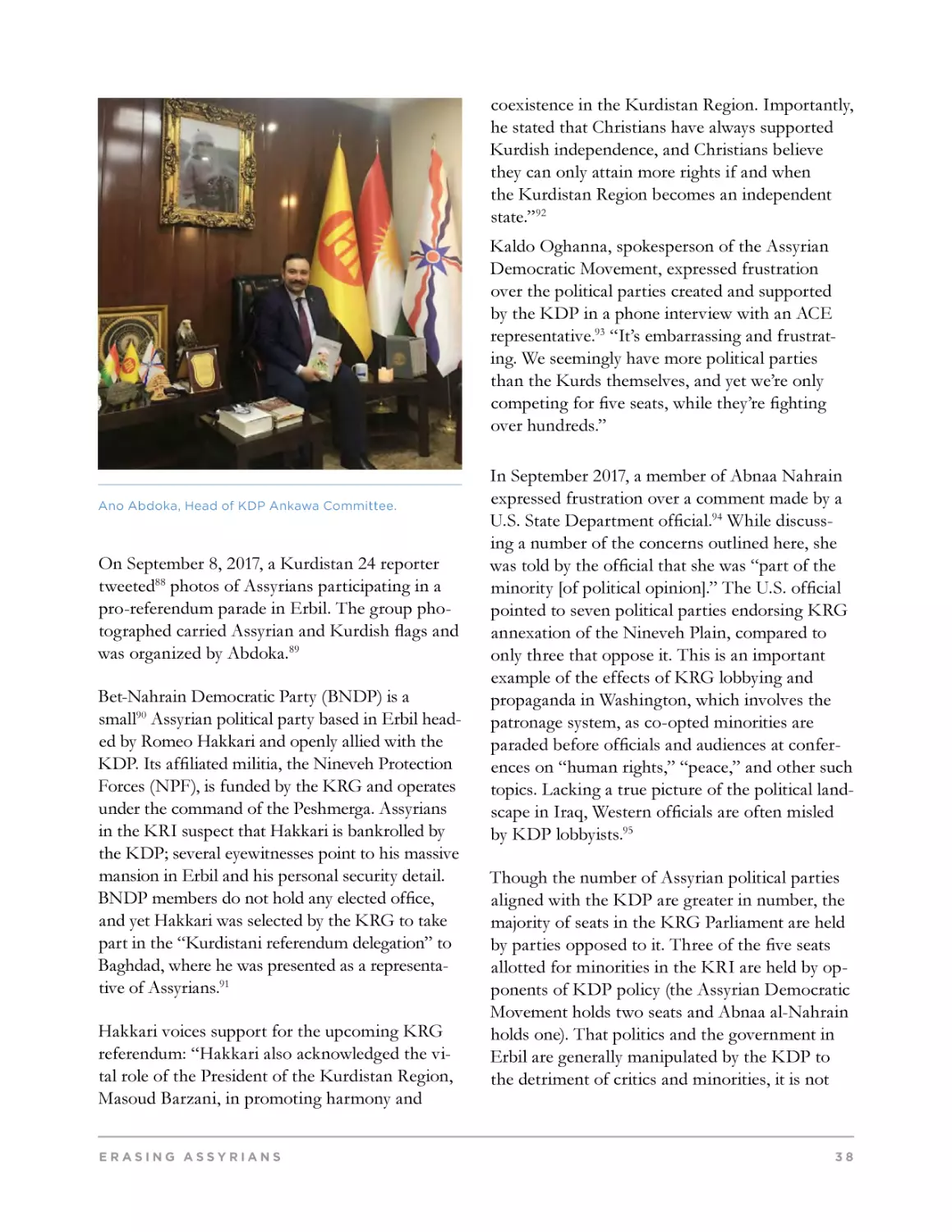
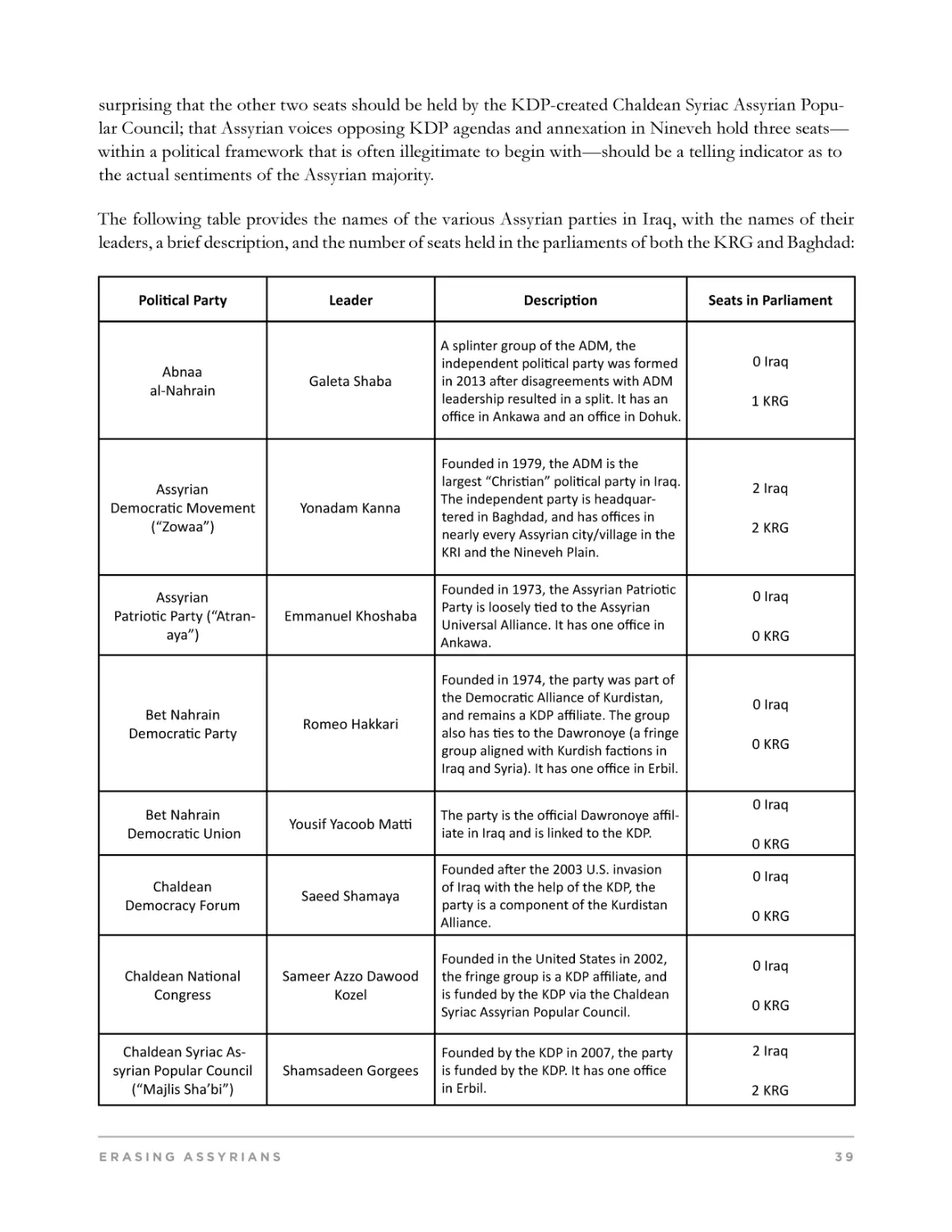
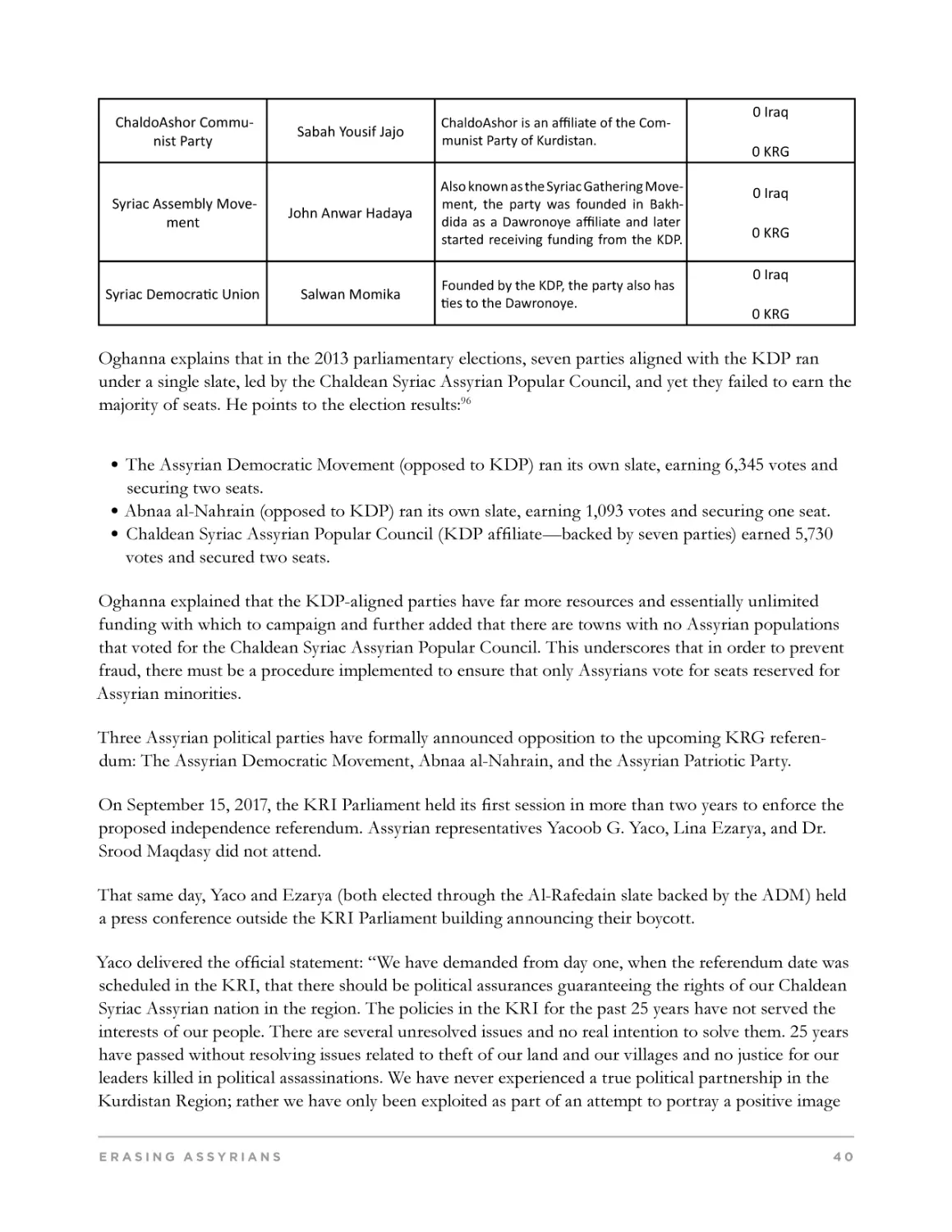




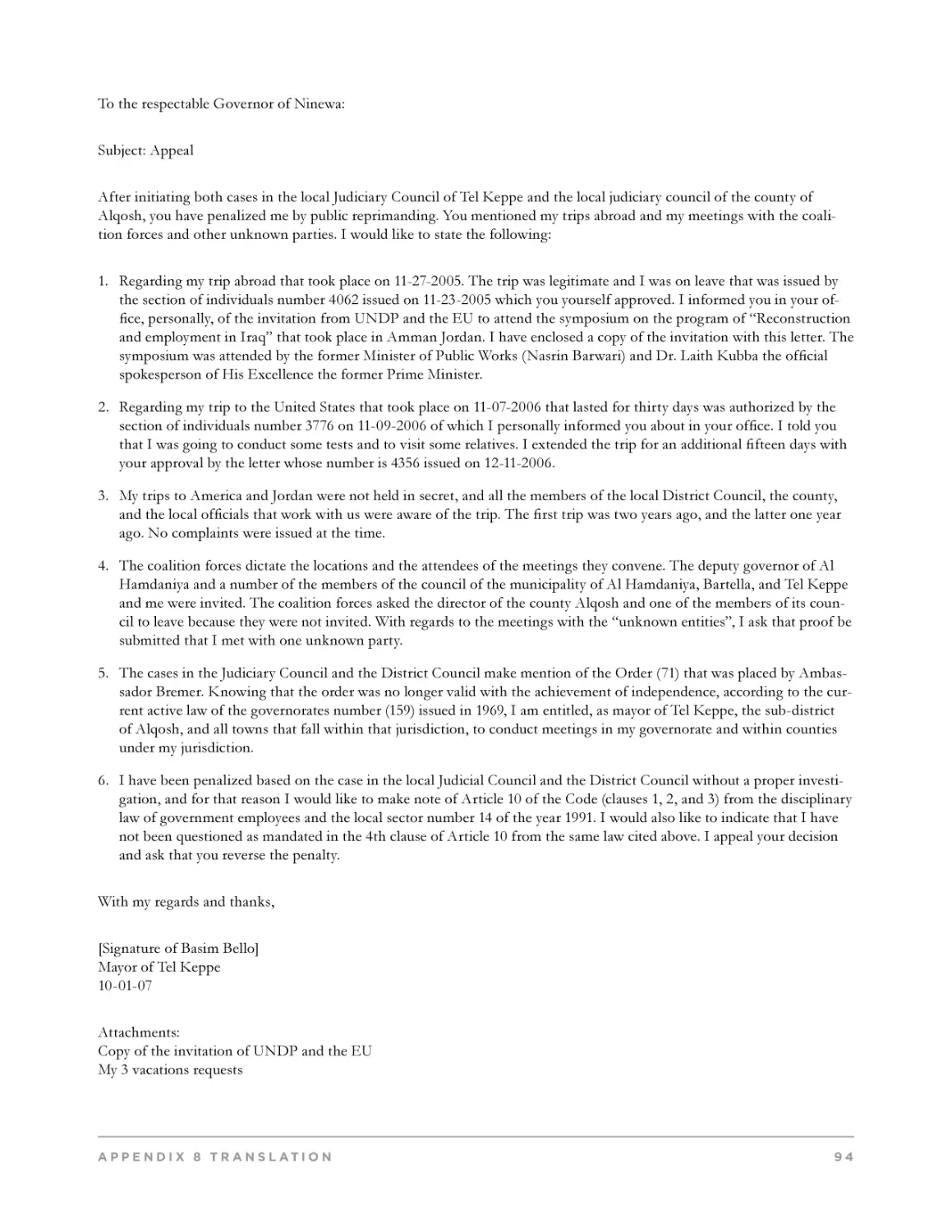
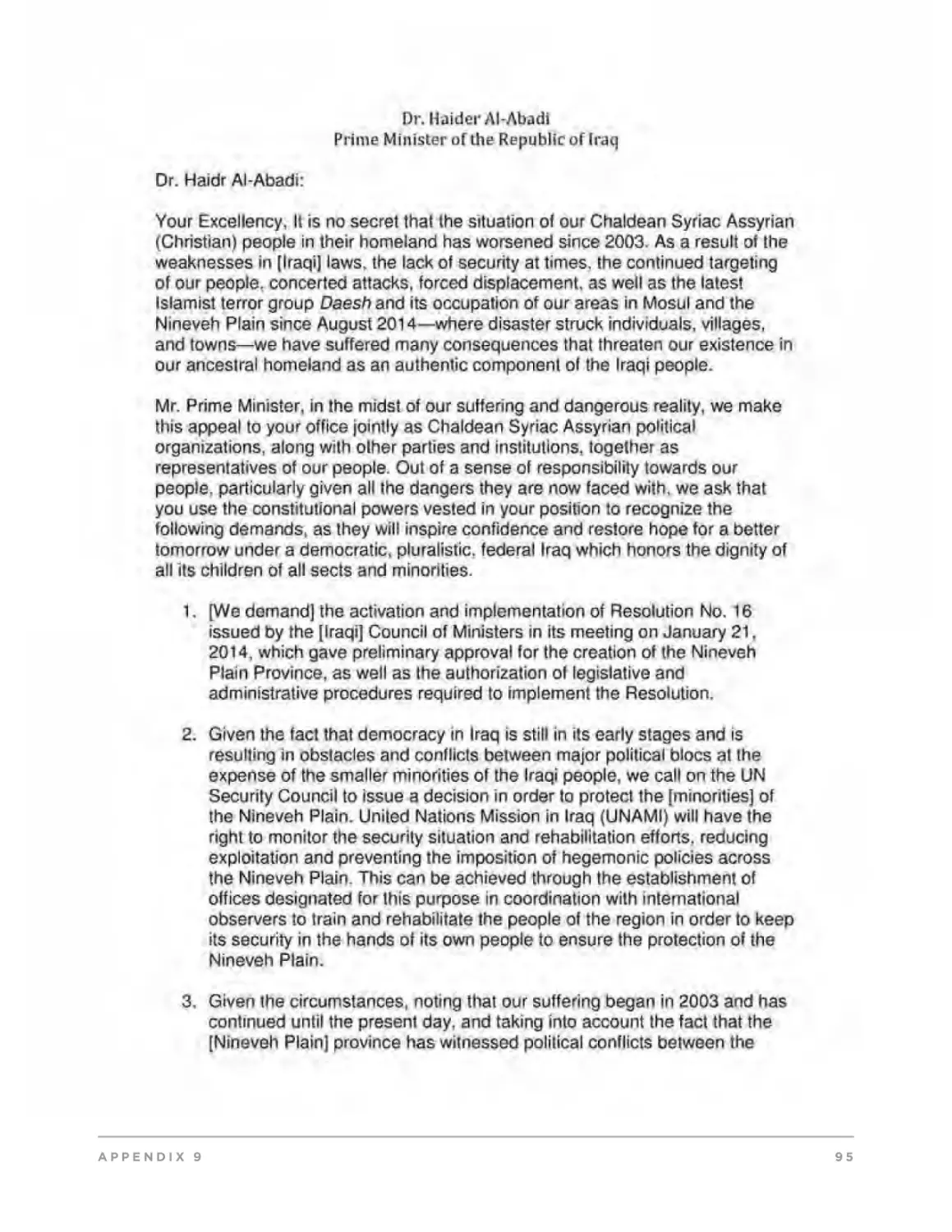
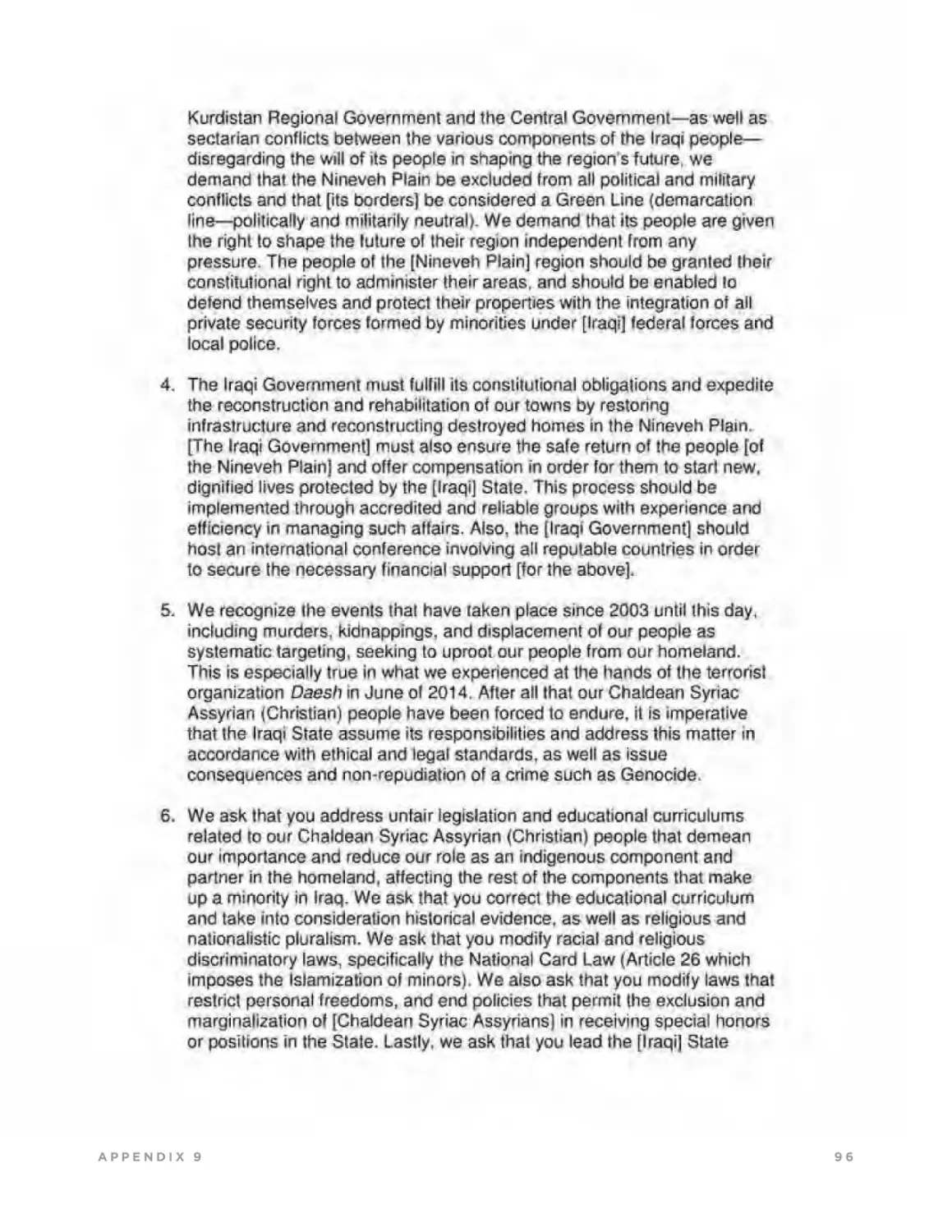

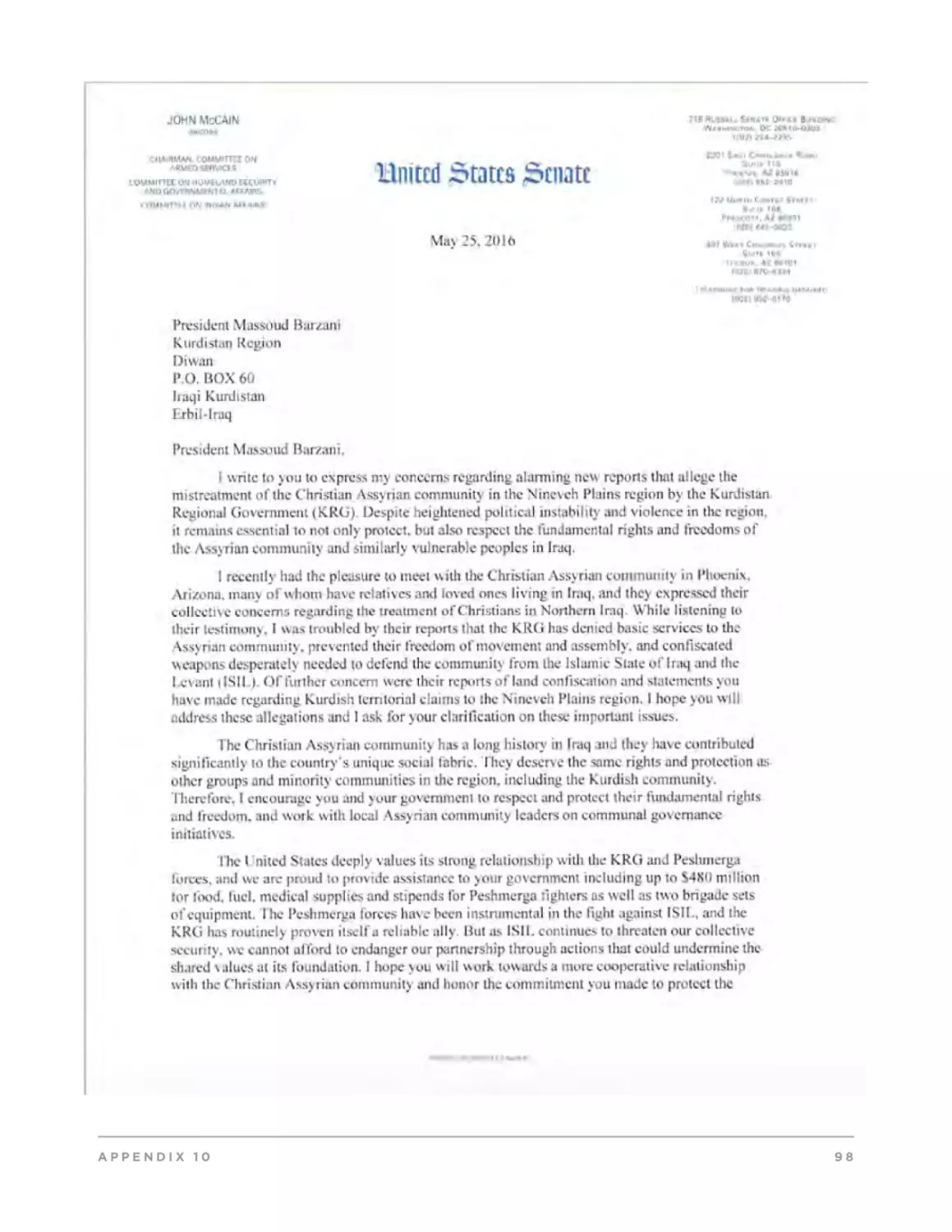


Tags: assyrian culture assyrian history
Year: 2017


Text
                    ERASING ASSYRIANS:

How the KRG Abuses Human Rights, Undermines
Democracy, and Conquers Minority Homelands

ERASING ASSYRIANS

1

Erasing Assyrians: How the KRG Abuses Human Rights, Undermines Democracy, and Conquers Minority Homelands
by Reine Hanna and Matthew Barber
Special thanks to Max J. Joseph and Mardean Isaac for their assistance and contributions during the research for and
composition of this report.
Assyrian Confederation of Europe
September 25, 2017
www.assyrianconfederation.com
info@assyrianconfederation.com
The Assyrian Confederation of Europe (ACE) represents the Assyrian European community and is made up of Assyrian
national federations in European countries. The objective of ACE is to promote Assyrian culture and interests in Europe
and to be a voice for deprived Assyrians in historical Assyria. The organization has its headquarters in Brussels, Belgium.
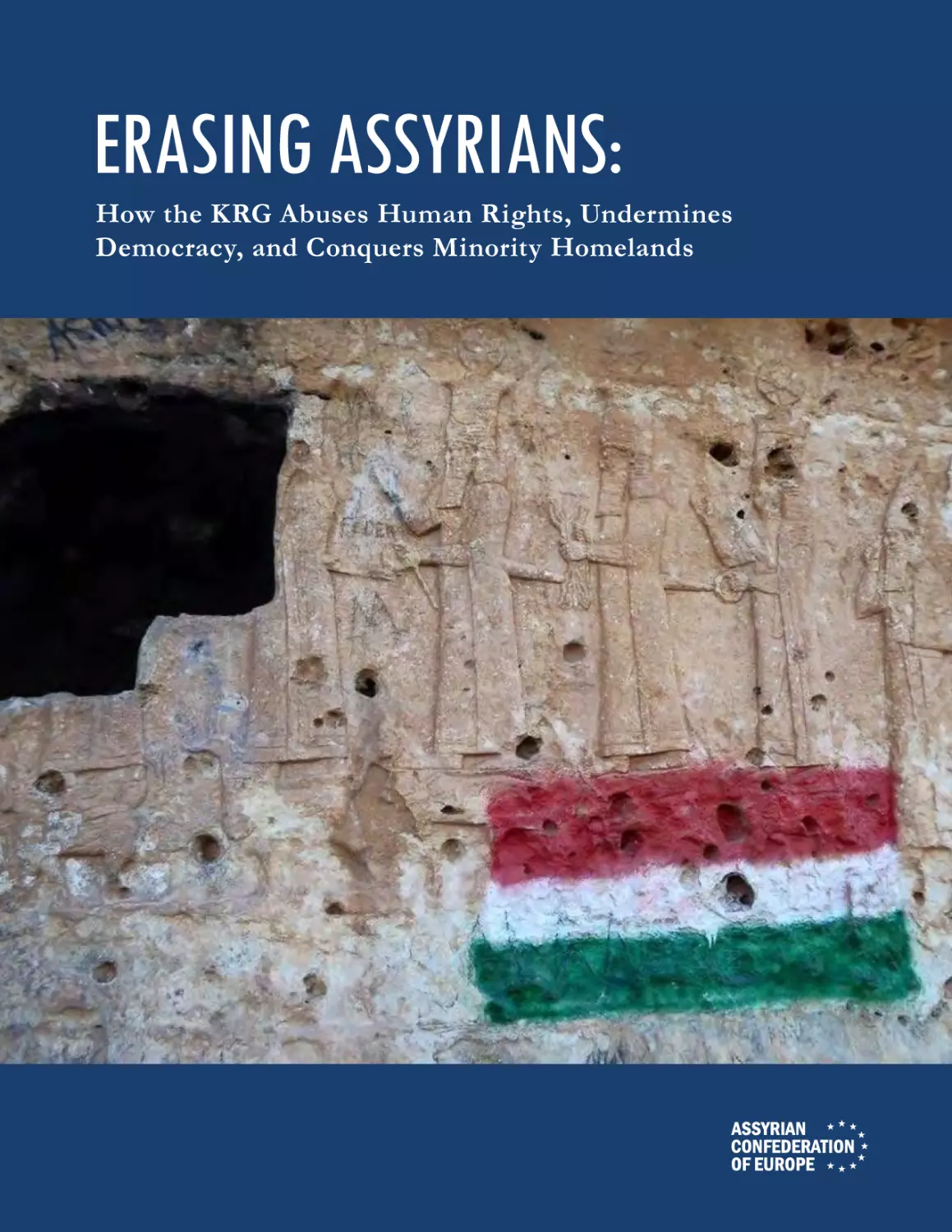
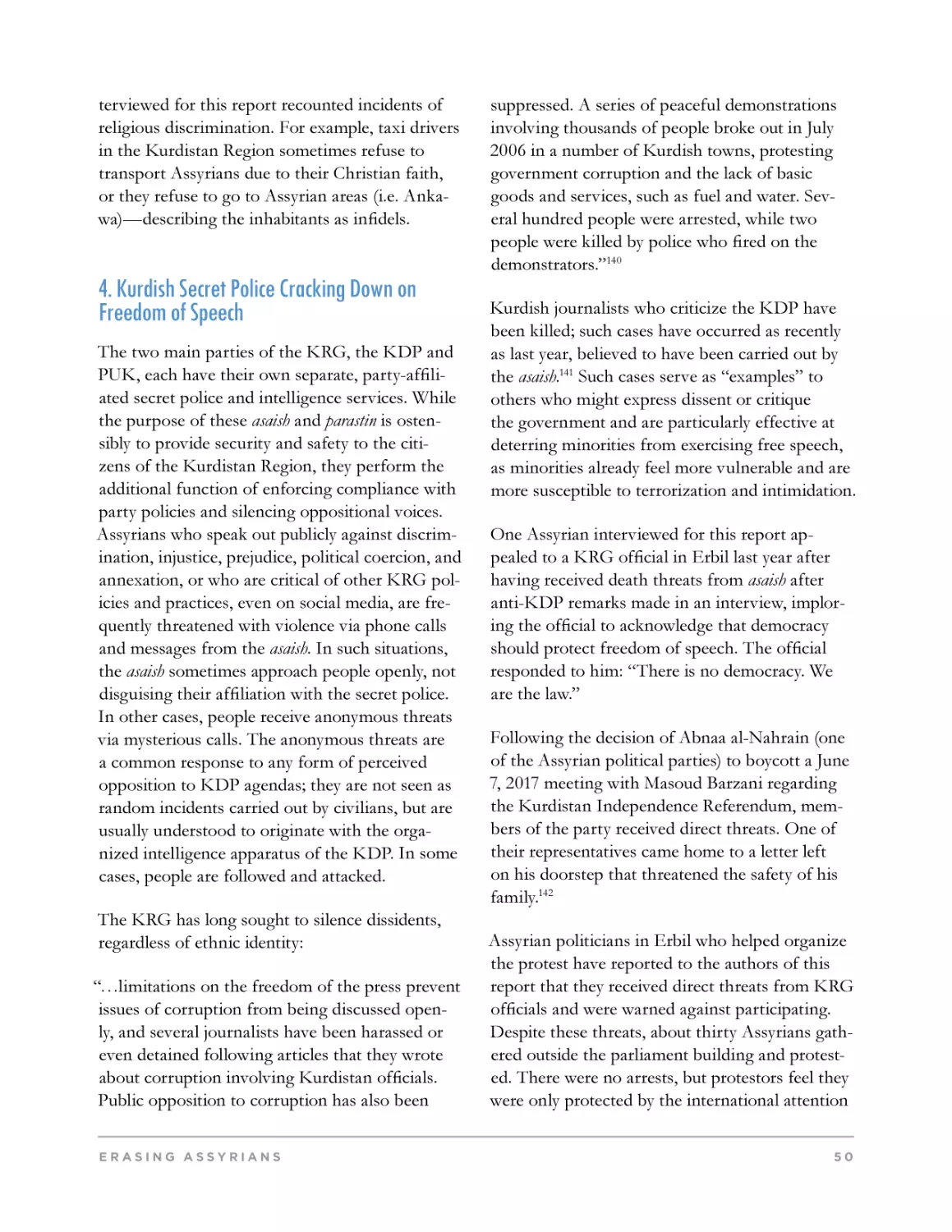
Cover photo: 7th-century BCE Assyrian archaeological site in Dohuk vandalized with the Kurdish flag
ERASING ASSYRIANS

2

NINEVEH PLAIN
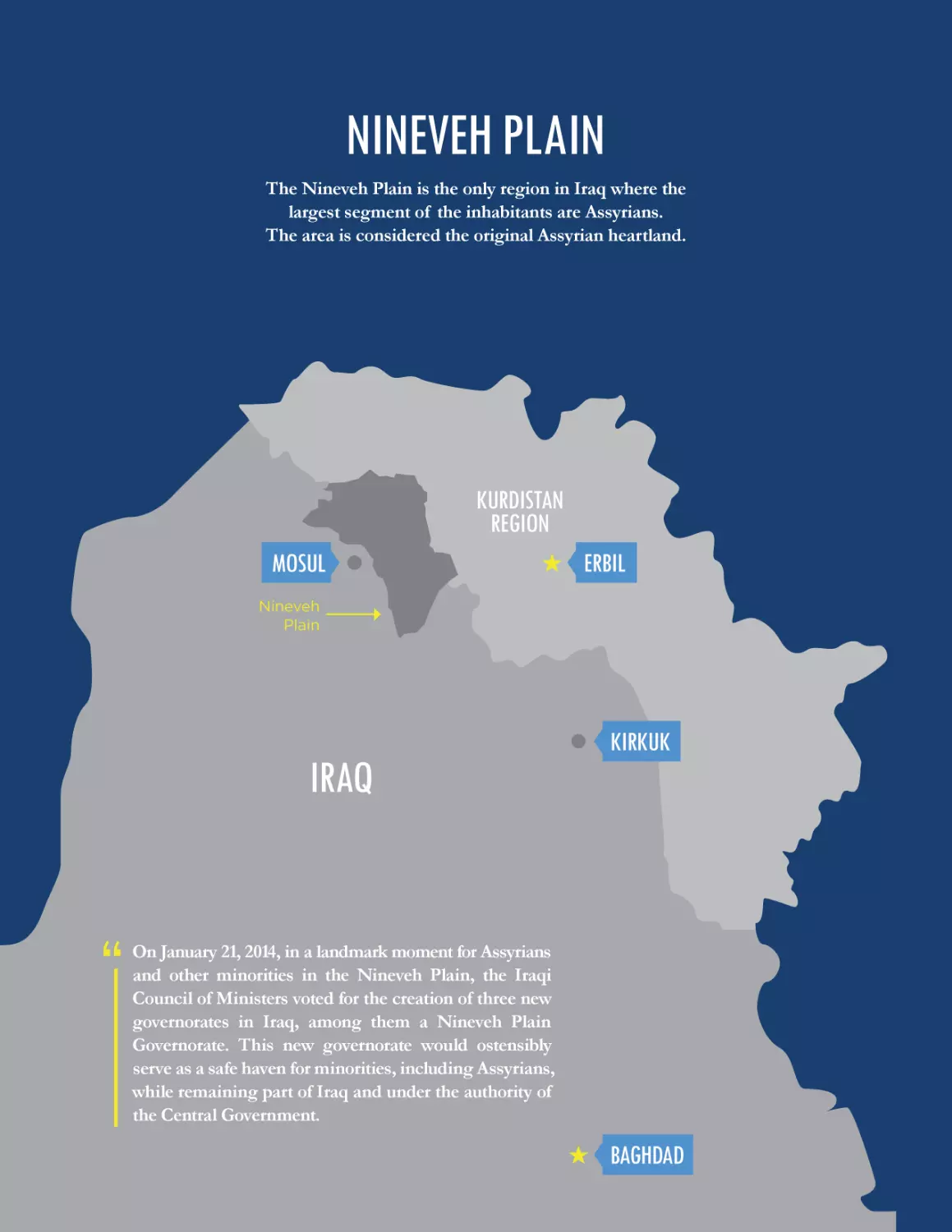
The Nineveh Plain is the only region in Iraq where the
largest segment of the inhabitants are Assyrians.
The area is considered the original Assyrian heartland.

KURDISTAN
REGION
MOSUL

ERBIL

Nineveh
Plain

IRAQ

“

KIRKUK

On January 21, 2014, in a landmark moment for Assyrians
and other minorities in the Nineveh Plain, the Iraqi
Council of Ministers voted for the creation of three new
governorates in Iraq, among them a Nineveh Plain
Governorate. This new governorate would ostensibly
serve as a safe haven for minorities, including Assyrians,
while remaining part of Iraq and under the authority of
the Central Government.

ERASING ASSYRIANS

BAGHDAD

3

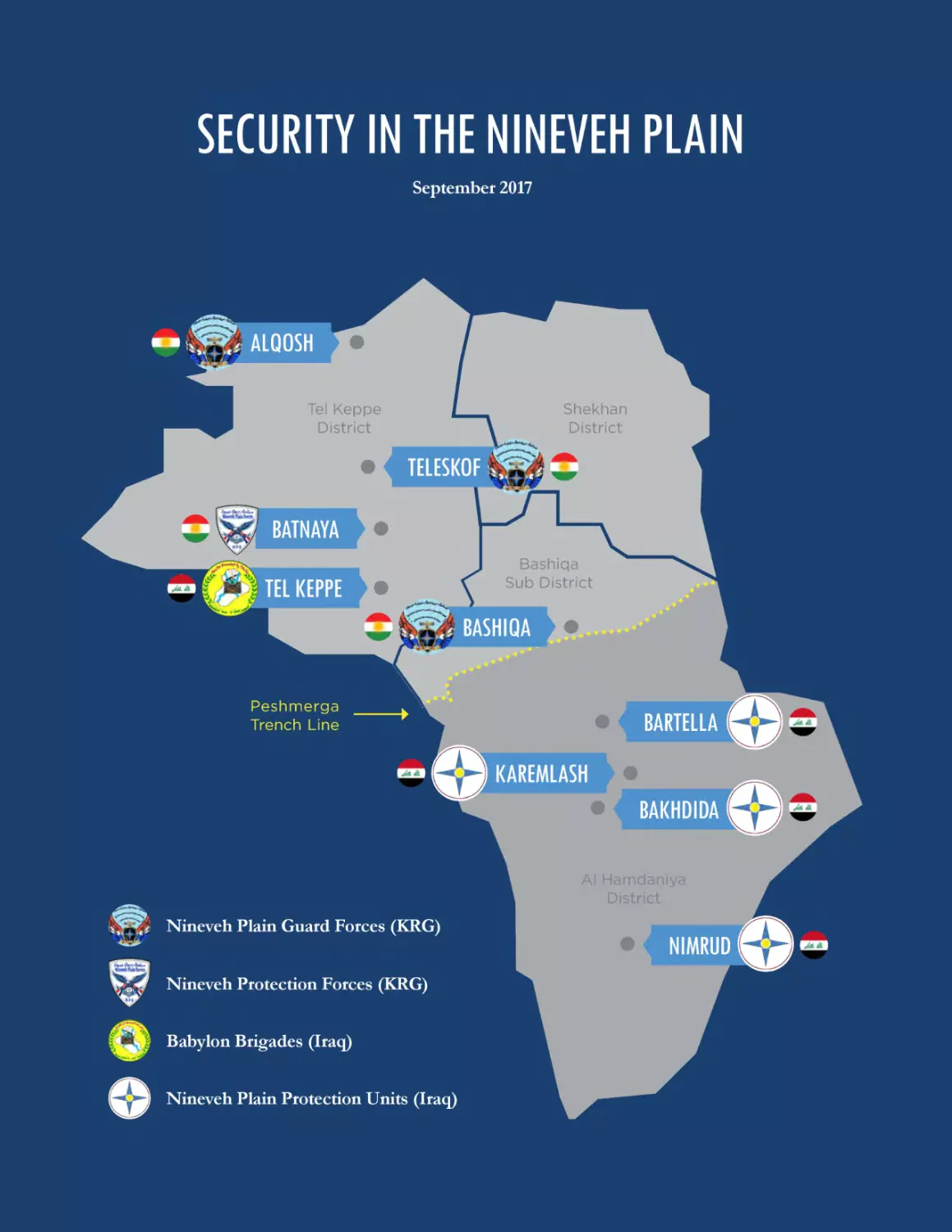
SECURITY IN THE NINEVEH PLAIN
September 2017

ALQOSH
Tel Keppe
District

Shekhan
District

TELESKOF
BATNAYA
TEL KEPPE

Bashiqa
Sub District

BASHIQA
Peshmerga
Trench Line

BARTELLA
KAREMLASH
BAKHDIDA
Al Hamdaniya
District

Nineveh Plain Guard Forces (KRG)

NIMRUD

Nineveh Protection Forces (KRG)
Babylon Brigades (Iraq)
Nineveh Plain Protection Units (Iraq)
ERASING ASSYRIANS

4

TABLE OF CONTENTS
PA R T O N E

Introduction
The Assyrian Identity....................................................................................................................................... 9
Background........................................................................................................................................................ 9
Methodology...................................................................................................................................................... 11
Organization of This Report.......................................................................................................................... 12
PA R T T WO

Conquest Masked as Liberation: Assyrians in the Nineveh Plain
1. The Nineveh Plain: The Assyrian Heartland.......................................................................................12
KRG Territorial Expansionism into the Assyrian Heartland
• A New Governorate
2. The Islamic State Conquest.....................................................................................................................14
Baghdad’s Response
The KRG Response
Liberation
3. The Current Security Environment in the Post-IS Nineveh Plain...................................................17
Inhibitions to Assyrian Security and Policing
• From the Babylon Brigades
• From the KDP
4. Pre-2014 KDP Security Interference in the Nineveh Plain and Its 2014 Consequences..............21
5. Post-IS Reconstruction.............................................................................................................................22
6. Resettlement...............................................................................................................................................25
7. Political Abuses against Assyrians in the Nineveh Plain....................................................................27
Blocking U.S. Aid to the Nineveh Plain
Voter Fraud and Intimidation
Removal of Assyrian Mayors in Nineveh
• The Removal of Alqosh’s Mayor

ERASING ASSYRIANS

5

• The Removal of Tel Keppe’s Mayor
• The Earlier Removal of Karemlash’s Mayor
Divide and Conquer: The KDP Patronage System
• Examples of Patronage in Action
The Damaging Effects of Identity Politics
8. The KRG’s Independence Referendum in the Nineveh Plain..........................................................42
PA R T TH R E E

Despotism Masked as Democracy: Assyrians inside the KRI
1. Land Theft.................................................................................................................................................44
2. The KRG Draft Constitution.................................................................................................................47
3. Religious Freedom....................................................................................................................................48
Kurdish Clerics Inciting Violence
Religious Intolerance in Kurdish Society
4. Kurdish Secret Police Cracking Down on Freedom of Speech........................................................50
5. Public Manifestations of Anti-Assyrian Prejudice...............................................................................53
State-Sanctioned Symbols of Hate
Dishonoring Assyrian Historical Figures
Neglect and Defacement of Assyrian Heritage Sites
6. Harmful Politics in the KRI...................................................................................................................55
Kurdifying the Memory of Assyrian Suffering
KDP Patronage among Assyrians within the KRI
Risks Posed by the PKK Presence in Nahla
7. Discrimination in Business......................................................................................................................56
8. Services.......................................................................................................................................................57
Medical Care
Basic Needs
Infrastructure
Public Works
Emergency Services
Assyrian Schools and Education
• Conditions
• Higher Education
9. Status of Women.......................................................................................................................................64
Assyrian Women in the Workforce
Assyrian Women in Politics

ERASING ASSYRIANS

6

10. Mass Migration of Assyrians—from Both the KRI and Nineveh.......................................................67
11. Problems Specific to Ankawa......................................................................................................................68
Security in Ankawa
Erbil International Airport
Demographic Change in Ankawa
Taxation in Ankawa
Businesses in Ankawa
Politics in Ankawa
PA R T FO U R

KRG Responses to Human Rights Violations
On the Abandonment of Assyrians to Genocide...................................................................................74
On Land Theft.............................................................................................................................................74
On Blocked Protests....................................................................................................................................75
On Preventing Assyrians from Returning to Nineveh Plain...............................................................75
On the Removal of Nineveh Plain Mayors..............................................................................................75
PA R T F IV E

Conclusion
Recommendations.......................................................................................................................................76
For the International Community
For the Iraqi Central Government
For the Kurdistan Regional Government

ERASING ASSYRIANS

7

ABBREVIATIONS
USED IN THIS REPORT
AAS............................Assyrian Aid Society
ACE...........................Assyrian Confederation of Europe
ADM..........................Assyrian Democratic Movement
AGE...........................Assyrian General Conference
AWU..........................Assyrian Women’s Union
BNDP........................Bet-Nahrain Democratic Party
IDP............................Internally-displaced person, someone
who has been forced to leave their
home but has been displaced within a
country, in contrast to a “refugee” who
has crossed an international boundary
IS................................Islamic State (jihadist movement)
ISDP..........................Iraq Sustainable Democracy Project
KDP...........................Kurdistan Democratic Party
KRG..........................Kurdistan Regional Government
KRI............................Kurdistan Region of Iraq
NPGF........................Nineveh Plain Guard Forces (NPGF)
NPF............................Nineveh Protection Forces
NPU...........................Nineveh Plain Protection Units
PMU..........................Popular Mobilization Units
PUK...........................Patriotic Union of Kurdistan
USIP...........................United States Institute of Peace

ERASING ASSYRIANS

8

PA R T O N E

INTRODUCTION
The Assyrian Identity
An estimated 1.5 million Assyrians globally (and
around 300,000 within Iraq today) comprise a
distinct, indigenous ethnic group. Descendants
of ancient Assyria, Assyrians speak an ancient
language referred to as Assyrian, Syriac, Aramaic
or Neo-Aramaic.
The contiguous territory that forms the traditional Assyrian homeland contains southern and
southeastern Turkey, northwestern Iran, northern
Iraq and northeastern Syria. The Assyrian population in Iraq constitutes the largest remaining
concentration of the ethnic group in the Middle
East.
Assyrians are predominantly Christian. Some ethnic Assyrians self-identify as Chaldeans or Syriacs,
depending on church denomination. Assyrians
have founded five Eastern Churches at different
points during their long history: Ancient Church
of the East, Assyrian Church of the East, Chaldean Catholic Church, Syriac Catholic Church,
and the Syriac Orthodox Church. The majority of
Assyrians who remain in Iraq today adhere to the
Chaldean and Syriac churches.

Background
Assyrians represent one of the most consistently
targeted communities in Iraq throughout its modern history. This has included the state-sanctioned
massacre at Simele in 1933; Saddam Hussein’s
ERASING ASSYRIANS

Anfal campaign, which included the targeting of
Assyrians villages; ruthless campaigns of terror
to which Christians were subjected following the
U.S. invasion in 2003; and finally, the recent tragic
chapter authored by the Islamic State (IS) jihadist
organization.
Following the removal of Saddam’s regime in
2003, but still years prior to the emergence of IS,
the Assyrian experience in Iraq was already one
of relentless persecution, bloodshed, and displacement.
As the large state system that had sustained the
country for decades was collapsing all around
ordinary Iraqis, sectarian groups and militias
emerged who jostled, often violently, for power
and influence. Assyrians were defenseless in this
environment and were sadly overlooked by the
Coalition forces who failed to provide them or
other minorities any special considerations or protection amid the power vacuum.
Due to the policy of de-Ba’thification, the security apparatus in Iraq collapsed, leaving minority
populations vulnerable to terror attacks. What
followed was a wave of violence specifically
targeting Assyrians for their Christian faith, as
well as for their valuables and property. Assyrian
priests were kidnapped and killed. Women were
found dead. Ransoms were demanded. Many
people went missing.1 In 2008, then U.S. Senator
Barack Obama wrote a letter to then Secretary of
State Condoleezza Rice, expressing concern about
the status of Assyrians, Yazidis, and other Iraqi
minorities and requesting to know what steps the
U.S. government was taking to ensure their security and democratic participation within Iraq’s
political system.2 Sadly, the situation continued to
deteriorate during that administration as well as
under President Obama’s own administration.
Over 70 churches were attacked or bombed
during these years and the violence against Assyrians seemingly climaxed in 2010 with a hor9

rific church massacre in Baghdad. Six jihadists
belonging to the IS precursor organization called

es, Assyrians and other minorities were caught
in the middle and found themselves truly “On
Vulnerable Ground,” as expressed by the title of
an important Human Rights Watch report from
2009.4
The U.S. military presence in Iraq did its best to
paper over the cracks forming in Iraqi society, but
that did not stop the fractures among the various
groups from deepening. Once Coalition forces
had officially withdrawn from Iraq in December
2011 as per their set timeframe, the stage was set
for these cracks to reemerge and widen: the war
for Iraq had just begun. Violence dramatically
escalated in all corners of the country as groups
who had been biding their time seized the opportunity to assert themselves.

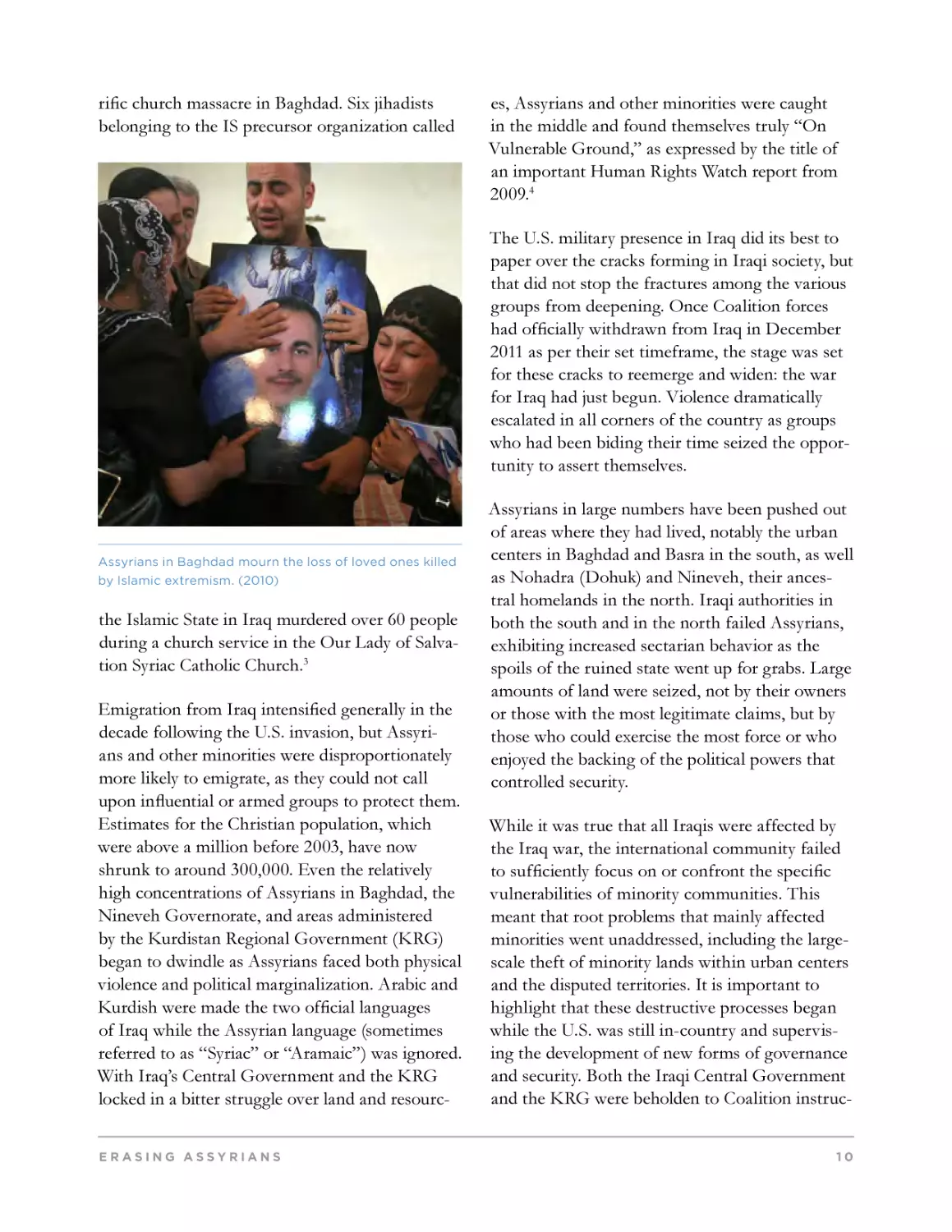
Assyrians in Baghdad mourn the loss of loved ones killed
by Islamic extremism. (2010)

the Islamic State in Iraq murdered over 60 people
during a church service in the Our Lady of Salvation Syriac Catholic Church.3
Emigration from Iraq intensified generally in the
decade following the U.S. invasion, but Assyrians and other minorities were disproportionately
more likely to emigrate, as they could not call
upon influential or armed groups to protect them.
Estimates for the Christian population, which
were above a million before 2003, have now
shrunk to around 300,000. Even the relatively
high concentrations of Assyrians in Baghdad, the
Nineveh Governorate, and areas administered
by the Kurdistan Regional Government (KRG)
began to dwindle as Assyrians faced both physical
violence and political marginalization. Arabic and
Kurdish were made the two official languages
of Iraq while the Assyrian language (sometimes
referred to as “Syriac” or “Aramaic”) was ignored.
With Iraq’s Central Government and the KRG
locked in a bitter struggle over land and resourcERASING ASSYRIANS

Assyrians in large numbers have been pushed out
of areas where they had lived, notably the urban
centers in Baghdad and Basra in the south, as well
as Nohadra (Dohuk) and Nineveh, their ancestral homelands in the north. Iraqi authorities in
both the south and in the north failed Assyrians,
exhibiting increased sectarian behavior as the
spoils of the ruined state went up for grabs. Large
amounts of land were seized, not by their owners
or those with the most legitimate claims, but by
those who could exercise the most force or who
enjoyed the backing of the political powers that
controlled security.
While it was true that all Iraqis were affected by
the Iraq war, the international community failed
to sufficiently focus on or confront the specific
vulnerabilities of minority communities. This
meant that root problems that mainly affected
minorities went unaddressed, including the largescale theft of minority lands within urban centers
and the disputed territories. It is important to
highlight that these destructive processes began
while the U.S. was still in-country and supervising the development of new forms of governance
and security. Both the Iraqi Central Government
and the KRG were beholden to Coalition instruc10

tion, support, and policy advice; nevertheless, a
political approach toward minorities began to
take shape that continues to victimize their communities in the disputed territories today.
Had a functional Central Government exerted
the proper effort during these turbulent years,
the phenomenon of IS and the growing problem
of the disputed territories may have been at least
partially averted. Instead, the Shia-dominated
Central Government elected to pursue its influence in oil-rich Kirkuk as its main priority among
the disputed territories, relinquishing nearly all interest in what they viewed as a Sunni north. This
negligence facilitated the acceleration of KDP
(Kurdistan Democratic Party) expansionism into
minority-inhabited Nineveh and Sinjar, and into
Mosul proper.
Part of this process involved KDP-affiliated
personnel becoming overrepresented in local security institutions and important political offices.
Though a deal was brokered with Sunni Arabs
which saw Atheel Nujaifi installed as Governor of
Nineveh in April 2009, it is widely believed that
the senior KDP figure and Deputy Governor of
Nineveh, Khasro Goran, held the actual power in
Mosul.
As the reach of the KDP grew within the disputed territories, minorities were forced into
dependency on KDP security and became effectively governed by KDP appointees or members of their communities who had entered into
patronage with the KDP. This opened the door
for new problems that confronted minorities, as
terrorism became replaced by more covert forms
of political oppression and silencing. Privileged
classes engaging in minority land theft could now
be protected by powerful security forces linked
to new political institutions. It is notable that
minorities have continued to emigrate from Iraq
even in cases where terrorism has not been the
main concern.
ERASING ASSYRIANS

The following sections address the recent phenomenon of IS and the effect that this movement
has had on Assyrians, as well as the responses
to it by relevant actors. Subsequent sections will
discuss the future of the Nineveh Plain, as well
as the KRG’s role, including the systemic persecution and discrimination against Assyrians
throughout their territories.

Objective
This report is produced with a concern for Assyrian human rights and longevity in their homeland.
The Assyrians are a people who have existed
in Mesopotamia for thousands of years, yet we
may be witnessing the very disappearance of this
community, in our time. The end of the Assyrians in Iraq means the eventual end of the Assyrians. This may sound dramatic, but it is a very real
possibility and not an exaggeration: The situation
of Assyrians in Iraq is beginning to resemble the
previous situation of Assyrians in Turkey, Iran,
and Syria, which is a terrifying thought. Iraq, and
specifically the Nineveh Plain, represents the only
hope for a sustainable future that maintains the
vital connection of Assyrians to their heritage.
Without it, the ancient language and culture of
the Assyrians could die.
A number of serious abuses that victimize the Assyrian people are underway in their homeland but
are not widely known among those in the international community who have a concern for the
welfare of minorities in Iraq. This report endeavors to raise awareness about these human rights
violations and about the political dynamics that
seek to deliberately undermine Assyrian efforts to
develop a stable framework of local administration and security in the Nineveh Plain.

Methodology
This report conveys and contextualizes findings
11

made by a representative of the Assyrian Confederation of Europe (ACE) during a research trip to
Iraq in December 2016 and January 2017, in addition to data gathered on an ongoing basis from
a wide range of members from many Assyrian
communities in Iraq. It seeks to convey a detailed
understanding of the current situation facing
Assyrians in northern Iraq.
ACE has interviewed approximately 100 men and
women of Assyrian communities in the Kurdistan
Region and the Nineveh Plain. In addition, ACE
continues to conduct follow-up telephone interviews. All individuals interviewed were informed
of the purpose of the interview, and verbally
consented to the use of information provided in
this report. Names and identifying information
of many interviewees have been withheld in the
interest of their personal safety.

Organization of This Report
This report is divided into five parts, with Part
Two and Part Three comprising the bulk of the
report. Following the introduction provided in
Part One, Part Two deals with the broad range of
problems facing Assyrians in the disputed territory of Nineveh. Part Three then examines problems experienced by Assyrians living inside the
Kurdistan Region of Iraq (KRI). These sections
are followed by a shorter Part Four that presents
some examples of how the KRG has responded
when human rights abuses have been publicized.
The report is completed with some policy recommendations in the concluding Part Five.

PA R T T WO

CONQUEST MASKED
AS LIBERATION:
ASSYRIANS IN THE
NINEVEH PLAIN
1. The Nineveh Plain: The Assyrian Heartland
The Nineveh Plain is a region in Iraq’s Nineveh
Governorate located northeast of the city of
Mosul. It abuts the Kurdistan Region of Iraq, and
is officially (though not entirely in practice) under
the administration of the Central Government in
Baghdad.
Prior to the advent of IS, the villages in the
Nineveh Plain were inhabited by several ethnic
and religious minority groups, the largest among
them being the Assyrians.
The Nineveh Plain is the only region in Iraq
where the largest demographic group is Christian.
Before IS invaded Nineveh, Assyrians made up
40% of the population within the plains. The area
is considered the ancient Assyrian heartland.
The area includes the ruins of the ancient Assyrian cities of Nineveh, Nimrud, and Dur-Sharrukin,
as well as numerous ancient Assyrian religious
sites, such as Mar Mattai Monastery and Rabban
Hormizd Monastery.
The five patriarchal churches represented in the
Nineveh Plain are the Ancient Church of the East,
the Assyrian Church of the East, the Chaldean
Catholic Church, the Syriac Catholic Church, and
the Syriac Orthodox Church.

ERASING ASSYRIANS

12

2004, the Assyrian leadership began to regard the
Nineveh Plain as the only location where security
for Assyrians may be possible.
KRG TERRITORIAL EXPANSIONISM INTO
THE NINEVEH PLAIN

As sectarian violence between Shia and Sunni Arabs spread across the central and southern parts
of Iraq, the KRG quietly consolidated its military
and political presence in the Nineveh Plain, establishing control over the region.

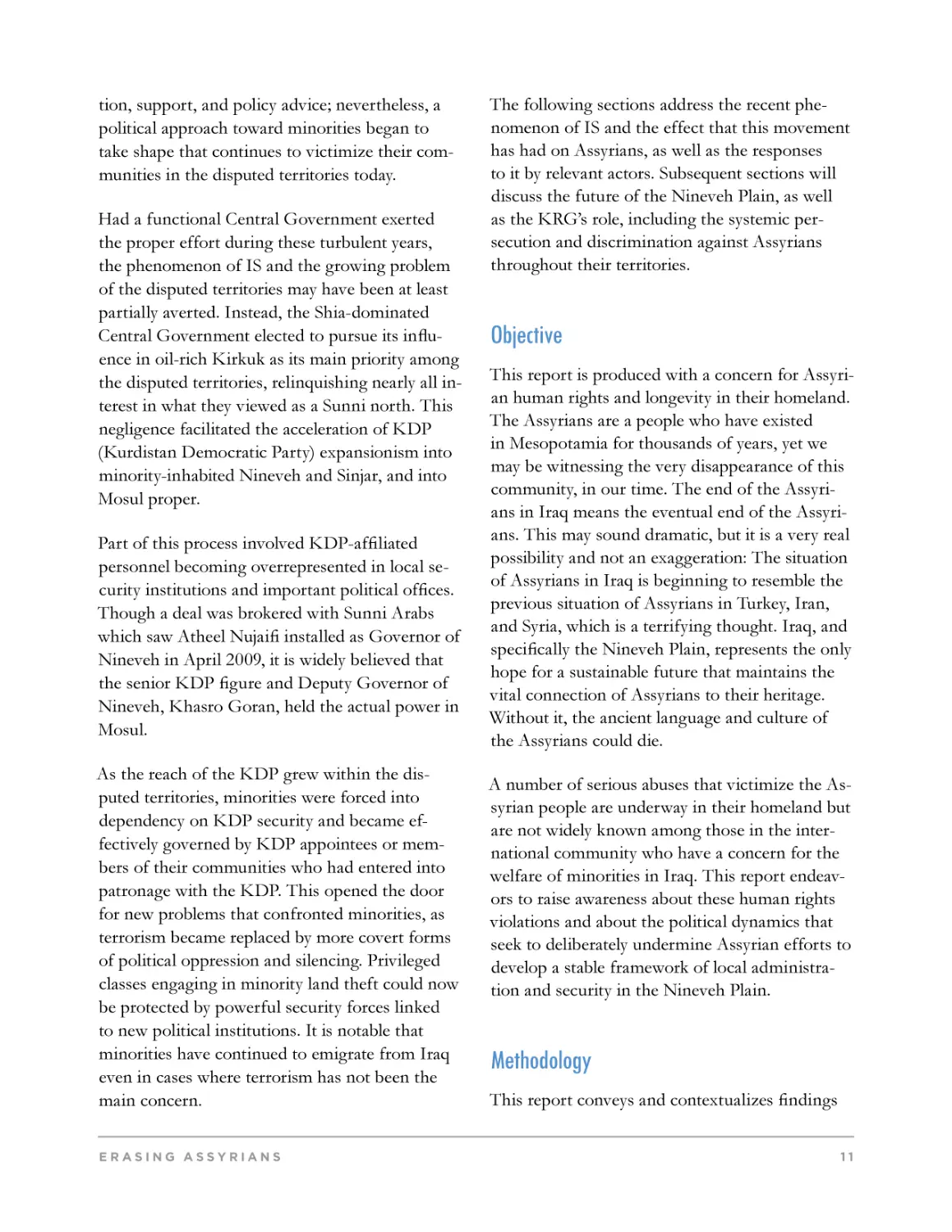
Rabban Hormizd Monastery in Alqosh, Nineveh Plain.

Since 2003, the Nineveh Plain has been the area
in which an effort to form an autonomous Assyrian administrative entity has become concentrated. Assyrians have long believed that without
a Nineveh Plain autonomous administration
(or some type of internationally-protected “safe
zone”), the indigenous Assyrian presence in the
homeland will disappear. Many Assyrians from
Baghdad sought refuge in the Nineveh Plain after
escaping violence that targeted Christians in the
south during the Iraq War years.
The unequal degree of suffering experienced by
Iraq’s smaller communities is a reflection both of
their being singled out for persecution—primarily by Sunni Arabs and Kurds in the case of the
Assyrians—as well as the complete absence of a
security apparatus deployed on their behalf.
Following the focused attacks on Assyrians in
Iraq, exemplified by the simultaneous bombing of
six churches throughout the country on August 1,
ERASING ASSYRIANS

The Nineveh Plain is included among a number of “disputed territories” due to the relatively
new claim of the KRG that it is part of “Greater
Kurdistan.” In 2004, the KRG published a first
draft of a constitution for the Kurdistan Region.
This first draft contained no mention of the
Nineveh Plain; however, in a subsequent KRG
draft constitution published in 2006, Article 2
claims that the Nineveh Plain rightfully belongs
to the Kurdistan Region. In contrast with the
KRG draft constitution’s unilateral language,
the Iraqi Constitution that was adopted in 2005
contains a general provision on resolving the disputed territories. Article 140 of the Constitution
states that the status of the disputed territories
(i.e., whether they should fall under the administration of the Kurdistan Region or remain under
the administration of the Central Government)
should be resolved by the end of 2007, and that it
should be the inhabitants of those territories who
choose which administration they prefer. The disputed territories were not resolved by the deadline.
Over the last decade, the KRG has steadily
worked to undermine the influence and political
authority of Assyrians and other minorities that
have remained independent of KRG patronage,
and has endeavored to flood the Nineveh region
with Kurdish citizens and security forces. The
dominant Kurdistan Democratic Party (KDP),
which rules the portion of the Kurdistan Region
adjacent to the Nineveh Plain, has pursued and
13

implemented a number of systematic strategies
(that will be described in the later sections of this
report) with the aim of dividing minority groups,
weakening their solidarity, and quashing their
political will in order to make possible the KDP’s
annexation of the Nineveh Plain.
A new report, The Christians: Perceptions of Reconciliation and Conflict published by the Middle East
Research Institute in September 2017 highlights
the issue and its resulting impact:
“Another branch of Christian dissatisfaction is in
relation to KRG’s polices in the Nineveh Plains
in general. Particular participants believed that
the major Kurdish political parties politicized
and divided the Christian community after
2003. They pressured existing Christian political
parties to fall under their control, created new
Kurdish-affiliated political parties, and alienated
those who rejected Kurdish policies in the region.
Moreover, the fact that the Peshmerga forces and
the Kurdish Asayesh forces controlled security in
Nineveh Plain while its administration was managed by the Central Government of Iraq (CGI)
also contributed to deepening divisions as both
actors pursued conflicting agendas regarding the
future of the area.”5
According to Human Rights Watch, “KRG authorities have relied on intimidation, threats, and
arbitrary arrests and detentions, more than actual
violence, in their efforts to secure support of
minority communities for their agenda regarding
the disputed territories.”6 It is this harmful approach—which jeopardizes the future of minorities—that this report will address.

A N ew G ove r n o ra te

On January 21, 2014, in a landmark moment for
Assyrians and other minorities in the Nineveh
Plain, the Iraqi Council of Ministers voted for
the creation of three new governorates in Iraq,
ERASING ASSYRIANS

among them a Nineveh Plain Governorate. This
new governorate would ostensibly serve as a safe
haven for minorities, including Assyrians, while
remaining part of Iraq and under the authority of
the Central Government.
The Central Government’s decision renewed
hopes for a sustainable future for Assyrians and
other minorities in Iraq, but the mood changed
drastically just months later as the towns of the
Nineveh Plain were emptied, when IS invaded.

2. The Islamic State Conquest
Prior to the visible conquest of IS, a process of
deterioration within Iraqi state structures was
already underway; Mosul was already lost before
it was taken. As local terrorist organizations
became emboldened, they began to conduct their
affairs in the open. When IS decided to incorporate Sunni (and later minority) areas of Iraq into
its apocalyptic utopia, it swept through Mosul
and the rest of the Nineveh Governorate almost
entirely unopposed.
The minorities, long neglected and starved of any
agency in these disputed territories had no way to
defend themselves.
BAGHDAD’S RESPONSE

The Central Government in Baghdad was woefully unprepared to defend northern Iraq against
the IS surge. Years of normalized corruption,
governmental disinterest regarding entire regions
of the country, and deepening political crises had
resulted in the abandoning of significant areas to
terrorist elements well before the media began
posting their first articles about the onslaught of
IS in Iraq. All things considered, the Iraqi Army’s
collapse and retreat from Mosul was inevitable,
and when IS entered the city, many of the Iraq
Army soldiers fled south, leaving behind weaponry and armor.7 Furthermore, while the govern14

ment’s power was limited in Sunni areas dominated by radicals, Baghdad was similarly weak in the
Nineveh Plain, where it was not expending any
effort to “dispute” the disputed territories in 2014.
The KDP had already infiltrated most political
and security functions in the minority-inhabited
districts of Sinjar and the Nineveh Plain.
After the fall of Mosul, no effective plan was
made to rescue the thousands of captives taken
by IS, or bring their captors to justice. There
have been efforts by individuals working in an
unofficial capacity and private organizations to
locate captives and secure their release by paying
bribes or ransoms. These have risked punishment
themselves, since these ransoms are viewed by
many as funding terrorism, but Baghdad has not
provided any assistance to steer this endeavor into
one undertaken and regulated by the state.
For Assyrians, the response from Baghdad to
their plight has been negligible, but this is consistent with a historical trend. There is much to
take from the almost daily rhetoric and displays
of strength from the Central Government on the
matter of crushing IS, but Assyrians have been ignored and abandoned by successive regimes since
Iraq’s liberation in 2003.
THE KRG RESPONSE

The Iraqi Army utterly collapsed in the major
urban centers like Mosul and abandoned their
weaponry and positions to IS, fleeing south. The
KRG Peshmerga (Kurdish party militias whose
name means “those who face death”) actively
disarmed8 and abandoned Yazidis,9 Assyrians, and
other minorities before retreating north themselves with these weapons in tow.10
Despite these established facts, there is a huge
disparity in perception between the rightfully
maligned capitulation of Iraqi forces in Mosul
and the wrongfully celebrated Peshmerga, who
are hailed as the best fighting force against IS
ERASING ASSYRIANS

on the ground by many Western observers. The
reasons for this will be elaborated in the following sections.
The KRG has two primary parties that rule the
KRI (Kurdistan Region of Iraq): the Kurdistan Democratic Party (KDP) and the Patriotic
Union of Kurdistan (PUK). Each of these tend to
aggrandize their achievements in the war against
IS while minimizing the sizes and capacity of
their forces and emphasizing a lack of armament
and training. For a Western audience, the KRG
endeavors to project unity in order to secure the
confidence of potential supporters, but what lies
beneath this surface-level image is a bitter rivalry that involves the amassing of large personal
armies in the tens of thousands and the scramble
for weaponry and power within the KRI.
With each of these parties commanding their
own Peshmerga militias, the war against IS was
characterized by political posturing and strategic
deployment, rather than by a unified defense and
liberation operation. The PUK concentrated its
forces on consolidating influence in Kirkuk, the
seizure of which was facilitated by the withdrawal
of Baghdad’s forces, whereas the KDP saw an
opportunity to deploy its forces into all of the
areas they had worked on destabilizing in Sinjar
and the Nineveh Plain for a decade.
After the Peshmerga had retreated from the disputed territories and held their line nearer Erbil,
it was left to Coalition forces to deter IS from
advancing further.
Though the KDP effectively controlled the
Nineveh Plain prior to the advent of IS, its presence in the area looks very different in 2017 from
how it appeared in early 2014. The territory in the
Nineveh Plain currently occupied by Peshmerga
is roughly half of what it was pre-2014, but their
role in parts of the Nineveh Plain is now being
politically normalized and legitimized, whereas
previously it only held de facto control.
15

The KRG is now consolidating their hold on the
northern parts of the Nineveh Plain, and boldly
asserting their intention to maintain control by
physically drawing a borderline with trenches and
berms.
“‘It was our front line, now it’s our border, and we
will stay forever,’ said peshmerga commander and
business magnate Sirwan Barzani. He’s among a
growing number of Kurdish leaders, including
his uncle, the Kurdish region’s president Massoud
Barzani, who say that lands taken from IS will
remain in Kurdish hands.”11
A man from Bakhdida (Qaraqosh) described the
Peshmerga as having two faces, highlighting the
disparity between the image that the KRG projects to the West and the way that it is perceived
by minorities in the disputed territories: “To the
world, they look like liberators. But we see them
for what they really are. They’re conquerors.”12
Kurdish flags have been raised and large portraits
of Masoud Barzani have been erected in the
towns under KRG control, a move the locals say
reminds them of Saddam Hussein.
In an interview, an elderly man in Alqosh commented on the massive Kurdish flag that now
hovers over the main checkpoint at the town’s entrance. “Before IS, there isn’t a man in the world
who would dare raise a Kurdish flag in this town.
But now look at that flag.”13
In order to lay claim to and control the Assyrian
response to the crisis, the KDP set up proxies via
political parties14 and militias (profiled in the following sections). These serve an important propaganda function by promoting a picture of KRG
benevolence regarding the “liberation” of Assyrian and other minority territories by Peshmerga
forces. This false picture15 is being relentlessly
promoted16 in order to secure sufficient external
validation for the annexation of new territories to
the Kurdistan Region17—lands rich with oil and
ERASING ASSYRIANS

other resources.
IS ultimately presented an opportunity for the
KRG. As one anonymous KRG official told Reuters in June 2014: “Everyone is worried, but this is
a big chance for us. IS gave us in two weeks what
Maliki has not given us in eight years.”18
Another KRG official said in a statement to Fox
News: “The Peshmerga will not withdraw from
areas we consider to be Kurdistani areas.”19
The consolidation of Peshmerga control over
parts of the Nineveh Plain was supported by
Turkish troops who entered the country at the
invitation of Masoud Barzani. The presence of
the Turkish military, which has now established
over a dozen military bases in KDP areas of the
Kurdistan Region and in the disputed territories,
has been condemned by the Iraqi leadership in
Baghdad and is even seen by some Kurds as a
foreign occupying force. The Turkish military
presence has offered training to KDP militias
and also maintains its own troop presence in a
number of locations on the ground.
IS did much harm to Assyrians—expelling them
from their homelands, appropriating their property, and destroying their towns. Thankfully, the IS
organization has no international legitimacy and
governments around the world condemned its
harmful actions. On the other hand, the political
abuses of the KRG that victimize the Assyrian
minority are being perpetrated by a government
that is largely supported by Western powers. Because of the international legitimacy ascribed to
the KRG, these abuses can be more hidden and
often go unchallenged. Though this report focuses on the fact that the KRG is the actor that is
currently most jeopardizing the future of minorities in several disputed territories, it is important
to draw a distinction between the actions of this
government and those of the Kurdish people,
generally. When IS displaced minorities from
Nineveh and Sinjar into the Dohuk Governorate,
16

local Kurdish people demonstrated immense compassion for the IDPs, opening their homes and
businesses to allow the many thousands to take
shelter. Some Kurds took leaves of absence from
their workplaces or studies in order to temporarily
focus on serving IDPs. Ordinary people purchased food and clothing—or collected it from
others—and volunteered to transport this aid by
the carload to locations where IDPs were gathering. At the community level, large tents to receive
donations of food and clothing were erected in
various locations around Dohuk, including at local
mosques, and imams called upon their congregants to donate in support of the IDPs. The Christian mukhtar of one Assyrian village in Dohuk described (to one of the authors of this report) how
the imam of a neighboring Muslim village came
to offer the support of his community after his
village witnessed the Assyrians taking in dozens
of Christian families fleeing from Nineveh. Many
stories of compassion will never be known and
the care and goodwill that many Kurdish people
extended to these IDPs in their gravest hour of
need should be acknowledged.
LIBERATION

The Nineveh Liberation Operation Command
was the campaign led by the Central Government to defeat IS and liberate Nineveh and other
occupied territories. Headed by Iraqi General
Najim al-Jubouri and backed by the U.S.-led
international Coalition against IS, the campaign
included Iraqi Security Forces, KRG Peshmerga,
and their allied militias. The operation to liberate
the Nineveh Plain began in September 2016, and
spanned several months. The area was fully liberated in January 2017, after more than two years of
IS occupation.
Eight months after the liberation of the Nineveh
Plain, security in the area is divided between Iraqi
and Kurdish forces and their proxy forces. Northern parts of the Nineveh Plain are controlled by
Peshmerga, while southern parts are controlled by
ERASING ASSYRIANS

a local Assyrian security force with the backing of
the Central Government.

3. The Current Security Environment in the
Post-IS Nineveh Plain
A number of forces are now involved in the security arrangement of the Nineveh Plain:
Kurdish Peshmerga and Zerevani (KDP militia
special forces) hold the northern parts of the
Nineveh Plain. Turkish forces are also stationed
near Ba’shiqa (northeast of Mosul) in support of
KDP Peshmerga.
Iraqi Army 16th Division troops are stationed at
checkpoints along the Mosul-Erbil highway and
on Mosul’s outskirts.
Iraqi police have reassumed their pre-IS role in
police districts across the Nineveh Plain.
The Nineveh Plain Protection Units (NPU) is
a Christian Assyrian security force, formally
registered with the PMU, but which operates
independently of PMU leadership (a similar
arrangement to that of the Yazidi YBŞ force in
Sinjar). All of the NPU’s soldiers are strictly local
inhabitants of the Nineveh Plain and are members of the Chaldean and Syriac churches. The
NPU receives support for non-munitions needs
from the Nineveh Plain Defense Fund, a U.S.based nonprofit, as well as other direct sources of
assistance. The NPU was the only Assyrian force
authorized by the Nineveh Liberation Operation
Command to operate in the Nineveh Plain as
its own force, and fought alongside the U.S.-led
coalition and Iraqi forces in the liberation of the
Nineveh Plain. The 2017 U.S. Senate State, Foreign Operations, and Related Programs Appropriations Bill called for direct support of the NPU.20
The NPU now manages security in Bakhdida
(Qaraqosh), the largest city in the Nineveh Plain
(and also the largest Christian city in Iraq), as well
as surrounding areas like Bartella and Karamlesh.
17

It has a base in Alqosh, and is currently constructing a second base in Bakhdida. The force
was commanded by General Behnam Aboosh, a
Bakhdida native, during the liberation phase of
conflict. It currently operates under the command
of a council of officers. The NPU’s leadership includes a political council which advocates for the
security force in Baghdad, chaired by Gevara Zia
of the Assyrian Democratic Movement (the largest Christian/Assyrian party in Iraq), a Bakhdida
resident. The political council does not influence
operational decisions.
The Nineveh Plain Guard Forces (NPGF) is a
Kurdish proxy force linked to the Chaldean Syriac
Assyrian Popular Council (a KDP affiliate created
by Assyrian KDP leader and former KRG Finance
Minister Sarkis Aghajan). The force is also known
as the Tiger Guards. It was formed out of the
remnants of an Assyrian force first created in 2008
by the KDP called the Church Guardians, also
formed by Aghajan. The NPGF continues to operate under Peshmerga command, and currently has
a presence in the northern parts of the Nineveh
Plain. The NPGF participated in the liberation of
the Nineveh Plain under Peshmerga command.
The Nineveh Protection Forces (NPF) is a
Kurdish proxy force with ties to Bet Nahrain
Democratic Party, a KDP affiliate led by Romeo
Hakkari. Hakkari is native to an Assyrian town in
Erbil Governorate. The group claims 500 soldiers21, but eyewitness reports put numbers as low
as 50. The NPF operated under Peshmerga forces
in the liberation effort, and now has a small presence in Peshmerga-controlled areas.
Led by a Christian militiaman from Baghdad (not
a current resident of the Nineveh Plain) named
Rayan al-Kildani, the Babylon Brigades is part
of the Popular Mobilization Units (PMU). Supported by the Iran-backed Badr Organization, the
1,000-strong force does not include locals and
only includes a handful of Christian soldiers—
these are also not from the area. Its ranks are

ERASING ASSYRIANS

primarily comprised of Shabaks and Shia Arabs.
The Babylon Brigades is funded by Baghdad and
currently operates exclusively in Tel Keppe (Tal
Kayf). The force entered the Nineveh Plain only
at the end of its liberation.
INHIBITIONS TO ASSYRIAN SECURITY
AND POLICING

The various ethnic communities that comprise
the Nineveh Plain have been historically marginalized and abused by larger, more dominant
groups, and have for years sought to establish a
local security force to protect themselves. The
various security forces that are now contesting
for control of the area have competing interests:
Kurdish Peshmerga and their allied forces seek
its annexation by the KRG, while the Baghdad-backed Nineveh Plain Protection Units
(NPU) advances the creation of a Nineveh Plain
Governorate linked directly to the Central Government giving Christian Assyrians and other
peoples of the Nineveh Plain parity with other
sub-national federal units in Iraq’s burgeoning
federal system. In this sense, the new division
between the northern and southern parts of the
Nineveh Plain reflects warring interests.
Since the NPU’s formation in November 2014,
its leadership has complained that the Peshmerga
and KDP asaish have impeded their progress, in
direct contradiction of the mandate provided to
the NPU by both the Iraqi state and the international anti-IS coalition.
Fro m t h e B a byl o n B ri g a d e s

The Babylon Brigades are something of a wild
card, not aligned with the interests of the local
Assyrians in whose region they have established
a presence, but also not aligned with the KDP.
Baghdad resident and Babylon Brigade leader
Rayan al-Kildani has openly voiced his desire
to eliminate the NPU’s presence in the Nineveh
Plain, and has unsuccessfully sought support
from residents and local church leaders.
18

The incident was incorrectly reported by several media outlets as a clash between Christian
groups, despite the fact that the Babylon Brigades
is mainly comprised of Shia Arabs and some
Shabaks. The incident is now cited by KDP and
its affiliates to suggest NPU’s presence in the
Nineveh Plain causes disarray.
Fro m t h e K D P

Unlike the NPGF and the NPF which are embedded within Peshmerga ranks, the NPU is a security force aligned with the majority segment of the
Assyrian community that is directly opposed to
the KRG’s agenda to annex the Nineveh Plain.
NPU soldiers stand guard in Bakhdida, Nineveh Plain.

On July 15, 2017, the Babylon Brigades attacked
an NPU base in the town of Bakhdida (Qaraqosh). Two days prior, the NPU had detained
six Babylon Brigades soldiers for theft after they
were caught stealing ancient artifacts from religious sites and looting homes in the area. At the
time of the attack, NPU soldiers were reportedly
on duty. Additional men were needed to provide
security for visiting Iraqi ministers and commanders of the Iraqi Special Forces, leaving less
soldiers at the base. According to sources, only a
half-dozen soldiers remained at the base, when
the Babylon Brigades descended on it in broad
daylight.
They approached in as many as twelve vehicles,
accompanied by other Shia Arab forces register under PMU. After a clash between the two
groups, the Babylon Brigades fled with stolen
weapons and one NPU truck. The stolen weaponry and the truck were later returned.22
Iraqi Prime Minister Haider Al-Abadi ordered
an investigation of the incident.23 The Babylon
Brigades and allied PMU-forces were immediately
expelled from the district.24
ERASING ASSYRIANS

According to the New York Times: “The Kurds
are looking to integrate all the Christian militias
into their force; they have succeeded with the
N.P.F. and two others. But the N.P.U. remains
wary. They fear that the Kurds are using the
Christian cause to seize territory for a greater
Kurdistan. And because the Kurdish forces abandoned them as IS approached, the militias want
the right to protect their own people.”25
As expressed in the NPU’s mission statement:
“The NPU strengthens our political claim to
normalize control and jurisdiction of the Nineveh
Plain in favor of independent Assyrians who wish
to maximize their autonomy. Our long-term goal
is the creation of a new Nineveh Province [i.e. a
governorate] separate of the Kurdistan Regional
Government (KRG) and equal to other provinces
under the Government of Iraq. We believe that
only through a separate Nineveh Plain Province
independent of the KRG may Assyrians realize
their potential as free and equal citizens of the
Government of Iraq.”26
Since the establishment of the NPU, the Assyrian-led security force has faced pressure from
the Kurdistan Regional Government, which has
increased following the liberation of the Nineveh
Plain:
19

The NPU was met with opposition from the
KRG when it attempted to build a base in the
Nineveh Plain. The process was delayed more
than two months as NPU leadership and the Assyrian Democratic Movement negotiated with the
Ministry of Peshmerga Affairs. The KRG tried
to force NPU recruits to serve within Peshmerga
ranks. It was not until the U.S. Consulate Erbil
intervened that the NPU obtained approval in
May of 2015 to construct its base in Erbil.
The Peshmerga delayed access to weapons distributed by the Central Government designated for
the NPU by harboring them on bases controlled
by Peshmerga. The NPU was forced to travel
south in order to acquire weaponry.
The KRG has used its influence in the U.S.backed coalition to prevent the growth of the
NPU. The approval of 1,000 new NPU recruits
was stalled for months until the Central Government made a decision to freeze the growth of all
forces registered under PMU.
In the early months of 2017, restrictions were
imposed on NPU soldiers at checkpoints under
Peshmerga control. There were numerous complaints of harassment and of NPU soldiers being
illegally held at Peshmerga or asaish checkpoints in
various locations. Off-duty NPU soldiers living in
parts of the Kurdistan Region were blocked from
traveling to the Nineveh Plain, and were turned
back at checkpoints. The issue was eventually
resolved after negotiations with KRG officials.
Peshmerga have blocked the NPU from entering
Tel Keppe and Ba’shiqa, and from assuming its
full security role in these villages as mandated by
the Central Government since their liberation in
January 2017, ultimately leading to the Babylon
Brigades developing a de facto presence in the
former. NPU leadership approached KRG officials in March to resolve the situation, but claim
ERASING ASSYRIANS

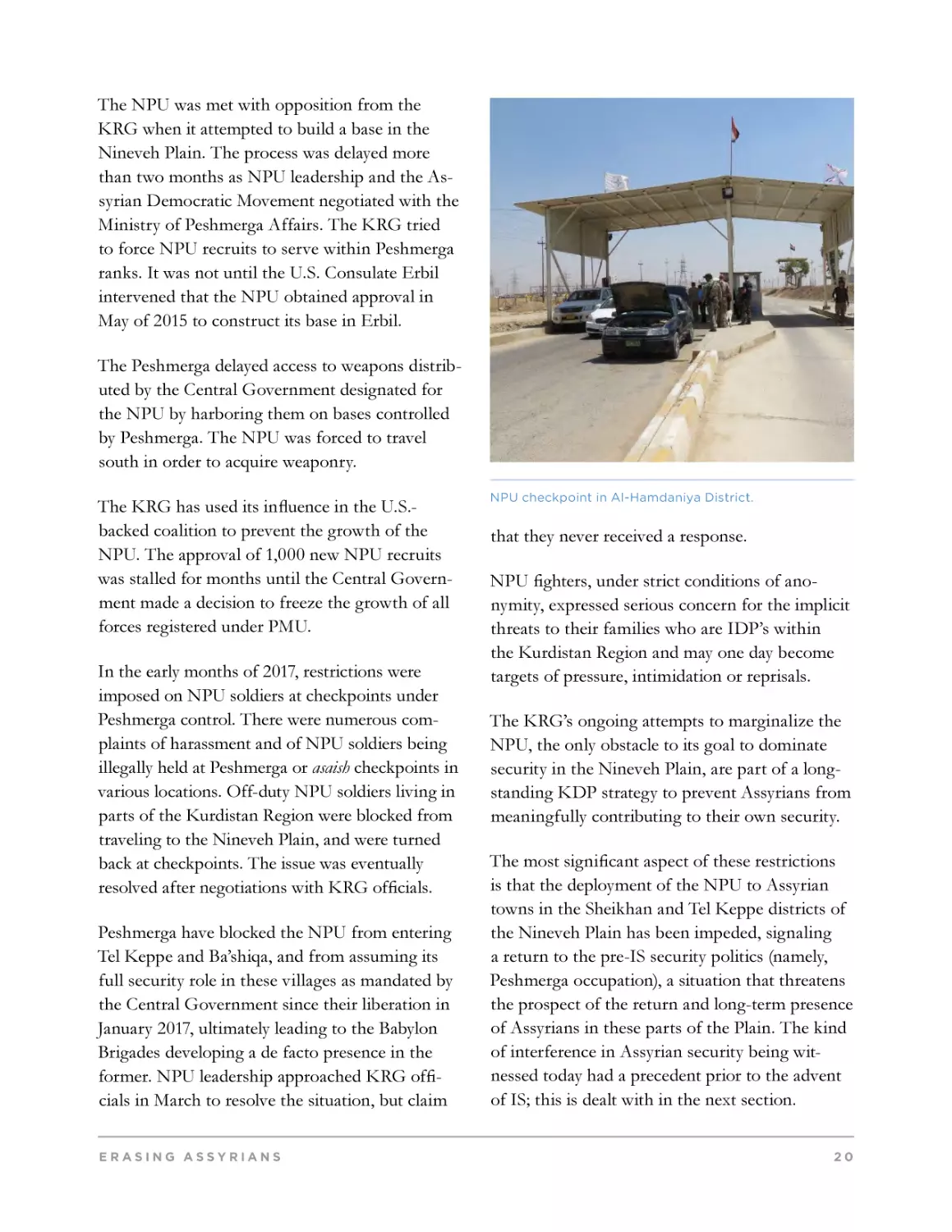
NPU checkpoint in Al-Hamdaniya District.

that they never received a response.
NPU fighters, under strict conditions of anonymity, expressed serious concern for the implicit
threats to their families who are IDP’s within
the Kurdistan Region and may one day become
targets of pressure, intimidation or reprisals.
The KRG’s ongoing attempts to marginalize the
NPU, the only obstacle to its goal to dominate
security in the Nineveh Plain, are part of a longstanding KDP strategy to prevent Assyrians from
meaningfully contributing to their own security.
The most significant aspect of these restrictions
is that the deployment of the NPU to Assyrian
towns in the Sheikhan and Tel Keppe districts of
the Nineveh Plain has been impeded, signaling
a return to the pre-IS security politics (namely,
Peshmerga occupation), a situation that threatens
the prospect of the return and long-term presence
of Assyrians in these parts of the Plain. The kind
of interference in Assyrian security being witnessed today had a precedent prior to the advent
of IS; this is dealt with in the next section.
20

4. Pre-2014 KDP Security Interference in the
Nineveh Plain and Its 2014 Consequences
In 2006, the Iraqi Minister of Interior agreed to
the creation of a police force in the Nineveh Plain
drawn from the local population,27 but the order
was blocked twice by the Nineveh Deputy Governor, KDP member Khasro Goran.
Though the Nineveh Governorate is under Baghdad’s authority, the KDP successfully achieved
control of the area by securing key positions
within its political framework: “The Kurdistan
Democratic Party (KDP) became primus inter
pares in Ninawa via Khasro Goran, ostensibly the
deputy governor but actually the power behind
the throne in Mosul and Ninawa. Goran and the
Iraqi military chief of staff, Babakir Zebari, who
was also a KDP member, worked directly with
the Kurdish commander of the 2nd Iraqi Army
division, Maj. Gen. Jamal Muhammad, to achieve
de facto Kurdish domination of city’s security.
With Kurdish staffing levels of 63 percent versus
the city’s 27 percent Kurdish population, the division unnerved locals but at the same time lacked
the manpower to fully control the city.”28
Goran initially blocked the force from operating
in the Nineveh Plain by relocating it to Mosul.29
The order remained blocked for two years, until
former U.S. Senator Mark Kirk confronted the
U.S. Ambassador to Iraq Ryan Crocker on the
issue in a State, Foreign Operations, and Related
Programs hearing in Washington D.C. in April
2008,30 in which he stated for the record:
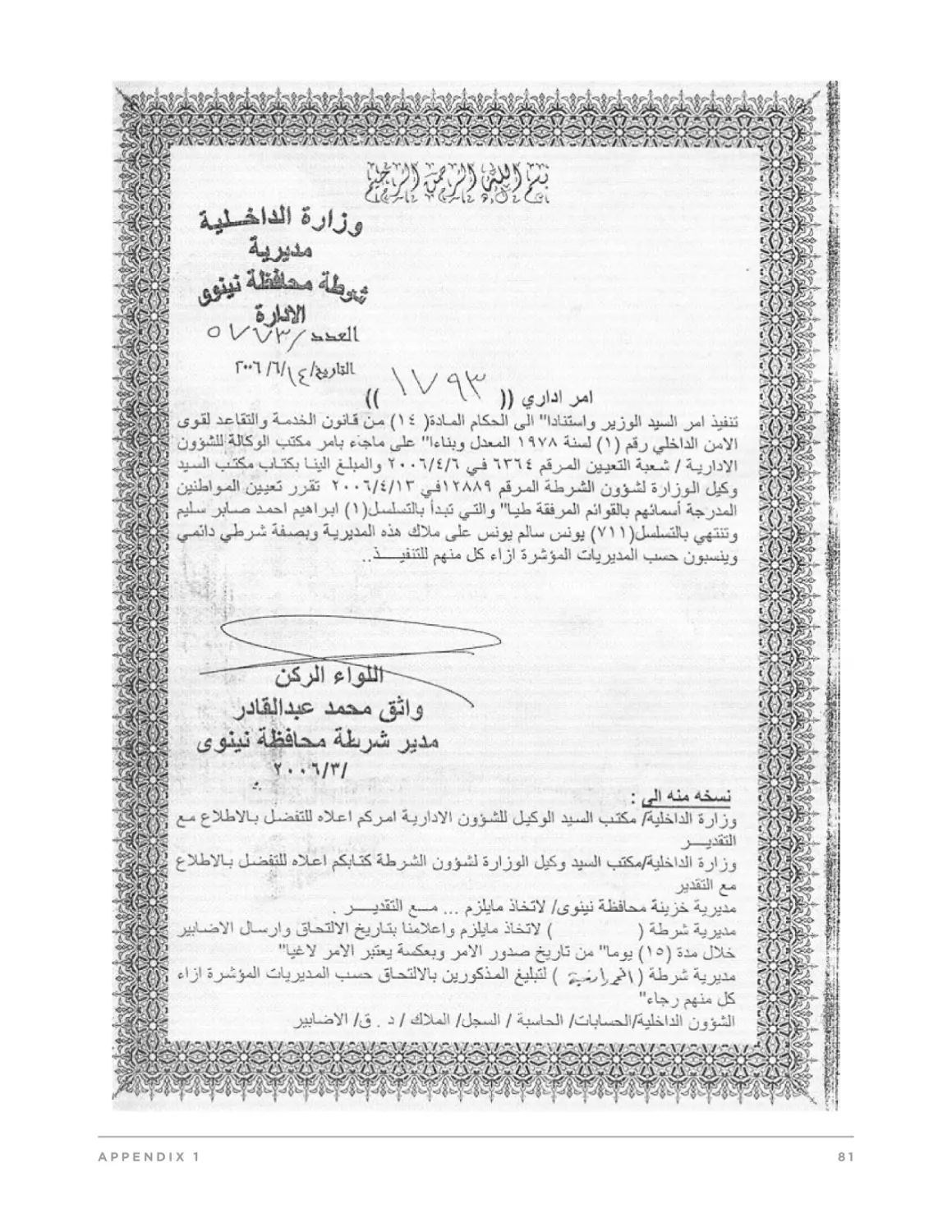
“On June 14 [2006], the Iraqi Minister of Interior
ordered the creation of a local police for the Assyrians in the Nineveh Plain. They issued Order
1793 authorizing a force of about 700 policemen
to patrol the nine Christian villages there in the
Nineveh Province. Two years after the order, the
police force doesn’t exist... Central Command
tells my office that they support the standing
ERASING ASSYRIANS

orders of the Iraqi Government. And the Kurdish
Regional representative here, Mr. Barzani, told
me that the KRG supports the creation of this
police force. The community has issued detailed
planning of the police force to protect them. I
don’t think we had detailed planning like this for
any other villages in Iraq, but we certainly have it
for these villages. So what’s the holdup here?”31
With pressure from the U.S. Government, the
block was lifted, but months after training began,
the Nineveh Governorate, acting on the directives of the KDP elements in its leadership, again
banished the force.
An October 24, 2008 statement by the Assyrian
Democratic Movement read:
“The June 2006 original order was blocked by the
prejudicial policies of neighboring parties who
say they will protect our people with their militias
while denying us the right to [our own] policing
in order to keep us dependent on them... The
dominant parties [a common local euphemism for
the KDP] controlling Nineveh Governorate deny
us our basic right to security.”32
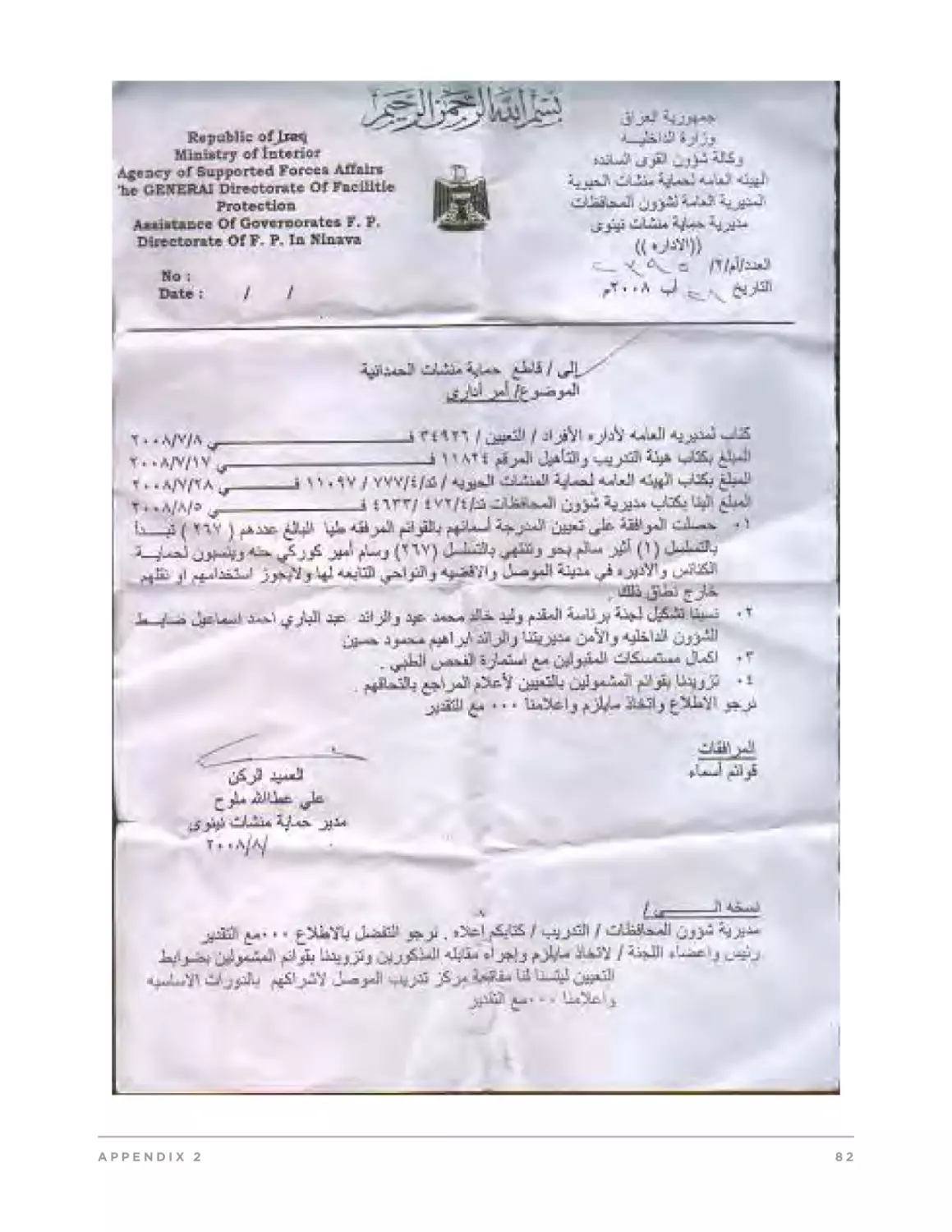
In November 2008, hundreds of Assyrian policemen protested in the city of Bakhdida, against
what they perceived to be attempts to rid the area
of the Assyrian-led police force.33 The protestors
also delivered a statement to the Governor of
Nineveh.34 The force was ultimately dismantled.
To further undermine the Assyrian effort to
establish a police force in the Nineveh Plain, the
KDP used then KRG Finance Minister Sarkis
Aghajan, an Assyrian KDP figure, to establish
a security force called the Church Guardians,
which were organized around local churches.35
The problem with this force, from an Assyrian
point of view, was that rather than being a legitimate Assyrian entity, it in fact represented an
extension of KDP control in Nineveh. In 2009,
Human Rights Watch described the force thus:
21

“Some Christian representatives said that KRG
money also finances private militias in villages
under the pretext of providing protection, but
in reality extends Kurdish influence by creating
a local armed group that is ultimately loyal to
its paymaster. Critics argue that the militias are
another means of KRG control on the region. At
the entrance of each Christian village that Human Rights Watch drove by in the Nineveh Plain,
Christian militiamen, known as the ‘Churches’
Guardians,’ guarded checkpoints. The militia,
funded by Aghajan, has 1,200 members deployed
in Bakhdida (Qaraqosh) and surrounding villages.
Kurdish authorities insist that if there were no
Christian militia and Kurdish peshmerga forces
to secure Nineveh’s disputed territories, Sunni
Arab armed groups would have an easier time
launching devastating times against minorities.”36
Basim Bello, mayor of Tel Keppe at the time,
opposed the presence of the KRG-funded militia;
he considered it illegitimate as it was outside the
structure of the official Iraqi government security
hierarchy. He also stated that such groups were
far more likely to support the KDP as they were
on the payroll of the political party.
Bello and other Assyrian representatives demanded that the Peshmerga and KDP asaish forces be
removed from the Nineveh Plain due to their role
in “intimidating political opponents, restricting
access to services, and engaging in extrajudicial
detentions.”37

In an interview, NPU’s General Behnam Aboosh,
a Bakhdida native, explained that the people of
the Nineveh Plain were left defenseless against
IS. He blames the KRG for blocking the creation
of an independent, Assyrian-led security force.
“[The KRG] had not allowed us to create a force
to defend Bakhdida. So, we fled when abandoned
by Peshmerga as IS approached. We had no other
choice.”39
The Peshmerga and asaish have asserted their security presence in multiple towns in the Nineveh
Plain without the consent of local populations.
Insofar as the individuals in the relevant units of
the NPU are drawn from the populations of the
towns in question and operate independently of
the Peshmerga, they represent a crucial element in
the repopulation of these towns and the building
of trust in security and political frameworks. This
process is threatened by the unilateral aggression
of Kurdish security forces in relation to the NPU
and the citizens of the Nineveh Plain.

IS Reconstruction
Except for Alqosh and a few other villages in its
northernmost reaches, the Nineveh Plain is in
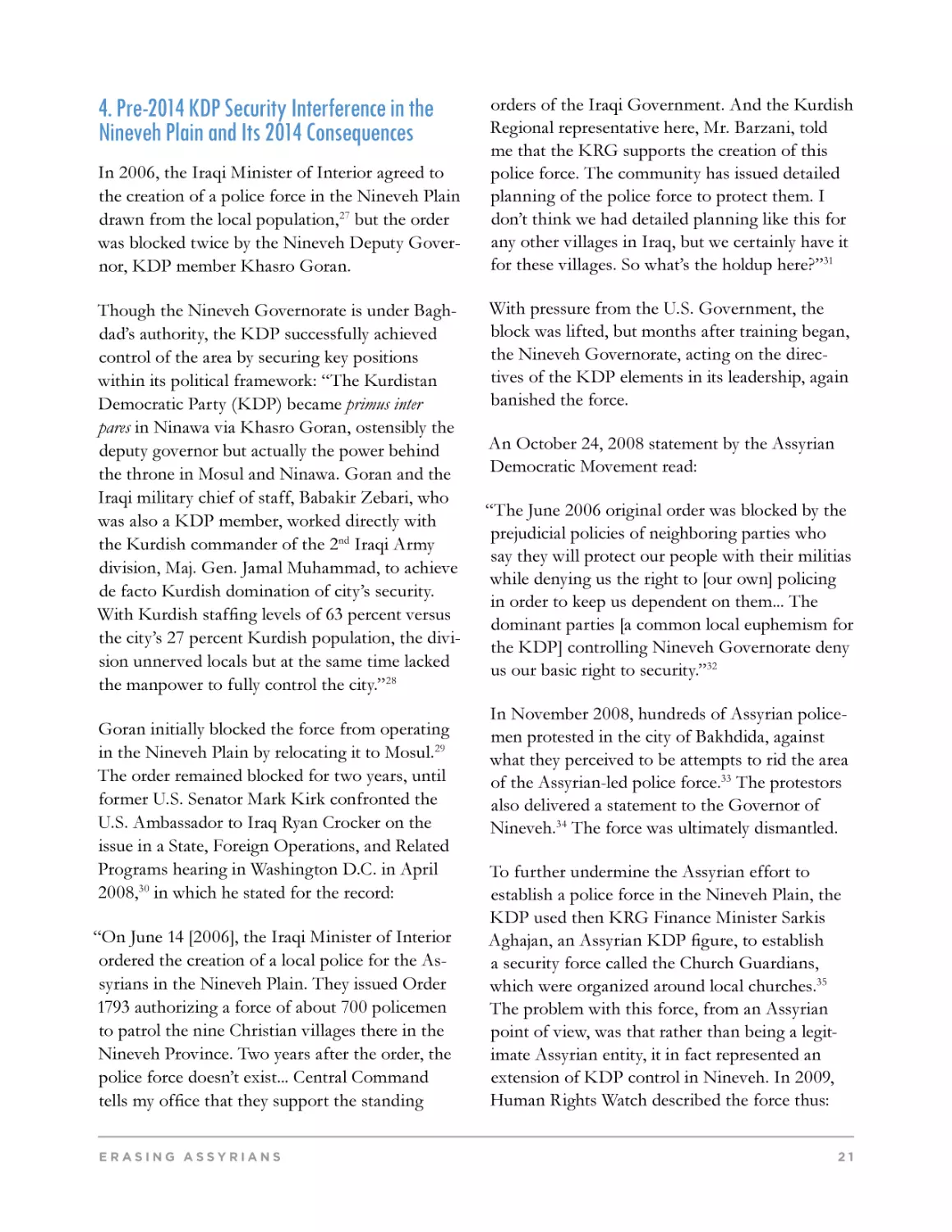
ruins. In Bakhdida and Karamlesh, the majority
of homes, buildings, schools, churches, and clinics
have been looted and destroyed by IS. Some buildings have been reduced to rubble; others have been
vandalized. In March of 2017, there was no elec-

He was quoted in 2009 saying, “They detain
people without any arrest warrant or judicial proceeding. Why are asayish and Peshmerga even here
in Iraqi territory? There’s no reason for it. They
want to show they have power and control of our
areas.”38
Upon the IS attack in 2014—when security was
most needed—the Church Guardians were
ordered by Peshmerga command to vacate their
posts. They obeyed their orders.
ERASING ASSYRIANS

Bakhdida, the largest Assyrian town in the Nineveh Plain,
in ruins.

22

tricity or access to water in these villages. Post-liberation, the Iraqi Army has led an effort to clear
the roads, allowing access to the area.
The Iraqi Central Government has funded
initiatives to repair roads, restore electricity, and
reinstall water networks, but Noor Matti, founder
of the Shlama Foundation, an NGO that operates
mainly in the Nineveh Plain, says that is far from
enough. Baghdad has also pledged financial support to help rebuild public facilities like schools
and churches, but has yet to follow through on
that promise.
According to the Assyrian Aid Society (AAS)
headquartered in Dohuk, of approximately
10,000 homes in the Bakhdida, 3,000 have been
burned from the inside, which in many cases has
destroyed the homes beyond repair. Since the
town’s liberation, there has been very little effort
put forward by international actors to begin the
restoration of these villages.
Matti says, “These people have been forgotten.
There is more assistance offered to those who
leave Iraq than those who want to stay and rebuild.”40

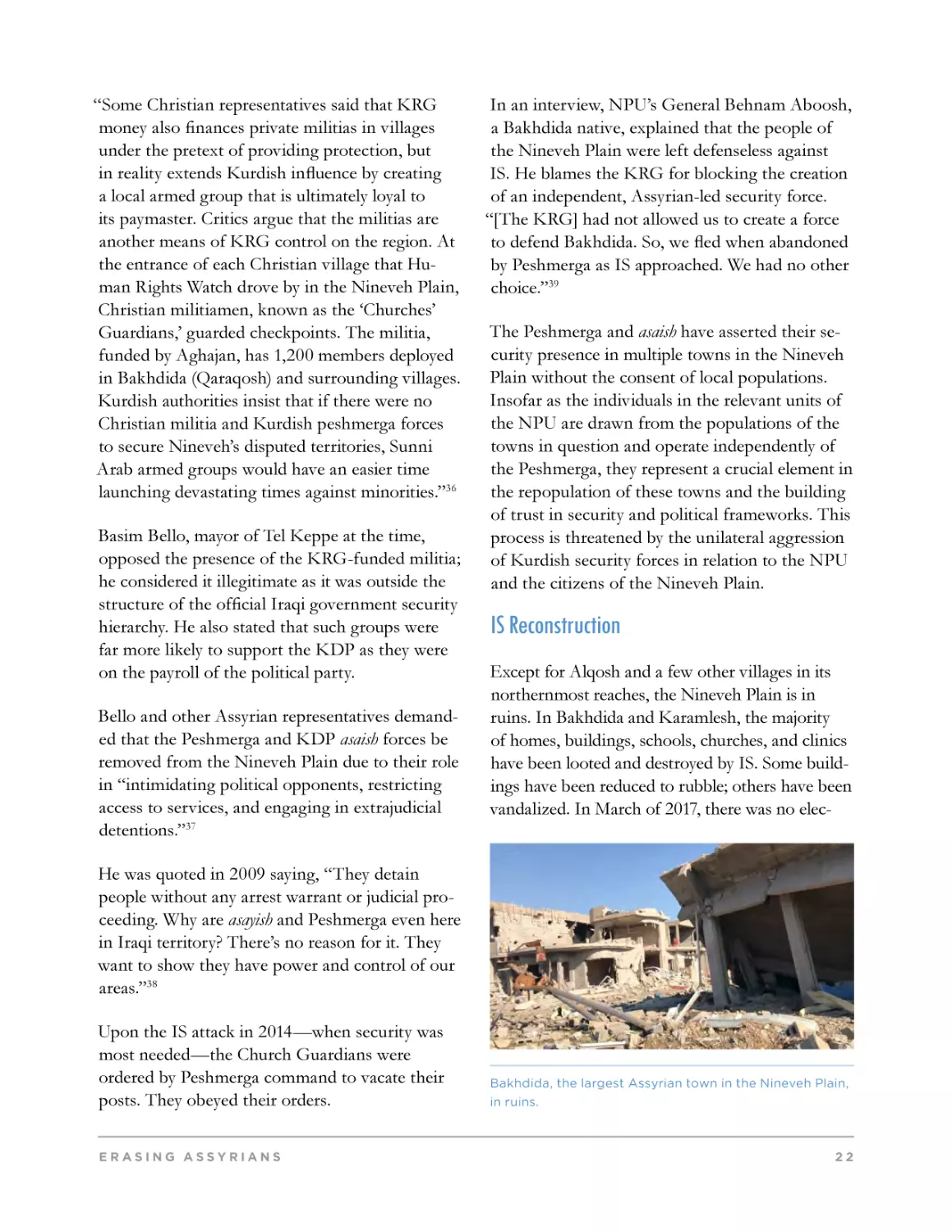
A home in Karemlash post-IS.

(due to bombings). (Estimated cost for renovations per home: as much as $20,000 USD)
Matti explains that various churches are supporting renovations for homes categorized as
Group A. The rest, he says, are on their own. The
Shlama Foundation is currently sponsoring the
renovations of two Group B homes, and is fundraising to sponsor a third.
According to an AAS proposal for the “Rehabilitation of Houses in the Nineveh Plain,” the total
estimated cost to repair damaged homes in the

The foundations of many homes were also damaged as IS developed a tunnel system during their
occupation. In the weeks following the liberation
of Bakhdida, IS fighters continued to use the tunnel system to stage attacks on NPU soldiers.
Matti explains that homes in the Nineveh Plain
have been classified according to three categories:
• Group A: Some repairs required, including
replacing doors, windows, and floor tiles, repainting walls, etc. (Estimated cost for renovations per home: $1,500 to $3,000 USD)
• Group B: Home has been burned from the
inside. (Estimated cost for renovations per
home: $8,000 to $14,000 USD)
• Group C: Home has been completely levelled
ERASING ASSYRIANS

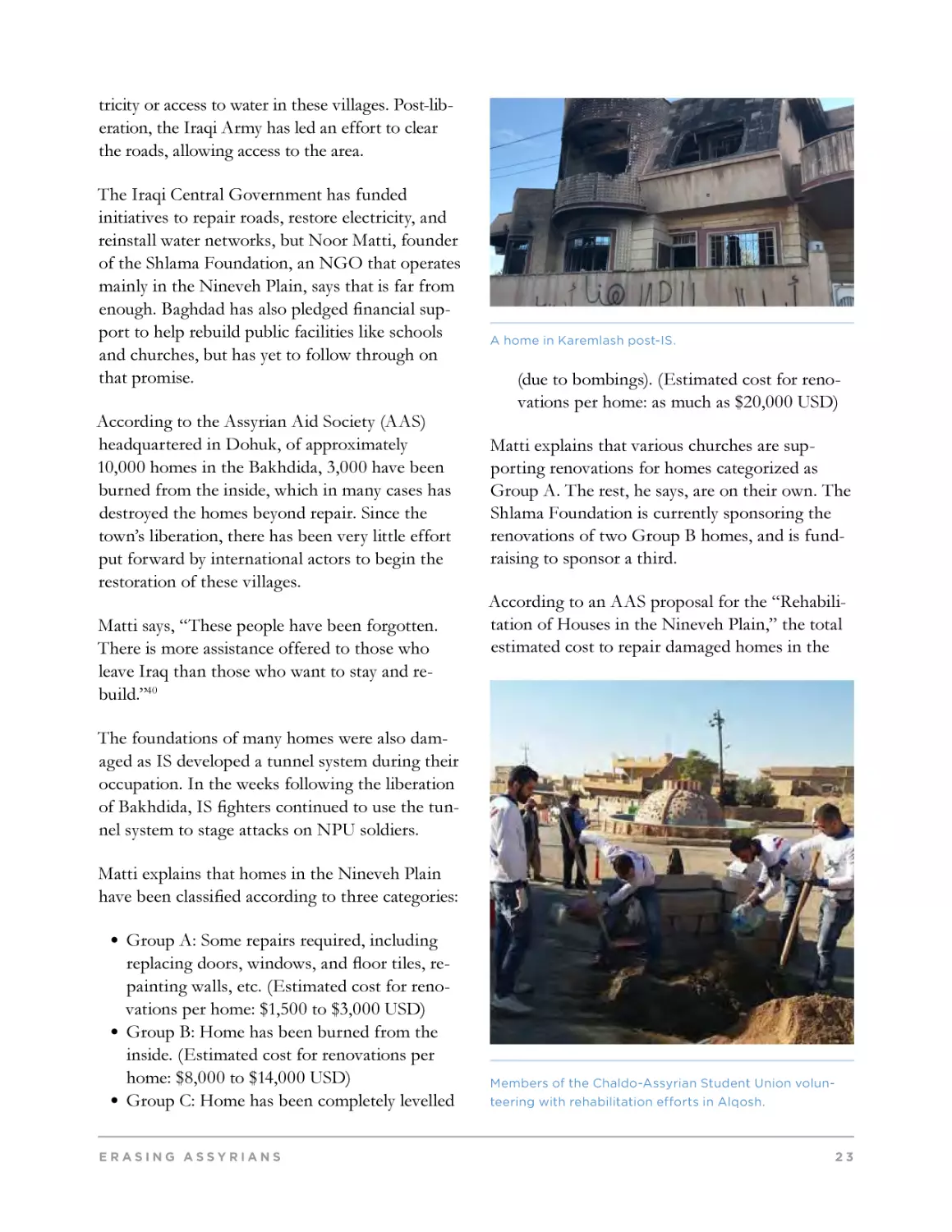
Members of the Chaldo-Assyrian Student Union volunteering with rehabilitation efforts in Alqosh.

23

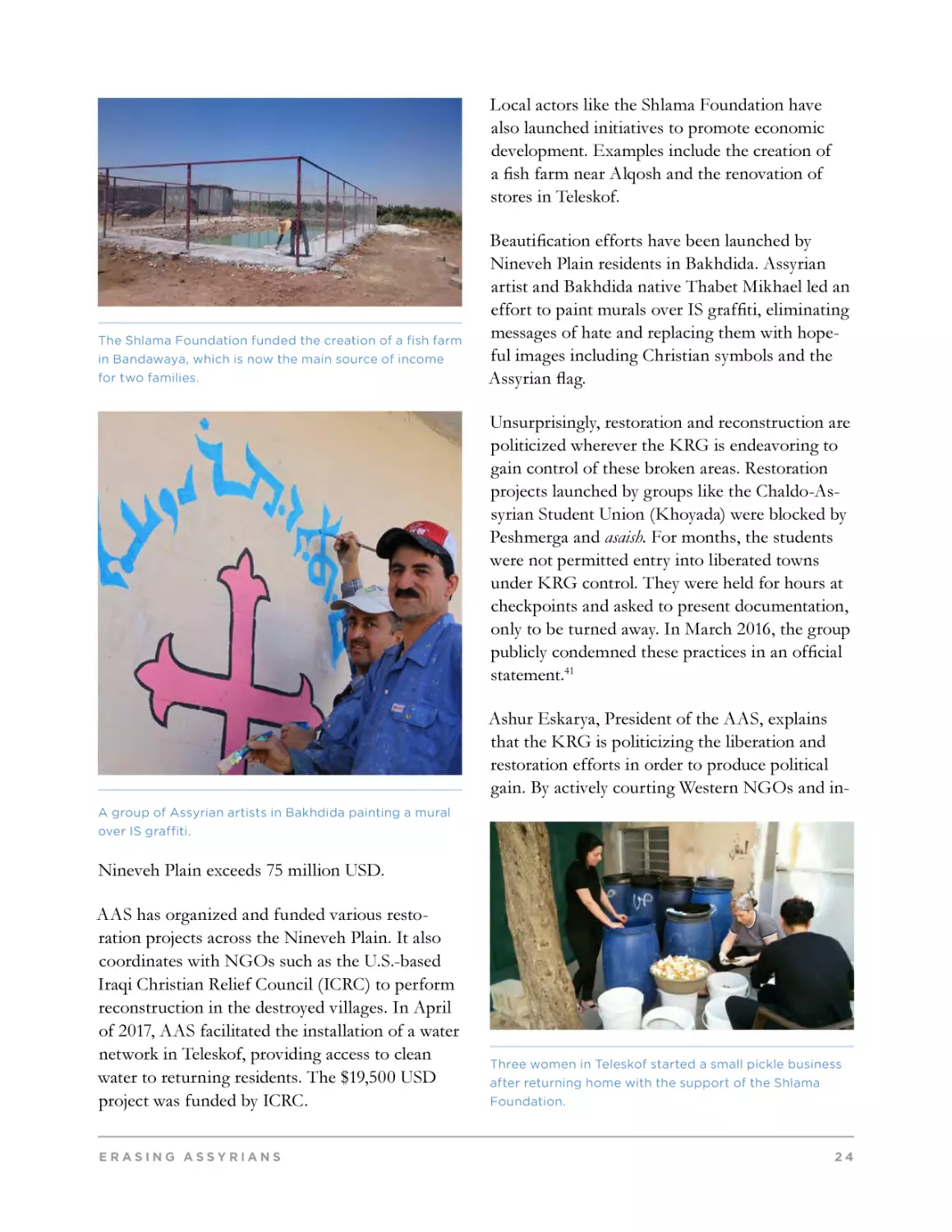
Local actors like the Shlama Foundation have
also launched initiatives to promote economic
development. Examples include the creation of
a fish farm near Alqosh and the renovation of
stores in Teleskof.

The Shlama Foundation funded the creation of a fish farm
in Bandawaya, which is now the main source of income
for two families.

Beautification efforts have been launched by
Nineveh Plain residents in Bakhdida. Assyrian
artist and Bakhdida native Thabet Mikhael led an
effort to paint murals over IS graffiti, eliminating
messages of hate and replacing them with hopeful images including Christian symbols and the
Assyrian flag.
Unsurprisingly, restoration and reconstruction are
politicized wherever the KRG is endeavoring to
gain control of these broken areas. Restoration
projects launched by groups like the Chaldo-Assyrian Student Union (Khoyada) were blocked by
Peshmerga and asaish. For months, the students
were not permitted entry into liberated towns
under KRG control. They were held for hours at
checkpoints and asked to present documentation,
only to be turned away. In March 2016, the group
publicly condemned these practices in an official
statement.41
Ashur Eskarya, President of the AAS, explains
that the KRG is politicizing the liberation and
restoration efforts in order to produce political
gain. By actively courting Western NGOs and in-

A group of Assyrian artists in Bakhdida painting a mural
over IS graffiti.

Nineveh Plain exceeds 75 million USD.
AAS has organized and funded various restoration projects across the Nineveh Plain. It also
coordinates with NGOs such as the U.S.-based
Iraqi Christian Relief Council (ICRC) to perform
reconstruction in the destroyed villages. In April
of 2017, AAS facilitated the installation of a water
network in Teleskof, providing access to clean
water to returning residents. The $19,500 USD
project was funded by ICRC.
ERASING ASSYRIANS

Three women in Teleskof started a small pickle business
after returning home with the support of the Shlama
Foundation.

24

dividuals who support humanitarian work, many
are led to unknowingly operate locally in Iraq
with a strong political bias, though their close
association or cooperation with the KDP. The
KDP appears to attempt to control restoration
efforts in order to create dependency of communities in the disputed territories on the KDP.

6. Resettlement
The overwhelming majority of Assyrian refugees
and IDPs from the Nineveh Plain have plans to
return home. Those who do not want to return
have either started new lives by resettling in the
Kurdistan Region or by emigrating abroad, or are
still attempting to migrate elsewhere. Many who
have yet to return, however, fear that they have
nothing to return to.
A small percentage of those from the city of Mosul have expressed a desire to return but concede
that they may never feel safe there again as they
were betrayed by their own neighbors. Security is
the main concern for these families.
Of its pre-2014 population that included nearly
200,000 Assyrians, approximately 20,000 Assyrians have returned to the Nineveh Plain since its
liberation. Unfortunately, Assyrians find themselves in a catch-22 situation: many cannot return
to towns reduced to rubble with no water and
electricity, but they are often told by authorities
that rebuilding and restoration can only take
place if they do. This impossible choice, forced
onto displaced Assyrians, is also made against the
backdrop of a politically divided Nineveh Plain.
Short journeys to and from neighboring towns,
commonly made by local residents in the past,
can now take hours as permission to pass the new
Peshmerga checkpoints is often awarded unreliably and arbitrarily.
Many Assyrians from the Nineveh Plain remark
that they would feel safer with Assyrian-adminisERASING ASSYRIANS

tered security. This is especially true of Assyrians
living in Alqosh and those parts of the Nineveh
Plain controlled by Peshmerga forces, who frequently speak of how they were abandoned by the
Peshmerga when IS approached in 2014.
Sipya Kado, an Alqosh native who witnessed the
Peshmerga withdrawal firsthand, later stated in
an interview by Assyrian National Broadcasting:
“The Peshmerga didn’t tell anyone [IS] was coming. They didn’t fire a single bullet. They just left
the villages.”42
IS never entered Alqosh, the northernmost town
of the Nineveh Plain, but the town remained partially empty until the later months of 2016, after
the liberation of the Nineveh Plain commenced.
The majority of Alqosh residents have since
returned, and the current population is roughly
5,000. It is estimated that about 200 families have
not returned to the village.
Noor Matti, founder of the Shlama Foundation,
says, “Those who have stuck it out the past few
years are committed to their future in Iraq. They
don’t want to leave.” Matti says the number of
Nineveh Plain residents who have returned is far
greater than what had been expected.43
Various churches that had been supporting IDPs
inside the KRI have now recently stopped subsidizing rent for families to encourage them to go
home. A substantial number of Assyrians have
returned to the Nineveh Plain over the course of
the past month. Matti explained that a mass migration of the remaining IDPs is expected to take
place before October as families prepare for the
new school year. Schools will be reopening in the
Nineveh Plain this fall “even if the kids have to sit
on the floor.” According to Matti, families do not
want their children to miss another school year.
The resettlement process has gone relatively
smoothly over the last month. Unfortunately, Tel
Keppe and Bartella have yet to see significant
25

authorized to operate in the town by the PMU.
The Shabak militia is stationed at the entrance,
while the NPU manage security within the town.
Approximately 200 families have returned thus far.
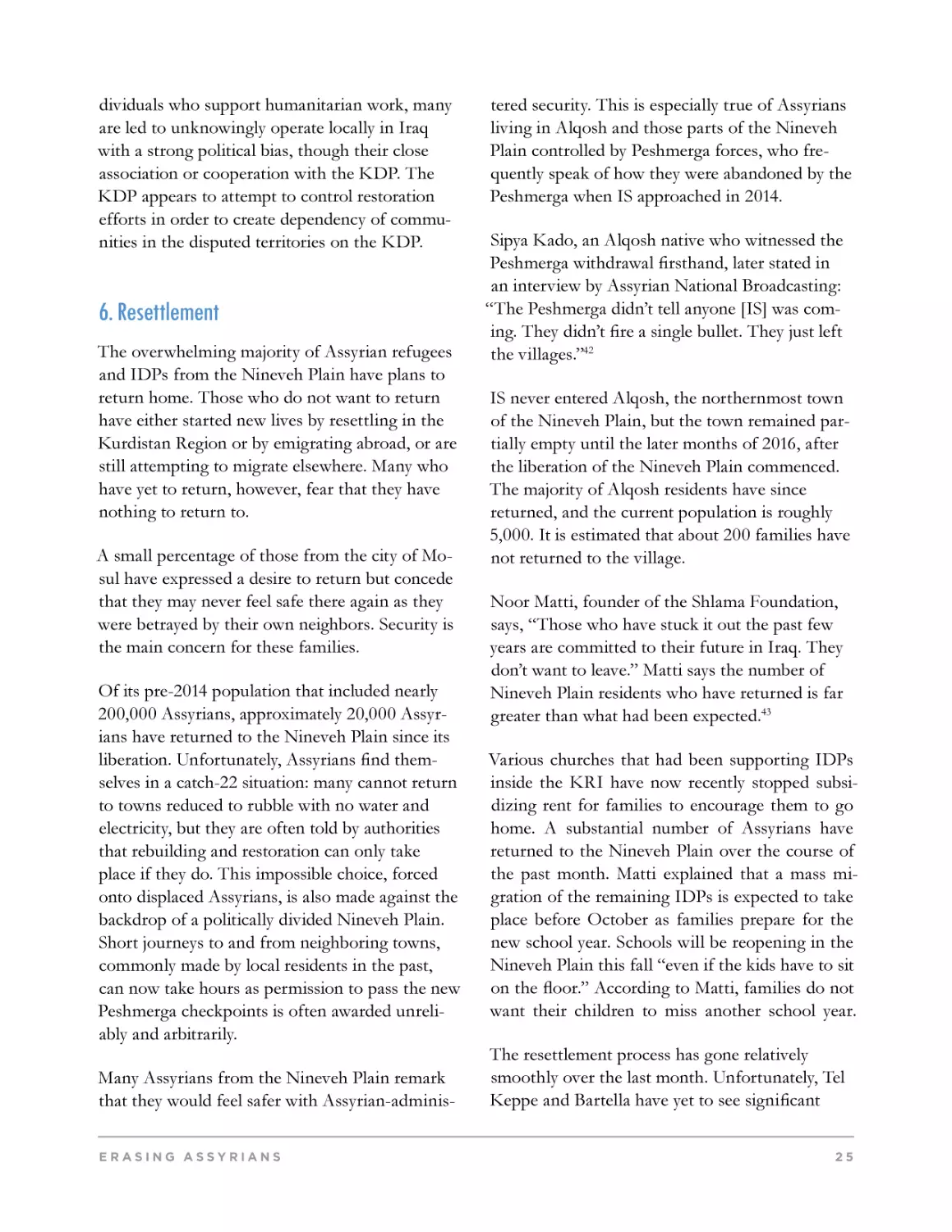
Those that have returned describe the town’s
main checkpoint as “disturbing” given the Islamic messaging and portraits of Muslim clerics
now placed at the entrance of a Christian town.
One woman described the checkpoint as “nerve
wracking” and claimed that residents are harassed.
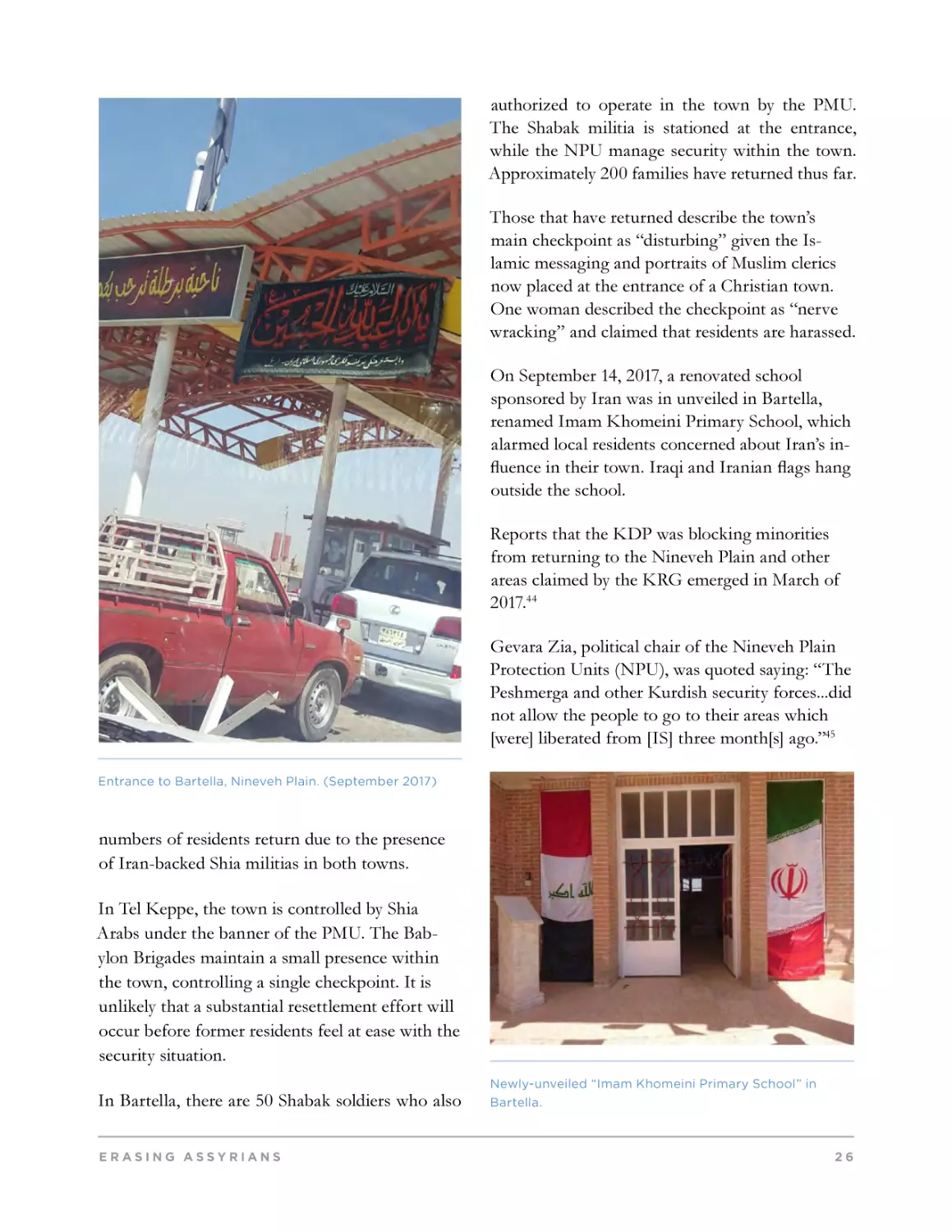
On September 14, 2017, a renovated school
sponsored by Iran was in unveiled in Bartella,
renamed Imam Khomeini Primary School, which
alarmed local residents concerned about Iran’s influence in their town. Iraqi and Iranian flags hang
outside the school.
Reports that the KDP was blocking minorities
from returning to the Nineveh Plain and other
areas claimed by the KRG emerged in March of
2017.44
Gevara Zia, political chair of the Nineveh Plain
Protection Units (NPU), was quoted saying: “The
Peshmerga and other Kurdish security forces...did
not allow the people to go to their areas which
[were] liberated from [IS] three month[s] ago.”45
Entrance to Bartella, Nineveh Plain. (September 2017)

numbers of residents return due to the presence
of Iran-backed Shia militias in both towns.
In Tel Keppe, the town is controlled by Shia
Arabs under the banner of the PMU. The Babylon Brigades maintain a small presence within
the town, controlling a single checkpoint. It is
unlikely that a substantial resettlement effort will
occur before former residents feel at ease with the
security situation.
In Bartella, there are 50 Shabak soldiers who also
ERASING ASSYRIANS

Newly-unveiled “Imam Khomeini Primary School” in
Bartella.

26

Loay Mikhael, the Washington D.C. representative of the KDP-funded Chaldean Syriac Assyrian
Popular Council, responded to reports claiming
that they were unsubstantiated. He added that
they were politically motivated by the Assyrian
Democratic Movement, a group he described as
his party’s main opposition.46

7. Political Abuses against Assyrians in the
Nineveh Plain
Assyrians in the Nineveh Plain who voice opposition to the KRG’s annexation of the Nineveh
Plain over the course of the last decade have been
targeted by the KDP. Several prominent Assyrian
leaders from the area have been threatened and
attacked. Some were illegally detained for prolonged periods of time by asaish.
A resident of Alqosh said, “We don’t want the
Peshmerga in our towns. But no one is listening
to what we want. So why would we risk saying
it?”47
The Nineveh Plain experiences a variety of political abuses that will be dealt with in this section.
Some occurred in the post-Saddam years up to
2014 while others are occurring in the present.

not reaching all segments of the Iraq population,
particularly minority populations. The Committee has heard reports of villages in the Nineveh
Plain region not receiving assistance. Therefore,
the Committee directs the Secretary of State to
report no later than 45 days after the date of enactment of this Act on the ethnic and geographic
distribution of U.S. assistance programs and specifically a report on all U.S. assistance reaching
the Nineveh Plain region.”
The congressionally-mandated State Department
report found that aid specifically earmarked to aid
Christians in the Nineveh Plain was being distributed unevenly by the KRG Ministry of Finance.
“The State Department has singled out the KRG Finance Ministry as a source of the ‘considerable hardship’ faced by Christians in the Nineveh Plain.”49
In the Fiscal Year 2008 State, Foreign Operations,
and Related Programs Appropriations Bill,50 the
Committee authorized millions of dollars in U.S.
aid to “be provided to assist religious minorities
in the Nineveh Plain region of Iraq.” The aid
failed to reach legitimate and proven local aid organizations independent of the KRG. Organizations serving the interests of the KRG were given
preferential access to the funding.
VOTER FRAUD AND INTIMIDATION

BLOCKING U.S. AID TO THE NINEVEH
PLAIN

United States aid to minority communities in the
Nineveh Plain between the years of 2005 and 2012
was funneled through the KRG Ministry of Finance.
In a bill entitled “Making Emergency Supplemental Appropriations for the Fiscal Year Ending
September 30, 2007, and for Other Purposes,”48
Congress raised questions about assistance not
reaching minorities in Iraq:
“The Committee is concerned regarding reports
of U.S. reconstruction and relief assistance in Iraq
ERASING ASSYRIANS

The KDP prevented Assyrians in the Nineveh
Plain from voting in the 2005 provincial elections.51 According to a series of reports, the KDP
blocked the delivery of ballot boxes to six major
Assyrian towns and villages, including Bakhdida (Qaraqosh), the largest town in the Nineveh
Plain. The man charged with facilitating their
delivery was Khasro Goran (Deputy Governor
of Nineveh and senior KDP official). The ballot
boxes were illegally held in Erbil. Up to 100,000
Assyrian voters and tens of thousands of other
minorities were denied their right to vote.52

27

told they would lose their jobs if they did not vote
as directed.55

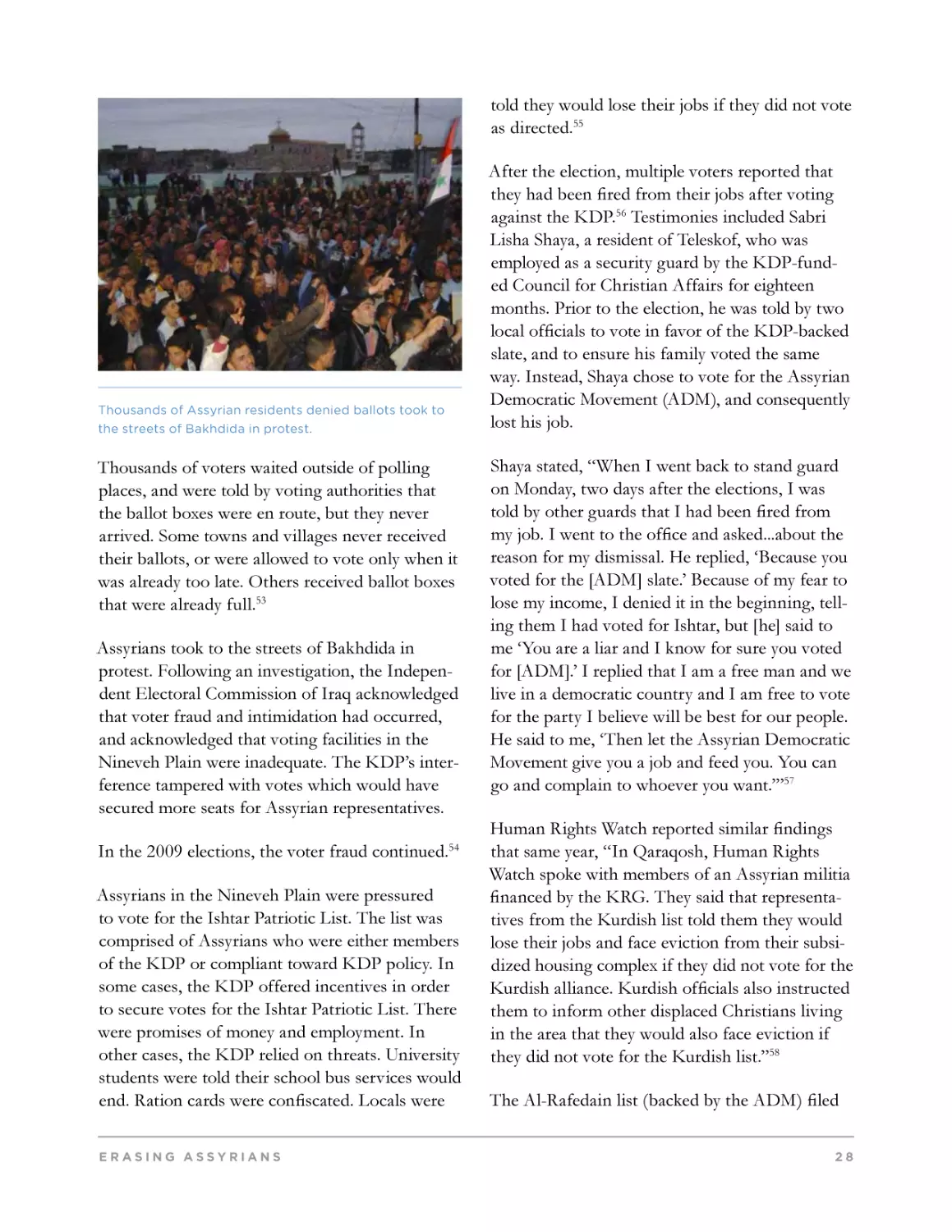
Thousands of Assyrian residents denied ballots took to
the streets of Bakhdida in protest.

Thousands of voters waited outside of polling
places, and were told by voting authorities that
the ballot boxes were en route, but they never
arrived. Some towns and villages never received
their ballots, or were allowed to vote only when it
was already too late. Others received ballot boxes
that were already full.53
Assyrians took to the streets of Bakhdida in
protest. Following an investigation, the Independent Electoral Commission of Iraq acknowledged
that voter fraud and intimidation had occurred,
and acknowledged that voting facilities in the
Nineveh Plain were inadequate. The KDP’s interference tampered with votes which would have
secured more seats for Assyrian representatives.
In the 2009 elections, the voter fraud continued.54
Assyrians in the Nineveh Plain were pressured
to vote for the Ishtar Patriotic List. The list was
comprised of Assyrians who were either members
of the KDP or compliant toward KDP policy. In
some cases, the KDP offered incentives in order
to secure votes for the Ishtar Patriotic List. There
were promises of money and employment. In
other cases, the KDP relied on threats. University
students were told their school bus services would
end. Ration cards were confiscated. Locals were
ERASING ASSYRIANS

After the election, multiple voters reported that
they had been fired from their jobs after voting
against the KDP.56 Testimonies included Sabri
Lisha Shaya, a resident of Teleskof, who was
employed as a security guard by the KDP-funded Council for Christian Affairs for eighteen
months. Prior to the election, he was told by two
local officials to vote in favor of the KDP-backed
slate, and to ensure his family voted the same
way. Instead, Shaya chose to vote for the Assyrian
Democratic Movement (ADM), and consequently
lost his job.
Shaya stated, “When I went back to stand guard
on Monday, two days after the elections, I was
told by other guards that I had been fired from
my job. I went to the office and asked...about the
reason for my dismissal. He replied, ‘Because you
voted for the [ADM] slate.’ Because of my fear to
lose my income, I denied it in the beginning, telling them I had voted for Ishtar, but [he] said to
me ‘You are a liar and I know for sure you voted
for [ADM].’ I replied that I am a free man and we
live in a democratic country and I am free to vote
for the party I believe will be best for our people.
He said to me, ‘Then let the Assyrian Democratic
Movement give you a job and feed you. You can
go and complain to whoever you want.’”57
Human Rights Watch reported similar findings
that same year, “In Qaraqosh, Human Rights
Watch spoke with members of an Assyrian militia
financed by the KRG. They said that representatives from the Kurdish list told them they would
lose their jobs and face eviction from their subsidized housing complex if they did not vote for the
Kurdish alliance. Kurdish officials also instructed
them to inform other displaced Christians living
in the area that they would also face eviction if
they did not vote for the Kurdish list.”58
The Al-Rafedain list (backed by the ADM) filed
28

complaints with the Independent Election Commission of Iraq about these intimidation tactics.
They also reported that the KDP was informing
Kurdish residents to vote for the Ishtar Patriotic
list. Election results showed that Kurdish villages
with no Assyrian population had voted for the
Ishtar Patriotic list.

REMOVAL OF ASSYRIAN MAYORS IN
NINEVEH

Ahead of the upcoming KRG referendum on
Kurdistan’s independence, to be held September
25, 2017, the KDP has been conducting a number
of maneuvers in the Nineveh Plain to maximize
its political advantage and control. The KDP’s
removal of the two elected and longstanding
mayors, both of who are unsympathetic to the
aims and policies of the KDP, suggest a strategy
of preparing to annex the region to Kurdistan.

remain separate from it.
The fact that the KDP has infiltrated one of
Baghdad’s governorates and is now using that
platform to “legally” migrate disputed territories
out of that same governorate’s jurisdiction and
into the sphere of KRG administrative and security structures amounts to the KRG using Iraq’s
own institutions of governance in non-Kurdish
areas to prepare parts of Iraqi territory—outside
of the KRI—for eventual secession from Iraq.

T h e R e m ova l of A l q o s h ’s M ayo r

The KDP had previously attempted to remove
Faiez Abed Jahwareh in June 2014 after Mosul fell
to IS, and briefly succeeding in doing so, but he
was reinstated two days later following outcry and
protests from local Alqosh residents.

Between July and August 2017, two mayors of
townships in the Nineveh Plain were expelled by
the Nineveh Provincial Council: Faiez Abed Jahwareh of Alqosh and Basim Bello of Tel Keppe.
This was accomplished through the KDP takeover of the Nineveh Provincial Council, which
is led by Bashar al-Kiki, a member of the KDP.
Thirty-one of the council’s forty-one members
belong to the KDP.59

Now ahead of the independence referendum, the
KDP has pursued the same objective a second
time, with more determination. Jahwareh was removed from office on July 16, 2017 on the orders
of Bashar al-Kiki. His dismissal followed an interrogation centering on seemingly baseless charges
of corruption. No statement has been published
publicly by the Nineveh Provincial Council to
explain its decision.

The KDP has worked to install its own loyalists in the Nineveh Governorate for years, and
it often succeeded in doing so in local districts
within Nineveh (Sinjar being a prime example).
However, the Nineveh Governorate became
increasingly vulnerable to this manipulation
following the events of 2014, when governance in
Mosul collapsed and government offices serving
the then-displaced residents of Nineveh had to
be reopened in Dohuk. The affiliation of the
Nineveh Governorate with the Central Government in Baghdad is therefore becoming progressively more illusory, as the KDP is able to implement policy through Nineveh while pretending to

After deposing Jahwareh, the Nineveh Provincial Council initially appointed Kurdish KDP
member Abdel Amin Omar to serve as Alqosh’s
mayor, not waiting to secure an Assyrian replacement. However, Omar was merely a placeholder;
the KDP began seeking an Assyrian replacement
who could add more legitimacy to the takeover of
Alqosh. Lara Yousif, an Assyrian member of the
KDP, was appointed 11 days later to the position
by the Alqosh District Council. Lara Yousif was a
schoolteacher who has not served in the military,
but she was presented in official photos wearing
a Peshmerga officer’s uniform. She also has no
experience in politics and has never held a public

ERASING ASSYRIANS

29

Protestors in Alqosh demanding the reinstatement of the
town’s rightful mayor. (August 2017)

2014. The council now consists of the following
members:

KDP-appointed Mayor of Alqosh, Lara Yousif.

office, but she was unilaterally appointed to lead
a town without the local people being allowed to
hold an election to choose their leadership.
Town residents have expressed frustration at the
media’s misguided portrayal60 of Yousif’s appointment.61 Being appointed by a powerful political
apparatus—rather than achieving a post through
one’s own accomplishment and merit—is not a
victory for women’s status in Iraq.
After her appointment, Yousif has remained absent from the public eye and has refused to give
interviews.
The Alqosh District Council is required to have a
total of seven members, but is currently operating
with six, after one of its former members left Iraq
following the IS invasion of the Nineveh Plain in
ERASING ASSYRIANS

• Sleman Hassan Rasho, Council President
(Yazidi, KDP)
• Khalil Shammo Khidida (Yazidi, KDP)
• Marwan Hussein (Yazidi, KDP)
• Faisal Sliman Khalf (Yazidi, PUK)
• Fathy Jassim Awad (Arab, Independent)
• Thaer Hurmiz Polis (Assyrian, KDP)
The demography of this council reveals much.
Alqosh is a Christian-majority town whose people
in their majority do not favor annexation by the
KRI, but its council has been almost entirely
filled with non-Christians and those on the payroll of Kurdish parties.
The residents of Alqosh have staged three protests since Jahwareh was removed. The first took
place on July 20, 2017. The second was held on
August 2, 2017 following Yousif’s appointment,
and the third was held on August 18, 2017. In
all three protests, residents carried Iraqi flags in
response to the KRG’s stated objective to conduct its upcoming indpendence referendum in
the Nineveh Plain. A petition was also signed
by thousands of Alqosh residents and delivered
to the District Council, but they have failed to
30

respond to the petition or the protests.

supporting them.”

The petition states, “What happened was exactly
the opposite of what [al-Kiki] promised, and was
an affront to democracy and the will, culture, and
dignity of the people of Alqosh.”62

According to the village’s inhabitants, the decision to replace the town’s mayor was part of the
KRG’s strategy to force their referendum on the
people of the Nineveh Plain. “This appointment
contributes to completing the task of obtaining
total administrative power over the Nineveh
Governorate: the Director of Alqosh District, the
head of Alqosh’s District Council with the majority of its members, the head of Nineveh Governorate Council, and the first Vice Governor
of Nineveh now all belong to the same political
party: the KDP.”63

The petition cited the following violations:
• The decision to dismiss Jahwareh was ordered
by the Nineveh Provincial Council leader
Bashar al-Kiki and accepted by the Alqosh
District Council without holding a formal
meeting with the council members.
• Abed Amin Omar was appointed as the
town’s mayor on July 16, 2017 just two days
after dismissing Jahwareh from his position.
• Lara Yousif was appointed as the town’s new
mayor on July 27, 2017 before the end of the
period of legal court appeal, followed by the
issuance of an administrative order from the
Nineveh Governor on July 31, 2017 confirming Yousif as mayor.
• The council stipulated that the nomination of
the new candidate for the position of mayor “must be Christian and from the center
of Alqosh District (Alqoshian) exclusively,”
despite the fact that no such stipulation is
mandated by any law, exacerbating racial and
sectarian tensions in the area in an attempt to
win the hearts and minds of Alqoshians.
• The constitutional rights of Alqosh’s residents
have been violated and there has been a failure to address their demands.

On August 18, just hours before Alqosh residents
protested for the third time, portraits of Masoud
Barzani were installed throughout the town,
paired with signs reading, “Yes to Referendum.”
Residents expressed feelings of anger and despair.
On August 24, 2017, reports surfaced that the
portraits and signs installed by the KDP in favor
of the referendum had been vandalized by anonymous village residents.
On August 30, 2017, Alqosh police delivered individual notices64 to eleven Alqosh residents, warning them against further protests, threatening
consequences. The notices were sent by the office

Jahwareh has also filed a complaint with the Adminstrative Court in Baghdad. He has a hearing
scheduled on August 30, 3017. Alqosh residents
are disappointed in the lack of response from the
Central Government.
Alqosh native Athra Kado stated in an interview
conducted in preparation of this report: “The
whole world is watching [the KDP] break laws
and violate the people’s will. And yet they’re still
ERASING ASSYRIANS

Signs reading “yes to referendum” erected in Alqosh
were vandalized.

31

of the town’s newly-appointed mayor, Lara Yousif.
Below is a list of the 11 individuals who received
the notices:
• Sameer Toma Tomas
• Falah Oraham Alqas Younan
• Amel Qoda
• Mazin Harbi
• Sahir Habib Kalla
• Vastin Jalal Alnajar
• Rani Falah Alqas Younan
• Mrayma Mansur Kado
• Athra Mansur Kado
• Sanae Mansur Kado
• Sargon Qoryaqos Eramia
The above-listed individuals were identified as the
“ring leaders” of the Alqosh resistance. They were
asked to sign a notice acknowledging they understood there would be consequences if they failed
to comply. All eleven initially refused, but a few
signed the following day after being pressured by
officers in their own homes.
Documentation was secured from the local police
station confirming that the order to threaten
the protestors came from the Tel Keppe District
Council, and had been approved by the Nineveh
Provincial Council leader.65
In an interview conducted during the preparation
of this report, one of the individuals targeted
with the notices reported receiving death threats
from Yousif’s husband, Duraid Jameel Tezi, also a
KDP member.

T h e R e m ova l of Te l Ke p p e ’s M ayo r

Basim Bello was removed from office on August 3, 2017, just 19 days after Jahwareh was
deposed, though Bello says he was made aware
of the council’s intention in June 2017. In July, he
received a letter outlining charges of corruption
ERASING ASSYRIANS

against him, and was given one week to prepare
his defense before appearing before the committee. In a phone conversation with an ACE representative on August 12, 2017, Bello described the
charges as “unfounded,” and explained that he
issued his response disputing all claims in writing
to the council before his appearance.
Bello appeared before the Tel Keppe District
Council which includes 11 members:
• Abdulsalam Shaban Mohammed,
Council President (Arab, KDP)
• Amjad Hassan Rasho (Yazidi, KDP)
• Saed Khudida Khalil (Yazidi, KDP)
• Nadhir Bebee Saadon (Yazidi, KDP)
• Nuri Musa Nuri (Kaka’i, KDP)
• Evin Yahia Tela (Assyrian, KDP)
• Bashar Habbo Giwargis (Assyrian, KDP)
• Saeed Mohammed Saeed Alurshan
(Arab, Independent)
• Bashar Yaseen Mohammed (Arab,
Independent)
• Luis Estifo Sliman Hanna (Assyrian, ADM)
• Adel Mikha Dawod Jabbo (Assyrian,
Independent)
Bello explained he felt the council was not interested in his presentation and did not give any
meaningful consideration to his response to their
claims.66
His dismissal was decided by an eight-to-three
Council vote. Tela and Giwargis were added to
the Council at the end of 2016, prior to the town’s
liberation. Two former members who had been
elected with the backing of the Assyrian Democratic Movement left the country after their town
was invaded by IS. Bello and two other members
on the Council unsuccessfully attempted to stall
the replacement of the members who had emigrated, believing that the decision should be made
after displaced residents were able to return to
the town. (Bear in mind that these decisions were
being pushed forward while the voter base of the
32

“According to Bello, the rift between the ADM
and the Kurdish parties began in 2003 as the
KRG attempted to expand its political control
further into Christian areas of the Ninewa plain.
Bello said that the KRG is following a policy of
encroachment into the Ninewa plain by attempting to establish “facts on the ground” by moving
Kurds into Christian areas; stacking district and
sub district councils with un-elected Kurdish
members; and, in the case of Al Qosh, spending
lavishly, particularly on the church and church-related construction.”69
Basim Bello, deposed mayor of Tel Keppe, pictured with
Nineveh Provincial Council leader Bashar al-Kiki post-liberation.

District remained displaced from the area.)
Bello is appealing the council’s decision.
In an interview with Assyria TV, he stated that
the reason for both his removal and Faeiz Abed
Jahwareh’s removal in Alqosh are part of the
KDP’s plan to eliminate opposition to KRG
annexation.67
Bello feels that he was specifically targeted as
he has been an outspoken critic of the KDP
for many years. WikiLeaks cables that surfaced
documented meetings between Bello and U.S.
officials that reflected his position on the KRG’s
growing presence in the Nineveh Plain; the KDP
has a pattern of reacting harshly when it becomes
aware of internal critics.
“In a July 3 [2009] meeting with PRT [Ninewa
Provincial Reconstruction Team] and U.S. Army
Civil Affairs personnel, Mayor of Tal Kaif District Basim Bello said that Assyrians in Ninewa
Province feel intimidated by the Kurds and suffer
from a lack of essential services.”68
He was quoted in another WikiLeaks cable from
2008:
ERASING ASSYRIANS

In the same cable, Bello expressed concerns over
a potential monopoly of authority by the KDP in
the Nineveh Plain district councils:
“His own personal security aside—he believes he
is under direct threat from the senior leadership
in the KDP—Bello said his greatest concern is
the prospect of irreversible modifications to councils that would give the KRG political control
to go along with its effective occupation of the
area…Bello also raised continuing Kurdish intimidation, including a personal threat made against
him by KRG Prime Minister Nechirvan Barzani.
Bello explained what he sees as an increasingly
bellicose KRG policy as the result of the Kurds’
desire not to lose what was gained in terms of
self-rule after the first Gulf War. As a result, there
is an ongoing trend toward authoritarianism in
the KRG…”70
In 2007, Bello was “publicly reprimanded”71 by
the KDP-led Nineveh Provincial Council for
authorized trips taken overseas. Official documentation obtained accused Bello of “trespassing
the limits of his position” and threatened “severe”
penalties,72 but the former mayor believes the
reason for their disapproval stemmed from their
concerns about his engagement with foreign officials. Bello issued a formal statement in response
to the accusations,73 but the matter was resolved
after intervention from U.S. officials. In an interview, Bello explained he believes his relationship
33

with certain U.S. officials is what has protected
him from harm all this time.
Following Bello’s removal, tensions immediately intensified as Babylon Brigades leader Rayan
al-Kildani endorsed Raad Nasser for the position, while the KDP backed Bartella native Adel
Marogy Jajou (also known as Adel Kiryakoza). On
August 23, 2017, the Tel Keppe District Council
appointed Jajou as Bello’s successor. Jajou was
previously a candidate for mayor in 2004, the year
Bello was elected.
Sources confirm that Jajou was nominated for
the position by Detroit businessman Asaad
Kalasho in a May 19, 2017 meeting with Masrour
Barzani,74 the Chancellor of the KRG’s Security
Council, in Washington, D.C. The meeting also
included the official Chaldean Syriac Assyrian
Popular Council (KDP-funded political party)
representative to the United States Loay Mikhail.
Confirming the other sources, Kalasho—infamous for his illegal, multi-million dollar business
dealings with Saddam Hussein75 —himself takes
credit for Jajou’s appointment,76 describing him as
“a brother”77 in his public Facebook posts.
Various sources reported that in the week that
followed Basim Bello’s removal from office, the
KDP pressured other Nineveh Plain mayors and
council members to publicly voice their support
for conducting the Kurdistan independence
referendum in their towns. Council members who
had voted in Bello’s favor were harassed. These
local leaders were approached and told sign a
document in support of the KRG’s referendum.
Some felt threatened and were forced to sign the
document, after being warned against resisting.
One official reported being told that, “it was in
his best interest to sign.”110
On September 9, 2017, Adel Jajou, who was appointed in Bello’s place, attended an event endorsing the KRG referendum.
ERASING ASSYRIANS

KDP-appointed Mayor of Tel Keppe, Adel Marogy Jajou (far
right), attending an event endorsing the KRG referendum.

T h e E a rl i e r R e m ova l of K a r e m l a s h ’s
M ayo r

In October 2008, the Governor of Nineveh dismissed the Assyrian mayor of Karemlesh78 (part
of the Nineveh Governorate’s al-Hamdaniya District), George Yacoub Al-Kikhwa. Al-Kikhwa is a
member of the Assyrian Democratic Movement.
His removal was requested by three members of
the Karemlesh Affairs Committee, a group of
eleven town residents that managed local matters.
The individuals who made the request were part
of the KDP-sponsored Chaldean Syriac Assyrian
Popular Council. They included: George Mayya
(head of the committee), Dhiya Khidir (an employee of KRG Finance Minister Sarkis Aghajan),
and Reverend Yousif Shamon of the Chaldean
Catholic Church. The three of them sent a formal
complaint to the Hamdaniya District Council,
which made a recommendation to the Nineveh
Governorate without an investigation.
When asked about the decision to depose Al-Kikhwa, the Governorate deferred to Al-Hamdaniya’s District Council.
The people of Karemlash rejected the Governorate’s decision. They collected upwards of 800
signatures from local town residents calling for
his reinstatement. The petition was later delivered
34

to the governor’s office.
Following Al-Kikhwa’s ousting, a member of the
Karemlesh Affairs Committee, Mattay Ismael
al-Kaddo, resigned in protest. He explained that
Mayya acted despite disapproval from the majority of the committee, citing the committee’s
bylaws which require a majority vote in order to
recommend the removal of the town’s mayor.
The decision was later reversed. Al-Kikhwa remains the town’s mayor today.
DIVIDE AND CONQUER: THE KDP PATRONAGE SYSTEM

To strengthen their prospects of incorporating
the Nineveh Plain into the Kurdistan Region,
Kurdish authorities have for more than a decade
practiced a strategy of offering incentives to minority communities in exchange for their support
for the KRG’s claims to the Nineveh Plain, while
imposing restrictions on those who do not. The
KDP buys the allegiances of many Assyrian tribal
and political leaders through a patronage system
that fosters political divisions within the community; this also has the effect of obfuscating
and muddling the voices of the Assyrian majority,
making advocates, NGOs, and Western government officials less able to understand the local
dynamics that harm the minority.
The patronage system involves offering visible
community figures a regular cash payment that
is often referred to by people in the country as
a “party salary.” These figures are then expected
to publicly and privately endorse and promote
the KDP and its agendas within the community.
This process has the destructive effect of eroding the legitimacy of both spiritual and political
leadership within minority communities, as clergy
and political leaders are alike targeted with this
“political conversion” effort, amid the deep frustration of the people who then feel abandoned by
ERASING ASSYRIANS

their representation. The pattern is that without
this financial bribery, it is difficult for the KDP to
make inroads with communities whose interests
are not served by KDP objectives. Usually, only
the loyalty of the figure receiving the salary—and
that of his inner circle of friends and relatives—is
bought by the party; these figures are then generally rejected by a majority of their community,
but because the KDP is able to “convert” most of
the visible leadership figures, it still succeeds in
creating the illusion that a sizable portion of the
minority population stands with the party.
In the case of the Yazidis, the effects of this
patronage system have so destabilized traditional leadership structures that the people often
express despair at not having anyone in their
community to speak for them. Yazidi tribal
heads, religious leaders, intellectuals, and professional figures are all targeted with this form of
politicization. This has had the long-term effect
of eliminating any prominent voices within the
community that are critical of the KDP and that
could rally broad support for Yazidi interests,
even though the Yazidi people frequently share
with concerned outsiders that this is what they
most need. All Yazidis MPs in the Kurdistan Parliament are KDP members—as are Yazidi MPs
in the Iraqi Parliament who represent the KRG—
but they enjoy little esteem from the Yazidi community and are often the objects of scorn.
The existence of independent Assyrian parties has
allowed Assyrians to resist this process somewhat
more effectively than the Yazidis, whom the
KRG denies the right to create parties, using the
rationalization that “Yazidis are Kurds, therefore
they can participate in Kurdish parties and have
no need for separate representation.” This justification for proscribing the Yazidi political voice is
ironic in light of the fact that three main Islamist
parties legally function in the KRG and hold
seats in the Kurdish Parliament—these are Kurdish parties whose platform is religion and religious identity. The KRG has entrenched an order
35

by which Yazidis who want to participate in politics are forced to join the established Kurdish parties that are not sensitive to the unique concerns
of the minority, but which advance the broad
Kurdish interests that constitute their platforms.
The only alternative to this for Yazidis has been
one Yazidi party in Sinjar (called The Movement
of Reform and Progress) that has sought to work
directly with the Central Government in Baghdad. It holds one seat in the Baghdad Parliament,
but for more than a decade it was harshly suppressed by KDP asaish who threatened, abused,
and arrested most of its members. This was possible because of the de facto security control that
the KDP maintained in the disputed territory of
Sinjar until the Peshmerga withdrawal upon the
Yazidi Genocide of August 3, 2014. Successfully
thwarted and stifled by the KDP, which used its
militarized security forces (something that small
parties do not possess) to forcefully establish hegemony in Sinjar, the Movement of Reform and
Progress is seen as a failure by Yazidis today.
That the KRG has been forced to recognize the
ethnic distinctiveness of Assyrians is one factor
that has allowed Christians to resist KDP encroachment in the Nineveh Plain more successfully than has been the case for Yazidis in Sinjar.
However, as this report explains, this resistance
is weakening as the KDP continues to pursue increasingly aggressive tactics to annex the disputed
territories, while shielded by the ongoing absence
of sufficient external accountability that the international community could provide. This is exemplified by the cases of the removal of Nineveh
district mayors, described in the previous section,
which involved the KDP’s use of a number of
minority beneficiaries of KDP patronage that had
been appointed to Nineveh district and provincial
councils. Though Assyrians hoped that the U.S.
would immediately ensure the reinstatement of
the mayors and pressure the KDP into backing
off, visiting U.S. dignitaries instead posed for
public photographs with one of the unelected
mayors that had been appointed by the party.
ERASING ASSYRIANS

Many Western officials do not fully understand
the destructive character and far-reaching effects
of the patronage system, and the U.S. in particular, though voicing “concern” about its commitment to promoting democracy and protecting the
freedoms of minorities often ends up playing the
role of an enabler with the KDP.
In addition to the co-optation of community
figures is the creation and funding of alternative
civil society groups that favor Kurdish annexation of the Nineveh Plain. This aspect of the
patronage strategy was documented in 2009 by
Human Rights Watch:
“The goal of these tactics is...for Christians to
abide by the Kurdish government’s plan of
securing a Kurdish victory in any referendum
concerning the future of the disputed territories.
Kurdish authorities have tried to win favor with
the minority communities by spending millions
of Iraqi dinars to build a pro-Kurdish system of
patronage in minority communities, financing
alternative civil society organizations to compete
with, undermine, and challenge the authority of
established groups, many of which oppose Kurdish rule. The KRG also funds private militias created ostensibly to protect minority communities
from outside violence, which in reality serve to
entrench Kurdish influence. Finally, the Kurdish leadership has enriched the coffers of some
minority religious leaders, and paid for expensive
new places of worship in order to win over minority religious establishments.
This policy exacerbated rifts within each community. Many have welcomed the cash influx—the
disputed territories of Nineveh comprise one of
Iraq’s poorest, most ignored, and most underdeveloped areas, lacking many basic services and
job prospects; for many impoverished families
in northern Iraq, Kurdish patronage is often the
only support available to families.” 79
In order to buy the support of Assyrian churches,
36

the KRG will bankroll clergy, having the effect of
politicizing religion and the religious leaders who
should be serving the spiritual needs of the people. In 2009, a priest from Bakhdida told Human
Rights Watch: “Before 2005, no one cared about
our communities or churches and then overnight
we started to receive funding. The Kurds have
a hidden agenda and are using money to co-opt
Christians—it’s not because they want to help our
people...I believe that anyone who disagrees with
their agenda puts their life at risk.”80
E xa m p l e s of P a t ro n a g e i n Ac t i o n

These practices, described a number of years ago
by Human Rights Watch, have not ceased, and
even continue unabated at present, despite the
ongoing pleading of minorities with the international community to hold the KRG accountable.
A prime example of the type of KDP strategy
described above is the “Chaldean Syriac Assyrian
Popular Council” (known by its short form “Majlis Sha’bi”) founded in March 2007 by Assyrian
KDP leader and former KRG Finance Minister
Sarkis Aghajan, and the affiliated Nineveh Plain
Church Guards and broadcasting station Ishtar
TV. The party, the proxy force, and the television
station are funded by the KDP.
Waheeda Yaku Hormuz, an Assyrian MP representing the Chaldean Syriac Assyrian Popular
Council affirms KDP policy agendas and since
Nineveh’s liberation from IS she has publicly
endorsed the creation of a Nineveh Plain Governorate annexed to the Kurdistan Region. Contrary to the will of her supposed constituency, she
has also demanded that only Peshmerga forces
protect Christian areas.81
Similarly, Aghajan funded the creation of the
Chaldean Syriac Assyrian Student and Youth
Center (which received financial assistance and
material possessions82) to rival the Chaldo-Assyrian Student Union, a group of young activists that
ERASING ASSYRIANS

opposed the KRG’s expansionist policy.83
Aghajan also founded and poured millions of
KRG dollars into Ishtar TV, a broadcasting station
linked to the Chaldean Syriac Assyrian Popular
Council, to compete with Ashur TV which is affiliated with the Assyrian Democratic Movement.84
In addition to these projects, Aghajan founded the Christian Affairs Committee in 2007 to
undermine the work of the Assyrian Aid Society
(AAS) an Assyrian NGO which has existed since
1991. Through the newly-founded committee,
known to have spent millions of dollars with the
KRG’s backing, he funded the construction of
housing units and churches in the Nineveh Plain
and distributed aid.85
A 2009 KRG Cabinet Report authored by Bayan
Sami Abdul Rahman and entitled “The Status
of Christians in the Kurdistan Region” confirms
what is already known among local Nineveh Plain
residents: “In fact, while many Christians readily
give credit to Sarkis Aghajan and speak as if it is
his money, this is incorrect. When Mr. Aghajan
was Finance Minister, all such efforts were fully
funded by the KRG under the instructions of
Prime Minister Nechirvan Barzani.”86
Kurdish officials frequently applaud Assyrians
who are members of the KDP or affiliated groups,
promoting them as “true representatives of the
Assyrian people.” For example, Ano Abdoka, an
ethnic Assyrian and the head of the KDP’s offce
in Ankawa, has never held an elected office but is
upheld by the KRG as a legitimate political representative of the Assyrian people.
In a recent interview with the Clarion Project,
Abdoka was identified as a “Kurdish Christian
Leader” and voiced his support for a Nineveh
Plain Governorate administered by the KRG.87
These statements, though pleasing to KDP officials and loyalists, are in direct contradiction with
the will of the vast majority of Assyrians.
37

coexistence in the Kurdistan Region. Importantly,
he stated that Christians have always supported
Kurdish independence, and Christians believe
they can only attain more rights if and when
the Kurdistan Region becomes an independent
state.”92
Kaldo Oghanna, spokesperson of the Assyrian
Democratic Movement, expressed frustration
over the political parties created and supported
by the KDP in a phone interview with an ACE
representative.93 “It’s embarrassing and frustrating. We seemingly have more political parties
than the Kurds themselves, and yet we’re only
competing for five seats, while they’re fighting
over hundreds.”

Ano Abdoka, Head of KDP Ankawa Committee.

On September 8, 2017, a Kurdistan 24 reporter
tweeted88 photos of Assyrians participating in a
pro-referendum parade in Erbil. The group photographed carried Assyrian and Kurdish flags and
was organized by Abdoka.89
Bet-Nahrain Democratic Party (BNDP) is a
small90 Assyrian political party based in Erbil headed by Romeo Hakkari and openly allied with the
KDP. Its affiliated militia, the Nineveh Protection
Forces (NPF), is funded by the KRG and operates
under the command of the Peshmerga. Assyrians
in the KRI suspect that Hakkari is bankrolled by
the KDP; several eyewitnesses point to his massive
mansion in Erbil and his personal security detail.
BNDP members do not hold any elected office,
and yet Hakkari was selected by the KRG to take
part in the “Kurdistani referendum delegation” to
Baghdad, where he was presented as a representative of Assyrians.91
Hakkari voices support for the upcoming KRG
referendum: “Hakkari also acknowledged the vital role of the President of the Kurdistan Region,
Masoud Barzani, in promoting harmony and
ERASING ASSYRIANS

In September 2017, a member of Abnaa Nahrain
expressed frustration over a comment made by a
U.S. State Department official.94 While discussing a number of the concerns outlined here, she
was told by the official that she was “part of the
minority [of political opinion].” The U.S. official
pointed to seven political parties endorsing KRG
annexation of the Nineveh Plain, compared to
only three that oppose it. This is an important
example of the effects of KRG lobbying and
propaganda in Washington, which involves the
patronage system, as co-opted minorities are
paraded before officials and audiences at conferences on “human rights,” “peace,” and other such
topics. Lacking a true picture of the political landscape in Iraq, Western officials are often misled
by KDP lobbyists.95
Though the number of Assyrian political parties
aligned with the KDP are greater in number, the
majority of seats in the KRG Parliament are held
by parties opposed to it. Three of the five seats
allotted for minorities in the KRI are held by opponents of KDP policy (the Assyrian Democratic
Movement holds two seats and Abnaa al-Nahrain
holds one). That politics and the government in
Erbil are generally manipulated by the KDP to
the detriment of critics and minorities, it is not

38

surprising that the other two seats should be held by the KDP-created Chaldean Syriac Assyrian Popular Council; that Assyrian voices opposing KDP agendas and annexation in Nineveh hold three seats—
within a political framework that is often illegitimate to begin with—should be a telling indicator as to
the actual sentiments of the Assyrian majority.
The following table provides the names of the various Assyrian parties in Iraq, with the names of their
leaders, a brief description, and the number of seats held in the parliaments of both the KRG and Baghdad:
Political Party

Leader

Description

Galeta Shaba

A splinter group of the ADM, the
independent political party was formed
in 2013 after disagreements with ADM
leadership resulted in a split. It has an
office in Ankawa and an office in Dohuk.

Yonadam Kanna

Founded in 1979, the ADM is the
largest “Christian” political party in Iraq.
The independent party is headquartered in Baghdad, and has offices in
nearly every Assyrian city/village in the
KRI and the Nineveh Plain.

Emmanuel Khoshaba

Founded in 1973, the Assyrian Patriotic
Party is loosely tied to the Assyrian
Universal Alliance. It has one office in
Ankawa.

Bet Nahrain
Democratic Party

Romeo Hakkari

Founded in 1974, the party was part of
the Democratic Alliance of Kurdistan,
and remains a KDP affiliate. The group
also has ties to the Dawronoye (a fringe
group aligned with Kurdish factions in
Iraq and Syria). It has one office in Erbil.

Bet Nahrain
Democratic Union

Yousif Yacoob Matti

The party is the official Dawronoye affiliate in Iraq and is linked to the KDP.

Abnaa
al-Nahrain

Assyrian
Democratic Movement
(“Zowaa”)

Assyrian
Patriotic Party (“Atranaya”)

Chaldean
Democracy Forum

Saeed Shamaya

Founded after the 2003 U.S. invasion
of Iraq with the help of the KDP, the
party is a component of the Kurdistan
Alliance.

Chaldean National
Congress

Sameer Azzo Dawood
Kozel

Founded in the United States in 2002,
the fringe group is a KDP affiliate, and
is funded by the KDP via the Chaldean
Syriac Assyrian Popular Council.

Chaldean Syriac Assyrian Popular Council
(“Majlis Sha’bi”)

Shamsadeen Gorgees

Founded by the KDP in 2007, the party
is funded by the KDP. It has one office
in Erbil.

ERASING ASSYRIANS

Seats in Parliament

0 Iraq
1 KRG

2 Iraq
2 KRG

0 Iraq
0 KRG

0 Iraq
0 KRG

0 Iraq
0 KRG
0 Iraq
0 KRG
0 Iraq
0 KRG
2 Iraq
2 KRG

39

ChaldoAshor Communist Party

Syriac Assembly Movement

Syriac Democratic Union

Sabah Yousif Jajo

ChaldoAshor is an affiliate of the Communist Party of Kurdistan.

John Anwar Hadaya

Also known as the Syriac Gathering Movement, the party was founded in Bakhdida as a Dawronoye affiliate and later
started receiving funding from the KDP.

Salwan Momika

Founded by the KDP, the party also has
ties to the Dawronoye.

0 Iraq
0 KRG
0 Iraq
0 KRG
0 Iraq
0 KRG

Oghanna explains that in the 2013 parliamentary elections, seven parties aligned with the KDP ran
under a single slate, led by the Chaldean Syriac Assyrian Popular Council, and yet they failed to earn the
majority of seats. He points to the election results:96
• The Assyrian Democratic Movement (opposed to KDP) ran its own slate, earning 6,345 votes and
securing two seats.
• Abnaa al-Nahrain (opposed to KDP) ran its own slate, earning 1,093 votes and securing one seat.
• Chaldean Syriac Assyrian Popular Council (KDP affiliate—backed by seven parties) earned 5,730
votes and secured two seats.
Oghanna explained that the KDP-aligned parties have far more resources and essentially unlimited
funding with which to campaign and further added that there are towns with no Assyrian populations
that voted for the Chaldean Syriac Assyrian Popular Council. This underscores that in order to prevent
fraud, there must be a procedure implemented to ensure that only Assyrians vote for seats reserved for
Assyrian minorities.
Three Assyrian political parties have formally announced opposition to the upcoming KRG referendum: The Assyrian Democratic Movement, Abnaa al-Nahrain, and the Assyrian Patriotic Party.
On September 15, 2017, the KRI Parliament held its first session in more than two years to enforce the
proposed independence referendum. Assyrian representatives Yacoob G. Yaco, Lina Ezarya, and Dr.
Srood Maqdasy did not attend.
That same day, Yaco and Ezarya (both elected through the Al-Rafedain slate backed by the ADM) held
a press conference outside the KRI Parliament building announcing their boycott.
Yaco delivered the official statement: “We have demanded from day one, when the referendum date was
scheduled in the KRI, that there should be political assurances guaranteeing the rights of our Chaldean
Syriac Assyrian nation in the region. The policies in the KRI for the past 25 years have not served the
interests of our people. There are several unresolved issues and no real intention to solve them. 25 years
have passed without resolving issues related to theft of our land and our villages and no justice for our
leaders killed in political assassinations. We have never experienced a true political partnership in the
Kurdistan Region; rather we have only been exploited as part of an attempt to portray a positive image
ERASING ASSYRIANS

40

of the KRG. We reject that.”97
On the KRG’s attempt to force a referendum in
the Nineveh Plain, Yaco stated, “…we reject any
referendum in the Nineveh Plain. A referendum
in the Nineveh Plain is illegal and unconstitutional. The Nineveh Plain is outside the KRG’s
jurisdiction.”98
Representatives of the KDP-sponsored Chaldean
Syriac Assyrian Popular Council attended the
September 15 parliament meeting and endorsed
the referendum. MP Waheeda Yaku Hormuz delivered their party’s statement in Assyrian, stating,
“We know we will be granted all of our rights
after the referendum.”99

THE DAMAGING EFFECTS OF IDENTITY
POLITICS

The last decade has seen the formation of a new
array of political and civil society organizations
promoting separatist Chaldean and Syriac identities, all of which are supported by the KDP.
Though multiple church denominations exist, Assyrians have long considered themselves a single
people united by a common ethnicity. Ironically,
those espousing “Chaldean” ethnicity usually also
believe that all those who identify as Assyrian,
Chaldean, and Syriac comprise a single ethnicity;
the disagreement therefore has more to do with
the superficial question of the name, rather than
any substantive matter of ethnicity itself, but this
contention is abused in order to weaken the identity and solidarity of this people.
The interference of the KDP is designed to
exploit and exacerbate existing rifts to promote
inorganic and artificial schisms in order to further
divide and conquer the Assyrian people. While
Kurdish authorities are not the architects of these
rifts—many of which have to do with church
politics—they have exploited them and benefited
from the damage done to the Assyrian identity.
ERASING ASSYRIANS

In the aftermath of the 2003 U.S. invasion, Assyrians founded the Nineveh Center for Research
and Development, which brought together Assyrians of all denominations. The institution was
built on the unifying commonalities of all Assyrians, and was established to promote human rights
for ethnic and religious minorities in Iraq and
to ensure their effective political and economic
participation in the country. The group conducts
research on issues affecting minorities and organizes conferences, seminars, and workshops to
help minority communities develop their capacity
to advocate for their own rights. It was not long
after its establishment that the KDP funded the
creation of the Syriac Center for Research and
Development with the same ostensible purpose,
only focused on members of the Syriac Church.100
Recent examples of organizations established
by the KDP for this purpose include the Syriac
Union Party, headed by Salwan Momika, a former
member of the Assyrian Democratic Movement,
and funded by the KDP. Momika is now a strong
proponent of “Syriac identity” as distinct from
the Assyrian identity.
A report published by the Iraq Sustainable Democracy Project first documented the issue in
2006:101
“It is an effort purely driven to reinforce divisions
in the Assyrian nation that will produce entrenched, newly formed, ethnicities. It is worth repeating, once again, that funding for these efforts
is primarily channeled through religious leaders
and religious institutions who appear to share in
the desire to prevent any organic process of surmounting the divisions in the Assyrian nation by
overcoming denominational differences.”
KRG intervention to promote the fracturing of a
people and their identity by artificially nurturing
separatist identities raises questions of cultural genocide. The KRG continues to engage in
practices that deprive Assyrians of their identity
41

by financially supporting the development and solidification of other identities rooted in religious
denominational affiliation. Their policies deny
Assyrians the chance to heal artificial divides and
reconcile, thereby recognizing their full political
and social potential in Iraq.

8. The KRG’s Independence Referendum in the
Nineveh Plain
On March 6, 2017, ten political parties held a
press conference and released a joint statement
outlining their demands for the Nineveh Plain,
calling for the activation and implementation of
the January 2014 decision to initiate the creation
of a Nineveh Plain Governorate administered by
the Central Government.102
The statement declared that the Nineveh Plain
should be excluded from all political and military
conflicts arising between the Central Government and the KRG, adding: “We demand that its
people are given the right to shape the future of
their region independent from any pressure.”103
The statement also rejected KDP interference in
the region: “We reject all practices that are aimed
at imposing de facto policies on minority areas
that contradict the vision and aspirations [of the
people] for their future. We also reject all political
schemes designed to divide minority areas.”104
Despite ardent opposition from both international observers and local residents of the disputed
territories, the KRG has announced its plan to
include the Nineveh Plain in its upcoming independence referendum scheduled for September
25, 2017,105 referring to it as a “Kurdistani area”
despite the fact that the Nineveh Plain is outside
its jurisdiction and has never had a sizeable Kurdish population.
Analysts have noted that it is extremely problematic to unilaterally conduct an independence

ERASING ASSYRIANS

referendum in disputed territories that have not
yet been established as part of the Kurdistan
Region106 —how can inhabitants of areas outside
of the KRI legitimately decide whether Kurdistan
should secede from Iraq?
Recognizing the dangers posed by the referendum, the U.S. government (in addition to many
other governments around the world), including
the White House, has declared its opposition to it
on multiple occasions. The U.S. State Department
published a statement on the referendum on Sept.
20, 2017 stressing that “The status of disputed
areas and their boundaries must be resolved
through dialogue, in accordance with Iraq’s constitution, not by unilateral action or force.”107
In recent months, the Assyrian Democratic
Movement has repeatedly called for the Nineveh
Plain to be excluded from the controversial referendum,108 given the current situation. Assyrian
politicians have maintained that the people of the
Nineveh Plain should not be asked to participate
in any such referendum until they have had the
opportunity to return home, rebuild their towns,
and regain stability.
Nineveh Plain residents feel that KRG authorities
are exploiting the suffering of minority communities to advance their own interests, but recent
developments described in this report are only
the latest actions in a long-term strategy to annex
the region.
Even as early as eight years ago, the potential for
a referendum to be abused in order to push forward an annexation agenda was noted by observers: “Kurdish officials demand the incorporation
of these lands into the semiautonomous Kurdish
region through a referendum… For its part, the
KRG is adamantly demanding implementation of
a constitutionally-mandated referendum on the
future of the disputed territories—a referendum
that Kurdish officials, with their political and security presence in the area, will make every effort

42

to ensure goes their way.”109
We are now witnessing the full fruition of these
long-term strategies ahead of the current independence referendum.

PA R T TH R E E

DESPOTISM MASKED
AS DEMOCRACY:
ASSYRIANS INSIDE
THE KRI
The areas in northern Iraq now considered
parts of the Kurdistan Region have been home
to Assyrians for thousands of years. Continued
persecution and encroachment of land over the
last century have led to significant demographic
changes. Some towns and villages that were once
inhabited entirely by Assyrians now bear no trace
of them.
An Assyrian IDP living in Ankawa, native to the
Nineveh Plain said in an interview conducted
for this report, “This is our homeland. It’s frustrating to see the KRG praised for welcoming us
into their lands, as though we are foreigners. As
though this isn’t our land, too.”111
Contrary to popular perceptions of the KRI’s
treatment of minorities, since its founding the
KRG has marginalized Assyrians through a number of harmful policies, patterns of governance,
and other practices; these will be elaborated in
subsequent sections. In 2016, rising reports of
discrimination led Senator John McCain112 and
former Senator Mark Kirk113 to write letters to
KRG President Masoud Barzani that questioned
the KRG’s treatment of Assyrians. Former Congressman Robert Dold wrote to then Secretary of
State John Kerry regarding the matter.114
Many Assyrians living in the KRI fear the next
decade will see the end of their presence in northern Iraq. The KRG has exhibited aggressive and

ERASING ASSYRIANS

43

discriminatory practices that have driven Assyrians and other minorities from the region.
“There are incentives to ‘Kurdify’ mixed provinces in the north in order to gain greater national
resources within a national political system that
rewards groups on the basis of their ethnic or
religious identity.”115
KRG officials often point to the growing number
of churches116 in the KRI as a sign of prosperity
for Assyrians,117 but no number of churches will
change the lives of Assyrians who are victims of
political repression, or the lives of those Assyrians suffering from deep poverty and experience
despair.
“We were allies with the Kurds against Saddam,”
said an Assyrian man in Dohuk118 who served in
the Assyrian Democratic Movement’s militia in
the 1980s. “We fought alongside them. We didn’t
think we’d see the day where they became our
new oppressors.”

1. Land Theft
The chronic and systematic expropriation of Assyrian land119 in the Duhok Governorate has been
a long-term problem that continues unabated in
the present.
Mikhael Benjamin, an expert on Assyrian villages,120 states that out of 96 locations in Duhok
alone in which Assyrians live—beginning with
very small villages to areas of the city of Duhok,
53 locations121 (involving at least 76 distinct cases)
have been targeted with illegal encroachments
by Kurds, comprising a total of 47,000 dunams122
of land. This analysis pertains to ongoing cases;
there are additionally scores of Assyrian villages
that have been fully taken over, the deeds for
which are also frequently still possessed by their
original Assyrian owners.

ERASING ASSYRIANS

Expropriation takes various forms, including: 1)
encroachment by neighboring Kurdish villages
upon the most arable portions of Assyrian farmland; 2) the confiscation of lucrative orchards; 3)
the illegal construction of homes on Assyrian
property or territory; 4) entire villages seized
through outright aggression.
Two facts are essential in understanding the nature of the land-theft process.
Firstly, politics in the KRI are often characterized
by corruption, nepotism, tribal gangsterism, and
an absence of legitimate political institutions and
rule of law. It is these conditions that facilitate the
theft of Assyrian land. The intention and scale of
the process constitutes a targeted and systematic
attempt to ethnically cleanse the Assyrian population from their ancestral homelands, by appropriating property to which they are legally entitled
and for which they possess deeds.
Second, Assyrians seeking to overturn the occupation of their land have exhausted all available
legal and political means of seeking recourse
against illegal confiscations, including frequent
appeals to KRG courts and other bodies. From
1991 to 2016, not a single order (the majority of
which have decreed that the original Assyrian
inhabitants are the rightful owners of the land
being discussed in a given case), whether produced by agricultural committees, courts, by
political decree, or through other administrative
bodies—has been honored and enforced by KRG
authorities.
There are over 130 illegal village and farmland
seizures across the KRI123 perpetrated by ethnic
Kurds and facilitated through active involvement
or passive endorsement of KRG authorities. Official KRG documents ordering an end to Kurdish encroachments of Assyrian land date back to
1992.124
The following examples were provided to the
44

KRG by then-U.S. Congressman Mark Kirk in
2007; these remain unresolved today:
Debade – A town roughly 30-40 miles north of
Dohuk City. The people involved in the illegal
land seizure in this area were led by Sayed Hussein Rajab. This case began in 1992-1993. In late
August 2007, the courts handed down a second
decision in favor of the Assyrian landowners.
This decision was never enforced.
Sarsing – After the traumatic and immensely
tragic period of the Anfal campaigns, and the
subsequent optimism created by the U.S.’ establishment of the no-fly-zone, many Kurds, Assyrians, Yazidis and others could begin returning to
their lands. For some, lands were not ready for
returnees. It is because of this that in the early
1990s, KRG President Masoud Barzani asked if
the people of Sarsing could host Kurdish families
in their town until the original hometowns of the
incoming Kurds could be rebuilt. In a spirit of
neighborliness, goodwill, and good faith, the people of Sarsing opened their town to the refugees.
Prior to their arrival, Sarsing’s population was
exclusively Assyrian. Today, with the backing of
the KRG, the Kurdish families have seized those
lands, have built on them at an alarming rate and
declared the town and its land theirs. This case
is exceptional in that Barzani himself facilitated
the seizure of the lands. The Assyrians cannot
reclaim their lands, cannot get the Kurds to
leave and have now seen their town and its lands
Kurdified through a process of forced relocation
under the supervision of the KRG President.
Assyrians are now a minority in the town: As of
2017, there are only 118 Assyrian households in
Sarsing, compared to upwards of 2,000 Kurdish
homes.
Dere/Koumaneh/Maristek – These towns
have had lands seized within them, by Mohamed
Mohsen Falah. He is a KDP official. His father,
Mohsen Falah, is a Member of Parliament in the
KRG’s legislature, and is father-in-law to Hoshyar
ERASING ASSYRIANS

Zebari, the current Foreign Minister of Iraq. 600
lots of substantial size have been illegally seized
and placed for sale through Mohamed Falah,
also facilitated by the Governor’s office based in
Amadiya. Sizable portions of this stolen land also
belong to two churches, St. George’s Church of
Maristek and St. Odisho’s of Dere. There have
been several court decisions in favor of the community, but the illegal land seizure, development
and re-selling of the land by Mohamed Falah has
not been stopped. Indeed, senior members of
the KDP are directly related to the illegal land
seizure.
Chembre Bethkeh – In the Nahla Valley region of Dohuk, the town of Chembre Bethkeh
has seen close to half of its village lands illegally
seized by neighboring Kurds. Due to the remoteness of the area and other logistical difficulties,
village residents sought redress through appeals
to Masoud Barzani himself. He assured the villagers that the problems would be resolved. Instead,
the seizures have continued unabated and development of the seized lands by the Kurds who
seized them is continuing unchecked.
Chaqala Khtatha – This town has won two
court decisions in their favor affirming that they
are the rightful owners of the land. Vast tracts
of their farmland have been seized by the Omar
Karim family. These men served as bodyguards
for Masoud Barzani and are able to operate in
the area with impunity. Coinciding with the
seizure of economically productive farmland
surrounding the village are illegal seizures within
the village itself. As early as August 12, 1993, a
special committee tasked to investigate this issue
found that the land belonged to Assyrians from
ancient times, and that the people of neighboring
Berifkeh had at that time already encroached on
more than one square kilometer of land. That
process has continued to this day and remains
unchecked and unresolved.
The scale of land theft is sufficiently vast to have
45

been recently described by Yacoob G. Yaco, an
Assyrian politician, as “a genocide, like that perpetrated by IS, only more slowly.”
The Middle Eastern Research Institute recently
discussed the ongoing problem of land theft in
the KRI:
“Christian representatives have claimed that
large swathes of land in Erbil that are owned by
Christians have been appropriated by the KRG
and used for various purposes, including private
investment. Despite numerous promises and
even official court and KRG rulings, they claim
no restitution has been granted. The unresolved
land disputes in the KRI have incited grievances
against the authorities to the extent that Christians have referred to this issue as ‘Kurdification.’”125
It also highlights the KRG’s failure to resolve the
issue:
“In addition, Christians have expressed not only
frustration but also privation of hope for the governments’ will to apply laws that advance equality.
An example is Law No. 5 issued in 2015 by the
Kurdistan Parliament and signed by the president
of the KRI to address appropriated Christian
land. However, it is yet to be enforced.”126

ian village of Rabatkeh in Nahla, Zaya Barcham
Khoshaba, confronted a Kurdish Peshmerga
lieutenant who was attempting to build a home
on stolen land that belonged to Assyrians. The
Peshmerga lieutenant declared that the land was
his. Khoshaba demanded official government
documents to back his claim. The lieutenant
replied, “I am the government.”127
Khoshaba called the police office in Aqrah. The
police told them to allow the lieutenant to build
the home. Despite this, the people of Rabatkeh
refused, and blocked him from entering the town.
The residents later realized the lieutenant was
sneaking construction supplies into Rabatkeh
during the night, and illegally began construction. Khoshaba confronted him late one night,
and told him what he was doing was wrong. The
lieutenant struck him with his pistol.
The community appealed to the court system,
but the situation has not changed. Though the
lieutenant never finished the construction of his
home, the land is understood to be his.
It should be kept in mind that the Nineveh Plain
has also been targeted for land theft. The U.S.
Department of State 2006 International Religious
Freedom Report stated: “Christians living north
of Mosul claimed that the KRG confiscated

In April 2016, Assyrian residents of the Nahla
Valley seeking to protest the latest illegal construction of a home on their land were blocked
from leaving to join a protest in Erbil. The incident is detailed later in this report.
One of the protestors, when held at a barricade,
stated in a live video, “The Kurds are taking
our lands. They’re building houses on our lands.
They’ve taken Kashkawa and Rabatkeh, now all
that’s left is part of Nahla. And they want to take it.”
On July 12, 2013, the mukhtar (an official similar
to a mayor at the level of a village) of the AssyrERASING ASSYRIANS

Zaya Barcham Khoshaba after being attacked by a Peshmerga officer.

46

their property without compensation and began
building settlements on their land. Assyrians also
alleged that KDP-dominated judiciary routinely
discriminated against non-Muslims and failed to
enforce judgements in their favor.”128
In an interview, Benjamin said, “There is nothing
more important for the existence of our nation
than our land. Much of our land has been stolen and occupied, and hundreds of resolutions
have been put forward, but not one of them has
made a single difference for the situation on the
ground.”129

2. The KRG Draft Constitution
The Kurdistan Region of Iraq’s Constitution
Drafting Committee commenced its work on May
25, 2015. The designated representative of the
Christian Assyrian people, Dr. Muna Yaku, felt
compelled to walk off the committee as a form
of protest only a few months later on August 11,
2015.
Yaku is a Professor of International Human
Rights Law at Salahaddin University in Erbil. She
was chosen to serve on the committee by the
three Assyrian parties that hold seats in the KRG
Parliament—the Assyrian Democratic Movement,
Abnaa al-Nahrain, and the Chaldean Syriac Assyrian Popular Council.
Her withdrawal inspired both the Yazidi and
Turkmen representatives to do the same.
In an August 13, 2015 interview on Nohadra Radio130 (an Assyrian radio program of the diaspora
community in Australia), following her withdrawal from the committee, Yaku stated, “For days
during this process, I told myself to be patient. I
kept telling myself to try again, to try and find a
compromise. But it became clear that we wouldn’t
even come close to an agreement, quite the opposite actually...I will not take part in the exploitaERASING ASSYRIANS

tion of my people.”
In terms of principles, according to Yaku,131 the
draft constitution is majoritarian and sees majority rule as legitimating the denial of minority
rights. This majoritarianism underpins the denial
of a right to even be sufficiently heard by the
committee in making the case for certain rights
to be included in the constitution. The current
draft not only rejects key rights being sought by
vulnerable non-Kurdish minorities, but dismantles rights gained by these minorities in the KRI
since 1992. The irony of this posture by the KRG
is that when Iraq’s Constitution was being drafted, the Kurds, though a demographic minority,
were accorded equal rights as the majority in the
drafting process, yet deny this right to Assyrians,
Yazidis, Turkmen, Shabaks, and other non-Kurdish minorities.
Yaku outlined the following concerns:132
• The draft constitution ascribes a numeric
value to each minority as if the value of a
people is derived from a headcount instead of
possessing intrinsic worth.
• The historic lands of specific minorities,
namely Assyrians and Yazidis, are being
unilaterally annexed to the KRI without provision for legal processes allowing for these
peoples to determine their future.
• For several years now, Article 35 of the working draft constitution accorded Assyrians the
right to autonomy “wherever they are a majority of the population.” Today, this designation
refers to no actual place, since due to persecution and demographic change, Assyrians are
no longer a majority in any governorate.
• Quota seats guaranteed to Assyrians are now
being curtailed with the qualification “whenever necessary,” leaving Assyrians politically
beholden to whomever decides when such a
right is “necessary,” effectively making the
quota seats a source of political coercion.
• The draft constitution establishes Islam as
47

the official religion of the KRI, making it a
foundation for legislation, and disallows any
legislative measures that contradict the “provisions of Islam.”
Yaku explained that the committee’s head met
with her following her withdrawal and tried to
negotiate her return. She refused unless he agreed
to her terms in writing.133
The committee had been allotted a period of
three months to complete the draft. When the
minority representatives withdrew, the committee was left with no choice but to request an
extension from the KRG Parliament, but the
Parliament was effectively shut down later that
month when Masoud Barzani exiled the Speaker
(a member of Gorran) after he called for Barzani
to step down due to the expiration of his term as
president. The KRG Parliament has been inactive
since August 2015, but has recently held session
ahead of the independence referendum.

3. Religious Freedom
There is a shared feeling among Assyrians living
in northern Iraq that they are foreigners in their
own lands. Though the treatment of Christians
in the Kurdistan Region is “progressive” when
compared to the treatment of Christians in some
other parts of the Middle East, Assyrians still feel
that they are treated as second class citizens, in
part due to their faith.
Islamic institutions and shari’a principles influence KRG laws. Through the KRG’s Ministry of
Religious Affairs, the government funds around
5,000 mosques and more than 2,800 religious
public speakers—many of whom promote Salafism.134 Secular Kurds have complained about the
growing conservativism of the Kurdistan Region
as the state supports the increased role and power
of religious elements.135
ERASING ASSYRIANS

In some larger towns like Sarsing (where it is
worth noting that the majority of the population is now Kurdish), an exorbitant number of
asaish officers surrounded the church during
Christmas mass in 2016. Town residents felt that
the excessive security presence was designed to
project a positive image of the KRG as protectors of Christians, rather than to genuinely fend
off terror threats. Despite the fact that the KRG
has established its reputation internationally as
“tolerant” of minorities and committed to their
protection, the actions of the KRG police, asaish,
and Peshmerga documented in this report suggest
a very different reality and agenda. It is therefore
unsurprising that Assyrians do not trust their
intentions.
Residents of Sarsing and Inishke explained that
garbage pickup has often been refused when the
trash includes alcohol bottles.
Two female students attending different universities in Erbil stated that they have been humiliated
by Kurdish professors for not wearing hijabs,
adding that this has also affected some Kurdish
women as well. Several students complained that
Islamic religious views have too great a presence
in university classrooms—from instructor-led
discussions to course material and textbooks.136
KURDISH CLERICS INCITING VIOLENCE

Earlier this year, an Assyrian priest from Ankawa
was walking in Erbil and overheard a Kurdish
imam preach hate against Assyrians during a
mosque service held on the Assyrian New Year
(April 1), referring to the Christians as “infidels”
and stating they should have “no place in Kurdistan.” The imam declared that he was sickened by
the fact that Assyrians were permitted to celebrate the Assyrian New Year in the streets. Celebrations generally include parades and musical
performances with locals performing folk dances
in traditional Assyrian wear.137
48

Assyrian New Year celebrations in Dohuk in April 2017.

In December of 2011, Kurdish clerics instigated a
series of riots against Assyrian- and Yazidi-owned
properties. Ismail Osman Sindai, a radical Kurdish imam, called for attacks against the non-Muslim communities on December 2, 2011.138
Hundreds of young Kurdish men attacked establishments owned by Assyrians and Yazidis,
including stores, hotels, casinos, social clubs, and
church properties. The violence spread into nearby towns in Dohuk and Simele. More than fifty
businesses owned by Assyrians were looted and
torched. The mobs chanted “Allahu Akbar.”
The riots lasted for three days, terrifying the local
population, and caused more than four million
dollars in damages. At least thirty people were

Assyrian-owned establishments attacked by mobs of
Kurdish men in the 2011 Dohuk riots.

wounded. Shop owners received threatening letters warning against reopening.139
Kurdish authorities did not react until the violence reached the city of Dohuk. KRG President
Masoud Barzani ordered an investigation into the
incident, but the perpetrators were never prosecuted, and the shop owners who sustained major
losses were never compensated.
Assyrians who complain about the treatment of
Christians in the Kurdistan Region are often told
to move to Baghdad or to read about the treatment of Christians in countries like Egypt. In
some cases, Assyrians interviewed for this report
mentioned that they were told they deserved to
be conquered by IS.
RELIGIOUS INTOLERANCE IN KURDISH
SOCIETY

For the most part, Assyrians see the KRI as a
more progressive Muslim region than some other
Muslim countries in the Middle East. Many Assyrians who formerly lived in Baghdad note that
Kurdish society has demonstrated a greater degree of religious tolerance than has Iraqi society
in southern parts of the country.
Assyrian-owned establishments attacked by mobs of
Kurdish men in the 2011 Dohuk riots.

ERASING ASSYRIANS

Nevertheless, a number of the informants in49

terviewed for this report recounted incidents of
religious discrimination. For example, taxi drivers
in the Kurdistan Region sometimes refuse to
transport Assyrians due to their Christian faith,
or they refuse to go to Assyrian areas (i.e. Ankawa)—describing the inhabitants as infidels.

4. Kurdish Secret Police Cracking Down on
Freedom of Speech
The two main parties of the KRG, the KDP and
PUK, each have their own separate, party-affiliated secret police and intelligence services. While
the purpose of these asaish and parastin is ostensibly to provide security and safety to the citizens of the Kurdistan Region, they perform the
additional function of enforcing compliance with
party policies and silencing oppositional voices.
Assyrians who speak out publicly against discrimination, injustice, prejudice, political coercion, and
annexation, or who are critical of other KRG policies and practices, even on social media, are frequently threatened with violence via phone calls
and messages from the asaish. In such situations,
the asaish sometimes approach people openly, not
disguising their affiliation with the secret police.
In other cases, people receive anonymous threats
via mysterious calls. The anonymous threats are
a common response to any form of perceived
opposition to KDP agendas; they are not seen as
random incidents carried out by civilians, but are
usually understood to originate with the organized intelligence apparatus of the KDP. In some
cases, people are followed and attacked.
The KRG has long sought to silence dissidents,
regardless of ethnic identity:
“…limitations on the freedom of the press prevent
issues of corruption from being discussed openly, and several journalists have been harassed or
even detained following articles that they wrote
about corruption involving Kurdistan officials.
Public opposition to corruption has also been
ERASING ASSYRIANS

suppressed. A series of peaceful demonstrations
involving thousands of people broke out in July
2006 in a number of Kurdish towns, protesting
government corruption and the lack of basic
goods and services, such as fuel and water. Several hundred people were arrested, while two
people were killed by police who fired on the
demonstrators.”140
Kurdish journalists who criticize the KDP have
been killed; such cases have occurred as recently
as last year, believed to have been carried out by
the asaish.141 Such cases serve as “examples” to
others who might express dissent or critique
the government and are particularly effective at
deterring minorities from exercising free speech,
as minorities already feel more vulnerable and are
more susceptible to terrorization and intimidation.
One Assyrian interviewed for this report appealed to a KRG official in Erbil last year after
having received death threats from asaish after
anti-KDP remarks made in an interview, imploring the official to acknowledge that democracy
should protect freedom of speech. The official
responded to him: “There is no democracy. We
are the law.”
Following the decision of Abnaa al-Nahrain (one
of the Assyrian political parties) to boycott a June
7, 2017 meeting with Masoud Barzani regarding
the Kurdistan Independence Referendum, members of the party received direct threats. One of
their representatives came home to a letter left
on his doorstep that threatened the safety of his
family.142
Assyrian politicians in Erbil who helped organize
the protest have reported to the authors of this
report that they received direct threats from KRG
officials and were warned against participating.
Despite these threats, about thirty Assyrians gathered outside the parliament building and protested. There were no arrests, but protestors feel they
were only protected by the international attention
50

the incident received.
In early 2017, a young Assyrian wrote a post
on Facebook criticizing Masoud Barzani for
exceeding his term. Not long afterwards, the
leader of the KDP office in his hometown posted a screenshot of the post on his own personal
Facebook page. The Assyrian received numerous
death threats via Facebook and on his cell phone,
including from individuals who openly identified
themselves as part of the asaish. He was told to
delete his original post or face consequences, and
complied. While he was never attacked or detained as a result, he reports that he has not felt
safe since that day.143
In late 2016, an Assyrian man working at his family’s store located in the Dohuk Governorate was
complaining about the KRG not paying salaries,
cursing the names of government officials. Word
got around town, and not long afterwards, two
asaish officers came into the store and told him he
needed to go with them. An Assyrian who happened to be in the store at the time filmed them
leading him out of the store.
The man was taken to a mountaintop, where he
was forced onto his knees. A gun was held to his
head and he was warned against ever speaking
out against the government. The asaish told him
that they would send him home as a corpse. The
man believes that the only reason he was not
killed was because the two men had been recorded on film.144
On April 13, 2016, Assyrian residents of Nahla
Valley seeking to protest the latest illegal construction of a home on their land were blocked
from leaving Nahla to join a protest outside the
KRG Parliament in Erbil.145 In order to minimize
the size of the protest, the KDP asaish set up
roadblocks and hundreds of Assyrians—potential protesters—were turned away at checkpoints
leading into the city. Any individual bearing a
ERASING ASSYRIANS

Christian identification card was not allowed
to pass, including those Assyrians who had no
intention to protest but simply needed to travel to
Erbil for work. Assyrians from other parts of Iraq,
including Dohuk and Kirkuk, were also blocked
from entering Erbil.

Residents of Nahla blocked by Kurdish asaish from entering Erbil to participate in protest against land theft outside
parliament building on April 13, 2016.

Assyrians ignore warnings and hold protest outside of
KRG Parliament building in Erbil on April 13, 2016.

During the 2015-16 academic year, an Assyrian
student living in the Dohuk Governorate was
illegally detained by asaish officers after writing a critical comment in response to a Rudaw
(KDP-affiliated146 Kurdish news outlet) article.
He was picked up at his university and detained
for one week. He was held in a home in Dohuk,
51

but refused to discuss details related to his treatment while imprisoned.147
Following a 2015 interview in which a young Assyrian man described the Peshmerga abandoning
his village in the Nineveh Plain to IS, his father
was arrested and brutally beaten by asaish for
“failing to control his son.”148
In June 2014, following protests against the
KDP’s first attempt to remove Alqosh Mayor
Faeiz Abed Jahwareh (outside KRG jurisdiction),
six Assyrian students were detained by asaish.149
The students were verbally and physically assaulted, and taken to an asaish base in Alqosh. One
of the students who attempted to call a family
member for help was beaten on the spot. They
were forced to sit on their knees for several hours,
and were later beaten and threatened before they
were released in the middle of the night, without
their wallets or cell phones. They were told to
return to the office in the morning to collect their
belongings.
The students were not given reasons for their
arrests, but most Assyrians believe the incident
occurred in response to Alqosh’s protest (which
did end up resulting in the reinstatement of the
town’s mayor) and to instill fear in the local population.
Ahead of the 2009 provincial elections, Nimrod
Sheba, an Assyrian from Komaneh in the KRI,
spoke out openly against the KDP intimidation
that targeted prospective Assyrian voters in order
to force them to vote in favor of the KDP. In an
interview on Ashur TV, Sheba highlighted these
tactics, adding that the KDP was instructing
Kurdish residents to vote in favor of the Chaldean Syriac Assyrian Popular Council (a KDP
created and funded party). He explained that
this information had been reported to the Iraqi
High Electoral Commission. He was detained for
fourteen days by asaish in Amadiya,150 and later
transferred to a prison in Dohuk.
ERASING ASSYRIANS

One man living in Ankawa was harassed by asaish
for displaying an Assyrian flag outside his home.
He moved to Ankawa in 2008, and just a week
afterwards began to receive threats because of the
flag. He refused to remove it. Asaish trespassed
on his property and took down the flag. He was
warned against flying it again.151
During the course of the research for this report,
many Assyrians were interviewed who had been
targeted in more serious ways than in those examples listed here, but they were too afraid to allow
their accounts to be included in this report.

5. Public Manifestations of Anti-Assyrian
Prejudice
STATE-SANCTIONED SYMBOLS OF HATE

Representations of hatred and racism towards
Assyrians are promoted within the Kurdistan Region. Required textbooks are provided to Assyrian schools in northern Iraq by the KRG, which
include sections on Kurdish warlord Simko Shikak describing him as a hero. Shikak led multiple
massacres of Assyrians during the 1915 Assyrian
Genocide (coinciding with the Armenian Genocide) resulting in the slaughter of thousands. He is
notorious for the assassination of Assyrian Patri-

A page from an Assyrian school history textbook required
by KRG, depicting Simko Shikak as a hero.

52

Street sign near Ankawa named in honor of Simko Shikak.

arch Mar Benyamin Shimun XXI in 1918 under
false pretenses, under a flag of truce.
Tributes to Shikak in the KRI have also taken
the form of streets named in his honor, including
a street deliberately located near the Christian
neighborhood of Ankawa and given its name in
2013. Assyrians feel that by honoring Shikak, the
KRG is glorifying their genocide and promoting
racism towards their community.
Similarly, the KRG recently unveiled a massive
mural in Inishke honoring known KDP assassin
Wahid Kovali. Kovali was part of the assassina-

Monument of Assyrian hero Hurmiz Malik Chikko adorned
with Kurdish flags ahead of referendum.

tion of Assyrian MP Francis Shabo in 1993, but
was never prosecuted for his crime. Following his
death earlier this year, Kovali was hailed a Kurdish hero by KRG officials. Assyrians are offended
and deeply disturbed by the mural, which has
been intentionally placed near an Assyrian village.
DISHONORING ASSYRIAN HISTORICAL
FIGURES

In September of 2017, residents of Kore Gavana,
an Assyrian town in Dohuk, expressed anger over
Kurdish flags placed on a monument erected in
tribute to the Assyrian hero Hurmiz Malik Chikko ahead of the September 25, 2017 Kurdistan
independence referendum.

A mural dedicated to known KDP assassin Wahid Koveli in
2016, infamous for the murder of Assyrian MP Francis Shabo.

ERASING ASSYRIANS

Chikko was known for commanding the Assyrian
front against the Ba’thist Iraqi Regime in the late
1950s and early 1960s. His goal was to defend the
territorial integrity of Assyrian lands in northern
Iraq from Arab and Kurdish infringement and to
protect the local Assyrian and Yazidi communities from Arabization policies.
53

Though allied with the Kurdish resistance and
greatly admired by Mustafa Barzani, Chikko worked to ensure the Assyrian resistance
remained independent:
“Kheit Kheit Allap II [Assyrian underground
organization] was able, ideologically, to recruit
Hurmiz Malik Chikko along with fifty of his
followers to join the armed uprising in the north.
Chikko accepted on the condition of monetary
support, which he hoped would allow the Assyrian resistance to be independent of the Kurdish
parties, having his men receive financial assistance directly rather than through the KDP.”152

In February 2016, photos surfaced online showing the vandalism of a 7th-century BCE Assyrian
archaeological site in Dohuk, known as the Maltai Reliefs153 or the Khinnis Reliefs.154 A Kurdish flag had been spray-painted over the nearly
3,000-year-old relief.155
The vandalism was later removed but left a
permanent stain on the relief. Then, in July 2016,
photos surfaced of a new Kurdish flag painted on

Chikko was killed on December 2, 1963 at the
age of 29. Locals are angry about the KDP’s
blatant attempt to distort and exploit his sacrifice, viewing the politicization as an insult to his
emory.
NEGLECT AND DEFACEMENT OF ASSYRIAN HERITAGE SITES

A number of Assyrian archaeological sites inside
the KRI are currently unprotected, and as a result,
are frequently vandalized, sometimes with political intent.

A new flag painted on the Maltai Reliefs in July 2016.

the same site.
In October 2016, a team of professional volunteers from Italy traveled to Iraq to attend to the
site.156 Nevertheless, it was vandalized again the
following year. In May 2017, Assyrians discovered
that the same relief had been deliberately damaged, leading to new breakage.157
A small protest was organized at the site on
May 12, 2017, organized by the Chaldo-Assyrian
Student Union, the Assyrian Women’s Union,
the Assyrian Cultural Center, and the Assyrian
Democratic Movement calling for an end to the
defacement of Assyrian heritage sites.158
Between February 2016 and May 2017, multiple

Damage to the Maltai Reliefs in February 2016.

ERASING ASSYRIANS

54

Assyrian organizations have complained to government officials about the racist attacks on this
site. Assyrian MP Yacoob G. Yaco sent a letter to
the head of the KRG Parliament.159 In his letter,
he blamed the KRG for the damage due to its
neglect and failure to protect these sites.
The KRG has failed to condemn the acts and
take necessary steps to protect these sites. Assyrians feel that the KRG is not committed to
preserving and protecting their heritage.

6. Harmful Politics in the KRI
KURDIFYING THE MEMORY OF ASSYRIAN
SUFFERING

Assyrians in Iraq have expressed widespread
frustration over KRG President Masoud Barzani’s
attempts to politicize the 1933 Simele Massacre in
Dohuk to benefit the Kurdish nationalist agenda.160 The genocidal campaign was led by Iraqi
General Bakr Sidqi, an ethnic Kurd,161 and led to
the death of thousands of innocent Assyrians in
the region.
In his 2013 official statement on Assyrian Martyrs
Day, held annually on August 7, Barzani referred
to the victims of the Simele Massacre as “martyrs
of the Kurdistan Liberation Movement.”162
This year, in 2017, he used the solemn holiday as
an opportunity to promote the KRG referendum,
writing in a published statement: “The only medicine for all of our pains and the only guarantee
to ensure that disasters are not repeated is to take
steps toward independence.”163
Many Assyrians are offended by his remarks and
understand them to constitute part of the KRG’s
ongoing effort to “Kurdify” Assyrians in the region.

ERASING ASSYRIANS

KDP PATRONAGE AMONG ASSYRIANS
WITHIN THE KRI

The lengthy section in Part Two on patronage
dealt mainly with the KDP’s manipulation of the
Assyrian political landscape to eliminate opposition and to generate artificial support for KDP
policies—or the illusion of that support. Much
of that section applies to the KRI, as well as to
the Nineveh Plain. Not only does the KDP target
Assyrians in the KRI with the same tactics, but
instances exist where the KDP inhibits or interferes with the democratic process in other ways,
as well.
The KDP has for years attempted to marginalize groups inside the KRI that disagree with
party agendas. For example, ahead of the 2005
elections in the KRI, the Assyrian General
Conference (AGE) was not allowed to publicly
campaign for its list of candidates. A statement164
published by the political party in December 2005
explains that when AGE representatives traveled
to Mangeshe (a village in the Dohuk Governorate) and put up posters promoting their slate,
they were approached by armed Kurdish KDP
members. These individuals ripped down their
posters and told them to leave the town, threatening them with violence. The AGE subsequently
filed a complaint with the Independent Electoral
Commission of Iraq.
The KDP also interferes in smaller elections. In
some Assyrian villages (an example being Sarsing, a village in the Dohuk Governorate), there
are elected officials who manage local affairs.
These elections take place even in areas where
Assyrians are the minority. For example, Sarsing
has an Assyrian mukhtar (an official similar to a
mayor at the level of a village) to represent the
Assyrian population there, who serves in addition to a Kurdish mayor elected by the majority
Kurdish population. Many Assyrians reported
KDP interference in local elections, by promoting Assyrian KDP candidates and intimidating
55

the locals. Though the current mukhtar in Sarsing
is not affiliated with the KDP, in previous elections, KDP officials would warn independent (i.e.,
non-KDP affiliated) Assyrians against running.
In interviews conducted for this report, residents
added that there have been elections where the
KDP-backed candidate ran unopposed, because
independent Assyrians were intimidated into not
participating in the election.
RISKS POSED BY THE PKK PRESENCE
IN NAHLA

In Nahla, there is a growing PKK presence. They
are slowly moving into homes, making neighbors feel uncomfortable and unsafe. In some
cases, they are believed to have inhabited homes
illegally. The KDP is aware of their presence, as
residents have complained, but have done nothing
in response. Residents fear that an attack on PKK
in Nahla by Turkish forces is possible, and worry
that they could be caught in the crossfire.
Many men in Nahla hunt in the surrounding
mountains to provide for their families and or do
so recreationally. They explained that it is now a
risk to do so because Turkish planes are always
circling above Nahla looking for PKK militants
and the local Assyrians fear that they might be
mistaken for them, especially if armed.

7. Discrimination in Business
The KRG has demonstrated discriminatory practices when granting permits for new businesses.
Assyrian applications for permits can be denied
without a reasonable basis for their rejection, or
simply without being given a valid explanation.
For example, several years ago, the Assyrian Aid
Society looked to open a hotel in Duhok to serve
as a constant source of income for their organization. They had previously acquired land that
they intended to use for this purpose and met all
legal requirements, but they were denied a permit.
ERASING ASSYRIANS

They were told that their land could only be used
for a facility that would serve as a community
resource, and suggested creating a community
center in its place, despite knowing that the AAS
already has a functioning community center and
student center adjacent to the land. The land still
belongs to AAS but is vacant.
In order to get and keep jobs, Assyrians are often
forced to assume KDP membership. This is a
longstanding practice that was reported in 2007
by Minority Rights Group and Iraq Sustainable
Democracy Project (ISDP). According to ISDP,
“Assyrians applying to work at the Sheraton Hotel
in Erbil were required to become members of
the KDP; those who refused had their job offers
withdrawn.”165 It is common to be pressured into
officially joining the KDP before being granted a
good position in a significant institution, such as
a hospital or a university.
Many Nineveh Plain residents seeking work in
the KRI also testified to this practice in 2008
claiming that they “were told to join the Kurdish
Democratic Party of KRG President Massoud
Barzani if they wanted to find a job. Most refused,
and joblessness remains high.”166
The Assyrians struggle to succeed in entrepreneurial endeavors is exacerbated as store owners
operate under the constant threats and harassment of KDP asaish. They are referred to as “Barzani’s mafia” by local people. Some Assyrian store
owners reported being forced to turn over up
to 51% of their earnings monthly to the asaish.167
Those that refuse to comply see their utility bills
skyrocket or are threatened with violence. Many
understand this as the asaish making clear that
they will get their money by any means. This
makes it very difficult for many Assyrian businesses to make a profit.
The collections are made regularly but arbitrarily. This mafia-style extortion occurs in both the
Erbil and Dohuk Governorates; it was reported
56

the fire extinguisher was expired even though
it was brand new. This intimidation continued
and the officer would return weekly and collect
a fine, each time citing the fire extinguisher’s
expiration date. The harassment went on for two
months and the illegal fine increased each time,
before the store owner finally resorted to putting
a Kurdish flag in his window.

A portrait of Masoud Barzani on display in an Assyrian-owned print shop in Ankawa.

by several former and current store owners interviewed during the preparation of this report, and
many other Assyrian locals reported being aware
of the practice.
Many Assyrian businesses are forced to display
photos depicting Masoud Barzani, the Kurdish
flag, or both. In some cases, stores are forced to
sell KRG or KDP memorabilia (buttons, pins,
flags, etc. with Kurdish nationalist emblems).
Those that refuse to comply are harassed and
threatened with violence.
Some business owners have been directly approached by asaish and told that they are required
to display or sell such items. Other business
owners do so as a precautionary measure, knowing that there is an unwritten rule that businesses
must display such items and fearing backlash if
they do not.
One Assyrian man interviewed for this report168
explained that when he first opened his shop in
Ankawa, he promised himself that he would not
cave to pressure and would never display KDP
propaganda. He was soon after told by an asaish
officer to display a Kurdish flag, but he did not
comply. When the officer returned a week later,
he fined the store owner for not having a fire extinguisher. The Assyrian man purchased a fire extinguisher. When the same officer returned some
days later, he fined the store owner, claiming that
ERASING ASSYRIANS

Another Assyrian store owner in Ankawa offered
only a few words when asked why he sells KDP
memorabilia: “It’s not a choice.”169
A man who runs a small toy store in Dohuk said
he was threatened with physical violence if he did
not comply in displaying such items.170
One older Assyrian man mocked a portrait of
Barzani on display in an ice cream parlor in Dohuk. He added, “This is what Saddam used to do.
All that’s changed is the man in the photo.”171
All shops selling alcohol are owned by Christians or Yazidis, as Iraqi law prohibits Muslims
from selling alcohol. Anyone is able to purchase
alcohol, however. For this reason, Assyrian liquor
store owners are constantly harassed and threatened by conservative elements. In interviews, they
often refer to the riots that took place in 2011,
in which religious Kurds launched an assault on
liquor stores run by Assyrians and Yazidis. Many
do not feel safe and worry that an attack may
happen again at any time.
Many Assyrians have closed their businesses due
to the various pressures outlined above, and these
factors have likewise discouraged many prospective entrepreneurs from opening businesses.

8. Services
Assyrians living in villages across the Kurdistan
Region (such as Nahla, villages near Zakho, or
villages between Sarsing and Amedi) have fre57

quently internalized second-class status and hold
minimal expectations as to what the state should
provide. While conducting research for this report, after a long conversation with a family who
described the horrible conditions in which they
live, they stated, “But everything is fine. They
[the Kurds] are not harming us. So we’re fine.”172
The economic and infrastructural neglect of certain non-Kurdish areas is therefore accepted by
many minorities.
As Assyrian politician and former Iraqi Minister
for Displacement and Migration Pascale Warda
said, “Human rights are not part of the Iraqi
consciousness. People don’t know how to demand
their rights, and even if they do, they don’t speak
out.”173
There appears to be a lack of formal education
among majority of adults residing in the villages. Those who had received more education
previously seem to have relocated to major cities
(e.g. Duhok or Erbil). In some villages, families
viewed education as having less importance than
skillsets needed for farming and housework.

their needs. We were already second-class citizens,
now we’re half of that… but we’re still standing
and we’ll keep standing.”174
MEDICAL CARE

Many families lack access to adequate medical
care. Occasionally, they will receive assistance
from humanitarian organizations such as Assyrian Aid Society, Assyrians Without Borders, Help
Iraq, and others, but for the most part they are
left to fend for themselves. Often times they are
left without vital medicines or medical attention
and instead utilize home remedies, or are forced
to use their very limited funds to pay for private
medical care.
Most villages do not have a hospital or medical center. In case of emergencies, hospitals are
sometimes more than an hour’s drive away. Some

Many families living in villages (especially in the
Zakho District) are living in poverty, lacking even
basic necessities. Many of these are without any
real prospects of improving their socioeconomic
status. Children were observed lacking clothing
suitable for the wintertime.
A sizeable number of Assyrians and Yazidis who
fled the Nineveh Plain in 2014 have taken refuge
in Assyrian villages in the Dohuk Governorate.
Given the crushing poverty and lack of options,
Assyrians are slowly but steadily abandoning the
villages in which they took refuge.
One man native to Peshkhabour (also known
as Faysh Khabour) explained how the rise of IS
further marginalized Assyrians in the area: “After
the IDPs from the Nineveh Plain came [to the
north], the focus has been solely on them and
ERASING ASSYRIANS

Assyrian Aid Society distributes medicine to Assyrians and
Yezidis living in Peshkhabour and surrounding areas.

villages in the Nahla region have makeshift
clinics that are underequipped and not properly staffed. Many families spoken to during the
research for this report stressed the need for local
medical centers.

58

BASIC NEEDS

Many displaced Assyrian families who have taken
up residence in villages in the KRI do not have
access to clean drinking water, as the tap water is
sometimes not potable. They are therefore forced
to use their limited funds to purchase bottled
water and sometimes drink water sparingly. Assyrian families lacking access to clean water are
sometimes forced to purchase expensive faucet
filters in order to sanitize water so that they are
able to use it for everyday tasks such as laundry
and cooking. However, this is not extended to all
functions: one woman explained that it is humiliating to have to shower in dirty water.

A young Assyrian woman in Mirokeh, Nahla lights a firewood stove to keep warm in January 2017.

Although all residents of the KRI experience
frequent and random power outages varying in
length, Assyrians living in rural villages sometimes have almost no access to electricity. According to one family, they only receive electricity for
a few hours each day. This causes many problems,
including:
• Inability to cook meals as appliances
cannot be used
• Unable to shower in winter as water is
too cold
• Difficulty preserving perishable foods
• Freezing conditions in the winter
with heat provided only by portable
kerosene stoves
• Major inconvenience for high school
and college students who require
internet access for their studies
• Children have difficulty sleeping through
the cold
Assyrian families in villages often do not receive
electricity until midday. They use old-fashioned
stoves for warmth during the winter. For many
families living in villages, this is the only source
of heat. Two kinds of heating stoves are often
ERASING ASSYRIANS

Kerosene mini-stoves are used by Assyrians across northern Iraq to keep warm during winter months.

used: those that require firewood and kerosene
mini-stoves. Both of these methods pose serious
health risks and safety concerns, but families are
desperate and therefore use them despite their
disadvantages.
The woodstoves are only found in some of the
rural villages (e.g. Nahla). The kerosene stoves
are used in both villages and cities but are costly
and also produce fumes that can be harmful to
breathe. The KRG provides one canister of kerosene to each family for approximately $40 USD. A
single canister of kerosene generally lasts only 15
to 20 days. Most families require more than one
kerosene mini-stove, depending on the number
of bedrooms and family members. Refills are provided by a government-sanctioned company.
59

village residents, complaints to KRG officials
about such deficiencies have resulted in no action
to address them, and in a context of favoritism,
residents do not expect any change.
The historical neglect of Assyrian villages in the
KRI when compared to the millions of dollars
funneled by the KRG into the Nineveh Plain
(outside KRG jurisdiction and part of the annexation effort) is unacceptable.
A dangerous dirt road in Nahla.

Residents in various Assyrian villages in the Dohuk Governorate complained about price gouging
the cost of kerosene. Some families have consistently been forced to pay double the standard rate.
The highest reported payment made towards a
kerosene refill was $140 USD.
Price gouging the cost of kerosene was not an
issue for Assyrians living in urban areas like
Ankawa, but seemed to be a phenomenon targeting rural villages where families had little ability
to travel to cities to make purchases.

INFRASTRUCTURE

Lack of infrastructure has also resulted in minimal economic opportunities within villages.
Children lack proper and safe play areas, and as
a result often play in the streets. A non-Assyrian
NGO gifted a playground to one of the villages
in Nahla. Interviewed for this report, residents
described the playground as having given them
hope, and another said “it opened our hearts.”
PUBLIC WORKS

Though Assyrian villages are kept very clean and
maintained by residents, there are surrounding
areas that appear to be treated as a garbage dump
for others. These areas are ridden with trash and
are neglected much to the frustration of residents.
There is garbage pickup but it is sporadic. In

Most Assyrian villages inside the KRI lack proper
infrastructure including but not limited to electricity, hospitals, adequate schools, acceptable
roads, water supply, waste management, parks,
bridges, and other public services.
Roads leading to and within Assyrian villages are
often in very poor condition, creating hazardous
conditions for drivers, especially when there is
rain or snow. It is also dangerous to drive at night
as streets are not lit. Many roads also lack clear
sign-posting. Not only are the roads unsafe, but
they create serious obstacles for those who work
(or who are seeking employment) in other villages and cities, as they do not provide easy access
when commuting to other areas. According to
ERASING ASSYRIANS

A snowplow finally arrives in the Assyrian parts of Sarsing
five days after a blizzard.

60

some cases, residents are forced to burn their own
trash to be rid of it.
In villages where it snows heavily, roads are not
ploughed for days at a time, creating hazardous
conditions for drivers. During these times of
heavy snowfall, residents are trapped. This creates
serious problems in the event of an emergency.
There is no public transportation to and from the
villages, making it difficult for many Assyrians
to find work and attend school elsewhere. Those
who do not own vehicles are forced to rely on
family members when looking to travel to other
parts of the region, or to hire private taxi services.

Dehe on July 13, 2016 where a huge fire began
mysteriously and engulfed the village. The fire
started at 11:00 p.m. and continued until 8:00
a.m. the next day. When firefighters came, they
momentarily stopped in the village but did not do
anything to address the fire. Instead, they went to
the nearby Kurdish village to block the fire from
spreading there—this was despite the fact that
the fire was only in Dehe at the time. Eyewitnesses report that nothing was done to help put the
fire out. Crops valued at tens of thousands of dollars were destroyed. The fire burned everything
in its path that was owned by Assyrians, including
many homes and buildings.175
ASSYRIAN SCHOOLS AND EDUCATION

EMERGENCY SERVICES

Following the First Gulf War, Assyrians successfully advocated for the establishment of the Assyrian school system in northern Iraq. The Assyrian Aid Society (AAS), an NGO headquartered in
Dohuk, played an integral role in the effort.
More than 60 schools (from primary school to
high school) across the region are designated for
Assyrian students, where students have the opportunity to study in their own language. Approximately 10,000176 Assyrian children are currently
enrolled in the Assyrian school system today.
School sizes vary.

Photo of fire in Dehe captured by an eyewitness.

Assyrians in most villages do not have access to
emergency services such as fire and law enforcement. Assyrians do not feel secure and do not feel
protected by Kurdish authorities or policing. Police reports filed by Assyrians rarely result in any
action by law enforcement. Based on their experiences, Assyrians believe that Kurdish police will
not come to their aid. As a result, many crimes go
unreported.
There was an incident in the Assyrian village of
ERASING ASSYRIANS

These schools are seriously underfunded, and rely
on the support of the AAS to address their needs.
As a result, Assyrian students must endure inadequate facilities and equipment, and struggle to
overcome educational barriers.

Conditions

Assyrian schools in the Kurdistan Region are in
disrepair. Many schools are falling apart, and
despite their state, receive little to no assistance
from the KRG. One teacher anonymously
claimed “we receive nothing from the govern61

are costly for the schools to use. Stoves are only
used in classrooms, leaving hallways and bathrooms in freezing conditions. Students in all
schools wear their coats and hats throughout the
school day in the wintertime. They all reiterate
their desperate need of adequate heating.

Assyrian school children spend their recess gathered
around a kerosene stove.

ment except for promises.”177
The schools are in need of new desks, chairs, and
other furniture as many are old and damaged.
Renovations are also needed for the windows,
doors, floors, and bathrooms in a majority of the
schools, primarily for safety but also to improve
recruitment, retention, commitment, and effort.
Teachers have noted that school facilities deeply
affect the health, behavior, engagement, learning,
and growth of their students.
During the winter, the only source of heat in
classrooms is the kerosene stoves described earlier. Some of the schools still use woodstoves.
In many of the schools, the stoves are older and
do not work well. Not only do these stoves pose
health and safety concerns for the students, they

Two Assyrian students wear their winter coats inside the
classroom to keep warm during their lesson.

ERASING ASSYRIANS

The KRG provides a limited amount of oil for
kerosene stoves that is insufficient for the need.
Several teachers cited that their inability to control
classroom temperatures affects student concentration and engagement levels. There are frequent
power outages at the schools which disrupt lessons, activities, and administrative work. Teachers often have to rely on natural lighting in the
classrooms and plan according to these limitations.
In addition to these necessities, teachers in these
schools have called for them to be equipped with
up-to-date technology to ensure that students
have equal opportunities to succeed across the
region. This includes, but is not limited to, computers and projectors.
Teachers have also stressed the need for laptop computers (in addition to or as opposed to
desktop computers) to ensure that they are able
to continue work even when electricity is cut off.
Low-income students need assistance to purchase
necessary school supplies.
Additionally, students do not have proper play ar-

Assyrian schoolchildren use a parking lot as a playground
during recess in Nohadra (Dohuk).

62

eas for recess, and instead are left playing in areas
that are unsafe and not appropriately furnished or
contained.
There are a limited number of Assyrian schools
available to Assyrian students. Assyrian students
who reside in villages where there is no school
must travel to the nearest school.
School-related transportation expenses are not
covered by the KRG. Transportation to schools
is facilitated by Assyrian Aid Society (AAS). AAS
used to cover transportation expenses for all
students, but can no longer afford it given current
demands for aid.
Families are now responsible for paying transportation fees, though AAS still facilitates their
transport. The cost is $25 per child. This is
especially costly for families with multiple children attending school. Many Assyrian students
from low-income families are not able to pay
these costs themselves. In some cases, teachers
are paying their expenses out-of-pocket to ensure
they can attend.
Ashur Eskarya, President of the AAS, believes
KRG should assist with transportation costs (if
not fully, partially), as Assyrian schools are not
available in each town, making this travel necessary. As mentioned, Kurdish families do not have
this problem, as there are usually schools accessible to them in their areas.
Poor roads leading to Assyrian villages create
obstacles for the school when recruiting new
teachers. For example, it is unlikely that a teacher
who resides in Duhok will be willing to teach at
a school in Gondekosa due to the commute. Not
only is it hazardous and likely to cause damage
to their vehicle, it is incredibly time consuming.
Often times due to the roads, what should be a
20-minute commute becomes an hour-long drive.
This deters many prospective teachers, leaving
some schools with staff shortages.

ERASING ASSYRIANS

Assyrian Aid Society distributes partial salaries to teachers
at Assyrian schools.

Since the beginning of the financial crisis in the
KRI, teachers across the region began receiving
only a percentage of their due salary.178 Hundreds
of teachers participated in a strike and protested,
demanding their full salaries. The KRG Ministry
of Education threatened consequences against
any teachers who did not resume work.179
Since October 2016, Assyrian teachers have gone
completely unpaid by the KRG. They continue to
work due to their commitment to their students
and the school. AAS now pays partial salaries of
teachers.
Teachers at Assyrian schools feel that they cannot
complain about the lack of KRG funding, even
though they believe it to be discriminatory, as
they fear potential backlash from the KDP.
Higher Education

Similar to universities under the Ba’thist regime,
universities in the KRI are considered by many
Assyrians to be vehicles for political indoctrination. Most universities in the KRI were founded
or sponsored by one of the two dominant parties
in the region, the KDP or PUK. High-ranking
positions in these universities are given to party
members. One Assyrian student from Ankawa
explained, “These institutions weren’t created to
63

promote free and critical thinking and scientific
research. Their purpose is to create more members for the KDP.”180
Assyrian students complain that universities in
Erbil and Dohuk privilege members of the KDP
while marginalizing independent academics or
those who have opposing political affiliations. A
young Assyrian woman attending a university
in Erbil said, “Our universities don’t value our
knowledge and abilities. If you’re not with the
KDP, they don’t want to see you succeed.”181
Instructors and students from various schools
explain that it is common knowledge that universities are filled with KDP informants whose
presence on campuses allows the KDP to maintain control over student discourse.
In an interview for this report, Dr. Muna Yaku, a
Professor at Salahaddin Univeristy in Erbil, expressed her hope that the KRI will move towards
a depoliticized education system.182
Some Assyrian students at the university level are
pressured to assume KDP membership in order
to graduate; others experience the same in regards
to admission. One student attending a university
in Erbil was told he would only be admitted into
the school’s fine arts program if he accepted KDP
membership. He was given a KDP membership
form along with the program’s application.
“When I refused to sign, they asked me, ‘Don’t
you want to continue Mullah Mustafa’s mission?’”
he said. When he again refused, he was expelled
from the school after having studied nearly three
years. He was not reimbursed, nor were his credits transferred to any new institution.183
In some cases, Assyrian graduates have been
forced to carry Kurdish flags against their wishes
when walking the stage at their graduation ceremonies. Those who refuse to comply are told they
will not receive their diplomas.184
ERASING ASSYRIANS

Assyrian students who fail Kurdish language
courses at the university level are forced to repeat
the entire school year, regardless of how well
they performed in their other classes, despite the
fact that the rest of their studies are in English
Also, most undergraduate programs require that
students study “Kurdology,” a subject dealing
with Kurdish history and identity that is heavily
imbued with Kurdish nationalist thought, even
when completely unrelated to their field of study.
Kurdology courses can be difficult for Assyrians
if they do not speak the Kurdish language well;
Kurdish is not the native language of many Assyrians.
Assyrian families struggle to pay college expenses for their children, especially given the recent
financial crisis in the Kurdistan Region. Many
Assyrian students expressed the desire for financial aid and scholarships to be able to continue
their studies, and look to the diaspora for help.
Currently, organizations like Assyria Foundation
of America and Assyrians Without Borders offer
Assyrians in Iraq scholarship opportunities.
Assyrians who obtain degrees in Iraq claim to be
less motivated to migrate elsewhere.
Unemployment in the KRI is rapidly increasing.
Many graduates have been unemployed for years.
Parents and students interviewed for this report
expressed frustration over the lack of opportunities for those with college degrees. Yaku says this
is an issue for all graduates in the KRI.

9. Status of Women
KRG and KDP officials claim that the Kurdistan
Region recognizes and promotes gender equality, but many Assyrian women spoken to while
conducting research for this report disagree and
feel that any advancements are only surface-level
superficialities.
64

Dr. Muna Yaku, Professor of Human Rights
Law at Salahaddin University, believes that the
KRG has made commendable progress towards
gender equality, particularly when compared to
Baghdad. Yaku points to three laws in particular.
In 2008, the KRG made it almost impossible to
legally practice polygamy.185 In 2011 it passed a
law to combat domestic violence186 and another
to criminalize female genital mutilation. “But
the problem isn’t passing the laws. It’s enforcing
those laws,” she says.187
She believes most of the sexist practices stem
from the Kurdish society’s attachment to Islamic
laws. For example, Islamic law equates the testimony of two women to that of one man. Consequently, in many cases before a KRG court, the
same law applies. “It doesn’t matter what the law
says,” she explains, “not if it’s only on paper.”
Many Assyrian women believe that the KRG’s
policies on gender equality are linked to its desire
to gain international legitimacy as it seeks statehood. Still, less discrimination against women in
laws and regulations in the KRI is a step forward,
but much work remains to eliminate discriminatory practices, and to implement the laws with the
aim of making a real improvement in the lives of
women.
ASSYRIAN WOMEN IN THE WORKFORCE

According to the World Bank Group, the female
labor force participation in the KRI is among the
lowest in the region, at only 11 percent, and only
one out of 100 working-age women are employed
in the private sector.188
The KRI contains a conservative Muslim majority; unfortunately, a sexist culture is often tolerated
in the sphere of business as well as in the general
society. Gender roles remain traditional within
the KRI: Men are the breadwinners and women
are the caregivers. Furthermore, Assyrian women
accompanied by men in public places are expectERASING ASSYRIANS

ed to allow men to speak for them in social or
commercial exchanges, like restaurants or taxi
services.
Kurdish society often looks down on working
women, given the hours spent away from home
and the necessary interactions that will inevitably
occur between men and women. These social
norms create barriers for women looking to enter
the workforce.
Assyrian women interviewed for this report noted
that both sexual harassment and racism are common in the workplace. One woman who worked
in a government office in Erbil explained (in an
interview for this report) that she was constantly
subjected to unwanted sexual advances by her former supervisor. Given that there was no internal
mechanism to report the harassment, she felt
she had no option but to resign. Other women
reported verbal harassment of a sexual nature by
male colleagues, as well as offensive comments
about women in general.189
Several reported similar verbal abuse on the basis
of their faith and ethnicity. One woman said that
her former colleagues would refer to her as an
infidel. Another described an incident where her
coworker once told her that Kurdistan will soon
be free of all Assyrians, calling them “cowards”
for fleeing the country (referring to the emigration of Assyrians after the campaign of IS terror).
A very small number of Assyrian women are
business owners. ACE learned of only around a
dozen shops in Ankawa run by women, most of
them beauty salons and flower shops. Two of the
beauty salons were observed, while researching
this report, with female employees and clientele
present.
The World Bank Group reported similar findings:
“As we walked through the souk in Erbil, the
capital of the KRG, we noticed that women were
only the shoppers and sometimes the bill-payers
65

in restaurants—but rarely did we see women who
were shopkeepers.”190
As noted in a previous section (see “Discrimination in Business”), Assyrian women looking
to join the workforce also face pressure to join
the KDP in order to secure a job. Most Assyrian
women refuse KDP membership, which results in
limited career opportunities.
A great number of Assyrian women have college
degrees, but have no prospects for employment.
As such, their role in society is reduced to that of
housewives—not because their families desire it,
but because they have no other opportunities.
There are a number of initiatives in Iraq focused
on empowering Assyrian women and equipping them with the tools they need to achieve
economic independence, including the Assyrian
Women’s Union (AWU) which has branches in
most Assyrian villages and cities. Since its establishment in 1992, the AWU’s objectives and
activities have promoted education and political
participation among Assyrian women. For example, parts of their centers serve as educational
daycares for children to enable Assyrian women

to enter the workforce. One of its past presidents,
Pascale Warda, went on to become Iraq’s Minister of Immigration and Refugees in the interim
government.
Etuti Institute, an Erbil-based nonprofit lists the
empowerment of Assyrian women in the region
as one of its main goals. The organization has
launched several initiatives to provide job training and economic opportunities for women that
utilize their various skillsets. The organization
also hosts educational workshops, and encourages
girls and young women to pursue higher education.
There is a common belief that women are responsible for much of the migration of Assyrians out
of the north of Iraq. The sentiment expressed
by many is that the men always want to stay, but
their wives are the ones who force them to leave.
When considering this issue, it becomes clear that
women are contemplating three things: first, their
careers and the lack of opportunities for Assyrian
women in the Kurdistan Region; second, their
children and their desire to provide a better life
for them; third, the ongoing security dilemmas
detailed in this report, which cause significant
fear among men and women alike.
One woman living in Sarsing who was interviewed for this report graduated four years ago
with a degree in administrative law. She has never
been employed and has since experienced depression. She has been married for years and wants
to start a family, but refuses to have children in
Iraq. She stated firmly that she will only have children if she is able to migrate, because she does
not want her children to suffer the way that their
parents have.191
She has since left Iraq with her husband.
ASSYRIAN WOMEN IN POLITICS

A workshop held by the Assyrian Women’s Union in September 2017 sought to empower Assyrian mothers.

ERASING ASSYRIANS

Galeta Shaba, President of Abnaa al-Nahrain
66

a sign of progress. “There have been a lot of positive changes, but we are still not where we need
to be. In Iraq, women’s rights are not viewed as
human rights.”
While quota seats in both the Iraqi and KRI Parliaments guarantee female representation at the
parliamentary level, Shaba believes some political parties have used the quota merely to earn a
greater number of seats, nominating women who
lack the background and skills needed to fulfill
such a position.
Galeta Shaba, the first woman ever elected to lead a political party in Iraq.

(Assyrian political party) is the first woman in
Iraq’s history to have been elected to lead a political party, in a country where women are mostly
absent from the political scene. She is also the
first Assyrian woman to ever lead a political party.
A former MP in the KRI Parliament, she was
elected to lead Abnaa al-Nahrain in a conference
that involved more than 100 party members, the
majority of whom were men. She considers it an
honor to be the first female political party leader
in Iraq, but is proud that she was elected based on
merit—and by her own people. Since her election
in 2013, two more Iraq-based political organizations elected women to head their parties.
In an interview for this report,192 Shaba explained
that there has been significant progress made towards women’s rights in Iraq during her lifetime.
She cited higher graduation rates among women,
and a greater number of Assyrian women pursuing higher education. “Assyrian families view
their children equally—it was never that a male’s
education was more valuable than a woman’s. It
was merely a matter of accessibility—and safety,”
she explained, when asked about rising levels of
education among Assyrian women.
Shaba also references higher percentages of
women in the workforce and female politicians as
ERASING ASSYRIANS

Given that Iraqi politics are dominated by men,
Shaba adds that she is often discounted by men,
but that she does not let that discourage her,
though she does believe it is one of the main reasons women in Iraq stay away from politics and
consequently lack proper representation.
“The road to equality is never lined with roses.
You can’t win battles you aren’t willing to fight,”
she says.

10. Mass Migration of Assyrians—from Both
the KRI and Nineveh
The mass migration of Assyrians has had a
serious psychological effect on those remaining
in Iraq, often leading to depression. Many have
adopted the idea that in time they will be forced
to migrate, as well.
Many Assyrians report watching as their villages
have been emptied, which they describe as leaving them feeling that migration will be inevitable
for them also, since they see no sign of their lives
improving, their rights being protected, or their
culture being respected.
Migration has divided families, leaving a majority
of Assyrians with a deep desire to reunite with
parents, siblings, or children. It appears that the
migration of one family member increases the
67

likelihood that additional family members will
follow.
For those who remain in Iraq, there is a shared
sense of loneliness and abandonment. Assyrians
have developed a saying that is repeated by many:
“Every Assyrian who passes Zakho [on their way
out of Iraq] takes a pill and forgets.”
A majority of Assyrians in Iraq do not feel any
connection with the diaspora community outside
of their own family members who have migrated.
Overall, there is very low morale among Assyrians living in northern Iraq, and little hope for a
future.

11. Problems Specific to Ankawa
Ankawa, also known as Ainkawa, is a predominantly Assyrian-populated suburb of Erbil. Its
population is now estimated to be approximately
70,000, following an influx of IDPs from the
Nineveh Plain. Up until recently, there were about
30,000 Nineveh Plain residents living in Ankawa
alone. Roughly 80% of the town’s population is
Christian. The majority of its Christian residents
are adherents to the Chaldean Catholic Church.
Located just outside Erbil, the town is considered to
be the last Christian Assyrian stronghold in the KRI.
SECURITY IN ANKAWA

Prior to 2007, there were checkpoints at every entry point leading into Ankawa, but these
checkpoints were removed a decade ago, leaving
residents feeling unsafe and vulnerable to attacks. Residents have made formal requests for
checkpoints to be reinstated, but the city remains
unprotected.
In April 2015, the U.S. Consulate in Ankawa
was bombed by IS,193 killing three civilians and
wounding more than a dozen. While the area
ERASING ASSYRIANS

surrounding the consulate is now heavily guarded,
Kurdish authorities have still failed to reinstall
the checkpoints around the city.
The majority of Ankawa’s residents do not
have confidence in the local police force. Many
claimed to have filed police reports that resulted
in no action or investigation. Residents note that
liquor stores in Ankawa often draw individuals
from neighboring cities, as alcohol is only sold
by Christians and other non-Muslim minorities.
These individuals often cause problems for liquor
store owners and nearby residents, but the police
do not come to their aid.
There was an incident in July of 2017194 where two
Kurdish men from a neighboring town attacked
two Assyrians outside their home in Ankawa.
The attackers were intoxicated, and the fight
ended in gunfire with serious injuries sustained
on both sides.
One of the Assyrians was hospitalized for a
bullet wound in his leg. The same night, a mob of
Kurdish men, including family members the attackers, gathered outside the hospital demanding
entry, threatening to murder him. The Assyrian
was covertly transported to another hospital after
Ankawa residents pressured local officials.
A police report was filed with authorities, but the
victim’s family was threatened and warned against
pressing charges. The family decided not to
pursue the case out of fear, and the attackers were
not charged.
In 2016, an Assyrian restaurant owner in Ankawa
called the police after a group of Kurds from a
neighboring village refused to pay their bill. The
men were intoxicated, and threatened the restaurant owner with violence if he did not let them
leave. The response he received from the police
station was that these were “dangerous men” and
that the police could do nothing about it.195

68

One Assyrian man interviewed for this report described an incident that occurred in 2010196 where
he and his brother accompanied their father to
the police station to file a noise complaint against
a local bar (owned by a Christian KDP member)
near their home that disturbed the local neighborhood. When the local police station refused to
take action, the three of them went to the bar and
approached the owner directly, asking him to be
mindful to nearby residents.
The confrontation became physical when the
owner attacked the man’s father. At the time,
there was a high ranking Kurdish KDP official
at the bar. This KDP official got involved, and
pointed a gun to the father’s head. Others at the
bar then pulled guns on the two brothers.
He went on to explain that police were present
during the incident, but did not intervene. Local
residents managed to deescalate the situation.
“Why do you think no one in Ankawa calls the
police?” he says. “I had a gun pointed to my head
in front of a police officer, and he did nothing.”
Ankawa residents are not allowed to serve in the
local police force unless they are KDP members.
Many young Assyrian men have the desire to enter the police force, but refuse KDP membership
and are therefore disqualified.
As a result, despite its overwhelmingly Christian
population, there is only one Christian police officer in Ankawa. He is a registered KDP member.
“Even if the force was entirely Christian, what
difference would it make if they’re all KDP members?” said an Ankawa resident interviewed for
this report.
ERBIL INTERNATIONAL AIRPORT

Erbil International Airport is located in Ankawa.
The airport was rebuilt and reopened in 2010 on
farmlands that belonged to Assyrians living in
ERASING ASSYRIANS

Ankawa. The land was seized by the KRG, and
the legal owners received no compensation despite the hundreds of millions of dollars invested
in the project. Many of these farmers lost their
only source of income as a result.
There is also a holy site, a shrine to the Virgin
Mary (known to the locals as Mariamana), now
surrounded by the airport. It is one of the most
important holy places for the people of Ankawa, and residents visit many times throughout
the year. It is now only accessible after traveling
through multiple airport security checkpoints.
This has created a major inconvenience for Christians in the area, and to them represents a lack of
respect. One Ankawa resident said in an interview, “In order for us to reach the site, we have
to go through all these checkpoints where we are
humiliated.”197
DEMOGRAPHIC CHANGE IN ANKAWA

Vast areas of land in Ankawa belonging to Assyrians have been confiscated by the KRG over the
last decade and awarded to Kurdish contractors
for housing projects. These homes were later sold
to non-Assyrians, and the original owners of the
lands were never compensated.
These housing projects have led to a sharp
increase in non-Assyrian populations in Ankawa. Whereas the population of non-Assyrians in
Ankawa was just 5% in 2006, this population has
now risen to about 20%. Residents feel that these
housing projects are part of a KRG strategy of
calculated demographic change, already successfully implemented in other parts of northern Iraq.
In 2011, KRG officials introduced a plan to
build four apartment complexes to house 400
families from outside Ankawa, known as the “4
Towers.”198 The plan also included a proposal for
Ankawa’s first mosque. Churches, political organizations, and civil society groups organized against
the proposed complexes, viewing it as another
69

TAXATION IN ANKAWA

Ankawa’s capital gains tax on property sales are
the highest in the Kurdistan Region. Officials
justify the tax difference by pointing to Ankawa’s
growing tourism, as many foreigners elect to stay
in Ankawa when visiting the region.
An unlawful tax amount is collected from Ankawa residents when they sell their property. According to residents and representatives, this tax
rate for Ankawa is ten percent of the sale, whereas in all other parts of the KRI, the tax is only six
percent.200
Complaints have been filed with KRG officials
about the excess taxes. One Assyrian politician
interviewed for this report was told by a KRG
official that this was a form of jiz ya tax, justified
because Ankawa is a Christian town.
BUSINESSES IN ANKAWA
The “4 Towers” construction site in Ankawa.

part of the ongoing strategy to gradually convert
Ankawa to a non-Assyrian majority. A community
petition gathered upwards of 4,000 signatures
against the plan, and thousands protested in the
streets of Ankawa.199
Despite their objections, officials moved forward
with the plan and began construction. However,
the project was halted in 2013 due to the KRG
economic crisis.
Just last year, officials implemented a plan to build
a new highway that has divided Ankawa. Residents supported the initiative but asked for highway to be constructed outside the city, presenting
alternative locations in open lands. Again their
opposition was disregarded, and the highway was
built. Residents feel this is part of the KRG’s plan
to change the makeup of Ankawa.

Business owners in Ankawa expressed the same
fears and frustrations regarding discriminatory practices discussed earlier in this report (see
“Discrimination in Business”), including denial
of permits based on political affiliation, required
display of KRG/KDP memorabilia, and asaish
harassment.
In addition, KRG law mandates that all establishments in Ankawa have signs written in the
Kurdish language. The majority of Ankawa’s
residents are literate only in Arabic and Assyrian.
Ankawa residents respect this law despite the fact
that a sizeable portion of their population does
not speak Kurdish. For years, they advocated
for a law in Ankawa that would also require all establishments to display signs in Assyrian. The law
was passed last year in 2016, but is not enforced
by officials, whereas the law regarding Kurdish
signage is enforced.
On September 19, 2017, multiple business owners

ERASING ASSYRIANS

70

city of tens of thousands, the combined slate of
the two exclusive Chaldean political parties—the
Chaldean Democratic Union and the Chaldean
National Council (KDP-sponsored)—garnered
just over 200 votes.
Ankawa’s inhabitants have long sought to have
the city’s mayor Jalal Habib removed, a KDP
member appointed by the Governor of Erbil’s
office. Habib was not elected by the people of
Ankawa. One resident said he was “literally imposed on Ankawa’s people against their will.”
Thousands of Ankawa residents protested corruption in
their town, demand mayor’s removal.

reported to ACE representatives that KDP asaish
had approached their stores and ordered them to
place Kurdish flags and signs in favor of the upcoming referendum in their storefront windows.
Some stated they were threatened with violence
should they fail to comply.

In October of 2015, thousands of Ankawa residents took to the streets,202 demanding the
mayor’s resignation. They claimed Habib was
corrupt and did not represent the people’s interests. Ankawa residents nominated three potential
and qualified candidates to replace him.

POLITICS IN ANKAWA

The Christian Assyrian community in Ankawa
has consistently resisted the KDP.
In 2007, Ankawa residents voted strongly against
the KDP. One Ankawa resident explains that they
were punished for it. Ankawa’s checkpoints were
removed following the 2007 elections in what is
understood as a punitive gesture where protection
against terror attacks is contingent upon political
compliance. He says that the residents are constantly reminded by KDP officials that they are
“not loyal” and that they “voted for Arabs.”201
Despite the fact that the majority of Ankawa’s
residents are members of the Chaldean Catholic
Church, they rejected the separatist Chaldean
identity espoused by KDP-backed fringe groups.
The clearest example of this was reflected in the
2009 election result in the city of Ankawa. In a

ERASING ASSYRIANS

Thousands of Ankawa residents protested corruption in
their town, demand mayor’s removal.

71

At the same protest, the residents made additional
demands:203
• Shutting down all bars and nightclubs located
near churches and other holy sites, many of
which are owned by KRG officials
• Compensation for those whose land had been
stolen from them by KRG officials
• Compensation for the farmers whose land
was seized for the establishment of the Erbil
International Airport
• Taking steps to prevent land seizure in the
future
• Establishing a security force for Ankawa that
employs Ankawa residents
• Holding corrupt officials responsible for
deliberate efforts to advance demographic
change
• Reducing taxes to the same rates as other
cities in the KRI
The list of demands was delivered to the Governor of Erbil and the KRG Minister of Interior, as
well as to the U.S. Consulate. All of their demands went unanswered. Habib remains the city’s
mayor.
In an interview conducted while preparing this
report, a well-known Ankawa activist said that
hope for their future in the city is dwindling. He
said, “We continue to resist, but we do so without
any hope that things will change. Many people
have given up. We are tired. It’s hard to stay motivated when you don’t have hope.”204

Yaku, a Professor of Human Rights Law explained, “Self-determination is the right of all
people. They have the right to ask us. But if
Ankawa votes no to the referendum, the KRG
must honor that. If you ask the question, you
have to accept the answer. I don’t know that they
will.” She predicts that approximately 75% of
Ankawa will vote “no.”206
One young Assyrian man living in Ankawa posted a Facebook status against the referendum, and
calling for all of his friends to vote “no.” The following day, the post had been deleted. The same
young man had instead posted a status in favor of
the referendum, encouraging people to vote “yes.”
When asked why he seemingly changed his mind
overnight, he explained that he had received
threatening messages from asaish telling him to
remove it.207
In late August 2017, Masoud Barzani promised
that an independent Kurdistan would have a new
flag and national anthem that represent all ethnic components of the region. He also issued an
order to close the nightclubs and bars. Ankawa
residents feel that these are merely empty promises meant to appease the locals in order to secure
support for the upcoming referendum. One man
noted that the community has been petitioning
for the closure of these establishments for years,
and finds it insulting that the KRG has obliged
just weeks before the referendum.
“They’ll reopen after the referendum,” he says.208

A high percentage of Ankawa residents are
expected to vote “no” in the upcoming KRG
independence referendum. An Ankawa native
explained in an interview, “With the referendum
nearing, [Masoud] Barzani is making all sorts of
promises to our community. But he’s had twenty-three years to prove that he means what he
says. We have no reason to believe him. We won’t
control the outcome of the referendum, but the
KRG certainly hasn’t earned our support.”205
Regarding the scheduled referendum, Dr. Muna

ERASING ASSYRIANS

72

PA R T FO U R

KRG RESPONSES
TO HUMAN RIGHTS
VIOLATIONS
The KRG insists that the Kurdistan Region is
built on a framework of tolerance and inclusion
and KDP-controlled media outlets regularly boast
about “an unparalleled coexistence of different
social and religious components in the Kurdistan
Region.”209 KRG mouthpieces profess the existence of a fictitious ethnic and religious harmony
in the KRI; this façade undermines any meaningful appraisal of the problems and policies which,
in very real terms, instigate ethnic cleansing and
demographic change. Those who are responsible
for the KRG’s public relations in the West often
follow refined strategies to avoid and deflect important questions and criticism about the political
realities back in Iraq.
One of the favorite talking points parroted by
KRG lobbyists when issues of human rights abuses are raised runs along these lines: “We know
that we’re not perfect, but we’re making so much
progress, and we hope that others will note that
we are doing so much better than other regimes
in the region.” This is quite the weak standard of
comparison. It is unacceptable to invoke Bashar
al-Assad, Erdogan, Saddam or Maliki, and Iran
to avoid facing one’s own human rights failures.
This deflection tactic has been repeated to the
point that it is now tired and clichéd. KRG officials must cease their sidestepping of legitimate
critique regarding the erosion of democracy and
harmful government policies that are resulting

ERASING ASSYRIANS

in the decline of minorities in the region. At the
current rate, Iraq’s minorities could nearly disappear by the time the KRG completes its “journey
of progress.”
The atrocities, purges, and mass arrests performed by other regimes are not an excuse to
look the other way on one’s own abuses, even if
they are “not as bad.” Instead of using such a low
bar of comparison, the KRG should take responsibility for the unacceptable patterns that have
been detailed in this report, and the international
community should hold them accountable.
KDP officials also like to point out that the KRI
has expended significant effort in hosting IDPs
who feel safe there. This observation is used to
make two points, the first being a denial of abuses: If we have a problem of extremism, why do the IDPs
come to us? It is clear that Kurdistan is a wonderful place
for minorities. Though minorities are able to take
shelter from extremist violence in the KRI, this is
not a reason to close our eyes regarding the other,
more hidden forms of insidious violations that
this report has detailed. The second point made
by Kurdish officials in regard to the hosting of
IDPs bears an attitude of entitlement: Since we’ve
helped these poor IDPs out, they should feel obligated to
have their areas be annexed to the KRI. We deserve to rule
their areas after all we have done for them. This is the
not the spirit in which help should be offered. If
a neighbor flees their home because of a safety
problem, and a friend gives them refuge in their
home, the friend does not later tell them: “Now
your land and home should be under my control
because I helped you—disagreeing means that
you’re ungrateful.”
One way that KRG officials deflect critique is to
deny the validity of the oppositional voice. Any
Assyrian who is critical of the KRG is deemed
“unrepresentative of the majority”210 by KRG/
KDP officials in media interviews.
Another common response is to merely ignore
the critique. A panel that included representa-

73

tives of various minority groups at an event held
at Georgetown University in July of 2016 raised
concerns about KRG treatment of Assyrians,
Yazidis, and other minorities in Iraq. KRG Representative to the United States and high-ranking
KDP member Bayan Sami Abdul Rahman was in
attendance and responded to allegations saying,
“We’re very frustrated because some accusations
have been made and they’re inaccurate, but we
can deal with that another time.”211
On August 1, 2017, the United States Institute
of Peace (USIP) held an event that focused on
the future of Iraq’s minorities,212 but the event
failed to represent the voices of the minorities
whose lives will be affected by the outcome of the
referendum. KRG spokespersons usually define
the content of these events, which are devoid of
any critical discussion of the real issues in Iraq or
the actual views and attitudes of the people being
discussed. As the event began, a group of Assyrian students stood up and protested213 as Bayan
Sami Abdul Rahman took to the stage, holding
up signs reading “No Free Speech in KRG” and
“KRG Is Not a Democracy.”
Rahman responded to the protest saying, “I have
no idea what that was about.”

ON THE ABANDONMENT OF ASSYRIANS
TO GENOCIDE

Regarding the Peshmerga retreat when faced
with the threat of IS, KRG officials claim their
forces were ill-equipped. Secretary General of the
Peshmerga Jabbar Yawar later justified their quiet
withdrawal saying, “We didn’t have the weapons
to stop them.”214
When asked about the KRG’s systematic disarmament of Assyrians and other minorities prior to
the IS invasion at the August USIP event, KRG
Representative to the U.S. Bayan Abdul Rahman
stated, “The peshmerga did not disarm anybody.
They did not disarm the Assyrians. Nobody said
this at the time; this is something that lobbyists in
Washington are raising.”
Numerous Assyrian eyewitnesses have testified
to the Peshmerga’s disarmament of Assyrians in
July 2016. Peshmerga forces went door-to-door in
the Nineveh Plain, confiscating weapons owned
by Assyrians. Notices were distributed throughout the town, threatening consequences for those
who failed to comply.215 In an interview on Assyrian National Broadcasting, one Assyrian from
Alqosh recounted how Peshmerga soldiers had assured them that they would not need the weapons
because that the Peshmerga would protect them.
He said that the Peshmerga promised them that
they would “let Erbil fall before anyone took the
Nineveh Plain.”216
ON LAND THEFT

Assyrian student protest staged at USIP on August 1, 2017.

ERASING ASSYRIANS

Despite overwhelming evidence of chronic theft
of Assyrian land, much of which was facilitated
by the KRG, Kurdish officials deny any involvement. According to a 2009 entitled “The Status of
Christians in the Kurdistan Region in Iraq,” the
KRG claims it “has never had a policy of taking
lands or properties of Christians, and believes
that land disputes between individuals must
be resolved by through the courts of law.” The
report denies any politically-motivated Kurdish
74

encroachment of Assyrian land.217
ON BLOCKED PROTESTS

Because of the degree of reporting produced on
KRG abuses and policies that undermine the
growth of democracy, the KRG maintains its
own “Committee to Evaluate and Respond to International Reports.” The head of this office, Dr.
Dindar Zebari, responded to criticism of how the
Assyrian demonstration was blocked by Kurdish
asaish in April 2016, citing security concerns. Zebari claims that the Kurdistan Region at the time
was in a critical security situation.
According to Human Rights Watch, Zebari said
that the protesters had been told to “await official
action before deciding to demonstrate” and that
a “single case [of land theft] did not warrant a
demonstration in the capital, Erbil.”218

Washington dismissed the claims of the report as
the views of a disreputable group and said KRG
fighters liberated land from ISIS control and did
not engage in a “land grab.”220
ON THE REMOVAL OF NINEVEH PLAIN
MAYORS

At the USIP event in August of 2017 (described
above), Rahman responded to questions about the
KRG’s role in the Nineveh Provincial Council’s
decision to depose Mayor of Alqosh Faiez Abed
Jahwareh. Rahman denied any KRG involvement
and stated that the decision was not politically-motivated.221

ON PREVENTING ASSYRIANS FROM RETURNING TO NINEVEH PLAIN

In response to reports that the KRG was preventing Assyrians from returning to their villages in
the Nineveh Plain, Bayan Sami Abdul Rahman
denied the claims, stating: “A small but vocal
group that is unrepresentative of the majority
and out of touch with the reality on the ground
misguidedly believe that they can garner international support and sympathy by demonizing the
Kurdistan Regional Government and its leadership. They are wrong in doing this. We have a
good, close and cooperative relationship with all
sections of our society, whatever faith or ethnicity
they may have, and our interests are aligned. It
is better to look to the future in unity rather to
create division.”219
In reference to another report that detailed KRG
attempts to prevent Assyrians and Yazidis from
returning to their villages, Fox News reported that in a statement provided to them, “[a]n
official with the KRG’s representation office in

ERASING ASSYRIANS

75

PA R T F IV E

CONCLUSION
The findings of this report indicate widespread
abuses of human rights, attacks on democratic political processes, the denial of freedom of
speech and opinion, state-level organized crime
targeting minorities, other forms of racially and
religiously-motivated prejudice, and a long-term
project to break the Assyrian aspirations of
self-governance and to appropriate the Assyrian
homeland for the Kurdistan Region. The incidents and examples including in this report constitute only a small sample of the serious abuses
that are rampant in northern Iraq, the majority of
which go unreported. Future research exploring
these issues more deeply will undoubtedly reveal
abuses more serious than those described here. It
is common for the most terrifying instances of
intimidation to be the most difficult to uncover,
as their targets are often successfully silenced by
the violence. As can be seen from the sheer range
and number of abuses documented in this report,
significant problems beset the Assyrian community, problems that are going unaddressed by the
international community, and which are, in fact,
intensifying.
The abuses reported here—not the conduct of IS
or other terror groups, but of the official Kurdish power structures legitimized and supported
by many Western actors—jeopardize in very
real terms the future survival of the Assyrian
people in their homeland. If the cohesiveness of
the Assyrian community and their reasonable
aspirations for self-administration and self-managed security within their Nineveh homeland are
successfully crushed, the Assyrians will no longer
have a distinct and intact homeland within Iraq.
ERASING ASSYRIANS

Recommendations
FOR THE INTERNATIONAL COMMUNITY:

• Reject any referendum on KRI independence,
in 2017 or after, held in the Nineveh Plain
and other minority-inhabited territories. The
population must first be resettled and have
their rights to property, free assembly and
speech restored. Devastated areas must be
rejuvenated and residents must have access to
the full spectrum of state provided services
present elsewhere in the country. All suggestions pertaining to holding any kind of referendum before all of this work is undertaken is
premature.
• Make international support for the KRG conditional, including contingencies on fair treatment of minority communities and the return
of expropriated Assyrian land to its rightful
owners, wherever and as much as possible.
• Recognize that the expropriation of Assyrian
land within the KRI is systematic and constitutes ethnic cleansing.
• Recognize the Nineveh Plain Protection
Units as the only legitimate current expression
of Assyrian participation in the anti-IS coalition and the legitimate military and security
force of the Assyrian people in Iraq and support them accordingly, in both material and
logistical terms.
• Channel aid allocated for Assyrians in the
Nineveh Plain directly to Assyrian-led NGOs
independent of the KRG, politically or otherwise.
• Assist the Assyrian people in developing sustainable, functional, and democratic forms of
local administration and security, within the
framework of the united, federal, Iraqi state,
in order to preserve the continuity of the Assyrian culture within the Assyrian homeland.
• Condemn the KRG’s strategies of political manipulation that target the Assyrian
community, rejecting the tactics employed

76

through the patronage system.
• Condemn the oppressive measures employed
by the asaish to silence and terrorize ordinary
people.
• Hold the KRG accountable for its unacceptable treatment of minorities, which violate
many principles of human rights enshrined by
international law.
• Work with the Central Government in Baghdad to better serve the needs of the disputed
territories and alleviate their political crises.
• Assist Baghdad in implementing Resolution
No. 16 issued by the Iraqi Council of Ministers in its meeting on January 21, 2014 (described below).

•

•
•
•

FOR THE IRAQI CENTRAL GOVERNMENT:

• Facilitate the rebuilding of the Iraqi state by
reducing violence in the country and striving
toward stability, working toward a functional,
non-discriminative centralized Iraq.
• Become more involved in northern Iraq and
the disputed territories, making the inhabitants of those regions a priority, not ignoring
and neglecting them while focusing exclusively on problems further south.
• Implement Resolution No. 16 issued by the
Iraqi Council of Ministers in its meeting on
January 21, 2014, which gave preliminary
approval for the creation of the Nineveh Plain
Governorate, as well as the authorization
of legislative and administrative procedures
required to implement the Resolution.
• Enable the minority communities in the
Nineveh Plain to defend themselves and
protect their lands with the integration of all
private security forces formed by minorities
under Iraqi federal forces and local police.
• Integrate the Nineveh Plain Protection Units
into the Iraqi federal forces, and transition
PMU-affiliated forces out of the Nineveh
Plain.
• Assume control over security in the northern

ERASING ASSYRIANS

•

•

•

•

Nineveh Plain until a security force derived
from the local Nineveh Plain population, as
described above, can be formed and maintained.
Reject the proposed KRG referendum to be
held on September 25, 2017 in the Nineveh
Plain and the partition of the Nineveh Plain
by the KRG.
Dissolve the Nineveh Provincial Council—it
is no longer an Iraqi entity but has become a
partisan façade serving a secessionist agenda.
Reinstate the rightful mayors of Alqosh and
Tel Keppe in the Nineveh Plain, appealing to
international governments for support.
Invite the UN Mission in Iraq to monitor
the security situation in the Nineveh Plain
and oversee rehabilitation efforts, reducing
exploitation and preventing the imposition
of single-party hegemonic policies across the
Nineveh Plain. Ensure that the people of the
Nineveh Plain are granted their constitutional
right to administer their areas.
Fulfil the Central Government’s constitutional obligations and expedite the reconstruction
and rehabilitation of towns in the Nineveh
Plain.
Recognize the events that have taken place
from 2003 until this day, including murders,
kidnappings, and displacement of Assyrians
as a systematic project seeking to uproot Assyrians from their lands.
Emphasize to the KRG the need to remedy
injustices caused by its various practices in
altering the demographics of certain regions
in and near the KRI.
Pressure the KDP to end electoral fraud in
the KRI and the Nineveh Plain and invite
neutral foreign observers to guarantee legitimate elections (ending the practice of party
appointments and foreign beneficiaries), to
monitor the election process, and to count
votes in these areas.

77

FOR THE KURDISTAN REGIONAL
GOVERNMENT:

• Recognize the Nineveh Governorate’s 2003
boundaries, and withdraw the intention to
hold a referendum in the Nineveh Plain until
after the statuses of disputed territories have
been legally, fairly, and transparently resolved.
Referendums must take place only in an
environment of stability, after the return of
IDPs, and when the local people are free from
intimidation and threats.
• Issue a formal apology to minority communities in the Nineveh Plain and Sinjar for
abandoning them to the genocidal intent of
the Islamic State.
• Initiate an internationally overseen process of
holding individual officials within the security
and political apparatus of the KRG accountable for their actions prior to and during
the Islamic State invasion of Sinjar and the
Nineveh Plain in summer of 2014.
• End the harassment and intimidation of
Assyrians opposed to the proposed referendum to be held on September 25, 2017, and to
government policies, generally, that they may
disagree with.
• Implement Article 3, Sections 4 and 5 of Law
No. 5 for the year 2015 regarding the protection of minority rights living in the KRI by
addressing issues concerning land encroachment, and call for immediate action in the
affected areas to provide solutions to resolve
these issues. Return land to rightful owners
wherever possible and appropriate; where this
is unfeasible, provide just compensation.
• Compensate the Assyrians in Ankawa whose
land has been expropriated for the creation of
Erbil International Airport.
• Remedy the injustice caused by the KRG’s
policy to alter the demographic character of
parts of the KRI, and cease such practices.
End the “4 Towers” project in Ankawa. Hold
the officials who are responsible for such
practices accountable for their actions.

ERASING ASSYRIANS

• Cease interference in municipal elections both
in the KRI and in areas outside its jurisdiction. Remove the mayor of Ankawa and allow
the local population to nominate candidates
and democratically vote on a replacement. Respect the free will of the Assyrian community.
• Cease the repression of political and civil
society organizations that oppose Kurdish nationalist policies in the KRI and the Nineveh
Plain. Allow these organizations to operate
freely and without fear.
• End all funding to political and civil society
groups that divide the Assyrian community
and serve as KDP proxies that undermine
the work of organizations independent of the
KDP.
• Cease the funding of armed militias in the
Nineveh Plain that operate under Peshmerga
command, and allow the Assyrian people to
assume their full security role in the region, as
mandated by the Central Government.
• Initiate an investigation into asaish abuses;
end practices of racketeering and extortion.
• Allow independent Assyrians to participate in
public affairs without fearing retribution for
holding opposing political views. Cease the
harassment and arbitrary arrests of Assyrian
activists.
• Increase funding to Assyrian schools in the
KRI.
• Guarantee and protect the dignity and empowerment of Assyrians at all levels of government, including provincial, regional, and
local administrations.
• End electoral fraud and allow neutral foreign
observers to monitor the election process and
subsequently count the votes in the KRI and
the Nineveh Plain.
• Remove all racist symbols and representations
of hatred towards Assyrians from educational
curricula and the public space.
• Promote employment and entrepreneurial
opportunities for Assyrians who have been
deprived of work due to their political views.
• Amend the newest KRI draft constitution to

78

address the issues raised by Dr. Muna Yaku
on behalf of the Assyrian community.
• Address unfair legislation and educational
curricula related to Assyrians that demean
their importance and reduce their role as an
indigenous component of Iraq. Correct the
educational curriculum required at Assyrian schools and take historical evidence into
consideration.

ERASING ASSYRIANS

79

APPENDIX
Appendix 1:
2006 Order from the Iraqi Minister of Interior
authorizing the creation of a Nineveh Plain Police
force.
Appendix 2:
Order to Reassign Nineveh Plain Police Force to
Mosul issued by Khasro Goran.
Appendix 3:
Copy of Alqosh petition statement (English and
Assyrian) delivered to Iraqi Parliament, Iraqi
High Commissioner for Human Rights, Nineveh
Governorate Council, Governor of Nineveh,
Alqosh Sub-District Council, United Nations
Office in Baghdad, U.S. Ambassador to Iraq.
Appendix 4:
An example of the Alqosh Police notices delivered individually to 11 protestors.
Appendix 5:
Photograph of the order from Tel Keppe District
Council to Lara Yousif taken at the Alqosh
Police station.
Appendix 6:
Letter from KDP member and Chairman of the
Council of the Judiciary of Tel Keppe, Durman
Haji Suleiman, to KDP member and Governor of
Nineveh, Dored Mohammed Kashmoola
regarding Basim Bello (with translation).
Appendix 7:
Letter from Governor of Nineveh to Mayor of Tel
Keppe Basim Bello, 2007 (with translation).
Appendix 8:
Response from Mayor of Tel Keppe Basim Bello
to Governor of Nineveh (with translation).

ERASING ASSYRIANS

Appendix 9:
March 2017 joint statement (official English version) signed by ten Assyrian political parties
(signed by three additional parties after initial
publication) delivered to Iraqi Prime Minister
Haider Al-Abadi.
Appendix 10:
Letter from U.S. Senator John McCain to KRG
President Masoud Barzani, 25 May 2016.
Appendix 11:
Letter from former U.S. Senator Mark Kirk to
KRG President Masoud Barzani, 26 June 2016.
Appendix 12:
Letter from former Congressman Robert J. Dold
to then-Secretary of State John Kerry, 16
August 2016.
Appendix 13:
Dr. Muna Yaku statement (official English version) on withdrawal from KRG constitution
committee, 1 October 2015.
Appendix 14:
An example of threat letters received by Assyrian
and Yezidi business owners whose establishments
were attacked during the 2011 Dohuk riots (with
translation).
Appendix 15:
Ankawa Protest Statement, 9 October 2015 (with
translation).
Appendix 16:
KRG Disarmament Order distributed to villages
in the Nineveh Plain in July 2014 (with translation).

80

APPENDIX 1

81

APPENDIX 2

82

APPENDIX 3

83

APPENDIX 3

84

APPENDIX 3

85

APPENDIX 3

86

APPENDIX 4

87

APPENDIX 5

88

APPENDIX 6

89

Judiciary Council of Tel Keppe
Date: 09-02-07
File Number: 873/4
We would like to inform you that Mr. Bassem Jacob Jejjo,
the head of Tel Keppe District, has made several trips that
were out of bounds (Jordan, Turkey, America). Furthermore, he convened meetings with unknown parties from
Alqosh. Listed below are some dates of the meetings:
1. 07-26-07
2. 09-01-07
[Signature of Durman Haji Suleiman]
Chairman of the Judiciary Council
09/02/07

A P P E N D I X 6 T R A N S L AT I O N

90

APPENDIX 7

91

In the name of Allah, Most Gracious, Most Merciful
Governorate of Nineveh
Office of the Governor
Date: 09-19-07
File Number: 1217/18
(Secret and Confidential)
To the District Mayor of Tel Keppe:
Subject: Penalty
There have been many recent trespasses to the limits of your position by travelling abroad
without receiving the appropriate approvals and without informing the governorate which raises question marks. In addition to a multitude of meetings in Alqosh, that is in your area, where you denied the presence of the director of the county
though it was within his administrative right. This is why we are penalizing you by public reprimanding and be informed
that the penalty will be more severe. In the future, we ask of you adhere fully to the limits of your position.
[Signature of Dored Mohammed Kashmoola]
Governor of Nineveh
09-19-07
Copied the following Parties:
• Head of the Governorate of Nineveh to inform the Judiciary Council of Tel Keppe to take legal action against
him (with respect)
• Judicial authorities for notification
• The towns for notification
• The counties for notifications
• Section of individuals for action

A P P E N D I X 7 T R A N S L AT I O N

92

APPENDIX 8

93

To the respectable Governor of Ninewa:
Subject: Appeal
After initiating both cases in the local Judiciary Council of Tel Keppe and the local judiciary council of the county of
Alqosh, you have penalized me by public reprimanding. You mentioned my trips abroad and my meetings with the coalition forces and other unknown parties. I would like to state the following:
1. Regarding my trip abroad that took place on 11-27-2005. The trip was legitimate and I was on leave that was issued by
the section of individuals number 4062 issued on 11-23-2005 which you yourself approved. I informed you in your office, personally, of the invitation from UNDP and the EU to attend the symposium on the program of “Reconstruction
and employment in Iraq” that took place in Amman Jordan. I have enclosed a copy of the invitation with this letter. The
symposium was attended by the former Minister of Public Works (Nasrin Barwari) and Dr. Laith Kubba the official
spokesperson of His Excellence the former Prime Minister.
2. Regarding my trip to the United States that took place on 11-07-2006 that lasted for thirty days was authorized by the
section of individuals number 3776 on 11-09-2006 of which I personally informed you about in your office. I told you
that I was going to conduct some tests and to visit some relatives. I extended the trip for an additional fifteen days with
your approval by the letter whose number is 4356 issued on 12-11-2006.
3. My trips to America and Jordan were not held in secret, and all the members of the local District Council, the county,
and the local officials that work with us were aware of the trip. The first trip was two years ago, and the latter one year
ago. No complaints were issued at the time.
4. The coalition forces dictate the locations and the attendees of the meetings they convene. The deputy governor of Al
Hamdaniya and a number of the members of the council of the municipality of Al Hamdaniya, Bartella, and Tel Keppe
and me were invited. The coalition forces asked the director of the county Alqosh and one of the members of its council to leave because they were not invited. With regards to the meetings with the “unknown entities”, I ask that proof be
submitted that I met with one unknown party.
5. The cases in the Judiciary Council and the District Council make mention of the Order (71) that was placed by Ambassador Bremer. Knowing that the order was no longer valid with the achievement of independence, according to the current active law of the governorates number (159) issued in 1969, I am entitled, as mayor of Tel Keppe, the sub-district
of Alqosh, and all towns that fall within that jurisdiction, to conduct meetings in my governorate and within counties
under my jurisdiction.
6. I have been penalized based on the case in the local Judicial Council and the District Council without a proper investigation, and for that reason I would like to make note of Article 10 of the Code (clauses 1, 2, and 3) from the disciplinary
law of government employees and the local sector number 14 of the year 1991. I would also like to indicate that I have
not been questioned as mandated in the 4th clause of Article 10 from the same law cited above. I appeal your decision
and ask that you reverse the penalty.
With my regards and thanks,
[Signature of Basim Bello]
Mayor of Tel Keppe
10-01-07
Attachments:
Copy of the invitation of UNDP and the EU
My 3 vacations requests

A P P E N D I X 8 T R A N S L AT I O N

94

APPENDIX 9

95

APPENDIX 9

96

APPENDIX 9

97

APPENDIX 10

98

APPENDIX 10

99

APPENDIX 11

100

APPENDIX 12

101

APPENDIX 13

102

APPENDIX 14

103

A warning to shop owners selling alcohol:
Remove these items and respect those around you, or next
time your punishment will be death.

A P P E N D I X 1 4 T R A N S L AT I O N

104

APPENDIX 15

105

To the Governor of Erbil:
Below are our protest demands:
1. We demand the closure of all bars and nightclubs
that are located near churches, other holy places, and
residential areas—especially those found in hotels—as
soon as possible.
2. We demand a change in Ankawa’s administration, and
want the mayor replaced with someone who is brave,
professional, and faithful to his constituency.
3. We demand the establishment of residential projects for
the youth of Ankawa.
4. We demand the implementation of policies that prevent
the seizure of our land.
5. We demand that a group of local residents control the
town’s security and traffic police in order to protect the
town.
6. We demand compensation for the farmers whose lands
were seized by the KRG in order to build the Erbil
International Airport.
7. We demand that the corrupt officials responsible for
policies of democratic change in Ankawa be held accountable for their actions.
8. We demand that unjust tax rates in Ankawa be reduced
to match the tax rates in other regions.

A P P E N D I X 1 5 T R A N S L AT I O N

106

APPENDIX 16

107

To the citizens of Bakhdida, Karamlish,
and Bartella:
Anyone who owns any middle-caliber weapons, heavy
weapons, or ammunitions of the said weapons must deliver
them to the Security Committee.
In case of inspection and finding the said weapons, the
person possessing them will be subject to the maximum
legal penalties.
We hereby call on all citizens to cooperate with the Security Committee.
Kindest regards,
Head of the Security Committee
[Signature]
Al-Hamdaniya District
14 JUL 2014

A P P E N D I X 1 6 T R A N S L AT I O N

108

NOTES
1.
2.
3.

4.
5.

6.
7.

8.
9.
10.

11.

12.
13.
14.

Assyrian International News Agency report, Incipient
Genocide: The Ethnic Cleansing of the Assyrians of
Iraq, June 2007. http://www.aina.org/reports/ig.pdf
Barack Obama, U.S. Senator – Illinois, to Condoleezza
Rice, Sept. 26, 2008.
For more on the recent experience of Christian communities in Iraq and Syria, see Matthew Barber, “They
That Remain: Syrian and Iraqi Christian Communities
Amid the Syria Conflict and the Rise of the Islamic State,” in Christianity and Freedom, Volume 2:
Contemporary Perspectives, Eds. Allen D. Hertzke,
and Timothy Samuel Shaw (New York: Cambridge
University Press, 2016).
Human Rights Watch report, On Vulnerable Ground,
2009. https://www.hrw.org/sites/default/files/reports/
iraq1109web.pdf
Middle Eastern Research Institute, The Christians:
Perceptions of Reconciliation and Conflict, September 2007. http://www.meri-k.org/wp-content/uploads/2017/09/Christian-Report.pdf
Human Rights Watch report, On Vulnerable Ground,
2009.
Special Report: How Mosul fell – An Iraqi general
disputes Baghdad’s story, by Ned Parker, Isabel Coles,
Raheem Salman, Reuters, 14 October 2014. http://
uk.reuters.com/article/us-mideast-crisis-gharawi-special-report-idUSKCN0I30Z820141014
http://www.ankawa.com/forum/index.
php?topic=746010.0
Human Rights Watch report, On Vulnerable Ground,
2009.
Special Report: How Mosul fell – An Iraqi general
disputes Baghdad’s story, by Ned Parker, Isabel Coles,
Raheem Salman, Reuters, 14 October 2014. http://
uk.reuters.com/article/us-mideast-crisis-gharawi-special-report-idUSKCN0I30Z820141014
As Iraq’s Kurds eye statehood, a border takes shape, by
Brian Rohan, Zeina Karam, Fox News, 5 December
2016. http://www.foxnews.com/world/2016/12/05/
as-iraq-kurds-eye-statehood-border-takes-shape.html
ACE interview with an IDP from Bakhdida living in
Ankawa, January 2017.
ACE interview with an elderly man living in Alqosh,
December 2016.
Christians lobby for Kurdish independence, by Mewan

ERASING ASSYRIANS

15.

16.

17.
18.

19.

20.
21.
22.
23.

24.
25.
26.
27.
28.

Dolamari, Kurdistan 24, 6 January 2016. http://www.
kurdistan24.net/en/interview/acfebd7b-1bc6-4a038df6-747acc455deb/Christians-lobby-for-Kurdish-Independence
Survey shows 84% of people support Kurdish independence, by Hiwa Ahmed, Bas News, 20 August
2016. http://www.basnews.com/index.php/en/news/
kurdistan/294490
Iraqi Kurds Build Washington Lobbying Machine
to Fund War Against ISIS, by Eric Lipton, The New
York Times, 6 May 2016. https://www.nytimes.
com/2016/05/07/us/politics/iraqi-kurds-build-washington-lobbying-machine-against-isis.html?_r=0
Christians seeking a self-administered zone in
Nineveh Plains, Bas News, 28 November 2016. http://
www.basnews.com/index.php/en/news/iraq/314467
Kurds realize dream as Baghdad loses grip on
north Iraq, Reuters, 13 June 2014. http://uk.reuters.com/article/us-iraq-security-kurds-idUSKBN0EO2MJ20140613
Kurds move to keep Yazidi, Christian refugees from
their homes is hurting anti-ISIS alliance, by Perry Chiaramonte, Fox News, 16 February 2017. http://www.
foxnews.com/world/2017/02/16/kurds-move-to-keepyazidi-christian-refugees-from-their-homes-is-hurtinganti-isis-alliance.html
U.S Senate State, Foreign Operations, and Related
Programs Appropriations Bill, 2017. https://www.
congress.gov/114/crpt/srpt290/CRPT-114srpt290.pdf
http://www.syriacsnews.com/establishment-nineveh-plain-forces-npf/
Official NPU statement, 15 July 2017.
Armed disputes reveal Iraqi Christians’ discord, by
Saad Salloum, Al-Monitor, 15 August 2017. http://
www.al-monitor.com/pulse/originals/2017/08/christians-armed-factions-iraq-minority.html
Official NPU statement, 15 July 2017.
Is This the End of Christianity in the Middle East? by
Eliza Griswold, The New York Times, 22 July 2015.
https://ninevehplaindefensefund.org/about-npu/
See Appendix 1: 2006 Order from the Iraqi Minister
of Interior
The Washington Institute for Near East Policy report,
by Michael Knights, How to Secure Mosul: Lessons
from 2008—2014, October 2016. http://www.wash-

109

29.
30.
31.

32.

33.

34.

35.
36.
37.
38.
39.
40.
41.
42.
43.
44.
45.

46.
47.
48.

ingtoninstitute.org/uploads/Documents/pubs/
ResearchNote38-Knights.pdf
See Appendix 2: Order to Reassign Nineveh Plain
Police Force
https://www.congress.gov/congressional-record/2008/04/10#daily-digest-senate-committee-meetings
Ambassador Crocker Discusses Assyrian Police Force,
Refugees on Capitol Hill, Assyrian International
News Agency, 15 April 2008. http://www.aina.org/
news/20080415160535.htm
Assyrian Political Party Calls for Assyrian Administered Area in Iraq, Assyrian International News
Agency, 27 October 2008. http://www.aina.org/
news/20081027161054.htm
Assyrian Police in North Iraq Protest Against Marginalization, Assyrian International News Agency, 25 November 2008. http://www.aina.org/
news/20081125163150.htm
Letter of Complaint from the Assyrian and Shabak Communities, Assyrian International News
Agency, 22 June 2006. http://www.aina.org/releases/20060622104211.htm
Christian Security Forces Growing Stronger in Iraq,
by Peter Kenyon, NPR, 6 October 2008. http://www.
npr.org/templates/story/story.php?storyId=95343489
Human Rights Watch report, On Vulnerable Ground,
2009.
Ibid.
Ibid.
ACE interview with General Behnam Aboosh at the
NPU base in Alqosh, December 2016.
ACE interview with Shlama Foundation founder Noor
Matti by phone, September 2017.
Chaldo-Assyrian Student Union statement (Arabic), 30
March 2017. http://khoyada.com/%D8%A5%D9%8A
%D8%B6%D8%A7%D8%AD-%D9%85%D9%86ANB Presents Face to Face with Nahren Anweya,
hosted by David Albazi, 17 September 2015. https://
www.youtube.com/watch?v=AevYPvQoCSI&t=457s
ACE interview with Shlama Foundation founder Noor
Matti by phone. (September 2017)
Kurds move to keep Yazidi, Christian refugees from
their homes is hurting anti-ISIS alliance, by Perry
Chiaramonte, Fox News, 16 February 2017.
Are the Kurds Preventing Christians and Yazidis
from Returning Home in Iraq? by Russ Read,
The Daily Caller, 2 March 2017. http://dailycaller.
com/2017/03/02/are-the-kurds-preventing-christiansand-yazidis-from-returning-home-in-iraq/
Ibid.
ACE interview with an Assyrian man living in Alqosh,
December 2016.
U.S. House of Representatives, Making Emergen-

ERASING ASSYRIANS

49.

50.
51.

52.

53.
54.
55.
56.

57.
58.
59.
60.
61.

62.

63.
64.
65.
66.
67.

cy Supplemental Appropriations for the Fiscal year
Ending September 30, 2007 and for Other Purposes.
https://www.congress.gov/110/crpt/hrpt60/CRPT110hrpt60.pdf
Christians Face Extinction in Northern Iraq, by
Ken Timmerman, Newsmax, 24 April 2008. http://
www.newsmax.com/KenTimmerman/christians-mosul-iraq/2008/04/24/id/337436/
U.S. House of Representatives, State, Foreign Operations, and Related Programs, 2008. https://www.
congress.gov/110/crpt/hrpt197/CRPT-110hrpt197.pdf
Assyrians Prevented by Kurds from Voting in North
Iraq, Assyrian International News Agency, 31 January
2005. http://www.aina.org/releases/20050131003708.
htm
Hammurabi Human Rights Organization, Assyria
Council of Europe joint report, The Struggle to Exist,
February 2010. http://www.aina.org/reports/acetste.
pdf
Ibid.
Ibid.
Ibid.
Assyrians in North Iraq Fired for Not Voting for
Pro-Kurdish Slate, Assyrian International News
Agency, 20 February 2009. http://www.aina.org/releases/20090220154846.htm
Ibid.
Human Rights Watch report, On Vulnerable Ground,
2009.
The Washington Institute for Near East Policy report,
by Michael Knights, How to Secure Mosul: Lessons
from 2008—2014, October 2016.
Iraq: Catholic woman elected mayor of Alqosh, Independent Catholic News, 30 July 2017. http://www.
indcatholicnews.com/news/33086
Christian woman elected mayor of Iraqi town for first
time ever, 2 August 2017. http://catholicherald.co.uk/
news/2017/08/02/christian-woman-elected-mayor-ofiraqi-town-for-first-time-ever/
See Appendix 3: Alqosh petition statement delivered
to Iraqi Parliament, Iraqi High Commissioner for
Human Rights, Nineveh Governorate Council, Governor of Nineveh, Alqosh Sub-District Council, United
Nations Office in Baghdad, U.S. Ambassador to Iraq.
(English and Assyrian)
Ibid.
See Appendix 4: An example of Alqosh Police notices
delivered individually to 11 protestors.
See Appendix 5: Photograph of the order from Tel
Keppe District Council to Lara Yousif taken at the
Alqosh Police station.
ACE interview with Basim Bello by phone, August
2017.
Interview with Basim Bello on Assyria TV, 18 August

110

68.
69.
70.
71.

72.
73.
74.
75.

76.
77.
78.
79.
80.
81.
82.

83.
84.
85.
86.

87.
88.
89.

2017. http://www.assyriatv.org/2017/08/basim-bellodecision-depose-taken-already-two-months-ago/
https://wikileaks.org/plusd/cables/08BAGHDAD2139_a.html
https://wikileaks.org/plusd/cables/08BAGHDAD2751_a.html
Ibid.
See Appendix 6: Letter from KDP member and
Chairman of the Council of the Judiciary of Tel
Keppe, Durman Haji Suleiman, to KDP member and
Governor of Nineveh, Dored Mohammed Kashmoola
with translation.
See Appendix 7: Letter from Nineveh Governor to
Mayor of Tel Keppe Basim Bello, 2007.
See Appendix 8: Response from Mayor of Tel Keppe
Basim Bello to Governor of Nineveh.
https://twitter.com/BayanRahman/status/865672452654993408
Bush Returns Donations from Iraqi-American,
Fox News, 16 July 2004. http://www.foxnews.
com/story/2004/07/16/bush-returns-donations-from-iraqi-american.html
https://www.facebook.com/asaad.kalasho/
posts/10208195235432545
https://www.facebook.com/asaad.kalasho/
posts/10208204142695221
http://www.ankawa.com/forum/index.php/topic,231398.msg3408312.html#msg3408312
Human Rights Watch report, On Vulnerable Ground,
2009.
Ibid.
Christians seeking a self-administered zone in Nineveh Plains,
Bas News, 28 November 2016.
Assyrians in Iraq’s Nineveh Plains: Grass-root Organizations
and Inter-communal Conflict, by Alda Benjamin, TAARII
Newsletter, 2011. https://www.academia.edu/833347/
Assyrians_in_Iraqs_Nineveh_Plains_Grass-root_Organizations_and_Inter-communal_Conflict
Hammurabi Human Rights Organization, Assyria
Council of Europe joint report, The Struggle to Exist,
February 2010.
Ibid.
Ibid.
Kurdistan Regional Government report, The status of
Christians in the Kurdistan Region in Iraq, by Bayan Sami
Abdul Rahman, December 2009. http://cabinet.gov.
krd/uploads/documents/Status_Christians_Kurdistan_Region_Dec_09__2009_12_22_h16m26s16.pdf
What do Christians in Kurdistan want? Clarion Project, 11
April 2017. https://clarionproject.org/what-do-christians-in-kurdistan-want/
https://twitter.com/BaxtiyarGoran/status/906207840880222208
https://twitter.com/AnoAbdoka/sta-

ERASING ASSYRIANS

tus/906232621151203329
Christians lobby for Kurdish independence, by Mewan Dolamari, Kurdistan 24, 6 January 2016.
91. Kurdistani referendum delegation meets PM Abadi, Iranian
ambassador in Baghdad, Rudaw, 15 August, 2017. http://
www.rudaw.net/english/kurdistan/15082017
92. Christians lobby for Kurdish independence, by Mewan Dolamari, Kurdistan 24, 6 January 2016.
93. ACE interview with Kaldo Oghanna by phone, September 2017.
94. ACE interview with a member of Abnaa al-Nahrain by
phone, September 2017.
95. In private, a U.S. official once described the KRG as
“a PR firm with a government attached.”
96. Official 2013 KRG Parliamentary Election Results.
http://ishtartv.com/viewarticle,50336.html
97. Official ADM Facebook Live video, 15 September
2017. https://www.facebook.com/zowaa.org/videos/745708455628346/
98. Ibid.
99. Rudaw Facebook Live video, 15 September 2017.
https://www.facebook.com/Rudaw.net/videos/1525369787558819/
100. Iraq Sustainable Democracy Project report, Cultural
Rights and Democracy: Iraqi Assyrians and a Case
Study for Government Intervention, November 2006.
101. Ibid.
102. See Appendix 9: March 2017 joint statement signed by
ten Assyrian political parties (signed by three additional parties after initial publication) delivered to Iraqi
Prime Minister Haider Al-Abadi.
103. Ibid.
104. Ibid.
105. KRG Official: Kurdistan Aims to Include Nearly
All Disputed Areas in Referendum, NRT, July 2017.
http://www.nrttv.com/en/Details.aspx?Jimare=15087
106. Resolving Article 140: Settling the Issue of Iraq’s
Disputed Territories, by Megan Connelly and Matthew
Barber, NRT, 13 July 2017, http://www.nrttv.com/
EN/birura-details.aspx?Jimare=6823
107. U.S. Department of State press statement, “Iraqi
Kurdistan Regional Government’s Planned Referendum,” 20 September 2017. https://www.state.gov/r/
pa/prs/ps/2017/09/274324.htm
108. Official Assyrian Democratic Movement statement, 1
September 2017.
109. Human Rights Watch report, On Vulnerable Ground,
2009.
110. ACE interview with an Assyrian official speaking on
condition of anonymity by phone, August 2017.
111. ACE interview with an Assyrian IDP from Bartella,
January 2017.
112. See Appendix 10: Letter from U.S. Senator John McCain to KRG President Masoud Barzani, 25 May 2016.
90.

111

113. See Appendix 11: Letter from former U.S. Senator
Mark Kirk to KRG President Masoud Barzani, 26
June 2016.
114. See Appendix 12: Letter from former Congressman
Robert J. Dold to then-Secretary of State John Kerry,
16 August 2016.
115. What Kind of Liberation?: Women and the Occupation of Iraq, by Nadje Sadig, Nicola Christine Pratt,
University of California Press, 2009.
116. Kurdistan’s largest church constructed in Ainkawa,
Rudaw, 16 May 2017. http://www.rudaw.net/english/
kurdistan/16052017
117. Kurdistan opens major new church for local and refugee parishioners, Rudaw, 30 June 2017. http://www.
rudaw.net/english/kurdistan/30062017
118. ACE interview with an Assyrian man in Dohuk, December 2016.
119. Assyrian International News Agency report, The Fate
of Assyrian Villages Annexed to Today’s Dohuk Governorate in Iraq and the Conditions in these Villages
following the Establishment of the Iraqi State in 1921,
by Majed Eshoo, translated from Arabic by Mary
Challita. http://www.aina.org/reports/avod.htm
120. Christians in Iraqi Kurdistan complain about
land seizure, by Omar al-Jaffal, Al Monitor, 6 July
2016. http://www.al-monitor.com/pulse/en/originals/2016/07/christians-kurdistan-iraq.html
121. Lecture by Mikhael Benjamin presented by the Assyrian American Association of San Jose in San Jose,
California, 8 October 2015. https://www.youtube.
com/watch?v=XxvUYGIhOKU
122. An Iraqi dunam is a unit of area equal to 2,500 square
meters.
123. According to a complaint filed with the KRG in 2016
by Assyrian representatives in the KRI.
124. Human Rights Watch report, Iraqi Kurdistan: Christian Demonstration Blocked, 22 April 2016. https://
www.hrw.org/news/2016/04/22/iraqi-kurdistan-christian-demonstration-blocked
125. Middle Eastern Research Institute, The Christians:
Perceptions of Reconciliation and Conflict, September 2007. http://www.meri-k.org/wp-content/uploads/2017/09/Christian-Report.pdf
126. Ibid.
127. ACE interview with Zaya Barcham Khoshaba by
phone, September 2017.
128. U.S. State Department 2006 Report on International
Religious Freedom. https://www.state.gov/j/drl/rls/
irf/2006/
129. ACE interview with Mikhael Benjamin in Dohuk,
December 2016.
130. Interview with Dr. Muna Yaku on Nohadra Radio
regarding her withdrawal from the KRG constitution
committee, 13 August 2015. http://nohadraradio.

ERASING ASSYRIANS

com/2015/08/interview-with-dr-muna-yaku-iraq-recent-withdraw-from-constitutional-committee-13-8-2015/
131. ACE interview with Dr. Muna Yaku in Ankawa, January 2017.
132. See Appendix 13: Dr. Muna Yaku official statement
on withdrawal from KRG constitution committee, 1
October 2015.
133. ACE interview with Dr. Muna Yaku in Ankawa, January 2017.
134. Why Secularism is Vital for the Kurdish Constitution,
by David Harris, Clarion Project, 11 August 2015.
https://clarionproject.org/why-secularism-vital-kurdish-constitution/
135. The Creeping Islamization of Iraqi Kurdistan, by
Soran Tarkhani. https://www.tremr.com/movements/
the-creeping-islamization-of-iraqi-kurdistan
136. ACE group interview with Assyrian university students in Erbil, (January 2017).
137. ACE interview with an Assyrian priest by phone, June
2017.
138. http://www.atour.com/news/assyria/20111205a.html
139. See Appendix 14: An example of threat letters received
by Assyrian and Yezidi business owners whose establishments were attacked during the 2011 Dohuk riots.
140. Minority Rights Group International report, Assimilation, Exodus, Eradication—Iraq’s Minority
Communities Since 2003, by Preti Taneja, December 2016. http://minorityrights.org/wp-content/
uploads/old-site-downloads/download-280-Assimilation-Exodus-Eradication-Iraqs-minority-communities-since-2003.pdf
141. Human Rights Watch report, Iraqi Kurdistan: Kurdish
Journalist Abducted, Killed, 25 August 2016. https://
www.hrw.org/news/2016/08/25/iraqi-kurdistan-kurdish-journalist-abducted-killed
142. ACE interview with Abnaa al-Nahrain party member
by phone, June 2017.
143. ACE interview with an Assyrian in Dohuk by phone,
March 2017.
144. ACE interview with an Assyrian in Dohuk by phone,
August 2017.
145. Human Rights Watch report, Iraqi Kurdistan: Christian Demonstration Blocked, 22 April 2016.
146. U.S. State Department Bureau of Democracy, Human
Rights, and Labor, 2015 Country Reports on Human
Rights Practices, Iraq, 13 April 2016. https://www.
state.gov/j/drl/rls/hrrpt/2015/nea/252925.htm
147. ACE interview with an Assyrian from Dohuk by
phone, September 2017.
148. ACE interview with an Assyrian from the Nineveh
Plain by phone, August 2017.
149. Six Assyrian Students Detained, Tortured by Kurdish Intelligence Service, Assyrian International

112

News Agency, 27 July 2014. http://www.aina.org/
news/20140727115325.htm
150. http://english.ankawa.com/?p=2991
151. ACE interview with an Assyrian man in Ankawa,
January 2017.
152. Reforging a Forgotten History: Iraq and the Assyrians
in the Twentieth Century, by Sargon George Donabed,
Edinburgh University Press, 2015.
153. http://www.metmuseum.org/exhibitions/listings/2014/assyria-to-iberia/blog/posts/rock-reliefs
154. https://www.wmf.org/project/khinnis-reliefs
155. Kurdish Flag Spray-painted on 7th Century BC
Assyrian Relief, Assyrian International News
Agency, 23 February 2016. http://www.aina.org/
news/20160223023140.htm
156. Ancient Assyrian site graffitied with Kurdish flag to be restored,
by Paul Antonopoulos, Al Masdar News, 10 June 2016.
https://www.almasdarnews.com/article/ancient-assyrian-site-graffitied-kurdish-flag-restored/
157. Official ADM Statement, May 2017. http://www.
zowaa.org/index.php?page=com_articles&id=7125#.
WcKHQdOGPq1
158. Official Chaldo-Assyrian Student Union Statement, May 2017. http://khoyada.com/%D9%85%
D8%A4%D8%B3%D8%B3%D8%A7%D8%AA%D8%B4%D8%B9%D8%A8%D9%86%D8%A7%D8%A7%D9%84%D9%82%D9
%88%D9%85%D9%8A%D8%A9%D8%AA%D8%B3%D8%AA%D9%86%D9%83%D8%B1%D8%AA%D8%AE%D8%B1%D9%8A%D8%A8%D9%85%D9%86%D8%AD/
159. Official ADM Statement, February 2016. http://
zowaa.org/index.php?page=com_articles&id=4500#.
WcKILNOGPq3%D8%AA%D8%AE%D8%B1%D9
%8A%D8%A8-%D9%85%D9%86%D8%AD/
160. Barzani Calls Assyrian Massacre Victims ‘Kurds’,
by Augin Haninke, Assyrian International News
Agency, 12 August 2013. http://www.aina.org/
guesteds/20130812031624.htm
161. Democracy in Iraq: History, Politics, Discourse, by Benjamin
Isakhan, Routledge, 2012.
162. Official KRG statement by Masoud Barzani, 6
August 2013. http://cabinet.gov.krd/a/d.aspx?s=010000&l=14&a=48433
163. On anniversary of Simele massacre, Kurdish leader
urges unity with Christians, Rudaw, 6 August 2017.
http://www.rudaw.net/english/kurdistan/060820175
164. Official Assyrian General Conference statement, 6
December 2005. http://www.assyriangc.com/66.html
165. Iraq Sustainable Democracy Project report, Cultural
Rights and Democracy: Iraqi Assyrians and a Case
Study for Government Intervention, November 2006.
166. Christians Face Extinction in Northern Iraq, by Ken

ERASING ASSYRIANS

Timmerman, Newsmax, 24 April 2008.
167. Highest percentage reported in a series of ACE interviews.
168. ACE interview with an Assyrian store owner in Ankawa, January 2017.
169. ACE interview with Assyrian store owner in Ankawa,
January 2017.
170. ACE interview with an Assyrian store owner in Dohuk, December 2016.
171. Comment made by an Assyrian man to an ACE representative in Dohuk, December 2016.
172. ACE interview with an Assyrian family living in Peshkhabour, December 2016.
173. Minority Rights Group International report, Assimilation, Exodus, Eradication—Iraq’s Minority
Communities Since 2003, by Preti Taneja, December 2016. http://minorityrights.org/wp-content/
uploads/old-site-downloads/download-280-Assimilation-Exodus-Eradication-Iraqs-minority-communities-since-2003.pdf
174. ACE interview with a man living in Peshkhabour,
December 2016.
175. http://iraqichristianrelief.org/fire-in-dehe/
176. http://www.assyrianaid.org/single-post/2015/09/09/
EDUCATION
177. ACE interview with an Assyrian schoolteacher in the
Dohuk Province, December 2016.
178. Teachers in Iraqi Kurdistan reject half payment of salaries, Ekurd Daily, 19 January 2016. http://ekurd.net/
teachers-kurdistan-reject-half-salary-2016-01-19
179. Teachers Resume Boycott Against KRG Austerity
Measures, Overdue Salaries, NRT, 5 December, 2016.
http://www.nrttv.com/En/Details.aspx?Jimare=11343
180. ACE interview with an Assyrian student attending a
university in Erbil, January 2017.
181. ACE interview with an Assyrian student attending a
university in Dohuk, December 2016.
182. ACE interview with Dr. Muna Yaku by phone, September 2017.
183. ACE interview with an Assyrian student attending a
university in Erbil, January 2017.
184. ACE interview with two Assyrian sisters who graduated from a university in Dohuk in 2016, January 2017.
185. Kurdistan Regional Government, Act No. 15 of 2008,
The Act to Amend the Amended Law (188) of the year
1959; Personal Status Law, in the KRI. http://www.
ekrg.org/files/pdf/personal_status_law.pdf
186. Kurdistan Regional Government, Act No. 8 from
2011, The Act of Combating Domestic Violence in the
KRI. http://www.ekrg.org/files/pdf/combat_domestic_violence_english.pdf
187. ACE interview with Dr. Muna Yaku by phone, September 2017.
188. World Bank Group, Kurdistan Regional Government:

113

Toward inclusion of women in the economy, by Garam Dexter, 5 January 2016. http://blogs.worldbank.
org/psd/kurdistan-regional-government-toward-inclusion-women-economy
189. ACE group interview with Assyrian women in Erbil.
(December 2016)
190. World Bank Group, Kurdistan Regional Government:
Toward inclusion of women in the economy, by Garam
Dexter, 5 January 2016.
191. ACE interview with an Assyrian woman in Sarsing,
December 2016.
192. ACE interview with Galeta Shaba in Chicago, August
2017.
193. Car bomb kills three outside U.S. consulate in Iraq’s
Kurdish capital, by Isabel Coles, Reuters, 18 April
2015. http://www.reuters.com/article/us-mideast-crisis-us-consulate/car-bomb-kills-three-outside-u-sconsulate-in-iraqs-kurdish-capital-idUSKBN0N81RF20150419
194. ACE interview with Ankawa resident by phone, August 2017.
195. ACE interview with an Assyrian man in Ankawa,
January 2017.
196. ACE interview with an Assyrian man in Ankawa by
phone, September 2017.
197. ACE interview with an Assyrian woman in Ankawa,
January 2017.
198. https://www.facebook.com/4-Towers-Ankawa-Erbil-159574391201937/
199. http://english.ankawa.com/?p=5569
200. Information obtained through an interview with an
Assyrian representative in Ankawa interviewed for
this report.
201. ACE phone interview with Ankawa resident, August
2017.
202. Christians in Erbil protest against corruption, News.
VA, October 2015. http://www.news.va/en/news/asiairaq-christians-in-erbil-protest-against-corru
203. See Appendix 15: Ankawa Protest Statement, 9 October 2015.
204. ACE interview with an Assyrian activist from Ankawa
via Skype, August 2017.
205. ACE interview with an Assyrian from Ankawa by
phone, August 2017.
206. ACE interview Dr. Muna Yaku by phone, September
2017.
207. ACE interview with an Ankawa resident by phone,
September 2017.
208. ACE interview with an Ankawa resident by phone,
September 2017.
209. The fate of Kurdistan and fates of minorities, by
Bakhtyar Karim, Rudaw, 20 April 2017. http://www.
rudaw.net/mobile/english/opinion/20042017
210. Are the Kurds Preventing Christians and Yazidis from

ERASING ASSYRIANS

Returning Home in Iraq? by Russ Read, The Daily
Caller, 2 March 2017.
211. C-SPAN video, Georgetown University, ISIS Threat
to Religious and Ethnic Minorities, 28 July 2016.
https://www.c-span.org/video/?413291-1/georgetown-university-hosts-discussion-religious-freedom-isis
212. United States Institute of Peace event page, Stabilizing
Iraq: What is the Future for Minorities? https://www.
usip.org/events/stabilizing-iraq-what-future-minorities?wc_success=1
213. United States Institute of Peace video, Stabilizing Iraq:
What is the Future for Minorities? 1 August 2017.
https://www.youtube.com/watch?v=oOAtPW2nR9U
214. Is This the End of Christianity in the Middle East? by
Eliza Griswold, The New York Times, 22 July 2015.
Similar claims were made regarding the Yazidis. On
the Peshmerga withdrawal from Sinjar ahead of the
IS attack on the Yazidis, see Matthew Barber, “The
KRG’s Relationship with the Yazidi Minority and the
Future of the Yazidis in Shingal,” NRT, January 31,
2017, http://www.nrttv.com/en/birura-details.aspx?Jimare=4855
215. See Appendix 16: KRG Disarmament Order distributed to villages in the Nineveh Plain in July 2014.
216. ANB Presents Face to Face with Nahren Anweya,
hosted by David Albazi, 17 September 2015. https://
www.youtube.com/watch?v=AevYPvQoCSI&t=457s
217. Kurdistan Regional Government report, The status of
Christians in the Kurdistan Region in Iraq, by Bayan
Sami Abdul Rahman, December 2009.
218. Are the Kurds Preventing Christians and Yazidis from
Returning Home in Iraq? by Russ Read, The Daily
Caller, 2 March 2017.
219. Are the Kurds Preventing Christians and Yazidis from
Returning Home in Iraq? by Russ Read, The Daily
Caller, 2 March 2017.
220. Kurds move to keep Yazidi, Christian refugees from
their homes is hurting anti-ISIS alliance, by Perry
Chiaramonte, Fox News, 16 February 2017.
221. United States Institute of Peace video, Stabilizing Iraq:
What is the Future for Minorities? 1 August 2017.
https://www.youtube.com/watch?v=oOAtPW2nR9U

114

After the many years of suffering endured by this people, a small piece of their homeland—governed and secured by them—is not too much to ask for. Many sacrifices
have been made by generations of Assyrians who believed in the survival and future
ERASING ASSYRIANS
of their community. May their sacrifices not have been in vain.

115