/



Text
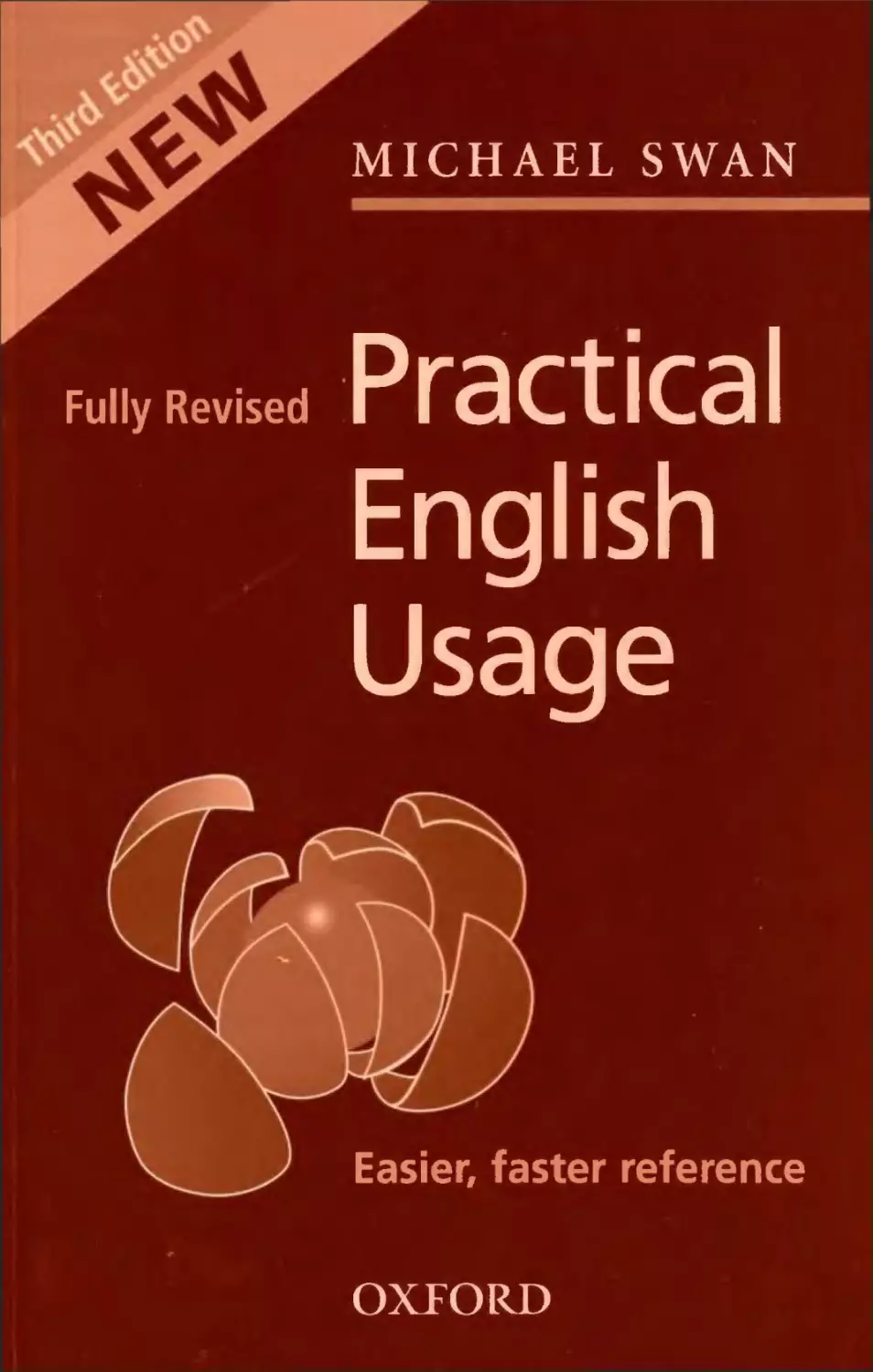
M I C H A E L SWAN
Fully Revised
Practical
English
Usage
Easier, faster reference
OXJFORD
Michael Swan
PRACTICAL
ENGLISH
USAGE
Third Edition
O X FO R D
U N IV E R SIT Y PRESS
OXFORD
UNIVERSITY PRESS
Great Clarendon Street, Oxford 0x2 6dp
Oxford University Press is a department o f the University o f Oxford.
It Anthers the University's objective o f excellence in research, scholarship,
and education by publishing worldwide in
Oxford New York
Auckland Cape Town Dares Salaam Hong Kong Karachi
Kuala Lumpur Madrid Melbourne Mexico City Nairobi
New Delhi Shanghai 'feipei Toronto
With offices in
Argentina Austria Brazil Chile Czech Republic France Greece
Guatemala Hungary Italy Japan Poland Portugal Singapore
South Korea Switzerland Thailand Ttirkey Ukraine Vietnam
and o x f o r d En g l i s h are registered trade marks o f
Oxford University Press in the UK and in certain other countries
o x fo r d
G Michael Swan 2005
The moral rights o f the author have been asserted
Database right Oxford University Press (maker)
First published 2005
2009 2008 2007 2006
10 9 8 7 6 5 4
No unauthorized photocopying
All rights reserved. No part o f this publication may be reproduced,
stored in a retrieval system, or transmitted, in any form or by any means,
without the prior permission in writing o f Oxford University Press,
or as expressly permitted by law, or under terms agreed with the appropriate
reprographics rights organization. Enquiries concerning reproduction
outside the scope o f the above should be sent to the ELT Rights Department,
Oxford University Press, at the address above
You must not circulate this book in any other binding or cover
and you must impose this same condition on any acquirer
Any websites referred to in this publication are in the public domain and
their addresses are provided by Oxford University Press for information only.
Oxford University Press disclaims any responsibility for the content
ISBN-13: 978 019 4420990 (hardback)
isbn -io : 019 442099 X
isbn -13 : 978 o 19 442098 3 (paperback)
isbn -io : 0194420981
Printed in China
PRACTICAL ENGLISH USAGE
Dedication
To John Eckersley, who first encouraged my interest in this kind of thing.
Acknowledgements
I am grateful to all the people who have helped me with the preparation of this
third edition. A large number of teachers in different countries were kind enough
to respond to an enquiry asking how they felt Practical English Usage could be
improved: their feedback was extremely helpful, and I am very much in their
debt. I am also gready indebted to David Baker, whose comments and
suggestions have added very significandy to the accuracy and clarity of the book,
and to Hideo Hibino and Kenji Kashino, who have contributed valuable advice
on specific problems. Many other teachers and students - too many to name have taken the trouble to suggest ways in which particular entries could be
improved; their input has benefited die book considerably. My use of the
internet as a source of instances of authentic usage has been gready facilitated
by the kind assistance of Hiroaki Sato, of Senshu University, Japan, who made
available his excellent software tool KwiconGugle. I must also reacknowledge my
debt to Jonathan Blundell, Norman Coe, Michio Kawakami, Michael Macfarlane,
Nigel Middlemiss, Keith Mitchell, Catherine Walter, Gareth Watkins, and the
many other consultants and correspondents whose help and advice with the
preparation of the first and second editions continue as an important
contribution to the third.
Any pedagogic grammarian owes an enormous debt to the academic linguists
on whose research he or she is parasitic. There is not enough space to mention
all the scholars of the last hundred years or so on whose work I have drawn
directly or indirecdy, even if I had a complete record of my borrowings. But I
must at least pay homage to two monumental reference works of the present
generation: the Comprehensive Grammar o f the English Language, by Quirk,
Greenbaum, Leech and Svartvik (Longman 1985), and the Cambridge Grammar
o f the English Language, by Huddleston, Pullum and others (Cambridge
University Press 2002). Their authoritative accounts of the facts of English
structure and usage constitute an essential source of information for anyone
writing pedagogic grammar materials today.
Finally, it is with particular pleasure that I express my gratitude, once again, to
the editorial, design and production team at Oxford University Press, whose
professional expertise is matched only by their concern to make an author's task
as trouble-free as possible.
page vi
Contents summary
Page
Acknowledgments
vi
Introduction
viii-x
Contents Overview
xi-xvi
Language Terminology
xvii-xxv
Don’t say it:
130 common mistakes
Phonetic alphabet
Practical English Usage
Index
xxvi-xxix
XXX
1-623
624-658
page vii
Introduction
The purpose of this book
English, like all languages, is full of problems for the foreign learner. Some of
these points are easy to explain - for instance, the formation of questions, the
difference between since and for, the meaning of after all. Other problems are
more tricky, and cause difficulty even for advanced students and teachers. How
exactly is the present perfect used? When do we use past tenses to be polite?
What are the differences between at, on and in with expressions of place? We can
say a chair le g - why not * a cat teg? When can we use the expression do sol When
is the used with superlatives? Is unless the same as if not? What are the
differences between come and go, between each and every, between big, large
and great, between fairly, quite, rather and pretty? Is it correct to say There's three
more bottles in the fridge? How do you actually say 3 x 4 = 12? And so on, and
so on.
Practical English Usage is a guide to problems of this kind. It deals with over 600
points which regularly cause difficulty to foreign students of English. It will be
useful, for example, to a learner who is not sure how to use a particular structure,
or who hgs made a mistake and wants to find out why it is wrong. It will also be
helpful to a teacher who is looking for a clear explanation of a difficult language
point. There is very full coverage of grammar, as well as explanations of a large
number of common vocabulary problems. There are also some entries designed
to clarify more general questions (e.g. formality, slang, the nature of standard
English and dialects) which students and teachers may find themselves
concerned with.
Level
The book is intended for higher level students of English and for teachers. Being
a reference book, it contains information at various levels, ranging from
relatively simple points to quite advanced problems.
Organisation
Problems are mostly explained in short separate entries: the book is more like a
dictionary than a grammar in form. This makes it possible to give a clear
complete treatment of each point, and enables the user to concentrate just on
the question that he or she needs information about. Entries that deal with
related topics (e.g. different uses of a tense) are grouped where this is useful, but
can be read separately. In longer entries, basic information is generally given
first, followed by more detailed explanations and discussions of less important
points. Entries are arranged alphabetically by title and numbered in sequence. A
comprehensive Index (pages 624-658) shows where each point can be found
(see fHow to find things', page x).
Approach and style
I have tried to make the presentation as practical as possible. Each entry
contains an explanation of a problem, examples of correct usage, and (when this
is useful) examples of typical mistakes. In some cases, an explanation may be
somewhat different from that found in many learners' grammars; this is because
page viii
the rules traditionally given for certain points (e.g. conditionals or indirect
speech) are not always accurate or helpful. Explanations are, as far as possible in
simple everyday language. Where it has been necessary to use grammatical
terminology, 1 have generally preferred to use traditional terms that are simple
and easy to understand, except where this would be seriously misleading. Some
of these terms (e.g. future tense) would be regarded as unsatisfactory by
academic grammarians, but I am not writing for specialists. There is a dictionary
of the terminology used in the book on pages xvii-xxv.
The kind of English described
The explanations deal mainly with standard modem everyday British English,
and are illustrated with realistic examples of current usage. Both explanations
and examples have been thoroughly checked against large electronic databases
('corpora') of authentic spoken and written English. Stylistic differences (e.g.
between formal and informal usage, or spoken and written language) are
mentioned where this is appropriate. The few grammatical differences between
British and American English are also described, and there is a good deal of
information about other British-American differences, but the book is not
intended as a systematic guide to American usage.
Correctness
If people say that a form is not ‘correct', they can mean several different things.
They may for instance be referring to a sentence like */ have seen her yesterday,
which normally only occurs in the English of foreigners. They may be thinking of
a usage like less people (instead of fewer people), which is common in standard
English but regarded as wrong by some people. Or they may be talking about
forms like * ain't or ‘double negatives', which are used in speech by many British
and American people, but which do not occur in the standard dialects and are
not usually written. This book is mainly concerned with the first kind of
‘correctness': the differences between British or American English and ‘foreign'
English. However, there is also information about cases of divided usage in
standard English, and about a few important dialect forms. (For a discussion of
different kinds of English, see 308-309.)
How important is correctness?
If someone makes too many mistakes in a foreign language, he or she can be
difficult to understand, so a reasonable level of correctness is important.
However, it is quite unnecessary to speak or write a language perfectly in order
to communicate effectively (very few adults in fact achieve a perfect command
of another language). Learners should aim to avoid serious mistakes (and a book
like Practical English Usage will help considerably with this); but they should not
become obsessed with correctness, or worry every time they make a mistake.
Grammar is not the most important thing in the world!
page ix
What this book does not do
Practical English Usage is not a complete guide to the English language. As the
title suggests, its purpose is practical: to give learners and their teachers the most
important information they need in order to deal with common language
problems. Within this framework, the explanations are as complete and accurate
as I can make them. However it is not always helpful or possible in a book of this
kind to deal with all the details of a complex structural point; so readers may well
find occasional exceptions to some of the grammatical rules given here. Equally,
the book does not aim to replace a dictionary. While it gives information about
common problems with the use of a number of words, it does not attempt to
describe other meanings or uses of the words beside those points that are
selected for attention.
Other reference books
A book like this gives explanations of individual points of usage, but does not
show how the separate points ‘fit together'. Those who need a systematically
organised account of the whole of English grammar should consult a book such
as the Oxford Learner's Grammar, by John Eastwood (Oxford University Press),
A Student's Grammar o f the English Language, by Greenbaum and Quirk
(Longman), or Collins Cobuild English Grammar (Collins). For a detailed
treatment of English vocabulary, see the Oxford Advanced Learner's Dictionary,
the Cambridge Advanced Learner's Dictionary, the Longman Dictionary o f
Contemporary English, the Macmillan English Dictionary or the Collins Cobuild
English Dictionary.
Changes in the third edition
English, like all languages, is changing, and British English is currendy being
quite strongly influenced by American English. Consequently, some usages
which were unusual in standard British English a few decades ago have now
become common - for example, the use of like as a conjunction (e.g. like I do), or
the use of Do you have...? to ask about the immediate present (e.g. Do you have
a light?). The third edition takes account of a number of changes of this kind, in
order to give a fully up-to-date description of contemporary usage.
How to find things
The best way to find information about a particular point is to look in the Index
on pages 624-658. (The overview on pages xi-xvi is intended only to give a
general picture of the topics covered in the book; it is not a complete guide to the
contents.) Most points are indexed under several different names, so it is not
difficult to locate the entry you need. For instance, if you want to know why we
say I'm not used to driving on the left instead of I'm not used to drive on the left,
you can find the number of the section where this is explained by looking in the
index under ‘used', ‘be used', ‘to* or ‘-ing forms'. (On the other hand, it would
obviously not be helpful to look under ‘drive*: the rule is a general one about the
use of -ing forms after be used to, not about the verb drive in particular.)
page x
Contents Overview
This overview gives a general picture of the topics covered in the book; it is not a
complete guide to the contents. References are to entry numbers. To find
information about a particular point, consult the Index on pages 624-658,
verbs, tense and aspect
future 211-221
present tenses 461-466
past simple and progressive 421-422
perfect verb forms 427
present perfect 455-460
past perfect 423-425
progressive (continuous)
verb forms 470-472
past verb form with present or
future meaning 426
tense simplification in subordinate
clauses (present for future, past
for would etc) 580
be, do, have and modal
auxiliaries
-ing form or infinitive after
remember, go on etc 299
-ing and -ed forms used as
adjectives (participles) 408-411
verbs: other points
active verb forms 10
passives 412-420
subjunctive 567
link verbs: be, seem, look etc 328
irregular verbs 304
verb complementation (what can
follow a verb?) 606
verbs with two objects 610
verb + object + complement 607
two-part verbs: phrasal verbs 599;
prepositional verbs 600
auxiliary verbs 85
be 89-92
there is 587
do 158-162
have 234-239
verbs of movement
{she ran in etc) 608
turning verbs into nouns 598
modal verbs 353-354
can and could 121-125
may and might 338-344
can, could, may and might
compared 345
must 358-361
ought 403
should 518-521
should, ought and must compared
520
will 629
would 633
nouns
older English verb forms 392
infinitives and participles
infinitives 279-292
-ing forms 293-294
-ing forms used like nouns
(gerunds) 295-298
singular and plural 523-532
countable and uncountable nouns
148-149
gender (references to males and
females) 222
piece- and group-words
{a bar o f chocolate, a bunch
o f flowers etc) 430
possessive’s 439-440
noun + noun 385-386
complementation (what can follow
a noun?) 384
page xi
To find the answer to a specific question, see the Index ►
Contents Overview
pronouns
adjectives
personal pronouns
(/, me, you etc) 428-9
reflexive pronouns {myself etc) 493
each other and one another 171
indefinite pronouns (somebody,
someone, anything etc) 548
interrogative which, what, who etc
622-624
one: substitute word (a big one etc)
395
possessives and demonstratives: see
determiners
relative who, whom, which, that etc
494-497
whoever, whatever etc 625
position 12-14
order before nouns 15
complementation (what can follow
an adjective?) 19
adjectives with and 16
adjectives without nouns 17
pronunciation of aged, naked etc 18
adverbs
position 21-25
adverbs of manner and adjectives 26
adverbs or adjectives? confusing
cases 27
determiners [the, my, some,
several etc)
adverb particles 20
introduction 154
comparison
articles (a/an and the) 61-70
possessives {my, mine etc) 441-443
demonstratives
{this, that, these, those) 589-590
structures 135
as ... as; as much/many as 136
comparative and superlative
adjectives
and adverbs 137-141
all 35-40
another and other(s) 54
any 55
any and every 56
both 110
each 169
each and every 170
every (one) 193
either 174
enough 187
half 231
less and fewer 320
least and fewest 318
(a) little and (a) few 329
[a] lot 333
more 355
most 356
much and many 357
neither (of) 372
no, none and not a/any 376
so much and so many 542
some 546
some and any 547
too much and too many 596
prepositions
general
introduction 448
at the ends of clauses 452
before conjunctions 453
before -ing forms 454
before and after particular words
and expressions 449-450
prepositional verbs 600
expressions without prepositions
451
particular prepositions
about and on 4
above and over 6
according to 8
across, over and through 9
along 45
(a)round and about 60
at/in and to 80
at, on and in: place 81
at, on and in: time 82
before and in front o f 98
page xii
Contents Overview
below, under, underneath
and beneath 100
between and among 105
by: time 117
by and near 118
by (method, agent) and with
(tools etc) 119
due to and owing to 166
during and for 167
during and in 168
for: purpose and cause 207
for, since, in and from: time 208
in and into, on and onto 269
in and to 270
in spite of 272
instead of 301
like and as: similarity, function 326
near (to) 365
opposite, facing and in front of 402
out of 404
through: time 592
until 602
up and down 603
with 631
conjunctions
general
conjunctions 510
sentence structure 511
particular conjunctions
and 52
and after try, wait, go etc 53
as and though: special word order 71
as if and as though; like 74
as long as 75
as well as 78
because 94
before 97
both ... and 111
either... or 175
how 252
immediately, the moment etc 267
it's time (that) 306
lest 321
neither... nor 373
neither, nor and n o t... either 374
not only ... 383
now (that) 387
once 394
so that and in order that 543
that-dauses 583
omission of that 584
unless 601
when and if 618
whether ... o r ... 620
whether and if 621
word order and sentence
organisation
basic word order 509
inversion (verb before subject)
302-303
fronting (e.g. People like that
I can't stand) 513
information structure 512
emphasis 184
various structures
questions 480-486
question tags 487-488
negative structures 367-371
imperatives 268, 323 {let)
exclamations 195
direct speech: reporting verbs and
word order 156
indirect speech
(reported speech) 274-278
relatives
{the person who ... etc): 494-498
whoever, whatever etc 625
if 256-265
preparatory it: 446-447
cleft sentences: what I need is a
holiday 130; it was my secretary
who ... 131
ellipsis (leaving out words) 177-182
understanding complicated
sentences 515
constructing text
discourse markers (linking
expressions) 157
paragraphs 406
repetition 500
page xiii
To find the answer to a specific question, see the Index ►
Contents Overview
correspondence
letters 146
emails and text messages 147
spoken grammar
contractions 143
spoken structures and tags 514
short answers [Yes, he can etc) 517
reply questions {Was it? Did you?) 484
special kinds of language
abbreviations and acronyms 2
idioms, collocations and
fixed expressions 255
politeness
using questions 435
distancing verb forms 436
softening expressions 437
'social' language 545
varieties and styles of English
American and British English 51
standard English and dialects 308
correctness 309
spoken and written English 310
formality 311
variation and change 312
abbreviated styles 1
headlines 240
slang 533
taboo words and swearwords 575
topic areas
age 32
dates 152
meals 347
measurements: 'marked' and
‘unmarked’ forms 350
names [Florence, Homer etc) 362
names and titles [Peter, M r Lewis) 363
nationalities, countries and
regions 364
numbers 389
telephoning 578
telling the time 579
spelling and punctuation
spelling 556-565
punctuation 473-479
pronunciation
stress and rhythm 554
intonation 555
weak and strong forms 616
word-building
prefixes and suffixes 445
confusable words and
expressions
accept and agree 7
all right and alright 41
allow, permit and let 42
almost and nearly; practically 43
alone, lonely, lonesome and lone 44
also, as well and too 46-47
alternately and alternatively 48
although, though, but and however:
contrast 49
altogether and all together 50
arise and rise 59
as, because, since and for 72
as, when and while:
simultaneous events 73
at first and first 84
(a)wake and (a)waken 86
back and again 87
bath and bathe 88
beat and win 93
begin and start 99
beside and besides 101
besides, except and apart from 102
big, large and great 106
born and borne 108
borrow and lend 109
bring and take 112
bring up and educate 113
Britain, the United Kingdom,
the British Isles and England 114
broad and wide 115
care: take care (of), care (about) and
care for 127
changes (become, get, go, grow etc) 128
city and town 129
classic and classical 254
close and shut 132
cloth and clothes 133
come and go 134
comic and comical 254
page xiv
Contents Overview
continual(ly) and continuous(ly) 142
dead, died and death 153
east and eastern, north and northern
etc 172
economic and economical 254
efficient and effective 173
electric and electrical 254
end and finish; verbs 185
especiai(ly) and special(ly) 188
except and except for 194
expect, hope, wait and look forward 196
experiment and experience 197
fairly, quite, rather and pretty:
adverbs of degree 199
far and a long way 200
farther and further 201
female and feminine; male
and masculine 203
finally, at last, in the end
and at the end 204
fit and suit 206
forget and leave 209
fun and funny 210
get and go: movement 225
hear and listen (to) 241
here and there 245
high and tall 246
hire, rent and let 247
historic and historical 254
holiday and holidays 248
how and what... like? 253
ill and sick 266
in case and if 271
its and it's 305
last, the last, the latest 314
later and in 315
lay and He 316
long and (for) a long time 330
lose and loose 332
loudly and aloud 334
magic and magical 254
maybe and perhaps 346
next and the next; nearest 375
no more, not any more, no longer 379
not and no 382
opportunity and possibility 400
play and game 432
politic and political 254
politics and policy 438
price and prize 468
principal and principle 469
road and street 502
say and tell 504
sensible and sensitive 508
shade and shadow 516
small and little 534
so (conjunction) and then 537
sometime, sometime and sometimes 549
soon, early and quickly 550
such and so 569
speak and talk 553
thankful and grateful 582
travel, journey, trip and voyage 597
whose and who's 627
other words and expressions
[be] able to 3
actual(ly) 11
afraid 28
after: adverb 29
after: conjunction 30
after all 31
ago 33
alike 34
any (any better etc) 57
appear 58
as: structures 581
as such 76
as usual 77
ask 79
at all 83
before: adverb 96
bet 103
better 104
[a] bit 107
but meaning 'except' 116
call 120
can't help 126
contrary 144
control 145
country 150
dare 151
different 155
divorce 337
doubt 163
dress 164
drown 165
elder and eldest 176
else 183
enjoy 186
even 189
eventual(ly) 190
page xv
To find the answer to a specific question, see the Index ►
Contents Overview
ever 191
ever so, ever such 192
explain 198
feel 202
finished 205
first (this is the first ... etc): tenses 591
get: meanings and structures 223-224
give with action-nouns 226
go/come for a ... 227
go/come .. .ing 228
gone with be 229
had better 230
happen to ... 232
hardly, scarcely and no sooner 233
hear, see etc + object + verb form 242
hear, see etc with that-clause 243
help 244
home 249
hope 250
hopefully 251
indeed 273
just 307
know 313
last (this is the last ... etc): tenses 591
learn 317
left 319
let: 322-323
life: countable or uncountable 324
like: verb 325
likely 327
look 331
make: 335-336
marry 337
mean 348
means 349
mind (do you mind etc) 351
miss 352
need 366
no (no better etc) 57
no doubt 377
no matter 378
nowadays 388
of course 390
often 391
once: adverb 393
only: focusing adverb 398
open 399
opposite (adjective): position 401
own 405
part 407
place (a place to live, etc) 431
please and thank you 433
point of view 434
prefer 444
presently 467
quite 489
rather 490-491
reason 492
remind 499
[the] rest 501
[the] same 503
see 505
see, look (at) and watch 506
seem 507
smell 535
since: tenses 522
so: adverb meaning like this/that' 536
so: degree adverb (so tired, so fast) 538
so (and not) with hope, believe etc 539
so with say and tell 540
so-and-so; so-so 544
sort of, kind of and type of 551
sound 552
still, yet and already: time 566
such 568
suggest 570
suppose, supposing and what if 571
supposed to 572
surely 573
sympathetic 574
take: time 576
taste 577
than: structures 581
the matter (with) 585
there 586
think 588
time 593
tonight 594
too 595
used to 604
[be] used to .. .ing 605
very and very much 611
wait 612
want 613
-wards 614
way 615
well 617
where (to) 619
why and why not 628
wish: tenses 630
worth 632
yes and no 634
page xvi
Language terminology
The following words and expressions are used in this book to talk about grammar
and other aspects of language.
abstract noun (the opposite of a concrete noun) the name of something
which we experience as an idea, not by seeing, touching etc. Examples: doubt,
height, geography.
active An active verb form is one like breaks, told, will help (not like is broken,
was told, will be helped, which are passive verb forms). The subject of an
active verb is usually the person or thing that does the action, or that is
responsible for what happens,
adjective a word like green, hungry, impossible, which is used when we
describe people, things, events etc. Adjectives are used in connection with
nouns and pronouns. Examples: a green apple, She's hungry.
adverb a word like tomorrow, once, badly, there, also, which is used to say, for
example, when, where or how something happens. There are very many kinds
of adverbs with different functions: see 22-27.
adverb particle a short adverb like up, out, off, often used as part of a phrasal
verb (e.g. clean up, look out, tell off).
affirmative an affirmative sentence is one that makes a positive statement not a negative sentence or a question. Compare I agree (affirmative); I don't
agree (negative).
agent In a passive sentence, the agent is the expression that says who or what
an action is done by. Example: This picture was probably painted by a child.
article A, an and the are called 'articles'. Alan is called the ‘indefinite article1;
the is called the ‘definite article',
aspect Grammarians prefer to talk about progressive and perfective aspect,
rather than progressive and perfect tense, since these forms express other
ideas besides time (e.g. continuity, completion). However, in this book the
term tense is often used to include aspect, for the sake of simplicity,
attributive Adjectives placed before nouns are in ‘attributive position1.
Examples: a green shirt, my noisy son. See also predicative,
auxiliary verb a verb like be, have, do which is used with another verb to make
tenses, passive forms etc. Examples: She was writing, Where have you put it?
See also modal auxiliary verb,
clause a part of a sentence which contains a subject and a verb, usually joined
to the rest of a sentence by a conjunction. Example: Mary said that she was
tired. (The word clause is also sometimes used for structures containing
participles or infinitives with no subject or conjunction. Example: Not
knowing what to do, I telephoned Robin.)
cleft sentence a sentence in which special emphasis is given to one part (e.g.
the subject or the object) by using a structure with it or what. Examples: It
was you that caused the accident, What I need is a drink.
collective noun a singular word for a group. Examples: family; team.
comparative the form of an adjective or adverb made with -er (e.g. older,
faster); also the structure more + adjective/adverb, used in the same way
(e.g. more useful, more politely).
page xvii
Language terminology
complement (1) a part of a sentence that gives more information about the
subject (after be, seem and some other verbs), or, in some structures, about
the object. Examples: You're the right person to help; She looks very kind;
They elected him President.
(2) a structure or words needed after a noun, adjective, verb or preposition to
complete its meaning. Examples: the intention to travel; fu ll o f water, try
phoning, down the street.
compound a compound noun, verb, adjective, preposition etc is one that is
made of two or more parts. Examples: bus driven get on with; one-eyed.
concrete noun (the opposite of an abstract noun) the name of something
which we can experience by seeing, touching etc. Examples: cloud; petrol;
raspberry.
conditional (1) a verb form made by using the auxiliary would (also should
after I and we). Examples: I would run; She would sing, We should think.
(2) a clause or sentence containing if {or a word with a similar meaning), and
perhaps containing a conditional verb form. Examples: If you try you'll
understand; I should be surprised if she knew; What would you have done if the
train had been late?
conjunction a word like and, but, although, because, when, if which can be
used to join clauses together. Example: I rang because I was worried.
consonant for example, the letters b, c, d ,f g and their usual sounds (see
phonetic alphabet, page xxx). See also vow el
continuous the same as progressive.
contraction a short form in which a subject and an auxiliary verb, or an
auxiliary verb and the word not, are joined together into one word.
Contractions are also made with non-auxiliary be and have. Examples: I'm;
who’ve; John’ll; can't
co-ordinate clause one of two or more main or subordinate clauses of equal
'value' that are connected. Examples: Shall I come to your place or would you
like to come to mine?; It's cooler today and there's a bit o f a wind; she said
that it was late and that she was tired. See also main clause, subordinate
clause.
copular verb the same as link verb.
countable noun a noun like car, dog, idea, which can have a plural form, and
can be used with the indefinite article a/an. See also uncountable noun,
declarative question a question which has the same grammatical form as a
statement. Example: That's your girlfriend?
definite article the.
defining relative see identifying relative,
demonstrativethis, these, that, those.
determiner one of a group of words that begin noun phrases. Determiners
include a/an, the, my, this, each, either, several, more, both, all.
direct object see object.
direct speech speech reported 'directly', in the words used by the original
speaker (more or less), without any changes of tense, pronouns etc. Example:
She looked at me and said 1This is my money\ See also indirect speech,
discourse marker a word or expression which shows the connection between
what is being said and the wider context. A discourse marker may, for
example, connect a sentence with what comes before or after, or it may show
the speaker’s attitude to what he/she is saying. Examples: on the other hand;
frankly, as a matter o f fact.
page xviii
Language terminology
duration how long something lasts. The preposition for can be used with an
expression of time to indicate duration,
ellipsis leaving out words when their meaning can be understood from the
context. Examples: (Ifs a) Nice day, isn't it?; It was better than I expected (it
would be).
emphasis giving special importance to one part of a word or sentence (for
example by pronouncing it more loudly; by writing it in capital letters; by
using do in an affirmative clause; by using special word order),
emphatic pronoun reflexive pronoun (myself, yourself etc) used to emphasise
a noun or pronoun. Examples: I’ll tell him myself11 wouldn't sell this to the
king himself. See also reflexive pronoun,
ending something added to the end of a word, e.g. -er, -ing, -ed.
first person see person.
formal the style used when talking politely to strangers, on special occasions,
in some literary writing, in business letters, etc. For example, commence is a
more formal word than start.
frequency Adverbs of frequency say how often something happens. Examples:
often; never, daily; occasionally.
fronting moving a part of a clause to the beginning in order to give it special
emphasis. Example: Jack I like, but his wife I can't stand.
full verb see main verb.
future
a verb form made with the auxiliary shall/will + infinitive without to.
Examples; I shall arrive; Will it matter?
future perfect a verb form made with shalUwill + have + past participle.
Example: I will have finished by lunchtime.
future progressive (or future continuous) a verb form made with shall/will +
be + .. .ing. Example: I will be needing the car this evening.
gender
the use of different grammatical forms to show the difference
between masculine, feminine and neuter, or between human and non
human. Examples: he, she; it, who; which.
gerund the form of a verb ending in -ing, used like a noun (for example, as the
subject or object of a sentence). Examples: Smoking is bad fo r you; I hate
getting up early. See also present participle,
gradable Pretty, hard or cold are gradable adjectives: things can be more or
less pretty, hard or cold. Adverbs of degree (like rather, very) can be used with
gradable words. Perfect or dead are not gradable words: we do not usually say
that something is more or less perfect, or very dead.
grammar the rules that show how words are combined, arranged or changed
to show certain kinds of meaning,
hypothetical Some words and structures (e.g. modal verbs, i f clauses) are
used for hypothetical situations - that is to say, situations which may not
happen, or are imaginary. Example: What would you do if you had six months
free?
identifying (or defining) relative clause a relative clause which identifies a
noun - which tells us which person or thing is being talked about. Example:
There's the woman who tried to steal your cat. (The relative clause who tried
to steal your cat identifies the woman - it tells us which woman is meant.)
See also non-identifying relative clause,
imperative the form of a verb used to give orders, make suggestions, etc.
Examples: Bring me a pen; Have a good holiday.
page xix
Language terminology
indefinite article
atari.
indirect object see object.
indirect speech a structure in which we report what somebody said by making
it part of our own sentence (so that the tenses, word order, and pronouns and
other words may be different from those used by the original speaker).
Compare: He said 'I'm tired' (the original speaker's words are reported in
direct speech) and He said that he was tired (the original speaker's words are
reported in indirect speech),
infinitive the 'base’ form of a word (usually with to), used after another verb,
after an adjective or noun, or as the subject or complement of a sentence.
Examples: I want to go home; It's easy to sing; Yve got a plan to start a
business; To err is human, to forgive divine:
informal the style used in ordinary conversation, personal letters etc, when
there is no special reason to speak politely or carefully. I'll is more informal
than I will; get is used mosdy in an informal style; start is a more informal
word than commence.
-ing form the form of a verb ending in -ing. Examples: finding; keeping;
running. See also gerund, present participle,
initial at the beginning. Sometimes is an adverb that can go in initial position
in a sentence. Example: Sometimes I wish I had a different job.
intensifying making stronger, more emphatic. Very and terribly are
intensifying adverbs,
interrogative Interrogative structures and words are used for asking
questions. In an interrogative sentence, there is an auxiliary verb (or non
auxiliary be) before the subject (e.g. Can you swim?; Are you ready?).
What, who and where are interrogative words,
intonation the ‘melody' of spoken language: the way the musical pitch of the
voice rises and falls to show meaning, sentence structure or mood,
intransitive An intransitive verb is one that cannot have an object or be used
in the passive. Examples: smile, fall; come, go.
inversion a structure in which an auxiliary or other verb comes before its
subject. Examples: Never had she seen such a mess; Here comes John.
irregular not following the normal rules, or not having the usual form. An
irregular verb has a past tense and/or past participle that does not end in -ed
(e.g. swam, taken); children is an irregular plural,
link verb (or copular verb) be, seem, feel and other verbs which link a subject
to a complement that describes it. Examples: My mother is in Jersey; He seems
unhappy; This feels soft.
main clause, subordinate clause Some sentences consist of a main clause and
one or more subordinate clauses. A subordinate clause acts like a part of the
main clause (e.g. like a subject, or an object, or an adverbial). Examples:
Where she is doesn’t matter (the subordinate clause Where she is is the subject
of the main clause); I told you that I didn't care (the subordinate clause that I
didn't care is the direct object in the main clause); You'll find friends wherever
you go (the subordinate clause wherever you go acts like an adverb in the
main clause: compare You'll find friends anywhere).
page xx
Language terminology
main verb (or full verb) A verb phrase often contains one or more auxiliary
verbs together with a main verb. The main verb is the verb which expresses
the central meaning; auxiliary verbs mostly add grammatical information (for
instance they may show that a verb is progressive, future, perfect or passive).
Examples: is going, will explain; has arrived, would have been forgotten
manner an adverb of manner describes how something happens. Examples:
well; suddenly; fast
mid-position If an adverb is in mid-position in a sentence, it is with the verb.
Example: I have never been to Africa.
misrelated participle (also called hanging or dangling participle) a participle
which appears to have a subject which is not its own. Example: Looking out o f
the window, the mountains appeared very close. (This seems to say that the
mountains were looking out of the window.) The structure is usually avoided
in careful writing because of the danger of misunderstanding,
modal auxiliary verb one of the verbs can, could, may, might, must, will, shall,
would, should, ought
modify An adjective is said to 'modify* the noun it is with: it adds to or defines
its meaning. Examples: a fine day, my new job. An adverb can modify a verb
(e.g. run fast), an adjective (e.g. completely ready) or other words or
expressions. In sports car, the first noun modifies the second,
negative a negative sentence is one in which the word not is used with the
verb. Example: I didn't know.
nominal relative clause a relative clause (usually introduced by what) which
acts as the subject, object or complement of a sentence. Example: I gave him
what he needed.
non-affirmative (also called non-assertive) The words some, somebody,
somewhere etc are used most often in affirmative sentences. In other kinds of
sentence they are often replaced by any, anybody, anywhere etc. Words like
any, anybody etc are called ‘non-affirmative’ or non-assertive’ forms. Other
non-affirmative forms are yet and ever.
non-identifying (or non-defining) relative clause a relative clause which does
not identify the noun it refers to (because we already know which person or
thing is meant). Example: There's Hannah Smith, who tried to steal my cat
(The relative clause, who tried to steal my cat, does not identify the person she is already identified by the name Hannah Smith.) See also identifying
relative clause.
noun a word like oil, memory, arm, which can be used with an article. Nouns
are most often the names of people or things. Personal names (e.g. George)
and place names (e.g. Birmingham) are called ‘proper nouns'; they are
usually used without articles,
noun phrase a group of words (e.g. article + adjective + noun) which acts as
the subject, object or complement in a clause. Example: the last bus.
number the way in which differences between singular and plural are shown
grammatically. The differences between house and houses, mouse and mice,
this and these are differences of number.
page xxi
Language terminology
object a noun phrase or pronoun that normally comes after the verb in an
active clause. The direct object most often refers to a person or thing (or
people or things) affected by the action of the verb. In the sentence Take the
dogfor a walk, the dog is the direct object. The indirect object usually refers to
a person (or people) who receive(s) the direct object. In the sentence Ann
gave me a watch, the indirect object is me, and the direct object is a watch.
See also subject,
participle see present participle and past participle,
participle clause a clause-like structure which contains a participle, not a verb
tense. Examples: Discouraged by his failure, he resigned from his job; Having
a couple o f hours to spare, I went to see a film .
passive A passive verb form is made with be + past participle. Examples:
is broken; was told; will be helped (but not breaks, told, will help, which are
active verb forms). The subject of a passive verb form is usually the person or
thing that is affected by the action of the verb. Compare: They sent Lucas to
prison for five years (active) and Lucas was sent to prison fo r five years
(passive). See also active,
past participle a verb form like broken, gone, stopped, which can be used to
form perfect tenses and passives, or as an adjective. (The meaning is not
necessarily past, in spite of the name.)
past perfect a verb form made with had + past participle. Examples: I had
forgotten; The children had arrived; She had been working, It had been
raining. The first two examples are simple past perfect; the last two (with had
been + .. .mg) are past perfect progressive (or continuous),
past progressive (or continuous) a verb form made with wasfwere + .. .mg.
Examples: I was going, They were stopping.
past simple see simple past.
perfect a verb form made with the auxiliary have + past participle. Examples:
I have forgotten; She had failed; having arrived; to have finished
perfect conditional should/would have + past participle. Examples: I shouldI
would have agreed; He would have known.
perfect infinitive (to) have + past participle. Example: to have arrived.
person the way in which, in grammar, we show the difference between the
person(s) speaking {first person), the person(s) spoken to {second person), and
the person, people or thing(s) spoken about {third person). The differences
between / and you, or between am, are and is, are differences of person,
personal pronouns the words I, me, you, he, him etc.
phrase two or more words that function together as a group. Examples: dead
tired; the silly old woman; would have been repaired; in the country.
phrasal verb a verb form that is made up of two parts: verb + adverb particle.
Examples: fill up; run over, take in.
plural grammatical form used to refer to more than one person or thing.
Examples: we; buses; children; are; many, these. See also singular,
possessive a form used to show possession and similar ideas. Examples:
John's; our, mine.
possessive pronoun My, your, his, her etc are possessive pronouns (they stand
for ‘the speaker's’, ‘the hearer’s', ‘that person’s’ etc). Mine, yours, his, hers etc
are also possessive pronouns, for the same reason. My, your etc are used
before nouns, so they are not only pronouns, but also determiners. (They are
often called ‘possessive adjectives', but this is not correct.) Mine, yours etc are
used without following nouns.
page xxii
Language terminology
postmodifier a word that comes after the word which it modifies, e.g. invited
in The people invited all came late. See also premodifier,
predicative Adjectives placed after a verb like be, seem, look are in predicative
position. Examples: The house is enormous; She looks happy. See also
attributive.
prefix a form like ex-, anti- or un-, which can be added to the front of a word
to give an additional or different meaning. Examples: ex-wife, anti-British,
unhappy. See also suffix,
premodifier a word that comes before the word which it modifies, e.g. invited
in an invited audience. See also postmodifier.
preparatory subject, preparatory object When the subject of a sentence is an
infinitive or a clause, we usually put it towards the end of the sentence and
use the pronoun it as a preparatory subject. Example: It is important to get
enough sleep. It can also be used as a preparatory object in certain structures.
Example: He made it clear that he disagreed. There is used as a kind of
preparatory subject in there is ... and similar structures. Example: There is
somebody at the door.
preposition a word like on, off, o f into, normally followed by a noun or
pronoun.
prepositional verb a verb form that is made up of two parts: verb form +
preposition. Examples: insist on; care for; listen to.
present participle the form of a verb ending in -ing, used as an adjective, a
verb or part of a verb. Examples: a crying baby, Opening his newspaper, he
started to read; She was running. (The meaning is not necessarily present, in
spite of the name.) See also gerund,
present perfect a verb form made with have/has + past participle. Examples: /
have forgotten; The children have arrived; I've been working all day, It has
been raining. The first two examples are simple present perfect; the last two
(with have been + .. Ang) are present perfect progressive (or present perfect
continuous).
present progressive (or continuous)
a verb form made with amlarefis +
.. .ing. Examples: I am going She is staying for two weeks.
present simple see simple present.
progressive (or continuous)
A verb form made with the auxiliary be + .. .ing.
Examples: to be going We were wondering, Til be seeing you.
progressive (or continuous) infinitive
a form like to be going, to be waiting.
pronoun a word like it, yourself, their, which is used instead of a more precise
noun or noun phrase (like the cat, Peter's self, thefamily's). The word pronoun
can also be used for a determiner when this includes the meaning of a
following noun which has been left out. Example: I'll take these.
proper noun or proper name a noun (most often with no article) which is the
name of a particular person, place, organisation etc. Examples: Andrew,
Brazil; the European Union.
quantifier a determiner like many, few, little, several, which is used in a noun
phrase to show how much or how many we are talking about,
question tag an expression like do you? or isn't it?, consisting of an auxiliary
verb (or non-auxiliary be or have) + pronoun subject, put on to the end of a
sentence. Examples: You don't eat meat, do you?; It's a nice day; isn't it?
reflexive pronoun myself, yourself, himself etc. Example: I cut myself shaving
this morning. See also emphatic pronoun.
page xxiii
Language terminology
regular following the normal rules or having the usual form. Hoped is a
regular past tense; cats is a regular plural. See also irregular,
relative clause a clause which modifies a noun, usually introduced by a
relative pronoun like who or which. Example: I like people who like me.
See also identifying relative clause, non-identifying relative clause,
relative pronoun a pronoun used to connect a relative clause to its noun.
Who, whom, whose, which and that can be used as relative pronouns, and
sometimes also when, where and why. Examples: There's the man who wants
to buy my car, This is the room which needs painting, Do you remember the
day when we met?
reply question a question (similar in structure to a question tag) used to reply
to a statement, for instance to express interest. Example: I've been invited to
spend the weekend in London.*Have you, dear?
second person see person.
sentence a group of words that expresses a statement, command, question or
exclamation. A sentence consists of one or more clauses, and usually has at
least one subject and verb. In writing, it begins with a capital letter and ends
with a full stop, question mark or exclamation mark,
short answer an answer consisting of a subject and an auxiliary verb (or non
auxiliary be or have). Examples: Has anybody phoned the police?* John has.;
Who's ready for more?* I am.
simple past (or past simple)
a past verb form that has no auxiliary verb in the
affirmative. Examples: I stopped; You heard; We knew.
simple present (or present simple) a present verb form that has no auxiliary
verb in the affirmative. Examples: He goes there often; I know; I like chocolate.
simple a verb form that is not progressive.
singular a grammatical form used to talk about one person, thing, etc, or
about an uncountable quantity or mass. Examples: me; bus; water; is; much;
this. See also plural,
slang a word, expression or special use of language found mainly in very
informal speech, often in the usage of particular groups of people. Examples:
thick (= stupid); lose one's cool (= get upset); sparks (= electrician),
split infinitive a structure in which an adverb comes between to and the rest
of the infinitive. Example: to easily understand. Some people consider split
infinitives 'incorrect', but they are common in standard usage,
standard A standard form of a language is the one that is most generally
accepted for use in government, the law, business, education and literature.
I'm not is standard English; I ain't is non-standard,
statement a sentence which gives information; not a question. Examples: I'm
cold; Philip didn't come home last night.
stress the way in which one or more parts of a word, phrase or sentence are
made to sound more important than the rest, by using a louder voice and/or
higher pitch. In the word particular, the main stress is on the second syllable
(p a rr l cular); in the sentence Where's the new secretary? there are three
stresses (WHERE'S the NEW SEcretary?).
strong form, weak form Certain words can be pronounced in two ways:
slowly and carefully with the vowel that is written (strong form), or with a
quicker pronunciation with the vowel /a/ or /i/ (weak form). Examples:
can (/kaen/, /kan/), was (/wdz/, /waz/), for (/fo:(r)/, /fa(r)/).
page xxiv
Language terminology
subject a noun phrase or pronoun that normally comes before the verb in an
affirmative clause. It often says (in an active clause) who or what does the
action that the verb refers to. Examples: Helen gave me a wonderful smile;
Oil floats on water. See also object,
subjunctive a verb form (not very common in British English) used in certain
structures. Examples: I f I were you ...; It's important that he be informed
immediately; We prefer that he pay in cash.
subordinate clause a clause which functions as part of another clause, for
example as subject, object or adverbial in the main clause of a sentence.
Examples: I thought that you understood; What I need is a drink; I'll follow
you wherever you go. See also clause, main clause,
suffix
a form like -ology, -able or -ese, which can be added to the end of a
word to give an additional or different meaning. Examples: climatology;
understandable; Chinese. See also prefix,
superlative
the form of an adjective or adverb made with the suffix -est
(e.g. oldest, fastest); also the structure most + adjective/adverb, used in the
same way (e.g. most intelligent, most politely).
swearword a taboo word used (usually with a change of meaning) to express
strong emotion or emphasis. Example: Fuck!
syllable The word cat has one syllable, cattle has two, cataract has three and
category has four. A syllable normally has a vowel, and usually one or more
consonants before and/or after it. Sometimes the consonant sounds /, m and
n can act as syllables (for instance in the words bottle /'bntl/, capitalism
/'ksepitalizm/, button /‘bAtn/).
taboo word a word (e.g. fuck) connected with a subject (such as sex) which is
not talked about freely, so that some of its vocabulary is considered shocking.
Taboo words are not used in formal speech or writing, and are avoided
altogether by many people. See also swearword,
tag a short phrase (e.g. pronoun subject + auxiliary verb) added on to the end
of a sentence, especially in speech. Examples: He likes to talk, John does; You
can't swim, can you?; Very noisy, those kids. See also question tag.
tense a verb form that shows the time of an action, event or state. Examples:
will go; is sitting; saw.
third person see person.
transitive a transitive verb is one that can have an object. Examples: eat
(a meal); drive (a car); give (a present). See also intransitive,
uncountable noun a noun which has no plural form and cannot normally be
used with the article a/an. Examples: mud; rudeness; furniture.
verb a word like ask, wake, play, be, can, which can be used with a subject to
form the basis of a clause. In clauses, verbs often consist of an auxiliary verb +
infinitive or participle (e.g. will go; has spoken). Most verbs refer to actions,
events or states. See also auxiliary verb, modal auxiliary verb, verb phrase,
verb phrase a verb that has more than one part. Example: would have been
forgotten.
vowel the letters a, e, i, o} u and their combinations, and their usual sounds
(see phonetic alphabet, page xxx). See also consonant,
weak form see strong form.
page xxv
Don’t say it! 130 common mistakes
35 basic mistakes to avoid. Check in the sections to see why
they're wrong.
don't say/write
say/write
Look - it rains.
It's often raining here.
When I was 20 I was smoking.
I have seen Louis yesterday.
We're living here sinee April.
I'll phone you when I will arrive.
I'm not believing him.
I am bom in Chicago.
My sister has 15 years.
I have cold in this house.
I can to swim.
I must see the dentist yesterday.
I want go home.
I came here for study English.
I drove there without to stop.
Where I can buy stamps?
Is ready my new office?
I'm no asleep.
She looked, but she didn't see
nothing.
Where is station?
My sister is photographer.
You speak a very good English.
The life is difficult
I haven't got some free time
today.
Everybody were late.
It is more cold today.
It's too much hot in this house.
The man which lives here is
from Greece.
The people in this town is
very friendly.
She never listens me.
We went at the seaside on
Sunday.
I like very much skiing.
461-464
Look - it's raining
461-464
It often rains here.
When I was 20 I smoked.
422
456
I saw Louis yesterday.
460
We've been living here since April.
212
I'll phone you when I arrive.
471
I don't believe him.
108
I was bom in Chicago.
32
My sister is 15 (years old).
92
I am cold in this house.
121
I can swim.
358
I had to see the dentist yesterday.
613
I want to go home.
289
I came here to study English.
298
I drove there without stopping.
Where can I buy stamps?
480
480
Is my new office ready?
382
I'm not asleep.
... she didn't see anything. /
370
... she saw nothing.
62
Where is the station?
62
My sister is a photographer.
You speak very good English.
149
Life is difficult.
68
I haven’t got any free time today.
547
This soup isn't enough hot.
I gave to her my address.
I have done a mistake.
see section
Everybody was late.
It is colder today.
It's too hot in this house.
The man who lives here is
from Greece.
The people in this town are
very friendly.
She never listens to me.
We went to the seaside on
Sunday.
I very much like skiing. / 1like
skiing very much.
This soup isn't hot enough.
I gave her my address.
I have made a mistake.
page xxvi
548
137
595
494
524
449
80
611
187
610
160
35 mistakes that intermediate students often make.
Check in the sections to see why they're wrong.
don't say/write
say/write
I promise I pay you tomorrow.
This is the first time I'm here.
I've been here since three days.
If I'll have time, I'll go home.
If I knew the price, I will tell you.
He said me that he was Chinese.
She told me she has a headache.
There’s the man that I work for
him.
I've told you all what I know.
Although it was late, but she
went out
You have better to see the doctor.
I use to play tennis at weekends.
It can rain this evening.
My parents wanted that I study.
You must stop to smoke.
I look forward to see you.
I'm boring in the lessons.
He has much money.
Most of people agree with me.
I looked at me in the mirror.
We waited during six hours.
I like eating chocolate milk.
Come here and look at that paper.
We go there every Saturdays.
Which is the biggest city of
the world?
I'm thinking to change my job.
Can you give me an information?
He's married with a doctor.
Can you mend this .until Tuesday?
There's a hotel in front of
our house.
I like warm countries, as Spain.
Please explain me what you want.
When you come, take your bike.
My brother has got a new work.
He's Dutch, or better Belgian.
I promise I'll pay you tomorrow.
... the first time I've been here.
... for three days.
If I have time,...
... I would tell you.
He told me that he was Chinese.
She told me she had a headache.
There's the man that I work for.
217
591
208
257
258
504
275
494
... all (that) I know.
Although it was late, she went
out.
You had better see the doctor.
I play tennis at weekends.
It may/might/could rain ...
My parents wanted me to study.
... stop smoking.
I look forward to seeing you.
I'm bored in the lessons.
He has a lot of / plenty of money.
Most people ...
I looked at myself...
... for six hours.
... milk chocolate.
Come here and look at this paper.
... every Saturday.
... the biggest city in the world?
494
511
I'm thinking of changing my job.
... some information?
He's married to a doctor.
... by Tuesday?
... opposite our house.
588
148
449
602
402
... warm countries, like Spain.
... explain to me ...
... bring your bike.
... a new job.
He's Dutch, or rather Belgian.
326
198
112
148
157
see section
page xxvii
230
604
345
283
299
298
409
357
356
493
167
385
589
193
139
Even advanced students make mistakes. Here are 35.
Check in the sections to see why they're wrong.
don't say/write
say/write
I’ll ask you in case I need help.
I object to tell them my age.
I like the 60s music.
ten thousand, a hundred and six
rWho,s that?’ ~ ‘He’s John.’
I don’t like to be shouted.
It’s ages since she’s arrived.
The police is looking for him.
Prices are surely rising fast.
I have big respect for her ideas.
I don’t like nowadays fashions.
She passed her exam, what
surprised everybody.
I’ve good knowledge of German.
Finally! Where have you been?
I'll be home since 3 o' clock.
We waited one and a half hour.
It’s time they go home.
I’ll see you a few days later.
All along the centuries, there
have been wars.
I want a completely other colour.
Let's go and have coffee
to Marcel’s.
That's mine -1 saw it at first!
Switzerland is among Germany,
France, Austria and Italy.
According to me, it's a bad film.
It was a too good party to miss.
Whole Paris was celebrating.
I nearly wish I’d stayed at home.
One speaks Italian in my town.
The girl wants an own room.
Couldn't you help me, please?
I'll ask you if I need help.
I object to telling them my age.
I like 60s music. / the music of the 60s.
ten thousand, one hundred...
... ‘It's John.'
I don’t like to be shouted at.
It’s ages since she arrived.
The police are looking ...
Prices are certainly rising fast.
... great respect...
... today's/modem fashions.
... which surprised everybody.
271
298
69
389
428
416
522
524
573
106
388
494
... a good knowledge of German.
At last!...
... from 3 o’ clock.
... one and a half hours.
It's time they went home.
... in a few days.
All through the centuries ...
149
204
308
231
306
315
45
... a completely different colour.
... at Marcel’s.
54
80
... I saw it first1
... between Germany, France,
Austria and Italy.
In my opinion / I think. ..
... too good a party...
The whole of Paris ...
I almost wish ...
We/They speak...
... her own room.
Could you ...? / You couldn’t ...,
could you?
I'll try to find out when it starts.
... this country - it’s so beautiful.
It’s getting to be winter.
... is being decorated ..
Mont Blanc i s ...
84
105
I'll try to know when it starts.
I love this so beautiful country.
It's getting winter.
Our flat is decorated this week.
The Mont Blanc is 4808m high.
see section
page xxviii
8
14
40
43
396
405
368
313
538
223
412
70
Even very advanced students can make mistakes - nobody's
perfect! Here are 25. Do you know why they're wrong?
Check in the sections.
don't say/write
say/write
see section
No doubt the world is
getting warmer.
I can’t think of anybody whom
to invite.
My father, whom we hope will
be out of hospital soon,...
Would you follow me wherever
I would go?
We all have to live in the society.
The number of the unemployed
is going up.
She was showing tiredness signs.
She works the hardest when
she’s working for her family.
I'm thankful for your help.
We talked about if it was ready.
What live in those litde holes?
Some people are interested,
but the majority doesn't care.
It mustn't be the postman at
the door. It's only 7 o' clock.
A third of the students is
from abroad.
ExceptAngie, everybody was there.
I wish you felt / would feel
better tomorrow.
The train may be late, as it
happened yesterday.
When I wrote my letters, I did
some gardening.
When I had opened the door,
the children ran in.
Stefan can never return back to
his country.
Will you go and see me when I'm
in hospital?
May you go camping this
summer?
My cousin works for the NATO.
My wife will be angry unless I'm
home by 7.00.
We were poured water on.
There is no doubt that the
world is getting warmer.
I can’t think of anybody to invite.
377
My father, who we hope ...
498
... wherever I went?
580
... in society.
The number of unemployed ...
498
68
70
... signs of tiredness.
She works hardest...
382
141
I'm grateful...
... about whether it was ready.
What lives ..,
... the majority don’t care.
582
453
532
526
It can’t be the postman ...
359
... are from abroad.
389
Except for Angie ...
I hope you fe e l...
194
630
... as happened yesterday.
581
When I had written ...
424
When I opened ...
424
... return to his country. / ... go back to
his country.
... come and see me ..
134
Do you think you’ll go ...
339
. .. for NATO.
... if I'm not home ...
2
601
We had water poured on us. /
Water was poured on us.
416
page xxix
87
Phonetic alphabet
It is necessary to use a special alphabet to show the pronunciation of English
words, because the ordinary English alphabet does not have enough letters to
represent all the sounds of the language. The following list contains all the letters
of the phonetic alphabet used in this book, with examples of the words in which
the sounds they refer to are found.
Vowels and diphthongs (double vowels)
i:
i
e
as
a:
d
o:
u
u:
a
seat /si:t/, feel /firl/
sit /sit/, in /m/
set /set/, any /'eni:/
sat /saet/, match /maetJV
march /maitJV, after /‘aifte(r)/
pot /put/, gone /gDn/
port /port/, law /lo:/
good /god/, could /kud/
food /fu:d/, group /grurp/
much /mAtjy, front /frAnt/
ei
ai
01
au
au
18
ee
ua
take /teik/, wait /weit/
mine /main/, light /lait/
oil /oil/, boy fboi/
no /nau/, open /'aupan/
house /haus/, now /nau/
hear /hia(r)/, deer /dia(r)/
air /ea(r)/, where /wea(r)/
tour /tua(r)/, endure /m‘djua(r)/
11
d3
k
g
m
n
rt
1
r
w
j
h
cheap /tjup/, catch /kastj/
jail /d3eil/, bridge /brid3/
case /keis/, take /teik/
go /gau/, rug /rAg/
my /mai/, come /kAm/
no /nau/, on /t>n/
sing /sirj/, finger /#fii]ga(r)/
love /1a v/, hole /haul/
round /raund/, carry /'kaeri:/
well /wel/
young/jAo/
house/haus/
3: turn /t3m/, word /W3:d/
a away /a'wei/, collect /kalekt/,
until /an‘til/
Consonants
pull /pul/, cup /kAp/
bull /bul/, rob /rob/
ferry /Teri:/, life /laif/
veri /'veri:/, live /liv/
think /0n]k/, bath /ba:0/
then /6en/, with /wid/
take /teik/, set /set/
day /dei/, red /red/
sing /sig/, rice /rais/
zoo /zu:/, days /deiz/
show /Jau/, wish /wij/
pleasure
/*ple38(r)/,
3
occasion /a'kei38n/
p
b
f
v
0
5
t
d
s
z
s
The sign (') shows stress (see 554).
page xxx
abbreviated styles 1
1 abbreviated styles
Some styles of writing and speech have their own special grammar rules, often
because of the need to save space or time.
1
advertisements and instructions
Small ads and instructions often leave out articles, subject or object pronouns,
forms of be and prepositions.
Single man looking for flat Oxford area. Phone 806127 weekends.
Job needed urgently. Will do anything legal. Call 312654.
Pour mixture into large saucepan, heat until boiling, then add three pounds
sugar and leave on low heat for 45 minutes.
2
notes
Informal notes, to-do lists, diary entries etc often follow similar rules.
Gone to hairdresser. Back 12.30.
Book tickets
phone Ann
see Joe 11.00
meeting Sue lunch
The same style is common in postcards, short informal letters and emails
(see 147).
Dear Gran
Watching tennis on TV. A good book. Three meals a day. No washing-up.
Clean sheets every day. Everything done for me. Yes, you've guessed - in
hospital!!
Only went to doctor for cold - landed up in hospital with pneumonia!! If you
have time please tell the others - would love some letters to cheer me up.
Hope to see you.
Love, Pam
3
commentaries
Commentaries on fast-moving events like football matches also have their own
kind of grammar. Auxiliaries and other less important verbs are often left out.
Goal kick... And the score still Spurs 3, Arsenal 1 ... that's Pearce... Pearce
to Coates... good b a ll... Sawyer running wide... Billings takes it, through
to Matthews, Matthews with a cross, oh, and Billings in beautifully, a good
chance there - and it’s a goal!
4
titles, notices etc
Tides, labels, headings, notices and slogans usually consist of short phrases,
not complete sentences. Articles are often left out, especially in the names of
buildings and institutions.
ROYAL HOTEL
I NF ORMAT I ON OFFICE
MORE M O N E Y FOR NURSES!
5
headlines
News headlines have their own special grammar and vocabulary. For details,
see 240.
RECORD DRUGS HAUL AT AIRPORT: SIX HELD
FOUR DIE I N M6 BLAZE
For other rules about leaving words out ('ellipsis’), see 177-182.
page 1
abbreviations and acronyms 2
2 abbreviations and acronyms
1
punctuation
We usually write abbreviations without full stops in modem British English.
Full stops (AmE ‘periods') are normal in American English.
M r (AmE M r) = Mister (not usually written in full)
kg (AmE kg.) = kilogram
Ltd = limited (company)
2
initial-letter abbreviations
Some abbreviations are made from the first letters of several words. This often
happens with the names of organisations.
the BBC = the British Broadcasting Corporation
These abbreviations are most often stressed on the last letter.
the BBC /5a bii bi: 'si:/
the USA /5a ju: es ‘ei/
If one of these abbreviations has an article {a/an or the), the form and
pronunciation of the article depend on the pronunciation of the first letter of
the abbreviation. Compare:
- an EU country
a US diplomat /a ju: .../ (not an US ...)
- a BA degree
an MP /an em .../ (not a MP)
- the USA /5a ju : .../ (not /5i: ju : .../)
the RSPCA /5i: a:r .../ (not /5e air .../)
3
acronyms
Some initial-letter abbreviations are pronounced like words. These are often
called acronyms. Articles are usually dropped in acronyms.
UNESCO /ju:‘neskau/ (not the UNESCO) = the United Nations Educational
Scientific and Cultural Organisation
Note that not all initial-letter abbreviations are pronounced as words.
the CIA I si: ai *ei/ (not /^fe/)
the IRA /si a:r ‘ei/ (not/^h1©/)
4
plurals
An apostrophe O is sometimes used before the s in the plurals of
abbreviations.
M P’s, CD's or (more often) MPs, CDs.
For abbreviations used in text messages (e.g. hope 2 c u for hope to see you), see 147.
For a list of common abbreviations, see a good dictionary.
3 [be] able
We use able especially in the structure be able + infinitive. This often has the
same meaning as can (see 122). There is a negative form unable.
Some people are able to / can walk on their hands
I am unable to / can't understand what she wants.
Can is preferred in the sense of ‘know how to’, and in expressions like can see,
can hear etc (see 125).
Can you knit? (More natural than Are you able to knit?)
page 2
above and over 6
I can see a ship. (More natural than I am able to see a ship.)
Be able is used in cases (e.g. future, present perfect) where can!could is not
grammatically possible because it has no infinitive or participles (see 121.1d).
One day scientists will be able to find a cure for cancer.
(not ... willean fin d ...)
What have you been able to find out? (not What have you could...?)
I might be able to help you. (not I might can ...)
Able is not often followed by passive infinitives.
He can't be understood. (More natural than Hefs not able to be understood.)
For differences between could and was able, see 122.5, 123.2.
4 about and on
Compare:
- a book for children about Africa and its peoples
a textbook on African history
- a conversation about money
a lecture on economics
We use about to talk about ordinary, more general kinds of communication.
On suggests that a book, talk etc is more serious, suitable for specialists.
5 about to
About + infinitive (with to) means ‘going to very soon'; 'just going to'.
Don't go out now - we’re about to have lunch.
I was about to go to bed when the telephone rang.
Not about to can mean 'unwilling to’.
I ’m not about to pay 100 dollars for that dress.
6 above and over
1 'higher than': above or over
Above and over can both mean 'higher than’. Above is more common with this
meaning.
The water came up above/over our knees.
Can you see the helicopter abovelover the palace?
2
'not directly over*: above
We use above when one thing is not directly over another.
We've got a little house above the lake, ( n o t ... over-the lake.)
3
'covering': over
We prefer over when one thing covers and/or touches another.
There is cloud over the South o f England
He put on a coat over his pyjamas.
We use over or across (see 9) when one thing crosses another.
The plane was flying over/across Denmark.
Electricity cables stretch over/across the fields.
»
page 3
accept and agree 7
4
measurements: above
Above is used in measurements of temperature and height, and in other cases
where we think of a vertical scale.
The temperature is three degrees above zero.
The summit o f Everest is about 8000 metres above sea level.
She’s well above average in intelligence.
5
ages, speeds, 'more than': over
We usually use over, not above, to talk about ages and speeds, and to mean
‘more than’.
You have to be over 18 to see this film.
The police said she was driving at over 110 mph.
There were over 100,000 people at the festival.
6
books and papers
In a book or paper, above means ‘written before'.
The above rides and regulations apply to all students.
For prices and delivery charges, see above.
See over means ‘look on the next page'.
There are cheap flights at weekends: see over.
The difference between below and under is similar. See 100.
For other meanings o f these words, see a good dictionary.
7 accept and agree
Before an infinitive, we usually use agree, not accept
I agreed to meet them here. (More normal than I accepted to meet...)
8 according to
According to X means ‘in X's opinion', ‘if what X says is true*.
According to Harry, it’s a good film .
The train gets in at 8.27, according to the timetable.
We do not usually give our own opinions with according to. Compare:
According to Ann, her boyfriend is brilliant.
(= If what Ann says is true, ...)
In my opinion, Ann’s boyfriend is an idiot, ( n o t According to me, ...)
9 across, over and through
1 on/to the other side of (line): across and over
Across and over can both be used to mean ‘on or to the other side of a line,
river, road, bridge etc'.
His village is just across/over the border.
See if you can jum p across/over the stream.
page 4
active verb forms 10
2
high things: over preferred
We prefer over to say ‘on/to the other side of something high'.
Why are you climbing over the wall? ( n o t .. . across the wall?)
3
flat areas: across preferred
We usually prefer across to say ‘on/to the other side of a flat area or surface*.
He walked right across the desert.
It took them six hours to row across the lake.
4
the adverb over (to)
Note that the adverb over has a wider meaning than the preposition over. We
often use over (to) for short journeys.
Vm going over to John's.
Shall we drive over and see your mother?
5
across and through
The difference between across and through is like the difference between on
and in. Through, unlike across, is used for a movement in a three-dimensional
space, with things on all sides. Compare:
- We walked across the ice. (We were on the ice.)
I walked through the wood. (1 was in the wood.)
- We drove across the desert.
We drove through several towns.
For over and above, see 6.
For across from (AmE), see 402.1.
For other uses of these words, see a good dictionary.
10 active verb forms
1
future, present and past; simple, progressive and perfect
English verbs can refer to future, present or past time,
future: She will see you tomorrow.
present: I'm watching you.
past: Who said that?
For each kind of time, there are three possibilities with most verbs: simple,
progressive {be + -ing) and perfect (have + past participle),
simple present: I start
present progressive: I am starting
present perfect: I have started
2
verb forms ('tenses') and time
There is not a direct relationship between verb forms and time. For example, a
past verb like went is not only used to talk about past events (e.g. We went to
Morocco last January), but also about unreal or uncertain present or future
events (e.g. It would be better if we went home now). And present verbs can be
used to talk about the future (e.g. Vm seeing Peter tomorrow). Also, progressive
and perfect forms express ideas that are not simply concerned with time - for
example continuation, completion, present importance.
►
page 5
active verb forms 10
3
progressive forms
Progressive (or 'continuous') forms are used especially when we describe an
event as going on or continuing (perhaps at a particular time, or up to a
particular time). See 470-472 for more details.
I can't talk to you now; Vm working.
When you phoned I was working in the garage.
I was tired because I had been working all day.
4
perfect forms
Perfect forms are used, for example, when we want to suggest a connection
between a past event and the present, or between an earlier and a later past
event; or when we want to say that something is/was/will be completed by a
particular time. See 427 for more details.
I have worked with children before, so I know what to expect in my new job.
After I had worked with Jake for a few weeks, I felt I knew him pretty well.
I will have worked 10 hours by suppertime.
Perfect progressive forms are also possible.
I've been working all day.
5
table of active verb forms
This is a list of all the active affirmative forms of an ordinary English verb, with
their names, examples, and very brief descriptions of typical uses. For more
information about the forms and their uses, see the entries for each one.
NAME
CONSTRUCTION
EXAMPLE
TYPICAL USE
(simple)
future
will + infinitive
I/we shall also
possible
It wiU rain
tomorrow.
information about the
future (see 212)
future
progressive
will b e . . . ing
I/we shall also
possible
This time
tomorrow
I'll be lying
on the beach.
continuing situation at
a particular future
time (see 220)
future
perfect
will have + past
participle
I/we shall also
possible
I will have
finished the
repairs by
this evening.
completion by a
particular future time
(see 219)
future perfect
progressive
will have
been.. .ing
I/we shall also
possible
In June I will
have been
working here
for ten years.
continuity up to a
particular future time
(see 219)
simple
present
same as infinitive,
but -s on third
person singular
(e.g. I/you/we/they
work; he/she works)
It always rains
in November.
‘general’ time;
permanent situations
(see 463)
page 6
actual(ly) 11
NAME
CONSTRUCTION
EXAMPLE
TYPICAL USE
present
progressive
amiare/is .. .ing
I can’t talk to
you now; Vm
working
actions continuing at
the moment of
speaking (see 464)
present
perfect
have/has + past
participle
1 have worked
with children
before, so I know
what to expect.
past action with some
present connection
(see 455)
present perfect
progressive
have!has been.. .ing It has been
raining all day.
continuation up to the
present (see 458)
simple past
regular verbs:
infinitive + -(e)d
irregular verbs:
various forms
I worked all
last weekend.
I saw John
yesterday.
past events (see 421)
past
progressive
was!were .. .ing
I saw John when
I was coming out
o f the
supermarket.
action continuing at a
particular past time
(see 422)
past perfect
had + past participle I couldn't get in
action before a
because I had lost particular past time
my keys.
(see 423)
past perfect
progressive
had been .. .ing
I was tired
because I had
been working
all day.
continuation up to a
particular past time
(see 425)
For irregular past tenses and past participles, see 304.
For question forms, see 480. For negatives, see 367.
For the use of present forms to talk about the future, see 213-216.
For past verbs with present or future meanings, see 426.
For 'conditional' forms (would + Infinitive), see 633 and 258-259.
For subjunctives (e.g___ that she go), see 567.
For passive verb forms, see 412.
For infinitives, see 280.
For imperatives, see 268.
For auxiliary verbs, see 85.
For 'in g forms, see 293.
For verb forms constructed with modal auxiliary verbs, see 353.
actual(ly)
meaning and use
Actual means ‘real*; actually means 'really* or ‘in fact*.
They are used to make things clearer, more precise or more definite.
It’s over 100 kilos. Let me look. Yes, the actual weight is 108 kilos.
Vve got a new job. Actuallyf they've made me sales manager.
Did you enjoy your holiday? * Very much, actually.
Actual and actually often introduce surprising or unexpected information.
It takes me an hour to drive to work, although the actual distance is only
20 miles.
►
page 7
adjectives (1): normal position 12
She was so angry that she actually tore up the letter.
How did you get on with my car?* Well, actually, Vm terribly sorry, I'm
afraid I had a crash.
He's twelve, but he actually still believes in Father Christmas.
They can be used to correct mistakes or misunderstandings.
The book says she died aged 47, but her actual age was 43.
Hello, John. Nice to see you. * Actually, my name's Andy.
Actually is more common in British than American English.
2
'false friends'
Actual and actually are ‘false friends* for people who speak some languages.
They do not mean the same as, for example, actuel(lement), aktuell, or
attual(ment)e. We express these ideas with present, current, up to date; at this
moment, now, at present.
What's our current financial position?
(n o t ... our actual financial position?)
In 1900 the population o f London was higher than it is now.
( n o t ... than it actually is.)
12 adjectives (1): normal position
1
two positions
Most adjectives can go in two main places in a sentence.
a with a noun, usually before it. This is called ‘attributive position*.
The new secretary doesn't like me.
He's going out with a rich businesswoman.
In older English (see 392), it was quite common to put adjectives after nouns,
especially in poetry and songs.
He came from his palace grand.
In modern English, this only happens in a few cases (see 13).
For adjectives before personal pronouns (e.g. Poor you!), see 429.7.
b after be, seem, look, become and other ‘link verbs* (see 328). This is called
‘predicative position*.
That dress is new, isn't it?
She looks rich.
I feel unhappy.
2
adjectives used only before nouns
Some adjectives are used only (or mostly) before nouns. After verbs, other
words must be used. Common examples:
elder and eldest Compare:
My elder sister is a pilot.
She's three years older than me.
live /larv/ (meaning ‘not dead*) Compare:
a live fish
It's still alive,
old (referring to relationships that have lasted a long time)
an old friend (not the same as a friend who is old)
little (see 534) Compare:
a nice little house
The house is quite small
page 8
adjectives (2): after nouns and pronouns 13
intensifying (emphasising) adjectives
He’s a mere child. (b u t n o t That child-h -mere.)
It’s sheer madness, (b u t n o t That-madness is sheer.)
You bloody fool! (b u t n o t That-foohis-bloody.)
3
adjectives used only after verbs
Some adjectives beginning with a-, and a few others, are used mainly after link
verbs, especially be. Common examples: afloat, afraid, alight, alike, alive,
alone, asleep, awake. Compare:
- The baby’s asleep.
- He was afraid.
a sleeping baby ( n o t an asleep -baby)
a frightened man
- 77ze ship's still afloat,
a floating leaf
The adjectives ill (see 266) and well (see 617) are most common after verbs.
Before nouns, many people prefer other words. Compare:
- He's very well
- You look ill
a healthy/fit man
Nurses take care o f sick people.
4
verb + object + adjective
Another possible position for adjectives is after the object, in the structure
verb + object + adjective.
I ’ll get the car ready.
Do I make you happy?
Let's paint the kitchen yellow.
For the order of adjectives and other modifiers before nouns, see 15.
For and between adjectives, see 16.
For commas between adjectives, see 15.6.
13
adjectives (2): after nouns and pronouns
Adjectives come immediately after nouns in a few special cases.
1
fixed phrases
Adjectives come after nouns in some fixed phrases.
Secretary General
President elect
court martial (= military court)
God AlmightyI
Poet Laureate
Attorney General
The Secretary General o f the United Nations has called for new peace talks.
2
available, possible etc.
Some adjectives can be used after nouns in a similar way to relative clauses.
This is common with adjectives ending in -able/-ible.
Send all the tickets available /available tickets.
(= ... tickets which are available.)
It’s the only solution possible / possible solution.
Some adverbs can also be used like this.
the woman upstairs
the people outside
»
page 9
adjectives (3): position after as, how, so, too 14
3
present, proper
Before a noun, present refers to time; after a noun it means ‘here/there’, 'not
absent*. Compare:
the present members (= those who are members now)
the members present (= those who are/were at the meeting)
Before a noun, proper means ‘real', ‘genuine'. After a noun it refers to the
central or main part of something. Compare:
Snowdon's a proper mountain, not a h ill
After two days crossing the foothills, they reached the mountain proper.
For the position and meaning o f opposite, see 401.
4
expressions of measurement
Adjectives usually follow measurement nouns.
two metres high
ten years older
two miles long
Exception: worth (e.g. worth 100 euros). See 632.
5
six feet deep
adjectives with complements
When an adjective has its own complement (e.g. skilled in design), the whole
expression normally comes after a noun..
We are lookingfor people skilled in design, ( n o t .. .-skiUed-in-designrpeople:)
A relative clause is often more natural.
We are looking for people who are skilled in design.
In some cases an adjective can be put before a noun and its complement after
it. This happens with different, similar, the same, next, last, first, second etc;
comparatives and superlatives; and a few other adjectives like difficult and easy,
a different life from this one
the second train from this platform
the next house to the Royal Hotel
the best mother in the world
( o r the house next to the Royal Hotel) a difficult problem to solve
6 something, everything etc
Adjectives come after something, everything, anything, nothing, somebody,
anywhere and similar words.
Have you read anything interesting lately?
Let's go somewhere quiet
14 adjectives (3): position after as, how, so, too
After as, how, so, too and thisfthat meaning so, adjectives go before a/an. This
structure is common in a formed style.
as/how/so/too/this/that + adjective + a/an + noun
I have as good a voice as you.
She is too polite a person to refuse.
How good a pianist is he?
I couldn't afford that big a car.
It was so warm a day that I could hardly work.
The structure is not possible without a/an.
I like your country - it’s so beautiful ( n o t / like your so beautiful country.)
Those girls are too kind to refuse, ( n o t They are too kind girls to refuse.)
For the structure with adjective + as in expressions like tired as / was.... see 71.
page 10
adjectives (4): order before nouns 15
15 adjectives (4): order before nouns
When several adjectives come before a noun (or when nouns are used like
adjectives before another noun), they are usually put in a more or less fixed
order. For instance, we say a fat old lady, n o t an old fat lady; a small round
black leather handbag, n o t et-feather blaek-round-small handbag. Here are the
most important rules.
1
description before classification: an old political idea
Words which describe come before words which classify (say what type of
thing we are talking about).
description
an old
the latest
a
green
leather
2
classification
political
educational
wine
dancing
noun
idea
reform
bottle
shoes
a political old idea)
( n o t the educational latest reform)
( n o t a wine-green-bottle)
( n o t dancing leather shoes)
(n o t
opinion before description: a wonderful old house
Words which express opinions, attitudes and judgements usually come before
words that simply describe. Examples are lovely, definitet pure, absolute,
extreme, perfect, wonderful silly.
opinion
a
lovely
a
wonderful
beautiful
that silly
3
description noun
cool
drink
old
house
green
mountains
fat
cat
( n o t a cool lovely drink)
tm-old-wonderful house)
green-beautiful mountains)
( n o t that-fat-sUfy-eat)
(n o t
(n o t
order of descriptive words
The order of descriptive words is not completely fixed. Words for origin and
material usually come last. Words for size, age, shape and colour often come in
that order.
a
a
size
fat
big
age
old
shape
colour
white
grey
4
material
woollen
Italian
new
a small
round
an enormous
a little
modern square
origin
black
brown
German
leather
glass
brick
noun
horse
sweater
boots
handbag
mug
house
numbers
Numbers usually go before adjectives.
six large eggs
the second big shock
First, next and last most often go before one, two, three etc.
the first three days (More common than the three first days)
my last two jobs
page 11
►
adjectives (5): with and 16
5
noun modifiers after adjectives
Note that noun modifiers (which often classify, or refer to material) usually
follow adjectives.
a big new car factory
enormous black iron gates
6
commas
Before nouns, we generally use commas between adjectives (especially in
longer sequences) which give similar kinds of information, for example in
physical descriptions.
a lovely, long, cool, refreshing drink
an expensive, ill-planned, wasteful project
But commas can be dropped before short common adjectives.
a tallC) dark(,) handsome cowboy
For and with adjectives, see 16. For commas with and, see 476.1.
16 adjectives (5): with and
When two or more adjectives (or other modifiers) come together, we
sometimes put and before the last one and sometimes not. It depends partly
on their position in the sentence.
1
after a verb
When adjectives come in predicative position (after be, seem and similar verbs
- see 328), we usually put and before the last one.
He was tall, dark and handsome.
You’re like a winter's day: short, dark and dirty.
In a very literary style, and is sometimes left out.
My soul is exotic, mysterious, incomprehensible.
2
before a noun
In attributive position (before a noun), and is less common.
an angry young man ( n o t an angry and young man)
a big beautiful garden
However, and is possible when the adjectives give similar kinds of
information, especially when we are 'piling up’ favourable or unfavourable
descriptions.
a cruel (and) vicious tyrant
a warm (and) generous personality
an ill-planned, expensive (and) wasteful project.
And is necessary when two or more adjectives (or other modifiers) refer to
different parts of something, or different types of thing.
a yellow and black sports car
a concrete and glass factory
hot and cold drinks (= hot drinks and cold drinks)
We also use and when we say that something belongs to two or more different
classes.
It’s a social and political problem.
She's a musical and artistic genius.
page 12
adjectives (6): without nouns 17
3
nice and...
In an informal style, the expression nice and is often used before another
adjective or an adverb. It means something like ‘pleasantly’ or ‘suitably*.
It’s nice and warm in front o f the fire. (= pleasantly warm)
The work was nice and easy.
Now just put your gun down nice and slow.
For more information about and, see 52
For commas with adjectives, see 15.6.
17 adjectives (6): without nouns
We cannot usually leave out a noun after an adjective.
Poor little boy! ( n o t Poor Uttlt f)
The most important thing is to be happy, ( n o t The most important is
to be happy.)
But there are some exceptions.
1
well-known groups
The + adjective is used to talk about certain well-known groups of people who
are in a particular physical or social condition. Common expressions:
the blind
the handicapped
the old
the unemployed
the dead
the jobless
the poor
the young
the deaf
the mentally ill
the rich
He’s collecting money for the blind.
The unemployed are losing hope.
The meaning is usually general; occasionally a limited group is referred to.
After the accident, the injured were taken to hospital.
These expressions are normally plural: the dead means ‘all dead people* or
‘the dead people', but not ‘the dead person*.
Note that these expressions cannot be used with a possessive’s.
the problems o f the poor o r poor people's problems
( n o t the poor’s problems)
Adjectives are normally only used in this way with the or a determiner like
many or more.
This government doesn’t care about the poor, ( n o t ... about poor.)
There are more unemployed than ever before.
However, adjectives without the are sometimes used in paired structures with
both ... and...
opportunities for both rich and poor
2
adjectives of nationality
A few adjectives of nationality ending in -sh or -ch (see 364.3) are used after the
without nouns. They include Irish, Welsh, English, British, Spanish, Dutch,
French.
The Irish are very proud o f their sense o f humour.
►
page 13
adjectives (7): pronunciation of aged, naked etc 18
These expressions are plural; singular equivalents are for example
an Irishwoman, a Welshman (n o t a-Welsh).
Where nouns exist, these are preferred to expressions with the.. .ish:
we say the Danes or the Turks ( n o t the Danish o r the Turkish) .
3
singular examples
In a few formal fixed phrases, the + adjective can have a singular meaning.
These include the accused, the undersignedt the deceased, the former and
the latter.
The accused was released on bail
... M r Gray and Mrs Cook; the latter is a well-known designer.
4
abstract ideas
Adjectives are sometimes used after the to refer to general abstract ideas,
especially in philosophical writing. (Examples: the beautiful, the supernatural
the unreal) These expressions are singular.
She's interested in the supernatural
5
choices
We sometimes leave out a noun that has already been mentioned, or which
does not need to be mentioned, when thinking about a choice between two or
more different kinds of thing.
Have you got any bread?* Do you want white or brown?
Vd like two large packets and one small
Colour adjectives can sometimes have a plural -s in this situation.
Wash the reds and blues separately (= red and blue clothes)
6
superlatives
Nouns are often left out after superlative adjectives.
Vm the tallest in my family.
We bought the cheapest.
For other structures in which nouns can be left out, see 180.
18 adjectives (7): pronunciation of
aged, naked etc
A few adjectives ending in ~ed have a special pronunciation: the last syllable is
pronounced /id/ instead of /d/ or /t/(see 421.2).
aged /'eid3id/ (= very old)
blessed /'blesid/
beloved /bi’lAvid/
dogged /‘dogid/
crooked /‘krukid/
learned /‘l3:md/
cursed /'k3:sid/
sacred /'seikrid/
naked /'neikid/
wicked /'wikid/
ragged /'raegid/
wretched /'retjid/
rugged /‘rAgid/
one/three/four-legged /'legid/
Note that aged is pronounced /eid3d/ when it means 'years old* (as in He has a
daughter aged ten), or when it is a verb.
page 14
adverb particles 20
19 adjectives (8): what can follow an adjective?
Many adjectives can be followed by ‘complements* - words and expressions
that ‘complete* their meaning. Not all adjectives are followed by the same kind
of complement. Some can be followed by preposition + noun f-ing (see 297).
I'm interested in cookery.
Vm interested in learning to cook.
Some can be followed by infinitives (see 284).
You don't look happy to see me.
The soup is ready to eat
An infinitive may have its own subject, introduced by for (see 291).
Vm anxious fo r her to get a good education.
(= I’m anxious that she should g e t...)
Some adjectives can be followed by clauses (see 521, 567, 446-447).
Pm glad that you were able to come.
It's important that everybody should feel comfortable.
And many adjectives can have more than one kind of complement.
I ’m pleased about her promotion.
I'm pleased to see you here.
I'm pleased that we seem to agree.
We rarely put adjective + complement before a noun (see 13.5).
He's a difficult person to understand.
( n o t He's a difficult to understand person.)
For the structures that are possible with a particular adjective, see a good dictionary.
20 adverb particles
1
adverb particles and prepositions
Words like down, in, up are not always prepositions. Compare:
- I ran down the road.
- He's in his office.
Please sit down.
You can go in.
- Something's climbing up my leg.
She's not up yet
In the expressions down the road, in his office and up my leg, the words down,
in and up are prepositions: they have objects [the road, his office and my leg).
In sit down, go in and She's not up, the words down, in and up have no objects.
They are adverbs, not prepositions.
Small adverbs like these are usually called ‘ adverb(ial) particles*. They include
above, about, across, ahead, along, (a)round, aside, away, back, before, behind,
below, by, down, forward, in, home, near, off, on, out, over, past, through,
under, up. Many words of this kind can be used as both adverb particles
and prepositions, but there are some exceptions: for example back>away
(only adverb particles); from, during (only prepositions).
2
phrasal verbs
Adverb particles often join together with verbs to make two-word verbs,
sometimes with completely new meanings (e.g. break down, put off, work out,
give up). These are often called ‘phrasal verbs'. For details of their use, see 599.
►
page 15
adverb position (1): introduction 21
3
adverb particles with be
Adverb particles are often used, rather like adjectives, as complements of the
verb be.
Why are all the lights on?
Hello! You*re back!
The match will be over by 4.30.
For inverted word order in sentences beginning with an adverb particle (e.g. Out walked Sarah),
see 303.
21 adverb position (1): introduction
Different kinds of adverbs go in different positions in a clause. Here are some
general rules; for more details, see 22-25.
Note: in the following explanations, the word adverb is generally used both for
one-word adverbs like here, often, and for longer adverb phrases like in this
house, once every six weeks.
1
verb and object: She speaks English well
We do not usually put adverbs between a verb and its object.
adverb + verb + object
I often get headaches.
(n o t
/ get often headaches.)
verb + object + adverb
She speaks English well, ( n o t She-speaks well English.)
But an adverb panicle like ont off, out can go between a verb and a noun
object.
Could you switch o ff the light?
2
front, mid- and end position
There are three normal positions for adverbs:
a front position (at the beginning of a clause)
Yesterday morning something very strange happened.
b mid-position (with the verb - for exact details see 24)
My brother completely forgot my birthday.
I have never understood her.
c end position (at the end of a clause)
What are you doing tomorrow?
3
what goes where?
Connecting adverbs (which join a clause to what came before) go in front
position.
However, not everybody agreed.
Adverbs of indefinite frequency (e.g. always, often) and adverbs of certainty
usually go in mid-position.
My boss often travels to America.
I ’ve definitely decided to change my job.
page 16
adverb position (2): front position 22
Adverbs of manner (how), place (where) and time (when) most often go in
end position.
She brushed her hair slowly.
The children are playing upstairs.
I phoned Alex this morning.
Time adverbs can also go in front position.
Tomorrow I've got a meeting in Cardiff.
For more details about the position of these and other kinds o f adverb, see the next four sections.
22 adverb position (2): front position
Adverbs that usually go in front position: connecting adverbs (e.g. then, next);
comment adverbs (e.g. fortunately, surprisingly); maybe, perhaps.
Adverbs that can go in front position: some adverbs of indefinite frequency
(e.g. sometimes); adverbs of place; adverbs of time.
1
connecting adverbs: then, next, ...
These adverbs join a clause to what came before.
Examples: then, next, besides, anyway, suddenly, however.
I worked until five o'clock. Then I went home.
Next, I want to say something about the future.
Suddenly the door opened.
Some o f us want a new system. However, not everybody agrees.
Other positions are possible.
I went home then.
Not everybody, however, agrees.
2
comment adverbs: fortunately, surprisingly, . . .
Adverbs which give the speaker's opinion of an action most often go in front
position.
Fortunately, she has decided to help us.
Stupidly, I forgot my keys.
Mid-position is also possible.
3
indefinite frequency: usually, normally, . . .
Usually, normally, often, frequently, sometimes and occasionally can go in front
position (but they are more common in mid-position - see 24.)
Sometimes I think Yd like to live somewhere else.
Usually I get up early.
Always, ever, rarely, seldom and never cannot normally go in front position.
I always/never get up early, ( n o t Always/Never I get up early.)
However, always and never can begin imperative clauses.
Always look in the mirror before starting to drive.
Never ask her about her marriage.
4
certainty: maybe, perhaps
Maybe and perhaps usually come at the beginning of a clause.
Maybe Vm right and maybe Vm wrong.
Perhaps her train is late.
Other adverbs of certainty (e.g. probably, definitely, certainly) usually go in
mid-position.
►
page 17
adverb position (3): end position 23
5
place: at the end of the garden, here, there
Place adverbs most often go in end position, but front position is possible,
especially in literary writing and if the adverb is not the main focus of the
message. In this case the verb often comes before the subject (see 303).
At the end o f the garden stood a very tall tree.
On the grass sat an enormous frog.
Down came the rain.
Here and there often begin clauses. Note the word order in Here/There is,
Here comes and There goes
Here comes your bus. ( n o t Here your bus comes.)
There’s Alice.
There goes our train!
Pronoun subjects come directly after here and there.
Here it comes. ( n o t Here comes i t )
There she is. ( n o t There is she.)
6
time: today, afterwards, in June, soon, every week
Front position is common if the adverb is not the main focus of the message.
Today Vm going to London.
In June we went to Cornwall.
Afterwards we sat round and talked. Soon everything will be different
End-position is also common; soon can go in mid-position.
Time expressions beginning every can go in front position.
Every week she has a new hairstyle.
But other expressions of definite frequency (e.g. daily, weekly) normally go in
end position.
For rarely, seldom, never, hardly and scarcely in front position before verb + subject ('inversion'),
see 302.7.
23 adverb position (3): end position
Adverbs of manner, place and time usually go in end position, often in that
order. Adverbs of indefinite frequency (e.g. occasionally) sometimes go in end
position.
1
adverbs of manner
Adverbs of manner say how something happens or is done.
Examples: angrily, happily, fast, slowly, well badly, nicely, noisily, quietly,
hard, softly.
He drove off angrily.
She read the letter slowly.
You speak English well
John tvorks really hard
Adverbs in -Zy can also go in mid-position if the adverb is not the main focus of
the message.
She angrily tore up the letter.
I slowly began to feel better again.
page 18
adverb position (4): mid-position 24
2
adverbs of place
Examples: upstairs, around, frere, to bed,, in London,} out o f the window.
The children are playing upstairs.
Come and sit here.
Don't throw orange peel out o f the window.
She's sitting at the end o f the garden.
Front position is also possible, especially in literary writing and if the adverb is
not the main focus of the message (see 22.5).
At the end o f the garden there was a very tall tree.
Adverbs of direction (movement) come before adverbs of position.
The children are running around upstairs.
3
adverbs of time and definite frequency
Examples: today, afterwards, in June, last year, finally, before, eventually,
already, soon, still, last, daily, weekly, every year.
I'm going to London today.
What did you do afterwards?
She has a new hairstyle every week.
Front position is also common if the adverb is not the main focus of the
message.
Today I'm going to London.
Every week she has a new hairstyle.
Finally, eventually, already, soon and last can also go in mid-position.
4
manner, place, time
Most often, adverbs of manner, place and time go in that order.
Put the butter in the fridge at once, ( n o t . . .-at once in the fridge )
Let's go to bed early. ( n o t . . . early to bed.)
I worked hard yesterday.
She sang beautifully in the town hall last night.
5
adverbs of indefinite frequency: usually, normally, often,
frequently, sometimes and occasionally.
These adverbs can go in end position if they are the main focus of the message
(but they are more common in mid-position - see 24).
I go there occasionally.
We see her quite often.
I get very depressed sometimes.
24 adverb position (4): mid-position
Adverbs that usually go in mid-position: adverbs of indefinite frequency
(e.g. sometimes), certainty (e.g. probably) and completeness (e.g. almost).
Adverbs that can go in mid-position: focusing adverbs (e.g. just), some adverbs
of manner (e.g. angrily), comment adverbs (e.g. fortunately).
1
What exactly is mid-position?
Mid-position adverbs usually go before one-part verbs, after auxiliary verbs,
and after am/are/is/was/were.
before one-part verbs
I always play tennis on Saturdays. ( n o t I play always tennis...)
It certainly looks like rain.
We nearly won the match.
page 19
»
adverb position (4): mid-position 24
after auxiliary verbs
She has never written to me. ( n o t u s u a lly She never has written to me.)
He was definitely trying to get into the house.
The train will probably be late.
You can almost see the sea from here.
after am/are/is/was/were
She was always kind to me.
It is probably too late now.
She always was kind to me.)
I am obviously not welcome here.
(n o t u s u a lly
When there are two or more auxiliaries, the adverb usually goes after the first.
You have definitely been working too hard.
She would never have been promoted if she hadn't changed jobs.
When an auxiliary verb is used alone instead of a complete verb phrase (see
181), a mid-position adverb comes before it
Are you working? I certainly am.
I don't trust politicians. I never have, and I never will.
For some more advanced points, see paragraphs 8-11 below.
2
indefinite frequency (how often)
Examples: always, ever, usually, normally, often, frequently, sometimes,
occasionally, rarely, seldom, never.
We usually go to Scotland in August.
It sometimes gets very windy here.
I have never seen a whale.
You can always come and stay with us if you want to.
Have you ever played American football?
My boss is often bad-tempered.
I'm seldom late for work.
We have never been invited to one o f their parties.
She must sometimes have wanted to run away.
Usually, normally, often, frequently, sometimes and occasionally can also go in
front or end position (see 22-23).
Sometimes I think I'd like to live somewhere else.
I see her occasionally.
3
adverbs of certainty
Examples: probably, certainly, definitely, clearly, obviously.
He probably thinks you don't like him.
It will certainly rain this evening.
There is clearly something wrong.
I definitely feel better today.
The train has obviously been delayed
Maybe and perhaps usually come at the beginning of a clause (see 22).
Maybe I'm right and maybe I ’m wrong.
Perhaps her train is late.
4
adverbs of completeness
Examples: completely, practically, almost, nearly, quite, rather, partly, sort o f
kind of, more or less, hardly, scarcely.
I have completely forgotten your name.
The house is partly ready.
Sally can practically read
I kind o f hope she wins.
It was almost dark.
It hardly matters.
page 20
adverb position (4): mid-position 24
Adverbs of completeness usually follow all auxiliary verbs.
I will have completely finished by next June.
( n o t I will completely have finished...)
Do you think the repair has been properly done?
5
comment adverbs
Adverbs which give the speaker's opinion of an action sometimes go in
mid-position.
I stupidly forgot my keys.
She has fortunately decided to help us.
6
focusing adverbs
These adverbs ‘point to' one part of a clause.
Examples: also (see 46-47), just (see 307), even (see 189), only (see 398),
mainly, mostly} either (see 175), or, neither (see 374), nor (see 374).
Your bicycle just needs some oil - that's a ll
She neither said *Thank you' nor looked at me.
He's been everywhere - he’s even been to Antarctica.
We're only going for two days.
She's my teacher, but she's also my friend.
The people at the meeting were mainly scientists.
Some of these adverbs can also go in other places in a clause, direcdy before
the words they modify. For details, see the entries on each adverb.
Only you could do a thing like that.
I feel really tired
7
adverbs of manner
These adverbs say how something happens or is done.
Examples: angrily, happily, slowly, suddenly, noisily, quietly, softly.
Adverbs of manner most often go in end position (see 23), but adverbs ending
in -ly can often go in mid-position if the adverb is not the main focus of the
message.
She angrily tore up the letter.
I slowly began to feel better again.
We have suddenly decided to sell the house.
This time next week I'll be happily working in my garden.
Mid-position (after all auxiliary verbs) is especially common with passive verbs.
The driver has been seriously injured
8
mid-position (details): adverbs with negative verbs
In negative sentences, adverbs generally come before not if they emphasise the
negative; otherwise they come after. Compare:
I certainly do not agree.
I do not often have headaches.
Both positions are possible with some adverbs, often with a difference of
meaning. Compare:
I don't really like her. (mild dislike)
I really don't like her. (strong dislike)
When adverbs come before not, they may also come before the first auxiliary
verb; they always come before do.
I probably will not be there, ( o r I will probably not be there.)
He probably does not know, ( n o t He-does-probably not know.)
Only one position is possible before a contracted negative.
I probably won't be there.
»
page 21
adverb position (5): emphasising adverbs 25
9
mid-position (details): adverbs with emphatic verbs
When we emphasise auxiliary verbs or am/are/islwasfwere, we put most
mid-position adverbs before them instead of after. Compare:
- She has certainly made him angry.
- Vm realty sorry.
She certainly HAS made him angry!
I really AM sorry.
- Polite people always say thank-you.
Yes, well, I always d o say thank-you.
10
mid-position (details): modal auxiliary verbs
When the first part of the verb phrase is a modal auxiliary (see 353), used to or
have to, mid-position adverbs can come before or after the auxiliary.
They sometimes must be bored. ( o r They must sometimes be bored.)
She could have easily been killed ( o r She could easily have been killed.)
We always used to go to the seaside in May. ( o r We used always to go ...
o r We used to always go ...)
11
mid-position (details): American English
In American English (see 51), mid-position adverbs are often put before
auxiliary verbs and am/are/is/was/weret even when the verb is not emphasised.
Compare:
He has probably arrived by now. (BrE normal)
He probably has arrived by now. (AmE normal, BrE emphatic)
As an extreme example, here are four sentences in a journalistic style taken
from an American newspaper article on crime in Britain. The most normal
British equivalents are given in brackets.
Britain long has been known as a land o f law and order/
(BrE Britain has long been known...)
'... but it probably will lead to a vote
(BrE ... but it will probably lead ...)
'... the Labor Party often has criticized police actions.'
(BrE ...th e Labour Party has often criticised...)
'...he ultimately was responsible for the treatment
(BrE . . . h e was ultimately responsible ...)
25 adverb position (5): emphasising adverbs
Examples: very, extremely, terribly, just (meaning ‘exactly’ or ‘a short time'),
almost, really, right.
These adverbs go directly before the words that they emphasise or ‘point to’.
We all thought she sang very well
Everybody was extremely annoyed with Julian.
Vm terribly sorry about last night.
Vll see you in the pub just before eight o'clock.
He threw the ball almost over the house.
Vm really tired today.
She walked right past me.
Almost can also go in mid-position (see 24.4).
page 22
adverbs of manner and adjectives 26
26 adverbs of manner and adjectives
1 adverbs of manner with verbs
Adverbs of manner say how something happens or is done.
Examples: happily, terribly, fast, badly, well
These adverbs should not be confused with adjectives {happy, terrible etc). We
use adverbs, not adjectives, to modify verbs.
J---------- I
verb + adverb
She danced happily into the room. ( n o t She-daneed happy...)
She sang badly, ( n o t She sang bad.)
1 don't remember him very well, (n o t ... very good.)
But note that adjective forms are sometimes used as adverbs in an informal
style, especially in American English (see 27).
She talks funny.
For the use of adjectives after link verbs like look or seem, see 328.
2
other uses
These adverbs can also modify adjectives, past participles, other adverbs and
adverbial phrases.
adverb + adjective
It's terribly cold today,
(n o t
.. .-terrible cold.)
i--------------- i
adverb + past participle
This steak is very badly cooked
j
(n o t
;
.. .-badcooked:)
adverb + adverb
They’re playing unusually fast
(n o t
.. .-unusual-fast:)
I---------------- 1
adverb + adverbial phrase
He was madly in love with her.
(n o t . .
. mad in love-...)
For adjectives ending in -ly, see the next section.
For adverbs and adjectives with the same form, see the next section.
For the adjective well, see 617.
For the position of adverbs of manner, see 23.1, 22.7.
For spelling rules, see 557.
page 23
adverbs or adjectives? confusing cases 27
27 adverbs or adjectives? confusing cases
1
adjectives ending in -ly
Some words ending in -ly are adjectives, and not normally adverbs. Common
examples: costly, cowardly, deadly, friendly, likely, lively, lonely, lovely, silly,
ugly, unlikely.
She gave me a friendly smile.
Her singing was lovely.
There are no adverbs friendly!friendlily, lovelyflovelily etc.
She smiled in a friendly way. ( n o t She-smited-friendfy.)
He gave a silly laugh, (n o t He laughed-siHy.)
Daily, weekly, monthly, yearly, ear/y and leisurely are both adjectives and
adverbs.
Ifs a daily paper.
It comes out daily.
an early train
I got up early.
2
adjectives and adverbs with the same form;
adverbs with two forms
Some adjectives and adverbs have the same form: for example, a fast car goes
fast, if you do hard work, you work hard. In other cases, the adverb may have
two forms (e.g. late and lately), one like the adjective and the other with -ly.
There is usually a difference of meaning or use. Some examples follow; for
more detailed information, check in a good dictionary.
bloody Some swearwords (see 575), including bloody (BrE), can be used both
as adjectives and as adverbs.
You bloody fool. You didn't look where you were going. *~I bloody did.
clean The adverb clean means ‘completely’ before forget (informal) and some
expressions of movement.
Sorry I didn't turn u p - I clean forgot.
The explosion blew the cooker clean through the wall.
dead The adverb dead is used in certain expressions to mean 'exactly1,
‘completely’ or ‘very’. Examples: dead ahead, dead certain, dead drunk,
dead right, dead slow, dead straight, dead sure, dead tired.
Note that deadly is an adjective, meaning ‘fataT, ‘causing death’. The adverb
for this meaning is fatally. Compare:
Cyanide is a deadly poison.
She wasfatally injured in the crash.
direct Direct is often used informally as an adverb.
The plane goes direct from London to Houston without stopping.
50% cheaper - order direct from the factory!
easy Easy is used as an adverb in some informal expressions.
Go easy! (= Not too fast!)
Take it easy! (= Relax!)
Easy come, easy go.
Easier said than done.
fair Fair is used as an adverb after a verb in some expressions.
to play fa ir
to fight fa ir
to hit something fa ir and square
For the adverb o f degree fairly, see 199.
page 24
adverbs or adjectives? confusing cases 27
fast Fast can mean both 'quick' and ‘quickly' (a fast car goes fast). Fast means
‘completely’ in the expression fast asleep, and it means ‘tight', ‘impossible to
remove' in expressions like hold fast, stick fast, fast colours.
fine The adverb fine (= well) is used in some informal expressions.
That suits me fine.
You're doing fine.
The adverb finely is used to talk about small careful adjustments and similar
ideas.
a finely tuned engine finely chopped onions (= cut up very small)
flat Flat can be used as an adverb in a musical sense {to sing fla t means ‘to
sing on a note that is too low’). In most other cases, the adverb is flatly.
free The adverb free (used after a verb) means 'without payment'; freely means
‘without limit or restriction'. Compare:
You can eat free in my restaurant whenever you like.
You can speak freely - / won't tell anyone what you say.
hard The adverb hard means ‘with a lot of force, energetically*.
Hit it hard.
I trained really hard for the marathon.
Hardly means ‘almost not'.
I've hardly got any clean clothes left.
Compare:
Ann works hard
Her brother hardly works.
For hardly. . . when in clauses of time* see 233.
For hardly any, ever etc, see 43.3.
high High refers to height; highly (rather formal) expresses an extreme degree
(it often means ‘very much’). Compare:
- He can jump really high.
- It's highly amusing.
Throw it as high as you can.
I can highly recommend it.
just Just is an adverb with several meanings (see 307). There is also an
adjective just, meaning ‘in accordance with justice or the law'; the adverb
is justly.
He was justly punished for his crimes.
late The adverb late has a similar meaning to the adjective late, lately means
‘recently*. Compare:
I hate arriving late.
I haven't been to the theatre much lately.
loud Loud is often used informally as an adverb after a verb.
Don't talk so loudfly) - you'll wake the whole street.
low Low is an adjective and adverb (a low bridge, a low voice, bend low).
most Most is the superlative of much, and is used to form superlative
adjectives and adverbs (see 137).
Which part o f the concert did you like most?
This is the most extraordinary day o f my life.
In a formal style, most can be used to mean ‘very' (see 356.7).
You're a most unusual person
Mostly means ‘mainly*, ‘most often’ or ‘in most cases'.
My friends are mostly non-smokers.
page 25
►
adverbs or adjectives? confusing cases 27
pretty The informal adverb of degree pretty is similar to rather (see 199).
Prettily means 'in a pretty way'. Compare:
I'm getting pretty fed up.
Isn't your little girl dressed prettily?
quick In an informal style, quick is often used instead of quickly, especially
after verbs of movement.
I ’ll get back as quickdy) as I can.
real In informal American English, real is often used instead of really before
adjectives and adverbs.
That was real nice:
He cooks real well
right Right with adverb phrases means 'just', 'exactly' or 'all the way*.
She arrived right after breakfast.
The snowball hit me right on the nose.
Turn the gas right down.
Right and rightly can both be used to mean ‘correctiy’. Right is only used after
verbs, and is usually informal. Compare:
I rightly assumed that Henry was not coming.
You guessed right.
It serves you rigjht. ( . . . rightly is not possible.)
sharp Sharp can be used as an adverb to mean 'punctually'.
Can you be there at six o'clock sharp?
It also has a musical sense (to sing sharp means *to sing on a note that is too
high'), and is used in the expressions turn sharp left and turn sharp right
(meaning 'with a big change of direction’).
In other senses the adverb is sharply.
She looked at him sharply.
I thought you spoke to her rather sharply.
short Short is used as an adverb in the expressions stop short (= 'stop
suddenly’) and cut short (= 'interrupt'). Shortly means ‘soon’; it can also
describe an impatient way of speaking.
slow Slow is used as an adverb in road signs (e.g. s l o w - d a n g e r o u s
), and informally after go and some other verbs. Examples: go slow, drive
slow.
bend
sound Sound is used as an adverb in the expression sound asleep. In other
cases, soundly is used (e.g. She's sleeping soundly).
straight The adverb and the adjective are the same. A straight road goes
straight from one place to another.
sure Sure is often used to mean 'certainly’ in an informal style, especially in
American English.
Can I borrow your tennis racket? ~ Sure.
Surely (not) is used to express opinions or surprise (see 573 for details).
Surety house prices will stop rising soon!
Surely you're not going out in that old coat?
tight After a verb, tight can be used instead of tightly, especially in an informal
style. Typical expressions: hold tight, packed tigfat (compare tightly packed).
page 26
afraid 28
well Well is an adverb corresponding to the adjective good (a good singer sings
well). Well is also an adjective meaning ‘in good health' (the opposite of ///).
For details, see 617.
wide The normal adverb is wide; widely suggests distance or separation.
Compare:
The door was wide open
She's travelled widely.
They have widely differing opinions.
Note also the expression wide awake (the opposite of fast asleep).
wrong Wrong can be used informally instead of wrongly after a verb. Compare:
I wrongly believed that you wanted to help me.
You guessed wrong.
3
comparatives and superlatives
Informal uses of adjective forms as adverbs are especially common with
comparatives and superlatives.
Can you drive a bit slower?
Let's see who can do it quickest
4
American English
In informal American English, many other adjective forms can also be used as
adverbs of manner.
He looked at me real strange.
Think positive.
28 afraid
1
afraid and fear
In an informal style, be afraid is more common than fear.
Don't be afraid ( n o t Don't fear)
She's afraid that I might find out
Are you afraid o f the dark?
I'm not afraid to say what I think.
2
I'm afraid = Tm sorry9
I'm afraid (that) often means T m sorry to tell you (that)'. It is used to
introduce apologetic refusals and bad news.
Vm afraid (that) I can't help you.
I'm afraid that there's been an accident
I'm afraid so/not are used as 'short answers’.
Can you lend me a pound?~ I'm afraid not
It's going to rain ~ Yes, I'm afraid so.
3
not used before a noun
Afraid is one of the adjectives that are not usually used before a noun in
‘attributive position' (see 12). Compare:
John's afraid
John's a frightened man. ( n o t .. .-anrofraidman.)
For information about -ing forms and infinitives after afraid, see 299.13.
page 27
after: adverb 29
29 after: adverb
1
shortly after etc.
After can be used in adverb phrases like shortly after, long after, a few days after
etc.
We had oysters for supper. Shortly after, 1 began to feel ill
In more exact expressions of time, later is more common.
They started the job on the 16th and finished three weeks later.
2
after not used alone
After is not normally used alone as an adverb. Instead, we use other
expressions like afterwards (AmE also afterward5, then or after that.
Vm going to do my exams, and afterwards Vm going to study medicine.
( n o t .. .-and-afterr-I-itt-gemg-...)
30 after: conjunction
after + clause, + clause
clause + after + clause
1
use and position
The conjunction after joins one clause to another. After and its clause can
come either before or after the other clause.
After I left school, I went to America.
I went to America after I left school.
(In both cases the speaker left school first and then went to America. In the
second example, the a/3ter-clause is given more importance because it comes
at the end. Note the comma in the first structure.)
After he did military service, he went to university.
(He did military service first.)
He did military service after he went to university.
(He went to university first.)
2
present with future meaning
We use after with a present tense to talk about the future (see 580).
YU telephone you after I arrive, ( n o t .. .-after I will arrive.)
3
perfect tenses
In clauses with after, we often use present and past perfect tenses to show that
one thing is completed before another starts.
YU telephone you after I've seen Jake.
After I had finished school, I went to America.
4
a fte r. . . ing
In a formal style, we often use the structure after + -ing.
After completing this form, give it to the secretary.
After having + past participle is also possible when talking about the past.
He wrote his first book after returning / having returned from Mongolia.
page 28
ago 33
31 after all
1
two meanings
After all can mean ‘in spite of what was said before* or ‘contrary to what was
expected*. Position: usually at the end of a clause.
Vm sorry. I know I said I would help you, but I can't after a ll
I expected to fail the exam, but I passed after a ll
Another meaning is 'we mustn't forget that.. .*, introducing an argument or
reason which may have been forgotten. Position: at the beginning or end of
a clause.
O f course you're tired. After all, you were up all night.
Let's finish the cake. Somebody's got to eat it, after a ll
2
not used for 'finally'
After all does not mean ‘finally*, ‘at last’, ‘in the end*.
After the theatre we had supper and went to a nightclub; then we finally
went home, ( n o t .. .-afier-att-we went home;)
32 age
1
use of be
We most often talk about people's ages with be + number
He is thirty, ( n o t He has thirty.)
or be + number + years old (more formal:... o f age).
He is thirty years old / o f age. ( n o t ... thirty years.)
We ask How old are you?, not normally What is your age?
2
be + ... age
Note the structure be + ... age (without a preposition).
When I was your age I was working, ( n o t When I was atyottr -age...)
The two boys are the same age.
She's the same age as me.
3
prepositions
In other structures, at is common before age.
He could read at the age o f three, ( n o t ... in the age ...)
At your age 1 already had a job.
33 ago
1
word order: six weeks ago
Ago follows an expression of time.
I met her six weeks ago. ( n o t ... ago six weeks.)
2
a long time ago
tenses
An expression with ago refers to a finished time, and is normally used with a
past tense, not a present perfect (see 455.5).
She phoned a Jew minutes ago. ( n o t She has phoned ...)
Where's Mike? ~ He was working outside ten minutes ago.
>
page 29
alike 34
3
the difference between ago and for
Ago says how long before the present something happened; for (with a past
tense) says how long it lasted. Compare:
He died three years ago. (= three years before now)
( n o t He-died-for-three-years. o r . . . for three-years-ago.)
He was ill fo r three years before he died (= His illness lasted three years.)
4
ago and before with time expressions: counting back
We use ago with a past tense and a time expression to ‘count back’ from the
present; to say how long before now something happened.
We can use before in the same way (with a past perfect tense) to count back
from a past moment (see also 96). Compare:
I met that woman in Scotland three years ago.
(n o t ... three years before f before three years.)
When we got talking, I found out that I had been at school with her husband
ten years before, ( n o t ... -ten-years ago:)
ago and before
I met her three years ago. I had been at school with her husband ten
years before.
ten years before
three years ago
For other uses of before, see 97-98.
34 alike
The adjective alike means ‘like each other'. Compare:
The two boys are alike in looks, but not in personality.
He's like his brother. ( n o t He’s alike his brother.)
Alike is not often used before a noun (see 12). Compare:
His two daughters are very much alike.
He's got two very similar-looking daughters, ( n o t . .. alike daughters.)
35 all (1): introduction
1 three or more items
All refers to three or more items. Compare:
I'll take all three shirts, please.
I'll take both shirts. ( n o t ... all two shirts.)
page 30
all (2): all (of) with nouns and pronouns 36
2
all (of) with nouns and pronouns
All modifies nouns or pronouns.
All (o f) the people were singing.
Give my love to them a ll
I haven't read all o f it
See 36 for details of word order, and the use of all o f
3
with the subject or the verb
When all modifies the subject, it can go either with the subject or with the
verb.
A ll the people were singing.
The people were all singing;
For more examples, see 36-37.
4
all without a noun
All can sometimes be used without a noun to mean "everything* but only in
certain structures (see 38).
A ll that matters is to be happy.
That's a ll
5
all with adjectives, adverbs etc
All can be used to emphasise some adjectives! prepositions and adverbs.
You’re all wet
She walked all round the town.
I was all alone.
Tell me all about your holiday.
It’s all because o f you.
I looked all round, but I couldn’t
see anything.
All, both and half follow similar grammar rules. For both, see 110; for half, see 231.
36 all (2): all (of) with nouns and pronouns
1
all and all of
All (of) can modify nouns and pronouns.
Before a noun with a determiner (for example the, my, this), all and all o f are
both possible. All is more common than all o f
She’s eaten all (of) the cake.
AU (of) my friends like riding.
Before a noun with no determiner, we do not normally use o f
All children can be difficult ( n o t All o f children ...)
2
all of + personal pronoun
With personal pronouns, we use all o/+ us!you!them.
All of us/you/them can be a subject or object.
All o f us can come tomorrow, ( n o t All we ...)
She’s invited all o f you.
Mary sent aU o f them her love.
3
pronoun + all
We can put all after pronouns used as objects.
She’s invited you a ll
Mary sent her love to them a ll
I've made us all something to eat.
►
page 31
ail (3): with the verb 37
This does not happen with complement pronouns (after be) or in short
answers.
I think that's all o f them, ( n o t i- think that's them a ll)
Who did she invite? ~ A ll o f us. ( n o t Us-etU.)
All can follow a subject pronoun (e.g. They all went home), but in this case it
belongs grammatically with the verb (see 37) and may be separated from the
pronoun (e.g. They have all gone home).
For the American plural pronoun you all, see 429.8.
4
types of noun
All is used mostly before uncountable and plural nouns.
all the water
all my friends
However, all can be used before some singular countable nouns referring to
things that can naturally be divided into parts.
all that week
all my family
all the way
We can also use all (of) before proper nouns (e.g. the names of places or
writers).
All (of) London knew about her affairs.
I've read all (of) Shakespeare.
With other singular countable nouns, it is more natural to use whole (e.g. the
whole story). For details, see 40.
5
leaving out the
After all, we sometimes leave out the before numbers.
all (the) three brothers
And we usually leave out the in all dayt all night, all week, all year, all winter
and all summer.
She stayed here all day. ( n o t .. .-all-the day).
6
not all...
It is not very common to use all + noun as the subject of a negative verb
(e.g. All Americans don't like hamburgers). We more often use not all + noun +
affirmative verb.
Not all Americans like hamburgers.
Note the difference between not all and no. Compare:
Not all birds can fly.
No birds can play chess.
37 all (3): with the verb
When all refers to the subject of a clause, it can go with the verb, in 'mid
position' (for details of word order, see 24.)
We can all swim.
Those apples were all bad.
The guests have all arrived. My family all work in education.
Note that these meanings can also be expressed by using all (of) with the
subject (see 36).
All o f us can swim.
All (of) the guests have arrived.
page 32
all and every 39
38 all (4): all, everybody/everyone and everything
1
all and everybody/everyone
We do not normally use all without a noun to mean 'everybody'. Compare:
All the people stood up.
Everybody/Everyone stood up. ( n o t All stood up.)
2
all and everything
All can mean ‘everything', but usually only in the structure all + relative clause
(all that. . .). Compare:
- All (that) I have is yours, ( n o t All what I have . . . )
Everything is yours, ( n o t All- is yours.)
- She lost all (that) she owned
She lost everything, ( n o t She lost all.)
This structure often has a rather negative meaning, expressing ideas like
‘nothing more' or ‘the only thing(s)’.
This is all Vue got.
All I want is a place to sit down.
All that happened was that he went to sleep.
Note also That's all (= It’s finished; There's no more).
3 older English
In older English, all could be used alone to mean ‘everybody1or ‘everything*
(e.g. Tell me all; All is lost, AU are dead). This only happens regularly in modern
English in dramatic contexts like newspaper headlines (e.g. SPY te lls a l l ).
39 all and every
All and every can both be used to talk about people or things in general, or
about all the members of a group. There is little difference of meaning; every
often suggests ‘without exception'. The two words are used in different
structures.
1 every with singular nouns; all with plurals
Every is used with a singular noun. To give the same meaning, all is used with
a plural noun. Compare:
- Every child needs love, ( n o t All child needs love.)
All children need love.
- Every light was out
AU (of) the lights were out
2
every not used with determiners
We can use all (of), but not normally every, with certain determiners (articles,
possessives or demonstratives). Compare:
- A ll (of) the plates were broken.
Every plate was broken. ( n o t Every the plate / The every plate ...)
- I've written to all (of) my friends.
Vve written to everyfriend I have, ( n o t ... every myfriend /my-every-friend)
►
page 33
all and whole 40
3
all with uncountables
We can use all, but not every, with uncountable nouns.
I like all music, ( n o t ... every music;)
4
all day and every day etc
Note the difference between all dayfweek etc and every day/week etc.
She was here all day. (= from morning to night)
She was here every day. (Monday, Tuesday, Wednesday,...)
For the difference between every and each, see 170.
40 all and whole
1
pronunciation
all /oil/ whole /haul/
2
word order
All (of) and whole can both be used with singular nouns to mean ‘complete*,
‘every part of. The word order is different.
all (of) + determiner + noun
determiner + whole + noun
- Julie spent aU (of) the summer at home.
Julie spent the whole summer at home.
3
- all (of) my life
my whole life
indefinite reference
All is not generally used before indefinite articles.
She's eaten a whole loaf, ( n o t ... all a loaf)
4
uncountable nouns
With most uncountable nouns we prefer all (of).
I've drunk all (of) the milk, ( n o t ... the whole milk.)
5
the whole of
Instead of whole we can generally use the whole o f
Julie spent the whole o f the summer at home
the whole o f my life
Before proper nouns (names) and pronouns we always use the whole o f not
whole. All (of) is also possible.
The whole of/A ll o f Venice was under water, ( n o t Whole Venice ...)
I've just read the whole of/ all o f War and Peace'.
I've read the whole of/ all o f it
6
plural nouns
With plural nouns, all and whole have different meanings. All is like every;
whole means ‘complete’, ‘entire1. Compare:
AU Indian tribes suffered from white settlement in America. (= Every Indian
tribe suffered ...)
Whole Indian tribes were killed off. (= Complete tribes were killed off;
nobody was left alive in these tribes.)
page 34
almost and nearly; practically 43
41 all right and alright
The standard spelling is all right. Alright is common, but some people
consider it incorrect
42 allow, permit and let
1
allow and permit
These words have similar meanings and uses. Permit is more formal. Both
words can be followed by object + infinitive.
We do not allow/permit people to smoke in the kitchen.
When there is no personal object, an -ing form is used.
We do not allowlpermit smoking in the kitchen.
Passive structures are common; personal subjects and gerund (-ing form)
subjects are both possible.
People are not allowed/permitted to smoke in the kitchen.
Smoking is not allowed/permitted in the kitchen.
The passive structure with it is only possible with permit
It is not permitted to smoke in the kitchen. (b u t n o t It is not allowed
to smoke...)
Allow, but not permitt can be used with adverb particles.
She wouldn't allow me in.
Mary isn't allowed out at night.
2
let
Let is the least formal of these three words, and is followed by object +
infinitive without to. Compare:
Please allow me to buy you a drink, (polite and formal)
Let me buy you a drink. (friendly and informal)
Let is not usually used in the passive.
I wasn't allowed to pay fo r the drinks. ( n o t I wasn't le t...)
Let can be used with adverb particles; passives are possible in this case.
She wouldn't let me in.
I've been let down.
For more about let, see 322-323.
43 almost and nearly; practically
1 progress, measurement and counting
Almost and nearly can both express ideas connected with progress,
measurement or counting. Nearly is less common in American English.
I've almost/nearly finished
There were almost/nearly a thousand people there.
Sometimes almost is a little ‘nearer' than nearly. Compare:
It's nearly ten o'clock (= perhaps 9.45)
It’s almost ten o'clock. (= perhaps 9.57)
Very and pretty can be used with nearly but not almost.
I've very/pretty nearly finished, (n o t .. . very almost. . .)
page 35
►
alone, lonely, lonesome and lone 44
2
other meanings
We can use almost to mean 'similar to, but not exactly the same’, and to make
statements less definite. Nearly is not used like this.
Jake is almost like a father to me.
Our cat understands everything - he's almost human, ( n o t ... he’s nearly
human.)
My aunt's got a strange accent She almost sounds foreign, (n o t . . .She
nearly sounds foreign.)
I almost wish Vd stayed at home, ( n o t I nearly wish ...)
3
never, nobody, nothing etc
We do not usually use nearly before negative pronouns or adverbs like never,
nobody, nothing. Instead, we use almost, or we use hardly with ever, anybody,
anything etc.
She’s almost never I hardly ever at home, ( n o t . . . nearly never-...)
Almost nobody / hardly anybody was there.
4
everybody, everything, anybody, anything etc
We also prefer almost before everybody!-one!-thing!-where, and almost is
much more common than nearly before anybody!-one!-thing!-where.
She likes almost everybody.
Almost anybody can do this job.
He's been almost everywhere. He eats almost anything.
5
practically
Practically can be used in the same way as almost.
I’ve practically finished.
Jake is practically like a father to me.
She's practically never at home.
44 alone, lonely, lonesome and lone
Alone means ‘without others around*. Lonely (and informal AmE lonesome)
means ‘alone and unhappy because of it*. Compare:
I like to be alone for short periods.
But after a few days I start getting lonely/lonesome.
Alone can be emphasised by all.
After her husband died, she was all alone.
Alone is not used before a noun (see 12.3). Lone and solitary can be used
instead; lone is rather literary.
The only green thing was a lone/solitary pine tree.
45 along
The preposition along is used with nouns like road, river, corridor, line: words
that refer to things with a long thin shape.
I saw her running along the road.
His office is along the corridor.
page 36
also, as well and too 46
To talk about periods or activities, we prefer through.
through the centuries ( n o t along the centuries)
all through the journey ( n o t all along the-joumey)
right through the meal
Note the special use of along as an adverb particle in expressions like Come
along (= Come with me) or walking along (= walking on one’s way).
46 also, as well and too
1
position
Also, as well and too have similar meanings, but they do not go in the same
position in clauses. Also usually goes with the verb, in mid-position (see 24);
as well and too usually go at the end of a clause. As well is less common in
AmE.
She not only sings; she also plays the piano.
She not only sings; she plays the piano as well
She not only sings; she plays the piano too.
As well and too do not go at the beginning of a clause. Also can go at the
beginning of a clause to give more importance to a new piece of information.
It's a nice house, but it's very small Also, it needs a lot o f repairs.
2
reference
These words can refer to different parts of a clause, depending on the
meaning. Consider the sentence We work on Saturdays as well This can mean
three different things:
a (Other people work on Saturdays, and) we work on Saturdays as well,
b (We do other things on Saturdays, and) we work on Saturdays as well,
c (We work on other days, and) we work on Saturdays as well.
When we speak, we show the exact meaning by stressing the word or
expression that also / as well / too refers to.
3
imperatives and short answers
As well and too are used in imperatives and short answers, but not usually also.
Give me some bread as well, please. (More natural than Also give m e...)
She's nice. ~ Her sister is as well (More natural than Her sister is also.)
I've got a headache. ~ I have too. (More natural than I also have.)
In very informal speech, we often use Me too as a short answer.
I'm going home. ~ Me too.
More formal equivalents are So am I (see 541) or I am too, b u t n o t I-ako.
4
too in a formal style
In a formal or literary style, too can be placed directly after the subject.
I, too, have experienced despair.
For also, as well, too and eitlter in negative clauses, see 47.
For also and even, see 189.3.
For as well as, see 78.
page 37
also, as well, too and either in negative clauses 47
47 also, as well, too and either in negative clauses
1
negative + negative: either
After mentioning a negative idea or fact, we can add another negative point by
using n o t... either.
Peter isn't here today. John isn't here either. ( n o t John isn't-here neither.)
Also, as well and too are not normally used with not in this way.
You can’t have an apple, and you can’t have an orange either.
( n o t ... and you can’t have an mange also /as well /fee:)
2 affirmative + negative: also / as well / too
After mentioning an affirmative (non-negative) fact or idea, we can add a
negative point by using n o t... also, not ...a s well or n o t... too.
You can have an apple, but you can't have an orange too
He drinks too much, but at least he doesn't smoke as well
48 alternate(ly) and alternative(ly)
Alternate(ly) means ‘every second', ‘first one and then the other', ‘in turns'.
We spend alternate weekends at our country cottage.
Vm alternately happy and depressed.
Alternative(ly) is similar to ‘different’, ‘instead’, ‘on the other hand'.
Janet's not free on the 27th. We'll have to find an alternative date.
You could go by air, or alternatively you could drive there.
49 although, though, but and however: contrast
1 although and though: conjunctions
Both these words can be used as conjunctions, with the same meaning. In
informal speech, though is more common. They introduce an idea (‘A’) with
which die main clause CB') is in contrast. When we say '(Al)though A, B', there
is something unexpected or surprising about ‘B’.
(Al)though (A) I don't like him, (B) I agree that he's a good manager.
(B) I'd quite like to go out, (al)though (A) it is a bit late.
2 but and however
We can give the same meaning by putting but or however with the contrasting,
'unexpected' clause CB').
(A) I don’t like him, but (B) I agree that he's a good manager.
(A) I don't like him. However, (B) I agree that he's a good manager.
(A) It is a bit late, but (B) I'd quite like to go out.
(A) It is a bit late; however, (B) I’d quite like to go out.
3 but and however: the difference
But is a conjunction: it joins two clauses, and comes at the beginning of the
second. However is an adverb: it does not connect its sentence grammatically
page 38
American and British English 51
to the one before. This is why it comes after a full stop or a semi-colon in the
above examples.
However can go in various positions. It is normally separated from its sentence
by one or two commas, depending on its position.
However, the police did not believe him.
The police, however* did not believe him.
The police did not believe himt however,
4
though used as an adverb
We can use though as an adverb (often at the end of a sentence), to mean
'however'.
Nice day. ~ Yes. Bit cold, though.
The strongest argument, though, is economic and not political
For as though, see 74.
For sentences like Cold though it was, I went out, see 71.
50 altogether and all together
Altogether means ‘completely* or ‘considering everything*.
My new house isn’t altogether finished.
Altogether, she decided, marriage was a bit of a mistake.
Altogether can also be used to give totals.
That’s £4.38 altogether.
All together usually means ‘everybody/everything together*.
Come on, everybody sing. A ll together now ...
They all went to the cinema together.
51 American and British English
These two varieties of English are very similar. There are a few differences of
grammar and spelling, and rather more differences of vocabulary and idiom.
Modem British English is heavily influenced by American English, so some
contrasts are disappearing. Pronunciation is sometimes very different, but
most American and British speakers can understand each other easily.
1
grammar
Here are examples of the most important differences. In many cases, two
different forms are possible in one variety of English, while only one of the
forms is possible or normal in the other variety.
American English
He just went home.
( o r lie's just gone home.)
Fve never really gotten to
know her.
I (can) see a car coming.
British English
He's just gone home. (See 307.2)
I ’ve never really got to know her.
(See 223.7.)
I can see a car coming. (See 125.1.)
►
page 39
American and British English 51
American English
Her feet were sore because her
shoes fit!fitted badly.
It’s important that he be told.
Will you buy it? ^ I may.
The committee meets
tomorrow.
(on the phone) Hello, is this
Susan?
It looks like it’s going to rain.
He looked at me real strange.
(very informal) or He looked
at me really strangely.
He probably has arrived by
now. o r He has probably
arrived...
British English
Her feet were sore because her
shoes fitted badly. (See 304.3.)
It’s important that he should be
told. (See 567.)
. . . I may (do). (See 161.)
The committee meet!meets
tomorrow. (See 526.1.)
Hello, is that Susan? (See 589.5.)
It looks a s iff like it’s going to rain.
(See 74.3.)
He looked at me really strangely.
(See 27.)
He has probably arrived by now.
(see 24.11.)
Besides get and fit, some other irregular verbs have different forms in British
and American English. For details, see 304.3.
For the Southern US second person plural pronoun you all, see 429.8.
vocabulary
There are very many differences. Sometimes the same word has different
meanings (BrE mad = crazy; AmE mad = angry). And very often, different
words are used for the same idea (BrE lorry = AmE truck). Here are a few
examples, with very brief information about the words and their meanings.
(A larger list with more complete information, can be found in The British/
American Dictionary by Norman Moss, published by Hutchinson. This is
unfortunately now out of print, but may be obtainable in libraries. A more
recendy published guide to British-American differences is: Mighty Fine Words
and Smashing Expressions - Making Sense o f Transatlantic English, edited by
Orin Hargraves, Oxford University Press.)
American English
airplane
anyplace, anywhere
apartment
area code
attorney, lawyer
busy
call collect
can
candy
check/bill
coin-purse
cookie, cracker
com
crib
British English
aeroplane
anywhere
flat, apartment
dialling code (phone)
barrister, solicitor, lawyer
engaged (phone)
reverse the charges (phone)
tin, can
sweets
bill (in a restaurant)
purse
biscuit
sweet com, maize
cot
page 40
American and British English 51
American English
crazy
crosswalk
cuffs
diaper
doctor’s office
dumb, stupid
elevator
eraser
fall, autumn
faucet, tap
first floor, second floor etc
flashlight
flat (tire)
french fries
garbage, trash
garbage can, trashcan
gas(oline)
gear shift
highway, freeway
hood
intersection
mad
mean
movie, film
one-way (ticket)
pants, trousers
parking lot
pavement
pitcher
pocketbook, purse, handbag
(potato) chips
railroad
raise
rest room, bathroom
resume
round trip
schedule, timetable
sidewalk
sneakers
spigot, faucet
stand in line
stingy
store, shop
subway
truck
trunk
two weeks
vacation
windshield
British English
mad
pedestrian/zebra crossing
turn-ups (on trousers)
nappy
doctor's surgery
stupid
lift
rubber, eraser
autumn
tap (indoors)
ground floor, first floor etc
torch
flat tyre, puncture
chips
rubbish
dustbin, rubbish bin
petrol
gear lever (on a car)
main road, motorway
bonnet (on a car)
crossroads
angry
nasty
film
single (ticket)
trousers
car park
road surface
jug
handbag
crisps
railway
rise (in salary)
(public) toilet
CV
return (joumey/ticket)
timetable
pavement
trainers (= sports shoes)
tap (outdoors)
queue
mean (opposite o f ‘generous*)
shop
underground
van, lorry
boot {of a car)
fortnight, two weeks
holiday(s)
windscreen (on a car)
page 41
American and British English 51
American English
zee
zipper
British English
zed (the name o f the letter 'z1)
zip
Expressions with prepositions and particles
American English
check something (out)
different from/than
do something over/again
in a course
live on X street
look around the church
meet somebody (by chance) /
meet with somebody
(planned)
Monday through/to Friday
on a team
on the weekend
ten after/past four {time)
ten to/of/before/till four
British English
check something
different from/to (see 155)
do something again
on a course
live in X street
look (a) round the church (see 60)
meet somebody
Monday to Friday
in a team
at the weekend
ten past four
ten to four
spelling
A number of words end in -or in American English and -our in British English
(e.g. color!colour). Some words end in -er in American English and -re in
British English (e.g. center!centre). Many verbs which end in -ize in American
English (e.g. realize) can be spelt in British English with -ize or -ise (see 558).
Some of the commonest words with different forms are:
American English
aluminum
analyze
catalog(ue)
center
check
color
defense
enroll
fulfill
honor
jewelry
labor
liter
meter (measure)
neighbor
organize
pajamas
paralyze
practice, practise
program
realize
British English
aluminium
analyse
catalogue
centre
cheque (paid by a bank)
colour
defence
enrol
fulfil
honour
jewellery
labour
litre
metre
neighbour
organise/organize
pyjamas
paralyse
practise (verb)
programme
realise/realize
page 42
American and British English 51
American English
skillful
theater/theatre
tire
traveller
whiskey
British English
skilful
theatre
tyre (on a wheel)
traveller (see 562)
(Scotch) whisky, (Irish) whiskey
pronunciation
There are, of course, many different regional accents in both Britain and
America. The most important general differences between American and
British speech are as follows:
a Certain vowels are nasal (pronounced through the nose and mouth at the
same time) in some varieties of American English, but not in most British
accents.
b
British English has one more vowel than American English. This is the
rounded short o (/n/) used in words like cot, dog, got, gone, off, stop, lost. In
American English these words are pronounced either with /a:/, like the first
vowel in father, or with /d:/, like the vowel in caught. (This vowel is also
pronounced rather differendy in British and American English.)
c Some words written with a + consonant (e.g. fast, after) have different
pronunciations: with /a:/ in standard southern British English, and with
/ae/ in American and some other varieties of English.
d
The vowel in home, go, open is pronounced /au/ in standard southern
British English, and jouj in American English. The two vowels sound very
different.
e In standard southern British English, r is only pronounced before a vowel
sound. In most kinds of American English, (and most other British varieties)
r is pronounced in all positions where it is written in a word, and it changes
the quality of a vowel that comes before it. So words like car, turn, offer
sound very different in British and American speech.
f
In many varieties of American English, t and d both have a very light voiced
pronunciation (/d/) between vowels - so writer and rider, for example, can
sound the same. In British English they are quite different: /'rart9(r)/ and
/'raida(r)/.
g Some words which are pronounced with /u:/ in most varieties of American
English have /ju:/ in British English. These are words in which th> dt t or n
(and sometimes 5 or Z) are followed by u or ew in writing.
enthusiastic AmE /in,0u:zi'aestik/ BrE /in,0ju:zi'aestik/
duty
AmE /’durti/
BrE /’dju:ti/
tune
AmE /tu:n/
BrE /tju:n/
new
AmE /nu:/
BrE /nju:/
illuminate AmE /ilurmineit/
BrE /I'ljurmineit/
page 43
and 52
h Words ending in unstressed -He (e.g. fertile, reptile, missile, senile) are
pronounced with /ail/ in British English; some are pronounced with /l/ in
American English.
fertile AmE /'f3:rtl/ (rhyming with turtle)
BrE /'f3:tail/ (rhyming with her tile)
i
Some long words ending in -ary, -ery or -ory are pronounced differently,
with one more syllable in American English.
secretary AmE /'sekrateri/ BrE /’sekratri/
j
Borough and thorough are pronounced differently.
AmE /’bArou, '0atou/
BrE /’bAra, '0Ara/
k Words borrowed from French are often stressed differently, especially if
their pronunciation ends with a vowel sound. The final vowel is usually
stressed in American English but not in British English.
pate AmE /pae'tei/ BrE /'paetei/
ballet AmE /bae'lei/ BrE /'baelei/
52 and
1
use
When we join two or more grammatically similar expressions, we usually put
and before the last.
bread and cheese
We drank, talked and danced.
I wrote the letters, Peter addressed them, George bought the stamps and Alice
posted them.
And is sometimes left out in a very literary or poetic style, but this is unusual.
My dreams are fu ll o f darkness, despair, death.
2
fixed expressions
Some common expressions with and have a fixed order which cannot be
changed. The shortest expression often comes first.
bread and butter ( n o t butter and bread)
hands and knees ( n o t knees and hands)
young and pretty
thunder and lightning
black and white
cup and saucer
knife and fork
Note: and is usually pronounced /and/, not /aend/ (see 616).
For and with adjectives, see 16.
For rules about the use of commas, see 476.
For ellipsis after and, in expressions like a knife and (a) fork, the bread and (the) butter, see 178.
For singular and plural verbs after subjects with and, see 527.5.
For and after try, wait, go, come etc, see 53.
For both . . . and, see i l l .
page 44
another and other(s) 54
53 and after try, wait, go etc
1 try/be sure / wait and...
We often use and... instead of to after try /be sure. This is informal.
Try and eat something - you'll feel better if you do.
rU try and phone you tomorrow morning.
Be sure and ask Uncle Joe about his garden.
Note also the common expression Wait and see.
What’s for lunch?~ Wait and see.
We only use this structure with the simple base forms try / be sure / wait. It is
not possible, for example, with tries, trying, was sure or waited. Compare:
Try and eat something.
I tried to eat something, ( n o t J-tried -and ate-sometteng.)
We waited to see what would happen, ( n o t We waked artd-saw-...)
2
come/go/etc an d ...
Come and. . . , go and. . . , run and. . . , hurry up and. . . , stay and... are often
used informally.
Come and have a drink.
Stay and have dinner.
Hurry up and open the door.
With these verbs, the structure is not only used with the base form.
He often comes and spends the evening with us.
She stayed and played with the children.
She thought o f going and
getting him.
3
American English
In informal American English, and is sometimes dropped after the base forms
go and come.
Let’s go see if Anne’s home.
Go jum p in the river.
Come sit on my lap.
54 another and other(s)
1
spelling of another
Another is one word.
He’s bought another car.
2
(n o t
... an other car.)
'additional, extra'
Another can mean ‘an additional, extra’. It is used with singular countable
nouns.
Could I have another piece o f bread?
Another can be used without a noun, or with one, if the meaning is clear from
what has come before.
Those cakes are wonderful. Could I have another (one)?
With uncountable and plural nouns, we normally use more, not other, with
this meaning.
Would you like some more meat? ( n o t ... other meat?)
>
page 45
any 55
Would you like some more peas? ( n o t ... other-peas?1)
However, we can use another before a plural noun in expressions with few or a
number.
Ym staying for another few weeks.
We need another three chairs.
For other cases where a(n) is followed by a plural, see 532.6.
3
'alternative'
(An)other can also mean '(an) alternative’, ‘besides / instead of this/these’.
I think we should paint it another colour.
Have you got any other cakes, or are these the only ones?
Other people often means ‘people besides oneself.
Why don’t you think more about other people?
4
other and others
When other is used with a noun it has no plural form.
Where are the other photos? ( n o t . . . the others photos?)
But used alone, without a noun, it can have a plural form.
Yve got one lot o f photos. Where are the others?
These are too small Have you got any others?
Normally, other(s) is only used alone if it refers to a noun that has been
mentioned before. An exception is the common plural use of (the) others to
mean (the) other people.
He never thinks o f others.
Jake's arrived - 1 must tell the others.
b u t n o t On the phone,onecannot see theother o r He never listens to another,
5
not used like an adjective
Other is a determiner or pronoun; it is not used exacdy like an adjective. So it
cannot normally have an adverb before it, or be used after a link verb.
Yd prefer a completely different colour. ( n o t ... a-completely other colour)
You look different with a beard ( n o t You-look-other-...)
For one another, see 171.
55 any
1
meaning
Any is a determiner (see 154). It generally suggests an indefinite amount or
number, and is used when it is not important to say how much/many we are
thinking of. Because of its ‘open’, non-specific meaning, any is often used in
questions and negative clauses, and in other cases where there is an idea of
doubt or negation.
Have you got any biscuits?
We didn’t have any problems going through customs
You never give me any help.
The noise o f the party stopped me getting any sleep.
I suddenly realised Yd come out without any moneyAny is common after if
I f you find any blackberries, keep some fo r me.
Sometimes any means ‘if there is/are any* or ‘whatever there is/are’.
page 46
any 55
Any fog will clear by noon. (= If there is any fog, it will clear by noon.)
Perhaps you could correct any mistakes I've made.
Any can be used to emphasise the idea of open choice: *it doesn't matter who/
what/which’.
You can borrow any book you like.
For details of this use, see paragraph 5 below.
2
any and some
Any often contrasts with some, which is most common in affirmative clauses.
Compare:
I need some razor blades.
Have you got any razor blades?
Sorry, I haven't got any razor blades
For details of the difference, see 547.
3
any and not any
Any alone does not have a negative meaning. It is only negative when used
with not.
She’s unhappy because she hasn’t got any friends. ( n o t .. .-because-she-has
got any friends.)
No (see 376) means the same as not any, but is more emphatic.
She's got no friends.
Not any cannot begin a sentence; no is used instead.
No cigarette is harmless, ( n o t Not any cigarette-...)
No tourists came to the town that year.
We do not usually use not any with singular countable nouns.
She hasn’t got a job. ( n o t She hasn’t got-any job.)
4
nouns with and without any
With an uncountable or plural noun, any usually suggests the idea of an
indefinite amount or indefinite number. Compare:
- Is there any water in that can?
Is there water on the moon? (The interest is in the existence of water, not its
amount.)
- Dad hasn’t got any hair (He has lost the amount he had.)
Birds have feathers, not hair. (No idea of amount.)
- None o f her children have got any sense. (Not even a small amount.)
Ann looks like her mother, but she hasn’t got blue eyes. (n o t . .. she hasn’t got
any blue eyes - people have a definite number of eyes: two.)
5
any = 'it doesn't matter who/which/what'
Any can be used to emphasise the idea of free choice, with the meaning of *it
doesn’t matter who /which/what’. With this meaning, any is common in
affirmative clauses as well as questions and negatives, and is often used with
singular countable nouns as well as uncountables and plurals. In speech, it is
stressed.
Ask any doctor - they’ll all tell you that alcohol is a poison.
She goes out with any boy who asks her.
When shall I come? ~ Any time.
We can use just any if necessary to make the meaning clear.
►
page 47
any and every 56
I don't do Just any work - 1 choose jobs that interest me.
(I don't do any work ... could be misunderstood.)
Note that we use either (see 174), not anyf to talk about a choice between two
alternatives.
I can write with either hand, ( n o t ... any hand.)
6
at all
At all (see 83) is often used to emphasise the meaning of (not) any.
I l l do any job at all - even road-sweeping.
She doesn't speak any English at alL
7
any and any of
Before a determiner (definite article, demonstrative or possessive word) or a
pronoun, we use any o f {see 154.4) Compare:
- I didn't go to any lectures last term. (n o t ... any o f lectures...)
I wasn't interested in any o f the lectures, ( n o t ... any the lectures:)
- Do any books here belong to you?
Do any o f these books belong to you?
- I don't think any staff want to work tomorrow.
I don't think any o f us want to work tomorrow.
Note that when any o f is followed by a plural subject, the verb can be singular
or plural. A singular verb is more common in a formal style.
I f any o f your friends is/are interested, let me know.
8
without a noun
A noun can be dropped after anyt if the meaning is clear.
Did you get the oil?~ No, there wasn’t any left.
Instead of not any without a noun, none (see 376) can be used. This is often
more emphatic.
There was none left.
We don't use any or not any alone as answers.
What day shall I come?~Any day. ( n o t Any.)
How much money have you got?~None, ( n o t Not any.)
9
compounds
Many of the rules given above also apply to the compounds anybody, anyone,
anything and anywhere. For more information about these, see 548.
For the use of any and no as adverbs, see 57.
For any. . . but, see 116.
For any and every, see 56.
56 any and every
Any and every can both be used to talk in general about all the members of a
class or group.
Any/Every child can learn to swim.
The meaning is not quite the same. Any looks at things one at a time: it means
‘whichever one you choose’, ‘this or that or the other’. Every looks at things
together its meaning is closer to 'all’, 'this and that and the other’. Compare:
page 48
appear 58
Which newspaper would you like? ~ It doesn’t matter. Any one. (= one or
another or another) ( n o t ... Every one.)
On the stand there were newspapers and magazines o f every kind. (= one
and another and another) ( n o t .. -magazines o f any kind.)
For more information about any, see 55.
For every, see 193.
57 any and no: adverbs
1
any and no with comparatives
Any can modify comparatives. This happens mostly in questions and negative
sentences, and after if (see also 381).
Can you go any faster?
You don't look any older than your daughter. (= You don’t look at all
older...)
were any younger, Vd fall in love with you.
No can also be used in this way (but not some).
I'm afraid the weather's no better than yesterday.
2
any/no different
We can also use any and no with different.
This school isn't any different from the last one.
Is John any better? ~ No different. Still very ill
3
any/no good; any/no use
Note the expressions any good/use and no good/use.
Was the Jilm any good?
This watch is no use. It keeps stopping:
58 appear
1
link verb: 'seem'
Appear can be a link verb (see 328), used to say how things look or seem. It is
used in similar ways to seem (see 507 for details), but is less frequent,
especially in an informal style.
With this meaning, appear is followed by adjectives, not adverbs. We can use
appear or appear to be.
He appears (to be) very angry today. ( n o t He ttppears-very angrily-todoy.)
Before nouns we generally use appear to be.
It appears to be some kind o f bomb.
The boys on the bus appeared to be students.
Structures with preparatory there (see 587) or it (see 446) are possible.
There appears to be a problem with the oil pressure.
It appears that we may be mistaken.
2
appear and seem: differences
Seem can be used to talk both about objective facts and about subjective
impressions and feelings (see 507 for examples). Appear is mosdy used to talk
about objective facts. Compare:
page 49
arise and rise 59
The baby seems/appears (to be) hungry.
She doesn't want to go on studying. It seems a pity. ( n o t It appears a pity.)
Seem is often used with like. This is not normal with appear.
It seemed like a good idea. (More natural than It appeared like a good idea.)
Seem can be used in a special structure with can't (see 507,4). This is not
possible with appear.
I can't seem to make him understand, (b u t n o t I cari-t appear to make him
understand.)
3
'come into sight'
Appear can also mean 'come into sight' or 'arrive'. In this case it can be
modified by an adverb.
She suddenly appeared in the doorway.
For structures with look, see 331.
59 arise and rise
Arise means *begin', 'appear', 'occur', 'come to one’s notice’. It is used mostly
with abstract nouns as subjects.
A discussion arose about the best way to pay.
I'm afraid a difficulty has arisen.
Rise usually means 'get higher’, 'come/go up'.
Prices keep rising.
What time does the sun rise?
My hopes are rising.
Note that we usually say that people get up in the morning. Rise is only used
with this meaning in a very formal style.
Arise and rise are irregular verbs.
(a)rise - (a)rose - (a)risen
For the difference between m e and raise, see 304.2.
60 (a)round and about
1
circular movement etc: (a)round
We use both round and around (AmE usually around) for movement or
position in a circle or a curve.
She walked (a)round the car and looked at the wheels.
I'd like to travel (a)round the world.
Where do you live?Just (a)round the comer.
2
touring; distribution: round
We also use round or around (AmE usually around) to talk about going to all
(or most) parts of a place, or giving things to everybody in a group.
We walked (a)round the old part o f the town.
Can I look (a)round?
Could you pass the cups (a)round, please?
page 50
articles (1): introduction 61
3
indefinite movement and position
We use around or about (AmE usually around) to refer to movements or
positions that are not very clear or definite: ‘here and there', ‘in lots of places',
‘in different parts of, ‘somewhere in’ and similar ideas.
The children were running around/about everywhere.
Stop standing around/about and do some work.
Where's John?~ Somewhere around/about.
I like doing odd jobs around/about the house.
We also use these words in some common expressions to talk about
time-wasting or silly activity.
Stop fooling around/about. We're late.
4
approximately: about
About (less often around) can mean 'approximately', ‘not exactly*.
There were aboutiaround fifty people there.
What time shall I come?~ About/Around eight
For other uses o f these words, see a good dictionary.
61 articles (1): introduction
1
What are articles?
Articles are small words that are often used at the beginning of noun phrases.
There are two: the (the 'definite article’) and a!an (the ‘indefinite article’).
They belong to a group of words called ‘determiners’ (see 154).
2
What are articles used for?
Articles can show whether we are talking about things that are known both to
the speaker/writer and to the listener/reader (‘definite’), or that are not known
to them both (‘indefinite’).
3
How much do articles matter?
The correct use of the articles is one of the most difficult points in English
grammar. Fortunately, most article mistakes do not matter too much. Even if
we leave all the articles out of a sentence, it can usually be understood.
Please can you lend me pound o f butter till end o f week?
However, it is better to use the articles correcdy if possible. Sections 62-70 give
the most important rules and exceptions.
4
speakers of Western European languages
Most languages of Western European origin, and one or two others, have
article systems quite like English. However, there are some differences in the
way articles are used in English and these other languages. The most
important differences are explained in Section 63. Students should read this
first if they speak one of the following languages perfecdy or very well: French,
German, Dutch, Danish, Swedish, Norwegian, Icelandic, Spanish, Catalan,
Italian, Portuguese, Greek, Romanian. There is more detailed information on
difficult points in Sections 64-70.
►
page 51
articles (2): basic information (A) 62
5
speakers of other languages
If a student's language is one (e.g. Russian or Japanese) that is not listed in
paragraph 4, he or she may have more difficulty with the correct use of articles.
The most important rules are explained in Section 62, and students should
read this first. There is more detailed information on difficult points in
Sections 64-70.
62
articles (2): basic information (A)
(This Section is for students who speak languages (e.g. Russian or Japanese)
that do not have articles like English a!an and the. Students who speak
languages which have articles (e.g. German or Portuguese) should read
Section 63.)
1
two basic rules
• To say ‘You know which I mean', we put the before a noun.
I've been to the doctor. (You know which one: my doctor.)
Have you fed the dogs? (You know which ones I mean.)
Could you pass the salt? (You can see the salt that I want.)
• When we can't say ‘You know which I mean', we:
- put a/an before a singular countable noun (see 65).
There's a rat in the kitchenI I need an envelope.
- put no article with a plural or uncountable noun.
She's afraid of rats. I need help.
2
four common mistakes to avoid
• Don't use a!an with plural or uncountable nouns.
John collects stamps, ( n o t .. . a stamps:)
Our garden needs water. ( n o t .. .-a-water.)
page 52
articles (4): more about the 64
• Don't use the to talk about things in general. The does not mean 'all1.
(For exceptions, see 68.2.)
Elephants can swim very well ( n o t The elephants can-swim -...)
Petrol is expensive. ( n o t The petro l...)
• Don't use articles together with my, this} or other determiners.
my work ( n o t the-my-work)
this problem ( n o t the-this problem)
a friend o f mine ( n o t a my friend)
• Don't use singular countable nouns alone, without an article or other
determiner. We can say a cat, the cat, my cat, this cat, any cat, either cat or
every cat, but not just cat. (For exceptions, see 70.)
Give it to the cat ( n o t Give it-to cat)
Annie is a doctor, ( n o t Annie is doctor.)
For more detailed information about articles, see the following sections.
63 articles (3): basic information (B)
(This Section is for students who speak a language that has articles: e.g.
French, German, Swedish, Norwegian, Spanish, Italian, Greek. If you speak a
language without articles - for example Russian or Japanese - read Section 62.)
Articles are often used in similar ways in English and other languages, but
there are some differences. The most important are as follows.
1
talking in general
In English, when we are talking about people or things in general, we do not
usually use the with uncountable or plural nouns.
Life is complicated. ( n o t The ltf e -h complicated.)
My sister loves horses, ( n o t ... the-horses0
2
talking about jobs, types etc
In English, we normally put a/an with a singular noun that is used for
classifying - saying what job somebody has, what class, group or type
somebody or something belongs to, what we use something for, etc.
She's a dentist, ( n o t Skeb-dentist.)
Vm looking forward to being a grandmother.
I used my shoe as a hammer.
For more detailed information about articles, see the following Sections.
64 articles (4): more about the
1 the = 'you know which one(s)'
The usually means something like ‘you know which I mean*. We use the before
a noun (singular, plural or uncountable) when our listener/reader knows (or
can easily see) which particular person(s), thing(s) etc we are talking about.
Compare:
- Tm going to the post office. (The listener knows which: the usual one.)
Is there a post office near here? (Any post office.)
- I didn't like the film . (The one that the speaker and listener saw.)
Let's go and see a film. (The speaker doesn't say which one.)
►
page 53
articles (4): more about the 64
- She arrived on the 8.15 train. (The speaker says which train.)
She arrived in an old taxi. (The speaker doesn't say which taxi.)
- Did you wash the clothes? (The listener knows which clothes.)
I need to buy clothes. (The listener does not know which clothes.)
- What did you do with the coffee I bought? (The speaker says which coffee.)
I don't drink coffee. (Any coffee.)
Our listener/reader may know which one(s) we mean because:
a we have mentioned it/them before
She's got two children: a boy and a girl. The boy's fourteen and the girls
eight
So what did you do then? ~ Gave the money straight back to the policeman.
(The listener has already heard about the money and the policeman.)
b we say which one(s) we mean
Who are the girls over there with John?
Tell Pat the story about John and Susie.
I l l try the green shirt.
c it is clear from the situation which one(s) we mean
Could you close the door? (Only one door is open.)
Ann's in the kitchen. Could you feed the dogs?
Did you enjoy the party?
What's the time?
2
the = 'the only one(s) around'
The listener may know which one we mean because there is no choice - there
is only one (e.g. the sunt the moon, the eartht the world, the universe, thefuture)
or there is only one in our part of the world (e.g. the government).
I haven't seen the sun for days.
Do you trust the government?
People used to think the earth was flat.
3
superlatives
We usually use the with superlatives (see 141-146) because there is normally
only one best, biggest etc individual or group (so it is clear which one(s) we are
talking about). For the same reason, we usually use the with first, next, last,
same and only.
I'm the oldest in my family:
Can I have the next pancake?
We went to the same school.
4
the meaning 'the well-known'
After a name, an identifying expression with the is often used to make it clear
that the person referred to is ‘the well-known one'.
She married Richard Burton, the actor.
I'd like you to meet Cathy Parker, the novelist.
5
possessives and demonstratives
We do not use the with possessives or demonstratives.
This is my uncle. ( n o t ... the my unde:)
Is that Mary’s car? ( n o t ... the Maryfs car?)
I like this beer, ( n o t ... the this beer.)
page 54
articles (5): more about a/an 65
6
proper nouns (names)
We do not usually use the with singular proper nouns (there are some
exceptions - see 70.17-18).
Mary lives in Switzerland. (n o t The Mary lives in thc-SmtzeriancL)
But note the use of the (pronounced /6i:/) with a person's name to mean
'the well-known'.
My name's James Bond. ~ What, not the James Bond?
7
things in general
We usually use no article, not the, to talk about things in general - the does not
mean ‘all'. (For details and exceptions, see 68.)
Books are expensive, ( n o t -The books are expensive.)
Life is hard, ( n o t The life is hard.)
8
pronunciation
The is normally pronounced /5i:/ before a vowel and /5a/ before a consonant.
Compare:
the ice /5i: ais/
the snow /5a snau/
The choice between /5i:/ and /5a/depends on pronunciation, not spelling. We
pronounce /5i:/ before a vowel sound, even if it is written as a consonant.
the hour /5i: 'aua(r)/
the M P /5i: em 'piif
And we pronounce /6a/ before a consonant sound, even if it is written as a
vowel.
the university /5a juini'V3:sati/
the one-pound coin /5a ‘WAn 'paond 'kom/
We sometimes pronounce a stressed /5i:/ before a hesitation, or when we
want to stress the following word, even if it begins with a consonant.
He's the /5i:/ - just a moment - deputy assistant vice-president.
I've found the /5i:/ present fo r Angela!
For the town, the country, the seat the mountains, etc, see 69.4.
For on the bus, at the hairdresser's, etc, see 69.5.
For other advanced points, see 69.
65 articles (5): more about a/an
1 countable and uncountable nouns
Countable nouns are the names of separate objects, people, ideas etc which
we can count.
a cat - three cats
a secretary ~ four secretaries
a plan - two plans
Uncountable nouns are the names of materials, liquids and other things which
we do not usually see as separate objects.
wool (b u t n o t a-wool, two-wools)
water (b u t n o t tt-water, three waters)
weather (b u t n o t a weather, four weathers)
energy (b u t n o t an energy, severed-energies)
For more detailed information, see 148-149.
►
page 55
articles (5): more about a/an 65
2
a/an with singular countable nouns
We normally use afan only with singular countable nouns.
a secretary
an office
b u t n o t a salt o r an-offtces
For expressions like a good two hours, see 532.6.
3
uses of a/an
Alan does not add much to the meaning of a noun - it is like a weak form of
‘one’. It has severed common uses.
a one person or thing
We can use a!an when we talk about one person or thing.
There's a police car outside.
My brother's married to a doctor.
Andy lives in an old house.
b any one member of a class.
We can use a!an when we talk about any one member of a class.
A doctor must like people. (= any doctor)
I would like to live in an old house. (= any old house)
c classifying and defining
We can use at an when we classify or define people and things - when we say
what they are, what job they do, or what they are used for.
She's a doctor.
I'm looking forward to being a grandmother.
A glider is a plane with no engine.
Don't use your plate as an ashtray.
d descriptions
A/an is common before nouns that are used in descriptions.
She's a nice person.
That was a lovely evening.
He's got a friendly face.
It's an extremely hot day.
4
when a/an cannot be left out
We do not normally leave out a!an in negative expressions, after prepositions
or after fractions.
Lend me your pen. ~ I haven't got a pen. ( n o t I haven't got pen.)
You mustn't go out without a coat, ( n o t ... without coat)
three-quarters o f a pound ( n o t three-quarters o f pound)
And we do not leave out a!an when we say what jobs people have, or how
things are used (see above).
She's an engineer. ( n o t She-s-engineer.)
I used my shoe as a hammer, ( n o t ... as hammer.)
5
when a/an is not used: adjectives alone; possessives
Alan cannot normally be used with an adjective alone (without a noun).
Compare:
It's a good car.
It's good ( n o t It's a good.)
page 56
articles (6): no article with plural and uncountable nouns 66
Alan cannot be used together with a possessive. Instead, we can use the
structure a ... o f mine/yours etc (see 443).
He’s a friend o f mine, ( n o t He’s a my friend.)
6
a/an and the
Instead of a!an, we use the when we want to say ‘You and I both know which
one I mean’. Compare:
She lives in a big house. (The hearer doesn't know which one.)
She lives in the big house over there. (The hearer knows which one.)
For details, see 64.
7
a and an: the difference
We do not normally pronounce the sound /a/ before a vowel. So before a
vowel, the article a (/a/) changes to an. Compare:
a rabbit
a lemon
an elephant
an orange
The choice between a and an depends on pronunciation, not spelling. We use
an before a vowel sound, even if it is written as a consonant.
an hour /an 'auar/ an M P /an em 'pi:/
And we use a before a consonant sound, even if it is written as a vowel.
a university /a junu'v3:sati/ a one-pound coin /a 'WAn . . ./
Some people say an, not a, before words beginning with h if the first syllable is
unstressed.
an hotel (a hotel is more common)
an historic occasion (a historic ... is more common)
(b u t n o t an housewife- - the first syllable is stressed.)
A is sometimes pronounced /ei/ before a hesitation, when we want to
emphasise the following word, or when we want to make a contrast with the.
I think III have a /ei/ - chocolate ice cream.
It’s a /ei/ reason - it’s not the only reason.
66 articles (6): no article with plural and
uncountable nouns
1
a/an not used
Plural and uncountable nouns (e.g. cats, wool - see 65.1) cannot normally be
used with a/an (because a/an has a similar meaning to ‘one*). Instead, we most
often use no article.
There were cats in every room, ( n o t .. . -a-cats-...)
Doctors generally work long hours.
He’s got very big ears.
Her coat is made o f pure wool
What’s that? —/ think it's pepper
2
confusing nouns
Some nouns that are countable in some other languages are uncountable in
English (see 148.3 for a list).
I need information and advice, ( n o t ... an information and an advice)
You’ve made very good progress, ( n o t . . . a very-good progress.)
►
page 57
articles (7): the difference between some/any and no article 67
And note that we never use a/an with weather or English.
We’re having terrible weather, ( n o t ...■ a terrible weather:)
She speaks very good English. ( n o t ... a very good English:)
3
some and any
Instead of no article, we can sometimes use some or any.
We met some nice French girls on holiday.
Have you got any matches?
For details, see 67.
4
the
Instead of no article, we use the when we want to say ‘You and I both know
which I mean* (see 64). Compare:
- I’m working with children. (The hearer doesn't know which ones.)
How are the children? (= the hearer's children)
- We need salt. (= any salt)
Could you pass the salt? (The hearer can see the salt that is wanted.)
But we usually use no article, not the, to talk about people, things etc in
general (see 68).
Are dogs more intelligent than cats? ( n o t .. -the-dogs. .. the cats)
Everybody likes music. ( n o t ... the music.)
For expressions like a coffee, a knowledge o f Spanish, see 148.4, 6.
67 articles (7): the difference between
some/any and no article
1
use with uncountable and plural nouns
Uncountable and plural nouns can often be used either with some!any or with
no article. There is not always a great difference of meaning.
We need (some) cheese.
I didn't buy (any) eggs.
Some is used especially in affirmative sentences; any is more common in
questions and negatives (for details, see 547).
2
some/any or no article?
We prefer some!any when we are thinking about limited but rather indefinite
numbers or quantities - when we don’t know, care or say exactly how much/
many. We prefer no article when we are thinking about unlimited numbers or
quantities, or not thinking about numbers/quantities at all. Compare:
- We’ve planted some roses in the garden. (A limited number; the speaker
doesn't say how many.)
I like roses. (No idea of number.)
- We got talking to some students. (A limited number.)
Our next-door neighbours are students. (The main idea is classification, not
number.)
- I've just bought some books on computing. (A limited number.)
There were books on the desk, on the floor, on the chairs,... (A large
number.)
page 58
articles (8): talking in general 68
- Would you like some more rice? (An indefinite amount - as much as the
listener wants.)
We need rice, sugar, eggs, butter, beer, and toilet paper: (The speaker is
thinking just of the things that need to be bought, not of the amounts.)
- Is there any water in the fridge? (The speaker wants a limited amount.)
Is there water on the moon? (The interest is in the existence of water, not the
amount.)
- This engine hardly uses any petrol. (The interest is in the amount.)
This engine doesn't use petrol (The interest is in the type of fuel, not the
amount.)
We do not use some! any when it is clear exactly how much/many we are
talking about. Compare:
- You’ve got some great books.
You've got pretty toes. (A definite number - ten. You've got some pretty toes
would suggest that the speaker is not making it clear how many perhaps six or seven!)
For details of the difference between some and any, see 547.
For full details of the uses of some, see 546; for any, see 55.
68 articles (8): talking in general
1
the does not mean 'all'
We do not use the with uncountable or plural nouns to talk about things in
general - to talk about all books, all people or all life, for example. The does not
mean ‘all*. Instead, we use no article. Compare:
- Move the books off that chair and sit down. (= particular books)
Books are expensive, ( n o t The-books-are expensive.)
- I'm studying the life o f Beethoven. (= one particular life)
Life is complicated, ( n o t The-iife . . . )
- Where’s the cheese?~ / ate it.
- Why has the light gone out?
I love cheese.
Nothing can travel faster than light.
- I've joined the local Dramatic Society.
It's not always easy to fit in with society.
- I never really understood the nature o f my father's work.
She's very interested in nature, especially animals and birds.
- Write your name in the space at the bottom o f the page.
Would you like to travel into space?
Note that most (meaning ‘the majority o f) is used without the.
Most birds can fly. ( n o t The m ost...)
Most o f the children got very tired, ( n o t The most...)
2
generalisations with singular countable nouns
Sometimes we talk about things in general by using the with a singular
countable noun.
Schools should concentrate more on the child and less on exams.
This is common with the names of scientific instruments and inventions, and
musical instruments.
Life would be quieter without the telephone.
The violin is more difficult than the piano.
►
page 59
articles (9): the (difficult cases) 69
We can also generalise by talking about one example of a class, using a!an
(meaning ‘any’) with a singular countable noun.
A baby deer can stand as soon as it's bom.
A child needs plenty o f love.
Note that we cannot use a!an in this way when we are generalising about all of
the members of a group together.
The tiger is in danger o f becoming extinct, ( n o t A-tiger-is-in danger o f
becoming extinct. The sentence is about the whole tiger family, not about
individuals.)
Do you like horses? ( n o t Do-you-Hke-a-horse?)
For the use of the + adjective to generalise about groups (e.g. the old, the blind) see 17.
69 articles (9): the (difficult cases)
It is sometimes difficult to know whether or not to use the. For example, we
use no article to generalise with uncountable and plural words (see 68); but we
use the to show that the listener/reader knows which people or things we are
talking about (see 64). Sometimes both these meanings come together, and it
is difficult to know which form is correct. The grammatical distinctions in this
area are not very clear; often the same idea can be expressed both with the and
with no article. The following notes may help.
1
groups: nurses or the nurses; railways or the railways?
When we generalise about members of a group, we usually use no article. But
if we talk about the group as a whole - as if it was a well-known unit - we are
more likely to use the. Compare:
- Nurses mostly work very hard
- Stars vary greatly in size
The nurses have never gone on strike.
The stars are really bright tonight.
- Farmers often vote Conservative.
What has this government done for the farmers?
- It's difficult fo r railways to make a profit, (any railways)
The railways are getting more and more unreliable, (our well-known
railways)
This often happens when we talk about nationalities. Compare:
New Zealanders don't like to be mistaken for Australians
The Australians suffered heavy losses in the First World War.
2
French painters; the Impressionists
We are more likely to use the if we are talking about a ‘closed’ group or class
with a relatively definite, limited number of members. Compare:
- French painters (a large, indefinite group)
the Impressionists (a particular artistic movement; we know more or less
who belonged to the group)
- 19th-century poets
the Romantic poets (Shelley, Keats, Byron, Wordsworth and a few others)
- British comprehensive schools
the British 'Public Schools' (a limited group of expensive high-prestige
schools)
page 60
articles (9): the (difficult cases) 69
Specialists are likely to use the for groups or classes that they study or know
about. Compare:
Metals are mostly shiny.
Next term we're going to study the metals in detail
3
1960s music, the music of the 1960s
Some expressions are ‘half-general' - in the middle between general and
particular. If we talk about 1960s music, eighteenth-century history or poverty
in Britain, we are not talking about all music, history or poverty, but these are
still rather general ideas (compared with the music we heard last night, the
history I did at school or the poverty I grew up in). In these ‘half-general'
expressions, we usually use no article. However, the is often used when the
noun is followed by a limiting, defining phrase, especially one with of.
Compare:
- 1960s music
- African butterflies
the music o f the 1960s
the butterflies o f Africa
4
physical environment: the town, the sea
The is used with a number of rather general expressions referring to our
physical environment - the world around us and its climate. The suggests that
everybody is familiar with what we are talking about. Examples are:
the town, the country, the mountains, the sea, the seaside, the wind, the rain,
the weather, the sunshine, the night.
My wife likes the seaside, but I prefer the mountains
British people talk about the weather a lot.
I love listening to the wind.
But note that no article is used with nature, society or space when these have a
‘general' meaning (see 68).
5
on the bus; at the hairdresser
We use the (with a singular countable noun) when we talk about some kinds of
thing that are part of everybody’s lives, like 'the bus' or ‘the hairdresser*. In this
case the bus, for example, does not mean ‘one bus that you know about'; we
use the to suggest that taking a bus is a common experience that we all share.
I have some o f my best ideas when I ’m on the bus.
Most o f my friends go to the hairdresser two or three times a month.
Do you sing in the bath?
I've stopped reading the newspaper because it*s too depressing.
For similar expressions with no article (e.g. in bed, in hospital), see 70.1.
6
She kicked him on the knee; He sat at the side
We sometimes use the even when it is not exactly clear which of several
particular persons or things we are talking about. This can happen when there
are several similar possibilities, and it is unnecessary to be more definite.
Lying by the side o f the road we saw the wheel o f a car.
( n o t . . . a wheel o f a-ear:)
John Perkins is the son o f a rich banker, (who may have more than one son)
She kicked him on the knee.
►
page 61
articles (10): special rules and exceptions 70
The is often used like this with side and wrong.
I usually sit at the side in church.
He's the wrong man for me.
(on the phone) I'm sorry. You've got a/the wrong number.
70 articles (10): special rules and exceptions
1
common expressions without articles
In some common fixed expressions to do with place, time and movement,
normally countable nouns are treated as uncountables, without articles.
Examples are:
to!at! inIfrom school/university!college
tolatlinlintolfrom church
tofinfintofout o f bed/prison
tolinlintolout o f hospital (BrE)
tofatffrom work
to/at sea
tolinlfrom town
atffrom home
leave home
leavefstartlenter school/university/college
by day
at night
by carlbuslbicyclefplaneftrairi/tube/boat
on foot
by radiolphonelletterhnail
With place nouns, expressions with or without articles may have different
meanings. Compare:
- I met her at college, (when we were students)
I'll meet you at the college. (The college is just a meeting place.)
- Jane's in hospitaL (as a patient)
I left my coat in the hospital when I was visiting Jane.
- Who smokes in class? (= ... in the classroom?)
Who in the class smokes? (= Who is a smoker ...?)
In American English, university and hospital are not used without articles.
She was unhappy at the university.
Say that again and I'll put you in the hospitaL
2
double expressions
Articles are often dropped in double expressions, particularly with
prepositions.
with knife and fork
on land and sea
day after day
with hat and coat
arm in arm
husband and wife
from top to bottom
inch by inch
For cases tike the bread and (the) butter, see 178.
3
possessive's
Nouns lose their articles after possessive's.
the coat that belongs to John = John's coat (not John's the coat or the-Johris
Ct/Cuj
the economic problems o f America = America's economic problems (not the
America's economic problems)
But the possessive noun itself may have an article.
the wife o f the boss = the boss's wife
page 62
articles (10): special rules and exceptions 70
4
noun modifiers
When a noun modifies another noun, the first noun's article is dropped.
lessons in how to play the guitar = guitar lessons
a spot on the sun = a sunspot
5
both and all
We often leave out the after both.
Both (the) children are good at maths.
And we often leave out the between all and a number.
All (the) three brothers were arrested.
We usually leave out the after all in all dayf all night, all week, all year,
all winter and all summer.
He's been away all week.
I haven't seen her all day.
6
kind of etc
We usually leave out a! an after kind of, sort of, type o f and similar expressions
(see 551).
What kind o f (a) person is she?
Have you got a cheaper sort o f radio?
They've developed a new variety o f sheep.
7
amount and number
The is dropped after the amountfnumber o f
I was surprised at the amount o f money collected.. ( n o t ... o f the money)
The number o f unemployed is rising steadily.
8
man and woman
Unlike other singular countable nouns, man and woman can be used in a
general sense without articles.
Man and woman were created equal.
But we more often use a woman and a man, or men and women.
A woman without a man is like a fish without a bicycle, (old feminist joke)
Men and women have similar abilities and needs.
Man is also commonly used to mean ‘the human race’, though many people
regard this usage as sexist and prefer to avoid it (see 222.6).
How did Man first discover fire?
9
days, months and seasons
We drop the when we mean 'the day/month before or after this one*.
Where were you last Saturday? See you on Thursday.
I was away in A pril
We're moving next September.
To talk about the seasons in general, we can say spring or the spring, summer
or the summer, etc. There is little difference.
Rome is lovely in (the) spring.
I like (the) winter best
When we are talking about particular springs, summers etc, we are more likely
to use the.
I worked very hard in the summer that year.
►
page 63
articles (10): special rules and exceptions 70
10 musical instruments
We often use the + singular when we talk about musical instruments in
general, or about playing musical instruments.
The violin is really difficult
Who's that on the piano?
But the is often dropped when talking about jazz or pop, and sometimes when
talking about classical music.
This recording was made with Miles Davis on trumpet.
She studied oboe and saxophone at the Royal Academy o f Music.
11
(the) radio, (the) cinema, (the) theatre and television
When we talk about our use of these forms of entertainment, we generally say
the radio, the cinema, the theatre, but television or TV.
I always listen to the radio while Vm driving.
It was a great treat to go to the cinema or the theatre when I was a child.
Whafs on TV?
The is often dropped in all four cases when we talk about these institutions as
art forms or professions.
Cinema is different from theatre in several ways.
He's worked in radio and television all his life.
12
jobs and positions
The is not used in titles like Queen Elizabeth, President Lincoln. Compare:
Queen Elizabeth had dinner with President Kennedy
The Queen had dinner with the President
And the is not usually used in the complement of a sentence, when we say that
somebody has or gains a unique position (the only one in the organisation).
Compare:
- They appointed him Head Librarian. - He was elected President in 1879.
Where's the librarian?
I want to see the President
13
exclamations
We use a!an with singular countable nouns in exclamations after What
What a lovely dress! ( n o t What lovely dress!)
Note that a!an cannot be used in exclamations with uncountable nouns.
What nonsense! ( n o t What a n o nsense!)
What luckI
14
illnesses
The names of illnesses and pains are usually uncountable, with no article, in
standard British English (for more details, see 148.7).
Have you had appendicitis?
I ’ve got toothache again.
Alan is used in a few cases such as a cold, a headache.
I've got a horrible cold.
Have you got a headache?
The can be used informally with a few common illnesses.
I think I've got (the) flu.
She's never had (the) measles.
American usage is different in some cases.
I've got a toothache /an earache /a backache /a stomachache. (BrE I've got
toothache/earache etc)
page 64
articles (10): special rules and exceptions 70
15
parts of the body etc
When talking about parts of someone's body, or about their possessions, we
usually use possessives, not the.
Katy broke her arm climbing. ( n o t Katy broke the arm climbing.)
He stood in the doorway, his coat over his arm. ( n o t ... the coat over the
arm:)
But the is common after prepositions, especially when we are talking about
blows, pains and other things that often happen to parts of people's bodies.
She hit him in the stomach.
He was shot in the leg.
Can't you look me in the eye?
16
measurements
Note the use of the in measuring expressions beginning with by
Do you sell eggs by the kilo or by the dozen?
He sits watching TV by the hour.
Can I pay by the month?
Alan is used to relate one measuring unit to another.
sixty pence a kilo
thirty miles an hour
twice a week
17
place names
We use the with these kinds of place names:
• seas (the Atlantic)
• mountain groups (the Himalayas)
• island groups (the West Indies)
• rivers (the Rhine)
• deserts (the Sahara)
• most hotels (the Grand Hotel)
9 most cinemas and theatres (the Odeon; the Playhouse)
9 most museums and art galleries (the British Museum; the Frick)
We usually use no article with:
• continents, countries, states, counties, departments etc (Africa, Brazil,
Texas, Berkshire, Westphalia)
9 towns (Oxford)
9 streets (New Street» Willow Road)
9 lakes (Lake Michigan)
Exceptions: places whose name is (or contains) a common noun like republic,
state, union (e.g. the People's Republic o f China, the United Kingdom, the
United States).
Note also the Netherlands, and its seat of government The Hague.
The is unusual in the titles of the principal public buildings and organisations
of a town, when the tide begins with the town name.
Oxford University ( n o t the Oxford University)
Hull Station ( n o t the-Hull Station)
Salisbury Cathedral
Manchester City Council
Birmingham Airport
Cheltenham Football Club
With the names of less important institutions, usage varies.
(The) East Oxford Community Centre.
(The) Newbury School o f English.
Names of single mountains vary. Most have no article.
Everest
Kilimanjaro
Snowdon
Table Mountain
But definite articles are usually translated in the English versions of European
mountain names, except those beginning Le Mont.
►
page 65
as and though: special word order 71
The Meije (= La Meije)
The Matterhorn (= Das Matterhorn)
b u t Mont Blanc ( n o t the Mont Blanc)
newspapers and magazines
The names of newspapers usually have the.
The Times
The Washington Post
The names of magazines do not always have the.
New Scientist
abbreviated styles
We usually leave out articles in abbreviated styles (see 1).
newspaper headlines
headings
picture captions
notices, posters etc
instructions
numbering and
labelling
dictionary entries
lists
notes
MAN KILLED ON M O U N T A I N
Introduction
Chapter 2
Mother and child
Section B
SUPER CI NEMA, RI TZ HOTEL
Open packet at other end.
Go through door A.
Control to Car 27: can you hear me?
Turn to page 26. ( n o t ... the page 26.)
palm inner surface o f hand...
take car to garage; pay phone b ill;...
/ thinks company needs new office
For articles with abbreviations {NATO, the USA), see 2.2-3.
For the in double comparatives (the more, the better), see 139.5.
For a with few and little, see 329.
For a with hundred, thousand etc, see 389.11.
For the blind etc, see 17.1.
For the Japanese etc, see 17.2.
For next and the next>see 375; for last and the last, see 314.
For the instead of enough, see 187.8.
For another two days, a good three weeks etc, see 532.6.
as and though: special word order
adjective/adverb/noun + as + clause
As and though can be used in a special structure after an adjective, adverb
noun. In this case they both mean ‘although’, and suggest an emphatic
contrast. (In AmE only as is normally used like this; though is unusual.)
Cold as/though it was,, we went out (= Although it was very cold,.. .)
Bravely as/though they fought, they had no chance o f winning.
Much as/though I respect your point o f view, I can't agree.
Strange though it may seem, I don't like watching cricket.
Scot though she was, she supported the English team.
Occasionally as can be used in this structure to mean ‘because*.
Tired as she was, I decided not to disturb her.
In American English, as ... as is common.
As cold as it was, we went out.
For the word order in structures like I did as good a job as I could, see 14.
page 66
as, when and while: simultaneous events 73
72 as( because, since and for
All four of these words can be used to refer to the reason for something. (For
as, since and for referring to time, see 73,208 and 522.) They are not used in the
same way.
1
as and since
As and since are used when the reason is already known to the listener/reader,
or when it is not the most important part of the sentence. As- and since-clauses
often come at the beginning of sentences.
As it*s raining again, we’ll have to stay at home.
Since he had not paid his bill, his electricity was cut off,
As- and since-clauses are relatively formal; in an informal style, the same ideas
are often expressed with so.
Its raining again, so we'll have to stay at home.
2
because
Because puts more emphasis on the reason, and most often introduces new
information which is not known to the listener/reader.
Because I was ill for six months, I lost my job.
When the reason is the most important part of the sentence, the becauseclause usually comes at the end. It can also stand alone. Since and as cannot be
used like this.
Why am I leaving? Vm leaving because I fm Jed up!
( n o t ... Vm leaving as/since Vm fed up!)
Why are you laughing?Because you look so funny.
A because-clause can be used to say how one knows something.
You didn’t tell me the truth, because I found the money in your room.
(= ... I know because I found ...)
For more information about became, see 94.
3
for
For introduces new information, but suggests that the reason is given as an
afterthought. A for-clause could almost be in brackets. For-clauses never come
at the beginning of sentences, and cannot stand alone. For, used in this sense,
is most common in a formal written style.
I decided to stop and have lunch - fo r I was feeling hungry.
73 as, when and while: simultaneous events
To talk about actions or situations that take place at the same time, we can use
as, when or while. There are some differences.
1
'backgrounds': as, when or while
We can use all three words to introduce a longer 'background* action or
situation, which is/was going on when something else happens/happened.
As I was walking down the street I saw Joe driving a Porsche.
The telephone always rings when you are having a bath.
While they were playing cards, somebody broke into the house.
►
page 67
as if and as though; like 74
As-, when- and while-clauses can go at the beginning or end of sentences, but
as-clauses usually introduce less important information, and most often go at
the beginning.
A progressive tense is usually used for the longer ‘background* action or
situation {was walking are having, were playing). But as and while can be used
with a simple tense, especially with a ‘state' verb like sit, lie, or grow.
As I sat reading the paper, the door burst open.
2
simultaneous long actions: while", as
We usually use while to say that two longer actions or situations go /went on at
the same time. We can use progressive or simple tenses.
While you were reading the paper, I was working.
John cooked supper while I watched TV.
As is used (with simple tenses) to talk about two situations which develop or
change together.
As I get older I get more optimistic.
We prefer when to refer to ages and periods of life.
When I was a child we lived in London, ( n o t As/While -I was a child...)
His parents died when he was twelve, ( n o t ... while he was twelve.)
3
simultaneous short actions: (just) as; (just) when
We usually use (just) as to say that two short actions or events happen/
happened at the same time.
As I opened my eyes I heard a strange voice.
Mary always arrives just as I start work.
(Just) when is also possible.
I thought o f it just when you opened your mouth.
4
reduced clauses with when and while
It is often possible to leave out subject + be after when (especially when it
means ‘whenever'), and after while. This is rather formal.
Don't forget to signal when turning right.
(= ... when you are turning right.)
Climb when ready.
(= ... when you are ready.)
While in Germany, he got to know a family o f musicians.
(= While he was ...)
Note that as is usually pronounced /dz/ (see 616).
For other uses of as, when and while, see the Index.
74 as if and as though; like
1
meaning
As if and as though are both used to say what a situation seems like. They can
refer to something that we think may be true.
It looks as iflthough it's going to rain.
It sounds as iflthough John's going to change his job.
page 68
as such 76
They can also be used to talk about things which we know are not true.
I feel as iflthough Vm dying.
She was acting as iflthough she was in charge.
2
tenses
When we talk about things which we know are not true, we can use a past
tense with a present meaning after as iflthough. This emphasises the meaning
of unreality. Compare:
- She looks as if she is rich. (Perhaps she is.)
He talks as if he was rich. (But he is definitely not.)
- You look as though you know each other.
Why is he looking at me as though he knew me? I've never seen him before.
In a formal style, were can be used instead of was in an 'unreal' comparison.
This is common in American English.
He talks as if he were rich.
3
like meaning 'as if/though'
Like is often used in the same way as as if/though, especially in an informal
style. This used to be typically AmE, but it is now common in BrE.
It seems like it’s going to rain.
He sat there smiling like it was his birthday.
For the difference between like and as, see 326.
75 as long as
1 tenses
After as long as, we use a present tense to express a future idea.
Vll remember that day as long as I live. ( n o t .. .-as-leng-as I will live.)
For other conjunctions which are used in this way, see 580.
2
conditions
As/so long as is often used to state conditions.
You can take my car as/so long as you drive carefully.
(= ... on condition that you drive carefully.)
3
emphatic use
Before a number, as long as can be used to suggest great length.
These meetings can last as long as four hours.
For a similar use o f as much/many as, see 136.6
76 as such
N o t ... as such is used to say that something is not exactly what has been
suggested.
So you went to Japan on holiday? ~ Well, not a holiday as such - 1 went on
business. But I managed quite a lot o f sightseeing.
Tm not a teacher as such, but Yve taught English to some o f my friends. ►
page 69
as usual 77
77 as usual
Note that in this expression we use the adjective usual, not the adverb usually.
The train's late, as usual ( n o t ... as usually.)
78 as well as
1
meaning
As well as has a similar meaning to 'not only ... but also*.
She’s got a goat>as well as five cats and three dogs.
He’s clever as well as nice. (= He’s not only nice, but also clever.)
She works in television as well as writing children’s books.
When some information is already known to the listener/reader, we put this
with as well as.
As well as birds, some mammals can fly ( n o t Birds can fly, as well as some
mammals.)
They speak French in parts o f Italy as well as France. ( n o t They-speak
French-in France as-well-as parts o f Italy.)
2
verbs after as well as
When we put a verb after as well as, we most often use the -ing form.
Smoking is dangerous, as well as making you smell bad ( n o t ... as well as it
makes you smell bad.)
As well as breaking his leg, he hurt his arm. ( n o t ... as-weHtts-he broke-his
iegr...)
After an infinitive in the main clause, an infinitive without to is possible.
I have to feed the animals as well as look after the children.
Note the difference between:
She sings as well as playing the piano.
(= She not only plays, but also sings.)
She sings as well as she plays the piano.
(= Her singing is as good as her playing.)
For as urell, also and too, see 46-47.
79 ask
1
ask and ask for
Ask for. ask somebody to give something
Ask without for. ask somebody to tell something.
Compare:
- Don't ask me fo r money, ( n o t Don't ask me-money.)
Don’t ask me my name.
(More common xhanDon’t ask me for my name.)
- Ask fo r the menu.
Ask the price.
page 70
at/in and to 80
Ask is sometimes used without for when talking about asking for sums of
money, especially in connection with buying, selling and renting.
They're asking £500 a month rent
How much i$ the car? ^ I’m asking fifteen hundred.
Note also the expressions ask a lot o f somebody, ask too much o f somebody,
ask a favour o f somebody and ask (for) permission.
2
infinitive structures
We can use infinitive structures after ask (see 282-283).
ask + infinitive
I asked to go home.{= I asked permission to go home.)
ask + object + infinitive
I asked John to go home. (= I told John I would like him to go home.)
ask + for + object + infinitive
I asked fo r the children to have extra m ilk
I asked fo r the parcel to be sent to my home address.
Note the difference between these two sentences:
I asked John to go home. (I wanted John to go home.)
/ asked John if I could go home. (I wanted to go home myself.)
80 at/in and to
1
the difference
At and in are generally used for position (for the difference, see 81); to is used
for movement or direction. Compare:
- He works at the market
- My father lives in Canada.
He gets to the market by bike.
I go to Canada to see him whenever I can.
2
expressions of purpose
If we mention the purpose of a movement before we mention the destination,
we usually use atI in before the place. Compare:
- Let’s go to Marcels fo r coffee.
Let’s go and have coffee at Marcels. ( n o t Let’s go and have coffee to Marcel's.)
- I went to Canada to see my father.
I went to see my father in Canada, ( n o t I went-to see my father io Canada.)
3
targets
After some verbs, at is used with the ‘target* of a perception or non-verbal
communication. Common examples are look, smile, wave, frown.
Why are you looking at her like that?
Because she smiled at me.
At is also used after some verbs referring to attacks or aggressive behaviour.
Common examples are shoot laugh, throw, shout and point
It’s a strange feeling to have somebody shoot at you.
I f you can’t laugh at yourself who can you laugh at?
Stop throwing stones at the cat darling.
You don’t need to shout at me.
In my dream, everybody was pointing at me and laughing.
►
page 71
at, on and in: place 81
Throw to, shout to and point to are used when there is no idea of attack.
Please do not throw food to the animals.
Could you shout to Phil and tell him it’s breakfast time?
1The train's late again/ she said, pointing to the timetable.
Arrive is generally followed by at or in; never by to.
We should arrive at Pat's in time for lunch, ( n o t ... arrive to Pat's--...)
When did you arrive in New Zealand? ( n o t ... to New Zealand?)
For in and into, see 269.
81 at, on and in: place
1
at
At is used to talk about position at a point.
It's very hot at the centre o f the earth.
Turn right at the next corner.
Sometimes we use at with a larger place, if we just think of this as a point: a
stage on a journey or a meeting place, for example. Compare:
- The plane stops for an hour at Frankfurt, (a point on a journey)
She lives in Frankfurt. (somebody’s home)
- Let's meet at the club. (a meeting point)
It was warm and comfortable in the club. (a place to spend time)
We very often use at before the name of a building, when we are thinking not
of the building itself but of the activity that happens there.
There's a good film at the cinema in Market Street.
Eat at the Steak House - best food in town.
Sorry I didn't phone last night - I was at the theatre.
At is particularly common with proper names used for buildings or
organisations. Compare:
- I first met your father at/in Harrods.
I first met your father in a shop.
- She works at Legal and General Insurance.
She works in a big insurance company.
At is used to say where people study.
He's at the London School o f Economics.
We use at with the name of a city to talk about the city’s university. Compare:
He's a student at Oxford
He lives in Cambridge.
At is also used before the names of group activities.
at a party
at a meeting
at a concert
at a lecture
at the match
2
on
On is used to talk about position on a line (for example a road or a river).
His house is on the way from Aberdeen to Dundee:
Stratford is on the river Avon.
But in is used for the position of things which form part of the line.
There's a misprint in line 6 on page 22.
Who's the good-looking boy in the sixth row?
page 72
at, on and in: place 81
On is used for position on a surface.
Hurry up - supper's on the table!
That picture would look better on the other wall
There's a big spider on the ceiling
On can mean 'attached to\
Why do you wear that ring on your first finger?
There aren't many apples on the tree this year
On is also used for position by a lake or sea.
Bowness is on Lake Windermere.
Southend-on-Sea
3
in
In is used for position inside large areas, and in three-dimensional space
(when something is surrounded on all sides).
I don't think he's in his office.
Let's go for a walk in the woods.
She grew up in Swaziland.
I last saw her in the car park
He lived in the desert for three years.
4
public transport
We use on (and off) to talk about travel using public transport (buses, trains,
planes and boats), as well as (motor)cycles and horses.
There's no room on the bus; let's get off again.
He's arriving on the 3.15 train, ( n o t .. .-in/with the 3.15 train.)
We're booked on flight 604.
It took five days to cross the Atlantic on the Queen Elizabeth.
I'll go down to the shop on my bike.
But we use in and out (of) to talk about cars and small private planes and
boats.
She came in a taxi.
He fell into the river when he was getting out o f his canoe.
5
arrive
We generally use at (not to) after arrive; in is used before very large places.
He arrives at the airport at 15.30. ( n o t He arrives to the airport...)
What time do we arrive in New York?
6
addresses
We generally use at to talk about addresses.
Are you still at the same address?
She lives at 73 Albert Street.
We use in (AmE on) if we just give the name of the street.
She lives in Albert Street.
We use on for the number of the floor.
She lives in a flat on the third floor.
At can be used with a possessive to mean 'at somebody’s house or shop*.
Where's Jane? She’s round at Pat's.
You're always at the hairdresser's.
page 73
»
at, on and in: time 82
7
special expressions
Note these expressions:
in/at church
at home/work
in/at school/college
in a picture
in the sky
in the rain
in a tent
in a hat
The map is on page 32. (B U T I opened the book at page 32,)
in bed / (the) hospital /prison
on a farm
working on the railway
Note that at is usually pronounced /at/, not /aet/ (see 616).
For the difference between atI in and to, see 80.
For smile at, shoot at etc, see 80.3.
82 at, on and in: time
at + clock time at + weekend, public holiday
in + part of day
in + longer period
on + particular day
1
dock times: at
I usually get up at six o'clock,
YU meet you at 4.15.
Phone me at lunch time.
At is usually left out before what time in an informal style (see paragraph 7).
What time does your train leave?
2
parts of the day: in
I work best in the morning,
three o’clock in the afternoon
We usually go out in the evening.
Note the difference between in the night (mostly used to mean ‘during one
particular night’) and at night (= during any night). Compare:
I had to get up in the night
I often work at night
In an informal style, we sometimes use plurals (days etc) with no preposition.
Would you rather work days or nights?
We use on if we say which morning/afternoon etc we are talking about, or if we
describe the morning/ afternoon etc.
See you on Monday morning.
We met on a cold afternoon in early spring,
3
days: on
YU ring you on Tuesday.
My birthday’s on March 21st.
They’re having a party on Christmas Day.
In an informal style we sometimes leave out on.
I ’m seeing her Sunday morning.
We use plurals 0Sundays, Mondays etc) to talk about repeated actions.
We usually go and see Granny on Sundays.
page 74
at, on and in: time 82
4
public holidays and weekends: at
We use at to talk about the whole of the holidays at Christmas, New Year,
Easter and Thanksgiving (AmE).
We're having the roof repaired at Easter.
But we use on to talk about one day of the holiday.
Come and see us on Christmas Day.
What are you doing on Easter Monday?
British people say at the weekend; Americans use on.
What did you do at the weekend?
5
longer periods: in
It happened in the week after Christmas
I was bom in March.
Our house was built in the 15th century.
6
Kent is beautiful in spring.
He died in 1616.
other uses of in
In can also be used to say how soon something will happen, and to say how
long something takes to happen.
Ask me again in three or fou r days.
I can run 200 metres in about 30 seconds.
The expression in .. .’s time is used to say how soon something will happen,
not how long something takes. Compare:
I'll see you again in a month's time.
It'll be ready in three weeks' time.
He wrote the book in a month, ( n o t ... in a month's time.)
In American English, in can be used in negative sentences, like for, to talk
about periods up to the present.
I haven't seen her in years.
7
expressions with no preposition
At!on! in are not normally used in expressions of time before next, last, this,
that (sometimes), one, any (in an informal style), each, every, some, a ll
See you next week
Come any time.
Are you free this morning?
I didn't feel very well that week.
I'm at home every evening.
Let's meet one day.
We stayed all day.
These prepositions are not normally used, either, before yesterday, the day
before yesterday, tomorrow or the day after tomorrow.
What are you doing the day after tomorrow?
And prepositions are usually dropped in questions beginning What/Which +
expression of time, and in answers which only contain an expression of time.
What day is the meeting?
Which week did you say you're on holiday?
What time are you leaving?~Eight o'clock
Note that at is usually pronounced /at/, not /aet/ (see 616).
For the difference between in and during see 168.
page 75
at all 83
83 at all
1
at all with a negative
We often use at all to emphasise a negative idea.
I didn't understand anything at all. (= I didn’t understand even a little.)
She was hardly frightened at a ll
2
questions etc
At all can also be used in questions, and with ‘non-affirmative’ words like
if, ever and any.
Do you play poker at all? (= ... even a little?)
He ll come before supper if he comes at a ll
You can come whenever you like - any time at a ll
3
Not at all
The expression Not at all is used (especially in British English) as a rather
formal answer to Thank you (see 545.19) and to Do you mind i f . . .? (see 351).
84
at first and first
We use at first to talk about the beginning of a situation, to make a contrast
with something different that happens/happened later. At firs t... is often
followed by but.
At first they were very happy, but then things started going wrong.
The work was hard at first, but I got used to it
In other cases, we usually prefer first
That's mine - 1 saw it first? (not ... / saw it a t first:)
We lived there when we were first married. (= ... in the early days of our
marriage.) (not ... when we were at first-married.)
First, I want to talk about the history o f the problem; then Til outline the
situation today; and then well discuss possible solutions, ( n o t At first, I
want to talk...)
Note that at last is not the opposite of at first - see 204.
For first(ly) as a discourse marker, see also 157.10.
85 auxiliary verbs
1
the need for auxiliary verbs
In English sentences, a lot of important meanings are expressed by the verb
phrase - for example questioning, negation, time, completion, continuation,
repetition, willingness, possibility, obligation. But English verbs do not have
many different forms: the maximum (except for be) is five (e.g. see, sees, seeing,
saw, seen). So to express all these meanings, 'auxiliary' (or ‘helping’) verbs are
added to other verbs. There are two groups.
page 76
(a)wake and (a)waken 86
2
be, do and have
Be is added to other verbs to make progressive and passive forms.
Is it raining?
She was imprisoned for three years.
Do is used to make questions, negatives and emphatic forms of non-auxiliary
verbs.
Do you smoke?
It didn't matter:
Do come in.
Have is used to make perfect forms.
What have you done?
I realised that I hadn't turned the lights off.
See the Index for details of entries on these forms and their uses, and on
non-auxiliary uses of he, do and have.
3
modal auxiliary verbs
The verbs will, shall, would, should, cant could, may, might, must and ought
are usually called ‘modal auxiliary verbs*. They are used with other verbs to
add various meanings, mostly to do with certainty or obligation.
She may be on holiday
You must write to Uncle Arthur.
For details, see 353-354 and the entries for each verb.
4
other verb + verb structures
Other verbs (e.g. seem) which are used in verb + verb structures are not usually
called 'auxiliary verbs*. One important difference is grammatical. In auxiliary
verb structures, questions and negatives are made without do; in other verb +
verb structures the auxiliary do has to be added to the first verb. Compare:
- She ought to understand.
- He is swimming.
Ought she to understand?
He is not swimming
- She seems to understand.
- He likes swimming.
Does she seem to understand?
He doesn't like swimming.
86 (a)wake and (a)waken
1
use
Wake is the most common of these four verbs. It can mean 'stop sleeping' or
'make (somebody else) stop sleeping'. It is often followed by up, especially
when it means ‘stop sleeping*.
I woke up three times in the night.
Wake up! It's time to go to work, (n o t Wake! ...)
Could you wake me (up) at half past six?
Waken is a more literary alternative to wake (up).
The princess did not waken for a hundred years.
Then the prince wakened her with a kiss.
Awake and awaken are also rather literary words. They can be used to mean
‘wake (up)’, but are more often used figuratively, to talk not about waking from
sleep, but about the waking of emotions, understanding etc.
I slowly awoke to the danger that threatened me.
At first I paid little attention, but slowly my interest awoke.
The smell o f her perfume awakened the gipsy's desire.
►
page 77
back and again 87
2
awake and asleep (adjectives)
In informal British English the adjectives awake and asleep are more common
in predicative position (after be) than the verb forms waking and sleeping.
Is the baby awake yet?
You were asleep at ten o ’clock.
87
back and again
Back and again can be used with similar meanings, but there are some
differences.
1
back with a verb
With a verb, we use back to suggest a return to an earlier situation, a
movement in the opposite direction to an earlier movement, and similar ideas.
Again is not normally used in this way with a verb.
Give me my watch back ( n o t Give-me-my watch again.)
Vm taking this meat back to the shop, ( n o t I ’m taking this meat to the shop
again.)
2
again with a verb
With a verb, again usually suggests repetition. Compare:
- That was lovely. Can you play it again?
When I've recorded your voice Til play it back
- Eric was really bad-mannered. I ’m never going to invite him again.
She comes to our parties but she never invites us back
- I don't think he got your letter. You'd better write again.
If I write to you, will you write back?
Note the difference between sell back (to the same person) and sell again.
The bike you sold me is too small Can I sell it back to you?
If we buy this house and then have to move somewhere else, how easy will it
be to sell it again?
3
cases when back is not used
When the verb itself already expresses the idea of ‘return to an earlier
situation' or ‘movement in the opposite direction', back is not generally used.
Stefan can never return to his country. (More natural than Stefan can never
return back...)
Who opened the window? Could you close it, please? ( n o t .. . close-itbaek...)
However, again can be used to emphasise the idea of ‘return’.
Stefan can never return to his country again.
Who opened the window? Could you close it again, please?
4
adverb particles etc
With adverb particles and prepositional phrases, we can use both back and
again to suggest ‘return to an earlier situation' etc.
I stood up, and then I sat (back) down (again).
He tasted the apple and spat it (back) out (again).
Go (back) to sleep (again).
I'll be (back) in the office (again) on Monday.
page 78
be: progressive forms 89
5
ring/call back
Note that ring back (BrE only) and call back can be used to mean both 'return
a phone call' and ‘repeat a phone call’.
She’s not here just now, *Ask her to ring me back. (= return my call)
I haven't got time to talk now. ~ OK, I'll ring back later. (= ring again)
6
word order
Back is an adverb particle (see 20), and can usually go between a verb and its
object, unless this is a pronoun (see 599.4). Again cannot.
Take back your money - 1 don't want it. ( o r Take your money back...)
Count the money again, please. (n o t Count again the money-...)
For other uses of back and again, see a good dictionary.
88 bath and bathe
1
bath
Pronunciation: bath /baiG/ bathing /'ba:0m/ bathed /ba:0t/
This verb is not used in American English.
It can have an object.
It’s your turn to bath the baby.
And it can be used to mean ‘bath oneself.
I don't think he baths very often.
This use is rather formal; people more often say have! take a bath.
Tm feeling hot and sticky; I think I'll have a bath.
2
bathe
Pronunciation: bathe /beiG/ bathing /'beiOirj/ bathed /beiOd/
Bathe is the American equivalent of bath. (Take a bath is also common.)
It's your turn to bathe the baby. (AmE)
I always bathe before I go to bed. (AmE) ( o r ... take a bath)
Bathe can also be used (in both British and American English) to talk about
putting water on a part of the body that hurts (for instance sore eyes).
Your eyes are very red - you ought to bathe them.
And bathe can be used (in British English only) to mean 'swim for pleasure1.
NO BA THING FROM THIS BEACH
This use is rather formal; people more often say have a swim, go for a swim f
go swimming or just swim.
Lets go fo r a swim in the river.
89 be: progressive forms
I am being / you are being etc + adjective/noun
We can use this structure to talk about actions and behaviour, but not usually
to talk about feelings. Compare:
- You're being stupid (= You're doing stupid things.)
I was being very careful. (= I was doing something carefully.)
►
page 79
be with auxiliary do 90
Who's being a silly baby, then?
- Vm happy just now. ( n o t I'm being happy just now.)
I was depressed when you phoned, ( n o t / was being depressed...)
Note the difference between He's being sick (BrE = He's vomiting - bringing
food up from the stomach) and He's sick (= He's ill).
For the use o f am being etc in passive verb forms, see 412.2.
90 be with auxiliary do
Normally, be is used without the auxiliary do.
I'm not often sick, ( n o t I -donrt-oftenrbe-sick.)
But do is used to make negative imperative sentences with be (when we tell
somebody not to do something).
Don't be silly!
Don't be such a nuisance!
And do be can begin emphatic imperatives.
Do be careful!
Do be quiet, for God's sake!
In an informal style, people sometimes use do with be in one or two other
structures which have a similar meaning to imperative sentences.
Why don't you be a good boy and sit down?
I f you don't be quiet you'll go straight to bed.
For other auxiliary uses o f do, see 159.
91 be + infinitive: I am to
1
you are to ... etc
plans and arrangements: He is to visit Nigeria
We use this structure in a formal style to talk about official and other plans and
arrangements.
The President is to visit Nigeria next month.
We are to get a 10 per cent wage rise in June.
I felt nervous because I was soon to leave home for the first time.
A perfect infinitive can be used to show that a planned event did not happen.
I was to have started work last week, but I changed my mind.
2
'fate': We were to meet again
Another use is to talk about things which are/were ‘hidden in the future', fated
to happen.
I thought we were saying goodbye for ever. But we were to meet again, many
years latert under very strange circumstances.
3
pre-conditions: If we are to get there in tim e. . .
The structure is common in //-clauses, when the main clause expresses a
pre-condition - something that must happen first if something else is to
happen.
I f we are to get there by lunchtime we had better hurry.
He knew he would have to work hard if he was to pass his exam.
page 80
be and have 92
4
orders: You are to do your homework
The structure is used to give orders, often by parents speaking to children.
You are to do your homework before you watch TV.
She can go to the party, but she's not to be back late.
5
be + passive infinitive: It is not to be removed
Be + passive infinitive is often used in notices and instructions.
amfarelis (not) to be + past participle
This cover is not to be removed.
Sometimes only the passive infinitive is used.
To be taken three times a day after meals, (on a medicine bottle)
Some other common expressions with be + passive infinitive:
There's nothing to be done.
She was nowhere to be found.
I looked out o f the window, but there was nothing to be seen.
6
tenses
Note that this structure exists only in present and past tenses. We cannot say
that somebody has-been to go somewheret or will!must be to go somewhere.
Participle structures (being-to-go) are not possible either.
For other ways of talking about the future, see 211-221.
92 be and have
1
physical conditions: hunger, thirst etc
To talk about experiencing hunger, thirst, heat, cold and certain other
common physical conditions, we normally use be (or feet) + adjective,
not have + noun. Note the following expressions:
be hungry ( n o t have hunger)
be thirsty
be warm
be hot
be cold
be sleepy
be afraid
Note also:
be right
be wrong
be lucky
2
age, height, weight, size and colour
Be is also used to talk about age, height, length, weight, size, shape and colour.
I ’m nearly thirty. ( n o t J-have-nearty-thirty.)
She is nearly my age.
He is six feet tall.
I wish I was ten kilos lighter
What size are your shoes?
The room is ten metres long.
What colour are his eyes?
She is the same height as her father.
Be heavy is not usually used in measuring expressions.
It weighs 37 kilos. ( n o t tirS-37-kilos-heavy.)
For have in expressions like have a bath, have a drink, have a walk, see 236.
page 81
beat and win 93
93 beat and win
You can win (in) a game, a race, a battle, an argument etc, and you can win a
prize, money etc. You can beat a person that you are playing/arguing/fighting
etc against. Compare:
My girlfriend usually wins when we play poker.
My girlfriend beat me at poker the first time we played (not My girlfriend
won me at poker-...)
Both verbs are irregular:
beat - beat - beaten
win - won - won
94 because
1
because and because of
Because is a conjunction. It is used at the beginning of a clause, before a
subject and verb. Because of\s a two-word preposition, used before a noun or a
pronoun. Compare:
- We were late because it rained, ( n o t .. .■■beeause-o f it-rained:)
We were late because o f the rain. ( n o t ... because the rain:)
- Vm happy because I met you.
Ym happy because o f you.
2
position of because-clauses
Because and its clause can go after or before the main clause.
I finished early because I worked fast.
Because I worked fast, I finished early.
Because-clauses can sometimes stand alone, especially as answers or after
hesitations.
Why are you crying? ~ Because John and I have had a row.
I don't think I'll go to the party... Because I'm feeling a bit tired
3 just because . . . (it) doesn't mean . . .
This is quite a common structure in informal speech.
Just because you're older than me (it) doesn't mean you can do what
you like.
Just because Vm your brother (it) doesn't mean you can keep asking me
for money.
For because after reason, see 492.
For the differences between because, as, since and for, see 72.
95 been meaning 'come' or 'gone'
Been is often used as a past participle of come and go.
Granny has been to see us twice since Christmas.
I haven't been to the theatre for ages.
Have you ever been to Northern Ireland?
page 82
before: conjunction 97
Note that been is only used for completed visits. Compare:
- The postman's already been. (He has come and gone away again.)
Jane's come, so we can start work. (She has come and is still here.)
- I've been to London three times this week.
Where's Lucy?She's gone to London.
For be gone» see 229.
96 before: adverb
1
'at any time before now/then'
We can use before to mean ‘at any time before now*. In British English, a
present perfect tense is normally used.
I think Vve seen this film before.
Have you ever been here before?
Before can also mean ‘at any time before then - before the past moment that
we are talking about'. In this case a past perfect tense is used.
She realised that she had seen him before.
2
counting back from a past time: eight years before
We also use before after a time expression to 'count back’ from a past moment
- to say how much earlier something else had happened. A past perfect tense
is normally used.
When I went back to the town that I had left eight years before, everything
was different, ( n o t ... that I had left before eight-years-'.. .)
To count back from the present, we use agot not before (see also 33).
I left school fou r years ago. ( n o t ... four years before i before four years)
3
before, before that and first
Before is not generally used alone to mean ‘first* or ‘before that happens*.
Instead we use first or before that.
I want to get married one day. But before that i first, I want to travel
( n o t ... But before, I want to travel )
For the difference between before and ever, see 191.
For before as a conjunction and preposition, see 97-98.
97 before: conjunction
before + clause, + clause
clause + before + clause
1
position of before-clause
Before can join one clause to another. Compare:
Before I have breakfast, I spend half an hour doing physical exercises.
I prefer to do my exercises before I have breakfast.
(In both sentences, the speaker does exercises first and then has breakfast. In
the second example, the before-clause is given more importance because it
comes at the end. Note the comma in the first example.)
Before he did military service, he went to university.
(He went to university first.)
►
page 83
before (preposition) and in front of 98
He did military service before he went to university.
(He did military service first.)
2
present tense with future meaning
With before, we use a present tense if the meaning is future (see 580).
I'll telephone you before I come, ( n o t ... before I u/ill come.)
3
perfect tenses
In clauses with before, we often use present perfect and past perfect tenses to
emphasise the idea of completion.
You can't go home before I've signed the letters. (= ... before the moment
when I have completed the letters.)
He went out before I had finished my sentence. (= ... before the moment
when I had completed my sentence.)
(Note that in sentences like the last, a past perfect tense can refer to a time
later than the action of the main verb. This is unusual.)
4
before things that don't happen
We sometimes use before to talk about things that don’t happen (because
something stops them).
We'd better get out o f here before your father catches us.
She left before I could ask for her phone number.
5
before .. Jng
In a formal style, we often use the structure before .. .ing.
Please put out all lights before leaving the office.
Before beginning the book, she spent five years on research.
For before as an adverb and preposition, see 96, 98.
98 before (preposition) and in front of
before: time
in front ofi place
Compare:
I must move my car before nine o ’clock.
It's parked in front o f the post office, ( n o t ... before-the post-office.)
Before is normally used to refer to time. However, it can refer to place:
a to talk about order in queues, lists, documents etc
Do you mind? I was before / in front o f you!
Her name comes before mine in the alphabet.
We use ‘a' before a consonant and 'the' before a vowel
b to mean ‘in the presence of (somebody important)’
I came up before the magistrates for dangerous driving last week.
c
in the expressions right before one's eyes, before one's very eyes.
For the difference between in front o f and facing! opposite, see 402.
For before as an adverb and conjunction, see 96-97.
For by meaning ‘at/on or before*, see 117.
page 84
below, under, underneath, beneath 100
99
1
begin and start
meaning; formality
Begin and start can both be used with the same meaning.
I began/started teaching when I was 24.
I f Sheila doesn't come soon, let's begin/start without her
We generally prefer begin when we are using a more formal style. Compare:
We will begin the meeting with a message from the President.
Damn! It's starting to rain.
2
cases where begin is not possible
Start (but not begin) is used to mean:
a ‘start a journey'
I think we ought to start at six; while the roads are empty.
b
‘start working* (for machines)
The car won't start.
c ‘make something start’
How do you start the washing machine?
The President's wifi fired the gun to start the race.
For infinitives and -ing forms after begin and start, see 299.10.
100 below, under, underneath, beneath
1
lower than': below or under
The prepositions below and under can both mean ‘lower than*.
Look in the cupboard below/under the sink.
2
not directly under: below
We prefer below when one thing is not directiy under another.
The climbers stopped 300m below the top o f the mountain.
A moment later the sun had disappeared below the horizon.
3
covered: under
We prefer under when something is covered or hidden by what is over it, and
when things are touching.
I think the cat's under the bed.
What are you wearing under your sweater?
The whole village is under water. (n o t . . beUnv-water.)
4
measurements: below
Below is used in measurements of temperature and height, and in other cases
where we think of a vertical scale.
The temperature is three degrees below zero.
Parts o f Holland are below sea level
The plane came down below the clouds.
She's well below average in intelligence.
►
page 85
beside and besides 101
5
less than': under
We usually use under, not below, to mean ‘less than* or ‘younger than'.
There were under twenty people at the lecture.
You can't see this film if you’re under 18.
6
underneath
Underneath is sometimes used as a preposition instead of under, but only for
physical position. Compare:
There's a mouse under(neath) the piano.
He's still under 18. ( n o t ... underneath 18:)
7
beneath
Beneath is used mostly in a rather literary style.
The ship sank slowly beneath the waves.
It is common before abstract nouns in some fixed expressions.
He acts as if I was beneath his notice. (= not worth considering)
Her behaviour is beneath contempt (= really disgraceful)
8
adverbs
Below can be used as an adverb.
We looked over the cliff at the waves crashing on the rocks below.
Under can be used as an adverb particle (see 20) with some verbs.
A lot o f businesses are going under because o f the economic crisis.
In other cases we prefer underneath for adverbial use.
I can't take my sweater o f f - I haven't got anything on underneath.
( n o t ... anything-on under.)
In a book or a paper, see below means ‘look at something written later’.
The difference between above and over is similar to the difference between below and under.
See 6 for details.
101
beside and besides
Beside is a preposition meaning ‘at the side of, ‘by’, ‘next to’.
Who's the big guy sitting beside Jane?
Besides can be used like as well as (see 78), when we add new information to
what is already known.
Besides literature, we have to study history and philosophy.
Who was at the party besides Jack and the Bensons?
Besides can also be used as a discourse marker (see 157.11) meaning ‘also’, ‘as
well’, ‘in any case’. It is often used to add a stronger, more conclusive
argument to what has gone before. In this case, besides usually goes at the
beginning of a clause.
I don't like those shoes; besides, they're too expensive.
It's too late to go out now. Besides, it's starting to rain.
page 86
better 104
102 besides, except and apart from
These expressions are sometimes confused.
Besides usually adds: it is like saying with, or plus (+).
Besides the violin, he plays the piano and the flute. (He plays three
instruments.)
Except subtracts: it is like saying without, or minus (-).
I like all musical instruments except the violin.
Apart from can be used in both senses.
Apart from the violin, he plays the piano and the flute. (= Besides the
violin ...)
I like all musical instruments apart from the violin. (= ... except the violin.)
After no, nobody, nothing and similar negative words, the three expressions
can all have the same meaning.
He has nothing besides /except / apart from his salary. (= He only has his
salary.)
For the use of besides as an adverbial discourse marker, see 157.11.
For except and except for, see 194.
For beside, see 101.
103 bet
1
use
I bet (you) can be used in an informal style to mean ‘I think it’s probable that*.
That is usually dropped.
/ bet (you) she's not at home.
(More natural than I bet (you) that she's not at home.)
I'll bet... is also possible.
I'll bet you she's not at home.
2
tenses
After I bet (you), we often use a present tense to refer to the future.
I bet (you) they don't come this evening ( o r I bet (you) they won't com e...)
I bet (you) the Conservatives (will) lose.
3
two objects
When bet is used to talk about real bets, it can be followed by two objects: the
person with whom the bet is made, and the money or thing that is bet.
I bet you £5 it doesn't rain this week.
My father bet my mother dinner at the Ritz that she would marry him. He
won, but she never bought him the dinner.
Bet is irregular {bet - bet - bet).
104 better
1
'recovered1
When better means ‘recovered from an illness*, it can be used with completely
or quite (unlike other comparative adjectives).
Don't start work again until you're quite better
►
page 87
between and among 105
2
correcting mistakes
We do not normally use better to correct mistakes.
She’s gone to Hungary - or rather, Poland, ( n o t ... or better, Poland:)
For the structure had better, see 230.
105 between and among
1
between two
We say that something is between two people, things, or groups of things.
She was standing between Alice and Mary,
a long valley between high mountains
Between is often used to talk about distances or intervals.
We need two metres between the windows.
HI be at the office between nine and eleven.
Between is common before each.
There seems to be less and less time between each birthday.
2
between or among more than two
We usually say that somebody or something is between several clearly separate
people or things. We prefer among when somebody or something is in a group,
a crowd or a mass of people or things which we do not see separately.
Compare:
- Our house is between the woods, the river and the village.
His house is hidden among the trees.
- I saw something between the wheels o f the car.
Your letter is somewhere among all these papers.
Among is normal before a singular (uncountable) noun.
They found an envelope fu ll o f money among all the rubbish.
3
dividing and sharing; difference
We can talk about dividing or sharing things between or among more than two
people or groups.
He divided all his money betweenJamong his children and grandchildren.
We shared the work between/among the five o f us.
We normally use between after difference.
There are enormous differences between languages.
What's the difference between 1between' and ‘among7
4
'one o f etc
Among can mean ‘one of, ‘some o f or ‘included in’.
Among the first to arrive was the ambassador.
He has a number o f criminals among his friends
page 88
[aj bit 107
106 big, large and great
1
concrete nouns: usually big or large
With concrete nouns - the names of things you can see, touch etc - we mostly
use big and large. Big is most common in an informal style.
Get your big feet off' my flowers.
She is a small woman, but she has very large feet.
It was a large house, situated near the river.
2
great with concrete nouns
Great is not normally used simply to talk about physical size. In an informal
style, it is often used with concrete nouns to mean ‘wonderful'.
I've just got a great new flat.
And it can also be used with meanings like ‘large and impressive’.
Great clouds o f smoke rose above the burning cathedral.
Another meaning is ‘famous’ or ‘important’.
Do you think Napoleon was really a great man?
3
abstract nouns: usually great
Great is common with abstract nouns - the names of things you cannot see,
touch etc.
I have great respect for her ideas, ( n o t big/large respect)
His behaviour caused great annoyance. ( n o t bigfktrge annoyance)
You are making a great mistake.
Her work showed a great improvement last year.
Big can be used with countable abstract nouns in an informal style.
You’re making a big mistake.
Big bargains for weekend shoppers!
Large is used with countable abstract nouns referring to quantities, amounts
and proportions.
We’re thinking o f giving your firm a very large order.
There was a large error in the accounts.
She spent large sums on entertaining.
He wrote a large part of the book while he was in hospital.
Big and large are not generally used with uncountable nouns - but note the
fixed expressions big business, big trouble.
4
large and wide
Large is a ‘false friend* for speakers of some languages. It does not mean
‘wide’.
The river is 100 metres wide, ( n o t ... 100 metres large.)
For wide and broad. see 115.
107 [a] bit
1
use
A bit is often used as an adverb with the same meaning as a little (see 329).
She's a bit old to play with dolls, isn’t she?
»
page 89
bom and borne 108
Can you drive a bit slower?
Wait a b it
Note that when a bit and a little are used with non-comparative adjectives, the
meaning is usually negative or critical.
a bit tired
a bit expensive a little (too) old
(b u t n o t a bit kind. a liftte interesting)
2
a bit of a
A bit o f a can be used before some nouns in an informal style. The meaning is
similar to rather a (see 490).
He's a bit o f a fo o l if you ask me. I've got a b it.of a problem.
3
not a bit
The informal expression not a bit means fnot at all'.
Vm not a bit tired.
Do you mind i f l put some music on? ~ Not a bit.
For a bit with comparative adjectives and adverbs, see 140.
108 born and borne
1
be bom
To talk about coming into the world at birth, we use the passive expression
to be born.
Hundreds o f children are bom deaf every year.
To give a place or date of birth, we use the simple past: was! were born.
I was bom in 1936. ( n o t f-am born in 1936.)
My parents were bom in Scotland
2
the verb bear
The verb bear {bore, borne) is used to talk about accepting or tolerating
difficult experiences. It is most common in the expression can't bear (= hate,
can't stand).
I can't bear her voice.
In a very formal style, bear can be used with other meanings, including ‘give
birth to’ and ‘carry*.
She bore six children in seven years. (More normal: She had six children...)
The king's body was borne away to the cathedral
109 borrow and lend
Borrowing is taking (for a time).
Can I borrow your bicycle? ( n o t Can I lend your bicycle?)
You borrow something from somebody.
/ borrowed a poundfrom my brother, ( n o t 1-borrowed my brother a pound)
Lending (AmE also loaning) is giving (for a time). You lend something to
somebody, or lend somebody something.
1 lent my coat to Steve, and 1 never saw it again.
Lend me your comb for a minute, will you? ( n o t Borrow me your -...)
For lend in passive structures, see 415.
page 90
both 110
110 both
1
meaning
Both means ‘each of two'.
Both my parents were born in Scotland.
We do not normally use both when the meaning is not ‘each'.
My two brothers carried the piano upstairs. (More natural than Both my
brothers carried the piano upstairs - they didn't each carry it separately.)
2
both and both of
Before a noun with a determiner (e.g. the, my, these), both and both o f axe both
possible.
She's eaten both (of) the chops.
Both (of) these oranges are bad
He lost both (of) his parents when he was a child.
We often drop the or a possessive after both; o f is not used in this case.
She's eaten both chops, ( n o t .. . bothr o f chops)
He lost both parents when he was a child.
3
the not used before both
Note that we do not put the before both,
both (the) children ( n o t tke-botk-children)
4
personal pronouns: both of
With personal pronouns, we use both o/+ us!you!them. Both o f us/you/them
can be a subject or object.
Both o f them can come tomorrow.
She's invited both o f us.
Mary sends both o f you her love.
We can put both after pronouns used as objects.
Shefs invited us both.
Mary sends you both her love.
But this structure is not used in complements (after be) or in short answers.
Who broke the window - Sarah or Alice? ~ It was both o f them.
( n o t ... them both:)
Who did she invite? ~ Both o f us. ( n o t Us-both.)
5
both with a verb
When both refers to the subject of a clause, it can go with the verb, in ‘mid
position' (for details of word order, see 24).
We can both swim
Those oranges were both bad.
My sisters both work in education.
The children have both gone to bed.
Note that these meanings can also be expressed by using both (of) with a
subject (see above).
Both o f us can swim.
Both (of) the children have gone to bed
6
negative structures
Instead of both ... not, we normally use neither (see 372).
Neither o f them is here, ( n o t Both o f them-are not-here.)
page 91
both ... and 111
111 both ... and
We often balance this structure, so that the same kind of words or expressions
follow both and and.
She’s both pretty and clever. (adjectives)
I spoke to both the Director and her secretary. (nouns)
She both dances and sings. (verbs)
However, unbalanced sentences with both ... and are common. Some people
prefer to avoid them.
She both dances and she sings. (both + verb; and + clause)
I both play the piano and the violin.
Both cannot begin a complete clause in this structure.
You can both borrow the flat and (you can) use our car. (b u t n o t Both you
can borrow the flat and you -can use the-car.)
See also either. . . or (175), neither. . . nor (373) and not only . . . but also (383).
112 bring and take
1
speaker's/hearer's position
We use bring for movements to the place where the speaker or hearer is, but
we use take for movements to other places. Compare:
- This is a nice restaurant Thanks for bringing me here. (n o t .. .-fhartks-for
Let's have another drink* and then Til take you home. (n o t . . . and then Pti
bring you home.)
- (on the phone) Can we come over on Sunday? Well bring a picnic.
Lets go and see Aunt May on Sunday. We can take a picnic.
2
speaker's/hearer's past or future position
We can also use bring for a movement to a place where the speaker or hearer
already was or will be. Compare:
- Where's that report? ~ I brought it to you when you were in Mr Allen's office.
Don't you remember?
I took the papers to John's office.
- Til arrive at the hotel at six o'clock. Can you bring the car at six-thirty?
Can you take the car to the garage tomorrow? I won't have time, ( n o t Gan
you brmg the car to the garage tomorrow? ...)
3
joining a movement
Bring (with) can be used to talk about joining a movement of the speaker's/
hearer's, even if take is used for the movement itself.
I'm taking the kids to the cinema tonight Would you like to come with us
and bring Susie?
4
somebody else's position
Sometimes when we are talking about somebody else (not the speaker or
hearer), that person can become the centre of our attention. In that case, we
page 92
broad and wide 115
use bring for movements to the place where he/she is (or was or will be). This
often happens in stories.
He heard nothing fo r months. Then one day his brother brought him a letter:
5
American English
Americans often use bring where British English has take.
Let's go and see Aunt May on Sunday. We can bring a picnic.
The difference between come and go is similar. See 134.
For other uses of take, see 576.
113 bring up and educate
Bring up and the noun upbringing are mosdy used for the moral and social
training that children receive at home. Educate and education are used for the
intellectual and cultural training that people get at school and university.
Lucy was brought up by her aunt and educated at the local school.
Their kids are very badly brought up - always screaming and fighting.
( n o t Their kids are- very badly educated . . .)
Which is better: a good upbringing and a bad education, or the opposite?
114 Britain, the United Kingdom,
the British Isles and England
(Great) Britain is normally used to mean the island which includes England,
Scotland and Wales; British is used for the people of these three countries.
Great Britain and Northern Ireland together are called the United Kingdom;
some people also use Britain in this wider sense.
The British Isles is a geographical, not a political term. It is the name for
England, Scotland, Wales, the whole of Ireland (which includes both Northern
Ireland and the Republic of Ireland, also called ‘Eire’), and the smaller islands
round about.
Note that England is only one part of Britain. Scotland and Wales are not in
England, and Scottish and Welsh people do not like to be called 'English’.
A very informal word for a British person is Brit. Briton is used mainly in news
reports and newspaper headlines (e.g. t h r e e b r i t o n s d i e i n a i r c r a s h ),
and to refer to the ancient inhabitants of Britain.
115 broad and wide
1
physical distance
To talk about the physical distance from one side of something to the other,
we more often use wide.
We live in a very wide street.
The car's too wide for the garage.
Broad can also be used in this physical sense, especially in more formal
descriptions.
Across the broad valley, the mountains rose blue and mysterious.
She wore a simple green dress with a broad black belt.
»
page 93
but meaning ‘except’ 116
Note also: broad shoulders; a broad back wide eyes; a wide mouth.
Wide is used in expressions of measurement: note the word order.
The river is about half a mile wide. (n o t ... wide halfa-miler)
2
abstract meanings
Both words can express more abstract meanings. Common expressions:
broad agreement (= agreement on most important points)
broad-minded (= tolerant)
broad daylight (= full, bright daylight)
a wide variety/range (of opinions etc)
For other common expressions with broad and wide, see a good dictionary.
116 but meaning 'except'
1
use
We use but to mean ‘except’ after all, none, every, any, no (and everything,
everybody, nothing, nobody, anywhere etc).
He eats nothing but hamburgers.
Everybody’s here but George.
Vve finished all the jobs but one.
Note the expressions next but one, last but two etc (mainly BrE).
Jackie lives next door but one. (= two houses from me)
I was last but two in the race yesterday.
But for expresses the idea ‘if something had not existed/happened*.
I would have been in real trouble but fo r your help.
But for the storm, I would have been home before eight.
Note also the structure whofwhat should... but (used to talk about surprising
appearances, meetings etc).
I walked out o f the station, and who should I see but old Beryl?
I looked under the bed, and what should I find but the keys I lost last week?
2
pronouns after but
After but, we usually use object pronouns {me, him etc). Subject pronouns
(/, he etc) are possible in a more formal style before a verb.
Nobody but her would do a thing like that
(More formal: Nobody but she...)
3
verbs after but
The verb form after but usually depends on what came before. Infinitives are
normally without to.
She's not interested in anything but skiing. (interested in ... skiing)
That child does nothing but watch TV. (does... watch)
Cannot (help) but + infinitive without to is sometimes used with the meaning
of *can't help .. .ing’ (see 126). Cannot b u t... is very formal; cannot help
b u t... is especially common in American English.
One cannot (help) but admire his courage. (= One has to admire ...)
I can't help but wonder what's going to happen to us a ll
Infinitives with to are used after no alternative!choice/option but
The train was cancelled, so I had no alternative but to take a taxi.
page 94
by (method, agent) and with (tools etc) 119
4
but meaning 'only'
In older English, but was used to mean ‘only*, but this is now very unusual.
She is but a child.
Note: but is usually pronounced /bat/, not /bAt/ (see 616).
For except, see 194.
For but as a conjunction and ellipsis after but, see 178.
117 by: time
1
not later than
By can mean ‘not later than*.
M be home by five o'clock. (= at or before five)
Can I borrow your car?* Yes, but I must have it back by tonight (= tonight
or before)
By can also suggest the idea of ‘progress up to a particular time’.
By the end o f the meal, everybody was drunk.
Before a verb, we use by the time (that).
I'll be in bed by the time you get home.
By the time that the guards realised what was happening, the gang were
already inside the bank.
For the difference between by and until, see 602.6.
2
other meanings
By can also be used to talk about time in the rather literary expressions by day
and by night (= during the day/night).
He worked by night and slept by day.
Note also day by day, hour by hour etc.
The situation is getting more serious day by day. (= ... each day.)
And one can pay by the hour, by the day etc.
In this job we're paid by the hour.
You can hire a bicycle by the day or by the week.
118 by and near
By means ‘just at the side of; something that is by you may be closer than
something that is near you. Compare:
We live near the sea. (perhaps five kilometres away)
We live by the sea. (We can see it.)
119 by (method, agent) and with (tools etc)
1
the difference
By and with can both be used to say how somebody does something, but there
is an important difference.
We use by to talk about an action - what we do to get a result. We use with to
talk about a tool or other object - what we use to get a result. Compare:
►
page 95
call 120
- I killed the spider by hitting it (Note the -ing form after by.)
I killed the spider with a shoe, ( n o t ... by a shoe.)
- I got where I am by hard work. ~N o you didn't. You got there with your
wife's money.
Without is the opposite of both by and with in these cases. Compare:
- I got her to listen by shouting.
It's difficult to get her to listen without shouting.
- We'll have to get it out with a screwdriver.
We can't get it out without a screwdriver.
By is also used to refer to means of transport {by bus, by train etc). See 70.1.
2 passive clauses
In passive clauses, by introduces the agent - the person or thing that does the
action (see 413).
I was interviewed by three directors.
My car was damaged by a falling branch
We generally prefer with to refer to a tool or instrument used by somebody.
Compare:
He was killed by a heavy stone. (This could mean 4A stone fell and killed
him1.)
He was killed with a heavy stone. (This means Somebody used a stone to
kill him'.)
120 call
Call (with no object) can mean both 'telephone* and ‘visit*. This sometimes
causes confusion.
Alice called this morning. ~ You mean she came round or she phoned?
121 can and could (1): introduction
1 grammar
Can and could are modal auxiliary verbs (see 353-354).
a
There is no -s in the third person singular.
She can swim very well, ( n o t She cans...)
b
Questions and negatives are made without do.
Can you swim? ( n o t Do you can-swim?)
I couldn't understand her. ( n o t L-didrit could...)
c
After can and could, we use the infinitive of other verbs, without to.
I can speak a little Arabic, ( n o t 1 can to speak...)
Do you think she can still be working? It's very late.
d
Can and could have no infinitives or participles (tocan, canning, I have could
do not exist). When necessary, we use other words, for example forms of be
able (see 3) or be allowed (see 42).
Id like to be able to stay here, ( n o t . . . to can stay...)
You'll be able to walk soon, ( n o t You'll can . ..)
page 96
can and could (2): ability 122
I’ve always been able to play games well, ( n o t I've always could...)
She's always been allowed to do what she liked.
e
Could is sometimes used as the past of can.
When I was younger I could play tennis very well.
However, it can also be used as a less definite or conditional form of can,
referring to the present or future (see 122.6, 124.1,4-6).
Could I ask you something? (More polite than Can / ...? )
What shall we do this e v e n in g W e could go and see a film.
I could get a better job if I spoke French. (= I would be able to ...)
f
Certain past ideas can be expressed by can or could followed by a perfect
infinitive (have + past participle). For details, see 122.7, 123.5 and 124.7.
I don’t know where she can have gone.
That was dangerous - he could have kiUed somebody.
g
Can has two pronunciations: a strong form /keen/ and a weak form /kan/.
Could has a strong form /kud/ and a weak form /kad/. The weak
pronunciation is used in most cases. For more details of strong and weak
pronunciations, see 616.
h
Contracted negative forms (see 143) are can’t (pronounced /ka:nt/ in standard
British English and /kaent/ in standard American English) and couldn't
(/'kudnt/). Cannot is usually written as one word in British English.
2 meanings
Can and could are both used to talk about ability, to ask for and give
permission, and to make requests and offers.
Can you speak French? (ability)
You can stop work early today, (permission)
Could I have some more tea? (request)
Can I help you? (offer)
Could is also used to talk about the chances that something will happen, or is
happening. Can is not used in this way.
It could rain this afternoon, ( n o t It-can-rain -this afternoon.)
Can't is not only used to talk about ability or permission; it can also express
negative certainty (see 359.2).
It can’t be true. (= It is not possible that it is true.)
With see, hear and some other verbs, can is
used to give a kindof present
progressive meaning.
I can hear the sea. ( n o t ham -hearing the sea.)
May and might are often used in similar ways to can and could. For the main
differences, see 345.
122 can and could (2): ability
1 knowledge, skill, strength etc: / can read Italian
We use can to say what people and things are able (or unable) to do because of
their knowledge, skill, strength, nature, design etc.
I can read Italian, but I can’t speak it. These roses can grow anywhere.
Dogs can’t climb trees.
Can gases freeze?
►
page 97
can and could (2): ability 122
Henry can lift 100 kilos.
My car can do 180kph.
Be able to (see 3) is used with similar meanings, especially when we are talking
about people's ability.
Henry is able to lift 100 kilos.
2
common or typical
We often use can to say what is common or typical.
Scotland can be very warm in September.
Ann can really get on your nerves sometimes.
3
possible in the situation: We can go to Paris
We also use can to say what we are able (or unable) to do because of the
circumstances that we are in - what is possible in the situation.
We can go to Paris this weekend, because I don't have to work.
I can't come out this evening: I have to see my brother.
There are three possibilities: we can go to the police, we can talk to a lawyer,
or we can forget all about it
What shall we do?~ We can try asking Lucy for help.
Anybody who wants to can join the club.
4
past: She could read when she was four
We use could to talk about the past.
She could read when she was four.
My grandmother could sing like an angel.
My last car could do 200kph.
In those days everybody could find a job.
It could be quite frightening if you were alone in our big old house.
Was able to is also possible, especially to talk about people's ability.
She was able to read when she was four.
5
past: could is not always possible
We use could for ‘general ability' - for example to say that somebody could do
something at any time, whenever he/she wanted.
When I was younger, I could run 10km in under 40 minutes.
We do not normally use could to say that somebody did something on one
occasion. Instead, we use other expressions.
I managed to run 10km yesterday in under an hour. ( n o t I could run 10km
yesterday-...)
How many eggs were you able to get? ( n o t .. . could-you get?)
After six hours' climbing, we succeeded in getting to the top o f the mountain.
( n o t ... we could get to the to p ...)
I found a really nice dress in the sale, ( n o t I could fin d ...)
However, we use couldn't to say that something did not happen on one
occasion.
I managed to find the street, but I couldn't find her house.
6
other uses of could
Could is not only past: we also use it as a ‘softer1, less definite form of can.
What shall we do tomorrow?~ Well, we could go fishing.
When you're in Spain, you could go and see Alex.
Could can mean ‘would be able to’.
page 98
can and could (3): ability (advanced points) 123
You could get a better job if you spoke a foreign language.
Could is used in past indirect speech, when can was used in direct speech.
Can you help me?~ What did you say?~I asked if you could help me.
7
could have. . .
We use a special structure to talk about unrealised past ability or opportunities
- to say that somebody was able to do something, but did not try to do it; or
that something was possible, but did not happen.
could have + past participle
I could have married anybody I wanted to.
I was so angry I could have killed her!
Why did you jump out o f the window? You could have hurt yourself
I could have won the race if I hadn't fallen.
This structure can be used to criticise people for not doing things.
You could have helped me - why did you just sit and watch?
Negative sentences suggest that somebody would not have been able to do
something even if they had wanted or tried to.
I couldn't have won, so I didn’t go in for the race.
I couldn't have enjoyed myself more - it was a perfect day.
The structure is sometimes used to talk about past events which are not
certain to have happened (like may!might have - see 339.7).
Who sent those flowers?^ I’m not sure. It could have been your mother.
8
chances: Will it happen? / Is it happening? Can not used
We do not use can to talk about the chances (probability) that something will
actually happen, or is actually happening. Instead, we use may (see 339).
We may go camping this summer ( n o t We can go ...)
There may be a strike next week ( n o t There-eart-be-. ..)
Where’s Sarah?~She may be with Joe. ( n o t She-eart-be-...)
Some o f these desserts may contain alcohol. ( n o t ... can contain ...)
However, could is possible in this sense.
It could rain later this evening, perhaps. (b u t n o t It can rain later...)
I could possibly have a new job soon, (b u t n o t f-eartrpossibly have . ..)
For a comparison between can, could, may and might, see 345.
For can't used to express certainty (e.g. ft can*t be true), see 359.2.
123 can and could (3): ability (advanced points)
1 future: can or will be able
We use can to talk about future actions which we will be able to do because of
present ability, present circumstances, present decisions etc.
She can win the race tomorrow if she really tries.
I ’ve bought the tent, so we can go camping next weekend if we want to.
I haven’t got time today, but I can see you tomorrow.
Can you come to a party on Saturday?
In other cases we prefer other structures, for example will be able to.
I'll be able to speak French at the end o f this course.
( n o t I can speak French ...)
►
page 99
can and could (4): interpersonal uses (permission, requests etc) 124
One day people will be able to go to the moon on holiday.
( o r it will be possible to go ...)
2
could in the past
Could is not normally used to say that somebody did something on one
occasion in the past (see 122.5).
I managed to buy a really nice coat yesterday, ( n o t I could buy a really nice
coatjesterday.)
However, could can refer to one occasion with certain verbs: see, hear, taste,
feel, smell, understand, remember and guess (see 125),
I could smell something burning.
I could understand everything she said.
And we can use could to talk about one occasion with words like hardly or
only, that have a negative sense.
She could hardly believe her eyes.
I could only get six eggs.
Could can also sometimes refer to one occasion in subordinate clauses.
I'm so glad that you could come.
3
languages and instruments: She speaks Greek
We often leave out can when we are talking about the ability to speak
languages or to play instruments.
She speaks Greek. / She can speak Greek,
Do/Can you play the piano?
4
can/could always
Can/could always can mean 'can/could ... if there is nothing better'.
I don't know what to get Mark for his birthday. ** Well, you can always give
him a book token.
What are we going to eat?~ We could always warm up that soup.
5
could have. . . for present situations
Could have + past participle can refer to present situations which were
possible but have not been realised.
He could have been Prime Minister now if he hadn't decided to leave politics.
We could have spent today at the seaside, but we thought it was going to
rain, so we decided not to.
124 can and could (4):
interpersonal uses (permission, requests etc)
1
asking for and giving permission: Can I ...?
We use can to ask for and give permission.
Can I ask you something?—Yes, o f course you can.
You can go now if you want to.
Can't is used to refuse permission (often with other words to soften the
refusal.)
Can I have some more cake?* No, I'm afraid you can't.
page 100
can and could (4): interpersonal uses (permission, requests etc) 124
We also use could to ask for permission; it is more polite or formal them can.
We do not use could to give or refuse permission (it suggests respect, so is
more natural in asking for permission than in giving it.)
Could I ask you som ethingYes, o f course you can. ( n o t ... o f course you
11Jyt l
CVUIU'}
May and might are also used to ask and give permission (see 340). They are
more formal than canlcould. Some people consider them more ‘correct’, but
in fact can and could are normally preferred in informal educated usage.
2
talking about permission: Can everybody park here?
Can and could are also used to talk about permission that has already been
given or refused, and about things that are (not) allowed by rules and laws.
(Note that may is not normally used to talk about rules and laws - see 340.3.)
She said I could come as often as I liked.
Can everybody park here? ( n o t May-everybody park here?)
3
past: could is not always possible
In talking about the past, we use could to say that somebody had permission to
do something at any time ('general permission'), but we do not use could to
talk about permission for one particular action in the past. Compare:
When I was a child, I could watch TV whenever I wanted to.
Yesterday evening, Peter was allowed to watch TV for an hour, ( n o t ... Peter
cotM -watch TV fo r an hour.)
But could not can be used to talk about one particular action.
Peter couldn't watch TV yesterday because he was naughty.
(The difference between could and was! were allowed is similar to the
difference between could and was! were able - see 122.5.)
4
could = 'would be allowed'
Could has a conditional use (= would be allowed).
He could borrow my car if he asked.
Could have + past participle means ‘would have been allowed’.
I could have kissed her if I'd wanted to.
5
offers
We often use can when we offer to do things for people.
Can I carry your bag? ( = Would you like me to ...) ~Oh, thank you.
I can baby-sit for you this evening if you like.* No, it's all right, thanks.
Could is possible if we want an offer to sound less definite.
I could mend your bicycle fo r you, if that would help.
6
requests, orders and suggestions
We can use can and could to ask or tell people to do things. Could is more
polite, more formal or less definite, and is often used for making suggestions.
Can you put the children to bed?
Could you lend me five pounds until tomorrow?
Do you think you could help me for a few minutes?
When you've finished the washing-up you can clean the kitchen. Then you
could iron the clothes, if you like.
I f you haven't got anything to do you could sort out your photos.
►
page 101
can and could (5): with see, hear, etc 125
7
criticisms
Could can be used to criticise people for not doing things.
You could ask before you borrow my can
Could have + past participle is used for criticisms about the past.
You could have told me you were getting married.
For the use of might in similar cases, see 344.
8
indirect speech
Could is used in past indirect speech, when can was used in direct speech.
Can you give me a hand? ~ What? ~ I asked if you could give me a hand.
125 can and could (5): with see, hear, etc
1
see, hear, feel, smell, taste
When these verbs refer to perception (receiving information through the eyes,
ears etc), we do not normally use progressive forms. To talk about seeing,
hearing etc at a particular moment, we often use can see, can hear etc
(especially in British English).
I can see Susan coming, (n o t fm -seemg-...)
Can you hear somebody coming up the stairs?
What did you put in the stew? I can taste something funny.
Suddenly she realised she could smell something burning.
In American English, I see/hear etc are common in this sense.
2
guess, tell
Can and could are often used with guess and with tell (meaning see, know).
Can!could are not normally used with know in the sense of ‘find out*
(see 313.5).
I could guess what she wanted.
You can tell he's Irish from his accent, ( n o t You can know...)
3
understand, follow, remember
Can/could is often used with these verbs too. It does not always add very much
to the meaning.
I can't!don't understand what she's talking about.
DolCan you follow what he's saying?
I (can) remember your grandfather.
126 can't help
If you say that you cannot!can't help doing something, you mean that you
can’t stop yourself, even if you don’t want to do it.
She's a selfish woman, but somehow you can't help liking her.
Excuse me - 1 couldn't help overhearing what you said.
Sorry I broke the cup - 1 couldn't help it.
Can't help can be followed by but + infinitive without to (see 116.3), with the
same meaning as can't help .. .ing. This is common in American English.
I can't help but wonder what I should do next.
page 102
changes: become, get, go, grow, etc 128
127 care: take care (of), care (about) and care for
1
take care of
Take care o f normally means ‘look after* or ‘take responsibility for'.
Nurses take care o f people in hospital.
It's no good giving Peter a rabbit: he’s too young to take care o f it properly.
Ms Savage takes care o f marketing, and Vm responsible for production.
Take care (without a preposition) means ‘be careful*. Some people use it as a
formula when saying goodbye.
Take care when you’re crossing the road, children.
Bye, Ruth. -Bye, Mike. Take care.
2
care (about)
Care (about) is used to say whether you feel something is important to you.
This is very common in negative sentences. About is used before an object, but
is usually left out before a conjunction.
Most people care about other people’s opinions.
( n o t ... take care o f/carefor-otherpeople’-s opinions)
I don’t care whether it rains - Vm happy.
I ’ll never speak to you again.
don’t care.
Your mother’s upset with you. ~ I couldn’t care less. (= I don't care at all.)
3
care for
Care for can be used to mean ‘look after*.
He spent years caring fo r his sick mother.
Another meaning is ‘like* or 4be fond of, but this is not very common in
modem English.
I don’t much care fo r strawberries.
128 changes: become, get, go, grow, etc
Becomet get, go, come, grow and turn can all be used with similar meanings to
talk about changes. The differences between them are complicated - they
depend partly on grammar, partly on meaning and partly on fixed usage.
1
become dark, become a pilot etc
Become can be used before adjectives and noun phrases.
It was becoming very dark.
What do you have to do to become a pilot?
Become is not usually used to talk about single deliberate actions.
Please get ready now. ( n o t Please become ready now.)
2
get dark, younger etc
Get (informal) is very common before adjectives (without nouns).
It was getting very dark, (informal)
You get younger every day. (informal)
Get can also be used before past participles like lost, broken, dressed, married.
They got married in 1986, and got divorced two years later.
*
page 103
changes: become, get, go, grow, etc 128
We generally use go, not get, to talk about changes of colour and some changes
for the worse (like go mad) - see paragraph 4 below.
Get is not normally used before nouns to talk about changes.
I became a grandfather last week, ( n o t / got-a-grandfather-...)
For gel used to, see 605.
3
get + infinitive
We can sometimes use get with an infinitive to talk about a gradual change.
After a few weeks I got to like the job better.
She's nice when you get to know her.
4
go red, go mad etc
Go can be used before adjectives to talk about change, especially in an
informal style. This is common in two cases.
a colours
Go (and not get) is used to talk about changes of colour.
Leaves go brown in autumn, ( n o t Learns get broum-...)
She went white with anger.
Suddenly everything went black and I lost consciousness.
Other examples: go blue with cold I red with embarrassment I green with envy.
Turn can also be used in these cases (see below), and so can grow when the
change is gradual. Go is more informal than turn and grow.
b changes for the worse
Go (not usually get) is used before adjectives in some expressions that refer to
changes for the worse. People go mad (BrE), crazy, deaf, blind, grey or bald;
horses go lame; machines go wrong; iron goes rusty; meat, fish or vegetables go
bad; cheese goes mouldy; milk goes off or sour, bread goes stale; beer,
lemonade, musical instruments and car tyres go flat.
He went bald in his twenties.
The car keeps going wrong.
Note that we use get, not go, with old, tired and ill.
5
come true etc
Come is used in a few fixed expressions to talk about things finishing up all
right. The most common are come true and come right.
Vll make all your dreams come true.
Trust me - it will all come right in the end.
Come + infinitive can be used to talk about changes in mental state or attitude.
I slowly came to realise that she knew what she was doing.
You will come to regret your decision.
6
grow old etc
Grow is used before adjectives especially to talk about slow and gradual
changes. It is more formal than get or go, and a little old-fashioned or literary.
Without noticing it he grew old.
When they grew rich they began to drop their old friends.
As the weather grows colderm y thoughts turn to holidays in the sun.
page 104
changes: become, get, go, grow, etc 128
Grow + infinitive can be used (like come + infinitive) to talk about changes in
attitude, especially if these are gradual.
He grew to accept his stepmother, but he never grew to love her.
7
turn red etc
Turn is used mostly for visible or striking changes of state. It is common before
colour words (and is not so informal as go).
She turned bright red and ran out o f the room.
He turns nasty after he's had a couple o f drinks.
We can use turn before numbers to talk about important changes of age.
I turned fifty last week. Its all downhill from now on.
Turn into is used before nouns.
He’s a lovely man, but when he gets jealous he turns into a monster.
A girl has to kiss a lot o f frogs before one o f them turns into a prince.
Turn to and turn into can both be used before the names of materials.
Everything that King Midas touched turned (in)to gold
They stood there as if they had been turned (in)to stone.
To talk about a change of occupation, religion, politics etc, we sometimes use
turn with a noun (with no preposition or article) or an adjective.
He worked in a bank for thirty years before turning painter.
Towards the end o f the war he turned traitor.
At the end of her life she turned Catholic.
Turn (in)to can also be used to talk about changing one thing into another.
In the Greek legend, Circe turned men into pigs.
8
fall ill etc
Fall is used to mean 'become' in fall ill, fall asleep and fall in love.
9
verbs related to adjectives: thicken, brighten etc
A number of verbs which are related to adjectives have meanings like 'get
more ...' or 'make more .. Many of them end in -en. Examples:
The fog thickened.
They’re widening the road here.
The weather's beginning to brighten up. His eyes narrowed
Could you shorten the sleeves on this jacket?
10 no change: stay, keep, remain
To talk about things not changing, we can use stay, keep or remain before
adjectives. Remain is more formal.
How do you manage to stay young and fit?
Keep calm.
I hope you will always remain so charming.
Stay and remain are also sometimes used before noun phrases.
Promise me you will always stay/remain my little boy.
Keep can be used before -ing forms.
Keep smiling whatever happens.
For other uses of the words discussed in this section, see a good dictionary.
page 105
city and town 129
129 city and town
Most people simply use city to talk about large and important towns examples in the UK are Belfast, Cardiff, Edinburgh, Glasgow, Manchester,
Liverpool and London.
City can be used in a more exact way to talk about a town that has been given a
special status by the king or queen (in Britain) or by the state (in some other
English-speaking countries).
130 cleft sentences (1): What I need is a holiday
We can emphasise particular words and expressions by putting everything into
a kind of relative clause except the words we want to emphasise: this makes
them stand out These structures are called 'cleft sentences' by grammarians
(cleft means 'divided'). They are useful in writing (because we cannot use
intonation for emphasis in written language), but they are also common in
speech.
1
Mary is the person w h o . . What I need i s...
The words to be emphasised are joined to the relative clause by is/was and an
expression like the person whot or what (= the thing that).
We can put the words to be emphasised first or last in the sentence. Compare:
- m a r y kept a pig in the garden shed.
Mary was the person who kept a pig in the garden shed.
The person who kept a pig in the garden shed was Mary.
- Mary kept A PIG in the garden shed.
A pig was what Mary kept in the garden shed.
What Mary kept in the garden shed was a pig.
- Phil is THE SECRETARY.
The secretary is what Phil is.
What Phil is is the secretary.
Instead of the person or what, we can use less general expressions.
You’re the woman (that) HI always love best.
Casablanca is a film (that) I watch again and again.
A what-clause is normally considered to be singular; if it begins a cleft
sentence it is followed by is/was. But a plural verb is sometimes possible
before a plural noun in an informal style.
What we want is/are some o f those cakes.
For more information about uz/iat-clauses, see 497.
2
the place where ...; the day when . . the reason w h y...
We can use these expressions to emphasise a place, time or reason.
- Mary kept a pig IN THE GARDEN SHED.
The garden shed was the place where Mary kept a pig.
The place where Mary kept a pig was the garden shed
page 106
cleft sentences (1): What I need is a holiday 130
- Jake went to London ON TUESDAY to see Colin.
Tuesday was the day when/that Jake went to London to see Colin.
The day when Jake went to London to see Colin was Tuesday.
- Jake went to London on Tuesday TO SEE COUN.
To see Colin was the reason why Jake went to London on Tuesday.
The reason why Jake went to London on Tuesday was to see Colin.
The place, the day or the reason can be dropped in an informal style, especially
in the middle of a sentence.
Spain's where we're going this yean
Why I'm here is to talk about my plans. (More formal: The reason why I'm
here is ...)
3
emphasising verbs: What he did was ...
When we want to emphasise a verb (or an expression beginning with a verb),
we have to use a more complicated structure with what. . . do. Infinitives with
and without to are possible.
- He SCREAMED.
What he did was (to) scream.
- She w rites s c ie n c e f ic t io n .
What she does is (to) write science fiction.
Instead of an infinitive, we often use subject + verb in an informal style.
What she does is, she writes science fiction.
What I'll do is, I'll phone John and ask his advice.
4
emphasising a whole sentence
A whole sentence can be given extra emphasis by using a cleft structure with
what and the verb happen. Compare:
The car broke down.
What happened was (that) the car broke down.
5
other structures
All (that), and expressions with thing, can be used in cleft sentences.
All I want is a home somewhere.
A ll you need is love.
All (that) I did was (to) touch the window, and it broke.
The only thing I remember is a terrible pain in my head.
The first thing was to make some coffee.
My first journey abroad is something I shall never forget.
Time expressions can be emphasised with It was not u n til... and It was only
when.
It was not until I met you that I knew real happiness.
It was only when I read her letter that I realised what was happening.
At the beginning of a cleft sentence, this and that often replace emphasised
here and there. Compare:
- You pay here.
We live there.
This is where you pay.
That's where we live.
( o r Here is where you pay.)
(o r There's where we live.)
For more about question-word clauses, see 465.
For more general information about sentence structure and the arrangement o f information in
sentences, see 512.
page 107
cleft sentences (2): it was my secretary who ... 131
131 cleft sentences (2): it was my secretary who ...
1
preparatory it
We can use preparatory it (see 446) in cleft sentences. The words to be
emphasised are usually joined to the relative clause by that.
Compare:
My secretary sent the bill to M r Harding yesterday.
It was my secretary that sent the bill to M r Harding yesterday.
(not somebody else)
It was the bill that my secretary sent to Mr Harding yesterday.
(not something else)
It was M r Harding that my secretary sent the bill to yesterday.
(not to somebody else)
It was yesterday that my secretary sent the bill to M r Harding.
(not another day)
Negative structures are also possible.
It wasn't my husband that sent the b ill...
Who is possible instead of that when a personal subject is emphasised.
It was my secretary who sent...
When a plural subject is emphasised, the verb is plural.
It was the students that were angry... ( n o t . .. that was angry...)
The verb cannot be emphasised with this structure: we cannot say
It was sent that my secretary the b ill... .
2
It is I who ... \ It is me that...
When an emphasised subject is a pronoun, there are two possibilities.
Compare:
- It is I who am responsible, (formal)
It's me that's/who's responsible, (informal)
- It is you who are in the wrong. (formal)
It's you that's in the wrong, (informal)
To avoid being either too formal or too informal in this case, we could say,
for example,
Ym the person i the one who's responsible.
132 close and shut
1
use
Close /klduz/ and shut can often be used with the same meaning.
Open your mouth and close/shut your eyes.
I can't close/shut the window. Can you help me?
The shop closes/shuts at Jive o'clock.
You can shutt but not close, somebody/something in or out of a place.
I shut the letters in my desk drawer and locked it. ( n o t I closed the letters...)
She shut him out o f the house.
page 108
come and go 134
2
past participles
The past participles closed and shut can be used as adjectives.
The post office is closed/shut on Saturday afternoon.
Shut is not usually used before a noun.
a closed door (n o t a shut door)
closed eyes ( n o t shut-eyes)
3
cases where dose is preferred
We prefer close for slow movements (like flowers closing at night), and close is
more common in a formal style.
As we watched, he closed his eyes for the last time.
Compare:
Close your mouth please, (dentist to patient)
Shut your mouth! (a rude way of saying ‘Be quiet!')
We close roads, railways etc (channels of communication). And we close
(= end) letters, bank accounts, meetings etc.
133 cloth and clothes
Cloth (pronounced /klD0/) is material made from wool, cotton etc, used for
making clothes, curtains, soft furnishings and so on. (In informal English, it is
more common to say material or fabric.)
His suits were made o f the most expensive cloth.
A cloth is a piece of material used for cleaning, covering things etc.
Could you pass me a cloth? I ’ve spilt some milk on the floor.
Clothes (pronounced /klauOz/) are things you wear: skirt, trousers etc. Clothes
has no singular; instead of a clothe, we say something to wear or an article / a
piece o f clothing.
I must buy some new clothes; I haven't got anything to wear.
134 come and go
1
speaker's/hearer's position
We use come for movements to the place where the speaker or hearer is.
Maria, would you come here, please?*I'm coming, ( n o t ... Fm going:)
When did you come to live here?
(on the phone): Can I come and see you?
We use go for movements to other places.
I want to go and live in Greece.
Let's go and see Peter and Diane.
In 1577, he went to study in Rome.
2
speaker's/hearer's past or future position
We can use come for a movement to a place where the speaker or hearer
already was or will be at the time of the movement. Compare:
page 109
»>
comparison (1): structures 135
- What time did I come to see you in the office yesterday?
I went to John's office yesterday, but he wasn't in.
- Will you come and visit me in hospital when I have my operation?
He's going into hospital next week.
- Susan can't come to your birthday party.
She's going to see her mother.
3
joining a movement
Come (with) can be used to talk about joining a movement of the speaker's/
hearer’s, even if go is used for the movement itself.
We're going to the cinema tonight. Would you like to come with us?
4
somebody else's position
Sometimes when we are talking about somebody else (not the speaker or
hearer), that person can become the centre of our attention. In that case, we
use come for movements to the place where he /she is (or was or will be). This
often happens in stories.
He waited till four o'clock>but she didn't come.
5
come to; come from
Come to can mean arrive at.
Carry straight on till you come to a crossroads.
Come from is used (in the present) to say where people's homes are or were.
She comes from Scotland, but her mother's Welsh.
Originally I come from Hungary, but I've lived here for twenty years.
( n o t Originally I came from Hungary. . .)
The difference between bring and take is similar. See 112.
For come/go a n d . . see 53.
For cometgo .. .ing, see 228.
For been - cornel gone, see 95.
135 comparison (1): structures
Various words and structures can be used for comparing.
1
similarity and identity: as, like, so do I, too, the same, etc
If we want to say that people, things, actions or events are similar, we can use
as or like (see 326); so!neither do I and similar structures (see 541); or adverbs
such as toot also and as well (see 46). To say that they are identical, we can use
the same (as) (see 503).
He liked working with horses, as his father did.
Your sister looks just like you.
The papers were late and the post was too.
She likes music, and so do I.
His eyes are just the same colour as mine.
2
equality: as... as
To say that people, things etc are equal in a particular way, we often use the
structure as (much!many) . . . as (see 136).
My hands were as cold as ice.
I earn as much money as you.
page 110
comparison (2): as ... as; as much/many as 136
3
inequality: more .. . than; older. . . than; most, oldest, etc
To say that people, things etc are unequal in a particular way, we can use
comparative adjectives and adverbs, or more + adjective/adverb (see 137-141).
He's much older than her.
The baby's more attractive than you.
To say which one of a group is outstanding in a particular way, we can use a
superlative or most + adjective/adverb (see 137-141).
You're the laziest and most annoying person in the whole office.
4
inequality: less, least, not solas . .. as
We can also talk about inequality by looking at the ‘lower’ end of the scale.
One possibility is to use less (than) (see 320) or least (see 318).
The baby's less ugly than you.
I want to spend the least possible time working.
In informal usage, we more often use not so ... as or not as ... as (see 136).
The baby's not so ugly as you.
136 comparison (2): as ... as; as much/many as
1
use
We use as... as to say that people or things are equal in some way.
She's as tall as her brother.
Is it as good as you expected?
She speaks French as well as the rest o f us.
2
negative structures
After not, we can use so ... as instead of as ... as.
He's not as/so friendly as she is. (more informal than He's less friendly...)
3
as ... as + adjective/adverb
Note the structure as ... as + adjective/adverb.
Please get here as soon as possible.
Vll spend as much as necessary.
You’re as beautiful as ever.
4
pronouns after as
In an informal style we can use object pronouns {me, him etc) after as.
She doesn't sing as well as me.
In a formal style, we prefer subject + verb after as.
She doesn't sing as well as I do.
A subject form without a verb (e.g. as well as he) is unusual in this structure in
modem English.
5
as much/many . . . as
We can use as muchJmany... as to talk about quantity.
I haven't got as much money as I thought.
We need as many people as possible.
As much/many can be used without following nouns.
I ate as much as 1 could.
She didn’t catch as many as she’d hoped.
And as much ... can be used as an adverb.
You ought to rest as much as possible.
page 111
►
comparison (2): as ... as; as much/many as 136
6
emphatic use: as much as 80kg
As much/many as can be used before a number to mean ‘the large amount/
quantity'.
Some o f these fish can weigh as much as 80kg
There are sometimes as many as 40 students in the classes.
As little!few can be used to mean ‘the small amount/quantity*.
You can fly to Paris for as little as 20 euros.
7
half as .. . as etc
Half twice, three times etc can be used before as... as.
You're not half as clever as you think you are.
Vm not going out with a man who's twice as old as me.
It took three times as long as I expected, ( o r ... three times longer than I
expected - see 141.3)
8
modification
Before as... as we can use (not) nearly, almost, just, nothing like, every bit,
exactly, not quite.
It's not nearly as cold as yesterday:
He's just as strong as ever.
You're nothing like as bad-tempered as you used to be.
She's every bit as beautiful as her sister.
Vm not quite as tired as I was last week
9
infinitives
Where as... as is used with two infinitives, the second is often without to.
It's as easy to do it right as (to) do it wrong
10
tenses
In as... as-clauses (and other kinds of as-clauses), a present tense is often
used to refer to the future, and a past tense can have a conditional meaning
(see 580).
We'll get there as soon as you do/will
I f you married me, Yd give you as much freedom as you wanted.
11
leaving out the second part
The second part of the as ... as or so... as structure can be left out when the
meaning is clear from what comes before.
The train takes 40 minutes. By car it'll take you twice as long.
I used to think he was clever. Now Vm not so sure.
In cases like this, not so is much more common than not as.
12
traditional expressions
We use the structure as ... as ... in a lot of traditional comparative
expressions.
as cold as ice
as hard as nails
as black as night
as ... as hell
The first as can be dropped in these expressions in an informal style.
She's hard as nails.
Vm tired as hell o f listening to your problems.
page 112
comparison (3): comparative and superlative adjectives 137
Note that as is usually pronounced /az/ (see 616).
For as long as, see 75.
For as well as, see 78.
For the word order in sentences like She's as good a dancer as her brother, see 14.
For as replacing subject or object (e.g. as many people as want it), see 581.
For other comparative structures, see 137-141.
137 comparison (3):
comparative and superlative adjectives
One-syllable adjectives normally have comparatives and superlatives ending
in -er, -est. Some two-syllable adjectives are similar; others have more and
most. Longer adjectives have more and most.
1
one-syllable adjectives (regular comparison)
Adjective Comparative Superlative
old
tall
cheap
older
taller
cheaper
oldest
tallest
cheapest
Most adjectives:
+ -er, -est
late
nice
later
nicer
latest
nicest
Adjectives ending in -e:
+ -r, -st.
fa t
big
thin
fatter
bigger
thinner
fattest
biggest
thinnest
One vowel + one consonant:
double consonant.
Note the pronunciation of:
younger /’jA i]g 8 (r)/ youngest /'jAggist/
longer/'\T)T)Q3(r)l longest /'loggist/
stronger /’strDi]ga(r)/ strongest /'stroqgist/
2
irregular comparison
Adjective Comparative
Superlative
good
bad
ill
far
better
best
worse
worst
worse
farther1further farthest/furthest
(see 201)
old
older! elder
(see 176)
oldest/eldest
►
page 113
comparison (3): comparative and superlative adjectives 137
The determiners little and muchlmany have irregular comparatives and
superlatives:
little (see 329)
less (see 320)
least (see 318)
muchlmany (see 357)
more (see 355)
most (see 356)
Few has two possible comparatives and superlatives: fewer! less and fewestI
least. See 320, 318.
3
two-syliable adjectives
Adjectives ending in -y have -ier and -iest.
happy
happier
happiest
easy
easier
easiest
Some other two-syllable adjectives can have -er and -est, especially adjectives
ending in an unstressed vowel, /l/ or /3(r)/.
narrow
narrower
narrowest
simple
simpler
simplest
clever
cleverer
cleverest
quiet
quieter
quietest
With many two-syllable adjectives (e.g. polite, common), -er!-est and morel
most are both possible. With others (including adjectives ending in -ing, -ed,
-fid and -less), only morel most is possible. In general, the structure with morel
most is becoming more common. To find out the normal comparative and
superlative for a particular two-syllable adjective, check in a good dictionary.
4
longer adjectives
Adjectives of three or more syllables have more and most,
intelligent
more intelligent
most intelligent
practical
more practical
most practical
beautiful
more beautiful
most beautiful
Words like unhappy (the opposites of two-syllable adjectives ending in -y) are
an exception: they can have forms in -er and -est.
unhappy
unhappier / more unhappy
unhappiest / most unhappy
untidy
untidier / more untidy
untidiest / most untidy
Some compound adjectives like good-looking or well-known have two possible
comparatives and superlatives.
good-looking
better-looking
best-looking
o
r more good-looking most good-looking
well-known
better-known
best-known
o r more well-known
most well-known
5
more, most with short adjectives
Sometimes morel most are used with adjectives that normally have -erl-est.
This can happen, for example, when a comparative is not followed
immediately by than; forms with -er are also possible.
The road's getting more and more steep, ( o r . .. steeper and steeper.)
When we compare two descriptions (saying that one is more suitable or
accurate than another), we use more; comparatives with -er are not possible.
He's more lazy than stupid ( n o t He’s lazier than stupid.)
In a rather formal style, most can be used with adjectives expressing approval
and disapproval (including one-syllable adjectives) to mean Very*.
page 114
comparison (5): using comparatives and superlatives 139
Thank you very much indeedThat is most kind o f you, ( n o t ... That-ts
kindest o f you:)
Real, right, wrong and like always have more and most
She's more like her mother than her father, ( n o t ... liker her mother...)
For information about how to use comparatives and superlatives, see 139, 141.
For modification o f comparatives and superlatives (e.g. much older, far the best), see 140.
138 comparison (4):
comparative and superlative adverbs
Most comparative and superlative adverbs are made with more and most.
Could you talk more quietly? ( n o t ... quietlier)
Adverbs that have the same form as adjectives (see 27), and a few others, have
comparatives and superlatives with -er and -est. The most common are: fast,
early, late, hard, long, near, high, low, soont well (better, best), badly {worse,
worst), and in informal English easy, slow, loud and quick
Can't you drive any faster?
Can you come earlier?
Talk louder, (informal)
We've all got terrible voices; but I sing worst o f all.
Note also the irregular comparatives and superlatives of far {farther/further,
farthest/furthest, see 201), much (more, most, see 355 and 356), little (less, least,
see 320 and 318).
For the use o f comparatives and superlatives, see the following sections.
139 comparison (5):
using comparatives and superlatives
1
than
After comparatives we use than, not that or as
Today's hotter than yesterday. ( n o t . . koHer-t h a t ..
2
or
... hotter as...)
the difference between comparatives and superlatives
We use a comparative to compare one person, thing, action, event or group
with another person, thing etc. We use a superlative to compare somebody/
something with the whole group that he/she/it belongs to.
Compare:
- Mary's taller than her three sisters.
Mary's the tallest o f the four girls. ( n o t .. ,-the-taUer^. ..)
- Your accent is worse than mine.
Your accent is the worst in the class, ( n o t ... the worse...)
- He plays better than everybody else in the team.
He's the best in the team.
►
page 115
comparison (5): using comparatives and superlatives 139
3
groups with two members
When a group only has two members, we sometimes use a comparative
instead of a superlative.
I like Betty and Maud, but I think Maud's the nicer/nicest o f the two.
I'll give you the bigger/biggest steak: I'm not very hungry.
Some people feel that a superlative is incorrect in this case.
4
double comparatives: fatter and fatter, more and more slowly
We can use double comparatives to say that something is changing.
I'm getting fatter and fatter.
We're going more and more slowly. ( n o t ... more slowly and-more slowly.)
5
t he»»• the ■«»
We can use comparatives with the... the... to say that things change or vary
together.
Word order (in both clauses):
the + comparative expression + subject + verb
The older I get, the happier I am. (n o t Older I get, more l -am-happy.)
The more dangerous it is, the more I like it
( n o t The more it is dangerous, ...)
The more I study, the less I learn.
More can be used with a noun in this structure.
The more money he makes, the more useless things he buys.
In longer structures, that is sometimes used before the first verb.
The more information that comes in, the more confused the picture is.
A short form of this structure is used in the expression The more the merrier,
and in sentences ending the better.
How do you like your coffee?'-'The stronger the better.
Note that in this structure, the word the is not really the definite article - it was
originally a form of the demonstrative pronoun, meaning 'by that much*.
6
than me; than I (am)
In an informal style, object pronouns (me etc) are used after than. In a more
formal style, subject pronouns (/ etc) are used (usually with verbs).
She's older than me. (informal)
She is older than I (am), (formal)
7
the happiest man in the world
After superlatives, we do not usually use o f with a singular word referring to a
place or group.
I'm the happiest man in the world, ( n o t .. . -of the world.)
She's the fastest player in the team, ( n o t .. .-of -the-team:)
But o f can be used before plurals, and before lot.
She's the fastest player o f them a lt
He's the best o f the lo t
Note also the structure with possessive's.
He thinks he's the world's strongest man.
page 116
comparison (6): much, far etc with comparatives and superlatives 140
8
than anybody, the best... ever
‘Non-affirmative' words like ever, yet and any (see 381) often follow
comparatives and superlatives.
You’re more stubborn than anybody I know.
It's the best book I've ever read.
This is my hardest job yet
For the formation of comparatives and superlatives, see 137.
For tenses after than, see 580.
For the first!second!best etc + present/past perfect, see 591.
140 comparison (6): much, far etc with comparatives
and superlatives
1
much, far etc with comparatives
We cannot use very with comparatives. Instead, we use, for example, much,
far, very much, a lot (informal), lots (informal), any and no (see 57), rather, a
little, a bit (informal), and even.
My boyfriend is much/far older than me. ( n o t ... very older than me.)
Russian is muchffar more difficult than Spanish.
very much nicer
rather more quickly
a bit more sensible (informal)
She looks no older than
her daughter,
a lot happier (informal)
a little less expensive
Is your mother any better?
Your cooking is even worse than Harry’s.
Quite cannot be used with comparatives except in the expression quite better,
meaning ‘recovered from an illness’ (see 104.1). Any, no, a bit and a lot are not
normally used to modify comparatives before nouns.
There are muchffar nicer shops in the town centre, (b u t n o t ... a bk nicer
shops...)
2
many more/less/fewer
When more (see 355) modifies a plural noun, it is modified by many instead of
much. Compare:
much /far f a lot etc more money
many /far I a lot etc more opportunities
Many is sometimes used to modify less (before a plural noun) and fewer, but
this is unusual; far, a lot etc are more common.
fa r less words (more common than many less words)
a lot fewer accidents (more common than many fewer accidents)
3much, by far, quite etc with superlatives
Superlatives can be modified by much and by far, and by other adverbs of
degree such as quite (meaning ‘absolutely’), almost, practically, nearly and
easily.
He’s much the most imaginative of them all.
She’s by fa r the oldest
We're walking by fa r the slowest
He’s quite the most stupid man I ’ve ever met
I ’m nearly the oldest in the firm.
This is easily the worst party I’ve been to this year.
►
page 117
comparison (7): advanced points 141
4
very with superlatives
Note the special use of very to emphasise superlatives and first, next and last.
Bring out your very best wine - Michael's coming to dinner.
You're the very first person I've spoken to today.
This is your very last chance.
For modification o f too, see 595.3.
141 comparison (7): advanced points
1
comparative meaning 'relatively', 'more than average'
Comparatives can suggest ideas like ‘relatively’, ‘more than average’. Used like
this, comparatives make a less clear and narrow selection than superlatives.
Compare:
There are two classes - one for the cleverer students and one for the slower
learners.
The cleverest students were two girls from York.
Comparatives are often used in advertising to make things sound less definite.
less expensive clothes for the fuller figure
(Compare cheap clothes fo r fat people)
2
all/any/none the + comparative
All the + comparative suggests the idea of ‘even more ..
I feel all the better fo r that swim.
Her accident made it all the more important to get home fast
Any and none can be used in similar structures.
He didn't seem to be any the worse for his experience.
He explained it all carefully, but I was still none the wiser.
Note that this structure is used mainly to express abstract ideas. We would not
say, for example, Those pills have made him all the slimmer.
In this structure, the was originally a demonstrative, meaning ‘by that’.
3
three times .. .er etc
Instead of three/four etc times as much (see 136.7), we can use three/four etc
times + comparative.
She can walk three times faster than you.
It was ten times more difficult than I expected.
Note that twice and half are not possible in this structure.
She's twice as lively as her sister, ( n o t ... twice livelie r...)
4
words left out after than
Than often replaces a subject or object pronoun or an adverbial expression,
rather like a relative pronoun or adverb (see 581).
She spent more money than was sensible, ( n o t ... than it was sensible.)
There were more people than we had expected ( n o t .. . than we had
expected them.)
I love you more than she does, ( n o t .. -than how-much she does.)
(In some English dialects, the above sentences would be constructed with
than what)
page 118
continual(ly) and continuous(ly) 142
5
the youngest person to ...
After a superlative, an infinitive can mean the same as a relative clause.
She's the youngest person ever to swim the Channel (= ... the youngest
person who has ever swum ...)
This structure is also common after first, last and next.
Who was the first woman to climb Everest?
The next to speak was Mrs Fenshaw.
Note that this structure is only possible in cases where the noun with the
superlative (or first etc) has a subject relationship with the following verb. In
other cases, infinitives cannot be used.
Is this the first time that you have stayed here? ( n o t ... the-first-time for you
to stay here: time is not the subject of stay.)
6
the with superlatives
Nouns with superlative adjectives normally have the article the.
It's the best book Yve ever read.
After link verbs, superlative adjectives also usually have the, though it is
sometimes dropped in an informal style.
Vm the greatest.
Which of the boys is (the) strongest?
This dictionary is (the) best.
The cannot be dropped when a superlative is used with a defining expression.
This dictionary is the best I could find, ( n o t This dictionary- is-best I could
find.)
However, we do not use the with superlatives when we compare the same
person or thing in different situations. Compare:
- O f all my friends, he’s (the) nicest, (comparing different people)
He’s nicest when he's with children. ( n o t He's-the-nieesHvkenr. ..: we’re
comparing the same person in different situations.)
- She works (the) hardest in the family; her husband doesn't know what work
is. (A woman is being compared with a man - the is possible.)
She works hardest when she's doing something for her family.
( n o t She works-the-hardest when . . - a woman's work is being
compared in different situations.)
The is sometimes dropped before superlative adverbs in an informal style.
Who can run (the) fastest?
For tenses after than, see 580.
142 continual(ly) and continuous(ly)
Continual(ly) is generally used for things that happen repeatedly, often
annoyingly.
I can’t work with these continual interruptions.
She's continually taking days off.
Continuous(ly) is used for things that continue without stopping.
There has been continuous fighting on the border for the last 48 hours.
I've been working almost continuously since yesterday evening.
page 119
contractions 143
143 contractions
1
general rules
Forms like I've, don't are called ‘contractions’. There are two kinds,
noun/pronoun etc + (auxiliary) verb
I ’m tired.
Do you know when you'll arrive?
I've no idea.
She’d like to talk toyou.
Here’s our bus.
My father's not very well
Where’s the station?
There’s a problem.
Somebody’s coming.
(auxiliary) verb + not
They aren’t ready.
/ haven’t seen him for ages.
You won’t be late, will you? Can’t you swim?
Contractions are formed with auxiliary verbs, and also with be and sometimes
have when these are not auxiliary verbs.
The short form ’s (= is/has) can be written after nouns (including proper
names), question words, here and now as well as pronouns and unstressed
there. The short forms ’11, fd and 're are commonly written after pronouns and
unstressed there, but in other cases we more often write the full forms
(especially in British English), even if the words would be contracted in
pronunciation.
Your mother will (/’mAdarl/) be surprised\ she said.
I wondered what had (/‘woted/) happened.
Contractions are not usually written with double subjects.
John and 1 have decided to split up. ( n o t John and I ’ve decided . ..)
The apostrophe O goes in the same place as the letters that we leave out: has
not - hasn’t ( n o t haIsnt). But note that shan’t (BrE - shall not) and won’t
(= will not) only have one apostrophe each.
Contractions are common and correct in informal writing: they represent the
pronunciation of informal speech. They are not generally used in a formal
style.
2
alternative contractions
Some negative expressions can have two possible contractions. For she had
not we can say she’d not or she hadn’t, for he will not we can say he’ll not or he
won’t. The two negative forms of be (e.g. she isn’t and she’s not) are both
common in British English; American English prefers the forms with not (e.g.
she’s not). With other verbs, forms with n’t (e.g. she hadn’t) are more common
in most cases in standard southern British English; they are the only forms
normally used in AmE. (Forms with not - e.g. she’d not - tend to be more
common in northern and Scottish English.)
Double contractions are not normally written: she’sn’t is impossible.
3
position
Contractions in the first group (noun / pronoun / question word + auxiliary
verb) do not normally come at the ends of clauses.
page 120
contractions 143
- I'm late.
- I've forgotten.
Yes, you are. ( n o t Yes,-you’re.)
Yes, you have, (n o t Yes, you've.)
Negative contractions can come at the ends of clauses.
They really aren't.
No, I haven't
list of contractions
Contraction
Tm
Vve
Vll
Yd
you*re
you've
you'll
you'd
he's
he'll
he'd
she's
she'll
she'd
it's
it'd (uncommon)
we're
we've
we'll
we'd
they're
they've
they'll
they'd
there's
there'll
there'd
aren't
can't
couldn't
daren't
didn't
doesn't
don't
hadn't
hasn't
haven't
isn't
mightn't
mustn't
needn't
oughtn't
Pronunciation
/aim/
/arv/
/ail/
/aid/
/jo:(r)/
/ju:v/
/ju:l/
/ju:d/
/hi:z/
/hi;l, hil/
/hi:d/
/Jiiz/
/Jiil, Jil/
/Ji:d/
/its/
/'itad/
/wia(r)/
/wi:v/
/wid, wil/
/wi:d/
/dea(r)/
/6eiv/
/6eil, 5el/
/deid/
/daz/
/Oal/
/6ad/
/a:nt/
/ka:nt/
/'kudnt/
/deant/
/’didnt/
/'dAznt/
/daunt/
/'haednt/
/‘haeznt/
/'haevnt/
/'iznt/
/‘maitnt/
/‘mAsnt/
/‘nirdnt/
/‘oitnt/
Meaning
1 am
I have
I will
1 had /would
you are
you have
you will
you had/would
he is/has
he will
he had/would
she is/has
she will
she had /would
it is/has
it had /would
we are
we have
we will
we had/would
they are
they have
they will
they had/would
there is/has
there will
there had/would
are not
cannot
could not
dare not
did not
does not
do not
had not
has not
have not
is not
might not
must not
need not
ought not
page 121
contrary 144
Contraction
shan't
shouldn't
usedn't
wasn't
weren't
won't
wouldn't
Pronunciation
/Jarnt/
/'Judnt/
/'juisnt/
/'WDznt/
/w3:nt/
/waunt/
/'wudnt/
Meaning
shall not
should not
used not
was not
were not
will not
would not
Notes
1. Do not confuse it's (= it is!has) and its (possessive).
2. Am not is only normally contracted in questions to aren't (BrE) (/a:nt/).
I'm late, aren't I?
3. Note the difference in pronunciation of can't in British English (/ka:nt/)
and American English (/kaent/).
4. Daren't, shan't and usedn't are not often used in American English.
5. In non-standard English, ain't (pronounced /emt/ or /ent/) is used as a
contraction of am not, are not, is not, have not and has not.
I ain't going to tell him.
Don't talk to me like that - you ain't my boss.
It's raining.*No it ain't
I ain't got no more cigarettes.
Bill ain't been here for days.
6. For the contraction let's, see 323.
7. May not is not normally contracted: mayn*t is very rare.
144 contrary
1
on the contrary and on the other hand
On the contrary is used to contradict - to say that what has been said or
suggested is not true. If we want to give the other side of a question, we use on
the other hand, not on the contrary. Compare:
- I suppose the job was boring?* On the contrary, it was really exciting.
The job was boring, but on the other hand it was well paid, ( n o t ... on the
contraryrit was-weH-paid:)
- He did not make things easy for his parents. On the contrary, he did
everything he could to annoy and worry them.
He did not make things easy for his parents. On the other hand, he could
often be wonderfidly sweet and loving.
2
contrary and opposite
We use opposite (see 401), not contrary, to talk about contrasting words.
‘Short* is the opposite o f ‘tali’, and also o f ‘long'.
( n o t ... the contrary o f ‘ta li'...)
page 122
correspondence (1): letters 146
145 control
Control is a ‘false friend’ for people who speak some languages. It generally
means manage, direct, not check or inspect. Compare:
- The crowd was too big for the police to control (= ... to keep in order.)
The police were checking everybody's papers, ( n o t ... controlling everybody's
papers:)
- I found the car difficult to control at high speeds.
I took the car to the garage and asked them to have a look at the steering.
( n o t ... to control the steering.)
However, the noun control is used with the meaning of 'inspection point’ in
expressions like passport! customs control.
146 correspondence (1): letters
Each culture has its own way of organising a letter and arranging it on a page.
English-speaking people generally observe the following rules.
1
Put your own address at the top on the right. Addresses generally follow the
rule of ‘smallest first': house number, then street, then town. Postcode and
telephone number / fax number / email address come last. Don't put your
name with the address.
2
Put the date directly under the address. A common way to write the date is to
put the number of the day, followed by the month and year (e.g. 17 May 2005).
For other ways (and differences between British and American customs)
see 152.
3
In formal letters and business letters, put the name and address of the person
you are writing to on the left side of the page, starting on the same level as the
date or slightly below.
4
Different styles are common in formal letters on paper which has the address
ready-printed at the top of the page. For example, the date may be put on the
left, and the address of the person written to may come at the end of the letter
or of the first page.
5
Begin the letter (Dear X) on the left. Common ways of addressing people are:
• by first name (informal): Dear Penny
• by tide and surname (more formal): Dear Ms Hopkins
• Dear Sir(s), Dear Sir or Madam, Dear Madam (especially to somebody
whose name is not known)
Some people like to use the first name and surname (Dear Penny Hopkins)
when writing to strangers or people that they do not know well.
Do not use a title like M r together with a first name ( n o t Dear M r James
Carter).
»
page 123
correspondence (1): letters 146
6
After 'Dear X\ put a comma or nothing at all, not an exclamation mark (!).
Either leave an empty line after ‘Dear X' and start again on the left, or start
again on the next line, a few spaces from the left. Do the same for each new
paragraph. (The first method is now the most common in Britain.)
7
Letters which begin Dear Sir(s) or Dear Madam usually finish Yours faithfully
in British English. Formal letters which begin with the person's name (e.g.
Dear Miss Hawkins, Dear Peter Lewis) usually finish Yours sincerely. Common
American endings are Sincerely yours or Sincerely. Informal letters may finish,
for example, Yours, See you or Love. (Love is not usually used by one man to
another.) In formal letters, many people put a closing formula before Yours..
especially when writing to people they know: common expressions are With
best wishes and With kind regards.
8
Sign with your first name (informal) or your full name (formal), but without
writing any title (Mr!Ms!Dr etc). Ways of writing one's full name: Alan Forbes,
A Forbes, A f Forbes.
In a formal typewritten letter, add your full typewritten name after your
handwritten signature. Friendly business letters are often signed with the first
name only above the full typewritten name:
Yours sincerely
Alan
Alan Forbes
9
In informal letters, afterthoughts that are added after the signature are usually
introduced by P S (Latin post scriptum = written afterwards).
10
On the envelope, put the first name before the surname. People usually write a
title (Mr, Mrs etc) before the name. You can write the first name in fiill (Mrs
Angela Brookes), or you can write one or more initials (Mrs A E Brookes). It was
once common to put the abbreviated title Esq (= Esquire) after a man's name;
this is now very unusual.
11
British people now usually write abbreviated tides, initials, addresses, dates,
and opening and closing formulae without commas or full stops.
12
American usage is different from British in some ways:
• Commas are sometimes used at the ends of lines in addresses; full stops
may be used at the ends of addresses; full stops'are used after abbreviated
tides. After the opening salutation, Americans may put a colon, especially in
business letters (Dear Mr. Hawkes:), or a comma.
• Gentlemen is used instead of Dear Sirs.
• Dates are written differently (month before day) - see 152.
• Yours faithfully is not used; common endings are Sincerely, Sincerely yours
or Yours truly, followed by a comma.
• Americans are often addressed (and sign their names) with the first name in
full, followed by the initial of a middle name (Alan }. Parker). This is less
usual in Britain.
page 124
correspondence (1): letters 146
Letters to strangers often begin with an explanation of the reason for writing.
DearX
I am writing to ask...
One does not normally begin a letter to a stranger with an enquiry about
health, ( n o t Dear -X, How are you getting on?)
For more information about names and titles, see 363.
For more information about the use of commas and full stops, see 476, 473.
For more information about paragraphing, see 406.
Examples of letters and envelopes
Formal
14 Plowden Road
Torquay
Devon
TQ6 IRS
Tel 0742 06538
The Secretary
Hall School of Design
39 Beaumont Street
London
W4 4U
16 June 2005
Dear Sir or Madam
1 should be grateful if you would send me information
about the regulations for admission to the Hall School
of Design. Could you also tell me whether the School
arranges accomodation for students?
Yours faithfully
Meith* P a r k e r
Keith Parker
The Secretary
Hall School of Design
39 Beaumont Street
London
W4 4U
►
page 125
correspondence (2): emails and text messages 147
Informal
zi&rmStmfc
i,crndfh’
WIB 6DH
'PhW fOJtoib^Z^
i<
j M onk-
ihmifa n let hrd a m i wrikuui. We rftUhf wyeyul
ffwnedm.
Biilcutd IwprftotjriMirt^ihrkoltikigs.Weibaybt
it
umfte-
CM m fyw rj-utm iur,
cttui vvj hHiiitiJurtoHt drftgf efc,
Su.hM'Smt.,1 lupe. Thanfc tMjMt.
tm
C tftfa f'
PS Pid I (w um pinrofjuu*i behind in tkr {jtdmmt?
i f S o ^ y tH th H ity m H w t t t s e w i ' M M H - ?
‘^eiftLiutet A h h Sha+f>
i4-Wt*?WiMj HouseB rih u %nnC
Oxprvt
O X 3 5J P
147 correspondence (2): emails and text messages
1 formal emails: style and layout
Formal emails are similar in style to letters on paper. The writer’s postal
address and phone/fax number, if they are included, follow the signature.
page 126
correspondence (2): emails and text messages 147
2
informal emails
Personal emails are usually much more informal in style than letters on paper.
Instead of ‘Dear X’, they often begin for example ‘X\ ‘Hi, X', ‘Hello, X'; or with
no salutation at all.
3
addresses
email addresses are read as follows:
j.harris@funbiz.co.uk
mary@log-farm.com
the_rabbit@coolmail.gr
‘j dot harris at funbiz dot co dot
u k’
‘mary at log dash farm dot com'
‘the underline rabbit at coolmail dot g r*
Note also the names of symbols in ‘urls' (internet addresses):
/ ‘forward slash’
\ ‘backslash'
: ‘colon'
Example o f an informal email
To,
1 1 Phil
Subject; new address
Arlal
¥ ) 110,
ifin
B
I
u M
Hi, Phil
Good to hear from you.
How about 29 or 30 Sept?
I am working like crazy - still a lot to do around the house.
Also signed up for a creative writing course - don't laugh!
Enjoying the village - very interesting world this, but there
are times when they talk a language I don't understand.
New address etc below.
Yours
Robin
63 Baker Lane
Carstairs
Yorkshire LS7 3P0
Tel 01466 7902
fax 01466 7964
►
page 127
countable and uncountable nouns (1): basic information 148
txt msgs (text messages)
Text messages (sent for example by mobile phone) use a large number of
abbreviations to save time and space. Words are shortened, often by leaving
out vowels. Letters and numbers are used instead of words (or parts of words)
that sound the same. Initial letters only are used for some common
expressions. Some typical examples:
c u I8r
r u cumin 2day?
tx 4 a gr8 party
just 2 let u no
wil u b hr Thu eve?
RUOK*
got ur msg
wil b @ bbq @ 9
2 bsy atm, tlk ISr
ifU v tym, send pix o
kids
need mo infintn
See you later.
Are you coming today?
Thanks for a great party.
Just to let you know.
Will you be here Thursday evening?
Are you OK?
Got your message.
Will be at barbecue at 9.
Too busy at the moment, talk later.
If you have time, send pictures of kids.
Need more information.
148 countable and uncountable nouns (1):
basic information
1
the difference between countable and uncountable nouns
Countable nouns are the names of separate objects, people, ideas etc which
can be counted. We can use numbers and the article a/an with countable
nouns; they have plurals.
a cat
a newspaper
three cats
two newspapers
Uncountable (or ‘mass’) nouns are the names of materials, liquids, abstract
qualities, collections and other things which we see as masses without clear
boundaries, and not as separate objects. We cannot use numbers with
uncountable nouns, and most are singular with no plurals. We do not normally
use a/an with uncountable nouns, though there are some exceptions (see
149.4).
water ( n o t a-water, two waters)
wool ( n o t a wool, two wools)
weather ( n o t a weather, two weathers)
Some determiners (see 154) can only be used with countable nouns (e.g.
many, few); others can only be used with uncountables (e.g. much, little).
Compare:
How many hours do you work?
How much money do you earn?
2
problems
Usually it is easy to see whether a noun is countable or uncountable.
Obviously house is normally a countable noun, and sand is not. But it is not
always so clear: compare a journey (countable) and travel (uncountable); a
glass (countable) and glass (uncountable); vegetables (countable) and fruit
(uncountable). The following rules will help, but to know exactly how a
particular noun can be used, it is necessary to check in a good dictionary.
page 128
countable and uncountable nouns (1): basic information 148
3
travel and a journey; a piece of advice
Travel and journey have very similar meanings, but travel is normally
uncountable (it means 'travelling in general*, and we do not talk about ‘a
travel'), while journey is countable (a journey is one particular movement from
one place to another) and can have a plural: journeys.
I like travel, but it’s often tiring.
Did you have a good journey?
Often we can make an uncountable word countable by putting ‘a piece o f or a
similar expression in front of it.
He never listens to advice.
Can I give you a piece o f advice?
Here are some other examples of general/particular pairs. (Note that some
words that are uncountable in English have countable equivalents in other
languages.)
Uncountable
accommodation
baggage
bread
chess
chewing gum
equipment
furniture
information
knowledge
lightning
luck
luggage
money
news
permission
poetry
progress
publicity
research
rubbish
slang
thunder
traffic
vocabulary
work
Countable
a place to live ( n o t an accommodation)
a piece/item o f baggage; a case/trunk/bag
a piece/loaf o f bread; a loaf; a roll
a game o f chess
a piece o f chewing gum ( n o t a chewing gum)
a piece o f equipment; a tooletc
a piece/article o f furniture; a table, chair etc
a piece o f information
a fact
a flash o f lightning
a piece/bitlstroke o f luck
a piece/item o f luggage; a caseftrunk/bag
a note; a coin; a sum
a piece o f news
a poem
a step forward; an advance
an advertisement
a piece o f research; an experiment
a piece o f rubbish
a slang word/expression
a clap o f thunder
cars etc
a word/expression '
a job; a piece o f work
Note that when uncountable English words are borrowed by other languages,
they may change into countable words with different meanings (for example
parking means the activity of parking in general, but French un parking means
‘a car park*).
4
materials: glass, paper etc
Words for materials are uncountable, but we can often use the same word as a
countable noun to refer to something made of the material. Compare:
►
page 129
countable and uncountable nouns (1): basic information 148
- I'd like some typing paper.
Vm going out to buy a paper (= a newspaper)
- The window's made o f unbreakable glass.
Would you like a glass o f water?
Nouns for materials, liquids etc can be countable when they are used to talk
about different types.
Not all washing powders are kind to your hands.
We have a selection o f fine wines at very good prices.
The same thing happens when we talk about ordering drinks. Compare:
Have you got any coffee?
Could I have two coffees? (= cups of coffee)
5fruitr rice, wheat, spaghetti, hair; vegetables, peas, grapes,
oats
Many things (e.g. rice, grapes) can be seen either as a collection of separate
elements or as a mass. Some names for things of this kind are uncountable,
while others are countable (usually plural).
Uncountable: fruit, rice, spaghetti, macaroni (and other pasta foods), sugar,
salt, corn, wheat, barley, rye, maize.
Countable: vegetable(s), bean(s), pea(s), grape(s), oats, lentil(s).
Fruit is very expensive, but vegetables are cheap.
Wheat is used to make bread; oats are used to make porridge.
Is the spaghetti ready?
These grapes are sour.
Hair is normally uncountable in English.
His hair is black.
But one strand of hair is a hair (countable).
So why has he got two blonde hairs on his jacket?
For words that are used to talk about one ‘piece* of uncountable collections
(e.g. a grain o f corn, a blade o f grass), see 430.
6
abstract nouns: time, life, experience etc
Many abstract nouns can have both uncountable and countable uses, often
corresponding to more ‘general1and more ‘particular' meanings. Compare:
- Don't hurry - there's plenty o f time.
Have a good time.
There are times when I just want to stop work.
- Life is complicated
He’s had a really difficult life.
- She hasn't got enough experience for the job.
I had some strange experiences last week.
- It's hard to feel pity for people like that.
It’s a pity it's raining.
- Your plan needs more thought
I had some frightening thoughts in the night
- I need to practise conversation.
Jane and I had a very interesting conversation.
See 149.2 for more details.
For more about time, see 593; for life, see 324.
page 130
countable and uncountable nouns (2): advanced points 149
7
illnesses
The names of illnesses are usually singular uncountable in English, including
those ending in -s.
I f you've already had measles, you can’t get it again.
There’s a lot o f flu around at the moment
The words for some minor ailments are countable: e.g. a cold, a sore throat, a
headache. However, toothache, earache, stomach-ache and backache are
usually uncountable in British English. In American English, these words are
generally countable if they refer to particular attacks of pain. Compare:
I ’ve got toothache. (BrE) I have a toothache. (AmE)
For the with measles, flu etc, see 70.14.
For more information on the use of articles with countable and uncountable nouns, see 65.
149 countable and uncountable nouns (2):
advanced points
1 20 square metres of wall
Singular countable nouns are sometimes used as uncountables (e.g. with
much, enough, plenty o f ox a lot of) in order to express the idea of amount.
There's enough paint for 20 square metres ofwalL
I ’ve got too much nose and not enough chin.
I f you buy one o f these you get plenty o f car for your money.
2
not much difference
Some countable abstract nouns can be used uncountably after little, much and
other determiners. Common examples are difference, point, reason, idea,
change, difficulty, chance and question.
There’s not much difference between ‘begin’ and ‘start’.
I don’t see much point in arguing about it
We have little reason to expect prices to fall.
I haven’t got much idea o f her plans.
There isn’t any change in his condition.
They experienced little difficulty in stealing the painting.
Do you think we have much chance o f catching the train?
There’s some question of our getting a new Managing Director.
Note the expression have difficulty (in) . ..ing.
I have difficulty (in) remembering faces. ( n o t I have difficulties ...)
3
in all weathers', on your travels
A few uncountable nouns have plural uses in fixed expressions.
He goes running in all weathers.
Did you meet anybody exciting on your travels?
Gulliver’s Travels (novel by lonathan Swift)
page 131
►
country 150
4
a/an with uncountable nouns
With certain uncountable nouns - especially nouns referring to human
emotions and mental activity - we often use a/an when we are limiting their
meaning in some way.
We need a secretary with a first-class knowledge o f German, ( n o t ... with
ftrst-ektss knowledge o f German:)
She has always had a deep distrust of strangers.
That child shows a surprising understanding o f adult behaviour.
My parents wanted me to have a good education, ( n o t ... to have-good
education.)
You've been a great help.
I need a good sleep.
Note that these nouns cannot normally be used in the plural, and that most
uncountable nouns cannot be used with a/an at all, even when they have an
adjective.
My father enjoys very good health. ( n o t ... a very good health.)
We're having terrible weather, ( n o t .. .-a terrible weather.)
He speaks excellent English, ( n o t .. .-an-exeetient English:)
It's interesting work, ( n o t .. .-an interesting work.)
5
plural uncountables
Some uncountable nouns are plural. They have no singular forms with the
same meaning, and cannot normally be used with numbers.
Vue bought the groceries. (b u t n o t . . . a grocery, o r ...-three-groeerie$:)
The Dover customs have found a large shipment o f cocaine, (b u t n o t The
Dover custom has ...)
Many thanks for your help, (b u t n o t Much thank...)
For details, see 524.7.
150 country
1
countable use
Country (countable) = 'nation', ‘land’.
Scotland is a cold country.
France is the country I know best.
How many countries are there in Europe?
2
uncountable use
Country (uncountable) = ‘open land without many buildings’.
I like wild country best.
With this meaning, we cannot say a country or countries.
My parents live in nice country near Belfast, (n o t . . . in a nice eountry...)
The expression the country (the opposite of the town) is very common.
We live in the country just outside Manchester.
Would you rather live in the town or the country?
For information about countable and uncountable nouns, see 148-149.
page 132
dates 152
151 dare
1
uncommon
In modern English, dare is not a very common verb. In an informal style,
people generally use other expressions.
He's not afraid to say what he thinks.
2
negative use; daren't
Dare is, however, quite often used in negative sentences. It can be followed by
an infinitive with or without to.
She doesn't dare (to) go out at night.
The old lady didn't dare (to) open the door.
A special negative form daren't (+ infinitive without to) is common in British
English.
I daren't look.
The third person singular is also daren't, without -s.
She daren't tell him what she thinks.
3
special expressions
Don't you dare! is sometimes used to discourage people from doing unwanted
things.
Mummy, can I draw a picture on the wall? * Don't you dare!
How dare you? is sometimes used as an indignant exclamation.
How dare you? Take your hands off me at once!
And J dare say (sometimes written J daresay) is used to mean ‘1think probably',
'I suppose*.
I dare say it'll rain soon.
I daresay you're ready for a drink.
Children use the expression I dare you + infinitive to challenge each other to
do frightening things.
J dare you to run across the road with your eyes shut.
152 dates
1
writing
In Britain, the commonest way to write the day's date is as follows. Note that
the names of months always begin with capital letters (see 556).
30 March 2004
27 July 2003
The last two letters of the number word are sometimes added (e.g. 1st, 2nd,
3rd, 6th). Some people write a comma before the year, but this is no longer
very common in Britain except when the date comes inside a sentence.
30th MarchQ 2004
He was bom in Hawick on 14 December, 1942.
The date may be written entirely in figures.
30/3/04
30-3-04
30.3.04
In the USA it is common to write the month first and to put a comma before
the year.
March 30, 2004
►
page 133
dead, died and death 153
All-figure dates are written differently in Britain and America, since British
people put the day first while Americans generally start with the month. So for
example, 6.4.02 means *6 April 2002’ in Britain, but 'June 4, 2002' in the USA.
The longer names of the months are often abbreviated as follows:
Jan
Feb
Mar
Apr
Aug
Sept
Oct
Nov
Dec
The names of decades (e.g. the nineteen sixties) can be written like this:
the 1960s.
For the position of dates in letters, see 146.
For full stops in abbreviations, see 2.
2
speaking
30 March 1993 = 'March the thirtieth, nineteen ninety-three’ (AmE also
'March thirtieth ...') or 'the thirtieth of March, nineteen
ninety-three’
1200 = 'twelve hundred'
1305 = 'thirteen hundred and five' or ‘thirteen O (/so/) five'
1498 = 'fourteen (hundred and) ninety-eight’
1910 = 'nineteen (hundred and) ten’
1946 = 'nineteen (hundred and) forty-six’
2000 = 'two thousand'
2005 = 'two thousand and five’
To announce the date, Ifs is used.
It's April the first
To ask about dates, we can say for instance:
What's the date (today)?
What date is it?
What date is your birthday?
3
BC and AD
To distinguish between dates before and after the birth of Christ, we use the
abbreviations BC (= Before Christ) and AD (= Anno Domini - Latin for 'in the
year of the Lord’). BC follows the date; AD can come before or after it.
Julius Caesar first came to Britain in 55 BC.
The emperor Trajan was born in AD 53 / 53 AD.
153 dead, died and death
Dead is an adjective.
a dead man
Mrs McGinty is dead.
That idea has been dead for years.
Died is the past tense and past participle of the verb die.
Shakespeare died in 1616. ( n o t Shakespeare dead ...)
She died in a car crash, ( n o t She is dead in ...)
So far 50 people have died in the fighting.
Note the spelling of the present participle dying (see 561).
Death is a noun meaning 'the end of life’.
After his death his wife went to live in Canada.
For expressions like the dead (= dead people), see 17.
page 134
determiners: the, my, some, several etc 154
154 determiners: the, my, some, several etc
1
What are determiners?
Determiners are words like the, a, my, this, some, either, every, enough, several
Determiners come at the beginning of noun phrases, but they are not
adjectives.
the moon
this house
every week
a nice day
some problems
enough trouble
my fat old cat
either arm
several young students
There are two main groups of determiners.
2
Group A determiners: the, my, this,...
These help to identify things - to say whether they are known or unknown to
the hearer, which one(s) the speaker is talking about, whether the speaker is
thinking of particular examples or speaking in general, etc. There are three
kinds:
articles: a/ant the (see 61-70)
possessives: my, your, his, her, its, our, your, their, one’s, whose (see 441, 626)
demonstratives: thist these, that, those (see 589)
We cannot put two Group A determiners together. We can say a friend, my
friend or this friend, but not the myfriend, the this friend, this my friend or my
this friend. To put a possessive together with a/an or a demonstrative, we can
use the structure a/this ... o f mine/yours etc (see 443).
She's a friend o f mine, ( n o t She's a my friend )
Nouns with possessive *s (see 439-440) can be used like determiners
(e.g. Britain’s weather).
3
Group B determiners: some, each, much, enough etc
Most of these are ‘quantifiers’: they say how much or how many we are talking
about. The most important are:
some, anyt no
eacht every, either; neither
much, many, more, most; (a) littlet less, least; (a) few, fewer, fewest; enough;
several
all, both, half
what, whatever, which, whichever
Some Group B determiners are used with singular nouns (e.g. each), some with
plurals (e.g. many), some with uncountables (e.g. much), and some with more
than one kind of noun (e.g. which).
We can put two Group B determiners together if the combination makes sense.
We meet every few days.
Have you got any more coffee?
For details of the use of Group B determiners, look up the sections on
particular words.
►
page 135
determiners: the, my, some, several etc 154
4
Group B + Group A: some of the people
Group B determiners can be used directly before nouns, without of
Have you got any sugar? ( n o t . . uny-of-sugar;)
Most people agree with me. ( n o t Most-o f-people-.. .)
But if we want to put a Group B determiner before a noun which has a Group A
determiner (article, possessive or demonstrative), we have to use o f
Compare:
- some people
- enough remarks
some o f the people
enough o f those remarks
- which friends
- neither door
which o f your friends
neither o f these doors
- each child
- most shops
each o f my children
most o f the shops
A Group B determiner + o/can be used directly before a noun in a few cases.
This happens with proper nouns such as place names, and sometimes with
uncountable nouns that refer to the whole of a subject or activity.
Most o f Wales was without electricity last night
Much o f philosophy is concerned with questions that have no answers.
5
Group B + of + pronoun: most of us
Group B determiners are used with o f before pronouns.
neither o f them
which o f us
most o f you
6
no and none; every and every one
No and every are not used before of, instead we use none and every one.
Compare:
- no friends
- every blouse
none o f my friends
every one o f these blouses
7 all (of), both (of), half (of)
We can leave out of after allt both and half when they are followed by nouns
(but not when they are followed by pronouns).
all (of) his ideas
half (of) her income
both (of) my parents
but all o f us ( n o t all us)
Note that when each, every, either and neither are used directly before nouns
without o f the nouns are singular. Compare:
- each tree
- neither partner
each o f the trees
neither o f the partners
8 Group A + Group B:his many friends
Certain Group B determiners can be used after Group A determiners.
They are many, most, little, least and few.
his many friends
these few poems
the least time
the most money
a little time
a few questions
For the difference between little and a little, and between few and a few, see
329.
9
other determiners: other, such, what, only, numbers
There are a few other determiners that do not fit into Groups A and B. They are
other, such, what (in exclamations), only and numbers. Other, only and
page 136
different 155
numbers come after Group A determiners (another is written as one word);
such and what come before the article alan.
my other sister
such a nice day
the only possibility
the three bears
what a pity
Other and such can also come after some Group B determiners.
many other problems
most such requests
10 determiners without nouns; / haven't read any
Nouns are often dropped after determiners if the meaning is clear.
Do you know OrwelVs books?* I haven't read any:
Have we got any tomatoes?*A few.
Which chair do you want?* This will do.
Determiners are sometimes used without nouns to refer to people in general.
This is formal and generally rather old-fashioned.
Many are called but few are chosen. (The Bible)
Some say one thing some say another.
OP E N M E E T I N G : ALL (ARE) WELCOME.
Possessives (except whose and his) have different forms when they are used
without nouns: mine, yours, hers, ours, theirs (see 442). Compare:
That's my coat
That's mine.
Its and one's are not used without nouns. (See 442)
For others meaning *other people', see 54.4. For all meaning everything, see 38.2.
For expressions like a lot of, a heap o f the majority o f see 333.
For more information about particular determiners, consult the entries for the individual words
(see Index).
155 different
1
modifiers: any different etc
Different is a litde like a comparative: unlike most adjectives, it can be
modified by any and no, (a) little and not much.
I hadn't seen her for years, but she wasn't any different
How's the patient, doctor?*No different.
His ideas are little different from those o f his friends.
The new school isn't much different from the old one.
Quite different means ‘completely different' (see 489.3).
I thought you'd be like your sister, but you're quite different
Unlike comparatives, different can also be modified by very.
She's very different from her sister.
2
prepositions: different from/to
From is generally used after different, many British people also use to. In
American English, than is common.
American football is very different from/to soccer.
(AmE ... different firotnJthan soccer.)
Before a clause, different than is also possible in British English.
The job's different than I expected.
(o r . . . different from/to what I expected.)
For the difference between different and other, see 54.5.
page 137
direct speech: reporting verbs and word order 156
156 direct speech: reporting verbs and word order
1 informal spoken reports: said, thought
When we repeat people's words or thoughts, we normally use say or think.
They can go before sentences or at other natural breaks (e.g. between clauses
or after discourse markers).
So I said What are you doing in our bedroom?' Tm sorry’, he said, 7 thought
it was my room* Well, I thought, that's funny, he's got my handbag open. 7/
that's the case,' I said, ‘what are you doing with my handbag?*
2
literary direct speech: ask, exclaim, suggest. . .
In novels, short stories etc, a much wider variety of reporting verbs are used:
for example ask, exclaim, suggest, reply, cry, reflect, suppose, grunt, snarl, hiss,
whisper. And reporting verbs are often put before their subjects ('inversion’ see 303).
Is this M r Rochester's houseV asked Emma.
'Great Heavens!' cried Celia. ‘Is there no end to your wickedness? I implore
you - leave me aloneV ‘Never,' hissed the Duke...
Inversion is not normal with pronoun subjects.
You monsterV she screamed, ( n o t . . . screamed she.)
In literary writing, reporting expressions often interrupt the normal flow of the
sentences quoted.
%our information,' I replied, ‘is out o f date/
157 discourse markers
Discourse means ‘pieces of language longer than a sentence’. Some words and
expressions are used to show how discourse is constructed. They can show the
connection between what a speaker is saying and what has already been said
or what is going to be said; they can help to make clear the structure of what is
being said; they can indicate what speakers think about what they are saying
or what others have said. There are a very large number of these ‘discourse
markers', and it is impossible to give a complete list in a few pages. Here are a
few of the most common examples. Some of these words and expressions have
more than one use; for more information, look in a good dictionary. Some
discourse markers are used mostly in informal speech or writing; others are
more common in a formal style. Note that a discourse marker usually comes at
the beginning of a clause.
1 focusing and linking
□
with reference to; talking! speaking off about; regarding, as regards;
as far as... is concerned; as for
These expressions focus attention on what is going to be said, by announcing
the subject in advance. Some of them also make a link with previous discourse,
by referring back to what was said before.
With reference to is a very formal expression used mainly at the beginning of
business letters.
With reference to your letter o f 17 March, I am pleased to inform you ...
page 138
discourse markers 157
Speaking! talking off about... is used to make a link with what has just been
said. It can help a speaker to change the subject.
I saw Max and Lucy today. You know, she
Talking o f Max, did you know
he's going to Australia?
Regarding can come at the beginning of a piece of discourse.
Hello, John. Now look, regarding those sales figures - 1 really don't think...
As regards and as far as... is concerned usually announce a change of subject
by the speaker/writer.
... there are no problems about production. Now as regards marketing...
... about production. As fa r as marketing is concerned, I think...
People sometimes leave out is concerned after as far as ... This is usually
considered incorrect.
As fa r as the new development plan, I think we ought to be very careful.
/4sfor often suggests lack of interest or dislike.
I've invited Andy and Bob. As far Stephen, I never want to see him again.
2
balancing contrasting points
□
on the one hand (formal), on the other hand; while; whereas
These expressions are used to balance two facts or ideas that contrast, but do
not contradict each other.
Arranged marriages are common in many Middle Eastern countries. In the
West, on the other hand, they are unusual.
On the one hand, we need to reduce costs. On the other hand, investment...
I like the mountains, while/whereas my wife prefers the seaside.
While and whereas can be put before the first of the contrasting points.
While/Whereas some languages have 30 or more different vowel sounds,
others have five or less.
For a comparison of on the other hand and on the contrary, see 144.
3
emphasising a contrast
□
however, nevertheless; nonetheless; mind you; still; yet, in spite o f this! that,
despite this! that
However, nevertheless and nonetheless emphasise the fact that the second
point contrasts with the first. Nevertheless is very formal.
Britain came last in the World Children's Games. However, we did have one
success, with Annie Smith's world record in the sack race.
It was an oppressive dictatorship, but nevertheless it ensured stability.
Mind you (less formal) and still introduce the contrasting point as an
afterthought.
I don't like the Job much. Mind you / Still, the money's OK.
Yet, still, in spite o f this! that and despite this! that (more formal) can be used to
suggest that something is surprising, in view of what was said before.
He says he's a socialist, and yet he owns three houses and drives a Rolls.
The train was an hour late. In spite o f this, I managed to get to the meeting
in time, (ok ... / still managed to g et...)
►
page 139
discourse markers 157
4
similarity
□
similarly, in the same way; just as
These are most common in a formal style.
The roads are usually very crowded at the beginning o f the holiday season.
Similarly, there are often serious traffic jams at the end o f the holidays.
James Carter did everything he could to educate his children. In the same
way, they in turn put a high value on their own children's education.
Just as the Greeks looked down on the Romans, the Romans looked down on
their uncivilised neighbours.
5
concession and counterargument
□
□
concession: it is true; certainly; o f course; granted; if; may; stressed
auxiliaries.
counter-argument: however; even so; but; nevertheless; nonetheless; all
the same; still
These expressions are used in a three-part structure: (1) there is discussion of
facts that point in a certain direction; (2) it is agreed (the concession) that a
particular contradictory fact points the other way; (3) but the speaker/writer
dismisses this and returns to the original direction of argument.
... cannot agree with colonialism. It is true that the British may have done
some good in India. Even so, colonialism is basically evil.
... incapable o f lasting relationships with women. Certainly, several women
loved him, and he was married twice. All the same, the women closest to
him were invariably deeply unhappy.
Veryfew people understood Einstein’s theory. O f course, everybody had heard
o f him, and a fair number o f people knew the word ‘relativity\ But hardly
anybody could tell you what he had actually said.
I'm not impressed by her work. Granted, she writes like an angel. But she
doesn't write about anything o f any interest.
It was a successful party. The Scottish cousins, if a little surprised by the
family's behaviour, were nonetheless impressed by the friendly welcome
they received.
I'm glad to have a place o f my own. Ifs true it's a bit small, and it's a long
wayfrom the centre, and it does need a lot o f repairs done. Still, it's home.
For other uses of still, see 566.
6
For other uses of o f course, see 390.
contradicting
□
on the contrary; quite the opposite
These expressions can contradict a suggestion made by another speaker.
Interesting lecture? * On the contrary /Quite the opposite, it was a complete
waste o f time.
They can also be used when a speaker/writer strengthens a negative statement
which he/she has just made.
She did not allow the accident to discourage her. On the contrary /Quite the
opposite, she began to work twice as hard.
For a comparison of on the contrary and on the other hand, see 144.
page 140
discourse markers 157
7
dismissal of previous discourse
□
at least; anyway; anyhow; at any rate; in any case
At least can suggest that one thing is certain or all right, even if everything else
is unsatisfactory.
The car’s completely smashed u p - I don’t know what we’re going to do.
At least nobody was hurt.
The other four expressions are used (mostly informally) to mean ‘What was
said before doesn't matter - the main point is as follows1.
I ’m not sure what time I ’ll arrive, maybe seven or eight. Anyway /Anyhow /
At any rate I In any case, I’ll certainly be there before eight thirty.
Note that anyway is not the same as in any way, which means ‘by any
method'.
Can I help you in any way?
8
change of subject
□
by the way; incidentally; right; all right, now; OK
By the way and incidentally are used to introduce something one has just
thought of that is not directly part of the conversation.
I was talking to Phil yesterday. Oh, by the way, he sends you his regards.
Well, he thinks...
Janet wants to talk to you about advertising. Incidentally, she’s lost a lot of
weight. Anyway, it seems the budget...
These two expressions are sometimes used to change the subject completely.
Freddy’s had another crash. ~ Oh, yes? Poor old chap. By the way, have you
heard from Joan recently?
Lovely sunset* Yes, isn’t it? Oh, incidentally, what happened to that bike I
lent you?
(All) right, now and OK are often used informally by teachers, lecturers and
people giving instructions, to indicate that a new section of the discourse is
starting.
Any questions? Right, lets have a word about tomorrow’s arrangements.
Now, Yd like to say something about the exam ...
Is that all clear? OK, now has anybody ever wondered why its impossible to
tickle yourself? ...
9
return to previous subject
□
to return to the previous point (formal); as I was saying (informal)
These expressions are used to return to an earlier subject after an interruption
or a brief change of subject.
... especially in France. To return to the previous point, non-European
historians...
...o n the roof-Jeremy, put the cat down, please. As I was saying, ifJack gets
up on the roof and looks at the tiles...
10 structuring
□ first(ly), first o f all, second(ly), third(ly) etc; lastly, finally, to begin with; to
start with; in the first/second/third place, for one thing (informal); for another
thing (informal)
►
page 141
discourse markers 157
We use these to show the structure of what we are saying.
First(ly), we need somewhere to live. Secondly), we need to find work.
There are three reasons why I don't want to dance with you. To start with,
my feet hurt For another thing, you can't dance. And lastly, . . .
Firstly, secondly etc are more formal than first, second etc.
For at first, see 84.
11
For at last, see 204.
adding
□
moreover (very formal); furthermore (formal); in addition; as well as that,
on top o f that (informal); another thing is (informal); what is more; also;
besides; in any case
These expressions introduce additional information or arguments.
The Prime Minister is unwilling to admit that he can ever be mistaken.
Moreovert he is totally incapable ...
The peasants are desperately short o f food. Furthermore /In addition, they
urgently need doctors and medical supplies.
She borrowed my bike and never gave it back. And as well as that /on top o f
that / what is more, she broke the lawnmower and then pretended she
hadn't.
If Janet and Pete come and stay, where's Mary going to sleep? Another thing
is, we can't go away next weekend if they're here.
Her father was out o f work. Also, her mother was in poor health.
Besides and in any case can add an extra, more conclusive fact or argument.
What are you trying to get a job as a secretary for? You'd never manage to
work eight hours a day. Besides I In any case; you can't type.
12
generalising
n on the whole; in general; in all! most! manyI some cases; broadly speaking;
by and large; to a great extent, to some extent, apart fro m ...; except f o r ....
These expressions say how far the speaker/writer thinks a generalisation is
true.
On the whole, I had a happy childhood.
In general, we are satisfied with the work.
In most cases, people will be nice to you if you are nice to them.
Broadly speaking, teachers are overworked and underpaid.
By and large, this is a pleasant place to live.
To a great extent, a person's character is formed by the age o f eight
Apart from and except fo r (see 102) introduce exceptions to generalisations.
Apart from the soup, I thought the meal was excellent.
Except fo r Sally, they all seemed pretty sensible.
13
giving examples
□ for instance; for example; e.g.; in particular
These expressions introduce particular examples to illustrate what has been
said.
People often behave strangely when they're abroad Take Mrs Ellis, fo r
example /fo r instance,...
page 142
discourse markers 157
In writing, the abbreviation e.g. (Latin exempli gratia), pronounced /i: 'd3i:/, is
often used to mean 'for example'.
Some common minerals, e.g. silica or olivine, . . .
In particular focuses on a special example.
We are not at all happy with the work you did on the new kitchen. In
particular, we consider that the quality of wood used...
14
logical consequence
□
therefore (formal); as a result (formal); consequently (formal); so; then
These expressions show that what is said follows logically from what was said
before.
She was therefore unable to avoid an unwelcome marriage.
So she had to get married to a man she didn't like.
The last bus has gone. * Then we’re going to have to walk.
Therefore is used in logical, mathematical and scientific proofs.
Therefore 2x - 15 = 17y + 6.
So is often used as a general-purpose connector, rather like and, in speech.
So anyway, this man came up to me and said 'Have you got a light?’
So I told him no, I hadn’t So he looked at me and...
For the difference between so and then, see 537.
15
making things clear; giving details
□
I mean; actually, that is to say, in other words
We use I mean (see 348) when we make things clearer or give more details.
It was a terrible evening, I mean, they all sat round and talked politics.
Actually (see 11) can introduce details, especially when these are unexpected.
Tommy’s really stupid. He actually still believes in Father Christmas.
That is to say and in other words are used when the speaker/writer says
something again in another way.
We cannot continue with the deal on this basis. That is to say / In other
words, unless you can bring down the price we shall have to cancel the
order.
16
softening and correcting
□
I think; I feel; I reckon (informal); I guess (informal); in my view/opinion
(formal); apparently so to speak; more or less; sort o f (informal); kind of
(informal); well; really that is to say at least, I ’m afraid; I suppose; or
rather, actually, I mean
I think!feel!reckon!guess and in my view!opinion are used to make opinions
and statements sound less dogmatic - they suggest that the speaker is just
giving a personal opinion, with which other people may disagree.
/ think you ought to try again.
I really feel she's making a mistake.
I reckon/guess she just doesn’t respect you, B ill
In my view/opinion, it would be better to wait until July.
Apparently can be used to say that the speaker has got his/her information
from somebody else (and perhaps does not guarantee that it is true).
Have you heard? Apparently Susie’s pregnant again.
►
page 143
discourse markers 157
So to speak, more or less and sort! kind o f (see 551) are used to show that one is
not speaking very exactly, or to soften something which might upset other
people. Well and really can also be used to soften.
I sort o f think we ought to start going home, perhaps, realty.
I kind o f think it’s more or less a crime.
Do you like it? * Well, yes; it's all right.
That is to say and at least can be used to 'back down' from something too
strong or definite that one has said.
I'm not working for you again. Well, that’s to say, not unless you put my
wages up.
Ghosts don't exist. At least, Vve never seen one.
Vm afraid (see 28.2) is apologetic: it can introduce a polite refusal, or bad
news.
Vm afraid I can't help you.
Vm afraid I forgot to buy the stamps.
I suppose can be used to enquire politely about something (respectfully
inviting an affirmative answer).
I suppose you’re very busy just at the moment?
It can also be used to suggest unwilling agreement.
Can you help me for a minute?* I suppose so.
Actually (see 11) can correct misunderstandings.
Hello, John. * Actually, my name’s Andy.
Well can soften corrections, suggesting ‘That’s nearly right’.
You live in Oxford, don't you?* Well, near Oxford.
Or rather is used to correct oneself.
I’m seeing him in May - or rather early June.
I
mean (see 348) can be used to correct oneself or to soften.
Let’s meet next Monday - 1 mean Tuesday.
She's not very nice. I mean, I know some people like her, b u t...
17
gaining time
□
let me see, let’s see, well; you know, I don’t know, I mean; kind o f sort of
Expressions of this kind (often called ‘fillers') give the speaker time to think.
How much are you selling it fo r? * Well, let me see...
Why did you do that?* Oh, well, you know, I don’t know, really, I mean, it
just sort o f seemed a good idea.
18
showing one's attitude to what one is saying
□
honestly; frankly, no doubt
Honestly can be used to claim that one is speaking sincerely.
Honestly, I never said a word to him about the money.
Both honestly and frankly can introduce critical remarks.
Honestly, John, why do you have to be so rude?
What do you think o f my hair? * Frankly, dear, it’s a disaster.
No doubt (see 377) suggests that the speaker/writer thinks something is
probable, but does not know for certain himself/herself.
No doubt the Romans enjoyed telling jokes, just like us.
page 144
discourse markers 157
19
persuading
□
after all; look look here
After all (see 31) suggests 'this is a strong argument that you haven’t taken into
consideration'. Look is more strongly persuasive.
I think we should let her go on holiday alone. After allt she is fifteen - she's
not a child any more.
You can't go there tomorrow. Look, the trains aren't running.;
Look here is an angry exclamation meaning ‘You can't say/do that!'
Look here! What are you doing with my suitcase?
No doubt can be used to persuade people politely to do things.
No doubt you’ll be paying your rent soon?
20
referring to the other person's expectations
□
actually (especially BrE); in fact, as a matter o f fact, to tell the truth; well
These expressions are used when we show whether somebody’s expectations
have been fulfilled or not. Actually (see 11) can be used to say that somebody
‘guessed right'.
Did you enjoy your holiday?* Very much, actually.
Actually, in fact and as a matter o f fact can introduce additional surprising or
unexpected information.
The weather was awful Actually, the campsite got flooded and we had to
come home.
Was the concert nice?* Yes, as a matter o f fact it was terrific.
Did you meet the Minister?* Yest In fact, he asked us to lunch.
Actually, in fact, as a matter o f fact and to tell the truth can be used to say that
the hearer’s expectations were not fulfilled.
How was the holiday?* Well, actually, we didn't go.
Where are the carrots?* Well, in fact I to tell the truth, I forgot to buy them.
I hope you passed the exam.* No, as a matter o f fact, I didn't
After a new subject has been announced, well can suggest that something new
or surprising is going to be said about it.
What did you think o f her boyfriend? * Well, I was a bit surprised...
You know that new house? Well, you'll never guess who's bought it
21
summing up
□
in conclusion; to sum up; briefly; in short
These expressions are most common in a formal style.
... In conclusion, then, we can see that Britain's economic problems were
mainly due to lack o f industrial investment
To sum up: most o f the committee members supported the idea but a few
were against it
He's lazy, he's ignorant and he's stupid. In short, he’s useless.
page 145
do (1): introduction 158
158 do (1): introduction
Do has three main uses.
1
auxiliary verb
The auxiliary do is used to form the questions and negatives of other verbs, as
well as emphatic and shortened forms. For details, see 159.
Did you remember to post my letters?
This doesn’t taste very nice.
I do like your earrings.
John eats too much. - He certainly does.
2
general-purpose verb
Do is also an ordinary (non-auxiliary) verb. It can refer to almost any kind of
activity, and is used when it is not necessary or not possible to be more
precise. For details, and the difference between do and make, see 160.
What are you doing?
Don*t just stand there. Do something.
I've finished the phone calls, and 1*11do the letters tomorrow.
3
substitute verb
In British English, do can be used alone as a substitute for a main verb after an
auxiliary. For details, see 161.
Do you think Phil will come?*He might do. (AmE He might.)
Do so/it/that can be used as a substitute expression when we want to avoid
repeating another verb and what follows. For details, see 162.
I need to take a rest, and I shall do so as soon as I can find time.
He told me to open the door. I did it as quietly as I could.
4
combined forms
Auxiliary do and non-auxiliary do can occur together.
Do you do much gardening?
How do you do?
The company didn’t do very well last year.
159 do (2): auxiliary verb
The auxiliary verb do is followed by infinitives without to. It has several uses.
1
questions
We use do to make questions with ordinary verbs, but not with other auxiliary
verbs (see 480). Compare:
Do you like football? ( n o t bike you-f eotbati?)
Can you play football? ( n o t Boyou can play football?)
The auxiliary do can make questions with the ordinary verb do.
What do you do in the evenings?
page 146
do (3): general-purpose verb; do and make 160
2
negatives
We use do to make negative clauses with ordinary verbs (including the
ordinary verb do), but not with other auxiliary verbs (see 367).
I don't like football ( n o t 1-like 'not-football)
Don't go.
I don't do much in the evenings.
b u t I can't play football ( n o t I don't can play foot ball.)
3
emphasis
We can use do in an affirmative clause for emphasis (see 184).
Do sit down.
You do look nice today!
She thinks I don’t love her, but I do love her.
I don't do much sport now, but I did play football when I was younger.
4
inversion
Do is used in some inversion (verb before subject) structures (see 302).
At no time did he lose his self-control
5
ellipsis
In cases where an auxiliary is used instead of a whole verb phrase (see 181), do
is common in affirmative clauses as well as questions and negatives.
She doesn’t like dancing, but I do. (= ... but I like dancing.)
You saw Alan, didn't you?
That meat smells funny. ~ Yes, it does, doesn't it?
Ann thinks there’s something wrong with Bill, and so do I.
For do with be, see 90.
For weak pronunciations of do and does, see 616.
For do in short answers, see 517.
160 do (3): general-purpose verb; do and make
The general-purpose verb do has several uses, and can sometimes be confused
with make.
1
do for indefinite activities
We use do when we do not say exactly what activity we are talking about - for
example with words like thing, something, nothing, anything, what.
Then he did a very strange thing, ( n o t Then he made a very strange thing.)
Do something!
I like doing nothing, ( n o t ... making nothing.)
What shall we do?
2
do for work
We use do when we talk about work and jobs.
I ’m not going to do any work today.
Could you do the shopping for me?
It's time to do the accounts.
I wouldn’t like to do your job.
I did (= studied) French and German at school.
Has Ben done his homework?
Could you do the ironing first, and then do the windows if you’ve got time?
►
page 147
do (4): substitute verb 161
3
do .. ./ng
We use do in the informal structure d o.. .ing, to talk about activities that take a
certain time, or are repeated (for example jobs and hobbies). There is usually a
determiner (e.g. the, my, some, much) before the -ing form.
During the holidays Vm going to do some walking and a lot o f re£iding.
Let your fingers do the walking, (advertisement for telephone shopping)
Note that the verb after do cannot have an object in this structure.
Vm going to watch some TV. ( n o t I'm going to do some watching TV.)
But do can be used with a compound noun that includes verb + object.
I want to do some bird-watching this weekend.
It's time I did some letter-writing.
4
make for constructing, creating etc
We often use make to talk about constructing, building, creating etc.
Vve just made a cake.
Let's make a plan.
My father and I once made a boat.
5
do instead of make
We sometimes use do in place of maket to sound casual about a creative
activity - as if we are not claiming to produce any very special results.
What shall we eat?* Well, I could do an omelette.
6
common fixed expressions
do good, harm, business, one's best, a favour, sport, exercise, one's hair,
one's teeth, one's duty, 50 mph
make a journey, an offer, arrangements, a suggestion, a decision, an attempt,
an effort, an excuse, an exception, a mistake, a noise, a phone call, money, a
profit, a fortune, love, peace, war, a bed, a fire, progress
Note that we say make a bed, but we often talk about doing the bed(s) as part
of housework. Compare:
He's old enough to make his own bed now.
I'll start on the vegetables as soon as I've done the beds.
We use take, not make, in take a photo, and have, not make, in have an
(interesting) experience.
For information about sentence structures with make, see 335.
161 do (4): substitute verb
auxiliary verb + do
In British English (but not American), do can be used alone as a substitute verb
after an auxiliary verb.
Come and stay with us. *1 may (do), if I have the time. (AmE / may, i f . ..
o r I may come, if ...)
He's supposed to have locked the safe.*He has (done). (AmE He has. o r
He has locked it.)
I found myself thinking o f her as I had never done before.
He didn't pass his exam, but he could have (done) if he'd tried harder.
He smokes more than he used to (do).
page 148
do so/it/that 162
Progressive forms are possible, but not very common.
You should be getting dressed. ~ I am (doing).
Note that the auxiliary verb is stressed in this structure.
Close the door. ~ I h ave done, ( n o t .. J have DONE.)
For auxiliary verbs used instead of complete verb phrases, see 181.
162 do so/it/that
1
do so
The expression do so can be used to avoid repeating a verb and its object or
complement. It is usually rather formal.
Put the car away, please.*Vue already done so.
Eventually she divorced Stephen. It was a pity she had not done so earlier.
He told me to get out, and I did so as quietly as possible.
2
do so and do it/that
Do it and do that can be used instead of do so.
I promised to get the tickets, and I will do sofit as soon as possible.
She rode a camel: she had never done so/that before.
We use do so mainly to refer to the same action, with the same subject, that
was mentioned before. In other cases we prefer do it/that or do alone.
I haven’t got time to get the tickets. Who’s going to do it? ( n o t .. .-Who^s
going to do so7)
I rode a camel in M orocco.*I’d love to do that, ( n o t ... to do so.)
I always eat peas with honey. My wife never does. ( n o t .. .-My-wifeneverdoes
SO:)
3
do so/it/that, deliberate actions
Do so/it/that are mainly used to refer to deliberate dynamic actions. We do not
usually use these expressions to replace verbs like fall, lose, like, remember,
think, own, which refer to involuntary actions or states.
I like the saxophone, and I always have (done).
( n o t ... tmd-I-have-always-doneso/it/tkat:)
She lost her money. I wasn’t surprised that she did.
( n o t ... that she did-so/itfthat.)
I think Jake’s wrong. I did when he first spoke to me.
( n o t ... I did so/it/that when ...)
4
other verbs
Note that so, it and that are not normally used in this way after auxiliary verbs.
It is not possible in standard English to say I can so, She was it or I have that.
For so I am, so it is etc, see 541.2.
For so do It so am I etc, see 541.1.
For so with say and tell, see 540.
For so with think, believe, hope and similar verbs, see 539.
For auxiliary do as substitute for a whole verb phrase, see 181.
For differences between it and that, see 590.
page 149
doubt 163
163 doubt
Clauses after the verb doubt can be introduced by whether, if or that.
Economists doubt whether interest rates will fall in the near future.
I doubt if shell come this evening.
The directors doubt that new machinery is really necessary.
In an informal style, people sometimes use no conjunction.
I doubt w ell have enough money for a holiday.
After negative forms of doubt, we normally use that or no conjunction.
I don't doubt (that) there will be more problems.
For no doubt meaning ‘probably’, see 377.
164 dress
1
noun
The countable noun dress means an article of women’s clothing (it goes from
the shoulders to below the hips).
This is the first time I fve seen you wearing a dress.
There is also an uncountable noun dress (not used with the article a/an). It
means 'clothing', ‘clothes'. It is not very common in modem English, and is
used mostly to talk about special kinds of clothing (for example national dress,
evening dress, battledress).
He looks good in evening dress, ( n o t ... in an evening dress.)
2
verb: putting clothes on
The verb dress can be used to talk about putting clothes on oneself or
somebody else. Undress is used for taking clothes off.
It only takes me five minutes to dress in the morning.
Could you dress the children for me?
Vm going to undress in front o f the fire.
In informal English, we use get dressed/undressed to talk about dressing or
undressing oneself.
Get dressed and come downstairs at once!
Put on and take off are generally used when clothes are mentioned.
I put on a sweater, but it was so warm that I had to take it o ff again.
Can you take John's boots o ff for him?
3
verb: wearing clothes
To say what somebody is/was wearing on a particular occasion, we can use the
form be dressed in (note the preposition).
I didn't recognise him because he was dressed in a dark suit.
( n o t ... dressed w ith. .. o r .. . dressing-in-...)
She was dressed in orange pyjamas.
Be wearing and have on (especially AmE) are also very common.
She was wearing orange pyjamas.
She had on orange pajamas. (AmE)
The active form dress (in) can be used to give the idea of repetition or habit.
She always dresses in green.
He dresses well.
Note also the expression well dressed.
page 150
during and in 168
165 drown
Both active and passive forms of drown are common when we talk about
accidental drowning.
He (was) drowned while trying to swim across a river.
166 due to and owing to
Due to and owing to are similar to ‘because of. Due to is more common than
owing to.
Phrases beginning due/owing to are often separated from the rest of their
sentence by a comma.
Due/Owing to the bad weather{,) the match was cancelled
We have had to postpone the meetingO due/owing to the strike.
Some people believe it is incorrect to use due to at the beginning of a clause in
this way, but the structure is common in educated usage.
Due to can also follow the verb be. Owing to is not usually used like this.
His success was due to his mother. ( n o t ... was owing to his mother.)
167 during and for
During is used to say when something happens; for is used to say how long it
lasts. Compare:
- My father was in hospital during the summer.
My father was in hospital fo r six weeks. ( n o t ... during six weeks:)
- It rained during the night fo r two or three hours.
YU call in and see you fo r a few minutes during the afternoon.
For during and in, see 168.
For for, since, in and from, see 208.
168 during and in
We use both during and in to say that something happens inside a particular
period of time.
Well be on holiday during/in August.
I woke up duringfin the night.
We use during to stress that we are talking about the whole of the period.
The shop's closed during the whole o f August, ( n o t ... in the whole of
August.)
And we use during when we are talking about an event, activity or experience
(not a period of time).
He had some strange experiences during his military service, (n o t .. .-m-kis
military service.)
YU try to phone you during the meeting, ( n o t ... in the meeting.)
I met them during my stay in China.
page 151
each 169
169 each
1
each + singular
Each is a determiner (see 154). We use it before a singular noun.
I enjoy each moment, ( n o t ... each-mements:)
A following verb is also singular.
Each new day is different, ( n o t ... are differen t)
2
each of
We use each o f before a plural pronoun, or before a determiner (for example
the, my, these-see 154) with a plural noun.
Each o f us sees the world differently.
I write to each o f my children once a week.
A following verb is normally singular.
Each of them has problems.
3
pronouns
When a pronoun or possessive is used later in a clause to refer back to each
(of) + noun/pronoun, the later word can be singular (more formal) or plural
(less formal).
Each girl wore what she liked best (more formal)
Each student wore what they liked best (less formal)
Each o f them explained it in his/her/their own way.
4
position with object
Each can follow an object (direct or indirect), but does not normally come at
the end of a clause.
She kissed them each on the forehead, (b u t n o t She kissed them eaeh.)
I want them each to make their own decision.
I sent the secretaries each a Christmas card.
However, each can come at the end of a clause in expressions referring to
amounts and quantities.
They cost £3.50 each.
I bought the girls two ice-creams each.
5
without a noun
We can drop a noun after each, if the meaning is clear. However, each one or
each o f them is more common in an informal style.
Vve got five brothers, and each (one/of them) is different
6
with the verb
When each refers to the subject, it can also go with a verb in mid-position, like
some adverbs (for details of word order, see 24). In this case plural nouns,
pronouns and verbs are used.
They have each been told.
We can each apply for our own membership card.
You are each right in a different way.
The plans each have certain advantages and disadvantages.
For the difference between each and every, see 170.
page 152
each other and one another 171
170 each and every: the difference
1
each with two or more; every with three or more
Each and every are both normally used with singular nouns. Each can be used
to talk about two or more people or things; every is normally used to talk, about
three or more.
The business makes less money eachievery year, ( n o t .. .-eachlevery-years;)
She had a child holding on to each hand. ( n o t .. . every hand)
For expressions like every two years, every three steps, see 532.8.
2
meaning
Each and every can often be used without much difference of meaning.
You look more beautiful eachievery time I see you.
But we prefer each when we are thinking of people or things separately, one at
a time. And every is more common when we are thinking of people or things
together, in a group. (Every is closer to a li) So we are more likely to say:
Each person in turn went to see the doctor.
but
Every patient came from the same small village.
3
structures
We do not use each with words and expressions like almost, practically, nearly
or without exception, which stress the idea of a whole group.
She's lost nearly every friend she had (n o t . . .■nearty-each frien d ...)
Each can be used in some structures where every is impossible.
They each said what they thought (b u t n o t Tkeyvvery-...)
Each o f them spoke for five minutes, (b u t n o t Every o f them ...)
For more details, see 169 {each) and 193 {every).
171 each other and one another
1
no difference
Each other and one another mean the same.
Ann and I write to each other / one another every week.
Each other is more common than one another, especially in an informal style.
2
not used as subject
Each other and one another are not normally used as subjects (though this
occasionally happens in subordinate clauses in very informal speech).
They each listened carefully to what the other said. ( n o t u s u a lly They
listened carefully to what each other said)
3
each other's / one another's
Both expressions have possessive forms.
They'll sit for hours looking into each other's / one another's eyes
page 153
»
east and eastern, north and northern etc 172
4
-selves and each other/one another
Note the difference between -selves and each other / one another. Compare:
John and Mary are strange: they talk to themselves a lot. (John talks to John;
Mary talks to Mary.)
Susan and Peter talk to each other on the phone every day. (Susan talks to
Peter; Peter talks to Susan.)
5
words used without each other / one another
We do not normally use each other / one another after words like meet or
marry, where the verb itself makes the meaning clear.
They met in 1992 and married in 1994.
172 east and eastern, north and northern etc
1
adjectives: the difference
We often prefer eastern, northern etc when we are talking about vague,
indefinite or larger areas, and east, north etc for more clearly defined places
(e.g. the names of countries or states). Compare:
- the northern part o f the country
- southern Africa (an area)
the north side o f the house
South Africa (a country)
- the southern counties o f Britain
- the northern United States
the south coast
North Carolina
However, place names do not always follow this rule. Note the following:
Northern Ireland
North/East/West Africa
North/South America
East/South etc Asia b u t: Western/Eastern etc Europe
South Australia b u t: Western Australia; the Northern Territory
the North/South AtlanticlPacific
the Northern/Southern hemisphere
2
'belonging to'
We use eastern, northern etc to mean ‘belonging to' or ‘typical of.
a southern accent
a group o f northern poets
3
capital letters
Capital letters are used at the beginning of East, Eastern, Northt Northern etc
when these come in official or well-established place names.
North Carolina
Western Australia
the Far East
unemployment in the North (place name meaning ‘the North of England’)
In other cases, adjectives, nouns and adverbs begin with small letters.
We spent the winter in southern California.
I live in north London.
There's a strong north wind
The sun rises in the east
By sunrise we were driving south
4
prepositions
Note the difference between in the east etc o f ... and to the east etc o f ...
I live in the east o f Scotland.
Denmark is about 500 km to the east o f Scotland.
page 154
either: determiner 174
173 efficient and effective
If somebody/something is efficient, he/she/it works in a well-organised way
without wasting time or energy.
He's not very efficient: he keepsfiling letters in the wrong place, he works very
slowly, and he keeps forgetting things.
The postal service is even less efficient than the telephone system.
If something is effective, it has the right effect: it solves a problem or gets
a result.
My headache's much better Those tablets really are effective.
I think a wide black belt would look very effective with that dress.
174 either: determiner
1
either + singular
We use either with a singular noun to mean ‘one or the other' of two.
Come on Tuesday or Thursday. Either day is OK ( n o t Either days...)
She didn't get on with either parent ( n o t ... either parents)
2
either of
We use either o f before a determiner (for example the, my, these - see 154) or a
pronoun. A following noun is plural.
You can use either o f the bathrooms.
I don't like either o f my maths teachers.
I don't like either o f them.
A verb after either o f is more often singular, but it can sometimes be plural in
an informal style.
Either of the children is perfectly capable o f looking after the baby.
She just doesn't care what either o f her parents $ay($).
3
without a noun
We can use either alone if the meaning is clear.
Would you like tea or coffee?* I don't mind. Either.
4
pronouns
When a pronoun is used later in a clause to refer back to either + noun/
pronoun, the later pronoun can be singular (more formal) or plural (more
informal).
I f either o f the boys phones, tell him/them I'll be in this evening.
5
either side/end
In these expressions, either sometimes means ‘each'.
There are roses on either side o f the door.
6
pronunciation
Either is pronounced /'ai6a(r)/ or /'i:53(r)/ (in American English usually
/'i:6ar/).
For either... or, see 175.
For n o t. . . either, neither and nor, see 374.
page 155
either... or 175
175 e ith e r... or
We use either... or to talk about a choice between two possibilities (and
sometimes more than two).
I don't speak either French or German.
You can either come with me now or walk home.
I f you want ice-cream there's either raspberry, lemon or vanilla.
We often balance this structure, so that the same kind of words or expressions
follow either and or.
You can have either tea or coffee, (nouns)
He's either in London or in New York, (prepositional expressions)
Either you'll leave this house or I'll call the police. (clauses)
However, unbalanced sentences with either... or are common. Some people
prefer to avoid them.
You can either have tea or coffee.
He's either in London or New York.
You'll either leave this house or I'll call the police.
For either as a determiner, see 174.
For pronunciation, see 174.5.
For n o t. . . either, neither and nor, see 374.
176 elder and eldest
Elder and eldest can be used instead of older and oldest to talk about the order
of birth of the members of a family. They are only used attributively (before
nouns). Compare:
- My elder/older brother has just got married.
He's three years older than me. ( n o t ... elder-than me.)
- His eldest/oldest daughter is a medical student.
She's the oldest student in her year.
Elder brother/sister are used when a person has only one brother/sister who is
older; eldest is used when there are more. An elder son/daughter is the older of
two; an eldest son/daughter is the oldest of two or more.
177 ellipsis (1): introduction
We often leave out words to avoid repetition, or in other cases when the
meaning can be understood without them. This is called 'ellipsis'.
1
replies
In replies we usually avoid repeating information that has just been given.
What time are you coming?* About ten. (More natural than I'm coming
about ten.)
Who said that?* John. (More natural than John said that)
How many chairs do you need?* Three. (More natural than I need three
chairs.)
She's out this evening?* Yes, working. (More natural than Yes, she's working
this evening.)
page 156
ellipsis (1): introduction 177
2
structures with and, but and or
Repeated words are often dropped in co-ordinate structures (see 178).
a knife and fork ( - a knife and a fork)
She was poor but honest (= ... but she was honest.)
3
at the beginning of a sentence
In informal speech, unstressed words are often dropped at the beginning of a
sentence, if the meaning is clear. For details, see 179.
Seen Lucy? (= Have you seen Lucy?)
Doesn't know what she's talking about (= She doesn't...)
4
at the end of a noun phrase
It is sometimes possible to drop nouns after adjectives, noun modifiers and/or
determiners. For details, see 180.
Do you want large eggs?*No, I ’ll have small (= ... small eggs.)
My car isn't working. I'll have to use Mary's. (= ... Mary's car.)
We're going to hear the London Philharmonic tonight (= ... the London
Philharmonic Orchestra.)
Which shoes are you going to wear?* These. (= These shoes.)
5
at the end of a verb phrase
Auxiliary verbs are often used alone instead of full verbs. For details, see 181.
I haven't p a id .*I haven't either. (= ... I haven't paid either.)
She said she'd phone, but she didn’t (= ... didn't phone.)
This type of ellipsis can include words that follow the verb phrase.
I was planning to go to Paris next week, but I can't
(= ... I can't go to Paris next week.)
The same structures are possible with non-auxiliary be and have.
I thought she would be angry, and she was.
He says he hasn't any friends» but I know he has.
6
infinitives
We can use to instead of repeating a whole infinitive. For details, see 182.
Are you and Gillian getting married? * We hope to.
(= We hope to get married.)
I don't dance much now, but I used to a lot.
Sometimes a whole infinitive, including to, is left out.
Come when you want (= ... when you want to come.)
Have a good tim e .*I'll try. (= I’ll try to have a good time.)
7
comparative structures with as and than
We can leave out words after as and than, if the meaning is clear.
The weather isn't as good as last year. (= ... as it was last year.)
I found more blackberries than you. (= ... than you found.)
For missing subject or object after as and than (e.g. as was expected), see 581.
page 157
►
ellipsis (1): introduction 177
8
question-word clauses
Clauses can be dropped after question words.
Somebody's been stealing our flowers, but I don't know who.
(= ... I don’t know who’s been stealing our flowers.)
Become a successful writer. This book shows you how.
9
that and relative pronouns
In an informal style, the conjunction that is often dropped (see 584); object
relative pronouns can also be dropped (see 495.4).
I knew (that) she didn't want to help me.
This is the restaurant (which) I was talking about.
10
reduced relative structures: the tickets available etc
We can sometimes leave out a relative pronoun and the verb be before
participles or adjectives such as available, possible. For details, see 498.10.
Who's the girl dancing with your brother? (= ... who is dancing ...)
Please let me have all the tickets available. (= ... that are available.)
11
be after conjunctions
Subject pronouns with forms of be can be left out after certain conjunctions,
especially in a formal style.
Start when ready. (= ... when you are ready.)
Though intelligent, he was very poorly educated.
(= Though he was intelligent...)
When ordering, please send £1.50 for postage and packing.
Phone me if (it is) necessary.
He had a small heart attack while asleep.
I'm enclosing my cheque for £50, as agreed.
Leave in oven until cooked.
12
prepositions
In an informal style, prepositions can be dropped in a few time expressions
(see 451).
See you (on) Monday night
We're staying here (for) another three months.
Wlmt time shall I come? (More natural than At what time ...T)
For cases like We need a place to live (in), see 431.
13
pronouns after prepositions
In British English, pronoun objects can sometimes be dropped after
prepositions. This happens, for example, when have or with are used in
descriptive structures.
My socks have got holes in (them).
I'd like a piece o f toast with butter on (it).
14
abbreviated styles
In certain styles, many or all non-essential words can be dropped. For details,
see 1.
Take 500g butter and place in small saucepan.
Single man looking for flat Oxford area.
W O M A N WALKS O N M O O N
page 158
ellipsis (2): with and, but and or 178
178 ellipsis (2): with and, but and or
1 various kinds of word left out
When expressions are joined by and, but or or, we often leave out repeated
words or phrases of various kinds.
a knife and (a) fork
antique (furniture) or modern furniture
these men and (these) women
in France, (in) Germany or (in) Spain
ripe apples and (ripe) pears
She can read, but (she) can't write.
The Minister likes golf but (the Minister) hates fishing.
We drove (across America), rode (across America), flew (across America) and
walked across America.
She was poor but (she was) honest.
The food (is ready) and the drinks are ready.
Phil (washed the dishes) and Sally washed the dishes.
We can sometimes drop a verb that is repeated in a different form.
I have always paid my bills and I always will (pay...).
2
word order
Note that when two verbs, objects etc are the same, it is not always the second
that is left out. We may have to leave out the first to avoid conftision, or to
produce a simpler word order and sentence structure.
Cats (catch mice) and dogs catch mice. ( n o t Cate catch mice-and-dogs.)
I can (go) and will go.
In informal speech and writing, ellipsis does not usually interrupt the normal
word order of a clause or sentence. Sentences like the following are typical of a
more formal style.
Peter planned and fane paid for the holiday. (Less formal: Peter planned the
holiday and Jane paid for it.)
Kevin likes dancing and Annie athletics. (Less formal: Kevin likes dancing
and Annie likes athletics.)
The children will carry the small boxes and the adults the large ones.
Jane went to Greece and Alice to Rome.
You seem, and she certainly is, ill.
3
other conjunctions
Ellipsis is not normally possible after other conjunctions besides and, but
and or.
She didn’t know where she was when she woke up. ( n o t ... when woke up:)
However, ellipsis of subject pronouns with forms of be is possible in some
cases (e.g. if possible, when arriving). See 261.6, 73.4, 411.6.
4
(and) then
In an informal style, ellipsis is sometimes possible after then, even if and is
dropped.
Peter started first, (and) then Colin (started).
For singular or plural verbs after expressions with and or or, see 532.2.
For singular and plural verbs with neither. . . nor, see 373.
page 159
ellipsis (3): at the beginning of a sentence 179
179 ellipsis (3): at the beginning of a sentence
1
words that can be left out
In informal spoken English we often leave out unstressed words at the
beginning of a sentence if the meaning is clear without them. Words that can
be left out include articles {the, a/an), possessives {my, your etc), personal
pronouns (I, you etc), auxiliary verbs (am, have etc) and the preparatory
subject there.
Car's running badly. (= The car's ...)
Wife's on holiday. (= My wife's ...)
Couldn't understand a word. (= I couldn't...)
Must dash. (= I must dash.)
Won't work, you know. (= It won't work ...)
Seen Joe? (= Have you seen Joe?)
Keeping well, I hope? (= You're keeping w ell...)
Nobody at home. (= There's nobody at home.)
Careful what you say. (= Be careful...)
Be four pounds fifty. (= That'll be ...)
This structure is common in advertisements. Two real examples:
Thinking o f postgraduate study? Call for a place now. (= Are you
thinking...?)
Speak a foreign language? Speak it better (= Do you speak ...?)
2
unstressed forms of be, will, would, have
We do not usually drop words so as to begin sentences with unstressed forms
of be, will, would or auxiliary have (though this sometimes happens in
postcards, diary entries and other kinds of very informal writing).
I'm coming tomorrow, o r Coming tomorrow. (b u t n o t Am coming
tomorrow. Am is not stressed.)
I'll see you soon* o r See you soon, (b u t n o t Will see you soon. Will is not
stressed.)
Haven't seen him. (b u t n o t Have-seen him. Have is not stressed.)
3
before pronouns: You ready?
Auxiliary verbs can be left out before personal pronouns except I and it.
You ready? (= Are you ready?)
She want something? (= Does she want something?)
(b u t n o t I kite? It raining?)
4Dutch, aren't you?
Ellipsis is very common in sentences that have some sort of tag (see 487-488,
514) on the end, especially in British English.
Can't swim, myself
Like a cigar, I do
Dutch, aren't you?
Getting in your way, am I?
Going on holiday, your kids?
page 160
ellipsis (5): after auxiliary verbs 181
180 ellipsis (4): in noun phrases
1
ellipsis after adjectives: boiled, please
A repeated noun can sometimes be dropped after an adjective, if the meaning
is clear, especially when one is talking about common kinds of choice.
What kind o f potatoes would you like?* Boiled (potatoes), please.
We haven't got any large eggs. Only small (eggs).
This often happens after superlatives.
I think I'll buy the cheapest
Note that nouns are not normally dropped in other situations.
Poor little boy! ( n o t P oorUttle!)
The most important thing is to keep calm, (n o t The most important is to ...)
For ocher structures in which adjectives are used without nouns, see 17.
2
ellipsis after this, numbers, possessives etc
Nouns can also be dropped after most determiners (see 154), if the meaning is
clear.
This is Helen's coat, and that (coat) is mine.
This also happens after numbers, nouns with possessive *5, own and (anjother.
Vm not sure how many packets I need, but I'll take two (packets) to start
with.
Our train’s the second (train) from this platform
You take Pete’s car, and I ’ll take Susie's (car).
Can I borrow your pen?*No, find your own (pen).
That beer went down fast. * Have another (beer).
3
well-known names
The last words of well-known names are often dropped.
She’s playing the Beethoven with the London Philharmonic tomorrow
night.
the Beethoven violin concerto with the London Philharmonic
Orchestra ...)
He’s staying at the Hilton. {= ... the Hilton Hotel.)
We’re going to see ‘Hamlet’ at the Mermaid. (= ... the Mermaid Theatre.)
When we talk about people's houses and shops, the words house and shop are
often dropped (see 439.4).
We spent the weekend at John and Mary's.
Could you pick up some chops from the butcher's?
181 ellipsis (5): after auxiliary verbs
1
auxiliary instead of complete verb phrase
We can avoid repetition by using an auxiliary verb instead of a complete verb
phrase, if the meaning is clear. The auxiliary verb usually has a ‘strong’
pronunciation (see 616), and contractions (see 143) are not normally used
except in negatives.
►
page 161
ellipsis (5): after auxiliary verbs 181
Get u p .* I am /aem/. (= I am getting up.)
He said he'd write, but he hasn't (= ... hasn't written.)
I’ll come and see you when I can. (= ... can come and see you.)
Shall I tell him what I think?* I wouldn't if I were you.
Do can be used before ellipsis if there is no other auxiliary to repeat.
I may come to London. I'll phone you if I do
He said he would arrive before seven. and he did.
Other words, as well as the rest of the verb phrase, can be left out after the
auxiliary.
I can't see you today, but I can tomorrow. (= ... I can see you ...)
I’ve forgotten the address. *1 have too.
You're not trying very h a rd *I am.
You wouldn't have won if I hadn't helped you. * Yes, I would.
This also happens after non-auxiliary be and have.
I'm tired. ~ I am too.
Who's the driver? * I am.
Who has a dictionary? * I have.
2
short answers etc: Yes, I have.
Ellipsis is used regularly in short answers (see 517), reply questions (see 484)
and question tags (see 487-488).
Have you finished?* Yes, I have.
I can whistle through my fingers. ~ Can you, dear?
You don't want to buy a car, do you?
3
so am I etc
Ellipsis also happens after so (see 541), neither and nor (see 374). Note the
word order.
I've forgotten the address. ~ So have I.
She doesn't like olives, and neither do I.
4
ellipsis before complete form
Ellipsis normally happens when an expression is used for a second time, after
the complete form has already been used once (see above examples).
However, it can sometimes happen the other way round. This is common in
sentences beginning with if
I f you can, send me a postcard when you arrive.
I f you could, I'd like you to help me this evening.
I f you prefer, we can go tomorrow instead.
5
more than one auxiliary
When there is more than one auxiliary, ellipsis usually happens after the first.
You wouldn't have enjoyed the film .* Yes, I would. (= ... I would have
enjoyed the film.)
However, more auxiliaries can be included. The first is stressed.
Could you have been dreaming?* I suppose I could / c o u l d have t
c o u l d have been.
We often include a second auxiliary verb if it has not appeared before in the
same form.
I think Mary should be told. *She has been. (More natural than ... She
has.)
page 162
ellipsis (6): infinitives 182
And we normally include a second auxiliary verb after a change of modal
auxiliary.
Mary should be told,*She must be. (More natural than ... She must)
6
substitution with do
In British English, a main verb that is left out after an auxiliary can be replaced
by do. For details, see 161.
Do you think he'll phone?* He might do. (AmE . . . H e might)
For do so, see 162.
182 ellipsis (6): infinitives
1
to used instead of whole infinitive
We can use to instead of the whole infinitive of a repeated verb (and following
words), if the meaning is clear.
Are you and Gillian getting married?* We hope to.
Let's go for a walk. *1 don't want to.
I don't dance much now, but I used to a lot
Sorry I shouted at you. I didn't mean to.
Somebody ought to clean up the bathroom. *Y ll ask John to.
Be and have (used for possession) are not usually dropped.
There are more flowers than there used to be. ( n o t ... than there used to.)
She hasn't been promoted yet, but she ought to be. ( n o t ... but she ought to.)
You've got morefreckles than you used to have. ( n o t YouLve got morefreekles
than you used to.)
2
ellipsis of whole infinitive
In some cases the whole infinitive can be left out. This happens after nouns
and adjectives.
He’ll never leave home; he hasn't got the courage (to).
You can't force him to leave home if he's not ready (to).
It also happens after verbs which can stand alone without a following
infinitive.
Can you start the ca r?*I'll try (to).
3
(would) like, want etc
We cannot usually leave out to after would likel loveI hate! prefer, want and
choose.
Are you interested in going to University?* Vd like to. ( n o t ... Yd like.)
My parents encouraged me to study art, but I didn't want to. ( n o t . . I-didn%
want)
However, to is often dropped after want, and almost always after like, when
these are used after certain conjunctions - for instance when, if, what, as.
Come when you want (to).
I'll do what I like.
Stay as long as you like.
page 163
else 183
183 else
1
use
We use else to mean 'other* after:
somebody, someone, something, somewhere; anybody, everybody, nobody etc;
question words; whatever, whenever etc; little, much.
Would you like anything else?
I fm sorry. I mistook you for somebody else.
Where else did you go besides Madrid?
Whatever else he may be, he's not a mathematician.
We know when Shakespeare was born and when he died, but we don't know
much else about his life.
In a formal style, else is sometimes used after all.
When all else fails, read the instructions.
2
word order
Note that else comes immediately after the word it modifies.
What else would you like? ( n o t What -would you like else?)
3
else's
Else has a possessive else's.
You're wearing somebody else's coat
4
singular only
There is no plural structure with else.
I didn't see any other people, ( n o t ... any else people.)
5
or else
Or else means 'otherwise*, 'if not*.
Lets go, or else we'll miss the train.
Or else is sometimes used with no continuation, as a threat.
You'd better stop hitting my little brother, or else!
6
elsewhere
This is a formal word for somewhere else.
I f you are not satisfied with my hospitality, go elsewhere.
184 emphasis
1
emotive and contrastive emphasis
We often emphasise ('strengthen*) a particular word or expression. There are
two main reasons for this. We may wish to show that we feel strongly about
what we are saying ('emotive emphasis*).
You do look nice today!
Your hair looks so good like that
page 164
emphasis 184
Or we may wish to show a contrast between, for example, true and false, or
present and past, or a rule and an exception (‘contrastive emphasis’).
Why weren't you at the meeting?*! was at the meeting.
I don't do much sport now, but I did play football when I was younger.
I don't see my family much, but I do visit my mother occasionally.
We can also use emphasis to show that something expected actually
happened.
I thought I'd pass the exam, and I did pass.
2
pronunciation: stress
In speech, we can give words extra stress - make them sound ‘stronger1- by
pronouncing them louder and with a higher intonation (see 554). We may also
make the vowel longer, and pause before a stressed word. Stress is reflected in
printing by using italics or bold type, and in writing by using CAPITAL letter s
or by underlining.
This is the last opportunity.
He lived in France, not Spain.
Mary, I’m in lo v e ! Please don't tell anybody!
Changes in stress can affect the meaning of a sentence. Compare:
Jane phoned me yesterday. (Not somebody else.)
Jane phoned me yesterday. (She didn’t come to see me.)
Jane phoned me yesterday. (She didn't phone you.)
Jane phoned me yesterday. (Not today.)
We often stress auxiliary verbs. This can make the whole sentence sound more
emphatic, or can emphasise a contrast (see above). Most auxiliary verbs
change their pronunciation when they are stressed (see 616).
You have grownI
I am telling the truth - you must believe me!
In emphatic sentences without auxiliary verbs we add do to carry stress.
Do sit down.
She does like you.
If he does decide to come, let me know, will you?
With stressed auxiliary verbs, word order can change (see 24.9). Compare:
You have certainly grown.
You certainly have grown!
3
vocabulary: special words
Words such as so, such, really and Just can show emphasis.
Thank you so much. It was such a lovely party. I really enjoyed it.
I just LOVE the way she talks. (Note: love is stressed, not just.)
Swearwords (see 575) are often used for emphasis in an informal style.
That's a bloody good idea.
Question words can be emphasised by adding ever (see 624), on earth or the
hell (very informal).
Why ever did he marry her?
What on earth is she doing here?
Where the hell have you been?
4
structures
If we can move words to an unusual position, this usually gives them more
importance. Words are often 'fronted' for this reason (see 513).
That film - what did you think of it?
Asleep, then, were you?
I knew he was going to cause trouble, and cause trouble he did!
►
page 165
end and finish: verbs 185
'Cleft' structures with if, what etc can be used to focus on particular parts of a
sentence and give them extra importance (see 130-131).
It was John who paid fo r the drinks.
What I need is a good rest
Do can be used to emphasise an affirmative verb (see above).
She does seem to be trying,
Do come in.
Myself yourself etc can be used to emphasise nouns (see 493).
I got a letter from the Managing Director himself
Indeed can be used to emphasise very with an adjective or adverb (see 273).
I was very surprised indeed.
Very can emphasise superlatives, next, last, first and same (see 140.4).
I'd like a bottle of your very best wine.
The letter arrived on the very next day.
We were born in the very same street in the very same year.
Repetition can be used for emphasis (see 500.7).
She looks much, much older than she used to.
185 end and finish: verbs
1
both used
These verbs have similar meanings, and are often both possible.
What time does the concert end/finish?
Term ends/finishes on June 23.
2
completing an activity
When we talk about completing something that we are doing, we usually
prefer finish.
She's always starting something new, but she never finishes anything.
You'll never finish that hamburger - it's too big fo r you.
Are you still writing letters?* No, I've finished.
3
changes
End is more common when there is an important change.
I decided it was time to end our affair.
It's time to end the uncertainty - the Prime Minister must speak out.
The Second World War ended in 1945.
We also prefer end to talk about a special way of bringing something to a close
or 'shaping' the end of something.
How do you end a letter to somebody you don't know?
The ceremony ended with a speech from the President.
End is often used to talk about physical shapes.
The road ended in a building site, ( n o t The road finished...)
Nouns that end in -s have plurals in -es.
4
-ing forms
Finish, but not end, can be followed by an -ing form (see 296).
I finished teaching at 3.00. ( n o t bended teaching...)
page 166
enough 187
186 enjoy
Enjoy normally has an object.
Did you enjoy the party?* Yes, I enjoyed it very much,
(n o t
/ enjoyed very
TTttxen.)
To talk about having a good time, we can use enjoy myself/yourself etc.
I really enjoyed myself when I went to Rome.
We’re going to Paris for the weekend.* Enjoy yourselves!
{'Enjoy!' with no object is possible, especially in informal AmE.)
Enjoy can be followed by -ing.
I don't enjoy looking after small children. ( n o t ... enjoy-to-loek-...)
187 enough
1
adjective/adverb + enough
Enough usually follows adjectives and adverbs.
Is it warm enough fo r you? ( n o t .. . enough-warm -.. .)
You're not driving fast enough.
2
enough + noun
Enough can also be used before a noun as a determiner.
Have you got enough milk?
There aren't enough glasses.
Enough is occasionally used after a noun, but this is rare in modern English
except in a few expressions.
I f only we had time enough ...
I was fool enough to believe him.
3
position with adjective + noun
When enough modifies an adjective and noun together, it comes before the
adjective. Compare:
We haven't got enough big nails.
(= We need more big nails - enough modifies big nails.)
We haven't got big enough nails.
(= We need bigger nails - enough modifies big.)
4
enough or enough off
Before determiners (e.g. a, the, my, this, that) and pronouns, we use enough of.
Compare:
- I don't know enough French to read this, ( n o t . . . enough o f French ...)
I don't understand enough o f the words in the letter.
- We haven't got enough blue paint, ( n o t .. .-enough-of-blue paint)
We haven't got enough o f that blue paint
- You didn't buy enough cards, ( n o t .. .-enough o f cards)
You didn't buy enough o f them.
Note the idiomatic structure Yve had enough o f ... .This can be followed by a
noun without a determiner.
I've had enough o f mathematics; I'm going to give it up.
She's had enough o f England; she's going back home.
►
page 167
especial(ly) and specially) 188
5
enough without a noun
Enough can be used alone without a noun to refer to an amount, if the
meaning is clear.
Haifa pound o f carrots will be enough.
That’s enough, thank you.
Enough is enough.
b u t n o t The meat-is-entntgh.
(The meat is not an amount.)
6
enough + infinitive; structure with for
We can use an infinitive structure after enough.
She’s old enough to do what she wants.
I haven’t got enough money to buy a car.
Infinitives can be introduced by fo r + noun/pronoun.
Its late enough fo r the staff to stop work.
There was just enough light for us to see what we were doing.
7
It's small enough to put in your pocket, etc
The subject of the sentence can be the object of the following infinitive. (For
more about this structure, see 284.4.) Object pronouns are not normally used
after the infinitive in this case.
The radio’s small enough to put in your pocket.
( n o t ... to put it-in your-pocket:)
Those tomatoes aren’t ripe enough to eat ( n o t ... to eat them.)
However, object pronouns are possible in structures with for.
The radio was small enough fo r me to put (it) in my pocket
Those tomatoes aren’t ripe enough fo r the children to eat (them).
For other examples of fo r + object + infinitive, see 291.
For similar structures with too and too much(manyt see 595-596.
8
the = enough; leaving out enough
The article the can be used to mean 'enough1.
I hardly had the strength to take my clothes off.
I didn’t quite have the money to pay for a meal
Time and room are often used to mean ‘enough time1and ‘enough room'.
Have you got time to look at this letter?
There isn’t room for everybody to sit down.
188 especial(ly) and special(ly)
1
especially and specially
Especially and specially can often both be used with the same meaning.
It was not (especially cold.
2
especially meaning 'above all'
Especially is often used to mean ‘above all'.
We play a lot o f tennis, especially on Sundays.
page 168
even 189
The children are very noisy, especially when we have visitors.
I like all kinds o f fruit, especidlly apples.
Especially follows a subject.
All my family like music. My father, especially, goes to as many concerts as
he can. ( n o t . .. Especially my father goes ...)
3
especially before prepositions and conjunctions
We prefer especially before prepositions and conjunctions.
We go skiing quite a lot, especially in February.
I drink a lot o f coffee, especially when I'm working.
4
specially with past participles
Specially is used with a past participle to mean 'for a particular purpose*.
These shoes were specially made for me.
The song was specially written for his birthday.
5
especial and special
The adjective especial is rare. We normally use special.
He took special trouble over his work.
189 even
1
meaning
Even suggests the idea of a surprising extreme: 'more than we expect’; not even
suggests 'less than we expect’.
She’s rude to everybody. She's even rude to the police.
He can’t even write his own name.
2
position
Even most often goes with the verb, in mid-position (see 24).
She has broken all her toys. She has even broken her bike. ( n o t Even she has
broken-...)
He speaks lots o f languages. He even speaks Esperanto.
They’re open every day. They’re even open on Christmas Day.
Even goes at the beginning of a clause when it refers just to the subject; and it
can go just before other words and expressions that we want to emphasise.
Anybody can do this. Even a child can do it.
I work every day, even on Sundays.
I haven’t written to anybody fo r months - not even my parents.
3
even and also
Also (see 46) is not used to talk about surprising extremes.
Everybody helped with the packing - even the dog. ( n o t ... also the dog.)
4
even if and even though
Even is not used as a conjunction, but we can use even before if and though.
Even if I become a millionaire, I shall always be a socialist, ( n o t ... Even I
become...)
Even though I didn’t know anybody at the party, I had a nice time.
( n o t Even although ...)
►
page 169
eventually) 190
I wouldn't marry you even if you were the last man in the world.
We sometimes use if to mean even if
M do it if it kills me. (= ... even if it kills me.)
5
even so; even now
Even so means ‘however', ‘in spite of that'.
He seems nice. Even so, I don't really trust him. ( n o t ... Even thoughyl-donH
really-trmt-him;)
Even now can mean 'in spite of everything that has happened'.
He left her ten years ago, but even now she still loves him.
190 eventual(ly)
Eventual and eventually mean ‘final(ly)', 'in the end', ‘after all that*. We use
them to say that something happens after a long time or a lot of effort.
The chess game lasted for three days. Androv was the eventual winner.
The car didn't want to start, but eventually I got it going.
We use at last (see 204), not eventually, to give news.
Steve has found a job at last! ( n o t Steve-ha$--eventuatty-foundr-a-job!)
Eventual and eventually are ‘false friends* for people who speak some
languages. They do not mean the same as, for instance, French eventuel or
eventuellement, and are not used to express the idea of possibility. For this
meaning we use possible, perhaps, if may%might etc.
In our new house I ’d like to have a spare bedroom for possible visitors.
( n o t ... eventual visitors.)
I fm not sure what I'll do next year. I might go to America if I can find a job,
( n o t ... Eventually Til go to America . . .)
191 ever
1
ever meaning 'at any time'
Ever is a ‘non-affirmative word' (see 381). It is used especially in questions to
mean 'at any time'. Compare:
Do you ever go to Ireland on holiday? (= at any time)
We always go to Ireland on holiday. (= every time)
We never have holidays in England. (= at no time)
Ever is possible in negative clauses, but never is more usual than not ever.
I don't ever want to see you again, ( o r I never want...)
We also use ever after if and with words that express a negative idea (like
nobodyf hardly or stop).
Come and see us if you are ever in Manchester.
Nobody ever visits them.
I hardly ever see my sister.
Ipm going to stop her ever doing that again.
2
with comparatives, superlatives, as and only
Ever is used in affirmative clauses in comparisons and with only.
You're looking lovelier than ever.
What is the best book you've ever read?
page 170
every (one) 193
Its the largest picture ever painted.
He's as charming as ever.
She’s the only woman ever to have climbed Everest in winter.
3
ever + perfect
Ever is often used with perfect tenses (see 455,423) to mean ‘at any time up to
now/then'.
Have you ever been to Greece?
Had you ever thought o f getting married before you met June?
4 ever and before; ever before
Ever and before can both be used to mean 'at any time in the past', but there is
a difference. Before (or ever before) refers to a present event, and asks whether
it has happened at another time.
Have you (ever) been to Scotland before? (The hearer is probably in
Scotland.)
Ever (without before) does not refer to a present event.
Have you ever been to Africa? (The hearer is not in Africa.)
5
ever meaning 'always'
Ever is not normally used to mean 'always'.
I shall always remember you. ( n o t / shall ever remember you.)
But ever is sometimes used to mean 'always' in compound expressions with
adjectives and participles.
his ever-open mouth
an ever-increasing debt
evergreen trees
his ever-loving wife
Ever also means 'always’ in forever (or for ever) and ever since, and in a few
other expressions like ever after and Yours ever (used at the end of letters).
I shall love you forever.
Vve loved you ever since I met you.
For who ever, what ever etc, see 624.
For whoever, whatever etc, see 625.
For forever with progressive forms, see 472.
192 ever so, ever such
These expressions are often used in informal British English to mean 'very'.
She's ever so nice.
Its ever such a good film.
For the difference between so and such, see 569.
193 every (one)
1 every + singular
Every is a determiner (see 154). We normally use it before a singular noun (but
see paragraph 6). If the noun is a subject, its verb is also singular.
every + singular noun (+ singular verb)
I see her every day. ( n o t ... every days:)
Every room is being used, ( n o t Every roorrt a r e ..)
►
page 171
every (one) 193
2
every one of
We use every one o f before a pronoun or a determiner (for example the, my,
these-see 154). The pronoun or noun is plural, but a following verb is singular.
every one o f us/you/them (+ singular verb)
every one of+ determiner + plural noun (+ singular verb)
His books are wonderful I've read every one o f them.
Every one o f the children was crying.
3 every one without a noun
We can drop a noun and use every one alone, if the meaning is
His books are great Every one's worth reading.
4
clear.
negative structures
To negate every, we normally use not every.
Not every kind o f bird can fly.
(More natural than Every kind o f bird cannot fly.)
5 pronouns and possessives
When a pronoun or possessive is used later in a clause to refer
back to
every (one), the later word can usually be either singular (more formal) or
plural (less formal).
Every person made his/her own travel arrangements.
Every person made their own travel arrangements.
I told every single student what I thought o f him/her/them.
But if we are talking about something that concerns every member of a group
at the same time, a plural word is necessary.
When every passenger's ticket had been checked, the door opened and they
all got on. ( n o t .. .-and hetehe-aU got on-)
6 every + plural noun
Every is used before a plural noun in expressions that refer to intervals.
I see her every few days.
There’s a meeting every six weeks.
She had to stop and rest every two or three steps.
7 everybody etc
Everybody, everyone, everything and everywhere are used with singular verbs,
like every.
Everybody has gone home. ( n o t Everybody-have ...)
Everything I like is either illegal, immoral or fattening.
I found that everywhere was booked up.
When possessives and pronouns refer back to everybody/one, they can usually
be either singular (more formal) or plural (less formal). Sometimes only a
plural word makes sense. Compare:
Has everybody got his or her ticket? (more formal)
Has everybody got their tickets? (less formal)
When everybody had finished eating the waiters took away their plates.
( n o t ... his or her plate.)
Note that everyone (= ‘everybody’) does not mean the same as every one (which
can refer to things as well as people - see paragraph 2 above).
page 172
except and except for 194
8
everyday
Everyday is an adjective meaning ‘ordinary’, ‘usual’, ‘routine’. It is not the
same as the adverbial expression every day. Compare:
In everyday life, you don’t often find an elephant in a supermarket.
You don't see elephants every day.
9
common expressions
Note the following common expressions with every.
every single
She visits her mother every single day.
every other
We meet every other Tuesday. (= ... every second Tuesday.)
every so often; every now and then
We go out for a drink together every so often I every now and then
For the difference between every and each, see 170.
For every and all, see 39.
For every and any, see 56.
For more information about everybodyI everyone, see 548.
194 except and except for
1 except for before nouns
We generally use except for before noun phrases.
I've cleaned the house except fo r the bathroom.
The garden was empty except fo r one small bird.
2
except (for) after all, any etc
After generalising words like all, any, every, no, everything, anybody, nowhere,
nobody, whole, we often leave out for.
I ’ve cleaned all the rooms except (for) the bathroom.
He ate everything on his plate except (for) the beans.
Nobody came except (for) John and Mary.
But this does not happen before all, etc.
Except fo r John and Mary, nobody came, ( n o t Except John and Maryi
nobody came.)
3
except before prepositions and conjunctions
We use except, not except for, before prepositions and conjunctions.
It’s the same everywhere except in Scotland.
( n o t ... except for in Scotland.)
He’s good-looking except when he smiles
This room is no use except as a storeroom.
The holiday was nice except that there wasn’t enough snow.
4
except (for) + pronoun
After except (for) we use object pronouns, not subject pronouns.
Everybody understood except (for) me. ( n o t ... except I.)
We're all ready except (for) her.
page 173
►
exclamations: structures 195
5
except + verb: he does nothing except eat
A common structure is do ... except + infinitive without to.
He does nothing except eat all day:
I'll do everything fo r you except cook.
In other cases an -ing form is usually necessary.
She's not interested in anything except skiing.
You needn't worry about anything except having a great time.
6
except and without
Except (for) is only used to talk about exceptions to generalisations. In other
cases, without or but for may be better. Compare:
Nobody helped me except you.
Without /But fo r your help, I would have failed
( n o t Except fo r your help, I would have-failed.)
For the use of but to mean ‘except', see 116.
For the difference between except, besides and apart from, see 102.
195 exclamations: structures
Exclamations are often constructed with how and what or with so and such;
negative question forms are also common.
1
exclamations with how
These are often felt to be a little formal or old-fashioned.
how + adjective
Strawberries! How nice!
how + adjective/adverb + subject + verb
How cold it is! ( n o t How it-is-e&id!)
How beautifully you sing! ( n o t How you sing beautifully!)
how + subject + verb
How you've grown!
For the structure of expressions like How strange a remark, see 14.
2
exclamations with what
what a/an (+ adjective) + singular countable noun
What a rude man! ( n o t What rude-man!)
What a nice dress! ( n o t What nice dress!)
What a surprise!
what (+ adjective) + uncountable/plural noun
What beautiful weather! ( n o t What a-beautiful weather!)
What lovely flowers!
What fools!
what + object + subject + verb (note word order)
What a beautiful smile your sister has!
(n o t
... has your sister!)
page 174
expect, hope, wait and look forward 196
3
exclamations with so and such
so + adjective
You're so kind!
such a/an (+ adjective) + singular countable noun
He's such a nice boy!
(n o t
... -armehr-mce-boy!)
such (+ adjective) + uncountable/plural noun
They talk such rubbishr ( n o t ... such a rubbish!)
They're such kind people! ( n o t ... so kind people!)
For more information about such and so, see 569.
4
negative question forms
Isn’t the weather nice!
Hasn’t she grown!
Americans and some British speakers may use ordinary (non-negative)
question forms in exclamations.
Boy, am I hungry!
Wow, did she make a mistake!
Was I furious!
For more information about negative questions, see 368.
196 expect, hope, wait and look forward
1 expect and hope: difference of meaning
Expecting is mental rather than emotional. If I expect something to happen, I
have a good reason to think it will in fact happen. Hoping is more emotional. If
I hope for something to happen, I would like it to happen, but I do not know
whether it will. Compare:
- I ’m expecting John to phone at three o’clock
I hope he’s got some good news.
- Lucy’s expecting a baby. (= She's pregnant.)
She’s hoping it will be a girl.
One can expect good or bad things, but one only hopes for things that one
wants.
I expect it will rain at the weekend. But I hope it won’t
2
expect and w ait difference of meaning
One waits when somebody or something is late, when one is early for
something, or when one wants time to pass so that something will happen.
Waiting is often physical - the word suggests, for example, standing or sitting
somewhere until something happens.
Compare:
- I’m expecting a phone call from John at three o’clock, ( n o t I ’m waiting f&rti
phone call-from John at three o’clock.)
I hope he rings on time. I hate waiting for people to phone, ( n o t I -hate
expecting people to phone.)
►
page 175
expect, hope, wait and look forward 196
- He expects to get a bike for his birthday. (= He thinks he’ll get one.)
It's hard to wait for things when you're five years old.
- I expected her at ten, but she didn't turn up.
I waited for her till eleven, and then went home.
Can't wait often expresses impatience.
I can't wait for the holidays!
When we say that we expect a person, this usually means that he/she is coming
to our home, office etc. Compare:
Come and see me this afternoon. I'll expect you at 4.00.
Let's meet at the cinema. I'll be there at 6.00. ( n o t f ll expect you at 6:00.)
3
look forward: meaning
Look forward means ‘think about (something in the future) with pleasure*.
One looks forward to something that is certain to happen, and that one is glad
about.
He's looking forward to his birthday
See you on Sunday. *1 look forward to it.
4
all four expressions compared
Compare:
I expect to hear from her. (= I'm pretty sure I’ll get a letter from her.)
/hope to hearfrom her. (= I’m not sure whether she’ll write, but I would like
her to.)
Vm waiting to hearfrom her. (= I need her letter to come; perhaps it’s late.)
I look forward to hearing from her. {= I feel pleasure at the thought that I
will hear from her.)
5
structures
a
+ object: expect, hope for,, wait for, look forward to
Compare:
We're expecting rain soon.
We're hoping fo r a lot o f rain - the garden's very dry.
We've been waiting fo r rain for weeks.
I'm looking forward to the autumn.
b
+ infinitive (with to): expect/hope/wait
We expect to spend the summer in France.
We hope to see Annemarie while we're there.
But we're still waiting to hear from her.
(b u t n o t
looking forward to see-Annemarie.)
Before an infinitive, simple and progressive forms of hope and expect can often
be used with little difference of meaning.
We hope / We're hoping to get to Scotland next weekend
We expect / We're expecting to hear from Lucy today.
page 176
experiment and experience 197
c
+ object + infinitive: expect, hope for, wait for
I expect him to arrive about ten o’clock.
We're hoping fo r John to come up with some new ideas.
Vm still waiting fo r Harry to pay me back that money
Expect is often used with object + infinitive to talk about people’s duties.
We expect you to work on the Jirst Saturday o f every month.
Passive versions of the structure are also common.
Staff are expected to start work punctually at 8.30.
d
+ -ing form: look forward to
Look forward can be followed by to ... ing, but not by an infinitive (see 298.2).
I look forward to meeting you. ( n o t ... to meet you.)
I look forward to hearingfrom you. (common formula at the end of a letter)
Simple and progressive forms can often be used with litde difference of
meaning.
I look forward / Vm looking forward to the day when the children leave
home.
e
+ that-clause: expect, hope
I expect (that) shell be here soon.
I hope (that) III recognise her.
(b u t n o t Vm waiting that she arrives.)
Before a that-clause, progressive forms of expect are not normally used.
I expect (that) she ll be here soon. ( n o t Vm expecting (that) ...)
I expect (that) ... can be used to talk about the present or past, with the
meaning of ’I suppose', ‘I have good reason to think’.
I expect you're all tired after your journey.
Sarah isn't here. I expect she was too tired to come.
Before a that-clause, simple and progressive forms of hope can often be used
with litde difference of meaning.
We hope / We're hoping you can come and stay with us soon.
Hope is often followed by a present tense with a future meaning (see 250).
I hope she doesn't miss the train.
f
expect something o f somebody
This structure refers to people’s feelings about how other people ought to
behave.
My parents expected too much o f me when I was at school - they were
terribly upset when I failed my exams.
For hope and expect in negative clauses, see 369.
For not and so after hope and expect, see 539.
For and after tuait, see 53.
For wish, see 630.
197 experiment and experience
An experiment is a test which somebody does to see what the result will be, or
to prove something. Experiment is generally used with the verb do. There is
also a verb to experiment.
We did an experiment in the chemistry lesson, to see if you could get chlorine
gas from salt, ( n o t We did an experience ...)
►
page 177
explain 198
I'm experimenting with a new perfume.
An experience is something that you live through; something that happens to
you in life. Experience is generally used with the verb have. There is also a verb
to experience.
I had a lot o f interesting experiences during my year in Africa. ( n o t Imade-a
lot o f interesting-experiences ...)
Have you ever experienced the feeling that you were going mad? ( n o t Have
you ever experimented the feeling...?)
The uncountable noun experience means ‘the knowledge that you get from
doing things'.
Sales person wanted - experience unnecessary.
198 explain
After explain, we use to before an indirect object.
I explained my problem to her. ( n o t / explained her my-probiem.)
Can you explain to me how to get to your house? ( n o t Can you
199 fairly, quite, rather and pretty:
adverbs of degree
1
fairly
Fairly generally modifies adjectives and adverbs. It does not suggest a very
high degree: if you say that somebody is fairly nice or fairly clever, for example,
he or she will not be very pleased.
How was the film ?* Fairly good Not the best one I've seen this year.
I speak Russian fairly well - enough for everyday purposes.
2
quite
Quite (especially in British English) suggests a higher degree than fairly.
How was the film ?* Quite good. You ought to go.
It's quite a difficult book - I had trouble with it
He's lived in St Petersburg, so he speaks Russian quite well.
Quite can modify verbs and nouns.
I quite enjoyed myself at your party.
The room was quite a mess.
For word order rules, the use of quite to mean ‘completely', and other details, see 489.
3
rather
Rather is stronger than quite. It can suggest ‘more than is usual', ‘more than
was expected*, ‘more than was wanted’, and similar ideas.
How was the film ?* Rather good - I was surprised.
Maurice speaks Russian rather well. People often think he is Russian.
I think I'll put the heating on. It's rather cold.
I've had rather a long day.
page 178
far and a long way 200
Rather can modify verbs (especially verbs that refer to thoughts and feelings)
and nouns.
I rather think we're going to lose.
She rather likes gardening.
It was rather a disappointment
For word order rules and other details of the use of rather, see 490.
4
pretty
Pretty (informal) is like rather, but only modifies adjectives and adverbs.
How's things? * Pretty good. You OK?
You're driving pretty fast
Pretty well means ‘almost*.
Vve pretty well finished.
200 far and a long way
1
far in questions and negatives
Far is most common in questions and negative clauses.
How fa r did you walk?
The youth hostel is not fa r from here.
In affirmative clauses we usually prefer a long way.
We walked a long way. ( n o t We walked far.)
The station is a long way from here.
(More natural than The station is far from here.)
2
far in affirmative clauses
However, far is normal in affirmative clauses with too, enough, as and so.
She's gone fa r enough.
bit too far.
It's ready as fa r as I know.
Any problems? * OK so far.
3
far with comparatives etc
Far is also used (in all kinds of clauses) to modify comparatives, superlatives
and too.
She’s fa r older than her husband.
This bike is by fa r the best
You're fa r too young to get married.
4
before a noun: a far country
Far can be used as an adjective before a noun, meaning ‘distant*. This is rather
formal and old-fashioned.
Long ago, in a fa r country, there lived a woman who had seven sons.
Much, many and long (for time) are also more common in questions and negative sentences (see
357 and 330).
page 179
farther and further 201
201 farther and further
1
distance
We use both farther and further to talk about distance. They mean the same.
Edinburgh is farther/further away than York.
2
'additional'
Further (but not farther) can mean ‘additional’, ‘extra’, 'more advanced’.
For further information, see page 6. College o f Further Education
202 feel
Feel has several different meanings. Progressive forms can be used with some
meanings, but not with others. Feel can be a ‘link verb' (see 328), followed by
an adjective or noun complement. It can also be an ordinary verb, followed by
a direct object.
1
link verb: I feel fine
Feel can be used to talk about one's physical or mental sensations. Adjective or
(in British English) noun complements are used.
I feel fine.
Do you feel happy?
Andrew was beginning to feel cold
When Louise realised what she had done, she felt a complete idiot. (BrE)
In this sense feel is not normally used with reflexive pronouns {myself exc).
He always felt inferior when he was with hen
(More natural than He always felt himself inferior...)
To talk about feelings that are going on at a particular moment, simple or
progressive forms can be used. There is little difference of meaning.
I feel fine. f I*m feeling fine.
How do you feel? / How are you feeling?
2
link verb: That feels nice!
Feel can also be used to say that something causes sensations. Progressive
forms are not used.
That feels nice!
The glass felt cold against my lips.
3
link verb: feel like; feel as if/though
Feel can be followed by like or as iflthough.
My legs feel like cotton wool.
Alice felt as ifithough she was in a very nice dream.
(Alice felt like she was ... is also possible - see 74.)
4
feel like meaning 'want1
Feel like can also mean ‘want', ‘would like'.
I feel like a drink Have you got any beer?
In this sense, feel like is often followed by an -mg form.
I felt like laughing, but I didn't dare.
page 180
female and feminine; male and masculine 203
Compare:
I felt like swimming, (= I wanted to swim.)
I felt like / as if I was swimming,; (= It seemed as if I was swimming.)
5
ordinary verb: reactions and opinions
Feel is often used to talk about reactions and opinions. Progressive forms are
not usually used in this case.
I feel sure you're right, ( n o t Fm-f eelingsure-...)
He says he feels doubtful about the new plan.
TJwzr-clauses are common.
I feel (that) she's making a mistake.
A structure with object + to be + complement is possible in a formal style, but
it is not very often used.
I felt her to be unfriendly. (More normal: I felt that she was unfriendly.)
There is also a structure feel it (+ to be) + adjective/noun.
We felt it necessary to call the police.
I fe lt it (to be) my duty to call the police.
6
ordinary verb: 'receive physical sensations'
Feel can be used with a direct object to talk about the physical sensations that
come to us through the sense of touch.
I suddenly felt an insect crawling up my leg.
Progressive forms are not used, but we often use can feel to talk about a
sensation that is going on at a particular moment.
I can feel something biting me!
7
ordinary verb: 'touch'
Feel can also be used with a direct object to mean ‘touch something to learn
about it or experience it\ Progressive forms are possible.
Feel the photocopier. It's very hot.
What are you doing?* I'm feeling the shirts to see if they’re dry.
203 female and feminine; male and masculine
Female and male refer to the sex of people, animals and plants.
A female fox is called a vixen.
A male duck is called a drake.
Feminine and masculine are used for qualities and behaviour that are felt to be
typical of men or women.
She has a very masculine laugh.
It was a very feminine bathroom.
Feminine and masculine are used for grammatical forms in some languages.
The word for ‘m oori is feminine in French and masculine in German.
page 181
finally, at last, in the end and at the end 204
204 finally, at last, in the end and at the end
1
finally
Finally can suggest that one has been waiting a long time for something. In
this sense, it often goes in mid-position (with the verb - see 24).
After trying three times, she finally managed pass her exam.
Steve has finally found a job.
Finally can also introduce the last element in a series, like lastly (see 157.10).
We must increase productivity. We must reduce unemployment And finally;
we must compete in world markets.
2
at last
At last also suggests - very strongly - the idea of impatience or inconvenience
resulting from a long wait or delay.
James has paid me that money at last
When at last they found him he was almost dead.
At last can be used as an exclamation. (Finally cannot be used in this way.)
At last! Where the hell have you been?
Note that lastly (introducing the last item in a series) is not the same as at last
Firstly, we need to increase profits. Secondly, ... Thirdly, ... And lastly, we
need to cut down administrative expenses, ( n o t .. .-And-aHast we need to
cut down ...)
3
in the end
In the end suggests that something happens after changes or uncertainty.
We made eight different holiday plans, but in the end we went to Brighton.
I left in the middle o f the film . Did they get married in the end?
The tax man will get you in the end*
Another use of in the end is to mean ‘after we have considered everything'.
In the end, you can't get fit without exercise.
In the end, Mother knows best
4
at the end
At the end simply refers to the position of something. There is no sense of
waiting or delay.
A declarative sentence has a fu ll stop at the end
I wish I was paid at the beginning o f the week and not at the end.
For eventually, see 190.
205 finished
Finished can be used as an adjective meaning ‘ready1.
Is the report finished yet?
With personal subjects, to befinished is often used in an informal style with the
same meaning as to have finished.
How soon will you befhave finished, dear?
I went to get the car from the garage, but they weren't/hadn't finished.
page 182
for: purpose and cause 207
206 fit and suit
These words do not mean exacdy the same.
Fit refers to size and shape: if your clothes fit you, they are neither too big nor
too small.
These shoes don’t fit me - have you got a larger size?
Suit refers to style, colour etc.
Red and black are colours that suit me very well ( n o t .. .-colours-that fit me
very wel l )
Do you think this style suits me?
Suit can also be used to say whether arrangements are convenient.
Tuesday would suit me very well for a meeting.
207 for: purpose and cause
1 people's purposes: / went for an interview
For can be used to talk about somebody's purpose in doing something, but
only when it is followed by a noun.
We stopped at the pub fo r a drink.
I went to the college fo r an interview with Professor Taylor.
For is not used before a verb in this sense. The infinitive alone is used to
express a person's purpose (see 289).
We stopped at the pub to have a drink, ( n o t . . . for having a drink on for to
have a drink)
I went to the college to see Professor Taylor. ( n o t ... for seeing Professor
Taylor.)
2
the purposes of things: -ing forms and infinitives
For can be used before the -ing form of a verb to express the ‘purpose’ of a
thing - what it is used for - especially when the thing is the subject.
Is that cake fo r eating or just fo r looking at?
An altimeter is used fo r measuring height above sea level
When the clause has a person as subject, an infinitive is often used to express
the purpose of a thing.
We use altimeters to measure height above sea level
3
causes of reactions
F o r. . . ing can also be used after a description of a positive or negative
reaction, to explain the behaviour that caused it.
We are grateful to you fo r helping us out.
Tm angry with you fo r waking me up.
They punished the child fo r lying.
He was sent to prison fo r stealing.
page 183
for, since, in and from : time 208
208 for, since, in and from: time
1
for
We use for for duration - to say how long something lasts.
fo r + period of time
I studied the guitar fo r three years at school
That house has been empty fo r six months.
We go away fo r three weeks every summer.
My boss will be in Italy fo r the next ten days.
To measure duration up to the present, we use a present perfect tense
(see 460), not a present tense.
I've known her for a long time. ( n o t I know her for a long time.)
We've lived here for 20 years. ( n o t Wc-live here for 20 years.)
A present tense with for refers to duration into the future. Compare:
How long are you here far? (= Until when ...?)
How long have you been here for? (= Since when ...?)
We can often leave out for in an informal style, especially with How long...?
And for is not usually used before a ll
How long have you been waiting (for)?
We've been here (for) six weeks.
I've had a headache all day
2
for and since with perfect tenses: the difference
For and since can both be used with a present perfect to talk about duration up
to the present. They are not the same. Compare:
for + period
I've known her fa r three days,
It's been raining far weeks.
(n o t
... since three days.)
since + starting point
I've known her since Tuesday:
It’s been raining since the beginning o f the month.
With a past perfect, for and since refer to duration up to a particular past
moment.
She'd been working therefor a long time. ( n o t .. .-since a long time.)
She'd been working there since 1988.
3
in after negatives and superlatives (AmE)
After negatives and superlatives, in can be used to talk about duration. This is
especially common in American English.
I haven't seen him for/in months.
It was the worst storm for/in ten years.
4
from and since
From and since give the starting points of actions, events or states: they say
when things begin or began.
from/since + starting point
I'll be here from three o'clock onwards.
page 184
fun and funny 210
I work from nine to five.
From now on, Ym going to go running every day.
From his earliest childhood he loved music.
I fve been waiting since six o'clock.
Vve known her since January.
We use since (with a perfect tense) especially when we measure duration from
a starting point up to the present, or up to a past time that we are talking
about.
I've been working since six o'clock, and Vm getting tired, ( n o t Fve been
working from six o’clock...)
I had been working since six o'clock, and I was getting tired
From is used in other cases.
The shop was open from eight in the morning, but the boss didn't arrive till
ten. ( n o t The shop was open since eight...)
I'll be at home from Tuesday morning (on), ( n o t ... since-Tuesday
morning.)
From is sometimes possible with a present perfect, especially in expressions
that mean ‘right from the start'.
She's been like that from her childhood, ( o r . . . since her childhood.)
From/Since the moment they were married, they've quarrelled.
From/Since the dawn o f civilisation, people have made war.
For from . . . to and from . . . until, see 602.
For more about tenses with since, see 522.
For since meaning ‘as’ or 'because’, see 72.
209 forget and leave
We can use forget to talk about accidentally leaving things behind.
Oh damn! I've forgotten my umbrella.
However, we normally use leave if we mention the place.
Oh damn! Vve left my umbrella at home, ( n o t I've forgotten my umbrella at
heme.)
210 fun and funny
Fun is normally an uncountable noun. It can be used after be to say that things
or people are enjoyable or entertaining.
The party was fun, wasn't it? ( n o t The party was funny.)
Anne and Eric are a lot of Jun.
In informal English, fun can also be used as an adjective before a noun.
That was a real fun party.
Funny is an adjective, and is used to say that something makes you laugh.
Why are you wearing that funny hat?
Note that funny has another meaning: ‘strange’, ‘peculiar’.
A funny thing happened* Do you mean funny ha-ha or funny peculiar?
page 185
future (1): introduction 211
211 future (1): introduction
There are several ways to use verbs to talk about the future in English. This is a
complicated area of grammar: the differences between the meanings and uses
of the different structures are not easy to analyse and describe clearly. In
many, but not all situations, two or more structures are possible with similar
meanings.
1
will/shall
When we are simply giving information about the future, or talking about
possible future events which are not already decided or obviously on the way,
we usually use wiU (or I/we shall) + infinitive. This is the most common way of
talking about the future. For details, see 212.
Nobody wiU ever know what happened to her.
I think Liverpool will win.
I shall probably be home late tonight.
Will and shall are also used to express our intentions and attitudes towards
other people: they are common in offers, requests, threats, promises and
announcements of decisions. For details, see 217.
Shall I carry your bag?
I'll hit you if you do that again.
I'll phone you tonight.
You can have it for half price. * OK I'll buy it.
2
present forms: I'm leaving; I'm going to leave
When we talk about future events which have some present reality - which
have already been planned or decided, or which we can see are on the way we often use present forms. The present progressive is common. For details,
see 214.
I fm seeing John tomorrow.
What are you doing this evening?
The present progressive of go (be going t o ...) is often used as an auxiliary verb
to talk about the future. For details, see 213.
Sandra is going to have another baby.
When are you going to get a Job?
These present forms are especially common in speech (because conversation
is often about future events which are already planned, or which we can see
are on the way).
3 simple present: the train leaves ...
The simple present can also be used to talk about the future, but
certain situations. For details, see 215.
The train leaves at half past six tomorrow morning.
only in
4 other ways of talking about the future
We can use the future perfect to say that something will be completed,
finished or achieved by a certain time. For details, see 219.
By next Christmas we'll have been here for eight years.
The future progressive can be used to say that something will be in progress at
a particular time. For details, and other uses of this tense, see 220.
This time tomorrow I'll be lying on the beach.
page 186
future (2): will/shall (information and prediction) 212
Be about + infinitive (see 5) suggests that a future event is very close.
The plane's about to take off. Is your seat belt done up?
Be + infinitive is used to talk about plans, arrangements and schedules, and to
give instructions. For details, see 91.
The President is to visit Beijing in January.
You're not to tell anybody about this.
5
'future in the past7
To say that something was still in the future at a certain past time, we can use a
past form of one of the future structures. For details, see 221.
Something was going to happen that was to change the world.
I knew she would arrive before long.
6
subordinate clauses
In many subordinate clauses we refer to the future with present tenses instead
of shall/will + infinitive. For details, see 580.
Phone me when you have time. ( n o t ... when you'll have time.)
I'll think o f you when I'm lying on the beach next week.
( n o t ... when I'll be lying on the beach ...)
I l l follow him wherever he goes. ( n o t . . . ■wherever -ke’H -go.)
You can have anything I find, ( n o t ... anything III find.)
212 future (2): will/shall
(information and prediction)
1
forms
will + infinitive without to
It will be cold tomorrow:
Where will you spend the night?
Some British people use I shall and we shall instead of I/we will, with no
difference of meaning in most situations. (For cases where there is a
difference, see 217.) Shall is unusual in American English in most situations
(but see 217).
Contractions: III, youll etc; shan't /Joint/ (BrE onlyj, won't /waunt/
2
use: giving information about the future; predicting
Will (or shall) + infinitive is used to give (or ask for) information about the
future.
It'll be spring soon. Will all the family be at the wedding?
We shall need the money on the 15th.
Karen will start work some time next week.
In another thirteen minutes the alarm will go off. This will close an electrical
contact, causing the explosive to detonate.
We often use will/shall in predictions of future events - to talk about what we
think, guess or calculate will happen.
Tomorrow will be warm, with some cloud in the afternoon.
Who do you think will win on Saturday?
I shall be rich one day. You'll never finish that book.
►
page 187
future (3): going to ... 213
3
conditional use
Will/shall is often used to express conditional ideas, when we say what will
happen something else happens.
He'll have an accident if he goes on driving like that
I f the weather's fine, we'll have the party in the garden.
Look out - you 11fall! (If you're not more careful.)
Come out for a drink. - No, I'll miss the film on TV if I do.
Don't leave me. I'll cry!
4
future events already decided: will not used
When future events are already decided, or when we can ‘see them coming',
we often prefer a present form (usually present progressive or going to ...).
I'm seeing the headmaster on Monday:
My sister's going to have a baby.
For details, see 213, 214 and 216.
5
not used in subordinate clauses: when I arrive
In subordinate clauses, we usually use present tenses instead of will/shall
(see 580.2).
I'll phone you when I arrive, ( n o t ... when I will arrive.)
For exceptions, see 580.4,8, 260.
6
other uses of will and shall
Will and shall are not only used to give and ask for information about the
future. They can also be used to express 'interpersonal' meanings such as
requests, offers, orders, threats and promises. For details, see 217.
Shall I open a window?
I'U break his neck!
Will you get here at nine tomorrow, please?
For information about all uses of will, see 629.
213 future (3): going to ...
1
a present tense
This structure is really a present tense (the present progressive of go).
We use it to talk about future actions and events that have some present reality.
If we say that something in the future is going to happen, it is usually already
planned or decided, or it is starting to happen, or we can see it coming now.
The structure is very common in an informal style, especially in speech
(because conversation is often about future actions and events of this kind).
2
plans: We're going to get a new car
We use be going* infinitive to talk about plans, especially in an informal style.
This structure often emphasises the idea of intention, or a decision that has
already been made.
page 188
future (4): present progressive 214
We're going to get a new car soon
John says he’s going to phone this evening.
When are you going to get your hair cut?
I'm going to keep asking her out until she says 'Yes’.
I ’m going to stop him reading my letters if it's the last thing I do.
3
things that are on the way: She’s going to have a baby
Another use of the going-to structure is to predict the future on the basis of
present evidence - to say that a future action or event is on the way, or starting
to happen.
Sandra's going to have another baby in June.
Look at the sky. It's going to rain. Look out! We're going to crash!
4
commands and refusals
Going to ... can be used to insist that people do things or do not do things.
You're going to finish that soup if you sit there all afternoon!
She's going to take that medicine whether she likes it or not!
You're not going to play football in my garden.
It is also used in emphatic refusals.
I'm not going to sit up all night listening to your problems!
5
gonna
In informal speech, going to is often pronounced /gana/. This is sometimes
shown in writing as gonna, especially in American English.
Nobody's gonna talk to me like that.
For was going to, has been going to ctc, see 221.
For going to . . . compared with the present progressive, see 214.2.
For a comparison with will, see 216.
214 future (4): present progressive
1
present reality: I'm washing my hair this evening
We use the present progressive for future actions and events that have some
present reality. It is most common in discussions of personal arrangements
and fixed plans, when the time and place have been decided.
What are you doing this evening?*I'm washing my hair.
I'm seeing Larry on Saturday.
We're travelling round Mexico next summer.
Did you know I'm getting a new job?
What are we having fo r dinner?
My car's going in for a service next week.
We often use the present progressive with verbs of movement, to talk about
actions which are just starting.
Are you coming to the pub?
I'm just popping out to the post office. Back in a minute.
Get your coat on! I'm taking you down to the doctor!
Note that the simple present is not often used to talk about the future
(see 215).
What are you doing this evening? ( n o t What do you do this evening?)
►
page 189
future (5): simple present 215
2 present progressive and going to
: differences
In many cases, both structures can be used to express the same idea.
I'm washing /going to wash my hair this evening.
But there are some differences. For example, we prefer going to ... when we
are talking not about fixed arrangements, but about intentions and decisions.
Compare:
- I'm seeing Phil tonight, (emphasis on arrangement)
I'm really going to tell him what I think o f him. (emphasis on intention:
n o t I ’m really telling him ...)
- Who's cooking lunch? (asking what has been arranged)
Who's going to cook lunch? (asking for a decision)
Because the present progressive is used especially for personal arrangements,
it is not generally used to make predictions about events that are outside
people’s control.
It's going to snow before long, ( n o t It's snowing before long.)
I can see that things are going to get better soon, ( n o t ... thingsttre getting
better-seen:)
And the present progressive is used for actions and events, but not usually for
permanent states. Compare:
Our house is getting / is going to get new windows this winter.
Their new house is going to look over the river, ( n o t Their new house is
lookingever-tke-rwer.)
3 commands and refusals
The present progressive can be used to insist that people do things or do not
do things.
You're finishing that soup if you sit there all afternoon!
She’s taking that medicine whether she likes it or not!
You're not wearing that skirt to school
The present progressive is common in emphatic refusals.
I'm sorry, you're not taking my car.
I'm not washing your socks - forget it!
For a comparison with will, see 216.
215 future (5): simple present
1 timetables etc: The summer term starts...
We can sometimes use the simple present to talk about the future. This is
common when we are talking about events which are part of a timetable, a
regular schedule or something similar.
The summer term starts on April 10th.
What time does the bus arrive in Seattle?
My plane leaves at three o'clock.
Are you on duty next weekend?
The sun rises at 6.13 tomorrow.
Will is also usually possible in these cases.
page 190
future (6): present forms or will? 216
2 subordinate clauses: when she gets a job
The simple present is often used with a future meaning in subordinate clauses
- for example after what, where, when, until, if, than. For details, see 580.
I ’ll tell you what I find out. ( n o t ... what I ’Ufind out.)
She’ll pay us back when she gets a job. ( n o t .. .-when-she'U get a job.)
Alex will see us tomorrow if he has time, ( n o t ... if-he wiB-have-timer)
3
instructions: Where do I pay?
Occasionally the simple present is used with a future meaning when asking for
and giving instructions.
Where do I pay?
Well, what do we do now?
So when you get to London you go straight to Victoria Station, you meet up
with the others, Ramona gives you your ticket, and you catch the 17.15
train for Dover. OK?
4
other cases
In other cases, we do not usually use the simple present to talk about the
future.
Lucy’s coming for a drink this evening, ( n o t Lucy comes...)
I promise I ’ll phone you this evening. ( n o t I -promise-I-pkorte-ymt-this
evening.)
There’s the doorbell* Til go. ( n o t ... I go.)
216 future (6): present forms or will?
Will is the ‘basic* structure for talking about the future. We use will if there is
not a good reason for using present forms.
1 present reality
We prefer present forms (present progressive or going to ...) when we are
talking about future events that have some present reality (see 213-214). In
other cases we use w ill Compare:
- I ’m seeing Janet on Tuesday. (The arrangement exists now.)
I wonder if shell recognise me. (not talking about the present)
- We’re going to get a new car. (The decision already exists.)
I hope it will be better than the last one. (not talking about the present)
2
predictions: thinking and guessing about the future
In predictions, we use going to when we have outside evidence for what we say
- for example black clouds in the sky, a person who is obviously about to fall.
See those clouds? It's going to rain, ( n o t See those clouds? It will rain.)
Look - that kid’s going to fa ll off his bike, ( n o t Look! That kid’ll fall off his
\
We prefer will for predictions when there is not such obvious outside evidence
- when we are talking more about what is inside our heads: what we know, or
believe, or have calculated. (When we use will, we are not showing the listener
something; we are asking him or her to believe something.) Compare:
►
page 191
future (7): will and shall (interpersonal uses) 217
- Look out - we're going to crash! (There is outside evidence.)
Don't lend him your car. He's a terrible driver - he'll crash it (the speaker’s
knowledge)
- Vve just heard from the builder. That roof repair's going to cost £7,000.
(outside evidence - the builder’s letter)
I reckon it'U cost about £3,000 to put in new lights. (the speaker’s opinion)
- Alice is going to have a baby, (outside evidence - she is pregnant now)
The baby will certainly have blue eyes, because both parents have. (speaker’s
knowledge about genetics)
217 future (7): will and shall (interpersonal uses)
1 differences between will and shall
Will and shall are not only used for giving information about the future. They
are also common in offers, promises, orders and similar kinds of
‘interpersonal’ language use. In these cases, will (or 70 generally expresses
willingness or wishes (this is connected with an older use of will to mean
‘wish1or 'want’). Shall expresses obligation (like a more direct form of should).
2
announcing decisions: will
We often use will when we tell people about a decision as we make it, for
instance if we are agreeing to do something.
OK We'll buy the tickets. You can buy supper after the show.
The phone's ringing.*I'U answer it ( n o t I'm going to answer it.)
Remember to phone Joe, won't you?* Yes, I w ill
Shall is not used in this way.
You can have it for £50.* OK. I'll buy it ( n o t .. .-hshatt-buy-i t )
Note that the simple present is not normally used to announce decisions.
I think I'll go to bed. ( n o t f think I go to bed.)
There's the doorbell* I'll go. ( n o t ... I go.)
To announce decisions that have already been made, we generally prefer going
to ... or the present progressive (see 213-214).
Well, we've agreed on a price, and I'm going to buy it.
I've made my decision and I'm sticking to it
Stressed will can express determination.
I will stop smoking! I really wiU!
3
promises and threats: will
We often use will/’ll in promises and threats. Note that the simple present is
not possible in these cases.
I promise I won't smoke again. ( n o t {-promise I don't smoke ...)
I ll phone you tonight ( n o t I -phone...)
I'U hit you if you do that again.
You'll suffer for this!
Shall is also possible in British English after / and we, but it is less common
than w ill
I shall give you a teddy bear for your birthday.
In older English, shall was often used with second and third person subjects in
promises and threats. This is now very unusual.
You shall have all you wish for.
He shall regret this.
page 192
future (8): will/shall, going to and present progressive (advanced points) 218
4
refusals: won't
Will not or won’t is used to refuse, or to talk about refusals.
I don't care what you say, I won't do it.
The car won't start.
5
asking for instructions and decisions: shall
Questions with shall I/we are used (in both British and American English) to
ask for instructions or decisions, to offer services, and to make suggestions.
Will is not used in this way.
Shall I open a window? ( n o t Will I open a window?)
Shall I carry your bag?
What time shall we come and see you?
What on earth shall we do?
Shall we go out for a meal?
Lets go and see Lucy, shall we?
6
giving instructions and orders: will
We can use Will you . . . ? t o tell or ask people to do things. (In polite requests,
Would you ... ? is preferred - see 633.5.)
Will you get me a newspaper when you’re out?
Will you be quiet, pleaseI
Make me a cup o f coffee, will you?
For reporting of interpersonal shall in indirect speech, see 278.4.
218 future (8): will/shall, going to and
present progressive (advanced points)
1
will/shall and present forms: both possible
The differences between the structures used to talk about the future are not
always very clear-cut. Will/shall and present forms (especially going t o . . . ) are
often both possible in the same situation, if ‘present’ ideas like intention or
fixed arrangement are a part of the meaning, but not very important. The
choice can depend on which aspect we wish to emphasise.
- What will you do next year? (open question about the future; perhaps no
clear plans have been made)
What are you doing next year? (emphasis on fixed arrangements)
What are you going to do next year? (emphasis on intentions)
- All the family will be there.
All the family are going to be there.
- I f your mother comes, you'll have to help with the cooking.
If your mother comes, you're going to have to help with the cooking.
►
page 193
future (8): will/shall, going to and present progressive (advanced points) 218
- You won't believe this.
You're not going to believe this.
- Next year will be different.
Next year is going to be different.
- John will explain everything to you.
John's going to explain everything to you.
Both going to ... (see 213) and stressed will (see 217.2) can express a strong
intention or determination.
I'm really going to stop smoking!
I really will stop smoking!
In cases like these, the different forms are all correct, and it is unimportant
which one is chosen.
2
official arrangements
Will is often used, rather than present forms, in giving information about
impersonal, fixed arrangements - for example official itineraries. Compare:
We're meeting Sandra at 6.00.
The Princess will arrive at the airport at 14.00. She will meet the President at
14.30, and will then attend a performance o f traditional dances.
3
predictions as orders
Predictions can be used as a way of giving orders - instead of telling somebody
to do something, the speaker just says firmly that it will happen. This is
common in military-style orders.
The regiment will attack at dawn.
You will start work at six o'clock sharp.
4
different meanings of will you ...?
With a verb referring to a state, will you ...? asks for information.
How soon will you know your holiday dates?
Will you be here next week?
With a verb referring to an action, will you...? usually introduces an order or
request (see 217.6).
Will you turn o ff that music!
Will you do the shopping this afternoon, please?
To ask for information about planned actions, we use a present form (see 213214) or the future progressive (see 220).
When are you going to see Andy?
Are you doing the shopping this afternoon?
Will you be doing the shopping...?
5
expressing certainty about the present or past
We can use will to talk about the present - to say what we think is probably or
certainly the case.
There's somebody at the door. * That'll be the postman.
Don't phone them now - they'll be having dinner.
Will have... can express similar ideas about the past.
As you will have noticed, there is a new secretary in the front office.
It's no use expecting Barry to turn up. He'll have forgotten.
For more about this and other uses of will, see 629.
page 194
future (10): future progressive 220
6
obligation: shall
In contracts and other legal documents, shall is often used with third-person
subjects to refer to obligations and duties.
The hirer shall be responsible for maintenance o f the vehicle.
In normal usage, we prefer will, must or should to express ideas of this kind.
219 future (9): future perfect
(they will have finished)
will have + past participle
We can use the future perfect to say that something will be finished or
complete by a certain time in the future.
The builders say they will have finished the roof by Tuesday.
I'll have spent all my holiday money by the end o f the week.
Shall can be used instead of will after / and we (see 212.1).
I shall have spent...
A progressive form can be used to talk about a continuous activity.
YU have been teaching for twenty years this summer.
For ivill have. . . used to express certainty about the past (e.g. It ’s no use phoning - he’ll have left
by now), see 218.5, 629.
220 future (10): future progressive
shall/will + be + .. .ing
1
events in progress in the future
We can use the future progressive to say that something will be in progress
(going on) at a particular moment in the future.
This time tomorrow YU be lying on the beach.
Good luck with the exam. We'll be thinking of you.
2
events that are fixed or expected to happen
The future progressive is also used (without a progressive meaning) to refer to
future events which are fixed or decided, or which are expected to happen in
the normal course of events.
Professor Baxter wiU be giving another lecture on Roman glass-making at
the same time next week.
YU be seeing you one o f these days, I expect.
3
no idea of making decisions
The future progressive is useful if we want to show that we are not talking
about making decisions, but about things that will happen ‘anyway*.
Shall I pick up the laundry for you?* Oh, no, don’t make a special journey.
*It*s OK. I'U be going to the shops anyway.
►
page 195
future (11): future in the past 221
The tense can be used to make polite enquiries about people’s plans. (By using
the future progressive to ask ‘What have you already decided?’, the speaker
shows that he/she does not want to influence the listener’s intentions.)
Compare:
Will you be staying in this evening? (very polite enquiry, suggesting ‘I simply
want to know your plans’)
Are you going to stay in this evening? (pressing for a decision)
This usage is possible with verbs that do not normally have progressive forms
(see 471).
Will you be wanting lunch tomorrow?
4
progressive form with going to
A progressive form of the going to structure is also possible.
Vm going to be working all day tomorrow, so I won't have time to shop.
For will be.. .ing used to express certainty about the present (e.g. Don't phone now - they'll be
having lunch), see 218.5, 629.
221 future (11): future in the past
Sometimes when we are talking about the past, we want to talk about
something which was in the future at that time - which had not yet happened.
To express this idea, we use the structures that are normally used to talk about
the future (see 211-220), but we make the verb forms past. For example,
instead of is going to we use was going to; instead of the present progressive we
use the past progressive; instead of will we use would; instead of is to we use
was to.
Last time I saw you, you were going to start a new job.
J had no time to shop because I was leaving for Germany in two hours.
In 19881 arrived in the town where I would spend ten years o f my life.
I went to have a look at the room where I was to talk that afternoon.
Perfect forms of be going to are also possible.
I've been going to write to you for ages, but Vve only just found time.
For was to have + past participle (e.g. She was to have taken over my job, but sheJell ill), see 91.1.
222 gender (references to males and females)
English does not have many problems of grammatical gender. Usually, people
are he or she and things are it. Note the following points.
1
animals, cars, ships and countries
People sometimes call animals he or she, especially when they are thought of
as having personality, intelligence or feelings. This is common with pets and
domestic animals like cats, dogs and horses.
Once upon a time there was a rabbit called Joe. He lived...
Go and find the cat and put her out.
In these cases, who is often used instead of which.
She had an old dog who always slept in her bed
page 196
gender (references to males and females) 221
Some people use she for cars, motorbikes etc; sailors often use she for boats
and ships (but most other people use it).
How's your new car?* Terrific. She’s running beautifully.
The ship's struck a rock. She's sinking!
We can use she for countries, but it is more common in modem English.
France has decided to increase its trade with Romania.
(or . . .
2
her trade . . . )
he or she
Traditionally, English has used he/him/his when the sex of a person is not
known, or in references that can apply to either men or women, especially in a
formal style.
I f a student is ill, he must send his medical certificate to the College office.
If I ever find the person who did that, Til kill him.
Many people now regard such usage as sexist and try to avoid it. He or she, him
or her and his or her are common.
If a student is ill, he or she must send a medical certificate...
3
unisex they
In an informal style, we often use they to mean 'he or she', especially after
indefinite words like somebody, anybody, nobody, person. This usage is
sometimes considered ‘incorrect*, but it has been common in educated speech
for centuries. For details, see 528.
I f anybody wants my ticket, they can have it
There's somebody at the door. ~ Tell them I'm out
When a person gets married, they have to start thinking about their
responsibilities.
4
actor and actress etc
A few jobs and positions have different words for men and women. Examples:
Man
actor
(bride)groom
duke
hero
host
manager
Woman
actress
bride
duchess
heroine
hostess
manageress
Man
monk
policeman
prince
steward
waiter
widower
Woman
nun
policewoman
princess
stewardess
waitress
widow
A mayor can be a man or a woman; in Britain a mayoress is the wife of a male
mayor.
Some words ending in -ess (e.g. authoresst poetess) have gone out of use
(author and poet are now used for both men and women). The same thing is
happening to actress and manageress. Steward and stewardess are being
replaced by other terms such as flight attendant and police officer is often
used instead of policeman! woman.
5
words ending in -man
Some words ending in -man do not have a common feminine equivalent
(e.g. chairman, fireman, spokesman). As many women dislike being called, for
example, ‘chairman* or ‘spokesman*, these words are now often avoided in
page 197
get (1): basic structures 223
references to women or in general references to people of either sex. In many
cases, -person is now used instead of -man.
Alice has just been elected chairperson (or chair) o f our committee.
A spokesperson said that the Minister does not intend to resign.
In some cases, new words ending in -woman (e.g. spokeswoman) are coming
into use. But there is also a move to choose words, even for men, which are not
gender-marked (e.g. supervisor instead of foreman, ambulance staff instead of
ambulance men, firefighter instead of fireman).
6
man
Man and mankind have traditionally been used for the human race.
Why does man have more diseases than animals?
That's one small step for a man, one giant leap for mankind.
(Neil Armstrong, on stepping onto the moon)
Some people find this usage sexist, and prefer terms such as people,
humanity or the human race. Note also the common use of synthetic instead of
man-made.
7 titles
Ms (pronounced /miz/ or /mez/) is often used instead of Mrs or Miss. Like Mr,
it does not show whether the person referred to is married or not.
For more information about names and titles, see 363.
223 get (1): basic structures
Get is one of the commonest words in English, and is used in many different
ways. It is sometimes avoided in a very formal style, but it is correct and
natural in most kinds of speech and writing. The meaning of get depends on
what kind of word comes after it. With a direct object, the basic meaning is
'obtain', ‘come to have'; with other kinds of word, the basic meaning is
‘become’, ‘come to be'.
1 get + noun/pronoun: I got a letter
With a direct object (noun or pronoun), get usually means ‘receive’, ‘fetch’,
‘obtain’, ‘catch’ or something similar. The exact meaning depends on the
object.
I got a letter from Lucy this morning.
Can you come and get me from the station when I arrive?
I f I listen to loud music I get a headache.
I f you get a number 6 bus, it stops right outside our house.
Get can be used with two objects (see 610).
Let me get you a drink.
Other meanings are sometimes possible.
I didn't get the joke. (= understand)
77/ get you for this, you bastard. (= punish, make suffer)
Get + noun is not normally used to mean ‘become*. To express this meaning,
we can use get to b e + noun (see paragraph 6 below).
Wayne's getting to be a lovely kid. ( n o t Wayne's getting a-bvely kid.)
page 198
get (1): basic structures 223
2
get + adjective: getting old
Before an adjective, get usually means 'become'.
As you get old, your memory gets worse.
My feet are getting cold.
With object + adjective, the meaning is ‘make somebody/something become1.
It's time to get the kids ready for school.
I can't get my hands warm.
We must get the house clean before Mother arrives.
For go + adjective [go green, go blind etc), and the differences between get, go, become, turn etc,
see 128.
3
get + adverb particle or preposition: get out
Before an adverb particle (like up, away, out) or a preposition, get nearly
always refers to a movement of some kind. (For the difference between get and
go, see 225.)
I often get up at five o’clock.
I went to see him, but he told me to get out
Would you mind getting o ff my foot?
In some idioms the meaning is different - e.g. get to a place (= arrive a t ...);
get over something (= recover from); get on with somebody (= have a good
relationship with).
With an object, the structure usually means 'make somebody/something
move*.
You can’t get him out o f bed in the morning.
Would you mind getting your papers o ff my desk?
Have you ever tried to get toothpaste back into the tube?
The car’s OK - it gets me from A to B.
4
get + past participle: get washed, dressed, married etc
Get can be used with a past participle. This structure often has a reflexive
meaning, to talk about things that we ‘do to ourselves1. Common expressions
are get washed, get dressed, get lost, get drowned, get engagedlmarriecUdivorced.
You’ve got five minutes to get dressed.
She’s getting married in June.
5
passive auxiliary: He got caught
Get + past participle is also used to make passive structures, in the same way
as be + past participle.
My watch got broken while I was playing with the children.
He got caught by the police driving at 120 mph.
I get paid on Fridays.
I never get invited to parties.
This structure is mostly used in an informal style, and it is not often used to
talk about longer, more deliberate, planned actions.
Our house was built in 1827. ( n o t Our house got built in 1827.)
Parliament was opened on Thursday, ( n o t Parliament got opened...)
*
page 199
get (2): + object + verb form 224
6
g e t.. .ing; get + infinitive
Get.. .mg is sometimes used informally to mean ‘start.. .ing', especially in the
expressions get moving, get going.
We'd better get moving - it's late.
With an infinitive, get can mean ‘manage', ‘have an opportunity' or ‘be allowed'.
We didn't get to see her - she was too busy.
When do I get to meet your new boyfriend?
Get + infinitive can also suggest gradual development.
He's nice when you get to know him.
You'll get to speak English more easily as time goes by
Wayne's getting to be a lovely kid
7
got and gotten
In British English the past participle of get is got In American English the past
participle is gotten (e.g. You've gotten us in a lot o f trouble.) except in the
structure have got (see 237).
224 get (2): + object + verb form
1
causative: Don't get him talking
Get + object + . . . ing means ‘make somebody/something start.. ,ing\
Don't get him talking about his illnesses.
Once we got the heater going the car started to warm up.
2
causative: Get Penny to help us
Get + object + infinitive means ‘make somebody/something do something' or
‘persuade somebody/something to do something': there is often an idea of
difficulty.
I can't get that child to go to bed.
Get Penny to help us if you can.
See if you can get the car to start.
For have + object + infinitive (meaning 'order/instruct somebody to do something'), see 238.1.
3
causative: get something done
Get + object + past participle can mean ‘cause something to be done by
somebody else'. The past participle has a passive meaning.
I must get my watch repaired. (= I want my watch to be repaired.)
I'm going to get my hair cut this afternoon.
Have is used in a similar structure: see 238.2.
4
experience: We got our roof blown off
Get + object + past participle can sometimes be used in the sense of
‘experience'.
We got our roof blown o ff in the storm last week.
This idea is more often expressed with have (e.g. We had our roof blown off.)
- see 238.3.
page 200
give with action-noilns 226
5
Get the children dressed
We can also use get + object + past participle to talk about completing work on
something.
It will take me another hour to get the washing done.
After you've got the children dressed, can you make the beds?
225 get and go: movement
Go is used to talk about a whole movement.
Get is used when we are thinking mainly about the end of a movement the arrival. Compare:
- I go to work by car and Lucy goes by train.
I usually get there first.
- I went to a meeting in Bristol yesterday.
I got to the meeting at about eight o'clock.
We often use get to suggest that there is some difficulty in arriving.
It wasn't easy to get through the crowd.
I don't know how we're going to get over the river.
Can you tell me how to get to the police station?
For get and go meaning 'become*, see 128.
226 give with action-nouns
1
give a cough, etc
We can replace certain verbs by a structure with give and a noun. This often
happens in BrE, for example, with verbs referring to sounds made by people
(e.g. cough, cry, scream>chuckle, laugh, shout) .
He gave a cough to attract my attention.
Suddenly she gave a loud scream and fell to the ground.
2
give somebody a smile, etc
The structure is also used with an indirect object (in both BrE and AmE) to
replace transitive verbs, especially in an informal style. Common expressions:
give somebody a smile, a look, a kiss, a hug, a ring (BrE = a phone call)
give something a pushf a kick
give it a try, a go (BrE = a try), a shot (AmE = a try)
give it a miss (BrE)
not give it a thought
She gave me a strange look.
I'll give you a ring if I hear anything.
If the car won't start, we'll give it a push.
Perhaps salt will make it taste better. * OK, let's give it a try.
Are you coming to the film ?* No, I'm tired. I'll give it a miss. (BrE)
He seemed to be in a bad temper, but I didn't give it a thought.
For taboo expressions like I don't give a damn/shit etc, see 575.
For other structures in which nouns replace verbs, see 598.
For more about structures with give, see 610.
page 201
go/come for a ... 227
227 go/come for a ...
We can use the structure golcome for a ... in some fixed expressions referring
to actions, mostly leisure activities. Using this structure makes the action
sound casual and probably rather short. (Compare go .. .in g - see 228.)
Common examples:
golcome for a walk, a run, a swim, a ride, a drive, a drink, a meal
go for a bath, a shower, a pee/piss (taboo - see 575).
We need some fresh air. Let's go fo r a walk.
Would you like to come fo r a drink this evening?
Vm going fo r a shower Can you answer my phone if it rings?
This structure is only used with certain action-nouns - we would probably not
say, for example, Come for a ski with us or Vm going for a read
For other structures in which nouns are used to refer to actions, see 598.
228 go/come ...ing
1
go
,ing
We use go with an -ing form to talk about activities in which people move
about, and which do not have a fixed beginning or end. The structure is
common in expressions referring to sport and leisure activities - for example
go climbing, go dancing, go fishing, go hunting, go riding, go sailing,
go shooting, go skating, go skiing, go swimming, go walking.
Let's go climbing next weekend
Did you go dancing last Saturday?
Go .. .ing is also used to talk about looking for or collecting things.
I think Yll go shopping tomorrow.
In June all the students go looking for jobs.
Anne's going fruit-picking this weekend.
We do not use go .. Jng to talk about activities that have a more definite
beginning and end ( n o t go boxing, go watching a football match).
2
come.. Jng
Come. . . ing is also possible in certain situations (for the difference between
come and go, see 134).
Come swimming with us tomorrow.
3
prepositions
Note that prepositions of place, not direction, are used after golcome. . . ing.
I went swimming in the river. ( n o t I went swimming to the-river.)
She went shopping at Harrods. ( n o t ... to Harrods.)
page 202
had better 230
229 gone with be
Gone can be used like an adjective after be, to say that somebody is away, or
that something has disappeared or that there is no more.
She's been gone fo r three hours - what do you think she's doing?
You can go out shopping, but don't be gone too long.
When I came back my car was gone.
Is the butter all gone?
For been used as a past participlc of go or come, see 95.
230 had better
1
meaning
We use had better to give strong advice, or to tell people what to do (including
ourselves).
You'd better turn that music down before your Dad gets angry
It's seven o'clock. I'd better put the meat in the oven.
Had better refers to the immediate future. It is more urgent than should or
ought. Compare:
I really ougfit to go and see Fred one o f these days. ~ Well, you'd better do it
soon - he's leaving for South Africa at the end o f the month.
Had better is not used in polite requests. Compare:
Could you help me, if you've got time? (request)
You'd better help me. I f you don't, there'll be trouble, (order/threat)
Note that had better does not usually suggest that the action recommended
would be better than another one that is being considered - there is no idea of
comparison. The structure means ‘It would be good to .. not ‘It would be
better to ..
2
forms
Had better refers to the immediate future, but the form is always past (have
better is impossible). After had better we use the infinitive without to.
It's late - you had better hurry up.
( n o t ... you have better...)
( n o t ... you had -better-hurrying t to hurry...)
We normally make the negative with had better not + infinitive.
You'd better not wake me up when you come in.
{You hadn't better wake m e... is possible but very unusual.)
A negative interrogative form Hadn't... better...? is possible.
Hadn't we better tell him the truth?
Normal unemphatic short answer forms are as follows:
Shall I put my clothes away?* You'd better!
He says he won't tell anybody. *H e'd better not.
Had is sometimes dropped in very informal speech.
You better go now.
I better try again later.
page 203
half 231
231
1
half
half (of)
We can use half or half o f before a noun with a determiner (article, possessive
or demonstrative). We do not normally put a or the before half in this case.
She spends half (of) her time travelling, ( n o t Skespends a/the half...)
I gave him half (of) a cheese pie to keep him quiet
When half (of) is followed by a plural noun, the verb is plural.
Half (of) my friends live abroad. ( n o t Half o f m yfrieruh-lwes-...)
Of is not used in expressions of measurement and quantity.
I live half a mile from here. ( n o t ... half o f a m ile...)
I just need half a loaf o f bread, ( n o t ... half of a loa f. ..)
We use half o f before pronouns.
Did you like the books?* Vve only read half o f them.
2
no following noun
Half can be used without a following noun, if the meaning is clear.
Vve bought some chocolate. You can have half, ( n o t .. .-the half)
3
the half
We use the before half if we are saying which half we mean. Before a noun, o f
is used in this case.
Would you like the big half or the small half?
I didn't like the second half o f the film.
4
half a and a half
Half usually comes before the article aiant but it is possible to put it after in
expressions of measurement.
Could I have half a pound o f grapes? ( o r ... a half pound...)
5
one and a half
The expression one and a half is plural. Compare:
Vve been waiting for one and a half hours, ( n o t ... one attd-a -h a lf hour.)
Vve been waiting for an hour and a half
For more information about numbers and counting expressions, see 389.
For half in clock times (e.g. h a lf past two), see 579.
232 happen to ...
Happen can be used with a following infinitive to suggest that something
happens unexpectedly or by chance.
I f you happen to see Joan, ask her to phone me.
One day I happened to get talking to a woman on a train, and she turned
out to be a cousin o f my mother's.
In sentences with if or in case, the idea of by chance can be emphasised by
using should before happen.
Let me know if you should happen to need any help.
I'll take my swimming things, in case I should happen to find a pool open.
page 204
have (1): introduction 234
233 hardly, scarcely and no sooner
These three expressions can be used (often with a past perfect tense - see 423)
to suggest that one thing happened very soon after another. Note the sentence
structure:
... hardly ... when/before ...
... scarcely ... when/before ...
. . . n o sooner... than ...
I had hardly/scarcely closed my eyes when the phone rang.
She was hardly/scarcely inside the house before the kids started screaming.
I had no sooner closed the door than somebody knocked.
We no sooner sat down in the train than I felt sick.
In a formal or literary style, inverted word order is possible (see 302).
Hardly had I closed my eyes when I began to imagine fantastic shapes.
No sooner had she agreed to marry him than site started to have doubts.
234 have (1): introduction
Have is used in several different ways:
a as an auxiliary verb, to make perfect verb forms
Have you heard about Peter and Corinne?
I remembered his face, but I had forgotten his name.
b to talk about possession, relationships and other states
They have three cars.
Have you got any brothers or sisters?
Do you often have headaches?
c to talk about actions and experiences
I'm going to have a bath.
We're having a party next weekend.
d with an infinitive, to talk about obligation (like must)
I had to work last Saturday.
e with object + verb form, to talk about causing or experiencing actions
and events
He soon had everybody laughing.
I must have my shoes repaired
We had our car stolen last week.
For details of the different structures and meanings, see the following sections.
For contractions {Vue, haven't etc), see 143.
For weak forms, see 616.
For had better + infinitive, see 230.
page 205
have (2): auxiliary verb 235
235 have (2): auxiliary verb
have + past participle
1
perfect verb forms
We use have as an auxiliary verb with past participles, to make ‘perfect* verb
forms.
You've heard about Peter and Corinne? (present perfect: see 455-460)
I realised that I had met him before, (past perfect: see 423-425J
We'll have been living here for two years next Sunday.
(future perfect: see 219)
Yd like to have lived in the eighteenth century.
(perfect infinitive: see 280)
Having been there before, he knew what to expect
(perfect participle: see 408.2aJ
2
questions and negatives
Like all auxiliary verbs, have makes questions and negatives without do.
Have you heard the news? ( n o t Do you have heard...?)
I haven't seen them, ( n o t h dortrt -have seen them.)
3
progressive forms
There are no progressive forms of the auxiliary verb have.
I haven't seen her anywhere, ( n o t Ym not having seen her anywhere.)
For contractions, see 143.
For weak forms, see 616.
236 have (3): actions
1
meaning and typical expressions
We often use have + object to talk about actions and experiences, especially in
an informal style.
Let's have a drink.
Ym going to have a bath.
YU have a think (BrE) and let you know what I decide.
Have a good time.
In expressions like these, have can be the equivalent of ‘eat*, ‘drink', ‘enjoy1,
'experience' or many other things - the exact meaning depends on the
following noun. Common expressions:
have breakfast / lunch / supper / dinner / tea / coffee / a drink / a meal
have a bath /a wash / a shave / a shower
have a rest / a lie-down / a sleep / a dream
have a good time /a bad day / a nice evening /a day off t a holiday
have a good journey /flight / trip etc
have a talk /a chat /a word with somebody /a conversation /a disagreement f
a row / a quarrel / a fight
page 206
have (4): have (got) - possession, relationships and other states 237
have a swim / a walk / a ride /a dance / a game o f tennis etc
have a try I ago
have a look
have a baby (= give birth)
have difficulty / trouble (in) . . . ing
have an accident I an operation / a nervous breakdown
Note American English take a bath/showerlrestlswim/walk.
Have can also be used to mean ‘receive’ (e.g. Vve had a phone call from Sue).
2
grammar
In this structure, we make questions and negatives with do. Progressive forms
are possible. Contractions and weak forms of have are not used.
Did you have a good holiday? ( n o t Had you a good holiday?)
What are you doing?*I'm having a bath.
I have lunch at 12.30 most days, ( n o t Fve lunch ...)
For other common structures in which nouns are used to talk about actions, see 598.
237 have (4): have (got) - possession, relationships
and other states
1
meanings
We often use have to talk about states: possession, relationships, illnesses, the
characteristics of people and things, and similar ideas.
Her father has a flat in Westminster.
They hardly have enough money to live on.
Do you have any brothers or sisters?
The Prime Minister had a bad cold.
My grandmother didn't have a very nice personality.
Sometimes have simply expresses the fact of being in a particular situation.
She has a houseful o f children this weekend.
I think we have mice.
2
progressive forms not used
Progressive forms of have are not used for these meanings.
She has three brothers, ( n o t She is having three-brothers.)
Do you have a headache? ( n o t Are you having a headache?)
3
questions and negatives with do
In American English and modern British English, questions and negatives are
commonly formed with do.
Does the house have a garden?
Her parents did not have very much money.
►
page 207
have (4): have (got) - possession, relationships and other states 237
4
shorter question and negative forms:
Have you ...?] she has not
Short question and negative forms (e.g. Have you . . she has not) were
common in older English. In modern English they are rather formal and
uncommon (except in a few fixed expressions like I haven't the faintest idea).
They are not normally used in American English.
- Have you an appointment? (formal BrE only)
Do you have an appointment? (AmE/BrE)
- Angela has not the charm o f her older sisters, (formal BrE only)
Angela does not have the charm ... (AmE/BrE)
5
have got
In conversation and informal writing, we often use the double form have got.
I've got a new boyfriend. (More natural in speech than I have a new
boyfriend.)
Has your sister got a car?
I haven't got your keys.
Note that have got means exactly the same as have in this case - it is a present
tense of have, not the present perfect of get
6
have got (details)
Do is not used in questions and negatives with got
Have you got a headache? (n o t Do you have g o t...)
The flat hasn't got a proper bathroom. ( n o t The flat -doesn 't have got-,..)
Gof-forms of have are not used in short answers or tags.
Have you got a light?*No, I haven't ( n o t No-H -haven't g o t)
Anne's got a bike, hasn't she?
Got-forms of have are less common in the past tense.
/ had flu last week, ( n o t I had got- f i t t ..)
Did you have good teachers when you were at school?
Got is not generally used with infinitives, participles or -ing forms of have: you
cannot usually say to have got a headache or having got a brother. The
infinitive of have got is occasionally used after modal verbs (e.g. She must have
got a new boyfriend).
Have got is rather less common in American English, especially in questions
and negatives.
In very informal American speech, people may drop 've (but not ' j ) before got
ICve) got a problem.
Got- and do-forms may be mixed in American English, especially when short
answers, reply questions and tags follow go r-forms.
I've got a new apartment * You do?
7
repetition: got not used
When we are talking about repeated or habitual states, gof-forms of have are
less often used. Compare:
- I have /I've got toothache.
I often have toothache.
- Do you have / Have you got time to go to London this weekend?
Do you ever have time to go to London?
- Sorry, I don't have / haven't got any beer.
We don't usually have beer in the house.
page 208
have (5): + object + verb form 238
8
repetition: a change in British English
Traditionally, do-forms of have were used in British English mostly to express
habit or repetition. Compare (BrE):
Do you often have meetings?
Have you (got) a meeting today?
In modern British English (which is heavily influenced by American English),
do-forms are common even when there is no idea of repetition.
Do you have time to go to the beach this weekend? (AmE / modern BrE)
238 have (5): + object + verb form
Have can be followed by object + infinitive (without to), object + -ing, and
object + past participle.
1
causative: have somebody do/doing something
Have + object + infinitive can mean ‘cause somebody to do something’. This
is mostly used in American English, to talk about giving instructions or orders.
I'm ready to see Mr Smith. Have him come in, please.
The manager had everybody fill out a form.
The structure with an -ing form can mean ‘cause somebody to be doing
something’ (BrE and AmE).
He had us laughing all through the meal.
For get + object + infinitive (meaning ‘persuade somebody/something to do
something'), see 224.2.
2
causative: have something done
Have + object + past participle can mean ‘cause something to be done by
somebody else’. The past participle has a passive meaning.
I must have my watch repaired. (= I want my watch to be repaired.)
I'm going to have my hair cut this afternoon.
If you don't get out o f my house I'll have you arrested.
Get is used in a similar structure: see 224.3.
3
experience: have something happen/happening
In the structure have + object + infinitive/.. .ing, have can mean ‘experience’.
I had a very strange thing happen to me when I was fourteen.
We had a gipsy come to the door yesterday.
It's lovely to have children playing in the garden again.
I looked up and found we had water dripping through the ceiling:
Note the difference between the infinitive in the first two examples (for things
that happened), and the -ing form in the last two (for things that are/were
happening). This is like the difference between simple and progressive tenses
(see 461, 422).
»
page 209
have (6): have (got) to 239
4
experience: We had our roof blown off
Have + object + past participle can also be used in the sense of ‘experience’.
Again, the past participle has a passive meaning.
We had our roof blown off' in the storm.
King Charles had his head cut o ff
She's just had a short story published in a magazine.
5
I won't have...
I won't have + object + verb form can mean ‘I won’t allow ...’
I won't have you telling me what to do.
I won't have my house turned into a hotel.
239 have (6): have (got) to
1
meaning: obligation, certainty
We can use have (got) + infinitive to talk about obligation: things that it is
necessary for us to do. The meaning is quite similar to must, for the
differences, see 361.1.
Sorry, I've got to go now.
Do you often have to travel on business?
Have (got) + infinitive can also be used, like must, to express certainty. (This
used to be mainly an American English structure, but it is now becoming
common in British English.)
I don't believe you. You have (got) to be joking.
Only five o'clock! It's got to be later than that!
2
grammar: with or without do; got
In this structure, have can be used like an ordinary verb (with do in questions
and negatives), or like an auxiliary verb (without do). Got is usually added to
present-tense auxiliary-verb forms.
When do you have to be back?
When have you (got) to be back?
Have got to is not normally used to talk about repeated obligation.
I usually have to be at work at eight ( n o t I've usually got t o ...)
Progressive forms are possible to talk about temporary continued obligation.
I'm having to work very hard at the moment
For more details of the use of dd-forms and gof-forms of have, see 237.
3
future: have (got) to or will have to
To talk about the future, we can use have (got) to if an obligation exists now;
we use will have to for a purely future obligation. Compare:
I've got to get up early tomorrow - we're going to Devon.
One day everybody will have to ask permission to buy a car.
Will have to can be used to tell people what to do. It 'distances* the
instructions, making them sound less direct than must (see 361).
You can borrow my car, but you'll have to bring it back before ten.
For more about ‘distancing’, see 436.
page 210
headlines 240
4 pronunciation of have to; gotta
Have to is often pronounced /’haefta/.
He'll have to /'hsefta/ get a new passport soon.
Note the spelling gotta, sometimes used in informal American English (for
instance in cartoon strips) to show the conversational pronunciation of got to.
I gotta call home.
A man's gotta do what a man's gotta do.
240 headlines
1 special language
Headlines are the short titles above news reports (e.g. RUSSIAN WOMAN
LANDS ON MOON) . English news headlines can be very difficult to
understand. One reason for this is that headlines are often written in a special
style, which is very different from ordinary English. In this style there are some
special rules of grammar, and words are often used in unusual ways.
2 grammar
a
Headlines are not always complete sentences. Many headlines consist of noun
phrases with no verb.
MORE WAGE CUTS
HOLI DAY HOTEL DEATH
EXETER MAN' S DOUBLE MARRIAGE BID
b
Headlines often contain strings of three, four or more nouns; nouns earlier in
the string modify those that follow.
FURNI TURE FACTORY PAY CUT ROW
Headlines like these can be difficult to understand. It sometimes helps to read
them backwards, f u r n i t u r e f a c t o r y p a y c u t r o w refers to a r o w
(disagreement) about a CUT (reduction) in PAY at a FACTORY that makes
FURNITURE.
c
Headlines often leave out articles and the verb be.
SHAKESPEARE PLAY I MMORAL SAYS HEADMASTER
SCHOOLBOY WALKS I N SPACE
d
In headlines, simple tenses are often used instead of progressive or perfect
forms. The simple present is used for both present and past events.
BLI ND GIRL CLIMBS EVEREST (= ... has climbed ...)
STUDENTS FI GHT FOR COURSE CHANGES (= ... are fighting ...)
The present progressive is used to talk about changes. Be is usually dropped.
BRI TAI N GETTING WARMER, SAY SCIENTISTS
TRADE FIGURES I MPROVI NG
e
Many headline words are used as both nouns and verbs, and nouns are often
used to modify other nouns (see paragraph 2b). So it is not always easy to work
out the structure of a sentence. Compare:
US CUTS AI D TO THIRD WORLD (= The US reduces its help ... CUTS is a
verb, a i d is a noun.)
►
page 211
headlines 240
ROW (= There has been a disagreement about the reduction in
aid. AID and CUTS are both nouns.)
CUTS a i d r e b e l s (= The reduction is helping the revolutionaries, c u t s is
aid cuts
a noun, a i d is a verb.)
f
Headlines often use infinitives to refer to the future.
PM TO VISIT AUSTRALIA
HOSPITALS TO TAKE FEWER PATIENTS
For is also used to refer to future movements or plans.
TROOPS FOR GLASGOW? (= Are soldiers going to be sent to Glasgow?)
g
Auxiliary verbs are usually dropped from passive structures.
m u r d e r HUNT: MAN h e l d (= ... a man is being held by police.)
six k i l l e d i n e x p l o s i o n (= Six people have been killed ...)
Note that forms like HELDt a t t a c k e d are usually past participles with
passive meanings, not past tenses (which are rare in headlines). Compare:
- a i d ROW: p r e s i d e n t a t t a c k e d (= ... the President has been attacked.)
AID ROW: PRESIDENT ATTACKS CRITICS
(= ... the President has attacked her critics.)
- BOY FOUND s a f e (= The missing boy has been found safe; he is safe.)
BOY FINDS s a f e (= A boy has found a safe.)
h
As and in are often used instead of longer connecting expressions.
h o s p i t a l b o s s a x e d a s p a t i e n t s d i e (= ... because patients die.)
FOOTBALL MANAGER I N CAR CRASH
i
A colon (:) is often used to separate the subject of a headline from what is said
about it.
STRIKES: PM TO ACT
MOTORWAY CRASH: DEATH TOLL RISES
Quotation marks (*...’) are used to show that words were said by somebody
else, and that the report does not necessarily claim that they are true.
CRASH DRIVER 4HAD BEEN D R I N K I N G ’
A question mark (?) is often used when something is not certain.
CRISIS OVER BY SEPTEMBER?
For other styles with special grammar, see 1.
3 vocabulary
Short words save space, and so they are very common in headlines. Some of
the short words in headlines are unusual in ordinary language (e.g. curb,
meaning ‘restrict1or ‘restriction’), and some are used in special senses which
they do not often have in ordinary language (e.g. bid, meaning ‘attempt’).
Other words are chosen not because they are short, but because they sound
dramatic (e.g. blaze, which means ‘big fire’, and is used in headlines to refer to
any fire). The following is a list of common headline vocabulary.
act take action; do something
FOOD CRISIS: GOVERNMENT TO ACT
aid military or financial help; to help
MORE AID FOR POOR COUNTRIES
UNICfNS AID HOSPITAL STRIKERS
alert alarm, warning
FLOOD ALERT ON EAST COAST
page 212
headlines 240
allege make an accusation
WOMAN ALLEGES UNFAIR TREATMENT
appear appear in court accused of a crime
MP TO APPEAR ON DRUGS CHARGES
axe abolish, close down; abolition, closure
COUNTRY BUS SERVICES AXED
SMALL SCHOOLS FACE AXE
BA British Airways
BA MAKES RECORD LOSS
back support
AMERICA BACKS BRITISH PEACE MOVE
ban
forbid, refuse to allow something; prohibition
US BANS STEEL I MPORTS
NEW BAN ON DEMONSTRATI ONS
bar refuse/refusal to allow entry
HOTEL BARS FOOTBALL FANS
NEW BAR ON I MMI GRANTS
bid attempt
JAPANESE WOMEN I N NEW EVEREST BID
blast explosion; criticise violently
BLAST AT PALACE
PM BLASTS CRITICS
blaze fire
SIX DIE I N HOTEL BLAZE
block stop, delay
TORIES BLOCK TEACHERS' PAY DEAL
blow bad news; discouragement; unfortunate happening
SMITH ILL: BLOW TO WORLD CUP HOPES
bolster give support/encouragement to
EXPORT FIGURES BOLSTER CITY CONFIDENCE
bond political /business association
NEW TRADE BONDS WITH ICELAND
boom big increase; prosperous period
SPENDI NG BOOM OVER, SAYS MINI STER
boost encourage(ment); to increase; an increase
PLAN TO BOOST EXPORTS
brink edge (of disaster)
WORLD ON BRINK OF WAR
Brussels the European Community parliament and administration
BRUSSELS BANS BRITISH BLACKBERRY WINE
call (for) demand/appeal (for)
CALL FOR STRIKE TALKS
HOSPITAL ROW: MP CALLS FOR ENQUI RY
campaign organised effort to achieve social or political result
MP LAUNCHES CAMPAIGN FOR PRI SON REFORM
cash money
MORE CASH NEEDED FOR SCHOOLS
charge accusation (by police)
THREE MEN HELD ON BOMB CHARGE
►
page 213
headlines 240
chop abolition, closure
300 BANK BRANCHES FACE CHOP
City London's financial institutions
NEW TRADE FIGURES PLEASE CITY
claim (make) a statement that something is true (especially when there may
be disagreement); pay claim demand for higher wages
SCIENTIST CLAIMS CANCER BREAKTHROUGH
RACISM CLAIM I N NAVY
TEACHERS' PAY CLAIM REJECTED
clamp down on deal firmly with (usually something illegal)
POLICE TO CLAMP DOWN ON SPEEDING
clash quarrel, fight (noun or verb)
P M I N CLASH OVER ARMS SALES
STUDENTS CLASH WITH POLICE
clear find innocent
DOCTOR CLEARED OF DRUGS CHARGE
Commons the House of Commons (in Parliament)
MINISTERS I N COMMONS CLASH OVER HOUSING
con swindle
TEENAGERS CON WI DOW O U T OF LIFE SAVINGS
crackdown firm application of the law
GOVERNMENT PROMISES CRACKDOWN ON DRUGS DEALERS
crash financial failure
BANK CRASH THREATENS TO BRING DOWN GOVERNMENT
curb restrict; restriction
NEW PRICE CURBS
cut reduce; reduction
BRITAI N CUTS OVERSEAS AI D
NEW HEALTH SERVICE CUTS
cutback reduction (usually financial)
TEACHERS SLAM SCHOOL CUTBACKS
dash (make) quick journey
PM I N DASH TO BLAST HOSPITAL
deadlock disagreement that cannot be solved
DEADLOCK I N PEACE TALKS
deal agreement, bargain
TEACHERS REJECT NEW PAY DEAL
demo demonstration
30 ARRESTED I N ANTI - TAX DEMO
dole unemployment pay
DOLE QUEUES LENGTHEN
drama dramatic event; tense situation
PRINCE I N AI RPORT DRAMA
drive united effort
DRIVE TO SAVE WATER
drop give up, get rid of; fall (noun)
GOVERNMENT TO DROP CHILD LABOUR PLAN
BIG DROP I N I NDUSTRI AL I NVESTMENT
due expected to arrive
QUEEN DUE I N BERLIN TODAY
page 214
headlines 240
duo two people
HANDICAPPED DUO ROW ACROSS ATLANTI C
EU The European Union
EU TRADE MINISTERS TO MEET
edge move gradually
WORLD EDGES TOWARDS WAR
envoy ambassador
FRENCH ENVOY DISAPPEARS
face be threatened by
HOSPITALS FACE MORE CUTS
STRIKERS FACE SACK
feud long-lasting quarrel or dispute
FAMI LY FEUD EXPLODES I NTO VIOLENCE: SIX HELD
find something that is found
BEACH FI ND MAY BE BONES OF UNKNOWN DI NOSAUR
firm determined not to change
PM FIRM ON TAX LEVELS
flak heavy criticism
GOVERNMENT FACES FLAK OVER VAT
flare begin violently
RIOTS FLARE I N ULSTER
foil prevent somebody from succeeding
TWELVE-YEAR-OLD FOILS BANK RAIDERS
fraud swindle, deceit
I AIL FOR TICKET FRAUD MEN
freeze keep(ing) prices etc at their present level; block(ing) a bank account
MINI STER WANTS TWO-YEAR PAY FREEZE
DRUG PROFITS FROZEN
fuel provide reason for growth (of anger, protest etc)
PA Y FREEZE FUELS U N I O N ANGER
gag censor(ship), prevent(ion) from speaking
AFRICAN PRESIDENT ACTS TO GAG PRESS
gems jewels
£2m GEMS STOLEN
go resign; be lost, disappear
PM TO GO?
4,000 IOBS TO GO I N NORTH
go for be sold for
PICASSO DRAWI NG GOES FOR £5m
go-ahead approval
SCOTTISH ROAD PLAN GETS GO-AHEAD
grab take violently
INVESTORS GRAB SHARES I N SCOTTISH COMPANIES
grip control; hold tightly
REBELS TIGHTEN GRIP ON SOUTH
COLD WAVE GRIPS COUNTRY
gun down shoot
TERRORISTS GUN DOWN PRIEST
»>
page 215
headlines 240
hail welcome, praise
PM HAILS PEACE PLAN
halt stop
CAR PLANT TO HALT P R ODUCT I ON
haul amount stolen in robbery, or seized by police or customs
TRAIN ROBBERY: BIG GOLD HAUL
RECORD DRUGS HAUL AT AI RPORT
head lead; leader
PM TO HEAD TRADE MI SSI ON
COMMONWEALTH HEADS TO MEET I N OTTAWA
head for/to move towards
ECONOMY HEADING FOR DISASTER, EXPERTS WARN
heed pay attention to
GOVERNMENT MUS T HEED DIVORCE FIGURES. SAYS BISHOP
hike (AmE) rise in costs, prices etc
INTEREST HIKE WILL HI T BUSINESS
hit affect badly
SNOWSTORMS HI T TRANSPORT
hit out at attack (with words)
P M HITS O U T AT CRITICS
hitch problem that causes delay
L AS T - MI NUTE HI TCH DELAYS SATELLITE LAUNCH
hold arrest; keep under arrest
MAN HELD AFTER STATI ON BLAST
POLICE HOLD TERROR SUSPECT
in (the) red in debt; making a financial loss
BRITISH STEEL I N RED
IRA Irish Republican Army
IRA LEADER MAKES STATEMENT
jail prison
JAIL FOR PEACE MARCHERS
jobless unemployed (people)
THREE M I L L I O N JOBLESS BY APRIL?
key important, vital
KEY WITNESS VANISHES
landslide victory by large majority in election
LANDSLIDE FOR NATIONALI STS
lash criticise violently
BISHOP LASHES TV SEX AND VIOLENCE
launch send (satellite etc) into space; begin (campaign etc); put (new
product) on market
SPACE TELESCOPE LAUNCH DELAYED
ENVI RONMENT MINI STER LAUNCHES CAMPAIGN FOR CLEANER
BEACHES
BRITISH FIRM LAUNCHES THROW-AWAY CHAIRS
lead clue (in police enquiry)
NEW LEAD I N PHONEBOX MURDER CASE
page 216
headlines 240
leak unofficial publication of secret information
PM FURI OUS OVER TAX PLAN LEAKS
leap big increase
LEAP I N I MPORTS
life imprisonment ‘for life’
LIFE FOR AXE MURDERER
link connection, contact
NEW TRADE LINKS WITH PERU
loom threaten to happen
VAT ON FOOD: NEW ROW LOOMS
Lords the House of Lords (in Parliament)
LORDS VOTE ON DOG REGISTRATION
lotto the national lottery
DANCI NG GRANDMOTHER I N RECORD LOTTO WIN
mar spoil
CROWD VIOLENCE MARS CUP FINAL
mercy intended to save lives
DOCTOR I N MERCY DASH TO EVEREST
mission delegation (official group sent to conference etc)
SHOTS FIRED AT UN MI SSI ON
mob angry crowd; organised crime / Mafia (AmE)
MOBS RAMPAGE THROUGH CITY STREETS
MOB LEADERS HELD
move step towards a particular result (often political)
MOVE TO BOOST TRADE LINKS WITH JAPAN
MP Member of Parliament
M P DENIES DRUGS CHARGE
MEP Member of the European Parliament
MEPS WANT MORE PAY
nail force somebody to admit the truth
MP NAILS MINI STER ON P I T CLOSURE PLANS
net win, capture
TWO SISTERS NET £3m I N POOLS WIN
no 10 the Prime Minister's residence (No 10 Downing Street)
ANOTHER PETI TI ON HANDED I N AT No 10
OAP old age pensioner; anybody over 65
OAPS MARCH AGAINST WAR PLANS
odds chances, probability
JONES RE-ELECTED AGAINST THE ODDS
on about, on the subject of, concerning
NEW MOVE ON PENSIONS
opt (for) choose
WALES OPTS FOR I NDEPENDENCE
oust drive out, replace
MODERATES OUSTED I N U N I O N ELECTIONS
out to intending to
NATIONALI STS O U T TO CAPTURE MASS VOTE
►
page 217
headlines 240
over about, on the subject of, because of
ROW OVER AID CUTS
pact agreement
DEFENCE PACT RUNS I NTO TROUBLE
pay wages
TRANSPORT PAY TALKS BREAK DOWN
PC police constable
PC SHOT I N BANK RAID
peak high point
BANK LENDI NG HITS NEW PEAK
peer lord; Member of the House of Lords
PEERS REIECT GOVERNMENT WAGE-FREEZE BAN
peg hold (prices etc) at present level
BANKS PEG INTEREST RATES
pensioner old age pensioner; anybody over 65
PENSIONER SKIS DOWN M O N T BLANC
peril danger
FLOOD PERIL I N THAMES VALLEY
pit coal mine
P I T TURNED I NTO MUSEUM
plant factory
STEEL PLANT BLAZE
plea call for help
BIG RESPONSE TO PLEA FOR FLOOD AID
pledge promise
GOVERNMENT GIVES PLEDGE ON IOBLESS
PM Prime Minister
EGG THROWN AT PM
poised to ready to, about to
TORIES POISED TO MAKE ELECTION GAINS
poll election; public opinion survey
TORIES AHEAD IN POLLS
pools football pools: a form of gambling in which people guess the results of
football matches
SISTERS SHARE BIG POOLS WIN
premier head of government
GREEK PREMIER TO VISIT UK
press the newspapers
BID TO GAG PRESS OVER DEFENCE SPENDI NG
press (for) urge, encourage, ask for urgently
MINI STER PRESSED TO ACT ON HOUSING
OPPOSI TI ON PRESS FOR ENQUI RY ON AIR CRASHES
probe investigation; investigate
CALL FOR STUDENT DRUGS PROBE
POLICE PROBE RACING SCANDAL
pull out withdraw; pull-out withdrawal
US PULLS O U T OF ARMS TALKS
CHURCH CALLS FOR BRITISH P U L L - O U T FROM ULSTER
push (for) ask for, encourage
SCHOOLS PUSH FOR MORE CASH
page 218
headlines 240
quake earthquake
HOUSES DAMAGED I N WELSH QUAKE
quit resign, leave
CHURCH LEADER QUITS
MINI STER TO Q U I T GOVERNMENT
quiz question (verb)
POLICE Q U I Z MI LLI ONAI RE SUPERMARKET BOSS
raid enter and search; attack (noun and verb), rob, robbery
POLICE RAID DUCHESS'S FLAT
BIG GEMS RAID
rampage riot
FOOTBALL FANS RAMPAGE THROUGH SEASIDE TOWNS
rap criticise
DOCTORS RAP NEW MI N I S T RY PLANS
rates (bank) interest rates
RATES RISE EXPECTED
record bigger than ever before
RECORD LOSS BY I NSURANCE FIRM
riddle mystery
MISSING ENVOY RI DDLE: WOMAN HELD
rift division, disagreement
LABOUR RI FT OVER DEFENCE POLI CY
rock shock, shake
BANK SEX SCANDAL ROCKS CITY
IRELAND ROCKED BY QUAKE
row noisy disagreement, quarrel
NEW ROW OVER PENSI ON CUTS
rule out reject the possibility of
P M RULES O U T A U T U M N ELECTION
sack dismiss(al) from job
STRIKING POSTMEN FACE SACK
saga long-running news story
NEW REVELATIONS I N BANK SEX SAGA
scare public alarm, alarming rumour
TYPHOID SCARE I N SOUTHWEST
scoop win (prize etc)
PENSIONER SCOOPS LOTTO FORTUNE
scrap throw out (as useless)
GOVERNMENT SCRAPS NEW ROAD PLANS
seek look for
POLICE SEEK WITNESS TO KILLI NG
seize take (especially in police and customs searches)
POLICE SEIZE ARMS AFTER CAR CHASE
£3m DRUGS SEIZED AT AI RPORT
set to ready to; about to
INTEREST RATES SET TO RISE
shed get rid of
CAR FI RM TO SHED 5,000 JOBS
►
page 219
headlines 240
slam criticise violently
BISHOP SLAMS DEFENCE POLI CY
slash cut, reduce drastically
GOVERNMENT TO SLASH HEALTH EXPENDITURE
slate criticise
P M SLATES BISHOP
slay (AmE) murder
FREEWAY KILLER SLAYS SIX
slump fall (economic)
EXPORTS SLUMP
CITY FEARS NEW SLUMP
snatch rob, robbery
BIG WAGES SNATCH I N WEST END
soar rise dramatically
I MPORTS SOAR FOR THIRD MONT H
spark cause (trouble) to start
REFEREE'S DECI SI ON SPARKS RI OT
split disagree(ment)
CABINET SPLI T ON PRICES POLI CY
spree wild spending expedition
BUS DRIVER SPENDS £30,000 I N THREE-DAY CREDIT CARD SPREE
stake financial interest
JAPANESE BUY STAKE I N BRITISH AIRWAYS
storm angry public disagreement
STORM OVER NEW STRIKE LAW
storm out of leave angrily
TEACHERS' LEADERS STORM O U T OF MEETING
stun surprise, shock
JOBLESS FIGURES ST U N CITY
surge sudden increase; rise suddenly
SURGE I N JOBLESS FIGURES
swap exchange
HEART SWAP BOY BETTER
sway persuade
HOSPITAL PROTEST SWAYS MINISTERS
switch to change; a change
DEFENCE POLI CY SWITCH
swoop to raid; a police raid
POLI CE I N DAWN SWOOP ON DRUGS GANG
threat danger
TEACHERS' STRIKE THREAT
toll number killed
QUAKE TOLL M A Y B E £5,000
top (adj) senior, most important
TOP BANKER KI DNAPPED
top (verb) exceed
I MPORTS TOP LAST YEAR'S FIGURES
Tory Conservative
VICTORY FOR TORY MODERATES
trio three people
JAILBREAK TRIO RECAPTURED
page 220
hear and listen (to) 241
troops soldiers
MORE TROOPS FOR BORDER AREA
UK The United Kingdom (of Great Britain and Northern Ireland)
BRUSSELS CRITICISES UK JAIL CONDI TI ONS
Ulster Northern Ireland
PM I N SECRET TRIP TO ULSTER
UN The United Nations
UN I N RED: CANNOT BALANCE BUDGET
urge encourage
GOVERNMENT URGED TO ACT ON P O L L U T I O N
US The United States of America
US URGED TO PULL OUT OF MI DDLE EAST
VAT value added tax
NEXT, VAT ON BABYFOOD?
vow promise
EXILED PRESIDENT VOWS TO RETURN
walk out leave in protest
CAR WORKERS WALK O U T OVER WAGE FREEZE
web world-wide web, internet
WEB SHOPPI NG UP BY 50% I N TWO YEARS
wed marry
BISHOP TO WED ACTRESS
241 hear and listen (to)
1
hear: meaning
Hear is the ordinary word to say that something ‘comes to our ears’.
Suddenly I heard a strange noise. ( n o t Suddenly I listened to a strange
notse.)
Can you hear me?
2
listen (to): meaning
Listen (to) is used to talk about paying attention to sounds that are going ont in
progress. It emphasises the idea of concentrating, trying to hear as well as
possible. You can hear something without wanting to, but you can only listen
to something deliberately. Compare:
I heard them talking upstairs, but I didn't really listen to their conversation.
Listen carefully, please. * Could you speak louder? I can't hear you very well
I didn't hear the phone because I was listening to the radio.
3
complete experiences: hear
Listen (to) is mostiy used to talk about concentrating on experiences that are
going on, in progress. To talk about the result of listening: experiencing or
page 221
hear, see etc + object + verb form 242
understanding the whole of a performance, speech, piece of music, broadcast
or other communication, we generally use hear. Compare:
- When she arrived, I was listening to a record of Brendel playing Beethoven.
(not . . .
-
4
I washearing . . .)
I once heard Brendel play all the Beethoven concertos, ( n o t /once listened to
Brendel play...)
I wish I had more time to listen to the radio. ( n o t . . . to hear the radio.)
Did you hear / listen to the news yesterday?
hear not used in progressive forms
Hear is not usually used in progressive forms. To say that one hears something
at the moment of speaking, can hear is often used, especially in British English
(see 125).
I can hear somebody coming, ( n o t I am hearing...)
5 listen and listen to
When there is no object, listen is used without to. Compare:
Listen! ( n o t Listen to!)
Listen to me! ( n o t Listen me!)
There are similar differences between see, look (at) and watch. See 506.
For hear + object + infinitive/-ing, see 242.
242 hear, see etc + object + verb form
1 object + infinitive or -ing form
Hear, see, watch, notice and similar verbs of perception can be followed by
object + infinitive (without to) or object + -ing form.
I heard him go down the stairs.
I heard him going down the stairs.
( n o t / heard him went down-the stairs.)
There is often a difference of meaning. After these verbs, an infinitive suggests
that we hear or see the whole of an action or event; an -ing form suggests that
we hear or see something in progress, going on. Compare:
- I saw her cross the road. (= I saw her cross it from one side to the other.)
I saw her crossing the road. (= I saw her in the middle, on her way across.)
- I once heard him give a talk on Japanese politics.
As I walked past his room I heard him talking on the phone.
- Watch me Jump over the stream.
I like to watch people walking in the street.
- I heard the bomb explode. ( n o t I heard the bomb exploding.)
I saw the book lying on the table. ( n o t I saw the -book lie ...)
A progressive form can suggest repetition.
/ saw her throwing stones at the other children.
After can see/hear (which refer to actions and events that are in progress - see
125), only the -ing structure is used.
I could see John getting on the bus. ( n o t / could see John get ...)
These structures can be used after passive forms of hear and see. In this case,
the infinitive has to.
page 222
help 244
He was never heard to say 4thank you' in his life, ( n o t He-was never-heard
say-...)
Justice must not only be done; it must be seen to be done
She was seen walking away from the accident.
Passive forms of watch and notice are not used in this way.
2
possessives not used
After these verbs, possessives cannot be used with -mg forms.
I saw Mary crossing the road. ( n o t /-mw-Mary-s-erosstng-tke-rtmd.)
3
object + past participle
In this structure, the past participle has a passive meaning.
I heard my name repeated several times. (= My name was repeated.)
Have you ever seen a television thrown through a window?
The idea of ‘action or event in progress’ can be given by a progressive form
(being + past participle).
As I watched the tree being cut down ...
I woke up to hear the bedroom door being opened slowly.
These structures are not possible after passive forms of hear and see.
4
look at
Look at can be followed by object + -ing form, and in American English also by
object + Infinitive.
Look at him eating!
Look at him eat! (AmE)
For more about verbs that can be followed by both infinitives and -ing forms, see 299.
For the difference between hear and listen, see 241.
For see, look and watch, see 506.
243 hear, see etc with that-clause
The present-tense forms I hear (that) ... and I see (that) ... are often used to
introduce pieces of news which one has heard, read or seen on television.
I hear (that) Alice is expecting a baby.
I see (that) the firemen are going on strike.
Some other verbs can be used like this. Common examples are understand and
gather. These are often used to check information.
I understand you're moving to a new job. * Yes, that's right
/ gather you didn't like the party. - What makes you say that?
244 help
After help, we can use object + infinitive (with or without to).
Can you help me (to) find my ring? ( n o t
Thank you so much for helping us (to) repair the car.
Our main task is to help the company (to) become profitable.
Help can also be followed directly by an infinitive without an object.
Would you like to help wash up?
For the expression can't help .. .ing, see 126.
page 223
here and there 245
245 here and there
We use here for the place where the speaker/writer is, and there for other
places.
(on the telephone) Hello, is Tom there?*No, Vm sorry, hefs not here.
( n o t ... he’s not there:)
Don't stay there in the comer by yourself. Come over here and talk to us.
Note that here and there cannot normally be used as nouns.
This place is terrible.
It is terrible here, (b u t n o t Here is terrible.)
Did you like that place? (b u t n o t Bidryou like there?)
There are similar differences between this and that (see 589), come and go (see 134) and bring and
take (see 112).
For here's and there's followed by plural nouns, see 532.4.
For inverted word order after here and there, see 303.1.
For Here you are, see 545.18.
246 high and tall
1
What kind of things are fa/A?
We use tall mostly for people, trees, buildings with many floors, and a few
other things which are higher than they are wide (e.g. factory chimneys or
electricity pylons).
How tall are you? ( n o t How high are-you?)
There are some beautiful tall trees at the end o f our garden.
In other cases we usually prefer high.
Mount Elbrus is the highest mountain in Europe.
The garden's got very high walls.
2
measurements
In measurements, we use tall for people, but we prefer high for things.
Compare:
Vm lm 93 ta ll
That tree is about 30m high
3
distance above the ground
We use high to talk about distance above the ground. A child standing on a
chair may be higher than her mother, although she is probably not taller.
That shelf is too high for me to reach.
The clouds are very high today.
4
parts of the body
Parts of the body can be long, but not tall
Alex has got beautiful long legs. ( n o t ... tall legs:)
247 hire, rent and let
1
hire and rent
Hire and rent can mean: ‘pay for the use of something’. In British English, rent
is used for arrangements involving a long period of time (one rents a house, a
page 224
home 249
flat, a TV). For shorter periods (e.g. paying for a car, a boat, evening dress) rent
and hire can both be used.
How much does it cost to rent a two-room flat?
I need to hire/rent a car for the weekend.
Hire (out) and rent (out) can also mean ‘sell the use of something*.
There's a shop in High Street that hires/rents (out) evening dress.
In American English, rent is the normal word for both longer and shorter
arrangements; hire, in American English, normally means ‘employ*.
2
let
Let is used in British English, like rent (out)f to talk about selling the use of
rooms, houses etc.
We let the upstairs room to a student
248 holiday and holidays
In British English, the plural holidays is often used for the ‘long holiday* of the
year. In other cases we normally use the singular holiday. Compare:
Where are you going for your summer holiday(s)?
We get five days' Christmas holiday this year.
Next Monday is a public holiday.
The singular is used in the British expression on holiday (note the preposition).
/ met Marianne on holiday in Norway. ( n o t .. . on/in holidays...)
Americans more often use the word vacation. (In British English, vacation is
mainly used for the periods when universities are not teaching.) Holiday is
most often used in American English for a day of publicly observed celebration
(such as Thanksgiving) when people do not have to work.
249 home
1
articles and prepositions
No article is used in the expression at home (meaning ‘in one's own place*).
Is anybody at home? ( n o t ... at-the-home?)
At is often dropped, especially in American English.
Is anybody home?
Home (without to) can be used as an adverb referring to direction.
I think Til go home. ( n o t . . fo-home.)
There is no special preposition in English to express the idea of being at
somebody's home (like French chezt German beit Danish/Swedish/Norwegian
hos etc). One way of saying this is to use at with a possessive.
We had a great evening at Philip’s.
Ring up and see if Jacqueline is at the Smiths*, could you?
Possessive pronouns cannot be used in this way, though.
Come round to my place for a drink. ( n o t . . -to mine ...)
►
page 225
hope 250
2
house and home
House is an emotionally neutral word: it just refers to a particular type of
building. Home is used more personally: it is the place that somebody lives in,
and can express the idea of emotional attachment to a place. Compare:
There are some horrible new houses in our village.
I lived there for six years* but I never really felt it was my home.
250 hope
1
tenses after hope
After I hope, we often use a present tense with a future meaning.
I hope she likes (= will like) the flowers.
I hope the bus comes soon.
For a similar use of present tenses after bet, see 103.
2
negative sentences
In negative sentences, we usually put not with the verb that comes after hope.
I hope she doesn't wake up. ( n o t / don't hope she wakes-up.)
For negative structures with think, believe etc, see 369.
3
special uses of past tenses
We can use I was hoping ... to introduce a polite request.
I was hoping you could lend me some money.
I had hoped... refers to hopes for things that did not happen.
I had hoped that Jennifer would study medicine, but she didn't want to.
For more about the use of past tenses in polite requests, see 436.
For / hope sot not, see 539.
For the differences between hope, expect, wait and look Jbrward, see 196.
251
hopefully
One meaning of hopefully is ‘full of hope’, 'hoping’.
She sat there waiting hopefidly for the phone to ring.
Another, more recent meaning is ‘it is to be hoped that’ or ‘I hope’.
Hopefully, inflation will soon be under control
Hopefully Vm not disturbing you?
252 how
1
use and word order
How is used to introduce questions or the answers to questions.
How did you do it?
Tell me how you did it.
I know how he did it.
page 226
how 252
We also use how in exclamations (see 195). The word order is not the same as
in questions. Compare:
- How cold is it?
How cold it is!
- How do you like my hair?
How I love weekends! ( n o t How do i love weekends!)
- How have you been?
How you've grown! ( n o t How have-yeu-grewn!)
When how is used in an exclamation with an adjective or adverb, this comes
immediately after how.
How beautiful the trees are! ( n o t How the trees are bemttifitU)
How well she plays! ( n o t How-she-plays well!)
For the difference between how and what like, see 253.
2
with adjectives/adverbs: how, not how much
We use howt not how much, before adjectives and adverbs.
How tall are you? ( n o t How-~mueh-tabl-are you:?)
Show me how fast you can run. ( n o t .. .-hmtttm tchrfast-...)
3
comparisons: how not used
In comparisons we use as or like (see 326) or the way (see below), not how.
Hold it in both hands, as / like I the way Mummy does.
( n o t ... how-Mummy does:)
4
how, what and why
These three question words can sometimes be confused. Note particularly the
following common structures.
How do you know? ( n o t Why do you know?)
What do you call this? ( n o t How-do you call thisT)
What's that... called? ( n o t How-is that... called?)
What do you think? ( n o t How do-you-ihink?)
What? What did you say? ( n o t How?-H ow did you say?)
Why should I think that?
Both What about... ? and How about... ? are used to make suggestions, and to
bring up points that have been forgotten.
What/How about eating out this evening?
What/How about the kids? Who's going to look after them?
In exclamations (see 195), what is used before noun phrases; how is used
before adjectives (without nouns), adverbs and verb phrases.
What a marvellous house!
How marvellous!
How you've changedf
5
how much, how many, how old, how far etc
Many interrogative expressions of two or more words begin with how. These
are used to ask for measurements, quantities etc. Examples:
How much do you weigh?
How many people were there?
How old are your parents?
How fa r is your house?
How often do you come to New York?
►
page 227
how and what... like? 253
Note that English does not have a special expression to ask for ordinal
numbers {first, second etc).
It's our wedding anniversary. * Congratulations. Which one? ( n o t .. .-the
how-manyeth?)
6
how-dauses in sentences
How-clauses are common as the objects of verbs like ask, tell, wonder or know,
which can introduce indirect questions.
Don't ask me how the journey was.
Tell us how you did it.
I wonder how animals talk to each other.
Does anybody know how big the universe is?
How-c\a\ises can also be used as subjects, complements or adverbials,
especially in a more informal style.
How you divide up the money is your business. (subject)
This is how much I've done since this morning. (complement after be)
I spend my money how I like, (adverbial)
7
the way
The way (see 615) can often be used instead of non-interrogative how. Note
that the way and how are not used together.
Look at the way those cats wash each other. or Look at how those cats...
( n o t . . the way-how-those cats wash . . .)
The way you organise the work isfor you to decide. o r How you organise...
( n o t The way how you organise-...)
For how to . . see 286.
For learn how t o . .., see 317.
For how ever, see 624.
For however, see 49, 157.3, 625.
253 how and w h a t... like?
1
changes: How's Ron?
We generally use how to ask about things that change - for example people's
moods and health. We prefer what... like to ask about things that do not
change - for example people’s character and appearance. Compare:
- How’s Ron? *H e ’s very well.
What's Ron like? ~He's quiet and a bit shy.
- How does she look today? * Tired.
What does she look like? * Short and dark, pretty, cheerful-looking.
2
reactions: How was the film?
We often use how to ask about people’s reactions to their experiences.
W hat... like is also possible.
How was the film? * Very good, ( oh What was the film like ...?)
How's your steak?
How's the new job?
page 228
-ic and -ical 254
254 -ic and -ical
Many adjectives end in -ic or -ical. There is no general rule to tell you which
form is correct in a particular case.
1
some adjectives normally ending in -ic
academic
algebraic
arithmetic
artistic
athletic
catholic
domestic
dramatic
egoistic
emphatic
energetic
fantastic
geometric
strategic
linguistic
majestic
neurotic
pathetic
pedagogic
phonetic
public
semantic
syntactic
systematic
tragic
arithmetical geometrical and pedagogical also occur.
Some of these words ended in -ical in older English (e.g.fantastical, majestical,
tragical).
New adjectives which come into the language generally end in -ic, except for
those ending in -logical.
2
some adjectives ending in -ical
biological (and many other adjectives ending in -logical)
chemical
fanatical
medical
surgical
critical
logical
musical
tactical
cynical
mathematical
physical
topical
grammatical
mechanical
radical
3
differences of meaning
In some cases, both forms exist but with a difference of meaning.
a
classic and classical
Classic usually refers to a famous traditional style.
He’s a classic 1960s hippy who has never changed
She buys classic cars and restores them.
Classical refers to the culture of ancient Greece and Rome, or to European
works of art of the so-called ‘classical’ period in the 18th century.
She’s studying classical languages and literature at Cambridge.
Classical music means ‘serious* music, not pop or jazz.
It’s hard to learn classical guitar.
b
comic and comical
Comic is the normal adjective for artistic comedy.
comic verse
comic opera
Shakespeare’s comic technique
Comical is a rather old-fashioned word meaning ‘funny*.
a comical expression
►
page 229
-ic and -ical 254
c
economic and economical
Economic refers to the science of economics, or to the economy of a country.
economic theory
economic problems
Economical means ‘not wasting money’.
an economical little car
an economical housekeeper
d
electric and electrical
Electric is used with the names of particular machines that work by electricity.
an electric motor
electric blankets
Note also: an electric shock; an electric atmosphere (full of excitement).
Electrical is used before more general words.
electrical appliances
electrical equipment
electrical component electrical engineering
e
historic and historical
Historic is used especially for historically important places, remains, customs
etc, and for moments which ‘make history*.
We spent our holiday visiting historic houses and castles in France.
Our two countries are about to make a historic agreement.
Historical means ‘connected with the study of history’ or ‘really existing
in history’.
historical research
a historical novel
historical documents
Was King Arthur a historical figure?
f
magic and magical
Magic is the more common word, and is used in a number of fixed
expressions.
a magic wand (= a magician's stick)
the magic word
a magic carpet
Magical is sometimes used instead of magic, especially in metaphorical senses
like ‘mysterious’, ‘wonderful’ or ‘exciting’.
It was a magical experience.
g
politic and political
Politic is a rather unusual word for ‘wise’, ‘prudent’.
I don*t think it would be politic to ask for a loan just now.
Political means ‘connected with politics*.
political history
a political career
4
adverbs
Note that whether the adjective ends in -ic or -ical, the adverb ends in -ically
(pronounced /ikli/). The one common exception is publicly ( n o t pttblicaUy).
5
nouns ending in -/cs
Many nouns ending in -ics are singular (e.g. physics, athletics). Some can be
either singular or plural (e.g. mathematics, politics). For details, see 524.3.
page 230
idioms, collocations and fixed expressions 255
255 idioms, collocations and fixed expressions
1
What are idioms?
An expression like turn up (meaning ‘arrive1), break even (meaning ‘make
neither a profit nor a loss’) or a can of worms (meaning ‘a complicated
problem’) can be difficult to understand, because its meaning is different from
the meanings of the separate words in the expression. (If you know break and
even, this does not help you at all to understand break even.) Expressions like
these are called ‘idioms’. Idioms are usually special to one language and
cannot be translated word for word (though related languages may share some
idioms).
2
verbs with particles or prepositions
Common short verbs like bring, come, do, get, give, go, have, keep, make, put,
and take are very often used with prepositions or adverb particles (e.g. on, off,
up, away) to make two-word verbs. These are called ‘prepositional verbs’ or
‘phrasal verbs’, and many of them are idiomatic.
Can you look after the cats while I'm away?
She just doesn't know how to bring up children.
I gave up chemistry because I didn't like it.
Many of these two-word verbs are especially common in informed speech and
writing. Compare:
- What time are you planning to turn up? (informal)
Please let us know when you plan to arrive. (more formal)
- Just keep on till you get to the crossroads, (informal)
Continue as fa r as the crossroads, (formal)
For details of phrasal and prepositional verbs, see 599-600.
3
collocations (conventional word combinations)
We can say I fully understand, but not I fully like; I rather like, but not I rather
understand; I firmly believe, but not I firmly think. Somebody can be a heavy
smoker or a devoted friend, but not a devoted smoker or a heavy friend.
Expressions like these are also idiomatic, in a sense. They are easy to
understand, but not so easy for a learner to produce correcdy. One can think of
many adjectives that might be used with smoker to say that somebody smokes
a lot - for example big, strong, hard, fierce, mad, devoted. It just happens that
English speakers have chosen to use heavy, and one has to know this in order
to express the idea naturally and correctly. These conventional combinations
of words are called ‘collocations’, and all languages have large numbers of
them. Some more examples:
a crashing bore ( b u t n o t a crashing nuisance)
a burning desire ( b u t n o t a-blazing desire)
a blazing row ( b u t n o t a burning row)
highly reliable ( b u t n o t highly old)
a golden opportunity ( b u t n o t a-golden chance)
change one's mind ( b u t n o t change one's thoughts)
Thanks a lot. ( b u t n o t Thank you a lo t)
►
page 231
idioms, collocations and fixed expressions 255
4
situational language: fixed expressions
The expressions that are used in typical everyday situations are often idiomatic
in the same sense. With the help of a dictionary and a grammar, one could
invent various possible ways of expressing a particular common idea, but
generally there are only one or two ways that happen to be used by English
speakers, and one has to know what they are in order to speak or write
naturally. Some examples:
Could you check the oil? (More natural than Could you inspect the oil? or
Could you see how much oil there is in the engine?)
1$ it a direct flight or do I have to change? (More natural than Does the plane
go straight there or do I have to get another one?)
Sorry I kept you waiting. (More natural than Sorry I made you wait.)
Could I reserve a table for three for eight o'clock? (More natural than Could
you keep me a table for three persons for eight o'clock?)
Other fixed expressions are used as parts of sentences - useful introductions,
conclusions or frames for the things that people want to say.
Let me know when!where!whatlhow ...
The best thing would be to ...
(do something) as a favour.
The pointis...
... is more trouble than it's worth.
I wouldn't be surprised i f ...
I ' l l ... on condition that you.
5
using idioms, collocations and fixed expressions.
Idioms, collocations and fixed expressions are common in all kinds of English,
formal and informal, spoken and written. Informal spoken language is often
very idiomatic.
Students should not worry because they do not know all the expressions
of this kind that are commonly used by English speakers. If they use nonidiomatic ways of expressing ideas, they will normally be understood, and
English speakers do not expect foreigners to speak perfect natural English. It is
therefore not necessary for students to make great efforts to memorise idioms,
collocations etc: they will leam the most common ones naturally along with
the rest of their English. In particular, note that books of idioms often contain
expressions which are slangy, rare or out of date, and which students should
avoid unless they understand exactly how and when the expressions are used.
This is especially true of colourful idioms like, for example, raining cats and
dogs, as cross as two sticks (= angry) or kick the bucket ( - die). If students try
consciously to fill their speech and writing with such expressions the effect will
probably be very strange.
It is, however, helpful for learners to have a good up-to-date dictionary of
collocations (for example the Oxford Dictionary o f Collocations) in order to
become aware of the most common word combinations.
For more about formal and informal language, see 311.
For slang, see 533.
page 232
if (1): introduction 256
256 if (1): introduction
1
uncertain events and situations
In clauses after if we usually talk about uncertain events and situations: things
which may or may not happen, which may or may not be true, etc.
Ask John if he’s staying tonight (He may or may not be staying.)
I f I see Annie, I'll give her your love. (I may or may not see Annie.)
2
conditions
An (f-clause often refers to a condition - something which must happen so
that something else can happen.
I f you get here before eightt we can catch the early train.
Oil floats i f you pour it on water
Clauses of this kind are often called ‘conditional* clauses. Verb phrases with
would/should are also sometimes called ‘conditional*.
3
'first', 'second' and 'third' conditionals; other structures
Some students* grammars concentrate on three common sentence structures
with if which are often called the ‘first*, ‘second* and ‘third* conditionals.
'first conditional’
if -v present
If we play tennis
will + infinitive
I ’ll win.
‘second conditional*
if + past
I f we played tennis
would + infinitive
I would win.
‘third conditional*
i f + past perfect
I f we had played tennis
would have + past participle
I would have won.
These are useful structures to practise. However, students sometimes think
that these are the only possibilities, and become confused when they meet
sentences like I f she didn't phone this morning then she's probably away
(‘What's this? A fourth conditional?’). It is important to realise that if is not
only used in special structures with will and would; it can also be used, like
other conjunctions, in ordinary structures with normal verb forms. For details,
see the following sections.
4
position of /7-dause
An //-clause can come at the beginning or end of a sentence. When an (/-clause
comes first, it is often separated by a comma.
»
page 233
if (2): ordinary structures 257
Compare:
I f you eat too much, you get fat.
You get fat if you eat too much.
For other meanings of if, see 261.10-13.
For if and whether in indirect speech, see 276, 621.
For if not and unless, see 601.
For more information about would/should» see 633.
For the difference between if and in case, see 271.
For even if, see 189.4.
257 if (2): ordinary structures
If you didn't study physics at school, you won't understand this book.
I'll give her your love if I see her
1
the same tenses as with other conjunctions
When we are not talking about 'unreal1situations (see 258), we use the same
tenses with if as with other conjunctions. Present tenses are used to refer to
the present, past tenses to the past, and so on. Compare:
- Oil floats if you pour it on water.
Iron goes red when it gets very hot
- I f John didn't come to work yesterday, he was probably ill
As John didn’t come to work yesterday, he was probably ill.
- I f you didn’t study physics at school you won't understand this book.
Because you didn't study physics at school, you won't understand this book.
2
present tense with future meaning
In an //-clause, we normally use a present tense to talk about the future. This
happens after most conjunctions (see 580). Compare:
- I l l give her your love if I see her. ( not ... if I will see her.)
I'll give her your love when I see her. ( n o t .. .-when-I ■wiU-see-kerz)
- I f we have fine weather tomorrow, I'm going to paint the windows.
As soon as we have fine weather, I'm going to paint the windows.
For if+ wiU (e.g. if it will make you feel better), see 260.
For if+ w ill in reported speech (e.g. I don't know if I'll be ready), see 276.
258 if (3): special structures with past tenses and
would
I f I knew her name, I would tell you.
What ivould you do if you lost your job?
1
unreal situations
We use special structures with if when we are talking about unreal situations things that will probably not happen, situations that are untrue or imaginary,
and similar ideas. In these cases, we use past tenses and would to 'distance'
our language from reality.
page 234
if (3): special structures with past tenses and would 258
2
if-f past; would + infinitive without
to
To talk about unreal or improbable situations now or in the future, we use a
past tense in the (/-clause (even though the meaning is present or future), and
would + infinitive (without to) in the other part of the sentence.
I f I knew her name, I would tell you. ( n o t If I know...)
( n o t If-I- wouM-know. . .) ( n o t ... I wiii-teH-yott:)
She would be perfectly happy if she had a car.
What would you do if you lost your job?
This structure can make suggestions sound less definite, and so m ore polite.
It would be nice if you helped me a bit with the housework.
Would it be all right if I came round about seven tomorrow?
3
would. should and'd
After / and we, should can be used with the same meaning as would. (Would is
more common in modem English; should is rare in AmE.)
I f I knew her name, I should tell you.
I f I married you, we should both be unhappy.
We use *d as a contraction (see 143).
We'd get up earlier if there was a good reason to.
For I should. . . meaning *1 advise you to . . see 264.2.
For would in the i/-clause, see 262.
For should in the /f-clause, see 261.1.
4
if I were etc
We often use were instead of was after if This is common in both formal and
informal styles. In a formal style were is more common than was, and many
people consider it more correct, especially in American English. The
grammatical name for this use of were is ‘subjunctive’ (see 567).
I f I were rich, I would spend all my time travelling.
I f my nose were a little shorter Yd be quite pretty.
For the expression /// were you . . see 264.
5
ordinary tense-use or special tense-use? If I come or if I came?
The difference between, for example, if I come and if I came is not necessarily a
difference of time. They can both refer to the future; but the past tense
suggests that a future situation is impossible, imaginary or less probable.
Compare:
- If I become President, YU... (said by a candidate in an election)
If I became President, Y d... (said by a schoolboy)
- If I win this race, YU ... (said by the fastest runner)
If I won this race, Yd ... (said by the slowest runner)
- Will it be all right if I bring a friend? (direct request)
Would it be all right if I brought a friend? (less direct, more polite)
6
could and might
We can use could to mean 'would be able to’ and might to mean 'would
perhaps’ or ‘would possibly’.
page 235
►
if (4): unreal past situations 259
If I had another £500,1 could buy a car.
I f you asked me nicely, I might get you a drink.
For other cases where a past tense has a present or future meaning, see 426.
For if only, see 265.
259 if (4): unreal past situations
If you had worked harder, you would have passed your exam.
1
if + past perfect; would have + past participle
To talk about past situations that did not happen, we use a past perfect tense
in the if-clause, and would have + past participle in the other part of the
sentence.
I f you had asked me, I would have told you.
( n o t If you would have asked m e. . .)
( n o t If you asked me ...)
(n o t ... I had told you.)
I f you had worked harder, you would have passed your exam.
I ’d have been in bad trouble if Jane hadn’t helped me.
2
could have. . . and might have ...
We can use could have + past participle to mean 'would have been able t o ..
and might have + past participle to mean ‘would perhaps have. . . ' or ‘would
possibly have ..
I f he'd run a bit faster, he could have won
If I hadn't been so tired, I might have realised what was happening.
3
present use: situations that are no longer possible
We sometimes use structures with would have... to talk about present and
future situations which are no longer possible because of the way things have
turned out.
It would have been nice to go to Australia this winter, but there's no way we
can do it. ( o r It would be nice ...)
If my mother hadn't knocked my father off his bicycle thirty years ago, I
wouldn't have been here now. ( o r ... I wouldn't be here now.)
260 if (5): if ... will
I'll give you £100 if it will help you to go on holiday.
If Ann won't be here, we'd better cancel the meeting.
I don't know if I'll be ready in time.
I f you will come this way...
I f you will eat so much ...
We normally use a present tense with (f (and most other conjunctions) to refer
to the future (see 580).
I'll phone you if I have time, ( n o t ... if I will have time.)
But in certain situations we use i f . . . will.
page 236
if (6): other points 261
1
results
We use will with if to talk about what will happen because of possible future
actions - to mean ‘if this will be the later result*. Compare:
- I'll give you £100 if I win the lottery. (Winning the lottery is a condition - it
must happen first.)
r il give you £100 if it’ll kelp you to go on holiday. (The holiday is a result - it
follows the gift of money.)
- We'll go home now if you get the car. (condition)
We’ll go home now if it will make you feel better, (result)
2
'If it is true now that...'
We use will with i/when we are saying ‘if it is true now that. . or ‘if we know
now that..
I f Ann won’t be here on Thursday, we'd better cancel the meeting.
I f prices will really come down in a few months, Tm not going to buy one
now.
3
indirect questions: / don't know i f ...
We can use will after if in indirect questions (see 276).
I don’t know if I ’ll be ready in time, ( n o t ... if I'm ready in tim e:)
4
polite requests
We can use if+ will in polite requests. In this case, will is not a future auxiliary;
it means ‘are willing to1 (see 629.4).
I f you will come this way, I ’ll show you your room.
I f your mother will fill in this form, TU prepare her ticket.
Would can be used to make a request even more polite.
If you would come this way...
5
insistence
Stressed will can be used after if to suggest insistence.
If you WILL eat so mucht it’s not surprising you feel ill.
261
1
if (6): other points
i f ...
should;
i f ...
happen to
We can suggest that something is unlikely, or not particularly probable, by
using should (not would) in the //-clause.
I f you should run into Peter, tell him he owes me a letter
I f ... happen to has a similar meaning.
I f you happen to pass a supermarket, perhaps you could get some eggs.
Should and happen to can be used together.
If you should happen to finish early, give me a ring.
Would is not common in the main clause in these structures.
If he should be late, we’ll have to start without him.
( n o t ... we’d have to start-without him.)
►
page 237
if (6): other points 261
2
i f ... was/were to
This is another way of talking about unreal or imaginary future events.
I f the boss was/were to come in now, we'd be in real trouble.
{- If the boss came ...)
What would we do if I was/were to lose my job ?
It can be used to make a suggestion sound less direct, and so more polite.
I f you were to move your chair a bit, we could all sit down.
This structure is not normally used with verbs like be or know, which refer to
continuing situations.
I f I knew her name ... ( n o t I f I were to know hername ...)
For the difference between ivas and tvere after if, see 258.4.
3
if it was/were not for
This structure is used to say that one event or situation changes everything.
I f it wasn't/weren't fo r his wife's money he'd never be a director.
(= Without his wife’s money ...)
I f it wasn’tfweren't fo r the children, we could go skiing next week.
To talk about the past we use I f it had not been for.
I f it hadn't been fo r your help, I don't know what I'd have done.
But for can be used to mean 'if it were not for' or ‘if it had not been for'.
But fo r your help, I don't know what I'd have done.
4
leaving out if: conversational
If is sometimes left out at the beginning of a sentence in a conversational style,
especially when the speaker is making conditions or threats.
You want to get in, you pay like everybody else. (= If you want...)
You touch me again, I'll kick your teeth in.
5
leaving out if. formal inversion-structures
In formal and literary styles, if can be dropped and an auxiliary verb put before
the subject. This happens mostly with were, had and should.
Were she my daughter,... (= If she were my daughter ...)
Had I realised what you intended, ... (= If I had realised ...)
Should you change your mind, ... (= If you should change ...)
Negatives are not contracted.
Had we not missed the plane, we would all have been killed in the crash.
( n o t Hadn't we-missed-...)
For other uses of inverted word order, see 302-303.
6
leaving out words after if
We sometimes leave out subject + be after if. Note the common fixed
expressions if necessary, if any, if anything, if ever, if in doubt.
M work late tonight if necessary. (= ... if it is necessary)
There is little if any good evidence for flying saucers.
I'm not angry. I f anything, I feel a little surprised.
He seldom if ever travels abroad.
I f in doubt, ask for help. (= If you are in doubt...)
page 238
if (6): other points 261
I f about to go on a long journey, try to have a good night's sleep.
For more details o f ellipsis (structures with words left out), see 177-182.
7
if so and if not
After if we can use so and not instead of repeating a whole clause.
Are you free? I f so, let's go out for a meal. (= ... If you are free ...)
I might see you tomorrow. I f not, then it'll be Saturday. (= ... If I don’t see
you tomorrow ...)
8
extra negative
An extra not is sometimes put into if-clauses after expressions suggesting
doubt or uncertainty.
I wonder if we shouldn't ask the doctor to look at Mary.
(= I wonder if we should ask ...)
I wouldn't be surprised if she didn't get married soon.
(= ... if she got married soon.)
9
i f ... then
We sometimes construct sentences with i f . .. then to emphasise that one thing
depends on another.
I f she can't come to us, then we'll have to go and see her.
10
if meaning 'even if'
We can use if to mean 'even if (see 189.4).
I'll finish this job if it takes all night.
I wouldn't marry you if you were the last man in the world
11
admitting facts with if
An if-clause can be used to admit a fact when giving a reason for it.
I f Tm a bit sleepy, it's because I was up all night.
12
if meaning 'I'm saying this in case'
//-clauses are quite often used to explain the purpose of a remark - to suggest
Tm saying this in case . . . ’
There's some steak in the fridge if you're hungry.
I f you want to go home, Anne's got your car keys.
13
if meaning 'although'
In a formal style, if can be used with a similar meaning to although. This is
common in the structure if+ adjective (with no verb). If is not as definite as
although; it can suggest that what is being talked about is a matter of opinion,
or not very important.
His style, if simple, is pleasant to read.
The profits, if a little lower than last year's, are still extremely healthy.
The same kind of idea can be expressed with may... but (see 342).
His style may be simple, but it is pleasant to read.
page 239
if (7): other structures found in spoken English 262
262 if (7): other structures found in spoken English
1
would in both clauses
Conditional would is sometimes used in both clauses of an //-sentence. This is
very informal, and is not usually written. It is common in spoken American
English.
It would be good if we'd get some rain.
How would we feel if this would happen to our family?
For i f . .. would in polite requests, see 260.4.
2
‘d h a v e . . . 'dhave
In informal spoken English, //-clauses referring to the past are sometimes
constructed with 'd have. This is frequently considered incorrect, but happens
quite often in educated people’s speech. It is not normally written.
I f I ’d have known, I'd have told you.
It would have been funny if she'd have recognised him.
3
had've and would've
Instead of the contracted'd in these structures, full forms are sometimes used
for emphasis or in negatives. Both had and would occur. The following are
genuine examples taken from conversation.
I didn't know. But if I had've known ...
We would never have met if he hadn't have crashed into my car.
I f I would've had a gun, somebody might have got hurt.
I f you wouldn't have phoned her we'd never have found out what was
happening.
4
mixed tenses
Sometimes a simple past tense is used with if where a past perfect would be
normal. This is more common in American English.
I f I knew you were coming I'd have baked a cake.
I f I had the money with me I would have bought you one.
I f I didn't have my walking boots on I think I would have really hurt myfoot.
263 if (8): other words with the same meaning
Many words and expressions can be used with a similar meaning to if and
often with similar structures. Some of the commonest are imagine (that),
suppose (that), supposing (that) (used to talk about what might happen), and
providing (that), provided (that), as/so long as, on condition (that) (used to
make conditions).
Imagine we could all fly. Wouldn't that be fun!
Supposing you’d missed the train. What would you have done?
You can borrow my bike providing/provided you bring it back.
I'll give you the day off on condition that you work on Saturday morning.
You're welcome to stay with us as/so long as you share the expenses.
For suggestions with suppose, supposing and what if, see 571.
page 240
ill and sick 266
264 if I were you
1
advice
We often use the structure I f I were you ... to give advice.
I shouldn't worry if I were you.
I f I were you, I'd get that car serviced.
If I was you is also possible. Some people consider it incorrect (see 258.4).
2
I should/would. . .
Sometimes we leave out If I were you, and just use I should... or / would...
to give advice.
I shouldn't worry.
I would get that car serviced.
In this case, I should/would is similar to you should/would.
265 if only
We can use If only.../ to say that we would like things to be different. It means
the same as I wish ... (see 630), but is more emphatic. The clause with if only
often stands alone, without a main clause. Tense use is as follows:
a past to talk about the present
I f only I knew more people!
I f only I was better-looking!
We can use were instead of was (see 258.4).
If only your father were here!
b would + infinitive (without to) to talk about the future
I f only it would stop raining, we could go out.
I f only somebody would smile!
c past perfect to talk about the past
I f only she hadn't told the police, everything would have been all right.
266 ill and sick
III and sick are both used to mean 'unwell*. (In American English ill is less
usual except in a formal style.)
George didn't come in last week because he was iWsick.
Ill is not very common before a noun.
Vm looking after my sick mother. (More normal than ... my ill mother.)
Be sick can meant Vomit’ (= bring food up from the stomach).
I was sick three times in the night.
page 241
immediately, the moment etc: conjunctions 267
267 immediately, the moment etc: conjunctions
In British English, immediately and directly can be used as conjunctions, to
mean ‘as soon as'.
Tell me immediately you have any news.
I knew something was wrong immediately I arrived
Directly I walked in the door, I smelt smoke.
The moment (that), the instant (that), the second (that) and the minute (that)
can be used in the same way (in both British and American English).
Telephone me the moment (that) you get the results.
I loved you the instant (that) I saw you.
268 imperatives
1
forms and use
In sentences like Come here, Be quiet, Have a drink or Don't worry about it, the
verb forms come, be, have and don't worry are called ‘imperatives'. Affirmative
imperatives have the same form as the infinitive without to; negative
imperatives are constructed with do not {don’t).
Imperatives are used, for example, to tell or ask people to do things, to make
suggestions, to give advice or instructions, to encourage and offer, and to
express wishes for people's welfare.
Look in the mirror before you drive off.
Please do not lean out o f the window.
Tell him you're not free this evening.
Try again - you nearly did it
Have some more tea.
Enjoy your holiday:
An imperative followed by and or or can mean the same as an (f-clause.
Walk down our street any day and you’ll see kids playing.
(= If you walk ...)
Shut up or r il lose my temper. (= If you don’t shut up ...)
Don't do that again or you'll be in trouble.
2
emphatic imperative: Do sit down
We can make an emphatic imperative with do.
Do sit down.
Do be more careful
Do forgive me.
3
passive imperative: get vaccinated
To tell people to arrange for things to be done to them, we often use get + past
participle.
Get vaccinated as soon as you can.
For more about get as passive auxiliary, see 223.5.
page 242
in and into, on and onto: prepositions 269
4
do(n't) be
Although do is not normally used as an auxiliary with be (see 90), this happens
in negative imperatives.
Don't be silly!
Do be can begin emphatic imperatives.
Do be quiet!
5
subject with imperative
The imperative does not usually have a subject, but we can use a noun or
pronoun to make it clear who we are speaking to.
Mary come here - everybody else stay where you are.
Somebody answer the phone.
Relax, everybody.
You before an imperative can suggest emphatic persuasion or anger.
You just sit down and relax for a bit.
You take your hands off me!
Note the word order in negative imperatives with pronoun subjects.
Don't you believe it. (n o t You-don^t-beiieve-k.)
Don't anybody say a word. (n o t Anybody-don’t say...)
6
question tags
After imperatives, common question tags (see 487-488) are will you? would
you? can you? and could you?
Give me a hand, will you?
Wait here for a minute, would you?
Get me something to drink, can you?
Can’t you and won't you are more emphatic.
Be quiet, can't you?
Sit down, won't you?
After negative imperatives, will you? is used.
Don’t tell anybody, will you?
7
word order with always and never
Always and never come before imperatives.
Always remember what I told you. ( n o t Remember always...)
Never speak to me like that again.
8
let
English does not have a first-person imperative (used to suggest that T or ‘we’
should do something) or a third-person imperative (for other people, not the
hearer). These ideas are often expressed by a structure with let.
Let me see. Do I need to go shopping today?
Let's go home.
Let him wait.
For more details of this structure, see 323.
269 in and into, on and onto: prepositions
1
position and direction
We generally use in and on to talk about the positions of things - where they
are; and into and onto to talk about directions and destinations - where things
are going. Compare:
»>
page 243
in and to 270
- A moment later the ball was in the goal
The ball rolled slowly into the goal ( n o t ... rolled slowly in the goal:)
- She was walking in the garden.
- The cats on the roof again.
Then she walked into the house.
How does it get onto the roof?
Note that into and onto are normally written as single words. On to is also
possible in British English.
2
in and on for movement
After some verbs (e.g. throw, jump, push, put, fall) we can use both in and into,
or on and onto, to talk about directional movement. We prefer into!onto when
we think of the movement itself, and in Ion when we think more of the end of
the movement - the place where somebody or something will be. Compare:
- The children keep jumping into the flowerbeds.
Go and jum p in the river.
- In the experiment, we put glowing magnesium into jars o f oxygen.
Could you put the ham in the fridge?
- He was trying to throw his hat onto the roof
Throw another log on the fire.
We use in and on after sit down and arrive.
He sat down in the armchair, and I sat down on the floor, ( n o t He sat down
into... o r bsat down onto-. ..)
We arrive in Athens at midday. ( n o t u s u a lly We arrive into Athens...)
For arrive a t . . see 81.
3
into for change
We normally use into after verbs suggesting change.
When she kissed the frog it changed into a handsome prince.
( n o t .. .- changed in a handsome prince.)
Can you translate this into Chinese? ( n o t ... translate this in Chinese?)
Cut can be followed by into or in.
Cut the onion in(to) small pieces.
And note the expression in half
I broke it in half ( n o t ... into-kalf:)
4
in and on as adverbs
In and on are used as adverbs for both position and movement.
I stayed in last night.
Come in! ( n o t Come intof)
What have you got on?
Put your coat on.
For the difference between in and to, see 270.
270 in and to
1
go to school i n ... etc
After expressions like go to school, go to work, we use in, not to, to say where
the school, work etc is located.
He went to school in Bristol ( n o t He went to school to Bristo l)
At is also possible. (For the difference between in and at, see 81.)
She went to university at/in Oxford.
page 244
in case and If 271
2
arrive etc
We use in (or at), not to, after arrive and land.
We arrive in Bangkok on Tuesday morning. ( n o t We arrive to Bang k o k ..)
What time do we land at Barcelona? ( n o t ... land-to-Bareel&na?)
271 in case and if
1
precautions
In case is mostly used to talk about precautions - things which we do in order
to be ready for possible future situations.
I always take an umbrella in case it rains. (= ... because it might rain.)
To talk about the future, we use a present tense after in case (see 580).
Yve bought a chicken in case your mother stays to lunch ( n o t ... in case
your-mother will stay...)
2
in case . . . should
We often use should + infinitive (with a similar meaning to might) after
in case. This adds the meaning 'by chance1.
Yve bought a chicken in case your mother should stay to lunch.
This structure is especially common in sentences about the past.
I wrote down her address in case I should forget it
The meaning ‘by chance' can also be expressed by (should) happen to.
We took our swimming things in case we happened to find a pool
( o r ... in case we should happen to find a pool)
3
in case and if
In case and (fare normally used in quite different ways.
‘Do A in case B happens* means ‘Do A (first) because B might happen later*.
‘Do A if B happens* means ‘Do A if B has already happened’. Compare:
- Let's buy a bottle o f wine in case Roger comes.
(- Let’s buy some wine now because Roger might come later.)
Let's buy a bottle o f wine if Roger comes. (= We'll wait and see. If Roger
comes, then we’ll buy the wine. If he doesn’t we won’t.)
- Ym taking an umbrella in case it rains.
Yll open the umbrella if it rains, ( n o t YU open the umbrella in case it rains.)
- People insure their houses in case they catch fire, ( n o t ... if-they catch fire.)
People telephone the fire brigade if their houses catch fire: ( n o t .. .-telephone
.. ,-m-ease-their houses catch fire.)
4
in case of
The prepositional phrase in case o f has a wider meaning than the conjunction
in case, and can be used in similar situations to if
In case o f fire, break glass. (= If there is a fire ...)
page 245
in spite of 272
272 in spite of
In spite o f is used as a preposition. In spite of+ noun means more or less the
same as although + clause.
We went out in spite o f the rain. (= ... although it was raining.)
We understood him in spite o f his accent.
(= ... although he had a strong accent.)
In spite o f is the opposite of because o f Compare:
She passed her exams in spite o f her teacher. (She had a bad teacher.)
She passed her exams because o f her teacher. (She had a good teacher.)
In spite o/can be followed by an -ing form.
In spite o f having a headache I enjoyed the film .
In spite o f cannot be followed directly by a that-clause. Instead, we can use
in spite o f the fact that.
He is good company, in spite o f the fact that he talks all the time.
This is rather heavy: although means the same, and is more common.
In more formal English, despite can be used in the same way as in spite o f
273 indeed
1
very... indeed
Indeed is often used to emphasise very with an adjective or adverb.
I was very pleased indeed to hear from you.
He was driving very fast indeed.
Thank you very much indeed.
Indeed is unusual in this sense without very, and is not normally used after
extremely or quite.
( n o t He was driving-fast indeed.)
( n o t He was driving quite/extremelyfast-mdeed.)
2
indeed with verb
Indeed can also be used after be or an auxiliary verb in order to suggest
confirmation or emphatic agreement. This is rather formal. It is common in
short answers (see 517).
We are indeed interested in your offer, and would be glad to have prices.
It's cold. * It is indeed.
Henry made a fool o f himself *H e did indeed
274 indirect speech (1): introduction
1
direct and indirect speech
When we report people’s words, thoughts, beliefs etc, we can give the exact
words (more or less) that were said, or that we imagine were thought. This
kind of structure is called ‘direct speech’ (though it is used for reporting
thoughts as well as speech).
So he said, 7 want to go home, ’ and just walked out.
She asked rWhat do you want?’
And then I thought, Well, does he really mean itV
page 246
indirect speech (1): introduction 274
W e can also make som ebody's words or thoughts part o f our own sentence,
using conjunctions (e.g. that), and changing pronouns, tenses and other words
w here necessary. This kind o f structure is called 'indirect speech* or 'reported
speech’.
So he said that he wanted to go home, and just walked out
She asked what I wanted.
And then I wondered whether he really meant it
These two structures cannot norm ally be mixed.
She said to me 7 have got no money', o r She said to me that she had got no
money. b u t n o t She said to -me that I have got no money.
For punctuation in direct speech, see 476, 478.
For reporting verbs and word order, see 156.
2
change of situation
W ords that are spoken or thought in one place by one person m ay be reported
in another place at a different time, and perhaps by another person. Because
o f this, there are often gram m atical differences betw een direct and indirect
speech. For example:
b i l l (on Saturday evening): I don't like this party. / want to go home now.
PETER (on Sunday m orning): Bill said that he didn't like the party, and he
wanted to go home.
These differences are mostly natural and logical, and it is not necessary to
learn com plicated rules about indirect speech in English.
3
pronouns
A change o f speaker may mean a change o f pronoun.
In the above example, Bill says I to refer to himself. Peter, talking about what
Bill said, naturally uses he.
Bill said that he didn't like . . . ( n o t Bill said that-1 didn’t like. ..)
4
'here and now' words
A change o f place and tim e m ay m ean changing or dropping words like here,
this, now, today. Peter, reporting what Bill said, does not use this and now
because he is no longer at the party.
Bill said that he didn't like the party . . .
( n o t Bill saidr that he didn’t like this party. . . )
. . . h e wanted to go home, ( n o t .. .-to go home now:)
Som e other ‘here and now* words: next, last, yesterday, tomorrow. Compare:
- DIRECT:
I'll be back next w eek.
I N D I R E C T : She said she’d be back the next week, but I never saw her again.
- direct:
Ann got her licence last Tuesday.
IN D1R ECT; He said Ann had got her licence the Tuesday
before.
- DIRECT:
I had an accident yesterday.
I NDI RECT: He said he'd had an accident the day before.
- DIRECT:
We’ll be there tomorrow.
I NDI RECT: They promised to be there the next day.
+
page 247
indirect speech (2): tenses 275
5
tenses
A change of time may mean a change of tense.
Bill said that he didn't like the party... ( n o t Bill said that he doesn't like
the party... - when Peter is talking, the party is finished.)
For details o f tense changes in indirect speech, see 275.
6
dropping that
The conjunction that is often dropped, especially after common reporting
verbs (e.g. say, think) in informal speech. For more details, see 584.
She said (that) shed had enough
I think (that) you're probably right.
275 indirect speech (2): tenses
1
past reporting verbs: He said he didn't like the party.
When we report what somebody said or thought, it is usually natural to use
different tenses from the original speaker (because we are talking at a different
time).
BILL (on Saturday evening): I don't like this party. I want to go home now.
(present tenses)
PETER (on Sunday morning): Bill said that he didn't like the partyt and he
wanted to go home, (past tenses)
It would be strange for Peter to say on Sunday 'Bill said that he doesn't like the
party', just as it would be strange for Peter to say, on Sunday, 'Bill doesn't like
the party yesterday and goes home*. The tenses used in indirect speech are
usually just the tenses that are natural for the situation - see the examples
below.
2
typical tense changes after past reporting verbs
will
->
would
DIRECT:
The exam will be difficult
i n d i r e c t : They said that the exam would be difficult
simple present -> simple past
DIRECT:
I need help.
INDIRECT: She thought she needed help.
present progressive -> past progressive
DIRECT:
My English is getting better.
IN DIR ECT: I knew my English was getting better.
present perfect -+ past perfect
DIRECT:
This has been a wonderful holiday.
1NDIRECT: She told me that it had been a wonderful holiday.
past -» past perfect
DIRECT:
Ann grew up in Kenya.
INDIRECT: I found out that Ann had grown up in Kenya,
can -» could
DIRECT:
I can fly!
INDIRECT: Poor chap - he thought he could fly:
page 248
indirect speech (3): questions and answers 276
may -* might
DIRECT:
We may come back early.
I NDI RECT: They said they might come back early.
Past perfect tenses do not change.
DIRECT:
I arrived late because I had lost the address.
IN DIR ECT: He said he had arrived late because he had lost the address.
3
would, could etc: no change
Past m odal verbs are usually unchanged in indirect speech.
DIRECT:
It would be nice if we could meet
IN DIR e c t : He said it would be nice if we could meet
For more details, see 278.3.
4
I told them I was British
After past reporting verbs, we usually change the original tenses even if the
things the original speaker said are still true.
-
-
DIRECT:
I N d i RECT:
direct:
in direct:
Vm British.
I told the police I was British. (The speaker still is British.)
You can use my car today.
Your mother said I could use her car today. Have you got the
keys?
DIRECT:
H ow old are you?
I NDI RECT: Didn't you hear me? I asked how old you were.
direct:
That is my seat.
I NDI RECT: Sorry, I didn't realise this was your seat
However, it is often also possible to keep the original speaker's tenses in these
cases.
Didn't you hear me? I asked how old you are.
For details, see 278.2.
5
He says, Vll tell her etc.
After present, future and present perfect reporting verbs, tenses are usually the
same as in the original (because there is no important change of time).
-
DIRECT:
I NDI RECT:
DI RECT:
in direct:
DIRECT:
IN d i r e c t :
I don't want to play any more.
He says he doesn't want to play
We need some help..
I'll tell her you need some help.
Taxes will be raised.
The government has announced
any more.
that taxes will be raised.
276 indirect speech (3): questions and answers
1
word order: I asked where Alice was
In reported questions the subject normally comes before the verb in standard
English, and auxiliary do is not used.
-
DIRECT:
Where's Alice?
IN DIR ECT: I asked where Alice was. (n o t . . . where was~Alice:)
page 249
»
indirect speech (4): infinitives 277
- DIRECT:
When are you leaving?
i n d i r e c t : He wanted to know when I was leaving, ( n o t ... when was 1
leaving:)
- DIRECT:
What do I need?
I N D I R E C T : She asked what she needed, ( n o t ... what-did she-need:)
- DIRECT:
Where are the President and his wife staying?
1n DIRECT: I asked where the President and his wife were staying.
( n o t Where were-staying -.. .)
The same structure is used for reporting the answers to questions.
I knew how they felt, (n o t ... how did they feel )
Nobody told me why I had to sign the paper (n o t ... why did I have to
sign ...)
2
no question marks
Question marks are not used in reported questions.
We asked where the money was. ( n o t ... where the money was?)
3
yes/no questions: He asked i f ...
Yesfno questions are reported with if or whether (for the difference, see 621).
The driver asked ifJwhether I wanted the town centre.
I don’t know ifJwhether I can help you.
In reported questions, we do not use a present tense after if to talk about the
future.
I'm not sure if Vll see her tomorrow. ( n o t ... if I see her tomorrow:)
4
say and tell: answers, not questions
Say and tell are not used to report questions.
( n o t The driver said whether I wanted the town centre.)
But say and tell can introduce the answers to questions.
Please say whether you want the town centre.
He never says where he’s going.
I told her what time it was.
For the difference between say and tell, see 504.
277 indirect speech (4): infinitives
1
He promised to write
Speech relating to actions (e.g. promises, agreements, orders, offers, requests,
advice and suggestions) is often reported with infinitives.
He promised to write.
She agreed to wait for me.
Ann 1m s offered to baby-sit tonight.
Object + infinitive is common with ask, advise, tell and order (but not with
promise or offer).
I told Andrew to be carefid.
The landlady has asked us to be quiet after nine o’clock.
I advise you to think again before you decide.
The policeman told me not to park there.
page 250
indirect speech (5): advanced points 278
2
He asked her how to ...
The structure question word + infinitive is common (see 286). It often
corresponds to a direct question with should.
He asked her how to make a white sauce. ('How should I make a white
sauce?’)
Don't tell me what to do.
I've forgotten where to put the keys.
I didn't know whether to laugh or cry.
3
suggest, say: infinitives not used
We do not use infinitive structures after suggest (see 570) or (usually) after say.
However, after these and many other verbs, instructions etc can be reported
with that-c\auses, usually with modal verbs (see 353-354).
I suggested that he should try the main car park ( n o t I suggested him to try
...)
The policeman said that I mustn't park there, ( n o t The policemen-said m e
not to park there.)
I told Andrew that he ought to be careful.
Subjunctives (see 567) and - ing forms are also possible after some verbs, e.g.
suggest.
I suggested that he try the main car park.
I suggested trying the main car park
For the structures that are possible after particular verbs, see a good dictionary.
278 indirect speech (5): advanced points
1
reporting past tenses
In indirect speech, a speaker's past tenses are often reported using past perfect
tenses.
-
DIRECT:
IN d i r e c t :
direct:
I nDI RECT:
Vve just written to John.
She told me she had just written to John.
I saw Penny at the theatre a couple o f days ago.
In his letteri he said he'd seen Penny at the theatre a couple o f
days before.
However, past perfect tenses are not always used, especially if the time
relationships are clear without a change from past to past perfect.
This man on TV said that dinosaurs were around for 250 million years.
(n o t. . . . -th a t- d in o s€tu rs~hadr-been -a r o u n d . . . )
I told you John (had) phoned this morning} didn't I?
We were glad to hear you (had) enjoyed your trip to Denmark
2
reporting present and future tenses
If somebody talked about a situation that has still not changed - that is to say,
if the original speaker's present and future are still present and future - a
reporter can often choose whether to keep the original speaker's tenses or to
change them, after a past reporting verb. Both structures are common.
-
The earth goes round the sun.
direct:
i n d i r e c t : He proved that the earth goesfwent round the sun.
page 251
»
indirect speech (5): advanced points 278
- DIRECT:
How old are you?
i n d i r e c t : Are you deaf? I asked how old you arefwere.
- DI RECT:
It will be windy tomorrow.
I n d i r e c t : The forecast said it will/would be windy tomorrow.
We are more likely to change the original speaker's tenses if we do not agree
with what he/she said, if we are not certain of its truth, or if we wish to make it
clear that the information comes from the original speaker, not from
ourselves.
The Greeks thought that the sun went round the earth, ( n o t ... that the sun
goes round-the-earth:)
She just said she was fourteen! I don’t believe her for a moment.
He announced that profits were higher than forecast
3
modal verbs in indirect speech
The modals would, should, could, might, ought and must are usually
unchanged after past reporting verbs in indirect speech. This is also true of
needn’t (see 366) and had better (see 230).
- DI RECT:
It would be nice if I could see you again.
IN DI RECT: He said it would be nice if he could see me again.
- DIRECT:
It might be too late.
IN d i RECT: I was afraid that it might be too late.
- DIRECT:
It must be pretty late. I really must go.
I NDI RECT: She said it must be pretty late and she really must go.
- DI RECT:
You needn't pretend to be sorry.
i n d i r e c t : / said he needn't pretend...
First-person shall and should may be reported as would in indirect speech
(because of the change of person).
DIRECT:
We shaWshould be delighted to come.
I NDI RECT: They said they would be delighted to come.
For had to as a past o f must, see 358, 360.
4
reporting JShall /.. .?'
There are different ways of reporting questions beginning Shall /...?,
depending on whether the speaker is asking for information or making an
offer.
- DIRECT:
Shall I be needed tomorrow? (information)
I NDIRECT: He wants to know if he will be needed tomorrow.
- DIRECT:
Shall I carry your bag? (offer)
I NDI RECT: He wants to know if he shouldican carry your bag.
5
conditionals
After past reporting verbs, sentences with if and would are usually unchanged.
DIRECT:
It would be best if we started early.
I NDI RECT: He said it would be best if they started early.
However, //-sentences that refer to 'unreal' situations can change as follows.
DIRECT:
If I had any money I'd buy you a drink.
I NDI RECT: She said if she had had any money she would have bought me
a drink, ( o r She said if she had any money she would
buy...)
page 252
indirect speech (5): advanced points 278
6
negative questions
N egative questions often express em otions such as surprise or enthusiasm (see
368), and these are usually reported in special ways.
- DIRECT:
Don't the children like ice-cream?
I NDI RECT: She was surprised that the children didn't like ice-cream,.
( n o t She asked if the children didn't like ice-eream.)
- DIRECT:
Isn't she lovely!
I NDI RECT: I remarked how lovely she was. ( n o t I asked if she wasn't
lovely.)
7
word order with what, who and which
Questions beginning who!what!which + be can ask for a subject or a
complement. Compare:
Who is the best player here? (This asks for a subject: a possible answer is
John is the best player here.)
What is the time? (This asks for a com plem ent: a possible answer is The
time is 4.30, n o t 4.30 is-tke-time:)
W hen w e report the first kind o f question (where who! what! which + be asks
for a subject), tw o w ord orders are possible.
-
Who's the best player here?
I NDI RECT: She asked me who was the best player.
She asked me who the best player was.
- DIRECT: What's the matter?
I NDI RECT: I asked what was the matter.
I asked what the matter was.
- DIRECT:
Which is my seat?
I NDI RECT: She wondered which was her seat.
She wondered which her seat was.
This does not happen when who! what! which asks for a complement.
DIRECT:
What's the time?
I NDI RECT: She asked what the time was. ( n o t us ual l y She asked what
was the time.)
8
DIRECT:
She's written I don't know how many books
Complicated structures can be produced in informal speech when reporting
expressions are put into sentences with question-word clauses or relatives.
She’s written I don't know how many books.
He’s gone I don't know where.
This is the man who Ann said would tell us about the church.
For more about relative structures of this kind, see 498.15.
For more about embedding (clauses inside clauses) in general, see 515.
9
indirect speech without reporting verbs
In newspaper, radio and TV reports, reports of parliamentary debates, records
of conferences, minutes of meetings etc, the indirect speech construction is
often used with very few reporting verbs. The use of tenses is enough to make
it clear that a text is a report.
»
page 253
infinitives (1) : introduction 279
The Managing Director began his address to the shareholders by
summarising the results for the year. Profits on the whole had been high,
though one or two areas had been disappointing: It was, however, important
to maintain a high level o f investment, and he was sure that the shareholders
would appreciate ...
In literary narrative, similar structures are common. The reported speech may
be made more vivid by using direct question structures and ‘here and now’
words.
At breakfast, Peter refused to go to school Why should he spend all his time
sitting listening to idiots? What use was all that stuff anyway? If he stayed at
home he could read books. He might even learn something useful His father,
as usual, was unsympathetic. Peter had to go to school, by damn, and he had
better get moving now, or there'd be trouble.
279 infinitives (1): introduction
1
forms
Infinitives are forms like (to) write, (to) stand. Unlike verb tenses (e.g. writes,
stood), infinitives do not usually show the actual times of actions or events.
They usually refer to actions and events in a more general way, rather like -ing
forms. (See 293-300).
Infinitives are generally used with to; for infinitives without to, see 281.
Besides simple infinitives like (to) write, there are also progressive infinitives
(e.g. (to) be writing), perfect infinitives (e.g. (to) have written) and passive
infinitives (e.g. (to) be written). For details of the various forms, see 280.
2
use
Infinitives have many functions. An infinitive can be used, for example, after
do or a modal auxiliary verb as part of a verb phrase.
Do you think she's ready?
We must get some more light bulbs.
An infinitive can also be used, alone or with other words:
• as the subject or complement of a clause (see 290)
To watch him eating really gets on my nerves.
The main thing is to relax,
It*s nice to talk to you.
• as the object or complement of a verb, adjective or noun (see 282-285)
I don't want to talk Vm anxious to contact your brother.
You have the right to remain silent
• to express a person's purpose (see 289)
He came to London to look for work.
For full details o f the uses o f infinitives, see the following sections.
page 254
infinitives (2): forms 280
280 infinitives (2): forms
Besides the ordinary infinitive (e.g. (to) go, (to) work), there are also
progressive, perfect and passive forms.
1
progressive infinitive: (to) be . . . ing
Like other progressive forms (see 470), progressive infinitives suggest that
actions and events are / were / will be continuing around the time that we are
talking about.
Its nice to be sitting here with you.
I noticed that he seemed to be smoking a lot
This time tomorrow Vll be lying on the beach.
(future progressive tense: see 220)
Why’s she so late? She can't still be working.
2 perfect infinitive: (to) have + past participle
Perfect infinitives can have the same kind of meaning as perfect tenses
(see 427) or past tenses (see 421-422).
It's nice to have finished work (= It's nice that I have finished.)
I'm sorry not to have come on Thursday. (= ... that I didn't come ...)
We often use perfect infinitives to talk about ‘unreal' past events: things that
did not happen, or that may not have happened (see 288).
I meant to have telephoned, but I forgot
You should have told me you were coming.
I may have left my umbrella at the restaurant
3 passive infinitive: (to) be + past participle
Passive infinitives have the same kind of meaning as other passive forms
(see 412).
There's a lot o f work to be done.
She ought to be told about it
That window must be repaired before tonight
Sometimes active and passive infinitives can have similar meanings, especially
after a noun or be (see 287).
There's a lot o f work to do / to be done.
4 combinations
Perfect progressive and perfect passive infinitives are common.
I'd like to have been sitting there when she walked in.
They were lucky - they could have been killed
Progressive passive infinitives are possible but unusual.
What would you like to be doing right now? ~ I ’d like to be being massaged.
Progressive perfect passive infinitives (e.g. It must have been being built at the
time) are very unusual.
5 negative forms
Negative infinitives are normally made by putting not before the infinitive.
Try not to be late. ( n o t u s u a l l y Try to not be late. o r ¥ry-to-donrt-be-late.)
You were silly not to have locked your car.
He's very busy. I'm afraid he can't be disturbed.
►
page 255
infinitives (3): without to 281
6
to
The marker to is normally used before infinitives (e.g. He wanted to go). Note
that this to is not a preposition; after the preposition to we use -ing forms (see
298.2). For infinitives without to (e.g. She let him go), see 281.
7
split infinitive
A ‘split infinitive1is a structure in which to is separated from the rest of the
infinitive by an adverb.
I'd like to realty understand philosophy.
He began to slowly get up off the floor.
Split infinitive structures are quite common in English, especially in an
informal style. Some people consider them incorrect or careless, and avoid
them if possible by putting the adverb in another position.
He began slowly to get up off the floor.
For details of the use of infinitives* see the following sections.
For the use of to instead of a whole infinitive (e.g. Yd like to), see 182.
281 infinitives (3): without to
We usually put to before the infinitive (e.g. I want to know, Its nice to see you).
But we use the infinitive without to in some cases.
1
after modal auxiliary verbs
After the modal auxiliary verbs will, shall, would, should, can, could, may,
might and must, we use the infinitive without to.
I must go now. ( n o t / must to go now.)
Can you help me?
Do you think she might be joking?
I would rather go alone.
She will probably be elected.
We also use the infinitive without to after had better (see 230), and sometimes
after need and dare (see 366, 151).
You'd better see what she wants.
She needn't do the washing up.
I daren't go out at night.
The fo-infinitive is used after ought (see 403).
2
after let, make, hear etc
Certain verbs are followed by object + infinitive without to. They include let,
make, see, hear, feel, watch and notice.
She lets her children stay up very late, ( n o t Ske-lets-her children to stay. ..
o r She lets her children staying...)
I made them give me the money back.
I didn't see you come in.
We both heard him say that I was leaving.
Did you feel the earth move?
Help can also be used in this way (see 244).
Could you help me (to) unload the car?
This structure is also possible with have (see 238) and know (see 313).
Have Mrs Hansen come in, please, (especially AmE)
I've never known him (to) pay for a drink.
page 256
infinitives (4): after verbs 282
In passive versions of these structures (with make, see, hear, help and know)
the infinitive with to is used.
He was made to pay back the money.
She was heard to say that she disagreed.
For more information about structures with let, see 322. For make, see 335.
For more information about see, hear, watch, etc + object + verb, see 242.
For verbs that are followed by object + to-infinitive, see 283.
3
after why (not)
We can introduce questions and suggestions with why (not) + infinitive
without to. For more details, see 628.
Why pay more at other shops? We have the lowest prices.
Why stand up if you can sit down? Why sit down if you can lie down?
You're looking tired. Why not take a holiday?
4
after and, or, except, but, than, as and like
When two infinitive structures are joined by and, or, except, but, than, as or
like, the second is often without to.
I ’d like to lie down and go to sleep.
Do you want to have lunch now or wait till later?
We had nothing to do except look at the cinema posters.
Vm ready to do anything but work on a farm.
It's easier to do it yourself than explain to somebody else how to do it.
Its as easy to smile as frown.
I have to feed the animals as well as look after the children.
Why don't you do something useful like clean the flat?
Rather than is usually followed by an infinitive without to.
Rather than wait any more, I decided to go home by taxi.
5
after do
Expressions like All I did was, What I do is etc can be followed by an infinitive
without to.
All I did was (to) give him a little push.
What a fire-door does is (to) delay the spread o f a fire.
282 infinitives (4): after verbs
After many non-auxiliary verbs, we can use the infinitives of other verbs.
It's beginning to rain.
I don't want to see you again.
She seems to be crying.
I expect to have finished by tomorrow evening.
The car needs to be cleaned
page 257
+
infinitives (5): I want you to listen 283
Common verbs that can be followed by infinitives (for more detailed entries on
some of these, see Index):
afford
agree
appear
arrange
ask
attempt
(can't) bear
beg
begin
care
choose
consent
continue
dare
decide
expect
fail
forget
go on
happen
hate
help
hesitate
hope
intend
learn
like
love
manage
mean
neglect
offer
prefer
prepare
pretend
propose
promise
refuse
regret
remember
seem
start
swear
trouble
try
want
wish
Some of these verbs can be followed by object + infinitive (e.g. I want her to be
happy). For details, see 283. A few verbs are followed by verb + fo r + object +
infinitive (e.g. I arranged far her to have violin lessons). For details of these,
see 291.7.
After some verbs we can use not only an infinitive but also an -ing form
(sometimes with a difference of meaning). For details, see 299.
After some verbs, it is not possible to use an infinitive. Many of these can be
followed by -mg forms (see 296).
I enjoy sailing, ( n o t
For perfect infinitives after verbs, see 288.
For have + infinitive (e.g. I have to go now), see 239.
For be + infinitive (e.g. You are to start tomorrow), see 91.
For information about the structures that are possible with a particular verb, see a good
dictionary.
283 infinitives (5): I want you to listen
Many verbs are followed by object + infinitive.
I want you to listen.
With some verbs (e.g. want, allow), a that-clause is impossible.
She didn't want me to go. ( n o t She didn't want that I go.)
They don't allow people to smoke, (n o t They don't allow that peoplesmoke.)
I didn't ask you to pay for the meal, ( n o t I didn't asfcthat-you pay for the
ja a .a a j
\
Ttttxtt.)
Some common verbs that can be followed by object + infinitive:
advise
allow
ask
(can't) bear
beg
cause
command
compel
encourage
expect
forbid
force
get (see also 223)
hate
help (see also 244)
instruct
intend
invite
leave
like
love
mean
need
oblige
order
permit
persuade
prefer
recommend
remind
request
teach
tell
tempt
trouble
want
warn
wish (see also 630)
page 258
infinitives (6): after adjectives 284
Let, make, see, hear, feel, watch, notice, have, and sometimes know and help
are followed by object + infinitive without to (see 281).
Why won't you let me explain?
I heard her open the door and go out.
Some verbs cannot be followed by object + infinitive; for example suggest
I suggested that she should go home. ( n o t J-suggested-heMo-go-heme.)
Many of the verbs listed above can also be followed by other structures such as
an -ingform or a tfiaf-clause. For complete information, see a good dictionary.
For passive structures with these verbs, see 418.
For verbs that are followed by fo r + object + infinitive (e.g. I arranged fo r her to go early), see 291.7
For object + to be-1- complement after verbs of thinking and feeling (e.g. / considered him to be an
excellent choice), see 607.
For structures with take (e.g. The ferry took two hours to unload), see 576.
284 infinitives (6): after adjectives
1 reactions and feelings: pleased to see you
Infinitives are often used after adjectives describing reactions and feelings.
I'm pleased to see you.
John was surprised to get Ann's letter.
She's anxious to go home.
We're happy to be here.
I was shocked to see how ill he was.
Most people are afraid to hear the truth about themselves.
Not all adjectives of this kind are followed by infinitives. Some are followed by
preposition + -mg form (see 297), or by that-clauses (see 19). Some adjectives
(e.g. afraid, sure) can be followed by either an infinitive or an -ing form, often
with a difference of meaning: for details, see 299.
For structures with fo r (e.g. She’s anxious fo r the children to go home), see 291-293.
2
other adjectives: certain to win
Besides adjectives referring to reactions and feelings, many other adjectives
can be followed by infinitives. Examples: right, wrong, stupid, certain (see
299.15), welcome, careful, due, fit, able (see 3), likely (see 327), lucky.
We were right to start early.
Be careful not to wake the children.
I was stupid to believe him.
It's very likely to rain.
She's certain to win.
You were lucky not to be killed.
You're welcome to stay as long as you like.
For structures with preparatory it (e.g. It is important to get enough sleep), see 446.
3
superlatives etc: the oldest athlete to win ...
Superlatives can be followed by an infinitive structure. The meaning is similar
to an identifying relative clause (see 495).
He's the oldest athlete ever to win an Olympic gold medal
(= ... who has ever won ...)
►
page 259
infinitives (7): after nouns and pronouns 285
This structure is also common with first, second, third etc, next, last and only.
Who was the first person to climb Everest without oxygen?
The next to arrive was Mrs Patterson.
She's the only scientist to have won three Nobel prizes.
This structure is only possible when the noun with the superlative has a
subject relationship with the infinitive.
Is this the first time that you have stayed here?
(n o t ...-thefirst-time-for-yeu-to-stay-here: Time is not the subject of stay.)
4
easy to please
Some adjectives can be used with infinitives in a special structure, in which
the subject of the clause is really the object of the infinitive. Examples are easy,
hard, difficult, impossible, good, ready, and adjectives after enough and too.
He's easy to please.
(= To please him is easy. OR It is easy to please him.)
Japanese is difficult for Europeans to learn.
(= It is difficult for Europeans to leam Japanese.)
His theory is impossible to understand
(= It is impossible to understand his theory.)
Are these berries good to eat?
The apples were ripe enough to pick.
The letters are ready to sign,
The box was too heavy to lift.
The structure often ends with a preposition (see 452).
She’s nice to talk to
He's very easy to get on with.
It's not a bad place to live in.
There is no object pronoun after the infinitive or preposition in these cases.
Cricket is not very interesting to watch. ( n o t Cricket is not very interesting to
watch■it.)
She's nice to talk to. ( n o t She-s nice to talk to her.)
When the adjective is before a noun, the infinitive is usually after the noun.
It's a good wine to keep, ( n o t Its a good to keep wine.)
Easy, difficult and impossible cannot be used in this structure when the subject
of the clause is the subject of the following verb.
She has difficulty learning maths, ( n o t She is difficult to-learn-maths.)
Iron rusts easily. ( n o t Iron is easy to rust.)
This material can't possibly catch fire. ( n o t This-material is impossible to
cateh-ftre.)
For more about enough/too + adjective + infinitive, see 187, 595.
For so + adjective + Infinitive (e.g. Would you be so kind as to help me?), see 538.8.
For information about the structures that are possible with a particular adjective, see a good
dictionary.
285 infinitives (7): after nouns and pronouns
1 nouns related to verbs: no wish to change
We can use infinitives after some nouns which are related to verbs that can be
followed by infinitives (e.g. wish, decide, need).
I have no wish to change. (= 1 do not wish to change.)
I told her about my decision to leave. (= 1 told her that 1 had decided to
leave.)
page 260
infinitives (7): after nouns and pronouns 285
Is there any need to ask Joyce? (= Do we need to ask Joyce?)
Not all nouns can be followed by infinitives in this way.
I hate the thought o f getting old. ( n o t ... the-tkought to get-okh)
And note that not all related verbs and nouns are followed by the same
structures. Compare:
- I hope to arrive.
- I do not intend to return.
There's no hope o f arriving.
I have no intention o f returning.
- She prefers to live alone.
I understand her preference fo r living alone.
Unfortunately there is no easy way to decide which structures are possible
after a particular noun. It is best to check in a good dictionary.
2
nouns related to adjectives: You were a fool to agree
We can also use infinitives after some nouns which are related to adjectives, or
which have an adjectival sense.
You were a fool to agree. (= You were foolish to agree.)
What a nuisance to have to go! (= How annoying to have to go!)
It's a pleasure to see you again. (= It’s pleasant to see you again.)
3
purpose: a key to open the door
An infinitive can be used after a noun, or an indefinite pronoun like something,
to explain the purpose of a particular thing: what it does, or what somebody
does with it. The noun or pronoun can be the subject of the infinitive.
Have you got a key to open this door? (The key will open the door.)
It was a war to end all wars.
I'd like something to stop my toothache.
The noun or pronoun can also be the object of the infinitive.
I need some more books to read. (I will read the books.)
Is there any milk to put on the cornflakes?
Did you tell her which bus to take?
Is there anything to drink?
If the noun or pronoun is the object of the infinitive, we do not add an object
pronoun after the infinitive.
I gave her a paper to read, ( n o t ... a paper to read it.)
He needs a place to live in. ( n o t ... a place to live in it:)
Somelanyf nowhere can also be followed by infinitives.
The kids want somewhere to practise their music.
4
enough, too much etc
Quantifiers like enough, too much! many! little!few, plenty etc are often
followed by noun + infinitive.
There was enough light to see what I was doing:
There's too much snow (for us) to be able to drive.
We've got plenty o f time to see the British Museum.
Enough is often dropped before room and time.
There's hardly (enough) room to breathe in here.
Do you think we'll have (enough) time to do some shopping?
page 261
+
infinitives (8): who to ..., what to ... etc 286
5
infinitive with preposition: a friend to play with
A noun can be followed by infinitive + preposition.
Mary needs a friend to play with.
He's looking for a fla t to live in.
In a very formal style, another structure is possible: noun + preposition +
whom! which + infinitive.
Mary needs a friend with whom to play.
He's looking for a place in which to live.
This is not possible when there is no preposition. One cannot say, for example,
/ need-a book which to read.
6
the life to come etc
In expressions like the life to come (= life after death), the world to come, his
wife to be (= his future wife), the infinitive has a future meaning, and is similar
to a relative clause with be (= the life/world that is to come, etc.)
For infinitives used to talk about people’s purposes, see 289.
For passive infinitives (e.g. There’s work to be done.), see 287.
For for + object + infinitive (e.g. Is there any needfor us to stay?), see 291.5.
For infinitives after first, next, last or superlative + noun (e.g. the first tvoman to climb Everest),
see 284.3.
For more about structures with prepositions at the end, see 452.
286 infinitives (8): who to
, what to ...
1 indirect questions: Tell us what
etc
to do
In indirect speech (see 277.2), we can usean infinitive after thequestion words
who%what, where etc (but not usually why). This structure expresses ideas
such as obligation and possibility.
I wonder who to invite. (= ... who I should invite.)
Tell us what to do.
Can you show me how to get to the station? (= ... how I can get to the
station?)
I don't know where to put the car.
Tell me when to pay.
I can't decide whether to answer her letter.
( b u t n o t I-can'-t -understand-why to do it.)
2 direct questions: What shall we
do?
We do not usually begin a direct question with How t o ...?, What to ...? etc.
After question words, we often use shall and should.
H ow shall I tell her? ( n o t H o w to tell her?)
What shall we do? ( n o t What to do?)
Who should I pay? ( n o t Who to pay?)
3 titles
How to
What to ... etc are often found astitles for instructions,
information leaflets, books etc. (Note: these are not questions.)
HOW TO IMPROVE YOUR P RONU N CI A T I ON
WHAT TO DO IF FIRE BREAKS OUT
For questions beginning Why (not) + infinitive, see 628.
page 262
infinitives (9): active and passive infinitive with similar meaning 287
287 infinitives (9): active and passive infinitive with
similar meaning
1
obligation
We can use noun + infinitive to talk about obligation - things that people have
to do. Active and passive infinitives are often both possible.
There's a lot of work to do / to be done.
There are six letters to post / to be posted
Give me the names o f the people to contact f to be contacted.
The people to interview f to be interviewed are in the next room.
We prefer active infinitives if we are thinking more about the person who will
do the action.
I've got work to do. ( n o t I've got work to be done.)
They've sent Jane a form to fill in.
We use passive infinitives if we are thinking more about the action, or the
person/thing that the action is done to.
The carpets to be cleaned are in the garage, ( n o t Thecarpets to clean ...)
His desk is covered with forms to be filled in.
After be, we normally use passive infinitives in these cases.
These sheets are to be washed ( n o t These-sheets are to wash.)
This form is to be filled in in ink. ( n o t This-f&rm-is to fill in ...)
The cleaning is to be finished by midday, ( n o t .. -is-io-finish ■...)
2
to be seen/found/congratulated etc
Note the expressions anywhere!nowhere to be seen!found.
He wasn't anywhere to be seen. ( n o t . .. anywhere to see.)
Susan was nowhere to be found, ( n o t ... nowhere-to-find:)
We also use passive infinitives to express value judgements with verbs like
congratulate, encourage, avoid.
You are to be congratulated, ( n o t .. .-to-congratulate.)
This behaviour is to be encouraged
But note the common expression to blame, meaning ‘responsible* (for some
unfortunate event).
Nobody was to blame for the accident.
3
nothing to do and nothing to be done etc
Note the difference between nothing to do and nothing to be done,
fm bored - there's nothing to do. (= There are no entertainments.)
There's nothing to be done - we'll have to buy a new one.
(= There's no way of putting it right.)
For structures like She's easy to amuse, see 284.4.
For structures with take (e.g. The ferry took ttvo hours to unload), see 576.
For more about be + Infinitive, see 91.
page 263
infinitives (10): I'm glad to have left 288
288 infinitives (10): I'm glad to have left
1
perfect or past meaning
Perfect infinitives (to have gone, to have left etc) can have the same kind of
meaning as perfect or past tenses.
I ’m glad to have left school (= I'm glad that I have left ...)
She was sorry to have missed B ill (= ... that she had missed Bill.)
We hope to have finished the job by next Saturday. {= ... that we will have
finished ...)
You seem to have annoyed Anne yesterday. (= It seems that you annoyed
Anne yesterday.)
2
perfect infinitive for 'unreal' past
After some verbs (e.g. mean, be, would like), perfect infinitives can refer to
'unreal' past situations that are the opposite of what really happened.
I meant to have telephoned, but I forgot, ( o r I meant to telephone...)
He was to have been the new ambassador, but he fell ill
I wish I'd been there - I would like to have seen Harry's face when Nan
walked in.
With would like, would prefer and one or two other verbs, a double perfect
infinitive is sometimes used in informal speech; the extra perfect infinitive
does not change the meaning.
I would have liked to have seen Harry's face.
3
modais: He could have killed himself
After the modal verbs could, might, ought, should, would and needn’t, we often
use perfect infinitives to refer to unreal situations.
Did you see him fall? He could have killed himself
(He did not kill himself.)
You should have written - 1 was getting worried
(The person did not write.)
I would have gone to university if my parents had had more money.
(The speaker did not go to university.)
She needn't have sent me flowers.
(She did send flowers.)
Modal verbs with perfect infinitives can also refer to situations that are not
unreal, but uncertain.
She could/should/ought to/may/wiWmust have arrived by now.
For more details, see the entries for the different modal verbs.
289 infinitives (11): purpose
1
I sat down to rest
We often use an infinitive to talk about a person's purpose - why he or she
does something.
I sat down to rest ( n o t I-sat-down for resting /for to rest)
He went abroad to forget
page 264
infinitives (12): subject, complement or object 290
Vm going to Austria to learn German.
To switch on, press red button.
2
in order to; so as to
We can also use in order to ... (more formal) or so as to __
He got up early in order to have time to pack.
I watched him in order to know more about him.
I moved to a new flat so as to be near my work.
In order to ! so as to are normal before negative infinitives.
Vm going to leave now, so as not to be late, ( n o t Vm going to leave now, not
to-be-kite.)
A for-structure (see 291) can be used to talk about a purpose that involves
action by somebody else.
I left the door unlocked fo r Harriet to get in.
290 infinitives (12): subject, complement or object
1 subject: To practise is important / It's important to practise
In older English, an infinitive clause could easily be the subject of a sentence.
To practise regularly is important.
To wait fo r people who were late made him angry.
In modem English, this is unusual in an informal style. We more often use it as
a preparatory subject and put the infinitive clause later (see 446).
It's important to practise regularly.
It made him angry to wait fa r people who were late.
We can also use an -in g structure at the beginning of a sentence as the subject,
instead of an infinitive clause (see 295).
Selling insurance is a pretty boring job.
(More natural than To sell insurance...)
2
complement: Your task is to get across the river
An infinitive clause can be used after be as a subject complement.
Your task is to get across the river without being seen.
My ambition was to retire at thirty.
Sentences like these can also be constructed with preparatory it (see 446).
It is your task to get across the river without being seen.
It was my ambition to retire at thirty.
3
object: I like to read the paper at breakfast
Many verbs can have an infinitive clause as their object (see 283). Compare:
- I like cornflakes fo r breakfast, (noun object)
I like to read the paper at breakfast (infinitive clause as object)
- She wants some exercise.
She wants to dance.
For structures like He made it difficult to refuse, see 447.
page 265
infinitives (13): for ... to ... 291
291 infinitives (13): for ... to ...
1
infinitive with its own subject
The structure fo r + noun/pronoun + infinitive is very common in English.
It is used when an infinitive needs its own subject. Compare:
- Ann will be happy to help you. (Ann will help.)
Ann will be happy fo r the children to help you. (The children will help.)
- My idea was to learn Russian.
My idea was fo r her to learn Russian.
- To ask Joe would be a big mistake.
For you to ask Joe would be a big mistake, ( n o t You taask Joe-would-be-...)
Note that the subject of the infinitive is the object of the preposition for. Object
forms of pronouns are used.
Ann will be happy for them to help you. ( n o t ...-for $key-to help-youz)
2
use
The structure is often used when we are referring to possibility, necessity or
frequency, when we are expressing wishes, suggestions or plans for the future,
and when we are giving personal reactions to situations. Like other infinitive
structures, it is used especially after adjectives, nouns and verbs; it can also act
as the subject of a clause. It often has the same meaning as a that-clause.
Compare:
It's important fo r the meeting to start on time.
Ifs important that the meeting should start on time.
3
after adjectives: anxious for us to see ...
The structure fa r + object + infinitive can be used after certain adjectives
which express wishes and other personal feelings about theimportance or
value of future events (e.g. anxious, eager, delighted, willingt reluctant).
adjective + for + object + infinitive
She's anxious fo r us to see her work
I’m eager fo r the party to be a success.
Robert says he'd be delighted fo r Mary to come and stay.
4
It's impossible fo r... to ...
For-structures with preparatory it (see 446) are common with many adjectives
expressing possibility, necessity, importance, urgency, frequency and value
judgements.
(...) it (...)+ adjective + for + object + infinitive
It's impossible fa r the job to be finished in time.
Would it be easyfo r you to phone me tomorrow?
It's important for the meeting to start at eight.
It seems unnecessary far him to start work this week.
I consider it essential fa r the school to be properly heated.
Is it usual fo r foxes to come so close to the town?
I thought it strange far her to be out so late.
Its not good fo r the oil tank to be so close to the house.
page 266
infinitives (13); for ... to ... 291
Other common adjectives that are used in this way include vital, necessary,
pointless, unimportant, common, normal unusual rare, right, wrong. Note
that likely and probable are not used like this.
She's likely to arrive this evening, ( n o t ft's-likelyfor her to-arrive-this
evening.)
It’s probable that she'll be in a bad temper, o r She'll probably be... ( n o t
probable-fo r-her-to-be ..)
5
after nouns: It's a good idea for us to ...
The structure can also be used after nouns in expressions with meanings
similar to the adjectives listed above. Examples are: time, a good!bad idea,
plan, aim, need, request, mistake, shame.
It's time fo r everybody to go to bed.
It's a good idea fo r its to travel in separate cars.
There's a plan fo r Jack to spend a year in Japan.
Our aim is fo r students to learn as quickly as possible.
It was a big mistake fo r them not to keep John as manager.
It was a real shame fo r them not to win after all their work.
6
something for me to do
Something, anything, nothing and similar words are often followed by
fo r + object + infinitive.
Have you got something fo r me to do?
There's nothing fo r the cats to eat.
Is there anybody fo r Louise to play with in the village?
I must find somewhere fo r him to practise the piano.
7
after verbs: ask fo r... to ...
For-structures are not normally used as objects after verbs.
I need you to help me. ( n o t Fneed fo r you to help me.)
However, verbs which are normally followed by for (e.g. ask, hope, wait, look,
pay, arrange) can often be used with fo r + object + infinitive.
Anne asked fo r the designs to be ready by Friday.
I can't wait fo r them to finish talking.
Can you arrange fo r the gold to be delivered on Monday? ( n o t ... for the
gold being-delivered:)
A few other verbs can be used like this, e.g. suit and take (time).
When will it suit you fo r us to call?
It took twenty minutes fo r the smoke to clear.
In informal American English, like, hate, mean, intend and some other verbs
with similar meanings can be used with a /or-structure. This is not usually
possible in British English.
I would like fo r you to stay as long as you want.
She hates fo r people to feel sad
Did you mean fo r John to mail those letters?
►
page 267
infinitives (14): other uses 292
8
after too and enough
A /or-structure is often used after too and enough.
This is much too heavy fo r you to lift.
There are too many people here fo r me to talk to all o f them.
Do you think it's warm enough fo r the snow to melt?
I explained enough fo r her to understand what was happening.
9
as subject
The ybr-structure can be the subject of a clause.
For us to fa il now would be a disaster.
For her to lose the election would make me very happy.
However, it is more common for a structure with preparatory it to be used
(see paragraph 4 above).
It would make me very happy fo r her to lose the election.
10
for there to be
The infinitive of there is (there to be) can be used after for.
Vm anxious fo r there to be plenty o f time for discussion.
Its important fo r there to be a fire escape at the back o f the building.
11
t/iat-dauses
Instead of fo r + object + infinitive, a that-clause with should or a subjunctive
(see 567) is often possible, especially when we want to express wishes,
recommendations, suggestions and plans for the future. A that-clause is
usually more formal than a /or-structure.
It is important that there should be a fire escape.
Vm anxious that the party should be a success.
His idea is that we should travel in separate cars.
It is essential that the meeting start at eight.
For sentences like He made it difficult fo r us to refuse, see 447,
292 infinitives (14): other uses
1
I came home to fin d ...
Infinitive clauses can be used to say what somebody found out or learnt at the
end of a journey or task.
I arrived home to find that the house had been burgled.
The idea of surprise or disappointment can be emphasised by using only.
At last we got to Amy's place, only to discover that she was away.
He spent four years studying only to learn that there were no jobs.
2
To hear her talk, you'd think...
The infinitives of see and hear can be used to explain the reason for a false
impression. The infinitive structure is usually followed by you'd think or a
similar expression.
To see them, you'd think they were married. But they only met yesterday.
To see him walk down the street, you'd never know he was blind.
To hear her talk, you'd think she was made o f money.
page 268
-ing forms (1): introduction 293
293 -ing forms (1): introduction
1
'participles and 'gerunds'
We can use -ing forms (e.g. smoking, walking,) not only as verbs, but also like
adjectives or nouns. Compare:
You're smoking too much these days. (verb: part of present progressive)
There was a smoking cigarette end in the ashtray. (adjective describing
cigarette end}
Smoking is bad for you, (noun: subject of sentence)
When -ing forms are used as verbs or adjectives, they are often called ‘present
participles'. (This is not a very suitable name, because these forms can refer to
the past, present or future.) When they are used more like nouns, they are
often called 'gerunds'.
In Practical English Usage the expression ‘-ing form' is used except when there
is a good reason to use one of the other terms. Noun-like uses of -ing forms
('gerunds') are discussed in the following entries. For their use to make
progressive verb forms, see 470 and the entries on the present progressive, past
progressive etc. Other ways of using -ing forms are discussed in 408-411
('participles'), together with similar uses of 'past participles' (e.g. invited,
broken).
2
perfect, passive and negative -ing forms
Note the structure of perfect, passive and negative -ing forms.
Having slept for twelve hours, I felt marvellous, (perfect)
She loves being looked a t (passive)
Not knowing what to do, I went home. (negative)
She's angry about not having been invited (negative perfect passive)
For spelling rules, see 560-562.
3
-ing form or infinitive?
-ing forms are often used in similar ways to infinitives. For instance, they can
follow certain verbs, adjectives or nouns (see 296-297). Compare:
- He agreed to wait
He suggested waiting; ( n o t He-suggested to wait)
- She’s ready to listen.
She’s good at listening, ( n o t She’s good to listen.)
- the need to talk
the idea o f talking ( n o t the-idea to talk)
Unfortunately there is no easy way to decide which verbs, adjectives and
nouns are followed by -ing forms, and which are followed by infinitives. It is
best to check in a good dictionary.
Expressions with -ing forms can also be used as subjects in sentences, or as
complements after be. Infinitives are also possible in these cases, but they are
much less common in informal English. Compare:
Smoking cigarettes can kill you. (More natural than To smoke cigarettes can
kill you.)
My favourite activity is reading thrillers. (More natural than My favourite
activity is to read thrillers.)
t
page 269
-ing forms (2): a waiting room; a waiting train 294
4
'participles' and 'gerunds': an unclear difference
The distinction between ‘participles’ and ‘gerunds’ is not always clear-cut, and
it can sometimes be difficult to decide which term to use. For this reason,
some grammarians prefer to avoid the terms ‘participle’ and ‘gerund’. For a
detailed discussion of this point, see Section 17.54 of A Comprehensive
Grammar o f the English Language, by Quirk, Greenbaum, Leech and Svartvik
(Longman 1985).
294 -ing forms (2): a waiting room; a waiting train
-ing forms can be used before nouns. This can happen both with noun-like
*ing forms (‘gerunds') and adjective-like -ing forms (‘participles’). The two
structures do not have quite the same kind of meaning. Compare:
- a waiting room (= a room for waiting. Waiting is a gerund, used rather like a
noun. Compare a guest room.)
a waiting train (= a train that is waiting. Waiting is a participle, used rather
like an adjective. Compare an early train.)
- a sleeping pill (sleeping is a gerund)
a sleeping child (sleeping is a participle)
- working conditions (gerund)
working men and women (participle)
295 -ing forms (3): subject, complement or object
1 Smoking is bad for you
An -mg form (‘gerund’) can be used, just like a noun, as the subject or
complement of a verb.
Smoking is bad for you. (subject)
My favourite activity is reading, (complement)
Infinitives (e.g. To smoke is bad for you) are possible in these cases, but are
formal and uncommon.
-ing forms can also be used as objects after certain verbs (see 296).
I hate packing (object)
2
-ing form with its own object
The -ing form subject, complement or object is used like a noun, but it is still a
verb and can have its own object.
Smoking cigarettes is bad for you.
My favourite activity is reading thrillers.
I hate packing suitcases.
3
the opening of Parliament, my smoking
We can often use determiners (for example the, my, this) with -ing forms.
the opening o f Parliament
Does my smoking annoy you?
I hate all this useless arguing.
Possessive ’s forms are also possible.
John's going to sleep during the wedding was rather embarrassing.
She was angry at Lina's trying to lie to her.
page 270
-ing forms (4): after verbs 296
Subject pronouns are not possible.
His shouting gets on my nerves. (b u t n o t He shouting...)
Note that possessives and pronouns are not used before -ing forms if it is
already clear who is being talked about.
Thank you for waiting, ( n o t Thank you for your-wattmg.)
When an -ing form is used with an article, it cannot usually have a direct
object. Instead, we can use an o/-structure.
the smoking o f cigarettes ( n o t the-smoking cigarettes)
No is often used with an -ing form to say that something is not allowed, or is
impossible. This often happens in notices and after there is.
NO SMOKI NG
NO PARKING
NO WAITING
Sorry - there's no smoking in the waiting room.
She's made up her mind; there's no arguing with her.
4
object forms: Do you mind me smoking?
In an informal style it is more common to use object forms (like me%John)
instead of possessives (my, John's) with -ing forms, especially when these
come after a verb or preposition.
Do you mind me smoking?
She was angry at Lina trying to lie to her.
After some verbs (e.g. see, hear, watch, feel) possessives are not normally used
with -ing forms.
I saw him getting out o f the car. ( n o t I saw his-getting-...)
5
it's nice being with you
We can use it as a preparatory subject or object for an -ing form (see 446-447).
It's nice being with you.
I thought it pointless starting before eight o'clock.
This is common with anylno good, anylno use and (not) worth (see 632).
It's no good talking to him - he never listens.
Is it any use expecting them to be on time?
It's no use his/him apologising - 1 shall never forgive him.
I didn't think it worth complaining about the meal.
6
nouns and -ing forms
When there is a noun which has a similar meaning to an -mg form, the noun is
usually preferred.
We're all excited about his arrival ( n o t ... -about his-arriving:)
296 -ing forms (4): after verbs
1 verbs that can be followed by -ing forms
After some verbs we can use an -ing form (‘gerund’), but not normally an
infinitive.
I enjoy travelling, ( n o t I-enjoy-to travel.)
He's finished mending the car. ( n o t He's finished to mend...)
She's given up smoking: ( n o t ... given up to smoke.)
The doctor suggested taking a long holiday, (n o t The doctor suggested (me)
to take ...)
►
page 271
-ing forms (4): after verbs 296
Some common verbs that are normally followed by -mg forms:
admit
appreciate
avoid
burst out
(crying/laughing)
consider
contemplate
delay
deny
detest
dislike
endure
enjoy
escape
excuse
face
fancy
feel like
finish
forgive
give up
(can't) help
imagine
involve
keep (on)
leave off
mention
mind
miss
postpone
practise
put off
resent
resist
risk
(can't) stand
suggest
understand
Some verbs can be followed by both -ing forms and infinitives - see paragraph
4 below.
Unfortunately there is no easy way to decide which structures are possible
after a particular verb. It is best to check in a good dictionary.
2
verb + object + -ing form
Some of the verbs listed above, and some others, can be followed by object +
-ing form.
I dislike people telling me what to think,
I can't imagine him working in an office.
Nobody can stop him doing what he wants to
He spends all his time gardening
Did you see her talking to the postman?
Stop (in an informal style) and prevent are often followed by object + from +
-ing form.
Try to stop/prevent them (from) finding out
Note that after many verbs we can use possessive + -ing form rather than
object + -mg form, especially in a formal style. (See 295.3 for details.)
3 -ing form with passive meaning
After deserve, need and requiret the -ing form has a passive sense. This
structure is more common in British than American English.
I don't think his article deserves reading. (= ... deserves to be read.)
Your hair needs cutting. (= ... needs to be cut.)
In informal British English, want can also be used like this.
The car wants servicing. (= ... needs to be serviced.)
4
-ing form or infinitive
After some verbs, either an -ing form or an infinitive can be used. These
include:
advise
allow
can't bear
begin
continue
forbid
forget
go
go on
hate
hear
intend
like
love
permit
prefer
propose
regret
remember
see
start
stop
try
watch
In some cases there is a difference of meaning: see 299.
For infinitives after verbs, see 282.
page 272
-ing forms (6): without breaking; before starting 298
297 -ing forms (5): after nouns and adjectives
1
the idea of getting old; tired of listening
Some nouns and adjectives can be followed by -ing forms (‘gerunds’). A
preposition is normally used to connect the noun/adjective to the -ing form.
Nouns/adjectives that are followed by -ing forms cannot usually be followed
by infinitives (see paragraph 3 for some exceptions).
I hate the idea o f getting old. ( n o t ... the idea-to get old.)
The thought o f failing never entered his head, ( n o t The tkought-to fatb. ..)
Vm tired o f listening to this, ( n o t I’m tired to listen-...)
She's very good at solving problems, ( n o t . . . goodr to solve-...)
Unfortunately there is no easy way to decide which nouns and adjectives can
be followed by -ing forms. It is best to check in a good dictionary.
2
purpose: a machine for cutting
For + -ing form can be used after a noun, or after an indefinite pronoun such
as something or anything} to explain the purpose of an object or material what it is for.
A strimmer is a machine fo r cutting grass and weeds
Have you got any stufffo r cleaning silver?
I need something fo r killing flies
This structure is mostly used to talk in general about types of object and
material. When we talk about somebody’s purpose in using a particular object,
we are more likely to use an infinitive (see 207.2).
I must find something to kill that fly.
3
-ing form or infinitive
After a few nouns and adjectives, we can use either an -ing form or an
infinitive. Normally there is little or no difference of meaning (see 299.13-16
for some exceptions).
We have a good chance o f making / to make a profit
Vm proud o f having won / to have won.
For be used to .. .ing, see 605.
For infinitives after nouns and adjectives, see 284-285.
298 -ing forms (6): without breaking; before
starting
1
after all prepositions
When we put a verb after a preposition, we normally use an -ing form
(‘gerund’), not an infinitive.
You can't make an omelette without breaking eggs, ( n o t ... without to
break eggs)
Always check the oil before starting the car. ( n o t ... before to start the car.)
We got the job finished by working sixteen hours a day.
He’s talking about moving to the country
They painted the house instead o f going on holiday, ( n o t .. .-instead toge-...)
►
page 273
-ing forms (7): remember, go on etc + -ing or infinitive 299
2
to as a preposition: I look forward to . . . ing
To is actually two different words. It can be an infinitive marker, used to show
that the next word is an infinitive (e.g. to swim, to laugh). It can also be a
preposition, followed for example by a noun (e.g. She’s gone to the park, 1 look
forward to Christmas).
When to is a preposition, it can be followed by the -ing form of a verb, but not
normally by the infinitive. Common expressions in which this happens are
look forward to, object to, be used to, prefer (doing one thing to doing another),
get round to, in addition to.
In the following examples, note how the preposition to can be followed by
either a noun or an -ing form.
- 1 look forward to your next letter.
I look forward to hearing from you. ( n o t .. -tv-kear-from you.)
- Do you object to Sunday work?
Do you object to working on Sundays?
- Vm not used to London traffic.
Vm not used to driving in London.
- I prefer the seaside to the mountains.
I prefer swimming to walking.
- I ll get round to the washing up sooner or later.
Vll get round to doing the washing up sooner or later.
A few verbs and adjectives are used with to before nouns, but are followed by
the infinitives of verbs. Examples are agree, consent, entitled, inclinedt prone.
She agreed to our plan. / She agreed to do what we wanted.
He's inclined to anger. / He's inclined to lose his temper.
Accustomed can be followed by to + -ing form or an infinitive (see 299.11).
3
object + infinitive after for. for her to arrive
Note that some verbs are followed by fo r + object + infinitive. An -ing form is
not usually possible in these cases.
We're still waiting fo r her to arrive, ( n o t .. .- waiting for her arriving.)
Can you arrange fo r us to get tickets? ( n o t ... for our getting tickets?)
For the difference between used to + infinitive and be used to + -ing form, see 604-5.
For -ing forms after conjunctions (e.g. When planning a holiday...), see 411.6.
For time clauses with on + -ing form, see 411.6.
299 -ing forms (7):
remember, go on etc + -ing or infinitive
Some verbs and adjectives can be followed by either -ing forms (‘gerunds*)
or infinitives.
I started playing / to play the violin when I was 10.
She was proud o f having won / to have won.
With some of these verbs and adjectives, there is a difference of meaning.
page 274
-ing forms (7): remember, go on etc + -ing or infinitive 299
1
remember and forget
Remember/forget + -ing form looks back at the past - at things that one did.
Forget. . . ing is used mostly in the phrase I ’ll never forget.. .ing, and
expressions with similar meanings.
I still remember buying my first bicycle.
I'll never forget meeting the Queen.
Remember!forget + infinitive looks forward in time - at things that one still
has or still had to do at the moment of remembering or forgetting.
You must remember to fetch M r Lewis from the station tomorrow.
I forgot to buy the soap.
2
go on
Go on + -ing form means 'continue'.
She went on talking about her illness until we all went to sleep.
Go on + infinitive refers to a change of activity.
She stopped talking about that and went on to describe her other problems.
3
regret
Regret + -ing form looks back at the past - at something that one is sorry that
one did.
I regret leaving school at 14 - it was a big mistake.
Regret + infinitive is used mostly in announcements of bad news.
We regret to inform passengers that the 14.50 train is one hour late.
We regret to say that we are unable to help you.
4
advise, allow, permit and forbid
In active clauses after these verbs, we use an -ing form if there is no object. If
there is an object we use an infinitive. Compare:
- I wouldn't advise taking the car - there*s nowhere to park.
I wouldn’t advise you to take the car...
- We don't allow/permit smoking in the lecture room.
We don’t allow/permit people to smoke in the lecture room.
- The headmistress has forbidden singing in the corridors.
The headmistress has forbidden children to sing...
Note the corresponding passive structures.
- Smoking is not allowed/permitted in the lecture room.
People are not allowed/permitted to smoke in the lecture room.
- Singing is forbidden.
- Early booking is advised.
Children are forbidden to sing.
Passengers are advised to book early.
5
see, watch and hear
After these verbs, the difference between object + -ing form and object +
infinitive is like the difference between progressive and simple tenses. With
-ing forms the verbs suggest that one pays attention to events or actions that
are already going on; infinitives usually refer to complete events/actions which
are seen/heard from beginning to end. (Note that these verbs are followed by
the infinitive without to.) Compare:
►
page 275
-ing forms (7): remember, go on etc + -ing or infinitive 299
- I looked out o f the window and saw Mary crossing the road
I saw Mary cross the road and disappear into the post office.
- As I passed his house I heard him practising the piano.
I once heard Brendel play all the Beethoven concertos.
For more details, see 242.
6
try
To talk about making an experiment - doing something to see what will
happen - we use try + -ing.
I tried sending her flowers, writing her letters, giving her presents, but she
still wouldn't speak to me.
To talk about making an effort to do something difficult, we can use either
try + infinitive or try + -ing
I tried to change the wheel, but my hands were too cold.
( o r I tried changing the wheel...)
7
mean
Mean in the sense of 'involve', ‘have as a result* (see 348) can be followed by an
-ing form.
I f you want to pass the exam it will mean studying hard.
In the sense of ‘intend*, mean is followed by an infinitive.
I don't think she means to get married for the moment.
8
learn and teach
These verbs (and others with similar meanings) are followed by -mg forms
mostly when we are referring to lessons or subjects of study.
She goes to college twice a week to learn typing.
M r Garland teaches skiing in the winter.
Infinitives are preferred when we talk about the result of the study - about
successfully learning a skill.
She learnt to read German at school but she learnt to speak it in Germany.
I taught myself to type.
9
like, love, hate and prefer
After these four verbs, both infinitives and -ing forms can often be used
without a great difference of meaning.
I hate working f to work at weekends.
I don’t get up on Sundays. I prefer staying / to stay in bed.
Like + infinitive is used to talk about choices and habits. Compare:
I like climbing / to climb mountains (= I enjoy climbing.)
When I pour tea I like to put the milk in first. (= I choose to; it's my habit.)
After would like, would prefer, would hate and would love, infinitives are most
often used.
Yd like to te ll you something, (not Vd like telling you something.)
Can I give you a lift? ~N o thanks, Vd prefer to walk. ( n o t ... I ’d prefer
walking:)
Compare:
Do you like dancing? (= Do you enjoy dancing?)
page 276
-ing forms (7): remember, go on etc + -ing or infinitive 299
Would you like to dance? (= Do you want to dance now?)
For more about like, see 325.
For details o f structures with prefer, see 444.
10
begin and start
Begin and start can be followed by infinitives or -ing forms. Usually there is no
important difference.
She began playing / to play the guitar when she was six.
H e started talking / to talk about golf, but everybody went out o f the room.
After progressive forms of begin and start, infinitives are preferred.
I ’m beginning to learn karate. ( n o t Ymbeginmng learning karate.)
Infinitives are also preferred with understand, realise and know.
I slowly began to understand how shefe lt ( n o t ... began■understanding..)
He started to realise that if you wanted to eat you had to work.
( n o t ...-started-realmng-...)
11
attempt, intend, continue, can't bear, be accustomed to, be
committed to
After these words and expressions we can generally use either an -ing form or
an infinitive without much difference of meaning.
I intend telling / to tell her what I think.
Vm not accustomed to giving/give personal information about myself to
strangers.
For details o f structures with to + -ing, see 298*2.
12 -ing form or infinitive of purpose: stop
Some verbs that are followed by -ing forms can also be followed by an
infinitive of purpose (see 289). A common example is stop.
I stopped running, ( n o t ... / stopped to run.)
I stopped to rest (= ... in order to rest.)
13
afraid
To talk about fear of things that happen accidentally, we prefer
afraid o f+ -ing,
I don't like to drive fast because I'm afraid o f crashing.
Why are you so quiet? ~Ym afraid o f waking the children.
In other cases we can use afraid of+ -ing or afraid + infinitive with no
difference of meaning.
Vm not afraid o f telling I to tell her the truth.
14
sorry
Sorry fort about + -ing is used to refer to past things that one regrets.
(77iaf-clauses are also very common in an informal style.)
Vm sorry far/about losing my temper this morning.
( o r Vm sorry that I lost my temper.)
Sorry + perfect infinitive (more formal) can be used with the same meaning.
Ym sorry to have woken you up. ( o r Ym sorry that I woke you up.)
►
page 277
-ing forms (8): participles; progressive verbs 300
Sorry + infinitive is used to apologise for current situations - things that one is
doing or going to do, or that one has just done.
Sorry to disturb you - could I speak to you for a moment?
Vm sorry to tell you that you failed the exam.
Sorry to keep you waiting - we can start now.
15
certain and sure
Certain!sure o f + -ing are used to refer to the feelings of the person one is
talking about.
Before the game she felt certain o f winning, but after a few minutes she
realised it wasn’t going to be so easy.
You seem very sure o f passing the exam. I hope you’re right.
Certain!sure + infinitive refer to the speaker’s or writer’s own feelings.
The repairs are certain to cost more than you think, ( n o t The-repairs-are
certain o f costing ’. ..)
Kroftova’s sure to win - the other girl hasn’t got a chance.
Note that He is sure to succeed means ‘I am sure that he will succeed’.
16
interested
To talk about reactions to things one learns, interested + infinitive is
commonly used.
I was interested to read in the paper that scientists have found out how to
talk to whales.
Vm interested to see that Alice and Jake are going out together.
I shall be interested to see how long it lasts.
To talk about a wish to find out something, both interested + -ing and
interested + infinitive are common.
Vm interested in finding out / to find out what she did with all that money.
Aren't you interested in knowing / to know whether I ’m pregnant?
To talk about a wish to do something, we use interested with an -ing form.
Vm interested in working in Switzerland Do you know anybody who could
help me? ( n o t Vm interested to work-in-Switzerland...)
300 -ing forms (8): participles; progressive verbs
1
a crying baby
We can use -ing forms as adjectives before nouns.
I was woken by a crying baby.
There is growing anger at the government’s policies.
When -ing forms are used like this, they are called 'present participles’. Their
use is explained in 408-410.
2
not knowing what to do ...
Participles can be used in another way. They can combine with other words
into 'participle clauses’.
Not knowing what to do, I telephoned the police.
Who’s the girl dancing with your brother?
For details o f participle clauses, see 411.
page 278
inversion (1): auxiliary verb before subject 302
3
progressive verbs
Present participles are also used to make progressive verb forms.
It’s raining. (present progressive)
She arrived just when I was leaving; (past progressive)
For details o f progressive forms, see 470 and the separate entries on the present progressive, past
progressive etc.
301
1
instead of
preposition: instead of
Instead is not used alone as a preposition; we use the two words instead o f
I'll have tea instead o f coffee, please. ( n o t . . . instead coffee...)
Can you work with Sally instead o f me today; please?
Instead o f is not usually followed by an infinitive.
I stayed in bed all day instead o f going to work, ( n o t ... instead o f (to) go to
work.)
2
instead o f and without
Instead suggests that one person, thing or action replaces another. Without
suggests that one person, thing etc is not together with another. Compare:
- Ruth was invited to the reception, but she was ill, so Lou went instead o f her.
(Lou replaced Ruth.) ( n o t ... Lou went without her.)
Max and Jake were invited, but Max was ill, so Jake went without him.
(Normally they would have gone together.)
- She often goes swimming instead o f going to school. (Swimming replaces
school.) ( n o t She often goes swimming without going to school.)
She often goes swimming without telling her mother. (Swimming and telling
her mother should go together.) ( n o t She often goes swimming instead of
telling her mother.)
3
adverb: instead
Instead (without of) is an adverb. It usually begins or ends a clause.
She didn't go to Greece after a ll Instead, she went to America.
Don't marry Phil. Marry me instead.
302 inversion (1): auxiliary verb before subject
We put an auxiliary verb (and non-auxiliary have and be) directly before the
subject of a clause in several different structures.
1
questions
Have your father and mother arrived? ( n o t Have arrived-your father and
mother?)
Where is the concert taking place? ( n o t Where is taking place the concert?)
( n o t Where the concert is taking place?)
Spoken questions do not always have this word order (see 481).
You're coming tomorrow?
Indirect questions do not usually have this order (see 276).
I wondered what time thefilm was starting: ( n o t ... what time was the film
starting.)
page 279
inversion (1): auxiliary verb before subject 302
However, in formal writing inversion is sometimes used with be in indirect
questions after how, especially when the subject is long.
I wondered how reliable was the information I had been given.
For more Information about questions, see 480-486.
2
exclamations
Exclamations (see 195) often have the form of negative questions (see 368).
Isn't it cold?
Hasn't she got lovely eyes?
In spoken American English, exclamations often have the same form as
ordinary (non-negative) questions.
Have you got a surprise coming!
Was I mad!
In a rather old-fashioned literary style, inversion is sometimes found in
exclamations after how and what.
How beautiful are the flowers!
What a peaceful place is Skegness!
3
with may
May can come before the subject in wishes.
May all your wishes come true!
May he rot in hell!
4
after so, neither, nor
In 'short answers' and similar structures, these words are followed by auxiliary
verb + subject.
I’m hungry. ~So am J.
I don't like opera. ~ Neither/Nor do L
For more details of these structures, see 541 and 374.
5
after as, than and so
Inversion sometimes happens after as, than and so in a literary style.
She was very religious, as were most o f her friends.
City dwellers have a higher death rate than do country people.
So ridiculous did she look that everybody burst out laughing.
6
conditional clauses
In formal and literary conditional clauses, an auxiliary verb can be put before
the subject instead of using if (see 261.5).
Were she my daughter... (= If she were my daughter ...)
Had I realised what you intended ... (= If I had realised ...)
Negatives are not contracted in this case.
Had we not spent all our money already, ... ( n o t Hadn’t we spent. . .)
7
after negative and restrictive expressions
If a negative adverb or adverbial expression is put at the beginning of a clause
for emphasis, it is usually followed by auxiliary verb + subject. These
structures are mostly rather formal.
Under no circumstances can we cash cheques
A t no time was the President aware o f what was happening.
Not until much later did she learn who her real father was.
page 280
inversion (2): whole verb before subject 303
The same structure is possible after a complete clause beginning not u n til...
Not until he received her letter did he fully understand her feelings.
Inversion is also used after restrictive words like hardly (in BrE), seldom, rarely,
little and never, and after only + time expression. This is formal or literary.
Hardly had I arrived when trouble started. (BrE)
Seldom have I seen such a remarkable creature.
Little did he realise the danger he faced.
Never... was so much owed by so many to so few. (Churchill)
Only then did I understand what she meant
Only after her death was I able to appreciate her.
Not only did we lose our money, but we were nearly killed.
Not a single word did he say.
Inversion is not used after not fa r ... and not long...
Not fa r from here you can see foxes, ( n o t Not far from here can you ...)
Not long after that she got married.
303 inversion (2): whole verb before subject
1
after adverbial expressions of place
When an adverbial expression of place or direction comes at the beginning of a
clause, intransitive verbs are often put before their subjects. This happens
especially when a new indefinite subject is being introduced. The structure is
most common in literary and descriptive writing.
Under a tree was lying one o f the biggest men I had ever seen.
On the grass sat an enormous frog.
Directly in front o f them stood a great castle.
Along the road came a strange procession.
This structure is often used in speech with here, there and other short adverbs
and adverb particles.
Here comes Freddy! ( n o t Here Freddy comes.)
There goes your brother.
I stopped the car, and up walked a policeman.
The door opened and out came Angela*s boyfriend.
If the subject is a pronoun, it goes before the verb.
Here she comes, ( n o t Here comes she.)
Off we go!
2
reporting
In story-telling, the subject often comes after reporting verbs like said, asked,
suggested etc when these follow direct speech.
What do you mean?* asked Henry, ( o r ... Henry asked.)
7 love you,' whispered Jan.
If the subject is a pronoun, it usually comes before the verb.
What do you mean?* he asked.
page 281
irregular verbs 304
304 irregular verbs
1
common irregular verbs
This is a list of the more common irregular verbs. Students should check that
they know all of them. For a complete list, see a good dictionary.
Infinitive
arise
awake
Simple past
arose
awoke
Past participle
arisen
awoken
be
bear
beat
become
begin
bend
bet
bind
bite
bleed
blow
break
bring
broadcast
build
burn
burst
buy
was, were
bore
beat
became
began
bent
bet, betted
bound
bit
bled
blew
broke
brought
broadcast
built
burnt/burned
burst
bought
been
bom(e)
beaten
become
begun
bent
bet, betted
bound
bitten
bled
blown
broken
brought
broadcast
built
burnt/burned
burst
bought
catch
choose
come
cost
cut
caught
chose
came
cost
cut
caught
chosen
come
cost
cut
deal
dig
do
draw
dream
drink
drive
dealt /delt/
dug
did
drew
dreamt /dremt/
dreamed /driimd/
drank
drove
dealt /delt/
dug
done
drawn
dreamt /dremt/
dreamed /driimd/
drunk
driven
eat
ate /et/
eaten /'iitan/
fall
feed
feel
fight
find
fell
fed
felt
fought
found
flew
fallen
fed
felt
fought
found
flown
fly
page 282
irregular verbs 304
Infinitive
forbid
forget
forgive
freeze
Simple past
forbade
forgot
forgave
froze
Past participle
forbidden
forgotten
forgiven
frozen
get
give
go
grow
got
gave
went
grew
got
given
gone/been
grown
hang
have
hear
hide
hit
hold
hurt
hung
had
heard /h3:d/
hid
hit
held
hurt
hung
had
heard/h3:d/
hidden
hit
held
hurt
keep
kneel
know
kept
knelt
knew
kept
knelt
known
lay
lead
lean
leam
leave
lend
let
lie
light
lose
laid
led
leant/leaned
leamt/leamed
left
lent
let
lay
lit/lighted
lost
laid
led
leant/leaned
leamt/leamed
left
lent
let
lain
lit/lighted
lost
make
mean
meet
made
meant /ment/
met
made
meant /ment/
met
pay
put
paid
put
paid
put
quit
quit /quitted
quit/quitted
read /ri:d/
ride
ring
rise
run
read /red/
rode
rang
rose
ran
read /red/
ridden
rung
risen
run
say
see
sell
send
set
said /sed/
saw
sold
sent
set
said /sed/
seen
sold
sent
set
page 283
irregular verbs 304
spin
spit
split
spoil
spread
stand
steal
stick
sting
strike
swear
sweep
swing
swim
Simple past
shook
shone /Jon/
shot
showed
shrank/shrunk
shut
sang
sank
sat
slept
slid
smelt/smelled
spoke
sped
spelt/spelled
spent
spilt/spilled
span/spun
spat
split
spoilt/spoiled
spread
stood
stole
stuck
stung
struck
swore
swept
swung
swam
Past participle
shaken
shone /Jon/
shot
shown
shrunk
shut
sung
sunk
sat
slept
slid
smelt/smelled
spoken
sped
spelt/spelled
spent
spilt/spilled
spun
spat
split
spoilt/spoiled
spread
stood
stolen
stuck
stung
struck
sworn
swept
swung
swum
take
teach
tear
tell
think
throw
took
taught
tore
told
thought
threw
taken
taught
tom
told
thought
thrown
understand
understood
understood
wake
wear
win
wind /waind/
write
woke
wore
won
wound /waund/
wrote
woken
worn
won
wound /waund/
written
Infinitive
shake
shine
shoot
show
shrink
shut
sing
sink
sit
sleep
slide
smell
speak
speed
spell
spend
spiU
page 284
irregular verbs 304
verbs that are easily confused
Infinitive
Simple past
Past participle
fall
feel
fill
fell
felt
filled
fallen
felt
filled
find
(= get back
something lost)
found
(= start up an
organisation or
institution)
found
found
founded
founded
flow
(of a liquid = move)
flowed
flowed
fly
flew
flown
(= move in the air)
lay
laid
(= put down flat)
lie
lay
(= be down)
lie
lied
(= say things that are
not true)
laid
lain
lied
For more details o f diese three verbs, see 316.
leave
live
left
lived
left
lived
raise
(= put up)
rise
(= go/get up)
raised
raised
rose
risen
struck
struck
stroked
stroked
strike
(= hit)
stroke
(= pass the hand
gently over)
wind /waind/
wound /waund/
(= turn, tighten a
spring etc)
wound /wumd/
wounded
(= injure in a battle)
wound /waund/
wounded
page 285
its and it’s 305
3
notes
• Says is pronounced /sez/.
• The old past participle drunken is used as an adjective in some expressions
(e.g. a drunken argument, drunken driving), but these are not very common.
• Prove (regular) has an irregular past participle proven which is sometimes
used instead of proved, especially as an adjective (e.g. a proven liar).
• Speed can also have regular forms, especially in the expression speeded up.
• Sung and sunk are sometimes used instead of sang and sank.
• Burn, dream, lean, learn, smell, spell, spill and spoil are all regular in
American English. In British English, irregular past tenses and participles
with -t are also common.
• Dive is regular in British English, but can be irregular in American:
dive - dived/dove f/douv/) - dived
• Fit and quit are usually irregular in American English.
• The American past participle of get is either got or gotten (see 233.7).
• Spit has both spit and spat as past tense and participle in American English.
• Note the standard AmE pronunciations of ate (/eit/) and shone (/Joun/).
305 its and it's
These two words are often confused by native speakers of English as well as by
foreign learners.
Its is a possessive word (like my, your).
Every country has its traditions, ( n o t ... it's traditions.)
It's is the contracted form of it is or it has.
It's raining again. ( n o t Its mining again.)
Have you seen my camera? It’s disappeared. ( n o t ... Its disappeared;)
There is a similar difference between whose and who's - see 627.
For more about contractions, see 143.
306 it's time
1
followed by infinitive
It's time (or it is time) can be followed by an infinitive.
It's time to buy a new car.
To say who should do something, we use fo r + object + infinitive (see 291).
It's time fo r her to go to bed.
2
followed by past tense with present meaning
It's time can also be followed by a subject with a past tense verb. The meaning
is present.
It's time she went to bed
It's time you washed those trousers.
I'm getting tired. It ’s time we went home.
The expression It's high tim e... is often used in this structure in British
English, to say that something is urgent.
It’s high time you got a job.
For other structures in which a past tense has a present or future meaning, see 426.
page 286
just 307
307 just
1
meanings
Just has several meanings,
a time
Just often emphasises the idea of ‘at this moment' or ‘close to the present’.
I'll be down in a minute - I'm just changing my shirt. (= right now)
Alice has just phoned. (= a short time ago)
Keith's still around. I saw him just last week. (= as recendy as)
In expressions like just after, just before and just when, just suggests closeness
to the time in question.
I saw him just after lunch. (= ... very soon after lunch.)
b 'only', 'scarcely'
Just can mean ‘only’, 'nothing more than', ‘scarcely'.
Complete set of garden tools for just £15.99!
I just want somebody to love me - that's a ll
We just caught the train.
This meaning can be emphasised by only.
There was only just enough light to read by.
CanJCould I ju s t...? can make a request seem less demanding.
Could I just use your phone for a moment?
c 'exactly'
Just often means ‘exactly'.
What's the time? ~ It's just four o'clock.
Thanks. That's just what I wanted.
She's just as bad-tempered as her father.
d emphasiser
Just can emphasise other words and expressions, with the sense of ‘simply',
‘there’s no other word for it’.
You're just beautiful
I just love your dress.
2
tenses
When just means ‘a moment ago', past and present perfect tenses are both
possible in British English. A present perfect is preferred when we are giving
news. Compare:
Where’s Eric? ~ He's just gone out.
I fve just had a brilliant idea.
John just phoned. His wife's had a baby. (The news is the baby, not the
phone call.)
In American English a past tense is normal in all cases.
Where's Eric? ~ He just went out
I just had a brilliant idea.
►
page 287
kinds of English (1): standard English and dialects 308
3
just now
Just now can mean either ‘at this moment* or ‘a few moments ago*. Compare:
She's not in just now. Can I take a message?
I saw Phil just now. He wanted to talk to you.
When just now means 'a few moments ago', two positions are possible:
a in end-position, usually with a past tense.
I telephoned Ann just now.
b in mid-position (see 24) with the verb, with a present perfect or past tense.
I f ve) just now realised what I need to do.
308 kinds of English (1):
standard English and dialects
‘A language is a dialect that has an army and a navy.* (Max Weinreich)
‘Dialect: A language variety that has everything going for it, except the
government, the schools, the middle class, the law and the armed forces.'
(Tom McArthur)
1 What is 'standard English'?
After King Alfred's victory over the Vikings in 878, the government of Southern
England came to be established in London, which later became the capital of
the whole of Britain. Because of this, the English spoken in London and the
East Midlands was gradually adopted as the ‘official’ variety of English. And as
time went by, this dialect (and its later developments, profoundly influenced
by Norman French), became the ‘standard* language - the form of English
generally accepted for use in government, the law, business, education and
literature. Standard English, like ail standard languages, is therefore largely the
result of historical accident. If the Vikings, who held the north of England, had
defeated Harold's army, the capital of modem Britain might well be York, and
this book would be written in (and about) a very different kind of English.
2
What is a dialect?
Many people think that dialects are corrupted forms of a language, spoken by
ignorant people who make mistakes because they have not learnt correct
grammar. This is not at all true (for more about correctness, see 309). A
standard language is not linguistically 'better' than other dialects; it is simply
the dialect that has been adopted for official purposes such as government and
education. All English dialects have a long history, going back to the distinct
forms of speech of the Germanic and Scandinavian invaders who came from
various parts of northern Europe to occupy Britain during the Middle Ages.
And each of these dialects has a grammar that is as rich and systematic as
standard English, even though it may be very different. Some examples of
English dialect forms:
I bain't ready. (= I'm not ready.)
He don't like it.
I wants a rest
page 288
kinds of English (1): standard English and dialects 308
Where's them papers what I give you?
Can ye no help me? (= Can't you help me?)
They’re not believing it
She’s after telling me. (= She's told me.)
Are youse coming or not? (= Are you - plural - coming or not?)
I ain’t done nothing. (= I haven't done anything,)
3
pronunciation: dialect and accent; 'received pronunciation'
A dialect is not the same as a regional accent (though they often go together).
Many British people speak standard English, but with the typical accent of
their part of the country. Other British people, however, combine standard
English with a non-regional standard pronunciation. This (the so-called
'received pronunciation' or 'HP') is the pronunciation that has traditionally
been used by a majority of British upper- and upper-middle-class people,
though it has changed a good deal over the years. For a long time RP was
considered more 'correct' than other accents, and its social dominance was
reinforced by education and the media. This attitude is now changing, and
there is less social prejudice in Britain than before against regional accents.
4
showing accent in writing
Writers may spell words in special ways to show a non-standard or
conversational pronunciation - for example, apostrophes may be used in place
of letters that are not pronounced. These spellings are common in cartoon
strips. Some examples (mostly BrE):
’e’s gone ’ome. (= He’s gone home.)
’elp yerself (= Help yourself.)
Yer gettin* old. (= You're getting old.)
I f I get me ’ands on yer. .. (= If I get my hands on you ...)
Where d’she put fem? (= Where did she put them?)
C’mon, we’re late. (= Come on ...)
C’n I *ave a glass o’ water? (= Can I have a glass of water?)
fish ’n’ chips. (= fish and chips)
Come wV me. (= Come with me.)
I dunno. (= I don't know.)
I gotta go. (= I’ve got to go.)
It’s gonna rain. (= It’s going to rain.)
I don’t wanna play. (= I don't want to play.)
Gotta, gonna and wanna are most common in AmE.
5
other standard forms of English
Standard British English is not, of course, the only standard form of English.
American English also has a standard variety; this is different from standard
British English in a number of ways (see 51). Other English-speaking countries,
too, have their own standard versions of the language. Some of these are very
close to British or American English; others (e.g. the developing Indian
standard) are more clearly distinct.
►
page 289
kinds of English (2): correctness 309
6
What kind of English should learners study?
For most learners, the best model is one or other of the two main standard
varieties: British or American English. Neither of these is 'better' than the
other, and they are both used and understood worldwide. The differences are
generally unimportant: for details, see 51.
7
international English
As English is used more and more as a language of international
communication, it seems possible that a new form of international English
may develop. This could be a ‘super-standard’, with characteristics of both
British and American English. International English could turn out to be
simpler in some ways than the modem standard varieties, without some of
their less important grammatical complications. It will be interesting to see
what happens.
309 kinds of English (2): correctness
When people say that somebody's language is ‘not correct', they may mean
several different things.
1
slips and mistakes
People sometimes make slips of the tongue when they are talking.
He works in Wildlife Conversation - I mean Conservation.
Somebody can use a word wrongly because he or she is unsure of its meaning,
or confuses it with another word.
You're being very authoritative, (meaning ‘authoritarian1)
And many people have trouble with spelling and punctuation.
The firm has doubled it's profits this year. (should be its profits)
Foreign learners may also make mistakes with points of grammar that do not
cause problems for native speakers.
J could not understanding the lecture. (instead of I could not understand...)
2
dialect forms
Many people think that dialects are corrupt versions of the standard language,
and that dialect forms are mistakes, made by ignorant people who have not
learnt correct grammar. In fact, this is not at all true (see 308.2): dialects have
their own systematic - but different - grammars. Teachers in British schools
often tell children whose dialects have multiple negation, for example, that
they are making mistakes if they say things like / ain't done nothing, because
‘two negatives make a positive' (so I ain't done nothing is supposed to mean ‘1
have done something'). This is not, of course, the case: in the child's dialect,
the sentence means ‘I haven't done anything'. And if 'two negatives make a
positive*, then the teacher ought to be quite happy if the child says T ain’t
done nothing to nobody’, since logically three negatives must make a negative!
Dialect forms are not, therefore, incorrect in themselves. They are, however,
out of place in styles where only the standard language is normally used. It
would be inappropriate - in fact, incorrect - to use I wants, he don't or a
double negative in a school essay, a job application, a newspaper article or
a speech at a business conference.
page 290
kinds of English (2): correctness 309
3
divided usage
Speakers of a standard language often differ about small points of usage.
Where two different forms are common, people who use one form may claim
that theirs is the only ‘correct* usage, and that people who use the other form
are making mistakes. Some examples from modem English:
so-called ‘only correct form*
John and I went to the cinema.
They're different from us.
fewer people
Somebody’s dropped his or her
keys.
I ’m unemployed at present
so-called ‘mistake'
John and me went to the cinema.
They’re different to us.
less people
Somebody’s dropped their keys,
I ’m unemployed presently.
In fact, all of the so-called ‘mistakes* listed above have been normal in
standard English for centuries, and are not wrong at all (though some of them
are more informal than the so-called ‘only correct forms*, and would be out of
place in a formal style). For details, see 429 (/ and me)} 155 (different), 320
[less), 528 {their) and 467 (presently).
4
prescriptive and descriptive rules
If people say that less people or different to is wrong, they are following a
prescriptive rule. Prescriptive rules are made by people who believe that they
can improve a language, or protect it against change. A lot of prescriptive rules
were made by eighteenth- and nineteenth-century British grammarians, often
because they thought that English grammar should imitate Latin, which was
considered a superior language. A typical example is the rule that ‘split
infinitives* like to boldly go, where an adverb is put between to and the verb,
are wrong (a Latin infinitive is a single word, so cannot be split). Many people
still believe this, and try to avoid split infinitives, although the rule is
unrealistic (see 280.7). A similar rule said that sentences should not end in
prepositions (as in What are you waiting for? or I don’t like being shouted at.).
In fact, it is quite normal for English sentences to end in prepositions (see 452).
Most prescriptive rules give misleading information, and have little effect on
the development of a language.
Descriptive rules simply say what happens in one form of a language (for
example standard written British English, standard spoken American English,
Yorkshire English, Dublin English or Singapore English), and not what some
people feel ought to happen. The rules in this book are descriptive of standard
British English.
5
When do mistakes become correct?
When somebody misuses a word or expression, this may influence other
people to make the same mistake. Sometimes a mistake becomes so
widespread that it becomes part of the language (this is one way in which
languages develop), and we can no longer realistically call it a ‘mistake'. The
expression oblivious o f for example, originally meant ‘forgetful of, but came
to be used to mean ‘unconscious of. A hundred years ago tiiis was still a
mistake; now it is the normal use. The same thing is happening today with the
expression a concerted effort. This means ‘an effort by people working
together*, but some people now use it mistakenly to mean ‘a strong effort*. ►
page 291
kinds of English (3): spoken and written English 310
If enough people follow the trend, this will sooner or later become the normal
meaning, and the usage will have become correct.
310 kinds of English (3): spoken and written English
1 length and complexity; organisation of sentences
In writing, sentences can be planned in advance and revised, so there is time
to build up complex structures. Spoken structures are usually simpler.
Subjects, in particular, tend to be very short in speech. A typical written
sentence:
The group o f young people who were sitting at the next table were making so
much noise that my friends and I found it difficult to continue our
conversation.
In speech, we might say something more like:
There were a lot o f young people at the next table. They were making so much
noise we couldn’t talk.
Written language is mostly made up of complete sentences. In conversation,
complete sentences are often unnecessary.
When are you seeing her? Half past eight. At your place? ~~No, at Andy’s.
Spoken sentences are often more loosely organised than written sentences,
and the information may be ‘spaced out* more by putting some of it before or
after the main sentence (see 514).
Last Wednesday it was,, I was just going to work, ...
This guy who rang up, he’s an architect. Well, he said...
They work very hard, most of them.
‘Fronting’ - putting something other than the subject at the beginning
(see 513) - is more common in speech than in writing.
People like that I just can’t stand.
Strange people they are!
2
structures
Some structures - for example, relative clauses with whom - are most
common in a formal style. Since speech is more often informal, and writing is
more often formal, these structures are most common in written English.
Other structures - for example, contractions like he's, can't-are typically
informal, and are most common in speech. (For more about formal and
informal language, see 311.) Some structures are common in speech, but
hardly ever found in writing - for example, declarative questions (see 481):
You live with your parents?
certain conditional structures (see 262):
It would be good if we’d get some rain.
certain relative structures (see 498.16):
It's ridiculous to sing songs that you don’t know what they mean.
and some kinds of ellipsis (see 179):
Couldn't understand a word .
Progressive and past verb forms are often used in speech in order to sound less
definite or direct (see 436).
I was hoping you could lend me some money.
And structures whose purpose is to keep a conversation going (e.g. reply
questions - see 484) are naturally only used in speech.
We had a lovely holiday. Did you?
page 292
kinds of English (4): formality 311
3 vocabulary
Written language often uses longer, less common words and expressions that
are typical of a formal style (see 311), with a greater variety of synonyms. In
speech, people usually prefer shorter, more common words, and they are
more likely to keep repeating the same words. Phrasal verbs are common in
speech, and are often replaced by more formal single words in writing.
Compare:
I told him to get on the plane.
She instructed the man to board the aircraft.
311 kinds of English (4): formality
1 formal and informal language
Most people speak and write in different ways on different occasions. In some
languages, for example, there are very complicated rules about how to speak to
older or more important people. English does not have a system of this kind.
However, there are some words and structures which are mostly used in
formal situations, when people are careful about how they express themselves:
for example in official notices, business letters or reports, meetings or
conferences, or polite conversations with strangers. And some words and
structures are mostly used in informal situations: for example in conversations
with friends, or letters to one's family. Writing is more often formal, and
speech is more often informal, but informal writing and formal speech are
used when the situation makes them preferable.
Customer toilets are at the rear o f the building. (Printed notice in an
Oxfordshire petrol station)
The toilets are outside round the back. (Handwritten notice in the same
petrol station, put up perhaps because the manager felt this would be
easier for some of his customers to understand.)
Most words and expressions are neither formal nor informal, but neutral English speakers do not have to know two ways of saying everything.
2
grammar
Some grammatical structures have different formal and informal versions. For
example, contracted auxiliary verbs and negatives (see 143) are common in
informal speech and writing. Compare:
FORMAL:
It has gone. It is not possible.
I NFORMAL : It's gone. It isn't possible.
Prepositions come at the end of certain structures in informal language (see
452). Compare:
FORMAL:
In which century did he live?
i n f o r m a l : Which century did he live in?
Some relative structures are different (see 495). Compare:
FORMAL:
The man whom she married...
i n f o r m a l : The man she married...
Some determiners are followed more often by singular verb forms in formal
language, and by plural forms in informal language (see 532.5). Compare:
FORMAL:
Neither o f us likes him.
i n f o r m a l : Neither o f us like him.
►
page 293
kinds of English (5): variation and change 312
Subject and object forms of pronouns (e.g. I and me) are used differently in
formal and informal language (see 429). Compare:
- FORMAL:
It was she who first saw what to do.
I N F O R M A L : It was her that first saw what to do.
- FORMAL:
Whom did they elect?
I N F O R M A L : Who did they elect?
Ellipsis (leaving out words - see 177-182) is more common in informal
language. Compare:
- form al:
Have you seen Mr Andrews?
-
I N F O R M A L : Seen John?
FORMAL:
We think that it is possible.
I N F O R M A L : We think it's possible.
vocabulary
Some words and expressions are used mainly in formal situations; in neutral
or informal situations other words or expressions are used. And some words
and expressions are only used in informal situations. Some examples:
- form al:
commence
N E U T R A L / I N F O R M A L : begin, start
- FORMAL:
alight (from a bus or train)
N E U T R A L / I N F O R M A L : get o jf
- form al:
I beg your pardon?
n e u t r a l / i n f o r m a l : Pardon? Sorry? (AmE Excuse me? Pardon me?)
INFORMAL:
What?
- form al:
repair
N E U T R A L /i n f o r m a l : mend (BrE)
INFORMAL:
fix
- FORMAL:
acceptable, satisfactory
N E U T R A L / I N F O R M A L : all right
INFORMAL:
OK
-FORM AL:
I am ( very) grateful to you.
N E U T R A L / I N F O R M A L : Thank you.
INFORMAL:
Thanks.
For
For
For
For
For
structures used in polite requests and questions, see 435-7.
formal and informal ways of using people’s names and titles, see 363.
the language used in particular social situations, see 545.
taboo language, see 575.
For slang, see 533.
the use of out-of-date grammar and vocabulary in ceremonies and other situations, see 392.
312 kinds of English (5): variation and change
Languages change over time. Younger people adopt newer forms of
expression, while older people often resist change; so even people who speak
the same standard language do not speak it in exacdy the same way. There are
several reasons for change.
1
communicative need
Several centuries ago, standard English had two second-person pronouns:
thou (singular) and ye (plural). Modem English uses you for both. But people
still feel the need to distinguish singular and plural, and so expressions like you
guys (used for both men and women) are beginning to function as second
person plural pronouns.
page 294
kinds of English (5): variation and change 312
2
influence from other dialects
British English is heavily influenced by American English. Some structures
which were not used by British speakers half a century ago are now as
common as their older British equivalents.
I feel like Vm getting a cold. (Older British form: /feel as if Vm getting a
cold.)
Do you have today's newspaper? (Older British form: Have you (got) today’s
newspaper?)
3
Languages simplify themselves
As languages develop, complicated structures often become simpler and more
regular. This may be happening with English conditional sentences structures with would or would have in both clauses are quite common in
speech.
If you’d have asked Vd have told you.
4
Small, less important distinctions are confused or disappear
Some irregular verb forms like sank/sunk, sang/sung or lay/laid are quite often
confused in speech. Examples from the British radio:
He wrote eight operas, all o f which sunk without trace.
... a song she sung in yesterday’s concert.
Infinitives and -ing forms after verbs also sometimes get mixed up. An
example from a letter:
/ now have pleasure to enclose the correct proposal form . (instead o f ...
pleasure in enclosing. . . )
When confusions like these become widespread, they can lead to language
change. This may well happen with the possessive’s form: more and more
people are leaving out the apostrophe or putting it in the ‘wrong1place, so that
this spelling convention might one day lose its importance and even
disappear.
5
New forms and uses spread through the language
Progressive verb forms came into English a few hundred years ago, and
gradually became used more and more widely. There are still a few verbs that
are not generally used in progressive forms (see 471), but even these are losing
their resistance. Some typical modem examples:
Vm understanding French a lot better now.
How many eggs were you wanting?
6
'Underground' forms become respectable
Some forms have always existed in the language, but have been 'driven
underground' by prescriptive rules (see 309.4), so that they have been avoided
by careful speakers. People are now more tolerant of such forms, so they are
becoming more common. Some examples:
Here's your papers, (instead of Here are... - see 532.4)
Somebody’s left their umbrella behind, (instead o f ... his or her umbrella see 528)
John and me went to the cinema.
between you and I
►
page 295
kinds of English (5): variation and change 312
7
Mistakes become part of the language
Sometimes a mistake is made by so many people that it becomes the normal
form, and can no longer be called incorrect (see 309.5). This has happened
with the word data. It was originally a plural, from a Latin word meaning
‘given things’, but it is now widely used as a singular uncountable noun. And
recently people have started using between ... to instead of between ... and
(e.g. There were between 50 to 60 people on the bus). This, too, could end up as
a normal and correct expression.
8
Phonetically weak forms disappear
The weak form of have in I ’ve got is so quiet that it is often not heard at all; and
people are beginning to say I got instead of Vve got. In time, this could become
a new regular form.
9
some more examples of changes in modern English
• Who is replacing whom.
Who do you trust? (George Bush’s 1992 election slogan)
• Will and would have now practically replaced first-person shall and should.
We wiU be in touch soon.
I would be gratefiil for some help.
• Subjunctive were is becoming less common.
If I was ten years younger fd do the job myself
I wish it was Friday.
• Some adverbs without -ly are becoming more common.
You pronounced it wrong,
• Comparatives and superlatives with more and most are gaining ground in
two-syllabie adjectives.
'Commoner' used to be commoner, but 4more common' is now more
common.
• Plural noun modifiers are becoming more common. For example, antiques
shop is now as common as antique shop, and drugs problem is replacing
drug problem.
• The (very old) use of less with plurals is becoming more respectable.
There were less people than I expected.
• Some AmE prepositional uses and phrasal verb forms are moving into BrE.
The following trains will not run due to engineering work on weekends.
(instead o f ... at weekends.)
We met with the unions yesterday. (instead of We met the unions ...)
Can I speak with Cathy? (instead o f ... speak to ...)
We haven't seen Granny in ages. (instead o f ... for ages.)
You have to fill out this form, (instead o f ... fill in . . .)
• The AmE use of a past tense with just and already is becoming common in
BrE.
Peter just went out. (instead of Peter has just gone out.)
I already told Jane about the party.
page 296
know 313
313 know
1
know how + infinitive
Know is not followed directly by infinitives. We use know how to (see 286).
I know how to make Spanish omelettes, ( n o t I know to■make...)
2
object + infinitive
In a formal style, know is sometimes followed by object + infinitive.
They knew him to be a dangerous criminal
The passive equivalent is quite common in a formal style.
He was known to be a dangerous criminal
In a less formal style, rhar-clauses are more usual.
They knew that he was a dangerous criminal
Know means ‘experience' in the common structure I ’ve never known + object
+ infinitive; an infinitive without to is possible in British English.
Vve never known it (to) rain like this.
3
tenses
Know cannot usually be used in progressive forms (see 471).
I know exactly what you mean. ( n o t / am knowing...)
A present perfect tense is used to say how long one has known somebody or
something. (See 460 for more details.)
We've known each other since 1994. ( n o t We know each other since-i-994.)
4
know and know about/of
Know + object is used mainly to talk about knowledge that comes from direct
personal experience. In other cases, we normally use know aboutlofi have
heard o f or another structure. Compare:
You don't know my mother>do you?
No, Vve never met her.
We all know about Abraham Lincoln, ( n o t We all know Abraham Lincoln.)
5
know and find out etc
Know is not normally used to talk about finding something out: to know
something is to have learnt it, not to leant it. To talk about getting knowledge
we can use for example find out, get to know, learn, heart can tell
She’s married. Where did you find that out?
( n o t ... Where-did you know that?)
I want to travel round the world and get to know people from different
countries, ( n o t ... and know people ...)
He's from Liverpool as you can tell from his accent
( n o t ... as you can know from his accent)
6
I know and I know it
Note the difference between these two short answers.
I know refers to facts - it could be completed by a that-clause.
You're late. ^ J know. (= I know that I'm late.)
I know it generally refers to things - it replaces a noun.
I went to a nice restaurant called The Elizabeth last night ~ J know it.
(= I know the restaurant.)
For ways of using you know, see 157.
page 297
last, the last, the latest 314
314 last, the last, the latest
1 last week, month etc; the last week, month etc
Last week, month etc (without the) is the week, month etc just before this one.
If I am speaking in July, last month was June; in 2006, last year was
2005.
The last week, month etc is the period of seven/thirty/etc days up to the
moment of speaking. On July 15th 2006, the last month is the period from June
16th to July 15th; the last year is the 12 months starting in July 2005.
Compare:
- I was ill last week, but Ym OK this week, ( n o t bwas ill the-last-week-...)
Vve had a cold for the last week I feel terrible.
- We bought this house last year.
We've lived here for the last year, and we're very happy with the place.
The difference between next and the next is similar. See 375.
last week
r
PAST
Mon Tu Weds Thurs ^ri Sat Sun Mon Tu Wed Thurs
the last week
_____A ____
PAST
2
Mon T u Weds T h u r s Fn Sat Sun Mori Tu Wed
NOW
a
ihurs
NOW
the last three ... etc
Note the word order in expressions with numbers.
Vve been busy for the last three months, ( n o t .. . for the three last months.)
We generally say the last few days! weeks etc, not the last days! weeks etc.
The last few days have been busy. ( n o t The last days...)
3
the last in a series
77?e last can also mean 'the last in a series'.
In the last week o f the holiday something funny happened.
This is going to be the last Christmas YU spend at home.
4
latest and last
We can use latest to talk about something new, and last to mean ‘the one
before*. Compare:
- Her latest book's being published next week, ( n o t Her last book . . .)
She thinks it's much better than her last one.
- He's enjoying his latest job. ( n o t He's enjoying-his last job.)
But it doesn't pay as much as his last one.
For tenses with This is the last time ... etc, see 591.
page 298
lay and lie 316
315 later and in
With a time expression, we generally use later to mean ‘after that time’, and
in to mean ‘after now’. Compare:
She got married on her 18th birthday; six months later she was divorced.
Pennys coming on July 1st, and Colin will arrive about a week later.
I l l see you in a few days. ( n o t I'll see your-a-f ew-days-later.)
But without a time expression, later can be used to mean ‘after now’.
Bye! See you later!
316 lay and lie
There are three similar verbs that can be confused: lay (regular except for
spelling), lie (irregular) and lie (regular).
1
lay
Lay is a regular verb except for its spelling. Its forms are:
infinitive: (to) lay past: laid
-ing form: laying
past participle: laid
Lay means ‘put down carefully’ or ‘put down flat’. It has an object.
Lay the tent down on the grass and I'll see how to put it up.
I laid the papers on the table, ( n o t I lay -...)
Note the expressions lay a table (= put plates, knives etc on a table) and lay an
egg (a bird’s way of having a baby).
2
lie (irregular)
The forms of the irregular verb lie are:
infinitive: (to) lie
past: lay
-ing form: lying
past participle: lain (used mostly in a formal/literary
style)
Lie (irregular) means ‘be down’, ‘be/become horizontal’. It has no object.
Don't lie in bed all day. Get up and do some work ( n o t Doft’t -kty-...)
I lay down and closed my eyes. ( n o t I laid down ...)
3
lie (regular)
The regular verb lie (lied) means ‘say things that are not true’.
You lied to me when you said you loved me.
4
dialect forms
In many British and American dialects, different forms of lay and irregular lie
are used. Lay is often used in cases where standard English has lie.
Vm going to lay down for a few minutes. (Standard English ... lie down ...)
page 299
learn 317
317 learn
1
forms
Learn is often irregular in British English [learn!learnt) and normally regular in
American English {learn!learned). For other verbs like this, see 304.3.
For the adjective learned (/’bznid/), see 18.
2
learn (how) to ...
To talk about consciously learning a method or technique for doing
something, we can use learn to ... or learn how to ...
She enjoyed learning (how) to look after young animals.
It's time you learnt (how) to change the oil in the car.
When we talk about less conscious skills and other kinds of knowledge, we
generally use learn to . . . .
Children usually learn to walk at around one year old.
In the new job, I soon learnt to keep my mouth shut
318 least and fewest
1 the least as determiner: superlative of little
The least is used as a determiner before uncountable nouns; it is the
superlative of little (= not much - see 329), and the opposite of the most
I think I probably do the least work in this office.
The least can be used without a noun if the meaning is clear.
Jan earns the most money in our family; Pete earns the least
We use the least o f before plural abstract nouns to mean ‘the smallest of.
What will your mother think? That's the least o f my worries.
2
'any ... at air
With singular abstract nouns, the least can mean ‘any ... at all*.
Do you think there's the least chance o f Smith winning the election?
What's the time? ~/ haven't got the least idea.
3
the fewest as determiner: superlative of few
The fewest is used before plural nouns as the superlative of few (see 329).
The translation with the fewest mistakes isn't always the best.
Least is often used instead offewest before plural nouns (... the least mistakes),
especially in an informal style. Some people feel this is incorrect.
4
(the) least with adjectives:
the opposite of (the) most or (the) .. .est
(The) least is used before adjectives in the same way as (the) most or (the) .. .est
(see 137), but with the opposite meaning.
The least expensive holidays are often the most interesting.
I'm least happy when I have to work at weekends
For the use of the with superlatives, see 141.
page 300
less and fewer 320
5
least as adverb
Least can be used as an adverb (the opposite of most).
She always arrives when you least expect it.
I don't much like housework, and 1 like cooking least o f a ll
6
at least
At least means ‘not less than (but perhaps more than)'.
How old do you think he is? ~ A t least thirty.
Hefs been in love at least eight times this year
We can also use at least as a discourse marker (see 157) to suggest that one
thing is certain or all right, even if everything else is unsatisfactory.
We lost everything in the fire. But at least nobody was hurt
7
not in the least
We can use not in the least in a formal style to mean ‘not at all*, especially
when talking about personal feelings and reactions.
I was not in the least upset by her bad temper.
For less and fewer, see 320.
319 left
The past participle of leave - l e f t - can be used in a special way, to mean
‘remaining’, ‘not used’, ‘still there*.
What did you do with the money that was left?
After the explosion, only two people were left alive.
Left is common after there is and have got.
There's nothing left in the fridge.
I haven't got any money left: can you get the tickets?
320 less and fewer
1
the difference
Less is the comparative of little (used especially before uncountable nouns).
Fewer is the comparative of few (used before plural nouns). Compare:
I earn less money than a postman.
Vve got fewer problems than I used to have.
Less is quite common before plural nouns, as well as uncountables, especially
in an informal style. Some people consider this incorrect.
Vve got less problems than 1 used to have.
»
page 301
lest 321
2 less/fewer with and without of
Less o f and fewer of axe used before determiners (like the, my or this) and
pronouns.
I'd like to spend less o f my time answering letters.
At the college reunions, there are fewer o f us each year.
Before nouns without determiners, o f is not used.
I f you want to lose weight, eat less food, ( n o t ... less o f food?)
Fewer people make their own bread these days. ( n o t Fewer o f people...)
3
less and fewer without nouns
Nouns can be dropped after less and fewer if the meaning is clear.
Some people go to church, but less!fewer than 20 years ago.
Less can be used as an adverb (the opposite of the adverb more).
I worry less than I used to.
4
lesser
Lesser is used in a few expressions (in a rather formal style) to mean 'smaller*
or 'not so much'.
the lesser of two evils
a lesser-known writer
For little and few>see 329.
For least and feii'est, see 318.
For the use o f much, far, a lot etc with fewer and less, see 140.
321
lest
Lest has a similar meaning to in case (see 271) or so that... not (see 543). It is
rare in British English, and is found mostly in older literature and in
ceremonial language. It is a little more common in formal American English.
They kept watch all night lest robbers should come.
We must take care lest evil thoughts enter our hearts.
Lest can be followed by a subjunctive verb (see 567).
The government must act, lest the problem o f child poverty grow worse.
For more about older English, see 392.
322 let (1): structures
1 followed by infinitive without
to
Let is followed by object + infinitive without to.
We usually let the children stay up late on Saturdays.
( n o t ... let the children to stay / staying...)
She didn’t let me see what she was doing, ( n o t .. . let me saw...)
Note the expressions let... know (= tell, inform) and let... have (= send,
give).
page 302
let (2): introducing imperatives 323
I'll let you know my holiday dates next week.
Could you let me have the bill for the car repair?
Let go of means ‘stop holding'.
Don't let go o f Mummy's hand.
2
not used in passives
Let is unusual in passive forms; we prefer allow.
After questioning he was allowed to go home.
3
with object + preposition / adverb particle
Let can be followed by an object and a prepositional phrase or adverb particle
expressing movement.
You'd better let the dog out o f the car.
Let him in, could you?
Those kids let my tyres down.
For more about Infinitives without to, see 281.
323 let (2): introducing imperatives
Let can be used to introduce suggestions and orders, when these are not
addressed to the hearer/reader (or not only to the hearer/reader). This
structure can be considered a kind of imperative (see 268).
1
first-person plural imperative: let's...
We can use let us (formal) or let's (informal) to make suggestions or to give
orders to a group that includes the speaker.
Let us pray.
Let's have a drink.
OK let's all get moving.
Shall we? is used as a question tag (see 487-488) in British English; let's can be
used as a short answer.
Let's go for a walk, shall we? ~ Yes, let's.
Negatives are let us not / do not let us (formal); lets not / don't let's (informal).
Let us not despair, (formal)
Let's not get angry. (informal)
Do not let us forget those who came before us. (formal)
Don't lets stay up too late tonight, (informal)
2
first-person singular imperative: let me ...
Let me is used to ‘give instructions to oneself; the expressions Let me see and
Let me think are very common.
What time shall we leave? ~Let me think. Yes, Eight o'clock will be OK.
What's the best way to Manchester? Let me see - suppose I take the M6.
Let me just get my coat and I'll be with you.
In a very informal style, lets is often used to mean let me (see also 429.6).
Let's see. Suppose I take the M6 ...
3
third-person imperative: let him ...
Let can also introduce a suggestion or order for someone or something else,
not the speaker or hearer. This is common in formal and ceremonial language,
but informal uses are also possible.
+
page 303
life: countable or uncountable noun 324
Let the prayers begin.
Let our enemies understand that we will not hesitate to defend our territory.
Your boyfriend's going out with another g irl ~Let him. I don’t care.
Note the structure with let + the infinitive of there is.
Let there be no doubt in your minds about our intentions.
324 life: countable or uncountable noun
When we talk about life in general, or about a kind of life, life is normally
uncountable.
Life is complicated.
Ann enjoys life.
I think I would enjoy city life. ( n o t ... a city life.)
When we describe particular people’s lives, life is normally countable.
My grandmother had a hard life. ( n o t ... had hard life.)
My mother’s parents lived interesting lives.
For more about countable and uncountable nouns, see 148.
325 like: verb
1
not used in progressive forms
Like is not usually used in progressive forms (see 471).
What do you think o f the soup? ~ I like it. (n o t ... Ym liking i t )
2
not used without an object
Like cannot normally be used without an object.
How do you feel about ballet?
like it ( n o t . . . I like.)
For exceptions, see paragraph 7 below.
3
very much: position
We can use very much with like, but not very alone.
I very much like ice cream, ( n o t / very like ice cream.)
Very much does not come between like and its object (see 21).
I like you and your sister very much. o r I very much like you and your sister.
( n o t I like very much you-and-your sister.)
4
like.. .ing: enjoyment
To talk about enjoying activities in general, we can use like. . . ing (especially in
BrE) or like + infinitive.
I really like walking J to walk in the woods.
Children always like listening t to listen to stories.
To talk about enjoying something on one occasion, we use lik e.. .ing.
I really liked working with him on his boat last week.
Like + object + verb is possible.
I don’t like people phoning t to phone me in the middle o f the night
page 304
like and as: similarity, function 326
5
like + infinitive: choices and habits
We can use like + infinitive to talk about choices and habits.
I like to do the shopping early on Saturday mornings.
When Vm pouring tea I like to put the milk in first.
Not like to can mean ‘think it better not to’.
Why didn't you tell me before? ~ I didn't like to disturb you at home.
Like + object + infinitive is possible.
She likes the children to go to bed early during the week.
6
would like
We use would like + infinitive as a polite way of saying ‘want’, especially in
requests and offers.
Id like two kilos o f tomatoes, please.
Would you like to dance? ~ Yes, OK. ( n o t Would you like dancing? ...)
Do you lik e...? is not used in this way.
( n o t D o you like some more-coffee?)
Would like to can be used instead of repeating a whole infinitive (see 182).
How about playing tennis? ~ I'd Uke to.
Polite requests often begin If you would like ... ; the following clause is
sometimes dropped.
I f you would Uke to take a seat, I'll see if M r Smithers is free.
I f you would like to come this way...
Would is sometimes dropped in this structure.
I f you like to come this way...
For ivould like with a perfect infinitive (e.g. I would like to have seen that.), see 288.
7 if you like etc
When we offer people a choice, we often use like to mean ‘want (to)’ in
subordinate clauses. Note that to is not used.
Can I go now? ~ I f you like. ( n o t If you like to.)
Do it any way you like.
Come when you like.
You can sit wherever you like.
326 like and as: similarity, function
We can use like or as to say that things are similar. We can also use as to talk
about function - the jobs that people or things do.
1
like (similarity): like me
Like can be a preposition. We use like, not as, before a noun or pronoun to talk
about similarity.
like + noun/pronoun
My sister looks like me. ( n o t .. .-as-me.)
He ran like the wind, ( n o t ... as the wind.)
Like his parents, he is a vegetarian
We can use very, quite and other adverbs of degree before like.
He’s very like his father.
page 305
►
like and as: similarity, function 326
She looks a bit like Queen Victoria.
We can use like to give examples.
Shesgood at scientific subjects, like mathematics,
In mountainous countries, like Peru, ...
2
(n o t
.. .-as mathematics.)
as (similarity): as I do
As is a conjunction. We use it before a clause, and before an expression
beginning with a preposition.
as + clause
as + preposition phrase
Nobody knows her as I do.
We often drink tea with the meal, as they do in China.
In 1939, as in 1914, everybody seemed to want war.
On Friday, as on Tuesday, the meeting will be at 8.30:
3
like I do (informal)
In modem English, like is often used as a conjunction instead of as. This is
most common in an informal style.
Nobody loves you like I do.
You look exactly like your mother did when she was 20.
4
inverted word order: as did all his family
In a very formal style, as is sometimes followed by auxiliary verb + subject
(note the inverted word order - see 302).
She was a Catholic, as were most o f her friends.
He believed, as did all his family, that the king was their supreme lord.
5
as you know etc
Some expressions beginning with as are used to introduce facts which are
‘common ground' - known to both speaker/writer and listener/reader.
Examples are as you know, as we agreed, as you suggested.
As you know, next Tuesday's meeting has been cancelled.
I am sending you the bill for the repairs, as we agreed.
There are some passive expressions of this kind - for example as is well known;
as was agreed. Note that there is no subject it after as in these expressions
(see 581).
As is well known, more people get colds in wet weather, (n o t As it is well
known ...)
I am sending you the bill, as was agreed, ( n o t . . . as it was agreed.)
6
comparison with as and like after negatives
After a negative clause, a comparison with as or like usually refers only to the
positive part of what comes before.
I don't smoke, like Jane. (Jane smokes.)
I am not a Conservative, like Joe. (Joe is a Conservative.)
Before a negative clause, the comparison refers to the whole clause.
Like Mary, I don't smoke. (Mary doesn't smoke.)
Like Bill, I am not a Conservative. (Bill is not a Conservative.)
page 306
link verbs: be, seem, look etc 328
7
function or role: He worked as a waiter
Another use of as is to say what function or role a person or thing has - what
jobs people do, what purposes things are used for, what category they belong
to, etc. In this case, as is a preposition, used before a noun.
He worked as a waiter for two years, ( n o t ... like a waiter:)
Please don’t use that knife as a screwdriver.
A crocodile starts life as an egg.
Compare this use of as with like.
As your brother, I must warn you to be careful. (I am your brother.)
Like your brother, I must warn you to be careful (I am not your brother, but
he and I have similar attitudes.)
Note that as is usually pronounced /az/ (see 616).
For comparisons with as . . . ast see 136.
For alike, see 34.
For like used instead o f as if, see 74.
For the same as, see 503.
For W hat. . . like?, see 253.
For such as, see 508.6.
For like used to join two infinitive structures, see 281.4.
327 likely
1
meaning
Likely is an adjective with a similar meaning to probable.
I don’t think a Labour victory is likely.
The opposite is unlikely.
What’s a likely date for the election?
Snow is very unlikely.
Note also the informal adverb phrases veryfmost likely.
I think she’ll veryfmost likely be late.
2
it is (un)likely + that-clause
We can use it as a preparatory subject or object for a that-clause (see 446.7).
It’s likely that the meeting will go on late.
I thought it unlikely that she would come back.
3
infinitive after be (un)likely
Be + (un)likely is often followed by an infinitive.
Vm likely to be busy tomorrow.
Do you think it’s likely to rain?
He’s unlikely to agree.
328 link verbs: be, seem, look etc
1 common link verbs
Some verbs are used to join an adjective or noun complement to a subject.
These verbs can be called ‘link verbs', ‘copulas' or 'copular verbs'. Common
examples: be, seem, appear, look, sound, smell, taste, feel, become, get.
The weather is horrible. I do feel a fool.
That car looks fast.
She became a racehorse trainer.
The stew smells good.
It’s getting late.
2
adjectives after link verbs
After link verbs we use adjectives, not adverbs. Compare:
►
page 307
(a) little and (a) few 329
He spoke intelligently. (Intelligently is an adverb. It tells you about how the
person spoke.)
He seems intelligent (Intelligent is an adjective. It tells you about the
person himself - rather like saying He is intelligent Seem is a link verb.)
3
other uses
Some of these verbs are also used with other meanings as ordinary non-link
verbs. They are then used with adverbs, not adjectives. Compare:
The problem appeared impossible, ( n o t ... impossibly:)
Isabel suddenly appeared in the doorway. ( n o t . . -sttddert. ..)
Other verbs used in two ways like this are look (see 331), taste (see 577) and feel
(see 202).
4
change
Some link verbs are used to talk about change, or the absence of change. The
most common are: become, get, grow, go, turn, stay, remain, keep.
It's becoming colder.
It's growing colder.
How does she stay so young?
Keep calm.
It's getting colder.
The leaves are going brown.
I hope you will always remain so happy. The leaves are turning brown.
For the differences between these verbs, see 128.
5
other verbs followed by adjectives
Sometimes other verbs, too, can be followed by adjectives. This happens when
we are really describing the subject of the sentence, and not the action of the
verb. It is common in descriptions with sit, stand, lie, fall.
The valley lay quiet and peaceful in the sun.
She sat motionless, waiting for their decision.
He fell unconscious on the floor, ( n o t . . . unconsciously...)
Adjectives can also be used in the structure verb + object + adjective,
to describe the object of the verb.
New SUPER GUB washes clothes SUPER WHITE. (NOT ... WHITELY ...)
He pulled his belt tight and started off. (n o t . .. tightly...)
For
For
For
See
the difference between adjectives and adverbs, see 26.
cases tike drive slow, think positive, see 27.2,4.
more about structures after verbs, see 606.
also the entries for particular link verbs.
329 (a) little and (a) few
1
uncountable and plural
We use the determiner (a) little with singular (usually uncountable) words, and
we use (a) few with plurals. Compare:
I have little interest in politics.
Few politicians are really honest
We've got a little bacon and a few eggs.
2
of after (a) little and (a) few
We use (a) little o f and (a) few o f before a pronoun or determiner (for example
the, my, these-see 154).
page 308
(a) little and (a) few 329
Compare:
- Few people can say that they always tell the truth.
Few o f us can say that we always tell the truth.
- Could I try a little wine?
Could I try a little o f your wine?
- Only a few children like maths.
Only a few o f the children in this class like maths.
3
use of a
There is a difference between little and a littlet and between few and a few.
Without a, little and few usually have rather negative meanings. They may
suggest ‘not as much/many as one would like\ ‘not as much/many as
expected', and similar ideas.
The average MP has little real power.
Few people can speak a foreign language perfectly.
A little and a few are more positive: their meaning is generally closer to some.
They may suggest ideas like ‘better than nothing' or ‘more than expected'.
Would you like a little soup?
You don't need to go shopping We've got a few potatoes and some steak.
Compare:
- Cactuses need little water. (not much water)
Give the roses a little water every day. (not a lot, but some)
- His ideas are difficult, and few people understand them.
His ideas are difficult, but a few people understand them.
Quite a few (informal) means ‘a considerable number’.
We've got quite a few friends in the village.
4
formal and informal language
Little and few (with no article) are rather formal. In an informal style (e.g.
ordinary conversation), we generally prefer not much/many, or only a little/few.
Come on! We haven’t got much time!
Only a few people speak a foreign language perfectly.
However, very little and very few are possible in an informal style.
He's got very little patience and very few friends.
5
(a) little and (a) few without nouns
We can drop a noun and use (a) little/few alone, if the meaning is clear.
Some more soup? ~Just a little, please.
6
not used after be
(A) little and (a) few are determiners (see 154). They are normally used before
nouns, but not after be.
They had little hope, (b u t n o t Their hope was little.)
7
(a) little with adjectives and adverbs
(A) little can modify comparatives.
How are you? ~A little better, thanks.
The new model is little faster than the old one.
►
page 309
long and (for) a long time 330
Little is not normally used to modify other adjectives or adverbs.
It's not very interesting, ( n o t It's little-interesting.)
A little can be used, like a bit (see 107), before adjectives and adverbs with a
critical or negative meaning.
You must forgive her - she’s a little confused.
They arrived a little late.
Note also the expression little known,
He's studying the work o f a little known German novelist
For less and fewer. see 320.
For the adjective little, see 534.
330 long and (for) a long time
1
long in questions and negatives
Long (meaning ‘(for) a long time’) is most common in questions and negative
clauses, and with restrictive words like hardly, seldom.
Have you been waiting long?
It doesn't take long to get to her house.
She seldom stays long.
2
(for) a long time in affirmative clauses
In affirmative clauses we usually prefer (for) a long time.
I waited (for) a long time, but she didn't arrive. ( n o t / waited long . ..)
It takes a long time to get to her house, ( n o t It-takes long...)
3
long in affirmative clauses
However, long is used in affirmative clauses with too, enough, as and so, and in
a few other common expressions.
The meeting went on much too long.
I've been working here long enough. Time to get a new job.
You can stay as long as you want
Sorry I took so long.
I'll be back before long.
She sits dreaming all day long, (also all night/weekJyear long)
Long is also used in affirmative clauses to modify adverbs and conjunctions.
We used to live in Paris, but that was long before you were bom.
Long after the accident he used to dream that he was dying.
Long ago, in a distant country, there lived a beautiful princess.
(rather formal)
4
for a long time in negative clauses
When for a long time is used in a negative clause, it sometimes has a different
meaning from for long. Compare:
- She didn't speak fo r long (= She only spoke for a short time.)
She didn't speak fo r a long time. (= She was silent for a long time.)
- He didn't work fo r long. (= He soon stopped working.)
He didn't work fo r a long time: (= He was unemployed for a long time.)
The reason for the difference is to do with the ‘scope of negation*: in the
first and third sentences, not goes with for long, but in the second and fourth
for a long time is outside the influence of not (it could go at the beginning of
the clause).
page 310
look 331
5
How long are you here fori
Questions like How long are you here for? refer to the future. Compare:
How long are you here for? ~ Until the end o f next week.
How long have you been here for? ~ Since last Monday.
6
comparative
The comparative of for a long time is (for) longer.
I hope you'll stay longer next time. ( n o t ... for a longer time.)
For no longer, see 379.
Much, many and fa r are also more common in questions and negadve clauses (see 357 and 200).
331 look
1
link verb (= 'seem')
Look can mean 'seem' or 'appear'. In this case it is a link verb (see 328) and
can be followed by adjectives or nouns.
You look angry - what's the matter? ( n o t You look angrily...)
I looked a real fool when I fell in the river.
The garden looks a mess
To talk about a temporary appearance, we can use simple or progressive
forms; there is not much difference of meaning.
You look / You’re looking very unhappy. What's the matter?
Look can be followed by like or as if (see 74). Progressive forms are not usually
used in this case.
She looks like her mother.
It looks as if it's going to rain, ( n o t It's looking as i f . ..)
She looks as if she's dreaming.
She looks like she's dreaming, (informal) ( n o t She looks like-dreaming.)
Look like.. .in g ... (informal) is used with future reference in British English.
It looks like being a wet night. (= It looks as if it will be ...)
Look + infinitive is also sometimes used in informal British English.
The team look to repeat their success. (= It looks as if they will.. 0
2
ordinary verb = ('direct one's eyes')
When look means 'direct one's eyes’, it is used with adverbs, not adjectives.
Before an object, a preposition is necessary (usually at).
The boss looked at me angrily, ( n o t The boss looked at-me angry.)
A preposition is not used when there is no object.
Look! It's changing colour, ( n o t hook-ath. ..)
3
not followed by if
Before if ox whether, we use see or look to see, not look.
Could you see if Ann's in the kitchen? ( n o t Could you look if Ann's in the
kitchen?)
What are you doing? ~Vm looking to see whether these batteries are OK.
( n o t I'm looking whether. ..)
»
page 311
lose and loose 332
4
look after and look for; fetch
These are not the same. Look after means ‘take care of; look for means ‘try to
find’. Compare:
Could you look after the kids while I go shopping?
I spent ages looking fo r her before I found her.
We use fetch, not look for, if we know where people or things are.
Ym going to the station at three o'clock to fetch Daniel ( n o t .. -to-lo&k-fo r
Daniel)
For other uses of look, see a good dictionary.
For the difference between look (at), match and see, see 506.
For Look! and Look here! used in arguments, see 157.19.
332 lose and loose
Lose (pronounced flu:zj) is an irregular verb {lose - lost - lost).
Loose (pronounced /lu:s/) is an adjective (the opposite of tight).
I must be losing weight - my clothes all feel loose, ( n o t I must-be-ioosmg
weight- ..)
333 [a] lot, lots, plenty, a great deal,
a large amount, a large number, the majority
1
introduction; use of of
These expressions have similar meanings to the determiners much, many and
most, but the grammar is not quite the same. In particular! o f is used after
these expressions even before nouns with no determiner. Compare:
- There's not a lot o f meat left. ( n o t There-s-not-a lot meat left.)
There's not much meat left. ( n o t Tkere^s-not much o f meat left.)
- Plenty o f shops open on Sunday mornings, (n o t Plenty shops...)
Many shops open on Sunday mornings, ( n o t Many o f shops...)
For much, many and most with and without of, and other details of their use, see 356-357.
2
a lot of and lots of
These are rather informal. In a more formal style, we prefer a great deal of,
a large number of, much or many. (Much and many are used mostly in
questions and negative clauses - see 357.) There is not much difference
between a lot o f and lots of. they are both used mainly before singular
uncountable and plural nouns, and before pronouns. It is the subject, and not
the form lot/lots, that makes a following verb singular or plural. So when a lot
o f is used before a plural subject, the verb is plural; when lots o f is used before
a singular subject, the verb is singular.
A lot o f time is needed to learn a language.
Lots o f patience is needed, too. ( n o t Lots o f patience are needed, too.)
A lot o f my friends want to emigrate, ( n o t A lot o f my friends wants...)
Lots o f us think it's time for an election.
page 312
loudly and aloud 334
3
plenty of
Plenty o f is usually rather informal. It is used mostly before singular
uncountables and plurals. It suggests ‘enough and more'.
Don't rush. There’s plenty o f time.
Plenty o f shops take cheques.
4
a great deal of, a large amount of and a large number of
These are used in similar ways to a lot o f and lots o f but are more formal.
A great deal o f and a large amount o f axe generally used with uncountable
nouns.
Mr Lucas has spent a great deal o f time in the Far East.
Vve thrown out a large amount o f old clothing
A large number o f is used before plurals, and a following verb is plural.
A large number o f problems still have to be solved. (More natural than
A large amount o f problems ... or A great deal o f problems . . .)
5
the majority of
The majority o f ( - ‘most’ or ‘most of’) is mosdy used with plural nouns and
verbs.
The majority o f criminals are non-violent
6
measurement nouns
These expressions are not generally used before words for units of measure,
like pounds, years or miles. Other words have to be used.
It cost several pounds. ( n o t It cost a lot o f pounds.)
They lived many miles from the town. ( n o t They lived-plenty-o f miles from
m e tv w rt.)
7
use without following nouns
These expressions can be used without nouns if the meaning is clear. In this
case, o f is not used.
How much did it cost? ^A lot. (= A lot of money.)
We should be all right for cheese - Vve bought plenty.
He does not often speak, but when he does he says a great deal.
8
use as adverbs
A lot and a great deal can be used as adverbs.
On holiday we walk and swim a lo t (b u t n o t . . . -we-walk plenty o r .. .swim
The government seems to change its mind a great deal
334
loudly and aloud
Loudly is used (like loud) to talk about the strength of a noise. The opposite is
quietly.
They were talking so loudly I couldn't hear myself think.
»
page 313
make: causative structures 335
Aloud is often used with the words read and think, to say that words are
spoken, and not just ‘said1silently in the head.
She has a very good pronunciation when she reads aloud.
What did you say? ~ Oh, nothing. I was just thinking aloud
335 make: causative structures
1
object + infinitive
After make + object, we use the infinitive without to (see 281).
I made her cry. ( n o t I madeher -to-ery. o r / made-ker crying.)
Note that the infinitive must follow the object.
I can't make the washing machine work, ( n o t I can't make-work the
washing machine.)
In passive structures the infinitive with to is used.
She was made to repeat the whole story.
2
make onself understood, etc
In a few cases make can be followed by myself, yourself etc and a past
participle. The structure is common with understood and heard.
I don't speak good French, but I can make myself understood, ( n o t ... make
myself understand.)
She had to shout to make herself heard.
3
with object + object complement: make people welcome etc
We can talk about an effect or change with make + object + adjective/noun
(see 607).
She made everybody welcome.
The rain made the grass wet. ( n o t The rain made wet-the-gmss.)
We do not use make... be in this structure.
You have made me a happy man. ( n o t You have-mademe-be-a happy man.)
For other structures and the difference between make and do, see 160.
336 make: prepositions
We usually say that something is made o f a particular material.
Most things seem to be made o f plastic these days.
All our furniture is made o f wood.
When a material is changed into a completely different form to make
something, we often use make from .
Paper is made from wood, ( n o t Paper is made o f wood.)
When we talk about the process of manufacture, we can also use out of.
He made all the window-frames out o f oak; it took a long time.
To mention one of several materials (e.g. in cooking), we can use make with.
The soup's good. ~ Yes, I make it with lots o f garlic.
page 314
may and might (1): introduction 338
337 marry and divorce
1
get married/divorced
In an informal style, get married and get divorced are more common than
marry and divorce when there is no object.
Lulu and Joe got married last week. (Lulu and Joe married... is more
formal.)
The Robinsons are getting divorced.
In a more formal style, marry and divorce are preferred.
Although she had many lovers, she never married.
After three very unhappy years they divorced.
2
no preposition before object
Before a direct object, marry and divorce are used without prepositions.
She married a builder, ( n o t She married with a builder.)
Andrew's going to divorce Carola.
3
get/be married to
We can also use get/be married to with an object.
She got married to her childhood sweetheart.
I've been married to you for 25 years and I still don't understand you.
338 may and might (1): introduction
1
grammar
May and might are modal auxiliary verbs (see 353-354).
a
There is no -s in the third person singular.
She may be here tomorrow. ( n o t She mays...)
It might rain this afternoon.
b
Questions and negatives are made without do.
May I help you? ( n o t Do I may...)
We might not be home before midnight.
c
After may and might we use the infinitive of other verbs, without to.
You may be right, ( n o t You may to be right.)
She might not want to come with us.
d
May and might do not have infinitives or participles (to may, maying, mighted
do not exist). When necessary, we use other words.
She wants to be allowed to open a bank account, ( n o t . . -to-may-open . ..)
e
Might does not normally have a past meaning. It is used in the same way as
may to talk about the present and future. The difference is that might usually
refers to situations which are less probable or less definite (see 339.2 and
340.1). Might also replaces may in past indirect speech (see 275).
*
page 315
may and might (2): chances etc 339
f
However, certain past ideas can be expressed by may or might followed by a
perfect infinitive (have + past participle).
She’s late. I think she may have missed the train.
Why did you do that? You might have killed yourself.
g
Might has a contracted negative mightn't (see 143). Mayn't is very unusual.
2
meanings
May and might are used mainly to talk about the chances of something
happening, and to ask for and give permission (especially in a more formal
style).
I may see you tomorrow.
Do you think I might borrow your typewriter?
Can and could are often used in similar ways to may and might. For the main differences, see 345.
For may and m ight after so that and in order that, see 543.
339 may and might (2): chances etc
1
chances: You may be right, We may go climbing
We often use may and might to talk about the chance (possibility) that
something will happen, or is happening.
We may go climbing in the Alps next summer.
Peter might phone. If he does, ask him to ring later.
I think Labour are going to win. ~ You may be right.
Where's Emma? ^ I don’t know. She might be out shopping, I suppose.
May well and might well suggest stronger possibilities.
I think it’s going to rain. ~ You may well be right - the sky's really black.
2
may and might, the difference
Might is not often used as a past form of may: both may and might are used to
talk about the present or future. Might is mostly used as a less definite or more
hesitant form of may, suggesting a smaller chance - it is used when people
think something is possible but not very likely. Compare:
I may go to London tomorrow. (perhaps a 50% chance)
Joe might come with me. (perhaps a 30% chance)
3
questions: may not used
May is not normally used to ask about the chance of something happening.
Are you likely to go camping this summer? ( n o t Mayyou-go camping. . .?)
Has Emma gone shopping, I wonder? ( n o t May-Emma-have-gone
But may is possible in indirect questions (for example after Do you think).
Do you think you may go camping this summer?
Might can be used in direct questions, but this is rather formal.
Might you go camping? (less natural than Do you think you may/might...?)
page 316
may and might (2): chances etc 339
4
two negatives: may/might not and can't
There are two ways to make may/might negative: with may/might not (= It is
possible that... not.. J and with can't (= It is not possible that...) Compare:
- She may be at home. (= Perhaps she is at home.)
She may not be at home. (= Perhaps she is not at home.)
She can’t be at home. (= She is certainly not at home.)
- You might win. (= Perhaps you will win.)
You might not win. (= Perhaps you won’t win.)
You can't win. (= You certainly won't win.)
5
might meaning 'would perhaps'
Might (but not may) can have a conditional meaning (= would perhaps).
I f you went to bed for an hour, you might feel better.
(= ... perhaps you would feel better.)
Don't play with knives. You might get hurt. (= Perhaps you would get hurt.)
6
indirect speech: might
Might is used in past indirect speech when may was used in direct speech.
I may go to Scotland. ~ What? ~ I said I might go to Scotland.
7
past: might + infinitive not used
Might + infinitive is not normally used to talk about past possibility (except in
indirect speech).
I felt very hot and tired. Perhaps I was ill. ( n o t ... I might be ill.)
8
may/might have...: She may have missed her train
However, to say that it is possible that something happened or was true in the
past, we can use mayfmight have + past participle.
Polly's very late. ^ She may have missed her train. (= It is possible that she
missed ...)
What was that noise? ~ It might have been a cat
May/might have ... can sometimes refer to the present or future.
I'll try phoning him, but he may have gone out by now.
By the end o f this year I might have saved some money.
9
might have . . You might have killed yourself
To say that something was possible but did not happen, we can use
might have ...
You were stupid to try climbing up there. You might have killed yourself.
If she hadn't been so bad-tempered, I might have married her.
May have... is now sometimes used with this meaning too; some people feel
that this is not correct.
You were stupid to try climbing up there. You may have killed yourself.
(More normal:... You might have killed yourself.)
For might have . . . used to criticise people for not doing things, see 344.
For the use o f could have + past participle in similar senses, see 124.7.
page 317
may and might (3): permission 340
10 another use of may/might typical occurrences
In scientific and academic language, may is often used to talk about typical
occurrences - things that can happen in certain situations.
A female crocodile may lay 30-40 eggs.
The flowers may have five or six petals, pink or red in colour.
Children o f divorced parents may have difficulty with relationships.
With this meaning, might can be used to talk about the past.
In those days, a man might be hanged for stealing a sheep.
Can and could are used in a similar way, but are less formal. See 122.2,4.
340 may and might (3): permission
May and might are used for permission mosdy in a formal style. They are
much less common than can and could.
1
asking for permission: May I put the TV on?
May and might can both be used to ask for permission. Might is very polite and
formal, and is mostly used in indirect question structures.
May I put the TV on?
I wonder if 1 might have a little more cheese.
(More natural than Might I have...?)
2
giving and refusing permission: You m ay/You may not
May is used to give permission; may not to refuse permission or forbid.
May I put the TV on? ~ Yes, o f course you may.
May I borrow the car? ~7Vo, Vm afraid you may not.
Students may not use the staff car park
Must not is also used to forbid (see 360.3). It is a little stronger or more
emphatic than may not.
Students must not use the staff car park.
3
talking about permission
We do not usually use may and might to talk about permission which has
already been given or refused, about freedom which people already have, or
about rules and laws. Instead, we use can, could or be allowed.
These days, children can! are allowed to do what they like, (not .. .-ehiteren
may do what they like.)
I could / was allowed to read what I liked when I was a child, (not f might
read what I liked ...)
Can you /Are you allowed to park on both sides o f the road here?
(More natural than May you park...?)
4
indirect speech
However, may and might can be used to report the giving of permission. May
is used after present reporting verbs, and might after past verbs.
The Manager says that we may leave our coats in the downstairs toilet.
What are you doing here? ~ Peter said that I might look round, (very formal)
page 318
may and might (7): requests, suggestions and criticisms 344
341
may and might (4): may in wishes and hopes
May (but not might) is used in formal expressions of wishes and hopes.
I hope that the young couple may enjoy many years o f happiness together.
Let us pray that peace may soon return to our troubled land.
May often comes at the beginning of the sentence.
May you both be very happy!
May God be with you.
May the New Year bring you all your heart desires.
May she rest in peace, (prayer for a dead person)
342 may and might (5): may/might... but
May (and sometimes might) can be used in a discussion rather like although or
even if: to say that something is true, but that this makes no difference to the
main argument. They are often followed by but.
He may be clever, but he hasn't got much common sense. (= Even if he's
clever, he ... OR Although he’s clever, he ...)
It may be a comfortable car, but it uses a lot o f petrol
She might have had a lovely voice when she was younger, b u t...
Note that in this structure, may and might can be used to talk about things that
are definitely true, not just possible.
You may be my boss, but that doesn't mean you're better than me.
343 may and might (6): may/might as well
This structure is used informally to suggest that one should do something
because there is nothing better, nothing more interesting or nothing more
useful to do. There is little difference between may and might in this case.
There's nobody interesting to talk to. We may as well go home.
Shall we go and see Fred? ~ OK, might as well.
Note the difference between may!might as well and had better (see 230).
Compare:
We may as well have something to eat.
(= There is nothing more interesting to do.)
We9d better have something to eat.
(= We ought to eat; there is a good reason to eat now.)
Might as well is also used to compare one unpleasant situation with another.
This holiday isn't much fun. We might just as well be back home. {- Things
wouldn’t be any different if we were at home.)
You never listen - 1 might as well talk to a brick wall.
344 may and might (7):
requests, suggestions and criticisms
Might is often used in affirmative clauses to make requests and suggestions.
You might see if John's free this evening.
You might try asking your uncle for a job.
►
page 319
may and might (8): may/might and can/could 345
The structure can be used to criticise. Might have + past participle is used to
talk about the past.
You might ask before you borrow my car.
She might have told me she was going to stay out all night.
For the use of could in similar senses, see 124.7.
345 may and might (8): may/might and can/could
May/might are often used in similar ways to can/could. The main differences
are as follows. For more details of these uses, see 121-124 and 338-340.
1
permission: can/could more common
Can and could are more common than may and might, which are used mostly
in a formal style. Compare:
Can I look at your paper?
Excuse me, may I look at your newspaper for a moment?
There is an old belief that may/might are more 'correct' than can/could in this
case> but this does not reflect normal usage.
2
'general' possibility: can/could, not may/might
We normally use can and could to say that things are possible in general:
people are able to do them, the situation makes them possible, or there is
nothing to stop them (see 122). May and might are not used in this way.
She's lived in France; that's why she can speak French. ( n o t .. -that-s why
she may speak French.)
These roses can grow anywhere. ( n o t These reses-may-grow anywhere.)
Can gases freeze? ( n o t May gases freeze?)
In those days, everybody could find a job. ( n o t ... everybody might find a
job:)
3
chances: may/might/could, not can
To talk about the chance (possibility) that something will happen, or is
happening, we use may, might or could, but not can.
Where's Sarah? *She may be with foe. ( n o t Ske-can-be . ..)
We may go to the Alps next summer. ( n o t We can g o .. .-next summer.)
Might and could suggest a less strong possibility.
It might/could rain this evening but I think it probably won't.
May is not used in direct questions with this meaning.
Do you think you'll go to the Alps? (n o t Mayyou go ...?)
4
negative sentences: may/might not and can/could not
Mayfmight not means ‘perhaps ... n ot.. /
Can/could not can mean 'it is certain that... n ot.. / (see 359.2).
Compare:
- It may/might not rain tomorrow. (= Perhaps it will not rain.)
It can’t/couldn't possibly rain tomorrow. (= It will certainly not rain.)
- It may not be true. (= Perhaps it is not true.)
It can't be true. (= It is certainly not true.)
page 320
mean 348
- He mayJmight not have understood. (= Perhaps he did not understand.)
He can't/couldn't have understood. (= He certainly did not understand.)
346 maybe and perhaps
These two words mean the same. They are both common. In British English,
perhaps is used more often than maybe in a formal style.
Maybe/Perhaps it’ll stop raining soon.
Julius Caesar is perhaps the greatest o f Shakespeare’s early plays.
Perhaps is often pronounced ‘praps’ by British people.
347 meals
There are regional and social differences in the names for meals.
1
British usage
a
midday: dinner or lunch
The midday meal is often called dinner, especially if it is the main meal of the
day. People who are ‘higher' in the social scale usually call it lunch.
b
afternoon: tea
Some people have a light meal of tea and biscuits or cakes, called teat at four or
five o'clock in the afternoon.
c
early evening: (high) tea or supper
Many people have a cooked meal around five or six o'clock. This is often called
tea or high tea; some people call it supper.
d
later evening: supper or dinner
A meal later in the evening is often called supper (and some people use the
same word for a bedtime snack). Some people use dinner for the evening meed
if it is the main meal of the day. A more formal evening meal with guests, or in
a restaurant, is usually called dinner.
2
American usage
Americans generally use lunch for the midday meal and dinner or supper for
the evening meal. However in rural areas it is still common for the main meed
of the day to be eaten at midday and called ‘dinner', with the evening meal
being called ‘supper*. Celebration meals at Christmas and Thanksgiving are
called Christmas/Thanksgiving dinner, even if they are eaten at midday.
348 mean
1
questions
Note the structure of questions with mean.
Excuse me. What does *hermetic' mean? ( n o t What means ‘hermetic1?)
page 321
»
mean 348
Note also the preposition in What do you mean by *hermetic’? (= In what sense
are you using the word?)
2
mean and think, meaning and opinion
Mean and meaning are ‘false friends' for speakers of some European
languages. They are not usually used for 'think1or ‘opinion’.
I think that Labour will win the next election, ( n o t I mean that Labour will
wm-.. .)
What’s your opinion?
3
(n o t
What's your meaning?)
structures
Mean (= intend, plan) can be followed by (object) + infinitive.
Sorry - 1 didn't mean to interrupt you.
Did you mean John to post those letters?
Mean (= involve, have as a result) can be followed by a noun or .. .ing.
The Fantasians have invaded Utopia. This means war!
I f you decide to try the exam, it will mean studying hard.
4
I mean
I mean is used informally as a ‘discourse marker’ (see 157) to introduce
explanations or additional details.
He's funny - 1 mean, he’s really strange.
It was a terrible evening. I mean, they all sat round and talked politics.
Would you like to come out tonight? I mean, only if you want to, o f course.
When I mean introduces a comment it can be close to I think or I feel, but it is
not followed by that.
A hundred pounds for a thirty hour week. I mean, it’s not right, is it?
(b u t n o t I mean that it’s not right...)
In informal speech, I mean often acts as a connector or ‘filler’, with little real
meaning.
Let’s go and see Phil on Saturday. I mean, we could make an early start...
I mean is also used to introduce corrections.
She lives in Southport - 1 mean Southampton.
5
What do you mean .. .?
What do you mean ...? can express anger or protest.
What do you mean, I can’t sing?
What do you mean by waking me up at this time o f night?
6
no progressive form
Mean is not normally used in progressive forms when it refers to meanings.
What does that strange smile mean? ( n o t What is that-strange smHe
meaning?)
But perfect progressive forms can be used to refer to intentions.
I*ve been meaning to phone you for weeks.
page 322
measurements: 'marked' and ‘unmarked’ forms 350
349 means
1
singular and plural ending in -5
Both the singular and the plural of means end in -s.
In the 19th century a new means of communication was developed - the
railway, ( n o t ... a new mean-of-cemmunication ...)
There are several means of transport on the island.
For other words with singular forms ending in -s. see 524.3.
2 by all/any/no means
By all means is not the same as by all possible means. It is used to give
permission or to encourage somebody to do something, and means 'of course’
or ‘it is all right to ...' Compare:
Can I borrow your sweater? ~By all means.
By all means get a new coat, but don't spend more than £80.
We must help her by all possible means, ( n o t We must help-her -by-att
means.)
By no means (or not by any means) is not the opposite of by all means. It is
similar to definitely not, or not by a long way.
Is that all you've got to say? —By no means.
Galileo was by no means the first person to use a telescope.
350 measurements: 'marked' and 'unmarked' forms
Many adjectives that are used in measurements come in pairs (e.g. talHshort,
oldlyoung, heavy/light, fast/slow). The word that is used for the 'top' end of the
measurement scale can usually be used in another sense, to talk about the
quality in general. For instance, one can ask how long something is even if it is
relatively short. Grammarians call these uses 'unmarked'. Compare:
- She's very tall and he's very short. (marked)
Exactly how tall are they both? (unmarked) (not Exaetty-how short-are-they
both?)
- Will you still love me when I'm old? (marked)
He's only twenty-three years old. (unmarked) ( no t ... twenty-three years
young.)
- Lead is one o f the heaviest metals, (marked)
Scales are used to measure how heavy things are. (unmarked) (not . . how
light-thtngs-are:)
Some nouns are used in similar ‘unmarked’ ways. Compare:
- Age brings wisdom but I'd rather have youth and stupidity, (marked)
What is her exact age? (unmarked) (no t What-ts-her exact youth?)
- The worst thing about the film was its length, (marked)
What's the length o f a football field? (unmarked) ( not What-s the
shortness ...?)
*
page 323
mind: do you mind etc 351
351
1
mind: do you mind etc
meaning and use
Mind can mean ’dislike’, ‘be annoyed by\ 'object to’. We use mind mostly in
questions and negative clauses.
Do you mind the smell o f tobacco? ~N ot at a ll
Do you mind if we leave a bit earlier today?
I don't mind if you use my can
After mind, we can use an -ing form, or object + -ing form.
Do you mind waiting a few minutes? ( n o t . . . to wait’. ..)
I don't mind you coming in late if you don't wake me up.
2
Would you m ind.. .?
We can use Would you m ind... ? to ask people to do things, or to ask for
permission.
Would you mind opening the window? (= Please open ...)
Would you mind if I opened the window?
3
Do/Would you mind m y .. .ing?
In a formal style, we sometimes use my, your etc with an -ing form after mind
(see 295.3,4).
Do you mind my smoking? (More common: ...m e smoking? or ... if I
smoke?)
4
answers
‘After Would/Do you mind ...?, we use No or Not at all (more formal) to give
permission (but we often add more words to make the meaning quite clear).
Do you mind i f 1 look at your paper? ~ No, please do / that's OK /sure.
5
tenses
In subordinate clauses after mind, a present tense is usually used if we want to
express a future meaning (see 580).
I don't mind what you do after you leave school ( n o t I don’t tnindr whatyou
will do ...)
352 miss
1
'fail to contact*, 'be late for'
Miss often expresses the idea of failing to contact somebody/something, or
being late for somebody/something.
How could he miss an easy goal like that?
The station's about five minutes' walk, straight ahead. You can't miss it.
I f you don't hurry we'll miss the train. (n o t ... lose the train.)
You*ve just missed her - she went home five minutes ago.
An -ing form can be used after miss.
/ got in too late and missed seeing the news on TV.
page 324
modal auxiliary verbs: introduction 353
2
'be sorry to be without1
We can use miss to say that we are sorry because we are no longer with
somebody, or no longer have something.
Will you miss me when Vm away?
He's not happy in the country - he misses city life.
Note that regret is not used in the same way. Compare:
I miss working with you. (= I'm sorry I’m no longer with you.)
I regret working with you. (= I'm sorry I was with you.)
3
'notice the absence o f
Another meaning of miss is ‘notice that somebody/something is not there'.
The child ran away in the morning but nobody missed her for hours.
4
miss not used
Miss is not used simply to say that somebody has not got something.
In some o f the villages they haven’t got electricity.
( n o t ... they-miss-electricity.)
In a formal style, the verb or noun lack can be used to express this idea.
... they lack electricity.
I am sorry that lack o f time prevents me from giving more details.
5
missing
Missing is often used as an adjective, meaning ‘lost’.
When did you realise that the money was missing?
The missing children were Jbund at their aunt's house.
We can use missing after a noun. This often happens in clauses beginning with
there is.
There's a page missing from this book.
In an informal style, a structure with have... missing is also possible.
We’ve got some plates missing - do you think Alan's borrowed them?
He had several teeth missing.
353 modal auxiliary verbs: introduction
1 What are modal auxiliary verbs?
The verbs cant could, may, might, willf would, shall (mainly British English),
should, must and ought are called ‘modal auxiliary verbs'. They are used before
the infinitives of other verbs, and add certain kinds of meaning connected with
certainty, or with obligation and freedom to act (see next section).
2 grammar
a
b
Modal verbs have no -s in the third person singular.
She may know his address, ( n o t She-mays . ..)
Questions, negatives, tags and short answers are made without do.
Can you swim? ( n o t D o yott'Can swim) ~ Yes, I can
He shouldn't be doing that, should he? ( n o t Hedoesn’t should ...)
page 325
►
modal auxiliary verbs: introduction 353
c
After modal auxiliary verbs, we use the infinitive without to of other verbs.
Ought is an exception - see 403.
I must water the flowers. (not I must to water...)
Progressive, perfect and passive infinitives are also possible (see 280).
I may not be working tomorrow.
She was so angry she could have killed him.
The kitchen ought to be painted one o f these days.
d
Modal verbs do not have infinitives or participles [to-may, maymg, mayed do
not exist), and they do not normally have past forms (though would, could,
should and might can sometimes be used as past tenses of willf can, shall and
may). Other expressions are used when necessary.
I'd like to be able to skate, (not ... to can skate.)
People really had to work hard in those days. (n ot Pe&ph-really musted
work-...)
e
However, certain past ideas can be expressed by a modal verb followed by a
perfect infinitive (have + past participle).
You should have told me you were coming.
I think I may have annoyed Aunt Mary.
For details of these uses, see the entries on particular modal verbs.
f
Modal verbs have contracted negative forms (can't, won't etc) which are used
in an informal style. (Shan't and mayn't are only used in British English;
mayn't is very rare.) Will and would also have contracted affirmative forms
(7/, *d). For details, see 143. Some modals have both ‘strong’ and "weak’
pronunciations. For details, see 616.
g
There is quite often used as a preparatory subject with modal verbs, especially
when these are followed by be (see 586).
There may be rain later today.
3
meanings
We do not normally use modal verbs to say that situations definitely exist or
that particular events have definitely happened. We use them, for example, to
talk about things which we expect, which are or are not possible, which we
think are necessary, which we want to happen, which we are not sure about,
which tend to happen, or which have not happened.
He may arrive any time.
She could be in London or Paris or Tokyo - nobody knows.
I can't swim.
I think you ought to see a lawyer.
We really must tidy up the garden.
What would you do if you had a free year?
Edinburgh can be very cold in winter.
I think they should have consulted a doctor earlier.
You might have told me Frances was ilL
For further general information about the meanings of modal auxiliary verbs, see next section.
For more detailed information, see the sections for each verb.
page 326
modal auxiliary verbs: meanings 354
4
need and used to
Need (see 366) and used to (see 604) are sometimes used in similar ways to
modal verbs.
You needn't wait for me.
She used not to be so bad-tempered.
354 modal auxiliary verbs: meanings
1
two kinds of meaning
Most of the meanings of modal verbs can be divided into two groups. One is to
do with degrees of certainty: modal verbs can be used to say for instance that a
situation is certain, probable, possible or impossible. The other is to do with
obligation, freedom to act and similar ideas: modal verbs can be used to say
that somebody is obliged to do something, that he/she is able to do something,
that there is nothing to stop something happening, that it would be better if
something happened (or did not), or that something is permitted or forbidden.
2
degrees of certainty
Modal verbs can express various degrees of certainty about facts, situations or
events.
3
a
complete certainty (positive or negative): shall, willt must, can't
I shall be away tomorrow.
There's the phone. That'll be Tony.
I shan't be late on Tuesday.
Things will be all right.
It won't rain this evening.
You must be tired.
That can't be John - he's in Dublin.
b
probability (deduction; saying that something is logical or normal):
should, ought to
She should / ought to be here soon.
It shouldn't / oughtn't to be difficult to get there.
c
possibility (talking about the chances that something is true or will
happen): may
The water may not be warm enough to swim.
We may be buying a new house.
d
weak possibility: might, could
I might see you again - who knows?
Things might not be as bad as they seem.
We could all be millionaires one day.
obligation and freedom to act
Modal verbs can express various aspects of obligation and freedom. (These
uses of modal verbs are very important in the polite expression of requests,
suggestions, invitations and instructions.)
a
strong obligation: must, will, need
Students must register in the first week o f term.
All sales staff will arrive for work by 8.40 a.m.
Need I get a visa for Hungary?
►
page 327
modal auxiliary verbs: meanings 354
4
b
prohibition: must not, may not, cannot
Students must not use the staff car park.
Books may not be taken out o f the library.
You can't come in here.
c
weak obligation; recommendation: should, ought to, might, shall
(in questions)
You should try to work harder.
You might see what John thinks.
She really outfit to wash her hair.
What shall we do?
d
willingness, volunteering, resolving, insisting and offering: will, shall
(in questions)
If you will come this way...
I’U pay for the drinks.
She will keep interrupting
people.
I'll definitely work harder next term. Shall I give you a hand?
e
permission: can, could, may, might
You can use the car if you like.
Could I talk to you for a minute?
May we use the phone?
Do you think I might take a break now?
f
absence of obligation: needn’t
You needn't work this Saturday.
g
ability: can, could
She can speak six languages.
Anybody who wants to can join the club.
These roses can grow anywhere.
When I was a baby I could put my foot in my mouth.
You could get to my old school by bus, but not by train.
speaker's and hearer's point of view
Obligation, permission etc are usually seen from the speaker's point of view in
statements and the hearer's in questions. Compare:
- You must go and see Ann. (I think it is necessary.)
Must you go and see Ann? (Do you think it is necessary?)
- You can borrow my car. (I give permission.)
Can I borrow your car? (Will you give permission?)
5
forms in indirect speech, after if etc
Instead of can, will, shall and may, we use could, would, should and might to
express the same meanings in past indirect speech, (see 275), in some
sentences after */(see 258), and in 'future in the past' sentences (see 221).
I knew it couldn't be John.
I told you you wouldn't be ready in time.
If you stopped criticising I might get some work done.
I should be grateful if you would let me know your decision as soon
as possible.
They knelt in front o f the child who would one day rule all England.
page 328
more 355
6
other meanings
Besides the meanings discussed in paragraphs 2 and 3, will and would are
used to talk about habitual behaviour or activity (see 629, 633).
Most evenings hell just sit in front o f the TV and go to sleep.
When we were kids, my mum would take us out on bikes all round the
countryside.
Used to + infinitive (see 604) is similar to a modal verb structure in some ways.
It is used to talk about habitual behaviour or activity and (unlike would)
habitual states.
I used to play a lot o f tennis when I was younger.
The grass used to look greener when I was a child.
(not The-grass- would look greener-when-hwas a child.)
7
subject-independence
An interesting, rather complicated point about modal verbs is that their
meaning usually ‘spreads over' a whole clause. This means that one can
change a modal structure from active to passive, for example, without
affecting the meaning very much. Compare:
- A child could understand his theory:
His theory could be understood by a child
- You mustn't put adverbs between the verb and the object.
Adverbs mustn't be put between the verb and the object.
- Dogs may chase cats.
Cats may get chased by dogs.
With most other verbs that are followed by infinitives, their meaning is
attached to the subject, so that a change from active to passive changes the
sense of the sentence completely. Compare;
- Dogs like to chase cats.
Cats like to be chased by dogs. (different and - of course - untrue)
- Pete wants to phone Ann.
Ann wants to be phoned by Pete. (not the same meaning)
For more details of the use o f the various modal verbs, see the entries for each verb.
355 more
1
more + noun
We can use more before a noun phrase as a determiner (see 154). We do not
generally use o f when there is no other determiner (e.g. article or possessive).
We need more time. (not ... more o f time.)
More university students are having to borrow money these days.
However, more o f is used direcdy before personal and geographical names.
It would be nice to see more o f Ray and Barbara.
Five hundred years ago, much more o f Britain was covered with trees.
»
page 329
most 356
2
more of + determiner/pronoun
Before determiners (e.g. a, the, my, tfzis) and pronouns, we use more of.
Three more o f the missing climbers have been found.
Could I have some more o f that smoked fish?
I don’t think any more o f them want to come,
3
more without a noun
We can drop a noun after more if the meaning is clear.
I'd like some more, please.
4
one more etc
Note the structure one more,, two more etc + noun phrase.
There’s just one more river to cross.
5
more as an adverb
More can also be used as an adverb.
I couldn’t agree more.
More and more is used to talk about continual increase.
I hate this job more and more as the years go by.
6
comparative structures
More is used to make the comparative forms of longer adjectives and most
adverbs (see 137-138).
As you get older you get more tolerant
Please drive more slowly.
For no more, not any more/longer, see 379.
For far more, much more, many more etc, see 140.
356 most
1
most (= 'the majority of') without of
Most can mean ‘the majority of. We do not use the before most with this
meaning.
Most children like ice cream, (n ot The most children ...)
We do not generally use o f after most when there is no other determiner
(e.g. article or possessive).
Most cheese is made from cow’s milk, (not Most of-cheese-...)
Most Swiss people understand French, (not Most o f Swiss people...)
However, most o f is used direcdy before personal and geographical names.
I ’ve read most o f Shakespeare.
The Romans conquered most o f England
2
most of + determiner/pronoun
Before determiners (e.g. a, the, my, this) and pronouns, we use most o f
Most o f the people here know each other.
Most o f my friends live abroad, (not Most my friends ...)
Most o f us thought he was wrong.
He’s eaten two pizzas and most o f a cold chicken.
page 330
much and many 357
3
most without a noun
We can drop a noun after most if the meaning is clear.
Some people had difficulty with the lecture, but most understood.
4
the most (= 'more than any other/others') with nouns
In comparisons (when most means ‘more than any other/others') it is
normally used with the before nouns.
Susan found the most blackberries.
The is sometimes dropped in an informal style.
Who earns (the) most money in your family?
5
(the) most as an adverb
(The) most can also be used as an adverb. The is often dropped in an informal
style.
They all talk a lot, but your little girl talks (the) most
The truth hurts most
6
superlative adjectives and adverbs
(The) most is used to make the superlative forms of longer adjectives and most
adverbs (see 137-138).
I wasn't as clever as the others, but I was the most beautiful.
I work most efficiently in the early morning.
7
most meaning 'very1
Most can be used before adjectives to mean ‘very’ in evaluating expressions,
especially in a formal style.
That is most kind o f you.
Thank you for a most interesting afternoon.
The experience was most distressing;
8
mostly
Mostly means 'in most (but not all) cases’. Compare:
Your little girl talks the most ( n o t ... talks mostly:)
She mostly talks about her friends.
357 much and many
1
the difference
Much is used with singular (uncountable) nouns; many is used with plurals.
I haven't got much time.
I don't know many o f your friends.
2
much/many + noun: without of
We do not generally use o f after much/many when there is no other determiner
(e.g. article or possessive).
She didn't eat much breakfast, ( n o t ... much o f breakfast:)
There aren't many large glasses left, ( n o t .. . many o f-large-glasses left.)
However, much of is used directly before personal and geographical names.
I've seen too much o f Howard recently.
Not much o f Denmark is hilly.
page 331
much and many 357
3
much/many of + determiner + noun
Before determiners (e.g. a, the, my, this) and pronouns, we use much o f and
many of
You can't see much o f a country in a week.
How much o f the house do you want to paint this year?
I won't pass the exam: Vve missed too many o f my lessons.
How many o f you are there?
4
much/many without a noun
We can drop a noun sifter much or many, if the meaning is clear.
You haven't eaten much.
Did you find any mushrooms? ~ N ot many.
Note that much and many are only used like this when a noun has been
dropped.
There wasn't much (food), but not The-food wasnH-mueh. (Because you
couldn*t say The food wasr^Hnuch food.)
Many is not usually used alone to mean ‘many people*.
Many people think it's time for a change.
(More natural than Many think ...)
5
not used in affirmative clauses
In an informal style, we use much and many mostly in questions and negative
clauses. In most affirmative clauses they are unusual (especially much); other
words and expressions are used instead.
How much money have you got? ~I've got plenty. (not I've got much.)
He's got lots o f men friends, but he doesn't know many women.
(More natural than He's got many men friends...)
Did you buy any clothes? ~Yes, lots. (not Yes, many.)
In a formal style, much and many are more common in affirmative clauses.
Much has been written about unemployment In the opinion o f many
economists, ...
Far and long (= a long time) are also used mostly in questions and negative
clauses. See 200 and 330.
6
after so, as, and too
So much/many, as much/many and too much/many are quite natural in
affirmative clauses.
There was so much traffic that it took me an hour to get home.
I play as much tennis as I can.
You make too many mistakes.
7
much as adverb
We can use much as an adverb in questions and negative clauses.
Do you work much at weekends?
I don't travel much these days.
We can also use much before comparative adjectives and adverbs, in
affirmative clauses as well as questions and negatives.
She's much older than her brother:
I don't drive much faster than you.
Much can be used before some verbs expressing enjoyment, preference and
similar ideas, in affirmative clauses as well as questions and negatives,
especially in a formed style.
page 332
must (1): introduction 358
I much appreciate your help.
We much prefer the country to the town.
I didn’t much enjoy the concert.
Very much can be used in affirmative clauses as an adverb, but not usually
before a noun. Compare:
I very much like your new hairstyle, (adverb)
Thank you very much, (adverb)
There's a whole lot o f water coming under the door, (before noun)
(no t There^s- very muehr water com ing...)
For much and very wiih past participles (e.g. much/very amused), see 410.4.
358 must (1): introduction
1 grammar
Must is a modal auxiliary verb (see 353-354).
a
There is no -s in the third person singular.
He must start coming on time. (not He musts...)
b
Questions and negatives are made without do.
Must you go? (not Bo-you must go?)
You mustn't worry, (not You don't must worry.)
c After must, we use the infinitive without to of other verbs.
/ must write to my mother. (not I-must-to-write ...)
d
Must has no infinitive or participles {to must, musting, musted do not exist),
and it has no past tense. When necessary, we express similar meanings with
other words, for example forms of have to (see 239).
It's annoying to have to get up early on Sundays, (not . . . to must get up . . .)
He'll have to start coming on time. (not He'll must...)
She's always had to work hard. (not Sh&s always masted...)
We had to cut short our holiday because my mother was ill (n ot Wemusted-...)
e
Some ideas about the past can be expressed by must have + past participle
(see 359.4).
I can't find my keys. I must have left them at home.
Must can also be used with a past sense in indirect speech.
Everybody told me I must stop worrying.
f
There is a contracted negative mustn't (/'mAsnt/). Must has two
pronunciations: a 'strong' pronunciation /mASt/ and a ‘weak* pronunciation
/m(a)sf/. The weak pronunciation is used in most cases (see 616).
2 meanings
Must is used mostly to express the deduction or conclusion that something is
certain (see 359), and (less often in American English) to talk about necessity
and obligation (see 360).
».
page 333
must (2): deduction (concluding that something is certain) 359
You must be Anna's sister - you look just like her.
You really must get your hair cut.
For differences between must and have (got) to, see 361.
For the difference between must and should, see 520.
359 must (2): deduction
(concluding that something is certain)
1
statements: Mary must have a problem
Must can be used to express the deduction or conclusion that something is
certain or highly probable: it is normal or logical, there are excellent reasons
for believing it, or it is the only possible explanation for what is happening.
I f A is bigger than B, and B is bigger than C, then A must be bigger than C.
Vm in love. ~ You must be very happy.
Mary must have a problem - she keeps crying.
Therefs the doorbell. It must be Roger
2
negatives: It can't be the postman
Must is not often used to express certainty in negative clauses. We normally
use cannot/can’t to say that something is certainly not the case, because it is
logically or practically impossible, or extremely improbable.
If A is bigger than B, and B is bigger than Q then C can't be bigger than A
It can't be the postman at the door: It's only seven o'clock, (not It mustn't be
the postman ...)
She's not answering the phone. She can't be at home.
However, mustn't is used in question tags (see 487-488) after
must
It must be nice to be a cat, mustn't it? (n ot ... can't it?)
And must not is occasionally used, especially in American English, to say that
there is evidence that something is not the case (see 361.4)
3 need not / does not have to
Need not t needn't is used (especially in British English) to say that something
is not necessarily so; does not have to can also be used. Must not is not used in
this sense.
Look at those tracks. That must be a dog. - It needn't be - it could be a fox.
(or ... It doesn't have to be...) (not .. .-It mustn't b e. . .)
4
That must have been nice
We can use must have + past participle to express certainty about the past.
We went to Rome last month. ~ That must have been nice.
A woman phoned while you were out. ~ It must have been Kate.
Can is used in questions and negatives.
Where can John have put the matches? He can't have thrown them away.
5 indirect speech
Must can be used after a past reporting verb as if it were a past tense.
I felt there must be something wrong.
page 334
must (3): necessity and obligation 360
6
must and should
Should can be used as a weaker form of must (see 520). Compare:
Ann must be at home by now. (= I think she’s certainly at home.)
Ann should be at home by now. (= I think she’s very probably at home.)
360 must (3): necessity and obligation
The following explanations apply particularly to British English. Americans
often use have (got) to where British people use must (see 361). However, this
use of have (got) to is becoming more common in British English under
American influence.
1
statements: I really must stop smoking
In affirmative statements, we can use must to say what is necessary, and to
give strong advice and orders to ourselves or other people.
Plants must get enough light and water if they are to grow properly.
British industry must improve its productivity.
I really must stop smoking.
You must be here before eight o'clock tomorrow.
Must is common in emphatic invitations.
You really must come and see us soon.
2
questions: Must I ...?
In questions, we use must to ask about what the hearer thinks is necessary.
Must I clean all the rooms?
Why must you always leave the door open?
3
negatives: You mustn't/can't...
We use must not / mustn't to say that it is wrong to do things, or to tell people
not to do things. Can't is also possible.
The government mustn't/can't expect people to work for no money.
You mustn't/can't open this parcel until Christmas Day.
4
mustn't and needn't / don't have to
Mustn't is not used to say that things are unnecessary. This idea is expressed
by needn't, don't need to (see 366) or don't have to.
You needn't work tomorrow if you don't want to. o r You don't have to
work ... ( n o t You-musfrt1*-... if you don't want to.)
You don't need to get a visa to go to Scotland, o r You don't have to get a
visa. . . ( n o t -¥6u-mu$tn'-t-get-a-visa to go to Scotland.)
5
past necessity and obligation
Must is not normally used to talk about past obligation (except in indirect
speech - see below). This is because must is used mainly to influence people's
behaviour - for example through orders or advice - and one cannot do this in
the past. Had to is used to talk about obligation that existed in the past.
I had to cycle three miles to school when I was a child.
My parents had to work very hard to build up their business.
►
page 335
must (4): advanced points 361
6
indirect speech
Must can be used after a past reporting verb as if it were a past tense.
The doctor said that I must stop smoking.
Obligation can also be reported with had to and would have to.
The doctor said that I had to / would have to stop smoking.
7
must and should
Should can be used as a weaker form of must (see 520). Compare:
That carpet must he cleaned, (= It is absolutely necessary.)
That carpet should be cleaned, (= It would be a good idea.)
361 must (4): advanced points
1
must and have to
In statements about obligation with must the obligation most often comes
from the speaker (and in questions, from the hearer). To talk about an
obligation that comes from ‘outside’ (for instance a regulation, or an order
from somebody else), we usually prefer have to. Compare:
- I must do some more work; I want to pass my exam.
In my job I have to work from nine to jive, (More natural than ... I must
work from nine to five,)
- We must go to New York soon and see your mother.
My wife's an interpreter: she often has to go to New York. (More natural than
... she must often go to New York.)
- I must stop smoking. (I want to.)
I've got to stop smoking. (Doctor’s orders.)
- This is a terrible party. We really must go home.
This is a lovely party, but we’ve got to go home because o f the baby-sitter.
- I've got bad toothache. I must make an appointment with the dentist
I can't come to work tomorrow morning because I’ve got to see the dentist
- You really must go to church next Sunday - you haven’t been for ages. (I am
telling you to.)
Catholics have to go to church on Sundays. (Their religion tells them to.)
- Must you wear dirty old jeans all the time? (Is it personally important
for you?)
Do you have to wear a tie at work? (Is there a regulation?)
Have to can also be used to talk about obligation coming from the speaker or
hearer, in the same way as must This is normal in American English (which
uses must less often in this sense), and is becoming very common in British
English.
I really have to stop smoking, (or I really must.,,)
Do I have to clean all the rooms? (or Must /...?)
For have to and have got to, see 239.
2
future obligation: will have to. have (got) to and must
Will have to is used to talk about future obligation (will must is impossible see 358); but have (got) to is preferred when arrangements for the future have
already been made. Compare:
page 336
names: Florence, Homer etc 362
When you leave school you'll have to find a job.
Vve got to go for a job interview tomorrow.
Going to have to is also possible.
We're going to have to repair that window.
Must can be used to give orders or instructions for the future.
You can borrow my car, but you must bring it back before ten.
Will have to can be used to ‘distance* the instructions (see 436), making them
sound less like direct orders from the speaker.
You can borrow my car, but you'll have to bring it back before ten.
Will need to can be used in the same way (see 366.4).
3
talking about the past: had to ... and must have ...
Had to is used to talk about past obligation. Must have + past participle is used
to express certainty about the past (see 359.4). Compare:
Edna isn't in her office. She had to go home.
(= It was necessary for her to go home.)
Edna isn't in her office. She must have gone home.
(= It seems certain that she has gone home.)
4
a British-American difference: can't and must not
In American English, must not is often used when something is not logically
impossible, but when there is strong evidence for believing that it is not the
case. Compare:
- He only left the office five minutes ago. He can't be home yet. (It's logically
impossible that he's home.)
She's not answering the doorbell She must not be at home. (It's not logically
impossible that she's home, bul it seems pretty certain that she isn't.)
- The restaurant can't be open - the door's locked.
That restaurant must not be any good - it's always empty.
In British English, can't is normal for both meanings (though some people use
must not for the ‘seems pretty certain’ meaning). Compare:
She walked past without saying Hello' She must not have seen you.
(AmE; some British speakers.)
She walked past without saying 4Hello\ She can't have seen you.
(most British speakers.)
Note that the contracted form mustn't is rare in AmE.
362 names: Florence, Homer etc
1
cities
The names of cities are often different in different languages - for example the
capital of Denmark, Kobenhavn, is called Kopenhagen in German, Copenhague
in French, and Copenhagen in Italian and English. Some examples of English
names for cities:
The Hague, Brussels, Antwerp, Hanover, Cologne, Munich, Vienna, Lyons
(now more usually Lyon), Marseilles (now more usually Marseille), Milan,
Florence, Venice, Rome, Naples, Padua, Genoa, Leghorn (now more usually
Livorno), Turin, Geneva, Seville, Lisbon, Athens, Thessalonica, Prague,
Warsaw, Belgrade, Moscow, St Petersburg, Bucharest, Beirut, Damascus,
page 337
names and titles: Peter; Mr Lewis 363
Jerusalem, Peking (now usually Beijing), Bombay (now usually Mumbai),
Calcutta (now usually Kolkata).
2
classical names
The same is true of many classical Greek and Roman names. Some examples:
Homer, Aeschylus, Livy, Horace, Ovid, Virgilt Aesop, Aristotle, Euclid,
Sophocles, Mercury, Jupiter, Helen, Troy, Odysseus
3
artists
The Italian artists Raffaello Sanzio and Tiziano are called Raphael and Titian in
English.
4
countries
The names of countries, of course, also differ from one language to another
(e.g. Deutschland, Nemecko, Allemagne, Germany). English versions are not
listed here, as they are well known and can easily be found in any dictionary if
needed.
363 names and titles: Peter; Mr Lewis
Names and titles are used both when talking about people and when talking to
them. There are some differences.
1
talking about people
When we talk about people we can name them in four ways,
a first name
We use first names mostly informally, for relatives, friends and children.
Where's Peter? He said he'd be here at three.
How's Maud getting on at school?
b first name + surname
This is neutral - neither particularly formal nor particularly informal.
Isn't that Peter Connolly the actor?
We're going on holiday with Mary and Daniel Sinclair.
c title (Mr,
Mrs etc) + surname
This is more formal. We talk like this about people we do not know, or when
we want to show respect or be polite.
Can I speak to M r Lewis, please?
We've got a new teacher called Mrs Campbell
Ask Miss Andrews to come in, please.
There's a Ms Sanders on the phone.
Note that it is less usual to talk about people by using title + first name
+ surname (e.g. Mr John Parker).
d surname only
We often use just the surname to talk about men (and occasionally women) in
public life - politicians, sports personalities, writers and so on.
page 338
names and titles: Peter; Mr Lewis 363
Do you think Roberts would make a good President?
The 5,000 metres was won by Jones
I don’t think Eliot is a very good dramatist.
Thatcher was the first British woman Prime Minister.
Surnames alone are sometimes used for employees (especially male
employees), and by members of groups (especially all-male groups like
soldiers, schoolboys, team members) when they refer to each other.
Tell Patterson to come and see me at once.
Let's put Billows in goal and move Carter up.
2
talking to people
When we talk to people we generally name them in one of two ways,
a first name
This is informal, used for example to relatives, friends and children.
Hello, Pamela. How are you?
b title + surname
This is more formal or respectful.
Good morning\ Miss Williamson.
Note that we do not usually use both the first name and the surname of a
person that we are talking to. It would be unusual to say Hello, Peter
Matthews', for example.
Members of all-male groups sometimes address each other by their surnames
alone (e.g. *Hello, Smith), but this is unusual in modem English.
Mr, Mrs and Ms are not generally used alone.
Excuse me. Can you tell me the time? ( not Excuse me, Mr or Excuse me, Mrs.)
Doctor can be used alone to talk to medical doctors whom one is consulting,
but not usually in other cases.
Doctor, I've got this pain in my elbow.
Sir and madam are used in Britain mostly by people in service occupations
(e.g. shop assistants). Some employees call their male employers sir, and some
schoolchildren call their teachers sir or miss. Dear Sir and Dear Madam are
common ways of beginning letters to strangers (see 146) - note the capital
letters. In other situations sir and madam are unusual in British English.
Excuse me. Can you tell me the time? ( not Excuse me, s ir. . . )
In American English, sir and ma'am are less formal than in British English, and
are quite often used (especially in the South and West) when addressing
people.
3
notes on titles
Note the pronunciations of the titles Mr, Mrs and Ms (used before names):
M r /'mist9(r)/
Mrs /'misiz/Ms /miz/ or /maz/
Mr (= Mister) is not normally written in full, and the other two cannot be.
Like Mr, Ms does not show whether somebody is married or not. It is often
used, especially in writing, to talk about or address women when one does not
know (or has no reason to say) whether they are married. Many women also
choose to use Ms before their own names in preference to Mrs or Miss. Ms is a
relatively new title: it has been in common use in Britain since the 1970s, and a
little longer in the United States.
»
page 339
nationalities, countries and regions 364
Dr (= Doctor) is used as a title for medical and other doctors (but see
paragraph 2 for its use).
Professor does not mean ‘teacher*; it is used only for heads of university
departments and some other very senior university teachers.
Note that we do not normally combine two titles such as Prof Dr or Mrs Dr.
For ways of addressing people in letters, see 146.
For ways of introducing people, see 545.L
For full stops with abbreviated titles and initials, see 2.
364 nationalities, countries and regions
1
introduction
In order to refer to a nation or region and its affairs it is usually necessary to
know four words:
• the name of the country or region
Denmark, Japan, France, Catalonia
• the adjective
Danish, Japanese, French, Catalan
• the singular noun used for a person from the country
a Dane, a Japanese, a Frenchman/woman, a Catalan
• the plural expression the... used for the population as a whole
the Danes, the Japanese, the French, the Catalans
Usually the singular noun is the same as the adjective (e.g. Greek, Mexican).
The plural expression is usually the same as the adjective + -s (e.g. the Greeks,
the Mexicans); words ending in -ese, and Swiss, have no -5 (e.g. the Japanese;
the Swiss). See paragraph 2 below for more examples.
However, there are a number of exceptions. Some of these are listed in
paragraph 3.
All words of this kind (including adjectives) begin with capital letters.
American literature (not american literature)
The name of a national language is often the same as the national adjective.
Danish is difficult to pronounce.
Do you speak Japanese?
2
Examples
Country/region
Adjective
American
America
(The United States)
Belgium
Belgian
Brazilian
Brazil
Europe
European
Italian
Italy
Kenya
Kenyan
Morocco
Moroccan
Norwegian
Norway
Palestine
Palestinian
Russia
Russian
Tyrol
Tyrolean
Person
Population
an American the Americans
a Belgian
a Brazilian
a European
an Italian
a Kenyan
a Moroccan
a Norwegian
a Palestinian
a Russian
a Tyrolean
the Belgians
the Brazilians
the Europeans
the Italians
the Kenyans
the Moroccans
the Norwegians
the Palestinians
the Russians
the Tyroleans
page 340
nationalities, countries and regions 364
3
Country/region Adjective
Person
Population
Greece
Iraq
Israel
Thailand
Greek
Iraqi
Israeli
Thai
a Greek
an Iraqi
an Israeli
a Thai
the Greeks
the Iraqis
the Israelis
the Thais
China
Congo
Portugal
Switzerland
Chinese
Congolese
Portuguese
Swiss
a Chinese
a Congolese
a Portuguese
a Swiss
the Chinese
the Congolese
the Portuguese
the Swiss
exceptions
Country/region
Adjective Person
Population
Britain
England
France
Ireland
Spain
The Netherlands/
Holland
Wales
Denmark
Finland
Poland
Scotland
British
English
French
Irish
Spanish
Dutch
a British person (Briton)
an Englishwoman/man
a Frenchman/woman
an Irishwoman/man
a Spaniard
a Dutchwoman/man
the British
the English
the French
the Irish
the Spanish
the Dutch
Welsh
Danish
Finnish
Polish
Scottish,
Scotch
Swedish
Turkish
a Welshman/woman
a Dane
a Finn
a Pole
a Scot
the Welsh
the Danes
the Finns
the Poles
the Scots
a Swede
a Turk
the Swedes
the Turks
Sweden
Turkey
Notes
a
Scottish is the usual word for the people and culture of Scotland; Scotch is used
for whisky.
b
The word Briton is unusual except in newspaper headlines - for example TWO
BRITONS KILLED I N a i r CRASH. Brit is sometimes used informally.
c
English is not the same as British, and is not used for Scottish, Welsh or Irish
people (see 114).
d
Although American is the normal English word for United States citizens and
affairs, people from other parts of the American continent may object to this
use, and some people avoid it for this reason.
>
page 341
near (to) 365
e
Arabic is used for the language spoken in Arab countries; in other cases, the
normal adjective is Arab. Arabian is used in a few fixed expressions and place
names (e.g. Saudi Arabian, the Arabian Sea).
f
Note the pronunciation of words like Irishman/men, Dutchman/men: the
singular is the same as the plural (/'airijman, ld At Jinan/).
365 near (to)
Near can be used as a preposition. Near to is also possible with the same
meaning, but is less common.
We live near (to) the station.
I put my bag down near (to) the door.
She was near (to) despair.
Near (to) can be followed by an -ing form.
I came very near (to) hitting him.
For -ing forms after to, see 298.2.
For the difference between nearest and next, see 375.
366 need
1
ordinary verb: Everybody needs to rest
Need most often has ordinary verb forms: the third person singular has -s, and
questions and negatives are made with do. Need is usually followed by an
infinitive with to.
Everybody needs to rest sometimes.
Do we need to reserve seats on the train?
2
modal auxiliary forms: he needn't, need I?
Need can also have the same present-tense forms as modal auxiliary verbs: the
third person singular has no -s, and questions and negatives are made without
do. In this case, need is normally followed by an infinitive without to.
She needn't reserve a seat - there’ll be plenty o f room.
These forms are used mainly in negative sentences (needn’t); but they are also
possible in questions, after if and in other ‘non-affirmative’ structures (see 381).
You neednft fill in a form.
Need I fill in a form?
I wonder if I need fill in a farm.
This is the only form you need fill in.
(but not You need fill in a farm.)
These forms are more common in BrE; in AmE have to / don’t have to are
preferred.
3
needn't, need /?: immediate necessity
These modal forms of need normally refer to immediate necessity. They are
often used to ask for or give permission - usually permission not to do
something. They are not used to talk about habitual, general necessity.
Compare:
page 342
need 366
It’s OK - You needn't / don't need to pay for that phone call
You don't need to pay for emergency calls in most countries. (not
needn’-tp a y . .. in most countries.)
4
You
talking about the future
Present tense forms of need are used when making decisions about the future.
Need I come in tomorrow?
Tell her she doesn't need to work tonight.
Will need to ... can be used to talk about future obligation, and give advice for
the future. It can make orders and instructions sound less direct.
We'll need to repair the roof next year.
You'll need to start work soon if you want to pass your exams.
You'll need to fill in this form before you see the Inspector.
For similar uses of have to, see 239.3.
5
need.. .ing: The sofa needs cleaning
After need an -ing form can be used with the same meaning as a passive
infinitive, especially in BrE.
That sofa needs cleaning again. (= ... needs to be cleaned ...)
A structure with object + . . . ing or past participle is also possible in some
cases.
You need your head examining. (BrE) (or ... examined.)
6
need not have ...
If we say that somebody need not have done something, we mean that he or
she did it, but that it was unnecessary - a waste of time.
You needn't have woken me up. I don't have to go to work today.
I needn't have cooked so much food. Nobody was hungry.
On the other hand, if we say that somebody did not need to do something, we
are simply saying that it was not necessary (whether or not it was done).
Compare:
I needn't have watered the flowers. Just after I finished it started raining.
It started raining, so I didn't need to water the flowers.
Need never have... is a more emphatic version of need not have__
I need never have packed all that suncream - it rained every day.
7
need not and must not
Need not or do not need to is used to say that there is no obligation; must not is
used to say that there is an obligation not to do something. Compare:
You needn't tell Jennifer - she already knows.
You mustn't tell Margaret - 1 don't want her to know.
Need not is also sometimes used to say that something is not necessarily true.
She looks quite ill I'm sure it's flu. ~ It needn't be - maybe she's just
over-tired.
For there is no need t o . . see 587.2.
page 343
negative structures (1): basic rules 367
367 negative structures (1): basic rules
1 negative verb forms: auxiliary + not
We make negative verb forms by putting not after an auxiliary verb.
We have not forgotten you.
It was not raining.
She can't swim.
Do is normally used if there is no other auxiliary verb.
/ like the salad, but I don't like the soup, (not I like not the-soup.)
Do is followed by the infinitive without to.
I didn't think, (not I -didnLt to think, l-didrfc thinking or h-didn’-Mhought.)
Do is not used with another auxiliary verb.
You m ustn't worry. (n ot Yo u don't must worry.)
Do is not normally used with be (even when be is not auxiliary).
The supper isn't ready, (not The supper-doesr^t-ber eady.)
For
For
For
For
2
negative forms of have, dare, need and used, see the entries on these verbs.
the dialect form ain’t, see 143.4.
negatives without do in older English (e.g. / like him not), see 392.
negative subjunctives (e.g. It’s important that he not be disturbed), see 567,2.
imperatives: Don't worry
Negative imperatives are made with do not / don't + infinitive (see 268).
Do not expect quick results, (n ot Expect n o t...)
Don't worry - I'll look after you. (not Worry n o t...)
Do not I don't is also used to make the negative imperative of be.
Don't be rude.
3
infinitives and -ing forms: It's important not to worry
We put not before infinitives and -ing forms. Do is not used.
It’s important not to worry, (n ot .. . to don't worry:)
The best thing about a holiday is not working.
4
other parts of a clause: not his wife, not before six
We can put not with other parts of a clause, not only a verb.
Ask Jake, not his wife.
Come early, but not before six.
It's working, but not properly.
We do not usually begin a sentence with not + subject. Instead, we use a
structure with it.
It was not George that came, but his brother, (n ot Not George came ...)
For the difference between not and no with nouns, see 382.
5
other negative words: never, seldom etc
Other words besides not can make a clause negative. Compare:
He’s not at home.
He's never at home.
He's seldom / rarely / hardly ever at home.
We do not normally use the auxiliary do with these other words. Compare:
He doesn't work.
He never works, (not He-dees-never work.)
He seldom / rarely / hardly ever works.
However, do can be used for emphasis or contrast.
I never did like her.
page 344
negative structures (2): negative questions 368
6
question tags: You d o n ' t d o you?
After negative clauses, question tags {see 487-488) are not negative.
You don’t work on Sundays, do you?
You seldom work on Saturdays, do you? {not You seldom work on
Saturdays, don’t you?)
She never smiled, did she?
The same thing happens after clauses with little and few (see 329).
There's little point in doing anything about it, is there? (not ... im ^Hhere?)
He has few reasons for staying, has he?
7
'non-affirmative' words: any etc
We do not usually use some, somebody etc in negative clauses. Instead, we use
the ‘non-affirmative' words any, anybody etc. (see 381). Compare:
I ’ve found some mushrooms.
I haven't found any mushrooms.
368 negative structures (2): negative questions
1
structure
Contracted and uncontracted negative questions have different word order.
(Uncontracted negative questions are usually formal.)
auxiliary verb + n’t + subject
Doesn’t she understand?
Why haven’t you booked your holiday yet?
auxiliary verb + subject + not
Does she not understand?
Why have you not booked your holiday yet?
Non-auxiliary have and be go in the same position as auxiliary verbs.
Hasn’t she any friends to help her?
Aren’t you ready?
Have they not at least a room to stay in?
Is Mrs Allen not at home?
2
two meanings
Negative questions can have two different kinds of meaning. It is usually clear
from the situation and context which kind of question is being asked.
a
'It's true th a t. . isn't it?'
A negative question can ask for confirmation of a positive belief. In this case
the question expects the answer Yes, and means 4It's true that. . . , isn't it?'
Didn’t you go and see Helen yesterday? How is she?
(= I believe you went and saw Helen yesterday ...)
Expressions of opinion can be made less definite by expressing them as
negative questions (so that they ask for agreement).
Wouldn’t it be better to switch the lights on?
Negative questions of this kind are common in exclamations (see 195) and
rhetorical questions (see 482).
Isn’t it a lovely dayf
She's growing up to be a lovely person. ~ Yes, isn’t she!
Isn’t the answer obvious? (= Of course the answer is obvious.)
»>
page 345
negative structures (3): think, hope, seem etc 369
b
'Is it true t h a t . . . n o t . . .?'
A negative question can also ask for confirmation of a negative belief. In this
case the question expects the answer No, and means ‘Is it true that... not.. .?*
Don't you feel well? (= Am I right in thinking you don’t feel well?)
Oh, dear. Can’t they come this evening?
This kind of negative question can show that the speaker is surprised that
something has not happened or is not happening.
Hasn’t the postman come yet?
Didn't the alarm go off? I wonder what's wrong with it
3
polite requests, invitations, offers, complaints and criticisms
Pressing invitations and offers often begin Won't you. . .? Wouldn't you ...? or
Why don't you ...?
Won't you come in for a few minutes?
Wouldn’t you like something to drink?
Why don't you come and spend the weekend with us?
But in other cases we do not usually use negative questions to ask people to do
things. This is done with ordinary questions, or with negative statement +
question tag.
Excuse me, can you help me for a moment? (ordinary question, used as a
request)
You can’t help me for a moment, can you? (negative statement + question
tag, common in informal requests)
but not Can't you help me for a moment?
Negative questions may be understood as complaints or criticisms.
Can't you lend me your pen for a minute? (= something like ‘Are you too
selfish to lend me ...?’)
Donpt you ever listen to what I say?
4
yes and no
In a reply to a negative question, Yes suggests an affirmative verb, and No
suggests a negative verb. Compare:
- Haven't you written to Mary? ~ Yes. (= 1 have written to her.)
Haven't you told her about us? —No. (= I haven’t told her about us.)
- Didn't the postman come this morning? —Yes, he did
Didn't he bring anything for me? —No, he didn't:
369 negative structures (3): think, hope, seem etc
1
I don't think...
When we introduce negative ideas with think, believe, suppose, imagine and
words with similar meanings, we usually make the first verb (think etc)
negative, not the second.
I don't think you've met my wife.
(More natural than I think you haven't met my wife.)
I don’t believe she's at home.
(More natural than I believe she isn't at home.)
However, surprise is often expressed with I thought + negative.
page 346
negative structures (4): double negatives 370
Would you like a drink? ~ I thought you'd never ask.
Hello! I thought you weren't coming.
2
I hope that... n o t ...
This does not happen with hope.
I hope it doesn't rain. ( n o t I don't hope it rains.)
3
short answers: I suppose not.
In short answers, most of these verbs can be followed by not (see 539).
Are we going to see Alan again? ~ I believe/suppose/hope not.
Another possible short answer construction is I d on't... so (see 539).
Do you think it'll snow?
don't believefsupposefthink so.
Hope is not used in this structure.
I hope not ( n o t bdorit-hope-so.)
I don't think so is more common than I think not, which is rather formal.
4
verbs followed by infinitives
Many verbs can be followed by infinitives (see 282). In an informal style we
often prefer to make the first verb negative rather than the infinitive, although
this may not change the meaning at all. This happens, for example, with
appear, seem, expect, happen, intend and want.
Sibyl doesn't seem to like you.
(Less formal than Sibyl seems not to like you.)
I don't expect to see you before Monday.
(More natural than I expect not to see you ...)
Angela and I were at the same university, but we never happened to meet.
(Less formal than ...w e happened never to meet.)
I don't want to fail this exam. ( n o t / want not to fa il...)
After I've finished this contract I never intend to teach again.
370 negative structures (4): double negatives
1 English and other languages
In some languages, a negative word like nobody, nothing or never has to be
used with a negative verb. In standard English, nobody, nothing, never etc are
themselves enough to give a negative meaning, and not is unnecessary.
I opened the door>but I could see nobody, ( n o t I couldn't-see nobody.)
Tell them nothing, ( n o t Don't telbthem nothing.)
Your suggestion will help neither o f us. ( n o t . .. won't help neither- . ..)
Nothing matters now - everything's finished, ( n o t Nothing doesn't
matter...)
I've never understood what she wants, ( n o t I-haven't never understood...)
2
nobody and not anybody, etc
Nobody, nothingt never etc are rather emphatic. We often prefer to use not
anybody, not anythingt not ever etc. Note that anybody, anything, ever etc are
not themselves negative words (see 381) - they have to be used with not to give
a negative meaning.
►
page 347
negative structures (4): double negatives 370
/ opened the door, but I couldn't see anybody: (n ot . .. but Icoukl-see
anybody.)
Don't tell them anything.
Your suggestion won't help either of us.
At the beginning of a clause, only nobody, nothing etc are used.
Nothing matters, (n ot Not anything matters.)
Nowhere is safe.
3
double and multiple negatives and their meaning
Two or more negative words can be used in one clause, but then both words
normally have their full meaning. Compare:
Say nothing. (= Be silent.)
Don't just say nothing. Tell us what the problem is. (= Don’t be silent...)
Multiple negatives are sometimes used instead of simple positive structures
for special stylistic effects. This is rather literary; in spoken English it can seem
unnatural or old-fashioned.
N ot a day passes when I don't regret not having studied music in my youth.
(More natural: Every day I regret not having studied music when I was
younger, o r / wish I had studied music when I was younger.)
4
dialects
In many British, American and other dialects, two or more negatives can be
used with a single negative meaning.
I ain't seen nobody. (Standard English: I haven't seen anybody.)
I ain't never done nothing to nobody, and I ain't never got nothing from
nobody no time. (American song by Bert Williams)
For more information about ain't, see 143.4.
5
two negative ideas: n o t ... or I n o t ... nor
When not refers to two or more verbs, nouns, adjectives etc, we usually join
them with or.
He doesn't smoke or drink, (not He doesn't smoke nor drink.)
She wasn't angry or upset.
It's not on the table or in the cupboard.
However, we can use nor after a pause, to separate and emphasise a second
verb, adjective etc.
Our main need is not food, nor money. It is education. (More emphatic than
... food or money.)
She didn't phone that day, nor the next day. (More emphatic than ... or the
next day.)
Note that neither cannot be used in this way.
For the use o f neither. . . nor to join two negative ideas (e.g. He neither smokes nor drinks),
see 373.
6
. . . / don't think etc
In informal speech, expressions like I don't think or I don't suppose are often
added after negative statements. In this case, the extra negative makes no
difference to the meaning of the statement.
page 348
neither (of): determiner 372
She hasn't got much chance o f passing the exam, I don't think.
We won't be back before midnight, I don't suppose.
7
extra negative in expressions of doubt
In informal standard spoken English, a negative verb (without a negative
meaning) is sometimes used after expressions of doubt or uncertainty.
I shouldn't be surprised if they didn't get married soon. (= ... if they got
married soon.)
I wonder whether I oughtn't to go and see a doctor - I'm feeling a bit funny.
(= ... whether I ought to ...)
371
negative structures (5): ambiguous sentences
In a negative structure, not can refer to different parts of a sentence. Compare:
Arthur didn't write to Sue yesterday - he phoned her.
Arthur didn't write to Sue yesterday - he wrote to Ann.
Arthur didn't write to Sue yesterday - he wrote this morning.
The exact meaning is shown in speech by stress and intonation, and even in
writing it is usually clear from the context and situation. However, confusions
sometimes arise. They can usually be avoided by reorganising the sentence.
Compare:
The car crash didn't kill him. (Did he live, or did something else kill him?)
It wasn't the car crash that killed him. (Only one possible meaning.)
Negative sentences with because-clauses are often ambiguous.
I didn't sing because Pam was there.
This sentence could mean ‘My reason for not singing was that Pam was there*
or ‘My reason for singing was not that Pam was there’. The first meaning could
be shown clearly by putting the because-clause at the beginning.
Because Pam was there, I didn't sing.
372 neither (of): determiner
1
neither + singular noun
We use neither before a singular noun to mean 'not one and not the other
(of two)1.
Can you come on Monday or Tuesday? **l'm afraid neither day is possible:
2
neither o f + plural
We use neither o f before a determiner (for example the, my, these), and before a
pronoun. The noun or pronoun is plural.
Neither o f my brothers can sing, (not Neither my brothers can sing.)
Neither o f us saw it happen.
After neither o/+ noun/pronoun, we use a singular verb in a formal style.
Neither o f my sisters is married
In an informal style, a plural verb is possible.
Neither o f my sisters are married.
3
neither used alone
We can use neither without a noun or pronoun, if the meaning is clear.
page 349
►
neither ... nor 373
Which one do you want?
Neither.
4 pronunciation
In British English, neither can be pronounced both /'nai(te(r)/ and
/’ni:d9(r)/. In American English, the usual pronunciation is /'niifor/.
373 neither ... nor
This structure is used to join two negative ideas. (It is the opposite of both ...
and.) It is usually rather formal.
I neither smoke nor drink, (less formal: I don’t smoke or drink.)
The film was neither well made nor well acted.
Sometimes more than two ideas are connected by neither... non
He neither smiled, spoke, nor looked at me.
Neither cannot begin a complete clause in this structure.
He neither smiled... n o r . . . (b u t n o t Neither he smiled...)
When singular subjects are connected by neither... non the verb is normally
singular, but it can be plural in a less formal style.
Neither James nor Virginia was at home. (normal)
Neither James nor Virginia were at home, (less formal)
See also both . . . and (111) and either. . . or (175).
For n o t . . . or and n o t . . . nor, see 370.5.
374 neither, nor and n o t ... either
1 neither and nor
We can use neither and nor as adverbs to mean ‘also not'. Neither and nor
come at the beginning of a clause, and are followed by inverted word order
(see 302-303): auxiliary verb + subject.
I can’t swim. ^Neither/nor can J. (n o t / also can’t )
Ruth didn’t turn up, and neither!nor did Kate, ( n o t .. . and Kate didrt’t too.)
In American English, nor is not normally used after and.
2 not either
We can also use n ot... either with the same meaning and normal word order.
I can’t swim. ~ I can't either.
Ruth didn’t turn up, and Kate didn't either.
In very informal speech, me neither (and occasionally me either, especially in
AmE) can be used instead of I ...n ’t either.
I can't swim. ~M e neither.
3 one negative
Only one negative word (not or neither) is necessary to give a negative
meaning.
Neither did Kate oh Kate didn't either, ( n o t Neither didn't Kate o r Kate
For the pronunciation o f neither, see 372.
For neither. . . nor, see 373.
For other uses of either* see 174-175.
For n o t . . . or and n o t . . . nor\ see 370-375.
For so am I, so do i etc, see 541.
For the difference between toolalso and either in negative sentences, see 47.
page 350
next and the next; nearest 375
375 next and the next; nearest
1
next week, month etc; the next week, month etc
Next week, month etc (without the) is the week, month etc just after this one. If
I am speaking in July, next month is August; in 2006, next year is 2007.
The next week, month etc is the period of seven/thirty/etc days starting at the
moment of speaking. On July 15th 2006, the next month is the period from July
15th to August 15th; the next year is the period from July 2006 to July 2007.
Compare:
- Goodbye - see you next week, ( n o t . .. see you the next week )
I ’ll be busy for the next week (= the seven days starting today)
- Next year will be difficult. (= the year starting next January)
The next year will be difficult. (= the twelve months starting now)
The difference between last and the last is similar. See 314.
NOW
NOW
2
r
next week
_ A _
“ >v
Thurs Pu Sat S u m Mon Tu Wed Thurs fri Sat Sun
r
FUTURE
the next week
Thurs Fii Sat Sun Mon Tu Wed Thurs Fri Sai S um
FUTURE
the next three .. . etc
Note the word order in expressions with numbers.
HI be at college for the next three years. ( n o t . . . the three next years:)
We generally say the next few days, not the next-days.
The next few days will be wet.
3
next Sunday etc
When next is used with the names of days or months, it is not always clear
exactly what is meant.
See you next Sunday. ~D o you mean this coming Sunday or the one after?
To avoid misunderstanding, one can say for example (1) on Sunday, this
Sunday, theI this Sunday coming, the! this coming Sunday or (on) Sunday this
week, and (2) on Sunday week, a week on Sunday or (on) Sunday next week.
4
place: next and nearest
The nearest is generally preferred for place - it means ‘most near in space*.
Excuse me. Where’s the nearest tube station? (not ... the next tubestation.
I f you want to find Alan, just look in the nearest pub.
The next can be used for place if we are talking about movement or direction.
It means ‘after this/that one’.
We get off at the next station. (= the station that we will come to next.)
It’s not on this shelf, it’s on the next shelf up.
►
page 351
no, none and not a/any 376
Next can also be used to talk about the nearest position in a row.
My girlfriend lives next door.
Who works in the next office?
The people at the next table were having a terrible argument.
Next to means ‘beside’.
Come and sit next to me.
376 no, none and not a/any
1
no: emphatic
No can be used instead of not a or not any when we want to emphasise a
negative idea.
Would you believe it? There's no wardrobe in the bedroom!
(More emphatic than ... There isn't a wardrobe ...)
Sorry I can't stop. I've got no time.
(More emphatic than . . . I haven't got any time.)
There were no letters for you this morning I'm afraid.
(More emphatic than There weren't any letters ...)
After no, countable nouns are usually plural unless the sense makes a singular
noun necessary. Compare:
He's got no children. (More natural than He’s got no child.)
He's got no wife. (More normal than He’s got no wives.)
2
none of
Before a determiner (e.g. the, my, this) or a pronoun, we use none of.
She's done none o f the work, (n ot .. -n o o f-the-work -)
We understood none o f his arguments.
I've been to none o f those places.
None o f us speaks French.
When we use none o f with a plural noun or pronoun, the verb can be singular
(a little more formal) or plural (a little more informal).
None o f my friends is interested, (more formal)
None o f my friends are interested (more informal)
We can use none alone if the meaning is clear.
How many o f the books have you read? ~None.
3
not a!any
We prefer not a!any in objects and complements when the sense is not
emphatic. Compare:
He’s no fo o l (= He's not a fool at all. - emphatic negative)
A whale is not a fish, (not A- whale-is-no-fish) - the sense is not emphatic.
4
subjects
Not any cannot normally be used with subjects. No and none o f are used
instead.
No brand o f cigarette is completely harmless. ( n o t N ot any b rand ...)
No tourists ever came to our village, (n ot Not~any-touri$t$ ...)
None o f my friends lives near me. (not Not any o f my friends...)
5
not used to talk about two
We use neither, not no or nonet to talk about two people or things (see 372).
Neither o f my parents could be there, (not None o f my parents ...)
page 352
no matter 378
6 nobody etc
Nobody, nothing, no one and nowhere are used in similar ways to no.
I saw nobody. (More emphatic than I didn't see anybodyj
Nobody spoke, (not Not anybody spoke.)
For no and not, see 382.
For none and no one, see 380.
For more about any, see 55.
For no as a modifying adverb (e.g. no better), see 57.
377 no doubt
No doubt means ‘probably1or 'I suppose’, not Certainly'.
No doubt it’ll rain soon.
You’re tired, no doubt. I ’ll make you a cup o f tea.
To say that something is certain, we can use there is no doubt that (formal),
without any doubt (formal), certainlyt definitely.
There is no doubt that the world is getting warmer, ( n o t No-dottbt the world
is getting warmer.)
Cycling is certainly healthier than driving, ( n o t N o doubt cycling ishealthier
than driving.)
Doubtless is similar to no doubt (but more formal); undoubtedly is similar to
there is no doubt that.
For structures with the verb doubt, see 163.
378 no matter
1 conjunction
No matter can be used with who, whoset what, which, where, when and how.
These expressions are conjunctions, used to join clauses together. The
meaning is similar to ‘it is not important who/what
etc*.
I’ll love you no matter what you do.
No matter where you go, I’ll follow you.
We use a present tense with a ftiture meaning after no matter (see 580).
No matter where you go, you’ll find Coca-Cola.
You’ll be welcome no matter when you come.
2 no matter who etc and whoever etc
The conjunctions no matter wholwhat etc are used rather like whoever,
whatever etc (see 625). Compare:
- No matter what you say, I won’t believe you.
Whatever you say, I won’t believe you.
- Phone me when you arrive, no matter how late it is.
Phone me when you arrive, however late it is.
However, clauses with whoever! whatever/ whichever can be used as subjects or
objects. Clauses with no matter who etc cannot be used in this way.
Whatever you do is fine with me. ( b u t n o t N o -matter what you do is fine
with me.)
You can have whichever you like, ( b u t n o t You can have no matter which
you■like.)
►
page 353
no more, not any more, no longer, not any longer 379
3
no matter and it doesn't matter
Because no matter... is a conjunction, it must be used with two clauses.
No matter when you come, you'll be welcome, ( b u t n o t No matter whert-yoti
vurnc.}
To introduce just one clause, we can use It doesn’t matter.
It doesn't matter when you come.
4
use without a verb
However, no matter what can be used at the end of a clause, without a
following verb.
I'll always love you, no matter what (= ... no matter what happens.)
For sentences like Something's the matter with my foot, see 585.
379 no more, not any more, no longer,
not any longer
We use no more with nouns to talk about quantity or degree - to say
how much.
There’s no more bread.
We do not use no more in standard modern English as an adverb to express the
idea of actions and situations stopping. Instead, we use no longer (usually
before the verb), n o t... any longer or n o t... any more.
I no longer support the Conservative party, ( n o t I no more support...)
This can't go on any longer.
I ’m not helping you any more.
Anymore may be written as one word, especially in American English.
Annie doesn’t live here anymore.
380 no one and none
1
no one
No one (also written no-one in British English) means the same as nobody.
It cannot be followed by of.
No one wished me a happy birthday, ( n o t No one o f my friends...)
I stayed in all evening waiting, but no one came.
2
none
To express the idea ‘not a single one (of)’, we can use none (of), not any (of) or
not one (of) (more emphatic). No one is not used in this way.
None o f my friends wished me a happy birthday.
I haven't read any o f his books.
Not one o f my shirts is clean, ( n o t No one o f my skirts...)
Have you found any blackberries? ~ Not one.
For more about none, see 376.
page 354
not and no 382
381
non-affirmative (or 'non-assertive') words
There are some words that are not often used in affirmative sentences - for
example any, anybody, ever, yet When we affirm or assert (that is, when we say
that something is true) we normally use other words - for example some,
somebody, once, sometimes, already. Compare:
- Somebody telephoned.
- I sometimes go to the theatre.
Did anybody telephone?
Do you ever go to the theatre?
- Vve bought you something.
- I met the Prime Minister once.
I haven’t bought you anything.
Have you ever met the Prime
~ She’s already here.
Minister?
Is she here yet?
Non-affirmative words are common not only in questions and negative
sentences, but in other cases where we are not making affirmative statements
- for example in (/"-clauses, after comparisons, and together with adverbs,
verbs, prepositions, adjectives and determiners that have a negative kind of
meaning.
Let me know if you have any trouble.
I wonder if she found anything.
She writes better than anybody I know.
He seldom says anything
I ’ve hardly been anywhere since Christmas.
He denied that he had ever seen her.
Please forget that I ever told you anything about it
I’d rather do it without anybody’s help.
It’s difficult to understand anything he says.
Few people have ever seen her laugh.
For information about particular non-affirmative words, check in the Index to find the entries for
the words in question.
382 not and no
To make a word, expression or clause negative, we use not
Not surprisingly, we missed the train, (not Ne-surprisingly-...)
The students went on strike, but not the teachers. (not ... but no the
teachers.)
I can see you tomorrow, but not on Thursday.
I have not received his answer.
We can use no with a noun or -mg form to mean ‘not any', or 'not a/an'.
No teachers went on strike. {- There weren’t any teachers on strike.)
I ’ve got no Thursdays free this term. (= I haven't got any Thursdays ...)
I telephoned, but there was no answer. {= There wasn’t an answer.)
NO SMOKI NG
Sometimes sentences constructed with verb + not and no + noun have similar
meanings. The structure with no is usually more emphatic.
There wasn’t an answer. / There was no answer.
page 355
not only 383
383 not only
In the rather formal structure not only... but also, not only and but also can go
immediately before the words or expressions that they modify.
We go there not only in winter, but also in summer.
Not only the bathroom was flooded, but also the rest of the house.
The place was not only cold, but also damp.
Mid-position with the verb (see 24) is also possible. In this case, not only is
generally used without do.
She not only sings like an angel, but also dances divinely
She not only plays the piano, but also the violin
Not only can be moved to the beginning of a clause for emphasis. It is then
followed by auxiliary verb + subject; do is used if there is no other auxiliary
(for more about this word order, see 302). But can be left out in this case.
Not only has she been late three times; she has also done no work.
Not only do they need clothing, but they are also short o f water.
In informal English not only... but also is not very common; other structures
are generally preferred.
We don't only go there in winter. We go in summer too.
384 noun + complement: what can follow a noun?
Many nouns, especially abstract nouns, can be followed by ‘complements’ other words and expressions that ‘complete’ their meaning. These
complements can be prepositional phrases, infinitive expressions or clauses
(with or without prepositions).
Alan’s criticism o f the plan made him very unpopular.
I hate the thought o f leaving you.
Does she understand the need to keep everything secret?
I admire your belief that you are always right
There’s still the question o f whether we’re going to pay her.
Many nouns can be followed by more than one kind of complement
He didn’t give any reason fo r the changes.
You’ve no reason to get angry.
The main reason why I don’t believe her is this.
Not all nouns can be followed by all kinds of complement.
- the idea o f marriage
- freedom to choose
the idea that I might get married
freedom o f choice
(but not the idea to get married)
( but not freedom-o f choosing)
Note that a related noun and verb may have different kinds of complement.
I have no intention o f resigning.
I do not intend to resign.
Unfortunately there is no easy way to decide which structures are possible
after a particular noun. It is best to check in a good dictionary.
For more information about - ing forms after nouns, see 297.
For infinitives after nouns, see 285.
For should in clauses after nouns, see 521.
For subjunctives in clauses after nouns, see 567.
For the prepositions that are used after some common nouns, see 449.
For prepositions before clauses, see 453.
For structures with preparatory it (e.g. It’s a pity that we can’t see him), see 446-447.
page 356
noun + noun (1): basic information 385
385 noun + noun (1): basic information
1
milk chocolate; chocolate milk
Many common ideas in English are expressed by noun + noun compounds. In
this structure, the first noun modifies or describes the second, a little like an
adjective. Compare:
- milk chocolate (a kind of chocolate)
chocolate milk (a kind of milk)
- a horse race (a kind of race)
a race horse (a kind of horse)
- a book case (a kind of case)
mineral water (a kind of water)
Noun + noun expressions can often be changed into structures where the
second noun becomes a subject and the first an object.
an oil well (= a well that produces oil)
a sheepdog (= a dog that looks after sheep)
a Birmingham man (= a man who comes from Birmingham)
the airport bus (= the bus that goes to the airport)
2
the first noun is singular
Note that the first noun is usually singular in form, even if it has a plural
meaning. (For exceptions, see 531.)
a shoe shop (= a shop that sells shoes)
a horse race (= a race for horses)
trouser pockets (= pockets in trousers)
a toothbrush (= a brush for teeth) a ticket office (= an office that sells tickets)
3
articles
Articles belonging to the first (modifying) noun are dropped in noun + noun
combinations.
army officers (= officers in the army)
a sun hat (= a hat that protects you against the sun)
4
more than two nouns
More than two nouns can be put together. A group of two nouns can modify a
third noun, these can modify a fourth, and so on.
oil
production costs
road accident research centre
This kind of structure is very common in newspaper headlines (see 240)
because it saves space.
FURNI TURE FACTORY PA Y CUT ROW
5
other structures
Not all compound ideas can be expressed by a noun + noun structure.
Sometimes it is necessary to use a structure with o f or another preposition;
sometimes a structure with possessive's is used.
a feeling o f disappointment (not a disappointment feeling)
letters from home (not home letters)
cow’s milk (n o t cow milk)
For more details, see 386.
»
page 357
noun + noun (2): advanced points 386
6
pronunciation
Most noun + noun combinations have the main stress on the first noun.
a 'bicycle factory
a 'fruit drink
'ski boots
'coffee beans
However, there are quite a number of exceptions.
a garden 'chair
a fr u it'pie
The difference between noun modifiers and adjectival modifiers is sometimes
shown by stress. Compare:
a 1French teacher (noun modifier: a person who teaches French)
a French ' teacher (adjective modifier: a teacher who is French)
To be sure of the stress on a particular combination, it is necessary to check in
a good dictionary.
For the stressing of road and street names, see 502.
7
spelling
Some short, common noun + noun combinations are generally written
together like single words.
bathroom
lampshade
seaside
(but not railwaystation)
Others may be written with a hyphen (e.g. letter-box) or separately (e.g.
furniture shop). In many cases usage varies, and some combinations can be
found written in all three ways (e.g. bookshop, book-shop or book shop).
Hyphens are becoming less common in modem English, and (except with very
common short combinations like bathroom) it is usually acceptable to write
the two words separately.
For more information about the spelling of different kinds of compounds, see 559.
For information about the spelling of particular noun + noun expressions, see a good dictionary.
386 noun + noun (2): advanced points
1 classifying expressions: a sheepdog
The noun + noun structure is mostly used to make 'classifying* expressions,
which name a particular kind of thing.
mountain plants (a special group of plants)
mineral water (a sort of water)
a sheepdog (a particular kind of dog)
We use noun + noun especially to talk about things that belong to common
well-known classes (so that the two nouns really describe a single idea). In
other cases we prefer a preposition structure. Compare:
the postman, the milkman, the insurance man (all well-known kinds of
people who may call regularly at a British home)
a man from the health department (not a regular kind of visitor)
More examples:
- He was reading a history book, (a common class of book)
He was reading a book about the moon, (not a moon book)
- She was sitting at a corner table in the restaurant. (Restaurants often have
comer tables.)
page 358
noun + noun (2): advanced points 386
Who’s the girl in the corner? (n ot Who’s -the comer-gtrl?)
- What does that road sign say?
She was showing signs o f tiredness, (n ot .. .-tiredness signs:)
2
containers: a matchbox; a box of matches
Noun + noun is used for particular kinds of container.
a matchbox
a paint tin
a coffee cup
But we use the preposition structure (with of) to talk about a container
together with its contents.
a box o f matches
a tin o f paint
a cup o f coffee
3
units, selections and collections: piece, group etc
We also prefer the ©/-structure with words that refer to units, selections and
collections, like piece, slice, lump (of sugar), bunch (of flowers), blade (of
grass), pack (of cards), herd, flock, group and so on.
a piece o f paper (not a -papter-piece)
a bunch o f flowers (not a flower bunch)
4
'made o f: a silk dress; silken skin
Noun + noun is normally used to say what things are made of.
a silk dress
a stone bridge
an iron rod
a gold ring
In older English, the o/-structure was more common in this case (e.g. a dress o f
silkt a bridge o f stone), and it is still used in some metaphorical expressions.
He rules his family with a rod o f iron.
The flowers were like a carpet o f gold.
A few pairs of nouns and adjectives (e.g. gold, golden) are used as modifiers
with different meanings. Generally the noun simply names the material
something is made of, while the adjective has a more metaphorical meaning.
Compare:
a gold watch
golden memories
silk stockings
silken skin
a lead pipe
a leaden sky (grey and depressing)
a stone roof
a stony silence
But wooden and woollen just mean ‘made of wood/wool’.
5
measurement: a five-litre can
Noun + noun is used in measurements, with a number before the first noun.
The number is usually joined to the first noun by a hyphen (-). Note that the
first noun is normally singular in form in these cases.
a five-litre can a ten-pound note (not a five-litres can, a ten-pounds note)
a six-pound chicken
a three-mile walk
a five-day course
a two-person tent
ten two-hour lessons
The number one is often left out.
a (one-)pint mug
In fractions, the plural -s is not usually dropped.
a two-thirds share (not a two-third-skare)
Exception: three quarters (a three-quarter length coat)
►
page 359
noun + noun (2): advanced points 386
6
noun + 's + noun: children's clothes; a bird's nest
In some classifying expressions we use a structure with possessive’s.
This is common when we are talking about things that are used by a person or
animal: the first noun refers to the user.
children's clothes
a mart's sweater
women's magazines
a bird's nest
Generally, either both nouns are singular or both are plural.
a child's toy
children's clothes
but
a women's magazine
Not all 'used by* expressions have possessive's.
baby clothes
a birdcage
British and American usage sometimes differ. Compare:
a baby's bottle (BrE)
a baby bottle (AmE)
a baby's pram (BrE)
a baby carriage (AmE)
a doll's house (BrE)
a doll house (AmE)
7
noun + 's + noun: cow's milk; a hen's egg
T h e ’s structure is often used for products from living animals.
cow's milk
lamb's wool
sheep's wool
a bird's egg a hen's egg
(B U T camel hair, horsehair)
When the animal is killed to provide something, we usually use noun + noun.
calfskin
chamois leather
fox fur
chicken soup
a lamb chop
tortoise shell
8
parts: a man's leg; a table leg
We use the fs structure to talk about parts of people’s and animals* bodies.
a man's leg
an elephant's trunk
a sheep's heart
But to talk about parts of non-living things, we usually use the noun + noun
structure.
a table leg ( n o t a table’s leg)
a car door ( n o t u s u a l l y a car's door)
9
pronunciation
Classifying expressions with possessive's most often have the main stress on
the first noun. Compare:
- a 1doll's house (a kind of house)
my brother's ‘house (not a kind of house)
- 'goat’s milk (a kind of milk)
the goat’s ‘tail (not a kind of tail)
Here, too, there are exceptions.
a child’s ’bicycle (a kind of bicycle)
For the use o f structures with ’$ to talk about possession, relationships etc, see 440.
10 noun + noun, noun + 's + noun, or preposition structure?
This is a very complicated area of English grammar. The ‘rules’ given above
show the general patterns, but unfortunately there is no easy way to be quite
page 360
numbers 389
sure which structure is used to express a particular compound idea. The most
common expressions will be leamt by experience; in cases of doubt, a good
dictionary will often show which form is correct.
387 now (that)
Now (that) can be used as a conjunction. In an informal style, that is often
dropped (see 584).
Now (that) Andrew is married, he has become much more responsible.
Now the exams are over I can enjoy myself.
388 nowadays
Nowadays is an adverb meaning ‘these days', ‘at the present time'.
People seem to be very depressed nowadays.
Nowadays we think nothing o f space travel
Nowadays cannot be used as an adjective.
I don't like modern fashions, (n ot I -don-t-like the nowadays fashions.)
389 numbers
1
fractions and decimals: two fifths; nought point four
We say simple fractions like this:
%
alone quarter
11he
eleven sixteenths
%
antone eighth
3%
three and three quarters
%
three sevenths
6%
six and one eighth
%
two fifths
More complex fractions can be expressed by using the word over.
317/so9
three hundred and seventeen over five hundred and nine
We write and say decimals like this:
0.4
0.375
4.7
nought point four (not nought comma four)
nought point three seven five (not nought point three
hundred and seventy-five)
four point seven
For the difference between a(n) and one with numbers, see paragraph 11
below.
2
before nouns
With fractions below 1, we use o f before nouns.
three quarters o f an hour
seven tenths o f a mile
a third o f the students
Half is not always followed by o f {see 231).
half an hour
half (of) the students
*
page 361
numbers 389
O/is also possible with decimals below L
nought point six o f a mile
0.1625 cmnought point one six two five o f a centimetre
However, decimals below 1 are often followed directly by plural nouns.
nought point six miles (not nougkt point-six mile)
nought point one three two five centimetres
Fractions and decimals over 1 are normally followed by plural nouns.
one and a half hours (not one and a half hour)
three and three eighths miles
1.3 millimetres (not 1.3 millimetre)
Note also the structure a ... and a half
Vve been waiting fo r an hour and a half
3
singular or plural verbs
Singular verbs are normally used after fractions, decimals, and other
expressions referring to amounts and measurements (for more details,
see 527).
Three quarters o f a ton is too much, (not Three quarters o f a ton are.. 0
3.6 kilometres is about 2 miles.
But plural verbs are used when we are talking about numbers of people or
things, even after a singular fraction.
A third o f the students are from abroad, (not A third o f the students-is-...)
Half o f the glasses are broken.
After expressions like one in three, one out o f five + plural noun, both singular
and plural verbs are possible.
One in three new cars break/breaks down in the first year.
4
nought, zero, nil etc
The figure 0 is usually called nought in British English and zero in American
English. When we say numbers one figure at a time, 0 is often called oh (like
the letter O).
My account number is four one three oh six.
In measurements of temperature, 0 is called zero in both British and American
English. Zero is followed by a plural noun.
Zero degrees Celsius is thirty-two degrees Fahrenheit.
Zero scores in team games are called nil (American zero or nothing). In tennis
and similar games, the word love is used (originally from French Voeuf
meaning ‘the egg* - the figure 0 is egg-shaped).
And the score at h alf time is: Scotland three, England n il
Forty-love; Andrews to serve.
5
telephone numbers
We say each figure separately, pausing after groups of three or four (not two).
When the same figure comes twice, British people usually say double.
307 4922
three oh seven, four nine double two
(AmE three zero seven, four nine two two)
page 362
numbers 389
6
Roman numbers
Roman numbers {I, II, III, /Vetc) are not common in modem English, but they
are still used in a few cases - for example the names of kings and queens, page
numbers in the introductions to some books, the numbers of paragraphs in
some documents, the numbers of questions in some examinations, the figures
on some old clock faces, and occasionally the names of centuries.
It was built in the time of Henry V
For details, see Introduction page ix.
Do question (vi) or question (vii), but not both.
a fine XVIII Century English walnut chest o f drawers
The Roman numbers normally used are as follows:
1 I i
10 X x
40
XL x I
XLV
xlv
2 II ii
45
11 XI x i
3 III iii
12 XII x ii
L I
50
4 IV iv
13 XIII xiii
LX Ix
60
5 V v
14 XIV xiv
90
XC xc
6 VI vi
19 XIX xix
100 C c
7 VII vii
20 XX xx
500 D
21 XXI xxi
8 VIII viii
1000 M
30 XXX xxx
1995 MCMXCV
9 IX ix
7
cardinal and ordinal numbers: books, chapters etc; kings
and queens
After a noun we usually use a cardinal number (one, two etc) instead of an
ordinal number {first, second etc). This structure is common in titles. Compare:
the fourth book - Book Four
the third act - Act Three
Mozart's thirty-ninth symphony - Symphony No. 39, by Mozart
the third day o f the course - Timetable for Day Three
However, the names of kings and queens are said with ordinal numbers.
Henry VIII: Henry the Eighth (not Henry Eight)
Louis XIV: Louis the Fourteenth
Elizabeth II: Elizabeth the Second
8
centuries
Note how the names of centuries relate to the years in them. The period from
1701 - 1800 is called the 18th century (not the 17th); 1801 - 1900 is the 19th
century, etc.
9
floors
The ground floor of a British house is the first floor of an American house; the
British first floor is the American second floor, etc.
10 and; punctuation
In British English we always put and between hundred! thousand! million and
numbers below a hundred. In American English, and can be dropped.
310
5,642
2,025
three hundred and ten (AmE also three hundred ten)
five thousand, six hundred and forty-two
tivo thousand and twenty-five
►
page 363
numbers 389
In measurements containing two different units, and is possible before the
smaller, but is usually left out.
two hours (and) ten minutes
two metres (and) thirty centimetres
In writing we generally use commas (,) to divide large numbers into groups of
three figures, by separating off the thousands and the millions. Full stops (.)
are not used in this way.
3,127 ( n o t 3 r 127)
5,466,243
We do not always use commas in four-figure numbers, and they are not used
in dates.
4,126 o r 4126
the year 1648
Spaces are also possible.
There are 1 000 millimetres in a metre.
Note the hyphen between the tens and units in twenty-one, twenty-two,
thirty-six, forty-nine etc.
11
a and one
We can say an eighth or one eighth, a hundred or one hundred, a thousand or
one thousand, a million or one million, etc. One is more formal.
I want to live for a hundred years, ( n o t . . . for hundred years)
Pay Mr J Baron one thousand pounds, (on a cheque)
A can only be used at the beginning of a number. Compare:
alone hundred
three thousand one hundred ( n o t three thousand a hundred)
A thousand can be used alone, and before and, but not usually before a
number of hundreds. Compare:
alone thousand
a/one thousand and forty-nine
one thousand, six hundred and two
(More natural than a thousand, six hundred and two.)
We can use a or one with measurement words. The rules are similar.
alone kilometre (B U T one kilometre, six hundred metres)
anlone hour and seventeen minutes (BUT one hour, seventeen minutes)
alone pound (BUT one pound twenty-five)
12
numbers with determiners
Numbers can be used after determiners. Before determiners, a structure with
o f is necessary.
You're my one hope.
One o f my friends gave me this, ( n o t Qnem y-f r iend-...)
13
eleven hundred etc
In an informal style we often use eleven hundred, twelve hundred etc instead of
one thousand one hundred etc. This is most common with round numbers
between 1,100 and 1,900.
We only got fifteen hundred pounds for the car.
This form is used in historical dates (see 152).
He was born in thirteen hundred
It was built in fifteen (hundred and) twenty-nine.
page 364
numbers 389
14
billion
A billion is a thousand million. (But in older British usage a billion was a
million million.)
15
five hundred etc without -s
After a number, the words dozen, hundred, thousand, million and billion have
no final -5, and o/ is not used. This also happens after several and a /eu>.
Compare:
- five hundred pounds
- a few million years
hundreds o f pounds
millions o f years
- several thousand times
It cost thousands.
Singular forms are used as modifiers before nouns in plural measuring
expressions.
a five-pound note (not a-ftve-pounds note)
a three-mile walk
a four-foot deep hole
six two-hour lessons
a six-foot tall man
a three-month-old baby
In an informal style, we often use foot instead of feet in other structures,
especially when we talk about people's heights.
My father's just over six foot two.
For the use of be in measurements, see 92.
For the use of possessive forms in expressions of time (e.g. ten minutes' walk; four days’journey),
see 440-444.
16
British money (pre-euro)
There are 100 pence in a pound. Sums of money are named as follows:
Ip one penny (informal one p f/pi:/) or a penny)
5p five pence (informal five p)
£3.75 three pounds seventy-five (pence) or three pounds and seventy-five
pence (more formal)
Some people now use the plural pence as a singular in informal speech; pound
is sometimes used informally as a plural.
That’s two pounds and one pence>please.
It cost me eight pound fifty.
Singular forms are used in expressions like a five-pound note (see above).
However, pence is often used instead of penny (a five pence stamp).
17
American money
There are 100 cents (C) in a dollar ($). One-cent coins are called pennies;
five-cent coins are nickels; ten-cent coins are dimes; a twenty-five cent coin is
a quarter.
18
non-metric measures
In recent years, Britain has adopted some metric measurement units, but non
metric measures are still quite widely used. America uses mainly non-metric
units. Approximate values are as follows:
>
page 365
numbers 389
1 inch (1 in) = 2.5 cm
12
inches = 1 foot (30 cm)
3 feet (3 ft) = 1 yard (90 cm)
5,280 feet / 1,760 yards = 1 mile (1.6 km)
5 miles = 8 km
1 ounce (1 oz) - 28 gm
16 ounces - 1 pound (455 gm)
2.2 pounds (2.2 lb) = 1 kg
14 pounds (14 lb) = 1 stone (6.4 kg) (BrE only)
1 British pint = 56.8 cl
1 US pint = 47.3 cl
8
pints (8 pt) = 1 gallon
1 British gallon = 4.55 litres
1 US gallon = 3.78 litres
1 acre = 4,840 square yards = 0.4 hectares
1 square mile = 640 acres - 259 ha
British people measure their weight in stones and pounds or (more recendy) in
kilograms', Americans just use pounds. Height is measured in feet; distance can
also be measured in feet, but longer distances are often measured in yards,
especially in British English.
1 weigh eight stone six. ( n o t ... eight stones six)
We are now flying at an altitude o f28,000 feet.
The car park's straight on, about 500 yards on the right.
19
area and volume
We say, for example, that a room is twelve feet byfifteen feett or that a garden is
thirty metres by forty-eight metres.
A room twelvefeet by twelvefeet can be called twelve feet square, the total area
is 144 square feet.
A container 2 metres by 2 metres by 3 metres has a volume of 12 cubic metres.
20
a and per
When we relate two different measures, we usually use a! an; per is often used
in formal writing.
It costs two pounds a week ( o r ... £2 per week.)
We’re doing seventy miles an hour, ( o r ... 70 miles per hour I mph.)
21
numbers not used as complements after be
Numbers are used as subjects or objects, but not usually as complements
after be.
I've got three sisters, ( n o t Mys isters-are three.)
There are twelve o f us in my family. (More natural than We are twelve...)
22
spoken calculations
Common ways of saying calculations in British English are:
2+ 2= 4
Two and two is/are four. (informal)
Two plus two equalsfis four, (formal)
7 -4 = 3
Four from seven is/leaves three, (informal)
Seven take away four is/leaves three, (informal)
Seven minus four equalslis three, (formal)
page 366
of course 390
3 x 4 = 12 Three fours are twelve. (informal)
Three times four is twelve. (informal)
Three multiplied by four equals/is twelve, (formal)
9 -r 3 = 3
23
Three(s) into nine goes three (times), (informal)
Nine divided by three equals/is three, (formal)
example of a spoken calculation
Here, for interest, is a multiplication (146x281) together with all its steps, in
the words that a British English speaker might have used as he/she was
working it out on paper before the days of pocket calculators.
146
x 281
29200
11680
146
41026
A hundred and forty-six times two hundred and eighty-one.
beginning: Put down two noughts. Two sixes are twelve; put down two and
carry one; two fours are eight and one are nine; two ones are two.
next line: Put down one nought. Eight sixes are forty-eight; put down eight
and carry four; eight fours are thirty-two and four is thirty-six; put
down six and carry three; eight ones are eight and three is eleven.
next line: One times 146 is 146.
addition:
Six and nought and nought is six; eight and four and nought is
twelve; put down two and carry one; six and two are eight and one is
nine and one is ten; put down nought and carry one; nine and one
are ten and one is eleven; put down one and carry one; two and one
are three and one are four.
total:
forty-one thousand and twenty-six.
Note how is and are can often be used interchangeably.
For ways of saying and writing dates, see 152.
For ways of telling the time, see 579.
390 of course
We use o f course (not) to mean ‘as everybody knows' or ‘as is obvious’.
It looks as if the sun goes round the earth, but o f course that's not true.
We'll leave at eight o'clock: Granny won't be coming, o f course.
O f course can be used as a polite reply to a request.
Could you help me? ~ O f course.
But of course is not always a very polite reply to a statement of fact.
It's cold. ~ It certainly is. (not Of course it is - this would suggest that the
first speaker had said something too obvious to be worth mentioning.)
For the use of o f course to structure arguments, see 157.5.
page 367
often 391
391
often
Often is mostly used for habitual behaviour, to mean ‘a lot of times on different
occasions'. To say ‘a lot of times on one occasion’, we normally use another
expression (e.g. a lot of times, several times, keep .. .ing). Compare:
I often fell in love when I was younger.
I fell several times yesterday when I was skiing, o r /keptfalling yesterday...
( n o t I often fdbyesterday...)
Note that often has two common pronunciations, with and without t: /‘nfan/
and /‘often/.
For the position o f often and other adverbs of indefinite frequency, see 24.
392 older English verb forms
The English of a few hundred years ago was different in many ways from
modern English - grammar, vocabulary, pronunciation and spelling have all
changed greatly since Shakespeare's time. Some of the most striking
differences are in the way verbs are used. Older English had distinct secondperson singular verb forms ending in -st, with a corresponding second-person
singular pronoun thou (object form thee, possessives thy, thine). There were
also third-person singular verb forms ending in -th, and ye could be used as a
second-person plural pronoun.
Tell me what thou knowest.
How can I help thee?
Where thy master goeth, there goest thou also.
Oh come, all ye faithful
Older forms of be included second-person singular art and wert.
I fear thou art sick.
Wert thou at work today?
Questions and negatives were originally made without do; later, forms with
and without do (including affirmative forms with do) were both common.
Came you by sea or by land?
Be not afraid.
They know not what they do.
Then he did take my hand and kiss it.
Simple tenses were often used in cases where modem English has progressive
forms.
We go not out today, for it raineth.
Subjunctives (see 567) were more widely used than in modern English.
I f she be here, then tell her I wait her pleasure.
Inversion (see 302-303) was more common, and infinitives and past
participles could come later in a clause than in modem English.
Now are we lost indeed.
Hamlet, thou hast thy father much offended. (Shakespeare)
And she me caught in her arms long and small
and therewithal so sweetly did me kiss
and softly said ‘Dear heart, how like you this?’ (Wyatt)
Some of these forms were still used in 19th-century and early 20th-century
literature (particularly poetry) long after they had died out of normal usage.
Modem writers of historical novels, films or plays often make their characters
use some of these older forms in order to give a ‘period* flavour to the
language. And the forms also survive in certain contexts where tradition
page 368
one: substitute word 395
is especially valued - for example the language of religious services, public
ceremonies and the law. Some dialects, too, preserve forms which have
disappeared from the rest of the language - second-person singular pronouns
(tha, thee etc) are still used by many people in Yorkshire.
393 once: adverb
When once means 'at some time', we use it for the past but not for the future.
To refer to an indefinite future time, we can use sometime or one day.
Compare:
- I met her once in Venezuela.
Once upon a time there was a beautiful princess.
- Come up and see me sometime, (not €&me~ttp-and see-me-once.)
We must go walking one day. (not We must go walking once.)
When once has the more precise meaning of 'one time (not twice or three
times)', it can be used to talk about any time, including the future.
I'm only going to say this once.
Note that at once means 'immediately*.
Can I have the bill? ~A t once, sir.
394 once: conjunction
Once can be used as a conjunction, meaning ‘after*, 'as soon as*. It often
suggests that something is finished or completed, and is most often used with
a perfect tense.
Once you've passed your test I'll let you drive my car.
Once he had found somewhere to live he started looking for work.
Once you know how to ride a bike you never forget it.
Note that we do not use that after once (not Once that you've passed your
test-...).
For present perfect instead of future perfect after conjunctions, see 580.
395 one: substitute word
1
use
We often use one instead of repeating a singular countable noun.
Which is your boy? ~ The one in the blue coat.
I'd like a cake. A big one with lots o f cream.
Can you lend me a pen? ~ Sorry, I haven't got one.
2
a .. . one
We drop a if there is no adjective. Compare:
I'm looking for a flat. I'd like a small one with a garden.
I'd like one with a garden, (not ...-a-one-mth-a-garden.)
►
page 369
one: substitute word 395
3
ones
One has a plural ones.
I’d like to try on those shoes. ~ Which ones? ~ The ones in the window.
Green apples often taste better than red ones
What sort o f sweets do you like? ~Ones with chocolate inside
4
uncountable nouns
We do not use one($) for uncountable nouns. Compare:
If you haven’t got a fresh chicken I ’ll take a frozen one
If you haven’t got fresh cream I ’ll take tinned (cream), (not ... tinned one.)
5
which (one), this (one) etc
We can leave out one(s) immediately after which, this, that, another, either,
neither and superlatives.
Which (one) would you like? ~ This (one) looks the nicest.
Let’s have another (one).
Either (one) will suit me.
I think my dog’s the fastest (one).
But we cannot leave out one(s) if there is an adjective.
This blue one looks the nicest, (n ot This blue looks ...)
We nearly always leave out ones after these and those.
I don’t think much o f these. (More natural than ... these ones.)
6
not used after my etc, some, several, a few, both or a number
We do not use one(s) immediately after my, your etc, some, several, (a) few,
both or a number.
Take your coat and pass me mine. (not ... pass-me-my-one:)
Are there any grapes? ~Yes, I bought some today, (n ot ... I bought some
ones today.)
I ’ll take both (not ... both ones-)
She bought six. (not ... six-ones:)
But one(s) is used if there is an adjective.
I ’ll wear my old one. (n ot ... my old:)
I bought some sweet ones today. (n ot I bought some sweet today.)
Has the cat had her kittens? ~ Yes, she’s had four white ones, (not ... four
white.)
7
that of
One(s) is not normally used after a noun with possessive’s. Instead, we can
either just drop one(s)t or use a structure with that!those o f (more formal).
A grandparent’s job is easier than a parent's, (not ... than a parent’s one.)
A grandparent’sjob is easier than that o f a parent( not ... than theone-of-a
parent)
Trollope’s novels are more entertaining than those o f Dickens, (not ... than
Diekens^nes / the ones o f Dickens.)
8
noun modifiers
One(s) is not generally used after noun modifiers.
Do you need coffee cups or tea cups? (not ... or tea ones.)
page 370
one, you and they: indefinite personal pronouns 396
9
One(s) always refers back
We use one(s) to avoid repeating a noun which has been mentioned before. It
cannot normally be used in other cases.
Let’s go and ask the old man for advice, (not .. . -ask the-old one...)
396 one, you and they:
indefinite personal pronouns
1
one and you: meaning
We can use one or you to talk about people in general, including the speaker
and hearer.
One/You cannot learn a language in six weeks.
One/You should never give people advice.
2
one and you: formality and class
One is more formal than you (and more common in writing than in speech).
Compare:
I f you want to make people angry, you just have to tell them the truth.
I f one wishes to make oneself thoroughly unpopular, one has merely to tell
people the truth.
One is often considered typical of more upper-class and intellectual usage, and
is avoided by many people for this reason.
3
one and you: only used in generalisations
One and you are only used in this way in very general statements, when we are
talking about 'anyone, at any time*. Compare:
- One/You can usually find people who speak English in Sweden.
English is spoken in this shop, or They speak English in this shop, (n ot One
speaks English... - the meaning is not ‘people in general*)
- One/You should knock before going into somebody’s room.
Somebody’s knocking at the door. (not One is knocking...)
- It can take you/one ages to get served in this pub.
Thanks, Vm being served (not Thankst- one is serving me.)
One generally has a singular meaning: ‘any individual*; it is not used to refer to
whole groups.
We speak a strange dialect where I come from . (not One speaks a strange
dialect where I come from.)
4
people including the speaker/hearer
One is not used for people who could not include the speaker; you is not used
for people who could not include the hearer. Compare:
One/You must believe in something.
In the sixteenth century people believed in witches.
(not ... one/you believed in witches - this could not include the speaker
or hearer.)
»
page 371
one o f ... 397
5
one/you as subject object etc
One can be a subject or object; there is a possessive one's and a reflexive
pronoun oneself.
He talks to one like a teacher.
One's family can be very difficult
One should always give oneself plenty o f time to pack.
Youfyourlyourself can be used in similar ways.
6
they
They has a rather different, less general kind of meaning than one and you. It
usually refers to a particular but rather vague group (for example the
neighbours, the people around, the authorities).
They don't like strangers round here.
They're going to widen the road soon.
I bet they put taxes up next year.
Note also the common expression they say (= people say).
They say her husband’s been seeing that Mrs Hastings again, (not Oneyctys
. • *j
397 one of ...
After one o f we normally use a plural form.
one o f our cats (not one o f our cat)
Occasionally one o f is used with a singular noun referring to a group.
Why don't you ask one o f the crew?
A following verb is normally singular.
One o f our cats has disappeared, (not One o f our cats have disappeared.)
After one o f a noun phrase must have a determiner (e.g. the, my, those).
one o f the/my/those horses ( but not one o f horses)
O f cannot be dropped.
one o f my friends (not one~my~
friend or one-my friends)
For sentences like She's one o f the only women who have/has climbed Everest, see 529.
398 only: focusing adverb
Only can be used as a 'focusing adverb' (see 24.6). It can refer to different parts
of a sentence.
1
referring to the subject
Only normally comes before a subject that it refers to.
Only you could do a thing like that.
Only my mother really understands me.
2
referring to other parts of a sentence
When only refers to another part of a sentence, it often goes in 'raid-position*
with the verb (see 24 for details).
She only reads biographies.
She is only on duty on Tuesdays.
I only like swimming in the sea.
Vve only been to India once.
She was only talking like that because she was nervous.
page 372
open 399
3
ambiguous sentences
Sometimes sentences with only are ambiguous (they can be understood in
more than one way).
/only kissed your sister last night. (The sense can be ‘only kissed*, ‘only your
sister* or 'only last night*.)
In speech, the meaning is usually clear because the speaker stresses the part of
the sentence that only refers to. Even in writing, the context generally stops
sentences like these from being really ambiguous. However, if necessary only
can be put direcdy before the object, complement or adverbial expression that
it refers to. This is rather formal. Compare:
They only play poker on Saturday nights, (could be ambiguous)
They play only poker on Saturday nights.
They play poker only on Saturday nights.
The meaning can also be made more precise with a relative structure.
Poker is the only game (that) they play on Saturday nights.
Saturday nights are the only time (that) they play poker.
4
only today etc
Only with a time expression can mean ‘as recently as*, ‘not before*.
I saw her only today - she looks much better.
My shoes will only be ready on Friday
Only then did she realise what she had agreed to.
For inverted word order after only, as in the last example above, see 302.
399 open
1
open and opened
We normally use open, not opened, as an adjective.
I can read you like an open book, (not .. .-an-opened book.)
Are the banks open this afternoon? (n ot Are the banks-opened-...?)
Opened is used as the past tense and past participle of the verb open, to talk
about the action of opening.
She opened her eyes and sat up.
The safe was opened with dynamite.
2
when open is not used
Note that open is not the normal word to refer to the fastenings of clothes, or
to switches or taps.
I can't untie/undo this shoelace, (not I can’t open this shoelace.)
How do you unfasten this belt?
Could you turn/switch the radio on? (not . . .-open -the radio?)
Who left the taps turned on? (not WhoHeft the taps-open?)
For closed and shut, see 132.
page 373
opportunity and possibility 400
400 opportunity and possibility
We often say that somebody has the opportunity to do / o f doing something.
I have the opportunity to go to Denmark next year. (= I can go ...)
Possibility is not often used in this structure. It is more normal to say that there
is a possibility o f something happening.
There's a possibility o f my going to Denmark next year (= I may go ...)
( n o t I have the possibility to go to Denmark-...)
401
opposite (adjective): position
We put the adjective opposite before a noun when we are talking about one of
a pair of things that naturally face or contrast with each other.
I think the picture would look better on the opposite walL
She went off in the opposite direction.
Vve got exactly the opposite opinion to yours.
His brother was fighting on the opposite side.
We put opposite after the noun when it means ‘facing the speaker or listener*
or 'facing a person or place that has already been mentioned'.
I noticed that the man opposite was staring at me (not ... the opposite man
was staring at me;)
You can see the cinema programmes on the notice opposite.
The man she was looking for was in the shop directly opposite.
For opposite and in from of, see 402.
For opposite and contrary, see 144.
402 opposite, facing and in front of
1
"across a road/room etc from': opposite/facing
We do not use in front o f to mean 'across a road/river/room etc from’. This
idea is usually expressed with opposite or facing. (AmE also across from.)
There's a garage opposite my house, (not .. .-in-frontof-my-house.)
She stood at the other side o f the table facing me. (not ... in front o f me.)
The man sitting across from me was smoking a pipe. (AmE)
2
in front of and opposite
Compare:
There’s a bus stop in front o f the school.
(The bus stop is on the same side of the road as the school.)
There's a bus stop opposite the school
(The bus stop is on the other side of the road from the school.)
In front o f is often the opposite of behind.
The woman in front o f me in the post-office queue had a complicated
problem. I always find myself behind people like that
page 374
ought 403
3
in front of and in the front of
If you are in front of a place, vehicle etc you are outside it; if you are in the
front of it you are inside. Compare:
We stood in front o f her car so that she couldn't drive off.
Her husband was sitting in the front o f the car. He looked frightened
For the difference between before and in front o f see 98.
403 ought
1
forms
Ought is a modal auxiliary verb (see 353-354). The third person singular has
no -s.
She ought to understand, ( no t Shemtghts-...)
Questions and negatives are made without do.
Ought we to go now? ( n o t Do we ought...?)
It oughtn't to rain today.
After ought, we use the infinitive with to before other verbs. (This makes ought
different from other modal auxiliary verbs.)
You ought to see a dentist
To is not used in question tags.
We ought to wake Helen, oughtn't we? ( n o t ... oughtn’t -we-to?)
In American English, interrogative and contracted negative forms of ought to
are rare; should is generally used instead.
He ought to be here soon, shouldn't he?
In some English dialects, questions and negatives are made with did (e.g. She
didn't ought to do that), but this structure is not used in standard English.
2
obligation: I ought to phone Mother
We can use ought to advise people (including ourselves) to do things; to tell
people that they have a duty to do things; to ask about our duty. The meaning
is very similar to that of should; it is not so strong as must (see 520). Ought is
less frequent than should.
What time ought I to arrive?
I really ought to phone Mother.
People ought not to drive like that
He ought to get a medal for living with her.
There ought to be traffic lights at this crossroads.
3
deduction: He ought to be here soon
We can also use ought (like should) to say that we guess or conclude that
something is probable (because it is logical or normal).
Henry ought to be here soon - he left home at six.
We're spending the winter in Miami. That ought to be nice.
The weather ought to improve after the weekend
page 375
►
out of 404
4
questions
The normal question forms of ought are rather formal. In an informal style
they are often avoided, for example by using a structure with think... ought or
by using should.
Do you think we ought to go now? (Less formal than Ought we to ...?)
Should we go now?
5
ought to have...
Ought has no past form, but we can use ought to have + past participle to talk
about things which were supposed to happen but did not.
I ought to have phoned Ed this morning, but I forgot, ( n o t I ought to phone
Ed this morningr but I-forgot)
The structure can also be used to make guesses or draw conclusions about
things which are not certain to have happened.
Bill ought to have got back home yesterday Has anybody seen him?
It is also possible to talk about things that ought to have happened by now, or
by a future time.
Ten o'clock. She ought to have arrived at her office by now.
We ought to have finished painting the house by the end o f next week.
6
word order
Mid-position adverbs like always, never, really (see 24) can go before or after
ought in a verb phrase. The position before ought is less formal.
You always ought to carry some spare money. (less formal)
You ought always to carry some spare money, (more formal)
In negative clauses, not comes before to.
You ought not to go. / You oughtn't to go. ( not You ought to not go.)
404 out of
1
movement
The opposite of the preposition into is out o f
She ran out o f the room, ( n o t She ran out the room, o r She ran out from
the room.)
I took Harry’s letter out o f my pocket.
Out o f is also used to mean ‘through', when we mention the opening through
which somebody/something goes out.
/ walked out o f the front door without looking back.
Why did you throw the paper out o f the window?
In American English, out is normally used without o f in this case.
She turned and went out the back door. (AmE)
2
position
Out o f can also be used to talk about position - the opposite of in.
Vm afraid M r Pallery is out o f the office at the moment
For into and in, see 269.
page 376
paragraphs 406
405 own
1
after possessives
We only use own after a possessive word. It cannot direcdy follow an article.
It’s nice if a child can have his or her own room, ( n o t ... an own room.)
Car hire is expensive. It's cheaper to take one’s own car. ( n o t .. . the-own
ear:)
Vm my own boss.
2
a/some . . . o f one's own
This structure makes it possible to include a/an, some or another determiner in
the phrase.
I ’d like to have a car o f my own.
It’s time you found some friends o f your own.
He’s got no ideas o f his own.
3
own with no following noun
We cannot use mine, yours etc with own, but we can drop a noun after my
own, your own etc if the meaning is clear.
Would you like to use my pen? ~No, thanks. I can only write with my own.
( n o t ... mine-own.)
4
own and -self
The emphatic and reflexive pronouns myself, yourself etc (see 493) do not have
possessive forms. My own etc is used instead.
I ’ll do it myself and I ’ll do it in my own way. ( n o t ... in myselfs way.)
She can wash herself and brush her own hair now. ( n o t ... brush herselfs
TrCrflT^
5
on one's own
Note the two meanings of on one’s own.
My mother lives on her own. (without company)
Don’t help him. Let him do it on his own. (without help)
For by oneself used in similar ways, see 493.6.
406 paragraphs
Written English text is usually divided into blocks called ‘paragraphs1, to make
it easier to read. Paragraphs can vary in length, from several hundred words
(for example in literary or academic writing), to a few sentences (for example
in journalism or letters). A paragraph division is usually shown by starting the
text on a new line and ‘indenting' (leaving a space at the beginning of the line).
The paragraph divisions break the material up into easily ‘digestible1sections,
providing places where the reader can pause and think for a moment if
necessary. And good writers can show the structure of their texts by making
paragraph divisions in suitable places, for example when they move to a new
stage in a story, a new point in a discussion or a new part of a description.
►
page 377
part 407
a new stage
in the story
a new point
in the discussion
Bill decided that it was too late to start slimming, and put some more sugar
in his coffee. The way things were, he needed all the help he could get.
Everything was going wrong at work, everything had already gone wrong at
home, and the weather in Edinburgh in November was lousy. The only
remaining question was: should he commit suicide now or wait till after
payday and get drunk first?
Three months ago everything had seemed so perfect His boss had told him
that he had an excellent future with the firm .
There are a lot o f advantages to working at home. You don't have to travel to
your job, you can choose your own working hours, you can take a day off if
you want to, you don't waste time in endless unnecessary meetings, and perhaps most important o f a ll-y ou don't have a boss constantly checking up
on you.
■> On the other hand, it can be lonely working by yourself Without
colleagues around you ...
Another practice, common in typed letters and documents, is to leave a blank
line without indenting.
Dear Sirs
Three months ago I sent you an order for a set o f glasses, together with a
cheque in fu ll payment You wrote acknowledging my order, and said that
the glasses would be dispatched within 15 days.
I have still not received the glasses, and repeated telephone calls to your office
have had no result...
407 part
A is usually dropped before part o f if there is no adjective.
Part o f the roof was missing. (B U T A large part o f the roof was missing.)
Part o f the trouble is that I can't see very well (More natural than A part o f
the trouble...)
Jan was in Australia part o f last yean
408 participles (-ing and -ed forms) (1): introduction
1
names
When -ing forms are used in certain ways, for example as parts of verb forms,
or like adjectives (see below) they are called ‘present participles'. Forms like
broken, gone, opened, started are called ‘past participles'. These are not very
suitable names: both forms can be used to talk about the past, present or
future.
She was crying when I saw her.
Who's the man talking to Elizabeth?
This time tomorrow I'll be lying on the beach.
It was broken in the storm.
The kids are excited.
The new school is going to be opened next week
For the spelling of participles, see 560-562.
For - ing forms used like nouns (‘gerunds’), in sentences like Smoking is bad fo r you, see 293-299.
page 378
participles (2): active and passive 409
2 use
a
verb forms
Participles are used with the auxiliary verbs be and have to make progressive,
perfect and passive verb forms.
It was raining when I got home.
Vve forgotten your name.
You'll be told as soon as possible.
Present and past participles can be put together to make progressive and
perfect forms (e.g. being employed, having arrived, having been invited).
b
adjectives
Participles can be used like adjectives.
I love the noise o f falling rain.
She says she's got a broken heart.
c
John has become very boring.
The house looked abandoned
adverbs
Sometimes participles are used like adverbs.
She ran screaming out o f the room.
d
clauses
Participles can combine with other words into clause-like structures.
Who's the fat man sitting in the comer?
Having lost all my money, I went home
Most o f the people invited to the party didn't turn up.
Rejected by all his friends, he decided to become a monk.
For details of these uses, see the following sections.
409 participles (2): active and passive
1 active present participles, passive past participles
When -ing forms are used like adjectives or adverbs, they have similar
meanings to active verbs.
falling leaves (= leaves that fall)
a meat-eating animal (= an animal that eats meat)
She walked out smiling. (= She was smiling.)
Most past participles have passive meanings when they are used like adjectives
or adverbs.
a broken heart (= a heart that has been broken)
He lived alone, forgotten by everybody. (= He had been forgotten by
everybody.)
2
interested and interesting etc
Interested, bored, excited etc say how people feel.
Interesting, boring etc describe the people or things that cause the feelings.
Compare:
- I was very interested in the lesson, ( n o t I ■was very interesting irt ihe-tesson.)
The lesson was really interesting.
►
page 379
participles (3): details 410
- I didn't enjoy the party because I was bored, ( n o t ... because7 was boring:)
It was a terribly boring party,
- The children always get excited when Granny comes, ( n o t The children
always get exciting...)
Granny takes the children to exciting places,
- His explanations make me very confused, ( n o t ... make-me very confusing:)
Hefs a very confusing writer.
3
exceptions: a fallen leaf, an escaped prisoner etc
A few past participles can be used as adjectives with active meanings,
especially before nouns. Examples:
a fallen leaf (= a leaf that has fallen)
advanced students (= students who have advanced to a high level,
not
students who have been advanced ...)
developed countries
a grown-up daughter
increased activity
an escaped prisoner
vanished civilisations
faded colours
a retired general
swollen ankles
Rescuers are still working in the ruins o f the collapsed hotel
4
active past participles: advanced points
Some more past participles can be used with active meanings, but only with
adverbs. Examples:
a well-read person (b u t n o t a read person)
a much-travelled man
recently-arrived immigrants
The train just arrived at platform six is the delayed 13.15 from Hereford,
Some active past participles can be used after be. Examples:
She is retired now.
Those curtains are badly faded.
My family are all grown up now
This class is the most advanced.
Recovered, camped, stopped, finished (see 205) and gone (see 229) are used in
this way after be, but not usually before nouns.
Why are all those cars stopped at the crossroads? (b u t n o t . .. astopped-eetr)
I hope you're fully recovered from your operation.
We’re camped in the field across the stream.
I'll be finished in a few minutes.
Those days are gone now,
410 participles (3): details
1 used as adjectives: an interesting book
Participles can often be used as adjectives before nouns, or after be and other
link verbs.
an interesting book
a lost dog
a falling leaf
The upstairs toilet window is broken,
screaming children
His idea seems exciting,
page 380
participles (3): details 410
Participles used as adjectives can have objects. Note the word order.
English-speaking Canadians, ( n o t speaking-English Canadians.)
a fox-hunting man
Is that watch selfwinding?
Other compound structures with participles are also common before nouns.
quick-growing trees
government-inspired rumours
home-made cake
the above-mentioned point
a recently-built house
2
after nouns: the people questioned
We often use participles after nouns in order to define or identify the nouns, in
the same way as we use identifying relative clauses (see 495).
We couldn't agree on any o f the problems discussed.
(= ... the problems that were discussed.) ( n o t . .. the discussed
ptUt/tCTTtS:)
The people questioned gave very different opinions.
(= The people who were questioned .. J ( n o t ¥ke -qttestioned people...)
I watched the match because I knew some o f the people playing, ( n o t . . .-fhe
playing people:)
I got the only ticket left, ( n o t . . the-only left-ticket.)
Those is often used with a participle to mean "the ones who are/were*.
Most o f those questioned refused to answer.
Those selected will begin training on Monday.
3
differences of meaning
A few participles change their meaning according to their position. Compare:
- a concerned expression (= a worried expression)
the people concerned (= the people who are/were affected)
- an involved explanation (= a complicated explanation)
the people involved (= the same as the people concerned)
- an adopted child (= a child who is brought up by people who are not his/her
biological parents)
the solution adopted (= the solution that is/was chosen)
4
much or very with past participles
When a past participle is part of a passive verb, we can put much or very much
before it, but not very.
He’s (very) much admired by his students, ( n o t . . very-admired-. ..)
Britain's trade position has been (very) much weakened by inflation.
( n o t ... very weakened ...)
When a past participle is used as an adjective, we usually prefer very. This is
common with words referring to mental states, feelings and reactions.
a very frightened animal ( n o t a much frightened animal)
a very shocked expression
The children were very bored.
She looked very surprised
Common exceptions:
That's Alice, unless I'm (very) much mistaken, ( n o t ... unless I-m very
7/TwtCtiCC77T» J
He's well known in the art world,
(n o t . .
. very known. . .)
►
page 381
participles (4): clauses 411
With amused, very and (very) much are both possible.
/ was very amused / much amused / very much amused by Miranda’s
performance.
5
frightened by / frightened of
By is used after passive verbs to introduce the agent (the person or thing that
does the action - see 413).
Most o f the damage was caused by your sister
After past participles that are used like adjectives, we prefer other prepositions.
Compare:
- She was frightened by a mouse that ran into the room.
(Frightened is part of a passive verb referring to an action.)
She’s always been terribly frightened o f dying.
(Frightened is an adjective referring to a state of mind.)
- The kids were so excited by the music that they kept screaming.
Joe’s excited about the possibility o f going to the States.
- I was annoyed by the way she spoke to me.
I'm annoyed with you,
- The burglar was surprised by the family coming home unexpectedly.
Vm surprised at/by your attitude.
- He was badly shocked by his fa ll
We were shocked at/by the prices in London.
Other examples:
His whereabouts are known to the police.
The hills are covered in snow.
The room was filled with thick smoke.
6
special past participle forms
A few older forms of past participles are still used as adjectives before nouns in
certain expressions.
drunken laughter/singing etc
a sunken wreck/ship etc
a shrunken head
rotten fruit/vegetables etc
411 participles (4): clauses
1
structures
Participles can combine with other words into participle clauses.
There’s a woman crying her eyes out over there.
Most o f the people invited to the reception were old friends.
Not knowing what to do, I telephoned the police.
Served with milk and sugar, it makes a delicious breakfast
2
after nouns: the people invited to the party
Participle clauses can be used after nouns and pronouns.
We can offer you a job cleaning cars.
There’s Neville, eating as usual.
In came the first runner, closely followed by the second.
I found him sitting at a table covered with papers.
page 382
participles (4): clauses 411
Participle clauses are often very like relative clauses (see 494.5), except that
they have participles instead of complete verbs.
Who’s the girl dancing with your brother? (= ... the girl who is dancing...)
Anyone touching that wire will get a shock. (= Anyone who touches ...)
Half o f the people invited to the party didn’t turn up. (= ... who were
invited ...)
Perfect participles are not often used in this way.
Do you know anybody who’s lost a cat? ( n o t Boyett-know anybody having
lost-ttcat?)
3
adverbial clauses: Putting down my paper, I ...
Participle clauses can also be used in similar ways to full adverbial clauses,
expressing condition, reason, time relations, result etc. (This can only happen,
of course, when the idea of condition, reason etc is so clear that no
conjunction is needed to signal it.) Adverbial participle clauses are usually
rather formal.
Used economically, one tin will last for six weeks. (= If it is used ...)
Having failed my medical exams, I took up teaching. (= As I had failed ...)
Putting down my newspaper, I walked over to the window.
(= After I had put down my newspaper, ...)
It rained for two weeks on end, completely ruining our holiday.
(= ... so that it completely ruined our holiday.)
Note that -ing clauses can be made with verbs like be, have, wish and know,
which are not normally used in progressive tenses (see 471). In these cases, the
participle clause usually expresses reason or cause.
Being unable to help in any other way, I gave her some money.
Not wishing to continue my studies, I decided to become a dress designer.
Knowing her pretty well, I realised something was wrong.
4
subjects; misrelated participles
Normally the subject of an adverbial participle clause is the same as the
subject of the main clause in a sentence.
My wife had a talk with Sally, explaining the problem. {My wife is the
subject of explaining.)
It is often considered incorrect to make sentences with 'misrelated participles’,
where an adverb clause has a different subject from the main clause.
Looking out o f the window o f our hotel room, there was a wonderful range
o f mountains. (This could sound as if the mountains were looking out of
the window.)
However, sentences like these are common and often seem quite natural,
particularly when the main clause has preparatory it or there as a subject.
Being French, it’s surprising that she’s such a terrible cook.
Having so little time, there was not much that I could do.
‘Misrelated participles' are normal in some fixed expressions referring to the
speaker's attitude. Examples:
Generally speaking, men can run faster than women.
Broadly speaking, dogs are more faithful than cats.
Judging from his expression, he’s in a bad mood
Considering everything it wasn’t a bad holiday.
Supposing there was a war, what would you do?
Taking everything into consideration, they ought to get another chance. ►
page 383
participles (4): clauses 411
5
participle clauses with their own subjects
A participle clause can have its own subject. This happens most often in a
rather formal style.
Nobody having any more to say, the meeting was closed.
All the money having been spent, we started looking for work.
A little girl walked past, her doll dragging behind her on the pavement
Hands held high, the dancers circle to the right
The subject is often introduced by with when the clause expresses
accompanying circumstances.
A car roared past with smoke pouring from the exhaust
With Peter working in Birmingham, and Lucy travelling most o f the week,
the house seems pretty empty.
6
participle clauses after conjunctions and prepositions
-ing clauses can be used after many conjunctions and prepositions. They are
common with after, before, since, when, while, on, without, instead of, in spite
o f and as. Note that -ing forms after prepositions can often be considered as
either participles or gerunds - the dividing line is not clear (see 293).
After talking to you I always feel better.
After having annoyed everybody he went home.
Depress clutch before changing gear.
She's been quite different since coming back from America.
When telephoning from abroad, dial 1865, not 01865.
On being introduced, British people often shake hands.
They left without saying goodbye.
She struck me as being a very nervy kind o f person.
Clauses with past participles are possible (mostly in a formal style) after if
whent while, once and until
I f asked to look after luggage fo r someone else, inform police at once.
When opened, keep in refrigerator.
Once deprived o f oxygen, the brain dies.
Leave in oven until cooked to a light brown colour.
For clauses like when readyt see 73.4.
7
object complements
The structure object + participle (clause) is used after verbs of sensation
(e.g. see, hear, feel, watch, notice, smell) and some other verbs (e.g. find, get,
have, make).
I saw a small girl standing in the goldfish pond.
Have you ever heard a nightingale singing?
I found her drinking my whisky.
We'll have to get the car repaired before Tuesday.
Do you think you can get the radio working?
Well soon have you walking again.
I can make myself understood pretty well in English.
For more about structures with see and hear, see 242. Forger, see 224. For have, see 238. For make,
see 335.
page 384
passives (1): passive structures and verb forms 412
412
1
passives (1): passive structures and verb forms
active and passive structures
Compare:
- They built this house in 1486. (active)
This house was built in 1486. (passive)
- Austrians speak German, (active)
German is spoken in Austria, (passive)
- A friend o f ours is repairing the roof (active)
The roof is being repaired by a friend o f ours, (passive)
- This book will change your life. (active)
Your life will be changed by this book (passive)
When A does something to B, there are often two ways to talk about it. If we
want A (the doer) to be the subject, we use an active verb: built, speak, is
repairing. If we want B (the 'receiver' of the action) to be the subject, we use:
was built, is spoken, is being repaired, will be changed.
The object of an active verb corresponds to the subject of a passive verb.
OBJECT
SUBJECT
In most cases, the subject of an active verb is not expressed in the
corresponding passive sentence. If it does have to be expressed, this usually
happens in an expression with by; the noun is called the 'agent' (see 413).
This house was built in 1486 by Sir John Latton.
2
passive verb forms
We normally make passive forms of a verb by using tenses of the auxiliary be
followed by the past participle (= pp) of the verb. (For get as a passive auxiliary,
see 223.5.) Here is a list of all the passive forms of an ordinary English verb.
Name
Construction
(simple) future
future perfect
will be +pp
will have been +pp
Example
You'll be told soon enough.
Everything will have been
done by Tuesday
am! are! is + pp
simple present
English is spoken here.
present progressive amlarelis being + pp Excuse the mess; the house
is being painted
Has Mary been told?
present perfect
have/has been +pp
I wasn't invited, but I went.
simple past
was! were + pp
was! were being + pp I felt as if I was being watched
past progressive
had been + pp
I knew why I had been chosen
past perfect
►
page 385
passives (1): passive structures and verb forms 412
Future progressive passives (will be being + pp) and perfect progressive
passives (has been being + pp) are unusual.
Examples of passive infinitives: (to) be taken; (to) have been invited.
Examples of passive -ing forms: being watched; having been invited.
Note that verbs made up of more than one word (see 599-600) can have
passive forms if they are transitive.
The furniture was broken up for firewood.
She likes being looked a t
I need to be taken care o f
He hates being made a fool o f
For itiore about structures with prepositions at the ends of clauses, see 452.
3
use of tenses
Passive tenses are normally used in the same way as active tenses. So for
example the present progressive passive is used, like the present progressive
active, to talk about things that are going on at the time of speaking (see 464).
The papers are being prepared now.
The secretary is preparing the papers now.
And the present perfect passive can be used, like the present perfect active, to
talk about finished actions with present consequences (see 455).
Alex has been arrested'!
The police have arrested Alex!
4
verbs not used in the passive
Not all verbs can have passive forms. Passive structures are impossible with
intransitive verbs (see 606.2) like die or arrive, which cannot have objects,
because there is nothing to become the subject of a passive sentence. Some
transitive verbs, too, are seldom used in the passive. Most of these arc ‘stative
verbs’ (verbs which refer to states, not actions). Examples are fit, have, lack,
resemble, suit.
They have a nice house. (b u t n o t A nice house is had by them.)
My shoes don’t fit me. (b u t n o t I'm not fitted-by my shoes.)
Sylvia resembles a Greek goddess, (b u t n o t A Greek goddess is resembled by
Sylvia.)
Your mother lacks tact (b u t n o t Tactis-iacked-...)
She was having a bath, (b u t n o t A-bath was being had by her.)
5 confusing forms
Students often confuse active and passive verb forms in English. Typical
mistakes:
l -was-very-interesting in the lesson.
We were questioning by-the immigration officer.
She has put -in-prison for life.
page 386
passives (3): When do we use passive structures? 414
Mistakes like these are not surprising, because:
1. Be is used to make both passive verb forms and active progressive tenses.
2. Past participles are used to make both passive verb forms and active
perfect tenses. Compare:
He was calling. (active - past progressive)
He was called, (passive - simple past)
He has called, (active - present perfect)
For active verb forms, see 10.
413 passives (2): agent
In a passive clause, we usually use by to introduce the agent - the person or
thing that does the action, or that causes what happens. (Note, however, that
agents are mentioned in only about 20 per cent of passive clauses.)
All the trouble was caused by your mother.
These carpets are made by children who work twelve hours a day.
Some past participles can be more like adjectives than verbs (see 410): for
example shocked, worried, frightened. After these, we often use other
prepositions instead of by.
I was shocked at/by your attitude.
We were worried about/by her silence.
Are you frightened o f spiders?
With is used when we talk about an instrument which is used by an agent to
do an action (see 119).
He was shot (by the policeman) with a rifle.
414 passives (3):
When do we use passive structures?
1
interest in the action
We often choose passive structures when we want to talk about an action, but
are not so interested in saying who or what does/did it. Passives without
'agents' (see 413) are common in academic and scientific writing for this
reason.
Those pyramids were built around 400 AD.
Too many books have been written about the Second World War.
The results have not yet been analysed.
►
page 387
passives (3): When do we use passive structures? 414
2
putting the news at the end
We often prefer to begin a sentence with something that is already known, or
that we are already talking about, and to put the 'news’ at the end. This is
another common reason for choosing passive structures. Compare:
John's painting my portrait, (active verb so that the ‘news' - the portrait can go at the end)
Nice picture. ~ Yes, it was painted by my grandmother. (passive verb so that
the ‘news1- the painter - can go at the end)
3
keeping the same subject
In order to keep talking about the same person or thing, it may be necessary to
switch from active to passive and back.
He waited for two hours; then he was seen by a doctor; then he was sent back
to the waiting room. He sat there for another two hours - by this time he was
getting angry. Then he was taken upstairs and examined by a specialist,
after which he had to wait for another hour before he was allowed to go
home. (More natural than He waited fo r two hours; then a doctor saw
him ...)
4
putting heavier expressions at the end
Longer and heavier expressions often go at the end of a clause, and this can
also be a reason for choosing a passive structure.
I was annoyed by Mary wanting to tell everybody what to do
(More natural than Mary wanting to tell everybody what to do annoyed
me - the phrase M ary. . . do would make a very long subject.)
5
meaning and grammar
Meaning and grammar do not always go together. Not all active verbs have
‘active’ meanings; for instance, if you say that somebody receives something or
suffers, you are really saying that something is done to him/her. Some English
active verbs might be translated by passive or reflexive verbs in certain other
languages: e.g. My shoes are wearing out; She is sitting; Suddenly the door
opened. And some English passives might be translated by active or reflexive
verbs: e.g. I was bom in 1956; English is spoken here.
Some verbs can be used in both active and passive forms with similar
meanings: for example to worry / to be worried; to drown / to be drowned (see
165). Sometimes active and passive infinitives can be used with very similar
meanings: for example There's a lot o f work to do / to be done (for details,
see 287).
For more about verbs like open, see 609.
For more about reflexive verbs, see 493.
For active and passive past participles, see 409.
For -ing forms with passive meanings after need and want (e.g. My watch needs cleaning),
see 296.3.
For more about the way information is organised in sentences, see 512.
page 388
passives (4): verbs with two objects 415
415 passives (4): verbs with two objects
Many verbs, such as give, send, show, lend, pay, promise, refuse, fe//, ojjfer, can
be followed by two objects, an ‘indirect object' and a ‘direct object*. These
usually refer to a person (indirect object) and a thing (direct object). Two
structures are possible.
A. verb + indirect object + direct object
She gave her sister the car.
I had already shown the policewoman Sam's photo.
B. verb + direct object + preposition + indirect object
She gave the car to her sister.
I had already shown Sam's photo to the policewoman.
Both of these structures can be made passive.
A. indirect object becomes subject of passive verb
Her sister was given the car.
The policewoman had already been shown Sam's photo.
B. direct object becomes subject of passive verb
The car was given to her sister.
Sam’s photo had already been shown to the policewoman.
The choice between the two passive structures may depend on what has been
said before, or on what needs to be put last in the sentence (see 414.2,4).
Structure A (e.g. Her sister was given the car.) is the more common of the two.
More examples:
Vve just been sent a whole lot o f information.
You were lent ten thousand pounds last year.
The visitors were shown a collection o f old manuscripts.
They are being paid a lot o f money for doing very little.
He was refused a visa because he had been in prison.
We will never be told the real truth.
How much have you been offered?
In structure B (e.g. The car was given to her sister) $prepositions are sometimes
dropped before indirect object pronouns.
This watch was given (to) me by my father.
Explain (see 198) and suggest (see 570) cannot be used in structure A.
The problem was explained to the children, (b u t n o t The children were
explained the problem.)
A meeting place was suggested to us. (b u t n o t We were suggested a meeting
place.)
For more details of verbs with two objects, see 610.
For more about prepositional verbs in the passive, see 416.
page 389
passives (5): verbs with prepositions 416
416 passives (5): verbs with prepositions
1
look at, listen to, pay for etc
The objects of prepositional verbs can become subjects in passive structures.
We have looked at the plan carefully.
The plan has been carefully looked
at.
Nobody listens to her.
She is never listened to.
Somebody has paid far your meal -> Your meal has been paid for.
Note the word order. The preposition cannot be dropped.
I don't like to be shouted at. ( n o t J-donk-like-to-be-shottted.)
For more about prepositions at the ends of clauses, see 452.
2
throw stones at, steal a bicycle from, give flowers to etc
If there is already a direct object, the second object (after the preposition)
cannot become a passive subject.
They threw stones at him. -> Stones were thrown at him. (b u t n o t He-was
thrown stones a t)
They stole a bicycle from him. -» A bicycle was stolen from him. (b u t n o t He
was stolen a bicycle from.)
They poured water on us.
Water was poured on us. (b u t n o t We-were
poured water on.)
Note that possessive nouns or pronouns cannot become passive subjects,
either.
They called M r Archer's name. -» M r Archer's name was called. (b u t n o t M r
Archer was name-called.)
I broke her mirror. -> Her m irror was broken, (b u t n o t She was mirror
broken.)
3
give, send etc
Verbs like give, send, lend can have two objects with no preposition (e.g. They
gave him a gold watch). For the passive of this structure (e.g. He was given a
gold watch), see 415.
For structures with have + object + past participle (e.g. We had water poured on us),
see 238, 512.3.
417 passives (6): it was thought th a t...
1 clause objects: Nobody thought that she was a spy
Some sentences have clauses as their objects. These cannot normally become
the subjects of passive sentences.
Nobody thought that she was a spy. (b u t n o t That she was-a-spy-was
thought by nobody.)
Wefelt that he was the right man fo r the job. (b u t n o t That-ke-was... was
f&t.)
The newspapers say that his company is in trouble. (b u t n o t That his
company is in trouble is said ...)
page 390
passives (7): he is believed to be ... 418
However, passive structures are often possible with preparatory it (see 446).
It was thought that she was a spy.
It was felt that he was the right man for the job.
It is said that his company is in trouble.
2 infinitive objects: They decided to ...
A few verbs that are followed by infinitives (for example decide, agree) can also
be used in passive structures beginning with it.
They decided to meet at twelve. -> It was decided to meet at twelve.
We agreed to open a new branch. -> It was agreed to open a new branch.
However, most verbs cannot be used in this way.
We hope to make a profit this year, (b u t n o t I t -is hoped-to-make-...)
418 passives (7): He is believed to be ...
1 object + infinitive: He asked me to send...
Many verbs can be followed by object + infinitive (see 283).
He asked me to send a stamped addressed envelope.
We chose Felicity to be the Carnival Queen.
In most cases, these structures can be made passive.
I was asked to send a stamped addressed envelope.
Felicity was chosen to be the Carnival Queen.
We were told not to come back.
They are allowed to visit Harry once a week.
2 verbs of thinking, feeling and saying
With verbs like think, feel, believe, know etc, the object + infinitive structure is
rather formal and often unusual.
They believe him to be dangerous, (more normal: They believe that...)
However, the passive structure (e.g. He is believed to b e...) is common, and
often occurs in news reports.
He is believed to be dangerous.
Moriarty is thought to be in Switzerland.
She is known to have been married before.
It is considered to be the finest cathedral in Scotland.
Note that with say, the infinitive structure is only possible in the passive.
His company is said to be in trouble.
(b u t n o t They say his company-to be in trouble.)
3
hear, see, make and help
These verbs can be followed, in active structures, by object + infinitive without
to (see 281). In passive structures fo-infinitives are used. Compare:
- I saw him come out o f the house.
He was seen to come out o f the house.
- They made him tell them everything.
He was made to tell them everything.
- They helped him (to) get out o f the country.
He was helped to get out o f the country.
►
page 391
passives (8): he was considered a genius 419
4
preparatory there
With some verbs (e.g. say, think, feel, report, presume, understand), the passive
structure is possible with there as a ‘preparatory subject’.
There are thought to be more than 3,000 different languages in the world.
(= It is thought that there are ...)
There was said to be disagreement between Ministers.
5
perfect, progressive and passive infinitives
A passive verb can be followed by a perfect, progressive or passive infinitive.
He is believed to have crossed the frontier last night.
I was told to be waiting outside the station at 6 o’clock.
The hostages are expected to be released today.
6
exceptions: wanting and liking
Verbs that refer to wanting, liking and similar ideas cannot usually be used in
passive structures with following infinitives.
Everybody wanted Doris to be the manager, (b u t n o t Doris was wanted to
be the manager.)
We like our staff to say what they think, (b u t n o t Our staff are liked to say
what they think.)
419 passives (8): he was considered a genius
After some verbs the direct object can be followed by an ‘object complement’ a noun or adjective which describes or classifies the object.
Queen Victoria considered him a genius.
They elected Mrs Sanderson President.
We all regarded Kathy as an expert.
Most people saw him as a sort o f clown.
The other children called her stupid
You’ve made the house beautiful
In passive clauses these are subject complements; they come after the verb.
He was considered a genius by Queen Victoria
Mrs Sanderson was elected President.
Kathy was regarded as an expert.
He was seen as a sort o f clown.
She was called stupid by the other children.
The house has been made beautiful
For more about object complements, see 607.
page 392
past (1): simple past (I worked etc) 421
420 passives (9): My suitcase is packed
Some verbs refer to actions that produce a finished result. Examples are cut,
build, pack, close. Other verbs do not: for example push, live, speak, hit, carry
The past participles of finished-result verbs, and some of their passive tenses,
can have two meanings. They can refer to the action, or they can describe the
result (rather like adjectives). Compare:
The theatre was closed by the police on the orders o f the mayor
(refers to the action of closing)
When I got there I found that the theatre was closed.
(refers to the state of being shut - the result of the action)
Because of this, for example, present passive forms can have similar meanings
to present perfect passives.
The vegetables are all cut up - what shall I do now? (= The vegetables have
all been cut up ...)
I got caught in the rain and my suit’s ruined (= ... has been ruined.)
I think your ankle is broken. (= ... has been broken.)
My suitcase is packed (= ... has been packed.)
421
past (1): simple past (I worked etc)
This form is also called 'past simple’.
1
forms (regular verbs)
-
Affirmative
Question
Negative
I worked
you worked
he/she/it worked
etc
did I work?
did you work?
did he/she/it work?
etc
I did not work
you did not work
he/she/it did not work
etc
Contracted negatives (see 143): / didn't work, you didn't work etc.
Negative questions (see 368): did I not work? or didn't I work? etc.
For the affirmative past forms of common irregular verbs, see 304.
Questions and negatives of irregular verbs are made in the same way as
those of regular verbs (with did + infinitive).
For details of question structures, see 480-486. For negatives, see 367-371.
For passive forms (e.g. Work was done), see 412.
2
pronunciation of -ed
The regular past ending -ed is pronounced as follows:
• /d/ after vowels and voiced consonants (except /d/):
/5/, /b/, /v/, /z/, Izl, /d3/, /9/, /m/, /n/, fo l, IV
tried /traid/ lived /livd/ used /ju:zd/ failed /feild/
• /t/ after unvoiced consonants (except /t/):
/0/> /P/, /f/, /s/, /J7, /tJ7, /k/
stopped /stopt/
worked /W3:kt/
passed /parst/
laughed /larft/
watched /wDtJt/
►
page 393
past (1): simple past (I worked etc) 421
• /id/ after /d/ and /t/
ended /'endid/ started /’sta:tid/
For adjectives like aged, naked, see 18.
3
spelling of regular affirmative past tense forms
Most regular verbs:
add -ed
work -> worked
stay -> stayed
show -> showed
wonder -> wondered
visit -> visited
gallop -►galloped
Verbs ending in -e:
add -d
hope -► hoped
decide -> decided
Verbs ending in one stressed vowel shop -► shopped
+ one consonant (except w ox y):
plan -> planned
double the consonant and add -ed refer -> referred
re'gret -► regretted
But (last syllable not stressed):
1offer -> offered
*visit -► visited
Verbs ending in consonant + -y:
change y to i and add -ed
hurry -*■ hurried
cry -►cried
study ->• studied
But (vowel + -y):
play -» played
Verbs ending in -c have ck in the past (e.g. picnic -►picnicked).
In British English, -/ is doubled in the past after one short vowel even if the
vowel is not stressed: 'travel -► travelled.
4
use
We use the simple past for many kinds of past events: short, quickly finished
actions and happenings, longer situations, and repeated events.
Peter broke a window last night.
I spent all my childhood in Scotland
Regularly every summer, Janet fell in love.
The simple past is common in stories and descriptions of past events.
One day the Princess decided that she didn't like staying at home all day, so
she told her father that she wanted to get a jo b ...
The simple past is often used with words referring to finished times.
I saw John yesterday morning. He told m e...
In general, the simple past tense is the ‘normal’ one for talking about the past;
we use it if we do not have a special reason for using one of the other tenses.
For the simple past with a present or future meaning (e.g. It's time you tvent), see 426.
For special uses in subordinate clauses, see 580.
page 394
past (2): past progressive (I was working etc) 422
simple past w ith finished tim e expressions
/
One day, the Princess decided...
I sawJohn yesterday
\
422 past (2): past progressive (I was working etc)
1
forms
was! were + -ing
I was working.
Were you listening to me?
She was not trying.
For details of question structures, see 480-486. For negatives, see 367-371.
For passive forms (e.g. Work was being done), see 412.
For double letters in words like sitting, stopping, see 562.
2
use: What were you doing at eight o'clock?
We use the past progressive to say that something was in progress (going on)
around a particular past time.
What were you doing at eight o'clock yesterday evening? ~ J was watching
TV. ( n o t What did you-do . . ~ I watched TV,)
When I got up this morning the sun was shining, the birds were singing, ...
( n o t ... the sun shone, the birds sang...)
past progressive: things happening around a past tim e
What were you doing at 8 o'clock? ~ I was watching TV.
3
past progressive and simple past: 'background' events
We often use the past progressive together with a simple past tense. The past
progressive refers to a longer 'background* action or situation; the simple past
refers to a shorter acdon or event that happened in the middle of the longer
action, or that interrupted it.
page 395
past (2): past progressive (I was working etc) 422
As I was walking down the road, I saw B ill
The phone rang while I was having dinner:
Mozart died while he was composing the Requiem.
past progressive fo r 'background' events
As I was walking down the road
I saw B ill
4
not used for repeated actions
The past progressive is not the normal tense for talking about repeated or
habitual past actions. The simple past is usually used with this meaning.
I rang the bell six times, ( n o t I was ringing the bell six-times.)
When I was a child we made our own amusements. ( n o t ... we were making
our-own-amusements:)
However, the past progressive is possible if the repeated actions form a
‘background1for the main action.
At the time when it happened, I was travelling to New York a lot.
5
non-progressive verbs: She said she believed
Some verbs are not used in progressive forms (see 471).
She said she believed Joe was dying, ( n o t She said she was believing...)
6
used for shorter, temporary actions and situations
The past progressive, like other progressive forms (see 470), is used for
temporary actions and situations. When we talk about longer, more
permanent situations we use the simple past. Compare:
- It happened while I was living in Eastbourne last year.
I lived in London for ten years while I was a child.
- When I got home, water was running down the kitchen walls.
When they first discovered the river, they thought it ran into the Atlantic.
7
special uses
Because we often use the past progressive to talk about something that is a
'background', not the main 'news*, we can make something seem less
important by using this tense. Compare:
I had lunch with the President yesterday, (important piece of news)
I was having lunch with the President yesterday, and she said... (as if there
was nothing special for the speaker about lunching with the President)
The past progressive is quite often used with verbs o f saying: this gives more
relative importance to the following verb - to what is said
John was saying that he still can't find a job.
page 396
past perfect (1): basic information 423
With always, continually and similar words, the past progressive can be used
for things that happened repeatedly and unexpectedly or in an unplanned way
(see 472).
Aunt Lucy was always turning up without warning and bringing us
presents.
I didn’t like him - he was continually borrowing money.
For the ‘distancing* use o f past progressives (e.g. J was wondering whether you'd like to come out
with me this evening, see 436.
423 past perfect (1): basic information
This entry deals with the simple past perfect. For the past perfect progressive,
see 425.
1
forms
had + past participle
I had forgotten.
Where had she been?
It hadn't rained for weeks.
For passives (e.g. The work had been done), see 412.
2
meaning and use: earlier past
The basic meaning of the past perfect is ‘earlier past’. A common use is to ‘go
back' for a moment when we are already talking about the past, to make it
clear that something had already happened at the time we are talking about.
During our conversation, I realised that we had met before, ( n o t I reaHsed
that we met before o r . . .-have-mefr-before.)
When I arrived at the party, Lucy had already gone home, ( n o t .. -Lucy
aiready-went-home. o r ... has already gone home.)
The past perfect is common after past verbs of saying and thinking, to talk
about things that had happened before the saying or thinking took place.
I told her that I had finished, ( n o t ... that I (have) finished.)
I wondered who had left the door open.
I thought I had sent the cheque a week before.
past perfect: w e are already talking about th e past, and w ant
to talk about an earlier past
When I arrived at the party, Lucy had already gone home.
page 397
past perfect (2): advanced points 424
3
past perfect not used
The past perfect is normally only used as described above. The past perfect is
not used simply to say that something happened some time ago, or to give a
past reason for a present situation.
Alex Cary, who worked for my father in the 1980s, is now living in Greece.
( n o t Alex Cary•-who-had worked for my fa th e r ..)
I left some photos to be developed. Are they ready yet? ( n o t I-had -left-some
photos\ ..)
4
unreal events: if etc
After if {see 259), wish (see 630) and would rather (see 491), the past perfect
can be used to talk about past events that did not happen.
I f I had gone to university I would have studied medicine.
I wish you had told me the truth.
Yd rather she had asked me before borrowing the car.
5
how long? past perfect, not simple past.
We use a past perfect, not a simple past, to say how long something had
continued up to a past moment. A simple past perfect is used with 'non
progressive verbs’ like be, have and know.
She told me that her father had been ill since Christmas, ( n o t ... that her
father was ill since Christmas.)
I was sorry to sell my car. I had had it since College, ( n o t . . . / had it since
College:)
When they got married, they had known each other for 15 years, ( n o t ...
they knew eaeh-other for 15 years.)
With most other verbs, we use the past perfect progressive for this meaning
(see 425).
For the difference between since and for, see 208.
424 past perfect (2): advanced points
1
past perfect or simple past with after, as soon as, etc
We can use time conjunctions (e.g. after, as soon as, when, once) to talk about
two actions or events that happened one after the other. Usually the past
perfect is not necessary in these cases, because we are not 'going back’ from
the time that we are mainly talking about, but simply moving forward from
one event to the next.
After it got dark, we came back inside.
As soon as Jane arrived, we sat down to eat
Once it stopped raining, we started the game again.
However, we can use the past perfect with after, as soon as etc to emphasise
that the first action is separate, independent of the second, completed before
the second started
She didn't feel the same after her dog had died.
As soon as he had finished his exams, he went to Paris for a month.
page 398
past perfect (3): progressive 425
This use of the past perfect is especially common with when. {When has
several meanings, so we often have to show the exact time relations by the
verb form.) Compare:
- When I had opened the windows, I sat down and had a cup o f tea.
( n o t When I opened the unndowsrlsatdow n. . the first action was quite
separate from the second.)
When I opened the window, the cat jumped out. (More natural than When I
had opened the window, . . one action caused the other.)
- When I had written my letters, I did some gardening. ( n o t When I u/rote my
letters, I did some gardening.)
When I wrote to her, she came at once.
2
unrealised hopes and wishes; things that did not happen
The past perfect can be used to express an unrealised hope, wish etc. Had is
usually stressed in thfc case.
I HAD hoped we would leave tomorrow, but it won't be possible.
He HAD intended to make a cake, but he ran out o f time.
3
past perfect with It was the first/second.. . th a t. . .
We use a past perfect after it was the first/second... that... and similar
structures (see 591).
It was the first time that I had heard her sing, ( n o t ... that I heard...)
It was the fifth time she had asked the same question, ( n o t .. .-she-askedr.. .)
It was only the second opera I had seen in my life, ( n o t .. .-Haw-...)
For the past perfect with before (e.g. He ivent out before I had finished my sentence), see 97.3.
425 past perfect (3): progressive
1
forms: had been + -ing
I had been working.
They hadn't been listening.
Where had she been staying?
For double letters in words like sitting, stopping, see 562.
2
use
We use the past perfect progressive to talk about actions or situations
which had continued up to the past moment that we are thinking about, or
shortly before it.
At that time we had been living in the caravan for about six months.
When I found Mary, I could see that she had been crying.
I went to the doctor because I had been sleeping badly.
page 399
►
past verb form with present or future meaning 426
past perfect progressive: actions or situations which had
continued up to the past moment th a t w e are thinking about,
or shortly before it
3
how long? past perfect progressive, not past progressive
We use a past perfect progressive, not a past progressive, to say how long
something had been happening up to a past moment.
We'd been walking since sunrise, and we were hungry, ( n o t We-were
walking since sunrise ...)
When she arrived, she had been travelling for twenty hours, ( n o t ... she was
travelling-...)
For the difference between since and for, see 208.
4
progressive and simple: differences
Progressive forms are mostly used to talk about more temporary actions and
situations. When we talk about longer-lasting or permanent situations we
prefer simple forms. Compare:
My legs were stiff because 1 had been standing still fo r a long time.
The tree that blew down had stood there for 300 years.
Progressive forms generally emphasise the continuation of an activity; we use
simple tenses to emphasise the idea of completion. Compare:
I had been reading science fiction, and my mind wasfu ll o f strange images.
I had read all my magazines, and was beginning to get bored
Some verbs are not normally used in progressive forms (see 471), even if the
meaning is one for which a progressive form would be more suitable.
I hadn't known her for very long when we got married, ( n o t / hadn't been
knowing h er...)
426 past verb form with present or future meaning
A past tense does not always have a past meaning. In some kinds of sentence
we can use verbs like I had, you went or I was wondering to talk about the
present or future.
page 400
past verb form with present or future meaning 426
1
after conjunctions, instead of would
In most subordinate clauses (e.g. after if, supposing, wherever, what), we
use past tenses (and not would...) to express ‘unreal’ or conditional ideas
(see 580.6).
If I had the money now I'd buy a car:
If you caught the ten o'clock train tomorrow you would be in Edinburgh by
supper-time, unless the train was delayed, o f course.
You look as if you were just about to scream.
Supposing we didn’t go on holiday next year?
Would you follow me wherever I went?
In a perfect world, you would be able to say exactly what you thought
Ten o'clock - it’s time (that) you went home.
Don't come and see me today - I'd rather (that) you came tomorrow.
I wish (that) I had a better memory:
2
distancing in questions, requests etc
We can make questions, requests and offers less direct (and so more polite) by
using past tenses. (For more about ‘distancing’ of this kind, see 436.) Common
formulae are I wondered, I thought, I hoped, did you want
I wondered if you were free this evening.
I thought you might like some flowers.
Did you want cream with your coffee, sir?
Past progressive forms (I was thinking/ wondering!hoping etc) make sentences
even less direct.
I was thinking about that idea o f yours.
I was hoping we could have dinner together.
3
'past' modals
The ‘past’ modal forms could, might, would and should usually have present or
future reference; they are used as less direct, ‘distanced’ forms of can, may,
unll and shall.
Could you help me for a moment? Would you come this way, please?
I think it might rain soon.
Alice should be here soon.
4
past focus on continuing situations
If we are talking about the past, we usually use past tenses even for things
which are still true and situations which still exist.
Are you deaf? I asked how old you were.
I'm sorry we left Liverpool. It was such a nice place.
Do you remember that nice couple we met on holiday? They were German,
weren't they?
I got this job because I was a good driver.
Bill applied to join the police last week, but he wasn’t tall enough.
For more indirect speech examples, see 275, 278.
page 401
perfect verb forms 427
427 perfect verb forms
1
construction
Perfect verb forms are made with have + past participle.
She has lost her memory, (present perfect)
They have been living in France for the last year, (present perfect
progressive)
I told him that I had never heard o f the place, (past perfect)
When I went back to the village the house had been pulled down.
(past perfect passive)
We will have finished by tomorrow afternoon, (future perfect tense)
I’m sorry to have disturbed you. (perfect infinitive)
Having seen the film, I don't want to read the book, (perfect -ing form)
2
terminology and use
A perfect verb form generally shows the time of an event as being earlier than
some other time (past, present or future). But a perfect form does not only
show the time of an event. It also shows how the speaker sees the event perhaps as being connected to a later event, or as being completed by a certain
time. Because of this, grammars often talk about 'perfect aspect’ rather than
'perfect tenses*.
For details of the use of the various perfect verb forms, see the individual entries in the book.
428 personal pronouns (1): basic information
1
terminology and use
The words I, me, you, he, him, she, her, it, we, us, they and them are usually
called 'personal pronouns*. (This is a misleading name: it, they and them refer
to things as well as people.)
Personal pronouns are used when more exact noun phrases are not necessary.
I ’m tired. (/ replaces the name of any speaker.)
John's ill. He'll be away for a few days, ( n o t . . -John-ll-be away. ..)
Tell Mary I miss her. ( n o t Tell Mary I miss Mary.)
2
subject and object forms: / and me, he and him etc
Personal pronouns (except you) have one form when they are used as subjects,
and a different form for other uses - for example, when they are the objects of
verbs or prepositions.
Subject I
he
she we they
Object: me him her us them
Compare:
- I like dogs.
- We sent her some flowers.
Dogs don't like me.
She sent us some flowers.
page 402
personal pronouns (1): basic information 428
3
other uses of object forms: It was her
Me, him, her, us and them are used not only as objects, but also as
complements after be, and in short answers, especially in an informal style.
Who said that? —(It was) her.
Who’s there? ~Me.
In a more formal style, we use subject form + verb where possible.
Who said that? ~She did (b u t n o t She:)
It is possible to use a subject form alone after be (e.g. It is I; It was he), but this
is extremely formal, and is usually considered over-correct.
Object forms are also common in double subjects in informal speech.
John and me are going skiing this weekend.
This is considered incorrect in more formal usage (see 429.1).
For sentences like It's me that needs help, see 429.3.
4
Personal pronouns cannot be left out
We cannot normally leave out personal pronouns, even if the meaning is clear
without them (for some exceptions, see 429.11).
It’s raining. ( n o t I s raining.)
She loved the picture because it reminded her o f home, ( n o t ... because
reminded her o f home.)
They arrested Alex and put him in prison. ( n o t ... and put in prison;)
Have some chocolate. *N o, I don’t like it ( n o t . .. I-don’t-tike:)
5
One subject is enough
One subject is enough. We do not usually use a personal pronoun to repeat a
subject that comes in the same clause.
My car is parked outside. ( n o t My-car-iHs-parkedr-outside.)
The boss really gets on my nerves, ( n o t The-boss-he really gets on my nerves.)
The situation is terrible, ( n o t It is terrible the situation.)
There are exceptions in very informal speech (see 514).
He’s not a bad bloke, Jeff.
It’s a horrible place, London.
For it as a preparatory subject or object, see 446-447.
6
personal and relative pronouns: she or who, not both
We do not use personal pronouns to repeat the meaning of relative pronouns
(see 494.7).
That’s the girl who lives in the flat upstairs, (n o t .. -whoshe-hwes . . .)
Here’s the money (that) you lent me. ( n o t ... (that) you lent me i t )
7
it referring to nothing, the situation, etc.
It not only refers to the names of particular things. We can also use it to refer to
indefinite pronouns like nothing, anything, everything.
Nothing happened, did it?
Everythings all right, isn’t it?
»
page 403
personal pronouns (2): advanced points 429
It can also refer to a whole fact, event or situation.
Our passports were stolen. It completely ruined our holiday.
I did all I could, but it wasn't enough.
It's terrible - everybody's got colds, and the central heating isn't working.
Wasn't it lovely there!
8
it as 'empty' subject: it's ten o'clock
We use it as a meaningless subject with expressions that refer to time, weather,
temperature or distances.
It's ten o'clock, (n o t Isien o'clock.)
It's Monday again.
It rained for three days.
It's thirty degrees.
It’s ten miles to the nearest petrol station.
9
it used to identify
We use it for a person when we are identifying him or her.
Who's that over there? It's John Cook, ( n o t HeLs-Jokn Cook.)
Is that our waiter? ~JVo, it isn't, ( n o t N o, he isn'-t.)
On the phone: Hello. It's Alan Williams, ( n o t ... f 'm -Akm-WHHams-)
It's your sister who plays the piano, isn't it?
10 we women, you men
We and plural you (but not other personal pronouns) can be put directly
before nouns.
We women know things that you men will never understand.
(b u t n o t I woman know. .. o r They men will never ...)
For you used for people in general, see 396.
For the personal pronoun one, see 396.
For the use o f he and she to refer to animals, ships etc, see 222.
For they, them, their with singular reference, see 528.
For the interrogative personal pronoun who(m), see 623.
429 personal pronouns (2): advanced points
1
John and me went, us women understand; between you and I
We often use object forms in double subjects in informal speech.
John and me are going skiing this weekend.
Me and the kids spent Sunday at the swimming pool
Us is sometimes used as a subject together with a noun.
Us women understand these things better than you men.
And I is often used informally in double objects.
Between you and I, I think his marriage is in trouble.
That's a matter for Peter and I.
I often think o f the old days and how you helped Bertie and I. (letter from
Queen Elizabeth, wife of the future King George VI, to King Edward VIII).
These structures are often condemned as 'incorrect’, but they have been
common in educated speech for centuries. (There are examples of me in
double subjects in Jane Austen’s novels, written around 1800.) They are,
however, restricted to a very informal style. They are not correct in formal
speech or writing.
page 404
personal pronouns (2): advanced points 429
2
as, than, but and except + me or /
After as and than, object forms are generally used in an informal style.
My sister's nearly as tall as me.
I can run faster than her.
In a more formal style, subject forms are used, usually followed by verbs.
My sister's nearly as tall as I am.
I can run faster than she can.
But (meaning ‘except') and except are followed by object forms (see 116, 194).
Nobody but me knew the answer, ( n o t Nobody b u H ..)
Everybody except him can come.
3
It is/was me that . . . I I who ...
When a relative clause comes after an expression like It is/was mell, there are
two possibilities:
object form + that (very informal)
It's me that needs your help.
It was him that told the police.
subject form + who (very formal)
It is I who need your help.
It was he who told the police.
We can avoid being too formal or too informal by using a different structure.
He was the person / the one who told the police.
4
mixed subject and object: It's for him to decide
Sometimes a pronoun is the object of a verb or preposition, but the subject of
a following infinitive or clause. Normally an object form is used in this case.
It's for him to decide, (n o t It's for he to decide.)
I think it’s a good idea for you and me to meet soon.
(Considered more correct than ... for you and I to meet soon.)
Everything comes to him who waits.
(Considered more correct than ... to he who waits.)
5
inclusive and exclusive we
Note that we and us can include or exclude the listener or reader. Compare:
Shall we go and have a drink? (We includes the listener.)
We’re going for a drink. Would you like to come with us?
(We and us exclude the listener.)
6
us meaning 'me'
In very informal British speech, us is quite often used instead of me (especially
as an indirect object).
Give us a kiss, love.
7
Poor you!
You can be modified by adjectives in a few informal expressions such as
Poor!Clever!Lucky (old) you! (This occasionally happens also with me.)
page 405
»
personal pronouns (2): advanced points 429
8
you: different singular and plural forms
Although standard modem English uses you for both singular and plural,
separate forms exist in certain varieties of English. Some speakers in Yorkshire
use thu or tha as a singular subject form and thee as a singular object form.
Some Irish and Scottish dialects have a separate plural form yet youse or yiz.
Many Americans (and increasingly, British people) use you folks or you guys (to
both men and women) as an informal second-person plural.
Hi, you guys. Listen to this.
In southern US speech there is a second-person plural form you ail
(pronounced y'all)* used instead of you when people wish to sound friendly or
intimate; there is also a possessive you all's (pronounced y'all's).
Hi, everybody. How're you all doing? What are you alVs plans for
Thanksgiving?
For the older English forms thee and thou, see 392.
9
he/she who ...
The structure he!she who ... (meaning ‘the person who ...') is found in older
literature.
He who hesitates is sometimes lost.
But this is very unusual in modern English.
The person who leaves last should lock the door, o r Whoever leaves last...
( n o t He/She who-teave$-ktsfr. ..)
10
politeness
It is considered polite to use names or noun phrases, rather than he, she or
they, to refer to people who are present.
Dad said I could go out. ~N o, I didn't. (More polite than He said I could go
out.)
This lady needs an ambulance.
However, pronouns need to be used to avoid repetition (see 500).
Dad said he didn't m ind . . . ( n o t Dad-said Badrdidn't m ind...)
It is considered polite to mention oneself last in double subjects or objects.
Why don't you and I go away for the weekend? ( n o t Why don't-! andyott-...?)
The invitation was for Tracy and me. (More polite than ... for me and
Tracy.)
11
leaving out personal pronouns
Personal pronouns cannot usually be left out (see 428.4).
She loved the picture because it reminded her o f home, ( n o t ... because
reminded her o f home.)
However, in informal speech, subject pronouns and/or auxiliary verbs are
sometimes left out at the beginning of a sentence. For details of this, see 179.
Can't help you. I'm afraid. (= I can't...)
Seen Paul? (= Have you seen Paul?)
We seldom put it after know. See 313 for details.
It's getting late. I know. ( n o t / know i t )
page 406
piece- and group-words 430
After certain verbs (e.g. believe, think, suppose), we use so rather than it. (For
details, see 539.)
Is that the manager? ~/ believe so. ( n o t ... I believe (it).)
And personal pronouns can be dropped after prepositions in descriptive
structures with have and with.
All the trees have got blossom on (them).
He was carrying a box with cups in (it).
Object pronouns are not normally used in infinitive clauses if the object of the
infinitive has just been mentioned (see 284.4).
She's easy to please, ( n o t She's-easy-to-please her.)
The pie looked too nice to eat. ( n o t ... too nice -to-eat-it:)
The bridge wasn't strong enough to drive over, ( n o t ... to drive over it.)
This dish takes two hours to prepare.
430 piece- and group-words
1
uncountable nouns: pieces
To talk about a limited quantity of something we can use a word for a piece or
unit, together with of, before an uncountable noun. The most general words of
this kind are piece and bit. Bit (informal) suggests a small quantity.
a piece/bit o f cake/bread
some pieces/bits o f paper/wood
a piece/bit o f news/information
Other words are less general, and are used before particular nouns. Some
common examples:
a bar o f chocolate/soap
a loaf o f bread
a blade o f grass
a lump o f sugar!coal
a block o f ice
a slice o f breadlcakelmeat
a drop o f water/oilfvinegar
a speck o f dust
a grain o f sand/salt/rice/com/truth
a sheet o f paper/metaUplastic
an item o f information/news/clothing/
a stick o f dynamite/chalk/celery
furniture
a strip o f cloth/tapefland
a length o f material
a suit o f clothes/armour
2
not a ... o f ...
Some words for small pieces can be used in a negative structure meaning
‘no ... at all*.
There's not a grain o f truth in what he says.
There hasn't been a breath o f air all day.
We haven't got a scrap (o f food) to eat.
He came downstairs without a stitch of clothing on.
3
pairs
Pair is used for many things that normally go in twos, and with plural nouns
that refer to some two-part objects (see 524.7).
a pair o f shoes/socks/ear-rings
a pair o f glasses/binoculars
a pair o f trousers/jeans/pyjamas
a pair o f scissors/pliers
►
page 407
place: a place to live, etc 431
4
plural nouns: collections
Special words are used before certain plural nouns to talk about groups or
collections.
a bunch o f flowers
a crowd o f people
a flock o f sheep/birds
a herd o f cattlefgoats
a pack o f cards (AmE a deck o f cards)
Set is used before many uncountable and plural nouns referring to groups
which contain a fixed number of things.
a set ofcutlerylnapkinsldishes/tyreslsparking plugs/spanners
For a bit as a modifier before adjectives and adverbs, see 107.
For an amount, a lot, a large number etc, see 333.
For sort, type, kind etc, see 551.
431
place: a place to live, etc
In an informal style, place can often be followed directly by an infinitive or
relative clause, with no preposition or relative word.
I'm looking fo r a place to live. (More formal:... a place to live in
or ... a place in which to live.)
There's no place to sit down.
You remember the place we had lunch? (= ... the place (that) we had lunch
at? o k ... the place where we had lunch?)
We do not use a place where before an infinitive.
I'm lookingfor a place (where) I can wash my clothes, ( n o t ... a place where
to wash my clothes;)
'Go places* (informal) means 'become very successful in life’.
That boy's going to go places, believe me.
For similar structures with way, time and reasont see 498.6.
432 play and game
1
nouns
A play is a piece of dramatic literature for the theatre, radio or television.
*Julius Caesar' is one o f Shakespeare’s early plays.
A game is an activity like, for example, chess, football or bridge.
Chess is a very slow game, ( n o t .. . a very slow play.)
The uncountable noun play can be used to mean 'playing* in general.
Children learn a great deal through play.
2
verbs
People act in plays or films, and play games or musical instruments.
My daughter is acting in her school play this year.
Have you ever played rugby football?
Play can be used with the same meaning as act before the name of a character
in a play or film.
r il never forget seeing Olivier play Othello.
page 408
please and thank you 433
433 please and thank you
1
requests
We use please to make requests more polite.
Could I have some more rice, please?
Would you like some help? Yes, please.
Note that please does not change an order into a request. Compare:
Stand over there, (order)
Please stand over there, (more polite order)
Could you stand over there, please? (polite request)
Please do is a rather formal answer to a request for permission.
Do you mind if I open the window? ~ Please do
2 when please is not used
We do not use please to ask people what they have said.
I've got a bit of a headache. ~ J beg your pardon?
( not ... Please?)
We do not use please when we give things to people.
Have you got a pen I could use? ~ Yes, here you are.
( not ... Please.)
Please is not used as an answer to Thank you (see below).
Thanks a lo t ~ That's OK. ( no t ... Please:)
3 thank you and thanks
Thanks is more informal than thank you. Common expressions:
Thank you. ( not Tftanks you.)
Thank you very much
Thanks very much.
Thanks a lot. ( but no t Thank you a lot.)
Thank God it's Friday. ( no t Thanks God...)
Indeed (see 273) can be used to strengthen very much.
Thank you very much indeed ( but n o t usually Thank you indeed.)
Thank you for / Thanks for can be followed by an -ing form. Possessives are
unnecessary and are not used.
Thank you for coming. ~N ot at alL Thank you for having me. ( no t Thank
you for your coming.)
Some people say Cheers to mean Thanks.
4
accepting and refusing
We often use Thank you / Thanks like Yes, please, to accept offers.
Would you like some potatoes? ~ Thank you. ~How many?
To make it clear that one wishes to refuse something, it is normal to say
No, thank you i No, thanks.
Another cake? ~No, thanks. Vve eaten too many already.
Yes, thanks is most often used to confirm that things are all right.
Have you got enough potatoes? Yes, thanks.
page 409
►
point of view 434
5
replies to thanks
In English, there is not an automatic answer to Thank you; British people,
especially, do not usually answer when they are thanked for small things. If a
reply is necessary, we can say Not at all (rather formal), You're welcome, That's
(quite) all right or That's OK (informal). Some people say No problem
(informal). Compare:
Could you pass the salt? ~Here you are. ~ Thanks. ~ (no answer)
Here's your coat ~ Thanks. ~ (no answer)
Thanks so much for looking after the children. ~ That's all right Any time.
(answer necessary)
For more about the language of common social situations, see 545.
434 point of view
Point o f view can mean the same as opinion.
Thank you for giving us your point o f view / opinion.
But from somebody's point o f view is not quite the same as in somebody's view/
opinion. It usually means 'as seen from somebody's position in life' (for
example as a student, a woman, a Greek or a Catholic), and is used to say how
somebody is affected by what happens. Compare:
- In my opinion, war is always wrong. (= I think war ...)
( n o t From my point o f view, war is always wrong.)
He wrote about the war from the point o f view o f the ordinary soldier.
- In my view, it’s a pretty good school
You have to judge a school from the child's point o f view.
- In Professor Lucas's opinion, everybody should work a 20-hour week.
From the employers* point o f view, this would cause a lot o f problems.
435 politeness (1): using questions
1
requests: Could you .. . ?
We usually ask people to do things for us by making yeslno questions. (This
suggests that the hearer can choose whether to agree or not.)
Could you tell me the time* please? (much more polite than Please tell me
the time.)
Some other typical structures used in requests:
Could you possibly tell me the way to the station? (very polite)
Would you mind switching on the TV?
Would you like to help me fo r a few minutes?
You couldn't lend me some money, could you? (informal)
Indirect yes/no questions are also used in polite requests.
I wonder i f you could (possibly) help me for a few minutes.
2
other structures: telling people to do things
If we use other structures (for example imperatives, should, had better), we are
not asking people to do things, but telling or advising them to do things. These
structures can therefore seem rude if we use them in requests, especially in
page 410
politeness (2): distancing verb forms 436
conversation with strangers or people we do not know well. Please makes an
order or instruction a little more polite, but does not tum it into a request. The
following structures can be used perfectly correctly to give orders, instructions
or advice, but they are not polite ways of requesting people to do things.
Please answer by return o f post.
You ought to tell me your plans.
Please help me for a few minutes.
You should shut the door.
Help me, would you?
You had better help me.
Carry this for me, please.
3
shops, restaurants etc
Requests in shops, restaurants etc are usually more direct, and are not always
expressed as questions. Typical structures:
Can I have one o f those, please?
I ’d like to see the wine list, please.
Could I have a look at the red ones?
I would prefer a small one.
Give m e ..., please and I want. . please are not normally considered polite.
But in places where only a few kinds of thing are sold and not much needs to
be said, it is enough just to say what is wanted and add please.
The Times’, please.
Two cheeseburgers, please.
Black coffee, please.
Return to Lancaster, please.
4
negative questions
Negative questions (see 368) are not used in polite requests.
Could you give me a light? ( not Couldn't you give me a light? - this sounds
like a complaint?)
But negative statements with question tags are used in informal requests.
You couldn't give me a light, could you?
I don’t suppose you could give me a light, could you? (very polite)
5
expressions of opinion
Expressions of opinion can also be made less direct by turning them into
questions. Compare:
It would be better to paint it green, (direct expression of opinion)
Wouldn’t it be better to paint it green? (less direct: negative question asking
for agreement)
Would it be better to paint it green? (open question - very indirect)
For other rules of ‘social language’, see 545.
436 politeness (2): distancing verb forms
1
past tenses: How much did you want to spend?
We can make requests (and also questions, suggestions and statements) less
direct (and so more polite) by using verb forms that suggest ‘distance* from the
immediate present reality. Past tenses are often used to do this.
How much did you want to spend, sir? (meaning ‘How much do you want to
spend?*)
How many days did you intend to stay? (meaning \ .. do you intend ...')
I wondered if you were free this evening.
►
page 411
politeness (2): distancing verb forms 436
2
progressives: I'm hoping . . .
Progressive forms can be used in the same way. They sound more casual and
less definite than simple forms, because they suggest something temporary
and incomplete.
I'm hoping you can lend me £10. (less definite than I hope...)
What time are you planning to arrive? (more casual-sounding than Please
let us know what time you plan to arrive.)
Vm looking forward to seeing you again. (more casual than I look
forward...)
Vm afraid we must be going.
Past progressives give two levels of distancing.
Good morning. I was wondering; have you got two single rooms?
Were you looking for anything special? (in a shop)
I was thinking - what about borrowing Jake's car?
3
future: You'll need to ...
Another way to distance something is to displace it into the future. Will need/
have to can be used to soften instructions and orders.
Vm afraid you'll need to fill in this form.
PH have to ask you to wait a minute.
And will is sometimes used to say how much money is owed.
That will be £1.65, please.
Future progressive verbs are often used to enquire politely about people's
plans (see 220).
Will you be going away at the weekend?
4
modal verbs: would, could and might
The modal verbs would, could and might also make questions, requests and
suggestions less direct.
I thought it would be nice to have a picnic.
Hi! I thought I'd come over and introduce myself My name's Andy.
Could you give me a hand?
Could I ask you to translate this for me?
We could ask Peter to help us.
I was wondering if you might be interested in a game o f tennis.
I came in and ordered some shoes from you. - Oh yes, sir. When would that
have been, exactly?
Would is very often used to form requests and offers with verbs like like and
prefer.
What would you like to drink?
Note the common use of would before verbs of saying and thinking, to make a
statement sound less definite.
I would say we'd do better to catch the earlier train.
This is what I would call annoying.
I would think we might stop for lunch soon.
I'm surprised you didn't like the film. I would have thought it wasjust your
kind o f thing.
We would ask passengers to have their tickets ready for inspection.
page 412
politics and policy 438
5
conditional and negative expressions
Another way of distancing suggestions from reality is to make them
conditional or negative.
It would be better if we turned it the other way up.
What if we stayed at home fo r a change?
Suppose I gave Alice a call?
I f you would come this way...
I wonder if you could lend me £5?
I don't suppose you want to buy a car, do you?
You wouldn't like to come out with us, by any chance?
You couldn't take the children to school, could you? (but no t Couldn't you
take the children to school? This sounds like a complaint - see 435.4.)
437 politeness (3): softening expressions
1 quite, maybe, I think etc
We can express our opinions and intentions less direcdy (and therefore
more politely) by using softening expressions like quite, rather, kind o f a bit,
maybe etc.
He's quite difficult to understand, isn't he?
I find her rather bossy, don't you?
The food's a bit expensive.
This music's kind o f boring.
Maybe Fll go for a walk now.
For more examples, see 157.16.
2
I think I'll...
We can say that we are thinking of doing things, instead of expressing our
intentions direcdy.
I think Fll go to bed in a few minutes.
Fm thinking o f going to London tomorrow.
I'd quite like to start thinking about going home.
3
We would like to ...
In a formal style, requests, invitations, suggestions etc are often introduced by
would like instead of being expressed direcdy.
We would like to invite you to give a talk to our members on June 14th.
Fd like to suggest that we take a vote.
I would like to congratulate you on your examination results.
438 politics and policy
Politics (usually singular but always with -s - see 524.3) is used to talk about
government and related ideas.
I don't know much about politics, but I don't think this is a democracy.
You talk beautifully - you should be in politics.
*
page 413
possessives (1): noun + ’s (forms) 439
Policy is used for people's rules of behaviour (not necessarily connected with
politics).
After the war, British foreign policy was rather confused, ( n o t .. .-British
foreign polities-...)
It's not my policy to believe everything I hear.
It's the firm's policy to employ a certain number o f handicapped people.
439 possessives (1): noun + 's (forms)
1 spelling
singular noun + 's my father's car
plural noun + '
my parents' house
irregular plural + 's the children's room, men's clothes, women's rights,
an old people's home
We sometimes just add an apostrophe (’) to a singular noun ending in -s,
especially in literary and classical references.
Socrates' ideas.
Dickens's novels
But's is more common.
M r Lewis's dog
We can a d d 's or ' to a whole phrase.
the man next door's wife
Henry the Eighth's six wives
the Smiths' new house
Note the difference between, for example:
Joe and Ann's children (one lot of children: Joe and Ann are their parents)
Joe's and Ann's children (two separate lots of children: Joe's and Ann's)
2
pronunciation
The ending's is pronounced just like a plural ending (see 525).
doctor's /‘dDktaz/
Madge's /'maed3iz/
dog's /dDgz/
Alice's /'aelisiz/
president's /'prezidants/ James's /’d3eimziz/
Jack's /d3aeks/
The apostrophe in a word like parents' does not change the pronunciation at
all. But with singular classical (ancient Greek and Roman) names ending in s',
we often pronounce a possessive's even when it is not written.
Socrates' /'Jnkratiiziz / ideas.
3
possessive's and other determiners
A noun cannot normally have an article or other determiner with it as well as a
possessive word (see 154). Definite articles are usually dropped when
possessives are used.
the car that is John's (= John's car) ( n o t tke-John's-car o r John's the-car)
But a possessive word may of course have its own article.
the car that is the boss's (= the boss's car)
When we want to use a noun with a!an or this! that etc as well as a possessive,
we usually use the *o f mine' construction (see 443).
She's a cousin o f John's. ( n o t ... a John's-cousin.)
I saw that stupid boyfriend o f Angie's yesterday, ( n o t .. .-that Angie-sstupid
boyfrien d ...)
page 414
possessives (2): noun + 's (use) 440
4
possessive without a noun
We can use a possessive without a following noun, if the meaning is clear.
Whose is that? ^Peter's.
We often talk about shops, firms, churches and people’s houses in this way.
The apostrophe is often dropped in the names of shops and firms.
I bought it at Smiths.
She got married at St Joseph's.
We had a nice time at John and Susan's last night
In modem English, expressions like the doctor, the dentistt the hairdresser, the
butcher are often used without’s.
Alice is at the hairdresser('s).
440 possessives (2): noun + 's (use)
1
meanings of th e 's structure
We use th e’s structure most often to talk about possessions, relationships and
physical characteristics, especially when the first noun refers to a person or
animal, or to a country, organisation or other group of living creatures.
That's my father's house, ( n o t . .. the house-o fmy-father)
Mary's brother is a lawyer, ( n o t The brother o f M ary...)
I don't like Alice's friends much.
Pete's eyes are like yours.
There's something wrong with the cat's ear.
Scotland's climate is getting warmer.
What do you think o f the company's management?
We also use the structure to talk about things that people etc produce.
I didn't believe the girl's story.
Have you read John's letter?
What are Norway's main exports?
The government's decision was extremely unwise.
With some words for people's actions, we can use either’s or a structure
with of.
the Queen's arrival o r the arrival o f the Queen
the committee’s second meeting o r the second meeting o f the committee
An o/-structure is preferred when the 'possessing' expression is very long.
Compare:
My sister's husband.
The husband o f the woman who sent you that strange letter.
2
's not used: the name of the street
With nouns which are not the names of people, animals, countries etc, 's is less
common, and a structure with a preposition (usually o f) is more normal.
the name o f the street ( n o t the street's name)
the back o f the room ( n o t the room's back)
the roof o f the house ( n o t the house's roof)
the top o f the page ( n o t the page's-top)
►
page 415
possessives (3): my, your etc 441
However, both structures are possible in some expressions.
the earth's gravity or the gravity o f the earth
the plan's importance or the importance o f the plan
the concerto's final movement or the final movement o f the concerto
the train's arrival or the arrival o f the train
the world's oldest mountains or the oldest mountains in the world
( n o t . . . o f the world] - see 139.7
Unfortunately, it is not possible to give useful general rules in this area: the
choice of structure often depends on the particular expression.
3
subject
Note that the's structure often corresponds to a sentence in which the first
noun is the subject of have or some other verb.
Joe's brother (Joe has a brother)
the dog's tail (the dog has a tail)
America's gold reserves (America has gold reserves)
the manager's decision (the manager made a decision)
Harris's novel (Harris wrote a novel)
In a few cases, the first noun may correspond to the object of a verb.
the prisoner's release (they released the prisoner)
4
measurement of time: a day's journey
T h e’s structure (or the plural with s’) is often used to say how long things last.
a day's journey
twenty minutes' delay
Noun + noun structures are also possible in expressions with numbers (see
386.5).
a three-hour journey
a twenty-minute delay
5
other expressions of time: yesterday's news
We can also use th e’s structure to talk about particular moments and events.
yesterday's news
last Sunday's match
tomorrow's weather
6
worth
Note the use of th e’s structure before worth.
a pound's worth o f walnuts
three dollars' worth o f popcorn
For th e ’s structure in compound nouns (e.g. a doll's house, cow's milk), see 386.
441 possessives (3): my, your etc
1 What kind of words are they?
My, your, his, her, its, our and their are determiners (see 154), and are used at
the beginning of noun phrases.
my younger brother
your phone number
their plans
They are also pronouns, because they stand for possessive noun phrases: my
younger brother means ‘the speaker's younger brother*; their plans means, for
example, ‘those people’s plans’ or ‘the children’s plans’.
They are not adjectives (although they are sometimes called 'possessive
adjectives’ in older grammars and dictionaries).
page 416
possessives (4): mine, yours etc 442
2
one's and whose
One's (see 396.5) and whose (see 496; 626) are also possessive determiners/
pronouns.
It's easy to lose one's temper when one is criticised.
An orphan is a child whose parents are dead.
Whose bicycle is that?
3
not used with other determiners
My, your etc are not used with other determiners like the, aian or this.
She's lost her keys, (no t ... the -her-keys.)
If we want to use a/an or this, that etc with a possessive, we use the ‘. . . o f
mine' structure (see 443).
A friend o f mine has just invited me to Italy, (no t A my friend...)
How's that brother o f yours? ( no t ... that your brother?)
4
distributive use: She told them to open their books, etc
After a plural possessive, we do not normally use a singular noun in the sense
of ‘one each'. (For details, see 530.)
The teacher told the children to open their books. ( n o t ... their book)
5
articles instead of possessives
We sometimes use articles instead of my, your etc. This happens in
prepositional phrases which refer to the subject or object, mostly when we are
talking about blows, pains and other things that often happen to parts of
people's bodies.
The ball hit him on the head.
She's got a pain in the stomach.
In other cases we do not normally use articles instead of possessives.
She’s got a parrot on her shoulder. ( not She’s got a parrot on the shoulder.)
Katy broke her arm mountain climbing, ( not Katy broke the arm ...)
He stood there, his eyes closed and his hands in his pockets, looking half
asleep, (not . . . the eyes closed and the hands-in the-pockets-...)
6
spelling: its, whose
The possessives its and whose have no apostrophes. It's and who's are not
possessives, but contractions (see 143): they mean ‘it is* or ‘it has*; ‘who is* or
‘who has*. Compare:
The dog's in a good mood. It's just had its breakfast.
Whose little girl is that? ~ You mean the one who's making all that noise?
For
For
For
For
structures like Do you mind my smoking?, see 295.3.
my own, your own etc, see 405.
the older English form thy, see 392.
southern AmE you all's, see 429.8.
442 possessives (4): mine, yours etc
Mine, yours, his, hers, ours and theirs are similar to my, your etc, but they are
not determiners, and are used without following nouns.
►
page 417
possessives (5): a friend of mine etc 443
Compare:
That's my coat.
That coat is mine.
Which is your car?
Which car is yours?
Whose can be used with a following noun (see 441) or without.
Whose car is that?
Whose is that car?
We do not use articles with mine etc.
Can I borrow your keys? I can’t find mine, ( n o t / can’t find the mine.)
One's cannot be used without a following noun; instead, we use one's own.
It’s nice to have a room o f one's own. ( n o t ... o f one's.)
Its is not normally used without a following noun.
I ’ve had my breakfast, and the dogs had its breakfast too. ( n o t ... and-the
dogs-hadrksz)
For the older English form thine, see 392.
443 possessives (5): a friend of mine etc
We cannot usually put a possessive between another determiner and a noun.
We can say my friend, Ann’s friend, a friend or that friend, but not a my friend
or that Ann's friend. Instead, we use a structure with o/+ possessive.
determiner + noun + o f + possessive
That policeman is a friend o f mine. He’s a cousin o f the Queen's.
How’s that brother o f yours?
Shers a friend o f my father's.
I met another boyfriend o f Lucy's yesterday.
Have you heard this new idea o f the boss's?
He watched each gesture o f hers as if she was a stranger.
My work is no business o f yours.
The structure has a variant in which a noun does not have possessive V. this is
sometimes used when talking about relationships.
He’s a cousin o f the Queen
She’s a friend o f my father.
The word own is used in a similar structure (see 405).
I wish I had a room o f my own.
444 prefer
When we say that we prefer one activity to another, two -ing forms can be
used. The second can be introduced by to or rather than (more formal).
I prefer riding to walking; ( n o t I prefer riding to walk.)
She prefers making toys fo r her children rather than buying them.
Prefer can also be followed by an infinitive (this is normal after would prefer).
We can use an infinitive (without to) or an -ing form after rather than in this
case.
She prefers to make toys for her children rather than buy/buying them.
I would prefer to stay at home rather than drivefdriving to your mother's.
For more about to with -ing forms, see 298.2.
page 418
prefixes and suffixes 445
445 prefixes and suffixes
The following are some of the most common and useful English prefixes and
suffixes.
1
prefixes
prefix
aAngloanteantiarch-
mainly added to usual meaning
not, without
adj.
adj.
English
before
adj., verbs,
nouns
adj., nouns
against
supreme, most
nouns
auto-
adj., nouns
self
bicent(i)cocounter-
adj., nouns
nouns
verbs, nouns
adj., verbs,
nouns
nouns
two
hundredth
together (with)
against
cyberde-
e-
verbs
verbs
adj., verbs,
nouns
verbs
nouns
eco-
adj., nouns
en-
nouns
adj.
adj., nouns
nouns
adj.
adj.
verbs, nouns
adj., nouns
adj., nouns
dis-
Euroexextraforegeohyper-
illpast participles
inadj.
(im- before p)
(il- before 1)
(ir- before r)
interadj., verbs
computer,
internet
reversing action
take away
not, opposite
examples
amoral asexual
Anglo-American
antenatal antedate
anteroom
antisocial, anti-war
archbishop,
arch-enemy
automatic,
autobiography
bilingual, bicycle
centimetre, centilitre
co-operate, co-pilot
counteract
counter-revolution (ary)
cybercrime, cyberculture
defrost, deregulate
deforest
disloyal, disappear
disorder
reversing action disconnect, disinfect
email, e-commerce,
electronic,
e-book
internet
environment
eco-friendly,
eco-tourism
put in
endanger, encircle
enrich, enable
make
European
Eurocentric, Europop
ex-husband
former
extra-special
exceptionally
extra-terrestrial
outside
foretell, foreknowledge
before
earth
geothermal, geophysics
extreme(ly)
hypercritical,
hypertension
badly
ill-advised, ill-expressed
incompletet insensitive
not, opposite
impossible
illegible
irregular
international,
between,
intermarry
+
among
page 419
prefixes and suffixes 445
usual meaning
thousand
bad(ly)
micro-
mainly added to
nouns
adj., verbs,
nouns
nouns
adj. (informal)
adj., nouns
mid-
nouns
milliminimis-
nouns
nouns
verbs, nouns
in the
middle of
thousandth
little
wrong(ly)
mono-
adj., nouns
one
multi-
adj., nouns
many
neonon-
adj., nouns
nouns, adj.
new(ly)
not
omniout-
adj.
verbs, nouns
overPanphoto-
adj., verbs
adj.
adj., nouns
all
do/be more
than
too much
right across
light
polypostprepro-
adj.,
adj.,
adj.,
adj.,
many
after
before
for, in favour of
pseudopsychoresemi-
adj.
adj., nouns
verbs, nouns
adj., nouns
false
mind, mental
again, back
half
sociosub-
adj., nouns
adj., nouns
society
below
super*
adj. nouns
telethermo-
nouns
adj., nouns
more than,
special
distant
heat
transtri-
adj., verbs
adj., nouns
across
three
prefix
kilomalmega-
nouns
nouns
nouns
nouns
million
extremely
very small
examples
kilometre, kilogram
maltreat, malformed
malfunction
megabyte
mega-rich
microlight (aircraft),
micrometer
mid-Decembert
mid-afternoon
millisecond
miniskirt, minicab
misunderstand,
misconduct
monogamous,
monorail
multilingual,
multi-purpose
neo-classical, neo-Nazi
non-smoker,
non-returnable
omnipresent
outrun, outnumber (vb.)
over-confident, overeat
pan-American
photoelectric,
photosynthesis
polyglot, polygon
post-modern, postwar
premarital, prewar
pro-communist,
pro-government (adj.)
pseudo-academic
psycho-analysis
rebuild, reconstruction
semi-conscious,
semicircle
socio-economic
sub-standard,
subconscious, subway
supernatural
supermarket
telescope
thermo-electric,
thermometer
transatlantic} transplant
tripartite, triangle
page 420
prefixes and suffixes 445
prefix
ultraununderunivice-
examples
mainly added to usual meaning
ultra-modern,
extreme,
beyond
adj., nouns
ultrasound
uncertain, unexpected
not, opposite
adj., participles
reverse action
untie, undress
verbs
underestimate,
too little
verbs,
under-developed
participles
one
unilateral, unicycle
adj., nouns
vice-chairman
nouns
deputy
suffixes that form nouns
suffix
-age
-al
-ance, -ancy
mainly added to usual meaning
instance of
verbs
verbs
instance of
adj., verbs
process/state of
-ation
verbs
verbs
-ee
verbs
-ence, -ency adj., verbs
nouns
-er
-er/or
verbs
-ess
-ette
-ful
-hood
nouns
nouns
nouns
nouns
-ing
nouns
-ism
nouns
nouns
-ity
-ment
adj.
verbs
-ness
-ocracy
-ology
-phile
-phobe
-phobia
adj.
nouns
nouns
nouns
nouns
nouns
-ship
nouns
examples
breakage, shrinkage
refusal, dismissal
reluctance, performance,
expectancy
exploration, starvation
process/state of
product of
organisation,
foundation
payee, employee
object of verb
process/state of
independence, presidency
belonging to
teenager, Londoner
person/thing that writer, driver, starter,
editor
does
female
lioness, waitress
small
kitchenette
spoonful, cupful
amount held in
quality, group,
brotherhood, childhood
time of
quantity of
carpeting, tubing
material
farming, surfing
activity
belief, practice
communism,
impressionism
quality of
elasticity, falsity
process/result of government,
arrangement
quality of
meanness, happiness
government by
democracy
study of
sociology
lover of
Anglophile
Anglophobe
hater, fearer of
irrational fear of arachnophobia
(fear of spiders)
status, state,
friendship, dictatorship
quality of
►
page 421
prefixes and suffixes 445
3
suffixes that form nouns or adjectives
suffix mainly added to usual meaning
-ese
place nouns
inhabitant of,
language of
supporter of,
-(i)an nouns
related to
nouns
citizen of
practitioner of
-ist
nouns
examples
Chinese, Vietnamese
Darwinian, republican
Parisian, Moroccan
pianist, racist
suffixes that form adjectives
suffix
-able
-al
-centric
-ed
mainly added to usual meaning
can be (done)
verbs
nouns
related to
centred on
nouns
nouns
having
-fill
-ic
-ical
-ish
nouns
nouns
nouns
adj., nouns
place nouns
-ive
-less
-like
-ly
-ous
-proof
-ward
verbs
nouns
nouns
nouns
nouns
nouns
adj.
nouns
-y
full of, providing
related to
related to
rather (like)
inhabitant of,
language of
can do, does
without
like
with the quality of
having
protected/-ing against
towards
like, characterised by
examples
washable, drinkable
accidental
Eurocentric
wooded, pointed,
blue-eyed
usefid, helpful
electric
philosophical, logical
greenish, childish
Scottish, Turkish
attractive, selective
careless, homeless
childlike
friendly, motherly
virtuous, ambitious
bullet-proof waterproof
backward, northward
creamy, wealthy
suffixes that form adverbs
suffix
mainly added to usual meaning
-ly
adj.
in an (adjective) way
-ward(s) adj.
towards
examples
calmly, slowly
backwards, northward(s)
suffixes that form verbs
suffix
-ate
-en
-ify
-ise/-ize
mainly added to usual meaning
nouns
causative
adj.
make, become
adj., nouns
causative: make
adj., nouns
various
examples
orchestrate, chlorinate
deafen, ripen, harden
simplify, electrify
modernise, symbolise
page 422
preparatory it (1): subject 446
7
Note: negative words with no positive equivalent
Some words with negative prefixes have no positive opposite equivalent: for
example, somebody can be distressed, but not tressed. Other examples:
dishevilled, disappoint, discard, disclose, disconcert, disfigure, dismiss,
dispose, incessant, indelible, uncanny, uncouth, ungainly, unkempt,
unnerved, unspeakable, unwieldy, unwitting
For hyphens after co-, ex- etc, see 559.Id.
446 preparatory it (1): subject
1
/t's nice to talk to you
When the subject of a clause is an infinitive expression, this does not normally
come at the beginning. We usually prefer to start with the ‘preparatory subject’
ft, and to put the infinitive expression later (long or complicated items are
often put towards the end of a sentence - see 512). Preparatory ft is common
before be + adjective/noun.
Jf's nice to talk to you. (More natural than 7b fa/fc to you is nice.)
It was good o f you to phone.
It was stupid o f you to leave the door unlocked.
It's important to book in advance.
It's my ambition to run a three-hour marathon.
It was a pleasure to listen to her.
It upsets me to hear people arguing all the time.
It can also be a preparatory subject for fo r + object + infinitive (see 291).
It will suit me best fo r you to arrive at about ten o'clock.
It's essential fo r the papers to be ready before Thursday.
2
It's probable that we'll be late
We also use preparatory it when the subject of a clause is itself a clause.
It's probable that we'll be a little late.
It doesn't interest me what you think.
It's surprising how many unhappy marriages there are.
It's exciting when a baby starts talking.
3
It was nice seeing you
It can be a preparatory subject for an -ing form. This is usually informal.
It was nice seeing you.
It's crazy her going off like that
It's worth going to Wales if you have the time.
It's no itse trying to explain - Vm not interested.
It surprised me your not remembering my name.
For more information about structures with worth, see 632.
For there as a preparatory subject with any! no use, see 587.2.
4
It takes ... + infinitive
We can use this structure to say how much time is necessary (see 576).
It took me months to get to know her.
How long does it take to get to London from here?
page 423
»
preparatory it (2): object 447
5
if, as if and as though
It is used to introduce some clauses with if, as i/and as though.
It looks as if we're going to have trouble with Ann again.
I t fs not as if this was the first time she's been difficult.
It will be a pity if we have to ask her to leave.
But it looks as though we may have to.
6
It was my aunt who took Peter to London
It can be used in ‘cleft sentences' (see 131) with who- and tfzaf-clauses to
emphasise one part of a sentence.
It was my aunt who took Peter to London yesterday, not my mother.
(emphasising my aunt)
It was Peter that my aunt took to London yesterday, not Lucy.
(emphasising Peter)
7
It's amazing the way they work together
It is not normally used as a preparatory subject for noun phrases.
The new concert hall is wonderful, ( n o t It's wonderftd-tke-new concert-haU.)
But in an informal style, it can be a preparatory subject for noun+ relative clause.
It ’s wonderful the enthusiasm that the children show.
This is very common with the way...
It's amazing the way (that) they work together.
It ’s strange the way you know what Vm thinking.
For passive structures with it as a preparatory subject, see 417.
447 preparatory it (2): object
1 I find it difficult to talk to you.
We can sometimes use it as a preparatory object. This happens when the
object of a verb is an infinitive expression or a clause, and when this has an
adjective or noun complement. For example, instead of saying *I find to talk to
you difficult', we prefer *1 find it difficult to talk to you’.
subject + verb + it + complement + infinitive/clause
We found it tiring to listen to him.
My blister made it a problem to walk.
I thought it strange that she hadn't written.
George made it clear what he wanted
Note that this structure is not normally used when there is no adjective or
noun complement after the verb.
I cannot bear to see people crying, ( no t I cannot bear it to see people crying.)
I remember that we were very happy, (n o t I remember it that...)
But note the structure I likeflovefhate it when ...
I love it when you sing.
Note also the idiom I take it that... (= I assume that...).
I take it that you won't be working tomorrow.
page 424
prepositions (1): introduction 448
2
I found it strange being...
This structure is also possible with -ing form objects.
I found it strange being in her house.
3
I would appreciate it i f ...
It is used as a preparatory object for an i/-clause after would appreciate.
I would appreciate it if you would keep me informed, ( n o t / would
appreciate if you would-...)
4
owe and leave
Note the structures owe it to somebody to ... and leave it to somebody to ...
We owe it to society to make our country a better place:
I'll leave it to you to decide.
448 prepositions (1): introduction
1
meanings and use
It is difficult to leam to use prepositions correctly in a foreign language. Most
English prepositions have several different functions (for instance, one wellknown dictionary lists eighteen main uses of at), and these may correspond to
several different prepositions in another language. At the same time, different
prepositions can have very similar uses {in the morning, on Monday morning,
at night). Many nouns, verbs and adjectives are normally used with particular
prepositions: we say the reason fo r, arrive at, angry with somebody, on a bus.
Often the correct preposition cannot be guessed, and one has to leam the
expression as a whole. In some expressions English has no preposition where
one may be used in another language; in other expressions the opposite is
true. For details of some difficult cases of prepositional usage, see 449-454.
2
word order
In English, prepositions can come at the ends of clauses in certain structures,
especially in an informal style. For details, see 452.
What are you thinking about?
She's not very easy to talk to.
You're just the person I was looking far. I hate being shouted a t
3
-ing forms
When we use verbs after prepositions, we use -ing forms, not infinitives. For
details, see 298, 454.
She saved money by giving up cigarettes.
When to is a preposition, it is also followed by -ing forms, (see 298.2).
I look forward to seeing you soon.
4
prepositions before conjunctions
Prepositions are sometimes dropped before conjunctions and sometimes not.
For details, see 453.
I'm not certain (of) what I'm supposed to do.
The question (of) whether they should turn back was never discussed.
►
page 425
prepositions (2): after particular words and expressions 449
5
prepositions and adverb particles
Words like on, off, up, down can function both as prepositions and as adverb
particles. For the difference, see 20. For verbs with prepositions and particles,
see 599, 600.
She ran up the stairs, (preposition)
She rang me up. (adverb particle)
449 prepositions (2):
after particular words and expressions
It is not always easy to know which preposition to use after a particular noun,
verb or adjective. Here are some of the most common combinations which
cause difficulty to students of English. Alternatives are sometimes possible,
and American and British usage sometimes differ. There is only room for very
brief notes here; for more complete information about usage with a particular
word, consult a good dictionary.
accuse somebody of something ( n o t for)
She accused me o f poisoning her dog
afraid of ( n o t by)
Are you afraid o f spiders?
agree with a person, opinion or policy
He left the firm because he didn’t agree with their sales policy.
I entirely agree with you.
agree about a subject of discussion
We agree about most things.
agree on a matter for decision
Let’s try to agree on a date.
agree to a suggestion
I ’ll agree to your suggestion if you lower the price.
angry with (sometimes at) a person for doing something
I ’m angry with her fo r lying to me.
angry about (sometimes at) something
What are you so angry about?
anxious about (= worried about)
Vm getting anxious about money.
anxious for (= eager to have)
We're all anxious fo r an end to this misunderstanding.
anxious + infinitive (= eager, wanting)
She’s anxious to find a better job.
apologise to somebody for something
I think we should apologise to the Smiths.
I must apologise fo r disturbing you.
arrive at or in ( n o t to)
What time do we arrive at Cardiff?
When did you arrive in England?
ask: see 79.
page 426
prepositions (2): after particular words and expressions 449
bad at ( not m)
Ym not bad at tennis.
believe a person or something that is said (= accept as truthful/true
- no preposition)
Don't believe her.
I don't believe a word she says.
believe in God, Father Christmas etc (= believe that... exists; trust)
I half believe in life after death.
I f you believe in me I can do anything.
belong in/on/etc (= go, fit, have its place in/on/etc)
Those glasses belong on the top shelf.
belong to (= be a member of)
I belong to a local athletics club.
blue with cold, red with anger etc
My hands were blue with cold when I got home
borrow: see 109.
care: see 127.
clever at (not in)
Ym not very clever at cooking.
congratulate/congratulations on something
I must congratulate you on your exam results.
Congratulations on your new job!
congratulate/congratulations on/for doing something
He congratulated the team on/for having won all their games.
crash into (not u su ally against)
I wasn't concentrating, and I crashed into the car in front.
depend/dependent on (not from
or
of)
We may play football - it depends on the weather.
He doesn't want to be dependent on his parents.
But: independent of
details of
Write now fo r details o f our special offer.
die of or from
More people died o f flu in 1919 than were killed in the First World War.
A week after the accident he died from his injuries.
different: see 155.
difficulty with something, (in) doing something (n ot difficiiltics-to-...)
Ym having difficulty with my travel arrangements.
You won't have much difficulty (in) getting to know people in Italy.
disappointed with somebody
My father never showed if he was disappointed with me.
disappointed with/at/about something
You must be pretty disappointed with/at/about your exam results.
[a] discussion about something
We had a long discussion about politics.
[tol discuss something (no preposition)
We’d better discuss your travel plans.
divide into ( not in)
The book is divided into three parts.
►
page 427
prepositions (2): after particular words and expressions 449
dream of (= think of, imagine)
I often dreamed o f being famous when I was younger.
dream about/of (while asleep)
What does it mean if you dream about/of mountains?
dress(ed) in (not with)
Who's the woman dressed in green?
drive into (not against)
Granny drove into a tree again yesterday.
enter into an agreement, a discussion etc
We’ve just entered into an agreement with Carsons Ltd.
enter a place (no preposition)
When I entered the room everybody stopped talking.
example of ( not for)
Sherry is an example o f a fortified wine.
explain something to somebody (not explain som ebody something)
Could you explain this rule to me?
fight, struggle etc with
I've spent the last two weeks fighting with the tax office.
frightened of or by: see 410.5.
get in(to) and out of a car, taxi or small boat
When I got into my car, I found the radio had been stolen.
get on(to) and off a train, plane, bus, ship, (motor)bike or horse
We'll be getting o ff the train in ten minutes.
good a t ( n o t in )
Are you any good at tennis?
[the] idea o f .. .ing (not the idea-to-...)
I don't like the idea o f getting married yet
ill with
The boss has been ill with flu this week.
impressed with/by
I'm very impressed with/by your work.
increase in activity, output etc (not of)
I'd like to see a big increase in productivity.
independent, independence of or from
She got a job so that she could be independent o f her parents.
When did India get its independence from Britain?
insist on ( no t to)
George's father insisted on paying.
interest/interested in ( no t for)
When did your interest in social work begin?
Not many people are Interested In grammar.
interested to do /in doing something: see 299.16
kind to (no t with)
People have always been very kind to me.
page 428
prepositions (2): after particular words and expressions 449
lack o f
Lack o f time prevented me from writing,
[to] lack (n o preposition)
Your mother lacks tact
[to] be lacking in
She is lacking in tact
laugh at
I hate being laughed a t
laugh about
We’ll laugh about this one day
leave som ewhere (talking about the action o f leaving)
I left London early, before the traffic got too heavy.
leave fro m som ewhere (talking about the place)
Does the plane leave from Liverpool or Manchester?
listen to
If you don't listen to people, they won’t listen to you.
lo o k at (= point one's eyes at)
Stop looking at me like that.
lo o k after (= take care of)
Thanks far looking after me when I was ill
lo o k fo r (= try to find)
Can you help me look fo r my keys?
m ake, m ade of/from : see 336.
m arriage to; get/be m arried to ( n o t w ith)
Her marriage to Philip didn’t last very long.
How long have you been married to Sheila?
m arry som ebody (no preposition)
She married her childhood sweetheart
near (to): see 365.
nice to ( n o t w ith)
You weren’t very nice to me last night
operate on a patient
They operated on her yesterday evening.
pay fo r som ething that is bought ( n o t
Excuse me, sin You haven’t paid fo r your drink,
pleased w ith som ebody
The boss is very pleased with you.
pleased with/about/at som ething
I wasn’t very pleased with!about!at my exam results.
p o lite to ( n o t w ith)
Try to be polite to Uncle Richard for once
p r e v e n t . . . fro m .. .ing ( n o t to)
The noise from downstairs prevented me from sleeping.
p r o o f o f ( n o t fer)
I want proof o f your love Lend me some money.
page 429
prepositions (2): after particular words and expressions 449
r e a s o n fo r ( n o t o f)
Nobody knows the reason fo r the accident
rem ind o f (and see 499)
She reminds me o f a girl I was at school with.
responsible/responsibility fo r ( n o t e f)
Who's responsible fo r the shopping this week?
rude to ( n o t w ith)
Peggy was pretty rude to my family last weekend.
run into (= m eet)
I ran into Philip at Victoria Station this morning.
search (without preposition) (= look through; look everywhere in/on)
They searched everybody's luggage.
They searched the man in front o f me from head to foot.
search fo r (= look for)
The customs were searching fo r drugs at the airport.
shocked at/by
I was terribly shocked at/by the news o f Peter's accident
shout at (aggressive)
If you don't stop shouting at me 1*11 come and hit you.
shout to (= call to)
Mary' shouted to us to come in and swim.
sm ile at
If you smile at me like that III give you anything you want
sorry about som ething that has happened
I'm sorry about your exam results.
sorry for/about som ething that one has done
I'm sorry for/about breaking your window.
sorry fo r a person
I feel really sorry fo r her children.
speak to; speak w ith (especially AmE)
Could I speak to/with your father for a moment?
suffer from
My wife is suffering from hepatitis.
surprised at/by
Everybody was surprised at/by the weather.
take part in ( n o t at or o f )
I don't want to take part in any more conferences.
think of/about ( n o t think to )
Ym thinking o f studying medicine.
Yve also thought about studying dentistry.
the thought o f ( n o t the thought to )
I hate the thought o f going back to work,
throw... at (aggressive)
Stop throwing stones at the cars.
th row . . . to (in a gam e etc)
If you get the ball, throw it to me.
translate in to ( n o t in)
Could you translate this into Greek for me?
page 430
prepositions (3): before particular words and expressions 450
trip over
He tripped over the cat and fell downstairs.
typical of (no t for)
The wine's typical o f the region.
write: see 610.
w rong with
What's wrong with Rachel today?
For o f after determiners like some, most, see 154.
450 prepositions (3):
before particular words and expressions
This is a list of a few expressions which often cause problems. For other
preposition + noun combinations, see a good dictionary.
at the cinema; at the theatre; at a party; at university
What’s on at the cinema this week?
a book (written) by Joyce; a concerto (composed) by Mozart; a film (directed)
by Orson Welles ( n o t o f oh from)
I ’ve never read anything by Dickens.
by car/bike/bus/train/boaL/plane/land/sea/air; on foot (but in the car,
on a bus etc)
Let's take our time and go by boat.
for ... reason
My sister decided to go to America fo r several reasons.
from ... point of view (no t aceerdmg-te
Try to see it from my point o f view.
or
after)
in ... opinion ( n o t according to or after)
In my opinion, she should have resigned earlier.
in the end (= finally, after a long time)
In the end, I got a visa for Russia.
at the end (= at the point where something stops)
I think the film's a bit weak at the end.
in pen, pencil, ink etc
Please fill in the form in ink,
in a picture, photo etc (no t on)
She looks much younger in this photo.
in the rain, snow etc
/ like walking in the rain
in a suit, raincoat, shirt, skirt, hat etc
Who's the man in the funny hat over there?
in a ... voice
Stop talking to me in that stupid voice.
►
page 431
prepositions (4): expressions without prepositions 451
page 20 etc ( n o t in /at)
There's a mistake on page 120.
on the radio; on TV; on the phone
Is there anything good on TV tonight?
It's Mrs Ellis on the phone: she says it's urgent.
on time (= at the planned time, neither late nor early)
Peter wants the meeting to start exactly on time.
in time (= with enough time to spare, before the last moment)
He would have died if they hadn't got him to the hospital in time.
on
451 prepositions (4):
expressions without prepositions
This is a list of some common expressions in which we do not use
prepositions, or can leave them out.
1
discuss, enter, marry, lack, resemble and approach
These verbs are normally followed by direct objects without prepositions.
We must discuss your plans. ( n o t ... discuss about-yentr-piamr)
Conversation stopped as we entered the church, ( n o t ... entered in(to) the
church.)
She married a friend o f her sister's, ( n o t . . . married with -...)
He's clever, but he lacks experience. ( n o t . . . lacks o f . ..)
The child does not resemble either o f its parents. ( n o t ... resemble t o ...)
The train is now approaching London Paddington. ( n o t ... approaching
to -...)
2
next, last etc
Prepositions are not used before a number of common expressions of time
beginning nextt last, this, that (sometimes), one, every, each, some, any (in an
informal style), all.
See you next Monday, ( n o t ... on next Monday.)
The meeting's this Thursday.
We met one Tuesday in August
Til never forget meeting you that afternoon.
Come any day you like.
The party lasted all night
Note also tomorrow morning, yesterday afternoon etc.
3
days of the week
In an informal style, we sometimes leave out on before the names of the days
of the week.
Why don't you come for a drink (on) Monday evening?
4
a meaning 'each'
No preposition is used in expressions like three times a day, sixty miles an
hour, eighty pence a kilo.
Private lessons cost £20 an hour.
For per in expressions like these, see 389.20
page 432
prepositions (4): expressions without prepositions 451
5
What time .. . ? etc
We usually leave out at before what time.
What time does Granny's train arrive?
(More natural than At what time ...? )
In an informal style, we can also leave out on before what/ which day(s).
What day is your hair appointment?
Which day do you have your music lesson?
6
about
In an informal style, at is often dropped before about + time expression.
I'll see you (at) about 3 o'clock.
7
'how long'
In an informal style, for is often left out in expressions that say how long
something lasts.
I've been here (for) three weeks now.
How long are you staying (for)?
8
measurement expressions etc after be
Expressions containing words like height, weight, length, size, shape, age,
colour are usually connected to the subject of the clause by the verb be>
without a preposition.
He is just the right height to be a policeman.
She's the same age as me.
His head's a funny shape.
I'm the same weight as I was twenty years ago.
What shoe size are you?
What colour are her eyes? ( n o t Of what colour...?)
9
(in) this way etc
We often leave out in (especially in informal speech) in expressions like
(in) this way, (in) the same way, (in) another way etc.
They plant corn (in) the same way their ancestors used to 500 years ago.
10
home
We do not use to before home (see 249).
I'm going home.
In informal English (especially American), at can be left out before home.
Is anybody home?
11
place
In an informal style, to can be dropped in some expressions with the word
place. This is normal in American English.
Let's go (to) some place where it's quiet.
I always said you'd go places. (= become successful)
12
infinitive structures
Prepositions can be dropped in the structure noun + infinitive + preposition
(see 285.5).
She has no money to buy food (with).
We have an hour to do it (in).
►
page 433
prepositions (5): at the ends of clauses 452
This is particularly common with the noun place.
We need a place to live (in).
She had no place to go (to).
For the use of prepositions after near, see 365.
452 prepositions (5): at the ends of clauses
1 introduction
A preposition often connects two things: (1) a noun, adjective or verb that
comes before it, and (2) a 'prepositional object’ - a noun phrase or pronoun
that comes after the preposition.
This is a present fo r you.
He’s looking at her.
Vm really angry with Joe.
They live in a small village.
In some structures we may put the prepositional object at or near the
beginning of a clause. In this case, the preposition does not always go with it it may stay together with ‘its’ noun, adjective or verb at the end of the clause.
This happens especially in four cases:
wh-questions:
Who's the present for?
relative structures: Joe's the person that Tm angry with.
passives:
She likes to be looked at.
infinitive structures: The village is pleasant to live in.
2 w/7-questions
When a question word is the object of a preposition, the preposition most
often comes at the end of the clause, especially in informal usage.
Who's the present for? (For whom is the present? is extremely formal.)
What are you looking at?
Who did you go with?
Where did she buy it from?
Which flight is the general travelling on?
What kind o f films are you interested in?
This also happens in indirect wh-questions, and in other what-clauses.
Tell me what you're worried about
What a lot o f trouble I'm ini
Some questions consist simply of question word + preposition.
What with?
Who for?
However, this structure is unusual when there is a noun with the question
word.
With what money? ( n o t What money with?)
3
relative clauses
When a relative pronoun (see 494) is the object of a preposition, the
preposition also often goes at the end of the clause, especially in informal
usage.
Joe's the person that I'm angry with. (Less formal than ... with whom I am
angry.)
This is the house (that) I told you about
(Less formal than ... about which I told you.)
You remember the boy (who) I was going out with?
page 434
prepositions (5): at the ends of clauses 452
She's the only woman (who) I've ever really been in love with.
That's what I'm afraid of.
Because whom is unusual in an informal style, it is very rare in clauses that
end with prepositions (see 498.3,7).
4
passives
In passive structures (see 412-420), prepositions go with their verbs.
She likes to be looked a t
I don't know where he is - his bed hasn't been slept in.
Carol was operated on last night
5
infinitive structures
Infinitive complements (see 284-285) can have prepositions with them.
The village is pleasant to live in.
She needs other children to play with.
Can you get me a chair to stand on?
I've got lots of music to listen to.
Their house isn't easy to get to,
6
exceptions
Many common adverbial expressions consist of preposition + noun phrase
(e.g. with great patience, in a temper). In these cases, the preposition is closely
connected with the noun, and is kept as near as possible to it; it cannot usually
be moved to the end of a clause.
I admired the patience with which she spoke, ( not ...-the^patienee-she spoke
with.)
During and since are not normally put at the ends of clauses.
During which period did it happen? ( n o t Which period did it happten
during?)
Since when have you been working for her? ( n o t When have-you been
working for her since?)
7
formal structures
In a more formal style, a preposition is often put earlier in questions and
relative structures, before the question word or relative pronoun.
With whom did she go?
It was the house about which he had told them.
She was the only woman with whom he had ever been in love.
This can also happen in infinitive complements, in a very formal style.
A relative pronoun is used.
She needs other children with whom to play.
It is a boring place in which to live.
Note that after prepositions which and whom can be used, but not normally
who and that.
Even in a very formal style, prepositions are not often put at the beginning of
questions which have be as the main verb.
Who is it for, madam? ( n o t For whom is it7)
And the structures where ... to, what... like and what... for have a fixed
order.
Where shall I send it to? (b u t n o t T o where shall I send it?)
*
page 435
prepositions (6): before conjunctions 453
What does she look Uke? ( b u t n o t Like what-does she look?)
What did you buy that for? ( b u t n o t For -whatdid you buy that?)
Prepositions cannot be moved away from passive verbs even in a forma] style.
In my family, money was never spoken about, ( n o t ... about money was
never spoken.)
For more information about formal and informal language, see 311.
For sentences like Its got a hole in (it); I like cakes with cream on (them), see 177.13.
453 prepositions (6): before conjunctions
Prepositions can be followed by conjunctions in some cases but not in others.
1
indirect speech: prepositions dropped before that
Prepositions are not used directly before theconjunctionthat. In indirect
speech - after words that refer to saying, writing,thinking etc - prepositions
are usually dropped before ffcaf-clauses. Compare:
- I knew about his problems
I knew that he had problems
( n o t I knewabeut that-he had-problems.)
- She had no idea o f my state o f mind.
She had no idea that I was unhappy.
( n o t She had-no idea of-thaH-was-unhappy.)
- I wasn't aware o f the time.
I wasn't aware that it was so late.
( n o t I wasn't aware o f that it was so late,)
2
emotional reactions: prepositions dropped
Prepositions are also dropped before that after many common words that refer
to emotional reactions. Compare:
- We are sorry about the delay.
- I was surprised at her strength.
We are sorry that the train is late.
I was surprised that she was so strong.
( n o t ... sorry about-thai -tke train
( n o t ... surprised at that she was...)
is late:)
3
the fact that
In other cases (not involving indirect speech or words referring to emotional
reactions) prepositions cannot so often be dropped before that-clauses.
Instead, the expression the fact (see 583.3) is generally put between the
preposition and that.
The judge paid a lot o f attention to the fact that the child was unhappy
at home, ( n o t The judge paid a lot-o f attention (to) that the child...)
He said the parents were responsible fo r the fact that the child had run
away, ( n o t .. .-iresponsible (for) that-the-ehild-had-run away.)
4
question words
After some very common words like tellf ask, depend, suret idea, look,
prepositions can be dropped before who, which, what and other question
words. This is especially common in indirect questions. Compare:
page 436
prepositions (7): -ing forms and infinitives 454
- Tell me about your trip.
Tell me (about) where you went
- I asked her about her religious beliefs.
I asked her whether she believed in God
(More natural than I asked her about whether she believed in God,)
- We may be late - it depends on the traffic.
We may be late - it depends (on) how much traffic there is.
- Vm not sure o f his method.
Vm not sure how he does it
(More natural than Vm not sure o f how he does it)
- Look at this.
Look (at) what Vve got.
In other cases it is unusual or impossible to leave out the preposition.
Vm worried about where she is. ( n o t I ’m worried-wkere-she-is.)
The police questioned me about what Yd seen, ( n o t The police questioned
me what I -dr-seen.)
There's the question o f who's going to pay.
(More natural than ...th e question who's going to pay.)
People's chances o f getting jobs vary according to whether they live in the
North or the South, ( n o t ...-according-wkether-...)
I f does not normally follow prepositions; we use whether (see 621) instead.
Vm worried about whether you're happy, ( n o t Ym worried-about -if-. ..)
For the structures (with and without preposition) that are possible after a particular verb, noun or
adjective, see a good dictionary.
454 prepositions (7): -ing forms and infinitives
Prepositions are not normally used before infinitives in English. After verb/
noun/adjective + preposition, we usually use the -ing form of a following verb.
He insisted on being paid at once, ( n o t He insisted on to be paid...)
I don't like the idea o f getting married ( n o t ... the idea o f to get married.)
Ym not very good at cooking, ( n o t ... good at to cook)
In some cases we drop the preposition and use an infinitive. Compare:
- He asked fa r a loan,
- We're travelling far pleasure.
He asked to borrow some money,
We*re travelling to enjoy ourselves.
- She was surprised at his mistake.
She was surprised to see what he had done.
Sometimes two structures are possible. There is often a difference of meaning
or use. For more details, see 299.
Ym interested in learning more about my family.
I was interested to leam that my grandfather was Jewish.
For details of the structures that are possible after a particular verb, noun or adjective, see a good
dictionary.
page 437
present perfect (1): basic information 455
455 present perfect (1): basic information
This entry deals with the simple present perfect. For the present perfect
progressive, see 458-459.
1
forms
havelhas + past participle
J have broken my glasses.
Have you finished?
She hasn’t phoned.
In older English, some present perfect forms were made with be, not have
(e.g. Winter is come). This does not normally happen in modem English (for
exceptions, see 205 and 213).
For details of question structures, see 480-486. For negatives, see 367-371.
For passive forms (e.g. The work has l>een done), see 412.
2
other languages
In some other languages there are verb forms which are constructed like the
English present perfect (compare English / have worked, French j'a i travaille,
German ich habe gearbeitet, Italian ho lavorato, Spanish he trabajado). Note
that the English present perfect is used rather differently from most of these.
3
finished events connected with the present
We use the present perfect especially to say that a finished action or event is
connected with the present in some way. If we say that something has
happened, we are thinking about the past and the present at the same time.
I can't go on holiday because I have broken my leg. ( n o t I-carit-go on
holiday because / broke my leg.)
We could often change a present perfect sentence into a present sentence with
a similar meaning.
I fve broken my leg. -» My leg is broken now.
Have you read the Bible. -> Do you know the Bible?
Some fool has let the cat in. -► The cat is in.
Utopia has invaded Fantasia.
Utopia is at war with Fantasia.
Mary has had a baby. -*■ Mary now has a baby.
Our dog has died. -► Our dog is dead
All the wars in history have taught us nothing. -► We know nothing.
The present perfect is often used to express the idea of completion or
achievement.
At last! I've finished!
Have you done all the housework?
We do not use the present perfect if we are not thinking about the present (see
456.1). Compare:
I've travelled in Africa a lot. (= I know Africa.)
Some people think that Shakespeare travelled a lot in Germany. ( n o t Some
people think that Shakespeare-has travelled . ..)
page 438
present perfect (1): basic information 455
present perfect: thinking about the past and present
at the same tim e
I can't go on holiday because Vve broken my leg.
THOUGHTS
PAST
NOW
finished events: news
We normally use the present perfect to announce news of recent events,
Andy has won a big prize!
Have you heard? Unde George has crashed the car again.
Here are the main points o f the news. The pound has fallen against the
dollar. The Prime Minister has said that the government's economic
policies are working. The number o f unemployed has reached five million.
There has been a fi re ...
After announcing news, we usually use the simple past to give more details,
(see 456.5).
Uncle George has crashed the car again. He ran into a tree in High Street.
present perfect fo r news
Uncle George has crashed the car again.
PAST
NOW
simple past for details
He ran into a tree in High Street.
PAST
NOW
page 439
present perfect (2): perfect or past? 456
5
time words: ever, before, recently etc
When we talk about finished events with words that mean 'at some/any time
up to now’ (like ever, before, never, yet, recently, lately, already), we normally
use the present perfect.
Have you ever seen a ghost?
She's never said 4sorry' in her life.
I'm sure we've met before.
Has the postman come yet?
We haven't seen Beth recently.
Could you clean the car?* I've already done it.
6
repetition up to now: I've written six letters ...
We can use the present perfect to say that something has happened several
times up to the present.
I've written six letters since lunchtime.
Adverbs of frequency like often, sometimes, occasionally are common with the
present perfect.
How often have you been in love in your life?
I've sometimes thought o f moving to Australia
7
continuation up to now: I've known her for years
To talk about actions and situations that have continued up to the present,
both the simple present perfect and the present perfect progressive are
possible (depending on the kind of verb and the exact meaning - for details,
see 459).
I've known her for years, ( n o t I know her fo r years. - see 460.1)
I've been thinking about you all day.
For present perfect tenses in clauses referring to the future (e.g. I'll take a rest when Vve finished
cleaning the kitchen), see 580.
456 present perfect (2): perfect or past?
1 thinking about past and present together
We use the present perfect if we are thinking about the past and present
together. We do not use the present perfect if we are not thinking about the
present. Compare:
- My sister has learnt French. (She can speak French now.)
Shakespeare probably learnt Italian. ( n o t Shakespeare has probab ly-learnt
i.♦
\
TtC+TtCtft. ]
- We've studied enough to pass the exam. (The exam is still to come.)
We studied enough to pass the exam. (The exam is over.)
- Ann and Peter have got married! (news)
My parents got married in Canada
We do not use the present perfect in story-telling.
Once upon a time a beautiful princess fe ll in love with a poor farmer.
( n o t ... has fallen in love . . .)
page 440
present perfect (2): perfect or past? 456
thinking about the past and present together: present perfect
My sister has learnt French. (-She can speak French now.)
THOUGHTS
only thinking about the past: simple past
Shakespeare probably learnt Italian.
THOUGHTS
finished-time words: present perfect not used
We do not often use the present perfect with words that refer to a completely
finished period of time, like yesterday, last week, then, when, three years ago, in
1970. This is because the present perfect focuses on the present, and words
like these focus on the past, so they contradict each other. Compare:
- Have you seen Lucy anywhere?
I saw Lucy yesterday. ( n o t I have seen Lucy yesterday.)
- Tom has hurt his leg; he can't walk.
Tom hurt his leg last week, ( n o t Tom -has hurt his leg last week )
- What have you done with the car keys? I can’t find them.
What did you do then? ( n o t What have you done-then7)
- My brother has had an accident He’s in hospital.
When did the accident happen? ( n o t When-has the accident happened?)
- All my friends have moved to London.
Eric moved three years ago. ( n o t Erie-has moved three years ago.)
For tenses with just and just now, see 307.
»
page 441
present perfect (3): perfect or past (advanced points) 457
3
even before, recently etc
But with words that mean ‘at some/any time up to now’ (like ever, before,
never, yet, recently, already), we normally use the present perfect (see 455.5).
Have you ever been to Chicago?
Vve seen this film before.
4
time not mentioned
We use the present perfect when we are thinking of a period of ‘time up to
now', even if we do not mention it.
Have you seen 'Romeo and Juliet’? (= Have you ever seen it? or Have you
seen the present production?)
You’ve done a lot for me. (... up to now)
On the other hand, we do not use the present perfect when we are thinking of
a particular finished time, even if we do not mention it.
Did you see ‘Romeo and Juliet’? (It was on TV last night.)
My grandfather did a lot for me. (... when he was alive)
5
news and details
We normally use the present perfect to announce news (see 455.4).
But when we give more details, we usually change to a past tense.
Joe has passed his exam! He got 87%.
There has been a plane crash near Bristol Witnesses say that there was an
explosion as the aircraft was taking o ff ...
The Prime Minister has had talks with President Kumani. During a threehour meeting, they discussed the economic situation, and agreed on the
need for closer trade links between the two countries.
For more details, exceptions and notes on American usage, see 457.6.
457 present perfect (3): perfect or past
(advanced points)
1
causes and origins: Who gave you that?
We normally use the present perfect when we are thinking about past events
together with their present results (see 455.3).
I can't come to your party because I've broken my leg.
However, we usually prefer a past tense when we identify the person, thing or
circumstances responsible for a present situation (because we are thinking
about the past cause, not the present result). Compare:
- Look what John's given me! (thinking about the gift)
Who gave you that? (thinking about the past action of giving)
- Some fool has let the cat in.
Who let that cat in?
Other examples:
Why are you crying?* Granny hit me. ( not ... Granny has hit me.)
I'm glad you were born.
How did you get that bruise?
That’s a nice picture. Did you paint it yourself?
Some people think that Pericles' was not written by Shakespeare.
The Chinese invented paper, ( not The Chinese-have mvented paper.)
page 442
present perfect (3): perfect or past (advanced points) 457
2 expectation and reality: You're older than I thought
We use a past tense to refer to a belief that has just been shown to be true or
false.
It's not as bigas I expected, ( not .. . as Ihave-expeeted:)
You’re older than I thought ( not ... than I have thought.)
But you promised ... / ( not But you have promised ... /)
I knew you would help me! ( not I have known .../)
3 today, this week etc
With definite expressions of ‘time up to now' (e.g. today( this week), perfect
and past tenses are often both possible. We prefer the present perfect if we are
thinking of the whole period up to now. We prefer the simple past if we are
thinking of a finished part of that period. Compare:
- I haven’t seen John this week (the whole week up to now - present perfect
more natural)
I saw John this week, and he said... (earlier in the week - simple past more
natural)
- Has Ann phoned today? (meaning ‘any time up to now*)
Did Ann phone today? (meaning 'earlier, when the call was expected’)
4 always, ever and never
In an informal style, simple past tenses are sometimes possible with always,
ever and never when they refer to 'time up to now'.
I always knew I could trust you. ( or Vve always known ...)
Did you ever see anything like that before? (or Have you ever seen ...?)
5
present perfect with past time expressions
Grammars usually say that the present perfect cannot be used together with
expressions of finished time - we can say I have seen him or I saw him
yesterday, but not I-have-seen-him yesterday. In fact, such structures are
unusual but not impossible (though learners should avoid them). They often
occur in brief news items, where space is limited and there is pressure to
announce the news and give the details in the same clause.
Here are some real examples taken from news broadcasts, newspaper articles,
advertisements, letters and conversations.
Police have arrested more than 900 suspected drugs traffickers in raids
throughout the country on Friday and Saturday
... a runner who's beaten Linford Christie earlier this year.
A 24-year-old soldier has been killed in a road accident last night.
The horse’s trainer has had a winner here yesterday.
... indicating that the geological activity has taken place a very long
time ago
Perhaps what has helped us to win eight major awards last year alone...
I have stocked the infirmary cupboard only yesterday.
I am pleased to confirm that Lloyds Bank... has opened a Home Loan
account for you on 19th May.
»
page 443
present perfect (3): perfect or past (advanced points) 457
6
simple past for news
Recently, some British newspapers have started regularly using the simple past
for smaller news announcements - probably to save space. This also happens
on TV text news pages. Some authentic examples:
An unnamed Ulster businessman was shot dead by terrorists...
A woman wasjailed for six months after taking a baby boyfrom his mother.
Driving wind and rain forced 600 out o f2,500 teenagers to abandon the
annual Ten Tor' trek across Dartmoor.
7
American English
In American English the simple past is often used to give news.
Did you hear? Switzerland declared I has declared war on Mongolia!
(BrE Have you heard? Switzerland has declared war...)
Uh, honey, I lost /I ’ve lost the keys (BrE ... I ’ve lost...)
Lucy just called. (BrE Lucy has just called.)
In American English, it is also possible to use the simple past with indefinite
past-time adverbs like already, yet, ever and before.
Did you eat already? or Have you eaten. . .? (BrE Have you eaten already7)
I didn't call Bobby yet or I haven't called... (BrE ! haven't called...)
British English is changing under American influence, so some of these uses
are becoming common in Britain as well.
For more about tenses with just, see 307.
For more about British-American differences, see 51.
8
bad rules (1): 'definite time'
Grammars sometimes say that the present perfect is not used with expressions
referring to ‘definite time*. This is confusing - the present perfect is not often
used with finished time expressions, but it actually is very common with
definite time expressions. Compare:
Vve lived here for exactly three years, seven months and two days.
(present perfect with very definite time-reference)
Once upon a time a little girl lived with her mother in a lonely house in a
dark forest (simple past with very indefinite time-reference)
9
bad rules (2): 'finished actions'
Note also that the choice between simple present perfect and simple past does
not depend on whether we are talking about finished actions, as learners1
grammars sometimes suggest (though it can depend on whether we are talking
about finished time periods). Compare:
That cat has eaten your supper, (finished action - present perfect)
I ate the last o f the eggs this morning, (finished action - simple past)
10 bad rules (3): 'recent actions'
The choice also does not depend directly on whether actions and events are
recent. Recent events are more likely to be ‘news’, and we are more likely to be
concerned about their present results, so many present perfect sentences are
in fact about recent events. But it is possible to use the present perfect to talk
about things that happened a long time ago. Compare:
page 444
present perfect (4): progressive (or ‘continuous*) 458
The French revolution has influenced every popular radical movement in
Europe since 1800. (200-year-old event - present perfect)
Ann phoned five minutes ago. (very recent event - simple past)
11 both possible
The difference between the present perfect and the simple past is not always
very clear-cut. It often depends on our ‘focus*: are we thinking mosdy about
the present relevance of a past event, or about the past details? In some cases
both present perfect and past are possible with little difference of meaning.
We (have) heard that you have rooms to let
Has Mark phoned? or Did Mark phone?
Vve given /1 gave your old radio to Philip.
458 present perfect (4):
progressive (or 'continuous')
1
forms
have/has been + -ing
I have been thinking about you.
Have you been waiting long?
I haven't been studying very well recently.
For double letters in words like sitting, stopping, see 562.
2
continuing actions and situations
We use the present perfect progressive to look back over actions and situations
which started in the past and are still going on.
Vve been working very hard recently.
It's been raining all day. I'm tired o f it.
House prices have been going up steadily all this year.
We often use the present perfect progressive to talk about people's use of their
time up to the present.
Hif What have you been doing with yourself? ~ I ’ve been trying to write a
novel
That kid has been watching TV non-stop since breakfast.
present perfect progressive: actions and situations which
started in the past and are still going on
House prices have been going up steadily this year.
PAST
t 250,000
260,000
<270,000
NO W
page 445
present perfect (4): progressive (or ‘continuous’) 458
3
actions and situations that have just stopped
We also use the present perfect progressive for actions and situations which
have just stopped, but which have present results.
You look hot. Yes, I've been running.
Sorry I'm late. Have you been waiting long?
I must just go and wash. I've been gardening.
4
repeated actions
We can use the present perfect progressive for repeated as well as continuous
activity.
People have been phoning me all day.
Vve been waking up in the night a lo t I think I'll see the doctor.
5
time expressions: recently, lately, this week,
since
for. . etc
We often use the present perfect progressive with words that refer to a period
of time continuing up to now, like recently, lately, this week, since January, for
the last three days.
The firm has been losing money recently.
John's been walking in Scotland all this week
I've been doing a new job since January.
It's been raining fo r the last three days.
For the difference between since and for, see 208.
6
not used with finished time expressions
We cannot use the present perfect progressive with expressions that refer to a
finished period of time.
You look tired. ~ Yes. I was cycling from midday until five o'clock
( n o t ... Vve been cycling from-midday -untiTfive o’clock.)
7
how long?
We use the present perfect progressive, not the present progressive, to talk
about how long something has been happening.
How long have you been studying English? ( n o t How long are you
studying...?)
I've been working here for two months. ( n o t Vm working here fo r two
months.)
For details, see 460.
8
present perfect progressive and (simple) present perfect
In some cases, we can also use the simple present perfect to talk about actions
and situations continuing up to the present. Compare:
- How long have you been working with her?
How long have you known her?
- That man has been standing on the comer all day.
For 900 years the castle has stood on the hill above the village.
For the differences, see 459.
page 446
present perfect (6): present perfect or present? 460
459 present perfect (5): simple or progressive?
1
non-progressive verbs
Some verbs are not used in progressive forms (see 471), even if the meaning is
one for which a progressive form is more suitable. Common examples are be,
have and know,
John's been ill all week, ( not John's been being i l l ...)
She's had a cold since Monday, ( n o t She’s been having a cold . ..)
I've only known her for two days, ( no t I've only been-knotvmg-her-...)
2
temporary or permanent
We use progressive forms mostly for shorter, temporary actions and situations.
When we talk about longer-lasting or permanent situations we often prefer the
simple present perfect. Compare:
- That man has been standing on the corner all day.
For 900 years the castle has stood on the hill above the village.
- I haven't been working very well recently.
He hasn't worked for years.
- I rve been living in Sue's flat for the last month.
My parents have lived in Bristol all their lives.
Progressive and simple tenses are sometimes both possible, with a slight
difference of emphasis.
It's been raining f It’s rained steadily since last Saturday.
Harry has been working / has worked in the same job for thirty years.
We generally use the progressive to talk about continuous change or
development, even if this is permanent.
Scientists believe that the universe has been expanding steadily since the
beginning o f time.
3
how much? how often? simple present perfect
We use the simple present perfect to say how much we have done, or how
often we have done something. Compare:
- Vve been planting rose bushes all afternoon.
Look at all the rose bushes I've planted! ( not ... I've been planting.)
- We’ve been painting the house.
We've painted two rooms since lunchtime, ( not -Hfefre been-painting two
rooms since lunch time.)
- I've been playing a lot o f tennis recently.
I've played tennis three times this week.
460 present perfect (6): present perfect or present?
1
how long? present perfect
We use a present perfect to say how long a situation or action has continued
up to now. Compare:
- It's raining again.
It's been raining since Christmas, (not It's raining since Christmas.)
- Are you learning English?
How long have you been learning? ( not How long are-you learning?)
►
page 447
present tenses (1): introduction 461
- I hear you're working at Smiths. * Yes, I've been working therefor a month.
( no t I'm working there f o r . ..)
- I know her well.
I've known her for years, ( not I know her for years.)
- My brother's a doctor.
How long has he been a doctor? ( not How long is he a -doetor?)
Compare also:
How long are you here for? (= until when; when are you leaving?)
How long have you been here for? (= since when; when did you arrive?)
For the difference between simple and progressive forms, see 459.
For the difference between since and for, see 208.
For tenses with since, see 522.
2
This is the first time etc
We use a simple present perfect after this is the first time that. . . , it’s the
second... that. . . , and similar structures (see 591).
This is the first time that Vve heard her sing. ( not This is the first time-that l
hear her sing.)
It's the fifth time you've asked me the same question.
This is only the second opera I've ever seen.
For present perfect and simple present passives with similar meanings (e.g. The shop has
been /is closed), see 420.
461
1
present tenses (1): introduction
the two present tenses
Most English verbs have two present tenses. Forms like I wait, she thinks are
called 'simple present' or ‘present simple'; forms like I am waiting or she's
thinking are called 'present progressive’ or 'present continuous*. The two
present tenses are used in different ways.
2
general time: simple present
When we talk about permanent situations, or about things that happen
regularly or all the time (not just around now), we usually use the simple
present (see 462-463 for details).
My parents live near Dover.
Water freezes at ( f Celsius
I go to London about three times a week
3
around now: present progressive
When we talk about temporary continuing actions and events, which are just
going on now or around now, we usually use a present progressive tense (see
464 for details).
What are you doing?*I'm reading.
I'm travelling a lot these days.
page 448
present tenses (2): simple present (forms) 462
4
future time
Both present tenses can be used to talk about the future.
VII meet you when you arrive.
Come and see us next week if you're passing through London.
For the differences, see 463-464, 466.
462 present tenses (2): simple present (forms)
1
forms
Affirmative
Question
Negative
I work
you work
he/she/it works
we work
they work
do I work?
do you work?
does he/she/it work?
do we work?
do they work?
I do not work
you do not work
he/she/it does not work
we do not work
they do not work
- Contracted negatives (see 143): I don’t work, he doesn’t work etc
- Negative questions (see 368): do I not work? or don’t I work? etc
For passives (e.g. The work is done), see 412.
2
spelling of third person singular forms
Most verbs:
add -s to infinitive
work -*• works
sit -> sits
stay -> stays
Verbs ending in consonant + y.
change y to i and add -es
cry -> cries
hurry -> hurries
reply -> replies
But (vowel + y):
enjoy
enjoys
Verbs ending in -s, -z, -ch, -sh or -jc miss -*■ misses
add -es to infinitive
buzz -> buzzes
watch -> watches
push -> pushes
fix - » fixes
Exceptions:
3
have
has
go -►goes
do -> does
pronunciation of third person singular forms
The pronunciation of the -(e)s ending depends on the sound that comes before
it. The rules are the same as for the plural -(e)s ending - see 525.
Irregular pronunciations: says (/sez/, not /seiz/); does (/dAz/f not /duiz/).
page 449
present tenses (3): simple present (use) 463
463 present tenses (3): simple present (use)
1
general time: It always rains in November
We often use the simple present to talk about permanent situations, or about
things that happen regularly, repeatedly or all the time.
What do frogs eat? (not What-are frogs eating?)
It always rains here in November.
I play tennis every Wednesday.
Alice works for an insurance company.
simple present: permanent situations
Alice worksfor an insurance company
simple present: things th a t happen repeatedly
I play tennis every Wednesday
2
not used for things happening just around the present
We do not usually use the simple present to talk about temporary situations or
actions that are only going on around the present. Compare:
- Water boils at 1000Celsius.
The kettle's boiling - shall I make tea? (not The kettleboils...)
- It usually snows in January.
Look - it's snowing! (not Look— It snows!)
- I play tennis every Wednesday:
Where's Bernard?He's playing tennis. (not ... He plays tennis.)
3
non-progressive verbs
However, the simple present is used for this 'around the present' meaning
with verbs that do not have progressive forms (see 471).
I like this wine very much. ( not I'm Uking...)
I believe you. (not Fnt believing you.)
page 450
present tenses (4): progressive (or 'continuous1) 464
4
talking about the future
We do not normally use the simple present to talk about the future.
I promise I won't smoke any more, (not I promise I don't smoke any more.)
We're going to the theatre this evening. (not We go to the theatre this
evening.)
There's the doorbell ~ I'U get it ( n o t I get it.)
However, the simple present is used for ‘timetabled’ future events (see 215).
His train arrives at 11.46.
I start my new job tomorrow.
And the simple present is often used instead of w ill... in subordinate clauses
that refer to the future. (For details, see 580).
I'U kill anybody who touches my possessions, (not ... who will touch .. 0
I'll phone you when I get home. (not ... when I'll get-home:)
The simple present is also used in suggestions with Why don't you ...?
Why don't you take a day off tomorrow?
5
series of events:
demonstrations, commentaries, instructions, stories
When we talk about series of completed actions and events, we often use the
simple present. This happens, for example, in demonstrations, commentaries,
instructions and present-tense stories (see 465 for more details).
First I take a bowl and break two eggs into it Next... (not First I am taking
L
|
| i >f
\
U OVW l . . .)
Lydiard passes to Taylor, Taylor shoots - and it's a goal!
How do I get to the station?~ You go straight on to the traffic lightst then you
turn left____
So I go into the office, and 1 see this man, and he says to m e...
6
how long? present tenses not used
We use a perfect tense, not a present tense, to say how long a present action or
situation has been going on. (See 460 for details.)
I've known her since 1960. (not I know her-since-t960.)
464 present tenses (4): progressive (or 'continuous')
1
present progressive: forms
am!are! is + -ing
I am waiting:
Are you listening?
She isn't working today.
For double letters in words like sitting, stopping, see 562.
For passive forms (e.g. The ivork is being done), see 412.
2
use: 'around now'
We use the present progressive to talk about temporary actions and situations
that are going on now or 'around now*: before, during and after the moment of
speaking.
Hurry up! We're all waiting for you! (not We-all w ait...)
What are you doing?*I'm writing letters, (not ... I -write-letters:)
►
page 451
present tenses (4): progressive (or ‘continuous’) 464
Why are you crying? Is something wrong? ( not Why do you cry? ...)
He's working in Saudi Arabia at the moment
present progressive: temporary actions and situations going
on now or around now
We're all waitingfor you.
Why are you crying?
A
3
repeated actions
The present progressive can refer to repeated actions and events, if these are
just happening around the present (for more details, see 466).
Why is he hitting the dog?
I'm travelling a lot these days.
4
changes
We also use the present progressive to talk about developments and changes.
That child's getting bigger every day.
House prices are going up again.
5
talking about the future
We often use the present progressive to talk about the future (see 214).
What are you doing tomorrow evening?
Come and see us next week if you're passing through London.
6
things that happen all the time: not used
We do not normally use the present progressive to talk about permanent
situations, or about things that happen regularly, repeatedly or all the time.
Compare:
- Look - the cat's eating your breakfast!
What do bears eat? ~ Everything. (not What are bears eating? . ..)
- Why is that girl standing on the table?
Chetford Castle stands on a hill outside the town, (not . . . is standing...)
- My sister's living at home for the moment.
Your parents live in North London, don’t they?
7
verbs not used in progressive forms
Some verbs are not used in progressive forms (see 471), even if the meaning is
‘just around now’.
I like this wine, (not I'm liking-this wine.)
Do you believe what he says? ( not Are you believing... 7)
The tank contains about 7,000 litres at the moment (not The tank is
page 452
present tenses (5): stories, commentaries and instructions 465
8
how long? present tenses not used
We use a perfect tense, not a present tense, to say how long something has
been going on. (See 460 for details.)
I've been learning English for three years, (not Vm learning English fo r-three
yvurv.)
465 present tenses (5):
stories, commentaries and instructions
1
stories
Present tenses are often used informally to tell stories. The simple present is
used for the events - the things that happen one after another. The present
progressive is used for ‘background* - things that are already happening when
the story starts, or that continue through the story. (This is like the difference
between the simple past and past progressive: see 422.)
So I open the door, and I look out into the garden, and I see this man. He's
wearing pyjamas and a policeman's helmet. Hello/ he says...
There's this Scotsman, you see, and he's walking through the jungle when he
meets a gorilla. And the gorilla's eating a snake sandwich. So the
Scotsman goes up to the gorilla ...
The simple present is common in summaries of plays, stories, etc.
In Act I, Hamlet sees the ghost o f his father. The ghost tells him ...
Chapter 2: Henry goes to Scotland and meets the Loch Ness Monster.
2
commentaries
In commentaries, the use of tenses is similar. The simple present is used for
the quicker actions and events (which are finished before the sentences that
describe them); the present progressive is used for longer actions and
situations. There are more simple and fewer progressive tenses in a football
commentary, for instance, than in a commentary on a boat race.
Smith passes to Devaney, Devaney to Barnes - and Harris intercepts...
Harris passes back to Simms, nice ball - and Simms shoots!
Oxford are pulling slightly ahead o f Cambridge now; they're rowing with a
beautiful rhythm; Cambridge are looking a little disorganised...
3
instructions and demonstrations
We often use present tenses in a similar way to give instructions,
demonstrations and directions.
OK, let’s go over it again. You wait outside the bank until the manager
arrives. Then you radio Louie, who's waiting round the corner, and he
drives round to the front entrance. You and Louie grab the manager...
First I put a lump o f butter into a frying pan and light the gas; then while the
butter's melting I break three eggs into a bowl, like this...
How do I get to the s ta tio n Y o u go straight on to the traffic lights, then you
turn left...
page 453
present tenses (6): advanced points 466
466 present tenses (6): advanced points
1 repeated actions: simple or progressive?
The present progressive can refer to repeated actions and events, if these are
happening around the moment of speaking.
Why is he hitting the dog?
Jake's seeing a lot o f Felicity these days.
But we do not use the present progressive for repeated actions and events
which are not closely connected to the moment of speaking.
I go to the mountains about twice a year. ( not Vm going to themomttmns
about twice a year.)
Water boils at 100 Celsius, (not Water is boiling at 100uCelsius.)
2
long-lasting changes
We use the present progressive for changes and developments, even if these
are very long-lasting.
The climate is getting warmer. ( not The climate gets warmer.)
The universe is expanding, and has been since its beginning.
3
You look lovely when you're smiling
We use the simple present for regular or repeated actions and events; but we
can use the present progressive for things that are going on around these
actions and events.
At seven, when the post comes, I'm usually having breakfast.
She doesn't like to be disturbed if she's working.
You look lovely when you're smiling.
4
I promise . . . etc
Sometimes we do things by saying special words (e.g. promising, agreeing). We
usually use the simple present in these cases.
I promise never to smoke again, (not Vm promising. ..)
I swear that I will tell the truth ...
I agree. (not / am agreeing.)
He denies the accusation, (not He is denying...)
5
/ hear etc
The simple present is used with a perfect or past meaning in introductory
expressions like I hear, I see, I gather, I understand (see 243).
I hear you're getting married. (= I have heard ...)
I see there's been trouble down at the factory.
I gather Peter’s looking Jbr a job.
Quotations are often introduced with says.
No doubt you all remember what Hamlet says about suicide.
It says in the paper that petrol's going up again.
6
Here comes .. . etc
Note the structures here comes ... and there goes. . . .
Here comes your husbatuL (not Here-is -coming-...)
There goes our bus - we'll have to wait fo r the next one.
page 454
principal and principle 469
7
I feel / I'm feeling
Verbs that refer to physical feelings (e.g. feel, hurt, ache) can often be used in
simple or progressive tenses without much difference of meaning.
How do you feel? or How are you feeling?
My head aches, or My head is aching.
8
formal correspondence
Some fixed phrases that are used in letter-writing can be expressed either in
the simple present (more formal) or in the present progressive (less formal).
We write to advise you... (Less formal: We are writing to let you know. . .)
I enclose my cheque for £200. (Less formal: I am enclosing...)
I look forward to hearing from you. (Less formal: I ’m looking forward to
hearing...)
For
For
For
For
progressive forms with always and similar words (e.g. She’s ahvays losing her keys), see 472.
progressive forms in general, see 470.
the 'distancing* use of progressive forms, see 436.
simple and progressive forms in older English, see 392.
467 presently
When presently means 'now, at present*, it usually comes in mid-position with
the verb (see 24).
Professor Holloway is presently working on plant diseases.
The Manager is presently on holiday, but he will contact you on his return.
An older meaning of presently (becoming less common) is ‘not now, later’, *in
a minute*.
With this meaning, presently usually comes in end-position, or separately as a
short answer.
He's having a rest now. Hell be down presently.
Mummy, can I have an ice-cream? ~ Presently, dear.
468 price and prize
The price is what you pay if you buy something. A prize is what you are given if
you have done something exceptional, or if you win a competition.
What's the price o f the green dress? (not .. .- the prize o f the green dress?)
She received the Nobel prize for physics, ( not ... the Nobel -price . . .)
469 principal and principle
These two words have the same pronunciation. The adjective principal means
‘main*, ‘most important*.
What's your principal reason for wanting to be a doctor? ( not ... your
principle reason ...)
The noun principal means ‘headmaster’ or ‘headmistress’ (especially, in
Britain, of a school for adults).
I f you want to leave early you'll have to ask the Principal.
►
page 455
progressive (1): general 470
A principle is a scientific law or a moral rule.
Newton discovered the principle o f universal gravitation,
principal o f universal gravitation.)
She's a girl with very strong principles.
470
1
(n o t
.. .-the
progressive (1): general
forms
Progressive verb forms (also called ‘continuous* forms) are made with
be + -ing.
I am waiting for the shops to open, (present progressive)
Your suit is being cleaned, (present progressive passive)
She phoned while I was cooking, (past progressive)
I didn't know how long she had been sitting there. (past perfect progressive)
Will you be going out this evening? (future progressive)
Vd like to be lying on the beach now. (progressive infinitive)
2
terminology and use
A progressive form does not simply show the time of an event. It also shows
how the speaker sees the event - generally as ongoing and temporary, not
completed or permanent. (Because of this, grammars often talk about
‘progressive aspect* rather than 'progressive tenses*.) Compare:
- Vve read your letter. (completed action)
Vve been reading a lot o f thrillers recently. (not necessarily completed)
- The Rhine runs into the North Sea. (permanent)
We'll have to phone the plumber - water's running down the kitchen wall
(temporary)
When a progressive is used to refer to a short momentary action, it often
suggests repetition.
Why are you jumping up and down?
The door was banging in the wind.
3
distancing
Progressive forms can make requests, questions and statements less direct.
(They sound less definite than simple forms, because they suggest something
temporary and incomplete.)
I fm hoping you can lend me £10. (less definite than / hope...)
What time are you planning to arrive?
Vm looking forward to seeing you again.
Vm afraid we must be going.
I was wondering if you had two single rooms.
Will you be going away at the weekend?
For more about this kind of ‘distancing’, see 436.
For more details of the use of progressives, see the individual entries on the present progressive,
past progressive etc.
page 456
progressive (2): non-progressive verbs 471
471
progressive (2): non-progressive verbs
verbs not used in progressive ('continuous') forms
Some verbs are never or hardly ever used in progressive forms.
I like this music. ( n o t Vm liking this mitsie.)
[ rang her up because I needed to talk, ( n o t . . . because I was needmgto talk:)
Some other verbs are not used in progressive forms when they have certain
meanings. Compare:
Vm seeing the doctor at ten o'clock
[ see what you mean, ( n o t I ’m seeing what you mean.)
Many of these non-progressive verbs refer to states rather than actions. Some
refer to mental states (e.g. know, think, believe); some others refer to the use of
the senses (e.g. smell, taste).
Modal verbs (e.g. canf must) have no progressive forms. See 353.
common non-progressive verbs
Here is a list of some common verbs which are not often used in progressive
forms (or which are not used in progressive forms with certain meanings).
mental and emotional states
believe
doubt
feel (= have an opinion)
hate
imagine
know
use o f the senses
feel
hear
(dis)like
love
prefer
realise
recognise
remember
see (= understand)
suppose
think (= have an opinion)
understand
want
wish
see
smell
sound
taste
communicating and causing reactions
agree
appear
astonish
deny
disagree
impress
look (= seem)
mean
please
promise
satisfy
seem
surprise
deserve
fit
include
involve
lack
matter
measure (= have length etc)
need
owe
own
possess
weigh (= have weight)
other
be
belong
concern
consist
contain
depend
More details of the use of some of these verbs are given in other entries in the
book. See the Index for references.
»
page 457
progressive (2): non-progressive verbs 471
3
progressive and non-progressive uses
Compare the progressive and non-progressive uses of some of the verbs listed
above.
- Vm feeling fine, ( or I feel fine. - see 202.1)
/feel we shouldn't do it ( no t Vm-feehmg we shouldr^t-do-it. - feel here = have
an opinion.)
- What are you thinking about?
What do you think o f the government? ( not What-are you-thinking o f the
government? - think here = have an opinion.)
- Vm seeing Leslie tomorrow.
I see what you mean, ( not I'm seeing what you mean. - see here
= understand.)
- Why are you smelling the meat? Is it bad?
Does the meat smell bad? (no t Is the■meats meUing-b&d? - see 535.)
- Vm just tasting the cake to see if it's OK.
The cake tastes wonderful (n o t The-cake's-tasting-wonderful - see 577.)
- The scales broke when I was weighing myself this morning.
I weighed 68 kilos three months ago - and look at me now!
( no t / was weighing 68 kilos .., - weigh here = have weight.)
Occasionally ‘non-progressive’ verbs are used in progressive forms in order to
emphasise the idea of change or development.
These days, more and more people prefer / are preferring to take early
retirement
The water tastes / is testing better today.
As I get older, I remember t Vm remembering less and less.
Vm liking it here more and more as time goes by.
Need, want and mean can have future or present perfect progressive uses.
Will you be needing the car this afternoon?
I've just been invited to Sydney. It’s wonderful - Vve been wanting to go to
Australia for years.
Vve been meaning to tell you about Andrew. H e...
4
can see etc
Can is often used with see, hear, feel, taste, smell, understand and remember to
give a kind of progressive meaning, especially in British English. For details,
see 125.
I can see Sue coming down the road.
Can you smell something burning?
5
-ing forms
Even verbs which are never used in progressive tenses have -ing forms which
can be used in other kinds of structure.
Knowing her tastes, I bought her a large box o f chocolates.
I don't like to go to a country without knowing something o f the language.
page 458
punctuation (1): full stop, question mark and exclamation mark 473
472 progressive (3): with always etc
We can use always, continually and similar words with a progressive form to
mean ‘very often'.
Vm always losing my keys.
Granny’s nice. She’s always giving people little presents.
Vm continually running into Paul these days.
That cat’s forever getting shut in the bathroom.
This structure is used to talk about things which happen very often (perhaps
more often than expected), and which are unexpected or unplanned.
Compare:
- When Alice comes to see me, I always meet her at the station.
(a regular, planned arrangement)
Vm always meeting Mrs Bailiff in the supermarket.
(accidental, unplanned meetings)
- When I was a child, we always had picnics on Saturdays in the summer.
(regular, planned)
Her mother was always arranging little surprise picnics and outings.
(unexpected, not regular)
473 punctuation (1):
full stop, question mark and exclamation mark
1
sentence division
Full stops (AmE periods), question marks and exclamation marks (AmE
exclamation points) are used to close sentences. After one of these, a new
sentence has a capital letter.
I looked out of the window. It was snowing again.
Why do we try to reach the stars? What is it all for?
They have no right to be in our country! They must leave at once!
We do not normally put full stops, question or exclamation marks before or
after grammatically incomplete sentences.
She phoned me as soon as she arrived, ( n o t She phoned me. As soon as she
arrived.)
In his job he has to deal with different kinds o f people, ( n o t ftt -his-jobrHe has
to deal withdifferent kinds of people.)
Did you understand why I was upset? ( n o t Bid you understand?-Why I was
upset?)
However, sometimes we can emphasise a clause or phrase by separating it
with a full stop and capital letter.
People are sleeping out on the streets. In Britain. In the 21st century. Because
there are not enough houses.
2
abbreviations
Full stops can be used after abbreviations (see 2). This is more common in
American English than in British English.
Dr. Andrew C. Burke, M.A ( o r Dr Andrew C Burke, MA)
►
page 459
punctuation (2): colon 474
3
indirect questions
We do not use question marks after indirect questions (see 276).
I asked her what time it was. ( n o t . . what time it was?)
474 punctuation (2): colon
1
explanations
A colon (:) usually introduces an explanation or further details.
We decided not to go on holiday: we had too little money.
There was a problem with the car: it was losing oil.
2
lists
A colon can introduce a List.
The main points are as follows: (1)
(2)
(3) ... .
We need three kinds of support: economic, moral and political.
3
subdivisions
A colon can introduce a subdivision of a subject in a tide or heading.
punctuation: colon
4
capitals
In British English, it is unusual for a capital letter to follow a colon (except at
the beginning of a quotation). However, this can happen if a colon is followed
by several complete sentences.
My main objections are as follows:
First o f all, no proper budget has been drawn up.
Secondlyt there is no guarantee that...
In American English, colons are more often followed by capital letters.
5
letters
Americans usually put a colon after the opening salutation (Dear. . .) in a
business letter.
Dear Mr. Callan:
I am writing to ...
British usage prefers a comma or no punctuation mark at all in this case.
6
direct speech
Normally, direct speech is introduced by a comma in writing (see 476.9).
Stewart opened his eyes and said, 'Who’s your beautiful friend?’
But a long passage of direct speech may be introduced by a colon.
Introducing his report for the year, the Chairman said: ‘A number o f factors
have contributed to the firm ’s very gratifying results. First o f all, . . . '
And a colon is used when direct speech is introduced by a name or short
phrase (as in the text of a play, or when famous sayings are quoted).
polonius: What do you read, my lord?
hamlet: Words, words, words.
In the words o f Murphy’s Law :!Anything that can go wrong will go wrong.'
page 460
punctuation (4): comma 476
475 punctuation (3): semi-colon
1
instead of full stops
Semi-colons (;) are sometimes used instead of full stops, in cases where
sentences are grammatically independent but the meaning is closely
connected. Semi-colons are not nearly as common as full stops or commas.
Some people work best in the mornings; others do better in the evenings.
It is a fine idea; let us hope that it is going to work
Commas are not usually possible in cases like these (see 476).
2
in lists
Semi-colons can also be used to separate items in a list, particularly when
these are grammatically complex.
You may use the sports facilities on condition that your subscription is paid
regularly; that you arrangefor all necessary cleaning to be carried out; that
you undertake to make good any damage; ...
For commas in lists, see 476.
476 punctuation (4): comma
Commas (,) generally reflect pauses in speech.
1
co-ordinate clauses
Clauses connected with and, but or or are usually separated by commas unless
they are very short. Compare:
- ]ane decided to try the home-made steak pie, and Andrew ordered Dover sole
with boiled potatoes.
Jane had pie and Andrew had fish.
- She had very little to live on, but she would never have dreamed o f taking
what was not hers.
She was poor but she was honest
2
subordinate clauses
When subordinate clauses begin sentences, they are often followed by
commas. Compare:
I f you are ever in London, come and see me.
Come and see me if you are ever in London.
Commas are not used before rfuzf-clauses.
It is quite natural that you should want to meet your father, (not It is quite
natural, that...)
3
grammatically separate sentences: commas not used
We do not usually put commas between grammatically separate sentences (in
places where a full stop or a semi-colon would be possible - see 473 and 475).
The blue dress was warmer. On the other hand, the purple one was prettier.
or The blue dress was warmer; on the other hand... ( no t The blue dress
was warmer, on the other hand...)
»
page 461
punctuation (4): comma 476
4
unusual word order
If words or expressions are put in unusual places or interrupt the normal
progression of a sentence, we usually separate them off by commas.
My father, however, did not agree.
Jane had, surprisingly, paid fo r everything:
We were, believe it or not, in love with each other
Andrew Carpenter, the deputy sales manager, was sick.
Two commas are necessary in these cases.
( no t Andrew Carpenter the deputy-sales-memager, was sick-...)
5
adjectives
After be and other 'link verbs* (see 328), commas are always used between
adjectives.
The cowboy was tall, dark and handsome.
Before a noun, we generally use commas between adjectives which give
similar kinds of information.
This is an expensive, ill-planned, wasteful project.
Commas are sometimes dropped between short adjectives.
a taU(,) dark(,) handsome cowboy
Commas cannot be dropped when adjectives or other modifiers refer to
different parts of something.
a green, red and gold carpet ( not a green-red-...)
concrete, glass and plastic buildings
Commas are not normally used before a noun when adjectives give different
kinds of information.
Have you met our handsome new financial director? ( no t .. .-our
handsomernewy financiab-direetor?)
6
identifying expressions: commas not used
When nouns are followed by identifying expressions which show exactly who
or what is being talked about, commas are not used. Compare:
- The driver in the Ferrari was cornering superbly: (The phrase in the Ferrari
identifies the driver.)
( not The driver, in the Ferrarh-was-eornering superbly or The driver in the
Ferrari>was cornering superbly.)
Stephens, in the Ferrari, was cornering superbly. (The phrase in the Ferrari
does not identify the driver; he is already identified by his name,
Stephens.)
- The woman who was talking on the phone gave Parker a big smile.
Mrs Grange, who was talking on the phone, gave Parker a big smile.
For more about identifying and non-identifying relative clauses, see 495.
7
long subjects: commas not used
We do not usually put a comma after a subject, even if it is very long.
The man from the Japanese Ministry o f Education arrived early.
( not The man from the-Japartese Minstry of-Educationr-arrived early.)
What we need most o f all is more time. (no t What we need most o f all, is. ..)
page 462
punctuation (5): dash 477
8
lists
We can use commas to separate items in a series or list. A comma is not
usually used with and between the last two items unless these are long.
Compare:
I went to Spain, Italy, Switzerland, Austria and Germany:
You had a holiday at Christinas, at New Year and at Easter.
I spent yesterday playing cricket, listening to jazz records, and talking about
the meaning o f life.
For semi-colons in lists, see 475.
9
direct speech
A comma is generally used between a reporting expression and a piece of
direct speech.
He said, *There's no way we can help her'.
If a reporting expression follows a piece of direct speech, we usually put a
comma instead of a full stop before the closing quotation mark.
7 don’t like this one bit/ said Julia.
10
indirect speech: no comma before that etc
We do not put commas before thatt what, where etc in indirect speech
structures.
Everybody realised that I was a foreigner. ( n o t Everybody realised, that. ..)
They quickly explained what to do, ( n o t T-hey-quickly explained, what,..)
I didn't know where I should go. ( n o t I didn't know, where...)
11
numbers
Commas are used to divide large numbers into groups of three figures, by
separating off the thousands and millions.
6,435 ( n o t 6435)
7,456,189
We do not always use commas in four-figure numbers, and they are never
used in dates.
3,164 o r 3164
the year 1946
Spaces are sometimes used instead of commas.
There are 1 000 millimetres in one metre.
We do not use commas in decimals (see 389.1).
3.5 = three point five OR three and a half ( n o t 3,5 three comma five)
477 punctuation (5): dash
Dashes (-) are especially common in informal writing. They can be used in the
same way as colons, semi-colons or brackets.
There are three things I can never remember - names, faces, and I've
forgotten the other.
We had a great time in Greece - the kids really loved it.
My mother - who rarely gets angry - really lost her temper.
>
page 463
punctuation (6): quotation marks 478
A dash can introduce an afterthought, or something unexpected and
surprising.
Well be arriving on Monday morning - at least, I think so.
And then we met Bob - with Lisa, believe it or not!
For the use of hyphens (as in hard-working or co-operative), see 559.
478 punctuation (6): quotation marks
Quotation marks can be single (‘. ..') or double (‘\ .."). They are also called
‘inverted commas’ in British English.
1
direct speech
We use quotation marks (single or double) when we quote direct speech. For
quotations inside quotations, we use double quotation marks inside single (or
single inside double).
‘His last words/ said Albert, ‘were "Close that bloody window”.’
2
special use of words
We often put quotation marks (usually single) round words which are used in
special ways - for example when we talk about them, when we use them as
titles, or when we give them special meanings.
People disagree about how to use the word 4disinterested\
His next book was 4Heart o f Darkness
A textbook can be a 'wall' between the teacher and the class.
479 punctuation (7): apostrophe /a'postrefi:/
We use apostrophes 0 for three main reasons.
1
missing letters
Apostrophes replace letters in contracted forms (see 143).
can’t (= cannot)
I ’d (= I would/had)
it’s (= it is/has)
who’s who is/has)
2
possessives
We use apostrophes before or after possessive -s (see 439).
the girl's father
Charles's wife
my parents' house
Possessive determiners and pronouns (e.g. yourst its) do not have apostrophes.
This money is yours. ( not ... your's.)
The cat had not had its food yet. (not .. .-it’s food ...)
Whose house did she stay in? (not Who’s ...)
3
special plurals
Words which do not usually have plurals sometimes have an apostrophe when
a plural form is written.
It is a nice idea, but there are a lot o f if's.
page 464
questions (1): basic rules 480
Apostrophes are used in the plurals of letters, and sometimes of numbers and
abbreviations.
He writes b’s instead o f dfs.
It was in the early J360's. (More usually: ... 1960s.)
I know two M P’s personally. (More usually: .., MPs.)
It is not correct to put apostrophes in normal plurals.
IEANS - HALF PRICE (NOT JEAN'S . . .)
480 questions (1): basic rules
These rules apply to most written and spoken questions. For ‘declarative
questions* like This is your car? (in which the subject comes before the verb),
see 481.
1
auxiliary verb before subject: Have yo u . . . ?
In a question, an auxiliary verb normally comes before the subject.
When is Oliver leaving? (not When Oliver is leaving?)
Have you received my letter offune 17? ( not You have received..?)
Why are you laughing? (not Why yeu -are laughing?)
What are all those people looking at? ( not What ali-those people are looking
at?)
How much does the room cost? (not How much the-room costs?)
2
do: Do you like ...?
If there is no other auxiliary verb, we use do, does or did to form a question.
Do you like Mozart? ( not Like-you Mozart?)
What does 'periphrastic' mean? (not What means^periphrastic*?)
Did you wash the car today?
3
do not used with other auxiliaries
Do is not used together with other auxiliary verbs or with be.
Can you tell me the time? (not Do you-carHell me the time?)
Have you seen fohn? (not Bo you have seen-John?)
Are you ready?
4
infinitive after do: What does he want?
After do, we use the infinitive (without to).
What does the boss want? (not WhaHloes the boss wants?)
Did you go climbing last weekend? (not Bid-you wen t. . .? or Bid you
to go ...?)
5
only auxiliary verb before subject
Only the auxiliary verb goes before the subject, not the whole of the verb.
Is your mother coming tomorrow? (not Is-eoming your mother tomorrow?)
Is your daughter having a lesson today? (not Is having your daughter...?)
When was your reservation made? ( not When was made your reservation?)
This happens even if the subject is very long.
Where are the President and his family staying? (not Where are staying the
President... ?)
►
page 465
questions (2): declarative questions 481
6
Who phoned? / Who did you phone?
When who, which, what or whose is the subject (or part of the subject), do is
not normally used. Compare:
- Who phoned? (Who is the subject.)
Who did you phone? (Who is the object.)
- What happened? (What is the subject.)
What did she say? (What is the object.)
More examples:
Which costs more - the blue one or the grey one? (not Wkieh d&es-eostmore-...T)
Which type o f battery lasts longest? ( not Which-type o f battery docs last
W /ffgC oI ? }
How many people work in your office? (not How many people do work...?)
But do can be used after a subject question word for emphasis, to insist on an
answer.
Well, tell us - what did happen when your father found you?
So who did marry the Princess in the end?
7 indirect questions: Tell me when you are leaving
In an indirect question, we do not put an auxiliary before the subject, and we
do not use a question mark. For details, see 276.
Tell me when you are leaving. (not TeH-me-when-are-you leaving?)
8
prepositions: What are you talking about?
Prepositions often come at the end of ^-questions, separated from their
objects. (For details, see 452.)
What are you talking about? (not About what are you-talking?)
Who did you buy the ticket from?
What did you clean the floor with?
For negative questions, see 368.
For ellipsis in questions (e.g. Seen John? Coming tonight?), see 179.
481 questions (2): declarative questions
In spoken questions, we do not always use ‘interrogative’ word order.
You're working late tonight?
These ‘declarative questions' are often used when the speaker thinks he/she
knows or has understood something, but wants to make sure or express
surprise. A rising intonation is common.
This is your car? (= I suppose this is your car, isn’t it?)
That's the boss? I thought he was the cleaner.
We're going to Hull for our holidays. ~ You're going to Hull?
This word order is not normally possible after a question word.
Where are you going? ( not Where you are going?)
page 466
questions (4): echo questions 483
482 questions (3): rhetorical questions
1 questions that do not expect an answer
Questions do not always ask for information. In many languages, a question
with an obvious answer can be used simply as a way of drawing attention to
something. Questions of this kind are called 'rhetorical questions'.
Do you know what time it is? (= You’re late.)
Who's a lovely baby? (= You're a lovely baby.)
I can't find my coat. ~ What's this, then? (= Here it is, stupid.)
Very often, a rhetorical question draws attention to a negative situation - the
answer is obviously No, or there is no answer to the question.
What's the use o f asking her? (= It's no use asking her.)
How do you expect me to find milk on a Sunday night? Where am I going to
find a shop open? (= You can’t reasonably expect... There aren’t any
shops open.)
Where's my money? (= You haven't paid me.)
I can run faster than you. ~ Who cares? (= Nobody cares.)
Are we going to let them do this to us? (= We aren't...)
Have you lost your tongue? (= Why don’t you say anything?)
What do you think you're doing? (= You can't justify what you're doing.)
Who do you think you are? (= You aren't as important as your behaviour
suggests.)
Why don't you take a taxi? (= There's no reason not to.)
2
Why/How should...?
Why should ...? can be used aggressively to reject suggestions, requests and
instructions.
Ann's very unhappy. —Why should 1 care?
Could your wife help us in the office tomorrow? ~ Why should she? She
doesn't work for you.
How should/would I know? is an aggressive reply to a question.
What time does the film start? ~ How should I know?
3
negative yes/no questions
Negative yes/no questions (see 368) often suggest that the speaker wants the
answer Yes, or some other positive response.
Haven’t I done enough for you? (= I have done enough for you.)
Didn’t I tell you it would rain? (= I told you ...)
Don't touch that! ~ Why shouldn’t I? (= I have a perfect right to.)
483 questions (4): echo questions
1
You're getting married?
To question what has been said, a speaker may simply repeat (‘echo’) what
he/she has heard. A rising intonation is common.
I'm getting married. ~ You’re getting married?
►
page 467
questions (5): reply questions (Was it? Did you?) 484
2
Take a look at what?
To question one part of a sentence; we can repeat the rest of the sentence, and
put a stressed question word in place of the part we are asking about
Just take a look at that. ~ Take a look at what?
She's invited thirteen people to dinner. ~ She’s invited how many?
We’re going to Tierra del Fuego on holiday. ~ You’re going where?
I’ve broken the fettle gauge. ~ You’ve broken the what?
To question a verb, or the part of a sentence beginning with the verb, do what
is used.
She set fire to the garage. ~ She did what (to the garage)?
3
repeating a question
A speaker may question a question, by repeating it with a rising intonation.
Note that we use normal question structures with inverted word order, not
indirect question structures, in this case.
Where are you going?~ Where am I going? Home. (not ... Where-I'm
going?- ...)
What does he want?~ What does he want? Money, as usual, ( not .. .-What
he wants? ...)
Are you tired? ~ Am I tired? O f course not (not ... Whether Fm tired? ...)
Do squirrels eat insects?Do squirrels eat insects? Fm not sure.
(not ... Whether squirrels-eat-msects?-...)
484 questions (5): reply questions
(Was it? Did you?)
Short questions are often used in conversation to show that the listener is
paying attention and interested. They are constructed with auxiliary verb +
pronoun, like question tags (see 487).
It was a terrible party. ~ Was it? ~ Yes ...
Note that these questions do not ask for information - they simply show that
the listener is reacting to what has been said. More examples:
We had a lovely holiday. ~ Did you? ~ Yes, we went...
I ’ve got a headache. ~ Have you, dear? Fll get you an aspirin.
John likes that girl next door. ~ Oh, does he?
I don't understand. ~ Don’t you? Fm sorry.
Negative questions in reply to affirmative statements express emphatic
agreement (like negative-question exclamations - see 195.4).
It was a lovely concert. ~ Yes, wasn’t it? I did enjoy it
She’s put on a lot o f weight ~ Yes, hasn’t she?
page 468
question tags (1): basic information 487
485 questions (6): question-word clauses
1
question-word clauses as objects
Clauses beginning with question words can refer both to questions and to the
answers to questions. They often act as the objects of verbs - for example,
when questions and their answers are reported (see 276).
1 asked who wanted to come.
She wondered why he wasn't wearing a coat
We need to decide where Ann's going to sleep.
He told me when he was arriving; but I've forgotten.
She explained what the problem was.
2
other uses
Question-word clauses can act not only as objects, but also as subjects,
complements or adverbials. This structure is often rather informal (especially
with how-clauses - see 252).
Who you invite is your business.
A hot bath is what I need.
Where we stay doesn't matter.
This is how much I've done.
Vm surprised at how fast she can run.
You can eat it how you like, (very informal)
The ‘preparatory it* structure is often used with subject clauses (see 446).
It ’s your business who you invite.
It doesn't matter where we stay.
Question-word clauses can give more information about nouns. In this case
they are called ‘relative clauses* (see 494-498 for details).
There's that man who threw stones at your dog.
The place where Mary works has just had afire.
486 questions (7): that-clauses
A wh-question usually refers to the main clause which starts with the question
word. However, questions can also refer to subordinate tfiar-clauses after
verbs like wish, think or say.
Who do you wish (that) you'd married, then?
How long do you think (that) we should wait?
What did you say (that) you wanted for Christmas?
That is usually dropped; it must be dropped when the question word refers to
the subject of the subordinate clause.
Who do you think is outside? (not Who do you think that is outside?)
What do you suppose will happen now? (not What do you suppose that will
happen now?)
487 question tags (1): basic information
1
What are question tags?
‘Question tags’ are the small questions that often come at the ends of
sentences in speech, and sometimes in informal writing.
The film wasn't very good, was it?
page 469
»>
question tags (1): basic information 487
Negatives are usually contracted. Full forms are possible in formal speech.
That's the postman, isn’t it?
You take sugar in tea, don’t you?
They promised to repay us within six months, did they not? (formal)
Question tags can be used to check whether something is true, or to ask
for agreement.
2
negative after affirmative, and vice versa
Question tags are used after affirmative and negative sentences, but not after
questions.
You’re the new secretary, aren’t you?
You’re not the new secretary, are you?
(but not Are you the-new secretary, aren^t -yeu?)
To check information or ask for agreement, we most often put negative tags
after affirmative sentences, and non-negative tags after negative sentences.
It ’s cold, isn’t it?
It ’s not warm, is it?
For ‘same-way’ tags, see 488.7
3
auxiliaries
If the main sentence has an auxiliary verb (or non-auxiliary be), this is
repeated in the question tag.
t------------------- 1
Sally can speak French, can’t she?
I---------- 1
The meeting’s at ten, isn’t it?
I----------------------- 1
You didn’t speak to Luke, did you?
i------------------------1
You wouldn’t like a puppy, would you?
If the main sentence has no auxiliary, the question tag has do.
i------------- 1
You like oysters, don’t you?
;--------------------- 1
Harry gave you a cheque, didn’t he?
4
negative words
Non-negative tags are used after sentences containing negative words like
never, no, nobody, hardly, scarcely and little.
You never say what you're thinking, do you? (not .. .-dor^t you?)
It’s no good, is it? (not ... isn’t it?)
It’s hardly rained at all this summer, has it?
There's little we can do about it, is there?
page 470
question tags (2): advanced points 488
5
meaning and intonation
In speech, we can show the exact meaning of a question tag by the intonation.
If the tag is a real question - if we really want to know something and are not
sure of the answer - we use a rising intonation: the voice goes up.
The meeting's at four o'clock, isn't it?
If the tag is not a real question - if we are sure of the answer - we use a falling
intonation: the voice goes down.
It's a beautiful day, isn't it?
In writing, the exact meaning of a question tag is normally clear from the
context.
6
requests
We often ask for help or information by using the structure negative statement
+ question tag.
You couldn't lend me a pound, could you?
You haven't seen my watch anywhere, have you?
For details of other kinds o f tags, see 514.
488 question tags (2): advanced points
1
aren’t I?
The question tag for / am is aren't I?
Vm late, aren't I?
2
imperatives
After imperatives, won't you? can be used to invite people politely to do things
(especially in British English).
Come in, won't you?
Will/would/can/could you? can all be used to tell or ask people to do things.
Give me a hand, will you?
Open a window, would you?
Can’t you expresses impatience.
Shut up, can't you?
After a negative imperative, we use will you?
Don't forget, will you?
3
let’s
After let's ... (in suggestions etc, see 323), we use shall we?
Let's have a party, shall we?
4
there
There can be a subject in question tags.
There's something wrong, isn't there?
There weren't any problems, were there?
When there's introduces a plural subject (see 532.4), the tag is aren't there?
There's some more chairs upstairs, aren't there?
►
page 471
question tags (2): advanced points 488
5
it and they with nothing, nobody, somebody etc
We use it in question tags to refer to nothing and everything.
Nothing can happen, can it?
We use they (see 528) to refer to nobody, somebody and everybody (and
no one etc).
Nobody phoned, did they?
Somebody wanted a drink, didn't they? Who was it?
6
non-auxiliary have
After non-auxiliary have (referring to states), question tags with have and do
are often both possible. (Do is normal in American English.)
Your father has a bad back hasn't/doesn’t he?
For more about the use of do with have, see 236-239.
7
'same-way' question tags: You're getting married, are you?
Non-negative question tags are quite common after affirmative sentences.
These are often used as responses to something that has been said, like ‘reply
questions’ (see 484): the speaker repeats what he/she has just heard or learnt,
and uses the tag to express interest, surprise, concern or some other reaction.
5a you're getting married, are you? How nice!
So she thinks she's going to become a doctor, does she? Well, well.
You think you're funny, do you?
‘Same-way’ tags can also be used to ask questions. In this structure, we use the
main sentence to make a guess, and then ask (in the tag) if it was correct.
Your mother's at home, is she?
This is the last bus, is it?
You can eat shellfish, can you?
I 'l l ... shall I? can be used to make offers.
I'll hold that for you, shall I?
Negative ‘same-way* tags are occasionally heard; they usually sound
aggressive.
I see. You don't like my cooking don't you?
8
ellipsis: Nice day, isn't it?
In sentences with question tags, it is quite common to leave out pronoun
subjects and auxiliary verbs. (This is called ‘ellipsis’. For details, see 179.)
(It's a) nice day, isn't it?
(She was) talking to my husband, was she?
In very informal speech, a question tag can sometimes be used after a question
with ellipsis.
Have a good time, did you?
Your mother at home, is she?
John be here tomorrow, will he?
For details of other kinds of tags, see 514.
9
I (don't) think
Note the use of question tags in sentences beginning with I (don’t) think and
similar expressions (see 179).
I think he's Norwegian, isn't he? (n o t ... don't I?)
I don't think it will rain, will it? ( n o t .. . do I?)
I suppose you're hungry, aren't you?
page 472
quite 489
489 quite
1
two meanings
Quite has two meanings. Compare:
It's quite good, but it could be better. (= It's OK, not bad.)
It’s quite impossible. (= It's completely impossible.)
Good is a 'gradable' adjective: things can be more or less good. With gradable
words, quite usually means something like ‘fairly’ or 'rather' (see 199) in
affirmative sentences. Impossible is non-gradable: things are either impossible
or not; but they cannot be more or less impossible. With non-gradable words,
quite means ‘completely'. Compare:
- Vm quite tired, but I can walk a bit further.
Vm quite exhausted - I couldn’t walk another step.
- It’s quite surprising, (similar to fairly surprising)
It’s quite amazing. (= absolutely amazing)
- He speaks French quite well, but he’s got a strong English accent.
He speaks French quite perfectly
- I quite like her, but she’s not one o f my closest friends.
Have you quite finished? (= Have you completely finished?)
In American English quite with gradable adjectives often means something like
‘very', not ‘fairly/rather'.
2
word order with nouns
Quite can be used with a/an + noun. It normally comes before a/an if there is a
gradable adjective or no adjective.
It’s quite a nice day:
We watched quite an interesting film last night.
She’s quite a woman!
The party was quite a success.
With non-gradable adjectives, quite normally comes after a/an in BrE.
It was a quite perfect day. (AmE It was quite a perfect day.)
Quite is sometimes used before the to mean ‘exactly*, ‘completely'.
He’s going quite the wrong way
quite the opposite
3
comparisons
Quite is not used directly before comparatives.
She’s rather / much / a bit older than me. (b u t n o t She’s quite older...)
But we use quite better to mean ‘completely recovered* (from an illness).
Quite similar means ‘fairly/rather similar*; quite different means ‘completely
different'.
4
quite a bit/few/lot etc
Quite a bit and quite a few (informal) mean almost the same as quite a lot.
We're having quite a bit o f trouble with the kids just now.
We thought nobody would be there, but actually quite a few people came.
5
not quite
Not quite means ‘not completely' or ‘not exactly’. It can be used before
adjectives, adverbs, verbs and nouns, including nouns with the.
Tm not quite ready ~ won’t be a minute.
She didn't run quite fast enough for a record.
/ don’t quite agree.
That’s not quite the colour I wanted.
page 473
rather: adverb of degree (rather good, etc) 490
490 rather: adverb of degree (rather good, etc)
1
meaning
Rather can be used as an adverb of degree. The meaning is similar to ‘quite’ or
‘fairly’, but more emphatic (see 199). This use of rather is less common in
American English.
Thefilm was rather good.
Some people rather like being miserable.
It's rather later than I thought
I rather think we're going to lose.
Rather often suggests ‘more than is usual’, 'more than was expected’, ‘more
than is wanted’ and similar ideas.
How was the film ? ^Rather good - 1 was surprised.
She sings rather well - people often think she's a professional
It's rather warm in here. Let's open a window.
2
word order with articles
Rather generally comes before articles, but can also come after a/an if there is
an adjective.
That's rather the impression I wanted to give.
He's rather a fool.
Jane's had rather a good idea, ( o r Jane's had a rather good idea.)
3
plural nouns
Rather is not normally used before a plural noun with no adjective.
(not They're rather fools.)
491
1
rather: preference
rather than
This expression is normally used in ‘parallel’ structures: for example with two
adjectives, adverbs, nouns, infinitives or -ing forms.
I'd call her hair chestnut rather than brown.
I'd prefer to go in August rather than in July.
We ought to invest in machinery rather than buildings.
I prefer starting early rather than leaving things to the last minute.
When the main clause has a to-infinitive, rather than is usually followed by an
infinitive without to or an -ing form.
I decided to write rather than phone/phoning.
Rather than use/using the last o f my cash, I decided to write a cheque.
2
would rather
This expression means ‘would prefer to’, and is followed by the infinitive
without to. We often use the contraction'd rather
Would you rather stay here or go home?
How about a drink? ^ I'd rather have something to eat
The negative is would rather not.
Td rather not go out tonight ( n o t I wouidr^t-rather-...)
page 474
reason 492
Note that would rather like does not mean ‘would prefer'; in this expression,
rather means ‘quite', and does not suggest preference. Compare:
I ’d rather like a cup o f coffee. (= I'd quite like ...)
- Oh, would you? Vd rather have a glass o f beer. (= I’d prefer ...)
3
would rather: past tense with present or future meaning
We can use would rather to say that a person would prefer somebody to do
something. We use a special structure with a past tense.
would rather + subject + past tense
Vd rather you went home now.
Tomorrow's difficult Vd rather you came next weekend.
My wife would rather we didn't see each other any more.
Shall I open a window?~ Vd rather you didn't
A present tense or present subjunctive is possible (e.g. Vd rather he goes /he go
home now), but unusual. To talk about past actions, a past perfect tense is
possible.
Vd rather you hadn't done that
However, this kind of idea is usually expressed with I wish (see 630).
/ wish you hadn't done that.
In older English, had rather was used in the same way as would rather. This
structure is still found in grammars, but it is not normally used.
For other structures where a past tense has a present or future meaning, see 426.
4
or rather
People often use or rather to correct themselves.
He's a psychologist - or rather, a psychoanalyst
psychoanalyst.)
5
(n o t
.. .-o r-betterr#
would rather and had better
Note that would rather (= would prefer) is not the same as had better
(= should) - see 230. Compare:
I suppose Vd better clean the windows, but Vd rather watch TV.
492 reason
The preposition for is used both before and after reason.
What's the real reason fo r your depression? ( n o t ... reason o f your
depression?)
I need to talk to you fo r two reasons.
Reason can be followed by a clause beginning why... or that. . . .
The reason why I came here was to be with my family.
Do you know the reason that they're closing the factory?
In an informal style, why/that is often left out.
The reason she doesn't like me is that I make her nervous.
Some people consider it incorrect to use a because-clause as a complement
after reason (as in Sorry I'm late - the reason is because I overslept.)
page 475
reflexive pronouns 493
493 reflexive pronouns
1
What are reflexive pronouns?
Reflexive pronouns are myself, yourself himself herself itself oneself ourselves,
yourselvesf themselves.
2
use: I cut myself shaving
A common use of reflexive pronouns is to talk about actions where the subject
and object are the same person.
1 cut myself shaving this morning, ( n o t f -ettf-me-...)
We got out o f the water and dried ourselves, ( n o t ... dried us.)
Vm going to the shops to get myself some tennis shoes.
Talking to oneself is the first sign of madness.
Reflexive pronouns can also refer to possessives and objects.
His letters are all about himself.
I'm going to tell her a few facts about herself
I love you for yourself not for your money.
3
after prepositions: She took her dog with her
After prepositions of place, we often use a personal pronoun (me, you etc) if
the meaning is clear without using a reflexive. Compare:
She took her dog with her: ( n o t .. .-with herself. She could hardly take her
dog with somebody else.)
She's very pleased with herself (She could be pleased with somebody else.)
Other examples:
Close the door after you.
He was pulling a small cart behind him.
4
emphatic use: Do it yourself
We can use reflexives as emphasisers, to mean 'that person /thing and nobody/
nothing else'.
It's quicker if you do it yourself
The manageress spoke to me herself
The house itself is nice, but the garden's very small
I'll go and see the President himself if I have to.
5
reflexives used instead of personal pronouns
Reflexives are sometimes used instead of personal pronouns after as, like, but
(for) and except (for).
These shoes are designed for heavy runners like yourself ( o r . . . like you.)
Everybody was early except myself ( o r ... except me.)
Reflexives can also be used instead of personal pronouns in co-ordinated noun
phrases.
There will be four o f us at dinner: Robert, Alison, Jenny and myself.
( o r ... and I/nte.)
People often feel that these uses are fussy - too exact and unnecessary.
6
by oneself
By myself/yourself etc means 'alone, without company' or ‘without help*.
I often like to spend time by myself
Do you need help?*No, thanks. I can do it by myself
page 476
relatives (1): basic information 494
7
-selves and each other / one another
Note the difference between -selves and each other / one another (see 171).
They talk to themselves a lot. (Each of them talks to him/herself.)
They talk to each other a lot. (Each of them talks to the other.)
8
own
There are no possessive reflexives. Instead, we use my own, your own etc.
I always type my own letters, ( n o t ... myself’$ letter#)
The children have both got their own rooms
9
reflexives not used
Certain verbs (e.g. wash, dress, shave) have reflexive pronouns in some
languages but not in English.
Do you shave on Sundays? (n o t Do you shave yourself-on-Sundays?)
However, reflexives can be used if it is necessary to make it clear who does
the action.
She's old enough to dress herself now.
The barber shaves all the people in the town who don’t shave themselves.
So does he shave himself or not?
Some other verbs which do not normally have reflexive pronouns:
Suddenly the door opened. ( n o t Suddenly the door-opened itself)
His book's selling well, ( n o t His-boob’s selling itself well.)
Try to concentrate, ( n o t Try to concentrate yoursel f )
I feel strange, ( n o t I feel myself strange.)
Hurry! ( n o t Hurry yourself!)
For more about structures like The door opened and His book's selling well, see 609.
494 relatives (1): basic information
1 relative clauses: the people who live next door
Clauses beginning with question words (e.g. whot which, where) are often used
to modify nouns and some pronouns - to identify people and things, or to give
more information about them. Clauses used like this are called
‘relative clauses'.
Do you know the people who live next door?
Those who want tickets can get them from the office.
There’s a programme tonight which you might like.
He lives in a village where there are no shops.
2
relative pronouns: who, whom, which
When who, whom and which introduce relative clauses, they are called
‘relative pronouns'. Who(m) refers to people and which to things.
What’s the name o f the tall man who just came in? ( n o t ... the tall man
which...)
It's a book which will interest children o f all ages. ( n o t ... a book who . . .)
3
subject and object
Who and which can be the subjects of verbs in relative clauses.
I like people who smile a lot
This is the key which opens the garage,
page 477
►
relatives (1): basic information 494
Who(m) and which can also be the objects of verbs in relative clauses. Whom
is unusual in an informal style (see 623).
Do you remember the people who we met In Italy? ( Who is the object of
met.)
I forget most o f the films which I see. (Which is the object of see.)
4
that = who/which
We often use that instead of who or which, especially in an informal style.
I like people that smile a lot.
This is the key that opens the garage.
Do you remember the people that we met in Italy?
I forget most o f the films that I see.
5
all that, only.. . that etc
That is especially common after quantifiers like a ll every(thing)t some(thing),
any(thing), no(thing)t none, little, few, much, only, and after superlatives.
Is this all that's left? (More natural than ... all which is left?)
Have you got anything that belongs to me? (More natural than ... anything
which ...)
The only thing that matters is to find our way home.
I hope the little that I've done has been useful
It's the best film that's ever been made about madness.
Note that what (see 497) cannot be used in these cases.
All that you say is certainly true, ( n o t AH- what you say. ..)
6
leaving out object pronouns: the people we met
Object pronouns can often be left out.
Do you remember the people we met in Italy?
I forget most o f the films I see.
All I want is your happiness.
This is not possible in all relative clauses: see 495.
7
one subject or object is enough
As subjects or objects, who(m), which and that replace words like she, him or
it. one subject or object in a relative clause is enough. Compare:
- He's got a new girlfriend. She works in a garage.
He's got a new girlfriend who works in a garage, (n o t ... who she works in a
garage:)
- This is M r Rogers. You met him last year.
This is M r Rogers, whom you met last year, (n o t ... whom you met him last
year:)
- Here's an article. It might interest you.
Here's an article which might interest you. (n o t .. . which it might interest
yott)
- I've found the car keys. You were looking for them.
I've found the car keys that you were looking for. ( n o t ... that you were
booking for them.)
page 478
relatives (2): identifying and non-identifying clauses 495
8
whose: a girl whose hair...
Whose is a possessive relative pronoun, used as a determiner before nouns. It
replaces his! her! its. For more details, see 496.
I saw a girl whose hair came down to her waist, ( n o t ... whose her hair
come-down-...)
9
which referring to a whole clause
Which can refer not only to a noun, but also to the whole of a previous clause.
Note that what cannot be used in this way.
He got married again a year later, which surprised everybody. ( n o t ... ,-wkat
surprised everybody:)
She cycledfrom London to Glasgow, which is pretty good for a woman o f 75.
( n o t She cycled. . . , what is-pretty-goodr. ..)
10 relative when, where and why
When and where can introduce relative clauses after nouns referring to time
and place. They are used in the same way as preposition + which.
I l l never forget the day when I first met you. (= ... the day on which ...)
Do you know a shop where I can find sandals? (= ... a shop at which ...)
Why is used in a similar way after reason.
Do you know the reason why she doesn't like me? (= ... the reason for
which ...)
495 relatives (2):
identifying and non-identifying clauses
1
two kinds of relative clause
Some relative clauses identify or classify nouns: they tell us which person or
thing, or which kind of person or thing, is meant. (In grammars, these are
called 'identifying', ‘defining’ or ‘restrictive’ relative clauses.)
What's the name o f the tall man who just came in?
People who take physical exercise live longer.
Who owns the car which is parked outside?
Have you got something that will get ink out o f a carpet?
Other relative clauses do not identify or classify; they simply tell us more about
a person or thing that is already identified. (In grammars, these are called
‘non-identifying’, 'non-defining' or ‘non-restrictive’ relative clauses.)
This is Ms Rogers, who's joining the firm next week.
In 1908 Ford developed his Model T car, which sold fo r $500.
There are several grammatical differences between the two kinds of relative
clause. There are also stylistic differences: non-identifying clauses are
generally more formal, and are less frequent in informal speech.
2
pronunciation and punctuation
Identifying relative clauses usually follow immediately after the nouns that
they modify, without a break: they are not separated by pauses or intonation
movements in speech, or by commas in writing. (This is because the noun
would be incomplete without the relative clause, and the sentence would ►
page 479
relatives (3): whose 496
make no sense or have a different meaning.) Non-identifying clauses are
normally separated by pauses and/or intonation breaks and commas.
Compare:
- The woman who does my hair has moved to another hairdresser's.
Dorothy, who does my hair, has moved to another hairdresser's.
- She married a man that she met on a bus
She married a very nice young architect from Belfast, whom she met
on a bus.
Note how the identifying clauses cannot easily be left out.
The woman has moved to another hairdresser's. (Which woman?)
She married a man. (!)
When a non-identifying clause does not come at the end of a sentence, two
commas are necessary.
Dorothy, who does my hair, has moved... ( n o t Dorothy, who does my-hair
has moved ...)
3
use of that
That is common as a relative pronoun in identifying clauses. In non
identifying clauses, that is unusual. Compare:
- Have you got a book which/that is really easy to read?
I lent him The Old Man and the Sea’, which is really easy to read.
( n o t ... 'The Old Man and-the Sea1
, -that -i$-really easy-to read.)
- Where’s the girl who/that sells the tickets?
This is Naomi, who sells the tickets, ( n o t This is Naomi, that sells the tickets.)
4
leaving out object pronouns
In identifying relative clauses, we often leave out object pronouns, especially
in an informal style. In non-identifying clauses this is not possible. Compare:
- I feel sorry for the man she married.
She met my brother, whom she later married ( n o t She met my brother, she
later married.)
- Did you like the wine we drank last night?
I poured him a glass o f wine, which he drank at once, ( n o t I poured him a
glass o f wine, he drank at once.)
496 relatives (3): whose
1
relative possessive
Whose is a relative possessive word, used as a determiner before nouns in the
same way as his, hert its or their It can refer back to people or things. In a
relative clause, whose + noun can be the subject, the object of a verb or the
object of a preposition.
I saw a girl whose beauty took my breath away, (subject)
It was a meeting whose purpose I did not understand. (object)
Michel Croz, with whose help Whymper climbed the Matterhorn, was one of
the first professional guides, (object of preposition)
I went to see myfriends the Forrests, whose children I used to look after when
they were small, (object of preposition)
Whose can be used in both identifying and non-identifying clauses.
page 480
relatives (4): what 497
2
things: of which; that . . . o f
Instead of whose, we can use o f which or that... o/(less formal) to refer to
things, and these are sometimes preferred. The most common word order is
noun + o f which or that . . . o f but o f which. . . + noun is also possible.
Compare the following four ways of expressing the same idea.
He's written a book whose name I've forgotten.
He's written a book the name o f which I've forgotten.
He's written a book that Vve forgotten the name o f
He's written a book o f which Vve forgotten the name.
We do not normally use noun + o f whom in a possessive sense to talk about
people.
a man whose name Vve forgotten (n o t a man o f whom Vve forgotten the
name)
3
only used as a determiner
Relative whose is only used as a possessive determiner, before a noun. In other
cases we use o f which! whom or that... of
He's married to a singer o f whom you may have heard, o r ... that you may
have heard o f ( n o t . . .-atsinger whose you may have heard.)
4 formality
Sentences with whose are generally felt to be rather heavy and formal; in an
informal style other structures are often preferred. With (see 631) is a common
way of expressing possessive ideas, and is usually more natural than whose in
descriptions.
Vve got some friends with a house that looks over a river.
(Less formal than ... whose house looks over a river.)
You know that girl with a brother who drives lorries?
(Less formal than ... whose brother drives lorries?)
She's married to the man over there with the enormous ears.
(More natural than ... the man over there whose ears are enormous.)
For whose in questions, see 626.
497 relatives (4): what
1 meaning and use: the thing(s) which
What does not refer to a noun that comes before it. It acts as noun + relative
pronoun together, and means ‘the thing(s) which*. Clauses beginning with
what can act as subjects, objects, or complements after be.
What she said made me angry: (subject of made)
I hope you're going to give me what I need, (object of give)
This is exactly what I wanted, (complement)
For singular and plural verbs after what (e.g. What we need most istare books), see 529.
page 481
►
relatives (5): advanced points 498
2
what not used
What is only used to mean 'the thing(s) which’. It cannot be used as an
ordinary relative pronoun after a noun or pronoun.
We haven't got everything that you ordered. ( n o t ... everything’ what- . ..)
The only thing that keeps me awake is coffee, ( n o t The only thing-wkat-...)
We use which, not what, to refer to a whole clause that comes before
(see 494.9).
Sally married Joe, which made Paul very unhappy, ( n o t . . . what made...)
3
what as a determiner
What can also be used as a determiner with a noun.
What money he has comes from his family. (= The money that he has ...)
YU give you what help I can. (= ... any help that I can.)
498 relatives (5): advanced points
1
double use of relative pronouns
Note that relative pronouns have a double use: they act as subjects or objects
inside relative clauses, and at the same time they connect relative clauses to
nouns or pronouns in other clauses - rather like conjunctions.
2
relative pronouns as general-purpose connectors
In non-identifying clauses, the pronouns who and which sometimes act as
general-purpose connecting words, rather like and + pronoun.
She passed the letter to Moriarty, who passed it on to me. (= ... and he
passed it on ...)
I dropped the saucepan, which knocked over the eggs, which went all over
the floor. (= ... and it knocked ... and they went...)
I do a lot o f walking, which keeps me fit. [ = . . . and this keeps me fit.)
3
who and whom
Who can be used as an object in identifying clauses in an informal style. Whom
is more formal.
The woman who I marry will have a good sense o f humour.
(More formal: The woman whom I marry...)
In non-identifying clauses, who is less common as an object, though it is
sometimes used in an informal style.
In that year he met Rachel, whom he was later to marry.
( o r ... Rachel, who he was later to marry. - informal)
4
that for people
That is often used in identifying relative clauses instead of who! whom! which
(see 494.4). That is most common as an object, or as a subject instead of
which. That can be used as a subject instead of whot but this is quite informal.
Compare:
the people that I invited (normal)
the books that I lent you (normal)
the bus that crashed (normal)
the people that live next door (informal; the people who... is preferred in a
less informal style)
page 482
relatives (5): advanced points 498
5
which as determiner; in which case
Which can be used as a determiner in relative clauses, with a general noun
which repeats the meaning of what came before. This structure is rather
formal, and is mainly used after prepositions, especially in some fixed phrases
like in which case and at which point.
She may be late, in which case we ought to wait for her.
He lost his temper, at which point I decided to go home.
He was appointed Lord Chancellor, in which post he spent the rest o f his life.
He spoke in Greek, which language I could only follow with difficulty.
6
when, where etc replaced by that or dropped
After common nouns referring to time, when is often replaced by that or
dropped in an informal style.
Come and see us any time (that) you're in town.
M never forget the day (that) we met.
That was the year (that) I first went abroad.
The same thing happens with where after somewhere, anywhere, everywhere,
nowhere and place (but not after other words).
Have you got somewhere (that) I can lie down for an hour?
We need a place (that) we can stayfor a few days, ( b u t n o t We need a house
we can stay-f or-afew days,)
After way, in which can be replaced by that or dropped in an informal style.
I didn't like the way (that) she spoke to me.
Do you know a way (that) you can earn money without working?
The same thing happens with why after reason.
The reason (that) you're so bad-tempered is that you're hungry.
For more about place, see 431. For way, see 615. For reason, see 492.
7
position of prepositions
Prepositions can come either before relative pronouns (more formal) or at the
ends of relative clauses (more informal). Compare:
- He was respected by the people with whom he worked, (formal)
He was respected by the people (that) he worked with, (informal)
- This is the room in which I was bom. (formal)
This is the room (that) I was born in, (informal)
Who and that are not used after prepositions.
...th e people with whom he worked, ( n o t .. ,-the-people with who/that
he worked.)
For more about prepositions at the ends of clauses, see 452.
8
some of whom, none of which etc
In non-identifying clauses, quantifying determiners (e.g. some, any, none, all,
both, several, enough, many and few) can be used with o f whom, o f which and
o f whose. The determiner most often comes before o f which/whom/ whose, but
can sometimes come after it in a very formal style.
They picked up five boat-loads o f refugees, some o f whom had been at seafo r
several months, ( o r . . . o f whom some...)
>
page 483
relatives (5): advanced points 498
We've tested three hundred types o f boot, none o f which is completely
waterproof ( o r . . . o f which none...)
They've got eight children, all o f whom are studying music. ( o r ... o f whom
all are studying...)
She had a teddy-bear, both o f whose eyes were missing:
This structure is also possible with other expressions of quantity, with
superlatives, with first, second etc, and with last.
a number o f whom
three o f which
half o f which
the majority o f whom
the youngest o f whom
9
whatever, whoever etc
Whatever can be used rather like what, as noun + relative pronoun together.
Take whatever you want (= ... anything that you want.)
Other words that can be used like this are whoever, whichever, where,
wherever, when, whenever and how.
This is for whoever wants it. (= ... any person that wants it.)
I often think about where I met you. (= ... the place where ...)
We've bought a cottage in the country for when we retire. (= ... the time
when...)
Whenever you want to come is fine with me. (= Any day that...)
Look at how he treats me. (= ... the way in which ...)
For details of the use of whoever, whatever and other words ending in -ever, see 625.
For more about /jow-clauses, see 252.
10
reduced relative clauses: the girl dancing
A participle is often used instead of a relative pronoun and full verb.
Who's the girl dancing with your brother?
(= ... that is dancing with your brother?)
Anyone touching that wire will get a shock.
(= ... who touches ...)
Half of the people invited to the party didn't turn up.
{- ... who were invited ...)
I found him sitting at a table covered with papers.
(= ... which was covered with papers.)
Reduced structures are also used with the adjectives available and possible.
Please send me all the tickets available. (= ... that are available.)
Tuesday's the only date possible.
11
separating a noun from its relative pronoun
Relative pronouns usually follow their nouns directly.
The idea which she put forward was interesting, ( n o t :¥he~idearwas
interesting which she put forward.)
I rang up Mrs Spencer, who did our accounts, ( n o t / rang Mrs Spencer up,
who did our accounts.)
However, a descriptive phrase can sometimes separate a noun from its relative
pronoun.
I rang up Mrs Spencer, the Manager's secretary, who did our accounts.
page 484
relatives (5): advanced points 498
12
agreement of person
Most relative clauses have third-person reference; I who. . . , you who... and
we who... are unusual, though they sometimes occur in a very formal style.
You who pass by, tell them o f us and say
For their tomorrow we gave our today.
(Allied war memorial at Kohima)
A different kind of first- and second-person reference is common in the
relative clauses of cleft sentences (see 131). However, the verb is usually
third-person, especially in an informal style.
It’s me that's responsible for the organisation.
(More formal: It is I who am responsible . . . )
You're the one that knows where to go. ( n o t . . . the one that know. ..)
13
relative + infinitive: a garden in which to play
When a noun or pronoun is the object of a following infinitive, a relative
pronoun is not normally used.
I can't think of anybody to invite, ( n o t ... anybody whom to invite:)
However, relative pronouns are possible with preposition structures.
We moved to the country so that the children would have a garden in which
to play.
He was miserable unless he had neighbours with whom to quarrel
This structure is rather formal, and it is more common to use infinitive +
preposition without a relative pronoun.
... so that the children would have a garden to play in. ( n o t ... which to
play-in:)
... unless he had neighbours to quarrel with, ( n o t ... whom-to quarrel
with.)
14
relative clauses after indefinite noun phrases
The distinction between identifying and non-identifying clauses (see 495) is
most clear when they modify definite noun phrases like the car, this house, my
father, Mrs Lewis. After indefinite noun phrases like a cart some nurses or
friends> the distinction is less clear, and both kinds of clause are often possible
with slight differences of emphasis.
He's got a new car that goes like a bomb.
( o r He's got a new car, which goes like a bomb.)
We became friendly with some nurses that John had met in Paris.
( o r We became friendly with some nurses, whom John had met in Paris.)
In general, identifying clauses are used when the information they give is felt
to be centrally important to the overall message. When this is not so, non
identifying clauses are preferred.
15
somebody I know you'll like
It is often possible to combine relative clauses with indirect statements and
similar structures, e.g. I knowlsaidJfeellhopelwish (that) . . especially in an
informal style. Expressions like I know, I said etc come after the position of the
relative pronoun.
We’re going to meet somebody (who/that) I know (that) you'll like.
It's a house (which/that) we feel (that) we might want to buy.
That's the man (who/that) I wish (that) I ’d married
►
page 485
relatives (5): advanced points 498
Note that the conjunction (the second that) is usually dropped in this
structure; it must be dropped if the relative pronoun is a subject.
This is the woman (who/that) Ann said could show us the church.
( n o t rFhts-J&-the woman (who/that) Ann said that could show us...)
In this structure, people sometimes use whom as a subject pronoun. This is
not generally considered correct.
This is a letter from my father, whom we hope will be out o f hospital soon.
(More correct:... who we hope will be o u t...)
Relative clauses can also be combined with (^clauses in sentences like the
following.
Iam enclosing an application form, which I should be grateful if you would
sign and return.
16
a car that I didn't know how fast it could go, etc
We do not usually combine a relative clause with an indirect question
structure. However, this sometimes happens in informal speech.
Vve just been to see an old friend that Vm not sure when I'm going to see
again.
There's a pile o f washing-up that I just don’t know how Fm going to do.
There is no grammatically correct way of doing this when the relative pronoun
is the subject of the relative clause. However, sentences like the following (with
added pronouns) are also sometimes heard in informal speech. Some real
examples:
I was driving a car that I didn't know how fast it could go.
It's ridiculous to sing songs that you don't know what they mean.
There's a control at the back that I don't understand how it works.
There's still one kid that I must find out whether she's coming to the
party or not
17
omission of subject
In a very informal style, a subject relative pronoun is sometimes dropped after
there is.
There's a man at the door wants to talk to you.
18
double object
Occasionally a relative pronoun acts as the object of two verbs. This happens
especially when a relative clause is followed by before.. .ing, after. . . ing or
without.. .ing.
We have water that it's best not to drink before boiling, ( o r ... boiling it.)
I'm sending you a letter that I want you to destroy after reading, ( o r ... after
reading it)
He was somebody that you could like without admiring, ( o r ... admiring
him.)
page 486
repetition 500
19 older English: who and that which
In older English, who could be used in a similar way to what, as noun +
relative pronoun together, meaning ‘the person who’, ‘whoever’ or ‘anybody
who’. In modem English, this is very unusual.
Who steals my purse steals trash. (Shakespeare, Othello)
(Modem English: WhoeverfAnybody who ...)
That which used to be used in the same way as what. This, too, is very unusual
in modem English.
We have that which we need. (Modem English: We have what we need)
499 remind
1
meaning: remind and remember
These two verbs are not the same. Reminding somebody means ‘making
somebody remember’. Compare:
- Remind me to pay the milkman. ( n o t Remember me to pay...)
Vm afraid I won't remember to pay the milkman.
- This sort o f weather reminds me o f my home, ( n o t This sort o f weather
remembers me-...)
This sort o f weather makes me remember my home.
But note the special use of remember in Remember me to your parents and
similar sentences.
2
structures
After remind, we can use an infinitive structure (for actions) or a that-clause
(for facts).
Please remind me to go to the post office, ( n o t Please remind mepfgomg-...)
I reminded him that we hadn't got any petrol left.
3
remind... o f ...
We use remind... o f to say that something/somebody makes us remember the
past, or things that have been forgotten.
The smell o f hay always reminds me o f our old house in the country.
( n o t ... reminds- me our old house ...)
Remind me o f your phone number.
We can also use remind ... o f to talk about similarities.
She reminds me o f her mother. (= She is like her mother.)
500 repetition
1
avoidance of repetition
In English, unnecessary repetition is usually considered to be a bad thing.
Careful writers generally try not to use the same words and structures in
successive clauses and sentences without a good reason; when expressions are
repeated, it is often for deliberate emphasis or other stylistic purposes. Casual
repetition is more common in informal language, but even in conversation
people often sound monotonous or clumsy if they do not vary their sentence
structure and vocabulary. Some kinds of repetition are actually ungrammatical
in both writing and speech.
►
page 487
repetition 500
2
unnatural/ungrammatical repetition
When we refer again to a person or thing that has already been mentioned, we
normally use a pronoun instead of repeating the original noun phrase. When
the reference is very close to the original mention, repetition (unless there is a
special reason for it) is usually not only unnatural, but ungrammatical.
What’s Rachel doing here?*She wants to talk to you. ( n o t ... Rachel wants
to talk to you:)
We got that cat because the children wanted it ( n o t We got that cat because
the children wanted that cat.)
Dad's just cut himself shaving, ( n o t Dad’s just cut Dad shaving.)
This kind of thing happens with other words besides nouns.
I don’t smoke.* I do. ( n o t ... I smoke.)
Do you know if the bank’s open?*I think so. ( n o t I think the bankIs-op^en.)
She’s staying at the Royal Hotel, so we said we’d meet her there. ( n o t .. .-so
we-said-we’d meet her at the Royal Hoteh)
However, repetition is necessary and normal when alternatives are discussed.
Would you rather have potatoes or rice?*Rice, please.
Shall we dance or go for a walk?* Let’s go fo r a walk.
For more details* see 177-182 (ellipsis) and 539 (so).
3
duplicated subjects and objects
We do not very often repeat a subject or object with the same verb.
That wall needs painting.
(More normal than That wall, it needs painting.)
I saw my uncle yesterday.
(More normal than My uncle, I saw him yesterday.)
However, this kind of repetition can happen in informal speech, when people
announce a topic and then make a sentence about it (see 513).
That friend o f your mother’s - he’s on the phone.
Those bicycle wheels - I think we ought to put them in the garden shed.
And sometimes a pronoun subject is repeated by a noun phrase 'tag* after the
sentence (see 514).
She’s a clever girl, your Anne
4
related verbs and nouns
We usually avoid putting related verbs and nouns together.
- We made wonderful plans, oh We planned wonderful things.
(b u t n o t We planned wonderful plans.)
- She wrote an interesting paper, o r She did an interesting piece o f writing.
(b u t n o t She-wrotean interesting-piece-o f writing.)
There are some fixed expressions which are exceptions (e.g. to sing a song, to
live a good life, to die a violent death).
page 488
repetition 500
5
Wonderful, isn't it? etc
There is a common kind of exchange in which one speaker gives his/her
opinion of something, and the other speaker agrees by saying the same thing
in other words which are at least as emphatic. Repetition is carefully avoided.
Glorious day. ~ Wonderful, isn't it? ( n o t ... Glorious; isn't it?)
Terrible weather.*Dreadful
United didn't play very well, then.*Bloody rubbish.
6
clumsy style
In writing, repetition is often considered clumsy even when it is not
ungrammatical. Most of the repetitions in the following text would be avoided
by a careful writer, by varying the structure and by careful use of synonyms
(e.g. tried!attempted, summarise I describe briefly, forecast!predict).
In this report, I have tried to forecast likely developments over the next three
years. In the first section, I have tried to summarise the results o f the last two
years, and I have tried to summarise the present situation. In the second
section, I have tried to forecast the likely consequences o f the present
situation, and the consequences o f the present financial policy.
7
deliberate repetition
Speakers and writers can of course repeat vocabulary and structures
deliberately. This may be done for emphasis.
I'm very, very sorry.
I want every room cleaned - every single room.
Repeating somebody else's words may show surprise or disbelief.
Vm getting married. ~ You're getting married? Who to?
Structural repetition can show how ideas are similar or related (by using the
same structure for the same kind of item).
First o f all, I want to congratulate you all on the splendid results. Secondly, I
want to give you some interesting news. And finally, I want to thank you
a ll...
8
literary examples
Here are two contrasting examples of repetition used deliberately for literary
purposes. In the first, by John Steinbeck, structures and key vocabulary
(especially nouns and verbs) are repeated and rhythmically balanced in order
to create an impressive (or mock-impressive) effect - to make the story and
characters sound striking and important.
This is the story o f Danny and o f Danny's friends and o f Danny's house. It is a
story of how these three became one thing so that in Tortilla Flat if you speak
o f Danny's house you do not mean a structure o f woodflaked with old white
wash, overgrown with an ancient untrimmed rose o f Castile. No, when you
speak of Danny's house you are understood to mean a unit o f which the parts
are men, from which came sweetness andjoy, philanthropy, and, in the end, a
mystic sorrow. For Danny's house was not unlike the Round Table, and
Danny's friends were not unlike the knights o f it. And this is the story o f how
the group came into being, of how itflourished and grew to be an organisation
beautiful and wise. This story deals with the adventuring o f Danny's friends,
with the good they did, with their thoughts and their endeavors. In the end,
this story tells how the talisman was lost and how the group disintegrated.
(John Steinbeck, Tortilla Flat)
>
page 489
[the] rest 501
In contrast, the following text, by Ernest Hemingway, uses a kind of style
which ‘good' writers would normally avoid, repeating pronouns and simple
structures in an apparently monotonous way. Hemingway's purpose is to
show the simplicity of his hero, an uneducated old fisherman, by using a style
that is supposed to reflect the way he thinks and speaks.
He did not remember when he hadfirst started to talk aloud when he was by
himself. He had sung when he was by himself in the old days and he had
sung at night sometimes when he was alone steering on his watch in the
smacks or in the turtle boats. He had probably started to talk aloud, when
alone, when the boy had left. But he did not remember.
(Ernest Hemingway, The Old Man and the Sea)
501
[the] rest
The rest means 'what is left'. It is singular in form, and the is always used.
We only use three rooms. The rest o f the house is empty.
To talk about what is left after something has been used up, eaten, destroyed
etc, we often use other words.
There were remains o f the meal all over the floor, ( n o t There were rests-. ..)
Supper tonight is leftovers from lunch. ( n o t ... rests ...)
If you divide lOOby 12, the remainder is 4.
When the rest refers to a plural noun, it has a plural verb.
There are four chocolates for Penny, four for Joe and the rest are mine.
( n o t ... the rest is mine.)
502 road and street
1
the difference
A street is a road with houses on either side. We use street for roads in towns or
villages, but not for country roads.
Cars can park on both sides o f the street here.
Our village has only got one street.
Road is used for both town and country.
Cars can park on both sides o f our road.
The road out o f our village goes up a steep h ill ( n o t Tbe-street-out-ofou r
village ■• •)
2
street names: stress
In street names we normally stress the word Road, but the word before Street.
Marylebone Road
'Oxford Street
503 the same
1
the same (as)
We normally use the before same.
Give me the same again, please,
(n o t
Give-me-same again, please.)
page 490
say and tell 504
In a comparison, we use the same (. ••) as.
You've got the same idea as me. (not ... mysame-idea:)
Her hair's the same colour as her mother's. (not . . Hhesetme colour like...)
Note the expression the very same (= exactiy the same).
Our birthdays are on the very same day.
2
other structures
Before a clause, the same... that or the same ... who can be used.
That's the same man that/who asked me for money yesterday.
As is also possible before a clause, especially with a noun that is the object of
the following verb.
He's wearing the same shirt that/as he had on yesterday.
Asf who! that can be left out when they refer to the object of the following verb.
He's wearing the same shirt he had on yesterday.
Note also the expression do the same.
Why do you always try to do the same as your brother?
Joe and Carol went on a camping holiday, and we're going to do the same.
504 say and tell
1
meaning and use
Both say and tell are used with direct and indirect speech. (Say is more
common than tell with direct speech.)
T urn right,' I said, (or 'Turn right/ 1 told him.)
She said that it was my last chance. (or She told me that it was my last
chance.)
Tell is only used to mean ‘instruct’ or ‘inform'. So we do not use tell with
greetings, exclamations or questions, for example.
He said, 4Good morning/ (but not He-totehthem, 'Good morning.')
Mary said, What a nice idea.' (but not Mary toldrttsr^What a nice idea.*)
'What’s your problem?* I said (but not sWhtH2s-y&ttr- preblem?’ I told her.)
2
say: objects
Say is most often used without a personal object.
She said that she would be late, (not She said m e...)
If we want to put a personal object after say, we use to.
And I say to all the people o f this great country...
3
tell: objects
After tell, we usually say who is told.
She told me that she would be late, (not She told that...)
Tell is used without a personal object in a few expressions. Common examples:
tell the truth, tell a lie, tell a story!joke.
I don't think she's telling the truth. ( not .. .saying-the-truth:)
Note also the use of tell to mean ‘distinguish’, ‘understand’, as in tell the
difference, tell the time.
He's seven years old and he still can't tell the time.
Tell is not used before objects like a word, a name, a sentence, a phrase.
Alice said a naughty word this morning, (not Alice told ...)
►
page 491
see 505
We do not usually use it after tell to refer to a fact.
What time's the meeting?* Til tell you tomorrow.
tomorrow.)
4
(n o t
III tell you it
infinitives
Tell can be used before object + infinitive, in the sense of ‘order’ or
‘instruct’. Say cannot be used like this.
I told the children to go away. ( n o t / said the children to go away.)
5
indirect questions
Neither tell nor say can introduce indirect questions (see 276).
Bill asked whether I wanted to see a film . ( n o t Bill said -tvhether-himnted to
see-a-film. o r BtH-told-me whether ...)
But say and tell can introduce the answers to questions.
Has she said who's coming?
He only told one person where the money was.
For so after say and tell, see 540.
505 see
1
progressive forms not used
When see means ‘perceive with one’s eyes’, progressive (‘continuous’) forms
are not normally used.
Do you see the woman in blue over there? ( n o t Areyou-seeing-...?)
To talk about seeing something at the moment of speaking, can see is often
used, especially in British English (see 125).
I can see an aeroplane. (AmE also / see an airplane.)
( n o t / am seeing-an-aeropkme.)
But we can say that somebody is seeing things if we mean that he/she is
imagining things that are not there.
Look! A cameU* You're seeing things.
When see means ‘understand’ or ‘have heard* (see 243), progressive forms are
not normally used.
We've got a problem. * I see.
I see they're talking about putting up taxes again.
2
changes
Progressive forms can be used for changes in people’s ability to see.
Vm seeing much better since I got those new glasses.
Ym seeing a lot o f things in this book that I missed when I read it before.
3
'meet', 'arrange' etc
When see means ‘meet’, ‘interview’, ‘talk to’, ‘go out with’ or ‘arrange’,
‘supervise’, progressive forms are possible.
Ym seeing the dentist tomorrow.
Are you still seeing that Henderson woman?
John's down at the docks. Hefs seeing that our stuff gets loaded properly.
page 492
see, look (at) and watch 506
4
other meanings: 'consider* etc
See can mean ‘consider’, ‘think’, ‘find out’, ‘discuss’ or ‘decide’.
Can I have a holiday next Monday?*I'll see.
What time shall we go to the gym?* Let me see. How about 5 o'clock?
Can you look out o f the window and see if it's still snowing?
A preposition is necessary before an object in these cases.
We'll see about that tomorrow. ( n o t We'll see that tomorrow.)
You'd better see about that with Jim. ( n o t You'd better see that with Jim.)
See i f ... can often means ‘try to’.
See if you can get him to stop talking.
For see + object + infinitive I-in g form, see 242.
For the difference between see, look and watch, see 506.
506 see, look (at) and watch
1 see
See is the ordinary verb to say that something ‘comes to our eyes’, whether or
not we are paying attention.
Suddenly I saw something strange. ( n o t Suddenly-1 looked at something
v trc trtg c .j
Did you see the article about the strike in today's paper?
2
look (at)
We use look to talk about concentrating, paying attention, trying to see what is
there. You can see something without wanting to, but you can only look at
something deliberately. Compare:
I looked at the photo, but I didn't see anybody I knew.
Do you see that man?* Yes. ~Look again. * Good heavens! It's Moriarty!
He looked at her with his eyes fu ll o f love.
When look has an object it is followed by at. When there is no object there is
no preposition. Compare:
Look at me! ( n o t Look me!)
Look! ( n o t Look at!)
Note that at is often dropped before a
-clause.
Look (at) what you've done!
Look who's here!
Look where you're going.
3
watch
Watch is like look at, but suggests that something is happening or going to
happen. We watch things that change, move or develop.
Watch that man - I want to know everything he does.
I usually watch a football match on Saturday afternoon.
4
complete experiences: see
Watch is typically used to talk about experiences that are going on, in progress.
We often prefer see to talk about the whole of a performance, play, cinema
film, match etc. Compare:
He got into a fight yesterday afternoon while he was watching a football
match, ( n o t ... while he was seemg-afootball match0
Have you ever seen Chaplin's ‘The Great Dictator'? ( n o t Have you ever
watched Chaplin's ■
The Great Dictator-?)
►
page 493
seem 507
5
watch TV
Watch is normally used with TV; watch and see are both used to talk about TV
programmes and films.
You spend too much time watching TV\
We watched/saw a great film on TV last night
6
see if/whether
See can be followed by iff whether, in the sense of 'find out1. Look and watch
are not normally used in this way.
See if that suit still fits you. ( n o t Look if that-suit-...)
I'm looking to see whether there's any food left. ( n o t Vm looking whether
there's .,.)
Ring up and see whether she's in.
For infinitives and -ing forms after these verbs, see 242.
For other meanings of see (and progressive uses), see 243, 471.
For other meanings of look, see 157.19.
For if and whether, see 621.
There are similar differences between hear and listen (to). See 241.
507 seem
1
link verb: used with adjectives
Seem is a link verb (see 328); it is followed by adjectives, not adverbs.
You seem angry about something, ( n o t You seem -angrily-...)
2
seem and seem to be
Seem is often followed by to be. We prefer seem to be when we are talking about
objective facts - things that seem definitely to be true. Seem is used without to
be when we are talking about subjective impressions. (The difference is not
always clear-cut, and both are often possible.) Compare:
- The bus seems to be full.
She seems excited.
- The doctors have done the tests, and he definitely seems to be mentally ill
It seems crazy, but I think Tm in love with the postman. ( n o t It seems to be
crazy...)
- According to the experts, the north side o f the castle seems to be about 100
years older than the rest.
He seems older than he is. ( n o t He seems to be older than he is - this would
suggest that he might actually be older than he is.)
- She doesn't seem to be ready yet
She seems (to be) very sleepy today.
page 494
sensible and sensitive 508
3
with nouns
Seem to be is normal before noun phrases.
I looked through the binoculars: it seemed to be some sort o f large rat.
( not ... -it-seemed-some-sort o f-large rat)
I spoke to a man who seemed to be the boss, (not ... who seemed the boss.)
However, to be can be dropped before noun phrases which express more
subjective feelings.
She seems (to be) a nice girl.
The cup seemed almost dolVs size in his hands.
It seems a pity, but I can't seeyou this weekend, (not It seems-to-be-a-pity-. ..)
4
other infinitives
Seem can be followed by the infinitives of other verbs besides be.
Ann seems to need a lot o f attention.
Perfect infinitives (see 280) are possible.
The tax people seem to have made a mistake.
To express a negative idea, we most often use a negative form of seem; but in a
more formal style not can go with the following infinitive. Compare:
He doesn’t seem to be at home.
He seems not to be at home, (formal)
Note the structure can't seem to ...
I can’t seem to get anything right
(More formal: I seem not to be able to get anything right)
5
seem like
We can use like, but not as, after seem.
North Wales seems (like) a good place for a holiday, (not ... seems as a . ..)
6
it seems
It can be a preparatory subject (see 446) for that- and as if-clauses after seem.
It seems that Bill and Alice have had a row.
It seemed as if the night was never going to end.
7
there seems
There (see 586) can be a preparatory subject for seem to be.
There seems to be some mistake.
For like and as, see 326.
Appear is used in similar ways (see 58).
508 sensible and sensitive
A sensible person has ‘common sense’, and does not make stupid decisions.
I want to buy that dress. * Be sensible, dear. It's much too expensive.
A sensitive person feels things easily or deeply, and may be easily hurt.
Don't shout at her - she's very sensitive, (not ... very sensible.)
Have you got a sun cream for sensitive skin? (not ... for sensible skin?)
Sensible is a 'false friend' - similar words in some languages mean ‘sensitive*.
page 495
sentence structure (1): basic word order 509
509 sentence structure (1): basic word order
1
subject - verb - object/complement
In an affirmative sentence, the subject normally comes before the verb; objects
or complements come after the verb.
Ann smiled.
My father likes dogs.
Eric is a doctor.
In a few affirmative structures the verb can come before the subject (e.g. So
can /, In came Mrs Parker). See 302-303. For sentences that begin with the
object (e.g. Those people I can't stand), see 513.
2
preparatory it and there
When the subject or object is an infinitive phrase or clause, we often put it at
the end of a sentence, and use it as a preparatory subject or object (see 446447).
It ’s difficult to understand what he wants.
She made it clear that she disagreed
There can be a preparatory subject for an indefinite expression (see 587).
There is a big spider in the bath.
3
direct and indirect objects
Indirect objects can come before direct objects (without a preposition) or after
direct objects (with a preposition).
She sent the nurse some flowers.
She sent some flowers to the nurse.
For details, see 610.
4
questions: auxiliary before subject
Questions normally have the order auxiliary verb - subject - main verb.
Have you seen Andrew?
Where was she going?
Did Mary phone?
Indirect questions (see 276) have the subject before the verb.
Do you know where she was going?
5
negatives: auxiliary + not
Negative structures have not after an auxiliary verb.
The train did not stop. ( n o t Tke-train stopped not)
For word order in negative questions (e.g. Why didn't she come? i Why did she
not come?), see 368.
6
adjectives before nouns
When adjectives are together with nouns, they usually come before them.
an interesting book
difficult questions
For the order of adjectives, see 15.
7
For exceptions and special cases, see 13.
adverbs: possible positions
Different adverbs can go in different places in a sentence: at the beginning,
with the verb, or at the end. For details, see 21-25.
Suddenly I had a terrible thought
The children had probably gone home.
I was playing badly.
An adverb cannot normally come between a verb and its object.
/ like mushrooms very much. ( n o t I like very much mushrooms.)
page 496
sentence structure (2): conjunctions 510
8
subordinate clauses (after. . . . i f .... because . . etc)
Adverbial subordinate clauses (beginning for example, after, before, when,
while, if because) can usually come either before or after the rest of the
sentence (see 510.3).
After I left school I spent a year in China ( o r / spent a year in China after
I left school)
9
prepositions: in w hat... / w hat. . . in
In an informal style, a preposition can be separated from its object in certain
structures. For details, see 452. Compare:
In what hotel did the President stay? (formal)
What hotel did the President stay in? (informal)
For
For
For
For
For
For
For
For
For
ways of arranging the information in a sentence, see 512.
special structures in spoken English, see 514.
word order in exclamations (e.g. How kind you are!), see 195.
word order with phrasal verbs (e.g. She put out the cat / She put the cat out), see 599.4.
structures like The older I g e t. . . , see 139.5.
structures like cold as/though she was, see 71.
structures like sol how strange an experience, see 14.
quite a . . . and rather a . . . , see 489, 490.
word order with enough, see 187.
510 sentence structure (2): conjunctions
1
What are conjunctions?
Conjunctions are words that join clauses into sentences.
CLAUSE
CONJUNCTION
CLAUSE
/went to bed early
because
I was extremely tired.
SENTENCE
Conjunctions not only join clauses together; they also show how the meanings
of the two clauses are related.
We brought the food and they supplied the drink. (addition)
She was poor but she was honest. (contrast)
We can go swimming, or we could stay here, (alternative)
People disliked her because she was so rude. (cause)
I'll phone you when I arrive. (time)
2
two kinds
And, but and or are often called ‘co-ordinating conjunctions'. They join pairs
of clauses that are grammatically independent of each other.
»
page 497
sentence structure (2): conjunctions 510
Other conjunctions, like because, when, that or which, are called
'subordinating conjunctions'. A subordinating conjunction together with its
following clause acts like a part of the other clause.
ADVERB
I'll phone you I tomorrow.
ADVERB
IV phone you I when I arrive.
[When I arrive is similar to tomorrow - it acts like an adverb in the
clause 77/phone you. . . )
OBJECT
He told me I a lie.
OBJECT
He told me I that he loved me.
(that he loved me is similar to a lie - it is the object in the clause
He told m e. . . )
ADJECTIVE
It's an I unanswerable I question.
ADJECTIVE
It's a question I which nobody can answer.
(which nobody can answer is similar to unanswerable - it acts like an
adjective in the clause It’s a question. . . )
Some conjunctions are made up of two or more words.
I stayed an extra night so that I could see Ann.
Let me know the moment that you arrive.
In grammars, clauses that follow subordinating conjunctions are called
‘subordinate clauses' or ‘dependent clauses'.
3
position of subordinate clauses
Adverb clauses can usually go either first or last in a sentence (depending on
what is to be emphasised - the most important information usually comes last).
- While I was having a shower, I slipped on the floor, (emphasises what
happened)
I slipped on the floor while I was having a shower, (emphasises when it
happened)
- I f you need help, just let me know.
Just let me know if you need help.
- Although the bicycle was expensive, she decided to buy it
She decided to buy the bicycle although it was expensive.
- Because she was too angry to speak, Ann said nothing.
Ann said nothing, because she was too angry to speak
4
punctuation
Commas are often used to separate longer or more complicated clauses.
Shorter pairs of clauses are often connected without commas. Compare:
I came home and the others went dancing
I decided to come home earlier than I had planned, and the others spent the
evening at the local club.
page 498
sentence structure (2): conjunctions 510
When a subordinate clause begins a sentence, it is more often separated by a
comma, even if it is short. Compare:
If you are passing, come in and see us.
Come in and see us if you are passing.
For punctuation in relative clauses, see 495.
5
leaving words out
Words for repeated ideas can often be left out in the second of two co-ordinate
clauses (see 178 for details), but not normally in a subordinate clause.
Compare:
She was depressed, and didn’t know what to do. (= and she didn't know what
to do.)
She was depressed, because she didn’t know what to do. ( n o t She was
depressedrbeeause-didn yt know...)
However, after if when, while, until, once, unless and (although, a pronoun
subject and the verb be can often be dropped, especially in common fixed
expressions like if necessary.
I ’ll pay for you if necessary. (= ... if it is necessary.)
I f in doubt wait and see. (= If you are in doubt...)
When in Rome, do as the Romans do.
Cook slowly until ready.
Once in bed, I read for twenty minutes and then turned out the light.
Many conjunctions that express time relations [after, before, since, when,
while, whenever, once and until) can often be followed by -ing forms or past
participles instead of subjects and full verbs (see 411.6).
I always feel better after talking to you.
Some things are never forgotten, once learnt.
6
conjunctions in separate sentences
Normally a conjunction connects two clauses into one sentence. However,
sometimes a conjunction and its clause can stand alone. This happens, for
example, in answers.
When are you going to get up?* When I ’m ready,
Why did you do that?* Because I felt like it
I ’m going out, Mum. *A s soon as you’ve brushed your hair.
Writers and speakers can also separate clauses for emphasis.
This government has got to go. Before it does any more damage.
Afterthoughts may also begin with conjunctions.
OK, I did it. - But I didn’t mean to.
For tenses in subordinate clauses, see 580.
For structures in which that is dropped, see 584.
See also 494-498 (relative pronouns and clauses), 274-278 (indirect speech), and the individual
entries on the various conjunctions.
page 499
sentence structure (3): problems with conjunctions 511
511 sentence structure (3):
problems with conjunctions
In most languages of European origin, clauses are joined together by
conjunctions in similar ways. However, students who speak other languages
may have some problems in using English conjunctions correctiy.
1
one conjunction for two clauses
One conjunction is enough to join two clauses - we do not normally use two.
- Although she was tired, she went to work.
She was tired but she went to work
( n o t Although-she-tvas-tiredr-bitt-she ■went-to-work.)
- Because I liked him, I tried to help him.
I liked him, so I tried to help him.
( n o t Because I liked him, so I tried to help him.)
- As you know, I work very hard,
You know that I work very hard.
( n o t As you know, that I work very hard.)
However, we can use and or or together with a repeated conjunction.
We came back because we ran out o f money, and because Ann got ill.
She didn't write when I was ill, or when I got married
2
Relative pronouns are also conjunctions
Relative pronouns (who, which and that - see 494) join clauses like
conjunctions.
There’s the girl who works with my sister.
A relative pronoun is like the subject or object of the verb that comes after it.
So we do not need another subject or object.
I've got a friend who works in a pub. ( n o t ... who he works in a pub.)
The man (that) she married was an old ft iend o f mine, ( n o t The-man-that
she married him ...)
She always thanks me fo r the money that I give her. ( n o t ... the money that!
3that, where and when
That is often used instead of which or who(m) (see 494-495).
There's the girl that works with my sister.
But we do not usually use that instead of when or where.
August 31st is a national holiday, when everybody dances in the streets.
( n o t ... that everybody dances ...)
The house where I live is very small, ( n o t The house that I Uve-is-verysmalL)
But that... in can mean the same as where.
The house that 1 live in is very small.
That can be used instead of where and when in a few special cases (e.g. after
place, day) ; for details, see 498.6.
I'll always remember the day (that) I met you.
For conjunctions after prepositions, see 453.
For now as a conjunction, see 387. For once, see 394. For the moment and immediately, see 267.
page 500
sentence structure (4): information structure 512
512 sentence structure (4): information structure
1
different ways of organising information
When we talk about a situation, we can usually organise the information in
various ways - for example, by choosing different elements of the situation as
the subject of a clause or sentence.
The storm blew Margaret's roof off.
Margarets roof was blown off in the storm.
Margaret had her roof blown off in the storm.
The way we choose to organise information in a clause or sentence can
depend on what has been said before, on what the listener already knows, or
on what we want to emphasise. This is a complicated area of English grammar.
Some guidelines are given below.
2
normal order: important new information last
Most often, a clause or sentence moves from ‘known' to ‘new’: from low to
high information value. So we often choose as the subject a person or thing
that is already being talked about or that has already been mentioned, or
something that the speaker and hearer are both familiar with, or even some
new information that is not the main point of the message. The important new
information generally comes at the end of a clause or sentence.
How's Joe these days? ~ Oh, fine. He's just got married to a very nice g irl
(More natural than ... A very nice girl's just got married to him.)
My father was bitten by a dog last week.
(More natural than A dog bit my father last week.)
Our dog bit the postman this morning.
(More natural than The postman was bitten by our dog this morning.)
I can't find my clothes. ~ Well, your trousers are under my coat.
(More natural than ... My coat's on your trousers.)
To avoid beginning a clause with a completely new element, we can use the
there is structure. For details, see 587.
There's a cat on the roof (More natural than A cat's on the roof)
For ‘known' and 'new* information with as, since and because, see 72.
3
getting the right subject: actives, passives, etc
In many situations, there is an ‘agent* (the person or thing who does
something) and a ‘patient* (the person or thing that something is done to). If
we want to make the agent the subject, we can usually do this by choosing an
active verb form (see 10).
The storm blew Margaret's roof off
Somebody's dropped ketchup all over the floor.
If we want to make the patient the subject, we can usually do this by choosing
a passive verb form (see 412).
Margaret's roof was blown off in the storm.
Ketchup has been dropped all over the floor
If we want to make something else the subject, we can often do this by using a
structure with have + object + past participle (see 238.3).
Margaret had her roof blown off in the storm.
The floor has had ketchup dropped all over it.
►
page 501
sentence structure (4): information structure 512
Structures with have are often used to ‘personalise' a situation by making a
person the subject.
I ’ve got the house fu ll o f children. (Instead of The house is fu ll o f children,
or There are children all over the house.)
We can often get the subject we want by choosing the right verb. Compare:
- The biscuit factory employs 7,000 people.
7,000 people work fa r the biscuit factory.
- He led the children through the silent streets.
The children followed him through the silent streets.
Some verbs can have both agent and patient subjects. For details, see 609.
She opened the door
The door opened
4
end-weight: It worried me that she hadn't been in touch
Longer and heavier structures usually come last in a clause or sentence. (These
usually have the highest ‘information-value’ in any case.)
Children are sometimes discouraged by the length o f time it takes to learn a
musical instrument. (More natural than The length o f time it takes to
learn a musical instrument sometimes discourages children.)
Because of this, we often use a structure with ‘preparatory i f in order to move
a clause or infinitive subject or object to the end of a sentence. For details, see
446-447.
It worried me that she hadn't been in touch far so long.
(More natural than That she hadn’t been in touch for so long worried me.)
It's important to tell us everything you know.
(More natural than To tell us everything you know is important.)
He made it clear that he was not in the least interested. (More natural than
He made that he was not in the least interested clear.)
Adverbs do not normally separate the verb from the object in an English clause
(see 21.1). However, a very long and heavy object may come after a shorter
adverb. Compare:
She plays the violin very well ( n o t She plays very well the violin.)
She plays very well almost any instrument that you can think o f and several
that you can't.
End-weight can also affect the word order of indirect questions. Compare:
Vm not sure what the point is.
Vm not sure what is the point of spending hours and hours discussing this.
5
emphatic structures: What I need i s N i c e man, Joe
There are various ways of giving extra emphasis to one part of a sentence. One
way is to use a ‘cleft sentence' with it or what, this emphasises one idea by
putting everything else into a subordinate clause. For details, see 130-131.
It was my mother who finally called the police.
What I need is a hot bath and a drink.
If we move to the beginning of a sentence something that does not normally
go there, this gives it extra emphasis. This kind of structure (‘fronting') is
common in speech, where intonation can make the information structure
clear. For details, see 513.
The other plans we'll look at next week.
Nice man, Joe.
For more information about emphasis, see 184.
page 502
sentence structure (5): fronting 513
513 sentence structure (5): fronting
1
People like that I just can't stand
Affirmative sentences most often begin with the grammatical subject.
I just can’t stand people like that.
If we begin a sentence with something else ('fronting'), this is often to make it
the topic - the thing we are talking about - even though it is not the
grammatical subject. This can also move the main new information to the end
- its most natural position (see 512).
This question we have already discussed at some length.
AU the other information which you need I am putting in the post today.
(from a business letter)
Any video in our catalogue we can supply, if available. (Notice in music
shop.)
Fronting is particularly common in speech.
People like that I just can't stand.
(A) fat lot o f good that does me. (= ‘That doesn’t do me much good1, but
putting strong emphasis on me.)
Question-word clauses are often fronted.
What I'm going to do next I just don't know.
How she got the gun through customs we never found out.
2
Very good lesson we had
Fronting words in short sentences can also give them extra emphasis. This
happens mostly in speech.
Strange people they are!
Very good lesson we had yesterday.
Last fo r ever these shoes will.
In a few exclamatory expressions, a noun is fronted before that but this is
uncommon in modem English.
Fool that I was!
3
ellipsis: Postman been?
In a very informal style, articles, pronouns and auxiliary verbs are often left
out, bringing a more important word to the front of the clause. This is called
‘ellipsis': for details, see 179.
Postman been?
Seen John?
Sometimes ellipsis is used to front a verb and/or complement, while the
subject is put in a ‘tag’ (see 514) at the end.
Likes his beert Stephen does.
Funny, your brother.Nice day, isn't it?
4
adverbs etc: Off we go!
Many adverbs and adverbial expressions can go at the beginning of a clause
(see 22). This often happens when we are using the adverbs to structure a
piece of narrative or a description.
Once upon a time there were three little pigs. One day... Then... Soon after
that... After dark, ...
Inside the front door there is... Opposite the living room is... On the right
you can see... At the top o f the stairs...
►
page 503
sentence structure (6): spoken structures and tags 514
Adverb particles are often fronted when giving instructions to small children.
O ff we go!
Down you come!
Inversion (see 302-303) is necessary after some emphatic fronted adverbs and
adverbial expressions.
Under no circumstances can we accept cheques. ( n o t Under no
cireumstances-we-eem-...)
Round the corner came Mrs Porter.
5
fronting with as or though
Fronted adjectives and adverbs are possible in a structure with as or though
(see 71).
Young as I was, I realised what was happening.
Tired though she was, she went on working.
Fast though she drove, she could not catch them.
Much as I respect his work, I cannot agree with him.
(509),
(184)
(512),
(130-131).
512.3, 414.1.
See also entries on basic word order
information structure
'spacing out' information
in speech
tags
emphasis
and cleft sentences
For the use of passive and other structures to bring objects to the front, see
(514),
(514),
514 sentence structure (6):
spoken structures and tags
1
This guy who rang up, he's an architect
In informal speech, we often 'space out' the different elements of a sentence,
giving the hearer a little extra time to interpret each part before going on to the
next.
Last Wednesday it was, I was just going to work, ...
It's terrible, you know, the unemployment down there.
One way of spacing out information is to separate a subject or object,
announce it at the front of a sentence, and then repeat it with a pronoun.
George Best - now he was a good player
This guy who rang up, he's an architect Well, . . .
That couple we met in Berlin, we don't want to send them a card, do we?
One o f my brothers, his wife's a singer, he says...
This does not usually happen with pronoun subjects, but me and myself are
occasionally detached and fronted.
Me, I don't care.
Myself, I think you're making a big mistake.
Another common way of separating part of a sentence is to introduce it with
You know...
You know Sylvia. Well, she ...
2
tags: They work very hard, most of them
We can space out information by putting some of it in a complete sentence
and then adding more details at the end. The extra words at the end are called
a ‘tag’.
They work very hard, most o f them.
That's the doorbell, I think
I don't mind, to be honest.
page 504
sentence structure (7): understanding complicated structures 515
It is possible to 'announce' the subject with a pronoun, and put the full subject
in a tag.
He hasn't a chance, Fred,
He likes his beer, John,
They're very polite, your children.
In sentences like these, we often drop the pronoun at the beginning.
Hasn't a chance, Fred
Likes his beer, John.
We can also drop an unstressed form of be.
Very polite, your children.
Living in the clouds, you lot.
Crazy, that driver
The tag can repeat the verb by using an auxiliary.
(He) hasn't a chance, Fred hasn't
(He) likes his beer, John does.
(She) really got on my nerves, Sylvia did
3
emphasising tags: You've gone mad, you have
Sometimes a tag gives no new information, but simply repeats and emphasises
the subject and verb.
You've gone mad, you have.
I'm getting fed up, I am.
He likes his beer, he does.
Pronouns are not usually used alone in tags, except for reflexives.
(I) don't think much o f the party, myself
For more about dropping words ('ellipsis’) at the beginning of a sentence, see 179.
For other uses of tags and similar structures, see 487-488 (question tags), 484 (reply questions)
and 517 (short answers).
515 sentence structure (7):
understanding complicated structures
1
clause inside clause: Ann, when she finally...
Sometimes an adverb clause is put into the middle of another clause,
separating a subject from its verb.
subject + ifl when!after! because ... + verb
Inrj, when shefinally managed to go to steep,(toui)a
series o f bad dreams.
( The governmen tfrifrecen t reports can be trusted,(has)
decided not to raise interest rates.
In these structures, a noun may not be the subject of a verb that comes just
after it.
M r Andrews, when he saw the policeman, started running as fast as he
could, (It was not the policeman who started running.)
Sentences like these can be hard for learners to understand, especially if they
are long and complicated.
M r Fisher, after he had completed his discussions with the bank manager,
drew a large sum o f money out o f the bank and caught the next plane *
page 505
sentence structure (7): understanding complicated structures 515
to Paris. (A learner might think that it was the bank manager who took
the money and went to Paris.)
One way o f deciding what to do if you have difficulty in choosing the best
course o f action is to toss a coin. (Does the sentence say that the best
course of action is to toss a coin?)
2
that picture of the children standing...
The same thing can happen when the subject of a sentence is followed by a
descriptive phrase or relative clause.
subject + descriptive phrase/clause + verb
That picture o f the children standing in front o f the Palace talking to the
Prime Minister is wonderful. (The sentence does not say that the Prime
Minister is wonderful.)
The tree that Mary gave to my younger brother is growing fast.
The reporter who first made contact with the kidnappers telephoned the
police immediately. (Who telephoned?)
3
missing relative pronouns: the film she was talking about
When relative pronouns {who/which/that) are left out (see 494.6), this can
cause difficulty.
It was a question a small child could have answered. {=... that a small child
could have answered.)
The film she was talking about at Celia's party turned out to be very boring:
(= ... the film which she was talking about...)
The manager o f Brown's, the chemist's, has confirmed that bottles o f
shampoo he took off the shelves after animal rights protesters claimed
to have put bleach into them did contain poisonous chemicals. (= ...
bottles of shampoo which he took o f f ...)
The really important point is that because he did not invite the one man he
certainly should have asked his father was angry. (Does the sentence say
that he should he have asked his father?)
4
missing that The man claimed he was . . .
We often leave out the conjunction that after verbs (see 584). This can make
complicated sentences more difficult to follow.
The man who was arrested claimed he was somewhere else at the time o f the
robbery. (= ... claimed that he was ...)
She insisted she thought he knew she was on the train. (= She insisted that
she thought that he knew that...)
In short news reports, that is sometimes left out after nouns.
Officials did not accept his claim he was innocent. (= ... that he was
innocent.)
The Minister denied the suggestion he had concealed information from
Parliament. (= ... the suggestion that he ...)
5
past participles that look like past tenses:
the children asked. . . told the police
Past participles (e.g. arrested\ accused) are often used descriptively after nouns,
rather like reduced relative clauses (see 498.10). When these look the same as
page 506
sentence structure (7): understanding complicated structures 515
past tenses, they can cause confusion. In the following examples from news
reports, arrested means ‘who was arrested', accused means ‘who is accused',
and asked means 'who were asked'.
A court has heard that a young civil servant arrested after shootings on
Tyneside left one man dead is to be charged with murder.
A Karnak separatist accused o f leading an attack on a French police barracks
in which four gendarmes died has been arrested.
A number o f the children askedfor comments on the proposals to expel some
immigrants told the police they disagreed
6
reporting expressions: The man who Ann said will tell us
Complicated structures can be produced when reporting expressions are
included in sentences.
This is the man who Ann said will tell us all about the church.
There are those people that I thought were going to buy our house.
Who did you say (that) you wanted to invite for Christmas?
What do you suppose will happen now?
This can also happen with reported question structures.
He's gone I don't know how far.
We spent I can't remember how much money on our holiday.
Mary gave me you'll never guess what for my birthday.
7
heavy subject: Getting up very early... makes...
When the subject of a sentence is a long phrase or clause, the structure can be
difficult to follow.
Getting up very early in the morning makes you feel really superior.
(The first seven words are the subject.)
Going on holiday out o f season when everybody else is working can save
you a lot o f money, (11-word subject)
What Ann's little sister wanted above everything else in the whole world
was a horse. (12-word subject)
8
heavy indirect object:
I
gave all the people who had helped me . . .
Similar problems can be caused by a long indirect object.
She gave all the people who had helped her with her research copies o f her
book
He brought the village where he had grown up unexpected fame and
prosperity.
9
more examples
Here are more examples of the above structures, some of them extreme, taken
from news reports and fiction.
A 24-year-old labourer who was arrested in Trafalgar Square when he
allegedly attempted to knife a traffic warden is said to have injured three
policemen.
The Consumers'Association study showed 75% o f parents thought junk food
advertising campaigns made it harder for them to insist their children ate
healthy food.
►
page 507
shade and shadow 516
The rebel leader found out that in spite o f the precautions o f the soldiers he
had bought the guns from the police had planted an informer among
them.
The report will look into claims the design o f the courthouse the men escaped
from was at fault.
Statements reassuring the public patients needing intensive care are getting it
are total nonsense.
What they say is surprising isn’t.
Pictures o f the baby the judge ordered should not be identified by reporters
appeared in a Sunday newspaper.
Police hunting thieves who dumped a ten-month-old baby in an alley after
finding him inside a car they stole have charged two teenage boys.
The head doorman at a nightclub where the ecstacy pill which killed P. L.
was sold has admitted he knew drugs were sold at the club..
But what bothered him more than what the files that were in the drawer
could mean was the feeling that something was certainly missing.
Police called to a house in Hampshire after neighbours reported cries for help
found 18-year-old M. F. stuck in a cat-flap after being locked out o f his
home.
Millennium Dome chiefs have refused to discuss reports they ignored advice
attendance figures at the attraction would be lower than hoped. The
Sunday Times says the Millennium Commission warned Dome owners
the New Millennium Experience Company its own estimate was between
4.5m and 5m. NMEC reportedly insisted there would be at least 7m
visitors this year.
(The Millennium Dome was a tourist attraction built in London to
celebrate the year 2000. It lost an enormous amount of money.)
516 shade and shadow
Shade is protection from the sun.
I ’m hot. Let's find some shade to sit in.
The temperature’s 30 degrees in the shade.
A shadow is the ‘picture' made by something that blocks out light.
In the evening your shadow is longer than you are.
There’s an old story about a man without a shadow.
517 short answers: Yes, he can etc
Answers are often grammatically incomplete, because they do not need to
repeat words that have just been said. A common ‘short answer’ pattern is
subject + auxiliary verb, together with whatever other words are really
necessary.
Can he swim?~~ Yes, he can. (More natural than Yes, he can swim.)
Has it stopped raining?No, it hasn*t.
Are you enjoying yourself? ~ I certainly am.
Don’t forget to write. I won't.
You didn’t phone Debbie last night. ~ No, but I did this morning.
page 508
should (1): introduction 518
We use do if there is no other auxiliary.
She likes cakes. ~ She really does.
That surprised you. ~~lt certainly did.
Non-auxiliary be and have are used in short answers.
Is she happy? ~ I think she is.
Have you a light? ~ Yes, I have.
Short answers can be followed by tags (see 487-488).
Nice day. —Yes, it is, isn't it?
Note that stressed, non-contracted affirmative forms are used in short
answers.
Yes11 am. ( n o t ¥e$; Pm.)
For similar structures, see 484 (reply questions), 487-488 (question tags) and 181 (ellipsis).
For So am / etc, see 541.1.
For So I am etc, see 541.2.
518 should (1): introduction
1
forms
Should is a modal auxiliary verb (see 353-354). It has no -s in the third person
singular.
The postman should be here soon, ( n o t The postman should* . ..)
Questions and negatives are made without do.
Should we tell Judy? ( n o t D o-we should. ..?)
Should is followed by an infinitive without to.
Should I go? ( n o t Should-I-to-go?)
She should be told the truth.
There is a contracted negative shouldn't.
The meeting shouldn't take long.
Should has a weak pronunciation /Jad/, often used when it is not stressed
(see 616).
2
obligation, probability
Should can be used to talk about obligation: things that it is good or important
for people to do (see 519.1).
Everybody should wear car seat belts.
It can also be used to say what we think is probable, because it is logical or
normal (see 519.2).
She's away, but she should be back tomorrow.
With these meanings, should is like a weaker form of must.
3
It is important/surprising th at. . . should...
Should is used in that-clauses after certain adjectives and nouns, especially in
British English (see 521).
It's important that somebody should talk to the police.
It's surprising that she should say that to you.
►
page 509
should (2): obligation, deduction etc 519
4
if, in case, etc
Should can be used in i f clauses (see 261.1 for details), after in case (see 271.2),
after for fear that and lest (see 321) and after so that and in order that (see 543).
I f you should see Caroline, tell her I've got the tickets.
I l l get a chicken out of the freezer in case Aunt Mary should come.
He turned the radio down so that he shouldn't disturb the old lady.
5
I should/would; we should/would
Should can be used instead of would after I and we in certain cases. This
happens:
• in sentences with if (see 258.3)
If I had more time I should/would learn Japanese.
• in indirect speech (corresponding to shall/will in direct speech - see 275)
I told her that we should/would be ready at 8.00. (‘We shall/will be
ready . . . . ’)
• and in 'future in the past* sentences (see 221).
I looked at the house where I should/would spend the next three years.
519 should (2): obligation, deduction etc
1
obligation: Everybody should wear seat belts
We often use should to talk about obligation, duty and similar ideas. It is less
strong than must (see 520).
Everybody should wear car seat belts.
You shouldn't say things like that to Granny.
Applications should be sent before December 30th.
(More polite than Applications must be sent...)
In questions, should is used to ask for advice or instructions, like a less definite
form of shall (see 217).
Should I go and see the police, do you think?
What should we do?
For the difference between should and had better, see 230.
2
probability: She should be back tomorrow
We can use should to say that we know something is probable (because it is
logical or normal in the circumstances).
She's away, but she should be back tomorrow. (= I have good reasons to
believe that she will be back tomorrow.)
Henry should get here soon - he left home at six.
We're spending the winter in Florida. * That should be nice.
3
past use: / knew that I should...; / was supposed to ...
Should is used unchanged in past indirect speech, if should was used in direct
speech.
I thought 7 should write to Jane.'
I knew that I should write to Jane.
In other cases, should + infinitive is not normally used to talk about the past.
Instead, we can use for example was! were supposed to ... (see 572).
page 510
should (3): should, ought and must 520
It was going to be a long day. I was supposed to clean up all the stables, and
then start on the garden. (not ... I should-clean u p ...)
She was supposed to be in her office, but she wasn’t, ( not She should be in
her office, but she wasn't.)
4
should have...
Should have + past participle can be used to talk about past events which did
not happen, or which may or may not have happened.
I should have phoned Ed this morning, but I forgot
Ten o'clock: she should have arrived in the office by now.
You shouldn't have called him a fool - it really upset him.
For
For
For
For
should after in case, see 271.2.
should after so that and in order that, see 543.
How should. . .? and Why should. . see 482.2.
special uses of should in other subordinate clauses, see 521*
520 should (3): should, ought and must
1
should and ought
Should and ought (see 403) are very similar, and can often replace each other.
They ought to be more sensible, shouldn't they?
They are both used to talk about obligation and duty, to give advice, and to say
what we think it is right for people to do or have done. Should is much more
frequent than ought
You should / ought to see ‘Daughter o f the Moon ' - it's a great film .
You should / ought to have seen his facel
Should and ought are not used in polite requests.
Could you move your head a bit? I can't see. ( not YoushottM /ought to move
your head a b it...)
Should and ought are both also used to talk about logical probability.
I've bought three loaves - that should / ought to be enough.
That should / ought to be Janet coming upstairs now.
Ought, unlike shouldt is followed by a to-infinitive.
2
Must is stronger than should/ought
Must has similar meanings to should and ought, but is stronger or more
definite. It expresses great confidence that something will happen, or that
something is true; should and ought express less confidence. Compare:
- The doctor said I must give up smoking:
(an order which is likely to be obeyed)
You really ought to give up smoking.
(a piece of advice which may or may not be followed)
- Rob must be at home by now. (= I'm sure he is at home.)
Rob should be at home by now. (= I think he is probably at home.)
Should can be used instead of must to make instructions sound more polite.
This form should be filled in in ink.
Applications should be sent by 31 January.
►
page 511
should (4): in subordinate clauses 521
3 must not used
Should and ought can be used for predictions - to say what people expect to
happen. Must is not often used in this way.
It should be fine tomorrow, ( b u t n o t It must be fine tomorrow.)
Next week’s exam should be easy. ( b u t n o t Next week’s exam-must be easy.)
Should have and ought to have + past participle can be used to talk about
unfulfilled obligation in the past. Must is not used like this.
You should have been nicer to Annie. ( b u t n o t You-must-havc been nicer-to
Annie.)
For details of the use of must, see 358-361.
For the difference between should/ ought and had better, see 230.
521 should (4): in subordinate clauses
1 importance: It's important th a t.. . should...
In formal British English, should can be used in that-clauses after adjectives
and nouns expressing the importance of an action (e.g. important, necessary,
vital, essential, eagert anxious, concerned, wish).
It’s important that somebody should talk to the police.
Is it necessary that my uncle should be informed?
I’m anxious that nobody should be hurt.
It is his wish that the money should be given to charity.
This also happens after some verbs expressing similar ideas, especially in
sentences about the past.
He insisted that the contract should be read aloud.
I recommended that she should reduce her expenditure.
In a less formal style, other structures are preferred.
It’s important that she talks to me when she gets here.
Was it necessary to tell my uncle?
In American English, this use of should is unusual; subjunctives may be used
(see 561).
It’s important that somebody talk to the police.
Was it necessary that my uncle be informed?
I recommend that she reduce her expenditure.
2
reactions: It's surprising that she should...
Should is also used in subordinate clauses after words expressing personal
judgements and reactions, especially to facts which are already known or have
already been mentioned. (This use, too, is more common in British than
American English. It is not particularly formal.)
It’s surprising that she should say that to you.
I was shocked that she shouldn't have invited Phyllis.
Vm sorry you should think 1 did it on purpose.
Do you think it’s normal that the child should be so tired?
In American English, would is more usual in this kind of sentence.
It was natural that they would want him to go to a good school. (BrE... that
they should ...)
page 512
since: tenses 522
Sentences iike these can also be constructed without should. Subjunctives
cannot be used.
It's surprising that she says/said that sort o f thing to you. ( b u t n o t Ifs
surprising that she say...)
I was shocked that she didn't invite Phyllis.
For should in (/-clauses, see 261.1; after in case, see 271.2; after lest, see 321; after so that and in
order that, see 543.
522 since: tenses
1 main clause: I've known her since...
In sentences with since (referring to time), we normally use present perfect
and past perfect tenses in the main clause.
I've known her since 1980. ( n o t / know her since ...)
We haven't seen Jamie since Christmas.
I was sorry when Jacky moved to America; we had been good friends since
university days.
However, present and past tenses are also occasionally found, especially in
sentences about changes.
You're looking much better since your operation.
She doesn't come round to see us so much since her marriage.
Since last Sunday I can't stop thinking about you.
Things weren't going so well since Father’s illness.
2
It's a long time since ...
In British English, present and past tenses are common in the structure
It is! was ... since...
It's a long time since the last meeting.
It was ages since that wonderful holiday:
American English prefers perfect tenses in this structure.
It ’s been a long time since the last meeting.
It had been ages since that wonderful vacation.
3
since-dause: since we were at school
Since can be used as a conjunction of time, introducing its own clause. The
tense in the since-clause can be perfect or past, depending on the meaning.
Compare:
- Irve known her since we were at school together.
Vve known her since I've lived in this street.
- You've drunk about ten cups o f tea since you arrived'
You've drunk about ten cups o f tea since you've been sitting here.
- We visit my parents every week since we bought the car.
We visit my parents every week since we've had the car.
For
For
For
For
more about present perfect tenses, including American usage, see 455-460.
past perfect tenses, see 423-425.
the differences between since, fo r and from, see 208.
since meaning ‘as’ or ‘because’ , see 72.
page 513
singular and plural (1): regular plurals 523
523 singular and plural (1): regular plurals
The plural of most nouns is made by just adding -s to the singular. But there
are some special cases.
1 plural of nouns ending in consonant + y
If the singular ends in consonant + y (for example -by, -dy, -ry, -ty), the plural
is normally made by changing y to i and adding -es.
Singular
... consonant + y
Plural
... consonant + ies
baby
lady
ferry
party
babies
ladies
ferries
parties
If the singular ends in vowel + y (e.g. day, boy, guy, donkey), the plural is made
by adding -s (days, boys, guys, donkeys).
Proper names ending in consonant + y usually have plurals in -ys.
Do you know the Kennedys? ( n o t ... the Kennedies?)
I hate Februarys.
2 plural of nouns ending in -sh, -ch, -s, -x or -z
If the singular ends in -sh, -ch, -s, -x or -z, the plural is made by adding
Singular
... chlshlslxfz
church
crash
bus
box
buzz
Plural
... cheslsheslseslxeslzes
churches
crashes
buses
boxes
buzzes
Nouns ending in a single -z have plurals in -zzesr. quiz!quizzes, fez!fezzes.
3
plural of nouns ending in -o
Some nouns ending in -o have plurals in -es. The most common:
Singular
Plural
Singular
Plural
echo
hero
negro
echoes
heroes
negroes
potato
tomato
potatoes
tomatoes
page 514
-es.
singular and plural (2): irregular and special plurals 524
Nouns ending in vowel + o have plurals in -s (e.g. radios, zoos). So do the
following, and most new words ending in -o that come into the language:
Singular
Plural
Singular
Plural
commando
concerto
Eskimo
kilo
logo
commandos
concertos
Eskimos
kilos
logos
photo
piano
solo
soprano
photos
pianos
solos
sopranos
The following words can have plurals in -s or -es; -es is more common.
Singular
Plural
Singular
Plural
buffalo
mosquito
buffalo(e)s
mosquito(e)s
tornado
volcano
tornado(e)s
volcano(e)s
524 singular and plural (2):
irregular and special plurals
1
irregular plurals in -ves
The following nouns ending in -fie) have plurals in -ves.
Singular
Plural
Singular
Plural
calf
elf
half
knife
leaf
life
loaf
calves
elves
halves
knives
leaves
lives
loaves
self
sheaf
shelf
thief
wife
wolf
selves
sheaves
shelves
thieves
wives
wolves
tarf, hoof scarf and wharf can have plurals in either -fs or -ves. Hooves,
scarves and wharves are more common than the plurals in -fs.
Other words ending in -fie) are regular.
2
other irregular plurals
Singular
Plural
Singular
Plural
child
foot
goose
louse
man
mouse
children
feet
geese
lice
men
mice
ox
penny
person
tooth
woman
oxen
pence
people
teeth
women
The regular plural pennies can be used to talk about separate penny coins (and
one-cent coins in the USA); pence is used to talk about prices and sums of
money. Some British people now use pence as a singular (e.g. That’ll be three
pounds and one pence, please).
Persons is sometimes used as a plural of person in official language. There is
also a singular noun people (plural peoples) meaning ‘nation*.
►
page 515
singular and plural (2): irregular and special plurals 524
plural same as singular
Some words ending in -s do not change in the plural. Common examples:
Singular
Plural
Singular
Plural
barracks
series
crossroads
species
barracks
series
crossroads
species
headquarters
works (= factory)
means
Swiss
headquarters
works
means
Swiss
Note that some singular uncountable nouns end in -s. These have no plurals.
Examples are news, billiards, draughts (and some other names of games
ending in -s), measles (and some other illnesses).
Most words ending in -ics (e.g. mathematics, physics, athletics) are normally
singular uncountable and have no plural use.
Too much mathematics is usually taught in schools, ( n o t Too many
mathematics are...)
Some words ending in -ics (e.g. politics, statistics) can also have plural uses.
Politics is a complicated business. (B U T What are your politics7)
Statistics is useful in language testing. (B U T The unemployment statistics
are disturbing.)
Other nouns which do not change in the plural are craft (meaning ‘vehicle'),
aircraft, hovercraft, spacecraft, Chinese, fapanese (and other nationality nouns
ending in -ese)> sheep, deer, fish, and the names of some other living creatures,
especially those that are hunted or used for food. Fish has a rare plural fishes,
but the normal plural is fish.
Dozen, hundred, thousand, million, stone (=14 pounds) and foot (= 12 inches)
have plurals without -s in some kinds of expressions. For details, see 389.15.
Dice (used in board games) is originally the plural of die, which is not now
often used in this sense; in modem English dice is generally used as both
singular and plural.
Data is originally the plural of datum, which is not now used. In modem
English data can be used either as an uncountable noun (this data is...) or as
a plural (these data are...), with no difference of meaning.
Media is originally the plural of medium. The plural expression the media
(meaning ‘radio, TV, newspapers, the internet...') is now quite often used as
an uncountable noun with a singular verb.
foreign plurals
Some words which come from foreign languages have special plurals. Examples:
Singular
Plural
analysis
appendix
bacterium
basis
cactus
corpus
crisis
analyses (Latin)
appendices (Latin)
bacteria (Latin)
bases (Greek)
cacti (Latin) or cactuses (less common)
corpora (Latin)
crises (Greek)
page 516
singular and plural (2): irregular and special plurals 524
criterion
diagnosis
formula
fungus
hypothesis
kibbutz
nucleus
oasis
phenomenon
radius
stimulus
vertebra
criteria (Greek)
diagnoses (Greek)
formulae (Latin) or formulas
fungi (Latin) or funguses
hypotheses (Greek)
kibbutzim (Hebrew)
nuclei (Latin)
oases (Greek)
phenomena (Greek)
radii (Latin)
stimuli (Latin)
vertebrae (Latin)
Note that some foreign plurals (e.g. agenda, spaghetti) are singular in English
(see 148.5).
5
plurals in 's
An apostrophe (') is used before the -s in the plurals of letters of the alphabet,
and sometimes in the plurals of dates and abbreviations.
She spelt *necessary' with two c’s.
I loved the 1960rs. (the 1960s is more common)
PC's are getting cheaper. (PCs is more common)
It is not correct to use -'5 in other plurals, e.g. j ean's.
6
compound nouns
In noun + adverb combinations, the plural -s is usually added to the noun.
Singular
passer-by
runner-up
Plural
passers-by
runners-up
The plural of mother-in-law and similar words is generally mothers-in-law etc,
but some people use mother-in-laws etc; the plural of court martial
(= military court or military trial) is either courts martial (more formal) or
court martials (less formal).
In noun + noun combinations, the first noun is usually singular in form even if
the meaning is plural (e.g. shoe shop). There are some exceptions, (see 531).
7
plurals with no singular forms
Cattle is a plural word used to talk collectively about bulls, cows and calves; it
has no singular, and cannot be used for counting individual animals (one
cannot say, for instance, three cattle).
Many cattle are suffering from a disease called BSE. ( n o t Muck cattle h . ..)
Police, staff and crew are generally used in the same way.
The police are looking for a fair-haired man in his twenties. ( n o t The-poUce
is looking . .. o r A police ...)
The staff are on strike, ( b u t A member o f staff said. . n o t A staff...)
However numbers are sometimes used before these three words (e.g. four
staff, six crew).
The expressions the British, the Dutch, the English, the French, the Irish, the
Spanish and the Welsh (see 17.2) are also plural, with no singular forms.
►
page 517
singular and plural (3): pronunciation of plurals 525
In 1581 the Dutch declared their independence from Spain.
(B U T A Dutchman came into the shop, n o t A Dutch . ..)
Trousers, jeans, pyjamas (AmE pajamas), pants, scales, scissors, glasses,
spectacles (meaning ‘glasses'), binoculars, pliers, and the names of many
similar divided objects are plural, and have no singular forms. (The equivalent
words in some other languages are singular.)
Your jeans are too tight, ( n o t Your jean is ...)
Where are my glasses?~ They're on your nose.
To talk about individual items, we can use a pair o f {see 430).
Have you got a pair o f nail-scissors?
Other common words which are normally plural and uncountable include:
arms, clothes (see 133), congratulations, contents, customs (at a frontier), funds
(= money), goods, groceries, manners (= social behaviour), the Middle Ages (a
period in history), oats (but corn, wheat, barley and rye are singular
uncountable), odds (= chances), outskirts, premises (= building), regards,
remains, savings, surroundings, thanks, troops.
Congratulations on your new job. ( n o t Congratulation ...)
She lives on the outskirts o f Cambridge, ( n o t . . . the outskirt...)
For cases where plural nouns are used with singular verbs and pronouns (and the opposite),
see 526-527.
525 singular and plural (3): pronunciation of plurals
1 nouns ending in /s/, /z/ and other sibilants
After one of the sibilant sounds /s/, /z/, /X/. /3/» /U7 and /d3/. the plural ending
-es is pronounced /iz/.
buses /'bASiz/
crashes /‘kraejiz/
watches /'wntjiz/
quizzes /'kwiziz/
garages /*gaera:3iz/
bridges /'bnd3iz/
2 nouns ending in other unvoiced sounds
After any other unvoiced sound (/p/, /f/, /0/, /t/ or /k/), the plural ending -(e)s
is pronounced /s/.
cups /kAps/
cloths /klnGs/
books /buks/
beliefs /bi’lirfs/
plates /pleits/
3 nouns ending in other voiced sounds
After vowels, and all voiced consonants except /z/, Izl and /dz/, the plural
ending -(e)s is pronounced /z/.
days /deiz/
clothes/kldudzl
legs /legz/
boys /boiz/
ends /endz/
dreams /driimz/
trees /triiz/
hills /hilz/
songs /sdijz/
knives /narvz/
4 plurals with irregular pronunciation
Singular
Plural
bath /ba:0/
house /haus/
mouth /mau0/
baths /ba:0s/ or
/ba:Qz/
houses /‘hauziz/
mouths /mauGs/ or /maudz/
page 518
singular and plural (4): singular nouns with plural verbs 526
Singular
Plural
path /pa:0/
roof /ru:f/
truth /tru:0/
wreath /rL0/
youth /ju:0/
paths /pa:0s/ or /pa:6z/
roofs /ruifs/ or /rurvz/
truths /tru:0s/ or /truidz/
wreaths /ri:0s/ or /ri:5z/
youths /ju:0s/ or /ju:6z/
Third person singular forms (e.g. catches, wants, runs) and possessive forms
(e.g. George's, Mark's, foe's) follow the same pronunciation rules as regular
plurals.
526 singular and plural (4):
singular nouns with plural verbs
1
groups of people: The team is/are...
In British English, singular words like family, team, government, which refer to
groups of people, can have either singular or plural verbs and pronouns.
The team is/are going to lose.
Plural forms are common when the group is seen as a collection of people
doing personal things like deciding, hoping or wanting. Singular forms are
more common when the group is seen as an impersonal unit. Compare:
- My family have decided to move to York. They're going in April
The average family has 3.6 members. It is smaller than 50 years ago.
- My firm are wonderful They do all they can for me.
My firm was founded in the 16th century.
We prefer who as a relative pronoun with plural forms, and which with
singular forms. Compare:
The committee, who are hoping to announce important changes, . . .
The committee, which is elected at the annual meeting, ...
When a group noun is used with a singular determiner (e.g. aJan, each, every,
this, that), singular verbs and pronouns are normal. Compare:
The team are fu ll o f enthusiasm.
A team which is fu ll o f enthusiasm has a better chance o f winning.
(More natural than A team who are f u ll...)
Sometimes singular and plural forms are mixed.
The group gave its first concert in June and they are now planning a tour.
Examples of group nouns which can be used with both singular and plural
verbs in British English:
bank
the BBC
choir
class
club
committee
England (the
football team)
family
firm
government
jury
ministry
orchestra
party
public
school
staff
team
union
In American English singular verbs are normal with most of these nouns in all
cases (though family can have a plural verb). Plural pronouns can be used.
The team is in Detroit this weekend They expect to win.
►
page 519
singular and plural (5): plural expressions with singular verbs 527
2
A number of people have...
Many singular quantifying expressions can be used with plural nouns and
pronouns; plural verbs are normally used in this case.
A number o f people have tried to find the treasure, but they have all failed
(More natural than A number o f people has tried...)
A group o f us are going to take a boat through the French canals.
A couple o f my friends plan to open a travel agency. ( n o t A couple-o f -my
friends plans...)
A lot o f social problems are caused by unemployment, ( n o t A lot o f social
problems is caused-.. .)
The majority o f criminals are non-violent.
Some o f these people are relations and the rest are old friends.
Half o f his students don't understand a word he says, ( n o t Half of-his
students doesn't-. . .)
For more about a lot and lots, see 333. For the rest, see 501. For (a) few, see 329.
For singular and plural nouns with fractions, see 532.9.
527 singular and plural (5):
plural expressions with singular verbs
1
amounts and quantities: that five pounds
When we talk about amounts and quantities we usually use singular
determiners, verbs and pronouns, even if the noun is plural.
Where is that five pounds I lent you? ( n o t Where are-those-five pounds...?)
Twenty miles is a long way to walk.
We’ve only got five litres o f petrol left. ~ That isn't enough.
2
calculations
Singular verbs are often possible after plural number subjects in spoken
calculations.
Two and two is/are four.
Ten times five is fifty, ( o r Ten fives are fifty.)
For more about spoken calculations, see 389.22-23.
3
more than one
More than one is generally used with a singular noun and verb.
More than one person is going to have to find a new job.
4
one of . . .
Expressions beginning one o/normally have a plural noun and a singular verb.
One o f my friends is getting married, ( n o t One o f my friends are-...)
For singular and plural verbs in relative clauses after one o f . .., see 529.1.
page 520
singular and plural (7): mixed structures 529
5
and
Some expressions joined by and have singular determiners, verbs and
pronouns. This happens when the two nouns are used together so often that
we think of them as a single idea.
This gin and tonic isn't very strong is it?
Your toast and marmalade is on the table.
6
countries and organisations
Plural names of countries usually have singular verbs and pronouns.
The United States is anxious to improve its image in Latin America.
Plural names of organisations may also have singular verbs and pronouns.
Consolidated Fruitgrowers has just taken over Universal Foodstores.
528 singular and plural (6): singular they
1 Somebody left their umbrella
They! them! their is often used to refer to a singular indefinite person. This is
common after a person, anybodylone, somebody! one, nobody! one, whoever,
each, every, either, neither and no. They has a plural verb in this case.
I f a person doesn't want to go on living they are often very difficult to help.
I f anybody calls, take their name and ask them to call again
later.
Somebody left their umbrella in the office. Would they please collect it?
Nobody was late, were they?
Whoever comes, tell them I'm not in.
Tell each person to help themselves to what they want.
Every individual thinks they're different from everybody else.
This singular use of they! them! their is convenient when the person referred to
could be either male or female (as in the examples above). He or she, him or
her and his or her are clumsy, especially when repeated, and many people
dislike the traditional use of he! him! his in this situation (see 222).
However, theyItheml their can also be used when the person’s sex is known.
Two examples from interviews:
I swear more when Tm talking to a boy; because I'm not afraid o f shocking
them
No girl should have to wear school uniform, because it makes them look like
a sack o f potatoes.
TheyItheml their is sometimes used for a definite person who is not identified.
I had a friend in Paris, and they had to go to hospital for a month.
2
correctness
This use of theyI them I their has existed for centuries, and is perfectly correct. It
is most common in an informal style, but can also be found in formal written
English. Here is an example from a British passport application form:
Dual nationality: if the child possesses the nationality or citizenship o f
another country they may lose this when they get a British Passport.
529 singular and plural (7): mixed structures
In some complex structures, the same verb seems to belong with two different
expressions, one singular and the other plural
►
page 521
singular and plural (7): mixed structures 529
1
one of the few women who have climbed Everest
After expressions like one o f the..., singular and plural verbs are both used in
relative clauses beginning who, which or that.
She's one o f the few women who have/has climbed Everest
This is one o f those books that are/is read by everybody.
Strictly speaking, a plural verb is correct (to agree with the few women who or
those books that). However, singular verbs are also very common in these
structures. More examples:
One o f the things that really make/makes me angry is people who don't
answer letters.
We've got one o f those Japanese cars that never break/breaks down.
2
A serious problem is wasps
In English a verb normally agrees with the subject of a sentence, not with a
following complement.
S
V C
The biggest timewaster is meetings.
(not The biggest timewaster-are-meetings-.)
S
V C
A serious problem in our garden is wasps.
( n o t A serious problem... are wasps.)
However, if the subject is a long way from the verb, people sometimes make
the verb agree with a complement.
S
i-------------- 1
-------------- 1
The most interesting thing on radio and television last
V
C
i
1
ii-1
------------ .
weekend, without any doubt, was/were the tennis championships.
This often happens, too, when the subject is a relative o/Jwtf-clause, especially
when the complement is long.
S
V
C
i------------------1------------------ ii— —ii----------------------------------------- 1---1
What I am most interested in is/are your immediate personal reactions.
S
V
c
I--------1---------II—1—II--------------------------------- 1----- 1
What we need is/are a few bright young engineers.
For singular and plural verbs after interrogative what and who, see 532.3.
page 522
singular and plural (8): distributive plural 530
3 singular subject, plural continuation, plural verb
When a singular subject is modified by a following plural expression, people
sometimes use a plural verb. This is not usually considered correct.
Nobody except his best friends like kirn:
(More correct: Nobody... likes him.)
A good knowledge o f three languages are necessary for this-job:
(More correct: A good knowledge... is...)
For singular or plural after kind(s), sort(s), type(s) etc, see 551.
530 singular and plural (8): distributive plural
1 people doing the same thing
To talk about several people each doing the same thing, English usually prefers
a plural noun for the repeated idea.
Tell the kids to bring raincoats to school tomorrow.
(More natural than Tell the kids to bring a raincoat...)
Plural forms are almost always used in this case if there are possessives.
Tell the children to blow their noses, ( n o t . . . to blow their nose:)
Six people lost their lives in the accident.
Uncountable nouns cannot of course be used in the plural.
They were all anxious to increase their knowledge, ( n o t .. .-their
knowledges.)
2
repeated events
In descriptions of repeated single events, singular and plural nouns are both
possible. When no details are given, plural nouns are more natural.
I often get headaches. ( n o t 1-ofien-get-a-headaeke.)
She sometimes goes for rides over the hills.
When details of the time or situation are given, nouns are often singular.
I often get a headache when Vve been working on the computer.
She often goes for a ride over the hills before supper:
Singular nouns may also be used to avoid misunderstanding.
I sometimes throw a stone into the river and wish for good luck.
( n o t I-sometimes throw stones-.. . - only one stone is thrown each time.)
To refer to the time of repeated events, both singular and plural expressions
are often possible with little difference of meaning.
We usually go and see my mother on Saturday(s).
He's not at his best in the moming(s).
3
generalisations and rules
In generalisations and rules, singular and plural nouns are both possible.
We use a past participle in a perfect verb form, ( o r We use past participles
in perfect verb forms.)
All documents must be accompanied by a translation o f the original.
( o r All documents must be accompanied by translations o f the originals.)
Mixtures of singular and plural are possible.
Subjects agree with their verb.
►
page 523
singular and plural (9): noun + noun 531
Children may resemble both their father and their mother in different ways.
This often happens with fixed singular expressions like at the beginning.
Discourse markers usually come at the beginning o f sentences.
531 singular and plural (9): noun + noun
1 first noun singular: shoe shop
In noun + noun structures (see 385-386), the first noun is normally singular in
form even if it has a plural meaning.
a shoe shop (= a shop that sells shoes)
a toothbrush (= a brush for teeth)
trouser pockets (= pockets in trousers)
a ticket office (= an office that sells tickets)
2
exceptions
Some nouns are plural in this structure. These include nouns which have no
singular form (like clothes), nouns which are not used in the singular with the
same meaning (like customs), and some nouns which are more often used in
the plural than in the singular (like savings). In some cases, e.g. antique(s),
drug(s), usage is divided, and both singular and plural forms are found. In
general, plurals are becoming more common in this structure. Examples:
a clothes shop
a glasses case
a customs officer
arms control
a savings account
the accounts department
the sales department
the outpatients department
a drinks cabinet
a goods train (British English)
a sports car
a greeting(s) card
an antique(s) dealer!shop
the drug(s) problem
the arrival(s) hall (at an airport)
(of a hospital)
Note also that singular nouns ending in -ics can be used before other nouns.
athletics training
an economics degree
We use the plurals men and women to modify plural nouns when they have a
‘subject* meaning; man and woman are used to express an ‘object’ meaning.
Compare:
- men drivers (= men who drive)
women pilots (= women who fly planes)
- man-eaters (= lions or tigers that eat people)
woman-haters (= people who hate women)
532 singular and plural (10): other points
1 uncountable nouns: hairf baggage etc
Certain English singular uncountable nouns correspond to plural nouns in
some other languages.
Your hair is very pretty, ( n o t Your hairs are . ..)
My baggage has been lost, ( n o t My baggages have...)
For a list o f words o f this kind, see 148.3.
For plural uncountables, see 149.5.
page 524
singular and plural (10): other points 532
2
co-ordinated subjects: A and B, A or B, A as well as B, etc
When two singular subjects are joined by and, the verb is normally plural.
Alice and Bob are going to be late.
But note that some phrases with and are treated like single ideas, and used
with singular verbs (see 527.5).
Your toast and marmalade is on the table.
When two subjects are joined by as well as, together with or a similar
expression, the verb is usually singular if the first subject is singular.
The Prime Minister, as well as several Cabinet Ministers, believes in a tough
financial policy.
The Managing Director, together with his heads o f department, is preparing
a new budget.
When two subjects are joined by or the verb is usually singular if the second
subject is singular, and plural if it is plural. Compare:
There's no room - either two chairs or a table has got to be moved.
There's no room - either a table or two chairs have got to be moved.
When two singular subjects are joined by neither... nor, the verb is normally
singular in a formal style, but can be plural in an informal style.
Neither she nor her husband has arrived. (formal)
Neither she nor her husband have arrived (informal)
3
who and what
When who and what are used to ask for the subject of a clause, they most often
have singular verbs, even if the question expects a plural answer.
Who is working tomorrow?~ Phil, Lucy and Shareena (are working
tomorrow). (More natural than Who are working tomorrow?)
Who was at the party? (More natural than Who were at the party?)
What lives in those little holes?~ Rabbits (do), ( n o t What live...)
When who and what are used to ask for the complement of a clause, they can
have plural verbs.
Who are your closest friends? ~ (My closest friends are) Naomi and Bridget.
What are your politics? ~ (My politics are) extreme left-wing.
Relative what-clauses are normally the subject of a singular verb.
What she needs is friends. (More natural than What she needs are friends.)
However, plural verbs are often used before longer plural complements,
especially if what is a long way from the verb (see 529).
What we need most o f all are some really new ideas.
4
here's, there's and where's
In an informal style, here's, there's and where's are common with plural nouns.
Here’s your keys.
There's some children at the door.
Where's those books I lent you?
5
none, neither and either
When none, neither and either are followed by of+ plural noun/pronoun, they
are normally used with singular verbs. Plural verbs are possible in an informal
style.
».
page 525
slang 533
None o f the cures really works.
None o f the cures really work (informal)
Neither o f my brothers has/have been outside England
Has/Have either o f them been seen recently?
6
another, a/an + adjective
Plural expressions of quantity can be used with another (see 54) and with
a/an + adjective.
/ want to stay for another three weeks.
We'll need an extra ten pounds.
He's been waiting for a good two hours.
She spent a happy ten minutes looking through the photos.
I've had a very busy three days.
Note also the expression a good many!few + plural (informal).
Vve lain awake a good many nights worrying about you.
I bet that house could tell a good few stories.
7
kind, sort and type
In an informal style, we sometimes mix singular and plural forms when we use
demonstratives with kind, sort or type. For details, see 551.
I don't like those kind o f boots.
8
every (frequency)
Every (which is normally used with singular nouns) can be used before plural
expressions in measurements of frequency.
I go to Ireland every six weeks.
9
fractions
Fractions between 1 and 2 are normally used with plural nouns (see 389.2).
It weighs one and a half tons, ( n o t ... one and a half ton.)
The house has about 1.75 hectares of land.
533 slang
1
What is slang?
‘Slang* is a very informal kind of vocabulary, used mosdy in speech by people
who know each other well. Examples:
Can you lend me some cash? [money)
My shoelace has bust, [broken)
He's a real prat, [foot)
Those boots are real cool (fashionable)
Let’s chill out. (relax)
How are the kids? (children)
Slang expressions are not usually written, and not used in formal kinds
of communication.
2
strong feelings
Many English slang expressions relate to things that people feel strongly about
(e.g. sex, family and emotional relationships, drink, drugs, conflict between
social groups, work, physical and mental illness, death).
page 526
small and little 534
She's got really nice tits, (breasts)
I spent the weekend at my gran's. (grandmother's)
God, we got smashed last night, (drunk)
Prods out! (Protestants)
Can you get that sitrep to the MD by five? (situation report; Managing
Director)
Vve got some sort o f bug (illness)
He's lost his marbles, (gone mad)
When I kick the bucket, I want you all to have a big party, (die)
Slang can be used in order to be offensive.
Shut your gob! (mouth)
For more about ‘taboo* words for subjects that some people find shocking,
see 575.
3
group membership; using slang
Many slang expressions (e.g. cash, kids) are widely used. However, some slang
expressions are only used by members of particular social and professional
groups, and nearly all slang is used between people who know each other well
or share the same social background. So it is usually a mistake for ‘outsiders*
(including foreigners) to try deliberately to use slang. This can give the
impression that they are claiming membership of a group that they do not
belong to. There is also the danger that the slang may be out of date - some
kinds of slang go out of fashion quickly, and when it gets into books it may
already be dead. It is best for learners to avoid slang unless they are really sure
of its use. If they start becoming accepted as part of an English-speaking
community, they will learn to use the community's slang naturally and
correctly along with the rest of their language.
534 small and little
Small simply refers to size. It is the opposite of big or large (see 106).
Could I have a small brandy, please?
You're too small to be a policeman.
The adjective little usually expresses some kind of emotion.
Poor little thing - come here and let me look after you.
What's he like? ~ Oh, he's a funny little man.
What's that nasty little boy doing in our garden?
They've bought a pretty little house in the country.
In a few fixed expressions, little is used in the same way as small or short,
little finger
a little while
the little hand o f a clock
a little way
In British English little is unusual in ‘predicative* position (after a verb), and
comparative and superlative forms are not normally used.
The puppy was so small and sweet.
(More natural than The puppy was so little...)
He's the smallest baby I've ever seen.
(More natural than ...th e littlest baby. . .)
For little used as a determiner meaning ‘not much’ (e.g. There's little hope), see 329.
page 527
smell 535
535 smell
1
British and American forms
In British English, regular and irregular past tenses and participles are both
common: smelled and smelt. American forms are usually regular.
2
link verb
Smell can be used as a 'link verb' (see 328), followed by an adjective or noun,
to say how something smells. Progressive forms are not used.
Those roses smell beautiful ( n o t ... smell beautifully.)
The soup smells funny. What's in it? ( n o t ...-tssmelUng-furmy-...)
Before a noun, smell o f and smell like are used.
The railway carriage smelt o f beer and old socks.
His aftershave smelt like an explosion in a flower shop.
Smell is sometimes used to mean 'smell bad'.
That dog smells.
3
transitive verb: 'perceive'
Smell can be used with an object to say what we perceive with our noses.
Progressive forms are not used. We often use can smell (see 125).
As we walked into the house, we smelt something burning.
I can smell supper.
4
transitive verb: 'investigate'
Another transitive use is to say that we are using our noses to find out
something. Progressive forms can be used.
What are you doing? ^ Fm smelling the meat to see if it's still OK.
536 so: adverb meaning 'like this/that'
1
after seem, appear etc
So can be used in a formal style in a few cases to mean ’like this/that', ‘in
this/that way'. This happens, for example, after seem, appear, remain, more
and less.
Will the business make a loss this year? ~ It appears so.
The weather is stormy, and will remain so over the weekend.
She was always nervous, and after her accident she became even more so.
I read the front page very carefully, and the rest o f the paper less so.
2
not used in other cases
In other cases, so is not normally used adverbially to mean 'like this/that', 'in
this/that way*.
Look - hold it up in the air like this, ( n o t . . . hold it up in the air so.)
When he laughs like that I want to scream. ( n o t When he Iattghs-so-...)
I don't think we should do it in that way. ( n o t do it so.)
He says he is ill and he looks it. ( n o t ... he looks so.)
For so with say and tell, see 540.
For so with hope, believe etc. see 539.
For so am I etc, see 541.
For do so, see 162.
page 528
so (degree adverb): so tired, so fast 538
537 so (conjunction) and then
So and then can both be used in replies, to mean 'since that is so’, 'it follows
from what you have said'.
It’s more expensive to travel on Friday. ~ Then/So I'll leave on Thursday.
YU be needing the car. * ThenJSo I suppose I'll have to take a taxi.
So (but not then) can also be used when the same speaker connects two ideas,
to mean 'it follows from what I have said’.
It’s more expensive to travel on Friday, so YU leave on Thursday.
( n o t ... Then I ’ll leave on Thursday.)
For so used like and, see 157.14.
538 so (degree adverb): so tired, so fast
1
meaning
So means 'that much’ or 'to that extent’. It is used when we are talking about a
high degree of some quality - in situations where very is also a suitable word.
Ym sorry you’re so tired (= I know you’re very tired, and I’m sorry.)
It was so cold that we couldn’t go out. (= It was very cold weather, and
because of that we couldn’t go out.)
I wish she didn’t drive so fast.
2
so and very
Very (see 611) is used when we are giving new information. So is mainly used
to refer to information which has already been given, which is already known,
or which is obvious. Compare:
- You’re very late. (giving new information)
Ym sorry I ’m so late. (referring to information which is already known)
- It was very warm in Scotland. (giving new information)
I didn’t think it would be so warm, (referring to information which is already
known)
3
emphatic use
In an informal style, so can also be used like very to give new information,
when the speaker wishes to emphasise what is said. This structure is rather like
an exclamation (see 195).
He’s so bad-tempered! (= How bad-tempered he is!)
You’re so right!
4
so... that
We use so, not very, before tfuzf-clauses.
It was so cold that we stopped playing. ( n o t It was very cold that we
stopped playing.)
He spoke so fast that nobody could understand ( n o t He spoke very fast
that...)
*
page 529
so and not with hope, believe etc 539
5
before adjectives and adverbs
We can use so before an adjective alone (without a noun) or an adverb.
The milk was so good that we couldn't stop drinking it
Why are you driving so fast?
So is not used with adjective + noun.
I didn't expect such terrible weather ( n o t ... so terrible-weather;)
I enjoyed my stay in your country, which is so beautiful ( n o t I enjoyed my
stay in your so beautiful country.)
For such, see 569.
6
so much, etc
We can use so much and so many (see 542), so few and so little with or without
nouns.
I've bought so many new books I don't know when I'U read them.
There were so few interesting people there that we decided to go home.
I've read so much and learnt so little.
7
so and so much
We use so, not so much, before adjectives without nouns (see paragraph 5
above). Compare:
- She had so much heavy luggage that she couldn't carry it
Her luggage was so heavy that she couldn't carry it ( n o t Her luggage wasso
much h eavy...)
- I've never seen so much beautiful jewellery.
The jewellery is so beautiful! ( n o t ... so much-bemttifuU)
But we use so much, not so, before comparatives.
I'm glad you're feeling so much better. ( n o t ... so better:)
8
so ... as to ...
There is a structure with so followed by adjective + as to + infinitive. This is
formal and not very common.
Would you be so kind as to tell me the time? (= ... kind enough to ...)
( n o t Would you-be-so kind and... o r Would you be so kind to ...)
9
SO
a a a
a
a a a
There is another rather formal structure with so + adjective + a/an + noun
(see 14).
I had never before met so gentle a person. (= ... such a gentle person.)
539 so and not with hope, believe etc
1
instead of t/iat-clauses.
We often use so sifter believe, hope, expect imagine, suppose, guess, reckon,
think, be afraid, instead of repeating words in a that-clause.
Is Alex here?~ I think so. ( n o t .. ./•think that Alex is here.)
Do you think we'll be in time? ~ I hope so. ( n o t hhope:)
Did you lose? ~ Fm afraid so.
page 530
so with say and tell 540
We do not use so before a that- clause.
I hope that we'll have good weather,
(n o t
I hope so, that well have good
M/Cutrtrr
Note the special use of I thought so to mean ‘my suspicions were correct'.
Empty your pockets. Ah, J thought so! You've been stealing biscuits again.
So is not used after know (see 313).
You're late. * J know, o r / know that. ( n o t I know so.)
2
negative structures
We can make these expressions negative In two ways,
affirmative verb + not
Did you win? *V m afraid not.
We won't be in time for the train. *No, I suppose not.
negative verb + so
You won't be here tom orrow ?*I don’t suppose so.
Will it rain?*I don't expect so.
Hope and be afraid are always used in the first structure.
/ hope not. ( n o t / don't hope so.)
Think is more common in the second structure.
I don't think so. (More common than I think n ot)
3
so at the beginning of a clause
We can use so at the beginning of a clause with say, hear, understand, tell,
believe and a number of other verbs. This structure is used to say how the
speaker learnt something.
It's going to be a cold winter, or so the newspaper says.
Mary's getting married * Yes, so I heard
The Professor's i l l * S o I understand
For so after tell and say, see 540.
540 so with say and tell
1 instead of t/iat-dauses
So can be used after say and tell instead of repeating information in a
that- clause.
She's going to be the next president Everybody says so. (= ... Everybody says
that she's going to be the next president.)
You've got to clean the car. * Who says so?
Taxes are going up. Bob told me so.
Note that so is used in this way mostly when we are talking about the authority
for statements, about reasons why we should believe them. When we simply
want to identify the speaker, we prefer that Compare:
Jane's crazy. * Who says so?*D r Bannister.
Jane’s crazy. * Who said th a t? *I did.
For 50 at die beginning of a clause (e.g. so the newspaper says), see 539.3.
►
page 531
so have I, so am I etc 541
2
/ told you so
I told you so usually means *1 warned you, but you wouldn’t listen to me’.
Mummy, I've broken my train, ~ I told you so. You shouldn't have tried to
ride on it.
3
other verbs
So cannot be used after all verbs of saying. We cannot say, for example, She
promised me so.
541 so have I, so am I etc
1 so + auxiliary + subject
We can use so to mean 'also', before auxiliary verb + subject The structure is
used to answer or add to what came before. Note the word order.
Louise can dance beautifully, and so can her sister.
I've lost their address. ~ So have I.
The same structure is possible with non-auxiliary be and have.
I was tired, and so were the others.
I have a headache. ~ So have I.
After a clause with no auxiliary verb, we use do!does!did.
He just wants the best for his country. ~ So did Hitler.
We do not normally use a more complete verb phrase in this structure. We can
say, for example, So can her sister, but not So can her-sister-dance.
2
so + subject + auxiliary
So can also be followed by subject + auxiliary verb (note the word order) to
express surprised agreement.
It's raining. ~ Why, so it is!
You've just put the teapot in the fridge. ~ So I have!
For neither! nor am I etc, see 374.
542 so much and so many
1 the difference
The difference between so much and so many is the same as between much
and many (see 357). So much is used with singular (uncountable) nouns; so
many is used with plurals.
/ had never seen so much food in my life.
She had so many children that she didn't know what to do. ( n o t .. . so much
children-...
We use so, not so much, to modify adjectives and adverbs (see 538.5,6).
You're so beautiful ( n o t You're so muck-beautiful.)
But so much is used before comparatives (see 140).
She's so much more beautiful now.
page 532
so that and in order that 543
2
so much/many without a noun
We can drop a noun after so much!many, if the meaning is clear.
I can't eat all that meat - there's so much!
I was expecting a few phone calls, but not so many,
3
so much as an adverb
So much can be used as an adverb.
I wish you didn't smoke so much.
4
special structures with so much
We can use not so much... as or not so much... but to make corrections and
clarifications.
It wasn't so much his appearance I liked as his personality.
It's not so much that I don't want to go, but I just haven't got time.
In negative and i/-clauses, so much as can be used to mean ‘even*.
He didn't so much as say thank you, after all we'd done for him.
I f he so much as looks at another woman, I'll kill him.
543 so that and in order that
1
purpose
These structures are used to talk about purpose. So that is more common than
in order that, especially in an informal style. They are often followed by
auxiliary verbs such as can or will; may is more formal.
She's staying here for six months so that she can perfect her English.
I'm putting it in the oven now so that it'll be ready by seven o'clock.
We send monthly reports in order that they may have fu ll information.
In an informal style, that can be dropped after so (see 584).
I've come early so I can talk to you.
2
present tenses for future
Present tenses are sometimes used for the future.
I'll send the letter express so that she gets /she'll get it before Tuesday.
I'm going to make an early start so that I don'tlwon't get stuck in the traffic.
We must write to him, in order that he does/will not feel that we are
hiding things.
3
past structures
In sentences about the past, would, could or should are generally used with
verbs after so that / in order that. Might is possible in a very formal style.
Mary talked to the shy girl so that she wouldn't feel left out.
I took my golf clubs so that I could play at the weekeruL
They met on a Saturday in order that everybody should be free to attend
He built a chain o f castles so that he might control the whole country.
For the infinitive structures in order to and so as to, see 289.
For so . . . that expressing result, see 538.4.
For lest meaning ‘so that. . . not', see 321.
page 533
so-and-so; so-so 544
544 so-and-so; so-so
1
so-and-so
This informal expression is used when one cannot remember a name.
What's happened to old so-and-so? (= ... what's his name?)
It can also replace a swearword or an insult.
She’s an old so-and-so.
2
50-50
This informal expression means ‘neither good nor bad.'
How are you feeling?~ So-so. ( n o t ... So-and-so.)
Was the concert any good? ~ So-so.
545 'social' language
Every language has fixed expressions which are used on particular social
occasions - for example when people meet, leave each other, go on a journey,
sit down to meals and so on. Here are some of the most important English
expressions of this kind.
1
introductions
Common ways of introducing strangers to each other are:
John, do you know Helen? Helen, this is my friend John.
Sally, I don’t think you’ve met Elaine.
I don’t think you two know each other, do you?
Cart/May I introduce John Willis? (more formal)
When people are introduced, they usually say How do you do? (formal), Hellot
or Hi (informal). Americans often say How are you? Note that How do you do?
is not a question, and the normal reply is How do you do? (It does not mean
the same, in British English, as How are you?) Another possible response is
Glad! Pleased to meet you.
People who are introduced often shake hands.
For the use o f first names, surnames and titles, see 363.
2
greetings
When meeting people (formal):
(Good) morning!afternoon!evening.
When meeting people (informal):
Hello.
Hi. (very informal)
When leaving people:
Good morning! afternoon! evening.(yery formal, unusual)
Goodnight.
Goodbye.
Bye. (informal)
Bye-bye. (often used to and by children)
Cheers. (informal - British only)
Take care, (informal)
See you. (informal)
See you later / tomorrow / next week etc. (informal)
It was nice to meet / meeting you.
Note that Good day is very unusual, and Goodnight is used only when leaving
people, not when meeting them.
page 534
'social1language 545
3
asking about health etc
When we meet people we know, we often ask politely about their health or
their general situation.
How are you?
How's it going? (informal)
How are things? / How's things? (informal)
How (are) you doing?
Formal answers:
Very well, thank you. And you?
Fine, thank you.
Informal answers:
FinefGreat, thanks.
All right
(It) could be worse.
OK.
Not too bad
Mustn’t grumble.
So-so. (not So and so.)
British people do not usually ask How are you? when they are introduced to
people. And neither British nor American people begin letters to strangers by
asking about health (see 146).
4
special greetings
Greetings for special occasions are:
Happy birthday! ( or Many happy returns!)
Happy New Year / Easter!
HappylMerry Christmas!
Happy anniversary!
Congratulations on your exam results / new job etc
on-...)
5
(no t
Congratulation
small talk
British people often begin polite conversations by talking about the weather.
Nice day, isn't it?*Lovely.
6
getting people's attention
Excuse me! is commonly used to attract somebody's attention, or to call a
waiter in a restaurant. We do not normally say Excuse me, sir! madam
(see 363.2).
7
apologies
British people say Excuse me before interrupting or disturbing somebody, and
Sorry after doing so. Compare:
Excuse me. Could I get past? Oh, sorry, did I step on your foot?
Excuse me, could you tell me the way to the station?
Americans also use Excuse me to apologise after disturbing somebody.
I beg your pardon is a more formal way of saying ‘Sorry’.
I beg your pardon. I didn't realise this was your seat
8
asking people to repeat
If people do not hear or understand what is said, they may say Sorry?
(BrE), What? (informal), (I beg your) pardon? or Pardon me? (AmE).
Mike’s on the phone.*Sorry?*I said Mike’s on the phone.
See you tomorrow. * What?* See you tomorrow.
You're going deaf * I beg your pardon?
page 535
►
'social’ language 545
9
journeys etc
Common ways of wishing people a good journey are:
Have a good trip.
Have a good journey. (BrE)
Safe journey home. (BrE)
After a journey (for example when we meet people at the airport or station), we
may say:
Did you have a good joumey/tripiflight?
How was the journeyltriplflight?
If somebody is leaving for an evening out or some kind of pleasant event,
people might say Have a good time! or Enjoy yourself! (especially in American
English sometimes just Enjoy!}. Good luck! is used before examinations or
other difficult or dangerous events.
When people return home, their friends or family may say
Welcome back! home.
10
holidays
Before somebody starts a holiday, we may say:
Have a good holiday. (AmE ... vacation.) o r Have a good time.
When the holiday is over, we may say:
Did you have a good holiday/vacation?
11
meals
We do not have fixed expressions for the beginnings and ends of meals. It is
common for guests or family members to say something complimentary about
the food during the meal (for example This is very nice), and after (for example
That was lovely!delicious; thank you very much). Some religious people say
‘grace’ (a short prayer) before and after meals. Waiters often say Enjoy your
meal after serving a customer.
For the names of meals, see 347.
12
drinking
When people begin drinking alcoholic drinks socially, they often raise their
glasses and say something. Common expressions are Cheers! (BrE) and Your
health! When we drink to celebrate an occasion (such as a birthday, a wedding
or a promotion), we often say Here's to .../
Here's to Betty!
Here's to the new job!
Here's to the happy couple!
13
sending good wishes
Typical expressions are Give my best wishes! regards!greetings!love to X,
Remember me to X, Say hello to X for me. When the wishes are passed on,
common expressions are X sends his! her best wishes! regards etc, X says hello.
14
sympathy
Common formulae in letters of sympathy (for example on somebody’s death)
are I was very! terribly/extremely sorry to hear about... and Please accept my
deepest sympathy.
page 536
‘social' language 545
15
invitations and visits
Invitations often begin:
Would you like t o ...?
Possible replies:
Thank you very much. That would be very nice/lovely, (formal)
Thanks, that would be great (informal)
Sorry. Vm afraid Vm not free.
It is normal to thank people for hospitality at the moment of leaving their
houses.
Thank you very much. That was a wonderful evening.
16
offers and replies
Offers often begin Would you like ...fo x Can! May I get!offer you ...? (more
formal). Offers to do things for people can begin Would you like me to . . .?,
Can!May I ...? or Shall I ...? (mainly BrE). Typical replies are Yes please,
No thank you; Thanks, Vd love some; Vd love to; Thafs very nice! kind o f you.
Note that thank you can be used for accepting as well as refusing.
17
asking for things
We normally ask for things by using yes! no questions, (see 435).
Could you lend me a pen? ( n o t Please-lend-me a pen.)
18
handing over things
We do not have an expression which is automatically used when we hand over
things. We sometimes say Here you are, especially when we want to attract
people's attention to the fact that we are passing something to them.
Have you got a map o f London?
think so. Yes, here you are. ~ Thanks.
There you go is also possible in this situation, especially in AmE.
19
thanks
Common ways of thanking people are:
Thank you.
Thanks very much t a lot. ( n o t Thank you a lot.)
Thank you very much.
Cheers, (informal BrE)
Thanks, (informal)
Possible replies to thanks are:
Not at all.
You're welcome.
Don’t mention it.
That’s (quite) all right.
That's OK. (informal)
No problem, (informal)
But note that British people do not always reply to thanks, especially thanks
for small things.
For more information about thanking and the use of please, see 433.
20
sleep
When somebody goes to bed, people often say Sleep well. In the morning, we
may ask Did you sleep well? or How did you sleep?
For expressions used when telephoning, see 578.
page 537
some 546
546 some
1
meaning: indefinite quantity/number
Some is a determiner (see 154). It often suggests an indefinite quantity or
number, and is used when it is not important to say exactly how much/many
we are thinking of.
I need some new clothes.
Would you like some tea?
2
pronunciation
When some has this indefinite meaning, it usually has a ‘weak’ pronunciation
/s(a)m/ before (adjective +) noun.
some /s(a)m/ new clothes
some /s(a)m/ tea
For more about 'strong* and 'weak' pronunciations, see 616.
3
some and any
With this meaning, some is most common in affirmative clauses, and in
questions which expect or encourage the answer ‘Yes'. In other cases, any is
generally used. For details, see 547. Compare:
- There are some children at the front door.
Do you mind if I put some music on?
- Did you meet any interesting people on holiday?
She hasn’t got any manners.
4
some and a/an
Some (in this sense) is used in similar ways to the indefinite article a!an (see
65). However, it is not normally used with the same kind of nouns. Compare:
I need a new coat, (singular countable noun) ( n o t ... some new-coat:)
I need some new shirts, (plural countable noun)
I need some help, (uncountable noun)
5
when some is not used
With an uncountable or plural noun, some usually suggests the idea of an
indefinite (but not very large) quantity or number. When there is no idea of a
limited quantity or number, we do not usually use some. For details, see 67.
Compare:
- We've planted some roses in the garden, (a limited number)
I like roses, (no idea of number)
- Bring some food in case we get hungry.
The President has appealed for food for the earthquake victims.
6
some and some of, some with no following noun
Before another determiner (article, demonstrative or possessive word) or a
pronoun, we use some o f Compare:
- I've got tickets for some concerts next month. ( n o t .. .-some o f concerts...)
Pete's coming to some o f the concerts. ( n o t .. .-some- the concerts . . .)
- Some people want to get to sleep, ( n o t ... some o f people...)
Some o f us want to get to sleep. ( n o t Some us...)
Nouns can be dropped after some, if the meaning is clear.
Vve got too many strawberries. Would you like some?
page 538
some and any 547
Before of, or with no following noun, some is pronounced /sAm/.
some /SAm/of us
Would you like some /SAm/?
7
contrast with others etc
Some (pronounced /SAm/) can have a more emphatic meaning, contrasting
with others, all or enough.
Some people like the sea; others prefer the mountains.
Some o f us were late, but we were all there by ten o'clock
I've got some money, but not enough.
8
an unknown person or thing
Some (/SAm/) can refer to an unknown person or thing (usually with a singular
countable noun).
Some idiot has taken the bath plug.
There must be some job I could do.
She's living in some village in Yorkshire.
We can use this structure to suggest that we are not interested in somebody or
something, or that we do not think much of him/her/it.
Mary's gone to America to marry some sheep farmer or other.
I don't want to spend my life doing some boring little office job.
9
some party!
In informal speech, some can show enthusiastic appreciation.
It was some party!
10 with numbers
Some (/SAm/) with a number suggests that the number is high or impressive.
We have exported some fou r thousand tons o f bootlaces this year.
For somebody and anybody, something and anything etc, see 546.
For some time, sometime and sometimes, see 549.
547 some and any
1
indefinite quantities
Both some (see 546) and any (see 55) can refer to an indefinite quantity or
number. They are used when it is not easy, or not important, to say exacdy
how much/many we are thinking of.
I need to buy some new clothes.
Is there any milk left?
2
the difference
Some is most common in affirmative clauses. Any (used in this sense) is a
‘non-affirmative* word (see 381), and is common in questions and negatives.
Compare:
I want some razor blades, ( not f- want-ttny razor blades.)
Have you got any razor blades?
Sorry, I haven't got any razor blades, ( n o t Sorry, I haven't got some...)
For other uses of any, see 55.
►
page 539
somebody, someone, anybody, anyone etc 548
3
some in questions
We use some in questions if we expect people to answer ‘Yes’, or want to
encourage them to say ‘Yes’ - for example in offers and requests.
Have you brought some paper and a pen?
(The hearer is expected to bring them.)
Shouldn't there be some instructions with it?
Would you like some more meat?
Could I have some brown rice, please?
Have you got some glasses that I could borrow?
4
any in affirmative clauses
We use any in affirmative clauses after words that have a negative or limiting
meaning: for example never, hardly, without, little.
You never give me any help. I forgot to get any bread
There's hardly any tea left
We got there without any trouble.
There is little point in doing any more work now.
For the ‘free choice' use of any (e.g. Any child could do this), see 55.
5 if-clauses
Both some and any are common in (/"-clauses.
I f you want somefany help, let me know.
Sometimes any is used to suggest ‘if there is/are any’.
Any cars parked in this road will be towed away.
(= If there are any cars parked in this road, they will...)
548 somebody, someone, anybody, anyone etc
1
-body and -one
There is no significant difference between somebody and someone, anybody
and anyone, everybody and everyone or nobody and no one. The -one forms are
more common in writing; the -body forms are more frequent in speech in
British English.
2
some- and anyThe differences between somebody and anybody, something and anything,
somewhere and anywhere etc are the same as the differences between some
and any (see 547 for details). Compare:
- There's somebody at the door. - Can I get you something to drink?
Did anybody telephone?
I f you need something/anything
just shout
- Let's go somewhere nice for dinner.
I don't want to gp anywhere too expensive.
3
singular
When these words are subjects they are used with singular verbs.
Everybody likes her. ( n o t Everybody like her.)
Is everything ready? ( n o t Are-everything ready?)
page 540
some time, sometime and sometimes 549
Somebody normally refers to only one person. Compare:
There's somebody outside who wants to talk to you.
There are some people outside who want to talk to you.
4
use of they
They, them and their are often used with a singular meaning to refer back to
somebody etc (see 528).
If anybody wants a ticket for the concert, they can get it from my office.
There's somebody at the door. ~ Tell them Tm busy.
Someone left their umbrella on the bus.
Nobody phoned, did they?
5
complementation: somebody nice, etc
Somebody etc can be followed by adjectives or adverbial expressions.
I hope he marries somebody nice.
She's going to meet someone in the Ministry.
I feel like eating something hot
Let's go somewhere quiet this weekend.
They can also be followed by else (see 183).
Mary - are you in love with somebody else?
I don't like this place - let's go somewhere else.
Note also the informal use of much after any- and no
We didn't do anything much yesterday.
There's nothing much on TV tonight
6
someplace
Someplace is common in informal American English.
Let's go someplace quiet.
7
anyone and any one; everyone and every one
Anyone means the same as anybody, any one means ‘any single one (person or
thing)'. Compare:
Does anyone know where Celia lives?
You can borrow any one book at a time.
There is a similar difference between everyone and every one. Compare:
Everyone had a good time at the party.
There aren't any cakes left - they've eaten every one.
For the difference between no one and none, see 380.
For question tags after everything and nothing, see 488.
For some time, sometime and sometimes, see 549.
549 some time, sometime and sometimes
Some time (with two stresses: /'SAm *tann/) means ‘quite a long time'.
Vm afraid it'll take some time to repair your car.
She's lived in Italy for some time, so she speaks Italian quite well
Sometime (/'SAintaim/) refers to an indefinite time, usually in the future; it
often means ‘one day'. It can also be written as two words: some time.
Let's have dinner together sometime next week.
When will I get married - this year, next year, sometime, never?
►
page 541
soon, early and quickly 550
Sometimes (/'SAmtaimz/) is an adverb of frequency (see 24). It means ‘on
some occasions', ‘more than once' (past, present or future).
I sometimes went skiing when I lived in Germany.
Sometimes, in the long winter evenings, I just sit and think about life.
For sometimes and once, see 393
550 soon, early and quickly
1
soon
Soon means 'a short time after now' or ‘a short time after then*.
Get well soon, ( n o t Get well early.)
The work was hard at the beginning, but she soon got used to it.
For no sooner. . . than, see 233.
2
early
The adverb early means ‘near the beginning of the time-period that we are
thinking about'. It does not usually mean ‘a short time after now/then'.
Early that week, Luke was called to the police station.
We usually take our holidays early in the year, ( n o t .. .-soonin the year;)
I usually get up early and go to bed early. ( n o t I-usually get up-soon-...)
Sometimes early means ‘before the expected time'.
The plane arrived twenty minutes early.
Early can also be used as an adjective.
I caught an early train.
You’re very early.
In a formal style, the adjective early can sometimes have the same kind of
meaning as soon.
I should be grateful for an early reply.
Best wishes for an early recovery.
A watch or clock is fast or slow, not early or late.
My watch is five minutes fast.
3
quickly
Quickly refers to the speed with which something is done. Compare:
- Come and see us quickly. (= Hurry - make the arrangements fast.)
Come and see us soon. (= Come and see us before long.)
- He did the repair quickly but not very well
I hope you can do the repair soon - / need the car.
551 sort of, kind of and type of
1
articles
The article at an is usually dropped after sort o f kind o f and type o f but
structures with articles are possible in an informal style.
That's a funny sort o f (a) car.
What sort o f (a) bird is that?
page 542
speak and talk 553
2
singular and plural; these sort of etc
When we are talking about one sort of thing, we can use sort of, kind o f ox
type o f followed by a singular noun.
This sort o f car is enormously expensive to run.
Vm interested in any new type o f development in computer science.
Singular sort o f kind o f and type o f can also be followed by plural nouns,
especially in an informal style.
Vm interested in any new kind o f developments...
Plural demonstratives (these and those) can also be used.
These sort o f cars are enormously expensive to run.
Do you smoke those kind o f cigarettes?
This structure is often felt to be incorrect, and is usually avoided in a formal
style. This can be done by using a singular noun (see above), by using plural
sorts!kinds! types, or by using the structure... o f this!that sortlkindltype.
This sort o f car is ...
These kinds o f car(s) are...
Cars o f that type are...
3
softeners
In an informal style, sort o f and kind o f can be used before almost any word or
expression, or at the end of a sentence, to show that we are not speaking very
exactly, or to make what we say less definite.
We sort o f thought you might forget
Sometimes I sort o f wonder whether I shouldn't sort o f get a job.
I've had sort o f an idea about what we could do.
She's kind o f strange.
I've changed my mind, kind o f
552 sound
Sound is a link verb (see 328). It is followed by adjectives, not adverbs.
You sound unhappy. What's the matter?
Progressive forms are not very common.
Your idea sounds great ( n o t Your idea's sounding great)
However, progressive forms are possible when there is an idea of change.
The car sounds / is sounding a bit rough these days.
Sound is often followed by like or as iflthough.
That sounds Uke Bill coming up the stairs.
It sounds as iflthough he's had a hard day.
553 speak and talk
1
little difference
There is litle difference between speak and talk In certain situations one or the
other is preferred, but they are usually both possible.
2
formality
Talk is the more usual word for informal communication.
When she walked into the room everybody stopped talking,
Could I talk to you about the football match for a few minutes?
page 543
►
speech (1): stress and rhythm 554
Speak is often used for communication in more serious or formal situations.
I'll have to speak to that boy - he's getting very lazy.
They had a row last week, and now they're not speaking to one another.
After she had finished reading the letter, nobody spoke.
3
lectures etc
Talk is often used for the act of giving an informal lecture (a talk); speak is
preferred for more formal lectures, sermons etc. Compare:
This is Patrick Allen, who's going to talk to us about gardening.
This is Professor Rosalind Bowen, who is going to speak to us on recent
developments in low-temperature physics.
The Pope spoke to the crowd for seventy minutes about world peace.
4
languages
Speak is the usual word to refer to knowledge and use of languages, and to the
physical ability to speak.
She speaks three languages fluently.
We spoke French so that the children wouldn't understand.
His throat operation has left him unable to speak
5
other cases
One usually asks to speak to somebody on the phone (AmE also speak with).
Hello. Could I speak to Karen, please?
Talk is used before sense, nonsense and other words with similar meanings.
You're talking complete nonsense, as usual, ( n o t You^re-speaking complete
nonsense ...)
554 speech (1): stress and rhythm
Stress and rhythm are important elements in English pronunciation. If
learners pronounce all the syllables in a sentence too regularly, with the same
force and at the same speed, they can be quite hard for English speakers to
understand. And if learners are not sensitive to English stress and rhythm, they
may not perceive unstressed syllables (especially ‘weak forms' - see 616) at all,
and this may make it difficult for them to follow natural English speech.
1
stress
Stress is the word for the ‘strength* with which syllables are pronounced. In
speech, some parts of English words and sentences sound louder than others.
For example, the first syllable of CARpet, the second syllable of inSPECtion or
the last syllable of conFUSE are usually stressed, while the other syllables in
these words are not. In the sentence Don't look at HIM - HE didn't do it, the
words him and he are stressed in order to emphasise them. Stressed syllables
are not only louder; they may also have longer vowels, and they may be
pronounced on a higher musical pitch.
2
word stress
English words with more than one syllable mosdy have a fixed stress pattern.
There are not many rules to show which syllable of a word will be stressed: one
page 544
speech (1): stress and rhythm 554
usually has to leam the stress pattern of a word along with its meaning,
spelling and pronunciation. Examples:
Stressed on first syllable:
AFter, CApital, HAPpen, Exercise, EAsy
Stressed on second syllable:
inSTEAD, proNOUNCE, aGREEment, parricularly
Stressed on third syllable:
enterTAJN, underSTAND, concenTRAtion
The stressed syllable of a word is the one that can carry an intonation
movement (see 555 below).
Many short phrases also have a fixed stress pattern.
front DOOR (not FRONT door)
Living room (not living r o o m )
Related words can have different stress patterns.
to inCREASE
PHOtograph
an iNcrease
phoTOgrapher
photoGRAphic
A good dictionary will show how words and common phrases are stressed.
3
variable stress
Some words have variable stress. In these, the stress is at or near the end when
the word is spoken alone, but it can move to an earlier position when the word
is in a sentence, especially if another stressed word follows. Compare:
- afterNOON (stress at the end)
It’s time for my A Ftemoon sleep . (stress at the beginning)
- JapanESE
jApanese cooking
- nineTEEN
The year NlNEteen TWENty
Many short phrases - for instance, two-word verbs - have variable stress.
Their marriage broke up.
Money problems BROKE up their marriage.
- Do sit DOWN.
She sat down and cried.
-
- Ifs dark BLUE.
a d a r k blue sujt
4
stress and pronunciation
Unstressed syllables nearly always have one of two vowels: /i/ (in unstressed
prefixes written with e, like de-t re-, pre-> ex-) or /a/ (in other cases).
Compare the first syllables in the following pairs of words:
-
PREference f/'prefrans/J
preFER f/ p ri'f3:(r)/J
Expert r/'eksp3:t/J
exPERience f/ik'spiarians/J
-
cONfident f/'kon fidant/)
conFUSED f/kan'fju:zd/)
PARticle f/'paitikl/)
parrjcular f/pa'tikjala(r)/J
Many short words (mostly pronouns, prepositions, conjunctions and auxiliary
verbs) have two quite different pronunciations: a normal ‘weak* unstressed
form, and a ‘strong’ form used when the word has special stress. (For details,
see 616.)
I was r/waz/J here f i r s t * No you weren't. * Yes I was f/wnz/J.
►
page 545
speech (2): intonation 555
5
emphatic and contrastive stress
Stress is often used to emphasise one part of a sentence, perhaps to make a
contrast Compare these three ways of saying the same words:
Their ELDER daughter went to Cambridge. (Not their younger daughter.)
Their elder DAUGHTER went to Cambridge. (Not their elder son.)
Their elder daughter went to CAMBRIDGE. (Not another university.)
For more about emphasis, see 184.
6
stress in sentences; rhythm
Rhythm is the word for the way stressed and unstressed syllables make
patterns in speech. In sentences, we usually give more stress to nouns,
ordinary verbs, adjectives and adverbs, and less stress to pronouns,
determiners, prepositions, conjunctions and auxiliary verbs.
She was SURE that the BACK o f the CAR had been DAMaged
Stressed syllables are pronounced more slowly and clearly, and (in the opinion
of some linguists) follow each other at roughly regular intervals. Unstressed
syllables are pronounced more quickly and less clearly, and are fitted in
between the stressed syllables. Compare the following two sentences. The
second does not take much longer to say than the first: although it has three
more unstressed syllables, it has the same number of stressed syllables.
She k n e w the Doctor.
She KNEW that there was a Doctor.
555 speech (2): intonation
Intonation is the word for the ‘melody* of spoken language: the way the
musical pitch of the voice rises and falls. Intonation systems in languages are
very complicated and difficult to analyse, and linguists do not all agree about
how English intonation works.
1
intonation in conversation
One use of intonation is to show how a piece of information fits in with what
comes before and after. For instance, a speaker may raise his or her voice
when taking over the conversation from somebody else, or to indicate a
change of subject. A rise or fall on a particular word may show that this is the
'centre* of the message - the place where the new information is being given;
or it may signal a contrast or a special emphasis. A rising tone at the end of a
sentence may suggest that there is more to be said and perhaps invite another
speaker to take over.
2
attitude
Intonation (together with speed, voice quality and loudness) can also say
things about the speaker's attitude. For instance, when people are excited or
angry they often raise and lower their voices more.
3
three patterns
There are three particularly common intonation patterns in English speech.
page 546
speech (2): intonation 555
a
falling intonation
A falling intonation can suggest that we are saying something definite,
complete. The voice falls on the last stressed syllable of a group of words.
I'm tired.
Here's your dictionary.
Sally couldn't find him.
A falling intonation is also common in u/fr-questions.
What time’s the last bus?
b
Where's the secretary?
rising intonation
A rising intonation is common in yeslno questions. The voice rises at the end of
a group of words, beginning on the last stressed syllable.
Are you tired?
Is that the secretary?
Did he post it?
In ‘alternative questions' with or, the voice rises on the first part of the
question and falls on the second part.
Are you staying or going?
c
fall-rise
A fall-rise intonation suggests that something is incomplete, or uncertain, or
that there is more to be said.
I'm tired.
(perhaps suggesting But maybe I'll go out with you anyway.)
I don't play tennis.
(perhaps suggesting But I do play other games.)
She's quite a good teacher. (perhaps suggesting But I'm not completely
happy with her.)
The first week was good (perhaps suggesting But not the second.)
Is this all you've written? (perhaps suggesting I was expecting more.)
A fall-rise makes questions sound more interested or friendly. It is common in
polite requests and invitations.
Where's the secretary?
Please come in.
What's your name?
Some more potatoes?
Is this your car?
►
page 547
spelling (1): capital letters 556
4
intonation and misunderstandings
If a statement is made on a rising intonation, it may be misunderstood as a
question.
That's our train. ~ I don't know. * Yes, it is, Fm telling you.
If a declarative question (see 481) is made on a falling intonation, it may be
misunderstood as a statement.
That's our train?* Is it? ^No, Fm asking you.
A falling intonation can also turn a polite request into an order.
Can I have some more coffee?* At once, Your Majesty.
A fall-rise in the wrong place can be misunderstood as suggesting more than is
__w
said.
I'd like to play tennis.* So what's the problem? * There's no problem.
For intonation in question tags, see 487.
556 spelling (1): capital letters
We use capital (big) letters at the beginning of the following kinds of words:
a the names of days* months and public holidays (but not usually seasons)
Sunday
March
Easter
Tuesday
September
Christmas
(BUT normally summer, autumn)
b the names of people, institutions and places, including stars and planets
John
Mary
the Smiths
the Foreign Office
North Africa
Canada
the United States
The Ritz Hotel
Oxford University
The Super Cinema
the Far East
(compare He teaches at
the Pole Star
Mars
a university)
(BUT normally the earth, the sun, the moon)
Words derived from people's names have capitals if they refer to the people.
Shakespearean drama (B U T to pasteurise: this refers to a chemical process,
not direcdy to the scientist Pasteur)
c people's tides
M r Smith
Professor Blake
Colonel Webb
the Managing Director
D r Jones
the Prime Minister is attending the summit
(Compare How is the French prime minister elected?)
d nouns and adjectives referring to nationalities and regions, languages,
ethnic groups and religions
He's Russian.
I speak German.
Japanese history
Catalan cooking
She's Jewish.
He's a Sikh.
page 548
spelling (3): -ise and -ize 558
e the names of newspapers and magazines
International Herald Tribune
New Scientist
f
the first word (and often other important words) in the titles of books, films
and plays
The Spy who Loved Me
Gone with the Wind
A Midsummer Night's Dream
For the use of capitals with East, North etc, see 172.
557 spelling (2): -ly
1
adverb formation
We normally change an adjective into an adverb by adding -ly.
late -> lately
real -> really ( n o t reafy)
right -* rightly
definite -> definitely
hopeful -> hopefully
pale -> palely
complete -> completely ( n o t completly)
Exceptions:
true -> truly whole -> wholly
due -* duly
fu ll -> fully
2
-y and -/-y usually changes to -i- (see 561).
happy -> happily
dry -> drily or dryly
easy
easily
gay -> gai/y
Exceptions:
sfry -> shyly
sly -> s/y/y
coy
coy/y
3
adjectives ending in consonant + /e
-te changes to -/y after a consonant.
idle -> idly
noble -> noh/y
4
a^/y
adjectives ending in -/c
If an adjective ends in -tc, the adverb ends in -ically (pronounced /ikli/),
tragic -> tragically
phonetic -> phonetically
Exception:
public -> publicly
558 spelling (3): -ise and -ize
Many English verbs can be spelt with either -ise or -ize. In American English,
-ize is preferred in these cases. Examples:
realise/realize (BrE)
realize (AmE)
mechanise/mechanize (BrE)
mechanize (AmE)
computerise! computerize (BrE)
computerize (AmE)
baptise/baptize (BrE)
baptize (AmE)
page 549
spelling (4): hyphens 559
Most words of two syllables, and a few longer words, have -ise in both British
and American English. Examples:
surprise (not surprises)
despise
supervise
revise
compromise
televise
advise
exercise
advertise
comprise
improvise
Capsize has -ize in both British and American English.
Note also analyse (AmE analyse/analyze) and paralyse (AmE paralyze).
If in doubt, remember that in British English -ise is almost always acceptable.
For American English, consult an American dictionary.
559 spelling (4): hyphens
1
What are hyphens?
Hyphens are the short lines (-) that we put between words in expressions like
ticket-office or ex-husband.
2
When are hyphens used?
Hyphens are most common in the following cases:
a compound nouns
• compound nouns where the second part ends in -er
lorry-driver
bottle-opener
• compound nouns where the first part ends in -ing
waiting-room
writing-paper
• compound nouns made with prepositions and adverb particles
sister-in-law
make-up
in-joke
• many compounds of two nouns, where the first noun has the main stress
(but hyphens are becoming less common in these cases)
1water-bottle OR %
water bottle
1apple-tree OR 'apple tree but apple *pie
b compound adjectives
red-hot
nice-looking
the London-Paris flight
blue-eyed
grey-green
the Scotland-France match
broken-hearted
When we use a longer phrase as an adjective before a noun, we often use
hyphens. Compare:
- an out-of-work miner.
- a shoot-to-kill policy
He's out o f work.
They were ordered to shoot to k ill
c compound verbs beginning with a noun
baby-sit
house-hunt
page 550
spelling (5): final e 560
d prefixes
The prefixes anti-, co-, ex-, mid-, non-, pre-, post-, pro- and self- are often
separated from what follows by hyphens.
anti-war
mid-term
post-publication
co-producer
non-involvement
pro-hunting
ex-husband
pre-meeting
self-study
And other prefixes may be separated by hyphens in order to avoid unusual or
misleading combinations of letters.
un-American
re-examine
counter-revolution
e numbers 21-99; fractions
twenty-one
3
thirty-six
two-thirds
word division
We also use hyphens to separate the parts of long words at the end of written
or printed lines. (To see where to divide words, look in a good dictionary.)
...is not completely in accordance with the policy o f the present govern
ment, which was...
4
Are hyphens disappearing?
The rules about hyphens are complicated, and usage is not very clear. Perhaps
because of this, people seem to be using hyphens less, especially in compound
nouns. Many common short compounds are now often written ‘solid', with no
division between the words (e.g. weekend, wideawake, takeover)', other less
common or longer compounds are now more likely to be written as
completely separate words (e.g. train driver, living room). The situation at
present is rather confused, and it is not unusual to find the same expression
spelt in three different ways (e.g. bookshop, book-shop, book shop). If one is
not sure whether to use a hyphen between words or not, the best thing is to
look in a dictionary, or to write the words without a hyphen.
560 spelling (5): final e
1
final -e dropped before vowels
When an ending that begins with a vowel (e.g. -ing, -able, -ous) is added to a
word that ends in -e, we usually drop the
-e.
hope -* hoping
note -> notable
shade -►shady
make -> making
fame -> famous
Some words that end in -e have two possible forms before -able and -age. The
form without -e is more common in most cases. Note:
likeable (usually with e)
mov(e)able (both forms common)
mileage (only with e)
Final -e is not dropped from words ending in -ee, -oe or -ye.
see
seeing
canoe -> canoeist
agree -> agreeable
dye -> dyeing
►
page 551
spelling (6): y and i 561
2
final -e not dropped before consonants
Before endings that begin with a consonant, final -e is not normally dropped.
excite -> excitement
complete -> completeness
definite -> definitely
Exceptions: words ending in ~ue
due -►duly
true -► truly
argue -> argument
In words that end with -ce or -ge, we do not drop -e before a or o.
replace -► replaceable
courage -*■ courageous
(BUT charge -> charging, face -> facing)
Judg(e)ment and acknowledgement can be spelt with or without the -e after g.
For words ending in -ie, see 561.5. For adverbs ending in -ly. see 557.
561 spelling (6): y and i
1
changing y to #
When we add an ending to a word that ends in ~y, we usually change -y to
hurry -> hurried
jury -> furious
merry -> merriment
marry -> marriage
easy -> easier
busy -> business
happy -* happily
Generally, nouns and verbs that end in -y have plural or third person singular
forms in -ies.
story -►stories
spy -*• spies
hurry -*■ hurries
2
exceptions
Two spellings are possible for the nouns flyer!flier.
A machine that dries things is a dryer.
Words formed from the adjective dry. normally drier, driest, dryly! drily,
dryness.
Words formed from the adjective sly: slyer, slyest, slyly, slyness.
3
no change before /
We do not change -y to
before i (for example when we add -ing, -ism,
-ish, -ise).
try -> trying
Tory -> Toryism
baby -*• babyish
4
no change after a vowel
We do not change -y to -z- after a vowel letter.
buy -> buying
play -> played
enjoy -*• enjoyment
grey -*■ greyish
Exceptions:
say -*■ said
pay -> paid
lay -*• laid
5
changing /e to y
We change -ie to -y- before -ing.
die -> dying
lie -> lying
(but dye -►dyeing)
page 552
spelling (7): doubling final consonants 562
562 spelling (7): doubling final consonants
1
doubling before vowels
We sometimes double the final consonant of a word before adding -ed, -er,
-est, - ing, -able, -y (or any other ending that begins with a vowel).
stop -► stopped
2
sit -> sitting
big -* bigger
Which consonants are doubled?
We double the following letters:
b: rub -> nibbing
d: sad -> sadder
g: big -> bigger
I: travel -> travelling
mislim -> slimming
n: win
winnable
p: stop -» stopped
r. prefer -*• preferred
r. sif -> sitting
We double final -5 in gassing; gassed (but not usually in other words), final -z in
quizzes, fezzes, and final -/in (flfy (a colloquial word for ‘questionable1,
‘uncertain*).
Final us (in words like show, flow) is part of a vowel sound, and is not doubled.
show
3
showing; flow -> flowed ( not showwing, flow wed)
only at the end of a word
We only double consonants that come at the end of a word. Compare:
hopping b u t hope -> hoping
J&tter b u t /ate -*• Zater
pian
planned b u t phone -> phoned
hop
fat
4
one consonant after one vowel letter
We only double when the word ends in one consonant after one vowel letter.
Compare:
fat
bet
5
fatter b u t fast -*■ faster ( not fastter)
betting BUT beat -> beating ( not beatting)
only stressed syllables
We only double consonants in stressed syllables. We do not double in longer
words that end in unstressed syllables. Compare:
up'set
upsetting BUT 'v isit-* 'visiting
be'gin -> be*ginning BUT *open -> 'opening
refer -* referring b u t 'offer -> 'offering
Note the spelling of these words:
1
gallop -> ‘galloping -> 'galloped ( not gattoppnrtg, gallopped)
de'velop -> developing -> developed ( not developping; developped )
6
exception: final / in unstressed syllables
In British English, we double -/ at the end of a word after one vowel letter, in
most cases, even in unstressed syllables.
'travel -» 'travelling
'equal -* 'equalled
In American English, words like this are most often spelt with one /: traveling.
page 553
spelling (8): ch and tch, k and ck 563
7
other exceptions
Consonants are sometimes doubled at the end of final syllables that are
pronounced with full vowels (e.g. /ae/), even when these do not carry the main
stress.
'kidnap ’kidnapped
'handicap -*• ‘handicapped
■worship -► 'worshippers (AmE also ‘worshipers)
1combat -► *combating or 'combatting
Final -s is sometimes doubled in focus(s)ing and f,ocu$(s)ed
8
final c
Final -c changes to ck before -ed, -er, -ing etc.
picnic -> picnickers
panic -►panicking
mimic -> mimicked
9
Why double?
The reason for doubling is to show that a vowel is pronounced short. This is
because, in the middle of a word, a stressed vowel letter before one consonant
is usually pronounced as a long vowel or as a diphthong (double vowel).
Compare:
hoping /'haupii]/
hopping /’hopiq/
later /'leita(r) /
latter /‘laeta(r) /
diner /'dame(r)/
dinner /'dma(r)/
563 spelling (8): ch and tch, k and ck
After one vowel, at the end of a word, we usually write -ck and -tch for the
sounds /k/ and /tj/.
back neck sick lock stuck
catch
fetch stitch
botch
hutch
Exceptions:
yak tic public (and many other words ending in -ic)
rich
which such
much attach detach
After a consonant or two vowels, we write -k and -ch.
bank
work talk
march
bench
break
book week
peach
coach
564 spelling (9): ie and ei
The sound /ir/ (as in believe) is often written ie, but not usually ei. However,
we write ei after c for this sound. English-speaking children learn a rhyme:
‘i before e, except after c\
believe chief field grief piece shield
ceiling deceive receive receipt
Exceptions: seize, Neil, Keith.
page 554
spelling (10): spelling and pronunciation 565
565 spelling (10): spelling and pronunciation
In many English words, the spelling is different from the pronunciation. This is
mainly because our pronunciation has changed a good deal over the last few
hundred years, while our spelling system has stayed more or less the same.
Here is a list of some difficult common words with their pronunciations.
1
usually two syllables, not three
The letters in brackets are usually not pronounced.
asp(i)rin
ev(e)ry
om(e)lette
bus(i)ness
ev(e)ning
rest(au)rant
choc(o)late
marri(a)ge
sev(e)ral
diff(e)rent
med(i)cine (AmE three syllables)
2
usually three syllables, not four
The letters in brackets are usually not
comf(or)table
int(e)resting
secret(a)ry (AmE four syllables)
3
pronounced.
temp(e)rature
us(u)ally
veg(e)table
silent letters
The letters in brackets are not pronounced.
• clim(b) com(b) dum(b) dou(b)t de(b)t
• mus(c)le
• han(d)kerchief san(d)wich We(d)ne$day
• champa(g)ne forei(g)n si(g)n
• bou(gh)t cau(gh)t ou(gh)t thou(gh)t borou(gh)
dau(gh)ter hei(gh)t hi(gh) li(gh)t mi(gh)t nei(gh)bour ni(gh)t
ri(gh)t
strai(gh)t throu(gh) ti(gh)t
wei(gh)
• w(h)at w(h)en w(h)ere w(h)ether w(h)ich w(h)ip w(h)y
and similarly in other words beginning wha> whe or whi. (Some speakers
use an unvoiced /w/ in these words.)
• (h)onest (h)onour (h)our
• (k)nee (k)nife (k)nob(k)nock (k) now
and similarly in other words beginning kn.
• ca(l)m cou(l)d ha(l)f sa(l)mon shou(l)d ta(l)k wa(l)k
wou(l)d autum ( n) hym(n)
• (p)neumatic (p)sychiatrist (p)sychology (p)sychotherapy
(p)terodactyl and similarly in other words beginning pn, ps or pt.
• cu(p)board /'kAbad/
• i(r)on (British pronunciation /aian/)
• i(s)land i(s)le
• cas(t)le
Chris(t)mas fas(t)en lis(t)en
of(t)en whis(t)le
(Often can also be pronounced /'nftan/.)
• g(u)arantee g(u)ard g(u)errilla g(u)ess g(u)est g(u)ide g(u)ilt
g(u)itar g(u)y
• (w)rap (w)rite (w)rong
• (w)ho (w)hom (w)hore(w)hose (w)hole
4
a = /e/
any
many
Thames /temz/
►
page 555
spelling (10): spelling and pronunciation 565
5
ch = /Is./
ache archaeology architect chaos character
Christmas mechanical Michael stomach
6
chemist
ea = /e/
already bread breakfast
dead death dreadfuldreamt
head health heavy instead lead (the m etal) leant leather
meant measure pleasantpleasure read (past)
ready steady
sweater threat tread
weather
7
ea = /ei /
break
8
great
gh = /f/
cough /kDf/
rough /rAf/
9
steak
0
draught /drarft/
tough /tAf/
enough /I'nAf/
laugh /larf/
=1A/
above brother colour come comfortable company cover
done front glove government honey London love lovely
Monday money month
mother none nothing
one
onion
other oven some son stomach
ton ( ne) tongue once won
wonder worry
10 o = /iu/
lose
11
prove
o u = /a /
country
young
12
bullet
should
cousin
double
enough
rough
tough
trouble
bush butcher
would
could
cushion
fu ll
pull
push
words pronounced with /ai/
biology
society
14
couple
u or ou= /u/
bull
put
13
to
buy dial height idea iron microphone science
either (m any British speakers) neither (m any British speakers)
other strange spellings
area /'earia/
Australia /os’tre ilia /
bicycle /'baisikl/
biscuit /‘biskit/
fe/ocM* /blAd/
brooch /brautJV
business /'biznis/
tu sy /'bizi/
clothes /klauSz/
does /dAz/
friend /frend/
fruit /firurt/
heard /h3:d/
heart /hait/
juice /d3u:s/
minute /'m m it/
moustache /ma'sta:J7 (Am E /'mAStaeJ/)
once /WAns/
one /WAn/
theatre /'0iata(r)/
page 556
still, yet and already: time 566
doesn't /’dAZ(e)nt/
Edinburgh /'edmbra/
Europe /‘juarap/
foreign /'fbran/
two /tu:/
woman /'woman/
women /'wimm/
15 silent r
In standard southern British English, r is not normally pronounced before a
consonant or at the end of a word.
hard /hcud/
first /f3:st/
order /'aide/
car /ka:/
/our /£>:/
more /mo:/
But r is pronounced at the end of a word if a vowel follows immediately.
four islands /*fo:r 'ailendz/ more eggs /'mo:r 'egz/
Note the pronunciation of iron, and of words ending in -ered and -re.
/ron /aian/ (AmE /’arren/) wondered /'WAnded/
centre /'senta(r)/
bothered /'bnSed/
theatre /'0iata(r)/
We often add /r/ after words ending in the sound /a/ even when this is not
written with r, if another vowel follows immediately.
India and Africa /'indiar end 'aefrika/
In most varieties of American English, and in many regional British accents,
r is pronounced whenever it is written.
566
1
still, yet and already: time
meanings
Still, yet and already can all be used to talk about things which are going on, or
expected, around the present. Briefly:
- still is used to say that something is continuing and has not stopped
- yet is used to talk about something that is expected
- already is used to say that something has happened early, or earlier than it
might have happened.
2
still
Still is used to say that something has, perhaps surprisingly, not finished.
She's still asleep.
Is it still raining?
I've been thinking for hours, but I still can't decide.
You're not still seeing that Jackson boy, are you?
Still usually goes with the verb, in ‘mid-position’ (see 24).
3
yet
Not yet is used to say that something which is expected has not happened (but
we think that it will).
Is Sally here? * Not yet.
The postman hasn't come yet
In questions, we use yet to ask whether something expected has happened.
Is supper ready yet?
Has the postman come yet?
Yet usually goes at the end of a clause, but it can go immediately after not in a
formal style.
*
page 557
still, yet and already: time 566
Don’t eat the pears - they aren’t ripe yet
The pears are not yet ripe. (more formal)
4
already
Already is used to say that something has happened earlier than expected, or
earlier than it might have happened.
When's Sally going to come? ~ She’s already here.
You must go to Scotland ~ I ’ve already been.
Have you already finished? That was quick!
Already usually goes with the verb, in 'mid-position' (see 24.) It can also go at
the end of a clause, for emphasis.
Are you here already? You must have run all the way.
We do not usually put already before time expressions.
When I was fourteen I already knew that I wanted to be a doctor. (not
Already-when-Hvas fourteen -...)
In 1970 Britain’s car industry was already in serious trouble, (not Already in
1070...)
5
still not or not yet?
Still not looks back towards the past; not yet looks towards the future.
Compare:
- She still hasn't got a job. (Looking back: she hasn't had a job since
Christmas, and this situation is continuing.)
She hasn't got a job yet (Looking forward: she hasn't got a job now, but
we're hoping that she will get one.)
- / still can't speak French, after all these years o f study.
I can't speak French yet but I hope I will be able to soon.
6
yet or already in questions
Questions with already often suggest that something has happened. Compare:
- Have you met Professor Hawkins yet? (= I don't know whether you Ve met
him.)
Have you already met Professor Hawkins? (= I think you've probably met
him.)
- Is my coat dry yet?
Is my coat dry already? That was quick!
7
tenses
Various tenses are possible with all three words. In British English, perfect
tenses are common with already and yet, Americans often prefer past tenses.
Compare:
- Have you called the garage yet? (BrE)
- She's already left. (BrE)
Did you call the garage yet? (AmE)
She already left. (AmE)
8
related to a past moment
All three words can be related to a past moment instead of to the present.
/ went to see if she had woken up yet, but she was still asleep. This was
embarrassing, because her friends had already arrived.
page 558
subjunctive 567
9
yet meaning 'still'
Yet is normally used in questions and negative sentences. But it is sometimes
used in affirmative sentences in a formal style to mean 'stilT.
We have yet to hear from the bank. (= We are still waiting to hear ...)
10 all ready
All ready is not the same as already, it simply means the same as all + ready.
Compare:
When's Jane coming?* She's already arrived.
Are you all ready?*No, Pete isn't.
567 subjunctive
1
What is the subjunctive?
Some languages have special verb forms called ‘subjunctive’, which are used
especially to talk about ‘unreal’ situations: things which are possible, desirable
or imaginary. Older English had subjunctives, but in modern English they have
mostly been replaced by uses of shouldt would and other modal verbs, by
special uses of past tenses (see 426), and by ordinary verb forms. English only
has a few subjunctive forms left: third-person singular present verbs without
-(e)s, (e.g. she see, he have) and special forms of be (e.g. I be, he were). Except
for I!he!she! it were sifter if, they are not very common.
2
that she see
Ordinary verbs only have one subjunctive form: a third person singular present
with no -(e)s (e.g. she see). It is sometimes used in tfuzf-clauses in a formal
style, especially in American English, after words which express the idea that
something is important or desirable (e.g. suggest, recommend, ask, insistt vital
essential importantf advice). The same forms are used in both present and
past sentences.
It is essential that every child have the same educational opportunities.
It was important that James contact Arthur as soon as possible.
Our advice is that the company invest in new equipment.
The judge recommended that Simmons remain in prison for life.
Do is not used in negative subjunctives. Note the word order.
We felt it desirable that he not leave school before eighteen.
With verbs that are not third-person singular, the forms are the same as
ordinary present-tense verbs (but they may refer to the past).
I recommended that you move to another office.
3
be
Be has special subjunctive forms: I be, you be etc.
It is important that Helen be present when we sign the papers.
The Director asked that he be allowed to advertise for more staff.
I were and he! she! it were, used for example after if (see 258.4) and wish
(see 630) in a formal style, are also subjunctives.
I f I were you I should stop smoking.
I wish it were Saturday.
page 559
►
such 568
4
fixed phrases
Subjunctives are also used in certain fixed phrases. Examples:
God save the Queen!
Long live the King!
God bless you.
Heaven forbid
He's a sort o f adopted uncle, as it were. (= ... in a way.)
Be that as it may... (= Whether that is true or n ot...)
I f we have to pay £2,000, then so be it (= We can't do anything to change it.)
5
other structures
Most subjunctive structures are formal and unusual in British English. In thatclauses, British people usually prefer should + infinitive (see 521), or ordinary
present and past tenses.
It is essential that every child should have the same educational
opportunities, ( o r . . . that every child has ...)
It was important that James should contact Arthur as soon as possible. (or
... that James contacted...)
568 such
1
word order
Such is used with nouns and noun phrases. It comes before a!an.
such people
such interesting ideas
such a decision ( n o t a such decision)
2
'of this/that kind'
Such can mean 'like this/that’, ‘of this/that kind*. This is most common in a
formal style, with abstract nouns.
The committee wishes to raise fees. I would oppose such a decision.
There are various forms of secret writing. Such systems are called ‘codes'.
In an informal style, and with concrete nouns, we prefer like this! that ox this/
that kind o f
... systems like this are called...
He's got an old Rolls-Royce. Yd like a car Uke that ( no t Yd like such a-car.)
3
high degree
Another use of such is to talk about a high degree of some quality. In this
sense, such is common before adjective + noun.
Ym sorry you had such a bad journey.
(= You had a very bad journey, and Ym sorry.)
It was a pleasure to meet such interesting people.
Such is also possible with this meaning before a noun alone, when the noun
has an emphatic descriptive meaning.
Ym glad your concert was such a success.
Why did she make such a fuss about the dates?
page 560
such and so 569
4
such and very, great etc
Very* great and similar words are also used to talk about a high degree of some
quality. The difference is that they give new information; such (= like this/that)
normally refers to information that is already known. Compare:
- Vve had a very bad day. (giving information)
Why did you have such a bad day? (The information is already known.)
- The weather was very cold
I wasn't expecting such cold weather.
- There was great confusion
Why was there such confusion?
However, in a very informal style such can also be used to mean Very' or
'great', especially in exclamations.
She has such a marvellous voice!
He's such an idiot!
5
such... that, such ... as to
Structures with very cannot be followed directly by tfuzf-clauses. Instead, we
can use such ... that.
It was such a cold afternoon that we stopped playing, (n o t It wets a very-cold
afternoon that...)
There is also a structure with such followed b y ... + as to + infinitive. This is
formal and not very common.
It was such a loud noise as to wake everybody in the house.
(Less formal:... such a loud noise that it woke...)
6
such as
Such as is used to introduce examples.
My doctor told me to avoid fatty foods such as bacon or hamburgers.
7
such-and-such
Note this informal expression.
She's always telling you that she's met such-and-such a famous person.
(= ... one or other famous person.)
For the difference between such and so, see 569.
569 such and so
1 such before (adjective +) noun
We use such before a noun (with or without an adjective).
They're such fools, ( no t They're so fools.)
It was such good milk that we couldn't stop drinking it. ( n o t H-was so good
milk that...)
Such comes before a!an.
She's such a baby.
I've never met such a nice person, ( no t ... a such/so nice person.)
►
page 561
suggest 570
2
so before adjective, adverb etc
We use so before an adjective alone (without a noun) or an adverb.
She's so babyish, ( no t She's suck babyish.)
The milk was so good that we couldn't stop drinking it.
Why do you talk so slowly?
We can also use so before much, many, few and little.
We've got so much to do, and so little time.
We use so much, not so, before comparatives.
I'm glad you're feeling so much better. (n o t ... so better.)
For so beautiful a day etc, see 14.
For more about the meaning and use of such, see 568. For more about so, see 538.
570 suggest
1
infinitive not used
Suggest is not followed by object + infinitive. That-clauses and -ing structures
are common.
Her uncle suggested that she (should) get a job in a bank.
Her uncle suggested getting a job in a bank, ( no t Her uncle suggested-her-to
get a job in a bank.)
2
indirect object not used
Suggest is not normally followed by an indirect object without a preposition.
Can you suggest a restaurant to us? ( not Can you suggest us a restaurant?)
3
verb forms in that-clauses
In tfzaf-clauses after suggest, various verb forms are possible when we suggest
what people should do.
a
Ordinary present and past tenses can be used.
Her uncle suggests that she gets a job in a bank.
He suggested that she got a job in a bank.
b
Should + infinitive without to is common.
He suggests that she should get a job in a bank.
He suggested that she should get a job in a bank.
c
Subjunctives (see 567) are also used, especially in American English.
He suggests that she get a job in a bank.
He suggested that she get a job in a bank.
4
direct suggestions
In direct suggestions (‘I suggest...'), should is not generally used.
I suggest (that) you g et . . . (n o t 1-suggest that you should get.)
page 562
surely 573
571 suppose, supposing and what if
Suppose, supposing and what if can all be used with present tenses to make
suggestions about things that might happen.
I haven't got a table cloth .* Suppose we use a sheet.
Let’s go swimming, ~ Supposing there are sharks.
What if we invite your mother next weekend and go away the week after?
A past tense makes the suggestion sound less definite.
Daddy, can I watch TV?~ Suppose you did your homework first
Tm going to climb up there. *N o ! supposing you slipped!
What if I came tomorrow instead o f this afternoon?
In sentences about the past, past perfect tenses are used to talk about
situations that did not occur.
That was very clever* but supposing you had slipped?
For more about past tenses with present or future meanings, see 426.
572 supposed to
Be supposed + infinitive is used to say what people have to do (or not do)
according to the rules or the law, or about what is (not) expected to happen.
Catholics are supposed to go to church on Sundays.
We're supposed to pay the Council Tax at the beginning o f the month.
You're not supposed to park on double yellow lines.
There is often a suggestion that things do not happen as planned or expected.
This country is supposed to be a democracy
Lucy was supposed to come to lunch. What's happened?
Cats are supposed to be afraid o f dogs, but ours isn't.
Questions with supposed to can suggest that there are problems.
The train's already left. What are we supposed to do now?
How am 1 supposed to finish all this work by ten o'clock?
That's a lovely picture, but what's it supposed to be?
Another use of supposed to is to say what is generally believed.
He's supposed to be quite rich, you know.
This stuff is supposed to kill flies. Let's try it
Note the pronunciation: /sa'paust ta/, not /sa’pauzd ta/.
573 surely
1
not the same as certainly
Surely does not usually mean the same as certainly. We use certainly when we
simply tell people that something is true. We use surely mostly to ask for
people’s agreement: to persuade them that something must be true, or that
there are good reasons for believing it. Compare:
- House prices are certainly rising fast at the moment (T know this is so.*)
House prices will surely stop rising soon. (‘I believe this must be so.1)
- I certainly posted the letter on Monday. (‘I know.*)
She's surely got the letter by now. (‘It seems very probable.’)
►
page 563
sympathetic 574
2
belief in spite of . . .
Surely can be used when we say that we think something is true in spite of
reasons to believe the opposite, or in spite of suggestions to the contrary.
These sentences are often like questions.
Vm going to marry Sonia,* Surety she's married already?
Surely thafs Henry over there? I thought he was in Scotland
Is it tonight we’re going out?*No, tomorrow, surely?
With not, surely can express difficulty in believing something.
Tim failed his exam. ~ Oh, surety not?
Surety you*re not going out in that hat?
You don’t think Tm going to pay for you, surety?
574 sympathetic
Sympathetic usually means ‘sharing somebody's feelings' or 'sorry for
somebody who is in trouble'.
Vm sympathetic towards the strikers.
She’s always very sympathetic when people feel ill
Sympathetic is a 'false friend’ for speakers of certain languages. It does not
usually mean the same as, for example, sympathique, sympathised sympatisk
or simpatico.
The people in my class are all very nice t pleasant t easy to get on with,
( not ... are all very sympathetic.)
575 taboo words and swearwords
1
introduction
Many languages have words which are considered dangerous, holy, magic or
shocking, and which are only used in certain situations or by certain people.
For instance, in some African tribes the names of dead chiefs must not be said;
in many cultures, words associated with religious beliefs are used only on
religious occasions, or only by priests. Words of this kind can be called 'taboo
words'.
English has three main groups of taboo words and expressions:
a
A number of words connected with the Christian religion (e.g. the names
Christ, God) are considered holy by some people. These people prefer to use
such words only in formal and respectful contexts, and they may be upset or
shocked by their 'careless' use.
b
Certain words relating to sexual activity and the associated parts of the body
{e.g. fuck, balls) are regarded as shocking by many people. Thirty or forty years
ago some of these words could not be printed or broadcast, and they are still
comparatively unusual in public speech and writing. In polite or formal
language these words are generally avoided, or replaced by other words and
expressions (e.g. make love ox have sexual intercourse, testicles).
page 564
taboo words and swearwords 575
c
Some words referring to the elimination of bodily wastes (what one does in the
lavatory)! and the associated parts of the body, are also regarded as 1dirty’ or
shocking (e.g. piss, shit). They are often replaced by more ‘polite* words and
expressions with the same meaning (e.g. urinate, defecate) or by substitutes
(e.g. go to the lavatory, wash one's hands).
Because taboo words are shocking! they are common in situations where
people want to express powerful emotions by using ‘strong* language. This is
called ‘swearing*. When people swear, taboo words usually change their
meanings completely. For example, fuck off and piss off have nothing to do
with sex or urinating - they are simply violently rude ways of saying 'go away*.
The strength of the original taboo word is borrowed for a different purpose.
Linguistic taboos in English-speaking countries are less strong than they
used to be. Most taboo words and swearwords shock less than they did, say,
twenty years ago. And increasingly, people are using informal taboo words
which are felt to be amusingly ‘naughty* rather than shocking, such as bonk or
shag instead of fuck, or willy instead of prick (= penis).
None the less, students should be very careful about using taboo words and
swearwords. There are two reasons for this. First of all, it is not easy to know
the exact strength of these expressions in a foreign language, or to know what
kind of people are shocked by them, and in what circumstances. One may
easily say something that is meant as a joke, but which seriously upsets the
people one is talking to. And secondly, using this sort of language generally
indicates membership of a group: one most often swears in the company of
people one knows well, who belong to one's own social circle, age group etc.
(Children usually avoid swearing in front of adults so as not to annoy or shock
them, and adults avoid swearing in front of children for similar reasons.) So a
foreigner who uses swearwords may give the impression of claiming
membership of a group that he or she does not belong to.
2
taboo words
The following are some of the most common English taboo words, with
explanations of their literal meanings where necessary. Their approximate
‘strength* is shown by stars: one-star words like hell, damn or blast (which are
scarcely taboo in modem English) will not upset many people, while a threeor four-star word may be very shocking if it is used in the wrong situation.
Note, however, that individual reactions to particular words (and to swearing
in general) vary enormously, and that attitudes are changing rapidly (and
generally becoming more tolerant of this kind of language). So people of
different ages and backgrounds are likely to disagree a good deal about the
strength of the words listed.
The words associated with religion are not considered shocking when used
with their literal meaning, and the stars show their strength when used as
swearwords. The strength of the other words is mostly the same whether they
are used literally or for swearing.
»>
page 565
taboo words and swearwords 575
Religion
taboo word
damn *
blast * (BrE)
meaning
condemn to hell (rare in literal sense; mainly used
as swearword)
strike with divine punishment (rare in literal sense;
mainly used as swearword)
hell *
(Damn, blast and hell have lost most of their strength, and are scarcely
regarded as swearwords by most people in modem English.)
God*
Jesus **
Christ **
Parts of the body
taboo word
arse ♦ ♦ ♦
(AmE ass **)
arsehole ***
(AmE asshole **)
balls ***
bollocks *** (BrE)
cock ***
dick***
prick***
tits * * *
cunt * * * *
twat » * «
meaning
bottom, buttocks, anus
anus
testicles
testicles
penis
penis
penis
breasts
woman's sex organs
woman's sex organs (rare)
Sexual activity
taboo word
fuck ***
wank ***
(AmE jerk off ***
meaning
have sex (with)
masturbate (have sex with oneself)
bugger *** (BrE)
have anal intercourse with a person or animal;
person who does so (rare in literal sense)
reach a sexual climax (orgasm)
homosexual (abbreviation of sodomite, rare in
literal sense)
female dog; earlier used for 'immoral' woman
prostitute
child of unmarried parents
come **
sod ** (BrE)
bitch ***
whore **
bastard **
Lavatory
taboo word
piss ***
shit ***
crap **
fart**
meaning
urine; urinate
excrement; defecate
excrement; defecate
let digestive gas out from the anus
page 566
taboo words and swearwords 575
3
swearwords
All of the words listed above, and a few others, are used in swearing. The
meaning of a swearword is always different from its literal (taboo) meaning
(see introduction above). Compare:
What are you doing fucking in my bed?
(= Why are you making love in my bed? - literal meaning of flicking)
What are you fucking doing in my bed?
(= Why the hell are you in my bed? - flicking used as a swearword)
The meaning of a swearword can also change with its grammatical form. For
instance, piss off is an aggressive way of saying go away; pissed is British slang
for drunk, pissed off is British slang for fed up. Many swearwords are
grammatically very flexible. Fucking, for example, can act both as an adjective
(e.g. flicking idiot) and as an intensifying adverb (e.g. fucking good, fucking
soon, it’sJucking raining,fucking well shut up). It is even sometimes put into
the middle of another word (<abso-fucking-lutely). Swearwords are the only
words in the language that have this grammatical range.
The following list shows some of the most common expressions used in
swearing; they are grouped accoirding to meaning.
a
exclam ation o f annoyance
Damn (it)!
Blast (it)! (BrE)
God damn it!
God damn! (especially AmE)
Hell!
(My) God!
Jesus!
Christ!
Jesus Christ!
Bugger (it)! (BrE)
Sod (it)! (BrE)
Shit!
Fuck (it)!
Examples of use:
Damn it! Can’t you hurry up?
Christ! It’s raining again!
Oh, fuck! Vve lost the address!
b
exclam ation o f surprise
(My) God!
Jesus!
Christ!
Jesus Christ!
God damn! (especially AmE)
Well, I ’ll be damned!
Son o f a bitch! (especially AmE)
Damn me!
Bugger/Fuck me! (BrE)
Well, I ’m damned! buggered! (BrE)
Examples of use:
My God! Look at that!
Well, I ’m damned! What are you doing here?
Bugger me! There’s Mrs Smith. I thought she was on holiday:
c
surprised question
Who!What!Why etc the h ell. . .? (AmE also ... in h ell...?)
Who/What/Why etc the fu ck ...?
Examples of use:
What the hell do you think you’re doing?
Where the fuck are the car keys?
>
page 567
taboo words and swearwords 575
insult (noun)
Note that these nouns generally have no real meaning. They simply express a
strong emotion such as hatred, anger, envy or contempt.
bitch (applied to women)
(
id) ^ k
shit
bastard
fart
sod (BrE)
*on o f a bitch (A n*)
bugger (BrE)
prick
arsehole (AmE asshole)
dickhead (= idiot)
motherfucker (AmE)
fucker
wanker (BrE)
twat (= idiot)
cocksucker (AmE)
cunt
Examples of use:
You bastard!
Stupid old fart!
He's a real prick!
Stupid fucker!
Lucky sod!
She's such a bitch!
That guy's a real asshole!
Stupid twat!
insult (imperative verb + object)
Damn .../
Bugger.../ (BrE)
Sod.../ (BrE)
Screw.../
Blast.../ (BrE)
Fuck.../
Examples of use:
Damn that child!
Fuck you!
Screw the government!
insuiting request to go away
Fuck off!
Piss offi
Bugger off. (BrE)
Sod off! (BrE)
Examples of use:
Can I have a word with you?*Fuck off!
I f Andy comes asking for money, tell him to piss o ff
expression of unconcern (= 'I don't care')
I don'tfcouldn't give a damn/shit/fuck;... a bugger (BrE).
Examples of use:
They can come and arrest me if they want to. I don't give a fuck.
Mary's very angry with you. *1 don't give a bugger.
violent refusal/rejection/defiance
(I'll be) damned/fucked if I will!
... buggered if I will! (BrE)
Stuff it (up your arse/ass)
Get stuffed! (BrE)
Balls!
Balls to .../ (BrE)
Bollocks! (BrE)
Kiss my arsefass!
Suck my cock!
Why don't you take a flying fuck?
Examples of use:
M r Parsons wants you to clean out the lavatories. * Fucked if I will!
Management are offering another £8 a week * They can stuff it
Give me a kiss. * Get stuffed!
You're afraid to fig h t.* Balls!
Balls to the lot o f you! I'm going home.
page 568
taboo words and swearwords 575
intensifying adjective/adverb (used to emphasise an emotion)
damn(ed)
sodding (BrE)
bloody (BrE)
fucking
goddam (AmE)
Bloody has no literal taboo equivalent in modem English.
Examples of use:
That car's going damn(ed) fast
She's a fucking marvellous singer.
Where's the bloody switch?
Put the fucking cat out!
Ifs bloody raining again.
When these words are used before verbs, the word well is often added in
British English.
I damn well hope you never come back
I’m not fucking well paying this time
Ifs bloody well raining again.
m iscellaneous
Fuck (up), screw (up) and bugger (up) (BrE) can mean ‘ruin’, ‘spoil1
or ‘destroy'.
Somebody's fucked up the TV
You've buggered my watch.
Fucked and buggered can mean ‘exhausted' (BrE).
Want another game o f tennis?*No, I'm fucked.
Screw (especially AmE) can mean ‘cheat1.
Don't buy a car from that garage - they'll screw you.
Cock up (BrE), balls up (BrE), fuck up and screw up can be used as verbs or
nouns to refer to mistakes of organisation. (When used as nouns, they are
often written with hyphens.)
That bloody secretary's cocked up my travel arrangements.
Sorry you didn't get your invitation - Mary made a balls-up.
The conference was a complete fuck-up.
Well we really screwed up this time, didn’t we?
Balls (BrE), bullshit (AmE), cock and crap are used to mean ‘nonsense'.
What's his new book like?* A load o f balls.
Don't talk crap!
In American English, shit can mean ‘lies' or ‘nothing’.
Janie's getting married ~ N o shit?
He don't know his ass from a hole in the ground. He don't know shit
Bugger!fuck!damn/sod all are used in British English to mean ‘nothing'.
There's fuck all in the fridge. We'll have to eat out.
In British English, pissed means ‘drunk’ and pissed off means ‘fed up'.
Steve was pissed out o f his mind again last night.
I'm getting pissed o ff with London.
In American English, pissed is ‘annoyed', ‘angry1.
I'm pissed at him because o f what he's been saying about me.
A sod o f a ... means ‘a very bad ..
It was a sod o f an exam.
Ifs a sod o f a place to get to.
For Information about slang, see 533.
page 569
take: time 576
576 take: time
We can use take to say how much time we need to do something. Five
structures are common
1
The person is the subject:
person + take + time + infinitive
I took three hours to get home last night.
She takes all day to get out o f the bathroom.
They took two hours to unload the ferry.
2
The activity is the subject:
activity + take (+ person) + time
The journey took me three hours.
Gardening takes a lot o f time.
Unloading the ferry took them two hours.
3
The object of the activity is the subject:
object of activity + take (+ person) + infinitive
The ferry took them two hours to unload
This house will take all week to clean.
4
Preparatory it is the subject:
It + take (+ person) + time + infinitive
It took me three hours to get home last night.
It takes ages to do the shopping.
5
Before/until is used:
It + take (+ person) + time + before/until.
It took us six weeks beforefuntil we got the house clean.
It took a long time beforefuntil she felt comfortable in her new school.
577 taste
1
link verb
Taste can be used as a ‘link verb' (see 328), followed by an adjective or noun, to
say how something tastes. Progressive forms are not used.
This tastes nice. What's in it? ( n o t .. .-tastes nicely.)
The wine tastes funny: ( n o t ... ts-tasting funny-.. .)
Before a noun, taste o f and taste like are used.
The fish soup tasted mostly o f garlic.
Her lips tasted like wild strawberries.
page 570
telephoning 578
2
transitive verb: 'perceive'
Taste can be used with an object, to say what we perceive with our sense of
taste. Progressive forms are not used. We often use can taste (see 125).
I can taste onion and mint in the sauce, ( n o t I am tasting...)
3
transitive verb: 'investigate'
Another transitive use is to say that we are using our sense of taste to find out
something. Progressive forms can be used.
Stop eating the cake. ~ Vm just tasting it to see if it's OK
578 telephoning
1
answering a phone
People answering a private phone either say ‘Hello* or give their name. People
answering a business phone most often give their name.
‘H e l l o \ A l b e r t Packard.'
2
asking for a person
Could I speak to Jane Horrabin? (AmE also Could I speak with .. .7)
3
saying who you are
Hello, this is Corinne. ( n o t u s u a l l y ... I'm Corinne.)
Could I speak to Jane Horrabin?* Speaking, o r This is Jane Horrabin
(speaking).
4
asking who somebody is
Who is that? (AmE Who is this I Who's there?)
Who am I speaking to?
Who is that speaking?
5
asking for a number
Can/Could I have extension two oh four six?
What's the (dialling) code fo r Bristol? (AmE ... area code ...?)
How do I get an outside line?
6
if you want the other person to pay for the call
I'd like to make a reversed ( o r transferred) charge call to Bristol 437878.
(AmE I'd like to make a collect c a ll...)
7
if somebody is not there
I'm afraid she's not in at the moment.
Can I take a message?
Can I leave a message?
Please leave your message after the tone.
I'll ring/call again later. (AmE I'll ca ll...)
Could you ask her to ring/call me back?
Could you ask her to ring/call me at/on Ardington 637022?
Could you just tell her Jake called?
►
page 571
telling the time 579
8
asking people to wait
Just a moment.
Hold on a moment, please.
9
Hold the linef please.
Hang on. (informal)
things a switchboard operator may say
One moment, please.
(The number's) ringing for you.
(Vm) trying to connect you.
(I'm ) putting you through now.
Vm afraid the number/line is engaged (BrE) / busy (AmE). Will you hold?
fm afraid there's no reply from this number f from her extension.
10
wrong number
I think you've got the wrong number.
I'm sorry. I've got the wrong number.
11
problems
Could you speak louder? It's a bad line (BrE) I bad connection.
You're breaking up.
I'll call again.
I was/got cut off.
I rang/called you earlier but I couldn't get through.
579 telling the time
1
saying what time it is
There are two common ways of saying what time it is.
8.05
8.10
8.15
8.25
8.30
8.35
8.45
8.50
9.00
eight (oh) Jive o r Jive past eight
eight ten o r ten past eight
eight fifteen o r a quarter past eight
eight twenty-five o r twenty-five past eight
eight thirty o r half past eight
eight thirty-five o r twenty-five to nine
eight forty-five or a quarter to nine
eight fifty o r ten to nine
nine o'clock
Americans prefer to write a colon between the hours and the minutes: 8:50.
People generally prefer to say minutes past/to for times between the fiveminute divisions.
seven minutes past eight (More natural than seven past eight)
three minutes to nine (More natural than three to nine)
The expression o'clock is only used at the hour. Compare:
Wake me at seven (o'clock).
Wake me at ten past seven. ( n o t . . .-ten -past-seven o^clock.)
Past is often dropped from half past in Informal speech.
OK see you at half two. (= ... half past two.)
In American English after is often used instead of past (e.g. ten after six)\ but
Americans do not say half after. And in American English o f before and till are
possible instead of to (e.g. twenty-five o f three).
page 572
tense simplification in subordinate clauses 580
2
asking what time it is
Common ways of asking about time are:
What time is it?
Have you got the time? (informal)
What's the time?
Could you tell me the time? (more formal)
What time do you make it? ( o r What do you make the time?)
(BrE, meaning ‘What time is it by your watch?')
3
the twenty-four hour clock
The twenty-four hour clock is used mainly in timetables, programmes and
official announcements. In ordinary speech, people usually use the twelvehour clock. Compare:
- Last check-in time is 20.15.
We have to check in by a quarter past eight in the evening.
- The next train from platform 5 is the 17.53 departure fo r Carlisle.
What time does the next train leave?* Five fifty-three.
- The meeting will begin at fourteen hundred
We're meeting at two o'clock.
If necessary, times can be distinguished by using in the morning/afternoon/
evening. In a more formal style, we can use am (= Latin ante meridiem ‘before midday1) and pm (= post meridiem - ‘after midday’).
09.00 = nine o'clock in the morning ( o r nine am)
21.00 = nine o'clock in the evening ( o r nine pm)
580 tense simplification in subordinate clauses
1
reasons for tense simplification
If the main verb of a sentence makes it clear what kind of time the speaker is
talking about, it is not always necessary for the same time to be indicated
again in subordinate clauses. Compare:
- This discovery means that we will spend less on food.
This discovery will mean that we spend less on food
- It is unlikely that he will win.
I will pray that he wins.
Verbs in subordinate clauses are often simpler in form than verbs in main
clauses - for example present instead of future, simple past instead of would +
infinitive, simple past instead of past perfect.
You'll find Coca-Cola wherever you go. ( n o t .. .-wherever you will go.)
He would never do anything that went against his conscience.
(More natural than ... that would go against his conscience.)
I hadn’t understood what she said
(More natural than ... what she had said)
2
present instead of future: /'// write when I have time
Present tenses are often used instead of will + infinitive to refer to the future in
subordinate clauses. This happens not only after conjunctions of time like
when, until, after, before, as soon as, but in most other subordinate clauses ►
page 573
tense simplification in subordinate clauses 580
for instance after if, whether and on condition that, after question words and
relatives, and in indirect speech.
I’ll write to her when I have time. ( n o t ... when I will have time0
77/ think o f you when Vm lying on the beach next week, ( n o t ... when I will
be lying...)
Will you stay here until the plane takes off?
It will be interesting to see whether he recognises you.
77/ have a good time whether I win or lose.
I'll lend it to you on condition that you bring it back tomorrow.
I ’ll go where you go.
He says he’ll give five pounds to anybody who finds his pen.
One day the government will really ask people what they want
I f she asks what Vm doing in her flat, 77/ say I'm checking the gas.
I think you'll find the wind slows you down a b it
This can happen even if the main verb is not future in form, provided it refers
to the future.
Phone me when you arrive.
Make sure you come back soon.
You can tell who you like next week, but not until then.
In comparisons with as and than, present and future verbs are both possible.
She’ll be on the same train as we are/will tomorrow.
We’ll get there sooner than you do/wilL
3
present perfect:. . . when I've finished
The present perfect is used instead of the future perfect, to express the idea of
completion.
I ll phone you when I ’ve finished, ( n o t ... when I will have finished.)
At the end o f the year there will be an exam on everything you’ve studied.
( n o t ... everything you will have studied.)
4
future in subordinate clauses:.. . where she will be
A future verb is necessary for future reference in a subordinate clause if the
main verb does not refer to the future (or to the same time in the future).
7 don’t know where she will be tomorrow.
I ’m sure I won’t understand a word o f the lecture.
I’ll hide it somewhere where he’ll never find it (two different future times)
I f she rings, I ’ll tell her that I ’ll ring back later, (two different future times)
For future verbs In (^clauses (e.g. 1*11give you £100 i f it will help you to go on holiday), see 260.
5
in case, I hope, I bet; it doesn't matter etc
A present tense is normally used with a future meaning after in case even if the
main verb is present or past. For details, see 271.
I ’ve got my tennis things in case we have time for a game tomorrow.
In an informal style, present verbs are often used with future meanings after
7 hope (see 250) and I bet (see 103).
7 hope you sleep well
I bet he gets married before the end o f the year.
Present tenses are also used with future reference after it doesn’t matter, I don’t
care, 7 don’t mind, ifs not important and similar expressions.
page 574
than and as as subjects, objects and complements 581
It doesn't matter where we go on holiday.
I don't care what we have for dinner if I don't have to cook it.
6
past instead of would. . .
Would, like will, is avoided in subordinate clauses; instead, we generally use
past verbs. This happens in j/-clauses (see 258), and also after most other
conjunctions.
I f I had lots o f money, I would give some to anybody who asked for it.
( n o t I f I would have-.. . u/ho- would ask for it.)
Would you follow me wherever I went? ( n o t ... wherever -! would go?)
In a perfect world, you would be able to say exactly what you thought.
( n o t ... what you would think)
I would always try to help anybody who was in trouble, whether I knew them
or not.
For past tenses after It’s time, see 306; for past tenses after Vd rather, see 491; for past tenses after
/ wish, see 630.
7
simplification of perfect and progressive verbs
Simple past verb forms are used quite often in subordinate clauses instead of
present perfect and past perfect tenses, if the meaning is clear.
It's been a good time while it(’s) lasted
Vve usually liked the people ICve) worked with.
For thirty years, he had done no more than he (had) needed to.
He probably crashed because he had gone to sleep while he was driving.
(More natural than ... while he had been driving.)
Progressives are often replaced by simple forms in subordinate clauses.
He's working. But at the same time as he works, he's exercising.
( o r ... at the same time as he's working. . .)
8
exceptions
These rules do not usually apply to clauses beginning because, although, since
or as (meaning ‘because'), or to non-identifying relative clauses (see 495).
I won't mind the heat on holiday because I won't move about much.
I'll come to the opera with you, although I probably won't enjoy it.
You'll work with M r Harris, who will explain everything to you.
For tenses in indirect speech, see 275.
581
1
than and as
as subjects, objects and complements
subjects: more than is necessary, as happened
Than and as can replace subjects in clauses (rather like relative pronouns).
He worries more than is necessary, ( n o t . . . ■more-than-hfwhat-is-necessary:)
There were a lot o f people at the exhibition - more than came last year.
( n o t ... more than they came last year;)
The train might be late, as happened yesterday, ( n o t . . .-as-k-happened
yesterday:)
►
page 575
thankful and grateful 582
We've got food for as many people as want it. ( n o t ... as they want i t )
Common expressions with as in place of a subject: asfollows; as was expected;
as was agreed; as is well known.
I have prepared a new plan, as follows, ( n o t ... as it follows:)
They lost money, as was expected ( n o t ... as it was expected.)
I am sending you the bill, as was agreed ( n o t ... as it was agreed)
As is well known, smoking is dangerous, ( n o t As tt-is-well known ...)
2 objects and complements: as I did last year
Than and as can also act as objects and complements.
They sent more vegetables than I had ordered ( n o t ... than-hhadordered-therm)
Don't lose your passport, as I did last year, ( n o t ... as I did it last year.)
She was more frightened than I was. ( n o t ... than I was it.)
You’re as tired as I am. ( n o t ... as I am it.)
Some English dialects use what after as and than in these cases.
They sent more paper than what I had ordered (non-standard)
You're as tired as what I am. (non-standard)
582 thankful and grateful
Grateful is the normal word for people's reactions to kindness, favours etc.
Tm very grateful for all your help, ( n o t I'm very thankful...)
She wasn't a bit grateful to me for repairing her car.
Thankful is used especially for feelings of relief at having avoided a danger, or
at having come through an unpleasant experience.
Tm thankful that we got home before the storm started
We feel very thankful that she didn't marry him after a ll
Well I'm thankful that's over.
583 that-clauses
1 that as a connector
That is a conjunction with litde real meaning. It is simply a connector - it
shows that a clause forms part of a larger sentence. Compare:
I understood. He was innocent, (two separate sentences)
I understood that he was innocent. (The clause he was innocent has become
the object of the verb in the larger sentence.)
2 f/iaf-dauses in sentences
A r/wzr-clause can be the subject of a sentence.
That she should forget me so quickly was rather a shock
It can be a complement after be.
The main thing is that you're happy.
Many verbs can have that-clauses as objects.
We knew that the next day would be difficult.
I regretted that I was not going to be at the meeting.
And many nouns and adjectives can be followed by r/z^r-clauses.
I admire your belief that you are always right.
The Minister is anxious that nothing should get into the papers.
page 576
that-clauses 583
3
the fact th a t...
It is unusual for that-clauses to stand alone as subjects. They are more often
introduced by the expression the fact
The fact that she was foreign made it difficult for her to get a job.
( n o t That she was foreign made it difficult-...)
The fact that Simon had disappeared didn't seem to worry anybody.
(More natural than That Simon had disappeared didn't...)
The fact also introduces f/uzf-clauses after prepositions (that-clauses cannot
follow prepositions directly).
The judge paid no attention to the fact that she had just lost her husband
( n o t . . paid-no-attention tothat-she hadjust-...)
He held her completely responsible fa r the fact that she took food without
paying for it ( n o t ... responsible for that she took. ..)
In spite o f the fact that she had three small children, he sent her to prison for
six months. ( n o t In-spke-e f that she had. ..)
For cases when prepositions are dropped before that-clauses, see 453.
4
preparatory it
It is often used as a preparatory subject or object for a that-clause
(see 446-447).
It surprised me that he was still in bed
(More natural than That he was still in bed surprised me.)
She made it clear that she was not interested, ( n o t She made that she was
not interesteddear.)
For reasons why ffcar-riauses are often moved to the ends o f sentences, see 512.
5
t/iat-dauses after verbs, nouns and adjectives
Some verbs, nouns or adjectives can be followed by that-clauses; some cannot.
Compare:
- / hope that you'll have a wonderful time.
I want you to have a wonderful time, ( n o t I -want-thatyou'll have-...)
- I understood his wish that we should be there.
I understood the importance o f our being there, ( n o t ... the importance that
we should be there.)
- It's essential that you visit the art museum.
It's worth your visiting the art museum. ( n o t Ifs worth-that you visit-...)
Unfortunately there is no easy way to decide which nouns, verbs or adjectives
can be followed by r/utt-clauses. It is best to check in a good dictionary.
6
verbs in t/iat-clauses
In some kinds of t/uz?-clause, should + infinitive or subjunctives are often used
instead of ordinary verb forms. For details, see 521, 567.
I insisted that she should see the doctor at once, ( o r ... that she see...) ►
page 577
that: omission 584
7
compound conjunctions
Some conjunctions are made up of two or more words, including that.
Common examples: so that, in order that, provided that, providing that, seeing
that, gii/erc that, now/ that.
/ gof here ear/y so f/iaf u/e couW ftai/e a /ew minutes alone together.
M come with you providing that Bill doesn't mind
OK, I'll help you, seeing that you asked so nicely.
Gii/en f/iaf Monday is a holiday, we could go to Scotland fo r the weekend
Now that the kids are at school, the house seems very quiet
For that-clauses after reporting verbs (‘indirect speech’), see 274-275.
For the relative pronoun that, see 494.
584 that: omission
We can often leave out the conjunction that, especially in an informal style.
1
indirect speech: He said (that) ...
That can be left out informally after many common reporting verbs.
James said (that) he was feeling better.
I thought (that) you were in Ireland
The waiter suggested (that) we should go home.
That cannot be dropped after certain verbs, especially intransitive verbs - e.g.
reply, email, shout
James replied that he was feeling better. ( n o t James replied he was-...)
She shouted that she was busy. ( n o t She shouted she was busy.)
For sentences like Who do you think is outside? see 486.
2
after adjectives: I'm glad you're all right
We can leave out that in clauses after some common adjectives.
I'm glad (that) you're all right
Ifs funny (that) he hasn't written.
We were surprised (that) she came.
3
not dropped after nouns
That is not usually dropped after nouns.
I did not believe his claim that he was ill (More natural than ...h is claim he
was ill)
He disagreed with Copernicus* view that the earth went round the sun.
( n o t ... Copernicus' view the-earth-wen t...)
4
conjunctions
That can be left out in an informal style in some common two-word
conjunctions, such as so that, such... that, now that, providing that, provided
that, supposing that, considering that, assuming that
Come in quietly so (that) she doesn't hear you.
I was having such a nice time (that) I didn't want to leave.
The garden looks nice now (that) we've got some flowers out
You can borrow it provided (that) you bring it back tomorrow.
Assuming (that) nobody gets lost, we'll all meet again here at six o'clock.
page 578
there is 587
5
relative structures
We can usually leave out the relative pronoun that when it is the object in a
relative clause (see 495).
Look! There are the people (that) we met in Brighton.
Do it the way (that) I showed you.
585 the matter (with)
We use the matter (with) after something, anything, nothing and what It
means ‘wrong (with)*.
Something's the matter with my foot.
Is anything the matter?
Nothing's the matter with the car - you're just a bad driver.
What's the matter with Frank today?
There is often used as a ‘preparatory subject* (see 587).
There's something the matter with the TV.
Is there anything the matter?
For no matter what etc, see 378
586 there
The spelling there is used for two words with completely different
pronunciations and uses.
1
adverb of place
There (pronounced /6ea(r)/) is an adverb meaning ‘in that place*.
What's that green thing over there?
There's the book I was looking for.
For the difference between here and there, see 245.
2
introductory subject
There (most often pronounced /Oa(r)/) is used as an introductory subject in
sentences beginning there is, there are, there might be etc. For details, see 587.
There's a book under the piano.
587 there is
1
use
In sentences which say that something exists (or does not exist) somewhere,
we usually use there as a kind of preparatory subject, and put the real subject
after the verb. Note the pronunciation of there, usually /6e(r)/, not /6e9(r)/.
There's a hole in my tights. (More natural than A hole is in my tights.)
There's ice on the lake. (More natural than Ice is on the lake.)
It cannot be used in this way.
There is a lot o f noise in the street ( n o t It is a lot o f noise in the street )
There are is used with plural subjects.
►
page 579
there is 587
I don't know how many people there are in the waiting room, ( n o t ... how
many people there is ...)
However, there’s can begin sentences with plural subjects in informal speech.
There’s two policemen at the door, Dad.
There’s some grapes in the fridge, if you’re still hungry.
2
indefinite subjects
We use there in this way particularly with subjects that have indefinite articles,
no article, or indefinite determiners like some, any, no; and with indefinite
pronouns like somebody, nothing.
There are some people outside.
There were no footsteps to be seen.
Is there anybody at home?
There was dancing in the streets.
There’s something worrying me.
Note the use of wrong and the matter (see 585).
There’s something wrong
Is there anything the matter?
Note also the structures with sense, point, use (see 57) and need.
There’s no sense in making him angry.
Is there any point in talking about it again?
Do you think there’s any use trying to explain?
There’s no need to hurry - we’ve got plenty o f time.
3
all tenses
There can be used in this way with all tenses of be.
Once upon a time there were three wicked brothers.
There has never been anybody like you.
There wiU be snow on high ground
And there can be used in question tags (see 488.4).
There’ll be enough for everybody, won’t there?
4
structures with auxiliary be
There can also be used in structures where be is a progressive or passive
auxiliary. Note the word order.
There was a girl water-skiing on the lake. (= A girl was water-skiing ...)
( n o t There was-waters kiing a g irl...)
There have been more Americans killed in road accidents than in all the
wars since 1900. (= More Americans have been killed ...)
( n o t There have been kiUedrmore^Americans. ..)
There’ll be somebody meeting you at the airport.
5
more complex structures
There can be used with modal verb + be, and with some other verbs (e.g. seem,
appear, happen, tend) before to be.
There might be drinks if you wait for a bit
There must be somebody at home - ring again.
If the police hadn’t closed the road there could have been a bad accident.
There seem to be some problems. ( n o t There seems to be. ..)
Could you be quiet? There happens to be a lecture going on.
There tends to be jealousy when a new little brother or sister comes along
Note also the structure there is certain!sure! likely!bound to be.
page 580
think 588
There is sure to be trouble when she gets his letter.
Do you think there’s likely to be snow?
Infinitives (there to be) and -ing forms (there being) are also used.
I don’t want there to be any more trouble.
What’s the chance o f there being an election this year?
6
other verbs
In a formal or literary style, some other verbs can be used with there besides
be. These are mostly verbs which refer to states or arrivals.
In a small town in Germany there once lived a poor shoemaker
There remains nothing more to be done.
Suddenly there entered a strange figure dressed all in black
There followed an uncomfortable silence.
7
definite subjects
There is not normally used in a sentence with a definite subject (e.g. a noun
with a definite article, or a proper name).
The door was open, ( n o t There was the door open.)
James was at the party, ( n o t There was James at the party.)
One exception to this is when we simply name people or things, in order to
draw attention to a possible solution to a problem.
Who could we ask?* Well there's James, or Miranda, or Ann, or Sue, ...
Where can he sleep?* Well, there's always the attic.
Another apparent exception is in stories that begin There was this ..., when
this has an indefinite sense.
There was this man, see, and he couldn’t get up in the mornings. So h e...
588 think
1
'have an opinion': not progressive
When think is used for opinions, progressive forms are unusual.
I don't think much o f his latest book ( n o t I ’m not thinking much. ..)
Who do you think will win the election? ( n o t Who are you thinking...?)
2
other meanings: progressive possible
When think has other meanings (e.g. consider or plan) progressives are
possible.
You're looking worried. What are you thinking about? ( n o t ... What do you
thmk-about?)
I'm thinking o f changing my job.
3 -ing forms
After think, -ing forms can be used, but infinitives are not usually possible
unless there is an object (see paragraph 4 below).
She’s thinking o f going to university next year, ( n o t She’s thinking to g o ...)
However, think + infinitive can be used when we talk about remembering to
do something, or having the good sense to do something.
Did you think to close the windows when it started raining?
►
page 581
think 588
4
think + object (+ to be) + complement
In a very formal style, think is sometimes followed by an object and an
adjective or noun complement.
They thought her fascinating.
We thought him a fool.
It can be used as a preparatory object (see 442) for an infinitive or clause.
I thought it better to pretend that I knew nothing
We thought it important that she should go home.
To be is occasionally used before the complement (suggesting objective
judgement rather than subjective impression), but this is very unusual.
They thought him to be a spy.
In more normal styles, ffazf-clauses are preferred after think
They thought that she was fascinating.
We thought that he was a fo o l
However, the passive equivalent of the object + complement structure is
reasonably common, usually with to be.
He was thought to be a spy.
5
transferred negation: / don't think...
When think is used to introduce a negative clause, we most often put nor with
think, rather than with the following clause (see 369).
I don't think it will rain. (More natural than I think it won't rain.)
Mary doesn't think she can come.
However, we can express surprise with I thought... not.
Hello! I thought you weren't coming!
6
indirect speech
Think does not usually introduce indirect questions.
I was wondering if I could do anything to help.
(More natural than I was thinking i f . . . )
7
I thought...
Note the use of stressed I thought... to suggest that the speaker was right.
Compare:
It isn't very nice. ~ Oh, dear. I thought you'd l ik e it. (But I was wrong.)
It's beautiful! ~ Oh, I am glad. I THOUGHT you'd like it. (And I was right.)
8
I had thought.... I should think etc
Past perfect forms can suggest that the speaker was mistaken, especially when
had is stressed.
I had thought that we were going to be invited to dinner.
I should think and I should have thought (also I would / I 'd . . .) can introduce
guesses.
I should think we'll need at least twelve bottles o f wine.
I should (I would / I'd) have thought we could expect at least forty people.
This structure can also introduce criticisms.
I should have thought he could have washed his hands, at least.
For / (don't) think so and I thought so, see 539.
page 582
this and that 589
589 this and that
1 people and things
This! that! these! those can be used as determiners with nouns that refer to
either people or things.
this child
that house
But when they are used as pronouns without nouns, this! that! these! those
normally only refer to things
This costs more than that, ( b u t n o t This says he's tired)
Put those down - they're dirty. ( b u t n o t Tell those to go away.)
However, this etc can be used as pronouns when we say who people are.
Hello. This is Elisabeth. Is that Ruth?
That looks like Mrs Walker.
Who's that?
These are the Smiths.
Note also Those who. .. (see paragraph 6 below).
For a similar use of it to refer to people, see 428.9.
2
the difference
We use thisI these for people and things which are close to the speaker.
This is very nice - can I have some more?
Get this cat off my shoulder.
I don't know what Vm doing in this country. ( n o t ,.. in that country.)
Do you like these ear-rings? Bob gave them to me.
We use that! those for people and things which are more distant from the
speaker, or not present.
That smells nice - is it for lunch?
Get that cat off the piano.
All the time I was in that country I hated it.
I like those ear-rings. Where did you get them?
3
time
This! these can refer to situations and events which are going on or just
about to start.
I like this music. What is it?
Listen to this. You'll like it ( n o t Listen to that...)
Watch this.
This is a police message.
That! those can refer to situations and events which have just finished, or
which are more distant in the past.
That was nice. What was it? ( n o t This was nice ...)
Did you see that?
Who said that?
Have you ever heard from that Scottish boy you used to go out with?
( n o t ... this Scottish boy you used to go-out-with.)
That can show that something has come to an end.
... and that's how it happened
Anything else?* No, that's all, thanks, (in a shop)
OK. That's it Vm leaving. It was nice knowing you.
4
acceptance and rejection
We sometimes use this! these to show acceptance or interest, and that! those to
show dislike or rejection. Compare:
►
page 583
this /that and it: things that have just been mentioned 590
Now tell me about this new boyfriend o f yours.
I don't like that new boyfriend o f yours.
5
on the telephone
On the telephone, British people use this to identify themselves, and that to
ask about the hearer’s identity.
Hello. This is Elisabeth. Is that Ruth?
Americans can also use this to ask about the hearer’s identity.
Who is this?
6
that, those meaning 'the one(s)'
In a formal style, that and those can be used with a following description to
mean ‘the one(s)\ Those who... means ‘the people who ..
A dog's intelligence is much greater than that o f a cat
Those who can, do. Those who can't, teach.
7
this and that meaning 'so'
In an informal style, this and that are often used with adjectives and adverbs in
the same way as so.
I didn't realise it was going to be this hot.
I f your boyfriend's that clever, why isn't he rich?
In standard English, only so is used before a following clause.
It was so cold that I couldn't feel my fingers, ( n o t It was that cold that...)
Not all that can be used to mean ‘not very*.
How was the play?~ Not all that good
8
other uses
Note the special use of this (with no demonstrative meaning) in conversational
story-telling.
There was this travelling salesman, you see. And he wanted ...
That! those can suggest that an experience is familiar to everybody.
I can't stand that perfume o f hers.
This use is common in advertisements.
When you get that empty feeling - break for a biscuit.
Earn more money during those long winter evenings. Telephone...
The differences between this and that are similar to the differences between here and there
(see 245), come and go (see 134) and bring and take (see 112).
For this one, that one etc, see 395.
For these and those with singular kind of, sort of, see 551.
For that which, see 498.19.
590 this/that and it:
things that have just been mentioned
1
referring back
This, that and it can all be used to refer back to things or situations that have
just been talked or written about. It does not give any special emphasis.
So she decided to paint her house pink. It upset the neighbours a bit.
page 584
This is the first/last... etc 591
This and that are more emphatic; they ‘shine a light', so to speak, on the things
or situations, suggesting ‘an interesting new fact has been mentioned'.
So she decided to paint her house pink, This/That really upset the
neighbours, as you can imagine.
This is preferred when there is more to say about the new subject of
discussion.
So she decided to paint her house pink This upset the neighbours so much
that they took her to court, believe it or not. The case came up last week...
Then in 1917 he met Andrew Lewis. This was a turning point in his career:
the two men entered into a partnership which lasted until 1946, and...
(More natural than ... That was a turning p oin t...)
2
more than one thing
When more than one thing has been mentioned, it generally refers to the main
subject of discussion; this and that generally refer to a new subject that has
been introduced (often the last thing mentioned). Compare:
- We keep the ice-cream machine in the spare room. It is mainly used by the
children, incidentally. (The machine is used by the children.)
We keep the ice-cream machine in the spare room. This/That is mainly used
by the children, incidentally. (The spare room is used by the children.)
- I was carrying the computer to my office when I dropped it on the kitchen
table. It was badly damaged. (The computer was damaged.)
I was carrying the computer to my office when I dropped it on the kitchen
table. This was badly damaged. (The table was damaged.)
3
focus
It is only used to refer to things which are ‘in focus* - which have already been
talked about. This is preferred when we ‘bring things into focus’ before
anything has been said about them. Compare:
I enjoyed Vampires' PicnicIt/This is a film for all the fam ily...
v a m p i r e s ' P I C N I C : This is a film for all the fam ily...
( n o t VAMPlRESr-PiCNf C: It is a film for all the fam ily...)
4
referring forward
Only this can refer forward to something that has not yet been mentioned.
Now what do you think about this? I thought Yd get a job in Spain for six
months, and then ... ( n o t Now what do you think-ab &ut that/it...)
For more about this and that and the differences between them, see 589.
For more about it, see 428.
591 This is the first/last... etc
1
This is the first time etc
We use the present perfect in sentences constructed with this/it/that is thefirsti
secondfthirdlonlyfbest/worst etc.
1his is the first time that Vve heard her sing, ( n o t This is -tke first time that I
hear her sing.)
►
page 585
through: time 592
This is the fifth time you’ve asked me the same question ( n o t This is the fifth
time-your-a s k ..)
That's the third cake you’ve eaten this morning.
It’s one o f the most interesting books Vve ever read.
I'm flying to New York tomorrow. It’ll be the first time Vve travelled by plane.
When we talk about the past, we use the past perfect in these structures.
It was the third time he had been in love that year, ( n o t ... the third timeJte
was-in-bve-...)
2
tenses with This is the last.. . etc
Present (simple or progressive) and future tenses are both possible with This is
the last... and similar structures.
This is the last time I pay /Ifm paying for you. (o r This is the last time Fll pay
for you.)
That’s the last letter he gets / he's getting from me. ( o r That’s the last letter
he’ll get from me.)
This is the last thing Fm going to say to you.
592 through: time
In American English, through can be used to mean ‘up to and including*.
The park is open from May through September.
In British English, through is not normally used in this way. Instead, British
people say, for example, to ... inclusive, or until the end o f . ..
The park is open from May to September inclusive, ( o r ... from May until
the end o f September.)
593 time
1
countability and article use
Time has various uses, some countable and some uncountable (for full details
see a good dictionary). Most of these are straightforward, but there are
problems in two areas:
a measure of duration: how long
When we talk about the number of hours, days etc that are needed to complete
something, time is generally uncountable (and therefore used without a).
How much time do we need to load the van?
It took quite some time to persuade her to talk to us.
Don’t worry - there’s plenty o f time.
This is a complete waste o f time
However, time is countable in certain expressions like a long/short time and
quite a time.
I took a long time to get to sleep.
She was away for quite a time.
The time can be used to mean ‘enough time*; the is often dropped.
Just come with m e - I haven’t got (the) time to explain.
For the use o f take with expressions of time, see 576.
page 586
tonight 594
b clock times
When we talk about clock times, time is countable.
Six &clock would be a good time to meet.
She phoned me at various times yesterday.
The is dropped in the expression it's time.
It's time to stop, ( n o t It's the time ta stop.)
2
without preposition
Prepositions are often dropped before some common expressions with time.
He's busy. Why don't you come another time?
(More natural than . . . a t another time.)
What time does the match start?
(More natural than At what time...?)
You won't fool me this time
In relative structures after time, that is often used instead of when in an
informal style (or dropped).
Do you remember the time (that) Freddy pretended to be a ghost?
You can come up and see me any time (that) you like.
The first time (that) I saw her, my heart stopped
For similar structures with other time words, and with place, way and reason, see 498.6.
3
on time and in time
On time means ‘at the planned time', ‘neither late nor early'. The opposite is
'early' or ‘late'. It is often used to refer to timetabled events.
Only one o f the last six trains has been on time, ( n o t .. . in time:)
Peter wants the discussion to start exactly on time, ( n o t .. . in-time:)
In time means ‘with enough time to spare', ‘before the last moment'. The
opposite is too late.
We arrived in time to get good seats. ( n o t . .. on time-to-get-good-seats.)
He would have died if they hadn't got him to hospital in time. ( n o t .. .-got
him-to hospital on time.)
I nearly drove into the car in front, but I stopped just in time.
For structures after It’s time, see 306.
For ways of telling the time, see 579.
For by the time, see 117.
For tenses with this is the first tim e ..., this is the last tim e . . . and similar structures, see 591.
594 tonight
Tonight refers to the present or coming night, not to the past night (last night).
Compare:
I had a terrible dream last night, ( n o t I-had-a terrible dream tonight.)
I hope I sleep better tonight.
page 587
too 595
595 too
1
too and very
Too is different from very - too means ‘more than enough', 'more than
necessary’ or ‘more than is wanted’. Compare:
- He's a very intelligent child.
He’s too intelligent far his class - he's not learning anything.
- It was very cold, but we went out
It was too cold to go out, so we stayed at home.
2
too and too much
Before adjectives without nouns and before adverbs we use too, not too much.
You’re too kind to me. ( n o t You're too much kind to me.)
I arrived too early. ( n o t I atrimdr too-muchrearly.)
Too much is used, for example, before nouns. For details see 596.
I ’ve got too much work
3
modification: much too, far too etc
Expressions which modify comparatives (see 140) also modify too.
much too old ( n o t very too old) a little too confident
a lot too big
a bit too soon
fa r too young
rather too often
4 not used before adjective + noun
Too is not normally used before adjective + noun.
I put down the bag because it was too heavy, ( n o t ... the-too heavy bag.)
She doesn't like men who are too tall ( n o t She-doesn’t like too tall men.)
Lets forget this problem - it's too difficult, ( n o t ... this too difficult
problem.)
In a rather formal style, too can be used before adjective + alan + noun
(see 14). Note the word order.
It's too cold a day for tennis.
5 too -. - + infinitive
We can use an infinitive structure after too + adjective/adverb.
He's too old to work
It’s far too cold to go out
We can also use an infinitive structure after too much!many.
There was too much snow to go walking.
If the infinitive has its own subject, this is introduced by for (see 291).
It's too late fo r the pubs to be open.
There was too much snow fo r us to go walking.
6 too salty to drink, etc
The subject of a sentence with too can also be the object of a following
infinitive. (For more about this structure, see 284.4.) Object pronouns are not
normally used after the infinitive in this case.
page 588
travel, journey, trip and voyage 597
The water is too salty to drink, ( n o t The water is too salty to drink i t )
However, object pronouns are possible in structures with for.
The water is too salty fo r us to drink (it).
Note the two possible meanings of sentences like He's too stupid to teach:
1. He's too stupid to be a teacher.
2. He's too stupid for anyone to teach - he can't be taught
7
That's really too kind o f you
In informal speech too can sometimes be used to mean ‘very*.
Oh, that's really too kind o f you - thank you so much.
I'm not feeling too well
8
only too .. .
The expression only too is used to mean ‘very*, ‘extremely*. It is common in
formal offers and invitations.
We shall be only too pleased if you can spend a few days with us
For too meaning ‘also’, see 46.
596 too much and too many
1
the difference
The difference between too much and too many is the same as the difference
between much and many (see 357). Too much is used with singular
(uncountable) nouns; too many is used with plurals.
You put too much salt in the soup.
Vue had too many late nights recently. ( n o t ... too much late nights...)
2
a bit too much, rather too many, etc
Expressions which modify comparatives and too (see 140) can also modify too
much and too many.
She's wearing a bit too much make-up for my taste.
Vue been to rather too many parties recently.
However, much too many is unusual.
You ask fa r too many questions. ( n o t .. -much too many questions:)
3
too much/many without a noun
We can drop a noun after too muchlmany, if the meaning is clear.
You've eaten too much.
Did you get any answers to your advertisement? ~ Too many.
For the difference between too and too much, see 595.2.
597 travel, journey, trip and voyage
Travel means ‘travelling in general'. It is normally uncountable.
My interests are music and travel
The plural travels is sometimes used; it suggests a rather grand programme of
travelling or exploration.
»>
page 589
turning verbs into nouns 598
He wrote a wonderful book about his travels in the Himalayas.
A journey is one 'piece* of travelling.
Did you have a good journey? ( n o t Did you have a good travel?)
I met Jane on my last journey to England, ( n o t .. . my-last traveL)
A trip is a return journey together with the activity (business or pleasure)
which is the reason for the journey.
Vm going on a business trip next week. (= I'm going on a journey and I’m
going to do some business.)
Peter's school is organising a skiing trip to the Alps.
Compare:
How was your journey?* The train broke down.
How was your trip ?* Successful.
We do not so often use trip for expeditions which have a very serious purpose,
are very hard and/or take a very long time.
In 1863 the President travelled to Dakota to make peace with the Indians.
( n o t ... made a trip to Dakota to make-peace . . .)
Amundsen made his journey to the South Pole in 1911.
( n o t Amundsen made his trip to the-South Pole...)
A long sea journey is often called a voyage.
Note the preposition: on a journeyI trip! voyage.
598 turning verbs into nouns
1 using nouns for actions
It is very common to refer to an action by using a noun instead of a verb.
Nouns of this kind often have the same form as the related verbs. The structure
is especially common in an informal style.
There was a loud crash.
Just take a look at yourself.
Did I hear a cough?
Would you like a taste?
I need a wash.
What about a drink?
Let's have a talk about your plans.
Come on - one more try!
Let your sister have a go on the swing. (BrE)
2
common structures
Nouns of this kind are often introduced by 'general-purpose* verbs such as
have, taket give>make, go for.
I l l have a think and let you know what I decide, (informal BrE)
I like to have/take a bath before I go to bed
If it won't start, let's give it a push.
I don't know the answer, but Vm going to make a guess.
I try to go fo r a run every day.
We can use -ing forms in a similar way after do (see 160.3).
She does a bit o f painting, but she doesn't like to show people.
These structures are very common when we talk about casual, unplanned or
unsystematic recreational activity. Compare:
Let's have a swim. (More natural than Let's swim.)
Do you do any sport?* Yes, I swim.
For details of ‘action-nouns’ with have, and a list of common expressions, see 236.
For give, see 226. For go fo r, see 227. For go .. .ing, see 228.
page 590
two-part verbs (1): phrasal verbs 599
599 two-part verbs (1): phrasal verbs
1
verb + adverb particle: get back, walk out
Many English verbs can be followed by small adverbs (‘adverb particles1).
These two-part verbs are often called ‘phrasal verbs'.
Get back!
She walked out.
I switched the light o ff
Common adverb particles: about, across, ahead, along, (a)round, aside, away,
backpby, down, forward, in, home, off, on, out, over, past, through, up.
Some of these words can also be used as prepositions. Compare:
I switched the light o ff (adverb particle)
I jumped o ff the wall (preposition)
For a detailed comparison, see 20.
2
idiomatic meanings: break out, turn up
The meaning of a two-word verb is often very different from the meanings of
the two parts taken separately.
War broke out in 1939. (Broke out is not the same as broke + out.)
Joe turned up last night. (= appeared - not the same as turned + up.)
I looked the word up in the dictionary. (Look up is not the same as
look + up.)
We had to put o ff the meeting till Tuesday. {Put off is not the same as
put + off)
3
phrasal verbs with and without objects
Some phrasal verbs are intransitive (they do not have objects).
I got up at 7.00 today.
That colour really stands out.
Others are transitive.
Could you switch the light off?
I helped Ann to fill in the form .
4
word order with objects
Adverb particles can go either before or after noun objects (unlike most
adverbs - see 21.1).
She switched o ff the light. o r She switched the light off.
But they can only go after pronoun objects.
She switched it off. ( n o t She switched off it.)
Is that the light which you switched off? ( n o t ... the light off which you
switched?)
Give me back my watch, o r Give me my watch back, ( n o t Gwe-baekrme~my
watch.)
5
verbs with prepositions and particles together
A few verbs can be used with both an adverb particle and a preposition
(making them three-part verbs).
I get on with her quite well
Stop talking and get on with your work.
It's hard to put up with people who won't stop talking
I f you're on the road on Saturday night, look out fo r drunk drivers.
I'll think about it and get back to you.
She went up to the policeman and explained her problem.
page 591
►
two-part verbs (2): prepositional verbs 600
Ym looking forward to the party.
For details of particular two-word verbs, see a good dictionary.
600 two-part verbs (2): prepositional verbs
1 verb + preposition: listen to; look at
Many English verbs are regularly followed by prepositions before objects.
You never listen to me. ( n o t You never listen me.)
Alan walked down the road without looking at anybody.
Prepositions are not used when there is no object.
Listen! ( n o t Listen to!)
2
idiomatic meanings: look after, get over
The meaning of a two-word verb can be very different from the meanings of
the two parts taken separately.
Could you look after the kids while Ym out? (Look after is not the same as
look + after.)
It took him six months to get over his illness. (Get over is not the same as
get + over.)
3
word order: What are you thinking about?
When an object comes at the beginning of a clause (e.g. in a question or
relative clause), a two-word verb usually stays together, so that a preposition
can be separated from its object and go at the end of the clause. For details of
this and other preposition-final structures, see 452.
What are you thinking about? ( n o t About what are you thinking?)
Yve found the book which I was looking fo r. (More natural in an informal
style than ...th e book for which I was looking.)
For the difference between prepositions and adverb particles, see 20.
For prepositional verbs in the passive, see 416.
601
unless
1
meaning
Unless has a similar meaning to i f . .. not, in the sense of ‘except if.
Come tomorrow unless I phone. (= ... if I don't phone / except if I phone.)
YU take the job unless the pay is too low. (= If the pay isn't too low / except if
the pay is too low .)
YU be back tomorrow unless there's a plane strike.
Lets have dinner out - unless you're too tired.
Ym going to dig the garden this afternoon, unless it rains.
2
when unless cannot be used
Unless means ‘except if. Unless is not used when the meaning is more like
‘because ... not1. Compare:
- OK So we'U meet this evening at 7.00 - unless my train's late. (= ... except if
my train's late.)
page 592
until 602
My wife will be angry if I ’m not home by 7.00. ( n o t My wife will be angry
unless I get home by 7.00. - She will be angry because I’m not home.)
- I ’ll drive over and see you, unless the car breaks down. (=... except if the car
breaks down.)
I'll be surprised if the car doesn't break down soon ( n o t IHl be surprised
unless the car breaks down soon. —I'll be surprised because it doesn’t
break down.)
3
tenses
In clauses with unless, we usually use present tenses to refer to the future
(see 580).
YU be in all day unless the office phones, ( n o t ... unless the office-wili
phone:)
For more about sentences with if, see 256-264.
602 until
1
until and till
These two words can be used both as prepositions and conjunctions. They
mean exactly the same. TiU (AmE also 'til) is informal.
OK then, I won't expect you until/till midnight.
YU wait until/till I hear from you.
The new timetable will remain in operation until June 30.
2
until/till and
to
To can sometimes be used as a preposition of time with the same meaning as
untill till This happens after from ...
I usually work from nine to five. ( o r ... from nine untiVtiU five.)
We can also use to when counting the time until a future event.
Ifs another three weeks to the holidays. ( o r ... until/till the holidays.)
In other cases, to is not generally used.
I waitedfor her until six o'clock but she didn't come, ( n o t / waited fo r her to
six o'clock. ..)
For AmE from . . . through, see 592.
3
distance and quantity: until/till not used
Until! till is used only to talk about time. To talk about distance, we use to, as
far as or up to; up to is also used to talk about quantity.
We walked as fa r as! up to the edge o f the forest ( n o t .. .-tUhthe-edge...)
The minibus can hold up to thirteen people. ( n o t ... until thirteen people.)
You can earn up to £500 a week in this job.
4
tenses with until
Present tenses are used to refer to the future after until (see 580).
YU wait untU she gets here. ( n o t ... until she will get here.)
page 593
►
up and down 603
Present perfect and past perfect tenses can emphasise the idea of completion.
You're not going home until you've finished that report.
I waited until the rain had stopped.
5
structure with Not until. . .
In a literary style it is possible to begin a sentence with Not u n til... , using
inverted word order in the main clause (see 302).
Not until that evening was she able to recover her self-control
Not until I left home did I begin to understand how strange my family was.
6
until and by: states and actions
We use until to talk about a situation or state that will continue up to a certain
moment. We use by (see 117) to say that an action or event will happen at or
before a future moment. Compare:
- Can I stay until the weekend?
Yes, but you'll have to leave by Monday midday at the latest (= at twelve on
Monday or before.)
- Can you repair my watch if I leave it until Saturday?
No, but we can do it by next Tuesday. ( n o t ... until next Tuesday.)
7
until and before
Not until! till can mean the same as not before.
I won't be seeing Judy until/before Tuesday.
And both until and before can be used to say how far away a future event is.
It’ll be ages until/before we meet again.
There's only six weeks left until/before Christmas.
603 up and down
1
'towards/away from the centre'
Up and down are not only used to refer to higher and lower positions. They
can also refer to more or less important or central places. (Trains to London
used to be called 'up trains', and trains from London 'down trains’.)
The ambassador walked slowly up the room towards the Queen’s throne.
She ran down the passage, out o f the front door and down the garden.
We’ll be going down to the country for the weekend.
But in the US downtown refers to the central business/entertainment area.
2
north and south
People often use up and down for movements towards the north and south
(perhaps because north is at the top of a map page).
I work in London, but I have to travel up to Glasgow every few weeks.
3
'along'
Sometimes both up and down are used to mean ‘along', ‘further on', with little
or no difference of meaning.
The nearest post office is about half a mile up!down the road.
page 594
used + infinitive 604
604 used + infinitive
1
meaning
We use used + infinitive to talk about past habits and states which are now
finished.
I used to smoke, but now Vve stopped, ( n o t I-was-used to smoke...)
That bingo hall used to be a cinema.
past habits and states which are now finished
I used to smokef but now Vve stopped
2
only past
Used to ... has no present form (and no progressive, perfect, infinitive or -ing
forms). To talk about present habits and states, we usually just use the simple
present tense (see 462).
He smokes, ( n o t He uses- to smoke.)
Her brother still collects stamps.
3
questions and negatives
When questions and negatives are written, they often have did... used instead
of d id ... use.
What did people use(d) to do in the evenings before TV?
I didn't use(d) to like opera, but now I do.
The contraction usedn’t is also possible.
I usedn’t to like opera.
But the most common negative is never used__
I never used to like opera.
In a formal style, questions and negatives without do are possible, but these
are not very common.
I used not to like opera, but now I do. ( o r I used to not like opera ...)
Used you to play football at school?
These forms are not used in tags.
You used not to like him, did you? (n o t ... used you?)
4
when used to ... is not used
Used to refers to things that happened at an earlier stage of one's life and are
now finished: there is an idea that circumstances have changed. It is not used
simply to say what happened at a past time, or how long it took, or how many
times it happened.
1 worked very hard last month, ( n o t f -used-H>-work-very hard last month.)
I lived in Chester fo r three years, ( n o t I used to live in Chester for three
years.)
page 595
[be] used to 605
I went to France seven times last year,
ktst-year.)
5
(no t
I used-to-go to France seven-times
word order
Mid-position adverbs (see 24) can go before or after used. The position before
used is more common in an informal style.
I always used to be afraid o f dogs. (informal)
I used always to be afraid o f dogs. (formal)
6
pronunciation
Note the pronunciation of used /ju:st/ and use /ju:s/ in this structure.
7
used + infinitive and be used to . . . ing
Used + infinitive has a quite different meaning from be used to .. .ing (see next
section). Compare:
I didn't use to drive a big car. (= Once I didn’t drive a big car, but now I do.)
( n o t I wasn't used to drive-a-big-car.)
I wasn't used to driving a big car. (= Driving a big car was a new and
difficult experience - 1 hadn't done it before.)
For the difference between used to and would, see 633.8.
605 [be] used to
1
meaning
If a person is used to something, it is familiar; he or she has experienced it so
much that it is no longer strange or new.
I've lived in Central London for six years now, so I'm used to the noise.
At the beginning I couldn't understand Londoners because I wasn't used to
the accent.
2
structures
Be used to can be followed by -ing forms, but not infinitives (see 298.2).
I'm used to driving in London now, but it was hard at the beginning.
( n o t I'm used to drive in-London ...)
It was a long time before she was used to working with old people.
Used is an adjective in this structure, and can be modified by quite or very.
I'm quite used to her little ways.
3
get used to . . . ing etc
Get, become and sometimes grow (see 128) can also be used before used to
C. .ing).
You'll soon get used to living in the country.
Little by little, he became used to his new family.
It took them a long time to grow used to getting up in the night.
4
pronunciation
Note that used is pronounced /ju:st/ in this structure.
page 596
verb complementation: what can follow a verb? 606
606 verb complementation:
what can follow a verb?
1
different verbs, different structures
Different verbs can be followed by different kinds of word and structure. This
is partly a matter of meaning: after a verb like eat or break, for instance, it is
normal to expect a noun; after try or stop, it is natural to expect a verb. It is also
partly a matter of grammatical rules that have nothing to do with meaning.
Before an object, wait is followed by for, expect has no preposition. One can
tell somebody something, but one cannot explain-somebodysomething. One
hopes to see somebody, but one looks forward to seeing somebody. One advises
somebody to see the doctor, but one does not suggest somebody to see-the
doctor. Unfortunately there are no simple rules for this kind of problem; it is
necessary to leam, for each verb, what kind of structures can follow it. A good
dictionary will normally give this information.
2
verb + object; transitive and intransitive verbs
Some verbs are usually followed by nouns or pronouns that act as direct
objects. In grammars these verbs are called 'transitive'. Examples are invite,
surprise.
Let's invite Sally and Bruce, ( b u t n o t Let's invite.)
You surprised me. (b u t n o t You surprised.)
Some verbs are not normally followed by direct objects. These are called
‘intransitive’. Examples are sit, sleep.
Do sit down, ( b u t n o t Do sit that chair.)
I usually sleep well. ( b u t n o t Shesieprt-the baby.)
Many verbs can be both transitive and intransitive.
England lost the match.
Let's eat.
England lost
I can't eat this.
Some transitive verbs can be followed by two objects (indirect and direct). For
details, see 610.
I'll send you the form tomorrow.
I'm going to buy Sarah some flowers.
For verb structures used as objects, see paragraphs 8-10 below.
For structures with object complements, see paragraph 10 below.
3
She opened the door / The door opened
Some verbs are used transitively and intransitively with different kinds of
subject; the intransitive use has a meaning rather like a passive (see 412) or
reflexive (see 493) verb. Compare:
- She opened the door.
- The wind's moving the curtain.
The door opened
The curtain's moving.
For more examples, see 609.
4
verbs with prepositions and particles
Many verbs need prepositions before their objects.
Why are you looking at me like that? ( n o t Why are you looking m e ...?)
I'd like you to listen to this, ( n o t . . .-to-listen this.)
►
page 597
verb complementation: what can follow a verb? 606
Let’s talk about your plans. ( n o t Let:s-tai k-your plans.)
The preposition is dropped when there is no object.
Look! ( n o t Look at!)
Other verbs can be used with adverb particles (see 20). Some of these
combinations are transitive; others are intransitive.
Well have to put o ff our visit to Scotland.
It’s time to get up.
For more about two-part verbs like these, see 599-600.
5
complements of place
Usually, a preposition is necessary before an expression of place.
She arrived at the station last night, ( n o t She arrived the-station ...)
Don’t walk on the grass, ( n o t Don’t walk the grass.)
A few verbs can be used with direct objects referring to place.
I like climbing mountains, ( n o t /•like climbing on mountains.)
Some verbs are incomplete without an expression of place.
He lives in York, ( b u t n o t He lives.)
She got o ff the bus. ( b u t n o t She got.)
6
link verbs
Some verbs are followed not by an object, but by a subject complement - an
expression which describes the subject. These are called ‘link verbs1. For
details, see 328.
Your room is a mess.
That looks nice.
The toilets are upstairs.
I felt a complete idiot.
7
verb + verb: auxiliaries
Many verbs can be followed by forms of other verbs. Auxiliary verbs are used
with other verbs to make questions and negatives, progressive forms, perfect
forms, and passives. For details, see 85.
Do you want some tea?
Where have you been?
It doesn’t matter.
These are made in France.
Modal auxiliary verbs are used with other verbs to add ideas such as certainty,
probability, futurity, permission and obligation. For details, see 353-354.
You must be tired.
The lecture will start at ten.
The car may need a new engine.
Can I borrow your paper?
We ought to invite the Maxwells this weekend.
8
verb + verb: other verbs
Many verbs besides auxiliaries can be followed by forms of other verbs (or by
structures including other verbs). This can happen, for example, if we talk
about our attitude to an action: the first verb describes the attitude and the
second refers to the action. The second verb structure is often rather like the
direct object of the first verb.
I enjoy playing cards.
I saw that she was crying.
I hope to see you soon.
Different structures are possible, depending on the particular verb. Some verbs
can be followed by infinitives with or without to (see 282-283), some verbs can
be followed by -ing forms, with or without a preposition (see 296), and some
by clauses. Many verbs can be followed by more than one of these structures,
page 598
verb + object + complement 607
often with a difference of meaning or use. For each verb, it is necessary to
know which structures are possible.
We seem to have a problem, ( n o t We seem -hetving-a-problem.)
Can I help wash up?
It's not very easy to stop smoking. ( n o t ...-tos tep-te-smeke:)
We're thinking o f moving, ( n o t We're thinking to mom.)
I suggest that you see a solicitor, o r I suggest seeing a solicitor.
( n o t I suggest you to see a solicitor.)
Sometimes the first verb does not give information about the subject - it says
more about the action which the second verb refers to.
I happened to see Alice the other day.
We're starting to get invited to some o f the neighbours' parties.
My keys seem to have disappeared
It is possible to have 'chains* of verbs following each other.
I keep forgetting to go shopping.
Don't let me stop you working.
He seems to be trying to sit up.
I don't want to have to get her to start telling lies.
9
verb + object + verb
Many verbs can be followed by an object as well as a verb structure.
Can I help you wash up?
I'd like you to meet Sally.
We all want you to be happy. ( n o t We-aH-want that you are happy.)
We've got to stop him making a fool o f himself
When are you going to get the clock repaired?
Nobody told me that you were here.
For more about verb + object + infinitive, see 283.
For structures with object + - ing form, see 296.
10 verb + object + complement
Some transitive verbs can be followed by an object together with an object
complement (an expression that gives more information about the object). For
details, see 607.
You make me nervous.
Let's paint it blue.
See the Index for problems with the structures after some common verbs.
For information about other verbs, see a good dictionary.
607 verb + object + complement
1 adjective and noun complements
Some transitive verbs can be followed by an object together with an object
complement (an expression that gives more information about the object).
This is often an adjective or noun phrase.
You make me nervous.
She's driving us crazy.
I find her attitude strange.
Let's cut it short.
Don’t call me a liar.
page 599
verb + object + complement 607
I don't know why they elected him President.
Would you like to join the committee? *1 would consider it an honour.
A long and heavy object may come after the complement Compare:
He painted the wall red ( n o t He-painted-red-the w all)
He painted red all o f the kitchen walls as well as the window frames
and ceiling.
2
see, describe etc: structure with as
After some verbs, an object complement is introduced by as. This is common
when we say how we see or describe somebody/something.
I see you as a basically kind person.
She described her attacker as a tall dark man with a beard.
His mother regards him as a genius.
After tests, they identified the metal as gold.
The structure is also possible with as being.
The police do not regard him as (being) dangerous.
3
verbs of thinking and feeling: structure with to be
Some verbs that refer to thoughts, feelings and opinions (e.g. believe, considerf
feel know, find, understand) can be followed by object + infinitive (usually to
be) in a formal style. In an informal style, that-clauses are more common.
I considered him to be an excellent choice.
(Less formal: I considered that he was ...)
We supposed them to be married.
(Less formal: We supposed that they were...)
They believed her to be reliable.
(Less formal: They believed that she was reliable.)
This structure is very unusual with think.
I thought that she was mistaken.
(More natural than I thought her to be mistaken.)
To be can be dropped after consider.
/ considered him (to be) an excellent choice.
Passive forms of these structures may be less formal than active forms (see
paragraph 6 below).
For more details of structures with feel, see 202; for know, see 313; for think, see 588.
4
They found her (to be) .. .
After find + object, to be suggests the result of a test or investigation. Compare:
- Everybody found her very pleasant
The doctors found her to be perfectly f it
- I found the bicycle very comfortable to ride
The testers found this bicycle to be the best value for money.
5
structures with preparatory it
When the object of a verb is a clause, infinitive structure or -ing structure, and
there is an object complement, it is common to use it as a preparatory object.
Compare:
She made her views clear.
She made it clear that she disagreed ( n o t She made-that she disagreed
dear.)
page 600
verbs with both active and passive meanings 609
For details of this structure, see 447.
6
passive structures
Passive versions of these structures are common.
It was painted blue:
He was elected President
Her attacker was described as a tall man with a beard
The metal was identified as gold.
He is not regarded as being dangerous.
For a long time he was thought to be a spy:
She was believed to belong to a revolutionary organisation.
Seven people are understood to have been injured in the explosion.
It was considered impossible to change the date.
For the structures that are possible after a particular verb, see a good dictionary.
608 verbs of movement: she ran in etc
When we want to talk about a movement, its direction and its nature, there are
several possibilities. We can use three separate words for the three ideas:
She came in running
We can use a verb which includes the idea of direction, and describe the
nature of the movement separately:
She entered running.
Or we can use a verb which makes clear the nature of the movement, and
describe the direction separately:
She ran in.
In English, the third of these solutions is the most common.
She danced across the garden.
(More natural than She crossed the garden dancing.)
I jumped down the stairs.
(More natural than I came down the stairs jumping.)
They crawled out o f the cellar.
We flew past Mont Blanc.
609 verbs with both active and passive meanings
1
She opened the door / The door opened
Some verbs are used transitively and intransitively with different kinds of
subject. The intransitive use has a meaning rather like a passive (see 412) or
reflexive (see 493) verb. Compare:
- She opened the door.
- Something woke her.
The door opened
Suddenly she woke.
- The wind's moving the curtain.
- I can't start the car.
The curtain’s moving.
The car won’t start.
- Marriage has really changed her.
She’s changed a lot since she got married
- We’re selling a lot o f copies o f your book.
Your book's selling well
>
page 601
verbs with two objects 610
2
It scratches easily
The intransitive structure is used with a lot of verbs that refer to things we can
do to materials: for example bend, break, crack, melt, polish, scratch, stain,
tear, unscrew.
Be careful what you put on the table - it scratches easily: (= You can easily
scratch it.)
These glasses are so fragile: they break if you look at them.
The carpet's made o f a special material that doesn't stain.
The handle won't unscrew - can you help me?
610 verbs with two objects
1
indirect and direct objects: I gave John the keys
Many verbs can have two objects - usually a person and a thing. This often
happens with verbs that are used to talk about transferring or communicating
things from one person to another, or doing things for somebody. A few other
verbs are also used in this way. Common examples:
make
bet
get
play
sell
teach
bring
offer
give
post
send
tell
build
owe
promise
show
throw
kick
buy
sing
leave
pass
read
wish
lend
pay
refuse
take
write
cost
The thing that is given, sent, bought etc is called the 'direct object*; the person
who gets it is the ‘indirect object*. Most often, the indirect object comes first.
/ bet you ten dollars you can't beat me at chess.
He built the children a tree-house.
Shall I buy you some chocolate while I'm out?
Could you bring me the paper?
The repair cost me a lo t
I gave John the keys.
I f you're going upstairs, could you get me my coat?
He left his children nothing when he died.
Lend me your bike, can you?
I'll make you a cake tomorrow.
I owe my sister a lot o f money.
Can I play you my new album?
I'll post her the report tomorrow.
They promised me all sorts o f things.
Daddy, read me a story.
He sent his mother a postcard
Let's take her some flowers.
Will you teach me poker?
We bought the children pizzas.
Throw me the ball
We wish you a Merry Christmas.
Not all verbs with this kind of meaning can be used like this - see paragraph 6.
page 602
verbs with two objects 610
2
indirect object last: / gave the keys to John
We can also put the indirect object after the direct object. In this case it
normally has a preposition (usually to or for).
I gave the keys to John.
I handed my licence to the policeman.
Mrs Norman sent some flowers to the nurse.
Mother bought the ice-cream fo r you, not fo r me.
3
two pronouns: Lend them to her
When both objects are pronouns, it is common to put the indirect object last.
To is occasionally dropped after it in informal British English.
Lend them to her.
Send some to him.
Give it (to) me.
It is also possible to put the indirect object first.
Give her one.
Send him some.
However, this structure is avoided in some cases: phrases ending with it or
them (e.g. He gave you it or Send them them) are often felt to be unnatural.
4
wh-questions: Who did you buy it for?
Prepositions are used in wft-questions referring to the indirect object.
Who did you buy it fo r? ( n o t Who did you buy it?)
Who was it sent to? ( n o t Wko-was-H-sent?)
5
passives: I've been given a picture
When these verbs are used in passive structures, the subject is usually the
person who receives something, not the thing which is sent, given etc.
Vve just been given a lovely picture.
We were all bought little presents.
However, the thing which is given, sent etc can be the subject if necessary.
What happened to the stuff he left behind?* Well, the picture was given to
M r Ferguson.
For details o f these passive structures, see 415.
6
structures with donate, push, carry, explain,
suggest, describe and take
Not all verbs with this kind of meaning can be followed by indirect object +
direct object. The structure is not possible, for example, with donate, push,
carry, explain, suggest or describe.
They donated money to the museum, ( b u t n o t They donated the museum
money.)
I pushed the plate to Ann. ( b u t n o t / pushed-Ann-theplate.)
He carried the baby to the doctor, ( b u t n o t He carried the doctor the baby.)
Vd like him to explain his decision to us. ( b u t n o t .. .-to-explain us his
decision.)
Can you suggest a good dentist to me? ( b u t n o t Can you suggest me a good
dentist?)
Please describe your wife to us. ( b u t n o t Please-describe us your wife.)
Take (to) can be used with indirect object + direct object, but not take (from).
I took her some money. (= I took some money to her, n o t ... from her.)
►
page 603
very and very much 611
7
one object or two
Some verbs can be followed by either a direct object, or an indirect object, or
both.
I asked John.
/ asked a question.
I asked John a question.
Other verbs like this include teach, tell, pay, show, sing, play and write. Note
that when sing, play and write have no direct object, we put to before the
indirect object. Compare:
- Sing her a song.
Sing to her. (not Sing-her.)
- Write me a letter.
Write to me when you get home.
(More common than Write m e ... in standard British English.)
For structures with object complements (e.g. They made him captain), see 607.
611
1
very and very much
adjectives and adverbs: very kind, very quickly
We use very, not very much, before adjectives and adverbs.
You're very kind, ( n o t You-re-very much kind)
The situation is very serious, ( n o t ... very much serious.)
J came very quickly, (not ... very much quickly.)
However, very much is used before comparatives.
Ym very much happier in my new job. ( n o t . .. very happier -...)
For very with superlatives (very first, very best etc), see 140.4.
For the very same, see 503.
2
not very
Not very expresses quite a low degree.
It's not very warm - you'd better take a coat.
That meal wasn't very expensive. (= quite cheap.)
Note that little cannot be used in this way.
He's not very imaginative, ( n o t He's little imaginative.)
3
past participles: very much loved, very worried
Before past participles we normally use very much.
She was very much loved by her grandchildren, ( n o t She was very loved.)
Journey times will be very much reduced by the new road ( n o t .. .-very
reduced ...)
But we use very with some past participles that are used as adjectives. For
details, see 410.4.
Ym very worried about Angela, (not .. .-very much worried ...)
We were very surprised when Pete passed his exam. (More common than
... very much surprised...)
4
very much (adverb)
Very much can be an adverb.
We very much enjoyed the party,
(n o t
We very enjoyed.)
page 604
want 613
We do not normally put very much between a verb and its object.
I very much like mountains, ( n o t I like very much mountains.)
Very much can also be a determiner before a noun.
She didn't have very much money.
Have you got very much work to do?
Very much is not often used as a determiner in affirmative clauses (see 357.5).
There was a lot o f snow on the road, ( n o t There -was very -much -srtow.)
For very. . . indeed, see 273.
612 wait
Wait can be followed by an infinitive.
I l l wait to hear from you before I do anything.
Before a direct object, wait for is used.
Please wait fo r me here. ( n o t Please-wait-me-here.)
77zaf-clauses are not used, but an object + infinitive structure is possible.
Well have to wait fo r the photos to be ready. ( n o t ... wait that the photos
are-ready:)
The time preposition for is often dropped after wait.
I waited (for) a very long time fo r her answer.
The transitive verb await is formal, and is used mostly with abstract objects.
We're still awaiting instructions.
For the difference between wait fo r and expect, see 196.
613 want
1
infinitive with to
After want, we normally use an infinitive with to.
I don't want to come back here ever again, ( n o t / don’t want come back-...)
Tfazf-clauses are not normally used after want, but an object + Infinitive
structure (see 283) is possible.
Do you want me to make you some coffee? ( n o t Do you want (that) I make
you some coffee?)
I don’t want that woman to come here.
2
structure with object complement
Want can be followed by an object together with a complement (adjective,
adverb or past participle) to express ideas such as change or result.
They wanted him dead
She doesn’t want him back.
I want her out o f there now.We want the job finished by Tuesday.
To be or as is used before a noun complement.
I want you to be my friend ( o r ... as my friend n o t I want you my friend.)
3
want meaning 'need'
In informal British English, we can say that a thing "wants* (= needs)
something, particularly with reference to actions.
That car wants a clean.
Your hair wants a good brush.
In this case, want can be followed by an -ing form (like need - see 366).
This coat wants cleaning. (= ... needs to be cleaned.)
page 605
►
-ward(s) 614
4
'I wanna hold your hand'
In informal speech, want to often sounds like ‘wanna’. It is sometimes spelt
like this in order to represent conversational pronunciation - for example in
comic strips.
For to used instead of a whole infinitive (e.g. I don't want to, thanks), see 182.
For want and will, see 629.8.
614 -ward(s)
Backward(s), forward(s), northward(s), outward(s) and similar words can be
used as adjectives or adverbs.
1
adjectives
When they are used as adjectives, they do not have -s.
This country is very backward in some ways.
You're not allowed to make a forward pass in rugby.
He was last seen driving in a northward direction.
2
adverbs
When these words are adverbs, they can generally be used with or without -s.
The forms with -s are generally a little more common in British English, and
the forms without -s in American English.
Why are you moving backward(s) and Jbrward(s)?
I f we keep going upward(s) we must get to the top.
Let's start driving homeward(s).
In some figurative expressions such as look forward to, bring forward,
put forward, the form without -5 is always used.
I look forward to hearing from you.
She put forward a very interesting suggestion.
3
other words
Towards and afterwards are the usual forms in British English; in American
English, toward and afterward are also common.
615 way
1
preposition dropped
In an informal style, we usually drop the prepositions in or by before way.
Youfre doing it (in) the wrong way.
Come this way.
Do it (in) any way you like.
We went there the usual way.
2
relative structures
In an informal style, we often say the way (that) instead of the way
in I by which.
I don't like the way (that) you talk to me.
Let's go the way (that) we went yesterday.
page 606
weak and strong forms 616
3
infinitive or -ing
After way (meaning ‘methodV'manner’) we can use an infinitive structure or
o f . . .ing. There is no important difference between the two structures.
There's no way to prove /o f proving that he was stealing
4
way of and means of
Way o f is unusual before a noun (except in the common expression way o f
life). We use means o f or method o f instead.
The 19th century saw a revolution in means o f transport, ( n o t ... ways o f
transport.)
They tried all possible methods o f instruction, but the child learnt nothing.
5
in the way and on the way
These expressions are quite different. In theI my/etc way is used for obstacles things that stop people getting where they want to.
I can't get the car out because those boxes are in the way.
Please don't stand in the kitchen door - you're in my way.
On the/my etc way means 'during the journey/movement1or ‘coming1.
We'll have lunch on our way.
Spring is on the way.
For by the way, see 157.8.
616 weak and strong forms
1
What are weak and strong forms?
Some English words - for example at, for» have, and, us - have two
pronunciations: one is used when they are not stressed, and the other when
they are. Compare:
I'm looking at /at/ you.
What are you looking at /set/?
2
stressed or not?
Most of these words are prepositions, pronouns, conjunctions, articles and
auxiliary verbs. Such words are not usually stressed, because they are generally
found together with other more important words which carry the stress. So the
unstressed (‘weak') pronunciation is the normal one. This usually has the
vowel /a/ or no vowel; a few weak forms are pronounced with /i/.
However, these words can be stressed when they are emphasised, or when
there is no other word to carry the stress. In these cases the ‘strong*
pronunciation is used. This has the vowel that corresponds to the spelling.
Compare:
- I must /mas/ go now.
I really must /mASt/ stop smoking, (stressed for emphasis)
- I was /waz/ late.
It was /waz/ raining.
Yes, it was /wnz/. (stressed at end of sentence: there is no other word to
be stressed.)
- Where have /av/ you been?
You might have /av/ told me.
What did you have /hsev/ fo r breakfast? (non-auxiliary verb)
►
page 607
weak and strong forms 616
Contracted negatives always have a strong pronunciation.
can't /karnt/
mustn't /'mAsnt/
wasn't /'woznt/
3
list of words with weak and strong forms
The most important words which have weak and strong forms are:
a
am
an
and
are
as
at
be
been
but
can
could
do
does
for
from
had
has
have
he
her
him
his
is
must
not
of
our
saint
shall
she
should
sir
some (see 546)
than
that (conj.)
the
them
there (see 586)
to
us
was
we
were
Weak form
M
/(a)m/
/an/
/(a)n(d)/
/a(r)/
/az/
/at/
/bi/
/bm/
/bat/
/k(a)n/
/ked/
/d(e)/
/daz/
/fa(r)/
/fram/
/(h)ad/
/(h)az/
/(h)av/
/(h)i/
/(h)a(r)/
/(h)im/
/(h)iz/
/z, s/
/m(a)s(t)/
/nt/
/9V/
/a:(r)/
/s(a)nt/ (BrE only)
/J(a)l/
liil
n m i
/sa(r)/
/s(a)m/
/0(a)n/
/0(a)t/
/6a, 0i/
/6(a)m/
/0a(r)/
/ta/
/as/
/w(a)z/
/WI/
/wa(r)/
Strong form
/ei/ (unusual)
/aem/
/aen/ (unusual)
/aend/
/a:(r)/
/aez/
last/
/bL*/
/bfcn/
/bAt/
/kaen/
/kod/
/du:/
IAaz I
/fo:(r)/
/from/
/haed/
/haez/
/haev/
/hi:/
/h3:(r)/
/him/
/hxz/
lizl
/mASt/
/not/
/DV/
/aua(r)/
/seint/
/Jael/
/JL-/
/Jud/
/S3:(r)/
/sAm/
/Oaen/ (rare)
/Oaet/
/6i:/
/8em/
/6ea(r)/
/tu:/
/as/
/WDZ/
IwizI
/W3:(r)/
page 608
when and if 618
who
would
will
you
your
Weak form
Ihvl
/wad, ad/
/W(9)l/
/ju/
/ja(r)/
Strong form
Ihu:/
/wud/
/wil/
/ju:/
/P-’(r)/
617 well
1
well and good
Well and good can have similar meanings, but in this case well is an adverb,
while good is an adjective. Compare:
- The car runs well (adverb modifying runs) (not The car runs good.)
Ifs a well-made car. (adverb modifying made)
Ifs a good car. (adjective modifying car)
- He teaches very well
I like that teacher. He's good, (not He's wel l )
- She speaks English well (not She-speaks English good.)
She speaks good English.
Her English is good
Note that we cannot say She speaks well English. (Adverbs cannot usually
go between the verb and the object - see 21.1.)
2
well = 'in good health'
There is also an adjective well, meaning 'in good health'.
How are you?* Quite well, thanks.
I don't feel very well
Note that the adjective well is only used to talk about health. Compare:
When Vm in the mountains I am always well
When Vm with you I'm happy, (not When Ym withyou Ym^wett.)
Well is not common before a noun. We can say She’s well, but it is less usual to
say, for example, She’s a well g irl
For ill and sick, see 266.
For well as a discourse marker, see 157.16,17,20.
618 when and if
A person who says when (referring to the future) is sure that something will
happen. A person who says if is unsure whether it will happen. Compare:
- I ll see you at Christmas when we're all at Sally's place.
(We are certain to be at Sally's place.)
I'll see you in August if I come to New York.
(Perhaps I'll come to New York, perhaps not.)
To talk about repeated, predictable situations and events (in the sense of
'whenever'), both when and if can be used with little difference of meaning.
When/Ifyou heat ice it turns to water.
When/If Ym in Liverpool I usually stay with my sister.
page 609
where (to) 619
619 where (to)
To is often dropped after where.
Where are you going (to)?
Where does this road lead (to)?
To is not normally dropped in the short question Where to?
Could you send this off for m e?* Where to?
For where in relative clauses, see 494.10
620 whether ... or ...
We can use whether... o r ... as a double conjunction, with a similar meaning
to It doesn't matter whether... o r ...
The ticket will cost the same, whether we buy it now or wait till later.
Whether we go by bus or train, it’ll take at least six hours.
Several structures are possible with whether... or not
Whether you like it or not, ...
Whether or not you like it, . . .
Whether you like it or whether you don’t, ...
For whether and if, see 621.
621 whether and if
1
indirect questions
Whether and if can both introduce indirect questions.
I ’m not sure whether/if I ’ll have time.
I asked whether/if she had any letters for me.
After verbs that are more common in a formal style, whether is preferred.
We discussed whether we should close the shop.
(More normal than We discussed i f . ..)
In a formal style, whether is usually preferred in a two-part question with or.
The Directors have not decided whether they will recommend a dividend or
reinvest the profits.
If an indirect question is fronted (see 513), whether is used.
Whether I ’U have time I ’m not sure at the moment.
2
prepositions
After prepositions, only whether is possible.
There was a big argument about whether we should move to a new house
( not . . . about if weshottkt-m ove...)
I haven’t settled the question o f whether I ’U go back home.
3
infinitives
Whether, but not if is used before to-infinitives.
They can’t decide whether to get married now or wait. ( n o t Theyaanr't’decide
if to get married...)
page 610
which, what and who: question words 622
4
subject, complement and adverbial clauses
When a question-word clause is a subject or complement, whether is normally
preferred.
Whether we can stay with my mother is another matter, (subject)
The question is whether the man can be trusted, (complement)
The question is i f . .. is also possible, but less common.
The question is if the man can be trusted
5
not used in echo questions
7f and whether are not normally used in ‘echo questions* (see 483).
Are you happy?*Am I happy? No! (not . . .-If/Whether Fm-h a p p y ..)
622 which, what and who: question words
1 which and what, the difference
Which and what are often both possible, with little difference of meaning.
Which/What is the hottest city in the world?
Which/What train did you come on?
Which/What people have influenced you most in your life?
We prefer which when we have a limited number of choices in mind.
We've got white or brown bread Which will you have?
(More natural than ... What will you have?)
Which size do you want - small, medium or large?
When we are not thinking of a limited number of choices, what is preferred.
What language do they speak in Greenland?
(More natural than Which language...)
What's your phone number? (not Which-is-your phone number?)
2
determiners: which and what
Before nouns, which and what can be used to ask questions about both things
and people.
Which teacher do you like best?
Which colour do you want - green, red, yellow or brown?
What writers do you like?
What colour are your baby's eyes?
3
which of
Before another determiner (e.g. the, my, these) or a pronoun, we use which o f
Who and what are not normally used with o f Uke this in modem English.
Which o f your teachers do you like best? (not Who/What of y&ttr-tmchers...)
Which o f us is going to do the washing up? (not Who of us ...?)
Which o f these coats is yours? (not What o f these...?)
4
without nouns: who for people
When these words are not followed by nouns or pronouns, we generally use
who, not which, for people.
Who won - Smith or Fitzgibbon? (not Which won . ..?)
Who are you going out with - Lesley or Maria?
»
page 611
who and whom 623
However, which can be used in questions about people’s identity, and what
can be used to ask about people’s jobs and functions.
Which is your husband? * The one in jeans.
So Janet's the Managing Director. What's Peter?
For the difference between who and whom, see 623.
For relative who and which (e.g. the man w ho. . . ) , see 494. For relative what (e.g. what I need
is .. 0, see 497.
For singular and plural verbs after who and what, see 532.3.
623 who and whom
Whom is unusual in informal modem English.
1
questions: Who did they arrest?
We normally use who as an object in questions.
Who did they arrest?
Prepositions usually come at the end of who-questions (see 452).
Who did she go with?
In a very formal style, whom is sometimes used.
Whom did they arrest? (formal)
Prepositions normally come before whom.
With whom did she go? (very formal)
2
relative clauses: the man (who) we met
In identifying relative clauses, (see 495), whom is unusual in an informal style.
Either we leave out the object pronoun, or we use that or who (see 494-495 for
details).
There*s the man (that)/(who) we met in the pub last night
In a formal style whom is more common.
She married a man whom she met at a conference.
In non-identifying relative clauses (see 495), we usually use whom as an object
when necessary (but these clauses are uncommon in informal English).
This is John Perkins, whom you met at the sales conference.
I have a number o f American relatives, most o f whom live in Texas.
3
who(m) he thought etc
In a sentence like He was trying to find an old schoolfriend, who(m) he thought
was living in New Zealand, people are often unsure whether whom is possible
(because it seems to be the object of the first following verb) or whether they
should use who (because it is the subject of the second verb). Who is
considered more correct, but whom is sometimes used. Another example:
There is a child in this class who(m) / believe is a musical genius.
In cases with a following infinitive, usage is mixed, but whom is considered
more correct.
There is a child in the class who(m) I believe to be a musical genius.
page 612
whoever, whatever etc 625
624 who ever, what ever etc
These expressions show surprise or difficulty in understanding something.
Who ever is that strange girl with Roger?
What ever are you doing?
How ever did you manage to start the car? I couldn't
When ever will I have time to write some letters?
Why ever did I marry you?
The expressions can also be written as single words: whoever, whatever etc.
Note that whose and which are not used with ever in this way.
In an informal style, on earth, the hell (AmE also in hell) or the fuck (taboo see 575) can be used instead of ever.
Who on earth is that strange girl?
Why the hell did I marry you?
What the fuck is she talking about?
For the conjunctions whoever, whatever, etc. see 625.
625 whoever, whatever etc
1
meaning and use
Whoever means 'it doesn't matter who’, ‘any person who*, or 'the unknown
person who’. Whatever, whichever, however, whenever and wherever have
similar 'open' meanings.
A word of this kind has a double function, like a relative pronoun or adverb
(see 498.1). It acts as a subject, object or adverb in its own clause, but it also
acts as a conjunction, joining its clause to the rest of the sentence. Examples:
Whoever phoned just now was very polite.
Vm not opening the door, whoever you are.
Send it to whoever pays the bills.
Whatever you do, YU always love you.
Whatever is in that box is making a very funny noise.
Keep calm, whatever happens.
Spend the money on whatever you like.
Whichever o f them you marry, you'll have problems
We're free all next week. You'll be welcome whichever day you come.
However much he eats, he never gets fa t
People always want more; however rich they are.
However you travel, it'll take you at least three days.
Whenever I go to London I try to see Vicky,
You can come whenever you like.
Wherever you go, you'll find Coca-Cola.
2whoever, whichever and whatever, subjects and objects
Whoever, whichever and whatever can be the subjects or objects of the verbs in
their clauses. (Note that whomever is not used in modem English.)
Whoever directed this film, it's no good, (subject of directed)
Whoever you marry, make sure he can cook. (object of marry)
Whatever you say, I don't think he's the right man. (object of say)
►
page 613
whoever, whatever etc 625
Whichever and whatever can also go with nouns as determiners.
Whichever room you use, make sure you clean it up afterwards.
Whatever problems you have, you can always cometo me fo r help.
I f you change your mind for whatever reason, justlet me know.
3 clauses as subjects or objects
A clause with whoever, whichever and whatever can be the subject or object of
the verb in the other clause.
Whoever told you that was lying, (subject of was lying)
I'll marry whoever I like, (object of marry)
Whichever climber gets to the top first will get a £5,000 prize. (subject of
will get)
I'll take whichever tent you're not using, (object of take)
Whatever you want is fine with me. (subject of is)
Prisoners have to eat whatever they're given, (object of eat)
4 whenever = 'every time that*
Whenever can suggest repetition, in the sense of 'every time that*.
Whenever I see you I feel nervous.
I stay with Monica whenever I go to London.
5
whoever etc .. . may
May can be used to suggest ignorance or uncertainty.
He’s written a book on the philosopher Matilda Vidmi, whoever she may be.
She’s just written to me from Llandyfrdwy, wherever that may be.
6
leaving out the verb: whatever his problems
In a clause like whatever his problems are, where whatever is the complement
of the verb be, it is possible to leave out the verb.
Whatever his problems, he has no right to behave like that.
A serious illness, whatever its nature, is almost always painful
After however + adjective, we can leave out a pronoun + be.
A grammar rule, however true (it is), is useless unless it can be understood.
7 informal uses: short answers
In an informal style, these conjunctions are sometimes used as short answers.
When shall we start?* Whenever. (= Whenever you like.)
Potatoes or rice?* Whichever. (= I don’t mind.)
Whatever is often used to mean ‘I don't care* or T m not interested*. This can
sound rude.
What would you like to do? We could go and see a film , or go
swimming. * Whatever.
Or whatever can mean 'or anything else*.
Would you like some orange juice or a beer or whatever?
I f you play footb all or tennis o r whatever, it does take up a lo t o f tim e.
8 whatever meaning 'at all'
After any and no, whatever can be used to mean 'at all*.
Don't you have any regrets whatever?
I can see no point whatever in buying it
page 614
why and why not 628
In a formal style, whatsoever is sometimes used as an emphatic form of
whatever in this structure.
For other uses of whatever and however, see a good dictionary.
For who ever, what ever etc, see 624.
For no matter who/what/etc, see 378.
626 whose: question word
1
with a noun or alone
The question word whose can be used with a noun as a determiner like my,
your etc.
Whose car is that outside?
Whose garden do you think looks the nicest?
Whose can also be used alone, like mine, yours etc.
Whose is that car outside?
Whose is this? ~ Mine.
2
prepositions
Prepositions can normally come either before whose (more formal) or at the
end of the clause (less formal). See 452 for details.
For whose benefit were all these changes made?
Whose side are you on?
In short questions with no verb, prepositions can only come before whose.
Vm going to buy a car. With whose money? (not Whose money-wiih?)
For the relative pronoun whose, see 496.
For whose and who's, see 627.
627 whose and who's
Whose is a possessive word meaning ‘of whom /which*, used in questions and
relative clauses. Who's is the contraction of who is or who has. Compare:
- Whose is that coat? ( not Who's is that coat?)
It was a decision whose importance was not realised at the time.
(not ...-tvhoh-importanee . ..)
- Do you know anybody who's going to France in the next few days?
( not .. anybody whose going...)
Vve got a cousin who's never been to London. (not ... whose never been ...)
There is a similar confusion between its and it's: see 305.
628 why and why not
1
replies
We generally use Why not?, not Why?t in short replies to negative statements.
Compare:
They've decided to move to Devon. ~ Why?
I can't manage tomorrow evening.~ Why not?
(More natural than Why?)
Why not? can also be used to agree to a suggestion.
Let's eat out this evening.~ Yes, why not?
►
page 615
will: various uses 629
2
Why should. . . ?
A structure with why followed by should can suggest surprise.
I wonder why she should want to go out with me.
The structure can also suggest anger or refusal to do something.
I don’t see why we should have to pay for your mistake.
Give me a cigarette. * Why should I?
For a similar structure with how, see 482.2.
3
infinitive structures
Why can be followed by an infinitive without to. This structure can suggest
that an action is unnecessary or poindess.
Why argue with him? He'll never change his mind ( n o t Why arguing...?
o r Why to argue-...?)
Why pay more at other shops? We have the best value.
Why not + infinitive without to is used to make suggestions.
Sandy’s in a bad mood. * Why not give her some flowers?
Why don't...? can be used in the same way.
Why don’t you give her some flowers?
Why don’t we go and see fulie?
629 will: various uses
1
forms
Will is a modal auxiliary verb (see 353-354). It has no -s in the third person
singular; questions and negatives are made without do; after will, we use an
infinitive without to.
Will the train be on time?
Contractions are % won't.
Do you think it’ll rain?
It won’t rain.
Would is used as a past or less definite form of will for some of its meanings;
for details, see 633.
2
future auxiliary
We can use will as an auxiliary verb when we talk about the future. For details,
see 212.
I wiU be happy when this is finished.
This time tomorrow I ’ll be sitting in the sun.
He will have finished the whole job by this evening,
3
certainty
Will can express certainty or confidence about present or future situations.
As I'm sure you will understand, we cannot wait any longer for our order.
Don't phone them now - they’ll be having dinner.
There's somebody coming up the stairs. That’ll be Mary.
Tomorrow will be cloudy, with some rain.
Will have + past participle refers to the past.
Dear Sir, You will recently have received a form ...
We can't go and see them now - they’ll have gone to bed.
page 616
will: various uses 629
4
willingness and decisions
Will can express the speaker’s willingness, or announce a decision.
Can somebody help me?* I w ill
There’s the d o o rb e ll*I'll go.
Will can express a firm intention, a promise or a threat.
I really will stop smoking.
Til definitely pay you back next week.
I'll kill her for this.
We can use will not or won’t to talk about unwillingness or refusal.
She won't open the door.
Give me a kiss.* No, I won't
The car won't start.
Would not can refer to past refusal.
She wouldn't open the door.
The car wouldn't start this morning.
For details o f these uses, see 217.
5
requests, orders and offers
We use will you to tell people what to do.
Will you send me the bill, please?
Come this way; will you?
Will you be quiet!
Would you is ‘softer’, more polite.
Would you send me the bill, please?
Come this way, would you?
Will y ou ...? can also be used to ask about people’s wishes.
Will you have some more potatoes?
What will you drink?
Won't you ...? expresses a pressing offer.
Won't you have some more wine?
Will can be used in affirmative structures to give impersonal, military-type
orders.
All staff will submit weekly progress reports.
6
distancing: I'll have to ask you ...
Instructions and orders can be made less direct by ‘distancing’ (see 436) - for
example by using will to displace them into the fliture.
I ’m afraid you'll need to fill in this form.
I'll have to ask you to wait a minute.
And will is sometimes used to say how much money is owed.
That will be £1.65, please.
7
typical behaviour
We can use will to talk about typical behaviour.
She'll sit talking to herselffor hours.
When you look at clouds they will often remind you o f animals.
I f something breaks down and you kick it, it will often start working again.
Sulphuric acid will dissolve most metals.
Stressed will can be used to criticise people's typical behaviour.
She will fall in love with the wrong people.
Well, if you will keep telling people what you think o f them ...
Would is used in a similar way to refer to the past. For details, see 633.7. ».
page 617
wish 630
8
will and want
Will and want can both be used to talk about wishes, but they are rather
different. Will is used mostly in ‘interpersonal1ways, to express wishes that
affect other people through orders, requests, offers, promises etc. Want simply
refers to people's wishes - nothing more. Will is to do with actions, want is to
do with thoughts. Compare:
- Will you open the window? (an order)
Do you want to open the window? (a question about somebody’s wishes)
- She won’t tell anybody. (= She refuses to ...)
She doesn’t want to tell anybody. (= She prefers not to...)
Note that will cannot be used with a direct object.
Do you want / Would you like an aspirin? ( n o t Witt-you-an-aspm n?)
For a comparison between will and going to, see 216, 218.
630 wish
1
wish + infinitive
We can use wish + infinitive to mean want. Wish is very formal in this sense.
Note that progressive forms are not used.
I wish to see the manager, please. ( n o t I -’m-wisking-to-see-...)
If you wish to reserve a table, please telephone after five o’clock
An object + infinitive structure is also possible.
We do not wish our names to appear in the report.
Wish + direct object is not normal without a followinginfinitive.
I want / would like an appointment with the manager, ( n o t I wish an
appointment with the manager.)
2
I wish yo u . . .
Wish is used with two objects in some fixed expressions of good wishes.
I wish you a Merry Christmas.
We all wish you a speedy recovery.
Here’s wishing you all the best in your new job.
3
wish + tftaf-dause: meaning
We can also use wish with a
clause {that can be dropped in an informal
style). In this case, wish does not mean 'want' - it expresses regret that things
are not different, and refers to situations that are unreal, impossible or
unlikely. Tenses are similar to those used with if (see below).
I wish (that) I was better looking.
Don’t you wish (that) you could fly?
We all wish (that) the snow would stay forever.
Wish + ffuzf-clause is not generally used for wishes about things that seem
possible in the future. We often use hope in this sense (see 250).
I hope you pass your exams. ( n o t I wish yott-would pass your exams.)
I hope you feel better tomorrow. ( n o t I wish you felt better tomorrow.)
page 618
with 631
4
wish + that-clause: tenses
In a that- clause after wish, we generally use the same tenses as we would use,
for instance, after 'It would be nice i f . . (see 258). Past tenses are used with a
present or future meaning.
I wish I spoke French. (= It would be nice if I spoke French.)
I wish I had a yacht.
I wish tomorrow was Sunday.
All the staff wish you werenft leaving so soon.
Do you ever wish you lived somewhere else?
Were can be used Instead of was in this structure, especially in a formal style.
I wish that I were better looking.
Past perfect tenses are used for wishes about the past.
I wish you hadn't said that. (= It would be nice if you hadn't said that.)
Now she wishes she had gone to university.
In informal speech, sentences like I wish you'd have seen it sometimes occur.
For similar structures with if, see 262.
5
wish .. . would
Would is very common in ffcaf-clauses after wish (much more common than it
is in i f clauses). Sentences with wish... would express regret or annoyance
that something will not happen.
Everybody wishes you would go home. { - Why won't you go home?)
I wish you would stop smoking. 0= Why won't you stop smoking?)
I wish the postman would come soon. (But it looks as if he won't.)
I wish it would stop raining. (= It will keep on raining!)
Don't you wish that this moment would last for ever?
Sentences with wish ... wouldn't refer to things that do or will happen.
I wish you wouldn't keep making that stupid noise.
(= You will keep making ...)
Wish ... would(rit) can be like an order or a critical request. Compare:
- I wish you wouldn't drive so fast. (Similar to Please don't drive so fast.)
I wish you didn't drive so fast (More like I'm sorry you drive so fast.)
- I wish you wouldn't work on Sundays. (= Why don't you stop?)
I wish you didn't work on Sundays. (= It's a pity.)
For similar structures with if only, see 265.
For other cases where past tenses have present or future meanings, see 426.
631 with
1
trembling with rage, blue with cold etc
With is used in a number of expressions which say how people are showing
their emotions and sensations.
My father was trembling with rage.
Annie was jumping up and down with excitement.
When I found her she was blue with cold.
white with fear/rage
green with envy
red with anger!embarrassment
shivering with cold
►
page 619
worth 632
2
angry with etc
With is also used after a number of adjectives which say how people are feeling
towards others.
Vm cross with you.
furious with
upset with
angry with
pleased with
After words which say how people act towards others (like kind, nice, polite,
rude, good), we generally use to, not with.
She was very nice to me. ( not ... nice with me.)
3
with meaning 'against'
After fight, struggle, quarrel, argue, play and words with similar meanings, with
can be used with the same meaning as against.
Don't fight with him - he's bigger than you are.
Will you play chess with me?
4
accompanying circumstances and reasons
With can introduce accompanying circumstances or reasons (rather like and
there is!was or because there is!was).
The runners started the race with a light following wind
With all this work to do, I won't have time to go out.
With friends like you, who needs enemies?
Without can be used in similar ways.
Without Sue and Jake, we're going to have trouble finishing the repairs.
5
possession
With is very often used, like have, to indicate possession and similar ideas.
There are so many people around with no homes
(= ... who have no homes.)
They've bought a house with a big garden.
6
clothing, voices, transport etc
Note that in is often used instead of with to refer to articles of clothing.
Who's the man in the funny hat?
Could you go and give this paper to the woman in glasses?
We say in a ... voice, not with a .. -voice.
Why are you talking in such a loud voice?
Note also: by car!train etc (not with the car etc), and write in pencillink.
For the difference between by and with, see 119.
632 worth
1
worth a lot, etc
Worth can be followed by an expression describing the value of something.
That piano must be worth a lot.
I don't think their pizzas are worth the money.
Shall I talk to Rob?* It's not worth the trouble.
In questions about value, either what or how much can be used.
What I How much is that painting worth?
page 620
would: various uses 633
2
a million dollars' worth o f ...
A possessive can be used before worth in expressions with numbers.
They’ve ordered a million dollars' worth o f computer software.
3
It's worth talking to Joe; Joe's worth talking to
To talk about the value of an activity, we can use an -ing form with worth.
The -ing clause cannot be the subject; we often use preparatory it.
It's worth talking to Joe. (not Talking to Joe is worth.)
It isn't worth repairing the car.
Is it worth visiting Leicester?
We can also use a structure in which the object of the -ing form {Joe, the car,
Leicester) is made the subject of the sentence.
Joe’s worth talking to.
The car isn’t worth repairing (not The car isn’t worth repairing it. or
The car isn’t worth to be repaired.)
Is Leicester worth visiting?
For more about structures in which the object o f a verb is the subject of the sentence (e.g. She's
easy to amuse), see 284.4.
4
It's worth it
We often use It’s (not) worth it to say whether something is worth doing.
If you pay a bit more you get a room to yourself I think ifs worth it.
Shall we go and see the castle?*No, it's not worth it.
5
worthwhile
Worthwhile (or worth while) is sometimes used instead of worth, particularly
to express the idea ‘worth spending time*.
Is it worthwhile visiting Leicester?
Infinitives are also possible after worthwhile.
We thought it might be worthwhile to compare the two years’ accounts.
Note also the structure worth somebody’s while.
Would you like to do some gardening fo r me? I ’ll make it worth your while.
(= ... I'll pay you enough.)
6
well worth
Worth can be modified by well.
Leicester’s well worth visiting, (not .. . very worth ...)
633 would: various uses
1
forms
Would, the past form of will, is a modal auxiliary verb (see 353-354).
Questions and negatives are made without do; after would, we use an infinitive
without to.
Would your daughter like to play with my little girl?
Contractions a re’d, wouldn't.
Vd like some advice, please.
I wish she wouldn't take things so seriously.
*
page 621
would: various uses 633
2
would and will
Would is used as a softer, less definite form of will (see 629), or in some cases
as the past of w ill
3
indirect speech
In indirect speech, would is used after past reporting verbs where will was
used in direct speech. For details, see 275.
DI RECT SPEECH:
Tomorrow will be fine.
INDIRECT SPEECH: The forecast said the next day would be fine.
Would itself does not usually change in indirect speech (see 278).
DI RECT SPEECH:
Would you like some help?
i n d i r e c t SPEECH: She asked if I would like some help.
4
future in the past
Would is also used to express the idea of 'future in the past' - to talk about a
past action which had not yet happened at the time we are talking about. For
details, see 221.
In Berlin, he first met the woman whom he would one day marry.
There was a chance that my letter would arrive in time.
5
interpersonal uses
Would is used in polite requests and offers as a softer form of will.
Would you open the window, please?
If you would come this way...
Would you mind standing up fo r a moment?
W ould you like tea, o r w ould you prefer coffee?
6
past willingness and refusals
Would can refer to past willingness of a general kind, but not to willingness to
do something on a particular past occasion. Compare:
She would hoover, dust and iron, but she didn't like doing windows.
She agreed to come and see me. ( not She -wouid-eome and see-me.)
But would not can be used to refer to a refusal on a particular past occasion.
I asked him very politely, but he wouldn’t tell me.
The car wouldn’t start again this morning.
For present refusals with will not / won't, see 629.4.
7
typical behaviour
Would is used as the past of will (see 629.7) to talk about typical behaviour in
the past.
When she was old, she would sit in the corner talking to herselffor hours.
Sometimes he would bring me little presents without saying why.
On Sundays when I was a child we would ail get up early and go fishing.
Sentences with stressed would can be used to criticise people’s behaviour.
He was a nice boy, but he WOULD talk about himself all the time.
Stressed would can also be used to criticise a single past action - the meaning
is ‘that’s typical of you’.
You w o u l d tell Mary about the party - I didn't want to invite her.
page 622
yes and no 634
8
would and used to
Used to (see 604) can refer to repeated actions and events in the past, in the
same way as would.
When she was old, she used to sit in the comer talking to herselffor hours.
Sometimes he used to bring me little presents without saying why.
But only used to can refer to past states. Compare:
When we were children we would / used to go skating every winter.
I used to have an old Rolls-Royce. ( b u t n o t i -wovdd-have an old Rolls-Royce.)
And we use used to, not would, to talk about regular and important habitual
behaviour.
Robert used to play a lot o f football ( n o t Robert would play-...)
I used to smoke, ( n o t / would smoke.)
9
conditional auxiliary: I would . . . i f
Would (first person also I! we should - see 258) is often used as an auxiliary
with verbs that refer to unreal or uncertain situations - for example in
sentences with if (Compare the use of will!shall to refer to more definite
situations.)
I would/should tell you if I knew.
It would have been nice if he’d thanked you.
We would/should like to talk to you for a minute.
For would after wish, see 630.5.
For would after if only, see 265.
634 yes and no
1
answers to negatives
In English, yes is used with affirmative sentences and no with negative
sentences. In answers to negative questions and statements, yes and no are
chosen according to the form of the answer, not in order to show agreement or
disagreement with the speaker.
Aren't you going out?* No, I'm not ( n o t Yes, I'm not)
I have no money: ~No, I haven't either, ( n o t ¥es-r I haver^t-too.)
Haven't you got a raincoat? * Yes, I have, ( n o t N o , I have.)
2
contradicting
Some languages have a special word for contradicting negative statements or
suggestions (e.g. French si or German dock). English does not have a word like
this. We often use a short answer structure (see 517).
The phone isn't working. * (Yes,) it is. ( n o t ■The phone isn't working. ~ ¥es:)
Affirmative sentences are contradicted with negative short answers.
It's raining. * (No,) it isn't
For more about negative questions, see 368.
Forces and no in answers to Dot Would you m in d . . see 351.
page 623
Index
a/an 61-63, 65-68, 70; a and one in
numbers 389.11; a with half 231.4;
generalisations (e.g. a child needs...)
68.2; position with asfhowlsoltoo +
adjective 14; with quite and rather
489-490; the difference between a
and an 65.7; 70 miles an hour etc
389.20; weak and strong form 616.3;
with uncountable nouns 149.4; see
also articles
a- (prefix) 445.1
a bit 107; softening expression 437.1;
with comparatives 140.1
a couple o f ... + plural verb 526.2
a few, few and (a) little 329; with o f
329.2
a great deal 333.4
a group o f ... + plural verb 526.2
a large amount/number 333.4
a little, little and (a) few 329; with o f
329.2; a little with comparatives 140.1
a long time and long 330
a long way and far 200
a lot, lots 333.2; with comparatives
140; a lot o f . . . -1 plural verb 526.2
a number o f . . . + plural verb 526.2
abbreviated styles 1
abbreviations 2
able be able to 3
-able (suffix) 445.4
about and (a) round 60; and on 4
about to 5
above and over 6
accents 308.3
accept and agree 7
accommodation uncountable 148.3
according to 8
accuse preposition 449
accused the accused 17.3
accustomed + -ing form or infinitive
299.11
ache simple or progressive 466.7
acre 389.18
acronyms 2.3
across, over and through 10
act and play 432.2
active verb forms 10
actor and actress 222.4
actual(ly) 11, 157.15,16,20
AD and BC 152.3
addition in addition 157.11
addresses at, in and on 81.6; in letters
146.1-4; in emails 147.1,3
adjectives 12-19
+ fo r ... to .. . 291.3,4
-i- infinitive 284
+ -ing form 297
adjectives and adverbs of manner
[happy and happily etc) 26
adjectives or adverbs: confusing
cases 27
after link verbs {be, seem, look etc)
328.2
after sit, stand, lie, fa ll etc 328.5
before personal pronouns (e.g. Poor
you!) 429.7
comparison 137, 139-141
complementation: what can follow
an adjective? 19
leaving out words after adjectives
180.1
order before nouns 15
position 12; after as, how, so, too 14;
after measurement nouns 13.4; after
nouns and pronouns 13; after object
12.4; with something, everything etc
13.6
use of commas 476.5
with and 16
without nouns 17
word order with complements (e.g.
skilled in design) 13.5
admired much admired 410.4
admit ...in g 296.1
adopted position and meaning 410.3
advanced active past participle 409.3,4
adverb particles (e.g. back, off, out) 20;
in two-part verbs 599
adverbs position 21-25; adverbs of
manner and adjectives {happily and
happy etc) 26; adverbs or adjectives:
confusing cases 27; comparison 138;
ending in -ly. spelling 557; often etc
with present perfect 455.6; position
with ought to 403.6; with used to
604.5; yesterday etc not used with
present perfect 456.2
advertisements words left out 1.1
advice uncountable 148.3; +
subjunctive 567.2
advise + object + infinitive 277.1, 283;
+ -ing form or infinitive 299.4
afford to . . . 282
afloat position 12.3
afraid position 12.3; afraid so!not 539;
be afraid 92.1: be afraid and fear 28;
with -ing form or infinitive 299.13;
Vm afraid meaning Tm sorry’ 28.2,
157.16
after (adverb) shortly after etc 29.1;
and afterwards 29.2
after (conjunction) 30; after.. .ing
30.4, 411.6; + present perfect 30,3; +
present with future meaning 30.2,
580.2; + past or past perfect 424.1
page 624
Index
alternately and alternatively 48
after all 31, 157.19; and fin a lly 31.2
although, though, b u t and however 49;
afterward(s) 614.3; and after 29.2
although and bu t not used together
again and back 87
511.1; although and in spite o f 272
age 32; use of be 92.2
altogether and a ll together 50
age expressions with no preposition
451.8; preposition 32; ‘unmarked' use always position 22.3, 24.2; in
imperatives 268.7; and ever 191,5;
350
-age (suffix) 445.2
with progressive 472; with simple
past 457.4
aged pronunciation 18
agent in passive structures 413
am weak and strong form 616.3
a m (= in the morning) 579.3
ages in !fo r ages 312.9
American used for United States
ago 33; and before 33.4; and fo r 33.3;
not used with present perfect 456.2;
citizens and affairs 364 Note d
American-British differences 51;
tenses 33.2; word order 33.1
agree structures 298.2; + infinitive
grammar 51.1; vocabulary 51.2;
277.1, 282; agree and accept 7; I agree spelling 51.3; pronunciation 51.4;
adjective forms used as adverbs 27.4;
(simple present) 466.4; it was agreed
adverb position 24.11; can’t and
to . .. 417.2; non-progressive verb
m ustn't 359.2; dates 152; have to and
471.2; preposition 449
ain't 143.4 Note 5
m ust 361.1; irregular verbs 304.3;
aircraft singular and plural the same
letters 146.12; names of meals 347.2;
noun + noun (e.g. a d o ll house) 386.6;
524.3
-at (suffix) 445.2,4
use of subjunctive 567.2
alight position 12.3
among and between 105.2; am ong
alike 34; position 12.3
meaning ‘one o f 105.4
amount with uncountables 333.4;
alive position 12.3
all 35-40
following article dropped 70.7
a ll and a ll o f 36.1; and both 35.1; and
amused •very!m uch amused 410.4
every 39; and whole 40
analysis plural 524.4
-ance, -ancy (suffixes) 445.2
all, everybody and everything 38
a ll I w ant is ... etc 130.5
and 52; + infinitive without to 281.4;
after try, wait, go etc 53; b o th . . . and
a ll th a t . .. (relative structure) 494.5
expressions with no preposition
111; ellipsis (leaving out words) after
451.2
and 178; in numbers 389.10; weak
and strong form 616.3; with
following article dropped 70.5
a ll... but 116.1
adjectives 16
all day/week etc 36.5; a ll day and
Anglo- 445.1
angry preposition 449
every day etc 39.4
all else 183.1
annoyed by/with 410.5
all right (showing change of subject)
another 54; + plural expression 532.6;
157.8; and a lrig h t 41
another one 395.5; another few weeks
all the better, a ll the m ore im p orta n t
etc 54.2
etc 141.2
another thing is (discourse
all the same 157.5
marker) 157.11
all together and altogether 50
ante- (prefix) 445.1
allow + object + infinitive 283; + -in g
anti- (prefix) 445.1
form or infinitive 299.4; allow , p e rm it
antique shop and antiques shop 312.9
and let 42; I was allow ed to 418.1
anxious preposition 449; anxious to
almost position 24.4; with superlatives
284.1; anxious fo r . . . t o 291.3; with
140.3; alm ost, nearly and practically
should 521.1
43
any 55
alone position 12.3; alone, lonely,
after superlatives 139.8
lonesom e and lone 44
and any 0/55.7; and every 56; and n ot
along and through 45
any 55.3; and some 547
aloud and loudly 334
a n y . . . a t a ll 55.6
already tenses 566.7; with present
a n y . . . b u t (= except) 116.1
perfect 455.5; yet, s till and already
any different!good ! use 57
566
any m ore and anym ore 379
also position 24.6, 46.1; and even
any!som e or no article 67
189.3; discourse marker 157.11; n ot
any the worse! wiser etc 141.2
expressions with no preposition
o n ly . . . b u t also 383; too, also and as
well 46-47
451.2
page 625
Index
hardly any 43.3
meaning ‘it doesn’t matter which’ etc
55.5
non-affirmative word 381
not any, no and none 376
with comparatives (any older etc) 57
anybody and anyone 548; no
difference 548.1; anyone and any one
548.7; non-affirmative words 381;
position with adjectives 13.6; with
else 183.1
anyhow (discourse marker) 157.7
anyone see anybody
anything 548; anything else 183.1;
anything f o r . .. to 291.6; anything
that 494.5; position with adjectives
13.6
anyway (discourse marker) 157.7
anywhere 548; position with
adjectives 13.6; anywhere else 183.1
apart from (discourse marker)
157.12; apart from , besides and except
102
apologies 545.7
apologise preposition 449
apostrophe 479; in plurals of
abbreviations 2.4
apparently (discourse marker) 157.16
appear link verb 58.1; and seem 58.2;
in negative sentences 369.4; meaning
'come into sight’ 58.3; appear to 282;
non-progressive verb 471.2; it
appears so 536.1; structure with there
587.5
appendix plural 524.4
appreciate .. .ing 296.1; with
preparatory it (e.g. I would appreciate
it if you ...) 447.3
approach no following preposition
451.1
Arab, Arabic and Arabian 364 Note e
arch- (prefix) 445.1
are weak and strong form 616.3
areas 389.19
aren't I? 143.4 Note 2, 488.1
arise and rise 59
arms plural with no singular 524.7
around, round and about 60
arrange to 282; arrangefo r . . . t o 291.7
arrive at/in 81.5
arrived active past participle 409.4
arse (taboo word / swearword) 575
arsehole (taboo word /
swearword) 575
art older English form o f are 392
articles [afan and the) 61-70
basic information 62-63
a and an: the difference 65.7
a and one in numbers 389.11
a with half 231.4
days, months and seasons 70.9
dropped after amount/number o f
70.7; after both and all 70.5; after
kind o f etc 70.6; in noun + noun
compounds 70.4; after possessive ‘s
70.3; in advertisements, instructions
etc 1, 70.19; in double expressions
70.2
exclamations (What a .,.!) 70.13
illnesses 70.14
in bed etc 70.1
jobs and positions 70.12
man and woman 70.8
measurements {by the kilo etc) 70.16
musical instruments 70.10
newspapers and magazines 70.18
no article with plurals and
uncountables 66
parts of the body 70.15
place names 70.17
radio, cinema, theatre and television
70.11
some!any or no article 67
special rules and exceptions 70
talking in general 68
the accused, the blind, the British etc
17
the instead of possessive (e.g. hit him
on the arm) 441.5
the older..., the happier etc 139.5
the with half 231.3
the with -ing forms (e.g. the opening
o f Parliament) 295.3
the with superlatives 141.6
70 miles an hour etc 389.20
see also a/an, the
as (reason) as, because, since and for 72
as (similarity, function) and like 326
+ infinitive without to 281.4
+ will or present tense with future
meaning 580.2
after see, describe etc 607.2
as... as 136
as .. .ing 411.6
as agreed etc 177.11
as and than as subjects, objects and
complements 581
as and that not used together 511.1
as, like and how 252.3
as me, as I do etc 136.4, 429.2
as, than and that 139.1
cold as it was etc 71
ellipsis (leaving out words) after as
177.7
not used after seem 507.5
replacing subjects, objects and
complements (e.g. as happened
yesterday, as follows, as was agreed,
as you know) 326.5, 581
verb before subject after as 302.5
weak and strong form 616.3
word order in as good a voice etc 14
as (time) as, when and while 73
page 626
Index
as a matter o f fact 157.20
as a result 157.14
as ever 191.2
as far as 602.3; as far as. .. is
concerned 157.1
as for 157.1
as I was saying 157.9
as if 74; feel as i/202.3; it looks a sif .. .
446.5
as it were 567.4
as long as 75; meaning ‘on condition
chat' 263
as much/many 357.6; as much as
(emphatic use) 136.6
as regards 157.1
as soon as + present with future
meaning 580.2; + simple past or past
perfect 424.1
as such 76
as though 74; feel as though 202.3; it
looks as though 446.5
as usual 77
as well position 46.1; may(might as
well 343; as well, also and too 46-47
as well as 78; + singular verb 532.2; as
well as that 157.11
ask 79; + object + infinitive 277.1, 283;
+ subjunctive 567.2; ask to 282; ask
f o r . .. to 291.7; passive structure (/
was asked to) 418.1; with one and two
objects 610.7
asleep position 12.3; asleep and
sleeping 86
ass (taboo word / swearword) 575
asshole (taboo word / swearword) 575
astonish non-progressive verb 471.2
at after verbs 80; a t . .. age 32; at and
to 80; at night 70.1; at no time +
inversion (auxiliary before subject)
302.7; at, on and in (place) 81; (time)
82; at/on weekends 312.9; at Philip's,
at the Smiths' etc 249.1; at school,
university etc 70.1; weak and strong
form 616.3
at all 83
at any rate (discourse marker) 157.7
at first and first 84
at last, finally, in the end and at the
end 204
at least 318.6; discourse marker
157.7,16
at once 393
at which point 498.5
ate AmE pronunciation 304.3
-ate (suffix) 445.6
athletics singular, no plural 524.3
-ation (suffix) 445.2
attempt + -ing form or infinitive
299.11
Attorney General 13.1
attributive position of adjectives 12.1
authoress 222.4
auto- (prefix) 445.1
autumn with or without the 70.9
auxiliary verbs 85; dropping words
after auxiliaries 181; stressed for
emphasis 184.2
available position after noun (e.g. the
tickets available) 13.2, 498.10
a void ...in g 296.1
await 612
awake (adjective) position 12.3; and
waking 86
awake (verb), wake and (a)waken 86
aware o f not followed by that 453.1
back and again 87
backward(s) 614
bacterium plural 524.4
bad preposition 449; worse, worst
137.2
badly comparative and superlative 138
baggage uncountable 148.3
balls (taboo word / swearword) 575
bank + singular or plural verb/
pronoun 526.1
barracks singular and plural the same
524.3
basis plural 524.4
bath and bathe 88
baths pronunciation 525.4
BBC + singular or plural verb/pronoun
526.1
BC and AD 152.3
be 89-92; and have 92; be born 108; be
gone 229; contractions [he's, isn't etc)
143; do be, don't be 90, 268.4; I am
to . . . etc 91; left out in
advertisements, instructions etc 1;
left out in news headlines 240;
perfect auxiliary in older English
455.1; progressive forms (/ am being
etc) 89; subjunctive (/ be, I were etc)
567.3; weak and strong form 616.3;
with ages 32
be + infinitive (/ am to etc) 91; was to
have been etc 288.2; i f . .. was! were to
261.2
be able 3
be committed + -ing form or infinitive
299.11
be going to 213
be supposed to 572
be sure and 53.1
be that as it may 567.4
be used to .. .ing 605
bear (verb) 108.2; (can’t) bear + -ing
form or infinitive 299.11
beat and win 93
because 94; and because o f 94.1;
because and so not used together
511.1; because, as, since and/or 72;
just because. . it doesn't mean 94.3
become, get, go, grow etc 128
page 627
Index
bed expressions without article 70.1
been weak and strong form 616.3;
meaning 'come' or 'gone' 95
before (adverb) 96; and ago 33.4; and
ever 191.4; before, first and before that
96.3; with past perfect 97.3; with
present perfect 455.5
before (conjunction and
preposition) 97-98; + present with
future meaning 580.2; before .. .ing
411.6; before and in front o f 98; before
and until 602.7
beg to 282; + object + infinitive 283
begin + -ing form or infinitive 299.10;
begin and start 99; to begin with
157.10
believe non-progressive verb 471.2; +
object + to be 607.3; believe sol not
539; in negative sentences 369; he is
believed to be 418.2; preposition 449;
so I believe 539.3
belong non-progressive verb 471.2;
preposition 449
beloved pronunciation 18
below, under, underneath and
beneath 100
bend active or passive meaning 609.2
beneath, below, under and underneath
100
beside and besides 101; besides
(discourse marker) 157.11; besides,
except and apart from 102
bet 103; + present with future meaning
103.2; with two objects 610.1
better 137.2; and rather 104.2; had
better 230; meaning ‘recovered’
104.1; quite better 489.3
between and among 105; between. ..
to 312.7; between you and I etc 312.6,
429.1
bi- (prefix) 445.1
bicycle by bicycle 70.1
big, large and great 106
billiards singular, no plural 524.3
billion 389.14; and billions 389.15
binoculars plural with no singular
524.7
bit 430.1; a bit 107; quite a bit 489.4
bitch (taboo word / swearword) 575
blast (taboo word / swearword) 575
blessed pronunciation 18
blind the blind 17.1
bloody position 12.2
blue with cold etc 449
boat by boat 70.1; on!in a boat 81.4
bollocks (taboo word /
swearword) 575
bored and boring etc 409.2
born and borne 108
borrow and lend 109
both 110; and all 35.1; and both o f
110.2; both ... and 111; following
article dropped 70.5
bread uncountable 148.3
break active or passive meaning 609.2
bride and bridegroom 222.4
briefly 157.21
bring and take 112; bring with two
objects 610.1
bring up and educate 113
Brit 364 Note b
Britain, the United Kingdom, the
British Isles and England 114
British the British 17.2
British and American English 51; see
also American-British differences
Briton 364 Note b
broad an du w fell5
broadly speaking 157.12
buffalo plural 523.3
bugger (taboo word / swearword) 575
bunch 430.4
burst out crying!laughing 296.1
bus by bus 70.1; on a bus 81.4
but (co-ordinating conjunction) 510.2;
but, although, though and however
49; but and although not used
together 511.1; dropping words after
but 178; may!might... but 342; weak
and strong form 616.3
but meaning 'except' 116; + infinitive
without to 281.4; me, him etc after
but 429.2; next but one, last but two
etc 116.1
but meaning ‘only* 116.4
buy with two objects 610.1
by and with (method, tools etc) 119; in
passive 413; written! composed etc by
450; by or other prepositions after
past participles 410.5; by the kilo etc
70.16
by (place) and near 118
by (time) 117; and until 602.6
by all/any/no means 349.2
by and large 157.12
by car, bus etc 70.1
by far with superlatives 140.3
by myself etc 493.6
by the time that 117.1
by the way 157.8
Bye and Bye-bye 545.2
cactus plural 524.4
calculations in speech 389.22-23
calf plural 524.1
call 120; passive (e.g. she was called
stupid} 419; call back 87.5
camped active past participle 409.4
can and could 121-5
ability 122
can! could always 123.4
can!could and may!might 345
page 628
Index
can have done in questions 359.4
can or w ill be able 123.1
can see, hear etc 125; can speak, play
123.3
ca n 't and m a y!m igh t n ot 339.4
ca n 't and m ustn’t 359.2
ca n 't have done 359.4
cou ld and was able to etc 122.5,123.2
cou ld and was allow ed to etc 124.3
cou ld as a less definite form of can
122.6
cou ld have done 122.7, 123.5, 259.2
cou ld in indirect speech 275.3, 278.3
cou ld meaning 'would be able to’
122.6, 258.6
cou ld meaning ‘would be allowed to'
124.4
cou ld making questions etc less
direct 436.4
interpersonal uses (permission,
requests, offers, suggestions,
criticisms etc) 124
weak and strong form 616.3
can't bear + -in g form or infinitive
299.11
can't help 126
can't seem to 507.4
can't stand . . . in g 296.1
capital letters 556; after colons 474.4;
national adjectives (Ita lia n etc) 364;
N orthern etc 172
car by car 70.1
care to 282; take care (o f), care (a b ou t)
and care fo r 127
careful to 284.2
carry not followed by indirect object
610.6
case in some etc cases 157.12; in any
case 157.11; in case 271
cattle plural with no singular 524.7
causative structures with get 224; with
have 238; with m ake 335
cause + object + infinitive 283
cent 389.17
cent(i)- (prefix) 445.1
-centric (suffix) 445.4
centuries numbering 389.8
certain + -in g form or infinitive 299.15
certainly position 24.3; as discourse
marker 157.5; certainly and surely
573.1
chairman and chairperson 222.5
chance uncountable use 149.2
change active or passive meaning
609.1; uncountable use 149.2
changes become, get, go, grow etc 128;
present progressive 464.4, 466.2
changes in English 312
Cheers 545.2,12,19
chess uncountable 148.3
chewing gum uncountable 148.3
child plural 524.2
Chinese singular and plural the same
524.3
choir + singular or plural 526.1
choose to 282; she was chosen to be
418.1
Christ (taboo word / swearword) 575
Christmas prepositions 82.4
church expressions without article 70.1
cinema preposition 450; the cinem a
70.11
city and tow n 129
class + singular or plural 526.1
classic and classical 254.3
classical names English versions 362.2
clause inside clause 515.1
clean adjective and adverb 27.2
cleft sentences with if 131; with what
130
clever preposition 449
dose(d) and shut 132
cloth and clothes 133
clothes plural with no singular 524.7
club + singular or plural 526.1
co- (prefix) 445.1
cock (taboo word / swearword) 575
cold be cold 92,1
collapsed active past participle 409.3
collective nouns singular or plural
526.1
college expressions without article
70.1
collocations 255
colons 474; in news headlines 240.2
colour expressions with no
preposition 451.8
colour use of be 92.2
combat(t)ing etc spelling 562.7
come and go 134; c o m e .. .in g 228.2;
com e and 53.2; com e fo r a walk, swim
etc 227; com e fro m 134.5; com e to (=
‘arrive at’) 134.5; com e to realise etc
128.5
come true/right 128.5
comic and com ica l 254.3
command + object + infinitive 283
commando plural 523.3
commas 476; after subordinate clauses
510.4; in numbers 389.10; in relative
clauses 495.2; with adjectives 15.6
commentaries tenses 465.2; words left
out 1.3
committed + -in g form or infinitive
299.11
committee + singular or plural 526.1
common for . . . t o 291.4
comparatives and superlatives 135,
137-141
adjectives (formation) 137
adverbs (formation) 138
any! no older etc 57.1
ever after comparatives/superlatives
191.2
page 629
Index
fatter and fatter, more and more
slowly etc 139.4
more replacing -er 312.9
much, far etc with comparatives and
superlatives 140
prepositions with superladves {the
happiest man in the world etc) 139.7
superladve + infinitive 284.3
superlative + relative clause with that
494.5
superlative with or without the 141.6
tenses after this is the best etc 591
the difference between comparatives
and superlatives 139.2,3
the older. . . t the happier. .. etc
139.5
using comparatives and superlatives
139-141
word order with complement 13.5
comparison 135-141; as ... as 136;
comparative and superlative
adjectives and adverbs 137-141;
structures 135; see also comparatives
and superlatives
compel + object + infinitive 283
complementation what can follow an
adjective? 19; what can follow a
noun? 384; what can follow a verb?
606
completely position 24.4
compound adjectives with
participles (e.g quick-growing,
home-made) 410.1
compound nouns plurals 524.6
concentrate not ‘concentrate oneself
493.9
concern non-progressive verb 471.2
concerned position and meaning
410.3
concerto plural 523.3
conclusion in conclusion 157.21
conditional structures see if
conditional verb forms see would
confused and confusing etc 409.2
congratulate and congratulations
preposition 449
congratulations no singular 524.7,
545.4
conjunctions 510-11; prepositions
before conjunctions (e.g. the question
o f whether...) 453
consent structures 298.2
consequently (discourse
marker) 157.14
consider . . . ing 296.1; consider + object
+ to be 607.3; he was considered a
genius etc 419; it is considered to be
etc 418.2
consist non-progressive verb 471.2
contain non-progressive verb 471.2
contemplate .. .ing 296.1
contents plural with no singular 524.7
continual(ly) and continuously) 142;
continually with progressive form
472
continue + -ing form or infinitive
299.11
continuous see progressive
contractions 143
contrary and opposite 144.2; on the
contrary 157.6; on the contrary and
on the other hand 144.1
contrastive emphasis 184.1
control meaning 145
conversation countable or
uncountable 148.6
co-ordinating conjunctions 510.2
corpus plural 524.4
correctness 309
correspondence (letters etc) 146-147
cost with two objects 610.1
costly adjective, not adverb 27.1
could see can
countable and uncountable
nouns 148-149; a/an with
uncountables 149.4; plural
uncountables 149.5
counter- (prefix) 445.1
counting see numbers
country countable and uncountable
uses 150; the country 69.4
couple a couple o f . . . + plural verb
526.2
course o f course 390
court martial 13.1; plural 524.6
covered in 410.5
cowardly adjective, not adverb 27.1
crack active or passive meaning 609.2
craft singular and plural the same
524.3
crap (taboo word / swearword) 575
crash preposition 449
crew plural with no singular 524.7
crisis plural 524.4
criterion plural 524.4
crooked pronunciation 18
crossroads singular and plural the
same 524.3
cubic metre etc 389.19
cunt (taboo word / swearword) 575
cursed pronunciation 18
customs plural with no singular 524.7
cyber- (prefix) 445.1
daily adjective and adverb 27.1
damn (taboo word I swearword) 575
'dangling' (misrelated)
participles 411.4
dare 151; I dare say 151.3
dash (punctuation mark) 477
data singular or plural 524.3, 312.7
dates 152; in letters 146.2
day by day 70.1; the day we met etc
498.6
page 630
Index
days o f the week expressions with no
preposition 451.3
de- (prefix) 445.1
dead adjective and adverb 27.2; dead,
died and death 153; the dead 17.1
dead and deadly 27.2
deadly adjective, not adverb 27.1
deaf the deaf 17.1
deal a great deal 333.4
decide to 282; it was decided to 417.2
decimals 389.1-3
declarative questions (e.g. You're
w orking late?) 481
deep position after measurement
nouns 13.4
deer singular and plural the same
524.3
defining (relative clauses) see
identifying
definitely position 24.3
delay ...m g 296.1
delighted for . . . t o 291.3
demonstratives (this, that, these,
those) 589-590
deny non-progressive verb 471.2;
d en y . . . in g 296.1; / deny 466.4
depend non-progressive verb 471.2;
depend!dependent preposition 449
describe structure with as 607.2; with
two objects 610.6
descriptive and prescriptive
rules 309.4
deserve + -in g form with passive
meaning 296.3; non-progressive verb
471.2
despite this/that 157.3
details preposition 449
determiners (the, my, some, either etc)
154; with •ing form (e.g. the opening
o f Parliam ent; m y sm oking) 295.3;
dropping words after determiners
180.2
detest . . . i n g 296.1
developed active past participle 409.3
diagnosis plural 524.4
dialects and standard English 308,
309.2
dice singular and plural the same
524.3
dick (taboo word / swearword) 575
die preposition 449
died, dead and death 153
difference uncountable use 149.2;
difference between 105.3
different from/to/than 155.2; and
other 54.5; any!no different 155.1;
word order with complement 13.5
difficult word order with complement
13.5; d ifficu lt to please etc 284.4
difficulty preposition 449; have
d ifficu lty in . . . ing 1492.
dime 389.17
dinner, lunch and supper 347
direct adjective and adverb 27.2
direct and indirect objects 610
direct and indirect speech 274.1; see
also indirect speech
direct speech reporting verbs and
word order 156; commas and colons
474.6, 476.9; quotation marks 478.1
dis- (prefix) 445.1
disagree non-progressive verb 471.2
disappointed preposition 449
discourse markers 157
discuss no following preposition 451.1
discussion preposition 449
dislike non-progressive verb 471.2;
+ (object +) -in g form 296.1,2
distributive plural (e.g. six people lost
their lives) 530
dive AmE forms 304.3
divide prepositions 449; between!
am ong 105.3
divorce and get divorced 337
do 158-161
auxiliary verb 159; in emphatic
imperatives (e.g. D o sit dow n.)
268.2; in negatives 367-371; in
questions 482; in question tags
487-8; in short answers 517
do and make 160.3
do .. .in g 160
general-purpose verb 160
so do I etc 541
substitute verb 161
weak and strong form 616.3
with be in emphatic imperatives
268.4
with have 237, 239
do so/it/that 162
do you mind .. .1 351.1
doctor 363.2,3
does weak and strong form 616.3
dogged pronunciation 18
dollar 389.17
donate not followed by indirect object
610.6
don 't Vm, Vve etc (contractions) 143
don't be in negative imperatives 268.4
don't mention it 545.19
double negatives 370; in dialects
309.2; in expressions of doubt 261.8,
370.7
doubling consonants (e.g. big ->
bigger) 562
doubt (noun) no doubt 377
doubt (verb) structures 163; non
progressive verb 471.2; i f in doubt
261.6
down and up (dow n! up the road etc)
603
dozen and dozens 389.15
Dr 363.3
draughts singular, no plural 524.3
page 631
Index
dream preposition 449
dress (noun) 164.1
dress (verb) 164.2,3; dress, not dress
oneself 493.9; dress(ed) preposition
449
drinking common expressions 545.12
drive preposition 449
dropping words see ellipsis
drown and be drowned 165
drunken 304.3
due to and owing to 166
duke and duchess 222.4
during and fo r 167; and in 168
Dutch the Dutch 17.2
e- (prefix) 445.1
each 169; each o f 169.2; and every 170;
expressions with no preposition
451.2; followed by he!she or they
169.3; position 169.4
each other / one another 171; and
-selves 171.4
eager for . . . t o 291.3
early adjective and adverb 27.1;
(adverb) comparative and superlative
138; early, soon and quickly 550
earth who on earth etc 624
easily with superlatives 140.3
east and eastern etc 172; capital letters
172.3
Easter prepositions 82.4
easy adjective and adverb 27.2;
(adverb) comparative and superlative
138; easyf o r . . . to 291.4; easy to
please etc 284.4; word order with
complement 13.5
echo plural 523.3
echo questions 483
eco- (prefix) 445.1
economic and economical 254.3
-ed (suffix) 445.4; -ed and -ing forms
(participles) 408-411; pronunciation
421, 18
educate and bring up 113
-ee (suffix) 445.2
efficient and effective 173
e.g. (= for example) 157.13
either (adverb) position 24.6; either,
alsot as well and too in negative
clauses 47; n ot. . . either, neither and
nor 374
either (determiner) 174; either o f
174.2; and either one 395.5; meaning
‘each1 174.5
either. . . or 175
elder and eldest 176; position 12.2
elect she was elected President etc 419
electric and electrical 254.3
elf plural 524.1
ellipsis (leaving out words) 177-182
after adjectives 180.1
after and, but and or 178
after as and than 177.7
after auxiliary verbs 181
after conjunctions 177.11
after determiners 180.2
after i/261.6
after question words 177.8
at the beginning of a sentence 179
before question tags 488.8
comprehension problems 515.3,4
dropping j/261.4,5
dropping prepositions 451
dropping prepositions before that
453.1,2
dropping that 584
dropping the after all 36.5
dropping the after both 70.5
in advertisements, instructions etc 1
in headlines 240.1
in infinitives (e.g. I don’t want to) 182
in noun phrases 180
in replies 177.1
object relative pronoun 495.4
subject relative pronoun 498.17
else 183; elsewhere 183.6
emails 147; words left out 1
embedding (clause inside clause) 515
emphasis 184; emotive and contrastive
184.1
emphatic imperatives 268.2
en- (prefix) 445.1
-en (suffix) 445.6
-ence, -ency (suffixes) 445.2
encourage + object + infinitive 283
end and finish (verbs) 185
end atfin the end 204; either end 174.5
endure .. .ing 296.1
end-weight 512.4
England, Britain, the United Kingdom
and the British isles 114
England (football team) + plural 526.1
English the English 17.2, 364
English (the language) uncountable
149.4
enjoy 186; enjoy. . . ing 296.1; Enjoy
(yourself)! 545.9
enough 187; enough o f 187.4; + f o r . . .
to 291.8; enough to after adjective
284.4
enter preposition 449; no following
preposition 451.1
entitled structures 298.2
equipment uncountable 148.3
-er (suffix) 445.2
escape ...in g 296.1
escaped active past participle 409.3
-ese (suffix) 445.3
Eskimo plural 523.3
especially) and specialty) 188
-ess (suffix) 445.2
essential + subjunctive 567.2; + f o r ...
to 291.4
-ette (suffix) 445.2
page 632
Index
Euro- (prefix) 445.1
even 189; and also 189.3; position 24.6;
with comparatives 140.1
even if/though 189.4
even now 189.5
even so 189.5
eventual(ly) 190
ever 191; after superlatives 139.8; and
always 191.5; and before 191.4; if ever
261.6; non-affirmative word 381;
position 24.2; who ever etc 624; with
present perfect 455.5; with simple
past 457.4; ever after 191.5; ever
before 191.4; ever since 191.5
ever so/such 192
every 193; and all 39; and any 56; and
each 170; every one (of) 193.2,3;
every ... but 116.1; every day and all
day etc 39.4; expressions with no
preposition 451.2; followed by he!she
or they 193.5
every few days etc 193.6
every now and then 193.10
every other 193.9
every single 193.9
every so often 193.10
everybody and everyone 548.1; no
difference 548.1; + singular verb
548.3; and all 38; followed by he!she
or they 193.7; position with adjectives
13.6; question tags 488.5; with else
183.1
everyday and every day 193.8
everyone 548; + singular verb 548.3;
and all 38; and everybody 548.1; and
every one 548.7; followed by he! she or
they 193.7; position with adjectives
13.6; question tags 488.5
everything 548; + singular verb 193.7;
and all 38; everything that 494.5;
position with adjectives 13.6;
question tags 488.5
everywhere 548; + singular verb 193.7;
position with adjectives 13.6
ex- (prefix) 445.1
example o f 449; for example 157.13
except structures 194; + infinitive
without to 281.4; except fo r 194,
157.12; and without 194.6; except,
besides and apart from 102; me, him
etc after except 429.2
excited by /about 410.5; excited and
exciting etc 409.2
exclamation mark 473
exclamations 195; articles (Whata.../)
70.13
excuse . . . m g 296.1
Excuse me 545.6,7
expect (+ object) + infinitive 282-283;
expect, hope, wait and look forward
196; in negative sentences 369.4;
expect so!not 539
experience countable or uncountable
148.6; and experiment 197
explain structures 198; passive
structures 415; preposition 449
extent to some extent etc 157.12
extra- (prefix) 445.1
face ...m g 296.1
facing, opposite and in front o f 402
fact in fact, as a matter o f fact
(discourse markers) 157.20; the fact
that 583.3
faded active past participle 409.3,4
fail to . .. 282
fair adjective and adverb 27.2
fairly, quite, rather and pretty 199
fall ill / asleep / in love 128.8
fallen active past participle 409.3
family + singular or plural 526.1
fancy ...m g 296.1
far (adjective) 200.4
far (adverb) and a long way 200
far before too 595.3; before
comparatives and superlatives 140
farm on a farm 81.7
fart (taboo word / swearword) 575
farther and further 201
fast adjective and adverb 27.2;
(adverb) comparative and superlative
138
fear and be afraid 28
feel 202; + object + infinitive without
to 281.2; + object + to be 607.3; can
feel 125.1; feel as iflthough 202.3; feel
like 202.3,4; feel like.. .mg 296.1; /
feel (discourse marker) 157.16; it was
felt that 417.1; link verb 202.1-3;
ordinary verb: meanings and
structures 202.5-7; present tenses
466.7; progressive and nonprogressive uses 471.3; there are felt
to be 418.4; without -self 493.9
female and feminine 203
fetch, look for and look after 331.4
few, a few and (a) little 329; few of
329.2; the few ... that 494J5; quite a
few 489.4
fewer and less 320.1; fewer o f 320.2
fewest and least 318
fight preposition 449
fill in/out 312.9
filled with 410.5
finally (discourse marker) 157.10; and
after all 31.2; finally, at last and inf at
the end 204
find + object + .. .ing 411.7; + object +
to be 607.4
find and found 304.2
find out and know 313.5
fine adjective and adverb 27.2
finish .. .ing 296.1; finish and end 185
page 633
Index
finished be! have finished 205;
meaning ‘ready’ 205; active past
participle 409.4
finished-time words not normally
used with present perfect 456.2,457.5
fireman 222.5
firm + singular or plural 526.1
first (adverb) and at first 84; and before
96.3
first and one, second and two etc 389.7;
tenses after this is thefirst etc 591; the
first etc to 284.3; word order with
complement 13.5
first floor etc 389.9
first(ly), first o f all (discourse markers)
157.10
fish singular and plural the same 524.3
fit (adjective) + infinitive 284.2
fit non-progressive verb 471.2; AmE
forms 304.3; fit and suit 206; no
passive 412.4
fixed expressions 255
flat adjective and adverb 27.2
flock 430.4
floors first floor etc 389.9
flow and fly 304.2
flu uncountable 148.7
fly and flow 304.2
focus(s)ing etc spelling 562.7
follow can follow 125.3
foot (measure) 389.18; six foot!feet etc
389.15
foot on foot 70.1; irregular plural 524.2
for ... to 291; after enough 291.8; after
something, anybody etc 291.6; after
too 291.8; after verbs 291.7; for there
to be 291.10
for in news headlines 240.2
for purpose/cause 207; f o r .. Jng after
nouns (e.g. a machine for cutting)
207.2,297.2; for, as, because and since
72
for (time), since, in and from 208; for
and ago 33.3; and during 167;
dropped in time expressions 451.7;
with present perfect progressive
458.5; present with future meaning
after fo r 208.1
for weak and strong form 616.3
for a long time and long 330
for example, fo r instance 157.13
for one thing, for another thing
(discourse markers) 157.10
forbid + object + infinitive 283; + -ing
form or infinitive 299.4
force + object + infinitive 283
fore- (prefix) 445.1
forever 191.5; with progressive form
472
forget + -ing form or infinitive 299.1;
and leave 209
forgive .. .ing 296.1
formal and informal language 311; in
letters and emails 146-147
former the former 17.3
formula plural 524.4
forward(s) 614
found and find 304.2
fractions 389.1-3
frankly (discourse marker) 157.18
free adjective and adverb 27.2; and
freely 27.2
French the French 17.2, 364
frequently position 22.3, 24.2
friendly adjective, not adverb 27.1
frightened by/of 410.5; veryfrightened
410.4
from, in, fo r and since (time) 208
from weak and strong form 616.3
from my point of view and in my
opinion 434
front in front of, facing and opposite
402; in the front o f 402.3
fronting 513
fruit uncountable 148.5
fuck (taboo word / swearword) 575;
what the fuck etc 624
-ful (suffix) 445.2,4
full stops 473; in numbers 389.1,10;
not used in abbreviations 2.1
fun and funny 210
funds plural with no singular 524.7
fungus plural 524.4
furniture uncountable 148.3
further and farther 201
furthermore 157.11
future 211-221
future forms in polite instructions etc
(e.g. You'll need to ...) 436.3
future in the past 221
future perfect 219
future progressive 220
going to 213
I am to ... 91
present forms or will!shall? 216
present progressive 214
present progressive or going to 214.2
shall in legal documents etc 218.6
simple present 215
will and shall 212; interpersonal uses
217
will and shall, going to and present
progressive (advanced points) 218
gallon BrE and AmE 389.18
game and play 432.1
gather I gather that 243
gender (references to males and
females) 222
general in general (discourse marker)
157.12
genitive see possessive
geo- (prefix) 445.1
geographical names article use 70.17
page 634
Index
gerunds 293-300; see also -ing forms
get structures and meanings 223-224;
AmE forms 304.3; get + object +
infinitive 283; get and go (movement)
225; get, become, go, grow etc 128;
have got 237, 239; I got instead of I've
got 312.8; passive auxiliary {get
caught etc) 223.5; passive imperatives
(e.g. get vaccinated) 268.3; with two
objects 610.1
get back to 599.5
get dressed, drowned, lost, married
etc 223.4
get married/divorced 337
get on with 599.5
get round to .. .ing 298.2
get used to 605.3
give with two objects 610.1; in passive
415; with action nouns (give a cry etc)
226; give it a push etc 598.2
give up . . . i n g 296.1
glass (uncountable) and a glass 148.4
glasses plural with no singular 524.7
go + infinitive or -ing form 296.4;
go . . . ing 228; go and 53.2; go and
come 134; go and get (movement)
225; go, become, get, grow etc 128; go
fo r a walk, swim etc 227, 598.2
go (noun) a go 598.1
go on + -ing form or infinitive 299.2
God (taboo word / swearword) 575
God Almighty word order 13.1; God
bless you 567.4; God save the Queen
567.4
going to (future auxiliary) 213, 216,
218
gold and golden 386.4
gone active past participle 409.4; be
gone 229
gonna (= going to) 213.4, 308.4
good preposition 449; better, best
137.2; a good two hours etc 532.6;
anyI no good 57; + infinitive 284.4;
and well 617.1; good a t.. .ing 297.1;
good f o r . .. to 291.4; it's no
good.. .ing 295.5
good-looking comparative/
superlative 137.4
Good morning etc 545.2; Goodbye
545.2
goods plural with no singular 524.7
goose plural 524.2
got have got 237, 239; I got instead of
fve got 312.8; see also have
gotta (= got to) 239.4, 308.4
gotten 304.3
government + singular or plural 526.1
gradable adjectives 489.1
granted (discourse marker) 157.5
grape(s) countable 148.5
grateful and thankful 582
great, big and large 106
greetings 545.2,4
groceries plural with no singular 524.7
ground floor etc 389.9
group + singular or plural 526.1,2
group- and piece-words 430
grow, become, get, go etc 128
grown up active past participle 409.3,4
guess can guess 125.2; guess so/not
539; I guess (discourse marker) 157.16
had weak and strong form 616.3
had better 230; had better, should and
ought 230.1; in indirect speech 278.3
had I meaning 'if I had* etc 261.5
had rather obsolete form 491.3
had to do and must have done 361.3
hair (uncountable) and a hair 148.5
half 231; half o f 231.1; half o f + plural
verb 526.2; half as . . . a s 136.7; half
two (= half past two) 579.1; halves
524.1
handicapped spelling 562.7; the
handicapped 17.1
'hanging' (misrelated)
participles 411.4
happen to 232; after in case 271.2; in
(/-clauses 261.1; structure with there
587.2; happen in negative sentences
369.4
Happy birthday/New Year etc 545.4
happy to 284.1
hard adjective and adverb 27.2;
(adverb) comparative and superlative
138; hard and hardly 27.2; hard to
please 284.4
hardly position 24.4; inversion
(auxiliary before subject) 302.7;
hardly evert any etc 43.3; hardly,
scarcely and no sooner 233; question
tags 487.4
has weak and strong form 616.3
hat in a hat 450
hate non-progressive verb 471.2; +
-ing form or infinitive 299.9; + object
+ infinitive 283
have 234-239
+ object + verb form 238
actions (have a bath, breakfast etc)
236, 598.2
auxiliary verb 235
contractions (Vve, hasn't etc) 143
don't have to, needn’t and mustn’t
359.3, 360.4
have and be 92
have (got) possession, relationships
etc 237
have (got) to 239; and must 361.1;
future: have (got) to, will have to
and must 361.2
have or take (a bath, shower etc)
236.1
I got instead of I ’ve got 312.8
page 635
Index
not used in passive 412.4
question tags 488.6
weak and strong form 616.3
with or without do 237, 239
Have a good holiday/time/trip etc
545.9,10
have on (= be wearing) 164.3
he (personal pronoun) 428-429;
meaning ‘he or she' 222.2; he or she
222.2; he/she who 429.9; used for
animals 222.1; weak and strong form
616.3; see also personal pronouns
headlines 240
headquarters singular and plural
524.3
health uncountable 149.4
hear non-progressive verb 471.2; can
hear 125.1; hear and listen (to) 241;
hear something happen/happening/
done 242; I hear that... 243; make
oneself heard 335.2; he was heard to
418.3; so I hear 539.3
Heaven forbid 567.4
heavy 'unmarked' use 350
height expressions with no
preposition 451.8
height use of be 92.2
hell (taboo word / swearword) 575;
why the hell etc 624
help (verb) 244; can't help (.. .ing) 126;
help + (object +) infinitive 281.2, 282,
283; he was helped to 418.3
her (personal pronoun) 428-429;
(possessive) 441; weak and strong
form 616.3; see also personal
pronouns; possessives
herd 430.4
here and there 245; here comes. .. etc
303; here's + plural noun 532.4
Here you are 545.18
hero plural 523.3; and heroine 222.4
hers 442
herself 493
hesitate to 282
high adjective and adverb 27.2;
(adverb) comparative and superlative
138; high and highly 27.2; high and
tall 246; two metres high etc 13.4
high tea 347.1
high time 306.2
him (personal pronoun) 428-429; weak
and strong form 616.3; see
also personal pronouns
himself 493
hire, rent and let 247
his (e.g. his house) 441; (e.g. it’s his)
442; weak and strong form 616.3; see
also possessives
historic and historical 254.3
holiday(s) 248; questions/wishes
about holidays 545.9,10
home 249; and house 249.2;
expressions without article 70.1
homeward(s) 614
honestly (discourse marker) 157.18
-hood (suffix) 445.2
hope 250; + infinitive 282; + present
with future meaning 250.1; hope,
expect, wait and look forward 196;
hope for . . . t o 291.7; hope sol not 539;
I was hoping, I had hoped 250.3;
negative structures 250.2, 369.2
hopefully 251
hospital expressions without article
70.1
host and hostess 222.4
hot be hot 92.1
house and home 249.2
houses pronunciation 525.4
hovercraft singular and plural the
same 524.3
how 252; and how much 252.2; and the
way 252.7; and what... like 253;
exclamations 195,252.4; how-clauses
in sentences 252.6; how, like and as
252.3; how to 277.2; how, what and
why 252.4; no matter how 378;
special word order with adjectives 14
how about...? 252.4
How are you? and How do you do?
545.1,3
How dare you? 151.3
How do you know? 252.4
how else 183.1
how ever 624
how far 252.5
how long? with present perfect 460.1;
How long are you here for? and How
long have you been here for? 330.5
how much/many 252.5; and how 252.2
how often 252.5
how old 252.5
how on earth, the hell, thefuck etc 624
How should I know? etc 482.2
however, although, though and but
49; however (discourse marker) 157.3
however (conjunction) 625; and no
matter how 378.2
hundred and a hundred 389.11; and
hundreds 389.15
hungry be hungry 92.1
hurry without -self493.9; hurry up and
53.2
hurt present tenses 466.7
hyper- (prefix) 445.1
hyphens 559
hypothesis plural 524.4
I, me etc (personal pronouns) 428-429;
after as 136.4; after but 116.2; after
than 139.6; I and me, she and her etc:
the differences 428.2,429; I in double
objects (e.g. between you and I) 312.6,
page 636
Index
429.1; / who 498.12; It is I who f It is
me that 131.2; me in double subjects
(e.g. John and me went) 309.3; see
also persona! pronouns
I am to 91
I beg your pardon 545.7
I dare say 151.3
1don't know (discourse
marker) 157.17
I feel (discourse marker) 157.16
I gather/hear/see/understand
that 243
I guess (discourse marker) 157.16
I know and I know it 313.6
I mean (discourse marker) 348.4,
157.15-17
I reckon (discourse marker) 157.16
I should meaning 'If I were you, I
should' 264.2
I suppose (discourse marker) 157.16
I think (discourse marker) 157.16
I think I'll (softening expression) 437.2
I told you so 540.2
I would meaning ‘If I were you, I
would' 264.2
-(i)an (suffix) 445.3
-ic and -ical (suffixes) 445.4;
differences 254.3
idea preposition 449; a good idea
f o r ... to 291.5; the idea o f.. .ing
297.1; uncountable use 149.2
identify structure with as 607.2
identifying and non-identifying
relative clauses 495; 498.14; see
also relative structures
idioms 255
if 256-264
basic structures: ordinary tense use
257
basic structures: past tenses and
would 258
basic structures: unreal past
situations 259
discourse marker showing
concession 157.5
double negative in sentences with if
261.8
even if 189.4
i f . .. any 55.1; i f . .. ever 191.1; i f . ..
happen to 261.1; i f . . .mg411.6; i f . ..
should 261.1; i f . .. then 261.9; i f . ..
was/were to 261.2
//and in case 271; and when 618; and
whether 621
if I were you 264
if in indirect questions 276.3
if it was! were not fo r 261.3
(/meaning ‘even if 261.10
leaving out z/261.4,5
other words with the same meaning
263
preparatory it (e.g. it will be a pity if)
446.5
sentences with if in indirect speech
278.5
structures in spoken English 262
various meanings 261.10-13
will in {/-clause 260
with past participle (e.g. if asked)
411.6
if any, even necessary, in doubt etc
261.6
if not and unless 601.1,2
if only 265
if so/not 261.7
if you like 325.7
-ify (suffix) 445.6
ill position 12.3; and sick 266;
preposition 449
ill- (prefix) 445.1
illnesses usually uncountable 148.7;
with or without the 70.14
I'm, I've, don’t etc (contractions) 143
I'm afraid (discourse marker) 157.16
im- (prefix) 445.1
imagine non-progressive verb 471.2; +
(object +) -ing form 296.1,2; imagine
(that) 263; + so/not 539; in negative
sentences 369
immediately (conjunction) 267
imperatives 268; question tags 488.2;
structures with let 323
important + subjunctive 567.2; + fo r . ..
to 291.2,4; structure with should
521.1
impossible to 284.4; f o r . . . to 291.4
impressed preposition 449
in (place) 81; in and into 269; in and to
80; in, at and on 81; in bed, hospital
etc 70.1
in (time) 82; in a month's time etc 82.6;
in and during 168; and later 315; in,
at and on 82; in, from , fo r and since
208
in addition 157.11; in addition to .. .ing
298.2
in any case (discourse marker)
157.7,11
in case and i/271; + happen to I should
271.2
in case o f 271.4
in conclusion 157.21
in fact (discourse marker) 157.20
in front of, facing and opposite 402; in
front o f and before 98
in general (discourse marker) 157.12
in most cases 157.12
in my opinion 157.16; and from my
point o f view 434
in my view 157.16
in order that and so that 543
in order to 289
in other words 157.15
page 637
Index
in particular (discourse marker) 157.13
in short (discourse marker) 157*21
in some cases 157.12
in spite o f 272; in spite o f . . .mg 411.6;
in spite o f this! that 157.3
in the end, at the end, at last and
finally 204
in the first etc place (discourse
marker) 157.10
in the same way (discourse
marker) 157.4
in the way and on the way 615.5
in time and on time 450, 593.3
in which case 498.5
in- (prefix) 445.1
inch 389.18
incidentally 157.8
inclined structures 298.2
indude non-progressive verb 471.2
increased active past participle 409.3
indeed 273
indefinite pronouns see
somebody, anybody, you etc
independence and independent
prepositions 449
indirect and direct objects 610
indirect speech 274-8
I asked how old you are I were etc
278.2
infinitives 277
modal verbs 278.3
negative questions 278.6
past use of must 359.5
questions and answers 276
reporting past tenses with past or
past perfect 278.1
reporting Shall I ...? 278.4
sentences with i f 278.5
tenses 275
with relative structures: somebody I
know you’ll like; a car that I didn’t
know how fast it could go 498.15,16
without reporting verbs 278.9
word order with what, which and
who 278.7
infinitives 279-292
active and passive infinitive with
similar meaning 287
after adjectives 284
after easy, difficult, impossible etc
284.4
after nouns and pronouns 285
after relatives (e.g. a garden in which
to play) 498.13
after superlatives (e.g. the youngest
person to) 141.5, 284.3
after verbs 282; after verb + object
283
fo r . . . t o 291
forms 280
future meaning (e.g. the life to come)
285.6
in indirect speech 277
in news headlines 240.2
infinitive or -ing form 293.3; after
verbs 296.4; after way 615.3; special
cases 299
infinitive without to 281; aften as...
as 136.9; but 116.3; except 194.5;
help 244; let 322; make 335; rather
than 491.1; why 628.3; would rather
491.2
perfect infinitive (e.g. to have left) 288
position of prepositions (e.g. to look
at) 452
progressive, perfect, passive and
negative infinitives 280
purpose (e.g. I sat down to rest) 289
split infinitive 280.7
structure with preparatory it 446-447
subject, object or complement 290
to 280.6; used instead of whole
infinitive 182
who to ..., what to . .. etc 286
informal and formal language 311
information structure 512; reasons for
using passives 414.2-4
information uncountable 148.3
-ing forms 408-11,293-300
a waiting room, a waiting train 294
after mind 351.3; after nouns and
adjectives 297; after prepositions
298, 454; after verbs 296
as subjects, objects or complements
295
gerunds 293-300
gofcome.. .ing 228
in progressive verbs: see progressive
-ing form or infinitive 293.3; after
verbs 296.4; after way 615.3; special
cases 299
it as preparatory subject or object
295.5
passive meaning (e.g. it needs
cleaning) 296.3
perfect, passive and negative -ing
forms 293.2
present participles 408-411, 300
terminology 293
to .. .ing 298.2
with determiner (e.g. the opening o f
Parliament, my smoking) 295.3
with object (e.g. smoking cigarettes)
295.2
-ing (suffix) 445.2
initials names of organisations 2
insist + subjunctive 567.2; preposition
449
instance fo r instance 157.13
instant the instant (that) 267
instead 301.3; instead o/301.1,2;
instead o f. . .ing 411.6; instead o f and
without 301.2
instruct + object + infinitive 283
page 638
Index
instructions use of tenses 465; words
left out 1.1
intend + object + infinitive 283; + -ing
form or infinitive 299.11; in negative
sentences 369.4
inter- (prefix) 445.1
interested) preposition 449; + -ing
form or infinitive 299.16; interested
and interesting etc 409.2
international English 308.7
interrogative see questions;
interrogative pronouns see who,
what, which
into and in 269
intonation 555; in question tags 487.5;
in relative clauses 495.2
introductions 545.1
inversion verb before subject 302-303;
in older English 392
inverted commas see quotation marks
invitations 545.15
invite + object + infinitive 283
involve non-progressive verb 471.2;
involve .. .ing 296.1
involved position and meaning 410.3
Irish the Irish 17.2, 364
irregular verbs list of common
examples 304
is weak and strong form 616.3
-ise/ize (suffix) 445.6; -ise or -ize 558
-ish (suffix) 445.4
-ism (suffix) 445.2
-1st (suffix) 445.3
it personal pronoun 428-429; and this!
that (things that have just been
mentioned) 590; referring to nothing
428.7; referring to the situation 428.7;
referring to time, weather,
temperature and distances 428.8;
used to identify (e.g. It's John) 428.9;
it was me that /it was I who etc 429.3;
it was my secretary who etc (cleft
sentences) 131; its impossible f o r ...
to etc 291.4; preparatory subject and
object 446-447;
see also preparatory it
it doesn't matter and no matter 378.3
it is the first/last etc tenses 591
it is true (discourse marker) 157.5
item o f information etc 430.1
its 441; and it's 305
it's . .. since tenses 522.2
it's time 306
itself 493
-ity (suffix) 445.2
-ive (suffix) 445.4
-ize (suffix) 445.6; and -ise 558
Japanese singular and plural the same
524.3
jeans plural with no singular 524.7
Jesus (taboo word / swearword) 575
journey (countable) and travel
(uncountable) 148.3; have!did you
have a good journey 545.9; journey,
travel, trip and voyage 597
jury -i- singular or plural 526.1
just adjective and adverb 27.2; just and
justly 27.2; just (adverb): meanings
and tenses 307; position 24.6, 25;
used for emphasis 184.3; just as!
when 73.3; just as (discourse marker)
157.4
just because . . it doesn't mean 94.3
just now meanings and tenses 307.3
keep meaning ‘stay' 128.10; keep
(on) .. .ing 296.1
kibbutz plural 524.4
kick with two objects 610.1
kidnapped etc spelling 562.7
kilo plural 523.3
kilo- (prefix) 445.1
kind of (= sort of) 551; following article
dropped 70.6; these kind o f 551.2;
discourse marker 157.16,17;
softening expression 437.1
kind to 449; so kind as to 538.8
kinds o f English accents 308.4;
correctness, rules 309; formality 311;
international English 308.7; spoken
and written English 310; standard
English and dialects 308; variation
and change 312
King, Queen etc without article 70.12
knife plural 524.1
know structures and tenses 313; +
object + infinitive without to 281.2; +
object + to be 607.3; and find out
313.5; and know aboutlof 313.4;
know about not followed by that
453.1; non-progressive verb 471.2;
passive (sheis known to b e . ..) 418.2;
you know, I don’t know discourse
markers 157.17
knowledge uncountable 148.3
known to 410.5; well known 410.4
lack non-progressive verb 471.2; no
following preposition 451.1; not used
in passive 412.4
lack (noun) preposition 449
large and wide 106.4; large, big and
great 106
last word order with complement 13.5;
at last 204.2; expressions with no
preposition 451.2; last but one etc
116.1; last, the last and the latest 314;
tenses after this is the last etc 591; the
last. . . to 284.3; last three etc 314.2
lastly (discourse marker) 157.10
late adjective and adverb 27.2;
(adverb) later and latest 138; and
lately 27.2
page 639
Index
lately with present perfect 455.5, 458.5
later and in 315
latest, last and the last 314
latter the latter 17.3
laugh preposition 449
lay and lie 316
lead and leaden 386.4
leaf plural 524.1
leam forms 317.1; + -ing form or
infinitive 299.8; learn to and learn
how to 317.2
learned (adjective) pronunciation 18
least and fewest 318; at least 318.6,
157.7,16
leave preposition 449; + object +
infinitive 283; and forget 209; with
preparatory it (e.g. I’ll leave it to you
to decide) 447.4; with two objects
610.1
leave o ff .. .ing 296.1
leaving out words see ellipsis
left (= remaining) 319
leisurely adjective and adverb 27.1
lend with two objects 610.1; and
borrow 109; passive structures 415
length 'unmarked' use 350;
expressions with no preposition
451.8
length use of be 92.2
less and fewer 320.1; less + plural (e.g.
less people) 312.9; less o f 320.2
-less (suffix) 445.4
lesser 320.4
lest 321
let structures 322; + object + infinitive
without to 281.2; let, allow and
permit 42; let him etc (third-person
imperative) 323.3; lets 323; question
tag 488.3; lets see, let me see, let me
think 323.2
let, rent and hire 247
letters 146; words left out in informal
letters 1
lexical phrases (fixed expressions) 255
lie and lay 316
life countable or uncountable 324;
plural 524.1
lightning uncountable 148.3
like (similarity, function) 326;
comparative and superlative 137.5;
feel like 202.3,4; like, as and how
252.3; meaning 'as if 74.3; like this/
that and so 536; seem like 507.5
like (verb) structures and meanings
325; would have liked to have seen etc
288.2; if you like 325.7; like to: no
passive 418.6; non-progressive verb
471.2
-like (suffix) 445.4
likely 327; adjective, not adverb 27.1;
structures 291.4; with there 587.5
link verbs 328
listen preposition 449; and hear 241;
listen to: passive structure 416.1
little (adjective) position 12.2; and
small 534
little (determiner), a little and (a) few
329; + inversion (auxiliary before
subject) 302.7; the little that 494.5;
little o f 329.2; little else 183.1;
question tags 487.4
live position 12.2
lively adjective, not adverb 27,1
loaf o f bread 430.1
logo plural 523.3
lone, alone, lonely and lonesome 44
lonely adjective, not adverb 27.1
long (adjective) after measurement
nouns 13.4
long (adverb) longer/longest 138; a
long way and far 200; long and (for) a
long time 330
Long live the King 567.4
look link verb and ordinary verb 331;
non-progressive verb 471.2; not
followed by i/331.3; preposition 449;
discourse marker 157.19
look after, look fo r and fetch 331.4
look at + object + -ing form or
infinitive 242.4; look at, see and watch
506; passive structure 416.1
look for, look after and fetch 331.4
look forward to . . . ing 298.2; look
forwardt expect, hope and wait 196
look here (discourse marker) 157.19
look out for 599.5
lose and loose 332
lots, a lot 333.2; quite a lot 489.4; with
comparatives 140.1
loud adjective and adverb 27.2;
(adverb) louder/loudest 138; loudly
and aloud 334
louse plural 524.2
love meaning 'zero' 389.4
love non-progressive verb 471.2;
+ object + infinitive 283; + -ing form
or infinitive 299.9
lovely adjective, not adverb 27.1
low adjective and adverb 27.2;
(adverb) lower/lowest 138
luck uncountable 148.3
lucky to 284.2
luggage uncountable 148.3
lunch and dinner 347
-ly (suffix) 445.4,5; spelling of adverbs
557
macaroni uncountable 148.5
madam 363.2
made of/from/with 336
magic and magical 254.3
majority the majority 333.5; the
majority o f + plural verb 526.2
page 640
Index
make causative structures 335; +
action noun (e.g. make a guess) 598.2;
+ object + infinitive without to 281.2;
made of!from! with 336; make and do
160; make oneself heard! understood
335.2; make somebody welcome,
happy etc 335.3; passive {he was
made to
it has been made
beautiful) 418.3, 419; with two
objects 610.1
mal- (prefix) 445.1
male and masculine 203
man plural 524.2; man or men in noun
+ noun compounds 531.2; without
article meaning ‘the human race’
222.6
manage to 282
mankind 222.6
manners plural with no singular 524.7
many and much 357; see also much
'marked' and 'unmarked' adjectives
and nouns in measurements 350
marriage preposition 449
marry no following preposition 451.1;
get married 337; not used with each
other ! one another 171.5
mathematics singular, no plural 524.3
matter non-progressive verb 471.2; it
doesn’t matter and no matter 378.3
matter (noun) no matter who! what
etc 378; structure with there 587.2;
the matter (with) 585
may and might 338-345
chances etc 339
may... (but) discourse marker
showing concession 157.5, 342
may in wishes and hopes 341
maylmight as well 343
may! might have done 339.8,9, 259.2
maylmight not and can’t 339.4
might in indirect speech 278.3
might meaning ‘would perhaps’
258.6, 339.5
migjht making questions etc less
direct 436.4
permission 340
requests, suggestions and criticisms
344
the difference between may and
might 339.2
the differences between maylmight
and canlcould 345
maybe position 22.4; and perhaps 346;
softening expression 437.1
mayor and mayoress 222.4
me (personal pronoun) 428-429; after
be 428.3; in double subjects (e.g. John
and me went) 428.3, 429.1; me
neither, me either 374.2; me or / etc
after as, than, but and except 429.2;
me too 46.3; mefmy smoking etc
295.3; see also personal pronouns
meals 347; thanks for meals etc
545.11.15
mean (verb) 348; + -ing form or
infinitive 299.7; + object + infinitive
283; and think 348.2; / mean
(discourse marker) 348.4, 157.15-16;
I meant to have done it 288.2; non
progressive verb 471.2; structure of
questions 348.1; What do you mean?
348.5
meaning and opinion 348.2
means 349; by all!any! no means 349.2;
means o f and way of 615.4; singular
and plural the same 524.3
measles singular, no plural 524.3;
uncountable 148.7
measure non-progressive verb 471.2
measurement 'marked* and
'unmarked* forms 350; a five-litre can
etc 386.5; expressions without
preposition 451.8; high and tall 246;
adjectives after measurement nouns
13.4; foot, inch etc 389.18
media singular (uncountable) or plural
524.3
meet (with) 312.9; not used with each
other / one another 171.5
mega- (prefix) 445.1
melt active or passive meaning 609.2
•ment (suffix) 445.2
mention . . . ing 296.1
mere position 12.2
metre etc 389.18
micro- (prefix) 445.1
mid- (prefix) 445.1
Middle Ages plural with no singular
524.7
might see may
mile 389.18
milli- (prefix) 445.1
million (a) million 389.11; and millions
389.15
mimicked spelling 562.8
mind (verb) meaning, use and
structures 351
mind you 157.3
mine, yours etc 442; a friend of mine
etc 443
mini- (prefix) 445.1
ministry + singular or plural verb 526.1
mis- (prefix) 445.1
misrelated participles 411.4
Miss 363.1c
miss (verb) meanings and structures
352
missing (adjective) 352.5
mistake for ... to 291.5
mistaken (very) much mistaken 410.4
modal auxiliary verbs grammar and
meanings 353-354; in indirect speech
278.3; used to make questions etc
less direct 436.4
page 641
Index
moment the moment (that) 267
Monday etc with no preposition 451.3
money notes, coins and amounts
389.16,17; singular verbs and
pronouns 527.1
money uncountable 148.3
mono- (prefix) 445.1
monthly adjective and adverb 27.1
more (adverb) 355.5; no more and not
any more 379; more and more 139.4
more (determiner) 355; more o f
355.1,2; and other 54.2
more in comparatives 137-138
more than one + singular verb 527.3
more or less (discourse marker) 157.16
moreover 157.11
mosquito plural 523.3
most 356; most o f356.1,2; and mostly
27.2; in superlatives 137-138;
meaning ‘very' 356.7; (the) most as
adverb 356.5
mostly 356.8
mother-in-law plural 524.6
mouse plural 524.2
mouths pronunciation 525.4
move active or passive meaning 609.1
mph (= miles per hour) 389.20
Mr, Mrs and Ms 363.1c, 222.7
much and many 357; as muchI
many... as 136.5,6; + relative clause
with that 494.5; muchlmany o f
357.2,3; much and very with past
participles 410.4; much as an adverb
357.7; much else 183.1; muchlmany
more 140.2; much too 595.3; much
with comparatives and superlatives
140
multi- (prefix) 445.1
musical instruments article use 70.10
must 358-361
and have (got) to 361.1
and should 359.6, 360.7
deduction (concluding that
something is certain) 359
in indirect speech 278.3, 359.5, 360.6
must have doneI been etc 359.4
must have done and had to do 361.3
must not and need not 366.7
must, ought and should 520
mustt will have to and have (got) to
(future obligation) 361.2
mustn't and can't 359.2
mustn't in AmE 361.4
mustn't, needn’t and don't!doesn't
have to 359.3, 360.4
necessity and obligation 360
pronunciation 358.1f
weak and strong form 616.3
my, your etc 441; my/me smoking etc
295.3,4; see also possessives
myself, yourself etc 493
naked pronunciation 18
names English versions of place
names, classical names etc 362
names and titles (e.g. Peter, M r Lewis)
363
nationalities nouns and adjectives
(e.g. Ireland, Irish, an Irishmanl
woman, the Irish) 364
nature without the 68.1, 69.4
near (adverb) comparative and
superlative 138
near (preposition) and by 118; near to
365
nearest, next and the next 375
nearly position 24.4; nearly, almost
and practically 43; not used with
never etc 43.3; with superlatives 140.3
necessary structure with should 521.1;
+ f o r ... to 291.4; if necessary 261.6
need (noun) structure with there 587.2
need (verb) forms and use 366; +
object + infinitive 283; needn’t have
and didn't need to 366.6; in indirect
speech 278.3; needn't, mustn't and
don't have to 359.3,360.4,366.7; need
never + infinitive 366.6; nonprogressive verb 471.2
negative structures 367-371
ambiguous sentences 371
basic rules 367
double negatives 370; in dialects
309.2; in expressions of doubt 261.8,
370.6
negative imperatives (e.g. don't
worry) 367.2
negative infinitives 280.5
negative -ing forms (e.g. not
knowing) 293.2
negative questions 368; as
exclamations 195.4; in indirect
speech 278.6; yes and no in answers
368.4
n’t 143
think, seem etc in negative structures
369
neglect to 282
negro plural 523.3
neither (adverb) position 24.6;
neither... nor 373; neither, nor and
n o t... either 374
neither (determiner) 372; neither o f
372.1,2; neither one 395.5; neither, no
and none 376.5; pronunciation 372.4
neo- (prefix) 445.1
-ness (suffix) 445.2
never + inversion (auxiliary before
subject) 302.7; and not ever 191.1; not
used with do 367.5; position 22.3,
24.2; position in imperatives 268.7;
question tags 487.4; with present
perfect 455.5; with simple past 457.4
nevertheless 157.3
page 642
Index
news uncountable 148.3, 524.3
news headlines 240
next expressions with no preposition
451.2; next but one etc 116.1; next, the
next and the nearest 375; next Sunday
two possible meanings 375.3; next
three etc 375.2; word order with
complement 13.5
nice preposition 449; nice and 16.3
nickel 389.17
night at night 70.1
nil 389.4
no (adverb) no older etc, no different
57
no (answer) and yes 634; in answers to
negative questions 368.4
no (determiner) and neither 376.5; and
not all 36.6; and not 382; no ... but
(= except) 116.1; no, none and not
any 376; question tags 487.4
no doubt 377; discourse marker 157.18
no good 57.3
no longer, not any more and no more
379
no matter who, what etc 378; and
whoever, whatever etc 378.2; no
matter and it doesn't matter 378.3;
no matter what with no following
verb 378.4
no more, not any more and no longer
379
no need for ... to 291.5
no one 548; and none 380; and not
anyone 370.2, 376.6; question tags
487.4, 488.5
No problem reply to thanks 433.5,
545.19
no sooner, hardly and scarcely 233
no use 57.3
nobody and no one 548; no difference
548.1; and not anybody 370.2; nobody
else 183.1; position with adjectives
13.6; question tags 487.4, 488.5
non- (prefix) 445.1
non-affirmative words (e.g. any, ever,
yet) 381
non-assertive words see non
affirmative words
non-defining relative clauses see
identifying and non-identifying
relative clauses
none and neither 376.5; none + relative
clause with that 494.5; and no one
380; none. .. but (= except) 116.1;
none, no and not any 376; none o f
which etc 498.8; none the worse, none
the wiser etc 141.2
nonetheless 157.3
non-gradable adjectives 489.1
non-identifying relative clauses 495,
498.14
non-progressive verbs 471
no one position with adjectives 13.6;
no one else 183.1
nor and or 370.5; neither... nor 373;
nor, neither and n o t... either 374
normal structure with should 521.2;
normal f o r . . . to 291.4
normally position 22.3, 24.2
north and northern etc 172; capital
letters 172.3
northward(s) etc 614
not and no 382; afraid!hope!believe
not etc 28, 369.3, 539.2; if not 261.7;
not all 36.6; not any, no and none
376; n o t... either, neither and nor
374; weak and strong form 616.3;
see also negative structures
not a bit 107.3
not a grain/breath/scrap etc 430
not any more, no more and no longer
379
not at all 83.3; reply to thanks 433.5,
545.19
not ever and never 191.1
not in the least 318.7
not only . . . but also 383
not quite 489.5
not until + inversion (auxiliary before
subject) 302.7
not very 611.2
nothing 548; and not anything 370.2;
nothing f o r . . . to 291.6; nothing that
494.5; nothing to do and nothing to be
done 287.3; position with adjectives
13.6; question tags 487.4, 488.5
notice, hear etc something
happen(ing) 242
notices words left out 1.4
nought 389.4
noun + f o r . .. to 291.5
noun + infinitive (e.g. decision to
leave) 285; noun + infinitive +
preposition (e.g. a friend to play with)
285.5; work to do / to be done etc
287.1
noun + -ing form 297
noun + noun 385-386; a five-litre can
etc 386.5; antique shop or antiques
shop 312.9; article dropped 385.3; in
news headlines 240.2; noun + noun
or preposition structure 386; stress
385.6; structure with possessive's
(e.g. children's clothes, cow's milk)
386.6-8
noun + 's forms 439; use 440; or
preposition structure 440.1,2
noun complementation what can
follow a noun? 384
nouns left out after adjectives 17
nouns used for actions (a crash, cough
etc) 598
now (showing change of subject) 157.8
now (that) 387
page 643
Index
nowadays 388
nowhere 548; and not anywhere 370.2,
376.6; position with adjectives 13.6
nucleus plural 524.4
number a large number 333.4; a
number o/+ plural verb 526.2; article
dropped after a number o f 70.7
number see singular and plural
numbers 389; a five-litre can etc 386.5;
five pounds, twenty miles etc +
singular verb 527.1; full stops in
decimals 476.11; use of commas
476.11
oasis plural 524.4
object to ...ing 298.2
objects direct and indirect 610
oblige + object + infinitive 283
occasionally position 22.3, 24.2; with
present perfect 455.6
-ocracy (suffix) 445.2
odds plural with no singular 524.7
of after: determiners 154.4; (a) little
and (a) few 329.2; all 36.1; any 55.7;
both 110.2,4; each 169.2; either 174.2;
enough 187.4; fractions and decimals
389.2; half 231.1; less and fewer 320.2;
more 355.2; most 356.2; much and
many 357.3; neither 372.2; none
376.2; some 546.6; which 622.3; whole
40.5
noun + noun with o f or *s 440.1,2
weak and strong form 616.3
of course 390; (discourse marker)
157.5
of which 496.2
offer + infinitive 277.1, 282; passive
structures 415; with two objects 610.1
offers 545.16
often 391; position 223, 24.2; with
present perfect 455.6
OK showing change of subject 157.8
old position and meaning 12.2; after
measurement nouns 13.4; the old
17.1; ‘unmarked* use 350
older English verb forms 392
-ology (suffix) 445.2
omission of words see ellipsis
omni- (prefix) 445.1
on and about 4
o n ...in g 411.6
on (place) 81.2; on and onto 269; on, at
and in 81; on the bust train etc 81.4
on (time) 82; on, at and in 82; on!at
weekends 312.9
on condition that 263; + present with
future meaning 580.2
on earth who on earth etc 624
on foot 70.1
on holiday 248
on one's own 405.5
on the contrary 157.6; and on the
other hand 144.1
on the one hand, on the other hand
157.2
on the way and in the way 615.5
on the whole 157.12
on time and in time 450
on top of that (discourse
marker) 157.11
once (adverb) and one day 393; at once
393; with simple past or past perfect
424.1
once (conjunction) 394
one and a in numbers 389.11; one and
a half 231.5; one and first, two and
second etc 389.7; one Tuesday etc (no
preposition) 451.2; one/two more etc
355.4; one o f 397
one. ones (substitute word) 395
one, you and they (indefinite personal
pronouns) 396; one's 441.2
one another and each other 171; and
-selves 171.4
one day and once 393
oneself 493
only use and position 398; + inversion
(auxiliary before subject) 302.7; +
relative clause with that 494.5; if only
265; not only... but also 383; only
today etc 398.4; only too 595.8; the
only. .. ever 191.2; the only. .. to
284.3
onto and on 269
open (adjective) and opened 399
open (verb) without -self 493.9; active
or passive meaning 609.1
operate preposition 449
opinion in my opinion 157.16; and
according to me 8; opinion and point
o f view 434
opportunity and possibility 400
opposite (adjective) position 401; and
contrary 144.2
opposite (noun) quite the opposite
157.6
opposite (preposition), facing and in
front o f 402
or + infinitive without to 281.4; and
nor 370.5; either. . . or 175; dropping
words after or 178; singular or plural
verb after expression with or 532.2;
whether. . . or 620
-or (suffix) 445.2
or else 183.5
or rather (discourse marker) 104.2,
157.16
orchestra + singular or plural 526.1
order + object + infinitive 283
other and different 54.5; and more
54.2; and others 54
ought 403; and had better 230.1; and
should 403.2; in indirect speech
page 644
Index
278.3; ought, must and should 520;
ought to have done 403.5; question
and negative forms 403.1,4
ounce 389.18
our 441; weak and strong form 616.3
ours 442
ourselves 493
-ous (suffix) 445.4
out and out o f 404
out- (prefix) 445.1
outskirts plural with no singular 524.7
outward(s) 614
over and above 6; over, across and
through 10
over- (prefix) 445.1
ow e non-progressive verb 471.2; with
preparatory it (e.g. we owe it to
society to) 447.4; with two objects
610.1
owing to and due to 166
own 405; non-progressive verb 471.2
ox plural 524.2
page on page ... 81.7
pair 430.3
pan- (prefix) 445.1
panicking etc spelling 562.8
pants plural with no singular 524.7
paper (uncountable) and a paper
148.4
paragraphs 406
Pardon? 545.8; Pardon me? 545.8; I beg
your pardon 545.7,8
parking uncountable 148.3
part without a 407
participles (-ing and -ed forms) 408411
active and passive participles 409
after conjunctions and prepositions
(e.g. after talking to you) 411.6
after nouns (e.g. the people
questioned) 410.2
misrelated participles 411.4
participle clauses 411
past participles with by or other
prepositions 410.5
past participles with very and much
410.4
reduced relative clauses (e.g. the girl
dancing with your brother) 498.10
used as adjectives 410
see also -ing forms
particular in particular 157.13
party preposition 450; with singular or
plural verb and pronoun 526.1
pass with two objects 610.1
passer-by plural 524.6
passives 412-420
by + agent 413
get as passive auxiliary [get caught
etc) 223.5
he is believed to be... 418
he was considered a genius 419
infinitives (e.g. to be taken three times
a day, nothing to be done) 91.5,
287.2
-mg forms (being done) 293.2
it was thought that... 417
list of structures and verb forms 412
meaning and grammar not the same
414.5
my suitcase is packed 420
passives without be in news
headlines 240.2
position of prepositions 452
verbs not used in passive 412.4
verbs with prepositions 416
verbs with two objects 415
when do we use passive structures?
414
past continuous see past progressive
past participles see participles
past perfect 423-425; or simple past
with after, as soon as etc 424.1;
progressive 425; simple and
progressive: the differences 425.4;
with before 97.3; with i/(‘unreal past')
259; with suppose, supposing, what if
(‘unreal past’) 571; with as i f (*unreal
past') 74
past progressive forms and use 422;
difference between past progressive
and simple past 422.3-6
past simple see simple past
past tense instead of would ... after
conjunctions 580.6, 426.1
past verb form with present or future
meaning 426; after Vd rather etc
491.3; after j/258; after if only 265;
after it’s time 306.2; after wish 630.4;
in polite requests, questions etc
436.1, 426.2
paths pronunciation 525.4
pay preposition 449; in passive 415;
pay for ... to 291.7; one and two
objects 610.7
penny, pennies and pence 524.2,
389.16,17
people, personfs) and peoples 524.2
per (e.g. 70 miles per hour) 389.20
perfect infinitive (to have done) 280.2;
after modal verbs (e.g. You should
have written) 288.3
perfect -ing forms (e.g. having slept)
293.2
perfect tenses 427; with after 30.3;
with before 97.3; with ever 191.3; with
for and since 208.2; see also present
perfect, past perfect, future perfect
perhaps position 22.3; and maybe 346
period (fiill stop) 473
permission uncountable 148.3
page 645
Index
permit + object + infinitive 283; + -ing
form or infinitive 299.4; permit, allow
and let 42
person, persons, people and peoples
524.2
personal pronouns 428-429
after adjectives (e.g. Poor you!) 429.7
he! she who 429.9
/ and me, she and her etc: the
differences 428.2, 429
/ in double objects (e.g. between you
and I) 429.1
indirect speech 274.3
It referring to nothing, the situation,
time, weather, temperature,
distances 428.7,8
it used to identify (e.g. Its John) 428.9
it was me that... I it ivas / who...
etc 429.3
me, him, her etc in double subjects
(e.g. John and me went) 428.3,429.1
me or I etc after as, than, but, except
429.2
me! my smoking etc 295.3
personal and relative pronouns not
used together 511.2
they meaning 'he or she' 222.3
us meaning 'me’ 429.6
us women etc 429.1
we women, you men etc 428.10
we. inclusive and exclusive 429.5
you folks!guys 312.1, 429.8; older and
dialect singular and plural forms of
you 429.8, 392
persuade + object + infinitive 283
phenomenon plural 524.4
-phiie (suffix) 445.2
-phobe, -phobia (suffixes) 445.2
phone preposition 450
photo plural 523.3; take a photo 160.6
photo- (prefix) 445.1
phrasal verbs 599
physics singular, no plural 524.3
piano plural 523.3
picnickers etc spelling 562.8
picture in a picture 81.7
piece 430.1
piece- and group-words 430
pint BrE and AmE 389.18
piss (taboo word / swearword) 575
pity countable or uncountable 148.6
place expressions with no preposition
451.11; a place to live etc 431; a place
we can stay etc 498.6; in the first/
second etc place 157.10
place-names articles 70.17; English
versions 362
plan (noun) fo r ... to 291.5
plane by plane 70.1; on/in a plane 81.4
play (noun) and game 432.1
play (verb) with one and two objects
610.7; play and act 432.2
please and thank you 433
please non-progressive verb 471.2
pleased preposition 449; + infinitive
284.1
plenty 333.3
plural see singular and plural
pm (= in the afternoon/evening) 579.3
Poet Laureate 13.1
poetess 222.4
poetry uncountable 148.3
point at or to 80.3
point uncountable use 149.2; there’s
no point etc 587.2
point o f view preposition 450; and
opinion 434
pointless for . . . t o 291.4
police plural with no singular 524.7
policeman/woman 222.4
polish active or passive meaning 609.2
polite preposition 449
politeness 435-7; distancing verb
forms 436; please and thank you 433;
softening expressions 437; questions
as requests 435
politic and political 254.3
politics singular and plural the same
524.3; and policy 438
poly- (prefix) 445.1
poor the poor 17.1
possess non-progressive verb 471.2
possessive's 439-440; articles
dropped 70.3; with noun + noun (e.g.
children's clothes) 386.6; not used
with the poor etc 17.1; or preposition
structure 440.1,2
possessives 439-443; a friend o f mine
etc 443; mine, yours etc 442; my, your
etc 441; noun + *s 439-440; my
smoking, John’s going to sleep etc
295.3
possibility and opportunity 400
possible position after noun 13.2,
498.10
post with two objects 610.1
post- (prefix) 445.1
postcards words left out 1.2
postpone .. .ing 296.1
potato plural 523.3
pound (English money) 389.16
pound (weight) 389.18
practically position 24.4; practically,
almost and nearly 43
practise .. .ing 296.1
pre- (prefix) 445.1
predicative position o f adjectives 12.1
prefer structures 444; + -ing form or
infinitive 299.9; + object + infinitive
283; prefer. . . ing t o .. .ing 298.2;
non-progressive verb 471.2
prefixes 445
premises plural with no singular 524.7
page 646
Index
preparatory it 446-447; with -ing
forms 295.5; in passives {it was
thought that, it was decided to etc)
417; with f o r . . . to etc 291.4
prepare to 282
prepositions 448-454
after particular words and
expressions 449
after superlatives (e.g. the happiest
man in the world etc) 139.7
at the ends of clauses 452
before conjunctions 453
before -ing forms 298, 454
before particular words and
expressions 450
dropped before question words 453.4
dropped before that 453.1,2
dropped in abbreviated styles 1
expressions without prepositions
451, 82.7
place 81
prepositional verbs (e.g. look at) 600
prepositional verbs in passive
structures 416
prepositions and adverb particles 20
time 82
see also the entries for particular
prepositions
prescriptive and descriptive
rules 309.4
present position and meaning 13.3
present and present perfect the
differences 460
present continuous see present
progressive
present participles see participles
present perfect 455-460; for future
after conjunctions 580.3; or present
460; or simple past 456-457; or
simple past with already and yet
566.7; or simple past with just and
just now 307.2,3; passive {has been
done) 412.3
present perfect continuous see
present perfect progressive
present perfect progressive 458; or
simple 459; with after 30.3; with
before 97.3; with ever 191.3; with for
and since 208.2
present progressive 464-6; or simple
present 461.2,3, 463.1-3, 464.6, 466;
or present perfect progressive 460;
passive {is being done) 412.3; talking
about changes 464.4; used for future
214, 216, 218
present simple see simple present
present tenses 461-466
in stories, commentaries and
instructions 465
used for future 213-216, 218
used for future after after 30.2; as...
as 136.10; before 97.2; bet 103.2;
most conjunctions 580.2; fo r 208.1;
hope 250.1; i f 257.2; so that / in
order that 543; suppose, supposing
and what i/571; unless 601.3; until
602.4
see also simple present; present
progressive
presently 467
President etc without article 70.12
President elect 13.1
presume there are presumed to be
418.4
pretend to 282
pretty adjective and adverb 27.2; and
prettily 27.2; pretty, fairly, quite and
rather 199
prevent preposition 449; + object +
from + -ing form 296.2
price and prize 468
prick (taboo word / swearword) 575
prince and princess 222.4
principle and principal 469
prison expressions without article 70.1
prize and price 468
pro-(prefix) 445.1
probable structures 291.4
probably position 24.3
professor 363.3
progress uncountable 148.3
progressive forms 470-472; in polite
requests, questions etc 436.2; non
progressive verbs 471; and simple
forms with as, when and while 73;
progressive infinitive (to be doing)
280.1; with always etc 472; see
also present progressive; present
perfect progressive; past
progressive; future progressive
promise + infinitive 277.1, 282; /
promise 466.4; non-progressive verb
471.2; passive structures 415; with
two objects 610.1
prone structures 298.2
pronouns see personal pronouns;
reflexive pronouns; relative
pronouns etc
pronunciation accents 308.3; British
and American differences 51.4;
pronunciation and spelling 565;
‘received pronunciation* 308.3; silent
letters 565.3; weak and strong forms
616; pronunciation of: a!an 65.7;
aged, naked etc 18; ate, shone in AmE
304.3; can't 143.4 Note 3; -ed 421.2;
-(e)s 462.3; either 174.6; going to
(‘gonna*) 213.5; got to (‘gotta’) 239.4;
Mr, Mrs, Ms 363.3; must 358.1f;
neither 372.4; often 391; plurals 525;
possessive *s 439.2; read 304.1; says
304.3; some 546.2,6,7; the 64.8; want
to (‘wanna*) 308.4, 613.4; younger/
page 647
Index
-estt longer!-est, stronger!
-est 137.1 see also stress; intonation
proof preposition 449
-proof (suffix) 445.4
proper position and meaning 13.3
propose + infinitive or -ing form 296.4
proved or proven 304.3
provided/providing (that) 263
pseudo- (prefix) 445.1
psycho- (prefix) 445.1
public (noun) + singular or plural
526.1
publicity uncountable 148.3
punctuation 473-479
apostrophe 479; in plural
abbreviations 2.4
colon 474; in news headlines 240.2
comma 476; after subordinate
clauses 510.4; in numbers 389.10; in
relative clauses 495.2; with
adjectives 15.6
dash 477
exclamation mark 473
full stop 473; in numbers 389.1,10;
not used in abbreviations 2.1
question mark 473; in news headlines
240.2; not used in indirect questions
276.2
quotation marks (‘inverted commas’)
478; in news headlines 240.2
semi-colon 475
push not followed by indirect object
610.6
put off ...ing 296.1
put up with 599.5
pyjamas plural with no singular 524.7
quarter (American money) 389.17
Queen, King etc without article 70.12
question uncountable use 149.2
question mark 473; in news headlines
240.2; not used in indirect questions
276.2
question tags 487-488; after
imperatives 268.6; words left out
before tags 179.4
questions 480-486; declarative
questions (e.g. You're working late?)
481; echo questions 483; indirect
questions 276; negative questions
368; position of prepositions 452;
question-word clauses 485; questions
about fftaf-clauses 486; in polite
requests 435.1; reply questions (e.g.
Was it?) 484; rhetorical questions
(e.g. How should / know?) 482
quick adjective and adverb 27.2;
(adverb) quicker!-est 138; quickly,
soon and early 550
quite meanings, structures and word
order 489; quite, fairly, rather and
pretty 199; quite with superlatives
140.3; softening expression 437.1
quite a bit, few, lot etc 489.4
quite the opposite (discourse
marker) 157.6
quotation marks 478; in news
headlines 240.1
radio preposition 450; (the) radio 70.11
radius plural 524.4
ragged pronunciation 18
rain in the rain 81.7
raise and rise 304.2
rare for . . . to 291.4
rarely position 24.2; + inversion
(auxiliary before subject) 302.7
rather (adverb of degree) meanings,
structures and word order 490; I'd
rather like and I'd rather have 491.2;
rather, fairly, quite and pretty 199;
with comparatives 140.1
rather (preference) 491; or rather
157.16; and better 104.2; rather than +
infinitive without to 281.4; softening
expression 437.1; would rather 491.3;
had rather (obsolete expression)
491.3
re- (prefix) 445.1
read with two objects 610.1
ready to 284.4
real adjective and adverb 27.2;
comparative and superlative 137.5
realise non-progressive verb 471.2
really used for emphasis 184.3;
discourse marker 157.16
reason for/why/that 492; fo r ...
reason 450; uncountable use 149.2
'received pronunciation' 308.3
recently with present perfect 455.5,
458.5
reckon so/not 539; I reckon 157.16
recognise non-progressive verb 471.2
recommend + object + infinitive 283;
+ subjunctive 567.2
recovered active past participle 409.4
reduced relative clauses (e.g. the girl
dancing with your brother) 498.10
reference with reference to 157.1
reflexive pronouns 493; and each
other / one another 171.4; emphatic
use (e.g. Do it yourself) 493.4
refuse + infinitive 282; passive
structures 415; with two objects 610.1
regard as 607.2; in passive 419
regarding 157.1
regards plural with no singular 524.7
regret + -ing form or infinitive 299.3
relative clauses see relative structures
relative pronouns [who, which etc
after nouns) 494—498; not used
together with personal pronouns
511.2; see also relative structures
page 648
Index
relative structures 494-498
basic information 494
comprehension problems 515.3
dropping object pronouns 495.4
identifying and non-identifying
clauses 495
intonation and punctuation 495.2
position of prepositions 452, 498.7
relative + infinitive a garden in which
to play etc 498.13
relative structures after way 615.2
use of that 494.5, 495.3, 498.4, 498.6
what 497
when, where and why 494.10
which referring to whole clause 494.9
whose 496
with indirect speech: somebody I
know you'll like, a car that I didn’t
know how fast it could go 498.15,16
reluctant for ... to 291.3
remain 128.9
remains plural with no singular 524.7
remember + -ing form or infinitive
299.1; can remember 125.3; non
progressive verb 471.2; and remind
499.1; remember me to X 545.13
remind structures and preposition
499.2,3; and remember 499.1
rent, hire and let 247
repetition use and avoidance 500
reply questions 484
report there are reported to be... 418.4
reported speech see indirect speech
reporting direct speech punctuation
(use of commas and colons) 474.6
request (noun) f o r .. . to 291.5
request (verb) + object + infinitive 283
require + -ing form (passive meaning)
296.3
research uncountable 148.3
resemble no following preposition
451.1; no passive 412.4
resent .. .ing 296.1
resist ...ing 296.1
responsible and responsibility
preposition 449
rest the rest 501
result 05 a result 157.14
retired active past participle 409.3,4
rhetorical questions 482
rhythm 554.6
rich the rich 17.1
right adjective and adverb 27.2; +
infinitive 284.2; comparative and
superlative 137.5; showing change of
subject 157.8; and rightly 27.2; right
for . . . t o 291.4
ring back 87.5
rise and arise 59; and raise 304.2
risk .. .ing 296.1
road and street 502
Roman numbers (/, II, HI etc) 389.6
roofs pronunciation 525.4
rotten 410.6
round, around and about 60
rubbish uncountable 148.3
rude preposition 449
rugged pronunciation 18
rules prescriptive and descriptive rules
309.4
run into 449
runner-up plural 524.6
fs see possessive's
sacred pronunciation 18
Safe journey home 545.9
Saint weak and strong form 616.3
same 503; word order with
complement 13.5
satisfy non-progressive verb 471.2
savings plural with no singular 524.7
say structures 277.3; not used to report
questions 276.4; past progressive use
(e.g. John was saying) 422.7; passive
structures (he is said to be, there was
said to be, it is said that) 417.1,
418.2,4; say and tell 504; simple
present in quotations {Hamlet
says. ..) 466.5; he says so 540.1; so he
says 539.3
says pronunciation 304.3
scales plural with no singular 524.7
scarcely position 24.4; question tags
487.4; scarcely, hardly and no sooner
233
school expressions without article
70.1; + singular or plural 526.1
scissors plural with no singular 524.7
Scot 364; Scottish and Scotch 364
Note a
scratch active or passive meaning
609.2
sea expressions without article 70.1;
the sea 69.4
search preposition 449
secondly, thirdly etc 157.10
Secretary General 13.1
see meanings and structures 505; +
object + infinitive or -ing form 242.1;
can see 125.1; I see that... 243; she
was seen to 418.3; progressive and
non-progressive uses 471.3; see if!
whether 506.6; see, look at and watch
506; see. . . as 607.2; he was seen as
419
see above/over 6.6
See you (later etc) 545.2
seem structures and use 507; and
appear 58.2; can’t seem to 507.4; in
negative sentences 369.4; it seems so
536.1; it seems that I as i f 507.6; non
progressive verb 471.2; there seems to
be 507.7
page 649
Index
seldom position 24.2; + inversion
(auxiliary before subject) 302.7
self plural 524.1
-self (myself etc) see reflexive
pronouns
sell active or passive meaning 609.1;
with two objects 610.1
semi- (prefix) 445.1
semi-colon 475
send with two objects 610.1; in passive
415
sense there's no sense in etc 587.2
sensible and sensitive 508
sentence structure basic word order
509; conjunctions 510-511; ellipsis
(leaving out words) 177-182;
embedding (clause inside clause)
515; fronting 513; information
structure 512; reasons for using
passives 414; spoken structures and
tags 514; understanding complicated
sentences 515; see also the entries for
particular structures (e.g. if;
imperatives; exclamations; relative
structures; indirect speech)
series singular and plural the same
524.3
set o f cutlery etc 430.4
several 154.3
sexist language 222
shade and shadow 516
shall offers, suggestions, asking for
instructions and decisions 217.5;
indirect speech 278.3; legal
documents etc 218.6; shall and will
(future auxiliaries) 212,216-220; shall
I ...? in indirect speech 278.4; weak
and strong form 616.3; will replacing
shall 312.9
shame for ... to 291.5
shape expressions with no preposition
451.8
shape use of be 92.2
share between/among 105.3
sharp adjective and adverb 27.2; and
sharply 27.2
shave without -self 493.9
she 428-429; used for animals,
countries, ships etc 222.1; weak and
strong form 616.3; see also personal
pronouns
sheep singular and plural the same
524.3
sheer position 12.2
sheet of paper, grain o f sand etc 430.1
shelf plural 524.1
-ship (suffix) 445.2
shit (taboo word / swearword) 575
shocked to 284.1; bylat 410.5; with
should 521.2; very shocked 410.4
shone AmE pronunciation 304.3
short adjective and adverb 27.2; and
shortly 27.2; in short 157.21
short answers (e.g. Yes, he can) 517
shorten 128.9
should meanings, structures and use
518-521
after I insisted, ifs important, ifs
surprising etc 521; after in case
271.2; after so that ! in order that
543.3
and had better 230.1; and must 359.6,
360.7; and ought 403.2; should,
ought and must 520
I should meaning *If 1 were you, I
should* 264
in if-clauses 261.1; in indirect speech
278.3; in sentences with i f 258-259;
in subordinate clauses 521
not used for past 519.3
should happen to 232
should have done 519.4
should I meaning 'if I should* etc
261.5
should!would after land we 518.5
weak and strong form 616.3
who should I see but etc 116.1
would replacing should 312.9
shout at or to 80.3; passive structure
416.1
show one and two objects 610.7;
passive structures 415
shrunken 410.6
shut and close 132
sick and ill 266; he's sick ! he's being
sick 89
side either side 174.5
silk and silken 386.4
silly adjective, not adverb 27.1
similar word order with complement
13.5
similarly (discourse marker) 157.4
simple past forms, spelling,
pronunciation and use 421; or past
progressive 422.3-6; or present
perfect 456-457; or present perfect
with already and yet 566.7; or past
perfect with after, as soon as etc
424.1; instead of past progressive or
perfect after conjunctions 580.7
simple present forms, spelling,
pronunciation and use 461-463,465466; or present progressive 461.2,3,
463.1-3,464.6,466; or present perfect
460, 463.6; instead o f present
progressive after conjunctions 580.7;
future use 215
since tenses 522; since, for, in and from
(time) 208; since.. .ing 411.6; with
present perfect progressive 458.5
since, as, because and fo r 72
sing structures with one and two
objects 610.7
page 650
Index
singular and plural 523-532
a three-mile walk etc 386.5, 389.15
another ! a good three hours etc 532.6
distributive plural (e.g. they opened
their books) 441.4
fractions and decimals 389.2,3
lie! she or they after each 169.3
he!she or they after either 174.4
hundred and hundreds etc 389.15
irregular and special plurals 524
is!are after u/fcar-clause 130.1
mixed structures 529
noun + noun (e.g. a shoe shop) 385.2,
531
nouns and verbs after one o f 397
one and a half 231.5
one o f the. .. who have/has etc 529.1
plural expressions with singular
verbs 527
plural after here's, there's, where's
532.4
plural with apostrophe (e.g. i960';)
524.5
plurals of compound nouns 524.6
pronunciation of plurals 525
singular nouns with plural verbs 526
singular and plural with sort o f etc
551.2
spelling of plurals 523
they meaning ‘he or she* 222.3, 528
verb after as well as 532.2; bread and
jam etc 532.2; each 169.2; either o f
174.2; half (of) 231.1; neither o f
372.2; neither... nor 373; number!
majority o f etc 526.2; or 532.2; the
rest 501; who and what 532.3
see also separate entries for
particular words
sir 363.2; weak and strong form 616.3
size expressions with no preposition
451.8
size use of be 92.2
sky in the sky 81.7
slang 533
slang uncountable 148.3
Sleep well 545.20
sleeping and asleep 86.2
sleepy be sleepy 92.1
slow adjective and adverb 27.2;
(adverb) comparative and superlative
138
small and little 534
smell 535; can smell 125.1; progressive
and non-progressive uses 471.3
smile preposition 449
snow preposition 450
so (adverb) meaning ‘like this/that’
536; do so 162; even so 189.5; I thinkI
hope/believe etc so 539.1; I don't
think!believe etc so 369.3; I told you
so 540.2; if so 261.7; I'm afraid so 28.2;
so am i, so have I etc 541.1; so I hear(
believe etc 539.3; so it is, so I have etc
541.2; so with say and tell 539.3, 540
so (degree adverb) so tired, so fast etc
538; and so much 538.7; and such
569; and very 538.2; ever so 192;
exclamations and emphasis 195.3,
184.3; not so . . . as 136.2; so ... as to
538.8; so . . . that 538.4; so warm a
day etc 14; verb before subject after
so 302,5
so meaning'because of this/that*
157.14; so and because not used
together 511.1; so and then 537
so as to 289.2
so be it 567.4
so few 538.6
so little 538.6
so long as meaning 'on condition that'
263
so much and so 538.7
so much and so many 542; he didn't so
much as 542.4; if he so much as 542.4;
it's not so much ... as/that 542.4
so that and in order that 543
so to speak 157.16
so-and-so 544
so-so 544
social language 545
society without the 68.1, 69.4
socio- (prefix) 445.1
solo plural 523.3
some meanings, pronunciation and
use 546; and any 547; some o f546.6;
and others 546.7; expressions with no
preposition 451.2; some or no article
67; some o f whom etc 498.8; weak
and strong form 616.3
some time, sometime and sometimes
549
somebody and someone 548; no
difference 548.1; position with
adjectives 13.6; question tags 488.5;
with else 183.1
someplace 548.6
something 548; position with
adjectives 13.6; something efse 183.1;
+ f o r . . . to 291.6; something that
494.5
sometime and once 393; sometime,
sometimes and some time 549
sometimes position 22.3, 24.2; with
present perfect 455.6
somewhere 548; position with
adjectives 13.6; somewhere else 183.1;
somewhere I can lie down etc 498.6
soon comparative and superlative 138;
500/1, early and quickly 550
soprano plural 523.3
sorry preposition 449; + -ing form or
infinitive 299.14; sorry about not
followed by that 453.2; Sony and
page 651
Index
Excuse me 545.7; Sorry? (asking for
repetition) 545.8; with should 521.2
sort of 551; discourse marker
157.16,17; article dropped after sort o f
70.6; these sort o f 551
sound (adjective and adverb) 27.2;
sound and soundly 27.2
sound (verb) 552; non-progressive
verb 471.2
south and southern etc 172; capital
letters 172.3
spacecraft singular and plural the
same 524.3
spaghetti uncountable 148.5
Spanish the Spanish 17.2
speak to /with 312.9; and talk 553
speaking of/about 157.1
special(ly) and especial(ly) 188
species singular and plural the same
524.3
spectacles plural with no singular
524.7
speech 554-555; intonation 555; stress
and rhythm 554; see also
pronunciation; spoken English
spelling 556-565
British-American differences 51.3
capital letters 556; national adjectives
[Italian etc) 364; North(ern),
South(ern) etc 172
ch and tch, k and ck 563
comparative and superlative
adjectives 137.1
contractions {I’m, won't etc) 143.1
doubling final consonants 562
final -e 560
hyphens 559; numbers [forty-one etc)
389.10
-icly and -ically 254.4
ie and ei 564
-ise and -ize 558
-ly 557
Mr, Mrs, Ms 363.3
noun + noun expressions (e.g.
bathroom, living-room, fiirniture
shop) 385.7
plurals 523
simple past 421
spelling and pronunciation (strange
and difficult spellings) 565
third-person singular present (works,
cries, watches etc) 462
y and i 561
spend + object + -ing form 296.2
spit AmE forms 304.3
spite in spite o f 272
split infinitive 280.7
spoken and written English 310
spoken English typical structures 514;
contractions 143; informal relative
structures 498.15-17; informal
structures with i/262; intonation 555;
question tags 487-488; reply
questions (e.g. Was it? Did you?) 484;
short answers (e.g. Yes, he can) 517;
spoken calculations 389.22,23; stress
and rhythm 554; tags 514; use and
avoidance of repetition 500.3,5,7; see
also pronunciation
spokesman/woman/person 222.5
spring with or without the 70.9
square foot, mile etc 389.19
staff plural with no singular 524.7
stain active or passive meaning 609,2
stand (can’t) stand. . . ing 296.1
standard English and dialects 308,
309.2
start + -ing form or infinitive 299.10;
active or passive meaning 609.1; and
begin 99; to start with 157.10
state verbs 471.1
statistics singular and plural the same
524.3
stay 128.10; stay and 53.2
steal . . . from passive structure 416.2
steward and stewardess 222.4
still, yet and already 566; still
emphasising contrast 157.3
stimulus plural 524.4
stomach-ache countable or
uncountable 148.7
stone and stony 386.4
stone (British measure of
weight) 389.18
stop + -ing form or infinitive 299.12; +
object (+ from ) + -ing form 296.2
stopped active past participle 409.4
storey see floor
stories use of present tenses 465
straight adjective and adverb 27.2
strange for . . . to 291.4
street and road 502
street names stress 502.2
stress 554; for emphasis 184.2; in
abbreviations 2.2; in noun + noun
structures 385.6, 386.9; in street
names 502.2; stressed and unstressed
contractions 143; weak and strong
forms 616.2
strike and stroke 304.2
strong and weak forms 616
stupid to 284.2
sub- (prefix) 445.1
subject separated from sentence 514
subjunctives 567; in older English 392;
with lest 321
subordinate clauses use of commas
510.4
subordinating conjunctions 510.2
such 568; and so 569; and very 568.4;
ever such 192; exclamations 195.3;
such ... that / as to 568.5; such a/an
568; such as 568.6; use for emphasis
184.3
page 652
Index
such-and-such 568.7
suffer preposition 449
suffixes 445
sugar uncountable 148.5
suggest structures 570; in passive 415
suit no passive 412.4; suit. .. f o r . .. to
291.7; and fit 206
sum to sum up 157.21
summer with or without the 70.9
Sunday etc expressions with no
preposition 451.3
sunken 410.6
super- (prefix) 445.1
superlatives see comparatives and
superlatives
supper and dinner 347
suppose non-progressive verb 471.2;
in negative sentences 369; suppose
sol not 539; / suppose (discourse
marker) 157.16
suppose, supposing (conjunction) 571
supposed be supposed to 572
sure adjective and adverb 27.2; + -ing
form or infinitive 299.15; be sure and
53.1; and surely 27.2
surely 573; and certainly 573.1
surnames use 363.Id
surprise non-progressive verb 471.2; +
infinitive 284.1
surprised by/at 410.5; very surprised
410.4
surprising structure with should 521.2
surroundings plural with no singular
524.7
swear + infinitive 282; / swear 466.4
swearwords and taboo words 575
Swiss singular and plural the same
524.3
swollen active past participle 409.3
sympathetic 574
taboo words and swearwords 575
tags 514.2,3; question tags 487-488;
dropping words before tags 179.4
take and bring 112; take + action noun
(e.g. take a bath) 598.2; take or have
{a bath, shower etc) 236.1; take a
photo 160.6; take (time) 576; take
(time) f o r . . . to 291.7; take with two
objects 610.1,6
take care (of), care (about) and carefor
127; Take care 545.2
take part preposition 449
talk (noun) a talk 598.1
talk (verb) and speak 553; talking
about 157.1
tall ‘unmarked' use 350; tall and high
246
taste 577; can taste 125.1; progressive
and non-progressive uses 4713
tea (afternoon meal) 347
teach + -ing form or infinitive 299.8; +
object + infinitive 283; with one and
two objects 610.1,7
team + singular or plural 526.1
tear active or passive meaning 609.2
tele- (prefix) 445.1
telephone numbers 389.5
telephoning 578
television without article 70.11
tell and say 504
tell structures 277.1; can tell 125.2; he
told me so etc 540.1; passive
structures 415, 418.1; so he told me
etc 539.3; with one and two objects
610.1,7
telling the time 579
tempt + object + infinitive 283
tend structure with there 587.2
tense and time 10.2
tenses active verb forms with their
names 10; in indirect speech 275; in
older English 392; passive forms
412.3; tense simplification in
subordinate clauses 580
see also past verb form with present
or future meaning, and entries for
individual tenses
for tenses with particular words and
expressions, see after; as . . . as; as
if/though; as long as; as, when and
while; before; bet; ever; for; hope;
if; just; just now; since; still, yet
and already; than; wish
text messages 147
than 139.1; + infinitive without to
281.4; than, as and that 139.1;
dropping words after than 177.7;
inversion: verb before subject after
than 302.5; than replacing subjects,
objects and complements (e.g. than
is necessary) 581; than me, than 1am
etc 139.6, 429.2; weak and strong
form 616.3; will or present tense with
future meaning after than 580.2
than ever 191.2
thank you, thanks 433.3; thanks plural
with no singular 524.7
thanking people 545.19
thankful and grateful 582
that and those (demonstratives) 589590; expressions with no preposition
(e.g. that afternoon) 451.2; that one
395.5; that is where 130.5; that! those
0/395.7; that, this and it 590
that (conjunction) dropped 584;
comprehension problems 515.4; not
used after prepositions 453.1; that
and as not used together 511.1; thatclauses 583; preparatory it 583.4;
that, than and as 139.1; the fact that
583.3; weak and strong form 616.3
page 653
Index
that (relative pronoun) see relative
structures
that is to say 157.15,16
That's all right / OK (reply to thanks
etc) 433.5,545.19
the (definite article) 61-64, 68-70
dropped after all and both 36.5, 70.5;
after amount/number o/70.7; in
noun + noun compounds 70.4; after
possessive 's 70.3; in
advertisements, instructions etc 1,
70.19
generalisations with and without the
68
in bed etc 70.1
measurements [by the kilo etc) 70.16
musical instruments 70.10
parts of the body 70.15
radio, cinema, theatre and television
70.11
the accused 17.3; the blind, deaf, old
etc 17.1; the British, Dutch etc 17.2
the meaning ‘enough" 187.8
the older..., the happier... etc 139.5
weak and strong form 616.3
with half 2313
with superlatives 141.6
see also articles
the British Isles, Britain, the United
Kingdom, and England 114
the fact that 453.3,583.3
the former, the latter 17.3
the hell, what the hell etc 624
the majority 333.5; + plural verb 526.2
the matter (with) 585
the Middle Ages plural with no
singular 524.7
the moment (that) 267
the rest 501
the same 503
the United Kingdom, Britain, the
British Isles and England 114
the way (= how) 252.7
theatre preposition 450; (the) theatre
70.11
thee 392
their 441; meaning ‘his or her* 528
theirs 442
them 428-429; meaning ‘him or her’
528; weak and strong form 616.3
themselves 493
then (discourse marker) 157.14; i f . ..
then 261.9; and so 537
there and here 245; + inversion (verb
before subject) 22.5, 303
there two pronunciations and
meanings 586
there is (introducing indefinite
subjects) 587; in question tags 488.4;
pronunciation 587.1; there appears/
happens/seems etc to be 587.5; there
is certain!sure etc to be 587.5; there
lives, there remains etc 587.6; there
might be, there could be etc 587.5;
there is thought to be 418.4
There you go 545.18
there's + plural noun 532.4
therefore (discourse marker) 157.14
thermo- (prefix) 445.1
these 589; these kind o f etc 551.2
they 428-429; meaning ‘he or she'
222.3, 528; they, one and you
(indefinite pronouns) 396
thicken 128.9
thief plural 524.1
thine 392
thing fo r one/another thing, another
thing is (discourse markers) 157.10,11
think meanings and structures 588;
think so!not 539; don't think so /
think not 369.3; / think (discourse
marker) 157.16; prepositions 449;
progressive (‘continuous') and non
progressive uses 471.3; he is thought
to be 418.2; it was thought that 418.2;
there are thought to be 418.4
thirsty be thirsty 92.1
this and that 589-590; on the
telephone 578.4; this Sunday etc (no
preposition) 451.2; this one 395.5; this
is the first/last etc; tenses 591; this is
where 130.5; this!that and it (things
that have just been mentioned) 590;
this week etc with present perfect or
past 457.3; this week etc with present
perfect progressive 458.5
those 589; those kind o f etc 551.2;
those questioned!selected etc 410.2;
see also that
thou 392
though, although, but and however 49;
even though 189.4; though intelligent
etc 177.11; though meaning
‘however* 49.4; tired though she was
etc 71
thought countable or uncountable
148.6; preposition 449; the thought
o f. . .ing 297.1
thousand (a) thousand 389.11;
thousand(s) 389.15
through and along 45; throught across
and over 9; through used for time 592
throw at/to 80.3; in passive 416.2;
with two objects 610.1
thunder uncountable 148.3
thy 392
tight adjective and adverb 27.2
till 602
time (countable or uncountable)
meanings and structures 593; any
time you're in town etc 498.6; by the
time that 117.1; in a month's time etc
82.6; time to 306; timef a r . .. to 291.5;
page 654
Index
it's time you went etc 306.2; on/in
time 450; telling the time 579
time and tense 10.2
tired o f .. .ing 297.1
titles and names (e.g. Mr Lewis, Peter)
363; Ms 222.7
tits (taboo word / swearword) 575
to (infinitive marker) 280.6; used
instead of whole infinitive 182; weak
and strong form 616.3
to (preposition) and at/in 80; and
until/till 602.2; dropped after where
619; to .. .ing 298.2; to bed!school/
hospital etc 70.1; weak and strong
form 616.3
to begin with (discourse marker)
157.10
to blame 287.2
to hear her talk, you'd think, to see
them, you'd think etc 292.2
to some /a great extent 157.12
to start with (discourse marker)
157.10
to sum up 157.21
to tell the truth 157.20
today with present perfect or past
457.3
tomato plural 523.3
tonight 594
too (adverb), also and as well 46; in
negative clauses 47; position 46.1,4;
me too 46.3
too (determiner) structures and
meaning 595; and too much 595.2;
and very 595.1,7; much too, far too etc
595.3; special word order with
adjectives 14
too much/many 596; too much and
too 595.2
tooth plural 524.2
toothache countable or uncountable
148.7
tornado plural 523.3
toward(s) 614.3
town expressions without article 70.1;
and city 129; the town 69.4
traffic uncountable 148.3
train by train 70.1; on a train 81.4
trans- (prefix) 445.1
translate preposition 449
travel (uncountable) and journey
148.3; countable use 149.3; travel,
journey, trip and voyage 597
travelling etc spelling 562.6
tri- (prefix) 445.1
trip preposition 449; Have / Did you
have a good trip 545.9; trip, travel,
journey and voyage 597
troops plural with no singular 524.7
trouble + (object +) infinitive 282-3
trousers plural with no singular 524.7
true it is true (discourse marker) 157.5
truths pronunciation 525.4
try + -ing form or infinitive 299.6; try
and 53.1
try (noun) one more try 598.1
tube by tube 70.1
turn, turn into (changes) 128.7
turning verbs into nouns 598
TV preposition 450; without article
70.11
twat (taboo word / swearword) 575
twice as ... as etc 136.7
two-part verbs (e.g. break up, listen
to) 599-600
type o f 551; following article dropped
70.6; these type o f 551.2
typical preposition 449
ugly adjective, not adverb 27.1
ultra- (prefix) 445.1
un- (prefix) 445.1
unable 3
uncountable see countable
under- (prefix) 445.1
under no circumstances + inversion
(auxiliary before subject) 302.7
under, below, underneath and beneath
100
understand non-progressive verb
471.2; + object + to be 607.3; + object
+ -ing form 296.1; can understand
125.3; I understand that... 243;
make oneself understood 335.2; so I
understand 539.3; there is understood
to be 418.4
understanding complicated
sentences 515
unemployed the unemployed 17.1
uni- (prefix) 445.1
unimportant for ... to 291.4
union with singular or plural verb and
pronoun 526.1
United States + singular verb/
pronoun 527.6
university preposition 450;
expressions without article 70.1
unless 601; + present with future
meaning 601.3; and if not 601.1
unlikely 327; adjective, not adverb 27.1
unnecessary for ... to 291.4
until and till 602; + past participle (e.g.
until cooked) 411.6; + present tense
with future meaning 602.4; and
before 602.7; and by 602.6; and to
602.2; not used for distance 602.3
up and down {up/down the road etc)
603
up to (distance, quantity) 602.3
upbringing and education 113
upward(s) 614
us 428-9; meaning ‘me’ 429.6; us
women etc 429.1; weak and strong
form 616.3
page 655
Index
use anyI no use 57.3; is it any use
expecting. . .? etc 295.5; structure
with there 587.2
used be used to (.. .ing) 605
used + infinitive (past habits etc) 604;
and would 633.8
usual f o r ... to 291.4; as usual 77
usually position 22.3, 24.2
vacation 248
vanished active past participle 409.3
verb + infinitive 282; + f o r ... to 291
verb + infinitive or -ing form 296.4;
special cases 299
verb + -ing form 296
verb + object + complement (e.g. They
elected her President) 607; passive
(e.g. She was elected President) 419
verb + object + infinitive 283; passive
(e.g. He is believed t o b e ...) 418
verb + object + -ing form 296.2
verb complementation what can
follow a verb? 606
verb forms in older English 392
verbs o f movement she came in
running, she entered running or she
ran in 608
verbs with active and passive
meanings (e.g. I opened the door /
the door opened) 609
verbs with particles and
prepositions (e.g. break up, listen
to) 599-600
verbs with prepositions passive
structures 416
verbs with two objects 610; in passive
415
vertebra plural 524.4
very 611; and so 538.2; and such 568.4;
and too 595; and very much 611;
very ... indeed 273.1; very and much
with past participles 410.4; very best
etc 140.4
very much 357.7, 611; (adverb) 611.4;
and very 611; position 611.4; with
comparatives and superlatives 140
vice- (prefix) 445.1
view in my mew 157.16
vital + subjunctive 567.2
vital for ... to 291.4
vocabulary uncountable 148.3
voice preposition 450
volcano plural 523.3
volume 389.19
voyage, travel, journey and trip 597
wait 612; wait and see etc 53.1; wait,
expect, hope and look forward 196
waiter and waitress 222.4
wake active or passive meaning 609.1;
wake, awake and (a)waken 86
wank (taboo word / swearword) 575
wanna (= want to) 308.4, 613.4
want structures and meanings 613; in
negative sentences 369.4; non
progressive verb 471.2; + -ing form
with passive meaning 613.3; want
and will 629.8; meaning ‘need' 613.3;
want to not possible in passive 418.6
-ward(s) (suffix) 614
warm be warm 92.1
warn + object + infinitive 283
was replacing were (e.g. if l was) 312.9;
i f . .. was to 261.2; weak and strong
form 616.3
wash without -self 493.9
watch
-ing form or infinitive 299.5;
watch, look at and see 506
way 615; expressions with no
preposition 451.9, 615.1; in the same
way 157.4; inf on the way 615.5; the
way (that) she spoke to me etc 498.6,
615.2; way o f. . . ing f way t o . . . 615.3;
way o f and means o/615.4
we 428-9; inclusive and exclusive
meanings 429.5; we who 498.12; we
women, you men etc 428.10; weak
and strong form 616.3
wear be wearing 164.3
weather uncountable 148.1, 149.4;
countable use 149.3; the weather 69.4
weekends atf on weekends 312.9
weekly adjective and adverb 27.1
weigh progressive and nonprogressive uses 471.3
weight expressions with no
preposition 451.8
weight use o f be 92.2
welcome to . . . 284.2; Welcome homel
back 545.9; You're welcome 545.19
well (adjective and adverb) 617;
(adverb) comparative and superlative
138; position 12.3; well and good
617.1; as well 46-47, 343, 78
well (discourse marker) 157.16,17,20
well-known comparative and
superlative 137.4
well-read active past participle 409.4
well worth 632.6
Welsh the Welsh 17.2, 364
were instead of was after if 258, 264;
after as iff though 74.2; after wish
630.4; was replacing were (e.g. if I
was) 312.9; were she meaning 'if she
were* etc 261.5; were to in (/“-clauses
261.2; weak and strong form 616.3
wert older English form of were 392
west and western etc 172; capital
letters 172.3
what (question word) 622;
exclamations 195.2; questions with
what as subject 486; What? (asking
for repetition) 545.8; what to 277.2;
what, which and who 622; what, why
page 656
Index
and how 252.4; word order in indirect
questions 278.7
what (relative pronoun) 497; no
matter what 378; What I need is etc
130
w h a t. . . like and how 253
what about. . . ? 252.4
what else 183.1
what ever 624
what if 571
what is more 157.11
what on earth, the hell, the fuck etc
624
What tim e. . . ? 82.7
whatever 625; and no matter what
378.2; meaning 'at all' 625.8; short
answer 625.7; whatever else 183.1
when with simple past or past perfect
424.1; + present tense with future
meaning 580.2; and i/618; dropped
after time, day, year etc 498.6; in
relative structures: the day when etc
130.2, 494.10; no matter when 378;
when .. .mg 411.6; when, as and
while 73; when else 183.1; when ever
624; when turning, when ready etc
73.4,
177.11
whenever 625; and no matter when
378.2; whenever else 183.1
where + infinitive 277.2; dropped after
somewhere, anywhere etc 498.6; in
relative structures: the place where
etc 130.2, 494.10; no matter where
378; to dropped 619; where else 183.1;
where on earth, the hell, the fuck etc
624
where's + plural noun 532.4
whereas 157.2
wherever 625; and no matter where
378.2
whether + present tense with future
meaning 580.2; and i/621; in indirect
questions 276.3; whether... or 620
which (question word) 622; which o f
622.3; which one 395.5; in which case
etc 498.5; no matter which 378; none
o f which etc 498.8; questions with
which as subject 486; which* what
and wlu> 622; word order in indirect
questions 278.7
which relative pronoun (e.g. the car
which...) 494-495,498; referring to a
whole clause (e.g___ which surprised
everybody) 494.9
whichever 625; and no matter which
378.2
while, as and when 73; while asleep etc
177,11; while in Germany etc 73.4;
showing contrast 157.2; while.. .mg
411.6
who (question word) 622; and whom
623, 312.9; questions with who as
subject 486; weak and strong form
616.3; with else 183.1
who relative pronoun (e.g. the man
who ...) 494-495, 498; he! she who
429.9; I who, you who etc 498.12; no
matter who 378; and whom 623,
312.9; meaning ‘the person who'
498.19
who, which and what 622
who ever 624
who on earth, the hell, thefuck etc 624
whoever 625; and no matter who
378.2; whoever else 183.1
whole and all 40; the whole o f 40.5; on
the whole 157.12
whom (question word) 623, 312.9
whom relative pronoun (e.g. the
person whom ...) 494, 623, 312.9;
some o f whom etc 498.8
whore (taboo word / swearword) 575
who's and whose 627
whose (possessive question word)
441.2, 626; questions with whose ...
as subject 486
whose relative pronoun (e.g. the
person whose keys 1found) 496; no
matter whose 378; whose, o f whomI
which and that. . . 0/496.2
why + infinitive without to 628.3; and
why not 628; in relative structures
[the reason why) 130.2, 494.10, 498.6;
why, what and how 252.4; with else
183.1
why ever 624
why on earth, the hell, thefuck etc 624
Why should she? etc 482.2
wicked pronunciation 18
wide adjective and adverb 27.2; and
broad 115; and large 106.4; and
widely 27.2
widen 128.9
widow and widower 222.4
wife plural 524.1
will various uses 629; and shall 212,
217-220; and want 629.8; decisions,
promises, threats, refusals,
instructions, orders, requests 217;
future auxiliary 212, 216-220; in ifclauses 260; replacing slmll 312.9;
weak and strong form 616.3; different
meanings of will you . . .? 218.4; will
have to, have (got) to (future
obligation) 361.2
willing for . . . t o 291.3
win and beat 93
wind and wound 304.2
winter with or without the 70.9
wish (noun) structure with should
521.1
wish (verb) meanings and structures
630; + object + infinitive 283; non
progressive verb 471.2; tenses after
page 657
Index
wish 630.4,5; wish . . . would 630.5;
with two objects 610.1
wishes sending good wishes 545.13
with meanings and use 631; and by
(tools, method etc) 119
with reference to 157.1
without .. .mg 411.6; without and
except 194.6; and instead o f 301.2
w olf plural 524.1
woman plural 524.2; without article
70.8; woman or women in noun +
noun compounds 531.2
wonder I wondered I was wondering
in polite requests 436.1,2
won't refusals 217.4
word order basic word order 509
adjectives: order before nouns 15;
position 12,13; with as, how, too and
so 14
adverbs: position 21-25
always and never with imperatives
268.7
complement before heavy object
607.1
compounds like English-speaking
410.1
declarative questions (e.g. You're
working late?) 481
direct and indirect objects 610.2,3
exclamations 195
fronting 513
in older English 392
indirect questions 276, 278
information structure 512
inversion 302-303
objects with phrasal verbs 599.4
participles after nouns (e.g. the
people questioned) 410.2
position of subordinate clauses 510.3
prepositions 452, 416.1
reporting verbs (e.g. said John) 156,
303
questions 480
for word order with particular words
and expressions, see entries for ago;
all; also; as well; back; both;
each; else; enough; just now; last;
next; only; opposite; ought; quite;
rather; such; used to; whole
work uncountable 148.3; expressions
without article 70.1
works (= factory) singular and plural
the same 524.3
worshippers etc spelling 562.7
worth structures 632; I didn't think it
worth complaining etc 295.5
worthwhile 632.5
would various uses 633; after wish
630.5; and used to 633.8; would or
should after I and we 518.5; future in
the past 221; I would meaning I f 1
were you, I would’ 264; in {/-clauses
262; in indirect speech 275.3, 278.3;
in sentences with i f 258-259; past
tense instead of would after
conjunctions 426.1; replacing should
312.9; used to make questions etc
less direct 436.4; weak and strong
form 616.3
would like 325.6; softening expression
437.3; would have liked to have seen
etc 288.2
would rather 491.2; negative structure
491.2
Would you mind ...? 351.2
wound and wind 304.2
wreaths pronunciation 525.4
wretched pronunciation 18
write with one and two objects 610.1,7
written and spoken English 310
written English paragraphs 406;
understanding complicated
sentences 515; use and avoidance of
repetition 500.3,5,7
wrong adjective and adverb 27.2;
comparative and superlative 137.5;
preposition 449; there's something
wrong 587.2; wrong to 284.2; wrong
fo r . . . t o 291.4
-y (suffix) 445.4
/all (AmE dialect form of plural
you) 429.8
yard (measurements) 389.18
ye (dialect form of plural you) 429.8;
(older English) 392
yearly adjective and adverb 27.1
years old 32
yes and no 634; in answers to negative
questions 368.4, 634.1
yet non-affirmative word 381; after
superlatives 139.8; tenses 566.7,
455.5; yet, still and already 566;
discourse marker emphasising
contrast 157.3
you 428-429; you folks!guys 312.1,
429.8; ye, yiz, y'all etc (dialect plurals
of you) 429.8; you know (discourse
marker) 157.17; you men etc 428.10;
you, one and they (indefinite personal
pronouns) 396; you who 498.12; weak
and strong form 616.3
You're welcome 433.5, 545.19
young the young 17.1
your 441; weak and strong form 616.3
Your health 545.12
yours 442
Yours faithfully etc 146.7
yourself *and yourselves 493
youse (dialect form of plural
you) 429.8
youths pronunciation 525.4
zero 389.4
page 658