/






























































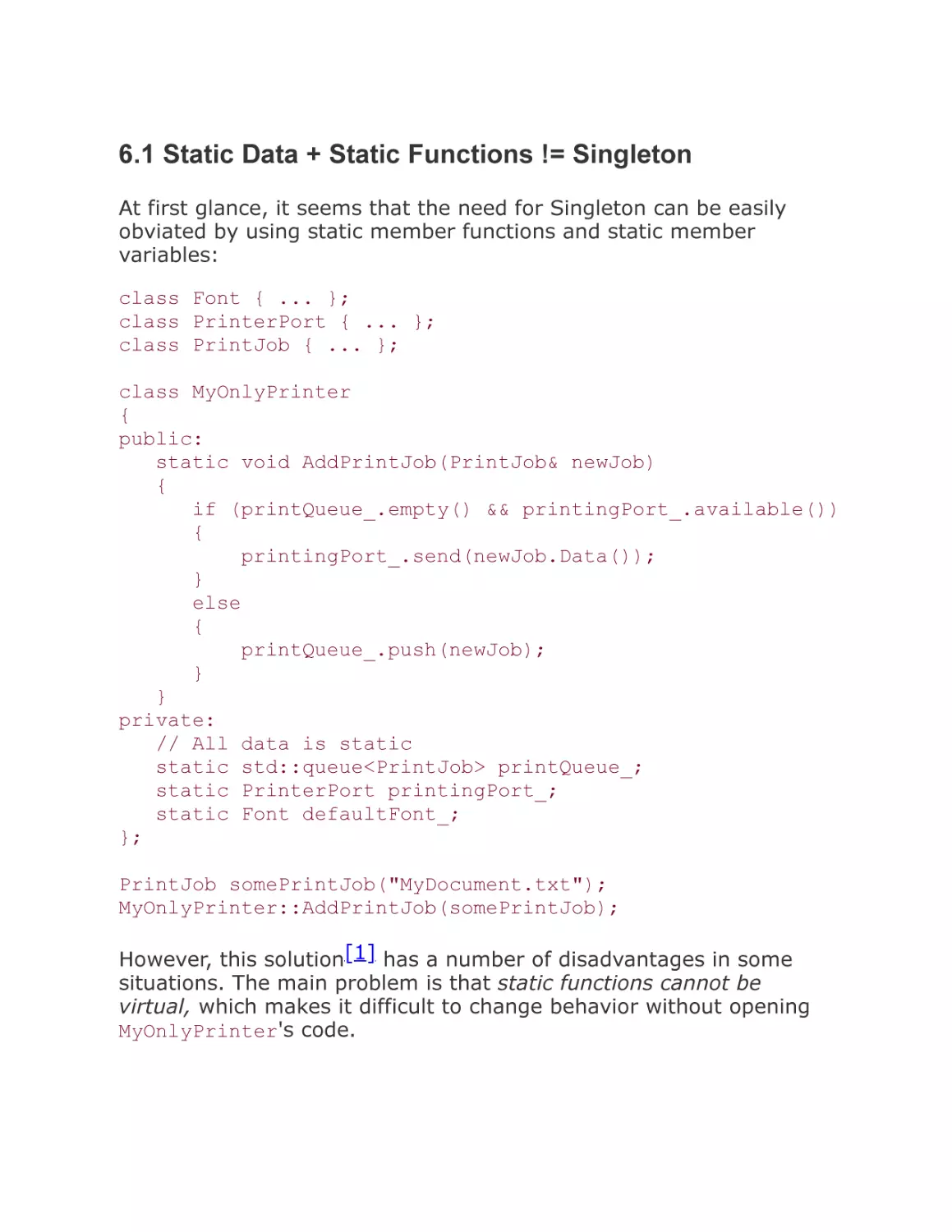
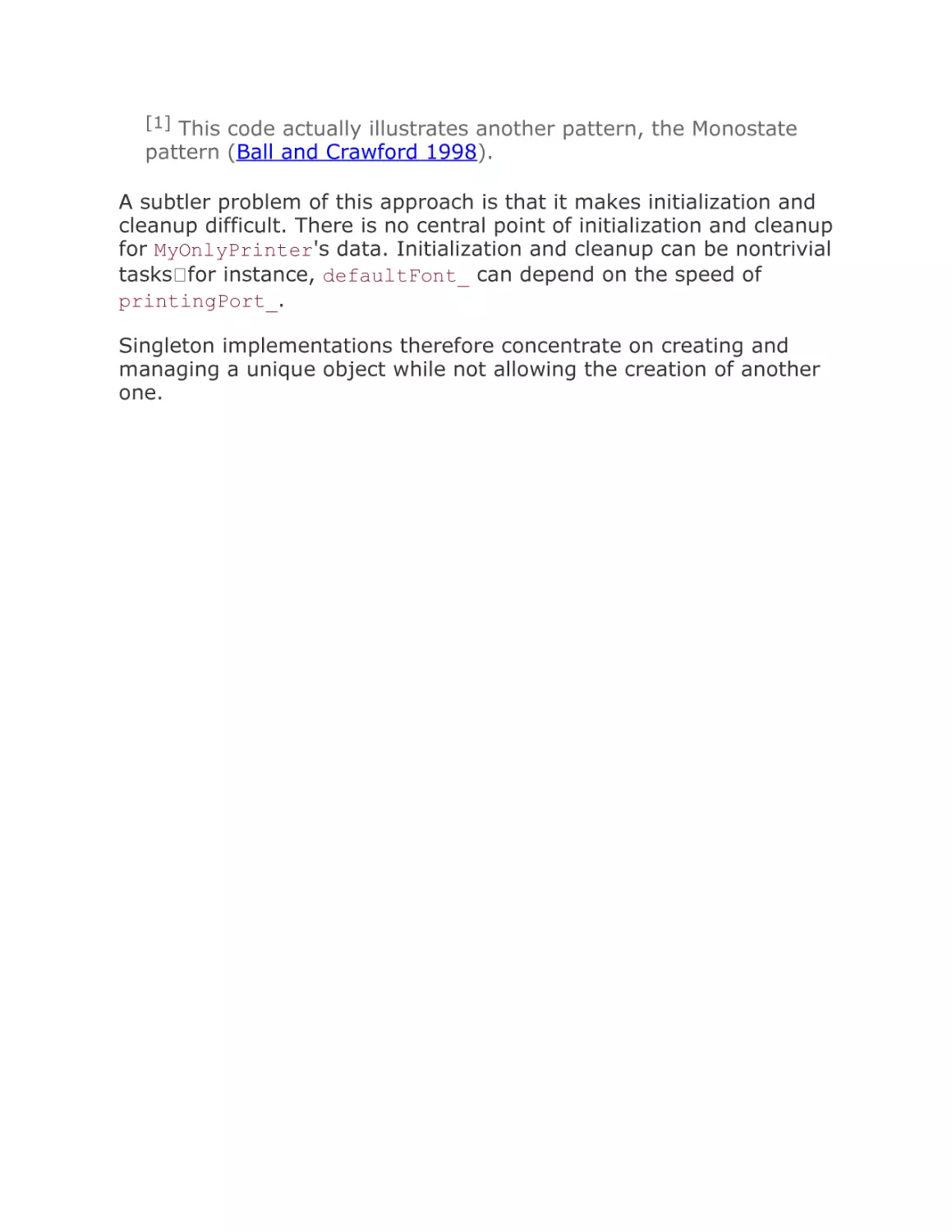
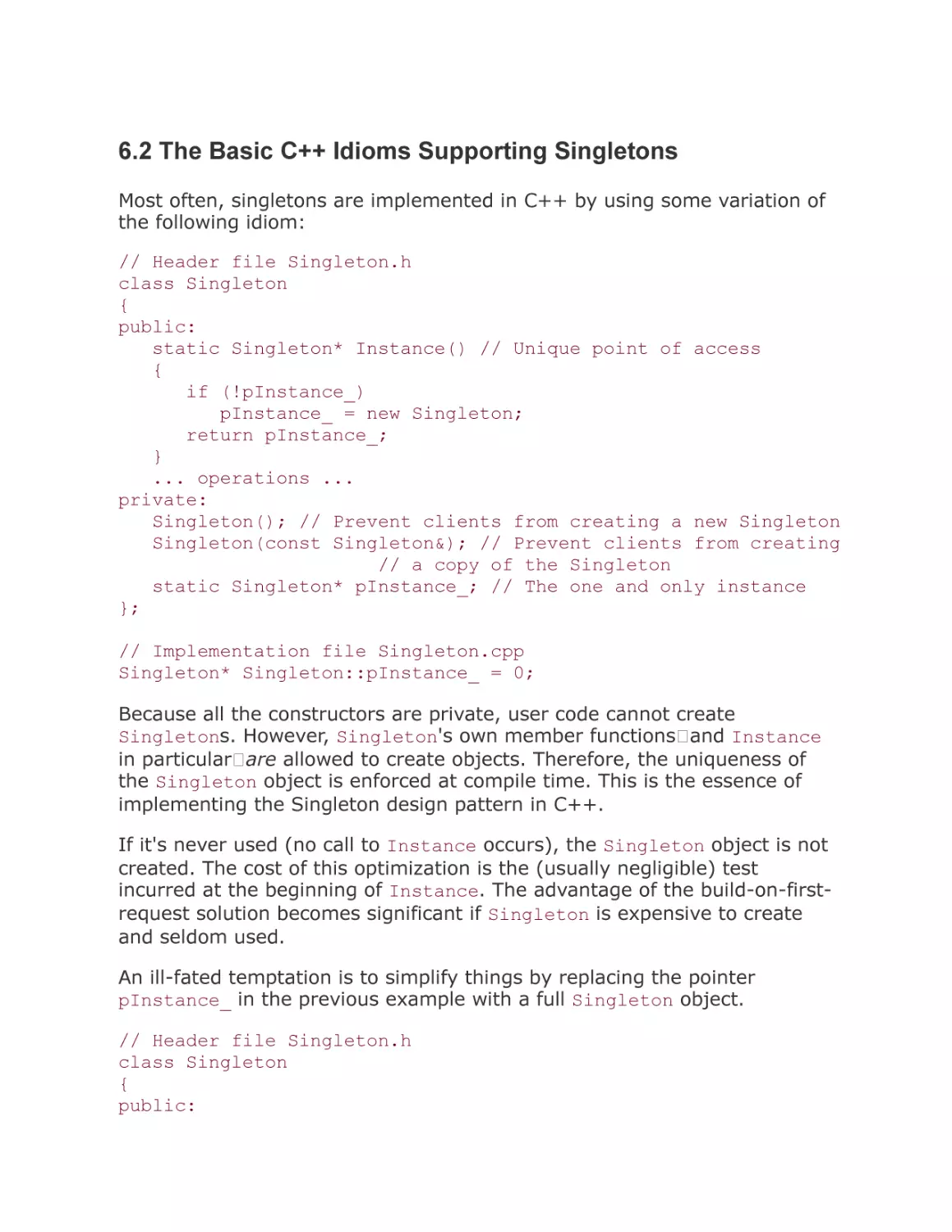

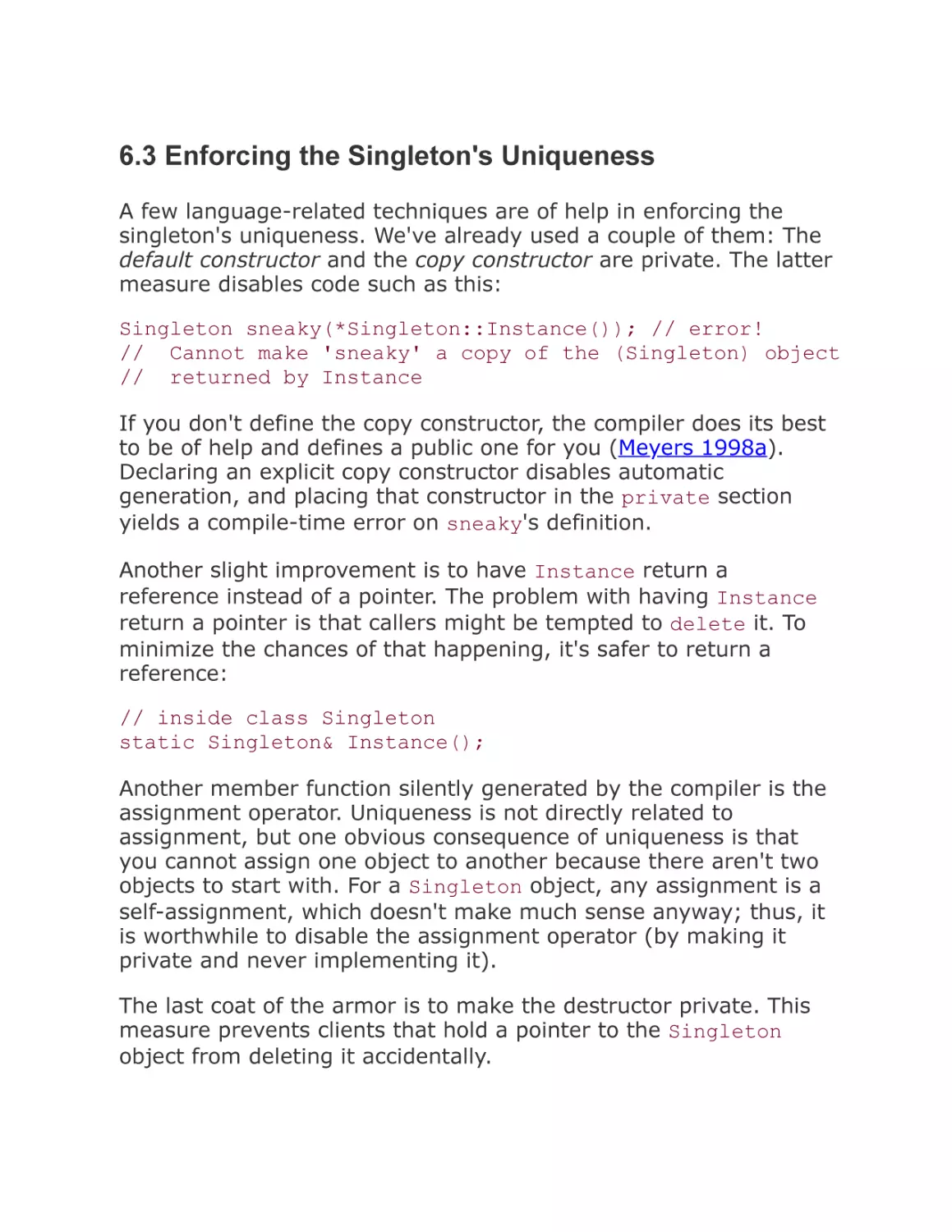





























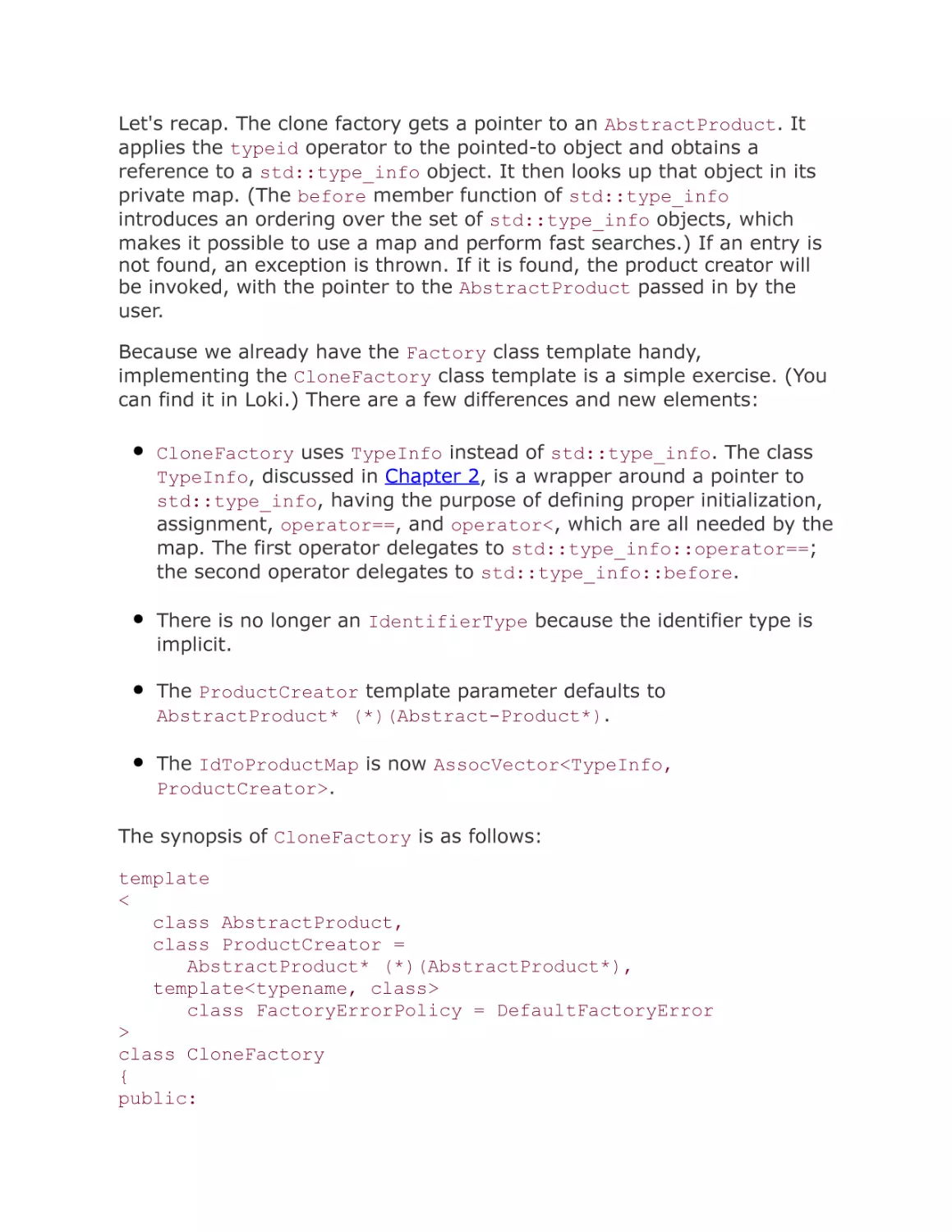
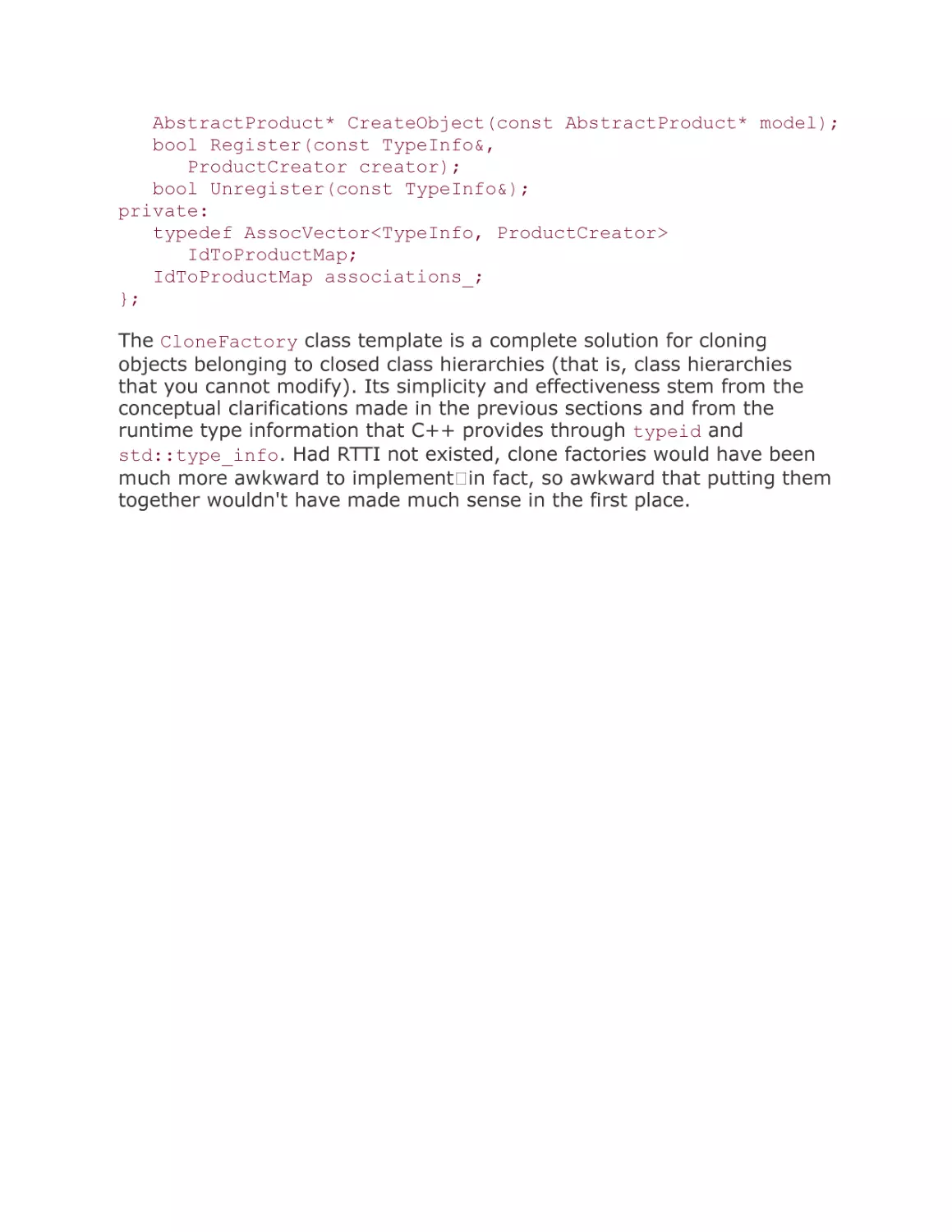

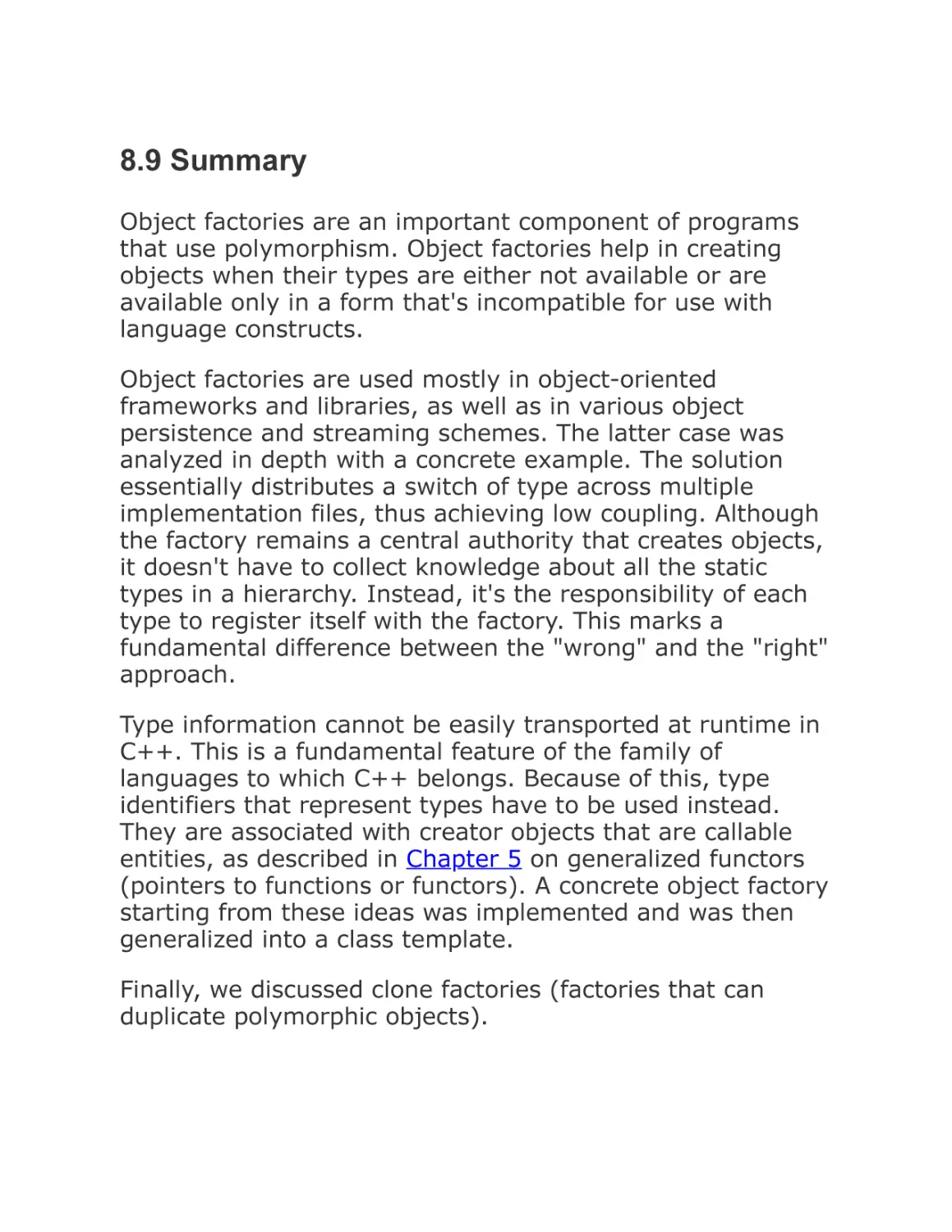

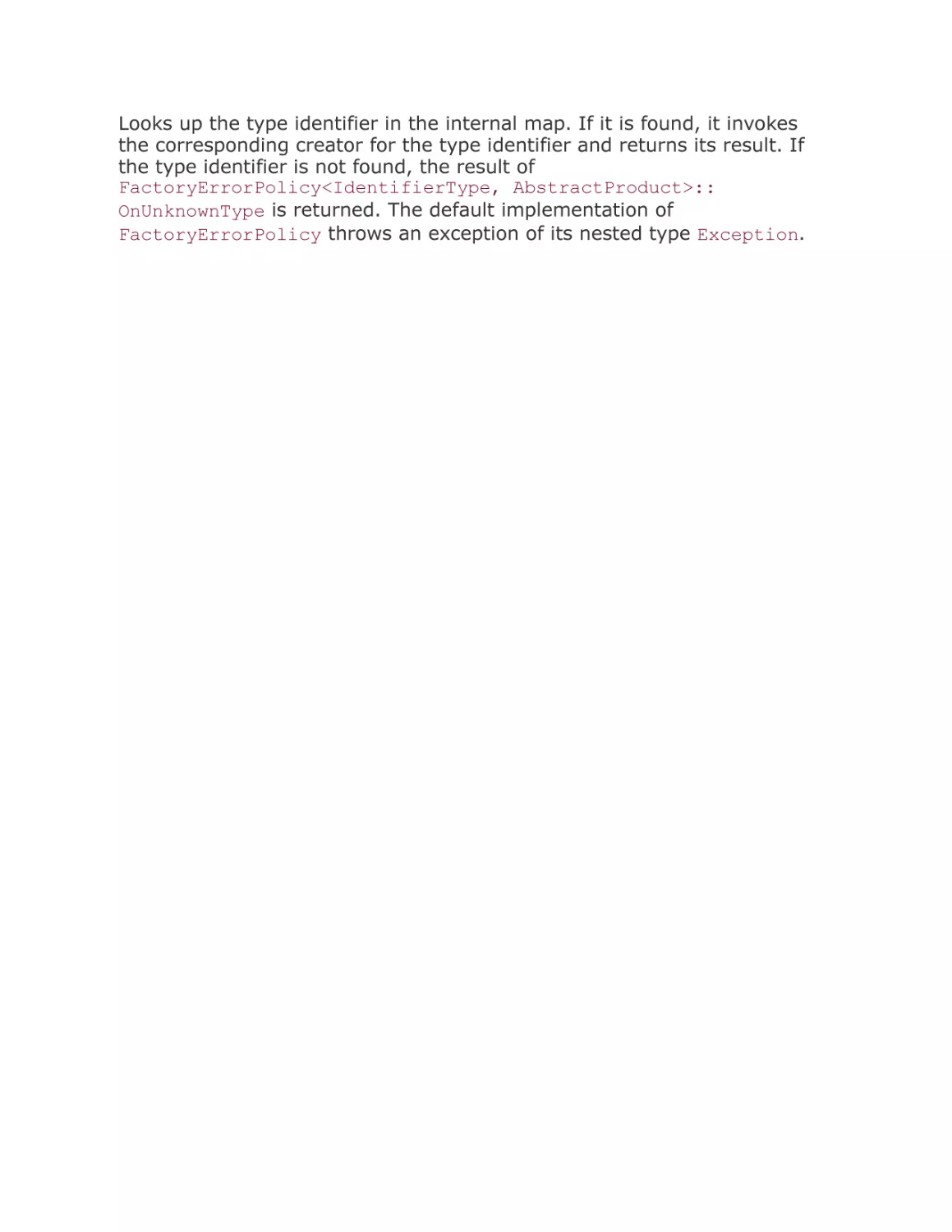




















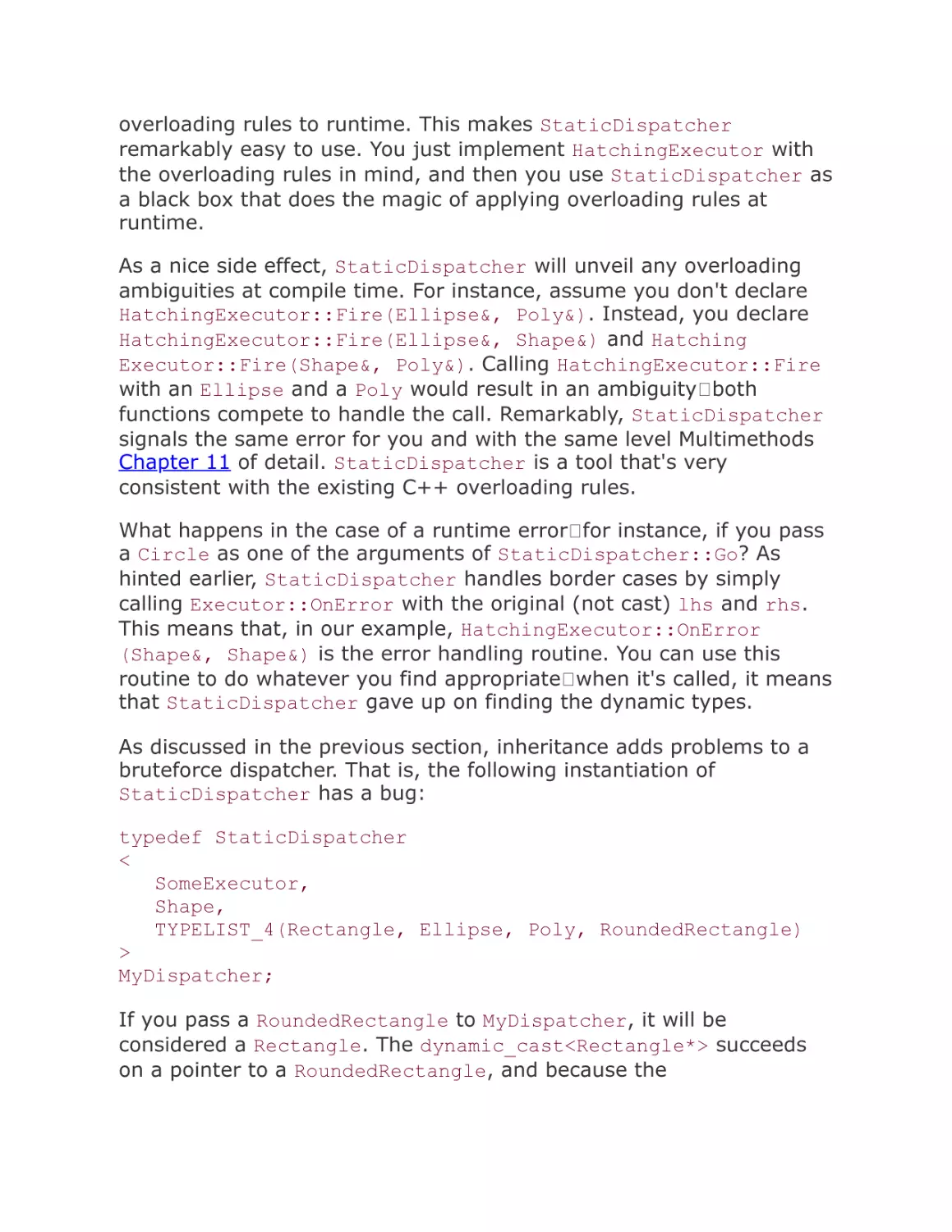
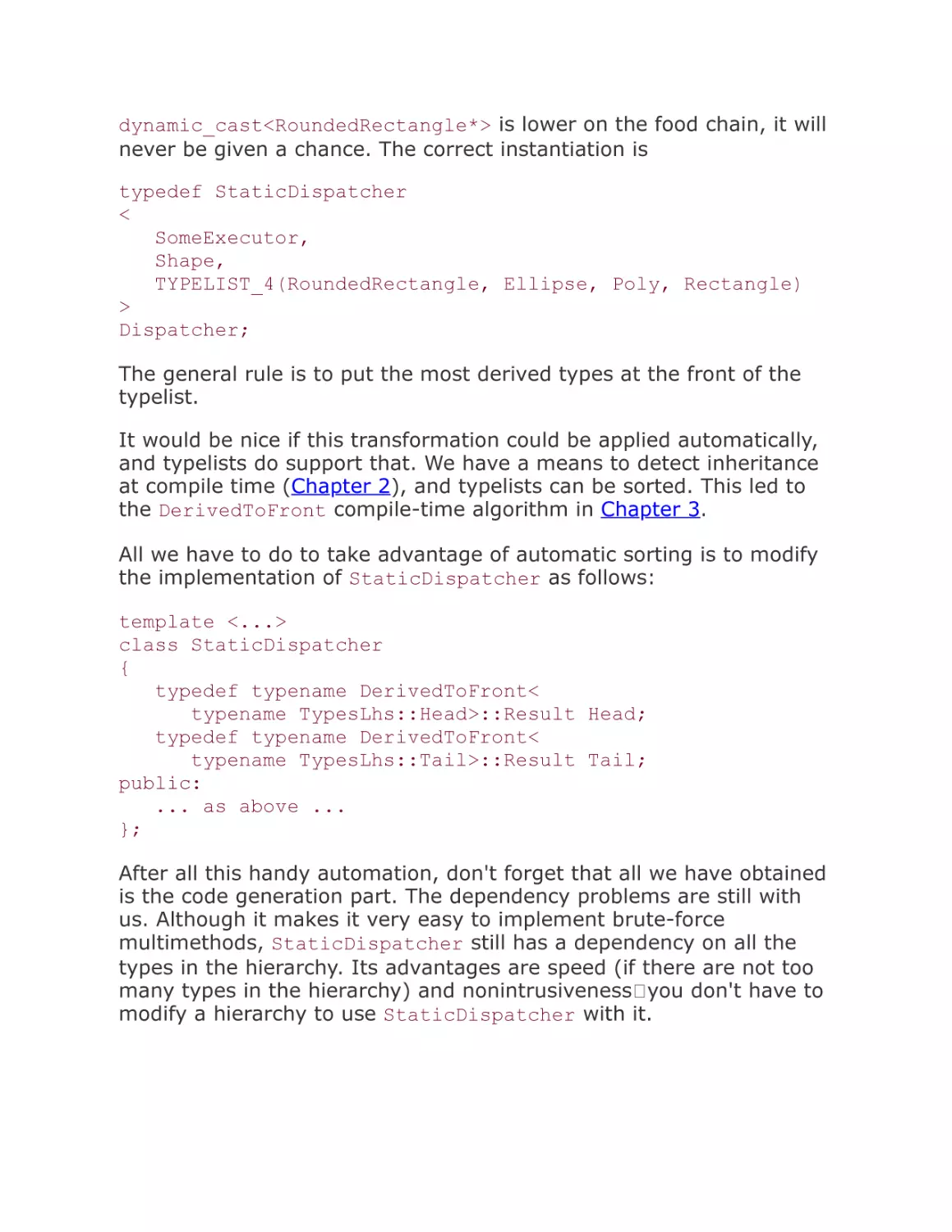
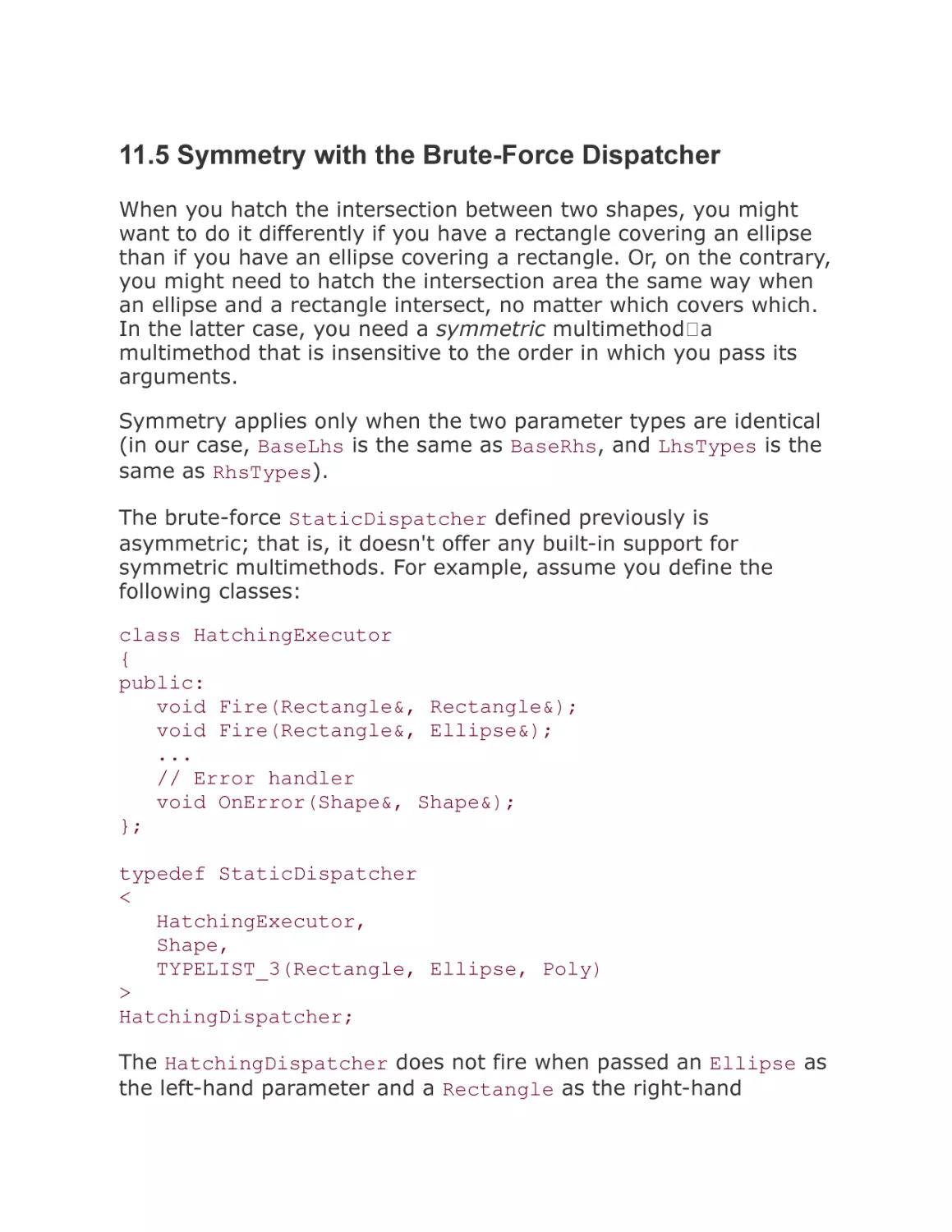
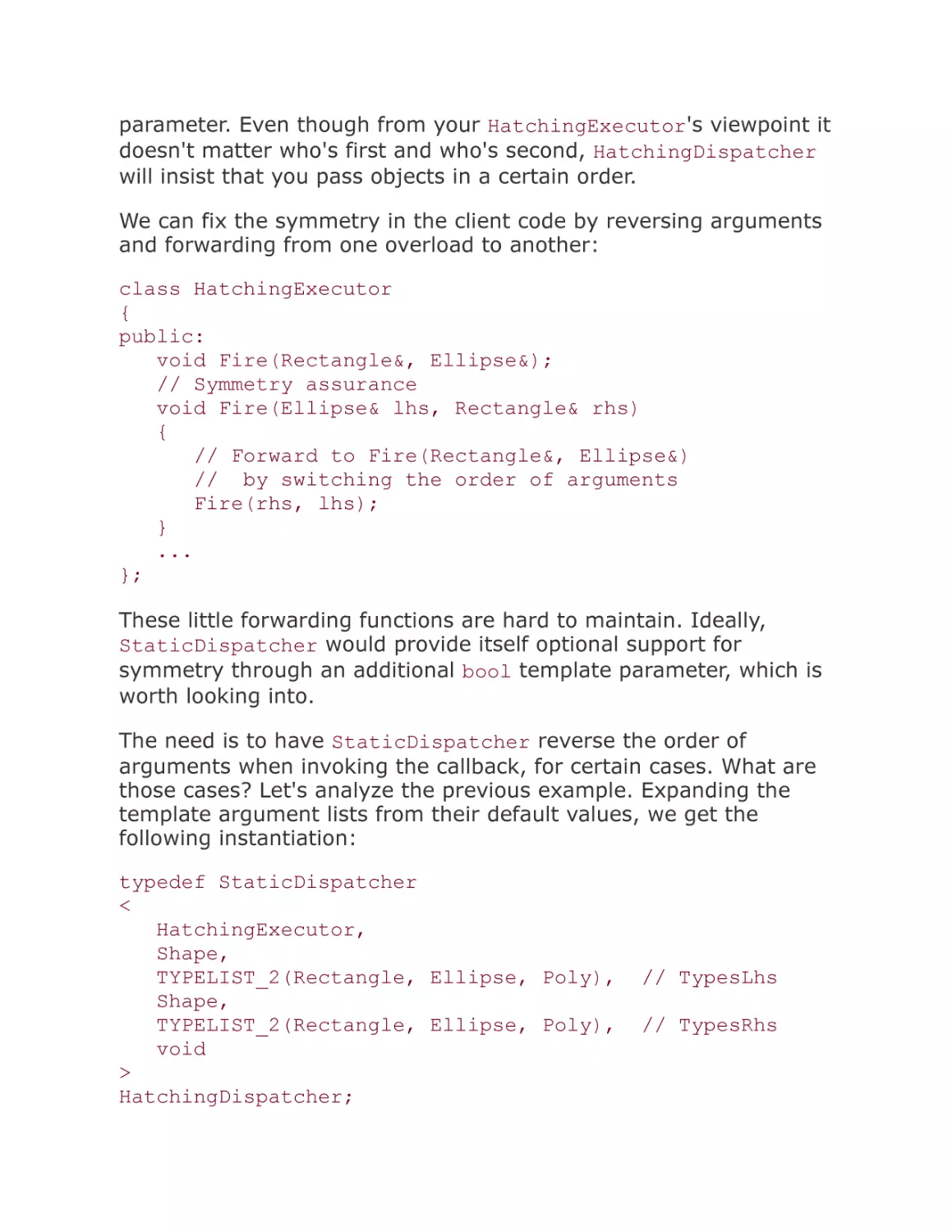




















Text
Main Page
Table of content
Copyright
Foreword by Scott Meyers
Foreword by John Vlissides
Preface
Audience
Loki
Organization
Acknowledgments
Part I: Techniques
Chapter 1. Policy-Based Class Design
1.1 The Multiplicity of Software Design
1.2 The Failure of the Do-It-All Interface
1.3 Multiple Inheritance to the Rescue?
1.4 The Benefit of Templates
1.5 Policies and Policy Classes
1.6 Enriched Policies
1.7 Destructors of Policy Classes
1.8 Optional Functionality Through Incomplete
Instantiation
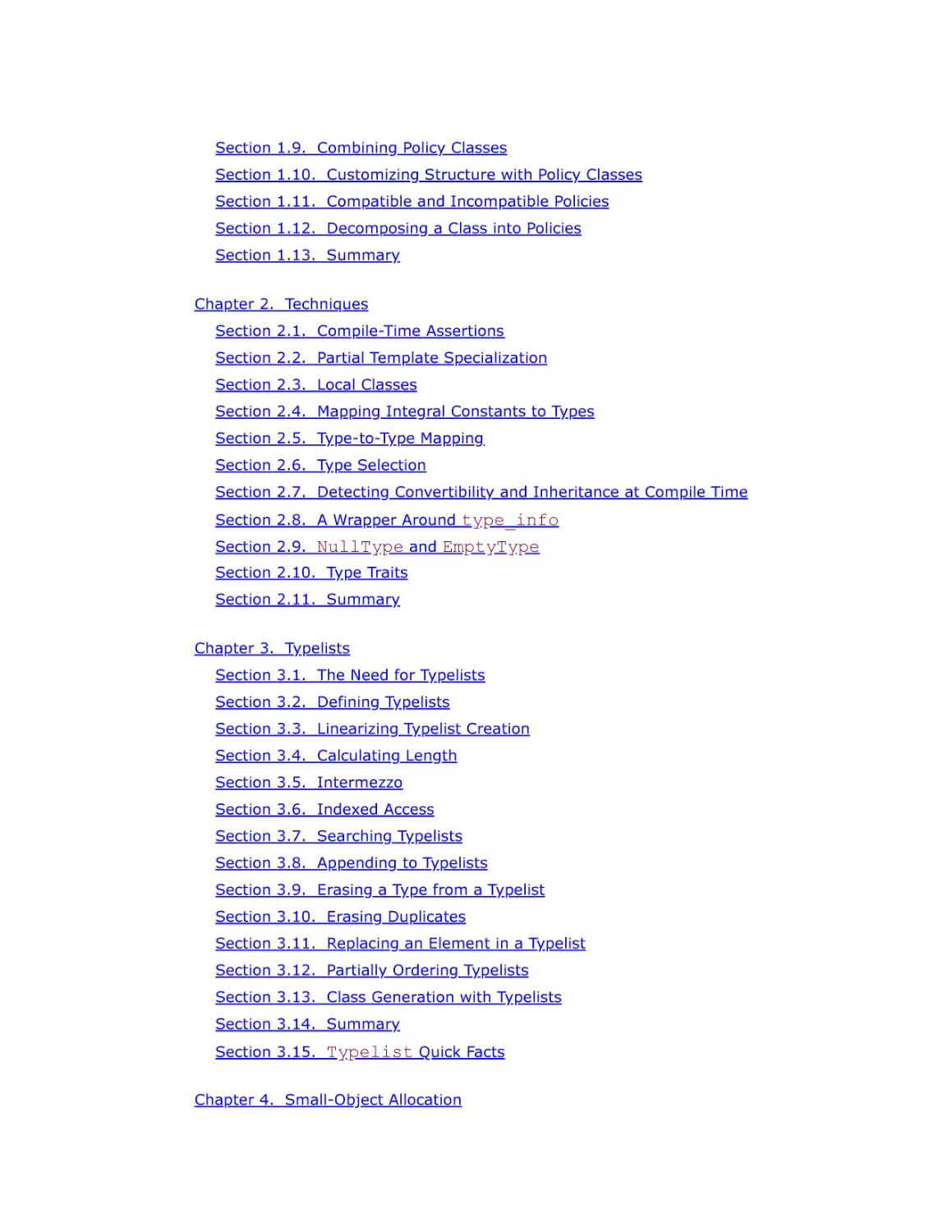
1.9 Combining Policy Classes
1.10 Customizing Structure with Policy Classes
1.11 Compatible and Incompatible Policies
1.12 Decomposing a Class into Policies
1.13 Summary
Chapter 2. Techniques
2.1 Compile-Time Assertions
2.2 Partial Template Specialization
2.3 Local Classes
2.4 Mapping Integral Constants to Types
2.5 Type-to-Type Mapping
2.6 Type Selection
2.7 Detecting Convertibility and Inheritance at
Compile Time
2.8 A Wrapper Around 'type_info'
2.9 'NullType' and 'EmptyType'
2.10 Type Traits
2.11 Summary
Chapter 3. Typelists
3.1 The Need for Typelists
3.2 Defining Typelists
3.3 Linearizing Typelist Creation
3.4 Calculating Length
3.5 Intermezzo
3.6 Indexed Access
3.7 Searching Typelists
3.8 Appending to Typelists
3.9 Erasing a Type from a Typelist
3.10 Erasing Duplicates
3.11 Replacing an Element in a Typelist
3.12 Partially Ordering Typelists
3.13 Class Generation with Typelists
3.14 Summary
3.15 'Typelist' Quick Facts
Chapter 4. Small-Object Allocation
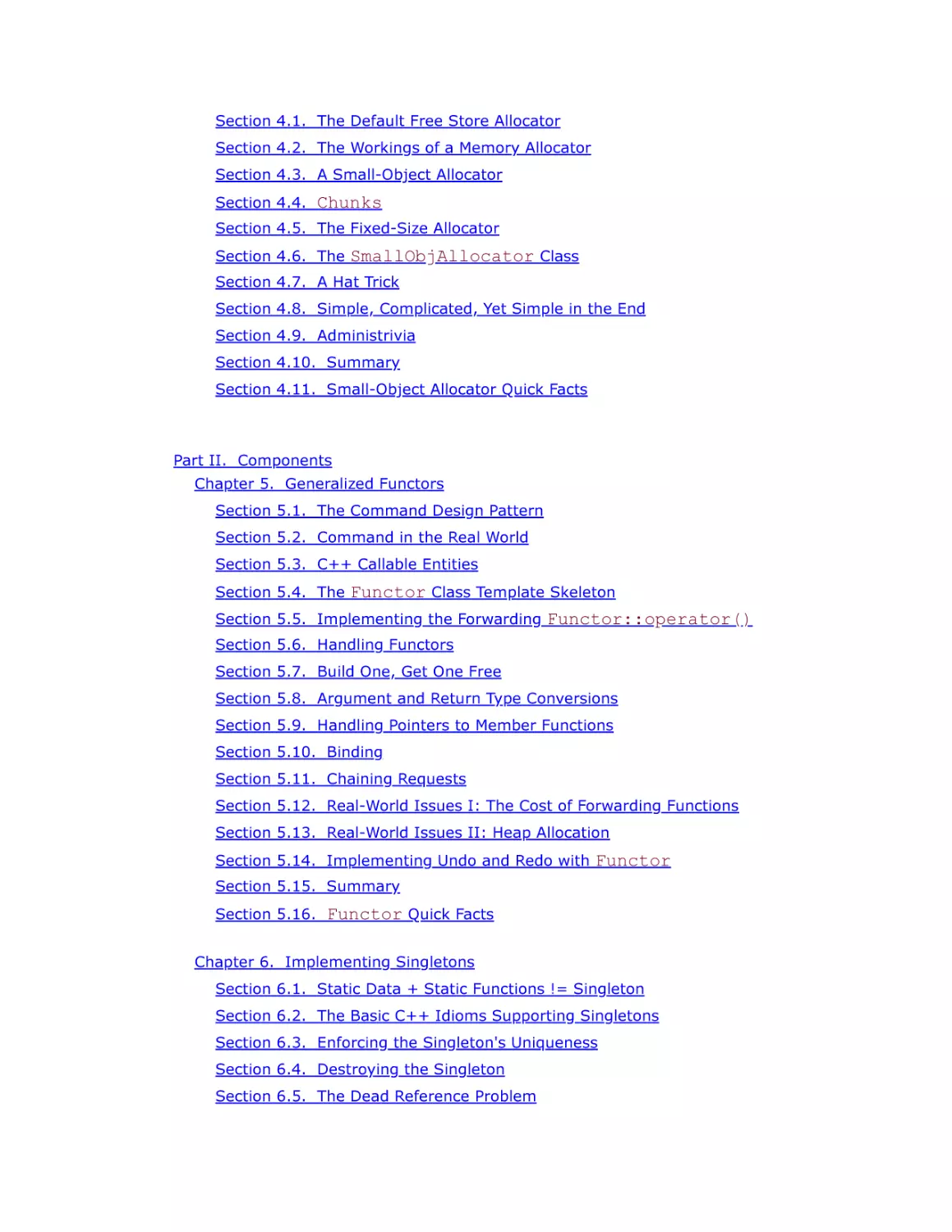
4.1 The Default Free Store Allocator
4.2 The Workings of a Memory Allocator
4.3 A Small-Object Allocator
4.4 'Chunks'
4.5 The Fixed-Size Allocator
4.6 The 'SmallObjAllocator' Class
4.7 A Hat Trick
4.8 Simple, Complicated, Yet Simple in the End
4.9 Administrivia
4.10 Summary
4.11 Small-Object Allocator Quick Facts
Part II: Components
Chapter 5. Generalized Functors
5.1 The Command Design Pattern
5.2 Command in the Real World
5.3 C++ Callable Entities
5.4 The 'Functor' Class Template Skeleton
5.5 Implementing the Forwarding 'Functor::operator()'
5.6 Handling Functors
5.7 Build One, Get One Free
5.8 Argument and Return Type Conversions
5.9 Handling Pointers to Member Functions
5.10 Binding
5.11 Chaining Requests
5.12 Real-World Issues I: The Cost of Forwarding
Functions
5.13 Real-World Issues II: Heap Allocation
5.14 Implementing Undo and Redo with 'Functor'
5.15 Summary
5.16 'Functor' Quick Facts
Chapter 6. Implementing Singletons
6.1 Static Data + Static Functions !=Singleton
6.2 The Basic C++ Idioms Supporting Singletons
6.3 Enforcing the Singleton's Uniqueness
6.4 Destroying the Singleton
6.5 The Dead Reference Problem
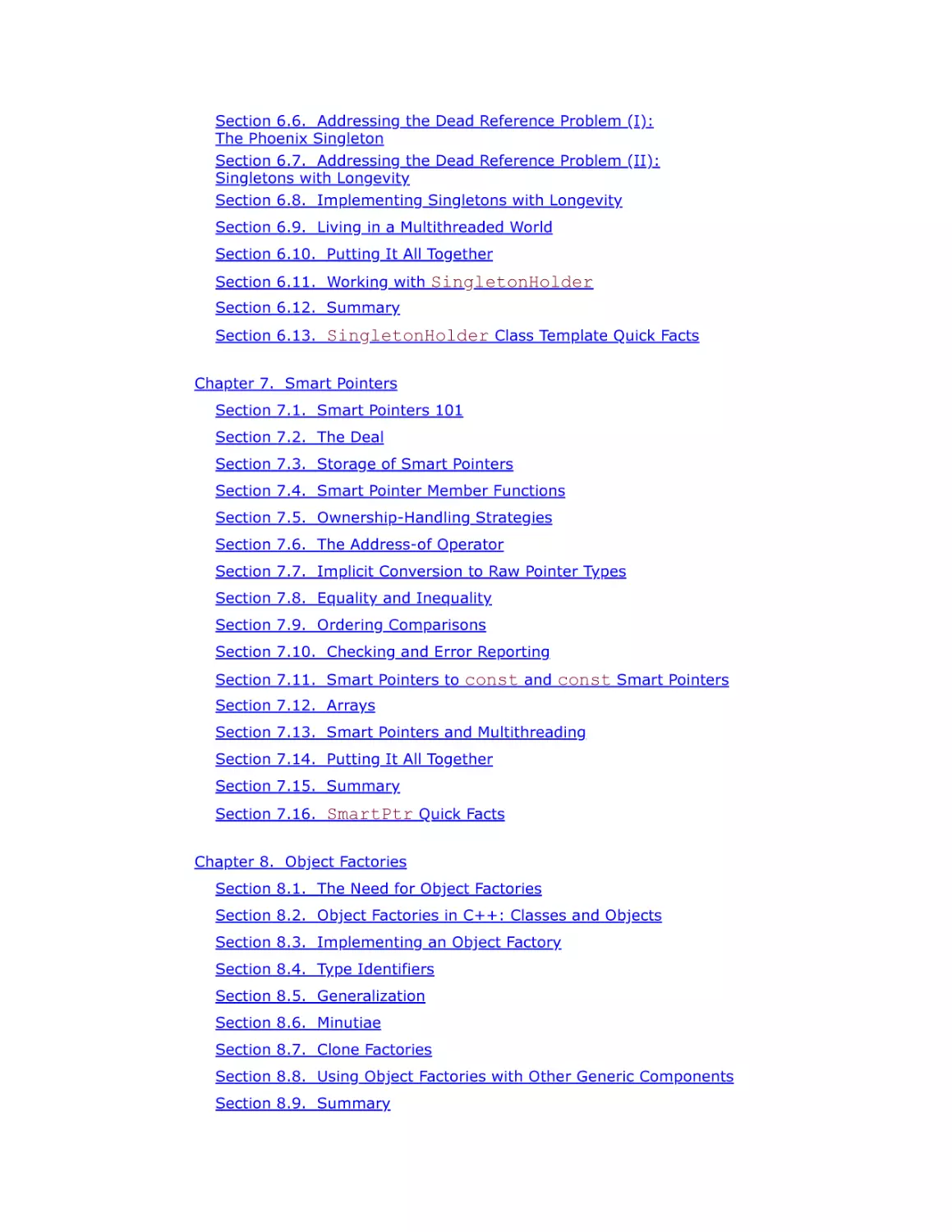
6.6 Addressing the Dead Reference Problem (I):' The
Phoenix Singleton
6.7 Addressing the Dead Reference Problem (II):'
Singletons with Longevity
6.8 Implementing Singletons with Longevity
6.9 Living in a Multithreaded World
6.10 Putting It All Together
6.11 Working with 'SingletonHolder'
6.12 Summary
6.13 'SingletonHolder' Class Template Quick Facts
Chapter 7. Smart Pointers
7.1 Smart Pointers 101
7.2 The Deal
7.3 Storage of Smart Pointers
7.4 Smart Pointer Member Functions
7.5 Ownership-Handling Strategies
7.6 The Address-of Operator
7.7 Implicit Conversion to Raw Pointer Types
7.8 Equality and Inequality
7.9 Ordering Comparisons
7.10 Checking and Error Reporting
7.11 Smart Pointers to 'const' and 'const' Smart
Pointers
7.12 Arrays
7.13 Smart Pointers and Multithreading
7.14 Putting It All Together
7.15 Summary
7.16 'SmartPtr' Quick Facts
Chapter 8. Object Factories
8.1 The Need for Object Factories
8.2 Object Factories in C++: Classes and Objects
8.3 Implementing an Object Factory
8.4 Type Identifiers
8.5 Generalization
8.6 Minutiae
8.7 Clone Factories
8.8 Using Object Factories with Other Generic
Components
8.9 Summary
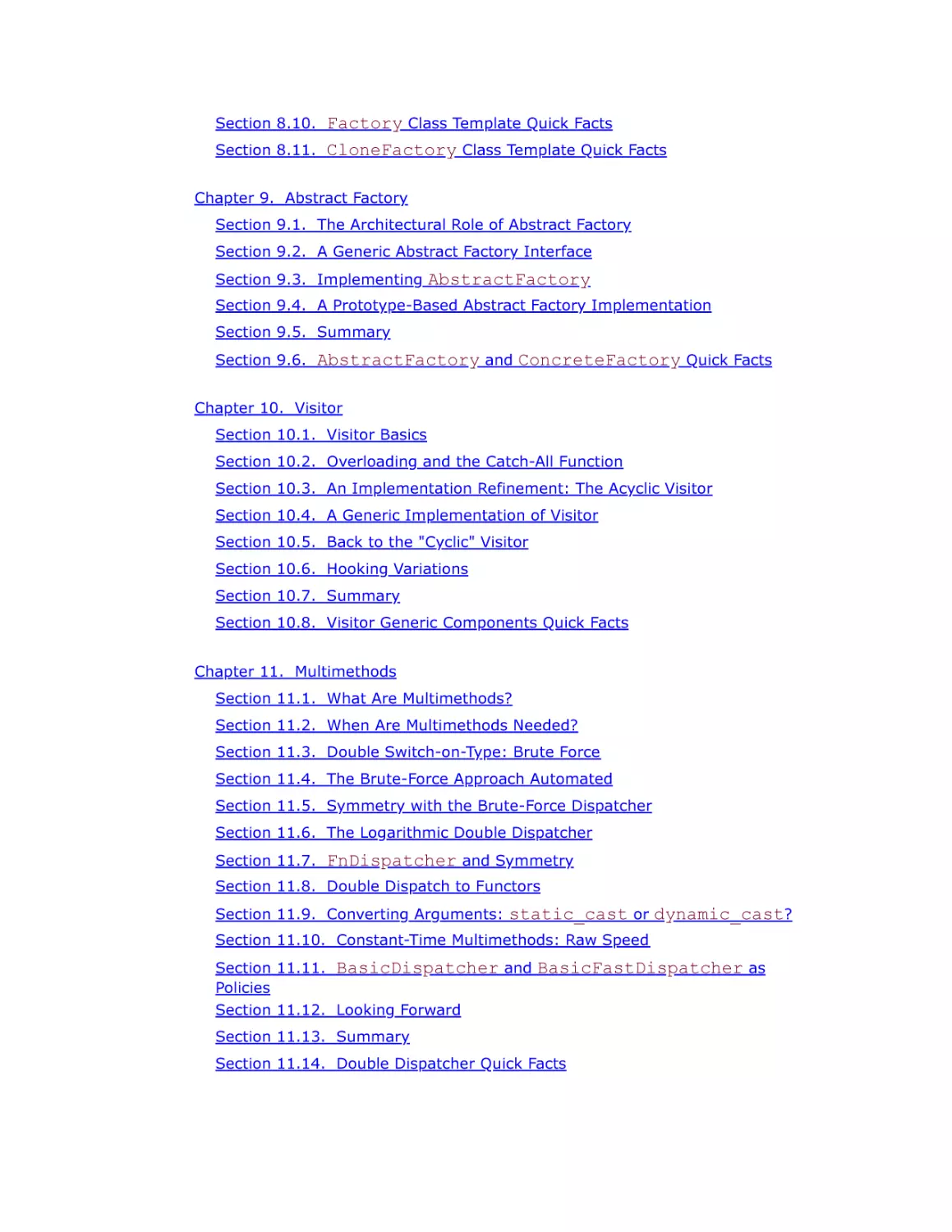
8.10 'Factory' Class Template Quick Facts
8.11 'CloneFactory' Class Template Quick Facts
Chapter 9. Abstract Factory
9.1 The Architectural Role of Abstract Factory
9.2 A Generic Abstract Factory Interface
9.3 Implementing 'AbstractFactory'
9.4 A Prototype-Based Abstract Factory
Implementation
9.5 Summary
9.6 'AbstractFactory' and 'ConcreteFactory' Quick
Facts
Chapter 10. Visitor
10.1 Visitor Basics
10.2 Overloading and the Catch-All Function
10.3 An Implementation Refinement: The Acyclic
Visitor
10.4 A Generic Implementation of Visitor
10.5 Back to the 'Cyclic' Visitor
10.6 Hooking Variations
10.7 Summary
10.8 Visitor Generic Components Quick Facts
Chapter 11. Multimethods
11.1 What Are Multimethods?
11.2 When Are Multimethods Needed?
11.3 Double Switch-on-Type: Brute Force
11.4 The Brute-Force Approach Automated
11.5 Symmetry with the Brute-Force Dispatcher
11.6 The Logarithmic Double Dispatcher
11.7 'FnDispatcher' and Symmetry
11.8 Double Dispatch to Functors
11.9 Converting Arguments: 'static_cast' or
'dynamic_cast'?
11.10 Constant-Time Multimethods: Raw Speed
11.11 'BasicDispatcher' and 'BasicFastDispatcher' as
Policies
11.12 Looking Forward
11.13 Summary
11.14 Double Dispatcher Quick Facts
A Minimalist Multithreading Library
A.1 A Critique of Multithreading
A.2 Loki's Approach
A.3 Atomic Operations on Integral Types
A.4 Mutexes
A.5 Locking Semantics in Object-Oriented
Programming
A.6 Optional 'volatile' Modifier
A.7 Semaphores, Events, and Other Good Things
A.8 Summary
Bibliography
•
Table of Contents
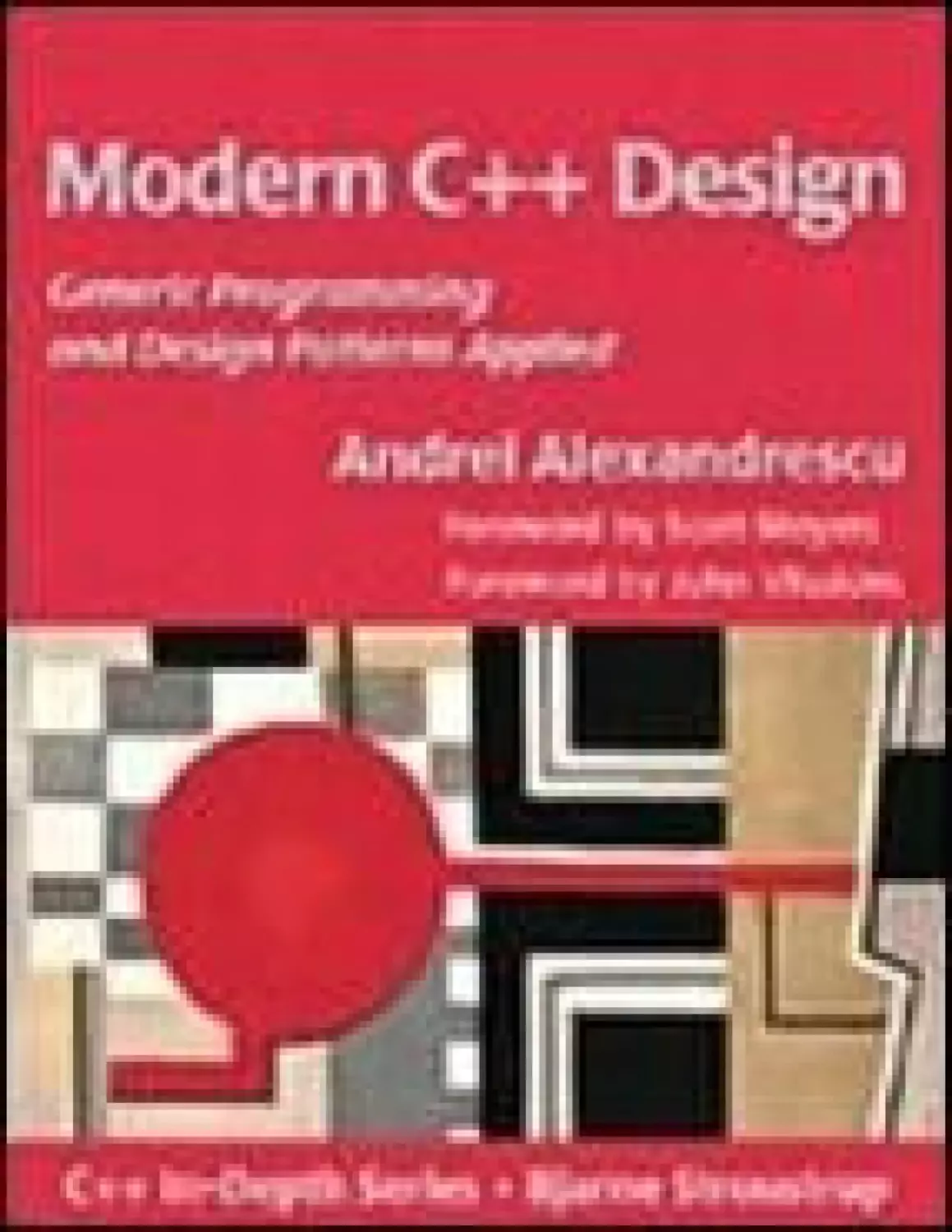
Modern C++ Design: Generic
Programming and Design Patterns
Applied
By Andrei Alexandrescu
Publisher : Addison Wesley
Pub Date
: February 01, 2001
ISBN
: 0-201-70431-5
Pages
: 352
Modern C++ Design is an important book. Fundamentally, it
demonstrates 'generic patterns' or 'pattern templates' as a
powerful new way of creating extensible designs in C++--a
new way to combine templates and patterns that you may
never have dreamt was possible, but is. If your work
involves C++ design and coding, you should read this book.
Highly recommended.-Herb Sutter
What's left to say about C++ that hasn't already been said?
Plenty, it turns out.-From the Foreword by John Vlissides
In Modern C++ Design, Andrei Alexandrescu opens new
vistas for C++ programmers. Displaying extraordinary
creativity and programming virtuosity, Alexandrescu offers a
cutting-edge approach to design that unites design
patterns, generic programming, and C++, enabling
programmers to achieve expressive, flexible, and highly
reusable code.
This book introduces the concept of generic componentsreusable design templates that produce boilerplate code for
compiler consumption-all within C++. Generic components
enable an easier and more seamless transition from design
to application code, generate code that better expresses the
original design intention, and support the reuse of design
structures with minimal recoding.
The author describes the specific C++ techniques and
features that are used in building generic components and
goes on to implement industrial strength generic
components for real-world applications. Recurring issues
that C++ developers face in their day-to-day activity are
discussed in depth and implemented in a generic way.
These include:
Policy-based design for flexibility
Partial template specialization
Typelists-powerful type manipulation structures
Patterns such as Visitor, Singleton, Command, and
Factories
Multi-method engines
For each generic component, the book presents the
fundamental problems and design options, and finally
implements a generic solution.
In addition, an accompanying Web site,
http://www.awl.com/cseng/titles/0-201-70431-5, makes
the code implementations available for the generic
components in the book and provides a free, downloadable
C++ library, called Loki, created by the author. Loki
provides out-of-the-box functionality for virtually any C++
project.
•
Table of Contents
Modern C++ Design: Generic
Programming and Design Patterns
Applied
By Andrei Alexandrescu
Publisher : Addison Wesley
Pub Date
: February 01, 2001
ISBN
: 0-201-70431-5
Pages
: 352
Copyright
Foreword
Foreword
Preface
Audience
Loki
Organization
Acknowledgments
Part I. Techniques
Chapter 1. Policy-Based Class Design
Section 1.1. The Multiplicity of Software Design
Section 1.2. The Failure of the Do-It-All Interface
Section 1.3. Multiple Inheritance to the Rescue?
Section 1.4. The Benefit of Templates
Section 1.5. Policies and Policy Classes
Section 1.6. Enriched Policies
Section 1.7. Destructors of Policy Classes
Section 1.8. Optional Functionality Through Incomplete Instantiation
Section 1.9. Combining Policy Classes
Section 1.10. Customizing Structure with Policy Classes
Section 1.11. Compatible and Incompatible Policies
Section 1.12. Decomposing a Class into Policies
Section 1.13. Summary
Chapter 2. Techniques
Section 2.1. Compile-Time Assertions
Section 2.2. Partial Template Specialization
Section 2.3. Local Classes
Section 2.4. Mapping Integral Constants to Types
Section 2.5. Type-to-Type Mapping
Section 2.6. Type Selection
Section 2.7. Detecting Convertibility and Inheritance at Compile Time
Section 2.8. A Wrapper Around type_info
Section 2.9. NullType and EmptyType
Section 2.10. Type Traits
Section 2.11. Summary
Chapter 3. Typelists
Section 3.1. The Need for Typelists
Section 3.2. Defining Typelists
Section 3.3. Linearizing Typelist Creation
Section 3.4. Calculating Length
Section 3.5. Intermezzo
Section 3.6. Indexed Access
Section 3.7. Searching Typelists
Section 3.8. Appending to Typelists
Section 3.9. Erasing a Type from a Typelist
Section 3.10. Erasing Duplicates
Section 3.11. Replacing an Element in a Typelist
Section 3.12. Partially Ordering Typelists
Section 3.13. Class Generation with Typelists
Section 3.14. Summary
Section 3.15. Typelist Quick Facts
Chapter 4. Small-Object Allocation
Section 4.1. The Default Free Store Allocator
Section 4.2. The Workings of a Memory Allocator
Section 4.3. A Small-Object Allocator
Section 4.4. Chunks
Section 4.5. The Fixed-Size Allocator
Section 4.6. The SmallObjAllocator Class
Section 4.7. A Hat Trick
Section 4.8. Simple, Complicated, Yet Simple in the End
Section 4.9. Administrivia
Section 4.10. Summary
Section 4.11. Small-Object Allocator Quick Facts
Part II. Components
Chapter 5. Generalized Functors
Section 5.1. The Command Design Pattern
Section 5.2. Command in the Real World
Section 5.3. C++ Callable Entities
Section 5.4. The Functor Class Template Skeleton
Section 5.5. Implementing the Forwarding Functor::operator()
Section 5.6. Handling Functors
Section 5.7. Build One, Get One Free
Section 5.8. Argument and Return Type Conversions
Section 5.9. Handling Pointers to Member Functions
Section 5.10. Binding
Section 5.11. Chaining Requests
Section 5.12. Real-World Issues I: The Cost of Forwarding Functions
Section 5.13. Real-World Issues II: Heap Allocation
Section 5.14. Implementing Undo and Redo with Functor
Section 5.15. Summary
Section 5.16. Functor Quick Facts
Chapter 6. Implementing Singletons
Section 6.1. Static Data + Static Functions != Singleton
Section 6.2. The Basic C++ Idioms Supporting Singletons
Section 6.3. Enforcing the Singleton's Uniqueness
Section 6.4. Destroying the Singleton
Section 6.5. The Dead Reference Problem
Section 6.6. Addressing the Dead Reference Problem (I):
The Phoenix Singleton
Section 6.7. Addressing the Dead Reference Problem (II):
Singletons with Longevity
Section 6.8. Implementing Singletons with Longevity
Section 6.9. Living in a Multithreaded World
Section 6.10. Putting It All Together
Section 6.11. Working with SingletonHolder
Section 6.12. Summary
Section 6.13. SingletonHolder Class Template Quick Facts
Chapter 7. Smart Pointers
Section 7.1. Smart Pointers 101
Section 7.2. The Deal
Section 7.3. Storage of Smart Pointers
Section 7.4. Smart Pointer Member Functions
Section 7.5. Ownership-Handling Strategies
Section 7.6. The Address-of Operator
Section 7.7. Implicit Conversion to Raw Pointer Types
Section 7.8. Equality and Inequality
Section 7.9. Ordering Comparisons
Section 7.10. Checking and Error Reporting
Section 7.11. Smart Pointers to const and const Smart Pointers
Section 7.12. Arrays
Section 7.13. Smart Pointers and Multithreading
Section 7.14. Putting It All Together
Section 7.15. Summary
Section 7.16. SmartPtr Quick Facts
Chapter 8. Object Factories
Section 8.1. The Need for Object Factories
Section 8.2. Object Factories in C++: Classes and Objects
Section 8.3. Implementing an Object Factory
Section 8.4. Type Identifiers
Section 8.5. Generalization
Section 8.6. Minutiae
Section 8.7. Clone Factories
Section 8.8. Using Object Factories with Other Generic Components
Section 8.9. Summary
Section 8.10. Factory Class Template Quick Facts
Section 8.11. CloneFactory Class Template Quick Facts
Chapter 9. Abstract Factory
Section 9.1. The Architectural Role of Abstract Factory
Section 9.2. A Generic Abstract Factory Interface
Section 9.3. Implementing AbstractFactory
Section 9.4. A Prototype-Based Abstract Factory Implementation
Section 9.5. Summary
Section 9.6. AbstractFactory and ConcreteFactory Quick Facts
Chapter 10. Visitor
Section 10.1. Visitor Basics
Section 10.2. Overloading and the Catch-All Function
Section 10.3. An Implementation Refinement: The Acyclic Visitor
Section 10.4. A Generic Implementation of Visitor
Section 10.5. Back to the "Cyclic" Visitor
Section 10.6. Hooking Variations
Section 10.7. Summary
Section 10.8. Visitor Generic Components Quick Facts
Chapter 11. Multimethods
Section 11.1. What Are Multimethods?
Section 11.2. When Are Multimethods Needed?
Section 11.3. Double Switch-on-Type: Brute Force
Section 11.4. The Brute-Force Approach Automated
Section 11.5. Symmetry with the Brute-Force Dispatcher
Section 11.6. The Logarithmic Double Dispatcher
Section 11.7. FnDispatcher and Symmetry
Section 11.8. Double Dispatch to Functors
Section 11.9. Converting Arguments: static_cast or dynamic_cast?
Section 11.10. Constant-Time Multimethods: Raw Speed
Section 11.11. BasicDispatcher and BasicFastDispatcher as
Policies
Section 11.12. Looking Forward
Section 11.13. Summary
Section 11.14. Double Dispatcher Quick Facts
Appendix A Minimalist Multithreading Library
Section A.1. A Critique of Multithreading
Section A.2. Loki's Approach
Section A.3. Atomic Operations on Integral Types
Section A.4. Mutexes
Section A.5. Locking Semantics in Object-Oriented Programming
Section A.6. Optional volatile Modifier
Section A.7. Semaphores, Events, and Other Good Things
Section A.8. Summary
Bibliography
Copyright
Many of the designations used by manufacturers and sellers
to distinguish their products are claimed as trademarks.
Where those designations appear in this book, and AddisonWesley was aware of a trademark claim, the designations
have been printed with initial capital letters or in all capitals.
The author and publisher have taken care in the preparation
of this book, but make no expressed or implied warranty of
any kind and assume no responsibility for errors or
omissions. No liability is assumed for incidental or
consequential damages in connection with or arising out of
the use of the information or programs contained herein.
The publisher offers discounts on this book when ordered in
quantity for special sales. For more information, please
contact:
Pearson Education Corporate Sales Division
One Lake Street
Upper Saddle River, NJ 07458
(800) 382-3419
corpsales@pearsontechgroup.com
Visit AWon the Web: www.awl.com/cseng/
Library of Congress Cataloging-in-Publication Data
Alexandrescu, Andrei.
Modern C++ design : generic programming and design
patterns applied / Andrei Alexandrescu.
p. cm.
(C++ in depth series)
Includes bibliographical references and index.
ISBN 0-201-70431-5
1. C++ (Computer program language) 2. Generic
programming (Computer science) I. Title. II. Series.
QA76.73.C153 A42 2001
005.13'3 dc21 00-049596
Copyright © 2001 by Addison-Wesley
All rights reserved. No part of this publication may be
reproduced, stored in a retrieval system, or transmitted, in
any form, or by any means, electronic, mechanical,
photocopying, recording, or otherwise, without the prior
consent of the publisher. Printed in the United States of
America. Published simultaneously in Canada.
Text printed on recycled paper
2 3 4 5 6 7 8 9 10 DOC 0504030201
Second printing, June 2001
Foreword
by Scott Meyers
In 1991, I wrote the first edition of Effective C++. The book contained almost no
discussions of templates, because templates were such a recent addition to the
language, I knew almost nothing about them. What little template code I
included, I had verified by e-mailing it to other people, because none of the
compilers to which I had access offered support for templates.
In 1995, I wrote More Effective C++. Again I wrote almost nothing about
templates. What stopped me this time was neither a lack of knowledge of
templates (my initial outline for the book included an entire chapter on the topic)
nor shortcomings on the part of my compilers. Instead, it was a suspicion that the
C++ community's understanding of templates was about to undergo such
dramatic change, anything I had to say about them would soon be considered
trite, superficial, or just plain wrong.
There were two reasons for that suspicion. The first was a column by John Barton
and Lee Nackman in the January 1995 C++ Report that described how templates
could be used to perform typesafe dimensional analysis with zero runtime cost.
This was a problem I'd spent some time on myself, and I knew that many had
searched for a solution, but none had succeeded. Barton and Nackman's
revolutionary approach made me realize that templates were good for a lot more
than just creating containers of T.
As an example of their design, consider this code for multiplying two physical
quantities of arbitrary dimensional type:
template<int m1, int l1, int t1, int m2, int l2, int t2>
Physical<m1+m2, l1+l2, t1+t2> operator*(Physical<m1, l1, t1> lhs,
Physical<m2, l2, t2> rhs)
{
return Physical<m1+m2, l1+l2, t1+t2>::unit*lhs.value()*rhs.value();
}
Even without the context of the column to clarify this code, it's clear that this
function template takes six parameters, none of which represents a type! This use
of templates was such a revelation to me, I was positively giddy.
Shortly thereafter, I started reading about the STL. Alexander Stepanov's elegant
li brary design, where containers know nothing about algorithms; algorithms
know nothing about containers; iterators act like pointers (but may be objects
instead); containers and algorithms accept function pointers and function objects
with equal aplomb; and library clients may extend the library without having to
inherit from any base classes or redefine any virtual functions, made me feel as I
had when I read Barton and Nackman's work like I knew almost nothing about
templates.
So I wrote almost nothing about them in More Effective C++. How could I? My
understanding of templates was still at the containers-of-T stage, while Barton,
Nackman, Stepanov, and others were demonstrating that such uses barely
scratched the surface of what templates could do.
In 1998, Andrei Alexandrescu and I began an e-mail correspondence, and it was
not long before I recognized that I was again about to modify my thinking about
templates. Where Barton, Nackman, and Stepanov had stunned me with what
templates could do, however, Andrei's work initially made more of an impression
on me for how it did what it did.
One of the simplest things he helped popularize continues to be the example I use
when introducing people to his work. It's the CTAssert template, analogous in
use to the assert macro, but applied to conditions that can be evaluated during
compilation. Here it is:
template<bool> struct CTAssert;
template<> struct CTAssert<true> {};
That's it. Notice how the general template, CTAssert, is never defined. Notice
how there is a specialization for true, but not for false. In this design, what's
missing is at least as important as what's present. It makes you look at template
code in a new way, because large portions of the "source code" are deliberately
omitted. That's a very different way of thinking from the one most of us are used
to. (In this book, Andrei discusses the more sophisticated CompileTimeChecker
template instead of CTAssert.)
Eventually, Andrei turned his attention to the development of template-based
implementations of popular language idioms and design patterns, especially the
GoF[*] patterns. This led to a brief skirmish with the Patterns community,
because one of their fundamental tenets is that patterns cannot be represented in
code. Once it became clear that Andrei was automating the generation of pattern
implementations rather than trying to encode patterns themselves, that objection
was removed, and I was pleased to see Andrei and one of the GoF (John
Vlissides) collaborate on two columns in the C++ Report focusing on Andrei's
work.
[*] "GoF" stands for "Gang of Four" and refers to Erich Gamma, Richard
Helm, Ralph Johnson, and John Vlissides, authors of the definitive book on
patterns, Design Patterns: Elements of Reusable Object-Oriented Software
(Addison-Wesley, 1995).
In the course of developing the templates to generate idiom and pattern
implementations, Andrei was forced to confront the variety of design decisions
that all implementers face. Should the code be thread safe? Should auxiliary
memory come from the heap, from the stack, or from a static pool? Should smart
pointers be checked for nullness prior to dereferencing? What should happen
during program shutdown if one Singleton's destructor tries to use another
Singleton that's already been destroyed? Andrei's goal was to offer his clients all
possible design choices while mandating none.
His solution was to encapsulate such decisions in the form of policy classes, to
allow clients to pass policy classes as template parameters, and to provide
reasonable default values for such classes so that most clients could ignore them.
The results can be astonishing. For example, the Smart Pointer template in this
book takes only 4 policy parameters, but it can generate over 300 different smart
pointer types, each with unique behavioral characteristics! Programmers who are
content with the default smart pointer behavior, however, can ignore the policy
parameters, specify only the type of object pointed to by the smart pointer, and
reap the benefits of a finely crafted smart pointer class with virtually no effort.
In the end, this book tells three different technical stories, each compelling in its
own way. First, it offers new insights into the power and flexibility of C++
templates. (If the material on typelists doesn't knock your socks off, it's got to be
because you're already barefoot.) Second, it identifies orthogonal dimensions
along which idiom and pattern implementations may differ. This is critical
information for template designers and pattern implementers, but you're unlikely
to find this kind of analysis in most idiom or pattern descriptions. Finally, the
source code to Loki (the template library described in this book) is available for
free download, so you can study Andrei's implementation of the templates
corresponding to the idioms and patterns he discusses. Aside from providing a
nice stress test for your compilers' support for templates, this source code serves
as an invaluable starting point for templates of your own design. Of course, it's
also perfectly respectable (and completely legal) to use Andrei's code right out of
the box. I know he'd want you to take advantage of his efforts.
From what I can tell, the template landscape is changing almost as quickly now as
it was in 1995 when I decided to avoid writing about it. At the rate things
continue to develop, I may never write about templates. Fortunately for all of us,
some people are braver than I am. Andrei is one such pioneer. I think you'll get a
lot out of his book. I did.
Scott Meyers
September 2000
Foreword
by John Vlissides
What's left to say about C++ that hasn't already been said?
Plenty, it turns out. This book documents a convergence of
programming techniques generic programming, template
meta programming, object-oriented programming, and
design patterns that are well understood in isolation but
whose synergies are only beginning to be appreciated.
These synergies have opened up whole new vistas for C++,
not just for programming but for software design itself, with
profound implications for software analysis and architecture
as well.
Andrei's generic components raise the level of abstraction
high enough to make C++ begin to look and feel like a
design specification language. Unlike dedicated design
languages, however, you retain the full expressiveness and
familiarity of C++. Andrei shows you how to program in
terms of design concepts: singletons, visitors, proxies,
abstract factories, and more. You can even vary
implementation trade-offs through template parameters,
with positively no runtime overhead. And you don't have to
blow big bucks on new development tools or learn reams of
methodological mumbo jumbo. All you need is a trusty,
late-model C++ compiler and this book.
Code generators have held comparable promise for years,
but my own research and practical experience have
convinced me that, in the end, code generation doesn't
compare. You have the round-trip problem, the not-enoughcode-worth-generating problem, the inflexible-generator
problem, the inscrutable-generated-code problem, and of
course the I-can't-integrate-the-bloody-generated-codewith-my-own-code problem. Any one of these problems
may be a showstopper; together, they make code
generation an unlikely solution for most programming
challenges.
Wouldn't it be great if we could realize the theoretical
benefits of code generation quicker, easier development,
reduced redundancy, fewer bugs without the drawbacks?
That's what Andrei's approach promises. Generic
components implement good designs in easy-to-use,
mixable-and-matchable templates. They do pretty much
what code generators do: produce boilerplate code for
compiler consumption. The difference is that they do it
within C++, not apart from it. The result is seamless
integration with application code. You can also use the full
power of the language to extend, override, and otherwise
tweak the designs to suit your needs.
Some of the techniques herein are admittedly tricky to
grasp, especially the template metaprogramming in Chapter
3. Once you've mastered that, however, you'll have a solid
foundation for the edifice of generic componentry, which
almost builds itself in the ensuing chapters. In fact, I would
argue that the metaprogramming material of Chapter 3
alone is worth the book's price and there are ten other
chapters full of insights to profit from. "Ten" represents an
order of magnitude. Even so, the return on your investment
will be far greater.
John Vlissides
IBM T.J. Watson Research
September 2000
Preface
You might be holding this book in a bookstore, asking
yourself whether you should buy it. Or maybe you are in
your employer's library, wondering whether you should
invest time in reading it. I know you don't have time, so I'll
cut to the chase. If you have ever asked yourself how to
write higher-level programs in C++, how to cope with the
avalanche of irrelevant details that plague even the cleanest
design, or how to build reusable components that you don't
have to hack into each time you take them to your next
application, then this book is for you.
Imagine the following scenario. You come from a design
meeting with a couple of printed diagrams, scribbled with
your annotations. Okay, the event type passed between
these objects is not char anymore; it's int. You change one
line of code. The smart pointers to Widget are too slow;
they should go unchecked. You change one line of code. The
object factory needs to support the new Gadget class just
added by another department. You change one line of code.
You have changed the design. Compile. Link. Done.
Well, there is something wrong with this scenario, isn't
there? A much more likely scenario is this: You come from
the meeting in a hurry because you have a pile of work to
do. You fire a global search. You perform surgery on code.
You add code. You introduce bugs. You remove the bugs . . .
that's the way a programmer's job is, right? Although this
book cannot possibly promise you the first scenario, it is
nonetheless a resolute step in that direction. It tries to
present C++ as a newly discovered language for software
architects.
Traditionally, code is the most detailed and intricate aspect
of a software system. Historically, in spite of various levels
of language support for design methodologies (such as
object orientation), a significant gap has persisted between
the blueprints of a program and its code because the code
must take care of the ultimate details of the implementation
and of many ancillary tasks. The intent of the design is,
more often than not, dissolved in a sea of quirks.
This book presents a collection of reusable design artifacts,
called generic components, together with the techniques
that make them possible. These generic components bring
their users the well-known benefits of libraries, but in the
broader space of system architecture. The coding
techniques and the implementations provided focus on
tasks and issues that traditionally fall in the area of design,
activities usually done before coding. Because of their high
level, generic components make it possible to map intricate
architectures to code in unusually expressive, terse, and
easy-to-maintain ways.
Three elements are reunited here: design patterns, generic
programming, and C++. These elements are combined to
achieve a very high rate of reuse, both horizontally and
vertically. On the horizontal dimension, a small amount of
library code implements a combinatorial and essentially
open-ended number of structures and behaviors. On the
vertical dimension, the generality of these components
makes them applicable to a vast range of programs.
This book owes much to design patterns, powerful solutions
to ever-recurring problems in object-oriented development.
Design patterns are distilled pieces of good design recipes
for sound, reusable solutions to problems that can be
encountered in many contexts. Design patterns concentrate
on providing a suggestive lexicon for designs to be
conveyed. They describe the problem, a time-proven
solution with its variants, and the consequences of choosing
each variant of that solution. Design patterns go above and
beyond anything a programming language, no matter how
advanced, could possibly express. By following and
combining certain design patterns, the components
presented in this book tend to address a large category of
concrete problems.
Generic programming is a paradigm that focuses on
abstracting types to a narrow collection of functional
requirements and on implementing algorithms in terms of
these requirements. Because algorithms define a strict and
narrow interface to the types they operate on, the same
algorithm can be used against a wide collection of types.
The implementations in this book use generic programming
techniques to achieve a minimal commitment to specificity,
extraordinary terseness, and efficiency that rivals carefully
hand crafted code.
C++ is the only implementation tool used in this book. You
will not find in this book code that implements nifty
windowing systems, complex networking libraries, or clever
logging mechanisms. Instead, you will find the fundamental
components that make it easy to implement all of the
above, and much more. C++ has the breadth necessary to
make this possible. Its underlying C memory model ensures
raw performance, its support for polymorphism enables
object-oriented techniques, and its templates unleash an
incredible code generation machine. Templates pervade all
the code in the book because they allow close cooperation
between the user and the library. The user of the library
literally controls the way code is generated, in ways
constrained by the library. The role of a generic component
library is to allow user-specified types and behaviors to be
combined with generic components in a sound design.
Because of the static nature of the techniques used, errors
in mixing and matching the appropriate pieces are usually
caught during compile time.
This book's manifest intent is to create generic
components preimplemented pieces of design whose main
characteristics are flexibility, versatility, and ease of use.
Generic components do not form a framework. In fact, their
approach is complementary whereas a framework defines
interdependent classes to foster a specific object model,
generic components are lightweight design artifacts that are
independent of each other, yet can be mixed and matched
freely. They can be of great help in implementing
frameworks.
Audience
The intended audience of this book falls into two main
categories. The first category is that of experienced C++
programmers who want to master the most modern library
writing techniques. The book presents new, powerful C++
idioms that have surprising capabilities, some of which
weren't even thought possible. These idioms are of great
help in writing high-level libraries. Intermediate C++
programmers who want to go a step further will certainly
find the book useful, too, especially if they invest a bit of
perseverance. Although pretty hard-core C++ code is
sometimes presented, it is thoroughly explained.
The second category consists of busy programmers who
need to get the job done without undergoing a steep
learning investment. They can skim the most intricate
details of implementation and concentrate on using the
provided library. Each chapter has an introductory
explanation and ends with a Quick Facts section.
Programmers will find these features a useful reference in
understanding and using the components. The components
can be understood in isolation, are very powerful yet safe,
and are a joy to use.
You need to have a solid working experience with C++ and,
above all, the desire to learn more. A degree of familiarity
with templates and the Standard Template Library (STL) is
desirable.
Having an acquaintance with design patterns (Gamma et al.
1995) is recommended but not mandatory. The patterns
and idioms applied in the book are described in detail.
However, this book is not a pattern book it does not
attempt to treat patterns in full generality. Because patterns
are presented from the pragmatic standpoint of a library
writer, even readers interested mostly in patterns may find
the perspective refreshing, if constrained.
Loki
The book describes an actual C++ library called Loki. Loki is
the god of wit and mischief in Norse mythology, and the
author's hope is that the library's originality and flexibility
will remind readers of the playful Norse god. All the
elements of the library live in the namespace Loki. The
namespace is not mentioned in the coding examples
because it would have unnecessarily increased indentation
and the size of the examples. Loki is freely available; you
can download it from http://www.awl.com/cseng/titles/0201-70431-5.
Except for its threading part, Loki is written exclusively in
standard C++. This, alas, means that many current
compilers cannot cope with parts of it. I implemented and
tested Loki using Metrowerks' CodeWarrior Pro 6.0 and
Comeau C++ 4.2.38, both on Windows. It is likely that KAI
C++ wouldn't have any problem with the code, either. As
vendors release new, better compiler versions, you will be
able to exploit everything Loki has to offer.
Loki's code and the code samples presented throughout the
book use a popular coding standard originated by Herb
Sutter. I'm sure you will pick it up easily. In a nutshell,
Classes, functions, and enumerated types look
LikeThis.
Variables and enumerated values look likeThis.
Member variables look likeThis_.
Template parameters are declared with class if they
can be only a user-defined type, and with typename if
they can also be a primitive type.
Organization
The book consists of two major parts: techniques and
components. Part I (Chapters 1 to 4) describes the C++
techniques that are used in generic programming and in
particular in building generic components. A host of C++specific features and techniques are presented: policybased design, partial template specialization, typelists, local
classes, and more. You may want to read this part
sequentially and return to specific sections for reference.
Part II builds on the foundation established in Part I by
implementing a number of generic components. These are
not toy examples; they are industrial-strength components
used in real-world applications. Recurring issues that C++
developers face in their day-to-day activity, such as smart
pointers, object factories, and functor objects, are discussed
in depth and implemented in a generic way. The text
presents implementations that address basic needs and
solve fundamental problems. Instead of explaining what a
body of code does, the approach of the book is to discuss
problems, take design decisions, and implement those
decisions gradually.
Chapter 1 presents policies a C++ idiom that helps in
creating flexible designs.
Chapter 2 discusses general C++ techniques related to
generic programming.
Chapter 3 implements typelists, which are powerful
type manipulation structures.
Chapter 4 introduces an important ancillary tool: a
small-object allocator.
Chapter 5 introduces the concept of generalized
functors, useful in designs that use the Command
design pattern.
Chapter 6 describes Singleton objects.
Chapter 7 discusses and implements smart pointers.
Chapter 8 describes generic object factories.
Chapter 9 treats the Abstract Factory design pattern
and provides implementations of it.
Chapter 10 implements several variations of the Visitor
design pattern in a generic manner.
Chapter 11 implements several multimethod engines,
solutions that foster various trade-offs.
The design themes cover many important situations that
C++ programmers have to cope with on a regular basis. I
personally consider object factories (Chapter 8) a
cornerstone of virtually any quality polymorphic design.
Also, smart pointers (Chapter 7) are an important
component of many C++ applications, small and large.
Generalized functors (Chapter 5) have an incredibly broad
range of applications. Once you have generalized functors,
many complicated design problems become very simple.
The other, more specialized, generic components, such as
Visitor (Chapter 10) or multimethods (Chapter 11), have
important niche applications and stretch the boundaries of
language support.
Acknowledgments
I would like to thank my parents for diligently taking care of
the longest, toughest part of them all.
It should be stressed that this book, and much of my
professional development, wouldn't have existed without
Scott Meyers. Since we met at the C++ World Conference in
1998, Scott has constantly helped me do more and do
better. Scott was the first person who enthusiastically
encouraged me to develop my early ideas. He introduced
me to John Vlissides, catalyzing another fruitful
cooperation; lobbied Herb Sutter to accept me as a
columnist for C++ Report; and introduced me to AddisonWesley, practically forcing me into starting this book, at a
time when I still had trouble understanding New York sales
clerks. Ultimately, Scott helped me all the way through the
book with reviews and advice, sharing with me all the pains
of writing, and none of the benefits.
Many thanks to John Vlissides, who, with his sharp insights,
convinced me of the problems with my solutions and
suggested much better ones. Chapter 9 exists because John
insisted that "things could be done better."
Thanks to P. J. Plauger and Marc Briand for encouraging me
to write for the C/C++ Users Journal, at a time when I still
believed that magazine columnists were inhabitants of
another planet.
I am indebted to my editor, Debbie Lafferty, for her
continuous support and sagacious advice.
My colleagues at RealNetworks, especially Boris Jerkunica
and Jim Knaack, helped me very much by fostering an
atmosphere of freedom, emulation, and excellence. I am
grateful to them all for that.
I also owe much to all participants in the
comp.lang.c++.moderated and comp.std.c++ Usenet
newsgroups. These people greatly and generously
contributed to my understanding of C++.
I would like to address thanks to the reviewers of early
drafts of the manuscript: Mihail Antonescu, Bob Archer (my
most thorough reviewer of all), Allen Broadman, Ionut
Burete, Mirel Chirita, Steve Clamage, James O. Coplien,
Doug Hazen, Kevlin Henney, John Hickin, Howard Hinnant,
Sorin Jianu, Zoltan Kormos, James Kuyper, Lisa Lippincott,
Jonathan H. Lundquist, Petru Marginean, Patrick McKillen,
Florin Mihaila, Sorin Oprea, John Potter, Adrian Rapiteanu,
Monica Rapiteanu, Brian Stanton, Adrian Steflea, Herb
Sutter, John Torjo, Florin Trofin, and Cristi Vlasceanu. They
all have invested significant efforts in reading and providing
input, without which this book wouldn't have been half of
what it is.
Thanks to Greg Comeau for providing me with his top-notch
C++ compiler for free.
Last but not least, I would like to thank all my family and
friends for their continuous encouragement and support.,
Part I: Techniques
Chapter 1. Policy-Based Class Design
Chapter 2. Techniques
Chapter 3. Typelists
Chapter 4. Small-Object Allocation
Chapter 1. Policy-Based Class Design
This chapter describes policies and policy classes, important
class design techniques that enable the creation of flexible,
highly reusable libraries as Loki aims to be. In brief, policybased class design fosters assembling a class with complex
behavior out of many little classes (called policies), each of
which takes care of only one behavioral or structural aspect.
As the name suggests, a policy establishes an interface
pertaining to a specific issue. You can implement policies in
various ways as long as you respect the policy interface.
Because you can mix and match policies, you can achieve a
combinatorial set of behaviors by using a small core of
elementary components.
Policies are used in many chapters of this book. The generic
SingletonHolder class template (Chapter 6) uses policies
for managing lifetime and thread safety. SmartPtr (Chapter
7) is built almost entirely from policies. The double-dispatch
engine in Chapter 11 uses policies for selecting various
trade-offs. The generic Abstract Factory (Gamma et al.
1995) implementation in Chapter 9 uses a policy for
choosing a creation method.
This chapter explains the problem that policies are intended
to solve, provides details of policy-based class design, and
gives advice on decomposing a class into policies.
1.1 The Multiplicity of Software Design
Software engineering, maybe more than any other
engineering discipline, exhibits a rich multiplicity: You can
do the same thing in many correct ways, and there are
infinite nuances between right and wrong. Each path opens
up a new world. Once you choose a solution, a host of
possible variants appears, on and on at all levels from the
system architecture level down to the smallest coding
detail. The design of a software system is a choice of
solutions out of a combinatorial solution space.
Let's think of a simple, low-level design artifact: a smart
pointer (Chapter 7). A smart pointer class can be single
threaded or multithreaded, can use various ownership
strategies, can make various trade-offs between safety and
speed, and may or may not support automatic conversions
to the underlying raw pointer type. All these features can be
combined freely, and usually exactly one solution is best
suited for a given area of your application.
The multiplicity of the design space constantly confuses
apprentice designers. Given a software design problem,
what's a good solution to it? Events? Objects? Observers?
Callbacks? Virtuals? Templates? Up to a certain scale and
level of detail, many different solutions seem to work
equally well.
The most important difference between an expert software
architect and a beginner is the knowledge of what works
and what doesn't. For any given architectural problem,
there are many competing ways of solving it. However, they
scale differently and have distinct sets of advantages and
disadvantages, which may or may not be suitable for the
problem at hand. A solution that appears to be acceptable
on the whiteboard might be unusable in practice.
Designing software systems is hard because it constantly
asks you to choose. And in program design, just as in life,
choice is hard.
Good, seasoned designers know what choices will lead to a
good design. For a beginner, each design choice opens a
door to the unknown. The experienced designer is like a
good chess player: She can see more moves ahead. This
takes time to learn. Maybe this is the reason why
programming genius may show at an early age, whereas
software design genius tends to take more time to ripen.
In addition to being a puzzle for beginners, the
combinatorial nature of design decisions is a major source
of trouble for library writers. To implement a useful library
of designs, the library designer must classify and
accommodate many typical situations, yet still leave the
library open-ended so that the application programmer can
tailor it to the specific needs of a particular situation.
Indeed, how can one package flexible, sound design
components in libraries? How can one let the user configure
these components? How does one fight the "evil
multiplicity" of design with a reasonably sized army of code?
These are the questions that the remainder of this chapter,
and ultimately this whole book, tries to answer.
1.2 The Failure of the Do-It-All Interface
Implementing everything under the umbrella of a do-it-all
interface is not a good solution, for several reasons.
Some important negative consequences are intellectual
overhead, sheer size, and inefficiency. Mammoth classes are
unsuccessful because they incur a big learning overhead,
tend to be unnecessarily large, and lead to code that's
much slower than the equivalent handcrafted version.
But maybe the most important problem of an overly rich
interface is loss of static type safety. One essential purpose
of the architecture of a system is to enforce certain axioms
"by design" for example, you cannot create two Singleton
objects (see Chapter 6) or create objects of disjoint families
(see Chapter 9). Ideally, a design should enforce most
constraints at compile time.
In a large, all-encompassing interface, it is very hard to
enforce such constraints. Typically, once you have chosen a
certain set of design constraints, only certain subsets of the
large interface remain semantically valid. A gap grows
between syntactically valid and semantically valid uses of
the library. The programmer can write an increasing number
of constructs that are syntactically valid, but semantically
illegal.
For example, consider the thread-safety aspect of
implementing a Singleton object. If the library fully
encapsulates threading, then the user of a particular,
nonportable threading system cannot use the Singleton
library. If the library gives access to the unprotected
primitive functions, there is the risk that the programmer
will break the design by writing code that's
syntactically but not semantically valid.
What if the library implements different design choices as
different, smaller classes? Each class would represent a
specific canned design solution. In the smart pointer case,
for example, you would expect a battery of
implementations: SingleThreadedSmartPtr,
MultiThreadedSmartPtr, RefCountedSmartPtr,
RefLinkedSmartPtr, and so on.
The problem that emerges with this second approach is the
combinatorial explosion of the various design choices. The
four classes just mentioned lead necessarily to
combinations such as
SingleThreadedRefCountedSmartPtr. Adding a third
design option such as conversion support leads to
exponentially more combinations, which will eventually
overwhelm both the implementer and the user of the
library. Clearly this is not the way to go. Never use brute
force in fighting an exponential.
Not only does such a library incur an immense intellectual
overhead, but it also is extremely rigid. The slightest
unpredicted customization such as trying to initialize
default-constructed smart pointers with a particular
value renders all the carefully crafted library classes
useless.
Designs enforce constraints; consequently, design-targeted
libraries must help user-crafted designs to enforce their own
constraints, instead of enforcing predefined constraints.
Canned design choices would be as uncomfortable in
design-targeted libraries as magic constants would be in
regular code. Of course, batteries of "most popular" or
"recommended" canned solutions are welcome, as long as
the client programmer can change them if needed.
These issues have led to an unfortunate state of the art in
the library space: Low-level general-purpose and specialized
libraries abound, while libraries that directly assist the
design of an application the higher-level structures are
practically nonexistent. This situation is paradoxical because
any nontrivial application has a design, so a design-targeted
library would apply to most applications.
Frameworks try to fill the gap here, but they tend to lock an
application into a specific design rather than help the user
to choose and customize a design. If programmers need to
implement an original design, they have to start from first
principles classes, functions, and so on.
1.3 Multiple Inheritance to the Rescue?
A TemporarySecretary class inherits both the Secretary
and the Temporary classes.[1] TemporarySecretary has
the features of both a secretary and a temporary employee,
and possibly some more features of its own. This leads to
the idea that multiple inheritance might help with handling
the combinatorial explosion of design choices through a
small number of cleverly chosen base classes. In such a
setting, the user would build a multi-threaded, referencecounted smart pointer class by inheriting some
BaseSmartPtr class and two classes: MultiThreaded and
RefCounted. Any experienced class designer knows that
such a naïve design does not work.
[1] This example is drawn from an old argument that
Bjarne Stroustrup made in favor of multiple
inheritance, in the first edition of The C++
Programming Language. At that time, multiple
inheritance had not yet been introduced in C++.
Analyzing the reasons why multiple inheritance fails to allow
the creation of flexible designs provides interesting ideas for
reaching a sound solution. The problems with assembling
separate features by using multiple inheritance are as
follows:
1. Mechanics. There is no boilerplate code to
assemble the inherited components in a controlled
manner. The only tool that combines BaseSmartPtr,
MultiThreaded, and RefCounted is a language
mechanism called multiple inheritance. The
language applies simple superposition in
combining the base classes and establishes a set
of simple rules for accessing their members. This
is unacceptable except for the simplest cases.
Most of the time, you need to carefully orchestrate
the workings of the inherited classes to obtain the
desired behavior.
Type information. The base classes do not have enough
type information to carry out their tasks. For example,
imagine you try to implement deep copy for your smart
pointer class by deriving from a DeepCopy base class. What
interface would DeepCopy have? It must create objects of a
type it doesn't know yet.
State manipulation. Various behavioral aspects implemented
with base classes must manipulate the same state. This
means that they must use virtual inheritance to inherit a
base class that holds the state. This complicates the design
and makes it more rigid because the premise was that user
classes inherit library classes, not vice versa.
Although combinatorial in nature, multiple inheritance by
itself cannot address the multiplicity of design choices.
1.4 The Benefit of Templates
Templates are a good candidate for coping with combinatorial behaviors
because they generate code at compile time based on the types
provided by the user.
Class templates are customizable in ways not supported by regular
classes. If you want to implement a special case, you can specialize any
member functions of a class template for a specific instantiation of the
class template. For example, if the template is SmartPtr<T>, you can
specialize any member function for, say, SmartPtr<Widget>. This gives
you good granularity in customizing behavior.
Furthermore, for class templates with multiple parameters, you can use
partial template specialization (as you will see in Chapter 2). Partial
template specialization gives you the ability to specialize a class
template for only some of its arguments. For example, given the
definition
template <class T, class U> class SmartPtr { ... };
you can specialize SmartPtr<T, U> for Widget and any other type using
the following syntax:
template <class U> class SmartPtr<Widget, U> { ... };
The innate compile-time and combinatorial nature of templates makes
them very attractive for creating design pieces. As soon as you try to
implement such designs, you stumble upon several problems that are
not self-evident:
1. You cannot specialize structure. Using templates alone, you
cannot specialize the structure of a class (its data members).
You can specialize only functions.
Specialization of member functions does not scale. You can specialize
any member function of a class template with one template parameter,
but you cannot specialize individual member functions for templates
with multiple template parameters. For example:
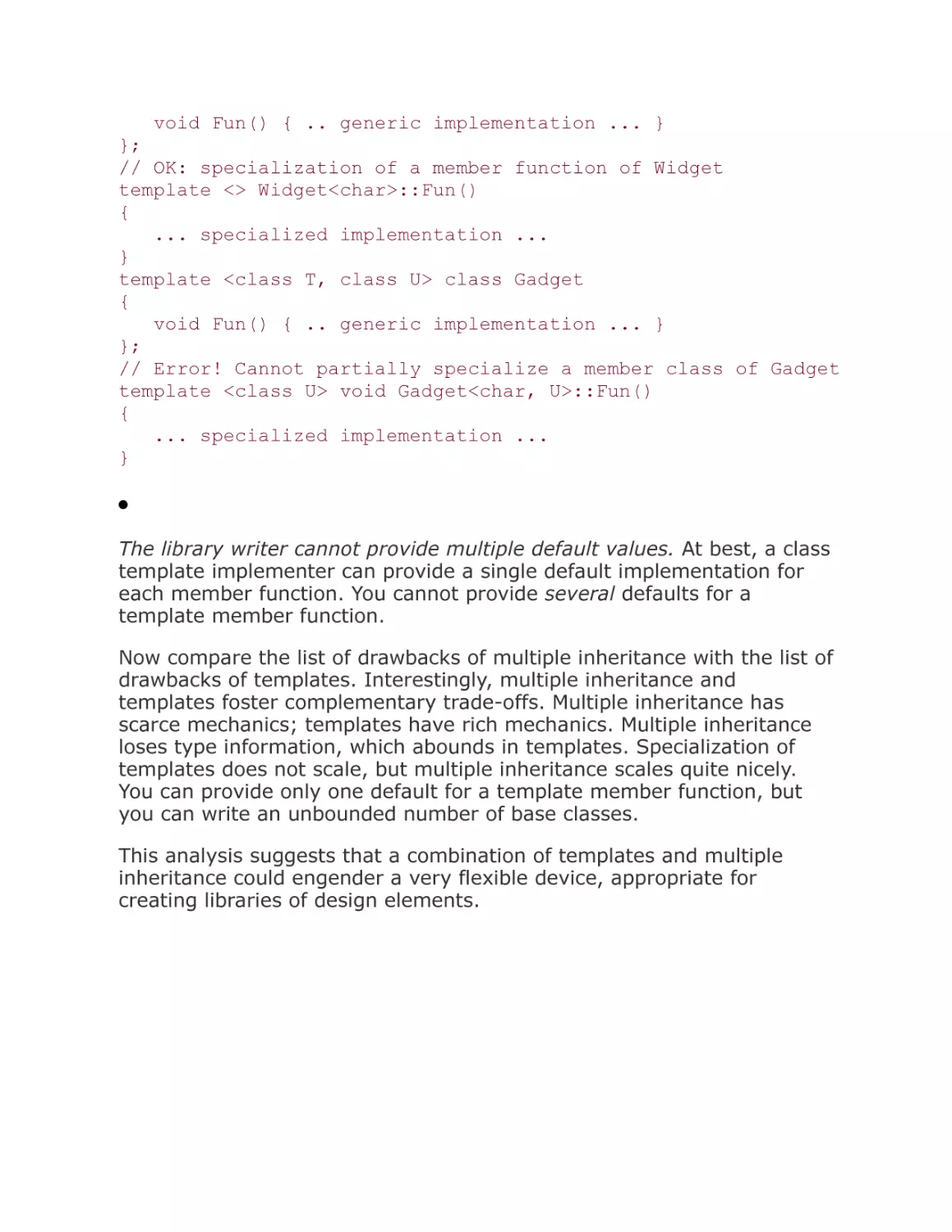
template <class T> class Widget
{
void Fun() { .. generic implementation ... }
};
// OK: specialization of a member function of Widget
template <> Widget<char>::Fun()
{
... specialized implementation ...
}
template <class T, class U> class Gadget
{
void Fun() { .. generic implementation ... }
};
// Error! Cannot partially specialize a member class of Gadget
template <class U> void Gadget<char, U>::Fun()
{
... specialized implementation ...
}
The library writer cannot provide multiple default values. At best, a class
template implementer can provide a single default implementation for
each member function. You cannot provide several defaults for a
template member function.
Now compare the list of drawbacks of multiple inheritance with the list of
drawbacks of templates. Interestingly, multiple inheritance and
templates foster complementary trade-offs. Multiple inheritance has
scarce mechanics; templates have rich mechanics. Multiple inheritance
loses type information, which abounds in templates. Specialization of
templates does not scale, but multiple inheritance scales quite nicely.
You can provide only one default for a template member function, but
you can write an unbounded number of base classes.
This analysis suggests that a combination of templates and multiple
inheritance could engender a very flexible device, appropriate for
creating libraries of design elements.
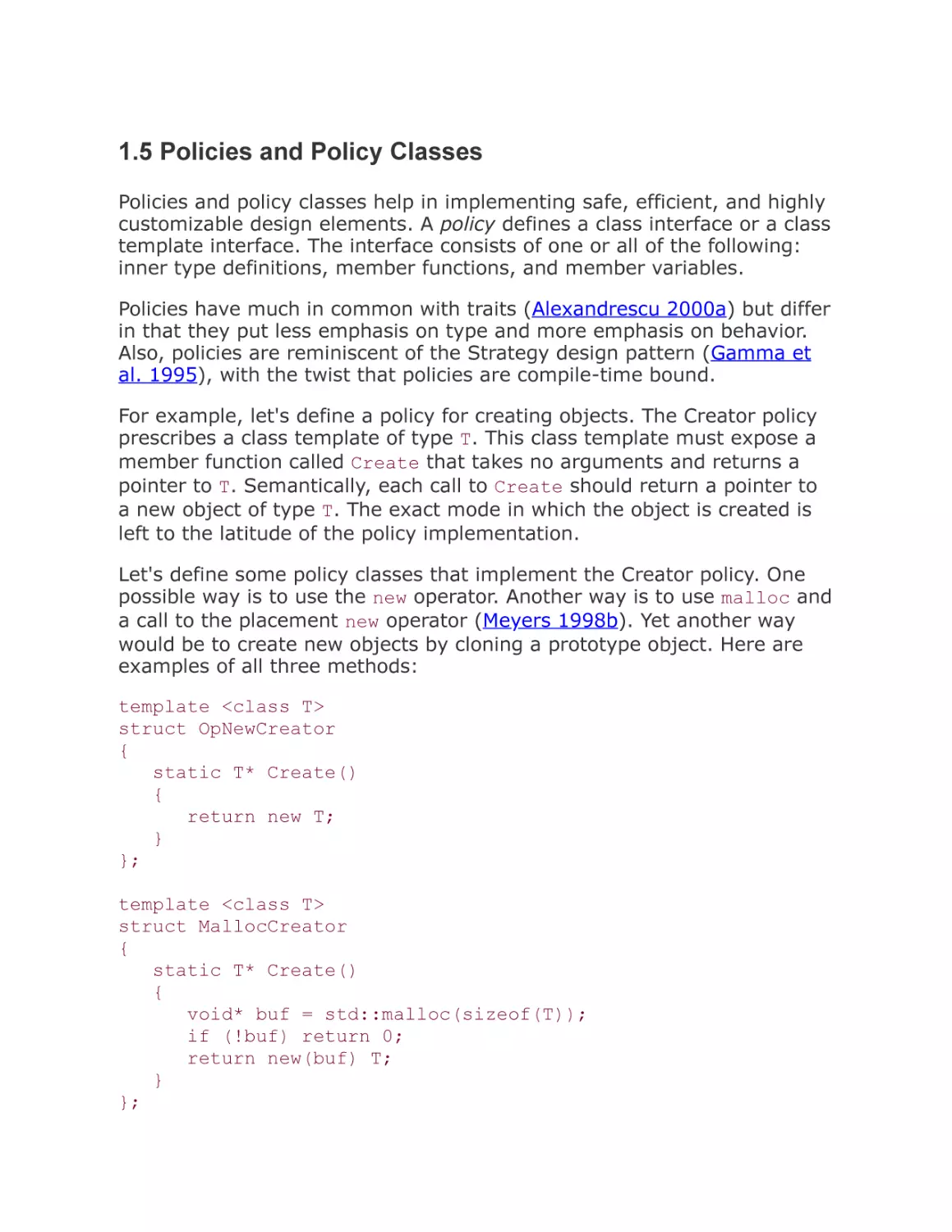
1.5 Policies and Policy Classes
Policies and policy classes help in implementing safe, efficient, and highly
customizable design elements. A policy defines a class interface or a class
template interface. The interface consists of one or all of the following:
inner type definitions, member functions, and member variables.
Policies have much in common with traits (Alexandrescu 2000a) but differ
in that they put less emphasis on type and more emphasis on behavior.
Also, policies are reminiscent of the Strategy design pattern (Gamma et
al. 1995), with the twist that policies are compile-time bound.
For example, let's define a policy for creating objects. The Creator policy
prescribes a class template of type T. This class template must expose a
member function called Create that takes no arguments and returns a
pointer to T. Semantically, each call to Create should return a pointer to
a new object of type T. The exact mode in which the object is created is
left to the latitude of the policy implementation.
Let's define some policy classes that implement the Creator policy. One
possible way is to use the new operator. Another way is to use malloc and
a call to the placement new operator (Meyers 1998b). Yet another way
would be to create new objects by cloning a prototype object. Here are
examples of all three methods:
template <class T>
struct OpNewCreator
{
static T* Create()
{
return new T;
}
};
template <class T>
struct MallocCreator
{
static T* Create()
{
void* buf = std::malloc(sizeof(T));
if (!buf) return 0;
return new(buf) T;
}
};
template <class T>
struct PrototypeCreator
{
PrototypeCreator(T* pObj = 0)
:pPrototype_(pObj)
{}
T* Create()
{
return pPrototype_ ? pPrototype_->Clone() : 0;
}
T* GetPrototype() { return pPrototype_; }
void SetPrototype(T* pObj) { pPrototype_ = pObj; }
private:
T* pPrototype_;
};
For a given policy, there can be an unlimited number of implementations.
The implementations of a policy are called policy classes.[2] Policy classes
are not intended for stand-alone use; instead, they are inherited by, or
contained within, other classes.
[2] This name is slightly inaccurate because, as you will see soon,
policy implementations can be class templates.
An important aspect is that, unlike classic interfaces (collections of pure
virtual functions), policies' interfaces are loosely defined. Policies are
syntax oriented, not signature oriented. In other words, Creator specifies
which syntactic constructs should be valid for a conforming class, rather
than which exact functions that class must implement. For example, the
Creator policy does not specify that Create must be static or virtual the
only requirement is that the class template define a Create member
function. Also, Creator says that Create should return a pointer to a new
object (as opposed to must). Consequently, it is acceptable that in special
cases, Create might return zero or throw an exception.
You can implement several policy classes for a given policy. They all must
respect the interface as defined by the policy. The user then chooses
which policy class to use in larger structures, as you will see.
The three policy classes defined earlier have different implementations
and even slightly different interfaces (for example, PrototypeCreator
has two extra functions: GetPrototype and SetPrototype). However,
they all define a function called Create with the required return type, so
they conform to the Creator policy.
Let's see now how we can design a class that exploits the Creator policy.
Such a class will either contain or inherit one of the three classes defined
previously, as shown in the following:
// Library code
template <class CreationPolicy>
class WidgetManager : public CreationPolicy
{
...
};
The classes that use one or more policies are called hosts or host classes.
[3] In the example above, WidgetManager is a host class with one policy.
Hosts are responsible for assembling the structures and behaviors of their
policies in a single complex unit.
[3] Although host classes are technically host class templates, let's
stick to a unique definition. Both host classes and host class
templates serve the same concept.
When instantiating the WidgetManager template, the client passes the
desired policy:
// Application code
typedef WidgetManager< OpNewCreator<Widget> > MyWidgetMgr;
Let's analyze the resulting context. Whenever an object of type
MyWidgetMgr needs to create a Widget, it invokes Create() for its
OpNewCreator<Widget> policy subobject. How ever, it is the user of
WidgetManager who chooses the creation policy. Effectively, through its
design, WidgetManager allows its users to configure a specific aspect of
WidgetManager's functionality.
This is the gist of policy-based class design.
1.5.1 Implementing Policy Classes with Template Template Parameters
Often, as is the case above, the policy's template argument is redundant.
It is awkward that the user must pass OpNewCreator's template
argument explicitly. Typically, the host class already knows, or can easily
deduce, the template argument of the policy class. In the example above,
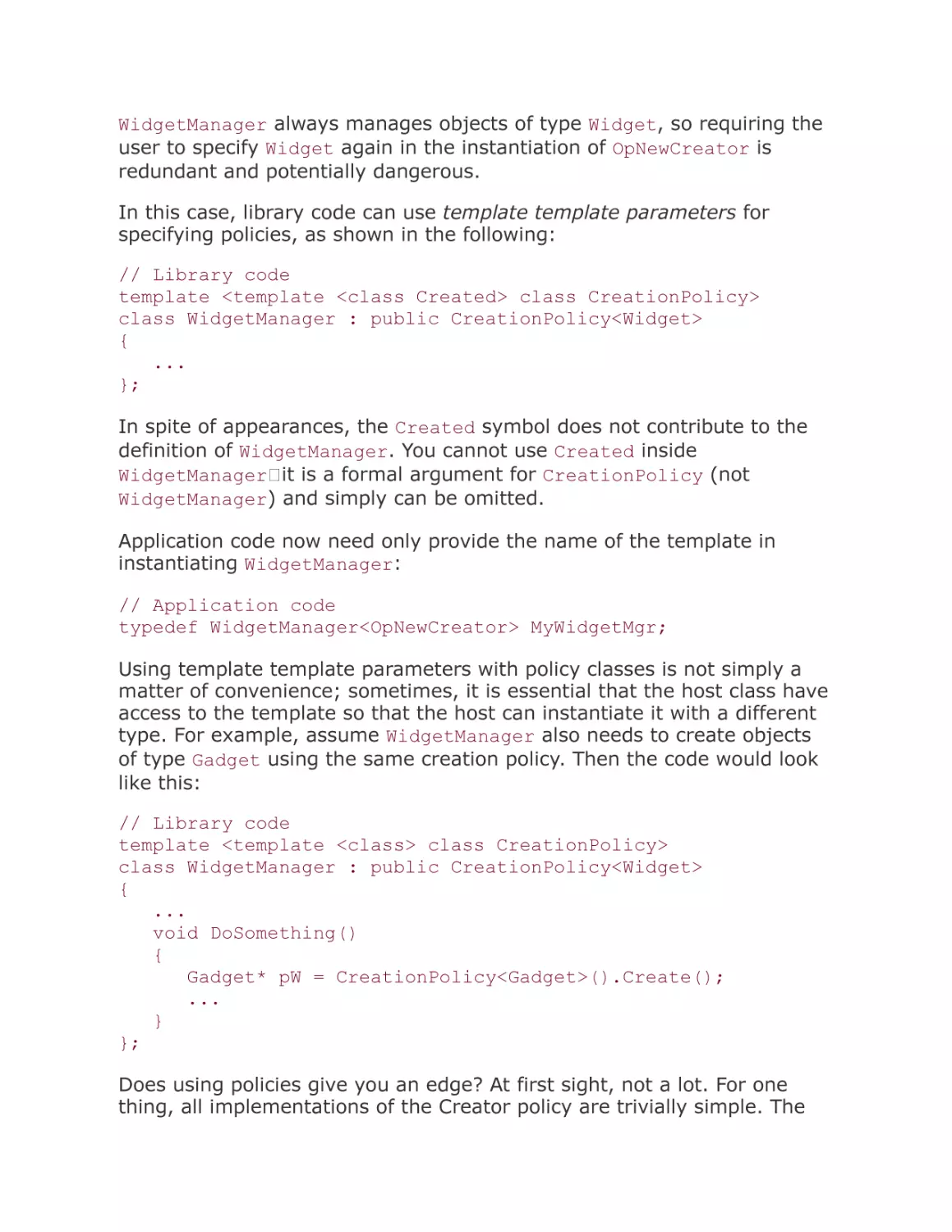
WidgetManager always manages objects of type Widget, so requiring the
user to specify Widget again in the instantiation of OpNewCreator is
redundant and potentially dangerous.
In this case, library code can use template template parameters for
specifying policies, as shown in the following:
// Library code
template <template <class Created> class CreationPolicy>
class WidgetManager : public CreationPolicy<Widget>
{
...
};
In spite of appearances, the Created symbol does not contribute to the
definition of WidgetManager. You cannot use Created inside
WidgetManager it is a formal argument for CreationPolicy (not
WidgetManager) and simply can be omitted.
Application code now need only provide the name of the template in
instantiating WidgetManager:
// Application code
typedef WidgetManager<OpNewCreator> MyWidgetMgr;
Using template template parameters with policy classes is not simply a
matter of convenience; sometimes, it is essential that the host class have
access to the template so that the host can instantiate it with a different
type. For example, assume WidgetManager also needs to create objects
of type Gadget using the same creation policy. Then the code would look
like this:
// Library code
template <template <class> class CreationPolicy>
class WidgetManager : public CreationPolicy<Widget>
{
...
void DoSomething()
{
Gadget* pW = CreationPolicy<Gadget>().Create();
...
}
};
Does using policies give you an edge? At first sight, not a lot. For one
thing, all implementations of the Creator policy are trivially simple. The
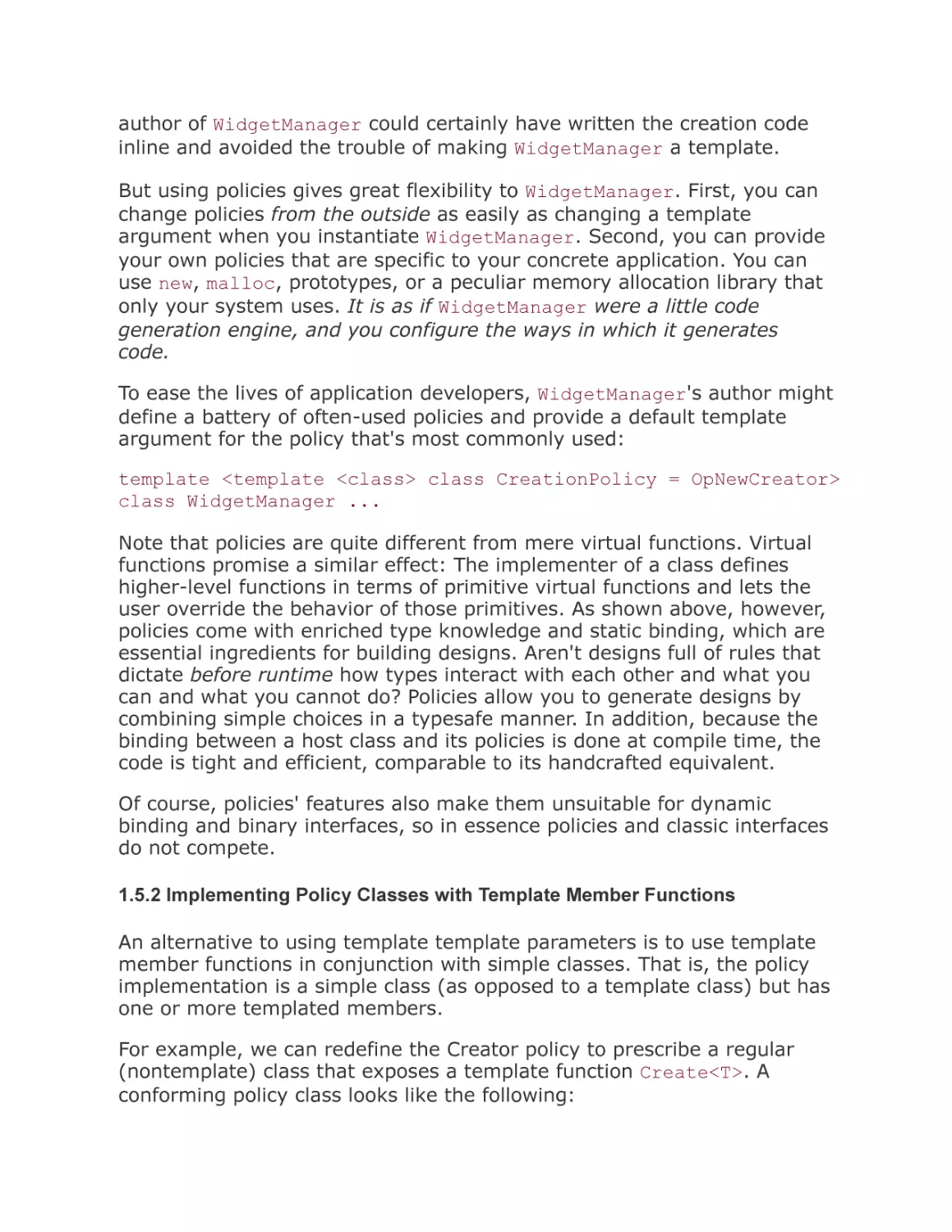
author of WidgetManager could certainly have written the creation code
inline and avoided the trouble of making WidgetManager a template.
But using policies gives great flexibility to WidgetManager. First, you can
change policies from the outside as easily as changing a template
argument when you instantiate WidgetManager. Second, you can provide
your own policies that are specific to your concrete application. You can
use new, malloc, prototypes, or a peculiar memory allocation library that
only your system uses. It is as if WidgetManager were a little code
generation engine, and you configure the ways in which it generates
code.
To ease the lives of application developers, WidgetManager's author might
define a battery of often-used policies and provide a default template
argument for the policy that's most commonly used:
template <template <class> class CreationPolicy = OpNewCreator>
class WidgetManager ...
Note that policies are quite different from mere virtual functions. Virtual
functions promise a similar effect: The implementer of a class defines
higher-level functions in terms of primitive virtual functions and lets the
user override the behavior of those primitives. As shown above, however,
policies come with enriched type knowledge and static binding, which are
essential ingredients for building designs. Aren't designs full of rules that
dictate before runtime how types interact with each other and what you
can and what you cannot do? Policies allow you to generate designs by
combining simple choices in a typesafe manner. In addition, because the
binding between a host class and its policies is done at compile time, the
code is tight and efficient, comparable to its handcrafted equivalent.
Of course, policies' features also make them unsuitable for dynamic
binding and binary interfaces, so in essence policies and classic interfaces
do not compete.
1.5.2 Implementing Policy Classes with Template Member Functions
An alternative to using template template parameters is to use template
member functions in conjunction with simple classes. That is, the policy
implementation is a simple class (as opposed to a template class) but has
one or more templated members.
For example, we can redefine the Creator policy to prescribe a regular
(nontemplate) class that exposes a template function Create<T>. A
conforming policy class looks like the following:
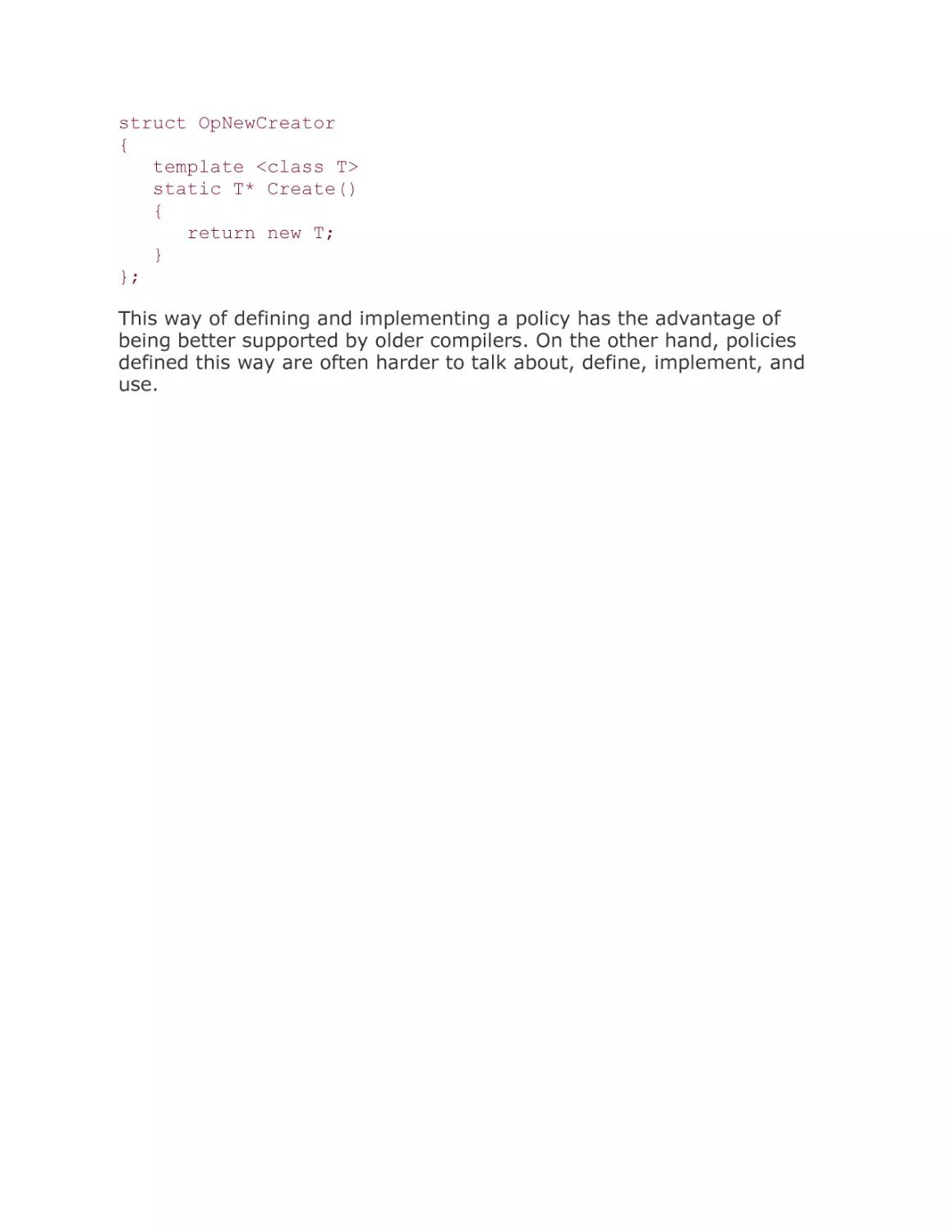
struct OpNewCreator
{
template <class T>
static T* Create()
{
return new T;
}
};
This way of defining and implementing a policy has the advantage of
being better supported by older compilers. On the other hand, policies
defined this way are often harder to talk about, define, implement, and
use.
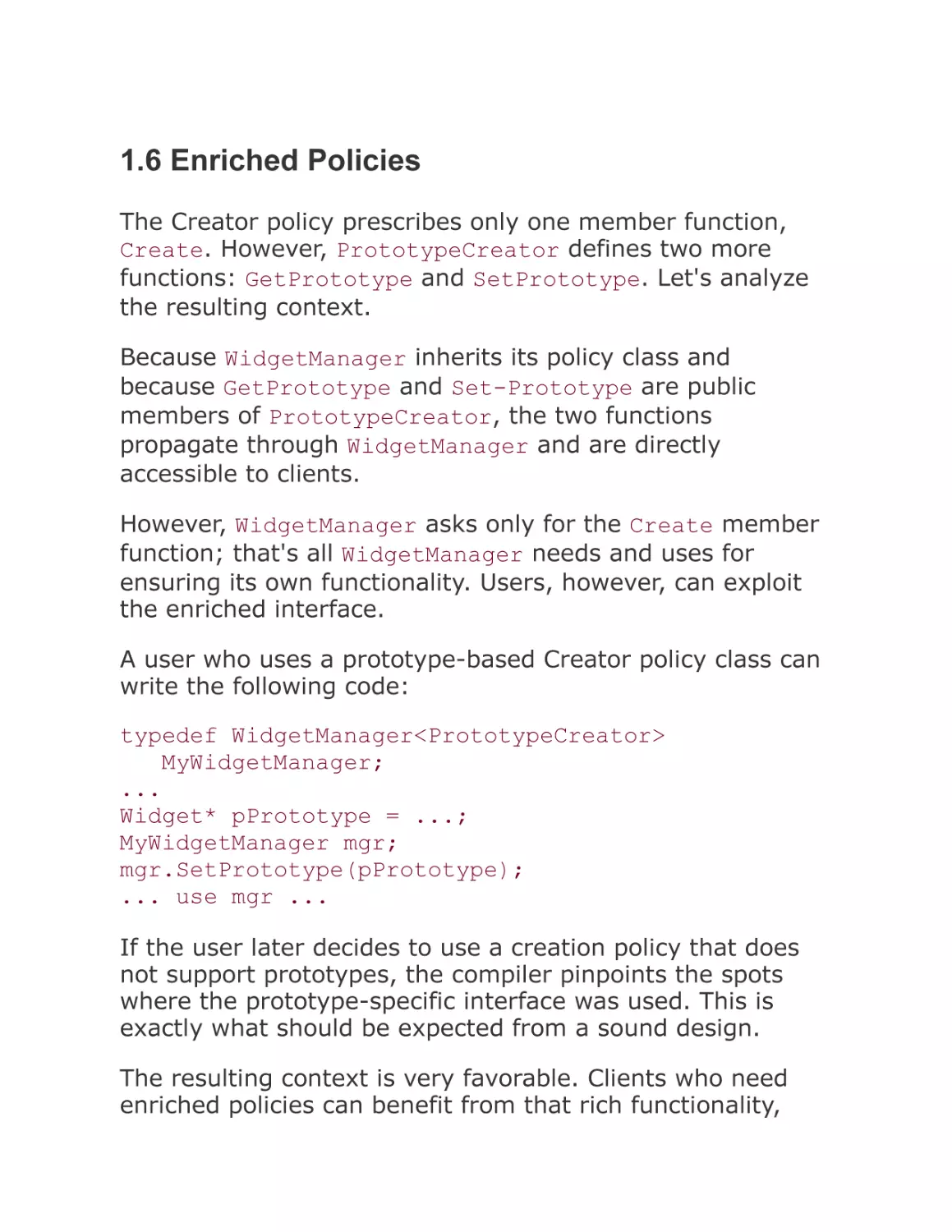
1.6 Enriched Policies
The Creator policy prescribes only one member function,
Create. However, PrototypeCreator defines two more
functions: GetPrototype and SetPrototype. Let's analyze
the resulting context.
Because WidgetManager inherits its policy class and
because GetPrototype and Set-Prototype are public
members of PrototypeCreator, the two functions
propagate through WidgetManager and are directly
accessible to clients.
However, WidgetManager asks only for the Create member
function; that's all WidgetManager needs and uses for
ensuring its own functionality. Users, however, can exploit
the enriched interface.
A user who uses a prototype-based Creator policy class can
write the following code:
typedef WidgetManager<PrototypeCreator>
MyWidgetManager;
...
Widget* pPrototype = ...;
MyWidgetManager mgr;
mgr.SetPrototype(pPrototype);
... use mgr ...
If the user later decides to use a creation policy that does
not support prototypes, the compiler pinpoints the spots
where the prototype-specific interface was used. This is
exactly what should be expected from a sound design.
The resulting context is very favorable. Clients who need
enriched policies can benefit from that rich functionality,
without affecting the basic functionality of the host class.
Don't forget that users and not the library decide which
policy class to use. Unlike regular multiple interfaces,
policies give the user the ability to add functionality to a
host class, in a typesafe manner.
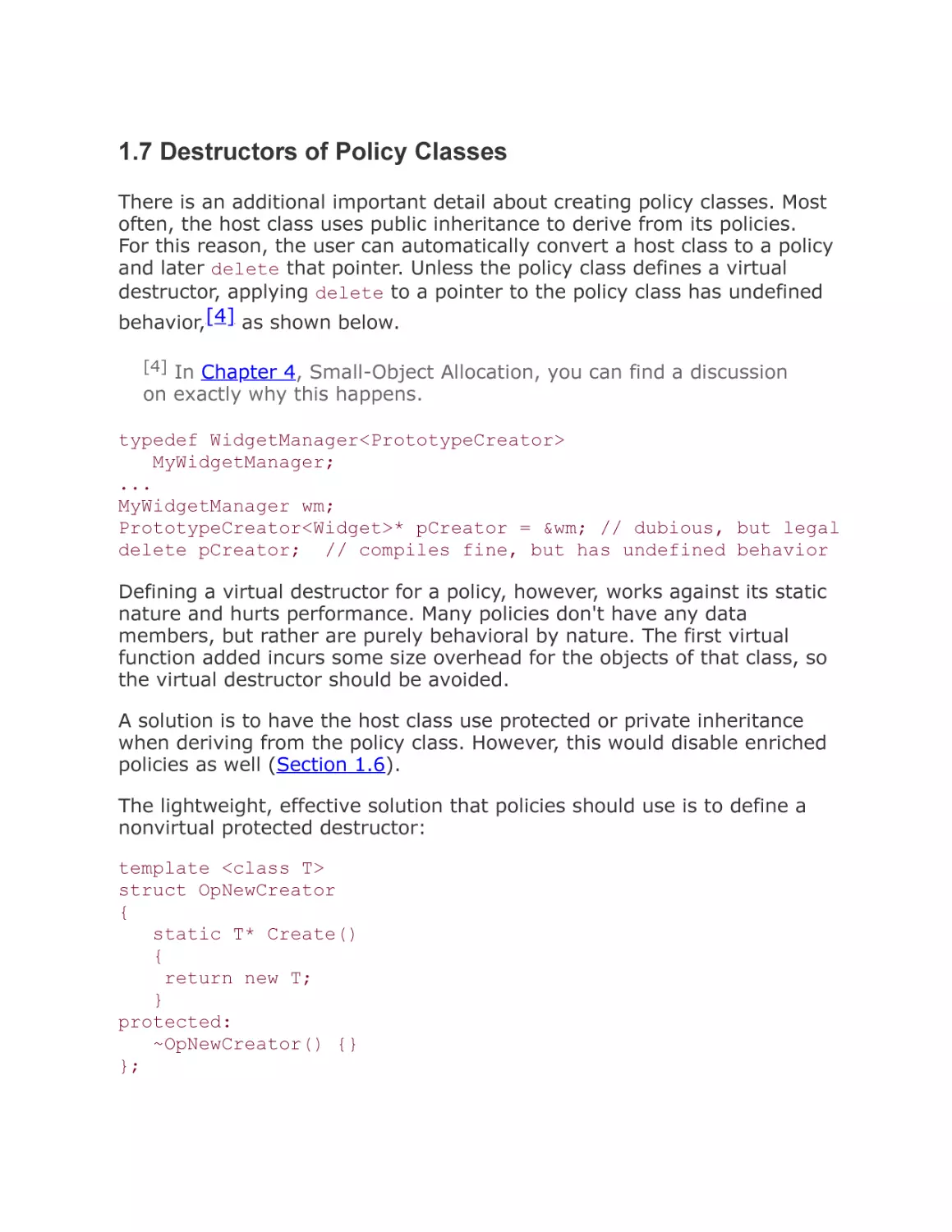
1.7 Destructors of Policy Classes
There is an additional important detail about creating policy classes. Most
often, the host class uses public inheritance to derive from its policies.
For this reason, the user can automatically convert a host class to a policy
and later delete that pointer. Unless the policy class defines a virtual
destructor, applying delete to a pointer to the policy class has undefined
behavior,[4] as shown below.
[4] In Chapter 4, Small-Object Allocation, you can find a discussion
on exactly why this happens.
typedef WidgetManager<PrototypeCreator>
MyWidgetManager;
...
MyWidgetManager wm;
PrototypeCreator<Widget>* pCreator = &wm; // dubious, but legal
delete pCreator; // compiles fine, but has undefined behavior
Defining a virtual destructor for a policy, however, works against its static
nature and hurts performance. Many policies don't have any data
members, but rather are purely behavioral by nature. The first virtual
function added incurs some size overhead for the objects of that class, so
the virtual destructor should be avoided.
A solution is to have the host class use protected or private inheritance
when deriving from the policy class. However, this would disable enriched
policies as well (Section 1.6).
The lightweight, effective solution that policies should use is to define a
nonvirtual protected destructor:
template <class T>
struct OpNewCreator
{
static T* Create()
{
return new T;
}
protected:
~OpNewCreator() {}
};
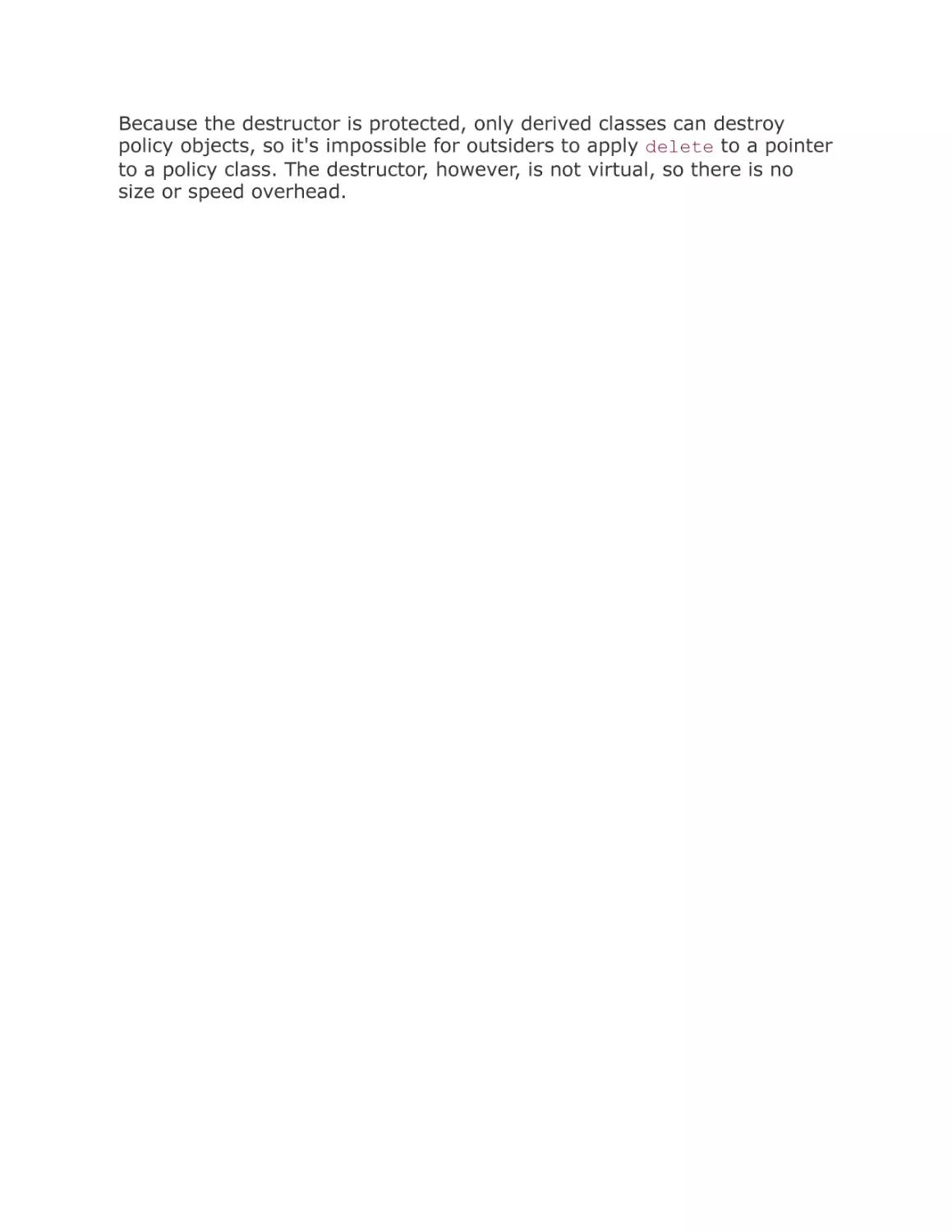
Because the destructor is protected, only derived classes can destroy
policy objects, so it's impossible for outsiders to apply delete to a pointer
to a policy class. The destructor, however, is not virtual, so there is no
size or speed overhead.
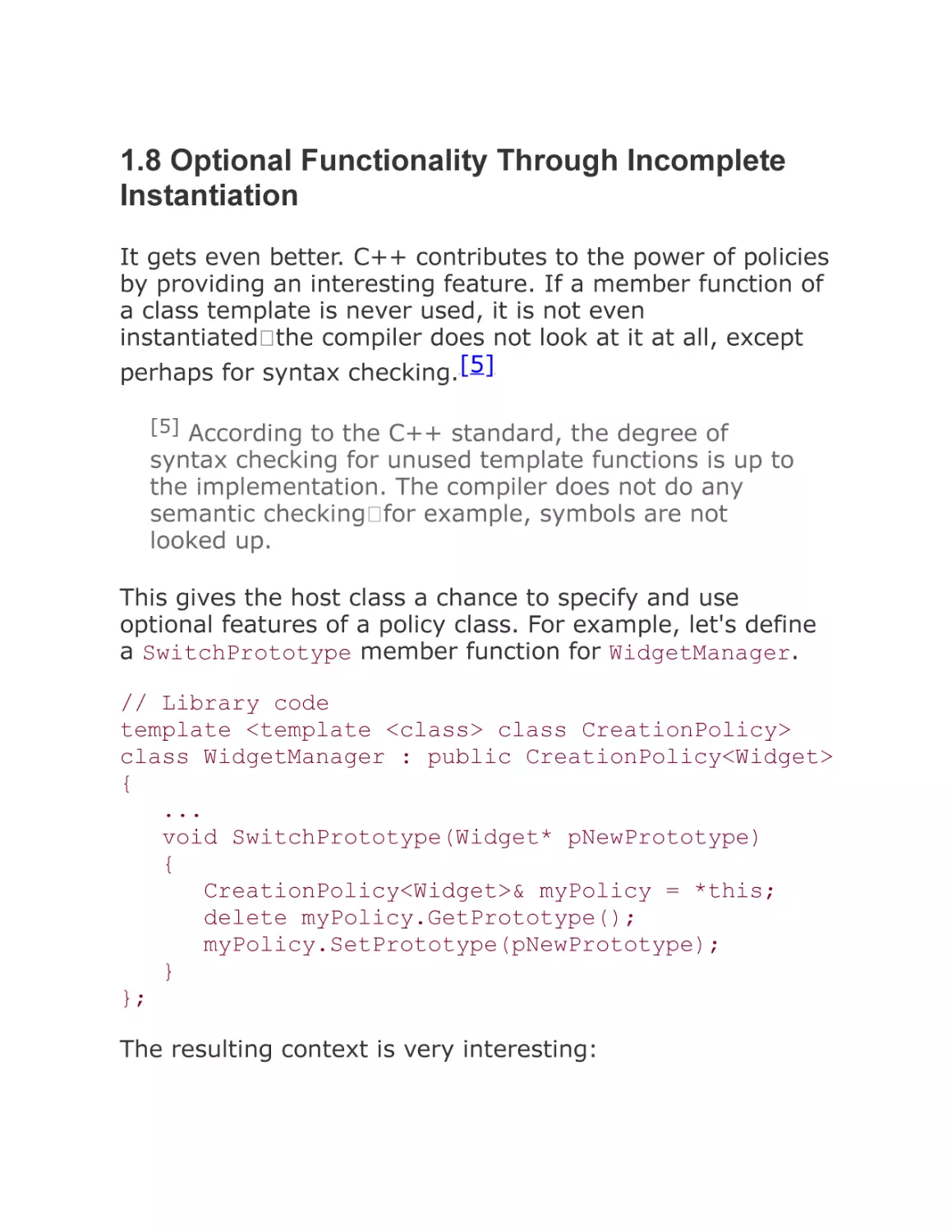
1.8 Optional Functionality Through Incomplete
Instantiation
It gets even better. C++ contributes to the power of policies
by providing an interesting feature. If a member function of
a class template is never used, it is not even
instantiated the compiler does not look at it at all, except
perhaps for syntax checking.[5]
[5] According to the C++ standard, the degree of
syntax checking for unused template functions is up to
the implementation. The compiler does not do any
semantic checking for example, symbols are not
looked up.
This gives the host class a chance to specify and use
optional features of a policy class. For example, let's define
a SwitchPrototype member function for WidgetManager.
// Library code
template <template <class> class CreationPolicy>
class WidgetManager : public CreationPolicy<Widget>
{
...
void SwitchPrototype(Widget* pNewPrototype)
{
CreationPolicy<Widget>& myPolicy = *this;
delete myPolicy.GetPrototype();
myPolicy.SetPrototype(pNewPrototype);
}
};
The resulting context is very interesting:
If the user instantiates WidgetManager with a Creator
policy class that supports prototypes, she can use
SwitchPrototype.
If the user instantiates WidgetManager with a Creator
policy class that does not support prototypes and tries
to use SwitchPrototype, a compile-time error occurs.
If the user instantiates WidgetManager with a Creator
policy class that does not support prototypes and does
not try to use SwitchPrototype, the program is valid.
This all means that WidgetManager can benefit from
optional enriched interfaces but still work correctly with
poorer interfaces as long as you don't try to use certain
member functions of WidgetManager.
The author of WidgetManager can define the Creator policy
in the following manner:
Creator prescribes a class template of one type T that
exposes a member function Create. Create should
return a pointer to a new object of type T. Optionally,
the implementation can define two additional member
functions T* GetPrototype() and
SetPrototype(T*) having the semantics of getting
and setting a prototype object used for creation. In
this case, WidgetManager exposes the
SwitchPrototype (T* pNewPrototype) member
function, which deletes the current prototype and sets
it to the incoming argument.
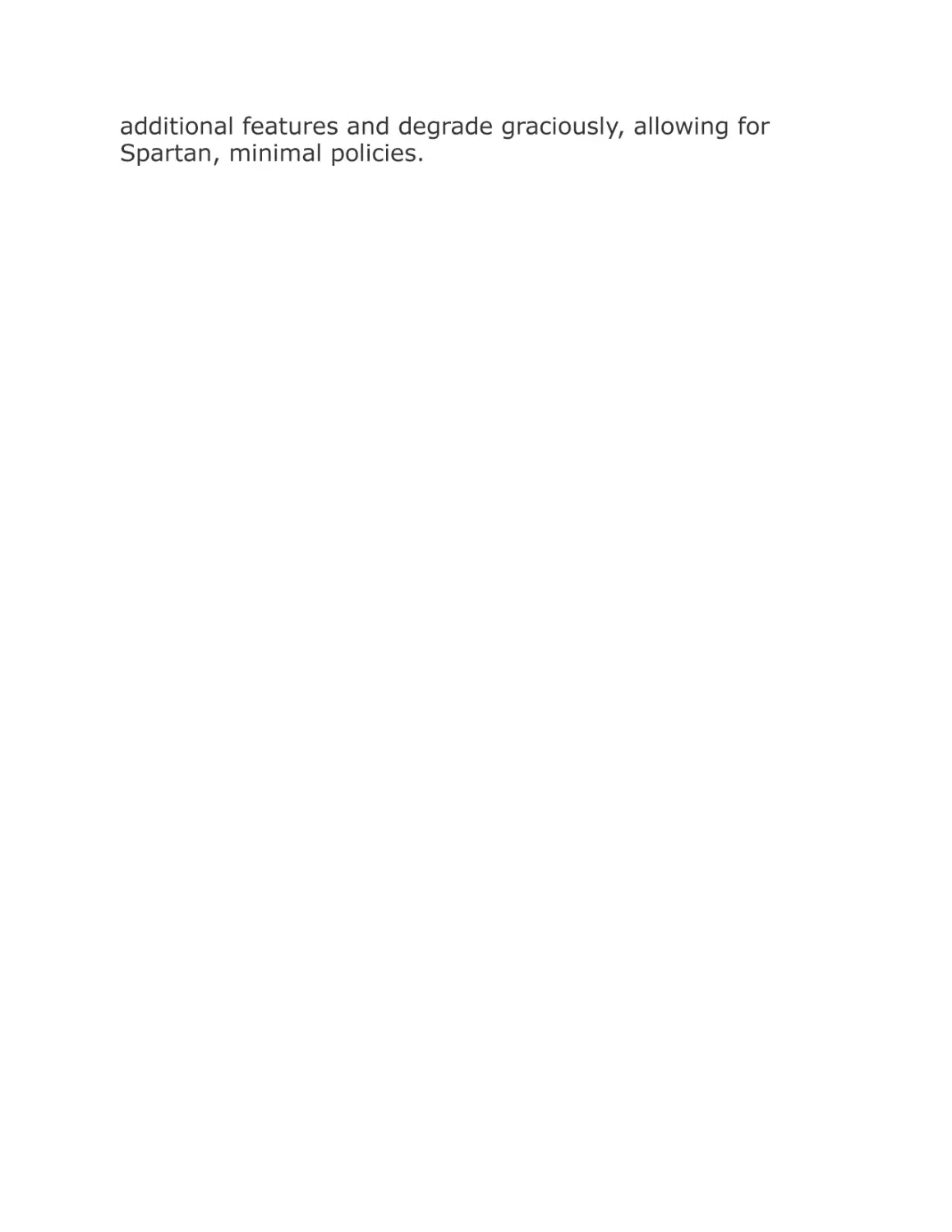
In conjunction with policy classes, incomplete instantiation
brings remarkable freedom to you as a library designer. You
can implement lean host classes that are able to use
additional features and degrade graciously, allowing for
Spartan, minimal policies.
1.9 Combining Policy Classes
The greatest usefulness of policies is apparent when you combine them.
Typically, a highly configurable class uses several policies for various
aspects of its workings. Then the library user selects the desired highlevel behavior by combining several policy classes.
For example, consider designing a generic smart pointer class. (Chapter
7 builds a full implementation.) Say you identify two design choices that
you should establish with policies: threading model and checking before
dereferencing. Then you implement a SmartPtr class template that uses
two policies, as shown:
template
<
class T,
template <class> class CheckingPolicy,
template <class> class ThreadingModel
>
class SmartPtr;
SmartPtr has three template parameters: the pointee type and two
policies. Inside SmartPtr, you orchestrate the two policies into a sound
implementation. SmartPtr be comes a coherent shell that integrates
several policies, rather than a rigid, canned implementation. By
designing SmartPtr this way, you allow the user to configure SmartPtr
with a simple typedef:
typedef SmartPtr<Widget, NoChecking, SingleThreaded>
WidgetPtr;
Inside the same application, you can define and use several smart
pointer classes:
typedef SmartPtr<Widget, EnforceNotNull, SingleThreaded>
SafeWidgetPtr;
The two policies can be defined as follows:
Checking: The CheckingPolicy<T> class template must expose a Check
member function, callable with an lvalue of type T*. SmartPtr calls
Check, passing it the pointee object before dereferencing it.
ThreadingModel: The ThreadingModel<T> class template must expose
an inner type called Lock, whose constructor accepts a T&. For the
lifetime of a Lock object, operations on the T object are serialized.
For example, here is the implementation of the NoChecking and
EnforceNotNull policy classes:
template <class T> struct NoChecking
{
static void Check(T*) {}
};
template <class T> struct EnforceNotNull
{
class NullPointerException : public std::exception { ... };
static void Check(T* ptr)
{
if (!ptr) throw NullPointerException();
}
};
By plugging in various checking policy classes, you can implement
various behaviors. You can even initialize the pointee object with a
default value by accepting a reference to a pointer, as shown:
template <class T> struct EnsureNotNull
{
static void Check(T*& ptr)
{
if (!ptr) ptr = GetDefaultValue();
}
};
SmartPtr uses the Checking policy this way:
template
<
class T,
template <class> class CheckingPolicy,
template <class> class ThreadingModel
>
class SmartPtr
: public CheckingPolicy<T>
, public ThreadingModel<SmartPtr>
{
...
T* operator->()
{
typename ThreadingModel<SmartPtr>::Lock guard(*this);
CheckingPolicy<T>::Check(pointee_);
return pointee_;
}
private:
T* pointee_;
};
Notice the use of both the CheckingPolicy and ThreadingModel policy
classes in the same function. Depending on the two template
arguments, SmartPtr::operator-> behaves differently on two
orthogonal dimensions. Such is the power of combining policies.
If you manage to decompose a class in orthogonal policies, you can
cover a large spectrum of behaviors with a small amount of code.
1.10 Customizing Structure with Policy Classes
One of the limitations of templates, mentioned in Section 1.4, is
that you cannot use templates to customize the structure of a
class only its behavior. Policy-based designs, however, do support
structural customization in a natural manner.
Suppose that you want to support nonpointer representations for
SmartPtr. For example, on certain platforms some pointers might
be represented by a handle an integral value that you pass to a
system function to obtain the actual pointer. To solve this you might
"indirect" the pointer access through a policy, say, a Structure
policy. The Structure policy abstracts the pointer storage.
Consequently, Structure should expose types called PointerType
(the type of the pointed-to object) and ReferenceType (the type to
which the pointer refers) and functions such as GetPointer and
SetPointer.
The fact that the pointer type is not hardcoded to T* has important
advantages. For example, you can use SmartPtr with nonstandard
pointer types (such as near and far pointers on segmented
architectures), or you can easily implement clever solutions such as
before and after functions (Stroustrup 2000a). The possibilities
are extremely interesting.
The default storage of a smart pointer is a plain-vanilla pointer
adorned with the Structure policy interface, as shown in the
following code.
template <class T>
class DefaultSmartPtrStorage
{
public:
typedef T* PointerType;
typedef T& ReferenceType;
protected:
PointerType GetPointer() { return ptr_; }
void SetPointer(PointerType ptr) { pointee_ = ptr; }
private:
PointerType ptr_;
};
The actual storage used is completely hidden behind Structure's
interface. Now SmartPtr can use a Storage policy instead of
aggregating a T*.
template
<
class T,
template <class> class CheckingPolicy,
template <class> class ThreadingModel,
template <class> class Storage = DefaultSmartPtrStorage
>
class SmartPtr;
Of course, SmartPtr must either derive from Storage<T> or
aggregate a Storage<T> object in order to embed the needed
structure.
1.11 Compatible and Incompatible Policies
Suppose you create two instantiations of SmartPtr:
FastWidgetPtr, a pointer with out checking, and
SafeWidgetPtr, a pointer with checking before dereference. An
interesting question is, Should you be able to assign
FastWidgetPtr objects to SafeWidgetPtr objects? Should you
be able to assign them the other way around? If you want to
allow such conversions, how can you implement that?
Starting from the reasoning that SafeWidgetPtr is more
restrictive than FastWidgetPtr, it is natural to accept the
conversion from FastWidgetPtr to SafeWidgetPtr. This is
because C++ already supports implicit conversions that increase
restrictions namely, from non-const to const types.
On the other hand, freely converting SafeWidgetPtr objects to
FastWidgetPtr objects is dangerous. This is because in an
application, the majority of code would use SafeWidgetPtr and
only a small, speed-critical core would use FastWidgetPtr.
Allowing only explicit, controlled conversions to FastWidgetPtr
would help keep FastWidgetPtr's usage to a minimum.
The best, most scalable way to implement conversions between
policies is to initialize and copy SmartPtr objects policy by policy,
as shown below. (Let's simplify the code by getting back to only
one policy the Checking policy.)
template
<
class T,
template <class> class CheckingPolicy
>
class SmartPtr : public CheckingPolicy<T>
{
...
template
<
class T1,
template <class> class CP1,
>
SmartPtr(const SmartPtr<T1, CP1>& other)
: pointee_(other.pointee_), CheckingPolicy<T>(other)
{ ... }
};
SmartPtr implements a templated copy constructor, which
accepts any other instantiation of SmartPtr. The code in bold
initializes the components of SmartPtr with the components of
the other SmartPtr<T1, CP1> received as arguments.
Here's how it works. (Follow the constructor code.) Assume you
have a class ExtendedWidget, derived from Widget. If you
initialize a SmartPtr<Widget, NoChecking> with a
SmartPtr<ExtendedWidget, NoChecking>, the compiler
attempts to initialize a Widget* with an ExtendedWiget* (which
works), and a NoChecking with a SmartPtrExtended <Widget,
NoChecking>. This might look suspicious, but don't forget that
SmartPtr derives from its policy, so in essence the compiler will
easily figure out that you initialize a NoChecking with a
NoChecking. The whole initialization works.
Now for the interesting part. Say you initialize a
SmartPtr<Widget, EnforceNotNull> with a
SmartPtr<ExtendedWidget, NoChecking>. The
ExtendedWidget* to Widget* conversion works just as before.
Then the compiler tries to match SmartPtr<ExtendedWidget,
NoChecking> to EnforceNotNull's constructors.
If EnforceNotNull implements a constructor that accepts a
NoChecking object, then the compiler matches that constructor.
If NoChecking implements a conversion operator to
EnforceNotNull, that conversion is invoked. In any other case,
the code fails to compile.
As you can see, you have two-sided flexibility in implementing
conversions between policies. You can implement a conversion
constructor on the left-hand side, or you can implement a
conversion operator on the right-hand side.
The assignment operator looks like an equally tricky problem, but
fortunately, Sutter (2000) describes a very nifty technique that
allows you to implement the assignment operator in terms of the
copy constructor. (It's so nifty, you have to read about it. You can
see the technique at work in Loki's SmartPtr implementation.)
Although conversions from NoChecking to EnforceNotNull and
even vice versa are quite sensible, some conversions don't make
any sense at all. Imagine converting a reference-counted pointer
to a pointer that supports another ownership strategy, such as
destructive copy (à la std::auto_ptr). Such a conversion is
semantically wrong. The definition of reference counting is that
all pointers to the same object are known and tracked by a
unique counter. As soon as you try to confine a pointer to another
ownership policy, you break the invariant that makes reference
counting work.
In conclusion, conversions that change the ownership policy
should not be allowed implicitly and should be treated with
maximum care. At best, you can change the ownership policy of
a reference-counted pointer by explicitly calling a function. That
function succeeds if and only if the reference count of the source
pointer is 1.
1.12 Decomposing a Class into Policies
The hardest part of creating policy-based class design is to
correctly decompose the functionality of a class in policies. The
rule of thumb is to identify and name the design decisions that
take part in a class's behavior. Anything that can be done in
more than one way should be identified and migrated from the
class to a policy. Don't forget: Design constraints buried in a
class's design are as bad as magic constants buried in code.
For example, consider a WidgetManager class. If WidgetManager
creates new Widget objects internally, creation should be
deferred to a policy. If WidgetManager stores a collection of
Widgets, it makes sense to make that collection a storage
policy, unless there is a strong preference for a specific storage
mechanism.
At an extreme, a host class is totally depleted of any intrinsic
policy. It delegates all design decisions and constraints to
policies. Such a host class is a shell over a collection of policies
and deals only with assembling the policies into a coherent
behavior.
The disadvantage of an overly generic host class is the
abundance of template parameters. In practice, it is awkward to
work with more than four to six template parameters. Still, they
justify their presence if the host class offers complex, useful
functionality.
Type definitions typedef statements are an essential tool in
using classes that rely on policies. Using typedef is not merely
a matter of convenience; it ensures ordered use and easy
maintenance. For example, consider the following type
definition:
typedef SmartPtr
<
Widget,
RefCounted,
NoChecked
>
WidgetPtr;
It would be very tedious to use the lengthy specialization of
SmartPtr instead of WidgetPtr in code. But the tediousness of
writing code is nothing compared with the major problems in
understanding and maintaining that code. As the design
evolves, WidgetPtr's definition might change for example, to
use a checking policy other than NoChecked in debug builds. It
is essential that all the code use WidgetPtr instead of a
hardcoded instantiation of SmartPtr. It's just like the difference
between calling a function and writing the equivalent inline
code: The inline code technically does the same thing but fails
to build an abstraction behind it.
When you decompose a class in policies, it is very important to
find an orthogonal decomposition. An orthogonal decomposition
yields policies that are completely independent of each other.
You can easily spot a nonorthogonal decomposition when
various policies need to know about each other.
For example, think of an Array policy in a smart pointer. The
Array policy is very simple it dictates whether or not the smart
pointer points to an array. The policy can be defined to have a
member function T& ElementAt(T* ptr, unsigned int
index), plus a similar version for const T. The non-array policy
simply does not define an ElementAt member function, so
trying to use it would yield a compile-time error. The ElementAt
function is an optional enriched behavior as defined in Section
1.6.
The implementations of two policy classes that implement the
Array policy follow.
template <class T>
struct IsArray
{
T& ElementAt(T* ptr, unsigned int index)
{
return ptr[index];
}
const T& ElementAt(T* ptr, unsigned int index) const
{
return ptr[index];
}
};
template <class T> struct IsNotArray {};
The problem is that purpose of the Array policy specifying
whether or not the smart pointer points to an array interacts
unfavorably with another policy: destruction. You must destroy
pointers to objects using the delete operator, and destroy
pointers to arrays of objects using the delete[] operator.
Two policies that do not interact with each other are orthogonal.
By this definition, the Array and the Destroy policies are not
orthogonal.
If you still need to confine the qualities of being an array and of
destruction to separate policies, you need to establish a way for
the two policies to communicate. You must have the Array
policy expose a Boolean constant in addition to a function, and
pass that Boolean to the Destroy policy. This complicates and
somewhat constrains the design of both the Array and the
Destroy policies.
Nonorthogonal policies are an imperfection you should strive to
avoid. They reduce compile-time type safety and complicate the
design of both the host class and the policy classes.
If you must use nonorthogonal policies, you can minimize
dependencies by passing a policy class as an argument to
another policy class's template function. This way you can
benefit from the flexibility specific to template-based interfaces.
The downside remains that one policy must expose some of its
implementation details to other policies. This decreases
encapsulation.
1.13 Summary
Design is choice. Most often, the struggle is not that there is
no way to solve a design problem, but that there are too
many ways that apparently solve the problem. You must
know which collection of solutions solves the problem in a
satisfactory manner. The need to choose propagates from
the largest architectural levels down to the smallest unit of
code. Furthermore, choices can be combined, which confers
on design an evil multiplicity.
To fight the multiplicity of design with a reasonably small
amount of code, a writer of a design-oriented library needs
to develop and use special techniques. These techniques are
purposely conceived to support flexible code generation by
combining a small number of primitive devices. The library
itself provides a number of such devices. Furthermore, the
library exposes the specifications from which these devices
are built, so the client can build her own. This essentially
makes a policy-based design open-ended. These devices are
called policies, and the implementations thereof are called
policy classes.
The mechanics of policies consist of a combination of
templates with multiple inheritance. A class that uses
policies a host class is a template with many template
parameters (often, template template parameters), each
parameter being a policy. The host class "indirects" parts of
its functionality through its policies and acts as a receptacle
that combines several policies in a coherent aggregate.
Classes designed around policies support enriched behavior
and graceful degradation of functionality. A policy can
provide supplemental functionality that propagates through
the host class due to public inheritance. Furthermore, the
host class can implement enriched functionality that uses
the optional functionality of a policy. If the optional
functionality is not present, the host class still compiles
successfully, provided the enriched functionality is not used.
The power of policies comes from their ability to mix and
match. A policy-based class can accommodate very many
behaviors by combining the simpler behaviors that its
policies implement. This effectively makes policies a good
weapon for fighting against the evil multiplicity of design.
Using policy classes, you can customize not only behavior
but also structure. This important feature takes policybased design beyond the simple type genericity that's
specific to container classes.
Policy-based classes support flexibility when it comes to
conversions. If you use policy-by-policy copying, each policy
can control which other policies it accepts, or converts to,
by providing the appropriate conversion constructors,
conversion operators, or both.
In breaking a class into policies, you should follow two
important guidelines. One is to localize, name, and isolate
design decisions in your class things that are subject to a
trade-off or could be sensibly implemented in other ways.
The other guideline is to look for orthogonal policies, that is,
policies that don't need to interact with each other and that
can be changed independently.
Chapter 2. Techniques
This chapter presents a host of C++ techniques that are
used throughout the book. Because they are of help in
various contexts, the techniques presented tend to be
general and reusable, so you might find applications for
them in other contexts. Some of the techniques, such as
partial template specialization, are language features.
Others, such as compile-time assertions, come with some
support code.
In this chapter you will get acquainted with the following
techniques and tools:
Compile-time assertions
Partial template specialization
Local classes
Mappings between types and values (the Int2Type and
Type2Type class templates)
The Select class template, a tool that chooses a type at
compile time based on a Boolean condition
Detecting convertibility and inheritance at compile time
TypeInfo, a handy wrapper around std::type_info
Traits, a collection of traits that apply to any C++ type
Taken in isolation, each technique and its support code
might look trivial; the norm is five to ten lines of easy-tounderstand code. However, the techniques have an
important property: They are "nonterminal"; that is, you
can combine them to generate higher-level idioms.
Together, they form a strong foundation of services that
helps in building powerful architectural structures.
The techniques come with examples, so don't expect the
discussion to be dry. As you read through the rest of the
book, you might want to return to this chapter for
reference.
2.1 Compile-Time Assertions
As generic programming in C++ took off, the need for better static checking (and
better, more customizable error messages) emerged.
Suppose, for instance, you are developing a function for safe casting. You want to
cast from one type to another, while making sure that information is preserved;
larger types must not be cast to smaller types.
template <class To, class From>
To safe_reinterpret_cast(From from)
{
assert(sizeof(From) <= sizeof(To));
return reinterpret_cast<To>(from);
}
You call this function using the same syntax as the native C++ casts:
int i = ...;
char* p = safe_reinterpret_cast<char*>(i);
You specify the To template argument explicitly, and the compiler deduces the From
template argument from i's type. By asserting on the size comparison, you
ensure that the destination type can hold all the bits of the source type. This way,
the code above yields either an allegedly correct cast[1] or an assertion at runtime.
[1] On most machines, that is with reinterpret_cast, you can never be
sure.
Obviously, it would be more desirable to detect such an error during compilation.
For one thing, the cast might be on a seldom-executed branch of your program. As
you port the application to a new compiler or platform, you cannot remember
every potential nonportable part and might leave the bug dormant until it crashes
the program in front of your customer.
There is hope; the expression being evaluated is a compile-time constant, which
means that you can have the compiler, instead of runtime code, check it. The idea
is to pass the compiler a language construct that is legal for a nonzero expression
and illegal for an expression that evaluates to zero. This way, if you pass an
expression that evaluates to zero, the compiler will signal a compile-time error.
The simplest solution to compile-time assertions (Van Horn 1997), and one that
works in C as well as in C++, relies on the fact that a zero-length array is illegal.
#define STATIC_CHECK(expr) { char unnamed[(expr) ? 1 : 0]; }
Now if you write
template <class To, class From>
To safe_reinterpret_cast(From from)
{
STATIC_CHECK(sizeof(From) <= sizeof(To));
return reinterpret_cast<To>(from);
}
...
void* somePointer = ...;
char c = safe_reinterpret_cast<char>(somePointer);
and if on your system pointers are larger than characters, the compiler complains
that you are trying to create an array of length zero.
The problem with this approach is that the error message you receive is not
terribly informative. "Cannot create array of size zero" does not suggest "Type char
is too narrow to hold a pointer." It is very hard to provide customized error
messages portably. Error messages have no rules that they must obey; it's all up
to the compiler. For instance, if the error refers to an undefined variable, the name
of that variable does not necessarily appear in the error message.
A better solution is to rely on a template with an informative name; with luck, the
compiler will mention the name of that template in the error message.
template<bool> struct CompileTimeError;
template<> struct CompileTimeError<true> {};
#define STATIC_CHECK(expr) \
(CompileTimeError<(expr) != 0>())
CompileTimeError is a template taking a nontype parameter (a Boolean constant).
Compile-TimeError is defined only for the true value of the Boolean constant. If
you try to instantiate CompileTimeError<false>, the compiler utters a message
such as "Undefined specialization CompileTimeError<false>." This message is a
slightly better hint that the error is intentional and not a compiler or a program
bug.
Of course, there's a lot of room for improvement. What about customizing that
error message? An idea is to pass an additional parameter to STATIC_CHECK and
some how make that parameter appear in the error message. The disadvantage
that remains is that the custom error message you pass must be a legal C++
identifier (no spaces, cannot start with a digit, and so on). This line of thought
leads to an improved CompileTimeError, as shown in the following code. Actually,
the name CompileTimeError is no longer suggestive in the new context; as you'll
see in a minute, CompileTimeChecker makes more sense.
template<bool> struct CompileTimeChecker
{
CompileTimeChecker(...);
};
template<> struct CompileTimeChecker<false> { };
#define STATIC_CHECK(expr, msg) \
{\
class ERROR_##msg {}; \
(void)sizeof(CompileTimeChecker<(expr) != 0>((ERROR_##msg())));\
}
Assume that sizeof(char) < sizeof(void*). (The standard does not guarantee
that this is necessarily true.) Let's see what happens when you write the following:
template <class To, class From>
To safe_reinterpret_cast(From from)
{
STATIC_CHECK(sizeof(From) <= sizeof(To),
Destination_Type_Too_Narrow);
return reinterpret_cast<To>(from);
}
...
void* somePointer = ...;
char c = safe_reinterpret_cast<char>(somePointer);
After macro preprocessing, the code of safe_reinterpret_cast expands to the
following:
template <class To, class From>
To safe_reinterpret_cast(From from)
{
{
class ERROR_Destination_Type_Too_Narrow {};
(void)sizeof(
CompileTimeChecker<(sizeof(From) <= sizeof(To))>(
ERROR_Destination_Type_Too_Narrow()));
}
return reinterpret_cast<To>(from);
}
The code defines a local class called ERROR_Destination_Type_Too_Narrow that
has an empty body. Then, it creates a temporary value of type
CompileTimeChecker< (sizeof(From) <= sizeof(To))>, initialized with a
temporary value of type ERROR_ Destination_Type_Too_Narrow. Finally, sizeof
gauges the size of the resulting temporary variable.
Now here's the trick. The CompileTimeChecker<true> specialization has a
constructor that accepts anything; it's an ellipsis function. This means that if the
compile-time expression checked evaluates to true, the resulting program is valid.
If the comparison between sizes evaluates to false, a compile-time error occurs:
The compiler cannot find a conversion from an
ERROR_Destination_Type_Too_Narrow to a CompileTimeChecker<false>. And the
nicest thing of all is that a decent compiler outputs an error message such as
"Error: Cannot convert ERROR_Destination_Type_Too_Narrow to
CompileTimeChecker <false>."
Bingo!
2.2 Partial Template Specialization
Partial template specialization allows you to specialize a class template for
subsets of that template's possible instantiations set.
Let's first recap total explicit template specialization. If you have a class
template Widget,
template <class Window, class Controller>
class Widget
{
... generic implementation ...
};
then you can explicitly specialize the Widget class template as shown:
template <>
class Widget<ModalDialog, MyController>
{
... specialized implementation ...
};
ModalDialog and MyController are classes defined by your application.
After seeing the definition of Widget's specialization, the compiler uses the
specialized implementation wherever you define an object of type
Widget<ModalDialog,My Controller> and uses the generic implementation
if you use any other instantiation of Widget.
Sometimes, however, you might want to specialize Widget for any Window
and MyController. Here is where partial template specialization comes into
play.
// Partial specialization of Widget
template <class Window>
class Widget<Window, MyController>
{
... partially specialized implementation ...
};
Typically, in a partial specialization of a class template, you specify only some
of the template arguments and leave the other ones generic. When you
instantiate the class template in your program, the compiler tries to find the
best match. The matching algorithm is very intricate and accurate, allowing
you to partially specialize in innovative ways. For instance, assume you have
a class template Button that accepts one template parameter. Then, even if
you specialized Widget for any Window and a specific MyController, you can
further partially specialize Widgets for all Button instantiations and My
Controller:
template <class ButtonArg>
class Widget<Button<ButtonArg>, MyController>
{
... further specialized implementation ...
};
As you can see, the capabilities of partial template specialization are pretty
amazing. When you instantiate a template, the compiler does a pattern
matching of existing partial and total specializations to find the best
candidate; this gives you enormous flexibility.
Unfortunately, partial template specialization does not apply to functions be
they member or nonmember which somewhat reduces the flexibility and the
granularity of what you can do.
Although you can totally specialize member functions of a class template,
you cannot partially specialize member functions.
You cannot partially specialize namespace-level (nonmember) template
functions. The closest thing to partial specialization for namespace-level
template functions is overloading. For practical purposes, this means that
you have fine-grained specialization abilities only for the function
parameters not for the return value or for internally used types. For
example,
template <class T, class U> T Fun(U obj); // primary template
template <class U> void Fun<void, U>(U obj); // illegal partial
//
specialization
template <class T> T Fun (Window obj); // legal (overloading)
This lack of granularity in partial specialization certainly makes life easier for
compiler writers, but has bad effects for developers. Some of the tools
presented later (such as Int2Type and Type2Type) specifically address this
limitation of partial specialization.
This book uses partial template specialization copiously. Virtually the entire
typelist facility (Chapter 3) is built using this feature.
2.3 Local Classes
Local classes are an interesting and little-known feature of
C++. You can define classes right inside functions, as
follows:
void Fun()
{
class Local
{
... member variables ...
... member function definitions ...
};
... code using Local ...
}
There are some limitations様ocal classes cannot define
static member variables and cannot access nonstatic local
variables. What makes local classes truly interesting is that
you can use them in template functions. Local classes
defined inside template functions can use the template
parameters of the enclosing function.
The template function MakeAdapter in the following code
adapts one interface to another. MakeAdapter implements
an interface on the fly with the help of a local class. The
local class stores members of generic types.
class Interface
{
public:
virtual void Fun() = 0;
...
};
template <class T, class P>
Interface* MakeAdapter(const T& obj, const P& arg)
{
class Local : public Interface
{
public:
Local(const T& obj, const P& arg)
: obj_(obj), arg_(arg) {}
virtual void Fun()
{
obj_.Call(arg_);
}
private:
T obj_;
P arg_;
};
return new Local(obj, arg);
}
It can be easily proven that any idiom that uses a local class
can be implemented using a template class outside the
function. In other words, local classes are not an idiomenabling feature. On the other hand, local classes can
simplify implementations and improve locality of symbols.
Local classes do have a unique feature, though: They are
final. Outside users cannot derive from a class hidden in a
function. Without local classes, you'd have to add an
unnamed namespace in a separate translation unit.
Chapter 11 uses local classes to create trampoline
functions.
2.4 Mapping Integral Constants to Types
A simple template, initially described in Alexandrescu
(2000b), can be very helpful to many generic programming
idioms. Here it is:
template <int v>
struct Int2Type
{
enum { value = v };
};
Int2Type generates a distinct type for each distinct
constant integral value passed. This is because different
template instantiations are distinct types; thus,
Int2Type<0> is different from Int2Type<1>, and so on. In
addition, the value that generates the type is "saved" in the
enum member value.
You can use Int2Type whenever you need to "typify" an
integral constant quickly. This way you can select different
functions, depending on the result of a compile-time
calculation. Effectively, you achieve static dispatching on a
constant integral value.
Typically, you use Int2Type when both these conditions are
satisfied:
You need to call one of several different functions,
depending on a compile-time constant.
You need to do this dispatch at compile time.
For dispatching at runtime, you can use simple if-else
statements or the switch statement. The runtime cost is
negligible in most cases. However, you often cannot do this.
The if-else statement requires both branches to compile
successfully, even when the condition tested by if is known
at compile time. Confused? Read on.
Consider this situation: You design a generic container
NiftyContainer, which is templated by the type contained:
template <class T> class NiftyContainer
{
...
};
Say NiftyContainer contains pointers to objects of type T.
To duplicate an object contained in NiftyContainer, you
want to call either its copy constructor (for nonpolymorphic
types) or a Clone() virtual function (for polymorphic
types). You get this information from the user in the form of
a Boolean template parameter.
template <typename T, bool isPolymorphic>
class NiftyContainer
{
...
void DoSomething()
{
T* pSomeObj = ...;
if (isPolymorphic)
{
T* pNewObj = pSomeObj->Clone();
...
polymorphic algorithm ...
}
else
{
T* pNewObj = new T(*pSomeObj);
... nonpolymorphic algorithm ...
}
}
};
The problem is that the compiler won't let you get away
with this code. For example, because the polymorphic
algorithm uses pObj->Clone(),
NiftyContainer::DoSomething does not compile for any
type that doesn't define a member function Clone(). True,
it is obvious at compile time which branch of the if
statement executes. However, that doesn't matter to the
compiler it diligently tries to compile both branches, even if
the optimizer will later eliminate the dead code. If you try to
call DoSomething for NiftyContainer<int,false>, the
compiler stops at the pObj->Clone() call and says, "Huh?"
It is also possible for the nonpolymorphic branch of the code
to fail to compile. If T is a polymorphic type and the
nonpolymorphic code branch attempts new T(*pObj), the
code might fail to compile. This might happen if T has
disabled its copy constructor (by making it private), as a
well-behaved polymorphic class should.
It would be nice if the compiler didn't bother about
compiling code that's dead anyway, but that's not the case.
So what would be a satisfactory solution?
As it turns out, there are a number of solutions, and
Int2Type provides a particularly clean one. It can transform
ad hoc the Boolean value isPolymorphic into two distinct
types corresponding to isPolymorphic's true and false
values. Then you can use Int2Type<isPolymorphic> with
simple overloading, and voilà!
template <typename T, bool isPolymorphic>
class NiftyContainer
{
private:
void DoSomething(T* pObj, Int2Type<true>)
{
T* pNewObj = pObj->Clone();
... polymorphic algorithm ...
}
void DoSomething(T* pObj, Int2Type<false>)
{
T* pNewObj = new T(*pObj);
... nonpolymorphic algorithm ...
}
public:
void DoSomething(T* pObj)
{
DoSomething(pObj, Int2Type<isPolymorphic>());
}
};
Int2Type comes in very handy as a means to translate a
value into a type. You then pass a temporary variable of
that type to an overloaded function. The overloads
implement the two needed algorithms.
The trick works because the compiler does not compile
template functions that are never used it only checks their
syntax. And, of course, you usually perform dispatch at
compile time in template code.
You will see Int2Type at work in several places in Loki,
notably in Chapter 11, Multimethods. There, the template
class is a double-dispatch engine, and the bool template
parameter provides the option of supporting symmetric
dispatch or not.
2.5 Type-to-Type Mapping
As Section 2.2 mentions, partial specialization for template
functions does not exist. At times, however, you might need
to simulate similar functionality. Consider the following
function.
template <class T, class U>
T* Create(const U& arg)
{
return new T(arg);
}
Create makes a new object, passing an argument to its
constructor.
Now say there is a rule in your application: Objects of type
Widget are untouchable legacy code and must take two
arguments upon construction, the second being a fixed value
such as -1. Your own classes, derived from Widget, don't
have this problem.
How can you specialize Create so that it treats Widget
differently from all other types? An obvious solution is to
make a separate CreateWidget function that copes with the
particular case. Unfortunately, now you don't have a uniform
interface for creating Widgets and objects derived from
Widget. This renders Create unusable in any generic code.
You cannot partially specialize a function; that is, you can't
write something like this:
// Illegal code
don't try this at home
template <class U>
Widget* Create<Widget, U>(const U& arg)
{
return new Widget(arg, -1);
}
In the absence of partial specialization of functions, the only
tool available is, again, overloading. A solution would be to
pass a dummy object of type T and rely on overloading:
template <class T, class U>
T* Create(const U& arg, T /* dummy */)
{
return new T(arg);
}
template <class U>
Widget* Create(const U& arg, Widget /* dummy */)
{
return new Widget(arg, -1);
}
Such a solution would incur the overhead of constructing an
arbitrarily complex object that remains unused. We need a
light vehicle for transporting the type information about T to
Create. This is the role of Type2Type: It is a type's
representative, a light identifier that you can pass to
overloaded functions.
The definition of Type2Type is as follows.
template <typename T>
struct Type2Type
{
typedef T OriginalType;
};
Type2Type is devoid of any value, but distinct types lead to
distinct Type2Type instantiations, which is what we need.
Now you can write the following:
// An implementation of Create relying on overloading
//
and Type2Type
template <class T, class U>
T* Create(const U& arg, Type2Type<T>)
{
return new T(arg);
}
template <class U>
Widget* Create(const U& arg, Type2Type<Widget>)
{
return new Widget(arg, -1);
}
// Use Create()
String* pStr = Create("Hello", Type2Type<String>());
Widget* pW = Create(100, Type2Type<Widget>());
The second parameter of Create serves only to select the
appropriate overload. Now you can specialize Create for
various instantiations of Type2Type, which you map to
various types in your application.
2.6 Type Selection
Sometimes generic code needs to select one type or another,
depending on a Boolean constant.
In the NiftyContainer example discussed in Section 2.4, you
might want to use an std::vector as your back-end storage.
Obviously, you cannot store polymorphic types by value, so you
must store pointers. On the other hand, you might want to store
nonpolymorphic types by value, because this is more efficient.
In your class template,
template <typename T, bool isPolymorphic>
class NiftyContainer
{
...
};
you need to store either a vector<T*> (if isPolymorphic is
true) or a vector<T> (if isPolymorphic is false). In essence,
you need a typedef ValueType that is either T* or T, depending
on the value of isPolymorphic.
You can use a traits class template (Alexandrescu 2000a), as
follows.
template <typename T, bool isPolymorphic>
struct NiftyContainerValueTraits
{
typedef T* ValueType;
};
template <typename T>
struct NiftyContainerValueTraits<T, false>
{
typedef T ValueType;
};
template <typename T, bool isPolymorphic>
class NiftyContainer
{
...
typedef NiftyContainerValueTraits<T, isPolymorphic>
Traits;
typedef typename Traits::ValueType ValueType;
};
This way of doing things is unnecessarily clumsy. Moreover, it
doesn't scale: For each type selection, you must define a new
traits class template.
The library class template Select provided by Loki makes type
selection available right on the spot. Its definition uses partial
template specialization.
template <bool flag, typename T, typename U>
struct Select
{
typedef T Result;
};
template <typename T, typename U>
struct Select<false, T, U>
{
typedef U Result;
};
Here's how it works. If flag evaluates to true, the compiler uses
the first (generic) definition and therefore Result evaluates to T.
If flag is false, then the specialization enters into action and
therefore Result evaluates to U.
Now you can define NiftyContainer::ValueType much more
easily.
template <typename T, bool isPolymorphic>
class NiftyContainer
{
...
typedef typename Select<isPolymorphic, T*, T>::Result
ValueType;
...
};
2.7 Detecting Convertibility and Inheritance at Compile Time
When you're implementing template functions and classes, a question
arises every so often: Given two arbitrary types T and U that you know
nothing about, how can you detect whether or not U inherits from T?
Discovering such relationships at compile time is key to implementing
advanced optimizations in generic libraries. In a generic function, you can
rely on an optimized algorithm if a class implements a certain interface.
Discovering this at compile time means not having to use dynamic_cast,
which is costly at runtime.
Detecting inheritance relies on a more general mechanism, that of
detecting convertibility. The more general problem is, How can you detect
whether an arbitrary type T supports automatic conversion to an arbitrary
type U?
There is a solution to this problem, and it relies on sizeof. There is a
surprising amount of power in sizeof: You can apply sizeof to any
expression, no matter how complex, and sizeof returns its size without
actually evaluating that expression at runtime. This means that sizeof is
aware of overloading, template instantiation, conversion rules everything
that can take part in a C++ expression. In fact, sizeof conceals a
complete facility for deducing the type of an expression; eventually,
sizeof throws away the expression and returns only the size of its result.
[2]
[2] There is a proposal for adding a typeof operator to C++, that is,
an operator returning the type of an expression. Having typeof
would make much template code easier to write and understand.
Gnu C++ already implements typeof as an extension. Obviously,
typeof and sizeof share the same back end, because sizeof has
to figure out the type anyway.
The idea of conversion detection relies on using sizeof in conjunction
with overloaded functions. We provide two overloads of a function: One
accepts the type to convert to (U), and the other accepts just about
anything else. We call the overloaded function with a temporary of type T,
the type whose convertibility to U we want to determine. If the function
that accepts a U gets called, we know that T is convertible to U; if the
fallback function gets called, then T is not convertible to U. To detect
which function gets called, we arrange the two overloads to return types
of different sizes, and then we discriminate with sizeof. The types
themselves do not matter, as long as they have different sizes.
Let's first create two types of different sizes. (Apparently, char and long
double do have different sizes, but that's not guaranteed by the
standard.) A foolproof scheme would be the following:
typedef char Small;
class Big { char dummy[2]; };
By definition, sizeof(Small) is 1. The size of Big is unknown, but it's
certainly greater than 1, which is the only guarantee we need.
Next, we need the two overloads. One accepts a U and returns, say, a
Small:
Small Test(U);
How can we write a function that accepts "anything else"? A template is
not a solution because the template would always qualify as the best
match, thus hiding the conversion. We need a match that's "worse" than
an automatic conversion that is, a conversion that kicks in if and only if
there's no automatic conversion. A quick look through the conversion
rules applied for a function call yields the ellipsis match, which is the
worst of all the bottom of the list. That's exactly what the doctor
prescribed.
Big Test(...);
(Passing a C++ object to a function with ellipses has undefined results,
but this doesn't matter. Nothing actually calls the function. It's not even
implemented. Recall that sizeof does not evaluate its argument.)
Now we need to apply sizeof to the call of Test, passing it a T:
const bool convExists = sizeof(Test(T())) == sizeof(Small);
That's it! The call of Test gets a default-constructed object T() and
then sizeof extracts the size of the result of that expression. It can be
either sizeof(Small) or sizeof(Big), depending on whether or not the
compiler found a conversion.
There is one little problem. If T makes its default constructor private, the
expression T() fails to compile and so does all of our scaffolding.
Fortunately, there is a simple solu-tion just use a strawman function
returning a T. (Remember, we're in the sizeof wonderland where no
expression is actually evaluated.) In this case, the compiler is happy and
so are we.
T MakeT(); // not implemented
const bool convExists = sizeof(Test(MakeT())) == sizeof(Small);
(By the way, isn't it nifty just how much you can do with functions, like
MakeT and Test, that not only don't do anything but don't even really
exist at all?)
Now that we have it working, let's package everything in a class template
that hides all the details of type deduction and exposes only the result.
template <class T, class U>
class Conversion
{
typedef char Small;
class Big { char dummy[2]; };
static Small Test(U);
static Big Test(...);
static T MakeT();
public:
enum { exists =
sizeof(Test(MakeT())) == sizeof(Small) };
};
Now you can test the Conversion class template by writing
int main()
{
using namespace std;
cout
<< Conversion<double, int>::exists << ' '
<< Conversion<char, char*>::exists << ' '
<< Conversion<size_t, vector<int> >::exists << ' ';
}
This little program prints "1 0 0." Note that although std::vector does
implement a constructor taking a size_t, the conversion test returns 0
because that constructor is explicit.
We can implement one more constant inside Conversion: sameType,
which is true if T and U represent the same type:
template <class T, class U>
class Conversion
{
... as above ...
enum { sameType = false };
};
We implement sameType through a partial specialization of Conversion:
template <class T>
class Conversion<T, T>
{
public:
enum { exists = 1, sameType = 1 };
};
Finally, we're back home. With the help of Conversion, it is now very
easy to determine inheritance:
#define SUPERSUBCLASS(T, U) \
(Conversion<const U*, const T*>::exists && \
!Conversion<const T*, const void*>::sameType)
SUPERSUBCLASS(T, U) evaluates to true if U inherits from T publicly, or if
T and U are actually the same type. SUPERSUBCLASS does its job by
evaluating the convertibility from a const U* to a const T*. There are
only three cases in which const U* converts implicitly to const T*:
1. T is the same type as U.
T is an unambiguous public base of U.
T is void.
The last case is eliminated by the second test. In practice it's useful to
accept the first case (T is the same as U) as a degenerated case of "is-a"
because for practical purposes you can often consider a class to be its
own superclass. If you need a stricter test, you can write it this way:
#define SUPERSUBCLASS_STRICT(T, U) \
(SUPERSUBCLASS(T, U) && \
!Conversion<const T, const U>::sameType)
Why does the code add all those const modifiers? The reason is that we
don't want the conversion test to fail due to const issues. If template
code applies const twice (to a type that's already const), the second
const is ignored. In a nutshell, by using const in SUPERSUBCLASS, we're
always on the safe side.
Why use SUPERSUBCLASS and not the cuter BASE_OF or INHERITS? For a
very practical reason. Initially Loki used INHERITS. But with INHERITS(T,
U) it was a constant struggle to say which way the test worked did it tell
whether T inherited U or vice versa? Arguably, SUPERSUBCLASS(T, U)
makes it clearer which one is first and which one is second.
2.8 A Wrapper Around type_info
Standard C++ provides the std::type_info class, which gives you
the ability to investigate object types at runtime. You typically use
type_info in conjunction with the typeid operator. The typeid
operator returns a reference to a type_info object:
void Fun(Base* pObj)
{
// Compare the two type_info objects corresponding
// to the type of *pObj and Derived
if (typeid(*pObj) == typeid(Derived))
{
... aha, pObj actually points to a Derived object ...
}
...
}
The typeid operator returns a reference to an object of type
type_info. In addition to supporting the comparison operators
operator== and operator!=, type_info provides two more
functions:
The name member function returns a textual representation of a
type, in the form of const char*. There is no standardized way
of mapping class names to strings, so you shouldn't expect
typeid(Widget) to return "Widget". A conforming (but not
necessarily award-winning) implementation can have
type_info::name return the empty string for all types.
The before member function introduces an ordering relationship
for type_info objects. Using type_info::before, you can
perform indexing on type_info objects.
Unfortunately, type_info's useful capabilities are packaged in a way
that makes them unnecessarily hard to exploit. The type_info class
disables the copy constructor and assignment operator, which makes
storing type_info objects impossible. However, you can store
pointers to type_info objects. The objects returned by typeid have
static storage, so you don't have to worry about lifetime issues. You
do have to worry about pointer identity, though.
The standard does not guarantee that each invocation of, say,
typeid(int) returns a reference to the same type_info object.
Consequently, you cannot compare pointers to type_info objects.
What you should do is to store pointers to type_info objects and
compare them by applying type_info::operator== to the
dereferenced pointers.
If you want to sort type_info objects, again you must actually store
pointers to type_info, and this time you must use the before
member function. Consequently, if you want to use STL's ordered
containers with type_info, you must write a little functor and deal
with pointers.
All this is clumsy enough to mandate a wrapper class around
type_info that stores a pointer to a type_info object and provides
All the member functions of type_info
Value semantics (public copy constructor and assignment
operator)
Seamless comparisons by defining operator< and operator==
Loki defines the wrapper class TypeInfo which implements such a
handy wrapper around type_info. The synopsis of TypeInfo follows.
class TypeInfo
{
public:
// Constructors/destructors
TypeInfo(); // needed for containers
TypeInfo(const std::type_info&);
TypeInfo(const TypeInfo&);
TypeInfo& operator=(const TypeInfo&);
// Compatibility functions
bool before(const TypeInfo&) const;
const char* name() const;
private:
const std::type_info* pInfo_;
};
// Comparison operators
bool operator==(const TypeInfo&, const TypeInfo&);
bool operator!=(const TypeInfo&, const TypeInfo&);
bool operator<(const TypeInfo&, const TypeInfo&);
bool operator<=(const TypeInfo&, const TypeInfo&);
bool operator>(const TypeInfo&, const TypeInfo&);
bool operator>=(const TypeInfo&, const TypeInfo&);
Because of the conversion constructor that accepts a
std::type_info as a parameter, you can directly compare objects of
type TypeInfo and std::type_info, as shown:
void Fun(Base* pObj)
{
TypeInfo info = typeid(Derived);
...
if (typeid(*pObj) == info)
{
... pBase actually points to a Derived object ...
}
...
}
The ability to copy and compare TypeInfo objects is important in
many situations. The cloning factory in Chapter 8 and one doubledispatch engine in Chapter 11 put TypeInfo to good use.
2.9 NullType and EmptyType
Loki defines two very simple types: NullType and
EmptyType. You can use them in type calculations to mark
certain border cases.
NullType is a class that serves as a null marker for types:
class NullType {};
You usually don't create objects of type NullType its only
use is to indicate "I am not an interesting type." Section
2.10 uses NullType for cases in which a type must be there
syntactically but doesn't have a semantic sense. (For
example: "To what type does an int point?") Also, the
typelist facility in Chapter 3 uses NullType to mark the end
of a typelist and to return "type not found" information.
The second helper type is EmptyType. As you would expect,
EmptyType's definition is
struct EmptyType {};
EmptyType is a legal type to inherit from, and you can pass
around values of type EmptyType. You can use this insipid
type as a default ("don't care") type for a template. The
typelist facility in Chapter 3 uses EmptyType in such a way.
2.10 Type Traits
Traits are a generic programming technique that allows compile-time decisions
to be made based on types, much as you would make runtime decisions based
on values (Alexandrescu 2000a). By adding the proverbial "extra level of
indirection" that solves many software engineering problems, traits let you take
type-related decisions outside the immediate context in which they are made.
This makes the resulting code cleaner, more readable, and easier to maintain.
Usually you will write your own trait templates and classes as your generic code
needs them. Certain traits, however, are applicable to any type. They can help
generic programmers to tailor template code better to the capabilities of a type.
Suppose, for instance, that you implement a copying algorithm:
template <typename InIt, typename OutIt>
OutIt Copy(InIt first, InIt last, OutIt result)
{
for (; first != last; ++first, ++result)
*result = *first;
}
In theory, you shouldn't have to implement such an algorithm, because it
duplicates the functionality of std::copy. But you might need to specialize your
copying routine for specific types.
Let's say you develop code for a multiprocessor machine that has a very fast
BitBlast primitive function, and you would like to take advantage of that
primitive whenever possible.
// Prototype of BitBlast in "SIMD_Primitives.h"
void BitBlast(const void* src, void* dest, size_t bytes);
BitBlast, of course, works only for copying primitive types and plain old data
structures. You cannot use BitBlast with types having a nontrivial copy
constructor. You would like, then, to implement Copy so as to take advantage of
BitBlast whenever possible, and fall back on a more general, conservative
algorithm for elaborate types. This way, Copy operations on ranges of primitive
types will "automagically" run faster.
What you need here are two tests:
Are InIt and OutIt regular pointers (as opposed to fancier iterator types)?
Is the type to which InIt and OutIt point copyable with bitwise copy?
If you can find answers to these questions at compile time and if the answer to
both questions is yes, you can use BitBlast. Otherwise, you must rely on the
generic for loop.
Type traits help in solving such problems. The type traits in this chapter owe a
lot to the type traits implementation found in the Boost C++ library (Boost).
2.10.1 Implementing Pointer Traits
Loki defines a class template TypeTraits that collects a host of generic type
traits. TypeTraits uses template specialization internally and exposes the
results.
The implementation of most type traits relies on total or partial template
specialization (Section 2.2). For example, the following code determines
whether a type T is a pointer:
template <typename T>
class TypeTraits
{
private:
template <class U> struct PointerTraits
{
enum { result = false };
typedef NullType PointeeType;
};
template <class U> struct PointerTraits<U*>
{
enum { result = true };
typedef U PointeeType;
};
public:
enum { isPointer = PointerTraits<T>::result };
typedef PointerTraits<T>::PointeeType PointeeType;
...
};
The first definition introduces the PointerTraits class template, which says, "T
is not a pointer, and a pointee type doesn't apply." Recall from Section 2.9 that
NullType is a placeholder type for "doesn't apply" cases.
The second definition (the line in bold) introduces a partial specialization of
PointerTraits, a specialization that matches any pointer type. For pointers to
anything, the specialization in bold qualifies as a better match than the generic
template for any pointer type. Consequently, the specialization enters into
action for a pointer, so result evaluates to true. In addition, PointeeType is
defined appropriately.
You can now gain some insight into the std::vector::iterator
implementation is it a plain pointer or an elaborate type?
int main()
{
const bool
iterIsPtr = TypeTraits<vector<int>::iterator>::isPointer;
cout << "vector<int>::iterator is " <<
iterIsPtr ? "fast" : "smart" << '\n';
}
Similarly, TypeTraits implements an isReference constant and a
ReferencedType type definition. For a reference type T, ReferencedType is the
type to which T refers; if T is a straight type, ReferencedType is T itself.
Detection of pointers to members (consult Chapter 5 for a description of
pointers to members) is a bit different. The specialization needed is as follows:
template <typename T>
class TypeTraits
{
private:
template <class U> struct PToMTraits
{
enum { result = false };
};
template <class U, class V>
struct PToMTraits<U V::*>
{
enum { result = true };
};
public:
enum { isMemberPointer = PToMTraits<T>::result };
...
};
2.10.2 Detection of Fundamental Types
TypeTraits<T> implements an isStdFundamental compile-time constant that
says whether or not T is a standard fundamental type. Standard fundamental
types consist of the type void and all numeric types (which in turn are floatingpoint and integral types). TypeTraits defines constants that reveal the
categories to which a given type belongs.
At the price of anticipating a bit, it should be said that the magic of typelists
(Chapter 3) makes it easy to detect whether a type belongs to a known set of
types. For now, all you should know is that the expression
TL::IndexOf<T, TYPELIST_nn(comma-separated list of types)>::value
(where nn is the number of types in the list of types) returns the zero-based
position of T in the list, or 1 if T does not figure in the list. For example, the
expression
TL::IndexOf<T, TYPELIST_4(signed char, short int,
int, long int)>::value
is greater than or equal to zero if and only if T is a signed integral type.
Following is the definition of the part of TypeTraits dedicated to primitive
types.
template <typename T>
class TypeTraits
{
... as above ...
public:
typedef TYPELIST_4(
unsigned char, unsigned short int,
unsigned int, unsigned long int)
UnsignedInts;
typedef TYPELIST_4(signed char, short int, int, long int)
SignedInts;
typedef TYPELIST_3(bool, char, wchar_t) OtherInts;
typedef TYPELIST_3(float, double, long double) Floats;
enum { isStdUnsignedInt =
TL::IndexOf<T, UnsignedInts>::value >= 0 };
enum { isStdSignedInt = TL::IndexOf<T, SignedInts>::value >= 0 };
enum { isStdIntegral = isStdUnsignedInt || isStdSignedInt ||
TL::IndexOf <T, OtherInts>::value >= 0 };
enum { isStdFloat = TL::IndexOf<T, Floats>::value >= 0 };
enum { isStdArith = isStdIntegral || isStdFloat };
enum { isStdFundamental = isStdArith || isStdFloat ||
Conversion<T, void>::sameType };
...
};
Using typelists and TL::IndexOf gives you the ability to infer information
quickly about types, without having to specialize a template many times. If you
cannot resist the temptation to delve into the details of typelists and
TL::IndexOf, take a peek at Chapter 3 but don't forget to return here.
The actual implementation of detection of fundamental types is more
sophisticated, allowing for vendor-specific extension types (such as int64 or
long long).
2.10.3 Optimized Parameter Types
In template code, you sometimes need to answer the following question: Given
an arbitrary type T, what is the most efficient way of passing and accepting
objects of type T as arguments to functions? In general, the most efficient way
is to pass elaborate types by reference and scalar types by value. (Scalar types
consist of the arithmetic types described earlier as well as enums, pointers, and
pointers to members.) For elaborate types you avoid the overhead of an extra
temporary (constructor-plus-destructor calls), and for scalar types you avoid
the overhead of the indirection resulting from the reference.
A detail that must be carefully handled is that C++ does not allow references to
references. Thus, if T is already a reference, you should not add one more
reference to it.
A bit of analysis on the optimal parameter type for a function call engenders
the following algorithm. Let's call the parameter type that we look for
ParameterType.
If T is a reference to some type, ParameterType is the same as T (unchanged
). Reason: References to references are not allowed.
Else:
If T is a scalar type (int, float, etc.), ParameterType is T. Reason: Primitiv
e types are
best passed by value.
Else ParameterType is const T&. Reason: In general, nonprimitive types are
best
passed by reference.
One important achievement of this algorithm is that it avoids the reference-toreference error, which might appear if you combined bind2nd with mem_fun
standard library functions.
It is easy to implement TypeTraits::ParameterType using the techniques we
already have in hand and the traits defined earlier ReferencedType and
isPrimitive.
template <typename T>
class TypeTraits
{
... as above ...
public:
typedef Select<isStdArith || isPointer || isMemberPointer,
T, ReferencedType&>::Result
ParameterType;
};
Unfortunately, this scheme fails to pass enumerated types (enums) by value
because there is no known way of determining whether or not a type is an
enum.
The Functor class template defined in Chapter 5 uses
TypeTraits::ParameterType.
2.10.4 Stripping Qualifiers
Given a type T, you can easily get to its constant sibling by simply typing const
T. However, doing the opposite (stripping the const off a type) is slightly
harder. Similarly, you sometimes might want to get rid of the volatile qualifier
of a type.
Consider, for instance, building a smart pointer class SmartPtr (Chapter 7
discusses smart pointers in detail). Although you would like to allow users to
create smart pointers to const objects as in SmartPtr<const Widget> you
still need to modify the pointer to Widget you hold internally. In this case,
inside SmartPtr you need to obtain Widget from const Widget.
Implementing a "const stripper" is easy, again by using partial template
specialization:
template <typename T>
class TypeTraits
{
... as above ...
private:
template <class U> struct UnConst
{
typedef U Result;
};
template <class U> struct UnConst<const U>
{
typedef U Result;
};
public:
typedef UnConst<T>::Result NonConstType;
};
2.10.5 Using TypeTraits
TypeTraits can help you do a lot of interesting things. For one thing, you can
now implement the Copy routine to use BitBlast (the problem mentioned in
Section 2.10) by simply assembling techniques presented in this chapter. You
can use TypeTraits to figure out type information about the two iterators and
the Int2Type template for dispatching the call either to BitBlast or to a classic
copy routine.
enum CopyAlgoSelector { Conservative, Fast };
// Conservative routine-works for any type
template <typename InIt, typename OutIt>
OutIt CopyImpl(InIt first, InIt last, OutIt result,
Int2Type<Conservative>)
{
for (; first != last; ++first, ++result)
*result = *first;
return result;
}
// Fast routine-works only for pointers to raw data
template <typename InIt, typename OutIt>
OutIt CopyImpl(InIt first, InIt last, OutIt result,
Int2Type<Fast>)
{
const size_t n = last-first;
BitBlast(first, result, n * sizeof(*first));
return result + n;
}
template <typename InIt, typename OutIt>
OutIt Copy(InIt first, InIt last, OutIt result)
{
typedef TypeTraits<InIt>::PointeeType SrcPointee;
typedef TypeTraits<OutIt>::PointeeType DestPointee;
enum { copyAlgo =
TypeTraits<InIt>::isPointer &&
TypeTraits<OutIt>::isPointer &&
TypeTraits<SrcPointee>::isStdFundamental &&
TypeTraits<DestPointee>::isStdFundamental &&
sizeof(SrcPointee) == sizeof(DestPointee) ? Fast :
Conservative };
return CopyImpl(first, last, result, Int2Type<copyAlgo>);
}
Although Copy itself doesn't do much, the interesting part is right in there. The
enum value copyAlgo selects one implementation or the other. The logic is as
follows: Use BitBlast if the two iterators are pointers, if both pointed-to types
are fundamental, and if the pointed-to types are of the same size. The last
condition is an interesting twist. If you do this:
int* p1 = ...;
int* p2 = ...;
unsigned int* p3 = ...;
Copy(p1, p2, p3);
then Copy calls the fast routine, as it should, although the source and
destination types are different.
The drawback of Copy is that it doesn't accelerate everything that could be
accelerated. For example, you might have a plain C-like struct containing
nothing but primitive data a so-called plain old data, or POD, structure. The
standard allows bitwise copying of POD structures, but Copy cannot detect
"PODness," so it will call the slow routine. Here you have to rely, again, on
classic traits in addition to TypeTraits. For instance:
template <typename T> struct SupportsBitwiseCopy
{
enum { result = TypeTraits<T>::isStdFundamental };
};
template <typename InIt, typename OutIt>
OutIt Copy(InIt first, InIt last, OutIt result,
Int2Type<true>)
{
typedef TypeTraits<InIt>::PointeeType SrcPointee;
typedef TypeTraits<OutIt>::PointeeType DestPointee;
enum { useBitBlast =
TypeTraits<InIt>::isPointer &&
TypeTraits<OutIt>::isPointer &&
SupportsBitwiseCopy<SrcPointee>::result &&
SupportsBitwiseCopy<DestPointee>::result &&
sizeof(SrcPointee) == sizeof(DestPointee) };
return CopyImpl(first, last, Int2Type<useBitBlast>);
}
Now, to unleash BitBlast for your POD types of interest, you need only
specialize SupportsBitwiseCopy and put a true in there:
template<> struct SupportsBitwiseCopy<MyType>
{
enum { result = true };
};
2.10.6 Wrapping Up
Table 2.1 defines the complete set of traits implemented by Loki.
2.11 Summary
A number of techniques form the building blocks of the
components presented in this book. Most of the techniques
are related to template code.
Compile-time assertions (Section 2.1) help libraries to
generate meaningful error messages in templated code.
Partial template specialization (Section 2.2) allows you
to specialize a template, not for a specific, fixed set of
parameters, but for a family of parameters that match a
pattern.
Local classes (Section 2.3) let you do interesting things,
especially inside template functions.
Mapping integral constants to types (Section 2.4) eases
the compile-time dispatch based on numeric values
(notably Boolean conditions).
Type-to-type mapping (Section 2.5) allows you to
substitute function overloading for function template
partial specialization, a feature missing in C++.
Type selection (Section 2.6) allows you to select types
based on Boolean conditions.
Detecting convertibility and inheritance at compile time
(Section 2.7) gives you the ability to figure out whether
two arbitrary types are convertible to each other, are
aliases of the same type, or inherit one from the other.
TypeInfo (Section 2.8) implements a wrapper around
std::type_info, featuring value semantics and
ordering comparisons.
The NullType and EmptyType classes (Section 2.9)
function as placeholder types in template
metaprogramming.
The TypeTraits template (Section 2.10) offers a host
of general-purpose traits that you can use to tailor code
to specific categories of types.
Table 2.1. TypeTraits<T> Members
Name
isPointer
PointeeType
isReference
ReferencedType
Kind
Comments
Boolean True if T is a pointer.
constant
Type
Evaluates to the type to which
T points, if T is a pointer.
Otherwise, evaluates to
NullType.
Boolean True if T is a reference.
constant
Type
If T is a reference, evaluates
to the type to which T refers.
Otherwise, evaluates to the
type T itself.
ParameterType
Type
isConst
Boolean
The type that's most
appropriate as a parameter of
a nonmutable function. Can
be either T or const T&.
NonConstType
constant True if T is a const-qualified
type.
Type
Removes the const qualifier,
if any, from type T.
Boolean True if T is a volatileconstant qualified type.
NonVolatileType Type
Removes the volatile
qualifier, if any, from type T.
NonQualifiedType Type
Removes both the const and
volatile qualifiers, if any,
from type T.
isStdUnsignedInt Boolean True if T is one of the four
constant unsigned integral types
(unsigned char, unsigned
short int, unsigned int, or
unsigned long int).
isStdSignedInt
Boolean True if T is one of the four
constant signed integral types (signed
char, short int, int, or
long int).
isStdIntegral
Boolean True if T is a standard integral
constant type.
isStdFloat
Boolean True if T is a standard
constant floating-point type (float,
double, or long double).
isStdArith
Boolean True if T is a standard
constant arithmetic type (integral or
floating point).
isStdFundamental Boolean True if T is a fundamental
constant type (arithmetic or void).
isVolatile
Chapter 3. Typelists
Typelists are a C++ tool for manipulating collections of
types. They offer for types all the fundamental operations
that lists of values support.
Some design patterns specify and manipulate collections of
types, either related by inheritance or not. Notable
examples are Abstract Factory and Visitor (Gamma et al.
1995). If you use traditional coding techniques, you can
manipulate collections of types by sheer repetition. This
repetition leads to a subtle form of code bloating. Most
people don't think it could get any better than that.
However, typelists let you automate tasks that you usually
confine to your editor's macro capability. Typelists bring
power from another planet to C++, enabling it to support
new, interesting idioms.
This chapter is dedicated to presenting a complete typelist
facility for C++, together with a couple of examples of their
use. After reading this chapter, you will
Understanding the typelist concept
Understand how typelists can be created and processed
Be able to manipulate typelists effectively
Know the main uses of typelists and the programming
idioms they enable and support
Chapters 9, 10, and 11 use typelists as an enabling
technology.
3.1 The Need for Typelists
Sometimes you must repeat the same code for a number of types, and
templates cannot be of help. Consider, for instance, implementing an
Abstract Factory (Gamma et al. 1995). Here you define one virtual function
for each type in a collection of types known at design time:
class WidgetFactory
{
public:
virtual Window* CreateWindow() = 0;
virtual Button* CreateButton() = 0;
virtual ScrollBar* CreateScrollBar() = 0;
};
If you want to generalize the concept of Abstract Factory and put it into a
library, you have to make it possible for the user to create factories of
arbitrary collections of types not just Window, Button, and ScrollBar.
Templates don't support this feature out of the box.
Although at first Abstract Factory may not seem to provide much
opportunity for abstraction and generalization, there are a few things that
make the investigation worthwhile:
1. If you cannot take a stab at generalizing the fundamental
concept, you won't be given a chance to generalize the concrete
instances of that concept. This is a crucial principle. If the
essence escapes generalization, you continue to struggle with
the concrete artifacts of that essence. In the Abstract Factory
case, although the abstract base class is quite simple, you can
get a nasty amount of code duplication when implementing
various concrete factories.
You cannot easily manipulate the member functions of WidgetFactory (see
the previous code). A collection of virtual function signatures is essentially
impossible to handle in a generic way. For instance, consider this:
template <class T>
T* MakeRedWidget(WidgetFactory& factory)
{
T* pW = factory.CreateT(); // huh???
pW->SetColor(RED);
return pW;
}
You need to call CreateWindow, CreateButton, or CreateScrollBar,
depending on T being a Window, Button, or ScrollBar, respectively. C++
doesn't allow you to do this kind of text substitution.
Last, but not least, good libraries have the nice side effect of putting aside
endless debates about naming conventions (createWindow, create_window,
or CreateWindow?) and little tweaks like that. They introduce a preferred,
standardized way of doing things. Abstracting, well, Abstract Factory would
have this nice side effect.
Let's put together a wish list. For addressing item 1, it would be nice if we
could create a WidgetFactory by passing a parameter list to an
AbstractFactory template:
typedef AbstractFactory<Window, Button, ScrollBar> WidgetFactory;
For addressing item 2, we need a template-like invocation for various
CreateXxx functions, such as Create<Window>(), Create<Button>(), and
so on. Then we can invoke it from generic code:
template <class T>
T* MakeRedWidget(WidgetFactory& factory)
{
T* pW = factory.Create<T>(); // aha!
pW->SetColor(RED);
return pW;
}
However, we cannot fulfill these needs. First, the typedef for
WidgetFactory above is not possible because templates cannot have a
variable number of parameters. Second, the template syntax Create<Xxx>
() is not legal because virtual functions cannot be templates.
By this point, you should see what good abstraction and reuse opportunities
we have, and how badly we are constrained in exploiting these
opportunities due to language limitations.
Typelists make it possible to create generic Abstract Factories and much
more.
3.2 Defining Typelists
For a variety of reasons, C++ is a language that leads its users
sometimes to say, "These are the smartest five lines of code I ever
wrote." Maybe it is its semantic richness or the ever-exciting (and
surprising?) way its features interact. In line with this tradition,
typelists are fundamentally very simple:
template <class T, class U>
struct Typelist
{
typedef T Head;
typedef U Tail;
};
namespace TL
{
...typelist algorithms ...
}
Everything related to typelists, except the definition of Typelist itself,
lives in the TL namespace. In turn, TL is inside the Loki namespace, as
is all of Loki's code. To simplify examples, this chapter omits
mentioning the TL namespace. You'll have to remember it when using
the Typelist.h header. (If you forget, the compiler will remind you.)
Typelist holds two types. They are accessible through the Head and
Tail inner names. That's it! We don't need typelists that hold three or
more elements, because we already have them. For instance, here's a
typelist of three elements holding the three char variants of C++:
typedef Typelist<char, Typelist<signed char, unsigned char> >
CharList;
(Notice the annoying, but required, space between the two > tokens at
the end.)
Typelists are devoid of any value: Their bodies are empty, they don't
hold any state, and they don't define any functionality. At runtime,
typelists don't carry any value at all. Their only raison d'âtre is to carry
type information. It follows that any typelist processing must
necessarily occur at compile time, not at runtime. Typelists are not
meant to be instantiated, although there's no harm in doing this. Thus,
whenever this book talks about "a typelist," it really is referring to a
typelist type, not a typelist value. Typelist values are not interesting;
only their types are of use. (Section 3.13.2 shows how to use typelists
to create collections of values.)
The property of templates used here is that a template parameter can
be any type, including another instantiation of the same template. This
is an old, well-known property of templates, often used to implement
ad hoc matrices as vector< vector<double> >. Because Typelist
accepts two parameters, we can always extend a given Typelist by
replacing one of the parameters with another Typelist, ad infinitum.
There is a little problem, though. We can express typelists of two types
or more, but we're unable to express typelists containing zero or one
type. What's needed is a null list type, and the NullType class
described in Chapter 2 is exactly suited for such uses.
We establish the convention that every typelist must end with a
NullType. NullType serves as a useful termination marker, much like
the \0 that helps traditional C string functions. Now we can define a
typelist of only one element:
// See Chapter 2 for the definition of NullType
typedef Typelist<int, NullType> OneTypeOnly;
The typelist containing the three char variants becomes
typedef Typelist<char, Typelist<signed char,
Typelist<unsigned char, NullType> > > AllCharTypes;
Therefore, we have obtained an open-ended Typelist template that
can, by compounding a basic cell, hold any number of types.
Let's see now how we can manipulate typelists. (Again, this means
Typelist types, not Typelist objects.) Prepare for an interesting
journey. From here on we delve into the underground of C++, a world
with strange, new rules葉he world of compile-time programming.
3.3 Linearizing Typelist Creation
Right off the bat, typelists are just too LISP-ish to be easy to use. LISPstyle constructs are great for LISP programmers, but they don't dovetail
nicely with C++ (to say nothing about the spaces between >s that you
have to take care of). For instance, here's a typelist of integral types:
typedef Typelist<signed char,
Typelist<short int,
Typelist<int, Typelist<long int, NullType> > > >
SignedIntegrals;
Typelists might be a cool concept, but they definitely need nicer packaging.
In order to linearize typelist creation, the typelist library (see Loki's file
Typelist.h) defines a plethora of macros that transform the recursion into
simple enumeration, at the expense of tedious repetition. This is not a
problem, however. The repetition is done only once, in the library code,
and it scales typelists to a large library-defined number (50). The macros
look like this:
#define TYPELIST_1(T1) Typelist<T1, NullType>
#define TYPELIST_2(T1, T2) Typelist<T1, TYPELIST_1(T2) >
#define TYPELIST_3(T1, T2, T3) Typelist<T1, TYPELIST_2(T2, T3) >
#define TYPELIST_4(T1, T2, T3, T4) \
Typelist<T1, TYPELIST_3(T2, T3, T4) >
...
#define TYPELIST_50(...) ...
Each macro uses the previous one, which makes it easy for the library user
to extend the upper limit, should this necessity emerge.
Now the earlier type definition of SignedIntegrals can be expressed in a
much more pleasant way:
typedef TYPELIST_4(signed char, short int, int, long int)
SignedIntegrals;
Linearizing typelist creation is only the beginning. Typelist manipulation is
still very clumsy. For instance, accessing the last element in
SignedIntegrals requires using SignedIntegrals::Tail::Tail::Head.
It's not yet clear how we can manipulate typelists generically. It's time,
then, to define some fundamental operations for typelists by thinking of
the primitive operations available to lists of values.
3.4 Calculating Length
Here's a simple operation. Given a typelist TList, obtain a
compile-time constant that evaluates its length. The constant
ought to be a compile-time one because typelists are static
constructs, so we'd expect all calculations related to typelists to be
performed at compile time.
The idea underlying most typelist manipulations is to exploit
recursive templates, which are templates that use instantiations of
themselves as part of their definition. While doing this, they pass a
different template argument list. The recursion obtained this way
is stopped with an explicit specialization for a border case.
The code that computes a typelist's length is, again, quite concise:
template <class TList> struct Length;
template <> struct Length<NullType>
{
enum { value = 0 };
};
template <class T, class U>
struct Length< Typelist<T, U> >
{
enum { value = 1 + Length<U>::value };
};
This is the C++ way of saying, "The length of a null typelist is 0.
The length of any other typelist is 1 plus the length of the tail of
that typelist."
The implementation of Length uses partial template specialization
(see Chapter 2) to distinguish between a null type and a typelist.
The first specialization of Length is totally specialized and matches
only NullType. The second, partial, specialization of Length
matches any Typelist<T, U>, including compound typelists, that
is, those in which U is in turn a Typelist<V, W>.
The second specialization performs the computation by recursion.
It defines value as 1 (which counts the head T) plus the length of
the tail of the typelist. When the tail becomes NullType, the first
definition is matched, the recursion is stopped, and so is the
length calculation, which comes back nicely with the result.
Suppose, for example, that you want to define a C-style array that
collects pointers to std::type_info objects for all signed
integrals. Using Length, you can write
std::type_info* intsRtti[Length<SignedIntegrals>::value];
You allocate four elements for intsRtti through a compile-time
calculation.[1]
[1] You can also initialize the array without code repetition.
Doing this is left as an exercise for the reader.
3.5 Intermezzo
You can find early examples of template metaprograms in
Veldhuizen (1995). Czarnecki and Eisenecker (2000) discuss
this problem in depth and provide a full collection of
compile-time simulations for C++ statements.
The conception and implementation of Length resembles a
classic recursion example given in computer science
classes: the algorithm that computes the length of a singly
linked list structure. (There are two major differences,
though: The algorithm for Length is performed at compile
time, and it operates on types, not on values.)
This naturally leads to the following question: Couldn't we
develop a version of Length that's iterative, instead of
recursive? After all, iteration is more natural to C++ than
recursion. Getting an answer to this question will guide us
in implementing the other Typelist facilities.
The answer is no, and for interesting reasons.
Our tools for compile-time programming in C++ are
templates, compile-time integer calculations, and type
definitions (typedefs). Let's see in what ways each of these
tools serves us.
Templates more specifically, template
specialization provide the equivalent of if statements at
compile time. As seen earlier in the implementation of
Length, template specialization enables differentiation
between typelists and other types.
Integer calculations allow you to make true value
computations, to jump from types to values. However, there
is a peculiarity: All compile-time values are immutable.
After you've defined an integral constant, say an
enumerated value, you cannot change it (that is, assign
another value to it).
Type definitions (typedefs) can be seen as introducing
named type constants. Again, after definition, they are
frozen you cannot later redefine a typedef'd symbol to
hold another type.
These two peculiarities of compile-time calculation make it
fundamentally incompatible with iteration. Iteration is about
holding an iterator and changing it until some condition is
met. Because we don't have mutable entities in the
compile-time world, we cannot do any iteration at all.
Therefore, although C++ is mostly an imperative language,
any compile-time computation must rely on techniques that
definitely are reminiscent of pure functional
languages languages that cannot mutate values. Be
prepared to recurse heavily.
3.6 Indexed Access
Having access by index to the elements of a typelist would
certainly be a desirable feature. It would linearize typelist access,
making it easier to manipulate typelists comfortably. Of course, as
with all the entities we manipulate in our static world, the index
must be a compile-time value.
The declaration of a template for an indexed operation would look
like this:
template <class TList, unsigned int index> struct TypeAt;
Let's define the algorithm. Keep in mind that we cannot use
mutable, modifiable values.
TypeAt
Inputs: Typelist TList, index i
Output: Inner type Result
If TList is nonnull and i is zero, then Result is the head of TList.
Else
If TList is nonnull and index i is nonzero, then Result is obtained by applying
TypeAt to the tail of TList and i-1.
Else there is an out-ofbound access that translates into a compile-time error.
Here's the incarnation of the TypeAt algorithm:
template <class Head, class Tail>
struct TypeAt<Typelist<Head, Tail>, 0>
{
typedef Head Result;
};
template <class Head, class Tail, unsigned int i>
struct TypeAt<Typelist<Head, Tail>, i>
{
typedef typename TypeAt<Tail, i - 1>::Result Result;
};
If you try an out-of-bound access, the compiler will complain that
there's no specialization defined for TypeAt<NullType, x>, where
x is the amount by which you bypass the list size. This message
could be a bit more informative, but it's not bad, either.
Loki (file Typelist.h) also defines a variant of TypeAt, called
TypeAtNonStrict. TypeAtNonStrict implements the same
functionality as TypeAt, with the difference that an out-of-bound
access is more forgiving, yielding a user-chosen default type as
the result instead of a compile-time error. The generalized callback
implementation described in Chapter 5 uses TypeAt-NonStrict.
Indexed access in typelists takes linear time according to the size
of the typelist. For lists of values, this method is inefficient (for
this reason, std::list does not define an operator[]). However,
in the case of typelists, the time is consumed during compilation,
and compile time is in a sense "free."[2]
[2] Actually, this is not quite true for large projects. It is
possible, at least in theory, that heavy typelist manipulation
could slow down compilation time considerably. Anyway, a
program that contains very large typelists is either runtime
speed-hungry in which case you are willing to accept slower
compilations or too coupled, in which case a design review
would be in order.
3.7 Searching Typelists
How would you search a typelist for a given type? Let's try
to implement an IndexOf algorithm that computes the
index of a type in a typelist. If the type is not found, the
result will be an invalid value, say - 1. The algorithm is a
classic linear search implemented recursively.
IndexOf
Inputs: Typelist TList, type T
Output: Inner compile-time constant value
If TList is NullType, then value is -1.
Else
If the head of TList is T, then value is 0.
Else
Compute the result of IndexOf applied to TList's tail a
nd T into a temporary
value temp.
If temp is -1, then value is -1.
Else value is 1 plus temp.
IndexOf is a relatively simple algorithm. Special care is
given to propagate the "not found" value (-1) to the result.
We need three specializations one for each branch in the
algorithm. The last branch (value's computation from temp)
is a numeric calculation that we carry with the conditional
operator ?:. Here's the implementation:
template <class TList, class T> struct IndexOf;
template <class T>
struct IndexOf<NullType, T>
{
enum { value = -1 };
};
template <class T, class Tail>
struct IndexOf<Typelist<T, Tail>, T>
{
enum { value = 0 };
};
template <class Head, class Tail, class T>
struct IndexOf<Typelist<Head, Tail>, T>
{
private:
enum { temp = IndexOf<Tail, T>::value };
public:
enum { value = temp == -1 ? -1 : 1 + temp };
};
3.8 Appending to Typelists
We need a means to append a type or a typelist to a typelist.
Because modifying a typelist is not possible, as discussed
previously, we will "return by value" by creating a brand new
typelist that contains the result.
Append
Inputs: Typelist TList, type or typelist T
Output: Inner type definition Result
If TList is NullType and T is NullType, then Result is Nul
lType.
Else
If TList is NullType and T is a single (nontypelist) type, t
hen Result is a typelist having T as its only element.
Else
If TList is NullType and T is a typelist, Result is T itself
.
Else if TList is nonnull, then Result is a typelist having TList::Head as its
head and the result of appending T to TList::Tail as i
ts tail.
This algorithm maps naturally to the following code:
template <class TList, class T> struct Append;
template <> struct Append<NullType, NullType>
{
typedef NullType Result;
};
template <class T> struct Append<NullType, T>
{
typedef TYPELIST_1(T) Result;
};
template <class Head, class Tail>
struct Append<NullType, Typelist<Head, Tail> >
{
typedef Typelist<Head, Tail> Result;
};
template <class Head, class Tail, class T>
struct Append<Typelist<Head, Tail>, T>
{
typedef Typelist<Head,
typename Append<Tail, T>::Result>
Result;
};
Note, again, how the last partially specialized version of
Append instantiates the Append template recursively, passing
it the tail of the list and the type to append.
Now we have a unified Append operation for single types and
typelists. For instance, the statement
typedef Append<SignedIntegrals,
TYPELIST_3(float, double, long double)>::Result
SignedTypes;
defines a list containing all signed numeric types in C++.
3.9 Erasing a Type from a Typelist
Now for the opposite operation erasing a type from a typelist we have
two options: Erase only the first occurrence, or erase all occurrences of
a given type.
Let's think of removing only the first occurrence.
Erase
Input: Typelist TList, type T
Output: Inner type definition Result
If TList is NullType, then Result is NullType.
Else
If T is the same as TList::Head, then Result is TList::Tail.
Else Result is a typelist having TList::Head as its head and the res
ult of applying
Erase to TList::Tail and T as its tail.
Here's how this algorithm maps to C++.
template <class TList, class T> struct Erase;
template <class T>
struct Erase<NullType, T>
{
typedef NullType Result;
};
// Specialization 1
template <class T, class Tail>
struct Erase<Typelist<T, Tail>, T>
{
typedef Tail Result;
};
// Specialization 2
template <class Head, class Tail, class T> // Specialization 3
struct Erase<Typelist<Head, Tail>, T>
{
typedef Typelist<Head,
typename Erase<Tail, T>::Result>
Result;
};
As in the case of TypeAt, there is no default version of the template.
This means you can instantiate Erase only with certain types. For
instance, Erase<double, int> yields a compile-time error because
there's no match for it. Erase needs its first parameter to be a typelist.
Using our SignedTypes definition, we can now say the following:
// SomeSignedTypes contains the equivalent of
// TYPELIST_6(signed char, short int, int, long int,
// double, long double)
typedef Erase<SignedTypes, float>::Result SomeSignedTypes;
Let's tap into the recursive erase algorithm. The EraseAll template
erases all occurrences of a type in a typelist. The implementation is
similar to Erase's, with one difference. When detecting a type to erase,
the algorithm doesn't stop. EraseAll continues looking for and
removing matches down the tail of the list by recursively applying itself:
template <class TList, class T> struct EraseAll;
template <class T>
struct EraseAll<NullType, T>
{
typedef NullType Result;
};
template <class T, class Tail>
struct EraseAll<Typelist<T, Tail>, T>
{
// Go all the way down the list removing the type
typedef typename EraseAll<Tail, T>::Result Result;
};
template <class Head, class Tail, class T>
struct EraseAll<Typelist<Head, Tail>, T>
{
// Go all the way down the list removing the type
typedef Typelist<Head,
typename EraseAll<Tail, T>::Result>
Result;
};
3.10 Erasing Duplicates
An important operation on typelists is to erase duplicate values.
The need is to transform a typelist so that each type appears only once.
For example, from this:
TYPELIST_6(Widget, Button, Widget, TextField, ScrollBar, Button)
we need to obtain this:
TYPELIST_4(Widget, Button, TextField, ScrollBar)
This processing is a bit more complex, but, as you might guess, we can
use Erase to help.
NoDuplicates
Input: Typelist TList
Output: Inner type definition Result
.
If TList is NullType, then Result is NullType.
Else
Apply NoDuplicates to TList::Tail, obtaining a temporary typelist L1
Apply Erase to L1 and TList::Head. Obtain L2 as the result.
Result is a typelist whose head is TList::Head and whose tail is L2.
Here's how this algorithm translates to code:
template <class TList> struct NoDuplicates;
template <> struct NoDuplicates<NullType>
{
typedef NullType Result;
};
template <class Head, class Tail>
struct NoDuplicates< Typelist<Head, Tail> >
{
private:
typedef typename NoDuplicates<Tail>::Result L1;
typedef typename Erase<L1, Head>::Result L2;
public:
typedef Typelist<Head, L2> Result;
};
Why was Erase enough when EraseAll would have seemed appropriate?
We want to remove all duplicates for a type, right? The answer is that
Erase is applied after the recursion to NoDuplicates. This means we erase
a type from a list that already has no duplicates, so at most one instance
of the type to be erased will appear. This recursive programming is quite
interesting.
3.11 Replacing an Element in a Typelist
Sometimes a replacement is needed instead of a removal. As
you'll see in Section 3.12, replacing a type with another is an
important building block for more advanced idioms.
We need to replace type T with type U in a typelist TList.
Replace
Inputs: Typelist TList, type T (to replace), and type U (to repla
ce with)
Output: Inner type definition Result
If TList is NullType, then Result is NullType.
Else
If the head of the typelist TList is T, then Result is a typelist
with U as its head and
TList::Tail as its tail.
Else Result is a typelist with TList::Head as its head and th
e result of applying
Replace to TList, T, and U as its tail.
After you figure out the correct recursive algorithm, the code
writes itself:
template <class TList, class T, class U> struct Replace;
template <class T, class U>
struct Replace<NullType, T, U>
{
typedef NullType Result;
};
template <class T, class Tail, class U>
struct Replace<Typelist<T, Tail>, T, U>
{
typedef Typelist<U, Tail> Result;
};
template <class Head, class Tail, class T, class U>
struct Replace<Typelist<Head, Tail>, T, U>
{
typedef Typelist<Head,
typename Replace<Tail, T, U>::Result>
Result;
};
We easily obtain the ReplaceAll algorithm by changing the
second specialization for one that recursively applies the
algorithm to Tail.
3.12 Partially Ordering Typelists
Suppose we want to order a typelist by inheritance relationship. We'd
like, for instance, derived types to appear before base types. For
example, say we have a class hierarchy like the one in Figure 3.1:
Figure 3.1. A simple class hierarchy
If we have this typelist:
TYPELIST_4(Widget, ScrollBar, Button, GraphicButton)
the challenge is to transform it into
TYPELIST_4(ScrollBar, GraphicButton, Button, Widget)
That is, we need to bring the most derived types to the front and
leave the order of sibling types unaltered.
This seems like an exercise of intellectual value only, but there are
important practical applications for it. Scanning a typelist ordered
with the most derived types first ensures a bottom-up traversal of a
class hierarchy. The double-dispatch engine in Chapter 11 applies
this important property for figuring out information about types.
When ordering a collection, we need an ordering function. We
already have a compile-time means to detect inheritance
relationships, described in detail in Chapter 2. Recall that we have a
handy macro, SUPERSUBCLASS(T, U), which evaluates to true if U is
derived from T. We just have to combine the inheritance detection
mechanism with typelists.
We cannot use a full-fledged sorting algorithm here because we don't
have a total ordering relationship; we don't have the equivalent of
operator< for classes. Two sibling classes cannot be ordered by
SUPERSUBCLASS(T, U). We will therefore use a custom algorithm
that will bring derived classes to the front and will let other classes
remain in the same relative positions.
DerivedToFront
Input: Typelist TList
Output: Inner type definition Result
If TList is NullType, then Result is NullType.
Else
Find the most derived type from TList::Head in TList::Tail. St
ore it in a
temporary variable TheMostDerived.
Replace TheMostDerived in TList::Tail with TList::Head, obta
ining L as the result.
Build the result as a typelist having TheMostDerived as its head
and L as its tail.
When this algorithm is applied to a typelist, derived types will
migrate to the top of the typelist, and base types will be pushed to
the bottom.
There is a piece missing here葉he algorithm that finds the most
derived type of a given type in a typelist. Because SUPERSUBCLASS
yields a compile-time Boolean value, we'll find the little Select class
template (also presented in Chapter 2) to be useful. Recall that
Select is a template that selects one of two types based on a
compile-time Boolean constant.
The MostDerived algorithm accepts a typelist and a type Base and
returns the most derived type from Base in the typelist (or possibly
Base itself, if no derived type is found). It looks like this:
MostDerived
Input: Typelist TList, type T
Output: Inner type definition Result
If TList is NullType, the result is T.
Else
Apply MostDerived to TList::Tail and Base. Obtain Candidate.
If TList::Head is derived from Candidate, the result is TList::H
ead.
Else, the result is Candidate.
The implementation of MostDerived is as follows:
template <class TList, class T> struct MostDerived;
template <class T>
struct MostDerived<NullType, T>
{
typedef T Result;
};
template <class Head, class Tail, class T>
struct MostDerived<Typelist<Head, Tail>, T>
{
private:
typedef typename MostDerived<Tail, T>::Result Candidate;
public:
typedef typename Select<
SUPERSUBCLASS(Candidate, Head),
Head, Candidate>::Result Result;
};
The DerivedToFront algorithm uses MostDerived as a primitive.
Here is DerivedToFront's implementation:
template <class T> struct DerivedToFront;
template <>
struct DerivedToFront<NullType>
{
typedef NullType Result;
};
template <class Head, class Tail>
struct DerivedToFront< Typelist<Head, Tail> >
{
private:
typedef typename MostDerived<Tail, Head>::Result
TheMostDerived;
typedef typename Replace<Tail,
TheMostDerived, Head>::Result L;
public:
typedef Typelist<TheMostDerived, L> Result;
};
This complex typelist manipulation is of considerable strength. The
DerivedToFront transformation effectively automates type
processing that otherwise can be performed only with much
discipline and attention. Automatic maintenance of parallel class
hierarchies, anyone?
3.13 Class Generation with Typelists
If, until now, you found typelists intriguing, interesting, or just ugly, you
haven't seen anything yet. This section is dedicated to defining
fundamental constructs for code generation with typelists. That is, we
don't write code anymore; instead, we put the compiler to work
generating code for us. These constructs use one of the most powerful
constructs of C++, a feature unmatched by any other language template
template parameters.
So far, typelist manipulation has not yielded actual code; the processing
has produced only typelists, types, or compile-time numeric constants (as
was the case with Length). Let's tap into generating some real code, that
is, stuff that leaves traces in the compiled code.
Typelist objects have no use as they are; they are devoid of any runtime
state or functionality. An important need in programming with typelists is
to generate classes from typelists. Application programmers sometimes
need to fill a class with code be it virtual function signatures, data
declarations, or function implementations in ways directed by a typelist.
We will try to automate such processes with typelists.
Because C++ lacks compile-time iteration or recursive macros, the task
of adding some code for each type in a typelist is difficult. You can use
partial template specialization in ways resembling the algorithms
described earlier, but implementing this solution in user code is clumsy
and complicated. Loki should be of help with this task.
3.13.1 Generating Scattered Hierarchies
A powerful utility template provided by Loki makes it easy to build classes
by applying each type in a typelist to a basic template, provided by the
user. This way, the clumsy process of distributing types in the typelist to
user code is encapsulated in the library; the user need only define a
simple template of one parameter.
The library class template is called GenScatterHierarchy. Although it has
a simple definition, GenScatterHierarchy has amazing horsepower
under its hood, as you'll see soon. For now, let's look at its definition.[3]
[3] This is one of those situations in which presenting the idea before
its potential applications (as opposed to a problem-solution
sequence) is more appropriate.
template <class TList, template <class> class Unit>
class GenScatterHierarchy;
// GenScatterHierarchy specialization: Typelist to Unit
template <class T1, class T2, template <class> class Unit>
class GenScatterHierarchy<Typelist<T1, T2>, Unit>
: public GenScatterHierarchy<T1, Unit>
, public GenScatterHierarchy<T2, Unit>
{
public:
typedef Typelist<T1, T2> TList;
typedef GenScatterHierarchy<T1, Unit> LeftBase;
typedef GenScatterHierarchy<T2, Unit> RightBase;
};
// Pass an atomic type (non-typelist) to Unit
template <class AtomicType, template <class> class Unit>
class GenScatterHierarchy : public Unit<AtomicType>
{
typedef Unit<AtomicType> LeftBase;
};
// Do nothing for NullType
template <template <class> class Unit>
class GenScatterHierarchy<NullType, Unit>
{
};
Template template parameters work much as you would expect (see also
Chapter 1). You pass a template class Unit to GenScatterHierarchy as
its second argument. Internally, GenScatterHierarchy uses its template
template parameter Unit just as it would have used any regular template
class with one template parameter. The power comes from your ability as
the user of GenScatterHierarchy to pass it a template written by you.
What does GenScatterHierarchy do? If its first template argument is an
atomic type (as opposed to a typelist), GenScatterHierarchy passes that
type to Unit, and inherits from the resulting class Unit<T>. If
GenScatterHierarchy's first template argument is a type list TList,
GenScatterHierarchy recurses to GenScatterHierarchy<TList::Head,
Unit> and GenScatterHierarchy<TList::Tail, Unit>, and inherits
both. GenScatterHierarchy<NullType, Unit> is an empty class.
Ultimately, an instantiation of GenScatterHierarchy ends up inheriting
Unit instantiated with every type in the typelist. For instance, consider
this code:
template <class T>
struct Holder
{
T value_;
};
typedef GenScatterHierarchy<
TYPELIST_3(int, string, Widget),
Holder>
WidgetInfo;
The inheritance hierarchy generated by WidgetInfo looks like Figure 3.2.
We call the class hierarchy in Figure 3.2 scattered, because the types in
the typelist are scattered in distinct root classes. This is the gist of
GenScatteredHierarchy: It generates a class hierarchy for you by
repeatedly instantiating a class template that you provide as a model.
Then it collects all such generated classes in a single leaf class in our
case, WidgetInfo.
Figure 3.2. The inheritance structure of WidgetInfo
As an effect of inheriting Holder<int>, Holder<string>, and
Holder<Widget>, WidgetInfo has one member variable value_ for each
type in the typelist. Figure 3.3 shows a likely binary layout of a
WidgetInfo object. The layout assumes that empty classes such as
GenScatterHierarchy<NullType, Holder> are optimized away and do
not occupy any storage in the compound object.
Figure 3.3. Memory layout for WidgeInfo
You can do interesting things with WidgetInfo objects. You can, for
instance, access the string stored in a WidgetInfo object by writing
WidgetInfo obj;
string name = (static_cast<Holder<string>&>(obj)).value_;
The explicit cast is necessary to disambiguate the member variable name
value_. Otherwise, the compiler is confused as to which value_ member
you are referring to.
This cast is quite ugly, so let's try to make GenScatterHierarchy easier
to use by providing some handy access functions. For instance, a nice
member function would access a member by its type. This is quite easy.
// Refer to HierarchyGenerators.h for FieldTraits' definition
template <class T, class H>
typename Private::FieldTraits<H>::Rebind<T>::Result&
Field(H& obj)
{
return obj;
}
Field relies on implicit derived-to-base conversion. If you call
Field<Widget>(obj) (obj being of type WidgetInfo), the compiler
figures out that Holder<Widget> is a base class of WidgetInfo and
simply returns a reference to that part of the compound object.
Why is Field a namespace-level function and not a member function?
Well, such highly generic programming must play very carefully with
names. Imagine, for instance, that Unit itself defines a symbol with the
name Field. Had GenScatterHierarchy itself defined a member function
Field, it would have masked Unit's Field member. This would be a
major source of annoyance to the user.
There is one more major source of annoyance with Field: You cannot use
it when you have duplicate types in your typelists. Consider this slightly
modified definition of WidgetInfo:
typedef GenScatterHierarchy<
TYPELIST_4(int, int, string, Widget),
Value>
WidgetInfo;
Now WidgetInfo has two value_ members of type int. If you try to call
Field<int> for a WidgetInfo object, the compiler complains about an
ambiguity. There is no easy way to solve the ambiguity, because the
WidgetInfo ends up inheriting Holder<int> twice through different
paths, as shown in Figure 3.4.
Figure 3.4. WidgeInfo inherits Holder<int> twice
We need a means of selecting fields in an instantiation of
GenScatterHierarchy by positional index, not by type name. If you
could refer to each of the two fields of type int by its position in the
typelist (that is, as Field<0>(obj) and Field<1>(obj)), you would get
rid of the ambiguity.
Let's implement an index-based field access function. We have to
dispatch at compile time between the field index zero, which accesses the
head of the typelist, and nonzero, which accesses the tail of the typelist.
Dispatching is easy with the help of the little Int2Type template defined
in Chapter 2. Recall that Int2Type simply transforms each distinct
constant integral into a distinct type. Also, we use Type2Type to transport
the result type appropriately, as shown below.
template <class H, typename R>
inline R& FieldHelper(H& obj, Type2Type<R>, Int2Type<0>)
{
typename H::LeftBase& subobj = obj;
return subobj;
}
template <class H, typename R, int i>
inline R& FieldHelper(H& obj, Type2Type<R> tt, Int2Type<i>)
{
typename H::RightBase& subobj = obj;
return FieldHelper(subobj, tt, Int2Type<i- 1>());
}
//Refer to HierarchyGenerators.h for FieldTraits' definition
template <int i, class H>
typename Private::FieldTraits<H>::At<i>::Result&
Field(H& obj)
{
typedef typename Private::FieldTraits<H>::At<i>::Result
Result;
return FieldHelper(obj, Type2Type<Result>(), Int2type<i>());
}
It takes a while to figure out how to write such an implementation, but
fortunately explaining it is quite easy. Two overloaded functions called
FieldHelper do the actual job. The first one accepts a parameter of type
Int2Type<0>, and the second is a template that accepts Int2Type<any
integer>. Consequently, the first overload returns the value
corresponding to the Unit<T1>&, and the other returns the type at the
specified index in the typelist. Field uses a helper template FieldTraits
to figure out what type it must return. Field passes that type to
FieldHelper through Type2Type.
The second overload of FieldHelper recurses to FieldHelper, passing it
the right-hand base of GenScatterHierarchy and Int2Type<index - 1>.
This is because field N in a typelist is field N - 1 in the tail of that typelist,
for a non-zero N. (And indeed, the N = 0 case is handled by the first
overload of FieldHelper.)
For a streamlined interface, we need two additional Field functions: the
const versions of the two Field functions defined above. They are
similar to their non-const counterparts, except that they accept and
return references to const types.
Field makes GenScatterHierarchy very easy to use. Now we can write
WidgetInfo obj;
...
int x = Field<0>(obj).value_; // first int
int y = Field<1>(obj).value_; // second int
The GenScatterHierarchy template is very suitable for generating
elaborate classes from typelists by compounding a simple template. You
can use GenScatterHierarchy to generate virtual functions for each type
in a typelist. Chapter 9, Abstract Factory, uses GenScatterHierarchy to
generate abstract creation functions starting from a type list. Chapter 9
also shows how to implement hierarchies generated by
GenScatterHierarchy.
3.13.2 Generating Tuples
Sometimes you might need to generate a small structure with unnamed
fields, known in some languages (such as ML) as a tuple. A tuple facility
in C++ was first introduced by Jakko Järvi (1999a) and then refined by
Järvi and Powell (1999b).
What are tuples? Consider the following example.
template <class T>
struct Holder
{
T value_;
};
typedef GenScatterHierarchy<
TYPELIST_3(int, int, int),
Holder>
Point3D;
Working with Point3D is a bit clumsy, because you have to write.value_
after any field access function. What you need here is to generate a
structure the same way GenScatterHierarchy does, but with the Field
access functions returning references to the value_ members directly.
That is, Field<n> should not return a Holder<int>&, but an int&
instead.
Loki defines a Tuple template class that is implemented similarly to
GenScatterHierarchy but that provides direct field access. Tuple works
as follows:
typedef Tuple<TYPELIST_3(int, int, int)>
Point3D;
Point3D pt;
Field<0>(pt) = 0;
Field<1>(pt) = 100;
Field<2>(pt) = 300;
Tuples are useful for creating small anonymous structures that don't have
member functions. For example, you can use tuples for returning multiple
values from a function:
Tuple<TYPELIST_3(int, int, int)>
GetWindowPlacement(Window&);
The fictitious function GetWindowPlacement allows users to get the
coordinates of a window and its position in the window stack using a
single function call. The library implementer does not have to provide a
distinct structure for tuples of three integers.
You can see other tuple-related functions offered by Loki by looking in the
file Tuple.h.
3.13.3 Generating Linear Hierarchies
Consider the following simple template that defines an event handler
interface. It only defines an OnEvent member function.
template <class T>
class EventHandler
{
public:
virtual void OnEvent(const T&, int eventId) = 0;
virtual void ~EventHandler() {}
};
To be politically correct, EventHandler also defines a virtual destructor,
which is not germane to our discussion, but necessary nonetheless (see
Chapter 4 on why).
We can use GenScatterHierarchy to distribute EventHandler to each
type in a typelist:
typedef GenScatterHierarchy
<
TYPELIST_3(Window, Button, ScrollBar),
EventHandler
>
WidgetEventHandler;
The disadvantage of GenScatterHierarchy is that it uses multiple
inheritance. If you care about optimizing size, GenScatterHierarchy
might be inconvenient, because Widget-EventHandler contains three
pointers to virtual tables,[4] one for each EventHandler instantiation. If
sizeof(EventHandler) is 4 bytes, then sizeof(WidgetEventHandler)
will likely be 12 bytes, and it grows as you add types to the typelist. The
most space-efficient configuration is to have all virtual functions declared
right inside WidgetEventHandler, but this dismisses any code generation
opportunities.
[4] An implementation does not need to use virtual tables, but most
implementations do. For a description of virtual tables, refer to
Lippman (1994).
A nice configuration that decomposes WidgetEventHandler into one class
per virtual function is a linear inheritance hierarchy, as shown in Figure
3.5. By using single inheritance, WidgetEventHandler would have only
one vtable pointer, thus maximizing space efficiency.
Figure 3.5. A size-optimized structure for WidgetEventHandler
How can we provide a mechanism that automatically generates a
hierarchy like this? A recursive template similar to GenScatterHierarchy
can be of help here. There is a difference, though. The user-provided
class template must now accept two template parameters. One of them is
the current type in the typelist, as in GenScatterHierarchy. The other
one is the base from which the instantiation derives. The second template
parameter is needed because, as shown in Figure 3.5, the user-defined
code now participates in the middle of the class hierarchy, not only at its
roots (as was the case with GenScatterHierarchy).
Let's write a recursive template GenLinearHierarchy. It bears a
similarity to GenScatterHierarchy, the difference being the way it
handles the inheritance relationship and the user-provided template unit.
template
<
class TList,
template <class AtomicType, class Base> class Unit,
class Root = EmptyType // For EmptyType, consult Chapter 2
>
class GenLinearHierarchy;
template
<
class T1,
class T2,
template <class, class> class Unit,
class Root
>
class GenLinearHierarchy<Typelist<T1, T2>, Unit, Root>
: public Unit< T1, GenLinearHierarchy<T2, Unit, Root> >
{
};
template
<
class T,
template <class, class> class Unit,
class Root
>
class GenLinearHierarchy<TYPELIST_1(T), Unit, Root>
: public Unit<T, Root>
{
};
This code is slightly more complicated than GenScatterHierarchy's, but
the structure of a hierarchy generated by GenLinearHierarchy is simpler.
Let's verify the adage that an image is worth 1,024 words by looking at
Figure 3.6, which shows the hierarchy generated by the following code.
template <class T, class Base>
class EventHandler : public Base
{
public:
virtual void OnEvent(T& obj, int eventId);
};
typedef GenLinearHierarchy
<
TYPELIST_3(Window, Button, ScrollBar),
EventHandler
>
MyEventHandler;
Figure 3.6. The class hirarchy generated by GenLinearHierarchy
In conjunction with EventHandler, GenLinearHierarchy defines a linear,
rope-shaped, single-inheritance class hierarchy. Each other node in the
hierarchy defines one pure virtual function, as prescribed by
EventHandler. Consequently, MyEventHandler defines three virtual
functions, as needed. GenLinearHierarchy adds a requirement to its
template template parameter: Unit (in our example, EventHandler)
must accept a second template argument, and inherit from it. In
compensation, GenLinearHierarchy does the laborious task of
generating the class hierarchy.
GenScatterHierarchy and GenLinearHierarchy work great in tandem.
In most cases, you would generate an interface with
GenScatterHierarchy and implement it with GenLinearHierarchy.
Chapters 9 and 10 demonstrate concrete uses of these two hierarchy
generators.
3.14 Summary
Typelists are an important generic programming technique.
They add new capabilities for library writers: expressing and
manipulating arbitrarily large collections of types,
generating data structures and code from such collections,
and more.
At compile time, typelists offer most of the primitive
functions that lists of values typically implement: add,
erase, search, access, replace, erase duplicates, and even
partial ordering by inheritance relationship. The code that
implements typelist manipulation is confined to a pure
functional style because there are no compile-time mutable
values a type or compile-time constant, once defined,
cannot be changed. For this reason, most typelist
processing relies on recursive templates and pattern
matching through partial template specialization.
Typelists are useful when you have to write the same
code either declarative or imperative for a collection of
types. They enable you to abstract and generalize entities
that escape all other generic programming techniques. For
this reason, typelists are the enabling means for genuinely
new idioms and library implementations, as you will see in
Chapters 9 and 10.
Loki provides two powerful primitives for automatic
generation of class hierarchies from typelists:
GenScatterHierarchy and GenLinearHierarchy. They
generate two basic class structures: scattered (Figure 3.2)
and linear (Figure 3.6). The linear class hierarchy structure
is the more size efficient one. A scattered class hierarchy
has a useful property: All instantiations of the user-defined
template (passed as an argument to GenScatter
Hierarchy) are roots of the final class, as Figure 3.2 shows.
3.15 Typelist Quick Facts
Header file: Typelist.h.
All typelist utilities reside in namespace Loki::TL.
Class template Typelist<Head, Tail> is defined.
Typelist creation: Macros TYPELIST_1 to TYPELIST_50 are defined.
They accept the number of parameters stated in their name.
The upper limit of macros (50) can be extended by the user. For
instance:
#define TYPELIST_51(T1, repeat here up to T51) \
Typelist<T1, TYPELIST_50(T2, repeat here up to T51) >
By convention, typelists are proper葉hey always have a simple type
(nontypelist) as the first element (the head). The tail can only be a
typelist or NullType.
The header defines a collection of primitives that operate on
typelists. By convention, all the primitives return the result in a
nested (inner) public type definition called Result. If the result of
the primitive is a value, then its name is value.
The primitives are described in Table 3.1.
Synopsis of class template GenScatterHierarchy:
template <class TList, template <class> class Unit>
class GenScatterHierarchy;
GenScatterHierarchy generates a hierarchy that instantiates Unit
with each type in the typelist TList. An instantiation of
GenScatterHierarchy directly or indirectly inherits Unit<T> for
each T in TList.
The structure of a hierarchy generated by GenScatterHierarchy is
depicted in Figure 3.2.
Synopsis of class template GenLinearHierarchy:
template <class TList, template <class, class> class Unit>
class GenLinearHierarchy;
GenLinearHierarchy generates a linear hierarchy, depicted in
Figure 3.6.
GenLinearHierarchy instantiates Unit by passing each type in the
typelist TList as Unit's first template argument. Important: Unit
must derive publicly from its second template parameter.
The overloaded Field functions provide by-type and by-index
access to the nodes of the hierarchies.
Field<Type>(obj) returns a reference to the Unit instantiation
that corresponds to the specified type Type.
Field<index>(obj) returns a reference to the Unit instantiation
that corresponds to the type found in the typelist at the position
specified by the integral constant index.
Table 3.1. Compile-Time Algorithms Operating on Typelists
Primitive Name
Length<TList>
Description
Computes the length of TList.
Returns the type at a given position (zerobased) in TList. If the index is greater than
or equal to the length of TList, a compiletime error occurs.
TypeAtNonStrict<TList, Returns the type at a given position (zeroidx>
based) in a typelist. If the index is greater
than or equal to the length of TList, Null
Type is returned.
IndexOf<TList, T>
Returns the index of the first occurrence of
type T in typelist TList. If the type is not
found, the result is -1.
TypeAt<TList, idx>
Append<TList, T>
Appends a type or a typelist to TList.
Erase<TList, T>
Erases the first occurrence, if any, of T in
TList.
EraseAll<TList, T>
Erases all occurrences, if any, of T in TList.
NoDuplicates<TList>
Eliminates all the duplicates from TList.
Replace<TList, T, U>
Replaces the first occurrence, if any, of T in
TList with U.
ReplaceAll<TList, T,
U>
Replaces all occurrences, if any, of T in
TList with U.
MostDerived<TList, T> Returns the most derived type from T in
TList. If no such type is found, T is
returned.
DerivedToFront<TList> Brings the most derived types to the front
of TList.
Chapter 4. Small-Object Allocation
This chapter discusses the design and that of
implementation of a fast allocator for small objects. If you
use this allocator, the extra cost of dynamically allocated
objects compared with stack-allocated objects often
becomes negligible.
In various places, Loki uses very small objects as small as
a few bytes. Chapter 5 (Generalized Functors) and Chapter
7 (Smart Pointers) use small objects heavily. For various
reasons, polymorphic behavior being the most important,
these small objects cannot be stored on the stack and must
live on the free store.
C++ provides the operators new and delete as the primary
means of using the free store. The problem is, these
operators are general purpose and perform badly for
allocating small objects. To give an idea of just how bad
"badly" is when it comes to small objects, some standard
free store allocators may perform up to an order of
magnitude slower, and also eat up twice as much memory,
as the allocator that is the subject of this chapter.
"Early optimization is the root of all evils," Knuth said, but
on the other hand, "belated pessimization is the leaf of no
good," according to Len Lattanzi. A pessimization of one
order of magnitude in the runtime of a core object like a
functor, a smart pointer, or a string can easily make the
difference between success and failure for a whole project.
The benefit of cheap, fast, dynamic allocation for small
objects can be enormous because it allows you to apply
advanced techniques without worrying about significant loss
in performance. This provides a lot of incentive for looking
into optimizing free store allocation for small objects.
Many books on C++, such as Sutter (2000) and Meyers
(1998a), mention the usefulness of writing your own
specialized memory allocator. Meyers, after describing an
implementation, leaves some details "in the form of the
dreaded exercise for the reader," and Sutter sends you to
"your favorite advanced C++ or general-purpose
programming textbook." The book you're now reading
doesn't pretend to become your favorite; however, this
chapter does go down to the metal and implement a
standard C++ custom allocator in every detail.
After reading this chapter, you will understand the subtle,
interesting issues associated with tuning memory allocators.
You will also know how to use Loki's heavy-duty smallobject allocator, the workhorse of smart pointers and
generalized functors.
4.1 The Default Free Store Allocator
For occult reasons, the default allocator is notoriously slow.
A possible reason is that it is usually implemented as a thin
wrapper around the C heap allocator (malloc/realloc/
free). The C heap allocator is not focused on optimizing
small chunk allocations. C programs usually make ordered,
conservative use of dynamic memory. They don't naturally
foster idioms and techniques that lead to numerous
allocations and deallocations of small chunks of memory.
Instead, C programs usually allocate medium-to large-sized
objects (hundreds to thousands of bytes). Consequently,
this is the behavior for which malloc/free is optimized.
In addition to being slow, the genericity of the default C++
allocator makes it very space inefficient for small objects.
The default allocator manages a pool of memory, and such
management often requires some extra memory. Usually,
the bookkeeping memory amounts to a few extra bytes (4
to 32) for each block allocated with new. If you allocate
1024-byte blocks, the per-block space overhead is
insignificant (0.4% to 3%). If you allocate 8-byte objects,
the per-object overhead becomes 50% to 400%, a figure
big enough to make you worry if you allocate many such
small objects.
In C++, dynamic allocation is very important. Runtime
polymorphism is most often associated with dynamic
allocation. Strategies such as "the pimpl idiom" (Sutter
2000) prescribe replacing stack allocation with free store
allocation.
Therefore, the poor performance of the default allocator
makes it a bump on the road toward efficient C++
programs. Seasoned C++ programmers instinctively avoid
constructs that foster using free store allocation because
they know its costs from experience. Not only is the default
allocator a concrete problem, but it also might become a
psychological barrier.
4.2 The Workings of a Memory Allocator
Studying memory usage trends of programs is a very
interesting activity, as proven by Knuth's seminal work
(Knuth 1998). Knuth established many fundamental
memory allocation strategies, and even more were invented
later.
How does a memory allocator work? A memory allocator
manages a pool of raw bytes and is able to allocate chunks
of arbitrary size from that pool. The bookkeeping structure
can be a simple control block having a structure like the
following:
struct MemControlBlock
{
std::size_t size_;
bool available_;
};
The memory managed by a MemControlBlock object lies
right after it and has size_ bytes. After the chunk of
memory, there is another MemControlBlock, and so on.
When the program starts, there is only one
MemControlBlock at the beginning of the pool, managing
the entire memory as a big chunk. This is the root control
block, which will never move from its original location.
Figure 4.1 shows the memory layout for a 1MB memory
pool at startup.
Figure 4.1. The memory map at program startup
For each allocation request, a linear search of memory
blocks finds a suitable block for the requested size. Its size
must be equal to or larger than the size requested. It is
amazing just how many strategies for fitting requests with
available blocks exist, and how oddly they perform. You can
go for first fit, best fit, worst fit, or even a random fit.
Interestingly, worst fit is better than best fit how's that for
an oxymoron?
Each deallocation incurs, again, a linear search for figuring
out the memory block that precedes the block being
deallocated, and an adjustment of its size.
As you can see, this strategy is not terribly time efficient.
However, the overhead in size is quite small only one
size_t plus a bool per memory block. In most concrete
cases, you can even give up a bit in size_ and store
available_ there, thus squeezing MemControl Block to the
ultimate:
// Platform- and compiler-dependent code
struct MemControlBlock
{
std::size_t size_ : 31;
bool available_ : 1;
};
If you store pointers to the previous and next
MemControlBlock in each MemControlBlock, you can
achieve constant-time deallocation. This is because a block
that's freed can access the adjacent blocks directly and
adjust them accordingly. The necessary memory control
block structure is
struct MemControlBlock
{
bool available_ ;
MemControlBlock* prev_;
MemControlBlock* next_;
};
Figure 4.2 shows the layout of a memory pool fostering
such a doubly linked list of blocks. As you can see, the
size_ member variable is not needed anymore because you
can compute the size as this->next_ - this. Still, you
have the overhead of two pointers and a bool for each
allocated memory block. (Again, you can do some systemdependent tricks to pack that bool together with one of the
pointers.)
Figure 4.2. An allocator with constant-time
deallocations
Still, allocations take linear time. There are many neat
techniques for mitigating that, each fostering a different set
of trade-offs. Interestingly, there's no perfect memory
allocation strategy; each of them has a memory use trend
that makes it perform worse than others.
We don't need to optimize general allocators. Let's focus on
specialized allocators allocators that deal best with small
objects.
4.3 A Small-Object Allocator
The small-object allocator described in this chapter sports a
four-layered structure, shown in Figure 4.3. The upper
layers use functionality provided by the lower layers. At the
bottom is a Chunk type. Each object of type Chunk contains
and manages a chunk of memory consisting of an integral
number of fixed-size blocks. Chunk contains logic that allows
you to allocate and deallocate memory blocks. When there
are no more blocks available in the chunk, the allocation
function fails by returning zero.
Figure 4.3. The layered structure of the small-object
allocator
The next layer features the FixedAllocator class. A
FixedAllocator object uses Chunk as a building block.
FixedAllocator's primary purpose is to satisfy memory
requests that go beyond a Chunk's capacity.
FixedAllocator does this by aggregating an array of
Chunks. Whenever a request for memory comes and all
existing Chunks are occupied, FixedAllocator creates a
new Chunk and appends it to the array. Then it satisfies the
request by forwarding the request to that new Chunk.
SmallObjAllocator provides general allocation and
deallocation functions. A SmallObjAllocator holds several
FixedAllocator objects, each specialized for allocating
objects of one size. Depending on the number of bytes
requested, SmallObjAllocator dispatches memory
allocation requests to one of its FixedAllocators or to the
default ::operator new if the size requested is too large.
Finally, SmallObject wraps FixedAllocator to offer
encapsulated allocation services for C++ classes.
SmallObject overloads operator new and operator
delete and passes them to a SmallObjAllocator object.
This way, you make your objects benefit from specialized
allocation by simply deriving them from SmallObject.
You can also use SmallObjAllocator and FixedAllocator
directly. (Chunk is too primitive and unsafe, so it is defined
in the private section of FixedAllocator.) Most of the time,
however, client code will simply derive from the
SmallObject base class to take advantage of efficient
allocation. That's quite an easy-to-use interface.
4.4 Chunks
Each object of type Chunk contains and manages a chunk of memory
containing a fixed amount of blocks. At construction time, you configure the
block size and the number of blocks.
A Chunk contains logic that allows you to allocate and deallocate memory
blocks from that chunk of memory. When there are no more blocks available
in the chunk, the allocation function returns zero.
The definition of Chunk is as follows:
// Nothing is private
Chunk is a Plain Old Data (POD) structure
// structure defined inside FixedAllocator
// and manipulated only by it
struct Chunk
{
void Init(std::size_t blockSize, unsigned char blocks);
void* Allocate(std::size_t blockSize);
void Deallocate(void* p, std::size_t blockSize);
unsigned char* pData_;
unsigned char
firstAvailableBlock_,
blocksAvailable_;
};
In addition to a pointer to the managed memory itself, a chunk stores the
following integral values:
firstAvailableBlock_, which holds the index of the first block
available in this chunk
blocksAvailable_, the number of blocks available in this chunk
The interface of Chunk is very simple. Init initializes a Chunk object, and
Release releases the allocated memory. The Allocate function allocates a
block, and Deallocate deallocates a block. You have to pass a size to
Allocate and Deallocate because Chunk does not hold it. This is because
the block size is known at a superior level. Chunk would waste space and
time if it redundantly kept a blockSize_ member. Don't forget we are at the
very bottom here everything matters. Again for efficiency reasons, Chunk
does not define constructors, destructors, or assignment operator. Defining
proper copy semantics at this level hurts efficiency at upper levels, where
we store Chunk objects in a vector.
The Chunk structure reveals important trade-offs. Because
blocksAvailable_ and firstAvailableBlock_ are of type unsigned char,
it follows that you cannot have a chunk that contains more than 255 blocks
(on a machine with 8-bit characters). As you will soon see, this decision is
not bad at all and saves us a lot of headaches.
Now for the interesting part. A block can be either used or unused. We can
store whatever we want in an unused block, so we take advantage of this.
The first byte of an unused block holds the index of the next unused block.
Because we hold the first available index in firstAvailableBlock_, we
have a full-fledged singly linked list of unused blocks without using any
extra memory.
At initialization, a chunk looks like Figure 4.4. The code that initializes a
Chunk object looks like this:
void Chunk::Init(std::size_t blockSize, unsigned char blocks)
{
pData_ = new unsigned char[blockSize * blocks];
firstAvailableBlock_ = 0;
blocksAvailable_ = blocks;
unsigned char i = 0;
unsigned char* p = pData_;
for (; i != blocks; p += blockSize)
{
*p = ++i;
}
}
Figure 4.4. A chunk of 255 blocks of 4 bytes each
This singly linked list melted inside the data structure is an essential goodie.
It offers a fast, efficient way of finding available blocks inside a
chunk without any extra cost in size. Allocating and deallocating a block
inside a Chunk takes constant time, which is exclusively thanks to the
embedded singly linked list.
Now you see why the number of blocks is limited to a value that fits in an
unsigned char. Suppose we used a larger type instead, such as unsigned
short (which is 2 bytes on many machines). We would now have two
problems a little one and a big one.
We cannot allocate blocks smaller than sizeof(unsigned short), which
is awkward because we're building a small-object allocator. This is the
little problem.
We run into alignment issues. Imagine you build an allocator for 5-byte
blocks. In this case, casting a pointer that points to such a 5-byte block
to unsigned int engenders undefined behavior. This is the big problem.
The solution is simple: We use unsigned char as the type of the "stealth
index." A character type has size 1 by definition and does not have any
alignment problem because even the pointer to the raw memory points to
unsigned char.
This setting imposes a limitation on the maximum number of blocks in a
chunk. We cannot have more than UCHAR_MAX blocks in a chunk (255 on
most systems). This is acceptable even if the size of the block is really
small, such as 1 to 4 bytes. For larger blocks, the limitation doesn't make a
difference because we don't want to allocate chunks that are too big
anyway.
The allocation function fetches the block indexed by firstAvailableBlock_
and adjusts firstAvailableBlock_ to refer to the next available
block typical list stuff.
void* Chunk::Allocate(std::size_t blockSize)
{
if (!blocksAvailable_) return 0;
unsigned char* pResult =
pData_ + (firstAvailableBlock_ * blockSize);
// Update firstAvailableBlock_ to point to the next block
firstAvailableBlock_ = *pResult;
blocksAvailable_;
return pResult;
}
The cost of Chunk::Allocate is one comparison, one indexed access, two
dereference operations, an assignment, and a decrement quite a small
cost. Most important, there are no searches. We're in pretty good shape so
far. Figure 4.5 shows the layout of a Chunk object after the first allocation.
Figure 4.5. A Chunk object after the one allocation. The allocated
memory is shown in gray
The deallocation function does exactly the opposite: It passes the block back
to the free blocks list and increments blocksAvailable_. Don't forget that
because Chunk is agnostic regarding the block size, you must pass the size
as a parameter to Deallocate.
void Chunk::Deallocate(void* p, std::size_t blockSize)
{
assert(p >= pData_);
unsigned char* toRelease = static_cast<unsigned char*>(p);
// Alignment check
assert((toRelease - pData_) % blockSize == 0);
*toRelease = firstAvailableBlock_;
firstAvailableBlock_ = static_cast<unsigned char>(
(toRelease - pData_) / blockSize);
// Truncation check
assert(firstAvailableBlock_ ==
(toRelease - pData_) / blockSize);
++blocksAvailable_;
}
The deallocation function is lean, but it does a lot of assertions (which still
don't catch all error conditions). Chunk respects the grand C and C++
tradition in memory allocation: Prepare for the worst if you pass the wrong
pointer to Chunk::Deallocate.
4.5 The Fixed-Size Allocator
The next layer of our small-object allocator consists of
FixedAllocator. FixedAllocator knows how to allocate
and deallocate blocks of a fixed size but is not limited to a
chunk's size. Its capacity is limited only by available
memory.
To achieve this, FixedAllocator aggregates a vector of
Chunk objects. Whenever an allocation request occurs,
FixedAllocator looks for a Chunk that can accommodate
the request. If all Chunks are filled up, FixedAllocator
appends a new Chunk. Here is the relevant part of the
definition of FixedAllocator:
class FixedAllocator
{
...
private:
std::size_t blockSize_;
unsigned char numBlocks_;
typedef std::vector<Chunk> Chunks;
Chunks chunks_;
Chunk* allocChunk_;
Chunk* deallocChunk_;
};
To achieve a speedy lookup, FixedAllocator does not
iterate through chunks_ looking for a space for each
allocation. Instead, it holds a pointer to the last chunk that
was used for an allocation (allocChunk_). Whenever an
allocation request comes, FixedAllocator::Allocate first
checks allocChunk_ for available space. If allocChunk_
has a slot available, the allocation request is
satisfied presto using allocChunk_. If not, a linear search
occurs (and, possibly, a new Chunk is appended to the
chunks_ vector). In any case, allocChunk_ is updated to
point to that found or added chunk. This way we increase
the likelihood of a fast allocation next time. Here's the code
that implements this algorithm:
void* FixedAllocator::Allocate()
{
if (allocChunk_ == 0 ||
allocChunk_->blocksAvailable_ == 0)
{
// No available memory in this chunk
// Try to find one
Chunks::iterator i = chunks_.begin();
for (;; ++i)
{
if (i == chunks_.end())
{
// All filled up-add a new chunk
chunks_.reserve(chunks _.size()+1);
Chunk newChunk;
newChunk.Init(blockSize_, numBlocks_);
chunks_.push_back(newChunk);
allocChunk_ = &chunks_.back();
deallocChunk_ = &chunks_.back();
break;
}
if (i->blocksAvailable_ > 0)
{
// Found a chunk
allocChunk_ = &*i;
break;
}
}
}
assert(allocChunk_ != 0);
assert(allocChunk_->blocksAvailable_ > 0);
return allocChunk_->Allocate(blockSize_);
}
Using this strategy, FixedAllocator satisfies most of the
allocations in constant time, with occasional slowdowns
caused by finding and adding a new block. Some memory
allocation trends make this scheme work inefficiently;
however, they tend not to appear often in practice. Don't
forget that every allocator has an Achilles' heel.
Memory deallocation is more problematic, because at
deallocation time there's a piece of information missing all
we have is a pointer to deallocate, and we don't know to
what Chunk that pointer belongs. We can walk through
chunks_ and check whether the given pointer falls in
between pData_ and pData_ + blockSize_ * numBlocks_.
If that's the case, then we pass the pointer to that Chunk's
Deallocate member function. The problem is, this takes
time. Although allocations are fast, deallocations take linear
time. We need an additional device that speeds up
deallocations.
We could use a supplemental cache memory for freed
blocks. When user code frees a block using
FixedAllocator::Deallocate(p), the FixedAllocator
does not pass p back to the corresponding Chunk; instead,
it adds p to an internal memory a cache that holds
available blocks. When a new allocation request comes,
FixedAllocator first looks up the cache. If the cache is not
empty, FixedAllocator fetches the last available pointer
from cache and returns it right away. This is a very fast
operation. Only when the cache is depleted does
FixedAllocator need to go the standard route by
forwarding the allocation request to a Chunk. This is a
promising strategy, but it works badly with certain allocation
and deallocation trends that are common to small-object
use.
There are four main trends in allocating small objects:
Bulk allocation. Many small objects are allocated at the
same time. For example, this is the case when you
initialize a collection of pointers to small objects.
Deallocation in same order. Many small objects are
deallocated in the same order as they were allocated.
This happens when most STL containers are destroyed.
[1]
[1]
Standard C++ does not define the
order of destruction of objects within a
standard container. Therefore, each
implementer has to make a choice.
Usually, containers are destroyed
through a simple forward iteration.
However, some implementers go for
the more "natural" order by destroying
objects in reverse order. The rationale
is that in C++ objects are destroyed in
reverse order of their creation.
Deallocation in reverse order. Many small objects are
deallocated in the reverse order of their allocation. This
trend occurs naturally in C++ programs as you call
functions that manipulate small objects. Function
arguments and temporary stack variables follow this
trend.
Butterfly allocation and deallocation. Objects are
created and destroyed without following a certain order.
This happens as your program is running and has
occasional need for small objects.
A caching strategy serves the butterfly trend very well
because it can sustain quick allocations and deallocations if
they arrive randomly. However, for bulk allocation and
deallocation, caching is not of help. Worse, caching slows
down deallocations because clearing the cache memory
takes its own time.[2]
[2] I could not come up with a reasonable caching
scheme that works equally well for same-order
deallocation and reverse-order deallocation. Caching
hurts either one or the other. Because both trends are
likely to occur in real programs, caching is not a good
choice.
A better strategy is to rely on the same concept as with
allocation. The member variable
FixedAllocator::deallocChunk_ points to the last Chunk
object that was used for a deallocation. Whenever a
deallocation occurs, deallocChunk_ is checked first. Then, if
it's the wrong chunk, Deallocate performs a linear search,
satisfies the request, and updates deallocChunk_.
Two important tweaks increase the speed of Deallocate for
the allocation trends enumerated earlier. First, the
Deallocate function searches the appropriate Chunk
starting from deallocChunk_'s vicinity. That is, chunks_ is
searched starting from deallocChunk_ and going up and
down with two iterators. This greatly improves the speed of
bulk deallocations in any order (normal or reversed). During
a bulk allocation, Allocate adds chunks in order. During
deallocation, either deallocChunk_ hits right away or the
correct chunk is fetched in the next step.
The second tweak is the avoidance of borderline conditions.
Say both allocChunk_ and deallocChunk_ point to the last
Chunk in the vector, and there is no space left in the current
set of chunks. Now imagine the following code is run:
for (...)
{
// Some smart pointers use the small-object
// allocator internally (see Chapter 7)
SmartPtr p;
... use p ....
}
Each pass through the loop creates and destroys a
SmartPtr object. At creation time, because there's no more
memory, FixedAllocator::Allocate creates a new Chunk
and appends it to the chunks_ vector. At destruction time,
FixedAllocator::Deallocate detects an empty block and
frees it. This costly cycle gets repeated for each iteration of
the for loop.
This inefficiency is unacceptable. Therefore, during
deallocation, a chunk is freed only when there are two
empty chunks. If there's only one empty chunk, it is
efficiently swapped to the end of the chunks_ vector. Thus,
we avoid costly vector<Chunk>::erase operations by
always deleting the last element.
Of course, some situations defeat this simple heuristic. If
you allocate a vector of SmartPtrs of appropriate size in a
loop, you are back to the same problem. However, such
situations tend to appear more rarely. Besides, as
mentioned in the introduction of this chapter, any allocator
may perform worse than others under specific
circumstances.
The deallocation strategy chosen also fits the butterfly
allocation trend acceptably. Even if not allocating data in an
ordered manner, programs tend to foster a certain locality;
that is, they access a small amount of data at a time. The
allocChunk_ and deallocChunk_ pointers deal nicely with
such memory use because they act as a cache for the latest
allocations and deallocations.
In conclusion, we now have a FixedAllocator class that
can satisfy fixed-memory allocation requests in an
acceptably fast and memory-efficient manner.
FixedAllocator is optimized for typical trends in smallobject allocation.
4.6 The SmallObjAllocator Class
The third layer in our allocator architecture consists of
SmallObjAllocator, a class capable of allocating objects of
any size. SmallObjAllocator does so by aggregating
several FixedAllocator objects. When SmallObjAllocator
receives an allocation request, it either forwards it to the
best matching FixedAllocator object or passes it to the
default ::operator new.
The following is a synopsis of SmallObjAllocator.
Explanations follow the code.
class SmallObjAllocator
{
public:
SmallObjAllocator(
std::size_t chunkSize,
std::size_t maxObjectSize);
void* Allocate(std::size_t numBytes);
void Deallocate(void* p, std::size_t size);
...
private:
std::vector<FixedAllocator> pool_;
...
};
The constructor takes two parameters that configure
SmallObjAllocator. The chunkSize parameter is the
default chunk size (the length in bytes of each Chunk
object), and maxObjectSize is the maximum size of objects
that must be considered to be "small." SmallObjAllocator
forwards requests for blocks larger than maxObjectSize
directly to ::operator new.
Oddly enough, Deallocate takes the size to deallocate as
an argument. Deallocations are much faster this way.
Otherwise, SmallObjAllocator::Deallocate would have
to search through all FixedAllocators in pool_ to find the
one to which the pointer belongs. This is too expensive, so
SmallObjAllocator requires you to pass the size of the
block to deallocate. As you'll see in the next section, this
task is graciously handled by the compiler itself.
What's the mapping between the block size of
FixedAllocator and pool_? In other words, given a size,
what's the FixedAllocator that handles allocations and
deallocations for blocks of that size?
A simple and efficient idea is to have pool_[i] handle
objects of size i. You initialize pool_ to have a size of
maxObjectSize, and then initialize each FixedAllocator
accordingly. When an allocation request of size numBytes
comes, SmallObjAllocator forwards it either to
pool_[numBytes] a constant-time operation or to
::operator new.
However, this solution is not as clever as it seems.
"Efficient" is not always "effective." The problem is, you
might need allocators only for certain sizes, depending on
your application. For instance, maybe you create only
objects of size 4 and 64 nothing else. In this case, you
allocate 64 or more entries for pool_ although you use only
2.
Alignment and padding issues further contribute to wasting
space in pool_. For instance, many compilers pad all userdefined types up to a multiple of a number (2, 4, or more).
If the compiler pads all structures to a multiple of 4, for
instance, you can count on using only 25% of pool_ the
rest is wasted.
A better approach is to sacrifice a bit of lookup speed for
the sake of memory conservation.[3] We store
FixedAllocators only for sizes that are requested at least
once. This way pool_ can accommodate various object sizes
without growing too much. To improve lookup speed, pool_
is kept sorted by block size.
[3] Actually, on modern systems, you can count on an
increase in speed when you use less memory. This is
due to the big difference in speed between the main
memory (large and slow) and the cache memory
(small and fast).
To improve lookup speed, we can rely on the same strategy
as in FixedAllocator. SmallObjAllocator keeps a pointer
to the last FixedAllocator used for allocation and a pointer
to the last FixedDeallocator used for deallocation. The
following is the complete set of member variables in
SmallObjAllocator.
class SmallObjAllocator
{
...
private:
std::vector<FixedAllocator> pool_;
FixedAllocator* pLastAlloc_;
FixedAllocator* pLastDealloc_;
};
When an allocation request arrives, pLastAlloc_ is checked
first. If it is not of the correct size,
SmallObjAllocator::Allocate performs a binary search in
pool_. Deal location requests are handled in a similar way.
The only difference is that SmallObjAllocator::Allocate
can end up inserting a new FixedAllocator object in
pool_.
As discussed with FixedAllocator, this simple caching
scheme favors bulk allocations and deallocations, which
take place in constant time.
4.7 A Hat Trick
The last layer of our architecture consists of SmallObject, the base
class that conveniently wraps the functionality provided by
SmallObjAllocator.
SmallObject overloads operator new and operator delete. This
way, whenever you create an object derived from SmallObject, the
overloads enter into action and route the request to the fixed allocator
object.
The definition of SmallObject is quite simple, if a bit intriguing.
class SmallObject
{
public:
static void* operator new(std::size_t size);
static void operator delete(void* p, std::size_t size);
virtual ~SmallObject() {}
};
SmallObject looks perfectly kosher, except for a little detail. Many
C++ books, such as Sutter (2000), explain that if you want to
overload the default operator delete in a class, operator delete
must take a pointer to void as its only argument.
C++ offers a kind of a loophole that is of great interest to us. (Recall
that we designed SmallObjAllocator to take the size of the block to
be freed as an argument.) In standard C++ you can overload the
default operator delete in two ways either as
void operator delete(void* p);
or as
void operator delete(void* p, std::size_t size);
This issue is thoroughly explained in Sutter (2000), page 144.
If you use the first form, you choose to ignore the size of the memory
block to deallocate. But we badly need that block size so that we can
pass it to SmallObjAlloc. Therefore, SmallObject uses the second
form of overloading operator delete.
How does the compiler provide the object size automagically? It
seems as if the compiler is adding all by itself a per-object memory
overhead that we have tried to avoid all through this chapter.
No, there is no overhead at all. Consider the following code:
class Base
{
int a_[100];
public:
virtual ~Base() {}
};
class Derived : public Base
{
int b_[200];
public:
virtual ~Derived() {}
};
...
Base* p = new Derived;
delete p;
Base and Derived have different sizes. To avoid the overhead of
storing the size of the actual object to which p points, the compiler
does a hat trick: It generates code that figures out the size on the fly.
Four possible techniques of achieving that are listed here. (Wearing a
compiler writer hat from time to time is fun you suddenly can do little
miracles inaccessible to programmers.)
1. Pass a Boolean flag to the destructor meaning "Call/don't
call operator delete after destroying the object." Base's
destructor is virtual, so, in our example, delete p will reach
the right object, Derived. At that time, the size of the object
is known statically it's sizeof(Derived) and the compiler
simply passes this constant to operator delete.
Have the destructor return the size of the object. You can arrange
(you're the compiler writer, remember?) that each destructor, after
destroying the object, returns sizeof(Class). Again, this scheme
works because the destructor of the base class is virtual. After
invoking the destructor, the runtime calls operator delete, passing it
the "result" of the destructor.
Implement a hidden virtual member function that gets the size of an
object, say _Size(). In this case, the runtime calls that function,
stores the result, destroys the object, and invokes operator delete.
This implementation might look inefficient, but its advantage is that
the compiler can use _Size() for other purposes as well.
Store the size directly somewhere in the virtual function table (vtable)
of each class. This solution is both flexible and efficient, but less easy
to implement.
(Compiler writer hat off.) As you see, the compiler makes quite an
effort in passing the appropriate size to your operator delete. Why,
then, ignore it and perform a costly search each time you deallocate
an object?
It all dovetails so nicely. SmallObjAllocator needs the size of the
block to de allocate. The compiler provides it, and SmallObject
forwards it to FixedAllocator.
Most of the solutions listed assume you defined a virtual destructor for
Base, which explains again why it is so important to make all of your
polymorphic classes' destructors virtual. If you fail to do this,
deleteing a pointer to a base class that actually points to an object of
a derived class engenders undefined behavior. The allocator discussed
herein will assert in debug mode and crash your program in NDEBUG
mode. Anybody would agree that this behavior fits comfortably into
the realm of "undefined."
To protect you from having to remember all this (and from wasting
nights debugging if you don't), SmallObject defines a virtual
destructor. Any class that you derive from SmallObject will inherit its
virtual destructor. This brings us to the implementation of
SmallObject.
We need a unique SmallObjAllocator object for the whole
application. That SmallObjAllocator must be properly constructed
and properly destroyed, which is a thorny issue on its own.
Fortunately, Loki solves this problem thoroughly with its
SingletonHolder template, described in Chapter 6. (Referring you to
subsequent chapters is a pity, but it would be even more pitiful to
waste this reuse opportunity.) For now, just think of SingletonHolder
as a device that offers you advanced management of a unique
instance of a class. If that class is X, you instantiate Singleton<X>.
Then, to access the unique instance of that class, you call
Singleton<X>::Instance(). The Singleton design pattern is
described in Gamma et al. (1995).
Using SingletonHolder renders SmallObject's implementation
extremely simple:
typedef Singleton<SmallObjAllocator> MyAlloc;
void* SmallObject::operator new(std::size_t size)
{
return MyAlloc::Instance().Allocate(size);
}
void SmallObject::operator delete(void* p, std::size_t size)
{
MyAlloc::Instance().Deallocate(p, size);
}
4.8 Simple, Complicated, Yet Simple in the End
The implementation of SmallObject turned out to be quite simple. However, it cannot
remain that simple because of multithreading issues. The unique SmallObjAllocator is
shared by all instances of SmallObject. If these instances belong to different threads,
we end up sharing the SmallObjAllocator between multiple threads. As discussed in
the appendix, in this case we must take special measures. It seems as if we must go
back to all layers' implementations, figure out the critical operations, and add locking
appropriately.
However, although it's true that multithreading complicates things a bit, it's not that
complicated because Loki already defines high-level object synchronization mechanisms.
Following the principle that the best step toward reuse is to use, let's include Loki's
Threads.h and make the following changes to SmallObject (changes are shown in
bold):
template <template <class T> class ThreadingModel>
class SmallObject : public ThreadingModel<SmallObject>
{
... as before ...
};
The definitions of operator new and operator delete also undergo a bit of surgery:
template <template <class T> class ThreadingModel>
void* SmallObject<ThreadingModel>::operator new(std::size_t size)
{
Lock lock;
return MyAlloc::Instance().Allocate(size);
}
template <template <class T> class ThreadingModel>
void SmallObject<ThreadingModel>::operator delete(void* p, std::size_t size)
{
Lock lock;
MyAlloc::Instance().Deallocate(p, size);
}
That's it! We don't have to modify any of the previous layers their functionality will be
properly guarded by locking at the highest level.
Using the Singleton management and the multithreading features of Loki right inside Loki
is witness to the power of reuse. Each of these two domains global variables' lifetimes
and multithreading has its own complications. Trying to handle them all in SmallObject
starting from first principles would have been overwhelmingly difficult just try to get
peace of mind for implementing FixedAllocator's intricate caching while facing the
spectrum of multiple threads spuriously initializing the same object. . .
4.9 Administrivia
This section discusses how to use the SmallObj.h file in your
applications.
To use SmallObject, you must provide appropriate parameters to
SmallObjAllocator's constructor: the chunk size and the
maximum size of a small object. How is a small object defined?
What is the size under which an object can be considered small?
To find an answer to this question, let's go back to the purpose of
building a small-object allocator. We wanted to mitigate the
inefficiencies in size and time introduced by the default allocator.
The size overhead imposed by the default allocator varies largely.
After all, the default allocator can use similar strategies to the
ones discussed in this chapter. For most generic allocators,
however, you can expect a per-object overhead that varies
between 4 and 32 bytes per object in typical desktop machines.
For an allocator with 16 bytes of overhead per object, an object of
64 bytes wastes 25% of memory; thus, a 64-byte object should
be considered small.
On the other hand, if SmallObjAllocator handles objects that are
too large, you end up allocating much more memory than needed
(don't forget that FixedAllocator tends to keep one chunk
allocated even after you have freed all small objects).
Loki gives you a choice and tries to provide appropriate defaults.
The SmallObj.h file uses three preprocessor symbols, described in
Table 4.1. You should compile all the source files in a given project
with the same preprocessor symbols defined (or don't define them
at all and rely on the defaults). If you don't do this, nothing lethal
happens; you just end up creating more FixedAllocators tuned
to different sizes.
The defaults are targeted toward a desktop machine with a
reasonable amount of physical memory. If you #define either
MAX_SMALL_OBJECT_SIZE or DEFAULT_CHUNK_SIZE to be zero, then
SmallObj.h uses conditional compilation to generate code that
simply uses the default ::operator new and ::operator delete,
without incurring any overhead at all. The interface of the objects
defined remains the same, but their functions are inline stubs that
forward to the default free store allocator.
The class template SmallObject used to have one parameter. To
support different chunk sizes and object sizes, SmallObject gets
two more template parameters. They default to
DEFAULT_CHUNK_SIZE and MAX_SMALL_OBJECT_SIZE, respectively.
template
<
template <class T>
class ThreadingModel = DEFAULT_THREADING,
std::size_t chunkSize = DEFAULT_CHUNK_SIZE,
std::size_t maxSmallObjectSize = MAX_SMALL_OBJECT_SIZE
>
class SmallObject;
If you just say SmallObject<>, you get a class that can work with
your default threading model, garnished with the default choices
concerning memory management.
Table 4.1. Preprocessor Symbols Used by SmallObj.h
Default
Value
Symbol
Meaning
DEFAULT_CHUNK_SIZE
The default size (in bytes) of 4096
a memory chunk.
MAX_SMALL_OBJECT_SIZE The maximum value that is
handled by
SmallObjAllocator.
DEFAULT_THREADING
The default threading model
used by the application. A
multithreaded application
should define this symbol to
ClassLevelLockable.
64
Inherited
from
Threads.h
4.10 Summary
Some C++ idioms make heavy use of small objects
allocated on the free store. This is because in C++, runtime
polymorphism goes hand in hand with dynamic allocation
and pointer/reference semantics. However, the default free
store allocator (accessible through the global ::operator
new and ::operator delete) is often optimized for
allocating large objects, not small ones. This renders the
default free store allocator unsuitable for allocating small
objects because it is often slow and brings nonnegligible
per-object memory overhead.
The solution is to rely on small-object allocators specialized
allocators that are tuned for dealing with small memory
blocks (tens to hundreds of bytes). Small-object allocators
use larger chunks of memory and organize them in
ingenious ways to reduce space and time penalties. The
C++ runtime support helps by providing the size of the
block to be released. This information can be grabbed by
simply using a less-known overloaded form of operator
delete.
Is Loki's small-object allocator the fastest possible?
Definitely not. Loki's allocator operates only within the
confines of standard C++. As you saw throughout this
chapter, issues such as alignment must be treated very
conservatively, and being conservative spells being less
than optimal. However, Loki is a reasonably fast, simple,
and robust allocator that has the advantage of portability.
4.11 Small-Object Allocator Quick Facts
The allocator implemented by Loki has a four-layered architecture.
The first layer consists of a private type Chunk, which deals with
organizing memory chunks in equally sized blocks. The second layer
is FixedAllocator, which uses a variable-length vector of chunks
to satisfy memory allocation to the extent of the available memory
in the system. In the third layer, SmallObjAllocator uses multiple
FixedAllocator objects to provide allocations of any object size.
Small objects are allocated using a FixedAllocator, and requests
for large objects are forwarded to ::operator new. Finally, the
fourth layer consists of SmallObject, a class template that wraps a
SmallObjAllocator object.
SmallObject class template synopsis:
template
<
template <class T>
class ThreadingModel = DEFAULT_THREADING,
std::size_t chunkSize = DEFAULT_CHUNK_SIZE,
std::size_t maxSmallObjectSize = MAX_SMALL_OBJECT_SIZE
>
class SmallObject
{
public:
static void* operator new(std::size_t size);
static void operator delete(void* p, std::size_t size);
virtual ~SmallObject() {}
};
You can benefit from a small-object allocator by deriving from an
instantiation of SmallObject. You can instantiate the SmallObject
class template with the default parameters (SmallObject<>) or
tweak its threading model or its memory allocation parameters.
If you create objects with new in multiple threads, you must use a
multithreaded model as the ThreadingModel parameter. Refer to
the appendix for information concerning ThreadingModel.
The default value of DEFAULT_CHUNK_SIZE is 4096.
The default value of MAX_SMALL_OBJECT_SIZE is 64.
You can #define DEFAULT_CHUNK_SIZE or
MAX_SMALL_OBJECT_SIZE, or both, to override the default values.
After expansion, the macros must expand to constants of type
(convertible to) std::size_t.
If you #define either DEFAULT_CHUNK_SIZE or
MAX_SMALL_OBJECT_SIZE to zero, then the SmallAlloc.h file uses
conditional compilation to generate code that forwards directly to
the free store allocator. The interface remains the same. This is
useful if you need to compare how your program behaves with and
without specialized memory allocation.
Part II: Components
Chapter 5. Generalized Functors
Chapter 6. Implementing Singletons
Chapter 7. Smart Pointers
Chapter 8. Object Factories
Chapter 9. Abstract Factory
Chapter 10. Visitor
Chapter 11. Multimethods
Appendix A Minimalist Multithreading Library
Chapter 5. Generalized Functors
This chapter describes generalized functors, a powerful
abstraction that allows decoupled interobject
communication. Generalized functors are especially useful in
designs that need requests to be stored in objects. The
design pattern that describes encapsulated requests, and
that generalized functors follow, is Command (Gamma et al.
1995).
In brief, a generalized functor is any processing invocation
that C++ allows, encapsulated as a typesafe first-class
object. In a more detailed definition, a generalized functor
Encapsulates any processing invocation because it
accepts pointers to simple functions, pointers to
member functions, functors, and even other generalized
functors葉ogether with some or all of their respective
arguments.
Is typesafe because it never matches the wrong
argument types to the wrong functions.
Is an object with value semantics because it fully
supports copying, assignment, and pass by value. A
generalized functor can be copied freely and does not
expose virtual member functions.
Generalized functors allow you to store processing requests
as values, pass them as parameters, and invoke them apart
from the point of their creation. They are a muchmodernized version of pointers to functions. The essential
differences between pointers to functions and generalized
functors are that the latter can store state and invoke
member functions.
After reading this chapter, you will
Understand the Command design pattern and how
generalized functors relate to it
Know when the Command pattern and generalized
functors are useful
Grasp the mechanics of various functional entities in
C++ and how to encapsulate them under a uniform
interface
Know how to store a processing request and some or all
of its parameters in an object, pass it around, and
invoke it freely
Know how to chain multiple such delayed calls and have
them performed in sequence
Know how to use the powerful Functor class template
that implements the described functionality
5.1 The Command Design Pattern
According to the Gang of Four (GoF) book (Gamma et al.
1995), the Command pattern's intent is to encapsulate a
request in an object. A Command object is a piece of work
that is stored away from its actual executor. The general
structure of the Command pattern is presented in Figure
5.1.
Figure 5.1. The Command design pattern
The pattern's main piece is the Command class itself. Its most
important purpose is to reduce the dependency between
two parts of a system the invoker and the receiver.
A typical sequence of actions is as follows:
1. The application (client) creates a ConcreteCommand
object, passing it enough information to carry on
a task. The dotted line in Figure 5.1 illustrates the
fact that the Client influences ConcreteCommand's
state.
The application passes the Command interface of the
ConcreteCommand object to the invoker. The invoker stores
this interface.
Later, the invoker decides it's time to execute the action and
fires Command's Execute virtual member function. The
virtual call mechanism dispatches the call to the ConcreteCommand object, which takes care of the details.
ConcreteCommand reaches the Receiver object (the one
that is to do the job) and uses that object to perform the
actual processing, such as calling its Action member
function. Alternatively, the ConcreteCommand object might
carry the processing all by itself. In this case, the receiver in
Figure 5.1 disappears.
The invoker can invoke Execute at its leisure. Most
important, at runtime you can plug various actions into the
invoker by replacing the Command object that the invoker
holds.
Two things are worth noting here. First, the invoker is not
aware of how the work is done. This is not a new
concept to use a sorting algorithm, you don't need to know
its implementation. But what's particular to Command is that
the invoker doesn't even know what kind of processing the
Command object is supposed to do. (By contrast, you
certainly would expect the sorting algorithm to have a
certain effect.) The invoker only calls for Execute for the
Command interface it holds when certain circumstances
occur. On the other side, the receiver itself is not
necessarily aware that its Action member function was
called by an invoker or otherwise.
The Command object thus ensures an important separation
between the invoker and the receiver: They might be
completely invisible to each other, yet communicate via
Commands. Usually, an Application object decides the
wiring between invokers and receivers. This means that you
can use different invokers for a given set of receivers, and
that you can plug different receivers into a given invoker all
without their knowing anything about each other.
Second, let's look at the Command pattern from a timing
perspective. In usual programming tasks, when you want to
perform an action, you assemble an object, a member
function of it, and the arguments to that member function
into a call. For example:
window.Resize(0, 0, 200, 100); // Resize the window
The moment of initiating such a call is conceptually
indistinguishable from the moment of gathering the
elements of that call (the object, the procedure, and the
arguments). In the Command pattern, however, the invoker
has the elements of the call, yet postpones the call itself
indefinitely. The Command pattern enables delayed calls as
in the following example:
Command resizeCmd(
window, // Object
&Window::Resize, // Member function
0, 0, 200, 100); // Arguments
// Later on...
resizeCmd.Execute(); // Resize the window
(We will dwell on the slightly less-known C++ construct
&Window::Resize a bit later.) In the Command pattern, the
moment of gathering the environment necessary to perform
a processing is different from the moment of performing the
processing. Between the two moments, the program stores
and passes around the processing request as an object. Had
this timing-related desire not existed, there would have
been no Command pattern. From this standpoint, the very
existence of the Command object is a consequence of the
timing issue: Because you need to perform processing later,
there has to be an object that holds the request until then.
These points lead to two important aspects of the Command
pattern:
Interface separation. The invoker is isolated from the
receiver.
Time separation. Command stores a ready-to-go
processing request that's to be started later.
The notion of environment is also important. The
environment of a point of execution is the set of entities
(variables and functions) that are visible from that point of
execution. When the processing is actually started, the
necessary environment must be available or else the
processing cannot take place. A ConcreteCommand object
might store part of its necessary environment as its own
state and access part of it during Execute. The more
environment a ConcreteCommand stores, the more
independence it has.
From an implementation standpoint, two kinds of concrete
Command classes can be identified. Some simply delegate
the work to the receiver. All they do is call a member
function for a Receiver object. We call them forwarding
commands. Others do tasks that are more complex. They
might call member functions of other objects, but they also
embed logic that's beyond simple forwarding. Let's call
them active commands.
Separating commands into active and forwarding is
important for establishing the scope of a generic
implementation. Active commands cannot be canned the
code they contain is by definition application-specific but
we can develop helpers for forwarding commands. Because
forwarding commands act much like pointers to functions
and their C++ colleagues, functors, we call them
generalized functors.
The aim of the rest of this chapter is to obtain a Functor
class template that encapsulates any object, any member
function of that object, and any set of arguments pertaining
to that member function. Once executed, the Functor
animates all these little things to obtain a function call.
A Functor object can be of tremendous help to a design
that uses the Command pattern. In hand-coded
implementations, the Command pattern doesn't scale well.
You must write lots of small concrete Command classes (one
for each action in the application: CmdAddUser,
CmdDeleteUser, CmdModifyUser, and so on), each having a
trivial Execute member function that just calls a specific
member function of some object. A generic Functor class
that can forward a call to any member function of any
object would be of great help to such a design.
Some particular active commands are also worth
implementing in Functor, such as the sequencing of
multiple actions. Functor should be able to assemble
multiple actions and execute them in order. The GoF book
mentions such a useful object, Macro Command.
5.2 Command in the Real World
A popular example associated with the Command pattern is
tied to windowing environments. Good object-oriented GUI
frameworks have used one form or another of the
Command pattern for years.
Windowing-system writers need a generic way to transmit
user actions (such as mouse clicks and keystrokes) to the
application. When the user clicks a button, selects a menu
option, or the like, the windowing system must notify the
underlying application logic. From the windowing system's
standpoint, the Options command under the Tools menu
does not hold any special meaning. If it did, the application
would have been locked into a very rigid framework. An
effective way to decouple the windowing system from the
application is to use Command objects for passing user
actions. Commands serve as generic vehicles that transport
actions from the windows to the application logic.
In the windowing example, the invokers are user interface
elements (such as buttons, checkboxes, menu items, and
widgets), and the receiver is the object responsible for
reacting to user interface commands (for example, a dialog
or the application itself).
Command objects constitute the lingua franca that the user
interface and the application use. As discussed in the
previous section, Command offers double-ended flexibility.
First, you can plug in new kinds of user interface elements
without changing the application logic. Such a program is
known as skinnable because you can add new "skins"
without changing the design of the product itself. Skins do
not encompass any architecture葉hey only provide slots for
Commands and knowledge to fire them appropriately.
Second, you can easily reuse the same user interface
elements across different applications.
5.3 C++ Callable Entities
To put together a generic implementation for forwarding
commands, let's try to get Command-specific notions closer
to terms familiar to C++ programming.
A forwarding command is a callback on steroids, a
generalized callback. A callback is a pointer to a function that
can be passed around and called at any time, as illustrated in
the following example.
void Foo();
void Bar();
int main()
{
// Define a pointer to a function that takes no
// parameters and returns void.
// Initialize that pointer with the address of Foo
void (*pF)() = &Foo;
Foo();
// Call Foo directly
Bar();
// Call Bar directly
(*pF)();
// Call Foo via pF
void (*pF2)() = pF;
// Create a copy of pF
pF = &Bar;
// Change pF to point to Bar
(*pF)();
// Now call Bar via pF
(*pF2)();
// Call Foo via pF2
}
There is an essential difference between calling Foo and
calling (*pF).[1] The difference is that in the latter case you
can copy and change pointers to functions. You can take a
pointer to a function, store it somewhere, and call it when the
right time comes hence, the similarity with forwarding
Commands, which are essentially a piece of work that is stored
away from its actual executor and processed later.
[1] The compiler offers a syntactic shortcut: (*pF)() is
equivalent to pF(). However, (*pF)() is more
suggestive of what actually happens pF is dereferenced,
and the function-call operator () is applied to the
dereferenced pointer.
In fact, callbacks are the C way of using the Command
pattern in many windowing systems. X Windows, for instance,
stores such a callback in each menu item and in each widget.
The widget calls the callback when the user does something
(like clicking on the widget). The widget does not know what
the callback actually does.
In addition to simple callbacks, C++ defines many more
entities that support the function-call operator. Let's
enumerate all the things that support operator() in C++.
C-like functions
C-like pointers to functions
References to functions (which essentially act like const
pointers to functions)
Functors, that is, objects that define an operator()
The result of applying operator.* or operator->* having
a pointer to a member function in the right-hand side of
the expression
You can add a pair of parentheses to the right of any of the
enumerated items, put an appropriate list of arguments
inside, and get some processing done. No other objects in
C++ allow this except the ones just listed.
The objects that support operator() are known as callable
entities. The goal of this chapter is to implement a set of
forwarding commands that store and can forward a call to any
callable entity.[2] The Functor class template will
encapsulate the forwarding commands and provide a uniform
interface.
[2] Note the avoidance of the notion of type here. We
could have simply said, "Types that support operator()
are callable entities." But, incredible as it seems, in C++
there are things to which you can apply operator()
although they don't have a type, as you will soon see.
The implementation must handle the three essential cases:
simple function calls, functor calls (including Functor calls;
that is, you should be able to forward calls from one Functor
to another), and member function calls. You might think to
define an abstract base class and create a subclass for each
case. All this sounds like straightforward C++. As you launch
your favorite editor and start to type, however, an abundant
crop of problems appears.
5.4 The Functor Class Template Skeleton
For Functor's implementation, we're certainly looking at the
handle-body idiom (Coplien 1992). As Chapter 7 discusses in
detail, in C++ a bald pointer to a polymorphic type does not
strictly have first-class semantics because of the ownership issue.
To lift the burden of lifetime management from Functor's clients,
it's best to provide Functor with value semantics (well-defined
copying and assignment). Functor does have a polymorphic
implementation, but that's hidden inside it. We name the
implementation base class FunctorImpl.
Let's now make an important observation. Command::Execute in
the Command pattern should become a user-defined operator()
in C++. There is a sound argument in favor of using operator()
here: For C++ programmers, the function-call operator has the
exact meaning of "execute," or "do your stuff." But there's a
much more interesting argument for this: syntactic uniformity. A
forwarding Functor not only delegates to a callable entity, but
also is a callable entity itself. This renders a Functor able to hold
other Functors. So from now on Functor constitutes part of the
callable entities set; this will allow us to treat things in a more
uniform manner in the future.
The problems start to crop up as soon as we try to define the
Functor wrapper. The first shot might look like the following:
class Functor
{
public:
void operator()();
// other member functions
private:
// implementation goes here
};
The first issue is the return type of operator(). Should it be
void? In certain cases, you would like to return something else,
such as a bool or a std::string. There's no reason to disallow
parameterized return values.
Templates are intended to solve this kind of problem, so, without
further ado:
template <typename ResultType>
class Functor
{
public:
ResultType operator()();
// other member functions
private:
// implementation
};
This looks acceptable, although now we don't have one Functor;
we have a family of Functors. This is quite sensible because
Functors that return strings are functionally different from
Functors that return integers.
Now for the second issue: Shouldn't Functor's operator()
accept arguments too? You might want to pass to the Functor
some information that was not available at Functor's
construction time. For example, if mouse clicks on a window are
passed via a Functor, the caller should pass position information
(available exactly and only at call time) to the Functor object
when calling its operator().
Moreover, in the generic world, parameters can be of any
number, and each of them can have any type. There is no ground
for limiting either the types that can be passed or their number.
The conclusion that stems from these facts is that each Functor
is defined by its return type and its arguments' types. The
language support needed here sounds a bit scary: variable
template parameters combined with variable function-call
parameters.
Unfortunately, such language support is very scarce. Variable
template parameters simply don't exist. There are variableargument functions in C++ (as there are in C), but although they
do a decent job for C if you're really careful, they don't get along
as well with C++. Variable arguments are supported via the
dreaded ellipsis (à la printf or scanf). Calling printf or scanf
without matching the format specification with the number and
types of the arguments is a common and dangerous mistake
illustrating the shortcomings of ellipsis functions. The variableparameter mechanism is unsafe, is low level, and does not fit the
C++ object model. To make a long story short, once you use
ellipses, you're left in a world with no type safety, no object
semantics (using full-fledged objects with ellipses engenders
undefined behavior), and no support for reference types. Even
the number of arguments is not accessible to the called function.
Indeed, where there are ellipses, there's not much C++ left.
The alternative is to limit the number of arguments a Functor
can take to an arbitrary (yet reasonably large) number. Choosing
something in an arbitrary way is one of the most unpleasant
tasks a programmer has to do. However, the choice can be made
based on experimental grounds. Libraries (especially older ones)
commonly use up to 12 parameters for their functions. Let's limit
the number of arguments to 15. We cast this embarrassing
arbitrary decision in stone and don't think about it again.
Even after making this decision, life is not a lot easier. C++ does
not allow templates with the same name and different numbers
of parameters. That is, the following code is invalid:
// Functor with no arguments
template <typename ResultType>
class Functor
{
...
};
// Functor with one argument
template <typename ResultType, typename Parm1>
class Functor
{
...
};
Naming the template classes Functor1, Functor2, and so on,
would be a hassle.
Chapter 3 defines typelists, a general facility for dealing with
collections of types. Functor's parameter types do form a
collection of types, so typelists fit here nicely. The definition of
Functor with typelists looks like this:
// Functor with any number and types of arguments
template <typename ResultType, class TList>
class Functor
{
...
};
A possible instantiation is as follows:
// Define a Functor that accepts an int and a double and
// returns a double
Functor<double, TYPELIST_2(int, double)> myFunctor;
An appealing advantage of this approach is that we can reuse all
the goodies defined by the typelist facility instead of developing
similar ones for Functor.
As you will soon see, typelists, although helpful, still require the
Functor implementation to do painstaking repetition to
encompass any number of arguments. From now on, let's focus
on a maximum of 2 arguments. The included Functor.h file
scales up to 15 arguments, as established.
The polymorphic class FunctorImpl, wrapped by Functor, has
the same template parameters as Functor:[3]
[3] Using typename or class for specifying a template
parameter makes no difference. This book, by convention,
uses typename for template parameters that can be
primitive types (such as int), and class for template
parameters that must be user-defined types.
template <typename R, class TList>
class FunctorImpl;
FunctorImpl defines a polymorphic interface that abstracts a
function call. For each number of parameters, we define a
FunctorImpl explicit specialization (see Chapter 2). Each
specialization defines a pure virtual operator() for the
appropriate number and types of parameters, as shown in the
following:
template <typename R>
class FunctorImpl<R, NullType>
{
public:
virtual R operator()() = 0;
virtual FunctorImpl* Clone() const = 0;
virtual ~FunctorImpl() {}
};
template <typename R, typename P1>
class FunctorImpl<R, TYPELIST_1(P1)>
{
public:
virtual R operator()(P1) = 0;
virtual FunctorImpl* Clone() const = 0;
virtual ~FunctorImpl() {}
};
template <typename R, typename P1, typename P2>
class FunctorImpl<R, TYPELIST_2(P1, P2)>
{
public:
virtual R operator()(P1, P2) = 0;
virtual FunctorImpl* Clone() const = 0;
virtual ~FunctorImpl() {}
};
The FunctorImpl classes are partial specializations of the
primary FunctorImpl template. Chapter 2 describes the partial
template specialization feature in detail. In our situation, partial
template specialization allows us to define different versions of
FunctorImpl, depending on the number of elements in the
typelist.
In addition to operator(), FunctorImpl defines two scaffolding
member functions Clone and a virtual destructor. The purpose of
Clone is the creation of a polymorphic copy of the FunctorImpl
object. (Refer to Chapter 8 for details on polymorphic cloning.)
The virtual destructor allows us to destroy objects derived from
FunctorImpl by invoking delete on a pointer to a FunctorImpl.
Chapter 4 provides an extensive discussion of why this donothing destructor is vital.
Functor follows a classic handle-body implementation, as shown
here.
template <typename R, class TList>
class Functor
{
public:
Functor();
Functor(const Functor&);
Functor& operator=(const Functor&);
explicit Functor(std::auto_ptr<Impl> spImpl);
...
private:
// Handy type definition for the body type
typedef FunctorImpl<R, TList> Impl;
std::auto_ptr<Impl> spImpl_;
};
Functor holds a smart pointer to FunctorImpl<R, TList>, which
is its corresponding body type, as a private member. The smart
pointer chosen is the standard std::auto_ptr.
The previous code also illustrates the presence of some Functor
artifacts that prove its value semantics. These artifacts are the
default constructor, the copy constructor, and the assignment
operator. An explicit destructor is not needed, because auto_ptr
cleans up resources automatically.
Functor also defines an "extension constructor" that accepts an
auto_ptr to Functor Impl. The extension constructor allows you
to define classes derived from FunctorImpl and to initialize
Functor directly with pointers to those classes.
Why does the extension constructor take as its argument an
auto_ptr and not a simple pointer? Constructing from auto_ptr
is a clear statement to the outside world that Functor takes
ownership of the FunctorImpl object. Users of Functor will
actually have to type auto_ptr whenever they invoke this
constructor; we assume that if they type auto_ptr, they know
what auto_ptr is about.[4]
[4] Of course, this is not necessarily true. However, it's
better than just silently choosing one option (here, copying
versus taking ownership). Good C++ libraries sport this
interesting feature: Whenever something ambiguous may
appear, they allow the user to disambiguate it by writing
some explicit code. At the other end of the spectrum are
libraries that misuse silent C++ features (especially
conversions and pointer ownership). They allow the user to
type less, but at the cost of making dubious assumptions
and decisions on the user's behalf.
5.5 Implementing the Forwarding Functor::operator()
Functor needs an operator() that forwards to
FunctorImpl::operator(). We can use the same approach as with
FunctorImpl itself: Provide a bunch of Functor partial specializations, one
for each parameter count. However, this approach is not appropriate here.
Functor defines a considerable amount of code, and it would be wasteful
to duplicate it all only for the sake of operator().
But first, let's define the parameter types. Typelists are of great help here:
template <typename R, class TList>
class Functor
{
typedef TList ParmList;
typedef typename TypeAtNonStrict<TList, 0, EmptyType>::Result
Parm1;
typedef typename TypeAtNonStrict<TList, 1, EmptyType>::Result
Parm2;
... as above ...
};
TypeAtNonStrict is a template that accesses the type at a given position
in a typelist. If no type is found, the result (i.e., the inner class
TypeAtNonStrict<...>::Result) evaluates to the third template
argument of TypeAtNonStrict. We chose EmptyType as that third
argument. EmptyType is, as its name hints, a class that holds nothing
between its brackets. (Refer to Chapter 3 for details on TypeAtNonStrict
and to Chapter 2 for a description of EmptyType.) In conclusion, ParmN will
be either the Nth type in the typelist, or EmptyType if the typelist has
fewer than N elements.
To implement operator(), let's rely on an interesting trick. We define all
versions of operator() for any number of parameters inside Functor's
definition, as follows.
template <typename R, class TList>
class Functor
{
... as above ...
public:
R operator()()
{
return (*spImpl_)();
}
R operator()(Parm1 p1)
{
return (*spImpl_)(p1);
}
R operator()(Parm1 p1, Parm2 p2)
{
return (*spImpl_)(p1, p2);
}
};
Where's the trick? For a given Functor instantiation, only one operator()
is correct. All others constitute compile-time errors. You would expect
Functor not to compile at all. This is because each FunctorImpl
specialization defines only one operator(), not a bunch of them as
Functor does. The trick relies on the fact that C++ does not instantiate
member functions for templates until they are actually used. Until you call
the wrong operator(), the compiler doesn't complain. If you try to call an
overload of operator() that doesn't make sense, the compiler tries to
generate the body of operator() and discovers the mismatch. Here's an
example.
// Define a Functor that accepts an int and a double and
// returns a double.
Functor<double, TYPELIST_2(int, double)> myFunctor;
// Invoke it.
// operator()(double, int) is generated.
double result = myFunctor(4, 5.6);
// Wrong invocation.
double result = myFunctor(); // error!
// operator()() is invalid because
// FunctorImpl<double, TYPELIST_2(int, double)>
// does not define one.
Because of this neat trick, we don't have to specialize Functor partially for
zero, one, two, and so forth parameters specializations that would have
led to much code duplication. We just define all versions and let the
compiler generate only the ones that are used.
Now that the necessary scaffolding is in place, we're ready to start defining
concrete classes derived from FunctorImpl.
5.6 Handling Functors
Let's start with handling functors. Functors are loosely defined as
instances of classes that define operator(), just as Functor itself
does (that is, Functor is a functor). Consequently, Functor's
constructor that accepts a functor object will be a template
parameterized with the type of that functor.
template <typename R, class TList>
class Functor
{
... as above ...
public:
template <class Fun>
Functor(const Fun& fun);
};
To implement this constructor we need a simple class template
FunctorHandler derived from FunctorImpl<R, TList>. That class
stores an object of type Fun and forwards operator() to it. We resort
to the same trick as in the previous section for implementing
operator() properly.
To avoid defining too many template parameters for FunctorHandler,
we make the Functor instantiation itself a template parameter. This
single parameter collects all the others because it provides inner
typedefs.
template <class ParentFunctor, typename Fun>
class FunctorHandler
: public FunctorImpl
<
typename ParentFunctor::ResultType,
typename ParentFunctor::ParmList
>
{
public:
typedef typename ParentFunctor::ResultType ResultType;
FunctorHandler(const Fun& fun) : fun_(fun) {}
FunctorHandler* Clone() const
{ return new FunctorHandler(*this); }
ResultType operator()()
{
return fun_();
}
ResultType operator()(typename ParentFunctor::Parm1 p1)
{
return fun_(p1);
}
ResultType operator()(typename ParentFunctor::Parm1 p1,
typename ParentFunctor::Parm2 p2)
{
return fun_(p1, p2);
}
private:
Fun fun_;
};
FunctorHandler looks much like Functor itself: It forwards requests
to a stored member variable. The main difference is that the functor is
stored by value, not by pointer. This is because, in general, functors
are meant to be this way nonpolymorphic types with regular copy
semantics.
Notice the use of the inner types ParentFunctor::ResultType,
ParentFunctor::Parm1, and ParentFunctor::Parm2 where needed.
FunctorHandler implements a simple constructor, the cloning
function, and multiple operator() versions. The compiler picks up the
appropriate one. If you use an illegal overload of operator(), a
compile-time error occurs, as it should.
There is nothing special about FunctorHandler's implementation. This
doesn't mean it didn't require a lot of thought. You will see in the next
section just how much genericity this little class template brings us.
Given FunctorHandler's declaration, it's easy to write the templated
constructor of Functor declared earlier in this section.
template <typename R, class TList>
template <typename Fun>
Functor<R, TList>::Functor(const Fun& fun)
: spImpl_(new FunctorHandler<Functor, Fun>(fun));
{
}
There's no copyediting error here. The two template parameter sets
are necessary: The template <class R, class TList> stands for the
class template Functor, and template <typename Fun> stands for
the parameter that the constructor itself takes. In standardese, this
type of code is known as an "out-of-class member template
definition."
The body of the constructor initializes the spImpl_ member to point to
a new object of type FunctorHandler, instantiated and initialized with
the proper arguments.
There's something worth mentioning here, something that's germane
to understanding the Functor implementation we're building. Note
that upon entering this constructor of Functor, we have full type
knowledge via the template parameter Fun. Upon exiting the
constructor, the type information is lost as far as Functor is
concerned, because all that Functor knows is spImpl_, which points
to the base class FunctorImpl. This apparent loss of type information
is interesting: The constructor knows the type and acts like a factory
that transforms it in polymorphic behavior. The type information is
preserved in the dynamic type of the pointer to FunctorImpl.
Although we haven't written much code (just a bunch of one-line
functions), we're ready for a test drive. Here it is:
// Assume Functor.h includes the Functor implementation
#include "Functor.h"
#include <iostream>
// The using directive is acceptable for a small C++ program
using namespace std;
// Define a test functor
struct TestFunctor
{
void operator()(int i, double d)
{
cout << "TestFunctor::operator()(" << i
<< ", " << d << ") called.\n";
}
};
int main()
{
TestFunctor f;
Functor<void, TYPELIST_2(int, double)> cmd(f);
cmd(4, 4.5);
}
This little program will reliably print
TestFunctor::operator()(4, 4.5) called.
This means we've achieved our goal. We can now proceed to the next
step.
5.7 Build One, Get One Free
Reading the previous section, you may have asked yourself,
Why didn't we start with implementing support for pointers
to regular functions, which seems to be the simplest case?
Why did we jump directly to functors, templates, and so on?
The answer is simple: By now, support for regular functions
is already implemented. Let's modify the test program a bit:
#include "Functor.h"
#include <iostream>
using namespace std;
// Define a test function
void TestFunction(int i, double d)
{
cout << "TestFunction(" << i
<< ", " << d << ") called." << endl;
}
int main()
{
Functor<void, TYPELIST_2(int, double)> cmd(
TestFunction);
// will print: "TestFunction(4, 4.5) called."
cmd(4, 4.5);
}
The explanation for this nice surprise comes from the
workings of template parameter deduction. When the
compiler sees a Functor constructed from TestFunction, it
has no choice but to try the templated constructor. The
compiler will then instantiate the template constructor with
the template argument void (&)(int, double), which is
the type of TestFunction. The constructor instantiates
FunctorHandler<Functor<...>, void (&)(int, double)>.
Consequently, the type of fun_ in FunctorHandler is void
(&)(int, double) as well. When you invoke
FunctorHandler<...>::operator(), it forwards to fun_(),
which is legal syntax for invoking a function through a
pointer to function. Thus, FunctorHandler supports
pointers to functions out of the box because of two things:
the syntactic similarity between pointers to functions and
functors and the type inference mechanism that C++ uses.
There is a problem, though. (It couldn't be perfect, could
it?) If you overload Test-Function or any function that
you pass to Functor<...> you have to help a bit with
some disambiguation. The reason is that if TestFunction is
overloaded, the type of the symbol TestFunction is no
longer defined. To illustrate this, let's add an overloaded
version of TestFunction just before main:
// Declare an overloaded test function
// (no definition necessary)
void TestFunction(int);
Suddenly the compiler complains it cannot figure out which
overload of TestFunction it should use. Because there are
two functions called TestFunction, this name alone no
longer suffices for identification.
In essence, in the presence of overloading, there are two
ways to identify a specific function: by using initialization
(or an assignment) and by using a cast. Let's illustrate both
methods:
// as above, TestFunction is overloaded
int main()
{
// Typedef used for convenience
typedef void (*TpFun)(int, double);
// Method 1: use an initialization
TpFun pF = TestFunction;
Functor<void, TYPELIST_2(int, double)>
cmd1(4, 4.5);
// Method 2: use a cast
Functor<void, int, double> cmd2(
static_cast<TpFun>(TestFunction)); // Ok
cmd2(4, 4.5);
}
Both the initialization and the static cast let the compiler
know that you're actually interested in the TestFunction
that takes an int and a double and returns void.
5.8 Argument and Return Type Conversions
In an ideal world, we would like conversions to work for Functor just
as they work for regular function calls. That is, we'd like to see this
running:
#include <string>
#include <iostream>
#include "Functor.h"
using namespace std;
// Ignore arguments-not of interest
// in this example
const char* TestFunction(double, double)
{
static const char buffer[] = "Hello, world!";
// It's safe to return a pointer to a static buffer
return buffer;
}
int main()
{
Functor<string, TYPELIST_2(int, int)> cmd(TestFunction);
// Should print "world!"
cout << cmd(10, 10).substr(7);
}
Although the actual TestFunction has a slightly different signature
(it takes two doubles and returns a const char *), it still should be
bindable to a Functor<string, TYPELIST_2(int, int)>. We expect
this to happen because int can be implicitly converted to double,
and const char * is implicitly convertible to string. If Functor
does not accept the same conversions that C++ accepts, Functor
would be unnecessarily rigid.
To satisfy this new requirement, we don't have to write any new
code. The previous example compiles and runs as expected with our
current codebase. Why? The answer is found, again, in the way we
defined FunctorHandler.
Let's see what happens with the code in the example after all the
dust of template instantiation has settled. The function
string Functor<...>::operator()(int i, int j)
forwards to the virtual function
string FunctorHandler<...>::operator()(int i, int j)
whose implementation ultimately calls
return fun_(i, j);
where fun_ has type const char* (*)(double, double) and
evaluates to TestFunction.
When the compiler encounters the call to fun_, it compiles it
normally, just as if you had written it by hand. "Normally" here
means that conversion rules apply as usual. The compiler then
generates code to convert i and j to double, and the result to
std::string.
The generality and flexibility of FunctorHandler illustrate the power
of code generation. The syntactic replacement of template
arguments for their respective parameters is typical of generic
programming. Template processing predates compiling, allowing you
to operate at source-code level. In object-oriented programming, in
contrast, the power comes from late (after compilation) binding of
names to values. Thus, object-oriented programming fosters reuse in
the form of binary components, whereas generic programming
fosters reuse at the source-code level. Because source code is
inherently more information rich and higher level than binary code,
generic programming allows richer constructs. This richness,
however, comes at the expense of lowered runtime dynamism. You
cannot do with STL what you can do with CORBA, and vice versa.
The two techniques complement each other.
We are now able to handle functors of all kinds and regular functions
using the same small codebase. As a bonus, we have implicit
conversion for arguments and for the return value.
5.9 Handling Pointers to Member Functions
Although not very common in day-to-day programming activities, pointers
to member functions can sometimes be of help. They act much like pointers
to functions, but when you want to invoke them, you must pass an object
(in addition to the arguments). The following example depicts the syntax
and the semantics of pointers to member functions.
#include <iostream>
using namespace std;
class Parrot
{
public:
void Eat()
{
cout << "Tsk, knick, tsk...\n";
}
void Speak()
{
cout << "Oh Captain, my Captain!\n";
}
};
int main()
{
// Define a type: pointer to a member function of
// Parrot, taking no arguments and
// returning void.
typedef void (Parrot::* TpMemFun)();
// Create an object of that type
// and initialize it with the address of
// Parrot::Eat.
TpMemFun pActivity = &Parrot::eat;
// Create a Parrot...
Parrot geronimo;
// ...and a pointer to it
Parrot* pGeronimo = &geronimo;
// Invoke the member function stored in Activity
// via an object. Notice the use of operator.*
(geronimo.*pActivity)();
// Same, via pointer. Now we use operator->*
(pGeronimo->*pActivity)();
// Change the activity
pActivity = &Parrot::Speak;
// Wake up, Geronimo!
(geronimo.*pActivity)();
}
A closer look at pointers to member functions and their two related
operators .* and ->* reveals strange features. There is no C++ type for
the result of geronimo.*p-Activity and pGeronimo->*pActivity. Both are
binary operations all right, and they return something to which you can
apply the function-call operator immediately, but that "something" does not
have a type.[5] You cannot store the result of operator.* or operator->*
in any way, although there is an entity that holds the fusion between your
object and the pointer to a member function. This fusion seems to be very
unstable. It appears from chaos just as you invoke operator.* or
operator->*, exists just long enough to apply operator(), and then goes
back to chaos. There's nothing else you can do with it.
[5] The standard says, "If the result of .* or ->* is a function, then
that result can be used only as the operand for the function call
operator ()."
In C++, where every object has a type, the result of operator->* or
operator.* is a unique exception. It's even trickier than the ambiguity of
pointers to functions introduced by overloading (discussed in the previous
section). There we had too many types to choose from, but we could
disambiguate the choice; here, we don't have any type to start with. For
this reason, pointers to member functions and the two related operators are
a curiously half-baked concept in C++. And by the way, you cannot have
references to member functions (although you can have references to
regular functions).
Some C++ compiler vendors define a new type and allow you to store the
result of operator.* by using a syntax like this:
// __closure is a language extension
// defined by some vendors
void (__closure:: * geronimosWork)() =
geronimo.*pActivity;
// Invoke whatever Geronimo is doomed to do
geronimosWork();
There's nothing about Parrot in the type of geronimosWork. This means
that later, you can bind geronimosWork to something that's not geronimo,
and even to something that's not a Parrot. All you have to commit to is the
return type and the arguments of the pointer to a member function. In fact,
this language extension is a kind of Functor class, but restricted to objects
and member functions only (it does not allow regular functions or functors).
Let's implement support for bound pointers to member functions in
Functor. The experience with functors and functions suggests that it's good
to keep things generic and not to jump too early into specificity. In the
implementation of MemFunHandler, the object type (Parrot in the previous
example) is a template parameter. Furthermore, let's make the pointer to a
member function a template parameter as well. By doing this, we get
automatic conversions for free, as happened with the implementation of
FunctorHandler.
Here's the implementation of MemFunHandler. It incarnates the ideas just
discussed, plus the ones already exploited in FunctorHandler.
template <class ParentFunctor, typename PointerToObj,
typename PointerToMemFn>
class MemFunHandler
: public FunctorImpl
<
typename ParentFunctor::ResultType,
typename ParentFunctor::ParmList
>
{
public:
typedef typename ParentFunctor::ResultType ResultType;
MemFunHandler(const PointerToObj& pObj, PointerToMemFn pMemFn)
: pObj_(pObj), pMemFn_(pMemFn) {}
MemFunHandler* Clone() const
{ return new MemFunHandler(*this); }
ResultType operator()()
{
return ((*pObj_).*pMemFn_)();
}
ResultType operator()(typename ParentFunctor::Parm1 p1)
{
return ((*pObj_).*pMemFn_)(p1);
}
ResultType operator()(typename ParentFunctor::Parm1 p1,
typename ParentFunctor::Parm2 p2)
{
return ((*pObj_).*pMemFn_)(p1, p2);
}
private:
PointerToObj pObj_;
PointerToMemFn pMemFn_;
};
Why is MemFunHandler parameterized with the type of the pointer
(PointerToObj) and not with the type of the object itself? A more
straightforward implementation would have looked like this:
template <class ParentFunctor, typename Obj,
typename PointerToMemFn>
class MemFunHandler
: public FunctorImpl
<
typename ParentFunctor::ResultType,
typename ParentFunctor::ParmList
>
{
private:
Obj* pObj_;
PointerToMemFn pMemFn_;
public:
MemFunHandler(Obj* pObj, PointerToMemFn pMemFn)
: pObj_(pObj), pMemFn_(pMemFn) {}
...
};
This code would have been easier to understand. However, the first
implementation is more generic. The second implementation hardwires the
pointer-to-object type in its implementation. It stores a bare, bald,
unadorned pointer to Obj. Can this be a problem?
Yes it is, if you want to use smart pointers with MemFunHandler. Aha! The
first implementation supports smart pointers; the second does not. The first
implementation can store any type that acts as a pointer to an object; the
second is hardwired to store and use only simple pointers. Moreover, the
second version does not work for pointers to const. Such is the negative
effect of hardwiring types.
Let's put in place a test run for the newly implemented feature. Parrot gets
reused.
#include "Functor.h"
#include <iostream>
using namespace std;
class Parrot
{
public:
void Eat()
{
cout << "Tsk, knick, tsk...\n";
}
void Speak()
{
cout << "Oh Captain, my Captain!\n";
}
};
int main()
{
Parrot geronimo;
// Define two Functors
Functor<>
cmd1(&geronimo, &Parrot::Eat),
cmd2(&geronimo, &Parrot::Speak);
// Invoke each of them
cmd1();
cmd2();
}
Because MemFunHandler took the precaution of being as generic as possible,
automatic conversions come for free just as they did for FunctorHandler.
5.10 Binding
We could stop here. By now, we have everything in place Functor
supports all the C++ callable entities defined in the beginning of the
discussion, and in a nice manner. However, as Pygmalion might have
remarked, sometimes the actual outcome of work is impossible to
predict when you start doing it.
As soon as Functor is ready, new ideas come to mind. For instance,
we'd like to be able to convert from a type of Functor to another. One
such conversion is binding: Given a Functor that takes two integers,
you want to bind one integer to some fixed value and let only the
other one vary. Binding yields a Functor that takes only one integer,
because the other one is fixed and therefore known, as illustrated in
the following example.
void f()
{
// Define a Functor of two arguments
Functor<void, TYPELIST_2(int, int)> cmd1(something);
// Bind the first argument to 10
Functor<void, int> cmd2(BindFirst(cmd1, 10));
// Same as cmd1(10, 20)
cmd2(20);
// Further bind the first (and only) argument
// of cmd2 to 30
Functor<void> cmd3(BindFirst(cmd2, 30));
// Same as cmd1(10, 30)
cmd3();
}
Binding is a powerful feature. You can store not only callable entities
but also part (or all) of their arguments. This greatly increases the
expressive power of Functor because it allows packaging of functions
and arguments without requiring glue code.
For instance, think of implementing redo support in a text editor.
When the user types an "a," you execute the member function
Document::InsertChar('a'). Then you append a canned Functor
that contains the pointer to Document, the member function
InsertChar, and the actual character. When the user selects Redo, all
you have to do is fire that Functor and you're finished. Section 5.14
provides further discussion of undo and redo.
Binding is powerful from another, more profound, standpoint. Think of
a Functor as a computation, and of its arguments as the environment
necessary to perform that computation. So far, Functor delays the
computation by storing pointers to functions and pointers to methods.
However, Functor stores only the computation and nothing about the
environment of that computation. Binding allows Functor to store
part of the environment together with the computation and to reduce
progressively the environment necessary at invocation time.
Before jumping into the implementation, let's recap the requirement.
For an instantiation Functor<R, TList>, we want to bind the first
argument (TList::Head) to a fixed value. Therefore, the return type
is Functor<R, TList::Tail>.
This being said, implementing the BinderFirst class template is a
breeze. We have to pay special attention only to the fact that there
are two instantiations of Functor involved: the incoming Functor and
the outgoing Functor. The incoming Functor type is passed as the
ParentFunctor parameter. The outgoing Functor type is computed.
template <class Incoming>
class BinderFirst
: public FunctorImpl<typename Incoming::ResultType,
typename Incoming::Arguments::Tail>
{
typedef Functor<typename Incoming::ResultType,
Incoming::Arguments::Tail> Outgoing;
typedef typename Incoming::Parm1 Bound;
typedef typename Incoming::ResultType ResultType;
public:
BinderFirst(const Incoming& fun, Bound bound)
: fun_(fun), bound_(bound)
{
}
BinderFirst* Clone() const
{ return new BinderFirst(*this); }
ResultType operator()()
{
return fun_(bound_);
}
ResultType operator()(typename Outgoing::Parm1 p1)
{
return fun_(bound_, p1);
}
ResultType operator()(typename Outgoing::Parm1 p1,
typename Outgoing::Parm2 p2)
{
return fun_(bound_, p1, p2);
}
private:
Incoming fun_;
Bound bound_;
};
The class template BinderFirst works in conjunction with the
template function BindFirst. The merit of BindFirst is that it
automatically deduces its template parameters from the types of the
actual arguments that you pass it.
// See Functor.h for the definition of BinderFirstTraits
template <class Fctor>
typename Private::BinderFirstTraits<Fctor>::BoundFunctorType
BindFirst(
const Fctor& fun,
typename Fctor::Parm1 bound)
{
typedef typename
private::BinderFirstTraits<Fctor>::BoundFunctorType
Outgoing;
return Outgoing(std::auto_ptr<typename Outgoing::Impl>(
new BinderFirst<Fctr>(fun, bound)));
}
Binding dovetails nicely with automatic conversion, conferring
incredible flexibility on Functor. The following example combines
binding with automatic conversions.
const char* Fun(int i, int j)
{
cout << Fun(" << i << ", " << j << ") called\n";
return "0";
}
int main()
{
Functor<const char*, TYPELIST_2(char, int)> f1(Fun);
Functor<std::string, TYPELIST_1(double)> f2(
BindFirst(f1, 10));
// Prints: Fun(10, 15) called
f2(15);
}
5.11 Chaining Requests
The GoF book (Gamma et al. 1995) gives an example of a
MacroCommand class, a command that holds a linear
collection (such as a list or a vector) of Commands. When a
MacroCommand is executed, it executes in sequence each of
the commands that it holds.
This feature can be very useful. For instance, let's refer to
the undo/redo example again. One "do" operation might be
accompanied by multiple "undo" operations. For example,
inserting a character may automatically scroll the text
window (some editors do this to ensure better text
visibility). On undoing that operation, you'd like the window
to "unscroll" back to where it was. (Most editors don't
unscroll correctly. What a nuisance.) To unscroll, you need
to store multiple Commands in a single Functor object and
execute them as a single unit. The Document::InsertChar
member function pushes a MacroCommand onto the undo
stack. The MacroCommand would be composed of
Document::Delete-Char and Window::Scroll. The latter
member function would be bound to an argument that holds
the old position. (Again, binding comes in very handy.)
Loki defines a class FunctorChain and the helper function
Chain. Chain's declaration looks like this:
template <class Fun1, class Fun2>
Fun2 Chain(
const Fun1& fun1,
const Fun2& fun2);
FunctorChain's class implementation is trivial it stores the
two functors, and FunctorChain::operator() calls them in
sequence. You can chain multiple functors by issuing
repeated calls to Chain.
Let's have Chain conclude the support for macro
commands. One thing about "nice to have" features is that
the list can go on forever. However, there's plenty of room
to grow. Neither BindFirst nor Chain incurred any change
to Functor, which is proof that you can build similar
facilities on your own.
5.12 Real-World Issues I: The Cost of Forwarding Functions
The Functor class template is conceptually finished. Now we concentrate
on optimizing it so that it works as efficiently as possible.[6]
[6] Usually, premature optimization is not recommended. One reason
is that programmers are not good at estimating which parts of the
program should be optimized and (most important) which should
not. However, library writers are in a different situation. They don't
know whether or not their library will be used in a critical part of
some application, so they should take their best shot at optimizing.
Let's focus on one of Functor's operator() overloads, which forwards
the call to the smart pointer.
// inside Functor<R, TList>
R operator()(Parm1 p1, Parm2 p2)
{
return (*spImpl_)(p1, p2);
}
Each time you call operator(), an unnecessary copy is performed for
each argument. If Parm1 and Parm2 are expensive to copy, you might
have a performance problem.
Oddly enough, even if Functor's operator() is inline, the compiler is not
allowed to optimize the extra copies away. Item 46 in Sutter (2000)
describes this late language change, made just before standardization.
What's called eliding of copy construction was banned for forwarding
functions. The only situation in which a compiler can elide a copy
constructor is for the returned value, which cannot be optimized by hand.
Are references an easy fix for our problem? Let's try this:
// inside Functor<R, TList>
R operator()(Parm1& p1, Parm2& p2)
{
return (*spImpl_)(p1, p2);
}
All looks fine, and it might actually work, until you try something like this:
void testFunction(std::string&, int);
Functor<void, TYPELIST_2(std::string&, int)> cmd(testFunction);
...
string s;
cmd(s, 5); //error!
The compiler will choke on the last line, uttering something like
"References to references are not allowed." (Actually, the message may
be slightly more cryptic.) The fact is, such an instantiation would render
Parm1 as a reference to std::string, and consequently p1 would be a
reference to a reference to std::string. References to references are
illegal.[7]
[7] This problem appears with the standard binders, too. Bjarne
Stroustrup has submitted a defect report to the Standards
Committee. His proposal for a fix is to allow references to references
and simply to treat them as references. At the time of this writing,
the report was available at
http://anubis.dkuug.dk/jtc1/sc22/wg21/docs/cwg_active.html#106.
Fortunately, Chapter 2 provides a tool that addresses exactly this kind of
problem. Chapter 2 features a class template TypeTraits<T> that defines
a bunch of types related to the type T. Examples of such related types
are the non-const type (if T is a const type), the pointed-to type (if T is a
pointer), and many others. The type that can be safely and efficiently
passed as a parameter to a function is ParameterType. The following
table illustrates the link between the type you pass to TypeTraits and
the inner type definition ParameterType. Consider U to be a plain type,
such as a class or a primitive type.
T
U
TypeTraits<T>::ParameterType
const U
U if U is primitive; otherwise, const U &
U &
const U &
U &
const U &
U if U is primitive; otherwise, const U &
If you substitute the types in the right column for the arguments in the
forwarding function, it will work correctly for any case and without any
copy overhead:
// Inside Functor<R, TList>
R operator()(
typename TypeTraits<Parm1>::ParameterType p1,
typename TypeTraits<Parm2>::ParameterType p2)
{
return (*spImpl_)(p1, p2);
}
What's even nicer is that references work great in conjunction with inline
functions. The optimizer generates optimal code easier because all it has
to do is short-circuit the references.
5.13 Real-World Issues II: Heap Allocation
Let's concentrate now on the cost of constructing and copying
Functors. We have implemented correct copy semantics, but at a
cost: heap allocation. Every Functor holds a (smart) pointer to an
object allocated with new. When a Functor is copied, a deep copy
is performed by using FunctorImpl::Clone.
This is especially bothersome when you think of the size of the
objects we're using. Most of the time, Functor will be used with
pointers to functions and with pairs of pointers to objects and
pointers to member functions. On typical 32-bit systems, these
objects occupy 4 and 20 bytes, respectively (4 for the pointer to an
object and 16 for the pointer to a member function[8]). When
binding is used, the size of the concrete functor object increases
roughly with the size of the bound argument (it may actually
increase slightly more because of padding).
[8] You might expect a pointer to a member function to occupy
4 bytes, just as pointers to functions do. However, pointers to
methods are actually little tagged unions. They deal with
multiple virtual inheritance and virtual/nonvirtual functions.
Chapter 4 introduces an efficient small-object allocator. FunctorImpl
and its derivatives are perfect candidates for taking advantage of
that custom allocator. Recall from Chapter 4 that one way to use the
small-object allocator is to derive your class from the Small-Object
class template.
Using SmallObject is very simple. We need, however, to add a
template parameter to Functor and FunctorImpl that reflects the
threading model used by the memory allocator. This is not
troublesome, because most of the time you'll use the default
argument. In the following code, changes are shown in bold:
template
<
class R,
class TL,
template <class T>
class ThreadingModel = DEFAULT_THREADING,
>
class FunctorImpl : public SmallObject<ThreadingModel>
{
public:
... as above ...
};
That's all it takes for FunctorImpl to take full advantage of the
custom allocator.
Similarly, Functor itself adds a third template parameter:
template
<
class R,
class TL,
template <class T>
class ThreadingModel = DEFAULT_THREADING,
>
class Functor
{
...
private:
// Pass ThreadingModel to FunctorImpl
std::auto_ptr<FunctorImpl<R, TL, ThreadingModel> pImpl_;
};
Now if you want to use Functor with the default threading model,
you don't have to specify its third template argument. Only if your
application needs Functors that support two or more different
threading models will you need to specify ThreadingModel explicitly.
5.14 Implementing Undo and Redo with Functor
The GoF book (Gamma et al. 1995) recommends that undo
be implemented as an additional Unexecute member
function of the Command class. The problem is, you cannot
ex press Unexecute in a generic way because the relation
between doing something and undoing something is
unpredictable. The Unexecute solution is appealing when
you have a concrete Command class for each operation in
your application, but the Functor-based approach favors
using a single class that can be bound to different objects
and member function calls.
Al Stevens's article in Dr. Dobb's Journal (Stevens 1998) is
of great help in studying generic implementations of undo
and redo. He has built a generic undo/redo library that you
certainly should check out before rolling your own, with
Functor or not.
It's all about data structures. The basic idea in undo and
redo is that you have to keep an undo stack and a redo
stack. As the user "does" something, such as typing a
character, you push a different Functor on the undo stack.
This means the Document::InsertChar member function is
responsible for pushing the action that appropriately undoes
the insertion (such as Document::DeleteChar). This puts
the burden on the member function that does the stuff and
frees the Functor from knowing how to undo itself.
Optionally, you may want to push on the redo stack a
Functor consisting of the Document and a pointer to the
Document::InsertChar member function, all bound to the
actual character type. Some editors allow "retyping": After
you type something and select Redo, that block of typing is
repeated. The binding we built for Functor greatly helps
with storing a call to Document::InsertChar for a given
character, all encapsulated in a single Functor. Also, not
only should the last character typed be repeated that
wouldn't be much of a feature but the whole sequence of
typing after the last nontyping action should be repeated.
Chaining Functors enters into action here: As long as the
user types, you append to the same Functor. This way you
can treat later multiple keystrokes as a single action.
Document::InsertChar essentially pushes a Functor onto
the undo stack. When the user selects Undo, that Functor
will be executed and pushed onto the redo stack.
As you see, binding arguments and composition allows us to
treat Functors in a very uniform way: No matter what kind
of call there is, it's ultimately packed in a Functor. This
considerably eases the task of implementing undo and redo.
5.15 Summary
Using good libraries in C++ is (or at least ought to be) a lot
easier than writing them. On the other hand, writing
libraries is a lot of fun. Looking back at all the
implementation details, there are a few lessons to keep in
mind when writing generic code:
When it comes to types, templatize and postpone. Be
generic. FunctorHandler and MemFunHandler gain a lot
from postponing type knowledge by using templates.
Pointers to functions came for free. In comparison with
what it offers, the codebase is remarkably small. All this
comes from using templates and letting the compiler
infer types as much as possible.
Encourage first-class semantics. It would have been an
incredible headache to operate only with FunctorImpl
pointers. Imagine yourself implementing binding and
chaining.
Clever techniques should be applied for the benefit of
simplicity. After all this discussion on templates, inheritance,
binding, and memory, we distill a simple, easy-to-use, wellarticulated library.
In a nutshell, Functor is a delayed call to a function, a
functor, or a member function. It stores the callee and
exposes operator() for invoking it. Let's highlight some
quick facts about it.
5.16 Functor Quick Facts
Functor is a template that allows the expression of calls
with up to 15 arguments. The first parameter is the return
type, and the second is a typelist containing the parameter
types. The third template parameter establishes the
threading model of the allocator used with Functor. Refer to
Chapter 3 for details on typelists, the appendix for details on
threading models, and Chapter 4 for details on small-object
allocation.
You initialize a Functor with a function, a functor, another
Functor, or a pointer to an object and a pointer to a
method, as exemplified in the following code:
void Function(int);
struct SomeFunctor
{
void operator()(int);
};
struct SomeClass
{
void MemberFunction(int);
};
void example()
{
// Initialize with a function
Functor<void, TYPELIST_1(int)> cmd1(Function);
// Initialize with a functor
SomeFunctor fn;
Functor<void, TYPELIST_1(int)> cmd2(fn);
// Initialize with a pointer to object
// and a pointer to member function
SomeClass myObject;
Functor<void, TYPELIST_1(int)> cmd3(&myObject,
&SomeClass::MemberFunction);
// Initialize a Functor with another
// (copying)
Functor<void, TYPELIST_1(int)> cmd4(cmd3);
}
You also can initialize Functor with a std::auto_ptr<
FunctorImpl<R,TList> >. This enables user-defined
extensions.
Functor supports automatic conversions for arguments and
return values. For instance, in the previous example,
Function, SomeFunctor::operator(), and SomeClass::
MemberFunction might take a double, instead of an int, as
an argument.
Manual disambiguation is needed in the presence of
overloading.
Functor fully supports first-class semantics: copying,
assigning to, and passing by value. Functor is not
polymorphic and is not intended to be derived from. If you
want to extend Functor, derive from FunctorImpl.
Functor supports argument binding. A call to BindFirst
binds the first argument to a fixed value. The result is a
Functor parameterized with the rest of the arguments.
Example:
void f()
{
// Define a Functor of three arguments
Functor<void, TYPELIST_3(int, int, double)> cmd1(
someEntity);
// Bind the first argument to 10
Functor<void, TYPELIST_2(int, double)> cmd2(
BindFirst(cmd1, 10));
// Same as cmd1(10, 20, 5.6)
cmd2(20, 5.6);
}
Multiple Functors can be chained in a single Functor object
by using the Chain function.
void f()
{
Functor<> cmd1(something);
Functor<> cmd2(somethingElse);
// Chain cmd1 and cmd2
// as the container
Functor<> cmd3(Chain(cmd1, cmd2));
// Equivalent to cmd1(); cmd2();
cmd3();
}
The cost of using Functor is one indirection (call via pointer)
for simple Functor objects. For each binding, there is an
extra virtual call cost. For chaining, there is an extra virtual
call cost. Parameters are not copied, except when conversion
is necessary.
FunctorImpl uses the small-object allocator defined in
Chapter 4.
Chapter 6. Implementing Singletons
The Singleton design pattern (Gamma et al. 1995) is unique
in that it's a strange combination: its description is simple,
yet its implementation issues are complicated. This is
proven by the abundance of Singleton discussions and
implementations in books and magazine articles (e.g.,
Vlissides 1996, 1998). Singleton's description in the GoF
book is as simple as it gets: "Ensure a class only has one
instance, and provide a global point of access to it."
A singleton is an improved global variable. The
improvement that Singleton brings is that you cannot create
a secondary object of the singleton's type. Therefore, you
should use Singleton when you model types that
conceptually have a unique instance in the application, such
as Keyboard, Display, PrintManager, and SystemClock.
Being able to instantiate these types more than once is
unnatural at best, and often dangerous.
Providing a global point of access has a subtle
implication from a client's standpoint, the Singleton object
owns itself. There is no special client step for creating the
singleton. Consequently, the Singleton object is responsible
for creating and destroying itself. Managing a singleton's
lifetime causes the most implementation headaches.
This chapter discusses the most important issues associated
with designing and implementing various Singleton variants
in C++:
The features that set apart a singleton from a simple
global object
The basic C++ idioms supporting singletons
Better enforcement of a singleton's uniqueness
Destroying the singleton and detecting postdestruction
access
Implementing solutions for advanced lifetime
management of the Singleton object
Multithreading issues
We will develop techniques that address each issue. In the
end, we will use these techniques for implementing a
generic SingletonHolder class template.
There is no "best" implementation of the Singleton design
pattern. Various Singleton implementations, including
nonportable ones, are most appropriate depending on the
problem at hand. This chapter's approach is to develop a
family of implementations on a generic skeleton, following a
policy-based design (see Chapter 1). SingletonHolder also
provides hooks for extensions and customizations.
By the end of this chapter, we will have developed a
SingletonHolder class template that can generate many
different types of singletons. SingletonHolder gives you
fine-grained control over how the Singleton object is
allocated, when it is destroyed, whether it is thread safe,
and what happens if a client attempts to use it after it's
been destroyed. The SingletonHolder class template
provides Singleton-specific services and functionality over
any user-defined type.
6.1 Static Data + Static Functions != Singleton
At first glance, it seems that the need for Singleton can be easily
obviated by using static member functions and static member
variables:
class Font { ... };
class PrinterPort { ... };
class PrintJob { ... };
class MyOnlyPrinter
{
public:
static void AddPrintJob(PrintJob& newJob)
{
if (printQueue_.empty() && printingPort_.available())
{
printingPort_.send(newJob.Data());
}
else
{
printQueue_.push(newJob);
}
}
private:
// All data is static
static std::queue<PrintJob> printQueue_;
static PrinterPort printingPort_;
static Font defaultFont_;
};
PrintJob somePrintJob("MyDocument.txt");
MyOnlyPrinter::AddPrintJob(somePrintJob);
However, this solution[1] has a number of disadvantages in some
situations. The main problem is that static functions cannot be
virtual, which makes it difficult to change behavior without opening
MyOnlyPrinter's code.
[1] This code actually illustrates another pattern, the Monostate
pattern (Ball and Crawford 1998).
A subtler problem of this approach is that it makes initialization and
cleanup difficult. There is no central point of initialization and cleanup
for MyOnlyPrinter's data. Initialization and cleanup can be nontrivial
tasks for instance, defaultFont_ can depend on the speed of
printingPort_.
Singleton implementations therefore concentrate on creating and
managing a unique object while not allowing the creation of another
one.
6.2 The Basic C++ Idioms Supporting Singletons
Most often, singletons are implemented in C++ by using some variation of
the following idiom:
// Header file Singleton.h
class Singleton
{
public:
static Singleton* Instance() // Unique point of access
{
if (!pInstance_)
pInstance_ = new Singleton;
return pInstance_;
}
... operations ...
private:
Singleton(); // Prevent clients from creating a new Singleton
Singleton(const Singleton&); // Prevent clients from creating
// a copy of the Singleton
static Singleton* pInstance_; // The one and only instance
};
// Implementation file Singleton.cpp
Singleton* Singleton::pInstance_ = 0;
Because all the constructors are private, user code cannot create
Singletons. However, Singleton's own member functions and Instance
in particular are allowed to create objects. Therefore, the uniqueness of
the Singleton object is enforced at compile time. This is the essence of
implementing the Singleton design pattern in C++.
If it's never used (no call to Instance occurs), the Singleton object is not
created. The cost of this optimization is the (usually negligible) test
incurred at the beginning of Instance. The advantage of the build-on-firstrequest solution becomes significant if Singleton is expensive to create
and seldom used.
An ill-fated temptation is to simplify things by replacing the pointer
pInstance_ in the previous example with a full Singleton object.
// Header file Singleton.h
class Singleton
{
public:
static Singleton* Instance() // Unique point of access
{
return &instance_;
}
int DoSomething();
private:
static Singleton instance_;
};
// Implementation file Singleton.cpp
Singleton Singleton::instance_;
This is not a good solution. Although instance_ is a static member of
Singleton (just as pInstance_ was in the previous example), there is an
important difference between the two versions. instance_ is initialized
dynamically (by calling Singleton's constructor at runtime), whereas
pInstance_ benefits from static initialization (it is a type without a
constructor initialized with a compile-time constant).
The compiler performs static initialization before the very first assembly
statement of the program gets executed. (Usually, static initializers are
right in the file containing the executable program, so loading is
initializing.) On the other hand, C++ does not define the order of
initialization for dynamically initialized objects found in different translation
units, which is a major source of trouble. (A translation unit is, roughly
speaking, a com-pilable C++ source file.) Consider this code:
// SomeFile.cpp
#include "Singleton.h"
int global = Singleton::Instance()->DoSomething();
Depending on the order of initialization that the compiler chooses for
instance_ and global, the call to Singleton::Instance may return an
object that has not been constructed yet. This means that you cannot
count on instance_ being initialized if other external objects are using it.
6.3 Enforcing the Singleton's Uniqueness
A few language-related techniques are of help in enforcing the
singleton's uniqueness. We've already used a couple of them: The
default constructor and the copy constructor are private. The latter
measure disables code such as this:
Singleton sneaky(*Singleton::Instance()); // error!
// Cannot make 'sneaky' a copy of the (Singleton) object
// returned by Instance
If you don't define the copy constructor, the compiler does its best
to be of help and defines a public one for you (Meyers 1998a).
Declaring an explicit copy constructor disables automatic
generation, and placing that constructor in the private section
yields a compile-time error on sneaky's definition.
Another slight improvement is to have Instance return a
reference instead of a pointer. The problem with having Instance
return a pointer is that callers might be tempted to delete it. To
minimize the chances of that happening, it's safer to return a
reference:
// inside class Singleton
static Singleton& Instance();
Another member function silently generated by the compiler is the
assignment operator. Uniqueness is not directly related to
assignment, but one obvious consequence of uniqueness is that
you cannot assign one object to another because there aren't two
objects to start with. For a Singleton object, any assignment is a
self-assignment, which doesn't make much sense anyway; thus, it
is worthwhile to disable the assignment operator (by making it
private and never implementing it).
The last coat of the armor is to make the destructor private. This
measure prevents clients that hold a pointer to the Singleton
object from deleting it accidentally.
After the enumerated measures are added, Singleton's interface
looks like the following.
class Singleton
{
Singleton& Instance();
... operations ...
private:
Singleton();
Singleton(const Singleton&);
Singleton& operator=(const Singleton&);
~Singleton();
};
6.4 Destroying the Singleton
As discussed, Singleton is created on demand, when
Instance is first called. The first call to Instance defines
the construction moment but leaves the destruction
problem open: When should the singleton destroy its
instance? The GoF book doesn't discuss this issue, but, as
John Vlissides's book Pattern Hatching (1998) witnesses,
the problem is thorny.
Actually, if Singleton is not deleted, that's not a memory
leak. Memory leaks appear when you allocate accumulating
data and lose all references to it. This is not the case here:
Nothing is accumulating, and we hold knowledge about the
allocated memory until the end of the application.
Furthermore, all modern operating systems take care of
completely deallocating a process's memory upon
termination. (For an interesting discussion on what is and is
not a memory leak, refer to Item 10 in Effective C++
[Meyers 1998a].)
However, there is a leak, and a more insidious one: a
resource leak. Singleton's constructor may acquire an
unbound set of resources: network connections, handles to
OS-wide mutexes and other interprocess communication
means, references to out-of-process CORBA or COM
objects, and so on.
The only correct way to avoid resource leaks is to delete the
Singleton object during the application's shutdown. The
issue is that we have to choose the moment carefully so
that no one tries to access the singleton after its
destruction.
The simplest solution for destroying the singleton is to rely
on language mechanisms. For example, the following code
shows a different approach to implementing a singleton.
Instead of using dynamic allocation and a static pointer, the
Instance function relies on a local static variable.
Singleton& Singleton::Instance()
{
static Singleton obj;
return obj;
}
This simple and elegant implementation was first published
by Scott Meyers (Meyers 1996a, Item 26); therefore, we'll
refer to it as the Meyers singleton.
The Meyers singleton relies on some compiler magic. A
function-static object is initialized when the control flow is
first passing its definition. Don't confuse static variables that
are initialized at runtime with primitive static variables
initialized with compile-time constants. For example:
int Fun()
{
static int x = 100;
return ++x;
}
In this case, x is initialized before any code in the program
is executed, most likely at load time. For all that Fun can
tell when first called, x has been 100 since time
immemorial. In contrast, when the initializer is not a
compile-time constant, or the static variable is an object
with a constructor, the variable is initialized at runtime
during the first pass through its definition.
In addition, the compiler generates code so that after
initialization, the runtime support registers the variable for
destruction. A pseudo-C++ representation of the generated
code may look like the following code. (The variables
starting with two underscores should be thought of as
hidden, that is, variables generated and managed only by
the compiler.)
Singleton& Singleton::Instance()
{
// Functions generated by the compiler
extern void __ConstructSingleton(void* memory);
extern void __DestroySingleton();
// Variables generated by the compiler
static bool __initialized = false;
// Buffer that holds the singleton
// (We assume it is properly aligned)
static char __buffer[sizeof(Singleton)];
if (!__initialized)
{
// First call, construct object
// Will invoke Singleton::Singleton
// In the __buffer memory
__ConstructSingleton(__buffer);
// register destruction
atexit(__DestroySingleton);
__initialized = true;
}
return *reinterpret_cast<Singleton *>(__buffer);
}
The core is the call to the atexit function. The atexit
function, provided by the standard C library, allows you to
register functions to be automatically called during a
program's exit, in a last in, first out (LIFO) order. (By
definition, destruction of objects in C++ is done in a LIFO
manner: Objects created first are destroyed last. Of course,
objects you manage yourself with new and delete don't
obey this rule.) The signature of atexit is
// Takes a pointer to function
// Returns 0 if successful, or
// a nonzero value if an error occurs
int atexit(void (*pFun)());
The compiler generates the function
__DestroySingleton whose execution destroys the
Singleton object seated in __buffer's memory and
passes the address of that function to atexit.
How does atexit work? Each call to atexit pushes its
parameter on a private stack maintained by the C runtime
library. During the application's exit sequence, the runtime
support calls the functions registered with atexit.
We'll see in a short while that atexit has important and
sometimes unfortunate links with implementing the
Singleton design pattern in C++. Like it or not, it's going to
be with us until the end of this chapter. No matter what
solution for destroying singletons we try, it has to play nice
with atexit or else we break programmers' expectations.
The Meyers singleton provides the simplest means of
destroying the singleton during an application's exit
sequence. It works fine in most cases. We will study its
problems and provide some improvements and alternate
implementations for special cases.
6.5 The Dead Reference Problem
To make the discussion concrete, let's refer to an example that will
be used throughout the rest of this chapter to validate various
implementations. The example has the same traits as the Singleton
pattern itself: It's easy to express and understand, but hard to
implement.
Say we have an application that uses three singletons: Keyboard,
Display, and Log. The first two model their physical counterparts.
Log is intended for error reporting. Its incarnation can be a text file,
a secondary console, or even a scrolling marquee on the LCD
display of an embedded system.
We assume that Log's construction implies a certain amount of
overhead, so it is best to instantiate it only if an error occurs. This
way, in an error-free session, the program doesn't create Log at all.
The program reports to Log any error in instantiating Keyboard or
Display. Log also collects errors in destroying Keyboard or
Display.
Assuming we implement these three singletons as Meyers
singletons, the program is incorrect. For example, assume that
after Keyboard is constructed successfully, Display fails to
initialize. Display's constructor creates Log, the error is logged,
and it's likely the application is about to exit. At exit time, the
language rule enters into action: The runtime support destroys local
static objects in the reverse order of their creation. Therefore, Log
is destroyed before Keyboard. If for some reason Keyboard fails to
shut down and tries to report an error to Log, Log::Instance
unwittingly returns a reference to the "shell" of a destroyed Log
object. The program steps into the shady realm of undefined
behavior. This is the dead-reference problem.
The order of construction and destruction of Keyboard, Log, and
Display is not known beforehand. The need is to have Keyboard
and Display follow the C++ rule (last created is first destroyed)
but also to exempt Log from this rule. No matter when it was
created, Log must be always destroyed after both Keyboard and
Display so that it can collect errors from the destruction of either
of these.
If an application uses multiple interacting singletons, we cannot
provide an automated way to control their lifetime. A reasonable
singleton should at least perform dead-reference detection. We can
achieve this by tracking destruction with a static Boolean member
variable destroyed_. Initially, destroyed_ is false. Singleton's
destructor sets destroyed_ to true.
Before jumping to the implementation, it's time for an overhaul. In
addition to creating and returning a reference to the Singleton
object, Singleton::Instance now has an additional
responsibility detecting the dead reference. Let's apply the design
guideline that says, One function, one responsibility. We therefore
define three distinct member functions: Create, which effectively
creates the Singleton object; OnDeadReference, which performs
error handling; and the well-known Instance, which gives access
to the unique Singleton object. Of these, only Instance is public.
Let's implement a Singleton that performs dead-reference
detection. First, we add a static bool member variable called
destroyed_ to the Singleton class. Its role is to detect the dead
reference. Then we change the destructor of Singleton to set
pInstance_ to zero and destroyed_ to true. Here's the new class
and the OnDeadReference function:
// Singleton.h
class Singleton
{
public:
Singleton& Instance()
{
if (!pInstance_)
{
// Check for dead reference
if (destroyed_)
{
OnDeadReference();
}
else
{
// First call initialize
Create();
}
}
return pInstance_;
}
private:
// Create a new Singleton and store a
// pointer to it in pInstance_
static void Create();
{
// Task: initialize pInstance_
static Singleton theInstance;
pInstance_ = &theInstance;
}
// Gets called if dead reference detected
static void OnDeadReference()
{
throw std::runtime_error("Dead Reference Detected");
}
virtual ~Singleton()
{
pInstance_ = 0;
destroyed_ = true;
}
// Data
Singleton pInstance_;
bool destroyed_;
... disabled 'tors/operator= ...
};
// Singleton.cpp
Singleton* Singleton::pInstance_ = 0;
bool Singleton::destroyed_ = false;
It works! As soon as the application exits, Singleton's destructor
gets called. The destructor sets pInstance_ to zero and
destroyed_ to true. If some longer-living object tries to access the
singleton afterward, the control flow reaches OnDeadReference,
which throws an exception of type runtime_error. This solution is
inexpensive, simple, and effective.
6.6 Addressing the Dead Reference Problem (I):
The Phoenix Singleton
If we apply the solution in the previous section to the KDL
(Keyboard, Display, Log) problem, the result is unsatisfactory. If
Display's destructor needs to report an error after Log has been
destroyed, Log::Instance throws an exception. We got rid of
undefined behavior; now we have to deal with unsatisfactory
behavior.
We need Log to be available at any time, no matter when it was
initially constructed. At an extreme, we'd even prefer to create Log
again (although it's been destroyed) so that we can use it for error
reporting at any time. This is the idea behind the Phoenix Singleton
design pattern.
Just as the legendary Phoenix bird rises repeatedly from its own
ashes, the Phoenix singleton is able to rise again after it has been
destroyed. A single instance of the Singleton object at any given
moment is still guaranteed (no two singletons ever exist
simultaneously), yet the instance can be created again if the dead
reference is detected. With the Phoenix Singleton pattern, we can
solve the KDL problem easily: Keyboard and Display can remain
"regular" singletons, while Log becomes a Phoenix singleton.
The implementation of the Phoenix Singleton with a static variable is
simple. When we detect the dead reference, we create a new
Singleton object in the shell of the old one. (C++ guarantees this is
possible. Static objects' memory lasts for the duration of the
program.) We also register this new object's destruction with
atexit. We don't have to change Instance; the only change is in
the OnDeadReference primitive.
class Singleton
{
... as before ...
void KillPhoenixSingleton(); // Added
};
void Singleton::OnDeadReference()
{
// Obtain the shell of the destroyed singleton
Create();
// Now pInstance_ points to the "ashes" of the singleton
// - the raw memory that the singleton was seated in.
// Create a new singleton at that address
new(pInstance_) Singleton;
// Queue this new object's destruction
atexit(KillPhoenixSingleton);
// Reset destroyed_ because we're back in business
destroyed_ = false;
}
void Singleton::KillPhoenixSingleton()
{
// Make all ashes again
// - call the destructor by hand.
// It will set pInstance_ to zero and destroyed_ to true
pInstance_->~Singleton();
}
The new operator that OnDeadReference uses is called the placement
new operator. The placement new operator does not allocate
memory; it only constructs a new object at the address passed in
our case, pInstance_. For an interesting discussion about the
placement new operator, you may want to consult Meyers (1998b).
The Singleton above added a new member function,
KillPhoenixSingleton. Now that we use new to resurrect the
Phoenix singleton, the compiler magic will no longer destroy it, as it
does with static variables. We built it by hand, so we must destroy it
by hand, which is what atexit(KillPhoenixSingleton) ensures.
Let's analyze the flow of events. During the application exit
sequence, Singleton's destructor is called. The destructor resets the
pointer to zero and sets destroyed_ to true. Now assume some
global object tries to access Singleton again. Instance calls
OnDeadReference. OnDeadReference reanimates Singleton and
queues a call to KillPhoenixSingleton, and Instance successfully
returns a reference to a valid Singleton object. From now on, the
cycle may repeat.
The Phoenix Singleton class ensures that global objects and other
singletons can get a valid instance of it, at any time. This is a strong
enough guarantee to make the Phoenix singleton an appealing
solution for robust, all-terrain objects, like the Log in our problem. If
we make Log a Phoenix singleton, the program will work correctly,
no matter what the sequence of failures is.
6.6.1 Problems with atexit
If you compared the code given in the previous section with Loki's
actual code, you would notice a difference: The call to atexit is
surrounded by an #ifdef preprocessor directive:
#ifdef ATEXIT_FIXED
// Queue this new object's destructor
atexit(KillPhoenixSingleton);
#endif
If you don't #define ATEXIT_FIXED, the newly created Phoenix
singleton will not be destroyed, and it will leak, which is exactly what
we are striving to avoid.
This measure has to do with an unfortunate omission in the C++
standard. The standard fails to describe what happens when you
register functions with atexit during a call made as the effect of
another atexit registration.
To illustrate this problem, let's write a short test program:
#include <cstdlib>
void Bar()
{
...
}
void Foo()
{
std::atexit(Bar);
}
int main()
{
std::atexit(Foo);
}
This little program registers Foo with atexit. Foo calls atexit(Bar),
a case in which the behavior is not covered by the two standards.
Because atexit and destruction of static variables go hand in hand,
once the application exit sequence has started, we're left on shaky
ground. Both the C and C++ standards are self-contradictory. They
say that Bar will be called before Foo because Bar was registered
last, but at the time it's registered, it's too late for Bar to be first
because Foo is already being called.
Does this problem sound too academic? Let's put it another way: At
the time of this writing, on three widely used compilers, the behavior
ranges from incorrect (resource leaks) to application crashes.[2]
[2] I have had a newsgroup (comp.std.c++) and e-mail
discussion with Steve Clamage, chairman of the ANSI/ISO C++
Standards Committee, regarding the state of affairs with
atexit. He was well aware of the problem and had already
submitted a defect report for both C9X and C++. The submittal
can be found at
http://anubis.dkuug.dk/jtc1/sc22/wg21/docs/lwgissues.html#3. Fortunately, the current proposed resolution
favors the Singleton implementation discussed in this chapter:
Even for functions called during exit processing, atexit still
behaves in a stack manner, which is what is wanted. At the time
of this writing, the resolution is approved and ready to be
committed to the standard.
Compilers will take some time to catch up with the solution to this
problem. As of this moment, the macro is in there. On some
compilers, if you create a Phoenix singleton the second time, it will
eventually leak. Depending on what your compiler's documentation
says, you may want to #define ATEXIT_FIXED prior to including the
Singleton.h header file.
6.7 Addressing the Dead Reference Problem (II):
Singletons with Longevity
The Phoenix singleton is satisfactory in many contexts but has a
couple of disadvantages. The Phoenix singleton breaks the normal
lifetime cycle of a singleton, which may confuse some clients. If
the singleton keeps state, that state is lost after a destructioncreation cycle. The implementer of a concrete singleton that uses
the Phoenix strategy must pay extra attention to keeping state
between the moment of destruction and the moment of
reconstruction.
This is annoying especially because in situations such as the KDL
example, you do know what the order should be: No matter what,
if Log gets created, it must be destroyed after both Keyboard and
Display. In other words, in this case we need Log to have a
longer lifetime than Keyboard and Display. We need an easy way
to control the lifetime of various singletons. If we can do that, we
can solve the KDL problem by assigning Log a longer lifetime than
both Display and Keyboard.
But wait, there's more: This problem applies not only to singletons
but also to global objects in general. The concept emerging here is
that of longevity control and is independent of the concept of a
singleton: The greater longevity an object has, the later it will be
destroyed. It doesn't matter whether the object is a singleton or
some global dynamically allocated object. We need to write code
like this:
// This is a Singleton class
class SomeSingleton { ... };
// This is a regular class
class SomeClass { ... };
SomeClass* pGlobalObject(new SomeClass);
int main()
{
SetLongevity(&SomeSingleton().Instance(), 5);
// Ensure pGlobalObject will be deleted
// after SomeSingleton's instance
SetLongevity(pGlobalObject, 6);
...
}
The function SetLongevity takes a reference to an object of any
type and an integral value (the longevity).
// Takes a reference to an object allocated with new and
// the longevity of that object
template <typename T>
void SetLongevity(T* pDynObject, unsigned int longevity);
SetLongevity ensures that pDynObject will outlive all objects that
have lesser longevity. When the application exits, all objects
registered with SetLongevity are deleted in decreasing order of
their longevity.
You cannot apply SetLongevity to objects whose lifetimes are
controlled by the compiler, such as regular global objects, static
objects, and automatic objects. The compiler already generates
code for destroying them, and calling SetLongevity for those
objects would destroy them twice. (That never helps.)
SetLongevity is intended for objects allocated with new only.
Moreover, by calling SetLongevity for an object, you commit to
not calling delete for that object.
An alternative would be to create a dependency manager, an
object that controls dependencies between other objects.
DependencyManager would expose a generic function
SetDependency as shown:
class DependencyManager
{
public:
template <typename T, typename U>
void SetDependency(T* dependent, U& target);
...
};
DependencyManager's destructor would destroy the objects in an
ordered manner, destroying dependents before their targets.
The DependencyManager-based solution has a major
drawback both objects must be in existence. This means that if
you try to establish a dependency between Keyboard and Log, for
example, you must create the Log object even if you are not
going to need it at all.
In an attempt to avoid this problem, you might establish the
Keyboard-Log dependency inside Log's constructor. This, however,
tightens the coupling between Keyboard and Log to an
unacceptable degree: Keyboard depends on Log's class definition
(because Keyboard uses the Log), and Log depends on Keyboard's
class definition (because Log sets the dependency). This is a
circular dependency, and, as discussed in detail in Chapter 10,
circular dependencies should be avoided.
Let's get back then to the longevity paradigm. Because
SetLongevity has to play nice with atexit, we must carefully
define the interaction between these two functions. For example,
let's define the exact sequence of destructor calls for the following
program.
class SomeClass { ... };
int main()
{
// Create an object and assign a longevity to it
SomeClass* pObj1 = new SomeClass;
SetLongevity(pObj1, 5);
// Create a static object whose lifetime
// follows C++ rules
static SomeClass obj2;
// Create another object and assign a greater
// longevity to it
SomeClass* pObj3 = new SomeClass;
SetLongevity(pObj3, 6);
// How will these objects be destroyed?
}
main defines a mixed bag of objects with longevity and objects
that obey C++ rules. Defining a reasonable destruction order for
these three objects is hard because, aside from using atexit, we
don't have any means of manipulating the hidden stack
maintained by the runtime support.
A careful constraints analysis leads to the following design
decisions.
Each call to SetLongevity issues a call to atexit.
Destruction of objects with lesser longevity takes place before
destruction of objects with greater longevity.
Destruction of objects with the same longevity follows the
C++ rule: last built, first destroyed.
In the example program, the rules lead to the following
guaranteed order of destruction: *pObj1, obj2, *pObj3. The first
call to SetLongevity will issue a call to atexit for destroying
*pObj3, and the second call will correspondingly issue a call to
atexit for destroying *pObj1.
SetLongevity gives developers a great deal of power for
managing objects' lifetimes, and it has well-defined and
reasonable ways of interacting with the built-in C++ rules related
to object lifetime. Note, however, that, like many other powerful
tools, it can be dangerous. The rule of thumb in using it is as
follows: Any object that uses an object with longevity must have a
shorter longevity than the used object.
6.8 Implementing Singletons with Longevity
Once SetLongevity's specification is complete, the implementation is not that
complicated. SetLongevity maintains a hidden priority queue, separate from
the inaccessible atexit stack. In turn, SetLongevity calls atexit, always
passing it the same pointer to a function. This function pops one element off
the stack and deletes it. It's that simple.
The core is the priority queue data structure. The longevity value passed to
SetLongevity establishes the priorities. For a given longevity, the queue
behaves like a stack. Destruction of objects with the same longevity follows the
last in, first out rule. In spite of its name, we cannot use the standard
std::priority_queue class because it does not guarantee the ordering of the
elements having the same priority.
The elements that the data structure holds are pointers to the type
LifetimeTracker. Its interface consists of a virtual destructor and a
comparison operator. Derived classes must override the destructor. (You will see
in a minute what Compare is good for.)
namespace Private
{
class LifetimeTracker
{
public:
LifetimeTracker(unsigned int x) : longevity_(x) {}
virtual ~LifetimeTracker() = 0;
friend inline bool Compare(
unsigned int longevity,
const LifetimeTracker* p)
{ return p->longevity_ > longevity; }
private:
unsigned int longevity_;
};
// Definition required
inline LifetimeTracker::~LifetimeTracker() {}
}
The priority queue data structure is a simple dynamically allocated array of
pointers to LifetimeTracker:
namespace Private
{
typedef LifetimeTracker** TrackerArray;
extern TrackerArray pTrackerArray;
extern unsigned int elements;
}
There is only one instance of the Tracker type. Consequently, pTrackerArray
is exposed to all the Singleton problems just discussed. We are caught in an
interesting chicken-and-egg problem: SetLongevity must be available at any
time, yet it has to manage private storage. To deal with this problem,
SetLongevity carefully manipulates pTrackerArray with the low-level
functions in the std::malloc family (malloc, realloc, and free).[3] This way,
we transfer the chicken-and-egg problem to the C heap allocator, which
fortunately is guaranteed to work correctly for the whole lifetime of the
application. This being said, SetLongevity's implementation is simple: It
creates a concrete tracker object, adds it to the stack, and registers a call to
atexit.
[3] Actually, SetLongevity uses std::realloc only. The realloc function
can replace both malloc and free: If you call it with a null pointer, it
behaves like std::malloc; if you call it with a zero size, it behaves like
std::free. Basically, std::realloc is a one-stop shop for malloc-based
allocation.
The following code makes an important step toward generalization. It
introduces a functor that takes care of destroying the tracked object. The
rationale is that you don't always use delete to deallocate an object; it can be
an object allocated on an alternate heap, and so on. By default, the destroyer is
a pointer to a function that calls delete. The default function is called Delete
and is templated with the type of the object to be deleted.
//Helper destroyer function
template <typename T>
struct Deleter
{
static void Delete(T* pObj)
{ delete pObj; }
};
// Concrete lifetime tracker for objects of type T
template <typename T, typename Destroyer>
class ConcreteLifetimeTracker : public LifetimeTracker
{
public:
ConcreteLifetimeTracker(T* p,
unsigned int longevity,
Destroyer d)
:LifetimeTracker(longevity),
,pTracked_(p)
,destroyer_(d)
{}
~ConcreteLifetimeTracker()
{
destroyer_(pTracked_);
}
private:
T* pTracked_;
Destroyer destroyer_;
};
void AtExitFn(); // Declaration needed below
}
template <typename T, typename Destroyer>
void SetLongevity(T* pDynObject, unsigned int longevity,
Destroyer d = Private::Deleter<T>::Delete)
{
TrackerArray pNewArray = static_cast<TrackerArray>(
std::realloc(pTrackerArray, sizeof(T) * (elements + 1)));
if (!pNewArray) throw std::bad_alloc();
pTrackerArray = pNewArray;
LifetimeTracker* p = new ConcreteLifetimeTracker<T, Destroyer>(
pDynObject, longevity, d);
TrackerArray pos = std::upper_bound(
pTrackerArray, pTrackerArray + elements, longevity, Compare);
std::copy_backward(pos, pTrackerArray + elements,
pTrackerArray + elements + 1);
*pos = p;
++elements;
std::atexit(AtExitFn);
}
It takes a while to get used to things like std::upper_bound and
std::copy_backward, but indeed they make nontrivial code easy to write and
read. The function above inserts a newly created pointer to
ConcreteLifetimeTracker in the sorted array pointed to by pTrackerArray,
keeps it ordered, and handles errors and exceptions.
Now the purpose of LifetimeTracker::Compare is clear. The array to which
pTrackerQueue points is sorted by longevity. Objects with longer longevity are
toward the beginning of the array. Objects of the same longevity appear in the
order in which they were inserted. SetLongevity ensures all this.
The AtExitFn function pops the object with the smallest longevity (that is, the
one at the end of the array) and deletes it. Deleting the pointer to
LifetimeTracker invokes ConcreteLifetimeTracker's destructor, which in
turn deletes the tracked object.
static void AtExitFn()
{
assert(elements > 0 && pTrackerArray != 0);
// Pick the element at the top of the stack
LifetimeTracker* pTop = pTrackerArray[elements - 1];
// Remove that object off the stack
// Don't check errors-realloc with less memory
// can't fail
pTrackerArray = static_cast<TrackerArray>(std::realloc(
pTrackerArray, sizeof(T) * --elements));
// Destroy the element
delete pTop;
}
Writing AtExitFn requires a bit of care. AtExitFn must pop the top element off
the stack and delete it. In its destructor, the element deletes the managed
object. The trick is, AtExitFn must pop the stack before deleting the top object
because destroying some object may create another one, thus pushing another
element onto the stack. Although this looks quite unlikely, it's exactly what
happens when Keyboard's destructor tries to use the Log.
The code conveniently hides the data structures and AtExitFn in the Private
namespace. The clients see only the tip of the iceberg the SetLongevity
function.
Singletons with longevity can use SetLongevity in the following manner:
class Log
{
public:
static void Create()
{
// Create the instance
pInstance_ = new Log;
// This line added
SetLongevity(*this, longevity_);
}
// Rest of implementation omitted
// Log::Instance remains as defined earlier
private:
// Define a fixed value for the longevity
static const unsigned int longevity_ = 2;
static Log* pInstance_;
};
If you implement Keyboard and Display in a similar fashion, but define
longevity_ to be 1, the Log will be guaranteed to be alive at the time when
both Keyboard and Display are destroyed. This solves the KDL problem or
does it? What if your application uses multiple threads?
6.9 Living in a Multithreaded World
Singleton has to deal with threads, too. Suppose we have
an application that has just started, and two threads access
the following Singleton:
Singleton& Singleton::Instance()
{
if (!pInstance_)
{
pInstance_ = new Singleton;
}
return *pInstance_;
}
// 1
// 2
// 3
The first thread enters Instance and tests the if condition.
Because it's the very first access, pInstance_ is null, and
the thread reaches the line marked // 2 and is ready to
invoke the new operator. It might just happen that the OS
scheduler unwittingly interrupts the first thread at this point
and passes control to the other thread.
The second thread enters the stage, invokes
Singleton::Instance(), and finds a null pInstance_ as
well because the first thread hasn't yet had a chance to
modify it. So far, the first thread has managed only to test
pInstance_. Now say the second thread manages to call
the new operator, assigns pInstance_ in peace, and gets
away with it.
Unfortunately, as the first thread becomes conscious again,
it remembers it was just about to execute line 2, so it
reassigns pInstance_ and gets away with it, too. When the
dust settles, there are two Singleton objects instead of
one, and one of them will leak for sure. Each thread holds a
distinct instance of Singleton, and the application is surely
slipping toward chaos. And that's only one possible
situation what if multiple threads scramble to access the
singleton? (Imagine yourself debugging this.)
Experienced multithreaded programmers will recognize a
classic race condition here. It is to be expected that the
Singleton design pattern meets threads. A singleton object
is a shared global resource, and all shared global resources
are always suspect for race conditions and threading issues.
6.9.1 The Double-Checked Locking Pattern
A thorough discussion of multithreaded singletons was first
presented by Douglas Schmidt (1996). The same article
describes a very nifty solution, called the Double-Checked
Locking pattern, devised by Doug Schmidt and Tim
Harrison.
The obvious solution works but is not appealing:
Singleton& Singleton::Instance()
{
// mutex_ is a mutex object
// Lock manages the mutex
Lock guard(mutex_);
if (!pInstance_)
{
pInstance_ = new Singleton;
}
return *pInstance_;
}
Class Lock is a classic mutex handler (refer to the appendix
for details on mutexes). Lock's constructor locks the mutex,
and its destructor unlocks the mutex. While mutex_ is
locked, other threads that try to lock the same mutex are
waiting.
We got rid of the race condition: While a thread assigns to
pInstance_, all others stop in guard's constructor. When
another thread locks the lock, it will find pInstance_
already initialized, and everything works smoothly.
However, a correct solution is not always an appealing one.
The inconvenience is its lack of efficiency. Each call to
Instance incurs locking and unlocking the synchronization
object, although the race condition occurs only, so to say,
once in a lifetime. These operations are usually very costly,
much more costly than the simple if (!pInstance_) test.
(On today's systems, the times taken by a test-and-branch
and a critical-section lock differ typically by a couple of
orders of magnitude.)
A would-be solution that attempts to avoid the overhead is
presented in the following code:
Singleton& Singleton::Instance()
{
if (!pInstance_)
{
Lock guard(mutex_);
pInstance_ = new Singleton;
}
return *pInstance_;
}
Now the overhead is gone, but the race condition is back.
The first thread passes the if test, but just when it is about
to enter the synchronized portion of code, the OS scheduler
interrupts it and passes control to the other thread. The
second thread passes the if test itself (and to no one's
surprise, finds a null pointer), enters the synchronized
portion, and completes it. When the first thread is
reactivated, it also enters the synchronized portion, but it's
just too late again, two Singleton objects are constructed.
This seems like one of those brainteasers with no solution,
but in fact there is a very simple and elegant one. It's called
the Double-Checked Locking pattern.
The idea is simple: Check the condition, enter the
synchronized code, and then check the condition again. By
this time, rien ne va plus the pointer is either initialized or
null all right. The code that will help you to understand and
savor the Double-Checked pattern follows. Indeed, there is
beauty in computer engineering.
Singleton& Singleton::Instance()
{
if (!pInstance_)
// 1
{
// 2
Guard myGuard(lock_);
// 3
if (!pInstance_)
// 4
{
pInstance_ = new Singleton;
}
}
return *pInstance_;
}
Assume the flow of execution of a thread enters the twilight
zone (commented line 2). Here several threads may enter
at once. However, in the synchronized section only one
thread makes it at a time. On line 3, there's no twilight
anymore. All is clear: The pointer has been either fully
initialized or not at all. The first thread that enters initializes
the variable, and all others fail the test on line 4 and do not
create anything.
The first test is quick and coarse. If the Singleton object is
available, you get it. If not, further investigation is
necessary. The second test is slow and accurate: It tells
whether Singleton was indeed initialized or the thread is
responsible for initializing it. This is the Double-Checked
Locking pattern. Now we have the best of both worlds: Most
of the time the access to the singleton is as fast as it gets.
During construction, however, no race conditions occur.
Awesome. But . . .
Very experienced multithreaded programmers know that
even the Double-Checked Locking pattern, although correct
on paper, is not always correct in practice. In certain
symmetric multiprocessor environments (the ones featuring
the so-called relaxed memory model), the writes are
committed to the main memory in bursts, rather than one
by one. The bursts occur in increasing order of addresses,
not in chronological order. Due to this rearranging of writes,
the memory as seen by one processor at a time might look
as if the operations are not performed in the correct order
by another processor. Concretely, the assignment to
pInstance_ performed by a processor might occur before
the Singleton object has been fully initialized! Thus, sadly,
the Double-Checked Locking pattern is known to be
defective for such systems.
In conclusion, you should check your compiler
documentation before implementing the Double-Checked
Locking pattern. (This makes it the Triple-Checked Locking
pattern.) Usually the platform offers alternative,
nonportable concurrency-solving primitives, such as
memory barriers, which ensure ordered access to memory.
At least, put a volatile qualifier next to pInstance_. A
reasonable compiler should generate correct,
nonspeculative code around volatile objects.
6.10 Putting It All Together
This chapter has wandered around various possible implementations
of Singleton, commenting on their relative strengths and weaknesses.
The discussion doesn't lead to a unique implementation because the
problem at hand is what dictates the best Singleton implementation.
The SingletonHolder class template defined by Loki is a Singleton
container that assists you in using the Singleton design pattern.
Following a policy-based design (see Chapter 1), SingletonHolder is
a specialized container for a user-defined Singleton object. When
using SingletonHolder, you pick the features needed, and maybe
provide some code of your own. In extreme cases, you might still
need to start all over again謡hich is okay, as long as those are indeed
extreme cases.
This chapter visited quite a few issues that are mostly independent of
each other. How, then, can Singleton implement so many cases
without utter code bloating? The key is to decompose Singleton
carefully into policies, as discussed in Chapter 1. By decomposing
SingletonHolder into several policies, we can implement all the
cases discussed previously in a small number of lines of code. By
using template instantiation, you select the features needed and don't
pay anything for the unneeded ones. This is important: The
implementation of Singleton put together here is not the do-it-all
class. Only the features used are ultimately included in the generated
code. Plus, the implementation leaves room for tweaks and
extensions.
6.10.1 Decomposing SingletonHolder into Policies
Let's start by delimiting what policies we can distinguish for the
implementations discussed. We identified creation issues, lifetime
issues, and threading issues. These are the three most important
aspects of Singleton development. The three corresponding polices
therefore are as follows:
1. Creation. You can create a singleton in various ways.
Typically, the Creation policy invokes the new operator to
create an object. Isolating creation as a policy is essential
because it enables you to create polymorphic objects.
Lifetime. We identified the following lifetime policies:
様ast created, first destroyed
1. Following C++ rules
Recurring (Phoenix singleton)
User controlled (singleton with longevity)
Infinite (the "leaking" singleton, an object that's never destroyed)
ThreadingModel. Whether singleton is single threaded, is standard
multithreaded (with a mutex and the Double-Checked Locking
pattern), or uses a nonportable threading model.
All Singleton implementations must take the same precautions for
enforcing uniqueness. These are not policies, because changing them
would break the definition of Singleton.
6.10.2 Defining Requirements for SingletonHolder's Policies
Let's define the necessary requirements that SingletonHolder
imposes on its policies.
The Creation policy must create and destroy objects, so it must
expose two corresponding functions. Therefore, assuming Creator<T>
is a class compliant with the Creation policy, Creator<T> must
support the following calls:
T* pObj = Creator<T>::Create();
Creator<T>::Destroy(pObj);
Notice that Create and Destroy must be two static members of
Creator. Singleton does not hold a Creator object葉his would
perpetuate the Singleton lifetime issues.
The Lifetime policy essentially must schedule the destruction of the
Singleton object created by the Creation policy. In essence, Lifetime
policy's functionality boils down to its ability to destroy the Singleton
object at a specific time during the lifetime of the application. In
addition, Lifetime decides the action to be taken if the application
violates the lifetime rules of the Singleton object. Hence:
If you need the singleton to be destroyed according to C++ rules,
then Lifetime uses a mechanism similar to atexit.
For the Phoenix singleton, Lifetime still uses an atexit-like
mechanism but accepts the re-creation of the Singleton object.
For a singleton with longevity, Lifetime issues a call to
SetLongevity, described in Sections 6.7 and 6.8.
For infinite lifetime, Lifetime does not take any action.
In conclusion, the Lifetime policy prescribes two functions:
ScheduleDestruction, which takes care of setting the appropriate
time for destruction, and OnDeadReference, which establishes the
behavior in case of dead-reference detection.
If Lifetime<T> is a class that implements the Lifetime policy, the
following expressions make sense:
void (*pDestructionFunction)();
...
Lifetime<T>::ScheduleDestruction(pDestructionFunction);
Lifetime<T>::OnDeadReference();
The ScheduleDestruction member function accepts a pointer to the
actual function that performs the destruction. This way, we can
compound the Lifetime policy with the Creation policy. Don't forget
that Lifetime is not concerned with the destruction method, which is
Creation's charter; the only preoccupation of Lifetime is timing葉hat
is, when the destruction will occur.
OnDeadReference throws an exception in all cases except for the
Phoenix singleton, a case in which it does nothing.
The ThreadingModel policy is the one described in the appendix.
SingletonHolder does not support object-level locking, only classlevel locking. This is because you have only one object anyway.
6.10.3 Assembling SingletonHolder
Now let's begin defining the SingletonHolder class template. As
discussed in Chapter 1, each policy mandates one template
parameter. In addition to it, we prepend a template parameter (T)
that's the type for which we provide singleton behavior. The
SingletonHolder class template is not itself a Singleton.
SingletonHolder provides only singleton behavior and management
over an existing class.
template
<
class T,
template <class> class CreationPolicy =
template <class> class LifetimePolicy =
template <class> class ThreadingModel =
>
class SingletonHolder
{
public:
static T& Instance();
private:
// Helpers
static void DestroySingleton();
// Protection
SingletonHolder();
...
// Data
typedef ThreadingModel<T>::VolatileType
static InstanceType* pInstance_;
static bool destroyed_;
};
CreateUsingNew,
DefaultLifetime,
SingleThreaded
InstanceType;
The type of the instance variable is not T* as you would expect.
Instead, it's ThreadingModel<T>::VolatileType*. The
ThreadingModel<T>::VolatileType type definition expands either to
T or to volatile T, depending on the actual threading model. The
volatile qualifier applied to a type tells the compiler that values of
that type might be changed by multiple threads. Knowing this, the
compiler avoids some optimizations (such as keeping values in its
internal registers) that would make multithreaded code run erratically.
A safe decision would be then to define pInstance_ to be type
volatile T*: It works with multithreaded code (subject to your
checking your compiler's documentation) and doesn't hurt in singlethreaded code.
On the other hand, in a single-threaded model, you do want to take
advantage of those optimizations, so T* would be the best type for
pInstance_. That's why the actual type of pInstance_ is decided by
the ThreadingModel policy. If ThreadingModel is a single-threaded
policy, it simply defines VolatileType as follows:
template <class T> class SingleThreaded
{
...
public:
typedef T VolatileType;
};
A multithreaded policy would have a definition that qualifies T with
volatile. See the appendix for more details on threading models.
Let's now define the Instance member function, which wires together
the three policies.
template <...>
T& SingletonHolder<...>::Instance()
{
if (!pInstance_)
{
typename ThreadingModel<T>::Lock guard;
if (!pInstance_)
{
if (destroyed_)
{
LifetimePolicy<T>::OnDeadReference();
destroyed_ = false;
}
pInstance_ = CreationPolicy<T>::Create();
LifetimePolicy<T>::ScheduleCall(&DestroySingleton);
}
}
return *pInstance_;
}
Instance is the one and only public function exposed by
SingletonHolder. Instance implements a shell over
CreationPolicy, LifetimePolicy, and ThreadingModel. The
ThreadingModel<T> policy class exposes an inner class Lock. For the
lifetime of a Lock object, all other threads trying to create objects of
type Lock will block. (Refer to the appendix.)
DestroySingleton simply destroys the Singleton object, cleans up
the allocated memory, and sets destroyed_ to true.
SingletonHolder never calls DestroySingleton; it only passes its
address to LifetimePolicy<T>::ScheduleDestruction.
template <...>
void SingletonHolder<...>::DestroySingleton()
{
assert(!destroyed_);
CreationPolicy<T>::Destroy(pInstance_);
pInstance_ = 0;
destroyed_ = true;
}
SingletonHolder passes pInstance_ and the address of
DestroySingleton to LifetimePolicy<T>. The intent is to give
LifetimePolicy enough information to implement the known
behaviors: C++ rules, recurring (Phoenix singleton), user controlled
(singleton with longevity), and infinite. Here's how:
Per C++ rules. LifetimePolicy<T>::ScheduleDestruction calls
atexit, passing it the address of DestroySingleton.
OnDeadReference throws a std::logic_error exception.
Recurring. Same as above, except that OnDeadReference does
not throw an exception. SingletonHolder's flow of execution
continues and will re-create the object.
User controlled. LifetimePolicy<T>::ScheduleDestruction calls
SetLongevity(GetLongevity(pInstance)).
Infinite. LifetimePolicy<T>::ScheduleDestruction has an
empty implementation.
SingletonHolder handles the dead-reference problem as the
responsibility of LifetimePolicy. It's very simple: If
SingletonHolder::Instance detects a dead reference, it calls
LifetimePolicy::OnDeadReference. If OnDeadReference returns,
Instance continues with re-creating a new instance. In conclusion,
OnDeadReference should throw an exception or terminate the
program if you do not want Phoenix Singleton behavior. For a Phoenix
singleton, OnDeadReference does nothing.
Well, that is the whole SingletonHolder implementation. Of course,
now much work gets delegated to the three policies.
6.10.4 Stock Policy Implementations
Decomposition into policies is hard. After you do that, the policies are
easy to implement. Let's collect the policy classes that implement the
common types of singletons. Table 6.1 shows the predefined policy
classes for SingletonHolder. The policy classes in bold are the
default template parameters.
Table 6.1. Predefined Policies for SingletonHolder
Policy
Creation
Predefined Class
Template
CreateUsingNew
CreateUsingMalloc
CreateStatic
Comment
Creates an object by
using the new operator
and the default
constructor.
Creates an object by
using std::malloc and
its default constructor.
Creates an object in static
memory.
Lifetime
DefaultLifetime
Manages the object's
lifetime by obeying C++
rules. Uses atexit to get
the job done.
PhoenixSingleton
Same as
DefaultLifetime but
allows re-creation of the
Singleton object.
SingletonWithLongevity Assigns longevity to the
Singleton object.
Assumes the existence of
a namespace-level
function GetLongevity
that, called with
pInstance_, returns the
longevity of the Singleton
object.
NoDestroy
Does not destroy the
Singleton object.
ThreadingModel SingleThreaded
See the appendix for
details about threading
models.
ClassLevelLockable
What remains is only to figure out how to use and extend this small
yet mighty SingletonHolder template.
6.11 Working with SingletonHolder
The SingletonHolder class template does not provide application-specific
functionality. It merely provides Singleton-specific services over another class T in
the code in this chapter. We call T the client class.
The client class must take all the precautionary measures against unattended
construction and destruction: The default constructor, the copy constructor, the
assignment operator, the destructor, and the address-of operator should be made
private.
If you take these protective measures, you also have to grant friendship to the
Creator policy class that you use. These protective measures and the friend
declaration are all the changes needed for a class to work with SingletonHolder.
Note that these changes are optional and constitute a trade-off between the
inconvenience of touching existing code and the risk of spurious instances.
The design decisions concerning a specific Singleton implementation usually are
reflected in a type definition like the following one. Just as you would pass flags
and options when calling some function, so you pass flags to the type definition
selecting the desired behavior.
class A { ... };
typedef SingletonHolder<A, CreateUsingNew> SingleA;
// from here on you use SingleA::Instance()
Providing a singleton that returns an object of a derived class is as simple as
changing the Creator policy class:
class A { ... };
class Derived : public A { ... };
template <class T> struct MyCreator : public CreateUsingNew<T>
{
static T* Create()
{
return new Derived;
}
};
typedef SingletonHolder<A, StaticAllocator, MyCreator> SingleA;
Similarly, you can provide parameters to the constructor or use a different
allocation strategy. You can tweak Singleton along each policy. This way you can
largely customize Singleton, while still benefiting from default behavior when you
want to.
The SingletonWithLongevity policy class relies on you to define a namespacelevel function GetLongevity. The definition would look something like this:
inline unsigned int GetLongevity(A*) { return 5; }
This is needed only if you use SingletonWithLongevity in the type definition of
SingleA.
The intricate KDL problem has driven our tentative implementations. Here's the
KDL problem solved by making use of the Singleton class template. Of course,
these definitions go to their appropriate header files.
class KeyboardImpl { ... };
class DisplayImpl { ... };
class LogImpl { ... };
...
inline unsigned int GetLongevity(KeyboardImpl*) { return 1; }
inline unsigned int GetLongevity(DisplayImpl*) { return 1; }
// The log has greater longevity
inline unsigned int GetLongevity(LogImpl*) { return 2; }
typedef SingletonHolder<KeyboardImpl, SingletonWithLongevity> Keyboard;
typedef SingletonHolder<DisplayImpl, SingletonWithLongevity> Display;
typedef SingletonHolder<LogImpl, SingletonWithLongevity> Log;
It's a rather easy-to-grasp and self-documenting solution, given the complexity of
the problem.
6.12 Summary
The introduction to this chapter describes the most popular
C++ implementations of Singleton. It's relatively easy to
protect Singleton against multiple instantiations because
there is good language support in this area. The most
complicated problem is managing a singleton's lifetime,
especially its destruction.
Detecting postdestruction access is easy and inexpensive.
This dead-reference detection ought to be part of any
Singleton implementation.
We discussed four main variations on the theme: the
compiler-controlled singleton, the Phoenix singleton, the
singleton with longevity, and the "leaking" singleton. Each
of these has different strengths and weaknesses.
There are serious threading issues surrounding the
Singleton design pattern. The Double-Checked Locking
pattern is of great help in implementing thread-safe
singletons.
In the end, we collected and classified the variations, which
helped us in defining policies and decomposing Singleton
along these policies. We identified three policies with
Singleton: Creation, Lifetime, and ThreadingModel. We
harnessed the policies in a class template SingletonHolder
with four template parameters (the client type plus one
parameter for each policy) that cover all the combinations
among these design choices.
6.13 SingletonHolder Class Template Quick Facts
SingletonHolder's declaration is as follows:
template <
class T,
template <class> class CreationPolicy = CreateUsingNew,
template <class> class LifetimePolicy = DefaultLifetime,
template <class> class ThreadingModel = SingleThreaded
>
class SingletonHolder;
You instantiate SingletonHolder by passing it your class as the first
template parameter. You select design variations by combining the
other four parameters. Example:
class MyClass { ... };
typedef Singleton<MyClass, CreateStatic>
MySingleClass;
You must define the default constructor, or you must use a creator
other than the stock implementations of the Creator policy.
The canned implementations of the three policies are described in
Table 6.1. You can add your own policy classes as long as you
respect the requirements.
Chapter 7. Smart Pointers
Smart pointers have been the subject of hecatombs of code
written and rivers of ink consumed by programmers and
writers around the world. Perhaps the most popular,
intricate, and powerful C++ idiom, smart pointers are
interesting in that they combine many syntactic and
semantic issues. This chapter discusses smart pointers,
from their simplest aspects to their most complex ones and
from the most obvious errors in implementing them to the
subtlest ones some of which also happen to be the most
gruesome.
In brief, smart pointers are C++ objects that simulate
simple pointers by implementing operator-> and the unary
operator*. In addition to sporting pointer syntax and
semantics, smart pointers often perform useful tasks such
as memory management or locking under the covers, thus
freeing the application from carefully managing the lifetime
of pointed-to objects.
This chapter not only discusses smart pointers but also
implements a SmartPtr class template. SmartPtr is
designed around policies (see Chapter 1), and the result is a
smart pointer that has the exact levels of safety, efficiency,
and ease of use that you want.
After reading this chapter, you will be an expert in smart
pointer issues such as the following:
The advantages and disadvantages of smart pointers
Ownership management strategies
Implicit conversions
Tests and comparisons
Multithreading issues
This chapter implements a generic SmartPtr class template.
Each section presents one implementation issue in isolation.
At the end, the implementation puts all the pieces together.
In addition to understanding the design rationale of
SmartPtr, you will know how to use, tweak, and extend it.
7.1 Smart Pointers 101
So what's a smart pointer? A smart pointer is a C++ class
that mimics a regular pointer in syntax and some semantics,
but it does more. Because smart pointers to different types of
objects tend to have a lot of code in common, almost all
good-quality smart pointers in existence are templated by the
pointee type, as you can see in the following code:
template <class T>
class SmartPtr
{
public:
explicit SmartPtr(T* pointee) : pointee_(pointee);
SmartPtr& operator=(const SmartPtr& other);
~SmartPtr();
T& operator*() const
{
...
return *pointee_;
}
T* operator->() const
{
...
return pointee_;
}
private:
T* pointee_;
...
};
SmartPtr<T> aggregates a pointer to T in its member variable
pointee_. That's what most smart pointers do. In some
cases, a smart pointer might aggregate some handles to data
and compute the pointer on the fly.
The two operators give SmartPtr pointer-like syntax and
semantics. That is, you can write
class Widget
{
public:
void Fun();
};
SmartPtr<Widget> sp(new Widget);
sp->Fun();
(*sp).Fun();
Aside from the definition of sp, nothing reveals it as not being
a pointer. This is the mantra of smart pointers: You can
replace pointer definitions with smart pointer definitions
without incurring major changes to your application's code.
You thus get extra goodies with ease. Minimizing code
changes is very appealing and vital for getting large
applications to use smart pointers. As you will soon see,
however, smart pointers are not a free lunch.
7.2 The Deal
But what's the deal with smart pointers? you might ask.
What do you gain by replacing simple pointers with smart
pointers? The explanation is simple. Smart pointers have
value semantics, whereas some simple pointers do not.
An object with value semantics is an object that you can
copy and assign to. Type int is the perfect example of a
first-class object. You can create, copy, and change integer
values freely. A pointer that you use to iterate in a buffer
also has value semantics you initialize it to point to the
beginning of the buffer, and you bump it until you reach the
end. Along the way, you can copy its value to other
variables to hold temporary results.
With pointers that hold values allocated with new, however,
the story is very different. Once you have written
Widget* p = new Widget;
the variable p not only points to, but also owns, the
memory allocated for the Widget object. This is because
later you must issue delete p to ensure that the Widget
object is destroyed and its memory is released. If in the line
after the line just shown you write
p = 0; // assign something else to p
you lose ownership of the object previously pointed to by p,
and you have no chance at all to get a grip on it again. You
have a resource leak, and resource leaks never help.
Furthermore, when you copy p into another variable, the
compiler does not automatically manage the ownership of
the memory to which the pointer points. All you get is two
raw pointers pointing to the same object, and you have to
track them even more carefully because double deletions
are even more catastrophic than no deletion. Consequently,
pointers to allocated objects do not have value
semantics you cannot copy and assign to them at will.
Smart pointers can be of great help in this area. Most smart
pointers offer ownership management in addition to
pointer-like behavior. Smart pointers can figure out how
ownership evolves, and their destructors can release the
memory according to a well-defined strategy. Many smart
pointers hold enough information to take full initiative in
releasing the pointed-to object.
Smart pointers may manage ownership in various ways,
each appropriate to a category of problems. Some smart
pointers transfer ownership automatically: After you copy a
smart pointer to an object, the source smart pointer
becomes null, and the destination points to (and holds
ownership of) the object. This is the behavior implemented
by the standard-provided std::auto_ptr. Other smart
pointers implement reference counting: They track the total
count of smart pointers that point to the same object, and
when this count goes down to zero, they delete the
pointed-to object. Finally, some others duplicate their
pointed-to object whenever you copy them.
In short, in the smart pointers' world, ownership is an
important topic. By providing ownership management,
smart pointers are able to support integrity guarantees and
full value semantics. Because ownership has much to do
with constructing, copying, and destroying smart pointers,
it's easy to figure out that these are the most vital functions
of a smart pointer.
The following few sections discuss various aspects of smart
pointer design and implementation. The goal is to render
smart pointers as close to raw pointers as possible, but not
closer. It's a contradictory goal: After all, if your smart
pointers behave exactly like dumb pointers, they are dumb
pointers.
In implementing compatibility between smart pointers and
raw pointers, there is a thin line between nicely filling
compatibility checklists and paving the way to chaos. You
will find that adding seemingly worthwhile features might
expose the clients to costly risks. Much of the craft of
implementing good smart pointers consists of carefully
balancing their set of features.
7.3 Storage of Smart Pointers
To start, let's ask a fundamental question about smart
pointers. Is pointee_'s type necessarily T*? If not, what
else could it be? In generic programming, you should
always ask yourself questions like these. Each type that's
hardcoded in a piece of generic code decreases the
genericity of the code. Hardcoded types are to generic code
what magic constants are to regular code.
In several situations, it is worthwhile to allow customizing
the pointee type. One situation is when you deal with
nonstandard pointer modifiers. In the 16-bit Intel 80x86
days, you could qualify pointers with modifiers like __near,
__far, and __huge. Other segmented memory architectures
use similar modifiers.
Another situation is when you want to layer smart pointers.
What if you have a LegacySmartPtr<T> smart pointer
implemented by someone else, and you want to enhance it?
Would you derive from it? That's a risky decision. It's better
to wrap the legacy smart pointer into a smart pointer of
your own. This is possible because the inner smart pointer
supports pointer syntax. From the outer smart pointer's
viewpoint, the pointee type is not T* but
LegacySmartPtr<T>.
There are interesting applications of smart pointer layering,
mainly because of the mechanics of operator->. When you
apply operator-> to a type that's not a built-in pointer, the
compiler does an interesting thing. After looking up and
applying the user-defined operator-> to that type, it
applies operator-> again to the result. The compiler keeps
doing this recursively until it reaches a pointer to a built-in
type, and only then proceeds with member access. It
follows that a smart pointer's operator-> does not have to
return a pointer. It can return an object that in turn
implements operator->, without changing the use syntax.
This leads to a very interesting idiom: pre-and postfunction
calls (Stroustrup 2000). If you return an object of type
PointerType by value from operator->, the sequence of
execution is as follows:
1. Constructor of PointerType
PointerType::operator-> called; likely returns a pointer
to an object of type PointeeType
Member access for PointeeType likely a function call
Destructor of PointerType
In a nutshell, you have a nifty way of implementing locked
function calls. This idiom has broad uses with
multithreading and locked resource access. You can have
PointerType's constructor lock the resource, and then you
can access the resource; finally, Pointer Type's destructor
unlocks the resource.
The generalization doesn't stop here. The syntax-oriented
"pointer" part might sometimes pale in comparison with the
powerful resource management techniques that are
included in smart pointers. It follows that, in rare cases,
smart pointers could drop the pointer syntax. An object that
does not define operator-> and operator* violates the
definition of a smart pointer, but there are objects that do
deserve smart pointer like treatment, although they are
not, strictly speaking, smart pointers.
Look at real-world APIs and applications. Many operating
systems foster handles as accessors to certain internal
resources, such as windows, mutexes, or devices. Handles
are intentionally obfuscated pointers; one of their purposes
is to prevent their users from manipulating critical operating
system resources directly. Most of the time, handles are
integral values that are indices in a hidden table of pointers.
The table provides the additional level of indirection that
protects the inner system from the application
programmers. Although they don't provide an operator->,
handles resemble pointers in semantics and in the way they
are managed.
For such a smart resource, it does not make sense to
provide operator-> or operator*. However, you do take
advantage of all the resource management techniques that
are specific to smart pointers.
To generalize the type universe of smart pointers, we
distinguish three potentially distinct types in a smart
pointer:
The storage type. This is the type of pointee_. By
"default" in regular smart pointers it is a raw pointer.
The pointer type. This is the type returned by
operator->. It can be different from the storage type if
you want to return a proxy object instead of just a
pointer. (You will find an example of using proxy objects
later in this chapter.)
The reference type. This is the type returned by
operator*.
It would be useful if SmartPtr supported this generalization
in a flexible way. Thus, the three types mentioned here
ought to be abstracted in a policy called Storage.
In conclusion, smart pointers can, and should, generalize
their pointee type. To do this, SmartPtr abstracts three
types in a Storage policy: the stored type, the pointer type,
and the reference type. Not all types necessarily make
sense for a given SmartPtr instantiation. Therefore, in rare
cases (handles), a policy might disable access to operator> or operator* or both.
7.4 Smart Pointer Member Functions
Many existing smart pointer implementations allow operations through
member functions, such as Get for accessing the pointee object, Set for
changing it, and Release for taking over ownership. This is the obvious and
natural way of encapsulating SmartPtr's functionality.
However, experience has proven that member functions are not very suitable
for smart pointers. The reason is that the interaction between member
function calls for the smart pointer for the pointed-to object can be extremely
confusing.
Suppose, for instance, that you have a Printer class with member functions
such as Acquire and Release. With Acquire you take ownership of the
printer so that no other application prints to it, and with Release you
relinquish ownership. As you use a smart pointer to Printer, you may notice
a strange syntactical closeness to things that are very far apart semantically.
SmartPtr<Printer> spRes = ...;
spRes->Acquire(); // acquire the printer
... print a document ...
spRes->Release(); // release the printer
spRes.Release(); // release the pointer to the printer
The user of SmartPtr now has access to two totally different worlds: the
world of the pointed-to object members and the world of the smart pointer
members. A matter of a dot or an arrow thinly separates the two worlds.
On the face of it, C++ does force you routinely to observe certain slight
differences in syntax. A Pascal programmer learning C++ might even feel
that the slight syntactic difference between & and && is an abomination. Yet
C++ programmers don't even blink at it. They are trained by habit to
distinguish such syntax matters easily.
However, smart pointer member functions defeat training by habit. Raw
pointers don't have member functions, so C++ programmers' eyes are not
habituated to detect and distinguish dot calls from arrow calls. The compiler
does a good job at that: If you use a dot after a raw pointer, the compiler will
yield an error. Therefore, it is easy to imagine, and experience proves, that
even seasoned C++ programmers find it extremely disturbing that both
sp.Release() and sp->Release() compile flag-free but do very different
things. The cure is simple: A smart pointer should not use member functions.
SmartPtr uses only nonmember functions. These functions become friends of
the smart pointer class.
Overloaded functions can be just as confusing as member functions of smart
pointers, but there is an important difference. C++ programmers already use
overloaded functions. Overloading is an important part of the C++ language
and is used routinely in library and application development. This means that
C++ programmers do pay attention to differences in function call
syntax such as Release(*sp) versus Release(sp) in writing and reviewing
code.
The only functions that necessarily remain members of SmartPtr are the
constructors, the destructor, operator=, operator->, and unary operator*.
All other operations of SmartPtr are provided through named nonmember
functions.
For reasons of clarity, SmartPtr does not have any named member functions.
The only functions that access the pointee object are GetImpl, GetImplRef,
Reset, and Release, which are defined at the namespace level.
template
template
template
template
<class
<class
<class
<class
T>
T>
T>
T>
T* GetImpl(SmartPtr<T>& sp);
T*& GetImplRef(SmartPtr<T>& sp);
void Reset(SmartPtr<T>& sp, T* source);
void Release(SmartPtr<T>& sp, T*& destination);
GetImpl returns the pointer object stored by SmartPtr.
GetImplRef returns a reference to the pointer object stored by
SmartPtr. GetImplRef allows you to change the underlying pointer, so it
requires extreme care in use.
Reset resets the underlying pointer to another value, releasing the
previous one.
Release releases ownership of the smart pointer, giving its user the
responsibility of managing the pointee object's lifetime.
The actual declarations of these four functions in Loki are slightly more
elaborate. They don't assume that the type of the pointer object stored by
SmartPtr is T*. As discussed in Section 7.3, the Storage policy defines the
pointer type. Most of the time, it's a straight pointer, except in exotic
implementations of Storage, when it might be a handle or an elaborate type.
7.5 Ownership-Handling Strategies
Ownership handling is often the most important raison d'âtre of
smart pointers. Usually, from their clients' viewpoint, smart pointers
own the objects to which they point. A smart pointer is a first-class
value that takes care of deleting the pointed-to object under the
covers. The client can intervene in the pointee object's lifetime by
issuing calls to helper management functions.
For implementing self-ownership, smart pointers must carefully
track the pointee object, especially during copying, assignment, and
destruction. Such tracking brings some overhead in space, time, or
both. An application should settle on the strategy that best fits the
problem at hand and does not cost too much.
The following subsections discuss the most popular ownership
management strategies and how SmartPtr implements them.
7.5.1 Deep Copy
The simplest strategy applicable is to copy the pointee object
whenever you copy the smart pointer. If you ensure this, there is
only one smart pointer for each pointee object. Therefore, the
smart pointer's destructor can safely delete the pointee object.
Figure 7.1 depicts the state of affairs if you use smart pointers with
deep copy.
Figure 7.1. Memory lay out for smart pointers with deep
copy
At first glance, the deep copy strategy sounds rather dull. It seems
as if the smart pointer does not add any value over regular C++
value semantics. Why would you make the effort of using a smart
pointer, when simple pass by value of the pointee object works just
as well?
The answer is support for polymorphism. Smart pointers are
vehicles for transporting polymorphic objects safely. You hold a
smart pointer to a base class, which might actually point to a
derived class. When you copy the smart pointer, you want to copy
its polymorphic behavior, too. It's interesting that you don't exactly
know what behavior and state you are dealing with, but you
certainly need to duplicate that behavior and state.
Because deep copy most often deals with polymorphic objects, the
following naive implementation of the copy constructor is wrong:
template <class T>
class SmartPtr
{
public:
SmartPtr(const SmartPtr& other)
: pointee_(new T(*other.pointee_))
{
}
...
};
Say you copy an object of type SmartPtr<Widget>. If other points
to an instance of a class ExtendedWidget that derives from Widget,
the copy constructor above copies only the Widget part of the
ExtendedWidget object. This phenomenon is known as slicing only
the Widget "slice" of the object of the presumably larger type
ExtendedWidget gets copied. Slicing is most often undesirable. It is
a pity that C++ allows slicing so easily a simple call by value slices
objects without any warning.
Chapter 8 discusses cloning in depth. As shown there, the classic
way of obtaining a polymorphic clone for a hierarchy is to define a
virtual Clone function and implement it as follows:
class AbstractBase
{
...
virtual Base* Clone() = 0;
};
class Concrete : public AbstractBase
{
...
virtual Base* Clone()
{
return new Concrete(*this);
}
};
The Clone implementation must follow the same pattern in all
derived classes; in spite of its repetitive structure, there is no
reasonable way to automate defining the Clone member function
(beyond macros, that is).
A generic smart pointer cannot count on knowing the exact name of
the cloning member function maybe it's clone, or maybe
MakeCopy. Therefore, the most flexible approach is to parameterize
SmartPtr with a policy that addresses cloning.
7.5.2 Copy on Write
Copy on write (COW, as it is fondly called by its fans) is an
optimization technique that avoids unnecessary object copying. The
idea that underlies COW is to clone the pointee object at the first
attempt of modification; until then, several pointers can share the
same object.
Smart pointers, however, are not the best place to implement COW,
because smart pointers cannot differentiate between calls to const
and non-const member functions of the pointee object. Here is an
example:
template <class T>
class SmartPtr
{
public:
T* operator->() { return pointee_; }
...
};
class Foo
{
public:
void ConstFun() const;
void NonConstFun();
};
...
SmartPtr<Foo> sp;
sp->ConstFun(); // invokes operator->, then ConstFun
sp->NonConstFun(); // invokes operator->, then NonConstFun
The same operator-> gets invoked for both functions called;
therefore, the smart pointer does not have any clue whether to
make the COW or not. Function invocations for the pointee object
happen somewhere beyond the reach of the smart pointer. (Section
7.11 explains how const interacts with smart pointers and the
objects they point to.)
In conclusion, COW is effective mostly as an implementation
optimization for full-featured classes. Smart pointers are at too low
a level to implement COW semantics effectively. Of course, smart
pointers can be good building blocks in implementing COW for a
class.
The SmartPtr implementation in this chapter does not provide
support for COW.
7.5.3 Reference Counting
Reference counting is the most popular ownership strategy used
with smart pointers. Reference counting tracks the number of smart
pointers that point to the same object. When that number goes to
zero, the pointee object is deleted. This strategy works very well if
you don't break certain rules for instance, you should not keep
dumb pointers and smart pointers to the same object.
The actual counter must be shared among smart pointer objects,
leading to the structure depicted in Figure 7.2. Each smart pointer
holds a pointer to the reference counter (pRefCount_ in Figure 7.2)
in addition to the pointer to the object itself. This usually doubles
the size of the smart pointer, which may or may not be an
acceptable amount of overhead, depending on your needs and
constraints.
Figure 7.2. Three reference counted smart pointers pointing
to the same object
There is another, subtler overhead issue. Reference-counted smart
pointers must store the reference counter on the free store. The
problem is that in many implementations, the default C++ free
store allocator is remarkably slow and wasteful of space when it
comes to allocating small objects, as discussed in Chapter 4.
(Obviously, the reference count, typically occupying 4 bytes, does
qualify as a small object.) The overhead in speed stems from slow
algorithms in finding available chunks of memory, and the overhead
in size is incurred by the bookkeeping information that the allocator
holds for each chunk.
The relative size overhead can be partially mitigated by holding the
pointer and the reference count together, as in Figure 7.3. The
structure in Figure 7.3 reduces the size of the smart pointer to that
of a pointer, but at the expense of access speed: The pointee object
is an extra level of indirection away. This is a considerable drawback
because you typically use a smart pointer several times, whereas
you obviously construct and destroy it only once.
Figure 7.3. An alternate structure of reference counted
pointers
The most efficient solution is to hold the reference counter in the
pointee object itself, as shown in Figure 7.4. This way SmartPtr is
just the size of a pointer, and there is no extra overhead at all. This
technique is known as intrusive reference counting, because the
reference count is an "intruder" in the pointee it semantically
belongs to the smart pointer. The name also gives a hint about the
Achilles' heel of the technique: You must design up front or modify
the pointee class to support reference counting.
Figure 7.4. Intrusive reference counting
A generic smart pointer should use intrusive reference counting
where available and implement a nonintrusive reference counting
scheme as an acceptable alternative. For implementing nonintrusive
reference counting, the small-object allocator presented in Chapter
4 can help a great deal. The SmartPtr implementation using
nonintrusive reference counting leverages the small-object
allocator, thus slashing the performance overhead caused by the
reference counter.
7.5.4 Reference Linking
Reference linking relies on the observation that you don't really
need the actual count of smart pointer objects pointing to one
pointee object; you only need to detect when that count goes down
to zero. This leads to the idea of keeping an "ownership list," as
shown in Figure 7.5.[1]
[1] Risto Lankinen described the reference-linking mechanism
on the Usenet in November 1995.
Figure 7.5. Reference linking in action
All SmartPtr objects that point to a given pointee form a doubly
linked list. When you create a new SmartPtr from an existing
SmartPtr, the new object is appended to the list; SmartPtr's
destructor takes care of removing the destroyed object from the
list. When the list becomes empty, the pointee object is deleted.
The doubly linked list structure fits reference tracking like a glove.
You cannot use a singly linked list because removals from such a
list take linear time. You cannot use a vector because the SmartPtr
objects are not contiguous (and removals from vectors take linear
time anyway). You need a structure sporting constant-time append,
constant-time remove, and constant-time empty detection. This bill
is fit precisely and exclusively by doubly linked lists.
In a reference-linking implementation, each SmartPtr object holds
two extra pointers one to the next element and one to the previous
element.
The advantage of reference linking over reference counting is that
the former does not use extra free store, which makes it more
reliable: Creating a reference-linked smart pointer cannot fail. The
disadvantage is that reference linking needs more memory for its
bookkeeping (three pointers versus only one pointer plus one
integer). Also, reference counting should be a bit speedier when
you copy smart pointers, only an indirection and an increment are
needed. The list management is slightly more elaborate. In
conclusion, you should use reference linking only when the free
store is scarce. Otherwise, prefer reference counting.
To wrap up the discussion on reference count management
strategies, let's note a significant disadvantage that they have.
Reference management be it counting or linking is a victim of the
resource leak known as cyclic reference. Imagine an object A holds
a smart pointer to an object B. Also, object B holds a smart pointer
to A. These two objects form a cyclic reference; even though you
don't use any of them anymore, they use each other. The reference
management strategy cannot detect such cyclic references, and the
two objects remain allocated forever. The cycles can span multiple
objects, closing circles that often reveal unexpected dependencies
that are very hard to debug.
In spite of this, reference management is a robust, speedy
ownership-handling strategy. If used with precaution, reference
management makes application development significantly easier.
7.5.5 Destructive Copy
Destructive copy does exactly what you think it does: During
copying, it destroys the object being copied. In the case of smart
pointers, destructive copy destroys the source smart pointer by
taking its pointee object and passing it to the destination smart
pointer. The std::auto_ptr class template features destructive
copy.
In addition to being suggestive about the action taken,
"destructive" also vividly describes the dangers associated with this
strategy. Misusing destructive copy may have destructive effects on
your program data, your program correctness, and your brain cells.
Smart pointers may use destructive copy to ensure that at any time
there is only one smart pointer pointing to a given object. During
the copying or assignment of one smart pointer to another, the
"living" pointer is passed to the destination of the copy, and the
source's pointee_ becomes zero. The following code illustrates a
copy constructor and an assignment operator of a simple SmartPtr
featuring destructive copy.
template <class T>
class SmartPtr
{
public:
SmartPtr(SmartPtr& src)
{
pointee_ = src.pointee_;
src.pointee_ = 0;
}
SmartPtr& operator=(SmartPtr& src)
{
if (this != &src)
{
delete pointee_;
pointee_ = src.pointee_;
src.pointee_ = 0;
}
return *this;
}
...
};
C++ etiquette calls for the right-hand side of the copy constructor
and the assignment operator to be a reference to a const object.
Classes that foster destructive copy break this convention for
obvious reasons. Because etiquette exists for a reason, you should
expect negative consequences if you break it. Indeed, here they
are:
void Display(SmartPtr<Something> sp);
...
SmartPtr<Something> sp(new Something);
Display(sp); // sinks sp
Although Display means no harm to its argument (accepts it by
value), it acts like a maelstrom of smart pointers: It sinks any
smart pointer passed to it. After Display(sp) is called, sp holds the
null pointer.
Because they do not support value semantics, smart pointers with
destructive copy cannot be stored in containers and in general must
be handled with almost as much care as raw pointers.
The ability to store smart pointers in a container is very important.
Containers of raw pointers make manual ownership management
tricky, so many containers of pointers can use smart pointers to
good advantage. Smart pointers with destructive copy, however, do
not mix with containers.
On the bright side, smart pointers with destructive copy have
significant advantages:
They incur almost no overhead.
They are good at enforcing ownership transfer semantics. In
this case, you use the "maelstrom effect" described earlier to
your advantage: You make it clear that your function takes over
the passed-in pointer.
They are good as return values from functions. If the smart
pointer implementation uses a certain trick,[2] you can return
smart pointers with destructive copy from functions. This way,
you can be sure that the pointee object gets destroyed if the
caller doesn't use the return value.
[2] Invented by Greg Colvin and Bill Gibbons for
std::auto_ptr.
They are excellent as stack variables in functions that have
multiple return paths. You don't have to remember to delete the
pointee object manually the smart pointer takes care of this for
you.
The destructive copy strategy is used by the standard-provided
std::auto_ptr. This brings destructive copy another important
advantage:
Smart pointers with destructive copy semantics are the only
smart pointers that the standard provides, which means that
many programmers will get used to their behavior sooner or
later.
For these reasons, the SmartPtr implementation should provide
optional support for destructive copy semantics.
Smart pointers use various ownership semantics, each having its
own trade-offs. The most important techniques are deep copy,
reference counting, reference linking, and destructive copy.
SmartPtr implements all these strategies through an Ownership
policy, allowing its users to choose the one that best fits an
application's needs. The default strategy is reference counting.
7.6 The Address-of Operator
In striving to make smart pointers as indistinguishable as
possible from their native counterparts, designers stumbled upon
an obscure operator that is on the list of overloadable operators:
unary operator&, the address-of operator.[3]
[3] Unary operator& is to differentiate it from binary
operator&, which is the bitwise AND operator.
An implementer of smart pointers might choose to overload the
address-of operator like this:
template <class T>
class SmartPtr
{
public:
T** operator&()
{
return &pointee_;
}
...
};
After all, if a smart pointer is to simulate a pointer, then its
address must be substitutable for the address of a regular
pointer. This overload makes code like the following possible:
void Fun(Widget** pWidget);
...
SmartPtr<Widget> spWidget(...);
Fun(&spWidget); // okay, invokes operator* and obtains a
// pointer to pointer to Widget
It seems very desirable to have such an accurate compatibility
between smart pointers and dumb pointers, but overloading the
unary operator& is one of those clever tricks that can do more
harm than good. There are two reasons why overloading unary
operator& is not a very good idea.
One reason is that exposing the address of the pointed-to object
implies giving up any automatic ownership management. When a
client freely accesses the address of the raw pointer, any helper
structures that the smart pointer holds, such as reference counts,
become invalid for all purposes. While the client deals directly
with the address of the raw pointer, the smart pointer is
completely unconscious.
The second reason, a more pragmatic one, is that overloading
unary operator& makes the smart pointer unusable with STL
containers. Actually, overloading unary operator& for a type
pretty much makes generic programming impossible for that
type, because the address of an object is too fundamental a
property to play with naively. Most generic code assumes that
applying & to an object of type T returns an object of type
T* you see, address-of is a fundamental concept. If you defy this
concept, generic code behaves strangely either at compile time
or worse at runtime.
Thus, it is not recommended that unary operator& be overloaded
for smart pointers or for any objects in general. SmartPtr does
not overload unary operator&.
7.7 Implicit Conversion to Raw Pointer Types
Consider this code:
void Fun(Something* p);
...
SmartPtr<Something> sp(new Something);
Fun(sp); // OK or error?
Should this code compile or not? Following the "maximum
compatibility" line of thought, the answer is yes.
Technically, it is very simple to render the previous code compilable
by introducing a user-defined conversion:
template <class T>
class SmartPtr
{
public:
operator T*() // user-defined conversion to T*
{
return pointee_;
}
...
};
However, this is not the end of the story.
User-defined conversions in C++ have an interesting history. Back in
the 1980s, when user-defined conversions were introduced, most
programmers considered them a great invention. User-defined
conversions promised a more unified type system, expressive
semantics, and the ability to define new types that were
indistinguishable from built-in ones. With time, however, userdefined conversions revealed themselves as awkward and potentially
dangerous. They might become dangerous especially when they
expose handles to internal data (Meyers 1998a, Item 29), which is
precisely the case with the operator T* in the previous code. That's
why you should think carefully before allowing automatic conversions
for the smart pointers you design.
One potential danger comes inherently from giving the user
unattended access to the raw pointer that the smart pointer wraps.
Passing the raw pointer around defeats the inner workings of the
smart pointer. Once unleashed from the confines of its wrapper, the
raw pointer can easily become a threat to program sanity again, just
as it was before smart pointers were introduced.
Another danger is that user-defined conversions pop up
unexpectedly, even when you don't need them. Consider the
following code:
SmartPtr<Something> sp;
...
// A gross semantic error
// However, it goes undetected at compile time
delete sp;
The compiler matches operator delete with the user-defined
conversion to T*. At runtime, operator T* is called, and delete is
applied to its result. This is certainly not what you want to do to a
smart pointer, because it is supposed to manage ownership itself. An
extra unwitting delete call throws out the window all the careful
ownership management that the smart pointer performs under the
covers.
There are quite a few ways to prevent the delete call from
compiling. Some of them are very ingenious (Meyers 1996). One
that's very effective and easy to implement is to make the call to
delete intentionally ambiguous. You can achieve this by providing
two automatic conversions to types that are susceptible to a call to
delete. One type is T* itself, and the other can be void*.
template <class T>
class SmartPtr
{
public:
operator T*() // User-defined conversion to T*
{
return pointee_;
}
operator void*() // Added conversion to void*
{
return pointee_;
}
...
};
A call to delete against such a smart pointer object is ambiguous.
The compiler cannot decide which conversion to apply, and the trick
above exploits this indecision to good advantage.
Don't forget that disabling the delete operator was only a part of
the issue. Whether to provide an automatic conversion to a raw
pointer remains an important decision in implementing a smart
pointer. It's too dangerous just to let it in, yet too convenient to rule
it out. The final SmartPtr implementation will give you a choice
about that.
However, forbidding implicit conversion does not necessarily
eliminate all access to the raw pointer; it is often necessary to gain
such access. Therefore, all smart pointers do provide explicit access
to their wrapped pointer via a call to a function:
void Fun(Something* p);
...
SmartPtr<Something> sp;
Fun(GetImpl(sp)); // OK, explicit conversion always allowed
It's not a matter of whether you can get to the wrapped pointer; it's
how easy it is. This may seem like a minor difference, but it's
actually very important. An implicit conversion happens without the
programmer or the maintainer noticing or even knowing it. An
explicit conversion as is the call to GetImpl passes through the
mind, the understanding, and the fingers of the programmer and
remains written in the code for everybody to see it.
Implicit conversion from the smart pointer type to the raw pointer
type is desirable, but sometimes dangerous. SmartPtr provides this
implicit conversion as a choice. The default is on the safe side no
implicit conversions. Explicit access is always available through the
GetImpl function.
7.8 Equality and Inequality
C++ teaches its users that any clever trick such as the one presented in
the previous section (intentional ambiguity) establishes a new context,
which in turn may have unexpected ripples.
Consider tests for equality and inequality of smart pointers. A smart
pointer should support the same comparison syntax that raw pointers
support. Programmers expect the following tests to compile and run as
they do for a raw pointer.
SmartPtr<Something> sp1, sp2;
Something* p;
...
if (sp1) // Test 1: direct test for non-null pointer
...
if (!sp1)
// Test 2: direct test for null pointer
...
if (sp1 == 0)
// Test 3: explicit test for null pointer
...
if (sp1 == sp2) // Test 4: comparison of two smart pointers
...
if (sp1 == p)
// Test 5: comparison with a raw pointer
...
There are more tests than depicted here if you consider symmetry and
operator!=. If we solve the equality tests, we can easily define the
corresponding symmetric and inequality tests.
There is an unfortunate interference between the solution to the previous
issue (preventing delete from compiling) and a possible solution to this
issue. With one user-defined conversion to the pointee type, most of the
test expressions (except test 4) compile successfully and run as expected.
The downside is that you can accidentally call the delete operator against
the smart pointer. With two user-defined conversions (intentional
ambiguity), you detect wrongful delete calls, but none of these tests
compiles anymore葉hey have become ambiguous too.
An additional user-defined conversion to bool helps, but this, to nobody's
surprise, introduces new trouble. Given this smart pointer:
template <class T>
class SmartPtr
{
public:
operator bool() const
{
return pointee_ != 0;
}
...
};
the four tests compile, but so do the following nonsensical operations:
SmartPtr<Apple> sp1;
SmartPtr<Orange> sp2; // Orange is unrelated to Apple
if (sp1 == sp2)
// Converts both pointers to bool
// and compares results
...
if (sp1 != sp2)
// Ditto
...
bool b = sp1;
// The conversion allows this, too
if (sp1 * 5 == 200)
// Ouch! SmartPtr behaves like an integral
// type!
...
As you can see, it's either not at all or too much: Once you add a userdefined conversion to bool, you allow SmartPtr to act as a bool in many
more situations than you actually wanted. For all practical purposes,
defining an operator bool for a smart pointer is not a smart solution.
A true, complete, rock-solid solution to this dilemma is to go all the way
and overload each and every operator separately. This way any operation
that makes sense for the bare pointer makes sense for the smart pointer,
and nothing else. Here is the code that implements this idea.
template <class T>
class SmartPtr
{
public:
bool operator!() const // Enables "if (!sp) ..."
{
return pointee_ == 0;
}
inline friend bool operator==(const SmartPtr& lhs,
const T* rhs)
{
return lhs.pointee_ == rhs;
}
inline friend bool operator==(const T* lhs,
const SmartPtr& rhs)
{
return lhs == rhs.pointee_;
}
inline friend bool operator!=(const SmartPtr& lhs,
const T* rhs)
{
return lhs.pointee_ != rhs;
}
inline friend bool operator!=(const T* lhs,
const SmartPtr& rhs)
{
return lhs != rhs.pointee_;
}
...
};
Yes, it's a pain, but this approach solves the problems with almost all
comparisons, including the tests against the literal zero. What the
forwarding operators in this code do is to pass operators that client code
applies to the smart pointer on to the raw pointer that the smart pointer
wraps. No simulation can be more realistic than that.
We still haven't solved the problem completely. If you provide an
automatic conversion to the pointee type, there still is the risk of
ambiguities. Suppose you have a class Base and a class Derived that
inherits Base. Then the following code makes practical sense yet is ill
formed due to ambiguity.
SmartPtr<Base> sp;
Derived* p;
...
if (sp == p) {} // error! Ambiguity between:
// '(Base*)sp == (Base*)p'
// and 'operator==(sp, (Base*)p)'
Indeed, smart pointer development is not for the faint of heart.
We're not out of bullets, though. In addition to the definitions of
operator== and operator!=, we can add templated versions of them, as
you can see in the following code:
template <class T>
class SmartPtr
{
public:
... as above ...
template <class U>
inline friend bool operator==(const SmartPtr& lhs,
const U* rhs)
{
return lhs.pointee_ == rhs;
}
template <class U>
inline friend bool operator==(const U* lhs,
const SmartPtr& rhs)
{
return lhs == rhs.pointee_;
}
... similarly defined operator!= ...
};
The templated operators are "greedy" in the sense that they match
comparisons with any pointer type whatsoever, thus consuming the
ambiguity.
If that's the case, why should we keep the nontemplated operators葉he
ones that take the pointee type? They never get a chance to match,
because the template matches any pointer type, including the pointee type
itself.
The rule that "never" actually means "almost never" applies here, too. In
the test if (sp == 0), the compiler tries the following matches.
The templated operators. They don't match because zero is not a
pointer type. A literal zero can be implicitly converted to a pointer
type, but template matching does not include conversions.
The nontemplated operators. After eliminating the templated
operators, the compiler tries the nontemplated ones. One of these
operators kicks in through an implicit conversion from the literal zero
to the pointee type. Had the nontemplated operators not existed, the
test would have been an error.
In conclusion, we need both the nontemplated and the templated
comparison operators.
Let's see now what happens if we compare two SmartPtrs instantiated
with different types.
SmartPtr<Apple> sp1;
SmartPtr<Orange> sp2;
if (sp1 == sp2)
...
The compiler chokes on the comparison because of an ambiguity: Each of
the two SmartPtr instantiations defines an operator==, and the compiler
does not know which one to choose. We can dodge this problem by
defining an "ambiguity buster" as shown:
template <class T>
class SmartPtr
{
public:
// Ambiguity buster
template <class U>
bool operator==(const SmartPtr<U>& rhs) const
{
return pointee_ == rhs.pointee_;
}
// Similarly for operator!=
...
};
This newly added operator is a member that specializes exclusively in
comparing SmartPtr<...> objects. The beauty of this ambiguity buster is
that it makes smart pointer comparisons act like raw pointer comparisons.
If you compare two smart pointers to Apple and Orange, the code will be
essentially equivalent to comparing two raw pointers to Apple and Orange.
If the comparison makes sense, then the code compiles; otherwise, it's a
compile-time error.
SmartPtr<Apple> sp1;
SmartPtr<Orange> sp2;
if (sp1 == sp2)
// Semantically equivalent to
// sp1.pointee_ == sp2.pointee_
...
There is one unsatisfied syntactic artifact left, namely, the direct test if
(sp). Here life becomes really interesting. The if statement applies only
to expressions of arithmetic and pointer type. Consequently, to allow if
(sp) to compile, we must define an automatic conversion to either an
arithmetic or a pointer type.
A conversion to arithmetic type is not recommended, as the earlier
experience with operator bool witnesses. A pointer is not an arithmetic
type, period. A conversion to a pointer type makes a lot more sense, and
here the problem branches.
If you want to provide automatic conversions to the pointee type (see
previous section), then you have two choices: Either you risk unattended
calls to operator delete, or you forgo the if (sp) test. The tiebreaker is
between the lack of convenience and a risky life. The winner is safety, so
you cannot write if (sp). Instead, you can choose between if(sp != 0)
and the more baroque if (!!sp). End of story.
If you don't want to provide automatic conversions to the pointee type,
there is an interesting trick you can use to make if (sp) possible. Inside
the SmartPtr class template, define an inner class Tester and define a
conversion to Tester*, as shown in the following code:
template <class T>
class SmartPtr
{
class Tester
{
void operator delete(void*);
};
public:
operator Tester*() const
{
if (!pointee_) return 0;
static Tester test;
return &test;
}
...
};
Now if you write if (sp), operator Tester* enters into action. This
operator returns a null value if and only if pointee_ is null. Tester itself
disables operator delete, so if somebody calls delete sp, a compile-time
error occurs. Interestingly, Tester's definition itself lies in the private part
of SmartPtr, so the client code cannot do anything else with it.
SmartPtr addresses the issue of tests for equality and inequality as
follows:
Define operator== and operator!= in two flavors (templated and
nontemplated).
Define operator!.
If you allow automatic conversion to the pointee type, then define an
additional conversion to void* to ambiguate a call to the delete
operator intentionally; otherwise, define a private inner class Tester
that declares a private operator delete, and define a conversion to
Tester* for SmartPtr that returns a null pointer if and only if the
pointee object is null.
7.9 Ordering Comparisons
The ordering comparison operators are operator<, operator<=,
operator>, and operator>=. You can implement them all in terms of
operator<.
Whether to allow ordering of smart pointers is an interesting question in
and of itself and relates to the dual nature of pointers, which
consistently confuses programmers. Pointers are two concepts in one:
iterators and monikers. The iterative nature of pointers allows you to
walk through an array of objects using a pointer. Pointer arithmetic,
including comparisons, supports this iterative nature of pointers. At the
same time, pointers are monikers inexpensive object representatives
that can travel quickly and access the objects in a snap. The
dereferencing operators * and -> support the moniker concept.
The two natures of pointers can be confusing at times, especially when
you need only one of them. For operating with a vector, you might use
both iteration and dereferencing, whereas for walking through a linked
list or for manipulating individual objects, you use only dereferencing.
Ordering comparisons for pointers is defined only when the pointers
belong to the same contiguous memory. In other words, you can use
ordering comparisons only for pointers that point to elements in the
same array.
Defining ordering comparisons for smart pointers boils down to this
question: Do smart pointers to the objects in the same array make
sense? On the face of it, the answer is no. Smart pointers' main feature
is to manage object ownership, and objects with separate ownership do
not usually belong to the same array. Therefore, it would be dangerous
to allow users to make nonsensical comparisons.
If you really need ordering comparisons, you can always use explicit
access to the raw pointer. The issue here is, again, to find the safest and
most expressive behavior for most situations.
The previous section concludes that an implicit conversion to a raw
pointer type is optional. If SmartPtr's client chooses to allow implicit
conversion, the following code compiles:
SmartPtr<Something> sp1, sp2;
if (sp1 < sp2) // Converts sp1 and sp2 to raw pointer type,
// then performs the comparison
...
This means that if we want to disable ordering comparisons, we must be
proactive, disabling them explicitly. A way of doing this is to declare
them and never define them, which means that any use will trigger a
link-time error.
template <class T>
class SmartPtr
{ ... };
template <class T, class U>
bool operator<(const SmartPtr<T>&, const U&); // Not defined
template <class T, class U>
bool operator<(const T&, const SmartPtr<U>&); // Not defined
However, it is wiser to define all other operators in terms of operator<,
as opposed to leaving them undefined. This way, if SmartPtr's users
think it's best to introduce smart pointer ordering, they need only define
operator<.
// Ambiguity buster
template <class T, class U>
bool operator<(const SmartPtr<T>& lhs, const SmartPtr<U>& rhs)
{
return lhs < GetImpl(rhs);
}
// All other operators
template <class T, class U>
bool operator>(SmartPtr<T>& lhs, const U& rhs)
{
return rhs < lhs;
}
... similarly for the other operators ...
Note the presence, again, of an ambiguity buster. Now if some library
user thinks that SmartPtr<Widget> should be ordered, the following
code is the ticket:
inline bool operator<(const SmartPtr<Widget>& lhs,
const Widget* rhs)
{
return GetImpl(lhs) < rhs;
}
inline bool operator<(const Widget* lhs,
const SmartPtr<Widget>& rhs)
{
return lhs < GetImpl(rhs);
}
It's a pity that the user must define two operators instead of one, but
it's so much better than defining eight.
This would conclude the issue of ordering, were it not for an interesting
detail. Sometimes it is very useful to have an ordering of arbitrarily
located objects, not just objects belonging to the same array. For
example, you might need to store supplementary per-object
information, and you need to access that information quickly. A map
ordered by the address of objects is very effective for such a task.
Standard C++ helps in implementing such designs. Although pointer
comparison for arbitrarily located objects is undefined, the standard
guarantees that std::less yields meaningful results for any two
pointers of the same type. Because the standard associative containers
use std::less as the default ordering relationship, you can safely use
maps that have pointers as keys.
SmartPtr should support this idiom, too; therefore, SmartPtr specializes
std::less. The specialization simply forwards the call to std::less for
regular pointers:
namespace std
{
template <class T>
struct less<SmartPtr<T> >
: public binary_function<SmartPtr<T>, SmartPtr<T>, bool>
{
bool operator()(const SmartPtr<T>& lhs,
const SmartPtr<T>& rhs) const
{
return less<T*>()(GetImpl(lhs), GetImpl(rhs));
}
};
}
In summary, SmartPtr does not define ordering operators by default. It
declares without implementing two generic operator<s and
implements all other ordering operators in terms of operator<. The user
can define either specialized or generic versions of operator<.
SmartPtr specializes std::less to provide an ordering of arbitrary
smart pointer objects.
7.10 Checking and Error Reporting
Applications need various degrees of safety from smart
pointers. Some programs are computation-intensive and
must be optimized for speed, whereas some others
(actually, most) are input/output intensive, which allows
better runtime checking without degrading performance.
Most often, right inside an application, you might need both
models: low safety/high speed in some critical areas, and
high safety/lower speed elsewhere.
We can divide checking issues with smart pointers into two
categories: initialization checking and checking before
dereference.
7.10.1 Initialization Checking
Should a smart pointer accept the null (zero) value?
It is easy to implement a guarantee that a smart pointer
cannot be null, and it may be very useful in practice. It
means that any smart pointer is always valid (unless you
fiddle with the raw pointer by using GetImplRef). The
implementation is easy with the help of a constructor that
throws an exception if passed a null pointer.
template <class T>
class SmartPtr
{
public:
SmartPtr(T* p) : pointee_(p)
{
if (!p) throw NullPointerException();
}
...
};
On the other hand, the null value is a convenient "not a
valid pointer" placeholder and can often be useful.
Whether to allow null values affects the default constructor,
too. If the smart pointer doesn't allow null values, then how
would the default constructor initialize the raw pointer? The
default constructor could be lacking, but that would make
smart pointers harder to deal with. For example, what
should you do when you have a SmartPtr member variable
but don't have an appropriate initializer for it at construction
time? In conclusion, customizing initialization involves
providing an appropriate default value.
7.10.2 Checking Before Dereference
Checking before dereference is important because
dereferencing the null pointer engenders undefined
behavior. For many applications, undefined behavior is not
acceptable, so checking the pointer for validity before
dereference is the way to go. Checks before de reference
belong to SmartPtr's operator-> and unary operator*.
In contrast to the initialization check, the check before
dereference can become a major performance bottleneck in
your application, because typical applications use
(dereference) smart pointers much more often than they
create smart pointer objects. Therefore, you should keep a
balance between safety and speed. A good rule of thumb is
to start with rigorously checked pointers and remove checks
from selected smart pointers as profiling demonstrates a
need for it.
Can initialization checking and checking before dereference
be conceptually separated? No, because there are links
between them. If you enforce strict checking upon
initialization, then checking before dereference becomes
redundant because the pointer is always valid.
7.10.3 Error Reporting
The only sensible choice for reporting an error is to throw
an exception.
You can do something in the sense of avoiding errors. For
example, if a pointer is null upon dereference, you can
initialize it on the fly. This is a valid and valuable strategy
called lazy initialization you construct the value only when
you first need it.
If you want to check things only during debugging, you can
use the standard assert or similar, more sophisticated
macros. The compiler ignores the tests in release mode, so,
assuming you remove all null pointer errors during
debugging, you reap the advantages of both checking and
speed.
SmartPtr migrates checking to a dedicated Checking policy.
This policy implements checking functions (which can
optionally provide lazy initialization) and the error reporting
strategy.
7.11 Smart Pointers to const and const Smart Pointers
Raw pointers allow two kinds of constness: the constness of the pointed-to
object and that of the pointer itself. The following is an illustration of these two
attributes:
const Something* pc = new Something; // points to const object
pc->ConstMemberFunction(); // ok
pc->NonConstMemberFunction(); // error
delete pc; // ok (surprisingly)[4]
Something* const cp = new Something; // const pointer
cp->NonConstMemberFunction(); // ok
cp = new Something; // error, can't assign to const pointer
const Something* const cpc = new Something; // const, points to const
cpc->ConstMemberFunction(); // ok
cpc->NonConstMemberFunction(); // error
cpc = new Something; // error, can't assign to const pointer
[4] Every once in a while, the question "Why can you apply the delete
operator to pointers to const?" starts a fierce debate in the comp.std.c++
newsgroup. The fact is, for better or worse, the language allows it.
The corresponding uses of SmartPtr look like this:
// Smart pointer to const object
SmartPtr<const Something> spc(new Something);
// const smart pointer
const SmartPtr<Something> scp(new Something);
// const smart pointer to const object
const SmartPtr<const Something> scpc(new Something);
The SmartPtr class template can detect the constness of the pointed-to object
either through partial specialization or by using the TypeTraits template defined
in Chapter 2. The latter method is preferable because it does not incur sourcecode duplication as partial specialization does.
SmartPtr imitates the semantics of pointers to const objects, const pointers,
and the combinations thereof.
7.12 Arrays
In most cases, instead of dealing with heap-allocated arrays
and using new[] and delete[], you're better off with
std::vector. The standard-provided std::vector class
template provides everything that dynamically allocated
arrays provide, plus much more. The extra overhead
incurred is negligible in most cases.
However, "most cases" is not "always." There are many
situations in which you don't need and don't want a fullfledged vector; a dynamically allocated array is exactly
what you need. It is awkward in these cases to be unable to
exploit smart pointer capabilities. There is a certain gap
between the sophisticated std::vector and dynamically
allocated arrays. Smart pointers could close that gap by
providing array semantics if the user needs them.
From the viewpoint of a smart pointer to an array, the only
important issue is to call delete[] pointee_ in its
destructor instead of delete pointee_. This issue is
already tackled by the Ownership policy.
A secondary issue is providing indexed access, by
overloading operator[] for smart pointers. This is
technically feasible; in fact, a preliminary version of
SmartPtr did provide a separate policy for optional array
semantics. However, only in very rare cases do smart
pointers point to arrays. In those cases, there already is a
way of providing indexed accessing if you use GetImpl:
SmartPtr<Widget> sp = ...;
// Access the sixth element pointed to by sp
Widget& obj = GetImpl(sp)[5];
It seems like a bad decision to strive to provide extra
syntactic convenience at the expense of introducing a new
policy.
SmartPtr supports customized destruction via the
Ownership policy. You can therefore arrange array-specific
destruction via delete[]. However, SmartPtr does not
provide pointer arithmetic.
7.13 Smart Pointers and Multithreading
Most often, smart pointers help with sharing objects.
Multithreading issues affect object sharing. Therefore,
multithreading issues affect smart pointers.
The interaction between smart pointers and multithreading
takes place at two levels. One is the pointee object level,
and the other is the bookkeeping data level.
7.13.1 Multithreading at the Pointee Object Level
If multiple threads access the same object and if you access
that object through a smart pointer, it can be desirable to
lock the object during a function call made through
operator->. This is possible by having the smart pointer
return a proxy object instead of a raw pointer. The proxy
object's constructor locks the pointee object, and its
destructor unlocks it. The technique is illustrated in
Stroustrup (2000). Some code that illustrates this approach
is provided here.
First, let's consider a class Widget that has two locking
primitives: Lock and Unlock. After a call to Lock, you can
access the object safely. Any other threads calling Lock will
block. When you call Unlock, you let other threads lock the
object.
class Widget
{
...
void Lock();
void Unlock();
};
Next, we define a class template LockingProxy. Its role is
to lock an object (using the Lock/Unlock convention) for
the duration of LockingProxy's lifetime.
template <class T>
class LockingProxy
{
public:
LockingProxy(T* pObj) : pointee_ (pObj)
{ pointee_->Lock(); }
~LockingProxy()
{ pointee_->Unlock(); }
T* operator->() const
{ return pointee_; }
private:
LockingProxy& operator=(const LockingProxy&);
T* pointee_;
};
In addition to the constructor and destructor, LockingProxy
defines an operator-> that returns a pointer to the pointee
object.
Although LockingProxy looks somewhat like a smart
pointer, there is one more layer to it the SmartPtr class
template itself.
template <class T>
class SmartPtr
{
...
LockingProxy<T> operator->() const
{ return LockingProxy<T>(pointee_); }
private:
T* pointee_;
};
Recall from Section 7.3, which explains the mechanics of
operator->, that the compiler can apply operator->
multiple times to one -> expression, until it reaches a
native pointer. Now imagine you issue the following call
(assuming Widget defines a function DoSomething):
SmartPtr<Widget> sp = ...;
sp->DoSomething();
Here's the trick: SmartPtr's operator-> returns a
temporary LockingProxy<T> object. The compiler keeps
applying operator->. LockingProxy<T>'s operator->
returns a Widget*. The compiler uses this pointer to Widget
to issue the call to DoSomething. During the call, the
temporary object LockingProxy<T> is alive and locks the
object, which means that the object is safely locked. As
soon as the call to DoSomething returns, the temporary
LockingProxy<T> object is destroyed, so the Widget object
is unlocked.
Automatic locking is a good application of smart pointer
layering. You can layer smart pointers this way by changing
the Storage policy.
7.13.2 Multithreading at the Bookkeeping Data Level
Sometimes smart pointers manipulate data in addition to
the pointee object. As you read in Section 7.5, referencecounted smart pointers share some data namely the
reference count under the covers. If you copy a referencecounted smart pointer from one thread to another, you end
up having two smart pointers pointing to the same
reference counter. Of course, they also point to the same
pointee object, but that's accessible to the user, who can
lock it. In contrast, the reference count is not accessible to
the user, so managing it is entirely the responsibility of the
smart pointer.
Not only reference-counted pointers are exposed to
multithreading-related dangers. Reference-tracked smart
pointers (Section 7.5.4) internally hold pointers to each
other, which are shared data as well. Reference linking leads
to communities of smart pointers, not all of which
necessarily belong to the same thread. Therefore, every
time you copy, assign, and destroy a reference-tracked
smart pointer, you must issue appropriate locking;
otherwise, the doubly linked list might get corrupted.
In conclusion, multithreading issues ultimately affect smart
pointers' implementation. Let's see how to address the
multithreading issue in reference counting and reference
linking.
7.13.2.1 Multithreaded Reference
Counting
If you copy a smart pointer between threads, you end up
incrementing the reference count from different threads at
unpredictable times.
As the appendix explains, incrementing a value is not an
atomic operation. For incrementing and decrementing
integral values in a multithreaded environment, you must
use the type ThreadingModel<T>::IntType and the
AtomicIncrement and AtomicDecrement functions.
Here things become a bit tricky. Better said, they become
tricky if you want to separate reference counting from
threading.
Policy-based class design prescribes that you decompose a
class into elementary behavioral elements and confine each
of them to a separate template parameter. In an ideal
world, SmartPtr would specify an Ownership policy and a
ThreadingModel policy and would use them both for a
correct implementation.
In the case of multithreaded reference counting, however,
things are much too tied together. For example, the counter
must be of type ThreadingModel<T>::IntType. Then,
instead of using operator++ and operator , you must
use AtomicIncrement and AtomicDecrement. Threading
and reference counting melt together; it is unjustifiably
hard to separate them.
The best thing to do is to incorporate multithreading in the
Ownership policy. Then you can have two implementations:
RefCounting and RefCountingMT.
7.13.2.2 Multithreaded Reference Linking
Consider the destructor of a reference-linked smart pointer.
It likely looks like this:
template <class T>
class SmartPtr
{
public:
~SmartPtr()
{
if (prev_ == next_)
{
delete pointee_;
}
else
{
prev_->next_ = next_;
next_->prev_ = prev_;
}
}
...
private:
T* pointee_;
SmartPtr* prev_;
SmartPtr* next_;
};
The code in the destructor performs a classic doubly linked
list deletion. To make implementation simpler and faster,
the list is circular the last node points to the first node.
This way we don't have to test prev_ and next_ against
zero for any smart pointer. A circular list with only one
element has prev_ and next_ equal to this.
If multiple threads destroy smart pointers that are linked to
each other, clearly the destructor must be atomic
(uninterruptible by other threads). Otherwise, another
thread can interrupt the destructor of a SmartPtr, for
instance, between updating prev_->next_ and updating
next_->prev_. That thread will then operate on a corrupt
list.
Similar reasoning applies to SmartPtr's copy constructor
and the assignment operator. These functions must be
atomic because they manipulate the ownership list.
Interestingly enough, we cannot apply object-level locking
semantics here. The appendix divides locking strategies into
class-level and object-level strategies. A class-level locking
operation locks all objects in a given class during that
operation. An object-level locking operation locks only the
object that's subject to that operation. The former
technique leads to less memory being occupied (only one
mutex per class) but is exposed to performance
bottlenecks. The latter is heavier (one mutex per object)
but might be speedier.
We cannot apply object-level locking to smart pointers
because an operation manipulates up to three objects: the
current object that's being added or removed, the previous
object, and the next object in the ownership list.
If we want to introduce object-level locking, the starting
observation is that there must be one mutex per pointee
object because there's one list per pointee object. We can
dynamically allocate a mutex for each object, but this
nullifies the main advantage of reference linking over
reference counting. Reference linking was more appealing
exactly because it didn't use the free store.
Alternatively, we can use an intrusive approach: The pointee
object holds the mutex, and the smart pointer manipulates
that mutex. But the existence of a sound, effective
alternative reference-counted smart pointers removes the
incentive to provide this feature.
In summary, smart pointers that use reference counting or
reference linking are affected by multithreading issues.
Thread-safe reference counting needs integer atomic
operations. Thread-safe reference linking needs mutexes.
SmartPtr provides only thread-safe reference counting.
7.14 Putting It All Together
Not much to go! Here comes the fun part. So far we have treated each issue in
isolation. It's now time to collect all the decisions into a unique SmartPtr
implementation.
The strategy we'll use is the one described in Chapter 1: policy-based class
design. Each design aspect that doesn't have a unique solution migrates to a
policy. The SmartPtr class template accepts each policy as a separate template
parameter. SmartPtr inherits all these template parameters, allowing the
corresponding policies to store state.
Let's recap the previous sections by enumerating the variation points of
SmartPtr. Each variation point translates into a policy.
Storage policy (Section 7.3). By default, the stored type is T* (T is the
first template parameter of SmartPtr), the pointer type is again T*, and
the reference type is T&. The means of destroying the pointee object is
the delete operator.
Ownership policy (Section 7.5). Popular implementations are deep copy,
reference counting, reference linking, and destructive copy. Note that
Ownership is not concerned with the mechanics of destruction itself; this
is Storage's task. Ownership controls the moment of destruction.
Conversion policy (Section 7.7). Some applications need automatic
conversion to the underlying raw pointer type; others do not.
Checking policy (Section 7.10). This policy controls whether an initializer
for SmartPtr is valid and whether a SmartPtr is valid for dereferencing.
Other issues are not worth dedicating separate policies to them or have an
optimal solution:
The address-of operator (Section 7.6) is best not overloaded.
Equality and inequality tests are handled with the tricks shown in Section
7.8.
Ordering comparisons (Section 7.9) are left unimplemented; however,
Loki specializes std::less for SmartPtr objects. The user may define an
operator<, and Loki helps by defining all other ordering comparisons in
terms of operator<.
Loki defines const-correct implementations for the SmartPtr object, the
pointee object, or both.
There is no special support for arrays, but one of the canned Storage
implementations can dispose of arrays by using operator delete[].
The presentation of the design issues surrounding smart pointers made these
issues easier to understand and more manageable because each issue was
discussed in isolation. It would be very helpful, then, if the implementation
could decompose and treat issues in isolation instead of fighting with all the
complexity at once.
Divide et Impera this old principle coined by Julius Caesar can be of help even
today with smart pointers. (I'd bet money he didn't predict that.) We break the
problem into small component classes, called policies. Each policy class deals
with exactly one issue. SmartPtr inherits all these classes, thus inheriting all
their features. It's that simple yet incredibly flexible, as you will soon see.
Each policy is also a template parameter, which means you can mix and match
existing stock policy classes or build your own.
The pointed-to type comes first, followed by each of the policies. Here is the
resulting declaration of SmartPtr:
template
<
typename T,
template <class> class
class ConversionPolicy
template <class> class
template <class> class
>
class SmartPtr;
OwnershipPolicy = RefCounted,
= DisallowConversion,
CheckingPolicy = AssertCheck,
StoragePolicy = DefaultSPStorage
The order in which the policies appear in SmartPtr's declaration puts the ones
that you customize most often at the top.
The following four subsections discuss the requirements of the four policies we
have defined. A rule for all policies is that they must have value semantics;
that is, they must define a proper copy constructor and assignment operator.
7.14.1 The Storage Policy
The Storage policy abstracts the structure of the smart pointer. It provides type
definitions and stores the actual pointee_ object.
If StorageImpl is an implementation of the Storage policy and storageImpl is
an object of type StorageImpl<T>, then the constructs in Table 7.1 apply.
Here is the default Storage policy implementation:
template <class T>
class DefaultSPStorage
{
protected:
typedef T* StoredType;
//the type of the pointee_ object
typedef T* PointerType;
//type returned by operator->
typedef T& ReferenceType; //type returned by operator*
public:
DefaultSPStorage() : pointee_(Default())
{}
DefaultSPStorage(const StoredType& p): pointee_(p) {}
PointerType operator->() const { return pointee_; }
ReferenceType operator*() const { return *pointee_; }
friend inline PointerType GetImpl(const DefaultSPStorage& sp)
{ return sp.pointee_; }
friend inline const StoredType& GetImplRef(
const DefaultSPStorage& sp)
{ return sp.pointee_; }
friend inline StoredType& GetImplRef(DefaultSPStorage& sp)
{ return sp.pointee_; }
protected:
void Destroy()
{ delete pointee_; }
static StoredType Default()
{ return 0; }
private:
StoredType pointee_;
};
In addition to DefaultSPStorage, Loki also defines the following:
ArrayStorage, which uses operator delete[] inside Release
LockedStorage, which uses layering to provide a smart pointer that locks
data while dereferenced (see Section 7.13.1)
HeapStorage, which uses an explicit destructor call followed by std::free
to release the data
Table 7.1. Storage Policy Constructs
Expression
Semantics
StorageImpl<T>::StoredType The type actually stored by
the implementation.
Default: T*.
StorageImpl<T>::PointerType The pointer type defined by
the implementation.
This is the type returned by
SmartPtr's operator->.
Default: T*. Can be different
from
StorageImpl<T>::StoredType
when you're using smart
pointer layering (see Sections
7.3 and 7.13.1).
StorageImpl<T>::ReferenceType
The reference
type. This is the
type returned by
SmartPtr's
operator*.
Default: T&.
GetImpl(storageImpl)
Returns an object
of type
StorageImpl<T>
::StoredType.
GetImplRef(storageImpl)
Returns an object
of type
StorageImpl<T>
::StoredType&,
qualified with
const if
storageImpl is
const.
storageImpl.operator->()
Returns an object
of type
StorageImpl<T>
::PointerType.
Used by
SmartPtr's own
operator->.
storageImpl.operator*()
Returns an object
of type
StorageImpl<T>
::ReferenceType.
Used by
SmartPtr's own
operator*.
Returns the
default value
(usually zero).
StorageImpl<T>::StoredType p;
p = storageImpl.Default();
Destroys the
pointee object.
storageImpl.Destroy()
7.14.2 The Ownership Policy
The Ownership policy must support intrusive as well as nonintrusive reference
counting. Therefore, it uses explicit function calls rather than
constructor/destructor techniques, as Koenig (1996) does. The reason is that
you can call member functions at any time, whereas constructors and
destructors are called automatically and only at specific times.
The Ownership policy implementation takes one template parameter, which is
the corresponding pointer type. SmartPtr passes
StoragePolicy<T>::PointerType to OwnershipPolicy. Note that
OwnershipPolicy's template parameter is a pointer type, not an object type.
If OwnershipImpl is an implementation of Ownership and ownershipImpl is an
object of type OwnershipImpl<P>, then the constructs in Table 7.2 apply.
Table 7.2. Ownership Policy Constructs
Expression
P val1; P val2 =
OwnershipImplImpl. Clone(val1);
Semantics
Clones an object. It can modify the
source value if OwnershipImpl uses
destructive copy.
const P val1; P val2 =
ownershipImpl. Clone(val1);
Clones an object.
P val;bool unique = ownershipImpl.
Release(val);
Releases ownership of an object.
Returns true if the last reference to
the object was released.
bool dc =
States whether OwnershipImpl uses
OwnershipImpl<P>::destructiveCopy; destructive copy. If that's the case,
SmartPtr uses the Colvin/Gibbons
trick (Meyers 1999) used in
std::auto_ptr.
An implementation of Ownership that supports reference counting is shown in
the following:
template <class P>
class RefCounted
{
unsigned int* pCount_;
protected:
RefCounted() : pCount_(new unsigned int(1)) {}
P Clone(const P & val)
{
++*pCount_;
return val;
}
bool Release(const P&)
{
if (!--*pCount_)
{
delete pCount_;
return true;
}
return false;
}
enum { destructiveCopy = false }; // see below
{;
Implementing a policy for other schemes of reference counting is very easy.
Let's write an Ownership policy implementation for COM objects. COM objects
have two functions: AddRef and Release. Upon the last Release call, the object
destroys itself. You need only direct Clone to AddRef and Release to COM's
Release:
template <class P>
class COMRefCounted
{
public:
static P Clone(const P& val)
{
val->AddRef();
return val;
}
static bool Release(const P& val)
{
val->Release();
return false;
}
enum { destructiveCopy = false }; // see below
};
Loki defines the following Ownership implementations:
DeepCopy, described in Section 7.5.1. DeepCopy assumes that pointee class
implements a member function Clone.
RefCounted, described in Section 7.5.3 and in this section.
RefCountedMT, a multithreaded version of RefCounted.
COMRefCounted, a variant of intrusive reference counting described in this
section.
RefLinked, described in Section 7.5.4.
DestructiveCopy, described in Section 7.5.5.
NoCopy, which does not define Clone, thus disabling any form of copying.
7.14.3 The Conversion Policy
Conversion is a simple policy: It defines a Boolean compile-time constant that
says whether or not SmartPtr allows implicit conversion to the underlying
pointer type.
If ConversionImpl is an implementation of Conversion, then the construct in
Table 7.3 applies.
The underlying pointer type of SmartPtr is dictated by its Storage policy and is
StorageImpl<T>::PointerType.
As you would expect, Loki defines precisely two Conversion implementations:
AllowConversion
DisallowConversion
Table 7.3. Conversion Policy Construct
Expression
Semantics
bool allowConv =
If allow is true, SmartPtr allows implicit
ConversionImpl<P>::allow; conversion to its underlying pointer type.
Table 7.4. Checking Policy Constructs
Expression
Semantics
S value; checkingImpl.OnDefault(value); SmartPtr calls OnDefault in
the default constructor call. If
CheckingImpl does not define
this function, it disables the
default constructor at compile
time.
S value; checkingImpl.OnInit(value);
SmartPtr calls OnInit upon a
constructor call.
S value; checkingImpl.OnDereference
SmartPtr calls OnDereference
(value);
before returning from
operator-> and operator*.
const S
SmartPtr calls OnDereference
value;checkingImpl.OnDereference(value); before returning from the
const versions of operator->
and operator*.
7.14.4 The Checking Policy
As discussed in Section 7.10, there are two main places to check a SmartPtr
object for consistency: during initialization and before dereference. The checks
themselves might use assert, exceptions, or lazy initialization or not do
anything at all.
The Checking policy operates on the StoredType of the Storage policy, not on
the PointerType. (See Section 7.14.1 for the definition of Storage.)
If S is the stored type as defined by the Storage policy implementation, and if
CheckingImpl is an implementation of Checking, and if checkingImpl is an
object of type CheckingImpl<S>, then the constructs in Table 7.4 apply.
Loki defines the following implementations of Checking:
AssertCheck, which uses assert for checking the value before
dereferencing.
AssertCheckStrict, which uses assert for checking the value upon
initialization.
RejectNullStatic, which does not define OnDefault. Consequently, any
use of SmartPtr's default constructor yields a compile-time error.
RejectNull, which throws an exception if you try to dereference a null
pointer.
RejectNullStrict, which does not accept null pointers as initializers
(again, by throwing an exception).
NoCheck, which handles errors in the grand C and C++ tradition that is, it
does no checking at all.
7.15 Summary
Congratulations! You have just read one of the longest,
wildest chapters of this book an effort that we hope has
paid off. Now you know a lot of things about smart pointers
and are equipped with a pretty comprehensive and
configurable SmartPtr class template.
Smart pointers imitate built-in pointers in syntax and
semantics. In addition, they perform a host of tasks that
built-in pointers cannot. These tasks might include
ownership management and checking against invalid
values.
Smart pointer concepts go beyond actual pointer behavior;
they can be generalized into smart resources, such as
monikers (handles that don't have pointer syntax, yet
resemble pointer behavior in the way they enable resource
access).
Because they nicely automate things that are very hard to
manage by hand, smart pointers are an essential ingredient
of successful, robust applications. As small as they are, they
can make the difference between a successful project and a
failure or, more often, between a correct program and one
that leaks resources like a sieve.
That's why a smart pointer implementer should invest as
much attention and effort in this task as possible; the
investment is likely to pay in the long term. Similarly, smart
pointer users should understand the conventions that smart
pointers establish and use them in accordance with those
conventions.
The presented implementation of smart pointers focuses on
decomposing the areas of functionality into independent
policies that the main class template SmartPtr mixes and
matches. This is possible because each policy implements a
well-defined interface.
7.16 SmartPtr Quick Facts
SmartPtr declaration:
template
<
typename T,
template <class> class
class ConversionPolicy
template <class> class
template <class> class
>
class SmartPtr;
OwnershipPolicy = RefCounted,
= DisallowConversion,
CheckingPolicy = AssertCheck,
StoragePolicy = DefaultSPStorage
T is the type to which SmartPtr points. T can be a primitive type or
a user-defined type. The void type is allowed.
For the remaining class template parameters (OwnershipPolicy,
ConversionPolicy, CheckingPolicy, and StoragePolicy), you
can implement your own policies or choose from the defaults
mentioned in Sections 7.14.1 through 7.14.4.
OwnershipPolicy controls the ownership management strategy.
You can select from the predefined classes DeepCopy, RefCounted,
RefCountedMT, COMRefCounted, RefLinked, DestructiveCopy, and
NoCopy, described in Section 7.14.2.
ConversionPolicy controls whether implicit conversion to the
pointee type is allowed. The default is to forbid implicit conversion.
Either way, you can still access the pointee object by calling
GetImpl. You can use the AllowConversion and
DisallowConversion implementations (Section 7.14.3).
CheckingPolicy defines the error checking strategy. The defaults
provided are AssertCheck, AssertCheckStrict,
RejectNullStatic, RejectNull, RejectNullStrict, and NoCheck
(Section 7.14.4).
StoragePolicy defines the details of how the pointee object is
stored and accessed. The default is DefaultSPStorage, which,
when instantiated with a type T, defines the reference type as T&,
the stored type as T*, and the type returned from operator-> as
T* again. Other storage types defined by Loki are ArrayStorage,
LockedStorage, and HeapStorage (Section 7.14.1).
Chapter 8. Object Factories
Object-oriented programs use inheritance and virtual functions to achieve
powerful abstractions and good modularity. By postponing until runtime the
decision regarding which specific function will be called, polymorphism
promotes binary code reuse and extensibility. The runtime system
automatically dispatches virtual member functions to the appropriate derived
object, allowing you to implement complex behavior in terms of polymorphic
primitives.
You can find this kind of paragraph in any book teaching object-oriented
techniques. The reason it is repeated here is to contrast the nice state of
affairs in "steady mode" with the unpleasant "initialization mode" situation in
which you must create objects in a polymorphic way.
In the steady state, you already hold pointers or references to polymorphic
objects, and you can invoke member functions against them. Their dynamic
type is well known (although the caller might not know it). However, there
are cases when you need to have the same flexibility in creating
objects subject to the paradox of "virtual constructors." You need virtual
constructors when the information about the object to be created is
inherently dynamic and cannot be used directly with C++ constructs.
Most often, polymorphic objects are created on the free store by using the
new operator:
class Base { ... };
class Derived : public Base { ... };
class AnotherDerived : public Base { ... };
...
// Create a Derived object and assign it to a pointer to Base
Base* pB = new Derived;
The issue here is the actual Derived type name appearing in the invocation
of the new operator. In a way, Derived here is much like the magic numeric
constants we are advised not to use. If you want to create an object of the
type AnotherDerived, you have to go to the actual statement and replace
Derived with AnotherDerived. You cannot make the new operator act more
dynamically: You must pass it a type, and that type must be exactly known
at compile time.
This marks a fundamental difference between creating objects and invoking
virtual member functions in C++. Virtual member functions are fluid,
dynamic you can change their behavior without changing the call site. In
contrast, each object creation is a stumbling block of statically bound, rigid
code. One of the effects is that invoking virtual functions binds the caller to
the interface only (the base class). Object orientation tries to break
dependency on the actual concrete type. However, at least in C++, object
creation binds the caller to the most derived, concrete class.
Actually, it makes a lot of conceptual sense that things are this way: Even in
everyday life, creating something is very different from dealing with it. You
are supposed, then, to know exactly what you want to do when you embark
on the creation of an object. However, sometimes
You want to leave this exact knowledge up to another entity. For
instance, instead of invoking new directly, you might call a virtual
function Create of some higher-level object, thus allowing clients to
change behavior through polymorphism.
You do have the type knowledge, but not in a form that's expressible in
C++. For instance, you might have a string containing "Derived", so
you actually know you have to create an object of type Derived, but you
cannot pass a string containing a type name to new instead of a type
name.
These two issues are the fundamental problems addressed by object
factories, which we'll discuss in detail in this chapter. The topics of this
chapter include the following:
Examples of situations in which object factories are needed
Why virtual constructors are inherently hard to implement in C++
How to create objects by substituting values for types
An implementation of a generic object factory
By the end of this chapter, we'll put together a generic object factory. You
can customize the generic factory to a large degree by the type of product,
the creation method, and the product identification method. You can
combine the factory thus created with other components described in this
book, such as Singleton (Chapter 6) for creating an application-wide object
factory and Functor (Chapter 5) for tweaking factory behavior. We'll also
introduce a clone factory, which can duplicate objects of any type.
8.1 The Need for Object Factories
There are two basic cases in which object factories are
needed. The first occurs when a library needs not only to
manipulate user-defined objects, but also to create them.
For example, imagine you develop a framework for
multiwindow document editors. Because you want the
framework to be easily extensible, you provide an abstract
class Document from which users can derive classes such as
TextDocument and HTMLDocument. Another framework
component may be a DocumentManager class that keeps the
list of all open documents.
A good rule to introduce is that each document that exists
in the application should be known by the
DocumentManager. Therefore, creating a new document is
tightly coupled with adding it to DocumentManager's list of
documents. When two operations are so coupled, it is best
to put them in the same function and never perform them
separately:
class DocumentManager
{
...
public:
Document* NewDocument();
private:
virtual Document* CreateDocument() = 0;
std::list<Document*> listOfDocs_;
};
Document* DocumentManager::NewDocument()
{
Document* pDoc = CreateDocument();
listOfDocs_.push_back(pDoc);
...
return pDoc;
}
The CreateDocument member function replaces a call to
new. NewDocument cannot use the new operator because the
concrete document to be created is not known by the time
DocumentManager is written. In order to use the framework,
programmers will derive from DocumentManager and
override the virtual member function CreateDocument
(which is likely to be pure). The GoF book (Gamma et al.
1995) calls CreateDocument a factory method.
Because the derived class knows exactly the type of
document to be created, it can invoke the new operator
directly. This way, you can remove the type knowledge from
the framework and have the framework operate on the base
class Document only. The override is very simple and
consists essentially of a call to new; for example:
Document* GraphicDocumentManager::CreateDocument()
{
return new GraphicDocument;
}
Alternatively, an application built with this framework might
support creation of multiple document types (for instance,
bitmapped graphics and vectorized graphics). In that case,
the overridden CreateDocument function might display a
dialog to the user asking for the specific type of document
to be created.
Thinking of opening a document previously saved on disk in
the framework just outlined brings us to the second and
more complicated case in which an object factory may be
needed. When you save an object to a file, you must save
its actual type in the form of a string, an integral value, an
identifier of some sort. Thus, although the type information
exists, its form does not allow you to create C++ objects.
The general concept underlying this situation is the creation
of objects whose type information is genuinely postponed to
runtime: entered by the end user, read from a persistent
storage or network connection, or the like. Here the binding
of types to values is pushed even further than in the case of
polymorphism: When using polymorphism, the entity
manipulating an object does not know its exact type;
however, the object itself is of a well-determined type.
When reading objects from some storage, the type comes
"alone" at runtime. You must transform type information
into an object. Finally, you must read the object from the
storage, which is easy once an empty object is created, by
invoking a virtual function.
Creating objects from "pure" type information, and
consequently adapting dynamic information to static C++
types, is an important issue in building object factories.
Let's focus on it in the next section.
8.2 Object Factories in C++: Classes and Objects
To come up with a solution, we need a good grasp of the problem. This
section tries to answer the following questions: Why are C++
constructors so rigid? Why don't we have flexible means to create
objects in the language itself?
Interestingly, seeking an answer to this question takes us directly to
fundamental decisions about C++'s type system. To find out why a
statement such as
Base* pB = new Derived;
is so rigid, we must answer two related questions: What is a class, and
what is an object? This is because the culprit in the given statement is
Derived, which is a class name, and we'd like it to be a value, that is,
an object.
In C++, classes and objects are different beasts. Classes are what the
programmer creates, and objects are what the program creates. You
cannot create a new class at runtime, and you cannot create an object
at compile time. Classes don't have first-class status: You cannot copy
a class, store it in a variable, or return it from a function.
In contrast, there are languages in which classes are objects. In those
languages, some objects with certain properties are simply considered
classes by convention. Consequently, in those languages, you can
create new classes at runtime, copy a class, store it in a variable, and
so on. If C++ were such a language, you could have written code like
the following:
// Warning-this is NOT C++
// Assumes Class is a class that's also an object
Class Read(const char* fileName);
Document* DocumentManager::OpenDocument(const char* fileName)
{
Class theClass = Read(fileName);
Document* pDoc = new theClass;
...
}
That is, we could pass a variable of type Class to the new operator. In
such a paradigm, passing a known class name to new is the same as
using a hardcoded constant.
Such dynamic languages trade off some type safety and performance
for the sake of flexibility, because static typing is an important source
of optimization. C++ took the opposite approach, sticking to a static
type system, yet trying to provide as much flexibility as possible in this
framework.
The bottom line is that creating object factories is a complicated
problem in C++. In C++ there is a fracture between types and values:
A value has a type attribute, but a type cannot exist on its own. If you
want to create an object in a totally dynamic way, you need a means to
express and pass around a "pure" type and build a value from it on
demand. Because you cannot do this, you somehow must represent
types as objects integers, strings, and so on. Then, you must employ
some trick to exchange the value for the right type, and finally to use
that type to create an object. This object-type-object trade is
fundamental for object factories in statically typed languages.
We will call the object that identifies a type a type identifier. (Don't
confuse it with typeid.) The type identifier helps the factory in creating
the appropriate type of object. As will be shown, sometimes you make
the type identifier object exchange without knowing exactly what you
have or what you will get. It's like a fairy tale: You don't know exactly
how the token works (and it's sometimes dangerous to try to figure it
out), but you pass it to the wizard, who gives you a valuable object in
exchange. The details of how the magic happens must be encapsulated
in the wizard . . . the factory, that is.
We will explore a simple factory that solves a concrete problem, try
various implementations of it, and then extract the generic part of it
into a class template.
8.3 Implementing an Object Factory
Say you write a simple drawing application, allowing editing of simple
vectorized drawings consisting of lines, circles, polygons, and so on.
[1] In a classic object-oriented manner, you define an abstract Shape
class from which all your figures will derive:
[1] This "Hello, world" of design is a good basis for C++ interview
questions. Although many candidates manage to conceive such a
design, few of them know how to implement the loading of files,
which is a rather important operation.
class Shape
{
public:
virtual void Draw() const = 0;
virtual void Rotate(double angle) = 0;
virtual void Zoom(double zoomFactor) = 0;
...
};
You might then define a class Drawing that contains a complex
drawing. A Drawing essentially holds a collection of pointers to
Shape such as a list, a vector, or a hierarchical structure and
provides operations to manipulate the drawing as a whole. Two typical
operations you might want to do are saving a drawing as a file and
loading a drawing from a previously saved file.
Saving shapes is easy: Just provide a pure virtual function such as
Shape::Save(std:: ostream&). Then the Drawing::Save operation
might look like this:
class Drawing
{
public:
void Save(std::ofstream& outFile);
void Load(std::ifstream& inFile);
...
};
void Drawing::Save(std::ofstream& outFile)
{
write drawing header
for (each element in the drawing)
{
(current element)->Save(outFile);
}
}
The Shape-Drawing example just described is often encountered in
C++ books, including Bjarne Stroustrup's classic (Stroustrup 1997).
However, most introductory C++ books stop when it comes to loading
graphics from a file, exactly because the nice model of having
separate drawing objects breaks. Explaining the gory details of
reading objects makes for a big parenthesis, which understandably is
often avoided. On the other hand, this is exactly what we want to
implement, so we have to bite the bullet. A straightforward
implementation is to require each Shape-derived object to save an
integral identifier at the very beginning. Each object should have its
own unique ID. Then reading the file would look like this:
// a unique ID for each drawing object type
namespace DrawingType
{
const int
LINE = 1,
POLYGON = 2,
CIRCLE = 3
};
void Drawing::Load(std::ifstream& inFile)
{
// error handling omitted for simplicity
while (inFile)
{
// read object type
int drawingType;
inFile >> drawingType;
// create a new empty object
Shape* pCurrentObject;
switch (drawingType)
{
using namespace DrawingType;
case LINE:
pCurrentObject = new Line;
break;
case POLYGON:
pCurrentObject = new Polygon;
break;
case CIRCLE:
pCurrentObject = new Circle;
break;
default:
handle error unknown object type
}
// read the object's contents by invoking a virtual fn
pCurrentObject->Read(inFile);
add the object to the container
}
}
This is indeed an object factory. It reads a type identifier from the file,
creates an object of the appropriate type based on that identifier, and
invokes a virtual function that loads that object from the file. The only
problem is that it breaks the most important rules of object
orientation:
It performs a switch based on a type tag, with the associated
drawbacks, which is exactly what object-oriented programs try to
eliminate.
It collects in a single source file knowledge about all Shapederived classes in the program, which again you must strive to
avoid. For one thing, the implementation file of Drawing::Save
must include all headers of all possible shapes, which makes it a
bottleneck of compile dependencies and maintenance.
It is hard to extend. Imagine adding a new shape, such as
Ellipse, to the system. In addition to creating the class itself,
you must add a distinct integral constant to the namespace
DrawingType, you must write that constant when saving an
Ellipse object, and you must add a label to the switch
statement in Drawing::Save. This is an awful lot more than what
the architecture promised total insulation between classes and
all for the sake of a single function!
We'd like to create an object factory that does the job without having
these disadvantages. One practical goal worth pursuing is to break the
switch statement apart so that we can put the Line creation
statement in the file implementation for Line and do the same for
Polygon and Circle.
A common way to keep together and manipulate pieces of code is to
work with pointers to functions, as discussed at length in Chapter 5.
The unit of customizable code here (each of the entries in the switch
statement) can be abstracted in a function with the signature
Shape* CreateConcreteShape();
The factory keeps a collection of pointers to functions with this
signature. In addition, there has to be a correspondence between the
IDs and the pointer to the function that creates the appropriate
object. Thus, what we need is an associative collection a map. A map
offers access to the appropriate function given the type identifier,
which is precisely what the switch statement offers. In addition, the
map offers the scalability that the switch statement, with its fixed
compile-time structure, cannot provide. The map can grow at
runtime you can add entries (tuples of IDs and pointers to functions)
dynamically, which is exactly what we need. We can start with an
empty map and have each Shape-derived object add an entry to it.
Why not use a vector? IDs are integral numbers, so we can keep a
vector and have the ID be the index in the vector. This would be
simpler and faster, but a map is better here. The map doesn't require
its indices to be adjacent, plus it's more general vectors work only
with integral indices, whereas maps accept any ordered type as an
index. This point will become important when we generalize our
example.
We can start designing a ShapeFactory class, which has the
responsibility of managing the creation of all Shape-derived objects.
In implementing ShapeFactory, we will use the map implementation
found in the standard library, std::map:
class ShapeFactory
{
public:
typedef Shape* (*CreateShapeCallback)();
private:
typedef std::map<int, CreateShapeCallback> CallbackMap;
public:
// Returns 'true' if registration was successful
bool RegisterShape(int ShapeId,
CreateShapeCallback CreateFn);
// Returns 'true' if the ShapeId was registered before
bool UnregisterShape(int ShapeId);
Shape* CreateShape(int ShapeId);
private:
CallbackMap callbacks_;
};
This is a basic design of a scalable factory. The factory is scalable
because you don't have to modify its code each time you add a new
Shape-derived class to the system. ShapeFactory divides
responsibility: Each new shape has to register itself with the factory
by calling RegisterShape and passing it its integral identifier and a
pointer to a function that creates an object. Typically, the function has
a single line and looks like this:
Shape* CreateLine()
{
return new Line;
}
The implementation of Line also must register this function with the
ShapeFactory that the application uses, which is typically a globally
accessible object.[2] The registration is usually performed with
startup code. The whole connection of Line with the Shape Factory
is as follows:
[2] This brings us to the link between object factories and
singletons. Indeed, more often than not, factories are singletons.
Later in this chapter is a discussion of how to use factories with
the singletons implemented in Chapter 6.
// Implementation module for class Line
// Create an anonymous namespace
// to make the function invisible from other modules
namespace
{
Shape* CreateLine()
{
return new Line;
}
// The ID of class Line
const int LINE = 1;
// Assume TheShapeFactory is a singleton factory
// (see Chapter 6)
const bool registered =
TheShapeFactory::Instance().RegisterShape(
LINE, CreateLine);
}
Implementing the ShapeFactory is easy, given the amenities
std::map has to offer. Basically, ShapeFactory member functions
forward only to the callbacks_ member:
bool ShapeFactory::RegisterShape(int shapeId,
CreateShapeCallback createFn)
{
return callbacks_.insert(
CallbackMap::value_type(shapeId, createFn)).second;
}
bool ShapeFactory::UnregisterShape(int shapeId)
{
return callbacks_.erase(shapeId) == 1;
}
If you're not very familiar with the std::map class template, the
previous code might need a bit of explanation:
std::map holds pairs of keys and data. In our case, keys are
integral shape IDs, and the data consists of a pointer to function.
The type of our pair is std::pair<const int,
CreateShapeCallback>. You must pass an object of this type
when you call insert. Because that's a lot to write, it's better to
use the typedef found inside std::map, which provides a handy
name value_type for that pair type. Alternatively, you can use
std::make_pair.
The insert member function we called returns another pair, this
time containing an iterator (which refers to the element just
inserted) and a bool that is true if the value didn't exist before,
and false otherwise. The.second field access after the call to
insert selects this bool and returns it in a single stroke, without
our having to create a named temporary.
erase returns the number of elements erased.
The CreateShape member function simply fetches the appropriate
pointer to a function for the ID passed in, and calls it. In the case of
an error, it throws an exception. Here it is:
Shape* ShapeFactory::CreateShape(int shapeId)
{
CallbackMap::const_iterator i = callbacks_.find(shapeId);
if (i == callbacks_.end())
{
// not found
throw std::runtime_error("Unknown Shape ID");
}
// Invoke the creation function
return (i->second)();
}
Let's see what this simple class brought us. Instead of relying on the
large, know-it-all switch statement, we obtained a dynamic scheme
requiring each type of object to register itself with the factory. This
moves the responsibility from a centralized place to each concrete
class, where it belongs. Now whenever you define a new Shapederived class, you can just add files instead of modifying files.
8.4 Type Identifiers
The only problem that remains is the management of type
identifiers. Still, adding type identifiers requires a fair
amount of discipline and centralized control. Whenever you
add a new shape class, you must check all the existing type
identifiers and add one that doesn't clash with them. If a
clash exists, the second call to RegisterShape for the same
ID fails, and you won't be able to create objects of that
type.
We can solve this problem by choosing a more generous
type than int for expressing the type identifier. Our design
doesn't require integral types, only types that can be keys
in a map, that is, types that support operator== and
operator<. (That's why we can be happy we chose maps
instead of vectors.) For example, we can store type
identifiers as strings and establish the convention that each
class is represented by its name: Line's identifier is "Line",
Polygon's identifier is "Polygon", and so forth. This
minimizes the chance of clashing names because class
names are unique.
If you enjoy spending your weekends studying C++, maybe
the previous paragraph rang a bell for you. Let's use
type_info! The std::type_info class is part of the
runtime type information (RTTI) provided by C++. You get a
reference to a std:: type_info by invoking the typeid
operator on a type or an expression. What seems nice is
that std::type_info provides a name member function that
returns a const char* pointing to a human-readable name
of the type. For your compiler, you might have seen that
typeid(Line).name() points to the string "class Line",
which is exactly what we wanted.
The problem is, this does not apply to all C++ compiler
implementations. The way type_info::name is defined
makes it unsuitable for anything other than debugging
purposes (such as printing it in a debug console). There is
no guarantee that the string is the actual class name, and
worse, there is no guarantee that the string is unique
throughout the application. (Yes, you can have two classes
that have the same name according to
std::type_info::name.) And the shotgun argument is that
there's no guarantee that the type name will be unique in
time. There is no guarantee that typeid(Line).name()
points to the same string when the application is run twice.
Implementing persistence is an important application of
factories, and std::type_info::name is not persistent. All
this makes std::type_info deceptively close to being
useful for our object factory, but it is not a real solution.
Back to the management of type identifiers. A decentralized
solution for generating type identifiers is to use a unique
value generator for instance, a random number or random
string generator. You would use this generator each time
you add a new class to the program, then hardcode that
random value in the source file and never change it.[3] This
sounds like a brittle solution, but think of it this way: If you
have a random string generator that has a 10-20 probability
of repeating a value in a thousand years, you get a rate of
error smaller than that of a program using a "perfect"
factory.
[3] Microsoft's COM factory uses such a method. It has
an algorithm for generating unique 128-bit identifiers
(called globally unique identifiers, or GUIDs) for COM
objects. The algorithm relies on the uniqueness of the
network card serial number or, in the absence of a
card, the date, time, and other highly variable machine
states.
The only conclusion that can be drawn here is that type
identifier management is not the business of the object
factory itself. Because C++ cannot guarantee a unique,
persistent type ID, type ID management becomes an extralinguistic issue that must be left to the programmers.
We have described all the elements in a typical object
factory, and we have a prototype implementation. It's time
now for the next step the step from concrete to abstract.
Then, enriched with new insights, we'll go back to concrete.
8.5 Generalization
Let's enumerate the elements involved in our discussion of object factories.
This gives us the intellectual workout necessary for putting together a generic
object factory.
Concrete product. A factory delivers some product in the form of an
object.
Abstract product. Products inherit a base type (in our example, Shape). A
product is an object whose type belongs to a hierarchy. The base type of
the hierarchy is the abstract product. The factory behaves polymorphically
in the sense that it returns a pointer to the abstract product, without
conveying knowledge of the concrete product type.
Product type identifier. This is the object that identifies the type of the
concrete product. As discussed, you have to have a type identifier to
create a product because of the static C++ type system.
Product creator. The function or functor is specialized for creating exactly
one type of object. We modeled the product creator using a pointer to
function.
The generic factory will orchestrate these elements to provide a well-defined
interface, as well as defaults for the most used cases.
It seems that each of the notions just enumerated will transform into a
template parameter of a Factory template class. There's only one exception:
The concrete product doesn't have to be known to the factory. Had this been
the case, we'd have different Factory types for each concrete product we're
adding, and we are trying to keep Factory insulated from the concrete types.
We want only different Factory types for different abstract products.
This being said, let's write down what we've grabbed so far:
template
<
class AbstractProduct,
typename IdentifierType,
typename ProductCreator
>
class Factory
{
public:
bool Register(const IdentifierType& id, ProductCreator creator)
{
return associations_.insert(
AssocMap::value_type(id, creator)).second;
}
bool Unregister(const IdentifierType& id)
{
return associations_.erase(id) == 1;
}
AbstractProduct* CreateObject(const IdentifierType& id)
{
typename AssocMap::const_iterator i =
associations_.find(id);
if (i != associations_.end())
{
return (i->second)();
}
handle error
}
private:
typedef std::map<IdentifierType, AbstractProduct>
AssocMap;
AssocMap associations_;
};
The only thing left out is error handling. If we didn't find a creator registered
with the factory, should we throw an exception? Return a null pointer?
Terminate the program? Dynamically load some library, register it on the fly,
and retry the operation? The actual decision depends very much on the
concrete situation; any of these actions makes sense in some cases.
Our generic factory should let the user customize it to do any of these actions
and should provide a reasonable default behavior. Therefore, the error
handling code should be pulled out of the CreateObject member function into
a separate FactoryError policy (see Chapter 1). This policy defines only one
function, OnUnknownType, and Factory gives that function a fair chance (and
enough information) to make any sensible decision.
The policy defined by FactoryError is very simple. FactoryError prescribes a
template of two parameters: IdentifierType and AbstractProduct. If
FactoryErrorImpl is an implementation of FactoryError, then the following
expression must apply:
FactoryErrorImpl<IdentifierType, AbstractProduct> factoryErrorImpl;
IdentifierType id;
AbstractProduct* pProduct = factoryErrorImpl.OnUnknownType(id);
Factory uses FactoryErrorImpl as a last-resort solution: If CreateObject
cannot find the association in its internal map, it uses
FactoryErrorImpl<IdentifierType, Abstract-Product>::OnUnknownType
for fetching a pointer to the abstract product. If OnUnknownType throws an
exception, the exception propagates out of Factory. Otherwise, CreateObject
simply returns whatever OnUnknownType returned.
Let's code these additions and changes (shown in bold):
template
<
class AbstractProduct,
typename IdentifierType,
typename ProductCreator,
template<typename, class>
class FactoryErrorPolicy
>
class Factory
: public FactoryErrorPolicy<IdentifierType, AbstractProduct>
{
public:
AbstractProduct* CreateObject(const IdentifierType& id)
{
typename AssocMap::const_iterator i = associations_.find(id);
if (i != associations_.end())
{
return (i->second)();
}
return OnUnknownType(id);
}
private:
... rest of functions and data as above ...
};
The default implementation of FactoryError throws an exception. This
exception's class is best made distinct from all other types so that client code
can detect it separately and make appropriate decisions. Also, the class should
inherit one of the standard exception classes so that the client can catch all
kinds of errors with one catch block. DefaultFactoryError defines a nested
exception class (called Exception)[4] that inherits std::exception.
[4] There is no need to make the name distinctive (like
FactoryException), because the type is already inside class template
DefaultFactoryError.
template <class IdentifierType, class ProductType>
class DefaultFactoryError
{
public:
class Exception : public std::exception
{
public:
Exception(const IdentifierType& unknownId)
: unknownId_(unknownId)
{
}
virtual const char* what()
{
return "Unknown object type passed to Factory.";
}
const IdentifierType GetId()
{
return unknownId_;
};
private:
IdentifierType unknownId_;
};
protected:
StaticProductType* OnUnknownType(const IdentifierType& id)
{
throw Exception(id);
}
};
Other, more advanced implementations of FactoryError can look up the type
identifier and return a pointer to a valid object, return a null pointer (if the use
of exceptions is undesirable), throw some exception object, or terminate the
program. You can tweak the behavior by defining new FactoryError
implementations and specifying them as the fourth argument of Factory.
8.6 Minutiae
Actually, Loki's Factory implementation does not use
std::map. It uses a drop-in replacement for map,
AssocVector, which is optimized for rare inserts and
frequent lookups, the typical usage pattern of Factory.
AssocVector is described in detail in Chapter 11.
In an initial draft of Factory, the map type was
customizable by virtue of its being a template parameter.
However, often AssocVector fits the bill exactly; in addition,
using standard containers as template template parameters
is not, well, standard. This is because implementers of
standard containers are free to add more template
arguments, as long as they provide defaults for them.
Let's focus now on the ProductCreator template parameter.
Its main requirement is that it have functional behavior
(accept operator() and take no arguments) and return a
pointer convertible to AbstractProduct*. In the concrete
implementation shown earlier, ProductCreator was a simple
pointer to a function. This suffices if all we need is to create
objects by invoking new, which is the most common case.
Therefore, we choose
AbstractProduct* (*)()
as the default type for ProductCreator. The type looks a bit
like a confusing emoticon because its name is missing. If
you put a name after the asterisk within the parentheses,
AbstractProduct* (*PointerToFunction)()
the type reveals itself as a pointer to a function taking no
parameters and returning a pointer to AbstractProduct. If
this still looks unfamiliar to you, you may want to refer to
Chapter 5, which includes a discussion on pointers to
functions.
By the way, speaking of that chapter, there is a very
interesting template parameter you can pass to Factory as
ProductCreator, namely Functor<AbstractProduct*>. If
you choose this, you gain great flexibility: You can create
objects by invoking a simple function, a member function, or
a functor, and bind appropriate parameters to any of them.
The glue code is provided by Functor.
Our Factory class template declaration now looks like this:
template
<
class AbstractProduct,
class IdentifierType,
class ProductCreator = AbstractProduct* (*)(),
template<typename, class>
class FactoryErrorPolicy = DefaultFactoryError
>
class Factory;
Our Factory class template is now ready to be of use.
8.7 Clone Factories
Although genetic factories producing clones of the universal soldier are
quite a scary prospect, cloning C++ objects is a harmless and useful
activity most of the time. Here the goal is slightly different from what we
have dealt with so far: We no longer have to create objects from scratch.
We have a pointer to a polymorphic object, and we'd like to create an
exact copy of it. Because we don't exactly know the type of the
polymorphic object, we don't exactly know what new object to create,
and this is the actual issue.
Because we do have an object at hand, we can apply classic
polymorphism. Thus, the usual idiom used for object cloning is to declare
a virtual Clone member function in the base class and to have each
derived class override it. Here's an example using our geometric shapes
hierarchy:
class Shape
{
public:
virtual Shape* Clone() const = 0;
...
};
class Line : public Shape
{
public:
virtual Line* Clone() const
{
return new Line(*this);
}
...
};
The reason that Line::Clone does not return a pointer to Shape is that
we took advantage of a C++ feature called covariant return types.
Because of covariant return types, you can return a pointer to a derived
class instead of a pointer to the base class from an overridden virtual
function. From now on, the idiom goes, you must implement a similar
Clone function for each class you add to the hierarchy. The contents of
the functions are the same: You create a Polygon, you return a new
Polygon(*this), and so on.
This idiom works, but it has a couple of major drawbacks:
If the base class wasn't designed to be cloneable (didn't declare a
virtual function equivalent to Clone) and is not modifiable, the idiom
cannot be applied. This is the case when you write an application
using a class library that requires you to derive from its base classes.
Even if all the classes are changeable, the idiom requires a high
degree of discipline. Forgetting to implement Clone in some derived
classes will remain undetected by the compiler and may cause
runtime behavior ranging from bizarre to pernicious.
The first point is obvious; let's discuss the second one. Imagine you
derived a class DottedLine from Line and forgot to override
DottedLine::Clone. Now say you have a pointer to a Shape that actually
points to a DottedLine, and you invoke Clone on it:
Shape* pShape;
...
Shape* pDuplicateShape = pShape->Clone();
The Line::Clone function will be invoked, returning a Line. This is a
very unfortunate situation because you assume pDuplicateShape to have
the same dynamic type as pShape, when in fact it doesn't. This might
lead to a lot of problems, from drawing unexpected types of lines to
crashing the application.
There's no solid way to mitigate this second problem. You can't say in
C++: "I define this function, and I require any direct or indirect class
inheriting it to override it." You must shoulder the painful, repetitive task
of overriding Clone in every shape class, and you're doomed if you don't.
If you agree to complicate the idiom a bit, you can get an acceptable
runtime check. Make Clone a public nonvirtual function. From inside it
call a private virtual function called, say, DoClone, and then enforce the
equality of the dynamic types. The code is simpler than the explanation:
class Shape
{
...
public:
Shape* Clone() const//nonvirtual
{
// delegate to DoClone
Shape* pClone = DoClone();
// Check for type equivalence
// (could be a more sophisticated test than assert)
assert(typeid(*pClone) == typeid(*this));
return pClone;
}
private:
virtual Shape* DoClone() const = 0; // private
};
The only downside is that you can no longer use covariant return types.
Shape derivees would always override DoClone, leave it private so that
clients cannot call it, and leave Clone alone. Clients use Clone only,
which performs the runtime check. As you have certainly figured out,
programming errors, such as overriding Clone or making DoClone public,
can still sneak in.
Don't forget that, no matter what, if you cannot change all the classes in
the hierarchy (the hierarchy is closed) and if it wasn't designed to be
cloneable, you don't have any chance of implementing this idiom. This is
quite a dismissive argument in many cases, so we should look for
alternatives.
Here a special object factory may be of help. It leads to a solution that
doesn't have the two problems mentioned earlier, at the cost of a slight
performance hit instead of a virtual call, there is a map lookup plus a call
via a pointer to a function. Because the number of classes in an
application is never really big (they are written by people, aren't they?),
the map tends to be small, and the hit should not be significant.
It all starts from the idea that in a clone factory, the type identifier and
the product have the same type. You receive as a type identifier the
object to be duplicated and pass as output a new object that is a copy of
the type identifier. To be more precise, they're not quite the same type: A
cloning factory's IdentifierType is a pointer to AbstractProduct. The
exact deal is that you pass a pointer to the clone factory, and you get
back another pointer, which points to a cloned object.
But what's the key in the map? It can't be a pointer to AbstractProduct
because you don't need as many entries as the objects we have. You
need only one entry per type of object to be cloned, which brings us
again to the std::type_info class. The type identifier passed when the
factory is asked to create a new object is different from the type identifier
that's stored in the association map, and that makes it impossible for us
to reuse the code we've written so far. Another consequence is that the
product creator now needs the pointer to the object to be cloned; in the
factory we created earlier from scratch, no parameter was needed.
Let's recap. The clone factory gets a pointer to an AbstractProduct. It
applies the typeid operator to the pointed-to object and obtains a
reference to a std::type_info object. It then looks up that object in its
private map. (The before member function of std::type_info
introduces an ordering over the set of std::type_info objects, which
makes it possible to use a map and perform fast searches.) If an entry is
not found, an exception is thrown. If it is found, the product creator will
be invoked, with the pointer to the AbstractProduct passed in by the
user.
Because we already have the Factory class template handy,
implementing the CloneFactory class template is a simple exercise. (You
can find it in Loki.) There are a few differences and new elements:
CloneFactory uses TypeInfo instead of std::type_info. The class
TypeInfo, discussed in Chapter 2, is a wrapper around a pointer to
std::type_info, having the purpose of defining proper initialization,
assignment, operator==, and operator<, which are all needed by the
map. The first operator delegates to std::type_info::operator==;
the second operator delegates to std::type_info::before.
There is no longer an IdentifierType because the identifier type is
implicit.
The ProductCreator template parameter defaults to
AbstractProduct* (*)(Abstract-Product*).
The IdToProductMap is now AssocVector<TypeInfo,
ProductCreator>.
The synopsis of CloneFactory is as follows:
template
<
class AbstractProduct,
class ProductCreator =
AbstractProduct* (*)(AbstractProduct*),
template<typename, class>
class FactoryErrorPolicy = DefaultFactoryError
>
class CloneFactory
{
public:
AbstractProduct* CreateObject(const AbstractProduct* model);
bool Register(const TypeInfo&,
ProductCreator creator);
bool Unregister(const TypeInfo&);
private:
typedef AssocVector<TypeInfo, ProductCreator>
IdToProductMap;
IdToProductMap associations_;
};
The CloneFactory class template is a complete solution for cloning
objects belonging to closed class hierarchies (that is, class hierarchies
that you cannot modify). Its simplicity and effectiveness stem from the
conceptual clarifications made in the previous sections and from the
runtime type information that C++ provides through typeid and
std::type_info. Had RTTI not existed, clone factories would have been
much more awkward to implement in fact, so awkward that putting them
together wouldn't have made much sense in the first place.
8.8 Using Object Factories with Other Generic Components
Chapter 6 introduced the SingletonHolder class, which was designed to
provide specific services to your classes. Because of the global nature of
factories, it is natural to use Factory with SingletonHolder. They are very
easy to combine by using typedef. For instance:
typedef SingletonHolder< Factory<Shape, std::string> > ShapeFactory;
Of course, you can add arguments to either SingletonHolder or Factory to
choose different trade-offs and design decisions, but it's all in one place. From
now on, you can isolate a bunch of important design choices in one place and
use ShapeFactory throughout the code. Within the simple type definition just
shown, you can select the way the factory works and the way the singleton
works, thus exploiting all the combinations between the two. With a single line
of declarative code, you direct the compiler to generate the right code for you
and nothing more, just as at runtime you'd call a function with various
parameters to perform some action in different ways. Because in our case it all
happens at compile time, the emphasis is more on design decisions than on
runtime behavior. Of course, runtime behavior is affected as well, but in a more
global and subtle way. By writing "regular" code, you specify what's going to
happen at runtime. When you write a type definition such as the one above,
you specify what's going to happen during compile time in fact, you kind of call
code-generation functions at compile time, passing arguments to them.
As alluded to in the beginning of this chapter, an interesting combination is to
use Factory with Functor:
typedef SingletonHolder
<
Factory
<
Shape, std::string, Functor<Shape*>
>
>
ShapeFactory;
This gives you great flexibility in creating objects, by leveraging the power of
Functor (for which implementation we took great pains in Chapter 5). You can
now create Shapes in almost any way imaginable by registering various
Functors with the Factory, and the whole thing is a Singleton.
8.9 Summary
Object factories are an important component of programs
that use polymorphism. Object factories help in creating
objects when their types are either not available or are
available only in a form that's incompatible for use with
language constructs.
Object factories are used mostly in object-oriented
frameworks and libraries, as well as in various object
persistence and streaming schemes. The latter case was
analyzed in depth with a concrete example. The solution
essentially distributes a switch of type across multiple
implementation files, thus achieving low coupling. Although
the factory remains a central authority that creates objects,
it doesn't have to collect knowledge about all the static
types in a hierarchy. Instead, it's the responsibility of each
type to register itself with the factory. This marks a
fundamental difference between the "wrong" and the "right"
approach.
Type information cannot be easily transported at runtime in
C++. This is a fundamental feature of the family of
languages to which C++ belongs. Because of this, type
identifiers that represent types have to be used instead.
They are associated with creator objects that are callable
entities, as described in Chapter 5 on generalized functors
(pointers to functions or functors). A concrete object factory
starting from these ideas was implemented and was then
generalized into a class template.
Finally, we discussed clone factories (factories that can
duplicate polymorphic objects).
8.10 Factory Class Template Quick Facts
Factory declaration:
template
<
class AbstractProduct,
class IdentifierType,
class ProductCreator = AbstractProduct* (*)(),
template<typename, class>
class FactoryErrorPolicy = DefaultFactoryError
>
class Factory;
AbstractProduct is the base class of the hierarchy for which you
provide the object factory.
IdentifierType is the type of the "cookie" that represents a type in
the hierarchy. It has to be an ordered type (able to be stored in a
std::map). Commonly used identifier types are strings and integral
types.
ProductCreator is the callable entity that creates objects. This type
must support operator(), taking no parameters and returning a
pointer to AbstractProduct. A ProductCreator object is always
registered together with a type identifier.
Factory implements the following primitives:
bool Register(const IdentifierType& id, ProductCreator creator);
Registers a creator with a type identifier. Returns true if the registration
was successful; false otherwise (if there already was a creator registered
with the same type identifier).
bool Unregister(const IdentifierType& id);
Unregisters the creator for the given type identifier. If the type identifier
was previously registered, the function returns true.
AbstractProduct* CreateObject(const IdentifierType& id);
Looks up the type identifier in the internal map. If it is found, it invokes
the corresponding creator for the type identifier and returns its result. If
the type identifier is not found, the result of
FactoryErrorPolicy<IdentifierType, AbstractProduct>::
OnUnknownType is returned. The default implementation of
FactoryErrorPolicy throws an exception of its nested type Exception.
8.11 CloneFactory Class Template Quick Facts
CloneFactory declaration:
template
<
class AbstractProduct,
class ProductCreator =
AbstractProduct* (*)(const AbstractProduct*),
template<typename, class>
class FactoryErrorPolicy = DefaultFactoryError
>
class CloneFactory;
AbstractProduct is the base class of the hierarchy for which you
want to provide the clone factory.
ProductCreator has the role of duplicating the object received as
a parameter and returning a pointer to the clone.
CloneFactory implements the following primitives:
bool Register(const TypeInfo&, ProductCreator creator);
Registers a creator with an object of type TypeInfo (which accepts an
implicit conversion constructor from std::type_info). Returns true if
the registration was successful; false otherwise.
bool Unregister(const TypeInfo& typeInfo);
Unregisters the creator for the given type. If the type was previously
registered, the function returns true.
AbstractProduct* CreateObject(const AbstractProduct* model);
Looks up the dynamic type of model in the internal map. If it is found,
it invokes the corresponding creator for the type identifier and returns
its result. If the type identifier is not found, the result of
FactoryErrorPolicy<OrderedTypeInfo, AbstractProduct>
::OnUnknownType is returned.
Chapter 9. Abstract Factory
This chapter discusses a generic implementation of the
Abstract Factory design pattern (Gamma et al. 1995). An
abstract factory is an interface for creating a family of
related or dependent polymorphic objects.
Abstract factories can be an important architectural
component because they ensure that the right concrete
objects are created throughout a system. You don't want a
FunkyButton to appear on a ConventionalDialog; you can
use the Abstract Factory design pattern to ensure that a
FunkyButton can appear only on a FunkyDialog. You do
this by controlling a small piece of code; the rest of the
application works with the abstract types Dialog and
Button.
After reading this chapter, you will
Understand the area of applicability of the Abstract
Factory design pattern
Know how to define and implement Abstract Factory
components
Know how to use the generic Abstract Factory facility
provided by Loki and how to extend it to suit your needs
9.1 The Architectural Role of Abstract Factory
Let's say you are in the enviable position of designing a "find 'em and
kill 'em" game, like Doom or Quake.
You want to entice regular taxpayers to enjoy your game, so you
provide an Easy level. On the Easy level, the enemy soldiers are
rather dull, the monsters move like molasses, and the super-monsters
are quite friendly.
You also want to entice hardcore gamers to play your game, so you
provide a Diehard level. On this level, enemy soldiers fire three times
a second and are karate pros, monsters are cunning and deadly, and
really bad super-monsters appear once in a while.
A possible modeling of this scary world would include defining a base
class Enemy and deriving the refined interfaces Soldier, Monster, and
SuperMonster from it. Then, you derive SillySoldier,
SillyMonster, and SillySuperMonster from these interfaces for the
Easy level. Finally, you implement BadSoldier, BadMonster, and
BadSuperMonster for the Diehard level. The resulting inheritance
hierarchy is shown in Figure 9.1.
Figure 9.1. A hierarchy for a game with two levels of difficulty
It is worth noting that in your game, an instantiation of BadSoldier
and an instantiation of SillyMonster never "live" at the same time. It
wouldn't make sense; the player plays either the easy game with
SillySoldiers, SillyMonsters, and SillySuperMonsters, or the
tough game in the company of BadSoldiers, BadMonsters, and Bad
SuperMonsters.
The two categories of types form two families; during the game, you
always use objects in one of the two families, but you never combine
them.
It would be nice if you could enforce this consistency. Otherwise, if
you're not careful enough throughout the application, the beginner
happily punching SillySoldiers could suddenly meet a BadMonster
around the corner, get whacked, and exercise that money-back
guarantee.
Because it's better to be careful once than a hundred times, you
gather the creation functions for all the game objects into a single
interface, as follows:
class AbstractEnemyFactory
{
public:
virtual Soldier* MakeSoldier() = 0;
virtual Monster* MakeMonster() = 0;
virtual SuperMonster* MakeSuperMonster() = 0;
};
Then, for each play level, you implement a concrete enemy factory
that creates enemies as prescribed by the game strategy.
class EasyLevelEnemyFactory : public AbstractEnemyFactory
{
public:
Soldier* MakeSoldier()
{ return new SillySoldier; }
Monster* MakeMonster()
{ return new SillyMonster; }
SuperMonster* MakeSuperMonster()
{ return new SillySuperMonster; }
};
class DieHardLevelEnemyFactory : public AbstractEnemyFactory
{
public:
Soldier* MakeSoldier()
{ return new BadSoldier; }
Monster* MakeMonster()
{ return new BadMonster; }
SuperMonster* MakeSuperMonster()
{ return new BadSuperMonster; }
};
Finally, you initialize a pointer to AbstractEnemyFactory with the
appropriate concrete class:
class GameApp
{
...
void SelectLevel()
{
if (user chooses the Easy level)
{
pFactory_ = new EasyLevelEnemyFactory;
}
else
{
pFactory_ = new DieHardLevelEnemyFactory;
}
}
private:
// Use pFactory_ to create enemies
AbstractEnemyFactory* pFactory_;
};
The advantage of this design is that it keeps all the details of creating
and properly matching enemies inside the two implementations of
AbstractEnemyFactory. Because the application uses pFactory_ as
the only object creator, consistency is enforced by design. This is a
typical usage of the Abstract Factory design pattern.
The Abstract Factory design pattern prescribes collecting creation
functions for families of objects in a unique interface. Then you must
provide an implementation of that interface for each family of objects
you want to create.
The product types advertised by the abstract factory interface
(Soldier, Monster, and SuperMonster) are called abstract products.
The product types that the implementation actually creates
(SillySoldier, BadSoldier, SillyMonster, and so on) are called
concrete products. These terms should be familiar to you from
Chapter 8.
The main disadvantage of Abstract Factory is that it is type intensive:
The abstract factory base class (AbstractEnemyFactory in the
example) must know about every abstract product that's to be
created. In addition, at least in the implementation just provided,
each concrete factory class depends on the concrete products it
creates.
You can reduce dependencies by applying the techniques described in
Chapter 8. There, you created a concrete object not by knowing its
type but by knowing its type identifier (such as an int or a string).
Such a dependency is much weaker.
However, the more you reduce dependencies, the more you also
reduce type knowledge, and consequently the more you undermine
the type safety of your design. This is yet another instance of the
classic dilemma of better type safety versus lesser dependencies that
often appears in C++.
As often happens, getting the right solution involves a trade-off
between competing benefits. You should choose the setting that best
suits your needs. As a rule of thumb, try to go with a static model
when you can, and rely on a dynamic model when you must.
The generic implementation of Abstract Factory presented in the
following sections sports an interesting feature that reduces static
dependencies without compromising type safety.
9.2 A Generic Abstract Factory Interface
As hinted in Chapter 3, the Typelist facility makes implementing generic
Abstract Factories a slam-dunk. This section describes how to define a
generic AbstractFactory interface with the help of typelists.
The example shown in the previous section is a typical use of the Abstract
Factory design pattern. To recap:
You define an abstract class (the abstract factory class) that has one
pure virtual function for each product type. The virtual function
corresponding to type T usually returns a T*, and its name is
CreateT, MakeT, or something similar.
You define one or more concrete factories that implement the
interface defined by the abstract factory. You implement each
member function by creating a new object of a derived type, usually
by invoking the new operator.
All this seems simple enough, but as the number of products created by
the abstract factory grows, the code becomes less and less maintainable.
Furthermore, at any moment you might decide to plug in an
implementation that uses a different allocation, or a prototype object.
A generic Abstract Factory would be of help here, but only if it's flexible
enough to easily accommodate things such as custom allocators and
passing arguments to constructors.
Recall the class template GenScatterHierarchy from Chapter 3.
GenScatterHierarchy instantiates a basic template provided by the
user with each type in a typelist. By its structure, the resulting
instantiation of GenScatterHierarchy inherits all the instantiations of the
user-provided template. In other words, if you have a template Unit and
a typelist TList, GenScatterHierarchy<TList, Unit> is a class that
inherits Unit<T> for each type T in TList.
GenScatterHierarchy can be very useful for defining an abstract factory
interface you define an interface that can create objects of one type, and
then you apply that interface to multiple types with
GenScatterHierarchy.
The "unit" interface, which can create objects of a generic type T, is as
follows.
template <class T>
class AbstractFactoryUnit
{
public:
virtual T* DoCreate(Type2Type<T>) = 0;
virtual ~AbstractFactoryUnit() {}
};
This little template looks perfectly kosher virtual destructor and
all[1] but what's that Type2Type business? Recall from Chapter 2 that
Type2Type is a simple template whose unique purpose is to disambiguate
overloaded functions. Okay, but then where are those ambiguous
functions? AbstractFactoryUnit defines only one DoCreate function.
There will be several AbstractFactoryUnit instantiations in the same
inheritance hierarchy, as you'll see in a moment. The Type2Type<T> helps
in disambiguating the various DoCreate overloads generated.
[1] See Chapter 4 for an extended discussion of virtual destructors.
The generic AbstractFactory interface uses GenScatterHierarchy in
conjunction with AbstactFactoryUnit, as follows:
template
<
class TList,
template <class> class Unit = AbstractFactoryUnit
>
class AbstractFactory : public GenScatterHierarchy<TList, Unit>
{
public:
typedef TList ProductList;
template <class T> T* Create()
{
Unit <T>& unit = *this;
return unit.DoCreate(Type2Type<T>());
}
};
Aha, there's Type2Type in action to make it clear which DoCreate
function is called by Create. Let's analyze what happens when you type
the following:
// Application code
typedef AbstractFactory
<
TYPELIST_3(Soldier, Monster, SuperMonster)
>
AbstractEnemyFactory;
As Chapter 3 explains, the AbstractFactory template generates the
hierarchy depicted in Figure 9.2. AbstractEnemyFactory inherits
AbstractFactoryUnit<Soldier>, AbstractFactoryUnit<Monster>, and
AbstractFactoryUnit<SuperMonster>. Each defines one pure virtual
member function Create, so AbstractEnemyFactory has three Create
overloads. In a nutshell, AbstractEnemyFactory is pretty much
equivalent to the abstract class of the same name defined in the previous
section.
Figure 9.2. The class hierarchy generated for
AbstractEnemyFactory
The template member function Create of AbstractFactory is a
dispatcher that routes the creation request to the appropriate base class:
AbstractEnemyFactory* p = ...;
Monster* pOgre = p->Create<Monster>();
One important advantage of the automatically generated version is that
AbstractEnemyFactory is a highly granular interface. You can
automatically convert a reference to an AbstractEnemyFactory to a
reference to an AbstractFactory<Soldier>, AbstractFactory
<Monster>, or AbstractFactory<SuperMonster>. This way, you can pass
only small subunits of the factory to various parts of your application. For
instance, a certain module (Surprises.cpp) needs only to create
SuperMonsters. You can communicate to that module in terms of pointers
or references to AbstractFactory<SuperMonster>, so that Surprises.
cpp is not coupled with Soldier and Monster.
Using AbstractFactory's granularity, you can reduce the coupling that
affects the Abstract Factory design pattern. You gain this decoupling
without sacrificing the safety of your abstract factory interface because
only the interface, not the implementation, is granular.
This brings us to the implementation of the interface. The second
important advantage of the automatically generated
AbstractEnemyFactory is that you can automate the implementation,
too.
9.3 Implementing AbstractFactory
Now that we have defined the interface, we should look into ways to make
implementation as easy as possible.
Given the use of typelists in defining the interface, a natural way of building
a generic implementation of AbstractFactory would be to employ typelists
of concrete products. In practical terms, building the Easy level concrete
factory should be as simple as the following:
// Application code
typedef ConcreteFactory
<
// The abstract factory to implement
AbstractEnemyFactory,
// The policy for creating objects
// (for instance, use the new operator)
OpNewFactoryUnit,
// The concrete classes that this factory creates
TYPELIST_3(SillySoldier, SillyMonster, SillySuperMonster)
>
EasyLevelEnemyFactory;
The three arguments to the (now hypothetical) ConcreteFactory class
template are enough information to implement a complete factory:
AbstractEnemyFactory provides the abstract factory interface to
implement and, implicitly, the list of products.
OpNewFactoryUnit is the policy that dictates how objects are actually
created. (Chapter 1 discusses the policy class concept in detail.)
The typelist provides the collection of concrete classes that the factory
is supposed to create. Each concrete type in the typelist maps to the
abstract type of the same index in AbstractFactory's typelist. For
example, SillyMonster (index 1) is the concrete type for Monster
(same index in the definition of AbstractEnemyFactory).
Now that we have established the synopsis of ConcreteFactory, let's figure
out how we can implement it. Simple math leads us to the conclusion that
there should be as many pure virtual function overrides as there are
definitions. (Otherwise we wouldn't be able to instantiate ConcreteFactory,
and by definition, ConcreteFactory must be ready to serve.) Consequently,
ConcreteFactory should inherit OpNewFactoryUnit (which is responsible
for implementing DoCreate) instantiated with every type in the typelist.
Here the GenLinearHierarchy class template, which complements
GenScatterHierarchy (see Chapter 3), can be of great use because it takes
care of all the details of generating the instantiations for us.
AbstractEnemyFactory must be the root of the hierarchy. All DoCreate
implementations and ultimately EasyLevelEnemyFactory must derive from
it. Each instantiation of OpNewFactoryUnit overrides one of the three
DoCreate pure virtual functions defined by AbstractEnemyFactory.
Let's proceed by defining OpNewFactoryUnit. Obviously, OpNewFactoryUnit
is a class template having the type to create as a template parameter. In
addition, GenLinearHierarchy requires that OpNewFactoryUnit accept an
additional template parameter and derive from it. (GenLinearHierarchy
uses this second parameter to generate the string-shaped inheritance
hierarchy shown in Figure 3.6.)
template <class ConcreteProduct, class Base>
class OpNewFactoryUnit : public Base
{
typedef typename Base::ProductList BaseProductList;
protected:
typedef typename BaseProductList::Tail ProductList;
public:
typedef typename BaseProductList::Head AbstractProduct;
ConcreteProduct* DoCreate(Type2Type<AbstractProduct>)
{
return new ConcreteProduct;
}
};
OpNewFactoryUnit must do only some type calculations for figuring out
which abstract product to implement.
Each OpNewFactoryUnit instantiation is a component in a food chain. Each
OpNewFactoryUnit instantiation "eats" the head of the product list by
overriding the appropriate DoCreate function, and passes the beheaded
ProductList down the class hierarchy. Thus, the topmost
OpNewFactoryUnit instantiation (the one just below
AbstractEnemyFactory) implements DoCreate(Type2Type<Soldier>), and
the bottommost OpNewFactoryUnit instantiation implements
DoCreate(Type2Type<SuperMonster>).
Let's recap how OpNewFactoryUnit honors its position in the food chain.
First, OpNewFactoryUnit imports the ProductList type from its base class
and renames it BaseProductList. (If you look at AbstractFactory's
definition, you'll see that indeed it exports the ProductList type.) The
abstract product that OpNewFactoryUnit implements is the head of
BaseProductList, hence AbstractProduct's definition. Finally,
OpNewFactoryUnit reexports BaseProductList::Tail as ProductList.
This way the remaining list is passed down the inheritance hierarchy.
Notice that OpNewFactoryUnit::DoCreate does not return a pointer to
AbstractProduct, as its pure counterpart does. Instead,
OpNewFactoryUnit::DoCreate returns a pointer to a ConcreteProduct
object. Does it still qualify as an implementation of the pure virtual
function? The answer is yes, thanks to a C++ language feature called
covariant return types. C++ allows you to override a function that returns a
pointer to a base class with a function that returns a pointer to a derived
class. It makes a lot of sense. With covariant return types, you either know
the exact type of the concrete factory and you get maximum type
information, or you know only the base type of the factory and you get
lesser type information.
ConcreteFactory must generate a hierarchy using GenLinearHierarchy.
Its implementation is straightforward:
template
<
class AbstractFact,
template <class, class> class Creator = OPNewFactoryUnit
class TList = typename AbstractFact::ProductList
>
class ConcreteFactory
: public GenLinearHierarchy<
typename TL::Reverse<TList>::Result, Creator, AbstractFact>
{
public:
typedef typename AbstractFact::ProductList ProductList;
typedef TList ConcreteProductList;
};
The class hierarchy that GenLinearHierarchy generates for
ConcreteFactory is shown in Figure 9.3.
Figure 9.3. The class hierarchy generated for EasyLevelEnemyFactory
There is only one twist: ConcreteFactory must reverse the concrete
product list when passing it to GenLinearHierarchy. Why? Well, we have to
go back to Figure 3.6, which shows how GenLinearHierarchy generates a
hierarchy. GenLinearHierarchy distributes types in the typelist to its Unit
template argument from the bottom up; the first element in the typelist is
passed to the Unit instantiation that's at the bottom of the class hierarchy.
However, OpNewFactoryUnit implements the DoCreate overloads in a topdown fashion. In conclusion, ConcreteFactory reverses the typelist TList
using the TL::Reverse compile-time algorithm (see Chapter 3) before
passing it to GenLinearHierarchy.
If, at this point, you still find AbstractFactory and ConcreteFactory a bit
confusing or too complicated, take heart. It is because the two class
templates make nonchalant use of typelists. Typelists themselves are likely
a new concept to you, and it will take some time to get used to them. If you
think of typelists as a black-box concept "typelists are to types what
regular lists are to values" the implementations in this chapter are very
simple. And once you truly get used to typelists, the sky's the limit.
Unconvinced? Read on.
9.4 A Prototype-Based Abstract Factory Implementation
The Prototype design pattern (Gamma et al. 1995) describes a method
for creating objects starting from a prototype, an archetypal object.
You obtain new objects by cloning the prototype. And the gist of it all is
that the cloning function is virtual.
As Chapter 8 discusses in detail, the essential problem in creating
polymorphic objects is the virtual constructor dilemma: Creation from
scratch needs knowledge about the type of object being created, yet
polymorphism fosters not knowing the exact type.
The Prototype pattern avoids the dilemma by using a prototype object.
If you have one object a prototype you can take advantage of virtual
functions. The virtual constructor dilemma still applies to the prototype
itself, but it's much more localized.
A prototype-based approach to building enemies for the game in our
example would prescribe holding pointers to the base classes Soldier,
Monster, and SuperMonster. Then we would write code like the
following:[2]
[2] Warning this code has trouble with exception safety. Fixing it
is left as an exercise for the reader.
class GameApp
{
...
void SelectLevel()
{
if (user chooses Diehard level)
{
protoSoldier_.reset(new BadSoldier);
protoMonster_.reset(new BadMonster);
protoSuperMonster_.reset(new BadSuperMonster);
}
else
{
protoSoldier_.reset(new SillySoldier);
protoMonster_.reset(new SillyMonster);
protoSuperMonster_.reset(new SillySuperMonster);
}
}
Soldier* MakeSoldier()
{
// Each enemy class defines a Clone virtual function
// that returns a pointer to a new object
return pProtoSoldier_->Clone();
}
... MakeMonster and MakeSuperMonster similarly defined ...
private:
// Use these prototypes to create enemies
auto_ptr<Soldier> protoSoldier_;
auto_ptr<Monster> protoMonster_;
auto_ptr<SuperMonster> protoSuperMonster_;
};
Of course, real-world code would better separate the interface and the
implementation. The basic idea is that GameApp holds pointers to base
enemy classes the prototypes. GameApp uses these prototypes to
create enemy objects by calling the virtual function Clone on the
prototypes.
A prototype-based Abstract Factory implementation would collect a
pointer for each product type and use the Clone function to create new
products.
In a ConcreteFactory that uses prototypes, there's no longer a need
to provide the concrete types. In our example, building SillySoldiers
or BadSoldiers is only a matter of providing the appropriate
prototypes to the factory object. The prototype's static type is the base
(Soldier) class. The factory does not have to know the concrete types
of the objects; it just calls the Clone virtual member function for the
appropriate prototype object. This reduces the concrete factory's
dependency on the concrete types.
For the GenLinearHierarchy expansion mechanism to work correctly,
however, there has to be a typelist. Recall ConcreteFactory's
declaration:
template
<
class AbstractFact,
template <class, class> class Creator,
class TList
>
class ConcreteFactory;
TList is the concrete product list. In the EasyLevelEnemyFactory,
TList was TYPELIST_3(SillySoldier, SillyMonster,
SillySuperMonster). If we use the Prototype design pattern, TList
becomes irrelevant. However, GenLinearHierarchy needs TList for
generating one class for each product in the abstract product list. What
to do?
In this case, a natural solution is to pass ConcreteFactory the abstract
product list as the TList argument. Now GenLinearHierarchy
generates the right number of classes, and there's no need to change
ConcreteFactory's implementation.
ConcreteFactory's declaration now becomes
template
<
class AbstractFact,
template <class, class> class Creator,
class TList = typename AbstractFact::ProductList
>
class ConcreteFactory;
(Recall from AbstractFact's definition in Section 9.3 that it defines the
inner type ProductList.)
Let's now implement PrototypeFactoryUnit, the unit template that
holds the prototype and calls Clone. The implementation is
straightforward and is actually simpler than OpNewFactoryUnit. This is
because OpNewFactoryUnit had to maintain two typelists (the abstract
products and the concrete products), whereas PrototypeFactoryUnit
deals only with the abstract product list.
template <class ConcreteProduct, class Base>
class PrototypeFactoryUnit : public Base
{
typedef typename Base::ProductList BaseProductList;
protected;
typedef typename Base::ProductList TailProductList;
public;
typedef typename Base::ProductList::Head AbstractProduct;
PrototypeFactoryUnit(AbstractProduct* p = 0)
:pPrototype_(p)
{}
friend void DoGetPrototype(const PrototypeFactoryUnit& me,
AbstractProduct*& pPrototype)
{
pPrototype = me.pPrototype_;
}
friend void DoSetPrototype(PrototypeFactoryUnit& me,
AbstractProduct* pObj)
{
me.pPrototype_=pObj;
}
template <class U>
void GetPrototype(AbstractProduct*& p)
{
return DoGetPrototype(*this, p);
}
template <class U>
void SetPrototype(U* pObj)
{
DoSetPrototype(*this, pObj);
}
AbstractProduct* DoCreate(Type2Type<AbstractProduct>)
{
assert(pPrototype_);
return pPrototype_->Clone();
}
private:
AbstractProduct* pPrototype_;
};
The PrototypeFactoryUnit class template makes some assumptions
that may or may not apply to your concrete situation. First,
PrototypeFactoryUnit doesn't own its prototype; sometimes, you
might want SetPrototype to delete the old prototype before
reassigning it. Second, PrototypeFactoryUnit uses a Clone function
that supposedly clones the product. In your application you might use
a different name, either because you are constrained by another library
or because you prefer another naming convention.
If you need to customize your prototype-based factory, you need only
write a template similar to PrototypeFactoryUnit. You can inherit
PrototypeFactoryUnit and override only the functions you want. For
example, say you want to implement DoCreate so that it returns a null
pointer if the prototype pointer is null.
template <class AbstractProduct, class Base>
class MyFactoryUnit
: public PrototypeFactoryUnit<AbstractProduct, Base>
{
public:
// Implement DoCreate so that it accepts a null prototype
// pointer
AbstractProduct* DoCreate(Type2Type<AbstractProduct>)
{
return pPrototype_ ? pPrototype_->Clone() : 0;
}
};
Let's get back to our game example. To define a concrete factory, all
you have to write in the application code is the following:
// Application code
typedef ConcreteFactory
<
AbstractEnemyFactory,
PrototypeFactoryUnit
>
EnemyFactory;
To conclude, the AbstractFactory/ConcreteFactory duo offers you
the following features:
You can easily define factories with the help of typelists.
Because AbstractFactory inherits each of its units, the interface is
very granular. You can pass individual "creator units" (pointers or
references to AFUnit<T> sub objects) to different modules, thus
reducing coupling.
You can use ConcreteFactory to implement the AbstractFactory
by providing a policy template that dictates the creation method.
For statically bound creation policies (such as OpNewFactoryUnit,
which uses the new operator), you need to pass the typelist of
concrete products that the factory creates.
A popular creation policy is to apply the Prototype design pattern;
you can easily use Prototype with ConcreteFactory by using the
canned PrototypeFactoryUnit class template.
Try to obtain all these benefits with a handcrafted implementation of
the Abstract Factory design pattern.
9.5 Summary
The Abstract Factory design pattern fosters an interface for
creating a family of related or dependent polymorphic
objects. Using Abstract Factory, you can divide
implementation classes into disjoint families.
It is possible to implement a generic abstract factory
interface by using typelists and policy templates. The
typelists provide the product list (both concrete and
abstract) and the policy templates.
The AbstractFactory class template provides a skeleton
for defining abstract factories and works in conjunction with
the AFUnit class template. AbstractFactory requires a
user-provided abstract product typelist. Internally,
AbstractFactory uses GenScatterHierarchy (see Chapter
3) to generate a granular interface that inherits AFUnit<T>
for each product T in the abstract product typelist. This
structure gives you the opportunity to reduce coupling by
passing only individual factory units to various parts of an
application.
The ConcreteFactory template helps with implementing
the AbstractFactory interface. ConcreteFactory uses a
FactoryUnit policy for creating objects. Internally, Concrete
Factory uses GenLinearHierarchy (see Chapter 3). Loki
provides two predefined implementations of the FactoryUnit
policy: OpNewFactoryUnit, which creates objects by calling
the new operator, and PrototypeFactoryUnit, which
creates objects by cloning a prototype.
9.6 AbstractFactory and ConcreteFactory Quick Facts
AbstractFactory synopsis:
template
<
class TList,
template <class> class Unit = AbstractFactoryUnit
>
class AbstractFactory;
where TList is the typelist of abstract products that the factory creates, and
Unit is the template that defines the interface for each type in TList. For
example,
typedef AbstractFactory<TYPELIST_3(Soldier, Monster, SuperMonster>
AbstractEnemyFactory;
defines an abstract factory capable of creating Soldiers, Monsters, and
SuperMonsters.
AbstractFactoryUnit<T> defines an interface consisting of a pure virtual
function with the signature T* DoCreate(Type2Type<T>). Usually you don't
call DoCreate directly; instead, you use AbstractFactory::Create.
AbstractFactory exposes a Create template function. You can instantiate
Create with any of the types of the abstract products. For example:
AbstractEnemyFactory *pFactory = ...;
Soldier *pSoldier = pFactory->Create<Soldier>();
For implementing the interface that AbstractFactory defines, Loki provides
the ConcreteFactory template. ConcreteFactory's synopsis is
template
<
class AbstractFact,
template <class, class> class FactoryUnit = OpNewFactoryUnit,
class TList = AbstractFact::ProductList
>
class ConcreteFactory;
where AbstractFact is the instantiation of AbstractFactory that is to be
implemented, FactoryUnit is the implementation of the FactoryUnit creation
policy, and TList is the typelist of concrete products.
The FactoryUnit policy implementation has access to both the abstract
product and the concrete product that it must create. Loki defines two
Creator policies: OpNewFactoryUnit (Section 9.3) and
PrototypeFactoryUnit (Section 9.4). They can also serve as examples for
implementing custom implementations of the FactoryUnit policy.
OpNewFactoryUnit uses the new operator for creating objects. If you use
OpNewFactoryUnit, you must provide a concrete product typelist as the third
parameter to ConcreteFactory. For example:
typedef ConcreteFactory
<
AbstractEnemyFactory,
OpNewFactoryUnit,
TYPELIST_3(SillySoldier, SillyMonster, SillySuperMonster)
>
EasyLevelEnemyFactory;
PrototypeFactoryUnit stores pointers to abstract product types and creates
new objects by calling the Clone member function of their respective
prototypes. This implies that PrototypeFactoryUnit requires each abstract
product T to define a virtual member function Clone that returns a T* and
whose semantics is to duplicate the object.
When using PrototypeFactoryUnit with ConcreteFactory, you don't
provide the third template argument to ConcreteFactory. For example:
typedef ConcreteFactory
<
AbstractEnemyFactory,
PrototypeFactoryUnit,
>
EnemyFactory;
Chapter 10. Visitor
This chapter discusses generic components that use the
Visitor design pattern (Gamma et al. 1995). Visitor is a
powerful if controversial design pattern that changes the
dependency trade-offs involved in class design.
Visitor gives you a surprising amount of flexibility in a
certain area: You can add virtual functions to a class
hierarchy without recompiling them or their existing clients.
However, this flexibility comes at the expense of disabling
features that designers take for granted: You cannot add a
new leaf class to the hierarchy without recompiling the
hierarchy and all its clients. Therefore, Visitor's operational
area is limited to very stable hierarchies (you seldom add
new classes) and heavy processing needs (you often add
new virtual functions).
Visitor goes against programmers' intuition; therefore, a
careful implementation and rigorous discipline are essential
to using it successfully. This chapter's goal is to craft a
dependable generic implementation of Visitor that leaves as
little burden on the application programmer as possible.
After reading this chapter, you will
Understand how Visitor works
Know when to apply the Visitor pattern and, equally
important, when not to
Understand the basic implementation of a visitor (the
GoF implementation)
Know how to overcome some drawbacks of the GoF
Visitor implementation
Learn how most of the decisions that pertain to
implementing Visitor can be moved up to a library
Be armed with powerful generic components that will
help you greatly in implementing visitors that
specifically solve your problems
10.1 Visitor Basics
Let's consider a class hierarchy whose functionality you want to
enhance. To do this, you can either add new classes or add new virtual
member functions.
Adding new classes is easy. You derive from a leaf class and implement
the needed virtual functions. You don't need to change or recompile any
existing classes. It's code reuse at its best.
In contrast, adding new virtual functions is difficult. To be able to
manipulate objects polymorphically (via pointers to the root class), you
must add virtual member functions to the root class, and possibly to
many other classes in the hierarchy. This is a major operation. It
modifies the root class on which all the hierarchy and clients are
dependent. As the ultimate result, you have to recompile the world.
In a nutshell, from a dependency standpoint, new classes are easy to
add, and new virtual member functions are difficult to add.
But suppose that you have a hierarchy to which you seldom add new
classes, but to which you often need to add virtual member functions. In
this case, you have an advantage that you don't need, namely, the ease
of adding classes. You also have a drawback that's annoying, namely,
the difficulty of adding new virtual member functions. Here's where
Visitor can be of help. Visitor trades the advantage you don't care about
for an advantage you need. Visitor enables you to add new virtual
functions to a hierarchy easily, while also making it more difficult to add
new classes. The runtime cost of this wizardry is at least an extra virtual
call, as you will see.
Visitor applies best when operations on objects are distinct and
unrelated. The "state and operations" paradigm for each class becomes
of little relevance. A view that separates types from operations is more
appropriate. For such cases, it makes more sense to keep various
implementations of a conceptual operation together, rather than spread
them over the class hierarchy.
Suppose, for example, that you develop a document editor. Document
elements such as paragraphs, vector drawings, and bitmaps are
represented as classes derived from a common root, say, DocElement.
The document is a structured collection of pointers to DocElements. You
need to iterate through this structure and perform operations such as
spell checking, reformatting, and statistics gathering. In an ideal world,
you should implement those operations mostly by adding code, not by
modifying existing code. Furthermore, you ease maintenance if you put
all the code pertaining to, say, getting document statistics in one place.
Document statistics may include the number of characters, nonblank
characters, words, and images. These would naturally belong to a class
called DocStats.
class DocStats
{
unsigned int
chars_,
nonBlankChars_,
words_,
images_;
...
public:
void AddChars(unsigned int charsToAdd)
{
chars_ += charsToAdd;
}
...similarly defined AddWords, AddImages...
// Display the statistics to the user in a dialog box
void Display();
};
If you used a classic object-oriented approach to grabbing statistics, you
would define a virtual function in DocElement that deals with gathering
statistics.
class DocElement
{
...
// This member function helps the "Statistics" feature
virtual void UpdateStats(DocStats& statistics) = 0;
};
Then each concrete document element would define the function in its
own way. For example, class Paragraph and class RasterBitmap, which
are derived from DocElement, would implement UpdateStats as follows:
void Paragraph::UpdateStats(DocStats& statistics)
{
statistics.AddChars(number of characters in the paragraph);
statistics.AddWords(number of words in the paragraph);
}
void RasterBitmap::UpdateStats(DocStats& statistics)
{
// A raster bitmap counts as one image
// and nothing else (no characters etc.)
statistics.AddImages(1);
}
Finally, the driver function would look like this:
void Document::DisplayStatistics()
{
DocStats statistics;
for (each DocElement in the document)
{
element->UpdateStats(statistics);
}
statistics.Display();
}
This is a fairly good implementation of the Statistics feature, but it has a
number of disadvantages.
It requires DocElement and its derivees to have access to the
DocStats definition. Consequently, every time you modify DocStats,
you must recompile the whole DocElement hierarchy.
The actual operations of gathering statistics are spread throughout
the UpdateStats implementations. A maintainer debugging or
enhancing the Statistics feature must search and edit multiple files.
The implementation technique does not scale with respect to adding
other operations that are similar to gathering statistics. To add an
operation such as "increase font size by one point," you will have to
add another virtual function to DocElement (and suffer all of the
hassles that this implies).
A solution that breaks the dependency of DocElement on DocStats is to
move all operations into the DocStats class and let it figure out what to
do for each concrete type. This implies that DocStats has a member
function void UpdateStats(DocElement&). The document then simply
iterates through its elements and calls UpdateStats for each of them.
This solution effectively makes DocStats invisible to DocElement.
However, now DocStats depends on each concrete DocElement that it
needs to process. If the object hierarchy is more stable than its
operations, the dependency is not very annoying. Now the problem is
that the implementation of UpdateStats has to rely on the so-called
type switch. A type switch occurs whenever you query a polymorphic
object on its concrete type and perform different operations with it
depending on what that concrete type is. DocStats::UpdateStats is
bound to do such a type switch, as in the following:
void DocStats::UpdateStats(DocElement& elem)
{
if (Paragraph* p = dynamic_cast<Paragraph*>(&elem))
{
chars_ += p->NumChars();
words_ += p->NumWords();
}
else if (dynamic_cast<RasterBitmap*>(&elem))
{
++images_;
}
else ...
add one 'if' statement for each type of object you inspect
}
(The definition of p inside the if test is legal because of to a little-known
addition to C++. You can define and test a variable right in an if
statement. The lifetime of that variable extends to that if statement
and its else part, if any. Although it's not an essential feature and
writing cute code per se is not recommended, the feature was invented
especially to support type switches, so why not reap the benefits?)
Whenever you see something like this, a mental alarm bell should go off.
Type switching is not at all a desirable solution. (Chapter 8 presents a
detailed argument.) Code that relies on type switching is hard to
understand, hard to extend, and hard to maintain. It's also open to
insidious bugs. For example, what if you put the dynamic_cast for a
base class before the dynamic_cast for a derived class? The first test
will match derived objects, so the second one will never succeed. One of
the goals of polymorphism is to eliminate type switches because of all
the problems they have.
Here's where the Visitor pattern can be helpful. You need new functions
to act virtual, but you don't want to add a new virtual function for each
operation. To effect this, you must implement a unique bouncing virtual
function in the DocElement hierarchy, a function that "teleports" work to
a different hierarchy. The DocElement hierarchy is called the visited
hierarchy, and the operations belong to a new visitor hierarchy.
Each implementation of the bouncing virtual function calls a different
function in the visitor hierarchy. That's how visited types are selected.
The functions in the visitor hierarchy called by the bouncing function are
virtual. That's how operations are selected.
Following are a few lines of code to illustrate this idea. First, we define
an abstract class DocElementVisitor that defines an operation for each
type of object in the DocElement hierarchy.
class DocElementVisitor
{
public:
virtual void VisitParagraph(Paragraph&) = 0;
virtual void VisitRasterBitmap(RasterBitmap&) = 0;
... other similar functions ...
};
Next we add the bouncing virtual function, called Accept, to the class
DocElement hierarchy, one that takes a DocElementVisitor& and
invokes the appropriate VisitXxx function on its parameter.
class DocElement
{
public:
virtual void Accept(DocElementVisitor&) = 0;
...
};
void Paragraph::Accept(DocElementVisitor& v)
{
v.VisitParagraph(*this);
}
void RasterBitmap::Accept(DocElementVisitor& v)
{
v.VisitRasterBitmap(*this);
}
Now here's DocStats in all its splendor:
class DocStats : public DocElementVisitor
{
public:
virtual void VisitParagraph(Paragraph& par)
{
chars_ += par.NumChars();
words_ += par.NumWords();
}
virtual void VisitRasterBitmap(RasterBitmap&)
{
++images_;
}
...
};
(Of course, a real-world implementation would likely pull out the
functions' implementations from the class definition to a separate source
file.)
This small example also illustrates a drawback of Visitor: You don't really
add virtual member functions. True virtual functions have full access to
the object for which they're defined, whereas from inside
VisitParagraph you can access only the public part of Paragraph.
The driver function Document::DisplayStatistics creates a DocStats
object and invokes Accept on each DocElement, passing that DocStats
object as a parameter. As the DocStats object visits various concrete
DocElements, it gets nicely filled up with the appropriate data no type
switching needed!
void Document::DisplayStatistics()
{
DocStats statistics;
for (each DocElement in the document)
{
element->Accept(statistics);
}
statistics.Display();
}
Let's analyze the resulting context. We have added a new hierarchy,
rooted in DocElementVisitor. This is a hierarchy of operations each of
its classes is actually an operation, like DocStatsis. Adding a new
operation becomes as easy as deriving a new class from
DocElementVisitor. No element of the DocElement hierarchy needs to
be changed.
For instance, let's add a new operation, IncrementFontSize, as a helper
in implementing an Increase Font Size hot key or toolbar button.
class IncrementFontSize : public DocElementVisitor
{
public:
virtual void VisitParagraph(Paragraph& par)
{
par.SetFontSize(par.GetFontSize() + 1);
}
virtual void VisitRasterBitmap(RasterBitmap&)
{
// nothing to do
}
...
};
That's it. No change to the DocElement class hierarchy is needed, and
there is no change to the other operations. You just add a new class.
DocElement::Accept bounces IncrementFontSize objects just as well
as it bounces DocStats objects. The resulting class structure is
represented in Figure 10.1.
Figure 10.1. The visitor and visited hierarchies, and how
operations are teleported
Recall that, by default, new classes are easy to add, whereas new virtual
member functions are not easy. We transformed classes into functions
by bouncing back from the DocElement hierarchy to the
DocElementVisitor hierarchy; thus, DocElementVisitor's derivatives
are objectified functions. This is how the Visitor design pattern works.
10.2 Overloading and the Catch-All Function
Although not germane to the Visitor pattern, leveraging
C++ overloading (or not) has a tremendous impact on
implementing designs that use Visitor.
In DocElementVisitor, we defined one member function
per type visited: VisitParagraph(Paragraph&),
VisitRasterBitmap(RasterBitmap&), and so on. These
functions foster a kind of redundancy. The name of the
element visited is also encoded in the function name.
Usually it's best to avoid redundancy. We can get rid of it by
leveraging C++ overloading. We simply name all the
functions Visit and leave it to the compiler to figure out
which overload of Visit to call based on the type of the
parameter passed to it. So an alternative
DocElementVisitor definition looks like this:
class DocElementVisitor
{
public:
virtual void Visit(Paragraph&) = 0;
virtual void Visit(RasterBitmap&) = 0;
... other similar functions ...
};
It also becomes simpler to define all the Accept member
functions. They now exhibit a nice uniformity.
void Paragraph::Accept(DocElementVisitor& v)
{
v.Visit(*this);
}
void RasterBitmap::Accept(DocElementVisitor& v)
{
v.Visit(*this);
}
They look so similar that you might be tempted to factor
them out in the base class DocElement. Wrong. The
similarity is only a mirage. Actually, the functions are quite
different: The static type of *this in Paragraph::Accept is
Paragraph&, and in RasterBitmap:: Accept it's
RasterBitmap&. It is this static type that helps the compiler
figure out which overload of DocElementVisitor::Visit to
call. If you implement Accept in DocElement, the static type
of *this would be DocElement&, which doesn't provide the
compiler with the needed type information. So base class
factoring is not an option. It actually invalidates our design.
Using overloading introduces an interesting idea. Let's
assume that all DocElement derivatives implement Accept
by simply bouncing to DocElementVisitor::Visit. Then
we can provide DocElementVisitor with the following
catch-all overload.
class DocElementVisitor
{
public:
... as above ...
virtual void Visit(DocElement&) = 0;
};
When will this overload be called? If you directly derive a
new class from DocElement and don't provide an
appropriate Visit overload for it in DocElementVisitor,
then overloading rules and automatic derived-to-base
conversions come into play. The reference to the unknown
class will be automatically converted to a reference to the
DocElement base class, and the catch-all member function
will be called. If you don't put the catch-all in there, you'll
get a compile-time error. Whether you prefer this way or
the other depends on the concrete situation.
You can do a lot of things inside the catch-all overload.
Refer, for example, to John Vlissides' work (Vlissides 1998,
1999). You can take contingency measures, do something
very generic, or fall back to a type switch (hack by using
dynamic_cast) to find out the actual type of the
DocElement.
10.3 An Implementation Refinement: The Acyclic Visitor
So you have decided to use Visitor. Let's get pragmatic. In a real-life
project, how should you organize the code?
A dependency analysis of the earlier example reveals the following:
For the DocElement class definition to compile, it must know about the
DocElementVisitor because DocElementVisitor appears in the
DocElement::Accept member function signature. A forward declaration
would suffice.
For the DocElementVisitor class definition to compile, it has to know
about all the concrete classes (at least) in the DocElement hierarchy
because the class names appear in DocElementVisitor's VisitXxx
member functions.
This type of dependency is called a cyclic dependency. Cyclic dependencies
are well-known maintenance bottlenecks. DocElement needs
DocElementVisitor, and Doc ElementVisitor needs all of DocElement's
hierarchy. Consequently, DocElement depends on its own subclasses.
Actually, this is a cyclic name dependency; that is, the class definitions
depend only on their names in order to compile. Thus, a sensible division of
classes into files would look like this:
// File DocElementVisitor.h
class DocElement;
class Paragraph;
class RasterBitmap;
... forward declarations for all DocElement derivatives ...
class DocElementVisitor
{
virtual void VisitParagraph(Paragraph&) = 0;
virtual void VisitRasterBitmap(RasterBitmap&) = 0;
... other similar functions ...
};
// File DocElement.h
class DocElementVisitor;
class DocElement
{
public:
virtual void Accept(DocElementVisitor&) = 0;
...
};
Furthermore, each one-line Accept implementation needs the definition of
DocElement Visitor, and each concrete visitor has to include its classes of
interest. All this leads to an intricate map of dependencies.
What becomes really cumbersome is adding new derivatives to
DocElements. But hold on, we're not supposed to add any new elements to
the DocElement hierarchy. Visitor applies best to stable hierarchies to which
you want to add operations without touching them. Recall, however, that
Visitor can do this for you at the expense of making it hard to add
derivatives to the visited hierarchy (in our example, the hierarchy rooted in
DocElement).
But life is change. Let's face it, here on Earth, there's no such thing as a
stable hierarchy. Occasionally you will have to add a new class to the
DocElement hierarchy. For the previous example, here's what you must do
to add a class VectorGraphic derived from DocElement:
Go to DocElementVisitor.h and add a new forward declaration for
VectorGraphic.
Add a new pure overload to DocElementVisitor, as follows:
class DocElementVisitor
{
... as before ...
virtual void VisitVectorGraphic(VectorGraphic&) = 0;
};
Go to every concrete visitor and implement VisitVectorGraphic.
Depending on the task, the function can be a do-nothing function.
Alternatively, you can define
DocElementVisitor::VisitVectorGraphic as a do-nothing, as
opposed to a pure, function, but in this case, the compiler won't remind
you if you don't implement it in concrete visitors.
Implement Accept in the VectorGraphic class. Don't forget to do this.
If you derive directly from DocElement and forget to implement Accept,
there's no problem you'll get a compile-time error. But if you derive
from another class, such as Graphic, and if that class defines Accept,
the compiler won't utter a word about your forgetting to make
VectorGraphic visitable. This bug won't be detected until runtime,
when you notice that your Visitor framework refuses to call any
implementation of VisitVectorGraphic. Quite a nasty bug to deal with.
Corollary: All of the DocElement and DocElementVisitor hierarchies will be
recompiled, and you need to add a considerable amount of mechanical
code, all simply to keep things working. Depending on the size of the
project, this requirementcould range from being annoying to being totally
unacceptable.
Robert Martin (1996) invented an interesting variation of the Visitor pattern
that leverages dynamic_cast to eliminate cyclicity. His approach defines a
strawman base class, BaseVisitor, for the visitor hierarchy. BaseVisitor
is only a carrier of type information. It doesn't have any content; therefore,
it is totally decoupled. The visited hierarchy's Accept member function
accepts a reference to BaseVisitor and applies dynamic_cast against it to
detect a matching visitor. If Accept finds a match, it jumps from the visited
hierarchy to the visitor hierarchy.
This might sound weird at first, but it's very simple. Let's see how we can
implement an acyclic visitor for our DocElement/DocElementVisitor
design. First, we define a visitor archetypal base class, the strawman.
class DocElementVisitor
{
public:
virtual void ~DocElementVisitor() {}
};
The do-nothing virtual destructor does two important things. First, it gives
DocElementVisitor RTTI (runtime type information) capabilities. (Only
types with at least one virtual function support dynamic_cast.) Second, the
virtual destructor ensures correct polymorphic destruction of
DocElementVisitor objects. A polymorphic hierarchy without virtual
destructors engenders undefined behavior if a derived object is destroyed
via a pointer to a base object. Thus, we nicely solve two dangerous
problems with one line of code.
The DocElement class definition remains the same. Of interest to us is its
definition of the Accept(DocElementVisitor&) pure virtual function.
Then, for each derived class in the visited hierarchy (the one rooted in
DocElement), we define a small visiting class that has only one function,
VisitXxxx. For instance, for Paragraph, we define the following:
class ParagraphVisitor
{
public:
virtual void VisitParagraph(Paragraph&) = 0;
};
The Paragraph::Accept implementation looks like this:
void Paragraph::Accept(Visitor& v)
{
if (ParagraphVisitor* p =
dynamic_cast<ParagraphVisitor*>(&v))
{
p->VisitParagraph(*this);
}
else
{
optionally call a catch-all function
}
}
The prima donna here is dynamic_cast, which enables the runtime system
to figure out whether v is actually a subobject of an object that also
implements ParagraphVisitor and, if so, to obtain a pointer to that
ParagraphVisitor.
RasterBitmap and the other DocElement-derived classes define similar
implementations of Accept. Finally, a concrete visitor derives from
DocElementVisitor and the archetypal visitors of all classes that are of
interest to it. For instance:
class DocStats :
public DocElementVisitor, // Required
public ParagraphVisitor,
// Wants to visit Paragraph objects
public RasterBitmapVisitor // Wants to visit RasterBitmap
// objects
{
public:
void VisitParagraph(Paragraph& par)
{
chars_ += par.NumChars();
words_ += par.NumWords();
}
void VisitRasterBitmap(RasterBitmap&)
{
++images_;
}
};
The resulting class structure is presented in Figure 10.2. The horizontal
dotted lines depict dependency layers, and the vertical ones depict the
insulation between hierarchies. Notice how dynamic_cast provides the
means to jump magically from one hierarchy to the other by leveraging the
strawman DocElementVisitor class.
Figure 10.2. Class structure for an acyclic visitor
The described structure encompasses a lot of details and interactions.
However, the basic structure is simple. Let's recap everything by analyzing
an event flow. We assume that we have a pointer, pDocElem, to a
DocElement whose dynamic ("real") type is Paragraph. Then we do the
following:
DocStats stats;
pDocElem->Accept(stats);
The following events happen, in order.
1. The stats object is automatically converted to a reference to
DocElementVisitor because it inherits this class publicly.
The virtual function Paragraph::Accept is called.
Paragraph::Accept attempts a dynamic_cast<ParagraphVisitor*>
against the address of the DocElementVisitor object that it received.
Because that object's dynamic type is DocStats and because DocStats
inherits publicly from both DocElementVisitor and ParagraphVisitor, the
cast succeeds. (Here is where the teleporting occurs!)
Now Paragraph::Accept has obtained a pointer to the ParagraphVisitor
part of the DocStats object. Paragraph::Accept will invoke the virtual
function VisitParagraph on that pointer.
The virtual call reaches DocStats::VisitParagraph.
DocStats::VisitParagraph also receives as its parameter a reference to
the visited paragraph. The visit is completed.
Let's examine the new dependency chart.
DocElement's class definition depends on DocElementVisitor by name.
Dependency by name means that a forward declaration of
DocElementVisitor is enough.
ParagraphVisitor and, in general, all XxxVisitor base
classes depends by name on the classes that it visits.
The Paragraph::Accept implementation fully depends on
ParagraphVisitor. Full dependency means that the full class definition
is needed in order to compile the code.
Any concrete visitor's class definition fully depends on
DocElementVisitor and on all of the base visitors XxxVisitor that it
wants to visit.
The Acyclic Visitor pattern eliminates cyclic dependencies but in exchange
leaves you with even more work to do. Basically, from now on, you must
maintain two parallel sets of classes: the visited hierarchy rooted in
DocElement; and the visitor classes XxxVisitor, one for each concrete
visited class. Maintaining two parallel class hierarchies is not desirable
because it requires much discipline and attention.
A note on efficiency in comparing the "plain" Visitor with the Acyclic Visitor:
In the latter, there's one extra dynamic cast in the path. Its cost in time
might be constant or might increase logarithmically or linearly with the
number of polymorphic classes in the program, depending on your compiler
vendor. The cost might be important if efficiency is an issue. So in some
cases you might be forced to use the "plain" Visitor and to maintain cyclic
dependencies.
Because of this overall grim picture, Visitor is, unsurprisingly, a
controversial pattern. Even Ralph Gamma of GoF fame says that on his list
of bottom-ten patterns, Visitor is at the very bottom (Vlissides 1999).
Visitor is clumsy, rigid, hard to extend, and hard to maintain. However, with
perseverance and diligence we can put together a Visitor library
implementation that is win-win: easy to use, extend, and maintain. The
next sections show how.
10.4 A Generic Implementation of Visitor
Let's divide the implementation into two major units:
Visitable classes. These are the classes belonging to the hierarchy that we
want to visit (add operations to).
Visitor classes. These classes define and implement the actual operations.
Table 10.1. Component Names
Name
Belongs
To
BaseVisitable
Library
The root of all hierarchies that can be
visited
Visitable
Library
A mix-in class that confers visitable
properties to a class in the visitable
hierarchy
Represents
Application A sample class the root of the
hierarchy we want to make visitable
Paragraph,RasterBitmap Application Two sample visitable concrete classes,
derived from DocElement
DocElement
Accept
Library
The member function that's called for
and
visiting the visitable hierarchy
application
BaseVisitor
Library
Library
Visitor
Statistics
Visit
The root of the visitor hierarchy
A mix-in class that confers visitor
properties to a class in the visitor
hierarchy
Application A sample visitor concrete class
Library
The member function that is called back
and
by the visitable elements, for its visitors
application
The approach is simple and consistent: We try to factor out as much code as
possible into the library. If we succeed in doing that, we will be rewarded with
simplified dependencies. That is, instead of the two parts visitor and
visitable depending on each other, both will depend on the library. This is good
because the library is supposed to be much more immutable than the
application.
We first try to implement a generic Acyclic Visitor, since it has better behavior
with regard to dependency and insulation. Later, we'll tweak it for performance.
In the end, we return to implementing a classic GoF Visitor that is speedier at
the expense of some flexibility.
In the discussion on implementation, the names listed and defined in Table 10.1
apply. Some of the names in the table actually describe class templates, or,
better said, will become class templates as we increasingly make our code
more generic. For now, it's important to define the entities that the names
represent.
Let's focus on the visitor hierarchy first. Here things are quite simple we must
provide some base classes for the user, classes that define a Visit operation
for a given type. In addition, we must provide the strawman class that's used
by the dynamic cast as required by the Acyclic Visitor pattern. Here it is:
class BaseVisitor
{
public:
virtual ~BaseVisitor() {}
};
That's not a lot of reuse, but somebody has to write this little class.
Now we provide a simple class template Visitor. Visitor<T> defines a pure
virtual function for visiting an object of type T.
template <class T>
class Visitor
{
public:
virtual void Visit(T&) = 0;
};
In the general case, Visitor<T>::Visit might return something other than
void. Visitor<T>::Visit can pass a useful result via Visitable::Accept.
Consequently, let's add a second template parameter to Visitor:
template <class T, typename R = void>
class Visitor
{
public:
typedef R ReturnType;
virtual ReturnType Visit(T&) = 0;
};
Whenever you want to visit a hierarchy, you first derive your ConcreteVisitor
from BaseVisitor, and as many Visitor instantiations as types you want to
visit.
class SomeVisitor :
public BaseVisitor // required
public Visitor<RasterBitmap>,
public Visitor<Paragraph>
{
public:
void Visit(RasterBitmap&); // visit a RasterBitmap
void Visit(Paragraph &);
// visit a Paragraph
};
The code looks clean, simple, and easy to use. Its structure makes it clear
which classes your code visits. Even better, the compiler does not allow you to
instantiate SomeVisitor if you don't define all the Visit functions. There is a
name dependency between SomeVisitor's class definition and the names of
the classes it visits (RasterBitmap and Paragraph). This dependency is quite
understandable, because SomeVisitor knows about these types and needs to
do specific operations on them.
We have now concluded the visitor side of the implementation. We defined a
simple base class that acts as the boot for dynamic_cast (BaseVisitor) and a
class template (Visitor) that generates a pure virtual function (Visit) for
each visited type.
The code we have written so far, in spite of its small quantity, has fairly good
reuse potential. The Visitor class template generates a separate type for each
visited class. The library client is relieved of the burden of littering the
implementation with all those little classes such as ParagraphVisitor and
RasterBitmapVisitor. The types generated by the Visitor class template will
ensure the link with the Visitable classes.
This brings us to the visitable hierarchy. As discussed in the previous section,
the visitable hierarchy in an Acyclic Visitor implementation has the following
responsibilities:
Declare a virtual pure Accept function that takes a reference to a Visitor
in the base class.
Override and implement that Accept function in each derived class.
To carry the first responsibility we add a pure virtual function to the
BaseVisitable class and require DocElement and in general any root of a
visitable hierarchy in the application space to inherit from it. BaseVisitable
looks like this:
template <typename R = void>
class BaseVisitable
{
public:
typedef R ReturnType;
virtual ~BaseVisitable() {}
virtual ReturnType Accept(BaseVisitor&) = 0;
};
Trivial. Things become interesting when we try to carry the second
responsibility, that is, to implement Accept in the library (not in the client). The
Accept function implementation is not big, but it's annoying to have each client
class take care of it. It would be nice if its code belonged to the library. As
prescribed by the Acyclic Visitor pattern, if T is a visited class, T::Accept's
implementation applies dynamic_cast<Vistor<T>*> to the BaseVisitor. If the
cast succeeds, T::Accept bounces back to the Visitor<T>::Visit. However,
as mentioned in Section 10.2, simply defining Accept in the Base Visitable
class does not work, because the static type of *this in BaseVisitable does
not provide the appropriate information to visitors.
We need a way to implement Accept in the library and to inject this function
into the application's DocElement hierarchy. Alas, C++ has no such direct
mechanism. There are workarounds that use virtual inheritance, but they are
less than stellar and have non-negligible costs. We have to resort to a macro
and require each class in the visitable hierarchy to use that macro inside the
class definition.
Using macros, with all the clumsiness they bring, is not an easy decision to
make, but any other solution does not add much commodity, at considerable
expense in time and space. Because C++ programmers are known to be
practical people, efficiency is reason enough for relying on macros from time to
time instead of using esoteric but ineffective techniques.
The single most important rule in defining a macro is to let it do as little as
possible by itself and to forward to a "real" entity (function, class) as quickly as
possible. We define the macro for visitable classes as follows:
#define DEFINE_VISITABLE() \
virtual ReturnType Accept(BaseVisitor& guest) \
{ return AcceptImpl(*this, guest); }
The client must insert DEFINE_VISITABLE() in each class of the visitable
hierarchy. DEFINE_VISITABLE() defines the Accept member function to
forward to another function AcceptImpl. AcceptImpl is a template function
parameterized with the type of *this. This way AcceptImpl gains access to the
much-needed static type. We define AcceptImpl in the very base of the
hierarchy, in BaseVisitor. This way, all derivatives will have access to it.
Here's the changed BaseVisitable class:
template <typename R = void>
class BaseVisitable
{
public:
typedef R ReturnType;
virtual ~BaseVisitable() {}
virtual ReturnType Accept(BaseVisitor&) = 0;
protected: // Give access only to the hierarchy
template <class T>
static ReturnType AcceptImpl(T& visited, BaseVisitor& guest)
{
// Apply the Acyclic Visitor
if (Visitor<T>* p = dynamic_cast<Visitor<T>*>(&guest))
{
return p->Visit(visited);
}
return ReturnType();
}
};
The fact that we have managed to move AcceptImpl to the library is important.
It's not only a matter of automating the client's job. The presence of
AcceptImpl in the library gives us the opportunity to adjust its implementation
depending on various design constraints, as will become clear later.
The resulting design of Visitor/Visitable hides a great many details from the
user, doesn't have annoying usage caveats, and works like a charm. Here's the
current codebase for our generic Acyclic Visitor implementation.
// Visitor part
class BaseVisitor
{
public:
virtual ~BaseVisitor() {}
};
template <class T, typename R = void>
class Visitor
{
public:
typedef R ReturnType; // Available for clients
virtual ReturnType Visit(T&) = 0;
};
// Visitable part
template <typename R = void>
class BaseVisitable
{
public:
typedef R ReturnType;
virtual ~BaseVisitable() {}
virtual R Accept(BaseVisitor&) = 0;
protected:
template <class T>
static ReturnType AcceptImpl(T& visited, BaseVisitor& guest)
{
// Apply the Acyclic Visitor
if (Visitor<T>* p =
dynamic_cast<Visitor<T>*>(&guest))
{
return p->Visit(visited);
}
return ReturnType();
}
};
#define DEFINE_VISITABLE() \
virtual ReturnType Accept(BaseVisitor& guest) \
{ return AcceptImpl(*this, guest); }
Ready for a test drive? Here it is:
class DocElement : public BaseVisitable<>
{
public:
DEFINE_VISITABLE()
};
class Paragraph : public DocElement
{
public:
DEFINE_VISITABLE()
};
class MyConcreteVisitor :
public BaseVisitor, // required
public Visitor<DocElement>,// visits DocElements
public Visitor<Paragraph>
// visits Paragraphs
{
public:
void Visit(DocElement&) { std::cout << "Visit(DocElement&) \n"; }
void Visit(Paragraph&) { std::cout << "Visit(Paragraph&) \n"; }
};
int main()
{
MyConcreteVisitor visitor;
Paragraph par;
DocElement* d = ∥ // "hide" the static type of 'par'
d->Accept(visitor);
}
This little program will output
Visit(Paragraph&)
which means that everything works just fine.
Of course, this toy example doesn't show very much about the power of the
codebase we've put together. However, given all the pains we've been through
in implementing visitors from scratch in the previous sections, it's clear we now
have a device that makes it easy to create visitable hierarchies correctly and to
visit them.
Let us review the actions you must carry out to define a visitable hierarchy.
Derive the root of your hierarchy from BaseVisitable<YourReturnType>.
Add to each class SomeClass in the visitable hierarchy the
DEFINE_VISITABLE() macro. (By now your hierarchy is ready to be
visited however, no dependency of any Visitor class is in sight!)
Derive each concrete visitor SomeVisitor from BaseVisitor. Also, for each
class X that you need to visit, derive SomeVisitor from Visitor<X,
YourReturnType>. Provide overrides for the Visit member function for
each visited type.
The resulting dependency chart is simple. The class definition of SomeVisitor
depends by name on each visited class. The implementations of the Visit
member functions fully depend on the classes they manipulate.
That's pretty much it. Compared with the previously discussed
implementations, this one leaves us much better off. With the help of our
Visitor implementation, we now have an ordered way to make visitable
hierarchies, and we have reduced client code and dependencies to the bare
necessity.
In special cases, you might prefer to implement Accept directly rather than to
use the DEFINE_VISITABLE macro. Suppose you define a Section class,
derived from DocElement, which contains several Paragraphs. For a Section
object, you would like to visit each Paragraph in that Section. In this case,
you might want to implement Accept manually: class Section : public
DocElement
// Won't use the DEFINE_VISITABLE() macro
// because it's going to implement Accept by itself
{
...
virtual ReturnType Accept(BaseVisitor& v)
{
for (each paragraph in this section)
{
current_paragraph->Accept(v);
}
}
};
As you can see, there's nothing you cannot do when you use the Visitor
implementation. The code we defined only frees you from the grunt work you
would have to do if you started from scratch.
We have finished defining the kernel Visitor implementation, which includes
pretty much anything that is germane to basic visiting needs. But read on,
there's a lot more to come.
10.5 Back to the "Cyclic" Visitor
The generic Acyclic Visitor implementation defined in the previous section
should be satisfactory in most situations. However, if you are developing a
speed-hungry application, that dynamic cast in Accept might render you
pensive and your speed measurements could make you downright depressed.
Here's why. If you use dynamic_cast against some object, the runtime support
has quite a few things to do. The RTTI code must figure out whether the
conversion to the target type is legal and, if it is, must compute a pointer to
that target type.
Let's detail a bit how a compiler writer can achieve this. One reasonable
solution is to assign a unique integral identifier to each type in the program.
The integral identifier also comes in handy when it comes to exception
handling, so it's quite a wise integrating solution. Then in each class's virtual
table, the compiler puts (a pointer to) a table of identifiers of all its subtypes.
Together with these identifiers, the compiler has to store the offsets of the
relative positions of the subobjects within the big object. This would be enough
information to perform a dynamic cast correctly. When a dynamic_cast <T2*>
(p1) occurs and p1 is of type "pointer to T1," the runtime support code walks
through the table of types for p1. If a match with T2 is found, the runtime
support code will perform the needed pointer arithmetic and pass back the
result. Otherwise, the result is a null pointer. Details such as multiple
inheritance render the dynamic cast code even more complicated and slower.
The solution just outlined has O(n) complexity with respect to the number of
base classes of a class. In other words, the time taken by a dynamic cast
increases linearly as you use deeper and broader inheritance hierarchies.
Another solution is to use hash tables, thus offering increased speed at the
expense of memory use. Yet another solution might use a big matrix for the
whole application, thus making the dynamic cast take constant time, but at a
significant cost in size, especially for programs with many classes. (A possible
idea would be to compress that matrix; all this reveals the wonderful life of
C++ compiler writers.)
The bottom line is that dynamic_cast does have a cost, which is unpredictable
and can become unacceptable for some particular needs of an application. This
means we should extend our Visitor implementation to accommodate the GoF
"cyclic" Visitor, which is faster because it doesn't use dynamic_cast, but is
harder to maintain.
Recall from the opening of this chapter how the GoF Visitor works. The
following list summarizes the main differences between the GoF Visitor and the
Acyclic Visitor as implemented by Loki.
The BaseVisitor class is no longer a strawman; it defines one Visit pure
virtual member function for each visited type (assuming we decide to rely
on overloading).
The AcceptImpl function must change. Ideally, the DEFINE_VISITABLE()
macro remains unchanged.
Now, it all boils down to this: We have a collection of types we want to visit.
Say they are DocElement, Paragraph, and RasterBitmap. How can we express
and manipulate a collection of types? The question is a transparent hint to refer
to Chapter 3, which describes typelists in detail and defines a complete typelist
facility.
Typelists are exactly what we need here. We want to pass a typelist to a
CyclicVisitor template as a template argument, thus saying, "I want this
CyclicVisitor to be able to visit the following types." It would be elegant to
say
// Forward declarations needed by the typelist below
class DocElement;
class Paragraph;
class RasterBitmap;
// Visits DocElement, Paragraph, and RasterBitmap
typedef CyclicVisitor
<
void, // return type
TYPELIST_3(DocElement, Paragraph, RasterBitmap)
>
MyVisitor;
CyclicVisitor depends by name on DocElement, Paragraph, and
RasterBitmap.
Let's see which additions we need to make to the current codebase. We use the
same procedure we used in Chapter 9 for defining a generic Abstract Factory
implementation:
// Consult Visitor.h for the definition of Private::VisitorBinder<R>
template <typename R, class TList>
class CyclicVisitor : public GenScatterHierarchy<TList,
Private::VisitorBinder<R>::Result>
{
typedef R ReturnType;
template <class Visited>
ReturnType Visit(Visited& host)
{
Visitor<Visited>& subObj = *this;
return subObj.Visit(host);
}
};
Remarkably, CyclicVisitor uses Visitor as a building block. Refer to Chapter
3 for the technique and to Chapter 9 for a similar example. Essentially,
CyclicVisitor inherits a Visitor<T> for each type T in the typelist TList.
The net effect is that if you pass CyclicVisitor a typelist, it ends up inheriting
from Visitor instantiated with every type in that typelist, thus declaring one
Visit pure virtual function per type. In other words, it's functionally equivalent
to the base Visitor as prescribed by the GoF Visitor pattern.
After you specify your CyclicVisitor of choice through a typedef, say
MyVisitor, all you have to do is use the
DEFINE_CYCLIC_VISITABLE(MyVisitor) macro in your visitable classes
appropriately. For example:
typedef CyclicVisitor
<
void, // return type
TYPELIST_3(DocElement, Paragraph, RasterBitmap)
>
MyVisitor;
class DocElement
{
public:
virtual void Visit(MyVisitor&) = 0;
};
class Paragraph : public DocElement
{
public:
DEFINE_CYCLIC_VISITABLE(MyVisitor);
};
That's it! Just as in a handmade implementation of the GoF Visitor, you still
have to contribute some discipline. The difference now is that the number of
things you have to remember and implement yourself is much smaller. To make
a hierarchy visitable with our GoF Visitor implementation, do the following:
Forward declare all the classes in the hierarchy.
Write a typedef for CyclicVisitor, instantiated with the return type and
with the list of the types you want to visit. (Let's call it MyVisitor.)
Define a virtual pure function Visit for your base class.
Add DEFINE_CYCLIC_VISITABLE(MyVisitor) to each class of your
hierarchy, or implement Accept by hand for classes that you want to sport
a different behavior.
Have each of your concrete visitors inherit from MyVisitor.
Update the MyVisitor template instantiation (the typedef) whenever you
add a new class to the visitable hierarchy, then sigh recompile.
Compared with a handmade GoF Visitor implementation, the generic approach
is cleaner. The number of points of maintenance is reduced to your MyVisitor
type definition.
As a practical piece of advice for designing with Visitor, it's best to start with the
Acyclic Visitor, which is easier to maintain, and switch to the GoF Visitor only if
you really must optimize. The nice part is that the generic componentry makes
it very easy to experiment you need change only one declaration. There's no
code to hack into. The details of implementing Visitor are in the library. You
need adjust only the declarative link between the client and library in order to
achieve two different implementations of Visitor.
10.6 Hooking Variations
Visitor has a number of variations and customizations. This section is
dedicated to mapping the hooks that you might need so that you can add
these to the implementation that we've put in place.
10.6.1 The Catch-All Function
We discussed the catch-all function in Section 10.2. A Visitor may
encounter an unknown type derived from the base class (in our example,
DocElement). In this case, you may want either a compile-time error to
occur or a default action to be carried out at runtime.
Let's analyze the catch-all issue for the GoF Visitor and the Acyclic Visitor
implementations provided by our generic components.
For the GoF Visitor, things are quite simple. If you include the root class
of your hierarchy in the typelist you pass to CyclicVisitor, then you
give yourself the opportunity to implement the catch-all function.
Otherwise, you take the compile-time error route. The following code
illustrates the two options:
// Forward declarations needed for the GoF Visitor
class DocElement; // Root class
class Paragraph;
class RasterBitmap;
class VectorizedDrawing;
typedef CyclicVisitor
<
void, // Return type
TYPELIST_3(Paragraph, RasterBitmap, VectorizedDrawing)
>
StrictVisitor; // No catch-all operation;
// will issue a compile-time error if you try
// visiting an unknown type
typedef CyclicVisitor
<
void, // return type
TYPELIST_4(DocElement, Paragraph, RasterBitmap,
VectorizedDrawing)
>
NonStrictVisitor; // Declares Visit(DocElement&), which will be
// called whenever you try visiting
// an unknown type
All this was quite easy. Now let's talk about the catch-all function within
our Acyclic Visitor generic implementation.
In Acyclic Visitor an interesting twist occurs. Although essentially catch-all
is all about visiting an unknown class by a known visitor, the problem
appears reversed: An unknown visitor visits a known class!
Let's look again at our AcceptImpl implementation for Acyclic Visitor.
template <typename R = void >
class BaseVisitable
{
... as above ...
template <class T>
static ReturnType AcceptImpl(T& visited,
BaseVisitor& guest)
{
if (Visitor<T>* p =
dynamic_cast<Visitor<T>*>(&guest))
{
return p->Visit(visited);
}
return ReturnType(); // Attention here!
}
};
Suppose you add a VectorizedDrawing to your DocElement hierarchy in
a sneaky way you don't notify any concrete visitors about it. Whenever
VectorizedDrawing is visited, the dynamic cast to
Visitor<VectorizedDrawing> fails. This is because your existing
concrete visitors are not aware of the new type, so they didn't derive
from Visitor<VectorizedDrawing>. Because the dynamic cast fails, the
code takes the alternate route and returns the default value of
ReturnType. Here's the exact place where the catch-all function can enter
into action.
Because our AcceptImpl function hardcodes the return ReturnType()
action, it quite rigidly imposes a design constraint without leaving room
for variation. Therefore, let's put a policy in place that dictates the catchall behavior:
template
<
typename R = void,
template <typename, class> class CatchAll = DefaultCatchAll
>
class BaseVisitable
{
... as above ...
template <class T>
static ReturnType AcceptImpl(T& visited,
BaseVisitor& guest)
{
if (Visitor<T>* p =
dynamic_cast<Visitor<T>*>(&guest))
{
return p->Visit(visited);
}
// Changed
return CatchAll<R, T>::OnUnknownVisitor(visited, guest);
}
};
The CatchAll policy can do whatever the design requires. It can return a
default value or error code, throw an exception, call a virtual member
function for the visited object, try more dynamic casts, and so on. The
implementation of OnUnknownVisitor depends largely on the concrete
design needs. In some cases, you might want to enforce visitation for all
the types in the hierarchy. In other cases, you might want to visit some
types freely and to ignore all others silently. The Acyclic Visitor
implementation favors the second approach, so the default CatchAll
looks like this:
template <class R, class Visited>
struct DefaultCatchAll
{
static R OnUnknownVisitor(Visited&, BaseVisitor&)
{
// Here's the action that will be taken when
// there is a mismatch between a Visitor and a Visited.
// The stock behavior is to return a default value
return R();
}
};
Should you need a different behavior, all you have to do is plug a
different template into BaseVisitable.
10.6.2 Nonstrict Visitation
Maybe it's human nature, but the have-your-cake-and-eat-it-too ideal is
every programmer's mantra. If possible, programmers would like a fast,
noncoupled, flexible visitor that would read their minds and figure out
whether an omission is a simple mistake or a deliberate decision. On the
other hand, unlike their customers, programmers are practical, down-toearth people, with whom you can haggle about trade-offs.
Following this line of thought, the flexibility of CatchAll renders users of
GoF Visitor envious. As it is now, the GoF Visitor implementation is
strict it declares one pure virtual function for each type visited. You must
derive from BaseVisitor and implement each and every Visit overload,
and if you don't, you cannot compile your code.
However, sometimes you don't really want to visit each type in the list.
You don't want the framework to be so strict about it. You want options:
Either you implement Visit for a type, or OnUnknownVisitor will be
automatically called for your CatchAll implementation.
For this kind of situation, Loki introduces a class called BaseVisitorImpl.
It inherits BaseVisitor and uses typelist techniques for accommodating
typelists. You can look up its implementation in Loki (file Visitor.h).
10.7 Summary
This chapter discussed the Visitor pattern and the problems
it addresses. Essentially, Visitor allows you to add virtual
functions to a class hierarchy without modifying the classes
in that hierarchy. In some cases, Visitor can lead to a clever,
extensible design.
However, Visitor has a bunch of problems, to the point that
its use with any but the most stable class hierarchies is
unjustifiably hard. Acyclic Visitor is of help, at the expense
of a decrease in efficiency.
By using careful design and advanced implementation
techniques, you can ensure that the generic Visitor
components get the best out of the Visitor pattern. Although
the implementation fully preserves Visitor's power, it
mitigates most of its shortcomings.
In an application, Acyclic Visitor should be the variant of
choice, unless you need all the speed you can get. If speed
is important, you can use a generic implementation of the
GoF Visitor that keeps maintenance low (a single, clear
point of maintenance) and compile-time cost reasonable.
The generic implementation leverages advanced C++
programming techniques, such as dynamic casts, typelists,
and partial specialization. The outcome is that all the
common, repetitive parts of implementing visitors for any
concrete need have been absorbed by the library.
10.8 Visitor Generic Components Quick Facts
To implement the Acyclic Visitor, use BaseVisitor (as the
strawman base class), Visitor, and Visitable:
class BaseVisitor;
template <class T, typename R = void>
class Visitor;
template
<
typename R = void,
template<class, class> CatchAll = DefaultCatchAll
>
class BaseVisitable;
The first template parameter of Visitor and BaseVisitable
is the return type of the Visit and Accept member
functions, respectively. It defaults to void (this is the return
type assumed in the GoF book examples and in most Visitor
descriptions).
The second template parameter of BaseVisitable is the
policy for handling the catch-all issue (see Section 10.2).
Derive the root of your hierarchy from BaseVisitable. Then
use the macro DEFINE_VISITABLE() in each class in the
hierarchy, or provide a handmade implementation of
Accept(BaseVisitor&).
Derive your concrete Visitor classes from BaseVisitor. Also
derive your concrete visitor from Visitor<T>, for each type
T you are interested in visiting.
For the GoF Visitor, use the CyclicVisitor template:
template <typename R, class TList>
class CyclicVisitor;
Specify the types visited in the TList template argument.
Use CyclicVisitor with your code just as you would use a
classic GoF visitor.
If you need to implement only part of a GoF Visitor (the
nonstrict variant), derive your visitable hierarchy from
BaseVisitorImpl. BaseVisitorImpl implements all the
Visit overloads to call OnUnknownVisitor. You can override
part of this behavior.
The OnUnknownVisitor static member function of the
CatchAll policy provides a catch-all sink for Acyclic Visitor. If
you use BaseVisitorImpl, it will provide a catch-all for the
GoF Visitor, too. The stock implementation of
OnUnknownVisitor returns a default-constructed value of
the return type you chose. You can override this behavior by
providing custom implementations of CatchAll.
Chapter 11. Multimethods
This chapter defines, discusses, and implements
multimethods in the context of C++.
The C++ virtual function mechanism allows dispatching of a
call depending on the dynamic type of one object. The
multimethods feature allows dispatching of a function call
depending on the types of multiple objects. A universally
good implementation requires language support, which is
the route that languages such as CLOS, ML, Haskell, and
Dylan have taken. C++ lacks such support, so its emulation
is left to library writers.
This chapter discusses some typical solutions and some
generic implementations of each. The solutions feature
various trade-offs in speed, flexibility, and dependency
management. To describe the technique of dispatching a
function call depending on multiple objects, this book uses
the terms multimethod (borrowed from CLOS) and multiple
dispatch. A particularization of multiple dispatch for two
objects is known as double dispatch.
Implementing multimethods is a problem that's as
fascinating as it is dreaded, one that has stolen lots of hours
of good, healthy sleep from designers and programmers.[1]
[1] If you have trouble implementing multimethods,
you can look at this chapter as a sleep aid which I
hope doesn't mean it has an actual soporific effect.
The topics of this chapter include
Defining multimethods
Identifying situations in which the need for multiobject
polymorphism appears
Discussing and implementing three double dispatchers
that foster different trade-offs
Enhancing double-dispatch engines
After reading this chapter, you will have a firm grasp of the
typical situations for which multimethods are the way to go.
In addition, you will be able to use and extend several
robust generic components, provided by Loki, that
implement multimethods.
This chapter limits discussion to multimethods for two
objects (double dispatch). You can use the underlying
techniques to extend the number of supported objects to
three or more. It is likely, though, that in most situations
you can get away with dispatching depending on two
objects, and therefore you'll be able to use Loki directly.
11.1 What Are Multimethods?
In C++, polymorphism essentially means that a given
function call can be bound to different implementations,
depending on compile-time or runtime contextual issues.
Two types of polymorphism are implemented in C++:
Compile-time polymorphism, supported by overloading
and template functions[2]
[2] A more generous view of polymorphism would
qualify automatic conversions as the crudest form
of polymorphism. They allow, for example,
std::sin to be called with an int although it was
written for a double. This polymorphism through
coercion is only apparent, because the same
function call will be issued for both types.
Runtime polymorphism, implemented with virtual
functions
Overloading is a simple form of polymorphism that allows
multiple functions with the same name to coexist in a
scope. If the functions have different parameter lists, the
compiler can differentiate among them at compile time.
Overloading is simple syntactic sugar, a convenient syntactic
abbreviation.
Template functions are a static dispatch mechanism. They
offer more sophisticated compile-time polymorphism.
Virtual member function calls allow the C++ runtime
support, instead of the compiler, to decide which actual
function implementation to call. Virtual functions bind a
name to a function implementation at runtime. The function
called depends on the dynamic type of the object for which
you make the virtual call.
Let's now see how these three mechanisms for
polymorphism scale to multiple objects. Overloading and
template functions scale to multiple objects naturally. Both
features allow multiple parameters, and intricate compiletime rules govern function selection.
Unfortunately, virtual functions the only mechanism that
implements runtime polymorphism in C++ are tailored for
one object only. Even the call syntax obj.Fun
(arguments) gives obj a privileged role over arguments.
(In fact, you can think of obj as nothing more than one of
Fun's arguments, accessible inside Fun as *this. The Dylan
language, for example, accepts the dot call syntax only as a
particular expression of a general function-call mechanism.)
We define multimethods or multiple dispatch as the
mechanism that dispatches a function call to different
concrete functions depending on the dynamic types of
multiple objects involved in the call. Because we can take
compile-time multiobject polymorphism for granted, we
need only implement runtime multiobject polymorphism.
Don't be worried; there's a lot left to talk about.
11.2 When Are Multimethods Needed?
Detecting the need for multimethods is simple. You have an
operation that manipulates multiple polymorphic objects
through pointers or references to their base classes. You
would like the behavior of that operation to vary with the
dynamic type of more than one of those objects.
Collisions form a typical category of problems best solved
with multimethods. For instance, you might write a video
game in which moving objects are derived from a Game
Object abstract class. You would like their collision to
behave differently depending on which two types collide: a
space ship with an asteroid, a ship with a space station, or
an asteroid with a space station.[3]
[3] This example and names were borrowed from Scott
Meyers's More Effective C++ (1996a), Item 31.
For example, suppose you want to mark overlapping areas
of drawing objects. You write a drawing program that allows
its users to define rectangles, circles, ellipses, polygons,
and other shapes. The basic design is an object-oriented
classic: Define an abstract class Shape and have all the
concrete shapes derive from it; then manipulate a drawing
as a collection of pointers to Shape.
Now say the client comes and asks for a nice-to-have
feature: If two closed shapes intersect, the intersection
should be drawn in a way different from each of the two
shapes. For instance, the intersection area could be
hatched, as in Figure 11.1.
Figure 11.1. Hatching the intersection of two shapes
Finding a single algorithm that will hatch any intersection is
difficult. For instance, the algorithm that hatches the
intersection between an ellipse and a rectangle is very
different (and much more complex) from the one that
hatches the intersection between two rectangles. Besides,
an overly general algorithm (for instance, one that operates
at a pixel level) is likely to be highly inefficient, since some
intersections (such as rectangle-rectangle) are trivial.
What you need here is a battery of algorithms, each
specialized for two shape types, such as rectanglerectangle, rectangle-polygon, polygon-polygon, ellipserectangle, ellipse-polygon, and ellipse-ellipse. At runtime, as
the user moves shapes on the screen, you'd like to pick up
and fire the appropriate algorithms, which in turn will
quickly compute and hatch the overlapping areas.
Because you manipulate all drawing objects as pointers to
Shape, you don't have the type information necessary to
select the suitable algorithm. You have to start from
pointers to Shape only. Because you have two objects
involved, simple virtual functions cannot solve this problem.
You have to use double dispatch.
11.3 Double Switch-on-Type: Brute Force
The most straightforward approach to a double dispatch
implementation is to implement a double switch-on-type. You try to
dynamic cast the first object against each of the possible left-hand
types in succession. For each branch, you do the same with the
second argument. When you have discovered the types of both
objects, you know which function to call. The code looks like this:
// various intersection algorithms
void DoHatchArea1(Rectangle&, Rectangle&);
void DoHatchArea2(Rectangle&, Ellipse&);
void DoHatchArea3(Rectangle&, Poly&);
void DoHatchArea4(Ellipse&, Poly&);
void DoHatchArea5(Ellipse&, Ellipse&);
void DoHatchArea6(Poly&, Poly&);
void DoubleDispatch(Shape& lhs, Shape& rhs)
{
if (Rectangle* p1 = dynamic_cast<Rectangle*>(&lhs))
{
if (Rectangle* p2 = dynamic_cast<Rectangle*>(&rhs))
DoHatchArea1(*p1, *p2);
else if (Ellipse p2 = dynamic_cast<Ellipse*>(&rhs))
DoHatchArea2(*p1, *p2);
else if (Poly p2 = dynamic_cast<Poly*>(&rhs))
DoHatchArea3(*p1, *p2);
else
Error("Undefined Intersection");
}
else if (Ellipse* p1 = dynamic_cast<Ellipse*>(&lhs))
{
if (Rectangle* p2 = dynamic_cast<Rectangle*>(&rhs))
DoHatchArea2(*p2, *p1);
else if (Ellipse* p2 = dynamic_cast<Ellipse*>(&rhs))
DoHatchArea5(*p1, *p2);
else if (Poly* p2 = dynamic_cast<Poly*>(&rhs))
DoHatchArea4(*p1, *p2);
else
Error("Undefined Intersection");
}
else if (Poly* p1 = dynamic_cast<Poly*>(&lhs))
{
if (Rectangle* p2 = dynamic_cast<Rectangle*>(&rhs))
DoHatchArea2(*p2, *p1);
else if (Ellipse* p2 = dynamic_cast<Ellipse*>(&rhs))
DoHatchArea4(*p2, *p1);
else if (Poly* p2 = dynamic_cast<Poly*>(&rhs))
DoHatchArea6(*p1, *p2);
else
Error("Undefined Intersection");
}
else
{
Error("Undefined Intersection");
}
}
Whew! It's been quite a few lines. As you can see, the brute-force
approach asks you to write a lot of (allegedly trivial) code. You can
count on any dependable C++ programmer to put together the
appropriate web of if statements. In addition, the solution has the
advantage of being fast if the number of possible classes is not too
high. From a speed perspective, DoubleDispatch implements a
linear search in the set of possible types. Because the search is
unrolled a succession of if-else statements as opposed to a
loop the speed is very good for small sets.
One problem with the brute-force approach is sheer code size,
which makes the code unmaintainable as the number of classes
grows. The code just given deals with only three classes, yet it's
already of considerable size. The size grows exponentially as you
add more classes. Imagine how the code of DoubleDispatch would
look for a hierarchy of 20 classes!
Another problem is that DoubleDispatch is a dependency
bottleneck its implementation must know of the existence of all
classes in a hierarchy. It is best to keep the dependency net as
loose as possible, and DoubleDispatch is a dependency hog.
The third problem with DoubleDispatch is that the order of the if
statements matters. This is a very subtle and dangerous problem.
Imagine, for instance, you derive class RoundedRectangle (a
rectangle with rounded corners) from Rectangle. You then edit
DoubleDispatch and insert the additional if statement at the end
of each if-else statement, right before the Error call. You have
just introduced a bug.
The reason is that if you pass DoubleDispatch a pointer to a
RoundedRectangle, the dynamic_cast<Rectangle*> succeeds.
Because that test is before the test for
dynamic_cast<RoundedRectangle*>, the first test will "eat" both
Rectangles and Rounded Rectangles. The second test will never
get a chance. Most compilers don't warn about this.
A candidate solution would be to change the tests as follows:
void DoubleDispatch(Shape& lhs, Shape& rhs)
{
if (typeid(lhs) == typeid(Rectangle))
{
Rectangle* p1 = dynamic_cast<Rectangle*>(&lhs);
...
}
else ...
}
The tests are now for the exact type instead of the exact or derived
type. The typeid comparison shown in this code fails if lhs is a
RoundedRectangle, so the tests continue. Ultimately, the test
against typeid(RoundedRectangle) succeeds.
Alas, this fixes one aspect but breaks another: DoubleDispatch is
too rigid now. If you didn't add support for a type in
DoubleDispatch, you would like DoubleDispatch to fire on the
closest base type. This is what you'd normally expect when using
inheritance by default, derived objects do what base objects do
unless you override some behavior. The problem is that the typeidbased implementation of DoubleDispatch fails to preserve this
property. The rule of thumb that results from this fact is that you
must still use dynamic_cast in DoubleDispatch and "sort" the if
tests so that the most derived classes are tried first.
This adds two more disadvantages to the brute-force
implementation of multimethods. First, the dependency between
DoubleDispatch and the Shape hierarchy
deepens DoubleDispatch must know about not only classes but
also the inheritance relationships between classes. Second,
maintaining the appropriate ordering of dynamic casts puts a
supplemental burden on the shoulders of the maintainer.
11.4 The Brute-Force Approach Automated
Because in some situations the speed of the brute-force approach can
be unbeatable, it's worth paying attention to implementing such a
dispatcher. Here's where typelists can be of help.
Recall from Chapter 3 that Loki defines a typelist facility a collection
of structures and compile-time algorithms that allow you to
manipulate collections of types. A brute-force implementation of
multimethods can use a client-provided typelist that specifies the
classes in the hierarchy (in our example, Rectangle, Poly, Ellipse,
etc.). Then a recursive template can generate the sequence of ifelse statements.
In the general case, we can dispatch on different collections of types,
so the typelist for the left-hand operand can differ from the one for
the right-hand operand.
Let's try outlining a StaticDispatcher class template that performs
the type deduction algorithm and then fires a function in another
class. Explanations follow the code.
template
<
class Executor,
class BaseLhs,
class TypesLhs,
class BaseRhs = BaseLhs,
class TypesRhs = TypesLhs
typename ResultType = void
>
class StaticDispatcher
{
typedef typename TypesLhs::Head Head;
typedef typename TypesLhs::Tail Tail;
public:
static ResultType Go(BaseLhs& lhs, BaseRhs& rhs,
Executor exec)
{
if (Head* p1 = dynamic_cast<Head*>(&lhs))
{
return StaticDispatcher<Executor, BaseLhs,
NullType, BaseRhs, TypesRhs>::DispatchRhs(
*p1, rhs, exec);
}
else
{
return StaticDispatcher<Executor, BaseLhs,
Tail, BaseRhs, TypesRhs>::Go(
lhs, rhs, exec);
}
}
...
};
If you are familiar with typelists, the workings of StaticDispatcher
are seen to be quite simple. StaticDispatcher has surprisingly little
code for what it does.
StaticDispatcher has six template parameters. Executor is the type
of the object that does the actual processing in our example,
hatching the intersection area. We'll discuss what Executor looks like
a bit later.
BaseLhs and BaseRhs are the base types of the arguments on the
left-hand side and the right-hand side, respectively. TypesLhs and
TypesRhs are typelists containing the possible derived types for the
two arguments. The default values of BaseRhs and TypesRhs foster a
dispatcher for types in the same class hierarchy, as is the case with
the drawing program example.
ResultType is the type of the result of the double-dispatch operation.
In the general case, the dispatched function can return an arbitrary
type. StaticDispatcher supports this dimension of genericity and
forwards the result to the caller.
StaticDispatcher::Go tries a dynamic cast to the first type found in
the TypesLhs typelist, against the address of lhs. If the dynamic cast
fails, Go delegates to the remainder (tail) of TypesLhs in a recursive
call to itself. (This is not a true recursive call, because each time we
have a different instantiation of StaticDispatcher.)
The net effect is that Go performs a suite of if-else statements that
apply dynamic_cast to each type in the typelist. When a match is
found, Go invokes DispatchRhs. DispatchRhs does the second and
last step of the type deduction finding the dynamic type of rhs.
template <...>
class StaticDispatcher
{
... as above ...
template <class SomeLhs>
static ResultType DispatchRhs(SomeLhs& lhs, BaseRhs& rhs,
Executor exec)
{
typedef typename TypesRhs::Head Head;
typedef typename TypesRhs::Tail Tail;
if (Head* p2 = dynamic_cast<Head*>(&rhs))
{
return exec.Fire(lhs, *p2);
}
else
{
return StaticDispatcher<Executor, SomeLhs,
NullType, BaseRhs, Tail>::DispatchRhs(
lhs, rhs, exec);
}
}
};
DispatchRhs performs the same algorithm for rhs as Go applied for
lhs. In addition, when the dynamic cast on rhs succeeds,
DispatchRhs calls Executor::Fire, passing it the two discovered
types. Again, the code that the compiler generates is a suite of ifelse statements. Interestingly, the compiler generates one such suite
of if-else statements for each type in TypesLhs. Effectively,
StaticDispatcher manages to generate an exponential amount of
code with two typelists and a fixed codebase. This is an asset, but
also a potential danger too much code can hurt compile times,
program size, and total execution time.
To treat the limit conditions that stop the compile-time recursion, we
need to specialize StaticDispatcher for two cases: The type of lhs
is not found in TypesLhs, and the type of rhs is not found in
TypesRhs.
The first case (error on lhs) appears when you invoke Go on a
StaticDispatcher with NullType as TypesLhs. This is the sign that
the search depleted TypesLhs. (Recall from Chapter 3 that NullType
is used to signal the last element in any typelist.)
template
<
class Executor,
class BaseLhs,
class BaseRhs,
class TypesRhs,
typename ResultType
>
class StaticDispatcher<Executor, BaseLhs, NullType,
BaseRhs, TypesRhs, ResultType>
{
static void Go(BaseLhs& lhs, BaseRhs& rhs, Executor exec)
{
exec.OnError(lhs, rhs);
}
};
Error handling is elegantly delegated to the Executor class, as you
will see later in the discussion on Executor.
The second case (error on rhs) appears when you invoke
DispatchRhs on a Static Dispatcher with NullType as TypesRhs.
Hence the following specialization:
template
<
class Executor,
class BaseLhs,
class TypesLhs,
class BaseRhs,
class TypesRhs,
typename ResultType
>
class StaticDispatcher<Executor, BaseLhs, TypesLhs,
BaseRhs, NullType, ResultType>
{
public:
static void DispatchRhs(BaseLhs& lhs, BaseRhs& rhs,
Executor& exec)
{
exec.OnError(lhs, rhs);
}
};
It is time now to discuss what Executor must implement to take
advantage of the double-dispatch engine we have just defined.
StaticDispatcher deals only with type discovery. After finding the
right types and objects, it passes them to a call of Executor::Fire.
To differentiate these calls, Executor must implement several
overloads of Fire. For example, the Executor class for hatching
shape intersections is as follows:
class HatchingExecutor
{
public:
// Various intersection algorithms
void Fire(Rectangle&, Rectangle&);
void Fire(Rectangle&, Ellipse&);
void Fire(Rectangle&, Poly&);
void Fire(Ellipse&, Poly&);
void Fire(Ellipse&, Ellipse&);
void Fire(Poly&, Poly&);
// Error handling routine
void OnError(Shape&, Shape&);
};
You use HatchingExecutor with StaticDispatcher as shown in the
following code:
typedef StaticDispatcher<HatchingExecutor, Shape,
TYPELIST_3(Rectangle, Ellipse, Poly)> Dispatcher;
Shape *p1 = ...;
Shape *p2 = ...;
HatchingExecutor exec;
Dispatcher::Go(*p1, *p2, exec);
This code invokes the appropriate Fire overload in the
HatchingExecutor class. You can see the StaticDispatcher class
template as a mechanism that achieves dynamic overloading it defers
overloading rules to runtime. This makes StaticDispatcher
remarkably easy to use. You just implement HatchingExecutor with
the overloading rules in mind, and then you use StaticDispatcher as
a black box that does the magic of applying overloading rules at
runtime.
As a nice side effect, StaticDispatcher will unveil any overloading
ambiguities at compile time. For instance, assume you don't declare
HatchingExecutor::Fire(Ellipse&, Poly&). Instead, you declare
HatchingExecutor::Fire(Ellipse&, Shape&) and Hatching
Executor::Fire(Shape&, Poly&). Calling HatchingExecutor::Fire
with an Ellipse and a Poly would result in an ambiguity both
functions compete to handle the call. Remarkably, StaticDispatcher
signals the same error for you and with the same level Multimethods
Chapter 11 of detail. StaticDispatcher is a tool that's very
consistent with the existing C++ overloading rules.
What happens in the case of a runtime error for instance, if you pass
a Circle as one of the arguments of StaticDispatcher::Go? As
hinted earlier, StaticDispatcher handles border cases by simply
calling Executor::OnError with the original (not cast) lhs and rhs.
This means that, in our example, HatchingExecutor::OnError
(Shape&, Shape&) is the error handling routine. You can use this
routine to do whatever you find appropriate when it's called, it means
that StaticDispatcher gave up on finding the dynamic types.
As discussed in the previous section, inheritance adds problems to a
bruteforce dispatcher. That is, the following instantiation of
StaticDispatcher has a bug:
typedef StaticDispatcher
<
SomeExecutor,
Shape,
TYPELIST_4(Rectangle, Ellipse, Poly, RoundedRectangle)
>
MyDispatcher;
If you pass a RoundedRectangle to MyDispatcher, it will be
considered a Rectangle. The dynamic_cast<Rectangle*> succeeds
on a pointer to a RoundedRectangle, and because the
dynamic_cast<RoundedRectangle*> is lower on the food chain, it will
never be given a chance. The correct instantiation is
typedef StaticDispatcher
<
SomeExecutor,
Shape,
TYPELIST_4(RoundedRectangle, Ellipse, Poly, Rectangle)
>
Dispatcher;
The general rule is to put the most derived types at the front of the
typelist.
It would be nice if this transformation could be applied automatically,
and typelists do support that. We have a means to detect inheritance
at compile time (Chapter 2), and typelists can be sorted. This led to
the DerivedToFront compile-time algorithm in Chapter 3.
All we have to do to take advantage of automatic sorting is to modify
the implementation of StaticDispatcher as follows:
template <...>
class StaticDispatcher
{
typedef typename DerivedToFront<
typename TypesLhs::Head>::Result Head;
typedef typename DerivedToFront<
typename TypesLhs::Tail>::Result Tail;
public:
... as above ...
};
After all this handy automation, don't forget that all we have obtained
is the code generation part. The dependency problems are still with
us. Although it makes it very easy to implement brute-force
multimethods, StaticDispatcher still has a dependency on all the
types in the hierarchy. Its advantages are speed (if there are not too
many types in the hierarchy) and nonintrusiveness you don't have to
modify a hierarchy to use StaticDispatcher with it.
11.5 Symmetry with the Brute-Force Dispatcher
When you hatch the intersection between two shapes, you might
want to do it differently if you have a rectangle covering an ellipse
than if you have an ellipse covering a rectangle. Or, on the contrary,
you might need to hatch the intersection area the same way when
an ellipse and a rectangle intersect, no matter which covers which.
In the latter case, you need a symmetric multimethod a
multimethod that is insensitive to the order in which you pass its
arguments.
Symmetry applies only when the two parameter types are identical
(in our case, BaseLhs is the same as BaseRhs, and LhsTypes is the
same as RhsTypes).
The brute-force StaticDispatcher defined previously is
asymmetric; that is, it doesn't offer any built-in support for
symmetric multimethods. For example, assume you define the
following classes:
class HatchingExecutor
{
public:
void Fire(Rectangle&, Rectangle&);
void Fire(Rectangle&, Ellipse&);
...
// Error handler
void OnError(Shape&, Shape&);
};
typedef StaticDispatcher
<
HatchingExecutor,
Shape,
TYPELIST_3(Rectangle, Ellipse, Poly)
>
HatchingDispatcher;
The HatchingDispatcher does not fire when passed an Ellipse as
the left-hand parameter and a Rectangle as the right-hand
parameter. Even though from your HatchingExecutor's viewpoint it
doesn't matter who's first and who's second, HatchingDispatcher
will insist that you pass objects in a certain order.
We can fix the symmetry in the client code by reversing arguments
and forwarding from one overload to another:
class HatchingExecutor
{
public:
void Fire(Rectangle&, Ellipse&);
// Symmetry assurance
void Fire(Ellipse& lhs, Rectangle& rhs)
{
// Forward to Fire(Rectangle&, Ellipse&)
// by switching the order of arguments
Fire(rhs, lhs);
}
...
};
These little forwarding functions are hard to maintain. Ideally,
StaticDispatcher would provide itself optional support for
symmetry through an additional bool template parameter, which is
worth looking into.
The need is to have StaticDispatcher reverse the order of
arguments when invoking the callback, for certain cases. What are
those cases? Let's analyze the previous example. Expanding the
template argument lists from their default values, we get the
following instantiation:
typedef StaticDispatcher
<
HatchingExecutor,
Shape,
TYPELIST_2(Rectangle, Ellipse, Poly),
Shape,
TYPELIST_2(Rectangle, Ellipse, Poly),
void
>
HatchingDispatcher;
// TypesLhs
// TypesRhs
An algorithm for selecting parameter pairs for a symmetric
dispatcher can be as follows: Combine the first type in the first
typelist (TypesLhs) with each type in the second typelist
(TypesRhs). This gives three combinations: Rectangle-Rectangle,
Rectangle-Ellipse, and Rectangle-Poly. Next, combine the
second type in Types Lhs (Ellipse) with types in TypesRhs.
However, because the first combination (Rectangle-Ellipse) has
already been made in the first step, this time start with the second
element in Types Rhs. This step yields Ellipse-Ellipse and
Ellipse-Poly. The same reasoning applies to the next step: Poly
in TypesLhs must be combined only with types starting with the
third one in TypesRhs. This gives only one combination, Poly-Poly,
and the algorithm stops here.
Following this algorithm, you implement only the functions for the
selected combination, as follows:
class HatchingExecutor
{
public:
void Fire(Rectangle&, Rectangle&);
void Fire(Rectangle&, Ellipse&);
void Fire(Rectangle&, Poly&);
void Fire(Ellipse&, Ellipse&);
void Fire(Ellipse&, Poly&);
void Fire(Poly&, Poly&);
// Error handler
void OnError(Shape&, Shape&);
};
StaticDispatcher must detect all by itself the combinations that
were eliminated by the algorithm just discussed, namely EllipseRectangle, Poly-Rectangle, and Poly-Ellipse. For these three
combinations, StaticDispatcher must reverse the arguments. For
all others, StaticDispatcher forwards the call just as it did before.
What's the Boolean condition that determines whether or not
argument swapping is needed? The algorithm selects the types in
TL2 only at indices greater than or equal to the index of the type in
TL1. Therefore, the condition is as follows:
For two types T and U, if the index of U in TypesRhs is less
than the index of T in TypesLhs, then the arguments must be
swapped.
For example, say T is Ellipse and U is Rectangle. Then T's index
in TypesLhs is 1 and U's index in TypesRhs is 0. Consequently,
Ellipse and Rectangle must be swapped before invoking
Executor::Fire, which is correct.
The typelist facility already provides the IndexOf compile-time
algorithm that returns the position of a type in a typelist. We can
then write the swapping condition easily.
First, we must add a new template parameter that says whether
the dispatcher is symmetric. Then, we add a simple little traits class
template, InvocationTraits, which either swaps the arguments or
does not swap them when calling the Executor::Fire member
function. Here is the relevant excerpt.
template
<
class Executor,
bool symmetric,
class BaseLhs,
class TypesLhs,
class BaseRhs = BaseLhs,
class TypesRhs = TypesLhs,
typename ResultType = void
>
class StaticDispatcher
{
template <bool swapArgs, class SomeLhs, class SomeRhs>
struct InvocationTraits
{
static void DoDispatch(SomeLhs& lhs, SomeRhs& rhs,
Executor& exec)
{
exec.Fire(lhs, rhs);
}
};
template <class SomeLhs, class SomeRhs>
struct InvocationTraits<True, SomeLhs, SomeRhs>
{
static void DoDispatch(SomeLhs& lhs, SomeRhs& rhs,
Executor& exec)
{
exec.Fire(rhs, lhs); // swap arguments
}
}
public:
static void DispatchRhs(BaseLhs& lhs, BaseRhs& rhs,
Executor exec)
{
if (Head* p2 = dynamic_cast<Head*>(&rhs))
{
enum { swapArgs = symmetric &&
IndexOf<Head, TypesRhs>::result <
IndexOf<BaseLhs, TypesLhs>::result };
typedef InvocationTraits<swapArgs, BaseLhs, Head>
CallTraits;
return CallTraits::DoDispatch(lhs, *p2);
}
else
{
return StaticDispatcher<Executor, BaseLhs,
NullType, BaseRhs, Tail>::DispatchRhs(
lhs, rhs, exec);
}
}
};
Support for symmetry adds some complexity to StaticDispatcher,
but it certainly makes things much easier for StaticDispatcher's
user.
11.6 The Logarithmic Double Dispatcher
If you want to avoid the heavy dependencies accompanying the brute-force
solution, you must look into a more dynamic approach. Instead of
generating code at compile time, you must keep a runtime structure and
use runtime algorithms that help in dynamically dispatching function calls
depending on types.
RTTI (runtime type information) can be of further help here because it
provides not only dynamic_cast and type identification, but also a runtime
ordering of types, through the before member function of std::type_info.
What before offers is an ordering relationship on all types in a program. We
can use this ordering relationship for fast searches of types.
The implementation here is similar to the one found in Item 31 of Scott
Meyers's More Effective C++ (1996a), with some improvements: The
casting step when invoking a handler is automated, and the implementation
herein aims at being generic.
We will avail ourselves of the OrderedTypeInfo class, described in Chapter
2. OrderedTypeInfo is a wrapper providing exactly the same functionality
as std::type_info. In addition, OrderedTypeInfo provides value
semantics and a caveat-free less-than operator. You can thus store
OrderedTypeInfo objects in standard containers, which is of interest to this
chapter.
Meyers's approach was simple: For each pair of std::type_info objects
you want to dispatch upon, you register a pointer to a function with the
double dispatcher. The double dispatcher stores the information in a
std::map. At runtime, when invoked with two unknown objects, the double
dispatcher performs a fast search (logarithmic time) for type discovery, and
if it finds an entry, fires the appropriate pointer to a function.
Let's define the structure of a generic engine operating on these principles.
We must templatize the engine with the base types of the two arguments
(left-hand side and right-hand side). We call this engine BasicDispatcher,
because we will use it as the base device for several more advanced double
dispatchers.
template <class BaseLhs, class BaseRhs = BaseLhs,
typename ResultType = void>
class BasicDispatcher
{
typedef std::pair<OrderedTypeInfo, OrderedTypeInfo>
KeyType;
typedef
typedef
typedef
MapType
public:
...
};
ResultType (*CallbackType)(BaseLhs&, BaseRhs&);
CallbackType MappedType;
std::map<KeyType, MappedType> MapType;
callbackMap_;
The key type in the map is a std::pair of two OrderedTypeInfo objects.
The std::pair class supports ordering, so we don't have to provide a
custom ordering functor.
BasicDispatcher can be more general if we templatize the callback type.
In general, the callback does not have to be a function. It can be, for
example, a functor (refer to the introduction of Chapter 5 for a discussion of
functors). BasicDispatcher can accommodate functors by transforming its
inner CallbackType type definition into a template parameter.
An important improvement is to change the std::map type to a more
efficient structure. Matt Austern (2000) explains that the standard
associative containers have a slightly narrower area of applicability than one
might think. In particular, a sorted vector in combination with binary search
algorithms (such as std::lower_bound) might perform much better, in both
space and time, than an associative container. This happens when the
number of accesses is much larger than the number of insertions. So we
should take a close look at the typical usage pattern of a double-dispatcher
object.
Most often, a double dispatcher is a write-once, read-many type of
structure. Typically, a program sets the callbacks once and then uses the
dispatcher many, many times. This is in keeping with the virtual functions
mechanism, which double dispatchers extend. You decide, at compile time,
which functions are virtual and which are not.
It seems as if we're better off with a sorted vector. The disadvantages of a
sorted vector are linear-time insertions and linear-time deletions, and a
double dispatcher is not typically concerned about the speed of either. In
exchange, a vector offers about twice the lookup speed and a much smaller
working set, so it is definitely a better choice for a double dispatcher.
Loki saves the trouble of maintaining a sorted vector by hand by defining an
AssocVector class template. AssocVector is a drop-in replacement for
std::map (it supports the same set of member functions), implemented on
top of std::vector. AssocVector differs from a map in the behavior of its
erase functions (AssocVector::erase invalidates all iterators into the
object) and in the complexity guarantees of insert and erase (linear as
opposed to constant). Because of the high degree of compatibility of
AssocVector with std::map, we'll continue to use the term map to describe
the data structure held by the double dispatcher.
Here is the revised definition of BasicDispatcher:
template
<
class BaseLhs,
class BaseRhs = BaseLhs,
typename ResultType = void,
typename CallbackType = ResultType (*)(BaseLhs&, BaseRhs&)
>
class BasicDispatcher
{
typedef std::pair<TypeInfo, TypeInfo>
KeyType;
typedef CallbackType MappedType;
typedef AssocVector<KeyType, MappedType> MapType;
MapType callbackMap_;
public:
...
};
The registration function is easy to define. This is all we need:
template <...>
class BasicDispatcher
{
... as above ...
template <class SomeLhs, SomeRhs>
void Add(CallbackType fun)
{
const KeyType key(typeid(SomeLhs), typeid(SomeRhs));
callbackMap_[key] = fun;
}
};
The types SomeLhs and SomeRhs are the concrete types for which you need
to dispatch the call. Just like std::map, AssocVector overloads operator[]
to find a key's corresponding mapped type. If the entry is missing, a new
element is inserted. Then operator[] returns a reference to that new or
found element, and Add assigns fun to it.
The following is an example of using Add:
typedef BasicDispatcher<Shape> Dispatcher;
// Hatches the intersection between a rectangle and a polygon
void HatchRectanglePoly(Shape& lhs, Shape& rhs)
{
Rectangle& rc = dynamic_cast<Rectangle&>(lhs);
Poly& pl = dynamic_cast<Poly&>(rhs);
... use rc and pl ...
}
...
Dispatcher disp;
disp.Add<Rectangle, Poly>(HatchRectanglePoly);
The member function that does the search and invocation is simple:
template <...>
class BasicDispatcher
{
... as above ...
ResultType Go(BaseLhs& lhs, BaseRhs& rhs)
{
MapType::iterator i = callbackMap_.find(
KeyType(typeid(lhs), typeid(rhs));
if (i == callbackMap_.end())
{
throw std::runtime_error("Function not found");
}
return (i->second)(lhs, rhs);
}
};
11.6.1 The Logarithmic Dispatcher and Inheritance
BasicDispatcher does not work correctly with inheritance. If you register
only HatchRectanglePoly(Shape& lhs, Shape& rhs) with
BasicDispatcher, you get proper dispatching only for objects of type
Rectangle and Poly nothing else. If, for instance, you pass references to a
RoundedRectangle and a Poly to BasicDispatcher::Go, BasicDispatcher
will reject the call.
The behavior of BasicDispatcher is not in keeping with inheritance rules,
according to which derived types must by default act like their base types.
It would be nice if BasicDispatcher accepted calls with objects of derived
classes, as long as these calls were unambiguous per C++'s overloading
rules.
There are quite a few things you can do to correct this problem, but to date
there is no complete solution. You must be careful to register all the pairs of
types with Basic Dispatcher.[4]
[4] I am convinced there is a solution to the inheritance problem. But,
alas, writers of books have deadlines, too.
11.6.2 The Logarithmic Dispatcher and Casts
BasicDispatcher is usable, but not quite satisfactory. Although you register
a function that handles the intersection between a Rectangle and a Poly,
that function must accept arguments of the base type, Shape&. It is
awkward and error-prone to ask client code (HatchRectanglePoly's
implementation) to cast the Shape references back to the correct types.
On the other hand, the callback map cannot hold a different function or
functor type for each element, so we must stick to a uniform
representation. Item 31 in More Effective C++ (Meyers 1996a) discusses
this issue, too. No function-pointer-to-function-pointer cast helps because
after you exit FnDoubleDispatcher::Add, you've lost the static type
information, so you don't know what to cast to. (If this sounds confusing,
try spinning some code and you'll immediately figure it out.)
We will implement a solution to the casting problem in the context of simple
callback functions (not functors). That is, the CallbackType template
argument is a pointer to a function.
An idea that could help is using a trampoline function, also known as a
thunk. Trampoline functions are small functions that perform little
adjustments before calling other functions. They are commonly used by
C++ compiler writers to implement features such as covariant return types
and pointer adjustments for multiple inheritance.
We can use a trampoline function that performs the appropriate cast and
then calls a function of the proper signature, thus making life much easier
for the client. The problem, however, is that callbackMap_ must now store
two pointers to functions: one to the pointer provided by the client, and one
to the pointer to the trampoline function. This is worrisome in terms of
speed. Instead of an indirect call through a pointer, we have two. In
addition, the implementation becomes more complicated.
An interesting bit of wizardry saves the day. A template can accept a pointer
to a function as a nontype template parameter. (Most often in this book,
nontype template parameters are integral values.) A template is allowed to
accept pointers to global objects, including functions, as nontype template
parameters. The only condition is that the function whose address is used
as a template argument must have external linkage. You can easily
transform static functions in functions with external linkage by removing
static and putting them into unnamed namespaces. For example, what
you would write as
static void Fun();
in pre-namespace C++, you can write using an anonymous namespace as
namespace
{
void Fun();
}
Using a pointer to a function as a nontype template argument means that
we no longer need to store it in the map. This essential aspect needs
thorough understanding. The reason we don't need to store the pointer to a
function is that the compiler has static knowledge about it. Thus, the
compiler can hardcode the function address in the trampo line code.
We implement this idea in a new class that uses BasicDispatcher as its
back end. The new class, FnDispatcher, is tuned for dispatching to
functions only not to functors. FnDispatcher aggregates BasicDispatcher
privately and provides appropriate forwarding functions.
The FnDispatcher::Add template function accepts three template
parameters. Two represent the left-hand-side and the right-hand-side types
for which the dispatch is registered (ConcreteLhs and ConcreteRhs). The
third template parameter (callback) is the pointer to a function. The added
FnDispatcher::Add overloads the template Add with only two template
parameters, defined earlier.
template <class BaseLhs, class BaseRhs = BaseLhs,
ResultType = void>
class FnDispatcher
{
BaseDispatcher<BaseLhs, BaseRhs, ResultType> backEnd_;
...
public:
template <class ConcreteLhs, class ConcreteRhs,
ResultType (*callback)(ConcreteLhs&, ConcreteRhs&)>
void Add()
{
struct Local // see Chapter 2
{
static ResultType Trampoline(BaseLhs& lhs, BaseRhs& rhs)
{
return callback(
dynamic_cast<ConcreteLhs&>(lhs),
dynamic_cast<ConcreteRhs&>(rhs));
}
};
return backEnd_.Add<ConcreteLhs, ConcreteRhs>(
&Local::Trampoline);
}
};
Using a local structure, we define the trampoline right inside Add. The
trampoline casts the arguments to the right types and then forwards to
callback. Then, the Add function uses backEnd_'s Add function (defined by
BaseDispatcher) to add the trampoline to callbackMap_.
As far as speed is concerned, the trampoline does not incur additional
overhead. Although it looks like an indirect call, the call to callback is not.
As explained before, the compiler hardwires callback's address right into
Trampoline so there is no second indirection. A clever compiler can even
inline the call to callback if possible.
Using the newly defined Add function is simple:
typedef FnDispatcher<Shape> Dispatcher;
// Possibly in an unnamed namespace
void HatchRectanglePoly(Rectangle& lhs, Poly& rhs)
{
...
}
Dispatcher disp;
disp.Add<Rectangle, Poly, Hatch>();
Because of its Add member function, FnDispatcher is easy to use.
FnDispatcher also exposes an Add function similar to the one defined by
BaseDispatcher, so you still can use this function if you need to.[5]
[5] One case in which you cannot use FnDispatcher::Add is when you
need to register dynamically loaded functions. Even in this case,
however, you can make slight changes to your design so that you can
take advantage of trampolines.
11.7 FnDispatcher and Symmetry
Because of FnDispatcher's dynamism, adding support for symmetry
is much easier than it was with the static StaticDispatcher.
All we have to do to support symmetry is to register two trampolines:
one that calls the executor in normal order, and one that swaps the
parameters before calling. We add a new template parameter to Add,
as shown.
template <class BaseLhs, class BaseRhs = BaseLhs,
typename ResultType = void>
class FnDispatcher
{
...
template <class ConcreteLhs, class ConcreteRhs,
ResultType (*callback)(ConcreteLhs&, ConcreteRhs&),
bool symmetric>
bool Add()
{
struct Local
{
... Trampoline as before ...
static void TrampolineR(BaseRhs& rhs, BaseLhs& lhs)
{
return Trampoline(lhs, rhs);
}
};
Add<ConcreteLhs, ConcreteRhs>(&Local::Trampoline);
if (symmetric)
{
Add<ConcreteRhs, ConcreteLhs>(&Local::TrampolineR);
}
}
};
Symmetry with FnDispatcher has function-level granularity for each
function you register, you can decide whether or not you want
symmetric dispatching.
11.8 Double Dispatch to Functors
As described earlier, the trampoline trick works nicely with pointers to
nonstatic functions. Anonymous namespaces provide a clean way to replace
static functions with nonstatic functions that are not visible outside the
current compilation unit.
Sometimes, however, you need your callback objects (the CallbackType
template parameter of BasicDispatcher) to be more substantial than simple
pointers to functions. For instance, you might want each callback to hold
some state, and functions cannot hold much state (only static variables).
Consequently, you need to register functors, and not functions, with the
double dispatcher.
Functors (Chapter 5) are classes that overload the function call operator,
operator(), thus imitating simple functions in call syntax. Additionally,
functors can use member variables for storing and accessing state.
Unfortunately, the trampoline trick cannot work with functors, precisely
because functors hold state and simple functions do not. (Where would the
trampoline hold the state?)
Client code can use BasicDispatcher directly, instantiated with the
appropriate functor type.
struct HatchFunctor
{
void operator()(Shape&, Shape&)
{
...
}
};
typedef BasicDispatcher<Shape, Shape, void, HatchFunctor>
HatchingDispatcher;
HatchFunctor::operator() itself cannot be virtual, because
BasicDispatcher needs a functor with value semantics, and value semantics
don't mix nicely with runtime polymorphism. However,
HatchFunctor::operator() can forward a call to a virtual function.
The real disadvantage is that the client loses some automation that the
dispatcher could do namely, taking care of the casts and providing
symmetry.
It seems as if we're back to square one, but only if you haven't read Chapter
5 on generalized functors. Chapter 5 defines a Functor class template that
can aggregate any kind of functor and pointers to functions, even other
Functor objects. You can even define specialized Functor objects by deriving
from the FunctorImpl class. We can define a Functor to take care of the
casts. Once the casts are confined to the library, we can implement
symmetry easily.
Let's define a FunctorDispatcher that dispatches to any Functor objects.
This dispatcher will aggregate a BasicDispatcher that stores Functor
objects.
template <class BaseLhs, class BaseRhs = BaseLhs,
typename ResultType = void>
class FunctorDispatcher
{
typedef Functor<ResultType,
TYPELIST_2(BaseLhs&, BaseRhs&)>
FunctorType;
typedef BasicDispatcher<BaseLhs, BaseRhs, ResultType,
FunctorType>
BackEndType;
BackEndType backEnd_;
public:
...
};
FunctorDispatcher uses a BasicDispatcher instantiation as its back end.
BasicDispatcher stores objects of type FunctorType, which are Functors
that accept two parameters (BaseLhs and BaseRhs) and return a
ResultType.
The FunctorDispatcher::Add member function defines a specialized
FunctorImpl class by deriving from it. The specialized class (Adapter, shown
below) takes care of casting the arguments to the right types; in other
words, it adapts the argument types from BaseLhs and BaseRhs to SomeLhs
and SomeRhs.
template <class BaseLhs, class BaseRhs = BaseLhs,
ResultType = void>
class FunctorDispatcher
{
... as above ...
template <class SomeLhs, class SomeRhs, class Fun>
void Add(const Fun& fun)
{
typedef
FunctorImpl<ResultType, TYPELIST_2(BaseLhs&, BaseRhs&)>
FunctorImplType;
class Adapter : public FunctorImplType
{
Fun fun_;
virtual ResultType operator()(BaseLhs& lhs, BaseRhs& rhs)
{
return fun_(
dynamic_cast<SomeLhs&>(lhs),
dynamic_cast<SomeRhs&>(rhs));
}
virtual FunctorImplType* Clone()const
{ return new Adapter; }
public:
Adapter(const Fun& fun) : fun_(fun) {}
};
backEnd_.Add<SomeLhs, SomeRhs>(
FunctorType((FunctorImplType*)new Adapter(fun));
}
};
The Adapter class does exactly what the trampoline function did. Because
functors have state, Adapter aggregates a Fun object something that was
impossible with a simple trampoline function. The Clone member function,
with obvious semantics, is required by Functor.
FunctorDispatcher::Add has remarkably broad uses. You can use it to
register not only pointers to functions, but also almost any functor you want,
even generalized functors. The only requirements for the Fun type in Add is
that it accept the function-call operator with arguments of types SomeLhs and
SomeRhs and that it return a type convertible to ResultType. The following
example registers two different functors to a FunctorDispatcher object.
typedef FunctorDispatcher<Shape> Dispatcher;
struct HatchRectanglePoly
{
void operator()(Rectangle& r, Poly& p)
{
...
}
};
struct HatchEllipseRectangle
{
void operator()(Ellipse& e, Rectangle& r)
{
...
}
};
...
Dispatcher disp;
disp.Add<Rectangle, Poly>(HatchRectanglePoly());
disp.Add<Ellipse, Rectangle>(HatchEllipseRectangle());
The two functors don't have to be related in any way (as with inheriting from
a common base). All they have to do is to implement operator() for the
types that they advertise to handle.
Implementing symmetry with FunctorDispatcher is similar to implementing
symmetry in FnDispatcher. FunctorDispatcher::Add defines a new
ReverseAdapter object that does the casts and reverses the order of calls.
11.9 Converting Arguments: static_cast or dynamic_cast?
All the previous code has performed casting with the safe dynamic_cast. But in the
case of dynamic_cast, safety comes at a cost in runtime efficiency.
At registration time, you already know that your function or functor will fire for a
pair of specific, known types. Through the mechanism it implements, the double
dispatcher knows the actual types when an entry in the map is found. It seems a
waste, then, to have dynamic_cast check again for correctness when a simple
static_cast achieves the same result in much less time.
There are, however, two cases in which static_cast may fail and the only cast to
rely on is dynamic_cast. The first occurs when you're using virtual inheritance.
Consider the following class hierarchy:
class Shape { ... };
class Rectangle : virtual public Shape { ... };
class RoundedShape : virtual public Shape { ... };
class RoundedRectangle : public Rectangle,
public RoundedShape { ... };
Figure 11.2 displays a graphical representation of the relationships between classes
in this hierarchy.
Figure 11.2. A diamond-shaped class hierarchy using virtual inheritance
This may not be a very smart class hierarchy, but one thing about designing class
libraries is that you never know what your clients might need to do. There are
definitely reasonable situations in which a diamond-shaped class hierarchy is
needed, in spite of all its caveats. Consequently, the double dispatchers we defined
should work with diamond-shaped class hierarchies.
The dispatchers actually work fine as of now. But if you try to replace the
dynamic_casts with static_casts, you will get compile-time errors whenever you
try to cast a Shape& to any of Rectangle&, RoundedShape&, and
RoundedRectangle&. The reason is that virtual inheritance works very differently
from plain inheritance. Virtual inheritance provides a means for several derived
classes to share the same base class object. The compiler cannot just lay out a
derived object in memory by gluing together a base object with whatever the
derived class adds.
In some implementations of multiple inheritance, each derived object stores a
pointer to its base object. When you cast from derived to base, the compiler uses
that pointer. But the base object does not store pointers to its derived objects. From
a pragmatic viewpoint, all this means that after you cast an object of derived type to
a virtual base type, there's no compile-time mechanism for getting back to the
derived object. You cannot static_cast from a virtual base to an object of derived
type.
However, dynamic_cast uses more advanced means to retrieve the relationships
between classes and works nicely even in the presence of virtual bases. In a
nutshell, you must use dynamic_cast if you have a hierarchy using virtual
inheritance.
Second, let's analyze the situation with a similar class hierarchy, but one that
doesn't use virtual inheritance only plain multiple inheritance.
class Shape { ... };
class Rectangle : public Shape { ... };
class RoundedShape : public Shape { ... };
class RoundedRectangle : public Rectangle,
public RoundedShape { ... };
Figure 11.3 shows the resulting inheritance graph.
Figure 11.3. A diamond-shaped class hierarchy using nonvirtual inheritance
Although the shape of the class hierarchy is the same, the structure of the objects is
very different. RoundedRectangle now has two distinct subobjects of type Shape.
This means that converting from RoundedRectangle to Shape is now ambiguous:
Which Shape do you mean that in the RoundedShape or that in the Rectangle?
Similarly, you cannot even static cast a Shape& to a RoundedRectangle& because
the compiler doesn't know which Shape subobject to consider.
We're facing trouble again. Consider the following code:
RoundedRectangle roundRect;
Rectangle& rect = roundRect;
// Unambiguous implicit conversion
Shape& shape1 = rect;
RoundedShape& roundShape = roundRect; // Unambiguous implicit
// conversion
Shape& shape2 = roundShape;
SomeDispatcher d;
Shape& someOtherShape = ...;
d.Go(shape1, someOtherShape);
d.Go(shape2, someOtherShape);
Here, it is essential that the dispatcher use dynamic_cast to convert the Shape& to
a Rounded Shape&. If you try to register a trampoline for converting a Shape& to a
RoundedRectangle&, a compile-time error occurs due to ambiguity.
There is no trouble at all if the dispatcher uses dynamic_cast. A
dynamic_cast<Rounded Rectangle&> applied to any of the two base Shape
subobjects of a RoundedRectangle leads to the correct object. As you can see,
nothing beats a dynamic cast. The dynamic_cast operator is designed to reach the
right object in a class hierarchy, no matter how intricate its structure is.
The conclusion that consolidates these findings is this: You cannot use static_cast
with a double dispatcher in a class hierarchy that has multiple occurrences of the
same base class, whether or not it is through virtual inheritance.
This might give you a strong incentive to use dynamic_cast in all dispatchers.
However, there are two supplemental considerations.
Very few class hierarchies in the real world foster a diamond-shaped inheritance
graph. Such class hierarchies are very complicated, and their problems tend to
outweigh their advantages. That's why most designers avoid them whenever
possible.
dynamic_cast is much slower than static_cast. Its power comes at a cost.
There are many clients who have simple class hierarchies and who require high
speed. Committing the double dispatcher to dynamic_cast leaves these clients
with two options: Reimplement the whole dispatcher from scratch, or rely on
some embarrassing surgery into library code.
The solution that Loki adopts is to make casting a policy CastingPolicy. (Refer to
Chapter 1 for a description of policies.) Here, the policy is a class template with two
parameters: the source and the destination type. The only function the policy
exposes is a static function called Cast. The following is the DynamicCaster policy
class.
template <class To, class From>
struct DynamicCaster
{
static To& Cast(From& obj)
{
return dynamic_cast<To&>(obj);
}
};
The dispatchers FnDispatcher and FunctorDispatcher use CastingPolicy according
to the guidelines described in Chapter 1. Here is the modified FunctorDispatcher
class. The changes are shown in bold.
template
<
class BaseLhs,
class BaseRhs = BaseLhs,
ResultType = void,
template <class, class> class CastingPolicy = DynamicCaster
>
class FunctorDispatcher
{
...
template <class SomeLhs, class SomeRhs, class Fun>
void Add(const Fun& fun)
{
class Adapter : public FunctorType::Impl
{
Fun fun_;
virtual ResultType operator()(BaseLhs& lhs,
BaseRhs& rhs)
{
return fun_(
CastingPolicy<SomeLhs, BaseLhs>::Cast(lhs),
CastingPolicy<SomeRhs, BaseRhs>::Cast(rhs));
}
... as before ...
};
backEnd_.Add<SomeLhs, SomeRhs>(
FunctorType(new Adapter(fun));
}
};
Cautiously, the casting policy defaults to DynamicCaster.
Finally, you can do a very interesting thing with casting policies. Consider the
hierarchy in Figure 11.4. There are two categories of casts within this hierarchy.
Some do not involve a diamond-shaped structure, so static_cast is safe. Namely,
static_cast suffices for casting a Shape& to a Triangle&. On the other hand, you
cannot static_cast a Shape& to Rectangle& and any of its derivatives; you must
use dynamic_cast.
Figure 11.4. A class hierarchy with a diamond-shaped portion
Suppose you define your own casting policy template for this class hierarchy,
namely ShapeCast. You can make it default to dynamic_cast. You can then
specialize the policy for the special cases:
template <class To, class From>
struct ShapeCaster
{
static To& Cast(From& obj)
{
return dynamic_cast<To&>(obj);
}
};
template<>
class ShapeCaster<Triangle, Shape>
{
static Triangle& Cast(Shape& obj)
{
return static_cast<Triangle&>(obj);
}
};
You now get the best of both worlds speedy casts whenever you can, and safe casts
whenever you must.
11.10 Constant-Time Multimethods: Raw Speed
Maybe you have considered the static dispatcher but found it too
coupled, have tried the map-based dispatcher but found it too slow.
You cannot settle for less: You need absolute speed and absolute
scalability, and you're ready to pay for it.
The price to pay in this case is changing your classes. You are willing to
allow the double dispatcher to plant some hooks in your classes so that
it leverages them later.
This opportunity gives a fresh perspective to implementing a doubledispatch engine. The support for casts remains the same. The means of
storing and retrieving handlers must be changed, however logarithmic
time is not constant time.
To find a better dispatching mechanism, let's ask ourselves again, What
is double dispatching? You can see it as finding a handler function (or
functor) in a two-dimensional space. On one axis are the types of the
left-hand operator. On the other axis are the types of the right-hand
operator. At the intersection between two types, you find their
respective handler function. Figure 11.5 illustrates double dispatch for
two class hierarchies one of Shapes and one of DrawingDevices. The
handlers can be drawing functions that know how to render each
concrete Shape object on each concrete DrawingDevice object.
Figure 11.5. Dispatching on Shaped and DrawingDevices
It doesn't take long to figure out that if you need constant-time
searches in this two-dimensional space, you must rely on indexed
access in a two-dimensional matrix.
The idea takes off swiftly. Each class must bear a unique integral value,
which is the index in the dispatcher matrix. That integral value must be
accessible for each class in constant time. A virtual function can help
here. When you issue a double-dispatch call, the dispatcher fetches the
two indices from the two objects, accesses the handler in the matrix,
and launches the handler. Cost: two virtual calls, one matrix indexing
operation, and a call through a pointer to a function. The cost is
constant.
It seems as if the idea should work quite nicely, but some of its details
are not easy to get right. For instance, maintaining indices is very likely
to be uncomfortable. For each class, you must assign a unique integral
ID and hope that you can detect any duplicates at compile time. The
integral IDs must start from zero and have no gaps otherwise, we
would waste matrix storage.
A much better solution is to move index management to the dispatcher
itself. Each class stores a static integral variable; initially, its value is
-1, meaning "unassigned." A virtual function returns a reference to that
static variable, allowing the dispatcher to change it at runtime. As you
add new handlers to the matrix, the dispatcher accesses the ID and, if
it is -1, assigns the next available slot in the matrix to it.
Here's the gist of this implementation a simple macro that you must
plant in each class of your class hierarchy.
#define IMPLEMENT_INDEXABLE_CLASS(SomeClass)
static int& GetClassIndexStatic()\
{\
static int index = -1;\
return index;\
}\
virtual int& GetClassIndex()\
{\
assert(typeid(*this) == typeid(SomeClass));\
return GetClassIndexStatic();\
}
You must insert this macro in the public portion of each class for
which you want to support multiple dispatch.[6]
[6] Yes, multiple, not only double, dispatch. You can easily
generalize the index-based solution to support multiple dispatch.
The BasicFastDispatcher class template exposes exactly the same
functionality as the previously defined BasicDispatcher but uses
different storage and retrieval mechanisms.
template
<
class BaseLhs,
class BaseRhs = BaseLhs,
typename ResultType = void,
typename CallbackType = ResultType (*)(BaseLhs&, BaseRhs&)
>
class BasicFastDispatcher
{
typedef std::vector<CallbackType> Row;
typedef std::vector<Row> Matrix;
Matrix callbacks_;
int columns_;
public:
BasicFastDispatcher() : columns_(0) {}
template <class SomeLhs, SomeRhs>
void Add(CallbackType pFun)
{
int& idxLhs = SomeLhs::GetClassIndexStatic();
if (idxLhs < 0)
{
callbacks_.push_back(Row());
idxLhs = callbacks_.size() - 1;
}
else if (callbacks_.size() <= idxLhs)
{
callbacks_.resize(idxLhs + 1);
}
Row& thisRow = callbacks_[idxLhs];
int& idxRhs = SomeRhs::GetClassIndexStatic();
if (idxRhs < 0)
{
thisRow.resize(++columns_);
idxRhs = thisRow.size() - 1;
}
else if (thisRow.size() <= idxRhs)
{
thisRow.resize(idxRhs + 1);
}
thisRow[idxRhs] = pFun;
}
};
The callback matrix is implemented as a vector of vectors of
MappedType. The BasicFastDispatcher::Add function performs the
following sequence of actions:
1. Fetches the ID of each class by calling GetClassIndexStatic.
Performs initialization and adjustments if one or both indices were not
initialized. For uninitialized indices, Add expands the matrix to
accommodate one extra element.
Inserts the callback at the correct position in the matrix.
The columns_ member variable tallies the number of columns added so
far. Strictly speaking, columns_ is redundant; a search for the
maximum row length in the matrix would yield the same result.
However, column_'s convenience justifies its presence.
The BasicFastDispatcher::Go is easy to implement now. The main
difference is that Go uses the virtual function GetClassIndex.
template <...>
class BasicFastDispatcher
{
... as above ...
ResultType Go(BaseLhs& lhs, BaseRhs& rhs)
{
int& idxLhs = lhs.GetClassIndex();
int& idxRhs = rhs.GetClassIndex();
if (idxLhs < 0 || idxRhs < 0 ||
idxLhs >= callbacks_.size() ||
idxRhs >= callbacks_[idxLhs].size() ||
callbacks_[idxLhs][idxRhs] == 0)
{
... error handling goes here ...
}
return callbacks_[idxLhs][idxRhs].callback_(lhs, rhs);
}
};
Let's recap this section. We defined a matrix-based dispatcher that
reaches callback objects in constant time by assigning an integral index
to each class. In addition, it performs automatic initialization of its
support data (the indices corresponding to the classes). Users of
BasicFastDispatcher must add a one-macro line,
IMPLEMENT_INDEXABLE_CLASS (YourClass), to each class that is to
use BasicFastDispatcher.
11.11 BasicDispatcher and BasicFastDispatcher as
Policies
BasicFastDispatcher (matrix based) is preferable to
BasicDispatcher (map based) when speed is a concern. However,
the nice advanced classes FnDispatcher and FunctorDispatcher are
built around BasicDispatcher. Should we develop two new
classes FnFastDispatcher and FunctorFastDispatcher that use
BasicFastDispatcher as their back end?
A better idea is to try to adapt FnDispatcher and FunctorDispatcher
to use either BasicDispatcher or BasicFastDispatcher, depending
on a template parameter. That is, make the dispatcher a policy for the
classes FnDispatcher and FunctorDispatcher, much as we did with
the casting strategy.
The task of morphing the dispatcher into a policy is eased by the fact
that Basic Dispatcher and BasicFastDispatcher have the same call
interface. This makes replacing one with the other as easy as
changing a template argument.
The following is the revised declaration of FnDispatcher
(FunctorDispatcher's declaration is similar). The changes are shown
in bold.
template
<
class BaseLhs,
class BaseRhs = BaseLhs,
typename ResultType = void,
template <class, class>
class CastingPolicy = DynamicCaster,
template <class, class, class, class>
class DispatcherBackend = BasicDispatcher
>
class FnDispatcher; // similarly for FunctorDispatcher
Table 11.1. DispatcherBackend Policy Requirements
Expression
Return
Type
Value semantics.
copy, assign, swap, destroy
backEnd.Add<SomeLhs, SomeRhs>
(callback)
Notes
void
Add a callback to the
backEnd object for
types SomeLhs and
SomeRhs.
backEnd.Go(BaseLhs&, BaseRhs&) ResultType Performs a lookup
and a dispatch for
the two objects.
Throws
std::runtime_error
if a handler is not
found.
backEnd.Remove<SomeLhs,
bool
Removes the
SomeRhs>()
callback for the types
SomeLhs and
SomeRhs. Returns
true if there was a
callback.
backEnd.HandlerExists<SomeLhs, bool
Returns true if a
SomeRhs>()
callback is registered
for the types
SomeLhs and
SomeRhs. No callback
is added.
The two classes themselves undergo very few changes.
Let's clarify the DispatcherBackend policy requirements. First of all,
obviously, DispatcherBackend must be a template with four
parameters. The parameter semantics are, in order
Left-hand operand type
Right-hand operand type
Return type of the callback
The callback type
In Table 11.1, BackendType represents an instantiation of the
dispatcher back-end template, and backEnd represents a variable of
that type. The table contains functions that we haven't mentioned
yet don't worry. A complete dispatcher must come with functions that
remove callbacks and that do a "passive" lookup without calling the
callback. These are trivial to implement; you can see them in Loki's
source code, file MultiMethods.h.
11.12 Looking Forward
Generalization is right around the corner. We can take our
findings regarding double dispatch and apply them to
implementing true generic multiple dispatch.
It's actually quite easy. This chapter defines three types of
double dispatchers:
A static dispatcher, driven by two typelists
A map-based dispatcher, driven by a map keyed by a
pair of std::type_info objects[7]
[7] Dressed as OrderedTypeInfo to ease
comparisons and copying.
A matrix-based dispatcher, driven by a matrix indexed
with unique numeric class IDs
It's easy to generalize these dispatchers as follows. You can
generalize the static dispatcher to one driven by a typelist
of typelists, instead of two typelists. Yes, you can define a
typelist of typelists because any typelist is a type. The
following typedef defines a typelist of three typelists,
possible participants in a triple-dispatch scenario.
Remarkably, the resulting typelist is actually easy to read.
typedef TYPELIST_3
(
TYPELIST_3(Shape, Rectangle, Ellipse),
TYPELIST_3(Screen, Printer, Plotter),
TYPELIST_3(File, Socket, Memory)
)
ListOfLists;
You can generalize the map-based dispatcher to one that is
keyed by a vector of std:: type_info objects (as opposed
to a std::pair). That vector's size will be the number of
objects involved in the multiple-dispatch operation. A
possible synopsis of a generalized BasicDispatcher is as
follows:
template
<
class ListOfTypes,
typename ResultType,
typename CallbackType
>
class GeneralBasicDispatcher;
The ListOfTypes template parameter is a typelist
containing the base types involved in the multiple dispatch.
For instance, our earlier example of hatching intersections
between two shapes would have used a
TYPELIST_2(Shape, Shape).
You can generalize the matrix-based dispatcher by using a
multidimensional array. You can build a multidimensional
array with a recursive class template. The existing scheme
of assigning numeric IDs to types works just as it is. This
has the nice effect that if you modify a hierarchy once to
support double dispatch, you don't have to modify it again
to support multiple dispatch.
All these possible extensions need the usual amount of work
to get all the details right. A particularly nasty problem
related to multiple dispatch and C++ is that there's no
uniform way to represent functions with a variable number
of arguments.
As of now, Loki implements double dispatch only. The
interesting generalizations just suggested are left in the
dreaded form of the exercise for . . . you know.
11.13 Summary
Multimethods are generalized virtual functions. Whereas the C++ runtime
support dispatches virtual functions on a per-class basis, multimethods are
dispatched depending on multiple classes simultaneously. This allows you to
implement virtual functions for collections of types instead of one type at a time.
By their nature, multimethods are best implemented as a language feature. C++
lacks such a feature, but there are several ways to implement it in libraries.
Multimethods are needed in applications that call algorithms that depend on the
type of two or more objects. Typical examples include collisions between
polymorphic objects, intersections, and displaying objects on various target
devices.
This chapter limits discussion to the defining of multimethods for two objects. An
object that takes care of selecting the appropriate function to call is called a
double dispatcher. The types of dispatchers discussed are as follows:
The brute-force dispatcher. This dispatcher relies on static type information
(provided in the form of a typelist) and does a linear unrolled search for the
correct types. Once the types are found, the dispatcher calls an overloaded
member function in a handler object.
The map-based dispatcher. This uses a map keyed by std::type_info
objects. The mapped value is a callback (either a pointer to a function or a
functor). The type discovery algorithm performs a binary search.
The constant-time dispatcher. This is the fastest dispatcher of all, but it
requires you to modify the classes on which it acts. The change is to add a
macro to each class that you want to use with the constant-time dispatcher.
The cost of a dispatch is two virtual calls, a couple of numeric tests, and a
matrix element access.
On top of the last two dispatchers, higher-level facilities can be
implemented:
Automated conversions. (Not to be confused with automatic conversions.)
Because of their uniformity, the dispatchers above require the client to cast
the objects from their base types to their derived types. A casting layer can
provide a trampoline function that takes care of these conversions.
Symmetry. Some double-dispatch applications are symmetric in nature.
They dispatch on the same base type on both sides of the double-dispatch
operation, and they don't care about the order of elements. For instance, in
a collision detector it doesn't matter whether a spaceship hits a torpedo or a
torpedo hits a spaceship葉he behavior is the same. Implementing support for
symmetry in the library makes client code smaller and less exposed to
errors.
The brute-force dispatcher supports these higher-level features directly. This is
possible because the brute-force dispatcher has extensive type information
available. The other two dispatchers use different methods and add an extra
layer to implement automated conversions and symmetry. Double dispatchers
for functions implement this extra layer differently (and more efficiently) than
double dispatchers for functors.
Table 11.2 compares the three dispatcher types defined in this chapter. As you
can see, none of the presented implementations is ideal. You should choose the
solution that best fits your needs for a given situation.
Table 11.2. Comparison of Various Implementations of Double Dispatch
Logarithmic
Constant-Time
Static Dispatcher
Dispatcher
(StaticDispatcher) Dispatcher
(BasicDispatcher) (BasicFastDispatcher)
Speed for
few classes
Speed for
many
classes
Dependency
introduced
Alteration of
existing
classes
needed
Compiletime safety
Runtime
safety
Best
Modest
Good
Low
Good
Best
Heavy
Low
Low
None
None
Add a macro to each
class
Best
Good
Good
Best
Good
Good
11.14 Double Dispatcher Quick Facts
Loki defines three basic double dispatchers: StaticDispatcher,
BasicDispatcher, and BasicFastDispatcher.
StaticDispatcher's declaration:
template
<
class Executor,
class BaseLhs,
class TypesLhs,
class BaseRhs = BaseLhs,
class TypesRhs = TypesLhs,
typename ResultType = void
>
class StaticDispatcher;
where
BaseLhs is the base left-hand type.
TypesLhs is a typelist containing the set of concrete types
involved in the double dispatch on the left-hand side.
BaseRhs is the base right-hand type.
TypesRhs is a typelist containing the set of concrete types
involved in the double dispatch on the right-hand side.
Executor is a class that provides the functions to be invoked after
type discovery. Executor must provide an overloaded member
function Fire for each combination of types in TypesLhs and
TypesRhs.
ResultType is the type returned by the Executor::Fire
overloaded functions. The returned value will be forwarded as the
result of StaticDispatcher::Go.
Executor must provide a member function OnError(BaseLhs&,
BaseRhs&) for error handling. StaticDispatcher calls
Executor::OnError when it encounters an unknown type.
Example (assume Rectangle and Ellipse inherit Shape, and Printer
and Screen inherit OutputDevice):
struct Painter
{
bool Fire(Rectangle&, Printer&);
bool Fire(Ellipse&, Printer&);
bool Fire(Rectangle&, Screen&);
bool Fire(Ellipse&, Screen&);
bool OnError(Shape&, OutputDevice&);
};
typedef StaticDispatcher
<
Painter,
Shape,
TYPELIST_2(Rectangle, Ellipse),
OutputDevice,
TYPELIST_2(Printer&, Screen),
bool
>
Dispatcher;
StaticDispatcher implements the Go member function, which takes a
BaseLhs&, a BaseRhs&, and an Executor&, and executes the dispatch.
Example (using the previous definitions):
Dispatcher disp;
Shape* pSh = ...;
OutputDevice* pDev = ...;
bool result = disp.Go(*pSh, *pDev);
BasicDispatcher and BasicFastDispatcher implement dynamic
dispatchers that allow users to add handler functions at runtime.
BasicDispatcher finds a handler in logarithmic time.
BasicFastDispatcher finds a handler in constant time but requires the
user to change the definitions of all dispatched classes.
Both classes implement the same interface, illustrated here for
BasicDispatcher.
template
<
class BaseLhs,
class BaseRhs = BaseLhs,
typename ResultType = void,
typename CallbackType = ResultType (*)(BaseLhs&, BaseRhs&)
>
class BasicDispatcher;
where
CallbackType is the type of object that handles the dispatch.
BasicDispatcher and BasicFastDispatcher store and invoke
objects of this type.
All other parameters have the same meaning as for
StaticDispatcher.
The two dispatchers implement the functions described in Table 11.1.
In addition to the three basic dispatchers, Loki also defines two
advanced layers: FnDispatcher and FunctorDispatcher. They use
one of BasicDispatcher or BasicFastDispatcher as a policy.
FnDispatcher and FunctorDispatcher have similar declarations, as
shown here.
template
<
class BaseLhs,
class BaseRhs = BaseLhs,
ResultType = void,
template <class To, class From>
class CastingPolicy = DynamicCast
template <class, class, class, class>
class DispatcherBackend = BasicDispatcher
>
class FnDispatcher;
where
BaseLhs and BaseRhs are the base classes of the two hierarchies
involved in the double dispatch.
ResultType is the type returned by the callbacks and the
dispatcher.
CastingPolicy is a class template with two parameters. It must
implement a static member function Cast that accepts a reference
to From and returns a reference to To. The stock implementations
DynamicCaster and StaticCaster use dynamic_cast and
static_cast, respectively.
DispatcherBackend is a class template that implements the same
interface as BasicDispatcher and BasicFastDispatcher,
described in Table 11.1.
Both FnDispatcher and FunctorDispatcher provide an Add member
function or their primitive handler type. For FnDispatcher the primitive
handler type is ResultType (*)(BaseLhs&, BaseRhs&). For
FunctorDispatcher, the primitive handler type is
Functor<ResultType, TYPELIST_2(BaseLhs&, Base Rhs&)>. Refer to
Chapter 5 for a description of Functor.
In addition, FnDispatcher provides a template function to register
callbacks with the engine:
void Add<SomeLhs, SomeRhs,
ResultType (*callback)(SomeLhs&, SomeRhs&),
bool symmetric>();
If you register handlers with the Add member function shown in the
previous code, you benefit from automated casting and optional
symmetry.
FunctorDispatcher provides a template Add member function:
template <class SomeLhs, class SomeRhs, class F>
void Add(const F& fun);
F can be any of the types accepted by the Functor object (see Chapter
5), including another Functor instantiation. An object of type F must
accept the function-call operator with arguments of types BaseLhs&
and BaseRhs& and return a type convertible to ResultType.
If no handler is found, all dispatch engines throw an exception of type
std::runtime_error.
A Minimalist Multithreading Library
A multithreaded program has multiple points of execution at
the same time. Practically, this means that in a
multithreaded program you can have multiple functions
running at once. On a multiprocessor computer, different
threads might run literally simultaneously. On a singleprocessor machine, a multithreading-capable operating
system will apply time slicing it chops each thread at short
time intervals, suspends it, and gives another thread some
processor time. Multithreading gives the user the
impression that multiple things happen at once. For
instance, a word processor can verify grammar while letting
the user enter text.
Users don't like to see the hourglass cursor, so we
programmers must write multithreaded programs.
Unfortunately, as pleasing as it is to users, multithreading is
traditionally very hard to program, and even harder to
debug. Moreover, multithreading pervades application
design. Making a library work safely in the presence of
multiple threads cannot be done from the outside; it must
be built in, even if the library does not use threads of its
own.
It follows that the components provided in this book cannot
ignore the threading issue. (Well, they actually could, in
which case most of them would be useless in the presence
of multiple threads.) Because modern applications
increasingly use multithreaded execution, it would be a pity
to sweep multithreading under the rug out of laziness.
This appendix provides tools and techniques that establish a
sound ground for writing portable multithreaded objectoriented applications in C++. It does not provide a
comprehensive introduction to multithreaded
programming a fascinating domain in itself. Trying to
discuss a complete threading library en passant in this book
would be a futile, doomed effort. The focus here is on
figuring out the minimal abstractions that allow us to write
multithreaded components.
Loki's threading abilities are scarce compared with the host
of amenities that a modern operating system provides,
because its concern is only to provide thread-safe
components. On the bright side, the synchronization
concepts defined in this appendix are higher level than the
traditional mutexes and semaphores and might help in the
design of any object-oriented multithreaded application.
A.1 A Critique of Multithreading
The advantages of multithreading on multiprocessor
machines are obvious. But when executed on a single
processor, multithreading may seem a bit silly. Why would
you want to slow down the processor with time-slicing
algorithms? Obviously, you won't get any net gain. No
miracle can occur葉here's still only one processor, so overall
multithreading will actually slightly reduce efficiency
because of the additional swapping and bookkeeping.
The reason that multithreading is important even on singleprocessor machines is efficient resource use. In a typical
modern computer, there are many more resources than the
processor. You have devices such as disk drives, modems,
network cards, and printers. Because they are physically
independent, these resources can work at the same time.
For instance, there is no reason why the processor cannot
compute while the disk spins and while the printer prints.
However, this is exactly what would happen if your
application and operating system committed exclusively to a
single-threaded execution model. And you wouldn't be
happy if your application didn't allow you to do anything
while transferring data from the Internet through the
modem.
In the same vein, even the processor might be unused for
extended periods of time. As you are editing a 3D image,
the short intervals between your mouse moves and clicks
are little eternities to the processor. It would be nice if the
drawing program could use those idle times to do
something useful, such as ray tracing or computing hidden
lines.
The main alternative to multithreading is asynchronous
execution. Asynchronous execution fosters a callback
model: You start an operation and register a function to be
called when the operation completes. The main
disadvantage of asynchronous execution compared with
using multithreading is that it leads to state-rich programs.
By using asynchronous execution, you cannot follow an
algorithm from one point to another; you can only store a
state and let the callbacks change that state. Maintaining
such state is troublesome in all but the simplest operations.
True threads don't have this problem. Each thread has an
implicit state given by its execution point (the statement
where the thread currently executes). You can easily follow
what a thread does because it's just like following a simple
function. The execution point is exactly what you have to
manage by hand in asynchronous execution. (The main
question in asynchronous programming is "Where am I
now?") In conclusion, multithreaded programs can follow
the synchronous execution model, which is good.
On the other hand, threads are exposed to big problems as
soon as they start sharing resources, such as data in
memory. Because threads can be interrupted at any time by
other threads (yes, that's any time, including in the middle
of an assignment to a variable), operations that you thought
were atomic are not. Unorganized access of threads to a
piece of data is always lethal to that data.
In single-threaded programming, data health is usually
guaranteed at the entry and at the exit of a function. For
instance, the assignment operator (operator=) of a String
class assumes the String object is valid upon entry and at
exit of the operator. With multithreaded programming, you
must make sure that the String object is valid even during
the assignment operation, because another thread may
interrupt an assignment and do another operation against
the String object. Whereas single-threaded programming
accustoms you to think of functions as atomic operations, in
multithreaded programming you must state explicitly which
operations are atomic. In conclusion, multithreaded
programs have big trouble sharing resources, which is bad.
Most programming techniques for multithreading focus on
providing synchronization objects that enable you to
serialize access to shared resources. Whenever you do an
operation that must be atomic, you lock a synchronization
object. If other threads try to lock the same synchronization
object, they are put on hold. You modify the data (and leave
it in a coherent state) and then unlock the synchronization
object. At that moment, some other thread will be able to
lock the synchronization object and gain access to the data.
This effectively makes every thread work on consistent
data.
The following sections define various locking objects. The
synchronization objects provided herein are not
comprehensive, yet you can do a great deal of
multithreaded programming by using them.
A.2 Loki's Approach
To deal with threading issues, Loki defines the
ThreadingModel policy. ThreadingModel prescribes a
template with one argument. That argument is a C++ type
for which you need to access threading amenities:
template <typename T>
class SomeThreadingModel
{
...
};
The following sections progressively fill ThreadingModel with
concepts and functionality. Loki defines a single threading
model that is the default for most of Loki.
A.3 Atomic Operations on Integral Types
Assuming x is a variable of type int, consider this statement:
++x;
It might seem awkward that a book focused on design analyzes a simple increment
statement, but this is the thing with multithreading little issues affect big designs.
To increment x, the processor has to do three operations:
1. Fetch the variable from memory.
Increment the variable inside the arithmetic logic unit (ALU) of the processor. The
ALU is the only place where an operation can take place; memory does not have
arithmetic capabilities of its own.
Write the variable back to memory.
Because the first operation reads, the second modifies, and the third writes the
data, this troika is known as a read-modify-write (RMW) operation.
Now suppose this increment happens in a multiprocessor architecture. To maximize
efficiency, during the modify part of the RMW operation the processor unlocks the
memory bus. This way another processor can access the memory while the first
increments the variable, leading to better resource use.
Unfortunately, another processor can start an RMW operation against the same
integer. For instance, assume there are two increments on x, which initially has
value 0, performed by two processors P1 and P2 in the following sequence:
1. P1 locks the memory bus and fetches x.
P1 unlocks the memory bus.
P2 locks the memory bus and fetches x (which is still 0). At the same time, P1
increments x inside its ALU. The result is 1.
P2 unlocks the memory bus.
P1 locks the memory bus and writes 1 to x. At the same time, P2 increments x
inside its ALU. Because P2 fetched a 0, the result is, again, 1.
P1 unlocks the memory bus.
P2 locks the memory bus and writes 1 to x.
P2 unlocks the memory bus.
The net result is that although two increment operations have been applied to x
starting from 0, the final value is 1. This is an erroneous result. Worse, neither
processor (thread) can figure out that the increment failed and will retry it. In a
multithreaded world, nothing is atomic not even a simple increment of an integer.
There are a number of ways to make the increment operation atomic. The most
efficient way is to exploit processor capabilities. Some processors offer locked-bus
operations the RMW operation takes place as described previously, except that the
memory bus is locked throughout the operation. This way, when P2 fetches x from
memory, it will be after its increment by P1 has completed.
This low-level functionality is usually packaged by operating systems in C functions
that provide atomic increment and atomic decrement operations.
If an OS defines atomic operations, it usually does so for the integral type that has
the width of the memory bus most of the time, int. The threading subsystem of
Loki (file Threads.h) defines the type IntType inside each ThreadingModel
implementation.
The primitives for atomic operations, still inside ThreadingModel, are outlined in the
following:
template <typename T>
class SomeThreadingModel
{
public:
typedef int IntType; // or another type as dictated by the platform
static IntType AtomicAdd(volatile IntType& lval, IntType val);
static IntType AtomicSubtract(volatile IntType & lval, IntType val);
... similar definitions for AtomicMultiply, AtomicDivide,
... AtomicIncrement, AtomicDecrement ...
static void AtomicAssign(volatile IntType & lval, IntType val);
static void AtomicAssign(IntType & lval, volatile IntType & val);
};
These primitives get the value to change as the first parameter (notice the pass by
non-const reference and the use of volatile), and the other operand (absent in
the case of unary operators) as the second parameter. Each primitive returns a
copy of the volatile destination. The returned value is very useful when you're
using these primitives because you can inspect the actual result of the operation. If
you inspect the volatile value after the operation,
volatile int counter;
...
SomeThreadingModel<Widget>::AtomicAdd(counter, 5);
if (counter == 10) ...
then your code does not inspect counter immediately after the addition because
another thread can modify counter between the call to AtomicAdd and the if
statement. Most of the time, you need to see what value counter has immediately
after your call to AtomicAdd, in which case you write
if (AtomicAdd(counter, 5) == 10) ...
The two AtomicAssign functions are necessary because even the copy operation
can be nonatomic. For instance, if your machine bus is 32 bits wide and long has
64 bits, copying a long value involves two memory accesses.
A.4 Mutexes
Edgar Dijkstra has proven that in the presence of
multithreading, the thread scheduler of the operating
system must provide certain synchronization objects.
Without them, writing correct multithreaded applications is
impossible.
Mutexes are fundamental synchronization objects that allow
threads to access shared resources in an ordered manner.
This section defines the notion of a mutex. The rest of Loki
does not use mutexes directly; instead, it defines higherlevel means of synchronization that can be easily
implemented with mutexes.
Mutex is a collocation of Mutual Exclusive, a phrase that
describes the functioning of this primitive object: A mutex
allows threads mutually exclusive access to a resource.
The basic functions of a mutex are Acquire and Release.
Each thread that needs exclusive access to a resource (such
as a shared variable) acquires the mutex. Only one thread
can acquire the mutex. After one thread acquires it, all
other threads that invoke Acquire block in a wait state (the
function Acquire does not return). When the thread that
owns the mutex calls the Release function, the thread
scheduler chooses one of the threads that is in a wait state
on the same mutex and gives that thread the ownership of
the mutex.
The observable effect is that mutexes are access
serialization devices: The portion of code between a call to
mtx.Acquire() and a call to mtx.Release() is atomic with
respect to the mtx object. Any other attempt to acquire the
mtx object must wait until the atomic operation finishes.
It follows that you should allocate one mutex object for
each resource you want to share between threads. The
resources you might want to share include, notably, C++
objects. Every nonatomic operation with these resources
must start with acquiring the mutex and end with releasing
the mutex. The nonatomic operations that you might want
to perform include, notably, non-const member functions of
thread-safe objects.
For instance, imagine you have a BankAccount class that
provides functions such as Deposit and Withdraw. These
operations do more than add to and subtract from a double
member variable; they also log additional information
regarding the transaction. If BankAccount is to be accessed
from multiple threads, the two operations must certainly be
atomic. Here's how you can do this:
class BankAccount
{
public:
void Deposit(double amount, const char* user)
{
mtx_.Acquire();
... perform deposit transaction ...
mtx_.Release();
}
void Withdraw(double amount, const char* user)
{
mtx_.Acquire();
... perform withdrawal transaction ...
mtx_.Release();
}
...
private:
Mutex mtx_;
...
};
As you probably have figured out (if you didn't know
already), failing to call Release for each Acquire you issue
has deadly effects. You lock the mutex and leave it locked
all other threads trying to acquire it block forever. In the
previous code, you must implement Deposit and Withdraw
very carefully with regard to exceptions and premature
returns.
To mitigate this problem, many C++ threading APIs define a
Lock object that you can initialize with a mutex. The Lock
object's constructor calls Acquire, and its destructor calls
Release. This way, if you allocate a Lock object on the
stack, you can count on correct pairing of Acquire and
Release, even in the presence of exceptions.
For portability reasons, Loki does not define mutexes on its
own. It's likely you already use a multithreading library that
defines its own mutexes. It would be awkward to duplicate
their functionality. Instead, Loki relies on higher-level
locking semantics that are implemented in terms of
mutexes.
A.5 Locking Semantics in Object-Oriented Programming
Synchronization objects are associated with shared resources. In an
object-oriented program, resources are objects. Therefore, in an
object-oriented program, synchronization objects are associated with
application objects.
It follows that each shared object should aggregate a
synchronization object and lock it appropriately in every mutating
member function, much as the BankAccount example does. This is a
correct way to structure an object supporting multithreading. The
structure fostering one synchronization object per object is known as
object-level locking.
However, sometimes the size and the overhead of storing one mutex
per object are too big. In this case, a synchronization strategy that
keeps only one mutex per class can help.
Consider, for example, a String class. From time to time, you might
need to perform a locking operation on a String object. However,
you don't want each String to carry a mutex object; that would
make Strings big and their copying costly. In this case, you can use
a static mutex object for all Strings. Whenever a String object
performs a locking operation, that operation will block all locking
operations for all String objects. This strategy fosters class-level
locking.
Loki defines two implementations of the ThreadingModel policy:
ClassLevelLockable and ObjectLevelLockable. They encapsulate
class-level locking and object-level locking semantics, respectively.
The synopsis is presented here.
template <typename Host>
class ClassLevelLockable
{
public:
class Lock
{
public:
Lock();
Lock(Host& obj);
...
};
...
};
template <typename Host>
class ObjectLevelLockable
{
public:
class Lock
{
public:
Lock(Host& obj);
...
};
...
};
Technically, Lock keeps a mutex locked. The difference between the
two implementations is that you cannot construct an
ObjectLevelLockable<T>::Lock without passing a T object to it.
The reason is that ObjectLevelLockable uses per-object locking.
The Lock nested class locks the object (or the entire class, in the
case of ClassLevelLockable) for the lifetime of a Lock object.
In an application, you inherit one of the implementations of
ThreadingModel. Then you use the inner class Lock directly. For
example,
class MyClass : public ClassLevelLockable <MyClass>
{
...
};
Table A.1. Implementations of ThreadingModel
Class Template
SingleThreaded
Semantics
No threading strategy at all. The Lock and
ReadLock classes are empty mock-ups.
ObjectLevelLockable Object-level locking semantics. One mutex
per object is stored. The Lock inner class
locks the mutex (and implicitly the object).
ClassLevelLockable Class-level locking semantics. One mutex
per class is stored. The Lock inner class
locks the mutex (and implicitly all objects of
a type).
The exact locking strategy depends on the ThreadingModel
implementation you choose to derive from. Table A.1 summarizes
the available implementations.
You can define synchronized member functions very easily, as
outlined in the following example:
class BankAccount : public ObjectLevelLockable<BankAccount>
{
public:
void Deposit(double amount, const char* user)
{
Lock lock(*this);
... perform deposit transaction ...
}
void Withdraw(double amount, const char* user)
{
Lock lock(*this);
... perform withdrawal transaction ...
}
...
};
You no longer have any problem with premature returns and
exceptions; the correct pairing of lock/unlock operations on the
mutex is guaranteed by language invariants.
The uniform interface supported by the dummy interface
SingleThreaded gives syntactic consistency. You can write your code
assuming a multithreading environment, and then easily change
design decisions by modifying the threading model.
The ThreadingModel policy is used in Chapter 4 (Small-Object
Allocation), Chapter 5 (Generalized Functors), and Chapter 6
(Implementing Singletons).
A.6 Optional volatile Modifier
C++ provides the volatile type modifier, with which you
should qualify each variable that you share with multiple
threads. However, in a single-threaded model, it's best not
to use volatile because it prevents the compiler from
performing some important optimizations.
That's why Loki defines the inner class VolatileType.
Inside SomeThreadingModel<Widget>, VolatileType
evaluates to volatile Widget for ClassLevelLockable
and ObjectLevelLockable, and to plain Widget for
SingleThreaded. You can see VolatileType at work in
Chapter 6.
A.7 Semaphores, Events, and Other Good Things
Loki's support for multithreading stops here. General
multithreading libraries provide a richer set of
synchronization objects and functions such as semaphores,
events, and memory barriers. Also, the function that starts
a new thread is conspicuously absent from Loki witness to
the fact that Loki aims to be thread safe but not to use
threads itself.
It is possible that a future version of Loki will provide a
complete threading model. Multithreading is a domain that
can greatly benefit from generic programming techniques.
However, competition is heavy here check out ACE
(Adaptive Communication Environment) for a great, very
portable multithreading library (Schmidt 2000).
A.8 Summary
Threads are absent from standard C++. However,
synchronization issues in multithreaded programs pervade
application and library design. The trouble is, the threading
models supported by various operating systems are very
different. Therefore, Loki defines a high-level
synchronization mechanism having a minimal interaction
with a threading model provided from the outside.
The ThreadingModel policy and the three class templates
that implement ThreadingModel define a platform for
building generic components that support different
threading models. At compile time, you can select support
for object-level locking, class-level locking, or no locking at
all.
The object-level locking strategy allocates one
synchronization object per application object. The classlevel locking strategy allocates one synchronization object
per class. The former strategy is faster; the second uses a
smaller amount of resources.
All implementations of ThreadingModel support a unique
syntactic interface. This makes it easy for the library and for
client code to use a uniform syntax. You can adjust locking
support for a class without incurring changes to its
implementation. For the same purpose, Loki defines a donothing implementation that supports a single-threaded
model.
Bibliography
Alexandrescu, Andrei. 2000a. Traits: The else-if-then of
types. C++ Report, April.
. 2000b. On mappings between types and values.
C/C++ Users Journal, October.
Austern, Matt. 2000. The standard librarian. C++ Report,
April.
Ball, Steve, and John Miller Crawford. 1998. Channels for
inter-applet communication. Dr. Dobb's Journal, September.
Available at
http://www.ddj.com/articles/1998/9809/9809a/9809a.htm.
Boost. The Boost C++ Library. http://www.boost.org.
Coplien, James O. 1992. Advanced C++ Programming
Styles and Idioms. Reading, MA: Addison-Wesley.
. 1995. The column without a name: A curiously
recurring template pattern. C++ Report, February.
Czarnecki, Krzysztof, and Ulrich Eisenecker. 2000.
Generative Programming: Methods, Tools, and Applications.
Reading, MA: Addison-Wesley.
Gamma, Erich, Richard Helm, Ralph Johnson, and John
Vlissides. 1995. Design Patterns: Elements of Reusable
Object-Oriented Software. Reading, MA: Addison-Wesley.
Järvi, Jaakko. 1999a. Tuples and Multiple Return Values in
C++. TUCS Technical Report No. 249, March.
. 1999b. The Lambda Library. http://lambda.cs.utu.fi.
Knuth, Donald E. 1998. The Art of Computer Programming.
Vol. 1. Reading, MA: Addison-Wesley.
Koenig, Andrew, and Barbara Moo. 1996. Ruminations on
C++. Reading, MA: Addison-Wesley.
Lippman, Stanley B. 1994. Inside the C++ Object Model.
Reading, MA: Addison-Wesley.
Martin, Robert. 1996. Acyclic Visitor. Available at
http://objectmentor.com/publications/acv.pdf.
Meyers, Scott. 1996a. More Effective C++. Reading, MA:
Addison-Wesley.
. 1996b. Refinements to smart pointers. C++ Report,
November December.
. 1998a. Effective C++, 2nd ed. Reading, MA: AddisonWesley.
. 1998b. Counting objects in C++. C/C++ Users
Journal, April.
. 1999. auto_ptr update. Available at
http://www.awl.com/cseng/titles/0-201-63371X/auto_ptr.html. Note: The Colvin/Gibbons trick is not
described as-is in any paper. Meyers's notes on auto_ptr
are the most accurate description of the solution that Greg
Colvin and Bill Gibbons found. The trick uses auto_ptr to
solve the function return problem.
Schmidt, D. 1996. Reality check. C++ Report, March.
Available at http://www.cs.wustl.edu/~schmidt/editorial3.html.
. 2000. The ADAPTIVE Communication Environment
(ACE). Available at
http://www.cs.wustl.edu/~schmidt/ACE.html.
Stevens, Al. 1998. Undo/Redo redux. Dr. Dobb's Journal,
November.
Stroustrup, Bjarne. 1997. The C++ Programming Language,
3rd ed. Reading, MA: Addison-Wesley.
. 2000. Wrapping calls to member functions. C++
Report, June.
Sutter, Herb. 2000. Exceptional C++: 47 Engineering
Puzzles, Programming Problems, and Solutions. Reading,
MA: Addison-Wesley.
Van Horn, Kevin S. 1997. Compile-time assertions in C++.
C/C++ Users Journal, October. Available at
http://www.xmission.com/~ksvhsoft/ctassert/ctassert.html.
Veldhuizen, Todd. 1995. Template metaprograms. C++
Report, May. Available at
http://extreme.indiana.edu/~tveldhui/papers/TemplateMetaprograms/meta-art.html.
Vlissides, John. 1996. To kill a singleton. C++ Report, June.
Available at http://www.stat.cmu.edu/~lamj/sigs/c++report/cppr9606.c.vlissides.html.
. 1998. Pattern Hatching. Reading, MA: AddisonWesley.
. 1999. Visitor in frameworks. C++ Report,
November December.