/


ISBN: 978-5-360-04370-6

Text
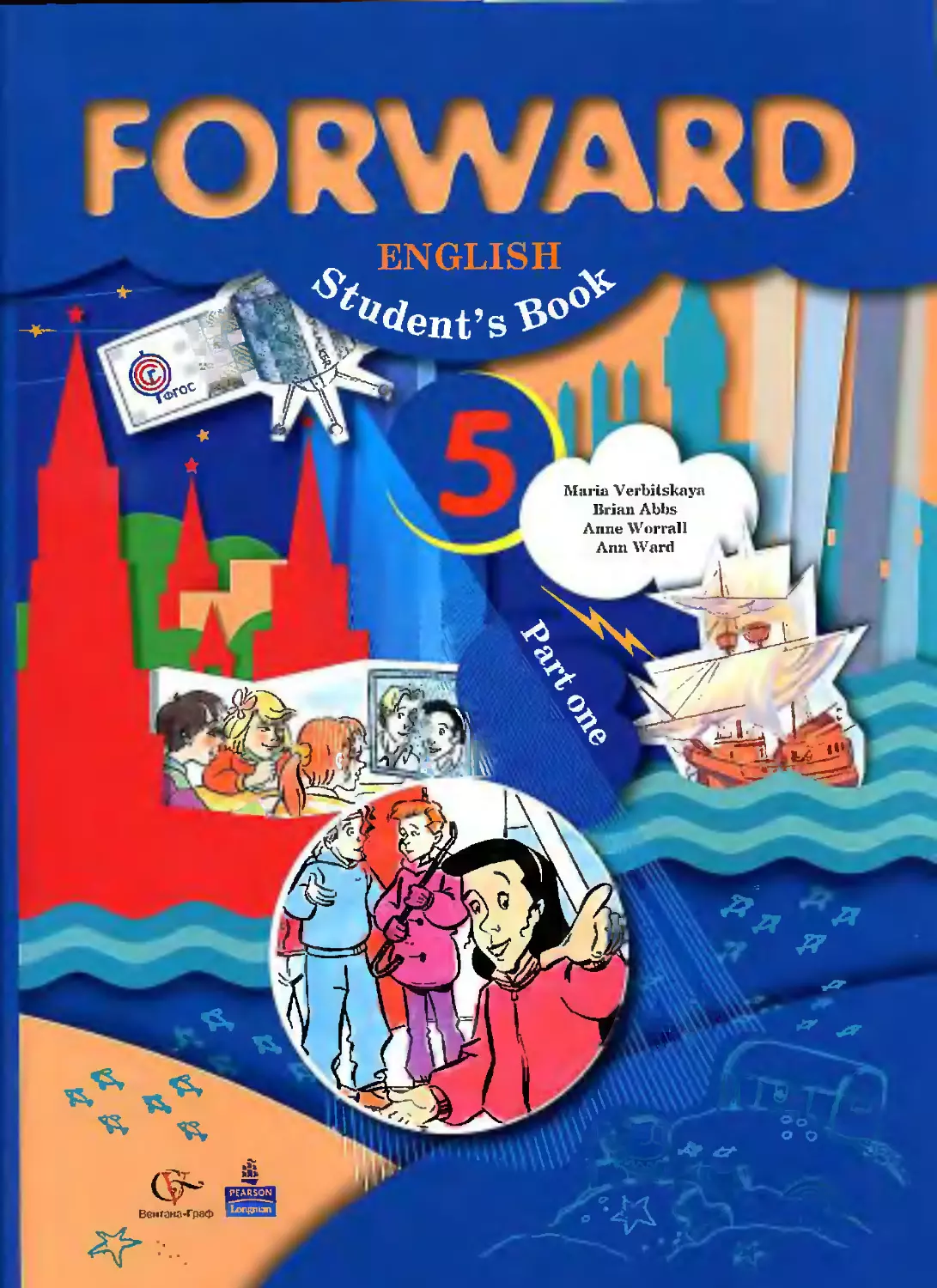
                    Maria Verbitskaya
Brian Abbs
Anne Worrall
Ann Ward

* _ •

ENGLISH

Вейхана-Граф

PEARSON

LotiRpum
Алгоритм успеха

Учебник
для общеобразовательных
учреждений

Под редакцией проф. М.В. Вербицкой

В двух частях
Часть первая

Рекомендовано
Л/ и нистерством
образования
и науки
Российской
Федерации

Москва

И зда пгельски й
центр

« Вентана-Граф »
Pearson Education Limited
2013
ББК 81.2(Англ)я71

А64

Учебник включён в федеральный перечень

Авторы: д-р филол. наук, проф. М.В. Вербицкая, Б. Эббе, Э. Уорелл, Э. Уорд

Английский язык : 5 класс : учебник для общеоб-
А64 разовательных учреждений : в 2 ч. Ч. 1 / [М.В. Вербицкая,
Б. Эббе, Э. Уорелл и др.] ; под ред. проф. М.В. Вербиц-
кой. — М. : Вентана-Граф : Pearson Education Limited,
2013. — 104 с. : ил. — (Forward).

ISBN 978-5-360-04370-6 (ч. 1)

ISBN 978-5-360-04372-0 (общ.)

Учебник является четвёртым в серии «Forward», обеспечи-
вающей преемственность изучения английского языка со 2 по
11 класс общеобразовательных учреждений. Учебник рассчи-
тан на обязательное изучение предмета «Иностранный язык»
в 5 классе школ, работающих по базисному учебному плану,
а также в школах и классах с углублённым изучением англий-
ского языка. В комплекте с учебником предлагаются: компакт-
диск с аудиоприложением к учебнику, пособие для учителя, ра-
бочая тетрадь с аудиоприложением.

В первую часть входят разделы с 1 по 8, во вторую —*
разделы с 9 по 16.

УМК для 5 класса входит в систему учебно-методических
комплектов «Алгоритм успеха».

Соответствует федеральному государственному образова-
тельному стандарту основного общего образования (2010 г.).

ББК 81.2(Англ)я71

Учебное издание

Вербицкая Мария Валерьевна
Эббе Брайен
Уорелл Энн
Уорд Энн

Английский язык

5 класс

Учебник для общеобразовательных учреждений

В двух частях
Часть первая

Благодарим за предоставленное разрешение на воспроизведение охраняемых авторским правом фотографий:
«Фотобанк Лори», ФГУП Информационное телеграфное агентство России «ИТАР-ТАСС»,

С.С. Митурича (www.mosphoto.ru), СА. Каулен

Редакторы Л.О. Савчук, Е.Ю. Туйцына. Дизайн С А. Каулен, Э. Самуэл. Художники Г. Эндрюс, К. Баксендейл,
Д. Кокборн, Н. Говер, Р. Холт, С. Нун, Д. Патерсон, М. Шоувел, М.Ю. Зарецкий, С.Ю. Гаврилова, ЕА. Савельев,
И.В. Логачёва, Е.Н. Филиппов, Художественный редактор С А. Каулен

Внешнее оформление С А. Подкорытовой, Ю.В. Сопельняка. Сканирование и цветоделение Л.В. Аникиной,
Д.И. Смирнова. Картографы Д.В, Черных, И.Н. Шорина. Компьютерная вёрстка О.В. Игнатовой
Технический редактор Л.В. Коновалова. Корректор О А. Мерзликина

Подписано в печать 28.02.13. Формат 60x90/8. Гарнитура PragmaticaC. Печать офсетная
Бумага офсетная № 1. Печ. л. 13,0. Тираж 10 000 экз. Заказ № 0202/13.

ООО Издательский центр «Вентана-Граф». 127422, Москва, ул. Тимирязевская, д. 1, стр. 3
Тел./факс: (495) 611-15-74, 611-21-56. E-mail: info@vgf.ru, http:^www.vgf.ru

Отпечатано в соответствии с предоставленными материалами в ООО «ИПК Парето-Принт»,
170546, Тверская область, Калининский р-н, Бурашевское сельское поселение,
промышленная зона Боровлёво-1, комплекс № 3 «А», www.pareto-print.ru

ISBN 978-5-360-04370-6(4. 1)

ISBN 978-5-360-04372-0 (общ.)

© Издательский центр «Вентана-Граф», 2012

© Pearson Education Limited, 2012
Contents summary

Unit		Main topic	Key language	Page
1	Let’s make a magazine	A school magazine Personal information Nursery rhyme:  “Mary Had a Little Lamb” by Sarah J. Hale	The Past Simple Tense: правильные/неправильные глаголы	4
2	The competition	A photo competition A day in the life of... Camera and photography	The Present Continuous Tense	14
3	At the film studio	A film studio  The life of a stunt artist	Конструкции:  like/hate/go/do 4- форма на -ing. to be going to + инфинитив	24
4	On the oil rig	A trip to an oil rig Natural treasures	Сравнение форм: the Present Simple Tense/the Present Continuous Tense  Многозначные слова	34
Consolidation 1 | Units '		1-4		44
5	To America!	Going to a theme park Gulliver-Park (St.Petersburg) “Gulliver’s Travels” by Jonathan Swift	Сравнение предметов: as (big) as...  The Past Simple Tense  The Future Simple Tense	48
6	Mr Big makes plans	Giving orders and making plans  Describing a person:  clothes and disguises  The solar system  Russia explores space	The Past, Present, Future Simple Tense: must, have to Конструкция to be going to/ the Future Simple Tense	56
	Which way do we go?	Escaping from trouble Following a route Under the sea Treasure ships	Наречия и прилагательные  Степени сравнения прилага- тельных (основное правило)  Выражения: turn right/left, go towards/along/past/into	64
8	Holidays in the USA	Trip abroad  Describing a country: the USA  Two Americans  Christmas and New Year celebrations	The Present Perfect Tense  Степени сравнения прилагательных (особые случаи)  Конструкция Would you like... ?	72
Consolidation 2 | Units		5-8		80
Dialogue of cultures (1)				84
Dialogue of cultures (2)				86
Vocabulary				88
Irregular verbs				103
Pronunciation table				104

- т Texts recorded on CD.

P Listen again.


Let’s make a magazine

Listening and reading

© tooi Listen and read.

Vera, Dasha, Lera and Nikita meet at school after the summer holidays. They are
chatting to Sam and Kate on Skype.

Vera:

Sam:

Nikita:

Vera:

Sam:

Vera:

Sam:

Nikita:

Sam :

Kate:

Vera:

2

Kate:

Dasha:

Lera:

Sam:

Dasha:

Nikita:

Hello, Sam! Hi, Kate! How are you?

Fine, thanks. And you?

Very well, thank you. We’ve got an idea.

We’d like to make a magazine.

A magazine? What kind of magazine?

We are going to make a school magazine for English language
learners. We can write about interesting things in English.

I like it. It’s great fun! I think that we can help you.

Great! Thanks a lot! Welcome to our team!

3

What are you going to write about?

Well, I’m going to write about literature because I like reading.

You know, Sam, I liked your comics about your last year adventure
very much. You can do something of that kind.

Well, I can think about a new story. And Kate will help me with
pictures and photos. She’s going to enter a photography
competition.

Very well! Kate can write an article about photography. I will write
about interesting facts, science and technology. Dasha and Lera are
going to write about interesting places all over the world
festivals and holidays in different countries.

Yes, we have a lot of ideas!

Let’s think of a name.

What about “Forward”?

Great!

Thank you, friends!

Read the text in pairs.

Ask your questions about the children in the pictures and their conversation.

Example:

A:	Who’s this boy?

B: He’s Nikita, Dasha’s brother.

A: What did the children want to do?

B:	They wanted to ... .
Reading and speaking

4 What do you remember about Kate and Sam? Read the Identity cards and speak about
them. Pupil A, close your book. Pupil B, check the answers and ask questions.

Example:

A:	Kate is from England.

B:	Right. How old is she?

A:	Kate is 11.

B:	No, I don’t think so.

Yes.

Right.

Right you are.

Good.

Useful words and phrases

No. I don’t think so.

Sorry, you are wrong.

I’m afraid you are wrong.

That’s not right, I’m afraid.

Identity card

Name: Kate Lewis

Age: 12

Birthday: August 18th

Nationality: British

From: Newtown, Britain

Hair: black

Eyes: brown

Pet: cat

Hobby: photography

Phone number: 124 971

Address: 18 Lime Avenue, Newtown

Identity card

Kame: Sam Roberts

Age: 12

Birthday: June 3rd

Nationality: British
trom: Newtown, Britain
Hair: fair

Eyes: grey
Pct: dog

45 Li™ Avenue, Ne„t„wn

5 Role-play. Kate speaks to Jill/Ben about the magazine.
Pupil A is Kate. Pupil В is Jill/Ben.

Example:

A: Hello, how are you?

B: Fine, thanks. And you?

Useful words and k hrases

Hello, how are you?	What can I do?

Our Russian friends ....	i I’ve got an idea.

Vera is going to ... .	I like it. It’s great fun!

Sam will think of ... .	What about the name?

I will take photos.	Great!

Writing

Complete the sentences.

Russian and English children want to
and______ Kate will______ I think.

They are going to write about
Listening and reading

LANGUAGE FOCUS: The Past Simple Tense (1)

7	®T002 Listen and read.

( Where were you three weeks ago?

I was in my grandmother’s village.
What did you do last summer?

I went on a boat trip with my father.

We swam in the river and walked in the woods, j

p ) Listen and repeat.

Grammar and speaking

Подбери к неопределённой форме глагола соответствующую ему форму Past
Simple. Нужно ли запоминать формы простого прошедшего времени этих глаголов,
или они образуются по общему правилу?

to do	to be	to have	went	did	was/were
to go	to make	to come	had	made	came

What did they do last year? In pairs, ask and answer questions about the pictures.

Example:

A: What did Vera do last year?

B: Last year she grew flowers and read fairy tales.

Useful words and phrases

to grow a flower	to make photos

to play football	to climb down a cliff

to learn about computers to design a model village
to send a letter	to cook delicious food

to get to the taiga

to go to the zoo

to play computer games

to read the tales
---1

10 What did they do last summer? Look at the pictures and talk about them with your friend.

Example:

A: What did Lera do last summer?

B: She swam and dived in the sea.

Useful words and phrases

to go on a boat trip
to walk in the woods
to ride a bicycle
to play tennis

to go hiking in the woods
to swim and dive in the sea
to sing songs by the fire
to go to the fair

- «

Project idea

11 Collect photos about your summer holidays and write about them. Make a poster or
a collage The best summer holiday.

REMEMBER! The Past Simple Tense

Talk about your holidays.

Example:

A: What did you do last month?

В: I went to my uncle’s farm.

to ride
to swim
to sing
to read

— rode

— swam

— sang

— read
r - - THINK ABOUT GRAMMAR: The Past Simple Tense JI)

The Past Simple Tense (простое прошедшее время) используется для
описания событий или состояний, которые относятся к прошлому.
В предложениях с этой формой глагола часто можно встретить слова
и словосочетания, обозначающие какой-то момент или период времени
в прошлом: yesterday, three weeks ago, last summer, 50 years ago, in 2003
и T. n.

Форма простого прошедшего времени образуется по-разному у правиль-
ных и неправильных глаголов. Правильные глаголы (regular verbs) образуют
форму простого прошедшего времени путём прибавления окончания -ed к
форме инфинитива: (to) walk — walked. Формы неправильных глаголов (ir-
regular verbs) надо запоминать: (to) do — did.

Grammar and writing
1

13

Выпиши в два столбика правильные и неправильные глаголы по образцу.

I
I
I
I

I
I
I
I

walked swam did talked climbed jumped worked lived made
painted sang liked rode wanted read had went were collected

Regular Verbs
to walk — walked

Irregular Verbs
swim — swam

Подбери форму Past Simple к каждому глаголу. Какие это глаголы?

I
I

I
I

I
I

I

I

I

slept told met became found got grew sent swam ate stole threw

become —
meet —
tell —
find —

get —
send —
sleep —
steal —

swim —
eat —
grow —
throw —

Pronunciation

15 Прочитай примеры и дополни формулировку правила.

/1 /	/d/	/ id /
like — liked hope — hoped reach — reached	call — called join — joined follow — followed stay — stayed	contact — contacted guard guarded

Окончание -ed правильных глаголов в форме Past Simple читается по-
разному.

После глухих согласных // .

После звонких согласных и гласных // .

После t и d // .
Writing

16 Do you remember what the friends wanted to write about (see Exercise 1)? Complete the
sentences and find the name for each section.

Example:

1 Vera is going to write about literature in the “Reading is fun” section.

2 Nikita will write about in the “” section.

3 Dasha and Lera are going to write about in different countries in

the “” section.

4 Dasha and Lera will also write about in the “” section.

Sections:
“Journey club”
“Did you know?”

“Holidays and festivals”
“Reading is fun”

Reading

- — - -	- J

Dznorl	4-Ln Уч	Ln Уч y4 ! m Л ГЧ / УЧ Уч r-y* 1-1 Уч ГЧ1/1 A \ КЛ/ч + тлк 4-Ln Уч Ln Уч УЧ y41  Г-Ч Уч УЧ -f Л /Пучу4	+ 1пуч «Ч УЧ Ук4-« УЧ уч УЧ	/уч УЧ УЧ

18

Какие русские слова напоминают тебе эти английские слова? Попробуй догадаться
об их значении самостоятельно, а потом проверь себя по словарю.

organisation, meteorological, hurricane, national, heroic, series, alphabetical

К какой части речи относятся подчёркнутые слова? Как можно об этом дога-
даться? Проверь себя по словарю.

Is

19

Выдели части сложного слова ‘weatherman’. Можешь ли ты догадаться о значении
всего слова, зная значение его частей?
Let’s make a magazine

Reading

20

Match the articles а-d and the headlines 1-4 (from Exercise 17).

| iRubsl,"‘ People first celebrated this
holiday in 2005, but it goes back to 1612
On 4 November 1612 Moscow was
liberated from Polish-Lithuanian
occupation.

The names of Minin and Pozharsky
are connected with those heroic days
in the history of Russia.

Because of art Australian weatherman
called Clement Wet Wraqqe. Ne named
humcanes after his neighbours — those he
quarrelled with, blow each year the World
Meteorological Organisation prepares a list
of girls’ and boys’ names in alphabetical
order, ready for future hurricanes.

My favourite writer is Joanna Rowling.
I’ve read all her books about Hany

Scotland is a very beautiful country

•th Я lot of mountains, lakes and
valleys. The most famous lake m Scotian
Xh Ness. Many people believe that
Nessie, the Loch Ness monster hves
in the lake.

because the writer doesn’t want to go
on with the senes.

I want more books about Hany Potter


Прочитай названия разделов из журнала ребят. Укажи заголовок (из задания 17)
и статью (из задания 20) для каждого раздела.

A Journey club

В Reading is fun

C Did you know?

D Holidays and festivals

A	в	c	D
3d

22 Read the sentences. Are they true or false?

1 Clement Wet Wragge was an American weatherman who named hurricanes
after his neighbours.

2 Loch Ness is the most famous valley in Scotland.

3 Joanna Rowling is the author of the books about Harry Potter.

4 Russian people first celebrated National Unity Day on 4 November 1612.
23 In pairs, read the headlines on this page and look
at the picture. Answer the questions:

•	Who is the autor of this book?

•	When did she write this book?

•	Do you know any other poems for children in English?

Nursery rhyme:
to all good children

Nursery rhyme — a short ‘traditional’ poem for young children in Britain
and other English-speaking countries. One of the most popular nursery
rhymes is “Mary Had a Little Lamb”.

фтсоз Mary Had a Little Lamb

Mary had a little lamb,

With fleece as white as snow;

And everywhere that Mary went,
The lamb was sure to go.

It followed her to school one day,
Which was against the rule.

And made the children laugh and play,
To see a lamb at school.

And so the teacher turned it out,

But still it lingered near,
And waited patiently about,
Till Mary did appear.

‘What makes the lamb love Mary so?’
The eager children cry.

‘Why, Mary loves the lamb, you know!’
The teacher did reply.

The original preface (Предисловие)

Poems
for our children
including

Mary Had a Little Lamb
Mrs Sarah J. Hale

To all good children in the United States

DEAR CHILDREN,

I wrote this book for you to please and instruct you. I know children love
to read rhymes, and sing little verses; but they often read silly rhymes, and
such manner of spending their time is not good. I intended, when I began
to write this book, to furnish you with a few pretty songs and poems which
would teach you truths, and, I hope, induce you to love truth and goodness.

Children who love their parents and their home can soon teach their
hearts to love their God and their country.

SARAH J. HALE.

Boston, May 1, 1830.
I

24

®тооз Listen to the rhyme and read it. Practise reading aloud. (Потренируйся читать
вслух.)

Find in the text the answers to these questions and read them aloud

1	Who had the lamb?

2	Where did the lamb follow the girl one day?

3	Why did the children at school laugh and play?

4	What question did the children ask the teacher?

5	What did the teacher answer?

Reading and writing

26 Read the text again, fill in the gaps and write the sentences.

1	A girl had a little lamb who was as white as.

2	The lamb followed her to one day.

3	The teacher turned the lamb out of school because it was the rule.

4	But the lamb didn’t home without the girl. When Mary came out, the lamb

was the school.

Speaking

27 Объясни по-русски, какие стихотворения относятся к жанру, который определяется
в английском языке как ‘nursery rhymes’. Есть ли такой жанр в русской детской ли-
тературе?

28	Read the preface once again and answer the question.

Use the words from the box.	_________________________

I to please to teach

Why did the author write her book for children?

Vocabulary and writing

29	Make word combinations out of these words.

holiday
past
order
organisation

alphabetical
meteorological
national
heroic

Listening and writing

30 ®too4 Do you remember this rhyme? Fill in the gaps with the words from the box and
write this nursery rhyme in your notebook.

Twinkle, twinkle, little
How I wonder what you are.
Up above the so high

Like a in the.

Twinkle, twinkle, little star.
How I wonder what you are.

world star sky diamond
Reading and writing

Просмотри тексты из рубрики «Знаете ли вы?»
(Did you know?). Какой темой они объединены?

• The nursery rhyme “Mary Had a Little Lamb”

is an original poem by Sarah Josepha Hale.

An actual incident inspired this poem. Mary Sawyer was a girl from Sterling,
Massachusetts. She kept a pet lamb and one day she took him to school. Mary’s

classmates were very pleased when they saw the lamb in the classroom.

• Thomas Edison recited the first stanza of this poem to test his invention of the
phonograph in 1877.

• In 1923 Edison’s friend Henry Ford moved the building which he believed was
the original schoolhouse mentioned in the poem “Mary Had a Little Lamb” from
Sterling, Massachusetts to the grounds of the Wayside Inn.

phonograph

32 Read the texts about this poem again and fill in the card.

Poem “Mary Had a Little Lamb”

Author:

Date of publication:

Place of publication:

Language:

Form: nursery rhyme

33 Complete the sentences with the information from the texts. (Дополни предложения
информацией из текстов.)

1	The author of the nursery rhyme “Mary Had a Little Lamb” is  . She
published her book in.

2	The inventor of the phonograph is. He recited the first stanza of the poem
“Mary Had a Little Lamb” to test his invention in.

3	Mary Sawyer lived in_____ She kept a pet lamb and one day she.

Speaking

34 Recite the rhymes “Twinkle, Twinkle, Little Star” or “Mary Had a Little Lamb”.
The competition

Listening and reading

WARD!

Magazine

Sam's stories

BT0Q6 Listen, look at the pictures and follow the story in the book.

Kate and Sam are looking at the school notice board.

Look at this, Kate!

I’in going to enter it!

I N<T>,

G^teTmoN

1/fe 4


Next day...

7 Hello, Kate.

Am I the star of your photo essay?

Of course not. Domino is.
He’s much more interesting!

Vocabulary

p Listen and repeat.

competition

essay

to enter sth

Reading and speaking

2 In pairs, read the text. Then answer the questions: Who's going to enter the photography
competition in Sam's story? Can you do a photo essay?

In pairs, ask and answer questions about the pictures.
Vocabulary

Read the text again and fill in the gaps with the words from the story.

photography competition
to enter sth

photo essay
star

notice board

Domino, the cat

1	In picture 1 Kate and Sam are looking at the.

They are reading about a. Kate is going to it. She is going to do a

2	In picture 2 Sam is talking to Kate about the of her photo essay.

3	In picture 3 Kate is taking a photo of.

Listening and reading

| LANGUAGE FOCUS: The Present Continuous Tense

are

(^That is my aunt

This is my brother in the photo.
He’s fishing in the river.

Yes, she’s cooking dinner on a fire

p Listen and repeat.

Speaking

6 Describe the picture. Match the beginning and the end of each sentence.

1	My brother

2	The sun

3	My aunt

4	I

5	The birds

6	My father

7	Our dogs

8	They

am sleeping under the tree,
are running and jumping,
is shining in the sky.
are playing with a ball,
is fishing in the river,
are flying in the sky.
is reading a magazine,
is cooking dinner.

О Какой элемент глагольной формы помогает тебе правильно соединить части
предложения?


Reading and speaking

7 Read the text and say what Oomino usuatty does at this time

Domino’s day

Early in the morning
At 8.00

In the afternoon

At 5.30

In the evening
---------- - a

meets the milkman.

..................

Domino gets up early and meets the
milkman. At eight o’clock he has his
breakfast in the kitchen, with the rest
of the family.

In the middle of the morning he visits
his friend, Mrs Tucker. She usually
gives him something nice to eat.

Domino sleeps in the afternoon.
He’s got a secret place on top of the
garden shed.

Sometimes he rides with Kate on her
bike. Sometimes he plays the piano.

Half past five is Domino’s dinner
time. He usually has cat food from a tin,
but sometimes Kate gives him something
special.

In the evening he sometimes watches
television. He likes wildlife programmes.

Listening and speaking	Г)

ГТ-] ~ —J W

I 8	©T007 What does Domino do?

Listen and answer the questions
Reading and grammar

9 Read sentences A-F and match them with pictures 1-8 on page 16.

A Domino is watching TV.

В Domino is playing the piano.

C Domino is sleeping in his secret place.

D Domino is riding with Kate on her bike.

E Mrs. Tucker is giving fish to Domino.

F Domino is having his breakfast.

G Domino is meeting the milkman early
in the morning.

10 Прочитай ещё раз описание фотографий Кэт (задание 9). Найди в каждом предло-
жении сказуемое. Сколько в нём частей? Какая из его частей называет действие,
а какая связывает сказуемое с подлежащим?

THINK ABOUT GRAMMAR: The Present Continuous Tense

The Present Continuous Tense (настоящее продолженное время) исполь-
зуется для описания действий, которые совершаются в настоящий момент,
на наших глазах и представлены как процесс. В предложениях с этой гла-
гольной формой часто можно встретить следующие выражения: now
(сейчас), at the moment (в данный момент), at present (в настоящее время).

Форма настоящего продолженного времени состоит из соответствующей
формы вспомогательного глагола to be (am, is, are) и смыслового глагола
в форме, оканчивающейся на -ing. В устной речи и в личных письмах обыч-
но используются краткие формы настоящего продолженного времени.

Единственное число
Утвердительные формы						Отрицательные формы
Полные формы			Краткие формы			Полные формы			Краткие формы
I am  You аге  He/she/it is		singing.	I’m  You’re He’/she’/it’s		singing.	I am not  You are not  He/she/it is not		singing.	Гт not  You aren’t  He/she/it isn’t		singing.
Вопросительные формы (общий вопрос)
Am I singing? Аге you singing? Is he/she/it singing?
Множественное число
We You They	are singing.		We’re You’re They’re	singing.		We You They	are not singing.		We  You They	aren’t singing.
Вопросительные формы (общий вопрос)
Are we/you/they singing?

111 Просмотри ещё раз текст из задания 8. Выбери формы глаголов, которые исполь-
зуются для описания ежедневных дел кота Домино. Какие это формы глагола?

In the evening Domino is watching/watches TV.

Early in the morning he is meeting/meets the milkman.

Сравни текст (задание 8) с описанием фотографий Кэт (задание 9). Выбери формы
глаголов, которые надо использовать для описания действий Домино на
фотографиях (в момент, когда мы их наблюдаем). Как называются эти формы
глаголов?

Mrs Tucker is giving/gives some fish to Domino.

Domino is having/has his breakfast.
13 Discuss with your friend what Domino does every day and what he is doing in every
picture of Kate’s photo essay.

Example:

A: Domino gets up early and meets the milkman. Is he meeting the milkman in
picture 2?

B: Domino is meeting the milkman in picture 6.

Reading

14 Alison lives in the country and Peter lives in the city. What do they do every day? Read the
lists and match them with the photos.

feeds the pony
catches the school bus

has lunch

Я rides the pony

 A<35 dinner

Вpractises the trumpet
9Lqoes to bed

I goes to school by hike
I has lunch

practises football

[ goes Swimming
has dinner

. makes model aeroplanes

Vocabulary
trumpet
choir
to catch sth

Listening and speaking

©too8 What time do they do these things?

Listen to Alison and Peter and match the times with the activities.

15

Example:

A: What time does Alison get up? B: At...

Writing and speaking

17	Make a timetable of your day.

18	!®toio Talk to your friends about it.

Example:

A:	1 usually get up at half past seven. What time do you get up?
A surprise for Kate

Listening and reading

19 ®toii Listen and point to the pictures.
Then read the letter.

fitch

Dear Kate Lewis,

^^T/Tfttyy

Vocabulary
,---------------j

congratulations

winner
prize

Vocabulary

n

n

of the photo competition Th
hked you photo essav ‘‘A *n
hfe of my friend Do^?a* ln the
Your prizg is a visit for t mUch-
Fil™ Studios to^ch the"?0 Redbri^
science-fiction fi]m «Rj ® of the
Please cnmo \ Black Gold”.

mee* you and a friend taX1 Wil1
on Monday at 9a m the Sch°01 gate
Your sincerely

if youZГ a'SO	»o™„

20 Познакомься с новыми глаголами. Найди в тексте письмй подчёркнутые слова и по-
пробуй объяснить их значения, сравнивая с данными глаголами. К какой части ре-
чи относятся подчёркнутые слова? Все ли глаголы помогают понять значения одно-
коренных слов?

to win — выигрывать
to visit — посещать
to judge — судить

to prize — высоко оценивать, восхвалять
to congratulate — поздравлять

to film — снимать, делать фильм

Speaking

21 @toi2 Talk to your friend about the competition.

Example:

A: What did Kate do last month?
How do cameras work?

ORWARD!

Listening and reading

22 ©Т013 Listen, read and look at the pictures. Can

you

Magazine

Did you know?

understand the highlighted words without a dictionary?

p Listen and repeat. Then answer the questions from the text.

A modern camera. When you press the
button on top of the camera, the shutter
opens to let the light in through the lens
and onto the film. The film records the
picture.

light

shutter

film

The first photograph. Joseph Niepce
took the first photograph in 1826.
After that lots of other people started
making cameras and photography became
very popular.

The camera obscura. Hundreds of years
ago, artists made the camera obscura.
It was a small, dark room with a hole in
one wall.

Light went through the hole and made
a picture appear on the opposite wall.

A modern camera works in the same way.

r

Vocabulary

J

to appear
to magnify
to record

Say CHEESE!

People in Britain often say CHEESE
Г. T,nebody takes a Photo Of the
Wh“' d° in our «X 8ay?
Nowadays there are lots of different kinds of cameras.

FORWARD!

Magazine

Powerful cameras can take photos of very
small objects and magnify them. We can
see things that we can’t see with our eyes.
What do you think this picture is?

Doctors use X-ray cameras to look inside
people’s bodies. They can see what is wrong
with them. This person’s finger is broken.

Cameras can take ‘trick’ photos. This looks
like the ice is on fire!

X-rays can also look inside people’s luggage.
This man has got a gun!

Some cameras are very small. You can use
these to take secret photos.---------

23 Answer these questions.

1 Who made the camera obscura? When did they make it?

2 Who made the first photograph? When did he make it?

---------1

Grammar

24 Прочитай про себя текст А. В каких предложениях глаголы употреблены в формах
Past Simple? Найди предложение с глаголом в форме Present Simple. Почему здесь
используется настоящее простое время?

25 Прочитай тексты B-F. В каких предложениях использованы глаголы в формах Past
Simple? Почему? Какие формы глаголов использованы в остальных предложениях?

26 Fill in the gaps with the correct Past Simple or Present Simple forms of the verbs in
brackets.

1	Long ago, artists(to make) the camera obscura. The camera obscura
(to be) a small, dark room with a hole in one wall. In this room light(to go)
through the hole and a picture(to appear) on the wall opposite the hole.

2	Nowadays, when we(to press) the button on top of a modern camera, the
shutter-------(to open). The light(to go) through the lens and the film

(to record) the picture.
Ask Uncle Harry

Reading and speaking

Read texts A—D and match them with pictures 1 -4.

pear UrC-,e H^to5 on
\ 1 >°°k ^not 9

pear

holiday5

Vocabulary

too small/dark

not clear/near enough

not enough light

i AA I ^°n9'
What d'A

Ple^	rre'

Tom

28 « той Talk to your friends about the photos.

Example:

A: Why is this person too small?

B:	Because he wasn’t near enough to the camera.

29 ®T0i5 A photo gallery. Bring some of your photos to class. Talk about them with your
friend.

Example:

A: Did you take this photo?

B: Yes. It’s my brother. He’s fishing in the river. I took it last year.
Listening and speaking

Say CHEESE!

30 Look at the people in the pictures.

Who's not very happy? What do you think about it?
$TO16 Now listen to the song. Were you right?

Smile and face the camera.

Smile, come closer, please.

Smile and face the camera.

That’s right, now all say CHEESE!

We are out for the day on a picnic,
On the beach or perhaps in the zoo.
But Bill has got a new camera and says,
‘I want to photograph you.*

But we have to smile and face the camera
‘Smile, come closer, please.

Smile and face the camera.

That’s right, now all say CHEESE!*

So we all have to stop what we’re doing
When he says, ‘Come over here, please.
Could you all stand in line near the flov
And all of you kindly say CHEESE!
Could all of you kindly say CHEESE?’
But I hate, I hate saying CHEESE!

I hate, I hate saying CHEESE!

311 ®toi7 Which picture is it? Listen and point to pictures 1-3. Then talk about the photos
in pairs.

32 Can you remember? How many of these questions can you answer?

1	When did they make the camera obscura?

2	When did Joseph Niepce take the first photograph?

3	What do we use X-rays for?

4	When do people in Britain say CHEESE?

33 Talk to your friends about your holidays.

Example:

A: What did you do on holidays?

В: I went to my uncle’s farm.
3 i At the film studio

Listening and reading

®toi8 Look at the pictures. Answer the question: What are the people in the pictures
doing? Then listen to the story and follow it in the book.

Kate and Sam visited the film studio.

They met the director and the stars of the film “Black Gold”.

This is fantastic!

Action!

Be careful, Domino!
Don’t touch.

Don’t worry.
It isn’t real glass.
It’s made of sugar


This is Josie West.

I’d like to see some

Yes, pleasel

HmmI

p; 1 Listen and repeat.

Look at the pictures again. Can you explain these sentences?

1) This is fantastic! 2) Cut! 3) Don’t worry!

Speaking

"

3

Answer the questions.

1 What happens when the director says
‘Action!’?

3	What was the window made of?

4	Who does stunts for Marina?

5	Who is the man in picture 5?

2 Who’s Marina Wilson?

In pairs, read the dialogues from the story.

Listening and speaking

5 фтсрэ What does Josie do? Listen to the conversation and point to pictures A—F
Then answer the question: /s it dangerous to be a stunt man or woman?
Listening and reading

7	* T02i Listen and read.

I like skydiving.

Josie, what stunts do you like best?

What do you like doing on

p Listen and repeat.

on Sundays/^

I hate skiing. I don't like winter,
I don’t like cold and snow.

What else do you do in films?

Well, I do diving, riding a horse and driving a car.

Speaking

8	Say who likes/hates doing it. (Поговорите о том, кто чем любит и совсем не любит за-
ниматься.)

	watering plants	dancing	skating	underwater diving
Sam			®
Vera	(^)		(2)
Kate
Maxim				©

Writing

9	Complete the sentences. There is one extra word in the box.

1	When the director says ‘Action! they filming.

2	When the director says ‘Cut!’, they filming.

3	Jill singing. She wants to be a singer.

4	Maxim dancing. He never dances.

5	Nikita diving every summer.

Use these words

go	like	stop

do	hate	start

Speaking

—-1 -- ... >

10 Role-play: an interview between a stunt man/woman and a film director
Pupil A is a stunt man/woman. Pupil В is a film director.

Example:

A: Hello, what’s your name? A: Can you swim?

B: Alice Smith.	B: Yes, and I can dive.
11 What would they like to do? Tell the children what they can do. Read and match.

Why don’t you make one?

I’d like to find out about film-making

don’t you join a gymnastics club?

I’d like to buy my friend an enormous birthday cake

Why don’t you borrow a book about it
from the library?

What would you like to do? Talk to your friends.

Example:

A:	What would you like to do?

B:	I’d like to ride a horse.

A:	Why don’t you join a riding club?

B:	It’s a good idea.

Listening and speaking

©T022 Listen and point to warning signs. Then listen and repeat.

SILENCE

NO
ENTRY

14	Where do you see these signs? What other signs do you see? Talk to your friend.
Speaking

—

15	Answer these questions with your friend.

What kind of films do you like?

What’s your favourite film?

Who is your favourite film star?

Reading and speaking

Which films are these people going to see?
Read and match.

-	4te^YtftS-

os ts л°“ oi “"1S’

Alison

Peopfe dore Se°ries- My ,
,ote ai°*

SC°U ,-,«s
ИН»*'
tv^gs
Reading and vicabulary

How do you make a film?

You need a lot of people to make a film. There are the actors, the director, the
camera operator, the producer, the sound recordist and many others. A two-hour film
like “Avatar ’ takes months, even vears to make.	----и----------------

®т023 Who are they?

Listen and point to the people in the picture.

©T024 Talk to your classmate.

18

A young actress

®то25 Now listen to an interview.

Does she answer your questions?

It’s one of the actors.

Do you want to be an actor/actress?
What do you want to be?
Reading and grammar

19 Read the dialogue. Then read the statements (1-6) and say true or false

Kate: Would you like to go to a film studio?

Dasha: Yes, I’d like to talk to a sound recordist.

Kate: Are you going to be a sound recordist in the future?

Dasha: No, I’m not. We’re going to make a film with sound effects.

Kate: Are you going to make a soundtrack?

Dasha: Yes, we are.

Kate: Why don’t you borrow a book about film-making from the library?

Dasha: Nikita’s going to find out about film-making on the Internet.

1	Dasha would like to go to a film studio.

2	Dasha doesn’t want to be a sound recordist in the future.

3	Dasha is going to borrow a book about film-making from the library.

4	Dasha’s going to make a soundtrack.

5	Nikita’s going to find out about film-making in the library.

r - - THINK ABOUT GRAMMAR: Конструкция to be going to

J Конструкция to be going to + неопределённая форма глагола употребля-
। ется, когда мы говорим о своих планах на будущее или о своих намерениях.

I I am going to see a comedy. (Я собираюсь посмотреть комедию.)

We are not going to be actors. (Мы не собираемся быть актёрами.)

Утвердительные формы
Полные формы		Краткие формы
I am  You/We/They are He/she is	going to see a comedy.	I’m  You’/We’/They’re going to see a comedy. He/she’s
Вопросительные формы (общий вопрос)
Am I  Are you/we/they Is he/she	going to see a comedy?

1

20 Изучи таблицы. Дополни пропущенные части конструкции.

Отрицательные формы
Полные формы	Краткие формы
I am not going	see a comedy.  You	not going to see a comedy.  He/she/it	not going to see a comedy.  We	not going to make a film.  You	not going to be actors.  They are not	to be actors.	I’m not going	see a comedy.  You aren’t	to see a comedy.  He/she/it	going to see a comedy.  We aren’t	to make a film.  You aren’t	be actors.  They	going to be actors.

In pairs, ask and answer the questions.

Are you going to...

•	go shopping this weekend?

•	watch TV in the evening?

•	join a sports club next year?

•	do dancing after school today?

•	send some emails tomorrow?

•	go on holiday next month?
|22j Look at the table and the Dictums nf

highlighted words without a dictionary? Thon stars- Can you understand the
for the film part.	Nonary? Then read about the film and find the best dog

Name	BILBO  *	f /  4^4 /	SPAt^Y~	MURPHY

Age	2 years	4 years	5 years
What can they do?
swim
dive
open a door with its nose
run fast
balance a ball on its nose
jump through a hoop
jump over a wall
climb a ladder

In the story,Vhe do^rescu^the cLld^V*10 UVe	the сошНгУ-

by climbing up a ladder. In another 1^бП	the burnin& house

an island in the river. The bov is 4h	do^ Sees a boy on

over a wall and runs to theГ	The dc*

and opens the door with its nose Thon ..g°es,t0 the poIlce statio«
to the river.	Then xt leads the policeman back

123j Talk to your friend about the dogs

Example:	y

B-	Can l d°; W,h0 C“ climb * '««er.
 can Bilbo climb a ladder?

Remember!

What does ... do?

I’d like to ... .

Why don’t you ...?

Don’t....

need

24] Role-play: an interview between л нлг, Л	’—

A is a doB owner.	а*	Э

Л- n m°’ What’S your d°S’s namp?

B. Bilbo.

A: How old is he?

B: Two years old.

A- Can he swim?

B: Yes.
Listening and speaking

25 * T026 What does it sound like? Listen and say.

a forest fire a rainstorm a thunderstorm someone	a child a soldier

swimming running marching

26 @T027 Talk to your friends about the sound effects from Exercise 25.

Example:

A: What does this sound like?

B: It sounds like a rainstorm.

How did they make the sounds? Look in your Workbook on page 20.

Make a soundtrack

Ч1Ш

Demonstrate how you can make the sound effects.
Talk to your friend.

Example:

A: How did you make the sound of the fire?

В: I crushed some paper.

Vocabulary
coconut shell
watering can
tin tray
rice
cellophane
sheet of tin
28 Are you mad about films?

Answer the questions with your friend

Magazine

Quiz

Project idea

Leo saw “Batman” fifteen times.

But what was the most popular film ever?

В

c

“Jurassic Park
“Avatar”
“Home Alone”

Casey wants to make films like James
Cameron. How much money will she
need to make a film like “Avatar”?

A 23 million dollars

В 230 million dollars ~

C 2 million dollars i

Sasha is going to watch a comedy. Which of
these Russian films is a comedy?

A “Morozko”	□

В “The Diamond Arm” □

C “Black Lightning” □

4 One country produces 900 films every year.
Emma wants to live there. Where is it?

A India □

В America □
C Britain

5 How many pictures does a cartoonist draw
for a 1 minute cartoon?

A about 10	□

В about 100

C about 1000 □

29

Make a poster My favourite film. Surf the Internet and find out about your favourite film.
Answer the questions: When was it made? Where was it made? Who was the director?
Who were the stars?
On the oil rig

Where is everybody? J

Listening and reading

Quick! Over here!

FORWARD!

Magazine

Sam's stories

»To2a Listen, look at the pictures and follow the story in the book

Kate, Sam and Josie arrived at the oil rig by helicopter.

It seemed very quiet.

Vocabulary
----- ==-' . - .. — |РИбв: =.	= —

submarine
helicopter
capsule
to lock sth
to wait for sth/sb

Help! Help!
₽ Listen and repeat.

2 In pairs, ask and answer the questions about the story.

1	How did they go to the oil rig?

2	Did they see anybody there?

3	What did they hear?

4	Did someone lock the door?

5	Who saw the submarine?

6	What did they see in the sea?

What is this story about? What do you think? Answer the questions.

And where is the other half?

What does it look like?
Do you know this ship?
(Look at page 25.)

What’s the name of the capsule?
Reading and speaking

4 What are they doing? Look at the pictures and say what Alison and Peter are doing

Talk to your friends about Alison and Peter.

Example:

A: Is Alison playing basketball in this picture?

B: No, she isn’t.

6 In pairs, show/mime one of the actions from the list above. Your friend will ask you
" questions. You may answer only Yes or No.

Example:

A:	Are you riding a horse?

B:	No.

A:	Are you swimming in the lake?

B:	Yes!
THINK ABOUT GRAMMAR:

The Present Simple and the Present Continuous

The Present Simple Tense	The Present Continuous Tense
Простое настоящее время используется: 1) для сообщения о том, что происходит обычно, постоянно или регулярно.  I always eat a big breakfast.  I never get up before 7a.m.  He doesn’t get up late on Sundays.  2) для сообщения о том, что нам хорошо известно (констатации фактов).  We live in Russia.  London is the capital of the UK.	Настоящее продолженное время используется:  1)	для сообщения о событии, происходящем в данный момент, момент речи.  Now Гт reading this book.  2)	для сообщения о продолжающемся в нас- тоящее время действии, даже если оно не происходит именно в данный момент, в момент речи.  We’re studying literature at the moment.  3)	при комментировании картин, фотографий или событий, которые мы наблюдаем в момент речи.  Look! Kate is diving.
Подсказки в предложении: often, usually, always, sometimes, never, every day/month/year и т. п.	Подсказки в предложении:  at the moment (в настоящее время), today, now, this morning/afternoon и т. п.

Spelling

7 Образуй формы Present Continuous no образцу.

При добавлении суффикса -ing в глагольной основе:
нет изменений	«немое» -e опускается, слог остаётся открытым	удваивается конечная согласная в закрытом слоге
act — acting (do) 1 'm doing	make — making (take) I am taking	sit — sitting  (swim) Не is swimming
	’s (finish) 	’re (climb) 	’m (go) 	’s (play)		am (write)  	are (use)  	is (dive)  	are (phone)	he 	(cut)  she 	(win)  1	 (travel)  they	(run)

Grammar and writing

8 Fill in the gaps with the correct forms of the verbs in brackets.

I

J 1 My friend usually(phone) me in the evening. Do you hear it?

। He(phone) me now.

I 2 I don’t want to go out now. I(watch) a very interesting programme on

1	TV. I(watch) this programme every week.

3 Look! My dog(dance)! He usually(dance) when I give him some sugar.

I

Pronunciation

—I

। В устной речи, как правило, используются краткие формы Present

I Continuous, при этом краткая форма с’s произносится по-разному:

j	1) после глухих согласных /s/: It’s making a noise. A cat’s playing with a mouse.

. 2) в остальных случаях /z/: She’s making a noise. Dad’s reading.
A newspaper story

FORWARD!

Reading J

Magazine

Sam's stories

CAPSULE LOST

Read the newspaper story on your own. Then answer
the question: Who is looking for the capsule from a
satellite?	' -

find a treasure ship otf the

Listening and speaking

10 ®to29 Listen to the story and answer Sam’s questions.

11 Read the newspaper headlines and
find the places on the map.	coins in wreck

Treasure ships к Schoolchildven m

- . Ko iwsoulh c

1SATCUJrebiscOVTRSGOLD
BARS IN THE NORTH SEA

London

Cardiff

Space scientists are worried because a capsule from
a satellite disappeared last week. The Wrecktracker
capsule has information about treasure ships.

Its computer shows hundreds of ships at the bottom
of the sea.

Police all over the world are still looking for the
international criminal Mr Big. Mr Big wants to find
lost treasure ships. ‘We hope Mr Big hasn’t got the
capsule,’ said a historian. ‘If he has got it, a lot о
beautiful and valuable things will disappear
for ever.’

we

20.12.86 Divers

St coast of Scotland

« two Talk to your friends about the treasures.

Example:

A: What did a satellite find in 1986? 1
B: Some gold bars.

Anglesey

^Edinburgh

North


Vocabulary and writing


13 Fill in the blanks with words from the text.

1	Space scientists are about a capsule from a satellite. 2 The capsule

information about treasure ships. 3 Police are for Mr Big. 4 Mr Big is going

to the capsule. 5 If the criminal has got the capsule, a lot of valuable things

will.
Listening and reading


I----- LANGUAGE FOCUS: Многозначные слова

r—----------------------- -------------------------------

14 ®T03i Listen and read.

What is the Russian for ‘cut’? What does ‘cut’ mean?

The word has many meanings. In film-making, when the director says
‘Cut!’, they stop filming. In Russian, the director says ‘Снято!’

You can often see the same word in instructions: ‘Cut the plastic into squares.
...Cut three strips of cord. ...Cut a hole in the box.’ Here the word ‘cut’ means
‘use the scissors’. In Russian it is «Разрежь ...», «Нарежь ...», «Вырежи ...».
How do we know which meaning it is? The context (the words around) helps us.

Vocabulary

115 Can you think of other words like ‘cut’? Read the sentences and find the corresponding
meaning of the word.

1	Do you want me to cut the cake?

2	My father cuts the grass on Sundays.

3	He usually paints in oils.

4	You must check the oil in your car every week.

5	I cut my hand yesterday. It hurts!

6	Russia has got a lot of oil.

7	Can we cut the price of these computers?

8	Would you like sunflower or olive oil with your salad?

9	Can you cut and paste the picture into a new file on your computer?

10	The river cuts the city into two parts.

oil n 1. масло (растительное или мине-
ральное); vegetable ~ растительное мас-
ло; olive (palm, sunflower) ~ оливковое
(пальмовое, подсолнечное) масло

2.	нефть

3.	смазочный материал; - filter масля-
ный фильтр; please, check my ~ посмот-
рите, есть ли у меня масло в моторе

4.	обыкн. мн. масляная краска;

to paint in ~s писать маслом, масляными
красками

cut v 1. резать, разрезать; to - sth in two
разрезать что-л. на две части

2.	нанести резаную рану, порезаться

1	~ my finger. Я порезал палец.

3.	отрезать to - a piece of cake отрезать
кусочек торта

4.	стричь, подстригать

5.	сокращать, снижать,

6.	Cut! Стоп! (команда
при киносъёмке)

~ and paste вырезать и вставить
(компьютерная команда)

уменьшать
кинорежиссёра
Natural treasures

Vocabulary

Find the pictures of these things.

gold

rubber

cocoa
honey

oil
cotton

silk

wood

pearls	gas	diamonds

amber	wool

Speaking and listening

Where do these things come from? In pairs, answer the questions.

Which come from trees?

Which of these things are made by insects?

@тоз2 Listen and check your answers.

Which are found under the sea?

Which are found in the ground?

West Indies

Alaska

Canada

USA

Mexico

CENTRAL AMERICA

Galapagos
Islands

Brazil

SOUTH
AMERICA

Argentina
18

•T0S3 What are they used for? Talk to your friends about these things.

jewellery petrol furniture tyres clothes chocolate

Example:

A: What’s gold used for?

B: It’s used to make jewellery.

191 «тоз4 Where are they found? Listen and point to the places on the map.

Vocabulary

oil

gold

Chin

bananas

wool

cotton

silk

cocoa beans

©T035 Talk to your friends about natural treasures.
Example:

A: Where is oil found?

In the USA.

EUROPE

<7
0

Grdat,Britain

Egypt

AFRICA

Russia

о

J

Sduth Africa

rubber

sugar


rArabia

5Г

AUSTRAUA

Vocabulary

cocoa
silk
pearl
amber

gas
I

2>

Reading

21

22

gLT036 What is oil used for? Listen and point to the pictures from Exercise 21.

Read about oil.

Can you answer the question from the text?


Listening and speaking

»)T037 Talk to your friend about the poster from Exercise 21.

Example:

A: What’s this?

B: It’s a power station. Oil is used in power stations.

,24 Oil is used to make plastic. How many things made of plastic can you find in your
classroom? Discuss your answers in pairs.

25

Finish the sentences.

1 Oil is called ‘black gold’ because

2 Oil is

Project idea

26 Make a poster The treasure. Find out about a real life treasure, maybe archeologists have
found something in Russia. Draw maps, plans and pictures.
You arrive home
with sacks of gold!

Look for gold in
the river. Go to 23

Start digging
for gold.
Go to 31.

Gold is found
in California.
Throw six to start

Goldmine game.

Play this game with your classmate

Magazine

Game zone

Someone steals
your mining tools
Go back to 9.

You
find gold
Go to 29.

You’ve got a map
of the gold field.
Go to 19.

Your bag of gold
Stalls into the river
Go back to 30.

Buy a donkey
to carry your gold
Go to 39.

You arrive
in California and buy
your mining equipment
Go to 10.

Something is wrong
with the road.

Goback to 17._
Consolidation 1

Listening and speaking

• тоза A poetry competition. Listen and say true or false.

1	Paul entered a poetry competition two years ago.

2	He wrote a poem about winter.

3	There were three prizes.

4	The first prize was a computer.

5	The second prize was a football.

6	Paul got the second prize.

О Listen again and answer the questions.

1 When did Paul enter the competition?

2 What was his poem about?

3 How many prizes were there?

4 What was the first prize?

5 What was the second prize?

6 What was the third prize?

7 Which prize did Paul win?

Speaking

2 Role-play. Interview with Paul, a prize winner in a poetry
competition.

Pupil A is a journalist from “Forward” magazine.

Pupil В is Paul.

ORWARD!

3	1 hink of an exciting competition and tell your

friend about it.

• What kind of competition is it?

•	How many prizes are there?

•	What is the first prize?

Grammar and writing

Choose the right form of the verb and write the sentences.

1 Maxim (watches/is watching) the news programme every day.

2 Come in, please! Sit down! We (watch/are watching) a funny comedy.

3 You (laugh/are laughing)! Why? It’s not funny!

4 Look! A dog (climbs/is climbing) the ladder!

5 My Brownie never (does/is doing) it. He is afraid of ladders.
5 Fill in the gaps with to be going to. Don’t forget to use the verb to be in the right form.

1	Kate enter a photo competition.

2	Sam think of a new story.

3	Vera and Maxim make a school magazine.

4	The magazine be in English.

5	Kate visit the film studio.

6	Г make a film about my school.

7	You’be the star of my film.

8	We’win the first prize.

Grammar and speaking

6 In pairs, look at the pictures and guess what these children are doing
Example:

A: What is the girl in picture 1 doing?

В: I think, she’s singing.

A: Yes, she is./No, she’s not. I think, she’s...

О Write a sentence about what you are doing (e.g. I'm singing/Гт climbing a mountain)
and then show or mime it. Your friend will ask you questions. You may answer only Yes
or No.

Talk with your friends about films you like and films you don’t like.

•	Do you like watching comedies?

•	Does your friend like watching comedies?

•	Do you hate watching detective stories?

•	Would you like to be a stunt man or woman?

•	What kind of stunts would you like to do?
Consolidation 1

Language summary

8 j Read the words. Which of them are countable nouns and which are uncountable nouns?
Read the words again adding a/an before countable nouns and some before uncountable
nouns.

9

Do you remember these rules? Read the chart and add your examples from Exercise 8.

Countable nouns
(Исчисляемые существительные)

Обозначают предметы, людей,
явления, которые можно посчитать:
orange, book, story, doctor, judge,
competition

Имеют форму множественного числа:
oranges, books, stories, doctors,
judges, competitions

Uncountable nouns
(Неисчисляемые существительные)

Обозначают вещества и материалы,
а также отвлечённые понятия,
которые посчитать нельзя:
gold, oil, furniture, money, police,
help, love

He имеют формы множественного
числа

Могут использоваться с количествен-
ными числительными:

5 oranges, 7 books, 10 stories,
25 doctors, 3 judges, 2 competitions

Не используются с количественными
числительными

В единственном числе могут исполь-
зоваться с неопределённым артиклем
а/an: an orange, a book, a story,
a doctor, a judge, a competition

Не используются с неопределённым
артиклем

Образуют словосочетания с some

Во множественном числе:
some oranges, some books,
some stories, some doctors,
some judges, some competitions
Значение some: несколько

В единственном числе:
some gold, some oil, some furniture,
some money, some help

Значение some: некоторое количество,
немного

Grammar and speaking

10 Role-play. Shopping.

' ' Pupil A is a shop assistant. Pupil В is a customer. The customer wants to buy some things
from the pictures above.

Example:

B: Can I have some bread, please?

A: Yes. Here you are.
Reading

Roald Dahl

FORWARD!

Did you know...

...who is Roald Dahl?

Paul won a prize in a poetry competition. It was a
book. He chose a book by Roald Dahl, his favourite
writer.

Roald Dahl is a famous British writer. He was born
in 1916. His parents were Norwegian. They came to
live in Britain before Roald was born. They named
their son after the explorer Roald Amundsen, a national
hero in Norway at the time.

During the Second World War Roald Dahl was
a fighter pilot. He began writing books for both child-
ren and adults, and soon became a popular writer. He
was very good at sports, he played football and rugby.
Photography was another of his hobbies. One of his
highly popular tales is “Charlie and the Chocolate
Factory” (1964). A film was made after it.

Dahl is one of the greatest British writers since 1945.
People read his books in almost 50 languages all over the
world. Dahl’s birthday on 13 September is celebrated as
“Roald Dahl Day” in Africa, the United Kingdom, and
Latin America.	_______ _____—

Magazine

Did you know?

Read the text and say true or false.

Roald Dahl was born in Norway.

He was named after his father.

Both children and adults read Dahl’s books.

He didn’t like sports.

There are translations of his books in almost
50 languages.

Vocabulary and writing

12

Fill in the blanks with the words from the box.
There is an extra word!

IltoaM |)jhl

Charlie
and the Chocolate
Factory

2

3

5

j

travel national adventures life explorer arrive sailing

Roald Amundsen was a famous .

His mother wanted him to become a doctor, but he liked sea.

Amundsen was the first to to both the North and the South Pole.

He was a---hero in Norway. There are many books and films about his

Speaking

13 Write the name of Roald Dahl or Roald Amundsen and don’t show it to your friend. Your
friend will guess the name by asking you questions. You may answer only Yes or No.
5 ; To America!

Listening and reading

®тоз9 Listen, look at the pictures and follow the text.

Inside the submarine Mr Big’s gang talked to their boss. He was very angry.

Let’s phone my brother in America
He’s a scientist.

Hi, Paul.

We’ve got a problem

I see.	<

Would you like to bring the Wrecktracker here?

You fools!

You've only got half the capsule! 1 ” 1
[ Sorry, boss!
. J 9 к They had a helicopter
To America!?

We’re going to take the Wrecktracker to the Space
Institute in Florida. My brother works there.

Sam, Kate,
how would you like to go to America?

Listen and repeat.

2 Read the story in pairs.

Vocabulary

3 Найди в тексте слово ‘institute’. Что оно обозначает в тексте? Что в русском языке
называют словом «институт»?

Speaking

4 What will happen in the story? Talk to your friend.

1 How will they travel to America?

2 What will they take with them?

3 Who will they meet in America?

4 What will Mr Big and his gang do?

Listening and reading

©T040 What would they like to do on the plane? Listen to Sam and Kate and point to the

pictures.


J

A theme park

Reading and speaking

Read and match.

i

FORWARD!

<

Magazine

Journey dub

At Greenfield Park
you can:

go on the roller coaster

photograph the deer

follow the nature trail

picnic on the river bank

say hello to a dinosaur

go rollerskating

have a hamburger

go on the monorail

©T041 Talk to your friend about what you would like to do.

Example:

A:	What shall we do first?

B:	I’d like to go on the monorail.

C: No, let’s follow the nature trail first.

Useful words and phrases

Would you like to ... ?

What shall we do ... ?

eat	go

see	meet

visit	travel by

first	then

next	after	than

Vocabulary
monorail
nature trail

Writing

8 Make a list of the things you’d like to do.

9 What other things would you like to do at a theme park? Make your own brochure.
Gulliver-Park
in St. Petersburg, Russia

Reading and speaking

FORWARD!

10 Знаешь ли ты, кто такой Гулливер и кто живёт в стране Лиллипутии? Прочитай текст
и объясни, почему тематический парк в Санкт-Петербурге называется «Гулливер-
паоком».

There is an unusual theme park in St. Petersburg. This park is called Gulliver-
Park. Here you will find lots of fun and exciting things to do. You can go on the
horse carousel or on the dodgems. Would you like to visit the puppet theatre? It’s
in front of the bouncy castle. In this castle you can jump for fun and after that you
can have a cup of tea or eat chocolate ice cream in Gulliver’s cafe.

There are also very big things there: a watch, a cap with a pair of gigantic
glasses, a shoe. Do you know why they are so big? These are Gulliver’s things. Do
you know who Gulliver is? Why are his things so big?

Gulliver is a character in the book “Gulliver’s Travels” by Jonathan Swift. He
travelled a lot and one day he came to the country Lilliput. The people in Lilliput
were only 15cm tall, they were Lilliputians! He was a giant there and his things
were very big, gigantic.

Role-play. Vera and Maxim are in Gulliver-Park. They decide where to go. They also
discuss how to get there.

Example:

Maxim: What would you like to do first?

Vera: First I’d like to see Gulliver’s things, then I’d like to go on the dodgems.

Maxim: Would you like to see Gulliver’s watch?

Vera: Yes. Where is it?
Maxim: It’s on the right.

Vera: Let’s go there.

Useful words and phrases

It is on the right/left.

It is opposite ....

It is in the middle of ...
It is behind/in front of

Vocabulary
unusual
character
carousel
bouncy castle
I

5 To America!

Reading

RWARD!

12 Look at the pictures. Do you know these books? Do you read them in Russian? What
' character gave the name to a theme park in St. Petersburg?

Jonathan Swift

Gulliver’s
Travels

Magazine

Reading is fun

Robinson

Lewis Carroll

Alice’s
Adventures
in Wonderland

13 Read the beginning of “Gulliver’s Travels”. Who is the main character in this book?

I. I was born in England. When I was only fourteen years old my father sent me to
Cambridge to study medicine. I studied there for three years. When I left college I went
on with my studies and became a doctor. I always wanted to travel. I became a doctor on
a ship, sailing both to the East and to the West Indies. On May 4, 1699, I sailed from
Bristol for the South Seas as a doctor of a ship named the Antelope.

At first, everything went well, but then there was a great storm. The ship came
very close to the rocks and crashed into them. Some of the sailors and I got a boat into
the water. It was a small boat. When a big wave hit it, we all fell into the sea. I was
swimming for a very long time and got very tired. I felt that I could not swim any
longer. But the shore was not far away and soon my feet touched the ground. I walked
out of the sea to a beach — there were no houses, there were no people. I was so tired that
I lay down and fell asleep.

14 Find the information in the text and complete the sentences.

Gulliver became a doctor...
a) before he was seventeen,
b) when he was seventeen,
c) when he was over seventeen.

When the Antelope crashed, Gulliver
a) tried to save the ship.

b)	took a small boat.

c)	started swimming to the shore.

15 Match the pictures to the text. Describe the pictures.
16 Look at the pictures. What do you think will happen next?
Write three sentences in the Future Simple Tense.

FORWARD!

Magazine

17! Read the second part of the story. Are your guesses right?

II.	When I woke up, the sun was shining. I tried to get up, but I couldn’t move my
hands or feet. I was lying on my back. Hundreds of thin but strong cords fastened my
arms and legs to the ground. I could not turn my head because even my hair, which was
very long, was tied to the ground.

Soon I heard some voices. Something was moving along my left leg, up my body and
to my face. When I looked down I saw a very little man, not more than six inches tall.
Many more small men came after him. I was so surprised that I gave out a loud cry. The
small people were afraid of me — they jumped back. Some fell off my body and hurt
themselves badly. I felt a hundred arrows on my hand, face and body.

After that an important man addressed me. I did not know his language but I
guessed the meaning of his speech: I am in the country called Lilliput. Lilliputians live
here. I must not hurt them. They are not going to hurt me.

Vocabulary


18

Look at picture 4 and explain the underlined words.

19 Read the words. Find the sentences with these words in the text. How would you
translate these sentences into Russian?

inch — дюйм, английская мера длины, равная 2,54 мм

gave out a loud cry — издал громкий вопль

Writing

Use the words from the box instead of the underlined words.

Gulliver he him his

1 I was born in England. 2 When I was only fourteen years old my father sent me to
Cambridge. 3 I studied medicine in Cambridge for three years. 4 When I left college,
I went on with my studies and became a doctor. 5 I always wanted to travel. 6 I became
a doctor on a ship named the Antelope. 7 On May 4, 1699, I sailed from Bristol for the
South Seas as a doctor on a ship. 8 When the ship crashed into the rocks, I fell into
the sea. 9 I was swimming for a very long time, and finally I walked out of the sea
to a beach. 10 I lay down and fell asleep. 11 When I woke up, I saw many small men.
12 I was in the country called Lilliput.

Example: Gulliver/He was born in England.
Speaking and reading

21

Look at the pictures and read the words. Try to guess their meanings. How did the
Lilliputians use Gulliver’s things?

handkerchief

tobacco box
to sneeze

comb

22 Read the third part of the story.

III.	Then they wanted to look into my pockets. They wanted to see what I had there.
They made a list of my things:

1 a great piece of cloth, as big as the carpet in the King’s dining-room;

2 a great golden box, as big as a kitchen in a Lilliputian’s house. There is some
dust in the box. When the Great Man-Mountain opens the box, we start to sneeze;

3 something which looks like the fence around the King’s garden: twenty sticks
fastened to another longer stick.

23 Answer the questions.

1 What did the Lilliputians find in Gulliver’s pockets?

2 What did the Lilliputians think of it?

3 What did they call Gulliver?

4 Why did they give this name to Gulliver?

Listening and reading

LANGUAGE FOCUS:
Comparing things (Сравнение предметов)

24

®T042 Listen and read.

Gulliver’s handkerchief was as big as the carpet in the King’s dining-room.

Gulliver’s tobacco box was as big as a kitchen in a Lilliputian’s house.

Gulliver’s tobacco box was as heavy as a Lilliputian horse.

Gulliver’s comb was as big as the fence around the King’s garden.

Gulliver was as tall as a mountain in Lilliput.

p Listen and repeat.

Speaking

25 Talk to your friends about the things in Gulliver’s pockets.

1 What did they look like?

2 How big were they?

3 What did the Lilliputians think of them?
Listening and speaking

r~ i

26

• T043 Listen to Nicola and Robert talking about their feelings. Point to the pictures.

When do you feel happy?

Vocabulary
happy
sad
excited
nervous
angry
frightened
bored

27	• '044 Talk to your friend about Nicola and Robert.

Example:

A: Nicola feels happy when the sun is shining.

28 ®T045 Talk to your friends about your feelings.

Example:

A: When do you feel happy?

В: I feel happy when I go swimming.

Remember!

What would you like to do?
I’d like to ... .

Let’s ... ./Shall we ...?
I feel happy when ... .

Project idea

29, Make a poster What makes you sad? What makes you happy? Use your photos and
drawings to show what things make you and your friends sad, happy, angry, nervous etc.
ВЦ» makes plans

—»	  — -	-e^^- “ «

Listening and reading
—	—  ^ — —- i

FORWARD!

1	©T046 Listen, look at the pictures and follow the text.

On the island, Mr Big gave his gang their orders.

Ted and Dave, you must get inside the Institute?^
You must find out what’s happening there.

No. Let’s wait

Yes, boss.

Shall I steal the capsule at the airport?JI

Dirk!

You must meet their plane at the airport!

Vocabulary
surfboard
disguise
order
to meet sth
to lose sth
Certainly not!
Speaking

2

Role-play. Make dialogues between the characters of the story.

Example:

Mr Big: Della, you must travel with Jane to Florida.

Della: Yes, boss. I’m going to travel with Jane to Florida.

Listening and speaking

3	®T047’ Mr Big’s gang are having breakfast. What are they going to eat?

Listen and point.

Whose breakfasts are these?

Vocabulary
steak
cornflakes
strawberry

Talk to your friend. What kind of breakfast do you usually have?
FORWARD!

The gang’s disguises

Reading and speaking

Read and find the gang members.

Vocabulary

wig /wig/
moustache /ma'staj/
beard /biad/
false /fo:ls/ nose

Magazine

Sam's stories

Mr Big’s gang

month

but we

of the gang-

Meet me ,n

a big red


In the lobby. I’m soing to wear
moustache and a grey hat.

1 at ten °’C1G^
a long black beard and

you on T/J7.

™ear a blonH

'	and da,I

°^lock. I’m going to
— a black wig.

wear

Jane 1

£>ella

We'll be there. Ted's going to wear a black
oustache and a false nose. Dave’s going to wear
curly red beard and a long white coat.

Ted and Dave

Talk to your friend. Why couldn’t the police find any of the members of the gang?
Example:

A: I’m Dirk. The police couldn’t find me because I was wearing a big red moustache
and a grey hat.

B: The police couldn’t find Dirk because he was wearing a big red moustache and
a grey hat.
THINK ABOUT GRAMMAR:
The modal verb must/Модальный глагол must

Модальный глагол must обозначает обязанность, необходимость совер-
шить какое-либо действие: Не must get up earlier. (Он должен раньше вста-
вать.)

Когда необходимо приказать кому-то сделать что-то, глагол используется
в утвердительной форме 2-го лица: You must do it. (Ты должен это сделать.)

Отрицательная форма глагола означает запрет на выполнение данного
действия: You mustn’t do it. (Тебе нельзя этого делать.)

После must смысловой глагол используется в неопределённой форме без
частицы to.

Настоящее время	У глагола must в Present Simple одна форма. I/you/he/she/we/they must do it.
Прошедшее время	Вместо глагола must используется выражение had to в Past Simple. When he was a child he had to do it.  I/you/he/she/we/they had to do it.
Будущее время	1.	Используется глагол must в Present Simple, но с наречиями, ука- зывающими на будущее время.  I/you/he/she/we/they must do it tomorrow/next year.  2.	Используется выражение will have to/’ll have to во Future Simple: I/you/he/she/we/they will have to/’ll have to do it tomorrow.

Grammar and writing

7 What must they do in these situations? Write questions and answers using must or mustn't.

Example:

1	He is always late for school.

What must he do? He must get up earlier.

2	Maxim is going to a birthday party today.

3	Sam is ill.

4	My brother is going to leave very early tomorrow.

5	A man sees a house on fire.

6	You see a crying child lost in the street.

Use the following phrases

call a doctor	buy a present

call the firemen	help him find his way home

stay up late	go to bed early

Read the dialogue (pages 56-57) again and answer the questions. Write your questions
with must.

1 Who must travel to Florida? 2 Who must meet the plane at the airport?

3 Who must get inside the Space Institute? 4 What must Tedd and Dave do?

Speaking

9 Role-play. Open your book at page 56 and give Mr Big’s orders to the members of the
gang.

Example:

Dirk, Mr Big says you must meet the plane at the airport. You mustn’t steal the
capsule.
The solar system

Listening and reading

10 Look at the picture.

Name the planets of the solar system in Russian.

FORWARD!

Magazine

Did you know?

• 41 Listen, look at the pictures and follow the text.

Is there life on other planets? The planets in the solar system all
go round the Sun. There are nine planets, but our planet, the Earth,
is the only one with living things. We now know that the conditions
on the other planets are not suitable for life.

Mercury, for example, is closer to the Sun than the Earth is. It is
too hot. Other planets which are further from the sun are too cold.

Vocabulary
surface
icecap
condition
space probe
suitable
solar

Pluto

Mars

Venus

the Sun

Mercury

the Earth

Saturn

Neptune

J upi ter

Uranus

Mars has icecaps and volcanoes, wind and
clouds. Once it had water, but now all the
water is frozen in the icecaps.

At night the temperature at the equator
drops to -111 C.

The Viking Lander took this picture of
the surface of Mars in 1976.

Space probes explore the solar system and take photos of different planets.
This tells us a lot about our solar system.
12	Read the sentences with the words. Can you understand these words without
a dictionary?

equator system temperature

Listening and speaking

13	®T049 Which planet is it? Listen and say the names of the planets.

/'plu:tau/ /'sastan/ /'neptju:n/ /'vi:nas/ /'juaranas/ /'тз:1дип/ /'djurpita/

Writing

14	Forward quiz. Write five questions.

Example:

Which planet is closest to the Earth? Is Jupiter closer to the Earth than Saturn?

Listening and reading

15	Listen and read.

A young astronomer

Alex is eleven. He is a member of the Astronomical Society in his town. He became
interested in astronomy after he did a project on space at his school. Now he goes
to the meetings of the Astronomical Society every month. Alex looks at the sky
through binoculars. ‘You don’t need an expensive telescope when you begin,’ he
says.

Reading and speaking
- ............... ...  — —  ~'

16	Read the information about space exploration. Talk to your friend about it, using the Past

Simple Tense

Russia explores space

1957: the first satellite Sputnik 1

1957: the first animal in Earth orbit, the dog Laika on Sputnik 2

1961: the first person in space and in Earth orbit, Yuri Gagarin on \ostok 1

1961: the first person to spend over 24 hours in space, German Titov, Vostok 2
(also the first person to sleep in space)

1963: the first woman in space, Valentina Tereshkova, Vostok 6

1965: the first person to walk in space, Aleksey Leonov, Voskhod 2

1987: the first cosmonauts to spend over one year in space, Vladimir Titov and
Musa Manarov on board the space station Mir

Useful words and phrases

to launch — launched to fly — flew

to walk — walked	to spend — spent

Project idea

Make a poster Russia explores space. Find photos on the Internet or draw pictures to
illustrate the facts.
A Mr Big makes plans____

A space hotel

Listening and speaking

18 ЭТ051 Do you think there will ever be hotels in space?
A Japanese company wants to build one.

This is a picture of it. Listen and answer the questions.

®T052 Listen to the song. What can you say about spaceship Earth?

2

3

"ho will buiM the hotel in
Where wil] they ge. A “
materials? У get

space?
building


5

6

hotel? pe°Ple will stay at
What will the gUestC!

their windows’ See ^ough
r^?Wi" №- be i„ the guests,
^^^b^ а-her hotel?

FORWARD!

Magazine

Sing together

Imagine you’re flying high up in the sky,
Flying much higher than birds can fly.

Down there below you the Earth’s spinning round and you sing:
‘Spaceship Earth is spinning, slowly spinning around.

The human race is spinning in space, round and round and round.’
Oceans and jungles and mountains and trees,
Rainbows and sunshine and fish in the seas.
Thunder and lightning and snowy white clouds,
Buildings and cities and people in crowds.
THINK ABOUT GRAMMAR:

Конструкция to be going to и простое будущее время

Для обозначения будущих событий, действий, состояний можно исполь-
зовать конструкцию to be going to или формы Future Simple Tense
(простого будущего).

Конструкция to be going to обозначает	Future Simple обозначает
1)	запланированное действие. They’re going to fly to Florida tomorrow.  2)	обдуманные личные планы. I’m going to be a cosmonaut.  3)	уверенный прогноз на будущее, кото- рый основан на существующих фактах.  The Internet is going to come to every school.	1)	решение, быстро принятое в возник- шей ситуации.  ГН have pizza and orange juice.  2)	обещание, которое мы надеемся вы- полнить.  We’ll meet tomorrow.  3)	предсказание, которое основано на возможном развитии событий.  Robots will build space hotels.

Grammar and speaking

-

i--1

20 Почему, высказывая свои мысли о космических отелях, мы используем Future
Simple Tense, а не конструкцию to be going to?

21

Explain the use of to be going to and will in this dialogue.

Maxim: Look at this, Vera! There’s a dance competition.

Vera: I’m going to enter it!

Maxim: Are you going to dance with me?

Vera: No, I’m not... Nikita will be my partner.

You were late for the competition last time.
Maxim: I won’t be late this time. We’re going to win!

Project idea

---4

22

Talk to your friends and make a brochure.

Design your own space hotel.

What will it look like?

What will people do there?
Which way do we go?

FORWARD!

•<t :53 Listen, look at the pictures and follow the text.

Vocabulary
truck
traffic lights

Josie, Kate and Sam arrived in America.
p Listen and repeat.

In pairs, read the text. Then talk to your friends about the story.

Listening and speaking

©T054 Which way did they go? Listen and follow the truck on the map.

3

©toss Talk to your friend.

Example:

A: Which way did they go?

B: They turned left, then ... .

5 Be a driver.

Tell your friend how to go from the airport
to the Palms Hotel.

Useful phrases

6

turn

left
right

at the traffic lights

between the ... and ...

’ towards the ...

go

along the ...
past the ...
into the ...

Role-play. Draw your own maps.
Pupil A: Give directions to your friend.
Pupil B: Use small objects to represent
cars.

In pairs, ask and answer questions about

the story.

Vocabulary

towards

past

straight ahead

ahead of

along
Listening and reading

©T056 A play. Listen and read. Then read it with your friends. Don’t forget to make the
sound effects.

Who’s there?

What’s that Alice?

rVhat’s inside?

Pick it up carefully

Be careful!

SOMEONE KNOCKED
LOUDLY ON THE DOOR

THERE WAS A PARCEL
ON THE DOORSTEP.

SIMON OPENED THE PARCEL
SLOWLY AND CAREFULLY.

IT WAS A DARK NIGHT.
THE WIND BLEW STRONGLY.

I don’t know
ч Wow! >

Listen to the wind
Simon.

ALICE TIPTOED TO THE DOOR
VERY QUIETLY.

THERE WAS NO ANSWER
SHE OPENED THE DOOR SLOWLY

Speaking

What was in the parcel? Who was it from? What did Simon and Alice do about it? Finish
the story.

Listening and reading

LANGUAGE FOCUS:

Употребление прилагательных и наречий

*— -—     ———   — —=-— - - ——- —

<1

9	» '057 Listen and read.

Adjectives (прилагательные)	Adverbs (наречия)
There was a strong wind.  Alice heard a loud knock on the door, Simon’s movements were slow.	The wind blew strongly. Someone knocked loudly on the door. Simon opened the parcel slowly.
Grammar and writing

10 Choose the right word and copy the sentence.

Example: Alice was speaking quickly, (quick/quickly)

1	The sun was shining (bright/brightly).

2	He is a very (nice/nicely) man.

3	He smiled (sad/sadly).

4	Can you drive (slow/slowly), please?

5	It was a (beautiful/beautifully) house.

6	She closed the door (careful/carefully).

Kate’s drawings

FORWARD!

Reading and speaking

Read and answer the questions.

Magazine

Sam's stories

Kate and Sam arrived in Florida at 5 o’clock. Their
adventures started at once. They didn’t find the truck. They met Josie’s brother
Paul and now they are at the Space Institute. Kate drew some pictures.
They are trying to decide what to do next. Can you help them?

Role-play. Play a dialogue with Kate. Tell her the answers to her questions.

We hid the capsule in this truck.

But what was the name on the side
of the truck?	у

Game zone

We think this is the gang’s symbol.
Is it Mr Big’s gang?

Paul thinks he knows these twins.
But where could he see them?

These are gang members.
But what are their names?

13 Memory game. Have a short look at picture 1 on page 64. Can you answer the questions
about the picture?

1 What colour was Kate’s T-shirt? 2 Did Dirk have a cap? 3 How many members of
the gang were at the airport? 4 What did Josie have in her hand? 5 Where was the
capsule? 6 What did the big sign over Sam’s head say? 7 Can you draw the picture
without looking?
Under the sea

Listening and reading

Where do the coral reefs grow in tropical seas?

FORWARD!

1) Near the coasts.

2) Far away from the coasts.

Oceans and seas cover more than half the Earth’s surface. Many different plants
and creatures live in the sea. This picture shows a coral reef. Coral reefs grow near
the coasts in tropical seas. Tiny creatures build the coral reefs in beautiful shapes
and colours. Many different kinds of fish and other sea creatures make their homes
in the reefs.


Magazine

Did you know?

В. ©T059 Listen to and read part B.
CEL! Listen and repeat.

Say in English:
Атлантический океан,
Тихий океан,
Марианская впадина.

There are high mountains and deep valleys under the sea. The largest range of
mountains in the world is under the Atlantic Ocean. The deepest part of the sea
is the Marianna Trench in the Pacific Ocean. It is eleven kilometres deep.
С. ©тобо Listen to and read part C. Then answer the question:

What kinds of sea creatures must come to the surface of the sea to breathe?
(' pJ Listen and repeat.

Listening and speaking I

Whales and dolphins must come to the surface of
the sea to breathe. The blue whale can stay under
water for fifty minutes. The blue whale is the
largest creature on earth, much larger than any
of the dinosaurs.

Jellyfish float gently near the surface of
the sea.

Rays and other flat fish live on the bottom
of the sea. They swim lazily along the sea
bed.

The great white shark is the most dangerous
shark. It can swim very quickly and it has
got sharp teeth and very strong jaws. The
biggest sharks are eighteen metres long and
weigh forty-two tons.

Vocabulary

Fisherman can easily catch some kinds
of fish, like herrings, because they travel
together in large numbers.

Octopuses live in holes in the rocks or in
wrecks on the bed of the sea.

15 Look at the pictures. Do you know these animals?

Find the following words in the text and say in English/:

кит, дельфин, медуза, белая акула, осьминог, скат, сельдь

16 Find and read in the text sentences with these adverbs and adjectives.
Write word combinations with them.

Example: to float gently, tiny creature

Adverbs: gently, easily, quickly, lazily
Adjectives: tiny, high, sharp, strong, large

17

♦ Toei Listen and answer the questions.
THINK ABOUT GRAMMAR:
Степени сравнения прилагательных (1)

Degrees of Comparison (степени сравнения) прилагательных используют-
ся, когда мы сравниваем людей, животных, предметы, явления по какому-
либо их качеству.

Comparative Degree (сравнительная степень) показывает, что в одном
объекте сравнения качество проявляется в большей степени, чем в другом.

Mercury is c/osc-r to the Sun than the Earth.

(Меркурий ближе к Солнцу, чем Земля.)

Superlative Degree (превосходная степень) показывает, что сравниваемый
объект превосходит все остальные по этому качеству. Существительное с при-
лагательным в Superlative Degree используется с определённым артиклем the.

The blue whale is the largest creature on earth.

(Голубой кит — самое, крупное существо на земле.)

Способы образования сравнительных форм прилагательных зависят от то-
го, сколько слогов выделяется в положительной степени (т. е. в начальной
форме) прилагательного и на какую букву это прилагательное заканчивается.

Прилагательные	Положительная степень	Сравнительная степень	Превосходная степень
Односложные	strong	stronger (than)	(the) strongest
Двусложные, в конце -у, -1е, -ег	lazy simple clever	lazier (than) simpler cleverer	(the) laziest (the) simplest (the) cleverest
Из двух и более слогов	careful interesting	more careful (than) more interesting (than)	(the) most careful (the) most interesting

Spelling

Запомните особенности правописания степеней сравнения данных прилага-
тельных.

Adjectives	Positive Degree	Comparative Degree	Superlative Degree
Односложные, в конце один согласный перед кратким гласным	big hot	bigger (than) hotter (than)	(the) biggest (the) hottest
На -е	gentle	gentler (than)	(the) gentlest
На -у	easy tiny	easier (than) tinier (than)	(the) easiest (the) tiniest

Grammar and writing

I

18 Complete the sentences using degrees of comparison.

I Example: The blue whale is larger (large) than any of the dinosaurs.

1 Amazon is the(long) river in the world. 2 The Amur is the(long) river
in Russia. 3 The Amazon is(long) than the Amur. 4 Everest is the
(high) mountain in the world. 5 The great white shark is the(dangerous)
shark. 6 The blue whale is much_(large) than the great white shark.

7 Dolphins much(clever) than sharks.
I

Treasure from the sea

FORWARD!

Reading

19

Read about this treasure ship.

Magazine

Did you know?

In 1752 a sailing ship, the Geldermalsen, left
Whampoa in China. It was carrying 150,000 pieces
of china to Holland. The ship’s owners planned to
sell the blue and white plates and dishes in Europe.
But the Geldermalsen never reached Europe.
Somewhere in the South China Sea the ship hit
a coral reef and sank. Forty-four people escaped,
but the ship’s cargo was lost.

In the 1980s divers found the wreck. They found
most of the dishes packed in tea in wooden chests and
brought them to the surface. Most of them were as
good as new. They also found 125 gold bars.

20 Complete the sentences.

The name of the treasure ship was
In 1752 this sailing ship left.

The ship sank somewhere in
Divers found the wreck in.

1

Vocabulary

I

121 Find these phrases in the text. Then match them with their Russian translation.

1 sailing ship

2 ship’s owner

3 ship’s cargo

А владелец судна
В корабельный груз
С парусник

4 piece of china

5 wooden chest

6 blue and white dish

D деревянный сундук
E фарфоровый предмет
F бело-голубое блюдо

Speaking

22

23

Imagine that you are divers who found the ship. Talk to reporters about it.

Example:

Reporter: When did the ship sink? Diver: In 1752.

Образуй наречия от данных прилагательных. Какие из них являются антонимами?
Example: loud — loudly
Reading

Holidays in the USA

In pairs, read the dialogue.

Answer the questions:

Has Dasha been abroad? Has Nikita bee
abroad?

Dasha:

Nikita:

Dasha:

Nikita:

Dasha:

Nikita:

Dasha:

Nikita:

Dasha:
Nikita:
Dasha:
Nikita:

FORWARD!

Magazine

Journey club

Nikita, have you ever been abroad?
No, never. It’s my first trip abroad.
Have you ever been abroad?
Yes, I’ve been to Bulgaria.
But I have never been to the US.
We are on our way to Florida!
I am so excited!

Yes, we’ll be in Miami in 10 hours.
Yes, it’s a long flight, longer than
I thought.

How far is Miami from Moscow?

It’s 10,000 miles. But Sydney is even farther!

What are Sam and Kate doing now? What do you think?
I think they are having dinner now.

We are going to have lunch on the plane, too.
Here is our lunch. What are these?

These are brownies. Brownies are American cookies.

I’ve eaten them once. It was at my American friend’s birthday party in Moscow.
I’ve never eaten brownies.

Well, try them now. You’ll like them!

They look good and taste even better!

Listen! They are going to show us a film during the flight.

It’s “The Nutcracker”. I haven’t seen it yet. They say it’s the best film of all time!

Listening and reading

<1

2	Listen and read.

LANGUAGE FOCUS: The Present Perfect Tense

— Have you ever oeen abroad? — No, I haven’t./Yes, I have.	— Have you ever been abroad? — Yes, I’ve been to Bulgaria.

— Have you ever eaten brownies?

— I have eaten them at my American friend’s birthday party in Moscow.

— I have never eaten brownies.

— Have you seen “The Nutcracker”?

— No, I haven’t seen the film yet but I have seen bits from it on TV.

p Listen and repeat.
Speaking

[ 3 I Complete the questions and ask your friend. Add one more word in each group.

Have you ever been to	?	Have you seen			•	Have you ever eaten _	?
a) the film “Cinderella”	a) an apple pie		a) London
b) “The Nutcracker” ballet	b) a pudding		b) Vladivostok
c)		c)			c)

©T063 Listen to the song and look at the photos.

Speaking and writing

5

Look at the photos and talk to your friends.

Oh, we’re flying away for our holiday
We’re going to stay in the USA.
We’re flying away for our holiday.
We’re going to the USA.

What do you know about the USA?
Have you ever seen these places?
Where are they?


We’ll see the great Grand Canyon and the President’s White House
And then we’ll go to Disney World and talk to Mickey Mouse.

We’ll go to see Manhattan and we’ll visit Tennessee,
And then in California we’ll drive through a redwood tree.


Holidays in the USA

Writing

Washington DC is the capital of the USA. The President
of the USA lives in the White House in Washington, D.C

All cities in the USA have got American football teams.

The most important football game of the year is the Superbowl
Every football team has its own group of cheerleaders.

A favourite food at football games is hot dogs. They are made
with bread, hot sausages and onions, and lots of mustard!

At Mount Rushmore you can see the heads of four American
presidents carved into the rock. The heads are twenty-seven
metres long.

New York is the biggest city in the United States of America.
Manhattan is part of New York. It is an island of tall buildings
called skyscrapers.

The rocks in the Grand Canyon are very colourful. They are red
purple, grey and green. You can explore the Grand Canyon
on horseback.

Make an information leaflet about Russia

Giant redwood trees grow in the mountains near the West Coast
of the United States.

The biggest trees are more than 100 metres tall and six metres
thick. Some trees are more than 1000 years old.

ЭТ064 Listen and read the information leaflet
Point to the photos on page 73.

Were your answers in Exercise 5 right?

FORWARD!
THINK ABOUT GRAMMAR:

Степени сравнения прилагательных (2)

Некоторые прилагательные образуют формы степеней сравнения не по
правилам. Это особые случаи, которые нужно запомнить.

Positive Degree	Comparative form	Superlative form
good	better	(the) best
bad	worse	(the) worst
far	f ar ther/f urther	(the) farthest/furthest

The best way to get to America is by plane.  Is Pluto the farthest/furthest planet from the Sun?  An old car is worse than a new one.	Лучший способ попасть в Америку — лететь самолётом.  Является ли Плутон самой дальней планетой от Солнца?  Старая машина хуже, чем новая.

Vocabulary and grammar
1    ......... - -  *

I 9 Look at the underlined word in each sentence. Choose the best translation. (Обрати

I внимание на подчёркнутое слово в каждом предложении. Выбери наилучший
J перевод.)

1	I want to get further information.

2	I have nothing to say further.

3	What’s the furthest planet from the Sun?

4	It was my farthest journey.

5	Here is a further example.

6	This planet is colder because it is further from the Sun.

А дополнительный

В больше

С самый дальний

D самый далёкий

Е дальше

Прочитай ещё раз внимательно предложения из задания 9. Затем дополни пра-
вило об употреблении степеней сравнения прилагательного far, вставив вместо
точек формы farther/farthest, further/furthest.

1	Когда в предложении речь идёт о расстоянии, то можно использовать
формы ....

2	Когда сравнительная степень слова far употребляется в предложении
в других значениях, например «другой, дополнительный», можно ис-
пользовать только форму ....

Grammar and writing

Complete the sentences with comparative forms of the adjectives.

1 Your computer is(fast) than my computer. 2 His mobile phone is----------

(small) than your phone. 3 This watch is(bad) than that one. 4 My town is

(big) than Vladimir.

12 Complete the sentences with superlative forms of the adjectives.

1 What is the(good) football team in the world? 2 What was the-(bad)

present in your life? 3 Which camera is the(heavy)? 4 This flat screen TV
is the(expensive).

I75 1
FORWARD!

Reading and speaking

13 Read the text and answer the question:

What does the national flag of the USA look like?

There are fifty states in the United States of America.
The population is over 200 million.

Before 1776 there were many flags in America. Rhode Island, for example, had
an anchor on its flag, Massachusetts — a tree, New Hampshire — a ship. In 1776 after
the Declaration of Independence the Stars and Stripes first became the American flag.
Thirteen stripes represent the thirteen states that signed the Declaration of
Independence and the white stars represent the number of states in the whole of the
union. New states joined the union and the flag changed 26 times. The two newest
states are Alaska and Hawaii.

Magazine

Did you know?

Hawaii •-.
____________

Hampshire

ode Island

Vocabulary
stripe
declaration
independence
to represent sth
to sign sth

Listening 1

14 ®T065 Listen to Tracie and Glenn and point to the pictures.

Two Americans

There are fifty states in the United States of America.

The two newest states are Alaska and Hawaii.
Tracie lives in Hawaii. Glenn lives in Alaska.
Reading and speaking

15 Read the questions and choose the right answer.

2

3

4

5

6

7

How many islands are there in the state of Hawaii?
a) nine	b)	eight

What does Tracie like best of all?

a) mango	b)	pineapple

What are Tracie’s hobbies?

a) skiing and skating	b) fishing and diving

Where is Alaska?

a) to the west of Hawaii b) to the north of Hawaii
Where does Glenn live?

a) in a town	b) in a city

What animals can Glenn see near his house?

a) bears	b) penguins

What is Glenn’s favourite sport?

a) skating	b) fishing

c) six

c) avocado

c) swimming and surfing

c) to the east of Hawaii

c) in a village

c) rabbits

c) cross-country skiing

Speaking

16 • T066 Talk to your friend about Tracie and Glenn.

Example:

A: Has Tracie ever seen snow?

В: I don’t think so.

seen snow?

swum in the sea?
picked orchids?
eaten an avocado?
seen a wolf?

done surfing?

done cross country skiing?
seen oil?

eaten a mango?

seen a volcano?

seen a bear?

seen a pineapple plant?

17 Which of these things have you done? Talk to your friend.

Reading

18 Read and perform the dialogue.

Sam: I hate winter! I would like to live in California and play football all the
year round.

Nikita: Football isn’t exciting enough for me. I would like to live in California and
do surfing all the year round. It’s great fun!

Dasha: And I like winter! I like the New Year parties, I like getting a lot of
presents. There is a tradition in our family. My parents take me to the
theatre to see “The Nutcracker” ballet. 1 love it!

Kate: Classic music? Oh, no! I love skating. I like it when the pop music is play-
ing at the skating rink...

Sam: We can go to New York and see in the New Year on Times Square. So,
where would you like to go on the New Year weekend?
Reading and writing

19 Read the dialogue again and speak about the children’s hobbies.

20 Look at the table. Then read the ads below and think how to complete the table.

Name

Sam

Nikita

Dasha

Kate

Interests

Event

Date

Time

Place

MERRY CHRISTMAS & HAPPY NEWYEAR!

NEW YEAR in CALIFORNIA

Happy Tours Travel Agency
December 24 - January 2

JANUARY 1st
SPECIAL NEWYEAR
CELEBRATION
ON BOARD A SHIP

January I-5 (6p.m.)

Tickets:
$35/adults,
$30/children

\esso°s

о

New York Holiday Shows
The Nutcracker Ballet
in Radio City Hall

The famous Tchaikovsky ballet

Special offer

MERRY CHRISTMAS
UNDER THE PALMS


4°^


Speaking

21

Role-piay. Sam, Maxim, Vera and Kate discuss in pairs where to go.

Example:

Sam: What would you like to do?

Maxim: I’d like to go to Rockefeller ice skating rink.

Vera: How far is it? Have you been to this skating rink, Sam?

Sam: Yes, I have. It’s not too far from here.

Vera: Shall we go by bus?

Sam: We could walk.

Useful words and phrases

What would you like to do?
I’d like to go to ... .

Have you been to ... ?
Where would you like to go?
Shall we go by bus?

Let’s go to ... .

Why don’t we ... ?

Have you seen ... ?

How far is it?

When do you feel happy?

Project idea

22

Plan an exciting New Year Party for your family/your class/your friends. Discuss in pairs:

•	where and when you will give the party

•	how you will make the place look nice

•	whom you will invite

•	what kind of music you will play, what songs you will sing

•	what food you will prepare, what other guests will cook and bring with them

•	what you will wear (this may be a costume party)

•	what nice surprises you will have for your guests

•	what presents there will be for everyone

Write your plan. Read out your plan to the class.
Listen to other students. Whose plan is the best?
Consolidation 2

Listening and reading

♦Tt’^7 Where would they like to go? Listen, write the names of these children and make
notes about their hobbies.

Who is it? Match the names and the interests.

and sisters?

2

He/she is interested in history.

His/her hobby is walking in the mountains and surfing.

His/her little brothers and sisters like watching cartoons.

He/she is interested in collecting rocks.

Listen again and answer the questions.

2

5

6

8

What’s Phil interested in?

W hat does he like doing?

What’s Sandy’s hobby?

Where does her sister live?

Who has got a lot of little brothers

W hat do they like doing?

What’s David’s favourite subject?

What does he like doing?

Speaking

2

Talk with your friend about these children. Where in the USA would they like to go? What
places in Russia would they like to visit?

3

Role-play. Interview Phil/David/Sandy/Mary about their interests and travelling plans.
Pupil A is a journalist from “Forward” magazine. Pupil В is one of the children.

Writing

4 Write where you think Phil, David, Sandy, Mary would like to go in the USA and why.

Grammar and speaking

5 Invite your friend to do these activities together.

Useful words and phrases

to go to a theme park
to go on the roller coaster
to go to the skating rink

to watch a film
to play volleyball
to go to the dodgems

to go for a walk
to go to a cafe
to go fishing

Example:

A:	Let’s go to the cinema.

В:	I don’t want to go to the cinema.

A:	What would you like to do?

B:	I’d like to go for a walk./Let’s go for a walk./Why don’t we go for a walk?

80
6	Imagine you are going to the Black Sea or to the North Pole. Discuss what you are going
to take with you. You can take 20kg of luggage.

What are you going to take?

trainers 1kg

T-shirts 500g

jeans 500g

boots 1kg

swimming
costume 500g

shorts
500g

water bottle medicine teddy bear
500g	1kg	500g

books	jumpers

to read 3kg 500g

insect snorkel and

computer
games 2 kg

Walkman
500g

CDs 1kg

scuba	tent 4kg

equipment 10kg

food
4kg

spray 500g flippers 3kg

sleeping	party clothes

bag 2kg	500g

jacket 1kg umbrella 2kg

towels 3 kg

rucksack 3kg camera 1kg

7	Talk to you friend about your luggage.

Example:

A: I’m going to the seaside.

B: What are you going to take with you?

A: I must take a swimming costume, I’m going to swim in the sea.
Consolidation 2

Vocabulary and writing

{T

Fill in the gaps with the words from the box. There is an extra word!

happy

angry bored

sad excited frightened

1 When she is

2 When she is

3 When she is

she cries.

she can’t sleep.

she smiles.

4 When she is she runs away.

5 When she is she goes red in the face.

Language summary

9 Do you remember the rules of using the Future Simple Tense and going to? Think of
three predictions and three planned actions.

10 Do you remember the rules of forming the Degrees of Comparison? Use these rules to
form Comparative and Superlative Degrees of the adjectives given below. Think of three
sentences about your school and your friends with these forms.

nice
exciting

good
important

bad
far

fast
quiet

Grammar and speaking

11 j Talk to your friend about Gulliver’s things in Lilliput and in the country of giants.

as big as a carpet
as small as a coin

Useful words and phrases

bigger than a room the biggest in the world
smaller than a tooth the smallest in the world

Look at these signs. What do they mean? Where can you see these signs? Talk about
these signs with your classmate using mustn’t.

at the river
in the wood

at the lake
in the street

in a shop

in a theme park

in a cinema

at the airport

in a theatre

— .   • -----

Grammar and writing

13 Write about three things Gulliver must do and three things he mustn’t do in Lilliput.
15

Look at the pictures and read the underlined words.
Guess what these words mean.

Read the articles quickly and check your guesses.

ORWARD!

Magazine

Did you know?

Did you know...

...how they celebrate the New Year and Christmas in other countries?

turron

Spanish pronunciation: /tu' гоп/

In Spain

In Spanish-speaking countries Christmas is
celebrated in the family circle. In every country there
are traditional dishes cooked for Christmas supper. In
Spain, for example, they cook turkey or sea-fish. For
dessert they eat ‘turron’ — a special kind of halva
which is served only at Christmas.

The night of December 31, the last night of the
year, is called ‘old’ in Spanish. When the clock strikes
twelve you must eat 12 grapes — one for each strike.
If you do it, the New Year will bring you happiness.

Bonne et Heurese Annee! л
Joyeux Noel!

In France

Christmas is a family holiday dear to both children
and grown-ups. The whole family gathers together
to have a festive supper which is called ‘Reveillon’
in French. After it, children leave their ‘sabots’ before
the fire-place to find presents from Pere Noel (French
Father Frost there in the morning.

sabot

French pronunciation: /sa'ba:/

16

Read the texts again. Then read the questions and choose the right answer.

2

How do they celebrate Christmas and the New Year in Spain and France?
a) Alone
b) With the family
c) With friends

What is a special Christmas dish in Spain?

a)	Halva

b)	Sabots

c)	Reveillon

What do you think ‘sabots’ mean in French?

a)	A kind of shoes

b)	Christmas dish

Speaking


17 Talk with your friend about the New Year celebration in your family/at your school
DIALOGUE OF CULTURES (1)

Look at the pictures. What do you think this section is about?

2 Quickly read the text and explain in Russian the title of the text.

Body language means gestures, postures and facial expressions.

Few of us

realise how important they are. Sometimes this silent language speaks louder
than words. It may tell you, for example, that the person is not sincere. You may
also learn about a person’s emotions and thoughts not from the words but from
his body language.

This is the first language that mankind,
as a whole, learned. This is also the first
language that every person learns early
in life.

There are many different nations around
the world. Each nation has its own language,
culture and traditions. In the past many people
lived all their lives in one place and never met
a foreigner. Nowadays, many people travel to
foreign countries. TV and the Internet bring
foreign countries to our homes. It is easy for
people from different countries to contact each
other and learn about each other. This section
will tell you more about different cultures.
People from different countries have
different body languages. A gesture
may be nice and friendly in one culture
and rude in another culture. One and the
same gesture may mean different things
in different countries. For example,
a nod means ‘yes’ in Russia and ‘no’ in
Bulgaria.

Silent languages are sometimes more
difficult to learn than spoken ones. But
first of all we must understand their
importance.

3 Answer the following questions:

• What is body language?

Vocabulary

mankind — человечество

gesture — жест

posture — поза

facial expression — выражение лица

sincere — искренний

believe — верить

hide — скрывать, прятать

rude — грубый

nod — кивок

Which of these are rude?

•	What is another term for it?

•	What does a nod mean for Russians and Bulgarians?

Look at the pictures. In different countries these gestures can
Choose the right one for the given country.

Making a circle with your fingers in the USA.
a) OK
b) Zero

2

3

mean different things.

Crossed fingers in England,
a) Buzz off!

b) Good luck!

Thumb up in Australia,
a) Rude
b) Good luck!

Tapping your nose in Scotland,
a) I’m thinking
b) We’ve got a secret

Pointing with one finger in the
Middle East.

a)	Polite

b)	Rude


Tapping your head
a) I’m thinking
b) He’s crazy

Nod in Greece.

a)	Yes

b)	No

Waving in Peru,
a) Come here
b) Go away

in

Argentina.


DIALOGUE OF CULTURES (2)

Do the quiz with your friend and then discuss difficult questions with the class.

A glimpse of the USA

ALASKA

ASHINGTON

MONTANA

«'MAINE b

OREGON

IDAHO

NEVADA

San Francisco

l OHIO

UTAH

ILLINOIS

I COLORADO

KANSAS

ALIFORNlA

I OKLAHOMA I

TEXAS

HAWAII

NORTH
DAKOTA

/ yNew York
/ /NEW JERSEY
DELAWARE
Washington
> MARYLAND

/'NORTH
^CAROLINA»

SOUTFT

-CAROLINA

CONNECTICUT
MASSACHUSETTS
NEW HAMPSHIRE
PENNSYLVANIA
RHODE ISLAND
VERMONT
WESTVIRGINA
DISTRICT OF COLUMBIA

""Ч IOWA	у—

NEBRASKA \ Chicago

'VIRGINIA

KENTUCKY/	~

j SOUTH

I DAKOTA
WYOMING i___

in |

|[1HW

ARIZONA k.— *..

NEW MEXICO
8

2

9

3

10

5

Which of these cities is known as ‘the Paris

are

Write a short text about the USA and find or draw
some pictures to illustrate it.

The territory of America as compared
with the territory of Russia is___.

a)larger
b) smaller
c) the same

Where is the White House located?
a) New York
b) Washington, D.C.

c) Los Angeles

Which is the biggest city in the USA?

a) Washington, D.C.

b) Chicago

c) New York

What was the better bargain — buying Manhattan from
the American Indians or Alaska from the Russian tzar?
a) Manhattan
b) Alaska
c) Equally cheap

Which is the biggest state in the USA?
a) Texas
b) California
c) Alaska

Look at the American flag. What is it called?
a) Union Jack
b) Stars and Stripes
c) Tricolor

What is the capital of the USA?

a) New York

b) Los Angeles

c) Washington, D.C.

What do Americans celebrate on July 4?
a) Flag Day
b) The discovery of America
c)Independence Day

How many states are there in the United
States of America?

a) 51

b) 50

c) 49

of the West’? Newspapers in this city
published in 30 languages.

a) Los Angeles
b) San Francisco
c) New York

Look at the American flag once again.

Why are there 13 stripes?

a)	This is a lucky number for Americans

b)	13 stripes show 13 states that signed

the declaration of Independence

c)	13 stripes symbolize 13 famous American
Presidents

Tell your friend what you now know about the USA.
Vocabulary

Условные обозначения

adj (adjective) — прилагательное

adv (adverb) — наречие

AmE (American English) — американский вариант английского языка

BrE (British English) — британский вариант английского языка

coll (colloquial) — разговорная лексика

conj (conjunction) — союз

п (noun) — существительное

pl (plural) — множественное число

рр (past participle) — причастие прошедшего времени (3-я форма глагола)

prep (preposition) — предлог

pron (pronoun) — местоимение

pt (past tense) — прошедшее время

v (verb) — глагол

превосх. ст, — превосходная степень

сравнит, ст. — сравнительная степень

А а

abroad /э'Ьгэгф adv за границей, за границу
academy /a'kasdami/ п академия

act /sekt/ v 1) действовать 2) выступать

action /’aekfrV п действие, движение

Action! Мотор!

activity /eek'tivatV п 1) задание 2) действие,
деятельность

actor faekta/ п актёр

actress /’sektros/ п актриса

address /s'dres/1. п адрес 2. v обращаться

к кому-л.

adult /'аеблк/ п взрослый, совершеннолет-
ний, зрелый человек

adventure /ad'ventja/ п приключение
aeroplane /'earaplein/ п самолёт, аэроплан
after /tafto/ prep после

afternoon ^afta'nuin/ n полдень

again /а'деп, э'деш/ adv снова, опять

against /a'genst/ prep против, напротив

age /eicfe/ n возраст

ago /а'дэи/ adv тому назад

agree fo'grij v соглашаться

ahead /a'hed/ adv впереди

ahead of впереди чего-л.

album /’selbam/ n альбом

ally "selai/ n союзник

almost fodmaust/ adv почти

alone /a'laun/ adj один, одинокий

along /a’lorj/ prep вдоль

alphabetical /.aelfa'betikU adj алфавитный
already /al'redi/ adv уже
amber /’semba/ n янтарь

American /a'menkn/1. n американец, аме-
риканка 2. adj американский

anchor /аеркэ/ n якорь

ancient /einfant/ adj древний, старый
angry /аеддп/ adj сердитый, рассерженный
Antartica /ren'ttrktika/ n Антарктида
anybody /,emlbDdi/ pron кто-либо, кто-то
apartment /a'pa:tmant/ n квартира
appear /a'pia/ v показываться, появляться
area /’еэпэ/ n участок, площадка; террито-
рия; район

arm /ат/ п рука

army п армия

around /a'raund/ prep вокруг

arrange /а'гетф/ v устраивать, организовы-
вать; расставлять

arrive /a'raiv/ v прибывать

arrow /’аггэи/ п стрела

art IccxJ п искусство

as... as... faz....szj adv так (такой) же... как...
ask /cusk/ v спрашивать

asleep /a'sli:p/ adj уснувший, спящий

be asleep спать

astronomer /a'stiunama/ n астроном
astronomy /a'strnnami/ n астрономия

Atlantic Ocean /at'laentik 'aufn/ n

Атлантический океан
attention /a'tenjh/ n внимание

pay attention обращать внимание
avenue /sevanjuV n улица, проспект
avocado /Eeva'kaidau/ n авокадо
away /a'wei/ adv 1) прочь, вдаль 2) вдали
axe /aeks/ n топор

Bb

back /baek/ adv назад, обратно
bad /beedi adj плохой
bake /beik/ v печь, выпекать
balance fbaelans/1. n баланс

2. v балансировать, сохранять
равновесие

ballet /baelei/ n балет

balloon /Ьэ'1и:п/ n шарик (воздушный)

band /baend/ n группа музыкантов, оркестр
(джазовый)

bar /ba:/ n брусок, кусок

bar of chocolate плитка шоколада
barbecue /*ba:bikju7 n барбекю
baseball /beisbo:!/ n бейсбол
beach /bi:t|7 n пляж, морской берег
bear /Ьеэ/ n медведь
beard /biad/ n борода

become /Ы'клт/ v (pt became; pp become)
становиться, делаться

begin /bi'gm/ v (pt began; pp begun)
начинать(ся)

believe /bi'lirv/ v верить

below /bi'lau/1. adv ниже, внизу

2. prep ниже, под

better /beta/ adj сравнит, ст. от good
for the better к лучшему (изменяться)
bicycle fbaisikl/ n велосипед
bin /bin/ n корзина, контейнер

wastepaper bin корзина для бумаги
(мусорная)

binoculars /bi'nokjubz/ n бинокль
birthday /'barQdei/ n день рождения
bit /bit/ n отрывок, кусочек
blocked /blnkt/ adj заблокированный
blonde /blond/ n блондин(ка)
board /bad/ n 1) доска; стенд

2) борт (судна)

notice board доска объявлений
story board раскадровка
boat /baut/ n лодка
border /Ъэ:дэ/ n граница
bore /ЬэУ n скука

bored /bad/ adj скучающий

be bored скучать

boring /bang/ adj скучный, надоедливый
borrow /Ьогэи/ v занимать, одалживать
both /Ьэив/ ргоп оба

bottom /botam/ n дно, днище

bouncy castle /baunsi ,ka:sl/ n надувной воз-
душный замок

box /boks/ n коробка

tobacco box табакерка

bracket /braekit/ n скобка

break fbreik/ v (pt broke, pp broken)

ломать; бить, разбивать

break down v сломать, выламывать
что-л.

breathe /Ьп:д/ v дышать

bring /Ьпг)/ v (pt, pp brought) приносить,
доставлять, приводить, привозить

brochure /braula/ п брошюра

broomstick /brurmstik/ п ручка метлы

brownie /Ьгаиш/ п шоколадное пирожное

с орехами

bucket /Ьлкй/ п ведро

build /bild/ v (pt, pp built) строить, соо-
ружать

building /bildir)/1. n здание, строение

2. adj строительный

Bulgaria /ЬлГдеэпэ/ n Болгария

burn /Ьз:п/1. n ожог 2. v (pt, pp burnt)

1) гореть, сгорать 2) жечь

button /ЬлСп/ n 1) кнопка 2) пуговица

by /bai/ prep 1) у, при, около 2) вдоль, по

3) сквозь, через 4) (по направлению) к

5) через, посредством

by hand руками, вручную

Сс

cage /кек&/ п клетка

California /,kaeli'fa:nia/ п Калифорния

call /кэ:1/ v называть, звать

camel /kasinl/ п верблюд

camera obscura /.ksemra ab'skjuara/ n камера-
обскура

camera operator /каетгэ ,opreita/ n киноопе-
ратор

can /kaen/ v (pt, pp could) мочь, быть в со-
стоянии, иметь возможность

candy (Ami/) /kaendi/ п конфета

capsule /'ksepsju:!/ п капсула (отделяемая от
космического корабля)

caravan /’kasravaen/ п фургон

careful /keafl/ adj 1) тщательный, внима-

тельный 2) осторожный

Be careful! Внимание! Осторожно!
carefully fkeaflV adv 1) тщательно, внима-
тельно 2) осторожно

cargo /кадди/ n груз

carousel /.kaera'set/ n карусель

carpet /kapit/ n ковёр

cartoon /ka'tan/ n мультфильм

carve /kav/ v вырезать (из камня),
изваять

catch /keetJZ v 1) ловить 2) успевать
(на автобус и т. п.)

celebrate /selgbreit/ v (от)праздновать
cellophane /’selafein/ n целлофан, плёнка
central /sentrl/ adj центральный

certainly /s3:tnli/ adv конечно, непременно;

несомненно

change /tfeincfe/1. n изменение; перемена

2. v 1) менять(ся) 2) обменивать(ся)
character /kaeroktg/ n 1) характер 2) пер-

сонаж

check /tfek/1. n контроль, проверка

2. v проверять, контролировать

cheerleader /tjiajrda/ n девушка из группы
поддержки спортивной команды

cheese /tjl:z/ п сыр

chest /tfest/ п ящик, сундук
chicken /фкт/ п цыплёнок
china /фата/ п фарфор
China /tfaing/ п Китай

Chinese /.tfai'niiz/ 1. п 1) китаец, китаянка

2) китайский язык 2. adj китайский
choir /kwaia/ п хор
circle /s3:kl/ п круг, окружность
civil /sivl/ adj гражданский
class /klas/ n 1) класс (ученики) 2) урок
classmate /klasmeit/ n одноклассник
classroom /klasru:m/ n классная комната,
класс (помещение)

clean /kli:n/ adj чистый

clear /kha/ adj ясный, понятный

cliff /klif/ и 1) отвесная скала; утёс

2) крутой обрыв

climb /klaim/1. п подъём, восхождение

2. v подниматься, карабкаться

close I /к buz/ v закрывать

close II /kbus/1. adj близкий 2. adv близко,
около; рядом

club /к!лЬ/ п клуб

coach /kautf/ п тренер

coal /кэи1/ п уголь

coast /kaust/ п морской берег, побережье
coat /kaut/ п пальто

coat hanger /kgut .hasrja/ п вешалка
cocoa beans /keukgu ,bi:nz/ n pl какао-бобы

coconut /kaukariAt/ n кокос

coffee /kofi/ n кофе

coin /кэш/ n монета

collage /кэ!а:з/ n коллаж

collect /ka'lekt/ v 1) собирать 2) коллекцио-
нировать

colour /клЬ/ n цвет

colourful /клЬ(1/ adj 1) красочный 2) живо-
писный 3) яркий, интересный

comb /кэит/1. п расчёска; гребень

2. v расчёсывать

соте /клт/ v (pt сате; рр соте) приходить,
подходить

comfortable /клтЛэЫ/ adj удобный, комфор-
табельный

comic /komik/ adj 1) комедийный

2) комический, юмористический

company /клтрт/ п компания

compare /кэт'реэ/ v сравнивать

competition /kompg'tijh/ п 1) конкурс

2)соревнование

complete /kam'plil/ adj полный; закон-
ченный

complication /.kompli'keifn/ п сложность

computer /kam'pjuita/ п компьютер

concert /konsgt/ п концерт

condition /kan'difn/ п условие

congratulate /kan'grsetfuleit/ v поздравлять
congratulation /kan.grsetfu'leifn/ n поздрав-
ление

Congratulations! Поздравляю!

connect /ka'nekt/ v соединять(ся); связы-
ваться)

consider /kan'sido/ v считать, рассматривать
consolidation /kgn.soli'deijn/ n обобщение,
закрепление

contact /kontsekt/ n контакт

contain /kan'tem/ v содержать в себе, вмещать
continent /kontinant/ n континент
conversation /konva'seijh/ n разговор, беседа
cook /кик/1. n повар 2. v стряпать, готовить
пищу

cookie (АтЕ) /kuki/ п печенье

coral /кшик 1. п коралл 2. adj коралловый

cord /ko:d/1. п верёвка, шнур(ок)

2. v связывать верёвкой

cornflakes /’komfleiks/ п pl кукурузные
хлопья

correct /ka'rekt/ adj правильный, верный,
точный

cost /kost/ v (pt, рр cost) стоить, обходиться
costume /’kostjuim/1. п одежда, костюм

2. adj костюмированный
cottage /’knticfs/ n коттедж

cotton /kotn/ n хлопок

country /клигп/ n 1) страна 2) сельская
местность

in the country в деревне

countryside /kAntnsaid/ n сельская мест-
ность

court /ko:t/ n корт

cover fkAva/ v покрывать, накрывать

cranberry /’kraenbri/ n клюква

crash /kraeJZ и 1) врезаться во что-л. (при
аварии) 2) ломаться

crazy /kreizi/ adj 1) безумный 2) помешан-
ный на чём-л., сильно увлечённый
чем-л. 3) coll удивительный,
необычный

be crazy about sth сильно увлекаться
чем-л., помешаться на чём-л.

cream /kriinV п сливки

cream cheese сливочный сыр

creature /krktjb/ п 1) создание, творение

2) живое существо

criminal /kriminl/ п преступник

crowd /kraud/ п толпа

crush /кгл|7 v 1) (раз)давить 2) мять,
комкать

cry /krai/ г>1) кричать, вопить 2) плакать
curly /кзсй/ adj кудрявый

customer /kAStama/ покупатель, заказчик
cut /кл1/ v 1) резать, разрезать 2) стричь,
подстригать

Cut! Снято!

cut down сокращать (текст), укора-
чивать

cut oneself порезаться
cut out вырезать

Dd

dance /da:ns/ v танцевать, плясать

danger /’deincfca/ n опасность

dangerous /’deincfearas/ adj опасный; риско-

ванный

dark /da:k/ adj тёмный

dark glasses солнцезащитные очки
dark /da:k/ n темнота, тьма

after dark когда стемнеет

dear /dia/ adj дорогой, милый
decide /di'said/ v решать

declaration /.dekb'reijh/ n заявление, декла-

рация

declare /di'kles/ v объявлять

decorate /deksreit/ v украшать

deep /di:p/ adj глубокий

deer /die/ n олень

definitely faefinitli/ adv определённо

delicious /di'lijbs/ adj очень вкусный

desert /dezot/1. n пустыня 2. adj необитае-
мый, пустынный

design /di'zain/ n 1) проект; план

2)рисунок,эскиз

dessert /di'z3:t/ n десерт, сладкое

detail /dileil/ n деталь; подробность
detective story /di'tektiv ,sto:n/ n детектив
dialogue /daislog/ n диалог

diamond /’daiamand/ n бриллиант, алмаз
diesel /diizl/1. n дизель 2. adj дизельный
difference /difrsns/ n разница; различие
dig /dig/ v копать, рыть

direct /dai'rekt/ v управлять, руководить
director /da'rekta/ n 1) директор 2) режиссёр
disappear /.disa'pia/ v исчезнуть

discuss /dis'kAS/ v обсуждать, дискутировать

disguise /dis'gaiz/1. n маскировка 2. v мас-
кировать, скрывать

dish /di]7 n блюдо

dive /daiv/1, v нырять 2. n ныряние, пры-
жок в воду

diver /daiva/ n аквалангист, дайвер

do /du:/ v (pt did; pp done) делать, вы-
полнять

dog sled /dogsled/ n собачья упряжка
donkey /’duijki/ n осёл

doorstep /darstep/ n порог

draw Idnj v (pt drew; pp drawn) 1) тащить,
волочить 2) рисовать

dream /dri:m/ n мечта

dried /draid/ adj сушёный (фрукт), сухой

drive /draw/1. v водить (автомобиль)

2. n катание, езда, прогулка

driver /draws/ n шофёр; водитель

dry /drai/1. adj сухой, высохший

2. v сушить, высушивать

during /dju:snr>/ prep в течение, в продолже-
ние; во время

Ее

each /i:t(7 ргоп каждый, всякий

each other /,i:tf 'лдэ/ друг друга

eager I'r.gal adj страстно стремящийся; не-
терпеливый

be eager to do sth очень хотеть сделать
что-л.

eagle /i:gl/ п орёл

early /з:11/ adv рано
earn /з:п/ v зарабатывать, заслуживать
easily I'r.zihl adv легко

east /iist/ n восток

easy Fv-za! adj лёгкий

eat /i:t/ v (pt ate; pp eaten) есть; поедать,
поглощать

eco-friendly /’i.kau.frendh/ adj экологичный

edge /еф/ n край; граница

effect /1‘fekt/ n эффект

elastic /j'leestik/ adj эластичный, гибкий

electricity /.elik'tnsati/ n электричество

elevator /eliveita/ n лифт

email /imeil/1. n электронная почта

2. v посылать сообщение по электрон-
ной почте

embrace /im'breis/ v обнимать(ся)

emperor /стрэп/ п император

empire /етраю/ п империя

empty /empti/ adj пустой

enemy /епэгт/ п враг; неприятель, про-
тивник

engine /encfein/ п двигатель

engineer /.епф'шэ/ п инженер, механик
lighting engineer режиссёр по свету
sound engineer звукорежиссёр

enjoy /in'dpi/ v получать удовольствие,
наслаждаться, любить

enormous /I'namas/ adj огромный, гро-
мадный

enough /1'пл17 adv достаточно; довольно

enter /enta/ v 1) войти 2) принять

участие

entry /entri/ п вход, въезд; проход,
ворота

No entry! Вход воспрещён!

equipment /I'kwipmant/ п оборудование,
оснащение

escape /is'keip/ v бежать, совершать побег
especially /I'spejli/ adv особенно

essay /esei/ n сочинение, эссе; очерк,
статья

ever /eva/ adv когда-либо

every /evn/ adj каждый, любой

everyone /evnwAii/ pron каждый; все

exam /ig'zaem/ n экзамен

example /ig'za:mpl/ п пример, образец

excite /ik'sait/ v взволновать, вдохновлять

expensive /ik'spensiv/ adj дорогой, дорого-
стоящий

explore /ik'spb:/ v исследовать; обследовать;
изучать

explorer /ik'sph:ra/ n исследователь
extra /ekstra/ adj дополнительный

Ff

fair I /fea/ n ярмарка, парк аттракционов
fair II /fea/ adj честный, справедливый
fairy tale /fean ,teil/ n сказка
false /fails/ adj 1) ложный, поддельный

2)накладной

fantastic /faen'taestik/ adj фантастический,
невероятный

far /fa/ adj далёкий, дальний, отдалённый
farmer /forma/ n фермер

fast I /fast/ adv быстро; часто
fast II /fast/ v поститься
fasten /fasn/ v прикреплять, привязывать
feather /feda/ n перо

feed /fi:d/ v кормить(ся); питать(ся)
feel /fi:l/ (pf, pp felt) v ощупывать; трогать,
осязать

feeling fl:lio/ n чувство, ощущение, со-
знание

fence /fens/ n забор, изгородь, ограда
festival /festavl/ n праздник, празднество;

фестиваль

festive /festiv/ adj праздничный, весёлый
field /fi:ld/ n 1) поле 2) область
fight /fait/ v (pt, pp fought) сражаться,
воевать

fighter pilot /faita ,pailat/ n лётчик-истре-
битель

fill /fil/ v заполнять

film /film/1. n 1) фильм 2) плёнка

2. v снимать, производить съёмку
film-making /'film,meikig/ п кинопроиз-

водство

find /faind/ v (pt, pp found) находить; встре-
чать; обнаруживать

find out узнавать больше, разузнавать
fire /faia/ n 1) огонь, костёр 2) пожар
fireplace /faiapleis/ n камин, очаг
fish /fiJ71. n рыба 2. v ловить рыбу
fisherman /fijaman/ n рыбак
fishing port /’fijir) ,po:t/ n рыболовецкий

порт

fit /fit/1. v подходить 2. adj подходящий,
пригодный

fix /fiks/ v фиксировать
flat I /flaet/ n квартира
flat II /flaet/ adj плоский, ровный
fleece /fli:s/ n руно; овечья шерсть
flight /flait/ n полёт

flippers /flipaz/ n pl ласты (пловца)
flute /fluit/ n флейта

fly /flat/ v (pt flew; pp flown) летать,
пролетать
flyaway /flaiswei/ adj развевающийся

(о волосах)

folk /fouk/ n народ

folk music народная музыка

follow /То1эи/ fl) следовать, идти за

2) следить, провожать (взглядом)

for /fo:/ prep 1) для, ради 2) на, к

foreign /Топп/ adj иностранный, зару-
бежный

forever /far'eva/ adv 1) постоянно; беспре-
станно 2) навсегда

France /fra: ns/ п Франция

free /friV adj 1) свободный, вольный

2) бесплатный

French /frentjZ 1. п 1) француз, францу-
женка 2) французский язык
2. adj французский

fridge /fncfe/ п холодильник

friendly /Trendli/ adj дружелюбный

fries (АтЕ) /fraiz/ п pl картофель-фри
frightened /fraitnd/ adj испуганный

be frightened испугаться

front /fiAnt/ n передняя сторона (чего-л.)
fun /f\n/ n удовольствие; шутка; развлече-
ние, веселье; забава

furnish /Тз:т]/ v снабжать; предоставлять,
доставлять

further/furthest /Тз:дэ/Тз:бэ51/ adj срав-
нит./превосх. ст. от far

future /fjurtfb/1. п будущее 2. adj будущий

Gg

gallery fgaeln/ n галерея
gang /даег>/ n банда, шайка
gap /даер/ и промежуток, интервал
garland /да: land/ п гирлянда, венок
gas /gaes/ п 1) газ 2) (АтЕ) бензин, топливо
gate /geit/ п ворота
gather /даедэ/ v собирать

genius /tfekmas/ п гений, одарённый человек
gently /cfeentli/ adv нежно, мягко, ласково
get /get/ v (pt, pp got) 1) получать; доста-
вать, добывать 2) зарабатывать

giant /фаюш/ п великан, гигант

gigantic /cfeai'gaentik/ adj гигантский,
громадный

give /giv/ v (pt gave; pp given) давать;

отдавать

glasses /gla:siz/ n pl очки

glimpse /glimps/ v увидеть мельком
glitter /gilts/ v блестеть, сверкать
globe /glaub/ n земной шар; глобус; сфера

go /дэи/ v (pt went; рр gone) идти, ходить;
быть в движении; передвигаться
go away уезжать, уходить
go on продолжать, идти дальше

gold /gauld/ п золото

good /gud/ adj 1. хороший 2. полезный,
годный

good at способный к чему-л., хорошо
делающий что-л.

goodness /gudnas/ п доброта; великодушие
grape /greip/ п 1) виноград 2) виноградина
gravity /graevati/ п гравитация

great /greit/ adj 1) большой, громадный,
огромный 2) важный, значительный

ground /graund/ п территория, земля
grow /дгэи/ v (pt grew; рр grown) вырастать;

расти, увеличиваться

grown-up /дгэиплр/1. п взрослый (человек)

2. adj Ддгэип'лр/ взрослый

guard /ga:d/ п бдительность; осторожность

guess /ges/1. v предполагать; догадываться

2. п догадка; предположение

guest /gest/ п 1) гость 2) постоялец

(в гостинице)

gun /длп/ п 1) ружьё 2) пистолет
gymnastics /d^im'nastiks/ п гимнастика

Hh

hair /Ьеэ/ п волосы

half /ha:f/ п половина

handkerchief /haer)katfr.f/ п носовой платок
hanger /haeip/ п вешалка
happiness /haepinas/ п счастье
happy /haepi/ adj счастливый

hasty /heisti/ adj 1) быстрый, стремитель-

ный 2) вспыльчивый, резкий
hat /hast/ п шапка, кепка, шляпа

baseball hat бейсболка

riding hat головной убор для верхо-
вой езды

hate /heit/1. v ненавидеть 2. п ненависть
hay /hei/ п сено

head /lied/1. п голова 2. v стоять первым

(в списке); возглавлять

head for направляться к

headline /bedlam/ п заголовок, рубрика
healthy /helQi/ adj здоровый
hear /hia/ v (pt, pp heard) слышать
heavy /hevi/ adj тяжёлый
helicopter /helikopta/ n вертолёт

helicopter pad вертолётная площадка
helmet /helmit/ n шлем, каска
help /help/1. v помогать 2. n помощь
hero Лпэгэи/ n герой

heroic /hi'rauik/ adj героический, геройский
herring /Ъепг)/ n с&лътрь

hide /haid/ v (j)t hid; pp hidden) прятать,
скрывать

highlight /'hailait/ n выделять (букву, слово
и т. д.) цветным фоном

hike /haik/1. v путешествовать, ходить
пешком 2. п длительная прогулка;

экскурсия

historian /hi'stoznan/ п историк

historical /hi'stoznkl/ adj исторический

hold /hauld/ v (pt, pp held) 1) держать

2) праздновать, отмечать

hole /haul/ n дыра, отверстие

holiday /'hohdei/ n праздник, день отдыха,
выходной день

homework fhaumw3:k/ п домашняя работа,
домашнее задание

honey Аиш/ п мёд

hoop /Ии:р/ п обруч

hope /hoop/1. v надеяться 2. п надежда
horseback fhosbaek/ п спина лошади
horseshoe /hazsju:/ п подкова

hot /hot/ v 1) горячий, жаркий

2) острый

hotdog /hot'dog/ п хот-дог

hotel /hau'tel/ п отель, гостиница

housework /hauswazk/ п домашнее хозяй-

ство, работа по дому

hum /Илт/ п жужжание

hundred /'lundrad/ п число сто; сотня

hunter /Чтлп1э/ п охотник

hurricane /Ълпкэп/ п 1) ураган 2) взрыв,
вспышка, буря

hurt /1тз:1/ v (pt, pp hurt) причинять боль

it hurts болит

husband /liAzband/ п муж

icecap /aiskaep/ п ледниковый покров

(на полюсах)

ice cream /,ais 'krizm/ n мороженое

icing sugar /aisir) Jbga/ n сахарная пудра

idea /ai'dia/ n идея; мысль

if /if/ conj если

illustrate Alastreit/ v иллюстрировать

imagine /I'msedjin/ v воображать, представ-
лять себе

important /ini'poztnt/ adj важный, значи-
тельный

incident Ansidant/ n случай, случайность
include /in'kluzd/ v включать (в себя)
independence /.indi'pendans/ n независимость,
самостоятельность

induce /in'djuis/ v убеждать, побуждать,
склонять

industry Andastn/ n индустрия, отрасль
промышленности

information /.infa'meijh/ n информация
insect Ansekt/ п насекомое

inside /in'said/ n внутренняя сторона;

изнанка

inspire /in'spaia/ v 1) вдохновлять 2) стать
основой

institute Anstitjuzt/ n институт

instruct /m'stFAkt/ v 1) учить, обучать

2) инструктировать

instrument Anstramant/ n инструмент
intend /in'tend/ v намереваться, иметь
в виду

interest Antrast/ n интерес, заинтересован-
ность

interested Antrastid/ adj заинтересованный,
увлечённый

be interested интересоваться,
увлекаться

international /.inta'naefnl/ adj междуна-
родный

invent /in'vent/ v изобретать

invention /in'venfn/ n изобретение
inventor /in'venta/ n изобретатель
invite /in'vait/ v приглашать
island /ailand/ n остров

islander /ailanda/ n островитянин

Jj

jacket /фэкН/ n 1) куртка 2) пиджак

3) жилет

life jacket спасательный жилет

jaw /фа:/ n челюсть

jellyfish /фе11Гф n медуза

jewellery /фи:о1п/ n украшения

job /фпЬ/ n работа, труд

join /фонт/ v 1) присоединяться

2)вступать

judge /djAdj/1. n судья 2. r судить; выно-
сить приговор

Jupiter /’фирна/ п Юпитер

just /флчг/1. adj справедливый, беспри-
страстный 2. adv точно, как раз,
именно
Кк

keep /ki:p/ v (pi, pp kept) 1) держать

2)	хранить, сохранять

keeper /кгрэ/ n смотритель; хранитель;

сторож

kind /kaind/ adj добрый

kindly /катёй/ adv доброжелательно, лю-
безно

kite /kait/ n воздушный змей

knee pad /ni: ,paed/ n наколенник

knight /паи/ n рыцарь

knock /пик/ v 1) стучать 2) колотить,
ударять

know /пэи/ v (pt knew; pp known) знать

L 1

lab /laeb/ n лаборатория

lace ZleisZ v шнуровать

lace up зашнуровывать

ladder /laeda/ n лестница

lake /leikZ n озеро

lamb Дает/ n ягнёнок, барашек

land /laend/1. n 1) земля, суша 2) почва

3)	страна, государство 2. v призем-
ляться

landslide /laendslaid/ п оползень

large Да:ф/ adj огромный, очень большой
last /la:st/ v продолжаться; длиться
launch I /b:ntj/ v запускать

launch II /b:ntJ7 n моторная лодка

lay /lei/ v (pt, pp laid) класть, положить
lay down класть, укладывать

lazily /leizili/ adv лениво, неспешно

lead /led/ n свинец

lead /li:d/ v (pt, pp led) вести

leaflet /li:flat/ n листовка, брошюра

learn Дз:п/ v (pt, pp learnt) учиться; учить
(что-л.)

learner /!з:пэ/ n учащийся; ученик

leave lliwl v (pt, pp left) 1) покидать

2) уезжать, переезжать 3) окончить
(школу)

lecture Z'lektjoZ п лекция

left /left/ adj левый

lemonade /.lema'neid/ n лимонад

lens /lenz/ n линза

let /let/ v (pt, pp let) 1) разрешать, позво-
лять 2) сдавать внаём

let in 1) впускать (внутрь)

2) впутывать

lettuce /lens/ п салат-латук

liberate /hbareit/ v освобождать

lid /lid/ n 1) крышка 2) веко
life Дай) n жизнь
lifeguard /laifgcrd/ n спасатель
lifestyle /laifstail/ n образ жизни
light I /lait/ adj лёгкий

light II Дай/ v 1) освещать (помещение)

2) зажигать, поджигать
lighting /iaitir)/ n освещение
lightning /laitmij/ n молния
lines /lainz/ n pl реплика, слова роли

(актёра)

linger /hrjga/ v задерживаться
list /list/ n список, перечень
listen /lisn/ v слушать; прислушиваться
lit /lit/ v pt, pp от light
literature /litratfa/ n литература

Lithuania /.liGju'einia/ n Литва

Lithuanian /.IiGju'einian/1. n 1) литовец, ли-
товка 2) литовский язык 2. adj литов-
ский

live /laiv/ adv 1) в прямом эфире 2) в режи-
ме реального времени

lobby /lobi/ п вестибюль, приёмная

lock /Ink/ v запирать

lock up запирать; помещать в тюрьму
locomotive /.lauka'mautiv/ п локомотив
look Дик/ v смотреть, осматривать

Look out! Осторожнее! Берегись!

lose Ди:г/ v (pt, pp lost) терять, лишаться
loud /laud/ adj громкий
loudly /laudli/ adv громко
loving /Iaviij/ adj любящий
luggage /1лд|ф/ n багаж
lunch Длп(|7 n обед, ланч

M m

mad /maed/ adj сумасшедший, безумный

mad about страстно любящий

что-л./кого-л.

magazine /.maegs'zirn/ n журнал

magic carpet /maxfeik ‘ka:pit/ n ковёр-са-

молёт

magnify /masgnifai/ v увеличивать
magnifying glass /maegnifaig ,glo:s/ n лупа
make /meik/ v (pt, pp made) делать, изготав-

ливать, создавать

make the/your/my bed убирать, засти-

лать постель

made of сделанный (из чего-л.)

mango /тагддэи/ п манго

marathon /таегэбп/ п марафон

march /ma:tj’/ 1. п марш 2. v маршировать
Marianna Trench /,ma:n‘a:na trentf/ n Мариан-
ская впадина

Mars /ma:z/ n Mapc

match /тагу/ v соединять, подбирать,
находить соответствие

material /ma'tinal/ n материал

maybe /meibi/ adv может быть
mean /mi:n/ v значить, означать
meaning /mirnirj/ n значение; смысл
meanwhile /mknwail/ adv между тем,
тем временем

medicine /medsn/ n медицина

meet /mi:t/ v (pt, pp met) 1) встречать

2) соответствовать (желаниям, требова-
ниям)

melon /melon/ n дыня

member /memba/ n член (организации,
структуры)

memory /тетп/ n память

mention /menjn/ v упоминать; ссылаться

Mercury /тз:к)ип/ n Меркурий

message /mesicfc/ n послание, сообщение

meteorological /.miliara'lndykl/ adj метеороло-
гический

meter /mi:ta/ n 1) метр 2) счётчик, изме-
ритель

middle /midi/ n середина

milkman /milkman/ n молочник

mime /maim/1. n 1) мимика, жестикуляция

2) пантомима 2. v изобразить мимикой
и жестами

mining /mainirj/ п горная промышленность;
разработка месторождения

mistake /mi'steik/ п ошибка

mobile /maubail/ adj мобильный

modern /modn/ adj современный
moment /maumant/ n момент

monorail /mnnaureil/ n монорельсовая

железная дорога, монорельс

month /тдп0/ п месяц

morning /тэ:тг)/ п утро

motor /mauta/ п мотор

motor car (BrE) /mautau ,ka:/ п легковой
автомобиль

mountain /mauntin/ п гора

moustache /ma'sta:J7 п усы

movie star /murvi ,sta:/ n кинозвезда
muscle /ihasI/ n мускул, мышца
mustard /mAStad/ n горчица

Nn

nasty /narsti/ adj отвратительный, гадкий,
противный

national /naefnl/ adj национальный, на-
родный

Nazi /nartsi/ adj нацистский
near /ma/ prep возле, у, около
necklace /neklas/ n ожерелье
need /ni:d/ v нуждаться (в чём-л.)
neighbour /neiba/ n сосед(ка)
Neptune /neptjurn/ n Нептун
nervous /n3:vas/ adj нервный, раздражи-
тельный; взволнованный

never /neva/ adv никогда
new /nju:/ adj 1) новый 2) иной
next /nekst/ adj 1) ближайший; соседний
2) следующий

noise /noiz/ n шум; гам; грохот
noisily /noizili/ adv 1) громко 2) ярко,
кричаще

noisy ZnoiziZ adj шумный
north /по:0/ n север

Norway /norwei/ n Норвегия

Norwegian /nor'wirdsn/1. n 1) норвежец,
норвежка 2) норвежский язык
2. adj норвежский

nowadays /nauadeiz/ adv в наше время,
в наши дни

nursery rhyme /n3:sn ,raim/ n детское стихо-
творение; потешка

nut /пл1/ п орех

Nutcracker /пл! .кгаекэ/ Щелкунчик
nylon /nailon/ п нейлон

О о

object /obdjekt/ п 1) вещь, предмет

2)объект, предмет

observer /ab‘z3:va/ п наблюдатель

occupation /.okju'peijn/ п занятие; род заня-
тий, профессия

ocean /эи/п/ п океан

octopus /nktapas/ п осьминог

often /ofn/ adv часто; много раз

oil /oil/1. п 1) масло 2) нефть 2. adj 1) мас-

ляный 2)нефтяной

onion /Anjan/ п лук

only /aunli/1. adj единственный

2. adv только, исключительно

onto /ппЮ/ prep на

opposite /opazit/ adj противоположный

orbit /orbit/ n орбита

order /o:da/ n приказ, указание
organisation /prganaj'zeijh/ n организация
original /э'пфп!/ n подлинник,

оригинал

other /лдэ/ adj другой, иной
over Гэиуэ/ prep над, выше
owner /эипэ/ п владелец
oxygen /oksidjn/ п кислород
oyster /bista/ п устрица

Рр

Pacific Ocean /po.sifik 'эи]п/ п Тихий океан
packet /paekit/ п пакет
page /peicfe/ п страница

paint /peint/1. п краска 2. v красить, окра-
шивать

paintbrush /peintbrAj? п кисть
pair /реэ/ п пара
palm /разгп/ п пальма

coconut palm кокосовая пальма
parcel /paisl/ п посылка, свёрток
parent /pearant/ п родитель

park /ра:к/ п 1) парк, сквер 2) заповедник
parrot /paerat/ п попугай
part /part/ п часть, доля

partner /partna/ п компаньон; партнёр
party /pcrti/ п вечеринка, праздник
pass lpa:sl v 1) идти, проходить, проезжать

2) сдать, выдержать

pass exam сдавать экзамен

past /per st/ 1. п прошлое 2. prep, adv 1) ми-
мо чего-л. 2) после чего-л., за чем-л.

paste /peist/ v приклеивать, наклеивать
patiently /peij’ntli/ adv терпеливо
pay /pei/ v платить, выплачивать, опла-

чивать

pay for платить за
peace /pi:s/ n спокойствие
pearl /рз:1/ n жемчуг
pedal ZpedV n педаль
pedal boat /pedl ^aut/ n водный велосипед,
катамаран

pencil case /pens! ,keis/ n пенал

perform /рэТэ:т/ v разыгрывать, пред-
ставлять

person fpsisn/ n личность; человек

pet /pet/ n домашний питомец, домашнее
животное

petrol /petrl/ n бензин

phone /feun/1. n телефон

2. v звонить

phonograph /Гэипэдга:!/ n фонограф
photo essay /fautau ,esei/ n фоторепортаж

photography /fa'tografi/ n 1) фотография,
искусство фотографии 2) съёмка, опе-
раторская работа

pick /pik/ п выбор
picnic /piknik/ п пикник
pie /pai/ п пирог; пирожок
pill /piV п таблетка, пилюля
pineapple /рашзер!/ п ананас
place /pleis/ п место
plan /р1геп/ п план
planet /plaenit/ п планета
plank /plserjk/ п доска, планка
plant /plornt/ п растение
playing field /’plenrj ,fi:ld/ n игровое поле,
площадка для игры

pleasure /ркзэ/ п удовольствие

Pluto /plutau/ п Плутон
pocket /pokit/ п карман
роет /рэишт/ п поэма, стихотворение
poetry /'pauitn/ п поэзия
point /point/ п точка
poisonous /poiznas/ adj ядовитый
policeman /pa'lisman/ n полицейский
polite /pa'lait/ adj вежливый, любезный
pollution /pa'lujh/ n загрязнение
pony /pauni/ n пони
poor /рэ:/ adj 1. бедный n 2. беднота
popstar /popster/ n поп-звезда
population /.popju'leijn/ n население; жители
port /port/ n порт
possibility /.pnsa'bilati/ n возможность,
вероятность

power station /paua ,steij’n/ n электро-
станция

powerful /pauafV adj мощный, сильный
practise /praektis/ v практиковаться, трени-
роваться

preface /prefas/ n предисловие

prepare /рп'реэ/ v подготавливать, гото-
виться)

present I /preznt/ adj настоящий

present II 1. n /preznt/ подарок 2. v /pn'zent/
дарить

president /prezidant/ n президент
press /pres/1. n 1) пресс 2) пресса

2. v 1) нажимать 2) сдавливать
pretend /pn'tend/ v притворяться
pretty /prill/ adj хорошенький, прелестный,
миловидный

probe /ргэиЬ/ n зонд

space probe космический зонд
problem /ргоЫэт/ n проблема
produce /pra‘dju:s/ v производить
professor /pra'fess/ n профессор

projector /ргэ'феко/ n 1) проектор

2) прожектор

protect /pra'tekt/ v защищать

publication /.рлЬЬ'кефп/ n опубликование,
издание

publish /рлЫф/ v публиковать, печатать

pudding /pudig/ n пудинг

push-pull /,puj’ 'pul/ adj двухтактный

put /put/ v (pt, pp put) класть,

положить

Q q

quarrel /kwnrl/ v ссориться

question /'kwestjn/ n вопрос

questionnaire /.kwestfa'nes/ n вопросник,
анкета

quick /kwik/ adj быстрый, проворный
quickly /kwikli/ adv быстро, поспешно
quiet /kwaiat/ adj спокойный; тихий

Rr

race /reis/ n гонка
raft /raft/ n плот
railway /reilwei/ n железная дорога
rainstorm /rainstorm/ n ливень с ураганом
range /гепкЗз/ n ряд, цепь

mountain range гряда гор,
горная цепь

rap /гаер/ п рэп (музыкальный стиль)
гаге /гео/ adj редкий

rather 1'га:дэ1 adv несколько, слегка, до-
вольно

ray /rei/ п луч

reach /rirtf/ и 1) достигать 2) достать
read /rid/ v (pt, pp read /red/) читать
real /пэ1/ adj настоящий

really /nali/ adv на самом деле, в действи-
тельности

recite /n'sait/ v декламировать; читать на-
изусть

record 1. п /rekord/ запись 2. v /n'kord/ запи-
сывать

redwood /redwud/ n красное дерево, кали-
форнийское мамонтовое дерево

reef /rirf/ п риф

relax /ri'lseks/ v отдыхать, расслабляться
repeat /ri’piit/ v повторять
reply /n'plai/ v отвечать

report /ri'port/ v 1) сообщать, рассказывать
2) докладывать

represent /,repn‘zent/ v представлять
rescue /reskju:/ v спасать
rest /rest/ n отдых

ride /raid/1. v (pt rode, pp ridden) 1) ехать

2) катать(ся) 2. n прогулка, поездка
rig /пд/ n вышка, установка

oil rig нефтяная вышка
right /rait/ adj 1) правый 2) правильный
rink /пцк/ n (также skating rink) каток
rise /raiz/ v подниматься, увеличиваться

в размере
river /nvs/ n река
rod /rod/ n прут, брус, балка
roller coaster /гэи!э .kausta/ n американские
горки (аттракцион)

rollerskating /raulaskeitir)/ v кататься на ро-
ликах

Roman /гэитэп/ 1. n римлянин, римлянка
2. adj римский

Rome /гэит/ n Рим
rope /гэир/ n верёвка
round /raund/ adv вокруг, кругом
all (the) year round круглогодично
row /гаи/ v грести, сидеть на вёслах
rubber /глЬэ/ п резинка, ластик
rubbish /глЬ1|/ п мусор
rugby /глдЬ1/ п спорт, регби
rule /ги:1/ п правило
run /глп/ v (pt ran, pp run) бегать
run out истекать, заканчиваться

Russia /гл|'э/ n Россия

Russian /гл/п/1. n 1) русский, русская
2) русский язык 2. adj русский

S s

sack /saek/ n мешок
sad /saed/ adj печальный, грустный
sail /sell/1. n парус 2. v плавать
sail buggy /seil 'bAgi/ n буер
sailor /sells/ n матрос, моряк
salmon /saemsn/ n лосось
sand /saend/ n песок
sandy /saendi/ adj песчаный
satellite /saetlait/ n спутник
Saturn /saetscn/ n Сатурн

Saudi Arabia /,saudi a'reibis/ n Саудовская
Аравия

save /seiv/ v 1) спасать, охранять 2) беречь,
экономить

saw /so/ п пила

say /sei/ v (pt, pp said /sed/) говорить, ска-
зать; заявлять
scene /si:n/ n 1) место действия (в фильме,
пьесе) 2) сцена

schoolchild /’skixltj’aild/ п (pl schoolchildren)
школьник

science /saions/ n наука

scorpion /Чкэгрюп/ n скорпион

screen /skri:n/ n экран

screw /skru:/ v привинчивать, закручивать

seashore I'sr.fyJ n морское побережье

seaside /sksaid/ n морской берег; морское
побережье

secret /'skkrat/ n тайна, секрет

secretly /siikrotli/ adv тайно, скрытно

section /sekj’n/ n раздел, рубрика
(журнала)

see /si‘J v (pt saw, pp seen) видеть; смотреть
seem /si:m/ v казаться

sell /sei/ v (pt, pp sold) продавать(ся)

send /send/ v (pt, pp sent) посылать,
отправлять

Senegal /.seni'go:!/ n Сенегал

sentence fsentans/ n предложение

series /siariiz/ n ряд, цепь, серия (событий),
сериал (ТВ, радио); выпуск

serve /S3: v/ v 1) служить 2) обслуживать,
подавать(еду)

shake /Jeik/ (pt shook; pp shaken) v

1)	трясти 2) качать

shape /J’eip/ n форма, очертание

shark /Jerk/ n акула

shed /Jed/ n навес

shell /Jel/ n 1) раковина (моллюска), пан-
цирь 2)скорлупа

shine /Jain/ v (pt, pp shone) светить(ся);
сиять

shipwreck /Jiprek/ n кораблекрушение

shop assistant /Jbp 3,sist3nt/ n продавец;

продавщица

shout /Jaut/ v кричать

shout for громко позвать кого-л.

show /Jan/ v (pt showed, pp shown) показы-
ваться), быть видным; появляться;

казаться

shutter /jAta/ п задвижка, заслонка

sick /sik/ adj больной, испытывающий
тошноту

to be sick тошнить, мутить

side /said/ п сторона, бок

sign /sam/ 1. п знак; символ 2. v подпи-
сывать

signal /sign!/ п сигнал

silence /’sailans/ п тишина; молчание
Silence! Тихо! Тишина!

silk /silk/ п шёлк
silkworm /silkwsim/ п шелкопряд
silly /*sili/ adj глупый; слабоумный
sincerely /sin'siali/ adv искренне
sink /sigk/ v (pt sank, pp sunk) тонуть
sit /sit/ v (pt, pp sat) сидеть
situation /.sitfu'eijn/ n ситуация
skateboard /skeitbord/ n скейтборд
ski /ski:/ v кататься на лыжах
skiing /skiarj/ n катание на лыжах

cross country skiing бег на лыжах по
пересечённой местности; лыжные
гонки

skydiving /'skaidaivirj/ п свободное падение
(при прыжках с парашютом)

skyscraper fskaiskreipa/ п небоскрёб
sleep /sli:p/ v (pt, pp slept) спать, засыпать
slide /slaid/ n слайд, фрагмент (киноплёнки

и т. п.)

slippery fslipn/ adj скользкий
slow /slau/ adj медленный, тихий
slowly /slaul 1/ adv медленно
small /smo:l/ adj маленький; небольшой
smash /smaej/ n шум, грохот
smell /smel/ n запах

sneeze /sni:z/1. v чихать 2. n чихание
snorkel /’snorkl/ n трубка (для плавания под

водой)

society /sa'saiti/ п общество

softly /suftli/ adv 1) мягко, спокойно

2)	тихо, бесшумно
solar fsaula/ adj солнечный
soldier /'saulcfea/ n солдат
solution /sa'luj’n/ n решение
some /sahi/ pron некий, некоторый,
какой-то; несколько, немного
sometimes /sAmtaimz/ adv иногда
soon /su:n/ adv скоро, вскоре
sound fsaund/ n звук
sound recordist fsaund n'koidist/ n звукоопе-

ратор

South Africa /,sau€) 'asfnka/ n Южная
Африка

space /speis/ n 1) пространство 2) космос
Spain /spein/ n Испания

Spaniard fspaenjad/ n испанец, испанка
Spanish /spaenif/1. n испанский язык

2. adj испанский
speak /spi:k/ v (pt spoke, pp spoken) гово-

рить, разговаривать

spend /spend/ v (pl, pp spent) 1) тратить,
расходовать 2) проводить
spend time проводить время
spill /spil/ v проливать

spin /spin/ v (pt, pp spun) крутить(ся), вер-
теться)

spray /sprei/1. n 1) водяная пыль, мелкие
брызги 2) распыление

insect spray спрей от насекомых

2. v распылять, обрызгивать

squeeze /skwi:z/1. п сжатие, сдавливание

2. v сжимать, сдавливать

stage /steicfe/ п сцена (в театре)

stanza /stsenza/ п строфа

star /sta:/ п 1) звезда 2) звезда, знамени-
тость

state /steit/ п 1) государство 2) штат

stay /stei/ v оставаться, задерживаться

steak /steik/ п стейк (кусок мяса или рыбы
для жарки)

steal /sti:l/ v (pt stole; pp stolen) воровать,
красть

steam train /stizm .trein/ n поезд с паровым
локомотивом

steamboat /stizmbaut/ n пароход

step /step/1. n шаг 2. v делать шаг, шагать
stick /stik/ n палка

still /stil/ 1. adv ещё, по-прежнему, всё ещё
2. adj спокойный, бесшумный, непо-
движный

storm /sta:m/ п буря, гроза, ураган

stormy /stazmi/ adj бурный, штормовой

straight /streit/1. adj прямой 2. adv прямо,
по прямой линии

straight ahead прямо вперёд

strawberry /strozbn/ п земляника, клубника
strike /straik/ п удар (часов)

string /strip/ п верёвка, шнурок

strong /struij/ adj 1) сильный 2) крепкий

strongly /’stronli/ adv 1) сильно, крепко

2) очень, весьма

studio /stjuzdiau/ п студия
film studio киностудия
recording studio звукозаписывающая
студия

study /stAcli/ v изучать, исследовать

stunt /stAnt/ п трюк

stunt artist каскадёр

submarine /ЧлЬтэгкп/ п подводная лодка
suddenly /SAdnli/ adv вдруг, неожиданно
sugar /Jugs/ п сахар

suit /su:t/ п костюм

suitable /suztabl/ adj подходящий, годный

Superbowl /suzpabaul/ n суперкубок

supper /ялро/ n ужин

surface /'s3:fis/ n поверхность

surfboard /ssifbazd/ n доска для сёрфинга
surgeon fs3:d^nl n хирург

surprise /sa'praiz/1. v удивлять 2. n сюрприз
survive /sa'vaiv/ v пережить, выдержать, пе-
ренести

sweet /swi:t/ adj 1) сладкий 2) милый; лю-
бимый

sweets shop /swills ,fnp/ n кондитерская
swim /swim/ v (pt swam, pp swum) плавать,
плыть

swimming costume (BrE) /swimir) ,kastju:m/
n купальный костюм, купальник

symbol /simbl/ n символ
system Zsistam/ n система

T t

taiga /taiga/ n тайга

take /teik/ v (pt took, pp taken) брать

tale /teil/ n рассказ, повесть
tall /tail/ adj высокий

tank /taerjk/ n бак, резервуар, цистерна
tap /tsep/ v перехватывать (сообщения),
подслушивать, подсматривать

taste /teist/1. п вкус 2. v быть на вкус; про-
бовать на вкус

taxi /taeksi/ п такси

team /ti:m/ п команда

teaspoon /"tirspuzn/ п чайная ложка
technology /tek'nolodsi/ п технология
telescope telaskaup/ п телескоп
tell /tel/ v (pt, pp told) 1) рассказывать

2)говорить, сказать

temperature /tempratfa/ n температура
tennis /tenis/ n теннис

terrific /ta'nfik/ adj coll необычайный, по-
трясающий

test /test/1. n тест, контрольная работа

2. v проверять, тестировать

theatre /Qiata/ п театр
theme /Oi:m/ п тема
thick /0ik/ adj толстый
thing /0Ц)/ n вещь, предмет
think /©ir)k/ v (pt, pp thought) думать,
полагать

thread /©red/ n нить

through /©ru:/ prep через, сквозь

throw /0гэи/ v (pt threw; pp thrown) бро-

сать, кидать

thumb /0лт/ n большой палец руки
thunder /©лпбэ/ n гром

thunderstorm /’©Andasta:m/ n гроза
ticket /tikit/ n билет; талон
tidy /’taidi/ 1. adj аккуратный, опрятный
2. v убирать, прибирать

tight /tail/ adj тугой

tin /tin/ n консервная банка
tiny /taini/ adj крошечный
tiptoe /tiptou/ v ходить на цыпочках
title /taitV n 1. название (книги)

2. титул

toast /toust/ n тост (поджаренный хлеб)
today /to'dei/ adv 1) сегодня 2) в наши дни,
в настоящее время

together Лэ'дедо/ adv вместе; сообща
tomorrow Ло'тогэи/ adv завтра
tool /tu:l/ п инструмент

top Лор/ п вершина (горы)
torpedo /to:'pi:dou/ п торпеда
tortoise /tortas/ п черепаха
touch Лл1[/ v (при)касаться, трогать
tour /tua/ п поездка, тур, гастроли
go on tour ездить на гастроли
tourism /tuanzm/ п туризм
tourist /tuanst/ п турист
towards /ta'waidz/ prep по направлению к
towel /taual/ п полотенце
tracksuit /trseksu:t/ п спортивный костюм
tractor /trsekto/ п трактор
tradition /tro'dijh/ п традиция; старый
обычай

traffic lights ftraefik Jails/ n pl светофор
trail /.treil/ n след; тропа

nature trail туристская тропа
translate /traens'leit/ v переводить
translation /trsens'leijh/ n перевод
travel /traevl/ n путешествие
tray /trei/ n поднос

treasure /tre.30/ n сокровище

trick /tnk/ 1. n обман, уловка 2. v обманы-
вать, надувать

trip /trip/ n путешествие; not здка
tropical ftropikl/ adj тропический
truck Лглк/ n грузовик

truffle ЛглП/ n трюфель

trunk Лглг)к/ n 1) ствол 2) хобот
truth Лги:в/ n правда
try /trai/ v пытаться, стараться
tunnel Ллп1/ n тоннель

turn Лз:п/1. n поворот

2. v поворачивать

turn on включать (свет, устройство)
turn off выключать (свет, устройство)
twice /twais/ adv дважды
twin /twin/ n близнец
twinkle /twnjkl/ n сверкать, мерцать

tyre Лаю/ n шина, автомобильная
покрышка

Uu

under /лпба/ prep под, ниже

underground /Andagraund/ adj подземный
underline /дпбэЧат/ v подчёркивать
underwater /Anda'walo/ adj подводный
uniform /ju:mfo:m/ n форменная одежда,
форма

union /ju:nion/ n объединение; союз
unity /ju:noti/ n единение, единство
unlike /.An'laik/ adj непохожий
unlock /лп'1пк/ v отпирать, открывать
untroubled /лпЧглЫб/ adj спокойный,
тихий

unusual /лп'щзиэ!/ adj необыкновенный;

необычный

upright /Aprait/ adj вертикальный; прямой
Uranus /juornos/ n Уран

use /ju:z/ v 1) использовать 2) употреблять
usually /juguali/ adv обычно

V V

vacation (AmE) /vo'keijh/ n отпуск, канику-
лы

valley /vaeli/ n долина

valuable /vaeljuobl/ adj дорогой, ценный

van /van/ n фургон

Venus /vi:nos/ n Венера

verse /v3:s/ n стихотворение

version /v3:Jn/ n версия; вариант
vet /vet/ n ветеринарный врач
video /vidiou/ n 1) видео 2) видеомагни-
тофон

village /vihcts/ n деревня

vitamin /vitamin/ n витамин

voice /vois/ n голос

voyage /voiles/ n плавание, морское путеше-
ствие

vulture /vAltfo/ n гриф (хищная птица)

W w

wages /weitijiz/ n pl заработная плата
wake up /.weik'Ap/ v просыпаться
war /wo/ n война

warning /wo:nir)/ n предупреждение; пред-
остережение

waste /weist/ 1. v терять даром, тратить
впустую 2. п трата, расточительство
wastepaper bin /.weist'peipa ,bin/ n корзина
для бумаги (мусорная)

watch /wotJ7 v смотреть

water fwoits/ 1. n вода 2. v поливать

water sports fwolo ,spo:ts/ n pl водные виды
спорта

way /wei/ n способ, образ, метод

way of life образ жизни

wealthy fwelGi/ adj богатый; состоятельный
weatherman fwedamsen/ n метеоролог
wedding /'wednj/ n свадьба

weed /wi:d/ n 1) водоросль 2) сорняк

weekend /,wi:k'end/ n выходные

weight /weit/ v весить

welcome fwelkam/ v приветствовать, радуш-
но принимать

well I /wel/ adv 1) хорошо 2) верно, пра-
вильно

well II /wel/ n скважина

oil well нефтяная скважина

west /west/ n запад

wetsuit /’wetsul/ n гидрокостюм

whale /well/ n кит

wheel /wi:l/ n колесо

whole /haul/ adj весь, целый

wig /wig/ n парик

wildlife fwaildlaif/ n живая природа,

дикая природа

win /win/ v (pt, pp won) побеждать

winner fwina/ n победитель

wire /waia/ n проволока

with /wid/ prep c

without /wid'aut/ prep без

wolf /wulf/ n волк

wonder fwAnda/1. n удивление, изумление,
восхищение 2. v удивляться, интересо-
ваться

wonderful /’wAndafl/ adj удивительный, за-
мечательный

wood /wud/ n дерево, древесина

wooden fwudn/ adj деревянный

wool /wul/ n шерсть

work /w3:k/ 1- v работать 2. n работа

world Луз: Id/ n мир

worried /’wAnd/ adj озабоченный

worry /’wad/ v беспокоиться, заботиться

worse /w3:s/ adj сравнит, cm. от bad

for the worse к худшему (изменяться)
wreck /гек/ n обломки (корабля)

write /гаи/ г {pt wrote, pp written) писать

writer fraita/ n писатель; автор

wrong /гор/ adj неправильный, ошибочный

X x

X-ray /eksrei/ n рентген

Yy

yet /jet/ adv ещё, всё ещё

youth /ju:0/ n 1) молодость, юность

2) молодёжь
Irregular verbs

Base form	Past simple	Past participle
be	was/were	been
become	became	become
begin	began	begun
build	built	built
buy	bought	bought
can	could	could
come	came	come
cost	cost	cost
cut	cut	cut
do	did	done
draw	drew	drawn
eat	ate	eaten
feel	felt	felt
find	found	found
fly	flew	flown
get	got	got
give	gave	given
go	went	gone
have	had	had
hear	heard	heard
know	knew	known
learn	learnt	learnt
lose	lost	lost
make	made	made
meet	met	met
put	put	put
read	read	read
run	ran	run
say	said	said
see	saw	seen
sell	sold	sold
send	sent	sent
show	showed	shown
sit	sat	sat
sleep	slept	slept
speak	spoke	spoken
spend	spent	spent
swim	swam	swum
take	took	taken
tell	told	told
win	won	won
write	wrote	written
Pronanciation table

CONSONANTS

Symbols	Key word	Other common spellings
/р/	park	happy
/Ь/	bath	rubbish
Itl	tie	butter walked
/d/	die	teddy bear
/к/	cat	key school check
iQl	give	ghost bigger
AJ7	chair	match nat ural
/d3/	jeans	age gadget soldier
If/	face	coffee phone laugh
/V/	visit	of
IQI	throw
/9/	they
Is]	sell	cinema listen
		psychology scenery
		message
Iz]	zoo	nose buzz
№	shop	sure ambition
hl	measure	revision
/h/	hot	who
Im]	map	summer
Ini	not	know sunny
AV	sing	think
/1/	lot	ball
/г/	road	sorry write
HI	yellow	usually Europe
		beautiful new
M	warm	one whale quick

VOWELS
Symbols	Key word	Other common spellings
Long and short vowels
lv.l	feet	niece read these key receipt police
/V	fit	gym guitar pretty
 III	happy	spaghetti married
lei	bed	any bread friend
/ае/	bad
/a.7	bath	art half aunt heart
/о/	bottle	watch
/э:/	bought	sport your daughter  small draw war floor
1 /и/	put	book could
/u7	boot	rude blue fruit move shoe group flew
/л/	but	some cousin
/з:/	bird	serve early turn
/э/	brother	the about actor colour
Diphthongs (two vowel sounds pronounced as one)
lei]	grey	lake wait play eight break
/эи/	gold	show coat
lai]	by	like die high height eyes buy
laul	brown	about
toil	boy	noisy
list	hear	here beer
/еэ/	hair	there their square teddy bear
/иэ/  1			sure	poor tour