/


Author: Gerasimov I. Kusber J. Semyonov A.
Tags: linguistics cultural history history of russia russian empire
ISBN: 978-90-04-17571-6
Year: 2009

Text
                    Empire Speaks Out

Russian of
History
and Culture
Library
Economic
History
VOLUME
1
General
Editors

Peer Vries, University of Vienna
Regina Grafe, Northwestern University, Evanston

VOLUME 1

Empire Speaks Out
Languages of Rationalization and
Self-Description in the Russian Empire

Edited by

Ilya Gerasimov, Jan Kusber and Alexander Semyonov

LEIDEN • BOSTON
2009

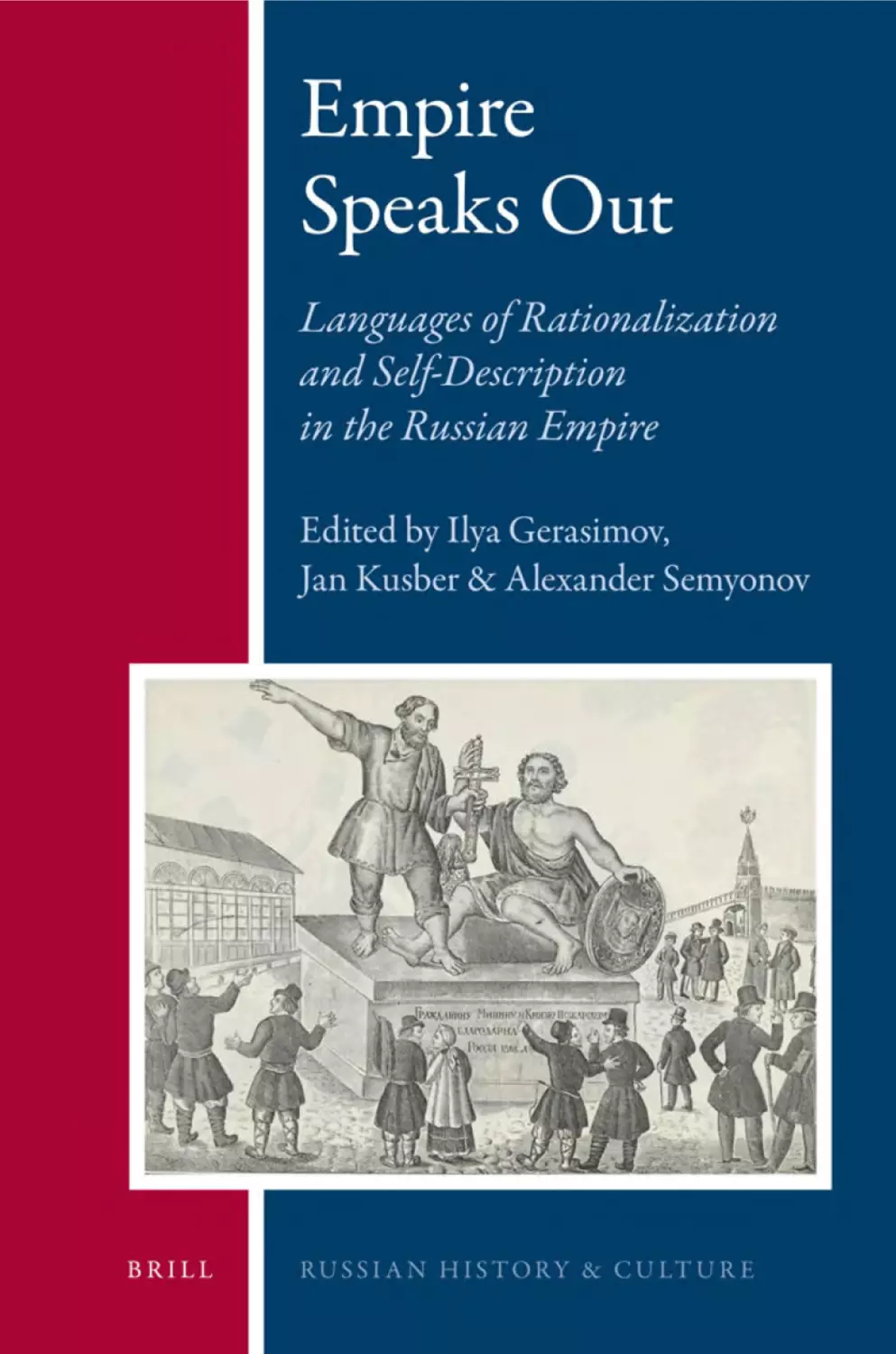
Cover illustration: It is a historic document from the 19th century: a folk picture—
lubok. It speaks to the heart of the volume, showing the multiplicity of speaking
agents, whose position is structured by the Empire’s attempt to find for itself a language of expression, the famous Minin and Pozharsky monument. In the center is
not the monument per se, but its discussion by the surrounding people. And since it
is lubok, it does divert attention from the conventional story of monarchy, officials,
and generals who are usually taken as speaking and acting on behalf of empire.
This book is printed on acid-free paper.
Library of Congress Cataloging-in-Publication Data
Empire speaks out : languages of rationalization and self-description in the Russian
Empire / edited by Ilya Gerasimov, Jan Kusber, and Alexander Semyonov.
p. cm. — (Russian history and culture, ISSN 1877-7791 ; v. 1)
“Published . . . within the collective research project Languages of Self-Description
and Representation in the Russian Empire”—T.p. verso.
Includes bibliographical references and index.
ISBN 978-90-04-17571-6 (hbk.)
1. Russia—Ethnic relations. 2. Russia—Social conditions. 3. Russia—Politics and
government. 4. Russia—History—Sources. 5. Cultural pluralism—Russia—History.
6. Imperialism—Social aspects—Russia—History. 7. Rationalization (Psychology)—
Political aspects—Russia—History. 8. Self-perception—Political aspects—Russia—
History. 9. Language and culture—Russia. 10. Discourse analysis—Russia.
I. Gerasimov, Il’ia. II. Kusber, Jan. III. Semyonov, Alexander. IV. Title. V. Series.
DK113.E48 2009
947—dc22
2009012418
This book is published with support from Volkswagen Foundation, within the
collective research project “Languages of Self-Description and Representation in the
Russian Empire.”

ISSN 1877-7791
ISBN 978 90 04 17571 6
Copyright 2009 by Koninklijke Brill NV, Leiden, The Netherlands.
Koninklijke Brill NV incorporates the imprints Brill, Hotei Publishing,
IDC Publishers, Martinus Nijhoff Publishers and VSP.
All rights reserved. No part of this publication may be reproduced, translated,
stored in a retrieval system, or transmitted in any form or by any means, electronic,
mechanical, photocopying, recording or otherwise, without prior written permission
from the publisher.
Authorization to photocopy items for internal or personal use is granted by
Koninklijke Brill NV provided that the appropriate fees are paid directly to
The Copyright Clearance Center, 222 Rosewood Drive, Suite 910,
Danvers, MA 01923, USA.
Fees are subject to change.
printed in the netherlands

CONTENTS

PART ONE

DEFINING EMPIRE IN A DIALOGUE
New Imperial History and the Challenges of Empire .................
Ilya Gerasimov, Sergey Glebov, Jan Kusber,
Marina Mogilner, Alexander Semyonov

3

Considerations on Imperial Comparisons ....................................
Ann Laura Stoler

33

PART TWO

THE CHALLENGE OF UNIFICATION AND RESISTANCE
Governance, Education, and the Problems of Empire in the
Age of Catherine II .......................................................................
Jan Kusber
“Us” and “Them”? Polish Self-Descriptions and Perceptions
of the Russian Empire between Homogeneity and Diversity
(1815–1863) ....................................................................................
Hans-Christian Petersen
Siberian Middle Ground: Languages of Rule and
Accommodation on the Siberian Frontier ................................
Sergey Glebov

59

89

121

vi

contents
PART THREE

THE CHALLENGE OF TRANSFORMATION
AND RATIONALIZATION
Russian Physical Anthropology of the Nineteenth–Early
Twentieth Centuries: Imperial Race, Colonial Other,
Degenerate Types, and the Russian Racial Body .....................
Marina Mogilner

155

“The Real and Live Ethnographic Map of Russia”:
The Russian Empire in the Mirror of the State Duma ...........
Alexander Semyonov

191

Redefining Empire: Social Engineering in Late Imperial
Russia ...............................................................................................
Ilya Gerasimov

229

Name Index ........................................................................................

273

PART ONE

DEFINING EMPIRE IN A DIALOGUE

NEW IMPERIAL HISTORY AND THE CHALLENGES
OF EMPIRE
Ilya Gerasimov, Sergey Glebov, Jan Kusber, Marina Mogilner,
Alexander Semyonov

Empire: The Effect of “Defamiliarization”
In 1917, Viktor Shklovsky, a founding father of the Russian Formalist
tradition of literary criticism, coined the concept of “defamiliarization”
(literally, “estrangement”), which describes the process of enhancement
of the perception of an object’s deeper meaning by alienating it and
making the object look strange, unfamiliar, or unpredictable.1 Analyzing
a range of recent studies of empires that can be loosely termed “new
imperial histories,” we see this mechanism working in both directions:
a more nuanced and perceptive analysis of imperial contexts produces
a picture of a strikingly strange, indeed, an unfamiliar and alien world.
In fact, from our point of view, this world appears to be irrational
or at least motivated by a very different type of rationality. Empire
expressed itself through its “tensions” and “scandal of empire”; it produced “carnal knowledge,” and was itself, paradoxically, acquired in a
state of “absent-mindedness.” Without overextending this argument,
we suggest that one common theme of a new variety of otherwise very
different studies of historic empires is exactly the “defamiliarization”
of empire as a cultural context and a sociopolitical order. This novel
trend constitutes a departure from the tradition of negativity in the
definition of empire, which perceived social reality through a framework
defined by the characteristics of the modern world of nation-states and
its historicity.2 Empire within this old trend has been defined as the
opposite and the subordinate: a historical archaism before the advent
1
Viktor Shklovsky, “Iskusstvo kak priem,” in Sborniki po teorii poeticheskogo iazyka,
Vol. 2 (Petrograd, 1917), 3–14; English translation: Viktor Shklovskij, “Art as Technique,” in Literary Theory: An Anthology, ed. Julie Rivkin and Michael Ryan (Malden:
Blackwell, 1998), 15–21.
2
For more on the tradition of negativity in conceptualization of empire as an
analytic category, see Ilya Gerasimov, Sergei Glebov, Aleksandr Kaplunovskii, Marina
Mogilner, and Alexander Semyonov, “In Search of New Imperial History,” Ab Imperio,

4

gerasimov, glebov, kusber, mogilner, semyonov

of the age of nationalism, a peripheral manifestation of the main route
of historical development of modern state and society, the power for
institutionalization of order and maximization of control invited by the
gray zones of the modern system of international relations and “seething cauldrons” of interethnic strife in such regions as the Balkans and
Caucasus, a by-product of a capitalist economy and a bourgeois society,
or the function of an indispensable nest for the emergence of modern
nation-states out of the ethnic and regional mosaic of ancient imperial
conglomerates. By recognizing empire as a historical phenomenon sui
generis, modern historians struggle with the need to express the specific
imperial experience in the language of post- and anti-imperial social
sciences that emerged in the wake of World War II. At the same time,
the estrangement of imperial historical experience seems to produce an
enlightening effect on the understanding of present-day realities, and
the more we think that classical categories of international relations,
territorial state, standardized culture, and national economy do not
apply to the twenty-first century, the more familiar and instructive the
world of empires appears to be.3 Whether this insight is right or wrong,
its verification also requires a scrutiny of the analytical language that
scholars use to translate imperial historical experience into insights
about and answers to contemporary concerns.

Empire: In Search of a Formula
Despite the upsurge of interest in “empire,” it remains the least reflectedupon category of modern social sciences, especially when compared with
that of “state” or “nation.” The latter categories generated a considerable
number of traditions of their conceptualization in political theory, social
thought, and cultural canons. Contemporary trends prompt an attempt
to forge the analytical category of “empire” in order to account for the
unprecedented movement of capital, commodities, and population,
the restructuring of international relations along the lines of power of

no. 1 (2005): 33–56; Alexander Semyonov, “Empire as a Context Setting Category,”
Ab Imperio, no. 1 (2008): 193–204.
3
The critique of thinking about empire as an analogy or metaphor for present-day
dilemmas may be found in Craig Calhoun, Frederick Cooper, and Kevin W. Moore,
eds., Lessons of Empire: Imperial Histories and American Power (New York: New Press,
2006), 1, 2.

new imperial history and the challenges of empire

5

the world hegemon and international intervention, the emergence or
reemergence of regional powers such as the Russian Federation, and
the evolution of forms of political organization such as the European
Union (EU) that constitute a challenge to the historical form and ideal
of the nation-state. “Empire” became instrumental in reflecting upon
the growing connectedness of the world, which prompted convergence
while (re)producing difference, zones of separation, and segregation.
Thus “empire,” as a category-in-the-making in the present research
literature, stands for themes of hegemony, domination, interconnectedness, and diversity while its referential valence is multiple and
contradictory.4
In historical studies, the individual phenomenon of a particular
empire and the descriptive function of empire as a category have always
overshadowed any attempt to generalize and produce a theoretical view
of “imperial formations” (Ann Stoler’s term). To be sure, historical
narratives of empires were structured by grand imperial prototypes,
which were many, and each empire, unique in its own way, influenced
the historical trajectories of other imperial formations. The origins and
diffusion of the legacy of classical empires and the Roman Empire—
archetypical for the modern historical imagination—have been among
the organizing narratives for historical studies.5 The Roman Empire’s

4
The multiple and contradictory referentiality of the concept of empire may be
gleaned from the cross-reading of the often-cited and most recent studies, such as
Samuel N. Eisenstadt, The Political Systems of Empire (New York: Free Press of Glencoe,
1963); Michael Doyle, Empires (Ithaca, NY: Cornell University Press, 1986); Michael
Hardt and Antonio Negri, Empire (Cambridge, MA: Harvard University Press, 2000);
Ronald Grigor Suny, “The Empire Strikes Out: Imperial Russia, ‘National’ Identity, and
Theories of Empire,” in A State of Nations: Empire and Nation-Making in the Age of
Lenin and Stalin, ed. Ronald Grigor Suny and Terry Martin (Oxford: Oxford University Press, 2001); Dominic Lieven, Empire. The Russian Empire and Its Rivals from the
Sixteenth Century to the Present (London: John Murray, 2000); Linda Colley, “What Is
Imperial History Now?” in What Is History Now? ed. David Cannadine (Basingstoke,
UK: Palgrave Macmillan, 2002), 132–147; Frederick Cooper, Colonialism in Question:
Theory, Knowledge, History (Berkeley, 2005); Nicholas Dirks, Scandal of Empire. India
and the Creation of Imperial Britain (Cambridge, MA: Harvard University Press, 2006);
Carole McGranahan, Peter C. Perdue, and Ann Stoler, eds., Imperial Formations and
Their Discontents (Santa Fe, NM: School for Advanced Research Press, 2007).
5
Lieven, Empire, 7–17; Anthony Pagden, Peoples and Empires: A Short History of
European Migration, Exploration, and Conquest, From Greece to the Present (London:
Tauris, 2001), 1–12. A more developed argument can be found in Anthony Pagden,
Lords of All the World: Ideologies of Empire in Spain, Britain and France c. 1500–
c. 1800 (New Haven: Yale University Press, 1995), ch. 1, “The Legacy of Rome,” and ch. 2
“Monarchia Universalis”; see also a concise statement of the argument that the Roman
concepts of “orbis terrarum” and rulership applied even to the first British Empire,

6

gerasimov, glebov, kusber, mogilner, semyonov

distinguishing features became the mark of a polity’s imperial quality in historical definition: the corruption of the republican virtues
and order; expansionism and aspirations to encompass the “civilized
world;” universalism of language, culture, and citizenship combined
with the diversity of the realm centered on the metropole (civitas) and
the military leader-ruler (imperator). The rival of the Roman Empire in
the domain of imperial blueprints of the Old World was the Mongol
Empire, which left its impact on the Russian, Persian, Muhgal, and
Chinese polities. Yet, despite enormous territorial expansion and a range
of legacies (postal systems, taxation, religious tolerance or pragmatism),
it produced a negligible influence on the ideological construction of the
phenomenon of empire in modern times.6 At the same time, the invention of “Tartary” in early modern Europe powerfully contributed to the
formation of European views of the “despotic” and “eternal” Oriental
Other in need of discovery, classification, and rationalization.7

pp. 5, 8. For perceptive observations on the role of the Roman legacy in producing
imperial sovereignty in the history of the Russian monarchy, see Richard Wortman,
Scenarios of Power: Myth and Ceremony in Russian Monarchy, Vol. 1 (Princeton:
Princeton University Press, 1995), 13–14, 26–27.
6
Though, no doubt, the Mongol images of political power endured in greater
Eurasia and mixed with Greco-Roman legacies (see Michael Cherniavsky, “Khan or
Basileus: An Aspect of Russian Mediaeval Political Theory,” Journal of the History of
Ideas 20, no. 4 [October–December 1959]: 459–476), it is only recently that historians
have attempted to conceptualize the legacy of the Mongol Empire in terms of a distinct political tradition compatible with reflexive political theory; see Stephen Kotkin,
“Mongol Commonwealth? Exchange and Governance in Post Mongol Space,” Kritika:
Explorations in Russian and Eurasian History 8, no. 3 (Summer 2007): 487–531; Jane
Burbank and Frederick Cooper, “Imperskie traektorii,” Ab Imperio, no. 4 (2007):
47–85; see also Jan Kusber, “ ‘Entdecker’ und ‘Entdeckte’: Zum Selbstverständnis von
Zar und Elite im frühneuzeitlichen Moskauer Reich zwischen Europa und Asien,”
in Expansionen in der Frühen Neuzeit, ed. Renate Dürr, Gisela Engel, and Johannes
Süssmann (Berlin: Duncker & Humblot, 2005), 97–115. On problems of finding a
reflexive political tradition in the Mongol imperial legacy, see an exchange between
Richard Wortman and Andreas Kappeler reproduced in: Alexander Semyonov, “Obzor
raboty mezhdunarodnoi konferentsii ‘Istoria imperii: sravnitel’nye metody v izuchenii
i prepodavanii,’ ” in Rossiiskaia imperiia v sravnitel’noi perspektive, ed. Marina Batalina
and Aleksei Miller (Moscow: Novoe izdatel’stvo, 2004), 20–21.
7
An illustrative example of persistent analogous thinking about empire as closely
associated with oriental despotism may be found in Richard Pipes, The Formation of
the Soviet Union: Communism and Nationalism, 1917–1923 (Cambridge, MA: Harvard
University Press, 1997, originally published in 1954 and revised in 1964). Pipes writes:
“Russia’s empire displayed some unique features. Unlike the Western colonial empires,
which were separated from the metropolitan areas by oceans, it was territorially contiguous. Furthermore, Russian domination extended over several European nations—the
Poles, the Finns, and the three Baltic peoples—which violated the unwritten law that
Europeans did not conquer and reduce to colonial status fellow-Europeans” (v).

new imperial history and the challenges of empire

7

Although historical studies of empires are organized by narratives
based on classic prototypes, they also introduce analytical tools to deal
with the historically constituted diversity of imperial formations and
historical change. Thus historians emphasize the distinction between
premodern and modern empires. Premodern empires are characterized by formal rule, conquest, and a lack of powerful contenders in the
form of sovereign-territorial states and nationalism.8 Modern empires
are conceived as new forms of organization of space and hegemony
that emerged after the Westphalian peace and the French Revolution,
whose modus operandi is based on informal colonial domination,
commercial networks, and modern technology.9 This type of empire
appears to be compatible and even interdependent with the idea of
the sovereign nation-state that projects military and economic power
beyond its borders.10 In introducing modern sovereignty in Europe,
this type of imperial polities also presupposed divided or incomplete
sovereignties beyond the “civilized” continent.11 Another typology rests
on the distinction between overseas and land-based empires. Despite
the evidently geopolitical origins of the typology, it was in fact based
on the assumption of overseas empires’ technological and cultural
superiority, the experience of the modern political revolution, and the
presence of bourgeois society—in a nutshell, on their more modern
character (vis-à-vis land-based empires). Colonial overseas empires,
until recently, provided historians with a model of imperial rule by
advanced European states over the colonial periphery, thus merging
the modern/premodern dichotomy with that of the land-based/overseas

Although Pipes himself acknowledges that he faced a choice of analytical categories:
“empire” or “multinational state”; he chose empire because it better captured the
despotic and non-European character of Russian and Soviet rule.
8
John H. Elliott, “A Europe of Composite Monarchies,” Past and Present, no. 137
(November 1992): 48–71; Pagden, Lords of All the World; David Armitage, The Ideological Origins of the British Empire (Cambridge: Cambridge University Press, 2000); Susan
E. Alcock et al., eds., Empires (Cambridge: Cambridge University Press, 2001).
9
Ann Laura Stoler and Frederick Cooper, eds., Tensions of Empire: Colonial Cultures
in a Bourgeois World (Berkeley: University of California Press, 1997), 1–56; Kathleen
Wilson, ed., A New Imperial History: Culture, Identity, and Modernity in Britain and
the Empire, 1660–1840 (New York: Cambridge University Press, 2004).
10
Linda Colley, Britons: Forging a Nation, 1707–1837 (New Haven: Yale University
Press, 1992). For a more pointed explication of simultaneous and interdependent
processes of empire and nation-formation, see Colley, “Britishness and Otherness: An
Argument,” Journal of British Studies 31, no. 4 (October 1992): 309–329.
11
Edward Keene, Beyond the Anarchical Society: Grotius, Colonialism and Order in
World Politics (Cambridge: Cambridge University Press, 2002).

8

gerasimov, glebov, kusber, mogilner, semyonov

empires. Their historical material generated a rich tradition of critical
analysis in the field of postcolonial studies, which emphasized discourses
and cultural practices of exclusion, domination, and control as well as
forms of production of knowledge about colonialism.
The new wave of historical studies after the collapse of the twentiethcentury multinational states (Yugoslavia and the USSR) paved the way
for the discovery of a different historical pattern of empires in Central
Europe and Eurasia (the Ottoman, Habsburg, and Russian empires,
and the USSR). This type of contiguous or continental empire is characterized by more porous boundaries and less clear-cut distinctions
between the imperial center and periphery, by the centrality of dynastic
and nondemocratic rule combined with subjecthood and differentiated
citizenship, by multiethnic populations, and by the more articulate contestation of the imperial space by national imaginations.12 The new stage
of imperial studies in many ways complicated the received wisdom of
analytical dichotomies of premodern/modern and overseas/land-based
empires. The trend that may be called revisionist postcolonial studies
relativized the assumed fixity of boundaries between metropoles and
colonial periphery in the British, French, Spanish, Portuguese, and
Dutch empires and even the impenetrability of the colonizer–colonized
divide that was underpinned by race. Frederick Cooper and Jeremy
Adelman have recently shifted the focus from studying the forms of
informal domination to studying the forms of rule, citizenship, and
their lingering constitutive impact on the French and Iberian empires
and the political and social spaces created in their wake.13 On the other
side of the dichotomy, and despite the temptation of the “slow history
view,” the Habsburg, Russian, and Ottoman empires together with
the ambiguously treated Soviet Union and unresolved controversy
about the identification of China as an empire are increasingly cast as
dynamic and modernizing imperial polities penetrated by a racialized
12
Lieven, Empire; Karen Barkey and Mark von Hagen, eds., After Empire: Multiethnic Societies and Nation-Building: The Soviet Union and the Russian, Ottoman and
Habsburg Empires (Boulder, CO: Westview Press, 1997); Suny and Martin, A State of
Nations; Alexander J. Motyl, Imperial Ends: The Decay, Collapse, and Revival of Empires
(New York: Columbia University Press, 2001); Alexei Miller and Alfred J. Rieber, eds.,
Imperial Rule (Budapest and New York: CEU Press, 2005).
13
Cooper, Colonialism in Question, 204–230; Jeremy Adelman, Sovereignty and
Revolution in the Iberian Atlantic (Princeton: Princeton University Press, 2006). See also
perceptive remarks by Dominic Lieven on the assumptive nature of these typologies,
on shared characteristics, and the complex entanglement of historic empires brought
about by imperial rivalry (Lieven, Empire, 4, 5, 120–127).

new imperial history and the challenges of empire

9

discourse, Orientalism, modern politics and ideologies, and techniques
of the “gardening empire.” The chapters in the present volume provide
samples of the critique of the totalizing analytical categorization of the
Russian Empire as a land-based, backward, elite-dependent, and patrimonial polity. In contrast, the chapters highlight the omnipresence of
modern historical dynamics in imperial Russian history. The story of
a “Siberian middleground” as told by Sergei Glebov presents the case
for a commercial empire in the seventeenth century and the constitutive impact of Enlightenment-derived technologies of rule. Similarly,
the history of the Catherinian reign presented by Jan Kusber recasts
the received wisdom on the “long seventeenth century” and points out
the rupture in governance and cultural production of individualized
subjects of the empire. The axiomatic historiographic pronouncement
on the prevalence of nationality and ethnicity in politics and knowledge
production in the Russian Empire obviously needs revision in light of
Marina Mogilner’s pathbreaking research on the history of physical
anthropology and racialized discourses of difference in the second half
of the nineteenth century through the beginning of the twentieth. The
political history of Polish emigration and Russian liberal alternatives
provide an important corrective for the political history of empire
as viewed from the top of the monarchy, imperial government, and
aristocratic elites. The chapters by Alexander Semyonov and HansChristian Petersen underscore the importance of modern ideological
production, the revolutionary experience of dislocation of the old regime
and society, and visionary politics of the future. The multifaceted social
dimension of imperial experience is reconstructed in the chapter by
Ilya Gerasimov, whose analysis defies the simplified vision of failed
social modernization in the backward context of the Russian Empire
and points to a different model of sociability and social change in a
culturally divided society.
Moreover, as the tyranny of a totalizing conception of land-based
empire is called into question, Ann Stoler also makes clear that the logic
of typological distinction adopted by many historians of continental
empires and based on the contrasting model of Western colonialism
replicates the discourse of exceptionalism, which has been part and
parcel of the imperial strategy of “politics of comparison,” legitimation,
and recuperation of the “scandal of empire.”

10

gerasimov, glebov, kusber, mogilner, semyonov
The Imperial Studies Terrain: The Russian Venue

A new stage in conceptualizing Russian history through the prism
of empire began in the early nineties. In the wake of the dissolution
of the Soviet Union and the emergence of new nations and national
historiographies on its ruins, historians faced a necessity to replace the
homogenizing narrative of Russia’s past as nation-state with a more
complex model of a polity that included other nations-in-the-making.14
The failure of the Soviet-style concept of the “multinational state” and
the tempting convenience of the historical self-descriptive trope of
“empire” provided for a rapid takeoff of Russian “imperial studies.”
The “prison of nations” or not, from now on Russia was treated as an
empire in the broadest possible sense, as a big state dominating diverse
populations and exercising ambitious foreign policy. This early stage
of the reassessment of Russian history as “imperial” was shaped by the
dominant nation-centered approach: if “Russia” itself was no longer
conceivable as a single nation (and hence was called “empire”), it was
seen as consisting of other nations, developing along the typical path of
historical national awakening—liberation movement—self-determination. The ethnic Russians as a nation were no different in this respect,
if only less lucky.15
Interestingly enough, the readily available models of colonial empires
as developed by British and world historians by the mid-nineties were
very reluctantly referenced by historians, who advanced a new paradigm
of empire for Russian history. While there are many reasons for the
weak popularity of colonial theory among historians of Russian empire
(both institutional and ideological), an important exception sheds
light on the methodological dilemma of the nineties. Russia’s Orient:
Imperial Borderlands and Peoples, 1700–1917, published in 1997, represented a clear attempt to redefine tsarist Russia in terms of colonial
power imposing metropole-colony relationships onto its subjugated
territories.16 While the collection itself became an important landmark
in historiography shaping the field of Central Asian and Caucasian
14
In his landmark book Andreas Kappeler offered a concept of “multinational
empire.” See Rußland als Vielvölkerreich. Entstehung—Geschichte—Zerfall (Munich:
C. H. Beck, 1992).
15
See Geoffrey Hosking, Russia: People and Empire, 1552–1917 (Cambridge, MA:
Harvard University Press, 1997).
16
Daniel R. Brower and Edward J. Lazzerini, eds., Russia’s Orient: Imperial Borderlands and Peoples, 1700–1917 (Bloomington: Indiana University Press, 1997), xiv–xv.

new imperial history and the challenges of empire

11

studies for many years to come, it was not immediately followed by
comparable large-scale attempts at presenting the Russian Empire as
an analogue of the British or any other overseas empire, and might
even have hampered further methodological pursuits in this direction.
Taken as a collective research endeavor, Russia’s Orient succeeded in
revealing the colonial relationships of domination and politicization
of differences in Russia’s history, but encountered difficulties in mapping these relationships and identifying their actors and agents. The
Caucasus, and even more so Central Asia, seemed to fit the role of a
colony, but what were the boundaries and the nature of the metropole? Siberia, the Baltic, Poland, and Ukraine had all been claimed as
victims of imperial domination in recent historiography and did not
fit the concept of Homo Europeicus, therefore reducing the ranks of
colonizers to a handful of top administrators that often were ethnically
non-Russian. Thus the transfer of Western colonial theory encountered
the same problem of the impossibility of conceptualizing empire in
terms of nation-centered metanarratives. Empire remained an elusive
concept, more of a rhetorical device, for as long as it was interpreted
through the prism of a power struggle between the dominating and
colonized “nations.”
A paradigm shift began crystallizing at the turn of the millenium: the
scandalous excesses of the new national historiographies,17 the methodological novelties of postcolonial and nationalism studies, and the
expansion of transnational forms of sovereignty (first of all, the EU),
all contributed to the relativization of the nation-centered historical
narrative. There emerged a growing understanding among historians
of the former Soviet Union that “empire” could no longer be analyzed
simply as a constellation of a number of “nations.” There was a need to
define Russia as empire in positive terms, as a phenomenon in its own
right, but there was no readily available metaframework and analytical
language for describing and explaining the imperial past. The search
for a new approach to imperial history expanded in different directions

17
In the appalling feats of politically motivated primordialism, post-Soviet historians
in newly independent states traced the evolution of the “eternal national body” throughout centuries and even millennia, tracing Russians to Etruscans, and discovering Tatars
in the Paleolithic era. See on this Victor A. Shnirelman, Who Gets the Past? Competition
for Ancestors among Non-Russian Intellectuals in Russia (Washington, DC: Woodrow
Wilson Center, 1996); K. Aimermakher and G. Bordiugov, eds., Natsional’nye istorii v
sovetskom i postsovetskikh gosudarstvakh (Moscow: AIRO-XX, 1999); Serhy Yekelchyk,
Ukraine: Birth of a Modern Nation (Oxford: Oxford University Press, 2007), 14–15.

12

gerasimov, glebov, kusber, mogilner, semyonov

and took many years. Incidentally, in 2007, almost simultaneously,
a number of book collections were published that summarized the
results of the paradigm shift in imperial studies of Russian history. It
is instructive to look briefly at the most important of these to see the
main trends in new history-writing and assess the success of the field’s
“imperial turn.”18
Japanese scholars have, perhaps, made the most pronounced attempt
at the theorization of imperial studies. Kimitaka Matsuzato, the driving force behind the emergence of Japan as a notable spot on the
map of international studies of the Russian Empire, edited a collection of articles under the ambitious title Imperiology: From Empirical
Knowledge to Discussing the Russian Empire.19 The very title of the
collection reveals the goal of offering a new metatheory of empire as a
particular political formation (“imperiology”). The strong influence of
political science’s approaches on this version of “imperiology” is obvious: a theory is expected to be generated on the basis of a number of
empirical case studies that reveal some fixed structural elements and
regularities in data series.20 Among these theoretical insights, Matsuzato
suggests replacing the “bipolar scheme” of center vs. periphery with a
“tripolar” one, involving the imperial center, “aristocratic/dominant
nations,” and “peasant/unprivileged” nations of the region. (Note that
while the tripolar system itself is presented as an analytical construct,
the “nations” are regarded as self-evident, fairly stable entities.) This
constellation of “weighty actors” is measured against the background
of “macro-regions,” such as Volga-Ural, Left-Bank Ukrainian, Western
and Ostsee provinces, Steppe, Western, and Eastern Siberia. Matsuzato
believes that all of these regions had “relatively autonomous histories”
(and hence genealogies and fixed boundaries), while interactions among
the regions themselves and between the regions and the imperial
government determined the characteristics of imperial rule. Thus we
see that the elusive notion of “empire” is stabilized in this approach

18

In the same year, the American Association for the Advancement of Slavic Studies
(AAASS) introduced the format of main themes for its annual conferences, with the
very first theme dedicated to “The Persistence of Empire” (thirty-ninth annual AAASS
conference). This was an acknowledgment of the skyrocketing popularity of everything
“imperial” among the experts in the region of the former Soviet Union.
19
Kimitaka Matsuzato, ed., Imperiology. From Empirical Knowledge to Discussing the
Russian Empire (Sapporo: Slavic Research Center, Hokkaido University, 2007).
20
Matsuzato describes the purpose of the collection as “to summarize the accumulated empirical studies and to abstract widely applicable theories from these studies” (4).

new imperial history and the challenges of empire

13

through a combination of analytical models of political science with
essentializing categories of geopolitics (arbitrarily distinguished regions
as subjects of historical process and parts in political interaction) and
fixed national identities.
A different perspective on the spatial foundation of Russia’s “empireness” is demonstrated by the authors of the multivolume publication
Okrainy Rossiiskoi imperii (The Borderlands of the Russian Empire).21
Not unlike the imperiology collection, this series of volumes, written
by a cohort of internationally recognized historians, emphasizes the
structures and practices of imperial governance and the interdependent relationship of the imperial center and the regions. However, in
this project the regions are not the products of present-day geopolitical mental mapping, but the historical categories that produced rich
narratives of self-description and representation in the past, including
the substantiation of their boundaries. The usefulness of this analysis
is encapsulated in its corrective value for the present nation-centered
and Russocentric historiography of the post-Soviet space. It must
nevertheless be emphasized that the editors’ decision to follow the
historic language of the space’s organization and to stress the centrality of the hardware of the dynastic and bureaucratic empire produced
an equally one-sided taxonomy of the imperial space as derived from
the optics of the imperial center. Though rich in insights and coverage,
telling the nuanced stories of dilemmas of imperial government and
the emergence of modern projects of nationalism, these volumes fail
to address directly the underpinning structure of this reconstruction of
the past, the division of the imperial space between the imperial center
and the borderlands. There is no volume on the imperial center, as if
its reconstruction from the “margins” is sufficient enough, and yet this
imperial center as viewed from the varying perspectives of the series,
appears to be congruent either with the dynastic regime, or with the
nationalizing project of the “Great Russian nation,” or with bourgeois
colonial power, so that this fluctuating representation calls into question
the self-evident givenness of the center in the empire and the structure
chosen to relay the imperial experience. Moreover, the chosen focus

21
M. D. Dolbilov and A. I. Miller, eds., Zapadnye okrainy Rossiiskoi imperii (Moscow:
NLO, 2007); L. M. Dameshek and A. V. Remnev, eds., Sibir’ v sostave Rossiiskoi imperii
(Moscow: NLO, 2007); V. O. Bobrovnikov and I. L. Babich, eds., Severnyi Kavkaz v
sostave Rossiiskoi imperii (Moscow: NLO, 2007); S. N. Abashin, D. Iu. Arapov, N. E.
Bekmakhanova, eds., Tsentral’naia Aziia v sostave Rossiiskoi imperii (Moscow: NLO,
2008).

14

gerasimov, glebov, kusber, mogilner, semyonov

on empire as a structure of space and power inevitably confines the
framing of historical developments in that space to the emergence
of modern nationalisms (both Russian and non-Russian) as the only
possible mode of describing historical dynamics. It leaves open the
question of whether empire is a meaningful category for exploring the
reproduction of asymmetries of power and differentiated space under
the challenge of modern conditions.22 While the discussed series of
works differentiates the historic reality of contiguous empire from the
contemporary political map of nation-states, this reality is held hostage
to the conceptual framework produced in the past by the self-reflecting historical actors. The very moment they began defining borderland
regions in different terms, redrawing the borders or replacing the entire
taxonomy of constituent regions, the whole reconstruction of empire by
latter-day historians collapsed. By surrendering to the powerful tropes
of geographical self-classification and conceptualization found in the
past, present-day historians fail to address the historicity of empire (in
Reinhart Koselleck’s sense), as a full-scale analytical category.
The editors of the collection Russian Empire: Space, People, Power,
1700–1930 (published by Indiana University Press) seem to be aware
of the methodological dire straits between the Scylla of self-descriptive narratives coined by historical actors and Charybdis of normative
abstract models superimposed over the past. While also finding the
main constituent element of empire in its territorial structure rather
than in any other forms of groupness,23 the editors and contributors
to the volume develop three interrelated meanings of territory: the
historic and physical geography of imperial governance and social
relations; territoriality in the discourse and practice of empire as well
as its agents and subjects; and the imagined geography of imperial
politics and ideology. Furthermore, there is a dual view of empire as
an agency and as a space of experience. The elements underpinning

22
Some volumes in the series, such as the one on Western Borderlands and Siberia,
claim that empire withered away with the advent of nationalism and nation-building
projects in the modern age.
23
Jane Burbank, Mark von Hagen, and Anatolyi Remnev, eds., Russian Empire: Space,
People, Power, 1700–1930 (Bloomington: Indiana University Press, 2007). The authors
of the introduction assert “the fruitfulness of beginning with territory, rather than with
people and their presumed kinds of allegiances. Most empires present complex and
incongruent overlays of ethnicity and religion upon territory. Starting out a study of
empire with categories of ethnicity, or religion, or nationality shapes the description of
people and their aspirations in ways they may not themselves have chosen” (21).

new imperial history and the challenges of empire

15

this definition are state-form and structure of relations. The key to the
proposed definition is “differentiated governance of [a] differentiated
population.”24 Jane Burbank, Mark von Hagen, and other contributors
to the volume emphasize the uncertainty or unevenness of difference
as historically refracted in the imagination, policies, and structures of
relations and identity. The defining feature of the Russian Empire was
shaped by the process of expansion of the empire and the encounter of
imperial rule with the variegated forms of difference that at the same
time became a “habit of thought” and flexible arrangement of multiple
frames of reference.25 However, this insightful definition relativizes
the initial focus on territory and territoriality as a metaframework for
understanding empire. The suggested multiple frame of reference as a
characteristic of imperial governance and identity includes, inter alia, a
reference to such nonterritorial forms of groupness as confession and
estate. Closer scrutiny of the perspectives of Jane Burbank and Mark
von Hagen in this volume reveals that territory and territoriality formed
just one of the references in the ideology and practice of empire and
should be taken as such and not as a metaframework for the study of
imperial diversity.
Thus the book documents the bifurcation point in the paradigm
shift of past years: one direction of studies (represented by the Sapporo
and Moscow collections) implies a focus on the most stable structural
elements of “empire,” such as the organization of territory. The epistemological vulnerability of this approach as discussed above compels
the most attentive scholars to relativize their spatial models and further
complicate them, eventually undermining the very idea of structural
constants. The other direction of prospective inquiry as revealed in the
Indiana collection focuses on empire as a mental construct or a system
of thinking that accommodates the different types of human and spatial
diversity. This epistemological ambivalence is not resolved in any way
in the volume. On the one hand, it radically departs from the teleology
of historical development from empire to nation and asserts the definition of empire as a state-form based on difference, not on likeness.
On the other hand, while this definition certainly breaks with the bias
of nationalism, it is still dependent upon the concept of the state, and
the extent to which empire is compatible with the definition of the

24
25

Ibid., 25.
Ibid., 7, 16, 17.

16

gerasimov, glebov, kusber, mogilner, semyonov

state as the institutionalized public authority, holding the monopoly
on legitimate violence, remains unresolved. Because empire is defined
as a persistent and reproducible state-form, nation-state becomes
defined as almost nonexistent, a “historical rarity, if not an impossibility.”26 Removing nationalism from the analytical equation produces the
unintended consequence of underestimating the powerful impact of a
“disruptive ideal” and, ultimately, the role of agency in constructing
meaning and producing historical dynamics vis-à-vis the structure of
territorially derived diversity.
Another notable trend in recent historical studies of the Russian
Empire that relativizes the constants of imperial diversity and undermines the metareferentiality of nationality or territory for apprehending
imperial diversity is represented by historians, who address the history
of religious identities and confessional politics.27 These scholars moved
from “formal configurations” of the Church to local levels of practice
and the institionalization of religiosity, and, beyond studies of Orthodox
Christianity, to imperial aspects of religious studies in Russian history.
The emerging picture of confessional politics and religious identities
suggests the relevance of religion for cultural and social processes and
the diversity of empire in the age of modernization and nationalism.
Building on this perspective, Robert Crews suggests the concept of
“confessional state” as a metaframework for exploring its diversity and
Paul Werth argues that the “cultural diversity of Eurasian empires . . . was
ordered and institutionalized by confessional criteria.”28 While the
diachronic applicability of the confessional grid for understanding

26

Ibid., 2.
Robert Geraci and Michael Khodorkovsky, eds., Of Religion and Empire. Missions,
Conversion, and Tolerance in Tsarist Russia (Ithaca, NY: Cornell University Press 2000);
Paul W. Werth, At the Margins of Orthodoxy: Mission, Governance, and Confessional
Politics in Russia’s Volga-Kama Region, 1827–1905 (Ithaca, NY: Cornell University Press,
2002); Sergei I. Zhuk, Russia’s Lost Reformation: Peasants, Millennialism, and Radical
Sects in Southern Russia and Ukraine, 1830–1917 (Baltimore: Johns Hopkins University
Press, 2004); Nicholas B. Breyfogle, Heretics and Colonizers: Forging Russia’s Empire
in the South Caucasus (Ithaca, NY: Cornell University Press, 2005); Mikhail Dolbilov
and Darius Staliunas, “‘Obratnaia uniia’: Proekt prisoedineniia katolikov k pravoslavnoi
tserkvi v Rossiiskoi imperii (1865–1866 gg.),” Slavianovedenie, no. 5 (2005): 3–34.
28
Robert Crews, For Prophet and Tsar, Islam and Empire in Russia and Central
Asia (Cambridge, MA: Harvard University Press, 2006); Paul Werth, “Imperiology and
Religion. Some Thoughts on a Research Agenda,” in Matsuzato, Imperiology, 51–67.
27

new imperial history and the challenges of empire

17

diversity in the age of mass politics and language-centered struggles
of nation-builders still needs verification, the proposed emphasis on
religion, religiosity, and confession highlights the irreducibility of religious and confessional diversity to territorial and national heterogeneity
and further complicates the process of elaborating a stable, structural
definition of empire.
Thus, recent historical studies of the Russian Empire have demonstrated limited fruitfulness in searching for an objectified marker of
“empireness,” such as the structure of center–periphery relations, a
taxonomy of the imperial government, or even territory. Instead, we
propose to learn from the cognitive disorder in imperial studies by
focusing on the historical reflection of empire and consistently taking
and advancing the cognitive turn in the construction of empire as a
landscape of diversity.

New Imperial History: Empire in a Cognitive Turn
Our book further develops the critical analytic of empire by taking a
cognitive turn in approaching empire as a category of analysis and a
context-setting framework of languages of self-description of imperial experience. This cognitive turn in approaching empire enters into
the dialogue with the cognitive turn in nationalism studies proposed
by Rogers Brubaker. The vision adopted in this volume underscores
the epistemological challenge of an intellectual move to empire as
an analytical category for explaining the past and the present. These
epistemological reservations seem especially important against the current background of growing demand for a general definition of empire
shaped by the generic approach of the social sciences and the universal
concerns of a globalized world. This volume argues that the move to a
generic metacategory of empire may produce a redundant interpretation
of empire as a state-form tailored to the control of vast space and the
management of difference with a limited potential for critical reflection
on and historic estrangement of empire. Another twist in this approach
to empire conceptualizes it as a historical background and legacy that
shaped the present-day constellation of hegemony, inequality, and conflict. We suggest a focus on the imperial experience, that is, the actual
and semantically constructed encounter with difference and all of the

18

gerasimov, glebov, kusber, mogilner, semyonov

inequalities and disbalances of power this usually entails.29 Difference
as a norm of sociopolitical reality and its perception takes center stage
in our project on the history of the Russian Empire and our reflection
on the potential of empire as a critical analytical category.
As the point of departure for the study of empire, the authors of
this project take the moment of signification of difference and not
the historical structure of political, social, and cultural diversity. This
perspective advances an understanding of the nature of empire by
way of denaturalizing (Ronald Suny’s term) its political and semantic
reality and thus forestalls the dangers of empire-realism, that is, seeing the empire as a more real and enduring historical structure than
“a powerfully disruptive, unrealizable ideal” of the nation-state. The
dangers of empire-realism are everywhere in our field. The impact of
constructivist theories of nationalism has denaturalized nation and
nation-state. Empire might fill the emerging void of the bedrock structure of historical process. Growing disillusionment with the norm of
cultural and political homogeneity might yield the unexpected effect of
romanticizing past imperial diversity. A longing for a generic definition
of empire and still attendant idiom of imperial archaism help the process
of essentialization of empire. Nowhere is this more evident than in the
case of historical studies of “peripheral empires,” where the narrative
of backwardness and otherness is interwoven with negative or positive
assertions of imperial destiny or the stigma of empire.
The cognitive approach to empire studies also helps to fine-tune the
important conception of empire as an ideal type opposed to that of
nation. The historically entangled relationship between abstract ideal

29
This approach was in many ways anticipated in the magisterial two-volume
study of the Russian monarchy by Richard Wortman. It opened up a perspective on
understanding imperial agency and sovereignty in Russian history without reducing
it to the normative conception of the state and institutional structure of governance.
His conception of “scenarios of power” and “political myth” is indispensable for
understanding the peculiarities of imperial sovereignty in the Russian context and
from the viewpoint of historical semantics. Wortman’s history of the Russian monarchy demonstrated the irreducibility of imperial mythology, another crucial language
of self-description in empire, to the normative concept of ideology and provided an
explanation of how imperial agency adapted itself to dynamic contexts and modern
challenges (Richard Wortman, Scenarios of Power: Myth and Ceremony in Russian
Monarchy, Vol. 2 [Princeton: Princeton University Press, 2000], 10–15). Wortman
produced an estranged view of imperial power that was based on epos and “rhetorical
truth” and turned out to be poorly compatible with the disenchanted world of modern
rationality, ideology, and modern politics (vol. 1, 9; vol. 2, 8, 15).

new imperial history and the challenges of empire

19

types of empire and nation necessitates a further elaboration of the
language of analytical differentiation of one from the other. The conventional distinction holds that while nation is a stance and perception that
produces homogeneity, empire is an instrument that produces difference.30 This distinction misses the interdependent relationship between
the production of likeness and otherness that has often been pointed
out by theorists of nationalism (Ernst Gellner, Benedict Anderson, and
Rogers Brubaker, among others). Starting with the late Enlightenment
and Herder, Romantic nationalists not only celebrated the organicity
and wholeness of their respective nations but also pointed out the
omnipresence of difference in the human universe. Among the major
idioms of nationalist ideologies in the periphery of Europe are a critique
of and a distancing from the menacing “Europe” and its modernity. The
dominant pattern of development of “unhistorical nations” in Eastern
and Central Europe is dissociation from the homogenizing projects
of “historical nations” and nationalizing imperial regimes, while both
in Germany and in Russia the search for the spiritual wholeness of
nationhood was combined with a celebration of a historical Sonderweg.
Indeed, as Rogers Brubaker perceptively indicates, the question is not
about the production of difference but the type of difference.
In what he calls the “misconception of the Modigliani map,” Brubaker
draws on the famous evocation by Ernst Gellner of the Modigliani
painterly style as an illustration of the impact of nationalism on social
reality. Brubaker suggests that
The spatial aspect of the representation—the image of continuous and
homogenous blocs situated next to, rather than interspersing with, one
another—should not be interpreted too literally; it does not necessarily
imply corresponding spatial characteristics of what is represented. The
Modiglianesque representation of heterogeneity as the juxtaposition of
homogenous blocs does not presuppose that the blocs be territorially
concentrated. The constituent blocs may be intermixed in space, for their

30
In his definition of empire as a great power, Dominic Lieven includes rule over
“wide territories and many peoples,” “the management of space and multiethnicity”
(Lieven, Empire, xiv). Defying the teleological implications and normative frame of
the concept of nation-state, Jane Burbank and Mark von Hagen suggest that “An
unabashed address to empire as a state form allows us to study polities based on difference, not likeness, of their subjects” (Burbank, von Hagen, Remnev, Russian Empire:
Space, People, Power, 2).

20

gerasimov, glebov, kusber, mogilner, semyonov
“blocness”—their boundedness and internal homogeneity—is conceptually
located not in physical but in social and cultural space.31

Brubaker’s message to students of empire is that it is rather easy to
mistake the policy and perception permeated by nation-centered
logic for the imperial mechanism of production of difference. This is
because the logic of nationalism and, in a broader sense, the modern
mindset of social sciences and politics are not alien to heterogeneity.
They may create and accommodate to the plurality of national claims
to the shared or mixed territory, social space, or state. The important
distinction between the national and imperial cognitive frames is that
the discourse of nationalism and the modern taxonomic mindset can
imagine the claimants to be only nations or similar groups constituted
as clearly bounded and internally homogenous elements of cultural and
social space. For the sake of clarity and differentiation of the ideal type
of nation, this discourse and politics may be called strategic essentialism
(the term is suggested by Ann Stoler). It is possible to imagine that different elements of imagery and mythology, forms of social and cultural
statuses, mental mapping of territory or deterritorialized thinking can
be fused together in the stance of strategic essentialism to produce a
nation, ethnic group, diaspora, national minority, or cultural group,
one or many, as in the nationalizing policy of the USSR. The common
effect of this stance is to be found not in the content of signification of
groupness, but in the nature of the imagined and projected boundaries
of groupness. The opposite case constituting the distinguishing feature
of the ideal type of empire is suggested in the chapters of this volume
and may be termed strategic relativism, which should be understood
as the discourse and stance that relativizes the bounded and internally
homogeneous nature of the constituent elements of the sociopolitical space and governance. The latter stance of rule and the cognitive
frame of sociopolitical interaction and imagination produces the situation of uncertainty, incommensurability, and indistinction that Ann
Stoler so aptly defines as the quintessential characteristic of “imperial
formation.”
To illustrate the analytical added value of our hypothesis of strategic relativism as a distinguishing cognitive frame for the ideal type of

31
Rogers Brubaker, “Myths and Misconceptions in the Study of Nationalism,” in
The State of the Nation. Ernest Gellner and the Theory of Nationalism, ed. John A. Hall
(New York: Cambridge University Press, 1998), 296.

new imperial history and the challenges of empire

21

empire, we must point to paradoxes of the interpretation of historical imperial properties. Indeed, what is substantially imperial in the
vision of “the expansion of the English race and the English state” or
the Eurasianist conception of organic territorial and cultural unity?
The intentionality of these projects, and not their outcomes, may be
properly captured by the notion of homogenization of social and cultural space for the would-be nation. Or is there an intrinsic property
in the concept of race that makes it exclusively an element of imperial
domination and colonialism? Are we not better off with the notion of
the nationalizing state (Rogers Brubaker’s term) when we address the
policy of the late tsarist regime to differentiate between “Russians” and
“Aliens” in the political space of the Russian Empire? These paradoxes
of interpretation prove that the logic of modern rationality and discourse of nationalism powerfully permeate the practice and discourse
of historical actors in the modern era. Perceptive students of empires,
such as Dominic Lieven and Ronald Suny, have observed the difficulty
of separating the ideal type of empire from that of nation in the case of
modernizing empires. They suggest that empires under the challenge
of modern conditions inevitably adopt a strategy of nationalization or
colonialism, both aimed at a clear demarcation of boundaries between
the core nation-state and the periphery.32
The hypothesis of strategic relativism proposes a different view of
the dynamics of empire under the challenge of modern conditions
and takes its point of departure from the rather atypical framework of
“imperial questions” of the Russian Empire, which are underreflected
in historical studies. These questions, including the Jewish question, the
Muslim question, and the Polish question, lack a coherent and comprehensive framework (such as the collective singular of “nationality
policy”) for tackling the dilemmas of the space of empire taken in its

32
Dominic Lieven suggests that the adoption of a nationalizing scenario under
the modern condition was inevitable: “Undoubtedly the surest way to save an empire
was to turn as much as possible into a nation” (Lieven, Empire, 281). Although he
sees greater difficulty with the application of the intertwined pair—nationalism and
colonialism—to the Russian Empire, he still accounts for the shift in Russian imperial
rule from an incorporationist strategy to colonialist exclusion at the beginning of the
twentieth century (ibid., 283). Ronald Suny develops an argument about the “dialectics
of empire,” in which empire as a form of polity encounters the challenge of nationalism and responds with a program of nationalization and developmentalism, which
gradually makes empire irrelevant (Suny, “The Empire Strikes Out! Imperial Russia,
‘National’ Identity, and Theories of Empire,” 23–66).

22

gerasimov, glebov, kusber, mogilner, semyonov

entirety and interconnectedness. As the expert and practitioner of the
Russian Empire, Boris Nol’de, remarked, the empire approached each
challenge of diversity individually in its idiosyncratic logic, thus leaving
“little sense” of what was created by the imperial regime.33 This phrase
closely resembles the famous dictum by John Robert Seeley (whose treatise partially inspired Nol’de’s thinking) on “conquering and peopling
half the world . . . in a fit of absence of mind.”34 Both Seeley and Nol’de
reflected the incongruity of the sociopolitical logic of empire with the
modern mindset and government, but what is remarkable is that the
logic of strategic relativism was reproduced despite its irrationality and
incongruity and it contributed to reproducing the uneven and multidimensional heterogeneity of empire. In this volume, Marina Mogilner
documents the relativizing logic of mixed physical type as advanced by
mainstream physical anthropologists of the Russian Empire and their
persistent attempts to resist the essentializing logic of conflating racial
classification and the mapping of cultural and political community. Russian liberals’ self-professed stature of bearers of a more rational vision
of politics was accompanied by the pluralist framework of appeal to
the variegated conditions of imperial space. A similar stance is revealed
by Ilya Gerasimov in the case of the Russian Progressivist social engineering movements that practiced “small deeds” and “apolitical politics” in the epoch of high modernist utopias. Developing this logic, it
is possible to suggest that what made the Soviet Union an empire was
the relativizing employment of class and nationality in redefining the
spaces of social and political belonging. Perhaps, the contemporary
reflection of this cognitive frame is to be found in the linguistic practice
of a generation of postcommunist travelers, who habitually responded
to the question “Are you a Russian?” with the cunning answer “I am
from Russia.”

33

Boris Nol’de, Ocherki russkogo gosudarstvenogo prava (St. Petersburg, 1911),

280.
34
Contemporary historians have discovered the importance of Nol’de’s works
for understanding Russian imperial history (Burbank, von Hagen, Remnev, Russian
Empire: Space, People, Power, 3–4). However, they have not noted the ideological and
intellectual mirrors of imperial imagination encapsulated in the fact that Nol’de took
the inspiration for his thinking about the Russian Empire from the tradition of British
political thought, in particular, Seeley (Boris Nol’de, “Angliia i eie avtonomnye kolonii,
istoricheskii ocherk,” Vestnik Evropy, no. 5 (September 1906): 5–67).

new imperial history and the challenges of empire

23

The materials in this volume suggest that strategic relativism may
be the product of the condition of difference and unintended consequences of policies aimed at homogenization of the social and political
space. More important, strategic relativism also captures an intentional
stance of divide et impera in a new key, a strategy of representation,
and the volition of political acts, which are often obscured by the view
of imperial policies as reflecting the given geographic and sociopolitical diversity of empire. Strategic relativism may provide the basis for a
network type of horizontal mobilization in a differentiated environment
as well as an obstacle to creating an unambiguous sense of belonging.
In other words, the analytical construction of strategic relativism allows
different normative judgments depending on the point of view of the
observer. Proceeding from this analytical reconstruction of the past, it
is possible to valorize the policy and conditions that were conducive
to the reproduction of difference and opposed to assimilation or to
condemn them on the ground of their obstruction of democracy and
undisputed nationhood. But this should be perceived as an added value
of the language used in this analytical construction together with its
capability to account for historical variability in imperial experience
and to eschew the Manichean view of empire versus nation.

Empire: Languages of Self-Description
Shifting the focus of analysis from the structuralist, essentialist, and
functionalist definitions of empire to a more dynamic perspective on
the constitution and signification of imperial experience logically leads
our historical research to an exploration of the complex of languages
of self-description and self-rationalization. Instead of discussing what
empire is, we invite our readers to contemplate what makes certain
tropes and discourses imperial. Thus we do not strive to offer a universal
theory or a generic definition of empire. Instead we suggest working
with a model of the imperial situation defined by the tensions, incongruity, and incommensurability of the languages of self-description.
By looking closely into the conflicts and overlaps in the polyglossia of
explored imperial experience in the Russian Empire we are able to more
precisely define the phenomenon of historically constituted diversity as
the defining feature of the imperial situation. This diversity appears to
be uneven, multilayered, and dynamic and its experiential plane cuts

24

gerasimov, glebov, kusber, mogilner, semyonov

through the disjunctions of political, social, and cultural spaces. This
uneven and dynamic diversity is both a result and a source of imperial
strategic relativism. Because of the nature of its diversity, an imperial
situation cannot be described within one noncontroversial narrative or
typified on the basis of rational and equally noncontroversial classificatory principles. We find the most elaborate and telling representation of
the imperial situation in Jorge Luis Borges’s “John Wilkins’ Analytical
Language”:
These ambiguities, redundancies, and deficiencies recall those attributed
by Dr. Franz Kuhn to a certain Chinese encyclopedia called the Heavenly Emporium of Benevolent Knowledge. In its distant pages it is written that animals are divided into (a) those that belong to the emperor;
(b) embalmed ones; (c) those that are trained; (d) suckling pigs; (e) mermaids; (f) fabulous ones; (g) stray dogs; (h) those that are included in this
classification; (i) those that tremble as if they were mad; (j) innumerable
ones; (k) those drawn with a very fine camel’s-hair brush; (l) etcetera;
(m) those that have just broken the flower vase; (n) those that at a distance resemble flies.35

Invented by Borges, this “Chinese” imperial irregular, even mindboggling typology describes such a specific and uneven heterogeneity
that it escapes regular classifications and produces a unique historical
dynamism. The latter is often hard to grasp when a scholar approaches
his/her subjects with analytical instruments provided by any single
teleology. But this is exactly what the majority of students of empires
do when they try to grasp imperial heterogeneity using the analytical
instruments of modern social sciences. These instruments are often
indebted to selective readings of the historic languages of rationalization of empire and tend to reduce the uneven heterogeneity of imperial experience to a more manageable, one-dimensional diversity of
nationalities, regions of empire, or confessions.
By reconstructing particular imperial experiences as a set of languages, we limit a vast variety of hard-to-grasp “experiences” to a system
of firsthand reflections upon and rationalizations of those experiences,
and we also offer a method of capturing imperial strategic relativism
within the “linguistic turn” paradigm.

35

Jorge Luis Borges, “John Wilkins’ Analytical Language,” In Selected Non-Fictions,
trans. and ed. Eliot Weinberger (New York: Penguin Putnam, 1999), 231. The essay
was originally published as “El idioma analítico de John Wilkins,” La Nación, February 8, 1942.

new imperial history and the challenges of empire

25

In this collection, the authors’ central argument focuses on the
epistemological and political conflict of empire meeting the challenges
of its more rational organization, and systematization of its diversity—with the purpose of making it more efficient, governable, manageable, controllable, or ideologically fitting new political, philosophic,
or scientific ideas. Therefore the collection centers on transformations
of imperial political, social, and cultural space under the challenge of
Enlightenment, nationalism, modernization, the growth of the modern
“gardening state,” and the negativity of languages of self-description of
empire. In basing the new imperial history on the archaeology of the
languages of imperial self-description, we do not resurrect Leopold von
Ranke’s dogma of writing history “as it essentially happened.” Instead
we advance a critical approach that takes empire as a context-setting
category and focuses on imperial situations, when empire becomes
visible either as a result of contradictions emerging from its uneven
and unsystematic heterogeneity or as a result of conscious attempts to
make it more manageable and thus more rational.
To compensate for the inevitable limitations of the language-centered
approach, we suggest reading “languages” in the broadest possible way,
as any system of conveying meaning that uses the stable repertoire
(“alphabet”) of universally recognizable signs. As the chapter by Ilya
Gerasimov shows, social gesture, and even variations within the application of conventional practices, may be regarded as a language of
self-description, that is, a conveying of one’s historical experience by
means of the available instruments of signification. Taking languages
of self-description seriously does not mean taking them at face value.
Much contemporary scholarship on empire has been written in a critical mode of explicating the hidden power and repressive mechanisms
behind the language of great power and civilizing mission of European
states toward the periphery. The purpose of our analysis is to broaden
the conventional purview in the study of languages of imperial selfunderstanding, to encompass situations in which the imperial cognitive
frame is at work although the assertive languages of empires are at
large, to find out how the cognitive frame of imperial and tensionridden self-understanding came about historically, and to discover the
agency and context that assured the reproducibility of empire under
the challenge of modern conditions.
Following the logic of postcolonial-style deconstruction of hegemonic
discourses, we argue that empire is itself a “subaltern” of modern social
sciences and humanities because it is forced to speak in analytical and

26

gerasimov, glebov, kusber, mogilner, semyonov

often self-descriptive languages formed by the modernist national canon.
The aim of our approach is to rediscover empire’s many voices, genealogies, and contexts of actualization—and their prompt deconstruction.
Rather than striving to uncover some unique and fixed forms of social
organization in the idiosyncratic idioms of empire’s self-expression, the
chapters in this collection cumulatively attempt to reconstruct a sort
of analytical “Rosetta stone” telling the same story in different analytical modes: the empire-focused and the nation-centered. The resulting
picture overcomes accepted dichotomies such as “empire–nation state,”
“metropoly–colony,” “continental–overseas,” and reveal the complexity
and even ambiguity of conventional analytical categories, such as citizenship, nationality, race, and sovereignty. It is important to stress that
the seemingly universal modern, nation-centered analytical language of
social sciences often conceals the actual variety of local academic traditions operating with terms and concepts that only partially coincide with
each other when translated. This means that the very analytical models
that should be juxtaposed to languages of empire’s self-description may
have more than one reading, thus even further complicating the task of
narrating the past. We see this complication caused by consistently following “the cognitive turn” in empire studies as a productive challenge
(in fact, just one of a number of challenges, as we will discuss below)
that makes scholars suspicious of any simple explanations.
This epistemological collision is illustrated by a recent upsurge of
interest among German scholars in the concept of “Herrschaft.” While
English-speaking historians struggle with the task of finding the proper
wording to convey premodern, not formally institutionalized forms of
authority that are also not based on indirect (cultural and discursive)
mechanisms of control available in mass societies with high rates
of literacy, their German colleagues seem to have found a universal
solution to the problem. The rich semantics of the ancient notion
of “Herrschaft”36 allowed the blurring of a clear distinction between
premodern and modern empires by questioning the role of the state
as the ultimate agent of rule, exercising power and structuring social

36
The entry on the many meanings of “Herrschaft” and their evolution occupies
100 pages in Geschichtliche Grundbegriffe Geschichtliche Grundbegriffe: Historisches
Lexikon zur politisch-sozialen Sprache in Deutschland, Vol. 3 (Stuttgart: E. Klett, 1982),
1–103.

new imperial history and the challenges of empire

27

order.37 The reassessment of Herrschaft as a set of practices and the
discovery of “nations” as organized social bodies before “nation-states”38
contribute to the understanding of “Herrschaftsbildung” as a complex
heterogeneous space of diverse groups, practices, and relationships
beyond the dissecting normativity of public–private, social–political
taxonomies. Thus understood, Herrschaft appears to represent a set
of practices framing power very differently from that of the Weberian
normative interpretation of social sciences.39 With this understanding
of the sphere of premodern politics, German historians engaged in
discussions initiated by Nicholas Henshall’s Myth of Absolutism40 by
looking into the processes of territorialization and representations of
monarchical power at a regional level. Rather than simply acknowledging the existence of composite monarchies (monarchia mixta), they
analyzed the whole range of “Lebenswelten” within the early modern
empires.41 Special attention was paid to the evolution of the Holy Roman
Empire (not even an empire strictu sensu from the vantage point of
normative theories), its modes of self-description,42 and, of course, to
the Habsburg monarchy.43
In terms of the model advanced in this collection, we may assume
that German historians uphold a crucial analytical instrument for
estranging the historical reality of empire, while at the same time
connecting directly to the old notion of Herrschaft as an authentic

37
Wolfgang Reinhard, Geschichte der Staatsgewalt. Eine vergleichende Verfassungsgeschichte Europas von den Anfängen bis zur Gegenwart (Munich: C. H. Beck, 1999).
38
Hartmut Aden, ed., Herrschaftstheorien und Herrschaftsphänomene (Wiesbaden:
Verlag für Sozialwissenschaften, 2004).
39
Edith Hanke and Wolfgang J. Mommsen, eds., Max Webers Herrschaftssoziologie.
Studien zu Entstehung und Wirkung (Tübingen: Mohr-Siebeck, 2001).
40
Nicholas Henshall, The Myth of Absolutism. Change and Continuity in Early
Modern European Monarchy (London: Longman, 1992).
41
Cf. Angela Rustemeyer, Dissens und Ehre. Majestätsverbrechen in Rußland (1600–
1800) (Wiesbaden: Harrassowitz, 2006) (Forschungen zur osteuropäischen Geschichte
69), who somewhat follows Nancy Shields Kollmann, By Honor Bound: State and Society
in Early Modern Russia (Ithaca, NY: Cornell University Press, 1999).
42
Barbara Stolber-Rilinger, Das Heilige Römische Reich Deutscher Nation. Vom Ende
des Mittelalters bis 1806 (Broschiert) (Munich: C. H. Beck, 2006), and her Des Kaisers
alte Kleider. Verfassungsgeschichte und Symbolsprache des Alten Reiches (Munich:
C. H. Beck, 2008).
43
Hans-Christian Maner, Grenzregionen der Habsburgermonarchie im 18. und
19. Jahrhundert. Ihre Bedeutung und Funktion aus der Perspektive Wiens (Muenster
u. a., 2005); Johannes Feichtinger, Ursula Prutsch, and Moritz Csáky, eds., Habsburg
Postcolonial (Innsbruck, 2003).

28

gerasimov, glebov, kusber, mogilner, semyonov

element of the languages of self-description of the premodern world.
Yet a mere revival of this particular trope of self-description cannot
automatically solve the epistemological problems it was expected to
resolve: first of all, there is a need for its further instrumentalization,
which presupposes, inter alia, its uncontroversial translation into other
languages that will not reduce it to the already available local concepts
of “sovereignty” or “authority.”44 Even more important, there is still a
need for a general analytical model that would explain the operation of
Herrschaft: German historians work with concepts of territory, groupness, and social action in order to reconstruct the actors and agencies
producing the effect of Herrschaft. In other words, while providing an
illusion of semantic continuity through the very rhetoric of historical
analysis, the usage of Herrschaft still requires the application of modern
analytical models in order to yield a new, more complex understanding
of the past. This persistence of the old polysemantic term masks the
epistemological collision discussed in the previous sections and feeds
the illusion that a historical notion can be automatically employed in
modern-day analysis, while our analytical apparatus can be unproblematically applied to a different epoch.
Learning from this lesson, in the chapters of this collection we
have tried to study the languages of self-description, provide their
genealogy, and approach them functionally within their synchronic
contexts—with the ultimate task of translating them into analytical
models of contemporary scholarship in order to make imperial experiences understandable.

Empire and Its Challenges
The chapters presented here are grouped according to a set of “challenges” to the imperial order that, as we tried to explain above, is not
just a rhetorical device, but a test for ascertaining the epistemological
challenges of constructing empire as a analytical category. For the purpose of organization, the challenges are divided into two large clusters:
the challenges of integration and the challenges of transformation.

44
See Melvin Richter, The History of Political and Social Concepts: A Critical Introduction (Oxford and New York: Oxford University Press, 1995), ch. 3, for attempts to
locate English analogues of Herrschaft.

new imperial history and the challenges of empire

29

These challenges can be imagined as situations of communication with
very limited possibilities for mutual translation and understanding;
they generate attempts at elaborating regular grammatical rules and
standards for irregular imperial polyglossia. A “challenge” signifies the
situation when an uneven and multilayered imperial heterogeneity, an
irregular imperial diversity, fails to support the status quo, when the
“imperial situation” with its implicit strategic relativist thinking ceases
to be taken as something natural, as a norm for a given polity and
society. Jan Kusber in the opening chapter of the collection highlights
the importance of the eighteenth-century enlightened Catherinian reign
for the transformation of the increasingly Westernizing Russian Empire
into unnatural and archaic reality, a subject of study and discovery as
well as reintegration on the new principles of Enlightenment knowledge
and rulership. New science and moral philosophy now started to shape
the meaning of empire and provide the ground for legitimization and
delegitimization of the imperial order. In the view of Catherine and her
immediate circle, the Russian Empire had to acquire specific qualities
of an enlightened polity and society, and produce a new integrated, if
not universal, imperial subject. This line of inquiry from governing territories to governing collective or individual imperial subjects, who with
time learned to use administrative, cultural, and political instruments
of the imperial administration for their own purposes, is developed
by Sergey Glebov in his longue durée treatment of the dynamics of
integration and difference-making in Siberia. Part 2 concludes with the
contribution by Hans-Christian Petersen, who shows how taking empire
as a context can change conventional perceptions of classical stories
of empire, anti-imperialism, or nationalism (such as the story of the
Polish political emigration in the nineteenth century). The imperial
experience defined the language of nationalism of the Polish émigré
elite, their alliances, and sociological and ideological imagination, as
much as it defined their explicit political programs. Empire in this
chapter emerges neither as an entity defined by stiff internal structures
and continual external expansion nor as an oppressor of Poles, or,
their ultimate Other. It is shown as a frame of reference for a number
of identities, which were continuously negotiated anew and subject to
continual change. Moreover, all three cases show that “imperial situation” can be found in empires and in nation-states or nation-oriented
communities, and that instruments of imperial politics, especially
when appropriated by collective subjects of empires, can lead toward
nation-formation.

30

gerasimov, glebov, kusber, mogilner, semyonov

The contributors to Part 3, “The Challenge of Transformation,” focus
explicitly on situations in which empire is approached as an archaic
phenomenon that lacks basic modern qualities and should therefore
be transformed and rationalized. Marina Mogilner deals with the midnineteenth to early twentieth-century project of reconceptualizing the
Russian empire—with its particularistic systems of identifications by
religion, narodnost’, estate, or territory—via a regular and universal
language of racial distinctions. This project of modernization of instruments for representing difference in the imperial space brought about a
new vision of the Russian empire as a space of mixed and interrelated
races. Yet the very application of the modern language of a new science
to this imperial terrain that was completely unexplored in scientific and
sociological terms—as practitioners of physical anthropology thought
about the object of their studies—had a transformative and modernizing effect by itself and led to unexpected consequences. Alexander
Semyonov brings this discussion to the level of public politics of the
Duma period by focusing on how imperial heterogeneity became
reflected in the new political language of the empire. Ilya Gerasimov
turns to projects of social engineering in the empire, which assumed
a lack of modern social and economic actors. The project of public
agronomy that aimed at transforming “Russians into peasants” borrowed the term “social engineering” from the American tradition of
Progressivism and correspondingly redefined the reality of the imperial
countryside.
What emerges from these different case studies is that the challenges
of rationalization were vital for producing a historic estrangement of
the phenomenon of empire and thus for developing languages of selfdescription of the heterogeneous imperial space. The problem that
underlies our collective research is that imperial self-reflection and the
languages produced were conveyed in modes that can be characterized
as “nonclassical.” Returning to the metaphor used earlier, imperial
“subalternity” suggests a particular strategy of analysis. First of all,
because of its heterogeneity (or “hybridity” in the parlance of subaltern
studies), the study of empire cannot be reduced to one subject, one
language, and one speaker.
Second, this perspective is effectively limited to “modernity,” however
one defines it, as the context suggesting the “norm” and the “other.”
Ancient and Medieval empires also confronted great challenges—those
of large-scale population migrations or ecological catastrophes—and

new imperial history and the challenges of empire

31

each one sought its own unique solutions; yet the very same challenges cast empire as a “subaltern” where a broad consensus emerged
on the “normal” or “civilized” responses to these challenges, which
in itself developed under the impact of European grand narratives
of “civilization” and “progress.” Ironically, only the rise of the global
“empire of knowledge” (and of “world economy,” world political order,
etc.) provides a universal and unflattering yardstick against which to
measure each imperial formation. The mental map of this humanistic
universe was structured by “nations”—the agglomerated human “bodies” consisting of individuals sharing all or some elements of the same
culture, faith, and language, rather than of the former-day favorites:
regions, dynasties, or provinces. Thus the part and parcel of the era of
rationalization was the system of normative criteria that were poorly
compatible with imperial situations: as we see from the chapters in
this collection, attempts at rationalization in late imperial Russia only
increased and reified the existed divisions, instead of contributing to
internal cohesion and homogenization. What seemed rational from
within the imperial logic appeared absurd to the nation-centered
epistema, while rationalization along the lines of modernity proved
destructive to empires.
The new imperial history deconstructs the alleged homogeneity and
universality of “empire,” a perspective resulting from the monologism
of the modern “empire of knowledge”: each and every imperial society
was firmly rooted in its own historical context. At the same time, the
concept of the imperial situation gives us an analytical tool for studying
a variety of societies as comparable, because they responded to different
challenges in different settings with similar strategies of operationalizing
differences. As with more convenient instances of subaltern studies, by
looking at empire as a “subaltern” of modern epistema we do not exonerate it from any violence and injustices committed. We just attempt
to problematize the historical reality by suggesting that the same way
we no longer speak of “bloodthirsty savages” slaughtering white colonists, of “Muslim fanatics,” or “benighted peasants” in Jacqueries, we
cannot categorically speak of “imperial rule” or “imperial domination.”
There are agents and agencies that form “imperial formations” and
“imperial situations,” exercising a different rationality and responding
differently to the challenges of the logic of situation. A “subaltern” is
not necessarily a particularly attractive or even familiar personage; the
moral undercurrent of postcolonial studies aims to create justice for

32

gerasimov, glebov, kusber, mogilner, semyonov

those left mute by the dominant discourse. We call for intellectual fairness to the scholarship of the past in order to critically analyze different
forms of rationality and rationalization in the past.

CONSIDERATIONS ON IMPERIAL COMPARISONS
Ann Laura Stoler1

I have worked for decades on some specific forms and moments of
empire, those of the French and Dutch in the nineteenth century in
particular while thinking what colonial comparisons might look like
that are not constrained by nation-bound historiographies, frames and
narratives. Over the last five years that concern has led me to think less
about the French vs. the British, but rather about how we might compare patterns and technologies of rule, political rationalities and NOT
imperial structures, but imperial effects. My edited volume, Haunted
by Empire,2 was an effort to do just that, to engage with U.S. historians
about circuits of knowledge production and counter-intuitive comparisons between imperial forms that have always characterized themselves
as exceptions. Another edited volume on imperial formations beyond
Europe expands that project further.3 Both emerged out of a discontent
with the field of colonial studies and its analytic capacity to speak to
histories of the present and to the political configurations that imperial
forms rely on now. In teaching seminars on The Logos and Pathos of
Empire, I have sought to distinguish those structures of feeling and
force that empire historically has produced from the range of imperial
sentiments pervading our world now.
What does it mean to write, in Nietzsche’s sense, an effective history
of empire today? How do we distinguish imperial formations that
are dominant, residual and emergent (terms I take from Raymond

1
I want to thank the members of the Ab Imperio collective and particularly Ilya
Gerasimov for inviting me to the workshop of this collaborative project in Kazan in
August 2007. This paper was delivered as a set of informal comments and should be
read in that light. It draws substantially on two already published essays, “Refiguring
Imperial Terrains” with Carole McGranahan in Imperial Formations (cited in fn. 3)
and Ann Laura Stoler, “Imperial Debris: Reflection on Ruins and Ruination,” Cultural
Anthropology 23, 2 (May 2008), 191–219.
2
Ann Stoler, ed., Haunted by Empire: Geographies of Intimacy in North American
History (Durham, NC: Duke University Press, 2006), 94–115.
3
Ann Stoler, Carole McGranahan, and Peter Perdue, eds., Imperial Formations (Santa
Fe, Oxford: School for Advanced Research Press, James Currey, 2007).

34

ann laura stoler

Williams)4 from other macropolities? How much is empire not an
epithet but a useful analytic designation of particular forms of political,
culture, and economic domination and organization? These are questions of the present volume, but also questions on the table for many of
us who have long worked in other imperial contexts and have been both
troubled and excited by the different political and intellectual forces that
challenge what we think we knew and seem to know less about now.
I want to note two at the outset. One is a disturbing shift in colonial
and postcolonial studies itself as a field that emerged out of the biting
critique Said offered three decades ago. Since then, I would argue, that
postcolonial studies has made itself, as Nicholas Dirks once put it, “safe
for scholarship.” Critical stances are moving categories that are not
longer critical once they are fixed. Issues that muddied the intellectual
waters of European history—putting metropole and colony in one
analytic field, looking at sexuality at a dense transfer point of power,
placing race firmly at the center of our understandings of empire—have
been diluted in varied ways. What is most striking is not the presence
of postcolonial studies but its eclipse and absence from current political debates. This is not to say that it is absent from scholarship but the
features that gave studies of empire their critical edge have less bearing
on the current political situation.
Along with this is a much stronger presence of a more benign sense
of empire. Studies of imperialism and colonial studies that have followed 9/11 and the U.S. invasion of Iraq have a very different valence
than those of a decade ago to which anyone reading the mainstream
press can easily attest. It’s not only Niall Ferguson’s Empire5 that bears
such nostalgic weight. A range of work from England and the U.S.
emphasizes not the violence of empire but its benevolence and liberal
tendencies.6
But there are openings and new ventures as well, evident in the
expansion and cross-over between disciplinary domains that have been
traditionally kept distinct, studies of American history that are surging

4
Raymond Williams, Marxism and Literature (London and New York: Oxford
University Press, 1977).
5
Niall Ferguson, Empire: How Britain Made the Modern World (London: Allen
Lane, 2003).
6
See The Imperial Tense, ed. Andrew Bacevich for some critiques of this trend
(Chicago: Ivan R. Dee, 2003).

considerations on imperial comparisons

35

with new attention to its colonial and imperial entailments. And not
least there is a turn to looking at empire beyond Europe, unsettling the
pervasive European model so entrenched in colonial studies.
What are some of the productive trajectories that are emerging in
thinking about imperial forms and their technologies of rule, the new
questions that are being posed, as once distinct fields of inquiry have
sought to transgress some of the well-guarded disciplinary boundaries
that protect academic space? How might we broaden our understanding
of the enduring social and political relations that imperial formations
produce, what features are sustained over time, and what constitutes the
material, social, and psychic detritus and debris they leave behind?
I see several issues on the table, sorting tasks if you will, that are not
academic exercises but part of the very nature of empires not as fixed
entities but as moving categories and organizations of recruitment and
rule. I am in full agreement with the manifesto of Ab Imperio editors
that empire is not a thing, but a situation and a problem.7 I also agree
with the critique of comparative analyses that have been confined to a
comparison of nation-based empires and that build off assessments of
“national character.” I am in less agreement that comparison is a futile
exercise. I would argue that there is space for a new understanding
of comparison, one that emerges from the historically and politically
located understandings of comparison itself as an imperial project in
which architects and agents of empire invested themselves.
Here I’d like to address several points: (1) some of the ways in which
a comparative study of empire might be reframed. (2) why it might be
useful for us to think analytically less about empires and even “imperial
situations” than about what I have sought to call “imperial formations”,
i.e. not fixed macropolitical entities but ongoing processes that produce
gradations of sovereignty, not as exceptions to their architecture but
as constitutive of them. And (3), what analytic tools can we bring to
bear on understanding the current tenses in which imperial formations
pervade the contemporary space in which people live—how empires of
the past endure, what forms they take, where their residuals reside? How
do they converge and diverge from powerful ongoing imperial processes
of dispossession, dislocation, and violence? In this regard, and lastly I

7
Ilya Gerasimov et al., “In Search of New Imperial History,” Ab Imperio, 1 (2005):
33–56.

36

ann laura stoler

think we need to think harder about what empire leaves people with,
on imperial remains, ruin, and ruination as protracted processes that
saturate the material and psychic subsoil of people’s lives—sometimes
violently, sometimes subjacently and silently over a longue durée.
Each of these impulses squarely calls into question the politics of our
times and our frames; each calls into questions the constrained visions
that have cordoned off studies of European empire and produced constricted understandings of what forms colonialisms have taken, what
forms they are taking now, and may take in the future.
How the study of colonial history is constituted as a part of national
histories (or assiduously excised from them) is itself a history of contestations and competing claims. In France, where the national archives
are bulging with documents on Algeria and Indochina, it is only
recently that they have been reanimated in light of the tensions between
France’s image of itself as a Republic and colonial racism as a part of
the making of modern France. In Britain, that move was far earlier
with the emergence of subaltern studies in the 1980s, with the assault
of a cultural studies led by Stuart Hall and others, who have insistently
sought to trace the colonial coordinates of structures of domination in
contemporary Britain, and with the coming of age of a new generation
who refuse the nostalgic longings for a British Raj. In the U.S. the long
denial that the U.S. was ever a “real” empire and always an “exception”
is being met with new work that tracks the genealogy of U.S. imperial
interventions as a history of the present.
How much the interest of scholars of Russian history in the nexus of
empire now reflects the contemporary political battles over autonomies
and sovereignties is for the others to assess. But one thing is clear: The
marginalization or omission of colonialisms (internal or otherwise)
from national histories is political through and through. It is NOT
accounted for by amnesia, ignorance, or forgetting. Both forgetting
and ignorance are achieved and learned states. They are educated and
sanctioned, as W. E. Du Bois and Edward Said both argued. Gayatri
Spivak put it most succinctly—that ignorance is what “every critic of
imperialism must chart”.8 If we take historiographic operations to be
shaped by political and intellectual investments, then one task would

8
Gayatri Chakravorty Spivak, “Can the Subaltern Speak?” in Peter J. Cain and Mark
Harrison, eds., Imperialism. Critical Concepts in Historical Studies, vol. 3 (London, New
York: Routledge, 2001), 193.

considerations on imperial comparisons

37

be to chart the policing of Russia’s history, what has not been written
and what conditions—inside and outside of academia—have ensured
that imperial interventions are called by other names.
For the U.S., what is striking in the current post 9/11 scholarship
on empire is how few of the insights from colonial studies have been
brought to contemporary debates about the status of the U.S. as an
imperial formation. Postcolonial scholars are not just absent from many
of these public debates, they seem to be reading the wrong maps. One
could argue that this is because establishment-tied political scientists
have cornered the market. But that still does not account for why
decades of postcolonial scholarship from such a range of fields has so
little to say back to what the U.S. is doing in Iraq, and what constitutes its
configurations of empire now. The questions raised by the U.S. case may
be not unrelated to the issues that confront those grappling with Russia’s
multilayered imperial history and the varied force fields of them.
Part of the problem in postcolonial studies as I see it is a confinement to a myopic, narrow view of empire, one that looks more at what
empires are than at what they DO, a view more rigid than imperial forms
actually are. One of the most telling features for those of interested in
the genealogies of colonization is how much more diffuse its meaning
once was as compared to now. In France in the 1850s for example,
“colonization” was a project to deal with an impoverished underclass
in France, with the conquest and white settlement of Algeria, and with
the removal of political undesirables from the metropolitan center. I
don’t expect that these French terms will everywhere carry the same
connotations. Rather such an historical inquiry highlights the breadth
of comparative political imaginaries that would later be muted and
harder to see or assess.
In early and mid-nineteenth century France, a “colonist” had multiple
referents. It could refer to a “pioneer settler” in Algeria as we might
expect but as frequently to a member of a state-subsidized pauper establishment in central France, a penal colony inmate in New Caledonia or
Guyana, or an orphan child in a rural residential shelter in Provence, a
child in Mettray, the agricultural colony that Michel Foucault defined
as the key institution in marking the carceral archipelago of modern
discipline. What Foucault missed was that this carceral archipelago
of which Mettray was a part, was a “carceral archipelago of empire”
through and through—camps, penal colonies, children’s agricultural
colonies were linked in multiple ways. The semantic slippage I just noted
captures a critical feature of colonization that contemporary studies of

38

ann laura stoler

colonialisms have since discarded or lost: different notions of a colony
co-existed, were contested, and actively compared. Imperial expansion
and modes of confinement, resettlement of delinquents, poor relief, and
the recruitment of empire’s pioneers were not separately conceived and
executed ventures with wholly different architects and different names.
This spectrum of implicit meanings were diffused across overlapping
collaborative projects.
Secondly, the French social etymology of colony draws us to a broad
breadth of comparison of principles, practices, and technologies between
empires in their metropolitan regions and far-flung domains. If etymologies highlight the careers of words, social etymologies reveal the
history and contexts of these developments. Social etymologies register
the practices these concepts gathered into commensurable form. More
important for our purposes, French blueprints for agricultural and
pauper colonies drew on strategies of imperial rule that were never
European alone. French observers looked to Russian initiatives as
exemplary efforts to create a reasoned empire through colonization.
As French architects turned to Russia, Russian rulers looked to North
America, and early colonial America looked to Spanish and British
policies in the Caribbean. Such borrowings mark a competitive politics
of comparison that accelerated circuits of knowledge production and
imperial exchange.
French planners sought models in programs that housed abandoned
children in rural “colonies” on St. Petersburg’s outskirts as well as
those that recruited the urban poor to colonize Russia’s steppes and
vast eastern territories.9 Both were deemed relevant for making an
orphaned underclass productive and for producing militant “colonists”
suitable for North African homesteads. At issue was how people would
be primed for cultivation of the soil, primed to defend their just “right”
to land appropriation, and equipped for a disciplined cultivation of
the self. Here the colony emerges less as a geographic place than as
a political space of confinement and conquest, detention, discipline,
and reform.
Students of European colonial cultures would find these comparisons
of once politically tethered terms, dissonant if not strange for they reference and revive long buried connections. Much of the scholarly space in

9
Le Comte A. de Tourdonnet, Essais sur L’Education des Enfants Pauvres: Des
Colonies Agricoles d’Education, vol. 1 (Paris: P. Brunet, 1862), 16–17.

considerations on imperial comparisons

39

which studies of the colonial is concentrated, the field of “colonial studies”—with its abiding focus on late nineteenth through mid-twentieth
century European empires—misses those untidy connections. Its default
model of empire so resolutely committed to the British domination of
India, leads us astray: it fails to address the fact that ambiguous terms
and opaque criteria for intervention have been fundamental features
of European and non-European imperial states alike.
As this mid 19th c. French example makes clear, those who planned
colonization of North Africa could look at once to the Saratov colonies
on the Volga and to Crimean colonies in the Russian south alongside
those established in the Amur basin on the Chinese frontier.10 Crossimperial knowledge acquisition and application included a poaching of
practices, a searching for new technologies. Such cross-imperial scrutiny
shares recognition of the portability of practices and ideas, be it in form
or in goal, across imperial systems and within them.
Nor did administrative attention to social differentiation necessarily
congeal only around racial distinctions so associated with late nineteenth century European colonialisms. Frames of imperial reference in
the mid 19th century were mobile and migratory, moving across
geographic and political space as well as institutional arrangements.
This was true of Ottoman, Russian, Chinese, and U.S. empires as well
as European ones. As social imaginaries and political arrangements
shifted focus from empire and emperor to empire and nation, they
were joined by new programs and policies of containment and expansion. These new projects required both the production and protection
of social categories and social kinds, and often anxious defense of such
distinctions by those they privileged.
There is analytic purchase in staying close to the specifics of these
arrangements. They allow us to think beyond the skewed templates that
have dominated the study of imperial governance and its acquisitive
states. Beginning with this obscure French genealogy is not to dwell in
iconic European models but to underscore the range of social experimentation and diversity of imperial forms that would later be narrowed
in common convention. Not least, it counters the prevailing narrative
of Western Europe as the ultimate model. Instead, the move is toward
a shared analytical space for forms of rule not predicated on a West/

10

Tourdonnet, Essais sur L’Education . . ., 17.

40

ann laura stoler

northern Europe vs. the Rest dichotomy. Most critically it provincializes
Victorian India as only ONE of many imperial forms.

On An Analytics of Imperial Formations
To this end, we might turn our attention away from empires as geopolitical entities and focus more on a range of the forms they take, take
on and dissolve into; again, less on empires than imperial formations.
The term “imperial formations” is common, but the analytics of this
choice are not. Raymond Williams’ sense of a “formation” as that with
“variable and often oblique relations to formal institutions” may be
helpful.11 The notion of imperial formation is a critical analytic and we
should deploy it precisely as that—to underscore not the inevitable rise
and fall of empires, but their active and contingent realignments. At
issue is less fixed ideologies than the prevalence of multiple genres of
rule that are not exceptions to imperial forms but the norm.
Empires may be things, but imperial formations are not. They are
polities of dislocation, processes of dispersion, appropriation and
displacement. They are dependent both on moving categories and
populations. Not least they are dependent on material and discursive
postponements and deferrals: the “civilizing mission,” imperial guardianship, and protectorates are all promissory notes of eventual release
from subjugation. As states of postponement, they manage and produce
conditions of delayed sovereignty, temporary intervention, conditional
tutelage, military takeover in the name of humanitarian intervention,
temporary occupation, states of emergency and violent intervention in
the name of order and peace. They thrive on delay, deferred autonomy,
meted out to particular populations incrementally, promised to those
in whose lives they intervene. They create new subjects that need to
be relocated in order to be productive and exploitable, dispossessed in
order to be modern, disciplined in order to be independent, converted
in order to be human, stripped of old cultural bearings in order to be
citizens, coerced in order to be free.
Imperial formations then are not steady states, but states of becoming,
macropolities in states of solution. Several of the tacit notions that have
informed characterizations of European colonialisms over the last two

11

Williams, Marxism and Literature . . ., 117.

considerations on imperial comparisons

41

decades distract from appreciating what features imperial forms may
share. One such problem is a fixation on empires as clearly bounded
geopolities, as if the color-coded school maps of a clearly marked
British empire were renderings of real distinctions and firmly fixed
boundaries. As Thongchai Winchakul has observed, however, imperial
maps were a “model for, rather than model of, what they purported to
represent.”12 Imperial ventures are and have been both more and less
marked, opaque, and visible in ways scholars of European empires have
not always registered or sought to see.
It is no coincidence, however, that our models of empire represent
a tunnel vision for they are, in part, scripted and endorsed by imperial
states themselves. Instead, we might posit these formations as ongoing
polities of dislocation, dependent on refiguring spaces and populations,
on systemic recruitments, transfers, and promotions of governmental
and non-governmental agents, on the reassignment of native military
away from their colonies of origin, on a redistribution of peoples and
resources in territories, contiguous and overseas.13 Imperial formations
may present themselves as fixed cartographies of rule but we should
insist that they are not. At any one time, their designated boundaries
are not necessarily the sole force fields in which they operated or their
limits of governance and authorization.14 One way of identifying this
is to attend to a range of imperial actors—to people on their fringes
as well as at their centers, to designated subjects as well as colonial
administrators, to those with companion and countervailing motivations to empire, and to those who reside in the categorical edges of
the imperial.
Gradations of sovereignty, and sliding scales of differentiation are
hallmark features of imperial formations. British empire was not
“in” India; its historical coordinates pass through Wales, Scotland,

12
Thongchai Winichakul, Siam Mapped: A History of the Geo-Body of a Nation
(Honolulu: University of Hawai’i Press, 1994), 130.
13
Anthony Pagden makes a similar point that empires consist of and rely on mobility; see Anthony Pagden, Peoples and Empires: A Short History of European Migration,
Exploration, and Conquest, from Greece to the Present (New York: Modern Library,
2001).
14
As Carl Schmitt once noted, “every true empire around the world has claimed such
a sphere of spatial sovereignty beyond its borders . . . a space far exceeding the boundaries of the state proper.” Carl Schmitt, The Nomos of the Earth in the International Law
of the Jus Publicum Europaeum (New York: Telos, 2003), 281.

42

ann laura stoler

Protestant Ireland, the Caribbean, and North America.15 Nor was
French empire located in the colonies; French empire was a single but
differentiated France, in which Napoleon’s continental expansion was
part of an older and more recent pattern of expansion overseas. As I
have argued for sometime, “blurred genres of rule are not empires in
distress but imperial polities in active realignment and reformation.”16
The insight of legal historian Alan Aleinikoff that different “semblances
of sovereignty” characterize the relationship of both domestic native
American peoples and those who inhabit U.S. overseas territories has
a wider relevance.17
What is clear from the historical record is not the absence of these
liminal and disparate zones but their exceptional treatment and scholarly misrecognition of them. Ambiguous zones, partial sovereignty,
temporary suspensions of what Hannah Arendt was to call “the right
to have rights,” provisional impositions of states of emergency, promissory notes for elections, deferred or contingent independence, and
“temporary” occupations—these are conditions at the heart of imperial projects and present in a broad range of them.18 If the expanse of
spatial sovereignty is unstable so are the terms for the inclusion and
exclusion of peoples. Imperial formations are founded on sliding scales
of basic rights. Such conditions required constant judicial and political
reassessments of the criteria for affiliation, distinctions that invariably
exceeded any clear division between ruler and ruled.
Sometimes empire-states were intent to establish their order by
clarifying borders but not always. Agents of imperial rule have invested
in, exploited, and demonstrated strong stakes in the proliferation of
geopolitical ambiguities. Those terms signaling the unclarified sovereignties of U.S. imperial breadth—unincorporated territories, trustee-

15
David Armitage, The Ideological Origins of the British Empire (Cambridge: Cambridge University Press, 2000), 6–7.
16
Ann Stoler, “On Degrees of Imperial Sovereignty,” Public Culture, vol. 18, no. 1
(Winter 2006): 138.
17
Alexander T. Aleinikoff, Semblances of Sovereignty: The Constitution, the State,
and American Citizenship (Cambridge, MA: Harvard University Press, 2002).
18
Hannah Arendt, The Origins of Totalitarianism (New York: Harcourt Brace
Jovanovich, 1973), 296; see, for example, Christopher T. Sandars, American’s Overseas
Garrisons: The Leasehold Empire (Oxford: Oxford University Press, 2000), especially
142–145 on Guantanamo’s history; Ian Hernon, “The Falklands,” Ian Hernon, ed., Massacre and Retribution: Forgotten Wars of the Nineteenth Century (Gloucestershire, UK:
Sutton, 1998), 43–48; Louise Richardson, When Allies Differ: Anglo-American Relations
During the Suez and Falklands Crisis (New York: St. Martins, 1996).

considerations on imperial comparisons

43

ships, protectorates, possessions—are not the messy edges of what
more “authentic,” non-virtual, visible empires look like, but variants
on them.19 Uncertain domains of jurisdiction and ad hoc exemptions
from the law on the basis of race and cultural difference are guiding
and defining imperial principles.
Students of colonial history should know this well. Edward Said’s
insistence that all empires claim to be unlike all others, critically identifies discourses of exceptionalism as part of the discursive apparatus of
empires themselves.20 I would extend Said’s insight: imperial states by
definition operate as states of exception that vigilantly produce exceptions to their principles and exceptions to their laws.21 What scholars
have sometimes taken to be aberrant empires—the American, Russian,
or Chinese should give us pause. What are they aberrant to? I would
hold they may indeed be quintessential ones, consummate producers of
excepted populations, excepted spaces, and their own exception from
international and domestic law.
As we expand the notion of imperial force fields to early modern
forms of empire, to imperialisms without colonialism, to empires by
other names, and to imperial formations outside of Europe, efforts to
do so without sacrificing historical specificity and theoretical validity
come with risks. If so many of the elements that have been considered
imperial are called into question, one might rightly ask what are the
attributes that still mark something as imperial?
There is consensus on some points but differences in emphasis
remain. Most students of colonialisms would agree with Fernando
Coronil that the concept of empire identifies “relatively large geopolitical formations that establish dominion by hierarchically differentiating

19
For one protracted contest over degrees of sovereignty see Thomas J. Osborne,
“Empire Can Wait”: American Opposition to Hawaiian Annexation, 1893–1898 (Kent,
OH: Kent State University Press, 1981).
20
As Edward Said noted, “Every single empire in its official discourse has said
that is not like all the others, that its circumstances are special, that it has a mission
to enlighten, civilize, bring order and democracy, and that it uses force only as a last
resort.” Edward Said, “Preface to the Twenty-Fifth Anniversary Edition,” idem, Orientalism (New York: Vintage, 2003), xxi.
21
Stephen Rosen, professor of National Security and Military Affairs at Harvard’s
Olin Institute for Strategic Studies, makes a similar point when he argues that “the
organizing principle of empire rest on the existence of an overarching power that
creates and enforces the principle of hierarchy, but is not itself bound by such rules”.
See Stephen Rosen, “An Empire, If You Can Keep It,” National Interest, 71 (Spring
2003): 53.

44

ann laura stoler

populations across trans-regional boundaries.”22 Many would also agree
that the forms of domination and exploitation go beyond economic
exploitation and geopolitical domination; Russian historian Jane Burbank turns to the vast “organizing capacity” of imperial states, to the
scope and scale of intervention, violent or otherwise.23 A hierarchical
sense of difference organizes as it informs imperial practice.
How knowledge is organized and conceived is central. Imperial projects are predicated on and produce epistemological claims and epistemic
communities that are powerful political ones. As Coronil aptly sums up
a prevailing premise of new scholarship, it is “the privilege of empires
to make their histories appear as History.” Just how they do so may
vary, but “modalities of representation predicated on dissociations that
separate relational histories, that reify cultural differences and turn difference into hierarchy”24 are critical epistemological features with deep
political and policing effects. Dissociated histories sometimes appear
blatant, once identified, as in the case of Haiti’s part in the French Revolution.25 Sometimes the lineaments that connect remain harder to track
as Peter Perdue argues for the unintended endorsements of subsequent
racial politics by successive Qing emperors.26 Imperial polities are not,
as once imagined, based on secure relations of inequity but unstable
relations of colonizer to colonized, of citizen to subject and struggles
over forms of difference that serve state interests or subject’s rights.
When empires are no longer called empires is always problematic if
we look to contexts in which “national interest” and human rights are
the terms that replace and efface imperial intervention; or in situations
in which unequal rule corresponds to the imperial attributes mentioned
above but those polities call themselves by other names. The varied terms
empire-states give to their interventions and forms of sovereignty may
stymie scholarly attempts at definition but these creative vocabularies
too are part of imperial evasions.
22
Fernando Coronil, “After Empire: Reflections on Imperialism from the Americas,”
Stoler, McGranahan, and Perdue, Imperial Formations . . ., 241–274.
23
Jane Burbank, “The Rights of Difference: Law and Citizenship in the Russian
Empire,” Ibid., 77–112.
24
Coronil, “After Empire: Reflections on Imperialism from the Americas . . .”.
25
See Laurent Dubois, A Colony of Citizens: Revolution and Slave Emancipation in the
French Caribbean, 1787–1804 (Chapel Hill: University of North Carolina Press, 2004)
and idem, Avengers of the New World: The Story of the Haitian Revolution (Cambridge:
Harvard University Press, 2004).
26
Peter C. Purdue, “Erasing the Empire, Re-racing the Nation: Racialism and Culturalism in Imperial China,” Stoler, McGranahan, and Perdue, 141–172.

considerations on imperial comparisons

45

Claiming exceptionalism and investing in strategic comparison are
fundamental elements of an imperial formation’s commanding grammar. By expanding the forms to which we look, it becomes increasingly
clear that overt comparison and claims to exceptionalism went hand in
hand.27 At the same time that architects and agents of empire sought
comparison, they claimed exceptional status for the imperial ventures
of which they were a part. In the cases of the Ottoman, Chinese, Dutch,
U.S., and Russian empires most notably, searches for comparison and
claims to exceptionalism were not contradictions but compatible conventions. Comparison provided the legitimating grounds for exceptional
status, immunity, and exemption from international law—hallmark
features of imperial statecrafts.
The lexical intricacies of colony provide insistent reminders that
some of these features taken to be fundamental to late nineteenth century European empires at an earlier moment were particular, distinct,
and not long entrenched. Those features that provide the template of
European colonial empires and the scholarship about them—sharp
distinctions between metropole and colony, an abiding preoccupation
with race over other exclusions, the incessant proliferations of distinction in the pursuit of profit—look less like imperial universals when
considered across a thicker swath of imperial ground.28 The goal is not
to simply turn universals into particulars, but to question the logics
27
As Selim Deringil argues in the case of the Ottoman empire, imperial officials
considered the Ottoman state “somehow sui generis and [therefore could not] . . . be compared to any other polity.” Selim Deringil, The Well Protected Domains: Ideology and the
Legitimation of Power in the Ottoman Empire, 1876–1909 (New York: St. Martin Press,
1998), 5; see also Selim Deringil, “ ‘They Live in a State of Nomadism and Slavery’: The
Late Ottoman Empire and the Post-Colonial Debate,” Comparative Studies in Society
and History, vol. 45, no. 2 (2003): 311–342. For a comprehensive review of American
exceptionalism in a range of historical fields, see Ian Tyrell, “American Exceptionalism
in an Age of International History,” American Historical Review, vol. 96, no. 4 (October
1991): 1031–1055. Also see Paul Kramer, “Empires, Exceptions, and Anglo-Saxons: Race
and Rule between the British and United States Empires, 1880–1910,” The Journal of
American History, vol. 88, no. 4 (2002): 1315–1353.
28
For a description of some of the features that have defined understandings of
European colonial empires see Ann Laura Stoler and Frederick Cooper, “Between
Metropole and Colony: Rethinking a Research Agenda,” Frederick Cooper and Ann
Laura Stoler, eds., Tensions of Empire: Colonial Cultures in a Bourgeois World (Berkeley:
University of California Press, 1997), 1–56; and Catherine Hall, Cultures of Empire:
Colonizers in Britain and the Empire in the Nineteenth and Twentieth Centuries: A Reader
(Manchester: Manchester University Press, 2000), 1–36. For a history of theoretical
approaches to European colonialism, see Patrick Wolfe, “History and Imperialism: A
Century of Theory, from Marx to Postcolonialism,” The American Historical Review,
vol. 102, no. 2 (1997): 388–402.

46

ann laura stoler

supporting universal claims. Scholars of European and non-European
empires—British, Chinese, Dutch, French, Japanese, Ottoman, Chinese,
Russian, Soviet, Spanish, and U.S. need to be in more active conversation. Only then can we start re-examining the theories and investments,
the histories and politics upon which our understandings of colonies
and colonialism, empires and imperialism have and continue to be
worked out.29
When imperial agents looked to the practices of other polities, their
modeling resembled less a wholesale replication of practices than a
refunctioning of practices, a selective bricolage. Imperial architects
talked about models, but comprehensive borrowing is rarely what they
had in mind. What might be awkwardly termed “modular modeling”
more accurately describes what they actually did in specific contexts
and at specific times. This term implies piecemeal projects that partially
adopted certain practices while carefully leaving others aside. What
they retained is as of much interest as what they discarded. The modular quality of political forms, a characteristic Benedict Anderson has
identified in the making of nineteenth century nationalisms and that
Frederick Cooper and I have used loosely to describe the fashioning of
new colonial projects, captures such comparative labor in the uneven
stratigraphies and how their elements combine.30
Attention to modularity foregrounds convergence and counterintuitive comparisons: a French empire that looked to Russia and
Australia, a Russian one that looked to Spanish creole communities
in Latin America, a Qing empire that looked to the Ottomans and
the Portuguese, and an Ottoman empire that was keenly aware of
American missionary activities in Hawai’i. Attention to such lateral,
oblique, and global visions does something more: it undercuts both
developmental and linear models. It allows us to think with multi-

29

For a comparable approach, see the collected essays generated by the “Colonialism
and its Discontents” conference at Academica Sinica in Taiwan in 1997. As conference organizer Allen Chun argues: “understanding colonialism as an abstraction must
begin by understanding colonialism as a concrete, historical experience. Moreover,
this is the only basis for understanding colonial experiences comparatively, as well as
for understanding what may be considered colonial violence in political regimes not
literally defined as colonial (given the conventional definitions of European colonialism).” See Allen Chun, “Introduction: (Post)Colonialism and its Discontents, or the
Future of Practice,” Cultural Studies, vol. 14, no. 3–4 (2000): 382.
30
See Benedict Anderson, Imagined Communities: Reflections on the Origins and
Spread of Nationalism (New York; Verso, 1991) and Stoler and Cooper, “Between
Metropole and Colony: Rethinking a Research Agenda . . .,” 1–56.

considerations on imperial comparisons

47

dimensional movement rather than with the one-dimensional clarity
of maps; with different densities of concern and with different surfaces
coming into contact.
Comparison, however, was strategic and situational, relevant and
revelatory in some times, irrelevant and to be avoided at others. This
analytic turn does not aim to resurrect a comparative imperial studies
based on national character as many of us criticized over a decade ago.31
Nor does it intend to provide a formula for how these comparisons
should be carried out. Rather, our sights should be set on comparing as
a active political verb. What commensurabilities are required and what
differences are effaced? What kinds of new knowledge are mobilized in
making new comparative claims? Such questions do specific analytic
labor: they insist on reflection on the work that comparison does as an
act of governance and as a located act of analysis.
Imperial comparisons were not made across the board. Comparisons
were invoked to legitimate acts of violence, interdictions, and to counter
specific social reforms. As such, the will to compare by scholars may be
thwarted by the nature of archival organization—by the idiosyncratic
contexts and events for which comparative frames were enlisted in
technologies of rule.
It is not only nation-state projects that get melded with imperial ones.
Those policies, personnel and practices of multinational corporations
and globalizing technologies can become so entangled and embedded
that they seem indistinguishable as well. However, there is a newness
to globalization that no one would want to disavow in its present form.
But imperialism is not globalization. Those networks emerging now are
animated by new forms of global consumption, marketing, and communication and should not be reduced to earlier forms that depended
on different technologies of production and exchange. What Arjun
Appadurai calls “the rush to history,” the refusal to reckon with what
is located in this moment should grab our collective attention.32 Instead
we need to wrestle here with how new innovations make room for and
may build on specific recuperations, longer genealogies of which they
are a part. U.S. strategies for accumulating global power were dual—
first, the generation of new forms of regulation across “transnational

31

Ibid.
Arjun Appadurai, “Globalization and the Rush to History,” (Manuscript, Sawyer
Seminar, Columbia University, 28 October 1999).
32

48

ann laura stoler

connectivities,” and second, the recuperation of “historical inequalities
generated by earlier phases of imperialism” such as those surrounding
racial categories. Such connections and recuperations should help us
identify which features of earlier imperial forms were most durable and
then we need to ask why. In the present day, such connections are made
not only through the traces of past imperial circuits, but also through
new transnational routes and global networks.
The burgeoning field of studies of empire that take as their vantage
point the Qing rather than British empire,33 that move from St. Petersburg through the Americas to the Russian Steppe rather than from
Amsterdam to Batavia,34 or that start in Korea, Manchuria, or Taiwan
and look to Japan do not just rein in European models.35 These vantage
points reset temporal clocks as they redirect geographic attention.

33
On the Qing empire, see Pamela Kyle Crossley, A Translucent Mirror: History
and Identity in Qing Imperial Ideology (Berkeley: University of California Press, 1999);
Mark Elliott, The Manchu Way: The Eight Banners and Ethnic Identity in Late Imperial China (Stanford: Stanford University Press, 2001); Laura Hostetler, Qing Colonial
Enterprise: Ethnography and Cartography in Early Modern China (Chicago: University
of Chicago Press, 2001); James A. Millward, Beyond the Pass: Economy, Ethnicity, and
Empire in Qing Central Asia, 1759–1864 (Stanford: Stanford University Press, 1998);
Peter C. Perdue, China Marches West: The Qing Conquest of Central Eurasia (Cambridge:
Belknap Press of Harvard University Press, 2005); Emma Teng, Taiwan’s Imagined
Geography: Chinese Colonial Travel Writing and Pictures, 1683–1895 (Cambridge:
Harvard University Asia Center, 2004).
34
New work on the Russian empire includes Karen Barkey and Mark von Hagen,
After Empire: Multiethnic Societies and Nation-Building: the Soviet Union and the Russian, Ottoman, and Habsburg Empires (Boulder: Westview Press, 1997); Mark Bassin,
Imperial Visions: Nationalist Imagination and Geographical Expansion in the Russian
Far East, 1840–1865 (Cambridge: Cambridge University Press, 1999); Daniel Brower and
Edward J. Lazzerini, eds., Russia’s Orient: Imperial Borderlands and Peoples, 1700–1917
(Bloomington: Indiana University Press, 1997); Jane Burbank and David L. Ransel, eds.,
Imperial Russia: New Histories for the Empire (Bloomington: Indiana University Press,
1998); Francine Hirsch, Empire of Nations: Ethnographic Knowledge and the Making of
the Soviet Union (Ithaca: Cornell University Press, 2005); Adeeb Khalid, The Politics of
Muslim Cultural Reform: Jadidism in Central Asia (Berkeley: University of California
Press, 1998); Douglas Northrop, Veiled Empire: Gender and Power in Stalinist Central
Asia (Ithaca: Cornell University Press, 2004); and Willard Sunderland, Taming the
Wild Field (Ithaca, NY: Cornell University Press, 2004).
35
On Manchuria and Japan, see Prasenjit Duara, Sovereignty and Authenticity:
Manchukuo and the East Asian Modern (Lanham, MD: Rowman and Littlefield, 2003);
Yoshihisa Tak Matsusaka, The Making of Japanese Manchuria, 1904–1932 (Cambridge:
Harvard University Press, 2001); Mariko Tamanoi, Dreaming Manchuria: Migration,
Colonization, Repatriation and Nostalgia (Berkeley: University of California Press,
forthcoming); Mariko Tamanoi, ed., Crossed Histories: A New Approach to Manchuria
in the Age of Empires (Honolulu: University of Hawai’i Press, 2005); Louise Young,
Japan’s Total Empire: Manchuria and the Culture of Wartime Imperialism (Berkeley:
University of California Press, 1998).

considerations on imperial comparisons

49

Students of European imperial formations have long taken the
construction of difference and consolidation of distinctions as central
to the political viability and organization of those polities. But from
a non-European center, that hallmark feature is more open to question. All empires are composite polities of varied human social forms,
but not all are invested in producing differences to the same degree.
New studies of Chinese, Russian, and Ottoman empires suggest a tension between the production of difference and its protection, less on
exclusion alone than on a principled tolerance of religious, cultural,
and linguistic variations. Imperial formations practiced tolerance and
discrimination to different degrees. The statement would be less striking
was it not for the fact that students of European empire rarely imagine
the concept of “tolerance” as a relevant one.
Imperial formations neither imagined uniform sorts of rule, nor
subscribed to uniform vocabularies. As such, they demand that our
analytic lexicon stretch to these shifting spaces as well. Jane Burbank
argues that what constitutes a “composite state” or “composite empire”
in Russia does just that, offering a compelling vocabulary to think about
the enduring and varied politics of difference and particularity that
guided some imperial polities more than others.36 Key is recognition of
a differential distribution of rights based on the granting of privilege by
the state to its various groups. The “pragmatic politics of social inclusion” ensured long life for the empire in ways that demand we ask why
and how people chose to participate in it. Even rebellions against the
imperial order often only claimed to reassert privileges guaranteed by
the Tsar and did not try to overthrow the Tsarist state. What Burbank
posits as an “imperial social contract” may account for the enduring
qualities of an empire state, a social contract that not only allowed but
actively supported social particularity.
Writing in a time in which the concept of empire appears and disappears as a political analytic is no easy task. Urgently called upon and
debated when the war in Iraq began, empire was then almost abruptly
left aside, despite the war’s continued virulence. But such is the strategic invocation of empire at other times as well. Those large territorial
states that do dominate different cultures and suppress resistance from
them (e.g., China in Tibet; Russia in Chechnya, Israel in Palestine) have
claimed and continue to claim these territories as essential parts of the

36

Burbank, “The Rights of Difference. . . .”

50

ann laura stoler

nation, not as imperial possessions. Some might argue that there are
few colonies left. But that point should not be conceded too quickly.
The histories behind oblique terms often tell different stories. Humanitarism, globalization, and neoliberalism congeal colonial histories that
have found quiet refuge within them.
Imperial effects occupy multiple historical tenses. They are at once
products of the past imperfect that selectively permeate the present
as they shape both the conditional subjunctive and uncertain futures.
Such effects are never done with in the definitely closed off passé composé. As Frantz Fanon wrote about the mental disorders that followed
French rule in Algeria, it is the “tinge of decay”—the indelible smack of
degraded personhoods, occupied spaces, and limited possibilities—that
were (and remain) hardest to erase.37 They are also the hardest to critically locate. Fanon worked between two poles of decay: at one pole was
his rage at the breakdown of persons, their pathologies and mental disabilities as imperial effects. As he argued, it was more than the future
of such patients that was already “mortgaged” by the “malignancy” of
their psychological states. If French empire bore heavily on Algerians
“the tinge of decay” was also “the human legacy of France in Algeria.”38
At the other pole lay the material, tangible and physical destruction of
Algeria over a century of French rule and nearly a decade of colonial
war. To work between these two poles is to acknowledge both ruins
and ruination as processes of our time that reactivate and build upon
vestiges of another. Such remainders impinge on the allocation of space,
resources and on the contours of material life. The challenge is to work
productively, if uneasily, with this tension.
“Ruin” is both the claim about the state of a thing and a process
affecting it: as in the Latin, ruina, it serves as both noun and verb.
To turn to its verbal, active sense is to begin from a location that the
noun, “ruin,” too easily freezes into stasis, into inert object, passive
form. Imperial projects are themselves processes of ongoing ruination,
processes that “bring ruin upon,” exerting material and social force in
the present. Ruination is an act perpetrated, a condition to which one
is subject, and a cause of loss. These three senses may overlap in effect
but they are not the same. Each has its own temporality. Each identifies

37
38

Franz Fanon, The Wretched of the Earth (New York: Grove Press, 1963), 249.
Ibid., 251–252.

considerations on imperial comparisons

51

different durations and moments of exposure to a range of violences
and degradations that may be immediate or delayed, subjacent or visible, prolonged or instant, diffuse or direct.
By the Oxford English dictionary ruination is a process that brings
about “severe impairment, as of one’s health, fortune, honor, or hopes.”
Conceptually, ruination may condense those impairments, or sunder
them apart. To speak of colonial ruination is to trace the fragile and
durable substance and signs, the visible and visceral senses in which the
effects of empire are reactivated and remain. But ruination is more than
a process. It is also a political project that lays waste to certain peoples
and places, relations and things. To think with ruins of empire is to
emphasize less the artefacts of empire as dead matter or remnants of
a defunct regime than to attend to their reappropriations and strategic
positioning within the politics of the present.
To focus on ruins is to track the production of new exposures and
enduring damage. Some elements of this concern are not new. Critical
geographers and environmental historians have long taken the relationship between imperial rule and degraded environments as their subject.
And the multiple legacies of empire are what postcolonial scholarship
has long imagined itself to account for, if not explain. One task is to
bring these fields of inquiry into more organic conversation. But notions
like “colonial legacy” and “vestige” are deceptive terms that deflect
analysis more than they clear the way, conferring overconfidence that we
know how colonial histories matter, NOT HOW they do so. They make
no distinctions between what holds and what lies dormant, between
residue and recomposition, between a weak and a tenacious trace.
Asking how people live with and in ruins redirects the engagement
elsewhere, to the politics they animate, to the common sense they
disturb, to the critiques they condense or disallow, and to the social
relations avidly coalesced or shattered around them. Can we think of
them as the Agent Orange-infested landscapes of Vietnam, the test
sites of the Bikini Atolls, and the decomposed landmarks of unfinished
colonial projects? Under what conditions are those sites remanded
or left to decompose and disregarded? Some remains are ignored as
innocuous leftovers, others petrify, some become toxic debris. Others
are requisitioned for a newly refurbished commodity-life for tourist
consumption. Melancholy, compassion, and pity nourish imperial
sensibilities of destruction and the redemptive satisfaction of chronicling loss. Ruins are less than the sum of the people who live in them.

52

ann laura stoler

Instead we might turn to ruins as epicenters of renewed claims, as
history in a spirited voice, as sites that animate new possibilities and
new political claims.
Some kinds of imperial ruin are easier to identify than others. Projects of cultural salvage—whether of monuments, artifacts, customs and
peoples—are available for scrutiny in the way others are not. There are
resurrected ruins, part of the World Bank/UNESCO cultural heritage
projects designed to “harvest the economic value” and capitalize on the
allure of partially restored people and things. Such restorations disperse
and redistribute people, making their ways of being vital to national
development and productive of new inequalities.
Colonialisms have been predicated on guarding natural and cultural patrimonies for populations who needed their guidance in how
to value and preserve them. This sort of attention to ruins chronicles
a present landscape and people already found wanting. We would do
well to remember Renato Rosaldo’s astute observation that imperialist
nostalgia is not a postcolonial pleasure but a concerted imperial one,
a mourning contingent on what imperial formations have selectively
preserved and destroyed.39
Perhaps the most critical task is to address the question prompted
again by Derek Wolcott. What constitutes, what he so searingly called
“the rot that remains” when the men are gone?40 What are the forms
that rot can take? What corrodes, from what interior spaces does it
take hold, and where does it remain? His language is poetic, but what
he looks to is not. There may be remnants that slip from immediate
vision, detritus that is harder to grasp—intimate injuries that appear

39
Renato Rosaldo, Culture and Truth: The Remaking of Social Analysis (Boston:
Becon Press, 1989), 68–87.
40
“Ruins of a Great House”
. . . A green lawn, broken by low walls of stone,
Dipped to the rivulet, and pacing, I thought next
Of men like Hawkins, Walter Raleigh, Drake,
Ancestral murderers and poets, more perplexed
In memory now by every ulcerous crime.
The world’s green age then was a rotting lime
Whose stench became the charnel galleon’s text.
The rot remains with us, the men are gone.
But, as dead ash is lifted in a wind
That fans the blackening ember of the mind,
My eyes burned from the ashen prose of Donne.
Derek Walcott, The Arkansas Testament (New York: Farrar, Straus and Giroux,
1987), 20.

considerations on imperial comparisons

53

as only faint traces, or deep deformations and differentiations of social
geography that go by other names. Is the moral economy of illegality
and how Jews and Tatars are marked within it something we can understand in these ruinous terms? Elsewhere, there are social dislocations
that are labeled “urban decay,” “aboriginal backwardness,” those who
“can’t keep up,” or are swept aside as the refuse of a capitalist market
that since moved on.
To identify these as ruins of empire makes connections that are not
otherwise readily visible. Such renaming relocates processes dislodged
from their specific histories, disjointed from the connections that made
some people and places susceptible to abandon. Those who live on the
toxic edges of oil refineries and in the remains of apartheid in Durban,
South Africa make this clear. These are zones of vulnerability which
the living inhabit and to which we should attend.
Ruins can take on a political life of their own. As Nadia Abu El Haj
writes about Jerusaleum, ruins are not just found, they are made.41
They become repositories of public knowledge and of new concentrations of public declaration. The overgrown ruins in Haiti’s northern
mountains, that Michel Rolph Trouillot has so powerfully described
harbors a suspended history of inequities of the Haitian Revolution
wedged between mortar and crumbling stone.42
Ruins are made but not just by anyone, anytime, anywhere. Large
scale ruin-making takes resources and planning that may involve forced
removal of populations and new zones of uninhabitable space, the reassignment of inhabitable space and how people are suppose to live in
them. As such, these ruin-making endeavors are typically state projects,
ones that are often strategic, nation-building, and politically charged.
Ruins draw on the residual to make claims on futures. But they can
also create a sense of irretrievability or of futures lost, showcases what
could have been rather than what was. This sense of arrested rather
than possible futures and the ruins they produce, is one way to convey
the problematic processes of development policies. Looking to imperial
ruins not necessarily as monuments but as ecologies of remains opens
to wider social topographies. Such infrastructures of large and small

41

Nadia Abu El-Haj, Facts on the Ground: Archaeological Practice and Territorial
Self-Fashioning in Israeli Society (Chicago: University of Chicago Press, 2001), 164.
42
Michel Rolph Trouillot, Silencing the Past: Power and the Production of History
(Boston: Beacon Press 1995).

54

ann laura stoler

scale bear what captivated Walter Benjamin, the “marks and wounds
of the history of human violence.”43
Ruins can be marginalized structures that continue to inform social
modes of organization but that cease to function in ways they once did.
What happens at the threshold of that transformation when unfinished
development projects are put to other use, when test sites are grown
over; when military camps are abandoned and put to new use? What
happens when island enclaves, no longer a declared nuclear zone, as
in the Bikini Atoll become repositories of vulnerabilities that are likely
to last longer than the political structures that produced them? Each of
these, points not to ruins set off from people’s lives but what it might
mean to live in ruins—both through and with them.
In thinking about imperial debris, it is not war zones to which this
intervention is addressed but to the opposite—to zones of extended
abandonment to track the “concrete trajectory” of exclusions that
colonial structures of domination prepared for the structures of privilege today. This is not to suggest that complex histories of capitalism,
communism, and empire should all be folded into an imperial genealogy. It is, however, to attend to the evasive history of empire that
disappears so easily into other appellations and other, more available
contemporary terms. It is to recognize that the “bio” in biopolitical
degradations is not haphazardly joined with histories of imperial forms.
Colonial subjugations mark off specific sites of ruination and who is
trapped within them.
Faisal Devji aptly refers to colonial ruins as the “scene of a crime,”
but also as an ungraspable moment, a vanishing point that can never
come into clear view.44 As documents to damage, they can never be
used to condemn the colonial alone. Nor should this be the point. As
Fanon predicted, what French rule imposed, would not only wreck
havoc on those colonized. Those relations, as he put it, would “haunt
French believers in democracy.”45 And it does. It took fifty years for
the French government to officially acknowledge the use of the term
“Algerian war,” the same amount of time it took some French scholars

43
Susan Buck Morss, The Dialectics of Seeing: Walter Benjamin and the Arcades
Project (Cambridge, Mass: The MIT Press, 1991), 163.
44
Faisal Devji’s comments at the Scarred Landscapes/Imperial Debris Conference,
October 2006.
45
Franz Fanon, The Wretched of the Earth, trans., Constance Farrington (New York:
Grove Weidenfeld, 1963).

considerations on imperial comparisons

55

to acknowledge that the French Republic was from its start a racialized
colonial one.
Resentment is essential to a critical view of the past. As Jean Amery
put it, “resentment nails every one of us onto the cross of this ruined
past. Absurdly, it demands that the irreversible be turned around, that
the event be undone.”46 Ruination defines both a process and sustained
project on which imperial states did and continue to deeply depend. It
does not produce passive or docile subjects but political and affective
states of sustained resentment that redirect what will be in ruins and
who will be living in them.
Some of us argue that empire is in the details of the everyday. As I’ve
long held, such details are embedded in the changing social, intimate,
and affective lineaments of quotidian life. The human and material face
and frailties of imperialism at home and abroad haunt the present in
ways that imposes new methodological demands: to recognize both the
complex interiorities of those living in and off empire, of what kinds
of sensibilities imperial dispositions call up and upon, and the creative
terms of critique of those living under the imperial spotlight or in its
shadows. By staying resolutely aware that a sliding scale of rights is at
the heart of imperial practice and a key site of its instabilities, Russian
history may emerge as a key site to examine the layered quality of
imperial formations and the uses to which knowledge of them is and
should be put.

46
Amery quoted in Winfried G. Sebald, On The Natural History of Destruction (New
York: Random House, 2003).

PART TWO

THE CHALLENGE OF UNIFICATION AND RESISTANCE

GOVERNANCE, EDUCATION AND THE PROBLEMS OF
EMPIRE IN THE AGE OF CATHERINE II*
Jan Kusber

I
One characteristic of empires in comparison with nation-states is the
preponderance of heterogeneity, diversity, and a multiplicity of flowing
transitions, which do not fit in the legal framework of empires. This
was the case with the Russian Empire in the second half of the eighteenth century as well. Attempts to adjust social, ethnic, and religious
“realities” from “above” or “below” were always full of tension. We
see attempts at such as an adjustment throughout the existence of the
Muscovite and Petrine empires. In the measures of territorializing the
Muscovite empire, one might see an attempt to do this from above.1
Russian empire under Peter I applied a number of utilitarian approaches
to the management of human and natural resources in order to achieve
the status of a great power and an effective state machine.2 On the
other hand, the popular uprisings of the seventeenth and eighteenth
centuries were but the visible tip of an iceberg of the popular frustration and attempts “from below” to cope with the incongruities of the
legal framework and fiscal arrangements.3
One can interpret the epoch of Catherine as a “saddle period of
history” (Sattelzeit) insofar as she tried to figure out a more scientific

* Translated from German by Gregory Ferguson-Cradler.
1
Hans-Joachim Torke, Die staatsbedingte Gesellschaft im Moskauer Reich. Zar und
Zemlja in der altrussischen Herrschaftsverfassung 1613–1689 (Leiden: Brill, 1974); Valerie
Kivelson, Autocracy in the Provinces: The Muscovite Gentry and Political Culture in the
Seventeenth Century (Stanford, CA: Stanford University Press, 1996).
2
Lindsey Hughes, Russia in the Age of Peter the Great (New Haven: Yale University
Press, 1998); idem, Peter the Great. A Biography (New Haven and London: Yale University Press, 2002); Evgenii V. Anisimov, ed., Petr Velikii (Moscow: O.G.I., 2007).
3
See Paul Avrich, Russian Rebels: Four Great Rebellions Which Shook the Russian
State in the Seventeenth and Eighteenth Centuries, 2nd ed. (New Haven: Yale University
Press, 1976); Peter Julicher, Renegades, Rebels and Rogues under the Tsars (London:
McFarland & Company, 2003); Heinz-Dietrich Löwe, ed. Volksaufstände in Russland.
Von der Zeit der Wirren bis zur “Grünen Revolution” gegen die Sowjetherrschaft (Wiesbaden: Harrassowitz Verlag, 2006).

60

jan kusber

mode of governance for her empire. This mode of governance was
founded on the introduction of general principles of “good policy”
( gute Polizei),4—including regularity and centralization—on the one
hand, and a more attentive attitude toward individual and regional
needs on the other. The notions of order and regularity (reguliarnost’ )
appeared to be the dominant guidelines of her politics. Klaus Gestwa,
echoing Christopher Ely, has suggested that the configuration of
imperial space as a well-ordered landscape was a guideline of absolute
monarchy intended to impose a uniform shape on the empire. The idea
of a well-ordered landscape was enacted not only in the gardens of
the European elite but also in newly acquired territories. Just as every
plant had its own place in a European-style garden, so every subject
of the empire had his own place.5 Gestwa and Ely have also suggested
the tsarist gardens as a metaphor for the empire in which changes
became increasingly apparent as the eighteenth century drew to a close.
The position of imperial subjects, specifically of the individual, within
the political and social order of the empire can be visualized against the
background of this image of the imperial garden, which shifted from a
regulated baroque style to a landscape that allowed for liberal ideas and
individual solutions. A similar shift occurred in ideas concerning the
significance of the individual. Ways of understanding the significance
of the individual in the empire were as numerous as the political and
social practices that governed it. This article examines the arguments
found in public debate about individual and group-oriented education
at the time of Catherine II at the level of discourse and legislation.
As always, the historian must position himself with respect to the
paradigm of state-initiated Europeanization: discourse and, moreover, legislation proceeded from the autocrat. Questions of education
concerned Catherine II continuously throughout her thirty-four-year
reign. The empress’s interest in this was initiated by what she read and
thus became an element of her own educational biography—what she

4
Marc Raeff, The Well-Ordered Police State: Social and Institutional Change Through
Law in the Germanies and Russia, 1600–1800 (New Haven: Yale University Press,
1983).
5
Klaus Gestwa, “Der Blick auf Land und Leute. Eine historische Topographie
russischer Landschaften in Zeitalter von Absolutismus, Aufklärung und Romantik,”
Historische Zeitschrift 279 (2004): 63–125, here 66–74; Christopher Ely, This Meager
Nature: Landscape and National Identity in Imperial Russia (DeKalb, IL: Northern
Illinois University Press, 2002), 8–10; and Andreas Schönle, “Garden of the Empire:
Catherine’s Appropriation of the Crimea,” Slavic Review 60 (2001): 1–23.

governance, education and the problems of empire

61

experienced and what her advisers brought to the table. Of course,
stress was inevitable between such ideals and the resulting conceptions
that were proposed or enacted as law. This has led historians to accuse
the empress of manipulating educational policy, reflecting either pure
vanity or shrewd propaganda.6
This problem has already been discussed in terms of the analytical
and typological category of enlightened absolutism, of which Catherine
was long considered a typical representative. But even after the scholarly
discussion on this topic had cooled down, the tension between one’s
will and actively carrying out one’s will remained under scrutiny.7 This
concerned the establishment of a state framework in which society
could be organized into different institutions. It also involved the activation of public administration and the deeper penetration of the state
into society simultaneously with the vast outer expansion of the tsarist
state that occurred during Catherine’s era. These issues played out in
various ways,8 and, as elsewhere in the study of early modern states, the
centralizing grasp of the ruler was met with persistence and sometimes
open opposition.9 The history of the Catherinian age can also be understood as a process of negotiation between the expansion of practices of
rule and administration that were not uniform throughout the empire
and regional or group privileges. Isabel de Madariaga has stated in

6
Claus Scharf, “Tradition, Usurpation, Legitimation. Das herrscherliche Selbstverständnis Katharinas II,” in Rußland zur Zeit Katharinas II. Absolutismus, Pragmatismus,
Aufklärung, ed. E. Hübner et al. (Cologne: Böhlau, 1998), 41–101.
7
Gottfried Niedhardt, “Aufgeklärter Absolutismus oder Rationalisierung der Herrschaft,” Zeitschrift für Historische Forschung 6 (1979): 199–211; Karl Otmar Freiherr
von Aretin, “Aufgeklärter Herrscher oder aufgeklärter Absolutismus? Eine notwendige
Begriffserklärung,” in Gesellschaftsgeschichte. Festschrift für Karl Bosl zum 80. Geburtstag, ed. Ferdinand Seibt (Munich: Oldenbourg, 1988), 78–87. On the Enlightenment
in Russia, see the seminal article by Marc Raeff, “The Enlightenment in Russia and
the Russian Thought in the Enlightenment,” in The Eighteenth Century in Russia, ed.
John G. Garrard (Oxford: Oxford University Press, 1973), 25–47. For an example of
attitudes toward poverty, see Ludwig Steindorff, “Izmenenie otnosheniia k bednosti v
Rossii v XVIII–XX vekakh,” in Vostochnokhristianskaia tsivilizatsiia i problemy mezhregional’nogo vzaimodestviia, ed. M. N. Gromov (Moscow: Institute of Philosophy,
Russian Academy of Sciences, 2004), 407–426, here 407–411.
8
Jan Kusber, “Grenzen der Reform im Rußland Katharinas II,” Zeitschrift für historische Forschung 4 (1998): 509–528.
9
For the Habsburg monarchy, see Hans-Christian Maner, ed., Grenzregionen der
Habsburgermonarchie im 18. und 19. Jahrhundert. Ihre Bedeutung und Funktion aus der
Perspektive Wiens (Muenster u. a.: Lit-Verlag, 2005); idem., Galizien. Eine Grenzregion
im Kalkül der Donaumonarchie im 18. und 19. Jahrhundert (Munich: IKGS-Verlag,
2007), 27–58; for examples from the Ottoman Empire, see also Alexei Miller and Alfred
J. Rieber, eds., Imperial Rule (Budapest: Central European University Press, 2004).

62

jan kusber

her path-breaking book that Catherine was interested in a “national
dialogue.”10 I would argue that Catherine indeed was in permanent
“dialogue”—one may also say discourse—with the elite.
New studies contribute toward efforts to interpret Russian history
in light of its imperial dimension,11 to obtain a better understanding
of how sophisticated a view the functional and power elites of the
Catherinian era had of the heterogeneity of their state and how they
perceived groups, subjects, and individuals.
Generally, study of imperial history of the eighteenth century and
the so-called saddle-period of Reinhardt Koselleck—that is, Russia
up to the time of Nicholas I—has not been the focus of research that
attempts to identify the analytical power of the category “empire.” This
article contributes to the diverse overall “imperial” picture and raises
questions concerning the ways in which the individual became visible
in the discourse on the obligatory education of imperial subjects, which
expanded in significance in the eighteenth century.12 The collective element in thinking and the accompanying features of this phenomenon of
collectivity remain current topics in Russian intellectual history.13 Here
the opposition of group versus individual has been transposed to the

10

Isabel de Madariaga, Russia in the Age of Catherine the Great (New Haven: Yale
University Press, 1981), 137. Cynthia Whittacker spoke of a “political dialogue” in Russian Monarchy. Eighteenth-Century Rulers and Writers in Political Dialogue (DeKalb, IL:
Northern Illinois University Press, 2003), with reference to Catherine, see 99–118.
11
Dominic Lieven, Empire. The Russian Empire and Its Rivals (New Haven and
London: Yale University Press, 2000); Alexei I. Miller, ed., Rossiiskaia Imperiia v
sravnitel’noi perspektive. Sbornik statei (Moscow: Novoe izdatel’stvo, 2004); Ilya V.
Gerasimov et al., eds., Novaia imperskaia istoriia postsovetskogo prostranstva (Kazan:
TsINI, 2004); Alexander J. Motyl, Revolutions, Nations, Empires. Conceptual Limits
and Theoretical Possibilities (New York: Columbia University Press, 1999); Geoffrey
Hosking, Russland, 1552–1917. Nation oder Imperium? 1552–1917 (Berlin: Siedler
Verlag, 2000); Ricarda Vulpius, “Das Imperium als Thema der Russischen Geschichte,”
Zeitenblicke 6, no. 2 (2007); available at www.zeitenblicke.de/2007/2/vulpius/index_html,
URN: urn:nbn:de:0009–9–12382 (accessed January 26, 2008); Kathleen Wilson, ed.,
A New Imperial History: Culture, Identity, and Modernity in Britain and the Empire,
1660–1840 (Cambridge: Cambridge University Press, 2004); Jane Burbank, Mark von
Hagen, and Anatolyi Remnev, eds., Russian Empire. Space, People, Power, 1700–1930
(Bloomington and Indianapolis: Indiana University Press, 2007); see also editorials in
the journal Ab Imperio.
12
For more, see Jan Kusber, Eliten- und Volksbildung im Zarenreich während des
18. und in der ersten Hälfte des 19. Jahrhunderts. Studien zu Diskurs, Gesetzgebung und
Umsetzung (Stuttgart: Franz Steiner, 2004).
13
For example, Valeri Afanasjev, Russische Geschichtsphilosphie auf dem Prüfstand
(Muenster: Lit-Verlag, 2002), 147–164.

governance, education and the problems of empire

63

opposition of Russia versus Europe. I argue that the analytical power of
this dichotomy is limited and primarily the result of auto- and heterostereotypes, which are carried over to academic history. Of interest here
is the discussion of what kind of place, if any, the individual occupied
in the Russian Empire of the late eighteenth century, following as it
did an era of forced and unsystematic modernization during which the
individual was treated as a person only in terms of his functional use
to the state. Therefore I try first to identify what measures Catherine
took to enter into a dialogue with various strata of the society of the
Russian Empire. Second, I take a closer look at the work of the legislative commission as the highpoint of its work in bringing together an
imperial public. Here the attitudes of citizens and/or individuals toward
education is of special interest. Third, I look at the legislative outcome
of her dialogue with reference to education.

II
The dialogue that Catherine began at the moment of her rise to power
relied on communication with the empire’s diverse group of elites.
Richard Wortman has recently shown that, with the unfolding of the
“scenarios of power” designed for her, Catherine rushed to Moscow
for her coronation in September 1762, upon assuming power of the
empire, and used a repertoire of instruments that combined tradition
and innovation to legitimize her power.14 While her predecessor Peter III
had rejected the idea of such a “guided” dialogue, the celebrations of
Catherine’s coronation were already less about gathering information
and more a demonstration of her readiness for dialogue.
The sequence of guests received after her actual coronation on September 22, 1762, is instructive in this light.15 After coronation Sunday,
courtiers were received on Monday in the Palace of Facets, joined by
the diplomatic corps. On Tuesday, the reception continued with Russian and Baltic German nobility as well as guard officers, her loyal
14
Richard Wortman, Scenarios of Power. Myth and Ceremony. Vol. 1: From Peter
the Great to the Death of Nicholas I (Princeton: Princeton University Press, 1995). On
the relationship of innovation and tradition, see also Vera Proskurina, Mify imperiii.
Literatura i vlast’ v epochu Ekateriny II (Moscow: NLO, 2006), 33 f.
15
For more detail about the sequence, see B. v. Bilbassoff, Geschichte Katharinas
II. Vol. 2: Vom Regierungsantritt Katharinas 1762–1764 (Berlin: Cronbach, 1893),
218–223.

64

jan kusber

supporters. On Thursday, she received officials of Moscow University
who exalted her in odes as the “wisest mother of the fatherland,” followed by delegations of merchants. On Friday, deputies of the Armenians, Tatars, Kalmyks, and Cossacks from the Volga, Don, and Yaik
were invited to pay their respects. All social classes and ethnic groups of
the multinational empire made their courtesy call to the newly crowned
tsarina in the Palace of Facets—only “burghers” and peasants were not
granted the opportunity to be received by the empress. They were to
make do with the sight of Catherine on the parade grounds and they
were granted entrance to the Kremlin as well. After further balls and
dinners, exactly a week after coronation Sunday, the festivities concluded
as fireworks lit up the city.
Catherine remained in Moscow until June 1763. Up to the end of the
tsarist period no other ruler was crowned so quickly after coming to
power or remained in Moscow after coronation as long as Catherine did.
In the course of these months, she became acquainted with the social
structure of the old capital, learned about the university, and toured
the areas around Moscow not only to partake in religious ceremonies
but also to receive various briefings and reports.16
In the same year, she visited Yaroslavl and Rostov.17 One year later
she toured the Baltic provinces in the summer.18 Clearly, it was her
political intention not only to acquaint herself with the provinces but
also to reinforce the unbreakable ties of the provinces to the Russian
state. Catherine conducted her speeches in Revel and Riga notably in
Russian;19 she had already signaled her intentions in an instruction to
A. A. Viazemskii that the western peripheries, Ukraine, Livonia, and
Finland,20 were to be provinces with confirmed privileges, which could
16
She behaved in this way during her next stay in Moscow in 1767 for the opening of
the Legislative Commission, in a year-long visit in 1775, which was focused on outlining a building policy for Moscow, and during one final, short stay in 1785. See Lindsey
Hughes, “Seeing the Sights in Eighteenth-Century Russia: The Moscow Kremlin,” in
Eighteenth-Century Russia: Society, Culture, Economy. Papers from the VII International
Conference of the Study Group on Eighteenth-Century Russia, ed. Roger Bartlett and
Gabriela Lehmann-Carli (Berlin: Lit-Verlag, 2007), 315–331, here 325–327.
17
N. I. Pavlenko, Ekaterina Velikaia (Moscow: Molodaia gvardiia, 1999), 113.
18
Bilbassoff. Geschichte Katharinas II. Vol. 2, 408–415; Hubertus Neuschäffer,
Katharina II. und die baltischen Provinzen (Hannover-Döhren: V. Hirschheydt, 1974),
379–387.
19
Claus Scharf, Katharina II. Deutschland und die Deutschen (Mainz: P. von Zabern,
1995), 174 f.
20
Meaning, after the Peace of Nystadt in 1721, the newly acquired territory of
Karelia.

governance, education and the problems of empire

65

not be repealed ad hoc and which, therefore, were not to be designated
or treated as foreign.21 The goal of tighter integration was clear. These
trips, like others including one in the summer of 1765 to the Ladoga
Canal, took her to areas of the empire with which she was culturally well
acquainted. Thus, her grand tour of 1767 was a particular challenge, as
on this trip, which took her on the Volga from Tver to Simbirsk and
by land back to Moscow, she encountered the culture of “Russia’s first
nationalities”22 and came into contact with Islam. This trip, like those
previous, was a means for political communication with her subjects as
well as a way to become culturally acquainted with other populations.
Catherine’s famous letter to Voltaire from Kazan, the old capital of the
Volga Tatars, serves as testimony to this:
In this city there are twenty different peoples who are nothing like each
other. And nevertheless one must make them a suit that will fit them all.
General principles can be easily established, but what about the details?
And those are quite the details! I almost said: one has to create, unite
and preserve the entire world. Of course, I won’t master this task, as I’ve
had my work cut out for me.23

For all the self-dramatization inherent in her correspondence with
Voltaire, these words touch upon the political thought contained in
the already-mentioned instructions given to Procurator General Viazemskii: “To make a suit that will fit them all” as she wrote to Voltaire.
This implied centralization through unification of administration and
tax institutions as well as the education of the individual in order to
create a developed citizen who was to serve the social whole (although
with significant reservations).
Before Catherine traveled to Kazan on the Volga in 1767 to realize
that she was now in Asia, the empress had categorically stated, in her
well-known Great Instructions of 1767 for the compilation of a new

21
Sbornik Imperatorskogo russkogo istoricheskogo obshchestva (henceforth SIRIO)
7, 368.
22
The phrase “Russia’s first nationalities” is used by Andreas Kappeler in the title of
his Russlands erste Nationalitäten. Das Zarenreich und die Völker der Mittleren Wolga
vom 16. bis zum 19. Jahrhundert (Cologne: Böhlau, 1982).
23
Catherine to Voltaire from Kazan, May 29/June 9, 1767, in Hans Schuman, ed.
Katharina die Grosse—Voltaire, Monsieur—Madame. Der Briefwechsel zwischen der
Zarin und dem Philosophen (Zurich: Manesse, 1991), 54; SIRIO 19, 204. Similar to
and also from Kazan to Nikita Panin: SIRIO 10, 206.

66

jan kusber

code of laws, that “Russia is a European power”24 and she had intended
this to be a primary goal for Russia. Her Instructions can be read as a
manual for achieving this goal. Not only in various legislative arenas
but also in categorizing her subjects Catherine dedicated herself to
the corporate-judicial ordering—nobility, peasants, merchants as well
as ethnic groups. This too was a subject of her above-quoted letter to
Voltaire:
The laws of which so much has been said, unfortunately still do not exist.
And who can guarantee their goodness? . . . Please consider that they must
be of use to Europe as well as Asia and how different the climate, people,
traditions, and ideas are!25

This concern also reveals itself also in her Great Instructions, which
take into consideration the many levels of education and different
prerequisites for the functioning of the state:
57. The legislation should follow the general framework of the nation. We
do nothing better than what we undertake to do voluntarily, unenforced,
and according to our disposition.
58. In order to institute better laws, it is necessary that the minds of the
people be ready for this. To get beyond the excuse that nothing useful can
be established because the people’s disposition is not yet prepared for this,
an effort will be made to prepare them. Thus they will be oriented.26

Catherine only vaguely elaborated on what these “preparations” would
look like, however. She did not consider all “nations” to be worthy of
preparation. Discussions on ideas related to education and practical
implementation began with the elaboration of a model for the western
provinces.27 Thus, despite her skepticism about regionalism in Ukraine
and the Baltics, Baturin and Dorpat played a role in developing plans to
open other universities.28 She also recognized in Islam and educational
institutions associated with it a potential to further the interests of the
state. Her permission after 1767 to build mosques and open educational

24
See Article 16 in the translation provided by August Ludwig Schlözer: Katharina
der Zweiten, Kaiserin und Gesetzgeberin von Rußland, Instruction für die zu Verfertigung
des Entwurfs zu einem neuen Gesetzbuche verordnete Commißion (Riga: Hartknoch,
1768), 4.
25
Schuman, Katharina die Grosse—Voltaire, Monsieur—Madame, 54; SIRIO 19,
204.
26
[Catherine], Instruktion, 14.
27
Scharf, Katharina II., Deutschland und die Deutschen, 167–180.
28
Kusber, Eliten- und Volksbildung, 138.

governance, education and the problems of empire

67

facilities associated with houses of worship to be founded in Kazan
followed against the backdrop of a sedentary Islam with what were, for
Catherine, immediately recognizable cultural traditions that appeared
to be compatible with the meaning of the state from an Enlightenment
point of view. In one part of her Instructions on education of children
she wrote the following:
348. The rules of child-raising are the first principles that prepare us to
become good citizens.
349. Every individual family must be governed according to the plans of
the large family, which encompasses everyone.
350. It is not possible to give every single person among a large number
of people a broad education and to raise all children in institutions designated for this purpose. Thus it is necessary to establish general rules
that parents, in place of an institution, can follow.29

At the beginning of this section of the document30 it was thus made
clear that she was interested in the first place in good citizens, an interest she had consistently expressed since the beginning of her reign. At
the same time, the establishment of a far-reaching school system was
not initially intended. The first duty of citizens was not participation
in politics, where they could make use of their education, but in the
recognition of authority and, in this case, the authority of the autocrat.
The fundamental principles of upbringing and education were based
on this axiom: fear of god,31 deference to the laws, and love of the

29

[Catherine], Instruktion, 101.
In research on the manuscript, N. D. Chechulin concluded that the few passages
about education in Section 14 had been corrected, which was previously unknown.
Admittedly, this section was not the most controversial from a sociopolitical standpoint.
It began, like others, with a direct adaptation of Montesquieu from “The Spirit of the
Laws,” namely, from Chapter 1 of the fourth book “On the Laws of Education.” See
N. D. Chechulin, ed., Nakaz Imperatritsy Ekateriny II, dannyi kommissii po sochineniiu
proekta novogo ulozheniia (Moscow: Tip. Imperatorskoi Akademii Nauk, 1907), LII,
LXXVII–LXX, CI, CV, CXX; Charles de Montesquieu, Vom Geist der Gesetze (Stuttgart:
Reclam, 1994), 132.
31
Fear of God ranked ahead of respect for the Orthodox faith. This was enunciated in
various parts of the Instructions, for several reasons. On the one hand, it was necessary
to appease the Orthodox clergy who were not directly allowed to influence education
policy throughout the reign of Catherine, and who skeptically resisted the Enlightenment. On the other hand, Catherine herself had advocated her rise to the throne by
her “Respect for Orthodoxy,” and her repeated mention of this served the purpose
of legitimizing her rule and consolidating state structures by emphasizing traditional
elements. See the “Manifesto on the Occasion of Her Ascension to the Throne,” from
June 18, 1762, in Polnoe sobranie zakonov (henceforth PSZ) 16, no. 11.582: See also
30

68

jan kusber

fatherland.32 In the context of comparisons of the family and state that
were often made in the early modern period, the admonition of parents
by the state33 was perceived as the voluntary commitment of the sovereign to create a good, moderate government. As it becomes evident
from another chapter of the Instructions (Chapter 16), Catherine was
also interested in creating a middle-class (tretii rod ) in the empire and
suggested the particular relevance of such an undertaking. Among the
qualities characteristic of the would-be middle class were, among other
things, education and the resulting skills obtained from educational
institutions, be they secular or religious.34 At the same time, it was
clear that Catherine did not see all her subjects as equally eligible for
membership in such a class. The tense relationship between members
of religious and ethnic groups and the values of a universal Enlightenment beholden to legislation remained. As vague as the expressions of
Chapter 14 were, in Chapter 22 the school and education system were
clearly considered to be state endeavors.35
“Fear of God” was linked not only to Orthodoxy and other Christian
confessions but also to Islam. As historians have shown, by the second
half of Elizabeth’s reign in the 1750s forced conversion in the middle
Volga region had already been recognized as an impractical measure
for promoting integration of ethnic groups into the state.36 During
the Catherinian period, the dominant Enlightenment opinion37 considered forced conversion to be impossible due to both practical and

G. A. Veselaja, ed., Put’ k tronu. Istoriia dvortsovogo perevorota 28 iiunia 1762 goda
(Moscow: Slovo, 1997), 490 f.
32
[Catherine], Instruktion, 101 f.
33
Ibid., 102.
34
Ibid., 107. Essentially Catherine’s definition of the “middle class” was a definition
ex negativo as all those not included in the nobility or peasantry were to belong to this
estate (ibid., 106–108).
35
While the first twenty chapters of the Instructions were published by 1767 and
the authorized translations into German and French appeared, the additional Chapters
21 and 22 were only ready by 1768, when the “Great Debate” in the Commission had
already begun. L. P. Panteleev, ed., Nakaz Eia Imperatorskogo Velichestva Ekateriny
Vtoryia Samoderzhitsy Vserossiiskiia dannyi Kommissii o sochinenii novogo Ulozheniia
(St. Petersburg, 1893), 182–201.
36
Michael Khodarkovsky, Russia’s Steppe Frontier: The Making of a Colonial Empire,
1500–1800 (Bloomington: Indiana University Press, 2002), 194–201; Paul Werth, “Coercion and Conversion. Violence and Mass Baptism of the Volga Peoples, 1740–1755,”
Kritika 4, no. 3 (2003): 543–569.
37
Christoph Schmidt is extremely positive in his appraisal of the intentions of
enlightened politics. See “Aufstieg und Fall der Fortschrittsidee in Russland,” Historische
Zeitschrift 263 (1996): 1–30.

governance, education and the problems of empire

69

ideological considerations. Sedentary life and a written culture, as was
possessed by the Volga Tatars, were viewed as prerequisites of gradual
integration and hence arguments in favor of tolerant treatment by the
authorities.38 So it was not accidental that some (including Islamic)
nationalities were among the deputies of the Legislative Commission,
though not all of them.39 In total there were—strictly arranged—223
representatives of the nobility, followed by 168 merchant deputies,
42 representatives of the gentry, 20 representatives of state peasants,
42 representatives of nationalities from the Volga region and Siberia,
35 representatives of Cossack communities, and 29 representatives of
central state institutions. It is conspicuous that while 35 representatives of the expanding group of raznochintsy (people of various ranks)
had already been selected to the commission, only serfs and the clergy
(the latter represented by just two deputies from the Synod) remained
essentially shut out of the process.40
In the first years of her reign, Catherine had thus undertaken an
inspection of her empire and its subject population to the extent possible
in light of the situation and her role as a ruler who was building her
power at a distance. In her “Great Instruction” she had touched upon
one facet of the possibility for enlightened reforms through legislation
and education. This was less concrete in the proposed instructions but
led to the next level of the “dialogue:” the Legislative Commission. There
has been a prolonged controversy over the goals and results of this
well-known undertaking.41 In historiography, the nakazy (instructions)

38
Robert D. Crews, For Prophet and Tsar. Islam and Empire in Russia and Central
Asia (Cambridge: Harvard University Press, 2006), 38. On Catherine and Islam, see
Alan W. Fisher, “Enlightened Despotism and Islam under Catherine II,” Slavic Review
27 (1968): 542–553.
39
Kappeler, Russlands erste Nationalitäten, 299. A special commission dealt with
the laws and duties of nomadic peoples, which according to some studies paved the
way for the statute of the inorodtsy, to be codified by M. M. Speranskii. On this, see
M. M. Federov, Pravovoe polozhenie narodov vostochnoi Sibiri (XVII–nachalo XX v.)
(Yakutsk: Knizhnoe izdatel’stvo, 1978), 169–177.
40
On the legal selection and material basis of the deputy corps, see M. T. Beliavskii,
Krestianskii vopros v Rossii nakanune vosstania E. I. Pugacheva (formirovanie antikrepostnicheskoi mysli) (Moscow: MGU, 1965), 72–85. Slightly different figures can be
found in Kappeler, Russlands erste Nationalitäten, 298.
41
For the “classic” critical viewpoint, see Georg Sacke, Die gesetzgebende Kommission Katharinas II. Ein Beitrag zur Geschichte des Absolutismus in Rußland (Breslau:
Priebatsch, 1940); for a positive view (once again), see Oleg A. Omelchenko, “System of
State and Law in Eighteenth-Century Russia and the Political Culture of Europe: Some
Historical Interactions,” Slavonic and East European Review 80 (2002): 217–234.

70

jan kusber

submitted by the above-mentioned deputies were long considered to be
self-evident primary sources. In fact, they also raise some interesting
questions pertaining to the focus of this article. The transformation of
Russia into a European power required a group of skilled subjects, and
the composition of the Legislative Commission revealed the strata of
the population from which the empress expected them to come—that
is, not only from the nobility.
The significance of education, upbringing, and schooling for state
service and self-education was no longer scrutinized in the nakazy of
the nobility. The necessity and justification for it was widely recognized.
Opinions still differed over the form of the educational institutions to be
built as well as over the curriculum. In the nakaz of the Pskov nobility,
gymnasia were to be established in every city and maintained by the
nobility itself. In every such establishment, despite high expenses, pupils
would receive stimulating lessons, so that the government could place
“good and enlightened people” in all positions in the military and state
administration. In this way, the empire would “develop knowledge in
a very short period of time.”42 This demand for gymnasia as a type of
first-rank and very expensive schooling can be explained by the proximity to the Baltic provinces, in which, by this time, all major cities
either had gymnasia or aimed to develop such institutions. Some Baltic
regions asked for the establishment of new educational institutions, as
the Livonia nobility did in their petition.43
Catherine found in the noble nakazy an amalgamation of interests
in education and state service. In the eyes of the nobility, the Infantry
Gentry Cadet Corps in St. Petersburg was living proof of the usefulness
of education for the advancement of state interests.44 Catherine’s close
attention to the southwest periphery was not accidental, as the theme
of education played a particularly prominent role in the nakazy of the

42
SIRIO 14, 401. As well as the demands of the nobility from the Novgorod uezd,
see ibid., 346.
43
SIRIO 18, 257. They also demanded the establishment of “more nonprofit gymnasia” (SIRIO 68, 72). The petitions of Baltic cities also mentioned requests for the
restoration of pre-1721 statutes of gymnasia and academies. See S. V. Rozhdestvenkii, Ocherki po istorii sisteme narodnogo obrazovaniia narodnogo prosveshcheniia v
XVIII–XIX vekakh (St. Petersburg, 1912), 287.
44
This can be seen in the nakazy of the Belev noblemen (administration of Belgorod),
Dorogobuzh, and Smolensk, Kashin in the administration of Moscow. See SIRIO 8,
484; SIRIO 14, 327, 422, 433; SIRIO 68, 388, 610 f.

governance, education and the problems of empire

71

nobility from Moscow and the “Little Russian” Ukrainian regions.45 In
these petitions, education was presented as based on regional traditions
but aimed at state consolidation. The nakaz from Sumy emphasized
that the fatherland would profit from the establishment of educational
institutions not only for the gentry but also for children of other ranks.
Education was expected to cure ignorance, corrupt morals, superstition,
and schisms(!).46 The upbringing of children for the common good of
the entire state—for example, where the danger of schisms might have
been identified in view of the confessional mélange in Ukrainian regions,
though in the end they did not come to pass—and for the benefit of the
individual coalesced around one project. One submission from Achtyr
demanded that Kharkov College, which reproduced the Jesuit educational tradition of the Kiev Academy, expand its curriculum to embrace
modern civil and military subjects.47 In Ukrainian lands there was a
demand not only for local schools for the nobility, who had no money
for costly education,48 but also for a university characterized by the close
integration of research and teaching. It was argued that the much needed
institution of higher education would share the fruits of scholarship
with the entire empire. Furthermore, these demands were framed in the
dominant discourse of the epoch: education would raise the people’s
morals, thus making them truly enlightened. Without enlightenment a
person could not hope to become a brave soldier, a smart state servant,
a just judge or a prudent head of the household.49
It was a given in the nakazy of the nobles not only that exclusive
noble educational facilities would be organized in the form of corps
but also that local schools would be built.50 What should be taught
depended on the contemporary understanding of education. Among
those who supported the ideal of general education, there was agreement
that certain knowledge was needed for those entering the civil service
at least at an officer’s level.51 There were a number of opinions about
which groups of the population, in the view of the nobility, should be

45
For submissions of nobles from Ukraine dealing with education, see SIRIO 68,
130, 150 f., 176 f., 193.
46
Ibid., 276.
47
Ibid., 257.
48
For example, the Kursk (see SIRIO 68, 549) or Chernigov nobility (ibid., 236 f.).
49
Ibid., 137.
50
Ibid., 289.
51
SIRIO 68, 130, 150. In the nakaz of the Tula noblility discussions centered around
qualifications for attending the university or academy. See SIRIO 4, 406.

72

jan kusber

eligible to enjoy the fruits of education. In the nakaz of the Serpukhov
nobility, schools for noble children as well as for clerks ( prikaznye)
and merchants (kupecheskie deti) were discussed, where arithmetic,
geometry, German, and French were to be studied.52 The Sumy nobles
came out in favor of creating additional institutions for non-noble
children, as already existed in some cities. Here the establishment
of Moscow University was explicitly mentioned,53 from which it was
clear that the university and its gymnasium for non-noble children as
an educational institution had been well-known. In addition, while in
many noble nakazy the question of education for one or another social
group was not mentioned at all, for Catherine it was nevertheless clear
from the general tone of this “feedback” that discourse on education, at
least in some regions of the empire, had spread to people who would
potentially be affected by it.
The same went for the burghers (posadskie liudi), and their nakazy. In
submissions from Arkhangel‘sk, Vologda, Moscow, Tver, and Novgorod
stressed the necessity to open schools for training and upbringing of
children.54 The petition of Arkhangel’sk merchants accommodated
the needs of doing business in Europe and embraced the idea of a
commercial college for the city of Arkhangel‘sk that V. V. Krestinin
(1729–1795) had expressed in 1764.55 To replace the practice of sending selected children of merchants engaged in the international trade
to study abroad,56 for the city on the North Sea a request was made
for a merchants’ gymnasium, in which the curriculum would include
accounting, foreign languages, and so on.57 To create a foundation for
these merchants’ gymnasia, Krestinin suggested creating elementary
schools for both sexes in all cities of the country. He was the first

52

SIRIO 4, 63.
SIRIO 68, 276.
54
SIRIO 123, 431, 464; 134, 105; 107, 225, 238, 537; 93, 134.
55
Kresitinin made a name for himself with his books on local history at the end of
the eighteenth century as well as with pedagogical works (see Antologija pedagogicheskoi
mysli XVIII v. [Moscow, 1985], 371–377).
56
About the small impact made by the proposal of the commercial college in the
1750s and 1760s to send children of merchants abroad, see N. N. Firsov, Pravitel’stvo
i obshchestvo v ikh otnoshenii k vneshnei torgovle Rossii v tsarstvovanii imperatritsy
Ekateriny II. Ocherki iz istorii torgovoi politiki (Kazan, 1902), 167–172.
57
N. N. Repin, “Kommercheskoe obrazovanie v Rossii: sostoianie i perspektivy
(po materialam “predstavlenii” arkhangelogorodskich kuptsov v komissii o komertsii
nachala 60–kh godov XVIII stoletiia,” in Russkii sever i zapadnaia Evropa, ed. Iu.
N. Bespiatykh (St. Petersburg, 1999), 388–400, here, 398.
53

governance, education and the problems of empire

73

person in the Russian context to suggest a completely coeducational
school system.58 The nakaz of the merchants in the Arkhangel’sk
township also requested lessons for the offspring of merchants, both
male and female.59 Like the nobility, some merchants also demanded
that their educational institutions be socially exclusive.60 The burghers
were willing to shoulder the cost and undertake self-financing of city
school systems, whereas nobles in some regions had requested stipends
or total state support for educational institutions to teach their young.
The merchants and town commoners (meshchane) were prepared to
come up with support for their children’s education as long as there
were some visible economic advantages.61
Catherine paid as much attention to submissions to the commission as to the minutes of the sessions of the general debate. At least in
three sessions the issue of education as a prerequisite for participation
in society came up for discussion. Above all, and this was of particular
interest to the empress, non-noble members of the population were
discussed. In the sessions of March and May 1768, various deputies
again underlined the significance of an education that goes beyond
reading and writing—not only for merchants but also for soldiers and
bureaucrats. In terms of the utility that would later come from having
educated segments of the population, the need for schools in which
subjects such as German, English, and shipbuilding would be offered
figured highly.62 It was requested that Cossack children in the Kazan
gymnasium also be accommodated.63
Apparently, and this was an important signal for Catherine, the idea
of education for burghers and Cossacks did not produce any controversy. Controversy began over the question of elementary schooling for
the landed population. The Simbirsk deputy Afanasii Larionov called
not only for the children of merchants to be trained in arithmetic and
accounting, but also for peasant children to be taught how to read and
write. Similarly he stated that a Christian education was necessary for
the “newly baptized” among the Chuvash and Mordovans (to use the
lexicon of the time) so that they would not return to their previous state
58
Quoted in detail in A. A. Kizevetter, “Shkol’nye voprosy nashego vremeni v dokumentakh XVIII veka,” in Kizevetter, Istoricheskie ocherki (Moscow, 1912), 103–114.
59
Ibid., 95; SIRIO 123, 464.
60
SIRIO 107, 537; SIRIO 144, 251.
61
SIRIO 134, 105; SIRIO 123, 431, 480–481; SIRIO 144, 50, 107, 211.
62
SIRIO 8, 36.
63
SIRIO 14, 116. Via education a rise to nobility might have been possible.

74

jan kusber

of unbelief. School education in combination with missionary work
was, thus, to make them more closely integrated with the state—here
we clearly see the effect of the lasting legacy of the Elizabethan era.64
Other deputies firmly demanded lessons for peasant children in which
the notion of “great social benefit” (obshchestvennaia velikaia pol’za)
would be underscored.65 It was just this kind of demand that did not
go unchallenged. A deputy of the city of Penza, Stepan Liubavtsev,
stated in no uncertain terms that the “farmer should not be learning
anything beyond reading and writing in the native language, which is
appropriate for his place in society, and this only if desired.”66
For Catherine, the outcome of the legislative commission was a
polyphonic choir. In a way she again stood at square one. After taking power, she was heavily interested in the project of Ivan Ivanovich
Betskoi, the master of her coronation festival in Moscow.67 In the spirit
of the newest fashion of French enlightenment, Betskoi outlined a
project, which favored the development of the individual. Every child
should be educated based on his needs and abilities. Only through
forming the individual was it possible to have a citizen, who was not
cultivated to perform obligations for the empire, but who knows from
his individual background how to find his place in society.68 Betskoi’s
plans, although interesting to Catherine in the 1760s, did not work in

64

Ibid., 201.
SIRIO 32, 397. The representative of the gentry from Tambov Province, Vedeneev,
made a similar statement. See SIRIO 4, 176.
66
SIRIO 32, 411 f.
67
On Betskoi, see I. A. Chistovich, ed., “Materialy ob Ivane Ivanoviche Betskom,”
Chteniia v Obshchestve istorii i drevnostei rossiskikh 4 (1863): 81–156; P. M. Maikov,
Ivan Ivanovich Betskoi—opyt ego biografii (St. Petersburg, 1904). A critical engagement
with Maikov’s work can be found in A. A. Kizevetter, “Odin iz reformatorov russkoi
shkoly,” in Kizevetter, Istoricheskie ocherki, 119–149; [A. S. Lappo-Danilevskij], I. I.
Betskoi i ego sistema vospitaniia. Otzyv Akademika A. S. Lappo-Danilevskogo o sochineniia P. M. Maikova (St. Petersburg, 1904); E. N. Medynskii, Istoriia russkoi pedagogiki
(Moscow: Uchpedgiz, 1936), 47–105; David L. Ransel. “Ivan Betskoi and the Institutionalization of the Enlightenment in Russia,” Canadian-American Slavic Studies 14
(1980): 327–338; A. N. Eroshkina, “Deiatel’ epokhi prosveschennogo absoliutizma: I. I.
Betskoi,” in Voprosy istorii, no. 9 (1993): 165–169; eadem., “Administrator ot kultury
(I. I. Betskoi),” in Russkaia kul’tura poslednei treti XVIII veka—vremeni Ekateriny vtoroi,
ed. L. N. Pushkarev (Moscow: Institut istorii RAN, 1997), 71–90.
68
Polnoe sobranie zakonov 16, No. 12.103: 668–671; [I. I. Betskoi], “Allgemeiner
Erziehungsplan, von der Kaiserin den 12. März 1764 bestätigt,” in [J. J. Haigold, d. i.
A. L. v. Schlözer], Neuverändertes Rußland, oder Leben Catharinä der Zweyten. Kayserinn von Rußland. Aus authentischen Nachrichten beschrieben, vols. 1–2. 3. Aufl. Riga,
1771–1772, vol. 2, 95–106.
65

governance, education and the problems of empire

75

practice, as the history of the Moscow orphanage shows.69 The ideas
articulated by the deputies of the Legislative Commission, who came to
Moscow without the background of enlightened education, gave her the
impression that the stratified Russian society sought education for the
egoist corporate needs but not for the individual subject. This milieu
was too conservative for the kind of projects advocated by Betskoi, and
the empress again had to make up her own mind.

III
On another note, it is not incorrect to observe, as first argued in the
1980s, that in the Catherinian era the pace of the legislative process
was in no way unusually fast. Indeed, the monarch and her circle
of advisers engaged in intense thought on how realizable their goals
were. Their government reform of 1775 is an example of a legislative
project that had been prepared long in advance. To assure its success,
the empress closely studied the documents of the Legislative Commission and corresponding subcommittees as well as the political
literature of the time, and actively discussed these matters.70 These
reforms restructured the administrative units of the empire in a more
close-knit fashion through the reclassification of provinces (gubernii)
and districts (uezdy) and the simultaneous abolishment of the Petrine
provincial system of administration. In addition, institutions of local
governance were established in which members of the population,
especially the nobility but also including the urban merchant class,
were brought together in elected office. These institutions lasted until
the time of Alexander II, and partially even until 1917.71 A question
that is still contentiously debated in the scholarly literature is whether
this was an attempt to strengthen autocratic power under the cloak of
ostensible decentralization of the state: arguably, the state was trying

69
H. v. Blumenthal, “Rückblick auf die hundertjährige Wirksamkeit der Moskauischen Erziehungsanstalt,” Baltische Monatsschrift 9 (1864): 348–365, here, 354,
362.
70
For more detail on this, see R. E. Jones, Provincial Development in Russia. Catherine
II and Jacob Sievers (New Brunswick: Rutgers University Press, 1984), esp. 81–119;
Raeff, The Well-Ordered Police State, 227 f. Catherine’s adviser in these questions was,
first and foremost, Jakob Johann von Sievers, governor general of Novgorod.
71
A. B. Kamenskii, Ot Petra do Pavla: Reformy v Rossii XVIII veka. Opyt’ tselostnogo
analiza (Moscow: RGGU, 1999), 416–433.

76

jan kusber

for the first time to take control of different parts of the empire at the
local level and had to assure itself the cooperation of the local elites in
the absence of a qualified bureaucracy.72
The provincial reform was also fundamentally significant for the
imperial system of education. The general framework for the founding
of schools in the countryside was given in Chapter 25 of the legislative act.73 In Catherine’s outlines (nachertaniia) as well as in drafts
of the project in the subcommittee of the Legislative Commission, a
direct connection had already been established between the question
of education and concepts of public welfare.74 It was in keeping with
this concept that both these areas were now associated with one institution, the Administration for Public Welfare (Prikaz obshchestvennogo prizreniia), with the idea of “good public policy” (gute Polizey)
acting as a guideline for implementation of the reforms as a whole.75
As per the prikaz, in every guberniia, a district office was to be set up
and managed by a board composed of two members from the higher
regional court as representatives of the nobility, two representatives of
the newly created provincial administration to embody the interests of
merchants, two members of the highest peasant court as representatives
of the free peasantry, and, finally, the governor as the presiding member
of the council. The establishment and maintenance of peasant schools
(narodnye shkoly), orphanages for children of both sexes, hospitals and
infirmaries, institutions for welfare and employment as well as asylums
were made the responsibility of this council.76 Apparent here is the
basic approach of an empire that was concerned for its well-being and
coming down on the side of social self-initiative.

72
For the older view, see Medynskii, Istoriia russkoi pedagogiki, 93; J. LeDonne,
Absolutism and Ruling Class. The Formation of the Russian Political Order (New
York: Oxford University Press, 1991), 112–118; for the contrary view, see R. E. Jones,
“Catherine II and the Provincial Reform of 1775: A Question of Motivation,” CanadianAmerican Slavic Studies 4 (1970): 497–512; O. A. Omel’chenko, “Zakonnaia monarchiia”
Ekateriny Vtoroi: Prosveshchennyi absoliutizm v Rossii (Moscow: Iurist, 1993), 267;
A. B. Kamenskii, “Pod seniiu Ekateriny . . .”: vtoraia polovina XVIII veka (St. Petersburg:
Lenizdat, 1992), 295–297.
73
A critical edition of the statutes on provincial reform can be found in E. I. Indova,
ed., Rossiiskoe zakonodatel’stvo X–XX vekov, Vol. 5: Zakonodatel’stvo perioda rastsveta
absoliutizma (Moscow: Iuridicheskaia literatura, 1987), 170–321.
74
Kusber, Eliten- und Volksbildung, 137–163.
75
Raeff, The Well-Ordered Police State, 229.
76
Ibid., 259 f.

governance, education and the problems of empire

77

The target audience for these institutions were groups that were
represented in their management, in other words, the Catherinian
“middle class” that was to be created through educational efforts. Concern about the serfs and the possibility of their education at home
remained unchanged within the purview of the paternal structures of
the aristocratic landowner. In the legislation, the peasant did not come
to the fore as a possible object of individual education.77
To finance such public institutions, which at the time barely existed
even in the capital cities, an order was given in Article 382 for a onetime 15,000 ruble payment to come out of the provincial budget. While
this money could not be spent directly, it was suggested that the sum
be invested in the Bank of the Nobility78 in order to cover the running costs of the institutions through money earned on a high rate of
interest.79 Therein not only was a clear, local authority in the form of a
council created for the first time, but also a concrete sum of money was
allocated and responsibility for investing it was given to local councils
as partially elected representatives.80 Admittedly, however, the sums of
money in proportion to overall expenditures of the state and the local
administration in the provinces were meager.81
Compared with the articles on institutions of public welfare, which
were partially the result of a particular educational impetus, Article
384 on the peasant schools was restricted and narrow.82 While such
schools were to be opened in all cities and larger villages, attendance
was not obligatory, and it was particularly emphasized that it would
not be required against parental will. Nonetheless, as an incentive, free
instruction was to be offered to the needy. Writing, reading, arithmetic,

77
Jan Kusber, “Leibeigenschaft im Rußland der Frühen Neuzeit. Aspekte der rechtlichen Lage und der sozialen Praxis,” in Leibeigenschaft. Bäuerliche Unfreiheit in der
frühen Neuzeit, ed. Jan Klußmann (Cologne: Böhlau, 2003), 135–154, here, 135–137;
151 f.
78
On the establishment of the Bank of the Nobility in 1769, see K. Heller, Die Geldund Kreditpolitik des Russischen Reiches in der Zeit der Assignaten (1768–1839/43)
(Quellen und Studien zur Geschichte des östlichen Europa, 19) (Wiesbaden: F. Steiner,
1983), 43.
79
The prikazy were to lend money at profitable rates and could thus act as quasilocal banks (on this, see S. Ia. Borovoi, Kredit i banki Rossii (Moscow: Gosfinizdat,
1958), 67, 71 f.
80
Indova, Rossiiskoe zakonadatel’stvo, 260.
81
S. M. Troitskii, “Finansovaia politika russkogo absoliutizma vo vtoroi polovine
XVII i XVIII vv.,” in Absoliutizm v Rossii (XVII–XVIII vv.), ed. N. M. Druzhinin et al.
(Moscow: Nauka, 1964), 281–319, here, 303–319.
82
Indova, Rossiiskoe zakonadatel’stvo, 261 f.

78

jan kusber

drawing, and morals were to be taught, and the curriculum also included
Orthodox subjects such as instruction in the Decalogue and Catechism.83
What was standard in the West European pedagogical literature and
promoted by Betskoi and others in the Russian Empire as necessary
components of education became law. The prikaz was responsible for
conditions in the classroom in terms of cleanliness, good ventilation,
and adequate lighting, and for the orderly appearance of pupils. And,
as in the Great Instructions and Betskoi’s statutes, corporal punishment by the teacher was forbidden. The school calendar was precisely
determined. Oversight of teacher performance, designation of salary
increases, and salary payment was assigned to the prikaz.
While the Act of 1775 was a foundational law for the tsarist state,
it was a long way from the three-level school system, consisting of
elementary school, gymnasium, and university.84 However, with a
more connected administrative network and the adoption of differently
developed and structured areas of the empire, it would ideally have
been possible to create a comprehensive school system. Nevertheless,
for Catherine, the Act of 1775 was only an interim measure in the area
of education.
In February 1775, Catherine wrote “. . . je suis fort en peine d’avoir
une idée d’université, de sa régie de gymnases et de sa régie d’écoles”
to an acquaintance of hers, Friedrich Melchior Grimm, in a request
that he send her any materials on schools or systems of education
that he could possibly get his hands on.85 Presumably this request was
a reaction to the suggestion of the governor of Astrakhan, who had
initiated the creation of schools for soldiers and for orphaned children
in order to teach foreign European and Oriental languages. Catherine
had responded that the governor should wait for the general directive
on establishment of schools in the provinces, which was forthcoming.86 This decision was not necessarily aimed at the provincial reform
of 1775. With respect to establishing a universal school system and its

83
The explicit mention of confessional affiliation suggests that the choice of schools
for inorodtsy, Uniates, Protestants, and others was limited to those where this subject
was omitted.
84
However, the subcommission wanted to engage in such ideas for school systems in
several laws (see Ch. 3.1.2; projects for schools in villages and of inorodtsy, see Chteniia
v obschestve istorii i drevnostei Rosiiskikh, 3 (1858): 51–102).
85
“I am painfully in need of an idea of university, its control of gymnasia, and its
control of schools.” SIRIO 23, 19, 25.
86
SIRIO 13, 294–297.

governance, education and the problems of empire

79

implied image of humanity as well as the instructional materials and
methods that would make up such a system, the empress had developed absolutely no course of action. The provisions of the provincial
reform project, in which the problem was shifted from the center to
the provinces, offered her the chance to catch her breath. She was able
to observe how schools were developing under the supervision of the
prikazy. This also furthered discussion of the form in which an empirewide multilevel educational system could be implemented.
Thus, in the constant discourse on education, the European Enlightenment and the changing Russian society offered suggestions for reform.
In addition, the empress repeatedly called for principles and concepts
inspired by the Enlightenment, which she had publicly formulated to be
brought to bear on imperial administration. Against this background,
her own literary production is significant. Whether in theatrical productions of plays authored by her, such as the satirical premiere of O vremia, or in her journal entries, which from 1769 emerge as a significant
source, at issue for her was “modernization through literature.”87 On
the other hand, these works were also characterized by a call to pursue
a discourse on the further enlightenment of the country and, in this
way, also she was also demanding acceptance of and obtaining further
suggestions for her activities. The empress was perhaps more successful
in this than she at first intended. Around 1770 she involved herself in
a discourse that, prior to her monarchical involvement through literary
articles, had been limited to a small circle of elites. Nikolai Novikov is
one who stimulated and encouraged discourse, and a person with whom
Catherine shared the same ideas about the characterization of people
who were backward-looking and unwilling to change.88 But the dramatist Denis Fonvizin (1744–1792) and other authors can also be placed

87
A. Engel-Braunschmidt, “Modernisierung durch Literatur: Ch. F. Gellerts
‘Betschwester’ und Katharinas ‘O Zeit,’ ” in Rußland zur Zeit Katharinas II. Absolutismus, Aufklärung, Pragmatismus, ed. E. Hübner et al. (Beiträge zur Geschichte
Osteuropas, 26) (Cologne: Böhlau, 1998), 235–252; on her place in literature in the
second half of the eighteenth century, see Engel-Braunschmidt, “‘Der Nation gefallen . . .’
Katharina als Autorin und die Literatur ihrer Zeit,” in Katharina die Große. Katalogbuch, ed. H. Ottomeyer et al. (Kassel: Museum Fridericianum, 1997), 45–52. See also
H. Fleischhacker, Mit Feder und Zepter. Katharina II. als Autorin (Stuttgart: Deutsche
Verlags-Anstalt, 1978).
88
In his moral weekly The Drone (Truten’) published in Satiricheskie zhurnaly N. I.
Novikova, ed. P. N. Berkova (Moscow and Leningrad: AN SSSR, 1951), 49–51, 100–103,
257–262. On his biography, see W. G. Jones, Nikolay Novikov. Enlightener of Russia
(Cambridge: Cambridge University Press, 1984).

80

jan kusber

in this context.89 Literature became an increasingly strong driving force
in the demand for an improvement in society’s educational level as the
century drew to an end. Authors, scientists, and scholars also moved
the discourse forward. Various Moscow University professors came
forward with writings on pedagogical and methodological literature,90
and the Academy of Sciences also undertook and promoted projects.91
Literary production and science converged in the second half of the
eighteenth century in capital city circles where one’s own language was
simultaneously a research topic and a medium. The Russian language
became a topic of private and public learned societies,92 which for
their part influenced the discourse on educational policy. Other groups
dedicated themselves generally to the circulation of knowledge and
enlightenment whereby the traditions of “learned societies” and reading
groups in Western Europe were adopted, though thoroughly modified
in a prenational sense that sought to build an imperial identity.93
To speak of an absolute paradigm shift within the elite in regard to
the status of education would be to exaggerate the actual circumstances
of the 1760s and 1770s. But the very different currents within society
led to propagation and initiation of the phenomenon of founding

89
R. Lauer, Geschichte der russischen Literatur. Von 1700 bis zur Gegenwart (Munich:
C. H. Beck, 2000), 51–95.
90
In a short article under the title “Sposob ucheniia,” Professors Barsov and Ch.
A. Chebotarev summarized the discussions on teaching methods that had been taking
place since the founding of the university. See Dokumenty i materialy po istorii Moskovskogo universiteta vtoroi poloviny XVIII veka, vol. 1, ed. N. A. Penchko (Moscow:
MGU, 1960), 50, 135, 320. See also publications of articles on instruction, which hint
at an expanded literary canon for specific subjects. The first edition was published in
1771 and an expanded edition in 1790. M. V. Sychev-Mikhailov, Iz istorii russkoi shkoly
i pedagogiki XVIII veka (Moscow: APN RSFSR, 1960), 160–172.
91
G. I. Smagina, Akademiia nauk i russkaia shkola. Vtoroia polovina XVIII veka (St.
Petersburg: Nauka, 1996), 83–86; G. A. Tishkin, “E. R. Dashkova i uchebnaia deiatel’nost’
Peterburgskoi Akademii nauk,” in Ocherki po istorii Leningradskogo universiteta, vol. 6
(Leningrad: LGU, 1989), 190–207; and Ekaterina Romanovna Dashkova. Issledovaniia i
materialy, ed. A. I. Vorontsov-Dashkova et al. (St. Petersburg: Dm. Bulanin, 1996).
92
N. D. Kochetkova, “Dashkova i ‘sobesednik liubitelei rossijskogo slova,’ ” in
Ekaterina Romanovna Dashkova, 140–146; B. I. Krasnobaev, “On a Society of Learned
Friends in the Late 18th Century ‘Druzheskoe uchennoe obschestvo,’” in Beförderer der
Aufklärung in Mittel- und Osteuropa. Freimaurer, Gesellschaften, Clubs, ed. E. Balász
et al. (Berlin: Camen, 1977), 257–270.
93
See the documents of the “Society of Lovers of Russian Learning at Moscow
University,” in L. B. Svetlov, “Obshchestvo liubitelei Rossiiskoi uchenosti pri Moskovskom universitete,” Istoricheskii Archiv, 5 (1950): 300–322. This society “sought
to support the spread of science and increase its influence on Enlightenment of the
people (see ibid., 304).

governance, education and the problems of empire

81

schools through self-initiative. The above-mentioned proposal of the
Astrakhan governor was declined by Catherine merely because of an
administrative deficit. In Astrakhan, translators were needed to administer a multiethnic population and for international trade relations. At
this juncture, the state did not want to finance the preparation of such
skilled employees. However, when Prokofii A. Demidov and other noble
entrepreneurs made financing available to establish an elite institution
for the education of merchants,94 the empress willingly gave her blessing.
The result was the establishment in Moscow in 1772 of a commercial
gymnasium, which, despite some initial difficulties, developed in an
enormously positive way throughout the nineteenth century. And in the
legislative commission, when low-income nobility demanded that they
be allowed to utilize existing educational institutions, the government
was ready to expand the original target groups. Thus, in 1774 it was
resolved that garrison schools, which until then had been designated
exclusively for soldiers’ children, were now open to the low nobility as
well. In addition, 1,000 noble children were to be accepted on a tuitionfree basis as a way of honoring the performance of their fathers who
had served in the Turkish war.95 And when, finally, economic interests
could be bound up with political projects, the empress not only opened
her own wallet but also provided for long-term state contributions. In
November 1774, General Mordvinov informed Catherine II that Aleksei
Orlov had returned to Russia, bringing with him 200 Greek youths
from the Turkish war to receive their education in Russia. Catherine
anticipated the establishment of a Greek school for these boys.96 The
Greek Gymnasium that was opened in April 1775 near St. Petersburg
became a building block in Catherine’s plans—driven by her interest
in classicism—to expand in the Mediterranean area. A short time later,
this enterprise would become known as the “Greek Project” and was
to preoccupy European politics.97

94
Hugh D. Hudson, The Rise of the Demidov Family and the Russian Iron Industry
in the Eighteenth-Century (Newtonville: Oriental Research Partners, 1986), 102 f. He
came into conflict with Betskoi regarding the curriculum, as Betskoi had also sought
to instate a general plan of studies (Maikov, Betskoi, 400–402.)
95
George K. Epp, “The Educational Policies of Catherine II,” Ph.D. diss., University
of Manitoba, 1976, 96.
96
SIRIO 27, 5.
97
E. Hösch, “Das sogenannte ‘Griechische Projekt’ Katharinas II. Ideologie und
Wirklichkeit der russischen Orientpolitik in der zweiten Hälfte des 18. Jahrhunderts,”
Jahrbucher fur Geschichte Osteuropas 12 (New Series 1964): 168–206; H. Ragsdale,

82

jan kusber

The lavish construction of the Greek Gymnasium98 showed the
lengths to which Catherine was prepared to go when personal interest
in education policy and political ambition coalesced. In 1783, following the annexation of the Crimea, the Gymnasium was transferred to
the curatorship of Grigorii Potemkin and moved to Kherson.99 It was
accurately assessed that the largest influx of school children would be
from among the Greek population of the Crimea. Catherine was cautiously opposed100 to private and only sporadically occurring initiatives
in which an individual not acting for any personal benefit was the
driving force, unless there was an apparent benefit to the state of such
projects, as in the case of commercial gymnasia.
The provincial reform of 1775 proceeded, among other things,
from the understanding that the state must have more presence
in the provinces and with this presence a local elite must be developed.
The planned schools were, however, only rarely established and thus
the goal of establishing the grounds on which a “society as a creation
of the state”101 would form was not achieved. “The apple is no good
until it is ripe,” wrote Catherine II at the beginning of February 1780
to Friedrich Melchior Grimm102 to illustrate that the last line in educational legislation had not yet been written. The accelerated professionalization of various social levels and the allocation of subjects to a
concrete place in the state hierarchy had been fundamental ideas in the
school statute of 1786. To implement this school reform, Catherine II
attracted the Serbocroat Theodor (Fedor) Jankovich de Mirievo, who
had launched a school system on the basis of the pedagogical ideas of
Johann Ignaz Felbiger in Timişoara of the Banat region (present-day
Romania) and therefore had experience in the (south) Slavic area.103
“Evaluating the Traditions of Russian Aggression: Catherine II and the Greek Project,”
Slavonic and East European Review 66 (1988): 91–117.
98
On financing and a curriculum comprising instruction in Turkish, Armenian,
and Greek, see D. A. Tolstoi, Ein Blick auf das Unterrichtswesen Russlands im XVIII.
Jahrhundert bis 1782., Aus dem Russischen übersetzt von P. v. Kügelgen (St. Petersburg:
Emperor’s Academy of Sciences, 1884), 73–76.
99
SIRIO 27, 230 f.
100
W. G. Jones, “The Morning Light Charity Schools, 1777–80,” Slavonic and East
European Review 56 (1978): 47–67.
101
Dietrich Geyer, “Gesellschaft als staatliche Veranstaltung. Bemerkungen zur
Sozialgeschichte der russischen Staatsverwaltung im 18. Jahrhundert,” Jahrbucher fur
Geschichte Osteuropas 14 (1966): 21–50.
102
SIRIO 23, 173.
103
P. J. Adler, “Habsburg School Reform among the Orthodox Minorities, 1770–
1780,” Slavic Review, 33 (1974): 23–45; Peter Polz, “Theodor Janković und die Schul-

governance, education and the problems of empire

83

Catherine had thus definitively set aside the ideas of Ivan Betskoi and
settled on older pedagogical traditions with roots in the seventeenth
century. As the leading figure on the “Commission for Establishment
of Schools,” organized in 1782, Jankovich wielded wide-ranging influence as the person working in closest consultation with the empress.
He emphasized the importance of one standardized teacher-training
process and proposed a unified system of elementary schools while
stressing the significance of standardized study.
Shortly after the commission met, a road map for establishing a school
system, approved by Catherine, was promulgated.104 This plan was to
be tried out initially in existing schools and those to be founded in the
province of St. Petersburg. After a successful trial period of the “Plan
for Establishment of Folk Schools in the Russian Empire,”105 extensive
adoption of the interlocking, multiphased system was planned, whereby
methods were once more presented in detail through charts, repetition,
learning the Catechism, and other individual subjects. For the first two
grades, the curriculum included the subjects of writing, reading—here
still treated as separate subjects—Catechism, and arithmetic, similar
to the Austrian system. In contrast, in the third and fourth grades
an expanded curriculum was planned. In the third grade (grammar
school), the subjects of history, geography, and church history were
to be integrated; included in the two-year fourth grade (for secondary
schools) were natural history, mechanics, physics, drawing, calligraphy,
and German.106 Natural sciences were to be taught much more extensively than in Austria and education was to be tailored to preparing
administrators through the teaching of German and calligraphy, which
suggests that the true goal was to produce a functionary elite in the
provinces. For the publication of the ukaz Catherine added an appendix
that made this goal even more manifestly apparent. Contrary to a first
draft worked out by the commission, the empress made critical changes
with regard to the teaching of foreign languages. In the future, French
was to remain reserved solely for education within the home because
Catherine did not believe its use to be critically important in service
reform in Rußland,” in Die Aufklärung in Ost- und Südosteuropa. Aufsätze, Vorträge,
Dokumentationen, ed. Erna Lesky (Vienna, 1972), 119–174.
104
PSZ, no. 15.523: 685. The draft for this road map was made by Jankovich within
three days: RGIA. F. 730, Op. 2, D. 1, Ll. 3–16; ibid., Op. 1, D. 5, Ll. 5–9.
105
The Commission’s plan is available in German as D. A. Tolstoj, Die Stadtschulen
während der Regierung der Kaiserin Katharina II (St. Petersburg, 1887), 186–195.
106
Tolstoi, Stadtschulen, 190.

84

jan kusber

to the state. If the nobleman desired his offspring to have a knowledge
of French, he was to cover the cost of such education out of his own
pocket. Catherine believed, however, that it was a state necessity to
incorporate the ethnic particularities of her multinational empire. Thus,
the Greek language was to be taught in the provinces of Kiev and Azov,
and in Novorossiia, Chinese in the province of Irkutsk, and Arabic and
Tatar in areas inhabited by Muslim nationalities.107 The uniformity of
the course of instruction was thus compromised in the area of foreignlanguage teaching. But the education of translators answered the needs
of linguistic communication in the multiple regions of the empire and
was thus beneficial to the state.108
An examination of the main textbook that was to be used in primary
schools gives the clearest illustration of the spirit of school reform and
the educational climate in schools. The school commission adopted a
work of Johann Ignaz von Felbiger that had been translated in short
order by Jankovich. Instructions of Virtuousness, published in Russia
under the title On the Duties of People and Citizens, was to be used in
the schools to impart a foundation for the correct life and comportment
of subjects.109 In four chapters, the education of the soul (including a
catalog of virtues), personal hygiene (passages in which the natural
pedagogy of the Enlightenment were most apparent), duties toward
the state and society, and management of the home and family were
covered—each part, at times, specifying very detailed rules of conduct.
Overriding significance was assigned to love of the Fatherland. This love
manifested itself for artisans and peasants in hard work and respect for

107
She allocated 5,000 rubles for the creation of corresponding classroom materials
(PSZ 21, no. 15.523: 685).
108
The idea of this alignment of objectives led Kniazkov and Serbov in their prerevolutionary work to label the 1780s as a prakticheskii period [practical period] of public
education. See S. A. Kniazkov and N. I. Serbov, Ocherk istorii narodnogo obrazovaniia
v Rossii do epokhi reform Aleksandra II (Moscow, 1910), 113; see also the general
considerations of Vodarskii in Ia. E. Vodarskii, “Ekaterina II ot frantsuzskoi filosofii
k rossiiskoi real’nosti,” in Reformy i reformatory v istorii Rossii. Sbornik statei, ed.
A. N. Sacharova et al. (Moscow: Institut istorii RAN, 1996), 48–61.
109
O dolzhnostiakh cheloveka i grazhdanina. Kniga k chteniiu opredelennaia v narodnykh gorodskikh uchilishchakh, izdannaia po vysochaishemu poveleniiu tsarstvuiushchei
Imperatritsy Ekateriny vtoryi (St. Petersburg, 1783). Through 1814 there were eleven
printings of this book and over 100,000 printed copies (Russian State Historical Archive
(RGIA), F. 730, Op. 2, D. 19, Ll. 43–47; M. I. Demkov, Istoriia russkoi pedagogiki, vol. 2
(St. Petersburg, 1897), 382–391).

governance, education and the problems of empire

85

their fellow man; for members of the clergy110 in the Christian upbringing of people entrusted to them; for the nobility in model behavior
toward the rest of the population and in service to the Fatherland.
The element of discipline was thus prominent at every level of society.
According to the Felbiger/Jankovich handbook, all groups were to be
good subjects in their own individual positions in society. This was to be
imparted to the people ideally through collective education with noble
children and through the use of a mandatory textbook, which differed in
intent and mode from the moral guidance given to sons of the nobility
or even instructions for princely upbringing.111 With all of this subordination to the state, despite rigorous attention toward the child, and
in view of the importance of regulation of thought, this represented an
innovation in the educational landscape of the tsarist state (despite the
conservative tenor, which Max Okenfuss defined as submission to the
monarch based on the Orthodox religion).112 Nevertheless, it did not
meet with unanimous acceptance. One criticism was that the forms of
government of a monarchy and a republic were juxtaposed, thus leaving
open the argument that the intensity of patriotism was not dependent
on them. In the age of European revolutions, such thoughts appeared
to be dangerous to the state. Thus, Minister of Education Golitsyn in
1816 dispensed with the work On the Duties of People and Citizens.
However, the catalog of virtues and the commentary on character and
disciplining of the human soul was so attractive to his successor, A. S.
Shishkov, that the latter proposed the reintroduction of this book that
could be replaced by no other.113

110
For this reason, the archbishop of Novgorod, who had authorization to print the
Catechism and books on church history, agreed to publish the work On the Duties of
People and Citizens. See PSZ 21, no. 15.507: 663 f.
111
Among Catherine’s instructions for the education of her grandsons, see the older,
revealing text V. V. Tatishchev, Dukhovnaia moemu synu (St. Petersburg, 1896).
112
He arrived at this assessment after finding Biblical quotations in the text. See
M. J. Okenfuss, The Rise and Fall of Latin Humanism in Early Modern Russia. Pagan
Authors, Ukrainians, and the Resiliency of Muscovy (Leiden: Brill, 1995), 206–213;
Okenfuss, The Discovery of Childhood in Russia: The Evidence of the Slavic Primer
(Newtonville, 1980), 62, 65.
113
RGIA, F. 1673, Op. 1, D. 30, Ll. 1–4.

86

jan kusber
IV

The school system introduced in 1786 provided for the establishment
of local and central provincial schools. In 1786 alone, 165 primary
schools were founded, and a similar number in the following years.
Catherine, a skillful self-propagandist, sought to use this success for
publicity. But by the late eighteenth century not only had the wave of
school openings evened out, but the overall number of schools had
even begun to decline. On the occasion of Alexander’s accession to the
throne in 1801, the school commission published a report stating that
in its 315 schools, only 790 teachers were working and barely 20,000
pupils studying, of whom 1,780 were girls.114 Only some 1.4 percent
of the expanding Russian national budget in 1796 was allocated for
education and social welfare. Janet Hartley has shown in detail, on the
regional example of St. Petersburg,115 how regular day-to-day schooling, despite outwardly favorable conditions, was in danger of failure.
After 1786, there was only a marginal appropriation of funds above the
basis set in the provincial statute. The center in St. Petersburg, on the
contrary, suggested the mortgaging of capital investments in order to
increase funds, or, in contemporary language, to fundraise, which at
that time was possible more for prestigious educational projects than
for the establishment of elementary schools.116
Catherine herself certainly knew that the establishment and continuation of an educational system and, with its help, the creation of social
groups, would take time, even in the center of the empire, and more
so in the periphery.117
The issue here is less about the number of schools constructed or
the number of students than about the image of humanity that stood

114
RGIA, F. 730, Op. 2, D. 23, L. 296; D. 24. Ll. 210–212. The population was roughly
41 million people. V. M. Kabuzan, Narody Rossii v XVIII veke. Chislennost’ i etnicheskii
sostav (Moscow: Nauka, 1990), 230.
115
J. Hartley, “The Boards of Social Welfare and the Financing of Catherine II’s
State Schools,” Slavonic and East European Review 67 (1989): Pp. 211–227; Hartley,
“Katharinas Reformen der Lokalverwaltung—die Schaffung städtischer Gesellschaft
in der Provinz?” in Katharina II. Rußland und Europa. Beiträge zur internationalen
Forschung, ed. C. Scharf (Mainz: P. von Zabern, 2001), 457–477.
116
For more details, see Kusber, Eliten- und Volksbildung, 239–275.
117
[A. V. Khrapovitskii], Pamiatnye zapiski A. V. Khrapovitskogo, stats-sekretaria
imperatritsy Ekateriny vtoroi (Moscow, 1862; reprint 1990), 4. On the peripheries,
however, schools functioned fairly well. For the example of Siberia, see Kusber, Elitenund Volksbildung, 259–264.

governance, education and the problems of empire

87

behind this system. As in the book On the Duties of People and Citizens,
from the state perspective, the subject was to behave in a useful manner.
This system was fully based on such a world outlook. This guideline
is certainly not to be confused with total regulation of the curriculum
and uniform drills for students. A school system that banned corporal
punishment and whose guidelines likewise disallowed “making a student
stand in the corner wearing a dunce cap,” was modern for its time in
that it respected the person. In still another sense this was an advancement over the era of Peter I, when the connection between education
and a person’s benefit to the state was seen in much narrower terms.
Thus, the school system was intended to be open to all social groups.
When enserfed children of peasants and members of groups that would
later be known as inorodtsy could go to school, the network at the
level of the province as well as the empire as a whole became broadly
interconnected. For ethnic groups, a proposal for education in foreign
languages was made corresponding to the regional realities from which
the state profited. Here further study is needed to enable a discussion
of whether the empire required schools as a vehicle for colonization.118
Some factors suggest that this was not the intention of such efforts and
instead point to a cultural arrogance contained within the Enlightenment ideal. And finally, as opposed to what followed with the reforms
of Alexander I, the system was coeducational. According to this notion,
the education of girls was to consist not only of knowledge they would
need to manage a household but also of general subjects of education.
As Bianka Pietrow-Ennker has suggested,119 these educational elements
were not simply geared to the domestication of women.
These tendencies are suggestive of the modernization of the “saddleperiod” in the Russian Empire, which was confronting the reguliarnost’
of the (older) absolutism. There were already elements that symbolized
freedom in the regulated Baroque gardens of an empire that was ordered
on the concept of gute Polizei. Ivan Betskoi represented a solitary avantgarde figure with his deliberations, influenced by Rousseau, that went
much farther than the elements of individualism. To a certain extent,
118
Yuri Slezkine, “Naturalists versus Nation: Eighteenth Century Russian Scholars
Confront Ethnic Diversity,” Russia’s Orient. Imperial Borderlands and Peoples, ed.
Edward J. Lazzerini and Daniel R. Brower (Bloomington and Indianapolis: Indiana
University Press, 1998), 27–57; Robert D. Crews, For Prophet and Tsar, 38–56.
119
Bianka Pietrow-Ennker, Rußlands “neue Menschen:” Die Entwicklung der Frauenbewegung von den Anfängen bis zur Oktoberrevolution (Frankfurt/Main: Campus
Verlag, 1999), 131.

88

jan kusber

Catherine attempted to combat the spirit of Betskoi’s plan, which had
been taken up by Nikolai Novikov and others.120 But these figures were
already engaged in a discourse on education, and the empress herself
was ready to meet them halfway, suggesting that imperial subjects be
educated not just through drills but through an individual developmental psychological education. Thus, from her perspective as well,
childhood acquired an intrinsic value that was new and initially adopted
only among the functionary elite. This is evidenced in the school statute,
for example, on the topic of the reconciliation of uniform and regionspecific ideas. Contrary to her predecessors, Catherine maintained an
understanding of the diversity of the empire and her subjects. This
also implied an acceptance of the individual and his or her education.
This concerns not merely a functionalist education, but an education
through the formation of the individual as a person. Her educational
policy was an example of a more enlightened attempt to balance her
plans of modernization, the individual needs of the subjects and the
heterogeneity of the Russian empire. From the viewpoint of those who
judge history by the yardstick of modernization, the outcome may
have been insufficient,121 but in a way it corresponded to the divergent
realities of empire. It would be worth reexamining the history of the
eighteenth-century Russian Empire from this perspective.

120

Thomas Barran, Russia Reads Rousseau, 1762–1825 (Evanston: Northwestern
University Press, 2002).
121
For example, Jörg Baberowski,” Was war die Oktoberrevolution?” Aus Politik
und Zeitgeschichte 44–45 (2007): 7–13, here, 8.

“US” AND “THEM”? POLISH SELF-DESCRIPTIONS AND
PERCEPTIONS OF THE RUSSIAN EMPIRE BETWEEN
HOMOGENEITY AND DIVERSITY (1815–1863)
Hans-Christian Petersen1

In historiography “123 years” has been repeatedly mentioned because
it describes the time between the last partition of Poland-Lithuania in
1795 and the proclamation of the Second Polish Republic in October
1918. Developments during this time span belong to the most intensely
explored chapters of Polish history and have been established in today’s
perception of history in the form of certain, standard, and charged
images, such as descriptions of a specific Polish tradition of uprising
or the modernization of a nation in a time of statelessness.
The greatest number of these images and descriptions are based on
a nation-centered perspective. These 123 years have been described as
a time when continuity was preserved within a teleological narration,
which vanished with the regaining of statehood, as a rule, at the end of
World War I.2 From this point of view the partitioning powers under
whose supremacy the population of the former Nobleman’s Republic
lived in this “interim time” were mostly perceived as something exterior, a foreign “Them” as opposed to the national “Us.” Therefore, the
long-dominant “top-down perspective” of the research of empire was
contrasted with a “bottom-up perspective”—a national master story of
sacrifice that largely neglected alternative paths of development and possible interactions with other groups of the empire. This resulted merely
in a reversal of perspectives, but it did not overcome the opposition
between center and periphery as the basic frame of analysis.3

1

I would like to thank Diana Weilepp (Munich) for assistance in translating the
text from German to English.
2
Norman Davies draws the line of statelessness and restricted sovereignty even up to
the year 1990. Only with the collapse of the People’s Republic of Poland could one talk of
“genuine independence” again: Norman Davies, God’s Playground. A History of Poland.
Volume II: 1795 to the Present (New York: Oxford University Press, 2005), 5.
3
See also the research report by Ricarda Vulpius, “Das Imperium als Thema der
Russischen Geschichte. Tendenzen und Perspektiven der jüngeren Forschung,” Zeitenblicke 6, no. 2, December 24 (2007); available at: www.zeitenblicke.de/2007/2/vulpius/
index_html; available at urn:nbn:de:0009-9-12382.

90

hans-christian petersen

Additionally, the basic ideological conditions during the time of
the People’s Republic of Poland have to be considered in the case of
Polish historiography. While the picture of antagonism of “the Poles”
against “the empire” dominated the historical narrative of the interwar period, the official line after 1945 demanded a description of the
collective heroic fight of Poland and Russia against tsarist rule. The
perspective had changed but it nevertheless remained rigid, hardly
leaving leeway for the investigation of heterogeneities in and between
the different “camps.” The concept of “Empire” was replaced by that
of “tsarism”—which was equated with a lack of freedom and with suppression as a matter of principle.4 Of course, this does not mean a total
absence of publications of valuable studies and source editions during
this time5—but as a whole the picture of the Russian Empire remained
very schematic and offered little space for differentiations.
Since the mid-1980s, and especially since the breakdown of the
People’s Republic in 1989, change has occurred. Indeed, in the Polish
context as well as in other post-state socialist societies there was and
still is a strong turn toward national-centered perceptions, on the one
hand, which in part are strongly reminiscent of interpretations during
the interwar period; on the other hand, there is nevertheless a range
of publications that have left behind a dichotomous perspective and
have questioned the mutual conditionality between the Polish gaze at
the empire and the imperial policy of the center. Among the authors
of these works, besides the French historian Daniel Beauvois,6 the field

4
For an extensive survey of the respective Polish historiography see, Andrzej Nowak,
“Walka o kresy, walka o prztrwanie: XIX-wieczne Imperium Rossyjskie wobec Polaków,
Polacy wobec Imperium (przegląd historiograficzny),” Idem, Od imperium do imperium.
Spojrzenia na historię Europy Wschodniej (Kraków: Arcana, 2004), 109–147.
5
For example, see the studies of Stefan Kieniewicz, Ruch chłopski w Galicji 1846 roku
(Wrocław: Wydawn. Zakładu Narodowego im. Ossolińskich, 1951); Idem, Społeczeństwo
polskie w powstaniu poznańskim 1848 roku (Warsaw: Państwowe Wydawn. Naukowe,
1960); idem, Historia Polski, 1795–1918 (Warsaw: Patnstwowe Wydawnictwo Naukowe, 1968).
6
See, for example, Daniel Beauvois, Le noble, le serf, et le révizor. La noblesse
polonaise entre le tsarisme et les masses ukrainiennes (1831–1863) (Paris and Montreux:
Archives Contemporaines, 1985); Idem, La bataille de la terre en Ukraine 1863–1914
(Lille: Presses universitaires de Lille, 1993); Idem, Pouvoir russe et noblesse polonaise
en Ukraine 1793–1830 (Paris: CNRS, 2003). The studies have recently been published
in a cumulative Polish translation: Idem, Trójkat ukraiński. Szlachta, carat i lud na
Wołyniu, Podolu i Kijowszczyźnie 1793–1914 (Lublin: Wydawn. Uniwersytetu Marii
Curie-Skłodowskiej, 2005). For an extensive, critical review, see Tadeusz Epstein, “W
poszukiwaniu nowego obrazu dziejów ziem południowo-wschodnich dawnej Rzeczy-

“us” and “them”?

91

of Polish research on empire includes works by Leszek Kuk,7 Urszula
Kalembka,8 Wiesław Caban,9 and, above all, Andrzej Nowak,10 the author
of numerous books and articles. The following explications are based
on these works. By the example of the Kingdom of Poland, launched
in 1815 and because of its genesis and the connection to the Russian
Empire often called Congress Poland (Kongresówka), as well as by the
discussions of émigrés in Paris, it is asked how the Russian Empire was
perceived by its Polish-speaking inhabitants and what impact this had
on their self-concept. This article will therefore deal with the different
definitions of “Self” and “Other.” Who is defined by whom, by what,
and as what? For this reason the focus will be not only on the relation
of center and periphery but also on that among the different regions of
the empire. In the Polish case this concerns, above all, the perception
of the non-Russian population of the former eastern territories’ of the
Nobleman’s Republic. At the same time, we examine which criteria
were referred to in each case for the founding of identity—did self- and
foreign description really occur largely along ethnic-national categories,
or did supranational criteria play a more important role than has been
estimated to date? Therefore, the focus will shift from the antagonistic
narration of the putatively unchanged Polish-Russian hereditary hostility to the investigation of heterogeneities and interactions. Following
the postulates of the recently developed New Imperial History (Novaia
pospolitej w IX. w. w Trójkącie ukraińskim Daniela Beauvois,” Kwartalnik Historyczny,
vol. 114, no. 2 (2007): 159–171.
7
Leszek Kuk, Wielka Emigracja a powstanie słowianofilstwa francuskiego. W kręgu
działalności Cypriana Roberta, Roczniki Towarzystwa Naukowego w Toruniu, Rocznik
84, Zeszyt 3 (Toruń: TNT, 1991); Idem, Orientacja słowiańska w myśli politycznej
Wielkiej Emigracji (do wybuchu wojny krimskiej). Geneza, uwarunkowania, podstawowe
koncepcje (Toruń: Uniwersytet Mikołaja Kopernika, 1996).
8
Besides a wide range of articles concerning the Polish view on the partitioning
powers see the monograph Urszula Kalembka, Publicyści Wielkiej Emigracji o rządach
zaborców na ziemiach Rzeczypospolitej 1832–1862, Rozprawy i Materiały Ośrodka
Badań Naukowych im. Wojciecha Kętrzyńskiego w Olsztynie, no. 188 (Olsztyn: OBN,
2000).
9
In addition to a wide range of articles see the monograph Wiesław Caban, Służba
rekrutów z Królestwa Polskiego w armii carskiej w latach 1831–1873 (Warsaw: Towarzystwo Miłośników Historii, “DiG”, 2001).
10
In addition to a wide range of articles and the already mentioned collection Od
imperium do imperium, see Andrzej Nowak, Między carem a rewolucją. Studium politycznej wyobraźni i postaw Wielkiej Emigracji wobec Rosji 1831–1849 (Warsaw: Inst.
Historii PAN & Gryf, 1994); Idem, Jak rozbić rosyjskie imperium? Idee polskiej polityki
wschodniej (1733–1921) (Warsaw: Gryf, 1995); Idem, ed., Rosja i Europa wschodnia.
“Imperiologia” stosowana/Russia and Eastern Europe. Applied “Imperiology” (Kraków:
Arcana, 2006).

92

hans-christian petersen

Imperskaia Istoriia), the empire is understood not as an entity defined
by rigid internal structures and continuous outward expansion, but as
a frame for a an enormous number of identities, which were constantly
negotiated anew and were subject to persistent change.11
The questions are pursued diachronically, from the foundation of
the Kingdom of Poland in 1815 to the January Uprising in 1863. This
timeframe offers the possibility to pursue self- and foreign descriptions
across several central contemporary events and also to indicate changes
and breaks as well as continuities. So the question arises: What were
the consequences of the situation of exile on discourses after the “Great
Emigration?” How did one try to position himself in the new sphere
far from the actual reference area? In this connection, the analysis takes
place at the textual level, and also includes the respective situation of
the author and his intentions. Periodicals, pamphlets, and memoranda
are understood as expressions of strategies that are pursued by concrete
individuals or groups but cannot be grasped sufficiently by nationalcollective explanation patterns.

1815–1830—Kingdom of Poland
About 82 percent of the territory of the former Kingdom of PolandLithuania belonged to the domain of the Russian Empire after the
Congress of Vienna. While the former eastern areas of the Nobleman’s
Republic were supposed to be integrated in the imperial order of
gubernias, the western parts including the capital of Warsaw were
granted separate status. Under the official name “Kingdom of Poland,”
Alexander I created an entity that enclosed about one-seventh of the
territory and approximately one-fifth of the population of the former
Poland-Lithuania. He also granted the new state a constitution, which

11
In addition to numerous articles in Ab Imperio and Kritika, see the volume by the
editors of Ab Imperio: Ilya Gerasimov, Serguei Glebov, Alexander Kaplunovski, Marina
Mogilner, and Alexander Semyonov, eds., Novaia imperskaia istoriia postsovestkogo
prostranstva. Sbornik stateji (Kazan’: Biblioteka zhurnala Ab Imperio, 2004). For followup see also, Alexander Semyonov, “Empire as a Context Setting Category,” Ab Imperio,
no. 1 (2008): 193–204. For an interesting volume that questions established views on
the Russian Empire, see Jane Burbank, Mark von Hagen, and Anatolyi Remnev, eds.,
Russian Empire. Space, People, Power, 1700–1930 (Bloomington and Indianapolis:
Indiana University Press, 2007).

“us” and “them”?

93

was considered not only an absolute novelty for the Russian Empire
itself but also one of the most liberal constitutions its time for Europe
as a whole. Indeed, the Kingdom of Poland remained connected to the
Russian Empire in personal union and its foreign affairs were likewise
determined from St. Petersburg; nevertheless, the constitution guaranteed fundamental civil rights and freedoms and created self-government,
which followed Polish traditions to a large extent and also opened it
beyond the nobility for other social classes.12 The “Kingdom of Poland”
did not constitute the reestablishment of the former Polish-Lithuanian
Empire, but it did offer a projection screen for Polish hopes concerning
further steps toward comprehensive independence. Its position within
the empire exemplifies the typology of imperial forms of cooperation
with the elites of the periphery developed by Andreas Kappeler—in
this case it represents the second type defined by Kappeler, which is
characterized by external control of the area by the center as well as the
simultaneous allowance of internal freedoms.13 This strategy of stabilization of governance, focusing on cooperation instead of confrontation,
was not without impact on the attitudes of Polish elites toward the
Eastern partitioning power.
In 1819/20 “Ród ludzki” (the human race) was published—a historical-philosophical interpretation of the history of mankind from its
beginnings up to the present.14 The author, Stanisław Staszic, one of
the most prominent representatives of the Polish enlightenment, had
been among critics of mismanagement in the state during the divisions
of Poland-Lithuania and had warned repeatedly against the results of
another absence of reforms. In the course of the Napoleonic wars Staszic

12
There is an abundant literature on this topic. See, for example, Piotr Stefan Wandycz, The Lands of Partitioned Poland: 1795–1918 (Seattle and London: University
of Washington Press, 1974); Angela Theresa Pienkos, The Imperfect Autocrat. Grand
Duke Constantin Pavlovich and the Polish Congress Kingdom (Boulder, Colo.: East
European Monographs, 1987); Arnon Gill, Freiheitskämpfe der Polen im 19. Jahrhundert
(Frankfurt/Main: P. Lang, 1997); Andrzej Chwalba, Historia Polski 1795–1918 (Kraków:
Wydawnictwo Literackie, 2000); Hanna Dylągowa, Historia Polski, 1795–1990 (Lublin:
Instytut Europy Środkowo-Wschodniej, 2000); Kieniewicz, Historia Polski; Davies,
God’s Playground.
13
Andreas Kappeler, “Tsentr i elity periferii v Gabsburgskoi, Rossiiskoi i Osmanskoi
imperiiakh (1700–1918 gg.),” Ab Imperio, no. 2 (2007): 17–59.
14
Stanisław Staszic, Ród ludzki. Wersja brulionowa po raz pierwszy ogłoszona drukiem
według zachowanego rękopisu. Opracował Zbigniew Daszkowski, przedmowę napisał
Bogdan Suchodolski, 3 vols., reprint (W Krakowie: Państwowe Wydawn, Naukowe,
1959.; first published in 1819/20).

94

hans-christian petersen

and other representatives of the enlightenment, such as Hugo Kołłątaj,
argued for an orientation of Poland toward Western Europe that presumed the country’s capability to reestablish its own state in the wake
of the French emperor. An ardent condemnatin of Russia accompanied
this: The Russian empire embodied “Asia” and “Barbarism” against
which in the tradition of Polish antemurale conceptions only a strong
Poland can form the prewall of the “West” and “Civilization.”15
After the establishment of the “Kingdom of Poland,” Staszic became
a member of the newly created council of state. At the same time, his
perception of Poland’s position in Europe and his posture toward the
empire changed. In his “Annotations to ‘the Human Race’” as well as in
“Thoughts about the Political Balance in Europe,” he developed a concept that explained “doubtless the most ambitious manifesto of political
Slavism [słowianofilstwo] in the Kingdom of Poland,”16 according to
Andrzej Nowak. Instead of evoking a basic, civilizing contrast between
Poland and Russia as before, Staszic now saw Europe as divided between
three big powers: Gallic-Latins, Teutons, and Slavs. He did not place
much hope in the Gallic-Latins, who were definitively represented by
France, as the Ducal of Warsaw established by Napoleon had failed, and
furthermore, the division powers of Prussia and Austria represented the
Teutonic aim of Germanization and suppression of the Polish nation. In
contrast to this and to his own former concepts Staszic started to see the
inheritance of a common past between Russians and Poles, which fully
derived from their defenses against “the Asian people striving toward
Europe.”17 In addition, the empire under Alexander I had proved his

15
For an authoritative account of the tradition of antemurale Christianitatis, see Janusz
Tazbir, Polska przedmurzem Europy (Warsaw: Twój Styl, 2004). For conceptions of the
Polish enlightenment, see Andrzej Walicki, The Enlightenment and the Birth of Modern
Nationhood. Polish Political Thought from Noble Republicanism to Tadeusz Kościuszko
(Notre Dame, IN: University of Notre Dame Press, 1989); Idem, Poland between East
and West. The Controversies over Self-Definition and Modernization in Partitioned
Poland (Cambridge, MA: Harvard Ukrainian Research Institute, 1994), 9–26; Tomasz
Kizwalter, Ludzie i idee Oświecenia w Polsce porozbiorowej (Warszawa: Wydawnictwa
Szkolne i Pedagogiczne, 1987); Jerzy Jedlicki, A Suburb of Europe. Nineteenth Century
Polish Approaches to Western Civilization (Budapest: Central European University Press,
1999), 3–51; Andreas Lawaty, “Polen und Europa in der Aufklärung,” Claudia Kraft and
Katrin Steffen, eds., Europas Platz in Polen, Einzelveröffentlichungen des Deutschen
Historischen Instituts Warschau, vol. 11 (Osnabrück,: Fibre, 2007), 105–131.
16
Nowak, Między carem a rewolucją, 20.
17
Stanisław Staszic, “Myśli o równowadze politycznej w Europie, czytane w Wydziale
Literatury Towarzsystwa Przyjaciół Nauk w roku 1815 w miesiącu sierpniu,” in Idem,
Pisma filozoficzne i społeczne, ed. Bogdan Suchodolski, vol. 2 (Kraków: Państwowe

“us” and “them”?

95

intention that the Poles would retain their traditions and laws through
the creation of the Kingdom of Poland. This would offer the basis for
a future “unification of the Slavs within the Russian Empire,” which
he saw as the prerequisite for the “unification of Europe”18 and lasting
peace. Therefore, Staszic assigned the Slavs a pan-European mission,
led by Poland and Russia.
Indeed, Staszic accepted the political primacy of Russia among the
Slavic people in view of contemporary power relations, but this was on
no account synonymous for him with Poland as a second-rate entity. In
a letter to the poet and literary critic Kajetan Koźmian, Staszic wrote:
“Let us join Russia, let us enlighten, we take its power and it may take
our enlightenment . . . people bend, may the civilization not bend.”19
This citation well summarizes Staszic’s understanding of Poland’s role
within the empire: for him Russia stood, above all, for external power,
for politically realistic strength. In contrast to this he saw Poland as
characterized by internal strength, by values like “Enlightenment” and
“Civilization.” The pan-European mission that he claimed for the Slavs
was therefore based on role allocation: the Russian empire as executor,
and Poland as bearer of the intrinsic idea.
Staszic’s concept combined different currents of the Polish discussion about the empire. On the one hand, his emphasis on common
Polish-Russian characteristics as well as his invocation of a common
mission were substitutes for widespread hopes that were connected to
the “Kingdom of Poland” and the person of Alexander I in the first
years. The traditional antemurale conceptions were broken through a
combination of disappointment about the West and an awareness of
the true political circumstances.20 At the same time, his example shows
that the traditional images of “We” and “Other” that had been handed
down for centuries did not lose their impact within a few years: The
common mission that Staszic conjured rested on the traditional image
of Poland as the incorporation of the true idea that should be brought
to the East. He had thus already formulated the central component of

Wydawn. Naukowe, 1954), 301–321, here, 317. See an analogous argument in “Uwagi
do Ród ludzki,” in Ibid., 181–245, here, 214–224.
18
This and the following quote are from Staszic, Myśli, 321.
19
Staszic in a letter to Kajetan Koźmian, quoted from: Nowak, Między carem a
rewolucją, 21.
20
See also Janusz Tazbir, Polskie przedmurze chrześcijańskiej Europy. Mity a
rzeczywistość historyczna (Warsaw: Wydawn. Interpress, 1987), 105–117.

96

hans-christian petersen

specific Polish Slavism, which would have a decisive influence on the
discussion of empire in emigration after 1831.
Appearing a few years after Staszic’s considerations was another
central text about the future shape of Europe and the Polish-Russian
relationship: prince Adam Jerzy Czartoryski’s Essai sur la diplomatie.
Written between 1824 and 1827 and anonymously published in 1830
for the first time,21 it was not only a comprehensive analysis of international relations but also one of the last appeals for peaceful Polish
coexistence with the Russian empire before the November uprising in
1830. Unlike any other author, he stood for the attempt to implement
Polish interests by exerting influence on St. Petersburg policy after the
disappearance of Poland-Lithuania from the map. Czartoryski—who,
among other things, as a member of Alexander I’s secret committee had
worked on plans for reforms of the Empire and had held the post of the
Foreign Secretary from 1804—was considered a determined advocate of
diplomatic methods of resolution and a European policy of alliances.22
While this also finds expression in his “Essai sur la diplomatie,” at the
same time, a growing distance to imperial politics becomes apparent.
In this essay, Czartoryski appeared to be deeply disappointed about
the status quo of Europe after 1815. The Viennese Congress had led to
a division of power among the victorious coalition forces in the name
of Christianity and the European nations—and had completely ignored
the rights of these very nations. The most drastic example for him
was the division of Poland-Lithuania.23 In contrast, Czartoryski insisted
on the universal validity of certain natural laws, including nations’
right to their own identity. Based on this, with reference to the “Grand

21
Essai sur la diplomatie. Manuscrit d’un Philhellène, publié par M. Toulouzan
(Marseille and Paris: F. Didot, 1830). The posthumously published edition, which
is not totally identical, was published in 1864, Adam Jerzy Czartoryski, Essai sur la
diplomatie (Paris: Amyot, 1864).
22
For details on this topic, see Hans-Henning Hahn, Aussenpolitik in der Emigration. Die Exildiplomatie Adam Jerzy Czartoryskis 1830–1840 (Munich and Vienna:
Oldenbourg, 1978) (Studien zur Geschichte des 19. Jahrhunderts, vol. 10); Wacław
Hubert Zawadzki, A Man of Honour. Adam Czartoryski as a Statesman of Russia and
Poland 1795–1831 (Oxford: Oxford University Press, USA, 1993); Jerzy Skowronek,
Adam Jerzy Czartoryski 1770–1861 (Warsaw: Wiedza Powszechna, 1994).
23
Czartoryski, Essai, 80–95. For details on the content of the essay, see also M[arian]
K[amil] Dziewanowski, “Czartoryski and His Essai sur la Diplomatie,” Slavic Review
30, no. 3 (1971): 589–605; Andrzej Nowak, “Europa narodów—wizja księcia Adama
jerzego Czartoryskiego,” Polski Przegląd Dyplomatyczny 1, no. 3(3) (2001): 179–206.

“us” and “them”?

97

Dessein” of the Duke of Sully, he developed the concept of a Europe
consisting of federal states with a senate at their head.24
One of these federal states was supposed to be under Polish guidance, namely, within the borders of the Nobleman’s Republic of 1772.
Claiming the former Eastern areas was for Czartoryski not only a
natural part of the reparation for historical wrongdoing but also the
logical conclusion of his description of the Russian Empire. He regarded
constant expansion as its central sign, which did not lead, however, to
internal stabilization, but rather decomposed the empire slowly from
the inside. Rule and control over more and more non-Russian areas
had led to an outward imperial policy and an internal autocratic system.
For this reason Russia had become the victim of its own expansionism
and a danger to Europe. As a way out of this development, Czartoryski
appealed to the empire to turn away from its expansionist policy and
to renounce the conquered Polish-Lithuanian areas. This step would
win internal stability and a positive foreign-policy reputation: “It could,
by apparent losses, in reality win and increase its moral and federal
strength without losing anything of its material power. . . . This empire
could become the benefactor instead of the horror of humanity.”25
Czartoryski defined the reemerged Poland as a potential ally of
Russia: In terms of foreign policy it could be a connection to Western
Europe, and internally the constitution of the kingdom represented
the nucleus of a reform movement that could lead to the successive
liberalization of the whole empire. In the long run, “A friend is worth
more than a slave.”26
The essay marked a clear change in Czartoryski’s attitude toward the
empire. The adviser to emperor Alexander I had become a sharp critic
of imperial policy who no longer believed in the ability of the system to
reform unless the basic course changed. Conditio sine qua non was the
reestablishment of the Polish state, which he saw, as Staszic had, as a
starting point for liberalization. At the same time, however, Czartoryski
formulated no fundamental antagonism in his analysis. At that time he
did not see Poland as showing a civilizing antemurale against another
power. His positioning vis-à-vis the empire was based on state-political
categories, on an analysis of international relations.

24
25
26

Czartoryski, Essai, 251–308.
Ibid., 324–325.
Ibid., 206.

98

hans-christian petersen

Hopes that the imperial system could be reformed, which were
strongly tied to Alexander I and had weakened in the last period of
his reign, visibly imploded in 1825. The death of the creator of the
Kingdom of Poland, linked to suppression of the Decembrist uprising, led to lasting shifts within the Polish discourse about empire.
Afterward, the Sejm, a central institutional symbol of Polish statehood,
took up inquiries against the Polish “Patriotic Society” (Towarzystwo
Patriotyczne) in 1827, because of the allegation of connections with
Decembrist circles, Maurycy Mochnacki appealed for a determined fight
against the empire in a text circulating anonymously in the kingdom.
As long as Polish society stands under Russian sovereignty, there will
be an omnipresent feeling of “the political and economic inconsistency
of our existence.”27 This situation can be overcome only by the reestablishment of an independent Poland within the borders of 1772—with
Russia, however, no agreement will be possible. “Russia” was not given
any other differentiation by Mochnacki on this occasion—it was synonymous with tsarist rule, and therefore with hostility.
The fundamentalist nature of Mochnacki’s statement lent vehement
expression to the fury of wide circles of the population about the policy
of the new emperor Nicholas I—it should nevertheless not obstruct the
fact that other positions toward the empire still existed. This became
clear in the first weeks of the November uprising in 1830/31. One of
the central documents of this phase was Joachim Lelewel’s (1786–1861)
“Draft for an Appeal of the Sejm to the Russians.”28 The text, published
on January 25, 1831, in Warsaw and accompanied by an explanation
of the dismissal of Nicholas I as ruler of Poland by the Sejm, showed
an attempt to tie together the uprising against the imperial rule with
the forging of new alliances.
Lelewel’s draft expressed a bitterness that was equal that of Mochnacki. The hopes of 1815 are disappointed continually—the history of
the rulers of Russia is a history “Despotism,”29 which emanated first from

27
Maurycy Mochnacki, “Głos obywatela z Poznańskiego do senatu Królewstwa
Polskiego z okazji Sądu Sejmowego,” in Mochnacki, Powstanie narodu polskiego w roku
1830 i 1831. Opracował i przedmową poprzedził Stefan Kieniewicz, 2 vols. (Warsaw:
Wiedza Powszechna, 1984), vol. 1, 337–346, here, 341.
28
“Projekt odezwy sejmowy do Rosjan,” in Polska. Dzieje i rzeczy jej. Rozpatrywane przez Joachima Lelewela, vol. 20 (Poznań: Nakł. Ksieg. J. K. Zupańskiego, 1864),
64–70.
29
Ibid., 66.

“us” and “them”?

99

Moscow, and later in imperial form from St. Petersburg. The response
to such a policy could only be in the form of an armed uprising.
However, it is interesting that Lelewel noted an “injustice” at the
same time—it was actually the “Family Holstein-Gottorp” that had
reached the throne “under the name of Romanov.”30 This enabled him to
exclude the Russian population from the accusation, to include them as
victims of the status quo, and thus to call for a collective revolt against
the ruling injustice: “Rise for the sake of yourselves!”31 The hope to be
able to forward one’s own, Polish, case in an alliance with the “other
Russia” was also expressed in the emphatic acknowledgment of the
Decembrists. They were described as “martyrs” for freedom who had
risen against the “despotism of the tyrant” and had also been treated
“barbarous”32 afterward just like the Poles.
Along with this attempt to win the Russian population as a partner,
the text appealed to the Ruthenians (Rusiny) as well as the Ukrainian
and Belorussian inhabitants of the empire. They were approached as
“brothers” just as the Russians and furthermore they were valued as
“people” who had been “free from the beginning.”33 The time of the
Rus’ was characterized by Lelewel as a phase of national freedom,
which had been suppressed by “Muscovites with the help of the TatarsMongolians.” And his description of the Nobleman’s Republic was
equally positive: While the life of the Ukrainians in Poland-Lithuania
had been marked by the mutual granting of freedom, by “fraternization” and “amalgamation,” the Russian policy had always striven for
dominance and suppression: “Poland never had in mind annexations
or the expansion of borders as the Moscow tsardom had in mind. It
never thought about dispossessing the subjects of the Moscow tsar of
their rights and freedoms.”
The argumentation corresponds to Lelewel’s basic political concept,
his thesis of a primal democracy (gminowładztwo), which corresponds
to the real being of all Slavs, whereas autocracy and despotism are something alien.34 In this respect, the differences to aristocratic-state-political

30

Ibid., 67–68.
Ibid., 68.
32
Ibid., 67.
33
This and the following quote, ibid., 64.
34
For the history of the term “Gminowładztwo” see Franciszek Bronowski, Idea
gminowładztwa w polskiej historiografii. Geneza i formowania się syntezy republikańskiej
J. Lelewela (Lodz: LTN, 1969). For Lelewel see, among others, Joan S. Skurnowicz,
Romantic Nationalism and Liberalism. Joachim Lelewel and the Polish National Idea
31

100

hans-christian petersen

strategies as represented by Czartoryski are not unexpected or surprising. In light of the timing of the appeal, however, it must be pointed out
at the same time that Lelewel tried to build a bridge to potential allies by
emphasizing the primal democracy of the Rus’ and the Polish-Ukrainian
“common case” in a time of turmoil. Just as his differentiation of Russian population and “un-Russian” rule, this generates the perception
of an empire that purposefully tried to use its internal heterogeneity.
The strategic view should not be overlooked: criteria such as language
or religion that would have pointed to differences between Poles and
Ruthenians are not mentioned—their place is taken by the invocation
of a common historical inheritance and a common “characteristic trait”:
the quest for freedom.
Despite this indeed selective and interest-focused perspective, Lelewel’s text makes quite clear that in the course of the November uprising
there was increased attention to the ethnic heterogeneity of the empire.
Indeed, the romantic literature had already turned toward the “Annexed
Territories” (Ziemie Zabrane) after 1815 and had evoked the ideal of a
complete unity of Poland by means of an eloquent description of the
“Polish East.”35 But a selective political-strategic reference to the nonRussian population of the empire is hardly to be found in the memoranda and appeals of those years—the perception of Poland as the only
victim of the empire dominated to a great extent. This generally typical

(Boulder: East European Monographs; New York: Distributed by Columbia University
Press, 1981); Kornelia Hubrich-Mühle, Geschichtsauffassung und Geschichtsschreibung
bei Joachim Lelewel, Magisterarbeit (Münster: Münster (Westf.), Univ., Mag.-Arb.,
1986); Raszard Dorożyński, Joachim Lelewel. Człowiek—obywatel—uczony (Toruń:
Oficyna Drukarska Ksiaznicy Miejskiej im. M. Kopernika w Toruniu, 1986); Stefan
Kieniewicz, Joachim Lelewel (Warsaw: Ksiazka i Wiedza, 1990); Violetta Julkowska,
“Lelewel i romantycy—spór o rozumienie prawdy historycznej,” in Przemysław Matusik
and Krzysztof Marchlewicz, eds., Swoi i obcy. Stduia z dziejów myśli Wielkiej Emigracja
(Poznań: IH UAM, 2004), 27–41.
35
Nina Taylor, “Adam Mickiewicz et la Lituanie: genèse du mythe litéraire,”
in Beauvois, Les Confins, 69–83; Jacek Kolbuszewski, Kresy (Wroclaw: Wydawn.
Dolnoślaskie, 1996); Stanisław Elie, Literature and Nationalism in Partitioned Poland,
1795–1918 (Houndmills, Basingstoke, Hampshire; New York: Palgrave Macmillan, in
association with School of Slavonic and East European Studies, University of London,
2000), 30–46; Werner Benecke, “Die Kresy—ein Mythos der polnischen Geschichte,”
in Heidi Hein-Kirchner and Hans-Henning Hahn, eds., Politische Mythen im 19. und
20. Jahrhundert in Mittel- und Osteuropa (Marburg: Herder-Institut, 2006) (Tagungen
zur Ostmitteleuropa-Forschung, vol. 24), 257–267.

“us” and “them”?

101

“neglect of minorities”36 for the Europe of that time started to change
now in the Polish discourse—a process that continued in exile.

1831–1863—Exile
The failure of the uprising in 1831 led to a process that made history
as the “Great Emigration” (Wielka Emigracja). From 1831 to 1847,
about 11,000 Polish inhabitants left the empire. Most of them came
from the Kingdom of Poland that had been under a permanent state
of emergency since 1833. Paris turned out to be the emigrants’ center,
as between 4,000 and 5,000 people gathered in the French capital. The
phrase “Great Emigration” refers in this case less to the purely numerical
size of exile than to its social composition and the claims that accompany it. Among those who left their own land (kraj) were the leading
intellectual minds of Polish society as also reflected sociohistorically in
the fact that about 75 percent of them belonged to the Szlachta. Despite
one’s distance to the kraj one saw oneself as an embodiment of the
Polish nation, as the center of the national discourse. Exile in the West
was looked upon as a temporary state according to this self-image, as
a national accumulation intending a quick return.37
In spite of the national concern that connected all of them, there
were basic differences in the political concepts that were pursued, so
that the emigration itself was divided into larger and smaller groups
who sharply attacked each other from the beginning. The two largest
ones were, on the one hand, the constitutional-monarchist camp led
by Czartoryski, mostly subsumed after its domicile on Paris Île SaintLouis under the term “Hôtel Lambert,” and whose most important
publication was the Third of May (Trzeci Maj, in 1839–1848). On the
other hand, on the left spectrum of the emigration was the “Polish

36
Johannes Remy, Higher Education and National Identity. Polish Student Activism
in Russia 1832–1863 (Helsinki: Suomalaisen Kirjallisuuden Seura, 2000) (Bibliotheca
Historica, vol. 57), 25.
37
There is an extensive literature on the “Great Emigration.” See, for example,
Hans-Henning Hahn, “Die Organisation der polnischen ‘Grossen Emigration,’ ” in
Theodor Schieder and Otto Dann, eds., Nationale Bewegung und soziale Organisation I.
Vergleichende Studien zur nationalen Vereinsbewegung des 19. Jahrhunderts in Europa
(Munich and Vienna: R. Oldenbourg Verlag, 1978), 131–281; and Sławomir Kalembka,
Wielka emigracja. Polskie wychodźtwo polityczne w latach 1831–1862 (Warsaw: Wiedza
Powszechna, 1971).

102

hans-christian petersen

Democratic Society” (Towarzystwo Demokratyczne Polskie, TDP),
the largest union that stated its positions primarily through the Polish
Democrat (Demokrata Polski, in 1837–1862). Besides these two large
antipodes were many other organizations. One of these, the Union of
Polish Emigration (Zjednoczenie Emigracji Polskiej, ZEP), was founded
by Joachim Lelewel in 1838, and concentrated a very heterogeneous
spectrum of political points of view and strove to overcome the disunity of Polish exile. Its most important mouthpiece was the White
Eagle (Orzeł Biały, 1839–1848).38 Two additional publications dedicated
especially to the “Slavic question” are of interest in the context of this
article: the Slav (Sławianin), which appeared for a period of three
years, and the French-language Slavic Revue (Revue Slave), which was
published solely in Paris in 1839.
What cognitions about Polish self- and foreign descriptions in the
empire can be extracted now on the basis of statements from the
emigration community? This will be shown in summary in the four
following points.
Altogether against the “Russian Colossus?” Positioning toward the
Empire as Criterion for Inclusion and Exclusion
It is remarkable that at first the debate concerning the multiethnic
empire was, primarily, a debate about Russia. In this connection,
“Russia” meant the continuation of traditional anti-Russian clichés
and antemurale conceptions that be found in all publications, accordingly corresponding to a positive self-description. Pairs of concepts
such as “Asia” versus “Europe,” “barbarism” versus “civilization,” and
“freedom” versus “northern despotism” formed oppositions that only

38
For the different organizations of the emigration and their political objectives,
see (besides the literature already mentioned), for example, Peter Brock, Polish Revolutionary Populism: A Study in Agrarian Socialist Thought from the 1830s to the 1850s
(Toronto: University of Toronto Press, 1977); Alina Barszczewska-Krupa, Reforma
czy rewolucja. Koncepcja przekstałcenia społeczeństwa polskiego w myśli politycznej
Wielkiej Emigracji 1832–1863 (Lodz: Wydaw. Łódzkie, 1979); Stanisław Szostakowicz,
Z dziejów Wielkiej Emigracji (Warsaw: Wydawnictwa Szkolne i Pedagogiczne, 1991);
Tomasz Kizwalter, O nowoczesności narodu. Przypadek Polski (Warsaw: Semper, 1999);
Matusik and Marchlewicz, Swoj i obcy; Roland Gehrke, “Die polnische Nationalbewegung vor 1914 zwischen Individualismus und Kollektivismus,” in Karsten Brügemann,
Thomas N. Bohn, and Konrad Maier, eds., Kollektivität und Individualität. Der Mensch
im östlichen Europa. Festschrift für Prof. Dr. Norbert Angermann zum 65. Geburtstag
(Hamburg: Kovac, 2001), 271–299.

“us” and “them”?

103

made “sense” through their mutual reference. They formed a coordinate
system in which one was able to position oneself. Also belonging to this
context was the repeatedly used image of the empire as a “colossus on
feet of clay” whose current power position is based only on external
strength, while Poland will win in the long term due to its “inner,”
moral strength. Thus in an analysis of European relations, a February
1845 article in Demokrata Polski stated that Russia had dominated the
power structure of the continent after 1815, while other governments
had looked anxiously at the “northern colossus.”39 Only the Polish
uprising in November 1831 had made clear that the “Russian colossus
stands on feet of clay.”40 And the same could be read almost word for
word in Trzeci Maj in a multipart series of articles about Russia a few
months later: the empire has shown its whole “nakedness” before the
eyes of Europe during the November uprising; therefore one should
make use of this and furthermore open the eyes of the “official opinion
of Europe”41 about the true Russia and its regime.
The example of the topos of the “colossus on feet of clay” shows that
certain decisive attributions between “we” and the “others” embodied
by “Russia” existed across all political differences. This was also true
for a statesman like Czartoryski, arguing stringent pragmatically until
1830. With the increasing duration of exile and in view of the repressive
policy carried out at home under Nicholas I, increasingly essentialist
revaluations of the character of Russia “as such” emerged in the Hôtel
Lambert. While one remained loyal to the policy of alliances with West
European governments, now, in the conservative discourse, the empire
also stood for “barbarism” and “despotism.”42
At the same time, the parallels of the rigid self- and foreign descriptions to older positions in the imperial frame are remarkable. This is
exemplified in the previously outlined considerations of Staszic about
the allocation of roles between Poland as a bearer of the “inner idea”
and Russia as an exterior executor of a Slavic “mission.” However,
in exile the common Russian-Polish leadership described by Staszic
became a specific Polish “mission” (posłannictwo)—the image common to all camps was that Poland was called to lead an All-Slavic

39
“Położenie względne głównych mocarstw europejskich,” Demokrata Polski, February 22, 1845, Bibliothèque Polonaise de Paris (BPP), no. 9561.
40
Ibid.
41
“Rossia,” Trzeci Maj, July 26, 1845, BPP, no. 8267.
42
For details on this topic, see Nowak, Jak rozbić, 55–113; Hahn, Aussenpolitik.

104

hans-christian petersen

movement on account having suffered injustices as well as its position
as the “traditional bearer” of enlightenment and civilization among
the Slavic people.43
This finding also applies to the two explicit All-Slavic aligned magazines. Indeed, gradual differences can be spotted here—in particular,
a stronger emphasis in the Revue Slave on the “foreign” character of
the autocratic ruling form in the empire. One pointed out the alleged
coinage of Russia through the Varangians, the rule of the Tatars, and,
completely in the tradition of Lelewel, “German”-dominated rule by
the Romanovs and contrasted this to the “Slavic idea,” which was
presented as “Christian, grand, and civilized,”44 based on the mutual
guarantee of freedom and independence. Eventually there was also no
doubt here that only Poland would be able to help such an “idea” to
take hold. As published in the Sławianin, in 1842, by Antoni Alfons
Starzy, “Poland always watches over them [the Slavs] and their future,
it is the center around which the friends of freedom will assemble by
the agreed upon signal.”45
The self-historization of the emigration was part of this increasingly
schematic discourse. With growing duration of the exile one began to
conjure a specific Polish tradition of uprising, considering oneself as the
last element of this. For instance, the Trzeci Maj evoked a string of three
uprisings in the programmatic editorial of its first issue in 1839—the
reform movement of the May 3, 1791, the 1794 Kościuszko uprising,
and the 1830 November uprising—which was described as an ascending
line because of growing support throughout the population. Now one
was waiting for “one last mass war,” which, headed by the emigration,
would lead the historical Polish duty to its destination: “Who believes
in Poland, believes in uprising. Who does not believe in one, does not
believe in the other. He has seceded from Poland and it has rejected
him.”46 And in the Demokrata Polski one could read after the failure of
the Cracow uprising: “Poland will carry out its duty. The confederation
of Bar, Kościuszko, the year 1809, 1812, 1830, and 1846 are witnesses

43
44
45
46

Kuk, Orientacja; Nowak, Między carem a rewolucją.
Revue Slave (Paris, 1839), BPP, no. 8298, 5.
Sławianin, 3 vols. (Paris 1841–43), BPP, no. 16826, here vol. 2 (1842), 42.
Editorial, Trzeci Maj, December 10, 1839, BPP, no. 8267.

“us” and “them”?

105

that the Polish spirit is alive and that Poland will not deny the great
mission that was entrusted to it by destiny.”47
In view of such an extensive consensus about its own vocation among
the Slavic people, a sharp line was drawn against the term “Pan-Slavism,”
which was associated with Russian dominance. Statements pleading for
a Polish-Russian balance under the aegis of St. Petersburg were banished
using terms like “apostasy”;48 their authors were not only excluded
from the discourse but also used to argue points in debates between the
different groups. Thus the open letter of Adam Gurowski to Nicholas
I, which appeared in the Allgemeine Augsburger Zeitung in September
1834, proved to be a real shock for the emigration because the author
asked the emperor for amnesty, at the same time condemning the
uprising in 1830/31 and denying Poland’s right to state independence.49
This was particularly true for Gurowski’s former companions, the TDP.
Still more than twenty years later they emphasized their distance with
him, calling him a “deserter from the national flag” who had defected
to “the enemy camp.”50
In 1843, the Orzeł Biały did not miss the occasion of the appearance
of Wacław Jabłonowski’s work La France et la Pologne, le Slavianisme
et la dynastie polonaise,51 which was a plea for a great Slavic empire
under the guidance of a reformed Russia as a bulwark against the Western degeneration of values, to point out the fact that the author was a
coeditors of Trzeci Maj at the same time. With undisguised malicious
pleasure, one thanked Jabłonowski for demonstrating “more frankly

47
“Demokracya Polska do Europy,” Demokrata Polski, January 16, 1847, BPP, no.
9561.
48
Trzeci Maj, “Lettre d’un gentilhomme polonais au prince de Meternich,” August
14, 1846, BPP, no. 8267, and Demokrata Polski, “O renegacji Jabłonowskiego,” vol. 5
(1842–1843), BPP, no. 9561, 203–204.
49
For details on this topic, see Andrzej Nowak, “Między narodową zdradą a
“rossyjskim socjalizm”—myśl polityczna Adama Gurowskiego,” in Studia z dziejów
polskiej myśli politycznej, vol. 5 (Toruń: Dom Wydawniczy ELIPSA, 1992), 123–147;
Kuk, Orientacja, 174–192, and, recently, on the basis of sources from Russian archives
Henry Głębocki, “Adama Gurowskiego patriotyzm rosyjsko-słowiański (o kontekstach
apostazji narodowej—w świetle materialów z archiwów rosyjskich,” Arcana 74–75,
no. 2/3 (2007): 6–54.
50
“Rossya i Europa—Polska prez X.Y.Z.,” Demokrata Polski, December 7, 1858,
BPP, no. 9561.
51
Wacław Jabłonowski, La France et la Pologne. Le Slavianisme et la dynastie polonaise (Paris: Jules Renouard, 1843).

106

hans-christian petersen

than others” the true purposes of the “politics of the Polish royalists.”52
The so-accused camp of Czartoryski reacted to the theses of Jabłonowski
as vehemently as the TDP had in the case of Gurowski—in a whole
flood of articles dissociating themselves very resolutely from the present comrade-in-arms.53
The examples demonstrate an increasing severity and dogmatization
of the emigration discourse. In this black-and-white point of view,
there was no place for gray areas—the position that one took toward
the empire had become a highly ideologically charged criterion for
inclusion and exclusion, a strategic argument to position oneself in
the struggle for the leading opinion. In this sense, the Polish discourse
approximated the West European debate, where categorizations were
often linked to the position someone took toward Russia as well. An
anonymous text from 1833 formulated the point: “The dangers from
Russia that threaten Europe and first of all Germany have almost become
a fixed term in recent political writings. . . . He [the author] protests in
advance against the opinion that his text pretends to be of official or
semiofficial nature or that it did not result from one’s own free will. . . .
But certainly, such protest and refusal will hardly be recognized in our
days, clouded by controversy and partiality. The one who stands up for
a foreign cause has to accept being accused of serving a foreign purpose,
being paid by the authorities, and having an unpatriotic attitude. Those
agitating against Russia and causing quite a stir strive to be regarded
as friends of the fatherland and freedom; so the one who contradicts
them and speaks for the accused might seem to be the enemy of the
fatherland!”54

52
“La France et la Pologne. Le Slavianisme et la dynastie polonaise. Par le Comte
Vinceslas Jablonowski,” Orzeł Biały, February 20, 1843, BPP, no. 8929.
53
Andrzej Nowak, “The Concept of Russian Panslavism in the Political Thought
of the Great Emigration,” Acta Poloniae Historica 73 (1996): 29–54; Kuk, Orientacja,
202–212. Concerning the development and the position of pan-Slavic approaches in
the Polish discourse, besides the literature already mentioned, see also Daniel Beauvois,
“U źródeł panslawizmu: Polskie oświecenie i słowiańszczyzna (1795–1820),” Revue des
etudes slaves 51, no. 1–2 (1978): 33–41.
54
Russland und die Civilisation (Merseburg, 1833), 3–4. In the preface to this anonymously published text, the author reveals only that he “is from Germany” (ibid., 6).
The explanatory statement emphasizes once more the rigid climate of opinion: “He
[the author] had reservations about signing his name and strictly preserved his anonymity, partly because that alone enables him to avoid suspicions that he intended
to gain something for himself, that some kind of selfishness had led him to these
examinations, partly because his official position demands that he not expose himself
to accusations against his person by the despotic liberal criticism, which relentlessly

“us” and “them”?

107

Terminologically this endeavor toward separation from any appearance of cooperation with the empire found its expression in the term
“Slavism” (słowianofilstwo), associated with the liberation of all Slavic
peoples under the guidance of Poland, opposing and sharply distinct
from the term “Pan-Slavism,” defined as imperial-Russian.55
Limits of Common Ground: Internal Diversity and the Relationship to
the “Other Russia”
This very static picture of a dominating antagonism between a “Polish
idea” and a “Russian idea,”56 as the Demokrata Polski strikingly termed
it in an article on “The Position of Poland in the Slavic World” in 1844,
illustrates only one part of Polish self- and foreign descriptions in the
empire. Although this dominates the picture because of its constancy,
it should not conceal heterogeneity within and between the allegedly
homogeneous camps of the emigration.
On the one hand, the connection between basic political concepts
and the respective positioning vis-à-vis the empire must be considered
here. Indeed, by reading comparatively, it is not difficult to constitute
common terms such as a Polish “mission” or a description of Russia as
“uncivilized.” However, if we contextualize these common terms, then it
becomes clear that they were connected in part with fundamentally different things. The “mission” of a rebellion of the “suppressed European
peoples” against the existing status quo, how it was supported amongst
others by the TDP, had nothing in common with the “mission” of a
state supporting Catholicism and the restoration of monarchy except
for the outside label. While, for example, the Demokrata Polski saw the
reason for the failure of the 1830 uprising in the circumstance that it
was no social, antifeudal upheaval,57 according to the Trzeci Maj, the

disapproves of views and attitudes and is addicted to persecution, which is not unusual
in our times” (ibid., 5).
The book should not be mistaken for the translated edition of Adam Gurowski’s La
civilisation et la Russie, which was published for the first time in 1840 in French in St.
Petersburg, and the following year in a German edition, Adam Gurowski, Russland
und die Civilisation (Leipzig: H. Hunger, 1841).
55
See, for example, Joachim Lelewel, “Der Panslavismus und Polen. Sendschreiben
an die Grenzboten,” Der Grenzbote 2 (1843): 681–691.
56
Demokrata Polski, “Stanowski Polski w Słowiańczyznie,” November 16, 1844,
BPP, no. 9561.
57
“Charakter przyszłego powstania,” Demokrata Polski, October 25, 1845, BPP,
no. 9561.

108

hans-christian petersen

main shortcoming was the absence of a “visible king,”58 who would have
fought back against the external enemies and would have served as an
integrating center in the interior. There was a unity in the opposition to
autocratic Russia—but no common positive self-description existed.
On the other hand, the picture differentiates itself if we look at the
reference of the left and democratic spectrum of the emigration to the
“other Russia.” Repeatedly, commemoration ceremonies were held
in France and England to honor the Decembrist revolt. The speeches
there differentiated between tsarism on the one hand and the Russian
population as a potential ally on the other hand, as had already been
reflected in Lelewel’s draft appeal to the Russians in 1831. One writer
in the Orzeł Biały in August 1845 recalled the “Russian martyrs,” who
rendered outstanding service not only to their native country “but also
to all mankind in their striving to throw off the outrageous yoke of
the Germanic-Mongolian despotism under which the Russian people
groan.”59
Besides this, the press of the TDP and the ZEP willingly published
active exchanges with prominent Russian émigrés such as Mikhail
Bakunin and Alexander Herzen. In this context, a question arises concerning the extent to which there were actually common elements in
content beyond this verbal fraternization or whether it was primarily
rhetoric, which was far distant from a material core. In what respect did
Herzen or Bakunin primarily function as Russian “principal witnesses,”
who confirmed their own theses about the character of Russian rule and
to whom one could refer at the same time, to respond to the reproach
of an overall disparaging of the entire Russian Empire? An example
of this presumption is the breach that came between Demokrata polski
and Herzen’s publication Kolokol (The Bell) at the end of the 1850s.
Responding to Herzen’s initial agreement with the reform politics of
Alexander II, Demokrata polski denounced the revolutionary alliance.
However, interestingly, in justifying the national differences that had
been deemed irrelevant before, Demokrata polski stated in January 1859:
by hoping for improvements on the part of autocratic power, Kolokol
proved to be “truthful Russian.”60 Herzen’s behavior was described

58

Editorial, Trzeci Maj, December 10, 1839, BPP, no. 8267.
“Dziewiętnasta rocznica śmierci męczenników rossyjskich,” Orzeł Biały, August
18, 1845, BPP, no. 8929.
60
“Kołokoł,” Demokrata Polski, January 15, 1859, BPP, no. 9561.
59

“us” and “them”?

109

as typical of the Russian hope for “crowned reformers”61—the Poles,
however would be cured of this faith for a long time, and if the time
for change came, the people themselves would act. The position taken
by the Kolokol would show that there could be an alliance only in the
face of a “rude tsar”62 such as Nicholas I—after his death this obviously
would no longer be possible.
The breach between the TDP and Herzen marks the limits of the often
sworn Polish-Russian revolutionary alliance after nearly thirty years of
exile.63 National categories, previously declared secondary to the common striving for a social revolution, rapidly regained their power of
interpretation. Specifically, for the Polish side an obvious hardening of
the situation has to be acknowledged. While hopes for a reform “from
above” were associated with Alexander I after 1815, now this no longer
seem conceivable. The liberalization of imperial policy under Alexander
II did not resonate in the Polish discourse anymore.
Heterogeneity as a Strategy: The Perception of a Multiethnic Empire
First of all, if one seeks a more in-depth look at the empire beyond the
dominant debate about Russia, the multiethnic structure of the Russian
empire is clearly second-ranked in comparison with the attention paid to
the “Russian question.” Nevertheless, this does not mean that it played
no role—in particular the Ziemie Zabrane, the former Eastern areas
of the Polish-Lithuanian Rzeczpospolita, became a central subject of
emigration discourse. This was caused, on the one hand, by the failure
of the November uprising. It was necessary to find potential allies for
the fight against imperial rule after 1831—and this role fell primarily
to the “Polish East”. On the other hand, the increased attention was a
reaction to the national manifestations that arose in Ukrainian areas
in 1840.64 From the perspective of the emigration they represented

61

Ibid.
Ibid.
63
On this topic, see also Andrzej Walicki, Aleksander Hercen, kwestia polska i
geneza pewnych streotypów (Warsaw: Instytut Studiów Politycznych Polskiej Akademii
Nauk, 1991).
64
See, for example, Kerstin S. Jobst, “Die ukrainische Nationalbewegung bis 1917,”
in Frank Golczewski, ed., Geschichte der Ukraine (Göttingen: Vandenhoeck & Ruprecht,
1993), 156–172; Andreas Kappeler, Kleine Geschichte der Ukraine (Munich: C. H.
Beck, 1994); Paul Robert Magocsi, A History of Ukraine (Toronto: University of
Toronto Press, 1996).
62

110

hans-christian petersen

opportunity and risk at the same time—but, in any case, they demanded
the articulation of attitudes toward this new phenomenon.
There was broad mutual consent among all decisive groups of the
emigration that Poland could become reestablished only in the borders of 1772. Those who opposed this consensus were quickly accused
of “apostasy.” For example, Michał Kubrakiewicz favored a Piast,
westward-directed concept including the renunciation of the Ziemie
Zabrane.65 Maurycy Mochnacki expressed this self-image soon after the
suppression of the November uprising: “Poland was the republic of the
territories of the crown, of Lithuania and of Ruthenia. In borders other
than these it is not conceivable for us! To reconquer, to retrieve Lithuania and Ruthenia will be the purpose of every uprising on the shores
of the Vistula. . . . Today, everlasting Poland in its eternal borders is of
as much concern for the masses of the crown as for the nobility in the
so-called Annexed Territories. . . . Northern and Southeastern Poland,
that is, Lithuania and Ruthenia.”66
The justification of the continuous claim of the lost Eastern areas
of the Nobleman’s Republic was based on the building of a positive
tradition as a general rule—one evoking a common, “golden” past that
was in contrast to the present “joke” of Russian-imperial rule. Thus in
Paris on March 25, 1832, Joachim Lelewel gave a speech in memory
of the previous year’s uprising in the Lithuanian and Ruthenian territories. On this occasion, he appealed to those present to remember
the “ties”67 that connected Poland and Lithuania with the Ruthenians.
He praised the former Rzeczpospolita as the “close unification of two
peoples”68 who would historically always have defended their freedom
against the German crusaders and the Muscovites.
At the same time, the historical role of the Szlachta in the camp of
democratic and left groups was severely criticized. The Polish great land
owners were accused of having pursued their own interests exclusively
and thus of having considerably contributed to the Polish-Ruthenian
conflicts. The developing national consciousness in the Ukrainian areas
led to the conclusion that one had to learn from earlier errors and that

65
Michał Kubrakiewicz, Uwagi polityczne i religijne (Bordeaux: W. Drukarni Henryka
Faye, 1839). See also Kuk, Orientacja, 197–202.
66
Mochnacki, Powstanie narodu polskiego, vol. 1, book 1, 61–62.
67
“Mowa na obchodzie rocznicy powstania Litwy i ziem Ruskich, miana w Paryżu
25 marca 1832 roku,” Polska. Dzieje i rzeczy jej, vol. 20, 118–122, here, 118.
68
Ibid.

“us” and “them”?

111

the future strategy would have to include positive offers to the Ukrainian
farmers. A common link was seen in the allegedly original quest of “the
Ukrainian farmer” for a “Slavic primal democracy,” whose counterpart
was the topos of the “Muscovite autocracy.”69
A similarly decisive criticism of the role of the Szlachta cannot be
found in the publications of the Hôtel Lambert. The constitutionalmonarchist basic orientation caused an alternation between the promise
to give land to farmers and assurances to protect the traditional rights
of the nobility concerning the farm question, which was especially
crucial in the former Eastern areas in terms of possible mobilization
of the population there.70 Besides, the Lithuanians and Ruthenians still
received no special attention in the activities of the Czartoryski camp
in the first years. Indeed, in the 1834 essay “De l’avenir de la Russie et
de l’Europe,” they were mentioned amongst others as potential allies
against the empire;71 nevertheless, not until the 1840s did the prince’s
decidedly “Ukrainian policy”72 develop. In 1845, on the occasion of the
anniversary of the November uprising, Czartoryski expressed himself
for the first time in detail:
There are millions of inhabitants in our country against whom some
among us have unjustified prejudices. We must remove these prejudices
and get rid of them. . . . Let us respect their rituals, their customs, and
their ethnic languages, which are so similar to ours.
The Ruthenians, just as the Lithuanians, are our brothers and form one
nation with us, even if they groan under the foreign yoke. . . . Our histories
have been tied together for centuries; mutual helpfulness, the instinct of
the noble mind, of friendship and justice have united our tribes as one
people; mistakes committed on both sides and fatal misunderstandings
have unsettled these marvelous and spontaneous bonds, but the old
memories and traditions have not lost their power; the mistakes will not
recur anymore and now the common sufferings, the common interests,

69
On this, see also “O ludzie ukraińskim,” Demokrata Polski 4 (1842), BPP, no.
9561, 69–72. The directed separation of the Rus’ from Russia is also emphasized by
Jiří Vykoukal, “Territorial Contexts of the Polish Reflection on Russia,” in Tadayuki
Hayashi and Hiroshi Fukuda, eds., Regions in Central and Eastern Europe. Past and
Present (Sapporo: Slavic Research Center, Hokkaido University, 2007) (21st Century
COE Program Slavic Eurasian Studies, no. 15), 109–121.
70
See Hahn, Aussenpolitik, 145–150.
71
See Nowak, Europa narodów, 199–206.
72
Marceli Handelsman, Ukraińska polityka ks. Adama Czartoryskiego przed wojną
Krymską. Rozwój narodowości nowoczesnej, vol. 2 (Warsaw: Nakł. Gebethnera i Wolffa,
1937).

112

hans-christian petersen
and the same hope for freedom in harmonious brotherliness will unite
us more narrowly than ever before.73

Czartoryskis admission of mistakes as well as his call for respect for
the independent traditions of the Ruthenians and the Lithuanians
represented a remarkably liberal position in the Polish discourse in
which the existence of these peoples had long been considered merely
a marginal note. But at the same time there was also no doubt for him
that the one “nation” and the one “people” he had spoken about was
the Polish one. On another occasion he declared: “It is for sure that
above all, I am Polish, and my whole life may serve as proof of this;
but at the same time I am also Ruthenian and Ukrainian.” The day
will come, Czartoryski continued, when “our swords will unite in one
Polish bunch.”74
The increased perception of the peoples of the Ziemie Zabrane in
the emigration discourse was not synonymous with equivalence.
Until the 1850s there was broad consensus about the fact that the
Poles formed the real nation (naród), while the Lithuanians and the
Ukrainians were regarded not as nationalities on their own but as
parts of that one real nation.75 From a paternalistic perspective there
was an unspoken consensus about the cultural superiority of the Polish nation under whose care one promised certain autonomy rights
to the Ukrainians. This “paternal” view was articulated in an 1851
article published in Demokrata polski: In the beginning, the behavior
of Ruthenian subjects of the Austrian Empire during the revolution of
1848 was severely criticized and confronted with the topos of “the Polish
freedom fighter”: “We went from the battleground into exile, while the
Ruthenians expressed their gratefulness for the reestablishment of peace
in a deputation to Vienna. This already exceeds the borders of insanity—it is a crime!”76 This insistently clarified the point that the future
of the Ruthenians could only be on the side and under the custody of
Poland. In this context, criticism of the former role of the Szlachta was

73
Adam Czartoryski, 1845, quoted in Handelsman, Ukraińska polityka, 108. On this,
see also Leszek Kuk, “Le ‘slavisme polonais’: la cohabitation des Polonais, des Russes
et des Ruthènes,” in Beauvois, Les Confins, 157–173.
74
Adam Czartoryski, May 3, 1855, quoted in Sławomir Kalembka, “Les territoires
de l’Est dans la pensée politique polonaise de 1831 à 1870,” in Beauvois, Les Confins,
145–157, here, 150, n. 10.
75
This appraisal is also made by Kalembka, Les territoires, 149.
76
“Znaczenie rewolucyjne Rusi,” Demokrata Polski, May 11, 1851, BPP, no. 9561.

“us” and “them”?

113

connected with an insistence on a Polish leading role: “The farmers wait
for a handshake from the Szlachta, they wait for this one expression:
Brothers, . . . moved by the magical sound of this expression, they will
rise like one man, and with one voice they will proclaim: ‘Against the
Muscovites! Against the Muscovites!’” At the end of this common fight
there should be “social individuality” (indywidualność społeczna) for
the Ruthenians—“political individuality” (indywidualność polityczna)
for a reestablished Poland.
Strategic exposure to the subject proved to be common among the
different camps, oriented toward the development of the basic external
conditions. Revision of the announcements of the emigration shows a
clear conjuncture of the “fraternal peoples” as well as Slavism in general in phases of Polish (1830/31 and 1846) or all-European (1848/49)
uprisings. Thus, Lelewel himself not only turned toward the “Ukrainian
compatriots”77 from his exile in Brussels in February and March 1846,
but also toward the “Serbs, Czechs, and other Slavs.”78 During the European revolution of 1848 as well as at the time of the Slavic Congress in
Prague, several articles concerning the question of Slavism appeared in
the Demokrata Polski; they strictly rejected Austro-Slavic concepts and
instead propagated an uprising of the Slavic people under the guidance
of Poland.79 And within the scope of his diplomatic activities, in the same
year Adam Czartoryski sent several emissaries to Galicia to establish
local contacts and to promote the concepts of the Hôtel Lambert. He
gave instructions to collect information about the Ruthenian national
movement and to isolate those who would fuel hatred against Poland.
The aim was to emphasize common interests and the fact that the

77
“Komitet narodowy Polski. Rodacy Ukrainy i innych ziem ruskich,” March 3,
1846, Polska. Dzieje i rzeczy jej, vol. 20, 478–482.
78
“Komitet narodowy Polski do Słowian,” March 25, 1846, ibid., 423–424.
79
“Słowianizm, Polacy i inni słowianie,” December 19, 1848; “Słowianie,” December
23, 1848, Demokrata Polski 11 (1847–1848), BPP, no. 9561, 147, 179–180, 187–188.
On the Slav Congress and Austro-Slavism, see, among others, Lawrence D. Orton, The
Prague Slav Congress of 1848 (New York: Columbia University Press, 1978); Andreas
Moritsch, ed., Der Austroslavismus: ein verfrühtes Konzeptz zur politischen Neugestaltung
Mitteluropas (Vienna: Böhlau, 1995) (Schriftenreihe des Internationalen Zentrums für
europäische Nationalismus- und Minderheitenforschung, vol. 1); Mortisch, ed., Der
Prager Slavenkongress 1848 (Vienna: Bóhlau, 2000) (Buchreihe des Institutes für den
Donauraum und Mitteleuropa, vol. 7), including a focus on Polish positions toward
the congress (see Antoni Cetnarowicz, “Die Polen und der Prager Slavenkongress,”
103–114).

114

hans-christian petersen

Ruthenians “will find solicitousness only in Europe . . . under a Polish
flag, without which they will only become the prey of Moscow.”80
The course of the 1846 uprising as well as the year following the 1848
European revolution made it clear that the strategic considerations of
the emigration did not reach the consignees. The relationship between
the Polish Szlachta and the Ukrainian farmers remained distant and
was characterized by dependency on the great land owners.81 Despite
this, they played an important role in the considerations of the Polish
exile, albeit from a selective and strategic perspective.
In contrast to the Ziemie Zabrane, those areas of the empire lying
east of the Urals experienced almost no specific attention. Geopolitically,
they lay beyond the territories which Poland claimed for itself. And at
the level of descriptions of “Us” and “Them,” they were usually summarized under the term “Asia,” which not only represented a geographical
demarcation but also carried a determined negative connotation at the
semantic level. Only the Third May dedicated a series of more detailed
articles in 1845 to the internal and external conditions of the Russian
Empire; Siberia was described as a “colony” of Russia, which was the
object of economic-military exploitation, and at the same time as an
“empty,” uncivilized area: “However, East of the Urals extends another
immeasurable, enormous desert (pustynia). . . . That is the area of Asian
Russia, segregated and isolated from the remaining state by the natural
barrier of the Urals, closed and separate in its natural borders, and, at
the same time, as a convenient tool serving despotism, indispensably
for the existence of Russia . . . one can comprehend it in no other way
than as a colony (kolonja).”82

80

Adam Czartoryski, December 1848, quoted in Handelsman, Ukraińska polityka,

119.
81
For details on this topic, see Beauvois, Le noble, le serf, et le révizor; for the imperial
discourse and politics on the “Ukrainian question,” see, for example, Henryk Głębocki,
Fatalna sprawa. Kwestia polska w rosyjskiej myśli politycznej (1856–1866) (Kraków,
2000); Głębocki, Kresy Imperium. Szkice i materiały polityki Rossji wobec jej peryferii
(XVIII–XXI wiek) (Kraków: Arcana, 2006); Alexei Miller, The Ukrainian Question. The
Russian Empire and Nationalism in the Nineteenth Century (Budapest and New York:
CEU Press, 2003); Michail Dolbilov and Aleksej Miller, eds., Historiia Rossika. Okrainy
rossiiskoi imperii (Moscow: NLO, 2006).
82
“Rossia,” Trzeci Maj, August 9, 1845, BPP, no. 8267.

“us” and “them”?

115

The Common Concept of the Empire as the Enemy: The West as the
Third Party
The overall picture sketched in the publications of the Russian Empire
reveals remarkable parallels to the picture of Russia in Western Europe.
From the beginning, the term “Eastern Europe,” in general understood
as a synonym for “Russia” and developed in Western Europe at the end
of the eighteenth and beginning of the nineteenth centuries, denoted
not only a geographic category but also included certain other connotations, mostly representing degradation in the sense of “backwardness,”
compared with the West European model of development, which was
understood as the norm.83 Central elements of this contemporary West
European view on “Eastern Europe” respectively “Russia” can also be
found in the publications of the “Great Emigration.” Therefore a question arises concerning the extent to which purposeful attempts were
made to tie in with this discourse in order to reach a higher level of
understanding for their own claims by stressing a common concept
of the enemy.
The active reception of West European publications on the empire
can be rated as an indication of this assumption. Travelogues such as
Astolphe de Custine’s La Russie en 1839 (Russia in 1839) were discussed in detail and cited as allegedly authentic voices approving their
own theses. Demokrata Polski published a six-page review of Custine’s
book, which while pointing out some historiographical mistakes in the
work, thus advising readers not to “look for historical facts”84 in the
text, but that nevertheless, did not change the very positive tone summarized in the estimation that one had to be “grateful” to the author
for the “interesting details that he presents with broad knowledge.”85
The Trzeci Maj was likewise affirmative, calling for “distribution” of

83

Among others, see Dieter Groh, Russland und das Selbstverständnis Europas. Ein
Beitrag zur europäischen Geistesgeschichte (Neuwied: H. Luchterhand,, 1961); Hans
Lemberg, “Zur Entstehung des Osteuropabegriffs im 19. Jahrhundert. Vom ‘Norden’
zum ‘Osten’ Europas,” Jahrbücher für Geschichte Osteuropas 33 (1985): 48–91; Egbert
Jahn, “Wo befindet sich Osteuropa?” Osteuropa 40 (1990): 418–440; Larry Wolf,
Inventing Eastern Europe: The Map of Civilization on the Mind of the Enlightenment
(Stanford, CA: Stanford University Press, 1994); Michel Cadot, La Russie dans la vie
intellectuelle francaise 1839–1856 (Paris: Fayard, 1967); Kuk, Orientacja, 12–68; Kuk,
Wielka Emigracja, 50–94.
84
“Rossja przedstawiona przez P. Custine,” Demokrata Polski 14, October 20, 1843,
BPP, no. 9561.
85
Ibid.

116

hans-christian petersen

the book “between the Western peoples” so that they “may see against
which regime Poland will soon rise up again.”86
Moreover there was a constant striving to present one’s own demands
as part of a common European request, whereupon one addressed oneself primarily to the main arena of the “Great Emigration” to France. An
example of this is the Slavic Revue. Explaining why a French-language
periodical would publicize the “Slavic question,” it referred, on the
one hand, to French society’s low level of knowledge about the Slavic
peoples; but, on the other hand, it especially emphasized the common
goal that would exist between the French people and the Slavs: France
would stand for many years at the “head of the European movement,”87
at the peak of “civilization” and the “Christian idea,” and it would
therefore gain the attention of the Slavic peoples, who might be hindered in their development at the moment, but would in principle be
carriers of the same ideas.
There were numerous efforts to build such ideological bridges in all
camps of the emigration, whether in the lectures of Adam Mickiewicz
at the Collège de France in which he appealed for a view of “the matter
of Slavdom with the eyes of the French,”88 or in appeals to the “German
nation” to defend as one the “light of the European civilization” against
the “absolutism and obscurantism of northern despotism,”89 or in the
numerous diplomatic initiatives of Czartoryski to reach an international
arrangement with the Western powers90—it was always a matter of finding allies by stressing both common concerns and a collective image
of the enemy. Herein may also lie an explanation for the inflexibility

86
“Dzieło Margrabiego Custina, o Rossyi. Tajemnice Rossyjskie (Mystères de la
Russie),” Trzeci Maj, July 6, 1844, BPP, no. 8267.
87
Revue Slave (Paris, 1839), BPP, no. 8298, 1–2.
88
Adam Mickiewicz, Literatura słowiańska. Kurs trzeci i czwarty (Dzieła, Tom XI)
(Warsaw: Czytelnik, 1955), 332. On this topic, see also Krzysztof Rutkowski, “Frankreich im Denken von Mickiewicz,” in Zdzisław Krasnodębski and Stefan Garsztecki,
eds., Sendung und Dichtung. Adam Mickiewicz in Europa (Hamburg: Krämer, 2002),
171–187.
89
“Das Polnische Nationalkomitee in Paris. An die deutsche Nation” (Paris, April
30, 1832), in Krzysztof Dybciak, ed., Polen im Exil. Eine Anthologie (Frankfurt/Main:
Polnische Bibliothek, 1988), 97–102, here, 97, 100.
90
Hahn, Aussenpolitik; Hans-Henning Hahn, “Die Diplomatie des Hôtel Lambert 1831–1847,” Jahrbücher für Geschichte Osteuropas 21 (1973): 345–375. See also
appeals to French politicians on the occasion of the 1846 uprising, for example, on
Zygmunt Krasiński, Jerzy Fiećko, “Obraz Rosji w ‘francuskich’ memoriałach Zygmunta
Krasińskiego,” Grzegorz Kotlarski and Marek Figura, eds., Oblicza wschodu w kulturze
polskiej (Poznań: Wydawn. Poznańskie, 1999), 419–437.

“us” and “them”?

117

of some attributions, recalling, for example, the categorical rejection of
Alexander II’s reforms by Demokrata polski: Only a demonized Russia
served the purpose, which it should have for the mobilization of the
West. Therefore the focus was on emphasizing homogeneity, the empire
became a strategic argument for Western public opinion, which in the
situation of exile had developed into a third party in the relationship
between the Polish emigration and imperial rule.

“Us” and “Them?” Homogeneity and Diversity
The topics of Polish self- and foreign descriptions in the empire
examined in this article are part of a much broader spectrum. Polish
subjects not only emigrated from the empire to the West but also they
migrated within the cities of the empire that were already developed
during the partitions of Poland-Lithuania and then increasingly after
1831. Above all, at the universities in St. Petersburg, Moscow, Kiev, and
Kazan’ numerous students and teachers were Poles91—and it would be
a most interesting task to compare their understanding of the empire
to that of the Paris emigration. However, interesting conclusions also
result from considerations of the Kingdom of Poland and the “Great
Emigration,” not least because Western exile was the only place after
1831 where Poles could speak freely without being censored by imperial policy.
Self- and foreign descriptions moved between the opposite poles
of homogeneity and heterogeneity. At first glance, overall, especially
anti-Russian, common characteristics appear to dominate. Against the
relatively homogeneous description of Russia as a place of “barbarism”
and “despotism,” there seems to exist an equally closed self-description
as a bulwark and outpost of “European civilization.” Moreover, unity
dominated the appearance of the Ziemie Zabrane: the demand for a
restoration of the borders of the old nobility republic was for the most

91
Remy, Higher Education; Pol’skie professora i studenty v universitetach Rossii
(XIX-načalo XX v.), Kazan, October 13–15, 1993 (Warsaw: UN-O, 1995); Jan Kusber,
Eliten- und Volksbildung im Zarenreich während des 18. und der ersten Hälfte des 19.
Jahrhunderts. Studien zu Diskurs, Gesetzgebung und Umsetzung (Stuttgart: Franz Steiner,
2004); Trude Maurer, Hochschullehrer im Zarenreich. Ein Beitrag zur russischen Sozialund Bildungsgeschichte (Cologne, Weimar, and Vienna: Böhlau, 1998), 223–230; for
1864–1915, see also Andrzej Chwalba, Polacy w służbie Moskali (Warsaw and Kraków:
Wydawn. Nauk. PWN, 1999).

118

hans-christian petersen

part undisputed among the leading groups of the Polish discourse.
While the developing national articulations in the “Polish East” were
indeed pursued carefully, they were eventually examined from a utilitarian perspective.
On closer inspection, however, cracks appear in this seemingly clearly
arranged picture. Above all, the diachronic perspective makes this clear:
during the first years after the founding of the Kingdom of Poland, the
cooperative strategy of Alexander I continued to resonate broadly in
the Polish population—imperial policy and the Polish perception of
the empire were in agreement. The deterioration of this relationship
after 1825 thus led to downright rigidification in exile: positions such
as Staczic’s concept of a common Polish-Russian “mission” were now
proscribed with terms like “apostasy.” The empire was no longer seen
as a reference framework for possible change, but instead became a
negatively occupied concept per se whose assessment could decide
about inclusion or exclusion from the discourse. The discussions in exile
became noticeably static, while the concepts of “empire” and “Poland”
became normatively charged.
One reason for this rigidification is the situation of the emigration.
Distance to the actual reference area, the kraj, also grew with the cumulative duration of exile; knowledge about events at home decreased; and
images, now perceived from a distance, hardened. This phenomenon,
which can also be observed in other emigration experiences92 became
explicit in 1846 and 1848—expectations connected with the upheaval
in the exile debates no longer had much in common with their actual
course. Instead those in emigration began to historicize themselves,
which meant turning their eyes away from the present and toward an
evocation of the past.
On the other hand, the situation of the emigration led in reverse to
localization in the political coordinate system of the host country—not
for the purpose of a lasting establishment (this was not intended in
the self-concept of the “Great Emigration”), but to influence public
opinion in service of their “own cause.” And this drew the focus likewise to the construction of homogeneity instead of to the search for

92
See, for example, Jerzy Kochanowskis, “Analyse der Erinnerungen an die Kresy
nach 1945: Kochanowski, Jerzy, Paradoxe Erinnerungen an die Kresy,” in Hein-Kirchner
and Hahn, Politische Mythen, 267–278.

“us” and “them”?

119

heterogeneities—a very explicit picture of the enemy was seen as the
basis of successful persuasion.
Nevertheless, at the same time, solidification of the discourse came
along with the “discovery” of imperial heterogeneity. During the years
of the emigration the multiethnic structure of the empire experienced
increasing attention, even if from a paternalistically strategic perspective as a rule. This confirms that the question of Polish positions within
the empire is one not only of the vertical relation between periphery
and center but also of the horizontal level, the relations between the
different imperial regions.
In addition, there were fights for positioning within “one’s own.”
The social concepts of the different groups of the Polish emigration
were too differentiated to simply place an equal sign between certain
concepts used by all. Moreover, there were repeated endeavors, at least
in the democratic and left spectrum, to build a bridge to the “other
Russia”—even though initially Alexander II’s government made it
clear how fragile this alliance was. However, this does not change the
fact that a high degree of heterogeneity appeared and that the conflict
lines were along not only national allocations. The same can be said
about the concepts of Czartoryski, who, at least until the time of the
November uprising, argued not with essentialist concepts about “the
Russians” and “the Poles” but instead thought in the supranational
categories of a European balance of power.
The categories of self-descriptions and foreign descriptions in the
discourse of the Polish elites were complicated and cannot be simply forced into the model of a Polish-Russian antagonism.93 “Us and
“Them” did not concern clearly separable collective group contrasts but
ascriptions that resulted from the strategies of individuals or groups,
and therefore were subject to constant processes of change and struggle
for the leading opinion.

93
For example, this image still dominates in the anthology Polen und der Osten.
Texte zu einem spannungsreichen Verhältnis (Frankfurt/Main: Suhrkamp-Verl, 2005),
ed. Andrzej Chwalba. In another example, Klaus Zernack’s monograph on the history of
interrelations between Poland and Russia emphasizes national differences, for instance,
stating that “Polish-Russian antagonism” could be focused on the contrast between
an “imperial and an emancipatory concept of the nation” after 1815. Zernack opposes
Pushkin and Mickiewicz as well as Lelewel and Karamzin as representatives of these
two concepts. See Klaus Zernack, Polen und Russland. Zwei Wege einer europäischen
Geschichte (Frankfurt/Main and Berlin: Propyläen Verlag, 1994), 327.

SIBERIAN MIDDLE GROUND: LANGUAGES OF RULE AND
ACCOMMODATION ON THE SIBERIAN FRONTIER
Sergey Glebov

In recent years historical studies of Siberia have experienced a degree
of rejuvenation. Benefiting from new interest in imperial borderlands
and a rich historiography, these studies were also strengthened by the
newly accessible archives in the case of the Western scholars, and by the
emergence of local interest in the history of governance in the case of
their Russian counterparts. The emerging field of “new Siberian studies”
can roughly be divided into three large blocks. The first, taking stock
of political history of governance in late imperial Russia, focuses on
the regimes of governors and general-governors; the second, inspired
by regional history and the history of symbolic geography, explores
the transformations of the image of Siberia through studies of travelogues, exhibitions, visits and deputations. The third, most exciting in
its promise, is the emergence of Russian “indigenous studies,” which
explore the relationships between the native peoples of Siberia and the
state and society of both imperial Russia and the USSR.1
The problem of the collision of languages of self-description and
description in the Russian Empire can be well illustrated by examples
from the history of the native peoples of Siberia. In his path-breaking
work, Yuri Slezkine explored representations of the so-called “small

1
To name but a few recent studies engaging historical material: James Forsyth, A
History of the Peoples of Siberia. Russia’s North Asian Colony, 1581–1990 (Cambridge:
Cambridge University Press, 1992); Yuri Slezkine, Arctic Mirrors. Russia and the Peoples
of the North (Ithaca, NY: Cornell University Press, 1994); Caroline Humphrey, Marx
Went Away—But Karl Stayed Behind (Ann Arbor: The University of Michigan Press,
1999); Andrei Znamenskii, Shamanism and Christianity: Native Encounters with Russian Orthodox Missions in Siberia and Alaska, 1820–1917 (Westport, CT: Greenwood,
1999); Bruce Grant, In the Soviet House of Culture. A Century of Perestroikas (Princeton:
Princeton University Press, 1995); Marjorie Mandelstam Balzer, Tenacity of Ethnicity.
A Siberian Saga in the Global Perspective (Princeton University Press, 1999); Petra
Rethmann, Tundra Passages: Gender and History in the Russian far East (University
Park, Pa.: Pennsylvania State University Press, 2001); David Anderson, Identity and
Ecology in Arctic Siberia. Number One Reindeer Brigade (Oxford: Oxford University
Press, 2002).

122

sergey glebov

peoples of the North” in the course of three hundred years, suggesting
that the native peoples functioned as a “mirror” of the modernizing and
civilizing discourses produced by governments, missionaries, bureaucrats, travelers, scholars, writers and revolutionaries. As Slezkine noted,
throughout the modern period the native populations of the North were
categorized on the basis of certain criteria, such as, for example, nomadism and the “hunter-gatherer” complex. Only peoples that qualified
under these terms were considered “small” enough, “primitive” enough,
“northern” or “circumpolar” and therefore “native” enough.2 This categorization long ago made its way into modern studies of indigenous
peoples and formatted the way in which scholars thought of Siberian
natives. In institutional and disciplinary terms, it subdivided the native
peoples of Siberia into those who fit the class of “small peoples” (malye
narody) and those who do not. Soviet ethnography might have studied
both but it was widely expected that larger and more “developed” ethnic groups, such as the Iakut (Sakha) and the Buriats, endowed with
their own Soviet quasi-statehood, would qualify as full-fledged Soviet
nationalities, and therefore native intelligentsias will have studied
their past and culture. As “semi-settled,” “more advanced,” and more
numerous, the larger ethnic groups of Siberia came to occupy a strange
position between the “primitive” reindeer pastoralists and sea hunters,
on the one hand, and “developed” nationalities, such as the Ukrainians,
the Georgians, or the Tatars, on the other. These larger native groups
were often referred to as “indigenous peoples” (korennye narody). The
application of the categorization based on an ethnic group’s level of
“civilization,” which was determined by the way they appropriated
natural resources, privileged studies of some Siberian experiences
and virtually excluded others. Siberian peoples are imagined almost
exclusively as small, scattered, economically and politically powerless
pawns in the game of imperial administration; their participation in
the imperial borderland military service, as was the case with the Buriat
Cossacks or with the Tungus regiment of the Gantimurov Princes, or
their administrative projects and initiatives, as was the case with Iakut
princelings Arzhakov and Syranov discussed in this chapter, are not
usually invoked to describe historical experiences of native Siberians.
This interesting outcome of categorization also had an impact on the
focus of Western or post-Soviet studies of Siberian history. Thus, for

2

Slezkine, Arctic Mirrors. Russia and the Peoples of the North . . ., 2.

siberian middle ground

123

instance, a recent volume on Siberia in imperial Russia, while dedicating 40 pages or so to the native peoples of Siberia in general, does not
mention a single name of a native Siberian person.3 While European
governors, administrators, scholars and exiles appear as personalities
in that study, “native peoples” are described as collectives without
a single native Siberian worth of mentioning by name. In Western
scholarship, the politics of comparison often defined scholars’ attention. Explicitly interested in comparative perspectives on the native
peoples of America, the study of indigenous Siberian peoples focused
on the “small peoples of the North,” and generally excluded the larger
nationalities of Siberia.4 While nineteenth-century Russian scholars
debated whether Russian expansion into and exploitation of Siberian
lands led to the extinction (vymiranie) of native Siberians, Western,
and especially North American scholars often sought alternatives to
the seemingly doomed fates of Native Americans. Nevertheless, while
in Native American studies the focus has shifted from the study of
what Europeans had done to Native Americans to a more complex and
nuanced story of interactions between Europeans and Native Americans (and, more recently, to interactions between Europeans, Native
Americans and African-Americans), in Russian history the established
view that Russians met no hurdles in their expansion beyond the Ural
mountains remained virtually unchallenged. In most cases, scholars
stress how numerically weak and scattered native Siberian populations
were at the time of the Russian arrival and how great the difference was
between their capability to resist the invaders and the Russian military
power. Such a focus, more anthropological than historical, produced
unflattering evaluations of the fate of Siberians under imperial rule,
which amounted to not much more than “three centuries of adaptation
to Russian colonial rule.”5

3

A. Remnev and L. Dameshek, eds., Sibir’ v sostave Rossiiskoi imperii (Moscow:
NLO, 2007).
4
Such studies include Anderson, Identity and Ecology in Arctic Siberia . . ., Slezkine,
Arctic Mirrors . . ., Znamenskii, Shamanism and Christianity . . ., Grant, In the Soviet
House of Culture . . ., Balzer, Tenacity of Ethnicity . . ., Piers Vitebsky, The Reindeer
People. Living with Animals and Spirits in Siberia (Boston: Houghton Mifflin, 2005),
Gail A. Fondahl, Gaining Ground? Evenkis, Land, and Reform in South-Eastern Siberia
(Wilton, CT: Allyn and Bacon, 1998). Some exceptions include Dittmar Schorkowitz,
“Gesellschaftliche Emanzipation und Nationale Politik der Burjiaten, 1825–1925,”
Periplus: Jahrbuch fur Aussereuropaische Geschichte, 17 (2007): 175–199, Humphrey,
Marx Went Away. . . .
5
Grant, In the Soviet House of Culture . . ., 22.

124

sergey glebov

By the time the Russian imperial regime collapsed in the revolution
of 1917, the ethno-national model had become a well-entrenched mode
of self-description for the diverse populations of the Empire. A good
measure of the broad appeal of that rhetoric was that even in Siberia,
where the socio-economic development of native peoples could hardly
be compared to that of developed “full” nations of the European part
of the Empire, representatives of the Buriats and Iakuts thought of
themselves as “nations” characterized by specific ethnic differences and
entitled to a degree of self rule based upon these distinctions.6 Given
this remarkable proliferation of the language of nationality in the most
remote areas of late imperial Russia, one of the key questions in the
history of the Russian empire concerns how the imperial polity was
integrated and woven together. While I am not arguing that the rise of
the ethno-national paradigm in the twentieth-century Russian Empire
was inevitable,7 I concur that “imperial formations are macropolities
whose technologies of rule thrive on the production of exceptions and
their uneven and changing proliferation.”8 Given the nature of empires
with their regimes of exceptions and unique pockets of legal and social
difference, understanding imperial integration remains a challenge to
historians. So far, historical studies have focused on the administrative
apparatus, ethnic and national elites, and socioeconomic policies of the
imperial center.9 The recent discussions of “Russification” demonstrated
that this term covers a wide array of responses (both local and from
St. Petersburg) to cultural and social diversity of the Empire, from

6
Boris Chichlo, “Histoire de la formation des territories autonomes chez les peuples
turco-mongoles de Sibérie Cahiers du Monde Russe et Sovietique, vol. 28, nos. 3–4 (1987):
361–401; Jeremy Smith, The Bolsheviks and the National Question 1917–23 (New York:
Macmillan, 1999); a Iakut perspective reflecting the ethno-national paradigm see in
E. E. Alekseev, Natsional’nyi vopros v Iakutii (1917–1972) (Iakutsk: Bichik, 2007). For
general works on the nationalities problem in the Revolution and first Soviet years see
Richard Pipes, The Formation of the Soviet Union (Cambridge, MA: Harvard University
Press, 1954); Terry Martin, Affirmative Action Empire. Nations and Nationalism in the
Soviet Union, 1923–1939 (Ithaca, NY: Cornell University Press, 2001).
7
Such a suggestion is implied in Andreas Kappeler, Russland als Vielvoelkerreich.
Entstehung. Geschichte. Zerfall (Munich: C. H. Beck, 2001) which treats Russian imperial history as a collection of ethno-national histories.
8
Ann Laura Stoler, “On Degrees of Imperial Sovereignty,” Public Culture, vol. 18,
no. 1 (2006): 128.
9
Forsyth, A History of the Peoples of Siberia . . ., Anatolii Remnev, “Vdvinut’ Rossiiu v
Sibir’: Imperiia i russkaia kolonizatsiia vtoroi poloviny XIX-nachala XX vv,” Ab Imperio,
3 (2003): 135–158; George Lantzeff, Siberia in the Seventeenth Century: a Study of the
Colonial Administration (Berkeley, CA: University of California Press, 1943).

siberian middle ground

125

attempts to achieve administrative uniformity to elements of nationalizing practices. In any event, “Russification” has little heuristic value
for the period prior to the rise of nationalism and for the region where
Europeans were not strong enough, numerically or economically, to
absorb and assimilate native cultures.
In this chapter, I explore how in the period from the first decades of
the seventeenth century to the middle of the nineteenth century the Russian imperial state encountered and ruled over one of its most remote
territories, and how the people who populated that territory responded
to imperial rule. In studying imperial languages of description and selfdescription in North-Eastern Siberia in the seventeenth–nineteenth centuries, I hope to reconstruct an original semantics of imperial historical
experiences that cannot be reduced to simple formulas of colonization,
domination, or resistance. In the Siberian case, this original semantics
of imperial experiences appears to have been no less complex than in
the European part of the Russian Empire. In Siberia, Alfred Rieber’s
concept of “sedimentary society” developed in application to European
Russia’s layers of social and institutional memory acquires geopolitical
and chronological dimensions as Siberian practices retained elements
drawn from the Mongol, Muscovite, and imperial periods of Russian
history.10
Yet, as I intend to demonstrate, it was the eighteenth-century rationalization of imperial space that produced discursive ruptures in the
languages of historical actors and led to unintended consequences for
the imperial authorities. Attempts to rationalize the fabric of imperial
society and establish streamlined and clear legislative and administrative processes, in short, attempts to bring a degree of uniformity into
the ad hoc governance of empire, provided ample opportunities for
the elites of the larger native Siberian peoples to express their political
concerns. The emergence of a new, rational, scientific view of human
diversity—the product of large scale defamiliarization of the Empire
through scholarly enterprise of mapping and describing—revealed
not only that social reality was less prone to being molded according
to scales devised in European academies and salons but also that the
very language of rationalizing the imperial social and political space

10
Alfred Rieber, “The Sedimentary Society,” Edith Clowes et al, eds., Between Tsar
and People: Educated Society and the Quest for Public Identity in Late Imperial Russia
(Princeton: Princeton University Press, 1991), 343–366.

126

sergey glebov

contained the potential for unraveling differences the imperial state
was not prepared to deal with other than by fixating and reproducing
those differences.
Richard White, a prominent scholar of Native American history, suggested the concept of “middle ground” to describe the geopolitical and
cultural space that Native Americans of the Great Lakes region carved
out for themselves in the midst of competing empires and republics.11
White’s “middle ground” became a profoundly important concept in
Native American history as it was increasingly applied to situations
in which non-European peoples balanced off various intrusions and
appropriated social and other kinds of knowledge from the Europeans to
maintain a degree of independence, and in which Europeans borrowed
from the Native peoples similar kinds of knowledge. In the process, a
space of common meanings was constructed. Without suggesting the
possibility of comparing Native Americans to native peoples of Siberia—hopefully, the futility of such comparison will become obvious
from this paper—I would like to borrow White’s concept in order to
describe both policies directed at the native peoples of Siberia and the
Siberians’ responses to conquest and taxation, imperial “rationalization”, administration and colonization. Albeit there is no doubt that
imperial regimes profoundly transformed the native Siberian societies
in question, I want to stress that the outcomes of imperial initiatives
were more often than not unintended, and that these outcomes were
modified by native responses, which often appropriated and transformed languages of description into languages of self-description.
These appropriations and transformations represent a notable case of
“Eurasian globalization,” as the native peoples of Siberia experienced
both post-Mongol and modern European ideas and practices brought
to them by the conquerors.

11

Richard White, The Middle Ground: Indians, Empires, and Republics in the Great
Lakes Region, 1650–1815 (Cambridge: Cambridge University Press, 1991); see also
The William and Mary Quarterly, vol. LXIII, no. 1 (2006): 3–95 for a recent debate on
White’s conceptual work, including White’s own revisiting of his work.

siberian middle ground

127

Notes on Geography, Colonization, and Pre-Contact
Indigenous Peoples
Prior to the arrival of Muscovite conquerors, North-Eastern Siberia
was home to a range of diverse populations.12 In the forested areas of
the taiga and on the border between the taiga and the Arctic tundra
lived the Tungus tribes, predecessors of contemporary Evenks, whose
language was distantly related to Manchu and whose economy was
centered on nomadic reindeer herding, hunting, and fishing. The Tungus inhabited areas that stretched from the West to the East, from the
basin of the Enisei, to the Pacific. Along the coastal areas of the Arctic
and the Pacific lived the Chuckchi (Luorovetlan), Koriaks, Kamchadals,
as well as Siberian Yupik, who shared linguistic and cultural traits
with their ethnic cousins across the Bering Strait. Small and scattered
groups of Yukagir, apparent autochtones of North-Eastern Siberia,
were rapidly declining in numbers even before the arrival of Russians.
Various Manchu-related groups occupied the area along the Amur
(Heilongjiang) River, while the steppe and forest around the Lake Baikal
were home to Mongol-speaking (and, from the seventeenth century
on, Tibetan Buddhist) Buriats and a unique branch of nomadic cattle
pastoralist Tungus.13 While, strictly speaking, not part of North-Eastern
Siberia, Dzungars, the Khanates of Khalkha, and especially the state of
Altyn Khans in Mongolia were important international players of the
greater region along with Manchu and China.14
The whole of the North-Eastern Siberian region is tied together by the
flow of the Lena River and its enormous basin. Exactly in the middle of
Lena’s flow, in the arid, steppe-like valleys of the Lena itself and of its
tributaries formed the highly eclectic culture of the world’s northernmost cattle and horse pastoralists, the Iakuts.15 It gradually took shape

12

A. P. Okladnikov, Yakutia Before Its Incorporation into Russian State (Montreal:
McGill-Queen’s University Press, 1970).
13
A. P. Okladnikov, ed., Istoria Buriat-Mongol’skoi ASSR, vol. 1 (Ulan-Ude: Buriatskoe knizhnoe izdatel’stvo, 1954).
14
On the relationship between Moscow and Mongol khanates in the seventeenth
century see Materialy po istorii russko-mongol’skikh otnoshenii (Moscow: Nauka, 1974);
on the politics of the region including China see Peter Perdue, China Marches West.
The Qing Conquest of Central Eurasia (Cambridge, MA: Harvard University Press,
2005), 51–93; 133–173.
15
Marie Czaplicka, Aboriginal Siberia: A Study in Social Anthropology (Oxford:
Clarendon Press, 1969); Waldemar Jochelson, The Yakut (New York: American
Museum of Natural History, 1933); Yakut Ethnographic Sketches (New Haven: Human

128

sergey glebov

in the centuries around the turn of the first millennium as groups of
Turkic and Mongol nomads moved north escaping the steppe warfare
in the south and mixing with Tungusic and Paleoasiatic populations.16
Connected by a myriad of ties to the Arctic and circumpolar civilization on the one hand, and to the nomadic civilization of the Eurasian
steppe on the other, the Iakut culture represents a remarkable case of
pre-European cosmopolitanism that emerged out of the processes of
centuries-long exchanges on the Eurasian continent. Its Turkic legacy is
reflected in a massive oral epic tradition, the Olongkho, similar to the
epos Manas of the Central Asian Kirghiz.17 Unlike the latter, though,
Olongkho incorporated numerous elements of Tungus and Paleoasiatic
folklore. Iakut material culture similarly combines elements derived
from the horse centered pastoralist economy of Eurasian steppes with
those borrowed from the circumpolar peoples.18 Archeological and
historical evidence suggests the existence of political and commercial
ties between North-Eastern Siberia and China, which was also reflected
in Chinese chronicles.19
In many respects, North-Eastern Siberia remained a resource colony
of the Russian state throughout its modern history, and the non-native
population there was always at the minimum necessary to maintain
power and extract local resources. The relative importance of the area
for the Russian imperial state was not static. In the seventeenth century,
Relations Area Files, 1953); a good source of general information on the Iakuts is
Bella Bychkova-Jordan and Terry G. Jordan-Bychkov, Siberian Village: Land and Life
in the Sakha Republic (Minneapolis: University of Minnesota Press, 2001). A classic
and exhaustive ethnographic work on the Iakuts is Waclav Sieroszewski, Iakuty. Opyt
etnograficheskogo issledovaniia (St. Petersburg, 1896). On Iakut language and its brief
history see P. A. Sleptsov and E. I. Korkina, Iakutskii literaturnyi iazyk: istoki, stanovlenie
norm (Novosibirsk: Nauka, 1986); also the fundamental Otto von Boehtlingk, Über die
Sprache der Jakuten. Grammatik, Text und Wörterbuch (St. Petersburg: Imperatorskaia
akademiia nauk, 1851).
16
A. I. Gogolev, Etnicheskaia istoriia narodov Iakutii (Iakutsk: IaGU, 2004),
54–99.
17
V. V. Radlov, Obraztsy narodnoi literatury severo-tiurkskikh plemen (St. Petersburg,
1885); A. A. Popov, “Materialy po shamanstvu iakutov. Kul’t bogini Aiysyt u iakutov,”
in Kul’tura i pis’mennost’ Vostoka, book 3 (Baku: VTsK NTA, 1928), 125–133; Iakutskii
fol’klor (Moscow and Leningrad: Sovetskii pisatel, 1936).
18
I. S. Gurvich, “Iakutsko-iukagirskie predaniia ob ospe (k voprosu o putiakh
formirovaniia demonologicheskikh obrazov),” in Sotsial’naia organizatsiia i kul’tura
narodov Severa, eds. B. O. Dolgikh, I. S. Gurvich (Moscow: Nauka,1974); Idem, Kul’tura
severnykh iakutov-olenevodov (Moscow: Nauka, 1977).
19
N. V. Kiuner, “Kitaiskie istoricheskie dannye o narodakh Severa,” Uchenye zapiski
Leningradskogo universiteta. Seria vostokovedcheskikh nauk, vyp. 1 (Leningrad, 1949):
92–102.

siberian middle ground

129

it provided the bulk of the fur revenue of the imperial treasury, largely
due to the largest concentration of native population in Siberia. In the
eighteenth century and well into the middle of the nineteenth century,
it was also an important springboard for further expansion eastwards,
as well as the favorite playground for European explorers, both Western
and Russian. In both instances, the presence of large native populations capable of being mobilized for transportation services played an
important role. With the incorporation of the Amur region into the
Russian Empire in the middle of the nineteenth century, the relative
importance of North-Eastern Siberia rapidly declined.

The Terms of Steppe Politics: The Conquest and Beyond
In the first decades of the seventeenth century, brigades of Moscow servitors, Cossacks, trappers and merchants began penetrating the greater
basin of the Lena River from the three bases in Mangazeia (the northern
route via river Viliui), Tobol’sk and Tomsk (via Enisei and Tunguska
onto upper Lena and Aldan).20 The pre-European cosmopolitanism of
North-Eastern Siberia was overtaken by another cosmopolitan venture.
Having absorbed most of the former territories of the Golden Horde in
the sixteenth century, the Moscow state was emerging as a new imperial power in Northern Eurasia.21 The conquest of Siberia was not a
“Russian” expansion: seventeenth century Siberian towns and fortresses
were home to a diverse imperial population, which included Ukrainian
Cossacks and Polish szlachta (known commonly as Litva), a variety of
Tatars, both converted and Muslim, Bukharan merchants, and Swedes
and Germans, war prisoners resettled in Siberia and enlisted in “the
sovereign’s service.”22 Driven by a mixture of private initiative and
state support, the expansion followed concentrations of native Siberian
20
A typical and influential “Romantic” account of the conquest of Siberia in English see in Bruce W. Lincoln, The Conquest of a Continent: Siberia and the Russians
(Ithaca, NY: Cornell University Press, 2007). Soviet historical-ethnographic work is
V. Bakhrushin and S. A. Tokarev, eds., Iakutiia v XVII veke (ocherki) (Iakutsk: Iakutskoe
knizhnoe izdatel’stvo, 1953), 10–45.
21
See Michael Khodarkovsky, Russia’s Steppe Frontier. The Making of a Colonial
Empire, 1500–1800 (Bloomington and Indianapolis: Indiana University Press, 2002),
46–75.
22
Lantzeff, Siberia in the Seventeenth Century . . ., Bakhrushin and Tokarev, Iakutiia
v XVII veke . . ., 15, 17, 20; I. R. Sokolovskii, Sluzhilye “inozemtsy” v Sibiri XVII veka
(Novosibirsk: Sova, 2004).

130

sergey glebov

populations, who were turned into providers of precious furs through
mercilessly violent subjugation, trade and taxation.23
The traditional view of the conquest of Siberia as an exclusively
“state-sponsored” project can also be complicated by pointing to the fact
that major Siberian expansion occurred during and in the immediate
aftermath of the same time when central state authority collapsed in
Moscow during the Time of Troubles. While collection of tribute for the
Tsar remained an important ideological and legitimizing factor in the
expansion, it was independent fur procurement by means of taxation,
trade, or robbery that really drove Cossacks and trappers to new lands.
Fur was exported through Russian cities on the Volga to Archangel, at
which point it was taken to Western European markets by the English
and, especially, by the Dutch.24 Another, much less studied direction of
fur trade points to the South, to Central Asian states, Persia, and China.
This trade had most likely been in existence long before the Muscovite
conquest of Siberia and a large presence of Bukharan merchants in early
Siberian towns testifies to the importance of commercial ties between
Siberia with the South.
While the groups that conquered Siberian peoples for Moscow were
characterized by ethnic diversity, the terms on which the conquerors
operated in Siberia were derived from the Muscovite political tradition
that had emerged in the context of steppe politics.25 Ironically, Moscow
brought these terms back to where they originated. Anyone who could
not put up sufficient resistance to the Tsar was subject and had to pay
iasak, tribute (usually in fur) that the Chingizids had demanded from
the conquered populations. The loyalty of subjects was ensured either
by the amanaty (singular “amanat,” from Arabic “hostage”) taken to
the Russian fortresses and forts, or through shert’ (oath of allegiance
administered on native terms and invoking native deities, spirits, and

23

See also a new study of the Russian conquest of the extreme North-East of Asia
in A. S. Zuev, Russkie i aborigeny na krainem severo-vostoke Sibiri vo vtoroi polovine
XVII—pervoi chetverti XVIII vv. (Novosibirsk: NGU, 2002).
24
For seventeenth-century Siberian trade see Janet Martin, Treasure of the Land of
Darkness. Fur Trade and Its Significance for Medieval Russia (Cambridge: Cambridge
University Press, 1986), 86 ff.; Pervoe stoletie osvoeniia Sibiri russkimi. Novye dokumenty
(Tomsk: TGU, 1999). See also Erica Monahan Downs, “Trade and Empire: Merchant
Networks, Frontier Commerce and the State in Western Siberia, 1644–1728,” Ph.D.
diss., Stanford University, 2008 for a discussion of the role of Bukharan merchants in
Siberian commerce.
25
For a more traditional view of seventeenth-century Siberia as a “colony” of a
“European” state see Lantzeff, Siberia in the Seventeenth Century. . . .

siberian middle ground

131

punishments).26 The nature of the conquest of Eastern Siberia—the
search for fur by semi-independent brigands (sometimes) supported
by local officials—defined the course of events. As competing groups
of servitors, trappers and Cossacks from Mangazeia, Tobol’sk, Eniseisk
and Tomsk began converging on Iakut, Buriat and Tungus settlements
and encampments, the native populations suffered brutality, oppression, and the collapse of order. The documents of the first decades
of conquest reveal stories of extortion, double and triple taxing, and
infighting between the groups of conquerors and their native allies.27
The newcomers, whose task was to collect tribute for the Tsar’s treasury
“by caress and kindness,” helped themselves to the fur before they collected for the Tsar; native women and children were kidnapped; the
payment of fur was insured by military defeat of the natives and by
hostage taking. Almost three decades of robbery, disorder and lawlessness ended in relative stabilization as Moscow appointed the first
voevodas to Iakutsk fort in 1638 and established the Iakutsk district
(uezd). Although the establishment of the uezd signified inclusion in
the over-arching Muscovite administrative system, the region was often
referred to as a “razriad,” a term used in seventeenth-century Muscovy
for borderland regions.28 In fact, as late as 1724, the head of Iakutsk Cossacks Afanasii Shestakov referred to his place of service as “borderland
town” (ukrainnyi gorod) due to its military insecurity.29 The corruption
and extortion did not end with the administrative regularization, and
virtually every single voevoda from 1639 to 1767 ended his tenure with
an investigation of abuses. The latter included extortion, bribe-taking,
enslaving and brutalizing natives, usury, and theft of fur destined for
the treasury. Siberian investigations (rozyski), such as the well-known
mission of Likharev to investigate Prince Matvei Gagarin’s misdeeds
as the governor of Siberia became proverbial.
Eastern Siberian fur proved to be of paramount importance for the
reconstitution of the Moscow state after the Time of Troubles and for
its imperial expansion in the seventeenth century as it significantly

26
Khodarkovsky, Russia’s Steppe Frontier. . . . See an example of the Tungus shert’
recorded in Eniseisk in 1700 in Pamiatniki Sibirskoi istorii XVIII v., vol. 1 (Moscow,
1882), 24–25.
27
Bakhrushin and Tokarev, Iakutiia v XVII veke . . ., 24–25, 43–45.
28
F. G. Sofronov, Russkie na Severo-Vostoke Azii v XVII—seredine XIX vv. Upravlenie,
sluzhilye liudi, krestiane, gorodskoe naselenie (Moscow: Nauka, 1978), 23.
29
L. A. Goldenberg, Mezhdu dvumia ekspeditsiiami Beringa (Magadan: Magadanskoe
knizhnoe izdatel’stvo, 1984), 11.

132

sergey glebov

boosted the Tsar’s treasury deficit of domestic silver and gold. Moscow’s
need for an uninterrupted influx of fur from North-Eastern Siberia
led to repeated orders to local administration that the natives should
be treated kindly. In 1666 Iakutsk voevoda Ivan Boriatinskii, following orders from Moscow, forbade servitors, trappers and merchants
to purchase fur from the natives, as well as to enslave native women
and children for later sale.30 In 1699, the Siberian Prikaz freed native
petitioners from paying dues on their petitions, in an apparent attempt
to encourage complaints.31 While plaintiffs were freed from dues,
defendants were supposed to pay double. The government established
forts on the rivers, which might have been used by native populations
to escape South, to “Dauria,” into the lands under the nominal control
of the Manchu, and Cossacks were sometimes sent to pursue and return
those who did escape.
Yet, abuses proliferated: there was no set amount of iasak to be paid
by natives for at least half a century, and many collectors of tribute
forced the natives—to whom any selling of firearms was strictly forbidden—to pay various kinds of gifts, dues, and bribes. Even officially, the
tribute (iasak) was divided into that destined for the treasury and to the
local officials (pominochnyi iasak). To be sure, there was wide-spread
resistance and fighting against tribute-seeking expeditions and even
sieges were laid to the forts. Many Tungus clans attacked collectors of
iasak and trappers, while in 1633–34 and in 1638–1639 Iakut toions
gathered between six and eight hundred warriors and besieged the
Lenskii fort for several months.32 Moscow servitors successfully broke
this resistance through punitive expeditions, taking of hostages, and
exploiting divisions among the natives. Although clashes and attacks
on punitive expeditions persisted into the 1670s, and in the extreme
North-East well into the eighteenth century, gradually Moscow control
over the area (at least around the forts and along the major rivers) solidified. While some Iakut toions continued resistance into the 1670s, most
realized the promise of the new situation. Russians (and others) were
prohibited from trading with the iasak people individually (a prohibition that was always effectively evaded by powerful merchants), and

30
Rossiiskii Gosudarstvennyi Arkhiv Drevnikh Aktov (henceforth RGADA), f. 1177,
op. 3, ch. 2, d. 1560, ll. 1–2.
31
RGADA, f. 214, op. 4, d. 160, l. 2.
32
Bakhrushin and Tokarev, 32–38. See also RGADA, f. 1177 (Iakutskaia prikaznaia
izba), op. 3, d. 2, “Otpiska syna boiarskogo Parfena Khodyreva,” ll. 1–6.

siberian middle ground

133

settlement on their lands was forbidden by a special decree of the Tsar.
Although initially the taking of hostages ensured loyalty of the iasak
paying population, gradual incorporation of clan leaders into the system
of administration eventually made hostage taking obsolete.

The Making of Social Difference
Seventeenth-century Russian documents described native population as
“princelings,” “princes,” “best people,” and “ulus peasants,” suggesting
at least three different social groups within Iakut and Tungus societies. Yet, research into iasak books confirms that titles of “princelings”
were used inconsistently, and were apparently applied to anyone who
appeared to the Cossacks and servitors as a leader of the natives.33 As
iasak books often list wealth of “princelings,” we can see that not all
of them were rich, and some of them were actually much poorer than
some “ulus peasants.” Given that the Tungus were organized into patrimonial clans and the Iakuts into large (sometimes several thousand
people) federations of extended families with memories of common
descent, each head of an extended family appeared as a hereditary
“prince” to the Moscow servitors. They negotiated with groups of such
native leaders regarding the payment and the size of iasak and feasted
these leaders as the latter brought the required tribute to the collectors
in the forts.
The very process of iasak collection, though, tended to reify particular families as hereditary representatives of their compatriots. The
logic of Moscow servitors—the logic of all empire-builders—required
incorporating native elites into the process of administration of the
newly conquered area. By the end of the seventeenth century iasak
collection helped create a privileged group of mediators between the
native populations and the Moscow tax collectors. Initially, this group
was dominated by the hereditary leaders of the Iakuts: in 1676–77,
three representatives of the largest Iakut federations, the Megin, the
Khangalas, and the Nam, traveled to Moscow, where they requested
the right to try their co-ethnics and received confirmation of their
rights as “princelings.”34 The Tsar’s decree recommended that Moscow

33
34

A. A. Borisov, Iakutskie ulusy v epokhu Tygyna (Iakutsk: Bichik, 1997).
Pamiatniki prava Sakha, ed. M. M. Fedorov (Iakutsk: Bichik, 1994), 12–16.

134

sergey glebov

voevodas dealt only with criminal offences, and only in exceptional
circumstances with cases of common law (such as bride payments).35
All other cases were supposed to be tried by native “princelings,” who
were also increasingly involved in collecting tribute and given some
local policing authority.36 Symbolic regalia given to princelings, such as
medals, swords, and, especially in the reign of Peter I, charters confirming their “princely” titles and authority over their co-ethnics, boosted
the prestige of the native leaders. Large Iakut federations gradually
acquired territorial characteristics and were termed “volosti ” (districts)
in the Muscovite administrative topography.
Although iasak was still collected by imperial collectors (sborshchiki)
traveling to native settlements for most of the eighteenth century, at
least in theory native “princelings” were supposed to take part in the
process. Peter I gave Savva Raguzinskii, a Southern Slavic adventurer
in the Tsar’s service, extensive powers to issue decrees regarding
Siberian administration as he sent Raguzinskii as his ambassador to
China. Raguzinskii’s instructions issued in 1727 became the legal basis
for administering the native peoples of Eastern Siberia for almost half
a century. Apart from allowing the payment of iasak in cash, these
instructions delegated all judicial powers except the right to try heavy
criminal offences and murder to native leaders, who were supposed to
try their co-ethnics by common law.37
This delegation of judicial power was meant to ease local tensions
and facilitate the collection of iasak. In fact, it posed the challenge of
the lack of reliable guidelines for the administration of the area. Imperial administrators still had to intervene in the area of common law of
native peoples if native “princelings” failed to resolve the issue. Sometimes native communities petitioned against their own “princelings.”
The separation between the “Russians” and the “Iakuts” or “Tungus”
proved to be difficult as no clear lines of demarcation existed between
Russian peasant settlers and those Iakuts who began to settle and engage
in agricultural activities or transportation services. Both groups spoke
Iakut, were formally Orthodox Christians, and combined elements of

35

See S. A. Tokarev, Istoriia russkoi etnografii (Moscow: Nauka, 1966), 57.
S. A. Tokarev, Z. V. Gogolev, I. S. Gurvich, Istoriia Iakutskoi ASSR, vol. 2 (Moscow: AN SSSR, 1957), 67.
37
“Instruktsiia Grafa Savvy Lukicha Vladislavicha-Raguzinskogo Selenginskomu
dvorianinu Grigoriiu Firsovu i tolmachu Stepanu Kobeiu 27 iunia 1727 g.,” Pamiatniki
prava Sakha . . ., 9–10.
36

siberian middle ground

135

Russian and native economies. To add to the challenge of governance,
canonical law that at least in theory regulated the marriages, births,
and deaths of Russians (and more importantly, the land holdings of
churches and monasteries), as well as Tsar’s decrees and the Ulozhenie
of 1649 that governed the Russians’ social lives, often had little agreement with the natives’ common law, which continued to be applied
despite conversions to Orthodoxy.
The legal problem was addressed in an ad hoc manner by merging
different pieces of legislation and administrative rules into a document
inconspicuously titled “Extract about iasak peoples” (Vypiska o iasashnykh). This document, which gained wide circulation in eastern Siberia
by the end of the eighteenth century, for all intents and purposes constituted a codex combining imperial and Senate decrees, instructions and
ukazes pertaining to the administration of Siberian “inozemtsy,” with
the common law of Siberian natives (recorded on case by case basis by
generations of officials and administrators). Two hand-written copies
of this codex dating from 1790s survived in the archives of the local
administration in Iakutsk.38 One of the copies was found in the 1890s
by an exiled revolutionary/ethnographer Nikolai Vitashevskii and was
preserved in his personal archive.39
Although the lowest level of native administration was not required
to maintain any bookkeeping until 1784, at the level of volost’/ulus
native administrators kept records of iasak payments and correspondence with Russian authorities regarding police matters from at least
the 1730s (the earliest ulus documents recording iasak payments from
Baiagantai volost’).40 Wherever there was lack of literate natives, Iakut
uluses hired Russian Cossacks to serve as scribes. Needless to say,
knowledge of Russian and especially literacy became a convertible form
of social capital, and wealthy Iakut families tried to either send their
children to literate Cossacks for education, or to adopt, according to a
38
In the 1860s a special commission of the Iakut Oblast’ administration destroyed
a significant amount of “non-essential” archival documents. In particular, many documents from the late eighteenth and early nineteenth century were burned or given to
the people. Some exiles in the 1890s reported, for example, that one could still find an
eighteenth century document used to wrap fish at the market in the city of Iakutsk. One
result of the commission travails is that we know much more about the seventeenth
century eastern Siberia than we know about the eighteenth.
39
Arkhiv Sankt-Peterburgskogo Filiala Instituta Vostokovedeniia Rossiiskoi Akademii Nauk (henceforth ASPb IV RAN), f. 11, op. 1, d. 4, ll. 1–45.
40
Arkhiv Iakutskogo Nauchnogo Tsentra Sibirskogo Otdeleniia Rossiiskoi Akademii
Nauk, f. 4, d. 14, ll. 2–6.

136

sergey glebov

native custom, a literate Russian-speaking youth. Nevertheless, some
Iakuts of humble backgrounds managed to become native princelings
due to literacy. The ability to communicate with authorities acquired
the same value as wealth or origin, and in the course of the eighteenth
century the iasak regime generated a new elite in native societies. This
elite included descendants of families that had been prominent before
contact with Russians and tribal chiefs, as well as those whose authority
depended on literacy and knowledge of Russian. Some belonged to that
elite—described by Russians as “rodonachal’niki,” or clan leaders, and
by Iakuts themselves as “princes”—on hereditary terms; others were
elected to offices of elders.
One of the unintended consequences of the iasak regime was the
spontaneous generation of a written form of some native languages.
Already in the eighteenth century native administrations recorded oaths
and payments in Iakut using Cyrillic alphabet. No doubt, this creation
of a written form was helped by the rapid nativization of small Russian populations in North Eastern Siberia. Cut off from their linguistic
homeland by enormous distances and unable to practice European
agriculture, Russian peasants, merchants, and even bureaucrats switched
to Iakut. When Otto von Boehtlingk decided to write an academic
study of Iakut, his main informer was Afanasii Uvarovskii, a young
Russian servitor from Viliuisk. Uvarovskii’s text (written in the form
of memoirs) became the first published Iakut text and an invaluable
source of information on the extent of Russian linguistic assimilation.41 By 1840s, wealthy families of Iakut toions and merchants used
Cyrillic alphabet to write not only private letters but also to circulate
among their co-ethnics texts or petitions and proposals pertaining to
the administration of the natives.

The Defamiliarization of the Empire
While native society was transformed by the iasak regime, the system
of tribute collection came to a stall. Depletion of biological resources
meant that procuring fur was more and more complicated. As it turned
out—to the Russians—the most numerous ethnic group, the Iakuts,
were not hunters but cattle pastoralists, and detested going into the

41

A. Ia. Uvarovskii, Akhtyylar (Iakutsk: Gosizdat, 1947).

siberian middle ground

137

forest to hunt sables. The remoteness of the area from Moscow and
minimal control from the higher authorities meant massive abuses
of the system—and especially of the natives—by local administrators
and iasak collectors. As the region was gradually being turned into the
government’s favorite place of exile, some formerly high officials came to
witness these abuses first hand and reported them to the court.42 In the
1720s and 1730s two Kamchatka expeditions put a very heavy burden
on extremely volatile and fragile native economy, as Iakuts and Tungus
were required to provide transportation for the expedition carrying
people and goods to the Pacific.43 The second expedition in particular
demanded more than five thousand horses, severely undermining Iakut
economic life. Military expeditions by Shestakov and Pavlutsky into
Kamchatka led to a virtual genocide of the natives there, and were met
by massive uprisings,which in turn were severely suppressed by military
force. By 1730s, the government was reacting by sending officers with
extraordinary powers to deal with abuses.44
The stall of the imperial venture in Siberia occurred against the background of Europeanization of Russia, which unleashed a third kind of
cosmopolitanism upon the populations of North-Eastern Siberia. The
establishment of the Empire began during the reign of Peter I.45 Inspired
by inquiries and requests from the European scholars such as Nikolaas
Witsen and Isaak Leibnitz, Peter ordered the geographical exploration
of the easternmost parts of his domain.46 North-Eastern Siberia quickly
became the favorite playground for German explorers, frantically
classifying and describing the area’s populations and transportation
routes, minerals and landscapes, flora and fauna. The list of scholars
who participated in the massive effort to defamiliarize and objectify
42
One such document, rich in details of local tradition of abuse, was produced
by Heinrich Fick, an associate of Peter I, who was sent into exile in Verkhneviliuisk
after the failed coup of 1730. Fick’s memorandum is published in full in: Ab Imperio,
1 (2006): 241–265.
43
On the expeditions see L. S. Berg, Otkrytie Kamchatki i ekspeditsii Beringa (Moscow and Leningrad: AN SSSR, 1946); Goldenberg, Mezhdu dvumia ekspeditsiiami
Beringa. . . .
44
Such officers were sent to Siberia in 1733 (Pavlutsky), 1749 (Vul’f ), 1763 (Shcherbachev). For a discussion of eighteenth-century investigations of Siberian abuses and
taxation see Natalia Platonova, “Les commissions d’enquête, l’administration sibérienne
et l’impôt sur les peuples autochtones en Russie aux XVIII siècle,” Histoire, Economie
et Société, vol. 26, no. 4 (2007): 27–50.
45
P. P. Pekarskii, Nauka i literatura v Rossii pri Petre Velikom, 2 vols. (St. Petersburg:
Obshchestvennaia Pol’za, 1862), especially vol. 1, 25–33.
46
Berg, Otkrytie Kamchatki. . . .

138

sergey glebov

Siberian peoples and cultures included Daniel Messerschmidt, Johann
Eberhardt Fischer, Gerhardt Friedrich Müller, Johann Georg Gmelin,
Jakob Lindenau, Stepan Krasheninnikov, and others.47
The complexity of the ethnic makeup of Siberia could not be
entirely catalogued by the meager resources of these explorers (even
if the Kamchatka expedition was the most grandiose scholarly effort
undertaken by any European state to that time), and often imperial
institutions dispatched questionnaires to local Siberian administrations,
demanding precise information on geography, ethnography, economy
and history of the native peoples.48 By the mid-eighteenth century, the
unprecedented effort to explore, describe, catalog and classify natural
phenomena and human populations of Siberia was underway, turning
Siberia into one of the most important arenas for the study of nonEuropean peoples. This “conceptual conquest”49 of Siberia was impressive: Gerhard Friedrich Müller, one of the founders of Siberian studies
in eighteenth-century Russia, issued an instruction to the members of
the Second Kamchatka expedition to guide their efforts in describing
Siberian populations. The instruction consisted of 923 questions to be
answered about each particular people, from their language to physical
features to the minutiae of everyday life.50
Siberia was emerging as one of the crucial terrains in which the
art of describing was utilized to make sense of what was now seen as
unprecedented human diversity.51 As Brian O’Gilvie demonstrated, by

47

See, for example, Walter Kirchner, ed., A Siberian Journey. The Journal of Hans
Jakob Fries, 1774–1776 (London: Frank Cass, 1974). Especially useful is the Introduction (3–47) with its excellent overview of major travelers and explorers. Kirchner lists
34 (sic!) European and Russian travelers and explorers before 1775 who left Siberian
travel accounts.
48
Müller in particular left numerous questionnaires during his many years of travel
in Siberia. See J. L. Black and D. K. Buse, eds., G.-F. Müller and Siberia, 1733–1743
(Kingstone, Ontario: The Limestone Press, 1989). Such questionnaires were composed
by scholars such as I. Kirillov and Vasilii Tatishchev. By the end of the eighteenth
century the Senate requested descriptions of territories in Siberia following specific
questionnaires. See, for example, Opisanie Irkutskogo namestnichestva 1792 goda
(Novosibirsk: Nauka, 1988), 3–24 for an overview of questionnaires and descriptions
of Siberia in the eighteenth century.
49
The term “conceptual conquest” was used by Francine Hirsch to describe how
modern scholarly knowledge was used to managed Soviet populations. See Francine
Hirsh, The Empire of Nations: Ethnographic Knowledge and the Making of the Soviet
Union (Ithaca, NY: Cornell University Press, 2005).
50
RGADA, Portfeli Millera, no. 508, ll. 1–140.
51
For the origins of the science of describing see Brian O’Gilvie, The Science of
Describing. Natural History in Renaissance Europe (Chicago: University of Chicago

siberian middle ground

139

the seventeenth century studies of classic texts had been superseded by
efforts to catalog and classify natural objects among European scientists.
In the science of human diversity, a similar process was underway, with
the watershed marked by the publication of Nicolaes Witsen’s famous
study of “Tartary,” which provided the first taxonomic (linguistic) grid
for the peoples of North-East Asia.52 Often developed in the context of
what Larry Wolff called “philosophical geography,” a vision of the world
informed by increasingly global and comparative map of “civilization,”
the mapping of Siberia produced different but equally de-familiarizing
discourses. John Ledyard, an American traveler who managed to reach
as far as Iakutsk in Siberia before being deported by suspicious Catherine II simply and unequivocally equated Siberian native peoples to
their American counterparts: “the Tartars resemble the aborigines of
America: they are the same people—the most antient, & most numerous of any other, & had not a small sea divided them, they would all
have still been known by the same name. The cloak of civilization
sits as ill upon them as our American Tartars—they have been a long
time Tartars & it will be a long time before they are any other kind
of people.”53 While Ledyard’s view of civilization was pre-determined
by race, a crucial category for his native country,54 German scholars
often utilized other measures of civilization. It is also to this process
of de-famliairization of the empire that we owe the ethnic taxonomy
of Siberia. The key concept of the eighteenth-century ethnography
(Voelkerbeschreibung) in Siberia was “Volk.” Defined by language and
customs, each “Volk” had to have its own past and heroes, rulers and
battles. In his Beschreibung der Jakuten, Jakob Lindenau suggested that
there existed among the Iakuts a ruling family, Toion Usa, and tracked
its lineage. According to Lindenau, Russian power over the Iakuts

Press, 2006); Han F. Vermeulen, “Early History of Ethnography and Ethnology in the
German Enlightenment: Anthropological Discourse in Europe and Asia, 1710–1808,”
Ph. D. diss., University of Leiden, 2008.
52
Nicolaes Witsen, De Noord en Oost Tartarij (Amsterdam, 1696).
53
John Ledyard’s Journey through Russia and Siberia 1787–1788: The Journal and
Selected Letters, ed. by Stephen Watrous (Madison: University of Wisconsin Press,
1966), 127. Quoted in Larry Wolff, “The Global Perspective of Enlightened Travelers:
From Siberia to the Pacific Ocean,” European Review of History—Revue europe´enne
d’Histoire, vol. 13, no. 3 (2006): 437–453.
54
Edward Grey, “Visions of Another Empire: John Ledyard, an American Traveler
Across the Russian Empire, 1787–1788,” The Journal of the Early Republic, vol. 24, no.
3 (2004): 347–380; Edward Grey, The Making of John Ledyard: Empire and Ambition in
the Life of an Early American Traveler (New Haven: Yale University Press, 2007).

140

sergey glebov

was consolidated as Tygyn, the ruler of the land, was captured and
imprisoned by the conquerors.55 Iakuts were a distinct, separate people,
conquered by the Russians and included into the catalog of imperial
populations.56 In this catalog, Siberian peoples were re-imagined as
entities with a degree of political and cultural unity.
For the native peoples of Siberia this new development also meant
that their position on the mental map of civilization was now defined
by what they did, what kind of tools they used, and how warlike they
were.57 While Russia itself was re-imagined as an Oriental power, in
the more and more hierarchical and temporal view of civilization, the
difference between native peoples of Siberia and the Russians came to
signify distance in time from the European point of high development.58
Indeed, it was in Siberia that one could still observe the primitive stone
tools of the Yukagir, the clan structure of Iakut society, or, even, the
group marriage among the Giliaks of the Sakhalin, the discovery of
which by Lev Shternberg would substantiate Engels’ argument about
the evolution of family. Whether a particular people could be defined as
“settled” or “nomadic” could now be interpreted as a degree of maturity
and usefulness to the state and thus define the form of government
most suitable for that people.

Iasak and Polizeistaat
The intellectual transformation of Siberian human diversity from something taken for granted into an object of intense scholarly inquiry (defamiliarization of empire) was linked to and informed the increasingly
rationalist and legalist approaches to governance, which created hierarchical groups to be managed by legislation. As Marc Raeff has demonstrated, one of the central ideologies imported by Peter I’ reforms into
Russia was cameralism, which developed in Western Europe towards
the end of the seventeenth century and posited as the goal of government the mobilization of economic and military resources of the state
55
Ia. I. Lindenau, Opisanie narodov Sibiri (pervaia polovina XVIII v.) (Magadan:
Knizhnoe izdatel’stvo, 1983), 21.
56
Such a catalog was published by Johan Gottlieb Georgi as Opisanie vsekh v Rosiiskoi
mperii obitaiushchikh narodov (St. Petersburg, 1776).
57
Slezkine, Arctic Mirrors. . . .
58
Larry Wolff, Inventing Eastern Europe: The Map of Civilization on the Mind of
the Enlightenment (Stanford: Stanford University Press, 1995).

siberian middle ground

141

in order to ensure peaceful and progressive development of the state’s
subjects.59 Linked to German Aufklärung, cameralism was distinctly
rationalist and maintained strong belief into what we would call today
“institutions.” The main instrument of change in society, according to
the cameralists, was law. Appropriate and timely legislation combined
with streamlined, structured and efficient administration would ensure
the achievement of a perfectly functioning state machine, the regulierte
und ordliche Polizeistaat, where the rule of law, the Rechtstaat, is a
universal obligation and the absolute condition for common good.
One of the key concepts of this ideology was Polizey, which in the fifteenth—seventeenth centuries had two related meanings: first, the state
of good order in societal life, and second, a law, whose main goal is to
establish, maintain (or restore) the state of good order in society.60 It
was above all in Siberia that cameralist visions of regulating diversity
came to fruition in the course of several decades in the late eighteenth
and early nineteenth centuries.61
As Jan Kusber demonstrated in this volume, the reign of Catherine
II saw the peak of the process of defamiliarization of the Empire. The
Empress’ reign also represented an administrative rupture in Siberia
as she undertook the sustained and multifaceted effort to improve the
conditions of the native peoples and to eliminate scandalous abuses. On
January 4, 1763, Catherine issued instructions to Major Shcherbachev,
who was sent to Siberia with extraordinary powers. Shcherbachev was
supposed to form a commission and explore abuses and administrative
problems. Apparently, the state of affairs was so dismal that Catherine
even provided Shcherbachev with two signed blanks of decrees ordering commuted death penalty to faulty officials (adding, though, that

59

Marc Raeff, The Well-Ordered Police State. Social and Institutional Change
Through Law in the Germanies and Russia, 1600–1800 (New Haven: Yale University
Press, 1983).
60
Franz-Ludwig Knemeyer, “Polizei,” Geschichtliche Grundbegriffe. Historisches
Lexikon zur politisch-sozialen Sprache in Deutschland, ed. by von Otto Brunner, Werner
Conze, Reinhart Koselleck, Vol. 4 (Stuttgart: Klett-Cotta, 1978), 877–86.
61
See also Marc Raeff, “Patterns of Russian Imperial Policy Toward the Nationalities,” Edward Allworth, ed., Soviet Nationalities Problems (New York: Columbia University Press, 1971), 22–42; idem, Siberia and the Reforms of 1822 (Seattle, University
of Washington Press, 1956); John Slocum, “Who and When, Were the Inorodtsy? The
Evolution of the Category of ‘Aliens’ in Imperial Russia,” Russian Review, vol. 57, no. 2
(1998): 173–190.

142

sergey glebov

she hoped there would be no need to use those).62 She also issued a
Manifesto (on June 13, 1763), which announced Shcherbachev’s mission.
Unlike any previous decrees directed at Siberian natives, Catherine’s
manifesto announced the Empress’s care about all her subjects (vernopoddannye), among whom were the iasak paying natives. Moreover, the manifesto called the natives “poor and voiceless” (bednye i
bezglasnye), while iasak collectors were termed “robbers of our subjects’
calm and happiness”. Major Shcherbachev was instructed to conduct
general census of iasak peoples, and to impose iasak to the extent that
would be acceptable to these peoples.63 In fact, Catherine instructed the
commissioners to take into account the native peoples’ interests first,
and the interests of the treasury second.
Although Shcherbachev’s mission was quickly bogged down by local
Siberian administrators in Tobol’sk (in a year Catherine shifted all
powers for the Siberian revision from Shcherbachev to the Governor
in Tobol’sk), in 1764 a commission was established, with departments
in major Siberian towns, with the purpose of revising and reforming
the iasak regime. In North-Eastern Siberia, the local branch of the
commission was headed by the former Iakutsk voevoda, Miron Cherkasheninov, who was made independent from the local administration
and given extensive powers. Cherkasheninov’s measures, in the course
of the commission’s seven years of operation, included demarcating
native lands, establishing norms for iasak payment, introducing of
the so-called “class system” (which made land use dependent on the
amount of iasak paid) and prohibiting local administrators, as well as
merchants, to travel into native settlements without special permission
from the governor.64
Cherkasheninov’s time left a lasting impact on the native memory.
As Vitashevskii and Levental’ noted, tickets and notes on land issued
by Cherkasheninov were considered as indubitable proof of right to
land by the Iakuts and the Tungus even in the late nineteenth century.65
Scholars of folklore noted the presence of Cherkasheninov in many tales

62
“Instruktsii Maioru Shcherbachevu,” I. D. Bulychev, Puteshestvie po Vostochnoi
Sibiri (St. Petersburg, 1856), 251–267.
63
Natsional’nyi Arkhiv Respubliki Sakha (henceforth NARS), f. 1–I, op. 1,
d. 2, l. 9.
64
The Iasak Commission decrees are in NARS, f. 1–I, op. 1, d. 2, ll. 3–5; f. 1,
op. 1, d. 130, ll. 11ob.
65
D. M. Pavlinov, N. A. Vitashevskii, L. G. Levental’, Materialy po obychnomu pravu
i po obshchestvennomu bytu iakutov (Leningrad: AN SSSR, 1929), 12–18.

siberian middle ground

143

(interestingly, he is not at all remembered as a voevoda but always as the
problem-solving head of the commission). What is probably even more
important, the commission established two-level administration of the
natives: clans and settlements elected their princelings for the term of
three years, whereas these “princelings” elected the head of the volost’
or ulus. The new system stressed not so much the native participation
as the hierarchical responsibility of each level of government and strict
adherence to rules and regulations under police authority. Increasingly,
the administration of the native peoples of Siberia was brought in line
with contemporary ideals of the orderly Polizeistaat.
The administrative and legislative initiatives of Catherine’s reign
produced consequences that the government had hardly intended. The
works of the First Iasak commission generated a lot of interest among
Iakut and Tungus “princelings.” As the preparation to the Legislative
Commission was announced, Iakut uluses sent their representatives to
an improvised gathering that elected the head of the Khangalas ulus,
Sofron Syranov, as their deputy to the Legislative Comission. The State
Council, though, rejected the election on the grounds that Iakuts were
a nomadic people not entitled to representation in the Commission.
Yet, Syranov traveled to St Petersburg, armed with “nakazy” from his
electors, and managed to receive an audience with the Empress, who
personally intervened to allow his participation (‘. . . It is truthfully
known to me that those Iakuts are not entirely nomadic, but spend
most of the year in their permanent dwellings . . .,” noted the Empress
in a letter to the Secretary of the Legislative Commission).66
Instructions to Syranov from the five Iakut uluses, as well as his
own additions to those instructions, set forth “Iakut” demands to the
government for years to come: native lands ought to be permanently
confirmed as Iakut; princelings should receive confirmation of their
full police rights in their uluses; Iakuts should be allowed to pay iasak
both in kind and in cash; Iakut princelings should receive the rights of
the Russian nobility; and transportation dues imposed upon the Iakuts
(such as maintaining roads and providing horses) should be either
transferred to peasants specially settled on those roads or be paid for
by the government if the Iakuts were to continue these dues.67 As is
well known, the Legislative Commission was quickly dissolved. One

66
67

Pamiatniki prava Sakha . . ., 24–42.
Ibid.

144

sergey glebov

crucial outcome of Syranov’s trip, though, was that the government
abolished the transportation dues and agreed to pay Iakut uluses for
transportation services, which was provided by the Iakut toions, who
monopolized the trade with significant cash income.68
Even with the dissolution of the Legislative Commission, the reforming frenzy of Catherine’s government and the vocal native elite ensured
the emergence of new projects on the government of the remote area.
To be sure, the incorporation of Russian America and the importance
of the Okhotsk and Aian ports for Pacific communications again turned
the Iakut lands (which risked falling into oblivion because of the depletion of fur-bearing animals) into a strategic asset, as Iakut horses kept
dragging people and goods further east, while securing the flow of cash
into the hands of the Iakut toions.
In 1788–1791 Aleksei Arzhakov, the head of the Borogon ulus,
traveled to St Petersburg, where he presented to Catherine his “Plan
of Iakuts to Demonstrate the State’s Interests and Their Profitable
Situation.”69 Arzhakov, who grew up serving a Russian merchant and
was allegedly educated by an exile, opened his proposition by a general description of the Iakuts (“Iakuts are a people occupying a special
region between empty places (sic!) in Siberia and Kamchatka;” “they
voluntarily submitted in the last century to the Russian state;” “many
of them were given the honor of nobility at the time of Peter the Great
and keep charters confirming that . . .”). The document described problems ensuing from the transportation dues of the Iakuts and suggested
economic measures to lighten their burden. The central part of the
document, though, dealt with specifically political demands. Arzhakov
proposed the establishment of the office of the Iakut head, to be elected
from the native “princelings,” who was to be made responsible for all
dues and economic life of the Iakuts, as well as to perform judicial functions as the Iakuts’ supreme judge. Importantly, Arzhakov requested
that the proposed office be made independent of the Iakutsk Russian
administration and placed under the supervision of the vice-roy in
Irkutsk. Arzhakov reiterated Sofronov’s demand that the rights of Russian nobility be extended to Iakut “princelings.” On October 1st 1789,
the State Council declined all of his requests apart from the establishment of schools for native children, despite Catherine’s agreement with

68
69

Pavlinov, Vitshevskii, Levental’, Materialy po obychnomu pravu iakutov. . . .
SPbFA IV RAN, f. 11, op. 1, d. 3, ll. 4–16.

siberian middle ground

145

these demands. As she wrote on the “Plan . . .,” election of the Iakut
Marshall may be allowed in accordance with the rules for the election
of the guberniia marshal of the nobility.70 Although the elections were
conducted, Arzhakov failed to establish any support among the local
Russian administrators and his project was not realized.

The Steppe Duma: The Height of the Polizeistaat
The Polizeistaat in Siberia was formalized in 1822, when M. M. Speranskii, tasked by Alexander I with improving Siberian governance,
sponsored the issuance of the famous “Statute for the Administration of
Aliens” (Ustav ob upravlenii inorodtsami) in 1822.71 The preparation for
the edict announcing the Ustav included extensive consultations with
Buriat and Iakut “princelings,” who were repeatedly called to Irkutsk
and submitted several documents outlining their native common law
along with various suggestions and proposals invariably in favor of
increasing their own authority over their co-ethnics. The collection of
customary law sources that was produced in the process of preparing
the Statute clearly illustrates that concerns of Arzhakov or Syranov,
while not completely addressed, were definitely taken into account by
Speranskii and his staff.72 While the Statute was meant as an imperial
regulation, de facto it was negotiated by Speranskii with native Iakut and
Buriat princelings over the heads of the local Russian administrators.
The Ustav divided Siberian natives into several categories according
to their way of life. While settled inorodtsy were made equal to Russian
peasants in terms of administration, and the “wandering” inorodtsy,
like the Tungus, were made subject to their “clan administrations”
(rodovye upravy), the nomadic inorodtsy received a tri-level system of
administration. At the bottom of the system were “clan administrations,”
roughly equal in status to Russian “sel’skie obshchestva” and headed by
elected elders (called “kniazets,” or princeling, among the Iakuts).73 Clan

70

SPbFA IV RAN, f. 11, op. 1, d. 3, l. 2.
Raeff, Siberia and the Reforms of 1922 . . ., 112–128.
72
The collection of customary law derived from Iakut princelings’ reports was published as D. A. Samokvasov, Sbornik obychnogo prava Sibirskikh inorodtsev (Warsaw:
Imperatorskii Varshavskii universitet, 1876), 199–244.
73
Interestingly, the Iakut language does not know the diminutive form of “prince,”
such as Russian “kniazets.” Clan elders were called “kynees” (obviously an appropriation
of the Russian “kniaz’ ” or prince, while heads of larger administrative units, uluses,
71

146

sergey glebov

administrations reported to “inorodnye upravy” (alien administrations),
which among the Iakuts and the Buriats were called “ulusnye upravy”
(ulus administrations). The alien administrations were directed by the
“head” (ulusnyi golova), who was elected for three years, and consisted
of two “candidates” and a scribe. On top of the new administrative
structure was the Steppe Duma, which in the Iakut case consisted of
seven heads of alien administrations, seven elected “candidates,” and a
scribe. The Duma was directed by an elected “glavnyi rodonachal’nik,”
or chief clan head.
The establishment of the Duma among the Iakuts on March 11, 1827
was a matter of some controversy. According to the Ustav, the Duma
could not be organized in a city and was supposed to reside in the
steppe. In the Iakut case, though, it was established in the city, which,
eventually, was the official reason for its dissolution. Moreover, the local
administrators went out of their way to stress that the Duma’s prerogatives are strictly economic and judicial, and that it is subjected to the
supervision of the land court in the latter, and the Iakutsk governor in
the former cases.74 Despite the local administration efforts, though, the
Duma proved a very powerful stimulus for group consciousness among
the Iakuts. Elections of the Duma head or of the deputies were very
well attended (apart from the regular 15 members of the Duma, 482
Iakuts traveled from their settlements to witness the elections of three
members of the deputation to St Petersburg) in 1830.75 It became the
focal point for all issues pertaining to land use, which was increasingly
the key problem of native societies.
Increasingly, members of the Duma and especially its head, Ivan
Migalkin, challenged the local administration, with whom they shared
the city. Obligatory bureaucratic reports on the service of Duma members boasted of their “princely” and noble (dvorianskie) origins.76 Old
oral genealogies were revived to prove descent from either the semilegendary Iakut warlord Tygyn, or from his grandchildren, to whom
Peter I had granted princely titles. Duma members used their offices
to engage in lucrative fur trade with the Tungus, officially forbidden to

were either called “kuluuba,” from Russian “golova,” head, or “ulahaan kynees,” or
grand prince.) In general, Iakut elite seem to have never accepted the diminutive term
“princeling.”
74
NARS, f. 486–I, op. 2, d. 1, ll. 8–9.
75
NARS, f, 486–I, op. 2, d. 2, ll. 4–5.
76
Ibid., l. 20.

siberian middle ground

147

both Iakuts and Russians.77 For instance, Migalkin ordered the exploration of uninhabited lands along the eastward tract to Okhotsk in order
to study the possibility of resettling landless Iakuts there. As it turned
out, the explorers mainly engaged in selling alcohol to the Tungus
living on the Pacific coast. Amid Russian concerns of the Iakut toions
overtaking transportation services and trade, this affair contributed to
the notion that the Duma was a dangerous experiment.
More and more, the Duma assumed the position of the institution
entitled to speak on behalf of the Iakuts and to bypass local administration in order to report directly to the Governor-General in Irkutsk or
even the Emperor himself. In 1830, the Duma sponsored the election
of three deputies to be sent to the Emperor in St Petersburg in order to
deliver Iakut complaints and concerns. The local administration, now
very suspicious of the Iakut toions and fearful and envious of their successes in trade, prevented the deputation by opening legal procedures
against the elected deputies accusing them of minor economic crimes.
The deputies sent a complaint to St Petersburg, where the Siberian
Committee sided with the local administration. Nicholas I, though,
overrode the Siberian Committee recommendation and ordered the
deputation to proceed. In response, the local administration arrested
the deputies and initiated large-scale investigation of “abuses” by the
Steppe Duma.78 In 1838, after 11 years of existence, the Duma was dissolved under the pretext of its illegal location in the city.
The short-lived history of the Steppe Duma among the Iakuts of
Siberia illustrates the existence of a deep-seated conflict between the
expectations of the native Iakut elite and those of the Russian local
administrators. While the former attempted to regularize their authority
over the co-ethnics, secure government support for their position, and
possibly even forge hereditary privileges for themselves, the latter was
eager to eliminate any independent political body among the Iakuts.
This conflict was an outcome of many factors, economic, political,
administrative, and even cultural. Yet, the frenzied reforming activities
of the late eighteenth century and the imperial attempt to rationalize
and streamline the management of Siberian native peoples powerfully
contributed to the consolidation of the native elites’ position. Surely,
the reforms of 1822, like many other imperial initiatives, relied on the

77
78

NARS, f. 520–I, op. 1, d. l. 2.
NARS, f. 486, op. 2, d. 2, ll. 2–6.

148

sergey glebov

notion of incorporating the native elites into the process of administration. However, the imperial government did not envision Siberian
natives demanding the rights afforded to the nobility, nor did it plan
for any autonomous institutions claiming power in competition with
local Russian authorities. The conflict that arose around the Steppe
Duma demonstrated the unintended consequences of the attempts to
deal with ethnic diversity in the context of defamiliarization of empire
through modern scholarly exploration and rationalist governance.

The End of the Steppe Duma:
The Language of Weakness and Defense
The abolition of the Steppe Duma revealed growing concern among
local imperial administrators about Iakut prominence in North-Eastern
Siberia. 1887, Vladimir Korolenko, a Populist revolutionary exiled to
North-Eastern Siberia, wrote a story “Stanochniki” (“Postmen”), in
which he described an encounter with a Russian peasant settler on the
Lena. The peasant told Korolenko that all Russian peasants were made
slaves to the Iakuts. This enslavement resulted from the first Russian
Cossacks killing the Iakut “Tsar,”a crime that angered the Russian Tsar
back in Moscow. Since then, the peasant argued, as a punishment for
the murder of the Iakut ruler, Russian peasants had to work for the
Iakuts, attend to their cattle, and cut hay for them. They also had to put
up with the Iakuts occupying better lands, and with the prohibitions
to settle on the native lands in Siberia.79
Apart from illustrating the extent to which Iakut folklore penetrated
that of the Siberian Russians, this story highlights the economic and
even cultural power held by the Iakuts. By the middle of the nineteenth
century, Iakut language became a lingua franca in Siberia, assimilating
not only the smaller peoples of the North but also Russians. Spoken
widely by peasants and urban dwellers alike, Iakut became an object of
study by the Academician Otto von Boehtlingk in 1844. Materials for
Boehtlingk were provided by Afanasii Uvarovskii, a Russian bureaucrat
from Siberia and a native speaker of Iakut.80 As many visitors to the

79
Vladimir Korolenko, “Stanochniki,” Idem, Sibirskie rasskazy i ocherki (Moscow:
Khudozhestvennaia literatura, 1980).
80
Uvarovskii, Akhtyylar. . . .

siberian middle ground

149

area, from the American John Ledyard (disappprovingly) to Russian
writer Ivan Goncharov (excitedly) noted, Iakut economic practices,
dress, and diet were copied by the newcomers from the West. In yet
another example of unintended outcomes, efforts to evangelize among
the Iakuts by translating the Scriptures into their language using the
Cyrillic alphabet, which were undertaken in 1855–1867 by Archbishop
Innokentii of Kamchatka, the baptizer of the Aleutians resulted in the
wide-spread use of written Iakut.81
Already in 1822, Baron Ferdinand von Wrangel had noted in his
travels on the Lena how much better off Iakuts were as compared to
Russian peasants, and attributed this fact to the former’s better adjustment to local climate. Still, Wrangel disapprovingly reported that one
cannot find a single craftsman among the Russians. On the contrary,
“local Iakuts, who used to just hunt and attend to their cattle, have taken
up various crafts and deliver all necessities to their former teachers,
the Russians, extracting significant profit from this.”82 When Adolph
Erman, a German scholar and traveler, passed through North-Eastern
Siberia during his journey around the world, he noted that “Siberian
Russians have found it advantageous in many cases to adopt the usages
of the indigenous tribes, because, these usages being founded on the
long experience, they harmonise completely with the nature of the
country and climate.”83 Commenting on the superb commercial skills
of the Iakuts, Erman cited a local Russian, who told him that “when
he first came here, every Russian passed with the Iakuts for a superior
being,—they have even stood to salute him at a respectful distance; but
matters were at last nearly come to that pass that he would have to bow
to the Iakuts.”84 As Erman noted, “Siberian Russians differ from Iakuts
only by their physical features and poorer clothing.”85

81
Ivan Goncharov, Fregat “Pallada”, 2 vols. (Leningrad: Nauka, 1986). On Ledyard,
see Grey, “Visions of Another Empire,” and idem, The Making of John Ledyard. . . . On
missionaries efforts, F. G. Sofronov and V. F. Ivanov, Pis’mennost’ iakutov (Iakutsk:
Iakutskoe knizhnoe izdatel’stvo, 1992).
82
Ferdinand von Wrangel, Puteshestvie po severnym beregam Sibiri i po Ledovitomu
moriu, sovershennoe v 1820, 1821, 1822, 1823 i 1824 g. ekspeditsieiu, sostoiavsheiu pod
nachal’stvom Flota Leitenanta Ferdinanda fon Vrangelia (St. Petersburg, 1841), 165,
170.
83
Adolph Erman, Travels in Siberia: Including Excursions Northwards, Down the Obi,
to the Polar Circle, and Southwards, to the Chinese Frontier, vol. 2 (London: Longman,
Brown, Green, and Longmans, 1848), 280.
84
Ibid., 343.
85
Ibid.

150

sergey glebov

These developments fed into the growing insecurity of Russian imperial bureaucrats. The Russian peasant settler, the colonist meant to build
and maintain the Empire was giving way to the supposedly weaker
and less developed semi-nomadic and half-Christian Iakut, the object
of almost half a century of scholarly study and rationalist governance
that were supposed to bring him to the level of the Russians.86 While
earlier in the century Russian observers commended Russian peasants
for their ability to absorb local customs and gradually mix with local
populations, by the middle of the century many saw Russian assimilation
into Iakut language as a sign of cultural and even racial degradation.87
These concerns reflected the insecurity felt by educated Russians about
their peasants’ ability to perform as empire builders, casting the very
nature of the imperial project in doubt. The administrative response
was to back down on any institutions that might help already empowered Iakuts and to maintain their legal separation from the estate of
the Russian peasants.
And yet, despite the reaction to the administrative frivolities of Speranskii’s time in Nikolaevan Siberia, the outcome of the two centuries of
imperial rule in North-Eastern Siberia was not a uniform administrative
regime. The encounter with imperial diversity in the eighteenth century
and the subsequent attempts to regularize it through administrative
arrangements reflecting contemporary notions of “civilization” brought
forth institutions created through exchange and accommodation. In the
process of that exchange, it was not just the Russian imperial administrators who learned to speak the language of rationalist governance
but the native elites as well. The latter participated in the creation of
the system that by and large governed Siberian native peoples until
the Revolution of 1917 by re-casting themselves as good and reliable
subjects of the Empire, utilizing the need of the “civilizers” to rely on
customary law in order to advance their own interests and concerns.
If in the Great Lakes region of North America the native peoples and
Europeans created a world where common meanings were possible
because competing empires helped neutralize the gravitation force

86
For a discussion of the “weakness” of the Russian peasant colonist, see Anatolii
Remnev and Natalia Suvorova, “‘Russkoe delo’ na aziatskikh okrainakh: ‘russkost’’ pod
ugrozoi ili ‘somnitel’nye kulturtregery’,” Ab Imperio, 2 (2008): 120–163; Willard Sunderland, “Russians into Iakuts? ‘Going Native’ and Problems of Russian National Identity
in the Siberian North, 1870s–1914,” Slavic Review, vol. 55, no. 4 (1996): 806–825.
87
Sunderland, “Russians into Iakuts?. . . .”

siberian middle ground

151

of one government, in the remote parts of Siberia “Middle Ground,”
albeit unintended, was created by attempts to forge uniformity and
reliable governance. Lacking economic and demographic resources to
simply impose new structures upon the native populations, those who
governed asked their subjects to explain how this governance ought to
proceed by producing accounts of customary law and local regulations.
Although certain institutions, like the Steppe Duma, did not survive
the fear of empowering the native elites, ultimately, these elites contributed to the very technology of imperial rule which produced and
reproduced special regimes and exceptions even when the eventual
purpose of imperial policies was the creation of a Kulturgemeinschaft
out of the imperial mix.

PART THREE

THE CHALLENGE OF TRANSFORMATION
AND RATIONALIZATION

RUSSIAN PHYSICAL ANTHROPOLOGY OF THE
NINETEENTH–EARLY TWENTIETH CENTURIES:
IMPERIAL RACE, COLONIAL OTHER, DEGENERATE
TYPES, AND THE RUSSIAN RACIAL BODY
Marina Mogilner

Russian history for decades has tempted historians with Sonderweg
explanations.1 Only relatively recently has the anti-Sonderweg, normalizing trend in historiography come to dominate the field. This major
reconsideration of the Russian past as part of a European modernity
that inspired scholars only a decade or two ago, today forms the background against which new historiographic battles unfold. One of them,
and probably the most exciting, is evolving around different visions of
Russia as an imperial state and imperial society, which has provided
space for the clash of Sonderweg explanations, structural approaches,
and typologies (especially in the comparative history of empires) with
a new postcolonial agenda in its application to the Russian imperial
context.2 This chapter advances a contextualized and historical approach
1
See the discussion of the implications of the Sonderweg paradigm for Russian history in Ab Imperio, no. 1 (2002): 15–101; contributions by Carl E. Schorske, Hans van
der Loo, Gunilla-Friederike Budde, Jurgen Kocka, and Manfred Hildermeier.
2
For illustrations see Danie Brower and Edward Lazzerini, eds., Russia’s Orient:
Imperial Borderlands and Peoples, 1700–1917 (Bloomington and Indianapolis: Indiana
University Press, 1997); Catherine Clay, “Russian Ethnographers in the Service of
Empire, 1856–1862,” Slavic Review 54, no. 1 (Spring 1995): 45–61; Nathaniel Knight,
“Grigor’ev in Orenburg, 1851–1862: Russian Orientalism in the Service of Empire?”
Slavic Review 59, no. 1 (Spring 2000): 74–100; Adeeb Khalid, Nathaniel Knight, and
Maria Todorova, “Ex Tempore: Orientalism and Russia,” Kritika 1, no. 4 (Fall 2000):
691–728; Forum: Modernization of Russian Empire and Paradoxes of Orientalism:
David Schimmelpenninck van der Oye, “A Subtle Matter—Orientalism”; Alexander
Etkind, “The Saved Man’s Burden, or the Inner Colonization of Russia”; Nathaniel
Knight, “Was Russia Its Own Orient? Reflections on the Contributions of Etkind and
Schimmelpenninck on the Debate on Orientalism”; Elena Campbell, “On the Questions
of Orientalism in Russia (in the Second Half of the 19th–early 20th Centuries),” Ab
Imperio, no. 1 (2002): 239–311; Discussion: Eric Weitz, “Racial Politics Without the
Concept of Race: Reevaluating Soviet Ethnic and National Purges”; Francine Hirsch,
“Race without the Practice of Racial Politics”; Amir Weiner, “Nothing but Certainty;”
Alaina Lemon, “Without a ‘Concept’? Race as Discursive Practice”; Eric Weitz, “On
Certainties and Ambivalences: Reply to My Critics,” Slavic Review 61, no. 2 (Spring
2002): 1–65; Forum: The Multiethnic Soviet Union in Comparative Perspective: Adeeb

156

marina mogilner

to the issues that informed the current stage of discussions in the field
of imperial history, an approach that focuses on the original semantics
of imperial experiences and on analysis of particular imperial situations
that defined and influenced this semantics. Such an approach makes
structural comparisons and imperial typologies largely irrelevant, while
shifting our attention to an analysis of the situations when Russia—represented by different collective and individual actors—behaved “as an
empire” (or not), “spoke as an empire” (or not), reflected herself as an
empire (or not), was forced to react to the challenges that made her
imperial qualities and corresponding limitations and/or advantages
evident (or not). In this chapter I deal with the conscious project of
modernization of the Russian empire by means of rationalization of its
self-representation with the help of modern knowledge. This project was
perceived by its participants as a real, scientific, discovery of the Russian empire, which led to its “normalization”: within the framework of
modern knowledge, the Russian empire as “regular” and comprehensible
was no longer a civilization that could be considered “Other” in the
context of Western nations; it was transforming from an archaic polity
of the past into a “project in the making.” As Jan Kusber’s contribution
to this collection shows, empire as a “project in the making” emerged
in all its complexity during Catherine’s reign, when new scientifically
grounded political discourses and moral philosophies suddenly resulted
in empire’s “defamilization.” The irregular and multilayered imperial
heterogeneity began to be seen as unnatural, as something that had to
be rediscovered, learned, transformed, and reintegrated on new principles. In the course of the nineteenth century, the sciences became
increasingly important suppliers of such principles or languages of
imperial rationalization, and among them was the science of physical
anthropology. As Neil MacMaster notes, in the course of the eighteenth
and nineteenth centuries, “race” became a dominant epistemology,
an instrument unlocking all social, cultural, and political phenomena

Khalid, “Backwardness and the Quest for Civilization: Early Soviet Central Asia in
Comparative Perspective”; Adrienne Edgar, “Bolshevism, Patriarchy, and the Nation:
The Soviet ‘Emancipation’ of Muslim Women in Pan-Islamic Perspective”; Peter
A. Blitstein, “Cultural Diversity and the Interwar Conjuncture: Soviet Nationality
Policy in Its Comparative Context”; Mark R. Beissinger, “Soviet Empire as ‘Family
Resemblance,’ Slavic Review 65, no. 2 (2006): 231–303; Novaia imperskaia istoria postsovetskogo prostranstva, ed. I. Gerasimov, S. Glebov, A. Kaplunovskii, M. Mogilner, and
A. Semyonov (Kazan: TsINI, 2004).

russian physical anthropology

157

in the world.3 Race was a key concept of both academic and popular
discourses of Western imperialism and nationalism as well as social
reformism.4 Against this background the exclusion of Russia from the
world of race science remains the most striking and long-lasting feature
of the vanishing Sonderweg perception of its history. According to the
widely accepted historiographic wisdom:
Not only did the racial paradigm fail to take hold in a substantial way
in eighteenth and early nineteenth century Russia, the importance of
ethnicity was reinforced by the adoption of narodnost’ as a marker of
ethnicity. Deeply rooted in the world view of romantic idealism, narodnost’
provided a model of ethnicity that was both essentialist—derived from
a concept of immutable identity—and at the same time cultural rather
than biological in its manifestations. This is, perhaps, one reason why the
racial obsessions of Western Europe throughout the late nineteenth and

3

Neil MacMaster, Racism in Europe. 1870–2000 (New York: Macmillan, 2001), 14.
On the history of race in the European context, see George W. Stocking, Race,
Culture, and Evolution: Essays in the History of Anthropology (New York: Free Press,
1968); Stocking, Victorian Anthropology (New York and London: Free Press and Collier Macmillan, 1987); John Burke, “The Wild Man’s Pedigree: Scientific Method and
Racial Anthropology,” The Wild Man Within: An Image in Western Thought from the
Renaissance to Romanticism, ed. E. Dudley and M. Novak (Pittsburgh: University of
Pittsburgh Press, 1972), 259–280; Nancy Stepan, The Idea of Race in Science: Great
Britain 1800–1960 (Oxford: Macmillan Press, 1982); George Mosse, Toward the Final
Solution: A History of European Racism (Madison: University of Wisconsin Press, 1985);
G. W. Stocking, Jr., Ed., Bones, Bodies, Behavior: Essays on Biological Anthropology
(Madison: University of Wisconsin Press, 1988), 180–205; Elazar Barkan, The Retreat
of Scientific Racism. Changing Concepts of Race in Britain and the United States between
the World Wars (Cambridge and New York: Cambridge University Press, 1992); Paul
Weindling, Health, Race and German Politics between National Unification and Nazism,
1870–1945 (Cambridge and New York: Cambridge University Press, 1989); Woodruff
D. Smith, Politics and the Science of Culture in Germany, 1840–1920 (New York: Oxford
University Press, 1991); Tzvetan Todorov, On Human Diversity. Nationalism, Racism,
and Exoticism in French Thought (Cambridge, MA: Harvard University Press, 1993);
John M. Efron, Defenders of the Race. Jewish Doctors and Race Science in Fin-de-Siecle
Europe (New Haven: Yale University Press, 1994); Ernest Gellner, Anthropology and
Politics. Revolutions in the Sacred Grove (Oxford: Blackwell, 1995); Hans Vermeulen
and Arturo Alvarez Roldan, eds., Fieldwork and Footnotes: Studies in the History of
European Anthropology (London and New York: Routledge, 1995); H. Glenn Panny
and Matti Bunzl, eds., Wordly Provincialism: German Anthropology in the Age of
Empire (Ann Arbor: University of Michigan Press, 2003); Martin Staum, “Nature and
Nurture in French Ethnography and Anthropology, 1859–1914,” Journal of the History
of Ideas 65, no. 3 (2004): 475–495; Fredrik Barth, Andre Gingrich, Robert Parkin, and
Sydel Silverman, One Discipline, Four Ways: British, German, French, and American
Anthropology. The Halle Lectures (Chicago: University of Chicago Press, 2005); and
many others.
4

158

marina mogilner
early twentieth century, evoked (with a few significant exceptions) only
a limited response in Russia.5

Even Russian anti-Semitism in the early twentieth century is deemed a
nonracial phenomenon by many historians.6 Regardless of the emerging
concern with racial thinking, especially among students of the Soviet
period,7 “Russian race” remains an element of the Sonderweg discourse,
indicating a fixation on the “archaic” attributes of empire and allowing
for a conceptual “orientalization” of the Russian past. The reasons for
this can be found in the ambiguities of those cultural distances that
are theoretically objectified and fixed by the category of “race”: it is
hard indeed to draw an impassable line between the Russians and the
inorodtsy (non-Russians) in the empire. For many centuries they were
involved in intensive cultural contacts that included wars, economic
cooperation, missionary activities, mixed marriages, and bilateral assimilation. It is equally problematic to conceptualize Russian professionals
(or even entrepreneurs) and the Russian proletariat as representing two
opposing political classes (and thus potential “social races,” thereby
“naturalizing” and justifying the whole range of political, cultural, and
economic differences and disadvantages in terms of social Darwinism).8
The Russian autocracy was persistent in its refusal to share its “real” and
discursive authority with modern elite social groups, thus preventing
5
Nathaniel Knight, “Ethnicity, Nationalism and the Masses: Narodnost’ and Modernity in Imperial Russia,” in Russian Modernity: Politics, Knowledge, Practices, ed. David
L. Hoffman and Yanni Katsonis (New York: Macmillan, 2000), 57–58.
6
For the most consistent representation of this approach, see Eli Weinerman,
“Racism, Racial Prejudice and Jews in Late Imperial Russia,” Ethnic and Racial Studies
17, no. 3 (1994): 442–495. For an opposing tendency that problematizes “race” in the
context of Russian Jewish history, see Hans Rogger, Jewish Policies and Right-Wing
Politics in Imperial Russia (Berkeley: University of California Press, 1986); Eugene M.
Avrutin, “Racial Categories and the Politics of (Jewish) Difference in Late Imperial
Russia,” Kritika 8, no. 1 (2007); Marina Mogilner, “Evreiskaia antropologiia v Rossii v
kontekste evropeiskikh rasovykh issledovanii” (Jewish anthropology in Russia in the
context of European studies of race), in Istoriia i kul’tura rossiiskogo i vostochnoevropeiskogo evreistva. Novye istochniki i novye podkhody, ed. O. Budnitskii et al. (Moscow:
Dom Evreiskoi Knigi, 2004), 116–143.
7
Discussion, see ft. 2. See aslo Forum: The Multiethnic Soviet Union in Comparative
Perspective: Adeeb Khalid, “Backwardness and the Quest for Civilization”; Adrienne
Edgar, “Bolshevism, Patriarchy, and the Nation”; Peter A. Blitstein, “Cultural Diversity
and the Interwar Conjuncture”; Mark R. Beissinger, “Soviet Empire as ‘Family Resemblance’”; Francine Hirsch, Empire of Nations. Ethnographic Knowledge and the Making
of the Soviet Union (Ithaca, NY and London: Cornell University Press, 2005).
8
For the most elaborated discussion of this argument, see Laura Engelstein, The
Keys to Happiness: Sex and the Search for Modernity in Fin-de-Siecle Russia (Ithaca,
NY: Cornell University Press, 1992).

russian physical anthropology

159

society from strong polarization along the new class lines. While new
practices of societal differentiation had been hampered by the imperial
regime, a fundamental cultural distance between the upper social estates
(and cultural elites) and the peasantry that represented the bulk of the
country’s population persisted up to the beginning of the twentieth
century. This sociocultural gap stood in the way of the homogenization
of the population into the “social mass” of the “national body,” which
was needed to enable racial imagination.
This complexity of the imperial social structure did not fit into any
single historical metanarrative, be it a trope of “eternal tradition,” a
modernization/undermodernization paradigm, a poetics of national
liberation from the “prison of peoples,” or а revolutionary narrative.
The extremely dynamic period following the reforms of the 1860s
combined imperial “archaic” features with a multitude of new forms
of political, social, and cultural life. Much in Russian history in general, and in the postreform period in particular, can be interpreted as
attempts to find answers to the same challenges as those experienced
by other European societies. Moreover, educated Russians were able
to identify some situations as problematic precisely because they saw
themselves as acting within the general European context. They internalized European experience as their own, and “naturally” discovered
in Russia the same problems as in the West. Only for these obvious
reasons Russian intellectual elites in the nineteenth century could not
ignore “race”—an extremely visible and important category of Western political and scientific language. However, in the Russian imperial
situation (“context”), “race” acquired connotations and social functions
quite different from those in West European societies.
Andrew Zimmerman in his Anthropology and Antihumanism in
Imperial Germany tells the story of the emergence of race science against
the background of the crisis of a “humanist paradigm” of European
culture.9 He traces the change from the self-referential interpretation of
“culture” as a particular textual tradition of thinking about humankind
in ideal-typical categories and as an elite system of knowledge production and transmission, to a more democratic, practice-oriented and
universalist notion of “culture.” In this perspective, “race” emerged as
one of the modern languages for describing the ever-increasing social

9
Andrew Zimmerman, Anthropology and Antihumanism in Imperial Germany
(Chicago: University of Chicago Press, 2001).

160

marina mogilner

dynamism that resulted from intensified communications, travel, and
migrations. This language responded to the challenges of changing
historical landscapes and perceptions of time and space, and to the
demands of emerging proto-mass societies with their growing number
of nonelite consumers of culture. By turning its attention to those who
had been excluded from the highbrow “humanist” world of culture,
physical anthropology was able to provide a kind of knowledge about
humans and societies that was not mediated by “texts.” The same
methods and concepts had to be used to study race outside of Europe
and inside European societies. The crisis of the old moralistic notions
of “pure” aristocratic blood and upbringing was compensated with
“precise” biological concepts of social stratification. In the words of
Paul Weindling, “individuality was removed from the moral sphere,
and redefined in scientific terms with the individual subsumed in a
‘race’ (a category equivalent to a biological sub-species).”10 Thus the
old cultural notion of individuality was sublimated in the discourse of
biologically equal and rationally cognizable individuals, which together
formed a common social body characterized by certain racial traits.
Physical anthropologists in the nineteenth century tended to distance
themselves both from linguists who constructed language families on
cultural foundations and from ethnographers who stressed cultural
peculiarities and differences (especially between the “primitive” and
“civilized” European peoples).11 Many European physical anthropologists reacted negatively to overt attempts at constructing racial hierarchies, to the “scientific” glorification of the Aryan race, and later on
to crude social-Darwinist schemes.12 The politicization of scientifically
established human distinctions was incompatible with a liberal ethos
of the universalist anthropological paradigm and its new, much more

10

Weindling, Health, Race and German Politics, 49.
Ibid., 50–51; Leon Poliakov, The Arian Myth. A History of Racist and Nationalist Ideas in Europe (London: Chatto & Windus, 1974); Joy Harvey, “Evolutionism
Transformed: Positivists and Materialists in the Societe d’Anthropologie de Paris from
Second Empire to Third Republic,” in The Wider Domain of Evolutionary Thought, ed.
D. Oldroyd and J. Langham (Dordrecht: Reidel, 1983), 289–310; Michael Hammond,
“Anthropology as a Weapon of Social Combat in Late Nineteenth-Century France,”
Journal of the History of the Behavioral Sciences 16 (1980): 118–132; and others.
12
Joy Harvey, “Races Specified. Evolution Transformed: The Social Context of
Scientific Debates Originating in the Societe d’Anthropologie de Paris,” Ph.D. diss.,
Harvard University, 1983; George L. Mosse, Toward the Final Solution. A History of
European Racism (London: Dent, 1978), 50–62; Weindling, Health, Race and German
Politics, 48–52; and others.
11

russian physical anthropology

161

democratic and egalitarian practices of professional socialization.
Methodologically, this “liberalism” included the monogenist view of
human evolution and the universalist natural-science language of its
description—as opposed to the polygenist views and the classifying and
differentiating language of culture. Politically, this “liberalism” perceived
rational knowledge as the only precondition for any political action;
it held a very cautious attitude toward scientifically unjustified state
intervention in social politics; it propagated a moderate and generally
optimistic political “evolutionism” and antiracist worldview. This very
general snapshot of the intellectual gestalt of European anthropologists
in the second half of the nineteenth century should not be completely
overshadowed by the horrible culmination (or degradation) of racial
science in the subsequent colonial excesses and racial cleansings and
genocides of the 1930s and 1940s. The liberal routes of physical anthropology should not be outright dismissed, but rather problematized.
This conclusion is applicable to the Russian empire as much as to
other world empires and nation states. In Russia, as I intend to show,
“race” not only became a category of the opposition liberal discourse,
while being virtually ignored by the state and state-sponsored science.
Russian “liberal race” also proved to be the most influential academic
and political concept when compared with other interpretations of
“race” advanced by Russian scientists and politicians. Although European “liberalism” in the nineteenth century was a multifaceted and
highly contextualized phenomenon, Russian liberalism, not least due
to the constraints imposed on political life in imperial Russia, was an
even less coherent set of ideological beliefs. Political parties and organizations were outlawed in Russia up to the first Russian revolution of
1905–1907, when liberalism finally became a distinctive political force
represented by parties participating in parliamentary (Duma) politics.13
But even then liberalism continued to preserve its character of a general
“state of mind” par excellence and retained a very broad definition of

13
Shmuel Galai, The Liberation Movement in Russia, 1900–1905 (Cambridge:
Cambridge University Press, 1973); Klaus Fröhlich, The Emergence of Russian Constitutionalism, 1900–1904: The Relationship between Social Mobilization and Political
Group Formation in Pre-Revolutionary Russia (The Hague: Martinus Nijhoff, 1981);
Terence Emmons, The Formation of Political Parties and the First National Elections in
Russia (Cambridge, MA: Harvard University Press, 1983); Kornelii Fedorovich Shatsillo,
Russkii liberalizm nakanune revoliutsii 1905–1907 gg.: Organizatsiia, programmy, taktika
(Moscow: Nauka, 1985).

162

marina mogilner

political values without a clearly defined political program.14 Russian
liberals supported (sometimes financially, more often with moral confirmation) the uncompromising Russian leftist political terrorism on
the grounds that all means were justified against the Russian autocracy;
they also deeply mistrusted the influential Russian conservative elite
and compromised their liberal principles to minimize the scale of the
conservatives’ political representation.15 Moreover, through the cluster
of related, synonymous, or interchangeable notions of “progressivism,”
“Europeanness,” “Westernization,” “modernization,” “populism,” and so
on, “Liberalism” was appropriated by modernist nationalists as well as
enlightened conservatives, and by the leftist opponents of the latter from
the nonradical political camp (the Party of Constitutional Democrats).
In a society without the actual tradition of liberal politics, a vaguely
defined “liberalism” stood for open-mindedness, rationalism, and efficiency. This may partly explain why a liberal anthropological paradigm
in late imperial Russia dominated over the colonial and nationalizing
“schools” in anthropology that were equally alienated from the state.16
Different currents within Russian liberal anthropology shared a common agenda of rational reconceptualization of the empire, of finding
an objective and universal language of its representation as a modern
European country with potential for the future other than revolution
or disintegration along national lines.

14
The utterly amorphous nature of Russian liberalism of the second half of the
nineteenth century is discussed in Konstantin Shneider, “Was There an ‘Early Russian
Liberalism’? Perspectives from Russian and Anglo-American Historiography,” Kritika 7,
no. 4 (2006): 825–841. In his review of the historiography of liberalism, Terence Emmons
noted that the result of the fuzziness of the concept “has been to equate ‘liberalism’ in
Russia with the reformist or nonviolent opposition movement as a whole, a designation
that is much too broad. It has hindered the study of liberal thought and values on the
one hand, and on the other has led to a nonsensical denial that this opposition was
in any sense a real force for change” (Terence Emmons, “Liberation or Liberalism?”
Kritika: Explorations in Russian and Eurasian History 5, no. 1 [2004]: 111).
15
B. S. Intenberg and V. V. Shelokhaev, eds., Rossiiskie liberaly: Sbornik statei
(Moscow: ROSSPEN, 2001).
16
This statement will be illustrated later in the article, but readers seeking a more
detailed treatment of all three paradigms and the “technologies of leadership” exercised by the leaders of liberal anthropology can find it only in my book because, until
recently the history of Russian physical anthropology has been a virtual historiographic
black hole; Marina Mogilner, Homo Imperii. Istoriia fizicheskoi antropologii v Rossiiskoi
imperii (konets XIX–nachalo XX vv.) (Moscow: NLO, 2008).

russian physical anthropology

163

The first Russian university chair of anthropology was set up in Moscow University in 1879—the same year that the first German chair
was established in Munich with Johannes Ranke as its first occupant.17
The only difference was that this first major Russian university chair in
anthropology existed on private donations, as did the Anthropological
Division of the Moscow-based Society of Lovers of Natural Sciences,
Anthropology, and Ethnography (founded 1863) that had arranged
a successful fundraising campaign for the official university chair.18
The Moscow Anthropological Division was the real center of Russian
anthropology, connected with other anthropological academic societies and individual professionals involved in anthropological research
in different regions of the empire. This was by no means a uniquely
Russian form of anthropology’s institutionalization.19 What really
distinguished the case in Russia was a clear differentiation of various
types of anthropological discourse elaborated within different academic
societies, incorporating both methodological approaches and political
visions of imperial modernization that they advanced using the language of race science.
The Russian Anthropological Society at St. Petersburg University
(founded in 1884, but truly active after 1888) chose for itself a model of
colonial anthropology and the ethos of scientific experts; it demonstrated
loyalty to the regime and the desire to embody the official science of
the modern empire. Although its membership and ideology evolved
with time, its contempt for public opinion and proclivity toward elitist,
expert-oriented discourse as well as its focus on the anthropology of
imperial minorities remained unchanged up until the eve of the Great
War.20 The state proved to be absolutely disinterested in the expertise
17
The detailed history of the chair is reconstructed on the basis of many published
and archival materials from the Moscow Central Historical Archive (henceforth TsIAM),
F. 418. Op. 48. D. 422; F. 428. Оp. 46. d. 339; etc. in Mogilner, Homo Imperii. See
also N. G. Zalkind, Moskovskaia shkola antropologii v razvitii otechestvennoi nauki o
cheloveke (Moscow: Nauka, 1974).
18
The society received the donation from industrialist K. O. Von Mekk. See TsIAM.
F. 428. Op. 46. D. 339. Ll. 2–10; 67–67 оb.
19
On the German pattern of anthropological institutionalization in the form of
professional “movement” and the network of societies and museums, see Zimmerman,
Anthropology and Antihumanism in Imperial Germany; Weindling, Health, Race and
German Politics.
20
On the Russian Anthropological Society, see The Central State Historical Archive
of St. Petersburg (henceforth TsGIASPb), F. 14. Op. 1. D. 8591; Op. 1. Vol. 4. D. 9045;
“Ustav Russkogo Antropologicheskogo Obshchestva pri S.-Peterburgskom Universitete,” in Protokoly zasedanii RAO pri IPU za 1895/6 god, ed. V. Ol’derogge

164

marina mogilner

offered by St. Petersburg anthropologists, and unwilling to support
their initiatives to modernize imperial rule. Paradoxically, the imperial
Ministry of Education eagerly funded the Moscow Anthropological
Division’s Russian Anthropological Journal (RAZh)—the major mouthpiece of liberal anthropologists, spreading their discursive influence
empire-wide,21 while the St. Petersburg Russian Anthropological Society
was denied even small subsidies for its publications.22
Kiev University became the main center of Russian national anthropology, with psychiatry professor Ivan Alekseevich Sikorskii (father of
the renowned aircraft designer) as the leading proponent of Russian
racial nationalism.23 Sikorskii aspired to scientifically reimagine the
empire as a dual system, with the “Russian” racial core surrounded by
the racially inferior “non-Russian” periphery. His school of anthropology was less interested in mass anthropometric studies or prehistoric
archaeology, preferring instead socially oriented research, medical
experiments on humans, psychiatric speculations, and the advancement
of a general proto-eugenicist agenda.
All other multiple local versions of Russian imperial anthropology
can be grouped on a virtual anthropological map together with one of
(St. Petersburg, 1898), 3–6; L. P. Nikol’skii, “Pamiati Professora Eduarda Jul’evicha
Petri,” Trudy Antropologicheskogo Obshchestva pri Voenno-Meditsinskoi academii,
vol. 6 (za 1899–1900 uchebnye goda) (St. Petersburg, 1900): 3–8; “Russkoe Antropologicheskoe obshchestvo pri Peterburgskom universitete,” RAZh, 7–8, no. 1–2 (1904):
233; I. L. Tikhonov, Arkheologia v Sankt-Peterburgskom universitete. Istoriograficheskie
ocherki (St. Petersburg: Izd-vo S.-Peterburgskogo universiteta, 2003), Appendix and
other. For an extensive treatment, see Mogilner, Homo Imperii.
21
The first issue of RAZh came out in 1900. Its predecessor was “The Diary of
the Anthropological Division” (Dnevnik Antropologicheskogo otdela) published in
1890–1893 in three volumes (twenty issues). RAZh remained a regular publication
until 1906 when a fire in the printing shop and financial problems hampered its regular
production. The journal was not published in 1908–1911 and then again in 1914–1915.
It reemerged in 1916, was interrupted by the revolution of 1917, and again returned
to a regular schedule in 1924.
22
Russian State Historical Archive (henceforth RGIA), F. 733. Op. 144. D. 3, “O
naznachenii posobii uchenym obshchestvam, uchrezhdeniam i litsam,” (1904); RGIA.
F. 733. Op. 145. D. 3, “O naznachenii posobii uchenym obschestvam, uchrezhdeniam
i litsam,” Ll. 1–92; and others.
23
On the history of Sikorskii’s anthropological initiatives in Kiev, see Kiev City
Archive (henceforth GAK), F. 16. Op. 465. D. 255. Ll. 25–28; and also Central State
Historical Archive of Ukraine (henceforth TsGIAU), F. 707. Op. 262. D. 8. 8 ll.;
Mogilner, “Entsiklopediia russkogo natsionalisticheskogo proekta,” Ab Imperio, no. 3
(2003): 225–240; V. Menzhulin, Drugoi Sikorskii. Neudobnye stranitsy istorii psikhiatrii
(Kiev: Sfera, 2004). All of Sikorskii’s major works have recently been reprinted in new
adaptations of Russian racial nationalism in Russkaia rasovaia teoria do 1917 goda, ed.
and preface, V. B. Avdeev (Moscow: FERI-V, 2002).

russian physical anthropology

165

these three major loci.24 The constant intracommunal dialogue and overt
or implicit references to one of the major paradigms makes it possible
to approach Russian imperial anthropology as a coherent and discrete
phenomenon. It was characterized not only by a shared focus on the
territory and peoples of the Russian empire but also by the self-organizing nature of the anthropological movement, which was left to its own
devices by a largely indifferent (or at best inconsistently curious) state.
Such an attitude on the part of the state did not allow for the establishment of a single dominant paradigm of race science as an instrument
of imperial politics. Another effect of the Russian state’s indecisiveness
regarding the practical application of anthropology for the empire was
an especially strong role of popular initiative, public networking, and
oppositional ideologies in the anthropological community.
The Moscow Anthropological Division was the stronghold of this
self-organizing and self-mobilizing anthropological movement that
was rhetorically coded as the movement for the rational exploration
of the empire. Starting from 1900, the Russian Anthropological Journal, published by the division became the principal instrument of its
discursive control and an effective tool for the marginalization of other
(nonliberal) versions of anthropology. The journal set professional
standards for hundreds of amateur anthropologists in the provinces,
offering them not only direct instructions but also an elaborated
discourse of belonging to the grand project of building the “empire
of knowledge.” Moscow’s liberal anthropology attracted Russian as
well as non-Russian university professors, medical doctors, teachers,
and other educated people from all corners of the empire, as its ideological outlook was very broadly defined in terms of general progress
and rational self-cognition within the given imperial borders, while
its institutional setting was uniquely inclusive by Russian academic
standards. Polish political exiles in Siberia, Jewish doctors, Georgian

24
About different centers of Russian physical anthropology, see Mogilner, Homo
Imperii. For more or less general contemporary accounts, see Fedor Volkov, “Antropologiia i ee universitetskoe prepodavanie (K peresmotru universitetskogo ustava),”
In Ezhegodnik RAO pri Imperatorskom Petrogradskom universitete, ed. S. I. Rudenko
(Petrograd, 1915): 99–107; “K voprosu o prepodavanii antropologii v Kazanskom universitete,” Zhurnal Kazanskogo Mediko-Antropologicheskogo obshchestva, no. 1 (1921):
272; E. G. Landau, Kratkoe rukovodstvo k izucheniiu antropologii (Jur’ev, 1912); R. L.
Veinberg, “Glavneishie priemy sovremennoi antropologicheskoi tekhniki (Iz antropologicheskoi laboratorii Jur’evskogo anatomicheskogo instituta),” RAZh 17–18, no. 1–2
(1904): 79–120; and all issues of RAZh.

166

marina mogilner

teachers—all of them had equal chances, among many things, to be
admitted to the Moscow or provincial anthropological societies based
on Moscow’s model, to publish the results of their studies in RAZh, to
receive instruction, literature, or technical assistance from the secretary
of the Moscow Anthropological Division, and to be nominated to compete for two major national anthropological awards.25 In one case, like
many other Jews, Aleksandr El’kind (1868–1921), a medical doctor who
defended his anthropology dissertation at Moscow University (“Jews:
A Comparative Anthropometric Study, Mostly of Polish Jewry”),26
could not pursue a formal academic career without converting from
Judaism to Christianity. However, in the informal Moscow-controlled
anthropological hierarchy, he achieved great recognition in 1914 when
he became the editor of RAZh.
Moscow-oriented anthropologists developed an extremely influential liberal paradigm, which I would characterize as an anthropology
of imperial diversity. It clearly differentiated between race and nation,
and in general—between “race” and “culture.” Terminologically, liberal
anthropologists of the Moscow school preferred a less totalizing and
rather unexcited “physical type” to “race.” They studied both “Russian” (in an ethnic/national sense) and non-Russian “physical types”
in the empire. The technical language of their anthropological analysis
neutralized nationalizing tendencies of individual research projects
even when they were present in the initial research design. The school
pursued a utopian project of total anthropological description of the

25
The Anthropological Division of the Moscow Society of Lovers of Natural Sciences . . . every two years rewarded the best anthropological projects with two money
awards and a gold medal. One award was introduced to commemorate two congresses
that took place in Moscow in 1892—one on anthropology and the other on (prehistorical) archaeology. The award was named after the Moscow general-governor Grand
Prince Sergei Aleksandrovich. Interestingly, this instrument of official legitimization
of physical anthropology in the empire was used by the Anthropological Division to
support anthropologists representing the nationalities most hated by the Grand Prince,
such as Jews (e.g., A. D. El’kind and S. A. Waisenberg) and Poles (e.g., Ju. D. Tal’koGryntsevitch). For more on the prize, see “Izvestiia i zametki,” RAZh, 1, no. 1 (1900):
122–124. The second prize and the gold medal were established by an Anthropological
Division member, Professor A. P. Rastsvetov, and named after him. This award supported young scholars and professionals working in a liberal anthropological paradigm
of imperial diversity. Candidates for awards were nominated in Moscow and thus the
national awards helped to spread the influence of the liberal paradigm.
26
A. D. El’kind, “Evrei (Sravnitel’no-antropologicheskoe issledovanie, preimuschestvenno po nabludeniiam nad pol’skimi evreiami),” Izvestiia Imperatorskogo Obshchestva
Liubitelei Estestvoznaniia, Antropologii i Etnografii, vol. 104 (1903).

russian physical anthropology

167

entire population of the Russian empire, establishing not hierarchies but
“degrees of kinship” and types of interaction. Its mantra was a “mixed
physical type”—the most common result of empirical anthropometric
measurements carried out according to the Moscow research program
and instructions. Representatives of Moscow-sponsored anthropology
viewed the existing imperial borders as the natural limits of a yet to
be “anthropologically rationalized,” and thus a Russian empire re-created as a modern state. In their utopian pursuit they had to rely on the
existing official prenational (ethnic) and confessional nomenclatures
of peoples (e.g., Velikorusy—Great Russians, Malorossy—Little Russians or Velikorusy of a given district—instead of the accumulated
“Russians”; or the Orthodox or Muslim population of a given region).
Liberal anthropologists recognized the problem of the incompatibility
of biological “race” or “physical type” with premodern ethnic or confessional definitions, but preferred to resolve this difficulty by stressing their awareness of the danger of this uncomfortable compromise,
and restrained from constructing new groupings and larger national
entities for the purposes of their research.27 The Moscow school was
responsible for the marginalization in the Russian imperial context of
the sanitary and criminal branches of anthropology, criticizing their
inclination toward empirically unsubstantiated speculations and for
a tendency to arbitrarily homogenize the representation of a “social
body” in order to make it an unproblematic object for scientific (and
hence social) engineering. The leading Russian liberal anthropologist,
a Moscow University professor, Dmitrii Anuchin, on behalf of his
“school,” criticized criminal anthropology for its antiuniversalist and
antievolutionist predisposition, and for its scientifically unconvincing
Eurocentrism. For Russia, which itself was a questionable member of
“Europe,” this was an especially sensitive issue:
[An] “Anthropological” school should use real anthropological data
and consider all known different human types. Anthropological data
prove . . . that morphologically a normal man can belong to white or

27
The opposite tendency was demonstrated by the military anthropologists who
demanded the inclusion of the category of “nationality,” immanent for “European
modernity,” in the official military-medical statistics. For an analysis of their academic
and political discourse and the story of Russian military anthropology as the only
branch of applied anthropology partially recognized and used by the state, see Mogilner, Homo Imperii; Mogilner, “Doing Anthropology in Russian Military Uniform,”
in Doing Anthropology in Wartime and War Zones, ed. Reinhard Johler (Tübingen,
2009 forthcoming).

168

marina mogilner
black races, have wooly hair—as a Negro or a Hottentot does, or straight
hair—as a Mongol or an American does; he can be tall as a Polynesian, a
Patagonian or a Kafr, or short as a Negritos, a Japanese or a Lopar’.28

Anuchin concluded that generalizations based on the characteristics
of the Europeans were as wrong as generalizations that “consider only
white [men] to be normal, while regarding Negroes, Mongols and other
types as abnormal, degenerative and enfeebled representatives of the
family Homo.”29
The objections of Russian liberal anthropology to the approach of
criminal anthropology indeed went beyond conventional criticism of
the Lombrosian school in other countries. This can be seen even in the
works of Russian criminal anthropologists who in fact embraced the
Lombrosian method and applied it to the Russian “material.” Among
them was Praskov’ia Tarnovskaia, whose studies of Russian female
murderers and prostitutes became a recognized “Russian” contribution
to the European canon of criminal anthropology.30 Laura Engelstein
gave the most thoughtful interpretation of Tarnovskaia’s legal thinking
and anthropological method,31 however she understood the latter as
merely an extension of Western criminal anthropology and gendered
social imagination onto the Russian undermodernized political and
social context—hence Tarnovkaia’s tendency to stress social causes
of crime over biological ones. While this interpretation itself can be
disputed, what Engelstein missed completely is the simple fact that
while “transmitting” Lombroso to Russia, Tarnovkaia—contrary to
many followers of Cesare Lombroso from other countries—was most
anxious about the racial uniformity of her material. From a perspective
inside the Russian intellectual and political context, she saw how hav28
D. Anuchin, “Izuchenie psikhofizicheskikh tipov. D. A. Dril’. “Psikhofizicheskie
tipy v ikh sootnoshenii s prestupnost’iu i ee raznovidnostiami”. М. 1890,” Vestnik
Evropy, vol. III, no. 5 (1890): 337–338.
29
Ibid. P. 338.
30
P. N. Tarnovskaia, Zhenshchiny-ubiitsy. Antropologicheskoe issledovanie s 163
risunkami i 8 antropometricheskimi tablitsami (St. Petersburg: Sankt-Petersburg Izd-vo
T-va Khudozhestvennoi Pechati, 1902); Tarnovskaia, “Antropometricheskie issledovaniia prostitutok, vorovok i zdorovykh krest’ianok—polevykh rabotnits (zasedanie 21
noiabria 1887 g.),” in Protokoly zasedanii obshchestva psikhiatrov v S.-Peterburge za
1887 god (St. Petersburg, 1888); Tarnovskaia, “Vorovki (antropologicheskoe issledovanie),” Zhurnal russkogo obshchestva okhraneniia narodnogo zdravia, no. 6/7 (1891);
Tarnovskaia, Novye raboty po kriminal’noi antropologii (St. Petersburg, 1892); Pauline
Tarnowsky, Etude anthropométrique sur les prostituées et les voleuses (Paris: Aux bureaux
du Progrés; E. Lecrosnier et Babe, 1889).
31
Engelstein, The Keys to Happiness, 138–139 and ff.

russian physical anthropology

169

ing developed outside or on the margins of the liberal anthropology’s
paradigm,32 Russian criminal anthropology displayed a tendency toward
racializing not “criminal” individuals or “criminal types,” but whole
ethnic groups, turning them into “criminal” and “degenerate” races
of the empire. Moreover, Tarnovskaia knew very well that “Russian
criminal type” as a concept was understood differently by her Russian
and her European colleagues.
Indeed, the concept of “Russian race” was a scientific anomaly
from the point of view of liberal anthropology and the most debatable notion politically. Hence, striving for high academic objectivity
and trying to distance herself from criminal anthropologists and the
authors of textbooks in “her” discipline—such as the vanguard of Russian nationalists and influential psychiatry professors V. F. Chizh and
P. I. Kovalevskii33—Tarnovskaia had to exclude from her analysis all
“speculative” cases in which at least one of the parents of her murderers and prostitutes was not “Russian” by birth, or was of uncertain
ethnicity as a migrant to inner Russia from Finland, or the Baltic lands,

32

Among leading Russian criminal anthropologists were representatives of modern
Russian nationalism and modern science such as psychiatry professors V. F. Chizh and
P. I. Kovalevskii. See V. Chizh, Kriminal’naia antropologiia. V ispravlennom i dopolnennom vide (Odessa, 1895); Chizh, “K ucheniiu ob organicheskoi prestupnosti,” Arkhiv
psikhiatrii, neirologii i sudebnoi psikhologii, no. 1 (1893): 137–176; Chizh, Prestupnyi
chelovek pered sudom vrachebnoi nauki (Kazan’: Tip.—litografiia Imperatorskogo
Universiteta, 1894); and others; P. I. Kovalevskii, Psikhologiia prestupnika po russkoi
literature o katorge (St. Petersburg, 1900); Kovalevskii, Vyrozhdenie i vozrozhdenie.
Prestupnik i bor’ba s prestupnost’iu (St. Petersburg: Tipogr. V. I. Akinfieva i I. V.
Leont’eva, 1903); Kovalevskii, Vyrozhdenie i vozrozhdenie. Sotsial’no-psikhologicheskii
ocherk (St. Petersburg, 1899); Kovalevskii, Sudebnaia psikhopatologiia. Psikhologiia
prestupnika (St. Petersburg: Izd. Russkogo meditsinskogo vestnika, 1901); and others.
There were liberal attorneys who resented the tendency to “racialize” and criminalize
the empire’s non-Russian ethnicities. See, for example, A. D. Margolin, Rol’ i znachenie
Lombrozo v evolutsii poniatii o prestuplenii i nakazanii (Kiev, 1910). There were also
scholars who developed criminal anthropological interpretation of crime compatible
with Marxist historical and economic explanations. As an example, see D. A. Dril’,
Prestupnost’ i prestupniki (Ugolovno-psikhologicheskie etudy) (St. Petersburg: Izd. Ia.
Kantorovicha, 1895); Dril’, “Nauka ugolovnoi antropologii, ee predmet i zadachi,”
Vestnik psikhologii, kriminal’noi antropologii i gipnotizma 1 (1904): 12–20; Dril’, Uchenie
o prestupnosti i merakh bor’by s neiu (St. Petersburg: Shipovnik, 1912); and others. In
any case, while they differed significantly by professional training, ideological agenda,
and political views, all of these people called themselves “criminal anthropologists” and
studied “criminal types” of the Russian empire. No dominant school or mechanisms
of control of their applications of Lombrozo emerged.
33
For more on these “criminal anthropologists,” see Mogilner, “Degenerate Type”
in Russian: Criminal Anthropology of an Imperial Society,” in Homo Imperii, Part 3,
ch. 9, 358–396.

170

marina mogilner

or the Western borderlands (whether Poles or Byelorussians or “Little
Russians”). Any suspicion of the presence of a drop of non-Russian or
rather non-Great Russian blood in her sample group of “Russian” female
murderers had to be eliminated, because otherwise Tarnovskaia could
have been accused of ideologically motivated constructivism (to use
contemporary academic slang), that is, of constructing Russianness out
of different Slavic peoples of the empire who might have had their own
national identities. Tarnovskaia therefore wanted to be as careful and as
“objective” as possible. She imposed the same limitations on her control group of Russian peasant women.34 Tarnovskaia harshly criticized
her fellow criminal anthropologists for working with racially mixed
material—not because they crossed boundaries between the colonizers
and the colonized, but because, as a Russian anthropologist, she knew
that only vulgar unscientific speculations allowed one to distill pure
physical types from the Russian population, while unreflective arbitrary
mixing of anthropometric data of different physical types was equally
academically unacceptable.35 The diversity of the imperial population
was the starting point of her thinking about the empire, while “population” was a term that automatically required qualifications. The logic
of criminal anthropology commanded Tarnovskaia to reduce different
anthropometric features to a fixed “criminal type,” while the imperial
logic inevitably made this an ethnically marked type. Serious Russian
anthropologists found in the empire only mixed physical types with
anthropometric characteristics hardly reducible to one distinct set of
degenerate or normal indicators. In order to sound convincing in the
Russian academic context, Tarnovskaia needed to resolve this contradiction between the normative approach of criminal anthropology and
the relativizing approach of Russian liberal anthropology. Yet even the
most accurately calculated Russian national/racial norm and deviation,
while convincing to her European colleagues, was hardly acceptable to
Russian anthropologists—both for nationalists who saw Russians as
the tripartite unity of Great Russian, Little Russian, and White Russian groups and for liberals who rejected categories like “Russian” as
being scientifically unsubstantiated. The above-mentioned leader of the
Russian school of liberal anthropology of imperial diversity, Dmitrii
Nikolaevich Anuchin (1843–1923), criticized criminal anthropology

34
35

Tarnovskaia, Zhenshchiny-ubiitsy, 1.
Ibid., 44.

russian physical anthropology

171

precisely for its tendency to establish the discourse of a racial norm.36
Anuchin’s argumentation was demonstratively “scientific” and not
“ideological.” However, his methodological universalism and suspicion
of any culturally constructed discourse of the “norm” and “deviation”
had important ideological implications for the liberal anthropological
paradigm. The latter was immunized from an obsession with racial and
cultural hierarchies and projects of direct state intervention.
Politically, many representatives of this very influential (in Russia)
school of imperial anthropology were liberal opponents of the regime.
Their ranks incorporated, among others, the Petersburg University professor Fedor Volkov (known in Ukranian as Fedir Vovk, 1847–1918).
His biographical data include membership in the Ukrainian Gromada,
years of political exile, a Ukrainophile “brand” of ethnography, and
a major anthropological project—constructing the “Ukrainian race”
as a homogeneous and the historically most authentic Slavic race.37
A liberal anthropological paradigm was the natural choice for leftist intellectuals such as Aleksandr Vorob’ev (1875–1905), a Moscow
University professor and leading specialist on the anthropology of the
Great Russian population (as a “physical type” of the empire but not
as an element of the titular “great Russian nation”). He was gunned

36
On Anuchin’s “anthropological biography,” see V. V. Bogdanov, “Dmitrii Nikolaevich Anuchin,” in Sbornik v chest’ semidesiatiletiia professora Dmitriia Nikolaevicha
Anuchina (Moscow, 1913), vii–xl; “Formuliarnyi spisok o sluzhbe zasluzhennogo
ordinarnogo professora Imperatorskogo Moskovskogo universiteta deistvitel’nogo
statskogo sovetnika Anuchina (Sostavlen po fevral’ 29 dnia 1908 г.,” TsIAM, F. 418.
Оp. 86. D. 547. L. 10 оb (L. 9–20); V. V. Bunak, “Deiatel’nost’ D. N. Anuchina v
oblasti antropologii,” RAZh, 13, no. 3–4 (1924) 1–18; L. S. Berg, “Dmitrii Nikolaevich
Anuchin (1843–1923)” in Ocherki po istorii russkikh geograficheskikh otkrytii (Moscow
and Leningrad: Izd-vo Akademii nauk SSSR, 1946), 282–318. For the list of Anuchin’s
anthropological publications up to 1913, see Sbornik v chest’ semidesiatiletia professora
Dmitriia Nikolaevicha Anuchina, xxiv–xxvii. Anuchin’s works of the period from 1913
to 1923 are more or less fully listed in the bibliography composed by N. A. Sinel’nikov
for RAZh 13, no. 3–4 (1924): 17–18.
37
On the Ukrainophile “ethnographic” period of Vovk’s life, see M. Hrushevskii,
“Pam’iaty Fedora Vovka. 29 chervnia 1918,” Ukraina (Kyiv), no. 1–2 (1918): 5–10
(in Ukrainian). For his most detailed bibliography and his biography written by his
daughter, see Halyna Vovk, Bibliografia prats’ Fedora Vovka (1847–1918) [Ukrains’ka
bibliografia. Vyp. 3] (Kyiv: Vseukrains’ka AN, 1929). On his anthropological project,
see F.K. Volkov, “Antropologicheskie osobennosti ukrainskogo naroda,” in Ukrainskii
narod v ego proshlom i nastoiashchem, ed. F. K. Volk, M. S. Hrushevskii, M. M. Kovalevskii, F. E. Korsh, A. E. Krymskii, M. I. Tugan-Baranovskii, and A. A. Shakhmatov,
vol. 2 (Petrograd: Obshshestvennaia pol’za, 1916), 427–454. For more on Volkov-Vovk
in the context of Russian imperial and Ukrainian anthropology, see Mogilner, Homo
Imperii.

172

marina mogilner

down by a police officer in 1905 for providing free medical assistance
to wounded street fighters during the December Moscow uprising.38
Among his colleagues in the informal anthropological community were
people such as Samuil Abramovich Weissenberg (1867–1928), an internationally recognized Jewish anthropologist and native of Elisavetgrad
in Ukraine. His anthropological, sanitary, ethnographic, and folklore
studies of Jews and especially of Russian Jewry had serious implications
for the project of constructing a separate Russian-Jewish identity.39 The
list of different “types” constituting the inclusive liberal anthropological
community and its liberal paradigm of imperial diversity continues into
the thousands due to amateur local members. A typical example of the
latter category is provided by the two zemstvo medical doctors of the
Kobyliak district (uezd) in Little Russia (present-day Ukraine), V. Emme
and T. Mahmandarov, whose obvious non-Slavic origin (considering
their respectively German- and Tatar-sounding family names) did not
prevent them from studying the type of the “little Russian” population
of the Kobyliak district according to the instructions supplied by the

38

About Vorob’ev as a scholar and a liberal intellectual, see D. Anuchin, “Pamiati
V. V. Vorob’eva,” Russkie vedomosti, no. 328, December 21, 1905, 16; A. El’kind,
“Pamiati Vorob’eva,” RAZh 25–26, no. 1–2 (1907): 243–235; A. Ivanovskii, “Pamiati
V. V. Vorob’eva,” RAZh 25–26, no. 1–2 (1907): 224–234. Examples of Vorob’ev’s
publications include V. V. Vorob’ev, “Materialy k antropologii velikorusskogo naseleniia nekotorykh uezdov Riazanskoi gubernii,” Izvestiia IOLEAE 90 (1899). Trudy
Antropologicheskogo otdela 19: 47–84; “Ob antropologicheskom izuchenii slavianskogo
naseleniia Rossii,” RAZh 9, no. 1 (1902): 102–110; “Velikorussy (Ocherk fizicheskogo
tipa),” RAZh, 1, no. 1 (1900): 36–49.
39
Weissenberg was a notable Jewish anthropologist. He was socialized in Russian
as well as in German anthropological communities, published in both languages, and
won German anthropological awards (in 1908 he received a stipend from the Rudolf
Virchow Foundation to travel to Turkey, Syria, Egypt, and Palestine). While a member
of the Moscow Anthropological Division, he was also an active member of the Russian Jewish Historical-Ethnographic Society and a supporter of Simon Dubnow’s idea
of national-cultural autonomy for Russian Jews. He is very poorly studied by Russian
Jewish historians, and almost unknown to the non-Jewish historiography of Russia.
At the same time, John M. Efron dedicated a whole chapter to “Samuel Weissenberg”
in his book, Defenders of the Race: Jewish Doctors and Race Science in Fin-de-Siécle
Europe (New Haven and London: Yale University Press, 1994), 91–122. Efron treats
Weissenberg as a German-Jewish anthropologist and completely ignores his Russian
context; it is very important who studies Russian Jewry: a German emancipated and
integrated Jew, or someone from the midst of Eastern European Jewry who thinks in
terms of modern identity building for his people within the Russian imperial context.
Russian Jewish anthropology and the whole issue of Jews as subjects and objects of
anthropological discourse in Russia cannot be discussed in any detail in this article.
For more on Samuil Weissenberg and Russian-Jewish anthropology, see, for example,
Mogilner, “Evreiskaia antropologiia v Rossii.”

russian physical anthropology

173

Moscow Anthropological Division. Quite predictably, they found in
their little district a “mixed physical type”—a result that would have
created problems for nationally inclined Ukrainian anthropologists
but was welcomed by their Moscow-based patrons.40 Moscow liberal
anthropology did not consider an expert’s ethnicity as an influence on
her or his scientific results, allowing non-Russian researchers to study
the “Russian” population and vice versa: the universal and objective
language of the discipline was thought to be a major guarantee against
its overt politicization.
The leading Russian liberal anthropologist, Dmitrii Anuchin, may
justifiably be called a “Russian Virchow” for the similarity of their
scientific approaches, political temperament, and ability to keep the
anthropological community within the limits of the liberal anthropological paradigm.41 Institutionally, Anuchin was positioned at the very
top of the liberal anthropological hierarchy: he practiced “normal science” as a Moscow University professor and developed an alternative
academic network as chair of the Moscow Anthropological Division;
his influence in RAZh was decisive; at the same time as coeditor of
one of the major Russian liberal newspapers, Russkie vedomosti, he
used the paper to promote his understanding of liberal politics and the
role of progressive “national science” in it; beginning in the 1890s, he
routinely served as the elected chair of anthropology and geography
(or joint anthropology, ethnography, and geography) sections of the
yearly conventions of the Russian Natural Scientists and Physicians—an
enormous public arena for spreading his influence in the professional
community;42 his students also held leading positions in formal and
informal anthropological hierarchies.
40
V. Emme, Antropologiia i meditsina. Doklad pervomu gubernskomu s”ezdu zemskikh vrachei Poltavskoi gubernii 1882 goda (Poltava, 1882).
41
For more on the liberal paradigm in German physical anthropology and Virchow’s
liberalism, see the article by Andrew D. Evans, “A Liberal paradigm? Rasce and Ideology in late-nineteenth-century German Physical Anthropology,” Ab Imperio 1 (2007):
113–138; See also Andrew D. Evans, “Anthropology at War: Racial Studies of POWs
during World War I,” in Penny and Bunzl, Worldly Provincialism, 198–229. On the
liberal paradigm, see especially pp. 202–207.
42
See, for example, VIII S”ezd Russkikh estestvoispytatelei i vrachei v SPb. ot 28
dekabria do 7 janvaria 1890, ed. A. N. Beketov, vol. 1 (St. Petersburg, 1890), 1–59;
Dnevnik IX-go s”ezda Russkikh estestvoispytatelei i vrachei, ed. D. N. Zernov (Moscow,
1894), 9; Dnevnik X-go s”ezda Russkikh estestvoispytatelei i vrachei v Kieve, ed. L. L.
Lund (Kiev, 1898); Dnevnik XI-go s”ezda Russkikh estestvoispytatelei i vrachei (s SPb.
20–30 dekabria 1901 g.), ed. B. K. Polenov (St. Peteresburg, 1902), 80, 227, and others;
Dnevnik XII-go s”ezda Russkikh estestvoispytatelei i vrachei (v Moskve s 28 dekabria

174

marina mogilner

Anuchin was a monogenist, evolutionist, and empiricist, as well as
a consistent proponent of differentiation between “race,” “nation” and
“ethnicity” (narodnost’). He insisted on these principles in his articles
on physical anthropology in major Russian encyclopedic dictionaries
(thus shaping a normative Russian discourse on race science) and in
many of his scholarly publications:
Racial qualities do not coincide with tribal and national ones (language,
religion, a way of life, belonging to a particular state); representatives of
different racial types can form parts of the same people (narod), and representatives of a race can be spotted among different tribes and peoples. Race
types represent more or less abstract concepts of [physical] traits.43

Anuchin was a committed evolutionist and Darwinist, which was
an important factor in academic as well as the public ideological
divide. In the 1850s, when the Moscow Society of Students of Nature
(Obshchestvo Ispytatelei Prirody) embraced Darwinism, it juxtaposed
itself to the Petersburg academic establishment of the Academy of
Sciences that earned official recognition and hence status for works
written in a pre-Darwinian paradigm.44 The mobilization of Moscow
scientists around Darwinism and “modern scholarship” in general
resulted in the crystallization of a group of intellectuals from the ranks
of the Moscow Society of Students of Nature, who in 1863 initiated
the Imperial Society of Lovers of Natural Sciences, Anthropology, and
Ethnography. Their academic and political rift with St. Petersburg colleagues was so serious that from the very beginning they started cultivating a popular myth of Moscow as a Russian anthropological mecca
genealogically connected directly with Paris and Berlin, rather than

po 6 janvaria 1910), ed. F. N. Krasheninnikov (Moscow, 1910), 7, 295; and so on.
Not only medical doctors and natural scientists participated in the anthropology and
geography sessions of the congresses but also historians, archaeologists, and many
high school teachers. Thus, Anuchin indeed had direct access to scores of enthusiasts
of anthropology at the local level. To get an idea of their ranks, see, for example, “Ob
otpuske i komandirovke prepodavatelei i dr. lits, sluzhashchikh v Kievskom uchebnom okruge na s”ezdy estestvoispytatelei i vrachei,” TsGIA of Ukraine, F.707. Оp. 64.
D. 52. L. 1, 2, and others; D. 57 and others.
43
D. Anuchin, “Rasy,” Entsiklopedicheskii slovar’ F. A. Brokgauza i I. E. Efrona (St.
Petersburg, 1899), vol. 26, half-volume 51, 359.
44
Alexander Vucinich was among the first to point out the connection between the
institutional inertia of the Petersburg academic establishments, the aristocratic culture
of Petersburg academic societies, and their members’ negative perception of Darwinism. See Alexander Vucinich, Darwin in Russian Thought (Berkeley, Los Angeles, and
London: University of California Press, 1988), 31.

russian physical anthropology

175

with St. Petersburg.45 Similarly, in the third oldest Russian institution
of higher learning, the Imperial Kazan University, the same collision of
scientific “traditionalists” and “modernists” took shape in the form of
two different academic societies: the Society for Archaeology, History,
and Ethnography (1878) and the Society of Natural Scientists (1869).
The first society developed an ethnography of the “Russian civilizing
mission” among the Volga region’s non-Russian population,46 while
the latter advanced physical anthropology in the forms ranging from
prehistoric archaeology to anthropology of the “living population.”47
Leading members of the first society were scholars with conservative
political views who generally did not believe in a universal path of
development for the (ethnically) advanced Russians and the inferior
minorities (inorodtsy). The latter needed the assistance of a more civilized and gifted Russian people to proceed along the evolutionary path.
On the contrary, the ranks of the “Natural Scientists” were staffed by
politically more “vanguard” academics such as professors P. F. Lesgaft,

45
Moscow anthropologists explicitly wrote that their science was transplanted
directly from Western Europe to the Russian “soil,” and that an analogue of the French
anthropological society (1860) was established in Moscow in 1864. A. Ivanovskii,
“Ob antropologicheskom izuchenii inorodcheskogo naseleniia Rossii,” RAZh 9, no. 1
(1902): 113. The standard and most authoritative version of the genealogy of Russian
anthropology is D. Anuchin, “Na rubezhe polutora i polustoletii,” RAZh 37–38, no.
1–2 (1916): 1–15.
46
On the society, see various materials from the National Archive of the Republic
of Tatarstan (NART), F. 977. D. 6289. Ll. 666–676; D. 6279. Ll. 1–11; D. 13319. Ll.–10,
and many others files (D. 6534; D. 6960; D. 7079; D. 7099; D. 7258; etc.). See also
G. R. Nazipova, Universitet i muzei: istoricheskii opyt gubernskoi Kazani (Kazan: KazanKazan’, 2004); I. B. Sidorova, “Obshchestvo archeologii, istorii i etnografii pri Kazanskom universitete: nekotorye problemy izucheniia,” in Istoriia i istoriki v Kazanskom
universitete. Sbornik, ch. II (Kazan: Iz-dvo KGU, 2005), 7–21. A most interesting and
profound analysis of the scientific and ideological priorities of the society’s members
can be found in Robert P. Gerasi, Window on the East: National and Imperial Identities in Late Tsarist Russia (Ithaca, NY: Cornell University Press, 2001), ch. 5, “Kazan
University, Civic Life and the Politics of Regional Ethnography,” and ch. 6, “Ivan N.
Smirov and the Multan Case.”
47
For the society’s history, see Nazipova, Universitet i muzei; see also the regular
Proceedings (Trudy) of the society that reflect its broad understanding of the object
of anthropological study. For example, N. M. Maliev, “Materialy dlia sravnitel’noi
antropologii (K ucheniiu o stroenii cherepa i k sravnitel’noi anatomii ras. Materialy
dlia vostochnogo kraia Rossii),” Trudy Obshchestva estestvoispytatelei pri Imperatorskom Kazanskom universitete, vol. 4 (Kazan, 1874); P. F. Lesgaft, “Instruktsiia dlia
izmereniia zhivogo cheloveka. Pervoe prilozhenie k protokolam zasedanii,” Obshchestva
estestvoispytatelei pri Imperatorskom Kazanskom universitete (1870–71) (Kazan, 1872);
M. M. Khomiakov, “O kraniologicheskom tipe chepetskikh votiakov v sviazi s obshchim
razvitiem votskoi narodnosti,” Antropologicheskoe issledovanie (Kazan, 1910); etc.

176

marina mogilner

V. M. Bekhterev, and later B. N. Vishnevsky, and many others. They
were biologists, medical doctors, chemists, and physicists by training
rather than historians or ethnographers. Their worldview had been
informed by a peculiar post-1861 opposition of “fathers and sons” in
Russian educated society, which can be interpreted in their case as a
clash between the old-type humanist generation of traditional nobility
and the classless intellectuals developing a post-humanist version of
culture inspired by positivism and a natural scientific outlook. Attitudes toward Darwinism formed an epistemological and ideological
split that often divided not only “fathers and sons” but also peers from
the same university excavating the same archaeological site in search
of old skulls (as happened in Kazan). This split was an element of a
more general polarization based on one’s acceptance (or nonacceptance) of the freedom of scientific inquiry as part and parcel of other
“natural” freedoms, such as the freedom of opinion, speech, assembly,
press, and religion (the fundamentals of the liberal program). Among
Russian scholars were conservatives and antimodernists, who, like the
modernists, stood for progress and enlightened values, except that their
understanding of “progress” was different. The conservatives’ conception of academic autonomy and freedom of research was linked to the
ideal of the enlightened and rationally ordered absolutist Rechtsstaat,
and not to the liberal (and equally rational) state and society. Yet the
influence of the conservatives in the Russian academy was relatively
modest: lacking the status and institutional security of German “Mandarins,” conservative academics could not compete with the informal
authority of the so-called progressive professors, because that authority
was based not only on “modern science” but also on the popularity of
the “liberal” and “democratic” political agenda.48
As the leading proponent of the new science and liberal political values, the central figure in the liberal anthropological community, Dmitrii
Anuchin, was a devoted Darwinist,49 yet as a Darwinist he was very

48
On Fritz Ringer’s concept of Mandarins (The Decline of the German Mandarins: The
German Academic Community. 1890–1933 [Hannover and London: University Press of
New England, 1990]) and its applicability in the Russian context, see D. Aleksandrov,
“Fritz Ringer, nemetskie mandariny i otechestvennye uchenye,” NLO, no. 53 (2002):
90–104. On “progressive professors,” see also Samuel D. Kassow, Students, Professors,
and the State in Tsarist Russia (Berkeley: University of California Press, 1989).
49
One of his major works was a study of anthropomorphous apes. See D. N.
Anuchin, “Antropomorphnye obez’iany i nizshie rasy chelovechestva,” Priroda, no. 1
(1874): 185–280; no. 3, 220–276; and no. 4, 81–141.

russian physical anthropology

177

critical of social Darwinism and any “abuses” of evolutionism beyond
its broadest and most progressive interpretation. He was seriously
bothered by Virchow’s anti-Darwinism, as Virchow was evidently an
important role model for Anuchin. Being an almost ideal representative
of anthropological liberalism, Virchow, in Anuchin’s view,
combined in his personality a strong ability for scientific research and
discoveries in a special discipline with a broad responsiveness to the issues
of knowledge in general, with a critical attitude toward phenomena of
life and thought, and with the readiness to serve his people and society
in all spheres where special knowledge and ideals of higher culture could
be useful.50

Struggling with the only—but in the Russian context so painfully apparent—deficiency of his hero, Anuchin insisted that Virchow did not
reject evolutionism in principle, but only the idea of man’s evolution
from the forms of primates known to contemporary science.51 This
interpretation became standard in the Russian liberal anthropological
discourse.52
Parallel to the sphere of scholarship and academic politics, a symmetrical process of consolidating different opposition agendas into a
more or less coherent program of liberal political evolutionism was
going on in the post-1905 liberal political discourse. Anuchin—in
his capacity as the liberal publicist for Russkie vedomosti—personally
went to one of the most authoritative Russian proponents of peaceful
development, Leo Tolstoy, to convert him to his liberal Westernism.
He told the great writer that in order to correctly understand nature
and humans one had to study their origins and development—in other
words, the natural history of humankind. This was exactly the way
liberal anthropologists defined the objective of their discipline. Only a
natural history of humanity, as Anuchin told Tolstoy, could provide
50

D. Anuchin, “Rudolf Virchow (Po povody ego 80–letiia),” Russkie vedomosti, no.
270 (1901): 4.
51
D. N. Anuchin, “R. Virchow kak antropolog,” RAZh 7–8, no. 3–4 (1901):
xxvii–xxix.
52
See, for example, the treatment of Virchow’s “anti-transformism” by an associate
of Anuchin both in the Anthropological Division and in Moscow University, Aleksandr
Ivanovskii (in the speech delivered at the division’s meeting on September 25, 1902):
“If Virchow indeed was not a great proponent of the transformist theory, the reasons
for this were only his insistence on a critical evaluation of this theory’s arguments and
conclusions.” To support this statement, Ivanovskii quoted Anuchin’s work discussing
the controversial task of determining exact types of primates—the direct ancestors of
humans. A. Ivanovskii, “Nekrolog,” RAZh 11, no. 3 (1902): 100–104.

178

marina mogilner

“justification for many phenomena” in the people’s lives. To this Tolstoy
remarked that science was not necessary for understanding, and that one
had to turn to a holistic worldview (miroponimanie): “Everything good
does not need a historical explanation, while everything bad cannot be
justified by history.”53 In this remarkable conversation, a great Russian
writer and a prominent Russian scientist discussed the origins of human
species, a theory of the evolution of humans from the animal world (“I
especially despise Darwin’s teaching,” confessed Tolstoy), prehistoric
man, cell theory, and other issues absolutely critical for Anuchin (but
probably irritating to his interlocutor). Tolstoy rebuffed Anuchin’s
rational arguments by remarking that all these scientific theories were
incapable of explaining the “meaning of life.” However, they finally
found a common ground, or, to be more precise, Anuchin found a way
to incorporate Tolstoy’s antirationalism into his own liberal positivist
worldview. They both recognized that humans in all parts of the world
were moving in the same direction (and scientific progress helped to
speed up this movement) toward a universal humanity:
While rejecting science and so-called progress, L. N-ch. [Tolstoy] cannot
though deny that, for example, improved ways of communication, accelerated exchange of ideas among different peoples, the spread of knowledge
and education help to bring people together. . . . L. N-ch. himself recognizes
that the epoch of nationalism and narrow patriotism is passing away, and
in the minds of progressive people a more broad understanding of man
began to emerge; and these people value and respect others not for their
belonging to this or that class, nationality, or religion, etc., but for their
spiritual development and moral qualities.54

The liberal idea of evolution through education and the progress of science toward a better understanding of “objective” laws of development,
and correspondingly toward better forms of political coexistence had
universal implications for all peoples in the empire. Evolutionism in
Russian liberal anthropology also meant equal developmental opportunities for ethnic “Russians” (who in the discipline’s narrative did not
exist as a category of analysis and were allowed only as a category of
practice/mass discourse that was to be deconstructed on purely scientific
grounds) and for the non-Russians of the empire. Such an evolutionism

53

D. Anuchin, “Neskol’ko chasov v Iasnoi Poliane (okonchanie),” Russkie vedomosti,
no. 275, November 27, 1908, 3. For the first part of the article, see Russkie vedomosti,
no. 273, November 25, 1908, 3.
54
Ibid., 3.

russian physical anthropology

179

encouraged a vision of the empire as a developing organism progressing in a single direction. This progress depended not on assimilation
into the “Russian race” or acculturation into Russian culture, but on a
mixture of many different races producing “mixed physical types” and
multiple cultural norms. The role of scientists-experts was to objectively
study these natural processes as the precondition for rational and just
governance. This model offered an ambitious liberal interpretation of an
empire that “by itself ” (as articulated by its ruling political class) lacked
any distinct modern agenda: for many contemporaries it remained a
dynastic state even when in the course of the nineteenth century the
dynasty itself began developing a more national and even nationalist
self-perception. Part of the imperial elite shared colonial dreams and the
idea of Russia’s civilizing mission, especially in the Caucasus, although
this colonial model could not be applied universally, for instance, to the
economically more advanced Western borderlands of the empire where
Russia’s modern “mission” remained undefined. Besides, Russia was a
contiguous empire whose ethnically non-Russian population sometimes
retained a higher social status and lived economically better off than the
majority of Russians (e.g., the peasantry). Non-Russian nationalisms of
the early twentieth century threatened the very existence of the empire,
while Russian nationalism suffered from the difficulties of distilling a
homogeneous Russian national body from the ethnically and socially
mixed population. Under such circumstances, the liberal political discourse could not comfortably envision as two separated domains the
metropolitan sphere of political freedom and equality versus the sphere
of a particularistic colonial legal order. Russian liberalism had to advance
some kind of universalistic legal and political paradigm for the entire
empire, and this proved to be an immensely difficult task. In Anuchin’s
political “headquarters,” Russkie vedomosti, “liberals” of different sorts
shared their ideas on empire as an object of liberal reforms:
Let us imagine a Caucasian mountaineer who discusses some articles of
the Criminal Code while being convinced that blood should be wiped
away only by blood or compensated with cows and sheep. . . . When a
circuit court sentences the murderer-Circassian to hard labor in Siberia,
the closest relative of his victim follows him there to exercise the duty
of revenge. Such facts are often mentioned in the courts’ minutes and
administrative correspondence.55

55
Maksim Kovalevskii, “Otnoshenie Rossii k okrainam,” Russkie vedomosti, October 9,
1905, 2.

180

marina mogilner

The author of this article, Maksim Maksimovich Kovalevskii (1851–
1916), was a university professor, sociologist and historian, student of
British political tradition and Caucasian customary law, founder of the
Party for Democratic Reforms, and a member of the Russian Duma,
also broadly known as a personal acquaintance of Karl Marx for whom
he was a source of knowledge about the history of communal ownership of land.56 Kovalevskii was in fact drawing a map of the imperial
society of universal legal rights and civic participation, and excluding from it the population of the Caucasus as well as some groups of
Russian inorodtsy such as “Chukchees, Kamchadals, and Yakuts” who
were, in Kovalevskii’s view, at a very low stage of evolutionary development. For them he recommended reservations on the American
model. Kovalevskii’s article was published with editorial remarks in
the margins—a rare practice in the newspaper. The content and style
of these editorial comments allow us to attribute them to Anuchin,
who usually supervised materials published in Russkie vedomosti on
imperial diversity, especially if they professed to provide scholarly
expertise. In one comment Anuchin explains that educated inorodtsy,
especially from the Caucasus, as well as Yakuts and Kirgiz had already
proved their capacity to discuss legal issues and relationships between
“labor and capital” on an equal level, which implied that they were
not racially inferior to any other peoples of the empire. In yet another
comment, Anuchin ironically deconstructed Kovalevskii’s group of
inferior inorodtsy:
Yakuts and Kamchadals can hardly be put on the same scale as Chukchee.
If the latter are only partly touched by culture (Russian and American),
Kamchadals had forgotten their language and turned into Russian peasants, while Yakuts, firmly defending their ethnicity (narodnost’), cultivate
land, develop trade, and demonstrate interest in education.57

The refusal of liberal anthropologists to accept a hierarchical racial or
cultural language, and to scientifically validate larger national political entities, as well as their mantra of the preponderance of a “mixed
physical type,” alongside the ideology of rational cognition of all peoples

56
For more on this, see, for example, M. M. Kovalevskii, “Dni zhizni,” Vestnik
Evropy, July 4, 1909, 10–19; Henry Eaton, “Marx and the Russians,” Journal of the
History of Ideas, 41, no. 1 (1980): 89–112. Kovalevskii’s book Obshchinnoe Zemlevladenie (Moscow: F. B. Miller, 1879) served Marx as a basic source for his own studies
of land ownership in Asia.
57
Editorial comments in Russkie vedomosti, October 9, 1905, 2.

russian physical anthropology

181

of the empire, was a complex answer to the challenges of the imperial
situation. Moreover, Anuchin firmly believed that in a remote evolutionary perspective distinct physical types as well as political nations
all over the world would melt into a common humanity, thus making
the Russian anthropological situation almost archetypal.
The “mixed physical type” and racial interaction model automatically
made the Russian empire a “normal” European country—of course, only
so long as the norm was represented by Virchow’s type of anthropology,
equally antiracist, progressive, and interested in racial mixture. RAZh
quoted Virchow as saying that Russia possessed the keys to the whole
range of the most important questions advanced by modern European
anthropology.58 Indeed, only Russia was able to combine within the
European continent the anthropologies of “national self-cognition” and
of diversity and interaction; and only Russia brought together Europe
and Asia—the “cultured” and the “others” who were opposed to it.59
Virchow was working in the context of German national unification, but his obvious German liberal patriotism had to encompass his
Slavic background. The problem must have occupied him very early:
as a student he had corresponded with his father about “our ancestors”
from the “Polish tribe” of Pomerania.60 The problem of the complex
composition of the German people, and the combination of racial
origin, cultural representations, and state loyalties inspired many of
his anthropological projects that resulted in the picture of racial intermixture of the European population beginning from prehistoric times.
This kind of anthropology was very appealing to those who developed
a liberal paradigm of imperial diversity in Russia. For them the difference between a German nationalizing context and a Russian imperial
context was not a problem, as both contexts “naturally” required focus
on interaction and “mixed physical types,” and did not provide grounds
for constructing racial hierarchies. Anuchin interpreted the programmatic task of Virchow’s anthropology as:

58
Ivanovskii, “Ob antropologicheskom izuchenii inorodcheskogo naselenia Rossii,” 112.
59
The original expression is from D. N. Nikol’skii, “Novyi antropologicheskii organ,”
Trudy Antropologicheskogo obschestva pri Imperatorskoi Voenno-Meditsinskoi akademii,
vol. 7 (za 1901–1904 uchebnye goda) (St. Petersburg, 1912), 7.
60
Erwin H. Ackerknecht, “Rudolf Virchow. Doctor. Statesman. Anthropologist.
(1953),” in E. H. Ackerknecht, Rudolf Virchow and Virchow-Bibliographie 1843–1901,
ed. by J. Schwalbe (New York: Arno Press, 1981), 207.

182

marina mogilner
the study of the type of the German people, or, to be more precise, determining those different types that participated in its formation and, after
having mixed in the course of many centuries, caused the contemporary
diversity of its physical traits.61

Paradoxically, Russian liberal anthropologists regarded this model of
anthropological analysis as more suitable for Russia than an explicitly
colonial anthropology. Anuchin’s colleague at Moscow University and
the Anthropological Division, and later a professor of anthropology
in Khar’kiv University, Aleksei Arsenievich Ivanovskii (1866–1934),62
praised the diversity of the imperial population that “has no parallels
in any western-democratic state.” He saw the task of Russian anthropologists as to break down this diversity to its component “physical
types,” and to “find their similarities and differences, to establish the
level of their kinship.”63 Ivanovskii personally attempted to accomplish
this immense task in his dissertation defended at Moscow University
“On the Anthropological Composition of the Russian Population.”64
He invented a comparative method of anthropological classification
that was based on a number of major racial indicators, and included
a wide array of metrics such as the color of hair and eyes, height, the
skull’s form, “height-longitudinal” skull index, facial index (a ratio of
the maximum width of the face to its length), nasal index (a ratio
of the maximum nasal width to nasal length), body length, and length
of arms and legs. Having calculated these indicators for all population
groups studied by Russian anthropologists within the borders of the
empire, Ivanovskii coded them and established three degrees of racial
kinship: the highest degree of kinship had a ratio of differences between
the indicators of less than one; the second degree—less than two; and
the third—no more then three.65 The classification itself was organized

61

Anuchin, “R. Virchow kak antropolog,” xviii.
About Ivanovskii’s life and career, see L. P. Nikolaev, “A. A. Ivanovskii (Obituary),”
Antropologicheskii zhurnal, No. 1–2 (1934); see also a biography prepared for the public
defense of Ivanovskii’s doctoral dissertation at Moscow university published in, “Opyt
novoi antropologicheskoi klassifikatsii i disput A. A. Ivanovskogo,” Zemlevedenie, no.
1–2 (1913): 335–360, esp. 335–336.
63
Ivanovskii, “Ob antropologicheskom izuchenii inorodcheskogo naseleniia Rossii,” 112.
64
For the full text of the dissertation, see A. A. Ivanovskii, “Ob antropologicheskom
sostave naseleniia Rossii,” Izvestiia IOLEAE. Trudy Antropologicheskogo otdela, vol. 22
(Moscow, 1904), 1–287, 4 maps.
65
A. Ivanovskii, “Opyt antropologicheskoi klassifikatsii naseleniia Rossii,” RAZh
15–16, no. 3–4 (1903): 107–165.
62

russian physical anthropology

183

in alphabetical order starting with Afghanis and followed by Aisors,
Armenians, Bashkirs, Buriats, Byelorussians, Great Russians, and then
to other peoples in the alphabetical order down to Yakuts at the end
of the list. The Russian alphabet was the only organizing principle of
Ivanovskii’s classification. Overall, it produced an impression of the
absence of pure “races.” The level of racial heterogeneity in the Slavic
group was simply unprecedented. Ivanovskii distinguished the “Slavonic
anthropological group” that included Great Russians, Little Russians
and Byelorussians, Poles, and Lithuanians, but also Kazan Tatars,
Bashkirs, and Kalmyks (yet excluded Little Russians of Kyiv Province
and the Kuban’ Kazaks).66 As a result of this principle of grouping, a
key concept of the imperial social order, the inorodets, lost its function
of embodying the “Other” and hence any sense: if Tatars belonged to
the “Slavonic racial group,” how could they be viewed as literary aliens
(inorodtsy)?67
However, Ivanovskii’s deconstruction of the accepted ethnolinguistic
divisions did not stop here. The groups making up the Great Russian
people (narodnost’ ) demonstrated only a third degree of racial kinship
with each other.68 At the same time, “Great Russians” measured at a
provincial level showed the highest degree of kinship with Poles, and
only second and third degrees of kinship with Belorussians. Ukrainians
(“Little Russians” in the classification of the epoch) were even more
diversified than Great Russians. “Regional differences of the Little
Russian type are so sharp that they have no parallels either among the
Great Russians, or among the Belorussians,” writes Ivanoskii,
Little Russians of the Kiev province stay absolutely by themselves, Little
Russians (kozaks) of the Kuban’ district belong to an entirely different
group (the Ossetians) and only Little Russians of the Volyn’ Province
have a third degree of kinship with the Little Russians taken as a group
and with Belorussians.69

Despite its surprising conclusions, the classification of Ivanovskii was
adopted, with some reservations, by the anthropological community
and served as a general scholarly framework for the realization of the

66

Ibid., 153.
On the changing meaning of “inorodtsy,” see John W. Slocum, “Who, and When,
Were the Inorodtsy? The Evolution of the Category of ‘Aliens’ in Imperial Russia,”
Russian Review 57, no. 2 (1998): 173–190.
68
Ivanovskii, “Opyt antropologicheskoi klassifikatsii naseleniia Rossii,” 153, 155.
69
Ibid., 156.
67

184

marina mogilner

Russian imperial liberal anthropological utopia. It was perceived as an
expression of the universal, objective, positivist science, and the most
elaborate materialization of the liberal paradigm of imperial diversity.
Ivanovskii’s classification made sense of the seemingly chaotic ethnolinguistic map of the Russian empire. It naturalized the borders of the
empire and presented diversity as a natural and positive phenomenon,
undermining any claims to racial purity or superiority by any population group in the empire. In the absence of any alternative equally
ambitious taxonomic representation of the Russian empire, Ivanovskii’s
model of interconnected physical types became an effective instrument
for sustaining the preponderance of the liberal paradigm within the
anthropological community. Every anthropologist had to project the
results of his or her study over Ivanovskii’s grand scheme in order to
demonstrate the scholarly relevance of an individual case study to the
“big science.” In other words, every anthropological project, regardless of a scholar’s political orientation, had to be formulated in the
language and format of the mainstream liberal anthropology in order
to be seriously considered.
When the Georgian anthropologist A. N. Dzhavakhov (Dzhavakhishvili), a member of the Moscow Anthropological Division and a nationally thinking Georgian intellectual, designed his research project, he
definitely intended to pursue an anticolonial academic and political
agenda. First of all, he insisted on the authenticity of the original
Georgian toponymy as opposed to the official imperial one: instead
of such categories as “Georgia” and “Georgians,” he used categories
such as “Kartveli” and “Sakartvelo,” which were “sanctified by the
worldview of the nation.”70 Dzhavakhov’s choice of language clearly
marked the Russian categories as external and even alien, and associated with the imperial domination. The “native” Georgian categories
were opposed to them not only as self-descriptive but also as more
accurate categories needed for an “objective” scientific study of Georgia aimed at the decolonization of the scientific discourse. In addition, Dzhavakhov violated liberal anthropology’s taboo and attempted
to construct a specific “Georgian territory” (instead of following the
accepted pattern of studying “peoples of the Caucasus” or the population of a certain province or district). Dzhavakhov called this unreal

70
A. N. Dzhavakhov, “Antropologiia Gruzii. I. Gruziny Kartalinii i Kakhetii,” Izvestia
IOLEAE, vol. 116 (1908). Trudy Antropologicheskogo otdela, vol. 26, iii.

russian physical anthropology

185

territory “the country” (strana), and described it in the language of the
original Georgian toponymy, thus producing an impression of its inner
homogeneity, symbolically cleansing the non-Georgian peoples from
the “pure Georgian” territories. The “Georgian country” included the
following provinces: Kartli, Kakheti, Imereti, Samegrelo, Guria, Svaneti,
Pshaveti, Khuvusureti, Tusheti, Mtiuleti (Kheva), Adzhara, Sakhtse,
Sanigilo, and Dchaneti.71 Dzhavakhov’s imagination crossed the borders
of the Russian empire and included within the “Georgian country” (the
population of which had to be studied from an anthropological point of
view), the “Georgian provinces in southern Persia” and the “Georgian
territories” in Northern Asia Minor. On the basis of his anthropometric
data, Dzhavakhov posited a special Georgian anthropological group
encompassing all types that populated the “Georgian country.”72 This
explicitly nationally oriented (in fact, nationalist) project was nevertheless sponsored by the Moscow Anthropological Society that published
Dzhavakhov’s findings in the official News of the Imperial Society of
Lowers of Natural Sciences, Anthropology, and Ethnography. The reason
for such an amazing tolerance toward Dzhavakhov’s ideological agenda
was his fundamental methodological dependence on the premises of
Moscow liberal anthropology. Eventually, Dzhavakhov had to restore
the imperial borders as a major frame of reference in order to compare
his Georgian “physical type” with other “types” of the empire included
in Ivanovskii’s classification. At the end Dzhavakhov concluded that:
The typical Georgian brunette type with a dash of mixed and partly a light
type is quite widespread among the different peoples of Russia; according
to the comparative research by Ivanovskii, this type—as represented by the
color of hair and eyes—characterizes the following peoples: Armenians,
Bashkirs, Jews, Ingushes . . .,

so on and so forth in alphabetic order, up to the Turkmens.73 In terms
of eye color, Dzhavakhov’s Georgians were related to Kumyks and Polish Jews, while based on the height index they belonged to the same
group as the Great Russians of Moscow, Riazan’, Kursk, Tambov,
and Tula provinces, and to the Jews of Southern Russia and Kazan
Tatars.74 Regardless of the fact that these “racial relatives” had only a

71
72
73
74

Ibid., vi.
Ibid., 241.
Ibid., 221.
Ibid., 222.

186

marina mogilner

third degree of kinship, together they belonged to the liberal “imperial
race” constructed by the Moscow-oriented anthropologists. This single
“imperial race” obviously had no political equivalents in late imperial Russia, in the form of a single political community of universal
citizenship, or a single cultural sphere. Politically, Dzhavakhov had no
reasons to be satisfied with his own anthropological conclusions, since
they did not justify his idea of the “Great Georgia” and contradicted
his own anticolonial rhetoric. And yet, only the liberal anthropological paradigm prevented people like Dzhavakhov from using science
to justify policies that would later in the twentieth century become
firmly affiliated with studies of race, such as ethnic and racial cleansing,
population displacement, mandatory “medicalization” of the “national
body,” and others. Until the very end of the empire, liberal anthropology in the Russian imperial context remained an important resource
for an inclusive evolutionary political imagination that had to compete
politically with numerous exclusionist national and social doctrines. It
took the catastrophic turmoil of the Great War, the revolution of 1917,
and subsequent civil war to make any liberal (open-ended, evolutionist,
nonauthoritarian) intellectual and political schemas look insufficient in
the Russian academic and social context.
The crisis of liberalism during the interwar period was a panEuropean phenomenon, although in revolutionary Russia it took a
particularly radical form. The disappearance of liberalism as a political
and epistemological frame of reference for Russian educated society
had absolutely grave consequences for physical anthropology. At first
glance, the Soviet version of Modernity offered splendid opportunities
for a rational science of human diversity. The early Soviet “affirmative
action empire,”75 or according to another interpretation, the “empire
of knowledge,”76 made the study of human resources a state priority.77

75

Terry Martin, The Affirmative Action Empire: Nations and Nationalism in the
Soviet Union, 1923–1939 (Ithaca, NY: Cornell University Press, 2001).
76
The metaphor is borrowed from Alexander Vucinich, Empire of Knowledge: The
Academy of Sciences of the USSR (1917–1970) (Berkeley: University of California Press,
1984); for the historical model of the “empire of knowledge,” see Francine Hirsch,
Empire of Nations. Ethnographic Knowledge and the Making of the Soviet Union (Ithaca
and London: Cornell University Press, 2005).
77
Juliette Cadiot, “Organiser la diversité: la fixation des catégories nationales dans
I’Empire de Russie et en URSS (1897–1939),” Revue d’études comparatives Est/Ouest 31,
no. 3 (2000): 127–149; Cadiot, “La constitution des catégories nationales dans l’Empire
de Russie et dans l’Union des Républiques Socialistes Soviétiques (1897–1939): Statisticiens, ethnographes et administrateurs,” Ph.D. diss., EHESS, Paris, 2001.

russian physical anthropology

187

However, this new knowledge was based on a very different type of
episteme. Soviet evolutionism was much more consistent and radical in
its implications: it did not view peoples as cultural entities that had to
be studied anthropologically and described (and thus fixed) as “physical
types.” From the Soviet point of view, peoples were dynamic evolving
“projects” developing into nations (as a necessary evolutionary stage),
classes, and eventually into the new “Soviet people.” They were to be
manipulated by the state in order to accelerate the pace of evolution,
or to correct its trajectory. Social determinism and a peculiar version
of national primordialism effectively defined the agenda of any further
studies of biological variety.78
Physical anthropology was not outlawed in the USSR, and its leaders,
including pupils of Anuchin, attempted to enhance its status and visibility by stressing its progressive character as a most modern science.
In the early 1920s, anthropologists got a research institute of their own
(named after Anuchin) and a few university chairs and laboratories.79
At the same time, a previously independent field was transforming
into a set of auxiliary methods of measurement and classification. This
was true for all prerevolutionary versions of Russian anthropology.
Criminal anthropologists could not argue against the official doctrine
of the efficient transformation of criminals by physical labor and a
healthy collective—they could only offer their expertise in producing
measurements for immediate police needs. Military anthropologists
before the revolution worked with the concept of the “army as empire”
and discussed different scenarios of the most efficient utilization of
the human resources available for mobilization in different corners of
the empire.80 Although the Red Army encountered the same problem
of utter heterogeneity with its personnel, it was a given that every
soldier could cultivate the required level of civic (revolutionary) conscience, while a political commissar was expected to solve any human
resources problems better than an expert in racial types. Similarly, the
liberal anthropology of imperial diversity lost its raison d’être, which
could be formulated as the mapping of human variety in a spacious

78
On this, see a very convincing analysis in Peter A. Blitstein, “Nation and Empire
in Soviet History, 1917–1953,” Ab Imperio 1 (2006): 197–219.
79
For the details of postrevolutionary institutionalization of physical anthropology,
see Mogilner, Homo Imperii, especially the last chapter, “Instead of a Conclusion: Has
Physical Anthropology Become Soviet?”
80
Mogilner, “Doing Anthropology in Russian Military Uniform.”

188

marina mogilner

country. However, unlike criminal or military anthropology, which
were fundamentally practice-oriented, the shift from conceptual to
narrowly defined practical tasks was particularly destructive to liberal
anthropology, which claimed to offer a particular worldview if not a
social theory.
The older generation of anthropologists, many of whom died or emigrated, continued their research, trying to find a new impetus for their
discipline. It was not comprehensively “Sovietized” until the Stalinist
cultural revolution in the late 1920s through the early 1930s. During the
1920s, representatives of the prerevolutionary Moscow-oriented liberal
anthropology were engaged in a partial deconstruction of the old liberal
paradigm,81 and self-legitimization through focusing on sanitary and
eugenicist agendas.82 With the advent of the cultural revolution and the
rise of a new generation of scholars, physical anthropology had finally
become a “soviet” science that recognized the supremacy of the social
over the biological, and concentrated mostly on the prehistoric (presocial) epochs.83 Rather than putting forward a new explanatory paradigm,

81

This conclusion can be substantiated by a close reading of the Russian Anthropological Journal revived by Anuchin’s pupils in Moscow in 1924, and by reviewing the
anthropological projects carried on mostly in the old and new university centers, from
Kiev to Kazan, and from Khar’kiv to Samara. The anthropologists of the St. Petersburg
school were more successful in adapting to the demands of the new epoch, they took a
lead in the state-sponsored Commission for the Study of Human Resources and in the
expeditions designed to provide information on human resources in the wake of the
introduction of the first Five-year Plan. For more on this, see “Ob uchrezhdenii Komissii
po izucheniiu plemennogo sostava naseleniia Rossii,” Izvestiia Komissii po izucheniiu
plemennogo sostava naseleniia Rossii, vol. 1 (Petrograd, 1917), 3–4; Hirsch, Empire of
Nations; D. Zolotarev, “Komissiia po izucheniiu plemennogo sostava naseleniia SSSR
(KIPS) pri Akademii Nauk SSSR,” Etnografiia, no. 1 (1927): 213–219.
82
On Soviet eugenics, see Susan Gross Solomon, “Social Hygiene and Soviet Public
Health, 1921–1930,” in Health and Society in Revolutionary Russia, ed. Solomon and
John F. Hutchinson (Bloomington: Indiana University Press, 1990), 175–199; Mark B.
Adams, “Eugenics as Social Medicine in Revolutionary Russia: Prophets, Patrons, and
the Dialectics of Discipline Building,” in Solomon and Hutchinson Health and Society in
Revolutionary Russia, 200–223; Mark B. Adams, “Science. Ideology and Structure: The
Kol’tsov Institute 1900–1970,” in The Social Context of Soviet Science, ed. Linda Lubrano
and Susan Gross Solomon (Boulder, CO: Westview Press, 1980), 173–204. Regardless of
the fact that a pupil of Anuchin and his successor as chair of anthropology at Moscow
University, V. V. Bunak, was very active in the Moscow eugenicist circle, the ideology
of Soviet eugenics was defined not by those with an anthropological background, but
by representatives of the last prerevolutionary generation of biochemists and zoologists
interested in the problems of inheritance and genetics.
83
On the “cultural revolution” in physical anthropology of the early 1930s, see Yuri
Slezkin, “N. Ia. Marr and the National Origins of Soviet Ethnogenetics,” Slavic Review
55, no. 4 (1996): 826–862; T. A. Trofimova and N. N. Cheboksarov, “Znachenie ucheniia

russian physical anthropology

189

a reduced version of Russian anthropology “froze” the already outdated
concepts and approaches of the old liberal anthropology without retaining the original liberal conceptual framework. Liberal anthropology thus
became a “dead language,” similar to Latin in prerevolutionary Russian high schools (gymnasiums). Yet Soviet science (and parascientific
ideologies) did not solve or even address the problem that was central
to the liberal anthropological paradigm—that of elaborating a modern
language to name, describe, and politically legitimize the human diversity in the imperial situation. This was indeed a key problem of modern
science that became redefined and partially marginalized worldwide by
the established monopoly of nation-centered epistema.
The Russian case shows that attempts to synthesize a multiethnic
and multicultural inclusive “imperial race” were neither a part of the
subaltern revolt against the empire nor a product of some nationalist
anti-imperial discourse. On the contrary, they were expressions of
liberal imperialism, which, while having adopted the modern national
epistema, viewed an empire reorganized on the basis of greater rationality and justice as a more advanced form of polity than a nation-state
or an “archaic” empire. As Alexander Semynov shows in his chapter,
Russian liberals shared a conception of politics as based on objective
and socially relevant knowledge, and physical anthropology was one
reservoir of such knowledge. The resulting liberal imperialism failed as a
political program because it did not deliver workable political solutions
for many problems of imperial developments at the turn of the century.
However, this does not mean that imperial modernization was a doomed
academic and political project by definition—only that concrete political and social conjunctures of the beginning of the twentieth century
made it look inadequate both scientifically and politically.

o iazyke N. Ia. Marra v bor’be za marksistskuiu antropologiiu,” Antropologicheskii zhurnal, no. 1–2 (1934): 28–54; “Za sovetskuiu antropologiiu,” Antropologicheskii zhurnal,
no. 1 (1932): 1–8; A. I. Iarkho, “Protiv idealisticheskikh techenii v rasovedenii SSSR,”
Antropologicheskii zhurnal, no. 1 (1932): 9–23; M. S. Plisetskii and B. Ia. Smulevich,
“Rasovaia teoria—klassovaia teoria,” Antropologicheskii zhurnal, no. 1–2 (1934): 3–27;
A. I. Iarkho, “Osnovnye problemy sovetskoi antropologii: ocherednye zadachi sovetskogo rasovedeniia,” Antropologicheskii zhurnal, no. 3 (1934): 3–20. On the preference
of the social over the biological in the deterministic language of the Soviet state in the
1930s (in a comparative perspective), see Amir Weiner, ed., Landscaping the Human
Garden. Twentieth-Century Population Management in a Comparative Framework
(Stanford, CA: Stanford University Press, 2003).

“THE REAL AND LIVE ETHNOGRAPHIC MAP OF RUSSIA”:
THE RUSSIAN EMPIRE IN THE MIRROR OF THE STATE DUMA
Alexander Semyonov

According to many observers, the first Russian parliament was a
moment of truth and discovery. The rhetoric of truth and discovery
in accounts of elections and political representation sprang from the
persistent idiom of alienation from the people in the discourse of the
liberal opposition. This alienation was attributed to the political regime
of autocracy. Now, with the constitutional reform and introduction of
political representation, the barrier fell and the “terra incognita” of the
people, in the words of Fedor Rodichev,1 was about to reveal all of its
secrets. Significantly, the oft-quoted phrase about the “live ethnographic
map of Russia”2 in the first Duma stresses the eventful and experiential dimension of the process of making sense of Duma politics. This
phrase, along with other contemporaneous accounts, underscores the
birth of this political reform in the context of the Revolution of 1905
and the accelerated production of political culture triggered by revolutionary change.3 The first Duma was the articulation and discovery of

1

Fedor Rodichev, Vospominaniia i ocherki o russkom liberalizme (Newtonville,
MA: Oriental Research Partners, 1983), 91. The analysis of the rhetorical formula of
sredosteniie (separating barrier of bureaucracy between the tsar and the people) and its
ideological foundations in the context of the liberal opposition movement is given in:
Shmuel Galai, The Liberation Movement in Russia, 1900–1905 (New York: Cambridge
University Press, 1973).
2
This expression belongs to Viktor Petrovich Obninskii (1867–1916), a zemstvo
activist, participant in the movement of the Union of Liberation, radical-wing Kadet,
member of the First State Duma, in which he entered the caucus of Autonomists
and was greeted there as a representative of the “Great Russian nationality.” With
these words Obninskii described his impression from the first gathering of the State
Duma in 1906 (K 10-letiu pervoi Gosudarstvennoi Dumy. Sbornik statei pervodumtsev
(Petrograd, 1916), 212, see also V. Obninskii, “Pervye shagi russkogo avtonomizma,”
Ukrainskaia Zhizn’, no. 4 (1913), 14–22; Idem, Poslednii samoderzhets. Ocherk zhizni
i tsarstvovaniia imperatora Rossii Nikolaia II (Moscow: Respublika, 1992. Originally
published: Berlin, 1912.)).
3
The centrality of event, spontaneity, ideological creativity and the primacy of
political agency versus structure is stressed in historical studies of revolutions (Keith
Baker, Inventing the French Revolution. Essays o French Political Culture in the Eighteenth Century (Cambridge: Cambridge University Press, 1990); Idem, “Revolution,”

192

alexander semyonov

the heterogeneous social and political space of the Russian Empire in
the public personae of the Duma members and their claims, notwithstanding the widespread homogenizing notion of “the representation of
the people” (narodnoe predstavitel’stvo) and “people’s representatives”
(narodnye predstaviteli).
A number of memoirs from the year of the first Duma include
impressionistic recollections on appearances and manifestations of difference. It is important to note that the first Russian parliament was in
the spotlight of publicity and how the representatives appeared became
a symbolically endowed gesture. The high symbolism and theatrically
of the first Russian parliament was particularly well understood by
Russian liberals (Constitutional-Democrats or Kadets), who seriously
debated the question of whether to appear dressed in civilian clothes to
underscore their opposition to the court rules at the time of the Throne
Speech or to abide by the court rules and appear dressed in frock coats.4
So the diversity of cultural visages of the corpus of the first Duma was
perceived in this climate of high theatricality and symbolism of public
politics. It was noted that some of the members of the Duma attended
the Throne Speech of Nicholas II in the Winter Palace in “national
costumes.”5 By “national costumes” different observes understood

The French Revolution and the Creation of Modern Political Culture, vol. 2: The Political
Culture and the French Revolution, ed. by Colin Lucas (Oxford: Pergamon Press 1988),
41–62), including the historical studies of Russian revolutions (Boris Kolonitskii, Simvoly
vlasti i bor’ba za vlast’ (St. Petersburg: Dmitrii Bulanin, 2001); Orlando Figes, Boris
Kolonitskii, Interpreting the Russian Revolution: The Language and Symbols of 1917
(New Haven: Yale University Press, 1999); Alexander Semyonov, “Wither the Liberal
Alternative?” in Jan Kusber, Andreas Frings (Hg.), Das Zarenreich, das Jahr 1905 und
seine Wirkungen. Bestandsaufnahmen (Berlin: LIT Verlag, 2007), 351–381).
4
Fedor Rodichev, “Iz vospominanii,” Poslednie Novosti, May 10, 1931. In the end,
they decided in favor of frock coats. The Kadet discussion about the frockcoats reverberated in the realm of rumors for some time. It gave the ground for assertions that
Constitutional-Democrats intended to dress all peasants in frockcoats so that they
would have appeared as citizens (Sergei Kryzhanovskii, “Zametki russkogo konservatora,” Voprosy istorii, no. 2 (1997): 123). For the theatrical effect in perception of the
Duma’s work, see Ya.V. Glinka, Odinnadtsat’ let v Gosudarstvennoi Dume (Moscow:
NLO, 2001), 43.
5
N. A. Borodin, “Lichnyi sostav Gosudarstvennoi Dumy, ee organizatsiia i statisticheskie svedeniia o chlenakh,” in Pervaia Gosudarstvennaia Duma, Vol. 1: Politicheskoe
znachenie pervoi Dumy (St. Petersburg, 1907), 11; N. Ogorodnikov, “Pervyi den’,” K
10 letiiu pervoi Gosudarstvennoi Dumy . . ., 53. Borodin further notes that, although
many deputies appeared in “national costumes” for the Throne speech in the Winter
Palace, they subsequently changed them for civil clothes for the sessions of the Duma.
For circulation of “national costumes” in the realm of public representation of the
First Duma, see: Gosudarstvennaia Duma v portretakh (Moscow: K. A. Fisher, 1906),

“the real and live ethnographic map of russia”

193

different things. First of all, the attention of the observers was seized
by the colorful and richly decorated attire of the deputies from the
regions of the former Kingdom of Poland. The priestly garbs of the
Catholic clergy were particularly conspicuous. The theme of “national
costumes” returned in public representations of the first corpus of
deputies and in reflections about the nature and significance of the first
Russian parliament. The colorful presence of “national costumes” was
imprinted on the image of the first State Duma as the representation
of the Empire’s diversity.
However, the theme of diversity was not limited to representations of
“national costumes.” Observers also noted the peculiarity of the spatial
organization of the diverse body of the Russian Empire’s representatives in the hall of the Taurida Palace. Muslim deputies tended to sit
together, despite the fact that they were elected from different regions
of the Empire. More powerful was the marker of shared locality that
caused many peasant deputies to group according to their province
( guberniia) provenance. Their social status determined the occupation
of back benches of the Taurida hall, while the front benches were taken
by the leadership of organized political party caucuses, all of them
coming from the higher rungs of the social ladder. Representatives of
South Western (Ukrainian) region initially tended to take seats near
the representatives from the “South of Russia.” Deputies from western
provinces grouped together and took seats next to the deputies from the
Polish provinces (Privislenskii krai or Kingdom of Poland), with whom
some of the former shared the common Polish language.6 The initial seat
taking by the deputies was spontaneous and the emerging groupings
in the hall of the Taurida Palace was based on uneven combination of
regional, linguistic, and confessional markers of affinity. A perceptive
observer and advocate of imperial diversity in the first Russian parliament, Viktor Obninskii, concluded that the Duma “appeared to be the

50–51 (See especially the photographic portraits of I. V. Ostrowski, I. M. Nakonechnyi,
M. T. Manteris).
6
Viktor Obninskii recalled that initially the deputies took their seats “according
to the affinity of language, tribe, or faith.” (K 10 letiiu pervoi Gosudarstvennoi Dumy,
212). Borodin recalls that the distribution of seats in the Duma according to caucuses
was largely finalized by June 26 (Borodin, “Lichnyi sostav Gosudarstvennoi Dumy, ee
organizatsiia i statisticheskie svedeniia o chlenakh,” 27). For a visual representation
of the distribution of groupings in the first Duma, see V. Obninskii, Polgoda russkoi
revoliutsii. Sbornik materialov k istorii russkoi revoliutsii (oktiabr’ 1905–aprel’ 1906),
vol. 1, 2nd ed. (Moscow: I. N. Kholchev, 1906).

194

alexander semyonov

imperial parliament of the constitutional federal state” dominated by
“local, regional, and national interests.”7
The cultural frame of the Empire’s diversity enveloped regional,
ethnic, and confessional attributes. But the notion of cultural difference in the Duma was applied with almost equal rhetorical zeal to the
appearance of peasant deputies. The perception of cultural difference
of peasant deputies was seized by their visual appearance in the Throne
Hall of the Winter Palace, while its discursive articulation stressed
the estate and social nature of the cultural boundary. Both the liberal
minded and conservative observers noted the symbolic confrontation in
the Throne Hall between the courtly style of the imperial suite and the
“grey mass” of peasant deputies.8 Whereas for conservatives the “grey
mass” of peasants was a synonym of incompetence of the first Russian
parliament, for liberal observers the peasant appearance was the sign of
authenticity of “people’s representation.” Commenting on the strategy
of reception of Duma members in the Winter Palace, a conservative
member of the bureaucratic elite, Vladimir Gurko, remarked that it
betrayed the culture of an Oriental empire insofar as it was intended
to impress the Duma members with the grandeur and opulence of the
court and thereby inculcate respect to the bearers of power.9 Characteristically, another member of the bureaucratic elite, Vladimir Kokovtsov,
sympathetically observed the cultural diversity of “national costumes”
and was shocked by the “inappropriate” appearance of urban lower

7

K 10-letiiu pervoi Gosudarstvennoi Dumy, 213.
Kryzhanovskii, “Zametki russkogo konservatora,” 123–24; D. I. Shakhovskoi,
“Pervaia Gosudarstvennaia Duma,” Narodnaia Svoboda, Dumskii Listok, no. 1, 20
February 1907, 1; Grigorii Petrov, Pis’mo sviashchennika Grigoriia Petrova predsedateliu
Gosudarstvennoi Dumy i opisaniie pervogo zasedaniia pervoi Gosudarstvennoi Dumy
(St. Petersburg, n/d [1907]), 2, 4, 11. Petrov’s account includes recollections about what
peasant deputies said when they encountered the imperial court in lavish attire and
regalia. He mentions that these deputies were particularly struck by naked shoulders
and barely covered breast of ladies-in-waiting. Petrov also registered the diversity of
appearance of peasant deputies, including those wearing gowns, but continued to classify them in the same group of peasantry.
9
V. I. Gurko, Cherty i siluety proshlogo (Moscow: NLO, 2000), 551–552. Gurko’s
memoir includes information on deliberate preparations of the reception of Duma
deputies in the Throne Hall of the Winter Palace. He mentions that the Imperial Regalia were fetched from Moscow for this occasion. The significant presence of national
costumes in the Throne Hall was registered by V. N. Kokovtsov, Iz moego proshlogo.
Vospominaniia, 1903–1919, part 1 (Moscow: Nauka, 1992), 156.
8

“the real and live ethnographic map of russia”

195

class and workers’ deputies who represented for him the real cultural
divide in the Duma.10
Thus, the theme of the diversity of the new political body of empire
as represented in the anthropological observations of contemporaries
was referenced with a number of alternating categories, which included
socio-cultural status, ethnicity, confession, and region. Significant is the
fact that multiple markers of difference presented in these impressionistic accounts. Also worth noting is the fact that these multiple markers
of diversity did not amount to a clear hierarchy and did not evolve into
a systematic taxonomy of signification of difference.
Taking these anthropological evidences seriously, I ponder the question of how empire was reframed under the challenges of revolution,
public politics, and politically articulated diversity. Attending to the
symphony or cacophony of voices of public politics in late imperial
Russia also reframes the persistent “top-down” structural definition
of empire in Russian history as a system of rule based on dynasty,
bureaucracy, and cooptation of elites.11 The crisis of imperial sovereignty
during the revolutionary upheaval of 1905 and the emergence of a new
sphere of public politics highlights the importance of exploring political experience and its articulations in the divided and contested space
of empire. This experience prompted the notion of politics to lose its
exclusive association with imperial government and to acquire new
dimensions of representation, mobilization, and negotiation.12 Hence the
disenchantment of the concept of politics and the shift from a vertical
conception of government to a horizontal one of political community
and the opening of the question of its boundaries, structure, and territorial dimensions.13 Hence the growing relevance of rationalizing
10

Ibid.
For a sample of this approach, see Alexey Miller and Alfred Rieber, eds., Imperial
Rule (Budapest: Central European University Press, 2004), 1–8; Kimitaka Matsuzato,
ed., Imperiology. From Empirical Knowledge to Discussing the Russian Empire (Sapporo:
Slavic Research Center, Hokkaido University, 2007).
12
This semantic shift is observable in the dictionaries of the revolutionary epoch
that were tasked with the spread of “political enlightenment” to the masses and to be
their guidance in the avalanche of new terms and political realities. For a sample of
these dictionaries from the left to liberal center, see: Slovar’ politicheskikh, sotsial’noekonomicheskikh i nekotorykh drugikh slov. Posobie pri chtenii gazet, zhurnalov, i knig
po obshchestvennym voprosam (Moscow: Narodnaia Mysl’, 1906), 204; Politicheskaia
entsiklopediia, vol. 2, 2nd ed. (St. Petersburg: P. I. Kalinkov, 1906), 117–122.
13
For the purpose of the present analysis I use a reformulated Weberian thesis of
disenchantment of the world (which Weber understood as the progress of secularization) with a stress on the shift from the formal (mostly captured in the discourse of
11

196

alexander semyonov

and normative visions to order the social space through categories of
class and nationality capable of embracing political agency.14 The acute
relevance of the question of what constituted the political community
was demonstrated by the fact (stressed and explored by the Russian
jurist Boris Nol’de) that in 1906 Russian law for the first time defined
the nature of the political space of the Russian Empire (“The Russian
state is one and indivisible”).15 Not accidentally, the language of The
Fundamental Laws drew on a long and twisted political tradition, which
originated in the French revolutionary idea of national sovereignty.
Even in a more acute form the question of what constituted the
political community was faced by new political actors, whose appearance on the political stage was also conditioned by the crisis of the
imperial regime. These new political actors included ideologues, intellectuals, Duma deputies, and political parties wedded to elections and

modern law) to substantive and this-worldly rationality, which includes the sociological grounding of politics in territoriality, economics, national competition, and social
interests (Max Weber, “The Nation State and Economic Policy” and “The Profession
and Vocation of Politics,” Idem, Political Writings (Cambridge: Cambridge University
Press, 2007), 1–28, 309–369; Idem, On Charisma and Institution Building (Chicago:
The University of Chicago Press, 1968), 81–94). My understanding of rationalization is
derived from Weber’s theory of the necessity of modern rationality in the moment of
dynamic opening of the field of mass politics and loss of instruments of social closure.
My definition of rationalizing visions includes the moment of growing connexity or
interrelatedness of culturally divided space of empire and the lack of instruments of
political closure.
14
Ronald Suny stressed the interlocked and competing relationship between the
categories of class and nationality in the revolutions of 1917 and Civil War: Ronald
Suny, The Baku Commune: 1917–1918. Class and Nationality in the Russian Revolution
(Princeton: Princeton University Press, 1972; Idem, The Revenge of the Past: Nationalism, Revolution and the Collapse of the Soviet Union (Stanford: Stanford University
Press, 1993), 1–19).
15
B. E. Nol’de, Ocherki russkogo gosudarstvennogo prava (St. Petersburg: Pravda,
1911), 225–244. Nol’de writes that the formula of “one and indivisible” could not exist
in the laws of the Russian Empire before 1906 because: “The whole building of the
old laws rests on the logical foundation, which identified the state with the ruler. The
monarch in this system of legal thinking was not ‘an agency of the state’ as in constitutional monarchy, nor was he ‘the first servant of the state’ as theorists of enlightened
absolutism liked to say, he was ‘the monarch absolute and autocratic’. . . .” Nol’de further
states that “the legal formula of the first article of the Fundamental Laws of 1906 [. . .]
is of western provenance. It describes the legal system that was created by centuries
of Russian history with words borrowed from the lexicon of the Great French Revolution.” (Ibid., 227). For the history of the Fundamental Laws of the Russian Empire, see
M. Szeftel, The Russian Constitution of April 23, 1906: Political Institutions of the Duma
Monarchy (Brussels: Editions de la Librarie encyclopédique, 1976). For a biography of
Boris Nol’de, see: Peter Holquist, “Dilemmas of Progressive Administrator. Baron Boris
Nolde,” Kritika: Explorations in Russian and Eurasian History, no. 2 (2006): 241–73.

“the real and live ethnographic map of russia”

197

parliamentary politics. They rarely came from the established ranks of
imperial rulers or corridors of power. But even if they did, their praxis
was defined not by the hierarchy of rank or given status, but by their
real or imagined function as representatives of a political community.
As such they evolved into a non-classical political subject of empire.
It was so not only because by historical tradition the classical political
actors of the Russian Empire were those wearing the crown or epaulettes or those standing next to them. The non-classical nature of a new
political subject was largely due to the fact that these actors embodied
in their activities the “tensions of the modern empire,” i.e. the tension
between the universalistic and rationalistic discourse about power and
political community and the challenge of difference coming from the
space of imperial experience and encapsulating the relativistic challenge
to the normative and rationalizing conceptions of modern politics.16
The process of creation of the first Russian parliament and its political
experience was the site of developing “tensions of the modern empire”
and the search for strategies of accommodating these tensions.

The Constitution of the State Duma and the Question of
Imperial Diversity
The State Duma, the lower chamber of the first Russian parliament, was
conceived of in the process of reforms from above and came into life
after the breakdown of authority and revolutionary violence in 1905.17 It
is now regarded by historians as an imperial parliament and a window
into late imperial society and politics. The conventional view holds that

16
Ann Laura Stoler and Frederick Cooper, “Between Metropole and Colony: Rethinking a Research Agenda,” in Ann Laura Stoler and Frederick Cooper, eds., Tensions of
Empire: Colonial Cultures in a Bourgeois World (Berkeley: University of California
Press, 1997), 1–56.
17
Historians pointed to the bicameral structure of the first Russian parliament and
that the existence of the State Council was often ignored in studies of Russian political
history of the early twentieth century, cf. Alexandra Korros, A Reluctant Parliament:
Stolypin, Nationalism, and the Russian Imperial Council, 1906–1911 (Lanham, MD:
Rowman and Littlefield, 2002; A. P. Borodin, Gosudarstvennyi Sovet Rossii (Kirov:
Viatka, 1999). I do not focus on the reform of the State Council because the way it
was formed (through appointment and corporate elections) did not allow this new
political body to reflect the challenges of defining political community in the space of
mass and contested politics. Its role in the process of legislative review of the lower
chamber was not prominent during the first and second Duma.

198

alexander semyonov

this institution was “imperial” because it reflected the multinational
population of the Russian Empire and its political composition was also
multinational or, at the very least, ethno-confessional.18 Viewed from
this perspective the State Duma appears to be a definitive transformation of empire as a political space differentiated on the basis of legal
and administrative-territorial divisions into a space of correlate ethnic
and national divisions. I argue that this view of the State Duma, though
emphasizing the transformative nature of this institution, obliterates
the question of the nature of imperial diversity and the question of
imperial experience. Instead of asking the question about the regimes
of difference, this view presupposes the one-dimensional nature of this
difference, and instead of asking the question of representation (and
construction) of difference, it assumes that the State Duma reflected the
given boundaries of ethnic divisions in the space of empire. I agree with
the view that the State Duma was a window on late imperial society
and politics, but I also argue that the nature of imperial diversity and
the act of its political representation has to be further enunciated on
the basis of the history of the first Russian parliament.
The formation of the State Duma started as a bureaucratic response
to the growing socio-political discontent and liberal opposition movement. It was initially conceived of as a consultative assembly that would
work as an addendum to the imperial government. Moreover, fearing
the revolutionary overtones of political representation (in view of its
possible transformation into a constituent assembly), discussions of the
Duma projects repeatedly stressed that the new institution would be
an integral part of the imperial government, a product of evolutionary expansion of the existing structure, rather than a radical departure

18
V. A. Kozbanenko, Partiinye fraktsii v 1 i 2 gosudarstvennykh Dumakh, 1906–1907
(Moscow: ROSSPEN, 1996); A. F. Smirnov, Gosudarstvennaia Duma Rossii, 1906–17.
Istoriko-pravovoi ocherk (Moscow: Kniga i Biznes, 1998); V. Iu. Zorin, D. A. Amanzholova, S. V. Kuleshov, Natsional’nyi vopros v Gosudarstvennykh Dumakh Rossii
(Moscow: Russkii Mir, 1999); Rustem Tsiunchuk, Dumskaia model’ parlamentarizma
v Rossiiskoi imperii: etnokonfessional’noe i regional’noe izmerenie (Kazan: Fen, 2004);
Idem, “Peoples, Regions, and Electoral Politics: The State Duma and the Constitution
of New National Elites,” in Jane Burbank, Mark von Hagen, and Anatolyi Remnev, eds.,
Russian Empire: Space, People, Power, 1700–1930 (Bloomington: Indiana University
Press, 2007), 366–397. The first study of the electoral law and political representation in the Russian empire acknowledged the dimension of ethnic heterogeneity but
its primary focus was on political and social differentiation: Terrence Emmons, The
Formation of Political Parties and the First National Elections in Russia (Cambridge,
MA.: Harvard University Press, 1983).

“the real and live ethnographic map of russia”

199

and restructuring.19 This initial logic of the projects for the so-called
Bulygin Duma with consultative functions was not drastically changed,
even though the character of the institutions was changed after the
October 17 Manifesto from consultative to legislative.20 Therefore,
the new institution of political representation reflected the nature of
imperial government in its most fundamental premise, i.e. the notion
of imperial sovereignty. As has been noted by several historians, the
logic of imperial government was characterized by simultaneous inclusion and differentiated treatment of various parts of the empire.21 Boris
Nol’de traced the origins of this inclusivist treatment of imperial space
to the nineteenth century Russian reception of the modern concept of
sovereignty. In his seminal treatise Nol’de remarked that the French

19
This was the main reason for promulgation of The Fundamental Laws of the Russian Empire right before the convocation of the first State Duma. This act was supposed
to prevent the first Russian parliament from embarking on an agenda of constituent
assembly and limit the purview of the Duma discussions with respect to the burning
political questions of the time. Indicative of the government’s vision of the nature of
the State Duma is the provision in the “Rules of Implementation and Introduction of
the State Duma and Statute of Elections,” according to which the Duma was supposed
to be divided into a number of departments with chairs and secretaries and these
departments were supposed to work as the main framework for the organization of
the parliamentary work and voting (N. I. Lazarevskii, ed., Zakony o vyborakh v Gosudarstvennuiu Dumu (St. Petersburg, 1906), 68). Of course, this vision derived from
the structure of the State Council (before the reform of 1906), Senate, and ministries.
It betrayed the intention to fully integrate the Duma into the framework of imperial
government on the level of structure and culture of decision-making and the lack of
understanding of the impact of political parties and ideologies on the phenomenon
of political representation.
20
The paradoxes arising from the transformation of functions of the Duma with the
simultaneous preservation of the initial designs of the consultative assembly were manifold and were noted in public debates. This gave the impetus for the heated polemics
about whether to participate in the elections to the State Duma or boycott them and
about the nature of the mandate of deputies elected to the first Duma. This question
almost divided the Constitutional-Democratic party in the period of elections to the
first Duma, see the discussion of the question at the second (January 5–11, 1906) and
third (April 21–25, 1906) congresses of the Constitutional-Democratic party: S’ezdy i
konferentsii Konstitutsionno-Demokraticheskoi partii, vol. 1 (Moscow: ROSSPEN, 1997),
63–70, 78–114, 217–251. See also the discussion of the effect of boycott of the Duma
on the left: Russkaia Mysl’, no. 3 (1906), 204. The paradoxes of this transformation
pertaining to the internal legislative procedure of the third State Duma are discussed
in: Andrei Shingarev, “Zakonodatel’naia initsiativa chlenov Gosudarstvennoi Dumy i
Gosudarstvennogo Soveta,” Russkaia Mysl’, no. 9–10 (1912): 1–26.
21
See Frederick Starr, “Tsarist Government: The Imperial Dimension,” in J. Azrael,
ed., Soviet Nationality Policies and Practices (New York: Praeger, 1978), 3–38. For a more
recent and articulated statement of differentiated space of empire, see Jane Burbank and
Mark von Hagen, “Coming into the Territory: Uncertainty and Empire,” Burbank, von
Hagen, and Remnev, Russian Empire: Space, People, Power, 1700–1930, 1–29.

200

alexander semyonov

revolutionary idea of “one and indivisible” nation was transformed in
the German context into the concept of indivisibility of government,
including its territorial titles, and in such a form was received in the
Russian Empire.22 Thus the notion of the unity of political space was seen
through the prism of the unity of government and not in the affinity of
lands or population. Consequently, the State Duma as an integral part
of the imperial government was supposed to reflect the underpinning
inclusivist logic of the dynastically and bureaucratically run empire.
The origin of the first Russian parliament in the bureaucratic-autocratic
setting helps explain the main peculiarity of this institution, that is, the
inclusive nature of the first parliament with regard to the diversity of
legal-administrative, social, and cultural spaces of the Russian Empire.
The fact that the right for political representation was extended to the
territories of the former Kingdom of Poland as well as to the Caucasus,
Siberia, and Turkestan betrayed the logic of contiguous empire and the
inclusive conception of imperial sovereignty. This main peculiarity of
the first Russian parliament may better be seen in the comparative light
of colonial maritime empires, where the right of political representation
was clearly separated from the inclusion of a colony into the overarching system of imperial rule.23
The definitive exclusion from political representation in the Russian
Empire occurred only with regard to the Grand Duchy of Finland and
Central Asian protectorates. The former still enjoyed political autonomy
with the right of political representation, however diminished it was
under the pressure of “Russification” at the end of the nineteenth
century.24 The Central Asian protectorates of the Emirate of Bukhara

22
Nol’de, Ocherki russkogo gosudarstvennogo prava, 239, 242. Tracing the spread
and reception of the formula of revolutionary national sovereignty, Nol’de observed
that the “ ‘unity’ of the country” was gradually replaced with the “‘unity’ of the order
of government” and “[this formula] was transformed into the slogan of the monarchy
in its struggle with the revolution.”
23
This argument refers to the colonial empires after the American and French
revolutions, whose historical impact was encapsulated in grounding of the political
community and rule by consent in the right of political representation. I am aware of
the argument that early modern maritime empires resembled European composite states
and therefore the disjunction between the colonial and contiguous empires cannot be
stretched too far. See Anthony Pagden, Lords of All the World: Ideologies of Empire in
Spain, Britain and France c. 1500–c. 1800 (New Haven: Yale University Press, 1995) and,
especially, David Armitage, The Ideological Origins of the British Empire (Cambridge:
Cambridge University Press, 2000).
24
Tuomo Polvinen, Imperial Borderland: Bobrikov and the Attempted Russification
of Finland, 1898–1914 (Durham: Duke University Press, 1995).

“the real and live ethnographic map of russia”

201

and the Khanate of Khiva (often neglected in studies of the Russian
Empire) were the latest acquisitions in the course of imperial expansion.
They were ruled through a distinct system of partial sovereignty.25 It is
tempting to conclude that this aspect of outright exclusion in political
representation amounted to an element of colonialism as a practice
of using cultural or civilizational difference for instituting political
exclusion and inequitable relations. Yet, the simultaneous presence
of Central Asian protectorates and the Grand Duchy of Finland in
the same category of exclusion defies the notion of a rigid colonial
boundary as constitutive of Russian imperial rule. This is not to say
that the discourse of cultural and civilizational hierarchy was lacking
in late imperial Russia,26 it simply means that this discourse failed to
destabilize the formal rationality of government-focused conception
of imperial sovereignty and failed to substantively penetrate the political logic of inclusion and exclusion in the process of re-shaping the
political space of the Russian Empire from above at the beginning of
the twentieth century.
The principle of an inclusive political space of empire does not
exhaust the discourse and practice of the early twentieth century political
reform from above. As has been noted, the peculiarity of the dynastically and bureaucratically ruled Russian Empire comprised not only the
inclusive conception of the political space, but also the differentiating
approach to the space of empire. Different historians, beginning with
Boris Nol’de, observed that the policies of the imperial center toward
regions or groups of population followed a persistent differentiating or
individuating logic of treating the “questions” of empire in their particular circumstances: “The system was formed historically and retained the
diversity as a characteristic of the historic formation. [. . .] The Russian
law never systematically made sense of what was created. [. . .] Our law

25

Seymour Becker, Russia’s Protectorates in Central Asia, 1865–1924 (Cambridge:
Harvard University Press, 1968), especially chapter 8; Sergei Abashin et alia, eds.,
Tsentral’naia Aziia v sostave Rossiiskoi imperii (Moscow: NLO, 2008), 293–312. See
ibid., 309–310 for a post-1905 discussion of whether to persist with plans to fully
integrate the protectorates into the political, administrative, and legal space of the
Russian Empire.
26
Daniel Brower, Edward Lazzerini, eds., Russia’s Orient. Imperial Borderlands and
Peoples, 1700–1917 (Bloomington: Indiana University Press, 1997); Adeeb Khalid, The
Politics of Muslim Cultural Reform: Jadidism in Central Asia (Berkeley: University
of California Press, 1998); Austin Jersild, Orientalism and Empire. North Caucasus
Mountain Peoples and the Georgian Frontier, 1845–1917, (Montreal: McGill-Queen’s
Press, 2002).

202

alexander semyonov

was premised on the existence of separate lands and determined their
relations to the whole of the Russian state in an individual manner.”27
The persistent logic of a differentiating approach to the space of empire
had been accompanied by the rationalizing visions and designs of the
imperial government since the eighteenth century. The latter received
a disproportionately large attention from historians, which led to the
image of the Russian Empire as a ruthlessly centralizing and unification-driven state. While evidence from the eighteenth and nineteenth
centuries furnish the ground for skepticism with regard to the image
of a centralizing empire, the early twentieth century is believed to be
sufficiently modern, disenchanted, and ideological to accommodate a
more rational and systematic approach of the imperial center to the
space of empire, including the dominance of the category of nationality
in the government’s discourse and policy. There is much evidence to
support the view that the Empire made a transition from the muddle
of differentiating and exceptional regimes to the rational grid of difference-making of the “gardening state”:28 the nationalizing rhetoric
of Stolypin’s government and its support for Russian nationalist parties, the promulgation in 1907 of a new electoral law that eliminated
or reduced the representation of empire’s borderlands and ended the
period of democratic experiment of the first Russian parliament, the
emergence of categories russkie and inorodtsy to operate as a dichotomy
in the description of political stakes and visions of the space of the Russian Empire.29 Still, other evidences point in the direction of continu27
Nol’de, Ocherki, 280–281. See also Marc Raeff, “Patterns of Russian Imperial
Policy Toward the Nationalities,” Idem, Political Ideas and Institutions in Imperial
Russia (Boulder, CO: Westview Press, 1994), 126–140; Michael Stanislawski, Tsar
Nicholas I and the Jews: The Transformation of Jewish Society in Russia, 1825–1855
(Philadelphia: The Jewish Publication Society of America, 1983); John Klier, Russia
Gathers Her Jews. The Origins of the “Jewish Question” in Russia 1772–1825. (DeKalb:
Northern Illinois University Press, 1986); Raymond Pearson, “Privileges, Rights, and
Russification,” in O. Crisp, and L. Edmondson, eds., Civil Rights in Imperial Russia
(Oxford, Clarendon Press, 1989), 86–102; Alfred Rieber, “The Sedimentary Society,” in
Edith Clowes, Samuel Kassow, James West, eds., Between Tsar and People: Educated
Society and the Quest for Public Identity in Late Imperial Russia (Princeton: Princeton
University Press, 1991), 343–366.
28
This is, of course, an invocation of Zygmunt Bauman’s theory of modern rationality, political agency, and socio-political order, which he in turn borrowed from Ernst
Gellner’s metaphor of the state as a gardener of modern national cultures (Zygmunt
Bauman, Modernity and the Holocaust (Cambridge: Polity Press, 1989)).
29
The shift from pluralism and particularlism to the dichotomy of Russians vs.
non-Russians (inorodtsy) is analyzed in: Charles Steinwedel, “The 1905 Revolution in
Ufa: Mass Politics, Elections, and Nationality,” The Russian Review (October 2000):

“the real and live ethnographic map of russia”

203

ing struggle between the habitus of the differentiating approach and
the rationalizing trends in the Russian Empire of the early twentieth
century.30
The discussion of the electoral law for the first Russian parliament
in the Council of Ministers, the Bulygin committee, the Sol’skii Special
Commission, and later at the Peterhoff and Tsarskoe Selo conferences
demonstrated the survival of the differentiating approach to the space of
empire and the presence of a conflict between this habitus of imperial
governance and the new rationalizing disposition of the ideological age.
The use of abstract and aggregate categories is a clear evidence of the
rationalizing approach of the higher echelons of imperial government
to the issue of the future political representation. One of the earliest
proposals with regard to the formation of the State Duma advocated the
use of the estate principle as the universal foundation of the electoral
law.31 Estates were understood by the advocates of this proposal as the
universal and transparent categories that could unambiguously work
to the effect of clearly marking off the targeted groups of population.
The right wing defenders of the estate principle contemplated that the
future Duma would consist of the nobility and peasantry. The choice
for these population groups in the proposal was determined by the perception of estates as traditional or modernity-resistant elements of the

555–577. See also, Eric Lohr, Nationalizing the Russian Empire. The Campaign Against
Enemy Aliens During World War I (Cambridge, MA: Harvard University Press, 2003);
Juliette Cadiot, “Searching for Nationality: Statistics and National Categories at the End
of the Russian Empire (1897–1917),” Russian Review 64:3 (2005): 440–55.
30
Richard Wortman argues that the major obstacle on the way of modern nationalizing and systematic government in the Russian Empire was the Russian monarchy.
Even though Nicholas II leaned toward ethnic Russian nationalism, this nationalism
was at odds with the political vision of Stolypin’s government. Richard Wortman, Scenarios of Power: Myth and Ceremony in Russian Monarchy, vol. 2 (Princeton: Princeton
University Press, 2000), 392–438. See also Ronald Grigor Suny, “The Empire Strikes
Out: Imperial Russia, ‘National’ Identity, and Theories of Empire,” in Ronald Grigor
Suny and Terry Martin, eds., A State of Nations: Empire and Nation-Making in the Age
of Lenin and Stalin (Oxford: Oxford University Press, 2001), 23–66.
31
Kryzhanovskii, “Zametki russkogo konservatora,” 121–122; Korros, A Reluctant
Parliament: Stolypin, Nationalism, and the Russian Imperial Council, 16; Smirnov,
Gosudarstvennaia Duma Rossii, 1906–17, 47–48. On nobility in the dynamic context
of turn of the century’s social and political transformation, including differing interpretations of social change and politicization, see Robert Edelman, Gentry Politics on
the Eve of the Russian Revolution: The Nationalist Party, 1907–1917 (New Brunswick,
NJ: Rutgers University Press, 1980); Roberta Manning, The Crisis of the Old Order in
Russia: Gentry and Government (Princeton: Princeton University Press, 1981); Seymour
Becker, Nobility and Privilege in Late Imperial Russia (DeKalb, IL: Northern Illinois
University Press, 1985).

204

alexander semyonov

old regime, which allegedly made them inherently loyal to the dynastic
political order. The use of aggregate and abstract category of estate,
though not new to the imperial government since counter-reforms of
Alexander III, was also determined by the attendant intention of these
high placed decision-making bodies to make a reliable political prognosis. The discussion constantly revolved about the question of how to
assure the political loyalty of would-be elected representatives to the
Russian monarchy. What distinguished these disenchanted prognostic
discussions from the earlier projects and policies of the imperial government was the attendant understanding that the representatives in
question would one day cease to be metaphorical figures of imperial
ceremonies or bureaucratic rhetoric and come to speak and act in the
hall of the State Duma. So, the real question faced in these discussions
was about how to connect the attitude of political loyalty of the future
political actors to their social position. The use of aggregate and abstract
categories, such as estate, made it possible to present the diverse social
space of the Russian Empire in logically related and comprehensive
terms and establish a relationship between social position and political attitude. The proposal of the right wing group fell through and the
constitution of the future Russian parliament did not unambiguously
follow the principle of estate. The estate proposal fell victim to the tripartite criticism: that the legal category of estate did not make any sense
in view of dynamically changing social fabric of late imperial society;
that the evidence from the liberal-opposition movement suggested that
nobles were not a coherently loyal social group and some of them were
leaders of the political opposition; that the estate principle violated the
premises of Russian dynastic nationalism.
Similarly, the concern about assuring the “Russian nature” of the
future political representation betrays the logic of ideologically driven,
abstract, and aggregate categories of the rationalizing approach to the
space of empire. The assumption of these decision-making bodies and
of Nicholas II himself was that the Russian Empire was founded and
sustained by the core Russian nationality.32 Russian nationality was
32
For the vision of the core nationality and the monarchy held by Nicholas II, see
Wortman, Scenarios of Power, 365–391. For different Russian nationalisms as visions
adopted by various political forces on the part of the political spectrum from radical
right to conservatism, see Hans Rogger, Jewish Policies and Right-Wing Politics in
Imperial Russia (Berkeley and Los Angeles: University of California Press, 1986),
especially chapter 8; Daniil Kotsiubinskii, Russkii natsionalism v nachale XX v. (Moscow: ROSSPEN, 2001); Iu. I. Kir’ianov, Pravye partii v Rossii, 1911–1917 (Moscow:

“the real and live ethnographic map of russia”

205

supposed to be inherently loyal to the Russian tsar. The interests of the
Russian nationality were supposed to be safeguarded by the composition
of the Duma. This was supposed to be the general rule for the formation
of the first Russian parliament. However, the principle of Herrenvolk
failed to unambiguously translate into the content of the electoral law
for it was unclear how to relate the ideological and aggregate category of
the Russian nation to the actual legal and administrative grid of imperial categories.33 In the end, the abstract and aggregate category of the
Russian nation found only a partial translation into a number of often
contradictory electoral preferences: it helped the argument against the
noble privileges; it aided the expansion of the electoral rights for the
“Russian” peasantry; and it fostered the wager of the electoral law on
the “internal” provinces marked as such by the presence of the zemstvo
institutions of self-government. The inadequacy of the translation of the
aggregate and ideologically charged concept of the Russian nation into
these electoral preferences was vividly demonstrated by the composition of the first State Duma. The expansion of the electoral rights of the
“Russian” peasantry in the form of the volost’ curiae, or, as Miliukov
called it, the “wager on the ‘grey’ mass of peasants,” produced a left and
socialist leaning Labor (Trudovik) group in the Duma.34 It also aided
a more thorough representation of non-Russian national movements
in the Duma.35 The wager on the “inner” provinces with the zemstvo
ROSSPEN, 2001); M. N. Luk’ianov, Rossiiskii konservatizm i reforma, 1907–1914
(Stuttgart: Ibidem Verlag, 2006).
33
Sergei Kryzhanovskii was invited as an expert to elaborate the electoral law for the
Bulygin Duma. He himself shared one of the guiding ideas of these meetings, that the
Russian nationality should be given a predominant role in the future Russian parliament. Yet, he also acknowledged that these abstract principles lacked the connection
to the legal and administrative categories that could be worked into an electoral law:
“The difficulty of the situation was exacerbated by the fact that all proposals were
essentially made in the blind. Without the existence of political life it was impossible
to know the physiognomy of the population, nobody knew the moods and opinions
of different groups of population. Consequently, nobody knew which layer of the
population should be chosen as the basis for the Duma. Once one deviated from the
well trodden path of the zemstvo elections, one was bound to find himself in the dark
forest” (Kryzhanovskii, “Zametki russkogo konservatora,” 126).
34
See, the discussion of the preferences in the electoral law and the outcome of the
first elections in an exchange between Pavel Miliukov and Sergei Witte: The Bakhmetev
Archive, Columbia University. P. N. Miliukov Collection. Box 13. Folder “Notes for
Granat Encyclopedia’s Biography of Witte.” L. 4–7.
35
For example, with respect to the electoral rules for the Estland province the decision
was made to ignore the lack of the peasant commune (the basis for the volost’ elections) in the province and include the whole population without regard to the nature
of landholding into the volost’ curiae (Russian State Historical Archive (henceforth

206

alexander semyonov

institutions extended the electoral preferences to such provinces as
Chernigov and Ufa and bounced with a numerically larger base of
deputies of the first and second Duma for the articulation of cultural
and national diversity of the Russian Empire.
The presence of such a rationalizing approach to the problem of
political representation in the high echelons of imperial bureaucracy
tends to obscure the persistence of the differentiating and individuating logic of late imperial government. The differentiating approach was
premised on the historically constituted and particularistic grid of estate
(sostoianiia), territorial, and legal categories that were operational in
the praxis of bureaucratic imperial rule. These categories were often
incommensurable and incongruent with one another. Their incommensurability and incongruence could be made evident only when they
were faced with a more rational grid of ideological categories or put
into a single framework, such as the imperial parliament. The actual
electoral law of the Bulygin Duma, later modified into the electoral law
on the basis of which the first and second Duma were elected, was,
to a great extent, a product of this differentiating and individuating
approach to the space of empire. At the foundation of the electoral law
laid the electoral principles of the 1864 zemstvo reform, i.e. the property
and tax-paying qualifications. They were combined with multi-tiered
elections structured by curiae, whereby the urban vote was separated
from the rural vote, while twenty six cities were granted the right of
separate representation in the Duma. The remnant of the estate logic
was preserved in the electoral law, the result of which was the exclusion from suffrage of everyone but the peasant in volost’ curiae and
the right for the guaranteed peasant representation (electors from the
peasant communes elected their representative separately in the provincial electoral college, while participating in vote for other deputies

RGIA), f. 1327, op. 2, d. 1, L. 8–10). This sanctioned the extension of the electoral
preference of the volost’ curiae to land tenants. As a result, the elections to the first
Duma in the Estland province did not produce a single representative of the Baltic
German elite but returned three deputies associated the caucus of Autonomists, two
of whom were members of the Estonian national movement (see biographies of K. P.
Gellat and Ia. K. Lubi in: Gosudarstvennaia Duma v portretakh . . ., 47). This was likely
to be an unintended consequence of the principles that were put into the electoral
statute. The deliberations of the electoral rules for the Estland province demonstrate
that there was no intention to exclude the German Baltic nobility from representation
in the State Duma. These deliberations are discussed below.

“the real and live ethnographic map of russia”

207

of the province together with electors from the landowning curiae and
urban curiae).36
Once the hybrid combination of the electoral principles were found
and agreed upon, they were represented by the imperial bureaucracy as
the general principles “with respect to which exceptions should not be
considered as desirable.”37 The high-pitched and routinely reproduced
rhetoric of “general principles” often masked the logic of particularistic and differential treatment in legal documents and bureaucratic
exchanges associated with the promulgation of the electoral statute. This
was the case with the creation of a separate Duma seat for the Orthodox
population of Kholmskaia Rus’ (Chelm region).38 It was discussed at the
Tsarskoe Selo conference along with other amendments to the electoral
statute and represented an attempt to boost the representation of the
core Russian nationality understood in religious (Orthodox) terms.
However, the Kholmskaia Rus’ was not an administrative-territorial
category. Moreover, the principle of differentiating the population
according to religion was alien to the agreed upon general principles
of Bulygin Duma election law. The separate Duma seat was created
but the warning against exceptions was heeded and the language of
the electoral statute did not contain any reference to religion as the
grounds for constituting such an exception.39
In other numerous instances, the language of “general principles”
coexisted with explicit statements about exceptions (iz’iatiia) in the
normative documents pertaining to the elections. The very first article
of the Statute for the Elections to the State Duma made a provision for
exceptional treatment of the provinces of the Kingdom of Poland, the
Urals and Turgaiskaia regions, provinces and regions of Siberia, the
general-governorships of Turkestan and the Steppe region, and the viceroyship of the Caucasus. The distinct legal and administrative-territorial

36

Lazarevskii, Zakony . . .; Emmons, The Formation of Political Parties and the First
National Elections in Russia, 237–352.
37
“Tsarskosel’skie soveshchaniia,” Byloe, no. 3 (1917), 263–265.
38
For the history of projects to administratively separate the Kholm/Chelm contested
region from the grid of the Kingdom of Poland’s provinces and the history of creation
of the Kholm province in 1912, see Theodor Weeks, Nation and State in Late Imperial
Russia: Nationalism and Russification on the Western Frontier, 1863–1914 (DeKalb, IL:
Northern Illinois University Press, 1996), 172–192.
39
The addendum to the “Statute of the Elections to the State Duma” simply stipulated
that a select number of gminy (communes-municipalities) of the Siedlce and Lublin
provinces would elect their own deputy to the Duma. The list of the gminy were said
to be published later (Lazarevskii, 97).

208

alexander semyonov

status of these regions of the Empire was the basis for differentiating
them from the provinces and regions that either were run by zemstvos
or could be thought of as compatible with the zemstvo-run provinces
(such as Estland or the region of the Don Cossack Host).
But even in the administrative units that did not fall into the category
of exception there were circumstances of heterogeneity that could not be
adequately captured by the “general principles” of the electoral statute.
These conflicting circumstances ought to have been rhetorically harmonized with the “general principles” and the “general principles” had to
be adapted to the peculiar circumstances of each case. This situation,
along with other explicitly exceptional cases, was tackled by the Special
Executive Council for the Election to the State Duma of the Ministry
of Internal Affairs in the period between October of 1905 and April of
1906.40 The deviations (otstupleniia) from the general rules turned out to
be quite numerous and substantial. The Northern provinces, the Urals
region, and Siberian regions lacked a sufficient group of landowners to
form the electoral curiae. In the Urals and Stavropol’ region there was
an urban deconcentration of merchants, who otherwise were supposed
to be enfranchised in the urban curiae.41 The conception of volost’ curiae
could not be applied to a number of provinces without a significant
modification of the provision to accommodate the non-communal
landholding of the local agricultural population.42
The presence of the non-territorial legal category of Cossackdom
complicated the conception of the volost’ curiae in a number of regions.
In the region of the Don Cossack Host the desire of the Cossack service elite to claim the territory of the administrative unit exclusively to
the Cossacks led to a clash with the wager of the electoral statute on
the peasant communities as the metaphorical embodiment of the core
Russian nationality.43 The discussion of the elections from the Cossack hosts also revealed the tension in the hybrid combination of the

40
RGIA, f. 1327, op. 2, d. 1. “Delo osobogo deloproizvodstva ministerstva vnutrennikh del po vyboram v Gosudarstvennuiu Dumu.” This collection contains correspondence between the head of the Special Executive Council, A. G. Bulygin and
local authorities, that included governors and general-governors.
41
RGIA, f. 1327, op. 2, d. 1. (Pi’smo N. V. Rodzianko, voennogo gubernatora
Ural’skoi oblasti. L.19–20 ob).
42
RGIA, f. 1327, op. 2, d. 1. L. 8–13, 18, 38–41.
43
RGIA, f. 1327, op. 2, d. 1. (Pis’mo ot Ministra vnutrennikh del A. G. Bulygina na
imia N. N. Odoevskogo-Maslova Nakaznogo atamana voiska donskogo. L. 3–7 ob).

“the real and live ethnographic map of russia”

209

“general principles” of the electoral statute. The distinction made in the
statute between the curiae of landowners and volost’ curiae produced
a difficult question of how to classify the Cossack nobles: whether to
put them into the volost’-stanitsa curiae on the ground of shared service estate status or to evict them from this curiae on the ground of
their non-communal landowning. Even more divulged in the process
of negotiation of the actual electoral law became the tension between
the tendency of the “general principles” to relate suffrage to territorial
boundaries of administrative units and the ex-territorial status of the
Cossack service estate. The territorial boundaries of Astrakhan’ Cossack
Host stretched to three provinces (Astrakhan’, Saratov, and Samara)
and thus necessitated the change of the electoral logic from territorial
to exterritorial and estate-based.44
The logic of differentiating and individuating treatment of the social
landscape of empire extended even to the core zemstvo provinces that
were described in the language of the top imperial councils with the
categories of “internal Russia” and of the core nationality.45 The statute’s

44
Rustem Tsiunchuk contends that the allocation of separate seats in the Duma
for the Cossack population was part of the design to promote the representation of
Russian or Great Russian nationality (Tsiunchuk, Dumskaia model’ parlamentarizma
v Rossiiskoi imperii, 72; Idem, “Peoples, Regions, and Electoral Politics: The State
Duma and the Constitution of New National Elites,” 369–370). This is an example
of the analysis that is based exclusively on the ideological and rationalizing visions in
the process of drafting the electoral statute. The internal bureaucratic correspondence
reveals that the most important argument in the deliberation of electoral regulations
for the provinces populated by Cossacks was the Cossack population’s distinctiveness
and non-territorial status. Thus, the major concern of the governor of the Astrakhan’
province was the dispersed settlement of the stanitsas of the Astrakhan Cossack Host
in three neighboring provinces. He argued that the allocation of a Duma seat on the
basis of tax-paying qualification of the Cossack population in the Astrakhan province
only (where the administrative center of the Cossack Host was located) would run
counter to the legally recognized fact of the exterritorial and distinct nature of the
Cossack Host (RGIA, f. 1327, op. 2, d. 1, L. 52–53).
45
For a cultural construction of the symbolic geography of “internal Russia,” see
Leonid Gorizontov, “The ‘Great Circle’ of Interior Russia: representations of the Imperial Center in the Nineteenth and Early Twentieth Centuries,” Burbank, von Hagen,
and Remnev, Russian Empire: Space, People, Power, 1700–1930, 67–93. For a different
interpretation of this symbolic geography with a stress on role of the modern Russian
nationalism and its assimilatory function, see Alexey Miller, The Romanov Empire and
Nationalism (Budapest: Central European University Press, 2008), 161–180. For a different conception of the “internal Russia” on the basis of the structure of imperial rule,
see Kimitaka Matsuzato, “General-gubernatorstva v Rossiiskoi imperii: ot etnicheskogo
k prostranstvennomu podkhodu,” Ilya Gerasimov et alia, eds., Novaia imperskaia istoriia
postsovetskogo prostranstva (Kazan: TsINI, 2004), 427–458.

210

alexander semyonov

notion of a homogenous peasantry, of the communal landholding as
the basis for the volost’ electoral curiae, did not coincide with reality.
The application of the electoral statute required a number of rulings
by the Senate to determine the suffrage of those peasants who purchased the land on their own or with the aid from the Peasant Bank,
or those who were ascribed to a rural commune without appertaining
the rights of members of the commune, or those who graduated from
the university but remained inscribed in the peasant estate.46
The correspondence between A. A. Lopukhin, the Estland Governor,
and A. G. Bulygin, the head the Special Executive Council, provides a
rare possibility to reconstruct the hybrid and multivalent discourse that
included elements of the differentiating and individuating approach and
the rationalizing and increasingly ideological vision about the shape of
the future State Duma.47 Responding to Bulygin’s assertion that local
peculiarities of the Estland province did not necessitate a significant
alteration of “general principles” of the electoral statute and defending the interests of his administrative realm (and not those of claimed
nationality), Lopukhin challenged a number of generalizing assumptions
of the statute and, most importantly, the key assumption of equivalence of the price of land throughout the empire, on which one of the
foundational principles of tax-paying qualification was based. Furthermore, Lopukhin produced an elaborated discourse about the peculiarity
of the region entrusted to his power and the need of making exceptions
in the electoral regulations. He argued against the allocation of one seat
in the Duma for the whole of the Estland province. Lopukhin claimed
that the Estland province had been “the most culturally developed
region in the empire,” while it was supposed to send the same number
of representatives as “the least cultured Olonets province.” The governor
considered this situation to constitute “a contradiction to the principle
of fair representation of the interests of the population of different
localities.” The principle mentioned by Lopukhin was not to be found
in the official documents about the elections. It was a reflection of the
bureaucratic praxis of the imperial government to which the governors
were accustomed but which they rarely articulated with such eloquence.
Lopukhin also noted that one seat in the Duma could not fairly repre-

46
See the list of these rulings in: Lazarevskii, Zakony o vyborakh v Gosudarstvennuiu Dumu, 17–18.
47
RGIA, f. 1327, op. 2, d. 1. L. 8–10, 33–37.

“the real and live ethnographic map of russia”

211

sent the interests of three “nationalities” of the province, two of which,
German and Estonian, were the prevailing ones. He observed that the
interests of German and Estonian “nationalities” were contradictory
to each other and represented, respectively, the “aristocratic-capitalist”
and “democratic” trends of historical development. “Whichever group
acquires the seat in the Duma,” wrote the official, “it would be equally
ruinous to the interest of both the locality and of the state” because it
will be a choice “between the obliteration of people’s interests to the
effect of development of the revolutionary movement in the masses or
the triumph of democracy that would erase to the ground the fruits of
the nobility’s many ages of cultural work.”48 Echoing the logic of elite
based indirect rule, Lopukhin concluded his letter with a note that “the
Germans now face the awesome ghost of Social-Democracy and they
are beginning to abandon the aspiration to make the Baltic provinces
distinct from the rest of empire—[the Germans] are now the pillar of
order and of autocracy, too.”49
The hybrid premises of the electoral statute of the first and second
State Duma produced an imperial parliament of the Russian Empire.
It was imperial because it reflected the residual logic derived from the
praxis of imperial government and built in to the electoral statute, i.e.
that of a territorially contiguous empire and the differentiating and
individuating approach of the government to imperial space. The rationalizing and ideological visions and, in particular, the substantive and
normative rationality of the state as based on the core and homogenous
nation were also part of this electoral and representative experiment,
though, as I hope to have demonstrated, these visions failed to overcome the predicament of imperial differentiating policy. Being part of
the discourse of political reform from above, these rationalizing visions
made the empire visible by way of producing tensions in the definition
of loyalty and political community, which was premised on the attempt
to order the space of empire through application of a single, lateral, and
comprehensive frame of estate and social structure, territorial divisions,
and binary dissection of the population of the Empire on the principle
of core Russian nationality.
The notion of imperial diversity as the main distinguishing characteristic of the historical phenomenon of empire may be at this point

48
49

Ibid.
Ibid.

212

alexander semyonov

further enunciated. What made the State Duma a microcosm of empire
was not its diversity in the space of national or ethno-confessional distinctions as has been routinely and uncritically stated by historians of
the State Duma, but its uneven or multidimensional heterogeneity. The
unevenness of imperial heterogeneity included the alternating references
to territorial, national, and confessional markers or combinations of
them in group identification and articulation of political allegiance. In
other words, both group identifications and articulations of political
allegiance did not correlate, but were asymmetrical, overlapping, and
sometimes contradictory.

The Duma Politics of Rationalizing Visions and
Uneven Heterogeneity
Nowhere was the phenomenon of uneven and multidimensional difference more evident than in the structure of political groupings of
the first and second State Duma.50 The alignments of deputies in the
first and second Duma were defined on the basis of incongruous and
asymmetrical criteria and in this they strikingly resembled the logic of
differentiating approach of the imperial government. However, in the
space of Duma politics they were taken by new political actors not as
structural determinants, but as a resource for different political strategies in the process of contesting the boundaries and structure of the
political community.
The caucuses of political parties with a distinct political platform
in the first and second Duma included: right-wing parties ( pravye)
and monarchists; the Union of October 17; moderate progressives;
the Party of the Democratic Reform; the Constitutional-Democratic
party; the Labor group (Trudoviks); the Populist-Socialists; the Socialist-Revolutionaries; the Social-Democrats (which in the first Duma was
formed in its core by Georgian Mensheviks elected from the Caucasus,
who did not display interest in articulating culturally, nationally, or
regionally particularistic agenda). Shortly before the dissolution of the
first Duma and in the second Duma the caucus of deputies without
50

Although there was a distinction between a caucus and parliamentary group, I
treat all groupings together for the purpose of the present analysis and point out when
this distinction was perceived as important and mattered to political articulation of
groupness and its boundaries.

“the real and live ethnographic map of russia”

213

party affiliation (largely peasants) was formed, who refrained from
taking on a distinct political platform but still deemed it important
to institutionalize themselves in the form of a caucus. The structure
of political caucuses also included the confessional caucus of Muslim
deputies; regional caucus of representatives of Siberia; regionalist and
estate caucus of Cossack deputies; national caucuses of Polish Koło,
Ukrainian hromada, Estonian, Armenian, Latvian, and Lithuanian
groups, groups of deputies from North-Western and South-Western
regions; and national, confessional, and regionalist group of Autonomists that comprised collective (groups and caucuses) and individual
members with a strong affinity to the political program of national and
territorial autonomy and federalization of the Empire.51 It is important
to note that the structure of politically articulated diversity manifested
in the formation of a parliamentary caucus did not always reflect the
statistical distribution of Duma deputies according to social status,
confession, or nationality.52 While Dmitriev-Mamonov busied himself
with the task of singling out Jewish deputies in the elected corpus of the
Duma, thus projecting the existence of a homogenous group united in
their political purpose, the Jewish deputies themselves refrained from
forming a distinct Jewish caucus and entered into the caucuses of the
Kadet party and Labor group.53

51
Borodin, “Lichnyi sostav Gosudarstvennoi Dumy, ee organizatsiia i statisticheskie
svedeniia o chlenakh”; Idem, “Raspredelenie golosov vo vtoroi Dume,” Dumskii listok, no. 8, 31 march 1907, 2; Kozbanenko, Partiinye fraktsii v 1 i 2 gosudarstvennykh
Dumakh, 1906–1907. . . .
52
Remarkably, in the autobiographic questionnaires filled out by the deputies of
the first Duma none of the Polish deputies from the Kingdom of Poland marked
himself as Polish, while Gabriel Shershenevich elected on the Kadet ticket in the Kazan
province identified his Polish nationality. Gosudarstvennaia Duma pervogo sozyva.
Portrety, kratkie biografii, i kharakteristiki deputatov, part 1 (Moscow: Vozrozhdenie,
1906), 30. Shershenevich’s self-description read as follows: “A nobleman, a Pole, and
a Catholic.”
53
Dmitriev-Mamonov was entrusted by Witte with the task of surveying the political moods and the background of elections. His reports were compiled on the basis of
newspapers. In the final survey the elected deputies of Jewish origin were marked as
such. This was the only national group of population that was the target of systematic
profiling in this survey (Russian National Library, Manuscript Division, F. 1072, Materialy po istorii vyborov v pervuiu Gosudarstvennuiu Dumu, sobrannye po porucheniiu
predsedatelia Soveta Ministrov grafa S. Iu. Witte V. A. Dmitrievym-Mamonovym, vol.
15, L. 322 ob, L. 341 ob–342, L. 363 ob–364). For the analysis of Jewish representation
and the problem of forming a distinct Jewish caucus in the first Duma, see Christoph
Gassenschmidt, Jewish Liberal Politics in Tsarist Russia, 1900–14 (London: Macmillan
Press, 1995), 36.

214

alexander semyonov

The tumultuous transition from the first to second Duma through
the dissolution and the signing of the Vyborg manifesto changed the
landscape of political groupings of the second Duma. The change was
brought about by the participation of socialist parties that had boycotted the elections to the first Duma. The change also occurred within
the part of the political spectrum to the right of the Kadets. The elections to the second Duma witnessed the mobilization of conservative,
right wing, and Russian nationalist political movements. The entrance
of these forces in larger numbers to the second Duma diminished the
chances of the Kadets to form a parliamentary majority.54 Other changes
included the attendance of deputies from the remote borderlands that
did not hold elections in time to send the deputies to the first Duma,
the consolidation of all Polish deputies on the basis of ethnicity into
the Polish Koło,55 the split of nationally and confessionally defined caucuses over the question of social reform,56 and the formation of a much
reduced caucus of Autonomists with participation of only nationally
defined Lithuanian, Latvian, and Estonia groups.57 The cases of caucus
formation in the second Duma exhibited contradictory trends, some of

54
An analysis of electoral losses of the Constitutional-Democratic party due to
the entrance of left socialist parties into elections is given in: A. Smirnov, Kak proshli
vybory vo vtoruiu gosudarstvennuiu Dumu (St. Petersburg, 1907). For mobilization of
conservatives in the context of growing primacy of ethnic politics, see the description of the electoral battle with Polish noble electors in the Volyn’ province in: V.
V. Shul’gin, Gody. Vospominania byvshego chlena Gosudarstvennoi Dumy (Moscow:
APN, 1979), 1–30.
55
E. Chmielewski, The Polish Question in the Russian State Duma (Knoxville: The
University of Tennessee Press, 1970), 36, 37. See the assessment of the “cooling down
of relations with the Poles” given by Miliukov: Vestnik Partii Narodnoi Svobody, no. 8
(1907), 508. Given the fragmentation of the second Duma structure, the Polish votes
started to play an important swing role in passing major parliamentary decisions.
56
The group of Muslim deputies in the Second Duma, instead of forming a consolidated Muslim caucus as they had in the first Duma, split into the Muslim caucus and
the socialist leaning Muslim Labor Group. The latter group was against the majority’s
alliance with the Kadets and its agreement with the Kadets’ vision of agrarian reform.
Still, the Muslim caucus experienced tensions over the question of language of caucus
meetings because the deputies did not share a common language and those from the
remote borderlands could not understand the Russian speaking Muslims from the
Volga-Kama region (Diliara Usmanova, Musul’manskie predstaviteli v Rossiiskom
parlamente, 1906–1916 (Kazan: Akademiia Nauk RT, 2005), 167, 175; Vestnik Partii
Narodnoi Svobody, no. 11 (1907), 773; no. 12 (1907), 814). A similar process of splitting over the question of social reform was experienced by the group of Lithuanian
representatives (Nerijus Udrenas, “Book, Bread, Cross and Whip: The Construction of
Lithuanian Identity in Imperial Russia,” Ph.D. diss., Brandeis University, 2000, 396). I
thank Darius Staliunas for bringing this dissertation to my attention.
57
Vestnik Partii Narodnoi Svobody, no. 8 (1907), 571.

“the real and live ethnographic map of russia”

215

them pointed in the direction of growing primacy of ethnic identification of political groupings and its exclusiveness, others pointed in the
opposite direction of growing primacy of class identification on the
basis of the attitude toward the social reform. Still, the overlapping
and asymmetrical nature of group identification and its ideological
articulation remained the persistent feature of both convocations of
the Russian parliament. Even though the leadership of the second
Duma attempted to formally define the status of a Duma parliamentary caucus on the basis of a distinct political program and exclude
the particularistic criteria from its definition, the actual structure of
the council of parliamentary caucuses continued to be shaped by the
pluralist and particularistic landscape of the Duma.58 Therefore, the
notion of a pluralist nature of political representation of the Russian
Empire before the Stolypin coup of 1907 has to be further ascertained
in the milieux of its emergence; that is in the first Duma.
In general, the formation of political parties and institutionalization
of party groupings in the first Duma was both an underdeveloped and
dynamic process. The caucuses of the Social Democratic party, Constitutional-Democratic party, the party of Democratic Reform, the Polish
Koło, groups of North-Western and South-Western deputies (mainly
Polish landowners) were formed before the convocation of the Duma
but their relational position and membership in Duma changed in the
course of the first parliamentary session. Many of the caucuses were
formed already in the Duma and did not reflect the party-ticket elections. This was the case of the caucus of Autonomists and the Labor
group, the latter was next to the caucus of the Constitutional-Democratic party in terms of the number of deputies and consisted largely of
peasant deputies.59 The practice of party caucus politics in the Duma was

58
RGIA, f. 1278, op. 1 (II), d. 667. “Soveshchaniia chlenov presidiuma i predstavitelei
parlamentskikh fraktsii.” The proposal stipulated the exclusion of national caucuses
unless they present a distinct political platform. In the end the only criterion put forward by the presidium of the Duma was “the number of deputies in the group.” See
also Borodin, “Raspredelenie golosov vo vtoroi Dume,” 2.
59
While at the beginning of the first Duma the Kadet caucus comprised around
120 deputies (out of the total of 478), toward the end of the Duma it included 179
deputies. The Labor Group declined from 107 to 94 deputies (Borodin, “Lichnyi sostav Gosudarstvennoi Dumy, ee organizatsii i statisticheskiie svedeniia o chlenakh.”).
For the history of the Labor Group, see L. M. Bramson, K istorii Trudovoi gruppy.
Trudovaia gruppa v pervoi Gosudarstvennoi Dume (Petrograd: Edinenie, 1917). The
Labor group was internally unstable, partly due to the Kadets’ effort to split it, see
the targeted statistics compiled by Nikolai Borodin, himself a Kadet, and stressing

216

alexander semyonov

made difficult by the manifold or vaguely articulated political allegiance
of many deputies. The commission for the elaboration of the statute of
the Duma reported that upon the convocation of the parliament 1/3
of its members did not decide on the party affiliation, while the survey
of the existing caucuses displayed “considerable plurality” and “lack of
clear cut boundaries.”60 It must be added that the very definition of a
party caucus was very imprecise. Echoing his sociological critique of
modern political parties in Great Britain and the US, one of the founders
of political sociology and a deputy in the first Russian Duma, Moisei
Ostrogorskii even suggested that the underdevelopment of party politics
was providential for the Russian parliamentary experiment for it allowed
the Duma to escape the corruption of political spirit and retain freedom.
Curiously, Ostrogorskii was speaking not as an individual scholar, but
as a key-note speaker of the Commission for the Elaboration of the
Statute of the State Duma.61
The caucus of Autonomists was one the cases of imprecise and loose
parliamentary group or at least it was viewed as such by the Constitutional-Democratic near-majority because it lacked a definite political
platform. Indeed, the group was divided over the agrarian question
with the Polish deputies from the Kingdom of Poland and Western
Borderlands being in opposition to the principle of expropriation of
noble lands. However, it is possible to detect a definite political platform in the early development of the caucus of Autonomists. Its history
can be traced to the 1905 congresses of non-Russian professionals and
civic activists in St. Petersburg that represented non-Russian national
movements (Azerbaijani, Armenian, Byelorussian, Georgian, Jewish,
Kazakh, Latvian, Lithuanian, Polish, Tatar, Ukrainian, and Estonian)
from different regions: the Baltic region, western borderlands, King-

internal tensions in the Group (Borodin, “Lichnyi sostav Gosudarstvennoi Dumy, ee
organizatsiia i statisticheskie svedeniia o chlenakh,” 25–26).
60
RGIA, f. 1278, op. 1 (I), d. 151, “O sostavlenii nakaza Gosudarstvennoi Dumy.”
61
For the seminal contribution by Ostrogorskii to the formation of the discipline of
political sociology, see: Moisei Ostrogorskii, Democracy and the Organization of Political Parties, with a foreword by Seymour Lipset (New Brunswick: Transaction Books,
1982, originally published in French in 1898). The assessment and acknowledgment of
the influence of Ostrogorskii’s contribution to political sociology, comparative politics,
and critique of modern democracy is in: Max Weber, “The Profession and Vocation
of Politics,” Idem, Political Writings (Cambridge: Cambridge University Press, 2007),
340; A. Macmahon, “Ostrogorskii,” The Encyclopedia of the Social Sciences, vol. XI
(New York: Macmillan, 1933): 503–4.

“the real and live ethnographic map of russia”

217

dom of Poland, South Caucasus, and Central Asia (steppe region).62
Elections to the first Duma produced a variegated representation of
national movements or different fractions of these national movements.
The process of crystallization of political caucuses in the Duma and
growing significance of preliminary agreements between the Kadets
and Labor group on voting and schedule of debate made it imperative
to coordinate the activity of scattered national caucuses and groups.63
Their presence in the Duma contributed to the growing cognizance of
the diverse space of the Russian Empire, but even more importantly,
it brought about an understanding of connexity between different
aspirations for distinctiveness in the space of empire. Moreover, issues
of local peculiarity surfaced in the parliamentary debate on numerous
occasions. Thus the debate on the agrarian question provided the basis
for a rethinking of the agrarian question as a series of different agrarian
questions in different regions of the Empire.64 These factors were duly
observed by the intellectuals and national activists who were acting as
an expert community for the Autonomists. Their reflection on how

62

Ilya Shrag, “Soiuz avtonomistov,” Ukrainskii Vestnik, no. 1 (1906): 64–68, note
that while the Ukrainian perspective conceptualized the Muslim representatives in
the congresses with reference to their nationality (Tatars), the Muslim representatives themselves stressed a confessional dimension of their politics; Zurab Avalov,
Nezavisimost’ Gruzii v mezhdunarodnoi politike, 1918–21 (New York, 1982), 5–6;
Andrew K. Wise, Aleksander Lednicki: A Pole Among Russians, A Russian Among
Poles. Polish-Russian Reconciliation in the Revolution of 1905 (Boulder: East European
Monographs, 2003).
63
M. M. Vinaver, Konflikty v pervoi Dume (St. Petersburg: V. S. Solov’yova i V. G.
Nikol’skaia, 1907), 8. The preliminary debate on voting and agenda of the Duma took
place in the Kadet Club, which was organized by Prince D. I. Bebutov. Vinaver mentions that Autonomists had not organized by the time of the opening of the Duma.
The perceived necessity to coordinate the Duma’s work in an orderly manner led
the Kadets to help the organization of the Group of Autonomists and even provide
a special room in the Kadet club (Hoover Institution of War, Peace, and Revolution,
Boris Nikolaevsky Collection, Box 106, David Iosifovich Bebutov Papers, Folder 3,
“Zapiski,” L. 363).
64
Polish deputies from the Western borderlands fought the principle of expropriation
of noble land with a rhetorical formula that the generic principle of agrarian reform
proposed for consideration of the Duma did not adequately capture the local peculiarity
of western provinces, including the social and cultural customs of Byelorussian peasants
(Gosudarstvennaia Duma. Pervyi sozyv. Stenograficheskie otchety. 1906 g. Sessiia pervaia,
vol. 1 (St. Petersburg, 1906), 321). Representatives of Cossack population and the Baltic
provinces supported the idea that questions of socio-economic reforms should be “dealt
with in concrete terms, after taking into account particular territory and nationality”
(Ibid., 130, 197–99.). There was even a more radical proposal that the agrarian reform
“should take into account not only the differences between provinces and regions, but
also the differences between districts and counties” (Ibid., 82).

218

alexander semyonov

different claims of distinctiveness were connected in the parliamentary discussions paved the way for the declaration of a path toward
federalization of empire.65 The plan of federalization differed from
claims of autonomy on the basis of distinctiveness in that it contained
a universal principle that was bound to reframe the question of political reform from the view point of multinational composition of the
Russian Empire or rather “empire of nations” as one of the advocates
put it.66 Significantly, the principle of federalization was based in this
proposal on the symmetry of constituent elements of the federation,
all of them being nations.67
However, in the short run course of the first Duma, the impulses of
particularlism prevailed over symmetric and rationalizing visions. The
caucus of Autonomists evolved into a pluralist association of different
particularlisms. The notion of rather unqualified autonomy appeared to
be the only common ground that could unite deputies from the Cossack
regions (Don Oblast’, Orenburg, and Astrakhan’ Cossack Hosts), Mus65
Jan N. Ignacy Baudouin de Courtenay, “K voprosu ob avtonomii,” Ukrainskii
Vestnik, no. 1 (1906), 26–33, Baudouin de Courtenay reported that he changed his
views from insisting on the principle of autonomy to embracing the principle of federalism in the period between the congresses of autonomists and the convocation of
the first Duma; Serhii Plokhy, Unmaking Imperial Russia. Mykhailo Hrushevsky and
the Writing of Ukrainian History (Toronto: the University of Toronto Press, 2005),
48–61. For history of federalist ideas in the Russian Empire, see Mark von Hagen,
“Federalisms and Pan-movements: Re-Imagining Empire,” Burbank, von Hagen, and
Remnev, Russian Empire: Space, People, Power, 1700–1930, 494–510.
66
“It would be a historical mistake and a sin before the eyes of future generations
not to use the moment to fixate legally, and according to a regular plan, the union of
peoples, that became brothers in the field of revolutionary struggle. Because the hour
has come [. . .] to transform the collapsing centralist Russian Empire into a strong an
united empire of nations” M. Slavinskii, “Imperiia narodov,” Ukrainskii Vestnik, no. 1
(1906 ), 38. I insist on translating “imperiia narodov” as “empire of nations” because in
the course of his argument Slavinskii introduces a dichotomy of the “national empire”
(natsional’naia imperiia), that is the empire founded by the core nationality, and the
“empire of nations” (imperiia narodov). This points to the disjunction between a populist
and nationally exclusive concept of narod. Of course, the concept of narod remained
ambiguous in the early twentieth century and continued to be referenced in a populist
frame, such as in the case of adding the name of “Party of People’s Freedom” to the
name of the Constitutional-Democratic party, which was allegedly incomprehensible
for the common people (S’ezdy i konferentsii Konstitutsionno-Demokraticheskoi partii,
vol. 1, 150).
67
Consequently, the group of Ukrainian deputies attempted to transform the loose
structure of the Ukrainian parliamentary club into a Ukrainian caucus. This move
caused a split in the Ukrainian parliamentary club as Kadet members of the club and
caucus of Autonomists could not agree on exclusive definition of political articulation
of Ukrainianness (Olga Andriewsky, “The Politics of National Identity: The Ukrainian
Question in Russia, 1904–1912,” Ph.D. diss., Harvard University, 1991, 198).

“the real and live ethnographic map of russia”

219

lims, territorial group of Polish deputies from the western borderlands
and representatives of national movements. Up to forty members of
the caucus of Autonomists also belonged to the Constitutional-Democratic party, which recognized the principle of autonomy but stopped
short of recognizing federalism.68 The interpretation of autonomy in
the frame of political and territorial collective rights of a nationality
was essential for Ukrainian, Lithuanian, Latvian, and Estonian groups.
For example, the entrance of the Lithuanian group into the caucus of
Autonomists should be seen against the background of earlier unsuccessful negotiations with the “group of western borderlands” made up
of Polish deputies in the attempt of the latter to draw the Lithuanian
deputies into the territorially defined caucus of western borderlands.69
At the same time the notion of territorial autonomy was central for
the program of Polish deputies from Western Borderlands who did
not enter into the Polish Koło because some of them were part of a
movement that opposed Polish National Democrats and their stance of
exclusive Polishness and national egoism in the western borderlands.70
Their program was based on the demand of territorial autonomy and
the recognition of the mixed national composition of the region, including the rights of the Polish nationality.71 On the other hand, a number
of deputies from the Cossack regions (Don Oblast’, Orenburg and
Astrakhan’ Cossack Hosts) joined the caucus of Autonomists because

68
Borodin, “Lichnyi sostav Gosudarstvennoi Dumy, ee organizatsiia i statisticheskie
svedeniia o chlenakh,” 6.
69
Polish Institute of Arts and Sciences in America, Aleksandr Lednicki Collection,
Folder 22 [Minutes of the meeting of the group of western borderlands] 1/14 maja
1906, L. 81–82.
70
“Khronika,” Vestnik Partii Narodnoi Svobody, no. 9 (1906); For the history of
Polish National Democracy, see Alvin Fountain, Roman Dmowsky, Party, Tactics,
Ideology, 1895–1907 (Boulder: East European Monographs, Columbia University Press,
1980); Brian Porter, When Nationalism Began to Hate: Imagining Modern Politics in
Nineteenth-Century Poland (New York: Oxford University Press, 2000).
71
Polish Institute of Arts and Sciences in America, Aleksandr Lednicki Collection.
Folder 22. Gruppa zapadnykh okrain. Osnovnaia programma. See also Alexander
Lednitskii, “Natsional’nyi vopros v Gosudarstvennoi Dume,” Vestnik Partii Narodnoi
Svobody, no. 39 (1906), 2069–2070. Lednicki explained that the decision to remain
outside of the Polish Koło for Polish deputies of western provinces was underpinned
by their status of “representatives of the whole region with mixed population.” He
also observed that the land question for Poles was not just an economic question, but
“the question of national existence.” For an example of polemics of the Kadet allied
regionalist movement of kraiowcy against National Democracy, see the reports on
Tadeusz Wroblewski’s electoral tours in western provinces (“Khronika,” Vestnik Partii
Narodnoi Svobody, no. 9 (1906)).

220

alexander semyonov

the stress on regional-territorial autonomy in the platform of that
caucus was congenial to the aspirations of the Cossack deputies, who,
unlike other groups in the union of Autonomists, lacked a developed
discourse of the cultural distinctiveness of Cossackdom.72
Even though the rationalizing vision of a federalized empire and
“empire of nations” did not prevail in the State Duma, the public discourse in the first State Duma was still far away from the monologue of a
homogenous political community, even though some of the leaders and
ideologues of the Kadet near-majority, like Petr Struve, conceived the
Duma as a metaphor of different peoples “ ‘merged’ into a nation, into
a spiritual whole, conscious of itself, self-determined and sovereign.”73
Instead, it was dominated by the growing assertiveness of expressions
of distinctiveness or particularlism on behalf of different groups and
territories of the Empire. Sometimes, this assertiveness was simply a
reflection of the entrenched localism of social and political culture or
conservative attitudes.74 Sometimes, it was triggered by the desire to
obtain recognition of a political claim or claimed identity with the
public medium of the Duma. In that case, the uneven heterogeneity of
the imperial space and its constituent language of distinctiveness and
particularlism acquired a performative and instrumental function in
the interrelated space of Duma politics.
In the public space of Duma politics an omission of reference to the
diverse nature of the Russian Empire began to be regarded as a politically endowed gesture that suggested the continuation of the policy of
the ancien régime. This was the case with the government’s response
to the first expression of the political will of the Russian parliament,
which was elaborated by the Duma in the form of the Reply to the
Throne Speech.75 The Duma’s Reply stipulated an intention of the
first Russian parliament to embark on a broad program of reforms,
including the introduction of equal civic and political rights and the
72
S. G. Svatikov, Rossiia i Don, 1549–1917. Issledovanie po istorii gosudarstvennogo administrativnogo prava i politicheskikh dvizhenii na Donu (Belgrad: Donskaia
Istoricheskaia Komissiia, 1924), 496.
73
Petr Struve, “Narod i Duma,” Gazeta Duma, no. 1, 27 april, 1906, 1.
74
V. I. Ger’e (Guerrier), Pervaia Gosudarstvennaia Duma. Politicheskie vozzreniia
i taktika ee chlenov. (Moscow: S. P. Iakovlev, 1906), 51. Assessing the Duma from a
conservative viewpoint, Ger’e accused the Kadets and the left deputies of Jacobinism
and criticized them for rhetorical excesses in appealing to the undifferentiated name
of the “people.”
75
RGIA, f. 1218, op. 1 (I), d. 4. “Po sostavleniiu adresa Gosudarstvennoi Dumy v
otvet na privetstvennoe slovo.”

“the real and live ethnographic map of russia”

221

freedom of cultural development of nationalities. The fact that the first
government’s response to the Duma neglected these parts of the Reply
to Throne Speech was interpreted by Alexander Lednicki, who spoke on
behalf of groups of Autonomists, as equal to the “division of deputies
of the Duma into the first and second rate.”76 Thus he made it clear
that silence had become a political statement.
Moreover, even the generalizing statement about the composite
nature of the Russian Empire in legislative proposals was not sufficient.
As the discussion of legislation on civil equality revealed, many deputies in the Duma deemed it important to emphasize the peculiarity of
their nationality or confessional group in the symbolic competition
for recognition of their suffering from the discriminatory measures
of the previous era. It was even more important insofar as the left
wing deputies of the Duma continued to share the Russian populist
conception of justice as centered on the suffering of the peasantry as
the metonymy for the political community of the “people.”77 That is
to say that even the Jewish demands of negative liberty, to use Isaiah
Berlin’s expression, or the introduction of universal civil equality by
way of abolishing the discriminatory measures, required the political
articulation of distinctiveness in order to overcome the silencing or
neglect of their case for negative liberty. In other cases the choice of
the language of distinctiveness by some caucuses during this discussion
was underpinned by the desire to expand “the imperial rights regime”78
to their constituency or seek a sort of “affirmative action.” The Muslim
deputies showed interest in recognition of the mullahs’ clergy status

76
Gosudarstvennaia Duma. Pervyi sozyv. Stenograficheskie otchety. 1906 g. Sessiia pervaia, vol. 1 (St. Petersburg, 1906), 321. See also perceptive remarks by Olga Andriewsky
on the symbolic value of recognition or non-recognition of national distinctiveness
from the viewpoint of national movements: Olga Andriewsky, “The Russian-Ukrainian
Discourse and the Failure of the ‘Little Russian Solution’, 1782–1917,” Andreas Kappeler, Zenon Kohut, Frank Sysyn, and Mark von Hagen, eds., Culture, Nation, and
Identity. The Ukrainian-Russian Encounter, 1600–1945 (Edmonton: Canadian Institute
of Ukrainian Studies Press, 2005), 182–214.
77
Observing the crescendo of national and confessional representations of suffering in the Empire, an ideologue of the Labor group Timofei Lokot’ intervened in the
debate to remind the national and confessional groups that the supreme injustice of
the old regime fell not on national and confessional groups, but on “the tax-paying
population” (Gosudarstvennaia Duma. Pervyi sozyv, Stenograficheskie otchety . . ., vol. 2,
1052–53).
78
Here I follow the hypothesis of “imperial rights regime” proposed by Jane Burbank
in: “An Imperial Rights Regime. Law and Citizenship in the Russian Empire,” Kritika:
Explorations in Russian and Eurasian History, no. 3 (Summer 2006): 397–431.

222

alexander semyonov

instead of the abolition of estate rights and privileges for the sake of
universal equality.79 Muslim deputies from the Volga-Kama region
were also interested in promoting the colonization of Turkestan by the
Muslim-Tatar population.80
The discussion of the question of Polish autonomy was another case
of performative employment of the language of distinctiveness. In the
case of the Polish Koło’s claim it is possible to see how the language
of distinctiveness could be geared to the language of exceptionalism whose register could no longer accommodate the connexity and
interrelatedness of plural political articulations of imperial diversity.
During the discussion of the Duma’s Reply to the Throne Speech, the
Polish Koło submitted to the Duma a declaration that questioned the
applicability of general constitutional reform of 1906 and its outcome,
the Fundamental Laws of the Russian Empire to the former lands of
the Polish Kingdom, on the ground of legal history of these lands in the
Russian Empire.81 Arguing the case of unbroken legal tradition of
dynastic union of Polish lands with the Russian Empire had existed
since 1815 and questioning the legality of subsequent legislation, the
declaration demanded the restoration of Polish autonomy: “Our rights
are sacred and inalienable, they provide the grounds for the autonomy
of the Kingdom of Poland, this autonomy is the cherished demand of
the whole population of our region . . . [and the possibility seems to be
opening] to defend these inalienable rights before the Russian people.”
Significantly, the declaration singled out the Kingdom of Poland as the
subject of autonomy and was signed only by the deputies elected from
the provinces of the Kingdom of Poland. Deputies from the Suvalki
province of the Kingdom of Poland, who were members of the Lithuanian caucus, and Poles of the western borderlands did not sign the
declaration.82
Employment of the language of distinctiveness and particularlism in
the space of Duma politics was not limited to the activists of confessional, national, or regional identity alone. The political stance of Constitutional-Democratic party that stood behind a near-majority in the
79

Gosudarstvennaia Duma. Pervyi sozyv, Stenograficheskie otchety . . ., vol. 2, 1052.
Gosudarstvennaia Duma. Pervyi sozyv, Stenograficheskie otchety . . ., vol. 2, 1111.
81
Gosudarstvennaia Duma. Pervyi sozyv, Stenograficheskie otchety . . ., vol. 1, 50–51;
RGIA, f. 1218, op. 1 (I), d. 4. “Po sostavleniiu adresa Gosudarstvennoi Duma v otvet
na privetstvennoe slovo.”
82
Gosudarstvennaia Duma. Pervyi sozyv, Stenograficheskie otchety . . ., vol. 1,
50–51.
80

“the real and live ethnographic map of russia”

223

first Duma was premised on instrumentalization of the view of empire
as a composite space of particularistic and asymmetrical national, confessional, regional, and social “questions.”83 The discourse of emerging
political nation that has been cited earlier was also part of the Kadet
political imagination and rhetoric. But it is important to situate this
discourse in the context of intense debate about the nature of the liberal
party and the platform of this party in the early stages of its formation and not to examine this discourse in the terms it described itself.
What brought the particular and asymmetric “questions” of the Russian
Empire into the midst of the Constitutional-Democratic party and then
into the Kadet parliamentary caucus was the open ended acceptance
of the principle of social justice and ensuing from it logic of collective
rights alongside with the classical liberal demand of political freedom
and individual rights.84 Introducing the logic of collective rights into
the liberal vision of the Russian Empire opened the liberal platform,
much as the first State Duma to the field of diverse and particularistic
articulations of collective rights and exposed it to the rival taxonomy
of collective rights as being national in their nature.
The platform of the Constitutional-Democratic party was a snapshot
of political imagination linked to the constitutional and democratic
future and the attempt at mediating in the dynamic and composite
space of particularistic and asymmetric national, confessional, regional,
and social “questions.” In the platform of the party the individualistic
principles of civil and political equality for all citizens of the empire

83
William Rosenberg was the first to perceptively note the peculiar and persistent
stance of nadklassovost’ in the history of the Constitutional-Democratic party, that
is the positioning of the party as a mediating force above the lines of class divisions
in late imperial society. Analyzing this stance Rosenberg arrived at the conclusion of
political weakness of the Kadets resulting from the problem of relating of a liberal
political program to social agency. See: William Rosenberg, Liberals in the Russian
Revolution, The Constitutional Democratic Party, 1917–1921 (Princeton: Princeton
University Press, 1974, 11–46) and idem, “Representing Workers and the Liberal
Narrative of Modernity,” Slavic Review, vol. 55, no. 2 (Summer 1996): 245-270. Following Rosenberg’s approach, I take note of another peculiar and persistent frame of
self-description of the Kadets, that of nadnatsional’nost’ (standing above the lines of
division of society into nationalities), see Osvobozhdenie, no. 1 (1902), 1, 2; S’ezdy i
konferentsii, vol. 1, 158–164.
84
See S’ezdy i konferentsii, vol. 1, 18–22. For an ideological explication of non-classical platform of the Constitutional-Democratic party and of social reformism, see
Paul Miliukov, Russia and Its Crisis. Crane lectures for 1903 (Chicago: The Chicago
University Press, 1905); P. Struve, “Rabochie i Konstitutsionno-Demokraticheskaia
partiia,” Vestnik Partii Narodnoi Svobody, no. 4 (1906), 201–03.

224

alexander semyonov

were accompanied by the collective rights of cultural self-determination
for all nationalities of the empire. The universal principle of local selfgovernment for all territories was supplemented with the particularistic
stipulations of the political autonomy for the Kingdom of Poland and
the Grand Duchy of Finland. Moreover, the platform included the
clause on the possibility of the formation for unspecified territories of
regional (larger than one province) self-government with legislative
functions as well as autonomous coalitions between different provincial
self-governing units. The Kadets concerned themselves not only with
the constitutional principles of meta-organization of the imperial state
but also with the introduction of local autonomy down to the volost’
level, thus assuring that large autonomous and administrative units of
the future state would not be centralized.85 In other words, the platform
of the Kadet party was tailored to respond to the uneven diversity of
the Empire and its political articulations.
The platform of the Constitutional-Democratic party was not just a
theoretical design for the future of the Empire born in the ivory tower
of theoretical and applied social sciences of the “brain of the nation.”86
The structure of the party during the constitutional experiment in the
Russian Empire very much resembled the uneven composition of the
political platform of the party. While in the center the party groups
followed the administrative-territorial grid of provinces,87 the formation
of the party group in Odessa and Kiev from the very beginning evolved
into a regional scope88 and continued to pursue the regional framework

85

S’ezdy i konferentsii, vol. 1, 189–196.
This is how the Kadet party was referred to by Stolypin and this phrase was approvingly adopted by the Kadets themselves, see: V. A. Maklakov, Vtoraia Gosudarstvennaia
Duma. Vospominania sovremennika (Paris, n/d), 230.
87
See the report of the secretary of the Central Committee of the party A. A. Kornilov
on the history of the party from 1905–1907 (S’ezdy i konferentsii, vol. 1, 500–582). See
also the statute of the party that stipulated the province as the unit for the organization
of the structure of the party (Ibid., 196–197). At the same time the party structured its
propaganda activity on the basis of the regional and not provincial grid, see P. Dolgorukov, “Agitatsionno-lektsionnaia deiatel’nost’ Konstitutsionno-Demokraticheskoi
partii,” Vestnik Partii Narodnoi Svobody, no. 17 (1906).
88
V. I. Vernadskii National Library of Ukraine, Manuscript Division, f. 66 (I. V.
Luchitskii), ed. khr. 228, “Protokol vtorogo soveshchaniia chlenov partii narodnoi
svobody po oblastnomu voprosu.” The minutes of the meeting include a report on the
history of the founding of the regional Kiev party group comprising Kiev, Volyn’ and
Podol provinces. The documents also contains a discussion of prospects for Odessa and
Khar’kov groups to acquire a regional scope. See also: The State Archive of the Russian
Federation (henceforth GARF), f. 523, op. 1, d. 216, “Kievskaia guberniia.”
86

“the real and live ethnographic map of russia”

225

in the case of the Kiev oblastnaia organization well into 1917. The Kiev
regional party group remained one of the most active groups that stayed
in touch with the Central Committee and parliamentary caucus of the
party during the period of political demobilization after 1907 and challenged the leadership of the party with plans of federalizing the party
structure.89 During elections to the first Duma in Kiev the Kadets could
come up with largely their own ticket of candidates “that could be only
envied by True-Russians, Ukrainians, Poles, and Jews.”90 In Warsaw
nine Kadets that comprised the Warsaw Kadet group could only provide briefs of competition between Polish political parties and services
of translation of political materials related to elections and politics of
their allies-the Polish Progressive Democratic Union.91 The party leadership firmly declared that the party stood above the dividing lines of
class and nationality, but it also accepted the formation of exclusively
Jewish group in Wilno.92 The pressures coming from the structure of
the party shaped the Kadet’s political strategy of instrumentalization
of uneven diversity.93
Writing after the fall of the monarchy in 1917, Fedor Kokoshkin,
the senior legal expert on questions of autonomy of the ConstitutionalDemocratic party, found a discursively thick formula of condominium

89
The first proposal to federalize the party structure was made by the founder of
the Kiev regional group, Ivan Luchitskii and then raised repeatedly after 1907 (S’ezdy
i konferentsii, vol. 1, 256–57; S’ezdy i konferentsii Konstitutsionno-Democraticheskoi
partii, vol. 2 (Moscow; ROSSPEN, 2000), 159, 230). Although the party rejected plans
for federalization of its structure, it pursued the policy of meeting “individual demands”
and enlargement of the Central Committee through cooptation (S’ezdy i konferentsii,
vol. 1, 354–55; S’ezdy i konferentsii, vol. 2, 343–45). It is important to bear in mind that
in the elections to the third Duma the main constituency of the party was located in
urban population and “borderlands.” Thus the reliance on a network of regional and
national groups was vital for the survival of the party (Ibid., 267).
90
Svobodnaia Mysl’, no. 9, 13 march 1906, 1.
91
GARF, f. 523, op. 1, d. 174. “Varshavskaia guberniia.” For the discussion of the
Progressive Democratic Union by Russian liberals, including the acceptance by the
Union of ethnographic boundaries of Poland and a broad democratic program, see
N. I. Kareev, Polonica. Sobrnik statei po posl’skim delam (1881–1905) (St. Petersburg:
M. M. Stasiulevich, 1905), 232–249. For the history of the Progressive Democratic
Union, see Maciej Janowski, Polish Liberal Thought Before 1918 (Budapest: Central
European University Press, 2004), 220–244.
92
GARF, f. 523, op. 1, d. 175, “Vilenskaia guberniia.”
93
See also studies that stressed the regional dimension of the party in Saratov and
the Urals region, see Igor’ Narskii, Kadety na Urale (Sverdlovsk: Izdatel‘stvo Ural‘skogo
Universiteta, 1991); Dittmar Dahlmann, Die Provinz Wählt: Russlands Konstitutionell-Demokratische Partei und die Dumawahlen, 1906–1912, Beiträge zur Geschichte
Osteuropas (Cologne: Böhlan, 1996).

226

alexander semyonov

building to describe the strategy of Kadets in their encounter with
imperial diversity.94 In an updated argument in defense of the party’s
platform, Kokoshkin insisted on separating the question of national
cultural rights from the question of territorial autonomy and the question of autonomy from that of federalization on an ethno-territorial
basis, invoking in his argument the British policy of devolution.95 The
nationalities that insisted on blurring these questions into the program
of ethno-federation were, according to Kokoshkin, making a mistake:
Nationalities claim the necessity of creating in Russia a federation on the
basis of ethnic boundaries. By doing so each nationality wants, so to say,
to occupy a room for itself that would suit its needs. They want to do
it well before the future building of the state of Russia is finished. They
are mistaken because they do not fully comprehend the conditions under
which the whole of the building will be erected. Advocates of national
autonomies do not propose an exact and detailed plan of how to create
in Russia a federation based on the principle of nationality. They address
the All-Russia’s parties with a claim: . . . we want to have such and such
room in the future building of Russia. The task of erecting the whole of
the building is yours. . . . But the construction of the entire building turns
out to be impossible in view of all these particular (italics added, A.S.)
demands. Building separate rooms first, according to separate plans,
makes it impossible to erect buttresses and lay main beams, secure the
roof and the walls.96

Characteristically, Kokoshkin did not argue in favor of the “Great Russian nationality” and its separate room in the condominium building, he
argued out of fear of a mobilization of Great Russians in a symmetric

94
F. F. Kokoshkin, “Avtonomiia i federatsiia,” S’ezdy i konferentsii, vol. 3, part 1
(Moscow: ROSSPEN, 2000), 559. This was a report given to the 8th Congress of the
Constitutional-Democratic party (May 9–12, 1917). Kokoshkin was a known jurist,
veteran of the Constitutional-Democratic party, member of the Central Committee,
and professor of different universities.
95
Ibid., 562. For growing interest among the Kadets in the British political experience
of responding to the challenges of uneven imperial diversity, see Boris Nol’de, “Angliia
i ee avtonomnye kolonii, istoricheskii ocherk,” Vestnik Evropy, no. 5 (September 1906):
5–67 and idem, Natsional’nyi vopros v Rossii. Doklad, prochitannyi na IX delegatskom
s’ezde Partii Narodnoi Svobody (Petrograd: Vestnik Partii Narodnoi Svobody, 1917).
96
Kokoshkin, “Avtonomiia i federatsiia,” 559. This image is, of course, reminiscent
of the metaphor of the communal apartment borrowed by Yuri Slezkine from Iosif
Vareikis and used to make sense of the Soviet nationalities policy (Yuri Slezkine, “The
USSR as a Communal Apartment, or How a Socialist State Promoted Ethnic Particularism,” Slavic Review, vol. 53, no. 2 (1994), 415). Despite similarities, the image of the
condominium building stresses relativism as a strategy of a new political subject of
empire over unintended consequences of encountering and acting upon diversity.

“the real and live ethnographic map of russia”

227

response to non-Russian nationalism.97 He saw the problem from the
view point of those engineers, who were supposed to erect the whole
building.
By way of conclusion it is necessary to return to the point of departure
of this chapter. In reconstructing the history of the formation of the
State Duma and its political experience I stressed the notion of uneven
diversity that came to be reflected and articulated by new political
actors in the shared and public space of Duma politics. Historians of
the Russian Empire indeed need not to start their exploration of difference as the key element in the definition of historical phenomenon of
empire with the preconceived notion of nationality as a homogenous
and bounded space of exclusive political loyalty and constructed social
solidarity.98 This, of course, does not mean that they should ignore
ethnic diversity and the impact of modern nationalism in favor of
another universal and one-dimensional taxonomy of difference, such
as one based on confession or territory. As I argue in my analysis of
rationalizing visions of empire in the Duma period, an act of cognitive
reframing of empire on the basis of one or another one-dimensional
taxonomy of difference was an epistemic claim on power and political
stance in pursuit of political agency. So historians need to take them
as such and explore their performative functions in relationship to the
praxis of imperial diversity.
Historians also need to attend to the “tensions of the modern empire”
resulting from the encounter between the rationalizing visions of empire,
the universalistic conception of modern politics and representation and
the praxis of uneven imperial diversity. The language of particularlism
and claiming an exception in its different registers was one of the ways
to accommodate these tensions in the shared and interrelated space
of Duma politics. In the context of the Russian Empire the language
of particularlism could be easily mistaken for the idiom of authentic
representation and valorization of plurality and diversity of its space.
However, as I attempted to explicate on the basis of the case of the
Constitutional-Democratic party, the language of particularlism was an
important political technique and part of the imperial strategy in a new
key and under the challenge of the modern condition. Returning to the
97

Ibid., 558.
Jane Burbank and Mark von Hagen, “Coming into the Territory: Uncertainty and
Empire,” Burbank, von Hagen, and Remnev, Russian Empire: Space, People, Power,
1700–1930, 2.
98

228

alexander semyonov

metaphor of condominium building suggested by Fedor Kokoshkin, it
is possible to see how the reference to particularity of different demands
for autonomous “rooms” relativized plural political claims on national
autonomy by pointing out incongruence and asymmetries between
these claims. Instrumentalizing the idiom of particularity and pointing
out asymmetries in the interlocked and contested space of the Russian Empire, Kokoshkin was discursively creating a political vacuum
to be filled with the authority of “beams” and “buttresses” that would
intervene to mediate the conflicts and contradictions between different
identity claims.

REDEFINING EMPIRE:
SOCIAL ENGINEERING IN LATE IMPERIAL RUSSIA
Ilya Gerasimov

The dialectics of the complicated relationships between the languages
of self-description by historical actors and the analytical models of
latter-day researchers can be most vividly seen in the Russian public
modernization campaign of the interrevolutionary decade of 1906–1916.
A truly mass-scale social movement involving tens of thousands of
educated Russians (professionals, cooperative activists, educators, etc.)
and millions of their clients now becoming their partners (first of all,
peasants) did not produce a coherent metanarrative of self-description until very late.1 As a result, it was virtually ignored by historians
preoccupied with readily available powerful narratives of revolutionary
movement, government (“Stolypin”) reformism and counterreformism,
and wartime mobilization and triumphant statism. Thus a discursively
underreflected sphere of social politics and practices of modernization
beyond administrative measures has found itself in the blind zone of
historiography. The notion of “public agronomy” that was broadly used
in the early twentieth century as a catchword for a particular type of
social activism sounds too obscure for contemporary historians, and
indeed had become somewhat outdated by 1913. The “agronomist
crisis” of 1913, resulting from the extension of social activism and far
exceeding the resources of professionally trained agricultural specialists, stimulated discussions of the nature and methods of this activism
among educated Russians. Before long, the new concept of “social
engineer” was introduced in the Russian public debates in November
1915 in the pages of Cooperative Life magazine, a mouthpiece of the
booming Russian cooperative movement:

1

For an attempt to reconstruct this movement beyond conventional isolated stories
of “cooperative movement” or “zemstvo activism,” see Ilya Gerasimov, “Russians into
Peasants? The Politics of Self-Organization in Late Imperial Russia,” Journal of Modern
European History 2, no. 2 (2004): 232–253.

230

ilya gerasimov
The state organization, as any other, may embark on the path of new
social construction [sotsial’nogo stroitel’stva]. Only one has to note that
so far this construction goes on beyond the state.
One should be aware that whole cadres of social engineers by vocation
are available. It is sufficient to look in the midst of our modern village
life. (I am not even talking about the city.) How many male and female
teachers, agronomists, physicians, priests, and young peasants have rushed
into the cooperative business?2

The author of the article “Social Engineers” (signed by A. Ufimskii,
possibly a pen-name) claimed that he had synthesized the term himself after reading writings by Herbert Wells and Lester Frank Ward,
and applied it to the realities of the Russian cooperative movement.
The term “social engineering” sounds so familiar to the ear of modern
social scientists that many would not even question its meaning, once
more appropriating a historical concept as a category of analysis, with
its particular methodological and ideological connotations.3 While
the article by Ufimskii raises questions for a historian, it provides few
answers: the term apparently did not become popular in Russia, and
it had no evident prehistory of development in the Russian context.
Where then did it come from, and why? Ufimskii referred to the texts
that inspired him, all published in Russian translation before 1905,
but what happened in 1915, more than a decade later, to make them
so relevant? Last, but certainly not least, who actually coined the term
“social engineering” and what did this term mean in the 1910s outside
Russia? By answering these questions, we will be able to reconstruct,
how social practices were acquiring and changing different modes of
their articulation and description, and how latter-day scholars struggle
to critically incorporate the narratives of self-description into their
analytical metanarratives.
In order to avoid the epistemological trap of mixing up categories of
practice with categories of analysis, let us clarify the historical and
modern-day semantics of “social engineering.” The history of the

2
A. Ufimskii, “Sotsial’nye inzhenery,” Vestnik kooperatsii, nos. 21–22 (November
1915): 309.
3
The ideologically overburdened notions of “social engineers,” “experts,” or “professionals” cannot be uncritically applied to the seemingly “appropriate” social groups
of another epoch and social regime. Cf. Ilya Gerasimov, “On the Limitations of a
Discursive Analysis of ‘Experts and Peasants’,” Jahrbücher für Geschichte Osteuropas
52, no. 2 (2004): 261–273.

redefining empire

231

concept of “social engineering” is a startlingly understudied a topic. It
seems that we are dealing with some sort of twentieth-century psychotic
reaction to the trauma of social dislocations and ethnic cleansing, resulting in the displacement of the very genealogy of the idea of rational
manipulation of human capital. The names of the apostles of the new
approach to social relations are forgotten or unrecognized by modern
scholars,4 while some reference sources (including leading dictionaries
and encyclopedias) either ignore the term5 or emphasize the newest
information technology-related meaning of “social engineering” over
its historical connotations.6 The abundant poststructuralist criticism of
“governmentality” (from Michel Foucault to James Scott) has revealed
the repressive and manipulative essence of social engineering and the
network conspiracy of professionals and intellectuals who pose as social
engineers trying to validate and enhance their authority and power.7 For
this or some other reason, “social engineering” is more often referred to
as a self-evident and self-referential label rather than as a problematic
historical phenomenon that has changed meaning over time.

4
The name of William Howe Tolman, a sociologist, philanthropist, and social activist, who apparently coined the term, is absent in major biographical reference books
on American history, or in such a recent comprehensive study of the topic as that of
John M. Jordan, Machine-Age Ideology: Social Engineering and American Liberalism,
1911–1939 (Chapel Hill: University of North Carolina Press, 1994). One can look in
vain for any mention of Tolman in another book on the origins of social engineering in
the United States by Nancy K. Bristow, Making Men Moral: Social Engineering during
the Great War (New York: New York University Press, 1996). At best, he is referred to
as an “American publicist.” Cf. Sven Ove Hansson, “A Note on Social Engineering and
the Public Perception of Technology,” Technology in Society 28 (2006): 389. As Daniel
Rodgers put it, “William Tolman . . . was in many ways typical of those now forgotten
figures who shaped the early years of American social politics.” Daniel T. Rodgers,
Atlantic Crossings: Social Politics in a Progressive Age (Cambridge, MA: Belknap Press
of Harvard University Press, 1998), 16.
5
For example, the Encyclopedia Britannica instead features an article on “HumanFactors Engineering,” which it dates back to the 1920s and 1930s (when, it should be
noted, a very specific version of social engineering was exercised in the Soviet Union
or United States). On the contrary, Merriam-Webster’s Dictionary mentions “social
engineering” as “management of human beings in accordance with their place and
function in society” and identifies its origins in 1899.
6
As do many Internet resources, including the Wikipedia. A Google search for
“social engineering” predictably produces more links referring to computer security
than to social reformism.
7
Cf. Scott’s attack on “social engineering” treating indiscriminate state-sponsored
and social activist-backed projects alike. James C. Scott, Seeing Like a State: How
Certain Schemes to Improve the Human Condition Have Failed (New Haven: Yale
University Press, 1998).

232

ilya gerasimov

Karl Popper made an early attempt to clarify the meaning of “social
engineering” in the wake of the New Deal in the United States and
social experiments in the Soviet Union and Nazi Germany. He juxtaposed “piecemeal social engineering” to “Utopian social engineering”
as “the method of searching for, and fighting against, the greatest and
most urgent evil of society, rather than searching for, and fighting
for, its greatest ultimate good.”8 The former was about locally applied
rationalization within the existing socioeconomic system, while the
latter would demand a general overhaul of the entire society. The
subsequent criticism of social engineering tended to largely ignore
this distinction, which seemed to be about a degree of interventionism
and manipulation and not about the very essence of social politics.9
Recently, the epistemological premises of this mainstream criticism of
social engineering were denounced as inaccurate and erroneous,10 which
certainly could not undermine the very validity of political opposition
to any organized social transformations that may or may not be called
“social engineering” by their proponents or external observers. The real
problem is that too many things were called “social engineering” in the
twentieth century, and the meaning of the term before the Great War
different significantly from anything described by these words in the
1920s, 1940s, or 1990s.
The very phrase “social engineering” was coined sometime in 1899
by William Howe Tolman (1861–?).11 When in summer 1898, Tolman,
a former professor of history at Dr. Julius Sach’s Collegiate Institute
in New York, with subsequent experience as a manager and collaborator in several philanthropic and municipal reform public initiatives,
announced the foundation of the League for Social Service and Promo8
Karl Popper, The Open Society and Its Enemies, 5th ed., Vol. 1 (London: Routledge, 1966), 161.
9
See Scott, Seeing Like a State; Zigmunt Bauman, Legislators and Interpreters: On
Modernity, Postmodernity and Intellectuals (Cambridge: Polity Press, 1987); Amir
Weiner, ed., Landscaping the Human Garden: Twentieth-Century Population Management in a Comparative Framework (Stanford: Stanford University Press, 2003).
10
Cf. Hansson, “A Note on Social Engineering and the Public Perception of Technology,” 391. While justly revealing the inaccurate application of “social engineering”
as a self-referential label, Hansson cannot defuse the very suspicion that experts may
exercise power by affecting the process of formulating general political goals or their
manipulation and alternation in the process of “technical” application.
11
Tolman, one of the “now forgotten figures,” does not even have a known date of
death, although he lived until at least 1936. He is mentioned among the “prominent
citizens” who signed a collective statement published by the New York Times in 1936:
“Aid to Hospitals Urged by Leaders,” New York Times, October 16, 1936, 12.

redefining empire

233

tion of Good Citizenship under his direction, there was no mentioning
of any social engineering.12 One year later, the New York Times story
about the League’s activity characterized it as “social engineering” and
hailed it as “the latest of the professions.”13 On October 14, 1899, William Tolman told the newspaper journalist:
We are really social engineers, and that is the youngest of the professions.
We had a firm faith in the practicability of the work. . . . We go from place
to place and see what employers are doing for the betterment of their
help. . . . The members of the league are our clients, and we improve their
property on social lines. . . . A department storekeeper in Boston wants us
to provide a private secretary for him, male or female, whose duty it will
be to get in close with the help, learn their individual “hobbies,” and to
do all that can be reasonably done to gratify them. . . . The position, really,
that of a social engineer.14

In the New York-based Century Magazine Tolman wrote in 1900:
“Social engineering . . . is a new profession, and the . . . facts show that
there is already a demand for experts in this line.”15 Addressing the
meeting of the Mount Holyoke Alumnae Association in 1903, Tolman
further explained:
The business of the social engineer is the institution and supervision of all
sorts of movements that will improve the condition of the wage earner. . . .
Large industrial establishments are being forced to a knowledge that is to
their mutual advantage to better the condition of their employees. . . . In
order to carry out such a work, however, they must have “the one who
knows.” That “one” appears in the social engineer.16

Judging from the press coverage inspired by Tolman and his own
numerous publications, he was a genius of marketing, actively and
boldly promoting himself and the institutions he created, with “social
engineering” being the ultimate gem in his rhetoric edifice. Tolman
coined a captivating slogan exploiting the technocratic obsession of
that industrial age without actually going beyond a superficial play on

12
See an extensive exposé of Tolman’s plans in “Dr. W. H. Tolman,” New York
Times, July 17, 1898, MS 7.
13
“New Profession Appears,” New York Times, October 15, 1899: 8.
14
Ibid. Identical text was reproduced by papers throughout the country, cf. “A
New Profession: Promoters of ‘Social Engineering’ Find a Fruitful Field,” Minneapolis
Journal, October 21, 1899, part 2, 4.
15
Quoted from: “The Social Engineer,” Review of Reviews (December 1900): 564.
16
“Hails a New Profession. The “Social Engineer” Discussed by Dr. Tolman Before
Mount Holyoke Alumnae,” New York Times, April 5, 1903, 2.

234

ilya gerasimov

words. After a decade of preaching “social engineering,” in his 1909
voluminous book under the same title and with an introduction written by Andrew Carnegie himself,17 Tolman was only able to repeat the
same very general words about “a new professional calling” and a need
to personalize and rationalize relationships between the employer and
employees. Moreover, the very concept appears only several times in the
entire book (despite its title). Instead, Tolman dedicates a whole chapter
to “The Social Secretary: A New Profession.” He ascribes to the “social
secretary” the exact task formerly attributed to the “social engineer”
(“to improve the conditions of life and labor for the individual”),18 and
clearly the new name was much more appropriate for the job. Tolman
described in detail the functions of “social secretaries” in all major types
of business without ever mentioning “social engineering.” He even created a new genealogy for the term claiming that
This idea of the Social Secretary I brought to the United States in 1900, as
a result of my studies in social economy in that section of the Paris Exposition of that year. I found that the idea had originated in France . . . but
the credit for its application to the practical affairs of business is due to
our country.19

As we saw, in 1900 and later, Tolman was still preoccupied with the
“social engineer.” In 1905, he contributed a standard text on the social
engineer as mediator for the authoritative collection The Making of
America,20 but already in 1906 he claimed that his American Institute of
Social Service “has created a new profession, that of social secretary, a
person . . . to be the point of contact between employer and employed.”21
Thus, for some reason William Tolman preferred to distance himself
from the term that he had coined, widely advertised, and made his
personal brand, but that he now may have felt sounded too ambitious
17
This “Introduction” promptly advertised on the title page of the book was another
public relations success of Tolman, in fact presenting just a half-page long and very
general endorsement by Carnegie, written in the “holiday spirit” on Christmas Day
1908. See Andrew Carnegie, “Introductory,” in William H. Tolman, Social Engineering:
A Record of Things Done by American Industrialists Employing Upwards of One and
One-Half Million of People (New York: McGraw-Hill, 1909), v.
18
Ibid., 49.
19
Ibid.
20
William H. Tolman, “The Social Engineer,” in Robert Marion La Follette, William
M. Handy, and Charles Higgins, eds., The Making of America, vol. 8: Labor (Philadelphia: J. D. Morris and Co., 1905), 319–325.
21
Mary Rankin Cranston, “What Is the American Institute of Social Service,” New
York Times, May 20, 1906, SM 3.

redefining empire

235

for the type of social reformism that he advanced.22 Indeed, as one can
see, the original understanding of “social engineering” was closer to the
task of today’s human resources specialist than to anything else. Yet
the formula found by Tolman had tremendous potential and a power
of its own. Indeed, the power was so strong that Tolman had to refer
to “social engineering” in the title of his publications long after he had
ceased using the concept.
In 1909, if not earlier, the term was imported by (or reexported to,
if we believe the genealogy constructed by Tolman) France, where a
prominent collaborator of the Musée social (the leading French organization of public reformists),23 Georges Benoît-Lévy, published an article
on the “Human Machine and the Social Engineer.” This first version
of the French “social engineer” was explicitly modeled after Tolman’s
writings.24 Meanwhile, Tolman’s 1909 book resonated in the United
States with many book reviews, making the formula “social engineering” a household name.25
A new stage in the early history of the notion of “social engineering” was opened by Edwin Earp (1867–1950), professor of Christian

22
One explanation for the change of heart can be found in the strong gender connotations of the engineering profession: at that time, this was exclusively a men’s occupation. However, the first positions of “social engineers” in companies in Providence,
New York, Boston, Pittsburgh, and in the South were filled by women. Therefore,
despite Tolman’s insistence on the gender neutrality of the new vocation, the reality
required an adjustment of terminology, making it more women-friendly. Cf. “What
the Social Secretary Does for the Working Girl,” Idaho Statesman, March 29, 1903, 4.
While in the article there is no mention of “social engineers,” speaking to the Mount
Holyoke alumnae just a few days later Tolman spoke about social engineers rather
than “secretaries.” Apparently, “engineers” were more popular with newspapers and
sponsors than with actual candidates for the job and employers. A few months later an
attempt was made to resolve the conflict: it was said that a successful “social secretary”
can be “promoted to the next grade in sociology, which is that of ‘social engineer,’ a
sociological expert capable of giving instructions in the matter of improved conditions
for the race.” See Elizabeth Lee, “Mary Rankin Cranston, Sociological Engineer,” Macon
Telegraph, August 16, 1903, 8. This scheme did not work out and eventually Tolman
must have decided to choose a more practical term.
23
See Janet R. Horne, A Social Laboratory for Modern France. The Musée Social and
the Rise of the Welfare State (Durham and London: Duke University Press, 2002). The
Musée Social sponsored Benoît-Lévy’s trip to the United States, where he could not
have missed Tolman in New York (ibid., 246).
24
See “The Social Engineer: A Happy Idea,” Review of Reviews, vol. 39 (June 1909):
532.
25
The catchy titles of reviews reproduced the book’s title, while ignoring the book’s
focus on the “social secretary” as a redundant entity. Thus, Tolman’s attempt to assign
a new name for the phenomenon originally described as “social engineer” failed. Cf.
“Social Engineering,” New York Times, May 28, 1910, BR 11.

236

ilya gerasimov

sociology at Drew Theological Seminary. In 1911 he published a book,
The Social Engineer, in which he treated the subject in the broader context of moral betterment and social reform.26 Even though, according to
one reviewer, the “book offers no new social philosophy nor any new
solution for social problems,”27 it puts the social engineer, whose task
as seen by Tolman was to increase the efficiency of human resources
at an individual enterprise, in charge of the entire society. For the first
time social engineering appears as a universal instrument for fixing the
defects of “social machinery” and for the “organization and direction
of social forces,” with a special emphasis on the role of church. A few
years later, a conference of social-minded church leaders in New York
recommended the organization of a National Committee on Church
and Social Problems, with a primary function to “organize a corps of
social engineers.”28 The ultimate embodiment of this new type of social
engineer that replaced Tolman’s “social secretaries” was Rev. Charles
Stelzle (ca. 1889–1941). The son of German emigrants raised on New
York’s East Side, he had worked for eight years as a mechanic at a factory before becoming a Presbyterian minister.29 He became head of the
Bureau of Social Service of the Presbyterian Board but after a decade
of service suddenly quit a well-paid job: soon after the publication of
Earp’s book, Stelzle started a new career. He proclaimed himself “doctor
to sick churches,” customarily adding “social engineer” as a title after
his name (as a physician would add “MD”).30 Basically, he acted as a
freelance consultant promising to improve the financial situation and
attendance of any church that asked his assistance. Stelzle seemed to
understand “social engineering” quite literally, declaring in 1913:

26

Edwin L. Earp, The Social Engineer (New York: Eaton and Mains, 1911).
Beatrice Sheets, “Social Problems and Reforms,” American Economic Review 1,
no. 4 (December 1911): 879.
28
“The Church and Social Questions,” Charlotte Observer, February 13, 1916, 21.
29
On Stelzle see George H. Nash, “Charles Stelzle: Social Gospel Pioneer,” Journal
of Presbyterian History 50 (1972): 206–228.
30
Cf.: “Charles Stelzle, social engineer, . . . will speak Thursday at 4 p.m. . . .”; “Charles
Stelzle, social engineer and sociological counselor, will hold a one-day conference.”
See “Stelzle to Address Pastors and Laymen,” Fort Worth Star-Telegram, March 15,
1914, 12; “Stelzle to Discuss Church Advertising,” Fort Worth Star-Telegram, March
18, 1914, 16.
27

redefining empire

237

This is the first time that I have had the opportunity to apply the principles of engineering that I gathered in the machine shops to church, and
I want to see if it will not do a lot of good.31

Naturally, “real doctors” followed suit, changing the traditional rhetoric
of philanthropy into the discourse of social engineering:
The modern doctor is much more than a medical attendant of sick persons.
He is a social engineer. This aspect of the profession was emphasized . . . by
Dr. R. L. Sutton in his fine presidential address before the Jackson County
Medical Society.
Doctor Sutton discussed the duties of the physician to the great social
problem with which he is brought in contact—the problems of pure milk,
of better housing, and the like.32

Another new direction of work for “the social engineer, who, according to some, may in the future be the same person as the minister, at
least in the country communities,”33 was agriculture. The Massachusetts
State Agricultural College became prominent for advocating a new
vision of agricultural extension work: not just the dissemination of
scientific knowledge and modern techniques among the farmers, but
complex social engineering. Its rural sociology professor, E. L. Morgan
(1879–1937), called himself “Community Agent” (paraphrasing the title
of agricultural specialists, “county agents”) “of the community, by the
community and for the community.”34
Social engineering, as applied to rural life—the application which gives
social engineering its present recognition—is the science of helping
country people to help themselves, a definition which tempts the remark
that, like other sciences, it is complemented by an art. Social engineering
represents the constructive approach to the problems of rural life.35

Thus, on the eve of the Great War “social engineering” finally emerged
as a professional service to society by private practitioners or public
associations of trained specialists, with a strong component of spiritual revival and moral improvement. The war would bring about a
further evolution of “social engineering,” for the first time granting

31
“Doctor for Sick Churches Is the Newest Profession,” Sunday Oregonian, September 14, 1913, 7.
32
Kansas City Star, January 7, 1914, 6.
33
“College Promotes Social Engineering,” Dallas Morning News, October 26, 1913,
Part 3, 4.
34
Ibid.
35
Ibid.

238

ilya gerasimov

the government an active role in the process, but for the purpose of
our study it is important to limit the reconstruction of the context to
its application by the early 1910s. This context was predetermined by
the intellectual and political climate of American Progressivism with
its dual concerns of the moral betterment of society and the higher
efficiency of its functioning (hence, the two distinct versions of social
engineering advanced by William Tolman and Edwin Earp). While the
Progressive Age has been the topic of a whole library of studies of its
various manifestations, two main aspects of Progressivism defined the
nature of early twentieth-century social engineering.
First of all, the proverbial “optimism” of the progressives and their
belief in the rational solution of many individual problems of society
(i.e., the “technocratic approach”) related to, and partially resulted
from, their indifference or even hostility toward politics. The general
mood was that “[p]olitics as a governing device had become outdated,
falling prey to the mass appeals and backroom deals frequently thought
to characterize it.”36 “Antitheoretical theory begat apolitical politics.”37
We will discuss this problem in the context of Russian history in detail
below, but the main implications of this attitude must be clarified outright. The dramatic influx of emigrants to the United States in the last
decades of the nineteenth century and the massive dislocations produced
by rapid industrialization and urbanization seriously challenged the
traditional boundaries of political community. A mass-scale political
mobilization along the lines of conventional party politics would have
required finding common grounds for the utterly diverse constituency.
Not that this task was impossible, but Progressivism advanced a more
efficient scheme of “network mobilization” as a system of multiple
campaigns for individual causes. This “apolitical politics” implied a de
facto different concept of citizenship, based not on guaranteed formal
belonging to the enfranchised political community, but on optional
and active participation in a public self-mobilization campaign. This
version of citizenship was institutionalized in the form of grassroots
associations and clubs, and the high visibility of church in the reform
movements can be explained by its role as a community center as much
as by the nineteenth-century tradition of moral reform.

36
37

Jordan, Machine-Age Ideology, 7.
Ibid., 13.

redefining empire

239

The second important aspect of Progressivism was its “internationalism.” American social thinking had developed in close dialogue with
French social scientists and activists since at least the mid-nineteenth
century.38 Moreover, American Progressivism “was of a part with movements of politics and ideas throughout the North Atlantic world,” where
“university debates and chancery discussions in Paris, Washington,
London, and Berlin formed a world of common referents.”39 As Daniel
Rodgers aptly points out, “Atlantic-era social politics had its origins not
in its nation-state containers, not in a hypothesized ‘Europe’ nor an
equally imagined ‘America,’ but in the world between them.”40 “Nowhere
in the North Atlantic world was social policy to be made in national
isolation. Through rivalry and exchange, every one of the social policy
clusters . . . had taken shape, and through those processes each would
change—not the least for those latecomers . . ., the Americans.”41 To
be sure, the “North Atlantic world” is itself an arbitrary aggregation
and a metaphor, which does not include Italy, quite prominent in the
debates described by Rodgers, or even Berlin, which he mentions. The
important thing is that the “culture of modernization” that took shape in
the United States in the form of Progressive movement(s) was a broad
turn-of-the-century phenomenon that despite national specificities
allowed for an intensive exchange of ideas and experiences.
Thus, “social engineering” was a concept coined in the United States
under the impact of American and international “Progressivism”; it
had been debated and developed in the United States for a decade, and
then, in the early 1910s, was ready to engage local national contexts
of social reformism.
The Russian Empire, though hardly a part of the “North Atlantic
world,” was actively engaged in this process of intellectual exchange
and dialogue. Every major theme debated by the international reformer
community found its prompt response in Russian progressive educated society (obshchestvennost’ ). Sometimes it is possible to measure
the intensity of this rapport: Georges Benoît-Lévy, whom we already

38
Cf. Stanford Elwitt, “Social Science, Social Reform and Sociology,” Past and Present, no. 121 (November 1988): 211 and passim.
39
Rodgers, Atlantic Crossings, 3.
40
Ibid., 5.
41
Ibid., 20.

240

ilya gerasimov

mentioned, in 1903 founded the Association française des cités-jardins
(French Association of Garden Cities) to develop and promote the new
ecology-friendly urbanization models. The first mention of “garden cities” in Russia can be found in an anonymous magazine article as early
as 1904, after which the theme became central for several periodicals
dedicated to architecture and town management.42 We find the same
motif of “apolitical politics” in these publications, literally praising
“socialism without politics.”43
Returning to the acknowledged sources of inspiration for the Russian
discoverer of social engineering, we should note the prompt Russian
translations of the original English-language texts. Lester Frank Ward
(1841–1913) was the dean of U.S. sociologists, the first president of the
American Sociological Association, and one of the main ideologists of
American Progressivism (now remembered mostly by historians of the
era). He did not actually use the term “social engineering” but in his
writings described and advocated the process of social reformism initiated and conducted by the active and conscious elements of society. He
stopped short of coining the concept, referring to the “artisan” rather
than the “engineer”:
Every wheel in the entire social machinery should be carefully scrutinized
with the practical eye of the skilled artisan, with a view to discovering
the true nature of the friction and of removing all that is not required
by a perfect system.44

Ufimskii, who admitted borrowing the idea of a particular type of social
reformism from Ward, might have read this passage published by Ward
in 1893 in the 1897 Russian translation of the book.45
The second key referent mentioned by Ufimskii was H. G. Wells, who
in his 1901 visionary book Anticipations of the Reaction of Mechanical and Scientific Progress upon Human Life and Thought (the Russian

42
Zodchii (Architect) and Gorodskoe delo (Town Affairs). See Mark Meerovich,
“Rozhdenie i smert’ goroda-sada: deistvuiushchie litsa i motivy ubiistva,” Vestnik
Evrazii, no. 1 (2007).
43
Cf. V. Dodonov, Sotsializm bez politiki: goroda-sady budushchego v nastoiashchem
(Moscow: Kushnerev and Co., 1913).
44
Lester Frank Ward, The Psychic Factors of Civilization (Boston: Ginn, 1893),
309.
45
Lester Ward, Psikhicheskie faktory tsivilizatsii (St. Petersburg: F. Pavlenkov,
1897).

redefining empire

241

translation appeared already in 1902)46 announced the advent of a new
middle class of “educated specialists” that would incorporate the different categories of engineers:
. . . the emergence, from out the present chaos, of this social element
equipped, organized, educated, conscious of itself and of distinctive
aims . . . replacing and enormously larger and more important than the
classes of common workmen and mechanics of today, a large fairly
homogeneous body . . . of more or less expert mechanics and engineers,
with a certain common minimum of education and intelligence, and
probably a common-class consciousness—a new body, a new force, in
the world’s history.
For this body to exist implies the existence of much more than the
primary and initiating nucleus of engineers and skilled mechanics. If it
is an educated class, its existence implies a class of educators.47

Replacing the old middle class of bourgeoisie, the new educated middle
class should change the social composition of society, including the
countryside, for
The process of attraction will not end even there; the development of
more and more scientific engineering and of really adaptable operatives
will render possible agricultural contrivances that are now only dreams,
and the diffusion of this new class over the country side . . . will bring the
lever of the improved schools under the agriculturist.48

This will lead to “the development of a type of agriculturist as adaptable, alert, intelligent, unprejudiced, and modest as the coming engineer.”49 (Cf. the already-mentioned conviction of Morgan that “[s]ocial
engineering, as applied to rural life . . . is the science of helping country
people to help themselves.”) Thus, H. G. Wells almost called the new
middle class “social engineers,” and pointed out their special mission
of reforming the countryside, which so resonated with Ufimskii’s focus
on Russian “village life” as being actively modernized by “many male
and female teachers, agronomists, physicians, priests.”
This reconstruction of a possible genesis of the term “social engineer” up to its appearance in Russian public discourse suggests that

46
G. Uells (H. Wells), Predvideniia o vliianii progressa mekhaniki i nauki na chelovecheskuiu zhizn’ i mysl’ (Moscow, 1902).
47
H. G. Wells, Anticipations of the Reaction of Mechanical and Scientific Progress
upon Human Life and Thought, 2d ed. (London: Chapman & Hall, 1902), 88, 92.
48
Ibid., 93.
49
Ibid., 95.

242

ilya gerasimov

Ufimskii could have used a ready concept that was just developed in
United States (in 1911–1914) to denote the social reformism exercised
by educated specialists and professionals. Instead, he reached a similar
understanding of social engineering by synthesizing the writings of key
ideologists of Anglo-Saxon Progressivism in a strange “bypath,” apparently ignoring the contemporary debates in the “North Atlantic world,”
and in the absence of any local tradition of discussing the figure of the
“social engineer” in Russia. If that was really the case, then why did it
take so long, well over a decade, for this constructive reception of the
ideas of Ward and Wells?
To answer this question, we must step aside from the traditional
history of ideas understood as a study of evolving self-referential
semantic entities. The term “social engineering” was used by Ufimskii
and many of his American contemporaries as a trope of the language
of self-description that could not function without a proper object.
Hence, the term emerges in Ufimskii’s article to describe and clarify
the already existing reality. On the other hand, the initial and parallel
context of the notion’s functioning was the analytical and normative
language of description and the projection of some preexisting meaning.
William Tolman invented his “social engineers” without actually having
seen one in real life, and later opted to use a more suitable term “the
social secretary” to make his language of description more adequate.
H. G. Wells described the imagined society of the year 2000, and thus
could use the term “engineer” quite arbitrarily, underlying the contrast
with the actual status of this profession in 1901. These two modes of
employing the same term explained and even predetermined certain
differences in its functioning, perception, and application.
Thus in the Russian context it was quite possible to employ the
concept of “social engineering” as a self-reflective metanarrative without previously developing a normative model of social engineer, but
only under the condition that certain social realities would be easily
recognized as fitting the ready analytical concept. By 1915, the reality of “whole cadres of social engineers by vocation” was common
knowledge in Russia, and Ufimskii suggested quite a proper name for
it. As we shall see below, actual practice seriously corrected the initially
well-intentioned fantasies, which led to the emergence of the very idea
of social politics as opposed to centuries-old patterns of social paternalism (administered by the monarch, the state, or the enlightened lords).
Moreover, the international Progressivist “culture of modernization”
became an integral part of the Russian public sphere. It was in the

redefining empire

243

summer of 1915 that the majority of the Fourth State Duma deputies
managed to unite in a coalition called the “Progressive Bloc.” Both the
origins of this bloc and the fact that nobody questioned its name testify
to the wide dissemination of Progressivist political discourse and imagery in late imperial Russia.50 Perhaps the new term would have attained
prominence in Russian society, if not for the revolution of 1917 that
was to upset the entire worldview of the preceding decade just one year
after the publication of Ufimskii’s article. Ufimskii’s name was not wellknown (or perhaps was even not real) and carried no weight to support
the new term, and there was not enough time for the term to take root
in the public discourse, but most important, the social movement that
Ufimskii called “social engineering” had already been conceptualized
in a powerful local language of self-description, namely, the language
of the obshchestvennost’ and the intelligentsia.
The very concept of obshchestvennost’ was firmly built into the discourse of educated Russians of the early twentieth century, and only
the related notion of intelligentsia could be compared with it in terms
of universal acceptance in all quarters of Russian society. Reconstructing the intertextual context of its usage is equivalent to reproducing
texts by Duma deputies, revolutionary leaflets, minutes of professional
congresses, and resolutions of public associations.51 The preponderance
of this notion left many scholars quite indifferent to its content, at best
equating obshchestvennost’ with the public associations and formal institutions of civil society.52 Yet there are grounds to believe that the trope

50
The leader of the Russian Party of Constitutional Democrats, Paul Miliukov, was
widely regarded as the chief architect of the bloc. Miliukov was known for his political
connections in the United States, which he had visited three times before the war and
where he had socialized with leading American Progressivists. On the other hand, the
core of the bloc was comprised of former Moscow City Council members known as
the “Progressive Group” who pioneered urban reforms in Moscow at the beginning of
the century, quite in line with (and keeping an eye on) urban reformers in the United
States and Europe. P. N. Miliukov, Vospominaniia, 1859–1917, vol. 2 (New York, 1955),
24–27, 207–216; Robert W. Thurston, Liberal City, Conservative State: Moscow and
Russia’s Urban Crisis, 1906–1914 (Oxford: Oxford University Press, 1987).
51
The Bibliography of Russian Obshchestvennost’ published in 1927 mentioned
over 2,500 books and articles specifically dedicated to this phenomenon on sixty-two
pages of tiny print. N. M. Somov, ed., Bibliografiia russkoi obshchestvennosti (Moscow:
Published by Author, 1927).
52
Cf. Anastasiia Tumanova, Obshchestvennye organizatsii goroda Tambova na rubezhe xix–xx vekov (Tambov: Izdatel’stvo Tambovskogo gosudarstvennogo universiteta,
1999); Anastasiia Tumanova, Deiatel’nost’ Ministerstva vnutrennikh del Rossiiskoi

244

ilya gerasimov

of obshchestvennost’ embodied a certain social and political agenda.
Genealogically, it accommodated the semirational sociopolitical imagery
of social self-organization, previously characteristic of anarchist-Bakuninists and populists of the 1870s with their concept of ideal society
composed of autonomous public associations. Leading Russian legal
experts in the fields of administrative and civil law during the post-1905
decade acknowledged the fundamental nature of the rivalry between
the state and obshchestvennost’, which “in fact limits the sovereignty of
the state” and steals “part of its influence and loyalty.”53 In this respect,
Russian lawyers followed their European peers, including luminaries
such as Georg Jellinek, who regarded the state and self-organized society
as two parallel and even alternative institutions.54
A partial explanation for the outstanding status of obshchestvennost’ in Russian politics and culture may be found in its universal
pan-imperial character. While administration, the legal system, and
the economy of the empire only nominally covered its entire space,
being in fact merely a hodgepodge of “special regulations” and semiisolated economic systems, obshchestvennost’ was one and the same in
Tiflis and Harbin, at a district zemstvo board and in the capital, using
the Russian language as the universal medium of communication and
regarding the boundaries of the Russian empire as its natural boundaries. This universalism of obshchestvennost’ made it the most modern
social institution in the Russian empire, and thus authoritative even for

imperii po osushchestvleniu svobody soiiuzov (Tambov: Izdatel’stvo Tambovskogo
gosudarstvennogo universiteta, 2003); Joseph C. Bradley, “Voluntary Associations,
Civic Culture and Obshchestvennost’ in Moscow,” in Edith Clowes, Samuel Kassow,
and James West, eds., Between Tsar and People: Educated Society and the Quest for
Public Identity in Late Imperial Russia (Princeton, NJ: Princeton University Press),
131–148; Bradley, “Russia’s Parliament of Public Opinion: Association, Assembly and
the Autocracy, 1906–1914,” in Theodore Taranovski, ed., Reform in Modern Russian
History: Progress or Cycle? (Washington, DC and New York: Woodrow Wilson Center
Press and Cambridge University Press, 1995), 212–236; Bradley, “Subjects into Citizens:
Societies, Civil Society, and Autocracy in Tsarist Russia,” American Historical Review
107, no. 4 (October 2002): 1094–1123; Lutz Häfner, Gesellschaft als lokale Veranstaltung.
Die Wolgastädte Kazan’ und Saratov (1870–1914) (Cologne: Böhlau Verlag, 2004).
The scholar of Russian public associations, Tumanova explicitly equates the history
of Russia to the history of Russian statehood. See Tumanova, Deiatel’nost’ Ministerstva,
3 and ff.
53
Words of the renowned lawyer, S. A. Kotliarevskii, quoted by Tumanova in
Deiatel’nost’ Ministerstva, 29.
54
Ibid., 29–31.

redefining empire

245

those who objected to the leftist political connotations of the broadly
defined “Progressivism” of obshchestvennost’.
The dominant and persistent pan-imperial discourse of obshchestvennost’ reconfigured and reconstructed the empire as a homogenous
space of equal citizenship in the Russian-language “republic of letters.”55 Unlike the imperial schooling system, there was no numerus
clausus to limit one’s access to this emerging national compound;56
unlike the imperial army, there did not exist any prejudice against
certain groups regarded as “unfit” or undesirable for common civil
service,57 and certainly no privileges for the “well-born.” For a while,
the universality of the obshchestvennost’ sphere supported the illusion
of a similar universality of the Russian empire itself. Substituting the
formal unity of the empire, secured by the figure of the autocrat who
himself held almost fifty regional titles,58 by the single community of
civic-minded educated public implied that any initiative supported by
obshchestvennost’ had an empire-wide application and meaning. The
project of radical populism embraced by the emerging obshchestvennost’ in the last decades of the nineteenth century was a case in point:
how else to explain the “ethnic blindness” of Jewish activists that would
agitate for socialism among the Ukrainian peasants, posing as Tsarist
officials?59 The dominant mental map of obshchestvennost’ was some
unqualified “Russia,” where the universal ideals of enlightenment and
modernity were to be put into practice. This unconscious or at least
underreflective imperialism of obshchestvennost’ greatly facilitated its

55
This space did not coincide with the political borders of the empire because there
were territories dominated by local separatist elites that did not participate in the common projects of Russian-language obshchestvennost’ (in Finland, much of the Polish
territories, and the Baltics). The geographic localization of Russian obshchestvennost’
and its dynamic transformation throughout the last decades of the old regime is a
largely unstudied topic.
56
See James C. McClelland, “Diversification in Russian-Soviet Education,” in Konrad H. Jarausch, ed., The Transformation of Higher Learning 1860–1930: Expansion,
Diversification, Social Opening, and Professionalization in England, Germany, Russia,
and the United States (Chicago: University of Chicago Press, 1983), 180–195.
57
Cf. Yohanan Petrovsky-Shtern, Evrei v Russkoi Armii, 1827–1914 (Moscow: NLO,
2003); Marina Mogilner, Homo Imperii. Istoriia phizicheskoi antropologii v Rossii
(Moscow: NLO, 2003), esp. chapter 10 “Army as Empire.”
58
As was reflected in the legislation: Polnoe Sobranie zakonov Rossiiskoi Imperii.
Sobranie Vtoroe, vol. 3, 331.
59
As was the case during the notorious “Chigirin affair” in Poltava Province in
Ukraine in the late 1870s. See Daniel Field, Rebels in the Name of the Tsar (Boston:
Houghton Mifflin, 1976).

246

ilya gerasimov

rise as a pan-Russian phenomenon, but made it ill-prepared for the
challenge of brewing and (for a time) much less-articulated and lessvisible alternative nationalist projects.
The abortive revolution of 1905 brought about the system crisis of the
previously dominant Russian public culture of political radicalism.60 The
new strategy of social reformism that attained obshchestvennost’-wide
prominence in Russian society by 1910 was developed on the basis of
the so-called small deeds program, or “piecemeal social engineering” as
we would qualify it in the language of modern scholarship. An element
of the late populist period legacy, the “small deeds” approach toward
the improvement of the people’s (primarily peasants’) conditions did
not challenge the existing regime directly. In the nineteenth century,
the “small deeds” theory was mocked by the opposition leaders for
opportunism, the lack of a grand strategy and big goals, and was denied
any political significance (except for a negative role in distracting the
scarce human resources of the educated elite from radical opposition
to the authorities).61 “Small deeds” became a major synonym for an
apolitical venue of social activism.
Meanwhile, the famine relief efforts of the obshchestvennost’ in the
early 1890s inaugurated a new stage in the ideology of “small deeds.”
Previously, the program of small deeds was seen as an alternative to the
great “going to the people” campaign of the Land and People Party, or
the “big terror” of the People’s Will Party, while pursuing the same goal
of rescuing the common folk, first of all, the peasantry, from the dark of
an unenlightened life without knowledge and ideals. In the 1890s, the
idealistic movement of the intelligentsia acquired quite a materialistic
and even pragmatic goal—to save people from starvation.62 It took more
60

Marina Mogilner, Mifologiia podpol’nogo cheloveka (Moscow: NLO, 1999).
Populist journalist, Nikolai Shelgunov, expressed this position in the series
of essays Sketches of Russian Life, particularly in those written in the late 1880s. See
N. V. Shelgunov, Sobranie sochinenii, vol. 3 (St. Petersburg: O. N. Popova, 1904), 651,
677, 683.
62
In the words of a contemporary Russian historian, “‘The small deeds theory’ of
Ia. V. Abramov, which substantiated the necessity of cultural work in zemstvos, significantly changed the ideological orientation of Populism. The idea of apolitical ‘going to
the people’ was concrete in the selecting of its forms, ways, and character, and it was
realistic.” See V. V. Zverev, “Marksizm i genezis neonarodnichestva: Po materialam
perepiski V. M. Chernova s N. F. Danielsonom v kontse 90-h godov XIX v.,” in N. V.
Samover, ed., Rossiia i reformy: Sbornik statei, Vyp. 4 (Moscow, 1997), 123–124. Ia.
V. Abramov was one of the original ideologists of the “small deeds,” see his Chto sdelalo
zemstvo i chto ono delaet (St. Petersburg, 1889).
61

redefining empire

247

than a decade for the “small deeds” modernization discourse to enhance
its position among the obshchestvennost’, which until the defeat of the
1905 revolution was very reluctant to give up its political radicalism in
favor of economic reformism.63
The rising popularity of “apolitical politics” in Russia was parallel to
Progressive-age trends in U.S. political culture. Despite drastically differing political systems, parts of society in both countries were frustrated by
the existing political machine, or at least believed that there were ways
more efficient than conventional political strategies to bring about social
transformation in the country. If obshchestvennost’ posed de facto as a
cohort of social engineers, the “small deeds approach” was the Russian
domestic equivalent of social engineering as social practice.
The new post-1905 cohort of social activists was formed by people
who instead of sacrificial “service to the common folk” were engaged
in professional, “bourgeois forms of the intelligentsia service.”64 They
saw their task in assisting the presumably archaic peasants to integrate
into the modern society and economy:
If before the introduction of the constitutional regime, progressive elements of society, including many even bourgeois elements, were thinking
in a revolutionary way, now an evolutionary point of view begins to prevail
even where hitherto the most radical solution for the agrarian question
was perceived as possible during the lifetime of one generation.65

The grand project of transforming the village through the total “black
repartition” was put on hold, at least for the foreseeable future. The
post-1905 program of social activism—a focused and more elaborated
version of the “small deeds” theory—was a program of modernizing
the peasant mentalité, rather than the public institutions. When in
December 1909 the prominent Russian economist and political philoso-

63
The patriarch of the Russian cooperative movement, Vakhan Totomiants, recalled
in his memoirs how at the beginning of the twentieth century he signed an article propagating the “small deeds” as “Economist,” instead of using his real name because he was
afraid to compromise himself in the eyes of the St. Petersburg radical intelligentsia. “So
great was the desire among not only Marxists but also the leftist Populists to distance
themselves from the ‘small deeds,’ which could interfere with the ‘great deeds,’ i.e., the
preparation of revolution in Russia.” See Vakhan Totomiants, “Iz moikh vospominanii,”
manuscript in Bakhmetev Archive, Vakhan Totomiantz Collection, 40.
64
A. Grigorovskii, “Na rasput’i (K sovremennomy zemskomy krizisu),” Agronomicheskii zhurnal, no. 3 (1913): 10.
65
“Vnutrennee obozrenie,” Agronomicheskii zhurnal, no. 8 (1913): 121.

248

ilya gerasimov

pher, Petr Struve, stated that “The question of the economic revival of
Russia is first of all a question of creating the new economic man,”66
he merely summed up public discussions of the previous half decade.
They resulted in the rise of a whole new niche of “agrojournalism” that
held a firm third place in popularity, after belles-letters and religious
literature,67 and the creation in Russian educated society of a particular
“culture of modernization,”68 or rather a variety of “cultures of modernization” that shared some basic principles and assumptions. The role of
the educated activists was that of “social engineers,” who, working as
rural professionals, attempted to trigger mechanisms of self-propelled
modernization among the peasants (as American Progressivists formulated the task of countryside modernization, “to help people help
themselves”).69 Any administrative and even legislative measures were
perceived as futile by the adherents of a new program of the “apolitical” politics of public (self-)modernization, who saw in the organized
educated public the subject of the politics of Modernity.70 The classic
formulation of the goal of that politics was produced in 1911 by Alexander Chaianov. In a speech delivered at the Moscow regional congress
of rural professionals, he suggested that all of them should strive “[b]y
means of impacting upon the mind and will of the economic people
[khoziaistvennykh ludei], to awaken initiative in their milieu, and . . . to

66

P. B. Struve, “Ekonomicheskie programmy i ‘neestestvennyi rezhim’,” in P. B. Struve,
Patriotica: politika, kultura, religiia, sotsialism (Moscow: Respublika, 1997), 96.
67
See Ilya Gerasimov, “Rossiiskaia sel’skokhoziaistvennaia periodika kak indikator
obshchestvennogo interesa k problemam sel’skogo khoziaistva v mezhrevoliutsionnyi
period (1906–1917),” in Istorik sredi istorikov (Kazan, 2001), 112–120; Gerasimov,
“Russians into Peasants?”
68
See Esther Kingston-Mann, In Search of the True West: Culture, Economics,
and Problems of Russian Development (Princeton, NJ: Princeton University Press,
1999), 4.
69
See Wayne D. Rasmussen, Taking the University to the People: Seventy-Five Years
of Cooperative Extension (West Lafayette, IN: Purdue University Press, 1989), vii.
70
As a prominent ideologists of a new movement put it, “Essentially, no legislative
form by itself can determine the direction of a this or that cultural process. It is been
energized by the creative forces that instill a certain social and cultural content into it.
[This content] can be different, depending on the . . . tasks these forces choose.” K. S.
Ashin, “Obshchestvennaia agronomiia i zemleustroistvo,” in Ashin, Obshchestvennoagronomicheskie etudy (Kharkov: Izdatel’stvo Iuzhno-russkoi sel’skokhoziaistvennoi
gazety, 1911), 4–5.
By “creative forces” Ashin meant the movement of public modernizers in countryside.

redefining empire

249

direct this initiative in a most rational manner. In a word, to change
old ideas into new in the minds of the local population.”71
The emerging new ideal type of the social activist was a professionally
trained person, who applied received knowledge to serve the people and
who transcended the notorious “unsurpassable gap” between educated
society and the “common folk.” The embodiment of the Russian version of “social engineer” was the agronomist in the zemstvo service,
whose major task was to educate peasants in new technologies of land
cultivation and rational farming, ideally creating the new economic
man in the village. The seemingly obscure profession of the precinct
agronomist (serving a county or even a smaller territory), who was
supposed to live and work deep in rural Russia far away from the city
centers that formed public opinion, became highly visible during the
interrevolutionary period. To a great extent, that visibility was produced
by the numbers of precinct agronomists, or, more precisely, by their
rapid increase. Between the First Russian Revolution and World War
I, the number of precinct agronomists had increased by a factor of
sixty-four, as can be seen in Table 1.
Table 1. The number of agronomy precincts in Russia, 1906–1913.72
Year
Number of
precincts

1906

1907

1908

1909

1910

1911

1912

1913

27

56

109

177

395

760

1,139 1,726

Together with district (uezdnyi) and provincial ( gubersnkii) agronomists, veterinarians, specialists in various branches of agriculture, small
credit, and so on, by 1914 had formed an army of rural professionals
tens of thousands strong. The paradigm shift of social reformism strategies can be traced even at the level of individual biographies.73

71
Moskovskii oblastnoi s’’ezd deiatelei agronomicheskoi pomoshch’i naseleniiu. Trudy
S’’ezda, Vol. 1 (Moscow, 1911), pp. 50–51.
72
Base on data derived from E. Zaremba, “Uchastkovaia agronomiia v Rossii,”
Agronomicheskii zhurnal, no. 1 (1914): 143; V. V. Morachevskii, ed., Agronomicheskaia
pomoshch’ v Rossi (Petrograd: Department of Agriculture, 1914), 168.
73
To illustrate this point, we shall mention just two similar life stories of two very
different people. Ivan Emel’ianov was born in 1880 in Siberia to the family of a poor
priest. After graduation from the Tobol’sk Seminary in 1900, he rejected the career
of clergyman and enrolled in the History Department of the Iuriev University. In
1903, however, he changed his mind for the second time and became a student of the

250

ilya gerasimov

Besides providing individual consultations to peasants, the educational efforts of rural professionals were institutionalized in two
major forms: one-day village lecturing by a precinct agronomist or an
agricultural specialist on a particular subject, and short-term (usually
fortnight) courses taught by a number of specialists. Between the First
Russian Revolution and World War I, the funding for such educational
activities increased almost fortyfold.74 In 1913, some 1,580,782 peasants
attended 43,763 one-day lectures in 11,762 villages.75 During the same
year, almost 100,000 peasants studied in 1,657 short-term courses, and in
1914, 2,500 courses were planned (because of the war, only half of them
actually took place).76 On the eve of the World War, the annual growth
in the number of popular agricultural schools reached 5 percent.77 The
early 1910s witnessed a radical change in the pattern of employment
of peasants who graduated from the agricultural schools. Early reports
sent alarming messages, later repeated by historians, that educated

Agronomy Department of Kiev Polytechnic. In 1907, he graduated from Kiev Polytechnic with the Diploma of Agronomist of the First Degree, and played an important
role in the Russian community of agricultural specialists-modernizers during the next
two decades. See “Curriculum Vitae uchenogo agronoma i razriada Ivana Vasil’evicha
Emel’ianova, 1921,” in San Francisco Museum of Russian Culture Archival Collection,
I. V. Emel’ianov Collection, box no. 2.
Ekaterina Sakharova, six years younger than Emel’ianov, was born in Moscow to a
wealthy middle-class family. Yet, after her graduation from a gymnasium in 1904, she
also chose the Department of History and Philology to continue her education. Two
years later she decided to become a professional agricultural specialist and entered the
Moscow Agricultural Institute, from which she successfully graduated with the Diploma
of Agronomist of the First Degree in the class of 1910. See E. N. Sakharova-Vavilova,
“Dnevnikovye zapisi,” in Russian State Archive of the Economy (RGAE); f. 328; E. N.
Sakharova-Vavilova; Op. 1; ed. khr. 8, l. 30.
Both Emel’ianov and Vavilova experienced the same series of life choices, which constituted the basis of a common generational experience for hundreds of their colleagues.
Their secondary education was predetermined by their social origin. Their first choice
in favor of higher education in humanities can be explained by a desire to transcend
all class and estate boundaries to become members of the Russian classic intelligentsia
of belles lettres and humanist political discourse. However, this step was also socially
predetermined by the legacy of the intelligentsia as a self-conscious group. It was the
sudden turn from humanities to agriculture (apparently, indicating disillusionment with
the old intelligentsia ways) that made the young intelligenty Emel’ianov and Vavilova
representatives of the emerging New Generation of the Russian intelligentsia.
74
A. Lazarenko, “Rasprostranenie sel’skokhoziaistvennykh znanii vneshkol’nym
putem,” Sel’skokhoziaistvennoe obrazovanie, no. 10 (1915): 485.
75
Ibid., 487. If every peasant represented one household, then agricultural specialists
directly contacted 6.5 percent of all farms.
76
Ibid., 490, 493.
77
Ia. Nekludov, “Sel’skohoziaistvennye uchebnye zavedeniia v 1913 godu,”
Sel’skohoziaistvennoe obrazovanie, no. 10 (1913), 497.

redefining empire

251

peasants tended to abandon agriculture.78 However, the data for 1913
showed the opposite trend.79 These “new peasants” recruited directly
from the ranks of the “object of modernization” were evolving into a
new type of “indigenous modernizers,”80 changing traditional peasant
farming81 and becoming not only partners, but sometimes colleagues
of the city-born professionals (as agricultural assistants or cooperative
instructors and managers).
These developments resulted from a combination of factors: the
changing political and intellectual climate in Russia, the crisis of agriculture, the cumulative effect of peasant schooling over the preceding
decades, the booming job market for rural professionals, and the institutional rivalry between the government agencies and zemstvos (i.e., the
first and second “elements” of society in a popular sociological model
of that epoch) that benefited the “third element” of educated specialists
in zemstvo service. But the key role was played by the reform-minded
obshchestvennost’ and the new project of professional assistance to those

78
Cf.: Ben Eklof, Russian Peasant Schools: Officialdom, Village Culture, and Popular
Pedagogy, 1861–1914 (Berkeley and Los Angeles, California: University of California
Press, 1986), 464–465. Eklof used incomplete statistics, and limited the scope of his
analysis to 1909.
79
“Vypusk uchenikov,” Sel’skokhoziaistvennoe obrazovanie, no. 5 (1914): 286;
Sel’skokhoziaistvennoe obrazovanie, no. 10 (1914): 502. Depending on the type of the
agricultural school, only 1–9 percent of the graduates left the sphere of agriculture.
80
The phenomenon, which we denote as the “new peasantry,” was known to the
villagers of the interrevolutionary period as the peasants “of today” (“iz nyneshnikh”).
Here is a firsthand description of the “peasants of today” by the peasant S. Matveev:
“They do not drink vodka. Good, ambitious managers, they are close-fisted, tough
people, and they assess all phenomena in the world by their economic value. They
look at the world with hungry-curious eyes. They are much involved in public activity, so to speak—‘big shots.’ They like to reason very much.” “They do not know how
to sing songs, for it does not suit them to sing songs, and they do not have songs of
their own yet.” See S. V. Matveev, “V volostnykh starshinakh,” Russkoe bogatstvo, no.
2 (1912): 76; and Matveev, “Iz zhizni sovremennogo krest’ianskogo ‘mira’,” Russkoe
bogatstvo, no. 9 (1913): 117.
81
Every agronomist knew the names of all the peasants of his or her precinct who
had introduced a multifield system of crop rotation or experimented with fertilizers,
which information was promptly mentioned in their annual reports. Probably, all
records were beaten by the Samara Society for Improving the Peasant Economy, which
in its 1913 account reserved over a hundred pages for detailed lists of peasants who
had begun planting corn, beets, or fodder grass as part of an intensive crop rotation
scheme. It is worth noting that one can find the same people on different lists, which
means that those peasants were radically changing the pattern of farming. See Otchet
o deiatel’nosti i sostoianii sredstv Samarskogo obshchestva uluchsheniia krest’ianskogo
khoziaistva za vtoroe trekhletie ego sushchestvovaniia sushchestvovaniia (s 7/XI 1910 g.
po XI 1913 g.) (Samara, 1914), 47–155.

252

ilya gerasimov

who needed it, thus resembling the general worldview of American
Progressivism.82
The immediate model for social engineering, Russian style, was
found initially in the Italian Cattedra ambulante di agricoltura (pl.,
Cattedre ambulanti), or the mobile consulting bureaus staffed by two
or three agricultural specialists.83 (Note the belief in the universality of
the international Progressivist social engineering techniques, equally
applicable in Italy and in various corners of the vast Russian empire.)
Such a mobile bureau of agriculture would stay at a place for a few
years, establishing contact with the population and propagating rational
techniques of agriculture. To adopt the advanced techniques and to
purchase “the necessary tools and seeds, . . . good sires,” poor peasants
needed money, which they could not obtain through regular bank credit.
Hence, mobile bureaus organized agricultural cooperatives among the
propagated peasants, and taught them how to run those organizations.
Cooperatives as registered corporations could guarantee the repayment of bank credit and hence accumulated much-needed money at
a modest rate. Furthermore, buying wholesale was cheaper, and the
quality of goods was secured by official contracts. When the cycle of
teaching—organizing—implementing was completed in the course of
a few years, a mobile bureau moved to a new location, where the fame
of its accomplishments had already prepared grounds for a new magical transformation.84 Contemporary statistics showed the remarkable

82

In fact, Lester Ward described a process very similar to social engineering in the
sense of the 1910s: “this word simply implies the organization through which society
expresses and enforces its collective will . . .” this is “an organization of individuals into
a limited body . . . for some specific purpose . . .”, “through social ingenuity and social
machinery.” Lester F. Ward, “Collective Telesis,” The American Journal of Sociology,
vol. 2, no. 6 (May, 1897): 802, 803, 821.
83
The first Cattedra ambulante di agricoltura was established in Rovigo in 1886. By
the turn of the century, there were 30 mobile bureaus of agriculture in Italy, and in
1910—112 bureaus with 79 additional branches. In 1910, mobile bureaus employed 309
specialists in agriculture, 95 percent of whom had received agricultural education in the
institutions of higher learning. See V. Sazonov, “Populiarizatsiia sel’skokhoziaistvennykh
znanii v Italii,” Sel’skokhoziaistvennoe obrazovanie, no. 1 (1914): 10.
84
This is how contemporary British observers described the Cattedre ambulanti,
which they translated as the Traveling Schools: “. . . the Traveling Schools . . ., subsidized
to some extent by Government, but founded by private initiative and chiefly supported
by the Provincial Councils and private Savings Banks, are bringing a very practical
kind of teaching to the peasant’s door. Entirely the creation of the last ten years, they
number thirty-nine, chiefly in the North, but including a few in the Center and South.
The duties of the traveling teacher are multiform. He gives fifty or sixty lectures in the
year in different centers; he has practical demonstrations; he supervises experimental

redefining empire

253

effectiveness of Cattedre ambulanti, hence Russian intellectuals found
them to be the key to success in modernizing the peasantry.85 Thanks
to the mobile bureaus of agriculture, the knowledge of the few was
able to change the lives of the many. The secret was to awaken the
initiative of the masses and to mobilize them by means of cooperative
organizations.
Although, after a number of experiments with different forms of institutionalization, Russian social engineers made a stake on the network
of permanent agronomist precincts under the auspices of zemstvos,
the “method” of social engineering remained the same as in Cattedre
ambulanti: education of peasants—assistants in founding cooperatives—technological improvements in peasant farming, subsidized and
coordinated by local cooperative associations. The implementation of
the initial plan (widely discussed in both the general and agricultural
press and at professional conferences and zemstvo board sessions)
was as successful as it was unpredicted. Intra- and interprofessional
rivalries (including comical-sounding episodes such as a “revolt” of
veterinarians against the hegemony of agronomists in 1911–1912),
occasional political pressure from the government agencies, intrigues
within zemstvo boards, and the varying realities of actual village life
all interfered with the initial vision of social engineering as the purely
technological implementation of a certain program. The very success
of its eventual implementation produced new challenges, as was the
case with the skyrocketing rise of rural cooperative associations.86 The
plots; he sits in his office every market-day for oral consultation; he has classes in
special subjects, such as grafting and pruning; he trains elementary teachers to lecture
in their turn on agricultural subjects; sometimes he publishes an agricultural journal;
he keeps an outlook for phylloxera and superintends the measures to stamp it out, if
it appears; sometimes he has nurseries to supply American vine-stocks, or introduces
bulls and rams of improved breeds; he organizes fruit shows; he introduces, where he
finds it possible, Village Banks and Cooperative Dairies, or preaches the advantages of
joining the local Syndicate. It is a work, that probably has no parallel either in France
or England, and its practical usefulness is matched by its popularity. The cost of each
‘chair’ varies between £184 and £750.” See Bolton King and Thomas Okey, Italy Today
(London: James Nisbet & Co., 1901), 188–189.
85
Cf.: Alessandro Stanziani, “Russkie ekonomisty za granitsei v 1880–1914 gg.:
Predstavleniia o rynke i tsirkuliatsii idei,” in Iu. Sherrer and B. Anan’ich, eds., Russkaia
emigratsiia do 1917 goda—laboratoriia liberal’noi i revolutsionnoi mysli (St. Petersburg:
Evropeiskii Dom, 1997), 165; Alessandro Stanziani, L’Économie en révolution: Le cas
russe, 1870–1930 (Paris: Albin Michel, 1998), 136.
86
In 1911, almost 84 percent of all the existing rural consumer societies emerged
during the six postrevolutionary years, which is five times more than during the previous forty years. In absolute figures, in 1906–1911, 4,807 rural consumer societies were

254

ilya gerasimov

emerging stratum of cooperative activists (cooperative association
managers, instructors, educators, journalists) presented a new cohort
of conscious social engineers.87 It was a genuinely mass phenomenon,
challenging the authority of the bureaucracy and zemstvo leaders on
different grounds than had the rising stratum of rural professionals a
decade earlier. While professionals could not survive en masse without
the favorable attitude of the state agencies and a solid budget of the
zemstvos as their employers, cooperatives were much more independent
of the government and the zemstvos. Cooperative ideologists claimed
that only the voluntary economic associations really met the needs and
aspirations of the population, while the zemstvo was a compulsory
institution built upon a highly restrictive franchise system. Hence, leadership in representing the interests of the rural population must belong
to the cooperatives.88 While virtually all intellectuals conceptualizing
the cooperative movement paid tribute to the ideology of cooperativism as a “third way” between capitalism and socialism,89 only the most
fanatical representatives of the traditional, ideology-minded intelligentsia subordinated economic rationality to theoretical daydreams.

registered, 6.3 times more than all other types of consumer cooperatives combined.
A. Merkulov, “Kooperativnoe dvizhenie v Rossii,” Vestnik kooperatsii, no. 4 (1912):
130.
87
On the dynamics of the cooperative movement during this period, see K. V. Kim,
“Krest’ianskaia kooperatsiia Dal’nego Vostoka: 1908-fevral’ 1917 gg.,” Ph.D. diss., Gorky,
1988); Yanni Kotsonis, “Agricultural Cooperatives and the Agrarian Question in Russia,
1861–1914, Ph.D. diss., Columbia University, 1994), esp. chapter 5.
88
A typical set of arguments in support of these claims of the cooperative movement can be found in I. Kudriashev, “Otnoshenie kooperativov k zemstvu,” Kostromskoi kooperator, no. 20 (November 1915): 8–9. Such claims and complaints against
zemstvos were common during the mid-1910s at cooperative meetings at all levels.
The competition for government procurement orders during the war added a strong
economic component to this political battle. See S. Pichkurov, “Kooperativnyi s”ezd v
Odesse 21–25 oktiabria (vpechatleniia uchastnika),” Iuzhnyi kooperator, no. 2, January 31, 1916, 44.
89
This vision of a future “cooperative republic” was very much influenced by the
writings of Charles Gide, the leader of the so-called Nimes, or cooperative economic
school, and an active participant in the cross-Atlantic dialogue of European and American “Progresivists.” In his books, Charles Gide described a future democratic society
as a world of cooperative producers and consumer associations acting in a regulated
economy, which virtually eliminated the figure of the middleman. While Gide himself
put a major emphasis on proving the vitality of a small-scale business in the age of
monopolies, his Russian readers were more interested in the theory of the cooperative
socioeconomic system. During the first two decades of the twentieth century, almost
twenty titles of works by Charles Gide were published in Russia, some of them in over
a dozen editions. See Iurii V. Latov, “Knigi zapadnykh ekonomistov XVIII–nachala
XX veka, izdannye v Rossii,” THESIS 1 (Winter 1993): 242.

redefining empire

255

Still, a subculture of “cooperative” norms and habits of socializing,90
and even political correctness was emerging.91 If in 1903–1905 young
people would quit the sphere of political radicalism (and academic
studies of history or philology) for agronomy, ten years later a new
trend was to go from radicalism and books to practical cooperative
work (as agronomy had lost part of its romantic attire by becoming
a well-paid and well-established profession).92 The cooperative movement was even more a “network” phenomenon than was the public
agronomy campaign, still integrated in, and (to a degree) manipulated
by, the agriculture-concerned obshchestvennost’. When the cooperative
movement gained momentum as a powerful grassroots self-mobilization
force, it became a potential resource for a variety of protonational communities of active participation that could challenge the pan-imperial
dominance of obshchestvennost’ and the very imperial unity. Indeed,
the renowned Siberian creamery cooperative unions or the cooperative network of South Russia would become prominent supporters of
the anti-Bolshevik/separatist regimes after 1917.93 Rural professionals,
on the other hand, could act as a distinctive group of modernizers
only on behalf of the progressive (or Progressivist) obshchestvennost’.
90
Cooperative activists actually addressed each other as “Gentlemen Comrades.” See
V. F. Shvets, “K tovarishcham,” Iuzhnyi kooperator, no. 1, January 13, 1913, 4. There
emerged a new tradition of cooperative festivals, characterized by a mixture of the
town commoners’ leisure culture and new elements of ideological rallies. See Kooperativnyi prazdnik. 26-oe noiabria 1912 g. (Ekaterinburg: Ekaterinburgskoe obshchestvo
potrebitelei, 1913); N. Ch., “Prazdnik kostromskoi kooperatsii,” Kostromskoi kooperator,
no. 4, February 23, 1914, 3.
91
In 1912, a certain M. Vystavkin asked in a letter to the Elets cooperative magazine
whether it was permissible to build a cooperative store adjacent to a merchant’s shop,
or a certain distance was required from the capitalist enterprise. “Pochtovyi iashchik,”
Nashe khoziaistvo, no. 1, January 17, 1912, 31.
92
The story of A. Gusakov, a Petersburg librarian turned Viatka inspector of small
credit, is very characteristic in this respect. Until early 1913 he was socializing exclusively
within the community of socialist parties’ members, who always spoke with contempt
about cooperatives. Out of curiosity, he decided to be trained as a small credit inspector for two months. He was impressed by the atmosphere in the Administration of
Small Credit. In his opinion, this agency was completely apolitical and oriented toward
actual economic assistance to the population. In June 1913, he was sent to Viatka
Province as inspector of credit associations, and worked in this capacity at least until
the outbreak of the civil war. See A. Gusakov, “Zapiski inspektora melkogo kredita,”
Viatskii kooperator, no. 3, March 15, 1918, 11–17.
93
The alternative “national” solidarity of cooperative activists was not necessarily
ethnic or cultural. The rationality of economic region prevailed over the bonds of linguistic or “ethnic” identity. See Alexander Dillon, “The Rural Cooperative Movement
and Problems of Modernizing in Tsarist and Post-Tsarist Southern Ukraine (New
Russia), 1871–1920,” Ph.D. diss., Harvard University, 2003, 457–458.

256

ilya gerasimov

Cooperators were spokesmen for the local economic interests, and agricultural specialists performed in the common sphere of the universal
knowledge.
Thus by 1915, when Ufimskii wrote about Russian “social engineers
by vocation,” there indeed existed a highly visible group (or rather
several groups) of practitioners consciously striving to reform rural
Russia, and the dominant culture of modernization was that of social
engineering in the sense of pre-World War I Progressivism. Though
the term itself was introduced into Russian only in 1915, we can claim
that notions such as Kulturträger, “public activist” (obshchestvennyi
deiatel’), or “social agronomist” (obshchestvennyi agronom) were used
in exactly the same meaning.
At this point, a further clarification is due as regards the usage of
the concept of “social engineering.” So far, we have discussed it as a
“category of practice,” as something actually existing and bearing that
name, or as an idea reflecting certain aspects of the realities of the
epoch. In this sense, up to approximately 1915, “social engineering”
meant the reformism of “engineers” (agronomists, cooperative managers) as private practitioners or members of a professional corporation
or a broad public association. This usage should not be confused with
the application of the concept as a “category of analysis” current in
modern social sciences. In the latter and more familiar sense, “social
engineering” means any rational scheme of improving society, most
often produced by government reformers or revolutionaries seizing
power. Hence, in this sense a phenomenon does not have to be called
“social engineering” to be recognized as such, be it the reforms of Peter
the Great or the politics of the Italian Fascists. From this point of view,
public modernizers among the agricultural specialists and cooperative
managers held no monopoly on social engineering in late imperial
Russia, with different government agencies pursuing sometimes even
more ambitious plans. Not unlike the reformer-minded obshchestvennost’, the social engineers acting on behalf of officialdom sought to
ameliorate certain socioeconomic conditions as an alternative to the
popular revolution. While the cooperative activists were focusing on
the needs of the local community, and the rural professionals acting
on behalf of global modernity, the reformers in government service
wanted to preserve the existing Russian empire by rationalizing certain
elements of its structure and performance. Compared to the open-ended
projects of obshchestvennost’ and cooperators, this was a particularly

redefining empire

257

challenging task that involved proving the validity of Hegel’s famous
dictum: everything existing is rational.
The most famous example of such social engineering in Russia was
the notorious “police socialism” associated with the name of the member
of the intelligentsia-turned-gendarme, Sergei Zubatov (1864–1917). As
head of the Moscow secret service (Okhrana) branch, in 1901–1902,
Zubatov initiated the foundation of a network of workers’ unions in
Moscow, under control of the police. The unions included about 2,000
members, who were allowed to defend the economic interests of workers and control their treatment by employers (from whom a hail of
protest arose).94 While the secret service provided union members with
legal counseling and administrative support, organized public lectures,
it also gathered information about any subversive activities. By 1904,
Zubatov unions functioned in a dozen Russian towns, including both
capitals (Moscow and St. Petersburg), Kiev, Odessa, and Vilnius. By
sponsoring the foundation of the Independent Jewish Labor Party,
Zubatov attempted to split the powerful Bund, and supported the
First Zionist Congress in Russia (Minsk, 1901).95 Zubatov initiated the
infamous Assembly of Russian Factory and Mill Workers of the City
of St. Petersburg of Father Gapon.96
Zubatov’s creative counterrevolutionary activity was more than a
mere police defense of the existing regime. As a police officer, he became
famous for his attempts to rationalize the organization and operation of
the Russian police. Thanks to Zubatov, the Russian police were among
the first to introduce in 1903 anthropometric measurements of all
arrestees and the taking of their fingerprints and photographs (the latter
measure practiced since 1879). He reformed the system of undercover
surveillance and work with informers.97 For Zubatov, the modernization
of police was just an element of modernizing the entire society. Claiming to be a Social Democrat himself and not supporting revolutionary
methods,98 Zubatov shared with the progressive obshchestvennost’ and
even revolutionaries the discourse of modern social analysis. He spoke
in the language of social classes and class conflict, describing the social
94
See Madhavan K. Palat, “Casting Workers as an Estate in Late Imperial Russia,”
Kritika 8, no. 2 (2007): 337–338.
95
Iu. F. Ovchenko, “Sergei Vasil’evich Zubatov,” Voprosy istorii, no. 8 (2005): 61.
96
Palat, “Casting Workers as an Estate,” 340.
97
Jonathan W. Daly, Autocracy under Siege. Security Police and Opposition in Russia,
1866–1905 (DeKalb: Northern Illinois University Press, 1998), esp. chapter 5.
98
Ovchenko, “Sergei Vasil’evich Zubatov,” 55.

258

ilya gerasimov

tensions of the epoch as a combination of struggles for individual, social,
and national emancipation.99 Quite in line with the general ethos of the
emerging social engineering movement, Zubatov attempted to identify
concrete problems that could be solved by means of better management,
while leaving the general system intact. To Zubatov, empire was a viable
form of statehood, the only option fitting Russia, and he believed that
it could be improved by making it more “just” toward its “minority”
groups, social or ethnic.
Even more prominent was an attempt at global social engineering
undertaken by the daring prime minister, Petr Stolypin. The system
of measures sanctioned by Stolypin in 1906–1909 and known as the
“Stolypin agrarian reforms” had a clear political task of breaking the
structural solidarity of the Russian peasant land commune, which, in
the wake of the revolution of 1905–1906 was blamed for the high level
of unrest in the countryside.100 However, besides the reactive and reactionary aspect of the reform, there was a large-scale positive program of
social reconstruction leading to the creation of the new class of capitalist
farmers and in general, the appearance of the new economic man in the
village. The fact that Stolypin had formed his ideas about the priority
of the agrarian problem in Russia and ways of solving it well before
the revolution of 1905 (for instance, during his tenure as governor of
Grodno Province)101 proves that the reform was rather a well-conceived
social engineering plan.102 Moreover, as David Macey has demonstrated,

99

Ibid., 58–59.
This point had been excessively overstressed by Soviet historians. Cf. A. IA.
Avrekh, P. A. Stolypin i sud’by reform v Rossii (Moscow: Izd-vo politicheskoi literatury, 1991); V. Diakin, Stolypin i dvorianstvo. Problemy krestianskogo zemlevladeniia
i vnutrennei politiki Rossii (Leningrad: Nauka, 1972).
101
Cf. Abraham P. Ascher, P. A. Stolypin; The Search for Stability in Late Imperial
Russia (Palo Alto, CA: Stanford University Press, 2001), 29–31.
102
As David Macey summarized his extensive studies of the origins and implementation of the Stolypin reforms: “Let me begin by pointing out what the Stolypin Reforms
most definitely were not: they were not an ad hoc and fundamentally misconceived
policy designed to create private property and a small class of individual prosperous
(kulak) peasant farmers by force in the shortest possible time in order to preserve the
nobility’s social status, its economic wealth and its political clout, thereby to save the
tsarist regime. The superficial persuasiveness of such an interpretation has ensured that
versions of it continue to be widely held even today. What, then, were the Stolypin
Reforms? In simplest and broadest terms, they were a remarkably sophisticated and
consistent programme of rural social and economic development with broad domestic
and foreign policy implications.” David A. J. Macey, “‘A Wager on History’: The Stolypin
Agrarian Reforms as Process,” in Judith Pallot, ed., Transforming Peasants: Society,
State and the Peasantry, 1861–1930: Selected Papers from the Fifth World Congress of
100

redefining empire

259

the reforms were not a one-man social crusade but a result of the “perceptual revolution” in the governmental spheres that took place at the
turn of the twentieth century, brought about by the appearance of “a
new generation of enlightened or liberal bureaucrats.”103
The new governmental social engineering approach toward the
“peasant question” was not “utopian” (in Karl Popper’s classification)
even in its radical treatment of the peasant commune: by forcefully
disintegrating the land commune, the government acted as a “midwife”
(or a manager) not only of the general historical process but also of
the actual trends empirically detected in the Russian village. The future
chief ideologist and executor of the Stolypin land reforms, the Danish
emigrant C. A. Koefoed (1885–1948), was serving as assessor to the State
Noble Land Bank in 1901 when he took a business trip to the Mogilev
Province (in present-day Belarus) and discovered a village that by its
own initiative had replaced communal land holding with individual
farmsteads.104 Koefoed wrote a memorandum and later a book advocatCentral and East European Studies (New York: St. Martin’s Press, 1998), 149. See David
Macey, Government and Peasant in Russia, 1861–1906. The Prehistory of the Stolypin
Reforms (De Kalb: Northern Illinois University Press, 1987).
103
David A. J. Macey, “Agricultural Reform and Political Change: The Case of
Stolypin,” in Theodore Taranovski, ed., Reform in Modern Russian History: Progress or
Cycle? (Washington, DC and New York: Woodrow Wilson Center Press and Cambridge
University Press, 1995), 168, 169, 170–172.
104
“I had found the Russian village, where farms had been consolidated on the peasants’ own initiative, and for which I had searched in vain for twenty years. I had found
my mission in life. . . . It transpired that several villages had carried out land consolidation in the neighborhood of Somonovo, and by driving from one to the next of them
I at last found the starting point of the movement—the village of Sagorodnaja in the
neighboring province, Vitebsk. The peasants in this village had wished to join together
to buy a farm, the fields of which adjoined their village land. They had bargained and
haggled for years, and one fine day in 1876, a group of Latvian peasants had arrived,
who had outbid them and snatched the farm from under their noses. Since the Latvian
peasants, wherever they have settled in the world, run their farms as individual farms,
like their forefathers from Arild’s times have done in their home country, it was only
natural that these buyers shared the land between them in such a way that each of
them received the share due to him, in the form of a well-rounded holding, on which
he then settled. The peasants in Sagorodnaja, who would have bought the farm which
the Latvians had now shared between them, eyed the newcomers with anything but
kind feelings, but nevertheless they observed their behavior closely. They were extremely
interested in the Latvian peasants’ method of farming, and soon after, at the commune
gathering, they began discussing the question of whether it could pay them to follow
the Latvians’ example—share their village land between them and move out, each on
his own holding, instead of continuing with the system of sharing the land between
them which they had inherited from their ancestors, and which meant that each man
received his share split up in bits and pieces. . . . Three years later, the neighboring village
followed their example. After that, land consolidation increased to some extent, but a

260

ilya gerasimov

ing peasant land consolidation and the dissolution of the peasant commune as a short path toward a more efficient agriculture and a better
peasantry. Eventually, he was put in charge of government legislation
on the agrarian question, in which capacity he significantly influenced
future measures. It was very important for Koefoed to stress that his plan
offered nothing new or radically alien to the peasant routine. On the
contrary, the proposed measures just fostered and facilitated processes
already under way in the countryside. He (and most of his associates
in the government) did not deny the peasantry’s rationality nor did he
claim that peasants could not learn and adapt to new ways of life. He just
questioned the pace at which innovations spread among the peasantry.
Judging from his case study in the Mogilev Province, we can estimate
this pace at about a mile per year. Given the size of Russian empire,
this progress was not too encouraging. Thus, the architects of Stolypin
reforms appeared to be even more concerned with legitimating their
actions by peasants’ natural predisposition toward proposed measures
than were their critics dreaming about Cattedre ambulanti and Danish
dairy technologies. Stolypin’s attempt to modernize Russian empire is a
separate complex topic. Focusing just on the “social engineering” aspect
of his politics reveals how in his striving to rationalize and universalize the government and economy of the entire empire, he relied on
the imperial practices of preferential treatment of some groups at the
expense of the others, of the differentiating application of the legislation. Stolypin’s social engineering was fundamentally “imperial” in its
clearly modernizing and, in a sense, “progressive” goals.
Characteristically, the social engineering of the government was not
recognized as such by the Russian obshchestvennost’, which treated
it as another campaign of ruthless administration, an extremist state
intervention that had nothing to do with the spirit of “small deeds.”
Stolypin reforms were severely criticized by a broad range of public
figures, including the majority of agricultural experts. To offset this
criticism, in 1908, a new initiative was launched that was expected
to gain support for the unpopular Stolypin land reforms by utilizing
serious impediment had first to be overcome, before its spread could really accelerate.
The soil in these regions was of very uneven quality, and it was twenty years after the
consolidation in Sagorodnaja before the peasants, helped by a surveyor, worked out
a method of counter-balancing the inequalities in the quality of the soil, which was
easy for them to understand, and satisfied their sense of justice.” C. A. Koefoed, My
Share in the Stolypin Agrarian Reforms, ed. Bent Jensen, trans. Alison Borch-Johansen
(Odense University Press, 1985), 36–37.

redefining empire

261

some techniques and rhetoric of the obshchestvennost’ modernizers. On
September 2, 1908, the “Society for the Assistance of Revival of Agriculture and Popular Ability to Work, Russian Grain” was registered in
St. Petersburg.105 Alexander Stolypin (1863–1925), the journalist writing
for the conservative newspaper Novoe vremia (New Time) and brother
of the prime minister, Petr Stolypin, became its chairman. His close
associate in the Russian Grain was Dmitry Vergun (1871–1951), editor
of the magazine Slavianskii vek (Slavic Century) and émigré from the
Habsburg Empire, where he was prosecuted as a leader of the Russophile Ruthenian movement. Among the board members and close
associates of the new society were the spouses of politicians such as the
former director of the Department of Agriculture and chairman of the
Third Duma, son of the famous Slavophile, Nikolai Khomiakov, and
the Duma deputy and leader of Russian nationalists, Count Vladimir
Bobrinskii.106 Russian enlightened bureaucracy and the rising nationalist
movement constituted the dual social base of the new association. The
formulated goal of the Russian Grain was to assist peasants in improving
their farming skills through firsthand experience on the most advanced
farms in Russia and abroad, mainly in Slavic countries.107 In this way
peasants would be easily convinced about the advantages of intensive
farming on private property and without the potentially subversive
mediation of Russian rural specialists.
From the very beginning, the Russian Grain intended to use its
political weight, get control over the public initiative, and distribute
government and zemstvo funds in accordance with its own vision, as no
provisions were made to secure the starter capital for the organization:
there was no endowment grant and the wealthy founders and members
of the new association were required to pay the symbolic fee of one ruble
(although donations were welcomed).108 However, within two years
the budget of Russian Grain had reached 30,000 rubles109—an amount
comparable to the budget of a zemstvo agronomist organization in a
midsize province. The chairman, Alexander Stolypin, used one of the

105

Russian State Historical Archive (RGIA), Fond 403 “Russkoe zerno,” op. 2, d. 1.
E. P. Serapionova, “Kul’turno-ekonomicheskoe obshchestvo ‘Russkoe zerno’ v
nachale XX veka,” Slavianskii al’manakh, 2000, 178.
107
RGIA, F. 403, op. 2, d. 2.
108
RGIA, F. 403, op. 2, d. 2. Article 11 of the Society’s charter stated that 1 ruble
was a standard annual membership fee; those who paid at least 25 rubles were exempt
from any subsequent membership fees for life.
109
Serapionova, “Kul’turno-ekonomicheskoe obshchestvo ‘Russkoe zerno,’” 177.
106

262

ilya gerasimov

largest newspapers in the country, Novoe vremia, as a mouthpiece of
the new society, its affiliates in the government and provincial administrations mobilized the resources that they could control.110 The case of
three local chapters of the Russian Grain provides a close-up portrait of
this peculiar version of modernization politics, and explains, to quote
James Scott, why “certain schemes to improve the human condition
have failed,” while others have not.
The first chapter of the Russian Grain opened in Perm Province,
often regarded as a cradle of the public agronomy movement, one year
after the registration of the St. Petersburg society. Probably sometime in
the spring of 1909 the provincial governor, Alexander Bolotov, joined the
Russian Grain, and this became a decisive factor for the success of the
society in Perm. The official provincial newspaper, Permskie vedomosti
(the Perm News) was used as a free advertisement resource that also
automatically gave a stamp of official approval and sanction in all its
publications.111 When the Perm chapter opened on October 22, 1909,
the entire provincial administration joined it following the suit of their
governor, including the vice-governor, member of the Provincial Office
for Peasant Affairs (po krest’ianskim delam prisutstviia), manager of the
Peasant Land Bank, manager of the State Property Administration, and
others.112 These people guaranteed the “proper behavior” of the new
public body but could not secure its bold goals: to establish throughout
Russia “sample schools, farms, moving agricultural exhibitions . . ., distribution of agricultural publications in hundreds of million copies . . .,
giving comprehensible lectures, etc. . . . Today [the society] has just a
thousand members, while tens and hundreds of thousand members

110
The government encouraged the provincial governors to support the activities of
the Russian Grain. Local official periodicals published press releases on the activities of
that formally nongovernmental association, sometimes revealing the paper’s ignorance
about the actual goals of the Russian Grain, despite the utterly enthusiastic tone of an
article. That was the case with the official Perm News (Permskie vedomosti), which in
its first article dedicated to the new Society suggested that its goal was to teach Russian peasants how to produce complex agricultural machines themselves by studying
abroad. “Russkoe zerno,” Permskie vedomosti, no. 110 (1909), reprinted in Russkoe
zerno (Perm, 1910), 5.
111
In 1909 alone thirteen extensive (up to 3,000 words) articles were published.
When the provincial administration attempted to use the zemstvo-run Zemskaia nedelia
for the same purposes, its move was not supported, to the dismay of the administration. See A. V. “V ‘Russkom zerne’,” Permskie vedomosti, no. 228 (1909), reprinted in
Russkoe zerno (Perm, 1910), 75.
112
“Otkrytie Permskogo gubernskogo otdela obshchestva ‘Russkoe zerno’,” Permskie
vedomosti, no. 226 (1909), reprinted in Russkoe zerno (Perm, 1910), 56–57, 59.

redefining empire

263

are needed!”113 To replicate or appropriate the program of “public
agronomy,”114 to become a broad movement, the new society needed the
organizational and financial support of the zemstvos and the expertise
of rural professionals. Quite predictably, the peasant-dominated zemstvo
and third element of Perm Province were reluctant to support a rival
project at their own expense.115 Luckily for the Perm Russian Grain,
the personality of Governor Bolotov and his sincere enthusiasm116 won
the cautious support of some district zemstvos: chairmen of three (out
of twelve) district zemstvos became members of the society, and their
combined zemstvos contributed a few hundred rubles to its budget.117
As a result, the Perm chapter of the Russian Grain not only assisted
four local peasants to travel to Moravia at the expense of the central
organization but also financed the trip of four other peasants from its
own budget.118
113
“Kak podniat’ russkoe zemledelie,” Permskie vedomosti, no. 183 (1909), reprinted
in Russkoe zerno (Perm, 1910), 20.
114
The discourse of the society’s proponents presented the initiative of the Russian
Grain as the only response of Russian educated society to the government modernization
campaign, thus totally ignoring the rising public agronomy initiative. “Russkoe zerno,”
Permskie vedomosti, no. 147 (1909), reprinted in Russkoe zerno (Perm, 1910), 7.
115
The Provincial Zemstvo Board and the annual provincial agronomist conference
in July 1909 decided to abstain from supporting the Russian Grain’s initiatives until
the actual results and direction of its actions became clear. See “Kak podniat’ russkoe
zemledelie,” Permskie vedomosti, no. 183 (1909), reprinted in Russkoe zerno (Perm,
1910), 19.
116
A. V. Bolotov could be regarded as a representative of a “new generation” of Russian bureaucrats, both in terms of age and service ethos. He was only thirty-nine when
he became governor of Perm Province in the stormy December of 1905. He curtailed
political extremism in the province regardless of its ideological orientation, which led
him to a bitter conflict with a chief sponsor of the local Union of Russian People,
charismatic preacher, and high-ranked Orthodox monk Seraphim (Georgii Kuznetsov).
Tatiana Bystrykh, “Gubernator ushel v monastyr’,” Permskie novosti, May 10 (Perm,
2001). Similarly, Bolotov did not subscribe to the Slavophile rhetoric of the Russian
Grain. “I am not a supporter of political interference with purely economic matters,
and therefore do not quite share the society’s view that preference should be given
to studying agriculture in Slavic lands. I think that one should learn everywhere and
from whomever.” He also was against any discrimination in the treatment of peasants
who had not left their communes in the activities of the Russian Grain. See “Otkrytie
Permskogo gubernskogo otdela obshchestva ‘Russkoe zerno’,” Permskie vedomosti, no.
226 (1909), reprinted in Russkoe zerno (Perm, 1910), 59, 66.
117
Ibid., 62, 63. This was much less than the organizers of the Perm Russian Grain
expected to receive from zemstvos: they estimated that each district zemstvo could
contribute 400 rubles to its budget, and the provincial zemstvo would donate 1,000
rubles, thus accumulating about 6,000 rubles. “Kak podniat’ russkoe zemledelie i
‘Russkoe zerno’,” Permskie vedomosti, no. 186 (1909), reprinted in Russkoe zerno”
(Perm, 1910), 27.
118
Pis’ma krestian, vol. 2, Part 2 (Petrograd: Russkoe zerno, 1915), 710–713.

264

ilya gerasimov

With eight peasants sent to study advanced farming techniques
between 1909 and 1914, Perm Province occupied tenth place among
forty-four provinces that participated in the initiatives of the Russian
Grain.119 By contrast, Samara Province sent only two peasants abroad
over the same period. This underrepresentation is easily explained by
the profile of the local chapter of the Russian Grain society that was
established in Samara in April 1911. This was a purely bureaucratic
endeavor—the first sixty-three members of the society included virtually the entire top stratum of the Samara “first element,” featuring such
officials as the provincial factories inspector, head of the Samara Post
and Telegraph District, and the manager of the Samara Branch of the
State Bank. Governor Nikolai Protasiev was, of course, the chairman.
District and provincial Marshals of Nobility played a prominent role in
the society, but not a single representative of the zemstvo, so prominent
in modernizing the countryside in Samara Province, joined the local
chapter of the Russian Grain. It comes as no surprise then that the
society with 107 members by 1912 had a very tiny budget and could
afford on its own only to send small groups of peasants for one-day
excursions to the local Bezenchuk agricultural experimental station.
The two peasants who actually went abroad were funded by the St.
Petersburg office of the Russian Grain, and the sole responsibility of
the local chapter was to select the right candidates. It failed on both
occasions: one peasant was sent to Denmark but apparently could not
overcome the language barrier and cultural shock and returned home
in less than two months. The second peasant spent the whole term of
eleven months in Moravia, but coming from a family that owned 200
hectares of land, he received hardly any relevant experience in that
region dominated by small-scale farms.120
The Perm and Samara cases represented an attempt to arrange for
a broader public initiative by purely bureaucratic means. The relative
success in Perm and the complete failure in Samara can be explained
by differences between key personalities.121 While Samara was at the

119

Ibid., 748.
Ibid., 674–677.
121
Governor Bolotov, who was forty-three years old when he initiated the establishment of the Russian Grain chapter in Perm, had personal interest in its success.
Furthermore, when he retired from the governorship soon afterward, Alexander Bolotov
became a full-time executive at the St. Petersburg office of the Russian Grain (he was
the vice-chairman of the society and head of its Peasant Commission). Ibid., 568–592.
120

redefining empire

265

very bottom of the list of provinces sending peasants abroad with the
assistance of the Russian Grain, and Perm somewhere in the middle,
Voronezh Province was second only to Tver in terms of its activity:
twenty-one peasants from the province participated in programs of
the Russian Grain. This number still seems insignificant given the size
of the empire and even of the province alone. Obviously, with all its
local chapters, the Russian Grain still embodied the model of a philanthropic or educational society. It could not be used as the basis for a
truly massive modernization campaign. However, it is hardly accidental
that Voronezh’s share in the Russian Grain’s activities was several times
greater than the majority of the other forty-three involved regions could
boast. Unlike Perm and Samara, Voronezh district zemstvos supported
the Russian Grain both organizationally and financially: two-thirds of
the peasants participating in its programs received grants from local
district zemstvos. St. Petersburg paid for only four Voronezh peasants. The unprecedented responsiveness of the Voronezh zemstvo can
be explained by the same human factor that accounted for hostility
in Samara and elsewhere: the founding father of the Russian Grain,
Evgraf Kovalevsky, had served for twenty years as district, and then
provincial zemstvo deputy, and was elected to the State Duma from
Voronezh Province.122 Apparently, his personal and political ties with
the local second element secured support for the new St. Petersburg
initiative. The local chapter of the Russian Grain also differed from a
typical, bureaucracy-dominated provincial branch. It was founded in
1911 by Voronezh ultranationalist leader and head of the local division

Governor Protasiev probably belonged to another generation or another type of Russian
bureaucrats. He was fifty-six by the time he opened the Samara chapter of the Russian
Grain, and he probably did so just because it was the right thing to do for an active
governor, and Protasiev was a “professional governor”: he had served as the Olonets
governor in 1902–1910 before coming to Samara, and in 1915 he was transferred to
the position of the Kharkov governor.
122
E. P. Kovalevsky (1865–1941) served as a high-ranking official in the Ministry of
Education, was a member of multiple commissions on reforming primary and secondary
schooling in Russia. In the third and fourth Dumas he was deputy head of the Commission for Public Education, then chairman of the permanent conference elaborating
the legislation on universal education. In 1900, he organized educational excursions to
the World Exhibition in Paris for Russian schoolteachers, thus joining the convention
of would-be social engineers, along with William Tolman and Benoît-Lévy. “Evrgaf
Kovalevskii,” in Novyi entsiklopedicheskii slovar’, vol. 22 (Petrograd: Izdatel’skoe delo
byvshee Brokgauz-Efron, 1917), col. 35–36.

266

ilya gerasimov

of the All-Russian National Union, Vladimir Bernov.123 That was only
one of his initiatives staged before the election campaign to the Fourth
State Duma, and apparently not the most important in his eyes.124 The
budget of the Voronezh Russian Grain was probably even more modest
than that of its Samara counterpart. It did not allocate any subsidies to
peasants and could serve only as an intermediary between the central
office and local zemstvos. However, even though Bernov himself was
a mid-level official in the provincial administration, the opening of
the Voronezh Russian Grain was not a formal bureaucratic act. The
combined efforts of the nationalist-dominated local Russian Grain
and Octobrist zemstvo turned out to be quite efficient compared with
other branches of the society. An element of grassroots (nationalist)
mobilization proved to be a far more powerful tool than the combined manpower of provincial officialdom (which would be called the
“administrative resource” in twenty-first-century Russia). While some
250 peasants who had been sent by the Russian Grain abroad and to
advanced farms in the Russian empire between 1909 and 1914 had a
truly remarkable experience and documented it in their letters to the
society, the Russian Grain was just a well-funded educational enterprise
without a clear agenda. Even Russian nationalism and the Slavophilism
of some of its founders and local chapters remained a low-key issue, as
the Russian Grain sent many peasants to non-Slavic regions, such as
the Russian Baltic provinces or Denmark, and was establishing contacts
with Argentina and the United States.125 The hybrid social engineering
project of the Russian Grain got stuck between modernist exclusive Russian nationalism and conservative pan-imperial patriotism. Its activists
had not even realized the implications of their Kulturträger program,
nor had they shown any solidarity of opinion.
While even the Voronezh branch of the Russian Grain demonstrated the
same character of pre-mass-politics public initiative (it also depended

123
V. Iu. Rylov, “ ‘My, voronezhskie natsionalisty . . .’ Deiatel’nost’ Vserossiiskogo
natsional’nogo soiuza v Voronezhskoi gubernii (1908–1913),” unpublished paper;
available at http://conservatism.narod.ru/juni/rylov.doc (accessed on April 5, 2008).
124
Reportedly, he was more interested in the opening of a “national school” or
“national credit union,” and succeeded in founding the Union of Russian Women and
a nationalist newspaper. See Rylov, “ ‘My, voronezhskie natsionalisty.’”
125
See RGIA, F. 403, Op. 2, d. 70, “Perepiska s agentom GUZiZ v Amerike Kryshtofovichem,” and d. 139, “Perepiska ob organizatsii i otpravke krestian v Argentinu
na zarabotki.”

redefining empire

267

on the benevolence of local administration, and was sustained by and
spread through personal networks),126 its relative success suggests an
important criterion in the analysis of social engineering projects. The different projects advanced by Colonel Zubatov, Prime Minister Stolypin,
or the founders of the Russian Grain had one key feature in common:
they were designed to transform people’s lives without recognizing the
people’s right to control the change. The whole point of this reformism was to take all possible preemptive measures in order to refuse the
“beneficiaries” of social engineering the role of the true subjects of the
transformation. It is the agency and subjectivity of social engineering
rather than its political agenda (revolutionary, counterrevolutionary,
socialist, capitalist, etc.) that distinguishes the three above-mentioned
projects from the public agronomy or cooperative movements.
The social engineer in the latter cases is an expert serving the needs
of the community that hires him or her, and often he or she is a part
of the community, its most active and educated member. This is the
understanding that was ascribed to the original concept of the social
engineer in the early 1910s. A cooperative manager had to win the
vote of the board members (or even of the general meeting) in order
to implement a new initiative; agricultural specialists had to prove the
validity of their advice empirically, and could be taken by peasants
to court for their mistakes (or simply be expelled from the village).127
The power of knowledge gave them influence, which is not the same
as political authority. Being in a state of constant dialogue with their
clients, social engineers representing the obshchestvennost’ had to adjust
their initial blueprints to the actual situation on the ground and to
the demand of their clients. The true subject of transformation in this
126
There were other important personal connections involved, besides Kovalevsky’s
ties with local zemstvos. Apparently, it was an active member of the All-Russian National
Union in St. Petersburg and a close affiliate of the Russian Grain, Count Bobrinsky,
who gave his Voronezh colleague the idea if not a request to open a local branch there.
This makes the case of Voronezh similar to the otherwise quite different cases of Perm,
Samara, and even St. Petersburg itself.
127
In 1913, the peasant Nal’chenko sued a young zemstvo veterinarian, S. Mikhailov,
for 200 rubles to compensate for a stallion that died during an unsuccessful castration
by a veterinarian assistant in the presence of Mikhailov. This, and a few similar incidents
made the veterinarian Mikhailov very uneasy about performing his duties and keeping his authority as an educated modernizer in the countryside: “In approaching the
performance of a castration after that, you tremble in the hope of a positive outcome.”
Veterinarian Mikhailov learned the reciprocal nature of dialogue the hard way. See
S. M. Mikhailov, “O kastratsii v zemskoi praktike,” Vestnik obshchestvennoi veterinarii,
no. 1, January 1, 1914, 15.

268

ilya gerasimov

version of social engineering is the mobilized population itself, which
has a say in both agenda setting and the implementation of change. A
channel of upward social mobility is built into both the public agronomy
and cooperative movements, which allows for the recruitment of “engineers” from the ranks of “clients” (through schooling or just intensive
“shop-floor training”).128
The social engineering born within Russian officialdom is closer to
the understanding of social engineering that emerged in the wake of
the Great War, and that for many critics embodies the essence of any
type of social engineering. The “reactionary” nature of those projects
resulted not from their attempt to save the status quo of the tsarist
regime (after all, the public agronomy movement was not revolutionary in its goals either), but from their stubborn desire not to allow the
“objects” of social engineering to become its “subjects.” Characteristically, these benevolent schemes of improving people’s conditions
without mobilizing them failed. The Russian Grain demonstratively
appropriated the program of public agronomists aimed at creating the
new economic man in the village, while attempting to keep both public
and peasants outside the bureaucratic process of decision making and
planning. With its branches distributed all over Russia and its almost
unlimited administrative support, it was the mountain that brought
forth a mouse, engaging just a few hundred peasants in its activities. Its
major impact on the peasants was not through direct participation but
through the publication of tens of thousand copies of peasant letters,
written by those sent abroad by the Russian Grain, who had witnessed
the advanced farming of European petite agriculturists.129 These books
made readers more responsive to the mobilization campaign of public
agronomists. Zubatov’s program of “police socialism” ended up a true
catastrophe, at least from the point of view of its sponsors: the pet
workers’ associations very soon became the loci of genuine social mobi-

128
The number of agronomy assistants, or “agricultural elders,” increased tenfold
between 1909 and 1913. N. A. Alexandrovskii, M. M. Glukhov, N. F. Shcherbakov, and
V. N. Shtein, eds., Mestnyi agronomicheskii personal, sostoiavshii na pravitel’stvennoi i
obshchestvennoi sluzhbe v ianvaria 1914 g. Spravochnik (Petrograd, 1914), i–ii.
129
Between 1911 and 1914, 15,000 copies of the first volume of Pis’ma krestian were
sold: Pis’ma krestian, vol. 2, Part 1 (Petrograd: Russkoe zerno, 1914), xx. The second
volume, in two parts, was published in 1914–1915. Individual letters were published
in thin brochures, in print runs of up to 4,000 copies each (cf. RGIA, F. 403, op. 2,
d. 253, l. 1). Many peasants admitted that they had read various editions of Pis’ma
krestian and were impressed by what they read.

redefining empire

269

lization, breaching the artificial limits of the moderate trade-unionist
movement imposed by their police supervisors and toppling the system
that Zubatov attempted to protect.130 Finally, the Stolypin reforms were
seen as a failure by contemporaries and many historians alike, at least
when judged by their achievement of the proclaimed goals: the peasant
commune did not disappear and the class of capitalist farmers did not
emerge, while the large-scale government agronomist network had been
largely surrendered to the zemstvos by the mid-1910s.
It is more difficult to provide a formal assessment of the relative
success of the alternative social engineering schemes, those that made
a stake on public mobilization. To begin with, due to the interactive nature of these projects, the initial goals were subject to serious
adjustment in the course of the implementation (or rather unfolding)
of social engineering projects. For many decades, since the 1860s, Russian Populist-minded activists attempted to stage a broad cooperative
movement as the basis for a new, noncapitalist mode of production.131
They failed once and again, and when the virtual boom of cooperative
associations actually took place in Russia after 1907, the first “engineers”
of this boom did not believe it was for real.132 However, this time the
cooperative movement was not relying entirely on the enthusiasm of
intelligentsia activists, as in the nineteenth century. While the proliferation of credit associations could be explained by government financial

130

In 1903, the Jewish workers associations in the south engaged in political strikes,
while in St. Petersburg the Gapon-led workers would spark the revolution in January
1905. “Social engineering” going out of the control of its chief engineer cost Zubatov
his splendid career.
131
On this issue, see M. L. Kheisin, Istoriia kooperatsii v Rossii: vse vidy kooperatsii
s nachala ee sushchestvovaniia do nastoiashchego vremeni (Leningrad: Izdatel’stvo
“Vremia,” 1926); L. E. Fain, Otechestvennaia kooperatsiia: istoricheskii opyt (Ivanovo:
Ivanovskii gosudarstvennyi universitet, 1994).
132
As late as the winter of 1910, a prominent cooperative activist, Vasilii Khizniakov,
did not expect the cooperative movement to take off in the near future without state
and zemstvo assistance. V. V. Khizhniakov, “K sovremennomy polozheniiu kooperativnogo dela v Rossii,” Vestnik kooperatsii, no. 2 (1910): 20–21. For a while, seasoned
veterans of the cooperative movement thought that it was just another short-term
fashion that would soon disappear without a trace, as had often happened before. Cf.:
N. Gibner, “Kak ukrepit’ nashi potrebitel’skie obshchestva,” Vestnik kooperatsii, no. 2
(1909): 27. Retired colonel Nikolai Gibner was one of the founding fathers of Russian
consumer cooperatives and the founder of the Russian cooperative periodical press.
For a biographical sketch of N. P. Gibner, see V. V. Kabanov, “Kooperatory Rossii:
shtrikhi k portretam,” in Kooperatsiia: stranitsy istorii, Vypusk 4 (Moscow: Institut
ekonomiki RAN, 1994), 122.

270

ilya gerasimov

and political intervention,133 the skyrocketing rise of consumer cooperatives testified to the emerging economic initiative of the masses.
While the economic mobilization structured by the cooperative movement was only partially induced by the ideology of cooperativism, it
made millions of people better adjusted to the realities of the market
economy. On the other hand, among the unexpected consequences
of the success of cooperatives was the rapid and ever-more profound
“nationalization” of the lower population strata.134 The institutionalization of social solidarity in the cooperative movement, the bottom-up
building of new socioeconomic networks and hierarchies found a useful resource in national solidarity, while the hitherto isolated groups
of nationalist activists rather unexpectedly found a broad social basis
and financial support in the local cooperative associations. After the
secession of Ukraine in 1917, the network of cooperative associations
and unions provided the popular basis for the Central Rada regime,
whose administration included cooperative leaders on various levels.135
The prominent Ukrainian cooperative leader, Borys Martos, characterized the regime of independent Ukraine in 1917–1918 as a “Ukrainian
cooperative order.”136 This was hardly the exact initial plan of the
pioneers of cooperation in the Russian empire, but by unleashing the
forces of mass mobilization and self-organization the social engineers
in cooperative movement revolutionized the people. Millions of them
realized themselves as rational economic subjects, not irrational objects,
of societal transformation.
The same is true as regards the public agronomy movement. Peasants were indifferent to the abstract knowledge of agronomists and
demanded recommendations tailored to their unique circumstances.137

133
Kotsonis, “Agricultural Cooperatives and the Agrarian Question,” 121, 159–166,
and ff. See also A. P. Korelin, Sel’skokhoziaistvennyi kredit v Rossii v kontse XIX–nachale
XX v. (Moscow: Nauka, 1988).
134
Alexander Dillon made this “infusion of nationalism into the [cooperative] movement” in Ukraine the main theme of his Ph.D. dissertation, “The Rural Cooperative
Movement and Problems of Modernizing in Tsarist and Post-Tsarist Southern Ukraine
(New Russia), 1871–1920.”
135
Ibid., 466, 576.
136
Ibid., 576.
137
As a villager from Samara Province put it in 1913 speaking about the agronomy
schemes applied in neighboring districts, “other localities are alien to us, the people
of Semenovka.” See Otchet o deiatel’nosti i sostoianii sredstv Samarskogo obshchestva
uluchsheniia krest’ianskogo khoziaistva za vtoroe trekhletie ego sushchestvovaniia (s 7/XI
1910 g. po XI 1913 g.) (Samara, 1914), 29.

redefining empire

271

The very idea of a technological attitude toward land cultivation was
shocking to many of them, while agricultural specialists learned that
there could be rationality in seemingly archaic peasant economic patterns. The ideological schemes advocating the preservation or dismantling of the peasant commune played no role in the activity of those
rural professionals who survived for more than a year in the village
and established a dialogue with the peasants. As soon as the movement took off and became dominated by practitioners rather than
city-based ideologists, the key task of their social engineering activity
was recognized as educating the new economic man, that is, making
the peasants conscious subjects. Institutions were thought to be of a
secondary importance. In many instances this rising peasant subjectivity and initiative proved fruitful in the context of the old regime’s
market economy and legal regime.138 The question was, what patterns
of social practice those peasant-subjects would employ if those familiar
institutional frameworks had disappeared.
Paradoxically, the failed social engineering projects backed by the
government also left a lasting legacy of popular mobilization of varying intensity. Zubatov mobilized the workers, while Stolypin brought
the entire countryside into motion, injecting considerable human and
financial resources into its modernization. The failure of the government resulted in the triumph of the public initiative. As Ufimskii wrote
in 1915, the “new social construction” was under way, and the major
problem that began seriously worrying the social engineers was “that
so far this construction goes on beyond the state.” The imperial state
failed either to accommodate or to curtail the mass mobilization of
the population. That was not a revolutionary mobilization in the strict
sense, as the cadres of all revolutionary activists in the empire numbered several times fewer than the veterinarians alone, not to mention
agronomists or cooperative managers. This mobilization was not just
about making people committed to certain social, economic, or even
political goals, as some government-sponsored projects would envision.
The dominant version of public-led social engineering in late imperial
Russia was aimed at turning the population into subjects—members of
the national compound. There was not a single understanding of the

138
On the peasants’ remarkably active use of the legal system to their advantage,
see Jane Burbank, Russian Peasants Go to Court. Legal Culture in the Countryside,
1905–1917 (Bloomington and Indianapolis: Indiana University Press, 2004).

272

ilya gerasimov

nature and boundaries of that future nation: to some it was a universal
pan-imperial democratic regime, and many saw that nation in ethnocultural terms (i.e., Ukrainian, Georgian, etc.).139 The major menace to
triumphant social engineering in its democratic, public-oriented version
of obshchestvennost’ came from the very success of this movement and
from the total failure of the imperial state to provide a durable framework for the emerging community of mobilized subjects. Russian social
engineers succeeded in assembling a social mechanism far exceeding
the capacity of the old-fashioned factory.

139

For a detailed discussion of the different trajectories of “nationalization” of Russian
obshchestvennost’ civic projects see Ilya Gerasimov, Modernism and Public Reform in
Late Imperial Russia: Rural Professionals and Self-Organization, 1905–30 (Houndmills
and New York: Palgrave Macmillan, 2009).

NAME INDEX

Abramov, Ia. V. 246–247n62
Abu El Haj, Nadia 53
Ackerknecht, Erwin 181n60
Adams, Mark B. 188n82
Adelman, Jeremy 8
Aden, Hartmut 27n38
Adler, P. J. 82n103
Afanasjev, Valeri 62n13
Aimermakher, K. 11n17
Alcock, Susan E. 7n8
Aleinikoff, Alan 42
Aleinikoff, Alexander T. 42n17
Alekseev, E. E. 124n6
Alexander I (Russian Emperor) 87, 92,
94–98, 109, 118, 145
Alexander II (Russian Emperor) 75,
108–109, 117, 119
Alexander III (Russian Emperor) 204
Alexandrovskii, N. A. 268n128
Amery, Jean 55
Anan’ich, B. 253n85
Anderson, Benedict 19, 46
Anderson, David 121n1, 123n4
Andrzej Nowak 90n4, 91, 94, 96n23,
105n49, 106n53
Anisimov, Evgenii V. 59n2
Anuchin, Dmitrii 167–168, 170–171,
172n38, 173–174, 175n45,
176–182, 187, 188nn81–82
Appadurai, Arjun 47
Arendt, Hannah 42
Armitage, David 7 n, 8, 42n15, 200n23
Arzhakov, Aleksei 144–145
Arzhakov, Princelings 122
Ascher, Abraham 258n101
Ashin, K. S. 248n70
Avdeev, V. B. 164n23
Avrekh, A. Ia. 258n100
Avrich, Paul 59n3
Avrutin, Eugene 158n6
Baberowski, Jörg 88n121
Babich, I. L. 13n21
Bakhrushin, V. 129n20, 129n22,
131n27, 132n32
Bakunin, Mikhail 108

Balzer, Marjorie Mandelstam 121n1,
123n4
Barkan, Elazar 157n4
Barkey, Karen 8n12, 48n34
Barran, Thomas 88n120
Barszczewska-Krupa, Alina 102n38
Barth, Fredrik 157n4
Bartlett, Roger 64n16
Bassin, Mark 48n34
Batalina, Marina 6n6
Beauvois, Daniel 90, 91n6, 100n35,
106n53, 112nn73–74, 114n81
Beissinger, Mark R. 156n2, 158n7
Beketov, A. N. 173n42
Bekhterev, V. M. 176
Beliavskii, M. T. 69n40
Benecke, Werner 100n35
Benoît-Lévy, Georges 235, 239,
265n122
Berg, L. S. 137n43, 137n46, 171n36
Berkova, P. N. 79n88
Berlin, Isaiah 221
Bernov, Vladimir 266
Bespiatykh, Iu. N. 72n57
Betskoi, Ivan Ivanovich 74–75, 78,
81n94, 83, 87–88
Black, J. L. 138n48
Blitstein, Peter 156n2, 158n7, 187n78
Blumenthal, H. V. 75n69
Bobrinskii, Vladimir (Count) 261
Bobrovnikov, V. O. 13n21
Boehtlingk, Otto von 128n15, 136, 148
Bogdanov, V. V. 171n36
Bolotov, Alexander 262–263, 264n121
Bordiugov, G. 11n17
Borges, Jorge Luis 24
Boriatinskii, Ivan 132
Borisov, A. A. 133n33
Borovoi, S. Ia. 77n79
Bradley, Joseph 244n52
Breyfogle, Nicholas 16n27
Bristow, Nancy 231n4
Brock, Peter 102n38
Brokgauz, A. A. 174n43
Brower, Daniel 10n16, 48n34, 87n118,
155n2, 201n26

274

name index

Brubaker, Rogers 17, 19–21
Brunner, Otto 141n60
Budde, Gunilla-Friederike 155n1
Budnitskii, Oleg 158n6
Bunak, V. V. 171n36, 188n82
Bunzl, Matti 157n4, 173n41
Burbank, Jane 6n6, 14n23, 15,
19n30, 22n34, 44, 48n34, 49,
62n11, 92n11, 198n18, 199n21,
209n45, 218n65, 221n78, 227n98,
271n138
Burke, John 157n4
Buse, D. K. 138n48
Bychkova-Jordan, Bella 128n15
Bystrykh, Tatiana 263n116
Caban, Wiesław 91
Cadiot, Juliette 186n77, 203n29
Cadot, Michel 115n83
Cain, Peter J. 36n8
Calhoun, Craig 4n3
Campbell, Elena 155n2
Cannadine, David 5n4
Carnegie, Andrew 234
Catherine II (Catherine the Great,
Katharina II, Russian Empress)
60–61, 62n10, 64–65, 66n27,
69n38, 70, 75, 76n72, 79, 81–83,
86n115, 88, 139, 141–143
Chaianov, Alexander 248
Chakravorty Spivak, Gayatri 36n8
Cheboksarov, N. N. 188n83
Chebotarev, Ch. A. 80n90
Chechulin, N. D. 67n30
Cherkasheninov, Miron 142
Cherniavsky, Michael 6n6
Chernova, V. M. 246n62
Chichlo, Boris 124n6
Chistovich, I. A. 74n67
Chizh, V. F. 169
Chun, Allen 46n29
Chwalba, Andrzej 93n12, 117n91,
119n93
Clay, Catherine 155n2
Clowes, Edith 125n10, 202n27,
244n52
Colley, Linda 5n4, 7n10
Conze, Werner 141n60
Cooper, Frederick 4n3, 5n4, 6n6, 7n9,
8, 45n28, 46, 197n16
Coronil, Fernando 43–44
Cranston, Mary Rankin 234n21,
235n22
Crews, Robert 16, 69n38, 87n118
Crossley, Pamela Kyle 48n33

Csáky, Moritz 27n43
Czaplicka, Marie 127n15
Czartoryski, Adam Jerzy 96–97,
100–101, 103, 106, 111–113,
114n80, 116, 119
Daly, Jonathan 257n97
Dameshek, L. M. 13n21, 123n3
Danielsonom, N. F. 246n62
Dashkova, Ekaterina
Romanovna 80nn91–92
Davies, Norman 89n2, 93n12
de Custine, Astolphe 115
de Madariaga, Isabel 61, 62n10
de Montesquieu, Charles 67n30
de Tourdonnet, Le Comte A. 38n9
Demidov, Prokofii 81
Demkov, M. I. 84n109
Deringil, Selim 45n27
Devji, Faisal 54
Diakin, V. 258n100
Dillon, Alexander 255n93,
270n134
Dirks, Nicholas 5n4, 34
Dodonov, V. 240n43
Dolbilov, Mikhail 13n21, 16n27,
114n81
Dorożyński, Raszard 100n34
Downs, Erica Monahan 130n24
Doyle, Michael 5n4
Dril’, A. A. 168n28, 169n32
Druzhinin, N. M. 77n81
Du Bois, W. E. 36
Duara, Prasenjit 48n35
Dubnow, Simon 172n39
Dubois, Laurent 44n25
Dudley, Edward 157n4
Dürr, Renate 6n6
Dylągowa, Hanna 93n12
Dzhavakhov, A. N. 184–186
Dziewanowski, Marian Kamil 96n23
Earp, Edwin 235–236, 238
Eaton, Henry 180n56
Edgar, Adrienne 156n2, 158n7
Efron, I. E. 174n43
Efron, John 157n4, 172n39
Eisenstadt, Samuel 5n4
Eklof, Ben 251n78
El’kind, Aleksandr 166, 172n38
Elie, Stanisław 100n35
Elizabeth (Russian Empress) 68
Elliott, John 7n8
Elliott, Mark 48n33
Elwitt, Stanford 239n38

name index
Ely, Christopher 60
Emel’ianov, Ivan 249–250n73
Emme, V. 172, 173n40
Emmons, Terence 161n13, 162n14,
198n18, 207n36
Engel, Gisela 6n6, 140
Engel-Braunschmidt, A. 79n87
Engelstein, Laura 158n8, 168
Epp, George K. 81n95
Epstein, Tadeusz 90n6
Erman, Adolph 149
Eroshkina, A. N. 74n67
Etkind, Alexander 155n2
Evans, Andrew 173n41
Fanon, Frantz 50, 54
father Gapon 257
Federov, M. M. 69n39
Feichtinger, Johannes 27n43
Felbiger, Johann Ignaz 82, 84–85
Ferguson, Niall 34
Fick, Heinrich 137n42
Fiećko, Jerzy 116n90
Field, Daniel 245n59
Firsov, N. N. 72n56
Fisher, Alan W. 69n38
Fischer, Johann Eberhardt 138
Fleischhacker, H. 79n87
Fondahl, Gail 123n4
Fonvizin, Denis 79
Forsyth, James 121n1, 124n9
Foucault, Michel 37, 231
Franciszek Bronowski 99n34
Fröhlich, Klaus 161n13
Gagarin, Matvei 131
Galai, Shmuel 161n13, 191n1
Garrard, John 61n7
Gehrke, Roland 102n38
Gellner, Ernest 19, 157n4, 202n28
Georgi, Johan Gottlieb 140n56
Geraci, Robert 16n27
Gerasimov, Ilya 3n2, 9, 22, 25, 30,
33n1, 35n7, 62n11, 92n11, 156n2,
209n45, 229n1, 230n3, 248n67,
272n139
Gestwa, Klaus 60
Geyer, Dietrich 82n101
Gibner, N. 269n132
Gide, Charles 254n89
Gill, Arnon 93n12
Gingrich, Andre 157n4
Głębocki, Henry 105n49, 114n81
Glebov, Sergei 3n2, 9, 29, 92n11,
156n2

275

Glukhov, M. M. 268n128
Gmelin, Johann Georg 138
Gogolev, A. I. 128n16
Gogolev, Z. V. 134n36
Goldenberg, L. A. 131n29, 137n49
Golitsyn, prince 85
Goncharov, Ivan 149
Grant, Bruce 121n1, 123nn4–5
Grigorovskii, A. 247n64
Grimm, Friedrich Melchior 78, 82
Groh, Dieter 115n83
Gromov, M. N. 61n7
Gross Solomon, Susan 188n82
Gurko, Vladimir 194
Gurowski, Adam 105–106, 107n54
Gurvich, I. S. 128n18, 134n36
Gusakov, A. 255n92
Häfner, Lutz 244n52
Hagen, Mark von 8n12, 14n23,
15, 19n30, 22n34, 48n34, 62n11,
92n11, 198n18, 199n21, 209n45,
218n65, 221n76, 227n98
Hahn, Hans-Henning 96n22, 100n35,
101n37, 103n42, 111n70, 116n90,
118n92
Hall, Catherine 45n28
Hammond, Michael 160n11
Handelsman, Marceli 111n72, 112n73,
114n80
Handy, William 234n20
Hanke, Edith 27n39
Hansson, Sven Ove 231n4, 232n10
Hardt, Michael 5n4
Harrison, Mark 36n8
Hartley, J. 86
Harvey, Joy 160nn11–12
Heller, K. 77n78
Henshall, Nicholas 27
Herder 19
Hernon, Ian 42n18
Herzen, Alexander 108–109
Higgins, Charles 234n20
Hildermeier, Manfred 155n1
Hirsch, Francine 48n34, 138n49,
155n2, 158n7, 186n76, 188n81
Hoffman, David 158n5
Horne, Janet 235n23
Hösch, E. 81n97
Hosking, Geoffrey 10n15, 62n11
Hostetler, Laura 48n33
Hrushevskii, M. 171n37
Hubert Zawadzki, Wacław 96n22
Hubrich-Mühle, Kornelia 100n34
Hudson, Hugh 81n94

276

name index

Hughes, Lindsey 59n2, 64n16
Humphrey, Caroline 121n1, 123n4
Hutchinson, John 188n82
Iarkho, A.I. 189n83
Indova, E. I. 76n73, 77n80
Innokentii, Archbishop of
Kamchatka 149
Intenberg, A. S. 162n15
Ivanovskii, A. 172n38, 175n45,
177n52, 181n58, 182–185
Jabłonowski, Wacław 105–106
Jahn, Egbert 115n83
Jankovich de Mirievo, Theodor
(Fedor) 82–84
Jarausch, Konrad 245n56
Jedlicki, Jerzy 94n15
Jellinek, Georg 244
Jobst, Kerstin 109n64
Jochelson, Waldemar 127n15
Johler, Reinhard 167n27
Jones, R. E. 75n70, 76n72
Jones, W. G. 79n88, 82n100
Jordan, John 231n4, 238n36
Jordan-Bychkov, Terry G. 128n15
Julicher, Peter 59n3
Julkowska, Violetta 100n34
Kabanov, V. V. 269n132
Kabuzan, V. M. 86n114
Kalembka, Sławomir 101n37,
112nn74–75
Kalembka, Urszula 91
Kamenskii, A. B. 75n71, 76n72
Kaplunovskii, Alexander 3n2,
156n2
Kappeler, Andreas 6n6, 10n14,
65n22, 69nn39–40, 93, 109n64,
124n7, 221n76
Karamzin, Nikolai 119n93
Kassow, Samuel 176n48, 202n27,
244n52
Katsonis, Yanni 158n5
Keene, Edward 7n11
Khalid, Adeeb 48n34, 155–156n2,
158n7, 201n26
Khans, Altyn 127
Kheisin, M. L. 269n131
Khizhniakov, V. V. 269n132
Khodarkovsky, Michael 68n36,
129n21, 131n26
Khomiakov, M. M. 175n47
Khomiakov, Nikolai 261

Khrapovitskii, A. V. 86n117
Kieniewicz, Stefan 90n5, 93n12,
98n27, 100n34
Kim, K. V. 254n87
King, Bolton 253n84
Kingston-Mann, Esther 248n68
Kirchner, Walter 138n47
Kiuner, N. V. 128n19
Kivelson, Valerie 59n1
Kizevetter, A. A. 73n58, 74n67
Kizwalter, Tomasz 94n15, 102n38
Knemeyer, Franz-Ludwig 141n60
Kniazkov, S. A. 84n108
Knight, Nathaniel 155n2, 158n5
Kochanowskis, Jerzy 118n92
Kochetkova, N. D. 80n92
Kocka, Jurgen 155n1
Koefoed, A. A. 259–260
Kokoshkin, Fedor Fedorovich
225–226, 228
Kokovtsov, Vladimir 194
Korelin, A. P. 270n133
Korkina, E. I. 128n15
Korolenko, Vladimir 148
Korsh, F. E. 171n37
Koselleck, Reinhart 14, 62, 141n60
Kotkin, Stephen 6n6
Kotliarevskii, S. A. 244n53
Kovalevskii, M. M. 171n37, 179n55,
180
Kovalevskii, P. I. 169
Kovalevsky, Evgraf 265, 267n126
Kramer, Paul 45n27
Krasheninnikov, F. N. 174n42
Krasheninnikov, Stepan 138
Krasiński, Zygmunt 116n90
Krasnobaev, A. I. 80n92
Krestinin, V. V. 72
Krymskii, A. E. 171n37
Kubrakiewicz, Michał 110
Kudriashev, I. 254n88
Kuhn, Franz 24
Kuk, Leszek 91, 104n43, 105n49,
106n53, 110n65, 112n73, 115n83
Kusber, Jan 6n6, 9, 29, 61n8,
62n12, 66n28, 76n24, 77n77,
86nn116–117, 117n91, 141,
156, 192n3
La Follette, Robert Marion 234n20
Landau, E. G. 165n24
Lantzeff, George 124n9, 129n22,
130n25
Lappo-Danilevskij, A. S. 74n67

name index
Larionov, Afanasii 73
Latov, Iurii V. 254n89
Lauer, R. 80n89
Lawaty, Andreas 94n15
Lazarenko, A. 250n74
Lazzerini, Edward J. 10n16, 48n34,
87n118, 155n2, 201n26
Lednicki, Alexander Robertovich
217n62, 219n69, 219n71, 221
LeDonne, J. 76n72
Ledyard, John 139, 149
Lee, Elizabeth 235n22
Lehmann-Carli, Gabriela 64n16
Leibnitz, Isaak 137
Lelewel, Joachim 98–100, 102, 104,
107n55, 108, 110, 113, 119n93
Lemberg, Hans 115n83
Lemon, Alaina 155n2
Lesgaft, P. F. 175
Levental’, L. G. 142, 144n68
Lieven, Dominic 5nn4–5, 8nn12–13,
19n30, 21, 62n11
Lincoln, Bruce 129n30
Lindenau, Jakob 138–139, 140n55
Liubavtsev, Stepan 74
Lombroso, Cesare 168
Lopukhin, A. A. 210–211
Löwe, Heinz-Dietrich 59n3
Lund, L. L. 173n42
Macey, David 258, 259nn102–103
MacMaster, Neil 156, 157n3
Magocsi, Paul Robert 109n64
Mahmandarov, T. 172
Maikov, P. M. 74n67
Maliev, N. M. 175n47
Maner, Hans-Christian 27n43,
61n9
Margolin, A. D. 169n32
Marr, N. Ia. 188–189n83
Martin, Janet 130n24
Martin, Terry 5n4, 21n32,
124n 6, 186n75, 203n30
Martos, Borys 270
Marx, Karl 180
Matsusaka, Yoshihisa Tak 48n35
Matsuzato, Kimitaka 12, 16n28,
195n11, 209n45
Matveev, S. V. 251n80
Maurer, Trude 117n91
McClelland, James 245n56
McGranahan, Carole 5n4, 33n3,
44n22, 44n26
Medynskii, E. N. 74n67, 76n72

277

Meerovich, Mark 240n42
Menzhulin, Vadim 164n23
Merkulov, A. 254n86
Messerschmidt, Daniel 138
Mickiewicz, Adam 100n35, 116,
119n93
Migalkin, Ivan 146–147
Mikhailov, S. M. 267n127
Miliukov, Pavel Nikolaevich 205,
214n55, 223n84, 243n50
Miller, Alexei 6n6, 8n12,
13n21, 61n9, 62n11, 114n81,
195n11, 209n45
Millward, James A. 48n33
Mochnacki, Maurycy 98, 110
Modigliani 19
Mogilner, Marina 3n2, 9, 22, 30,
92n11, 156n2, 158n6, 162n16,
163n17, 164n20, 164n23, 165n24,
167n27, 169n33, 171n37, 172n39,
187nn79–80, 245n57, 246n60
Mommsen, Wolfgang 27n39
Moore, Kevin 4n3
Morachevskii, V. V. 249n72
Mordvinov, General 81
Morgan, E. L. 237, 241
Moritsch, Andreas 113n79
Morss, Susan Buck 54n43
Mosse, George 157n4, 160n12
Motyl, Alexander 8n12, 62n11
Müller, Gerhardt Friedrich 138
Nash, George 236n29
Nazipova, A. R. 175nn46–47
Negri, Antonio 5n4
Nekludov, Ia. 250n77
Neuschäffer, Hubertus 64n18
Nicholas I (Russian Emperor) 63n14,
98, 103, 105, 109, 147, 202n27
Nicholas II (Russian Emperor) 192,
203n30, 204
Niedhardt, Gottfried 61n7
Nietzsche 33
Nikol’skii, A. N. 181n59
Nikol’skii, L. P. 164n20
Nikolaev, L. P. 182n62
Nol’de, Boris 22, 196, 199, 200n22,
201, 202n27, 226n95
Northrop, Douglas 48n34
Novikov, Nikolai 79, 88
O’Gilvie, Brian 138
Okenfuss, Max 85
Okey, Thomas 253n84

278

name index

Okladnikov, A. P. 127nn12–13
Ol’derogge, Vladimir 163n20
Omelchenko, Oleg 69n41
Orlov, Aleksei 81
Orton, Lawrence 113n79
Osborne, Thomas J. 43n19
Ostrogorskii, Moisei Iakovlevich 216
Ovchenko, Iu. F. 257n95, 257n98
Pagden, Anthony 5n5, 7n8,
41n13, 200n23
Palat, Madhavan 257n94, 257n96
Pallot, Judith 258n102
Panin, Nikita 65n23
Panny, Glenn 157n4
Panteleev, L. P. 68n35
Parkin, Robert 157n4
Pavlenko, N. I. 64n17
Pavlinov, D. M. 142n65, 144n68
Pekarskii, P. P. 137n45
Penchko, N. A. 80n90
Perdue, Peter 5n4, 33n3, 44,
48n33, 127n14
Peter I (Russian Emperor) 59, 87, 134,
137, 140, 146
Petersen, Hans-Christian 9, 29
Petri, Eduard Jul’evich 164n20
Petrovsky-Shtern, Yohanan 245n57
Pichkurov, S. 254n88
Pienkos, Angela Theresa 93n12
Pietrow-Ennker, Bianka 87
Pipes, Richard 6–7n7, 124n6
Plisetskii, M. S. 189n83
Polenov, A. K. 173n42
Poliakov, Leon 160n11
Polz, Peter 82n103
Popper, Karl 232, 259
Potemkin, Grigorii 82
Proskurina, Vera 63n14
Protasiev, Nikolai 264, 265n121
Prutsch, Ursula 27n43
Pugacheva, E. I. 69n40
Pushkarev, L. N. 74n67
Pushkin, Alexander 119n93
Radlov, V. V. 128n17
Raeff, Marc 60n4, 61n7, 75n70,
76n75, 140, 141n59, 141n61, 145n71,
202n27
Ragsdale, H. 81n97
Raguzinskii, Savva 134
Ranke, Johannes 163
Ranke, Leopold von 25

Ransel, David 48n34, 74n67
Rasmussen, Wayne 248n69
Rastsvetov, A. P. 166n25
Reinhard, Wolfgang 27n37
Remnev, A. V. 13n21, 14n23,
19n30, 22n34, 62n11, 92n11,
123n3, 124n9, 150n86, 198n18,
199n21, 209n45, 218n65, 227n28
Remy, Johannes 101n36, 117n91
Repin, N. N. 72n57
Rethmann, Petra 121n1
Richardson, Louise 42n18
Richter, Melvin 28n44
Rieber, Alfred 8n12, 61n9, 125,
195n11, 202n27
Ringer, Fritz 176n48
Rivkin, Julie 3n1
Rodgers, Daniel 231n4, 239
Rogger, Hans 158n6, 204n32
Roldan, Arturo Alvarez 157n4
Romanov (Russian Emperor) 99, 104
Rosaldo, Renato 52
Rosen, Stephen 43n21
Rousseau 87, 88n120
Rozhdestvenkii, S. V. 70n43
Rudenko, Sergei 165n24
Rustemeyer, Angela 27n41
Rutkowski, Krzysztof 116n88
Ryan, Michael 3n1
Rylov, V. Iu. 266nn123–124
Sacharova, A. N. 84n108
Sacke, Georg 69n41
Said, Edward 34, 36, 43
Sakharova, Ekaterina (E. N.
Sakharova-Vavilova,
Vavilova) 250n73
Samover, N. V. 246n62
Sandars, C. T. 42n18
Sazonov, V. 252n83
Scharf, Claus 61n6, 64n19,
66n27, 86n115
Schimmelpenninck van der Oye,
David 155n2
Schlözer, August Ludwig 66n24,
74n68
Schmitt, Carl 41n14
Schönle, Andreas 60n5
Schorkowitz, Dittmar 123n4
Schorske, Carl 155n1
Schuman, Hans 65n23, 66n25
Scott, James 231, 232n9, 262
Sebald, W. G. 55n46

name index
Seeley, John Robert 22
Seibt, Ferdinand 61n7
Semyonov, Alexander 3–4n2, 6n6, 9,
30, 92n11, 156n2, 192n3
Seraphim (Georgii Kuznetsov, monk)
263n116
Serapionova, E. P. 261n106, 261n109
Serbov, N. I. 84n108
Sergei Aleksandrovich, Grand
Prince 166n25
Shakhmatov, A. A. 171n37
Shatsillo, Kornelii Fedorovich 161n13
Shcherbakov, N. F. 268n128
Sheets, Beatrice 236n27
Shelgunov, Nikolai 246n61
Shelokhaev, V. V. 162n15
Sherrer, Iu. 253n85
Shields Kollmann, Nancy 27n41
Shishkov, A. S. 85
Shklovsky, Viktor 3
Shneider, Konstantin 162n14
Shnirelman, Victor 11n17
Shtein, V. N. 268n128
Shternberg, Lev 140
Shvets, V. F. 255n90
Sidorova, A. B. 175n46
Sieroszewski, Waclav 128n15
Sikorskii, Ivan Alekseevich 164
Silverman, Sydel 157n4
Sinel’nikov, N. A. 171n36
Skowronek, Jerzy 96n22
Skurnowicz, Joan 99n34
Sleptsov, P. A. 128n15
Slezkin, Yuri 87n118, 121–122,
123n4, 140n57, 188n83, 226n96
Slocum, John 141n61, 183n67
Smagina, G. I. 80n91
Smirov, Ivan 175n46
Smith, Jeremy 124n6
Smith, Woodruff 157n4
Smulevich, B. Ia. 189n83
Sofronov, F. G. 131n28, 144,
149n81
Sokolovskii, I. R. 129n22
Somov, N. M. 243n51
Speranskii, M. M. 69n39, 145, 150
Staliunas, Darius 16n27, 214n56
Stanziani, Alessandro 253n85
Starzy, Antoni Alfons 104
Staszic, Stanisław 93–97, 103
Staum, Martin 157n4
Steindorff, Ludwig 61n7
Stelzle, Charles (Rev.) 236
Stepan, Nancy 74, 138, 157n4

279

Stocking, George Jr. 157n4
Stocking, George W. 157n4
Stolber-Rilinger, Barbara 27n42
Stoler, Ann 5, 7n9, 9, 20, 33nn2–3,
42n16, 44n22, 44n26, 45n28, 46n30,
124n8, 197n16
Stolypin, Petr Arkad’evich 197n17,
202, 203nn30–31, 215, 224n86, 229
258–259, 260–261, 267, 269, 271
Struve, Petr Berngardovich 220,
223n84, 248
Sunderland, Willard 48n34,
150nn86–87
Suny, Ronald Grigor 5n4, 8n12, 18, 21,
196n14, 203n30
Süssmann, Johannes 6n6
Sutton, R. L. (Dr.) 42n18, 237
Suvorova, Natalia 150n86
Svetlov, L. B. 80n93
Sychev-Mikhailov, M. V. 80n90
Syranov, princelings (see also Syranov,
Sofron) 122, 143–145
Syranov, Sofron 143–145
Szostakowicz, Stanisław 102n38
Tal’ko-Gryntsevitch, Ju. D. 166n25
Tamanoi, Mariko 48n35
Taranovski, Theodore 244n52,
259n103
Tarnovskaia, Praskov’ia 168–170
Tatishchev, V. V. 85n111, 138n48
Taylor, Nina 100n35
Tazbir, Janusz 94n15, 95n20
Teng, Emma 48n33
Thurston, Robert 243n50
Tikhonov, I. L. 164n20
Tishkin, G. A. 80n91
Todorov, Tzvetan 157n4
Todorova, Maria 155n2
Tokarev, S. A. 129n20, 129n22,
131n27, 132n32, 134nn35–36
Tolman, William Howe 231n4, 232,
233–236, 238, 242, 265n122
Tolstoi, A. A. 82n98, 83n106
Tolstoy, Leo 177–178
Torke, Hans-Joachim 59n1
Totomiants, Vakhan 247n63
Trofimova, T. A. 188n83
Troitskii, S. M. 77n81
Trouillot, Michel Rolph 53
Tugan-Baranovskii, M. I. 171n37
Tumanova, Anastasiia 243–244n52,
244n53
Tyrell, Ian 45n27

280

name index

Ufimskii, A. 230, 240–243, 256, 271
Uvarovskii, Afanasii 136, 148
Uvarovskii, Aleksei 136, 148
van der Loo, Hans 155n1
Veinberg, R. L. 165n24
Vergun, Dmitry 261
Vermeulen, Hans 139n51, 157n4
Veselaja, G. A. 68n31
Viazemskii, A. A. 64
Viazemskii, general 65
Virchow, Rudolf 172n39, 173, 177,
181, 182n61
Vishnevsky, B. N. 176
Vitashevskii, N. A. 135, 142
Vitebsky, Piers 123n4
Volkov, Fedor 165n24, 171
Voltaire 65–66
von Aretin, Karl Otmar
Freiherr 61n7
von Mekk, K. O. 163n18
von Sievers, Jakob Johann 75n70
Vorob’ev, Alexander 171, 172n38
Vorontsov-Dashkova, A. I. 80n81
Vovk, Halyna 171
Vucinich, Alexander 174n44, 186n76
Vulpius, Ricarda 62n11, 89n3
Vykoukal, Jiří 111n69
Vystavkin, M. 255n91
Waisenberg, S. A. 166n25
Walcott, Derek 52n40
Walicki, Andrzej 94n15, 109n63
Wandycz, Piotr Stefan 93n12
Ward, Lester Frank 230, 240, 242, 252n82
Watrous, Stephen 139n53
Weber, Max 27n39, 195–196n13,
216n61

Weinberger, Eliot 24n35
Weindling, Paul 157n4, 160,
163n19
Weiner, Amir 155n2, 189n83,
232n9
Weinerman, Eli 158n6
Weitz, Eric 155n2
Wells, H. G. (Uells, G.) 230, 240–242
Werth, Paul 16, 68n36
West, James 202n27, 244n52
White, Richard 126
Whittacker, Cynthia 62n10
Wilkins, John 24
Williams, Raymond 34, 40
Wilson, Kathleen 7n9, 62n11
Winchakul, Thongchai 41
Witsen, Nikolaas 137, 139
Wolcott, Derek 52
Wolfe, Patrick 45n28
Wolff, Larry 115n83, 139, 140n58
Wortman, Richard 6n5, 18n29, 63,
203n30, 204n32
Wrangel, Baron Ferdinand von 149
Yekelchyk, Serhy 11 n. 17
Young, Louise 48n35
Zaremba, E. 249n72
Zernack, Klaus 119n93
Zernov, A. N. 173n42
Zhuk, Sergei 16n27
Zimmerman, Andrew 159, 163n19
Znamenskii, Andrei 121n1, 123n4
Zolotarev, A. 188n81
Zubatov, Sergei 257–258, 267–269,
271
Zuev, A. S. 130n23
Zverev, V. V. 246n62