/







Text
                    3.	М. ЦВЕТКОВА и Ц. Г. ШПИГЕЛЬ
ENGLISH
УЧЕБНИК
АНГЛИЙСКОГО ЯЗЫКА
ДЛЯ V КЛАССА
ВОСЬМИЛЕТНЕЙ ШКОЛЫ
ИЗДАНИЕ ДВЕНАДЦАТОЕ
<
ИЗДАТЕЛЬСТВО ^ПРОСВЕЩЕНИЕ»

и
■л
Зоя Михайловна Цветкова, Цецилия Григорьевна Шпигель
Учебник английского языка для V класса восьмилетней школы
Редактор Ю. М. Поляков
Phcvhkh художников Н. Гембицкой, Т. Покровской, С. Нодельмана, К. Кащеева,
Г. Кондратьева
Художественный редактор Б. М. Кисин
Технический редактор Н. П. Цирульницкий. Корректор О. С. Захарова
Подписано к печати с матриц 27,XI 1965 г. G0x90'/i«. Печ. л. 11,
Уч.-изд. л. 6,44. Тираж 500 тыс. экз. Заказ № 5705.
Цена без переплёта 8 коп., переплёт 8 коп.
* * *
Издательство «Просвещение» Государственного комитета
Совета Министров РСФСР по печати. .Москва, 3-й проезд Марьиной рощи. 41.
Отпечатано с матриц Первой Образцовой типографии имени А. А. Жданова
в типографии изд-ва «Горьковская правда», г. Горький, ул. Фигнер. 32.
Аа С^7 ^ =[е11
Ее G
Звуки
В английском языке 44 звука (24 согласных и
20 гласных), которые передаются на письме 26 буквами.
Примечания, а) Чтобы не смешивать звуки и буквы,
звуки записываются в квадратных скобках [ ].
б) Долгота звука обозначается двумя точками : .
Гласные буквы английского алфавита называются
не так, как в русском языке, хотя по начертанию они
похожи на русские буквы. Например:
Аа — называется (а иногда и читается) [ei|.
Ее — называется (а иногда и читается) |i:|.
Звук [ei| сложный гласный звук (дифтонг). Он на¬
зывается сложным потому, что состоит из двух зву¬
ков, из которых первый является ударным и неза¬
метно переходит во второй.
Звук |i:| простой долгий гласный звук.
Классное упражнение
Назовите английские буквы:
Е, а, е, А
Домашние задания
1. Напишите по две строчки буквы
 .
2. Напишите буквы, которые иногда передают звуки [eij и [i:J.

§ 2.
Dd JCf-сб
Nn
7)
70
a=[ei]
e=[i:]
fa]
Lena
"^Le-na
Чтение
'Lena and Ada.
Ada and Lena.
Новые слона:
Ada, Lena.
1. C/{ OOTLCO

 d/_.rd£^_	 tyiyLcLcEdL.
 ^munmu CLgCgl,—
dL£as.
Классные упражнения
1. Скажите, какие согласные смягчаются в словах:
лён, тюк, няня, Лена, липа.
2. Произнесите звуки:
[и|, |l:|. |d], III, [n], fei|, М, PI- P:l. Idl-
3. Скажите, где находится кончик языка при произнесении
звуков:
|<П. fnl, II].
4. Сначала назовите буквы, затем произнесите звуки:
D, N, L, А, Е, d, n, I, а, е;
|i:I, |d|. |ei|, |l|, [n], |i:].
5. Назовите следующие буквы:
D, a, d, A, L, n; e, l, E, a, N, d.
mo,
6. Прочитайте ударные слоги в словах: молоко, корова, стол,
стали.
7. Сколько слогов в словах Ada и Lena?
Прочитайте ударные слоги в этих слонах.
8. Напишите новые буквы и новые слова.
Домашние задания
1. Спишите слова: молоко, короли, сарай, ава, Ада, Лена. Раз¬
делите их на слоги и подчеркните ударные слоги.
2. Напишите по два раза каждую строчку прописи.
S

3. Напишите имена Ada, Lena, поставьте знаки ударения перед
ударными слогами, подчеркните гласные буквы и поставьте
над ними фонетические значки в квадратных скобках.
4. Вы знаете 3 фонетических значка, напишите их. (Не забудьте
заключить их ь квадратные скобки.)
Правила чтения
Чтение гласной буквы в английских словах за-
I висит от того, находится ли она в ударном или
: неударном слоге, в открытом или закрытом слоге,
и от того, какие буквы идут после неё.
1. Слог, оканчивающийся на гласный звук, назы¬
вается открытым, например: A-da, Le-na.
2. Все гласные буквы в открытом ударном слоге
читаются так, как они называются в алфавите,
I например: A-da [ei|, Le-na [i:|.
3. Буква а в неударном слоге обычно читается |э|,
например: A-da.
[a||9l	[э]
Ъепа and ~\Ada.
Примечания. 1) Знак ударения ' ставится перед
ударным слогом.
2) Стрелка показывает, какой ударный слог про¬
износится с падением голоса.
б
§i
Рр (pjz. ЪГ*
\
[«:]
i
[е]
а реп
а ^ реп
Pete
 	Ч(.
* f*
a tent
Чтение слов и сочетаний слов
1. ^Lena. ^Pete. ^Ada. 'Lena and ^Ada.
2. 'Pete and ^Lena. 'Pete and ~V\da. ^Pete.
3. A pen. A tent. Pete and a tent.
4. Ada and Lena. Pete and Ada.
7

Н О И N <* СЛОИЛ*
a pen, Pete, a tent.
Классные упражнения
1. Произносите звуки:
11:|. 14 |ci|, |i:|. 14
2. Назовите буквы:
Аа, Рр, Ее, LI, Dd, Nn, Tt.
3. Прочитайте вслух имена:
Pete, Ned, Lena, Ada, Ted.
4. Сначала произнесите звуки, а затем назовите буквы:
1, Р, D, N, L, Е, А; р, d, n, 1, е, a, t;
Ш. 14 14 |pj, (1J, |ei), [е|, |i:|.
Домашние задания
1. Напишите по два раза каждую строчку прописи.
2. Напишите имя, в котором буква а встречается дважды, а чи¬
тается по-разному.
8
3.	Перепишите слова Ada, Lena, a pen, a tent и подчеркните
в них гласную букву, которая читается [е].
4 Спишите имена Lena, Pete. Над выделенными гласными бук¬
вами поставьте фонетические значки,
N И
А А о
л*. м	•	■	•
Правила чтения
1. Слог, оканчивающийся на согласный звук, назы¬
вается закрытым, например: pen, tent.
Буква е в закрытом ударном слоге читается |е],
например: реп.
2. Все ударные гласные читаются так, как они
называются в алфавите, не только в открытых
слогах, но и тогда, когда они стоят перед со¬
гласной, за которой идёт немое е, например:
Pete,
♦
Грамматика
Артикль
1.	В английском языке перед именами существительными
нарицательными обычно стоит особое служебное слово,
называемое артиклем.
2-	а — неопределённый артикль.
Примечание. С именами собственными артикль не
употребляется.
9
4

\
§4-
IiJ? л, Bb Кк 9{.JL
Г
1
N
a tie
a kite
[I]
a pin
Bill
a bed
A bed. A tent
Bill and a tent.
A
Чтение слов и сочетаний слов
'-tie. A ^pin. A 'tie and а Л'р:п
A kite. Bill and a kite. Pete.
10
Чтение повелительных предложений
1. APete, 'take a ^pen.
2. ACena, 'take a Mie.
3. Bill take a kite. Bill, take a pin.
4. Ada, take a tie and a pin.
Новые слова:
a bed, Bill, a kite, a pin, a tie, take.
Л	.siaJLe/-.
Классные упражнения
1. Сначала произнесите согласные звуки подряд, а затем только
те, при произнесении которых кончик языка касается бугор¬
ков за передними зубами:
14. 14 14 14. 1р1. 14 14
2. Произнесите сначала простые долгие звуки, затем сложные
звуки, затем краткие зв>кн:
И. leil, lei, 14 tail. [э].
3. Прочитайте столбики слов по вертикали и по гоонзонталн
Не забудьте, что звонкие согласные на конце лога не огл\
шаются.
N—И! [d]-|tl fel-rn
pine — pin	bed — bet	bed — bid
kite — kit	led — let	led — lid
bite —bit	" %ed — net	pet — pit
11

пЛмкпм слова «с, kite, pin, bed, Bill, take
4. Перепишите столбиком слови
и рядом укажите число букв и У
Образец: Pete (4/3).
-	..."	  т/аптИМКЯУ
л
Шт№
I I
- -J
Домашние задания
1. Напишите по два раза каждую строчку прописи.
2. Перепишите через строчку новые слова; подчеркните в них
ударные гласные и поставьте над ними фонетические значки,
N
например: take.
3. Напишите по-английски слова:
ручка, палатка, кровать, булавка, галстук, змей,
возьми; Лена, Ада, Петя, Билл.
Не забудьте поставить неопределённый артикль а перед
нарицательными существительными.
4. Выпишите в один столбик звонкие согласные буквы русского
алфавита, а в другой — глухие согласные буквы, и подсчи¬
тайте, сколько будет звонких и сколько глухих.
Правила. чтения
г
1. Буква i в закрытом ударном слоге читается [ i J,
например: pin.
2. В английском языке удвоенные согласные всегда
передают один звук, например: Bill [bilj.
12
§ 5*
Ss Л?
i
[z]
a desk	is
Чтение предложений (ответов)
(?)■
It is desk.
It is a~^ kite.
It is a"* bed.
(?)
It is a"X tie.
1 Здесь и в дальнейшем вопросительный знак в скобках (?), стоящий перед
рисунком или предложением, означает, что следующее за ним предложение —
это ответ на вопрос. (Вопросы учителя см. на стр. 174.)
13
1

(?)
(?)
(?)
(?)
It is tent.
It is ал pin.
It is"1 Bill.
It is^ Pete.
Чтение предложений
(повелительных и повествовательных)
“^Pete, 'take a ^pen!” 'Pete 'takes a ~^pen.
“^Bill, 'take a ^kite!” 'Bill 'takes a ~Mdte.
“^Lena, 'take a 'tie and a ^pin!”
“^Ada, 'take a 'pin and a ~4ie!”
“Pete, sit still!” Pete sits still.
“Bill, sit still!” Bill sits still.
“Pete, spell ‘tie’!” Pete spells ‘tie’.
“Lena, spell ‘desk’!” Lena spells ‘desk’.
“Bill, spell ‘kite’!” Bill spells ‘kite’.
Новые слова:
a desk, is, sit, sit still!, spell...!, it
J Л	У7У	ЛрлЛу yjjy. л£..
A	/
Классные упражнения
1. Произнесите сначала звонкие согласные звуки, а затем глу¬
хие согласные звуки:
Is], |ь], |di, г*1. Г4 П1. м. 14 W
2. Произнесите 6 гласных звуков, которые вы знаете.
3. Назовите буквы, а затем перепишите их по парам — заглав¬
ную и строчную, добавив, где нужно, недостающие:
Р, b, N, В, t, n, S, р, R, s.
4. Spell: ‘Bill’, ‘desk’, 'tie’, ‘tent’, take’, ‘sit.*
5. Назовите слова a tent, a bed, a pin, a kite, a pen, a desk
в том порядке, в котором следуют картинки:
1.	Напишите по два р.аза каждую строчку	прописи.
2.	Напишите 2 слова, в которых есть звук	[ei], 2 слова,	в кото¬
рых есть звук [ai], и 5 слов, в которых	есть звук	[е]
3.	Сделайте письменно упражнение 5.
15

4. Hennutiw* по-английски слова:
галстук. ручка, палатка, кровать, змей, парта, Петя,
Ада, Лена, Билл.
Правило чтения
I
л
«
*•
4
I
»
I
Буква s может передавать два звука: глухой [$]
и звонкий [с|.
Букв.- s обычно читается [$]. например: desk,
в конце слова после гласных и звонких
sits.
но
согласных она читается [ z J. например: is, spells.
Грамматика
\
Глаголы s 3-м лице едййетвенного числа настоящего
времени имеют скончание -s, которое читается по правилам
чтения, напонмер:
[S| М И
sits, spells, is.
§6.
м
т
*уУЬ
а
!
ГеЛ
М
I
[*]
*
Ada
i6
Sam
a lake
(?)
a map
♦
It is a map.
\
(?)
^ It is a lake.
(?)
(?)
*
It is Sam,
It is Ann.
It is little Ann.
(?)
It is a kite.
It is a little kite.
Чтение слов и сочетаний слов
A lake. A tent. A map. A pin. A pen. A bed.
A 'little 'Make. A 'little ^kite. A 'little ^tent.
2 Заказ Ms 5705
17

A 'map and a ^pen. A map and a ^pin.
A 'desk and a ^bed.
'Sam and 'little ^Bill. 'Lena and 'little Mnn.
Чтение повелительных предложений
"‘Ada, 'take a "‘map! "‘Pete, 'take a "‘pen!
■'‘Ann,' 'take a 'little Akite. "‘Sam, 'take a "‘pen.
"‘Lena, 'spell: ,‘"‘laker. "'Pete, 'spell ‘"‘tie’.
'Little "‘Bill, 'iit ■"‘still! ''Ann, 'sit "'still!
Little Ann, stand still!
Lena and Pete, stand still!
Ada and Pete, take a little tent and a bed.
Чтение повествовательных
предложений
Pete takes a map and a little pin
Pete takes a pen.
Little Bill sits still.
4
Little Ann stands still.
Pete sits still.
Новые слова:
Ann, a' lake, a map, Sam, little, stand, and
Классные упражнения
Произнесите гласные звуки:
lei], [ej. [aej, fai], [i], [i:].
2. Произнесите согласные звуки:
[s —z], ft— d], fp — b], [m —n— 1].
3. Назовите буквы: M, n, N, m, M, m, S, p, P.
4. Прочитайте столбики слов:
fe] — [аг] [ei] — [as]	[«]	—	\i]
pen—pan	pane — pan	pan — pin
men — man	mane — man	Dan — din
set — sat	tape—tap	sat—sit
5. Прочитайте глаголы в 3-м лице единственного числа:
sits, spells, stands, is, takes.
6. Скажите по-английски:
1. Петя, возьми карту и карандаш.
2. Петя и Аня, возьмите палатку.
3. Петя, возьми галстук.
4. Петя и Ада, стоите смирно.
Домашние задания
1 Напишите по два раза каждую строчку прописи.
2. Допишите к строчным буквам заглавные:
m, n, р, b, d, k, 1.
3. Перепишите предложения, заполнив пропуски существитель
ными, подходящими по смыслу:
Little Sam takes а ... .
Little Ann takes a .
•	•	#	•	ф
Lena spells ... .
4. Вставьте вместо точек нужные буквы:
An., lit.le, tak., t.e, de.k, Bil., k.te, lak.
2»	19

Правило чтения
I
Буква а в закрытом ударном
\зе], например: шар, Sam.
слоге читается
Грамматика
Имя существительное н имя прилагательное
1
\
В английском языке как существительные, так
и прилагательные не имеют грамматического рода,
например:
a little tent —маленькая палатка
a little kite — маленький змей
a little lake — маленькое озеро
I
§ 7.
Ww ^JJyur
w=[w]
ee=[i:]
I 'see a "Make.
1 'see a 'Ment.
We 'see a "Make.
We 'see a 'Ment.
•'Bill 'sees a 'Make,
'Bill 'sees a 'Ment.
1 Названия букв, помещённые в рамке, здесь не даются.
20
*
(?)
(?)
a table
a 'table
I see a table.
I see an apple.
Pete sees
Pete sees
a
a
an apple
an 'apple
We see a table.
We see an apple,
table.
little apple.
Чтение предложений
1 see a 'table and a ^desk
We see a 'lake and a 'Ment,
'Bill sees a 'Make.
Bill sees a tent.
(?)
Bill sees Sam
Новые слова:
an apple, a table, see, I, we, an
iJUL
AlMA/^Ur'
ytsyyiJs.
21

Классные упражнения-
1. Произнесите гласные звуки:
И-И. М-М- Г61-3'1’ [ж_е1-
2. Произнесите согласные звуки:
[www] —• [inrnj — [sss ]	[zzz] [Ь1].
3. Напишите букву, которая передает звук [w].
4. Прочитайте столЬикп слов. Не забудьте, что удвоенная сог-
ласная передаёт один звук.
lei]—И	le] — [as]	[i:] — [е]	|w)
ra-ble — apple	men —man	be —bet	wet
Ча-ble—babble	pen —pan	meet —met	win
5. Прочитайте контрольное упражнение:
west, Ben, me, meet, till, tell, ten, tan, will, wist.
6. Прочитайте и переведите предложения:
We see a table and a bed.
We see an apple.
We see a little apple.
- Ann sees a little apple.
7. Прочитайте вслух имена:
Lena, Arm, Ada, Nell, Pat, Ned, Ted, Ben, Bill.
8. Переведите предложения:
1; Я вижу стол и карту.
2) Мы видим озеро и палатку.
3) Сэм видит маленькое яблоко.
4) Аня видит Петю.
5) Я вижу Аню.
6) Мы видим стол.
9. Составьте предложения по картинкам.
Обр азец: I see a tent.
1 see a bed and a tent.
22
Домашние задания
I.	Напишите по два раза каждую строчку прописи.
2 Выпишите (через строчку) слова в два столбика: в один
столбик — имена собственные, в другой — имена нарицатель¬
ные. Подчеркните в них гласные буквы и поставьте над ними
фонетические значки:
Ada, Lena, a pen, Pete, a tent, a tie, Bill, a bed,
a pin, a kite, take, a desk, a map, a lake, Ann, Sam,
little, see, take, spell, sit, stand.
3. Перепишите строчные буквы и прибавьте к ним заглавные,
d, 1, р, t, n, s, m, w, i, b, d.
4. Сделайте письменно упражнение 3.
Правило чтения
Буквосочетание ее в ударном слоге читается [i:J,
например: see.


Грамматика
Неопределённый артикль а перед словом, начи¬
нающимся с гласной буквы, имеет форму ап, на¬
пример: an apple.
23

§8,
Сс
с
Г
[к]
i
[S]
a cat
a black cat
a pencil
a black pencil
"‘pencil.
(?)
It is a black cat.
It is a nice black cat
24
(?)
It is Nick
(?)
It is Pete
i
Новые слова:
a cat, Nick, a pencil, a stick, nice, black.
Классные упражнения
1.	Назовите буквы:
С, М, S, К, В, D, n, m, р, d,
2.	Прочитайте столбики слов:
1!
О
c = |s]
ck =
can
ice
Nick
cab
nice
tick
clad
mice
sick
|к)
3. Прочитайте контрольное упражнение:
pack, clap, click, stick, ice, mice, wit, me, till, at,
be, nine, will, well, net, lace, like, in.
25

i Очттиьтп поздожн» сометлннн прилагательных и существ,,.
' „льиых. м. по одному снопу .а каждого столбика;
1
; black
kite
' nice
map
little
apple
tent
bed
tie
lake
pencil
pen
|
desk
i
i
apple
5. Переведите предложения:
A. 1. 1 see a black lake and a little tent.
2. We see a nice little cat.
3. Sam fakes a black pencil.
4. Ann sees a little apple.
5. We see a table and a desk.
B. 6.	Ada, take	a	black	pencil and	a	map.
7.	Pete, spell ‘black’	and spell	‘pencil’.
8. Pete and Ada, sit still!
9. Little Ann, take an apple.
10.	(?) — It is	a	nice	stick.
11.	(?) — It is	a	nice	little bed.
6. Составьте предложения из следующих слов и переведите их.
1. little, sits, Ann, still.
2. see, a, I, tie, black.
3. Pete, stand, Nick, and, still.
4. see, we, a, cat, nice, little.
5. Pete, a, takes, stick, black.
6. take, Ann, an, apple!
7. takes. Bill, an, apple.
7. Составьте предложения, взяв по одному слову из каждого
столбика.
I	И
a)
Обращение
Сказуемое
6)
Подлежащее
i
Второстепенные члены
Pete,
little |
apple!
Bill,
take
a black j
pin!
Ann,
nice j
pen!
Nick,
%
i
pencil!
i
i
stick!
i
map!
1
cat!
kite!
Pete
little
bed
Bill
sees
a black
lake
Nick
nice
pen
Ann
takes
pencil
stick
1
see
| map
We
take
kite
cat
bed
tent
27

8. Переведите предложения:
1. Мы видим маленькое озеро.
2. Я вижу хорошую маленькую палатку.
3. Я вижу чёрный карандаш и карту.
4. Мы видим хорошенькую кошку.
5. Аня бер£т маленькое яблоко.
6. Петя видит маленький стол.
Домашние задания
1. Напишите по два раза каждую строчку прописи.
2. Перепишите столбиком, расставьте знаки ударения, прочитайте
и письменно переведите следующие сочетания слов:
a black table, a little stick, a nice cat, a black
pencil.
3. Письменно сделайте упражнение 8.
Правила чтения
1. Буква с перед всеми согласными и гласными
(кроме е и i) читается jk], например: cat.
Перед i и е она читается [s|, например: a pencil,
nice.
2. Буквосочетание ck всегда читается [к], например
black.
£8
Hh
(?) It is a...1
a cap
He—His
We 'see ^Sam.
'Sam has a ^hat.
'Sam lias a 'black *^hat.
He has a 'black 'hat in his
"Miand.
1 see Nick.
Nick has a black cap.
Nick has a black cap in
his hand.
He has a black cap in his hand.
1 Слова picture и bench до урока 13 даются только для устною упот¬
ребления.

(?) I 'see a ''hill, a ''lake and a 'white ‘Ment.
(?) We see a lake and a...
(?)
We see Sam
and
little Bill.
(?)
We see little
Bill
and
Sam.
(?)
Bill
has a
kite in
his
hand.
(?)
Sam
has a
hat in
his
hand.
Новые слова:
a cap, a hand, a hat,
a hill, has, his, he, white
| wait).
30
Классные упражнения
1. Произнесите следующие согласные звуки:
[Ч. ш. [VI. |hj. Ikl, [sj, 14 [1|, [wj.
2. Назовите буквы:
С, T, b, d, N, В, h, H, K, k, c, S.
С
3. Прочитайте столбики слов:
14
с =
=ik|
c = fs]
ck = [k]
s = [z]
we
cat -
- came
nice
stick
has
be
can -
- cane
ice
Dick
is
me
car -
-cape
mice
back
as
4. Назовите слова, в которых есть звуки [k], [s], fz], [tj], [h].
5. Составьте предложения, взяв по одному слову из Каждого
столбика.
II
_
Подлежащее
•
Сказуемое
Pete
has
Bill
Sam
Nick
III
Второстепенные члены
little apple
black cap
nice pen
white pencil
hat
kite
cat
I in his hand
31

6.	Составьте предложения из слов:
1. Has, Ann, a, nice, hat, white.
2. Lena, a, has, nice, bed.
3. Ada, a, white, has, hat.
4. Sam, has, black, a, tie.
5. Sam, a, sees, kite, white.
6. Bill, a, has, kite, little.
i
Домашние задания
1. Напишите по два раза каждую строчку прописей,
2. Перепишите в столбик новые слова и в скобках укажите
число букв и звуков.
Образец: hand (4/4).
3 Переведите на английский язык:
1) У Билла есть чёрная шляпа. (Билл	имеет	...)
2) У Лены есть маленькая белая	шляпа.	(Лена
имеет ...)
3) У Ани есть маленький белый стол. (Аня имеет...)
4) У Ани есть белая кошка. (Аня имеет ...)
5) (?) — Это белая шляпа.
6} (?) — Это холм.
Грамматика
Предложение
В английском предложении—определённый порядок слов.
В повествовательном предложении подлежащее обычно стоит
перед сказуемым. Такой порядок слов называется прямым,
например:
1 see a hat.— Я вижу шляпу. Sam has a hat.—
У Сэма есть шляпа. {Дословно: Сэм имеет шляпу.)
32
§10.
This and That
th=[3] '
“"^Pete, 'take 'this
~^pen!”
'Pete 'takes the ^pen.
He 'takes the ^pen.
He 'has the 'pen in
his ~4rand.
“^Pete, 'take 'that
~^pen!”
'Pete 'takes the "^pen.
He 'takes the ~^pen.
He 'has the 'pen in
his "4iand.
the
“^Nick, 'take 'this “^Nick,
„Ларр1еГ
'Nick 'takes the ^apple
He 'takes the ^apple
He 'likes the ^apple
3«tci3 5705
^apple!”
'Nick 'takes the^apple.
He 'takes the ^apple.
He 'likes the ^apple.
33

Чтение предложений
We 'see a ^cat. We 'see a 'little 'white >at.
We 'like the' ~Vat. We 'take the 'little ~4at.
I 'see a >en. I 'see a 'black >en. 1'take the
'black ^pen.
'Nick 'sees a ^map. He 'sees a little map.
He 'likes the >nap.
He 'takes the 'little >nap. He has the map
in his "Miand. 'Pete 'sees a 'Mie. He 'sees a
'black 'Hie. He 'takes the 'black ^tie.
'He 'has the 'tie in his ^hand. 'Sam sees
a Hhat. He 'sees a 'nice 'white ^hat. He
'takes the 'white "^hat.
He 'has the 'hat in his "diand.
•'This is a stable. We 'see the stable.
'That is a ^bed. 'Lena 'sees the lbed.
'This is a Tpen and 'that is a^pencil.
Новые слова:
like, that [5aet|, this fdis|, the [01, 5э].
GT
-JL
V	/msLC.
СГ
34
Классные упражнения
♦
1. Произнесите звуки:
ISSS — 353—zzz 1; fhhh—t/Jj* — sssj;
|si: — 3i: — zi:J; [hi:—J'i:—si: J; [w[, [w], [w[.
2. Произнесите сначала простые долгие гласные звуки, затем
сложные звуки, затем простые краткие звуки:
[i:\, |ai|, [е), [ei], [i], [*[.
3. Прочитайте в следующих словах только выделенные буквы:
table, cap, cap, cat, nice, is, takes, this, that, like,
black, has, pencil.
4. Сначала назовите гласные буквы, затем согласные и перепи¬
шите буквы попарно — заглавную и строчную:
1, Т.	С, Е.	Н, В, 1,	s, b, е, 1. Ь. с, t.
5.	Прочитайте	слова	take, see, like, spell, sit и скажите,
какие звуки слышатся на конце этих слов:
6.	Прочитайте	слова	a map, a	hill, a lake, an apple, a hand,
take, a hat,	a cat и скажите,	какой согласный звук слышится
в конце каждого слова—звонкий или глухой.
7. Прочитайте и переведите предложения:
1) Little Bill sees a hat. Не sees a white hat. He
4
likes the hat. He takes the hat. He has the hat in
his hand.
2) We see a nice map. We take the map. We like the
map.
3) 1 see an apple. I see a nice apple. 1 take the apple
I like the apple.
4) We like this map.
5) He likes that lake.

8.	Составьте предложения, взяв по одному слову из каждого
столбика, и переведите их.
1
И
Подлежащее
Сказуемое
I
| Sam
sees
Pete
takes
Bill
has
Ann
Nick
He
|i
i
see
We
take
III
Второстепенные члены
little
nice
a black
white
an
tent
table
pencil
hat
cat
apple
!
in his
hand
9. Прочитайте имена английских или американских мальчиков:
Ned, Ted, Ben, Bill, Sam, Dan, Dick, Pete, Nick, Mike.
т
10. Прочитайте имена английских или американских девочек:
Lena, Nell, Tess, Kate, Stella, Ann, Bess, Ella.
Домашние задания
1. Напишите по два раза каждую строчку прописи.
2. Перепишите столбиком слова, поставьте вместо каждой точки
по одной недостающей букве, справа напишите перевод.
This bla.. L . This ni.e i.k. .
This lUe hi.. . That littl. penc.L
36
3.	Напишите по-английски названия предметов, изображённых
на картинках.
Образец: This is ....
Правило чтения
Буквосочетание th читается \Ь\, например: this, that
— ■ ■ 1 - —
Грамматика
В английском языке одно и то же существительное может
быть употреблено в зависимости от смысла предложения или
с неопределённым артиклем а (ап) или с определённым
артиклем the.
Определённый артикль the употребляется в тех случаях,
когда в русском языке перед существительными можно
было бы поставить слова этот, эта, это, эти, тот,
та, те. Например:
“Take an apple!" Возьми(те) яблоко. (Любое из лежа¬
щих на столе.)
“Take the apple!” ВозьмиТте) яблоко. То, на которое
я указываю.)
37

8 И.
Оо (У
(Г
I
[о и]
\
Ff
о
У - ф
Yy
[о]
Is
38
a sofa
'Is 'this a -^sofa? "^Yes,
a clock
'Is 'this a -^clock?
ft ^s*	^Yes,	it	Ж
the 'cat on the > 'Is the 'clock on the
^sofa?
"M'es, it Ж
-^desk?
^Yes, it Ж
on—in
'Is 'this a ^sofa? ~^No, it is ^not
It is 'not a ^sofa, it is a ^bed.
Is the cat on the bed? No, it is not
Is this a hat? No, it is not.
It is not a hat, it is a cap.
Is the cap on the sofa? No, it is not
1. 'Has 'Pete a
'map in his
-?hand? ^Yes,
he ^has.
2. Has Bill an
apple in his
hand? No, he
lias not. He has
a little stick in
his hand.
— ✓
What is this?
It is a ...
Новые слова:
a clock, a sofa, no, not, yes, what fwot|. on, in.
39

О-O'n-cnr	У'УУТ	-
A X2s	S7y	S>/yrtdLs	У7УУ7У	_
ЛАлЛ, S3s	aJ>
AsJhs jJlAyjy S7/ /ynsips ? fit); aJs ЛЛУ /nsrf1
Классные упражнения
1. Произнесите сначала сложные гласные звуки, затем простые
долгие звуки и, наконец, краткие гласные звуки:
|ои], [э|, fei], 1 ае], faij, [i:], fe], [1].
2. Прочитайте столбики слов:
[ou]
M
W_
м
no
note
hot
sock
cot
we
so
tone
not
lock
cod
wet
sofa
bone
pot
dock
cone
will
open
Pole
lot
cock
о
о
Си
Л>
well
3. Назовите буквы:
У/Щ ./ГП/,
4. Произнесите следующие согласные звуки и слова, их содер¬
жащие:
[add]: that, then, this, with;
[w], [w], [w]: we, well, will, win;
[h], |h], [h]: he, him, his, has, hill;
[j]> [j]> Ш: yes, yell, yet, yep.
5.	Прочитайте контрольное упражнение:
1) pin, pine, lit, line, swim, swine, white;
2) fill, feel, still, steel, hill, heel;
3) no, not, so, sob, open, on, note.
40
6. Ответьте на вопросы по картинкам:
Is this a sofa?
Is Pete on the sofa?
Is this a sofa?
Is this a tent?
Is Pete in the tent?
Has Pete a map in his hands?
'fS-a I
i
i
What is this?
Is the cat in the tent?
Is the	cat	on	the	sofa?
Is the	cat	on	the	bed?
Is the	cat	on	the	desk?
Is the cat on the sofa?
Is the white cat in the hat?
Is the white cat in the black hat?

7. Скажите по-английски, где находятся люди или предМет^
8
1.
2.
Переведите предложения:
1) Мы видим Сэма. Он (находится) на диване.
2) Я вижу маленькую Анну. Она (находится) нг
кровати.
3) Петя видит белый змей. Он (находится) на палатке.
4) Аня видит чёрный карандаш. Карандаш (находится)
в парте. Аня берёт (этот) карандаш. У Ани (есть)
карандаш.
5) Билл видит Сэма. Сэм (находится) ^палатке.
Домашние задания
Напишите по два раза каждую строчку прописи.
Сделайте письменно упражнения 7 и 8.
Правила чтения
1. Буква о в закрытом ударном слоге читается [э|.
2. Буква у в начале слова перед гласной читается [jf;
например: yes.
42
Грамматика
1. В вопросительных предложениях, требующих ответа да
или нет, сказуемое, выраженное глаголом to be, всегда
стоит перед подлежащим, например:
Is Nick on the sofa?
2. При кратком ответе на вопрос всегда необходимо повто¬
рять подлежащее и сказуемое, выраженное личной фор¬
мой глагола, например:
I KI- I. I.	, ,	Yes,	he	Is.
Is Nick on the sofa?	Na	he	is not.
НОВЫЕ СЛОВА И ВЫРАЖЕНИЯ
(§ 1-Л)
А	12.	а hat 9	М
1. а 3, ап 7	9	24.	а шар б
2. and 2, 6	a hill 9
3. an apple 7	13.	Ms 9
25. nice 8
B	1	26.	no	11
4. a bed 4	16.	1 7	27.	not	11
5. black 8	17.	in 11
18. is 5
19. it	5	28.	on	11
6. a cap 9	p
7. a	cat	8	К
8. a clock 11	20_	a kjte 4	29.	a	pen	3
D
О
30. a pencil 8
L	31.	a	pin	4
9’adesk5 21. a lake 6 ‘	S
H	22.	like 10	32.	see	7
10. a hand 9	23.	little 6	33.	sit	о
11. has 9
43

г
4
34 sit still 5	41	a tent 3	Y
35.	a sofa 11	4*2.	that 10	49.	yes	11
36.	spell 5	43.	the 10
37. stand 6	44.	this Ю	eHa<
38. a stick 8	45.	a tie 4	^	g
J	\y	Bill	4
_	Lena	2
39.	a table	7	46	we 7	Nick	8
40.	take 4	47.	what 11	pete	3
43.	white	9	Sam 6
t
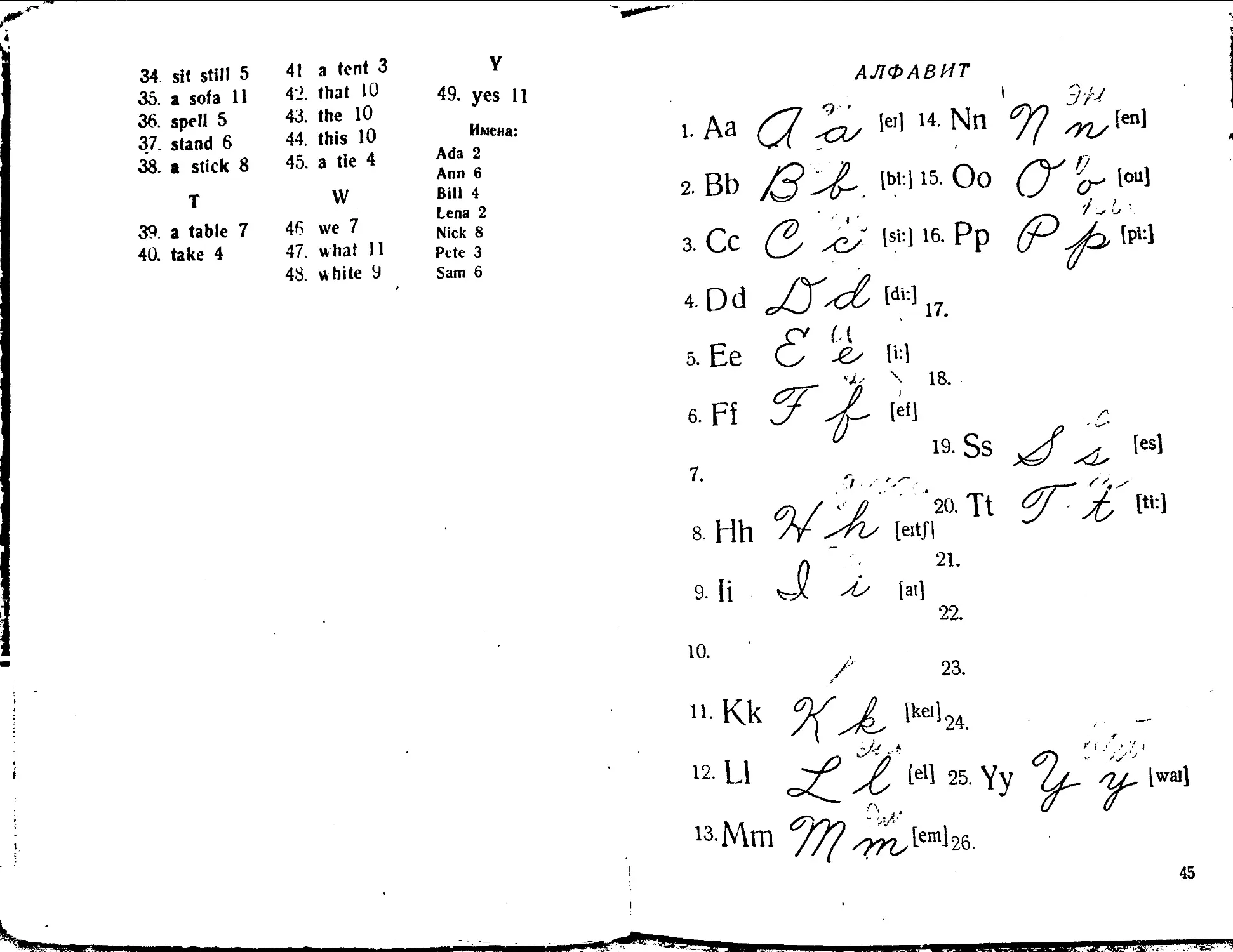
АЛФАВИТ
t. Aa	1“'
2.	ВЬ J34-. 1*1* Oo (y'ir-}“I
3* Cc (5 sC/- lsi:l 16* Pp pfi ipi'l
4.Dd JJsct
O' (л
5. Ее О & М
  чА \	18.
6. Ff ^	^	.	,г-
•Ss >J л, 'esl
•/'	20.	Tt	У	£	™
8. Hh А4 Лу [ert/l ^
9. H	-A	(ai]
22.
10.	.
/'	23.
19
7.
n-	9{JL lkell24.
12. LI ^ % tel] 25. уу	y,
13.Mm ^^M26.
[wai]
-
,M26.
45

§12.
Gg & 'ft' R r sV
a sledge
r=
a big tent
46
ГЙ
a bag
M
a little tent
a big apple
a big red apple
a little apple
a little green apple
A—The
Take an apple!
Take the big apple!
Чтение предложений
1. “^Pete, 'go to the "Viesk! 'Open the Jdesk and
'take the 'green ^bag!”
'Pete 'goes to the Jdesk, 'opens the Jdesk and
'takes the 'green
47

He 'opens the Abag. He 'takes an Aapple. He 'h
the 'apple in his Ahand.	3s
2. “Bill, go to the tent! Take the kite.”
Bill goes to the tent and takes the kite. Bill likes
the white kite.
Новые слова:
a bag, a sledge, big, green,
open, go, goes [gouz],
to [taj.
red,
 <3/
A Id/'/иплпл/', /lAS-fs.
1.
2.
3.
4.
Классные упражнения
Произнесите звуки [w], [г], [hj, [j], [cfc], fg), ftj],
Назовите 4 гласные буквы, которые вы знаете.
Назовите буквы: G, Н, N, F. Y, 1, С, S, Е.
Прочитайте столбики слов:
(Л, [3]
м
age
cage
page
[9]
go
get
green
w
sit
sleep
rest «
w
is
his
has
5. Какие буквы читаются не по правилам в словах:
6. Прочитайте незнакомые слова: tram don with
them, yell, hen, yet, rest, dig, him, them, get. '
48
this, yes?
wet, get,
Прочитайте новые слова, сочетания слов и предложения и
переведите их:
И a sledge: a big sledge; that green sledge. I see a sledge.
I see the sledge. Pete sees a big green sledge. The
sledge is on the hill. Nick is in the sledge.
2) a bag: a big bag; a little bag; a red bag; a black bag.
Ann has a green bag. Ann likes the bag. Ann takes
the bag. Ann opens the bag. Ann sees a red apple in
the bag. Ann likes the apple. Ann takes the apple.
3) in: in the bag; in the black bag; in the red bag; in
the green bag; in the tent; in the big tent; in the little
tent; in	the desk; in	the black	desk; in	the big sledge.
1 see	Pete in the	green tent. He is	on his	bed. He
has a map in his hand.
4) on: on the desk; on the sofa; on the red sofa; on the
green sofa; on the tent; on the big white tent; on the
little tent; on the green tent.
Bill sees his little white kite on the tent. Bill likes
the white kite. He takes the kite.
Lena	sees a nice	little cat.	The cat	is on	the bed.
Lena	goes to the	bed and	takes the little	cat.
•5) Nick goes to his desk. He takes his bag. He opens
his bag. He sees a red apple in his bag. He likes the
red apple. He takes the red apple. He has the apple
in his hand.
We see a ^bed, a stable, a 7sofa, and a Adesk;
'on the ^desk we see a Aclock. The 'clock 'stands on
the Adesk. We 'go to the Adcsk. We 'take the A clock.
л	49
Заказ ^ 5705

6. Составьте 10 предложений, взяв по одному слову из кажДОГо
' столбца, и переведите их.
Подлежащее
Сказуемое
III
Второстепенные"-
члены
Pete and Bill
We
Lena and Ada
like
the map
the sledge
the tent
the table
the hill
the lake
the desk
the bed
Pete
He
Lena
likes
I
II
Подлежащее
Сказуемое
ill
1
Pete and Bill
We
Lena and Ada
Второстепенные
члены
take
the pencil
the pen
the tie
the cat
the cap
the apple
the clock
the kite
the bag
Pete
He
Lena
takes
50
9< Почему окончания глаголов в 3-м лице единственного числа
в левом столбике читаются [s], а в правом — [z]?
isl М
takes	opens
likes	sees
sits	spells
goes
до. Назовите предметы на картинках, употребив слова this и
that в конструкции: This is а ... и That is а ...
[1. Перепишите предложения, поставив глаголы в нужной форме:
1) Ann	...	in	the	sledge.
2) Pete	...	at	his	bed.
3) Bill ... his bag and ... it.
4) Pete, ... ‘pencil’!
5) Ann, ... the white bag!
6) We	...	a nice	lake.
7) We	...	to	the	lake.
8) Ann ... the black desk.
9) He ... to the big tent.
sit
stand
take, open
spell
open
see
go
open
go
51

12. Переведите предложения!
1) Аня берёт его портфель; Аня открывает (этот)
портфель.
2) Ник видит красное яблоко. Аня берёт (это) яблоко
3) Мы видим большое озеро. Нам нравится (мы лю¬
бим) это озеро.
4) Мы видим Сэма. У него в руке кепка.
(Он имеет ...)
Домашние задания
к
1. Напишите по два раза каждую строчку прописи.
2. Выпишите в столбик новые слова и в скобках обозначьте
число букв и звуков.
3. Поставьте вместо пропусков артикль а или the:
1) We see ... tent. We see ... kite on ... tent.
We see ... white kite on ... tent.
We go to ... tent We take ... kite. We like ... kite
2) Nick sees ... tent. Nick sees ... white tent.
He goes to ... tent. He opens ... tent. He sees ... cat
in ... tent. He likes ... cat. He takes ... cat.
4. Сделайте письменно упражнения 8 п 12.
Правило чтения
Буква g обычно читается [ д], например: big, go,
но на конце слов перед немой буквой е она читается
^5], например: sledge.
52
The U.S.S.R.
a bus
What is this? It is
a map of the U.S.S.R,
У°ц j
under
ch= [tj]
What is this? It is a bench.
Is the dog on the bench?
No, it is not.
Is the dog under the bench.
Yes, it is.
a bench
What is this?
It is a picture.
It is a big picture.
It is a nice picture.
picture I'piktfal
53

Чтение предложений
This is а шар. It is а шар of the U.S.S.R. The map
is not on my table. It is on my desk.
This is a bus. It is not a green bus, it is a red bus.
The bus is at the lake. Dan is in the bus. He has a black
bag in his hand.
• You see a big green bus. The bus is at the white tent.
In the bus you see Pete, Nick and Dan. Pete has a black
cap in his hand. Dan has a big stick in his hand.
a , A Dog
>' , , - f -'
You see a dog. The dog is not in the bus, it is under
a bench. The bench is in the tent.
Ada and Lena see the black dog. The dog is under the
bench. They go to the bench. They take the dog.
to see
единств, число
множеств, число
/
1-е л.
2-е л.
3-е л.
1 see
You see
Не sees
We see
You see
They see
Новые слова:
a bench, a bus, a dog, a picture |'piktj3|,the U.S.S.R.
jju: es es 'a:|, my [maij, they ) deij, you [ju:], of [avj,
at, under ['Andaj.
54
Классные упражнения
1. Произнесите звуки:
[Э], [j], [u:], lju:], 1л], la:], [s], [tj], [d&\, [5], [W].
2. Прочитайте столбики слов:
[31
liu;l
M
W1
M
then
you
but
much
'sis-ter
that
cube
cup
such
'mis-ter
this
tube
cut
bench
'mi-ner
they
tune
up
children
'ri-der
3. Переведите на русский язык:
to stand, to sit, to see, to go, to take, to open; ^
he opens, you go, they take, you stand, they sit;
1 go, he goes, we open, you spell, they stand still.
4. Устно проспрягайте глагол to open во всех лицах.
Домашние задания
1. Напишите по два раза каждую строчку прописи.
2. Назовите буквы, перепишите их и добавьте к каждой заглав
ной букве строчную:
и, Y, W, Н, S, D. F. G, В, R.
3. Прочитайте и переведите:
1)	We sit on a bed (the bed, this bed, that bed, his
£ 7	**	«•“ “
sledge, his sledge, my sledge).

2) The cat is on	the bench (under	tne Dench, under
the sledge, at	the bench).
The cat is in the tent (at the ient, on the tent, under
the table in the tent, under the bed in the tent).
3) The pencil is	on the desk (in the desk,	under	the
desk). Pete is	in the tent He is	on the	bench.
4) I like to sit on that bench. You	like to	sit on	щу
sofa. They like to sit at the lake. They like to sit
on that hill. The cat likes to sit under my bed.
That cat likes to sit on the tent. The dog likes to
sit under my bench.
4.	Проспрягайте письменно глагол to go.
Правила чтения
1. Буква и в закрытом ударном слоге читается [л],
например: a bus.
2. В неударном слоге буквосочетание ег читается [э].
3. Буквосочетание ch читается [tj'|.
Грамматика
1. Перед глаголами в неопределённой форме ставится ча¬
стица to, например: 1 like to sit on the bench.
Я люблю сидеть на той скамейке.
2. Глаголы в настоящем времени имеют личное окончание
-s только в 3-м лице единственного числа.
Спряжение глагола в настоящем времени
to sit—сидеть
единств, число множеств, число
1-е л, 1 sit
We sit
2-е л. You sit
You sit
3-е л. Не sits
They sit
56
§14.
In 'this ^picture you see /
The 1iill is at the '^dake.
'On the Jnill you 'see a 'big
'white J’tent and a fbig A tree.
The 'tent is under the "Ytree.
'Pete is in the ~\tent. He 'sits
on the 'Ybench.
Pete has a dog. His dog is not at the tent. His dog
is in the tent. The dog sits under the bed.
Ada and Lena see the tent. They go to the tent. They
see the dog. The dog sees Ada and Lena. The dog runs
to Ada and Lena.
Ada and Lena run to the lake. They see a bus. The
bus stops. They get on the bus. The dog stops at the bus.
Is the ’hill at the .Лаке?
Is the tent on the hill?
Is Pete in the tent?
Is Pete under his bed?
Is Pete on his bed?
Is Pete on the bench?
Is his dog under his bed?
to run —бегать, бежать
единств, число
множеств, число
l-e л. i run
We run
2-е л. You run
You run
3-е л. He runs [z\
They run
Новые слова:
to get (on a bus), a
tree, to run.
S7

§ 15.
Vv 'b-'
Do you ... ? Does he ... ?
do-[du:] does=[dAz]
I
i
'Do you 'see a 'tent on the Jhill? "Wes, I ":do.
~\Yes, we Ado.
ANo, 1 do "'.not.
A No, we do "not.
Does he 'see a 'tent on the _>hil1? AYes, he does.
ANo, he does "".not.
Does Bill see the lake^ No, he
does not. He sees the hill.
’/Do Bill and Sam see tiie lake?
No, they do not. They see
the hill and the tree.
a
Does Pete take an apple?
No, he does not, he takes
pencil.
Do Pete and Nick take a kite?
No, they do not.
58
to see
I
1	see ... .	We	see ...	.
You see ... . You see ...
He sees .... They see ... .
»
Do	I	see ... ?	Do	we see	... ?
Do	you see ...	?	Do	you see	... ? •
Does	he see ...	?	Do	they see ... ?
1 do not see ... .	We do not see ... .
You do not see .... You do not see ... .
He does not see .... They do not see —
a school [sku:l| — школа
'Does 'Pete 'go to ^school? AYes, Pete Adoes.
'Does ‘Ann 'go to ^school? ANo, Ann does Anot,
'Does 'Bill 'go to ^school? ANo. Bill does Anot.
О
to live —жить
Do you live in the U.S.S.R.? ^es, we do.
Do you live in Tomsk (Omsk, Kiev)? No. we do not.
Does Sam live in the U.S.S.R? No. he oes n° ’
He does not live in the U.S.S.R. He lives tn America.
Does Bill live in the U.S.S.R.? No. he does
He does not live in the U.S.S.R. He lives in
Новые слове:
America [э'тепкэ], a school [sku:I|,
to do fdu:], docs [<M, to Uvc !1,VI-

Классные упражнения
I. И{*>ч*г*йгг столбики с:
,тов:
lu:l
do
school
tool
N
does
come
comes
И
live
give
stick
Заполните пропуски вспомогательными глаголами do или does:
U
n
2)
31
4)
5)
you live	in	America?	No, we	...	not.
Hill live	in	America?	Yes, he	...	.
Bill and	Sam live in	America? Yes, they
you live	in	the U.S.S.R? Yes,	we	... .
Pete and Nick live in the U.S.S.R? Yes, they
L Переведите вопросительные предложения:
1) Do	you like to sit	on	that	hill?
2) Do	you like to go	to	school?
3) Does Pete like to go to school?
4) Does little Ann like to run in the street?
5) Does Pete like his dog?
6) Does Ann like that little cat?
7) Do Pete and Nick like the kite?
8) Has	Pete a little tent?
9) Has	Pete a dog?
10)	is Pete m his tent?
Ответьте на вопросы:
1) Do you live in America?
2) Do you live in the U.S.S.R.?
3) Do you go to school?
A) Do you like to go to school?
5) Does Pete go to school?
6) Does little Ann go to school?
7} Has Pete a cat?
60
8) Has Pete a dog?
9) Has Pete a little tent?
10) Is his tent on a hill?
2.
3.
Грамматика
Глагол
Спряжение глаголов в настоящем временя
1. При спряжении глаголов в вопросительной и отрицатель¬
ной формах настоящего времени прибавляется вспомога¬
тельный глагол do. В 3-м лице единств, числа прибав¬
ляется 3-е лицо от глагола do — does.
2. Для образования вопросительной формы вспомогатель¬
ный глагол do (для 3-го лица единств, числа does)
ставится перед подлежащим, например:
'Do you 'live in the JU.S.S.R.?
'Do they live in the ^U.S.S.R.?
'Does Bill 'live in the JU.S.S.R.?
3. Для образования отрицательной формы вспомогательный
глагол do (does) с отрицанием not ставится после под¬
лежащего.
We do 'not live in A^merica.
They do 'not 'live in A^merica.
He does 'not live in A^.merica.
4. В кратком ответе повторяется подлежащее и часть ска¬
зуемого (вспомогательный глагол в нужной форме).
TYes, I Л do.	"VYes, he ^.does.
"4No, I do^not	"'iNo, he does ^not
" ‘ 61
Письменно проспрягайте глагол to run в вопросительной и
отрицательной формах.
Сделайте письменно упражнения 2 и 4.
Перепишите слова и поставьте фонетические значки над вы¬
деленными буквами:
do, does, under, no, not, school, school, bench.
[■ui зашивши

§ 16
• к	I
96
Множественное число существительных
-S
[S]
[2]
a desk — desks
Ч
а шар — maps
a black cat — black cats
a bed — beds
a pen — pens
a red tie — red ties
-es =
a box •
a sledge-
1Z
boxes
sledges
Чтение слов и сочетаний слов
1 —one [wAn|, 5 —five, 6 —six, 7— seven [sevnj,
8 — eight |eit|, 9 —nine, 10 — ten;
a desk, one desk, five desks, seven black desks;
a map,	one map,	six	maps, nine big	maps;
a box,	one box,	five	boxes, seven	boxes,	ten	boxes;
--an apple, one red apple, five green apples;
seven big apples, eight red apples, ten green apples.
This is a Picture
'In the	^picture	you	'see a ^street.
In the	J'street	you	'see 'ten 'green	J trees,	'five	'red
Jbuses and 'one "Uram.
'Pete is 'not in the *Astreet His ’dog is in the ^street
62
The dog 'sees 'Pete. It 'runs to A Pete.
Do you see a street in this picture?
Do you see trees in the street?
Do you see trams and buses in the street?
Do you See Pete in the tram?
Do you see a box in his hand?
Do you see his dog in the street?
Does the dog see Pete?
Does the dog run to the tram?
Новые слова:
a box, a street, a tram, one [wxnl, live, six,
seven [sevn], eight M. nine, ten.
&
9
Шм
AUrUZVtf',
A?' S'"
63

I
Классные упражнения
1. Прочитайте во множественном числе следующие существи¬
тельные, обращая особое внимание на чтение суффиксов -s,
-es:
a bed, a white hat, a red pen, a big hill, a green
apple, a big box, a sledge.
2. Переведите сочетания слов:
чёрная кошка, чёрные кепи, б красных ручек,
1 ящик, 5 ящиков, 7 ящиков, 5 саней, 9 автобусов,
1 чёрный карандаш, 5 кроватей, 8 карандашей.
3. Составьте предложения, взяв по одному слову из каждого
столбика:
I
II
Подлежа¬
щее
Сказуемое
We
I
You
They
Do you
Does he
see
see
seven
III
Второстепенные члены
five ! white pens
ties
six I red apples
pencils
green maps
pins
boxes
ten | black caps
I little hats
eight | nice kites
sticks
on the desk
in the desk
under the desk
on the table
S under the table
! on the bed
on the bench
I under the bench
*
i on the sofa
A
64
\
4.	Закончите предложения, используя картинки
1 see
Ann sees
f Ши
Lena sees
Ada has
They see
%
■ • i
We see
%
Pete has
5 Заказ Nb 5705
Ann has

Домашние задания
1. Выпишите существительные только во множественном числе.
Выпишите их в 3 столбика (в зависимости от чтения суф.
фикса множественного числа) под фонетическими значками
[s], [z], [izj:
Ф
a bed, ten pens, a red bag, six black bags, five
boxes, ten sledges, a pencil, ten maps, green ties, tents,
five pencils, ten desks, eight maps.
2. Переведите предложения:
1) Я вижу десять зелёных деревьев.
2) У Билла восемь красных карандашей. (Билл имеет
••О
3) Вы видите пять чёрных собак и восемь кошек.
4) У него одна ручка, один портфель и семь каран¬
дашей.
, 5) Они берут семь карт и идут к столу.
6)	Я беру свою шляпу и бегу к озеру.
3. Напишите слова, в которых есть звук [Г] и звуки [ks].
Правила чтения
1. Суффикс множественного числа существитель¬
ных -s после гласных й звонких согласных чи¬
тается \z\, а тосле глухих согласных — [s], на¬
пример: ties [z], hands fz], desks [s].
2. Существительные, оканчивающиеся на шипящие
и свистящие звуки, имеют во множественном
числе суффикс -es, который читается [iz] и обра¬
зует безударный дополнительный слог, например:
a box — boxes pboksiz],
3. Буква х обычно читается [ks], например: a box.
    _
66
Грамматика
Множественное число существительных
Множественное число' существительных образуется при
помощи суффикса -s(-es).
Артикль
Перед существительными во множественном числе не¬
определённый артикль не употребляется/например: a dog —
six dogs.
Прилагательное
В английском языке прилагательные не "изменяются по
числам, т. ,е. не согласуются с существительным в числе,
например: a black pen — six black pens.
§ 17.
ar-[a:]	"}	=	[»]•	or-[о:]
V
а саг
а bird
а horse
а girl
67

In the Street
This is a ^street. In the ^street we 'see/ a 'little
“^girl. Her 'name is "^Ann.
'Ann has a 'bird in her ~\hand. 'Ann has a 'little 'bird
in her "Viand.
'Nick 'sees the ^bird. 'Nick likes the ~\bird. 'Nick
goes to ^Ann. Wick 'takes the ^bird.
Do you see a girl in the street?
What is her name?
What has Ашп in her hand?
Does Nick see the bird?
4
Does Nick take the bird?
7	In	the	Yard
I 'see a "^yard. In the Jyzx& I 'see a Ahorse. 1 'see
a 'white Ahorse. 'Dan is on the Ahorse. He has a 'cap
in his "Viand.
I see Nick. Nick is in the yard. He has a bag in his
hand. He is not on the horse.
What do you see in this picture?
68
Is the horse in the yard?
Is Dan on the horse?
Has he a bag in his hand?
What has he in his hand?
n
In the Car
This is a street. This is a nice street. This
street. In the street we see a big green
is a green
tree. The
69

car is under the tree. In the car we see Lena, Ada
and Ann.
Is that a green street?
Do you see a car in the street?
Is the car under a tree?
Новые слова:
a bird, a car, a girl, a horse, a name, a yard,
her.
What is her (his) name?
'I У)ЛЛ/} Sly /СОЛА
Классные упражнения
1. Произнесите звуки [i:], [э:], [а], [о:j, [э:] и назовите букво¬
сочетания, которые передают на письме эти долгие звуки.
2. Прочитайте буквосочетания: th, ch, ck, ar, er, or, ir.
3. Прочитайте столбики слов:
la:]
M
M
ldj|
|0|
bird
for
car
hedge
the
girl
fork
cart
bridge
that
skirt
horse
card
large
them
first
sport
star
barge
they
4.	Прочитайте контрольное упражнение:
1) girl, skirt, first, fern, her, sir, fir;
2) cart, card, part, garden, far, farm, arm;
3) car, cat, came, far, fat, fate, star, farm;
4) sport, fort, or, nor, for, sort, port, form.
70
5.	Ответьте на вопросы:
What is ~Tthis? It is a
What is this? It is a
What is this? It is a
Is this a J
Is this a
Is this a
Is this a
Is this a
Is this a
0. Прочитайте новые слова, сочетания слов и предложения и
переведите их.
1) a girl: a big girl; that little girl; this nice girl; five
little girls. The girl goes to the bench. The girl
sits on the bench. The girl sits under a big tree in
the yard. Six girls sit on that bench.
71

2)	a	bird: a big bird; a	little	bird; that	white	bird;
seven black birds. The bird is in that big tree. The
tree is in the yard.
rrtu
3) a car: a big car; the green little car; that black car;
this red car; black cars; white cars; his green car;
her little car. The car is in the yard. The car is in
the street. The black car is under that big tree.
4)	a	horse: a big horse;	this	little	white	horse; his
black horse; ten horses. The horse is in the yard.
The horse is not in the street.
5)	his name, her name:	Her name	is Ada. His	name
is	Pete. Her name is	Lena.	Her	name	is not	Nell,
her name is Bess.
7.	Составьте предложения из следующих слов:
1)	see, they,	cars, seven, street, the, in.
2)	the, sees,	cat,	birds, in, three, the,	tree.
3) Nick, his, black, likes, horse.
4) we, the, little, go, girls, to.
5)	Nick,	the, open, big,	boxes!
6)	Do, the, to	sit, life,	on, girls,	bench, that?
7)	live, you,	in,	do, the U. S. S. R.?
8)	Nick, to run,	does, like, street, in,	the? '
9)	Does,	Ann;	little, go,	school,	to?
■ ** * - -	==3/	*
10) live, you, do, in, America, npt.
Домашние задания
1.	Напишите по два раза каждую строчку прописи.
■ 2. Перепишите текст “In the Street” и подчеркните двумя чер¬
тами сказуемое.
3.	Сделайте письменно упражнение 7.
72
Правила чтения
1. Буквосочетание аг в ударном слоге читается [«],
например; а саг.
2. Буквосочетания ir и ег в ударном слоге чита¬
ются [э:], например: a girl, her.
3. Буквосочетание or в ударном слоге читается
[э:], например: a horse.
§ is.
Не—She
sh=№
Nick is in the street
He is in the street.
He has a cap in his hand.'
|и*
N
V—К
V •
Ann is in the garden.
She is in the garden.
She has a bird in her hand.
The clock
is on the shelf.
a shelf

I
11
111
Подлежа¬
щее
Сказу¬
емое
Второст. чл. предложения
Nick
Ann
has
has
a cap J In his hand.
a bird \ in her hand.
i
•
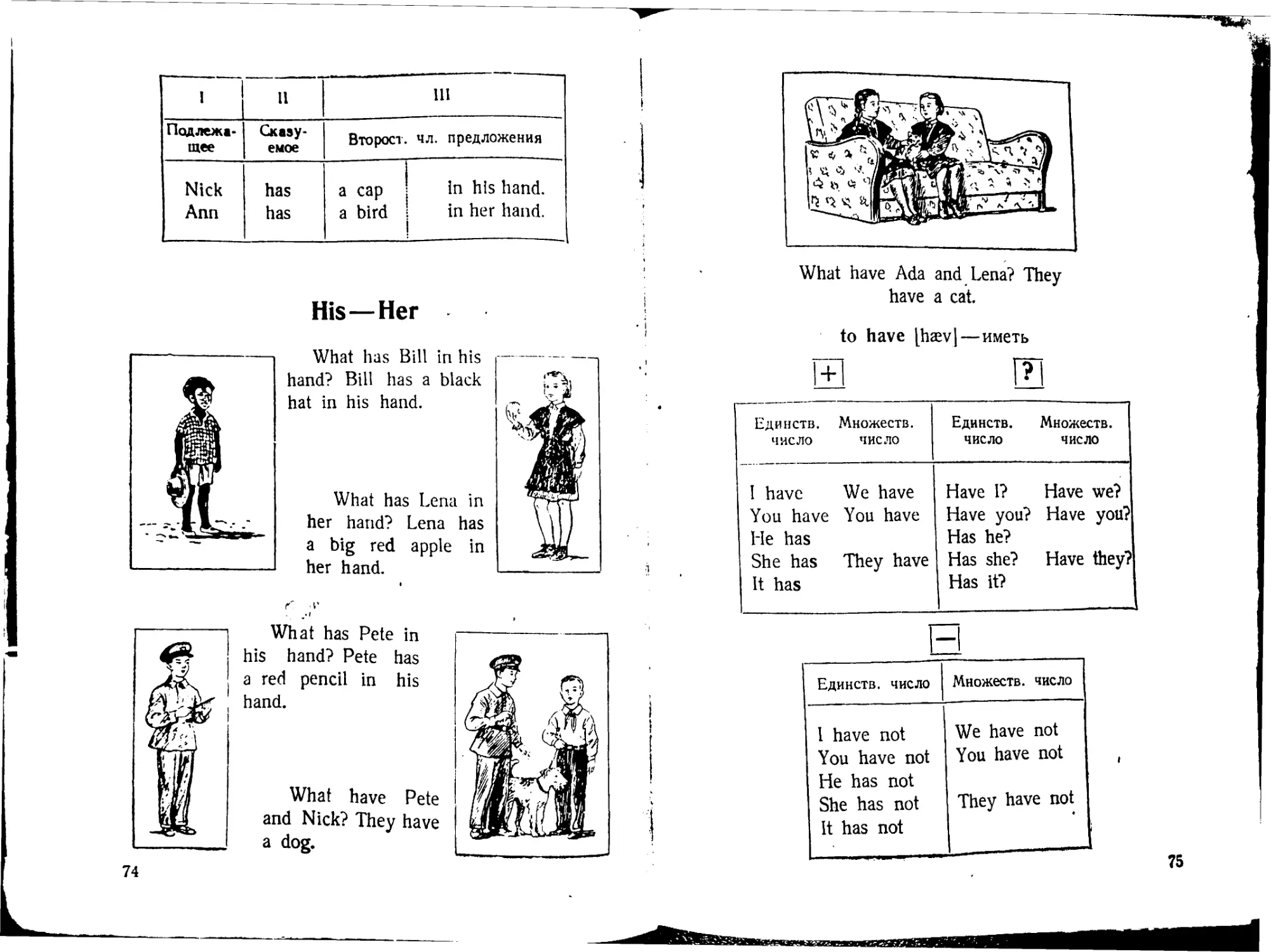
His—Her
What has Bill in his
hand? Bill has a black
hat in his hand.
What has Lena in
her hand? Lena has
a big red apple in
her hand.
What has Pete in
his hand? Pete has
a red pencil in his
hand.
What have Pete
and Nick? They have
a dog.
s
What have Ada and Lena? They
have a cat.
to have |haev]— иметь
Единств.
Множеств.
Единств.
Множеств.
число
число
число
число
I have
We have
Have I?
1
Have we?
You have
You have
Have you?
Have you?
He has
Has he?
She has
They have
Has she?
Have they?
It has
Has it?
Единств, число Множеств, число
I have not
You have not
He has not
She has not
it has not
We have not
You have not
They have not

Новые слова:
a shelf, a sister, she, to have, or.
Классные упражнения
1. Прочитайте буквосочетания:
ar, or, ir, ее, th, sh, ck, nn, 11, ss, ch.
2. Прочитайте слова:
dish, shirt, ditch, fish, ship, chip;
ship, chip, sheep, ditch;
fish, sheet, finch;
French, shop, dish, chop;
ship — chip dish — ditch
shirt — chirp fish — finch
shop — chop
3. Прочитайте и переведите слова, читающиеся не по правилам:
bus, picture, this, does, yes, school, live, they, you,
what.
4. Составьте предложения из следующих слов, переведите их
и прочитайте.
1) We’ a, sister, have.
2) Misha, six, has, sisters.
3) Have, a, you, dog, a, or, cat?
4) They, do, Uve, in, tent, that?
5) They, have, big, a, horse?
5. Прочитайте и переведите.
Lena	Pete
1) Her	bag is in her hand.	1)	His	cap	is	in	his	hand.
2) Her	pen is in her desk.	2)	His	map	is	in	his	hand.
3) Her	pin is .in her tie.	3)	His	pen	is	in	his	bag.
4) Her	map is in her hand.	4)	His	bag	is	in	his	desk.
5) Her	apple is in her bag.	5)	His	dog	is	in	the	yard.
76
6) Her	cat	is	under her bed.
7) Her	hat	is	on her	shelf.
8) Her	tie	is	on her	shelf.
9) Her pencil is on her	table.
б.	Ответьте на вопросы по картинкам:
6) His kite is in the tent.
7) His clock is on his shelf.
8) His hand is on his desk.
9) His cap is on the sofa.
'Is
'Is
'Is
a Ahorse?
'cat? j'Is the liorse in the j 'Is 'Nick in a /car?
"dog?j/yard? 'Is the 'Is 'Nick on a /sofa?
'Is 'Nick in a /car
or on a^sofa?
'this a
'this a
'this a ./dog oHborse in the ./yard
or in the "^street?
’Is 'this a Aar? 'Is the ’car in the Jyard or
"Vstreet? 'Is 'Pete in the Aar or on the Ahorse?
'Has 'Pete a 'stick in his Aland?
'What has 'Pete in his '.hand?
in the
77

Is	this	a shelf?
Is	this	a white	shelf?
Is	the	clock on	the	table?
Is	the	clock on	the	shelf?
Домашние задания
1. Напишите по два раза каждую строчку прописи.
2. Перепишите предложения, вставьте пропущенные слона has,
have и is и переведите предложения:
1) Nick ...	a red iie in his bag.
2) Ada ... a white bag in her hand.
3) Ada and	Lena ... a dog.
4) Nick ...	not in the yard, he ... in	the	street.
5) Ada and	Lena ... a little sister. Her	name	... Ann.
3. Сделайте письменно упражнение 5.
4. Перепишите слова и поставьте фонетические значки над вы¬
деленными буквами и буквосочетаниями:
she, her, girl, stick, shelf, horse, car, she, car, sledge.
Правило чтения
Буквосочетание sh читается |J], например: she.
<
78
Грамматика
Глагол to have -
иметь
1
Личные формы глагола to have в настоящем времени:
3-е лицо единств, числа: has — he has
she has
it has
have — форма всех остальных лиц:
I have	We	have
You have	You have
They have
Глагол to have образует вопросительную и отрицателы
ную формы без вспомогательного глагола, например^
Не has. You have.
Has he?J Have you?
mf
He has not. You have not.
§ 19.
Is—Are
W *4 "V
th=[e]
Nick is in the garden.
He is in the garden.
Dan and Nick are in the
garden.
They are in the garden.
3
three
79

Чтение предложений
I am in the Dgarden. 'Nick is in the Mgarderi. Dan
Is in the Dgarden. 'Nick and 'Dan are in the Mgarden.
'Ann is 'not in the Dgarden. 'Lena is 'not in the "'.gar¬
den. 'Ann and "Lena are in the ";sti ect. a hey are 'not
in the “T garden.
We are in the garden. 1 have an apple in my hand.
Dan has an apple in his hand. Nick has an apple. We
have three apples.
Is Nick in the street?
Are Dan and Nick in the street?
Have they red bags?
Have they black bags?
to be — быть, находиться
Единств. Множеств,
число число
Единств Множеств,
число число
I am We are
You are You are
He is
She is They are
•
Am I? Are we?
Are you? Are you?
Is he?
Is she? Are they?

Единств, число
Множеств, число
I am not
We are not
You are not
You are not
She is not
\
He is not
They are not
80
The School-Garden
We have a nice school. The
school has a big garden and a big
yard. We do not play in the
streets. We play in the schoolyard
and in the school-garden. The
children like to play in the garden
In the garden we have many
benches. We like to sit on the benches under the big
green trees. We like to play and to run in the garden.
Новые слова:
children, schoolchildren, a (school-)garden,
a schoolyard, to be, am [зет, эт], are [a], to play,
many ['meni|, two [tu:], three [flri:], tour [to:].
Классные упражнения
1. Прочитайте упражнения:
IJ'I
m
14
14
14
fei)
she
children
three
this
sick
they
shelf
chess
third
that
tick
play ,
Misha benches thorn them Dick day
2. Спишите буквосочетании ch, sh, th, ck, ar, or, ir, er, ey, ay
и рядом обозначьте фонетическими значками звуки, которые
они передают.
3. Прочитайте и переведите предложения:
The children are not in the street; they are in the
garden.
We see many children in that red bus.
Many children like green apples.
Schoolchildren like to run in the schoolyard; they like
to play in the school-garden.
* 81
Заказ 5705

The children зге not in the bus, they зге in the tram.
The children зге not in the Ызск езг, they are in the
green car.
They see many children in the lake.
Little children do not like to play in the street; they
like to play in yards or gardens.
three [9ri:l = 3; four [b:] = 4; two [tu:] = 2
That big girl has three sisters.
Pete has 'many "^pencils. He has 'one 'white _7pencil,
'two 'green ^pencils, 'three 'red Jpencils and 'tour ~^black
pencils. His 'pencils are in a '"^pencil-box.
The 'pencil-box is on a ^shelf.
4.	Составьте 10 предложений, взяв по слову из каждого стол¬
бика, и переведите их.
1	И
Подлежащее
Сказуемое
111
I
-
am
Второстепенные члены
in my bed
the street
the big yard
the black car
the school-garden
my little white tent
at ! the lake ,
school
my desk
j my table
; *
on! the green bench
! the red sola
|my bed
82
5.	Заполните пропуски личными формами глагола to be (am, is, are)
1) 1 ... not in a garden, 1 ... in a yard.
2) You ... not in a car, you ... in a tram.
3) He ... in his tent
4) She ... in her little garden.
5) We ... on a big hill.
6) You ... in the schoolyard.
7) They ... in the green bus.
Домашние задания
1. Сделайте письменно упражнения 4 в о.
2. Переведите упражнения:
1) Я (нахожусь) в саду.
t	%
2) Он (находится) на скамейке.
3) Они (находятся) на дворе.
4) Вы (находитесь) на (in) улице.
5) 11тицы (находятся) на (in) том дереве.
Грамматика
Глагол to be—быть, находиться
1. Личные формы глагола to be в настоящем времени:
1-е лицо единств, числа: am—1 am
3-е лицо единств, числа: is — Не Is *
She is
It is
arc — форч<а всех остальных лип
We are
You are
They are
2. Глагол to he образует вопросительную и отрицательную
формы без вспомогательного глагола, например.
Не is.
Is he?
Не is not.
#*

ОБЗОРНЫЙ УРОК
Назовите все известные вам буквы английского алфавита.
Подберите к каждому глухому согласному звуку соответ¬
ствующий ему звонкий:
м. 1‘]. 14. М. Id], И. М. [р]. [я], и. [Ь].
Произнесите сначала сложные гласные звуки, затем простые
долгие звуки и, наконец, краткие гласные звуки:
(i:j, [ouj, [э:], [о], [ei], [a], [ae], [ai], [э:], [е], [i], (л], [-и:].
Перепишите столбиком буквосочетания ir, sh, ch, ck, th, II,
аг, ее, nn, or, er и справа фонетическими значками обозначьте
звуки, которые они передают.
Перепишите фонетические значки столбиком и справа напи¬
шите слова, в которых содержатся эти звуки:
1)	[Щ	4)	[d5]
2)	[э:]	5)	[9]
3)	(Л	6)	[к]
Прочитайте контрольное упражнение:
a: can, skate, part, state, farm, day
o: home, from, sports, so, Tom, for
e: me, meet, them, get, help, her, chess
i: winter, pine, ice, if, fir-tree, pie, third
u: but, summer, must, pupil, bugle, us
Назовите в следующих словах буквы, которые читаются не
по правилам:
four, two, this,	yes,	bus,	one, does, do, school,
picture, you, many.
Назовите: 3	слова	со	звуком	[э:].
3	слова	со	звуком	[э:].
5 слов со звуком [сс].
2	слова	со	звуком	[/].
1	слово	со	звуком	[9].
3	слова	со	звуком	[tf|.
8 слов со звуком [д].
3 слова со звуком [д].
9. Назовите все предметы, которые могут быть в „ ^
в саду, в комнате.	портфеле.-
10. Поставьте перед глаголами местоимения 3-го лица мии„
венного числа и измените форму глагола:	сД«нст-
to have, to be, to go, to see, to take, to live to
sit, to stand, to spell, to open, to have, to be, to do
11. Перепишите предложения, употребив выделенные существи¬
тельные и местоимения во множественном числе:
1)	The	girl takes a red tie.
2)	The	children have a nice	little	box.
3) I see a big tent.
4) He sees a bench.
12. Замените выделенные существительные местоимениями:
1) Little Bill takes a little stick.
2) Bill and Sam run to the garden.
3)	Ada	likes cats.
4)	Ada	and Lena live in the	U.S.S.R.
13. Поставьте вместо пропусков глаголы am, is, are, have, has,
do, does:
1) Her cat ... not live in the tent.
2) The big clock ... on that shelf.
3) Pete ... a black dog.
4) Ada ... not live in America.
5) Ada and Lena ... many birds.
6) Pete and Nick ... -not in the tent; th*ey ... under
the tree.
7) I .;. in the yard, 1 sit on the bench.
8) I ... three sisters.
9) Birds ... not like cats.
10)	Cats ... not like dogs.
11) ... you live in the U.S.S.R.?
12) \ .. you a sister?
85

13)	...	she	go to school?
14)	...	she	a white bag or a	black bag? >
15)	...	her	bag on the shelf?
14. Поставьте вместо пропусков определённый или неопределён¬
ный артикль:
We see ... big box. In ... box we see three little
dogs. ... box is on ... bench.... bench is in ... garden.
15. Переведите тексты:
In the Schoolyard
We see a schoolyard. We see many children in the
schoolyard. The children like to play and run in the
schoolyard.
Many children like to sit in the school-garderi. They
like to sit on the benches under the green trees.
Nick and Dan are in the schoolyard. They like to
play under the big trees. They do not like to stand under
the trees. They like to run in the garden.
Nick has his bag in his hand.
Dan has his cap in his hand.
In the Park
We have a nice park. The child¬
ren go to the park. They see
benches in the park. They sit in the
park under the trees.
Ada has many apples in her bag.
The children take the apples. They
take the big red apples. They like the
apples. They play in the park. They run in the park.
A dog sees the children. The dog runs to the children.
Nick takes a stick. The dog sees the stick. The dog takes
the stick and runs to the lake.
a park — парк
86
16. Ответьте на вопросы по картинке*
17.
Is the clock on the shelf or on the table?
Are the pencils in the bag?
Are the pencils in the bag or on the table?
Do you see a black fie on the table?
Do you see two red ties on the table?
Do you like the bags?
Are the maps on the table?
What do you see in the white bag?
Do you like the apples?
Выучите счнталочки:
1)	One, two, three,
Four, five, six.
Little Nelly has ten black chicks.
One, two, three,
Four, five, six.
Pete and Dan have four big
sticks.
a chick —цыплёнок
0
a chick

2) One, two, three
You are free.
free — свободный, -ая, *oe, -ые
3)	My	Cat
My cat is black,
My cat is fat,
My cat likes rats,
Rats grey and fat.
a rat — крыса; fat — жирный, -ая, -oe, -ые
grey [ei] — серый, -ая, -oe, -ые
НОВЫЕ СЛОВА И ВЫРАЖЕНИЯ
(§ 12-19)
А
1. аш 19
2. America 15
3. are 19
4. at 13
В
5. a bag 12
6. to be 19
7. a bench 13
8. big 12
9. a bird 17
10. a box 16
11. a bus 13
I
С
12. a car 17
13. children 19
D
14. to do 15
15. does 15
16. a dog 13
E
17. eight 16
F
18. five 16
19. four 19
G
20. a garder
21. to get
a bus) h
22. a girl 17
23. to go 12
24. goes 12
25. green 12
H
26. to have 18
27. her 17
28. a horse 17
§20.
Where is ...?
Where are ...?
a chair
air- [sa]
У= [I]
three chairs
where? [wea] где?
their [Зеэ| их
Where is the chair?
Where are the chairs?

They—Their
What has 'Bobby in his 'What has 'Nelly in her
"Viands?	"^hands?
He has'apples in his Viands. She has 'apples in her
"Thands?
What have 'Bobby and 'Nelly in their "Viands?
Bobby and 'Nelly have 'apples in their "Viands.
Новые слова:
a chair, a lamp, their [Зеэ], where [weo].
Классные упражнения
1. Произнесите звуки:
a) [ei], [еэ], [ai], [еэ], [ou], [еэ], [ei];
b) [zz — ъъ], [ss —06], [ww-vv], |iz —оэ].
2. Spell: where, chair, their, they.
3. Прочитайте упражнение:
1) air, pair, hair, fair, chair, where, their;
2) a-ble, ta-ble, 'ba-by, 'la-dy, 'To-ny, 'о-pen, 'pu-pil-
4 Письменно составьте 6 вопросов к картинкам § 20, пользуясь
следующими образцами:
1) Where is the ... ?
2) Where are the ... (-e)s?
92
5.
6.
7.
8.
1)
2)
3)
4)
5)
hands?
hands?
Заполните пропуски словами my, their, his, her, what. Про¬
читайте предложения и переведите их:
. has Nick in ... hand?
. have Sam and Bill in ...
. have Jane and Ann in ..
. has Nelly in ... hand?
. have 1 in ... hands?
Перепишите предложения. Поставьте дужки там, где конеч¬
ное г читается [г], например: They are in the...:
1) We are in the garden. *
2) Are the children in the yard?
3) Where are the girls?
4) Where is Nick?
5) The chair is in the garden.
Прочитайте и переведите предложения:
1) Where do you live? We live in the U.S.S.R.
2) Where do Bill and Sam live? They live in America.
3) Where do little children play? They play in
parks and gardens.
4) Where do big children like to play? They like to
play at the lake and on the hills.
5) Where does Nick live? He lives in Kiev.
6) Where does Ada live? She lives in Omsk.
7) Where do you sit in the park? We sit
benches under the trees.
Постройте вопросительные предложения, взяв по одному
слову из каждого столбика:
?	О	I	п
on the
I
live ?
do
he
Where
she
play ?
does
it
we
run ?
you
sit ?
—
they
S3

9. Постройте отрицательные предложения, взяв по одному слову
из каждого столбика:
I	И
Подлежащее
Сказуемое
III
Второстепенные члены
I
do not play
in
the U.S.S.R.
He
does not live
in
America
She
run
in
the yard
It
stand
in
the garden
We
sit
in
trams
You
in
the tent
They
in
cars
at
the lake
in
buses
on
the hill
*
in
the street
Домашние задания
1. Напишите слова и поставьте фонетические значки над выде¬
ленными буквами и буквосочетаниями:
are, horse, chair, what, where, their, many, that,
three, this, is, Bobby.
2. Ответьте на вопросы по картинке:
Where are the pens?
Is the bag on the shelf?
Where is the lamp?
Where is the clock?
Where is the book?
Is the clock on the shelf?
94
Правила чтения
1. Буквосочетания air и eir читаются [еэ], напри¬
мер: chair, their.
Если после слов where, chair, their идёт слово,
начинающееся с гласной, то буква г произно¬
сится и читается слитно с этой гласной, напри¬
мер: where is ['wear iz|, where are ['wear a:].
2. Буква у в неударном слоге на конце слова чи¬
тается ji], например: many ['mem], Bobby [i].
§ 21
He — She — It—They
[u]
00
I
a book
a room
a school [sku:l|
tools
95

Where is the book? It is on the table.
Where are the books? They are on the shelf.
Whereas the school? It is in the garden.
Where is the table? It is in the room.
Where are the chairs? They are in the room too.
Where are the tools? They are in the box.
Where is the box? It is on the bench.
The cat is on the sofa.
(
It is on the sofa.
The kittens are on the sofa.
They are on the sofa.
The box is on the bench.
It is on the bench.
Dan is on the horse.
He is on the horse.
Ann is on the sofa.
She is on the sofa.
The clocl* and the box are
«
on the shelf. '
They are on the shelf.
96
/
s	*
r r ' r~	r*
Do you like to read? v >
Do you read many books?
Новые слова:
a book, a kitten, a room, a tool, to give [giv], to
read lri:dj, me, too.
Классные упражнения
1. Произнесите сначала краткие гласные звуки, а затем долгие
гласные звуки:
[э:|, |u|, [а:|, [ж], fu;], [ej, fa:), [э]. fit], [1].
2. Прочитайте столбики слов:
[u]	[u:|	|oul	[э:1	[э|
look	moon	go	for	cot
good	food	no	fork	cod
brook spoon note door lot
3. Прочитайте контрольное упражнение:
1) pick — pig, lit—lid, kit — kid, bet—bed;
2) fill — feel, still—steel, hill — heel;
3) pin — pen — pan; sit — set — sat.
4. Замените выделенные существительные местоимениями he,
she, it, they:
1) Lena sees a nice grey kitten. Lena likes the kitten,
Lena takes the kitten.
2) Nelly has a cat and three kittens. Nelly likes the
kittens. The kittens sleep in a box. The box stands
in her room under her bed.
' 3) Nick has many tools. Nick likes his tools. The tools
are in a big box. The box stands in his room.
4} Pete goes ‘ to the desk. Pete opens the desk and
takes his bag. The bag is in his hand.
97
^ Заказ 5705

5. Прочитайте и переведите сочетания слов и предложения:
to read [ri:dj: to read books; to read many books.
1 like to read. He likes to read books. They have many
books. They have a big shelf. Their books are on the
shelf. I like to read their books. I take their books.
%
to give piv]: They give me their books. They like
to. give me their books. I take ttieir books. I read
their books. 1 like to read their books.
a room: a little room; a nice room; a big room;
their room; his room; her room; my room; many rooms;
in the room; two rooms. Room Three, Room Four,
Room Five. Co to Room-Six. Go to their room! Go to
my ro*om!
a school: a big school; many schools; their school;
to go to school. Pete goes to school. Lena goes to
school.
C'
a book: that book; my book; many books; five
books; three books; four books; ten books; my books;
his book; his books; her book; her books; their book;
their books. Pete, take this book and open it! Read
the book.
6. Переведите предложения:
1) Я вижу холм. Он (находится) у озера.
2) Я вижу их книгу. Она (находится) на полке.
3)	Я вижу	двоих детей, они	(находятся) в трамвае.
4)	Алла и	Ник (находятся) в	саду. Они	любят сидеть
на скамейке.
5)	Я вижу	лошадь, она не в	саду, она	во дЬоре.
6)	Бобби не любит играть во	дворе; он	любит играть
под деревьями в саду.
7) Нелли не любит сидеть во дворе; она любит си¬
деть на зелёной скамейке в саду.
9
7. Составьте к картинкам во¬
просы, взяв по одному слову из
каждого столбика, и ответьте
на них.
Сказуемое
Г
Подлежащее
Вопросительное слово
Where
is
are
the dog?
the kitten?
the book(s)?
the kite(s)?
the pen(s)?
the pencil(s)?
the school(s)?
the chair(s)?
the box(es)?
the bench(es)?
the clock(s)?
the lamp(s)?
Домашние задания
l
Перепишите предложения, заполнив
в нужной форме:
1) “Pete, ... а реп!”
Pete ... the pen.
2) She ... many books and he...
many pencils.
пропуски глаголами
to take
to take
to have
99
7*

3) I ... to sit in the garden.
He ... to play iri the yard.
4) Dan and Nick ... the bags and
... the pens!
Dan ... the bag and ... the
pen.
to like
to like
to open
to take
to open.
to take
2. Сделайте письменно упражнение 6.
3. Напишите фонетическими значками, как читаются слова:
two, too, their, where, they.
Правило чтения
Буквосочетание оо перед к читается [uj, напри¬
мер: book.
Перед другими согласными буквами оно обычно
читается [и:], например: school.
100
Грамматика
А
Личные местоимения 3-го лица единств, числа
1. Не — он (когда говорят о людях), например, вместо
Pete—he.
2. She — она (когда говорят о людях), например, вместо
a girl — she. ,
3. It —он, она, оно заменяет все существительные, кроме
тех, которые обозначают людей, например:
a	pen	—it	a	horse—it
a	bench	— it	a	cat —it
a	tie	—it	a	bird —it
Примечание. Если говорящий знает пол живот¬
ного, то он может, говоря о животном, употреблять
местоимение he или she. Например:
1 have a cat. Her паше is Mashka. She sleeps in
my room.
We have a dog. His name is Sharik. He likes to run
in the street.
§ 22.	Nick’s Dog
* »
+ *
Nick has ,a black dog. The dog’s
name is Rex. 7ч •
Nick’s dog does not sleep under
Nick’s bed. He sl^ps in the yard. He
sleeps in a big box. The box stands
under ‘a tree. Nick likes his dog.
After school he likes to play with his
dog. Nick’s dog	to play with Nick. He likes to
run in the garden \Wh Nick. r
Who has a dog? Nick has.
Where does Nick’s dog sleep? He sleeps in the yard.
Where does the dog’s box stand? It stands under a tree.
lot

What is the dog’s name? The dog’s name is Rex.
Does Nick like to play with his dog? Yes, he does.
Where do they run and play? They run and play in
the garden.
Nelly's Cat
Nelly has a grey cat. The cat’s
name is Mashka.
Nelly’s cat has three kittens —a
black kitten, a white kitten and a
grey kitten. Nelly’s cat and the kit¬
tens do not sleep in Nelly’s room.
They sleep in the kitchen in a box.
The box does not stand under a bench, it stands on the bench.
Nelly likes to takoher cat to Her room. She likes^f)
play with her cat, buf^he cat does not like to play wffi*
Nelly, the cat likes to sleep on Nelly’s bed. The kittens
like to play with Nelly. They like to run in Nelly’s room.
They ИкеПо play with Nelly. Nelly has a little stick.
Nelly gives her little stick to the	kittens.	They	like to
play with Nelly’s stick.
..Ответьте на вопросы:
••	£ * **	г	А
Who has a cat?	Does	Nelly like to play	with
Has the eat two kittens?	the	cat?
Where does ' Nelly’s cat Does	the cat	like	to	play
sleep?	with Nelly?
Where	do the kittens sleep? Where does the cat like to
sleep?
What is the cat’s name?
Новые слова:
a kitchen, to sleep, who [hu:], after l'a:ftoJ, with
[wid], but.
102
Классные упражнения
1 Произнесите звуки и назовите буквы и буквосочетания
рые передают эти звуки:
ш. ш. М- M W1. [81. Ы. [4 м, [о 1-
2 Прочитайте столбики слов:
кото-
a
e
0
[ei]
M
|i:l
и
[ou]
M
fail
A-da
Kate
me
Pete
no
rose
tie
a*ble‘
take
be
mete
go
nose
pie
ta-ble
skate
we
lete
o-pen
close
die
i
[ail
five
like
nine
3. Прочитайте контрольное упражнение:
1) duty, but, to close, bugle, a fir, a flat;
2) hard, to help, home, if, to look, a letter;
3) to meet, must, a name, or, a pupil, to run.
4. Напишите в неопределённой форме следующие глаголы:
(1) am	(they) are
(he) goes	(we) play
(Tom) likes	(he) does
(she) sleeps	(we) take
(it) is	(he) has
5. Ответьте на вопросы по картинке:
•	>	\	у	4 ф • -А.
> an
1) Is Pete in the room? Where is Pete? Is Pete’s d
in the street?

Lb.
2) Is Pete’s kite on the bench?
Has Pete a kite in his hands?
Has he a big kite?
3) Is Pete’s sister in the yard too?
What has she in her hand?
4) Where are Nelly and Bobby? What have they in
their hands?
This is Pete’s Room
Where is Pete’s bed?
Where are Pete’s books?
Where is Pete’s bag?
Where is Pete’s dog?
6 Прочитайте и переведите следующие сложные слова (не за¬
будьте, что ударение падает на первую часть сложного
слова):
schoolchildren, schoolgirls, a bookshelf, a schoolgirl,
a pencil-box, a school-bag.
Прочитайте и переведите:
Nicks^ sister; Nelly s cat; Lena’s tie; the airf’s
dog; Ann s green siedge; the children’s dog; the Girl’s
hat; their sister’s room; Ann’s bed; the girls’ hats;
the girls’ books; their sisters’ room.
Переведите предложения:
1) Я (нахожусь) во дворе. У меня в руках змей.
2) Где (находитесь) вы? .Мы в школе.
3) Кто (находится) в автобусе?
4)	Что	у Бобби	в руках?
5)	Что	у него в	портфеле?
6) Кто (находится) у палатки?
Расскажите про свою кошку или собаку.
Домашние задания
К г пиелите по едкому слову со следующими звуками:
(Л [в;,	(Л, ПЛ.	1*1	feiL	[а].
Напишите 2 слова,	в которых	звук	[s]	передаётся на письме
различнее::: буквами.
Перепишите гопросы и письменно ответьте да них по кар¬
тинкам:
1)	Who	is	in	(at)	school?
2)	Who	is	in	the	bus?
3)	Who	is	in	(at;	his desk?
Письменно сделайте упражнение 8.
105

Правило чтения
Окончание притяжательного падежа -’s читается
по тем же правилам, что и суффикс множествен¬
ного числа существительных. Например:
Nelly’s, Pete’s.
[z]	[s]
Грамматика
Падеж имён существительных
Существительные в английском языке имеют только два
падежа: общий, не имеющий особых окончаний, и при¬
тяжательный. Притяжательный падеж образуется с по¬
мощью окончания -’s (апостроф s). Например:
Nick’s dog	—собака Коли (Колина собака).
Nellv’s cat	—кошка Нелли (Неллина кошка).
У
The children’s dog — собака этих детей.
Примечание. После существительных, имеющих
во множественном числе окончание -s, притяжательный
падеж обозначается только при помощи апострофа,
например:
The girls’ bags —портфели этих девочек.
The cats’ kittens — котята этих кошек
§ 28,
[I]
Gorky
у
Our Room
[ai]
my
JCK
011= [au]
I live in Gorky. I have two sisters. My big sister’s
name is Olga. She is ten. My little sister’s name is Kate.
She is seven. I am nine. My name is Rose. We live in
Lenin Street. We live in a big white house. It stands in
a nice green street. We have a big yard and a nice garden.
our= [аиэ]
We have two rooms and a kitchen. My sisters and
1 sleep in the big room. In this room we have two beds, a
sofa, a desk, a table, three chairs and a bookshelf. The
^esk stands at the window. The bookshelf stands at the
^esk. My sisters sleep on the beds and I sleep on the sofa.
107

*
I
In our room we have two pictures and a big map. It
is a map of the U.S.S.R.-
My sisters and I go to school. We have many good
books. Our books are on the bookshelf. On the desk we
haVe a lamp and a clock.
We have two grey kittens. They do not live in our
room. They live in the kitchen.
They sleep in a box. Their box stands on a bench in
the kitchen.
We have a little dog too. The dog s name is Sharik.
He does not sleep	in the	kitchen. He sleeps	under my
sister’s bed.
Sharik likes my	sisters.	When my	sisters	take their
bags, the dog runs	out of	the house.	But my	sisters do
not like to take the	dog to	school.
After school we do not go to the park; we play in our
yard or in the garden. We have skates and skis. Sharik
likes to play with a stick or run with my sisters. I do not
like to play with Sharik. Sharik does not like my kittens.
Do Olga, Kate and Rose live in America?
Do they live in the U.S.S.R?
Do they live in Kirov street?
' Where do they live?
Do they live in a green house or in a white house?
Where does their house stand?
Have they a big yard?
Is their house in Pushkin street?
In what street is their house?
Have they one room or two rooms?
Have they a big kitchen or a little kitchen?
Do the three sisters sleep in the little room or in the
big room?
Does Olga sleep on the sofa?
Where does Rose sleep?
Where does the desk stand?
Have the girls a map of the U S S (? л. „	.
America?	.	b	R'	or	a	maP ot
Have they a table in their room?
Have they two pictures or three pictures in their room?
Have they many books?
Where are their books?
Do the girls go to school?
Have they two black kittens or two grey kittens?
What does Sharik do when the girls take their school
bags?
Do the girls take Sharik to school?
Where do the three sisters play after school?
Have they nice skates?
Does Sharik play with the kittens?
Does Rose like Sharik?
Новые слова:
a house [haus|, skafe(s), ski(s) |ski:(z)|,
a window, our, when Iwenl, out of.
I	1	1
Классные упражнения
1. Произнесите сложные гласные звуки:
|au), |ai|,
ie|i. [«i.
|ou].
11рочнтайте
столбики слов:
|аи]
|ou|
|ai|
N
out
snow
'many
my
play
round
show
'Gorky
try
day
sound
blow
'Bobby
cry
grey
found
'window
'Nelly
fiy
they
109

3. Прочитайте контрольное упражнение:
shout, snow, fly, penny, sky, round, day, mouse [s],
'pony, stay, 'Tony, 'lady.
4. Прочитайте слова, читающиеся не по правилам:
1) глаголы: have, give, live, do, does;
2) числительные: one, two, four, seven, eight;
^ 3) существительные: bus, picture, school, house;
4) прочие: yes, you, this, who, when, what, where.
5. Поставьте вместо пропусков притяжательные местоимения
my или our:
1) 1 have many tools, ... tools are in a big box.
2) We have a nice room, in ... room we have many
pictures.
3) We live in a big house, ... house stands in a
nice garden.
4) i have a sister, ... sister does not go to school,
she is five.
6. Прочитайте и переведите сочетания слов и предложения:
a house: our nice house; their little house; our little
white house; at the house; in the house; to the house;
out of the house.
a window: a big window; a little window; three white
windows; many windows; at the window7; out of the
window. Go to the window7! Open the window!
out of: to run out of the tent; to run out of the gar¬
den; to run out of the yard; to run out of the house;
to run out of the room.
to take out (of): to take out of the bag; to take
out of the desk; to take out of the box; to take out
of the room.
7. Переведите на английский язык:
1)	Мы живём в Томске. Мы живём в большом доме.
У нас три комнаты и кухня (мы имеем...).
110
В большой комнате есть (мы имеем) большой
стол, два больших дивана, шесть стульев и много
картин.
2)	Моя сестра и я спим в маленькой комнате. В на¬
шей комнате есть (мы имеем) две кровати, пись¬
менный стол, маленький стол, четыре стула и
книжная полка. Наши книги (находятся) на полке.
8. Опишите квартиру или комнату, в которой вы живёте.
Домашние задания
1. Перепишите вопросы и ответьте на них письменно:
1) Do you live in Odessa?
2) Where do you live?
3) Do you live in a big house or in a little house?
4) Have you one room or tw7o rooms?
5) Do you sleep on a sofa or on a bed?
6) Have you a sister?
7) Does your sister go to school?
2. Сделайте письменно упражнение 7.
§ 24.
I can ... Can I...? I cannot
'Can J
{ 1 (we)
you (you)
he
(they)
( she
Yes, ... Л can.
skate J w7ell?
Can you skate?
Can you ski?
No,... ^ cannot
Чтение
Yes, ljggm. 1 can skate well
Yes, we can. We can ski.
ill
ш

No, 1 cannot. I cannot plav
?ur.<uz	r J
hockey.
No, we cannot. We cannot
play tennis.	^
Can you play chess?	Yes,	I can. 1 can play chess.
Can he skate? Yes, he can.
Yes, he can skate.
Can you play hockey?
Can you play tennis?
Can she skate? No, she can¬
not. She cannot skate.
Can they skate?
No, they cannot.
They cannot skate.
Новые слова:
can, cannot, to play chess, to play hockey (i],
to play tennis, to skate, to ski |ski:J, well.
Классные упражнения
1. Проспрягайте глагол сап в предложении I can skate (не за¬
будьте, что он не имеет окончания -s в 3-м липе единствен¬
ного числа).
2. Заполните пропуски глаголами to skate, to play, to ski to
sleep в нужной форме:	’	’
1) 1 like ....	4)	1	like	,.. chess.
2) I can ... well.	. 5) 1 can ... chess well.
3) I like ... in the garden. 6) They cannot... tennis.
3. Дайте краткие ответы на вопросы:
1) Can	you skate?	3) Can you play	chess?
2) Can	your sister	ski?	4) Can your little sister read?
4. Ответьте на вопросы:
1) Can	you skate?	Can	you skate well?
2) Can	little Ann	read?	Can she skate?
Can she play chess? Can she ski?
3) Can you play chess? Can your sister play chess?
4) Can you run? Can you play hockey?
Can your sister play hockey?
Домашние задания
1. Проспрягайте во всех лицах глагол сап в предложениях:
1) 1 can read. 2) 1 cannot play tennis.
2. Переведите на английский язык:
1) Я умею (могу) читать, и я люблю читать.
2) Он любит читать, он может хорошо читать.
3) Моя маленькая сестра не умеет (не может) читать.
3. Сделайте письменно классное упражнение 2.
Грамматика
Глагол сап
1 Глагол сап означает могу, можем, мошт, можете.
После глагола сап употребляется неопределённая форма
другого глагола без частицы to, например:
I can skate well.
113

2. Глагол сап «недостаточный», так как он не имеет не¬
которых форм, свойственных другим глаголам:
а) Глагол сап не имеет неопределённой формы.
б) Глагол сап не имеет окончания -s в 3-м лице единств,
числа настоящего времени, например:
Не сап ski and skate.
3. В вопросительных предложениях, требующих ответа да
или нет, глагол сап ставится перед подлежащим, на¬
пример:
'Сап you ^skate?
'Can Nick Jskate?
Примечание. Глагол can с отрицанием not пи¬
шется слитно, например:
Не cannot ski.
J
§ 25.
ay
Г
[ei]
еу
[i]
В ударном слоге В неударном слоге
a day
'Sunday
fdeij
| SAndi]
they
hockey
|aei|
✓
f'hokij
- i ,
1 Like Sports
I 'like-\winter.
I like^sports. 1 'like ^winter sports. 1 'like to 'ski
to "Vkate. ^ can 'skate and 'ski 'very ^well.
and
'Every 'day after ^school 1 'go
to the ^park. 1 'ski and^jcate in the
-^park. 1 'skate on the 'big ~\lake.
I 'like to 'play ^hockey. 1 'play
'hockey~\we^-
1 'play 'hockey on "^Sundays. 1
'play 'hockey wi#'Misha and -\Sasha.
They 'play Tiockey 'very 'well
-\too.
Новые слова:
a day, a sled = a little sledge, Sunday, sports,
winter, every ['evri], very ['ven J, on (о днях
недели).
l(£L
Классные упражнения
1. Прочитайте вслух. Не забудьте, что буквосочетания ау, еу
читаются различно в ударных и неударных слогах:
May—'Sunday — they — 'volley — grey — 'hockey.
2. Прочитайте и переведите предложения:
1)	Pete likes winter sports. He likes to skate on the
lake. He likes to ski on the lake. His sister likes to
ski too.
a*	115

2) Sam lives in America. He does not ski and he does
not skate. He cannot ski. He cannot skate.
3) Little Ann likes winter. But little Ann does not
skate or ski. She cannot skate or ski — she is a
little girl. But she can play with her sled. She can
take her sled to the park. She can go down |au]
little hills in the park.
3.	Ответьте на вопросы:
Do you like sports?
Can you skate well?
Can you ski?
Can you go down big hills?
Do	you	like	winter?
Do	you	like	winter sports?
Where do you go after school?
Do you skate in the yard or on the lake?
Can you play hockey?
Can your sister play hockey?
Do	you	play hockey	well?
Do	you	play hockey	every Sunday?
Do you ski with your sister?
Домашние задания
1. Перепишите текст § 24, расставьте ударения и подчеркните
новые слова.
2. Проспрягайте глагол to like во всех лицах единств, и мно¬
жеств. числа настоящего времени.
3. Напишите в неопределённой форме следующие глаголы:
(he) goes ...	(we) run out of ...
(Tom) skates ...	(they) like ...
(she) plays ...	(Ann) closes ...
(they) go down ...	(Nick) reads ...
4. Сделайте письменно классное упражнение 3.
116
Правило орфографии
В английском языке названия дней
месяцев пишутся с заглавной буквы,
Sunday, May.
недели и
например:
§ 26.
'Winter
j т.
1Л|
к f&iMc FI jF*
- I:? sft'ifflC'ssL;
^ L i! о ^ г at
"g= [O’]
nk
[01]
до
*1Л/'К	0У	_	4-	J
In this picture you can see a skating-rink. The
skating-rink is in a big park. Schoolboys and schoolgirls
like to come to the park. They like to skate on the ice.
On Sundays they come to the skating-rink in the day¬
time. On week-days they cannot come in the day-time. On
week days they come to the skating-rink in the evening.
Dan goes to the skating-rink every day. His friends
go to the skating-rink too. They take their skates and
hockey sticks and ulav hockey on the ice. When the ice

is good they play well. Dan and his friends like to play
hockey — they like winter sports.
Dan has two sisters. Their names are Kate and Ann.
Kate is a schoolgirl. She is ten. .Her little sister is Onlyu
three. She is not a schoolgirl. She cannot read. She cannot
ski or skate. She can only play with her sled in the park.
Kate has good skates. On week-days she goes to the
skating-rink in the evening. She goes to the skating-rink
with her brother Dan. Dan is a big boy. They come to
the park. In the park Dan plays hockey but Kate does not
play hockey. Girls do not like to play hockey. They like
to skate and ski. Girls can ski and skate very well.
Kate skates very well. She has good skates.
1) T)o you 'see a ^skating-rink or a ^street?
2) 'Do you 'see 'many 'little J children or 'many ~\b\g
children?
3) 'Do 'schoolchildren 'like to 'skate and to J'ski?
4) 'When do they 'come to the 'skating-rink on
days?
5) 'When do they 'come to the 'skating-rink on
~\week-days?
6) 'Does 'Dan 'go to the 'skating-rink 'every _7day?
7) 'Is 'Dan a Jb\g boy or a ~\little boy?
8) Can Dan skate well?
9) Does Dan Irke to play hockey?
10) Has Dan many friends?
11) Do his friends like to play hockey?
12) When can they play well?
13) Has Dan one sister or two sisters?
14) What are his sisters’ names?
15) Is Kate a little girl or a big girl?
it; b her little sister only three?
иь
17) Has Kate a brother?
18) What is his name?
19) Who has good skates, Kate or Ann?
20) Who does not like to play hockey?
Новые слова:
a boy, a brother ['Ьглээ|, a friend [frend], ice,
a schoolboy, a schoolgirl, a skating-rink, to ask [oskj,
to come |клт), to look, good, only ['ounlij, in the
day-time, on week-days.
Классные упражнения
1. Прочитайте столбики слов:
|?[|	Is] [k] [Dk] [о]
boy	ice	face	act	ink	ing
toy	nice	race	fact	rink	ring
Roy	mice	place	pact	sink	sing
2. Прочитайте контрольное упражнение:
1) ink, sky, place, sing, toy, fact, farm, state;
2) twenty, nose, ship, sheep, mate, mat, fly;
3) text, first, met, next, still, steel, home, hot
3. Назовите из текста § 26 по три слова, в которых есть звуки-'
[i:], [ei], [е], [aj, [1].
4. Прочитайте вслух только те слова, в которых не читается
какая-нибудь буква:
tram, garden, skates, on, every, go, ski, only, sledge,
Dan, very, big, can, friends, winter, evening, chess.
5. Закончите предложения, употребив:
in the day time, in the evening, on Sundays, on
week-days, every day:
119

1) We do not go to school (по воскресеньям)
2) We go to the skating-rink (каждый день)
3) After school we go to the skating-rink
(вечером)
4 ) we play in our yard (каждый день)
5 )	we do not play hockey (в будние дни)
6)	Составьте предложения из следующих слов и переведите их.
1) I, brothers, have, two, little
2) you, skate, cannot, well
3) we, to skate, on, like, ice, good
4) Ann, only, has, one, brother
5) Ann, likes, too, winter
6) do, not, go, school, to, children, on Sundays
7) not, 1, do, like, to ski, in the evening
8) the, boys, not, are, in, room, their
9) can, his, play, friends, chess?
10) take, you, do, bus, a, tram, a, or?
11) when, they, do, go, skating-rink, to, the?
Домашние задания
1. Перепишите новые слова, переведите их и в скобках укажите
количество букв и звуков. Образец: соте (4/3).
skating-rink, day, evening, goes, friends, good, brother,
only, boy, every.
2. Сделайте письменно-упражнения 5 и 6.
3 Переведите предложения:
1) Ходите ли вы на каток вечером?
2) Умеете ли вы играть в хоккей на льду?
3) Играют ли ваши друзья в хоккей?
4) Умеете ли вы играть в шахматы?
5) Есть ли у вас хорошие коньки (имеете ли вы)?
6) Любите ли вы зиму?
120
Правила чтения
1. Буквосочетание ng читается [о]. Этот же звук [р]
передаёт буква п перед к, например: rink [ок].
2. Буквосочетание оу читается [oi |, например: a boy.
3. В сложных существительных ударение всегда
падает на первую часть сложного слова, напри¬
мер: a 'schoolboy.
Словообразование
Сложные существительные
Сложные существительные в английском языке образу¬
ются без помощи соединительной гласной, например:
a schoolboy, a 'pencil-box.
 	t
Примечание. Одни сложные слова пишутся слитно,
другие через чёрточку, например:
schoolboy, skating-rink.
§ 27.
еа= [i:]
Яи*тс(г Юг Or,ov’s ВаУ
Victor 'Orlov 'lives in VMoscow. He is a Vschoolboy.
'Every	'gets	,ЦР	o’clock in the Vmor-
ning. He 'washed and Vdresses Tie has Vbreakfast. On
J week-days he 'goes to 'school at 'eignt o’Vclock. He
'comes 'back at 'two o’Vclock. He has 'dinner at Vthree.
At 'four o' J clock he 'goes to the Vpark. He likes Vspor*'*
He 'comes 'back at Vsix. He has 'tea
3nd ^brothers. 'Then he 'does his Vhomewu^
nine o’^clock the 'children have Vsupper. I
\
135

Victor Orlov
■ о* ^
o’Jclock the 'children 'go to
Tbed.	Tgt	6cfMikci
On Sundays he does not get up 1
at^se^en o’clock^JT^ gets up at
. (h
works* m me garden or in the
yard.
Then he goes with
the skating-rink. He conies iiomeaF
:er Dreakfast he
t
three o’clock. The children have a Sunday dinner.’ In the
evening the children read books and play at home.
Where does Victor live?
Is he a schoolboy?
When does he get up on week-days?
When does he get up on Sundays?
What does he do In the morning?
What does he do after breakfast?
When does he come home after school?
When does Victor have his dinner?
Who has dinner at 3 o’clock?
Where does he go at four o’clock?
Does he like sports?
Has he brothers and sisters?
What does he do after tea? '
When do the children go to bed?
Where does he work on Sundays?
What do the children do in the evening?
cop-
SWvatra 0ur Day
^■'Br^akfast in the Jmgrning,
T>$?er*in the ~\dJy;
6) i*^Sn?es after J'dinner
120 'comes 'time to ~^play.
5. Составьте предложения, взяв по слову из каждого столбика:
Подлежащее
Сказуемое
Второстепенные
члены
My mother
His brother
Her father
Our sister
Your friend
Their grandmother
teacher
pupil!
can read
cannot write
play
6. Переведите предложения:
11 Я Morv читать по-английски.
*
21 Я не умею писать по-английски.
%
3) Ты умеешь сказать по буквам pencil, tesson,
teacher?
41 Ты умеешь кататься на коньках и на лыжах?
5) Моя мама не умеет кататься на коньках, она
умеет кататься на лыжах.
81 Кто спрашивает: «Кто дежурный сегодня?»
7) Кто говорит: «Я!»
Ответьте на вопросы по тексту:
11 Who is on duty to-day?
2) What do Maslov and Smirnov do in the morning?
3) Who writes the date on the blackboard?
4) What do the pupils do when they come into the class¬
room?
5) Who says: “Sit down!”
6) Who says: “Who is absent?”
7) Who reads very welt?
8) What does Kotov do?
135

9) Where does he write?
10) What marks does he get?
8. Вставьте вместо пропусков притяжательные местоимения
my, his, her, our, your, their:
1) Dan and Kate live near our school; ... house stands
in a garden.
2) We have a nice dog; ... dog does not sleep m our
room.
3) I have a little brother; ... brother cannot read and
write Russian.
4) Bill has a sister; ... sister cannot read Russian.
5) You have a nice lamp; I like ... lamp.
6) Lena has a grey kitten;... kitten likes to play with her.
Домашние задания
1. Перепишите новые слова в столбик в алфавитном порядке
и переведите их.
2. В словах Russian, eight, blackboard, door, teacher, pupil, Eng¬
lish, clean, says, come над выделенными буквами и буквосоче¬
таниями поставьте фонетические значки.
3. Сделайте письменно упражнение 6.
ОБЗОРНЫЕ УПРАЖНЕНИЯ
1.	Выучите алфавит наизусть.
The ABC
jk в,
JC, D,
ЛЕ, F,
JH, I,
Л, к,
ЛЬ, ЛМ> лн.
1 »
JO, Р,
JQ, R.
~\S, лт, ли.
JV,
JW,
ЛХ, ~\Y, -4Z.
136
2. Напишите все предлоги, которые ви знаете. Их всего 13:
предлогов места, отвечающих на вопрос где? —5; куда? — 4;
откудае? 1; предлогов времени — 4; падежных предлогов — 2.
3. Вставьте вместо пропусков предлоги to, in, into, on, under,
at, out of, with, after:
1) Put this tool ... that bench.
(на)
2) ... Sundays we play hockey.
(no)
3) Write the date ... the blackboard.'
(на)
4) We come home ... 3 o’clock.
(в)
5) My friend does not go ... our school.
(в)
6) ... summer we like to swim ... that lake.
(в)	(b)
7) Put your green and red pencils ... your desk.
(b)
8) Take the little kitten ... that box.
(из)
9) Your dog likes to sleep ... your bed.
(под)
10) Your new dog likes to play ... that stick.
(c)
11) The two pupils stand ... the blackboard.
(y)
12) 1 like to play chess ... my grandfather.
(c)
13) The teacher comes ... the classroom. «
(в)
14) ... dinner we go ... the skating-rink.
(после)	(на)
4.	Задачи;
1) Назовите слова, в которых есть звук (w). Вы
знаете 3 вопросительных слова, 1 местоимение,
1 предлог, 2 глагола, 4 существительных.
2) Напишите 2 слова, в которых буква w не читается.
137

3) Напишите 4 вопросительных слова.
4) Напишите 2 слова, которые звучат одинаково, но
пишутся по-разному.
5) Придумайте 3 предложения, в которых предлог
to переводится на русский язык как 1) к, 2) в,
3)	на.
6) Придумайте 2 предложения, в которых предлог
at переводится на русский язык 1) у, 2) в.
7) Вставьте по смыслу вопросительные слова:
1)	...	can	write English	well?
2)	...	do	you	get up?
3)	...	do	you	swim in summer?
4)	...	do	you	see under	that chair?
5. Напишите буквами слова, данные в транскрипции, и переве¬
дите их:
I'soufa], |ka:], [ho:sJ, fba:d], [tu:], ft/еэ], [шэ|, [kbk],
['тэш], ['evri], fwea], [hu:J, [wot], [ri:dj, [rait].
6. Выучите диалог наизусть.
The children come into the classroom. They see a
new boy.
Maslov comes up to the boy and asks him: “What is
your name?”	\
NEW PUPIL. My name is Petrov.
MASLOV. Do you live in our street? у
NEW PUPIL. Yes, I do. 1 live in the new house near the
park.
MASLOV. Can you read and write English well?
NEW PUPIL. I can read well but I cannot write well.
I cannot spell well.
MASLOV. Who is your father? V
NEW PUPIL. My father is a teacher. He teaches Russian.
MASLOV. Where does he teach? */
NEW PUPIL. He teaches at an evening school, he teaches
the workers of our factory.
133
MASLOV. And who is your mother? V ^
NEW PUPIL. My mother is a doctor.
MASLOV. It is nice to have a doctor at home! v/
NEW PUPIL. No, it is not!
MASLOV. Have you sisters or brothers?
NEW PUPIL. I have one sister and two brothers.
MASLOV. Are your brothers schoolboys?
NEW PUPIL. My big brother works at a factory and goes
to an evening school. My little brother is four, he
is not a schoolboy.
MASLOV. And what does your sister do? ^
NEW PUPIL. My sister is only 5. She does not go to
school. My brother and she are at home with our
grandmother.
7.	Прочитайте рассказ и ответьте на вопросы.
. The Little Teacher
к виШл.
Ann and Kitty are two little girls. Ann is four and
Kitty is five.
One day the girls begin to play school.
133

Kitty is the teacher and Ann is the pupil.
“Spell cat!” says Kitty to her pupil.
“I cannot!” says Ann.
“И {если) you cannot spell cat, then spell kitten!”
says the little teacher.
Скажите, почему «учительница» заменила слово cat на
kitten.
Ответьте на вопросы:
1) Are the two girls in the garden?
2) Are the two girls at school?
3) Where are the two girls?
4) Where is little Ann?
5) What has little Ann in her hand?
6) What has Kitty in her hand?
7) Who is the pupil?
8) Who is the teacher?
9) Can Ann write?
10)	Can Kitty read?
8.	Выучите наизусть:
The Clock
“ТПск!” the clock says,
“'Tick, 'tick, Tick!
'What you 'have to J<\o
'Do Tjuick.”
What you have to do — To, что ты должен делать
quick [kwik] — быстро
140
НОВЫЕ СЛОВА И ВЫРАЖЕНИЯ
(§ 20 - 29)
А
1. after 22
2. to ask 26
3. at 27
4. at home 27
5. at...o’clock 27
В
6. to be absent 29
7. to be on duty 29
8. to begin 29
9. a blackboard 29
10. a book 21
11. a boy 26
12. a brother 26
13. but 22
С
14. can (cannot) 24
15. a chair 20
16. chess 24
17. a classroom 29
18. to clean 29
19. to close 29
20. to come 26
21. to come
back 27
22. to come
home 27
23. to come in 29
24. to come up
(to) 29
D
25- a date 29
26.	a day 25
27. a day-book 29
28. day-time 26
29. a door 29
30. to dress 27
E
31. English 29
32. an evening 27
33. every 25
F
34. a factory 28
35. a father 28
36. a field 28
37. a forest 28
38. a friend 26
G
39. to get 29
40. to get up 27
41. to give 21
42. to go to bed 27
43. good 26
44. a grand¬
father 28
45 a grand¬
mother 28
H
46. to have break¬
fast 27
47. to have
dinner 27
48 to have
supper 27
49.	to have tea 27
50. to help 28
51. him 28
52. hockey 24
53. homework 27
54. a house 23
1
55. ice 26
56. into 29
К
57. a kitchen 22
58. a kitten 21
L
59. a lamp 20
60. a lesson 29
61. to look 26
M
62. me 21
63. a morning 27
64. a mother 28
N
65. near 29
66. new 28
67. note-book 29
О
68 on 25
69. only 26
70. our 23
71. out 23
P
72. a park 27
73 a pioneer 29

74. a pupil 29
75. to put 29
R
✓
76. to read 21
77. a room 21
78. Russian 29
S
79. same 28
80. to say (says) 29
81. a schoolboy 26
82. a schoolgirl 26
83. to sit down 29
84. to skate 24
85. a skate 23
86. a skating-
rink 26
87. to ski 24
88. a ski 23
89. a sled 25
90. to sleep 22
91. to stand
up 29
92. sports 25
93. a state-
farm 28
94. a summer 28
95. Sunday 25
96. to swim 28
T
97. to take a
bus 28
98. a teacher 29
99. tennis 24
100. their 20
101. then 27
102. there 28
103. a text 29
104. too 21
105. a tool 21
106. a town 28
V
107. very 25
W
108. to wash 27
109. a week¬
day 26
110. well 24
111. when 23
112. where 20
113. who 22
114. a winter 25
115. a window 23
116. with 22
117. to work 28
118. a worker 28
119. to write 29
Y
120. your 29
§ 30.
Jane’s Little Sister
[no]
I.
'Pete and ' Jane have a 'little Tsister. Her 'name is
"TNellv. Their 'little Jsister does 'not 'go to Tschool.
l/
She can'not Уread. She 'cannot Twrite. She is 'only "Tfour.
In the Jmorning, 'when 'Pete and
'Jane 'take their Jbags and 'put 'on
their 'coats and У caps, 'little 'Nelly
Asays: “AOh, Pete, 'give me your
Abag! I 'want to 'go to Aschool
with you. 1 do 'not'want to 'stay at
"Thome. 1 do 'not 'want to 'play with
my A toys. I 'want to 'read Abooks. 1 'want to 'look at
the 'pictures in 'Jane’s 'English Abook. "YTake me with
you!"
II. •
At three o’clock Pete and Jane come home from
school.
Little Nelly runs out to meet her sister and brother,
she takes their bags and puts them on the table.
The children take off their coats and caps and wash
their hands. Then they have dinner. They have dinner
at four o’clock,
143

Новые слова:
a coat, a toy, to meet, to put on f put on], to stay,
to 'take off, to want |wont|, them [dem, ^amj, ^
school, from.
to put — to put on to take — to take off
куда?
где?
\
откуда?
. | home
0 \to school
to be
fat home
\at school
tocome|fromhorae
I from school
to run into the
room
to
be in the
room
to run out of the
room
M
cod
pot
rot
iD:]
cord
port
north
Классные упражнения
1. Прочитайте столбики слов:
Ь] fou]	|Л]
what	coat	cote	come	but
want	boat	nose	does	cut
wash	road	rose	one '	cup
2. Прочитайте контрольное упражнение:
1)	Jack, do, pencil, our, form; 3) their, work, your, Ji
) who, circle, Jim, only, fork; 4) jug, hear, hair, ye:
3’ «оваПИШИТе СЛ°Ва' Д°ПИШИТе НуЖНЫе букв“- Перевдн* 3
*° "vnt; а coi> w en- to Wvsh, to p.t on, to m,<
them, to stcy, n.w, int#.
4.	Ответьте на вопросы:
1) Have Pete and Jane a sister?
2) Is their sister a big g\r\}
144
3) Can their sister read and write?
4) Does their sister go to school?
5) Has Nelly an English book?
6) Are Pete and Jane schoolchildren?
7) .Do Pete and Jane take Nelly to school?
5.	Сделайте следующие предложения отрицательными:
1) Nelly is a big girl.
2) Jane comes from school at one o’clock.
3) Pete goes to school at seven o’clock.
4) They have dinner at nine o’clock in the evening.
Домашние задания
1. Вставьте предлоги to, into, at, from, out of, on.
Прочитайте и устно переведите предложения.
1) The children come home .^school 3 o’clock.
2) Little Nelly runs the room when she sees
Nick.
3) Little Nelly does not want to stay ... home.
4) She wants to go ... school.
5) The children put their books ... the shelf.
6) Little Nelly puts her toys ... her box.
2. Из следующих глаголов to put, to run, to take off, to run
out, to put on, to take подберите перевод к глаголам: надеть,
взять, бегать, снять, выбежать, положить.
3. Вылишите из текста глаголы, в которых есть звуки [е], [э],
[u], [i], [ai], [ei] и напишите эти глаголы в неопределённой
форме.
Правило чтения
Буквосочетание оа читается [ои], например: a coat. |
Заказ № 5705
145

Грамматика
✓
Основные предлоги места
Куда?
Где?
Откуда-
to
к предмету
to the door (к)
to school (в)
движение внутрь
into the room
(в)
на поверхность
(put) on the table
(на)
at
at
у предмета
at the door (y)
at school (в)
mmm
jfic
from
от предмета
/го/я the door (от)
from school (из)
внутри
in the room
(в)
r~-I
I	I
out of
движение изнутри,
наружу
out of the room
(из)
/Шоп/f
^ ,
•/ off
на поверхности
(is) on the table
(на)
прочь с поверхности
(take) off the table
(со)
§31.
Ann’s Letter
After dinner the children begin to play. They begin
to play ball with Nelly. But Nelly does not want to play
ball.	^^1»	f
She says: “I don’t want to play ball, I want to write
a letter to my friend Ann.”
She takes Pete’s bag, opens it and takes out a note¬
book and, at pencil.
“Don’t taVe my note-book and my pencil! It is my
school note-book,” says Pete. “You cannot read and write J
n . «у	л ». '.' ,4 *u, «гл
Put them Back into my bag!**	r
Nelly begins to cry and says: “But little Ann cannot
read!”	‘
Mother comes into the room and says: “Don’t cry,
Nelly! Take your toys and your new sled and go to the
garden. ^And you, children, must stay at home and do
your homework."
Nelly puts on her coat and her cap and runs out of
the house. Pete and Jane begin to work.
Cry Willy
'Why do you "Aery, Willy?
'Why do you Лсгу?
"YWhy, Willy? "Why, Willy?
«	"'vWhy,	Willy,	~\why?!
Cry Willy — Вилли-плакса
Новые слова:
a ball [Ъэ:1], a letter, to cry, must, to 'run 'out, to
'take 'out, why [wai], 'Don’t [dount] 'cry.
IQ*
147

р
Куда?
Где?
Откуда?
to run
into the
room
into the
garden
to stay
(in the
I room
in the
garden
to run
out of the
room
<
out' of the
garden
Классные упражнения
1. Прочитайте в словах только выделенные букйы и буквосо¬
четания:
how,	pioneer,	day, meet, chair,	poor,	grey,	my,
bird, school, hard, small, out, toy.
2. Перепишите столбиком слова what, when, who, where, an
evening,	to write,	every, seven,	field,	friend,	eight,	two,
Russian и зачеркните в них буквы, которые не читаются.
Переведите эти слова.
3. Скажите, на сколько частей можно разделить текст по смыслу.
4. Найдите в тексте предложения, в которых есть служебное
слово to. Определите его роль в каждом предложении.
5. Переведите простые и составные английские глаголы:
to put, to put on, to take, to take off, to take out,
to come,	to come	in, to come	up, to go, to go	out,
о get, to get up,	to stand, to	stand	up, to sit, to sit
down, to look at.
6. Около каждого личного местоимения напишите соответству-
ющбб притяжательное местоимение*
We-...
You-...
They-...
I—
You
He
She
• ♦
• «
148
/
7. Поставьте вместо пропусков необходимые по смыслу место¬
имения и подчеркните те предложения, в которых эти место¬
имения можно перевести словами свой, своя, своё, свои:
1)	I live	in a nice room, ... room is	large.
2)	At 8	o’clock 1 take ... books	and	go to	school
3)	I put	... books on the shelf.
4)	After	supper the children stay	in ... room.
5) ... school is near ... house.
8. Поставьте вместо пропусков артикли the или а (ап), если
это нужно:
1) Don’t take ... apples; they are green.
2) Give me ... pencil; 1 want to write a letter to ... our
grandmother.
3) Little Nelly has ... many toys and ... kitten; ...
kitten likes to play with ... Nelly.
9. Прочитайте и переведите:
1) Don’t (do not) take this map!
2) Don’t (do not) take this picture! It is my brother’s
picture.
3) Don’t go out! Don’t put on this coat!
4) Don’t take Nelly’s toys.
5) Don't open my box!
Домашние задания
1. Вместо пропусков поставьте предлоги to, from, into, in, out of:
1) Put the pencil ... that box.
2) Take the pencil my bag!
3) Jane goes ... school at 8 o’clock	...	the	morning.
4) Nick comes ...	school at one o’clock.
2. Заполните пропуски	глаголами do, does,	am,	is,	are,	have,
has, must, can.
1) ... Pete and Jane a sister?
2) ... Pete and Jane come from school at three о clock?
149

3) ... little Nelly run out to meet them?
4) ... Pete and Jane schoolchildren?
5) ... Nelly many toys?
6) ... I their teacher?
7) ... Pete a sister?
8) ... Pete go to school?
9) ... Pete a schoolboy?
10) ... Pete and Jane a dog?
11) ... Pete and Jane pioneers?
12) ... Nelly read and write?
13) Who ... read and write?
14) Who ... stay at home?
15) ... Nelly play chess?
3. Переведите предложения:
1) Нелли не ходит в школу, она остаётся дома.
2) Нелли маленькая девочка, она не пионерка.
4. Переведите предложения:
Don’t do it! Don’t ask me! Don’t get up at live o’clock!
5. Ответьте на вопросы:
1) Are you a pioneer?
2) Have you a sister or a brother?
3) Do you live in a new town?
6. Поставьте артикли вместо пропусков там, где это нужно;
1 see... bench. ... bench is in ... garden. On ... bench
1 see... box. In ... box I see... four kittens.
Правила орфографии
Глаголы, оканчивающиеся в неопределённой
форме на у с предшествующей согласной, изме¬
няют у на ie в 3-м лице единств, числа настоя¬
щего времени. Например:
Nelly cries (to cry), но; Nelly plays (to play)
150
I
Грамматика
у
Повелительное наклонение (отрицательная форма)
1. Отрицательная форма повелительного наклонения для
единств, и множеств, числа образуется при помощи
вспомогательного глагола do и отрицательной частицы
not, например:
Do not take my pen, Nelly!
He бери мою ручку, Нелли!
Do not take my books, Bobby and Nelly!
He берите моих книг, Боб и Нелли1
Глагол must
2. Глагол must означает должен, должна, должно, должны
и т. д. Он употребляется с неопределённой формой дру¬
гого глагола, который не имеет частицы to. Например:
1 must work at my English.
§ 32.
Spring
It	is spring. The	sky	is blue.	The	birds come	back
from the boufff They smg*m the gardens and parks, in
the fields and in the forests.’
You can see many flowers in the streets, in the gar¬
dens	and in the parks.	The	flowers	are yellow,	blue,
white and red.
You	can see many flqwers in the fields	too.	The
flowers	in	foe fields are yellow, but the flowers in	the
forests	are	raff, blue or red. Children like to	go to	the
forests	in	spring. They do not put on their	coats	and
caps	when they go	out. They	like	to run and play	when
they	have no coats	on.
151

spring
(the) sky
a flower ГПаиэ]
blue
no
yellow I'jelou]
to sing
to 'have 'on
south [sau6]
Отрицание no
I have no ...	We have no ... .
You have no ...	You have no ...
He has no ...	Tfcey have no ...
She has no ...
It has no ...
Классные упражнения
1. Прочитайте столбики слов:
№	[gl	[ои]
Jane	large	big	no	show
Jim	cage	get	so	grow
Jack	barge	give	go	blow
Jimmy	sledge	green	sofa	window
2. Прочитайте буквосочетания (не забудьте, что некоторые
буквосочетания имеют два чтения) и назовите слова, содер¬
жащие эти буквосочетания:
ng, sh, th, ch, ck, nk, 11, nn, ss.
3. Почему буквосочетания ay, ey читаются по-разному в сле¬
дующих словах:
they, play, grey, week-day, Sunday, hockey.
4. Spell: South, field, flower, blue, sky.
5. Прочитайте и переведите следующие предложения и слово¬
сочетания. *
In the South: 1) In winter many birds live in
South. 2) Many children g0 to the South in summer-
3)	Children like to live in the South in summer. 4) In
the South many trees are green in winter
152
sky: a blue sky; a grey sky; in the sky. We see many
birds in the sky in spring. The spring sky is blue,
to have on: It is spring. We have no coats on, we have
no caps on. We run and play in the yard. It is win¬
ter and we have our coats on. When we skate we
have no coats on.
to have no: i have no sister, I have two brothers. I have
no flowers in my hand, I have a book in my hand.
б. Составьте предложения, взяв по слову из каждого столбика:
I	II
Подлежащее
Сказуе¬
мое
HI
Второстепенные члены
I
! i
j English booksj in my bag
We
have
1 Russian booksj
You
j ball [on my desk
My brother
|«e ^ j
Our pupils
has
no jnew ball | in my desk
Our teacher
i flowers !
Your friend
• ! clock | at home
That boy
1 sled |
My little sister
j tennis balls j in my hand (s)
j lamps [
| hockey sticks !
i i
Домашние задания
1. Прочитайте текст для синтетического чтения и найдите в нём
ответы на следующие вопросы:
1. When do schoolchildren go on excursions?
2. Do they go to the factories?
3. What can they see there?
153

4. Do you work in your workroom?
5. What do schoolchildren make for collective farfts
and factories?	ur
6. When do you make bird-houses. Where do у0ц
put them?
Текст для синтетического чтения
What we do in Spring'
I.
In spring children begin to work in school-gardens.
They make new flowerbeds. They plant trees and flowers.
Many children begin to work on collective farms and
state farms. They help the collective farmers in the fields.
to make — делать	a 'collective 'farm — колхоз
a 'flowerbed — клумба	to plant [plant] — сажать
и.
In spring all the schoolchildren go on excursions. They
pick flowers and plants. They go to the factories too.
There they can see how the workers make trams, cars,
tractors or tools; how they make coats and caps, tables,
beds, sofas and chairs.
In the U.S.S.R. all the schools have workrooms. School¬
children work there every week. They make tools or
boxes for the farms and factories, they make toys for
little children too.
They like to work in their workrooms. In spring they
make new benches for their school-gardens. They make
little boxes ,too. Every box has a hole in it. The boxes
are for birds.
When the children go on excursions thev take the
boxes with them. They put the boxes (or bird-houses)
154	4
in the trees. The birds like the houses and come to live
there.
all [o:l] — все
an excursion [iks'kotjn]—• экскурсия
to 'pick 'flowers — собирать, рвать цветы
a 'tractor — трактор
a 'workroom — рабочая комната, кабинет
a hole — дырочка, отверстие
a bird-house — скворечник
how [hau] — как
2.	Выучите стихотворение:
Mother Bird
'There in the ^park
In a 'hole in а _Лгее
'Lives 'mother _^bird
And her 'little 'birdies Tthree.
"VSing!” says their Mother.
“We ~\sing!” say the three. ,
And they 'sing their 'spring Jsong
In their foole in the "Ttree.
a song —песня a 'birdie — a little bird
3.	Ответьте на вопросы:
Who comes back from the South in spring?
Is the sky blue in spring?
Do birds sing in the streets or in the gardens and
parks?
Where can you see many yellow flowers?
Where do children like to play in spring?
Do they put on their coats when they go out to play?
Where do children work in spring?
What do they make in their workrooms?
Do they make boxes for birds?
Where do they put the boxes?
155

ОБЗОРНЫЕ УПРАЖНЕНИЯ
1. Объясните, по каким правилам читаются слова.
1) Jim, chess, bus, clock, map.
2) Jimmy, Nelly, picture, apple, Buddy.
3) ice, note-book, make, mete, tube.
4) I, no, he, Ada, U.S.S.R.
5) farm, horse, excursion, her, bird..
6) them, chair, shelf, stick, rink, morning, three.
7) green, read, stay, grey, toy, out, town, coat, all.
2. По данной схеме напишите по два слова на каждое чтение
букв А, Е, 1. О, U.
А
Е
1
О
и
|ei| ...
[\:\ ...
[ai] ...
[ои| ...
Пи:1
N
|е1
131
N
|о:|
13:1
[а:]
[о:]
1*1
|э:|
ы
HI
I3]
V
3. Перепишите следующие сочетания слов в 3 колонки так,
чтобы они отвечали на вопросы: куда? где? откуда? и пере¬
ведите их (не забудьте, что некоторые из них отвечают на
2 вопроса):
in the tree, at home, home, at school, to school, in
the street, from school, out of the bag, into the box,
under the tree, into the street, at the window, to the
blackboard, on the table, from the shelf, on the bench,
from under the bed, to the park, into the yard, out of
the room, under my bed.
4. Поставьте вместо пропусков один из следующих предлогов
after, with, of, from, at, on, to, in:
1) We stay ... home in the evening.
2) My father comes home ... the factory ... six o’clock.
156
3) Look ... that picture, it is ... the blackboard.
4) We do not go ... the river ... week-days.
5) 1 play chess ... my father ... supper.
6) We see a picture ... a forest ... that room.
7) 1 do not like to stand ... the blackboard.
5. Поставьте вместо пропусков одно из следующих вопроситель¬
ных слов when, who, what, where:
1)	...	do	you	do	on Sundays?
2)	...	do	you	get	up on Sundays?
3)	...	do	you	go	in summer?
4)	...	can play chess well?
«
6. Подберите правильный перевод к следующим простым и со¬
ставным глаголам и к словосочетаниям:
1) to look, to look at, to look up, to look down;
2) to put, to put on; to take, to take off;
3) to come, to come up, to come down, to come in;
4) to get, to get up, to get down, to get in, to get out;
5) to run, to run out, to run down; to go, to go out;
to go in;
6) to stand up, to sit down;
7) to be on duty, to be absent, to be in, to be out;
8) to have breakfast, to have dinner, to have supper, to
have tea.
1) взглянуть, (по)смотреть на, посмотреть вверх, по¬
смотреть вниз;
.2) надеть, положить, снять, взять;
3) подойти, войти, сойти, прийти;
4) слезть, забраться, вылезать, вставать (с постели),
получать;
5) сбежать (вниз); бежать, выбежать; войти, выйти,
идти (ехать);
6) сесть, встать;
7	157

7) дежурить, быть дома, отсутствовать, не быть дома;
8) пить чай, завтракать, ужинать, обедать.
7.	Переведите предложения:
Я школьник (школьница). Я пионер (пионерка). Моё
имя ....
Я живу в . . . *
У меня один брат и две сестры. Мой отец рабочий.
Моя мама тоже рабочая. Они работают на фабрике.
Наша бабушка (дедушка) живёт с нами. Мы живём
в новом доме. У нас две комнаты. У нас много
книг.
Мы любим читать русские и английские книги.
Мы любим играть в шахматы и ходить на каток.
Мы любим спорт.
Мы умеем (можем) плавать.
Летом мы живём с бабушкой в совхозе.
Мой маленький брат не школьник. Ему 5 (лет).
Он не встаёт в 7 часов утра, он встаёт в 8 часов
утра.
Он завтракает с бабушкой в 9 часов утра.
После завтрака он играет во дворе.
У него есть (он имеет) много игрушек и книг.
Он не может читать свои книги, он любит смотреть
картинки.
Он не умеет писать, но он любит брать мои каран¬
даши и мои тетрадки.
Когда я илу в школу, я кладу карандаши в пись¬
менный стол (desk), тогда он не может взять их
из моего стола.
Когда я возвращаюсь из школы, он встречает меня
около двери. Он любит играть со мной.
158
4
I
!
8.	Прочитайте и переведите рассказы:	\
а
г
щ
\
I. Granny’s Birthday
One day Mother says to Kate: “To-day is your grand¬
mother’s birthday. I have many nice red apples and a cake
Put the apples and the cake into the big basket and take
them to your grandmother’s house.”
“Yes, Mother!” says Kate and puts the apples and the
cake into the basket. “Mother,” says Kate, “and I want
to give Granny a nice book with pictures.”
Kate puts on her coat and hat, takes the basket and the
new book and goes out into the street.
In the street she meets her friend Lena. They sit down
on a bench under a tree. Kate puts the basket under the
bench and the girls begin to look at the pictures in the
new book for Grandmother.
A very little puppy sees the basket under the bench. It
comes up to the basket, it looks at the basket ... . and
jumps into it.	N
Kate closes the book and says “I must go, Lena!” She
takes the basket and goes to her grandmother’s house.
Her grandmother opens the door.
“Good morning, Granny,” says Kate.“ Take the apples
and the cake. They are for you. This book is for you
too! ”
Kate puts the basket on a chair, opens it and ...
What does she see in the basket?
/
a birthday ['baiOdei] — день рождения
a cake — торт
a basket ['bcr.skit]—-корзинка
Granny—бабуся (уменьшительное от ran m
a puppy — щенок
to jump — прыгать

П. Nelly’s Birthday
On Sunday is Nelly’s birthday. Mother makes a big
cake for Nelly. Many	little boys and girls	come	to	see
Nelly. They give her	pictures, they give	her	pencils,
a nice red and blue ball and many toys.
In the evening the children have tea. Mother asks:
“Where do you want to sit, Nelly?” “1 want to sit near
Jane.” “Why do you want to sit near Jane?” asks Mother.
“It is near the cake,” says little Nelly.
III. Guess it!
We see two boys in the schoolyard. They are Dan
and Nick. Dan has his	hand in his pocket.
NICK. Dan, what have	you in your pocket?
DAN. Guess it!
NICK. Can I see it?
DAN. Yes, you can.
NICK. Can 1 take it out of your pocket?
DAN. No, you cannot.
NICK. Can 1 play with it?
DAN. No, you cannot.
NICK. Do you like it?
DAN. No, I do not.
NICK. Is it brown, white or yellow?
DAN. It is not brown, it is not white and it is not yellow
NICK. Can I make it?
DAN. Yes, you can.
NICK. Oh, I	see you have a	picture	in	your pocket.
DAN. No, it	is not a picture.
NICK. Then,	what is it?
DAN. Look—it is a hole in	my	pocket.
brown [braun] — коричневый, -ая, -oe, -ые
to guess —отгадывать; a pocket ['pokit] — карман
1 Лл
9. а) Из букв слова homework можно
шите эти слова,
б) Из букв слова breakfast можно
шите их.
10. Выучите стихотворения:
Little Grey Mouse
GIRL. Little grey mouse,
Where is your house?
MOUSE. I can show you my fiat,
If you don’t tell the cat.
My flat has no door,
I live under the floor.
I come out in the night,
And go back when it’s light.
a mouse [maus] — мышь
in the night [nait] — ночью
it’s light = it is light [lait] — светло
to tell — рассказывать
to show [Jou] — показывать
flat — квартира
И. Выучите считалочки:
I. Fly, little bird, fly!
Fly into the blue sky!
One, two, three,
You are free!
111.
составить 7 слов. Напи-
составить 8 слов. Harm-
In May
When it is May
I like to run
Out in the sun!
It is such fun
To play and run
Out in the sun!
i
out in the sun —на
солнце
May — май
it is such fun —это та¬
кое удовольствие.
On Sunday, on Sunday,
We go to the Zoo!
We meet after dinner,
Pete, Nelly and you!
to fly — летать
free — свободный
И. “Oh, when I’m big,”
Says little Nick.
“l’ii ski and skate
With Dan and Kate.”
when I’m big = when I am big —
когда я буду большой
i’ll ski — я буду кататься на
лыжах
И Заказ № 5705
the Zoo — зоопарк
IV. I like the sun,
I like the spring,
I like the birds
That twitter and sing.
the sun — солнце
that twitter and sing-которые
щебечут и поюг
161

12.	Отгадайте загадку:
In this white, room
We see no door,
We see no window,
We see no floor.
But this white room
Has only one wall
m
And in this white room
We see a nice yellow ball.
a wall [\vo:l]— стена
a — yellow ball—жёлтый шарик
НОВЫЕ СЛОВА И ВЫРАЖЕНИЯ
(§ 30—32)
1. at school 30
В
2. a ball 31
3. blue 32
4. a coat 30
5. to cry 31
D
6. don’t (don’t cry) 31
10. a letter 31
M
11. to meet 30
12. must 31
N
13. no 32
14.	to put on 30
7. a flower 32
8. from 30
H
9. to have on 32
15. to run out 31
16. to sing 32
17. (the) sky 32
IS.	south (from
South) 32
19. spring 32
20. to stay 30
the
21. to take off
22. to take out
23. them 30
24. a toy 30
W
25. to want 30
26. why 31
30
31
27. yellow 32
f
I
Спряжение глагола to have
Настоящее время
I have ...
You have ...
He has ...
She has
We have ...
You have ...
They have ...
% • •
Have I ... ?
Have you ... ?
Has he ... ?
Has she ... ?
Have we ...?
Have you ... ?
Have they ... ?
• ♦
I have not
You have not
He has not
She has not
We have not .
You have not
They have not
Спряжение глагола to be
Настоящее время
I am ...
You are ...
He is ...
She is ...
We are ...
You are ..
They are
• •
Am 1 ... 2
Are you
Is he ... ?
Is she ... 7
I am net ...
You are not ..
He is not ...
She is not ..•
Are we .
Are you
Are they
* •
We are not ..
You are not .
They are not
162
\

\
АНГЛО-РУССКИЙ СЛОВАРЬ
а 3 неопределённый артикль
ап 7 неопределённый артикль
after ['afta] 22 после, за
am 19 1-е лицо единств, числа
наст, времени от глагола, to be
America [э'тепкэ] 15 Америка
and 2, 6 и, а
apple 7 яблоко
are 19 множественное число 1,
2 и 3-го лица настоящего вре¬
мени от глагола to be
ask 26 [ask] спрашивать
at 13 у, в (предлог места)', 27
в (предлог времени)
at home 27 дома
at ... o’clock в ... часов
at (in) school 30 в школе
В
bag 12 сумка, портфель
ball [Ьэ:1] 31 мяч
be 19 быть, находиться
be 'absent 29 отсутствовать,
быть отсутствующим
be on 'duty 29 быть дежурным,
быть на дежурстве
bed 4 кровать
go to 'bed 27 ложиться спать
begin [be'gin] 29 начинать
bench 13 скамейка, лавка
big 12 большой, -ая, -ое, -ие
bird 17 птица
black 8 чёрный, -ая, -ое, -ые
blackboard f'blaekbttd] 29 клас-
сная доска
ue (blu:J 32 синий, -Яя, .e6j _Ие
166
*
book 21 книга
box 16 коробка, ящик
boy 26 мальчик
brother 1'Ьглдэ] 26 брат
bus 13 автобус
but 22 но
С
сап 24 могу, можешь,, может, мо¬
жем, можете, могут
cannot ['kaenot] не могу, не мо¬
жешь, не может и т. д.
cap 9 кепка, шапочка
саг 17 легковая машина
cat 8 кошка
chair [tfeo] 20 стул
chess 24 шахматы
children 19 дети
classroom 29 классная комната,
класс
clean 29 убирать (комнату), чис¬
тить
clock 11 часы настольные или
стенные
close 29 закрывать
coat 30 пальто
соте [клт] 26 приходить, при¬
езжать
'come 'back 27 возвращаться
'come 'in 29 входить
'come home 27 приходить дом°*
'come 'up (to) 29 подходиТЬ (ь‘
cry [krai] 31 плакать
D
„date 29 дата
day 25 день
day-book 29 дневник
day-time 26 дневное время
in the day-time днём
desk 5 парта, письменный стол
do [du:J 15 вспом. глаг.; 26 де¬
лать
does [d.\z] 15 3-е лицо единств,
числа наст, времени, от гла¬
гола to do
dog 13 собака
don't [dount] 31 отрицательная
форма от глагола to do
door [do:J 29 дверь
• dress 27 одеваться, одевать
Е
eight [eit] 16 восемь
English ['njgliJ] 29 английский
язык; английский, -ая, -ое, -ие
evening ['i:vnir)] 27 вечер
in the 'evening 27 вечером
every ('cvrij 25 каждый, -ая, -ое,
-ые
F
factory ['kektari] 28 фабрика,
завод
father f'f ада] 28 отец
field [fi:id] 28 поле
five 16 пять
flower f'f lauo] 32 цветок
forest I'brist] 28 лес
four lb:] 19 четыре
friend [trend] 26 друг, товарищ,
подруга
from 30 от, из
О
garden 19 сад
get 29 получать
get on a bus 14 садиться в авто¬
бус
get up 27 вставать с постели
girl 17 девочка
give fgiv] 21 давать,, дарить
go 12 идти, ехать, передвигаться
go to bed 27 ложиться спать
goes [gouz] 12 3-е лицо единств.
числа наст, времени от гло
гола to go
good [gud] 26 хороший, -ая, -ое,
-ие
grandfather ['grsnd,fada] 28 де¬
душка
grandmother ['gramd,mA3a] 28 ба¬
бушка
green 12 зелёный, -ая, -ое, -ые
Н
hand 9 рука {кисть руки)
has 9 имеет
hat 9 шляпа
have [haev] 18 иметь
'have 'breakfast I'brekfastJ 27
завтракать
'hav^e 'dinner 27 обедать
'have 'supper 27 ужинать
'have 'tea 27 пить чай
'have 'on 32 быть одетым в ...
he 9 он (о лице мужского пола)
help 28 помогать
her 17 её {принадлежит ей); ей
hill 9 холм, гора
him 28 ему
his 9 его {принадлежит ему)
hockey 24 хоккей
homework f'houmwaik] 27 до¬
машнее задание
horse 17 лошадь
house fhaus] 23 дом
I
I 7 я
Ice 26 лёд
in 11 в (внутри ограниченного
пространства (где?)
into 29 в (внутрь ограниченного
пространства (куда?)
is 15 находится, есть (3-е лицо
единств. числа от глагола to be) -
it 5 он, она, оно (о неодушевлён¬
ных предметах и иногда о жи¬
вотных); 31 его, её (кого? что?)
167

к
kite 4 змей
kitchen 22 кухня *
kitten 21 котёнок
L
lake 6 озеро
lamp 20 лампа
lesson 29 урок
letter 31 письмо
like 10 любить {что-нибудь)
little 6 маленький, -ая, -ое, -ие
live [hv] 15 жить
look (at) 26 смотреть (на)
М
many I'meni] 19 много
map 6 карта {географическая)
те 21 меня, мне
meet 30 встречать
morning 27 утро
In the morning 27 утром
mother ['тлдэ] 28 мать
must 31 должен, должна, должно,
должны
ту 13 мой, моя, моё, мои
N
пате 17 имя
near [тэ] 28 близко, около
new [nju:] 28 новый, -ая, -ое, -ые
nice 8 хороший, -ая, -ее, -ие;
приятный, -ая, -ое, -ые
nine 16 девять	,
по1 32 отрицание при ' сущест¬
вительном
по* 11 нет
not 11 не
note-book 29 тетрадь
О
of 13 предлог, передаёт те же
значения, что и русский ро¬
дительный падеж
on И на {поверхности); 25 по
(о днях недели)
one [WAn] 16 один, одна, одно
only I'ounli] 26 только
'open 12 открывать {книгу, дверь
и т. д.)
ог 18 или
our [аиэ] 28 наш, наша, наше
наши
out (of) 23 из {движение изну-
три, наружу из)
Р
park 27 парк
реп 3 перо, ручка
'pencil 8 карандаш
pin 4 булавка
picture ('piktfoj 13 картина
pioneer [,ра1э'тэ] 29 пионер
play 19 играть
'play'chess 24 играть в шахматы
'play'tennis 24 играть в теннис
pupil 29 ученик, ученица
put [put] .29 класть, положить
'put'on 30 надевать {об одежде)
R
read 21 читать
red 12 красный, -ая, -ое, -ые
room 21 комната
run 14 бежать, бегать
'run 'out 31 выбегать, выбежать
Russian [гл/п] 29 русский, -ая,
-ое, -ие
S
same 28 тот же самый, та же са¬
мая, то же самое, те же самые
say 29 говорить, сказать
school [sku:l] 15 школа, занятия
at 'school 30 в школе
to 'school 15 в школу
schoolboy 26 школьник
schoolchildren 19 школьники
school-garden 19 (при)школьны
сад
schoolgirl 26 школьница
schoolyard‘19 школьный ДВ°Р
see 7 видеть
168
seven [sevn] 16 семь
she 18 она
shelf 18 полка
sing 32 петь
'sister 18 сестра
sit 5 сидеть
'sit 'down 29 сесть, усесться 1
'sit 'still 5 сидеть смирно
six 16 шесть
skate 23 конёк; кататься на конь¬
ках,
'skating-rink 26 каток
ski [ski:] 23 лыжа; кататься на
лыжах
(the) sky 32 небо
sled 25 санки
sledge 12 сани
sleep 22 спать
sofa 11 диван
South [saiiO] 32 юг
in~the South на юге
speak 31 говорить
spell 5 называть по буквам
sports 25 спорт ~-
spring 32 весна
stand 6 стоять
'stand' up 28 встать {подняться
на ноги)
state farm 28 совхоз	<
stay 39 оставаться
stick 8 палка
street 16 улица
'summer 28 лето
Sunj^iy 25 воскресенье
swim 28 плавать
text 29 текст
that 10 тот, та, то
the 10 определённый артикль
their [5еэ] 20 их {принадлежит
им)
them 30 их {кого? что?)
then 27 тогда
there 28 там
they 13 они
this [3is] 10 этот, эта, это
three [Ori:] 19 три
tie 4 галстук
to1 12 к, в {движение к предмету,
лицу, на вопрос куда?)
to * 24 предлог, передающий неко¬
торые из значений, которые
в русском языке передаются
дательным падежом
too 21 также
tool 21 инструмент
town [taun] 28 город
toy 30 игрушка
tram 16 трамвай
tree 14 дерево	£
two [tu:] 19 два
/
U
under 13 под
(the) U.S.S,R. 13 СССР
V
very I'ven] 25 очень
шше 7 стол
take 4 брать, взять,
take 'off 30 снимать
'take 'out 31 вынуть, достать (из)
take a'bus 28 садиться в авто¬
бус
teacher 29 учитель, учительница
ten 16 десять
tent 3 палатка
tennis 24 теннис
W
want [wont] 30 хотеть, желать
wash [wofl 27 умывать(ся)
we 7 мы
'week-day 26 будний день
well 24 хорошо
what [wot] И что, что за
when [wen] 23 когда
Зе W»] 20 где, куда
where I j	-ая.	-ое.	-ы

why [wai] 31 почему
window 23 окно
winter 25 знма
with [wid] 22 с, вместе с
work (wa:kl 28 работать
worker f'waikaj 28 рабочий
write [rait] 29 писать
yard 17 двор
yellow 32 жёлтый,
yes [jes] 11 да
you [ju:] 13 вы
your [jo:] 29 ваш,
ваши
-ая, -ое, -ые
ваша, ваше,
РУССКО-АНГЛИЙСКИЙ СЛОВАРЬ
автобус 13 bus
автомобиль 17 саг
Америка 15 America
английский, -ая, -ое, -ие 29 Еп
glish
английский язык 29 English
артикль унеопргд.) 3, 7 а, ап
артикль \опред.) 10 the
бабушка 28 grandmother
белый, -ая, -ое, -ые 9 white
бегать, бежать 14 run
близко (около) 12 near
большой, -ая, -ое, -ие 12 big
брат 26 brother
брать 4 take
будний день 26 week-day
булавка 4 pin
быть (находиться) 19 be
В
в (где? предлог места) 11 in
30 at
в школе in (at) school
в (куда? предлог места) 12 to
в школу to school
в (внутрь, предлог места) 29
into
в классную комнату 22 into
the classroom
в (когда? предлог времени) 27 on
в воскресенье on Sunday
в... часов 27 at... o’clock
170
весна 32 spring
вечер 27 evening
вечером 27 in the evening
видеть 7 see
возвращаться 27 come back
восемь 16 eight
воскресенье 25 Sunday
вставать (с посте.ш) 27 get up
вставать 29 stand up
встречать 30 meet
входить 29 come in
вы, ты 13 you
выбегать 31 run out
вынимать, доставать («.?) 31 take
out ^oi)
галстук 4 tie
где (куда) 20 where
говорить, сказать 29 say
город 28 town
д
да 11 yes
давать 21 give
дата 29 date
два 19 two
дверь 29 door
двор 17 yard
девочка 17 girl
девять 16 nine
дедушка 29 grandfather
дежурить, быть дежурным
on duty
делать 26 do
дети 19 children
дерево 14 tree
28 1
s
десять 16 ten
диван И sofa
день 25 day
дневник 29 day-book
днём 26 in the day-time
должен 31 must
дом 23 house
дома 27 at home
домой 27 home
домашнее задание 27 homework
доска 29 blackboard
друг, товарищ 26 friend
его (чей) 9 his
её (чья) 17 her
ему 28 him
Ж
жёлтый 32 yellow
жить 15 live
завтракать 27 have breakfast
закрывать 29 close
затем, потом 27 then
зелёный, -ая, -ое, ые 12 green
зима 25 winter
змей (бумажный) 4 kite
И
и 2, 6 and
игрушка 30 toy
играть 19 play
ИДТИ,'ХОДИТЬ 12 go
из (изнутри) 23 out (of)
из (наружу) 30 from
или 18 or
им 30 them
иметь 18 have
имя 17 пате
инструмент 21 tool
их (чей?) 20 their
К
к (куда'?) 12 to
каждый 25 every
карандаш 8 pencil
карта 6 тар
картина 13 picture
кататься на коньках 24 skate
кататься на лыжах 24 ski
каток 26 skatitjg-rink
кепка 9 cap
класс (классная комната) 29
classroom
класть 29 put
книга 21 book
когда 23 when
комната 21 room
конёк 23 skate
котёнок 21 kitten
коробка, ящик 16 box
кошка 9 cat
красный, -ая, -ое, -ые 12 red
кровать 4 bed
кто 22 who
куда 20 where	\
кухня 22 kitchen
%
Л
лампа 20 lamp
лёд 26 ice
лес 28 forest
лето 28 summer	»
летом 28 in summer
ложиться спать 27 go to bed
лошадь 17 horse
лыжа 23 ski
любить, нравиться 10 like
М
маленький, -ая, -ое, -не 6 little
мальчик 26 boy
мама, мать 28 mother
милый, -ая, -ое, -ые, хороший,
приятный nice
мне 21 те
много 19 many
могу, можешь, может, можем
и т. д. 24 сап
мой 13 ту
мы 7 we
мыть 27 wash

н
на (где?) 11 on
надевать 30 put on
называть по буквам 5 spell
начинать 29 begin
народ 32 people
находиться, быть 19 be
наш 23 our
не 11 not
небо 32 skv
нет 11 по (отрицание при сущест¬
вительном)
но 22 but
новый, -ая, -ое, -ые 2S new
нравиться 16 like
О
обед 27 dinner
обедать 27 have dinner
одеваться 27 dress
один, одна, одно 16 one
озеро 7 lake
окно 23 window
он 9 he
она IS she
он, она, оно (для неодущевл.
предметов) 5 it
они 13 they
оставаться 30 stay
отец 20 father
открывать 12 open
отсутствовать 29 be absent
очень 25 very
ч
П
палатка 3 tent
П2лка 8 stick
пальто 30 coat
парк 27 park
парта 5 desk
петь 32 sing
пионер 29 pioneer
писать 29 write
письмо 31 letter
пить чай 27 have tea
плавать 28 swim
плакать 31 cry
по (о днях недели) 25 оп
под 13 under
подходить (к) 28 come up (ц
поле 28 field
полка 18 shelf
получать 29 get
помогать 28 help
портфель 12 bag
после 22 after
потом, затем 30- then
почему 31 why
приходить 26 соше
приходить домой 27 come home
птица 17 bird
пять 16 five
работать 28 work
рабочий 28 worker
рука (кисть) 9 hand
русский 29 Russian
русский язык 29 Russian
ручка (с пером) 3 реп
С
с 22 with
сад 19 garden
сидеть 5 sit
сидеть смирно 5 sit still
садиться 29 sit down
садиться в автобус 28 take a bus
сани 12 sledge
санки 25 sled
семь 16 seven
сестра 18 sister
синий 32 blue
сказать, говорить 29 say
скамейка 13 bench
Смотреть («а) 26 look (at)
снимать (одежду) 30 take off
собака 13 dog
совхоз 28 state farm
спать 22 go to bed
спорт 25 sports
спрашивать 26 ask
СССР 13 U.S.S.R.
стол 7 table
стоять 6 stand
стул 20 chair
172
T
#
также 21 too	'
там 28 there
твой, ваш 29 your
текст 29 text
теннис 24 tennis
товарищ 26 friend
тот, та, то 10 that
только 26 only
тот же 28 same
трамвай 16 tram
три 19 three
ты, вы 13 you
У
у (где?) 13 at
убирать, приводить в порядок
29 clean
ужинать 27 have supper
улица 16 street
умею, умеешь, умеет, умеют
и т. д. 24 сап
умываться 27 wash
урок 29 lesson
утро 27 morning
утром 27 in the morning
ученик, ученица 29 pupil
учитель, учительница 29 teacher
Ф
фабрика 28 factory
X
хороший, -ая, -ее, -ие 26 good
хорошо 24 well
хотеть 30*want
ц
цветок 32 flower
Ч
часы (настольные) И clock
в... часов at ... o’clock
чёрный, -ая, -ое, -ые 8 black
четыре 19 four
читать 21 read
что И what
Ш
шахматы 24 chess
шесть 16 six
школа 15 school
в школе in (at) school
школьный двор 19 schoolyard
школьник 26 schoolboy
школьница 26 schoolgirl
школьники 9 schoolchildren
школьный сад 19 school-garden
шляпа 9 hat
Э
этот, эта, это 10 this
Г
ю
юг 32 South
на юге in the South *
Я
ходить, идти 12 go	Я 7 1
холм, небольшая гора 9	hill	яблоко 7 apple
хоккей 24 hockey	ящик 16 box
173

УЧИТЕЛЯ, НА КОТОРЫЕ УЧАПтыь
ПОУРОЧНЫЙ СПИСОК B£nLHC0K РАСПОРЯЖЕНИЙ, КОТОРЫЕ о£Я
должны отвечать И °тсокго кдк ВСТРЕТЯТСЯ с е
должны ВЫПОЛНЯТЬ д текстах<
§ 1. Sit down!
Take the letter A (E).
Take the phonetic sign [ei], [rj.
§ 2. Petrov stand up and go to the
blackboard.
Write the letter А [Е].
Write the sound [ei], [fy
Give me the letter A (E).
Write the datel
§ 3. Write the capital letter A (E).
Write the small letter a (e).
Name the letter ...
Pronounce the sound jfc], [еф
§ 4. Take the letter (the phonetic
sign. . •) and show it to the class.
Say it again!
What is this (Pupils answer: It
is a ...)
§ 5. Who is this? (Pupils answer: It
is Bill.)
§ 6. Petrov, stand up! Maslova, sit
still!
Pete, spell “tie”!
Take the capital (small) letter ...
(the phonetic sign ...) and give
it to me.
§ 7. What (whom) do you see in this
picture (in my hand)? .
What does ... see?
Who does ... see?
§ 8. What is the English for ...?
§ 9. What has Petrov in his hand?
§ 10. Take this (that) book (pen) and
put if on this (that) desk (tab¬
le ...)
Take a pencil! Take a (the) black
pencil!
Take a (the) white pencil!
§ U. Take the letter (A...) and put it
on my table (on that desk, on
his desk).
Read this word (показывая на од-
но яз написанных на доске слов)
Is this а ...? is that а ...?
174
Is the ... on (in) the
desk?
§
\	**«v	издк?
Is this my (pen* pencil, tie
12. Is this my (your) pen (pe ‘ V ?
Is it correct?	u>?
Open your book (books), not
book (note-books)l	,	e'
Close you book (books .. ,)|
Go to ithe blackboard
write ...!	and	•
Help Petrov (Maslova)!
§13 — 14. Read this sentence (под¬
зывая на предложение, написан-
ное на доске)1
Make sentences (показывая на
f упражнение 8 § 12)1
Read the 1st sentence!
Read the last sentence!
Read the text! Read it again!
§ 15. Take the duster and clean the
blackboard!
§ 16 —17. Let us read in chorusl
Let us writel
Let us repeat ... in chorusl
§ 18—19. Where is the .. .?
Where are the .. .?
Where is my (his, her,
your...)?
Who is on dutv?
*
Is (he, she) ill?
§ 20 — 21. Stop talking! Don’t prompt!
i Go on!
§ 22. Ask some questions.
Answer	my questions.
§ 23. Take	your	book (note-book,
day-book ...) and come up to
my table!
(Come up to the blackboar •)
§ 24. Have you finished writing, rea¬
ding, copying . • • (Yes’ * aV
No, 1 have not)
§25. You have made rnlf, „
.	• “five”	({our ’
Your	mark	is live	v.
1 “three”, “two”).
ОГЛАВЛЕНИЕ
§ 1. Буквы A, E. Гласные звуки [ex], [n]	 3
§ 2. Буквы D, L, N. Гласный звук [э] и согласные звуки [d], (1), [п]	4
§ 3. Буквы Р, Т. Гласный звук [е], согласные звуки [р], [t]. Неопреде-
ленный зртнкль
§ 4. Буквы I, В, К. Гласные звуки [ai], [i]; согласные звуки [Ь], (к] . . Ю
§ 5. Буква S. Согласные звуки [s], [z). Is в роли связки. Ответ на вопрос
What is this? Повелительное и повествовательное предложения . . 13
§ 6. Буква М. Гласный звук [эе]; согласный звук [т]. Имя прилагательное 16
I  *)
§ 7. Буква W . Звук [wj. Неопределённый артикль ап. Ответ
7
на вопрос What do you see?	20
§ 8. Буква С. Составление предложений по моделям:
Pete take а. ../
Pete sees а ..., Pete takes a	24
§ 9. Буква H. Согласные звуки [h], [tj“]
Предложения типа Pete has а	29
§ 10. Звук [Э]. Определённый артикль the. Местоимения	this,	that	....	33
§ 11. Буквы О, F, Y. Звуки: [ои], [э], полугласный [j).	Предлоги	on,	in	.	38
Список новых слов и выражений (§1 — 11)	43
Алфавит 	45
I 1 **
§ 12. Буквы G,
R I \ Согласные звуки [d5), [д). Предлог to (к) . . 46
§ 13. Буквы W. U, р. Гласные звуки [ju:], [л], [&]. Согласный звук (tf).
Неопределённая форма глаголов	53
§ 14. This is a Picture	57
§ 15. Буква V. Звук [v]. Спряжение	глагола в Present	Indefinite.	На¬
стоящее время (Present Indefinite) — утвердительная, вопроситель¬
ная и отрицательная формы	58
§ 16. Буква X. Множественное число	существительных	82
§ 17. Гласные звуки [эф [а:], [эф Ответы на вопросы типа	Is	this	а	,..?	•	67
*) Название буквы W здесь не даётся.
**) Название буквы R здесь не даётся.
175

„ue Ws her. Параяигу» глагола ha*
л a«vK 1П- М^Г0*	.	.	‘	. иге. ПарзАИ!** 1.исиддк. * ‘J
§ 18. Согласный звук UI	„	be	•>• "•	^	• Ъ
1 19. Звук 1*1- Личные
Обзорный урок . ■ • • ■ ■■„,» (5 12—
Список НОВЫХ ело. к ВЫ!**'	*
Таблица «сини гласи •	^/li *.** ело. и	*
Алфавит . . • •	м*чгтон*«?»иЯ	,Л	*
6 20. Гласный звук М-^0
,«.1.ио« „релложенни .	•
Л 21 Гласные зву*и lub lU|'	.	и tbti) • • • *	*	'Л
* Личные иесюииеиии Ы	^„^«лвиыи	««* «"с" 4fWw
§22. NlCK'b DOG. NELL
тельных . • •
§ 23. OUR ROOM. Гласный звук (au). (jujJ	*	^
§ 24 Глагол can	 ,
§ 25. I LIKE SPORTS	*	*	.	|
§ 26. WINTER. Согласный звук (0]. Гласный зву* JjiJ. Слоаныec;mW!w]
тельные
'§ 27. VICTOR ORLOVS DAY	’
§ 28 PETE AND JANE. Букат J. Гласный зиук	(wj	’
§ 29. AT THE ENGLISN LESSON	У.	.	dl
Обзорные упражнении
Список ноных ело > и вкзражений	20—2*3)
§ 30. JANE'S LirTLE SISTER Подлога та
§ 31. ANN’S LETTER. Повелительно« налл.теине. огрипак'Льпл4 ас
Глагол niu'd
§ 32. SPRING. Отрицание пт
Обзорные упражнении
Список ноных слои н выражении d Jfj—J 2)	t©
Ал1|>аьит	.	.	.	W
Таблица чтения гласных и трех типах ударны* ели 	РЧ
Таблица чтении буквосочетаний гласмы* ..........	,
Чтение согласных
Спряжение глагола huue	  .	•	,	.
Спряжение глагола be	 —
А иг л<>-русский сломарь	 ,	,	^
Русско-английский слоилрь	  10
Поурочный список вопросов учителя	 •