/
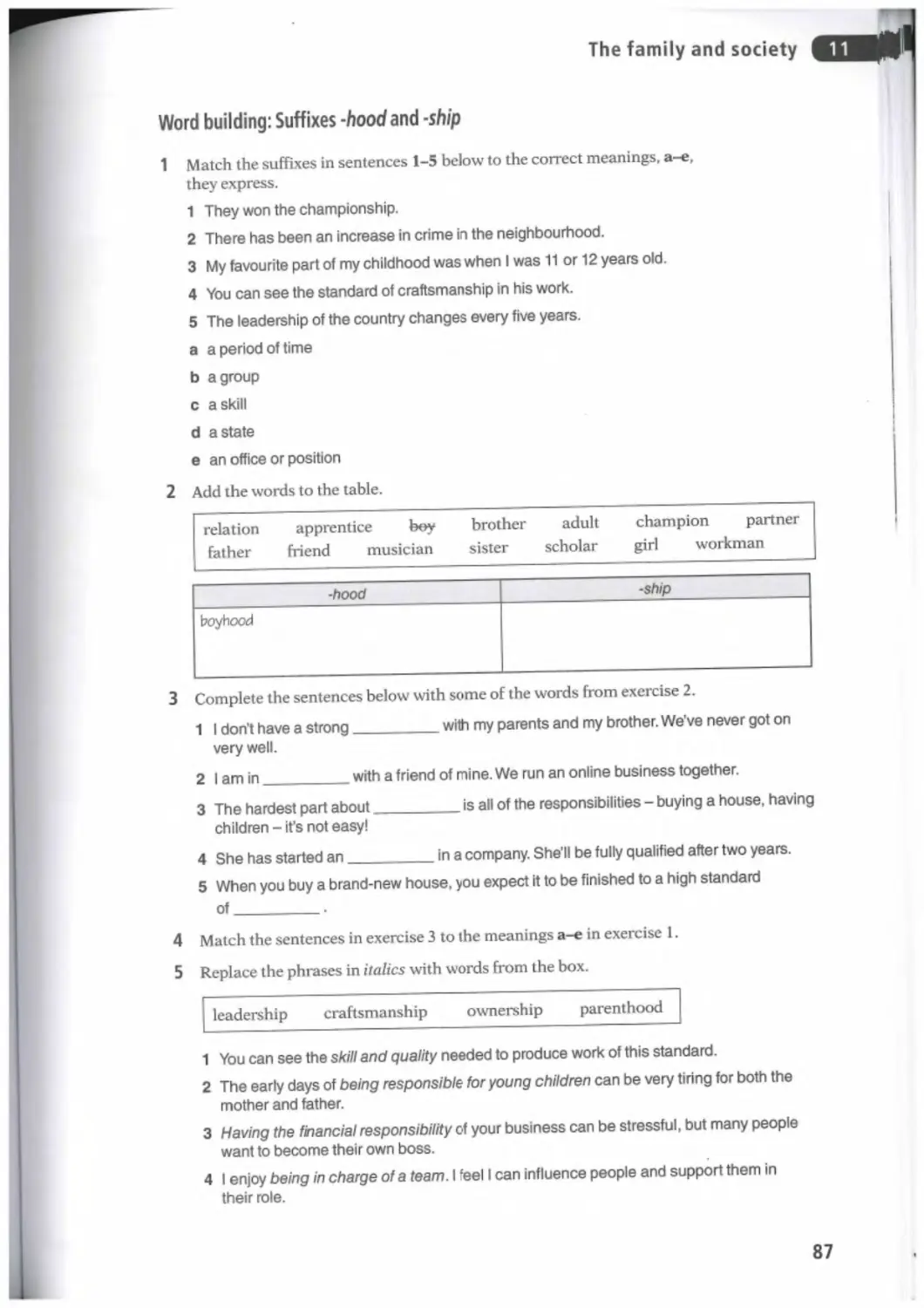
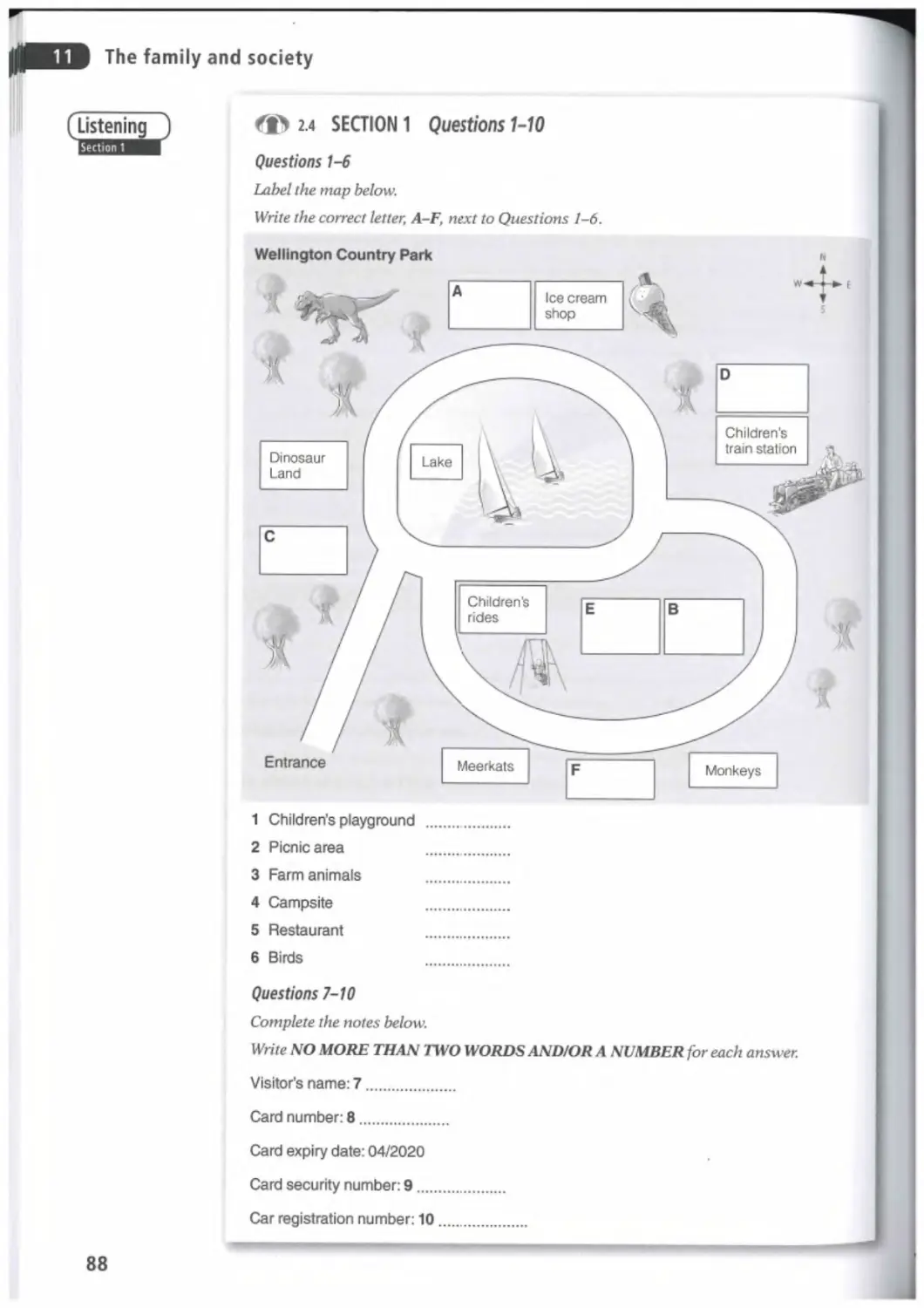
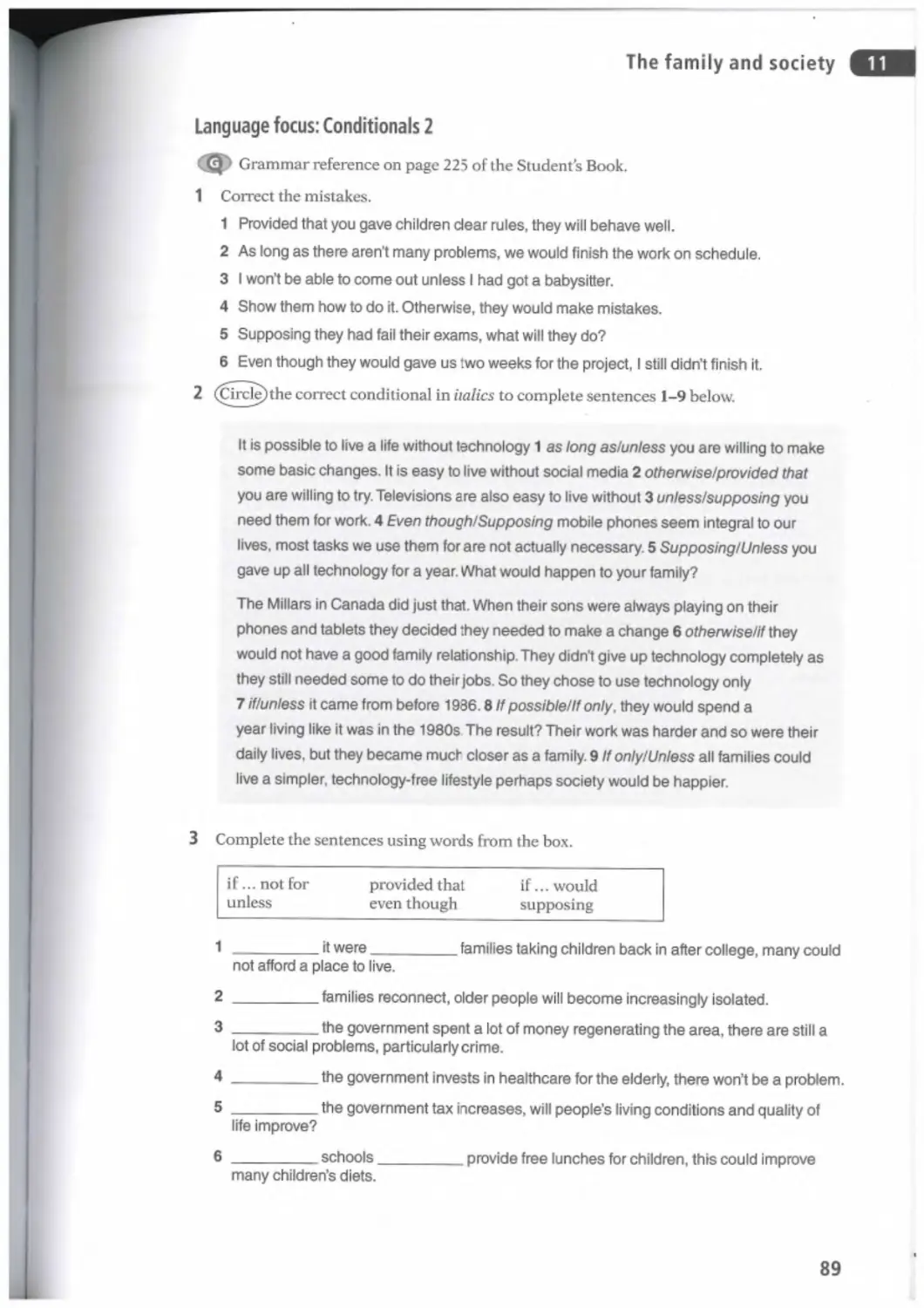
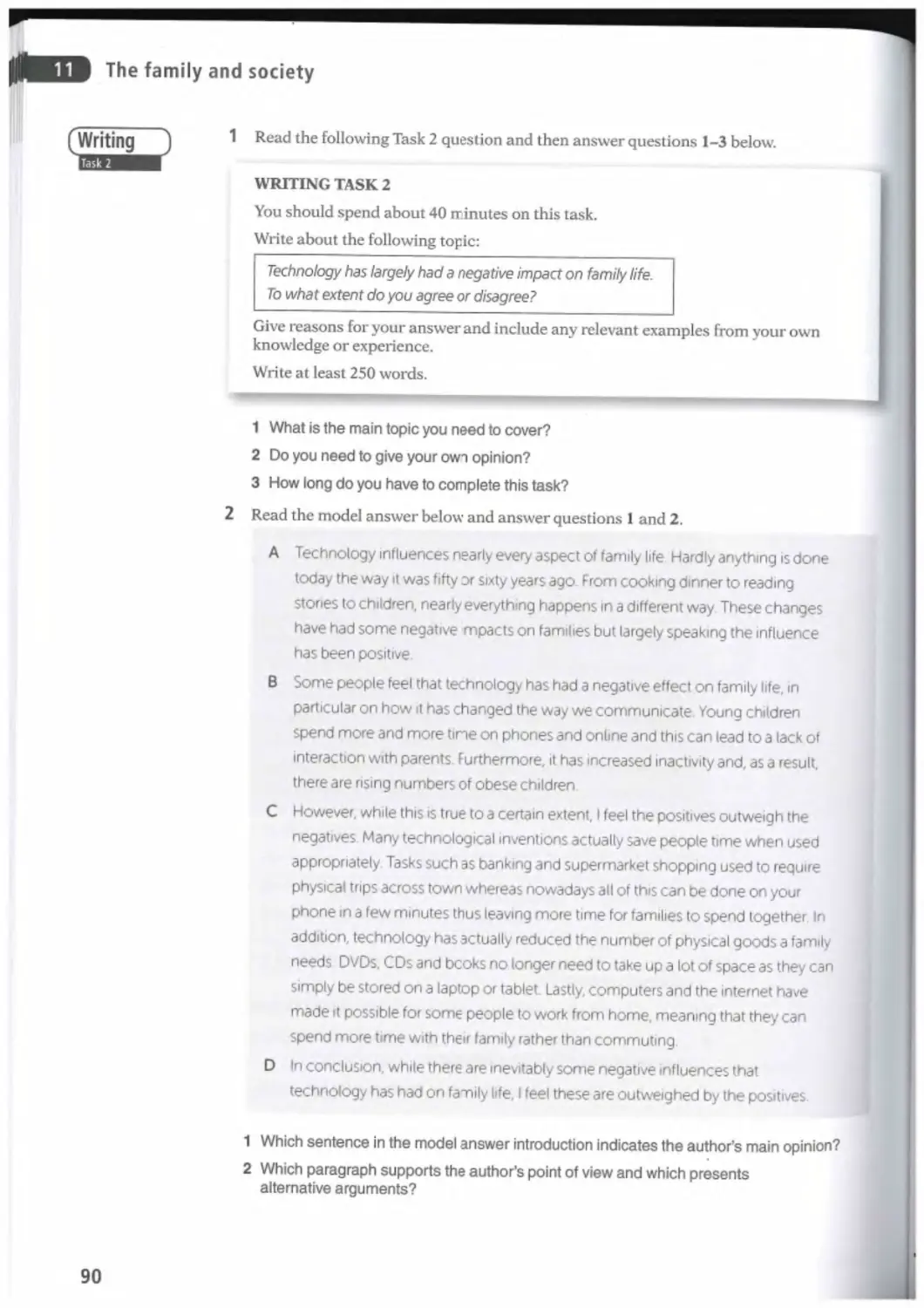
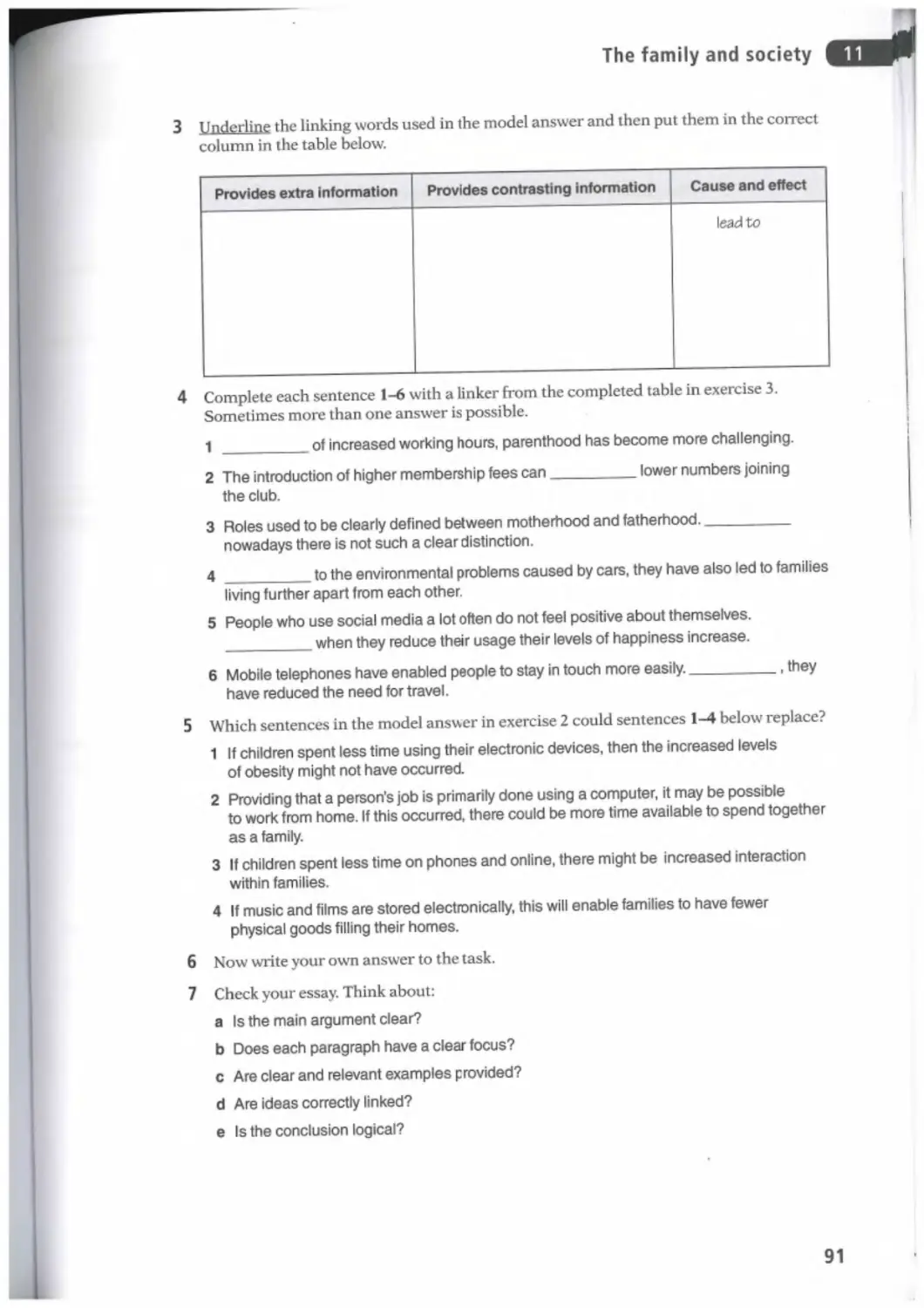
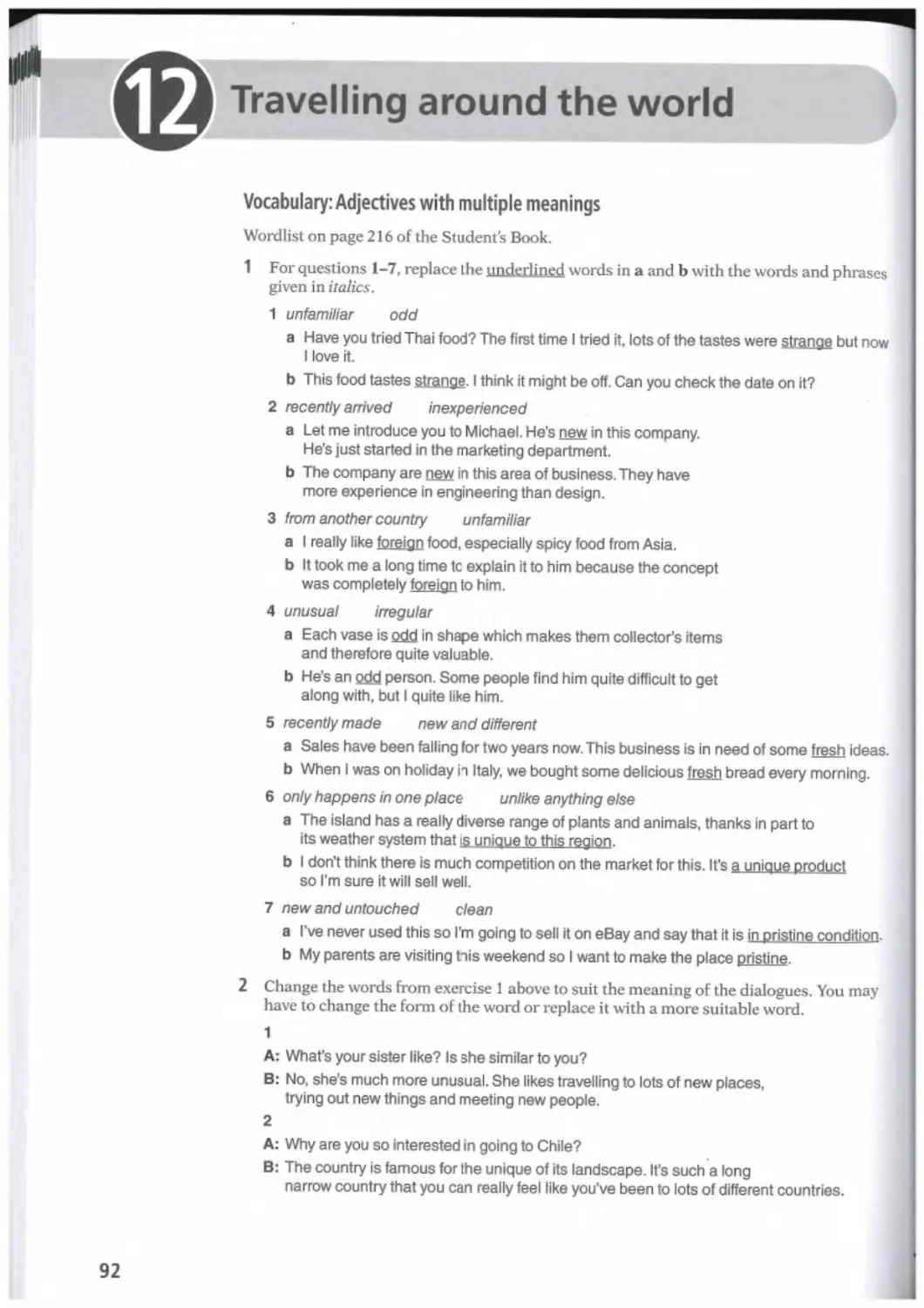
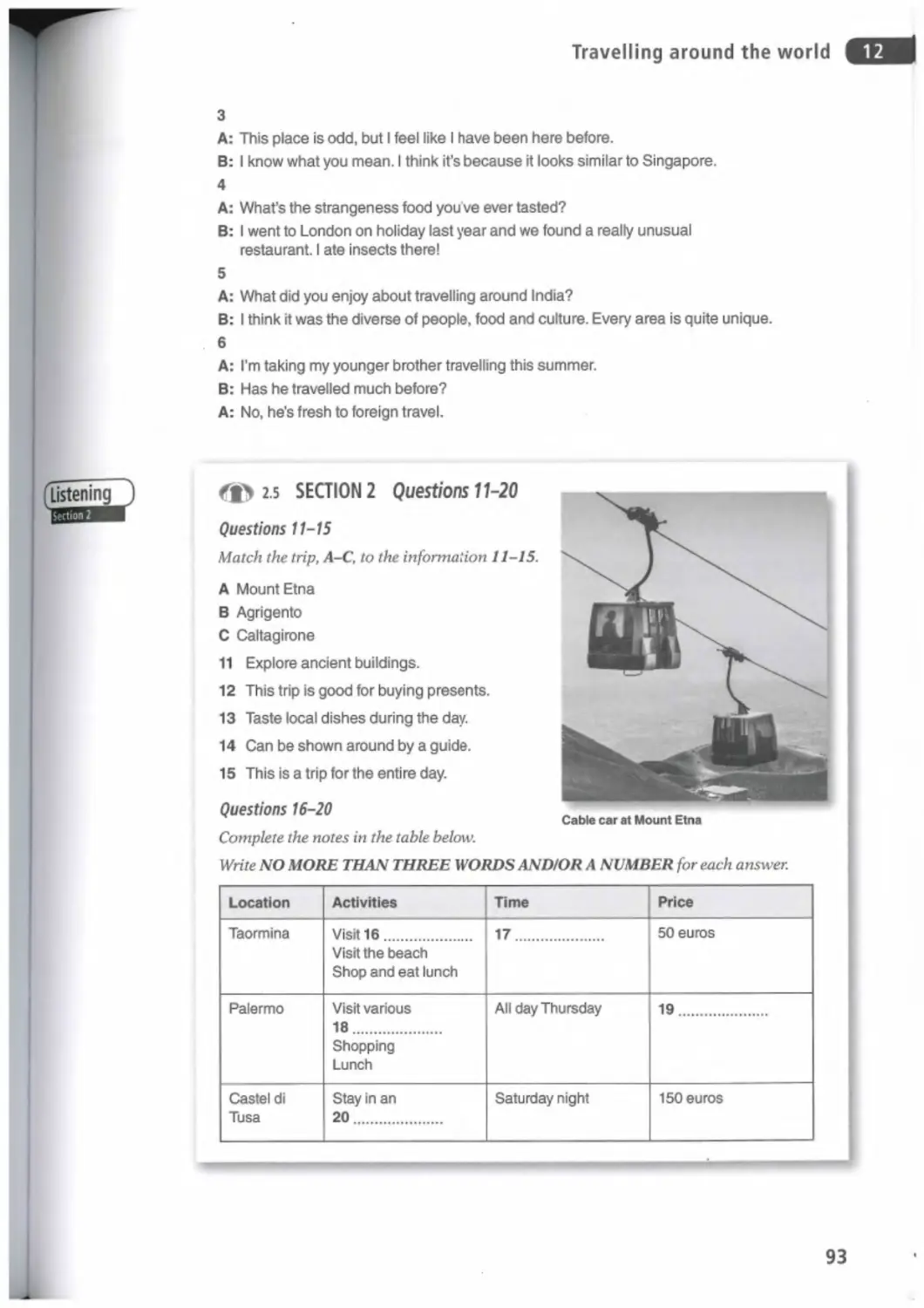
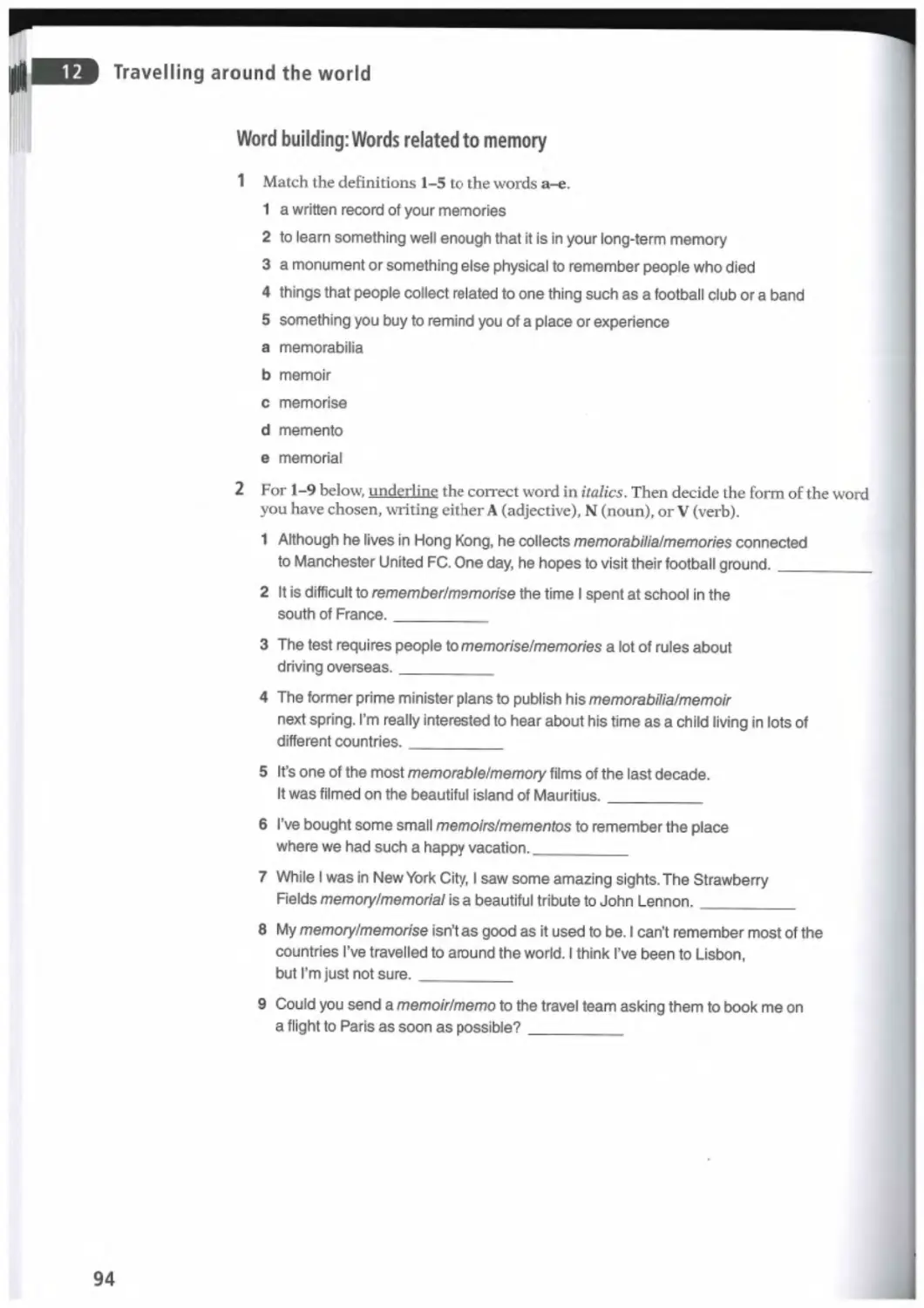
Author: Rogers Louis
Tags: ielts


Text
                    macmillan
education
Workbook
with Answers
Ready for
IELTS
2nd Edition
о
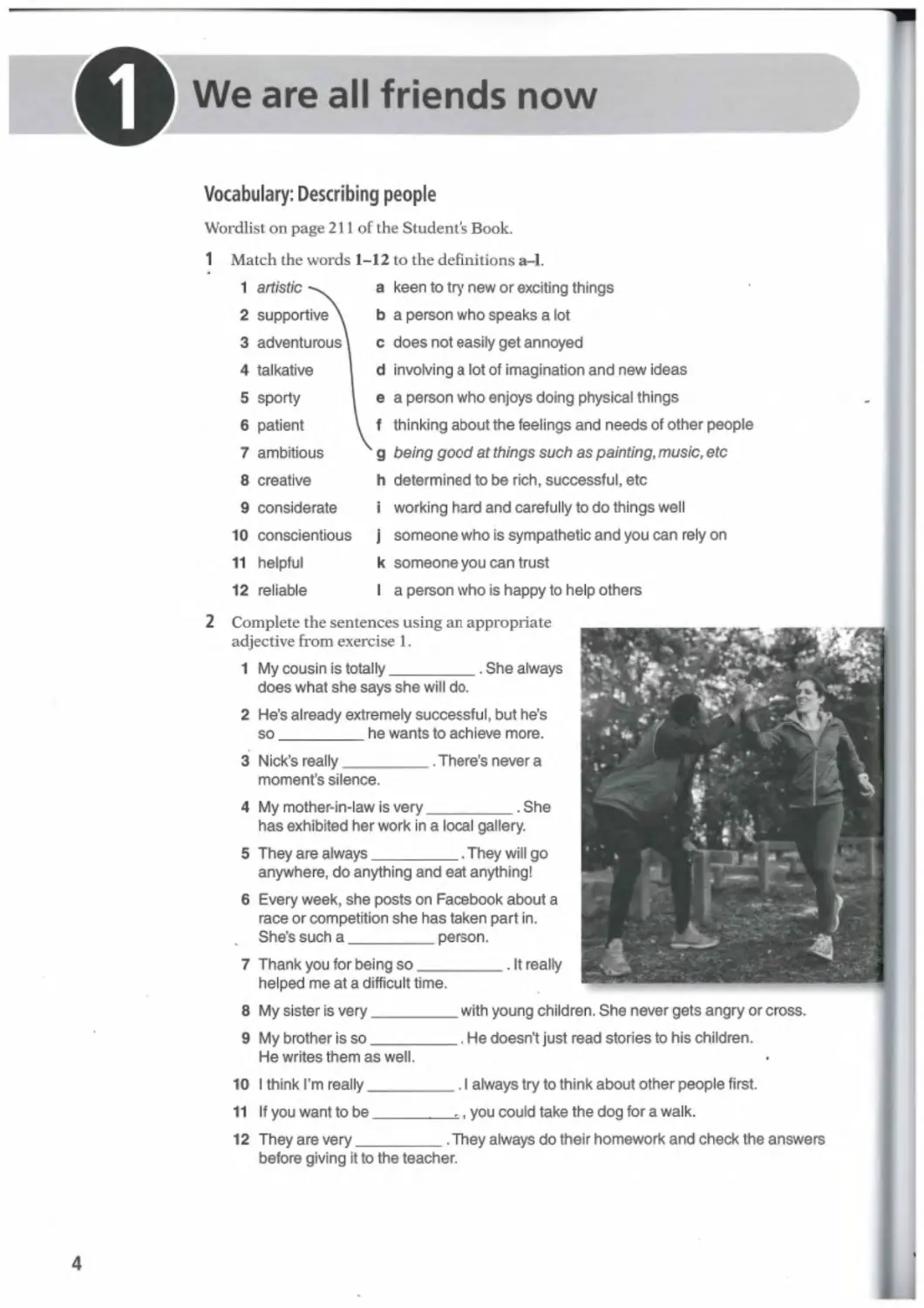
We are all friends now
Vocabulary: Describing people
Wordlist on page 211 of the Student's Book.
1
Match the words 1-12 to the definitions a-1.
1	artistic	a	keen to try new or exciting things
2	supportive \	b	a person who speaks a lot
3	adventurous!	c	does not easily get annoyed
4	talkative	d	involving a lot of imagination and new ideas
5	sporty	e	a person who enjoys doing physical things
6	patient	\	f	thinking about the feelings and needs of other people
7	ambitious		being good at things such as painting, music, etc
8	creative	h	determined to be rich, successful, etc
9	considerate	i	working hard and carefully to do things well
10	conscientious	i	someone who is sympathetic and you can rely on
11	helpful	к	someone you can trust
12	reliable	I	a person who is happy to help others
Complete the sentences using an appropriate
adjective from exercise 1.
1	My cousin is totally. She always
does what she says she will do.
2	He’s already extremely successful, but he's
so he wants to achieve more.
3	Nick’s really. There’s never a
moment’s silence.
4	My mother-in-law is very. She
has exhibited her work in a local gallery.
5	They are always. They will go
anywhere, do anything and eat anything!
6	Every week, she posts on Facebook about a
race or competition she has taken part in.
She’s such a person.
7	Thank you for being so. It really
helped me at a difficult time.
8	My sister is very with young children. She never gets angry or cross.
9	My brother is so. He doesn’t just read stories to his children.
He writes them as well.	•
10	I think I’m really. I always try to think about other people first.
11	If you want to be.	, you could take the dog for a walk.
12	They are very. They always do their homework and check the answers
before giving it to the teacher.
4
We are all friends now
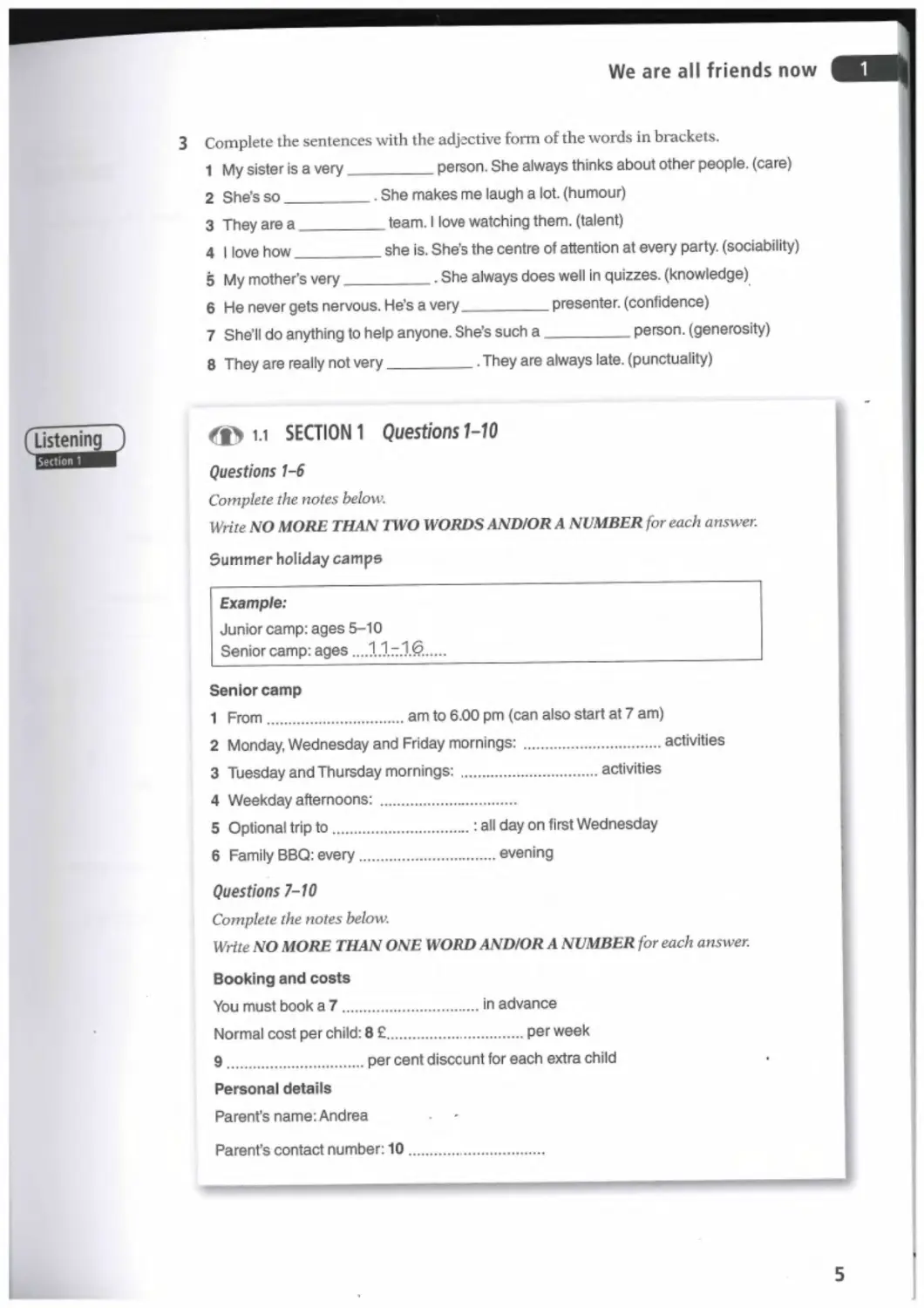
3 Complete the sentences with the adjective form of the words in brackets.
1	My sister is a very person. She always thinks about other people, (care)
2	She’s so. She makes me laugh a lot. (humour)
3	They are a team. I love watching them, (talent)
4	I love how she is. She's the centre of attention at every party, (sociability)
5	My mother’s very. She always does well in quizzes, (knowledge)
6	He never gets nervous. He’s a very presenter, (confidence)
7	She'll do anything to help anyone. She’s such a person, (generosity)
8	They are really not very. They are always late, (punctuality)
Section 1
i.i SECTION 1 Questions 1-10
Questions 1-6
Complete the notes below.
Write NO MORE THAN TWO WORDS AND/OR A NUMBER for each answer.
Summer holiday camps
Example:
Junior camp: ages 5-10
Senior camp: ages ....11. -1.6..
Senior camp
1	From.....................am	to 6.00 pm (can also start at 7 am)
2	Monday, Wednesday and Friday mornings: ..................................activities
3	Tuesday and Thursday mornings:................................activities
4	Weekday afternoons:.................
5	Optional trip to...............:	all day on first Wednesday
6	Family BBQ: every.................evening
Questions 7-10
Complete the notes below.
Write NO MORE THAN ONE WORD AND/OR A NUMBER for each answer.
Booking and costs
You must book a 7..................in advance
Normal cost per child: 8 £................per	week
9	per	cent disccunt for each extra child
Personal details
Parent's name: Andrea
Parent’s contact number: 10.................
We are all friends now
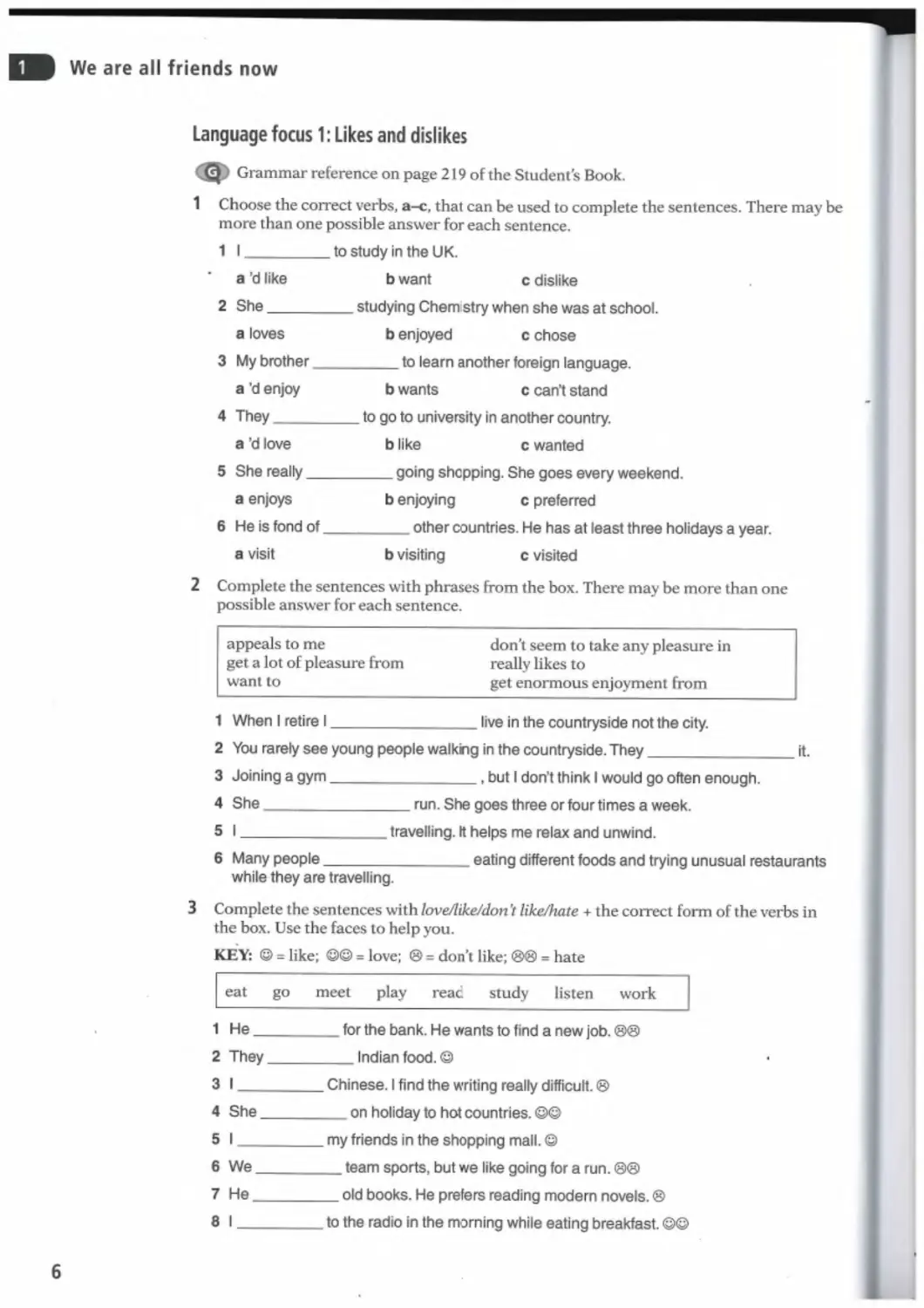
Language focus 1: Likes and dislikes
Q) Grammar reference on page 219 of the Students Book.
1	Choose the correct verbs, a-c, that can be used to complete the sentences. There may be
more than one possible answer for each sentence.
1	I to study in the UK.
a'd like	b want	c dislike
2	She studying Chem stry when she was at school.
a loves	b enjoyed	c chose
3	My brother to learn another foreign language.
a'd enjoy	b wants	c can’t stand
4	They to go to university in another country.
a’d love	b like	c wanted
5	She really going shopping. She goes every weekend.
a enjoys	b enjoying	c preferred
6	He is fond of other countries. He has at least three holidays a year.
a visit	b visiting	c visited
2	Complete the sentences with phrases from the box. There may be more than one
possible answer for each sentence.
appeals to me	don’t seem to take any pleasure in
get a lot of pleasure from	really likes to
want to	get enormous enjoyment from
1	When I retire I live in the countryside not the city.
2	You rarely see young people walking in the countryside. They it.
3	Joining a gym, but I don’t think I would go often enough.
4	She run. She goes three or four times a week.
5	I travelling. It helps me relax and unwind.
6	Many people eating different foods and trying unusual restaurants
while they are travelling.
3	Complete the sentences with love/like/don't like/hate + the correct form of the verbs in
the box. Use the faces to help you.
KEY: © = like; ©© = love; © = don’t like; ©® = hate
eat go meet play read study listen work
1	He for the bank. He wants to find a new job. ©@
2	They Indian food. ©
3	I Chinese. I find the writing really difficult. ©
4	She on holiday to hot countries. ©©
5	I my friends in the shopping mall. ©
6	We team sports, but we like going for a run. ®@
7	He old books. He prefers reading modem novels. ©
8	I to the radio in the morning while eating breakfast. ©©
We are all friends now
READING PASSAGE
You should spend about 20 minutes on Questions 1-14, which are based on the
Reading Passage below.
Questions 1-7
The Reading Passage has eight paragraphs, A-H.
Choose the correct heading for paragraphs B-H from the list of headings below.
List of Headings
I The personal impact of friendship
ii The right amount and quality of friends
ill Strong relationships with best friend
Iv What is friendship?
v Communities aren't isolated
vl Understanding ourselves
vii Individual differences and the effect on community
viii The decline of friendship
lx New studies on friendship
x Changes in the selection process
Example:	Answer:
Paragraph A	iv
1	Paragraph В
2	Paragraph C
3	Paragraph D
4	Paragraph E
5	Paragraph F
6	Paragraph G
7	Paragraph H
What friends do we need?
A
When Aristotle was asked, in the 4th century
BC. what defines a friend, he had no doubts.
A friend is 'one soul inhabiting two bocies," he
said, adding; 'Without friends no one would
choose to live, though he had all other goods '
In this century, it is a little more complicated. A
startling discovery in the American Sociological
Review found 25 per cent of Americans do not
have a single friend. That is, nobody 'with whom
to discuss matters important to them,' said the
researchers. The average number of friends was
two Yet modern demands on our time can take
a deep toll on friendships.
Two books aim to help us through the maze
Vital Friends: The People You Can't Afford to
Live Without by Tom Rath, advises readers
to evaluate the roles played by their friends.
ensuring eight essential friendship types are
represented Rethinking Friendship. H.dden Solidarities Today by Liz Spencer and Ray Pahl
looks at the different kinds of friendships in the internet age.
C Rath is a New York Times bestselling author, and leads research and consulting at Gallup He
analysed more than five million interviews to try to define what Plato said he never could: what
is friendship’The result is Vital Friends, and it reaches startling conclusions If you ask people
why they became homeless, why their marriage failed or why they overeat, he says, they do
not blame it on poverty or mobility; they blame it on a lack of friendships If your best friend
eats healthily, he discovered, you are five times more likely to have a healthy diet yourself. His
interviewees rated friendship as being more than five times as important as physical intimacy in
the success of a marriage He also found patients with heart disease are twice as likely to die if
they do not have three or four close social connections.
7
We are all friends now
D Ray Pahl's Rethinking Friendship is based on in-depth interviews conducted over seven years
He finds the quality of our friendships has a huge influence on the amount of satisfaction we draw
from life 'Individuals with no real friends at work have only a one in 12 chance of feeling engaged <n
their job,' he says. But the quantity, as well as the quality of friends, does matter. Some people can
have three or four close friends and be very happy, he believes Others more extrovert prefer to have
10 or 15. But he is certain you need to have more than one friend to be satisfied in life It is a very
common mistake to expect one close friend to provide everything you need,’ he says 'And it can
cause a lot of problems.’
E Dr Angela Carter, an occupational psychiatrist from Sheffield University, says: 'We are social animals.
We need friends to hold a mirror up to us and show us what our behaviour looks like They provide
companionship and support, but the most important thing friends do is help us to work out who we
are. Families cannot do that in the same way' She has found people can struggle to find the friends
that they need. 'We need to be quite strategic in our friendships People think friends turn up from
nowhere, and they grumble when they don't have any You need to think, "What do I need from
friends and am I being a good friend in return?" ’
F In researching Rethinking Friendship, Pahl found little cause for the notion that society is becoming
atomised and selfish. 'Friendship takes such a variety of different forms,’ he says. 'I don't think people
have fewer friends now What is new is that in the past 50 years we have become more and more
used to choosing friends, rather than accepting them as given.'
G Both authors did not find transient communities are all about networking and getting on. As people
have learned to be consumers, maybe they have also learned to make choices among their friends,"
says Pahl. 'But when people think about their close friends, those relationships are deep and trusting,
not exploitative or self-seeking. People are probably loyal and decent, against what is cynically
regarded as the current of the age ’
H So how many friends can one person reasonably support? 'I don't think it is useful or meaningful to
put a number on it,' says Dr Carter 'Psychologists use the term affiliation need', and society tells us
we have a lot of it In truth, some people need a lot of friends, others few.' 'It is fair to say. people with
a more diverse and mixed group of friends have a more robust defence against the way the world
works.' says Pahl. 'I don't want to be prescriptive, or the government will start saying that we need a
Ministry of Mates. But if you can provide the circumstances for a more friendly society, then society
will be happier and healthier.'
Questions 8-11
Complete the sentences below.
Choose NO MORE THAN TWO WORDS AND/OR A NUMBER from the passage for
each answer.
8	A quarter of people from the USA are without a...........
9	People need...............different	types of friend in their group.
10	People blame problems in their lives on not having enough.............
11	The..............of friendships and the number of friends is important.
Questions 12-14
Do the following statements agree with the information given in the Reading Passage?
Write:
TR UE	if the statement agrees with the information
FALSE	if the statement contradicts the information
NOT GIVEN if there is no information on this
12	People don't find it easy to get the friendships they require.
13	Technology has changed friendship groups.
14	Everyone needs the same number of friends to be happy.
We are all friends now
Language focus 2: Present simple, present continuous and past simple
Qu Grammar reference on page 219 of the Students Book.
1 Transform the verb in brackets into the correct form of the present simple,
present continuous or past simple.
(study) at
An international student in Brazil
Where do you usually study?
11(study) at a univers ty in London, but this month 12
Sao Paulo University in Brazil.
Why 3(choose) Brazil?
My university in England 4(have) an exchange programme with Sao Paulo
University. I can 5(speak) some Portuguese and 16(be) really
interested in Brazilian culture.
Where 7(live) at the moment?
I 8(stay) with two Brazilian guys in a small flat.
What 9(do) in your free time?
I’m lucky, 110____(meet) lots of new people when I first got here. We often 11(go) to concerts,
the cinema or the gym. It’s similar to England, but here we usually 12(go) out much later at night.
What do you miss about home?
When I was in England, 113(see) my family a lot more, but now I never 14(see) them.
We often 15_______(chat) on social media, but it's not the same. They 16(visit) me last month,
which 17(be) great. Also, I absolutely 18(love) Brazilian food, but I want to eat a good curry!
2 Choose a, b or c to complete the sentences 1-8.
1	He in the evening.
a doesn’t work b network c isn’t working
2	This month my cousin with me.
a lives	b is living c lived
3	to the gym last nighl?
a Did you go	b Are you go c You went
4	Did you go online this morning?
a Yes, I do.	b Yes, I was.	c No, I didn't.
5	My friend Karl watching football.
a is hating	b hates	c hate
6	1 bake a cake for her birthday so I bought one.
a couldn’t	b wouldn’t	c don’t
7	Friendship more important to me when I young.
a is	b was	c being
8	I Management from 2012 to 2015.
a study	bam studying c studied
9
We are all friends now
1	Match the verbs of movement in the box to the correct image 1-9.
declined steadily hit a low fluctuated
fell and then levelled off rose gradually hit a peak
remained flat dipped plummeted soared
2	For sentences 1-6 below, underline the correct word in italics.
1	Levels of unemployment declined/а decline rapidly.
2	There was a rise/rise in levels of unemployment.
3	The year 2000 saw a drop/drop in high street purchases.
4	In 2015, household spending had dip/а dip.
5	The number of users fell/а fall by 15%.
6	Between 1970 and 1975 the numbers simply fluctuated/a fluctuation.
3 Rewrite sentences 1-3 below with nouns instead of verbs.
Example:
The proportion of students using social media dropped dramatically in January.
There was a dramatic drop in the proportion of students using social media in January.
1	The sales of mobile phones fluctuated in the first few months of last year.
2	The number of people studying engineering gradually declined until 2010.
3	Household income has risen sreadily since 2010.
10
We are all friends now
4 Look at the following Task 1 question and then answer questions 1-3 below.
WRITING TASK 1
You should spend about 20 minutes on this task.
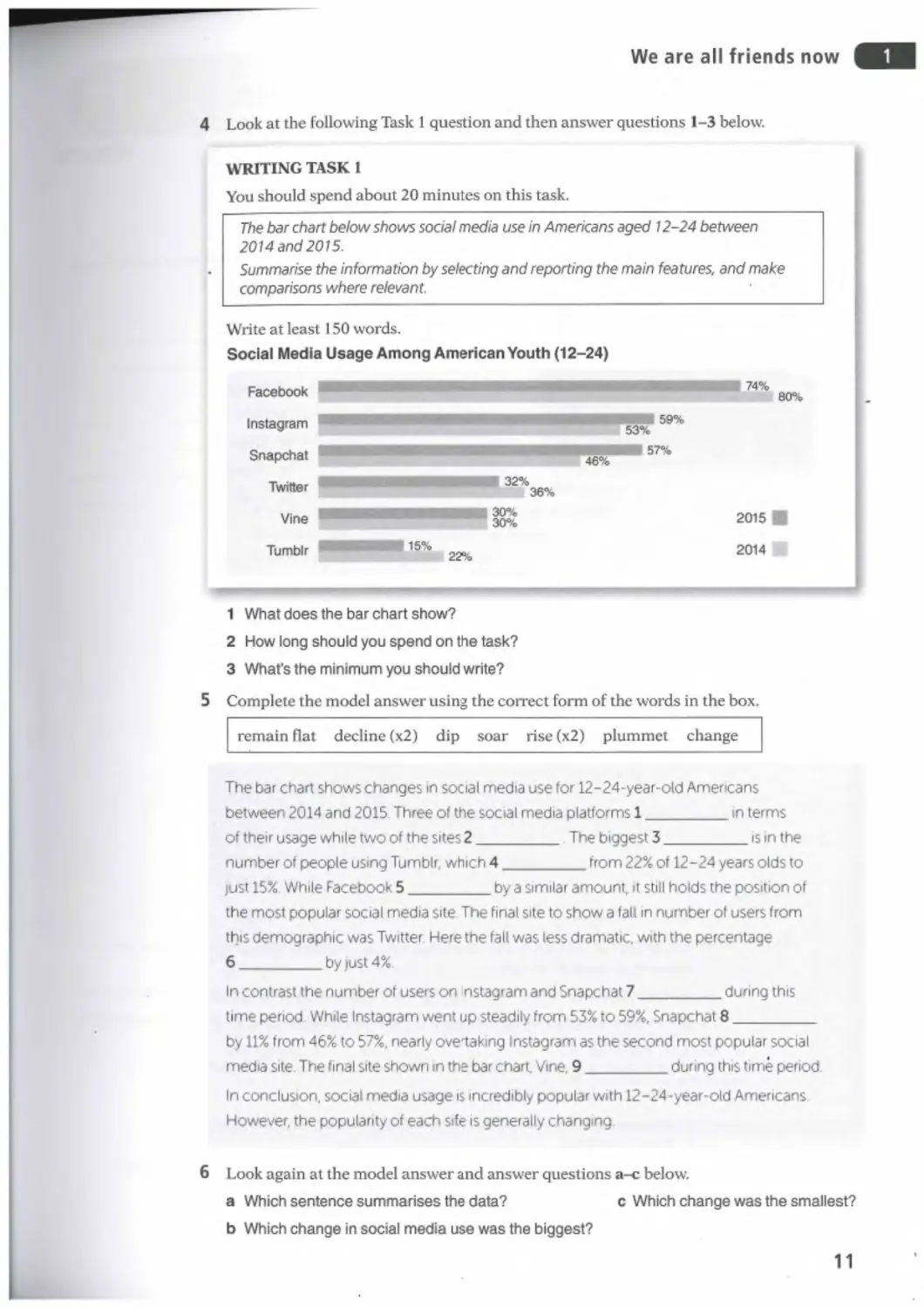
The bar chart below shows social media use in Americans aged 12-24 between
2014 and 2015.
Summarise the information by selecting and reporting the main features, and make
comparisons where relevant.
Write at least 150 words.
Social Media Usage Among American Youth (12-24)
1 What does the bar chart show?
2 How long should you spend on the task?
3 What’s the minimum you should write?
5 Complete the model answer using the correct form of the words in the box.
remain flat decline (x2) dip soar rise(x2) plummet change
The bar chart shows changes in social media use for 12-24-year-old Americans
between 2014 and 2015 Three of the social media platforms 1 in terms
of their usage while two of the sites 2 The biggest 3 is in the
number of people using Tumblr, which 4 from 22% of 12-24 years olds to
just 15% While Facebook 5 by a similar amount, it still holds the position of
the most popular social media site The final site to show a fall in number of users from
this demographic was Twitter Here the fall was less dramatic, with the percentage
6 by just 4%
In contrast the number of users on nstagram and Snapchat 7 during this
lime period While Instagram went up steadily from 53% to 59%, Snapchat 8
by 11% from 46% to 57%, nearly ovelaking Instagram as the second most popular social
media site The final site shown in the bar chart. Vine, 9 during this time period
In conclusion, social media usage is incredibly popular with 12-24-year-old Americans
However, the popularity of each site is generally changing
6 Look again at the model answer and answer questions a-c below.
a Which sentence summarises the data?	c Which change was the smallest?
b Which change in social media use was the biggest?
11
©
Technology - now and then
Vocabulary: Verbs of cause and effect
Wordlist on page 211 of the Students Book.
1
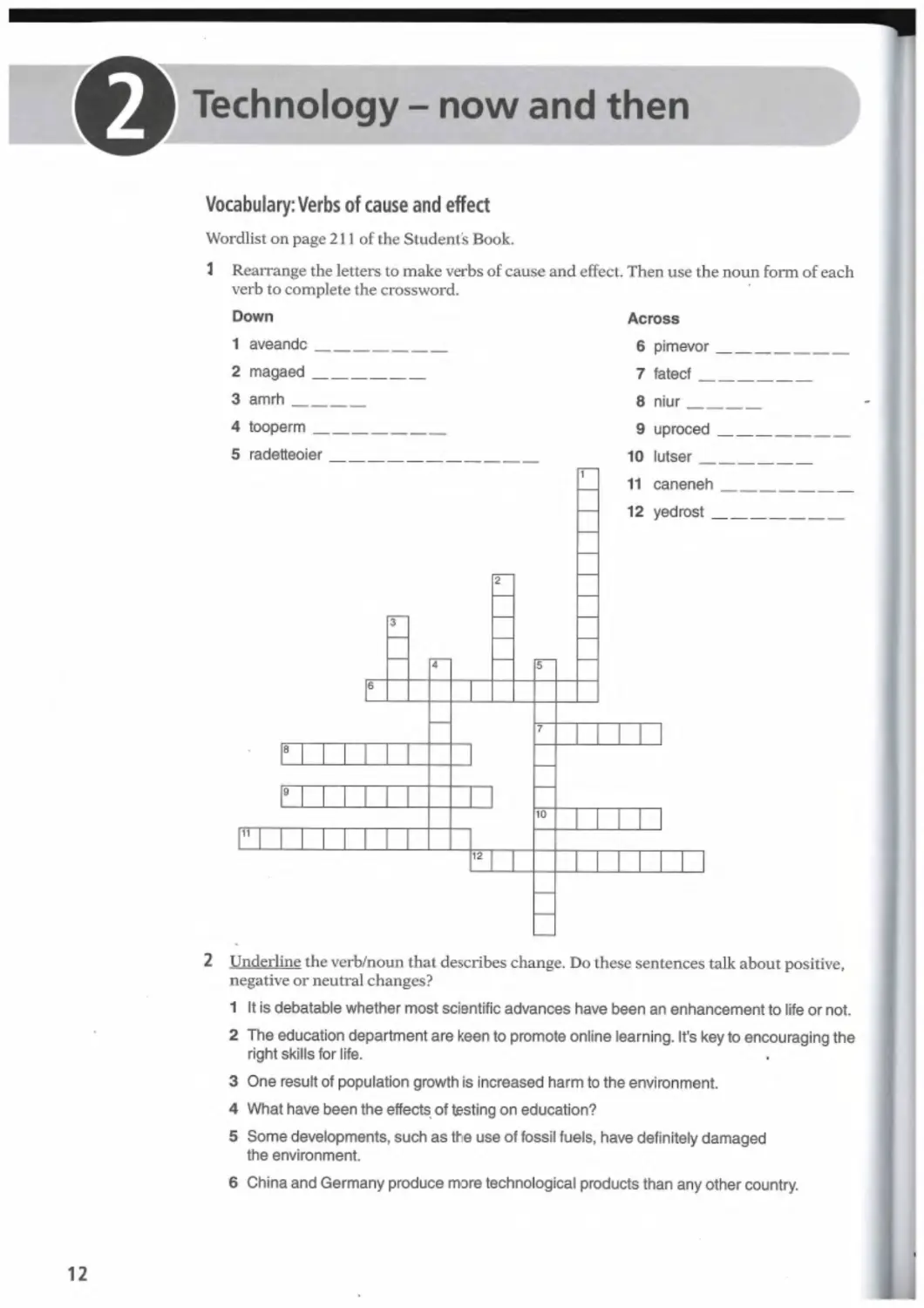
Rearrange the letters to make verbs of cause and effect. Then use the noun form of each
verb to complete the crossword.
Down
Across
1
aveandc
6
2
3
4
5
magaed____
amrh______
tooperm___
radetteoier
pimevor
fatecf
niur_____
uproced _
lutser _
7
8
9
10
2 Underline the verb/noun that describes change. Do these sentences talk about positive,
negative or neutral changes?
1	It is debatable whether most scientific advances have been an enhancement to life or not.
2	The education department are keen to promote online learning. It's key to encouraging the
right skills for life.
3	One result of population growth is increased harm to the environment.
4	What have been the effects of testing on education?
5	Some developments, such as the use of fossil fuels, have definitely damaged
the environment.
6	China and Germany produce more technological products than any other country.
12
Technology - now and then
1.2 SECTION 2 Questions 11-20
Questions 11-15
Choose the correct letter, A, В or C.
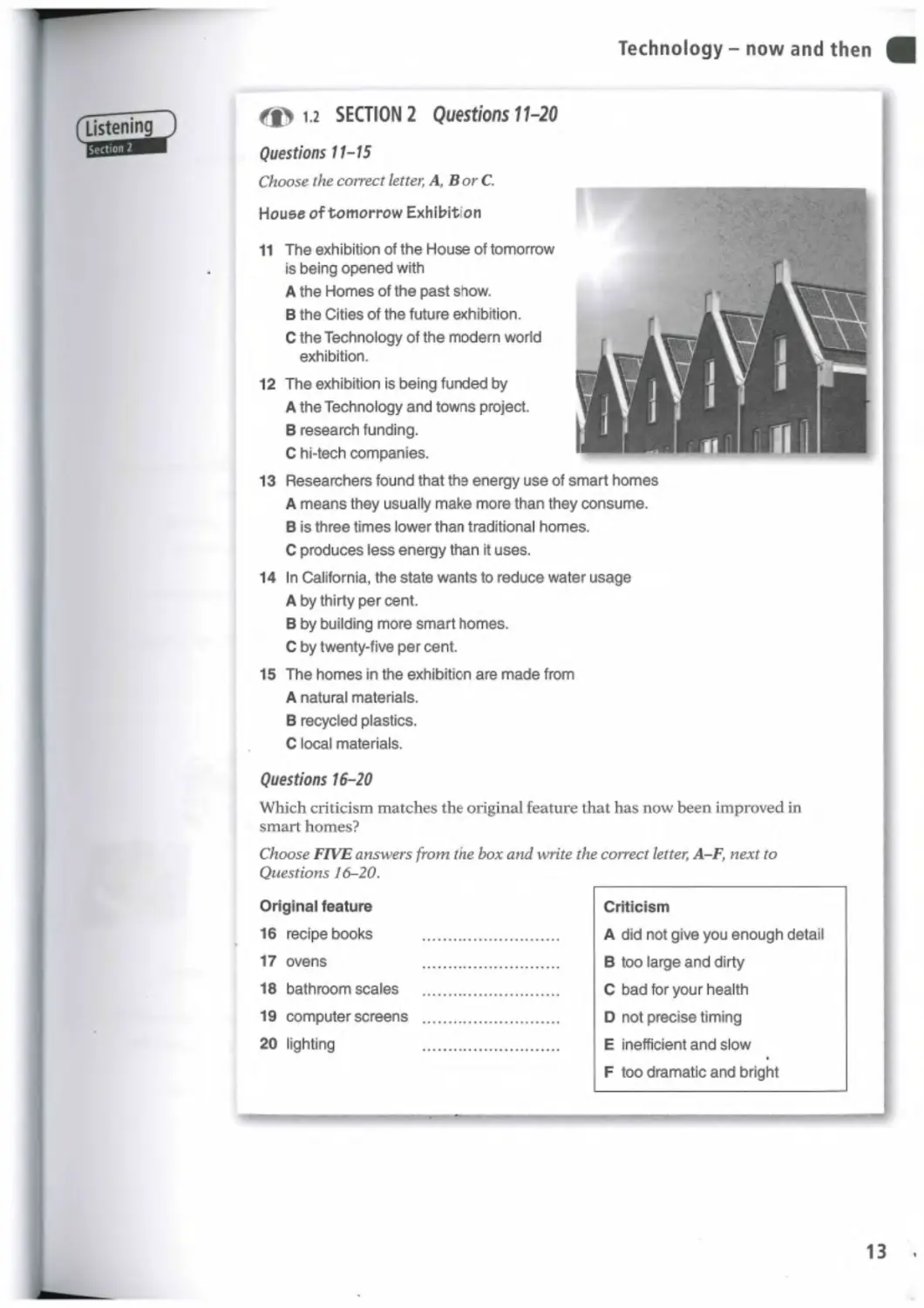
House of tomorrow Exhibition
11	The exhibition of the House of tomorrow
is being opened with
A the Homes of the past show.
В the Cities of the future exhibition.
C the Technology of the modern world
exhibition.
12	The exhibition is being funded by
A the Technology and towns project.
В research funding.
C hi-tech companies.
13	Researchers found that the energy use of smart homes
A means they usually make more than they consume.
В is three times lower than traditional homes.
C produces less energy than it uses.
14	In California, the state wants to reduce water usage
A by thirty per cent.
В by building more smart homes.
C by twenty-five per cent.
15	The homes in the exhibition are made from
A natural materials.
В recycled plastics.
C local materials.
Questions 16-20
Which criticism matches the original feature that has now been improved in
smart homes?
Choose FIVE answers from the box and write the correct letter, A-F, next to
Questions 16-20.
Original feature	Criticism
16 recipe books			A did not give you enough detail
17 ovens			В too large and dirty
18 bathroom scales 		C bad for your health
19 computer screens 		D not precise timing
20 lighting			E inefficient and slow F too dramatic and bright
13
Word building: Evaluating adjectives
1
For the adjectives 1-14 below, create synonyms using the words in the box.
in-
im-
un-
-less
2
Example:
1
3
5
9
11
13
impractical__
___appealing___
___acceptable___
__perfect___
_use_
__necessary___
__convenient___
2
4
6
8
10
12
14
___significant_
___appropriate___
__effective__
__hope____
___important___
__inspiring___
___valuable___
Complete the sentences with the words in brackets. Use a prefix or suffix when needed.
1
2
3
4
5
. It’s not possible to make it work, (practical)
solution. It worked exactly how we wanted it to. (perfect)
The idea is to many governments because ultimately it saves the
country money, (appealing)
Many people find the committee members
(effective)
The situation is
The answer is
It was the
and want to replace them.
. I don’t think any of those solutions would work, (hope)
6
8
9
10
11
12
13
14
Technology quickly becomes
and obsolete, (ise)
This kind of behaviour is___________
in my country. You would offend a lot of
people, (acceptable)
It was one of the most
technological developments of the last
century. It had such a major impact on
our society, (significant)
The internet was one of the most
developments of the last
century. It changed so many aspects of
how we work and live, (important)
Not all technological developments are	. (necessary)
A good product with an design can easily fail to become a success,
(inspiring)
The internet has made tasks, such as banking, much easier, (convenient)
Many technological developments, such as the invention of cars and planes, and the
introduction of factories, have been to the environment, (harm)
Using social media at work is. It should be kept to your private life,
(appropriate)
14
Technology - now and then
3 For sentences 1-8 below, underline the correct word in italics.
1	Many people feel it is a valuable idea and worthless/worthwhile pursuing.
2	The idea could be an ineffective/effective solution as it solves a number of
underlying issues.
3	The chemicals are harmful to people and are therefore safe/unsafe to use.
4	The cost of developing better safety procedures would be cheap and certainly
significant/insignificant financially for a company as rich as this one.
5	Some people think that qualificat ons are useful/useless without work experience.
6	One of the most valuable/valueless suggestions was to reorganise the structure of the
company to be more efficient.
7	The idea appeared harmful/harmless enough but in fact the consequences of it
were irreversible.
8	It was appropriate/inappropriate for the other competitors to talk to the different teams
because of the risk of cheating.
Language focus 1: Past simple and present perfect
Q > Grammar reference on page 220 of the Student’s Book.
1 Put the verbs in brackets in the correct form of the present perfect or past simple.
1	The economy in Britain since the Industrial Revolution, (decline)
2	China to be one of the main economies in the world, (rise)
3	The World Fair an event for countries to show their skills and talent to
the world, (be)
4	IBM some of the first home computers, (make)
5	When we young, we technology at school at all. (be/use)
6	I first to America in 2005.1 there three times since, (go/be)
7	I French at school, but I it once in the last
10 years, (study/speak)
8 I my first job as a lawyer in 2010.1 in the sector
ever since, (get/work)
2	Put the verb in brackets into the correct form of the past simple active or passive.
1	Iron in more and more buildings, (use)
2	Britain the Industrial Revolution, (lead)
3	Conditions poor for many people during the Industrial Revolution, (be)
4	Steam engines energy, (generate)
5	Cotton in hotter climates, (grow)
6	People from rural areas to urban ones, (move)
7	Clothes by machines, (produce)
8	The economy by small business owners, (dominate)
3	Rewrite the sentences in exercise 2 to make active sentences passive and passive
sentences active where it is logical.
15
QI Technology - now and then
Questions 1-13
READING PASSAGE
You should spend about 20 minutes on Questions 1-13, which are based on the
Reading Passage below.
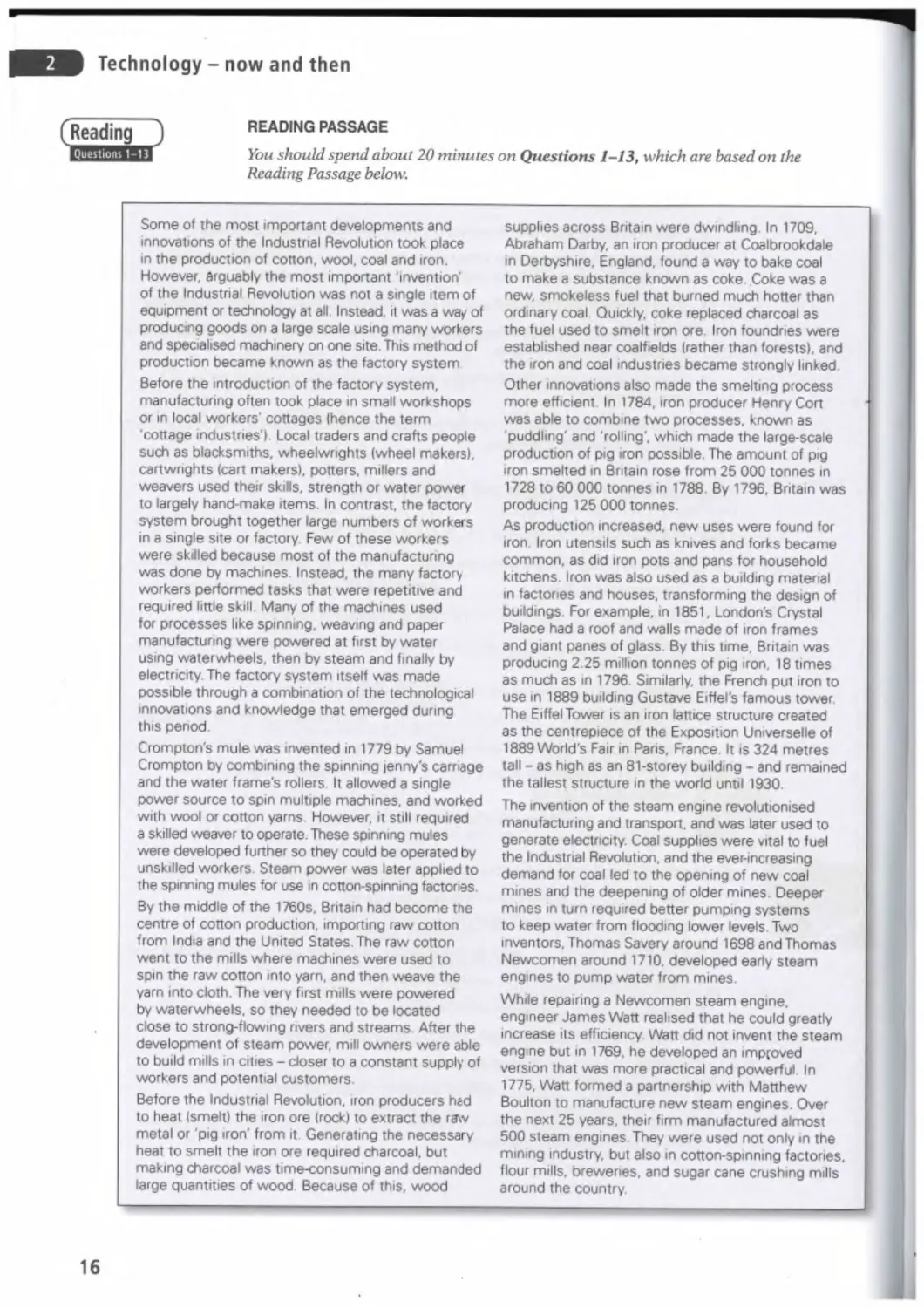
Some of the most important developments and
innovations of the Industrial Revolution took place
in the production of cotton, wool, coal and iron.
However, arguably the most important ‘invention’
of the Industrial Revolution was not a single item of
equipment or technology at all Instead, it was a way of
producing goods on a large scale using many workers
and specialised machinery on one site. This method of
production became known as the factory system
Before the introduction of the factory system,
manufacturing often took place in small workshops
or in local workers' cottages (hence the term
cottage industries'). Local traders and crafts people
such as blacksmiths, wheelwrights (wheel makers),
Cartwrights (cart makers), potters, millers and
weavers used their skills, strength or water power
to largely hand-make items. In contrast, the factory
system brought together large numbers of workers
in a single site or factory Few of these workers
were skilled because most of the manufacturing
was done by machines Instead, the many factory
workers performed tasks that were repetitive and
required little skill Many of the machines used
for processes like spinning, weaving and paper
manufacturing were powered at first by water
using waterwheels, then by steam and finally by
electricity The factory system itself was made
possible through a combination of the technological
innovations and knowledge that emerged during
this period
Crompton's mule was invented in 1779 by Samuel
Crompton by combining the spinning jenny's carnage
and the water frame's rollers It allowed a single
power source to spin multiple machines, and worked
with wool or cotton yarns. However, it still required
a skilled weaver to operate. These spinning mules
were developed further so they could be operated by
unskilled workers. Steam power was later applied to
the spinning mules for use in cotton-spinning factories.
By the middle of the 1760s. Britain had become the
centre of cotton production, importing raw cotton
from India and the United States. The raw cotton
went to the mills where machines were used to
spin the raw cotton into yarn, and then weave the
yarn into cloth. The very first mills were powered
by water wheels, so they needed to be located
close to strong-flowing rivers and streams. After the
development of steam power, mill owners were able
to build mills m cities - closer to a constant supply of
workers and potential customers
Before the Industrial Revolution, iron producers had
to heat (smelt) the iron ore (rock) to extract the raw
metal or ’pig iron' from it. Generating the necessary
heat to smelt the iron ore required charcoal, but
making charcoal was time-consuming and demanded
large quantities of wood. Because of this, wood
supplies across Britain were dwindling In 1709,
Abraham Darby, an iron producer at Coalbrookdale
in Derbyshire, England, found a way to bake coal
to make a substance known as coke Coke was a
new, smokeless fuel that burned much hotter than
ordinary coal Quickly, coke replaced charcoal as
the fuel used to smelt iron ore Iron foundries were
established near coalfields (rather than forests), and
the iron and coal industries became strongly linked
Other innovations also made the smelting process
more efficient In 1784, iron producer Henry Cort
was able to combine two processes, known as
'puddling' and 'rolling', which made the large-scale
production of pig iron possible. The amount of pig
iron smelted in Britain rose from 25 000 tonnes in
1728 to 60 000 tonnes in 1788 By 1796, Britain was
producing 125 000 tonnes.
As production increased, new uses were found for
iron Iron utensils such as knives and forks became
common, as did iron pots and pans for household
kitchens. Iron was also used as a building material
in factories and houses, transforming the design of
buildings For example, in 1851, London's Crystal
Palace had a roof and walls made of iron frames
and giant panes of glass. By this time, Britain was
producing 2.25 million tonnes of pig iron, 18 times
as much as in 1796. Similarly, the French put iron to
use in 1889 building Gustave Eiffel's famous tower
The Eiffel Tower is an iron lattice structure created
as the centrepiece of the Exposition Universelle of
1889 World's Fair in Pans, France. It is 324 metres
tall - as high as an 81-storey building - and remained
the tallest structure in the world until 1930
The invention of the steam engine revolutionised
manufacturing and transport, and was later used to
generate electricity. Coal supplies were vital to fuel
the Industrial Revolution, and the ever-increasing
demand for coal led to the opening of new coal
mines and the deepening of older mines. Deeper
mines in turn required better pumping systems
to keep water from flooding lower levels. Two
inventors, Thomas Savery around 1698 and Thomas
Newcomen around 1710. developed early steam
engines to pump water from mines
While repairing a Newcomen steam engine,
engineer James Watt realised that he could greatly
increase its efficiency. Watt did not invent the steam
engine but in 1769, he developed an improved
version that was more practical and powerful In
1775, Watt formed a partnership with Matthew
Boulton to manufacture new steam engines. Over
the next 25 years, their firm manufactured almost
500 steam engines They were used not only in the
mining industry, but also in cotton-spinning factories,
flour mills, breweries, and sugar cane crushing mills
around the country.
16
Technology - now and then
Questions 1-6
Do the following statements agree with the information given in the Reading Passage?
Write:
TRUE	if the statement agrees with the information
FALSE	if the statement contradicts the information
NOT GIVEN if there is no information on this
1 Factory workers were initially all very skilful.
2 Cotton producers stopped using specialist workers.
3 Conditions for cotton growers were poor.
4	The location of iron producers remained near forests.
5	Steam engines were first developed for energy production.
6	Iron changed how buildings looked.
Questions 7-12
Classify the following descriptions
7-12 from the text as relating to:
A Cotton
В Iron
C Steam.
List of Descriptions
7	These factories moved to urban locations.
8	Became used in a wider range of products.
9	The basic material was bought from abroad.
10	This engine was developed to support another industry.
11	Two techniques were used together to increase production.
12	One engineer made these simpler and stronger.
Question 13
Choose the correct letter А, В, C or D.
Which of the following is the most suitable title for the Reading Passage?
A Working conditions in the Industrial Revolution
В The connections between industries
C Significant inventions of the Industrial Revolution
D The Industrial Revolution and the importance of Britain
Language focus 2: Habit in the past + Adverbs of frequency
:Гф) Grammar reference on page 220 of the Students Book.
1 Look at sentences 1-5. Is the.use.of wouldhised to correct? Why/Why not?
1	My mother used to work but she doesn’t now.
2	That building would be a cinema.
3	The company would be successful.
4	Many children would practise their pronunciation every day.
5	Some jobs used to be done by hand.
17
Technology - now and then
2 Number these adverbs from most (1) to least (7) frequent.
never	occasionally	always	frequently
usually	hardly ever	rarely
3 Complete the sentences with an adverb from the box.
never occasionally always hardly ever usually
1	He won’t be on time. Nick is late, every single time I meet him.
2	He takes the train to work, but most of the time he drives.
3	They played computer games when they were young. They weren’t
invented then.
4	I used to play football in the evenings. The only time I didn't was when
it rained.
5	We ate out. We would just once or twice a year.
1 Look at the following Task 2 question and then answer questions 1-3 below.
WRITING TASK 2
You should spend about 40 minutes on this task.
Write about the following topic:
Some people believe computer and mobile phone technology has changed the way we
communicate positively while others feel it has had a negative impact on communication
with others.
Discuss both these views and give your own opinion.
Give reasons for your answer and include any relevant examples from your own
knowledge or experience.
Write at least 250 words.
1	What is the topic you need to cover?
2	What are the advantages and disadvantages you need to look at?
3	In addition to the two sides of the argument, what else do you need to give?
2 Decide if each of the following arguments are an advantage (+) or a disadvantage (-).
Add your own examples to each one.
	Argument	+ or-	Examples
1	Wider connection with more people.
2	Quicker methods of communication.
3	Face-to-face conversations happen less.
4	Parent and child relationships might not be as strong.		•
3 Look at the introduction in the sample answer in exercise 4 and match the sentences a-c
to the functions 1-3 below.
1	Paraphrase of the main question.
2	General statement on the topic.
3	Opinion of the author.
18
Technology - now and then
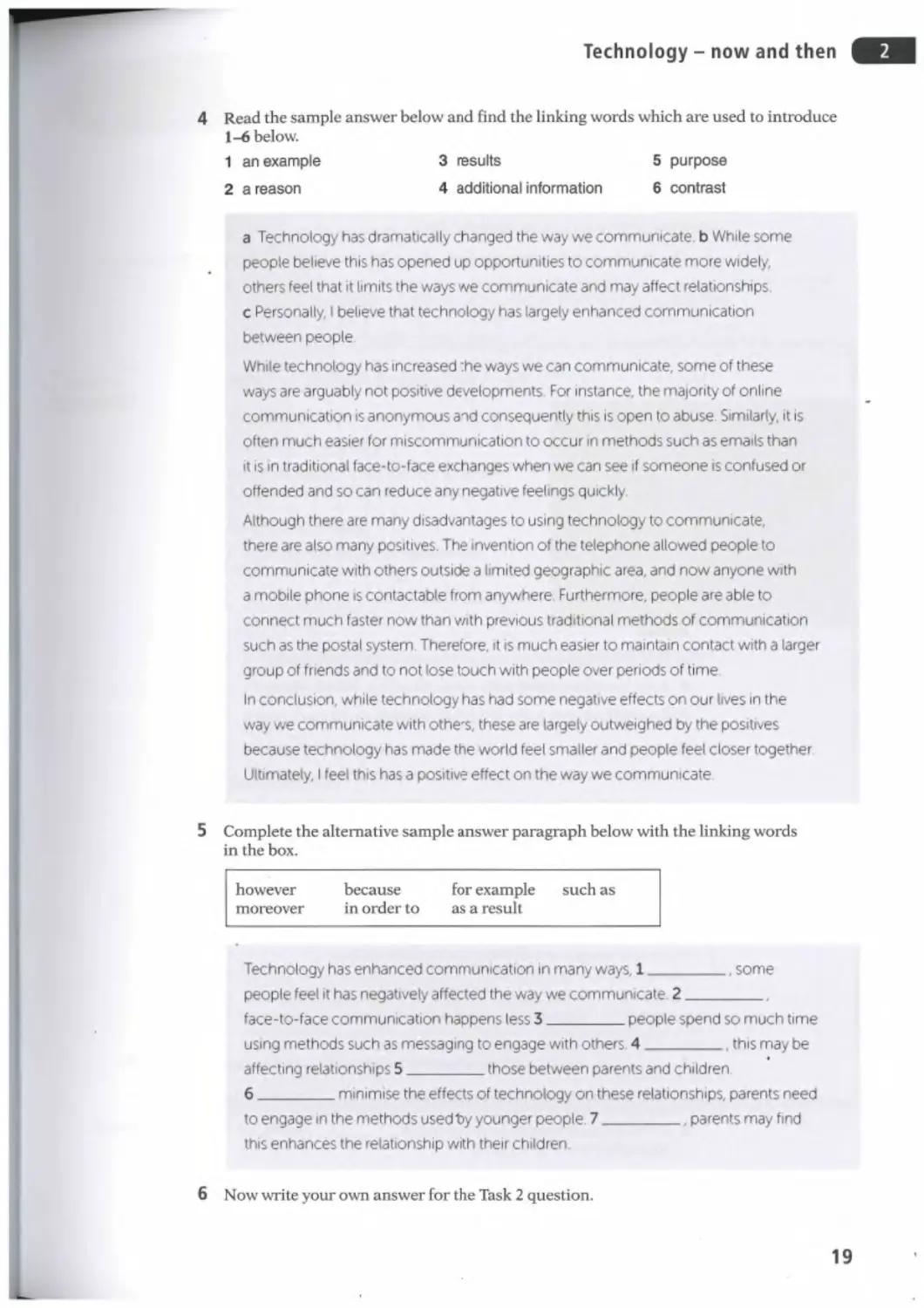
4	Read the sample answer below and find the linking words which are used to introduce
1-6 below.
1	an example	3 results	5 purpose
2	a reason	4 additional information	6 contrast
a Technology has dramatically changed the way we communicate, b While some
people believe this has opened up opportunities to communicate more widely,
others feel that it limits the ways we communicate and may affect relationships
c Personally. I believe that technology has largely enhanced communication
between people
While technology has increased :he ways we can communicate, some of these
ways are arguably not positive developments For instance, the majority of online
communication is anonymous and consequently this is open to abuse Similarly, it is
often much easier for miscommunication to occur in methods such as emails than
it is m traditional face-to-face exchanges when we can see if someone is confused or
offended and so can reduce any negative feelings quickly
Although there are many disadvantages to using technology to communicate,
there are also many positives. The invention of the telephone allowed people to
communicate with others outside a limited geographic area, and now anyone with
a mobile phone is contactable from anywhere Furthermore, people are able to
connect much faster now than with previous traditional methods of communication
such as the postal system Therefore, it is much easier to maintain contact with a larger
group of friends and to not lose touch with people over periods of time
In conclusion, while technology has had some negative effects on our lives in the
way we communicate with others, these are largely outweighed by the positives
because technology has made the world feel smaller and people feel closer together
Ultimately, I feel this has a positive effect on the way we communicate
5 Complete the alternative sample answer paragraph below with the linking words
in the box.
howrever	because	for example	such as
moreover	in order to	as a result
Technology has enhanced communication in many ways, 1 some
people feel it has negatively affected the way we communicate 2
face-to-face communication happens less 3 people spend so much time
using methods such as messaging to engage with others 4 this may be
affecting relationships 5 those between parents and children
6 minimise the effects of technology on these relationships, parents need
to engage in the methods used by younger people 7 parents may find
this enhances the relationship with their children
6 Now write your own answer for the Task 2 question.
19
©
Thrill seekers
Vocabulary: Sports
Wordlist on page 212 of the Student’s Book.
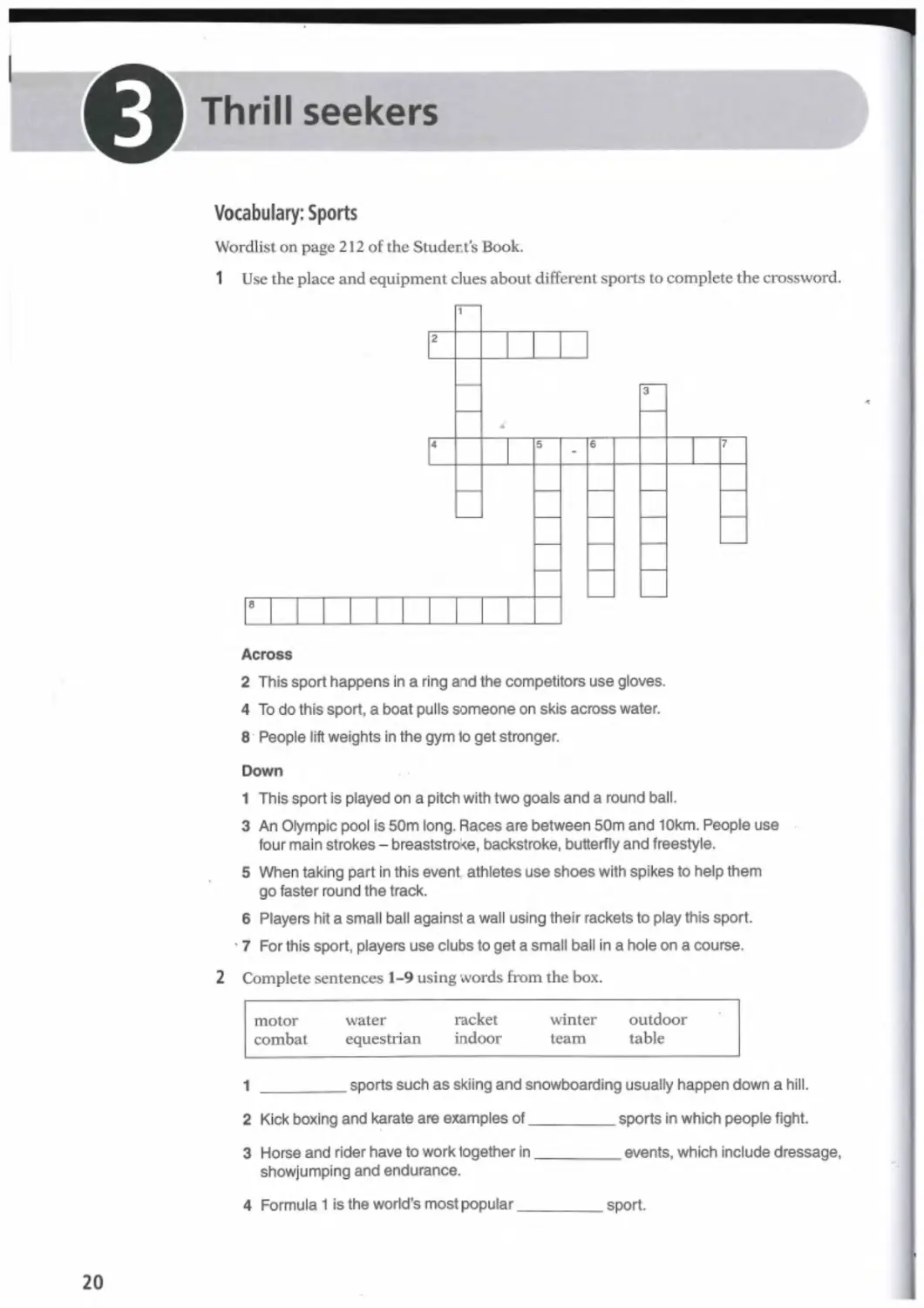
1	Use the place and equipment clues about different sports to complete the crossword.
Across
2	This sport happens in a ring and the competitors use gloves.
4	To do this sport, a boat pulls someone on skis across water.
8	People lift weights in the gym to get stronger.
Down
1	This sport is played on a pitch with two goals and a round ball.
3	An Olympic pool is 50m long. Races are between 50m and 10km. People use
four main strokes - breaststro<e, backstroke, butterfly and freestyle.
5	When taking part in this event athletes use shoes with spikes to help them
go faster round the track.
6	Players hit a small ball against a wall using their rackets to play this sport.
• 7 For this sport, players use clubs to get a small ball in a hole on a course.
2 Complete sentences 1-9 using words from the box.
motor	water	racket	winter	outdoor
combat	equestrian	indoor	team	table
1	sports such as skiing and snowboarding usually happen down a hill.
2	Kick boxing and karate are examples of sports in which people fight.
3	Horse and rider have to work together in events, which include dressage,
showjumping and endurance.
4	Formula 1 is the world’s most popular sport.
20
Thrill seekers
5	sports, such as sking, surfing and wind surfing, are often more popular in
warmer countries.
6	Some sports, such as real tennis, are hundreds of years old.
7	sports are affected by the weather whereas sports are not.
8	‘Ping pong’ is an alternative name for what is probably the most famous
sport.
9	Different individuals have to work together to win a game in sports. People
playing in the different positions on the pitch or field need to pull together.
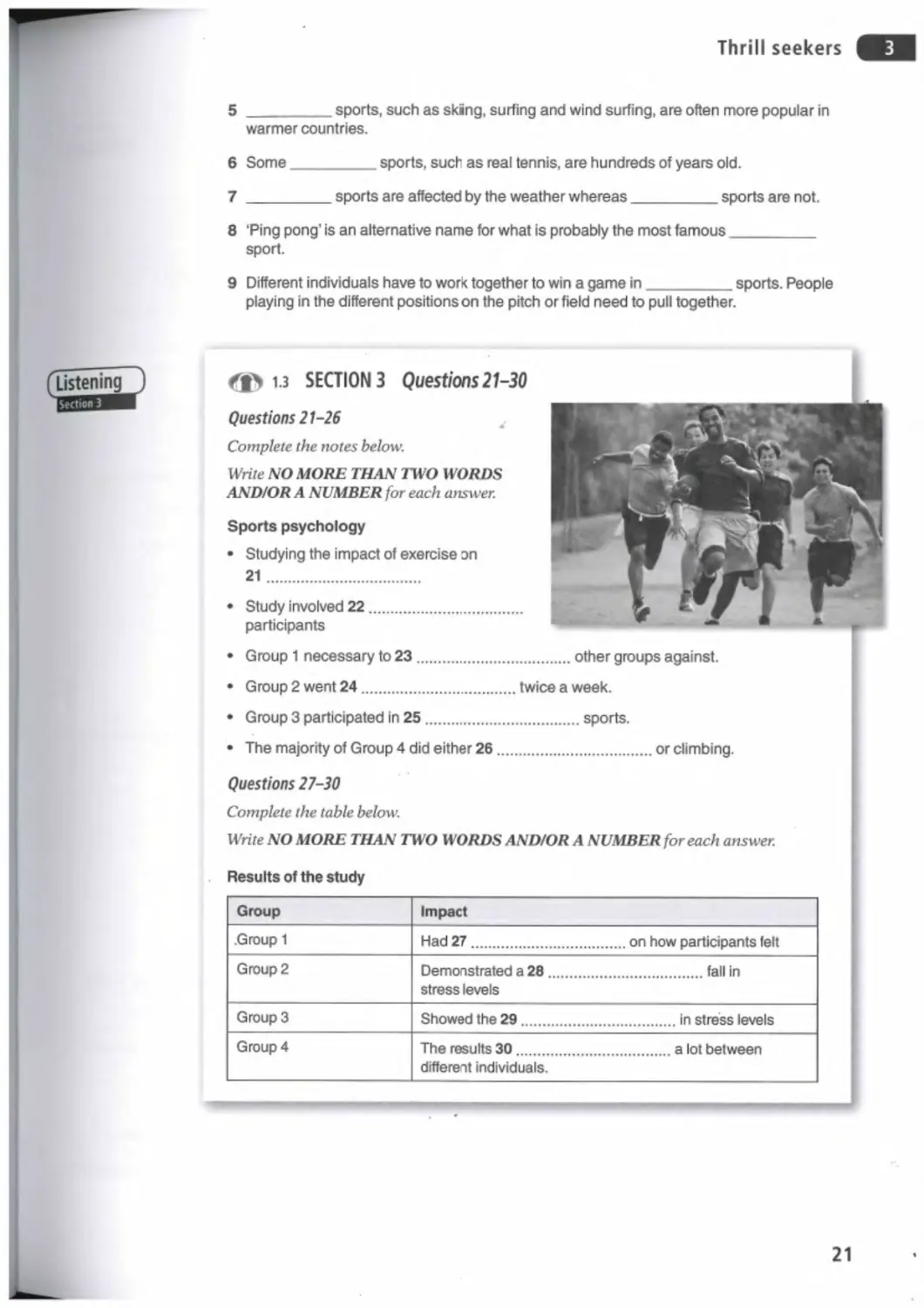
1.3 SECTIONS Questions21-30
Questions 21-26
Complete the notes below.
Write NO MORE THAN TWO WORDS
AND/OR A NUMBER for each answer.
Sports psychology
•	Studying the impact of exercise on
21.....................
•	Study involved 22..................
participants
•	Group 1 necessary to 23......................other groups against.
•	Group 2 went 24......................twice a week.
•	Group 3 participated in 25...................sports.
•	The majority of Group 4 did either 26...................or	climbing.
Questions 27-30
Complete the table below.
Write NO MORE THAN TWO WORDS AND/OR A NUMBER for each answer.
Results of the study
Group	Impact
.Group 1	Had 27			on how participants felt
Group 2	Demonstrated a 28..	 stress levels		fall	in
Group 3	Showed the 29			in	stress levels
Group 4	The results 30	 different individuals.		a	lot between
21
Thrill seekers
Language focus 1: Adjectives with prepositions
Q ! Grammar reference on page 220 of the Students Book.
1 Complete the sentences with the correct preposition from the box.
on to (x2) about (x3) in with of (x2)
1	I'm not really interested team sports. I prefer individual sports.
2	I get bored dong the same exercises in the gym every time. I like variety.
3	I’m keen doing new things. I want to try a bungee jump!
4	She’s fond doing nothing. She's very lazy!
5	They are passionate climbing. Every holiday is a climbing one.
6	He’s capable running a marathon in under three hours.
7	They are enthusiastic winter sports. They especially love snowboarding.
8	I'm addicted football on my computer. I can’t stop playing them.
9	I'm fanatical motor sports. I love watching them and doing them.
10	I’m indifferent running. I don't love it or hate it.
Word building: Adjectives ending in -ingl-ed
1	Put the words in brackets into the correct form.
1	The race was the most of my life, (challenge)
2	He was to take part but winning was the most thing, (excite x2)
3	I'm by winning not by taking part, (motivate)
4	They were by his time in qualifying, (amaze)
5	What do you find about exercise? (dissatisfy)
6	Which sport do you find the most? (thrill)
2	Complete the sentences with the correct form of an adjective in the box.
bore tire astonish encourage worry
1	I was by her motivating comments. They really made me want to try harder.
2	Many people find running really. I'm exhausted after just a kilometre.
3	Many doctors find people’s lack of exercise. It is one of their biggest concerns.
4	The team was by her time. She finished in 3 hours 28 minutes
and her target was 3 hours 31 minutes.
5	I’m naturally talented but I get practising. Doing the same thing again and
again doesn't motivate me at all.
22
Thrill seekers
READING PASSAGE
You should spend about 20 minutes on Questions 1-13, which are based on the
Reading Passage below.
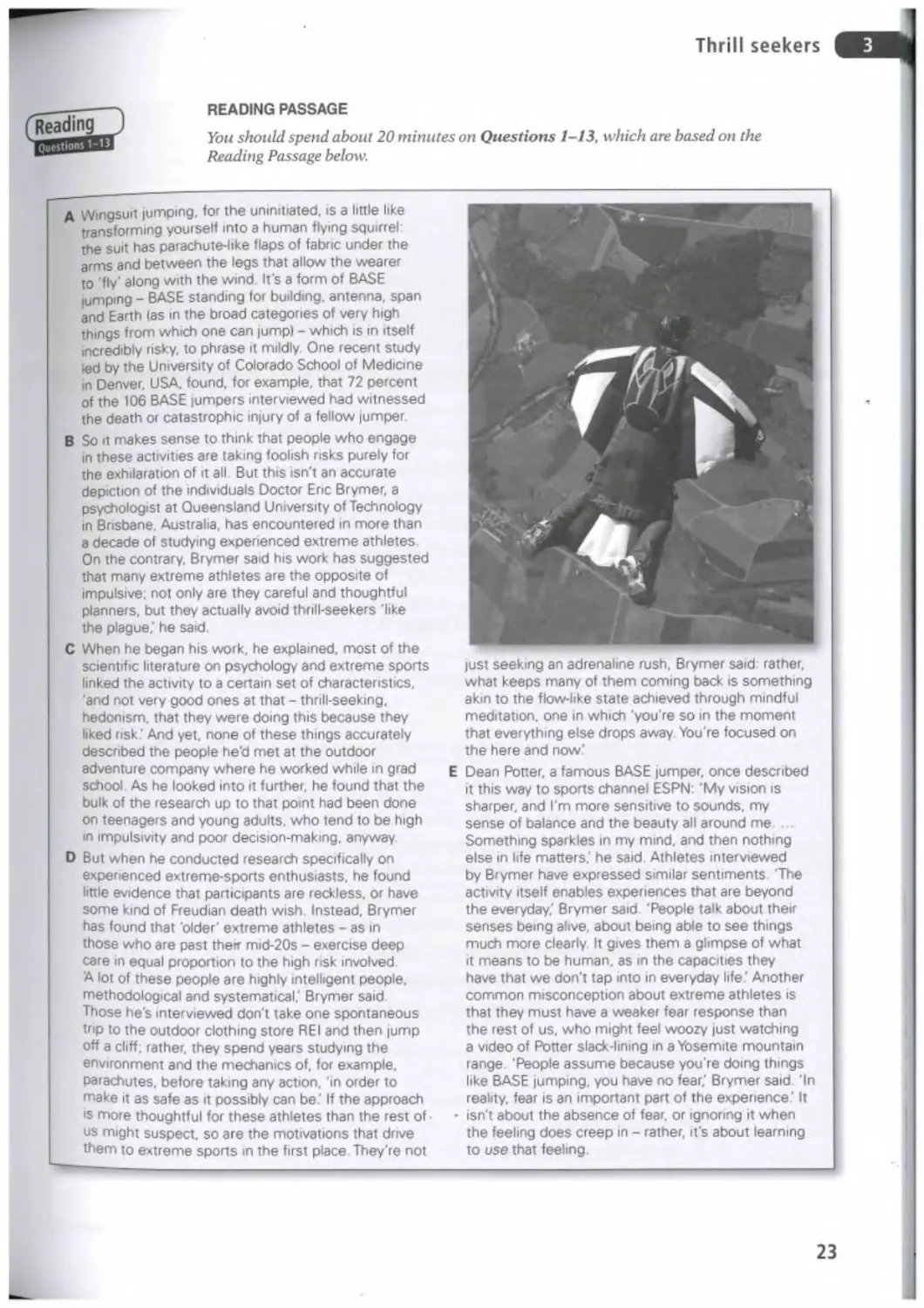
A vVingsuit tumping, for the uninitiated, is a little like
transforming yourself into a human flying squirrel
the suit has parachute-like flaps of fabric under the
arms and between the legs that allow the wearer
to 'fly' along with the wind It's a form of BASE
jumping - BASE standing for building, antenna, span
and Earth (as in the broad categories of very high
things from which one can tump) - which is in itself
incredibly risky, to phrase it mildly One recent study
led by the University of Colorado School of Medicine
in Denver, USA. found, for example, that 72 percent
of the 106 BASE jumpers interviewed had witnessed
the death or catastrophic injury of a fellow jumper
В So it makes sense to think that people who engage
in these activities are taking foolish risks purely for
the exhilaration of it all But this isn’t an accurate
depiction of the individuals Doctor Eric Brymer, a
psychologist at Queensland University of Technology
in Brisbane, Australia, has encountered in more than
a decade of studying experienced extreme athletes.
On the contrary, Brymer said his work has suggested
that many extreme athletes are the opposite of
impulsive; not only are they careful and thoughtful
planners, but they actually avoid thrill-seekers ‘like
the plague,’ he said.
C When he began his work, he explained, most of the
scientific literature on psychology and extreme sjxirts
linked the activity to a certain set of characteristics,
'and not very good ones at that - thrill-seeking,
hedonism, that they were doing this because they
liked risk.’ And yet, none of these things accurately
described the people he'd met at the outdoor
adventure comjjany where he worked while in grad
school As he looked into it further, he found that the
bulk of the research up to that point had been done
on teenagers and young adults, who tend to be high
in impulsivity and poor decision-making, anyway
D But when he conducted research specifically on
experienced extreme-sports enthusiasts, he found
little evidence that participants are reckless, or have
some kind of Freudian death wish. Instead, Brymer
has found that 'older' extreme athletes - as in
those who are past their mid-20s - exercise deep
care in equal proportion to the high risk involved
A lot of these people are highly intelligent people,
methodological and systematical,' Brymer said
Those he’s interviewed don't take one spontaneous
trip to the outdoor clothing store REI and then jump
off a cliff; rather, they spend years studying the
environment and the mechanics of, for example,
parachutes, before taking any action, 'in order to
make it as safe as it possibly can be.' If the approach
is more thoughtful for these athletes than the rest of
us might suspect, so are the motivations that dove
them to extreme sports in the first place They're not
just seeking an adrenaline rush, Brymer said rather,
what keeps many of them coming back is something
akm to the flow-like state achieved through mindful
meditation, one in which 'you're so in the moment
that everything else drops away. You're focused on
the here and now'
E Dean Potter, a famous BASE jumper, once described
it this way to sports channel ESPN: 'My vision is
sharper, and I'm more sensitive to sounds, my
sense of balance and the beauty all around me
Something sparkles in my mind, and then nothing
else in life matters,’ he said. Athletes interviewed
by Brymer have expressed similar sentiments 'The
activity itself enables experiences that are beyond
the everyday,' Brymer said. 'People talk about their
senses being alive, about being able to see things
much more clearly It gives them a glimpse of what
it means to be human, as in the capacities they
have that we don't tap into in everyday life.' Another
common misconception about extreme athletes is
that they must have a weaker fear response than
the rest of us, who might feel woozy just watching
a video of Potter slack-lining in a Yosemite mountain
range. 'People assume because you're doing things
like BASE jumping, you have no fear,' Brymer said. 'In
reality, fear is an important part of the experience.' It
• isn’t about the absence of fear, or ignoring it when
the feeling does creep in - rather, it’s about learning
to use that feeling
23
Thrill seekers
F People tend to divide emotions into ’good' and ’bad,'
and the unpleasant anxiety of fear means it gets
placed in the ’bad' category But that's probably not
the best way to think about the feeling Fear wakes
you up, making you more alert to the potential
threats or things that could go wrong - all things that
are very useful in a potentially dangerous situation
Brymer has interviewed BASE jumpers who say they
don't like to jump with people who aren't afraid If,
when standing at the edge of a cliff, the lumper gets
a little scared, this becomes a time to check in with
the preparation work: their physical readiness, the
environmental conditions, the equipment itself. If
something isn't quite right - if the wind isn't blowing
correctly, for instance - the seasoned extreme
athlete will stop and come back another time.
G But if, after ticking through that mental list, everything
checks out. it's time to push past that fear 'There
seems to be a link between that experience of fear
and being able to move through it with the proper
knowledge and expertise and training,' Brymer said.
'Instead of fear stopping them, it gets turned into this
way of saying. Okay, I need to really pay attention
and be serious here' The presence of fear is,
counterintuitively, what ultimately gives athletes 'the
ability to move through fear... it's part of what allows
them to have these experiences '
Questions 1-6
The Reading Passage has seven paragraphs, A-G.
Which paragraph contains the following information?
NB You may use any letter more than once.
1	people's views of extreme athletes do not match the reality
2	experienced jumpers research a jump in great detail
3	jumpers feel more alive and powerful
4	early research into the personality of extreme sports people
did not look at a wide range of people
5	jumping helps people live in the moment
6	other participants see jumpers die
Questions 7-12
Do the following statements agree with the information in the Reading Passage?
Write:
TRUE if the statement agrees with the information
FALSE if the statement contradicts the information
NOT GIVEN if there is no information on this
1	Wingsuit jumping is very different to BASE jumping.
8	All people who enjoy extreme sports make quick and risky decisions.
9	Poor decision-making is connected with younger people.
10	Extreme sports athletes are physically fit.
11	Extreme sports athletes do not suffer from fear.
12	There are lots of extreme sports videos online.
Question 13
Choose the correct letter А, В, C or D.
Which of the following is the most suitable title for the Reading Passage?
A Addicted to fear
В A history of extreme sports
C Controlling fear positively
D The death of a BASE jumper
24
Thrill seekers
Language focus 2: Comparison
(JJ> Grammar reference on page 221 of the Student s Book.
1 Complete the sentences with the comparative or superlative form of a word from the
box below.
good	bad	noisy	difficult
stressful	popular	dangerous	cheap
1	Star Wars is film series ever. It has made billions of dollars at the
box office and through merchand se.
2	Bees are than sharks. In the USA, more people die every year
from a bee sting than a shark attack.
3	The Golden Raspberries Awards are for films and actors. Most
winners do not collect the award - no one likes to be told they are not very good.
4	One of places to live in any country is near an airport.
5	It is to play lots of sports from a young age rather than specialising.
People who focus on one sport from a young age often get demotivated.
6	The entrance exam to Oxford University is often called test
in the world. It’s impossible to revse for.
7	When exploring a city, it’s often to go on a walking tour
than a bus tour. You could save up to fifty per cent of your money.
8	Being a surgeon is one of jobs in the world.
There is a lot of pressure when saving someone’s life.
2 Rewrite the sentences using a noun instead of an adjective.
Example:
With more people taking it up, tennis is far more popular than it used to be.
With more people taking it up, tennis enjoys more popularity than it used to.
1	It's more difficult to find places to do extreme sports than regular sports.
2	Many people find running long distances more challenging than running short distances.
3	I find playing sports more interesting than watching them.
4	Which sports do you find the most motivating?
5	People want to be more thrilled by sports now than they did in the past.
6	I’m more inspired by effort than success.
7	What do you get most irritated by in sports?
8	I get more annoyed doing team sports than doing individual activities.
25
Thrill seekers
1 Look at the following Task 1 question and answer questions 1-5 below.
WRITING TASK 1
You should spend about 20 minutes on this task.
The table below shows the changes in participation levels in various sports in the USA
between 2010 and 2014 for people aged between 18 and 34.
Summarise the information by selecting and reporting the main features, and make
comparisons where relevant.
Write at least 150 words.
Sport	2010	2014
Baseball	3.8 million «	2.2 million
Basketball	9 milion	7.8 million
Hiking	12 million	14 million
Running	15 million	18 million
Softball	4 million	2.5 million
Swimming	13 million	10.5 million
Weightlifting	13.5 million	13.3 million
Yoga	9 million	12 million
Total	79.3 million	80.3 million
1	How many sports does it compare?
2	Which sports saw an increase in popularity?
3	Which sports saw the biggest increase in popularity?
4	Which sports saw a drop in popularity?
5	Which sport saw the biggest fall in popularity?
2 Look at sentences 1-6 below and decide whether the information about the table is
True or False.
1 The number of people playing basketball fell from 3.8 million to 2.2 million.
- 2 The number of people taking part in hiking has risen.
3	In general, team sports are becoming more popular.
4	All individual sports have shown an increase in the number of people taking part.
5	Running and yoga have both increased by 3 million.
6	The numbers taking part in weightlifting remain unchanged.
26
Thrill seekers
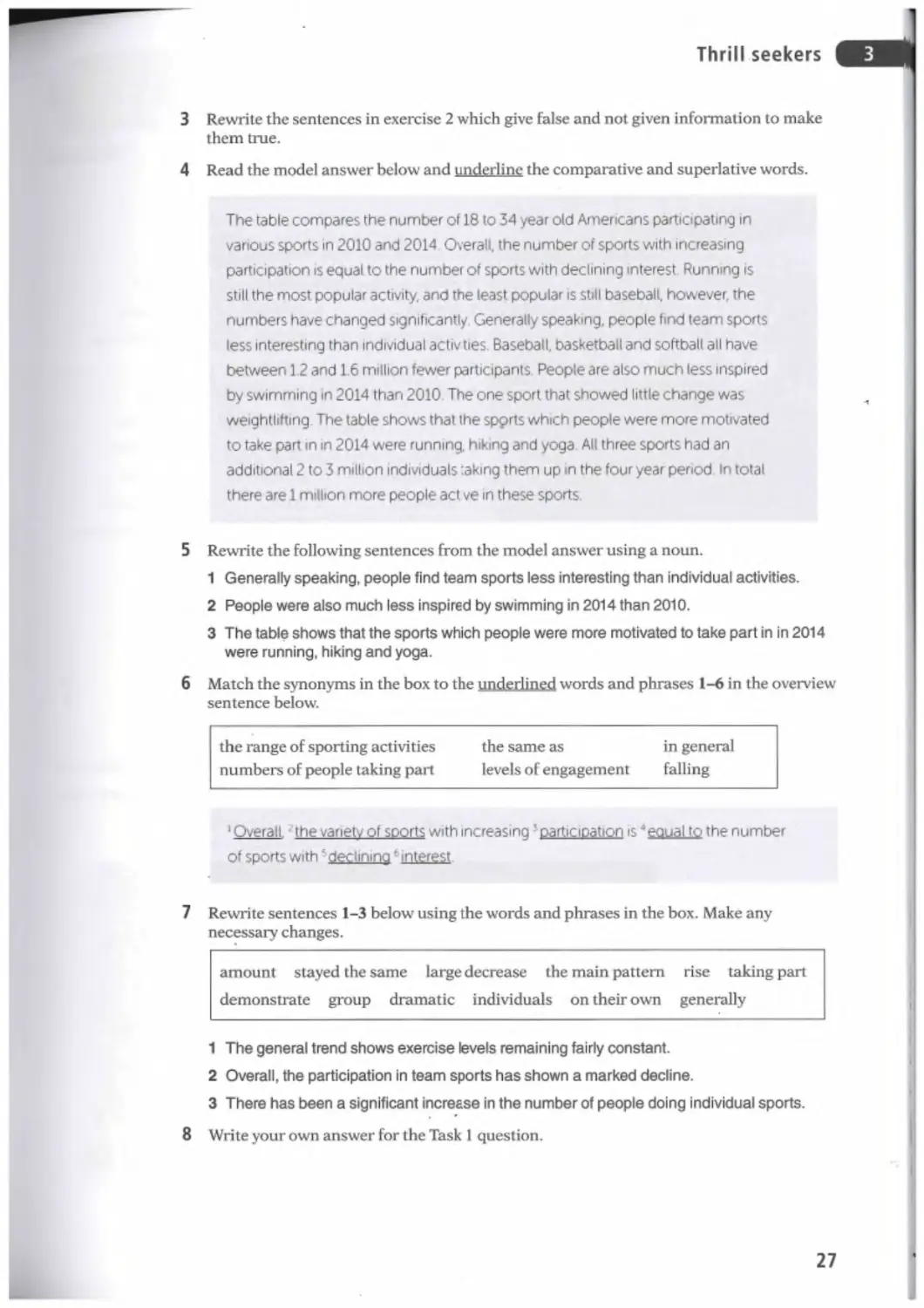
3	Rewrite the sentences in exercise 2 which give false and not given information to make
them true.
4	Read the model answer below and underline the comparative and superlative words.
The table compares the number of 18 to 34 year old Americans participating in
various sports in 2010 and 2014 Overall, the number of sports with increasing
participation is equal to the number of sports with declining interest Running is
still the most popular activity, and the least popular is still baseball, however, the
numbers have changed significantly Generally speaking, people find team sports
less interesting than individual activties. Baseball, basketball and softball all have
between 12 and 16 million fewer participants People are also much less inspired
by swimming m 2014 than 2010 The one sport that showed little change was
weightlifting The table shows that the spprts which people were more motivated
to take part m m 2014 were running hiking and yoga All three sports had an
additional 2 to 3 million individuals raking them up in the four year period In total
there are 1 million more people act ve in these sports.
5	Rewrite the following sentences from the model answer using a noun.
1	Generally speaking, people find team sports less interesting than individual activities.
2	People were also much less inspired by swimming in 2014 than 2010.
3	The table shows that the sports which people were more motivated to take part in in 2014
were running, hiking and yoga.
6	Match the synonyms in the box to the underlined words and phrases 1-6 in the overview
sentence below.
the range of sporting activities	the same as	in general
numbers of people taking part	levels of engagement	falling
1 Overall, the variety of sports with increasing -' participation is "equal to the number
of sports with1 2 3 * declining6 interest
7	Rewrite sentences 1-3 below using the words and phrases in the box. Make any
necessary changes.
amount stayed the same large decrease the main pattern rise taking part
demonstrate group dramatic individuals on their own generally
1 The general trend shows exercise levels remaining fairly constant.
2 Overall, the participation in team sports has shown a marked decline.
3 There has been a significant increase in the number of people doing individual sports.
8 Write your own answer for the Task 1 question.
27
" о
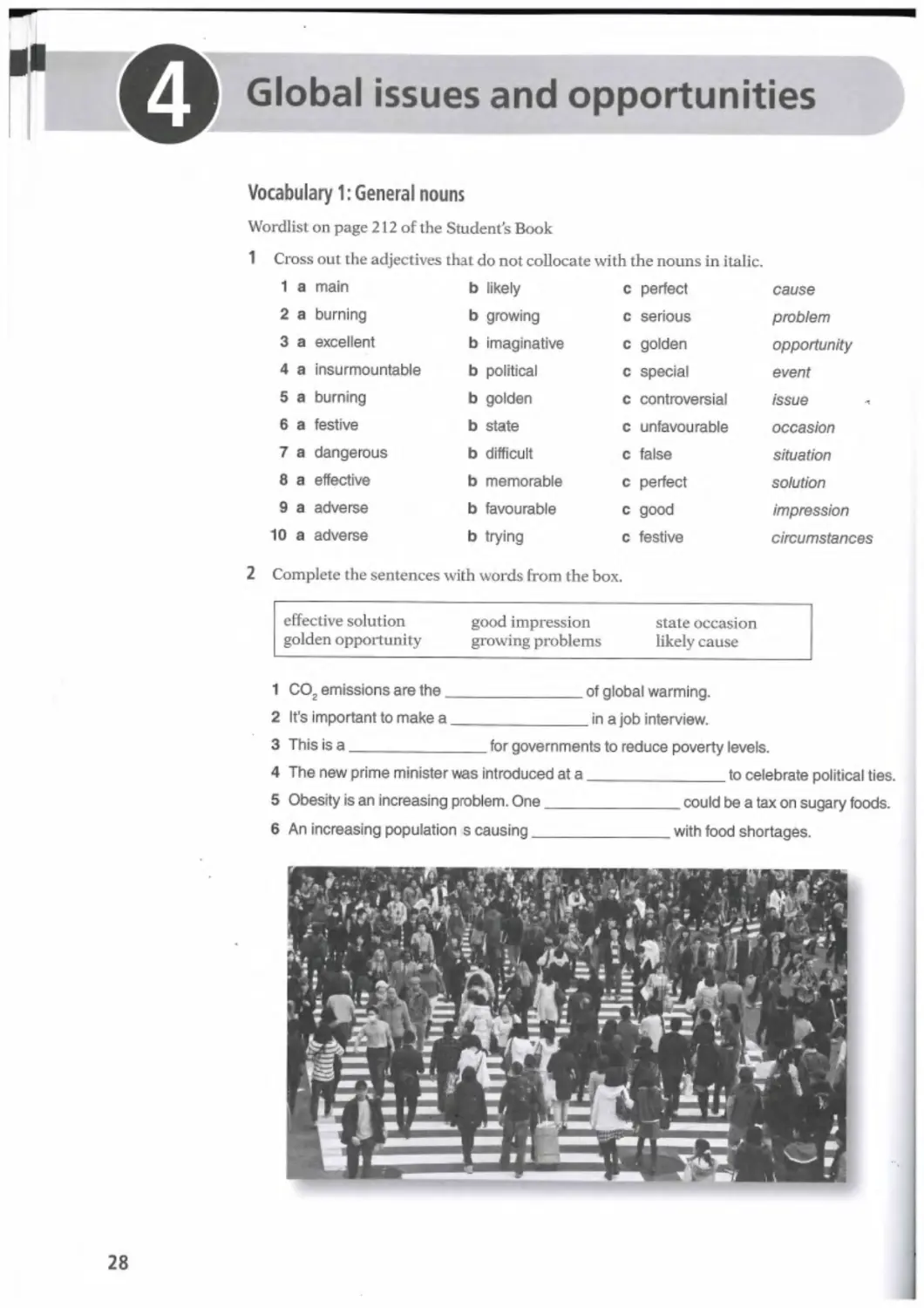
Global issues and opportunities
Vocabulary 1: General nouns
Wordlist on page 212 of the Students Book
1 Cross out the adjectives that do not collocate with the nouns in italic.
1 a	main	b	likely	c	perfect	cause
2 a	burning	b	growing	c	serious	problem
3 a	excellent	b	imaginative	c	golden	opportunity
4 a	insurmountable	b	political	c	special	event
5 a	burning	b	golden	c	controversial	issue	ч
6 a	festive	b	state	c	unfavourable	occasion
7 a	dangerous	b	difficult	c	false	situation
8 a	effective	b	memorable	c	perfect	solution
9 a	adverse	b	favourable	c	good	impression
10 a	adverse	b	trying	c	festive	circumstances
2 Complete the sentences with words from the box.
effective solution	good impression	state occasion
golden opportunity	growing problems	likely cause
1	CO2 emissions are the of global warming.
2	It's important to make a in a job interview.
3	This is a for governments to reduce poverty levels.
4	The new prime minister was introduced at a to celebrate political ties.
5	Obesity is an increasing problem. One could be a tax on sugary foods.
6	An increasing population s causing with food shortages.
28
Global issues and opportunities
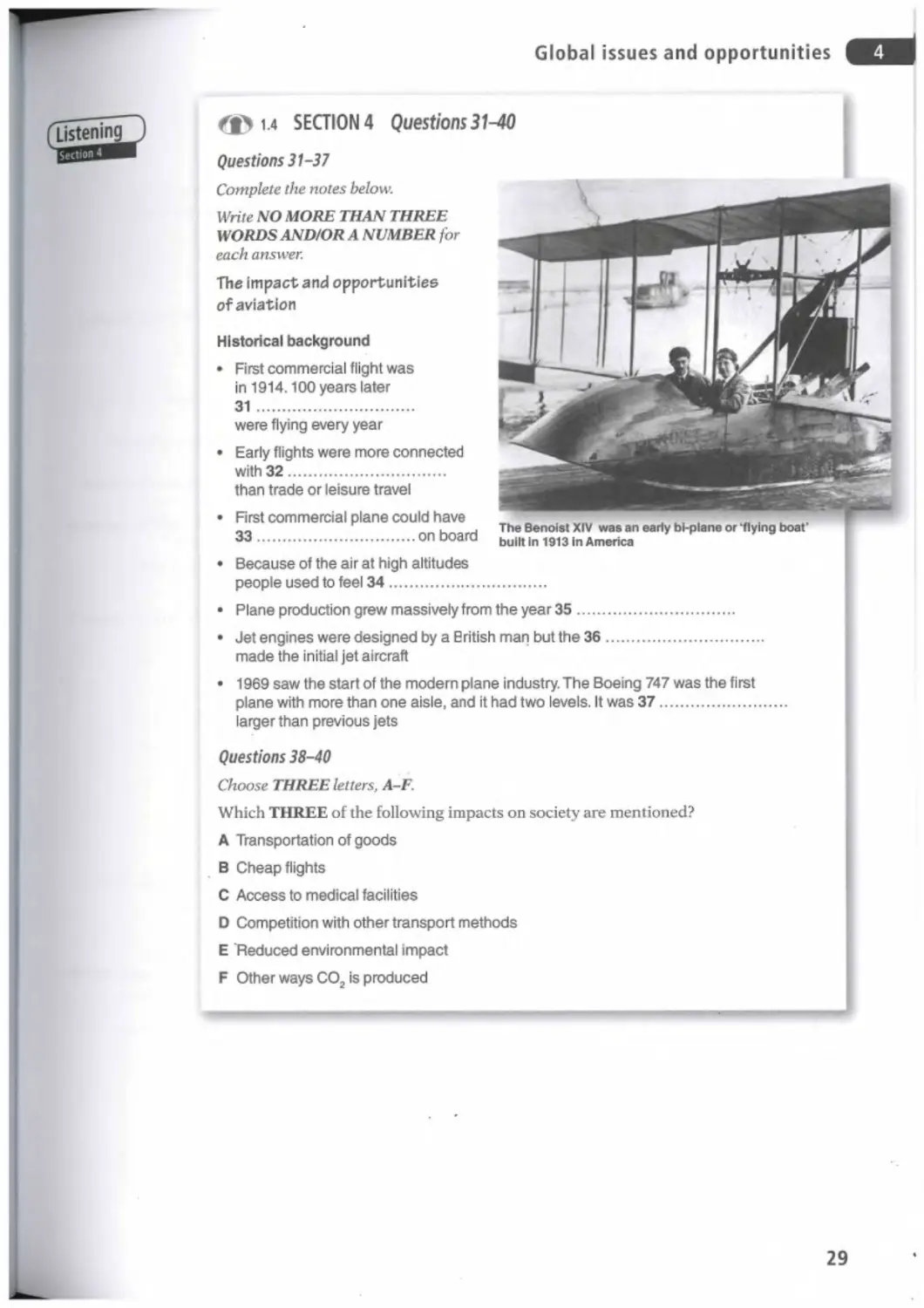
1.4 SECTION 4 Questions 31-40
Questions 31-37
Complete the notes below.
Write NO MORE THAN THREE
WORDS AND/OR A NUMBER for
each answer.
The impact and opportunities
of aviation
Historical background
•	First commercial flight was
in 1914.100 years later
31........................
were flying every year
•	Early flights were more connected
with 32.......................
than trade or leisure travel
•	First commercial plane could have
33.........................on	board
The Benoist XIV was an early bl-plane or ‘flying boat*
built in 1913 in America
•	Because of the air at high altitudes
people used to feel 34...........................
•	Plane production grew massively from the year 35..........................
•	Jet engines were designed by a British man but the 36..........................
made the initial jet aircraft
•	1969 saw the start of the modern plane industry. The Boeing 747 was the first
plane with more than one aisle, and it had two levels. It was 37.....................
larger than previous jets
Questions 38-40
Choose THREE letters, A-F.
Which THREE of the following impacts on society are mentioned?
A Transportation of goods
В Cheap flights
C Access to medical facilities
D Competition with other transport methods
E Reduced environmental impact
F Other ways CO2 is produced
29
ЕВ Global issues and opportunities
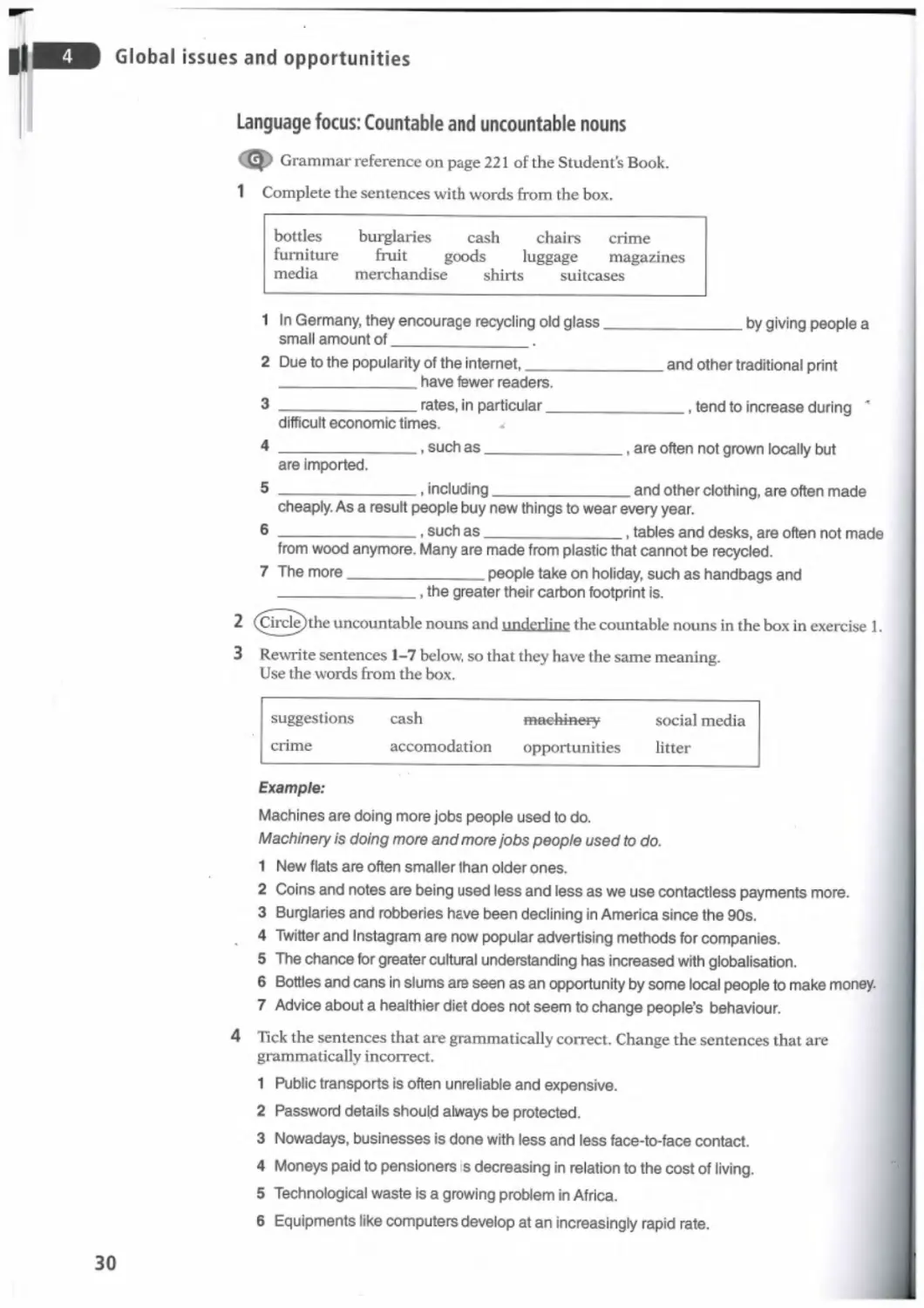
Language focus: Countable and uncountable nouns
<5} Grammar reference on page 221 of the Students Book.
1 Complete the sentences with words from the box.
bottles	burglaries	cash	chairs	crime
furniture	fruit	goods	luggage	magazines
media	merchandise	shirts	suitcases
1	In Germany, they encourage recycling old glass by giving people a
small amount of.
2	Due to the popularity of the internet,and other traditional print
	have fewer readers.
3	rates, in particular, tend to increase during *
difficult economic times.
4	, such as, are often not grown locally but
are imported.
5	, including and other clothing, are often made
cheaply. As a result people buy new things to wear every year.
6	, such as, tables and desks, are often not made
from wood anymore. Many are made from plastic that cannot be recycled.
7	The more people take on holiday, such as handbags and
, the greater their carbon footprint is.
2 (Circje)the uncountable nouns and underline the countable nouns in the box in exercise 1.
3 Rewrite sentences 1-7 below, so that they have the same meaning.
Use the words from the box.
suggestions	cash	machinery	social media
crime	accomodation	opportunities	litter
Example:
Machines are doing more jobs people used to do.
Machinery is doing more and more jobs people used to do.
1	New flats are often smaller than older ones.
2	Coins and notes are being used less and less as we use contactless payments more.
3	Burglaries and robberies have been declining in America since the 90s.
4	Twitter and Instagram are now popular advertising methods for companies.
5	The chance for greater cultural understanding has increased with globalisation.
6	Bottles and cans in slums are seen as an opportunity by some local people to make money.
7	Advice about a healthier diet does not seem to change people’s behaviour.
4 Tick the sentences that are grammatically correct. Change the sentences that are
grammatically incorrect.
1	Public transports is often unreliable and expensive.
2	Password details should always be protected.
3	Nowadays, businesses is done with less and less face-to-face contact.
4	Moneys paid to pensioners s decreasing in relation to the cost of living.
5	Technological waste is a growing problem in Africa.
6	Equipments like computers develop at an increasingly rapid rate.
30
Global issues and opportunities
READING PASSAGE
You should spend about 20 minutes on Questions 1-14, which are based on the
Reading Passage below.
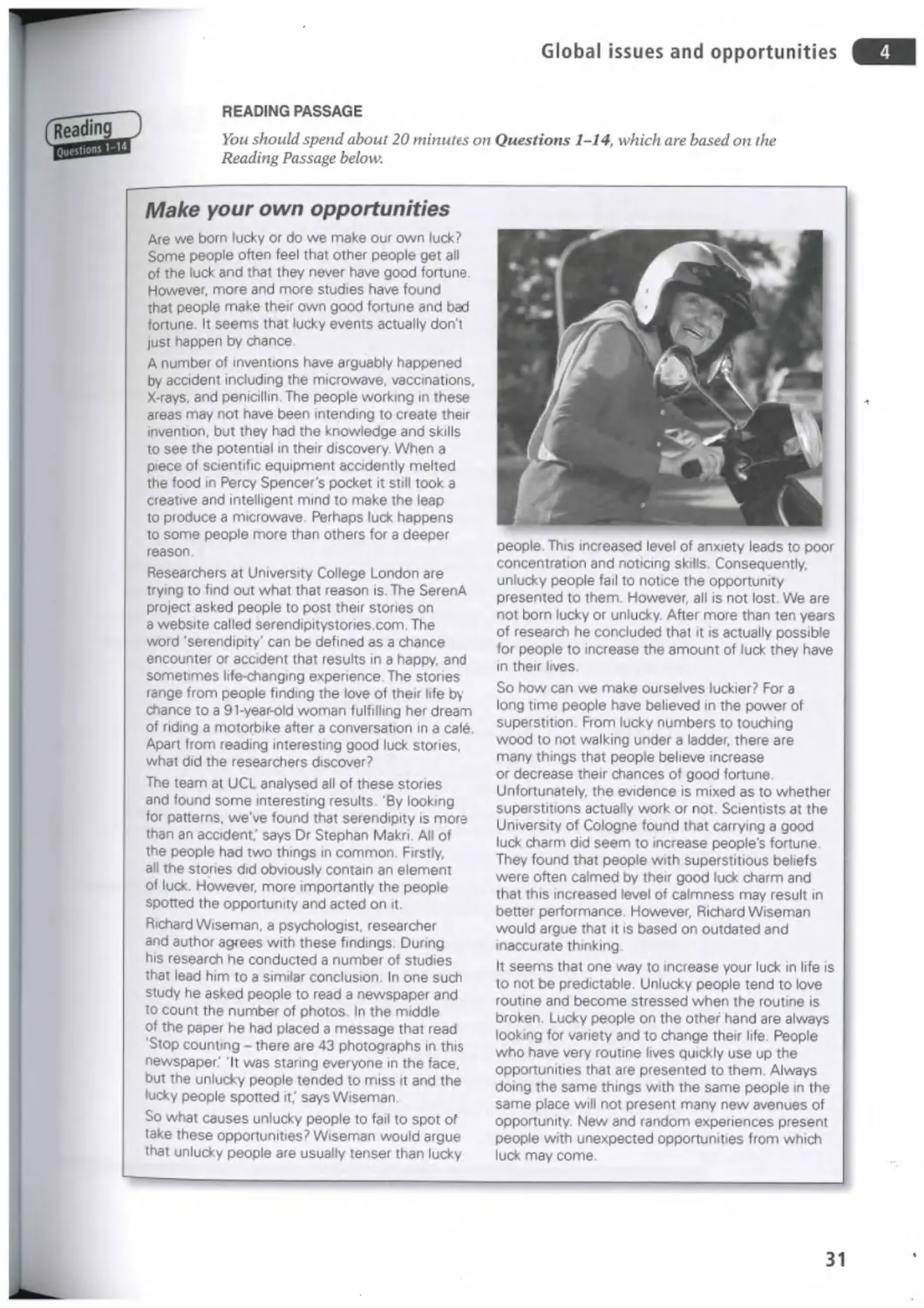
Make your own opportunities
Are we born lucky or do we make our own luck?
Some people often feel that other people get all
of the luck and that they never have good fortune.
However, more and more studies have found
that people make their own good fortune and bad
fortune. It seems that lucky events actually don't
just happen by chance
A number of inventions have arguably happened
by accident including the microwave, vaccinations.
X-rays, and penicillin The people working in these
areas may not have been intending to create their
invention, but they had the knowledge and skills
to see the potential in their discovery When a
piece of scientific equipment accidently melted
the food in Percy Spencer's pocket it still took a
creative and intelligent mind to make the leap
to produce a microwave Perhaps luck happens
to some people more than others for a deeper
reason
Researchers at University College London are
trying to find out what that reason is. The SerenA
project asked people to post their stories on
a website called serendipitystories com The
word 'serendipity' can be defined as a chance
encounter or accident that results in a happy, and
sometimes life-changing experience. The stories
range from people finding the love of their life by
chance to a 91-year-old woman fulfilling her dream
of riding a motorbike after a conversation in a cale
Apart from reading interesting good luck stories,
what did the researchers discover?
The team at UCL analysed all of these stories
and found some interesting results 'By looking
for patterns, we've found that serendipity is more
than an accident." says Dr Stephan Makri. All of
the people had two things in common. Firstly,
all the stories did obviously contain an element
of luck. However, more importantly the people
spotted the opportunity and acted on it.
Richard Wiseman, a psychologist, researcher
and author agrees with these findings During
his research he conducted a number of studies
that lead him to a similar conclusion In one such
study he asked people to read a newspaper and
to count the number of photos In the middle
of the paper he had placed a message that read
Stop counting - there are 43 photographs in this
newspaper.' 'It was staring everyone in the face,
but the unlucky people tended to miss it and the
lucky people spotted it," says Wiseman.
So what causes unlucky people to fail to spot of
take these opportunities? Wiseman would argue
that unlucky people are usually tenser than lucky
people. This increased level of anxiety leads to poor
concentration and noticing skills. Consequently,
unlucky people fail to notice the opportunity
presented to them. However, all is not lost. We are
not born lucky or unlucky. After more than ten years
of research he concluded that it is actually possible
for people to increase the amount of luck they have
in their lives.
So how can we make ourselves luckier? For a
long time people have believed in the power of
superstition. From lucky numbers to touching
wood to not walking under a ladder, there are
many things that people believe increase
or decrease their chances of good fortune
Unfortunately, the evidence is mixed as to whether
superstitions actually work or not. Scientists at the
University of Cologne found that carrying a good
luck charm did seem to increase people's fortune
They found that people with superstitious beliefs
were often calmed by their good luck charm and
that this increased level of calmness may result in
better performance. However, Richard Wiseman
would argue that it is based on outdated and
inaccurate thinking
It seems that one way to increase your luck in life is
to not be predictable. Unlucky people tend to love
routine and become stressed when the routine is
broken. Lucky people on the other hand are always
looking for variety and to change their life. People
who have very routine lives quickly use up the
opportunities that are presented to them. Always
doing the same things with the same people in the
same place will not present many new avenues of
opportunity. New and random experiences present
people with unexpected opportunities from which
luck may come.
31
Global issues and opportunities
The way we deal with lucky and unlucky
events also vanes from person to person.
In particular, lucky and unlucky peoole react
to and deal with unlucky events in very
different ways. In his experiments Wiseman
found that lucky people tend to loo< at the
bad event and imagine how much worse the
event could have been Whereas, unlucky
people tend to feel desperately unlucky that
this event happened to them. As a result
it means that fortunate people tend to be
much more positive thinking about the
future This positivity decreases their anxiety
and consequently means that they are likely
to continue to be lucky.
So can people be taught to be luckier? If
we break our daily routines, or learn how to
react more positively to bad news, can we
actually increase the levels of luck in our lives?
Wiseman spent a month with his participants
trying to train them to learn various techniques
and the results were quite startling Eighty
per cent of people felt happier, more satisfied
and luckier in life Some volunteers went from
feeling incredibly unlucky in life to feeling very
fortunate, others found partners and some
were promoted at work. All of these events
arguably happened because the participants
had taken control of their own luck. It seems
luck is simply a state of mind.
Questions 1-9
Complete the summary (Questions 1-9) using the list of words, A-Q, below.
Why are some people lucky?
Lucky inventions are not 1............occurrences. The people had the
2..............to see what their invention could do. SerenA wanted to analyse lucky,
3..............stories. They found that people are fortunate but the key is how they
4	to	the opportunity. Richard Wiseman found the 5.............. In his
experiment some unlucky people did not find the 6............. .They	failed because
unlucky people are usually more 7............. and	they are unable to 8..........
Fortunately, we can 9............the luck we have.
A positive	В unusual	C focus	D change
Echance	F luck	G closed	H intelligence
I live	J answer	К reason	Lnote
M respond	N stressed	0 angry	P same Q want
Questions 10-14
Do the following statements agree with the claims of the writer in the Reading Passage?
Writer
YES	if the statement agrees with the claims of the writer
NO	if the statement disagrees with the claims of the writer
NOT GIVEN if it is impossible to say what the writer thinks about this
10	Superstitions clearly do not work.
11	A fixed daily habit leads to good luck.
12	Reacting positively to bad luck has a long-term impact.
13	Bad incidents lead to bad luck in the future.
14	People can influence luck.
Global issues and opportunities
Vocabulary 2: Developing ideas
Underline the TWO words that are similar in each pair of sentences.
1	The rise in levels of unemployment is alarming.
It’s particularly frightening for young people.
2	The low standards in education are shocking.
It has stunned many parents in society.
3	Crime is increasing worldwide. Unfortunately this
is a growing problem.
4	Seeing a quick change can be motivating. It can
encourage people to continue.
5	I have a satisfying job. It’s pleasing when I see
the results.
6	Unhealthy foods are often very tempting. Since
they are so appealing they are consumed
too frequently.
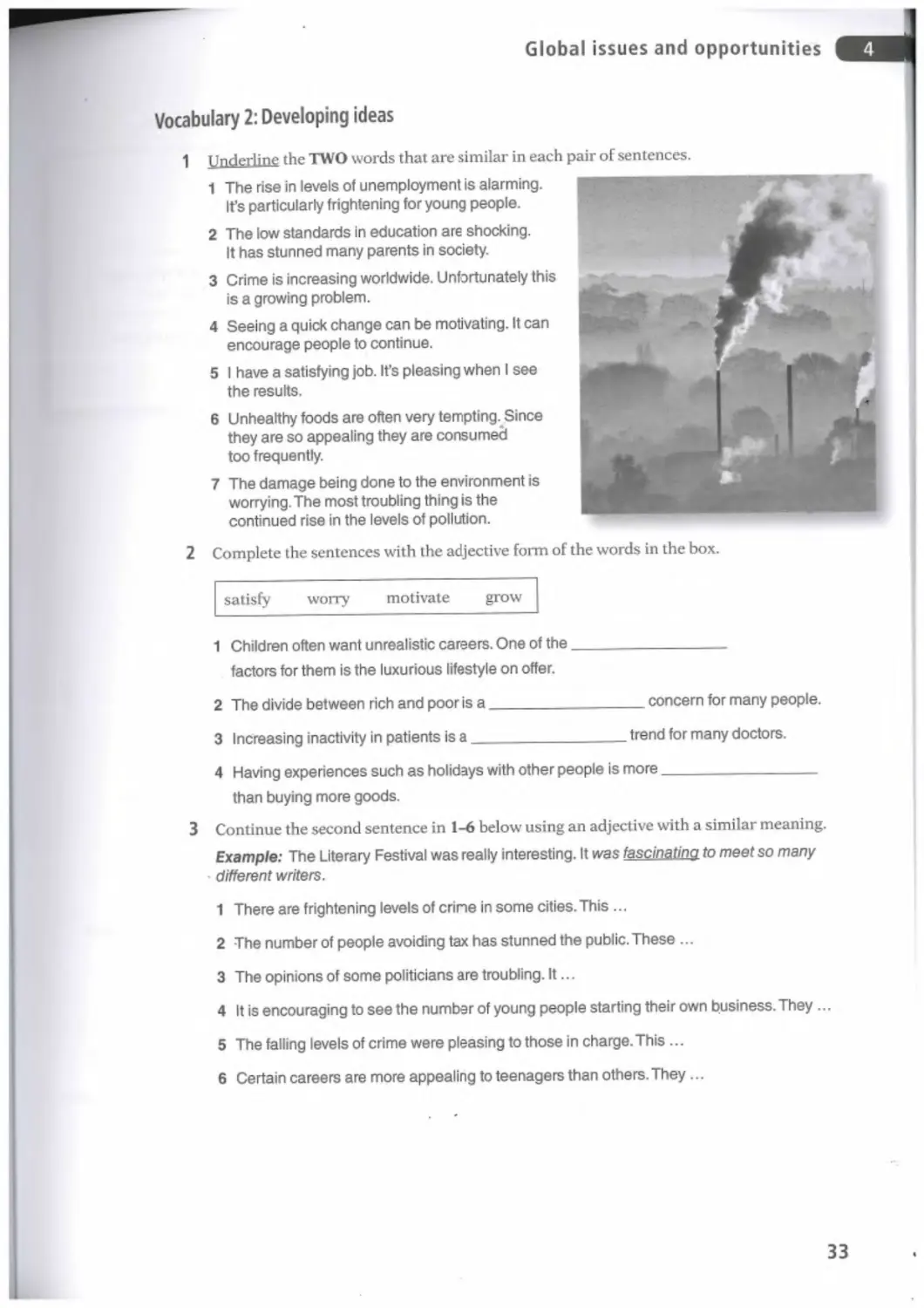
7	The damage being done to the environment is
worrying. The most troubling thing is the
continued rise in the levels of pollution.
2	Complete the sentences with the adjective form of the words in the box.
satisfy worry motivate grow
1	Children often want unrealistic careers. One of the
factors for them is the luxurious lifestyle on offer.
2	The divide between rich and poor is a concern for many people.
3	Increasing inactivity in patients is a_________________. trend for many doctors.
4	Having experiences such as holidays with other people is more
than buying more goods.
3	Continue the second sentence in 1-6 below using an adjective with a similar meaning.
Example: The Literary Festival was really interesting. It was fascinating to meet so many
different writers.
1	There are frightening levels of crime in some cities. This ...
2	The number of people avoiding tax has stunned the public.These ...
3	The opinions of some politicians are troubling. It...
4	It is encouraging to see the number of young people starting their own business. They ...
5	The falling levels of crime were pleasing to those in charge.This ...
6	Certain careers are more appealing to teenagers than others. They...
33
Global issues and opportunities
1 Look at the following Task 2 question and then answer questions 1-6 below.
WRITING TASK 2
You should spend about 40 minutes on this task.
Write about the following topic:
Youth unemployment is increasing in many countries in the world. What do you think
are the main causes of this problem and what measures can be taken to solve it?
Give reasons for your answer and include any relevant examples from your own
knowledge or experience.
Write at least 250 words.
1	What is the main topic?
2	Is it a positive or negative development?
3	What two main areas do you need to focus on for the topic?
4	Can you add things from your personal life?
5	How long do you have for the task?
6	Can you write more than 250 words?
2 Match the causes 1-4 to the solutions a-d.
1	The main cause of youth unemployment is the increasing use of robots and
technology to do basic jobs.
2	Another factor is the lack of diversity on the type of jobs available.
3	This is arguably as a result of the academic path people are choosing to take.
4	One cause is the lack of apprenticeships in many firms.
a One way to deal with this is to for people to learn a greater range of skills.
b Companies should be supported by the government to develop training schemes.
c One solution is for governments to provide financial support for industries such
as manufacturing.
d Young people should be encouraged to train in skills there is a shortage in.
3 Put sentences 1-5 for this possible model answer in the correct order.
1	For instance, many manufacturing jobs and customer service jobs are now completed
by computers or robots.
2	Consequently, many low-skilled jobs are now no longer available to people.
3	The main cause of youth unemployment is the increasing use of technology and the
automation of basic jobs.
4	However, doing so will take time and will not help those who have been working in this
area for a long time already.
5	One solution could be for people to learn a greater range of skills that cannot be replicated
by technology.
34
Global issues and opportunities
4 Match the functions a-e to the sentences in exercise 3.
1	Sentence 1	a	example
2	Sentence 2	b	solution
3	Sentence 3	c	result
4	Sentence 4	d	concession
5	Sentence 5	e	main idea
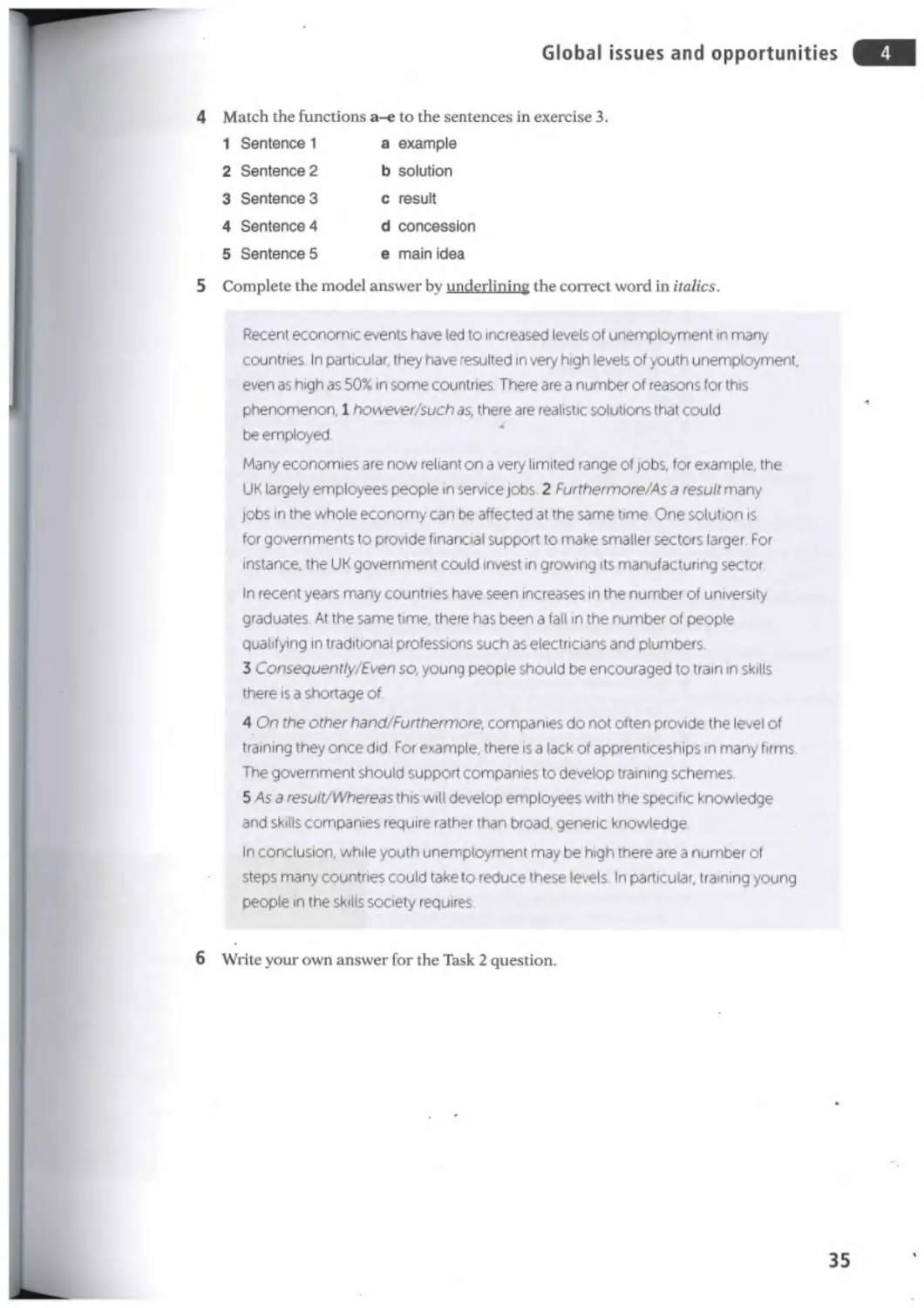
5 Complete the model answer by underlining the correct word in italics.
Recent economic events have led to increased levels of unemployment in many
countries In particular, they have resulted in very high levels of youth unemployment,
even as high as 50% in some countries There are a number of reasons for this
phenomenon, 1 however/such as, there are realistic solutions that could
be employed
Many economies are now reliant on a very limited range of jobs, for example, the
UK largely employees people in service jobs. 2 Furthermore/As a result many
jobs in the whole economy can be affected at the same time One solution is
for governments to provide financial support to make smaller sectors larger For
instance, the UK government could invest m growing its manufacturing sector
In recent years many countries have seen increases in the number of university
graduates At the same time, there has been a fall in the number of people
qualifying m traditional professions such as electricians and plumbers
3 Consequently/Even so. young people should be encouraged to tram m skills
there is a shortage of
4 On the other hand/Furthermore, companies do not often provide the level of
training they once did For example, there is a lack of apprenticeships in many firms
The government should support companies to develop training schemes
5 As a result/Whereas this will develop employees with the specific knowledge
and skills companies require rather than broad, generic knowledge
In conclusion, while youth unemployment may be high there are a number of
steps many countries could take to reduce these levels In particular, training young
people in the skills society requires
6 Write your own answer for the Task 2 question.
35
Ill
The future
Language focus: Ways of looking at the future
Q * Grammar reference on page 222 of the Students Book.
1	Match a tense 1-6 to each sentence a-f.
1	The present continuous
2	The future continuous
3	The present simple
4	The future perfect
5	will
6	going to
a The train leaves at 5.50.
b People will be doing very different jobs in 30 years’ time.
c I'm meeting friends for coffee tonight.
d Most people will work from home in the future.
e By 2030, most jobs will have changed beyond recognition.
f I’m going to travel around Europe with friends.
2	Match the functions a-f to a tense in exercise 1.
a Used for intentions or plans.
b Used for fixed arrangements.
c Used for a completed action at or before a point in the future.
d Used for a situation which will be happening at a particular time in the future.
e Used for predictions or instant decisions.
f Used for events that relate to a schedule/timetable.
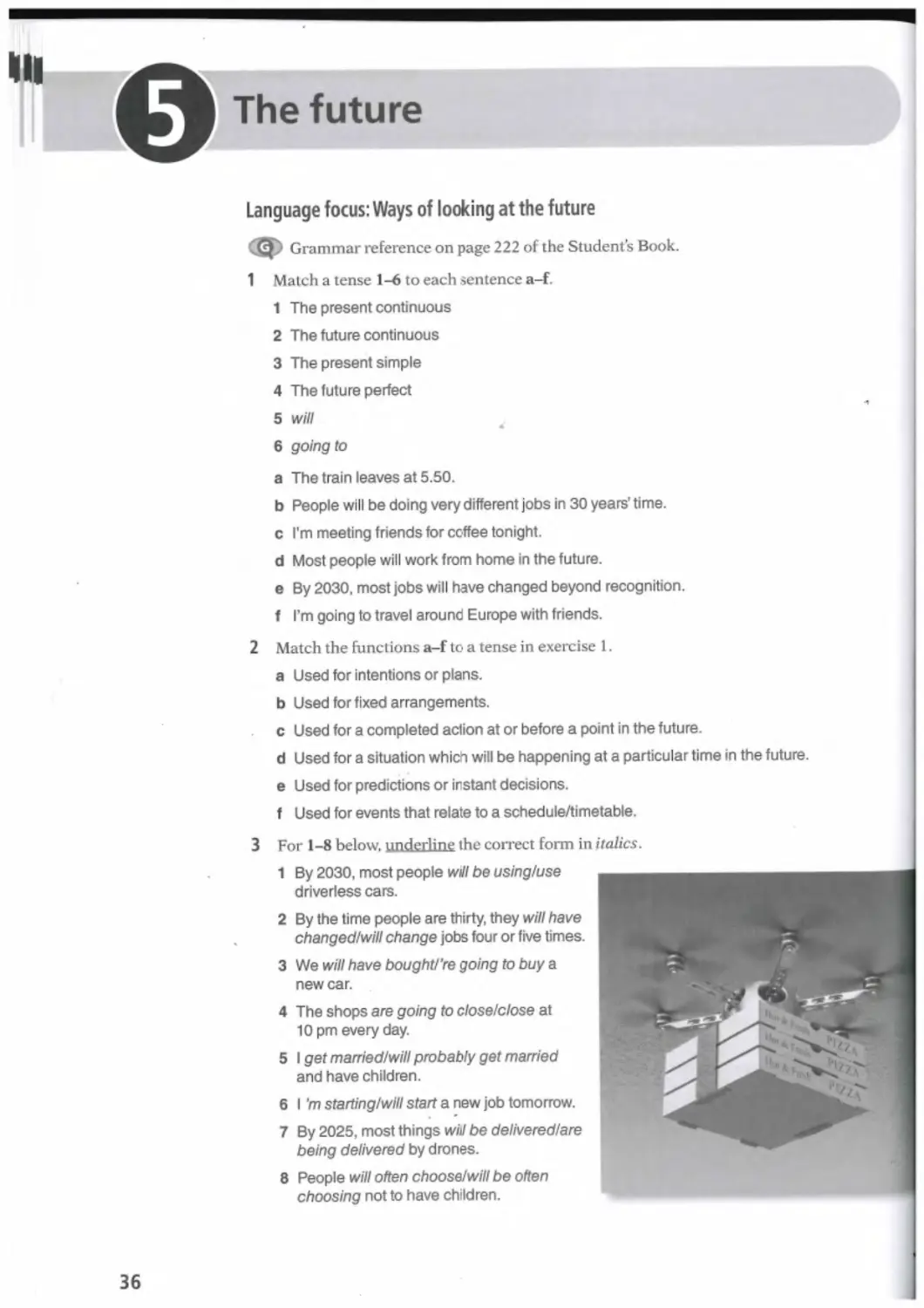
3 For 1-8 below, underline the correct form in italics.
1	By 2030, most people will be using/use
driverless cars.
2	By the time people are thirty, they will have
changed/will change jobs four or five times.
3	We will have bought/'re going to buy a
new car.
4	The shops are going to close/close at
10 pm every day.
5	I get married/will probably get married
and have children.
6	I ‘m starting/will start a new job tomorrow.
7	By 2025, most things will be delivered/are
being delivered by drones.
8	People will often choose/will be often
choosing not to have children.
36
The future
4 Complete the sentences with the correct form of the word in brackets.
1	By tomorrow, I(finish) the essay.
2	The presentation(start) in ten minutes.
3	The lesson(last) one hour every Monday afternoon.
4	Men and women(earn) the same money by 2030.
5	We(go/go) kite surfing this summer.
6	We won’t need keys, remote controls or light switches. I think phones
(control) everything in our house.
Vocabulary 1: Adjective/Noun collocations
Wordlist on page 213 of the Student’s Book.
1	Choose the correct word to complete the sentences.
1	The (indigenous/modern/dominant) people of many countries suffered at the hands
of invaders.
2	The (thriving/agricultural/general) public protested about the government's decision.
3	There is a (dominant/thriving/urban) local economy which has increased salaries above
the national average.
4	The historic town centre is much more attractive than the (modern/urban/general) area.
5	It is an (urban/agricultural/indigenous) region and most people work in farming.
6	Throughout the world the (urbarVagricultural/indigenous) population has been increasing
as more and more people move to cities.
7	The (thriving/general/governing) elite has made some unpopular decisions and is unlikely
to win the next election.
8	American culture has influenced many societies around the world. Hollywood movies help
make it the (dominant/general/governing) culture.
2	Complete the sentences with collocations from the box.
indigenous people	general public	thriving economy	modern area
agricultural region	urban population	governing elite	dominant culture
1	He is a good politician but not popular with the. Most of the population
- dislikes him.
2	Many of the no longer speak their own language. They have learnt the
language of the people who conquered the island.
3	The has become smaller as cities have grown.
4	A is usually richer than a rural one.
5	The is a lot less beautiful than the historical area.
6	India is a very diverse country and there is not one.
7	The control most of the power and wealth in the country.
8	We once had a but now it is struggling. I think we’ll have a recession soon.
37
|| The future
(Listening J)
Section 1
1.5 SECTION 1 Questions 1-10
Questions 1-4
Complete the notes below.
Write NO MORE THAN TWO WORDS AND/OR A NUMBER for each answer.
Future development
Exhibition date: 1......................
Location: 2.......................
Number of tickets booked: 3......................
Delivery method: 4......................
Questions 5 and 6
Choose TWO letters, A-E.
Which TWO of the following facilities will be available on the site?
A Beach
В Swimming pool
C Supermarket
D Restaurants
E Tennis court
Questions 7-10
Complete the table below.
Write NO MORE THAN TWO WORDS AND/OR A NUMBER for each answer.
Methods of transport	Nearest stop to development	Frequency	Destination	Cost
Tram	The front entrance	Every 7		All main towns along the regional coast	8		 return
Bus	9		Every 15 minutes	Inland towns and 10			Five euros return
38
The future ^Q|
(Reading
stions 1-13
Word building: Forming adjectives from nouns
Wordlist on page 213 of the Students Book.
1 Make adjectives from the nouns in brackets using one of these three suffixes: -al, -(i)ous
and -ful. Make any necessary' changes.
1	sports are often popular among thrill seekers, (danger)
2	China is likely to become the most economically country
in the world, (power)
3	Industrialisation continues to be to the environment, (harm)
4	people often want control of their future, (ambition)
5	There are reasons why it isn’t appropriate, (culture)
6	Solar energy has become more and mpre. (economy)
7	Many doubt we are likely to have a world in the future, (peace)
8	The internet is seen as one of the most influential developments of recent
years, (technology)
2	Complete the sentences with nouns or adjectives of the words in brackets.
1	America currently has significant and political. (economy/power)
2	Society has undergone huge changes due to the development of
. (culture/technology)
3	Some people see businesses'as for society, (ambition/danger)
4	The breakdown in talks was for the region, (peace/harm)
3	Underline all the noun forms in the completed sentences in exercise 2.
READING PASSAGE
You should spend about 20 minutes on Questions 1-13, which are based on the
Reading Passage below.
A report from Public Health England in February this
year found that over-65s in Britain are living longer
than ever before — but we want life in our years, not
just years in our lives.
Here's what our generation can hope for.
Younger skin
It's an exciting idea for those of us who seem to find
a new wrinkle each morning a wearable film applied
to the face or body as a thin, transparent layer, making
skin look younger. The new silicone-based polymer
film, dubbed 'second skin', was developed at the
Massachusetts Institute of Technology After tests,
researchers reported that it covered eye bags and
wrinkles, making skin look smoother and firmer,
and more elastic and springy. The product is applied
as two creams, one after the other, that dry into a
film and can then be peeled off and discarded
24 hours later. The treatment was co-developed with
a cosmetic company and while the MIT researchers
refused to speculate on when the treatment might
become available. Dr Agus, who wasn't involved in
the research says: ’My gut is we’ll see it sometime
in 2017
39
Fighting disease
Having your DNA genetically modified or 'edited'
could be available within five years, says Dr Agus.
Last year, biotech company Editas Medicine
announced plans to become the first lab in the world
to genetically edit the DNA of patients suffering
from a genetic condition that prevents the normal
functioning of the retina.It's possible thanks to new
cutting-edge gene-editing technology Cnspr, which
stands for Clustered. Regularly Interspaced, Short
Palindromic Repeat, a naturally occurring defence
mechanism used by bacteria that the technology
harnesses to erase mutated areas of DNA.
‘Cnspr acts like scissors to cut out defective pieces
of DNA so they can be replaced with other pieces
of DNA,' says Dr Agus. 'Using this technique,
researchers have managed to tweak the genes .
in fish that affect how they age. It offers hope of
finding treatments that can help us age slower and
live longer.' But there are ethical concerns, says
Dr Agus 'The technology could be potentially used
to control qualities such as intelligence, athleticism
and beauty, and we don't know what revising
the human genome to create permanent genetic
modifications could mean for future generat ons.'
Living longer
While a bona-fide proven pill that could add years to
our lives is not yet reality, it's on the way, says UCL
ageing researcher Dr Alic - most likely in the form
of drugs currently available for other conditions that
m trials have been shown to have an anti-ageing
effect In June last year, Dr Alic’s team founc that
fruit flies given a cancer drug lived 12 per cent longer
than average and last month, another UCL team
found the drug lithium - routinely prescribed for
the treatment of bipolar disorder - could lead to a
lifespan increased by up to 18 per cent.
Meanwhile, a medicine called rapamycin, used to
suppress the immune system in transplant patients,
has been shown in mice trials to prolong life by 38
per cent, and in one study last month on docs, it
improved their heart functionality. While its use as
an anti-ageing drug is more than a decade of, Dr
Alic explains, rapamycin has been shown in humans
to help vaccine responses in the elderly 'That's a
positive effect on which we could base potential
treatment,' he says But it's no wonder drug,
he says and side-effects include suppression of
the immune system.
A better quality lite
While we may not be able to live forever, scientists
are confident that they can extend the quality of life
to a much older age. Scientists now believe that it
is possible to actually stop people growing old as
quickly and help them live in good health well into
their 110s and 120s Although it might seem like
science fiction, researchers have already proven
that the diabetes drug metformin extends the life of
animals, and the Food and Drug Administration in the
US has now given the go ahead for a trial to see if
the same effects can be replicated m humans. 'This
would be the most important medical intervention
in the modern era, an ability to slow ageing' says
Dr Jay Olshansky, University of Illinois, Chicago. If
successful, it will mean that a person in their 70s
would be as biologically healthy as a 50 year old
It could usher in a new era of 'geroscience' where
doctors would no longer fight individual conditions
like cancer, diabetes and dementia, but instead
treat the underlying mechanism - ageing. Professor
Lithgow believes that, in the future, young people
may be given a type of ageing vaccine’ to slow
down ageing He believes it could have a far bigger
impact on extending population lifespan than finding
a cure for cancer. ’If we were to cure all cancers it
would only raise life expectancy by around three
years, because something else is coming behind
the cancer, but if we could slow down the ageing
process, you could dramatically improve how long
people can live,' he said. 'We know that it is possible
for handfuls of people to live to a very old age
and still be physically and socially active, so clearly
they carry some kind of protection m their bodies
They are essentially not ageing as quickly. If we
can harness that, then everyone can achieve
those lifespans '
40
The future
Questions 1-7
Complete the summary below.
Choose NO MORE THAN TWO WORDS AND/OR A NUMBER from the passage for
each answer.
People want to live a longer and better quality life. The Massachusetts Institute of
Technology has produced somethirg called a 1..............to make our skin look
younger. It can be removed 2............one day later. Changing our DNA might be
possible in 3............time. It works by using a protection system 4...........
use to remove weak parts. So far, scientists have used it to change how 5..........
age. It’s possible this could help humans survive 6...........It might also be used
to affect 7...........  physical	ability and attractiveness.
Questions 8-11
Choose the correct letter А, В, C or D.	*
8	Anti-aging drugs
A are already available and can add years to your life.
В are being tested on fruit flies.
C are likely to come from drugs we already have for treating major illnesses.
D make people live 12 to 18% longer.
9	The medicine rapamycin
A increases peoples’ lives by 38%.
В helps protect old people from future illnesses.
C is a vaccine for old people.
D has very few side-effects on people.
10	Scientists are convinced that
A we may be able to slow down the ageing process.
В it is possible to live forever.
C we need good healthcare forthose in their 110s and 120s.
D we should focus on quality of life rather than extending it.
11	A trial of the drug metformin has been authorised in the US
A to treat diabetes in animals.
В to prove that it can extend the lifespan of animals.
C to check if it can increase human as well as animal lifespans.
D to test if people in their 70s are as healthy as people in their 50s.
Questions 12 and 13
Answer the questions below.
Choose NO MORE THAN THREE WORDS from the passage for each answer.
12	What do we need to combat to increase life expectancy?
13	What do some old people have in their system that others do not?
41
The future
Vocabulary 2: Verbs of prediction
Wordlist on page 213 of the Student’s Book.
1 Put the words in brackets into the correct form.
1	It that over 50% of purchases will be made on the internet, (estimate)
2	Food shortages to increase, (forecast)
3	By 2050, French to be the most commonly spoken first language, (project)
4	The number of students to decline in the coming years, (anticipate)
5	Japan's population to fall, (expect)
6	Sales of digital cameras to fall, (predict)
1 Look at the following Task 1 question and then answer questions 1-3 below.
WRITING TASK 1
You should spend about 20 minutes on this task.
The pie charts below compare household spending in the UK in 1980 with
predictions for 2030.
Summarise the information by selecting and reporting the main features,
and make comparisons where relevant.
Write at least 150 words.
Household spending in the UK	Predictions for household spending
In 1980	in the UK in 2030
Electricity, gas and water	Electricity, gas and water
Recreation and culture ____ Food and drink Recreation and culture	Food and drink
1	How many categories do you have to compare?
2	Which category is predicted to fall the most?
3	Which category is expected to rise the most?
42
The future
2	Complete the sentences with relevant data from the pie charts on page 42.
1	It is estimated that the proportion of income spent on recreation will fall from
to.
2	Food and drink accounted for of household expenditure in 1980. In contrast,
it is expected to be just in 2030.
3	By 2030, household spending on clothing and footwear is forecast to fall to.
4	Proportionally, the amount spent on is projected to be the smallest change.
5	Spending on transport is anticipated to increase by.
6	The cost of housing is predicted to nearly double by 2030 to of
household spending.
3	Put the verbs in brackets into the correct tense in the model answer.
The pie charts 1(illustrate) the expected changes m household
expenditure in 2030 compared to 1980 The two most notable features
2(be) the fall in the cost of food and drink and the increase in housing
costs. Spending on food and dnn< 3(forecast) to nearly halve in this
period, falling from 25% to 14% By contrast, it 4(anticipate) that there
5(be) a dramatic rise in housing costs from 22 5% to 38% In
comparison to these two changes, the other changes 6(predict) to be
relatively small Clothing/footwear and recreation/culture 7(project) to
fall slightly, while transport and electricity, gas and water 8(expect) to
increase slightly, both of which are likely to be connected
With the significant increase m housing costs, it is clear that some areas of people's
lives 9(affect) The most significant fall 10(be) in the
money available for spending on food
4	Choose the correct option to complete each sentence.
1	In 1980, food and drink accounted for 25% of the household budget (meanwhile/whereas)
it is forecast to only make up 14% by 2030.
2	Three categories each accounted for over 20% of spending (while/but) the rest were all
under 20% of the budget.
3	The costs of three categories are predicted to rise (but/whereas) housing is expected to
rise much more than any other.
4	The cost of food and drink is projected to fall dramatically. (Meanwhile/ln contrast)
recreation and culture will show little change.
5	Write your own answer to the Task 1 question.
43
©
The fruits of nature
Vocabulary 1: Lifecycles and processes
Wordlist on page 213 of the Student s Book.
1	Read the four texts а-d and match them to the four processes shown in the
diagrams 1-4.
a Seeds require three factors to
germinate. Firstly, they need water to
swell up and for the embryo to start
growing. Next, they need oxygen so that
energy can be released for germination.
Lastly, the process is significantly
enhanced as the temperature rises.
c Green plants absorb energy from the
sun using chlorophyll in their leaves.
The energy is used to react carbon
dioxide with water to make a sugar
called glucose. The glucose is used for
respiration (the process of how plants
‘breathe’), or it is changed into starch
and stored. Oxygen is produced during
this process.
b Frog spawn is made of thousands of
floating eggs. Frogs lay so many eggs
because, unlike some animals, they
do not look after their eggs once laid
and many get eaten by other animals.
Around two weeks after being laid, a
head and tail will develop inside the egg.
Once out of the egg, the tadpole’s back
legs and then finally the front legs grow.
Soon after, the tail disappears
d It is possible for plants to reproduce
without flowers or fertilisation. Plants
such as strawberries and potatoes use
tubers or runners to produce new plants.
New plants produced in this way are
identical to each other and are called
a clone'.
2	Underline the words that helped you in exercise 1.
44
The fruits of nature
READING PASSAGE
You should spend about 20 minutes on Questions 1-14, which are based on the
Reading Passage below.
д brief history of chocolate
Д It's hard to pin down
exactly when chocolate
was born, but it's clear
that it was cherished
from the start. For
several centuries,
in pre-modem Latin
America, cacao beans
were considered
valuable enough to use
as currency One bean
could be traded for a
tamale (a traditional
dish), while 100 beans
could purchase a good
turkey hen. according
to a 16th-century
Aztec document
В Sweetened chocolate didn't appear until Europeans
discovered the Americas and sampled the
native cuisine Legend has it that the Aztec king
Montezuma welcomed the Spanish explorer
Hernando Cortes with a banquet that included
drinking chocolate, having tragically mistaken him for
a reincarnated god instead of a conquering invader
Chocolate didn't suit the foreigners' taste buds at
first - one described it in his writings as 'a bitter
drink for pigs' - but once mixed with honey or cane
sugar, it quickly became popular throughout Spam.
C By the 17th century, chocolate was a fashionable
dnnk throughout Europe, believed to have nutritious
and medicinal properties. But it remained largely a
privilege of the rich until the invention of the steam
engine made mass production possible in the late
1700s In 1828, a Dutch chemist found a way to
make powdered chocolate by removing about half
the natural fat (cacao butter) from chocolate liquor,
pulverizing what remained and treating the mixture
with alkaline salts to cut the bitter taste. His product
became known as 'Dutch cocoa,' and it soon led to
the creation of solid chocolate
D The creation of the first modern chocolate bar is
credited to Joseph Fry. who in 1847 discovered that
he could make a moldable chocolate paste by adding
melted cacao butter back into Dutch cocoa By 1868,
a little company called Cadbury was marketing boxes
of chocolate candies in England Milk chocolate hit
the market a few years later, pioneered by another
name that may ring a bell - Nestle.
E Chocolate begins with the cacao tree, which grows
within 20° north and south of the Equator and thrives
on a mix of hot temperatures, rain, and shade
Each tree bears oval fruits, or pods, which are about
5-12 inches long Each pod contains 30-50 seeds,
and it’s these seeds the world knows as cacao
(or cocoa) beans The tree, pod. and bean/seed
are typically referred to as 'cacao', while the word
'cocoa' is reserved for the bean after it has been
fermented, dried, and roasted.
F Cacao pods are ripe when they turn a vibrant yellow/
orange colour Hanging from the trunk, and largest
branches, on small stems, the ripening pods are
typically harvested twice per year, though they can
be harvested continually After being chopped off,
the pods are opened and their seeds are removed.
Each seed is about the size of an olive. The seeds (or
beans') grow m five columns surrounded by a white
pulp or pith
G Beans are cleaned by hand, with the baba (sweet
pulp of the inside of the bean) left on to help develop
flavour. Exposed to light, the cream-coloured
beans turn a purplish colour. Then they're ready for
fermentation via one of two ways: the heap method'
is popular in Africa, where beans are heaped in piles
on the ground; and in Latin America, a system of
cascading boxes is favoured In both methods,
beans are covered with banana leaves During the
2-9 days of fermentation, beans begin to take
on colour and some of the flavours you would
recognise as ’chocolate’.
H Fermented beans must be carefully dried. They are
placed either on wooden boards or bamboo mats for
anywhere from 7 to 14 days under the hot sun. and
are continually raked and turned over for consistent
drying Once dried, the beans are graded, packed
into sacks, bundled, and checked for quality They are
then shipped and traded on the international market
I Beans are cleaned, then roasted at low temperatures
to develop flavour. Shells are separated from the
nibs by a process called winnowing Nibs are finely
ground into cocoa mass or cocoa liquor, which is
solid at room temperature Placed under extremely
high pressure, this paste yields two products: cocoa
powder and cocoa butter
J Cocoa mass can simply be combined with more
cocoa butter and sweetener to make chocolate The
first steps are to mix. grind, and knead the various
raw ingredients into a paste - a process known as
conching. The chocolate is now finished and ready
for final processing To be delivered to a chocolatier,
it must first be put into blocks or drops. This
method requires tempering' - whereby chocolate
is slowly brought to a certain temperature During
the tempering process, the cocoa butter reaches its
most stable form; this gives well-tempered chocolate
its 'snap,' shiny surface, and smoothness
45
The fruits of nature
Questions 1-5
The Reading Passage has ten paragraphs, A-J.
Which paragraph contains the following information?
1	the original companies ard people involved in making today’s chocolate
2	the time when the fruit is picked
3	the changes made to chocolate by Spain
4	getting the two key products from the bean
5	when the colour and the taste first develop
Questions 6-8
Do the following statements agree with the information given
in the Reading Passage?
Write:
TRUE	if the statement agrees with the information
FALSE	if the statement contradicts the information
NOT GIVEN if there is no information on this
6	Cacao beans were once used as money.
7	The Spanish stole cocoa from the Aztecs.
8	The Dutch added sugar to make chocolate sweet.
Questions 9-14
Complete the flow-chart below.
Choose NO MORE THAN TWO WORDS from the passage for each answer.
Stages in the production of chocolate
cacao trees grown near 9...............in hot wet climate
after harvesting, 10..............taken	out
I
after fermentation, beans 11.............for	one or two weeks
I
enhance the taste = beans are 12..............in a cool heat
I
cocoa powder and butter expected, then the ingredients go
through 13...............
I
finally, the chocolate is heated in a process called 14.........
46
The fruits of nature
Language focus: Transitive and intransitive verbs
’ Q I Grammar reference on page 223, and Wordlist on page 214, of the Student’s Book.
1 Complete sentences 1-6 with worcs from the box. Change the form if necessary.
Decide whether the verbs are being used transitively or intransitively.
make collect crush occur rise emerge
1	The first plants from the ground in May and June.
2	The press the fruit to create the juice.
3	The sun at 7 every oay.
4	It from recycled plastic.
5	Bees nectar for their hive.
6	A full moon once a month.
2 Complete the text with words from the box. More than one answer may be possible, and
you may use any word more than cnce. Change the form as necessary.
produce grow cross-pollination bear
cultivate sprout ripen prune
The lifecycle of a cultivated banana tree	7 .
Modern banana trees aren’t actually trees - they are very large herb plants that
1 from wild banana trees. Thousands of years ago 2 of the first
banana trees produced an edible fruit. The fruit (or bananas) that the tree 3 are
essentially berries with a protective skin.
Banana trees don't grow from seed. Instead, shoots 4 horizontally from the
underground root stem. On modern banana plantations usually only one shoot is allowed
to grow to form a stalk, which 5 up to six leaves that can be nine feet long and
two feet wide. The new tree takes about nine months to 8 a bunch of bananas.
Plenty of sunshine and water will cause the fruit to 7.
The mature tree then dies and is chopped down. However one sucker is allowed to
8, while all the others will be 9 to ensure there is room for next
year’s crop.
47
The fruits of nature
3 Cross out the noun that does not collocate with each verb on the left.
1	prune	a branches	b trees	c buds
2	plant	a trees	bbranches	c seeds
3	pollinate	a flowers	b trees	c buds
4	become	a saplings	b flowers	c seeds
5	gather	a fruit	b trees	c flowers
6	harvest	a seeds	b saplings	c fruit
7	sprout	a buds	b seeds	c saplings
8	bear	a flowers	b fruit	c trees
Vocabulary 2: Conservation
Wordlist on page 213 of the Students Book.
1 Match the words 1-		-8 to the definitions a-h.
1	conservation	a	interesting places that people go to see
2	extinction	b	peaceful
3	sights	c	something that is now worse than its original state
4	view	d	when a plant or animal no longer exists
5	spoilt	e	the long term protection of a plant or animal
6	tranquil	f	the ability to see something from a particular place
7	spectacular	g	amazing
8	scenery	h	natural things such as trees, hills and lakes that you see in a particular place
2	Complete the sentences with words from exercise 1.
1	Some people think too much money has been spent on the of pandas.
2	We went to Barcelona to see the.
3	There is a view from the top of the tower.
4	We had a great from our balcony.
5	The in the national park is stunning.
6	I enjoy walking in the mountains because it's so.
7	The growth of the city much of the countryside.
8	Over 1,000 species are in danger of.
3	Some of the sentences below contain mistakes. Correct the incorrect sentences.
1	The mountains in the north have amazing views, stretching as far as the eye can see.
2	The walk along the coast provides some breath taking scenic.
3	There are a number of charities that are involved in the protection of animals and the
conservation of the environment.
4	The skyline is domination by the volcano in the north.
48
The fruits of nature
«>1.6 SECTION 2 Questions 11-20
Questions 11-13
Choose the correct letter, A, В or C.
11	The school will develop the site from
A September.
В January.
C April.
12	At first the facilities
A will be built by older year groups.
В will be open to all the school.
C will be open to year one and two only.
13	If you don't want your child to take part in the TV programme
A email the school.
В complete the form.
C write a letter to the school.
Questions 14-17
Label the map opposite. Write the
correct letter, A-H, next to Questions
14-17.
14	Educational hut ..............
15	Bird-watching area ...........
16	Treehouse ....................
17	Picnic area ..................
Woodlands Development plan
Questions 18-20
Complete the sentences below.
Write NO MORE THAN TWO WORDS for each answer.
18	Parents can help in the summer by............to the scheme.
19	Children can take part in a competition to design the........
20	.............can	be emailed throughout the summer.
49
The fruits of nature
(Writing )
Task 1
Describing sequences
Look at the following Task 1 question about a diagram which shows a process.
Then do exercises 1-5.
WRITING TASK 1
You should spend about 20 minutes on this task.
The diagram below shows the process of making paper and then how recycled
paper is also made.
Summarise the information by selecting and reporting the main features, and
make comparisons where relevant.
Write at least 150 words.
Plantation to paper and paper to paper
1 Match the words in the box :o as many of the steps in the process diagram above
as possible.
use process recycle chop down re-process production
2 Look at the words in the box below. Which words can be used
a in step 1 ?
b in any step from 2 to 10?
c in the last step?
as soon as	after	at first	before	following that	next
initially	first	when	then	finally
50
The fruits of nature flQ
3 Underline the linking words in 1-7. Then put the sentences in order.
1	At first, the trees are chopped down and
2	Initially, the bark is removed
3	subsequently taken to the processing plant and put into the de-barking drum.
4	before then being put through the chipping machine.
5	Following that the chips are processed in the pulping machine to make the pulp that is
turned into paper.
6	The diagram shows the process of making paper and
7	then how recycled paper is also made.
4 Match 1-7 below with a sentence or pail of a sentence a-g to complete the process.
1	From the paper-making machine it is then
2	This paper can then be used
3	These papers are then
4	Following that, the papers are collected
5	The first step of this stage is
6	Following that,
7	Finally, the cleaned paper is then passed through the pulping process again
a to create newspapers. And the second part of the cycle begins.
b and then the recycling process can be started.
c taken to the final stage to create the product for use.
d to remove the ink from the old papers.
e the de-inked paper is then cleaned.
f sold and bought by customers.
g before then being turned back into paper.
5 Write your own answer to the Task 1 question.
51
The world of work and education
Vocabulary 1:Work
Wordlist on page 214 of the Students Book.
1 Use the clues below to complete the crossword.
3	A profession or series of jobs you choose and spend most of your life working in.
5	A person who needs special skills, training or qualifications to do their job.
6	Something you get after completing an examination or course, e.g. High School Diploma.
7	Work you do regularly for money.
Down
2	Has the same meaning as job or profession.
4	The income from your job that enables you to live.
2 Complete the sentences using the words from exercise 1. You may need to change the
form of some of the words.
1	He wants to climb the ladder as quickly as possible.
2	Accountancy exams are really hard to pass. When did you as an accountant?
3	Working in positions such as those in accountancy, medicine, teaching and
law can mean long hours but can be very rewarding.
4	I in the accounting department but I hope to move to a different department
next year.
5	I don't enjoy my job but it’s my. My family depend on the money I earn.
6	What did you put on the form? Lecturer or teacher?
7	How many interviews did you have before you got the?
52
The world of work and education
Reading
READING PASSAGE
You should spend about 20 minutes on Questions 1-13, which are based on the
Reading Passage below.
No to 9-to-5
я ep deprivation has been shown to have major
on health. Just one week with less than six
koore sleep each night leads to 711 changes in how
□enes function Lack of sleep impacts performance,
attention, and long-term memory It also leads to
exhaustion, anxiety, frustration, anger, impulsive
behaviour, weight gain, risk-taking, high blood pressure,
lower .mmunity, stress and a raft of mental health
conditions. Forcing staff to start work before 10am
is tantamount to torture and is making employees ill,
exhausted and stressed, an Oxford University academic
has claimed Before the age of 55, the circadian rhythms
of adults are completely out of sync with normal
9-to-5 working hours, which poses a ’serious threat'
to performance, mood and mental health
Dr Paul Kelley, of Oxford University, said there was
a need for a huge societal change to move work and
school starting times to fit with the natural body clock
of humans Experiments studying circadian rhythms
have shown that the average 10-year-old will not start
focusing properly for academic work before 8.30am.
Similarly, a 16-year-old should start at 10am for best
results and university students should start at 11am.
Dr Kelley believes that simply moving school times
could raise grades by 10 per cent. He was formerly a
head teacher at Monkseaton Middle School, in North
Tyneside, where he changed the school start day from
8.30am to 10am and found that the number of top
grades rose by 19 per cent.
Similarly, companies who force employees to start
work earlier are also likely to be hurting their output,
while storing up health problems for staff Dr Paul Kelley
said work and school starting times should fit with the
natural body clock. ’This is a huge society issue,'
Dr Kelley told the British Science Festival in Bradford.
Staff should start at 10am You don’t get back to
(the 9am) starting point till 55 Staff are usually
sleep-deprived. We’ve got a sleep-deprived society.
’It is hugely damaging on the body’s systems because
you are affecting physical, emotional and performance
systems in the body. Your liver and your heart have
different patterns and you're asking them to shift two
or three hours This is an international issue. Everybody
is suffering and they don’t have to. We cannot change
our 24-hour rhythms. You cannot learn to get up at a
certam time Your body will be attuned to sunlight and
you’re not conscious of it because it reports to the
hypothalamus, not sight.’
Prof Russell Foster, a neuroscientist from the University
of Oxford, said lack of sleep is damaging the health of
the nation, with too many early risers trying to function
with brain skills badly affected. The comments follow
studies which suggest that working night shifts speeds
up the ageing process, and is linked to increasing risks
of cancer, heart
disease and type
two diabetes In
2010, a major study
found that people
who slept for less
than six hours each
night were 12 per
cent more likely
to die prematurely
- before the age
of 65 - than those
who slept the
recommended six to
eight hours a night.
The team from the University of Warwick and Federico II
University Medical School in Naples analysed 16 studies
involving a total of 1.3 million people
Neuroscientists say teens are biologically predisposed
to go to sleep at around midnight and not feel fully
awake and engaged until around 10am. Dr Kelley said
that almost all students were losing around 10 hours
of sleep a week because they were forced to get up
too early ’Just by changing the school start time you
can improve quality of life for whole generations of
children,’ he added. ’There are major societal problems
that are being caused by that. But the opportunities are
fantastic. We have an opportunity here to do something
that would benefit millions of people on Earth.'
Tens of thousands of children are starting school
at 10am in a ground-breaking experiment by
Oxford University to prove that later classes can
improve exam results. GCSE students from more than
100 schools across England will take part in the four-year
project based on scientific evidence which suggests
teenagers are out of sync with traditional school The
team is hoping to publish findings in 2018.
A Department of Education spokesman said ’We have
given all schools the freedom to control the length of
the school day because they are best placed to know
what's best for their communities. Allowing more time
for supervised study and extra-curricular activities has
been shown to benefit disadvantaged pupils in particular
by giving them access to purposeful, character-building
activities, which is why we are helping schools offer a
longer day.'
There are many ways you can improve your sleep.
Buy heavy curtains - anything to keep the room where
you sleep dark. Light suppresses melatonin, the
hormone that relaxes your body It's also important to
establish a regular sleep pattern - going to bed and
waking up at roughly the same time each day helps
enormously Your body and mind will feel much better
for it.
53
The world of work and education
Questions 1-7
Complete the notes below.
Choose NO MORE THAN TWO WORDS AND/OR A NUMBER from the passage
for each answer.
Impact of poor sleep
Health effects
•	Making people start work early is causing people to be sick, tired and 1.......
•	This is true of adults younger than 2.........
•	Not getting enough sleep has a serious effect on people’s 3.........
Changes needed
♦	Society needs to adapt to match people's 4...........
•	Students studying for a University degree should begin at 5.........
•	Companies that make people start work early can reduce the 6...........of
their business
•	Poor sleep is an 7...........problem that affects everyone
Questions 8-12
Look at the following statements (Questions 8-12) and the list of people below.
Match each statement with the correct person/group of people, A-D.
NB You may use any letter more than once.
8	More sleep will help students with
less opportunities.
9	We cannot change our natural
sleep patterns.
10	People with poor sleep will have
an earlier death.
11	People who get up early do not
work effectively.
12	More sleep for children could
improve the whole of society.
Question 13
Choose the correct letter, А, В, C or D.
How can we improve our sleep?
A Reduce our levels of melatonin.
В Allow natural light into the room.
C Create a sleep routine.
D Set an alarm clock to get up.
List of people/institution
A Dr Paul Kelley
В Prof Russell Foster
C Researchers at the University of
Warwick and the University of Naples
Federico II
D A Department of
Education spokesperson
54
The world of work and education
Vocabulary 2: Collocations
Wordlist on page 214 of the Students Book.
1 For 1-9 below, replace the underlined phrase with a suitable collocation. Change the
form as necessary.
Example:
There are a lot of benefits to cutting staff costs, (enjoy/derive/considerable/accrue)
There are considerable benefits to cutting staff costs.
1	The advantages are more significant than the disadvantages, (take/huge/gain/outweigh)
2	He threw away the opportunity of a brilliant career, (boost/once in a lifetime/seize/
waste)
3	Success is related to hard work, iachieve/enormous/depends on/guarantee)
4	She has excellent job prospects in this position, (offer/total/boost/career)
5	There is a clear disadvantage in eaving school early, (have/suffer/distinct/obvious)
6	The project was a complete failure, (result in/total/ensure/enjoy)
7	His CV shows little in the way of achievement, (outstanding/represent/a lack of/impressive)
8	There could be improvement in her work, (huge/make/show/room for)
9	She should be given a chance, (deserve/good/arise/throw away)
2 Match phrases 1-8 to collocations a-h.
1	improve your chances
2	a chance unlikely to ever happen again
3	lead to something not being achieved
4	to lose an opportunity
5	the chance for things to get bette'
6	how well something does is connected
to something else
7	something that is clearly negative
8	something someone has done well
a once in a lifetime opportunity
b success depends on
c boost your prospects
d distinct disadvantage
e result in failure
f outstanding achievement
g room for improvement
h throw away a chance
3 Complete the sentences 1—4 with four of the collocations from exercise 2.
1	I have a to travel the world for a year.
2	I think you need to get some more work experience to of getting a
permanent job.
3	What are you most proud of?
4	Your work is good but there’s definitely.
55
The world of work and education
Section 3
1.7 SECTIONS Questions21-30
Questions 21-25
Choose FIVE letters, A-H.
Which of these FIVE factors affecting happiness does Sue say
Richard Layard mentions in his book Happiness?
A Money	E Holidays
В Health	F Values
C Housing
D Relationships
G Freedom
К Freetime
Questions 26-28
Complete the sentences below.
Write NO MORE THAN ONE WORD AND/OR A NUMBER for each answer.
26	Being part of a strong society could possibly make people.........longer.
27	There are.............key	things that determine how happy a country is.
28	When a person's salary drops by a...........their happiness is hardly affected.
Questions 29 and 30
Answer the questions below.
Write ONE WORD ONLY for each answer.
29	What is the most important thing to feel happy in your work?......
30	What's the most important thing about friendship and community?..........
56
I
The world of work and education
Language focus: Conditionals 1
' Q ' Grammar reference on page 223 of the Student’s Book.
1 Choose the correct tense to complete these sentences.
1	first conditional
If I (leave/left) now, I (’ll catch/would catch) the train.
2	second conditional
If I (tried/had tried) harder, I (would get/would have got) better results.
3	third conditional
If I (had prepared/prepare) more, I (would have got/will get) the job.
2 Match A-C to the main uses 1-3 below.
A first conditional
В second conditional
C third conditional
1 To talk about things in the past happening differently from the way they happened
- often to express regret.
2 To talk about something unreal ano imagined - or something we are not sure of.
3 To talk about future events we are quite sure about.
3 Use the first conditional and the word in brackets to comment on these situations.
1	Paul won't be able to get in because the office might be closed, (if)
2	I'll stay in the job. But I want more money, (unless)
3	She needs to leave now or she might not get her train, (otherwise)
4	We might lose the contract. If we do, Harry will be upset, (if)
4 What does the (/-clause in each sentence 1-4 below mean? Write your answers in
sentences that use isn't, is or might.
Example:
If this office was tidy, 1 could find things.
The office isn’t tidy.
1	If we’re late for the meeting, we can get a taxi.
2	I would call you if my phone was working.
3	If Hayley calls, can you tell her I'll ring back?
4	I would meet you if I wasn't so busy.
5	Comment on the situations using the third conditional.
1	I think John didn’t get the job because he needed to give a better presentation.
2	He wanted to go to university but he didn’t get good grades at school.
3	He didn’t come to the meeting so I think he didn’t know about it. Normally he comes.
4	I booked the table late so we can't go to Quattros.
57
The world of work and education
1 Look at the following Task 2 question and then answer questions 1 -3 below.
WRITING TASK 2
You should spend about 40 minutes on this task.
Write about the following topic:
Some secondary schools provide students with a general education across a range
of subjects whereas others focus on fewer subjects related to a particular career.
Do you think the advantages of a focused education outweigh the disadvantages?
Give reasons for your answer and include any relevant examples from your own
knowledge or experience.
Write at least 250 words.
1	What is the main topic you need to cover?
2	What two specific angles do you need to cover?
3	Do you need to give your own opinion?
2 Look at the model answer in exercise 3 and decide which is the correct outline below,
AorB.
Outline A
1	introduction with opinion
2	advantages of a focused education
3	disadvantages of a focused education
4	disadvantages of a focused education
5	conclusion
Outline В
1	introduction with opinion
2	advantages and disadvantages of a focused education
3	advantages of a focused education
4	disadvantages of a focused education
5	conclusion
58
The world of work and education
3 Look at paragraph C in the model answer below and find features 1-5. Sometimes
more than one answer is possible.
1	the results
2	a topic sentence
3	an explanation/opinion
4	a disadvantage
5	an adjective of evaluation
A School education has a significant impact on people's future chances in life and
the focus on specific subjects can enhance or hinder these opportunities While
there are some advantages to a specific education, I feel that the drawbacks
outweigh the advantages of a general education
В The mam benefit of focusing on a smaller range of subjects related to one
particular career is that the individual will be better prepared to start working
life Some people argue that they will have a deeper knowledge of the key skills
required to undertake the tasks in their work. Furthermore, many argue that a
number of subjects studied in school are not useful in future working life
C It is debatable whether we should focus on a wider or narrower range of
subjects. I feel that focusing on a narrow range of subjects when young is
detrimental The lack of diversity could actually hinder someone's life chances
At such a young age very few people know what their strengths are and what
career they want to spend the rest of their life working in By not studying certain
subjects the opportunities available could be severely limited
D Furthermore, if a student goes to a technical secondary school and leaves
behind foreign languages, for example, they will face significant challenges if
they need to take a language up m the future Careers change frequently and
individuals may be held back from their career path
E In conclusion, there are both advantages and disadvantages involved in having
a focused education, but in my opinion the benefits of a general education
outweigh the disadvantages
4	Find words in paragraph C in the model answer that mean:
1	very negative
2	not enough
3	to limit
5	We usually present the opposing view to our own in the first paragraph after the
introduction. Why do you think we do this?
6	Now write your own answer to the task.
59
Mapping the world
Vocabulary: Nouns relating to places
Wordlist on page 215 of the Student s Book.
1	For 1-8 below, underline the correct noun in italics.
1	The national park is considered a real beauty spot/space/district.
2	The business district/locationfneighbourhood is to the south of the city.
3	The city is well-known for its green locationlregionlspace.
4	Barcelona is one of my favourite neighbourhoods/settings/places to visit.
5	Our offices are in an amazing location/place/region right next to the Thames.
6	There are lots of shops and services in the space/vicinity/spot.
7	The location/setting/area close to the station is quite run down.
8	My neighbourhood/space/vicinity is an upcoming area where lots of people want to live.
2	Choose the phrase a-c you most associate with phrases 1-10.
1	a secluded spot	a	located near a lake	b	stretching into the distance	c	full of shops and cafes
2	an empty desert	a	covered with trees	b	located near a lake	c	with huge sand dunes and no p
3	a wooded hillside	a	covered with trees	b	with huge sand dunes and no people	c	with no houses, just open fields
4	in a beautiful setting	a	with lots of cars and people	b	overlooking the sea	c	full of shops and cafes
5	an open space	a	full of shops and cafes	b	with lots of cars and people	c	with no houses, just open fields
6	a noisy neighbourhood	a	full of shops and cafes	b	covered with trees	c	full of wildlife
7	a sandy beach	a	located near a lake	b	stretching into the distance	c	with no houses, just open fields
8	in a lively district	a	surrounded by trees	b	full of shops and cafes	c	full of wildlife
9	a temperate zone	a	full of shops and cafes	b	with lots of cars and people	c	full of wildlife
10	a rugged mountain	a	with huge sand dunes and no people	b	stretching into the distance	c	full of wildlife
3	Put the words in italics into the correct order.
1	I live in a house large overlooking open wide fields.
2	My family home is trees surrounded by that are all sorts of full of wildlife.
3	My ideal place to live is in a full of cafds shops busy city and.
4	Our family has a holiday located home with huge on the coast people and no dunes.
60
Mapping the world
READING PASSAGE
You should spend about 20 minutes on Questions 1-13, which are based on the
Reading Passage below.
Maps in history
Humans have been sketching maps for millennia,
but Claudius Ptolemy was the first to use math and
geometry to develop a manual for how to map the
planet using a rectangle and intersecting lines - one
that resurfaced in 13th-century Byzantium and was used
untll the early 17th century. The Alexandria-based Greek
scholar, who may never have drawn a map himself,
described the latitude and longitude of more than
8,000 locations in Europe, Asia, and Africa, projecting a
north-oriented, Mediterranean-focused world that was
missing the Americas, Australasia, southern Africa, the
Far East, the Pacific Ocean, and most of the Atlantic
Ocean Ptolemy's Geography was a 'book with a 1,500-
year legacy,' says Brotton, a professor of Renaissance
studies at Queen Mary University of London.
The map produced by the German cartographer Martin
Waldseemuller in 1507 is considered to be the most
expensive map in the world because, as Brotton notes,
it is 'America’s birth certificate' - a distinction that
prompted the Library of Congress in Washington. USA,
where it still survives today, to buy it from a German
prince for $10 million. It is the first map to recognise the
Pacific Ocean and the separate continent of 'America',
which Waldseemuller named in honour of the then still-
living Amerigo Vespucci, who identified the Americas as
a distinct landmass. The map consists of 12 woodcuts
and incorporates many of the latest discoveries
by European explorers (you get the sense that the
woodcutter was asked at the last minute to make room
for the Cape of Good Hope). This is the moment when
the world goes bang, and all these discoveries are made
over a short period of time,’ Brotton says.
Maps often have political undertones to them and this
is the case with the map produced by the Portuguese
cartographer Diogo Ribeiro. Ribeiro's World Map of
1529 was composed during a bitter dispute between
Spain and Portugal over the Moluccas, an island chain
in present-day Indonesia and hub for the spice trade. In
1494, the two countries had signed a treaty dividing the
world's newly discovered lands in two. After Ferdinand
Magellan's expedition circumnavigated the globe for
the first time in 1522, Ribeiro, working for the Spanish
crown, placed the 'Spice Islands', inaccurately, just
inside the Spanish half of his seemingly scientific world
map. Ribeiro may have known that the islands (which
appear on the far-left and far-right sides of the map)
actually belonged to Portugal, but he also knew who
paid the bills. 'This is the first great example of politics
manipulating geography,' Brotton says.
Beginning under Louis XIV, four generations of the
Cassini family presided over the first attempt to survey
and map every metre of a country. The Cassinis used
the science of triangulation to create a nearly 200-sheet
topographic map of France, which French revolutionaries
nationalised in the late 18th century. This, Brotton says,
'is the birth of what we understand as modern nation-
slate mapping ... whereas, before, mapmaking was in
private hands. Now, in the Google era, mapmaking is
again going into private hands.'
In 1569, Mercator, the Flemish-German cartographer,
produced a map designed for European navigators.
Mercator's allegedly Eurocentric projection was a map
depicting countries and continents according to their
actual surface area - hence the smaller-than-expected
northern continents, and Africa and South America
appearing, in Brotton's words, 'like long, distended
tear drops.' In 1973, the left-wing German historian
Arno Peters unveiled an alternative to the 'equal area'
projection, which was nearly identical to an earlier
design by the Scottish clergyman James Gall and
was a hit with the press and progressive NGOs (non-
governmental organisations). But critics argued that any
projection of a spherical surface onto a plane surface
involves distortions, and that Peters had amplified these
by committing serious mathematical errors. "No map is
any better or worse than any other map,' Brotton says.
‘It’s just about what agenda it pursues.'
In June 2012, Brian McClendon, an executive at
Google, wrote in a blog post that Google was engaged
in nothing less than a 'never-ending quest for the
perfect map'. 'We've been building a comprehensive
base map of the entire globe - based on public and
commercial data, imagery from every level (satellite,
aerial and street level) and the collective knowledge of
our millions of users' McClendon noted. By strapping
cameras to the backs of intrepid hikers, mobilising
users to fact-check map data, and modelling the world
in 3D, he added, Google was moving one step closer
to mapmaking perfection. 'All cultures have always
believed that the map they valorise is real and true
and objective and transparent, Brotton, a professor
of Renaissance studies at Queen Mary University of
London, told me. All maps are always subjective ...
Evan today's online geospatial applications on all your
mobile devices and tablets, be they produced by Google
or Apple or whoever, are still to some extent subjective
maps.’ There are, in other words, no perfect maps -
just maps that (more-or-less) perfectly capture our
understanding of the world at discrete moments
in time.
61
Mapping the world
Questions 1-5
Complete each sentence with the correct ending, Л-G, below.
1	People originally
2	Claudius Ptolemy possibly
3	The Greek scholar’s work
4	The most valuable map
5	America was named after
the person who
A didn’t draw a map himself.
В didn’t include the Mediterranean.
C didn't use maths to create maps.
D included the continent of America.
E is no longer in the American Library of Congress.
F mainly described the Mediterranean.
G identified it as a separate area of land.
Questions 6-10
Do the following statements agree with the information in the Reading Passage?
Write:
TRUE if the statement agrees with the information
FALSE if the statement disagrees with the information
NOT GIVEN if there is no information on this
6	Diogo Ribeiro produced a non-political map.
7	Spain and Portugal controlled many newly discovered countries.
8	Spain was Portugal’s main trading partner.
9	One family produced the first map of a single country.
10	Revolutionaries used the France map to nationalise the country.
Questions 11-13
Answer the questions.
Write ONE WORD ONLY from the passage for each answer.
11	When looking at Peters’ map, what did critics say was caused when you take
something from a round surface to a flat one?
12	What type of mistakes had Peters made?
13	What is Google getting nearer to doing at the highest level?
62
Mapping the world
Language focus: Referring in a text
Q i Grammar reference on page 223 of the Student's Book.
1 What does the word in bold refer to in 1-3 below?
1	Rural to urban migration largely happens for economic reasons. It often occurs during
periods of industrialisation.
2	Push and pull factors are the main nfluences on migration. These are often the reason
why someone leaves an area and goes to another one.
3	Managing the development of new infrastructure is the key to success. This will allow a
city to grow in a controlled manner.
2 Complete the sentences with a pronoun from the box. Some words may be used more
than once.
it these this they his her that these
1	Town planners make decisions about the
development of a town.need
to decide how best to spend the money
available to improve an area.
2	Sir Norman Foster is an influential British
architect.work includes
famous buildings such as 30 St Mary Axe
(also known as the Gherkin) in London,
redevelopment of the Reichstag building
in Germany, and the Hearst Tower in New
York.are just a few examples
of the work Foster and Partners have been
involved in developing.
3	More than 40% of architecture graduates
are women but despite no
more than 12% of architects are women.
4	In 2004, the Iraqi-British architect Zaha
Hadid became the first woman to be
awarded the Pritzker Prize.
is the top award given to a living architect,
projects include the Lois &
Rosenthal Centre for Contemporary Art in
Cincinnati and the BMW Central Вjilding
in Leipzig.
5	One building that has been proposed but
not yet built is the X-Seed 4000 in Tokyo. If
tower were to be built it would
be the world’s tallest building and could
house over a million people.
6	There are a number of features that make
the Gherkin in London energy efficient.
features include open shafts
between each floor and curved windows for
increased natural light.
i iiiiilil
i iiniiri
I'liiin ||
Hearst Tower, New York
63
3 Use pronouns to remove the repetition from each sentence.
1	The town was once run down but now the town has been redeveloped, modernised
and expanded.
2	The standard of living in this country is rising, and the rising standard of living is set
to continue.
3	I like running in the park in the evening, running in the park in the evening is much cooler
and quieter than doing so in the day.
4	The government should pass laws to control urban development. Passing laws to control
urban development would make it more controlled.
5	The chief architect presented her plans to the local government. The chief architect was
confident of gaining the local government approval.
Section 4
SECTION 4 Questions 31-40
Questions 31-40
Complete the notes below.
Write NO MORE THAN THREE WORDS AND/
OR A NUMBER for each answer.
Rural to urban migration
More than 31............of people in European
countries live in urban areas
This is the equivalent of everyone in 32.......
moving somewhere else
China’s 33............reduced families in the
countryside to 1.5 children
The Никои System 34.............the number of
rural to urban migrants
The limits were 35...........because of China's
major economic policy
Migrants born after 1990 have less 36..........as they leave at age 17
An increase in income has led to health-related problems such as 37........
38.............per	cent of kids younger than one have a higher survival rate in
urban areas
Many migrants can now afford terns that improve their 39...........
Urban residents have increased opportunity to continue in higher levels of 40........
64
Mapping the world flQ
Verbs relating to changes in places
1 Match verbs 1-6 to definitions a-f.
1 replace 2 knock down/demolish	a To destroy something, especially a building, b To put one thing in place of another.
3 turn into/convert	c To change the use of something.
4 chop down 5 transform	d To change dramatically. e To remove trees from an area.
6 was built in place of	f To construct as an alternative to something else.
2 Complete the sentences with the most suitable verb, 1-6, from exercise 1 in the correct
form. There may be more than one correct answer.
1	The old warehouse was and new housing was built to it.
2	The hotel was into flats.
3	The trees were to make way for the new train line.
4	The town centre has been into a more modern and contemporary
environment.
5	The park and ride facilities a new train station.
3 Complete the sentences with the correct form of the words from the box.
expand	extend	construct	change	demolish
convert	alter	become	take place
1	The of the shopping mall has taken it from 2,000 square metres to
3,000 square metres.
2	The front of the building was slightly to make it look more modern.
3	The road has been along the coast.
4	The construction of a new shopping mall completely the town centre.
5	The of the old offices and construction of new ones took a year to complete.
6	A new school was on the edge of town.
7	Residents had objected to the of the old house to a hotel.
8	An event to showcase the plans in the town hall.
4 Correct the mistakes in the sentences.
1	They made small alters to the layout of the park.
2	The extend was completed in 2016.
3	They plan to construction a new town hall.
4	A group of hotels plans to conversion the old prison into a hotel.
65
Mapping the world
Task 1
1	Read the task below. What do you have to focus on, a or b?
a Describing each map individually.
b How the town has changed.
WRITING TASK 1
You should spend about 20 minutes on this task.
The maps below show changes in the town of Hillingford between 2000 and 2015.
Summarise the information by selecting and reporting the main features, and make
comparisons where necessary.
Write at least 150 words.
Hillingford 2000
Country
House
Woods
Fields
School
Market
Shop
_Cafe
Shop
Housing
Beach
Harbour
N
2	Look at the map of Hillingford in 2000. For 1-7 below, underline the correct phrase
in italics.
1	South of/West of the country house there are some woods.
2	In the east of/In the west of tre town there is a school.
3	In the north of/In the west of tie town there is a country house.
4	West of/East of the school is some housing.
5	The road is/runs halfway along the beach.
6	The harbour is situated/runs next to the sea.
7	There is/There are a market along the main road.
66
Mapping the world (Q
3 Now look at the map of Hillingford in 2015. Complete these sentences to describe the
changes to the map.
1	The tennis courts have been built on the site of.
2	The country house has become.
3	The school has.
4	The market has been turned into.
5	The woods have been given over to.
6	The housing near the harbour has been replaced by.
4 Insert phrases a-g into the correct spaces 1-7 to complete the model answer.
a has been converted into a hotel
b have been built on the site of the fields
c the construction of a train station in the north of the town
d has now been reconstructed to become a small tourist town
e extended further west along the coast
f The woods have been chopped down to construct
g has been turned into bed and breakfast accommodation
The maps show the changes that took place in Hillingford between 2000 and 2015
The town has undergone a complete transformation and modernisation
Originally, the town was probably a small fishing village that
1 The country house in the north west of the town 2 and
the housing near the harbour 3 In the west of the town, restaurants,
tennis courts and a playground 4 The road has also been 5
6 further housing and flats in the north west of the town Additionally, a
road has been added to reach these new developments This transformation of the
town into a more urban area has also seen 7
5
Circle) the adverbs of location in the completed model answer.
6 Write your own answer to the Task I question.
67

What is beauty?
Vocabulary: Beauty
Wordlist on page 215 of the Students Book.
1 Read the descriptions of the statues and monuments. Match them to the pictures.
The world famous moa, are monolithic
statues on Easter Island, one of the most
isolated islands in the world. They were
built in tribute to powerful leaders, but
the isolation and forgotten past makes
me feel melancholic
I think the Egyptian pyramids are
world famous. Nearby is a statue
commonly known as the Sphinx. It is a
stone statue of a creature with a lions
body and a human head. I think this
ancient sculpture is the oldest known
monument in the world.
2
The most famous statue in my country is the majestic
Genghis Khan Equestrian Statue. It’s just east of the
5
The statue of Mevlana Rum (a 13th-century
mystc, poet, and thedcgan) in Lzmr,
Turkey, is 20 metres in he^ht. It's a
magnificent statue and below it you can sit
in a caffe for a relaxing drric
capital Ulaanbaatar. The statue is 40 metres tall on
the bank of the Tuul River. I think people who visit
it should walk up to the head of the horse for views
Owe of the wiost famous statues iwslwgapcre
is the MerLiow. it's я liow-headed fish from
Local mythology. The MerLiow of .sewtosa is a
37-met re -tall stowe statue, iwsiwgapore, it's
our watiowal sy mbol.
68
What is beauty?
2 Find words in descriptions 1-5 in exercise 1 that match a-f below.
a beautiful and impressive
b big, beautiful, or impressive in a calm and serious way
c somewhere with a lot of space
d the hard substance rocks are made from
e very old
f a feeling of sadness
3 Match words 1-10 below to definitions a-j.
1	evoke	a	a height bigger than average
2	tall	b	to describe something you admire a lot because it is very good or large
3	thoughtful	c	extremely impressive
4	impressive	d	something that expresses an idea clearly and makes you have a strong reaction to it
5	dazzling	e	reminding you of the past in a positive way
6	humbling	f	to be affected by something, especially to make you feel sad or angry
7	ecstatic	g	making you realise that you are not as important, good, clever, etc. as you thought
8	emotional	h	to affect someone’s emotions in a very powerful way
9	overwhelmed	i	very happy
10	nostalgic	j	to make you think seriously and deeply as a reaction to seeing it
4 (Circle)the words, 1-			10, in exercise 3 that are used to physically describe a statue or
monument. Underline the words that describe how someone might feel about it.
5 Use the words from exercise 3 to write an opinion of the statues and monuments in
exercise 1.
69
What is beauty?
(Reading )
Questions 1-14
READING PASSAGE
You should spend about 20 minutes on Questions 1-14, which are based on the
Reading Passage below.
The beauty of age
A Architecture is a direct and
substantial representation of history
and place. By preserving historic
structures, we are able to share
the very spaces and environments
in which the generations before us
lived Historic preservation is the
visual and tangible conservation of
cultural identity. Architecture is one
aspect of our heritage with which
we can interact and adapt. Some
buildings have specific historic
context and must be meticulously
and exactly preserved Most
buildings, however, must be lived
in, interacted with and maintained
by the public These buildings change
with us. thus recording a piece of each
generation's story We have an obligation
to respect this community resource
and preserve it for future generations.
Preservation works within the established
history and location of cities and towns to
build on the rich culture already at hand.
В In addition to solidifying a community's
past, preservation can help strengthen
a community's future. Histone buildings
help create vibrant, cultural downtowns
that draw tourism, art. festiva s, and other
activities which in turn draw investment,
revenue, and economic growth. A dynamic
historic downtown can be the centrepiece
of community life: a place to shop,
invest, create and live. Simultaneously,
preservation can be a tool to boost the
economy and quality of life Local residents
benefit through interpretive components
such as learning and recreational activities
that complement an histone site's didactic
offerings and illustrate a special meaning
between its past, present anc future The
more the community is involved, the more
attractive and effective an area will become
for locals and visitors.
C In the past, historic preservation has been
considered a luxury practice, but tn recent
years, research of the economic and public
benefits have revealed that it s a powerful
tool in sustaining local economy, creating
jobs, and even generating capital The
aesthetic, cultural and historical benefits
of preservation are well known, but now,
communities are realising that there are
positive economic effects also
D A number of studies have been conducted
throughout the United States in recent
Lowell National Historical Park
years, analysing the economic benefits of
histone preservation on property values
The results, on both state and local levels,
have consistently reported that properties
in historic districts appreciate significantly
faster than comparable properties not
located in historic districts. Property value
is determined by the buyers and sellers of
the market and when dealing with historic
properties, those buyers and sellers must
recognise the significance of the historic
properties in order for the value to remain
high. Studies have given evidence that
we. as a society, value those buildings
and homes that represent our collective
history. These findings make investment in
historic properties economically beneficial.
E Historic districts do have aesthetic
stipulations, but they are not intended
to hinder property owners. Bylaws
help ensure that the character of the
neighbourhood remains intact The
stability provided by these standards
usually raises property values because
investors can be assured that the histone
nature of the district will remain intact.
According to Donovan D Rypkema, a
scholar from Columbia University in the
field of preservation economics, local
district preservation commissions can
have a positive effect, 'It has been found
that when a local district has the greatest
positive impact on property values four
variables are usually in place: clear,
written design guidelines for the affected
properties, staff for the preservation
commission; active educational outreach
by the staff and commission to property
owners, real estate brokers, architects,
builders, etc.; and consistent and
predictable decisions by the commission'
70
What is beauty?
F Unfortunately, the international stye of
architecture, for all the beauty of its best
work, had the damaging effect of making
our cities more uniform and bland. In
its debased form of concrete and glass
slabs, it can be seen from Aberdeen
to Plymouth, New York to Caracas and
Sydney to Kuala Lumpur. Post-modernism
has an equally patchy record, though
contemporary buildings like the Ark in
Hammersmith, looming like an ocean
liner over an inner urban motorway, are
encouraging It shows that even basic
amenities can be a joy to look at and use
But while the pendulum of architectural
fashion has swung back towards
traditional materials, local character is
still under threat from the standardised
corporate style of commercial interests
The chain stores, with their expensively-
designed images, dominate British
towns, making them look increasingly
indistinguishable - and dull People enioy
difference, variety and individuality
They love the drama of the unplanned
—
townscape, where buildings old and new,
good and not so good, tell their own long
story of the town.
G There are many positive examples of
developments across the world. In
Baltimore, development was triggered
by the city council in the late 1950s,
followed by a programme of architectural
competitions and the establishment of
aesthetic criteria in planning to increase
quality. Lowell, widely seen as the first
US industrial town based on cotton
and textiles, was in decline in 1970. It
initiated 22 heritage projects re-furbishing
warehouses to create museums,
heritage and visitor centres, shops and
restaurants. This was presented as an
'urban cultural park' (the Lowell National
Historical Park) and is now considered to
have been very successful in changing
the image of Lowell, and attracting
tourists. Placing arts at the centre of
redevelopment may be one way to
maintain beauty and uniqueness in a city.
Questions 1-7
The Reading Passage has seven paragraphs, A-G.
Which paragraph contains the following information?
1	Laws protecting old buildings maintain the standard of an area as a whole.
2	Building prices rise quicker in old areas.
3	Appropriate town planning creates cultural and other facilities that draw visitors.
4	Residents should help protect their own area.
5	Preserving buildings allows us to build on our cultural past.
6	Previously, local communities did not realise preserving buildings was important.
7	People prefer cities to be unique.
Questions 8—14
Do the following statements agree with the claims of the writer in the Reading Passage?
Write:
YES if the statement agrees with the claims of the writer
NO	if the statement disagrees with the claims of the writer
NOT GIVEN if it is impossible to say what the writer thinks about this
8	We should not change the use of old buildings.
9	Historic areas often have modem uses.
10	Communities frequently want to change old areas.
11	Keeping historic areas can be good for people's finances today.
12	Communities don't understand +ie benefits of preserving old buildings.
13	All modern architecture is not beautiful.
14	Beauty was a factor considered in the regeneration of Baltimore.
71
What is beauty?
Word building: Prefixes under- and over-
1 Choose the best option in italics to complete each sentence.
1	The gallery was over/underrated. I didn’t enjoy it at all.
2	The project was over/underfunded. It ran out of money five years before completion.
3	Many people often over/underestimate the value of their own house.
They usually want too much money for it.
4	She should be paid a lot more. She’s definitely over/underpaid.
5	My boss says I’m not doing very well. I’m over/underperforming.
6	My son hasn't started school yet, so he should be able to travel for free
as he is under/over five.
7	When the construction boom started, builders were over/underemployed.
8	They were over/underprepared for the number of visitors. They couldn't cope.
9	Everyone goes in there. The building is completely over/underused.
10	They were very impressed.They found the events on the day completely
over/underwhelming.
Section 3
2.2 SECTIONS Questions21-30
Questions 21-30
Write NO MORE THAN TWO WORDS AND/OR A NUMBER for each answer.
21	The tour won't be traditional. It needs to be......tour.	Not something you
can find online easily.
22	The Empire State Building is so famous and it often has............
23	The tour will begin with...........
24	The tour should mainly look at............
25	Nassau County Museum of Art gardens are...............to	visit. The gardens are
very traditional but contain contemporary sculptures.
26	The museum has lots of.............by	artists from the last two centuries.
27	Long Island Museum has different displays of............
28	The main cost is for............
29	The cost per person when full is.............
30	Another way to make money is to do business with............
72
What is beauty?
Language focus: Modal verbs for evaluating
(Q • Grammar reference on page 224 of the Students Book.
1 Rewrite the sentences using the modal verb in brackets.
Example:
They built a new motorway. I don’t think it was a good idea.
They shouldn't have built a new motorway. (should build)
1	I don't know if she called.
________________________(might call).
2	This area is run down. The government needs to spend money on it.
(ought to) spend money on it.
3	I think something happened. Everyone looks sad.
(must happen) because everyone looks sad.
4	I don't know if he is here.
	(might be) here.
5	I don’t think the company dealt with this very well,
(could deal) with this better.
6	I haven't done as much work as I thought.
(should do) more work by now.
7	I think the building is really expensive.
(must be) really expensive.
2	Correct the mistakes in these sentences.
1	I shouldn't have not gone to work. I felt terrible.
2	They chopped down the trees. They should chop down the trees.
3	They should to clean up the graffti.
4	The building must have been finished now. There are very few workers here.
5	They must finish by now. It doesn’t take that long.
6	I: might have been ready, but I’m not certain.
3	Which sentences in exercise 2 express the following:
a a conclusion
b a regret
c a suggestion
d a criticism
e an expectation
f a possibility
73
НЗВ What is beauty?
1 Read the task below and answer questions 1 and 2 that follow.
WRITING TASK 2
You should spend about 40 minutes on this task.
Write about the following topic:
Some people believe that modem architecture has made cities more attractive
in the last century.
To what extent do you agree or disagree?
Give reasons for your answer and include any relevant examples from your own
knowledge or experience.
Write at least 250 words.
1	Do you need to give your personal opinion on the topic?
2	Does the question ask you to compare two specific things?
2	Match causes 1-8 with effects a-h.
1	Modern cities are compact which can lead to
2	Thanks to the number of tall buildings
3	As a result of their planning,
4	New constructions are frequently made by international firms which can have
a negative effect on
5	Modern cities are generally cleaner, which in turn
6	Ancient cities make
7	Tourism to an area can be affected by
8	Some countries have spent enormous amounts of money producing
a can make them more attractive.
b more people in a small area.
c people can feel trapped and oppressed.
d people feel more connected with their community and culture.
e newer cities can feel more ordered.
f a lack of old attractive cities.
g vast but attractive modern cities.
h a city’s appearance as it loses the local influence.
3	Replace the phrases in italics with phrases in the box.
has a positive effect	they shouldn’t have relaxed	focusing on
now lighten up	should be attractive
1	Architects are looking at many aspects when they design a new building.
2	Modern cities need to be beautiful as well as functional.
3	Leaving enough green, open spaces in a city can lead to a good impact on
people’s well-being.
4	Modern architectural designs and construction methods mean new buildings
brighten up many former run-down inner-city areas.
5	It wasn't a good idea to go easy on the planning restrictions. The town now has
far too many ugly, modem office blocks and not enough affordable housing.
74
What is beauty?
4	Look at the model answer below and answer a-d.
a Identify the author’s main opinion.
b In paragraph 1, find two examples where no linking word is used to
express cause and effect.
c In paragraph 2, find one example of a linking word that expresses cause
and two that express effect.
d In paragraph 3, find words that mean to make new again and change significantly.
Around the world, cities are constantly expanding and changing as more and more
people move to urban areas Some people feel that modern architecture is not
attractive, however, I feel that when it is well planned it can significantly enhance the
appearance of a city
When the development and construction of new buildings happens in a rapid
manner it can have a detrimental effect on a city's appearance Many modern
buildings are cheap to build in comparison to historic ones due to the materials
and construction methods used As a result, a budding can have a simplistic or
ugly design it can also age quickly and consequently look run-down Many
modern buildings built m histone cities can also change the appearance of an area
dramatically If the surrounding area is not considered carefully it can make a once
histone and attractive area much more depressing to look at
However, modern architecture also has many positive effects It is responsible for
rejuvenating dilapidated areas of a city Some poor and run-down parts of cities have
been lightened upas a consequence of using modern architecture Additionally,
even famous old skylines can change and become even more iconic Take London,
for example, which has seen the addition of 30 St Mary Axe (otherwise known as the
Gherkin) and the Shard in recent years Both are modern yet beautiful buildings that I
think have transformed London's skyline for the better
In conclusion, while modern archtecture can appear cheap and ugly, I feel it largely
has a positive effect on transforming the appearance of many cities.
5	Write your own answer to the Task 2 question.
75
• ф
Is it art?
Vocabulary: Art
Wordlist on page 216 of the Student’s Book.
1 Look at the list of art forms 1-7 below and cross out the word in each list а-d that is
NOT associated with them.
1	musical	a artist	b composer	c singer	d director
2	exhibition	a artist	b editor	c sculptor	d exhibitor
3	film	a producer	b director	c exhibitor	d writer
4	book	a writer	b editor	c director	d publisher
5	video game	a singer	b programmer	c designer	d player
6	sculpture	a sculptor	b producer	c artist	d exhibitor
7	play	a actor	b director	c programmer	d designer
2 Match each sentence beginning 1-10 with an ending a—j.
1 She designs
2	He’s an artist.
3	He has every teenager's dream job. He plays
4	He works in theatre and directed his first
5	She’s performing in
6	The plots in
7	He sang several
8	Lots of people start acting
9	He composed his first
10	It took eight weeks to construct
a musical last year.
b her films are very complicated to follow.
c clothes for period drama films.
d solo songs in the musical.
e He largely draws impressionist pieces.
f video games for a living.
g the ballet Swan Lake this month.
h in soap operas on television.
i the art installation.
j symphony when he was a young musician of just ten.
76
Is it art? Ц
0
3	Choose the correct form to complete these sentences.
1	The (exhibitor/exhibition) is open seven days a week.
2	You can meet the (sculpture/sculptor) this Friday at the exhibition.
3	The play has received a lot of (critic/criticism).
4	It's one of the most valuable (collect/collections) in the world.
5	The (scene/scenery) in the play tcok weeks to design and build.
6	The artist's (vision/visual) was clear for all to see.
4	Complete the text with words from the box.
plays	background	composed	highbrow
classical	critical	appreciate	abstract
The film Is set in Rome, but much of it was filmed in the studio. The 4
for the fight scene in the movie was generated by CGI, which means the special effects
are amazing. Viewers are also likely to 5-------------the excitement and tension
the music creates. Perhaps not surprisingly she won an Oscar for the soundtrack, and
she 6--------------the score for his last film.
The artist wanted U) create a mulll-sensory experience. Whlle
walking around the gallery looking at the 7-------------drt 0,1
di!.p|a> й______________music is played in the background. Wind
and smells of the sea an- also present In the room to transport
people to the coast.
77
ВГШ Is it art?
(Reading )
Questions 1-13
READING PASSAGE
You should spend about 20 minutes on Questions 1-13, which are based on the
Reading Passage below.
The Floating Piers
For sixteen days - 18 June to 3 July, 2016 - Italy's
Lake Iseo was reimagined 100,000 square
metres of shimmering yellow fabric, carried by
a modular floating dock system of 220,000
high-density polyethylene cubes, undulated with
the movement of the waves as The Floating Piers
rose just above the surface of the water Visitors
were able to experience this work of art by
walking on it from Sulzano to Monte Isola and to
the island of San Paolo, which was framed by
The Floating Piers
The Floating Piers was first conceived by Christo
and Jeanne-Claude together in 1970 It was
Christo's first large-scale project since Christo and
Jeanne-Claude realised a project for Central Park,
New York called The Gates in 2005, and since his
wife, Jeanne-Claude, passed away in 2009 As
with all of Christo and Jeanne-Claude's projects.
The Floating Piers was funded entirely through
the sale of Christo's original works of art
For all of Christo and Jeanne-Claude’s projects,
there have been two different ways of choosing
a site. In one scenario, the artists had a specific
building or location in mind - such as the Pcnt-
Neuf in Paris or the Reichstag in Berlin In a
second scenario, the artists had an idea for a
project, but did not know where it would be
physically located In the case of The Floating
Piers, Christo and Jeanne-Claude knew a floating
pier would rise just above the surface of the
water, but they did not know which river or lake
would work best. Early renditions of what the
artists envisioned were created by Christo in 1970,
proposing a 2,000-metre-long inflated pier on the
delta of the Rio de la Plata in Argentina It never
happened because Christo and Jeanne-Claude
never got a permit. Twenty-five years later, in 1995,
after finishing The Wrapped Reichstag in Berlin,
the idea of The Floating Piers was still running
around inside the heads and hearts of the artists,
so they proposed making two floating piers 150
metres long, covered in fabric, which connected
to two artificial islands in Tokyo Bay and continue
on to Odaiba Park Again, after drawings and
sketches, a permit wasn't granted
Then, in 2014, Christo remembered the lakes of
northern Italy, with which he had been fami lar
since the 1960s when he worked and exhibited
in Italy extensively. In the spring and summer of
2014, Christo and his team scouted the lakes and
found Lake Iseo to be the most inspiring location
for the project.
———
Lake Iseo is located 100 kilometres east of Milan
and 200 kilometres west of Venice. ’Like all of
our projects, The Floating Piers was absolutely
free and open to the public,’ says Christo ’There
were no tickets, no openings, no reservations and
no owners The Floating Piers was an extension
of the street and belonged to everyone Those
who experienced The Floating Piers felt like they
were walking on water - or perhaps the back of a
whale The light and water transformed the bright
yellow fabric to shades of red and gold throughout
the sixteen days.’
Chnsto paid the entire costs associated with
The Floating Piers himself, including the permitting
process, manufacturing, installation and removal
of the project. He earns all of the money through
the sale of his preparatory studies and early
works from the 50s and 60s He does not accept
grants or sponsorships of any kind, viewing fees,
donated labour (volunteer help) or money for
things like posters, postcards, books, films or
any other products at all. Christo firmly believes
that to accept deals of this kind would alter and
compromise his art Refusing this money assures
him he is working in total freedom
A 3-kilometre-long walkway was created as
The Floating Piers extended across the water of
Lake Iseo. The piers were 16 metres wide and
approximately 35 centimetres high with sloping
sides The fabric continued along 2.5 kilometres
of pedestrian streets in Sulzano and Peschiera
Maraglio The piers were made of 220,000 high-
density polyethylene cubes held together by over
200,000 pins The piers were held in place by 200
anchors, each weighing 5 5 tons These anchors
were connected to the piers with 37,000 metres
of rope On top of the cubes is a layer of felt
before the bright yellow fabric is placed on top.
78
Is it art?
0
Christo had designed The Floating Piers
to be seen from the mountains, all
around the lake, from the roads, by boat
- and, of course, by walking on the piers.
Neither Christo nor Jeanne-Claude flew
over their previous works, because they
were designed to be experienced from
the ground - not from the air. Only the
Surrounded Islands were designed to be
seen also from above This project involved
—
surrounding eleven of the islands situated
in Biscayne Bay, Greater Miami, with 6 5
million square feet (603,870 square metres)
of floating pink woven polypropylene
fabric. This project was designed to be
experienced from the air, unlike The
Floating Piers project, which could not be
fully enjoyed from the air. Nature - the
water, the wind, the sun - all of this was
part of The Floating Piers project.
Questions 1-9
Complete the summary using the list of words, A-Q, below.
The Floating Piers project
The Floating Piers connected three main points.
It also 1............the Island of San Paolo. It
was Christo’s first major project since nis partner
2...............For some of the first projects they
collaborated on, they had a particulars............
or place they wanted to use. For other projects,
they had an idea but did not know where to
4.............it. They first wanted to place The
Floating Piers in Argentina or Tokyo but they weren’t
given 5..............  Lake	Iseo was chosen because
it was the most 6......................site.	You did not have to 7
A died	J use
В funded	К access
C structure	L impressive
D fees	Mpay
E on	N base
F surrounded	О expensive
G retired	P want
H person	Q free
I permission
to visit the site.
The project was 8.............by	Christo himself. By accepting no money, he feels
9.............to	express his art how he wants.
Questions 10-12
Label the diagram below.
Write NO MORE THAN TWO WORDS from the passage for each answer.
A cube from The Floating Piers
Question 13
Answer the question. Write NO MORE THAN TWO WORDS from the passage.
Where could people see The Floating Piers from a high position, but not by flying over it?
79
Is it art?
Language focus: Defining and non-defining relative clauses
Q > Grammar reference on page 224 of the Students Book.
1 Read texts A and B. Identify the defining and non-defining clauses.
A
Lisa:	Hamish Lightfoot has written an autobiography.
Tommy: Who?
Lisa: You know. The film star who played the hero in Majestic.
Tommy: I don't think I’ve seer that.
Lisa: You have. It’s the film that we watched together online.
Tommy: Oh, the one with the car explosion at the end that killed his girlfriend?
Lisa: No, you’re getting confused. He plays a man whose sister is really
successful and he has achieved nothing.
Tommy: Oh yes, I remember. So he’s written an autobiography? But he’s
only 25! That’s amaz ng!
В
Hamish Lightfoot, who has starred in films such as Majestic and Flying by
Morning, has written his first autobiography. The 25-year-old actor has been
acting since the age of five, and has appeared in over 30 films. His most famous
role to date was as the young pilot in Flying by Morning, which won a number
of awards. Fellow actor Theo Brennan said, ‘There are very few actors who can
be both popular and critically successful. Films which make money but also
change the acting world are rare. Hamish manages to achieve both.’The book,
which will be available from this Friday, costs £8.99.
2 Read the article below. Are clauses 1-8 defining or non-defining?
The play1 that the students put on at the end of term was Shakespeare's
Romeo and Juliet,2 * which was written in about 1595. The university theatre,
’which holds about 300 people, was sold out on Friday and Saturday night.
The tickets,4 5 which cost twenty-five pounds, sold out in 24 hours. Harry
Thomas, ’who played Romeo, was brilliant. Unfortunately, the actress ’who
played Juliet forgot her lines on more than one occasion. The set and prop
design also let down the play. Buildings 7whose features would not look out of
place on a modern high street and clothes ’that looked like they were borrowed
from another play really let the play down.
1 Defining	2	3	4
5	6	7	8
80
Is it art?
I
3 For 1-6 below, underline the correct relative pronoun in italics. More than one answer
might be possible.
1	The bestselling video game of all time, which/that/who has sold around 500 million
copies, is Tetris.
2	Dancers who/that/where pass the Eudition and interview are able to join the
Royal Ballet School,
3	Theatres which/who/where are not profitable are often closed down and converted into a
building with a different use.
4	George R.R. Martin, who/that/whose fantasy books were made into the HBO series
Game of Thrones, had to finish the books after the TV series was complete.
5	Leonardo DiCaprio, who/whose/which won an Oscar for the film The Revenant in 2016,
became famous in the 1997 film Titanic.
6	Edvard Munch's painting The Scream, which/who/that was stolen along with Madonna
from the Munch Museum, was recovered two years later.
Listening
Ф2.3 SECTION? Questions 11-20
Questions 11-15
Complete the flow-chart below using NO MORE THAN TWO WORDS for each answer.
College play production schedule
Choose 11.............by Friday
I
Choose 12.............
I
Appoint key casting and production staff
Choose 13.............
I
Design and build the sets
I
Design and create 14............
I
Setcp 15..............
Questions 16-20
Complete the sentences below.
Write NO MORE THAN TWO WORDS AND/OR A NUMBER for each answer.
16	............will take place in late March.
17	The............will	create the scenery.
18	The............will	make the outfits.
19	The show will run for.............
20	Tickets will go on sale........
81
Is it art?
1 Read the Task 2 question and answer questions 1 and 2 that follow.
Task 2
WRITING TASK 2
You should spend about 40 minutes on this task.
Write about the following topic:
The number of people studying art, languages and creative writing often falls
during difficult economic times.
What do you think are the effects of this trend?
Give reasons for your answer and include any relevant examples from your own
knowledge or experience.
Write at least 250 words.
1 Do you have to talk about both positive and negative effects?
2 How could you summarise the subjects underlined above in one or two words?
2
Look at the students essay plan below. Is this student going to focus on:
a
positive effects only?
negative effects only?
both positive and negative effects?
b
c
Student's essay plan
Paragraph 1 A decrease in creative output
Paragraph 2 Job shortages in more popular areas
Paragraph 3 Narrower set of skills across society
3
Which introduction matches the plan in exercise 2?
Introduction 1
A fall in the arts subjects during
financially challenging periods is perhaps
unsurprising as people become more
focused on the economic benefits of
their chosen course I believe the effects
of this change will be largely negative
Introduction 2
Falling numbers in arts related subjects
is clearly connected to the jobs people
hope to obtain after studying However,
there are both positives and negatives for
the whole of society when these choices
are made
82
Is it art? £
0
4 Read the model answer below and find:
1	three effects
2	the results of these effects
3	examples of defining relative clauses if they exist
4	examples of non-defining relative clauses if they exist
5	an example of purpose
6	an example
7	anopinion
A fall in the arts subjects during financially challenging periods is perhaps
unsurprising as people become more focused on the economic benefits of their
chosen course. I believe the effects of this change will be largely negative
The first effect could be a decrease in creative output across the country
The creative arts, which are an important part of a society, not only enrich people's
lives but they also bring m income fora country Potentially, a country could see
a fall in the literature it produces, the works of art it creates, and its use of languages
For instance, fewer people learning languages may affect trade with other countries
Not only will the creative industries be affected but so too will the wider economy
if people study a narrower range of academic subjects there is the likelihood
that there will be a surplus of qualified people in these areas Jobs which are
oversubscribed will either see a fall m the salaries of these individuals or an increase
in unemployment.
Lastly, across the country there wJI be a narrower set of skills available to society
It s important that society has people with a range of skills in order to ensure it is
diverse Skills that are in short supply will become more expensive for companies
to obtain They may even limit the range of businesses available in a country and
ultimately could lead to a less diverse society.
In conclusion, falling numbers of students in the arts is likely to have a range of
negative effects on the whole of society It could lead to a less creative society,
a less skilled society and even a rise in unemployment levels.
5 Write your own answer to the Task 2 question.
83
ф The family and society
Vocabulary: The family
Wordlist on page 216 of the Student's Book.
1	Use the clues to complete the sentences below and the crossword.
Across
2	My husband died a long time ago. I’ve been a for five years.
5	My are from York, but my great-grandfather moved
to London in 1905. We don’t have any immediate family there now.
7	Most of my live in the same village. My aunts, uncles,
cousins and grandparents are all still in the same place.
8	My parents’ parents are my.
9	My mother and my father are my.
Down
1	I have a and two sisters.
3	My is quite small. I don’t know anyone beyond my great-grandparents. (6,4)
4	There are six people in our- my parents, my sister and my grandparents.
6	I have two- a brother and a sister.
2 Use some of the words in exercise 1 to complete the conversation.
A:	Look, here’s my 1.
B:	How did you find out all that information about your 2? I only know about
my 3 who are alive. I don’t know anything about those who have died.
A: A lot of the information came from my 4. My dad said I should speak to
them while they are still alive.
84
The family and society
READING PASSAGE
You should spend about 20 minutes on Questions 1-13, which are based on the
Reading Passage below.
The return of the multi-generational
family household
A The multi-generational American
family household is staging a
comeback - driven, in part, by the job
losses of recent years but more so
by demographic changes that have
been gathering steam for decades.
As of 2012, a record 57 million
Americans, or 18.1 % of the total U S
population, lived in a family household
that contained at least two adult
generations or a grandparent and at
least one other generation, according
to a Pew Research Center analysis
of census data This represents a
significant trend reversal Starting right after World War II, the extended family household fell
out of favour with the American public In 1940, about a quarter of the population lived in one;
by 1980, just 12% did. Since bottoming out around 1980. however, the multi-generational
family household has mounted a comeback. The reversal has taken place among all major
demographic groups, and it appears to эе the result of a mix of social and economic forces
В One is the change in the median age of first marriage. The typical man now marries for the
first time at age 28 and the typical woman at age 26 For both genders, this is about five years
older than it was in 1970 One by-product of this cultural shift is that there are more unmarried
20-somethings in the population, many of whom consider their childhood home to be an
attractive living situation, especially when a bad economy makes it difficult for them to find jobs
or launch careers. The move into multi-generational family households has accelerated during
the Great Recession that began at the end of 2007.
C Older adults were once by far the likeliest of any age group to live in a multi-generational family
household. Back m 1900, fully 57% of adults aged 65 and older did so. But over the course
of the 20th century, older adults grew steadily healthier and more prosperous as a result of a
range of factors, including the enactment of social safety net programs such as Social Security
(financial support for poor families) and improvements in medical care. With these changes
came what amounted to a new intergenerational social contract within most families - namely,
that older adults who had the health and resources to live independently should do so By 1980
and 1990, just 17% of those aged 65 ard older lived m a multi-generational family household.
Since then, however, the trend has reversed course and the share has risen slightly - to 20%
D One possible explanation for the recent trend reversal is an increase in what demographers
refer to as 'kin availability' The outsized Baby Boom generation is now passing through late
middle age Compared with earlier generations, it offers its elderly parents about 50% more
grown children with whom they can share a household if and when their life circumstances
(such as widowhood, declining health o' poverty) take them in that direction Another possible
explanation is that cuts to Medicare (government health insurance for people over 65) enacted
in 1997 have increased the financial incentives for those who are elderly and infirm to move tn
with a grown child who is able to take on the role of informal caregiver
E Older adults are not the age group most responsible for the overall trend reversal since 1980.
That distinction belongs instead to young adults - especially those aged 25 to 34 In 1980, just
11% of adults in this age group lived in a multi-generational family household By 2012, 23.6%
did The increase in the share of young adults living with their parents is notable for another
reason: its gender profile The 25-34 age group is the only one in which significantly more men
than women are living in a multi-generational family household. Among older age groups, this
living arrangement is much more common among women than men At the later stages of the
life cycle, this disparity is partly explained by the fact that women are more likely than men to
outlive a spouse, at which point they become more likely candidates to live with a grown child.
85
The family and society
F The multi-generational household isn’t the only growth sector in the national landscape of
living arrangements. There's also been a steady long-term rise over the past century in the
polar opposite kind of household - the one made up of just a single person In 1900. just 1.1%
of Americans lived in such a household By 2012, that share had risen to 27.4%. According to
a Pew Research Center survey, adults aged 65 and older who live alone report they are not
in as good health and are more likely to feel sad, depressed or lonely than are older adults
who live with another person (be it a spouse or some other family member!. Also, a separate
Pew Research survey taken in 2014 found that 40% of 18-29 year olds consider it a ’family
responsibility' for adult children to take care of the elderly However, only 19% of people aged
over 65 felt that this was the case.
Questions 1-4
Complete the sentences below.
Choose NO MORE THAN THREE WORDS AND/OR A NUMBER from the passage
for each answer.
1	An increase in..............and	changes in the population structure are increasing
multi-generational families.
2	At the end of..............more	and more people stopped living in
multi-generational families.
3	The change is happening because of...............and financial pressures.
4	People now................about	5 years later.
Questions 5-8
The Reading Passage has six paragraphs, A-F.
Which paragraph contains the following information?
NB You may use any letter more than once.
5	It’s often economically beneficial to live with your extended family.
6	As older generations became better off they wanted to live alone.
7	Older people living alone do not feel as positive.
8	The patterns for men and women moving home are different.
Questions 9-13
Choose FIVE letters, A-H.
Which FIVE of the following statements are true about multi-generational families?
A Rich people do not like to live in multi-generational families.
В The trend rapidly increased in 2007.
C Older adults in multi-generational homes tend to live longer.
D Traditionally older people usually lived in multi-generational homes.
E In older age groups, women are more likely to live in a multi-generational family.
F Multi-generational households are not the only type of household increasing.
G Young people would prefer not to live in multi-generational families.
H In 2014, old people generally didn’t feel their family should look after them.
86
The family and society
Word building: Suffixes -hood and -ship
1 Match the suffixes in sentences 1-5 below to the correct meanings, a-e,
they express.
1	They won the championship.
2	There has been an increase in crime in the neighbourhood.
3	My favourite part of my childhood was when I was 11 or 12 years old.
4	You can see the standard of craftsmanship in his work.
5	The leadership of the country changes every five years.
a a period of time
b a group
c a skill
d a state
e an office or position
2 Add the words to the table.
relation apprentice boy brother adult champion partner
father friend musician sister scholar girl workman
hood	ship
boyhood
3 Complete the sentences below with some of the words from exercise 2.
1	I don’t have a strong with my parents and my brother. We’ve never got on
very well.
2	I am in with a friend of mine. We run an online business together.
3	The hardest part about is all of the responsibilities - buying a house, having
children - it’s not easy!
4	She has started an in a company. She'll be fully qualified after two years.
5	When you buy a brand-new house, you expect it to be finished to a high standard
of.
4 Match the sentences in exercise 3 to the meanings a-e in exercise 1.
5 Replace the phrases in italics with words from the box.
leadership craftsmanship ownership parenthood
1	You can see the skill and quality needed to produce work of this standard.
2	The early days of being responsible for young children can be very tiring for both the
mother and father.
3	Having the financial responsibility of your business can be stressful, but many people
want to become their own boss.
4	I enjoy being in charge of a team. I ‘eel I can influence people and support them in
their role.
87
The family and society
(Listening )
Section 1
2.4 SECTION 1 Questions 1-10
Questions 1-6
Label the map below.
Write the correct letter, A-F, next to Questions 1-6.
Wellington Country Park
1	Children’s playground ...........
2	Picnic area	............
3	Farm animals ....................
4	Campsite	............
5	Restaurant	............
6	Birds
Questions 7-10
Complete the notes below.
Write NO MORE THAN TWO WORDS AND/OR A NUMBER for each answer.
Visitor’s name: 7..................
Card number: 8...............
Card expiry date: 04/2020
Card security number: 9..............
Car registration number: 10............
88
The family and society Д|Д
Language focus: Conditionals 2
Q > Grammar reference on page 225 of the Student s Book.
1 Correct the mistakes.
1 Provided that you gave children dear rules, they will behave well.
2 As long as there aren’t many problems, we would finish the work on schedule.
3 I won’t be able to come out unless I had got a babysitter.
4 Show them how to do it. Otherwise, they would make mistakes.
5 Supposing they had fail their exams, what will they do?
6 Even though they would gave us two weeks for the project, I still didn’t finish it.
2 (Circle)the correct conditional in italics to complete sentences 1-9 below.
It is possible to live a life without technology 1 as long as/unless you are willing to make
some basic changes. It is easy to live without social media 2 otherwise/provided that
you are willing to try. Televisions are also easy to live without 3 unless/supposing you
need them for work. 4 Even though/Supposing mobile phones seem integral to our
lives, most tasks we use them for are not actually necessary. 5 Supposing/Unless you
gave up all technology for a year. What would happen to your family?
The Millars in Canada did just that. When their sons were always playing on their
phones and tablets they decided they needed to make a change 6 otherwiselif they
would not have a good family relationship. They didn’t give up technology completely as
they still needed some to do their jobs. So they chose to use technology only
7 if/unless it came from before 1986.8 If possible/lf only, they would spend a
year living like it was in the 1980s The result? Their work was harder and so were their
daily lives, but they became much closer as a family. 9 If only/Unless all families could
live a simpler, technology-free lifestyle perhaps society would be happier.
3 Complete the sentences using words from the box.
if... not for	provided that	if... would
unless	even though	supposing
1	it were families taking children back in after college, many could
not afford a place to live.
2	families reconnect, older people will become increasingly isolated.
3	the government spent a lot of money regenerating the area, there are still a
lot of social problems, particularly crime.
4	the government invests in healthcare for the elderly, there won’t be a problem.
5	the government tax increases, will people's living conditions and quality of
life improve?
6	schools provide free lunches for children, this could improve
many children’s diets.
89
1 Read the following Task 2 question and then answer questions 1-3 below.
WRITING TASK 2
You should spend about 40 minutes on this task.
Write about the following topic:
Technology has largely had a negative impact on family life.
To what extent do you agree or disagree?
Give reasons for your answer and include any relevant examples from your own
knowledge or experience.
Write at least 250 words.
1	What is the main topic you need to cover?
2	Do you need to give your own opinion?
3	How long do you have to complete this task?
2 Read the model answer below and answer questions 1 and 2.
A Technology influences nearly every aspect of family life Hardly anything is done
today the way it was fifty or sixty years ago From cooking dinner to reading
stories to children, nearly everything happens in a different way These changes
have had some negative mpacts on families but largely speaking the influence
has been positive
В Some people feel that technology has had a negative effect on family life, in
particular on how it has changed the way we communicate. Young children
spend more and more time on phones and online and this can lead to a lack of
interaction with parents Furthermore, it has increased inactivity and, as a result,
there are rising numbers of obese children
C However, while this is true to a certain extent, I feel the positives outweigh the
negatives Many technological inventions actually save people time when used
appropriately Tasks such as banking and supermarket shopping used to require
physical trips across town whereas nowadays all of this can be done on your
phone in a few minutes thus leaving more time for families to spend together in
addition, technology has actually reduced the number of physical goods a family
needs DVDs. CDs and bcoks no longer need to take up a lot of space as they can
simply be stored on a laptop or tablet Lastly, computers and the internet have
made it possible for some people to work from home, meaning that they can
spend more time with their family rather than commuting
D In conclusion, while there are inevitably some negative influences that
technology has had on family life. I feel these are outweighed by the positives.
1 Which sentence in the model answer introduction indicates the author’s main opinion?
2 Which paragraph supports the author’s point of view and which presents
alternative arguments?
90
The family and society
3 Underline the linking words used in the model answer and then put them in the correct
column in the table below.
Provides extra information	Provides contrasting information	Cause and effect
		lead to
4 Complete each sentence I -6 with a linker from the completed table in exercise 3.
Sometimes more than one answer is possible.
1	of increased working hours, parenthood has become more challenging.
2	The introduction of higher membership fees can lower numbers joining
the club.
3	Roles used to be clearly defined between motherhood and fatherhood.
nowadays there is not such a clear distinction.
4	to the environmental problems caused by cars, they have also led to families
living further apart from each other.
5	People who use social media a lot often do not feel positive about themselves,
when they reduce their usage their levels of happiness increase.
6	Mobile telephones have enabled people to stay in touch more easily., they
have reduced the need fortravel.
5 Which sentences in the model answer in exercise 2 could sentences 1-4 below replace?
1	If children spent less time using their electronic devices, then the increased levels
of obesity might not have occurred.
2	Providing that a person’s job is primarily done using a computer, it may be possible
to work from home. If this occurred, there could be more time available to spend together
as a family.
3	If children spent less time on phones and online, there might be increased interaction
within families.
4	If music and films are stored electronically, this will enable families to have fewer
physical goods filling their homes.
6 Now write your owm answer to the task.
7 Check your essay. Think about:
a Is the main argument clear?
b Does each paragraph have a clear focus?
c Are clear and relevant examples provided?
d Are ideas correctly linked?
e Is the conclusion logical?
91
Travelling around the world
Vocabulary: Adjectives with multiple meanings
Wordlist on page 216 of the Students Book.
1 For questions 1-7, replace the underlined words in a and b with the words and phrases
given in italics.
1	unfamiliar odd
a Have you tried Thai food? The first time I tried it, lots of the tastes were strange but now
I love it.
b This food tastes strange. I think it might be off. Can you check the date on it?
2	recently arrived inexperienced
a Let me introduce you to Michael. He’s new in this company.
He's just started in the marketing department.
b The company are new in this area of business. They have
more experience in engineering than design.
3	from another country unfamiliar
a I really like foreign food, especially spicy food from Asia.
b It took me a long time tc explain it to him because the concept
was completely foreign to him.
4	unusual irregular
a Each vase is odd in shape which makes them collector’s items
and therefore quite valuable.
b He's an odd person. Some people find him quite difficult to get
along with, but I quite like him.
5	recently made new and different
a Sales have been falling for two years now. This business is in need of some fresh ideas.
b When I was on holiday in Italy, we bought some delicious fresh bread every morning.
6	only happens in one place unlike anything else
a The island has a really diverse range of plants and animals, thanks in part to
its weather system that is unique to this region.
b I don't think there is much competition on the market for this. It’s a unique product
so I'm sure it will sell well.
7	new and untouched clean
a I've never used this so I'm going to sell it on eBay and say that it is in pristine condition-
b My parents are visiting this weekend so I want to make the place pristine.
2 Change the words from exercise 1 above to suit the meaning of the dialogues. You may
have to change the form of the word or replace it with a more suitable wrord.
1
A:	What’s your sister like? Is she similar to you?
B:	No, she's much more unusual. She likes travelling to lots of new places,
trying out new things and meeting new people.
2
A:	Why are you so interested in going to Chile?
B:	The country is famous for the unique of its landscape. It’s such a long
narrow country that you can really feel like you’ve been to lots of different countries.
92
Travelling around the world £
2
з
A:	This place is odd, but I feel like I have been here before.
В:	I know what you mean. I think it’s because it looks similar to Singapore.
4
A:	What’s the strangeness food you ve ever tasted?
В:	I went to London on holiday last year and we found a really unusual
restaurant. I ate insects there!
5
A:	What did you enjoy about travelling around India?
В: I think it was the diverse of people, food and culture. Every area is quite unique.
6
A: I’m taking my younger brother travelling this summer.
B:	Has he travelled much before?
A: No, he's fresh to foreign travel.
(listening
Section 2
2.5 SECTION 2 Questions 11-20
Questions 11—15
Match the trip, A-C, to the information 11-15.
A Mount Etna
В Agrigento
C Caltagirone
11	Explore ancient buildings.
12	This trip is good for buying presents.
13	Taste local dishes during the day.
14	Can be shown around by a guide.
15	This is a trip for the entire day.
Questions 16—20
Complete the notes in the table below.
Cable car at Mount Etna
Write NO MORE THAN THREE WORDS AND/OR A NUMBER for each answer.
Location	Activities	Time	Price
Taormina	Visit 16	 Visit the beach Shop and eat lunch	17		50 euros
Palermo	Visit various 18	 Shopping Lunch	All day Thursday	19
Castel di Tusa	Stay in an 20		Saturday night	150 euros
93
ИкЖ Travelling around the world
Word building: Words related to memory
1 Match the definitions 1-5 to the words a-e.
1	a written record of your memories
2	to learn something well enough that it is in your long-term memory
3	a monument or something else physical to remember people who died
4	things that people collect related to one thing such as a football club or a band
5	something you buy to remind you of a place or experience
a memorabilia
b memoir
c memorise
d memento
e memorial
2 For 1-9 below, underline the correct word in italics. Then decide the form of the word
you have chosen, writing either A (adjective), N (noun), or V (verb).
1	Although he lives in Hong Kong, he collects memorabilia/memories connected
to Manchester United FC. One day, he hopes to visit their football ground.
2	It is difficult to remember/mamohse the time I spent at school in the
south of France.
3	The test requires people to memorise/memories a lot of rules about
driving overseas.
4	The former prime minister plans to publish his memorabilia/memoir
next spring. I'm really interested to hear about his time as a child living in lots of
different countries.
5	It’s one of the most memorable/memory films of the last decade.
It was filmed on the beautiful island of Mauritius.
6	I’ve bought some small memoirs/mementos to remember the place
where we had such a happy vacation.
7	While I was in New York City, I saw some amazing sights. The Strawberry
Fields memory/memorial is a beautiful tribute to John Lennon.
8	My memory/memorise isn’t as good as it used to be. I can't remember most of the
countries I’ve travelled to around the world. I think I've been to Lisbon,
but I’m just not sure.
9	Could you send a memoir/memo to the travel team asking them to book me on
a flight to Paris as soon as possible?
94
Travelling around the world
READING PASSAGE
You should spend about 20 minutes on Questions 1-14, which are based on the
Reading Passage below.
The Galapagos Islands
A The Galapagos Islands are located on the Nazca tectonic plate This perpetually moving
plate is heading eastward over the Galapagos Islands hot spot, a volcanic hot spot in
the east Pacific Ocean responsible for the creation of the Galapagos Islands. The islands
were formed through the layering and lifting of repeated volcanic action This geographic
movement is correlated to the age of the islands, as the eastern islands (San Cristdbal and
Espanola) are millions of years older than the western islands (Isabela and Fernandina).
В Most of the islands have a distinctive conical shape that is often associated with volcanic
action. The mountainous islands have been formed through continuing volcanic eruption,
building layer upon layer. Due to this volcanic formation, the islands are characterised by
many steep slopes, with heights ranging from a few metres above sea level to more than
5,000 feet above sea level Each maior island, with the exception of the largest island,
Isabela, consists of a single large volcano. Isabela was formed when six volcanoes joined
above sea level. Geologically, the Galapagos Islands are quite young, probably no more
than five million years old, compared to say the islands of Hawaii, which are more than 70
million years old. Some of the westernmost islands, which are the most volcanically active,
may only be hundreds of thousands of years old and are still being formed today. The most
recent eruption, after 30 years, was in 2015 from the main island of Isabela's Wolf volcano
C Biologists are fascinated by island ecosystems and the unique species that inhabit them.
For this reason, the Galapagos Islands are quite arguably the most studied archipelago in
the world. The Galapagos Islands also have a unique set of environmental conditions that
set them apart from all other island groups in the world Their sunny equatorial position
on the globe combined with their location amid the cool Humboldt and Cromwell ocean
currents allow these special islands to display a strange mix of both tropical and temperate
environments, which is reflected in the complex and unusual plants and animals that
inhabit them.
D Five to ten million years ago, the tops of underwater Galapagos volcanoes appeared above
water for the first time, about 600 km frcm mainland Ecuador in the middle of the Pacific
Ocean Those volcanic peaks were completely devoid of plant and animal life All plants
and animals that are now native to the isands must have arrived to the islands originally
through some form of long-distance dispersal When considering the diversity of species
that inhabit the Galapagos Islands, it is important to note how 'unbalanced', in comparison
to continental species diversity, the variety of Galapagos species are. For instance, there
are many native reptile species such as turtles and iguanas, but no amphibians; there is
an abundance of land and sea bird species, such as the Galapagos penguin, flightless
Cormorant and waved Albatross, but very few mammals When considering plants, those
with large flowers and big seeds are absent while grasses and ferns abound.
One theory is that the ancestors of the present-day
Galapagos animals (sea lions, sea turtles penguins)
actually swam their way to the islands with the
help of some swift ocean currents. On the other
hand, biologists have some theories as to how the
ancestors of the present-day Galapagos animals
arrived on the island. One theory is reptiles and
small mammals (rice rats) were carried to the islands
from the South or Central American mainland on
natural rafts of vegetation. The vast majority of such
rafts would have sunk well before they ever reached
Galapagos, but it would have only taken a handful
of successful rafts to wash ashore to explain the
present reptile diversity m Galapagos. This ‘raft’
theory of arrival also explains why there are no native
amphibians, few mammals, and many reptiles in the
Galapagos Islands - reptiles are the best adapted
to deal with the harsh salty and sunny conditions of
weeks at sea
95
Travelling around the world
F The human population on the Galapagos Islands is limited to 3% (100 square miles/236.5 km2)
of the land area of the islands Approximately 85% of the inhabitants live in the coastal
villages The population has grown rapidly since the 1970s, driven by a rapidly growing tourism
industry beginning in the mid 1S70s, and heavy government expenditures during Ecuador's
oil boom (1972-19831 Migration was fuelled further by a weak economy in mainland Ecuador
during the 1980s and 1990s and a boom in sea cucumber fishing (1993-2000). From 1999
to 2005, the population in Galapagos grew by 60% During much of the 80s and 90s, the
population was increasing at mere than 6% per year This rate would double the population in
Galapagos every 11 years, but. in part due to immigration controls, the population only doubled
over a 20-year period and today is approximately 25,000 inhabitants.
G The year 2007 was an important time in many ways in terms of international, national and local
discussions related to the many challenges associated with Galapagos conservation In April
of 2007 the President of Ecuador, Rafael Correa, declared the Galapagos Islands 'at risk' and
their protection a national priority President Correa made this announcement during a visit
of a United Nations (UNESCO) delegation which was to determine whether the archipelago
should be put on the List of Word Heritage Sites in Danger. The decree called for a variety
of immediate conservation measures including the restriction of some tourism permits, the
return of individuals with 'irregular' residency to the mainland, finding a comprehensive plan
to control the spread of invasive species not native to the Galapagos Islands, implementing
educational reform, and ensuring the development of sustainable businesses. On June 26,
2007 the World Heritage Committee recommended that the Galapagos Islands be added
to UNESCO's List of World Heritage Sites in Danger in hopes of rallying support for their
conservation. The Islands were removed from the List of World Heritage Sites in Danger in
July 2010 following significant progress made by Ecuador in addressing many of the problems
that had been identified. In 2016, the Islands are still off the danger list.
Questions 1-7
The Reading Passage has seven sections, A-G.
Choose the correct heading for each section front the list of headings below.
List of Headings
i Where are the Galapagos Islands?
II Islands under threat
iii The range of plants and animals
iv The extinction of some animals
v The human impact
vi How are the islands formed?
vii How animals arrived on the islands
viii What makes the islands so unique?
1 Section A
2 Section В
3 Section C
4 Section D
5 Section E
6 Section F
7 Section G
Questions 8-14
Do the following statements agree with the claims of the writer in the Reading Passage?
Write:
YES	if the statement agrees with the claims of the writer
NO	if the statement contradicts the claims of the writer
NOT GIVEN if it is impossible to say what the writer thinks about this
8	The islands are all very different ages.
9	The animals and plants are quite unique.
10	The islands are owned by Ecuador.
11	The plants and animals did not have to travel far to get to the islands.
12	All animals swam to the islands.
13	The population is likely to ccntinue to grow.
14	The government's plan covered all areas it needed to.
96
Travelling around the world
Language focus: Articles
Q • Grammar reference on page 225 of the Student's Book.
1 Complete the rules for articles 1-8 using aJan, the or the zero article. Then match the
rules to the sentences a-i below. Some rules match to more than one sentence.
1	We use only with a singular noun.
2	goes with single, plural and uncountable nouns.
3	We	use when we have already mentioned something.
4	We	use when there is only one thing.
5	We use when the speaker/listener knows which one we are talking about.
6	We	use when we don't know which one the speaker is referring to.
7	We	use when we use a plural noun or an uncountable noun
that has a meaning on its own.
8	We use when we talk about some places or institutions.
a Sally starts college on Monday.
b I work in a school in London.
с I like relaxing by the sea.
d We stayed in a holiday cottage. The holiday cottage was really cosy.
e He gave the taxi driver a note.
f It’s the biggest hotel in town.
g The government are not very popular at the moment.
h Holidays in Spain are very popular with British and German tourists.
i I like going out for a walk in the morning.
2 Correct the use of articles in the conversation.
A:	What are you doing this weekend?
B:	We’re having the short break in Paris.
A:	Wonderful! I love a city. It’s so romantic. Where are you staying?
B:	We’re staying in the small hotel in Montmarte. A hotel was a recommendation from
Jason's parents. You studied there, didn’t you?
A:	I did. I went to the university there in 2015.1 had the flat on the edge of the city
though, not in a tourist area. It's too expensive. Have you decided what to do?
В: I want to see all of a famous sights - the Eiffel Tower, the Louvre, have the lunch in
Le Marais, but Jason wants to do other things.
A: What does he want to do?
B:	He wants to walk around Petite Ceinture. It’s an old abandoned railway line around
centre of Paris. He wants to go to a restaurant called Dans le Noir. You eat the
dinner in the dark! And he wants to go to a French naval history museum!
A:	Oh, quite different then. How are you getting there?
B:	We’re taking train from London.
97
Travelling around the world
1 Read the Task 2 question below. Then answer questions 1 and 2 which follow.
WRITING TASK 2
You should spend about 40 minutes on this task.
Write about the following topic:
Some people think that international travel is damaging to local cultures.
Others, however, say that it has a positive effect on culture.
Discuss both these views and give your own opinion.
Give reasons for your answer and include any relevant examples from your own
knowledge or experience.
Write at least 250 words.
1	Complete the paraphrase of the question:
Do I think is good or for local cultures?
2	In addition to the two sides of the argument, what else do you need to give?
2 Skim the model answer on page 99 and decide which is the correct outline below,
A or B.
Outline A
1	introduction with opinion
2	positive effect of international travel
on local cultures
3	disadvantages of international travel
on local cultures
4	conclusion
Outline В	—
1	introduction with opinion
2	advantages and disadvantages of K. ^3
international travel on local cultures
3	positive effect of local travel
4	conclusion
3 Decide which of the ideas, 1-8, below you think are most relevant to the Task 2 question.
If it is irrelevant mark it with an X. Then add your own ideas to the list.
1	local food is changing and styles of cooking are being lost
2	traditional forms of entertainment are disappearing
3	governments are working more closely
4	global brands and products are pushing out local ones
5	wider positive exposure to other cultures
6	it’s increasing climate change
7	better infrastructure Ц
8	increased cultural understanding
4	Generate ideas for your essay by thinking of the opposites of the relevant ideas in
exercise 3. Can you think of examples to support your ideas?
98
Travelling around the world C
2
5	Read the introduction in the model answer below and identify the missing articles.
6	Insert sentences a, b and c into the model answer and explain their purpose.
a Whether that is the global brand oi a sport such as premier league football, or
one of a film or music star, it still arguably removes an opportunity for local brands,
musicians and actors.
b For instance, better infrastructures have been built due to the increased income
from tourism.
c While there has been a benefit to many cultures as a result, there can be no denying
that much has been lost because of this.
In the last century, the increase n international travel has meant world has
become much smaller place and, arguably, the cultures within it have become
more and more similar 1________________________________________
Globalisation and international tavel have, to a certain extent, enhanced many
cultures. International travel has enabled many cultures to improve much
about their local society 2 Furthermore,
these local cultures have been able to import various things from around the
world Whether that is food, cinema, music or fashion, it is arguable that this has
benefited these cultures as they now have a wider exposure to different tastes,
styles and genres
However, while many view this as a positive, it does, arguably, take something
away from the local culture Local foods are increasingly influenced by
international brands, and products such as pizza and burgers are now
prevalent throughout the world In addition, in many societies young people
pay more attention to global brands and diminished attention to local
ones 3_______________________________________
In conclusion, while international travel has benefited local communities to
some extent, there can be no doubt that it has had a negative impact on many
of the local traditions Change is natural, but it is perhaps the pace of change that
is worrying in many cases.
7	Read the model answer again and answer questions a and b.
a Underline three verbs of positive change and three of negative change,
b (Circie) linking words to show:
I another point
ii an alternative point.
8	Write your own answer for the Task 2 question.
99
The importance of infrastructure
Vocabulary: Nouns related to systems
Wordlist on page 217 of the Student’s Book.
1 Match the words that go together.
1	satellite	a filter/purification	-i	infrastructure
2	railway —	b mobile/fibre optic	/	ii	network
3	telephone	c tunnels/bridges	ill	system
4	water	d dish/communications	iv	supply
5	gas/oil	e host/access	V	supply
6	electricity	f pylons/cables	vi	grid
7	the internet	g pipelines/fields	vil	web
2 Form a collocation, using all the words 1-7 in exercise 1 and the words in the box below,
to complete each sentence. You will need to put one of the words into the correct form.
browsing	network	appliances	industry
tunnel	purification	channel	supply
Example:
The longest railway tunnel in the world is Gotthard Base in Switzerland. It connects
Erstfeld station with Bodio through the Alps mountain range.
1	The has been central to the economic growth of many countries in the
Middle East. This sector has enabled investment in infrastructure and education.
2	Siemens, who are now bes: known for mobile communications, started the world’s first
	in Berlin.
3	Twenty per cent of our time online is spent.
4	China has seen the fastest growth in the purchase of at home in the last
20 years. Sales of fridges, freezers and washing machines have grown particularly quickly.
5	Some countries rely on from the sea because they do not have
a fresh supply they can drink.
6	The for Europe largely comes from Russia’s vast fields.
7	In 1962, over 100 million people watched the first broadcast by Telstar.
Gotthard Base railway tunnel, Switzerland
100
The importance of infrastructure
3 Cross out the word that doesn't belong in each group.
1	Oil industry	satellite	field	exploration	supply
2	Telephone network	browse	satellite	weather	mobile
3	Satellite system	appliance	receiver	channel	broadcast
4	Internet/web	server	industry	connection	host
5	Water supply	tap	field	treatment	well
6	Gas supply	industry	appliance	viaduct	pipeline
7	Electricity grid	access	national	generator	station
8	Railway infrastructure	line	viaduct	pylon	tunnel
(Listening j
ction 3
2.6 SECTIONS Questions21-30
Questions 21-23
Choose the correct letter, A, В or C.
21	Mia’s presentation is about
A disease prevention in the developing world.
В structuring the health system in poorer countries.
C what the short-term impacts of disease prevention are.
22	Jan is finding the research hard because
A he doesn’t understand the theory.
В most of the examples are from the media.
C he doesn’t understand the topic in English.
23	Mia wants to
A do her presentation for Jan.
В record her presentation.
C tell Jan about the main points.
Questions 24-30
Complete the notes below.
Write NO MORE THAN THREE WORDS AND/OR A NUMBER for each answer.
24	In poorer countries there is a lack of.........
25	One solution is to offer more money or.........to encourage people
not to leave.
26	Pharmacies across the country need supplies but the drugs are often in........
27	People do not like to make payment for something prior to it being .......
28	Use.............to	check supplies.
29	The current system can mean there is not enough of a drug in ...........
30	Using messaging systems..............the	number of times regional medical officers
didn't have a drug available.
101
The importance of infrastructure
Word building: Modal verbs to adjectives
1	Complete the table using the words in the box.
likely	expected	certain	unlikely	obligatory	able
essential	necessary	possible	prebable	compulsory
Possibility	Probability	Obligation
possible	probable	compulsory
2	For 1-8 below, decide which sentences are correct. Rewrite the sentences that are
incorrect using the correct modal verbs.
1	They don’t have to build a new high-speed rail network; it's not certain.
2	The tunnel should be finished in January, but that’s only probable and not for certain.
3	Could the internet speed be improved? Yes, it’s expected.
4	The company didn’t need to spend so much money. It was unnecessary.
5	The government do not want to upgrade the rail network. They are very willing.
6	The internet provided many people with the opportunity to set up their own business.
People were possible to put into action a whole range of new ideas.
7	Internet security needs to improve. It’s essential because it’s becoming more and
more vulnerable.
8	It’s expected that investment would improve the country’s infrastructure dramatically as
there is little there in terms of a secure banking system at the moment.
102
The importance of infrastructure (
3
READING PASSAGE
You should spend about 20 minutes on Questions 1-13 which are based on the
Reading Passage below.
The rise of the meg a-city
byAlhster Heath from The Telegraph
In 1800, just 5% of the world's population lived in
cities, the rest resided in small towns and villages
In 2014, 54% of the world's population lived in cities
The transformation has been dramatic; urbanisation
and the rise of cities is one of the most important
changes that humanity has undergone as it has
become richer. The trend is set to continue, posing
huge challenges in some areas but creating vast
opportunities for those willing and able to seize
them It is not just that we are now much more
likely to live in cities - more and more of us live
in extremely large urban areas At the start of the
19th century, just one city had a population that
was greater than 1 million - Bering Now, there are
about 500 cities with a population of over 1 million,
accounting for 22.7% of the world's total population.
The rise of the mega-aty. a city with a population over ten million, is even more striking: 40 years
ago, just Tokyo and New York fell into that catego'y, joined by Mexico City in 1975. Today. 35 mega-
cities boast 10m or more people The largest, at 376m, is Tokyo, followed by Jakarta (30m), Delhi
(24.1m), Seoul (23m) and Manila (22.7m). Some of the mega-cities are shockingly little-known in the
West, at least among the general public, including Guangzhou-Foshan, two cities in China's Pearl
Delta that are gradually combining into one area, (which counts 18 3m inhabitants) or Nagoya in Japan
(10.2m) There will be another 10 or so mega-cities in a decade's time, with an extra six or so in two
decades' time, according to forecasts
All of these facts, and many more, are drawn from The Problem with Mega-Cities by Joel Kotkm and
colleagues, and published by Chapman University's Centre for Demographics and Policy. While I tend
to disagree with many of the book's conclusions, and am more upbeat about cities than its authors
are, it is chock-a-block with fascinating insights and statistics
London was the smallest of the 29 mega-cities, with its urban region (which includes not just Greater
London but a swathe of the home counties' commuter belt) now home to 10.15m, compared with
10.98m for the Pans region Crucially, however, London's population grew at a much faster rate than
any other mega-city in the developed world - more than 10% over the past decade, against 8% for
Pans, 6% for Los Angeles and just 3% for New York. Net migration figures suggest that London is
continuing to expand at a very fast rate, a development which is bound to continue to put pressure on
house prices at a time of still limited supply
Britain’s capital city, which has regained much of its erstwhile commercial and cultural greatness, is
a good example of how a mega-city drives growth, progress, jobs and prosperity in a wider national
economy. But that is not true of every mega-city. According to global management consultants,
McKinsey, middle-sized cities rather than mega-cities typically drive global growth.
In the US, New York, despite its recent renaissance, has nevertheless been in continuing relative
decline, with corporate headquarters and the centre of economic gravity shifting to places such
as Texas Being a mega-city is not enough: you also need the right economic policies One of the
greatest problems in London, but also in New York San Francisco and elsewhere, has been over-
regulated property markets that have pushed up prices Many cities fail to get the infrastructure right,
creating immense transport problems Crime and educational failure can be rife Mega-cities in the
emerging world, where almost all of the population growth and urbanisation is being concentrated,
suffer especially badly from such intractable issues
On balance, however, the likes of Harvard's Economics professor, Ed Glaeser, are right: cities are
where the action lies, even though many people find the countryside a more pleasant place in which
to reside. They facilitate the intensification of the division of labour and knowledge, the specialisation
and the trade that fuel progress The increasing returns to scale from urbanisation may partly be
eroded by technology but the general principle will remain. Expect the rise of the mega-city to
continue in the years and decades ahead
103
The importance of infrastructure
Questions 1-9
Complete the summary below.
Choose NO MORE THAN TWO WORDS AND/OR A NUMBER from the passage for
each answer.
Reasons for the rise of the mega-city
The rise of living in cities is linked to how society has 1.....More	of us live in
cities and these are becoming very big 2............Two	centuries ago, only
3.............had over a million inhabitants.
The largest city in the world today is 4.......... In twenty years’ time there will be
another sixteen 5............
London’s population from the 6...........is	over 10 million. The number of inhabitants
there grew 7............than any other mega-city in the developed world. A mega-city
like London can make the 8...........stronger,	however in general, large cities have
not caused 9............in	recent times.
Questions 10—13
Answer the questions below.
Choose NO MORE THAN THREE WORDS from the passage for each answer.
10	What are there too many rules about in many mega-cities?
11	What issue is caused by poor infrastructure?
12	Where do people prefer to live?
13	What will continue to grow in the coming years?
Language focus: Concession and developing ideas
) Grammar reference on page 226 of the Student’s Book.
1 Complete sentences 1-8 with words from the box. More than one option
might be possible.
though	although... may may... but	while... may
nevertheless	much as	but	nonetheless
1	the roads in the area need improving, the government are unlikely to spend
the money.
2	The mobile telephone network be improving,it is not a priority.
3	a high-speed rail link is a good idea, the cost be prohibitive.
4	education standards are generally high, they not be of an
international standard.
5	The average standard of living has improved dramatically._at least
20% of the population live in poverty.
6	the energy supply has improved, parts of the country still
do not have a reliable supply.
104
The importance of infrastructure
7	The development was a success it did not have the
infrastructure legacy the government had hoped for.
8	Renewable energy can be expensive to develop., it is an
important part of the country's future energy supply.
2	Match these extreme ideas a-h to the sentences in exercise 1.
a We should invest in more primary teachers rather than secondary teachers.
b Income needs to be redistributed.
c Fossil fuels won't run out in my lifetime.
d They tend to waste money on other areas such as military spending.
e Without investing in communications, many areas will fail to attract business investment.
f Billions of dollars is too much money to spend to simply reduce commuting times
by a few minutes.
g The country should focus on providing essentials such as this; otherwise it will severely
limit people’s lives.
h The money could have been bette' spent elsewhere.
3	The linking words in some of these sentences have been used incorrectly.
Correct any that are wrong.
1	Although the road network has been significantly improved, the changes may not be
enough to reduce the congestion levels noticeably.
2	The train network may be old. Although it is a vital part of the transport network.
3	The water supply may be reliable but it is not considered clean enough to drink.
4	Nevertheless good communication networks are an important part of society, the costs
outweigh the benefits involved in the investment.
5	Many diseases are preventable although people lack access to clean water.
6	Though the government planned die development in a sustainable way there have still
been many environmental problems.
105
1Д The importance of infrastructure
1 Read the Task 1 question and answer questions 1-4 below.
WRITING TASK 1
You should spend about 20 minutes on this task.
The pie charts show the source of electricity in 2000 and 2014 in the UK.
Summarise the information by selecting and reporting the main features,
and make comparisons where relevant.
Write at least 150 words.
UK Electricity Supply
2000	2014
For the purposes of these pie charts, figures have been rounded up to the nearest %.
1	Underline the correct words in italics to describe the main difference between
a task with one pie chart and a task with two pie charts.
One/Two pie chart is usually just a trend/comparison task.
One/Two pie charts usually indicate comparison/compare and a comparisons/trend.
2	Use the words in the box to complete the gaps to group the fuels shown in the pie charts.
renewable non-renewable fossil
a Coal, gas and oil are known as fuels.
b Coal, gas, oil and nuclear energy are fuels.
c Hydroelectricity, wind and solar power are all energy.
3	Look at the pie charts. Which category has seen the biggest fall?
4	Which categories have seen the biggest rise?
106
The importance of infrastructure
2 Complete sentences a-e with words from the box.
Which is the introductory sentence for the model answer in exercise 3?
falling by	fuel	respectively	rose from ...to
fell from ... to	production	reduction
a Total non-renewable energy use for electricity 93%75%.
b Renewable energy use 3% just under 20%.
c The data in the pie charts show the source of for electricity in
the UK between 2000 and 2014.
d Use of coal and nuclear energy to produce electricity fell by 2% and 4%.
e The main was in the use of gas with levels 10%.
3 Put the remaining sentences from exercise 2 into the correct place in the
model answer below.
1	The biggest change overall is the lower dependence on
non-renewable energy and the increased use of renewable energy
2	The use of some fossil fuels has actually changed very little
3	4 This fall has been made up for by the
increasing use of renewable energy 5 Hydroelectricity has
shown very little growth whereas wind and other renewable sources have increased
by a total of 15 per cent Finally, the UK is importing slightly more of its electricity than
it did in 2000
4 How has the model answer grouped different information from the pie charts?
5 Write your own answer for the Task 1 question.
107
Money and well-being
Vocabulary: Money matters
Wordlist on page 217 of the Student’s Book.
1	Match the words 1-8 to the definitions a-h.
1	money management	a	a place where money can be safely stored
2	money market	b	money usually given to children to spend either monthly or weekly
3	pocket money	c	a place to trade money
4	money laundering	d	looking after and organising your money
5	paper money	e	money that has been illegally copied
6	sponsorship money	f	money given to someone for doing an activity, e.g. running a race, to raise money, usually for a charity
7	counterfeit money	g	to move illegal money to make it appear legal
8	money box	h	money in note form, not coins
2	Complete each sentence 1-8 with one of the words from the box.
Decide the correct position for the word in the sentence.
finances	cash	currency	limit	finance
account	consumer	income	debt
Example:
Local authorities are required to distinguish between revenue
and capital finance in their accounting.
1	The country’s burden has become
increasingly high since the financial crisis. The amount it owes
is increasing by billions each day.
2	The company is thinking of spending some of
the surplus on new premises oecause its
reserves are high.
3	I have reached the credit on my
credit card. I can't spend any more money.
4	My wife keeps control of the family.
I don't really know what money we have coming in or going out.
5	There have been high levels of fluctuation since the
government’s decision. The pound fell by 10% but has now recovered about 5%.
6	He has a savings but the interest rate is so low he doesn’t put
much money in there.
7	spending is at an all-time low. Purchases of luxury goods have
especially fallen.
8	I have a lot of shares and I generally live on my investment.
108
Money and well-being
3 Cross out the word that does not collocate with each word 1				-9 on the left.
1	finances	a government	b state	c crop
2	savings	a bank	b plan	c transfer
3	currency	a consumer	b market	c speculation
4	credit	a terms	b bank	c transfer
5	debt	a mountain	b collection	c capital
6	income	a capital	b household	c arrangement
7	expenditure	a welfare	b consumer	c public
8	spending	a flow	b public	c government
9	cash	a crisis	b settlement	c speculation
Listening )
Section 4
2.7 SECTION 4 Questions 31-40
Questions 31-34
What comments does the lecturer make about these topics?
Choose FOUR answers from the box and write the correct letter, Л-F, next to
Questions 31-34.
Factors which affect our happiness
Topics
31 Crime	.....
32 Trust	.....
33 Advances in technology ....
34 Television	.....
Comments
A increasing levels
В fallen
C stayed the same
D more violent
E changing social life
F more pressure on family
Questions 35-40
Complete the notes below.
Write NO MORE THAN THREE WORDS AND/OR A NUMBER for each answer.
The effect of TV on our well-being
Television has arguably affected society in many ways.
Television has 35...........we have for our own life.
People's experiences not limited to their 36..........
In 1982, half the characters on prime-time TV were 37...........
How rich we feel depends on 38............with others.
For every hour Americans spend watching TV, they spend an extra
39.............to	be the same as other people.
The pressure from advertising is the worst for 40...........
109
Q9 Money and well-being
Word building: Values and beliefs
1	Choose the correct word in italics to complete each sentence.
1	It's the custom/belief to give a business card with two hands in Japan.
2	The company didn’t behave ethically/idealistically by employing child labour.
3	By what standardlmoral are you measuring this?
4	An important value/custom is showing your elders respect.
5	One of the standards/beliefs of our company is to provide everyone with
equal opportunities.
6	Young children learn the principals/standards of right and wrong from the adults
around them.
7	The moral/value of the story is to not rush things.
8	He hasn't started working yet and I feel he has an ideal/idealistic view of the
working world.
2	Complete the sentences with the correct form of the word in brackets.
1	It is important to the marking so that all students are treated fairly, (standard)
2	I don’t think he acted in a very manner, (ethics)
3	Individual freedom is by many in our society, (values)
4	It’s to give a small oresent when going to visit someone, (customs)
5	We in equal rights for men and women, (beliefs)
6	He’s a very person, (principles)
7	speaking, I think you made the wrong decision, (morals)
Questions 1-13
READING PASSAGE
You should spend about 20 minutes on Questions 1-13 which are based on the
Reading Passage below.
The pursuit of happiness can
be a lifelong search for some
- but researchers believe they
may have found a key factor in
feeling a greater overall sense
of wellbeing. Individuals who
feel a strong sense of belonging
to social groups are much
happier people, according to
research published in 2016 by
psychologists. Nottingham Trent
University researchers found
that the more an individual
identified with a particular
group, such as family, in their
local community or through a
hobby, the happier they were
with their life.
110
Money and well-being
Contrary to popular belief, happiness can
be bought According to a 2016 study from
the University of Cambridge, we can buy
happiness, but only if your spending matches
your personality type. People who spent
more money on purchases which matched
their personality were found to be happier,
with spending in the right way mattering
more than total income or spending The
study found that those with a particular
personality spend more on products that
match their personality type. The degree to
which this occurred was found to be highly
predictive of a person's happiness For
instance, someone who scored highly for
'Agreeableness' tended to spend more on
chanties and pets, and a greater correlation
between those two variables would be
predictive of increased happiness
A weekend relaxing, reading a book or
playing with the children might seem like
the perfect recipe for contentment, but
none of those things actually make Britons
very happy, scientists have conduced
Instead, we are much more likely to enjoy
birdwatching, gardening, the theatre or
going for a run, according to a stud/ in 2015
by the University of Sussex and the London
School of Economics They also found
the things that are most likely to make us
unhappy Many of these are connected to
work and study - travelling and commuting;
bemg in a meeting, seminar or class.
Health also has a significant negative
impact on our happiness whether that is
being sick ourselves or looking after and
caring for another adult
While certain activities seem positively or
negatively to affect our mood, there is a
big difference between men and women
and their happiness later m life A study
m 2016 from the University of Edinburgh
has revealed that men who hold a greater
number of jobs (and exhibit other indicators
of career instability) between the ages of
15 and 27 are less likely to feel content
and accomplished in later life Brett found
that the male participants of the '6-Day
Sample Study' who achieved or exceeded
career goals they set at the age of 18
were found to believe, in older age. that
life had more meaning ‘In men,' explains
Brett, 'unstable early careers or lack of
goal attainment appears to be negatively
related to their subsequent outlook on life,
and the degree to which life makes sense
in old age ' Women were similarly found
to attach importance to life achievements,
but different ones to those valued by men
Whilst a stable and established career
topped the list of factors conducive to male
happiness, female participants were found
to be most satisfied and contented once
they had reached a high level of education
or experienced upward social mobility.
Modern developments may also be having
a negative impact on our happiness
According to research in 2015. by
the Happiness Research Institute in
Copenhagen, giving up Facebook for even
just seven days boosts happiness and
reduces anger and feelings of loneliness.
The report suggests that Facebook distorts
our perception of reality - we buy in to
the oh-so-fabulous commentary on other
people's lives to such an extent that we
can't help but evaluate our own less than
perfect lives as being inadequate Not only
would many of us feel better by not reading
these updates, but we could also gain
more time back to do the things that make
us happy.
Arguably, we can actually be too happy It's
been well documented that grief or 'broken
heart syndrome' can take a physical toll on
the body But according to a study from the
University Hospital Zurich, over-excitement
can cause 'happy heart' syndrome, which
mimics the symptoms of a heart attack.
Researchers cited joyful events, such as
birthday parties, weddings, or the birth
of a grandchild as possible causes. In the
ground-breaking book The Happiness Myth,
historian Jennifer Hecht says there are
different types of happiness - most notably
contentedness and euphoria Euphoria is
for those moments where you're so happy
it's the only thing you can feel: think getting
into university, getting engaged or being
offered your dream job. Great as these
euphoric moments are, they're potentially
not very good for you. What we should be
looking for, in terms of happiness, is being
content Happy - but not too happy
111
Money and well-being
Questions 1-7
Look at the following statements (Questions 1-7) and the list of people/institutes below.
Match each statement with the correct person or institute, A-G.
1	Security and achievement through work affects men more.
2	Job and education related activities make us unhappy.
3	Exposure to too many really interesting things is a major health risk.
4	What we purchase can have a big impact on our happiness.
5	The people around us affect our happiness.
6	Giving up social media can make us happier.
7	We shouldn’t try to have only low levels of happiness.
List of people/institutes
A Nottingham Trent University researchers
В University of Cambridge researchers
C Researchers from the University of Sussex and
London School of Economics
D University of Edinburgh researcher Brett
E Happiness Research Institute
F Researchers from the University Hospital Zurich
G Historian Jennifer Hecht
Questions 8-12
Complete the sentences below.
Choose NO MORE THAN THREE WORDS AND/OR A NUMBER from the passage
for each answer.
8	What we spend our money on is more important than.............wealth
and money spent.
9	Most things that make us feel negative are linked with..........
10	Stopping using social media for only...........makes	us feel more positive.
11	Reading about other individual’s lifestyles can make us feel.........
12	............might	actually be bad for us as it might lead to a heart attack.
Question 13
Choose the correct letter, А, В, C or D.
Which of the following is the most suitable title for the Reading Passage?
A Money makes us happy
В Happiness in life
C Work leads to unhappiness
D Social media makes us unhappy
112
Money and well-being ДЕЙ
Language focus: Substitution and ellipsis
Q Grammar reference on page 226 of the Students Book.
1
Circle)the words in the second sentence or clause that substitute words in the first.
1	Television has an impact on
us when we are young and it
continues to do so as we
get older.
2	Money has an impact on our
levels of happiness. It
especially affects us at lower
levels of income.
3	Redistributing wealth may have
a positive impact on society.
Doing so may make people feel
more equal.
4	I was unemployed for the first
three years of my working life.
Being so affected my morale
significantly.
5	I went back to university in my
late thirties. I did so because
I had become disillusioned with
the profession I was working in.
6	Changing careers later in life is a challenging decision. However,
to do so can often make people feel happier in the long run.
2 Match the sentences 1-7 with a su table continuation a-g. Then underline the words or
phrases in a-g that have been used to substitute words from sentences 1-7.
1	Our company has a moral code of conduct.
2	State finances should be used to mprove the lives of the poorest in society.
3	It is the custom to let the senior person lead in meetings.
4	I have always given ten per cent of my income to charity.
5	Credit arrangements have increased the individual debt burden.
6	Many TV programmes show very glamorous lifestyles that are unattainable.
7	It’s important people try to minimise stress and pressure in their life.
a These could be allocated to basic things such as healthcare.
b I will continue to do so while I can afford it.
c This tells employees the expected standards of behaviour.
d These facilities and their impacts have made life stressful for many.
e Doing so is a sign of respect.
f If they do, then feelings of happiness and contentment may increase.
g Such images can make people feel depressed.
113
r
Money and well-being
Task 1
3 For sentence 1-5 below, cross out or replace any unnecessary words.
1	People can be unaware of the values in their own society, because these values are
often unwritten.
2	My parents gave me a happy childhood, and I’m very thankful to my parents for giving me
this happy childhood.
3	Technology can have a negative impact on relationships. To prevent this negative impact
on relationships, we should try to limit our use of technology.
4	Some people believe there is a need for change in government spending. This change in
government spending is important for the country's economic stability.
5	Although many people have hundreds of friends on social media, very few of these
friends are actually close friends.
1 Look at the following Task 1 question and answer questions 1-4 below.
WRITING TASK 1
You should spend about 20 minutes on this task.
The bar chart shows the level of life satisfaction and income in America.
Summarise the information by selecting and reporting the main features,
and make comparisons where relevant.
Write at least 150 words.
Are you satisfied?
Very satisfied
I Somewhat dissatisfied
Very dissatisfied
Somewhat satisfied
1 How many income levels does the bar chart show?
2 How many categories of satisfaction does the bar chart show?
3 Who are the most satisfied?
4 At what level of income does dissatisfaction fall below 10% in total?
114
Money and well-being СШЦ
2 Complete the gaps 1-5 in the model answer with phrases from the box.
little difference income group a link mirrors similarity
The bar chart shows changes m we (-being in relation to the income earned by
individuals in America The happiest 1 are those who earn over $500,000
a year There is 2 between low levels of income and dissatisfaction,
with more than half of the people earning under $10,000 a year reporting high
levels of unhappiness Increasing your income from 20,000-50,000 to
100.000-150,000 is not always positive To do so. has little effect on those who
are somewhat satisfied However, in general there is a gradual rise m the number of
very satisfied people in relation to income Having said that, there is a fall from the
$30,000-40,000 section and $40,000-50,000 This higher income section almost
3 the $20,000-30,000 category There is quite a lot of 4---------------------
between the income brackets of $75,000-100,000 and the next one Furthermore,
there is 5 m how satisfied the top two are In conclusion, there is a
strong correlation between increasing income and life satisfaction
3 Read the model answer in exercise 2 again and answer questions 1-5 below.
1	What is the highlighted word ‘those substituting in the sentence it appears in?
2	In the first highlighted sentence, what same word has been left out in the sentence?
3	What does the highlighted phrase ‘to do so’ substitute in the sentence it appears in?
4	What does the highlighted word ‘ore’ substitute in the sentence it appears in?
5	What words have been left out in the last highlighted sentence?
4 Write your own response to the Writing Task 1 question.
115
Listening scripts
Unit 1
Ф 1.1
(A = Andrea; R = Representative)
A: Hi. My name's Andrea. I'm
calling to find out about the
holiday camp you're launching
this summer. I’m interested in
sending my children there.
R: Sure. What would you like to
know?
A: What age groups can come to
your camp?
R: We have our junior camp for 5 to
10 year olds and then our senior
camp is for 11 to 16 year olds.
A: OK. Can I ask you some questions
about the senior camp?
R: Sure.
A: What time does the camp start?
R: Well... it varies. It can start from
7 am, but this costs more. The
standard start time is 830 am.
Both go on until 6 pm.
A: What do you do on the different
days?
R: Well, we start the week with
sports activities and do these
every other day. This can be
indoor or outdoor depending on
the weather. On the other two
mornings, we do arts activities.
Sometimes there will be special
themes and other activities as
well. The first Tuesday we will go
shopping in town.
A: And how about the afternoons?
R: It's free choice. The children
choose what they want to do.
We have pool tables, table tennis,
board games, a swimming pool
and playgrounds they can use.
A: OK, do you do any other special
days out?
R: Yes, every Wednesday children
can sign up for a day trip. It costs
an extra £20. Sometimes we go
to the beach or a local historical
site. In the first week we're going
to Cambridge.
A: And how do you involve the
families of the children?
R: Parents can stay and play
anytime. We also encourage
families to come on the trips if
you have time. Then at the end
of every week, we organise a
barbeque for everyone in the
evening. Is there anything else
you’d like to know?
A: Let me think ...
A: Do you have many spaces
available?
R: Yes, it’s quite far in advance at
the moment. We still have 8
weeks to go before the holiday
camp begins. Really it’s best
if you reserve a place a month
before the start.
A: OK, that sounds fine. How much
is it per child?
R: It varies depending on the
number of children you're going
to send. How many children are
you enquiring about?
A: There would be twro of them
coming.
R: OK, the basic cost for each one
is £325 per week. So that’s £650
in total. However, there will be a
reduction for the second child.
A: How much?
R: It's a £65 discount.
A: That’s good. So, around a fifth
off.
R: Exactly, it’s a 20% reduction.
A: OK, let me talk to my husband
about it and we’ll get back to you
R: Sure. Could I take a phone
number to get back to you on?
A: It’s 07886695719.
R: Thank you. Let me just give you
this number. It will give you an
extra 5% off the total booking
when you use it. It’s 0885693190.
Just quote the number when you
contact us.
A: That’s great. Thank you.
Unit 2
Г» 1.2
Welcome. My name’s Lynn Harris,
and I’m the Director of the science
museum. Today, we unveil our
exhibition of the House of
tomorrow. This follow’s on from our
widely popular Homes of the past
exhibition from the spring show. It
is being launched in conjunction
with our wider exhibition, Cities
of the future - or smart cities as
they have become known. As many
of you will have read in the news,
a smart city is one which makes
greater use of technology to improve
how the town works. In the same
way, the aim of modem houses is to
use technology to improve how our
homes work. We're fortunate with
this project to have sponsorship
from some of the largest technology
companies in the world. Not only
are firms investing their money, but
they have also researched into and
developed the technology that might
be used in future homes.
One of the main features of smart
homes is their increased energy
efficiency. This type of home uses
75% less energy than most modem
homes. It also uses three times less
water than your typical home. The
home will actually produce more
energy than it uses for half of the
year, meaning it actually uses zero
energy. Our featured home uses
many similar budding techniques
to the smart home in California that
was built by Honda. California is a
particularly hot and dry climate, but
the design of the buildings means
that they are able to keep the inside
30 degrees Fahrenheit cooler than
the outside without the need for air
conditioning. The state of California
also aims to reduce its water waste
by a quarter, and homes like these
could go a long way to helping
achieve this target.
Before we open the house for you
to look at let me just talk briefly
about some of the main features.
Firstly, traditional bricks are no
longer used. The house is built
from materials that naturally use
less energy to produce. To keep the
heat in wre have used a number of
natural materials such as straw
116
Listening scripts

panels. The roof is made of solar
panels to generate energy. The house
is also designed to make the most
of its local environment whether
that's in a mountainous region or a
desert. Outside the house, the drive
is made from recycled plastics and
has a charging station for electric
self-drive cars. The windows also
include a new smart system to
change colour depending on the
brightness. All of which is obviously
operated by Wi-Fi.
So what about inside the house?
Well, you'll find innovations
everywhere. Lets start in the
kitchen. Recipes are projected
digitally onto the work surface so
you no longer need lots of space
for books that become covered in
food. All food is registered on the
computer system and recipes using
these ingredients are suggested
every day. People have always
found the timing of cooking meals
difficult. Dishes often do not cook
well because the times are not
accurate. The oven will recognise
the dish that you have put in and
know exactly how to cook it and for
how long.
The bathroom has also been
significantly transformed.
Bathroom scales no longer just
provide people s weight. A heavy
person is not necessarily fat. It
can be due to muscle weight. Now
the scales measure your weight,
body fat, heart rate and BMI. Not
only that, they will also connect to
your smartphone and recommend
activities and food to improve
your health.
Not everyone thinks about the
impact technology has on sleep.
Scientists have increasingly linked
excessive screen use with poor
quality sleep and health in recent
years. However, technology can
actually help with sleep. Surround
sound speakers generate calming
noises such as the sound of waves or
the wind blowing through trees. The
lighting in the bedroom also tunes
into your body clock to help you to
fall gradually asleep and to w'ake up
slowly rather than being suddenly
woken by an alarm clock and a
bright light.
We think you’ll be amazed as you
walk through the house, and hope
you enjoy the exhibition while it is
here for the next 6 weeks.
Unit 3
(H = Hayley; M = Mark)
H: Hi Mark, how are you? How's
the research for your sports
psychology project going?
M: It's going well. I’ve found out
some interesting things.
H: So, what exactly did you decide
to focus on?
M: Well, I've been looking at the
effects of physical activity on
stress. To see whether more
exercise can lower the levels
and in particular does one type
of exercise have a bigger effect
than another.
H: That sounds interesting. How did
you study that?
M: It was mainly a questionnaire
given to people before and after
they had done exercise. In total
forty people took part in the
study and 1 divided them into
four groups.
H: How did you divide them into
their groups?
M: Each group had ten people in
them. The first group did no
exercise. I needed this as the
group to compare the other
groups to. Basically, there should
have been no difference between
the first time and the second time
they completed the questionnaire.
H: I had something similar in my
study. The lecturers seem keen
on this in any study. What did the
second group do?
M: For the second group, I wanted
something they could do
individually. So, I asked each
person to go for a jog two times a
week. I didn't ask them to go far.
H: I hate doing things like that. I’d
much rather do something with
other people.
M: In that case, you would have
been better in the third group.
I asked this set to take part in
team sports. Again, two times
a week. The last group was
quite an interesting one. Some
people weren't very keen to be in
that group,
H: What did they have to do?
M: They had to do an extreme sport
twice a week. This doesn’t mean
I asked them to bungee jump
twice a week. Most did mountain
biking or climbing. They w'ere
quite difficult though so some
people felt nervous.
H: So, which activities were the
most effective to reduce stress?
M: Well, of course for the first group
there was no change in how
much pressure or worry they felt.
This is obviously what you would
expect from this group.
H: Yes, there would be some
problem if that happened. But
what about the difference
between the other groups? Is one
type of exercise more effective?
M: In the second group of people
it had a reasonable impact. On
average this set demonstrated a
20% fall after exercise. This was
also fairly consistent across
the group.
H: What about the team sports?
I think exercising with other
people does help but does your
study support that?
M: Yes, it does. This group had
the biggest reduction in how
stressed they felt. It seems that
doing activities with others is the
best way.
H: And what about the last group?
M: Well, their results were harder
to interpret. For some people,
it works really well, but not for
others. My study showed that
their outcome varied the most
from person to person. It seems
extreme sports aren't for everyone.
Unit 4
ф1-4
So what I’m going to look at today is
the impact the aviation industry has
had on our society and economy.
On 17 December, 1903, Orville and
Wilbur Wright flew the first airplane
just 40 metres in North Carolina.
117

Listening scripts
In 1908 the first ever passenger was
L6on Delagrange, who flew from a
meadow just outside Paris. The first
actual scheduled air service began
in Florida on 1 January, 1914. By
2014, over three billion passengers
boarded an aircraft annually. Today
I’d like to look briefly at the history
of the aviation industry before
going into more detail on its social
and economic impacts.
Early flights caught peoples
imagination however commercial
aviation was very slow to develop.
World War I certainly helped to
develop the technology but in
the public s mind flying became
associated with war and not foreign
travel. In 1933 Boeing developed
what was considered to be the
first modern passenger aircraft.
The Boeing 247 accommodated 10
passengers and cruised at 155 miles
per hour. Arguably, the plane that
changed the world was the DC-3. It
was the first aircraft that actually
enabled companies to make money
from carrying people.
Although planes such as these were
significant aviation advances they
could fly no higher than 10,000
feet. The reduced levels of oxygen at
higher altitudes made people dizzy'
and ill. The breakthrough came at
Boeing when in 1940 it released its
first plane with a pressurised cabin.
Planes could now fly much higher
and faster. The growth in plane
building grew dramatically in this
period as well. When World War II
started in 1939 the US had under
300 transport aircraft. By the
end of the war, US aircraft
manufacturers were producing
50,000 planes a year!
At this time the first jet engine
was also built. Isaac Newton wras
actually the first person to theorise
jet propulsion in the 18th century.
However, it was not until the 1930s
that the British pilot, Frank Whittle,
designed the first jet engine and not
until 1943 that the Americans built
the first jet plane.
Nineteen sixty-nine marked the
debut of another revolutionary-
aircraft, the Boeing 747. It was the
first wide-body plane, with two
118
aisles, an upper deck over the front
section and four engines. It was
80% bigger than the largest jet up
until that time and could seat 450
passengers. Cheap oil and further
improvements in technology have
continued to push the growth of the
aviation industry.
So how big is the industry and what
impact has it had on our society?
Well, if the sector were a country, it
would be the 19th largest economy
in the world! It supports 56.6 million
jobs and over two trillion dollars in
economic impact. Clearly aviation
is indispensable for tourism.
Worldwide, 52% of international
travel is by plane. However, it is
also key to international trade. Air
transport helps countries take part
in the global economy. The total
value of goods moved by air is 35%
of all international trade.
On a more local scale, air transport
offers a vital lifeline to communities
that lack good quality road or
rail networks. In many remote
communities and small islands,
access to essential services such as
health care is often only possible by
air. Aviation's speed and reliability
are also vital when people urgently
need assistance during emergencies
such as natural disaster, famine
and war.
Clearly, though, everything about
the sector isn’t positive. Airline
firms produced 689 million tonnes
of carbon dioxide in 2012 and 705
million tonnes in 2013. While this
does not sound like the industry
is improving, it does when you
consider the increased number of
flights. CO2 emissions per kilometre
are 70% down since the first jet
aircraft in 1943. Airlines currently
use traditional derivatives of oil
but they are also looking to develop
more environmentally friendly fuels.
The key one being biofuels - fuels
made from plant based products.
To date, over 1,500 passenger
flights have operated partially on
sustainable fuels. By moving to
alternative fuels the amount of CO,
released could be 80% lower per
kilometre compared with traditional
jet fuel.
Unit 5
1.5
(R = Representative; C = Customer)
R: Good afternoon. Joyosa
developments, how can I help?
C: Hi, I’m calling to find out about
your new development in the
south of Spain.
R: Sure, what would you like to
know?
C: Well, I’ve read about the
development on your website
and I see that you have
exhibitions showcasing the
development throughout the UK.
I was wondering when the next
one would take place?
R: Sure, booking closes for our next
one on the 18th March, the week
after next. The actual exhibition
itself is on the 23rd March.
C: Where is the exhibition exactly?
R: Do you know the Town Hall in
Stafford town centre?
С: I do.
R: Next to the town hall is the
Regent Hotel. We will be having
the exhibition there. Would you
like me to reserve you a ticket?
C: Yes, please. Actually, I’d like
to sign up for myself and
my partner. Are there any
restrictions on numbers?
R: There aren’t any restrictions.
You can bring up to four children
on these tickets as well.
C: That’s OK. We only need the two
tickets.
R: Would you like me to post the
tickets to you?
C: Actually, could you send them by
email?
R: Of course. Is there anything else I
can help you with today?
С: I can probably find most things
out at the exhibition, but could
I just check a couple of things
as the website isn’t completely
clear?
R: Sure, no problem.
C: Does the site have its own
private beach?
Listening scripts
R: There's a beach within 500
metres of the site but it's not
actually part of the development.
C: OK. Well, eh, what about a pool?
Is there a private pool?
R: The development will have
its own pools - a fun pool for
children and a leisure pool
for adults.
C: Hmmm, what shopping facilities
will there be on the site?
R: We’ll have a small shop for basic
things but for large shops such
as your weekly food shop from
a supermarket you’ll have to go
to the main high street. It’s just
a short walk away, as are the
restaurants and bars.
C: W'ill there be any other leisure
facilities?
R: There'll be two children's play
areas, a football pitch and
tennis court.
C: OK, great. One concern I
have is that because it’s a new
development, what will the
transport links be like? We won’t
have a car in Spain so how will
we be able to get around?
R: Although it’s a modern
development, the location is
actually quite central. Outside
the front entrance is a tram stop
and just around the comer is a
bus stop.
C: Ah, how often does the tram
come and where does it go to?
R: They are really frequent. The
number 12 is the most useful
and it comes every 15 minutes. It
goes along the coast in the region
and stops at every small town
along the way.
C: Is it expensive?
R: A single costs two euros fifty.
Both ways is four euros. Weekly
passes are also available.
C: You mentioned a bus as well.
Where does that go from?
R: It leaves from Marco Square
every fifteen minutes.
C: And where can you go to?
R: Well, that’s the best way if you
want to travel to the central areas
away from the coast. It’s also the
best way to get to Water World
and it’s five euros for a return
ticket.
C: Oh yes, the grandchildren
have seen that. They're really
excited. OK, I think I’ll find out
other things on the day of the
exhibition. See you then.
unite
® 1.6
Hello and welcome to Hill Primary
School. I’ve invited you all here this
evening to give you more details
about an exciting new development
for the school. As many of you
know, the school has been given
permission to use and develop a
local woodland into an educational
centre for the school. We officially
get access to the site from this
April, but we have plans to develop
the site in time to make use of it
from September. Work will then be
ongoing until the following January.
Initially we will use it for outdoor
play for years one and two, but as
we develop the facilities, we will
open up the access to all school
members. In fact, some of the older
year groups will help in building
the camping area as part of their
nature project. In return for being
given use of the woodlands the
school has been asked to take part
in a TV programme highlighting
the importance of outdoor play
and community developments.
All children can take part in this
programme, but if you do not want
your child to take part there is a
form to complete. This was sent
with a letter last week and also
circulated via email.
So, I’d now like to show you the
plans for developing the woodlands.
At the bottom here we have the
entrance and as you go through,
on the left, there's the educational
hut. We plan to use this area in
our lessons to develop students’
scientific and geographical
knowledge. We also want to develop
the students' practical skills so north
of here, on the left, you can see the
fire building areas and behind that
the den building area. We really
want this to be a practical but also
fun space.
These small squares you can see
in the top left-hand corner are the
bird boxes we will be installing.
The children will be making these
in Art and Design. Then in the long
rectangle you can see at the top,
below the bird boxes, we will have
a bird-watching area for students
to observe the behaviour of the
birds. On the right-hand side of the
woods we have the more ‘fun’ area.
This will be used by our younger
students. Next to the hammocks, to
the right of the entrance and beside
the educational hut, we are having a
treehouse built and a rope swing just
south of this. There is a playground
which is shown by the large
rectangle to the right of the den
building area. The one education
area above the playground is the
insect area. Students will have
microscopes and other equipment
to observe the insects of the woods
up close. Below' the playground is
a large picnic area. When students
have lessons before or after lunch
they will be able to stay and eat here.
Obviously we have funding to
help develop the area but we are
always looking for volunteers. If
any parents or carers would like
to help in July or August by giving
time to the development, that w'ould
be greatly appreciated. Please sign
up at the desk near the door before
you leave tonight. The children
are already getting involved over
the next month when they will
compete to design the treehouse.
The winning design will be built this
summer. OK, well, we have time for
a few short questions now' but you
can always send me questions over
the summer via the email address on
the screen.
Unit?
00 1-7
(S = Sue; J = Jack)
S: Hi Jack, how’s the research for
your presentation going?
J: Good. What about your research.
Sue?
119
Listening scripts
S: Really well. I've been reading the
second edition of a landmark
book by Richard Layard called
Happiness : Lessons front a
Hew Science. Its full of really
interesting research.
J: Ah, what have you found out?
S: So the book looks at the main
issue of whether we are happier
today than we were in the past.
J: What conclusions does it reach?
S: Well essentially, we’re not.
J: But we have more money than
we had in the past. People are
healthier today than they were
50 years ago. My grandparents
never took a holiday, I take one
every year!
S: Yes, but money has a small
impact on our happiness. Many
other things affect our happiness
more.
J: So if money doesn’t make us
happy. What does?
S: According to Richard Layard
there are a number of factors
that affect our happiness,
including family relationships,
for example, how well we get
on with members of our family.
The frequency with which we
argue has a negative impact on
happiness. Another factor is
health...
J: Oh I always feel depressed when
I'm ill!
S: The main issue is serious pain
or mental illness. The way these
make us feel has a big impact
on us. Two other key factors are
personal freedom and personal
values. In countries where people
have free choice, in other words
a democracy, they are generally
happier. And personal values,
how we feel about ourselves and
our philosophy of life affect our
happiness.
J: What do you mean by philosophy
of life?
S: Well, how we view life. Social
groups and community are
important to our happiness.
Some argue that a sense of
belonging can even have an
impact on how long we live.
J: So can we say one country is
happier than another?
S: To a certain extent, yes. Five
main factors: positive family
relationships, unemployment
rate, level of trust, membership
of organisations, and quality of
government can all be compared
between countries and they
account for a large percentage of
the difference in happiness.
J: And what do we know about the
impact of money?
S: Well, the World Values Survey
was started in 1981 and has been
carried out six times since; the
last time was in 2014. People
from nearly 100 countries have
answered the survey. It scores
people on a scale of happiness
from 10 to 100. When someone’s
income falls by one third their
happiness score falls by two
points.
J: So quite a small fall really.
S: Exactly! I imagine the thought
that you had earned $10,000
dollars less last year seems
terrible but for your overall
happiness it is not so bad.
J: So what other factors are there?
S: Work is a key factor. Partly the
work we do and the satisfaction
we get from it, but mainly
our job security. For example,
had you lost your job last year
the negative impact on your
happiness would have been high.
J: Interesting, so what’s the last
factor?
S: The last factor is community and
friends. This in particular relates
to feeling you can trust people.
In countries where trust is high,
happiness is generally higher.
J: That sounds like you've got
the research right for a really
interesting talk.
S: Thanks! I hope so.
Unite
Ф 2.1
Today I'd like to look at one of the
single biggest migrations in history
- the rural to urban migration that
has taken place in China. Most
countries in Europe have urban
populations of over 80% of the
citizens, but until recently this
number was much lower in China.
In recent years it has gone from a
predominantly rural country to an
increasingly urban one. In research
conducted by Kam Wing Chan from
the University of Washington, just
under half a billion people moved to
urban areas between 1979 and 2009.
That is the equivalent of the total
populations of Mexico and America
moving. So what led to this huge
migration pattern? It largely comes
dowm to three government policies.
In 1979, China introduced the One
Child Policy. This often led to people
getting married later and a fall in
rural family size to 1.5 children.
This fall in rural population led
to a drastic drop in the number of
agricultural workers. Soon after
this, in the mid-1980s, the Никои
(or Huji) System was loosened. This
was a residence registration system
designed in the 1950s to limit and
control internal migration within
China. Largely due to this system,
the number of internal migrants
from the countryside to cities was
very limited. China simultaneously
introduced its major economic
reform - the Reform and Open
Policy. Up until this point in time,
China had been a relatively closed
country, but this policy led to levels
of growth never seen before. This
growth led to the need for more
workers in cities and hence the
government reduced the limits of
rural to urban migration to allow
the growth to continue.
So what has been the impact of
this mass urbanisation? According
to a report by the China National
Bureau of Statistics, 44.4% of new-
generation migrant workers work
in manufacturing. Those bom after
1990 are just seventeen years old
when they migrate to the city and,
as a result, often have very few years
of schooling. On the positive side,
this movement of new-generation
migrants has significantly reduced
levels of poverty' in the country by
increasing the income for many
poorer families.
120
Listening scripts
One of the biggest concerns
regarding migration is the impact
on peoples health. The lack of
affordable healthcare for many
along with the overpopulation in
certain urban areas has led to poor
ratios of doctors to patients in
certain parts of China. People also
now eat increasing amounts
of fast food and meat as salaries
have increased. What was once
too expensive for many is consumed
in much greater quantities.
As a result, health-related issues,
such as obesity, have become a
growing concern.
On the plus side, there have also
been many positive developments in
healthcare in China. Life expectancy
is higher in cities than in rural areas.
Infant mortality, or child deaths, is
also much lower. Children under
the age of one have an 86% survival
rate in cities compared to 66% in
rural areas. Furthermore, only
3% of children in urban areas are
malnourished compared with 14%
in rural areas.
Lifestyles have also dramatically
changed with ownership of cars,
televisions, computers and white
goods (for example, washing
machines, refrigerators, clothes
dryers) all increasing in urban
areas. The people growing up in
cities today tend to have higher
literacy rates and urban residents
tend to pursue higher levels of
education as more and more go to
university as opposed to those living
in rural areas.
Unit 9
2.2
(A  student A; В = student B)
A:	I'm really enjoying this travel and
tourism degree. I think it's going to
be very practical for getting a job.
B:	Definitely! This project and
presentation is exactly the kind
of thing you might do if you were
managing a tour operator.
A: It is. Right, so we’ve decided to
focus on New York. Are we going
to do the traditional sights like
The Empire State Building and
the Statue of Liberty?
B: No, I think we should plan an
alternative tour, to show people a
different side of the city; one they
couldn’t just find in five minutes
on Google.
A:	Really? But the Empire State
Building is so famous.
B:	It is, but it's also quite ugly and
there are often long queues.
A:	How about starting the tour
with a breakfast somewhere?
Tours always make people go
place to place to place. We could
plan a whole day out with food,
shopping and sights.
B:	That’s a really good idea. How
about starting the day in Louie’s
Manhasset? They serve great
breakfasts there.
A: That sounds good, but I also
think we need a specific focus for
the day. How about focusing on
beautiful places?
B: Yes, that’s a great idea. Why don’t
we start the day at the Nassau
County Museum of Art? There is
an admission fee for the museum
but the gardens are free to visit.
A:	What's so special about the
gardens and the museum?
B:	Well, the landscape of the
gardens is very traditional. They
have gazebos, flower beds and
old trees, but these are mixed
with contemporary sculpture.
A:	Some people really hate
modem art though. Is there any
traditional work there?
B:	Mmm, less so in the garden. The
point is traditional landscapes,
nature and modem art. However,
in the museum there are over
500 works by famous 19th and
20th century artists, including
paintings and drawings.
A:	OK, that sounds good. Perhaps
we could provide a picnic in the
grounds in the spring, summer
and autumn?
B:	That sounds good. We'd need to
find a local catering firm for that.
How about the afternoon?
A: We could take people to Long
Island Museum. For those that
like history there is a lot to learn,
but also they have ever-changing
displays of American art. Then in
the evening, we could go to Little
Italy for dinner. The traditional
architecture there has been made
famous in many movies.
B: Great! So we need to work out
the financial aspects of the tour
for the business plan in the
project. We need to work out
how much we will need to spend
on each person, how much we
need to spend on the tour guide
and how many tickets we need to
sell to make the tour profitable.
A: OK, well the cost per person is
very little. Everything on the tour
is free so we simply need coach
hire. I think a fifty-seater coach
costs about $500 for the day. So a
full coach is $10 per person.
B: Yes, but if we only sell half of the
tickets the cost will be $20 per
person. Is there any way we can
make money from other things
to cover this risk a bit?
A: Well, we could make deals with
restaurants in Little Italy. Lots of
restaurants would be very happy
to get a coach of 50 people. They
could offer a discount to our
customers and we could take a
percentage for providing them
with so many diners. What do
you think?
B: Great idea. Let’s look at some
restaurants and try to work
out the possible profit.
Budgeting is going to be a key
part of the assessment.
Unit 10
2.3
Thank you all for coming today.
I know you’re all keen to find out
about the college play and to be
involved. As always we will need
lots of volunteers for various parts
of the production and there are
many ways you can get involved.
So, today I’d like to update you on
when we are going to make various
decisions. As you will have all seen
from the voting on the website, we
are down to the three final choices
of Shakespeare plays and we expect
to know the final chosen play by this
Friday. Many of you have already
expressed interest in production
and acting roles. Obviously, the
121
Listening scripts
first person we need to appoint
is the director. Once we’ve done
this we will be moving on to put in
place the team who will cast the
actors and support the director in
all elements of the production. We
hope to have all of this done as soon
as possible, at which point we will
start the auditions to select our lead
actors. Shortly after, work will also
begin on designing and building
the sets. Obviously, depending on
the play we choose, some of the sets
will require a lot more work. At the
same time we will be creating the
costumes for the actors. We do have
the help of two other departments
for this, but if you have talents in
these areas I can put you in touch
with the right people to speak to.
We are also looking for volunteers
to help promote the play on social
media and to start a basic website
for us. The website will need to take
payments for tickets so whoever
helps develop this will need a certain
level of skill.
OK, so that gives you an idea of
what will be happening and when.
Now, looking around the room, I
see many faces of people who have
spoken to me about acting in the
play. In late March we will begin
auditions for parts in the play. So
keep an eye on your emails for
dates. Now, I’d like to introduce a
few other people here today. As I’m
sure you’re aware, putting on such
a large production means we will
be using people from departments
all across the campus and not just
the media department. Mary Smith
is here representing our Art School
and they will be leading in the
creation of the scenery. If you’d like
to get involved in set design Mary
will be available to speak to you at
the end of this meeting. Secondly,
may I introduce Paul Harvey from
the Fashion School. As you can
imagine the School will be leading
in the costume design. Again they
will need more volunteers so please
speak to Paul later if you’d like to
be involved. All in all this process
will take us from early March up
until the end of June, which is three
weeks before the play is due to
start. Rehearsals with the full set,
costumes and scripts will then
happen on the stage here for these
three weeks. The show will open
on Friday 22nd July and continues
for two weeks. We’ve scheduled it
so late so that it doesn’t interfere
with your upcoming examinations
too much. Now, obviously we want
to attract a sell-out audience every
night and to do so we will be
advertising heavily online and
around campus. Tickets will be on
sale for £25 and we will start selling
tickets at the end of next week.
Once we have covered the costs of
production all further money raised
will go to a local children’s charity
that uses dance and drama as a
form of therapy. Now if I can take
some questions...
Unit 11
Ot>2.4
(R = Representative; C = Customer)
R: Hi, Wellington Country Park,
How can I help?
C: Hi, I’m just ringing to find out
more about your park and
whether it's suitable for
young families.
R: Oh, it’s ideal. Let me tell you a
little bit about the park. As you
come in the entrance, you'll
see to your right some small
children's rides and to your left a
children’s playground.
C: Are the rides included in the
entrance fee?
R: No, I’m afraid not. There’s a
small charge of $2 per ride.
C: OK. My friend told me
something about Dinosaur Land.
What is that and do you have to
pay extra?
R: That’s next to our children’s
playground and it’s included in
the price. It has large climbable
dinosaur models in the woods.
The kids love them.
C: Is it OK to bring your own food?
R: It is. We have a.picnic area just
north of the lake after Dinosaur
Land. It’s next to a small ice
cream shop. The only place we
ask people not to eat is near the
animals. At the far end of the
park, just east of the lake, we have
a small farm. Children can buy
food there to feed the animals.
C: Is it possible to stay overnight?
R: It is. Outside the park there’s
a small hotel, but in the park
we also have a campsite. It's in
the south east comer below the
childrens train station.
C: OK, great. I think w(e might stay
for a night or two. Are there any
places to buy food other than the
ice cream shop?
R: Yes, next to the campsite we
have a small restaurant. If you’re
camping it opens from 8 am so
you can get a cooked breakfast.
It's also quieter then as the site
doesn’t open to the public until
later.
C: That sounds good. Are there
any other animals apart from
the farm?
R: Yes, we have a small zoo, with
meerkats, monkeys and birds.
This is all along the south of the
park.
C: OK great. I think I'd like to book
a pitch in the campsite, please.
R: Excellent. Could 1 just take a few
details? Could I take your name?
C: Sure. It’s Margaret Dillion. That’s
m-a-r-g-a-r-e-t and Dillion is with
two Ts and two ‘is.
R: How many nights would you like
to book for?
C: Two nights. Friday 24th and
Saturday 25th June.
R: When you book for a weekend
the Sunday night is free. Would
you like to stay the extra night?
C: No, we can’t I'm afraid. We have
to get back for work.
R: I need to take a deposit of $50.
Have you got a card to hand?
С: I do. The long number is 4539
7675 2564 9215.
R: Thank you. And the expiry date?
C: 04/2020.
R: And the security number?
C: 265.
R: Thank you. On the Friday, you
can arrive from 8 am. The park
doesn’t open until 10, but the
campsite opens earlier. Could I
take a registration number of the
vehicle you'll be arriving in?
122
Listening scripts f
C: Sure, it's a blue Skoda Octavia,
registration EBS247.
R: Thank you. Is there anything else
I can help you with?
C: No, I think that's all.
R: We look forward to seeing you in
a few weeks.
Unit 12
€t>2.5
Thank you all for coming today.
I hope you're having a relaxing
holiday and enjoying your stay in
this amazing hotel in Cefalu. Er, I’m
just going to take a few minutes now
to tell you about the various trips
available this week. So, the first trip
tomorrow is to the tallest volcano in
Europe. The volcano is still active
but it’s monitored frequently so
there should be little danger! We
travel there by bus, stopping at one
of the local patisseries to sample
some local food and drink. Once we
have gone as far as we can by bus,
we will all take the cable car to the
next stage. From there on you can
either walk or hire a jeep to the very
top. The cost for the whole day trip
is 80 euros. This includes the food
and cable car but not the jeep for the
final stage.
Er, the following day we are offering
a trip to the largest archaeological
site in the world. Obviously this is
a trip for people who enjoy history.
You can explore the site on your own
or there are guided tours every hour.
The Greek temples are in Agrigento
on the southern coast, so again
we'll be travelling down by coach.
This will be from 9 am to 2 pm and
costs 30 euros. When we get back
in the afternoon, there is a second
trip you can go on if you would like.
This is to the small inland town of
Caltagirone. It means ‘castle of jars’
in Arabic. The old castles were all
destroyed in a large earthquake,
but the town is still famous for the
ceramics it produces today. These
make great souvenirs or gifts to
take back after the trip. The trip is
from 2 until 5 pm and it costs just
20 euros to cover the coach hire.
It doesn't include any food or drinks
for the day.
The following day we will go to the
famous town of Taormina. The town
was the home of the English writer
D H Lawrence. It’s also well known
for its amazing views and historic
streets to walk through. Some of the
best views come from the ancient
Greek theatre we will visit in the
morning. From here, to your left,
you have amazing views across the
bay and on a clear day, to your right,
you can see Mount Etna. There’s a
small, but beautiful beach you can
take the cable car down to visit in
the afternoon and go for a swim out
to the small island of Isola Bella.
This trip will be all day Wednesday
and costs 50 euros which includes
the coach but not the cable car.
On Thursday, we will move back to
the north coast and visit the capital
city of Palermo. This sprawling
city is home to just under 700,000
people and the city is full of ancient
buildings which we will visit. There
will also be a chance to do some
shopping if you would like to. It’s
also a great opportunity to try some
local food in the street markets
throughout the town. This is again
another full day trip, and the cost of
the trip is 65 euros per person.
Finally, the last activity we will be
offering is a short trip just down
the coast from here to the village of
Castel di Tusa. Until a few years ago,
this was just a simple fishing village
that would never have attracted
tourists. Today, it is much more
popular since one local resident
decided to build an art hotel. Each
room in the hotel is designed by
a different artist from around the
world. There are tours available, but
obviously the best thing is to stay
there. This trip will take place on
Saturday and the cost for a night in
an art room is 150 euros. OK, does
anyone have any questions about
the trips?
Unit 13
ft>2.6
(M = Mia; J = Jan)
M: Hi Jan, how’s your work going?
J: Not too bad. What topic did you
decide on for your presentation?
M: Well, I've decided to focus on
healthcare infrastructure in the
developing world. How’s your
research?
J: It’s OK. There’s a lot of
information in both the theory
and the practical examples but
I’m finding it quite hard.
M: Why is that?
J: Well, the examples in the theory-
books are quite dated. Then
the newspapers have lots of
examples but they are not
from a researcher or a specialist
in the area. They’re interesting
and easy to understand, but
the teacher won’t let us use
journalistic pieces.
M: Sounds hard. I’m a bit
worried about delivering my
presentation.
J: Why?
M: I’ve never done a presentation
in English.
J: Why don’t you record yourself?
M: Oh, I’m not sure I'm ready for
that. Can I just talk you through
the outline?
J: Sure.
M: So, I thought I’d focus in on
three main areas. Firstly, medical
professional staffing levels and
then pharmaceutical stock levels.
Finally, stock management and
technology.
J: That sounds like a good way to
divide it. So, tell me more about
the first issue.
M: Well, in developing countries
there is a critical shortage of
healthcare workers. For example,
in Europe and North America
there is roughly one doctor
to every 160 to 560 patients.
However, in many parts of Africa
there is only one doctor to every
20 to 50 thousand people.
123
Listening scripts
J: Wow! That’s a huge difference.
Obviously more people can be
trained but that takes time. Can
anything else be done?
M: Well, many trained people leave
these poorer countries to go and
work in countries where there
is more money. Higher salaries
or other benefits may persuade
people to stay.
J: That’s still an expensive solution.
Are the other options cheaper?
M: Possibly. The first one -
improving communication
between donors, governments
and emergency pharmacy chains
- is really important. Small
stores need to be widely available
across the country to distribute
supplies that tend to sit in large
central locations.
J: I guess most countries do not
have free healthcare.
M: Often not, and payment is an
issue. A payment system needs
to be introduced so that patients
pay for the medicines when they
get them rather than pay when
they order them and then have
to wait for a delivery. There are
issues of trust and shortages of
money that mean people do not
like to take the risk of paying for
something before it is delivered.
J: Mmm, so what’s your last point
again?
M: Using technology to monitor
stock levels. Many places still
use a paper system to track stock
levels of medical supplies. This
can lead to sudden shortages of a
medicine in one location.
J: How would technology help?
M: Well, for example, in Tanzania,
regional medical officers
maintained text contact with
central medical supplies. This
enabled them to keep better track
of the rate each drug was being
used at. In three districts, this
meant they reduced the drugs
they ran out of stock of from 79%
to 26%.
J: So they can really monitor use
and disease development?
M: Exactly, data is key!
Unit 14
So today I’m going to look at what
is going wrong in society in terms
of factors affecting our happiness.
We know largely which things have
an impact so why is our society
generally not getting happier?
So, to begin with, crime levels have
had an effect on people’s happiness.
While in Britain and America these
have fallen in the last few' decades,
the overall rise in crime is 500%
in Britain and 300% in America
over the last century. Clearly a
rise in crime levels affects people’s
happiness, but there are other
important social changes that
have also contributed to low levels
of happiness.
Firstly, at different points in time
people have teen asked the question
‘would you say that most people can
be trusted?' In Britain and America
the number of people who answered
yes to this nearly halved in a 40
year period. This trend can help to
explain why happiness levels have
not really risen.
Domestic and work roles have also
changed a lot due to advances in
technology. Generally, families have
fewer children and the parents live
much longer. Domestic chores such
as cleaning and washing clothes also
became much simpler with changes
in technology. This meant that it
was much easier for both parents
to work. However, this placed
increased pressures on the whole
family. Couples now had to deal
with housework, raising children
and having two full-time jobs. In
many families :here was simply a
lack of time to be happy!
With regards to technology, there
were no televisions in most homes
in the 1950s. Now in Britain over
a person’s lifetime they will spend
more time watching TV than
doing paid work. This time has to
come from somewhere and it has
generally come from social life.
People spend less time with others,
do fewer sports and are generally
less creative. All of which has held
back happiness levels.
Television has also impacted on
happiness in society in many other
ways. It has certainly increased
the expectations we have of our
personal life. Previously, society
was not exposed to such a diverse
range of people and experiences.
No longer are people's experiences
solely confined to their immediate
surroundings. They have moved
beyond this small group or
community to be exposed to a whole
range of people through the medium
of television. Unfortunately, TV is
often quite misrepresentative. For
instance, in social dramas on peak
time TV in the USA in 1982, fifty
per cent of the characters were
millionaires. Obviously, there was
nowhere near this number in real
life. Is this really important? Surely,
everyone knows TV is not reality?
Well, how rich we feel often does
not depend on how much money
we have. We feel rich or poor when
comparing ourselves with others. If
we are constantly being shown more
affluent lifestyles, we will feel poorer
and less happy. This can actually
be seen in changes in purchasing
behaviour of people who watch TV.
Research has shown that there is a
direct link between how much TV
we watch and how much we spend.
Each hour of television someone
watches in the US directly leads to
an additional $4 being spent. This
behaviour happens because people
want to maintain their status in
relation to others.
Unfortunately, advertisers lend
to target one of the most easily
influenced groups of society. It is
part of human nature to fit in or
copy other people. However, the
ones who feel the greatest levels of
pressure to keep up with others is
young people. Advertisers know this
and arguably target this age group
more aggressively than any other.
124
Answer key
Unit 1
Vocabulary: Describing people Page 4
1
1g 2j 3a 4b 5e 6c 7h 8d 9f
lOi 111 12k
2
1 reliable 2 ambitious 3 talkative 4 artistic
5 adventurous 6 sporty 7 supportive 8 patient
9 creative 10 considerate 11 helpful
12 conscientious
3
1 caring 2 humourous 3 talented 4 sociable
5 knowledgeable 6 confident 7 generous
8 punctual
Listening Section 1 Page 5
Questions 1-6
1 8.30/eight thirty/half past 8 2 sports 3 arts
4 free choice 5 Cambridge 6 Friday
Questions 7-10
7 month 8 325/three hundred and twenty-five
9 20/twenty 10 07886695719
Language focus 1: Likes and dislikes Page 6
1
1 a’d like/want 2 b enjoyed 3 b wants
4 a'd love/b wanted 5 a enjoys 6 b visiting
2
1	want to
2	don’t seem to take any pleasure in
3	appeals to me
4	really likes to
5	get a lot of pleasure from/get enormous
enjoyment from
6	get a lot of pleasure from/get enormous
enjoyment from
3
1 hates working 2 like eating 3 don’t like studying
4 loves going 5 like meeting 6 hate playing
7 doesn’t like reading 8 love listening
Reading Questions 1-14 Page 7
Questions 1-7
1 В ix 2 C i 3 D ii 4 E vi 5 F v 6 G iii 7 H vii
Questions 8-11
8 single friend 9eight/8 10 friendships 11 quality
Questions 12-14
12 TRUE 13 NOT GIVEN 14 FALSE
Language focus 2: Present simple, present
continuous and past simple Page 9
1
1 study 2 am studying 3 did you choose 4 has
5 speak 6 am 7 are you living 8 am staying
9 do you do 10 met 11 go 12 go 13 saw 14 see
15 chat 16 visited 17 was 18 love
2
la 2b 3a 4c 5b 6a 7 b, b 8c
Writing Task 1 Page 10
1
1 hit а реаД 2 hit a low 3 soared
4 fell and then levelled off 5 remained flat
6 fluctuated 7 plummeted 8 rose gradually
9 declined steadily
2
1 declined 2 a rise 3 a drop 4 a dip 5 fell
6 fluctuated
3
1	There was a fluctuation in the sales of mobiles in the
first few months of last year.
2	There was a gradual decline in the number of people
studying engineering until 2010.
3	There has been a steady rise in household income
since 2010.
4
1 social media use in Americans aged 12-24 between
2014 and 2015 2 20 minutes 3 150 words
5
1 declined 2 rose 3 change 4 plummeted 5 declined
6 dipped/dipping 7 rose 8 soared 9 remained flat
6
a The first.
b Users of Snapchat.
c Users of Twitter.
Unit 2
Vocabulary: Verbs of cause and effect Page 12
1
Down
1 advance - advancement 2 damage - damage
3 harm - harm 4 promote - promotion
5 deteriorate - deterioration
Across
6 improve - improvement 7 affect - effect
8 ruin - ruination 9 produce - production
10 result - result 11 enhance - enhancement
12 destroy - destruction
129
Answer key
2
1	enhancement (the word is Positive but
the sentence is Neutral)
2	promote (Positive) 3 increased (Negative)
4 effects (Neutral) 5 damaged (Negative)
6	produce (Neutral)
Listening Section 2 Page 13
Questions 11-15
11B 12C 13A 14C 15A
Questions 16-20
16	В too large and dirty
17	D not precise timing
18	A did not give you enough detail
19	C bad for your health
20	F too dramatic and bright
Word building: Evaluating adjectives Page 14
1
2 insignificant 3 unappealing 4 inappropriate
5 unacceptable 6 ineffective 7 imperfect 8 hopeless
9 useless 10 unimportant 11 unnecessary
12 uninspiring 13 inconvenient 14 invaluable
2
1 impractical 2 perfect 3 appealing 4 ineffective
5 hopeless 6 useless 7 unacceptable 8 significant
9 important 10 necessary' 11 uninspiring
12 inconvenient 13 harmful 14 inappropriate
3
1 worthwhile 2 effective 3 unsafe 4 insignificant
5 useless 6 valuable 7 harmless 8 inappropriate
Language focus 1: Past simple and present perfect
Page 15
1
1 has declined 2 has risen 3 was 4 made
5 were/didn't use 6 went/have been
7 studied/haven’t spoken 8 got/have worked
2
1 was used 2 led 3 were 4 generated 5 was grown
6 moved 7 were produced 8 was dominated
3
1	Not logical. The sentence could be put in the active
by starting with ‘They’ but it is better usually with a
named subject.
2	The Industrial Revolution was led by Britain.
3	Not logical.
4	Energy was generated by steam engines.
5	Not logical. The sentence could be put in the active
by starting with ‘They’ but it is better usually with a
named subject.
6	Not logical. It would change the meaning to suggest
that someone moved the people.
7	Machines produced clothes.
8	Small business owners dominated the economy.
Reading Questions 1-13 Page 16
Questions 1-6
1 FALSE 2 TRUE 3 NOT GIVEN 4 FALSE 5 FALSE
6 TRUE
Questions 7-12
7 A 8B 9A IOC 11 В 12C
Question 13
13 C
Language focus 2: Habit in the past + Adverbs of
frequency Page 17
1
Correct -1, 4,5
Incorrect - 2 and 3 - would cannot be used with states.
1
1 always 2 frequently 3 usually 4 occasionally
5 rarely 6 hardly ever 7 never
3
1 always 2 occasionally 3 never 4 usually
5 hardly ever
Writing Task 2 Page 18
1
1	communication and technology
2	How communication has been affected by technology
in a positive (advantages) or negative (disadvantages)
way
3	Examples from your own knowledge or experience
and your own opinion
2
1	+ social media
2	+ emails, texts, etc
3	- more contact electronically
4	- communicate less
3
lb 2a 3c
4
1	An example - for instance, such as
2	Reasons - because
3	Results - consequently, therefore, limits, enhanced
4	Additional information - similarly, furthermore
5	Purpose-so
6	Contrast - while, although
5
1 however 2 For example 3 because 4 As a result
5 such as 6 In order to 7 Moreover
Unit3
Vocabulary: Sports Page 20
1
Across
2	boxing 4 water-skiing 8 bodybuilding
Down
1	football 3 swimming 5 running 6 squash 7 golf
130
Answer key
2
1 Winter 2 combat 3 equestrian 4 motor 5 Water
6 racket 7 Outdoor, indoor 8 table 9 team
Listening Section 3 Page 21
Questions 21-26
21 stress
22 40/forty
23 compare
24 jogging
25 team
26 mountain biking
Questions 27-30
27 no change
28 20%/20 per cent/twenty per cent
29 biggest reduction
30 varied
Language focus 1: Adjectives with prepositions
Page 22
1
I in 2 with 3 on 4 of 5 about 6 of 7 about
8 to 9 about 10 to
Word building: Adjectives ending in -ingl-ed
Page 22
1
1 challenging 2 excited/exciting 3 motivated
4 amazed 5 dissatisfying 6 thrilling
2
1 encouraged 2 tiring 3 worrying 4 astonished
5 bored
Reading Questions 1-13 Page 23
Questions 1-6
IB 2D 3E 4C 5D 6A
Questions 7-12
7 NOT GIVEN 8 FALSE 9 TRUE 10 NOT GIVEN
11 FALSE 12 NOT GIVEN
Question 13
13C
Language focus 2: Comparison Page 25
1
1 the most popular 2 more dangerous 3 the worst
4 the noisiest/the most noisy 5 better
6 the most difficult 7 cheaper 8 the most stressful
2
1	There's more difficulty finding places to do extreme
sports than regular sports.
2	Many people find the challenge of running long
distances greater than running short distances.
3	For me, there is more interest in playing sports than
watching them.
4	Which sports do you get the most motivation from?
5	People want a greater thrill from sports now* than they
did in the past.
6	I get more inspiration from effort than success.
7	What do you get the most irritation from in sports?
8	The annoyance I get from team sports is greater than
that from doing individual activities.
Writing Task 1 Page 26
1
1 8/eight 2 Hiking, running and yoga 3 Running and
yoga 4 Baseball, basketball, softball, swimming and
weightlifting 5 Swimming
2
1 False 2 True 3 False 4 False 5 True 6 False
3
1	The number of people playing baseball fell from 3.8
million to 2.2 million. I The number of people playing
basketball fell from 9 million to 7.8 million.
2	The number of people taking part in hiking has risen/
has gone up/has increased.
3	In general, team sports are becoming less popular.
4	Not all individual sports/Two out of four individual
sports/Only hiking and yoga have shown an increase
in the number of people taking part.
5	True.
6	The numbers taking part in weightlifting have
changed/gone down/decreased slightly.
4
most popular, least popular, less interesting, fewer, less
inspired, more motivated
5
1	Generally speaking, people had less interest in team
sports than individual activities.
2	People found less inspiration in swimming in 2014
than 2010.
3	The table shows that the sports which people had
more motivation for in 2014 were running, hiking
and yoga.
6
1	In general
2	the range of sporting activities
3	numbers of people taking part
4	the same as
5	falling
6	levels of engagement
7
Possible answers
1	The main pattern demonstrates that exercise levels
have stayed the same.
2	Generally, taking part in group sports has shown a
large decrease.
3	There has been a dramatic rise in the amount of
individuals doing sport on their own.
131
Answer key
Unit 4
Vocabulary 1: General nouns Page 28
1
1 c perfect 2 a burning 3 b imaginative
4 a insurmountable 5 b golden 6 c unfavourable
7 c false 8 b memorable 9 a adverse 10 c festive
2
1 likely cause 2 good impression
3 golden opportunity 4 state occasion
5 effective solution 6 growing problems
Listening Section 4 Page 29
Questions 31-37
313 billion passengers/three billion passengers
32 war 33 10 passengers/ten passengers
34 dizzy and ill/ill and dizzy 35 1940 36 Americans
37 eighty per cent/80%
Questions 38-40
38A 39C 40 E
Language focus: Countable and uncountable nouns
Page 30
1
1 bottles, cash 2 magazines, media 3 Crime, burglaries
4 Goods, fruit 5 Merchandise, shirts 6 Furniture, chairs
7 luggage, suitcases
2_________
Cuncountable^>cash, media, crime, fruit, merchandise,
furniture, luggage
countable: bottles, magazines, burglaries, goods, shirts,
chairs, suitcases
3
1	New accommodation is often smaller than older.
2	Cash is being used less and less as we use contactless
payments more.
3	Crime has been declining in America since the 90s.
4	Social media is now a popular advertising method
for companies.
5	Opportunities for greater cultural understanding have
increased with globalisation.
6	Litter in slums is seen as an opportunity by some local
people to make money.
7	Suggestions about a healthier diet do not seem to
change peoples behaviour.
4
1 transports - transport 2 correct
3 businesses - business 4 moneys - money 5 correct
6 equipments - equipment
Reading Questions 1-14 Page 31
Questions 1-9
1 E chance 2 H intelligence 3 A positive 4 M respond
5 P same 6 L note 7 N stressed 8 C focus 9 D change
Questions 10-14
10 No 11 No 12 Yes 13 Not given 14 Yes
Vocabulary 2: Developing ideas Page 33
1
1	alarming, frightening
2	shocking, stunned
3	increasing, growing
4	motivating, encourage
5	satisfying, pleasing
6	tempting, appealing
7	worrying, troubling
2
1	motivating
2	growing
3	worrying
4	satisfying
3
Possible answers
1	This alarming trend is particularly prevalent in some
areas of the w'orld.
2	These shocking levels of avoidance mean less income
for the country as a whole.
3	It is worry ing that such people are in power.
4	They are motivated by the future success of
many firms.
5	This was particularly satisfying for the police.
6	They can be attracted to a particular career to simply
make a lot of money.
Writing Task 2 Page 34
1
1 Youth unemployment 2 Negative
3 causes and solutions 4 Yes 5 40 minutes 6 Yes
2
la 2c 3d 4b
3
3	, 1,2,5.4
4
la 2c 3e 4d 5b
5
1 however 2 As a result 3 Consequently
4 Furthermore 5 As a result
132
Answer key
Units
Language focus: Ways of looking at the future
Page 36
1
1c 2b 3a 4e 5d 6f
2
a 6 going to b 1 present continuous c 4 future perfect
d 2 future continuous e 5 will f 3 present simple
3
1 will be using 2 will have changed 3’re going to buy
4 close 5 will probably get married 6'm starting
7 will be delivered 8 will often choose
4
1	will have finished
2	starts/is starting/wrill start/uill be starting
3	lasts
4	will be earning
5 are going to go
6 will control
Vocabulary 1: Adjective/Noun collocations Page 37
1
1 indigenous 2 general 3 thriving 4 modem
5 agricultural 6 urban 7 governing 8 dominant
2
1 general public 2 indigenous people
3 agricultural region 4 urban population
5 modem area 6 dominant culture 7 governing elite
8 thriving economy
Listening Section 1 Page 38
Questions 1-4
1 23rd March/twenty-third March 2 Regent Hotel 3
two/2 4 email
Questions 5-6
5	В swimming pool 6 E tennis court
Questions 7-10
7	fifteen minutes/15 minutes
8	four euros/4 euros 9 Marco Square 10 Water World
Word building: Forming adjectives from nouns
Page 39
1
1 Dangerous 2 powerful 3 harmful 4 Ambitious
5 cultural 6 economical 7 peaceful 8 technological
2
1 economic/economical, power 2 cultural, technology
3 ambition, dangerous 4 peace, harmful
3
1	America, pow'er
2	society, technology, changes, development
3	people, businesses, ambition, society
4	breakdown, peace, talks, region
Reading Questions 1-13 Page 39
Questions 1-7
1 second skin 2 and discarded 3 5/five years’
4 bacteria 5 fish 6 longer 7 intelligence
Questions 8-11
8C 9B 10A 11C
Questions 12-13
12 (the) ageing process 13 protection
Vocabulary 2: Verbs of prediction Page 42
1
1 is estimated 2 are forecast 3 is projected
4 is anticipated 5 is expected 6 are predicted
Writing Task 1 Page 42
1 4
1 6 2 Food and drink 3 Housing
2
1 13%, 10% 2 25%, 14% 3 7%
4 electricity, gas and water 5 2% 6 38%
3
1 illustrate 2 are 3 is forecast 4 is anticipated
5 will be 6 are predicted 7 are projected
8 are expected 9 will be affected 10 will be
4
1 whereas 2 w'hile 3 but 4 In contrast
5	In comparison
Unit 6
Vocabulary 1: Lifecycles and processes Page 44
1
lb 2c 3a 4d
2
Possible answers
a
Seeds, germinate, swell up, oxygen
b
Frog spawn, floating eggs
c
Green plants, leaves. Oxygen is produced
d
without flowers, strawberries
133
Answer key
Reading Questions 1-14 Page 45
Questions 1-5
ID 2F 3B 41 5G
Questions 6-8
6	TRUE 7 NOT GIVEN 8 FALSE
Questions 9-14
9	the Equator 10 seeds/beans 11 (carefully) dried
12 roasted 13 conching (process) 14 tempering
Language focus: Transitive and intransitive verbs
Page 47
1
1 emerge [intransitive] 2 crushes [transitive]
3 rises [intransitive] 4 is made [transitive]
5 collect [transitive] 6 occurs [intransitive]
2
1 are cultivated 2 cross-pollination 3 bears/produces
4 grow/sprout 5 grows/produces/sprouts
6 produce/bear 7 ripen 8 grow/sprout 9 pruned
3
1 c buds 2 b branches 3 c buds 4 c seeds 5 b trees
6 b saplings 7 c saplings 8 c trees
Vocabulary 2: Conservation Page 48
1
le 2d 3h 4f 5c 6b 7g 8a
2
1 conservation 2 sights 3 spectacular 4 view
5 scenery 6 tranquil 7 spoilt 8 extinction
3
1 correct 2 breath taking scenic - breath-taking scenery
3 correct 4 domination - dominated
Listening Section 2 Page 49
Questions 11-13
НС 12C 13B
Questions 14-17
14G 15A 16E 17D
Questions 18-20
18 giving time 19 treehouse 20 Questions
Writing Task 1 Page 50
1
use - step 7 process - steps 2-5 chop down - step 1
re-process - steps 9-11 production - step 6
2
a at first, initially, first
b all words apart from at first, initially, first, and finally
c finally
3
1 At first, and 2 Initially, and 3 subsequently 4 before
5 Following that 6 and 7 then
Correct order is: 6 7 1 3 2 4 5
4
1c 2a 3f 4b 5d 6e 7g
Unit 7
Vocabulary’ 1: Work Page 52
1
Across
1 work 3 career 5 professional
6 qualification 7 job
Down
2 occupation 4 livelihood
2
1 career 2 qualify 3 professional 4 work
5 livelihood 6 occupation 7 job
Reading Questions 1-13 Page 53
Questions 1-7
1 stressed 2 55/fifty-five 3 health 4 body clock
5 11 am/eleven 6 output 7 international
Questions 8-12
8D 9A 10C 11В 12A
Question 13
13 C
Vocabulary 2: Collocations Page 55
1
1 outweigh 2 wasted 3 depends on 4 career
5 distinct 6 total 7 a lack of 8 is room for
9 deserves
2
1	improve your chances - c boost your prospects
2	a chance unlikely to ever happen again - a once in a
lifetime opportunity
3	lead to something not being achieved - e result in
failure
4	to lose an opportunity - h throw away a chance
5	the chance for things to get better - g room for
improvement
6	how well something does is connected to something
else - b success depends on
7	something that is clearly negative - d distinct
disadvantage
8	something someone has done well - f outstanding
achievement
3
1	once in a lifetime opportunity
2	boost your prospects
3	outstanding achievement
4	room for improvement
134
Answer key
Listening Section 3 Page 56
Questions 21-25
21 A money 22 В health 23 D relationships
24 F values 25 G freedom
Questions 26-28
26 live 27 five/5 28 third /3rd
Questions 29-30
29 security 30 trust
Language focus: Conditionals 1 Page 57
1
1	leave, 11 catch
2	tried, would get
3	had prepared, would have got
2
1	C third conditional
2	В second conditional
3	A first conditional
3
1	Paul won’t be able to get in if the office is closed.
2	I won’t stay in the job unless I get more money.
3	She needs to leave now otherwise she won’t get
her train.
4	If we lose the contract, Harry will be upset.
4
1	We might be late.
2	My phone isn’t working.
3	Hayley might call.
4	He/She is busy.
5
1	He would have got the job if he had given a better
presentation.
2	If he had got good grades at school, he would have
gone to university.
3	He would have come to the meeting if he had known
about it.
4	If I had booked the table earlier, we could have gone
to Quattros.
Writing Task 2 Page 58
1
1	the number and variety of subjects taken in different
types of secondary schools
2	a general education across a range of subjects and
a general education that focuses on fewer subjects
related to a particular career
3	Yes
2
A
3
1	By not studying certain subjects the opportunities
available could be severely limited.
2	It is debatable whether we should focus on a wider or
narrower range of subjects.
3	I feel that focusing on a narrow range of subjects when
young is detrimental.
4	The lack of diversity could actually hinder someone’s
life chances. / At such a young age very few people
know what their strengths are and what career they
want to spend the rest of their life working in.
5	limited
4
1 detrimental 2 lack of 3 hinder
5
It makes it easier to argue that your position is stronger
than the one you have just explained.
Unite
Vocabulary: Nouns relating to places Page 60
1
1 spot 2 district 3 space 4 places 5 location
6 vicinity 7 area 8 neighbourhood
2
la 2c 3a 4b 5c 6a 7b 8b 9c 10c
3
1	I live in a large house overlooking wade open fields.
2	My family home is surrounded by trees that are full of
all sorts of wildlife.
3	My ideal place to live is in a busy city full of cafes and
shops./My ideal place to live is in a busy city full of
shops and cafes.
4	Our family has a holiday home located on the coast
with huge dunes and no people.
Reading Questions 1-13 Page 61
Questions 1-5
1C 2A 3F 4D 5G
Questions 6-10
6	FALSE 7 TRUE 8 NOT GIVEN 9 TRUE
10 NOT GIVEN
Questions 11-13
11 distortions 12 mathematical 13 mapmaking
Language focus: Referring in a text Page 63
1
1	rural to urban migration
2	push and pull factors
3	managing the development of new infrastructure
' 2
1 They 2 His, These 3 this 4 It, Her 5 that/this
6 These
135
Answer key

3
1	... but now it has been redeveloped ...
2	... and this/it is set to continue.
3	... it is much cooler.
4	... These laws/This would make it more controlled.
5	... She was confident of gaining their approval.
Listening Section 4 Page 64
Questions 31-40
31	80/eighty
32	Mexico and America/America and Mexico
33	One Child Policy/1 Child Policy
34	limited
35	reduced
36	schooling
37	obesity
38	86%/eighty-six per cent
39	lifestyle
40	education
Verbs relating to changes in places Page 65
1
lb 2a 3c 4 e 5d 6f
2
1	knocked down/demolished, replace
2	converted/tumed into
3	chopped down
4	transformed
5	were built in place of
3
1 expansion 2 altered 3 extended 4 changed
5 demolishing/demolition 6 constructed
7 conversion, become 8 took place
4
1 small alters - small alterations 2 The extend was -
The extension was 3 plan to construction - plan to
construct 4 plans to conversion - plans to convert
Writing Task 1 Page 66
1
b
2
1 South of 2 In the east of 3 In the north of
4 West of 5 runs 6 is situated 7 There is
3
1 the fields 2 a hotel 3 not changed 4 a supermarket
5 housing and flats 6 bed and breakfast accommodation
4
Id 2a 3g 4b 5e 6 f 7c
5
in the north west of, in the west of, west, in the north
west of, in the north of
Unit 9
Vocabulary': Beauty Page 68
1
IE 2C ЗА 4B 5D
2
a 5 magnificent b 2 majestic c 2 spacious d 3 stone
e 4 ancient f 1 melancholic
3
Id 2a 3j 4b 5c 6g 7i 8f 9h lOe
4___
(Circle): tall, impressive, dazzling
Underline: thoughtful, humbling, ecstatic, emotional,
overwhelmed, nostalgic
5
Students’ own answers.
Reading Questions 1-14 Page 70
Questions 1-7
IE 2D 3G 4B 5A 6C 7F
Questions 8-14
8 Yes 9 Not given 10 No 11 Yes 12 Not given
13 No 14 Yes
Word building: Prefixes under- and over- Page 72
1
1 over 2 under 3 over 4 under 5 under 6 under
7 over 8 under 9 over 10 over
Listening Section 3 Page 72
Questions 21-30
21 an alternative 22 long queues 23 breakfast
24 beautiful places 25 free 26 works
27 American art 28 coach hire
29 $10/ten dollars/10 dollars 30 (local) restaurants
Language focus: Modal verbs for evaluating Page 73
1
1	She might have called.
2	The government ought to spend money on it.
3	Something must have happened because everyone
looks sad.
4	He might be here.
5	The company could have dealt with this better.
6	I should have done more work by now;
7	1 think the building must be really expensive.
2
1	I shouldn't have net gone to work. I feel terrible.
2	They chopped down the trees. They shouldn't have
chopped down the trees.
3	They should te clean up the graffiti.
4	The building must be finished now. There are very few
workers here.
5	They must have finished by now. It doesn't lake that
long.
6	It might be ready, but I’m not certain.
136
Answer key
з
a4 b 1 c3 d2 e5 f6
Writing Task 2 Page 74
1
1	Yes 2 No
2
lb 2c 3e 4h 5a 6d 7f 8g
3
1 focusing on 2 should be attractive
3 has a positive effect 4 now lighten up
5 They shouldn’t have relaxed
4
a I feel that when it is well planned it can significantly
enhance the appearance of a city.
b expanding, changing
c cause: due to
effect: as a result, consequently
d rejuvenating, transformed
Unit 10
Vocabulary: Art Page 76
1
la 2b 3c 4c 5a 6b 7c
2
1c 2e 3f 4a 5g 6b 7d 8h 9j lOi
3
1 exhibition 2 sculptor 3 criticism 4 collections
5 scenery 6 vision
4
1 plays 2 critical 3 highbrow 4 background
5 appreciate 6 composed 7 abstract 8 classical
Reading Questions 1-13 Page 78
Questions 1-9
IF 2A 3C 4N 51 6L 7M 8B 9Q
Questions 10-12
lOpin 11 fabric 12 anchor
Question 13
13 (the) mountains
Language focus: Defining and non-defining relative
clauses Page 80
1
A defining - who played the hero in Majestic
defining - that we watched together online
defining - that killed his girlfriend
defining - whose sister is really successful
В non-defining - who has starred in films such as
Majestic and Flying by Morning
non-defining - which won a number of awards
defining - who can be both popular and
critically successful
defining - which make money but also change the
acting world
non-defining - which will be available from
this Friday
2
1 Defining 2 Non-defining 3 Non-defining
4 Non-defining 5 Non-defining 6 Defining
7 Defining 8 Defining
3
1 which 2who/that 3 which 4 whose 5 who 6 which
Listening Section 2 Page 81
Questions 11-15
11 (the) play 12 (the) director 13 lead actors
14 (the) costumes 15 (the) website
Questions 16-20
16 Auditions 17 Art School 18 Fashion School
19 2 weeks/two weeks 20 next week
W'riting Task 2 Page 82
1
1	No, students don’t have to talk about positive and
negative effects, they can just talk about either (or
alternatively they can talk about both).
2	(the) arts
2
b
3
Introduction 1
4
1	three effects:
The first effect could be a decrease in creative output
across the country.
Not only will the creative industries be affected but so
too will the wider economy.
Lastly, across the country there will be a narrower set of
skills available to society.
2	the results of these effects:
Potentially, a country could see a fall in the literature
it produces, the works of art it creates, and its use
of languages. For instance, fewer people learning
languages may affect trade with other countries.
If people study a narrower range of academic subjects
there is the likelihood that there will be a surplus of
qualified people in these areas.
Skills that are in short supply will become more
expensive for companies to obtain. They may even
limit the range of businesses available in a country and
ultimately could lead to a less diverse society.
137

Answer key
3	examples of defining relative clauses:
Jobs which are oversubscribed will either see a fall
in the salaries of these individuals or an increase in
unemployment.
Skills that are in short supply will become more
expensive for companies to obtain.
4	examples of non-defining relative clauses:
The creative arts, which are an important part of a
society, not only enrich people's lives but they also bring
in income for a country.
5	an example of purpose:
For instance, fewer people learning languages may
affect trade with other countries.
6	an example:
It’s important that society has people with a range of
skills in order to ensure it is diverse.
7	an opinion:
I believe the effects of this change will be largely
negative.
Unit 11
Vocabulary: The family Page 84
Across
2 widow 5 ancestors 7 relatives 8 grandparents
9 parents
Down
1	brother 3 family tree 4 household 6 siblings
2
1 family tree 2 ancestors 3 relatives 4 grandparents
Reading Questions 1-13 Page 85
Questions 1-4
1 job losses 2 World War Two/World War 2/World War II
3 social 4 get married
Questions 5-8
5D 6C 7F 8E
Questions 9-13
9B 10D HE 12F 13H
Word building: Suffixes -hood, and -ship Page 87
1
1 D championship 2 В neighbourhood 3 A childhood
4 C craftsmanship 5 E leadership
2
3
1 relationship 2 partnership 3 adulthood
4 apprenticeship 5 workmanship
4
Id 2b 3a 4e 5c
5
1 craftsmanship 2 parenthood 3 Ownership
4 leadership
Listening Section 1 Page 88
Questions 1-6
1C 2A 3D 4B 5E 6F
Questions 7-10
7 Margaret Dillion 8 4539 7675 2564 9215 9 265
10EBS247
Language focus: Conditionals 2 Page 89
1
1 gave - give 2 would finish - will finish
3 had got - have got 4 would make - will make
5 had fail - fail 6 would gave - gave
2
1 as long as 2 provided that 3 unless 4 Even though
5 Supposing 6 otherwise 7 if 8 If possible 9 If only
3
1 If ...not for 2 Unless 3 Even though 4 Provided that
5 Supposing 6 If... would
Writing Task 2 Page 90
1
1 impact of technology 2 Yes 3 40 minutes
2
1	These changes have had some negative impacts on
families but largely speaking the influence has been
positive.
2	paragraph В = alternative;
paragraph C = supports authors view
3
Provides extra information	Provides contrasting information	Cause and effect
Furthermore In addition in particular	However whereas	lead to as a result
4
1 As a result 2 lead to 3 Whereas/However
-hood	•ship
boyhood brotherhood adulthood fatherhood sisterhood girlhood	relationship musicianship apprenticeship scholarship partnership friendship championship workmanship
4	In addition 5 Whereas/However 6 Furthermore
5
1	... it has increased inactivity and, as a result, there are
rising numbers of obese children.
2	... computers and the internet have made it possible
for some people to work from home, meaning that
they can spend more time with their family rather
than commuting.
3	Young children spend more and more time on phones
and online and this can lead to a lack of interaction
with parents.
138
Answer key
4	... technology has actually reduced the number of
physical goods a family needs. DVDs, CDs and books
no longer need to take up a lot of space as they can
simply be stored on a laptop or tablet.
Unit 12
Vocabulary: Adjectives with multiple meanings
Page 92
1
1	a unfamiliar
b odd
2	a recently arrived
b inexperienced
3	a from another country
b unfamiliar
4	a irregular
b unusual
5	a new and different
b recently made
6	a only happens in one place
b unlike anything else
7	a new and untouched
b clean
2
1	tmtrsttel - inquisitive
2	tmiqthe - uniqueness
3	odd - unfamiliar
4	strangeness - strangest
5	diverse - diversity
6	fresh - new
Listening Section 2 Page 93
Questions 11-15
11 В 12C 13A 14В 15A
Questions 16-20
16 (the) Greek theatre 17 all day Wednesday
18 ancient buildings 19 65 euros/sixty-five euros/€65
20 art hotel
Word building: Words related to memory Page 94
1
1 b 2c 3e 4a 5d
2
1 memorabilia (N) 2 remember (V) 3 memorise (V)
4 memoir (N) 5 memorable (A) 6 mementos (N)
7 memorial (N) 8 memory (N) 9 memo (N)
Reading Questions 1-14 Page 95
Questions 1-7
1 A i 2 В vi 3 C viii 4 D iii 5 E vii 6 F v 7 G ii
Questions 8-14
8 Yes 9 Yes 10 Not given 11 No 12 No
13 Not given 14 No
Language focus: Articles Page 97
1
1	a/an - sentences b, d, e, and i
2	the - sentences c, f and g
3	the - sentence d
4	the - sentences c, e, f, g, and i
5	the - sentences d and e
6	a/an - sentences b and i
7	no/zero article - sentence h
8	no/zero article - sentences a and f
2
A:	What are you doing this weekend?
B:	We re having a short break in Paris.
A:	Wonderful! I love the city. It's so romantic. Where are
you staying?
B:	Were staying in a small hotel in Montmarte. The
hotel was a recommendation from Jasons parents.
You studied there, didn't you?
A:	I did. I went to the university there in 2015.1 had a
flat on the edge of the city though, not in a tourist
area. It’s too expensive. Have you decided what to do?
В: I want to see all of the famous sights - the Eiffel
Tower, the Louvre, have the lunch in Le Marais, but
Jason wants to do other things.
A: What does he want to do?
B: He wants to walk around Petite Ceinture. It’s an old
abandoned railway line around the centre of Paris.
He wants to go to a restaurant called Dans le Noir.
You eat the dinner in the dark! And he wants to go to
a French naval history museum!
A: Oh, quite different then. How are you getting there?
B:	We’re taking a train from London.
Writing Task 2 Page 98
1
1 international travel, bad 2 your own opinion/view
2
Outline A
3
Irrelevant ideas are:
3 governments are working more closely
6 it's increasing climate change
4
Possible answers
1 Local food has been influenced positively by
international food. For example, people now mix
traditional dishes with new ingredients.
2 Traditional forms of entertainment have adapted to
become more relevant and modem. For example,
films now handle more modem themes.
4 Global brands give people more choice. For example,
people can choose from a wider range of styles.
5 People are only exposed to dominant cultures, such as
. American culture.
7 Increased pressure on infrastructure due to more
tourists. Tourists have doubled the number of people
using the roads.
8 People are less tolerant of other cultures. For instance,
they see the new cultures as a threat to their way of life.
139
I Answer key
5
In the last century, the increase in international travel
has meant the world has become a much smaller place
and, arguably, the cultures within it have become more
and more similar.
6
1	c - comparison/presenting the main argument
2	b-example
3	a - result
7
a Positive change: enhanced, improve, benefited
Negative change: take ... away, diminished, removes
b i Furthermore, in addition ii however
Unit 13
Vocabulary: Nouns related to systems Page 100
1
1	satellite - d dish/communications - Hi system
2	railway - c tunnels/bridges - i infrastructure
3	telephone ~ b mobile/fibre optic — ii network
4	water - a filter/purification - iv/v supply
5	gas/oil - g pipelines/fields - iv/v supply
6	electricity - f pylons/cables - vi grid
7	the internet - e host/access - vii web
2
1 oil industry 2 telephone network
3 browsing the internet 4 electric appliances
5 water purification 6 gas supply
7 satellite channel
3
1 satellite 2 weather 3 appliance 4 industry
5 field 6 viaduct 7 access 8 pylon
Listening Section 3 Page 101
Questions 21-23
21 В 22 В 23 С
Questions 24-30
24 healthcare workers 25 (other) benefits
26 (large) central locations 27 delivered 28 technology
29 one location/1 location 30 reduced
Word building: Modal verbs to adjectives Page 102
1
Possibility	Probability	Obligation
possible certain able	probable likely unlikely- expected	compulsory obligatory essential necessary
2
1	They don't have to build a new high-speed rail
network; it’s not necessary.
2	The tunnel should be finished in January, but that’s
only possible and not for certain.
3	Could the internet speed be improved? Yes, it’s
possible.
4	Correct
5	The government do not want to upgrade the rail
network. They are very unwilling.
6	The internet provided many people with the
opportunity to set up their own business. People were
able to set up a whole range of new ideas.
7	Correct
8	Correct
Reading Questions 1-13 Page 103
Questions 1-9
1 become richer 2 urban areas 3 one/1 city 4 Tokyo
5 mega-cities 6 urban region 7 more 8 economy
9	global growth
Questions 10-13
10	property markets 11 transport problems
12	the countryside 13 (the) mega-city/mega-cities
Language focus: Concession and developing ideas
Page 104
1
1	Though/Much as
2	may... but
3	Although ... may/While ... may
4	Although ... may/While ... may
5	Nevertheless/Nonetheless
6	Though/Much as
7	but
8	Nevertheless/Nonetheless
2
a4 b5 c8 dl e2 f3 g6 h7
3
1 correct 2 although - nonetheless/nevertheless
3 correct 4 nevertheless - much as 5 although - but
6 correct
Writing Task 1 Page 106
1
1	One pie chart is usually just a comparison task. Two pie
charts usually indicate comparison and a trend.
2	a fossil
b non-renewable
c renewable
3	Gas
4	Wind and Solar, and Other renewables
2
a fell from ... to b rose from ... to
. c fuel, production d respectively
e reduction, falling by
Sentence c is the introductory sentence.
3
1c 2a 3 e 4d 5b
140
Answer key
4
By fuel type - renewable/non-renewable energy and by
large and small falls.
Unit 14
Vocabulary: Money matters Page 108
1
I d 2 c 3 b 4 g 5 h 6 f 7 e 8 a
2
1 debt [burden] 2 cash [reserves] 3 [credit] limit
4 [family] finances 5 currency [fluctuation]
6 [savings] account 7 Consumer [spending]
8 [investment] income
3
1 c crop 2 c transfer 3 a consumer 4 b bank
5 c capital 6 c arrangement 7 b consumer 8 c flow
9 c speculation
Listening Section 4 Page 109
Questions 31-34
31 A 32 В 33 F 34 E
Questions 35—40
35 increased expectations 36 immediate surroundings
37 millionaires 38 comparing ourselves
39 $4/four dollars/4 dollars 40 young people
Word building: Values and beliefs Page 110
1
1 custom 2 ethically 3 standard 4 value 5 beliefs
6 principals 7 moral 8 idealistic
2
1 standardise 2 ethical 3 valued 4 customary
5 believe 6 principled 7 Morally
Reading Questions 1-13 Page 110
Questions 1-7
ID 2C 3F 4B 5A 6E 7G
Questions 8-12
8 total 9 work and study/study and work
10 7/seven days 11 inadequate 12 Over-excitement
Question 13
13B
Language focus: Substitution and ellipsis Page 113
1
1 it 2 It, affects 3 Doing so 4 Being so 5 I did so
6 to do so
2
1 c - This 2 a - These 3 e - Doing so 4 b - to do so
5 d - These facilities and their impacts
6g- Such images 7 f - do
1	People can be unaware of the values in their own
society, because these are often unwritten/they are
often unwritten.
2	My parents gave me a happy childhood, and I’m very-
thankful to my parents for giving me this/and I'm very
thankful to them.
3	Technology can have a negative impact on
relationships. To prevent this, we should try to limit
our use of it. I Technology can have a negative impact
on relationships. To prevent this negative impact, we
should try to limit our use of it.
4	Some people believe there is a need for change in
government spending. This is important for the
country’s economic stability.
5	Although many people have hundreds of friends on
social media, very few of these are actually close. /
Although many people have hundreds of friends on
social media, very few of these people are actually
close friends/ones.
WritingTaskl Page 114
1
1 11/eleven 2 4/four 3 those earning over 500
thousand/those earning over five hundred thousand
dollars/those earning over $500,000 4 fifty to seventy-
five thousand dollars/50-75,000 dollars/$50-75,000
2
1 income group 2 a link 3 mirrors 4 similarity
5 little difference
3
1	individuals
2	dollars
3	increasing your income from 20-30,000 dollars to
100-150,000 dollars/ increasing vour income from
$20-30,000 to $ 100-150,000
4	income bracket/group/category
5	income brackets/groups/categories
141
Ready for	2nd Edition
Ready for IELTS is an extensive course for students preparing for the IELTS Academic exam.
•	It helps students progress from a global IELTS band score of 5.0 to a band score of 7.0
•	Fully updated, providing further practice in the tasks from the Listening, Reading and
Writing papers
•	Consolidates the vocabulary and grammar in the Student's Book
•	Full answer key, audio CDs, listening scripts and wordlists included
For students
Student's Book and eBook
Digital Student's Book
Student's Resource Centre
with class audio
For teachers
Ready for
IELTS
J
Teacher's Book
Teacher's Resource Centre with
class audio
Digital Student's Book
eBook
www.macmillanenglish.com/exarns
MACMILLAN
Dictionary
COMMON EUROPEAN FRAMEWORK
Al A2 Bi B2 Cl C2
macmillan
education
Search
QctamaH' jIhaiBiwi J
www macmiHandictionary.ccxTi