/








Text
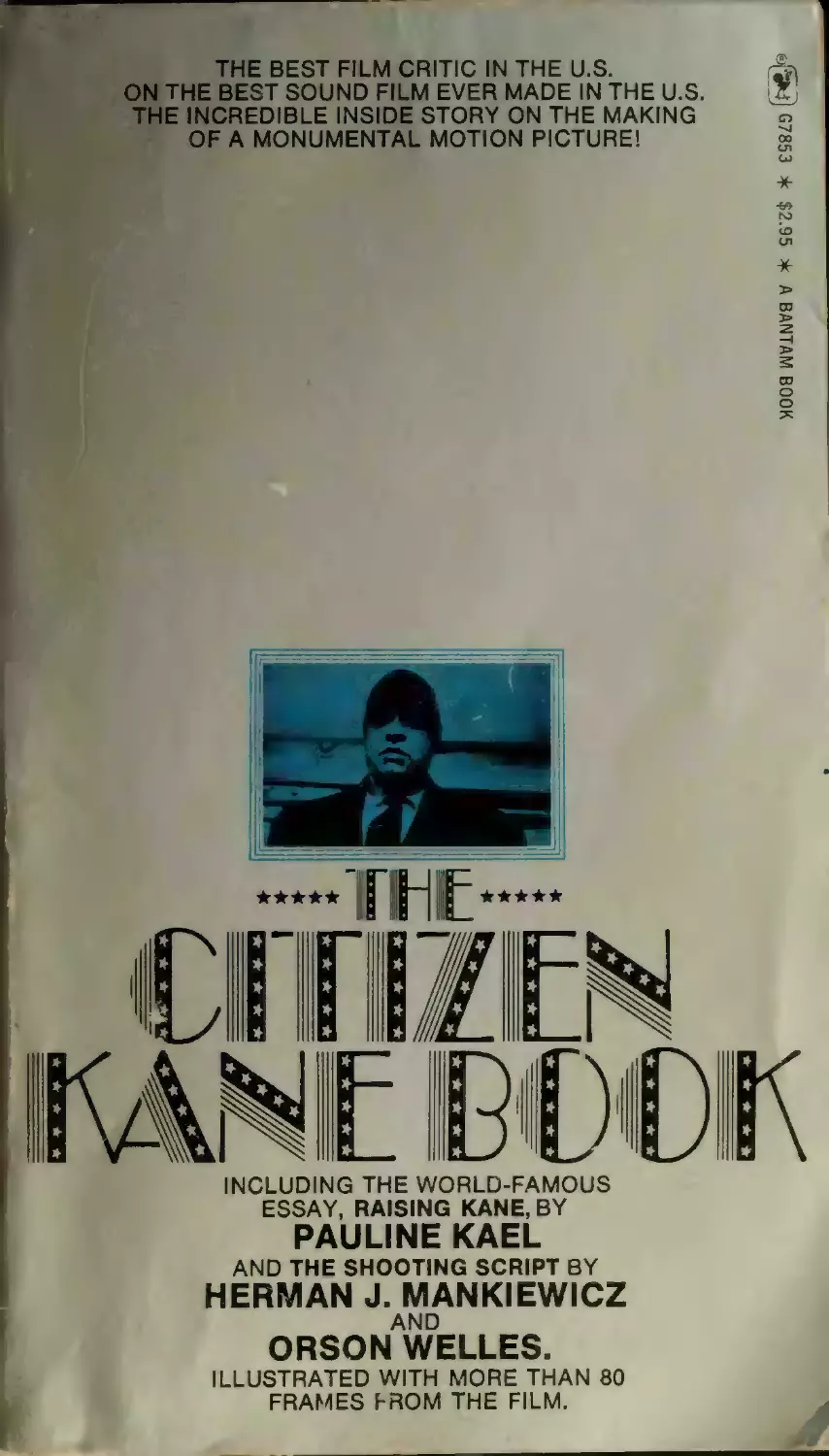
THE BEST FILM CRITIC IN THE U.S.
FILM EVER MADE IN THE U.S.
THE INCREDIBLE INSIDE STORY ON THE MAKING
OF A MONUMENTAL MOTION PICTURE!
ON THE BEST SOUND
*****
111
CR
I
B
R
IT
|~ HE*****
R
iff iWZtk^
R
HH iff
'iff
HID
llllfl
IIIIBL-
\m
\m
ID
^SM
i^m
^
I
eeoor
INCLUDING THE WORLD-FAMOUS
ESSAY, RAISING KANE, BY
PAULINE KAEL
AND THE SHOOTING SCRIPT BY
HERMAN J. MANKIEWICZ
AND
ORSON WELLES.
ILLUSTRATED WITH MORE THAN 80
FRAMES FROM THE
FILM.
,
"
THE
KANE
CITIZEN
BOOK
Cast of characters: Orson
Welles,
Herman
Mankiewicz, Joseph Cotten, Louella Parsons,
William Randolph Hearst,
Ben Hecht, Marion Davies,
Kaufman, Moss Hart and hundreds
Everett Shane,
Robert
George
Wise,
S.
more!
THE
KANE
CITIZEN
BOOK
"A
singular contribution to an interpretation
of the
of that time
whole world of
Thirties, to the literature
(as well as the films), to the
newspapers and writers and to the Holly-
wood of that
Citizen
period as well
Kane has got
to
.
.
.
The glory of
be seen
in
the
context of the time itself And really that is
what Pauline Kael has done. She has set that
who were not
film for us, enabling those
there to see
it
now
through her eyes. Her.
.
.
work has added a very great deal to the
knowledge we have of what exactly was
involved in the making of this masterpiece.
-Ralph Gleason, Rolling Stone
"A
richly detailed
and
the film's conception
repercussions
.
.
.
analytical account
of
and production and
Miss Kael gets at
reasons for the notoriety
and the
"
the
reality
behind many of the legends.
-Gary Arnold, Washington Post
m
^H
•
£<*o
THE
CITIZEN
KANE
BOOR
THE
CITIZEN
KANE
BOOR
RAISING
KANE
BY PAULINE KAEL
WITH ILL USTRA TIONS
THE SHOOTING
SCRIPT
BY HERMAN J. MANKIEWICZ AND ORSON WELLES
AND THE CUTTING CONTINUITY
OF THE COMPLETED FILM
BANTAM BOOKS
• NEW YORK • LONDON
TORONTO
THE CITIZEN KANE BOOK
A Bantam Book
PRINTING HISTORY
Atlantic Monthly /Little,
Bantam
Brown
edition published October 1971
edition published
March 1974
All rights reserved.
©
Copyright
1971 by Bantam Books
The introduction by Pauline Kael "Raising Kane" appeared
originally in The New Yorker; Copyright
1971 by Pauline
©
Kael.
Frames from "Citizen Kane" copyright 1941, renewed © 1968
by RKO Radio Pictures.
The notes on the shooting script were prepared by Gary Carey.
This book may not be reproduced in whole or in part, by
mimeograph or any other means, without permission.
For information address: Bantam Books, Inc.
Published simultaneously
in
the United States
and Canada
Bantam Books
are published by Bantam Books, Inc. Its trademark, consisting of the words "Bantam Books" and the portrayal of a bantam, is registered in the United States Patent
Office
Books,
and
Inc.,
in
other
countries.
666 Fifth Avenue,
Marca
New
Registrada.
York,
Bantam
New York
10019.
PRINTED IN THE UNITED STATES OF AMERICA
CONTENTS
RAISING KANE BY PAULINE KAEL
1
THE SHOOTING SCRIPT BY
HERMAN J. MANKIEWICZ & ORSON WELLES 127
NOTES ON THE SHOOTING
SCRIPT PREPARED BY
GARY CAREY 302
RKO CUTTING CONTINUITY OF THE
ORSON WELLES PRODUCTION, CITIZEN KANE 307
APPENDIX:
THE CREDITS OF HERMAN J. MANKIEWICZ 447
INDEX TO RAISING KANE 459
BOOKS BY PA ULINE KAEL
THE CITIZEN KANE BOOK
DEEPER INTO MO VIES
GOING STEADY
I L OST IT AT THE MO VIES
KISS KISS BANG
BANG
RAISING
KANE
BY PAULINE KAEL
^^itizen Kane
that
seems
fresher.
A
is
as fresh
perhaps the one American talking picture
as the day it opened. It may seem even
now
great deal in the
almost banal in
1941
is
movie that was conventional and
so far in the past as to have been
forgotten and become new. The Pop characterizations look
modern, and rather better than they did at the time. New
audiences may enjoy Orson Welles' theatrical flamboyance
even more than earlier generations did, because they're so
unfamiliar with the traditions it came out of. When Welles was
young - he was twenty-five when the film opened - he used
to be accused of "excessive showmanship," but the same
young audiences who now reject "theatre" respond innocently
and wholeheartedly to the most unabashed tricks of theatre —
and of early radio plays - in Citizen Kane. At some campus
showings, they react so gullibly that when Kane makes a
demagogic speech about "the underprivileged," stray students
will applaud enthusiastically, and a shout of "Right on!" may
be heard. Though the political ironies are not clear to young
audiences, and though young audiences don't know much
about the subject — William Randolph Hearst, the master jingo
them a stock villain, like Joe McCarthy;
without the contours of his particular villainy
— they nevertheless respond to the effrontery, the audacity,
and the risks. Hearst's career and his power provided a
journalist, being to
that
is,
a villain
dangerous subject that stimulated and energized all those
connected with the picture — they felt they were doing
something instead of just working on one more cooked-up
story that didn't relate to anything that mattered. And to the
particular kinds of people who shaped this enterprise the
dangers involved
made
the subject irresistible.
Citizen Kane, the film that, as Truffaut said,
the one that has started the largest
number
is
"probably
of filmmakers on
their careers," was not an ordinary assignment. It is one of the
few films ever made inside a major studio in the United States
in freedom — not merely in freedom from interference but in
freedom from the routine methods of experienced directors.
George J. Schaefer, who, with the help of Nelson Rockefeller,
had become president of R.K.O. late in 1938, when it was
struggling to avert bankruptcy, needed a miracle to save the
company, and after the national uproar over Orson Welles' The
War of the Worlds broadcast Rockefeller apparently thought
that Welles — "the wonder boy" — might come up with one,
and urged Schaefer to get him. But Welles, who was committed to the theatre and wasn't especially enthusiastic about
making movies, rejected the first offers; he held out until
Schaefer offered him complete control over his productions.
Then Welles brought out to Hollywood from New York his
own production unit — the Mercury Theatre company, a group
of actors and associates he could count on — and, because he
was inexperienced in movies and was smart and had freedom,
he was able to find in Hollywood people who had been waiting
all their lives to try out new ideas. So a miracle did come
about, though it was not the kind of miracle R.K.O. needed.
Kane does something so well, and with such spirit, that the
fullness and completeness of it continue to satisfy us. The
formal elements themselves produce elation; we are kept aware
of how marvellously worked out the ideas are. It would be
high-toned to call this method of keeping the audience aware
"Brechtian," and it would be wrong. It comes out of a
different tradition — the same commercial-comedy tradition
that Walter Kerr analyzed so beautifully in his review of the
1969 Broadway revival of The Front Page, the 1928 play by
Ben Hecht and Charles MacArthur, when he said, "A play was
held to be something of a machine in those days. ... It was a
machine for surprising and delighting the audience, regularly,
logically, insanely, but accountably. A play was like a watch
that laughed." The mechanics of movies are rarely as entertaining as they are in Citizen Kane, as cleverly designed to be
the kind of fun that keeps one alert and conscious of the
enjoyment of the
artifices themselves.
Walter Kerr goes on to describe the second-act entrance
prepared for Walter Burns, the scheming, ruthless managing
editor of The Front Page:
He
can't just
come on and
declare himself.
.
.
.
He's got to walk into
a tough situation in order to be brutally nonchalant, which
is
what we
think is funny about him. The machinery has not only given him and
the play the right punctuation, the change of pace that refreshes even as
moves on.
has also covered him, kept him from being obvious while
most obvious thing about him. You might say that
the machinery has covered itself, perfectly squared itself. We are
delighted to have the man on, we are delighted to have him on at this
time, we are aware that it is sleight-of-hand that has got him on, and we
are as delighted by the sleigh t-of-hand as by the man.
it
It
exploiting the one
Citizen
Kane
is
made up
and get their laughs and
us
the
to
next.
It
is
hit
number of such
make their points
of an astonishing
technique, and of sequences built to
bits of
climax just before a fast cut takes
practically
a
collection
sketches, but blackout sketches arranged to
of blackout
comment on each
was planned that way right in the shooting script.
what makes any great work great,
and particularly difficult with movies, and maybe more so
other, and
It
is
it
difficult to explain
with Citizen Kane than with other great movies, because
work of
it
depth or a work of subtle beauty. It is a
shallow work, a shallow; masterpiece. Those who try to
account for its stature as a film by claiming it to be profound
are simply dodging the problem - or maybe they don't
isn't a
special
one. Like most of the films of the
recognize that there
is
sound
called
era
that
are
masterpieces, Citizen
Kane has
audience gradually over the years rather than at the
time of release. Yet, unlike the others, it is conceived and
acted as entertainment in a popular style (unlike, say, Rules of
reached
its
the
Game
or
think of in
Rashomon
or
Man of Aran, which one
crowd-pleasing terms).
thing for people to do
work of
art is to trot
works of
art,
does not
Apparently, the easiest
when they recognize
that something is a
out the proper schoolbook terms for
and there are articles on Citizen Kane that call it
form and articles that explain that the hero
a tragedy in fugal
Kane
of Citizen
is
time
—
time being a proper sort of modern
hero for an important picture. But to use the conventional
schoolbook explanations for greatness, and pretend that it's
is to miss what makes it such an American triumph
manages to create something aesthetically exciting
and durable out of the playfulness of American muckraking
satire. Kane is closer to comedy than to tragedy, though so
overwrought in style as to be almost a Gothic comedy. What
profound,
—
that
it
might possibly be considered tragic in
it
has such a
Daddy
Warbucks quality that if it's tragic at all it's comic -strip tragic.
The mystery in Kane is largely fake, and the Gothic-thriller
atmosphere and the Rosebud gimmickry (though fun) are such
obvious penny-dreadful popular theatrics that they're not so
very different from the fake mysteries that Hearst's American
—
Weekly used to whip up
the haunted castles and the curses
"popular" masterpiece — not in
terms of actual popularity but in terms of its conceptions and
the way it gets its laughs and makes its points. Possibly it was
too complexly told to be one of the greatest commercial
fulfilled.
successes,
Citizen
is
a
we
but
become even
Kane
a
can't really tell whether it might have
modest success, because it didn't get a fair
chance.
^
2
^^rson
by with
Welles brought forth a miracle, but he couldn't get
it.
Though Hearst made some
interfere with the film,
it
wasn't so
direct attempts to
much what
he did that
hurt the film commercially as what others feared he might do,
them and to the movie industry. They knew he was
contemplating action, so they did the picture in for him; it was
as if they decided whom the king might want killed, and, eager
to
murder without waiting to be asked.
J. Schaefer was summoned to
York by Nicholas Schenck, the chairman of the board of
to oblige, performed the
Before Kane opened, George
New
Loew's International, the M-G-M
M-G-M
affiliate that
controlled the
had staked just about
everything on Welles, and the picture looked like a winner, but
now Schenck made Schaefer a cash offer from Louis B. Mayer,
the head of production at M-G-M, of $842,000 if Schaefer
would destroy the negative and all the prints. The picture had
actually cost only 5686,033; the offer handsomely included a
distribution of
fair
amount
pictures. Schaefer
for the post-production costs.
may have been partly friendship and loyalty
though Hearst, who had formerly been associ-
Mayer's motive
to Hearst, even
ated with
M-G-M, had, some years
earlier, after a dispute
Irving Thalberg. taken his investment out of
with
M-G-M and moved
Marion Davies, and his money to Warner Brothers.
lost money on a string of costume clinkers starring
Miss Davies (Beverly of Graustark. et al.), and had even lost
money on some of her good pictures, but Mayer had got free
publicity for M-G-M releases out of the connection with
Hearst, and had also got what might be called deep personal
satisfaction. In 1929, when Herbert Hoover invited the Mayers
to the White House - they were the first "informal" guests
after his inauguration - Hearst's New York American gave the
visit a full column. Mayer enjoyed fraternizing with Hearst and
his eminent guests; photographs show Mayer with Hearst and
Lindbergh, Mayer with Hearst and Winston Churchill. Mayer at
lunch with Bernard Shaw and Marion Davies - but they never,
oi course, show Mayer with both Hearst and Miss Davies.
Candid cameramen sometimes caught the two together, but
Hearst, presumably out of respect for his wife, did not pose in
his
star,
M-G-M had
groups
that
included
Miss
Davies.
Despite
the
publicity
showered on her in the Hearst papers, the forms were carefully
observed. She quietly packed and left for her own house on
the rare occasions when Mrs. Hearst, who lived in the East, was
expected to be in residence at San Simeon. Kane's infatuation
for the singer Susan Alexander in the movie was thus a public
flaunting of matters that Hearst was careful and considerate
about. Because of this. Mayer's longtime friendship for Hearst
was probably a lesser factor than the fear that the Hearst press
would reveal some sordid stories about the movie moguls and
join in one of those recurrent crusades against movie immorality, like the one that had destroyed Fatty Arbuckle's
The movie industry was frightened of reprisals. (The
movie industry is always frightened, and is always proudest of
films that celebrate courage.) As one of the trade papers
phrased it in those nervous weeks when no one knew whether
the picture would be released, "the industry could ill afford to
career.
be
made
the object of counterattack by the Hearst news-
papers."
There were rumors that Hearst was mounting a general
campaign; his legal staff had seen the script, and Louella
Parsons, the Hearst movie columnist, who had attended a
screening of the film flanked by lawyers, was agitated and had
swung into action. The whole industry, it was feared, would
take the rap for R.K.O. 's indiscretion, and, according to the
trade press at the time (and Schaefer confirms this report),
Mayer was not putting up the $842,000 all by himself. It was a
joint offer from the top movie magnates, who were combining
for common protection. The offer was presented to Schaefer
on the ground that it was in the best interests of everybody
concerned — which was considered to be the entire, threatened
industry
-
for Citizen
Schaefer refused.
Kane
to be destroyed. Rather astonishing-
He
didn't confer with his board of
he says, he had good reason to think they
would tell him to accept. He refused even though R.K.O., having
few theatres of its own, was dependent on the other companies
and he had been warned that the big theatre circuits — controlled
by the men who wanted the picture destroyed — would refuse to
ly,
directors, because,
show it.
Schaefer
knew
the spot he was
in.
The premiere had been
tentatively set for February 14th at the
Radio City Music Hall
showcase for big R.K.O. pictures, because
R.K.O. was partly owned by the Rockefellers and the Chase
National Bank, who owned the Music Hall. The manager of the
theatre had been enthusiastic about the picture. Then, suddenly, the Music Hall turned it down. Schaefer phoned Nelson
Rockefeller to find out why, and, he says, "Rockefeller told
me that Louella Parsons had warned him off it, that she had
asked him, 'How would you like to have the American Weekly
magazine section run a double-page spread on John D.
Rockefeller?' " According to Schaefer, she had also called
David Sarnoff, another large investor in R.K.O., and similarly
—
usually
the
threatened
him.
mid-February,
In
with a minor contract
dispute serving as pretext, the Hearst papers blasted R.K.O.
and Schaefer
in
front-page stories;
it
was an unmistakable
public warning. Schaefer was stranded; he had to scrounge for
amid the general fear that Hearst might sue and
would almost certainly remove advertising for any houses that
showed Citizen Kane, he couldn't get bookings. The solution
was for R.K.O. to take the risks of any lawsuits, but when the
company leased an independent theatre in Los Angeles and
refurbished the Palace (then a vaudeville house), which R.K.O.
owned, for the New York opening, and did the same for a
theatre R.K.O. owned in Chicago, Schaefer had trouble
theatres, and,
launching an advertising campaign. (Schenck, not surprisingly,
owned
a piece of the biggest movie-advertising agency.)
after the early rave reviews
and the
initial
couldn't get bookings except in the theatres that R.K.O.
owned and
in a
few small
Even
enthusiasm, Schaefer
itself
houses that were willing to take
art
the risk. Eventually, in order to get the picture into theatres,
Schaefer threatened to sue Warners', Fox, Paramount, and
Loew's on
the
it
a charge of conspiracy.
company heads had promised
in their theatres.)
(There was reason to believe
Hearst they wouldn't show
Warners' (perhaps afraid of exposure and
the troubles with their stockholders that might result from a
lawsuit)
gave
in
and booked the picture, and the others
—
followed, halfheartedly
picture but didn't play
By
or
in
some
cases, theatres paid for the
it.
then, just about everybody in the industry was scared,
mad, or
general
tired of the
reprisals
against
whole
thing,
the
industry
and though the feared
did
not take
place,
was getting bruised. The Hearst papers banned
publicity on R.K.O. pictures and dropped an announced
serialization of the novel Kitty Foyle which had been timed
for the release of the R.K.O. film version. Some R.K.O. films
didn't get reviewed and others got bad publicity. It was all
petty harassment, of a kind that could be blamed on the
overzealous Miss Parsons and other Hearst employees, but it
was obviously sanctioned by Hearst, and it was steady enough
to keep the industry uneasy.
R.K.O.
By
picture
the time Citizen
Kane got
into Warners' theatres, the
had acquired such an odd reputation that people
8
seemed to
distrust
it,
and
it
didn't
do very
well.
It
was
subsequently withdrawn from circulation, perhaps because of
the vicissitudes of R.K.O., and until the late fifties, when it
was reissued and began to play in the art houses and to attract
new audience, it was seen only in pirated versions in 16 mm.
Even after Mayer had succeeded in destroying the picture
commercially, he went on planning vengeance on Schaefer for
refusing his offer. Stockholders in R.K.O. began to hear that
the company wasn't prospering because Schaefer was antiSemitic and was therefore having trouble getting proper
distribution for R.K.O. pictures. Schaefer says that Mayer
wanted to get control of R.K.O. and that the rumor was
a
created to drive down the price of the stock — that Mayer
hoped to scare out Floyd Odium, a major stockholder, and
buy his shares. Instead, Odium, who had opposed Nelson
Rockefeller's choice of Schaefer to run the company, bought
enough of Sarnoff's stock to have a controlling interest, and
by mid-1942 Schaefer was finished at R.K.O. Two weeks after
he left, Welles' unit was evicted from its offices on the lot and
given a few hours to move out, and the R.K.O. employees who
had worked with Welles were punished with degrading assignments on B pictures. Mayer's friendship with Hearst was not
ruffled. A few years later, when Mayer left his wife of forty
years, he rented Marion Davies' Beverly Hills mansion. Eventually, he was one of Hearst's honorary pallbearers. Citizen Kane
didn't actually lose money, but in Hollywood bookkeeping it
wasn't a big enough moneymaker to balance the scandal.
3.
w,
'elles
tive
is
was recently quoted
experience; cinema
is
the
as saying,
an extraordinary remark from the
Mercury Theatre
players
to
'Theatre
work of one
a collec-
is
single person." This
man who brought
Hollywood
(fifteen
his
of
own
them
appeared in Citizen Kane), and also the Mercury co-producer
John Houseman, the Mercury composer Bernard Herrmann,
and various assistants, such as Richard Wilson, William Alland,
and Richard Barr. He not only brought his whole supportive
group - his family, he called them then - but found people in
Hollywood, such as the cinematographer Gregg Toland, to
contribute their knowledge and gifts to Citizen Kane. Orson
some marvellous
Welles has done
things in his later movies -
- and
there is more depth in the somewhat
great things
botched The Magnificent Ambersons, of 1942 (which also
used many of the Mercury players), than in Citizen Kane, but
his principal career in the movies has been in adaptation, as it
was earlier on the stage. He has never again worked on a
subject with the immediacy and impact of Kane. His later
films — even those he has so painfully struggled to finance out
of his earnings as an actor - haven't been conceived in terms
some
of daring modern subjects that excite us, as the very idea of
Kane excited us. This particular kind of journalist's sense of
what would be a scandal as well as a great subject, and the
belonged not to Welles but to his now
Herman J. Mankiewicz, who wrote
the script, and who inadvertently destroyed the picture's
chances. There is a theme that is submerged in much of Citizen
Kane but that comes to the surface now and then, and it's the
Unking life story of Hearst and of Mankiewicz and of Welles —
the story of how brilliantly gifted men who seem to have
ability
to write
it,
almost forgotten associate
everything
It's
it
takes to do what they want to do are defeated.
the story of
The Hearst
how
heroes become comedians and con
papers
considered this a
fit
artists.
- Hearst may have
an actor - though they
ignored Welles
punishment for
attacked him indirectly with sneak attacks on those associated
with him, and Hearst would frequently activate his -secular
arm, the American Legion, against him. But the Hearst papers
worked Mankiewicz over
in headlines;
they persecuted him so
long that he finally appealed to the American Civil Liberties
Union
for
help.
There was some primitive
justice
in
this.
Hearst had never met Welles, and, besides, Welles was a kid, a
twenty-five-year-old prodigy (whose daughter Marion Davies'
nephew was bringing up) - hardly the
sort of person one held
But Mankiewicz was a friend of both Marion
Davies and Hearst, and had been a frequent guest at her beach
house and at San Simeon. There, in the great baronial banquet
hall, Hearst liked to seat Mankiewicz on his left, so that
Mankiewicz, with all his worldliness and wit (the Central Park
West Voltaire, Ben Hecht had called him a few years earlier),
could entertain the guest of honor and Hearst wouldn't miss
any of it. Mankiewicz betrayed their hospitality, even though
responsible.
JO
he liked them both. They must have presented an irresistible
target. And so Hearst, the yellow-press lord who had trained
Mankiewicz's generation of reporters to betray anyone for a
became at last the victim of his own style of journalism.
story,
in
Academy Award ceremony, for 1927-28, Warner
which had just produced The Jazz Singer, was
honored for "Marking an Epoch in Motion Picture History." If
the
first
Brothers,
decade of talkies — roughly, the thirties — has never
and exuberance, this is very largely because
there was already in Hollywood in the late silent period a
nucleus of the best American writers, and they either lured
their friends West or were joined by them. Unlike the novelists
the
first
been
rivalled in wit
who were drawn to Hollywood later, most of the best
Hollywood writers of the thirties had a shared background;
they had been reporters and critics, and they knew each other
from their early days on newspapers and magazines.
In his autobiography, Ben Hecht tells of being broke in
New York — it was probably the winter of 1926 — and of
getting a telegram from Herman Mankiewicz in Hollywood:
WILL YOU ACCEPT THREE HUNDRED PER WEEK TO WORK FOR
PARAMOUNT PICTURES? ALL EXPENSES PAID. THE THREE
HUNDRED IS PEANUTS. MILLIONS ARE TO BE GRABBED OUT
HERE AND YOUR ONLY COMPETITION IS IDIOTS. DON'T LET
THIS GET
AROUND.
A newspaper photograph shows Mankiewicz greeting Hecht,
"noted author, dramatist, and former newspaperman," upon
his arrival. After Hecht had begun work at Paramount, he
- who at that
money - had been
discovered that the studio chief, B. P. Schulberg
time
considered
writers
a
waste
of
persuaded to hire him by a gambler's ploy: Mankiewicz had
offered to tear up his own two-year contract if Hecht failed to
write a successful movie. Hecht, that phenomenal fast hack
who was to become one of the most prolific of all motionpicture writers (and one of the most frivolously cynical about
the results), worked for a week and turned out the script that
became Josef von Sternberg's great hit Underworld. That
script brought Hecht the first Academy Award for an original
11
and
few years
he initiated the practice of using
knew what they had in
Hecht as soon as they read the script, and they showed their
gratitude. Hecht has recorded:
story,
a
later
Oscars as doorstops. The studio heads
I was given a ten-thousand-dollar check as a bonus for the week's
work, a check which my sponsor Mankiewicz snatched out of my hand
as I was bowing my thanks.
"You'll have it back in a week," Manky said. "I just want it for a
few days to get me out of a little hole."
He gambled valiantly, tossing a coin in the air with Eddie Cantor
and calling heads or tails for a thousand dollars. He lost constantly. He
tried to get himself secretly insured behind his good wife Sara's back,
planning to hock the policy and thus meet his obligation. This plan
collapsed when the insurance-company doctor refused to accept him as
a risk.
I finally solved the situation by taking Manky into the Front Office
and informing the studio bosses of our joint dilemma. I asked that my
talented friend be given a five-hundred-a-week raise. The studio could
then deduct this raise from his salary
I left
with another full bonus check in my hand; and Manky,
with his new raise, became the highest paid writer for Paramount
.
.
.
Pictures, Inc.
The
was money, but those
had thenown reason: conviviality. Mankiewicz's small joke "Don't let
this get around" came from a man who lived for talk, a man
who saw moviemaking as too crazy, too profitable, and too
bait that
writers
who,
like
brought the writers
in
Mankiewicz, helped
set the traps
By the early thirties, the
Hollywood or commuted there included
not only Mankiewicz and Hecht and Charles MacArthur but
George S. Kaufman and Marc Connelly, and Nathanael West
easy not to share with one's friends.
writers
who
lived in
Perelman, and Preston Sturges,
Kober, Alice Duer Miller, John
O'Hara, Donald Ogden Stewart, Samson Raphaelson (the New
York Times reporter who wrote the play The Jazz Singer),
Gene Fowler, and Nunnally Johnson, and such already famous
playwrights as Philip Barry, S."N. Behrman, Maxwell Ander-
and
his
Dorothy
son,
brother-in-law S.
Parker,
J.
Arthur
Robert E. Sherwood, and Sidney Howard. Scott Fitz-
gerald had already been there for his
first
stretch, in
1927,
along with Edwin Justus Mayer, and by 1932 William Faulkner
began coming and going, and from time to time Ring Lardner
and Moss Hart would turn up. In earlier periods, American
12
made
writers
forties
and
on newspapers and magazines; in the
they went into the academies (or, once they
a living
fifties,
got to college, never left). But in the late twenties and the
they went to Hollywood.
thirties
they one and
all
experienced
it
And
though, apparently,
as prostitution of their talents
—
joyous prostitution in some cases — and though more than
one fell in love with movies and thus suffered not only from
personal frustration but from the corruption of the great, still
new art, they nonetheless as a group were responsible for that
sustained feat of careless magic we call "thirties comedy."
Citizen
Kane
H,Lerman
was the
J.
was,
I
think,
its
culmination.
Mankiewicz, born
in
New York
son of a professor of education,
City in 1897,
who
then took a
where his second son,
Joseph L. Mankiewicz, was born in 1909, and where the boys
and a sister grew up. Herman Mankiewicz graduated from
Columbia in 1916, and after a period as managing editor of the
American Jewish Chronicle he became a flying cadet with the
United States Army in 1917 and, in 1918, a private first class
with the Fifth Marines, 2nd Division, A.E.F. In 1919 and
1920, he was the director of the American Red Cross News
Service in Paris, and after returning to this country to marry a
great beauty, Miss Sara Aaronson, of Baltimore, he took his
bride overseas with him while he worked as a foreign correspondent in Berlin from 1920 to 1922, doing political
reporting for George Seldes on the Chicago Tribune. During
that time, he also sent pieces on drama and books to the New
York Times and Women's Wear. Hired in Berlin by Isadora
Duncan, he became her publicity man for her return to
America. At home again, he took a job as a reporter for the
New York World. He was a gifted, prodigious writer, who
contributed to Vanity Fair, the Saturday Evening Post, and
first
teaching
many
position
other
in
Wilkes-Barre,
magazines,
and,
while
still
in
his
twenties,
Hey wood Broun, Dorothy Parker, Robert E.
Sherwood, and others on a revue (Round the Town), and
collaborated with George S. Kaufman on a play (The Good
Fellow) and with Marc Connelly on another play (The Wild
collaborated with
13
Borneo). From 1923 to 1926, he was at the Times,
backing up George S. Kaufman in the drama department;
while he was there, he also became the first regular theatre
critic for The New Yorker, writing weekly from June, 1925,
until January, 1926, when Walter Wanger offered him a
Man of
motion-picture contract and he
picture he wrote was the
left for
Lon Chaney
Hollywood. The
success The
first
Road
to
Mandalay. In all, he worked on over seventy movies. He went on
living and working in Los Angeles until his death, in 1953. He
left three children: Don, born in Berlin in 1922, who is a novelist
(Trial) and a writer for the movies (co-scenarist of / Want to
Live!) and television ("Marcus Welby, M.D."); Frank, born in
New York in 1924, who became a lawyer, a journalist, a Peace
Corps worker, and Robert Kennedy's press assistant, and is now
a columnist and television commentator; and Johanna, born in
Los Angeles in 1937, who is a journalist (on Time) and is married
to Peter Davis, the writer-producer of "The Selling of the
Pentagon."
Told this way, Herman Mankiewicz's career sounds ex-
emplary, but these are just the bare bones of the truth. Even
though
it
would be easy to document
apparently rising young
in his Berlin
man
this official life of the
with photographs of Mankiewicz
days dining with the Chancellor, Mankiewicz
in
newspaperman days outside the Chicago Tribune with Jack
Dempsey, and so on, it would be hard to explain his sudden,
his
early aging
and the thickening of
his features
and the
trans-
parently cynical look on his face in later photographs.
It
job
was
a
lucky thing for Mankiewicz that he got the movie
when he
did, because he
would never have
Times, and though he wrote regularly for The
(and remarked of those of the Algonquin group
risen at the
New
who
Yorker
didn't,
"The part-time help of wits is no better than the full-time help
of half-wits"), The New Yorker, despite his pleas for cash, was
paying him partly in stock, which wasn't worth much at the
time. Mankiewicz drank heavily, and the drinking newspaperman was in the style of the World but not in the style of
the Times. In October, 1925, he was almost fired. The drama
critic then was Brooks Atkinson, and the drama editor was
George S. Kaufman, with Mankiewicz second in line and Sam
Zolotow third. Mankiewicz was sent to cover the performance
14
of Gladys Wallis,
Insull,
who was
the wife of the utilities magnate
Lady Teazle in School for Scandal. Mrs.
who had abandoned her theatrical career over a quarter
Samuel
Insull, as
of a century before, was, according to biographers, bored with
being a
nobody when her husband was such a big somebody.
fifty-six when she resumed her career, as Lady Teazle,
meant to be about eighteen. The play had opened in
She was
who
is
Chicago, where, perhaps astutely, she performed for charity
(St.
Luke's Hospital), and the press had described her as
The night of the New York opening, Mankiewicz
brilliant.
came back to the
office drunk, started panning Mrs. Insull's
fell asleep over his typewriter. As
Zolotow recalls it, "Kaufman began to read the review, and it
was so venomous he was outraged. That was the only time I
ever saw Kaufman lose his temper." The review wasn't printed.
The Times suffered the humiliation of running this item on
October 23, 1925:
performance, and then
A NEW SCHOOL FOR SCANDAL
The School for Scandal, with Mrs. Insull
produced at the Little Theatre last night. It
tomorrow's Times.
as
Lady Teazle, was
will
be reviewed
in
Mankiewicz was in such bad shape that night that Kaufman
Zolotow to call Sara Mankiewicz and have her come get
him and take him home. Mrs. Mankiewicz recalls that he still
had his head down on his typewriter when she arrived, with a
friend, to remove him. She says he took it for granted that he
was fired, but nevertheless went to work promptly the next
day. Zolotow recalls, "In the morning, Herman came down to
the office and asked me to talk to Mr. Birchall, the assistant
managing editor, on his behalf. Herman had brought a peace
offering of a bottle of Scotch and I took it to Birchall. He had
a red beard, and he tugged at it and he stabbed the air a few
times with his index finger and said, 'Herman is a bad boy, a
bad boy.' But he took the bottle and Herman kept his job
until he got the movie offer."
The review - unsigned - that the Times printed on
October 24, 1925, was a small masterpiece of tact:
told
As Lady Teazle, Mrs. Insull is as pretty as she is diminutive, with a
and dainty gestures. There is a charming grace in her bearing
clear smile
15
makes for excellent deportment. But this Lady Teazle seems much
too innocent, too thoroughly the country lass that Joseph terms her, to
lend credit to her part in the play.
that
Scattered through various books, and in the stories that are
still
told
him
in
Hollywood,
are clues that begin to give
one
Herman Mankiewicz, a giant of a man who
mongered his own talent, a man who got a head start in the
race to "sell out" to Hollywood. The pay was fantastic. After
a month in the movie business, Mankiewicz - though his
a
picture
of
Broadway shows had not been hits, and though this was in
1926, when movies were still silent - signed a year's contract
giving him $400 a week and a bonus of $5,000 for each story
that was accepted, with an option for a second year at $500 a
week and $7,500 per accepted story, the company
guaranteeing to accept at least four stories per year. In other
words, his base pay was $40,800 his
second; actually, he wrote so
many
first
year and $56,000 his
stories that he
made much
more. By the end of 1927, he was head of Paramount's
scenario department, and in January, 1928, there was a
newspaper item reporting that he was in New York "lining up
a new set of newspaper feature writers and playwrights to
bring to Hollywood," and that "most of the newer writers on
Paramount's staff who contributed the most successful stories
of the past year were selected by Mank.'"One reason that
4
Herman Mankiewicz
is
so
little
known today
is,
ironically, that
he went to Hollywood so early, before he had gained a big
enough reputation
in
the literary and theatrical worlds. Screen-
make names for themselves; the most famous
ones are the ones whose names were famous before they went
to Hollywood, or who made names later in the theatre or from
books, or who, like Preston Sturges, became directors.
writers don't
Mankiewicz and other New Yorker writers in the twenties
and the early thirties were very close to the world of the
theatre; many of them were writing plays, writing about
•
theatre people, reviewing plays.
It's
not surprising that within
few years the magazine's most celebrated contributors were
in Hollywood writing movies. Of the ten friends of the editor
Harold Ross who were in the original prospectus as advisory
editors, six became screenwriters. When Mankiewicz gave up
the drama critic's spot, in 1926, he was replaced by Charles
a
16
Brackett, and
filled
the
it
when Brackett headed West, Robert Benchley
while commuting, and then followed. Dorothy Parker,
book reviewer Constant Reader, went West, too. Nunnally
who was to work on over a hundred movies, was a
Johnson,
close friend of Harold Ross's and had volunteered to do the
movie reviewing in 1926 but had been told that that job was
for "old ladies and fairies." Others in the group didn't agree:
Benchley had written on movies for the old Life as early as
1920, and John O'Hara later took time out from screenwriting
become the movie critic for Newsweek - where he was to
to
review Citizen Kane. The whole group were interested in the
theatre and the movies, and they were fast, witty writers, used
to regarding their
work not
as deathless prose
but as stories
written to order for the market, used also to the newspaper-
man's pretense of 'putting a light value on what they did - the
"Look, no hands" attitude. Thus, they were well prepared to
become the scenarists and gag writers of the talkies.
6.
>he comic
was
a
muse of the most popular "daring"
carefree,
wise-cracking flapper.
late silents
Beginning in
Herman Mankiewicz worked on an astounding number
in that spirit. In
1927 and 1928, he did the
titles
1926,
of films
(the printed
dialogue and explanations) for at least twenty-five films that
starred
Ralston,
Clara
Bow,
George
Bebe
Bancroft,
Nancy Carroll,
Thomas Meighan, Jack
Daniels,
Esther
Holt,
Richard Dix, Wallace Beery, and other public favorites. He
worked on the titles for Jules Furthman's script of Abie 's Irish
Rose, collaborated with Anita Loos on the wisecracks for
Gentlemen Prefer Blondes, and did the immensely successful
The Barker and The Canary Murder Case, with William Powell,
Louise Brooks, James Hall, and Jean Arthur. By then, sound
had come in, and in 1929 he did the script as well as the
dialogue for The Dummy, with Ruth Chatterton and Fredric
March (making his screen debut), wrote William Wellman's The
Man I Love, with Richard Arlen, Pat O'Brien, and Mary Brian,
and worked for Josef von Sternberg and many other directors.
Other screenwriters made large contributions, too, but
probably none larger than Mankiewicz's at the beginning of
1 7
sound
he
was
that time one of the
was because he wrote the
kind of movies that were disapproved of as "fast" and
immoral. His heroes weren't soft-eyed and bucolic; he brought
good-humored toughness to the movies, and energy and
astringency. And the public responded, because it was eager
for modern American subjects. Even those of us who were
the
era,
and
if
highest-paid writers in the world,
at
it
children at the time loved the fast-moving modern-city stories.
The commonplaceness — even tawdriness — of the imagery was
such a relief from all that silent "poetry." The talkies were a
great step down. It's hard to make clear to people who didn't
live
through the transition
how
sickly
those "artistic" silent pictures were
and unpleasant many of
— how you wanted to
that mist and sentiment.
from the time the motion-picture camera was
invented, there had been experiments with sound and attempts
at synchronization, and the public was more than ready for
talking pictures. Many of the late silents, if one looks at them
now, seem to be trying to talk to us, crying out for sound.
Despite the legend of paralysis of the medium when sound
first came in, there was a burst of inventiveness. In musicals,
directors like Rene Clair and, over here, Ernst Lubitsch and,
to a lesser degree, Rouben Mamoulian didn't use sound just for
lip synchronization; they played with sound as they had
played with images, and they tried to use sound without losing
scrape off
all
Almost
the
movement
of silents or the daring of silent editing.
Some
of the early talkies were static and inept; newly imported
if the space were
and the technicians had to learn to handle the
microphones. But movies didn't suddenly become stagebound
because of the microphone. Many of the silents had always
been stagebound, for the sufficient reason that they had been
adapted from plays - from the war-horses of the repertory,
because they had proved their popularity, and from the latest
Broadway hits, because the whole country wanted to see
them. The silent adaptations were frequently deadly, not just
because of construction based on the classical unities, with all
those entrances and exits and that painful emptiness on the
screen of plays worked out in terms of absolutely essential
stage directors literally staged the action, as
stage space,
characters only, but because everything kept stopping for the
18
and the dialogue titles.
movies adapted from novels or written directly
for the screen, the action rarely went on for long; silents were
choked with titles, which were perhaps, on the average,
between ten and twenty times as frequent as the interruptions
for TV commercials. The printed dialogue was often witty,
and often it was essential to an understanding of the action,
but it broke up the rhythm of performances and the visual
flow, and the titles were generally held for the slowest readers,
so that one lost the mood of the film while staring at the
dialogue for the third scanning. (It seems to me, thinking back
on it, that we were so eager for the movie to go on that we
gulped the words down and then were always left with them
for what, to our impatience, seemed an eternity, and that the
better the movie, the more quickly we tried to absorb and leap
past the printed words, and the more frustrating the delays
became.) The plain fact that many silent movies were plays
without the spoken dialogue, plays deprived of their very
substance, was what made the theatre-going audience — and
the Broadway crowd of writers — so contemptuous of them.
Filmed plays without the actors' voices, and with the deadening delays for the heterogeneous audience to read the dialogue,
were an abomination. Many of the journalists and playwrights
and wits of the Algonquin Round Table had written perceptively about motion pictures (Alexander Woollcott, who
managed to pan some of the greatest films, was an exception);
they had, in general, been cynical only about the slop and the
silent filmed plays. But though they had been active in the
theatre, there had been no real place for them in movies; now,
with the introduction of sound, they could bring to the screen
the impudence that had given Broadway its flavor in the
twenties — and bring it there before the satirical references
were out of date. Sound made it possible for them to liberate
movies into a new kind of contemporaneity.
explanatory
Even
titles
in the
Lhere is an elaborate body of theory that treats film as
"the nocturnal voyage into the unconscious," as Luis Bunuel
called it, and for a director such as Bunuel "the cinema seems
to have been invented to express the life of the subconscious."
19
Some
work of D. W.
of the greatest
Griffith
and other masters
of the silent film has a magical, fairy-tale appeal, and certainly
Surrealists like Bunuel,
and other experimental and avant-garde
have drawn upon this dreamlike vein of
film. But these artists were the exceptions; much of the
dreamy appeal to the "subconscious" and to "universal" or
filmmakers
as well,
"primitive" fantasies was an appeal to the most backward, not
to say reactionary, elements of illiterate
society.
There was
a
and semi-literate mass
steady load of calendar-art guck that
patronized "the deserving poor" and idealized "purity" (i.e.,
and "morality " (i.e., virginity plus charity). And all
virginity)
that
is
only one kind of movie anyway. Most of the dream
theory of film, which takes the audience for passive dreamers,
doesn't apply to the
which,
when
they
way one responded
were
good,
heightened state of consciousness.
kept
to silent
the
When we
comedies -
audience
in
a
join in laughter,
as if the lights were on in the theatre. And not just the
Mack Sennett comedies and Keaton and Chaplin kept us fully
it's
awake but the spirited, bouncy comediennes, like Colleen
Moore and Marion Davies, and the romantic comedy "teams,"
and the suave, "polished" villains, like William Powell. My
favorite movies as a child were the Bebe Daniels comedies - I
suppose they were the movie equivalent of the series books
one reads at that age. During 1927 and 1928, Paramount
brought a new one out every few months; Bebe, the athletic
madcap, would fence like Douglas Fairbanks, or she would
parody Valentino by kidnapping and taming a man, or she
might be a daredevil newsreel camerawoman or a cub reporter.
I
did not know until 1 started to look into the writing of
Citizen Kane that the man who wrote Kane had worked on
some of those pictures, too - that Mankiewicz had, in fact,
or with others) about forty of the films
from the twenties and thirties (as well as many
I
didn't see or don't remember). Mankiewicz didn't work on
every kind of picture, though. He didn't do Westerns, and
once, when a studio attempted to punish him for his customary misbehavior by assigning him to a Rin Tin Tin picture,
he turned in a script that began with the craven Rin Tin Tin
frightened by a mouse and reached its climax with a house on
fire and the dog taking a baby into the flames. I had known
written
(alone
remember
I
best
20
about Mankiewicz's contribution to Kane and a few other
but I hadn't realized how extensive his career was. I had
known that he was the producer of Million Dollar Legs (with
films,
and Jack Oakie and Lyda Roberti) and Laughter
Nancy Carroll), but I hadn't known,
for example, that he had produced two of the Marx Brothers
W.
C. Fields
(with Fredric March and
films that I've always especially liked, the
Hollywood and written
first
two made
directly for the screen
in
— Monkey
— and part of Duck Soup as well.
few years ago, some college students asked me what films I
would like to see again just for my own pleasure, and without
a second's thought I replied Duck Soup and Million Dollar
Legs, though at that time I had no idea there was any
connection between them. Yet surely there is a comic spirit
that links them — even the settings, Freedonia and Klopstokia,
with Groucho as Prime Minister of one and Fields as President
of the other — and now that I have looked into Herman
Mankiewicz's career it's apparent that he was a key linking
figure in just the kind of movies my friends and I loved best.
Business and Horse Feathers
A
When
the period of the great silent comedians, with their
audience, was over, a new style of American
comedy developed. One couldn't really call a colloquial,
skeptical comedy a "masterpiece," as one could sometimes call
a silent comedy a masterpiece, especially if the talkie looked
international
quite banal and
many
was so topical
it
felt transient.
But
I
think that
of us enjoyed these comedies more, even though
not have
felt
we may
very secure about the aesthetic grounds for our
enjoyment. The talking comedies weren't as aesthetically pure
as the silents, yet they felt liberating in a way that even great
silents didn't. The elements to which we could respond were
multiplied; now there were vocal nuances, new kinds of
timing, and wonderful new tricks, like the infectious way
Claudette Colbert used to break up while listening to someone.
easy to see why Europeans, who couldn't follow the slang
and the jokes and didn't understand the whole satirical frame
of reference, should prefer our action films and Westerns. But
it's a bad joke on our good jokes that film enthusiasts here
often take their cues on the American movie past from
Europe, and so they ignore the tradition of comic irreverence
and become connoisseurs of the "visuals" and "misesen scene"
It's
21
of action pictures, which are usually too
reactionary. They're sub-reactionary
-
silly
even to be called
the antique melodramas
- a mass art better suited, one
might think, to Fascism, or even feudalism, than to democracy.
of silent days with noise added
There
is
another reason the American talking comedies,
despite their popularity, are so seldom valued highly by film
aestheticians.
beautiful
"artist"
The dream-art kind of
visual
imagery,
director,
while
film,
generally
is
astringent
the
which lends
itself to
creation
of the
the
film
is
directed by a competent, unpretentious craftsman
made
good by
good
more often
who
can be
and can be turned
into a bum by a bad script. And this competent craftsman may
be too worldly and too practical to do the "imaginative" bits
that sometimes helped make the reputations of "artist"
directors. Ben Hecht said he shuddered at the touches von
Sternberg introduced into Underworld: "My head villain, Bull
Weed, after robbing a bank, emerged with a suitcase full of
money and paused in the crowded street to notice a blind
beggar and give him a coin - before making his getaway."
to look very
Herman Mankicwicz on
a
script
the set of Laughter, with Diane Ellis
Carroll, and, at the piano, Fredric
Mareh.
22
and Nancv
That's exactly the sort of thing that quantities of people react
to emotionally as
"deep" and
enthusiasts treasure
drip.
The
thirties,
—
as "art,"
and that many film
the inflated sentimental with a mystical
though they had
their
own
load of senti-
mentality, were the hardest-headed period of American movies,
and their plainness of
style,
with
its
absence of false "cultural"
due aesthetically. Film students —
and their teachers — often become interested in movies just
because they are the kind of people who are emotionally
affected by the blind-beggar bits, and they are indifferent by
temperament to the emancipation of American movies in the
thirties and the role that writers played in it.
I once jotted down the names of some movies that I didn't
associate with any celebrated director but that had nevertheless stayed in my memory over the years, because something in
them had especially delighted me - such rather obscure
movies as The Moon's Our Home (Margaret Sullavan and
Henry Fonda) and He Married His Wife (Nancy Kelly, Joel
McCrea, and Mary Boland). When I looked them up, I
discovered that Dorothy Parker's name was in the credits of
The Moon's Our Home and John O'Hara's in the credits of He
Married His Wife. Other writers worked on those films, too,
and perhaps they were the ones who were responsible for what
I responded to, but the recurrence of the names of that group
of writers, not just on rather obscure remembered films but on
almost all the films that are generally cited as proof of the
vision and style of the most highly acclaimed directors of that
period, suggests that the writers - and a particular group of
them, at that — may for a brief period, a little more than a
decade, have given American talkies their character.
overtones, has never got
its
8.
T.
»here
broaden
whether
always a time lag in the way movies take over (and
and emasculate) material from the other arts -
is
it
is last
season's stage success or the novels of the
preceding decade or a style or an idea that has run
its original medium. (This does not apply to
its
a
course in
man
like
Jean-Luc Godard, who is not a mass-medium movie director.)
In most productions of the big studios, the time lag is
enormous. In the thirties, after the great age of musical
23
comedy and
burlesque, Hollywood, except for Paramount, was
just discovering
Clifton
huge operettas. After the Broadway days of
Webb, Fred
Astaire, the
Marx Brothers, Fanny
Brice,
and all the rest, M-G-M gave us Nelson Eddy and
Jeanette MacDonald, and Universal gave us Deanna Durbin.
W.
C. Fields,
This
is
the history of movies.
J.
D. Salinger has finally
come
to
through his imitators, and Philip Roth's fifties
romance arrived at the end of the sixties. It may be that for
new ideas to be successful in movies, the way must be
prepared by success in other media, and the audience must
have grown tired of what it's been getting and be ready for
something new. There are always a few people in Hollywood
who are considered mad dreamers for trying to do in movies
things that have already been done in the other arts. But once
one of them breaks through and has a hit, he's called a genius
and everybody starts copying him.
The new spirit of the talkies was the twenties moved West
in the thirties. George S. Kaufman was writing the Marx
Brothers stage shows when he and Mankiewicz worked together at the Times; a little later, Kaufman directed the first
Broadway production of The Front Page. Kaufman's colthe
screen
Broadway plays
laborators on
thirties
in the
twenties and the early
included Marc Connelly, Edna Ferber, Ring Lardner,
Morrie Ryskind, and Moss Hart as well as Mankiewicz - the
nucleus of the Algonquin-to-Holly wood group. Nunnally John-
men he has ever known
Kaufman and Herman Mankiewicz, and that,
whole, Mankiewicz was the more brilliant of the two.
son says that the two most brilliant
were George
on the
S.
I
think that what Mankiewicz did
in
movies was an offshoot of
the gag comedy that Kaufman had initiated on Broadway;
Mankiewicz spearheaded the movement of that whole Broad-
way
style
of
entertainment
wisecracking,
fast-talking,
cynical-sentimental
onto the national scene. Kaufman's kind of
impersonal, visionless comedy, with
its
single goal of getting
the audience to laugh, led to the degeneration of the Broad-
way
theatre, to
its
play doctors and gimmickry and scatter-
would be easy to
it
came out of it. But don't
same when this type of comedy was
shot jokes at defenseless targets, and so
look
down on
the movie style that
think the results were the
I
transplanted to movies; the only bad long-range consequences
24
were to the writers themselves.
Kaufman fathered
a
movement
that
so unmistakably the
is
bastard child of the arts as to seem fatherless; the gag
was perfectly suited to the commercial mass
so that
it
suited the
than
it
art
comedy
of the movies,
appears to be an almost inevitable development.
low
common denominator
It
of the movies even better
the needs of the relatively selective theatre
suited
audience, and the basic irresponsibility of this kind of theatre
combined with the screenwriters' lack of control over their
own writing to produce what one might call the brothel period
of American letters. It was a gold rush, and Mankiewicz and
his friends had exactly the skills to turn a trick. The
journalists' style of working fast and easy and working to
order and not caring too much how it was butchered was the
best kind of apprenticeship for a Hollywood hack, and they
had loved to gather, to joke and play games, to lead the
histrionic
forms of the glamorous
literary life.
Now they
were
gathered in cribs on each studio lot, working in teams side by
side,
meeting for lunch
Chasen's,
which
at the
commissary and for dinner at
and editor Harold Ross had
their old friend
helped finance, and
all
over town for drinks. They adapted
each other's out-of-date plays and novels, and rewrote each
other's scripts. Even in their youth in New York, most of them
had indulged
in
"collaborators"
what for them proved
— dependent on
of joint authorship, which usually
a vice:
they were
the fun and companionship
means
a shared shallowness.
Now
they collaborated all over the place and backward in
time; they collaborated promiscuously, and within a few years
were rewriting the remakes of their own or somebody else's
Mankiewicz adapted Kaufman and Ferber's The
Royal Family and Dinner at Eight, turned Alice Duer Miller's
Come Out of the Kitchen into Honey, and adapted George
Kelly's The Show-Off and James Thurber's My Life and Hard
Times and works by Laurence Stallings and other old friends
while Ben Hecht or Preston Sturges or Arthur Kober was
working over something of his. They escaped the cold, and
they didn't suffer from the Depression. They were a colony rewrites.
- and their individual
emerged after the various
expatriates without leaving the country
contributions to the scripts that
rewrites were almost impossible to assess, because their atti-
25
tudes were so similar; they made the same kind of jokes,
because they had been making them to each other for so long.
In Hollywood, they sat around building on to each other's
gags, covering
up implausibilities and
dull spots,
throwing new
wisecracks on top of jokes they had laughed at in New York.
Screenwriting was an extension of what they used to do for
fun, and
now
they got paid for
They had
more
As
culture was concerned, they dropped
classic bit of dialogue from Budd
it.
liked to talk
than to write, and this weakness became their way of
far as the official literary
from
sight.
To quote
a
life.
Schulberg's The Disenchanted:
"Bane had two hits running on Broadway at the same time. Even
Nathan liked 'em. Popular Yi satirical. Like Barry, only better. The
critics kept waiting for him to write that great American play."
"
4<
What happened to him 9
"Hollywood."
Hollywood destroyed them, but they did wonders
movies.
In
New
too
urbanity
presented,
York,
highly;
they
they
faced
may have
valued
with
target
the
became cruder and tougher,
and more iconoclastic, and
stylistically elegant,
own
Hollywood
less
in
for the
their
tidy,
less
the eyes of
Hollywood they were slaphappy cynics, they were "crazies."
They were too talented and too sophisticated to put a high
value on what they did, too amused at the spectacle of what
they were doing and what they were part of to be respected
the
way
a writer
of "integrity," like Lillian Hellman. was later
or, still later, Arthur Miller. Though their
was often flippant and their attitude toward form casual
to the point of contempt, they brought movies the subversive
of sanity. They changed movies by raking the old
gift
moralistic muck with derision. Those sickly Graustarkian
romances with beautiful, pure highborn girls and pathetic lame
girls and dashing princes in love with commoners, and all the
Dumas and Sabatini and Blasco-Ibanez, now had to compete
with the freedom and wildness of American comedy. Once
American films had their voice and the Algonquin group was
turned loose on the scripts, the revolting worship of European
aristocracy faded so fast that movie stars even stopped bringing home Georgian princes. In the silents. the heroes were
often simpletons. In the talkies, the heroes were to be the men
to be respected
style
26
who
who were smart and learned their way
new heroes of the screen were created in the
weren't fooled,
around. The
image
of
their
authors:
they
were fast-talking newspaper
reporters.
That Walter Burns whose entrance
described was based on Walter
in
The Front Page Kerr
Howey, who was the
city editor
of the Chicago Tribune, at $8,000 a year, until Hearst lured
him away by an
offer of
$35,000
considered the "greatest" of
all
a year.
Howey is generally
— by those who
Hearst editors
and by those who mean the other. He
York Mirror at a time when it claimed to
be ten per cent news and ninety per cent entertainment. The
epitome of Hearstian journalism, and a favorite of Hearst's
until the end, he was one of the executors of Hearst's will. At
one time or another, just about all the Hollywood writers had
worked for Walter Howey and/or spent their drinking hours
with friends who did. He was the legend: the classic model of
mean one
thing by
edited Hearst's
the
it,
New
amoral, irresponsible, irrepressible
newsman who
cares
about nothing but scoops and circulation. He had lost an eye
(supposedly in actual fighting of circulation wars), and Ben
Hecht is quoted as saying you could tell which was the glass
eye because it was the warmer one. Hecht used him again in
Nothing Sacred, as Fredric March's editor — "a cross between
a Ferris wheel and a werewolf" — and he turns up under other
names in other plays and movies. In a sense, all those
newspaper plays and movies were already about Hearst's kind
of corrupt, manic journalism.
The toughest-minded, the most satirical of the thirties
pictures often featured newspaper settings, or, at least, reporters — especially the "screwball" comedies, which had
some resemblances to later "black" comedy and current
"freaky" comedy but had a very different spirit. A newspaper
picture meant a contemporary picture in an American setting,
usually a melodrama with crime and political corruption and
suspense and comedy and romance. In 1931, a title like Five
Star Final or Scandal Sheet signalled the public that the movie
would be a tough modern talkie, not a tearjerker with sound.
Just to touch a few bases, there was The Front Page itself, in
1931, with Pat O'Brien as the reporter and Adolphe Menjou as
Walter Burns; Lee Tracy as the gossip columnist in Blessed
27
Event and
as the press agent in
reporter in It
Bombshell; Clark Gable
Happened One Night; Paul Muni
as the
giving advice to
the lovelorn in Hi, Nellie; Spencer Tracy as the editor in
Libeled Lady; Stuart Erwin as the correspondent in Viva
Villa!; Jean Harlow stealing the affections of a newspaperman
from girl reporter Loretta Young in Platinum Blonde; Jean
Arthur as the girl reporter in Mr. Deeds Goes to Town; a dozen
pictures, at least, with George Bancroft as a Walter Howeystyle bullying editor; all those half-forgotten pictures with
reporter "teams" - Fredric March and Virginia Bruce, or Joel
McCrea and Jean Arthur, or Loretta Young and Tyrone Power
(Love Is News); Cary Grant as the editor and Joan Bennett as
the reporter in Wedding Present; and then Cary Grant as
Walter Burns
in
His Girl Friday, with Rosalind Russell as the
re-
James Stewart (who had been a
foreign correspondent in Next Time We Love) both involved
with a newsmagazine in The Philadelphia Story, in 1940.
Which takes us right up to Citizen Kane, the biggest newspaper
picture of them all
the picture that ends with the introduction of the cast and a reprise of the line "I think it would be
porter; and then Cary Grant and
fun to run a newspaper."
xlLfter years of swapping stories about Howey and the other
werewolves and the crooked, dirty press, Mankiewicz found
himself on story-swapping terms with the power behind it
all, Hearst himself. When he had been in Hollywood only a
short time, he met Marion Davies and Hearst through his
friendship with Charles Lederer, a writer, then in his early
whom Ben Hecht had met and greatly admired inNew York when Lederer was still in his teens. Lederer, a child
prodigy, who had entered college at thirteen, got to know
twenties,
Mankiewicz, the MacArthurs, Moss Hart, Benchley, and their
friends at about the same time or shortly after he met Hecht,
and was immediately accepted into a group considerably older
than he was. Lederer was Marion Davies' nephew - the son of
her sister Reine, who had been in operetta and musical
comedy. In Hollywood, Charles Lederer's life seems to have
revolved around his aunt, whom he adored. (Many others
adored her also, though Citizen Kane was to give the world
28
different
— and
false
—
impression.) She was childless, and
Lederer was very close to her; he spent a great deal of his time
her various dwelling places, and took his friends to meet
both her and Hearst. The world of letters being small and
surprising, Charles Lederer was among those who worked on
the adaptation of The Front Page to the screen in 1931 and
again when it was remade as His Girl Friday in 1940, and, the
world being even smaller than that, Lederer married Orson
Welles' ex-wife, Virginia Nicholson Welles, in 1940, at San
Simeon. (She married two prodigies in succession; the marriage
to Welles had lasted five years and produced a daughter.)
Hearst was so fond of Lederer that on the evening of the
nuptials he broke his rule of one cocktail to guests before
dinner and no hard liquor thereafter. A guest who gulped the
cocktail down was sometimes able to swindle another, but this
is the only occasion that I can find recorded on which Hearst
dropped the rule — a rule that Marion Davies customarily
at
eased by
slipping drinks to desperate guests before Hearst
made it possible for Hearst
some of the most talented
produced. Not all writers are
joined them but that nevertheless
to receive, and see at their best,
alcoholics this country has ever
attracted to the rich and powerful, but
teristic
it's
a defining charac-
of journalists to be drawn to those
who
live at
the
center of power. Even compulsive drinkers like Mankiewicz
and Dorothy Parker were fascinated by the great me'nage of
— and the guest lists of the worldfamous
that they managed to stay relatively sober for the
evenings at Marion Davies' beach house (Colleen Moore described it as "the largest house on the beach — and I mean the
beach from San Diego to the Canadian border") and the
weekends at San Simeon.
If Kane has the same love-hate as The Front Page, the same
joyous infatuation with the antics of the unprincipled press,
it's because Mankiewicz, like Hecht and Mac Arthur, revelled in
the complexities of corruption. And Hearst's life was a
spectacle. For short periods, this was intoxication enough. A
Hearst and his consort
man
like
embody more history than other
may feel that he has been
and now he's living in
outskirts
the
and on
Hearst seems to
people do; in his
living in the past
company
a writer
the dangerous present, right where the decisions are really
made.
29
Marion Davies and friends at a party in her honor in 1931. Standing left
to right: Garence Brown, Robert Z Leonard, Jack Conway, Irving
Thalberg, Adolphe Menjou, King Vidor, Samuel Goldwyn, George
Fitzmauriee, Herman Mankiewiez, Dr. Harry Martin, John Gilbert.
30
Leonard Mrs. Jack
Lloyd Pontages. Seated: Mono Maris, Mrs. Robert
Vidor), Mrs. Samuel Goldwyn
King
(Mrs.
Boardman
Eleanor
Conway,
Fitzmaunce,Mrs. Herman
Marion Davies, Louella Parsons, Mrs. George
Hedda Hopper.
Mankiewicz, Catherine Dale Owen, Aileen Pringle,
31
new type of power. He got his first
1887, when he was twenty-four, by asking his
and, in the next three decades, when, for the first
Hearst represented a
newspaper
father for
in
it,
became literate, he added more
and more papers, until, with his empire of thirty newspapers
and fifteen magazines, he was the most powerful journalist and
publisher in the world. He had brought the first comic strips to
America in 1892, and his battling with Pulitzer a few years
later over a cartoon character named the Yellow Kid revived
the term "yellow journalism." Because there was no tradition
of responsibility in this new kind of popular journalism, which
was almost a branch of show business, Hearst knew no
restraints; perhaps fortunately, he was unguided. Ultimately,
he was as purposeless about his power as the craziest of the
Roman emperors. His looting of the treasures of the world for
his castle at San Simeon symbolized his imperial status. Being
at his table was being at court, and the activities of the
notables who were invited there were slavishly chronicled in
time, great masses of people
the Hearst papers.
The new
social
eminence of the Mankiewiezes, who some-
times visited San Simeon for as long as ten days
at a
time, can
charted from Louella Parsons* columns. By the end of
be
1928, Louella was announcing Mankiewic/'s writing assignments with a big bold headline at the top of the column, and
was printing such items as:
One of the few scenario writers in Hollywood who didn't have to
much that he had learned is Herman Mankiewic/. Herman came
Paramount directly from the stage, and naturally he knows the
unlearn
to
technique just
as well as
it"
he hadn't written movies
in the interval.
It was worth another item in the same column that Herman
Mankiewicz had been observed "taking his son down Holly-
wood Boulevard
to see the lighted Christmas trees/' In 1931,
Mankiewiezes were so prominent that they were among
those who gave Marion Davies a homecoming party at the
Hotel Ambassador; the other hosts were Mr. and Mrs. Irving
Thalberg, Mr. and Mrs. King Vidor, Mr. and Mrs. Samuel
Goldwyn, John Gilbert, Lewis Milestone, Hedda Hopper, and
the
Hedda Hopper, who worked as a movie columnist for a
newspaper chain but was a close friend of Marion Davies
(to whom, it is said, she owed her job), was also an enthusiasso on.
rival
32
tic reporter of Mankiewicz's activities during the years when
he and his ravishing Sara were part of the Hearst -Davies social
set.
When writers begin to see the powerful men operating in
terms of available alternatives, while they have been judging
them in terms of ideals, they often develop "personal"
admiration for the great bastards whom they have always
condemned and
still condemn. Hearst was to Mankiewicz, I
what Welles was to be to him a little later - a
dangerous new toy. And he needed new toys constantly to
keep off the booze. Mankiewicz could control himself at San
Simeon in the late twenties and the very early thirties, as, in
those days, he could control himself when he was in charge of
a movie. Producing the Marx Brothers comedies kept him
busy and entertained for a while. With the title of "supervisor"
(a term for the actual working producer, as distinguished from
the studio executive whose name might appear above or below
the name of the movie), he worked on their pictures from the
inception of the ideas through the months of writing and then
the shooting. But he got bored easily, and when he started
cutting up in the middle of preparing Duck Soup, in 1933, he
was taken off the picture. When the Marx Brothers left
Paramount and went to M-G-M, he joined them again, in the
preparation of A Night at the Opera, in 1935, and the same
thing happened; he was replaced as supervisor by his old boss
George S. Kaufman.
His credits began to taper off after 1933, and in 1936
Mankiewicz didn't get a single credit. That year, he published
an article called "On Approaching Forty," a brief satirical
account of what had happened to him as a writer. It began:
suspect,
Right before me, as I write, is a folder in which my wife keeps the
from Mr. Eschner, the insurance man, Don's first report card,
the letter from the income tax people about the gambling loss at Tia
Juana, the press photograph of me greeting Helen Kane (in behalf of
the studio) at the Pasadena Station and my literary output. There are
four separate pieces of this output and they are all excellent. I hope
some friend will gather them into a little book after my death. There is
plenty of ninety point Marathon in the world, and wide margins can't
blotters
be hard to find.
of
He includes those tiny pieces in their entirety, and after one
them - the first three sentences of a short story - he
33
comments:
I moved to Hollywood soon after I had made this notation and was
kept so busy with one thing and another - getting the pool filled,
playing the Cadillac and Buick salesmen against each other, only to
compromise on a Cadillac and a Buick, after all, and locating the
finance company's downtown office - that the first thing I knew, a
story, a good deal like the one I had in mind, appeared in the Saturday
Evening Post, and
This
is
in Collier's, too.
the end of his article:
The fourth note looks
rather naked
now,
by
all
itself
on the desk.
It
says, simply:
New
Yorker on reaching thirty-fifth birthday. No
from paragraph to paragraph."
People who complain that my work is slipshod would be a little
surprised to find that I just am not always satisfied with the first thing I
put down. Tm changing that thirty-fifth to fortieth right now.
"Write piece for
central idea. Just
flit
"On Approaching Forty"
Yorker;
it
appeared
in the
didn't
come out
in
common
Ambivalence was the most
"literary"
emotion of
the screenwriters of the thirties, as alienation was to
the most
common
New
The
Hollywood Reporter.
"literary"
become
emotion of the screenwriters of
the sixties. The thirties writers were ambivalently nostalgic
about their youth as reporters, journalists, critics, or playwrights, and they glorified the hard-drinking, cynical newspaperman. They were ambivalent about Hollywood, which
they savaged and satirized whenever possible. Hollywood paid
them so much more money than they had ever earned before,
and the movies reached so many more people than they had
ever reached before, that they were contemptuous of those
who hadn't made it on their scale at the same time that they
hated themselves for selling out. They had gone to Hollywood
as a paid vacation from their play writing or journalism, and
screenwriting
became
their only writing.
The vacation became
an extended drunken party, and while they were there
debris of the long
by.
morning
They were never
after,
American
in the
them
American movies
letters passed
to catch up; nor were
ever again to have in their midst a whole school of the richest
talents of a generation.
We in the audience
how good those films
didn't have to
wake up afterward
of the thirties were; in
to
with
I
enjoyed them while they were coming
They were immensely popular. But
did take them for
millions of people,
out.
common
I
34
granted. There was such a steady flow of bright
comedy
that
it
appeared to be a Hollywood staple, and it didn't occur to me
that those films wouldn't go on being made. It didn't occur to
me
that
it
required a special gathering of people in a special
atmosphere to produce that flow, and that when those people
stopped enjoying themselves those pictures couldn't be made.
And I guess it didn't occur to older, more experienced people,
either, because for decades everybody went on asking why
Hollywood wasn't turning out those good, entertaining comedies anymore.
By the end of the thirties, the jokes had soured. The
comedies of the forties were heavy and pushy, straining for
humor, and the comic impulse was misplaced or lost; they
came out of a different atmosphere, a different feeling. The
comic spirit of the thirties had been happily self -critical about
America, the happiness born of the knowledge that in no other
country were movies so free to be self-critical. It was the
comedy of a country that didn't yet hate itself. Though it
became overt in
and American movies, it started to show, I
think, in the phony, excessive, duplicit use of patriotism by
the rich, guilty liberals of Hollywood in the war years.
wasn't until the sixties that the self-hatred
American
life
10.
in
the forties, a socially conscious film historian said to me,
"You know, Paramount never made a good movie," and I
brought up the names of some Paramount movies — Easy
Living and Trouble in Paradise and lovely
-
make my
trifles like
Midnight
point, because those
and, of course, I couldn't
movies weren't what was thought of in the forties as a good
movie. I knew I wouldn't get anywhere at all if I tried to cite
Million Dollar Legs or Mississippi, or pictures with the Marx
Brothers or Mae West; I would be told they weren't even
movies. Though Paramount made some elegant comedies in
many of the best Paramount pictures
- which was pretty much the style of the
the "Continental" style,
were
like revues
Broadway theatre they'd come out of, and was what I liked
about them. They entertained you without trying to change
your life, yet didn't congratulate you for being a slobbering
bag of mush, either. But by the forties these were considered
35
"escapist entertainment," and that was supposed to be bad.
Many
of the thirties comedies, especially the Paramount ones,
- which is why they
look so good on television now. They also sound good,
because what that historian thought of as their irresponsibility
is so much more modern than the sentimentalities of the war
years. What was believed in was implicit in the styles of the
weren't even "artistic" or "visual" movies
comedy
heroes and heroines and in the
targets; the writers
had
an almost aristocratic disdain for putting beliefs into words. In
the forties, the writers convinced themselves that they believed
and they kept putting it all into so many bad
no wonder the movies had no further use for a
Groucho or a Mae West; one can imagine what either of them
might have done to those words.
It's common to blame the McCarthyism of the fifties and
in everything,
words.
It's
the removal of blacklisted writers for the terrible,
flat
writing
American movies of recent years, but the writers might have
recovered from McCarthyism (they might even have stood up
to it) if they hadn't been destroyed as writers long before. The
writing that had given American talkies their special flavor
in
died in the war, killed not in battle but in the politics of
Stalinist "anti-Fascism." For the writers, Hollywood was just
one big crackup, and for most of them it took a political turn.
The lost-in-Hollywood generation of
writers, trying to clean
themselves of guilt for their wasted years and their irresponsibility as writers,
became
political in the
special breed of anti-Fascists.
The
worst way - became
a
talented writers, the major
ones as well as the lightweight yet entertaining ones, went
down the same drain as the clods - drawn into it, often, by
bored wives,
hysterically
less
successful brothers.
They became
naively,
pro-Soviet; they ignored Stalin's actual policies,
because they so badly needed to believe in something. They
had been so smart, so gifted, and yet they hadn't been able to
beat Hollywood's contempt for the writer. (Walter Wanger had
put twenty-seven of them to work in groups in succession on
the script of Vincent Sheean's Personal History.) They lived in
the city where Irving Thalberg was enshrined; Thalberg, the
saint of M-G-M, had rationalized Mayer's system of putting
teams of writers to work simultaneously and in relays on the
same project. It had been lunatic before, but Thalberg made it
36
seem mature and responsible to
line
method
last
shreds of pride.
been
in
fit
that totally alienated
Hollywood
And most
writers into an assembly-
them and took away
then-
of the Algonquin group had
so long they weren't even
famous any-
more.
Talented people have rarely had the self-control to flourish
in
Hollywood atmosphere of big money and conflicting
The talented — especially those who weren't using
talents to full capacity — have become desperate, impa-
the
pressures.
their
tient, unreliable, self-destructive,
there
and
also destructive,
and so
has always been some validity in the businessman's
argument that he couldn't afford to take chances on "genaround with a man like Mankiewicz; after throwing him off A Night at the Opera, he didn't
iuses." Thalberg didn't play
him again.
The writers who had become accustomed to being assembly-line workers were ready to believe it when, in the forties,
use
they were told that, like factory workers, they were "part of
the team on the assembly line" and needed "that strengthening of the spirit which
comes from
identity with the labor of
others." Like the producers, the Screen Writers Guild respect-
ed discipline and responsibility, but though the businessmen
had never been able to organize people of talent — producers
like Thalberg just kept discarding them — the union ideologues
knew how. The
talented rarely become bureaucrats, but the
mediocre had put down roots in Hollywood — it doesn't take
long in Los Angeles, the only great city that is purely modern,
that hasn't even an architectural past in the nineteenth
century. In the forties, the talented merged with th^ untalented and became almost indistinguishable from them, and
the mediocre have been writing movies ever since.
good writers
tried to regain their self-respect
political activists in
talent; the
the Stalinist style,
Algonquin group's
own
style
When
the
by becoming
it was calamitous to
was lost as their voice
blended into the preachy, self-righteous chorus.
The comedy writers who had laughed at cant
now
learned
and were rehabilitated as useful citizens of the
community of mediocrity. It was just what the newly political
congratulated themselves on - their constructive, uplifting
approach - that killed comedy. When they had written
to write
it
37
knowing that they had no control over how their
would be used, or buried, or rewritten, they may have
failed their own gifts and the dreams of their youth, but the
work they turned out had human dimensions; they were
frivolously,
writing
working
at less
than
entertainers. Their
full
capacity, but they were
humor was
the
humor
still
honest
of those trapped by
human weakness as well as by "the system," and this was basic
comedy - like the jokes and camaraderie of Army men. But
when they became political in that morally superior way of
people who are doing something for themselves but pretending
it's for others, their self-righteousness was insufferable. They
may have told lies in the themes and plots of the thirties
comedies, but they didn't take their own lies seriously, they
didn't believe their own lies, the way they did in the forties. In
the
forties,
the
Screen Writers Guild and
the
Hollywood
Writers Mobilization (for wartime morale-building) held con-
ferences at which "responsible" writers brought the irresponsi-
The irresponsibles were told they were part of
army and must "dedicate their creative abilities to the
winning of the war." And, in case they failed to understand
the necessity for didactic, "positive" humor, there were panels
bles into line.
an
and seminars that analyzed jokes and pointed out which ones
might do harm. It was explained to the writers that "catch-ascatch-can," "no-holds-barred" comedy was a thing of the past.
"A very funny line may make black-market dealings seem
innocent and attractive," they were told, and "Respect for
officers must be maintained at all times, in any scene, in any
situation/'
Show-business
sincerely
intense.
people
When
are
both
Stalinism
giddy
was
and desperately,
movie
fashionable,
people became Stalinists, the way they later became witches
and warlocks. Apparently, many of the Hollywood Stalinists
didfl't realize they were taking any risks; they performed
propaganda services for the various shifts in Russia's foreign
policy and, as long as the needs of American and Russian
policy coincided, this took the form of superpatriotism. When
the war was over and the Cold War began, history left them
stranded, and McCarthy moved in on them. The shame of
McCarthyism was not only "the shame of America'' but the
shame of a bunch of newly rich people who were eager to
38
on moral and political matters and who, faced
informed on their friends — and, as Orson Welles
advise the world
with a
test,
but to save their swimming
had gained emotionally from their activity they would have lost when they
informed on each other, but it doesn't seem to have always
put
it,
pools.
not even to save their
One might think
lives
that whatever they
worked that way. They didn't change their ideas when they
recanted before the House Un-American Activities Committee;
they merely gave in and then were restored to themselves. And
they often seem to regard it not as their weakness but as their
martyrdom. Show-business-Stalinism
but psychological;
it's
a fashionable
is
basically not political
form of hysteria and
guilt
by now not so much pro-Soviet as just abusively
an ti- American. America is their image of Hell (once again,
because of Vietnam, they're in a popular position), and they
go on being "political" in the same way, holding the same
faith, and for the same reasons, as in the late thirties and the
forties. The restoration there is fairly general. In Hollywood
recently, a man who used to be "involved" told me he wanted
to become more active again, and added, "But, you know, I'm
scared. The people who are urging me to do more are the same
ones who ratted on me last time."
Mankiewicz was too well informed politically to become a
that
is
Communist
Party-liner. Because he didn't support this line, he
was — and only in part jokingly — considered a "reactionary"
by the activists of the Screen Writers Guild. Yet he went on to
write the movie they point to with pride in Hollywood, the
movie they all seem to feel demonstrates what can be done
and what movies should be doing, and it's their all-time
favorite because they understand it — and correctly - as a
leftist film. Its leftism is, however, the leftism of the twenties
and early thirties, before the left became moralistic. There
were other expressions of the tough spirit of the thirties that
after the thirties were over. There may be a little of it in
the newspaper film of the fifties Sweet Smell of Success, but
the ambivalence there is harsher, grimmer, more artistically
came
it was in the thirties; there's some in the happy
mockery of Hollywood in Singin in the Rain, which takes off
from Kaufman and Hart's Once in a Lifetime, and in the films
of Preston Sturges, who alone somehow managed to stay
"serious" than
'
39
tart. The only writer of this whole group who
became a director with an individual style, Sturges kept
American comedy alive singlehanded through the mawkish
forties. Maybe he was able to because he was a cynic and so
politically baroque that he wasn't torn by doubts and guilts.
The political show in Hollywood in the forties was just one
more crazy scene to him; he'd grown up rich and eccentric in
Europe, the son of that expatriate lady (called Mary in The
Loves of Isadora) who gave Isadora Duncan the fatal scarf.
But Mankiewicz climaxed an era in Kane. He wrote a big
movie that is untarnished by sentimentality, and it may be the
funny and
made in this country of
which that can be said. Kane is unsanctimonious; it is without
scenes of piety, masochism, or remorse, without "truths" - in
that period when the screenwriters were becoming so politically "responsible" that they were using all the primitive devices
to sell their messages, and movies once again became full of
blind beggars, and omens of doom, and accidental death as
punishment for moral and sexual infractions, and, of course,
Maria Ouspenskaya seeing into people's hearts - the crone as
only big biographical movie ever
guru.
o
r
11.
rson Welles wasn't around
when
Citizen
Kane was
on
written,
broken leg in
a huge cast, was packed off - away from temptation - to Mrs.
Campbell's Guest Ranch, in Victorville, California, sixty-five
miles from Los Angeles, to do the script. He had a nurse and a
secretary to watch over him and John Houseman to keep him
working, and they all lived there for about three months — in a
combination dude ranch and rest home, where liquor was
forbidden and unavailable - until the first draft of Citizen
Kane, called simply and formidably American, was completed.
That insurance-company doctor who refused to accept
Mankiewicz as a risk back in 1927 had no need to be
prophetic. Ben Hecht once described a summer earlier in the
twenties when he and his wife and Charles MacArthur were
living in a borrowed house near Woodstock, New York, with
no money, and Harpo, Groucho, Chico, and Zeppo Marx and
early in 1940. Mankiewicz, hobbling about
their wives, sweethearts,
and children came to
40
a
stay,
and then
Herman Mankiewicz
arrived, carrying
two
suitcases.
"He had
decided to spend his vacation from the New York Times drama
section with us," Hecht wrote. "He had not been allowed to
money with him because of Sara's certainty that he
would spend it on liquor, and thus impair the influence of
Herman's larger suitcase concountry air and sunshine.
tained sixteen bottles of Scotch and nothing else." A few
weeks later, Hecht and MacArthur went in to New York to try
to sell a play they'd just written, and encountered Mankiewicz,
who, having sent his wife and children out of town to escape
the heat, was "occupying Prince Bibesco's grand suite in the
bring any
.
.
.
Plaza Hotel while His Highness capered in
Hecht went on, "We moved
rent to pay.
We
in
Long
Island."
with him, there being no
discovered, while helping
Herman
to undress
was bound with yards of adhesive
tape. He had slipped while trying to get out of the bathtub and
lamed his back. When Herman was asleep, MacArthur and I
rolled him on his stomach and with an indelible pencil wrote
ardent and obscene love messages on his taping. We signed
them Gladys and chuckled over the impending moment in Far
Rockaway when Herman would undress before his keen-eyed
the
first
night, that his torso
Sara."
Not only was Mankiewicz alcoholic and maniacally
acci-
dent-prone; he was a gambler, constantly in debt. There was a
sequence in a thirties movie about a gambling newspaperman
was based on the way the other writers at Paramount used
to line up with him when he got his check on Friday afternoon
and walk with him to the bank so they could get back some of
the money he'd borrowed from them during the week. His old
friends say that he would bet from sheer boredom; when he
ran out of big sporting events, he would bet on anything — on
that
high-school football games or whether
it
would
rain.
He
got to
the point where he was bored with just betting; he wanted the
stakes to be dangerously high.
He once
explained, "It's not fun
two thousand and just write a check for it.
gambling
What's thrilling is to make out a check for fifteen thousand
dollars knowing there's not a penny in the bank." James
Thurber referred to him as an "incurable compulsive gambler."
He described how Mankiewicz went to a psychiatrist to see if
anything could be done about it. "I can't cure you of
if I
lose
41
gambling," the analyst told him on his
you why you do
By
"but
last visit,
I
can
tell
it."
the late thirties, Mankiewicz had just about run out of
studios to get fired from. Scott Fitzgerald described
him
in
those years as "a ruined man." His friends would get him jobs
them — sometimes in spectacular ways that
Hollywood legend. Perhaps the best-known is
his exit from Columbia Pictures. In his biography of Harry
Cohn, who was then the head of the studio, Bob Thomas
and he would
became
lose
part of
describes
it
this
way:
The most famous incident
in the
Columbia dining room concerned
an erratic genius named Herman J. Mankiewicz.
.The free-wheeling
world of journalism seemed better suited to his temperament than did
Hollywood. He possessed two failings that were inimical to the
autocratic studio domains: he drank, and he was scornful of his bosses.
These faculties tumbled him from the position of a major screenwriter, and he had difficulty finding jobs. His agent, Charles Feldman,
proposed a post at Columbia. Cohn was interested, since he enjoyed
hiring bargain talent discarded by the major studios.
Cohn agreed to
employ him at $750 a week.
"I want to make good," said Mankiewicz when he reported to
William Perlberg, then Columbia's executive producer.
'Tine," said the producer.
"But
don't go in the executive
dining room. You know what will happen if you tangle with Cohn."
Mankiewicz concurred.
His work habits were exemplary, and he
produced many pages a day. But ... his office was on the third floor,
near the door to the executive dining room. As Riskin, Swerling, and
other fellow-writers emerged after lunch, he could hear them laughing
over wisecracks and jokes that had been told inside. Mankiewicz himself
was considered one of Hollywood's premier wits and raconteurs, and he
rankled over his banishment.
One day Perlberg entered the dining room and was startled to find
Mankiewicz sitting at the end of the table. The writer held a napkin to
his mouth and promised, "I won't say a word."
When Cohn entered the room, he gave Mankiewicz a warm greeting,
then assumed his monarchial position at the head of the table.
Cohn began the conversation: "Last night I saw the lousiest picture
I've seen in years."
He mentioned the title, and one of the more courageous of his
.
.
.
.
.
.
.
.
.
.
.
.
.
.
producers spoke up: "Why, I saw that picture at the Downtown Paramount, and the audience howled over it. Maybe you should have seen
with an audience."
"That doesn't make any difference," Cohn replied. "When I'm alone
in a projection room, I have a foolproof device for judging whether a
picture is good or bad. If my fanny squirms, it's bad. If my fanny doesn't
squirm, it's good. It's as simple as that."
it
42
There was a momentary silence, which was filled by Mankiewicz at
end of the table: "Imagine - the whole world wired to Harry
Cohn's ass!"
the
Mankiewicz's attitude toward himself and his work is
in one very short, very famous story. A friend who
hadn't seen him for a while asked, "How's Sara?"
summed up
Mankiewicz, puzzled: "Who?"
"Sara.
Your
wife, Sara."
"Oh, you mean Poor Sara."
The only evidence of an instinct for self-preservation in the
of Herman Mankiewicz is his choice of keen-eyed Sara. He
was in bad shape by 1939, but Mayer kept him on the payroll
— some said so that top people at M-G-M could collect their
gambling winnings from him. But Mayer also seems to have
had some affection for him, and Sara had become a close
friend of Mayer's daughter Irene. Mayer became concerned
about Mankiewicz's gambling debts, and, assuming that Manlife
kiewicz was also concerned about them, he concluded that
if
he got the debts straightened out, Mankiewicz would pull
himself together. Mayer called
much money he needed
him
in
and asked him how
to get financially clear. Mankiewicz
came up with the figure of $30,000, and Mayer offered to
advance him that sum on a new contract if he would swear a
solemn vow never to gamble again. Mankiewicz went through
an elaborate ritual of giving Mayer his sacred word, and walked
out with the $30,000. The very next day, it is said, Mankiewicz was playing poker on the lot, and he had just raised the
stakes to $10,000 when he looked up and saw Mayer standing
there. Mankiewicz left the studio and didn't return. A few
days after that - early in September of 1939 - Thomas
Phipps, a nephew of Lady Astor's, who was also employed as a
writer at M-G-M, was driving to New York to court a lady
there, and, with nothing better to do,
Mankiewicz decided to
go along. As Mankiewicz described the trip some months
in a guest
column he wrote,
filling in for
later,
Hedda Hopper on
was fairly giddy right from the start. Mankiewicz
each song on the car radio sent Phipps swooning,
because either he had heard it while he was with his lady or he
had heard it while he was not with her. On the outskirts of
Albuquerque, the car skidded and turned over. Mankiewicz's
vacation,
it
said that
43
jocular account included as the climax "thirty-four weeks in a
cast in bed and thirty-two weeks in a brace." Phipps had a
broken collarbone; when it healed, he proceeded on his
romantic way to New York. Mankiewicz had a compound
fracture of the left leg, which, together with further injuries
suffered while the fracture was healing, left
him with
a limp for
the rest of his life.
During the long recuperation - very long, because of his
night out on the town after his cast was removed, he went
on crutches to Chasen's, got drunk, slipped and broke more
bones, and had to be put in another cast - Mankiewicz,
bedridden and in exile from the studios, began to write the
Mercury Theatre's "Campbell Playhouse" radio shows, with
the actors often gathered around his bed for story conferences,
and even rehearsals. Welles, having come to Hollywood in July
to fulfill his contract with Schaefer, had been flying to and
from New York for the series; in October he arranged to have
the shows originate in Los Angeles, and in November he hired
Mankiewicz to write five of them. Welles had met Mankiewicz
sometime earlier in New York. This is John Houseman's
first
recollection
of those events,
set
down
in
a
letter
to Sara
Mankiewicz after her husband's death:
I
remember
so well the day Orson
came back
to the theatre
from
21, telling me he had met this amazingly civilized and charming man. I
can just see them there at lunch together - magicians and highbinders
work on each other, vying with each other in wit and savoir-faire and
mutual appreciation. Both came away enchanted and convinced that,
between them, they were the two most dashing and gallantly intelligent
gentlemen in the Western world. And they were not so far wrong! Soon
after that I met Herman myself, but I didn't get to know him until
he lay in bed at Tower Road, his leg in a monstrous plaster cast
and
we started to do those peculiar collaborative radio shows in the
beginning of our long conspiracy of love and hate for Maestro, the
Dog-Faced Boy. Then came Kane and Victorville and those enchanted
months of inhabiting Mrs. Campbell's ranch with our retinue of nurse
and secretary and our store of Mickey Finns!
at
.
.
.
.
.
Tower Road was where the Mankiewiczes lived and the
Mercury group gathered. The Dog-Faced Boy is, of course,
Orson Welles (Cocteau once described him as "a dog who has
broken loose from his chain and gone to sleep on the flower
bed"), and the Mickey Finns were a medical concoction that
was supposed to make Mankiewicz hate alcohol. It failed. The
44
Mrs.
secretary,
Rita
Alexander (she lent her name to the
character of Susan Alexander), recalls that during her
first
week, before Sara Mankiewicz had had a chance to give her a
briefing, Mankiewicz persuaded her to take him in to the town
of Victorville, where he could get a drink. She withstood his
wiles after that. He really wasn't in condition to do much
drinking; the broken bones included a hip break, and he was in
such poor condition that even eating presented problems. Mrs.
Alexander recalls spoon-feeding him bicarbonate of soda, and
recalls his courtly, formal apologies for the belches that rocked
the room.
12.
there are monsters, and there are also sacred monsters; both
Welles and Mankiewicz deserve places in the sacred-monster
on film — particularly in England —
Kane wasn't based on Hearst, using as
evidence statements that Welles made to the press in early
1941, when he was trying to get the picture released. But
category.
blithely
Some
say
who
those
writers
that
think Louella Parsons got the mistaken idea that
the picture was about Hearst don't understand what kind of
man
the
young Welles was. Welles and Mankiewicz wanted to
startling, something that would cap the invasion
do something
— which had, after all, panicked only the
boobs, and inadvertently at that, though Welles now makes it
of the Martians
and Mankiewicz meant to raise
had walked right into
it; he was so fond of a story called Cain and Mabel, which he'd
bought and produced as a Cosmopolitan Picture back in 1924,
that he remade it late in 1936, at Warners', starring Clark
Gable and Marion Davies. It had been one of her last pictures
before her retirement. Cain and Mabel - it was a perfect
description of Hearst and Marion. In 1960, when Welles was
interviewed on British television, he said, "Kane isn't really
founded on Hearst in particular." I suppose he was feeling
rather expansive at that moment, and it may have seemed to
limit his importance if his Kane had been based on anyone "in
particular." In the same interview, he said, "You asked me did
Mr. Hearst try to stop it. He didn't
He was like Kane in
sound
cain.
deliberate. This time, he
The pun
is
surely theirs, and Hearst
45
was
seemed to mean it. He didn't seem to
know much about Hearst anymore; probably he'd forgotten.
that he wouldn't have stooped to such a thing." This
rather droll, but Welles
One may
also fairly
conclude that Welles, with that grandeur
which he seems to have taken over from the theatre into his
personal life, was elevating Hearst, lending Hearst some of his
own magnitude. More characteristically, however, his grandeur
is double-edged, as in this typical statement on Gregg Toland:
I
but
at
had
a great advantage not only in the real genius of
in the fact that he, like all
the
my cameraman
are masters of a craft, told
me
was nothing about camerawork that any
being couldn't learn in half a day. And he was right.
outset
intelligent
men who
that
there
Welles was thus telling us that he learned
know about camerawork
was the
craft
that
in half a day.
Toland needed to master? Welles,
Hearst, and like most very big men,
small
gestures.
And
all there was to
What, one wonders,
so
is
capable of
like
some very
was Mankiewicz, who brought
his
younger, more stable brother, Joe, out to Hollywood and
helped him get started, but, as soon as Joe had some success,
began
"my
behaving atrociously, referring to him as
idiot
brother."
Mankiewicz's ambivalence was generally on a higher level,
however. There are many different kinds of senses of humor,
and the one that sometimes comes through Mankiewicz anecdotes is the perverse soul of Kane himself. There is, for
example, the story that Ezra Goodman tells in The Fifty Year
Decline and Fall of Hollywood. Hollywood was not often
elegant and correct, but the producer Arthur Hornblow, Jr.,
was known for the punctiliousness of his social functions. At a
dinner party that he gave for Hollywood notables, Herman
Mankiewicz drank too much and threw up on the table. "A
deadly hush descended over the assembled guests.
Mankiewicz broke the silence himself: 'It's all right, Arthur; the white
"
wine came up with the fish.'
.
.
.
The man who in those circumstances could put his host
down was a fit companion for Welles. They were big eaters, big
talkers, big spenders, big talents; they were not men of what is
ordinarily called
"good character." They were out to
get not
only Hearst but each other. The only religious remark that has
ever been attributed to Mankiewicz was recorded on the set of
46
Citizen
Kane: Welles walked by, and Mankiewicz muttered,
'There, but for the grace of God, goes God."
H
13.
Lerman Mankiewicz didn't — to be exact — write Citizen
Kane; he dictated it. The screenwriters may have felt like
whores and they may have been justified in that feeling, but
they were certainly well-paid whores. In New York, they
hadn't had secretaries, but the movie business was mass
culture's great joke on talent. The affectation of "Look, no
hands" became the literal truth. Mankiewicz dictated the
script while the nurse watched over him and John Houseman
stood by in attendance. This was a cut-rate job — Mankiewicz
was getting $500 a week for his ghostly labors — but it was
still in the royal tradition of screenwriting. Outside the movie
business, there has probably never been a writer in the history
of the world who got this kind of treatment. There was an
urgency about it: Welles and most of the Mercury Theatre
company were in Hollywood doing their weekly radio shows
and waiting while this odd little group spent the spring of
1940 in Victorville preparing the script for Orson Welles'
debut in films.
Welles had come to Hollywood the previous July in a burst
of publicity, but his first two film projects hadn't got under
way. Within a few months of his arrival, he was being jeered at
because nothing had happened. Although his contract with
R.K.O. gave him freedom from interference, Schaefer and his
legal staff had to approve the project and clear the shooting
script and, of course, the budget. It had been agreed that his
first project would be Conrad's Heart of Darkness, which he
had already done as a radio drama. He was to play both
Marlow and Kurtz, the two leading roles, and it was reported
in the trade press that he was working on the script with John
Houseman and Herbert Drake, who was the Mercury's press
agent. In the latter part of 1939, Welles brought actors out
from New York and shot long test sequences, but the budget
looked too high to the poverty-stricken studio, and the
production was repeatedly postponed. He decided to do
something while he was waiting — something that he could
start on right away, to get the Mercury actors on the R.K.O.
47
- and he hit on a spy thriller with a political theme:
The Smiler with the Knife, from the novel by Nicholas Blake
(C. Day Lewis). Welles adapted the book himself - "in seven
days," according to the trade press - but this project was
abandoned almost at once because of differences with Schaefer over casting. (Welles wanted to use Lucille Ball, then a
contract player at R.K.O., in the lead, and Schaefer didn't
think she could carry the picture. As the whole world knows,
she wound up owning the studio, but Schaefer wasn't necessarily wrong; she never did carry a picture.) There was still
hope for Heart of Darkness - and a lot of money had already
been spent on it - but things seemed to be falling apart for the
Mercury group. By the end of 1939, Welles was desperate for a
subject that would be acceptable to R.K.O. The movie plans
were up in the air, and there was dissension within the
Mercury group about staying on in Hollywood with nothing
definite in sight to work on. Some of the actors left to take
jobs elsewhere, and some were beginning to get film roles - a
development that upset Welles, because he wanted them to be
payroll
"new
A
faces" in his
policy
first film.
meeting
was
arranged
to
discuss
the
failing
fortunes of the group and to decide whether to keep them
all
Los Angeles or send some of them back to New York. The
more or less administrative heads of the Mercury Theatre met
for dinner in an upper room at Chasen's. The group included
Welles; Houseman, who had founded the Mercury Theatre
with him; two all-purpose assistants, Richard Wilson and
William Alland; the press agent, Drake; and several others.
Houseman argued that the actors should return to New York,
but nothing had been settled by the time the coffee and
in
brandy arrived, and then Welles, in a sudden access of rage,
shouted that Houseman wanted to desert him, that Houseman
had always been against him, and he threw the coffee warmers
- full of Sterno canned heat - at Houseman. He did not
throw them very precisely, it seems; he threw them not so
much with
intent to hit as in Houseman's general direction.
Dave Chasen, having been summoned by a waiter, opened the
door, and, with the aplomb he had used back in the thirties in
vaudeville, when he was the stooge of the comedian Joe Cook,
he took one look - a curtain was on fire by then - and closed
48
The men in the room stamped out the fire, and
Houseman went home and sent Welles a letter of resignation.
The partnership was ended, and a week later Houseman left
the door.
for
New
York.
Welles' tantrum and
how
it
ended the partnership that had
created the Mercury Theatre was the talk of the actors
gathered around Mankiewicz's bed, and
it
who
must have registered
on Mankiewicz in a special way: it must have practically thrust
on him the recognition of an emotional link between Welles
and William Randolph Hearst, whose tantrums had been the
stuff of legend among newspapermen for half a century, and
whose occasional demonstrations of childishness were the
gossip of guests at San Simeon. A week or two after the
Chasen's dinner party, Mankiewicz proposed to Welles that
they make a "prismatic" movie about the life of a man seen
from several different points of view. Even before he went to
work in Hollywood and met Hearst, when he was still at the
New York Times, Mankiewicz was already caught up in the
idea of a movie about Hearst. Marion Fisher, the Mankiewicz
baby-sitter, whose family lived in the same Central Park West
building, was learning to type in high school and Mankiewicz
offered to "test her typing."
He
dictated a screenplay, organ-
had barely started on the
which went on for several weeks, when she remarked that it seemed to be about William Randolph Hearst,
and ne said, "You're a smart girl." Mankiewicz couldn't pay
her but she and her parents saw about fifty shows on the
theatre tickets he gave them, and it was a great year for
Broadway — 1925. Although in the intervening years Mankiewicz had often talked to friends about what a movie Hearst's
life
would make, his first suggestions to Welles for the
"prismatic" movie were Dillinger and, when Welles was cool to
that, Aimee Semple McPherson. Only after Welles had rejected
that, too, and after they had discussed the possibilities in the
life of Dumas, did he propose Hearst. Mankiewicz must have
been stalling and playing games to lead Welles on, because
although he was interested in both Dillinger and Aimee Semple
McPherson, and subsequently did prepare scripts on them, this
movie had to be a starring vehicle for Welles, and what major
role could Welles play in the life of either Dillinger or Aimee?
ized in flashbacks. She recalls that he
dictation,
49
From what Mankiewicz told
name Hearst, Welles
friends at the time,
sprang the
leaped at
when he
it.
Welles had grown up hearing stories about Hearst from Dr.
Maurice Bernstein, who was his guardian after his parents died.
Dr. Bernstein was a good friend of Ashton Stevens, who had
originally been the drama critic on Hearst's flagship paper, the
San Francisco Examiner, and had gone on to work for Hearst
in Chicago. Welles himself was a Hearst -press "discovery"; it
was Ashton Stevens, whom Dr. Bernstein got in touch with,
who had publicized the nineteen- year- old Orson Welles when
he produced Hamlet on a vacant second floor in Illinois. But
Welles, being a knowledgeable young man, would have known
a great deal about Hearst even without this personal connection, for Hearst was the unifying hatred of all liberals and
leftists. Welles, with his sense of the dramatic, would have
known at once what a sensational idea a movie about Hearst
was. Aimee and Dillinger just didn't have the dimensions that
Hearst had; Hearst was even right for Welles physically. Welles
and Mankiewicz must have enjoyed thinking what a scandal a
movie about him would make. Mankiewicz didn't need to have
misgivings about repercussions, because the risks would all be
Welles'. Schaefer had signed Welles up to a widely publicized
four-way contract as producer, director, writer, and actor. It
was understood that he would take the credit for the script,
just as he did for the scripts of the radio plays. His R.K.O.
contract stated that "the screenplay for each picture shall be
written by Mr. Orson Welles," and Welles probably took this
as no more than his due - a necessity of his
He probably accepted the work that others did for
way modern Presidents accept the work of speech-
stipulation
station.
him the
writers.
The
title
American suggests how Mankiewicz
about the
and drinking
felt
project. Several years before, in 1933, his friend
companion Preston Sturges had written a big one, an original
called The Power and the Glory, which, when it was produced,
with Spencer Tracy and Colleen Moore in the leading roles,
made Tracy a star. The Power and the Glory was about a
ruthless railroad
was told
in
tycoon who
fails in
his personal life,
flashbacks and narration from his funeral.
impressive picture, and
it
was lauded
50
in
It
and it
was an
terms similar to those
later
used about Kane. "Its subject," William Troy wrote in
"is the great American Myth, and its theme is
The ballyhoo included putting a bronze tablet in the
New York theatre where it opened to commemorate "the first
motion picture in which narratage was used as a method of
telling a dramatic story." (Hollywood, big on ballyhoo but
the Nation,
futility."
short on real self-respect, failed to transfer the nitrate negative
to safety stock,
and modern prints of The Power and the
Glory are tattered remnants.) Not only is the tycoon treated
ambivalently by Sturges but in the boyhood sequence he is
injured through his own arrogance, so that he acquires a
jagged, lightninglike scar
on
his
hand — the mark of Cain. The
idea of the big-businessman as a Cain figure was basic to this
genre,
which had become popular
when many
in the
Depression
thirties,
business giants of the twenties were revealed to be
swindlers, or, at the very least, ruthless. In another 1933 film,
/ Loved a
Woman,
a tycoon's mistress sang at the Chicago
was where the tycoons' mistresses did sing in
the twenties.) In 1937, Mankiewicz himself had done a trial
run on the tycoon theme (with Edward Arnold as a lumber
baron) in John Meade's Woman. To do Hearst, a much more
dangerous man — the only tycoon who was also a demagogue
— in a technique similar to Sturges's but from several different
points of view would make a really big picture.
But there was a sizable hurdle: How could they get R.K.O.
to approve this project? Welles and Mankiewicz went on
talking about it for a couple of weeks, while Mankiewicz
continued writing the weekly radio shows. When they decided
to go ahead and try to slip it over on the studio somehow,
Welles still had to find a way to get Mankiewicz to do the
writing; the Mercury company couldn't be kept waiting in Los
Angeles indefinitely while Mankiewicz wandered loose. Mankiewicz had had to be hauled off to sanatoriums to be dried
out too many times for Welles to take chances, and the
screenwriters who had worked with Mankiewicz at Metro told
too many stories about his losing interest in the scripts he was
assigned to and drinking so much during working hours that
the other writers would load him into a studio car in
mid-afternoon and have the driver haul him home, where Sara
would unload him and put him to bed, and he would sleep it
Opera House.
(It
51
off before dinner and be ready for the night's drinking.
and
He had
bones
were being reset, but soon he would be off on the town once
more, despite cast or crutches, and there would be no way to
hold him down to work. Welles hit on the scheme of packing
Mankiewicz off to the country to recuperate. In early January,
1940, Welles flew to New York, and over lunch at "21" the
young magician prevailed on Houseman to return to the Coast
and do him and the Mercury one last service by running herd
on Mankiewicz; only a month had passed since the fiery scene
at Chasen's. (It was to be not the last but the next-to-last
collaborative project of Welles and Houseman. A week after
American was done and the troupe had left Victorville,
Houseman and Welles were on bad terms again, but Mankiewicz, who was said to have read every new book by publication date, even when he was in the worst possible shape, told
just injured himself again, in his fall at Chasen's,
his
them that they'd be crazy if they didn't buy a new book that
was just coming out, and dramatize it. Houseman went to
work on it, and as a result Richard Wright's Native Son was
adapted for the stage and produced so quickly that Welles had
it playing in New York by the time Citizen Kane opened.)
Both Houseman and Mankiewicz unquestionably had mixed
about Welles by the time they found themselves at the
Houseman admits that right from the beginning,
when Mankiewicz started on the script, they planned to have
Welles re-enact his tantrum. It was set for the scene in which
Susan leaves Kane (Welles' wife, Virginia, had brought suit for
divorce during the month Welles had his tantrum), and
Mankiewicz wrote it up rather floridly and with explicit
directions, in a passage beginning, "Kane, in a truly terrible
." When it was time to shoot the
and absolutely silent rage
scene, the various members of the group who had been at
feelings
guest ranch.
.
.
Chasen's - or had heard about what happened there, and
everybody had - encouraged Welles to do what he had done
that night. Last year, William Alland, describing the making of
the film in an interview printed in the magazine of the
Directors Guild of America, said:
There was one scene which stands out above all others in my
that was the one in which Orson broke up the roomful of
furniture in a rage. Orson never liked himself as an actor. He had the
memory;
52
idea that he should have been feeling more, that he intellectualized too
much and never achieved the emotion of losing himself in a part.
When he came to the furniture-breaking scene, he set up four
cameras, because he obviously couldn't do the scene many times. He
did the scene just twice, and each time he threw himself into the action
with a fervor I had never seen in him. It was absolutely electric; you felt
as if you were in the presence of a man coming apart.
Orson staggered out of the set with his hands bleeding and his face
flushed. He almost swooned, yet he was exultant. "I really felt it," he
exclaimed. "I really felt it!"
Strangely, that scene didn't have the same power when it appeared
on the screen. It might have been how it was cut, or because there
hadn't been close-in shots to depict his rage. The scene in the picture
was only a mild reflection of what I had witnessed on that movie stage.
Writing that scene into the movie was a cruel trick on
make him squirm. He had been built up so
by then the white hope (as it used to be
called) of the theatre. In 1938, even George S. Kaufman and
Moss Hart had taken him to be that; they had written one of
their worst maudlin "serious" plays (and a flop) - The
Fabulous Invalid, a cavalcade-of-the-American-theatre sort of
play — and had modelled its hero on Welles. The hero — the
Welles, designed to
much
that he was
leader of a
new
acting
company — made
a classic final curtain
speech to his actors:
We
much money, but we've
got youth and, I think,
don't believe it. Anything
that can bring us together like this, and hold us to this one ideal in spite
of everything, isn't going to die. Theyll tell you it isn't important,
putting makeup on your face and playacting. I don't believe it. It's
important to keep alive a thing that can lift men's spirits above the
everyday reality of their lives. We mustn't let that die. Remember you're going to be kicked around, and a lot of the time you're not
going to have enough to eat, but you're going to get one thing in return.
talent.
haven't got very
Theyll
tell
you the
theatre
is
dying.
The chance to write, and act, say the
the things you want to do. And I think
I
you want to
things
that's
say,
and do
enough.
For the people who did much of the work on Welles'
must have been strong to expose what
projects, the temptation
they considered this savior's feet of clay.
The menagerie
they had
twice),
many
at Mrs.
Campbell's being scarcely a secret,
came to dinner once or
visitors (Welles himself
and several of these
Mrs. Alexander, describe
the script that
became
visitors, as well as
Houseman and
how Herman Mankiewicz
Citizen Kane.
53
turned out
Mankiewicz couldn't go
anywhere without help; he sat up, in the cast that covered one
leg and went up to his middle, and played cribbage with Mrs.
Alexander during the day, while telling her stories about
Hearst and Marion Davies and San Simeon. Then, at night,
from about eight-thirty to eleven-thirty or twelve, he dictated,
and she would type it out so he could have it the next day.
Mrs. Alexander recalls that during the first days on the job,
when she was fascinated by the romantic significance of
"Rosebud" and asked him how the story would turn out, he
said, "My dear Mrs. Alexander, I don't know. I'm making it up
as I go along." Welles was so deeply entangled in the radio
shows and other activities and a romance with Dolores Del Rio
at the time the script was being prepared that even when he
came to dinner at Victorville, it was mainly a social visit; the
secretary didn't meet him until after Mankiewicz had finished
dictating the long
first draft.
Welles probably
made
suggestions
Mankiewicz, and since he
received copies of the work weekly while it was in progress at
Victorville, he may have given advice by phone or letter. Later,
he almost certainly made suggestions for cuts that helped
Mankiewicz hammer the script into tighter form, and he is
known to have made a few changes on the set. But Mrs.
Alexander, who took the dictation from Mankiewicz, from the
first paragraph to the last, and then, when the first draft was
completed and they all went back to Los Angeles, did the
secretarial work at Mankiewicz's house on the rewriting and
in
his
early
the cuts, and
conversations with
who
then handled the script at the studio until
was shot, says that Welles didn't write (or
dictate) one line of the shooting script of Citizen Kane.
Toward the end of the period at the ranch, Mankiewicz
began to realize that he'd made a very bad financial deal, and
that the credit might be more important than he'd anticipated.
After talks with Mrs. Alexander and the Mercury people who
visited on weekends, he decided he was going to get screen
credit, no matter what his bargain with Welles had been.
Meanwhile, Houseman, who says that according to his original
agreement to go off to the ranch he was supposed to get some
kind of credit, discovered once again, and as so many others
had, that it wasn't easy to get your name on anything Orson
Welles was involved in. Houseman was apparently fed up with
after
the
film
54
arguments, and he says he waived his claim when he saw how
determined Welles was; he left for New York and got started
on the preparations for Native Son. But Mankiewicz was an
experienced Hollywood hand and veteran of credit brawls who
kept
all
trouble.
and materials, and
his drafts
He had ample proof of
a
man who
his authorship,
relished
and he took
evidence to the Screen Writers Guild and raised so
much
his
hell
that Welles was forced to split the credit and take second place
in the listing.
At the time the movie came out, Mankiewicz's contribution
was generally known. The screen credit was to
Herman J. Mankiewicz and Orson Welles. The Hollywood
Reporter simplified the credit to "Written by Herman Mankiewicz"; Burns Mantle, in his newspaper column, referred to
Mankiewicz's having written it; and, of course, Ben Hecht
explained to the readers of PM, "This movie was not written
by Orson Welles. It is the work of Herman J. Mankiewicz." In
that period, it was well known that if the producer of a film
wanted a screenplay credit it was almost impossible to prevent
him from getting it. So many producers took a writing credit
as a droit du seigneur for a few consultations or suggestions
to the film
that the Screen Writers Guild later instituted a rule calling for
compulsory arbitration whenever
Under the present
And
probably not have appeared.
of justice that
a
producer sought
rules of the Guild, Welles'
so
it
when Academy Awards
a credit.
name would
was by an awful fluke
night came, and Welles
should have got the awards he deserved as director and actor,
Academy Award he has ever got)
the award he got (the only
was
as co-author of the Best Original Screenplay.
14.
x.
Lhe Mercury group weren't surprised at Welles' taking a
script
Very
credit; they'd
had experience with this foible of his.
seems to have fallen
early in his life as a prodigy, Welles
into the trap that has caught so
own
many
lesser
men —
believing
he really was the whole
creative works, producer-director-writer-actor. Because he
could do all these things, he imagined that he did do them. (A
Profile of him that appeared in The New Yorker two years
his
publicity,
believing
that
55
before Citizen
.
.
.
Welles
is
Kane was made
said that "outside the theatre
exactly twenty-three years old.") In the days
Mercury Theatre's weekly radio shows got a
was considered a good publicity technique to build
up public identification with Welles' name, so he was credited
with just about everything, and was named on the air as the
writer of the Mercury shows. Probably no one but Welles
believed it. He had written some of the shows when the
program first started, and had also worked on some with
Houseman, but soon he had become much too busy even to
-X)llaborate; for a while Houseman wrote them, and then they
vere farmed out. By the time of the War of the Worlds
broadcast, on Halloween, 1938, Welles wasn't doing any of the
writing. He was so busy with his various other activities that he
before
sponsor,
the
it
didn't always direct the rehearsals himself, either
'.Hand
(ft
Richard
assistants aid
it.
but somehow,
all
Wilson
or
one
Welles might not
of the
come
- William
other
Mercury
in until the last
day,
show together "with
a magic touch." Yet when the Martian broadcast became
accidentally famous, Welles seemed to forget that Howard
Koch had written it. (In all the furor over the broadcast, with
front-page stories everywhere, the name of the author of the
agree, he
would
pull the
play wasn't mentioned.) Koch had been writing the
shows for some time. He lasted for ^ix months, writing about
twenty-five shows altogether - working six and a half days a
week, and frantically, on each one, he says, with no more than
half a day off to see his family. The weekly broadcasts were a
"studio presentation" until after the War of the Worlds
(Campbell's Soup picked them up then), and Koch, a young
writer, who was to make his name with the film The Letter in
1940 and win an Academy Award for his share in the script of
the 1942 Casablanca, was writing them for $75 apiece. Koch's
understanding of the agreement was that Welles would get the
writing credit on the air for publicity purposes but that Koch
would have any later benefit, and the copyright was in Koch's
name. (He says that it was, however, Welles' idea that he do
the Martian show in the form of radio bulletins.) Some years
later, when C.B.S. did a program about the broadcast and the
panic it had caused, the network re-created parts of the
original broadcast and paid Koch $300 for the use of his
radio
56
material. Welles sued C.B.S. for $375,000, claiming that he
was the author and that the material had been used without
He lost, of course, but he may still think he
wrote it. (He frequently indicates as much in interviews and on
his permission.
television.)
"Foible" is the word that Welles' former associates tend to
apply to his assertions of authorship. Welles could do so many
it must have seemed almost
do things he claimed to. Directors,
in the theatre and in movies, are by function (and often by
character, or, at least, disposition) cavalier toward other
people's work, and Welles was so much more talented and
magnetic than most directors — and so much younger, too —
that people he robbed of credit went on working with him for
years, as Koch went on writing more of the radio programs
after Welles failed to mention him during the national publicity about the panic. Welles was dedicated to the company, and
he was exciting to work with, so the company stuck together,
working for love, and even a little bit more money (Koch was
raised to $125 a show) when they got a sponsor and, also as a
result of the War of the Worlds broadcast, the movie contract
that took them to Hollywood.
If there was ever a young man who didn't need unearned
credits, it was Orson Welles, yet though he was already too big,
he must have felt he needed to dazzle the world. Welles was
hated in Hollywood long before he'd made a movie; he was
hated almost upon his arrival. From time to time, Hollywood
used to work up considerable puerile resentment against
"outsiders'' who dared to make movies. The scope of Welles'
reputation seems to have infuriated Hollywood; it was a
cultural reproach from the East, and the Hollywood people
tried to protect themselves by closing ranks and making Welles
a butt of their humor. Gene Lockhart composed a stupid,
nasty ditty called "Little Orson Annie," which was sung at
Hollywood parties; the name stuck and was used by the
columnists, though Hedda Hopper supported him and suggested that Hollywood reserve judgment, and Louella Parsons,
on December 31st, selected him as "the most discussed
personality to come to the films in 1939." Yet for Welles, with
his beard (he was growing it for the Shakespearean production
different things in those days that
accidental
when he
didn't
57
as soon as he could pick up his
be ensconced in the Mary Pickford—
Buddy Rogers estate, right next door to Shirley Temple, was
intended
he
Hollywood
much
to
stage
loot),
to
Hollywood. Welles became the victim of pracnight when he was dining at Chasen's, an
actor cut off his tie with a table knife. Not all the jokes were
so Freudian, but they were mostly ugly. Welles had come with
an unprecedented contract. Probably the old Hollywoodians
not only expected him to fall on his face but hoped he would,
so that their mediocrity and prosperity would be vindicated.
But Welles was the braggart who makes good. And, despite
their resentment, they were dazzled by Citizen Kane.
too
for
One
tical jokers.
15.
.he picture got a thunderous reception, even in the Holly-
wood
it
rumor has spread that Citizen
- presumably on the theory that
time that it wasn't understood — and
press. In recent years, the
Kane opened
was so
far
now
to bad reviews
ahead of
its
many film histories. But it was very
understood by the press (who would understand a
newspaper picture better?), and it got smashing reviews. It
isn't,
after all, a difficult picture. In some ways, it was
probably bettor understood then than it is now, and, as far as I
can determine, it was more highly praised by the American
press than any other movie in history. The New York opening
of Citizen Kane, which had been scheduled for February 14,
this is
recorded in
well
1941, finally took place on May 1st, and a week later it
opened in Los Angeles. In January, Hedda Hopper had
"doubted" whether the picture would ever be released, and
some of the trade press had predicted that it wouldn't be.
Possibly it wouldn't have been except for the screenings that
Welles arranged and the publicity that he got.
The whole industry was already involved in the picture.
Although technically Welles had the right of final cut, the
editor, Robert Wise, was instructed by the studio, with Welles'
consent, to take a print to
for the heads of
all
New York
in
January. Wise ran
it
the major companies and their lawyers, and
for six weeks he and his then assistant, Mark Robson, who was
on the Coast, fussed over the movie, making tiny, nervous
58
changes
—
mostly a word here or there
—
that the executives
and lawyers hoped would render the picture less objectionable
to Hearst. Meanwhile, Schaefer had engaged Time, Inc.'s legal
specialist on invasion-of-privacy suits; the lawyer instructed
Schaefer that if he made one small cut in the film, no one
could win such a suit. The dangerous section was a bit of
dialogue
was
by Raymond, the
senile.
butler, suggesting that the old
man
Schaefer says he had no difficulty persuading
Welles to agree to the cut. However, at the beginning of March,
Howey, and no one was sure what they
might be poking into. "Nor are private lives to be overlooked,"
Hedda Hopper predicted and her predictions were the same as
threats. Hearst's maneuvers were in the true Kane spirit: In
January, Hedda Hopper had warned that "the refugee situation would be looked into," which meant that there would be
pressure for a legal review of whether various imported stars
and directors should be allowed to remain in the country, and
the industry would be attacked for employing foreigners; that
is, refugees from Hitler. Three days after the press preview, the
Hearst newspapers, the American Legion, the Veterans of
Foreign Wars, and other patriotic organizations went into
action to rid radio of "subversives." The "subversives" they
were after were William Saroyan, Maxwell Anderson, Marc
Connelly, Robert E. Sherwood, Stephen Vincent Benet, Paul
Green, Sherwood Anderson, and James Boyd, who were
involved with Welles in a series of C.B.S. radio plays on the
general theme of freedom, which, although it had been
encouraged by the Justice Department, was now condemned
as un-American and as tending to promote Communism.
Before Citizen Kane was released, PM reported that Hearst
photographers were following Welles "in G-man style," trying
to get something on him, while Variety reported "persistent
inquiries at the draft board as to why Welles hadn't been
drafted." It was along about this time that Hearst himself saw
the picture. Schaefer says, "Hearst personally sent to me at the
studio and asked to see a print, and we let him have it. This
was before it opened. There was no response, no comment.
Orson knew this." Welles may have feared that Schaefer would
buckle unless he squeezed him from the other side, or, as
Schaefer claims, it may have been Welles' way of getting more
Hearst sent for Walter
;
59
but, for whatever reason, Welles began to issue
publicity,
threats:
he
R.K.O. the deadline of March 30th for
gave
releasing the picture or facing a lawsuit.
On March
1
1th, Welles
called a press conference to alert the press to the danger that
the film might be suppressed, and gave out this statement:
I believe that the public is entitled to see Citizen Kane. For me to
stand by while this picture was being suppressed would constitute a
breach of faith with the public on my part as producer. I have at this
moment sufficient financial backing to buy Citizen Kane from R.K.O.
and to release
right to
myself.
it
demand
my
Under
contract with R.K.O. I have the
and to bring legal action to
that the picture be released
its release. R.K.O. must release Citizen Kane. If it does not do so
immediately, I have instructed my attorney to commence proceedings.
I have been advised that strong pressure is being brought to bear in
certain quarters to cause the withdrawal of my picture Citizen Kane
because of an alleged resemblance between incidents in the picture and
incidents in the life of Mr. William Randolph Hearst.
Any such attempts at suppression would involve a serious interference with freedom of speech and with the integrity of the moving
picture industry as the foremost medium of artistic expression in the
country.
There is nothing in the facts to warrant the situation that has arisen.
Citizen Kane was not intended to have nor has it any re fort nee to Mr.
Hearst or to any other living person. No statement to the contrary has
ever been authorized by me. Citizen Kane is the story oi a wholly
force
fictitious character.
The script for Citizen Kane was scrutinized and approved by both
R.K.O. Radio Pictures and the Hays office. No one in those organizations nor anyone associated with me in the production of the picture
believed that it represented anything but psychological analysis of an
imaginary individual.
regret exceedingly that anyone should interpret
Citizen Kane to have a bearing upon any living person, or should
impugn the artistic purposes o\ its producers
I
of the magazines responded to his plea for the
Several
pressure
of
publicity
opened, obviously
released.
A
by
with
reviewing
the
before
it
intention of helping to get
it
the
picture
review in Time on March 17, 1941, began:
As in some grotesque fable, it appeared last week that Hollywood
was about to turn upon and destroy its greatest creation.
It
continued:
To most
of the several hundred people
private showings. Citizen
U.S.
movie
industry.
It
picture-making and story
Kane
is
the
has
found
telling.
...
60
who
have seen the film
at
most sensational product o( the
It
important
is
new techniques
as ps> chiatrically
sound
in
as |
fine novel. ... It
a
is
work of
art created
by grown people
for
grown
people.
In
Newsweek,
his review
also
on March
17, 1941,
John O'Hara began
with
It is with exceeding regret that your faithful bystander reports that
he has just seen a picture which he thinks must be the best picture he
ever saw.
With no
less regret
he reports that he has just seen the best actor
in
the history of acting.
Name
Name
of picture: Citizen Kane.
of actor: Orson Welles.
Reason for regret: you, my dear, may never see the picture.
I saw Citizen Kane the other night. I am told that my name was
crossed off a list of persons who were invited to look at the picture, my
name being crossed off because some big shot remembered I had been a
newspaperman. So, for the first time in my life, I indignantly denied I
was a newspaperman. Nevertheless, I had to be snuck into the showing
of Citizen Kane under a phony name. That's what's going on about this
wonderful picture. Intrigue.
Why intrigue? Well, because. A few obsequious and/or bulbous
middle-aged ladies think the picture ought not to be shown, owing to
the fact that the picture is rumored to have something to do with a
certain publisher, who, for the first time in his life, or maybe the
second, shall be nameless. That the nameless publisher might be astute
enough to realize that for the first time in his rowdy life he had been
made a human being did not worry the loyal ladies. Sycophancy of that
kind, like curtseying, is deliberate. The ladies merely wait for a chance
to show they can still do it, even if it means cracking a femur. This time
I think they may have cracked off more than they can chew. I hope.
Along the way, O'Hara
said
such things as
My intention is to make you want to see the picture; if possible, to
make you wonder why you are not seeing what I think is as good a
was ever made.
And aside from what it does not lack,
Kane has Orson Welles. It is traditional that if you are a great
artist, no one gives a damn about you while you're still alive. Welles has
had plenty of that. He got a tag put to his name through the Mars thing,
picture as
.
.
.
Citizen
just as Scott Fitzgerald,
got a Jazz
Age
grandchildren to see and
your grandchildren with
actor than Orson Welles.
a better actor than Orson
Do yourself a favor.
him why he
isn't
who wrote
better than any man in our time,
name. I say, if you plan to have any
to bore, see Orson Welles so that you can bore
some honesty. There never has been a better
I just got finished saying there never has been
Welles, and I don't want any of your lip.
Go to your neighborhood exhibitor and ask
tag put to his
showing Citizen Kane.
The same day - March
17, 1941
61
-
Life,
which was to run
more features on the movie in the following months,
came out with four pages of pictures and a review:
Few movies have ever come from Hollywood with such powerful
several
photography. Director
with a camera
everything Hollywood has always said you couldn't do. They shoot into
bright lights, they shoot into the dark and against low ceilings, till every
scene comes with the impact of something never seen before. Even the
sound track is new. And for narrative Welles has tapped a segment of
life fearfully skirted by the U.S. cinema: the swift and brutal biography
of a power-mad newspaper tycoon, a man of twisted greatness who
buys or bullies his way into everything but friends' love and his nation's
narrative, such original technique, such exciting
Cameraman Gregg Toland do
Welles and
respect.
To
brilliantly
Kane
a film industry floundering in a rut, Citizen
enough new channels to explore for
five years to
offers
come.
known he would be
in for a bad time if
Luce magazines - Time
and Life - had always been eager to embarrass him, and
certainly wouldn't let the subject drop. (The financial backing
that Welles said he had to buy the picture was probably from
Henry Luce.) One surmises that Hearst decided not to try to
block its release — though the petty harassment of R.K.O. and
others involved went on, like a reflex to a blow.
Here is a representative selection from the reviews:
Hearst must have
the picture should be withheld; the
Variety: A film possessing the sure dollar mark.
Times (Bosley Crowther): Suppression of this film would have been
a crime.
Citizen Kane is far and away the most surprising and
cinematically exciting motion picture to be seen here in many a moon.
... It comes close to being the most sensational film ever made in
Hollywood.
Herald Tribune (Howard Barnes): A young man named Orson Welles
has shaken the medium wide-awake with his magnificent film, Citizen
Kane. His biography of an American dynast is not only a great picture;
it is something of a revolutionary screen achievement
From any
standpoint Citizen Kane is truly a great motion picture.
Post (Archer Winsten): It goes without saying this is the picture that
wins the majority of 1941's movie prizes in a walk, for it is inconceivable that another will come along to challenge it.
Orson Welles with
this one film establishes himself as the most exciting director now
working.
Technically the result marks a new epoch.
PM (Cecelia Ager): Before Citizen Kane, it's as if the motion picture
was a slumbering monster a mighty force stupidly sleeping, lying there
sleek, torpid, complacent- awaiting a fierce young man to come kick it
.
.
.
.
.
.
.
.
.
.
.
.
to Life, to rouse it, shake it, awaken it to its potentialities, to show it
what it's got. Seeing it, it's as if you never really saw a movie before: no
movie has ever grabbed you, pummelled you, socked you on the button
62
with the
this
vitality, the
accuracy, the impact, the professional aim, that
one does.
Esquire (Gilbert Seldes): Welles has shown Hollywood how to make
movies. ... He has made the movies young again, by filling them with
life.
an astounding experience to watch Orson
^ssof
of the Ys
ertile
creating on the screen one of the aw.
Cue
(Jesse Zunser): It
Welles, 2 5 -year-old
is
Boy Genius
You come away limp, much as if
Broadway and suddenly beheld Niagara Falls tc
Paramount Building, the Matterhorn looming over I
Grand Canyon yawning down the middle of Times Square.
Hollywood Reporter: A great motion picture. ... A few
into
imagination.
A
the
d the
steps ahead
made in pictures before.
Chicago Journal of Commerce (Claudia Cassidy): Anyone who has
eyes in his head and ears to hear with will enjoy Citizen Kane for the
of anything that has been
unleashed power of
its
stature
on the
screen.
Even Kate Cameron, in the Daily News, gave it four stars,
and on Sunday, May 4th, Bosley Crowther (though he had
some second thoughts of his own) wrote in the Times, "The
returns are in from most of the local journalistic precincts and
Orson Welles' Citizen Kane has been overwhelmingly selected
as one of the great (if not the greatest) motion pictures of all
." The Film Daily said, "Welles can prepare his mantel
time.
.
.
for a couple of Oscars."
16.
H
>ad
it
not been for the delays and the nervous atmosphere
made
the picture seem unpopular and so become unpopumight have swept the Academy Awards. It had taken the
New York Film Critics Award with ease, but early in 1942,
when the 1941 Academy Awards were given, the picture had
that
lar, it
- an aroma that frightens off
awards in Hollywood. The picture had been nominated in nine
categories, and at the ceremony, each time the title or Orson
Welles' name was read, there were hisses and loud boos. The
prize for the Original Screenplay was perhaps partly a love
gesture to Herman Mankiewicz, one of their own; the film
community had closed ranks against Orson Welles.
While the picture was being shot, Welles, like a good
showman, had done his best to preserve the element of
surprise, and he had been smart about keeping a tight, closed
the aroma of box-office failure
63
He didn't want interference from anybody, and even
though the R.K.O. executives had read the script, when one of
them "dropped in" once to see what was going on, Welles
coolly called a halt in the shooting, and the Mercury players
went outside and played baseball until he left. There were
visitors, of course. Invitations to attend the first official day of
shooting were sent to the press, and Welles was simply careful
about what he shot that day. And the crew didn't go out to
play baseball when Louella Parsons visited the set a few weeks
later; they were just very careful, so that even though she had
heard rumors that the picture was about Hearst, everything
looked so innocent and Welles denied the rumors so disarmingly that she went on giving him an enthusiastic press. (She
later described his outfoxing her on this occasion as "one of
the classic double crosses of Hollywood.") But Mankiewicz,
with his "Don't let this get around," was practically incapable
of keeping a secret. He was so proud of his script that he lent a
copy to Charles Lederer. In some crazily naive way, Mankiewicz seems to have imagined that Lederer would be pleased by
how good it was. But Lederer, apparently, was deeply upset
and took the script to his aunt and Hearst. It went from them
to Hearst's lawyers (who marked various passages) before it
was returned to Mankiewicz, and thus Hearst and his associates
were alerted early to the content of the film. It was probably
as a result of Mankiewicz's idiotic indiscretion that the various
forces were set in motion that resulted in the cancellation of
the premiere at the Radio City Music Hall, the commercial
failure of Citizen Kane, and the subsequent failure of Orson
Welles. This was how, even before the film was finished,
Hearst's minions were in action, and how there was time for
Mayer and his people to set about their attempt to suppress
set.
the film, and, having failed in that, to destroy
it
commercially.
In the aftermath of the pressures, and of the disappointing
returns on the film, the
members of the Academy could
feel
very courageous about the writing award. Mankiewicz had
become
a foolhardy hero in taking on Hearst; Kane was
Mankiewicz's finest moment. They wanted him to have a
prize; he deserved it and he needed it. Hollywood loves the
luxury of show-business sentimentality, and Hollywood loves a
comeback. The members of the Academy destroyed Orson
64
Welles that night, but they probably felt good because their
had gone
hearts
own
who was washed up in the
down he had been reduced to
out to crazy, reckless Mank, their
resident loser-genius, the has-been
who was
big studios,
so far
writing Welles' radio shows.
At the beginning of the
thirties,
he
had been earning $4,000 a week; at the end of the thirties, he
was a ghost. What they couldn't know was that Kane was
Welles' finest
moment,
too; the reason they couldn't
know
it
back him that night was the turning
point. Welles had made Citizen Kane at twenty-five, and he
seemed to have the world before him. They'd had time to get
was that their
failure to
used to Mank's self-destructiveness, and he'd been down on his
luck so long he was easy to love; besides, they admired the
pranks that had got him thrown out of one studio after
another. Welles was self-destructive in a style they weren't yet
accustomed
to.
One may
speculate that
if
the
members of the Academy
had supported Welles and voted Citizen Kane Best Picture of
the Year, if they had backed the nation's press and their own
honest judgment, the picture might have got into the big
theatrical showcases despite the pressures against it. If they
had, Kane might have made money, and things might have
gone differently for Welles - and for American movies. The
Academy had plenty of sentiment but not enough guts. And
so Orson Welles peaked early. Later, as his situation changed
and his fortunes sank and Kane became the golden opportunity of his youth, his one great chance of freedom to
accomplish something, then, when he looked back, he may
really have needed to believe what he was quoted as saying in
France: "Le seul film que j'ai jamais ecrit du premier au
dernier mot et pu mener a bien est Citizen Kane. " The literal
translation is "The only film that I ever wrote from first word
to last and was able to bring to a successful issue is Citizen
Kane/ but I think that what it means is "The picture came out
well." What else can it mean when one considers the contributions of Mankiewicz and Toland and all the rest? Men cheated
of their due are notoriously given to claiming more than their
due. The Academy members had made their token gesture to
Citizen Kane with the screenplay award. They failed what they
believed in; they gave in to the scandal and to the business
f
65
They couldn't yet know how much guilt they should
by their failure to support Citizen Kane at this
crucial time — the last chance to make Kane a financial success — they had started the downward spiral of Orson Welles,
who was to become perhaps the greatest loser in Hollywood
pressures.
feel: guilt that
history.
JL^ike D. W. Griffith. Orson Welles came into the movies in
order to make money so that he could continue in the theatre,
ovies were the medium
and, like Griffith, he discovere
in which he could do what he had barely dreamed of doing in
the theatre. Soon — even before he started on Citizen Kane —
Welles was desperate for money to make movies. It took guile
to get Kane approved. Robert Wise, whom the head of the
R.K.O. editing department had assigned to the picture because
hs was close to Welles' age, says, "Orson sneaked the project
onto R.K.O. He told the studio that he was merely shooting
tests." Sets were built, and shooting began on June 29, 1940;
the "test shots" were fully produced. The Mercury actors and
associates were there anyway, most of them under personal
contract to Welles, as Mankiewicz was. But Dorothy Comingore, not a member of the Mercury Theatre but a Hollywood
bit player (who, as Linda Winters, had worked in Westerns and
with the Three Stooges and in Blondie and Charlie Chan
pictures), says that she lived on unemployment checks of $18
a week while she "tested for one month" for the role of Susan
Alexander. She adds, "All these tests were incorporated into
the film; they were never retaken." After a month, with the
studio buzzing about how brilliant the footage was, the movie
was practically a fait accompli, and Welles was able to bulldoze
Schaefer into approving the project. All the people who were
already at work on Citizen Kane - the cameraman, the grips,
the composer, the assistants, and the actors — met at Herman
Mankiewicz's house for breakfast, and Welles announced that
the picture had been approved and could formally begin. They
officially started on July 30, 1940, and they finished "principal photography" eighty-two shooting days later, on October
23, 1940, even though Welles - almost as accident-prone as
Mankiewicz - broke his ankle during the scene when he ran
66
:
down
the stairs from Susan's
room while
yelling that he'd get
Boss Gettys.
Yet it took more than guile to function in the motionpicture business at that time. It helped to be mercenary, of
course, but what really counted then was not to care too much
about your work. After Citizen Kane, the contract that gave
Welles the right of final cut was cancelled, so he did not have
control of The Magnificent Ambersons, and it was shortened
and mangled. The industry was suspicious of him, and not just
because of the scandal of Kane, and the general fear of Hearst,
and Kane's unsatisfactory financial returns. Alva Johnston
described the Hollywood attitude toward Welles in an article
in the Saturday Evening Post in 1942, the year after Kane
came out
Big agents soon lost interest in the boy genius. They learned that he
wasn't interested in money. Welles became known as a dangerous Red
because, when his first picture project was shelved after the studio had
wasted a good deal of money on it, he offered to make another picture
for nothing.
Genius got a bad name on account of Welles. It was brought into
complete disrepute by Saroyan. The gifted Armenian came to Hollywood with a small agent and insisted on working without a salary,
leaving it to M-G-M to set a value on his services after his work was
completed. He said, "I'll trust the studio." The $10,000,000-a-year
agency business is whoDy based on the motto "Don't trust the studio."
Since the Welles and Saroyan affairs, it has been practically impossible
to interest a big agent in an intellectual giant.
When you
write straight reporting about the motion-picture
business, you're writing satire. Motion-picture executives prefer to
do business with men whose values they understand. It's
— businessmen running an art —
very easy for these executives
to begin to fancy that they are creative artists themselves,
because they are indeed very
much
like the "artists"
who work
them, because the "artists" who work for them are, or
have become, businessmen. Those who aren't businessmen are
the Hollywood unreliables — the ones whom, it is always
explained to you, the studios can't hire, because they're crazy.
As soon as movies became Welles' passion, and he was willing
to work on any terms, he was finished in the big studios —
they didn't trust him. And so, somehow, Welles aged before he
matured — and not just physically. He went from child
for
67
prodigy to defeated old man, though today, at fifty-five, he is
younger by a decade or two than most of the big American
directors.
In later years, Welles, a brilliant talker, was to give
interviews, and as his
in past
power
movies grew
power
larger.
many
in the studios diminished, his role
Sometimes
who
seems that
it
his only
He is a
The new generation of film historians have
own version of "Look, no hands": they tape-record
is
over the interviewers
believe him.
masterful subject.
their
interviews.
Young
interviewers, particularly, don't bother to
check the statements of their subjects
that as outside their province
— and
—
they seem to regard
thus leave the impression
that the self-aggrandizing stories they record are history.
And
one trusts what appears in print,
Welles wrote not only Kane but just about everything halfway
good in any picture he ever acted in, and in interviews he's
beginning to have directed anything good in them, too.
Directors are now the most interviewed group of people since
the stars in the forties, and they have told the same stories so
many times that not only they believe them, whether they're
true or false, but everybody is beginning to.
This worship of the director is cyclical — Welles or Fellini is
probably adored no more than von Stroheim or von Sternberg
or De Mille was in his heyday - but such worship generally
doesn't help in sorting out what went into the making of good
pictures and bad pictures. The directors try to please the
interviewers by telling them the anecdotes that have got a
good response before. The anecdotes are sometimes charming
and superficial, like the famous one — now taken for motionpicture history - about how Howard Hawks supposedly
discovered that The Front Page would be better if a girl played
the reporter Hildy, and thus transformed the play into His Girl
Friday in 1940. ("I was going to prove to somebody that The
Front Page had the finest modern dialogue that had been
written, and I asked a girl to read Hildy's part and I read the
editor, and I stopped and I said, 'Hell, it's better between a girl
and a man than between two men.' ") Now, a charming story
is not nothing.
Still, this is nothing but a charming and
so,
as the
years go on,
if
superficial story. His Girl Friday turned out joyously, but
such an accident did cause Hawks to see
68
how
easy
it
if
was to
alter the play,
he
still
must have done
it
rather cynically, in
make it conform to the box-office patterns then
current. By the mid-thirties - after the surprise success of It
Happened One Night — the new independent, wisecracking girl
order to
whole cycle of newspaper
Newspaper pictures
were now "romantic comedies," and, just as the movies about
lady fliers were almost all based on Amelia Earhart, the
criminal-mouthpiece movies on William Fallon, and the gossip-column movies on Walter Winchell, the movies about girl
reporters were almost all based on the most highly publicized
girl reporter - Hearst's Adela Rogers St. Johns. Everybody
had already been stealing from and unofficially adapting The
Front Page in the "wacky" romantic newspaper comedies, and
one of these rewrites, Wedding Present, in 1936 (by Adela
Rogers St. Johns' then son-in-law Paul Gallico), had tough
editor (Cary Grant) and smart girl reporter (Joan Bennett)
with square fiance (Conrad Nagel). This was the mold that The
Front Page was then squeezed into to become His Girl Friday,
with Cary Grant, Rosalind Russell, and Ralph Bellamy (already a favorite square from The Awful Truth) in the same
roles, and Rosalind Russell was so obviously playing Adela
Rogers St. Johns that she was dressed in an imitation of the St.
Johns girl-reporter striped suit.
Some things that students now, seeing films out of the
context of the cycles they were part of, may take to be
brilliant inventions were fairly standard; in fact, the public at
the time was so familiar with the conventions of the popular
comedies that the cliches were frequently spoofed within the
pictures. But today, because of the problems peculiar to
writing the history of modern mass-art forms, and because of
the jumbled circumstances in which movies survive, with
knowledge of them acquired in haphazard fashion from television, and from screenings here and there, film enthusiasts
find it simpler to explain movies in terms of the genius-artistdirector, the schoolbook hero — the man who did it all. Those
who admire Citizen Kane, which is constructed to present
different perspectives on a man's life, seem naively willing to
accept Welles' view of its making; namely, that it is his sole
was very popular, especially
pictures with rival girl and
;
in a
boy
reporters.
creation.
69
Howard Hawks must wonder what the admiration of the
young is worth when he learns from them that he invented
overlapping dialogue in His Girl Friday, since it means that
they have never bothered to look at the text of the original
Hecht and MacArthur play. Welles, too, has been said to have
invented overlapping dialogue, and just about everything else
Kane. But unearned praise is insulting, and a burden; Welles
sometimes says, "I drag my myth around with me." His true
achievements are heavy enough to weigh him down. Welles is a
great figure in motion-picture history: he directed what is
almost universally acclaimed as the greatest American film of
the sound era; he might have become the greatest all-around
American director of that era; and in his inability to realize all
his artistic potentialities he is the greatest symbolic figure in
American film history since Griffith.
in
18.
iLn
I have heard two famous "artist"
showings of their early films, explain how it
the past few years,
directors, after
was someone else
seems there was this poor guy on the lot
who needed a credit desperately, and the company asked the
director if he'd give the stumblebum a break; the incompetent
turned in some material, but the director couldn't use any of
it.
Some listeners must swallow this, because in the latest
incense-burning book on Josef von Sternberg the screen credits
are simply ignored, and he, rather than Ben Hecht, is listed as
the author of Underworld. Herman J. Mankiewicz has been
similarly dropped from one film after another. The directors'
generosity to those poor credit-hungry guys seems to have
cut-off points in time (the directors' creative roles get bigger
when the writers are dead) and in space (when the directors
are interviewed abroad). Orson Welles, however, didn't need
time or distance; he omitted any mention of his writer right
from the start. (This custom is now being followed by many
directors.) In later years, when he has been specifically asked
by interviewers whether Mankiewicz wrote the scenario for
Citizen Kane, he has had a set reply. "Everything concerning
Rosebud belongs to him," he has said. Rosebud is what was
most frequently criticized in the movie, and Gilbert Seldes, in
happened that
in the screen credits there
listed for the script. It
70
_d
one of the most solid and intelligent reviews of Kane (in
it "a phony" and "the only bit of stale stuff in
the picture." Welles himself has said, "The Rosebud gimmick
is what I like least about the movie. It's a gimmick, really, and
Esquire), called
rather dollar -book Freud."
may have been goaded into malice; he had probably
come up against a man so well equipped to deal with
him as Mankiewicz. Welles, who used to tell stories about how
when he was seventeen he became a torero in Seville and
Welles
never
entered several corridas and was billed on the posters as "The
American," may have got a few welts, starting with Mankie— American. When Welles read the script,
he must certainly have recognized what he was caught in.
There's no doubt that Welles — the fabulous Orson Welles —
wasn't accustomed to sharing credit. However, his persistent
lack of generosity toward Mankiewicz started at the time the
movie came out, and it may have its basis in a very specific
grievance. Mankiewicz may have outsmarted Welles on the
credits more than once. Nunnally Johnson says that while
Citizen Kane was being shot, Mankiewicz told him that he had
received an offer of a ten-thousand-dollar bonus from Welles
(through Welles' "chums") to hold to the original understanding and keep his name off the picture. Mankiewicz said that
Welles had been brooding over the credits, that he could see
how beautiful they would be: "Produced by Orson Welles.
Directed by Orson Welles. Starring Orson Welles." It was
perfect until he got to "Herman J. Mankiewicz" in the writing
credit, which spoiled everything. Mankiewicz said he was
tempted by Welles' offer. As usual, he needed money, and,
besides, he was fearful of what would happen when the picture
came out — he might be blackballed forever. William Randolph
Hearst, like Stalin, was known to be fairly Byzantine in his
punishments. At the same time, Mankiewicz knew that Citizen
Kane was his best work, and he was proud of it. He told
Johnson that he went to Ben Hecht with his dilemma, and that
Hecht, as prompt with advice as with scripts, said, "Take the
ten grand and double-cross the son of a bitch."
I asked Nunnally Johnson if he thought Mankiewicz's story
was true, and Mankiewicz actually had got the offer and had
taken Hecht's advice. Johnson replied, "I like to believe he
wicz's original title
71
did." It's not unlikely. Mankiewicz wrote the first draft in
about three months and tightened and polished it into the
final shooting script of Citizen Kane in a few more weeks, and
he probably didn't get more than eight or nine thousand
dollars for the whole job; according to the cost sheets for the
$34,195.24, which wasn't
much, even for that day, and the figure probably includes the
salary and expenses of John Houseman and the others at
Victorville. Mankiewicz may easily have felt he deserved an
extra ten thousand. "An Irish bum," Johnson calls him — and
if that makes him sound lovable, the operative word is still
"bum." If Mankiewicz made up the story he told Johnson —
and he was probably capable of such juicy slander — this kind
movie, the screenplay cost was
of invention
may be a
And
credit into blame.
clue to
if
why
Welles tries to turn the
Mankiewicz did get the
offer, did
money, and did double-cross Welles, this might
equally well explain why Welles doesn't want Mankiewicz to
take
the
get any honor.
But Welles needed
Mankiewicz.
Since
sound came
in,
almost every time an actor has scored in a role and become a
"star," it has been because the role provided a realistic base for
contradictory elements. Welles has never been able to write
kind of vehicle for himself. Kane may be a study of
egotism and a movie about money and love, but it isn't just
another movie about a rich man who isn't loved; it's a
this
scandalously unauthorized, muckraking biography of a
who was
still
powerful, so
man
and — though past his peak influence — still
conveyed shock and danger, and it drew its
alive
it
from its reverberations in the life of the period.
Mankiewicz brought to the film the force of journalism. The
thirties had been full of movie biographies of tycoons and
robber barons, and some, like The Power and the Glory, were
complexly told, but even Preston Sturges, as if in awe of the
material, had taken a solemn, almost lachrymose approach to
the money-doesn't-bring-happiness theme. Mankiewicz did it
strength
better: the prismatic technique turned into a masterly juggling
act.
There's an almost palpable sense of enjoyment in the
itself; Mankiewicz was skillful at making his points
through comedy, and frequently it's higher, blacker comedy
than was customary in the thirties pictures. Welles is a
script
72
|
different kind of writer
—
and not organized. His
tic,
theatrical
and Gothic, not journalisportentous without
later thrillers are
having anything to portend, sensational in a void, entertaining
thrillers, often,
but mere
thrillers.
base and the beautifully engineered
Mankiewicz provided, Welles has never again
been able to release that charming, wicked rapport with the
audience that he brought to Kane both as actor and as director
(or has been able to release it only in distorted form, in
self-satire and self-humiliation). He has brought many qualities
to film — and there was perhaps a new, mellowed vitality in his
work in the flawed Falstaff of a few years ago — but he has
brought no more great original characters. In his movies, he
can create an atmosphere but not a base. And without that the
spirit that makes Kane so likable a bastard is missing. Kane,
that mass of living contradictions, was conceived by Mankiewicz, an atheist who was proud of his kosher home, a man
who was ambivalent about both Hearst and Welles.
However, things that get printed often enough begin to seep
Lacking the
realistic
structure that
the general consciousness of the past, so there is a
widespread impression that Welles wrote Citizen Kane. And
even if one hadn't heard that he wrote it, and despite the
presence in the film of so many elements and interests that are
unrelated to Welles' other work (mundane activities and social
content are not his forte), Kane and Welles are identified in
our minds. This is not only a tribute to Welles as an actor but a
backhanded tribute to Mankiewicz, who wrote the role for
into
Welles the actor and wrote Welles the capricious, talented,
domineering prodigy into the role, combining Welles' personality and character traits with Hearst's life in publishing and
politics and acquisition.
If one asks how it is that Herman J. Mankiewicz, who wrote
the film that many people think is the greatest film they've
ever seen, is almost unknown, the answer must surely be not
just that he died too soon but that he outsmarted himself. As a
result of his wicked sense of humor in drawing upon Welles'
.character for Kane's, his own authorship was obscured. Sensing the unity of Kane and Welles, audiences assume that Kane
is Welles' creation, that Welles is playing "the role he was born
to play," while film scholars, seeing the material
73
from
Welles'
in
life
the movie, interpret the film as Welles working out
autobiographical themes.
to say that Olivier
is
It
commonplace in theatre talk
is Macbeth without
is
Archie Rice or Olivier
assuming that the actor has conceived the role, but in movies
we don't see other actors in the same role (except in remakes,
which are usually very different in style), and film is so vivid
and the actor so large and so close that it is a common
primitive response to assume that the actor invented his lines.
In this case, the primitive response is combined with the
circumstances that Welles' name had been heavily featured for
years,
that
the
role
was
a
new
creation,
that
the
movie
audience's image of Welles was set by this overpowering role,
which they saw him for the first time, and that not only was
on him but he began to live up to it.
Herman Mankiewicz died, and his share faded from knowledge, but Welles carries on in a baronial style that always
reminds us of Kane. Kane seems an emanation of Welles, and if
Mankiewicz didn't take the ten thousand, he might just as well
have, because he helped stamp Welles all over the film.
in
the role partly based
19.
CJames Agee, who didn't begin reviewing until later in 1941,
wrote several years afterward that Welles had been "fatuously
overrated as a 'genius,' " and that he himself, annoyed by
all
the talk, had for a while underrated him. At the time the film
was released, the most perceptive movie critic in the United
States was Otis Ferguson (an early volunteer and early casualty
in the Second World War), on the New Republic. Ferguson saw
more clearly than anybody else what was specifically good and
bad in Kane, and though he was wrong, I think, in maintaining
that unobtrusive technique is the only good technique, he dM
perceive that Citizen
One of
Kane challenged
this
concept.
games that film students sometimes play is to
judge a director on whether you have the illusion that the people
on the screen will go on doing what they're doing after the
camera leaves them. Directors are rated by how much time
you think elapsed before the actors grabbed their coats or
ordered a sandwich. The longer the time, the more of a film
man
the
the director
is
said to be;
74
when
a director
is
stage-ori-
you can practically see the
game doesn't help in judging
ented,
This
fairly reliable test
it
actors walking off the set.
a film's content, but
it's
of a director's film technique; one could
a test of movie believability.
However,
it
a
call
isn't applicable to
Kane. You're perfectly well aware that the people
won't go on doing what they're doing — that they have,
indeed, completed their actions on the screen. Kane depends
Citizen
not on naturalistic believability but on our enjoyment of the
very fact that those actions are completed, and that they
into place. This bravura
is,
I
all fit
think, the picture's only true
originality, and it wasn't an intentional challenge to the
concept of unobtrusive technique but was (mainly) the result
of Welles' discovery of — and his delight in — the fun of
making movies.
The best American directors in the thirties had been
developing an unpretentious American naturalism; modern
subjects and the advent of sound had freed them from the
heavy dead hand of Germanic stage lighting and design. And so
Ferguson was dismayed to see this all come back, and it was
depressing that the critics who had always fallen for the
synthetic serious were bowing and scraping and calling the
picture "deep" and "realistic." Probably so many people
because the social satire made contact with
about Hearst and the country; when they used
the term, they were referring to the content rather than the
style. But it was the "retrogressive" style that upset Ferguson
- because it was when Orson Welles, an "artist" director,
joined the toughness and cynicism and the verbal skills of the
thirties to that incomparable, faintly absurd, wonderfully
overblown style of his that people said "art." Where Ferguson
went wrong was in not recognizing one crucial element: that
the unconcealed — even flaunted — pleasure that Welles took
in all that claptrap made it new.
And it has kept it new. Even a number of those who
worked on Kane, such as Houseman and Dorothy Comingore,
have observed that the film seems to improve with the years.
At the time, I got more simple, frivolous pleasure from Preston
Sturges's The Lady Eve, which had come out a few months
earlier, and I found more excitement in John Huston's The
Maltese Falcon, which came out a few months later. At the
called
it
realistic
what they
felt
75
time (I was twenty-one), I enjoyed Kane for the performances
and the wit, but I was very conscious of how shallow the
iconoclasm was. I don't think I was wrong, exactly, but now
the movie seems marvelous to me. It's an exuberant shallow
iconoclasm, and that youthful zest for shock and for the
Expressionist theatricality seems to transform the shallowness.
Now
the
movie sums up and preserves
youthful iconoclasm
freshness of
its
is
preserved in
callowness.
specific form, that is)
is
Now
all its
a period,
and the
—
even the
freshness
that the political
theme
(in its
part of the past, the naivete and
what remains is a great American
- and so it has a strength that
makes the artificially created comic world of a movie like The
Lady Eve disappear by comparison. Citizen Kane has such
energy it drives the viewer along. Though Mankiewicz provided
the basic apparatus for it, that magical exuberance which fused
the whole scandalous enterprise was Welles'. Works of art are
obviousness
fade,
and
archetype and a popular legend
enjoyed for different reasons in different periods;
it
may even
be one of the defining characteristics of a lasting work of art
that
it
yields
up different
qualities for admiration at different
times. Welles' "magic," his extraordinary pleasure in playact-
— what seems so
charming about the movie now — was what seemed silly to me
then. It was bouncy Pop Gothic in a period when the term
"comic strip" applied to works of art was still a term of abuse.
Now Welles' discovery of movie-making — and the boyishness
and excitement of that discovery — is preserved in Kane the
ing and illusion and in impressing an audience
way
the
snow scene
is
preserved in the glass ball.
Seeing the movie again recently,
now
that the style
I
no longer boded
liked the
way
looked;
it
a return to the aestheti-
cism of sets and the rigidly arranged figures of the
German
without misgivings. In the thirties, Jean
Renoir had been using deep focus (that is, keeping the middle
range and the background as clear as the foreground) in a
naturalistic way. The light seemed (and often was) "natural."
You looked at a scene, and the drama that you saw going on in
it was just part of the scene, and so you had the sense of
discovering it for yourself, of seeing drama in the midst of life.
silents,
I
could enjoy
it
This was a tremendous relief from the usual studio lighting,
which forced your attention to the dramatic action
76
in the
frame, blurred the rest, and rarely gave
you
a
chance to
feel
was part of anything larger or anything
continuous. In Welles' far more extreme use of deep focus, and
in his arrangement of the actors in the compositions, he swung
back to the most coercive use of artificial, theatrical lighting.
He used light like a spotlight on the stage, darkening or
that
the
action
He used deep focus not for a
but for the startling dramatic effect of
having crucial action going on in the background (as when
Kane appears in a distant doorway). The difference between
Renoir's style and Welles' style seems almost literally the
difference between day and night. Welles didn't have (nor did
he, at that time, need) the kind of freedom Renoir needed and
couldn't get in Hollywood — the freedom to shoot outside the
studio and to depart from the script and improvise. Kane is a
blacking out the irrelevant.
naturalistic
effect
— much of it was shot in that large room at
R.K.O. where a few years earlier, Ginger Rogers and Fred
Astaire had danced their big numbers. However, Welles had the
freedom to try out new solutions to technical problems, and
he made his theatrical technique work spectacularly. Probably
it was the first time in American movies that Expressionism
had ever worked for comic and satiric effects (except in bits of
some of the early spoof horror films), and probably it would
have been impossible to tell the Kane story another way
without spending a fortune on crowds and set construction.
Welles' method is a triumph of ingenuity in that the pinpoints
of light in the darkness conceal the absence of detailed sets (a
chair or two and a huge fireplace, and one thinks one is seeing
a great room), and the almost treacherously brilliant use of
sound conceals the absence of crowds. We see Susan at the
deserted cabaret; we see her from the back on the opera-house
stage and we imagine that she is facing an audience; we get a
sense of crowds at the political rally without seeing them. It
was Welles' experience both in the theatre and in radio that
enabled him to produce a huge historical film on a shoestring;
he produced the illusion of a huge historical film.
But, seeing Kane now, I winced, as I did the first time, at
studio-made film
the
empty
virtuosity of the shot near the beginning
glass
ball
entrance reflected in the
glass.
I
77
when
and we see the nurse's
noticed once again, though
Kane, dying, drops the
without being bothered by it this time, either, that there was
no one in the room to hear the dying Kane say "Rosebud." I
was much more disturbed by little picky defects, like the
obtrusive shot up to the bridge before the reporter goes into the
hospital.
What is strange about
reseeing a movie that one reacted
may respond
and be aware each
before. I was disappointed
time of having
once again by the clumsily staged "cute" meeting of Kane and
Susan, which seemed to belong to a routine comedy, and I
thought the early scenes with Susan were weak not just
because while listening to her dull, sentimental singing Welles
is in a passive position and so can't animate the scenes but —
and mainly - because the man of simple pleasures who would
find a dumb girl deeply appealing does not tie in with the
personality projected by Orson Welles. (And as Welles doesn't
project any sexual interest in either Kane's first wife, Emily, or
in Susan, his second wife, we don't know how to interpret
Susan's claim that he just likes her voice.) Most of the
to fairly intensely
many
years ago
many
responded that way
exactly the same
way
to so
is
that one
details
newspaper-office scenes looked as clumsily staged as ever, and
the
first
appearance of Bernstein, Kane's business manager,
was still confusing. (He seems
arriving with a load of furniture,
to be a junk dealer - probably because an earlier scene in
American introducing him was eliminated.) I disliked again
the attempt to wring
Carter, the
humor
out of the sputtering confusion of
old Dickensian editor.
It's
a
scene like the ones
Mankiewicz helped prepare for the Marx Brothers, but what
was probably intended to make fun of a stuffed shirt turned
into making fun of a helpless old man trying to keep his
dignity, which is mean and barbarous. I still thought Susan
became too thin a conception, and more shrill and shrewish
than necessary, and, as Emily, Ruth Warrick was all pursed lips
- a stereotype of refinement. I was still uncomfortable during
the visit to Jed Leland in the hospital; Leland's character
throughout is dependent on Joseph Cotten's obvious charm,
and the sentimental-old-codger bit in this sequence is really a
disgrace. The sequence plays all too well at a low conventional
level
-
pulling out easy stops.
I
still
didn't see the function of
the sequence about Kane's being broke and losing control of
his
empire, since nothing followed from
78
it.
(I
subsequently
on the
discovered that things weren't going well
one
which had
set at
point, and Welles decided to go back to this scene,
been in an earlier draft and had then been eliminated. What it
coordinated with was, unfortunately, not restored.) This
sequence also has the most grating bad line in the movie, when
Kane says, "You know, Mr. Bernstein, if I hadn't been very
rich, I might have been a really great man."
What's still surprising is how well a novice movie director
handled so
—
the
many
device
of the standard thirties tricks and caricatures
of the alternative newspaper headlines, for
example, and the stock explosive, hand-w aving Italian opera
coach (well played by Fortunio Bonanova). The engineering —
the way the sequences are prepared for and commented on by
r
preceding sequences, the
tell
the story
— seems
way
the five accounts
as ingenious as ever;
tie
together to
though one
is
aware
that the narrators are telling things they couldn't have wit-
nessed, one accepts this as part of the convention. The cutting
(which a reading of the script reveals to have been carried out
almost exactly as it was planned) is elegantly precise, and some
sequences have a good, sophomoric musical-comedy buoy-
ancy.
What had changed for me - what I had once enjoyed but
now found almost mysteriously beautiful — was Orson Welles'
performance. An additional quality that old movies acquire is
that people can be seen as they once were. It is a pleasure we
can't get in theatre; we can only hear and read descriptions of
past fabulous performances. But here in
Kane
is
the young
Welles, and he seems almost embarrassed to be exposed as so
young. Perhaps he was embarrassed, and that's why he so
often hid in extravagant roles and behind those old-man false
faces. He seems unsure of himself as the young Kane, and
there's something very engaging (and surprisingly human)
about Welles unsure of himself; he's a big, overgrown, heavy
boy, and rather sheepish, one suspects, at being seen as he is.
Many years later, Welles remarked, "Like most performers, I
naturally prefer a live audience to that lie-detector full of
celluloid." Maybe his spoiled-baby face was just too nearly
perfect for the role, and he knew it, and knew the hostile
humor that lay behind Mankiewicz's putting so much of him
in the role of Hearst the braggart self-publicist and making
79
Kane so infantile. That statement of principles that Jed sends
back to Kane and that Kane then tears up must surely refer to
the principles behind the co-founding of the Mercury Theatre
by Welles and Houseman. Lines like Susan's "You're not a
professional magician, are you?" may have made Welles flinch.
And it wasn't just the writer who played games on him.
There's the scene of Welles eating in the newspaper office,
which was obviously caught by the camera crew, and which, to
be "a good sport," he had to use. Welles is one of the most
self-conscious of actors — it's part of his rapport with the
audience - and this is what is so nakedly revealed in this role,
in which he's playing a young man his own age and he's
insecure (and with some reason) about what's coming through.
Something of the young, unmasked man is revealed in these
scenes — to be closed off forever after.
Welles picks up assurance and flair as Kane in his thirties,
and he's also good when Kane is just a little older and jowly. I
think there's no doubt that he's more sure of himself when
he's playing this somewhat older Kane, and this is the Kane we
remember best from the first viewing — the brash, confident
Kane of the pre-election-disaster period. He's so fully classically — American a showoff one almost regrets the
change of title. But when I saw the movie again it was the
younger Kane who stayed with me - as if I had been looking
through a photograph album and had come upon a group of
had been when I
had almost forgotten Welles in his youth, and
here fte is, smmng, eager, looking forward to the magnificent
career that everyone expected him to have.
pictures of an old friend, long dead, as he
first
met him.
I
20.
Crust
as Welles suggested the radio-bulletin approach to the
H.G. Wells landing-of-the-Martians material to Howard Koch,
he may very well have suggested the "March of Time"
summary of Hearst's career in his early talks with Mankiewicz.
Welles had worked as an actor for the "March of Time" radio
program in 1934 and 1935, and he had worked steadily as a
narrator and radio actor (his most famous role was the lead in
the popular weekly mystery show "The Shadow") until he
80
went to Hollywood. The "March of Time" is exactly the kind
young Welles would have suggested. It's the sort of
technique that was being used in f he experimental theatre of
the late thirties — when the Feudal Theatre Project (in which
Welles and Houseman had worked together) staged the documentary series "The Living Newspaper," and when members of
the Group Theatre and other actors were performing anti-Fascist political cabaret. The imitation "March of Time" was not a
new device, even in movies; it had already been used, though
humorlessly, to convey the fact that a theme was current, part
of "today's news," and to provide background information —
as in Confessions of a Nazi Spy, of 1939. What was needed to
transform that device and make it the basis for the memorable
parody in Citizen Kane was not only Welles' experience and
not only his "touch" but the great sense of mischief that he
and Mankiewicz shared. The smug manner of the "March of
Time" was already a joke to many people; when I was a student
at Berkeley in the late thirties, there was always laughter in the
theatres when the "March of Time" came on, with its racy
neo-conservatism and its ritual pomposity — with that impersonal tone, as if God above were narrating. There was an
element of unconscious self-parody in the important tone of
the "March of Time," as in all the Luce enterprises, and, in his
script, Mankiewicz pushed it further. He used consciously
those elements which part of the public already found funny,
bringing into a mass medium what was already a subject for
of idea the
among the knowledgeable.
Mankiewicz's "On Approaching Forty" had not appeared in
The New Yorker, but a few weeks after it was printed, in
1936, Wolcott Gibbs, who was to take Mankiewicz's old chair
as The New Yorker's drama critic (and who was the first
satire
occupant of that chair not to emigrate to Hollywood), pubthe celebrated Profile "Time— Fortune— Life— Luce,"
which was written in mock Timese ("Backward ran sentences
until reeled the mind," and so on, concluding with "Where it
all will end, knows God!"), and this was probably not merely
the spur to Mankiewicz but the competition. Mankiewicz's
pastiche was fully worked out in the first long draft of the
script, the processed prose and epigrams already honed to
perfection ("For forty years appeared in Kane newsprint no
lished
81
public issue on which
man whom Kane
Kane papers took no
And even on paper
denounce").
support, then
—
Welles' realization of the plan
invite the
stand.
No public
- often
— without
himself did not support or denounce
comparison that
I
the section
is
good enough to
suspect Mankiewicz sought with
(Mankiewicz's widow keeps the Oscar
Kane on the mantel, along with the latest
Who 's Who in America with the marker set at her sons' listings,
and on the shelf next to the mantel are the bound volumes of
the
Gibbs parody.
statuette for Citizen
The
New
Yorker in which her husband's reviews appeared.)
Time" parody for the
audiences back in 1941 was that, of course, we kept recognizing things about Hearst in it, and its daring meant great
suspense about what was to follow in the picture. But
Mankiewicz tried to do more with this parody than is comPart of the fun of the ''March of
pletely evident either in the final script or in the film itself.
He
"March of Time" as a historical framing device
to close one era and open the next, with Hearstian journalism
giving way to the new Luce empire. In the movie, it seems a
structural gimmick - though a very cleverly used gimmick,
which is enjoyable in itself. In Mankiewicz's original conception, in the long first-draft American, which ran three hundred
and twenty-five pages, that device is more clearly integral to
the theme. In Mankiewicz's conception, the Hearst-Kane empire is doomed: Kane's own death is being "sent" to the world
by the filmed "March of Time" (called "News on the March"
in the movie), which means the end of the newspaper business
as Hearst knew it. The funny thing is that Mankiewicz, in
commenting on Hearst's lack of vision, overestimated Luce's
vision. After Luce took news coverage from newspapers into
tried to use the
newsmagazines, he moved into photo-journalism and then into
news documentaries, but he didn't follow through on what he
had started, and he failed to get into television production.
Now, after his death, the Luce organization is trying to get
back into film activities.
In Mankiewicz's original conception, the historical line of
succession was laid out as in a chronicle play. Hearst supplanted the old-style quiet upper-class journalism with his
penny-dreadful treatment of crime and sex and disasters, his
attacks
on the
rich, his
phony
lawsuits against the big corpora-
82
tions that he called "predators," his screaming patriotism, his
faked photographs, and his exploitation of superstition, plus
puzzles, comics, contests, sheet music, and medical quackery.
His youthful dedication to the cause of the
common
people
declined into the cheap chauvinism that infected everything
and helped to turn the readers into a political mob. The irony
structure was that his own demise should be
treated in the new, lofty style of Luce.
And it was in terms of this framework that the elements of
admiration in the ambivalent portrait of Kane made sense.
Hearst represented a colorful kind of journalism that was
already going out. Mankiewicz was summing up the era of The
Front Page at the end of it, and was treating it right at its
source in the American system that made it possible for a rich
boy to inherit the power to control public opinion as his own
personal plaything. American (and, to a lesser degree, Citizen
Kane) was a there-were-giants-in-those-days valedictory to the
old-style big scoundrels. The word had been used straight by
Mrs, Fremont Older in 1936 when she published the authorized biography, William Randolph Hearst, American. "American" was Hearst's shibboleth; his Sunday magazine section was
the American Weekly, and he had been changing his newspaper
titles to include the word "American" whenever possible ever
since Senator Henry Cabot Lodge accused him of being unAmerican in those days after the McKinley assassination when
Hearst was hanged in effigy. Hearst's attacks on McKinley as
"the most despised and hated creature in the hemisphere" had
culminated in an editorial that said "Killing must be done"
shortly before it was. When the storm died down, Hearst
became super-American. For Mankiewicz, Hearst's Americanism was the refuge of a scoundrel, though by no means his
last refuge; that, in the first draft, was clearly blackmail. What
the title was meant to signify was indicated by Kane in the
"News on the March" segment when he said, "I am, have been,
and will be only one thing — an American." That was pure
flag-waving Pop before we had a name for it: "American" as it
was used by the American Legion and the Daughters of the
American Revolution. In addition, Mankiewicz may have
wanted to score off his movie friends who since the
middle thirties — the period of the Popular Front — had also
built into the
83
:
been draping themselves in the flag. In that period, the
left had become insistent about its Americanism,
in its rather embarrassing effort to tout American democracy,
which it had called "imperialism" until the U.S.S.R. sought
Communist
the United States as an ally against Hitler. In the later
"Citizen"
is
similarly
ironic;
Hearst,
title,
the offspring of an
economic baron, and himself a press lord and the master of
San Simeon, was a "citizen" the way Louis XIV at Versailles
was a citizen. And joining the word to "Kane" (Cain) made its
own
point.
Both the parodistic use of Timese and the
Luce's
company men
facelessness of
served a historical purpose in the
first
But American was much too long and inclusive and
loose, and much too ambitious, and Mankiewicz rapidly cut it
down (copies of these gradually shorter drafts were saved)
until it reached the hundred and fifty-six pages of the final
shooting script — which still made for a then unusually long
picture, of a hundred and nineteen minutes. In the trimming,
dialogue that was crucial to the original dramatic conception
of the Hearst-Luce succession was cut. (In terms of the final
conception, though, it's perfectly clear why.) This deleted
exchange between Thompson, the investigating reporter for
the Rawlston (Luce) organization, and Raymond, Kane's
butler, makes the point about the line of succession from
Hearst to Luce all too explicitly
script.
THOMPSON
if you get around to your memoirs - don't forget, Mr. Rawlston
wants to be sure of getting first chance. We pay awful well for long
Well,
excerpts.
RAYMOND
Maybe he'd
like to
buy the excerpts of what Mr. Kane
said
about him.
THOMPSON
Huh?
RAYMOND
He thought Rawlston would break
that
his neck sooner or
weekly magazine of yours three years.
84
later.
He
gave
THOMPSON
(Smugly)
He made
a bit of a mistake.
RAYMOND
He made
Welles,
who
did such
a lot of mistakes.
memorable
movie, used a number of his
own
casting in the rest of the
faceless executive assistants
Luce men. They are the performers in
Kane that nobody remembers, and they didn't go on
to become actors. William Alland, whose voice was fine as the
voice of "News on the March" but who was a vacuum as
Thompson, the reporter, became a producer and investment
in the vapid roles of the
Citizen
who
also
a director (Three in the Attic);
still
broker; another of Welles' assistants, Richard Wilson,
played a reporter,
is
now
another, Richard Barr,
producer.
some
Among
the
who
bit players
is
the well-known
"News on
the
New York
theatrical
March" men, there were
Ladd was
did have potential faces (Alan
one of them), but they weren't presented
as personalities.
Kane
Nevertheless, in a movie as verbally explicit as Citizen
the faceless idea doesn't really
come
don't get the intention behind
it
in
across.
Kane
You
unless
probably
you
start
thinking about the unusual feebleness of the scenes with the
"News on the March" people and about the fact that though
Thompson is a principal in the movie in terms of how much he
appears, there isn't a shred of characterization in his lines or in
performance; he is such a shadowy presence that you may
even have a hard time remembering whether you ever saw his
his
face,
though
this
of performers
movie introduced to the screen a
who made
large
group
strong, astonishingly distinct impres-
sions, sometimes in very brief roles. Perhaps the acting and the
group movement of the faceless men needed to be more
stylized, the dialogue more satirical; as it was done, it's just
dull rather than purposefully blank. Welles probably thought it
didn't matter how bad these actors were, because they should
be colorless anyway; after R.K.O. gave him the go-ahead on
the project, he didn't re-shoot the test scene he had made of
the projection-room sequence. But the movie misses on the
attitudes behind Luce's new journalism. It's true that for the
practitioners of
Timese impersonality becomes their personal
85
and reporters become bureaucrats, but there's also a
particular aura of programmed self-importance and of aware-
style
power - the ambitiousness of colorless people.
the minor absurdities of the script is that the "News
on the March" men never think of sending a cameraman along
ness of
Among
with the inquiring reporter, though Gable had just played a
cameraman in Too Hot to Handle, in 1938, and
newsreel
The Philadelphia Story, which had opened on
1939, and which Mankiewicz's brother Joe
produced for the screen in 1940, while Kane was being shot,
the magazine team, also obviously from Luce, includes a
photographer. There's something rather pathetic — almost as if
Kane were a Grade B movie that didn't have a big enough
budget for a few extra players — about that one lonely
sleuthing reporter travelling around the country while a big
organization delays the release of an important newsreel
documentary on the head of a rival news chain. Maybe
Mankiewicz, despite his attempt to place Hearst historically
through the "March of Time" framework, still thought in
terms of the older journalism and of all the gimmicky movies
about detective-reporters. And Mankiewicz was by temperament a reckless, colorful newspaperman. That deleted material
about the Luce organization's wanting Raymond's memoirs,
though
in
Broadway
in
with Raymond's teaser "He made a lot of mistakes," is part of
an elaborate series of scandalous subplots, closely paralleling
scandals in Hearst's
life,
that were cut out in the final script. In
Thompson, "Look, if you're smart,
touch with Raymond. He's the butler. You'll
learn a lot from him. He knows where all the bodies are
buried." It's an odd, cryptic speech. In the first draft,
Raymond literally knew where the bodies were buried: Mankiewicz had dished up a nasty version of the scandal sometimes referred to as the Strange Death of Thomas Ince. Even
the movie, Susan says to
you'll get in
with this kind of material cut down to the barest allusions,
Mankiewicz, in Citizen Kane, treated the material of Hearst's
life in
Hearstian yellow-journalism style.
21.
w„
of course, about Rosebud - it is dollar-book
such a primitive kind of Freudianism that, like
relies is right,
Freud. But
it is
86
derivations from Freud later in the forties
The Seventh Veil, for instance - it hardly seems Freudian
at all now. Looking for "the secret" of a famous man's last
words is about as phony as the blind-beggar-for-luck bit, yet it
does "work" for some people; they go for the idea that
Rosebud represents lost maternal bliss and somehow symbolizes Kane's loss of the power to love or be loved. The one
significant change from Hearst's life - Kane's separation from
his parents — seems to be used to explain Kane, though there
is an explicit disavowal of any such intention toward the end.
Someone says to Thompson, "If you could have found out
what Rosebud meant, I bet that would've explained everything." Thompson replies, "No, I don't think so. No. Mr. Kane
was a man who got everything he wanted, and then lost it.
Maybe Rosebud was something he couldn't get or something
he lost. Anyway, it wouldn't have explained anything. I don't
think any word can explain a man's life. No. I guess Rosebud
some of the movie
-
is
in
just a piece in a jigsaw puzzle, a missing piece."
Nevertheless, the structure of the picture
—
searching for
the solution to a mystery - and the exaggerated style
appear that Rosebud
is
the key to Kane's
responds to what
life,
make
it
and the public
is presented dramatically, not to the reservamoviemakers. Rosebud has become part of
popular culture, and people remember it who have forgotten
just about everything else in Citizen Kane; the jokes started a
week before the movie opened, with a child's sled marked
"Rosebud" dragged onstage in the first act of Native Son, and
a couple of years ago, in Peanuts, Snoopy walked in the snow
pulling a sled and Charlie Brown said, "Rosebud?" The
Rosebud of Rosebud is as banal as Rosebud itself. It seems
that as a child Herman Mankiewicz had had a sled, which may
or may not have carried the label "Rosebud" (his family
doesn't remember); he wasn't dramatically parted from the
sled, but he once had a bicycle that was stolen, and he
mourned that all his life. He simply put the emotion of the
one onto the other.
Though Rosebud was in the long first draft, it didn't carry
the same weight there, because the newspaper business itself
undermined Kane's idealism. In that draft, Kane, like Hearst,
in order to reach the masses he thought he wanted to serve and
tions
of
the
87
protect, built circulation
and, in
magazines,
by turning the newspapers into pulp
order to stay in business and expand,
squeezed non-advertisers. The long script went as far as to
show that, in the process of becoming one of the mighty,
Kane-Hearst, like Louis B. Mayer and so many other tycoons,
developed close
ties to
the underworld. Mankiewicz was trying
to give a comprehensive view of the contradictions that
emerge
attempts to succeed in business and politics.
Fragments of this are left, but their meaning is no longer clear.
For example, the point of the sequence of Kane's buying up
when an
idealist
the staff of the Chronicle, the paper that was outselling his
Inquirer by featuring crime and sex, was that the Chronicle's
staff
would change him by deflecting him from an
idealistic
course (and Jed tries to point this out to Bernstein), but as
appears
the
film
Chronicle's staff
Kane
It
is
in
it
is
almost
seems that
in
it
buying the
corrupting them.
just a fragment, too, that Kane's first wife, Emily,
is
the niece of the President of the United States. Hearst's only
wife, Millicent, the daughter of a vaudeville hoofer,
member
was
a
The Merry Maidens when
he met her. Emily was probably made the niece of the
President in order to link Kane with the rich and to make a
breach in the marriage when Kane was held responsible for the
teen-age
of a group called
assassination of the President (as Hearst
was accused of having
incited the death of President McKinley).
com-
In the condensation, the whole direction was, for
mercial
reasons,
away from the newspaper business
that
dominated the early script, and, for obvious reasons, away
from factual resemblances to Hearst's life. This was generally
accomplished by hiaking things funny. For example, Hearst
had actually been cheated out of the office of mayor of New
York by fraud at the polls, and this incident was included in
American. In Citizen Kane it became, instead, a joke: when
Kane loses the election for governor, the Kane papers automatically
course,
"FRAUD AT POLLS."
claim
a
quick
journalism, and
way
it's
of dramatizing
This version
the
spirit
is,
of
of yellow
useful and comic, but the tendency of this
many others, was, whether deliberately or
unconsciously, to make things easier for the audience by
playing down material on how wealth and the power it buys
change,
as
of
88
can also buy the love of the voters. Hearst (the son of a
money had got him into the Senate) did buy his
way into public office; as a young man, he was twice elected
senator whose
to Congress, and he had tried to get the Democratic nomination for President just before he decided to run for
New
mayor of
audience by saying that
Kane couldn't buy the people's love - that he "was never
granted elective office by the voters of his country."
Actually, it wasn't the voters but crooked politicians who
York. The movie
When
defeated Hearst.
flatters the
the
Tammany
boss Charles F.
Murphy
refused to help Hearst get the Democratic nomination for
an independent, campaigning against the
"boodlers," and he printed a cartoon of
Murphy in prison stripes. Kane gives Boss Jim Gettys this
treatment. Murphy was so deeply wounded by the cartoon
that he arranged for Hearst's ballots to be stolen, and, it is
said, even managed to rig the recount. That reckless cartoon
was the turning point in Hearst's political career. The movie
gives Gettys a different revenge; namely, exposing Kane's
"love nest" - which was something that also happened to
Hearst, but on another occasion, long after he had abandoned
his political ambitions, when his Los Angeles Examiner was
attacking the Los Angeles Times, and the Times used his own
mayor, he ran
corrupt
as
Tammany
him by bringing up his "double life" and his
The movie ultimately plays
the same game. Citizen Kane becomes a movie about the
tactics against
"love nest" with Marion Davies.
private life of a public figure
-
the scandals and tidbits and
splashy sensations that the Hearst press always preferred to
issues.
The assumption of the movie was much
yellow press:
issues, that all
that
it
like that of the
the mass audience wasn't interested in
wanted was to get "behind the scenes" and
find out the dirt.
A
22
xms
the newspaper business and the political maneuvering
were pared away, the personal material took on the weight and
the shape of the solution to a mystery. Even so, if the movie
had been directed in a more matter-of-fact, naturalistic style,
Thompson's explanation that Rosebud was just a piece in a
jigsaw puzzle would have seemed quite sensible. Instead,
89
Welles'
heavily
theatrical style
overemphasized the psycho-
explanation to such a point that when we finally
glimpse the name on the sled we in the audience are made to
feel that we're in on a big secret - a revelation that the world
logical
missed out on. However, Rosebud
is
so cleverly
worked into
the structure that, like the entrance that Hecht and
Mac Arthur
prepared for Walter Burns, it is enjoyable as beautiful tomfoolery even while we are conscious of it as "commercial"
mechanics.
I
think what makes Welles' directorial style so
movie is that we are constantly aware of the
mechanics — that the pleasure Kane gives doesn't come from
illusion but comes from our enjoyment of the dexterity of the
illusionists and the working of the machinery. Kane, too, is a
satisfying in this
clock that laughs. Citizen
man
of enormous
Kane
is
a film
made by
a very
young
he took the Mankiewicz material and
he played with it, he turned it into a magic show. It is Welles'
distinctive quality as a movie director — I think it is his genius
— that he never hides his cleverness, that he makes it possible
for us not
spirit;
only to enjoy what he does but to share his
Welles' showmanship is right there on
was when, as a stage director, he set
Julius Caesar among the Nazis, and set Macbeth in Haiti with a
black cast and, during the banquet scene, blasted the audience
with a recording of the "Blue Danube Waltz" - an effect that
Kubrick was to echo (perhaps unknowingly?) in 2001. There is
something childlike - and great, too — about his pleasure in
the magic of theatre and movies. No other director in the
history of movies has been so open in his delight, so eager to
share with us the game of pretending, and Welles' silly pretense
of having done everything himself is just another part of the
game.
Welles' magic as a director (at this time) was that he could
put his finger right on the dramatic fun of each scene.
Mankiewicz had built the scenes to end at ironic, dramatic
high points, and Welles probably had a more innocently brazen
sense of melodramatic timing than any other movie director.
Welles also had a special magic beyond this: he could give elan
to scenes that were confused in intention, so that the movie
seems to go from dramatic highlight to highlight without
lagging in between. There doesn't appear to be any waste
enjoyment
in
doing
the surface, just as
it.
it
90
material in Kane, because he charges right through the
weak
they were bright, and he almost convinces you (or
does convince you) that they're shining jewels. Perhaps these
different kinds of magic can be suggested by two examples.
There's the famous sequence in which Kane's first marriage is
summarized by a series of breakfasts, with overlapping dialogue. The method was not new, and it's used here on a
standard marriage joke, but the joke is a basic good joke, and
spots as
the
if
method
is
honestly used to
sum up
as speedily as possible
the banality of what goes wrong with the marriage. This
and Welles brings out the fun in the
special Wellesian magic in it — except,
acting.
But in the cutting from the
perhaps, in his own
sequence of Kane's first meeting with Susan (where the writing
supplies almost no clue to why he's drawn to this particular
twerp of a girl beyond his finding her relaxing) to the political
sequence
is
adroit,
material, but there's
no
rally, Welles' special talent
comes into
play. Welles directs the
individual scenes with such flourish and such
enjoyment of
flourish that the audience reacts as if the leap into the rally
were clever and funny and
logical, too,
although the connec-
when Boss
Jim Gettys uses Susan to wreck Kane's political career. As a
director, Welles is so ebullient that we go along with the way
he wants us to feel; we're happy to let him "put it over on us/'
Given the subject of Hearst and the witty script, the effect is
of complicity, of a shared knowingness between Welles and the
audience about what the movie is about. Kane's big smile at
the rally seals the pact between him and us. Until Kane's later
years Welles, in the role, has an almost total empathy with the
audience. It's the same kind of empathy we're likely to feel for
smart kids who grin at us when they're showing off in the
school play. It's a beautiful kind of emotional nakedness —
ingenuously exposing the sheer love of playacting - that most
actors lose long before they become "professional." If an older
actor - even a very good one - had played the role, faking
youth for the young Kane the way Edward Arnold, say,
sometimes faked it, I think the picture might have been
routine. Some people used to say that Welles might be a great
director but he was a bad actor, and his performance wrecked
tion
between the scenes
isn't established until later,
,
his pictures.
I
think just the opposite
91
-
that his directing style
is
such an emanation of his adolescent love of theatre that his
when he's not in them or
films lack a vital unifying element
plays only a small part in them. He needs to be at the
The Magnificent Ambersons is a work of feeling and
imagination and of obvious effort — and the milieu is much
closer to Welles' own background than the milieu of Kane is —
but Welles isn't in it, and it's too bland. It feels empty,
uninhabited. Without Orson Welles' physical presence — the
pudgy, big prodigy, who incarnates egotism — Citizen Kane
might (as Otis Ferguson suggested) have disintegrated into
vignettes. We feel that he's making it all happen. Like the
when he
center.
actor-managers
of
the
old
running the show, pulling
M
,
he's
the
man
onstage
together.
23.
ankiewicz's script, though nominally an "original"-and
in the best sense original
the material
life
theatre,
it all
was so
(much of
full
it
— was
in large part
an adaptation of
published) of Hearst's
life.
Hearst's
of knavery and perversity that Mankiewicz
simply sorted out the plums. Mankiewicz had been a reporter
on the
New
York World, the Pulitzer paper, where Hearst
himself had worked for a time before he persuaded his father
to give him the San Francisco Examiner. When Hearst got the
Examiner, he changed it in imitation of the World, and then
expanded to New York, where he bought a paper and started
raiding and decimating the World's staff. One of his favorite
tactics was to hire away men he didn't actually want at double
or treble what Pulitzer was paying them, then fire them,
leaving them stranded (a tactic memorialized in The Front
Page when Walter Burns hires and fires the poetic reporter
Bensinger). Kane's business practices are so closely patterned
on Hearst's that
in
reading about Hearst one seems to be
reading the script. Descriptions
-
like the
one
in the Atlantic
Monthly in 1931 - of how Hearst cynically bought away the
whole of Pulitzer's Sunday staff might be descriptions of
Kane's maneuver. In 1935, Fortune described Hearst's warehouse in the Bronx in terms that might have been the
specifications for the warehouse in the film, and by 1938 even
the Reader's Digest was reprinting, from the Saturday Evening
Post, a description of Hearst's
empire
92
in phrases that
might be
part of the script:
bought - whatever touched
He purchased newspapers, Egyptian mummies, a California
mountain range, herds of Tibetan yaks. He picked up a Spanish abbey,
All his life Mr. Hearst bought, bought,
his fancy.
had
it
it
knocked down,
New
crated, shipped to
York, and never has seen
since.
To
Homestake, largest gold producer in the United
copper mines, his 900,000 acre Mexican cattle
ranch, and his other inherited properties, he added 28 daily newspapers,
14 magazines here and in England, eight radio stations, wire services, a
Hollywood producing unit, a newsreel, a castle in Wales, and one of the
his shares in the
States, his Peruvian
world's
largest
collections
of objets
d'art,
gathered
at
a
toll
of
$40,000,000.
Kane's dialogue is often almost Hearst verbatim; in the
margin of the script that Mankiewicz lent to Charles Lederer
one of Hearst's lawyers annotated Kane's speech beginning,
"Young man, there'll be no war. I have talked with the
responsible leaders," with the words "This happens to be the
gist of an authentic interview with WRH - occasion, his last
trip from Europe." Some of the dialogue was legendary long
before the movie was made. When Hearst was spending a
fortune in his circulation war with Pulitzer, someone told his
mother that Willie was losing money at the rate of a million
dollars a year, and she equably replied, "Is he? Then he will
only last about thirty years." This is no more than slightly
transposed in the film, though
really milked:
it's
THATCHER
Tell me, honestly, my boy, don't you think it's rather unwise to
continue this philanthropic enterprise
this "Inquirer" that is costing
you a million dollars a year?
.
.
.
KANE
You're right, Mr. Thatcher. I did lose a million dollars last year. I
expect to lose a million dollars this year. I expect to lose a million
dollars next year. You know, Mr. Thatcher, at the rate of a million
dollars a year ... I'll have to close this place in sixty years.
(To audiences
in
sional-committee
1941, Thatcher, appearing at the congreswas obviously J. P. Morgan the
hearing,
younger, and the Thatcher Library was, of course, the Pier-
pont Morgan Library.)
93
Mankiewicz could hardly improve on the most famous of
Hearst stories, so he merely touched it up a trifle.
According to many accounts, Hearst, trying to foment war
with Spain, had sent Richard Harding Davis to Havana to write
about the Spanish atrocities and Frederic Remington to sketch
them. Remington grew restless there and sent Hearst a teleall
gram:
EVERYTHING
IS
THERE IS NO TROUBLE HERE. THERE
WISH TO RETURN. -REMINGTON.
QUIET.
WILL BE NO WAR.
I
Hearst replied,
PLEASE REMAIN. YOU FURNISH THE PICTURES AND
FURNISH THE WAR.-W. R. HEARST.
In the movie,
I'LL
Bernstein reads Kane a telegram from a
named Wheeler:
reporter
YOU PROSE
POEMS ABOUT SCENERY BUT DON'T FEEL RIGHT SPENDING
YOUR MONEY, STOP. THERE IS NO WAR IN CUBA. SIGNED
WHEELER.
GIRLS DELIGHTFUL IN CUBA, STOP. COULD SEND
And
Bernstein asks,
Kane
"Any answer?"
replies:
DEAR WHEELER, YOU PROVIDE THE PROSE POEMS,
I'LL
PRO-
VIDE THE WAR.
These stories were so well
known
at the
time of the movie's
on the movie in Life (with
captions in the very style that Mankiewicz had parodied in his
"News on the March") the magazine - unconsciously, no
release that in the picture spread
doubt - returned to the Hearst
original,
and flubbed even
that:
newspaper in New York and sets out to be a great
But even at 25 he is unscrupulous and wangles the U.S.
into war by fake news dispatches. To a cartoonist in Cuba he wires:
"You get the pictures and 111 make the war."
Kane buys
a
social reformer.
One
passage
slanted to
of dialogue
make an
that
is
ideological point
bad because
is
it
sounds
almost a straight steal
(and that's probably why Mankiewicz didn't realize how
fraudulent it would sound), and was especially familiar be-
Dos Passos has quoted it in U.S.A., in his section
on Hearst, "Poor Little Rich Boy." (That title might be the
cause John
94
theme of the movie.) Dos Passos quotes Hearst's answer to
fellow-millionaires who thought he was a traitor to his class:
You know I believe in property, and you know where I stand on
personal fortunes, but isn't it better that I should represent in this
country the dissatisfied than have somebody else do it who might not
have the same real property relations that I may have?
Hearst apparently did say
more conversational
sounds
like
in
it,
but even though it's made
it's unconvincing — it
the movie,
paranoia.
left-wing
KANE
111 let
you
in
on another
little secret,
Mr. Thatcher.
money and property. If I
interests of the underprivileged maybe somebody
somebody without any money or property.
to
do
it.
You
see,
I
have
Despite the fake childhood events, Kane's
Hearst's
much more
closely
I think I'm the man
don't look after the
else will
life
.
.
.
maybe
story follows
than most movie biographies
named subjects. Kane is burned in
and there is even a reference to Kane's
expulsion from Harvard; one of the best-known stories in
America was how young Willie Hearst had been expelled from
Harvard after sending each of his instructors a chamber pot
with the recipient's name handsomely lettered on the inside bottom. Even many of the subsidiary characters are replicas of
Hearst's associates. For example, Bernstein (given the name of
follow acknowledged and
effigy, as Hearst was,
Welles' old guardian)
is
obviously Solomon S. Carvalho, the
manager of Pulitzer's World, whom Hearst hired
away, and who became the watchdog of the Journal's exchequer and Hearst's devoted business manager. There was no
business
special significance in the use of Mankiewicz's secretary's last
name
for Susan Alexander, or in naming Jed Leland for
Leland Hayward (Mankiewicz's agent, whose wife, Margaret
Sullavan, spent a weekend visiting at Vict orville), just as there
was no significance in the fact that the actor Whitford Kane
had been part of the nucleus of the Mercury Theatre, but the
use of the
name
Bernstein for Kane's devoted, uncritical friend
had some significance in relation not only to Welles but to
Hearst, and it was Mankiewicz's way of giving Hearst points
(he did it in the breakfast scene when Emily is snobbish about
Bernstein) because, whatever else Hearst was, he was not a
95
snob or an anti-Semite. (For one thing. Marion's brother-in-law
- Charles Lederer's father - was Jewish.) No doubt Mankiewicz also meant to give Kane points when he had him finish
Jed's negative review of Susan's singing in the same negative
spirit - which was more than George
Mankiewicz *s review back at the
episode
used so
it
was
is
Kaufman had done
New
York
for
Times.
This
perversely entertaining but not convincing.
Kane
much
like
S.
a
of Hearst's already legendary
new kind
of folk art:
life
that for liberals
we knew all this about
when we saw it
Hearst from books and magazines but gasped
on the big movie screen, and so defiantly - almost contemptuously - undisguised.
The departure from Hearst's life represented by Susan
Alexander's opera career, which is a composite of the loves
and scandals of several Chicago tycoons, didn't weaken the
attack on Hearst - it strengthened it. Attaching the other
scandals to him made him seem the epitome of the powerful
and spoiled, and thus stand for them all. Opera - which used
to be called "grand opera" - was a ritual target of American
comedy. It was an easier target for the public to respond to
than Hearst's own folly - motion pictures - because the
public already connected opera with wealth and temperament,
tycoons in opera hats and women in jewels, imported prima
donnas, and all the affectations of "culture." It was a world
the movie public didn't share, and it was already absurd in
American movies - the way valets and effete English butlers
and the high-toned Americans putting on airs who kept them
were absurd. George S. Kaufman and Monk Ryskind had
worked opera over in two of the Marx Brothers pictures:
Mankiewicz had been taken off .4 Night at the Opera, but
what he and Welles - with the assistance of Bernard Herrmann
- did to opera in Citizen Kane was in almost exactly the same
and as funny.
Mankiewicz was working overseas for the Chicago Tribune
when Harold McCormick and his wife. Edith Rockefeller
McCormick. were divorced, in 1921. The McCormicks had
been the leading patrons of opera in Chicago: they had made
up the Chicago Opera Company's deficits, which were aweinspiring during the time the company was under the management of Mary Garden (she chose to be called the "directa"),
style,
96
rising to a million dollars
one
great, lavish season. After the
McCormick married Ganna Walska, the preeminent
divorce,
soprano of her day. Mankiewicz
more widely publicized event
that occurred a few years later, replacing Hearst and Cosmopolitan Pictures with Samuel Insull and his building of the
Chicago Civic Opera House. Insull didn't build the opera
house for his wife (dainty little Gladys Wallis didn't sing), but
mediocre
temperamental
combined
this scandal with a far
there was a story to
it,
and
it
was the biggest opera story of
the decade. After the McCormick-Rockefeller divorce, their
largesse
joint
problem.
to
Insull,
opera ended, and the deficits were a big
Commonwealth Edison," who
"the Czar of
also loved opera (and dallied with divas),
self-supporting business basis.
wanted to put
He concluded
that
if
it
on
a
an opera
built in a skyscraper, the rental of the upper
would eventually cover the opera's deficits. The building was started in 1928; it had forty-five stories, with the
house should be
regions
opera company occupying the
first six, and with Insull's
on top. The structure was known as "Insull's
throne," and it cost twenty million dollars. The opening of the
new opera house was scheduled for November 4, 1929; six
days before, on October 29th, the stock market crashed. The
opening took place during the panic, with plainclothesmen and
office-lair
eight detective-bureau squads guarding the bejewelled patrons
against robbers, rioters, and the mobsters
who more
or less ran
(The former Mrs. McCormick attended, wearing,
according to one newspaper report, "her gorgeous diamond
necklace, almost an inch wide and reaching practically to her
waist"; Mrs. Insull wore pearls and "a wide diamond bracelet.") Mankiewicz must have placed the episode of the opera
house in Chicago in order to give it roots - to make it connect
with what the public already knew about Chicago and robber
barons and opera. (Chicago was big on opera; it was there that
the infant Orson Welles played Madame Butterfly's love child.)
Insull's opera house never really had a chance to prove or
disprove his financial theories. Mary Garden quit after one
year there, calling it "that long black hole," and in 1932, when
the
city.
Insull's
mammoth
interlocking
directorate of
power
plants
collapsed and he fled to Greece, the opera house was closed.
Insull
was extradited, and
in the mid-thirties
97
he stood
trial
for
fraud and embezzlement; he died two years before Citizen
Kane was written.
The fretful banality of Susan Alexander is clearly derived
from Mankiewicz's hated old adversary Mrs. Insull — notorious
for her "discordant twitter" and her petty dissatisfaction with
everything.
couple
The
Insulls
who had
had been
called
the least popular
ever lived in Chicago, and there was ample
evidence that they hadn't even liked each other. Opera and the
Insulls provided cover for
Schaefer,
who
is
Mankiewicz and Welles. George
quite open about this, says that
J.
when he
couldn't get an opening for Kane, because the theatres were
frightened
off
by the
stories
in
the
Hearst
press
about
injunctions and lawsuits, he went to see Hearst's lawyers in
Los Angeles and took the position that Kane could be Insull.
expected to be fooled; it was simply a legal
maneuver.
There was also an actual (and malicious) scrap of Hearst's
past in the opera idea in the first draft. As Mankiewicz planned
it, Susan was to make her debut in Massenet's Thais. As a very
young man, Hearst had been briefly engaged to the San
No one was
Francisco
singer Sybil Sanderson. In order to break the
engagement, Miss Sanderson's parents had sent her to study in
Paris, where she became well known in opera and as the
"constant companion" of Massenet, who wrote Thais for her.
But to use Thais would have cost a fee, so Bernard Herrmann
wrote choice excerpts of a fake French-Oriental opera —
Salammbd. (Dorothy Comingore did her own singing in the
movie except for the opera-house sequence; that was dubbed
by a professional singer who deliberately sang badly.) The
Kane amalgam may also contain a dab or two from the lives of
other magnates, such as Frank Munsey and Pulitzer, and more
than a dab from the life of Jules Brulatour, who got his start
in business by selling Eastman Kodak film. Hope Hampton, his
blond protegee and later his wife, had a career even more
ridiculous than Susan Alexander's. After she failed as a movie
actress, Brulatour financed her career at the Chicago Opera
Company at the end of the twenties, and then, using his power
to extend credit to movie companies for film stock, he pushed
the near-bankrupt Universal to star her in a 1937 disaster, in
which she sang eight songs.
98
The only other major addition to Hearst's actual history
comes near the beginning of the movie. The latter days of
Susan Alexander as a tawdry-looking drunken singer at El
Rancho in Atlantic City, where she is billed as "Susan
Alexander Kane" - which tells us at once that she is so poor
an entertainer that she must resort to this cheap attempt to
exploit her connection with Kane — may have been lifted from
the frayed end of Evelyn Nesbit's life. After her divorce from
Harry K. Thaw - the rich socialite who murdered Stanford
White on her account - she drifted down to appearing in
honky-tonks, and was periodically denounced in the press for
"capitalizing her shame."
24.
D
'orothy Comingore says,
"When
I
read for Orson,
Herman
room, with a broken leg and a crutch, and Orson
turned to him and said, 'What do you think?' And Herman
said, 'Yes, she looks precisely like the image of a kitten we've
"
been looking for.'
The handling of Susan Alexander is a classic of duplicity.
By diversifying the material and combining several careers,
Mankiewicz could protect himself. He could claim that Susan
wasn't meant to be Marion Davies — that she was nothing at all
like Marion, whom he called a darling and a minx. He could
point out that Marion wasn't a singer and that Hearst had
never built an opera house for her — and it was true, she
wasn't and he hadn't, but she was an actress and he did run
Cosmopolitan Pictures for her. Right at the beginning of the
movie, Kane was said to be the greatest newspaper tycoon of
this or any other generation, so he was obviously Hearst;
Xanadu was transparently San Simeon; and Susan's fake stardom and the role she played in Kane's life spelled Marion
Davies to practically everybody in the Western world. And
even though Mankiewicz liked Marion Davies, he was the same
Mankiewicz who couldn't resist the disastrous "Imagine — the
whole world wired to Harry Cohn's ass!" He skewered her
with certain identifying details that were just too good to
resist, such as her love of jigsaw puzzles. They were a feature
of San Simeon; the puzzles, which sometimes took two weeks
to complete, were set out on tables in the salon, and the guests
was
in the
99
would work
Susan's
at
room
them before lunch. And when Kane destroys
him, he turns up a
of booze, which was a vicious touch, coming
in a rage after she leaves
hidden bottle
from Mankiewicz,
who had
frisson for those in the
often been the beneficiary of
He provided
Marion's secret cache.
bits that
had a
special
know.
One can sometimes hurt one's enemies, but that's nothing
compared to what one can do to one's friends. Marion Davies,
of the royal courtesans with a man who
marry her without messes and scandal (his wife,
Millicent, had become a Catholic, and she had also given him
five sons), was an easy target. Hearst and Louella Parsons had
set her up for it, and she became the victim of Citizen Kane. In
her best roles, Marion Davies was a spunky, funny, beautiful
girl, and that's apparently what she was and why Hearst
adored her. But, in his adoration, he insisted that the Hearst
press overpublicize her and overpraise her constantly, and the
public in general got wise. A typical Davies film would open
with the theatre ventilating system pouring attar of roses at
the audience, or the theatre would be specially redecorated,
sometimes featuring posters that famous popular artists had
done of her in the costumes of the picture. Charity functions
of which she was the queen would be splashed all over the
society pages, and the movie would be reviewed under eightcolumn headlines. In the news section, Mayor Hylan of New
York would be saying, "When Knighthood Was in Flower is
unquestionably the greatest picture I have even seen.
No
living in the style
couldn't
.
.
.
person can afford to miss this great screen masterpiece," or
"Little Old New York is unquestionably the greatest screen
epic I have ever looked upon, and Marion Davies is the most
any part. The wide range of
something to marvel at. ... Every man,
New York City ought to see this splendid
versatile screen star ever cast in
her
stellar acting is
woman and
child in
picture. ...
I
must pay
my
tribute to the geniuses in
who created such a masterpiece."
When the toadying and praise were
Hearst
fell
for one of the
all lines
already sickening,
dumbest smart con
tricks of all time:
A
young movie reviewer named Louella O. Parsons, working
for the New York Telegraph for $1 10 a week, wrote a column
saying that although Marion Davies' movies were properly
100
publicized, the star herself wasn't publicized enough. Hearst
fell
for
it
and hired Parsons
at
$250
a week,
and she began her
profitable lifework of praising (and destroying) Marion Davies.
Some
of Davies' costume spectacles weren't bad
generally charming in
them — but the
— and
she was
pictures didn't have to
be bad for all the corrupt drumbeaters to turn the public's
stomach. Other actresses were pushed to stardom and were
accepted. (The flapper heroine Colleen Moore was Walter
Howey's niece, and she was started on her career when she was
fifteen. D.W. Griffith owed Howey a favor for getting The
Birth of a Nation and Intolerance past the Chicago censors,
and her movie contract was the payoff. She says that many of
the Griffith stars were "payoffs.") Marion Davies had
more
talent than most of the reigning queens, but Hearst and
Louella were too ostentatious, and they never let up. There
was a steady march of headlines ("Marion Davies' Greatest
Film Opens Tonight"); there were too many charity balls. The
public can swallow just so much: her seventy-five-thousanddollar fourteen-room mobile "bungalow" on the M-G-M lot,
O.K.; the special carpet for alighting, no. Her pictures had to
be forced on exhibitors, and Hearst spent so much on them
that even when they did well, the cost frequently couldn't be
recovered. One of his biographers reports a friend's saying to
Hearst, "There's money in the movies," and Hearst's replying,
"Yes. Mine."
Marion Davies was born in 1897, and, as a teen-ager, went
from the convent to the musical-comedy stage, where she
put in two years as a dancer before Ziegfeld "glorified" her in
the "Ziegfeld Follies of 1916." That was where William
right
Randolph Hearst, already
in his mid-fifties, spotted her. It is
even be true, that he attended the "Follies"
every night for eight weeks, buying two tickets - one for
himself and the other for his hat - just "to gaze upon her." It
is almost certainly true that from then "to the day of his
said,
and
may
death," as Adela Rogers St. Johns put
it,
"he wanted to
know
every minute where she was." Marion Davies entered movies in
1917, with Runaway Romany, which she also wrote, and then
she began that really strange, unparalleled movie career. She
had starred in about fifty pictures by the time she retired, in
1937 — all under Hearst's aegis, and under his close personal
101
supervision. (Leading men were afraid to kiss her; Hearst was
always watching.) The pictures were all expensively produced,
and most of them were financial failures. Marion Davies was a
mimic and a parodist and a very original sort of comedienne,
but though Hearst liked her to make him laugh at home, he
wanted her to be a romantic maiden in the movies, and - what
was irreconcilable with her talent— dignified. Like Susan, she
was tutored, and he spent incredible sums on movies that
would be the perfect setting for her. He appears to have been
sincerely
infatuated with her in old-fashioned, sentimental,
on garden swings.
But actresses didn't become public favorites in roles like those,
and even if they could get by with them sometimes, they
needed startling changes of pace to stay in public favor, and
Hearst wouldn't let Marion Davies do anything "sordid."
To judge by what those who worked with her have said, she
was thoroughly unpretentious, and was depressed by Hearst's
taste in roles for her. She finally broke out of the costume
cycle in the late twenties and did some funny pictures: The
Red Mill (which Fatty Arbuckle, whom Hearst the morali2er
had helped ruin, directed, under his new, satirical pseudonym,
Will B. Goodrich), The Fair Coed, my childhood favorite The
Patsy, and others. But even when she played in a slapstick
parody of Gloria Swanson's career (Show People, in 1928),
Hearst wouldn't let her do a custard-pie sequence, despite her
own pleas and those of the director, King Vidor, and the
writer, Laurence Stallings. (King Vidor has described the
conference that Louis B. Mayer called so that Vidor could
ladylike roles; he loved to see her in ruffles
make
his case to
Hearst for the plot necessity of the pie.
"Presently, the great
'King's right.
Marion be
man
But I'm
rose
right,
hit in the face
Thompson
and
in a high-pitched voice said,
—
because I'm not going to let
pie.'") She wanted to play
too
with a
but he wouldn't hear of
it, and the
went to Gloria Swanson (and made her a star all over
again). When Marion Davies should have been playing hard-
Sadie
in Rain,
role
boiled, good-hearted blondes, Hearst's idea of a role for her
was Elizabeth Barrett Browning in The Barretts of Wimpole
and when Thalberg reserved that one for his lady,
Norma Shearer, Hearst, in 1934, indignantly left M-G-M and
took his money and his "Cosmopolitan Pictures" label over to
Street,
102
Warner Brothers. (The editors of his newspapers were instructed never again to mention Norma Shearer in print.) It was a
long blighted career for an actress who might very well have
become a big star on her own, and she finally recognized that
with Hearst's help it was hopeless. By the time Citizen Kane
came out, she had been in retirement for four years, but the
sickening publicity had gone grinding on relentlessly, and,
among the audiences at Kane, probably even those who
remembered her as the charming, giddy comedienne of the late
twenties no longer trusted their memories.
Mankiewicz, catering to the public, gave it the empty,
stupid, no-talent blonde it wanted - the "confidential" backstairs view of the great gracious lady featured in the Hearst
press. It was, though perhaps partly inadvertently, a much
worse betrayal than if he'd made Susan more like Davies,
because movie audiences assumed that Davies was a pathetic
whiner like Susan Alexander, and Marion Davies was nailed to
the cross of harmless stupidity and nothingness, which in high
places
R
is
the worst joke of
all.
25.
from the start of movies, it was a convention that the
were vulgarly acquisitive but were lonely and miserable
and incapable of giving or receiving love. As a mass medium,
movies have always soothed and consoled the public with the
theme that the rich can buy everything except what counts —
love. (The convention remains, having absorbed the Dolce Vita
variation that the rich use each other sexually because they are
incapable of love.) It was consistent with this popular view of
the emptiness of the lives of the rich to make Susan Alexander
a cartoon character; the movie reduces Hearst's love affair to
an infatuation for a silly, ordinary nothing of a girl, as if
everything in his life were synthetic, his passion vacuous, and
the object of it a cipher. What happened in Hearst's life was far
more interesting: he took a beautiful, warm-hearted girl and
made her the best-known kept woman in America and the butt
of an infinity of dirty jokes, and he did it out of love and the
b
ight
rich
blindness of love.
Citizen
Kane,
however, employs the
convenient to melodrama, that there
103
is
simplification,
a unity
so
between a
man's private life and his public one. This simplification has
enabled ambitious bad writers to make reputations as thinkers,
and in the movies of the forties it was given a superficial
plausibility by popular Freudianism. Hideous character defects
traceable to childhood traumas explained just about anything
the authors disapproved of. Mankiewicz certainly knew better,
but as a screenwriter he dealt in ideas that had popular appeal.
Hearst was a notorious anti-union, pro-Nazi Red-baiter, so
Kane must have a miserable deformed childhood. He must be
wrecked in infancy. It was a movie convention going back to
silents that
when you
did a bio or a thesis picture
you
started
with the principal characters as children and showed them to
be miniature versions of their later characters. This convention
almost invariably pleased audiences, because it also demonthe magic of movies — the kids so extraordinarily
resembled the adult actors they would turn into. And it wasn't
just makeup — they really did, having been searched out for
that resemblance. (This is possible in theatre, but it's rarely
feasible.) That rather old-fashioned view of the predestination
of character from childhood needed only a small injection of
strated
popular Freudianism to pass for new, and
if
you tucked
in a
trauma, you took care of the motivation for the later events.
Since nothing very bad had happened to Hearst, Mankiewicz
drew upon
Little
Orson Annie. He orphaned Kane, and used
that to explain Hearst's career. (And, as Welles directed
there's
more
real
sequence than in
emotion and pain
all
in the
it,
childhood separation
the rest of the movie.)
Thus Kane was emotionally stunted. Offering personal
emptiness as the explanation of Hearst's career really doesn't
do much but feed the complacency of those
liberals
who
eager to believe that conservatives are "sick" (which
how
is
are
also
conservatives tend to see liberals). Liberals were willing to
hollow-man explanation of Hearst as something much
deeper than a cliche of popular melodrama, though the film's
explaining his attempts to win public office and his empirebuilding and his art collecting by the childhood loss of
maternal love is as unilluminating as the conservative conceit
that Marx was a revolutionary because he hated his father. The
point of the film becomes the cliche irony that although
Hearst has everything materially, he has nothing humanly.
see this
104
Quite by chance, I saw William Randolph Hearst once,
I
was about nineteen. It was Father's Day, which
when
sometimes falls on my birthday, and my escort bumped me
him on the dance floor. I can't remember whether it was
at the Palace Hotel in San Francisco or at the St. Francis, and I
can't remember the year, though it was probably 1938. But I
remember Hearst in almost terrifying detail, with the kind of
memory I generally have only for movies. He was dinnerdancing, just like us, except that his table was a large one. He
was seated with Marion Davies and his sons with their wives or
dates; obviously, it was a kind of family celebration. I had read
the then current Hearst, Lord of San Simeon and Ferdinand
Lundberg's Imperial Hearst, and probably almost everything
else that was available about him, and I remember thinking, as
I watched him, of Charles A. Beard's preface to the Lundberg
book - that deliberately cruel premature "Farewell to William
Randolph Hearst," with its tone of "He will depart loved by
few and respected by none whose respect is worthy of respect.
None will be proud to do honor to his memory," and so
on. You don't expect to bump into a man on the dance floor
after you've been reading that sort of thing about him. It was
like stumbling onto Caligula, and Hearst looked like a Roman
emperor mixing with the commoners on a night out. He was a
huge man — six feet four or five — and he was old and heavy,
and he moved slowly about the dance floor with her. He
seemed like some prehistoric monster gliding among the
couples, quietly majestic, towering over everyone; he had
little, odd eyes, like a whale's, and they looked pulled down,
sinking into his cheeks. Maybe I had just never seen anybody
so massive and dignified and old dancing, and maybe it was
that plus who he was, but I've never seen anyone else who
seemed to incarnate power and solemnity as he did; he was
frightening and he was impressive, almost as if he were wearing
ceremonial robes of office. When he danced with Marion
Davies, he was indifferent to everything else. They looked
•isolated and entranced together; this slow, huge dinosaur clung
to the frowzy-looking aging blonde in what seemed to be a
ritual performance. Joined together, they were as alone as the
young dancing couple in the sky with diamonds in Yellow
Submarine. Maybe they were that couple a few decades later,
into
.
.
.
105
for
they had an extraordinary romance — one that lasted
- and they certainly had the diamonds (or
thirty-two years
had had them). He seemed unbelievably old to me that night,
when he was probably about seventy-five; they were still
together when he died, in 195 1, at the age of eighty-eight.
The private pattern that was devised as a correlative (and
possible explanation) of Hearst's public role was false. Hearst
didn't have any (recorded) early traumas. Marion Davies did
have talent, and they were an extraordinarily devoted pair; far
from leaving him, when he faced bankruptcy she gave him her
money and jewels and real estate, and even borrowed money
to enable him to keep his newspapers. He was well loved, and
still he was a dangerous demagogue. And, despite what Charles
A. Beard said and what Dos Passes said, and despite the way
Mankiewicz presented him in Citizen Kane, and all the rest,
Hearst and his consort were hardly lonely, with all those
writers around, and movie stars and directors, and Shaw, and
Winston Churchill, and weekend parties with Marion Davies
spiking teetotaller Calvin Coolidge's fruit punch (though only
with liquor that came from fruit). Even Mrs. Luce came; the
pictures of Hearst on the walls at Time-Life might show him as
an octopus, but who could resist an invitation? Nor did Hearst
lose his attraction or his friends after he lost his big money.
After San Simeon was stripped of its silver treasures, which
were sold at auction in the thirties, the regal-party weekends
were finished, but he still entertained, if less lavishly, at his
smaller houses. Dos Passos played the same game as Citizen
Kane when he wrote of Hearst "amid the relaxing adulations
of screenstars, admen, screenwriters, publicitymen, columnists,
millionaire editors" — suggesting that Hearst was surrounded
by third-raters and sycophantic hirelings. But the lists and the
photographs of Hearst's guests tell another story. He had the
one great, dazzling court of the first half of the twentieth
century, and the statesmen and kings, the queens and
duchesses at his table were as authentic as the writers and wits
and great movie stars and directors. When one considers who
even those screenwriters were,
it's
not surprising that Hearst
wanted their company. Harold Ross must have wondered what
drew his old friends there, for he came, too, escorted by
Robert Benchley.
106
It is
both a limitation and
popular art that
it
in the
nature of the appeal of
constructs false, easy patterns. Like the
Kane has
blind-beggar-for-luck,
a
primitive
appeal that
is
implicit in the conception. It tells the audience that fate or
destiny or
God
or childhood trauma has already taken revenge
on the wicked - that
if
the rich
suffered remorse, or, better
himself at
all.
still,
man had
a
good time he has
that he hasn't really enjoyed
Before Mankiewicz began writing the script, he
it would be — but who
talked about what a great love story
would buy tickets for a movie about a rich, powerful tycoon
also found true love? In popular art, riches and power
destroy people, and so the secret of Kane is that he longs for
the simple pleasures of his childhood before wealth tore him
away from his mother — he longs for what is available to the
mass audience.
who
26.
'ven when Hearst's speeches, or facsimiles of them, were
used in Kane, their character was transformed. If one looks at
his actual remarks on property and then at Mankiewicz's
adaptation of them, one can see how. Hearst's remarks are
tight
and
what
he's saying.
and it takes one an instant to realize
Mankiewicz makes them easier to grasp (and
rather florid) but kills some of their almost sinister double
edge by making them consciously flip. He turns them into a
joke. And when Mankiewicz didn't make the speeches flip,
slightly oblique,
Welles' delivery did.
to Cuba,
you
When you
hear Kane dictate the telegram
it's acted on.
don't really think for a minute that
And so the movie becomes a comic strip about Hearst, without
much resonance, and certainly without much tragic resonance.
Hearst, who compared himself to an elephant, looked like a
man. I don't think he actually was great in any sense, but
he was extraordinary, and his power and wealth, plus his
great
enormous
size,
made him
presence. Mankiewicz, like
a
Dos
phenomenally
Passos,
may have
commanding
believed that
Hearst fell from greatness, or (as I suspect) Mankiewicz may
have liked the facile dramatic possibilities of that approach.
But he couldn't carry
it
out.
He
couldn't write the character as
he couldn't resist making him
funny. Mankiewicz had been hacking out popular comedies
a tragic fallen hero, because
107
and melodramas for too long to write drama; one does not
dictate tragedy to a stenotypist.
his
own temperament and
He
automatically, because of
his writing habits, turned
out a
melodrama. Inside the three hundred and
twenty-five pages of his long, ambitious first draft was the
crowd-pleasing material waiting to be carved out. When one
reads the long version, it's obvious what must go; if I had been
doing the cutting I might have cut just about the same
material. And yet that fat to be cut away is everything that
tends to make it a political and historical drama, and what is
left is the private scandals of a poor little rich boy. The
bitchy
satirical
— some of it, set in Italy during
Kane's youth, startlingly like material that came to the screen
twenty years later in La Dolce Vita — served a purpose beyond
scandals in the long draft
crowd pleasing: to show what a powerful man could cover up
and get away with. Yet this, of course, went out, for reasons
similar to the ones that kept Kane, unlike Hearst, from
winning elected office - to reassure the public that the rich
don 't get away with it.
Welles now has a lumbering grace and a gliding, whalelike
motion not unlike Hearst's, but when he played the role he
became stiff and crusty as the older Kane, and something went
blank in the aging process — not just because the makeup was
erratic and waxy (especially in the bald-headed scenes, such as
the one in the picnic tent) but because the character lost his
connection with business and politics and became a fancy
theatrical notion, an Expressionist puppet. Also, there are
times when the magic of movies fails. The camera comes so
close that it can reveal too much: Kane as an old man was an
actor trying to look old, and Welles had as yet only a
schoolboy's perception of how age. weighs one down. On a
popular level, however, his limitations worked to his advantage; they tied in with the myth of the soulless rich.
The conceptions are basically kitsch; basically, Kane is
popular melodrama — Freud plus scandal, a comic strip about
Hearst. Yet, partly because of the resonance of what was left
of the historical context, partly because of the juiciness of
Welles'
young
talent
and of the varied
gifts
and personalities
others brought to the film, partly because of the daring of the
attack
on the most powerful and dangerous
108
press lord
known
to that time, the picture has great richness and
flair; it's kitsch
redeemed. I would argue that this is what is remarkable about
movies — that shallow conceptions in one area can be offset by
elements playing against them or altering them or affecting the
texture. If a movie is good, there is a general tendency to
believe that everything in it was conceived and worked out
according to a beautiful master plan, or that it is the result of
the creative imagination of the director, but in movies things
rarely happen that way — even more rarely than they do in
opera or the theatre. There are so many variables; imagine how
different the whole feeling of Kane would be if the film had
been shot in a naturalistic style, or even if it had been made at
M-G-M instead of at R.K.O. Extraordinary movies are the
on the "right"
and in history. I
don't mean to suggest that a good movie is just a mess that
happens to work (although there have been such cases) — only
that a good movie is not always the result of a single artistic
intelligence. It can be the result of a fortunate collaboration,
of cross-fertilizing accidents. And I would argue that what
redeems movies in general, what makes them so much easier to
result of the "right" people's getting together
project at the "right" time
take than other
arts, is
-
in their lives
many
that
talents in interaction in a
work can produce something more enjoyable than one
that
is
talent
not of the highest. Because of the collaborative nature
of most movies, masterpieces are rare, and even masterpieces
may, like Kane, be full of flaws, but the interaction frequently
results in special pleasures
and
surprises.
27.
,
he director should be
in control not
because he
creative intelligence but because only if he
liberate
and
is
is
the sole
in control can
utilize the talents of his co-workers,
who
he
languish
studio-factory productions. The best
on it when a director says that a movie is
totally his is not that he did it all himself but that he wasn't
interfered with, that he made the choices and the ultimate
decisions, that the whole thing isn't an unhappy compromise
for which no one is responsible; not that he was the sole
creator but almost the reverse — that he was free to use all the
(as
directors
do)
in
interpretation to put
best ideas offered him.
109
Welles had a vitalizing, spellbinding talent; he was the man
the best in others and knew how to use it.
who brought out
What keeps
Citizen
Kane
alive is that
Welles wasn't prevented
from trying things out. He was
young and open, and, as the members of that crew tell it —
and they remember it very well, because it was the only time it
ever happened for many of them — they could always talk to
him and make suggestions, as long as they didn't make the
suggestions publicly. Most big-studio movies were made in
such a restrictive way that the crews were hostile and bored
and the atmosphere was oppressive. The worst aspect of the
factory system was that almost everyone worked beneath his
capacity. Working on Kane, in an atmosphere of freedom, the
designers and technicians came forth with ideas they'd been
bottling up for years; they were all in on the creative process.
Welles was so eager to try out new ideas that even the tough,
hardened studio craftsmen were caught up by his spirit, just as
his co-workers in the theatre and in radio had been. Citizen
many
(as so
Kane
is
directors are)
not a great work that suddenly burst out of a young
prodigy's head. There are such works in the arts (though few,
any, in movies), but this is not one of them. It is a superb
example of collaboration; everyone connected with it seems to
have had the time of his life because he was able to contribute
if
something.
Welles had just the right background for the sound era.
He
used sound not just as an inexpensive method of creating the
illusion
of
halls
and
crowds but to create an American
He knew how to convey the way people feel
about each other by the way they sound he knew how they
sounded in different rooms, in different situations. The direcenvironment.
;
who had been most
imaginative in the use of sound in the
were not Americans, and when they worked in
America, as Ernst Lubitsch did, they didn't have the ear for
American life that Welles had. And the good American movie
directors in that period (men like Howard Hawks and John
Ford and William Wellman) didn't have the background in
theatre or — that key element — the background in radio.
Hawks handled the dialogue expertly in His Girl Friday, but
the other sounds are not much more imaginative than those in
a first-rate stage production. When Welles came to Hollywood,
tors
early talkies
110
the age of twenty-four, his previous movie experience had
not been on a professional level, but he already knew more
about the dramatic possibilities of sound than most veteran
directors, and the sound engineers responded to his inventiveat
ness
by
giving
him extraordinary new
effects.
At every point
along the way, the studio craftsmen tried something out.
all the thirty-five members of the R.K.O. special-effects
department worked on Kane; roughly eighty per cent of the
film was not merely printed but reprinted, in order to add
trick effects and blend in painted sets and bits of stock
footage. The view up from Susan singing on the opera stage to
the stagehands high above on the catwalk, as one of them puts
two fingers to his nose — which looks like a tilt (or vertical
pan) — is actually made up of three shots, the middle one a
miniature. When the camera seems to pass through a rooftop
skylight into the El Rancho night club where Susan works, the
sign, the rooftop, and the skylight are miniatures, with a flash
Nearly
of lightning to conceal the cut to the full-scale interior. The
craftsmen were so ingenious about giving Welles the effects he
wanted that even now audiences aren't aware of how cheaply
made
Citizen
In the
Kane
case
was.
of the cinematographer, Gregg Toland, the
contribution goes far beyond suggestions and technical solutions.
I
Citizen
think he not only provided much of the visual style of
Kane but was responsible for affecting the conception,
and even for introducing a few elements that are not in the
It's always a little risky to assign credit for ideas in
script.
movies; somebody is bound to turn up a film that used
whatever it is - a detail, a device, a technique - earlier. The
most one can hope for, generally, is to catch on to a few late
was clear that Kane had visual links to
James Wong Howe's cinematography in Transatlantic (Howe,
coincidentally, had also shot The Power and the Glory), but I
had always been puzzled by the fact that Kane seemed to draw
not only on the Expressionist theatrical style of Welles' stage
productions but on the German Expressionist and Gothic
movies of the silent period. In Kane, as in the German silents,
depth was used like stage depth, and attention was frequently
moved from one figure to another within a fixed frame by
essentially the same techniques as on the stage - by the actors'
links in the chain. It
111
or by a shift of the light to other actors
moving into
light
(rather than
by the
fluid
camera of
a Renoir,
which follows
the actors, or the fragmentation and quick cutting of the early
Russians). There were frames in
the exaggerations in
German
Kane
that
seemed so
films like Pandora i
close to
Box and The
I wondered what Welles
was talking about when he said he had prepared for Kane by
running John Ford's Stagecoach forty times. Even allowing for
the hyperbole of the forty times, why should Orson Welles
have studied Stagecoach and come up with a film that looked
more like The Cabinet of Dr. Caligari? I wondered if there
might be a link between Gregg Toland and the German
tradition, though most of Toland's other films didn't suggest
much German influence. When I looked up his credits as a
cameraman, the name Mad Love rang a bell; I closed my eyes
and visualized it, and there was the Gothic atmosphere, and
the huge, dark rooms with lighted figures, and Peter Lorre,
Last Laugh and Secrets of a Soul that
bald, with a spoiled-baby face, looking astoundingly like a
miniature Orson Welles.
Mad
by the
made in Hollywood in 1935, was a dismal, static
- an American version of a German film directed
same man who had directed The Cabinet of Dr.
Caligari.
The American remake, remarkable only
Love,
horror movie
graphy, was directed by Karl Freund,
for
its
photo-
who had been head
cinematographer at Ufa, in Germany. He had worked with
such great directors as Fritz Lang and F. W. Murnau and G. W.
Pabst, and,
by
their styles; he
his technical innovations, had helped create
had shot many of the German silent classics
(The Last Laugh,
Variety,
looked
Mad Love,
Metropolis,
Tartuffe).
I
recently
and the resemblances to Citizen
Kane are even greater than my memories of it suggested. Not
only is the large room with the fireplace at Xanadu similar to
Lorre's domain as a mad doctor, with similar iighting and
similar placement of figures, but Kane's appearance and
makeup in some sequences might be a facsimile of Lorre's.
Lorre, who had come out of the German theatre and German
at a print
of
films, played in a stylized manner that is visually imitated in
Kane. And, amusingly, that screeching white cockatoo, which
the script of Kane but appeared out of nowhere in the
movie to provide an extra "touch," is a regular member of
isn't in
112
Loire's household.
Gregg Toland was the "hottest" photographer in Hollyat the time he called Welles and asked to work with him;
in March he had won the Academy Award for Wuthering
Heights, and his other recent credits included The Grapes of
Wrath and the film in which he had experimented with deep
wood
focus, The Long Voyage Home. He brought along his own
four-man camera crew, who had recently celebrated their
fifteenth year of working together. This picture was made with
love; the year before his death, in 1948, Toland said that he
had wanted to work with Welles because he was miserable and
felt like a whore when he was on run-of-the-mill assignments,
and that "photographing Citizen Kane was the most exciting
professional adventure of my career." I surmise that part of
the adventure was his finding a way to use and develop what
the great Karl Freund had taught him.
Like the German cinematographers in the silent period,
Toland took a more active role than the usual Hollywood
cinematographer. For some years, whenever it was possible, he
had been supervising the set construction of his films, so that he
could plan the lighting. He probably responded to Welles'
penchant for tales of terror and his desire for a portentous,
mythic look, and since Welles didn't have enough financing for
full-scale sets and was more than willing to try the unconventional, Toland suggested many of the Expressionist solutions.
When a director is new to films, he is, of course, extremely
dependent on his cameraman, and he is particularly so if he is
also the star of the film, and is thus in front of the camera.
Toland was a disciplined man, and those who worked on the
set say he was a steadying influence on Welles; it is generally
agreed that the two planned and discussed every shot together.
With Welles, Toland was free to make suggestions that went
beyond
lighting techniques. Seeing Welles' facial resemblance
— even to the bulging eyes and the dimpled,
- Toland probably suggested the makeup and
to the tiny Lorre
sad expression
body for Kane in his rage and as
man, and, having enjoyed the flamboyant photographic effect of the cockatoo in Mad Love, suggested that,
too. When Toland provided Welles with the silent-picture
setups that had been moribund under Karl Freund's direction,
the doll-like, jerky use of the
a lonely old
113
8»l9SE*B»
Mad Love.
Top: Peter Lone and the cockatoo, from
Mad Love.
Bottom: Peter Lone facing the fireplace, from
114
made them
Welles used
them
and
There's nothing static or Germanic in Welles'
witty.
direction,
in a childlike spirit that
playful
and he had such unifying energy that just a couple
of years ago an eminent movie critic cited the cockatoo in
Citizen Kane as "an unforced metaphor arising naturally out
of the action."
It's the Gothic atmosphere, partly derived from Toland's
work on Mad Love, that inflates Citizen Kane and puts it in a
different tradition from the newspaper comedies and the big
bios of the thirties. Citizen Kane is, in some ways, a freak of
art.
Toland, although he used deep focus again later, reverted
more conventional look for the films following Kane,
to a
directed
by men who rejected technique "for
its
own
sake,"
but he had passed on Freund's techniques to Welles. The dark,
Gothic horror style, with looming figures, and with vast
interiors that suggested castles rather than houses,
basis for
much
of Welles' later visual style.
It
formed the
suited Welles;
it
was the visual equivalent of The Shadow's voice — a gigantic
echo chamber. Welles, too big for ordinary roles, too overpowering for normal characters, is stylized by nature — is by
nature an Expressionist actor.
28.
Lwo years after the release of Citizen Kane, when Herman
Mankiewicz had become respectable - his career had taken a
leap after Kane, and he had had several major credits later in
1941 and had just won another Academy nomination, for his
work on Pride of the Yankees — he stumbled right into
Hearst's waiting arms. He managed to have an accident that
involved so many of the elements of his life that it sounds
like a made-up surreal joke. Though some of his other
calamities are lost in an alcoholic fog
—
people remember only
how he got them,
and maybe even he didn't always know the facts — this one is
all too well documented.
Driving home after a few drinks at Romanoff's, he was only
a block and a half from his house when he hit a tiny car right
at the gates of the Marion Davies residence. And it wasn't just
any little car he hit; it was one driven by Lee Gershwin — Ira
Gershwin's wife, Lenore, a woman Mankiewicz had known for
the bandages and Mankiewicz's stories about
115
*%M
I
Peter
Lone
in
Mad Love; see page 277
116
to
compare with
Welles.
years.
He had adapted
the Gershwins' musical Girl Crazy to
known the Gershwins before
York; they were part of the same
group. It was a gruesomely comic accident: Hearst was living
on the grounds of the Marion Davies estate at the time, in that
bungalow that Marion had used at M-G-M and then at Warners,
and he was conferring with the publisher of his New York
Journal-American when he heard the crash. Hearst sent the
publisher down to investigate, and as soon as the man reported
who was involved, Hearst went into action. Lee Gershwin had
had two passengers — her secretary, who wasn't hurt, and her
laundress, whom she was taking home, and who just got a
bump. Mrs. Gershwin herself wasn't badly hurt, though she
had a head injury that required some stitches. It was a minor
accident, but Mankiewicz was taken to the police station, and
he apparently behaved noisily and badly there. When he got
home, a few hours later, his wife, Sara, sobered him up, and,
having ascertained that Lee Gershwin had been treated at the
hospital and had already been discharged, she sent him over to
the Gershwins' with a couple of dozen roses. Marc Connelly,
who was at the Gershwins' that night, says that when Mankiewicz arrived the house was full of reporters, and Ira Gershwin
was serving them drinks and trying to keep things affable.
Mankiewicz went upstairs to see Lee, who was lying in bed
with her head bandaged. Amiable madman that he was, he
noticed a painting on the bedroom wall, and his first remark
was that he had a picture by the same artist. He apparently
didn't have any idea that he was in serious trouble.
Hearst's persistent vindictiveness was one of his least attractive traits. Mankiewicz was charged with a felony, and the
minor accident became a major front-page story in the Hearst
papers across the country for four successive days, with
the screen in 1932, and he had
that, in the twenties, in
headlines
New
more appropriate
to a declaration of war.
It
became
the excuse for another Hearst campaign against the orgies and
movie colony, and Hearst dragged it on
months. By then, the Hearst press was on its way to
becoming the crank press, and Hearst had so many enemies
that Mankiewicz had many friends. When Mankiewicz apdissolute lives of the
for
pealed
to
the
American
Civil
already been stories in Time,
Liberties Union, there
Newsweek,
117
Variety,
and
had
else-
where pointing out that the persecution in the Hearst papers
was a reprisal for his having written the script of Citizen Kane.
Mankiewicz, however, had to stand trial on a felony charge.
And although he got through the mess of the trial all right, the
hounding by the Hearst papers took its toll, and his reputation
was permanently damaged.
In a letter to Harold Ross after the trial, Mankiewicz asked
to write a Profile of Hearst that Ross was considering.
"Honestly," he wrote, "I know more about Hearst than any
man alive. (There are a couple of deaders before their
who knew more, I think.) I studied his career like a
scholar before I wrote Citizen Kane. " And then, in a paragraph
other
time
that
suggests his admiration,
despite
everything, for both
Hearst and Welles, he wrote, "Shortly after I had been dragged
from the obscurity of the police blotter and — a middle-aged,
flat-footed, stylish-stout scenario writer
the International
News
— been promoted by
Service into Cary Grant,
who, with
a
tank, had just drunkenly ploughed into a baby carriage occu-
pied by the Dionne quintuplets, the Duchess of Kent, Mrs.
Franklin D. Roosevelt (the President's wife), and the favorite
more
happened to
niece of the Pope, with retouched art combining the
unflattering features of Goering and Dillinger,
I
be discussing Our Hero with Orson. With the fair-mindedness
I have always recognized as my outstanding trait, I said to
Orson that, despite this and that, Mr. Hearst was, in many
ways, a great man. He was, and is, said Orson, a horse's ass, no
more nor less, who has been wrong, without exception, on
everything he's ever touched. For instance, for fifty years, said
Orson, Hearst did nothing but scream about the Yellow Peril,
and then he gave up his seat and hopped off two months
before Pearl Harbor."
that
29.
i
n 1947, Ferdinand Lundberg sued Orson Welles, Herman J.
Mankiewicz, and R.K.O. Radio Pictures, Inc., for two hundred
and fifty thousand dollars for copyright infringement, charging that Citizen Kane had plagiarized his book Imperial Hearst.
On the face of it, the suit looked ridiculous. No doubt (as
Houseman admits) Mankiewicz had drawn upon everything
available about Hearst, in addition to his own knowledge, and
118
no doubt the Lundberg book, which brought
Hearst material together and printed
some
a great deal of
things that had not
been printed before, was especially useful, but John Dos
Passos might have sued on similar grounds, since material that
was in U.S.A. was also in the movie, and so might dozens of
magazine writers. Hearst himself might have sued, on the basis
that he hadn't been credited with the dialogue. The defense
would obviously be that the material was in the public
domain, and the suit looked like the usual nuisance-value suit
that Hollywood is plagued by — especially since Lundberg
offered to settle for a flat payment of $18,000. But R.K.O.
had become one of Howard Hughes' toys in the late forties,
and a crew of expensive lawyers was hired. When the suit came
to trial, in 1950, Welles was out of the country; he had given
his testimony earlier, in the form of a deposition taken before
the American vice-consul at Casablanca, Morocco. This deposition is a curious document, full of pontification and evasion
and some bluffing so outrageous that one wonders whether the
legal stenographer was able to keep a straight face. Citizen
Kane had already begun to take over and change the public
image of Hearst; Hearst and Kane had become inseparable, as
Welles and Kane were, but Welles possibly didn't really know
in detail
close the
—
or,
more
likely,
simply didn't remember
movie was to Hearst's
life.
— how
He seemed more
con-
cerned with continuing the old pretense that the movie was
not about Hearst than with refuting Lundberg's charge of
plagiarism, and his attempts to explain specific incidents in the
movie
dence
were a mere coincidone no research
into the life of William Randolph Hearst at any time," and
that "in writing the screenplay of Citizen Kane I drew entirely
upon my own observations of life," and then was helpless to
explain how there were so many episodes from Hearst's life in
the movie. When he was cornered with specific details, such as
the picture of Jim Gettys in prison clothes, he gave up and
said, "The dialogue for the scene in question was written in its
first and second draftings exclusively by my colleague Mr.
Mankiewicz. I worked on the third draft." When he was read a
as if their relationship to Hearst
are fairly funny.
He
stated that "I have
long
list of events in the film that parallel Hearst's life as it is
recorded in Imperial Hearst, he tried to use the Insull cover
119
story and
came up with the
surprising information that the
film dealt "quite as fully with the world of grand opera as with
the world of newspaper publishing."
Mankiewicz, in a preparatory statement,
that
many
of the incidents and details
freely
came from
admitted
Hearst's
life
knew them from personal acquaintance and
from a lifetime of reading. He was called to testify at the trial,
and John Houseman was called as a witness to Mankiewicz's
but said that he
labor on the script. Mankiewicz was indignant that anyone
could suggest that a man of his knowledge would need to crib,
and he paraded his credentials. It was pointed out that John
Gunther had said Mankiewicz made better sense than all the
politicians and diplomats put together, and that he was widely
known to have a passionate interest in contemporary history,
particularly as it related to power, and to have an enormous
library. And, of course, he had known Hearst in the years of
his full imperial glory, and his friends knew of his absorption
in everything to do with Hearst. According to Houseman, he
and Mankiewicz thought they were both brilliant in court;
they treated the whole suit as an insult, and enjoyed themselves so much while testifying that they spent the time
between appearances on the stand congratulating each other.
Mankiewicz, in a final gesture of contempt for the charge,
brought an inventory of his library and tossed it to the R.K.O.
lawyers to demonstrate the width and depth of his culture. It
was an inventory that Sara had prepared some years before,
when (during a stretch of hard times) they had rented out
their house on Tower Road; no one had bothered to look at
the inventory — not even the R.K.O. attorneys before they put
it into evidence. But Lundberg's lawyers did; they turned to
"L," and there, neatly listed under "Lundberg," were three
copies of Imperial Hearst, During Mankiewicz's long recuperation, his friends had sent him many books, and since his
friends
knew of
his admiration for
many
sides of the
man
he
pagoda of our times," he had
been showered with copies of this particular book. The
inventory apparently made quite an impression in court, and
the tide turned. The jury had been cordial to Mankiewicz's
explanation of how it was that he knew details that were in
the Lundberg book and were unpublished elsewhere, but now
called "the outstanding whirling
120
the width and depth of his culture
hung
thirty days, the trial resulted in a
became
suspect. After
jury, and rather than go
through another trial, R.K.O. settled for $15,000 - and also
paid an estimated couple of hundred thousand dollars in
lawyers' fees and court costs.
Mankiewicz went on writing scripts, but his work in the
middle and late forties is not in the same spirit as Kane. It's
rather embarrassing to look at his later credits, because they
are yea-saying movies — decrepit "family pictures" like The
Enchanted Cottage. The booze and the accidents finally added
up, and he declined into the forties sentimental slop. He tried
to rise above it. He wrote the script he had proposed earlier on
Aimee Semple McPherson, and he started the one on Dillinger,
but he had squandered his health as well as his talents. I have
read the McPherson script; it is called Woman of the Rock, and
a tired, persevering-to-the-end,
it's
burned-out
script.
He
uses a
newspaper atmosphere, and Jed again, this time as a
reporter, and relies on a flashback structure from Aimee's
bit of
—
a
the evangelist, for instance
-
death to her childhood; there are "modern" touches
semi-lesbian lady
who manages
and the script comes to life whenever he introduces sophisticated characters, but he can't write simple people, and even
the central character is out of his best range. The one device
that
is
interesting
is
the heroine's love
one her father
of bright
scarves,
and ending
with one that strangles her when it catches on a car wheel, but
this is stolen from Isadora Duncan's death, and to give the
death of one world-famous lady to another is depressingly
poverty-stricken. Mankiewicz's character hadn't changed. He
had written friends that he bore the scars of his mistake with
Charlie Lederer, but just as he had lent the script of Kane to
Lederer, Marion Davies' nephew, he proudly showed Woman
of the Rock to Aimee Semple McPherson's daughter, Roberta
Semple, and that ended the project. His behavior probably
wasn't deliberately self-destructive as much as it was a form of
innocence inside the worldly, cynical man - I visualize him as
so pleased with what he was doing that he wanted to share his
starting in childhood with
delight with others.
title,
As
I
gives her
haven't read the unfinished Dillinger; the
the Twig Is Bent, tells too hoary much.
In his
drama column
in
The
New
121
Yorker
in
1925, Mankie-
who thought the Marx Brothers had
own material in The Cocoanuts and who
wicz parodied those
invented
their
all
Kaufman's contribution. It has
books on
the Marx Brothers movies; though his name is large in the
original ads, and though Groucho Marx and Harry Ruby and
S. J. Perelman all confirm the fact that he functioned as the
producer of Monkey Business and Horse Feathers, the last
reference I can find to this in print is in Who's Who in America
for 1953, the year of his death. Many of the thirties movies he
wrote are popular on television and at college showings, but
when they have been discussed in film books his name has
never, to my knowledge, appeared. He is never mentioned in
connection with Duck Soup, though Groucho confirms the
fact that he worked on it. He is now all but ignored even in
failed to recognize
George
been Mankiewicz's
fate to be totally ignored in the
S.
many accounts of Citizen Kane. By the fifties, his brother Joe
- with A Letter to Three Wives and All About Eve — had
become the famous wit in Hollywood, and there wasn't room
for two Mankiewiczes in movie history; Herman became a
parenthesis in the listings for Joe.
\Welles
7
30
'
has offered his semi-defiant apologia for his
own
notoriously self-destructive conduct in the form of the old
fable that
he
tells as
Arkadin
in Confidential
Report, of 1955
— an "original screenplay" that, from internal evidence, he
may very well have written. A scorpion wants to get across a
lake and asks a frog to carry
but
midway
him on
frog asks the scorpion
why he
did
it,
The frog obliges,
As they both sink, the
his back.
the scorpion stings him.
pointing out that
too, will die, and the scorpion answers, "I
help
it;
sion,
life,
my
it's
ously, as a
and
since
character."
The
fable
is
personal statement, almost as
it's
a
it's
bad story for
a
man
now
know, but
I
he,
can't
inserted conspicuif it
were
a confes-
to use as a parable of his
a disclaimer of responsibility. It's as if Welles
believed in predestination and were saying that he was help-
Yet Welles' characterization of himself seems rather odd.
after all, has he fatally stung? He was the catalyst for
the only moments of triumph that most of his associates ever
less.
Whom,
achieved.
122
Every time someone in the theatre or in movies breaks
through and does something good, people expect the moon of
him and hold it against him personally when he doesn't deliver
it. That windy speech Kaufman and Hart gave their hero in
The Fabulous Invalid indicates the enormous burden of people's hopes that Welles carried. He has a long history of
disappointing people. In the Saturday Evening Post of January
20, 1940, Alva Johnston and Fred Smith wrote:
Orson was an old war horse in the infant prodigy line by the time he
was ten. He had already seen eight years' service as a child genius.
Some of the oldest acquaintances of Welles have been disappointed in his
career. They see the twenty -four-year- old boy of today as a mere shadow
of the two-year-old man they used to know.
.
.
.
A decade after Citizen Kane, the gibes were no longer so
good-natured; the terms "wonder boy" and "boy genius" were
thrown in Welles' face. When Welles was only thirty-six, the
normally gracious Walter Kerr referred to him as "an international joke, and possibly the youngest living has-been."
Welles had the special problems of fame without commercial
success. Because of the moderate financial returns on Kane, he
lost the freedom to control his own productions; after Kane,
movie in America. And he
he needed. For whatever reasons, neither Mankiewicz nor Houseman nor Toland
ever worked on another Welles movie. He had been advertised
as a one-man show; it was not altogether his own fault when
he became one. He was alone, trying to be "Orson Welles,"
though "Orson Welles" had stood for the activities of a group.
But he needed the family to hold him together on a project
and to take over for him when his energies became scattered.
With them, he was a prodigy of accomplishments; without
them, he flew apart, became disorderly. Welles lost his magic
touch, and as his films began to be diffuse he acquired the
he. never
had complete control of
a
lost the collaborative partnerships that
reputation
artist.
of
being
When he
speare or the Bible, he
of the highbrow;
an
intellectual,
difficult-to-understand
appears on television to recite
it's
is
introduced as
television's
more
if
from Shake-
he were the epitome
polite
way of
cutting off
his necktie.
The Mercury players had scored
their separate successes in
Kane, and they went on to conventional careers; they had
123
hoped
to revolutionize theatre and films, and they
pair of the industry.
Turn on the
dispersed, each in old movies or his
Away from
TV
new
the
in a
are,
series or his reruns.
Welles and each other, they were neither revolu-
tionaries nor great originals, and so Welles
—
became
and there they
man who
"let
became
a scapegoat
everyone down." He has lived
all
his life
cloud of failure because he hasn't lived up to what was
No one has ever been able to
— to create a new radical
of
Welles
expected
was
what
do
theatre and to make one movie masterpiece after another —
but Welles' "figurehead" publicity had snowballed to the point
where all his actual and considerable achievements looked
puny compared to what his destiny was supposed to be. In a
less confused world, his glory would be greater than his guilt.
unrealistically expected of him.
124
w§
yr+*
J
THE
SHOOTING
SCRIPT
DATED JULY 16,1940
BY HERMAN J. MANKIEWICZ
& ORSON WELLES
Introductory Note
The
difference between a shooting script
tinuity
is
that of before
before the film
continuity
is
is
shot
and
—
it
after.
is
and
The shooting
a cutting conscript
is
written
the basis for the film; the cutting
a stenographic record
made from
the finished film.
Cutting continuities tend to be impersonal and rather boring to
and
one examines only the cutting continuity, it is diffiShooting scripts are
much more readable, since they usually indicate the moods and
read,
if
cult to perceive the writers' contribution.
intentions.
There is almost no way to judge the script of a film that has
been made with the same objectivity that one judges the script
of a film yet to be made.
And
it is
particularly difficult to judge
movie as famous as Citizen Kane. Inevitably
while reading it one fills in with the actors' faces, the look of the
shots — the whole feeling of the completed film; even if one
hasn't seen the movie, many aspects of Kane would be familiar
from stills reproduced over the years, and these images affect
one's responses to the written material. But whether our knowledge of the movie informs this script and makes it vivid, or
whether (as I think) it really has great verve on its own, it
certainly violates the old theory that movie scripts make poor
the script of a
reading.
It
that
was customary for
is,
scripts to include bargaining material
scenes or bits of business and lines of dialogue that the
moviemakers
didn't expect to get Production
for, but that they included for trading purposes
get
—
by with
a
few items they
156-page shooting
script,
Code approval
—
so they could
really wanted. Thus, the final,
dated July 16, 1940, which
is
pub-
was eliminated. This letter,
from the Production Code office, then headed by Joseph I.
Breen, to R.K.O., states the objection to this scene, and a few
lished here, has a bordello scene that
other objections.
July 15, 1940
Mr. Joseph J. Nolan,
R.K.O.-Radio Pictures, Inc.,
780 North Gower Street,
Hollywood, California.
Dear Mr. Nolan:
We
have read the second revised
128
final script,
dated July 9th, 1940,
for your
proposed production,
Citizen Kane,
titled
and we are
pleased to advise you that the material, except as noted hereinafter,
is acceptable under the provisions of the Production Code and sug-
no danger from the standpoint of political censorship.
There is one important detail in the story at hand which is quite
definitely in violation of the Production Code and, consequently,
cannot be approved. This is the locale, set down for scene 64, which
gests
mind that there is a specific
Code which prohibits the exhibition
inescapably, a brothel. Please have in
is,
regulation in the Production
of brothels.
In
all
the circumstances,
we
suggest that the locale in this scene
be changed and that there be nothing about the playing of the scene
which would suggest that the place is a brothel.
Going through the script, page by page, we respectfully direct
your attention to the following details:
Scenes 17, et seq.: Here, and elsewhere, it will be necessary that
you hold to an absolute minimum all scenes of drinking and drunkenness, wherever these occur. Have in mind that such scenes are
when
acceptable only
they are necessary "for characterization or
proper plot motivation."
Page 83 There should be nothing about
:
that Georgie
is
a
"madam," or
this
scene which indicates
that the girls brought into the party
are prostitutes. This flavor should be very carefully guarded against.
Page 119: Please eliminate the word "Lord" from Kane's speech,
."
the Lord only knows
Page 152: The action of the assistant "patting the statue on the
.
f.
.
.
.
fanny," should be eliminated.
You
understand, of course, that our final judgment will be based
upon our review of the
finished picture.
Cordially yours,
Joseph
The
I.
Breen
inclusion of the bordello scene in the script submitted to
the Breen office wasn't just a schoolboy prank, for an experi-
enced screenwriter to have turned in an innocent script would
have been almost like finking. Today, these games are still
played with the Rating Board, and
now
as then, the joke
is
that
often the most flagrant material put in for swapping purposes
sometimes gets by, while
relatively
innocuous material
is
con-
sidered objectionable.
P.K.
129
.
W^tHKK^ w&
#*'
;
a
Prologue
Fade In
1 Ext.
Xanadu— Faint Dawn— 1940
(Miniature)
Window, very small
in the distance, illuminated. All around this
an almost totally black screen. Now, as the camera moves
slowly towards this window, which is almost a postage stamp in
the frame, other forms appear; barbed wire, cyclone fencing,
and now, looming up against an early morning sky, enormous
iron grillwork. Camera travels up what is now shown to be a
gateway of gigantic proportions and holds on the top of it—
huge initial K" showing darker and darker against the dawn
sky. Through this and beyond we see the fairy-tale mountaintop
of Xanadu, the great castle a silhouette at its summit, the little
kk
window
a distant accent in the darkness.
Dissolve
(A series of setups, each closer
something
2 The Literally Incredible
Its
it
to the great
window,
all telling
of:)
Domain
of Charles Foster
right flank resting for nearly forty miles
truly extends in
to be almost
was, as will develop, practically
acquired and changed
its
share of rolling
its
fair
all
man-made. Almost
on the Gulf Coast,
directions farther than the eye can see.
all
Designed by nature
Kane
face— it
all
now
marshland when Kane
pleasantly uneven, with
and one very good-sized mountain,
the land is improved, either through
hills
all
is
completely bare and flat— it
132
cultivation for farming purposes or through careful landscaping
in
the shape of parks
pile,
compounded
and
The
lakes.
of several
castle itself, an
genuine
castles,
enormous
of European
origin, of varying architecture— dominates the scene,
from the
very peak of the mountain.
Dissolve
3 Golf Links (Miniature)
Past which
we move. The
greens are straggly and overgrown,
the fairways wild with tropical weeds, the links unused and not
seriously tended for a long time.
Dissolve Out
Dissolve In
4 What
Of
the
Was Once a Good-Sized Zoo
Hagenbeck
type. All that
(Miniature)
now
remains, with one excep-
tion, are the individual plots, surrounded by moats, on which
the animals are kept, free
landscape
at large. (Signs
and yet safe from each other and the
on several of the plots indicate that
here there were once tigers, lions, giraffes.)
Dissolve
5 The
In the
murk.
Monkey
f.g.,
He
is
Terrace (Miniature)
a great obscene ape
is
outlined against the
dawn
scratching himself slowly, thoughtfully, looking out
across the estates of Charles Foster Kane, to the distant light
133
glowing
in the castle
on the
hill.
Dissolve
6 The Alligator Pit (Miniature)
The
idiot pile of sleepy dragons. Reflected in the
muddy water
—the lighted window.
7
The Lagoon (Miniature)
The boat landing
sags.
An
old newspaper floats on the surface
of the water— a copy of the
across the frame,
it
New York
in the castle,
closer than before.
8 The Great
Swimming Pool (Miniature)
empty.
It is
A
As
"Inquirer."
discloses again the reflection of the
newspaper blows across the cracked
moves
window
it
floor of the
tank.
Dissolve
9
The Cottages (Miniature)
In the shadows, literally the shadows, of the castle.
by,
we
As we move
and windows are boarded up and
further protection and sealing.
see that their doors
locked, with heavy bars as
Dissolve Out
Dissolve In
10
A Drawbridge
(Miniature)
wide moat, now stagnant and choked with weeds. We
it and through a huge solid gateway into a formal
garden, perhaps thirty yards wide and one hundred yards deep,
which extends right up to the very wall of the castle. The land-
Over
a
move
across
scaping surrounding
it
has been sloppy and casual for a long
time, but this particular garden has been kept
up
in
perfect
As the camera makes its way through it, towards the
lighted window of the castle, there are revealed rare and exotic
blooms of all kinds. The dominating note is one of almost
shape.
exaggerated tropical lushness, hanging limp and despairing—
134
Moss, moss, moss. Angkor Wat, the night the
last
king died.
Dissolve
The Window (Miniature)
11
Camera moves
in until the
frame of the window
fills
the
frame
of the screen. Suddenly the light within goes out. This stops the
action of the
camera and cuts the music which has been accom-
panying the sequence. In the glass panes of the window we see
reflected the ripe, dreary landscape of Mr. Kane's estate behind
and the dawn sky.
Dissolve
12 Int. Kane's
A
Bedroom— Faint Dawn— 1940
very long shot of Kane's enormous bed, silhouetted against
the
enormous window.
Dissolve
135
13 Int. Kane's
Bedroom— Faint Dawn— J 940
A snow scene. An
a too picturesque
incredible one. Big impossible flakes of snow,
farmhouse and
sleigh bells in the musical score
to Indian
a
snowman. The
now makes an
jingling of
ironic reference
temple bells— the music freezes—
KANI
'S
OLD
OL D VOICE
Rosebud!
The camera
showing the whole scene to be contained
which are sold in novelty stores all
over the world. A hand— Kane's hand, which has been holding
the ball, relaxes. The ball falls out of his hand and bounds
down two carpeted steps leading to the bed. the camera following. The ball falls off the last step onto the marble floor where
in
pulls back,
one of those glass
balls
136
it
breaks, the fragments glittering in the
first
ray of the morning
sun. This ray cuts an angular pattern across the floor, suddenly
crossed with a thousand bars of light as the blinds are pulled
across the window.
14 The Foot of Kane's Bed
The camera very close. Outlined against the shuttered window,
we can see a form— the form of a nurse, as she pulls the sheet
up over his head. The camera follows this action up the length
of the bed and arrives at the face after the sheet has covered
it.
Fade Out
Fade In
15
Int. of a
On
Motion Picture Projection
the screen as the
camera moves
Room
in are the
words:
MAIN TITLE
heard on the sound track (which, of
course, sounds more like a sound track than ours).
Stirring brassy
The screen
title
music
is
in the projection
room
fills
our screen as the second
appears:
CREDITS
(note: Here follows a typical news digest short, one of the
regular monthly or bimonthly features based on public events
or personalities. These are distinguished from ordinary newsreels
and short subjects
editorial or story line.
in that they
Some
of the
have a
fully
more obvious
developed
characteris-
"March of Time," for example, as well as other
shorts, will be combined to give an authentic
impression of this now familiar type of short subject. As is the
tics
of the
documentary
accepted procedure
well as explanatory
in these short subjects, a
narrator
is
used as
titles.)
Fade Out
137
NARRATOR
U.S.A.
Legendary was the Xanadu
where Kubla Khan decreed
his stately pleasure dome
(With quotes in his voice):
"Where
late
line.
ground
With walls and towers were
girdled round."
(Dropping the quotes) Today,
almost as legendary
Flori-
is
Xanadu— world's
largest
private pleasure ground. Here,
on the
opening shot of
great deso-
expanse of Florida coast-
(Day-1940)
twice five miles of
fertile
da's
Xanadu s Landlord
CHARLES FOSTER KANE
deserts of the
Gulf
Coast, a private mountain was
commissioned, successfully
138
Dissolve
built for its landlord.
.
.
.
Here
for Xanadu's landlord will be
held 1940's biggest, strangest
funeral; here this
week
is
laid
to rest a potent figure of our
century — America's
Khan — Charles
Kubla
Foster Kane.
title:
to forty-four million
u.s. newsbuyers, more
newsworthy than the
names
in his
own head-
was kane himself, greatest newspaper tycoon of this
or any other generalines
TION.
shot of
a huge, screen-filling
picture of Kane.
pull back
on
picture
to
show
that
it is
a
the front page of
the "Inquirer," surrounded by
the reversed rules of
ing,
mourn-
with masthead and head-
lines.
(1940)
Dissolve
number
In journalism's history other
a great
names are honored more than
Charles Foster Kane's, more
set in different types
Among pubsecond only to James
Gordon Bennett the First: his
dashing expatriate son; Eng-
different papers, all
justly
revered.
lishers,
land's Northcliffe
and Beaver-
of headlines,
and diffrom
announc-
ferent styles, obviously
ing Kane's death,
all
appear-
ing over photographs of
himself.
(Perhaps a
the headlines are
An
in
Kane
fifth
of
foreign
important
brook; Chicago's Patterson
languages.)
and McCormick; Denver's
item in connection with the
139
NARRATOR
headlines
is
that
many of them
New
—positively not all— reveal pas-
York's
late great Joseph PulitAmerica's emperor of the
sionately conflicting opinions
zer;
about Kane. Thus, they con-
Bonfils
and
Sommes;
news syndicate, another ediand landlord, the still
mighty and once mightier
Hearst. Great names all of
them— but none of these so
loved— hated— feared, so often
spoken— as Charles Foster
Kane.
torialist
variously the words,
"Democrat," "pacifist," "warmonger," "traitor,"
"idealist," "American," etc.
tain
"patriot,"
title:
1895 to 1940
ALL OF THESE YEARS HE
COVERED, MANY OF THESE
YEARS HE WAS.
—The San
Francisco
quake. First with the
earth-
news
newsreel shots of San Francisco during
and
after the
fire,
were the Kane Papers. First
followed by shots of special
with relief of the sufferers,
trains
first
with the news of their
relief of the sufferers.
with large streamers:
"Kane Relief Organization."
Over these shots superimpose
the date- 1906.
—Kane Papers scoop the world
artist's painting of Foch's
on the Armistice— publish,
railroad car and peace nego-
eight hours before
tiators, if actual
competi-
complete details of the
Armistice terms granted the
tors,
Germans
from
newsreel shot
Over this shot
superimpose the date— 1918.
unavailable.
by Marshal Foch
his railroad car in the
Forest of Compiegne.
shots with the date— 1898(to
be supplied).
shots with the date— 1910-
140
)
.
(to
be supplied).
shots with the date— 1922(to
For forty years appeared in
Kane newsprint no public
issue on which Kane Papers
took no stand.
be supplied).
headlines, cartoons, contemporary newsreels or stills of
the following:
1
Woman suffrage. (The celebrated newsreel shot of
about 1914.)
2.
Prohibition. (Breaking up
3.
T.V.A.
4.
Labor
of a speakeasy and such.
No
public
riots.
man whom Kane
brief clips of old newsreel
support or
shots of William Jennings
himself did not
141
NARRATOR
Bryan,
denounce— often support, then
Stalin.
denounce.
Smith.
Theodore
Walter
Roosevelt,
Thatcher, Al
Mckinley. Landon,
Franklin
such.
P.
Roosevelt
D.
and
(Also recent newsreels
of the elderly
Kane with such
Nazis as Hitler. Goering and
Chamberlain and
England's
Churchill.)
Its
humble beginnings
daily—
a dying
shot of
a
ramshackle build-
ing with old-fashioned presses
showing
through
windows and
quirer"
letters.
in
|
the
plate-glass
name
'in-
old-fashioned gold
1892)
Dissolve
142
Kane's empire, in
its
glory,
dominion over thirtyseven newspapers, thirteen
held
magazines, a radio network.
An
The
empire upon an empire.
first of grocery stores,
paper
mills,
apartment buildocean
ings, factories, forests,
liners—
THE MAGNIFICENT INQUIRER
building of today.
MAP OF THE U.S.A., 18911911, covering the entire
screen, which an animated
diagram shows the Kane publications spreading from city
to city. Starting from New
York, miniature newsboys
speed madly to Chicago, Detroit, St. Louis, Los Angeles,
San Francisco, Washington,
A
Atlanta, El Paso, etc., scream-
"Wuxtry, Kane Papers.
Wuxtry."
ing,
An
empire through which for
shot of
143
a
large
mine going
NARRATOR
years flowed, in an un-
fifty
ending stream, the wealth of
the earth's third richest gold
smoke,
out.
.
chimneys belching
moving in and
trains
A
etc.
large
sign
reads
'"Colorado Lode Mining Co."
(
mine.
blast,
full
1940) Sign reading: "Little
.
.
Salem. Colo.. 25 Miles."
Dissolve
W
OLD STILL shot of Little
as it was seventy years
Salem
ago.
(
by
Identified
copper-
plate caption beneath the
still.)
(1870)
Famed
American legend
in
tune.
.
.
Kane
of the
origin
the
is
for-
How, to hoardingMary Kane. b\
.
house-keeper
a defaulting hoarder, in 1868,
was
left
less
the supposed!) worth-
deed
mine
to
shaft:
an
abandoned
the
Colorado
shot of
early tintype
stills
of
Thomas Foster Kane and his
wife Mary on their wedding
day. A similar picture of Mary
Kane some four or five years
later
her
with
little
boy.
Charles Foster Kane.
Lode.
shot of Capitol
ton.
in
Washing-
DC.
a congressional investigation,
shot of congressional in\eNtigating committee. Reproduc-
Walter P. Thatcher, grand old
tion of existing
man
newsreel.)
Fiftv -seven \ears later, before
Wall
of
years
chief
Papers'
recalls a
a vouth.
Street,
target
attacks
on
journey he
.
.
for
Kane
I
J.
P.
Morgan
runs
This
silent
"trusts,"
under narration. Walter P.
Thatcher is on the stand. He
made
is
of
as
P.
.
flanked by his son. Walter
Thatcher.
partners.
tioned by
He
Jr..
is
144
baby
other
ques-
some Merry- Andrew
congressmen. At
a
and
being
this
moment
alligator has just
been
placed in his lap, causing con-
em-
siderable confusion and
barrassment.
newsreel closeup
now
of That-
sound track of which
cher, the
fades
in.
THATCHER
.
.
because of that
.
cident
.
.
trivial in-
.
INVESTIGATOR
It is
a fact, however,
is it
not,
1870 you did go
that in
to
Colorado?
THATCHER
I
did.
INVESTIGATOR
In connection with the
Kane
affairs?
THATCHER
My firm had been
Yes.
ap-
pointed trustee by Mrs. Kane
for the fortune, which she had
recently acquired.
It
was her
wish that I should take charge
of this boy, Charles Foster
Kane.
INVESTIGATOR
not a fact that on that
occasion the boy personally
Is
it
attacked
you
in
you after striking
stomach with a
the
sled?
Loud
laughter and confusion
THATCHER
Mr. Chairman,
145
I
will read to
committee a prepared
have brought with
me— and I will then refuse to
answer any further questions.
Mr. Johnson, please!
this
statement
I
A young
hands him
assistant
a sheet of paper iron] a briefease.
THATCHER
(Reading
ness
it)
of the
"With full awaremeaning of my
words and the responsibility
o\ what
am about to say, it
I
is
my
considered belief that
Mr. Charles Foster Kane,
in
every essence of his social beliefs
and
manner
sistently
can
the dangerous
which he has perattacked the Ameri-
by
in
traditions
of
private
property, initiative and opportunity
in
advancement, is—
for
fact— nothing more or
less
than a Communist."
NARRATOR
That same month
Square—
in
Union
NEWSRE1
MEETING,
OF UNION SQUARE
o\ crowd
I
section
carrying banners urging boy-
Papers. A
on the platform
above the crowd.
cott
Kane
of
speaker
is
SPEAKER
on sound
the words
"Charles Foster Kane"
are a menace to every
workingman in this land.
(Fading
track)
He
146
is
.
in
.
.
till
today what he has
always been and always
be— a
will
And
yet another opinion—
Kane's own.
Fascist!
silent newsreel on a windy
platform, flag-draped,
of
magnificent
the
Building.
On
in front
Inquirer
platform,
ceremonial dress,
Foster Kane.
He
in full
Charles
is
orates
si-
lently.
title:
am, have been, and
will be only one thing
—AN AMERICAN."
CHARLES FOSTER KANE
"i
Same
locale,
Kane shaking
hands out of frame.
deck of boat — Authentic
newsreel interview on arrival
New York Harbor. Kane
in
is
posing for photographers (in
his early seventies).
REPORTER
This
is
microphone,
a
Mr.
Kane.
KANE
I
know
people
it's
a microphone.
still
able
microphones with
income tax?
An
to
all
You
afford
that
new
embarrassed smile from
the radio interviewer
REPORTER
The
transatlantic broadcast
says you're bringing back ten
million dollars worth of art
147
objects. Is that correct?
KANE
Don't believe everything you
hear on the radio. Read the
'inquirer"!
REPORTER
How'd you
find business con-
ditions abroad,
Mr. Kane?
KANE
How
did
ditions,
I
find business con-
Mr. Bones? With great
difficulty!
(Laughs heartily)
REPORTER
Cilad to be back,
Mr. Kane
KANE
I'm always glad to gel back.
148
young man. I'm an American. (Sharply) Anything else?
Come, young man— when I
was a reporter we asked them
faster than that.
REPORTER
What do you
of
think
chances for a war
in
the
Europe?
KANE
there'll be no
have talked with all the
responsible leaders of the
Great Powers, and I can as-
Young man,
war.
I
sure you that England, France,
Germany and Italy are too
embark upon a
must mean the
intelligent to
that
project
end of
know
civilization as
it.
There
will
we now
be no war!
Dissolve
title:
FEW
PRIVATE LIVES WERE
MORE PUBLIC
period still of Emily Norton. (1900)
Dissolve
NARRATOR
reconstruction of very old
silent newsreel of wedding
Twice married— twice divorced
party on the back lawn of the
-first to a President's niece,
Emily Norton-who left him
in 1916-died 1918 in a motor
White House. Many notables,
including Kane, Emily, Thatcher Sr., Thatcher Jr., and
accident with their son.
recognizably
land, et
al.,
149
Le-
the guests.
in this group are
newspaper photogra-
Also seen
period
Bernstein,
among
phers and
newsreel camera-
men. (1900)
period still of Susan Alexander.
Dissolve
NARRATOR
Two
weeks after his divorce
from Emily Norton, Kane
married Susan Alexander,
singer, at the town hall in
Trenton,
New
Jersey.
RECONSTRUCTED
SILENT
newsreel. Kane, Susan and
Bernstein emerging from side
doorway of town hall into a
ring of press photographers,
Kane looks
reporters, etc.
startled, recoils for
then charges
photographers,
him with
laying
his stick,
whatever he can
SINGE
150
an instant.
down upon
hit.
the
about
smashing
(1917)
For Wife Two, onetime operasinging Susan Alexander,
with typically glorified "ren-
Munici-
dering" of the Chicago Muni-
Kane
pal
built Chicago's
still
Opera House. Cost: Three
cipal
of
sketch
architect's
Opera House. (1919)
million dollars.
Dissolve
Conceived for Susan Alexander Kane, half finished before
she divorced him, the still unfinished Xanadu. Cost: No
man can say.
A
GLAMOROUS SHOT
almost
finished
magnificent
built
of the
Xanadu,
fairy-tale
a
estate
on a mountain. (1927-
1929)
shots
of
its
preparation.
(1920-1929)
shots of truck
after
truck,
train after train, flashing
151
by
with tremendous noise.
shots of vast dredges, steam
shovels.
shot of ship standing offshore
unloading into
lighters.
In quick succession shots tollow each other, some recon-
some
structed,
some
the
real shots
dam
in
miniature,
(maybe from
projects) of building,
digging, pouring concrete, etc.
NARRATOR
One hundred thousand trees,
twenty thousand tons of marare
ble,
the
ingredients
of
of the
the
the fowl
livestock:
air,
beast
the fish of the sea,
of
the
field
and
jungle— two of each; the big-
Contents of Xanadu's palace:
and more
stones of
pictures,
statues,
statues,
corner
Enough
The loot
ver\
the
many another
ace, shipped to Florida
every
mountain— at different
its development-
shots of elephants, apes,
ze-
bras, etc., being herded, un-
loaded, shipped, etc. in vari-
ous wavs.
zoo since Noah.
gest private
paintings,
a large
periods in
rising out of the sands.
Xanadu's mountain.
Xanadu's
more shots as before, only
time we see (in miniature)
this
for
of
ten
the
pal-
from
earth.
museums—
of the world.
shots of packing cases being
unloaded from ships, from
trains, from trucks, with various kinds of lettering on them
(Italian, Arabian. Chinese,
etc.)
but
all
consigned
to
Charles Foster Kane, Xanadu,
Florida.
A
RECONSTRUCTED STILL
Xanadu— the main
152
terrace.
of
A
group of persons
in clothes of
the period of 1929. In their
midst,
are
recognizable,
clearly
Kane and
Susan.
title:
from xanadu, for the
PAST TWENTY-FIVE
KANE ENTERHAVE BEEN DIRECTED, MANY OF THE NA-
YEARS, ALL
PRISES
TION'S DESTINIES SHAPED.
Kane urged
try into
his country's en-
one war—
shots of various authentically
worded headlines of American papers since 1895.
—Opposed
participation in an-
other—
Spanish- American War shots.
(1898)
a graveyard in France of the
world war and hundreds of
crosses. (1919)
—Swung
the election to one
American President
at least—
old newsreels of
a political
campaign.
so furiously attacked another
as to be
blamed for
—called
his
his death
assassin— burned
in effigy.
night shot of crowd burning
Kane in effigy.
The dummy bears a grotesque,
Charles Foster
comic resemblance
It
is
tossed
which burn up
down.
(1916)
.
.
.
to
Kane.
the flames,
into
.
.
and then
.
Fade Out
153
title:
politics — always
a
bridesmaid, never
a
in
BRIDE
newsreel
NARRATOR
Kane, molder of mass opinion
though he was, in all his life
was never granted elective
office
by the
country.
lishers
Few
voters
of his
U.S. news pub-
have been. Few,
shots of great
crowds streaming into a building—Madison Square Garden
—then
shots inside the vast auditorium, at one end of which is a
huge picture of Kane. (1916)
like
one-time Congressman Hearst,
have ever run for any officemost know better— conclude
with other political observers
154
shot of box containing the
first
Mrs. Kane and young
Charles
nine
Foster
and a
half.
Kane aged
They are
no man's press has power
enough for himself. But Kane
Papers were once strong indeed, and once the prize seemthat
ed almost
In
his.
1916, as
independent candidate for
best
elements
of the state behind
him— the
governor,
the
acknowledging the cheers of
the crowd. (Silent shot ) (1916)
newsreel shot of dignitaries
on platform, with Kane alongside of speaker's table, beaming, hand upraised to silence
the crowd. (Silent shot) (1916)
White House seemingly the
NEWSREEL SHOT— close-Up
next easy step in a lightning
Kane delivering speech.
political
career-
(1916)
Then, suddenly— less than one
week before election— defeat!
Shameful, ignominious— Defeat that set back for twenty
years the cause of reform in
the
U.S.,
political
forever
of
the front page of a contemporary paper— a screaming
headline— twin photos of Kane
and Susan. (1916) Headline
reads:
canceled
CANDIDATE KANE CAUGHT
LOVE NEST WITH "SINGER"
chances for Charles
IN
Foster Kane.
Then
more
printed title about depres-
in the third year of the
Great Depression ... as to all
publishers it sometimes must
—to Bennett, to Munsey and
Hearst it did— a paper closes!
For Kane, in four short years:
collapse. Eleven Kane Papers,
four Kane magazines merged,
sold,
sion.
scrapped—
ONCE MORE REPEAT THE MAP
OF THE U.S.A., 1932-1939.
Suddenly
into
the
reverse,
cartoon
goes
the empire be-
gins to shrink, illustrating the
narrator's words.
THE DOOR OF A NEWSPAPER
OFFICE with the sign:
"Closed."
Then four long years morealone in his
never finished,
155
shots of xanadu. (1940)
NARRATOR
already decaying, pleasure
palace, aloof, seldom visited,
never photographed, Charles
Foster
Kane continued
to di-
rect his failing empire
.
>
.
vainly attempted to sway, as
he once did, the destinies of
a nation that had ceased to
him
listen to
trust
him.
.
.
.
.
.
ceased to
.
series of shots, entirely modern,
but
rather
jumpy and
obviously bootlegged, showing
Kane
156
in a bath chair,
swathed
in
steamer rugs, being peram-
bulated through his rose garden, a desolate figure in the
sunshine. (1935)
Then,
last
week, as
men, death came
Foster Kane.
all
it
must
to
to Charles
EXT.
THE NEW INQUIRER
NEW YORK— NIGHT
BUILDING,
(1940) (Painting and Double
Printing)
A moving electric sign, similar
to the
one on the Times Build-
ing—spells out the words:
CHARLES FOSTER KANE— DEAD
157
insert
16
Int.
(A
:
door with the
Projection
projection room on
sign
it.
Room— Day— 1940
with a long throw to the screen.)
fairly large one,
It is
dark.
Present are the editors of a news digest short, and of the Rawlston magazines. Rawlston himself
scene, nobody's face
is
also present.
During
this
really seen. Sections of their bodies are
is
light, a silhouette is thrown on the screen,
and bodies are themselves thrown into silhouette
picked out by a table
and
their faces
against the brilliant slanting rays of light
from the projection
booth.
THOMPSON
That's
He
is
rises, lighting
movement
of
a cigarette, and
men
it.
on corner of table. There
and lighting cigarettes
sits
shifting in seats
FIRST MAN
(Into phone) Stand by.
you
I'll tell
if
we want
to
run
it
again.
(Hangs up)
THOMPSON
Well?-How about
(Has
risen)
it,
Mr. Rawlston?
RAWLSTON
How do you like
A
boys?
it,
short silence
(SECOND MAN
Well
.
.
.
er
.
.
.
THIRD MAN
together
Seventy years of a man's
\
life
.
.
.
FOURTH MAN
/
That's a lot to try to get into a newsreel
\
Thompson
turns on the table
.
.
.
lamp
RAWLSTON
(As he walks to Thompson)
what
it
Foster
needs
Kane
is
is
It's
a
good
short,
Thompson, but
an angle— All that picture tells us is that Charles
dead. I know that— I read the papers—
Laughter greets
this
RAWLSTON (Cont'd)
What do you
think, boys?
158
THIRD MAN
I
agree.
FIRST MAN
You're
Mr. Rawlston— it needs an angle.
right,
RAWLSTON
You see, Thompson, it isn't enough
YouVe got to tell us who he was—
to
show what a man did—
THOMPSON
Umhum—
SECOND MAN
It
needs that angle, Thompson.
RAWLSTON
Certainly! (Getting an idea)
Wait a minute!
All lean forward, interested
RAWLSTON (Cont'd)
What were Kane's
words?
last
Do you remember, boys?
THIRD MAN
Kane's
last
words—
SECOND MAN
Death speech—
RAWLSTON
What were
all
the last words
Kane
said
on earth? Maybe he
told us
about himself on his deathbed.
THOMPSON
Yes, and
maybe he
didn't.
Maybe—
RAWLSTON
(Riding over him) All
we saw on that
screen was a big American
— ( Walks toward the screen)
THIRD MAN
One
of the biggest.
RAWLSTON
But how is he different from Ford? Or
Or Rockefeller— or John Doe?
There
is
a
Hearst, for that matter?
murmur of accord
159
RAWLSTON (Cont'd)
(Walks toward Thompson)
I tell
you,
Thompson-a man's dying
words—
SECOND MAN
What were
they?
THOMPSON
(To Second Man)
You
don't read the papers.
Laughter
RAWLSTON
When Mr.
Charles Foster
Kane
died he said just one
word—
THOMPSON
Rosebud!
FIRST
Almost
together
i
\
\
Tough
Is tnat
MAN
what he said? Just Rosebud?
SECOND MAN
Umhum— Rosebud—
FOURTH MAN
guy, huh? (Derisively) Dies calling for Rosebud!
Laughter
RAWLSTON
(Riding over them) Yes, Rosebud!— Just that one word!— But
who was she—
SECOND MAN
Or what was
it?
Tittering
RAWLSTON
man who might have been President. He's been loved
and hated and talked about as much as any man in our timebut when he comes to die, he's got something on his mind called
Rosebud. What does that mean?
Here's a
THIRD MAN
A
race horse he bet on once, probably—
FOURTH MAN
Yeh-that
didn't
160
come in—
RAWLSTON
toward Third and Fourth Men) But what
All right—(Strides
was the race?
There
is
a short silence
RAWLSTON
(Cont'd)
Thompson!
THOMPSON
Yes. Mr. Rawlston.
RAWLSTON
Hold the picture up
week— two weeks
a
if
you have to—
THOMPSON
(Feebly) Don't you think, right after his death,
now— it
if
we
release
it
might be better than—
RAWLSTON
(Decisively; cutting in on above speech) Find out about Rose-
bud!— Go
everybody that knew him— that manager of
fingers)— Bernstein— his second wife— she's still
after
his— (Snaps
living
—
THOMPSON
Susan Alexander
Kane—
SECOND MAN
She's running a nightclub in Atlantic City—
RAWLSTON
who worked
him— who loved him— who hated his guts— (Pause) I don't
mean go through the city directory, of course.
i
Crosses to Thompson) See "em all— all the people
for
The Third
Man
gives a hearty "yes-man" laugh. Others titter
THOMPSON
(Rising)
I'll
get to
it
right
away. Mr. Rawlston.
RAWLSTON
(Pats his arm)
Good! Rosebud dead or
alive!
It'll
probably turn
out to be a very simple thing.
Fade Out
(note:
Now
begins the story proper— the search by
161
Thompson
Kane— his
who knew Kane.)
for the facts about
the people
researches— his interviews with
Fade In
17 Ext. Cheap Cabaret
—"El Rancho" — Atlantic
City
—Rain
- Night - 1940 (Miniature)
The
first
image to
register
is
a sign:
"EL RANCHO"
Floor Show
Susan Alexander Kane
Twice Nightly
These words, spelled out in neon, glow out of the darkness.
there is lightning which reveals a squalid rooftop on
which the sign stands. Camera moves close to the skylight. We
see through the skylight down into the cabaret. Directly below
at a table sits the lone figure of a woman, drinking by herself.
Then
Dissolve
18
Int.
The
"EIRancho" Cabaret-Night- 19 40
lone figure at the table
much
is
Susan. She
is fifty,
trying to look
younger, cheaply blonded, in a cheap, enormously gen-
The shadows of Thompson and the Captain
moving toward the table from direction of doorway.
The Captain appears, crosses to Susan, and stands behind her.
Thompson moves into the picture in close f.g., his back to
erous evening dress.
are seen
camera.
CAPTAIN
(To Susan) Miss Alexander— this
is
Mr. Thompson, Miss Alex-
ander.
SUSAN
(Without looking up)
Low
I
want another drink, John.
thunder from outside
CAPTAIN
Right away. Will you have something, Mr.
Thompson?
THOMPSON
(Starting to
sit
down)
I'll
have a highball.
SUSAN
(Looks
at
Thompson)
Who told you you could sit down here?
162
THOMPSON
I
thought maybe
we could have
a drink together.
SUSAN
Think again!
There
Why
don't you people
ness.
You mind yours.
is
an awkward pause
SUSAN (Cont'd)
me alone? I'm
let
minding
my own
busi-
THOMPSON
If
you'd just
All
I
want
let
me talk to you
to ask
for a
little
while, Miss Alexander.
you—
SUSAN
Get out of here! (Almost hysterical) Get out!
THOMPSON
(Rising)Ym
sorry.
SUSAN
Get
out.
163
THOMPSON
Maybe some
other time—
SUSAN
Get
Thompson looks up
door with a slight jerk of
table toward a waiter who
the door.
Thompson
out.
at the Captain.
The Captain indicates
walks away from
his head, then
is
the
the
leaning against the wall in front of
follows
CAPTAIN
Gino— get
Thompson as he passes
anybody, Mr. Thompson.
her another highball. (To
them) She's
just not talking to
THOMPSON
Okay.
Walks
to
phone booth
164
WAITER
Another double?
CAPTAIN
YehDuring above Thompson has dropped coin into phone slot and
The waiter exits for the
dialed long distance operator (112).
drink
phone)
7-9970
(Into
Hello
-
The Captain
1
THOMPSON
want New
York City — Courtland
phone booth
steps closer to the
THOMPSON (Com d)
f
This
is
Atlantic City
turns to Captain)
4-6827— All right—(Puts coins
Hey— do you
into slot;
think she ought to have another
drink?
CAPTAIN
Yeh. She'll snap out of
it.
Why,
until
he died, she'd
just as
soon
about Mr. Kane as about anybody. Sooner—
talk
THOMPSON
(Into
will
phone) Hello— this
is
Thompson. Let me
talk to the Chief,
you? (Closes booth door) Hello, Mr. Rawlston. She won't
talk-
During above, waiter enters and
She drinks thirstily
sets highball in front of Susan.
RAWLSTOVS VOICE
Who-?
THOMPSON
The second Mrs. Kane— about Rosebud or anything
calling from Atlantic City.
RAWLSTON
Make
S
else!
I'm
VOICE
her talk!
THOMPSON
All right— I'm going over to Philadelphia in the
morning— to
the Thatcher Library, to take a look at that diary of his— they're
expecting me.
Then
I've
got an appointment in
165
New York
with Kane's general manager
Then
I'll
come back
—
what's his
name —
Bernstein.
here.
RAWLSTOVS VOICE
See everybody.
THOMPSON
everybody— that's
Yes,
I'll
ston.
(Hangs up; opens door)
see
still
alive.
Good-bye, Mr. Rawl-
Hey— er—
CAPTAIN
John—
THOMPSON
John— you
talk
about
just
might be able to help me.
Kane— did
When
she used to
she ever happen to say anything— about
Rosebud?
CAPTAIN
(Looks over
Susan) Rosebud?
at
Thompson
slips
him
a
hill
CAPTAIN (Confd)
Oh. thank you, Mr. Thompson. Thanks. As a
matter of fact, just the other day, when all that stuff was in the
papers— I asked her— she never heard of Rosebud.
(Pocketing
it)
Facie
Out
Fade
Thatcher Memorial Library— Day— 1940
19
Int.
A
noble interpretation of Mr. Thatcher himself, executed
in
expensive marble, his stone eyes fixed on the camera.
We move down
off oi this, showing the pedestal on which the
words "Walter Parks Thatcher" are engraved. Immediately be-
low
the inscription
we encounter,
in
a
medium
shot.
Bertha
Anderson, an elderly, mannish spinster, seated behind her desk.
Thompson,
his hat in his
hand,
is
standing before her.
BERTHA
(Into a phone) Yes.
Thompson) The
I'll
take him
in
now. (Hangs up and looks
directors of the Thatcher
at
Memorial Library
have asked me to remind you again o\ the condition under
which you may inspect certain portions of Mr. Thatcher's unpublished memoirs. Under no circumstances are direct quota-
166
tions
from
his
manuscript to be used by you.
THOMPSON
That's
all right.
BERTHA
You may come
She
rises
and
starts
with me.
towards a distant door. Thompson follows
Dissolve
20
Int.
The Vault
Room— Thatcher Memorial
Library— Day
-1940
A room with all the warmth and charm of Napoleon's tomb. As
we dissolve in, the door opens in and we see past Thompson's
shoulders the length of the room. The floor is marble. There is
a gigantic, mahogany table in the center of everything. Beyond
this is a safe
hip,
it
is
from which
a guard, with a revolver holster at his
extracting the journal of Walter P. Thatcher.
to Bertha.
167
He
brings
BERTHA
(
To
the guard) Pages eighty-three to one
hundred and forty-two,
Jennings.
GUARD
Yes, Miss Anderson.
BERTHA
(To Thompson) You
ing, to the
will
confine yourself,
it
is
our understand-
chapter dealing with Mr. Kane.
THOMPSON
That's
all
I'm interested
in.
BERTHA
You
will
She
leaves.
be required to leave this
Thompson
at four-thirty
promptly.
The guard
Thompson heads over to read the
Camera moves down over his shoulder onto page of
shakes his head. With a sigh,
manuscript.
room
starts to light a cigarette.
manuscript
168
manuscript, neatly and
insert:
precisely written:
CHARLES FOSTER KANE
When
I
am
these lines appear in print, fifty years after
my
death,
confident that the whole world will agree with
my
opinion of Charles Foster Kane, assuming that he is not
then completely forgotten, which I regard as extremely
A good deal of nonsense has appeared about my
The
meeting with Kane, when he was six years old.
likely.
first
.
facts are simple. In the winter of
1870
.
.
.
.
.
Dissolve
21 Ext. Mrs. Kane's Boardinghouse—Day—1 870
The white
last word
of a great field of snow. In the
same
position as the
above insert, appears the tiny figure of Charles
Foster Kane, aged five. He throws a snowball at the camera. It
sails toward us and out of scene.
in
22 Reverse Angle— on the house, featuring a large sign reading:
169
MRS. KANE'S
BOARDINGHOUSE
HIGH CLASS MEALS AND LODGING
INQUIRE WITHIN
Charles Kane's snow
23
Int.
Camera
is
is
ball hits the sign.
Parlor— Mrs. Kane's Boardin^liouse—Day—l 870
is
We see only
the field of
manufacturing another snowball.
Camera
window frame
snow again. Charles
angling through the window, but the
not cut into scene.
pulls back, the
Now—
frame of the window appearing, and we
are inside the parlor of the boardinghouse. Mrs. Kane, aged
about twenty-eight,
is
looking out towards her son.
MRS.
RANK
(Calling out) Be careful. Charles!
THATCHERS VOICE
Mrs.
1
Kane—
70
MRS.
(Calling out the
window)
KANE
Pull your muffler
around your neck,
Charles—
But Charles runs away. Mrs. Kane turns into camera and we see
her face— a strong face, worn and kind
THATCHERS VOICE
I
Camera now
think we'll have to
tell
him now—
back further, showing Thatcher standing before a table on which is his stovepipe hat and documents. He is
twenty-six
pulls
and a very
stuffy
young man
MRS.
I'll
KANE
sign those papers
now, Mr. Thatcher.
KANE SR.
You
At
the
people seem to forget that I'm the boy's father.
sound of Kane
Sr's. voice,
171
both have turned to him and
A
camera
pulls back
still
further, taking
MRS.
It's
If
I
him
in
KANE
going to be done exactly the way I've told Mr. Thatcher—
want
to, I
KANE SR.
A father
has the right to—
and leaves worthless stock behind—
can go to court.
boarder that beats
his bill
much my property as anybody's if it turns
knew Fred Graves and if he'd had any idea
this was going to happen— he'd have made out those certificates
in both our names—
that property
is
just as
out to be valuable.
I
THATCHER
However, they were made out
in
Mrs. Kane's name.
KANE
He owed
the
money
hold with signing
for the board to both of us. Besides,
my
boy away
because—
172
to
any bank
as
I
don't
guardeen
just
MRS.
(Quietly)
I
want you
KANE
to stop all this nonsense, Jim.
THATCHER
The bank's
decision in
places of residence
all
matters concerning his education, his
and similar subjects are
to be final.
KANE SR.
The
idea of a bank being the guardeen
.
.
.
Mrs. Kane has met his eye. Her triumph over him finds expression in his failure to finish his sentence
MRS.
(Even more quietly)
KANE
want you
I
to stop all this nonsense, Jim.
THATCHER
We
will
assume
full
management of
which you, Mrs. Kane,
Kane
Sr.
I
the Colorado
opens his mouth once or twice, as
but chokes
down
Lode— of
repeat, are the sole owner.
if
to say something,
his opinion
MRS. KANE
Where do I sign, Mr. Thatcher?
THATCHER
Right here, Mrs. Kane.
KANE SR.
Don't say I didn't warn you— Mary, I'm asking you
for the last time— anyone'd think I hadn't been a good husband
(Sulkily)
and a—
Mrs. Kane looks
at
him
slowly.
He stops his speech
THATCHER
The sum
thousand dollars a year is to be paid to yourself
and Mr. Kane as long as you both live, and thereafter the survivor—
of
fifty
Mrs. Kane signs
KANESR.
Well,
let's
hope
it's all
MRS.
It
for the best.
KANE
is— Go on, Mr. Thatcher—
Mrs. Kane, listening
to Thatcher, of course, has
ear bent in the direction of the boy's voice.
173
Kane
had her other
Sr.
walks over
window
to close the
24 Ext. Mrs. Kane's Boardinghouse—Day—1 870
Kane
Jr., seen from the window. He is advancing on the snowman, snowballs in his hands. He drops to one knee.
KANE
the rebels
If
want
a fight, boys, let's give
Up and
unconditional surrender.
25
Int.
Kane
Parlor— Mrs. Kane
Sr. closes the
The terms are
The Union forever!
to 'em!
it
at 'em!
Boardinghouse—Day—1 870
s
window.
THATCHER
monies earned—
your son, Charles
Foster Kane, until his twenty-fifth birthday, at which time he is
to come into complete possession.
Everything else— the principal as well as
is
by the bank
to be administered
Mrs. Kane
rises
and goes
MRS.
Go
all
in trust for
window, opening
to the
it
KANE
on, Mr. Thatcher.
26 Ext. Mrs. Kane's Boardinghouse—Day—1 870
Kane
Jr.
seen from the window.
KANE
You
He
can't lick
Andy Jackson! Old Hickory,
snowball, well wide of the
tires his
stomach, starting
to
mark and
crawl carefully toward the
that's
me!
on
falls fiat
his
snowman
THATCHERS VOICE
nearly
It's
the
27
five,
Mrs.
Kane— don't you
think I'd better meet
boy—
Int.
Parlor— Mrs. Kane's Boardinghouse—Day—1 870
Mrs. Kane
at the
window. Thatcher
is
now
standing
at
her side.
MRS. KANE
I've got his
trunk
all
packed—(She chokes
a
little)
I've
had
it
packed for a couple of weeks—
She can't say any more. She
starts for the hall
door
THATCHER
['ve
arranged for
a tutor to
meet us
I
74
in
Chicago.
I'd
have brought
him along with me, but you were so anxious
to
keep everything
secret—
He
stops.
Mrs. Kane
Kane Sr.,
tightens his
is
already well into the
lips,
hall.
He
looks at
and follows Mrs. Kane. Kane follows
him
28 Ext. Mrs. Kane's Boardinghouse—Day—1 870
Kane,
in the
snow-covered
The Kane house,
field.
He
holds the sled in his hand.
in the b.g., is a dilapidated,
shabby, two-story
frame building, with a wooden outhouse. Kane looks up as he
sees the procession, Mrs. Kane at its head, coming toward him.
KANE
H'ya,
Mom.
(Gesturing at the
pipe out of his mouth. If
some
teeth
and—
You
better
come
it
snowman)
Mom?
See,
keeps on snowin', maybe
MRS.
inside, son.
I
took the
I'll
make
KANE
You and
I
have got to get you
all
ready for— for—
THATCHER
Charles,
my name is
MRS.
This
is
Mr. Thatcher—
KANE
Mr. Thatcher, Charles.
THATCHER
How do you do, Charles.
KANE SR.
He comes from
the
East—
KANE
Hello. Hello, Pop.
KANE SR.
Hello, Charlie!
MRS.
Mr. Thatcher
is
KANE
going to take you on a
Charles. You'll be leaving on
Number
trip
with him tonight.
Ten.
KANE SR.
That's the train with
You
all
the lights.
KANE
Mom?
goin',
175
THATCHER
Your mother won't be going
away, Charles—
right
KANE
Where'm
You're going to see
maybe
.
.
.
going?
I
KANE SR.
Chicago and New York— and
Washington,
Mr. Thatcher?
isn't he,
THATCHER
(Heartily)
make
He
certainly
wish
is. I
a trip like that for the
first
were
I
a
boy and going
little
to
time.
KANE
Why
aren't
you comin' with
Mom?
us,
MRS. KANE
We have to stay here, Charles.
KANE SR.
You're going to
live
You're going to be
I
have decided that
now
with Mr. Thatcher from
rich.
Your
Ma
grow up in.
America someday and
place for you to
this isn't the
You'll probably be the richest
on, Charlie!
figures— that is— er— she and
man
in
you ought to—
MRS. K AM
You won't be lonely, Charles
.
.
.
THATCHER
We're going
really
we
to
have a
lot
of good times together, Charles
.
.
.
are.
Kane stares
at
him
THATCHER (Cont'd)
Come
on, Charles. Let's shake hands.
(Kane continues
him) Now, now! I'm not as frightening as
what do you say?
at
He
all
to look
that! Let's shake,
reaches out for Charles's hand. Without a word, Charles
him
feet,
in the
stomach with the
sled.
hits
Thatcher stumbles back a few
gasping
THATCHER (Cont'd)
(With a sickly grin)
hit
You almost
hurt me, Charles. Sleds aren't to
people with. Sleds are to— to sleigh on.
When we
York, Charles, we'll get you a sled that will—
176
get to
New
He's near enough to try to put a hand on Kane's shoulder.
he does,
Kane
kicks
him
in the
MRS.
As
ankle
KANE
Charles!
He
throws himself on her, his arms around her. Slowly Mrs.
Kane puts her arms around him
KANE
(Frightened)
MRS.
It's all right,
Mom! Mom!
KANE
Charles,
it's all
right.
KANE SR.
Sorry, Mr. Thatcher!
What
that kid needs
MRS.
is
a
KANE
That's what you think,
KANE SR.
Yes.
177
is it,
Jim?
good thrashing!
MRS.
KANE
(Looks at Mr. Kane; slowly) That's why he's going to be brought
up where you can't get at him.
Dissolve
insert: (night— 1870) (stock or miniature) old-fashioned
railroad wheels underneath a sleeper, spinning along the
track.
Dissolve
29
Int.
Train— Old-Fashioned Drawing
Room— Night— J 870
Thatcher, with a look of mingled exasperation, annoyance, sym-
pathy and inability to handle the situation,
is
standing alongside
a berth, looking at Kane. Kane, his face in the pillow,
is
crying
with heartbreaking sobs.
KANE
Mom! Mom!
Dissolve
1
78
the Thatcher manuscript, which
insert:
fills
the screen.
reads:
It
.
.
.
nothing but a lucky scoundrel, spoiled, unscrupulous,
He acquired his first newspaper through a
whole attitude as a publisher
irresponsible.
caprice. His
.
.
.
Dissolve Out
Dissolve In
30
li
Int.
Kane's Office- lnquirer"-Day-1898
Close-up on printed headline, which reads:
GALLEONS OF SPAIN OFF JERSEY COAST
Camera
pulls
with
headline, standing in front of Kane's desk.
its
back to reveal Thatcher, holding the "Inquirer"
Kane
is
seated behind the desk.
THATCHER
your idea of
Is this really
how to run a newspaper?
KANE
I
don't
know how
everything
I
to run a
can think
newspaper, Mr. Thatcher.
I just
try
of.
THATCHER
(Reading the headline) Galleons of Spain
know you
off Jersey coast.
haven't the slightest proof that this— this
You
armada
is
off the Jersey coast.
KANE
Can you prove that
Bernstein rushes
in,
it
isn't?
a cable in his hand.
He
stops
when he
Thatcher
KANE (Cont'd)
(Genially) Mr. Bernstein, Mr. Thatcher.
BERNSTEIN
How are you,
Mr. Thatcher?
Thatcher gives him the briefest of nods
BERNSTEIN (Cont'd)
We just had a wire from Cuba,
He stops,
Mr. Kane.
embarrassed
1
79
sees
KANE
Wc
have no secrets from our readers. Mr.
Thatcher is one of our most devoted readers, Mr. Bernstein. He
knows what's wrong with every copy of the "inquirer" since I
That's
all
right.
took charge. Read the cable.
BERNSTEIN
in Cuba— girls
(Reading) Food marvelous
delightful stop could
send you prose poems about scenery but don't
ing your
money
stop there's no
war
in
Cuba
feel right
spend-
signed Wheeler.
Any answer?
KANE
Yes.
Dear Wheeler— (Pauses a moment)— you provide the prose
poems— 1*11 provide
the war.
BERNSTEIN
That's
fine,
Mr. Kane.
Thatcher, bursting with indignation,
180
sits
down
KANE
I
kinda like
myself. Send
it
it
right
away.
BERNSTEIN
Right away.
Bernstein leaves. After a
cides to
moment
of indecision, Thatcher de-
make one last try
THATCHER
Charles,
er
.
.
.
came
you about this— campaign of yours
the "Inquirer's" campaign — against the Metropolitan
I
to see
.
.
.
Transfer Company.
KANE
Good. You got some material we can use against them?
THATCHER
You're
still
a college boy, aren't you, Charles?
KANE
Oh, no, I was expelled from college— several
you remember?
Thatcher glares
at
colleges.
Don't
him
KANE (Cont'd)
remember. I think that's when I first lost my belief that you
were omnipotent, Mr. Thatcher— when you told me that the
dean's decision at Harvard, despite all your efforts, was irrevocable— (He thinks, and looks at Thatcher inquiringly)— irrevocableThatcher stares at him angrily, tight-lipped
I
KANE (Cont'd)
I
can't
tell
you how often
of that word, but
I
I've learned the correct pronunciation
always forget.
THATCHER
(Not interested, coming out with
it) I
think
I
should remind
you, Charles, of a fact you seem to have forgotten.
You
are
yourself one of the company's largest individual stockholders.
KANE
The
Mr. Thatcher, you don't realize you're talking to
two people. As Charles Foster Kane, who has eighty-two thousand, six hundred and thirty-one shares of Metropolitan Transtrouble
is,
181
fer— you see,
do have
I
a
my
rough idea of
pathize with you. Charles Foster
Kane
holdings— I sym-
a dangerous scoundrel,
is
paper should be run out of town and a committee should be
to boycott him. You may, if you can form such a committee, put me down for a contribution of one thousand dollars.
his
formed
THATCHER
(Angrily) Charles,
my
time
is
too valuable for
me—
KANE
On
the other
hand— (His manner becomes serious) I am the
As such, it is my duty—I'll let you
publisher of the "Inquirer."
on
in
a
secret,
little
is
it
my
also
pleasure— to see to
it
that the
decent, hardworking people of this city are not robbed blind by
group of money-mad pirates because,
a
have no one
God
help them, they
to look after their interests!
Thatcher has
risen.
He now
puts on his hat
and walks away
KANE (Cont'd)
—111
let
you
in
on another
little
secret,
Mr. Thatcher.
Thatcher stops. Kane walks up to him
KANE (Cont'd)
I
think I'm the
em
If
.
bod)
I
man
to
do
it.
You
I
underprh ileged, somesomebod) without an\ mone) or any
would be too bad.
that
IM \I(
(Puts on his hat)
happened
HER
your consolidated statement
morning. Charles. Don't you think it's rather unw ise to conI
to see
tinue this philanthropic enterprise— this
ing
have money and prop-
else will— maybe
property—and
this
see
don't defend the interests o\ the
you one million dollars
a
inquirer"— that's
cost-
year?
KANE
You're
right.
We
did lost a million dollars
to lose a million next year, too.
the rate o\ a million a
last year.
We
expect
You know. Mr. Thatcher— at
year—well have
to close this
place-in
si\t\ years.
Dissolve
31
i
Hi
Int.
The Vault
w wi
sc
Room— Thatcher Memorial
ript:
182
Library—Day
The ordinary decencies of human
known
gard
.
life
were, I repeat, un-
His incredible vulgarity, his utter disre-
to him.
.
.
Before the audience has had a chance to read this, Thompson,
with a gesture of annoyance, has closed the manuscript. He
turns to confront Miss Anderson,
who
has
come
shoo him out
to
MISS ANDERSON
You have
enjoyed a very rare privilege, young man. Did you
what you were looking for?
find
THOMPSON
No. Tell
are you?
me
something, Miss Anderson. You're not Rosebud,
MISS
ANDERSON
What?
THOMPSON
I
didn't think
He puts his
you were. Well, thanks for the use of the
hall.
hat on his head and starts out, lighting a cigarette as
he goes. Miss Anderson, scandalized, watches him
Dissolve
32
Int.
Bernstein
Close-up of a
still
back, showing
sits
s
Office— Inquirer Skyscraper— Day— 1 940
of Kane, aged about sixty-five.
it is
a
framed photograph on the
Camera pulls
Under it
wall.
Bernstein, back of his desk. Bernstein, always an undersized
Jew,
now seems even
smaller than in his youth.
egg, spry, with remarkably intense eyes.
travel back, the
come
He
is
bald as an
As camera continues
back of Thompson's head and
to
his shoulders
into the picture.
BERNSTEIN
(Wryly) Who's a busy
got nothing but time.
.
man? Me? I'm chairman of the board.
What do you want to know?
.
I
.
THOMPSON
we thought maybe— (Slowly) if we could
he meant by his last words— as he was dying—
Well,
find out
what
BERNSTEIN
That Rosebud, huh? (Thinks) Maybe some
lot of them back in the early days and—
183
girl?
There were a
THOMPSON
(Amused)
hardly likely, Mr. Bernstein, that Mr.
It's
have met some
girl
casually and then,
Kane could
years later, on his
fiftj
deathbed—
BKRNSTEIN
You're
young,
p;ett>
Thompson. A
he'd remember.
YOU
— (Remembers the name) — Mr.
remember things you wouldn't think
Mr.
fellow will
take me.
One
day, back in
crossing over to lerse) on a ferrj and as
another ferr\ pulling in— (Slowly i— and on
waiting to get
off.
A
white dress she had
ing a white parasol—and
didn't see
that
I
me
at
ail-but
I
1
S96,
it
there was a
on-and
girl
she was carry-
bet a
girl.
month
hasn't
gone by
THOMPSON
new ugh) But about Rosebud.
184
sma
(Triumphantly) See what
mean.' (Smili
4
was
only saw her for one second and she
I'll
haven't thought o\ that
Yes.
I
pulled out there was
we
I
wonder—
I
BERNSTEIN
Who else you been to see?
THOMPSON
Well,
I
went down
to Atlantic
City—
BERNSTEIN
Susie?
I
called her myself the
day after he
died.
I
thought maybe
somebody ought to— (Sadly) She couldn't even come
to the
phone.
THOMPSON
(Ruefully) She wasn't exactly in a condition to talk to
I'm going
down
me
either.
to see her again in a couple of days. (Pauses)
About Rosebud, Mr. Bernstein—
BERNSTEIN
If
I
had any idea who
it
was, believe me, I'd
tell
you.
THOMPSON
you'd kind of just
If
nected with Mr.
talk,
Kane
Mr. Bernstein— about anything conyou can remember— After all, you
that
were with him from the beginning.
BERNSTEIN
From before the beginning, young fellow— (Not too
And now it's after the end. (After a pause) Have you
anybody
maudlinly)
tried to see
else except Susie?
THOMPSON
anybody else, but I've been through
Walter Thatcher's. That journal of his—
I
haven't seen
Thatcher! That
BERNSTEIN
man was the biggest darned fool I
that stuff of
ever met.
THOMPSON
He made an
awful
lot
of money.
BERNSTEIN
It's
no
lot
of money.
trick to
make
You
a lot of
take Mr.
money,
if all
Kane— it
Mr. Thatcher never did figure him
couldn't— (Suddenly)
is to make a
money he wanted.
you want
wasn't
out.
Sometimes, even, I
to talk to? Mr.
You know who you ought
Jed Leland. That is, if— he was Mr. Kane's
know. They went to school together.
185
closest friend,
you
1
.
THOMPSON
Harvard, wasn't
it?
BERNSTEIN
Harvard— Yale—Cornell—Princeton—Switzerland. Mr. Leland—
he never had a nickel— one ot those old families where the
father
it
is
worth ten million, then one day he shoots himself and
He was
turns out there's nothing but debts. (Reflectively!
with Mr.
Kane and me
the
first
day Mr. Kane took over the
"Inquirer."
Dissolve
33 Ext. The Old Inquirer Building—Day-
(The same shot
still.
»
as
A hansom
m
news
digest but this
Leland. The) are both dressed like
warm summer
more slow
I
is
the real thing, not a
cab comes into the scene. In
da\.
New York
Kane jumps from
\
186
it
are
Kane and
dandies.
It
is
a
the cab. as Leland follows
KANE
(Pointing with his stick)
a lot different
Take a look
at
Jed.
it,
going to look
It's
one of these days.
He
is
As
they start across the sidewalk toward the building, which
boisterously radiant. Jed agrees with a thoughtful smile.
wagon draws up and takes the place
open back, almost buried by a bed,
they then enter, a delivery
vacated by the cab. In
its
bedding, trunks, framed pictures,
who
Bernstein,
etc., is
climbs
out with difficulty
BERNSTEIN
(To the driver)
Come on!
Til give
you a hand with
this stuff.
DRIVER
There
ain't
no bedrooms
That's a newspaper
in this joint.
building.
BERNSTEIN
You're getting paid, mister, for opinions— or for hauling?
Dissolve
34
Int. City
The
Room— Inquirer Building— Day— 1 890
front half of the second floor constitutes one large city
room. Despite the
is
brilliant
actually getting into the
sunshine outside, very
room because
and narrow. There are about a
old-fashioned type, not
on a
flat,
little
of
it
windows are small
dozen tables and desks, of the
the
available for reporters.
Two
tables,
end of the room, obviously serve
the city room executives. To the left of the platform is an open
door which leads into the sanctum.
raised platform at the
As Kane and Leland
enter the
raised platform strikes a bell
the
room— all men— rise and
room an elderly, stout gent on the
and the other eight occupants of
face the
elderly gent, in formal clothes, rises
new
and
arrivals. Carter, the
starts
toward them.
CARTER
Welcome, Mr. Kane,
to the "Inquirer."
I
am
Herbert Carter.
KANE
Thank you, Mr.
Carter. This
is
Mr. Leland.
CARTER
(Bowing)
How do you do,
187
Mr. Leland?
KANE
Mr. Leland
haven't
made
to be. isn't
your new dramatic
is
it?
a mistake. Jedediah.
critic.
It is
Mr. Carter.
dramatic
critic
I hope I
you want
(Pointing to the reporters) Are they standing for
me?
CARTER
I
thought
it
would be
a nice
gesture— the new publisher—
KANE
(Grinning) Ask them to
sit
down.
CARTER
You may resume your work, gentlemen. (To Kane) I didn't
know your plans and so I was unable to make any preparations.
KANE
I
don't
know my plans myself. As
a matter of fact,
I
haven't got
any. Except to get out a newspaper.
There
is
a terrific crash at the doorway.
7<
They
all
turn to see
Bernstein sprawled at the entrance.
case
A
roll
of bedding, a suit-
and two framed pictures were too much for him
KANE
Oh, Mr. Bernstein!
Mr. Bernstein?
If
{Cont'd)
you would come here a moment
please,
Bernstein rises and comes over
KANE
Mr. Carter,
manager.
this
is
{Cont'd)
Mr. Bernstein. Mr. Bernstein
{Frigidly)
CARTER
How do you do,
is
my
general
Mr. Bernstein?
KANE
You've got a private
office here, haven't
The delivery-wagon driver has now appeared
with parts of the bedstead and other furniture
189
you?
in the
entrance
CARTER
My
little
sanctum
is
at
your disposal. But
I
don't think
1
under-
stand—
KANE
I'm going to live right here. (Reflectively)
As long
as
I
have
to.
CARTER
But a morning newspaper, Mr. Kane— After all, we're practwelve hours a day— except for the business
tically closed for
offices—
KANE
That's one oi the things
The news goes on
1
think must be changed, Mr. Carter.
for twenty-four hours a day.
Dissolve
35
Int.
Kane's Office-Late
Day- 1890
Kane, in his shirt-sleeves, at a rolltop desk,
ishly on copy and eating a very sizable meal
Carter,
still
formally coated,
is
is
working fever-
at the
same
time.
seated alongside him. Leland,
190
seated in a corner,
is
looking on, detached, amused.
of the desk, Bernstein
is
writing
down
On
a corner
figures.
KANE
Im
not criticizing, Mr. Carter, but here's what
mean. There's
and a picture
—of a woman in Brooklyn who is missing. Probably murdered.
A Mrs. Harry Silverstone. Why didn't the "Inquirer" have that
a front-page story in the "Chronicle" (Points to
this
I
it)
morning?
CARTER
(Stiffly)
Because we're running a newspaper, Mr. Kane, not a
scandal sheet.
Kane has finished
eating.
He pushes away
his plates
KANE
I'm
still
hungry, Jed.
LELAND
We'll go over to Rector's later and get something decent.
KANE
(Pointing to
"Chronicle")
the
column headline, Mr.
The "Chronicle" has
we?
a two-
Why haven't
CARTER
Carter.
The news wasn't
big enough.
KANE
If the
headline
The murder
is
big enough,
it
makes
the
news big enough.
of this Mrs. Harry Silverstone—
CARTER
There's no proof that the
woman was murdered— or
even that
she's dead.
KANE
(Smiling a
Carter.
It
bit)
The "Chronicle"
doesn't say she's murdered, Mr.
says she's missing; the neighbors are getting suspicious.
CARTER
It's
not our function to report the gossip of housewives. If
were interested in that kind of thing, Mr. Kane, we could
paper twice over daily—
fill
we
the
KANE
(Gently) That's the kind of thing
191
we
are going to be interested
from now on, Mr. Carter. I wish you'd send your best man up
Mr. Silverstone. Have him tell Mr. Silverstone if he
doesn't produce his wife at once, the "Inquirer" will have him
arrested. (Gets an idea) Have him tell Mr. Silverstone he's a detective from the Central Office. If Mr. Silverstone asks to see his
badge, your man is to get indignant and call Mr. Silverstone an
in
to see
anarchist. Loudly, so that the neighbors can hear.
CARTER
Really. Mr. Kane.
I
can't see that the function of a respectable
newspaper—
KANT
Mr. Carter. youVe been most understanding. Good day.
Carter leaves the room, closing the door behind him
LELAND
Poor Mr. Carter!
KANE
What makes
these fellows think that a
192
newspaper
is
something
rigid,
something
people are supposed to pay two
inflexible, that
cents for—
BERNSTEIN
Three
cents.
KANE
(Calmly)
Bernstein
lifts
his
Two
cents.
head and looks
at
Kane
BERNSTEIN
(Tapping on the paper) This
is all
figured at three cents a copy.
KANE
Refigure
it,
Mr. Bernstein,
at
two
cents.
Ready
for dinner, Jed?
BERNSTEIN
Mr. Leland, if Mr. Kane he should decide at dinner to cut the
price to one cent, or maybe even he should make up his mind to
give the paper away with a half-pound of tea—
LELAND
You people work too
me! Talk about new brooms!
fast for
BERNSTELN
Who said anything about brooms?
KANE
It's
a saying,
Mr. Bernstein.
A new broom sweeps clean.
BERNSTEIN
Oh!
Dissolve
36
Int.
Primitive
Composing and Pressroom— New York
"In-
quirer"— Night— J 890
The ground floor with the windows on the street. It is almost
midnight. Grouped around a large table, on which are several
locked forms of type, are Kane and Leland in elegant evening
clothes, Bernstein,
unchanged from the afternoon, Carter and
room foreman, nervous and harassed.
Smathers, the composing
KANE
Mr. Carter, front pages don't look
seen the "Chronicle"?
193
like this
any more. Have you
"
CARTER
The "Inquirer"
is
not in competition
with a rag like the
"Chronicle.
BERNSTEIN
We
should be publishing such a rag. The "Inquirer"—! wouldn't
wrap up the
liver for the cat in the
"Inquirer"—
CARTER
Mr. Kane,
I
must ask you
to see to
learns to control his tongue.
newspaper
I
it
that this— this person
don't think he's ever been in a
office before.
KANE
You're
right.
Mr. Bernstein
is
wholesale jewelry business.
in the
BERNSTEIN
Was
in the
wholesale jewelry business.
KANE
His talents seemed to be what
I
was looking
for.
CARTER
(Sputtering; he's really sore)
against
but
I
my
would
I
warn you, Mr. Kane, it would go
when you need me so badly—
grain to desert you
feel obliged to ask that
my
resignation be accepted.
KANE
It is
accepted, Mr. Carter, with assurances of
my
deepest regret.
CARTER
But Mr. Kane,
I
meant—
KANE
(Turning to Smathers; quietly) Let's do these pages over again.
SMATHERS
(As though Kane were talking Greek)
Mr. Kane.
We
can't
remake them,
KANE
Remake?
Is that
the right
word?
SMATHERS
We go to press in five minutes.
KANE
(Quietly) Well,
let's
remake these pages, Mr. Smathers.
194
SMATHERS
We go to
press in five minutes, Mr. Kane.
KANE
We'll have to publish half an hour late, that's
You
We
SMATHERS
We go to
don't understand, Mr. Kane.
can't
Kane
all.
press in five minutes.
remake them, Mr. Kane.
reaches out and shoves the forms onto the floor, where
they scatter into hundreds of bits
KANE
You can remake them now,
Mr. Smathers? After the
been reset and the pages remade according to the way I
told you before, Mr. Smathers, kindly have proofs pulled— is
that right, Jed— proofs pulled?— and bring them to me. Then,
if I can't find any way to improve them again— I suppose we'll
have to go to press.
can't you,
type's
He starts
out of the room, followed by Leland
BERNSTEIN
new broom.
In case you don't understand, Mr. Smathers— he's a
Dissolve Out
Dissolve In
37 Ext.
The
New
icle."
Dawn- 1890
mainly occupied by the Inquirer Building, idenby sign. Over this newsboys are heard selling the "ChronAs the dissolve completes itself, camera moves toward the
picture
tified
York Street-Very Early
is
one lighted window— the window of Kane's
office.
Dissolve
38
Int.
Kane's Office-Very Early
The newsboys
are
still
Dawn- 1890
heard from the street below. Kane, in his
open window looking out. On the bed
shirt-sleeves, stands at the
is
seated Bernstein. Leland
is
in a chair.
NEWSBOYS' VOICES
"Chronicle"!
-
'Chronicle"!
-H'ya-the "Chronicle"! -Get
"Chronicle"!
Kane
closes the
window and
195
turns to the others
ya'
LELAND
We'll be on the street soon. Charlie— another ten minutes.
BERNSTEIN
three hours and
It's
Leland
rises
fifty
from
minutes late— but we did it—
the chair, stretching painfully
KANE
Tired?
LELAND
It's
been
a
tough day.
KANE
A wasted day.
BERNSTEIN
Wasted?
LELAND
Charlie?
BERNSTEIN
You
just
made
the paper over four times tonight.
Mr. Kane—
that's all —
KANE
IVe changed the front page a little, Mr. Bernstein. That's not
enough-There \ something IVe got to get into this paper be-
and print—I've got to make the New York
New York as the gas in that light.
sides pictures
"In-
quirer" as important to
LELAND
W'hat're \ou going to do, Charlie?
KANE
M\
Pnnciples-don't smile, Jed—(Getting the
idea) Take dictation. Mr. Bernstein—
Declaration
o\
BERNSTEIN
I
can't write shorthand.
Mr. Kane—
KANE
I'll
Kane grabs a pie*
down on the bed next
i
write
it
myself.
%h paper
to Bernstein,
196
and a grease crayon.
he starts to write
Sitting
BERNSTEIN
(Looking over his shoulder) You don't wanta make any promises, Mr. Kane, you don't wanta keep.
KANE
(As he writes) These'll be kept. (Stops and reads what he has
written) I'll provide the people of this city with a daily paper
that will
tell all
as he writes)
I
the
news honestly.
will also
provide
(Starts to write again; reading
them—
LELAND
That's the second sentence you've started with "I"—
KANE
(Looking up) People are going to know who's responsible. And
they're going to get the news— the true news— quickly and
simply and entertainingly. (With real conviction) And no special interests will be allowed to interfere with the truth of that
news. (Writes again; reading as he writes) I will also provide
them with a fighting and tireless champion of their rights as citizens and human beings— Signed— Charles Foster Kane.
LELAND
Charlie—
Kane
looks up
LELAND (Cont'd)
Can I have that?
KANE
I'm going to print it— (Calls) Mike!
MIKE
Yes, Mr. Kane.
KANE
Here's an editorial.
I
want
to
run
it
in a
box on the front page.
MIKE
(Very wearily) Today's front page, Mr. Kane?
KANE
That's right. We'll have to remake again— better go
let
them know.
197
down and
MIKE
All right,
Mr. Kane.
He starts away
LELAND
Just a minute, Mike.
Mike
turns
LELAND (Cont'd)
When
Mike
you're done with that,
Td
registers that this, in his opinion,
leaves.
Kane
like to
is
have
it
back.
another screwball and
looks at Leland
LELAND (Cont'd)
—Yd
keep that particular piece of paper myself. I've
got a hunch it might turn out to be one of the important papers
—of our time. {A little ashamed of his ardor) A documentjust like to
like the
and
my
Declaration of Independence— and the Constitution—
first
report card at school.
198
Kane
smiles back at him, but they are both serious. The voices
of the newsboys
the air
fill
VOICES OF NEWSBOYS
"Chronicle"!— H'ya, the "Chronicle"! Get ya' "Chronicle"!—
the "Chronicle"!
Dissolve Out
Dissolve In
39 Ext. "Inquirer" Windows on Street Level— Day— 1890
Close-up— front page of the "Inquirer" shows big boxed
torial
edi-
with heading:
MY PRINCIPLES— A DECLARATION
By Charles Foster Kane
Camera continues
pulling back and shows
the top of a pile of newspapers.
newspaper to be on
As we draw further back, we see
four piles-then six piles— until
piles of "Inquirers."
Hands come
we
see finally a big field of
into the
199
frame and
start pick-
ing
up the
piles.
Camera pans
to glass
window on
the street level of the "In-
quirer." Painted on the glass are the
words
NEW YORK
DAILY INQUIRER -CIRCULATION
26,000-this very
prominent. Through the glass we can see Kane, Leland and
Bernstein, leaning on the
little
velvet-draped
rail at
the back of
the window, peering out through the glass to the street, where
newsboys are seen to be moving. During this, camera
on window until CIRCULATION 26,000 fills frame.
''Inquirer"
tightens
Then—
Dissolve
40 Ext. "Chronicle" Window-On
Street
Lev el-Day -1 890
Close-up of sign which reads: circulation 495,000
Camera
pulls
level of the
back to show
this
is
a similar
window on the street
new york daily
Chronicle Building. The words
chronicle are prominently painted above this and through the
glass we can see a framed photograph of some nine men. A sign
over this reads: editorial and executive staff of the new
york chronicle. A sign beneath it reads: greatest newspaper
staff in the world. Then camera continues pulling back to
show Kane, Leland and Bernstein standing in front of the window, looking in. They look very tired and cold.
KANE
I
know
reason.
yoifre tired, gentlemen, but
I
think this
little
I
brought you here for a
pilgrimage will do us good.
LELAND
(Wearily)
The "Chronicle"
is
a
good newspaper.
KANE
It's
a
good idea for a newspaper. Notice the circulation?
BERNSTEIN
(Sullenly)
Four hundred
ninety-five thousand.
KANE
when they looked at the oseggs— I am not criticizing, ladies— I am merely trying to
show you what is being done in the same line by your comWell, as the rooster said to his hens
trich
petitors.
200
BERNSTEIN
Ah, Mr. Kane— with them fellows on the "Chronicle"— (Indicates photograph) it's no trick to get circulation.
KANE
You're
right,
Mr. Bernstein.
BERNSTEIN
You know how long
staff together? Twenty years.
(Sighs)
it
took the "Chronicle" to get that
KANE
I
Kane
moves
era
know.
smiling, lights a cigarette, looking into the
in to
window. Cam-
hold on the photograph of the nine
men
Dissolve
41
Int.
City
Room— The
"Inquirer"— Night— 1898
The same nine men, arrayed as in
Kane in the center of the first row.
Camera
in a
the photograph but with
pulls back, revealing that they are being
corner of the room.
It is
1
:
30
at night.
been pushed against the wall. Running
room
is
a long
banquet
down
photographed
etc., have
Desks,
the center of the
table.
PHOTOGRAPHER
That's
all.
Thank
you.
The photographic subjects
rise
KANE
(A sudden thought)
Make up an
extra copy and mail
it
to the
"Chronicle."
Kane makes
his
way
to the
head of the
table
KANE (Cont'd)
Gentlemen of the "Inquirer"! Eight years ago — eight long,
very busy years ago— I stood in front of the "Chronicle" window and looked at a picture of the nine greatest newspapermen
in the world. I felt like a kid in front of a candy shop. Tonight I
got my candy. Welcome, gentlemen, to the "Inquirer." It will
make you happy to learn that our circulation this morning was
the greatest in New York— six hundred and eighty-four thousand.
201
BERNSTEIN
Six
hundred eighty-four thousand one hundred and
thirty-two.
General applause
KANE
you—new and old— you're
town. Not one of you has been
All of
all
in
hired because of his loyalty.
It's
your
talent I'm interested
in— I
the "Inquirer" the kind of paper
in the
getting the best salaries
like talent.
I
want— the
Talent has
best
made
newspaper
world.
Applause
KANE (Cont'd)
Having thus welcomed you, perhaps you'll forgive my rudeness
in taking leave of you. I'm going abroad next week for a vacation.
Murmurs
202
KANE (Cont'd)
have promised my doctor for some time that I would leave
when I could. I now realize that I can. This decision is in every
way the best compliment that I could pay you.
I
Gratified
murmurs
KANE (Cont'd)
I
have promised Mr. Bernstein, and
I
herewith repeat that
promise publicly, for the next three months to forget
the
new
feature sections— the
try to think
up any ideas for
all
about
Sunday supplement— and not to
comic sections— and not to—
BERNSTEIN
(Interrupting) Say, Mr. Kane, so long as you're promising—
there's a lot of statues in
Europe you
ain't
bought yet—
KANE
(Interrupting)
You
can't
blame me, Mr. Bernstein. They've
203
been making statues for two thousand years, and IVe only been
buying for
five.
BERNSTEIN
Nine Venuses already we got, twenty-six Virgins— two whole
warehouses full of stuff— promise me, Mr. Kane.
KANE
I
promise you. Mr. Bernstein.
BERNSTEIN
Thank
you.
KANE
Oh, Mr. Bernstein—
BERNSTEIN
Yes?
KANE
You
don't expect
me
to
keep any of
Bernstein?
204
my
promises, do you, Mr.
Terrific laughter
KANE (Cont'd)
Do you, Mr. Leland?
LELAND
Certainly not.
Laughter and applause
KANE
And now,
Kane
gentlemen, your complete attention, please!
puts his two fingers in his
mouth and
A band strikes up and enters
whistles. This
is
a
advance of a regiment of
very magnificent maidens. As some of the girls are detached
from the line and made into partners for individual dancing—
signal.
in
BERNSTEIN
Isn't
it
wonderful? Such a party!
LELAND
Yes.
205
BERNSTEIN
(To Leland) What's the matter?
LELAND
—Bernstein, these
who were
men who
are
now
with the "Inquirer"—
with the "Chronicle" until yesterday— weren't they
devoted to the "Chronicle" kind of paper
to— our kind of paper?
just as
as they are
now
BERNSTEIN
anybody else. They got work to do. They
(Proudly) Only they happen to be the best men in the
Sure. They're like
do
it.
business.
LELAND
(After a minute)
Do we
stand for the same things the "Chron-
icle" stands for, Bernstein?
BERNSTEIN
(Indignantly) Certainly not.
What
them changed
newspapermen
to his kind of
206
of
it?
Mr. Kane
in a
he'll
week.
have
LELAND
There's always a chance, of course, that they'll change Mr.
Kane— without
knowing
his
it.
KANE
(Lightly) Well, gentlemen, are
we going
to declare
war on Spain?
LELAND
The "Inquirer" already
has.
KANE
You
long-faced, overdressed anarchist.
LELAND
I
am
not overdressed.
KANE
You
are, too.
Look
at that necktie,
Mr. Bernstein.
Bernstein embarrassed, beams from one to the other
LELAND
Charlie,
I
wish—
KANE
Are you
trying to be serious?
LELAND
(Holding the look for a minute and recognizing there isn't a
chance) No. (Out of the corner of his mouth — almost as an
afterthought) Only I'm not going to Cuba.
KANE
He
me
crazy. Mr. Bernstein, we get two
hundred applications a day from newspapermen all over the
country who want to go to Cuba— don't we. Mr. Bernstein?
(To Bernstein)
drives
Bernstein
is
unable
to
answer
LELAND
Bernstein, don't
you
like
my
necktie?
KANE
(Ignoring him)
I
offer
him
his
own
byline
—
(Pompously) By
Jed Leland— The "Inquirer's" Special Correspondent
at
the
Front— I guarantee him— (Turns to Leland) Richard Harding
Davis is doing all right. They just named a cigar after him.
207
LELAND
It's
hardly what you'd call a cigar.
KANE
A man of very high standards,
LELAND
And
it's
hardly what you'd
Mr. Bernstein.
call a
war
either.
KANE
It's
the best
Georgie, a very
I
can do. (Looking up) Hello, Georgie.
handsome madam, has walked
She leans over and speaks quietly
in his ear
GEORGIE
Hello, Charlo.
LELAND
You're doing very well.
208
into the picture.
GEORGIE
Is
way you want
everything the
it,
dear?
KANE
(Looking around)
want
If
everybody's having fun, that's the
way
I
it.
GEORGIE
I've got
some other
little girls
coming over—
LELAND
(Interrupting) If
you want
know what
to
dragging your country into a war.
you're doing
Do you know what
—
you're
a
war
is,
Charlie?
KANE
Tve told you about Jed, Georgie.
He
needs to relax.
LELAND
There's a condition in
—but between
that
Cuba
that needs to be
remedied maybe
and a war.
KANE
You know
Georgie, Jed, don't you?
GEORGIE
Glad
meet you, Jed.
to
KANE
Jed,
how would
the 'Inquirer" look with
no news about
this
nonexistent war with Pulitzer and Hearst devoting twenty col-
umns
a
day
to
it.
LELAND
They only do
it
because you do.
KANE
And
I
only do
it
because they do it— and they only do it— it's
a vicious circle, isn't
—You know
it?
(Rises) I'm going over to Georgie's, Jed
Georgie, don't you, Mr. Bernstein?
Bernstein shakes hands with Georgie
KANE
Georgie knows a young lady
Wouldn't he, Georgie?
whom
209
I'm sure you'd adore, Jed—
LELAND
The
paper
first
had the courage
that
to
the actual truth
tell
Cuba—
about
KANE
Why
only the other evening
only here to adore
this
said to myself,
I
it
Jedediah were
young lady—this—(Snaps
his fingers)
What's her name again?
Dissolve Out
Dissolve In
42
Int.
Georgie's Place-Night- 1898
Georgie
is
introducing a young lady to Leland.
On sound
track
we hear piano music.
GEORGIE
(Right on cue from preceding scene) Hthel
—
this
gentleman
has been very anxious to meet you — Mr. Leland, this
is
Ethel.
ETHEL
Hello, Mr. Leland.
Camera puns
and
girls
to include
Kane, seated
(it
piano, with Bernstein
gathered around him
ONE OF THE GIRLS
(
'harlie!
Play the song about you.
ANOTHER GIRL
Is
there a song about Charlie?
KANE
You buy
town and you
bag of peanuts
written about you.
in
get a
song
Kane has broken
Mr. Kane!" and he and the
girls
a
start to sing,
Kane, seeing
fessor
Ethel leads the unhappy Leland over to the group.
I.
eland and taking his eve, motions to the pro-
who has been standing
professor does so.
/<>
into "Oh,
this
I
next to him to take over. The
he singing continues. Kane
rises
and crosses
Leland
KANE
(Cont'd)
you don't have to ^o to Cuba if you don't want to.
You don't have to be a war correspondent if you don't want to.
I'd want to be a war correspondent. {Silence) I've got an idea.
Say, Jed
210
LELAND
Pay
close attention, Bernstein.
The hand
is
quicker than the eye.
KANE
I
mean
I've got a job for you.
LELAND
What
(Suspiciously)
is it?
KANE
The "Inquirer"
is
probably too one-sided about
thing— me being a warmonger and
all.
this
Cuban
How's about your
writ-
day— while I'm away— saying exactly what
think—
Just the way you say it to me, unless I see
(Ruefully)
you
ing a piece every
you coming.
LELAND
Do you mean that?
Kane nods
LELAND (Cont'd)
No editing of my copy?
KANE
know what he means) No-o.
Leland keeps looking at him with loving perplexity, knowing
he will never solve the riddle of this face
(No one
will ever
he able to
KANE
(Cont'd)
some more about it at dinner tomorrow night. We've
only got about ten more nights before I go to Europe. Richard
Carl's opening in The Spring Chicken. I'll get the girls. You get
the tickets. A drama critic gets them free.
We'll talk
LELAND
Charlie—
KANE
It's
the best
I
can do.
LELAND
(Still
smiling)
It
doesn't
make any
difference about me, but one
of these days you're going to find out that
all this
charm of yours
won't be enough—
KANE
You're wrong.
It
does
make
a difference about
211
you— Come
to
think of it, Mr. Bernstein, I don't blame Mr. Leland for not
wanting to be a war correspondent. It isn't much of a war. Besides, they tell me there isn't a decent restaurant on the whole
island.
Dissolve
43
Int.
The
Kane's offiee-Day-1898
shot begins
on a close-up of
C. F. Kane, Paris, France,"
till
a label.
The words
tk
From
the screen. This registers as
camera pulls back to show remainder of label in larger letters,
which read: "To Charles Foster Kane, New York-HOLD FOR
ARRIVAL." Camera continues pulling back, showing the entire sanctum piled to the ceiling with packing bo\es, crated
statues and art objects. One-third of the statues have been undated. Leland is in his shirt-sleeves; clearly he has been opening
boxes, with claw hammer in one hand. Bernstein has come to
the door.
BERNSTEIN
1
from Mr. Kane— Mr. Leland, why didn't you
Europe with him? He wanted you to.
got here a cable
go
to
LELAND
1
wanted him
to
have fun— and with
me along—
This stops Bernstein. Bernstein looks at him
LELAND (Cont'd)
wish you'd
Bernstein.
I
answer me
truthfully.
let
me
ask you a few questions— and
BERNSTEIN
Don't
1
always'?
Most of
the time?
LELAND
Bernstein,
Am
I
a
am
New
1
a stuffed shirt?
Am
I
a horse-faced hypocrite?
England schoolmarm?
BERNSTEIN
Yes.
Leland
is
surprised
BERNSTEIN (Cont'd)
If
you thought
tells
you—well,
I'd
I
answer you different from what Mr. Kane
wouldn't.
212
Pause as Bernstein looks around the room
BERNSTEIN (Cont'd)
Mr. Leland,
good he promised not
it's
to send
back any
statues.
LELAND
I
don't think you understand, Bernstein. This
rarest
Venuses
is
one of the
in existence.
BERNSTEIN
(Studying the statue carefully) Not so rare like you think, Mr.
Leland. (Handing cable to Leland) Here's the cable from Mr.
Kane.
Leland takes
(As Leland reads
it,
reads
it,
smiles
BERNSTEIN (Cont'd)
cable) He wants to buy
the world's biggest
diamond.
LELAND
didn't
I
know
Charles was collecting diamonds.
BERNSTEIN
He ain't. He's collecting somebody that's collecting diamonds.
Anyway— (Taking his eye) he ain't only collecting statues.
Dissolve
44
Int. City
Room-Day- 1898
Dissolve to elaborate loving cup on which
is
engraved:
welcome home, MR. kane— From 730 employees
of the
New
York "Inquirer."
As camera
cup is on a little table
room. Next to the table
stands Bernstein, rubbing his hands, Hillman and a few other
executives. Throughout the entire city room, there is a feeling
of cleanliness and anticipation.
at the far
pulls back,
it
reveals that this
end of the "Inquirer"
city
COPY BOY
(At stairway) Here he comes!
Bernstein and Hillman start toward the door. All the others
Just as Bernstein gets to the door,
envelope
in his
hand, storms
in
213
it
bursts
rise.
open and Kane, an
KANE
Hello, Mr. Bernstein!
Kane continues at the same rate of speed with which he entered,
Bernstein following behind him, at the head of a train which
and others. The race stops a couple of steps
beyond the society editor's desk by Kane, who moves back to
the desk, making something of a traffic jam. (A plaque on the
desk which reads "Society Editor' is what caught Kane's eye)
includes Hillman
KANE (Cont'd)
Excuse me,
I've
been away so long,
don't
I
know your
routine.
Miss—
BERNSTEIN
(Proudly) Miss Townsend, Mr. Charles Foster Kane!
KANE
Miss Townsend, I'd— (He's pretty embarrassed by
ence) I— have a
the desk)
I
little
social
announcement
wish you wouldn't treat
this
would— you would— any other— anything
He
that
his
audi-
(He puts
it on
any differently than you
here.
else.
some embarrassment. At
moment, Hillman hands Bernstein the cup
looks around at the others with
BERNSTEIN
(Holding the cup) Mr. Kane, on behalf of
all
the employees of
the "Inquirer"—
KANE
(Interrupting) Mr. Bernstein,
I
can't
tell
you how much
I
ap-
preciate— (He takes the cup and starts to take a few steps-
he is being a little boorish— turns around and hands
cup back to Bernstein) Look, Mr. Bernstein— everybody—
I'm sorry— I— I can't take it now.
realizes that
the
Murmurs
KANE (Cont'd)
I'm busy.
He starts
to
I
mean— please— give
run out. There
is
it
to
me tomorrow.
among the
surprised confusion
BERNSTEIN
Say, he's in an awful hurry!
SAME COPY BOY
(At window) Hey, everybody! Lookee out here!
214
rest
The whole
45 Ext. Street
in
staff
rushes to the
window
Front of Inquirer Building— Day— 1 898
Angle down from window— shot of Emily
46 Ext. Window of "Inquirer" City
Up
47
sitting in a
barouche.
Room— Day— 1 898
shot of faces in the window, reacting and grinning.
Int. City
Room-Day-]'898
Miss Townsend stands frozen
at
her desk. She
is
reading and re-
reading with trembling hands the piece of flimsy which
Kane
gave her.
TOWNSEND
Mr. Bernstein!
Mr. Bernstein,
at
window, turns around
BERNSTEIN
Yes, Miss Townsend.
TOWNSEND
This— this announcement— (She reads shakily) Mr. and Mrs.
Thomas Monroe Norton announce the engagement of their
daughter, Emily Monroe Norton, to Mr. Charles Foster Kane.
Bernstein reacts
TOWNSEND (Cont'd)
Emily Monroe Norton— she's the niece of the President of the
United
States.
Bernstein nods his head proudly and turns back to look out the
window
48 Ext. Street
in
Front of Inquirer Building— Day— 1898
Down shot of Kane,
up
crossing the curb to the barouche.
in this shot, sees the
steps into the barouche.
her
full
on the
lips
He
looks
people in the window, waves gaily,
Emily looks at him smilingly.
sits down. She acts a
before he
He
kisses
bit
taken
aback because of the public nature of the scene, but she
really annoyed.
isn't
Dissolve
49
Int.
City
Room— "Inquirer '-Day>-1898
9
Bernstein and group at window.
215
a
BERNSTEIN
A girl like that,
believe me, she's lucky! President's niece, huh!
Say, before he's through, she'll be a President's wife!
Dissolve
insert: front page "inquirer" (1898-1900)
Large picture of the young couple— Kane and Emily— occupying four columns— very happy.
insert: newspaper— kane's marriage to emily with still
of group on white house lawn (1900)
(Same setup
as early newsreel in
news
digest.)
Dissolve
50
Int. Bernstein's
Bernstein and
voice
is
Office- 'Inquirer'- Day- 1940
Thompson. As the
dissolve comes, Bernstein's
heard.
BERNSTEIN
The way
things turned out,
I
don't need to
tell
you— Miss
Emily Norton was no rosebud!
THOMPSON
It
didn't
end very
well, did it?
BERNSTEIN
It
ended— Then
pause)
I
there
was Susie—That ended
guess he didn't
make her
very
too. (Shrugs, a
happy— You know,
was thinking— that Rosebud you're trying
to find out
I
about—
THOMPSON
Yes-
BERNSTEIN
Maybe
that
was something he
lost.
lost— almost everything he had.
land.
Of
course, he and Mr.
Mr. Kane was a
You ought
Kane
man
to talk to
that
Mr. Le-
didn't exactly see eye to eye.
You take the Spanish-American War. I guess Mr. Leland was
right. That was Mr. Kane's war. We didn't really have anything
to fight about— (Chuckles) But do you think if it hadn't been
for that war of Mr. Kane's, we'd have the Panama Canal? I wish
I knew where Mr. Leland was— (Slowly) Maybe even he's—
lot
of the time
now
they don't
216
tell
me
those things— maybe
even he's dead.
THOMPSON
know, Mr. Bernstein,
In case you'd
ton Memorial Hospital on 1 80th Street.
like to
Hunting-
he's at the
BERNSTEIN
You
Why I had no idea—
THOMPSON
don't say!
Nothing particular the matter with him, they
tell
me. Just—
BERNSTEIN
Just old age. (Smiles sadly)
you don't look forward
the only disease, Mr.
It's
Thompson,
to being cured of.
Dissolve Out
Dissolve In
Roof-Day-1940
51 Ext. Hospital
He
Close shot— Thompson.
is
tilted
against a chimney. Leland's voice
before Leland
is
back in a chair, leaning
heard for a few moments
seen.
is
LELAND'S VOICE
When you
Unless
get to
maybe
make much
blanket,
is
it's
age,
young man, you don't miss anything.
Even that doesn't
you remember there hasn't been any
a good drink of bourbon.
difference,
good bourbon
Camera has
my
in this
if
country for twenty years.
pulled back, revealing that Leland, wrapped in a
in a wheelchair, talking to
Thompson. They are on
the flat roof of a hospital
THOMPSON
Mr. Leland, you were—
LELAND
You
don't
physician
happen
who
to
have a
cigar,
do you?
the subject, didn't I? Dear, dear!
What
young
changed
I've got a
thinks I'm going to stop smoking. ...
I
a disagreeable old
man
become. You want to know what I think of Charlie Kane?
—Well— I suppose he had some private sort of greatness. But
he kept it to himself. (Grinning) He never
gave himself
away ... He never gave anything away. He just
left you
a tip. He had a generous mind. I don't suppose anybody ever
I've
.
.
.
.
217
.
.
had so man) opinions. That was because he had the power to
express them, and Charlie lived on power and the excitement of
using
But he didn't believe
it
He never had
a
guess he died without one
ant.
Of
course, a
anything except Charlie Kane.
in
conviction except Charlie
lot
Kane
in his life.
I
That must have been pretty unpleas-
of us check out with no special conviction
about death. But we do
know what
we're leaving ...
we
believe
something. (Looks sharply at Thompson) You're absolutely
in
sure you haven't got
a
cigar?
THOMPSON
Sorry, Mr. Leland.
I
Never mind
office, didn't
He
then.
ELAND
Bernstein told you about the
he?- Well, Charlie was
a
first days at the
bad newspaperman even
entertained his readers but he never told them the
truth.
THOMPSON
Maybe you
could remember something that —
LELAND
can remember everything. That's my curse, young man. It's
the greatest curse that's ever been inflicted on the human race.
I
Memory
...
I
was
his oldest friend. (Slowly)
concerned, he behaved
brutal.
/
He
like a swine.
just did brutal things.
wasn't, he never
Not
Maybe
had one. Maybe
I
As
far as
I
that Charlie ever
I
was
was
wasn't his friend. If
was what nowadays you
call a stooge.
THOMPSON
Mr. Leland, what do you know about Rosebud?
LELAND
Rosebud? Oh! His dying words-Rosebud-Yeh. I saw that
in the 'inquirer." Well, Tve never believed anything I saw in
the 'inquirer." Anything else?
Thompson
is
taken aback
LELAND (Cont'd)
I'll
tell
her.
Mrs.
1
you about Emily. 1 used to go to dancing school with
was very graceful. Oh!— we were talking about the first
Kane—
2
/
8
THOMPSON
What was
she like?
LELAND
She was like all the other girls
were nice girls. Emily was a
I
knew
Charlie did his best— well, after the
never saw
much
in
dancing school. They
She did her best-
nicer.
little
first
couple of months they
of each other except at breakfast.
It
was a
marriage just like any other marriage.
Dissolve
(note: The following scenes cover a period of nine years— are
played in the same set with only changes in lighting, special
effects outside the
52
Int.
Kane's
window, and wardrobe.)
Home— Breakfast Room— Day— 1901
Kane, in white tie and tails, and Emily formally attired. Kane
is pouring a glass of milk for Emily out of a milk bottle. As he
finishes, he leans over and playfully nips the back of her neck.
EMILY
(Flustered) Charles! (She's loving
it)
Go
sit
down where you
belong.
KANE
(On the way
to his
own
place) You're beautiful.
EMILY
I
can't be. I've never
never been up
been to
six parties in
one night before.
I've
this late.
KANE
It's just
a matter of habit.
EMILY
What do you suppose the
servants will think?
KANE
They'll think
we enjoyed
ourselves. Didn't
we?
EMILY
(She gives him a purring smile. Then—) Dearest— I don't see
why you have to go
straight off to the newspaper.
KANE
You
never should have married a newspaperman. They're
worse than
sailors. I absolutely love
219
you.
They look
at
each other
EMILY
Charles, even
newspapermen have
to sleep.
KANE
(Still
off
looking at her)
my
appointments
I'll
till
I
call
up Bernstein and
noon— What time
don't
EMILY
know— it's
tell
him
to put
is it?
late.
KANE
It's
early.
Dissolve Out
Dissolve In
53
Int.
Kane's Home-Breakfast
Room-Day-1902
Kane and Emily— different clothes— different
Do you know how
long
EMILY
you kept me
220
food.
waiting while you went to
the office last night for ten minutes? Really, Charles,
we were
dinner guests at the Boardman's— we weren't invited for the
weekend.
KANE
You're the nicest
girl I
ever married.
EMILY
Charles, If
in the
didn't trust
I
you— What do you do on
a newspaper
middle of the night?
KANE
My dear, your only corespondent is the "Inquirer."
Dissolve
54
Int.
Kane Home— Breakfast Room— 1904
Kane and Emily— change
of costume and food. Emily
is
dressed
for the street.
EMILY
(Kidding on the
flesh
level)
Sometimes
I
think I'd prefer a rival of
and blood.
KANE
Ah, Emily— I don't spend that much time—
EMILY
It isn't just
time— it's what you print— attacking the President—
KANE
You mean Uncle John.
EMILY
I
mean
the President of the United States.
KANE
He's
still
Uncle John, and
he's
still
a well-meaning fathead—
EMILY
(Interrupting) Charles—
KANE
(Continuing on top of her)— who's letting a pack of high-pressure crooks run his administration. This whole oil scandal—
EMILY
He happens
to
be the President, Charles— not you.
221
KANE
That's a mistake that will be corrected one of these days.
Dissolve
55
Int.
Kane's
Home— Breakfast Room— 1905
Kane and Emily— change
of costume and food.
EMILY
when people make a point of not having the "Inquirer"
their homes— Margaret English says that the reading room
the Assembly already has more than forty names that have
Charles,
in
at
agreed to cancel the paper—
KANE
You see,
when your friends cancel the paper, that just takes
another name off our deadbeat list. You know, don't you, it's
practically a point of honor among the rich not to pay the newsThat's wonderful. Mr. Bernstein will be delighted.
Emily,
dealer.
Dissolve Out
Dissolve In
56
Int.
Kane's
Home— Breakfast Room— 1906
Kane and Emily— change of costume and food.
EMILY
Your Mr. Bernstein
yesterday.
I
sent Junior the
simply can't have
it
most incredible atrocity
in the nursery.
KANE
Mr. Bernstein
is
apt to pay a visit to the nursery
now and
then.
EMILY
Does he have
to?
KANE
(Shortly) Yes.
Dissolve
57
Int.
Kane's Home-Breakfast
Kane and Emily— change
Room- 1908
of costume and food.
EMILY
Really, Charles— people have a right to expect—
222
KANE
What
I
care to give them.
Dissolve
58
Int.
Kane's Home-Breakfast Room— 1909
Kane and Emily— change
silent,
Emily
of costume and food.
reading newspapers.
is
Kane
is
They
are both
reading his "Inquirer."
reading a copy of the "Chronicle."
Dissolve Out
Dissolve In
59 Ext. Hospital Roof-Day-1 940
Leland and Thompson.
THOMPSON
Wasn't he ever
in love
with her?
LELAND
He married
for love— (A
little
laugh) That's
223
why he
did every-
why he went into politics. It seems we weren't
He wanted all the voters to love him, too. All he really
wanted out of life was love— That's Charlie's story — how he
lost
You see, he just didn't have any to give. He loved Charlie
thing. That's
enough.
it.
Kane, of course, very dearly— and
his
mother,
I
guess he always
loved her.
THOMPSON
How about his second
LELAND
wife?
Susan Alexander? (He chuckles) You know what Charlie called
her?— The day after he'd met her he told me about her— he
said she was a cross-section of the American public— I guess he
couldn't help it— she must have had something for him. (With
a smile) That first night, according to Charlie— all she had was
a toothache.
Dissolve Out
Dissolve In
60 Ext. Corner Drugstore and Street on the West Side of
New
York-Night-1915
Susan, aged twenty-two, neatly but cheaply dressed,
the drugstore.
(It's
about eight o'clock
at night.)
man-sized handkerchief pressed to her cheek, she
able pain.
A
carriage crosses in front of the
is
With
is
leaving
a large,
in consider-
camera— passes-
Susan continues down the street— Camera following her— encounters
Kane— very
indignant, standing near the edge of the
sidewalk, covered with mud. She looks at him and smiles.
glares at her. She starts
again,
and
on down the
street; turns, looks at
He
him
starts to laugh.
KANE
(Glowering)
It's
not funny.
SUSAN
I'm sorry, mister— but you do look awful funny.
Suddenly the pain returns and she claps her hand
SUSAN (Cont'd)
Ow!
KANE
What's the matter with you?
224
to her
jaw
SUSAN
Toothache.
KANE
Hmmm!
He has been
rubbing his clothes with his handkerchief
SUSAN
You've got some on your
face. (Starts to laugh again)
KANE
What's funny now?
SUSAN
You
are.
(
The pain returns) Oh!
KANE
Ah ha!
SUSAN
If
you want
hot water to
come
and wash your face— I can get you some
get that dirt off your trousers—
to
in
KANE
Thanks.
Susan
starts,
with
Kane following her
Dissolve
61
Susan's
Int.
Room-Night— 1915
Susan comes into the room, carrying a basin, with towels over
her arm. Kane is waiting for her. She doesn't close the door.
SUSAN
(By way of explanation) My landlady prefers me to keep this
door open when I have a gentleman caller. She's a very decent
woman. (Making a face) Ow!
Kane
rushes to take the basin from her, putting
fonier.
To do
this,
it
on the
chif-
he has to shove the photograph to one side
with the basin. Susan grabs the photograph as
it is
about
over
SUSAN (Cont'd)
Hey, you should be more careful. That's
my Ma
KANE
I'm sorry. They
live
225
here too?
and Pa.
to fall
SUSAN
No. They've passed on.
Again she puts her hand
to her
jaw
KANE
You poor
Susan cant stand
whimpering a
it
kid,
you are
in pain, aren't
any more and
sits
down
you?
in a chair,
bent over,
bit
KANE (Cont'd)
Look
at
She looks
me.
him
at
KANE (Cont'd)
Why
don't you laugh? I'm just as funny in here as
I
was on the
street.
SUSAN
I
know, but you don't
like
me
to laugh at you.
KANE
I
don't like your tooth to hurt, either.
SUSAN
I
can't help
it.
KANE
Come
on, laugh at me.
SUSAN
I
can't— what are you doing?
KANE
I'm wiggling both
took
me two
my
ears at the
same
time.
(He does
solid years at the finest boys' school in the
learn that trick.
The fellow who taught me
is
now
so) It
world to
president of
Venezuela. (He wiggles his ears again)
Susan
starts to smile
KANE (Cont'd)
That's
it.
Susan smiles very broadly— then
starts to
laugh
Dissolve
62
Int.
Susan's
Room— Night— 1915
226
Close-up of a duck, camera pulls back, showing
shadowgraph on the
made by Kane, who
wall,
is
to be a
it
now
in his
shirt-sleeves.
SUSAN
(Hesitatingly)
A chicken?
KANE
No. But you're
close.
SUSAN
A rooster?
KANE
You're getting further away
all
the time.
It's
a duck.
SUSAN
A duck.
No.
You're not a professional magician, are you?
KANE
My name is Kane— Charles Foster Kane.
I've told you.
SUSAN
know. Charles Foster Kane.
you caught on to that—
I
Gee— I'm
pretty ignorant,
I
guess
KANE
You
really don't
know who I am?
SUSAN
No. That
is,
times, only
I
bet
it
turns out I've heard your
you know how
it
name
a million
is—
KANE
But you
I
like
me, don't you? Even though you don't know
who
am?
SUSAN
You've been wonderful!
here,
I
don't
know many
can't
I
people
tell
you how glad
and— (She
I
am
you're
stops)
KANE
|
And I know too many people. Obviously, we're both lonely. (He
smiles) Would you like to know where I was going tonight—
when you ran into me and ruined my Sunday clothes?
SUSAN
I
didn't run into
you and
I
bet they're not your
22
7
Sunday
clothes.
You've probably got a
lot
of clothes.
KANE
was only joking! (Pauses) I was on my way to the Western
Manhattan Warehouse— in search of my youth.
I
Susan
is
bewildered
KANE (Cont'd)
You
see,
my mother
put into storage out West because
then.
And
I
still
Her things were
had no place to put them
sent for them just the same.
died too— a long time ago.
haven't. But
I
now I've
make a
tonight I'd planned to
sort of sentimental journey
—and now—
Kane
doesn't finish.
He looks at Susan.
Silence
KANE (Cont'd)
Who am
I? Well, let's see.
Salem, Colorado,
—obviously a
in
little
Charles Foster
Kane was born
in
New
eighteen six— (He stops on the word "sixty"
embarrassed)
I
228
run a couple of newspapers.
How
about you?
SUSAN
Me?
KANE
How old did you say you were?
SUSAN
(
Very bright)
I
didn't say.
KANE
I
you
didn't think
again, because
I'd
you had,
did. If
I
have remembered.
wouldn't have asked you
How
old?
SUSAN
Pretty old.
I'll
be twenty-two in August.
KANE
That's a ripe old
age— What do you do?
SUSAN
I
work
at Seligman's.
KANE
Is that
what you want
to
do?
SUSAN
I
wanted
to be a singer.
I
mean,
I
didn't.
Mother
did for me.
KANE
What happened
to the singing?
SUSAN
e
Mother always thought— she used to
for me. Imagine!— Anyway, my voice
—you know what mothers are like.
about grand opera
talk
isn't that
kind.
KANE
Yes.
SUSAN
As
a matter of fact,
I
do sing
a
little.
KANE
Would you
sing for
me?
SUSAN
Oh, you wouldn't want
229
to hear
me sing.
It's
just
6
KANE
Yes,
I
why
would. That's
asked.
I
SUSAN
Well.
I-
KANE
Don't
tell
me your toothache
is
bothering you again?
SUSAN
Oh, no,
that's all gone.
KANE
Then you
haven't any alibi at
all.
Please sing.
Susan, with a tiny ladylike hesitancy, goes to the piano and sings
a polite song. Sweetly, nicely, she sings with a small, untrained
voice.
Kane
listens.
He
is
relaxed, at ease with the world
Dissolve Out
Dissolve In
insert: "inquirer'' headline. (1916)
BOSS ROGERS PICKS DEMOCRATIC
NOMINEE
Dissolve
insert: "inquirer" headline. 1916)
boss rogers picks republican nominee
(
Dissolve
INSERT! FOUR
(
COLUMN CARTOON ON BACK PAGE OF
"INQUIRER."
1916)
This shows Boss Rogers, labeled as such,
dangling
little
in
convict stripes,
marionette figures— labeled Democratic Candi-
date and Republican Candidate— from each hand.
pans to remaining four columns
Put
this
man
in jail,
it
reveals box. This
people of
New
As camera
is
headed:
York.
signed, in bold type, "Charles Foster Kane." The text between headline and signature, little of which need be read, tells
It is
of the boss-ridden situation.
Dissolve Out
Dissolve In
63
Int.
Madison Square Garden— Night— 1 91
The evening of
the final great rally.
230
Emily and Junior arc
to
be
seen in the front of a box. Emily
is
tired
and wears a forced
now aged nine and a half, is eager,
Kane is just finishing his speech.
smile on her face. Junior,
bright-eyed and excited.
KANE
It is
no secret that
that
I
entered upon this campaign with no thought
I
could be elected governor of
this state! It
is
no
secret that
my only
purpose was to bring as wide publicity as I could to the
domination of this state— of its every resource— of its every
income— of literally
Edward G. Rogers!
every independent
peat to
you— my
the lives and deaths of
It
is
poll,
now no
shows that
first official
act as
its
citizens
by Boss
secret that every straw vote,
I
will
be elected.
governor
will
And
I
re-
be to appoint a
special district attorney to arrange for the indictment, prosecution
and conviction of Boss Edward G. Rogers!
Terrific
screaming and cheering from the audience
Dissolve
64
Int.
Madison Square Garden— Night— 1916
231
The
speakers' platform.
Numerous
FIRST CIVIC
and
officials
crowding around Kane. Cameramen take
flash
civic leaders are
photographs.
LEADER
Great speech, Mr. Kane.
SECOND LEADER
(Pompous) One of the most notable public utterances ever made
by a candidate in this state—
KANE
Thank you. gentlemen. Thank
He
you.
looks up and notices that the box in which Emily and Junior
were
sitting is
now empty. He
starts
toward rear of the platform,
through the press of people. Hillman approaches him
HILLMAN
A
Kane
pats
wonderful speech, Mr. Kane.
him on
the shoulder as he walks along
232
HILLMAN (Cont'd)
were held today, you'd be elected by a hundred
thousand votes— on an Independent ticket there's never been
If the election
anything like
it!
Kane is very pleased. He continues
the crowd— a band playing off
with Hillman slowly through
KANE
It
does seem too good to be
true.
HILLMAN
Rogers
sick.
isn't
even pretending.
Frank Norris
told
me
He isn't just scared
last night
he hasn't
any more. He's
known Rogers
to
be that worried in twenty-five years.
KANE
I
think
I
say.
it's
beginning to
dawn on Mr. Rogers
With Mr. Rogers out of
that
the way, Hillman,
233
I
I
mean what
we may
think
really begin to
hope for
a
good government
in this state. (Stop-
ping)
A WELL-WISHER
Great speech, Mr. Kane!
ANOTHER WELL-WISHER
Wonderful, Mr. Kane!
Ad libs from
other well-wishers
Dissolve Out
Dissolve In
65 Ext. One of the Exits— Madison Square Garden— Night—
1916
Emily and Junior are standing, w
aiting for
Kane.
JUNIOR
Pop governor
Is
Kane appears
yet.
Mom?
with Hill man and several other men.
toward Emily and Junior. The men
politely greet
He
rushes
Emily
KANE
Hello. Butch! Did you like your old man's speech?
JUNIOR
I
was
in a
box. Father.
I
could hear every word.
KANE
I
saw you!
Good
night, gentlemen.
There are good-nights. Kane's cur is at the curb and he star is
walk toward it with Junior and Emily
to
EMILY
home
I'm sending Junior
the car,
in
Charles—with Oliver—
KANE
But Pd arranged
to
go home with you myself.
EMILY
There's a
call
I
want you
to
make w ith me.
Charles.
KANE
It
can wait
EMILY
No,
it
can't.
(
Kisses Junior)
234
Good
night, darling.
JUNIOR
Good night, Mom.
KANE
(As car drives
tiring
off)
What's
this all about,
Emily?
I've
had a very
day and—
EMILY
It
may
not be about anything at
all.
(Starting to a cab at curb) I
intend to find out.
KANE
on being
I insist
told exactly
what you have
in
mind.
EMILY
I'm going to— (She looks at a
slip
of paper)
1
85 West 74th Street.
Kane's reaction indicates that the address definitely means
something
to
him
EMILY (Cont'd)
If
you wish, you can come with
235
me
.
.
.
6
KANE
(Nods)
I'll
come with
He opens the door and she enters
you.
the cab.
He
follows her
Dissolve
66
Int.
Cab-Night- 19 1
Kane and Emily. He looks at her in search of some kind
lightenment. Her face is set and impassive.
of en-
Dissolve Out
Dissolve In
67 Ext. Susan
s
Apartment House Door— Night— 1916
Kane and Emily,
front of an apartment door.
in
Emily
is
press-
ing the bell.
KANE
I
had no idea you had
Emily does not answer. The door
recognizes
melodrama, Emily.
this flair for
opened by a maid, who
is
Kane
THE MAID
Come
She stands
start to do.
68
Int.
Mr. Kane, come
in.
one side for Kane and Emily to
Beyond them we see into the room
to
enter. This they
Susans Apartment— Night— 1916
As Kane and Emily
person
in,
in the
age— stays where he
Susan
enter,
room— a
is,
rises
from
heavyset man, a
big,
a chair.
little
The other
past middle
leaning back in his chair, regarding
Kane
intently.
SUSAN
It
wasn't
He
my
He made me
fault, Charlie.
said I'd— oh, he's been saying the
didn't
know what
Good
evening, Mr. Kane. (He rises)
to
do
.
.
.
send your wife a note.
most
terrible things,
I
I— (She stops)
ROGERS
would introduce
us.
I
don't suppose
anybody
Mrs. Kane, I'm Edward Rogers.
EMILY
How do you do?
ROGERS
I
made Miss— Miss Alexander send you
236
the note. She
was
a
lit-
tie
unwilling at first—(Smites grimly) but she did
it.
SUSAN
I
can't
tell
you the things he
You
said, Charlie.
haven't got any
idea—
KANE
(Turning on Rogers) Rogers,
something about you
start with, I think
I'll
I
don't think
I
will
until I'm elected. (Starts
postpone doing
toward him) To
break your neck.
ROGERS
(Not giving way an inch)
can't,
Maybe you can do
it
and maybe you
Mr. Kane.
EMILY
Your-your breaking this
disgusted) would scarcely explain
Charles! (He stops to look at her)
man's neck— (She is clearly
this note— (Glancing at the note) Serious consequences for Mr.
Kane— (Slowly)
for myself,
and for
mean, Miss—
237
my
son.
What does
this
note
I
SUSAN
(Stiffly)
I'm Susan Alexander. (Pauses)
I
know what you
think.
Mrs. Kane, but—
EMILY
(Ignoring
this)
What does
this
note mean, Miss Alexander?
SUSAN
It's like
Mrs. Kane.
this.
always wanted
—I mean,
he's
to be
happened
I
singing—
me—
EMILY
been helping
What does
to be studying
an opera singer— and Mr. Kane happened
note mean. Miss Alexander?
this
ROGERS
She doesn't know, Mrs. Kane. She just'sent it— because
her see
it
wouldn't be smart for her not to send
I
made
it.
KANE
In case
you don't know
this — this
Emily,
.
gentleman— is—
ROGERS
I'm not
a
gentleman. Mrs. Kane, and your husband
me
is
just
trying
know what a gentleman
is.
You see. my idea of a gentleman. Mrs. Kane — well, if
owned a newspaper and it didn't like the way somebody else
was dt^ing things
some politician, say
I'd tight them with
wouldn't show him in a convict suit
had.
Only
everything
to be
funny, calling
one.
I
don't even
I
I
I
with stripes
Or
I
so his children could see the picture in the paper.
mother.
his
EMILY
Oh!!
KAN1
You're
a
cheap, crooked grafter - and your concern for your
children and your
mother—
ROGERS
Anything you say, Mr. Kane. Only we're talking now aboi
what you are.
hat's what that note is about. Mrs. Kane. I'm
I
going
to lay all
Not just my
governor—
my
cards on the table. I'm fighting for
political
life.
My
life.
If
your husband
is
my
life.
electee
RAM
I'm going to be elected governor.
to
do—
238
And
the
first
thing I'm
gonn
EMILY
him
Let
finish,
Charles.
ROGERS
way
I'm protecting myself every
last
week.
I
finally
being elected.
this
If
know how, Mrs. Kane.
I
found out how
1
This
can stop your husband from
the people of this state learn
what
I
found out
week, he wouldn't have a chance to— he couldn't be elected
dog catcher.
KANE
You
can't blackmail
me. Rogers. You can't—
SUSAN
(
Excitedly
)
Charlie, he said, unless
you withdrew your name—
ROGERS
That's the chance I'm w
you. Mr. Kane.
illing to give
More
of a
chance than you'd give me. Unless you make up your mind by
tomorrow that you're so sick that you've got to go away for a
two— Monday morning every paper in this state— except
yours— will carry the story I'm going to give them.
year or
EMILY
What
story.
Mr. Rogers?
ROGERS
The
story about
him and Miss Alexander. Mrs. Kane.
Emily looks
at
Kane
SUSAN
There
is
no
story. It's
all lies.
Mr. Kane
is
just—
ROGERS
\To Susan) Shut up! {To Kane) We've got evidence that would
stand up in any court of law
dence. Mr.
.
You want me
to give
you the
evi-
Kane?
KANE
You do
anything
\
ou want to do.
ROGERS
Mrs. Kane. I'm not asking you to believe me.
I'd like to
show
you—
EMILY
I
believe you.
Mr. Rogers.
ROGERS
I'd
rather Mr.
Kane withdrew without having
239
to get the story
published.
way— and
Not that I care about him. But
would you, Mrs. Kane.
I'd
be better
off that
so
SUSAN
What about me? (To Kane) He
through the mud.
He
said
said
everywhere
my
I'd
name'd be dragged
go from now
on—
EMILY
There seems
to
me
Charles. I'd say that
to be only
one decision you can make,
made
has been
it
for you.
KANE
Have you gone completely mad, Emily? You
going to
let this
don't think I'm
blackmailer intimidate me, do you?
EMILY
I
don't see what else you can do, Charles. If he's right— and the
papers publish
he has—
this story
KANE
Oh,
they'll publish
can't
tell
me
it
You
I'm not afraid of the story.
right.
all
that the voters of this state—
EMILY
I'm not interested
the voters of this state right now.
in
inteiested in— well, Junior, for
one
I
am
thing.
SUSAN
Charlie! If they publish this story—
EMILY
They
won't.
Good
Mr. Rogers. There's nothing more to
night,
be said. Are you coming, Charles?
KANE
No.
She looks
at
him.
He starts
to
work himself
into a rage
KANE (Cont'd)
There's only one person
to
do— and
that's
me.
world to decide what I'm going
you think— if any of you think—
in the
And
if
EMILY
You decided what you were going
ago.
Come
on, Charles.
240
to do,
Charles— some time
KANE
Go on!
Get
out!
I
can
fight this all alone!
Get
out!
ROGERS
You're making a bigger fool of yourself than I thought you
would, Mr. Kane. You're licked. Why don't you—
KANE
(Turning on him) Get out! I've got nothing
If
you want
to see
to talk to
me, have the warden write
me
you about.
a letter.
Rogers nods, with a look that says "So you say"
SUSAN
(Starting to cry) Charlie, you're just excited.
You
don't realize—
KANE
I
know exactly what I'm
doing.
(He
is
screaming) Get out!
EMILY
(Quietly) Charles,
if
you don't
listen to reason,
late—
241
it
may
be too
KANE
Too
late for
what? Too
you and this— this public thief
away from me? Well,
you. You won't do it!
late for
to take the love of the people of this state
you won't do
it, I
tell
SUSAN
Charlie, there are other things to think
Your son— you
into her eyes)
(A
of.
don't want
sly
him
look comes
to read in the
papers—
EMILY
It is
too late now, Charles.
KANE
{Rushes
to the
door and opens
it)
Get
out, both of you!
SUSAN
{Rushes
to
him) Charlie, please don't—
KANE
What
are you waiting here for?
Why don't you go?
EMILY
Good
She walks
out.
night, Charles.
Rogers stops directly
in
front of
Kane
ROGERS
You're the greatest fool
body
else, I'd
lesson to you.
son.
And
I've
ever known. Kane.
If
it
was any-
say what's going to happen to you would be a
Only you're going to need more than one
more than one lesson.
les-
you're going to get
KANE
Don't worry about me. I'm Charles Foster Kane. I'm no cheap,
crooked politician, trying to save himself from the consequences
of his
69
crimes—
////.
Apt. House Hallway—Night— 1916
angling toward Kane from other end of the hall. Rogers
and Emily are already down the hall, moving toward \.\:. Kane
in apartment doorway b.g.
Camera
KANE
(Screams louder) I'm going
to
send you
Sing Sing!
242
to
Sing Sing,
Rogen
Kane
is
trembling with rage as he shakes his
fist
at Rogers's
back. Susan, quieter now, has snuggled into the hollow of his
shoulder as they stand
in the
doorwayDissolve
insert: The "Chronicle" front page with photograph (as in the
news digest) revealing Kane's relations with Susan. Headline
reads
:
CANDIDATE KANE FOUND IN
LOVE NEST WITH "SINGER*"
Dissolve
70
Int.
Composing
Room— "Inquirer"— Night— 1916
down on enormous headline in type with proof
back of this headline lies complete front page, except
for headline. Headline reads:
Camera
on
angles
top. In
KANE GOVERNOR
Camera
tilts
up showing Bernstein, actually
with composing
room foreman,
crying, standing
Jenkins.
BERNSTEIN
(To foreman) With
the church counties
a million majority already against him,
still
to
be heard
from— I'm
afraid
we
and
got no
choice. This one.
Camera pans
to
where he
is
pointing; shows
enormous
headline.
the proof of which in small type reads:
KANE DEFEATED
and
in large type
screams:
FRAUD AT POLLS!
Dissolve Out
Dissolve In
71 Int. Kane's Office— "Inquirer"—Night— 1916
Kane
looks up from his desk as there
KANE
Come
in.
Leland enters
243
is
a
knock on
the door.
KANE
(Surprised)
I
thought
I
Ill
(A
hit
drunk)
I
heard somebody knock.
AND
knocked. (He looks
at
him
defiantly)
KANE
(Trying to laugh
his
hand)
Sit
it
off)
An
Oh!
official visit o\' state,
eh? (Waves
down, Jedediah.
LELAND
(Sitting
down
angrily) I'm drunk.
KANE
Good!
It's
high time—
LELAND
You
don't have to be amusing.
KANE
All right. Tell
you what
I'll
244
do.
I'll
get drunk, too.
LELAND
(Thinks
this
over) No. That wouldn't help. Besides, you never
get drunk. (Pauses)
cant get
it
I
want
you— about— about— (He
to talk to
out)
KANE
(Looks
talk to
him sharply a moment) If you've got yourself drunk
me about Susan Alexander— I'm not interested.
at
to
LELAND
She's not important. What's
glaring at
much more important— (He
keeps
Kane)
KANE
(As
genuinely surprised) Oh! (He gets up)
if
I
frankly didn't
think I'd have to listen to that lecture from you. (Pauses) I've
betrayed the sacred cause of reform,
is
that
it? I've set
back the
sacred cause of reform in this state twenty years. Don't
Jed,
tell
me,
you—
Despite his load, Leland manages to achieve a dignity about the
silent
contempt with which he looks
at
Kane
KANE
(An outburst) What makes the sacred cause of reform so sacred?
Why does the sacred cause of reform have to be exempt from all
the other facts of life? Why do the laws of this state have to be
executed by a man on a white charger?
Leland
lets the
storm ride over his head
KANE (Cont'd)
(Calming down) But,
made
their choice.
Rogers
to
me. (His
if
that's the
The people
way
they want it— they've
of this state obviously prefer Mr.
lips tighten)
So be
it.
LELAND
You
talk about the people as though they belong to you. As long
can remember you've talked about giving the people their
rights as though you could make them a present of liberty— in
reward for services rendered. You remember the workingman?
as
I
You
used to write an awful
lot
about the workingman. Well, he's
turning into something called organized labor, and you're not
going to like that a
he's entitled to
bit
when you
something as
find out
his right
245
it
means
that he thinks
and not your
gift.
(He
pauses)
And
When
Charles.
listen,
your precious underprivi-
leged really do get together— that's going to add up to something bigger— than your privilege— and then
you'll do. Sail
away
know what
and lord it
don't
I
to a desert island, probably,
over the monkeys.
KANE
Don't worry about
them there
to tell
it
too much, Jed. There's sure to be a few of
me where
I'm wrong.
LELAND
You may
why
not always be that lucky. (Pauses) Charlie,
can't
you get to look at things less personally? Everything doesn't
have to be between you and— the personal note doesn't always—
KANE
(Violently)
ever
is
to
The
it.
personal note
all
is
there ever
It's all
there
is
to
It's all
it.
there
to anything! Stupidity in
is
our
crookedness — even just complacency and selfsatisfaction and an unwillingness to believe that anything done
government
by a certain class of people can he
wrong—you
can't fight those
things impersonally. They're QOl impersonal crimes against the
people. They're being clone by actual
names and
Own
their
—and
positions and
country
not an
is
persons
the right of the
academic
-
with actual
American people
to
you debate
issue, Jed. that
then the judges retire to return a verdict—and the winners
give a dinner for the losers.
LELAND
You
almost convince me, almost. The truth
is,
don't care about anything except you. You just
much that they
on your own terms.
people that you love them so
back.
Only you want love
be played your
way— according
to
your
goes wrong and you're hurt-then the
rules.
game
Charlie, you just
want
It's
else
is
convince
something to
if anything
And
stops,
got to be soothed and nursed, no matter what else
—and no matter who
to
should love you
is
and you've
happening
hurt!
They look
at
each other
KANE
(
/
rying to kid
him
into a better
Leland
is
humor) Hey, Jedediah!
not to be seduced
246
LELAND
Charlie,
I
said yourself
me work on
the Chicago paper— you
you were looking for someone to do dramatic crit-
wish you'd
let
icism there—
KANE
You're more valuable here.
There
is
silence
LELAND
Well, Charlie, then I'm afraid there's nothing
I
can do but to
ask you to accept—
KANE
(Harshly) All right.
You
can go to Chicago.
LELAND
Thank
There
is
you.
an awkward pause. Kane opens a drawer of his desk
bottle and two glasses
and takes out a
KANE
I
guess I'd better try to get drunk, anyway.
Kane hands Jed a
glass,
which he makes no move
to take
KANE (Cont'd)
warn you, Jedediah, you're not going to like it in Chicago.
The wind comes howling in off the lake, and the Lord only
knows if they've ever heard of lobster Newburg.
But
I
LELAND
Will a
week from Saturday be
right?
all
KANE
(Wearily) Anytime you say.
LELAND
Thank you.
Kane
looks at him intently and
lifts
the glass
KANE
A
Jedediah— to love on my terms. Those are the only
terms anybody knows— his own.
toast,
Dissolve
72 Ext.
Town
Hall
Trenton
in
(as in
News
Digest)— Day— 1917
Kane (as in news digest) is just emerging with Susan. He smashes
one camera and before he begins on a second, a cop removes a
newsreel cameraman. He smashes a second camera, and is just
about to start on a third.
PHOTOGRAPHER
Mr. Kane! Mr. Kane!
Kane
It's
the "Inquirer"!
sees the "Inquirer" painted on the side of the
camera and
stops
REPORTER
(Quickly)
How
about
a
statement, Mr.
Kane?
ANOTHER REPORTER
On
the level,
Mr. Kane, are you through with
politics?
KANE
I
would say vice
versa,
young man. (Smiles) We're going
great opera star.
248
to be
REPORTER
Are you going
Mrs. Kane?
to sing at the Metropolitan.
KANE
We
certainly are.
SUSAN
Charlie said
didn't, he'd build
if I
me
an opera house.
KANE
That won't be necessary.
Dissolve
front page Chicago "inquirer." with photograph
at new Chicago Opera
insert:
proclaiming that Susan Alexander opens
House
news
in Thais (as in
On sound
(1919)
digest).
track during above
we hear
murmur
the big expectant
of an opening night audience and the rioodling of the orchestra.
Dissolve
73
Int.
Chicago Opera House—Sight— Set for Thais— 1919
The camera
the set for
just inside the curtain, angling upstage.
is
Thais— and
in the center of all this, in
costume, looking very small and very
hysterical with fright.
thunderously.
The
Applause
is
lost, is
We
Susan. She
is
almost
heard, and the orchestra starts
curtain starts to rise— the camera with
Susan squints and
starts to sing.
see
an elaborate
Camera continues on up
it.
with
the curtain the full height of the proscenium arch and then on
up
into the gridiron. Susan's voice
typical stagehands
They look
low.
at
still
heard but
the frame, looking
fill
down on
each other. One of them puts
faintly.
Two
the stage be-
his
hand
to his
nose.
Dissolve
74
Int. City
It is late.
Room— Chicago
The room
desks. Bernstein
is
''Inquirer"— Sight— 1919
almost empty.
Nobody
is
waiting anxiously with a
is
at
work
little
at the
group of
Kane's hirelings, most of them in evening dress with overcoats
and
hats.
(Turns
Everybody
to a
young
is
tense and expectant.
CITY EDITOR
What about Jed Leland?
hireling; quietly)
249
Has he
gol in
b
HIRE] INC.
\
yet.
I
BERNSTEIN
Go
in
and ask him
(
why
Well,
II
to hurry.
Y EDITOR
don't you. Mr. Bernstein?
You know Mr.
1
elaiu
BERNSTEIN
:!))
I
might make him neiVOUS. Mr.
1
eland, he's writing
it
from the dramatic angle?
(I1V EDITOR
Yes,
I
thought
it
was
a
good
idea.
We'\e covered
it
from the
news end, of course.
BERNSI1
And
the social
How
IN
about the music
notice.'
You
got that u
Oh,
yes,
it's
already
CITY EDITOR
made up. Our Mr. Mervin wrote
a swell
review.
BERNSTEIN
Enthusiastic?
CITY EDITOR
Yes, very! (Quietly) Naturally.
BERNSTEIN
Well, well—isn't that nice?
KANE'S VOICE
Mr. Bernstein—
Bernstein turns
74 A Med. Long Shot of Kane
He
is
in white tie,
wearing
his
overcoat and carrying a folded
opera hat.
BERNSTEIN
Hello, Mr. Kane.
The
hirelings rush, with Bernstein, to Kane's side. Widespread,
half-suppressed sensation
CITY EDITOR
Mr. Kane,
this is a surprise!
KANE
We've got
Everybody
a nice plant here.
falls silent.
There
isn't
anything
to say
CITY EDITOR
Everything has been done exactly to your instructions, Mr.
Kane. We've got two spreads of pictures and—
KANE
The music
notice on the
first
page?
CITY EDITOR
Yes, Mr. Kane. (Hesitatingly) There's
still
The dramatic.
KANE
That's Leland,
251
isn't it?
one notice
to
come.
CITY EDITOR
Yes, Mr. Kane.
KANE
Has he
said
when
he'll finish?
CITY EDITOR
We haven't heard from
KANE
He
him.
used to work fast-didn't he. Mr. Bernstein?
BERNSTFIN
He
sure did, Mr. Kane.
KANE
Where
he?
is
ANOTHER HIRELING
Right
The
in there,
Mr. Kane.
hireling indicates the closed glass door of a
the other
end of the
room. Kane takes
city
it
little
office at
in
BERNSTEIN
(Helpless hut very concerned) Mr.
Kane—
KANE
I
Kane
crOSSi
I
hat's all right,
Mr. Bernstein.
the length of the long city
room
to the glass
door
indicated before by the hireling. The city editor looks at Bernstein.
Kane opens
the door heliind
the
door and goes into the
office,
closing
him
Mr. Leland and Mr.
four years-
BERNSTEIN
Kane—they haven't spoken
( II
YOU
Y
I
don't
1)1
together tor
TOR
suppose—
BERNSTFIN
I
here's nothing to suppose, (A long pause; finally
me. (Starts toward the
.
.
J EXCUSC
di
Dissolve (ha
Dissolve hi
75
Int.
Lelamts Office—Chicago "Inquirer"— Sight— 1919
252
Bernstein comes
An empty
in.
desk.
He
keys.
A sheet of paper is in the
typed.
down
Kane
at
bottle
standing on LelancTs
is
has fallen asleep over his typewriter, his face on the
is
machine.
A paragraph
has been
standing at the other side of the desk looking
him. This
is
the
first
time
we
see
murder
Bernstein looks at Kane, then crosses to Leland.
in
Kane's face.
He
shakes him.
BERNSTEIN
Kane; a pause) He ain't been drinking beMr. Kane. Never. We would have heard.
(Straightens, looks at
fore,
KANE
(Finally, after a pause)
What
does
it
say there?
Bernstein stares at him
KANE (Cont'd)
What's he written?
Bernstein leans over nearsightedly, painfully reading the para-
graph written on the page
253
BERNSTEIN
(Reading) "Miss Susan Alexander, a pretty but hopelessly
in-
competent amateur—(Waits for a minute to catch his breath;
doesn't like it) last night opened the new Chicago Opera House
in a performance of— of— " (Looks up miserably) I still can't
pronounce that name, Mr. Kane.
Kane
Kane
doesn't answer. Bernstein looks at
for a
moment,
then looks hack, tortured
BERNSTEIN
(Cont'd)
(Reading again) "Her singing, happily,
partment. Of her acting,
it
is
is
no concern of
this de-
absolutely impossible to—" (Con-
tinues to stare at the page)
KANE
(After a short silence)
Go
on!
BERNSTEIN
(Without looking up) That's
all
there
is.
Kane snatches the paper from the roller and reads it for himself.
Slowly a queer look comes into his face. Then he speaks, very
quietly
RAM
Of her
acting,
that
represents
(
I
it
it
is
absolutely impossible to say anything except
in
the opinion of this reviewer a
hen sharply) \\a\c you got
that.
Mr. Bernstein?
new low—
In the opin-
ion of this reviewer—
BERNSTEIN
(Miserably)
I
didn't see that.
KANE
It
isn't
there. Mr. Bernstein. I'm dictating
it.
BERNSTEIN
can't — mean — —
But Mr. Kane.
I
1
I
RAM
Gel
nie a typewriter.
I'll
finish the notice.
Bernstein retreats from the
room
Dissolve Out
Dissolve In
76 Int. Lelanits Office—Chicago
%t
9
lnquiref —Nighi—1919
254
Long shot— of Kane
light,
in his shirt-sleeves, illuminated
typing furiously.
away from
this
.
.
As
the
camera
starts to pull
by
a
desk
even further
.
Dissolve
77
Int.
Leland's Office— Chicago "Inquirer"— Night— 1919
He
stirs
and looks up
drunkenly, his eyes encountering Bernstein,
who
stands beside
Leland. sprawled across his typewriter.
him.
BERNSTEIN
Hello, Mr. Leland.
LELAND
Hello, Bernstein.
finish
Where
is
it— where's
my
notice— I've got to
it!
BERNSTELN
(Quietly) Mr.
Kane
y
55
is
finishing
it.
LELAND
Kane?— Charlie?— (Painfully
During
Where
rises)
all this,
Kane
Leland's eyes follow the sound. Slowly he registers
the city
room
78
City
Int.
Kane,
in
Room— Chicago
white
tie
and
is
door of
away
typing
before him,
light
smile. Leland stands in the
out
in
"Inquirer"— Night— 1919
shirt-sleeves,
by the desk
his face, seen
he?
is
the sound of a busy typewriter has been heard.
set in a
at a
machine,
strange half-
his office, staring across at
him.
LELAND
suppose he's fixing
I
up— knew
it
I
never get that through.
I'd
BERNSTEIN
(Moving
to his side)
you started
Mr. Kane
is
your piece the way
finishing
it.
Leland turns incredulously
to
Bernstein
BERNSTEIN (Cont'd)
He's writing
bad notice
a
you wanted
like
to
it
a kind of quiet passion, rather than triumph)
I
be—(Then
guess
that'll
with
show
you.
I.
eland picks his way across to Kane's
side.
Kane goes on
typing.
without looking up
KANE
(After pause) Hello. Jedediah.
LELAND
Hello. Charlie-
Kane
I
didn't
know we were speaking.
.stops typing,
but doesn't turn
RAM
Sure, we're speaking, Jed -You're tired.
He
starts typing again, the expression
on
his face doesn't
change
Dissolve
79 Ext. Hospital
rhompsOD and
Roof-Day-1940
I.
eland.
It
is
getting
serted.
256
late.
1
he root
is
now
de-
THOMPSON
Everybody knows
it?
How
Mr. Leland, but-why did he do
could he write a notice like that when—
that story,
LELAND
You
just don't
piece he could
know
Charlie.
He
thought that by finishing that
show me he was an honest man. He was always
That whole thing about Susie being
an opera singer— that was trying to prove something. Do you
trying to prove something.
know what the headline was the day before the election? Candidate Kane found in love nest with quote singer unquote. He was
going to take the quotes off the singer. (Pauses) Hey, nurse! Five
down South— (As if
you know. Shangri-La? El Dorado? (Pauses)
Sloppy Joe's? What's the name of that place? ... All right.
Xanadu. I knew what it was all the time. You caught on, didn't
you?
years ago he wrote from that place of his
trying to think)
THOMPSON
Yes.
LELAND
maybe I'm
think.
Anyway,
should have.
He must
not as hard to see through as
I
guess
I
never even answered his
letter.
Maybe
I
I
have been pretty lonely down there in that coliseum those
years.
ished
He
it
hadn't finished
— he
it
when
she
left
him— he
never finished anything, except
my
last
never
fin-
notice.
Of
course, he built the joint for her.
THOMPSON
That must have been
love.
LELAND
I
don't know.
of his
He was
own— an
I'll tell
monarchy— It was something
anyway— (Calls) Nurse! (Lowers his
absolute
than an opera house
Say,
disappointed in the world. So he built one
you one thing you can do for me, young
bigger
voice)
fellow.
THOMPSON
Sure.
LELAND
On your way
out, stop at a cigar store, will you,
257
and send
me up
a couple of cigars?
THOMPSON
Sure, Mr. Leland.
be glad
I'll
to.
LELAND
Hey, nurse!
A
nurse has already appeared and stands behind him
NURSE
Yes, Mr. Leland.
LELAND
I'm ready to go in now.
You know when
was an impression around
no truer then than it is now.
there
I
that nurses
was a young man,
were pretty. It was
NURSE
Here,
let
me
take your arm, Mr. Leland.
LELAND
You
(Testily) All right, all right.
the cigars?
And
tell
them
to
paste, or something, or they'll
doctor
me
1
was
telling
won't forget, will you, about
wrap them up to look like toothstop them at the desk. That young
you about,
he's got
an idea he wants to keep
alive.
Fade Out
Fade In
80 Ext. "El Rancho" Cabaret
1940
Neon
sign
in Atlantic
City— Early Dawn-
on the roof:
"EL
RANCHO"
Floor
Show
Susan Alexander Kane
Twice Nightly
Camera, as before, moves through the lights of the sign and
down on the skylight, through which is seen Susan at her regular
table, Thompson seated across from her. Very faintly during
this, idle piano music playing.
Dissolve
81
Int.
"El Rancho" Cabaret-Early
258
Dawn-1940
Susan and Thompson are facing each other. The place is almost
deserted. Susan is sober. On the other side of the room some-
body
playing a piano.
is
THOMPSON
Fd rather you just talked. Anything
—about yourself and Mr. Kane.
comes
that
into
your mind
SUSAN
You
wouldn't want to hear a
lot
of what
comes
into
my mind
about myself and Mr. Charlie Kane. (She tosses down a drink)
You know— maybe I shouldn't ever have sung for Charlie that
first
I
time.
Hah!— I
did a lot of singing after that.
sang for teachers
got that,
I
at a
To
start with,
hundred bucks an hour. The teachers
didn't.
THOMPSON
What
did
you get?
SUSAN
What do you mean?
Thompson doesn't answer
SUSAN (Cont'd)
I
music
didn't get a thing. Just the
to
lessons. That's all there
was
it.
THOMPSON
He
married you, didn't he?
SUSAN
He
never said anything about marriage until
us— and he
it
all
came out
in
Norton
woman divorced him. What are you smiling about? I tell you he
was really interested in my voice. (Sharply) What do you think
he built that opera house for? I didn't want it. I didn't want to
sing. It was his idea— everything was his idea— except my leavthe papers about
lost the election
and
that
ing him.
Dissolve
82
Living
Int.
Room — Kane's Home
in
New
York
— Day —
1917-1918
Susan
Kane
is
is
singing. Matisti, her voice teacher,
seated nearby. Matisti stops.
259
is
playing the piano.
MATISTI
Impossible! Impossible!
KANE
It is
not your job to give Mrs.
You're supposed
Kane your opinion
of her talents.
Nothing more.
to train her voice.
MATISTI
(Sweating) But,
it
is
impossible.
the musical world! People will
will
I
be the laughing stock of
say—
KANE
If
you're interested in what people will say, Signor Matisti,
may
be able to enlighten you a
bit.
The newspapers,
I
for instance.
I'm an authority on what the papers will say, Signor Matisti, be-
cause
I
own
It's all right,
eight of
them between here and San Francisco.
dear. Signor Matisti
is
going to
Aren't you, maestro?
MATISTI
Mr. Kane, how can
I
260
persuade
.
.
.
listen to reason.
you—
KANE
You
There
is
KANE
I
can't.
a silence. Matisti rises
knew you'd
(Cont'd)
see
it
my way.
Dissolve
83
Int.
Chicago Opera House— Night— 1919
the same opening night— it is the same moment as before
—except that the camera is now upstage angling toward the audience. The curtain is down. We see the same tableau as before.
As the dissolve commences, there is the sound of applause and
now, as the dissolve completes itself, the orchestra begins— the
stage is cleared— Susan is left alone. The curtain rises. Susan
It is
starts to sing.
Beyond
her,
we
see the prompter's box, contain-
ing the anxious face of the prompter.
Beyond
that,
hensive conductor.
84 Close-up
Kane's face— he
is
seated in the audience— listening.
261
an appre-
A sudden but perfectly correct lull in the music reveals
from the audience— a few words from a sentence.
a voice
THE VOICE
—really pathetic.
Music crashes
in
and drowns out the
rest of the sentence, but
hundreds of people around the voice have heard
Kane) and there are titters which grow in volume.
it
(as well as
85 Close-up
Susan's face— singing.
86 Close-up
Kane's face— listening.
There
as
there
the ghastly sound of three thousand people applauding
is
little
is
as possible.
Kane
still
looks. Then, near the camera,
the sound of about a dozen people applauding very,
very loudly.
man and
Camera moves back, revealing Bernstein and
Kane stooges, seated around him, beating
other
palms together.
263
Hilltheir
87 The Stage from Kane's Angle
The
curtain
is
down— Still
body comes out for
a
bow
the polite applause, dying fast.
No-
applaud
furi-
.
88 Close-up
Kane —breathing
heavily.
Suddenly he
starts to
ously.
89 The Stage from the Audience Again
Susan appears for her bow. She can hardly walk. There
polite crescendo o\ applause, but
it
is
is
a little
sickly.
90 Close-up
Kane— still applauding
91 The Stage
A
very, very hard, his eyes
on Susan.
gain
Susan, finishing her bow, goes out through the curtains.
light
on the curtain goes out and the houselights go up.
}
64
The
92 Close-up
Kane— still
applauding very, very hard.
Dissolve Out
Dissolve In
93
Int.
Room-Chicago-Day-1919
Hotel
Kane— Susan
in a negligee.
The
floor
is
littered
with newspapers.
SUSAN
your friend. (She poi.its at the paper) A
friend don't write that kind of an article. Anyway, not the kind
of friends I know. Of course, I'm not high-class like you and I
didn't go to any swell schools—
Stop
telling
me
he's
KANE
That's enough, Susan.
A
look at him convinces Susan that he really means
it's
enough.
There's a knock at the door
SUSAN
Come in!
(Screeching)
A
copy boy enters
to
come
COPY BOY
Mr. Leland said
I
was
right
up— He was
very anxious—
KANE
(Interrupting) Thanks, son.
He shoves
the kid out.
He opens the envelope as Susan returns to
the attack
SUSAN
The
idea of
him
trying to spoil
my debut!
Kane has taken
is
a folded piece of paper out of the envelope and
holding it— looking into the envelope
KANE
He won't spoil anything else,
Susan.
SUSAN
And you— you ought
have your head examined! Sending
him a letter he's fired with a twenty-five thousand dollar check!
What kind of firing do you call that? You did send him a twentyfive thousand dollar check, didn't you?
to
265
KANE
(Slowly tipping over the envelope as pieces of torn papers
the floor) Yes,
I
Kane now
insert:
sent
him
a twenty-five
fall to
thousand dollar check.
unfolds the piece of paper and looks at
Kane's original grease pencil copy of
his
it
Declaration
of Principles.
SUSANS VOICE
What's that?
KANE'S VOICE
An
antique.
back to scene:
SUSAN
You're awful funny, aren't you? Well.
I
can
tell
you one thing
you're not going to keep on being funny about— my singing.
I'm through.
I
never wanted to—
KANE
(Without looking up) You are continuing your singing. Susan.
(He starts tearing the paper) I'm not going to have myself made
ridiculous.
SUSAN
have yourself made ridiculous".' What
about me? I'm the one that has to do the singing. I'm the one
You
don't
propose
to
that gets the razzherries.
Why
can't
you just—
KANE
(Looking up—still tearing the paper
Susan.
to be
unable
to
)
My
reasons satisfy me.
understand them.
I
will not tell
you again. (He has Matted to walk menacingly toward
tearing the paper as he walks) You are to continue with
them
her,
You seem
to
your singing.
His eyes are relentlessly upon her. She sees something that
frightens her. She nods slowly; indicating surrender
Dissolve
insert:
front page
of the San Francisco "Inquirer"
containing a large portrait of Susan as Thais.
that
Susan
will
open an independent season
266
in
It
is
(
1919)
announced
San Francisco
in
Thais.
The
picture remains constant but the
change from
land, to
During
New York
Denver
all this,
to
to St. Louis, to
names of
Los Angeles
the papers
to Cleve-
Philadelphia— all "Inquirers."
on the sound
track, Susan's voice
is
heard sing-
ing her aria very faintly.
Dissolve
94
Int.
Susan's
Camera
door,
Bedroom— Kane's N .Y. Home— Late Night— 1920
angles across the bed and Susan's form towards the
from
the other side of
which comes loud knocking and
Kane's voice calling Susan's name. Then:
KANE'S VOICE
Joseph!
JOSEPHS VOICE
Yes,
sir.
.
KANE'S VOICE
Do you
have the keys
Mrs. Kane's bedroom?
to
JOSEPHS VOICE
No, Mr. Kane. They must be on the
KANE'S VOICE
down the
We'll have to break
inside.
door.
JOSEPHS VOICE
Yes,
sir.
The door crashes open. Li^ht floods the room, revealing Susan,
on the hed. She is breathings hut
heavily. Kane rushes to her. kneels at the hed, and feels her forehead. Joseph has followed him in
fully dressed, stretched out
KVM
( ret
Dr.
ore\
(
Joseph rushes out
Dissolve
95
Int.
Susan's
A
little
later.
removes
Susan,
nurse
is
Bedroom—Kane's
All
the lights are
his doctor's
bag from
N.Y.
lit.
in
At
Home—Late Night— 1920
start of scene, Dr.
trout of
camera
Corey
lens, revealing
m
a nightgown, is in bed. She is breathing heavily.
bending over the bed. straightening the sheets.
\
DR. COREY'S VOICE
She'll he
///<'
perteetK
all
right in a da) 01 tWO,
nurse walks awav from the hed toward
Mr. Kane.
b.g.
We now w
Kane, who WOS hidden by the nurse's body, seated beyond the
hed. He is holding an empty medicine hot tie. /)/. Corey walks to
him
K \\l
imagine ho^ Mrs. Kane came to make sueh a foolish
mistake. (SliSOn turns her head awav from Kane) The sedative
I
can't
Dr.
Wagner gave
her
is
m
a
somewhat
the strain o\ preparing tor the
fused her.
1
1
ooks sharply up
larger bottle—1 suppose
new opera has excited and con-
at /)/
.
(
i
n
DR.CORE1
Yes, yes
I'm sure that's
268
it.
Dr. Corey turns and walks toward the nurse
KANE
my staying
DR. COREY
There are no objections
No— not
at all. But
Mr. Kane.
night,
to
here with her, are there?
nurse to be here, too.
I'd like the
Good
Dr. Corey hurries out the door
Dissolve
96
Susan's
Int.
Bedroom —
Kane's N.Y.
Home — Very
Early
Dawn-1920
The
to
Camera pans from nurse, who is seated stiffly
toward Kane, seated beside the bed staring at Susan,
lights are out.
in a chair,
Susan who
is
asleep.
Dissolve
97
Int.
Susan
Sunlight
Kane
is
s
Bedroom— Kane's
N.Y.
streaming into the room.
Home— Day— 1920
A hurdy-gurdy is heard.
who is
moment Susan gasps and opens her eyes. She
toward the window, Kane leans toward her. She looks up
is
still
seated beside the bed, looking at Susan,
asleep. After a
looks
at
him, then away.
SUSAN
(Painfully) Charlie— I couldn't
make you
see
how
I
felt— I just
couldn't go through with the singing again— You don't
what it's like
want you.
to feel that
know
people— that a whole audience doesn't
KANE
(Angrily) That's
She looks up
at
when you've
him
got to fight them!
silently with pathetic eyes
KANE (Cont'd)
(After a
moment;
gently) All right.
any more— It's their
You won't have
to fight
them
loss.
She continues
to
look at him, but
now
gratefully
Dissolve
269
9i
l
it.
Establishing Shot of
Xanadu-Half Built-1925
Dissolve
99
Int.
(heat Hall- Xanadu
Close-up of an enormous jigsaw puzzle. A hand is putting in the
last piece Camera moves back to reveal jigsaw puzzle spread
OUl on the floor.
Susan
chair.
is on the floor before her jigsaw puzzle. Kane
Candelabra illuminates the scene.
si
s\\
What time
There
I
is it?
no ansM
s\\
si
Charlie!
is
said,
i
anfd)
what tune
(
2 70
is it?
is
in
an eas
KANE
(Looks up— consults
his watch) Eleven-thirty.
SUSAN
I
mean
in
New
York. (No answer)
I
said
what time
in
is it
New
York!
KANE
Eleven-thirty.
SUSAN
At night?
KANE
Umhmm. The bulldog's just gone to press.
SUSAN
(Sarcastically)
The shows're
Hurray
for the bulldog! (Sighs) Eleven-thirty!
just getting out.
People are going to nightclubs
and restaurants. Of course, we're
different because
we
live in a
palace.
KANE
You always
said
you wanted
to live in a palace.
SUSAN
A person could go nuts
Kane
in this
dump.
doesn't answer
SUSAN (Cont'd)
Nobody to
talk
to— nobody
to
have any fun with.
KANE
Susan—
SUSAN
Forty-nine thousand acres of nothing but scenery
and— statues.
I'm lonesome.
KANE
I
thought you were tired of house guests.
ing,
we've had no
less
than
fifty
Till
yesterday morn-
of your friends at any one time.
271
)
As
a matter oi fact. Susan,
if
you'll look carefully in the west
wing, you'll probably find a dozen vacationists
still
in residence.
SUSAN
You make
New
a
joke out o\ everything! Charlie,
York. I'm
I
tired of being a hostess.
I
want to go back to
wanta have fun.
Please, Charlie, please!
KANE
Our home
is
here, Susan.
I
don't care to visit
New
York.
Dissolve
100 Another Picture Puzzle
Susan's hands
fitting in a
missing piece. (1930)
Dissolve
101 Another Picture Puzzle
Susan's hands fitting in a missing piece. (193
1
Dissolve
2 72
102
Int.
Great Hall-Xanadu-Day-1932
Close-up of another jigsaw puzzle.
Kane and Susan
in
much
the
Camera
pulls
same positions
back
to
show
as before, except
that they are older.
KANE
One
thing I've never been able to understand, Susan.
How
do
you know that you haven't done them before?
Susan shoots him an angry glance. She
isn't
amused
SUSAN
It
makes
a
whole
lot
more sense than
collecting Venuses.
KANE
You may be right— I sometimes wonder— but you
get into the
habit-
SUSAN
(Snapping)
It's
not a habit.
I
2 73
do
it
because
I
like
it.
KANE
I
was referring
picnic
to myself. (Pauses)
I
tomorrow—Invite everybody
thought
to
go
we might have
to the
a
Everglades—
SUSAN
everybody!— Order everybody, you mean, and make them
sleep in tents' Who wants to sleep in tents when they have a
Invite
nice
room
of their
where ever\ thing
Kane
own— with
their
own
bath,
where they know-
Is?
has looked at her steadily, not hostilely
KANE
I
thought we might invite everybody to go on a picnic tomor-
row. Stay
at
Everglades overnight.
Dissolve
103 Ext
Xanadu-Road-Day-1932
Tight two-shot
-Kane and Susan
seated
in
an automobile,
silent,
glum, staring before them. Camera pulls back revealing that
there are twenty cars full of picnickers following them, on their
way through
Xanadu
the
estate.
SUSAN
You never
me
give
anything
I
really care about.
Dissolve Out
Dissolve In
Camp— Night— 1932
104 Ext. The Everglades
Long shot— of
number
a
of classy tents.
Dissolve
Large Tent— Everglades
105
Int.
Two
real beds
have been
classy dressing table
for bed.
Kane,
Susan
very sullen.
is
is
Camp— Night— 1932
up on each side of the tent. A rather
which Susan is preparing
set
in the rear, at
in his shirt-sleeves,
is
in
an easy chair, reading.
SUSAN
I'm not going to put up with
Kane
it.
turns to look at her
SUSAN (Cont'd)
I
mean
it.
or you get
Oh,
I
me
so
know
I
I
always say
don't do what
I
I
mean
it.
and then
I
don't—
say I'm going to— but—
KANE
home. And
normal tone of voice.
(Interrupting) You're in a tent, darling. You're not at
I
can hear you very well
if
you
just talk in a
SUSAN
I'm not going to have
(In a rage)
if
my
guests insulted, just because
you—
people want to bring a drink or two along on a
You've got no right—
picnic, that's their business.
KANE
(Quickly) I've got
more than
a right as far as you're concerned,
Susan.
I'm sick and tired of your
SUSAN
me what
telling
I
mustn't do!
And
what I—
KANE
We can discuss all this some other time,
2 75
Susan. Right
now—
si
I'll
ing
Jiscuss what's on
you run my
life
S\\
my mind when
/
waj you want
the
want
to.
I'm sick of ha\
it.
K\M
Susan, as far as you're concerned, I've never wanted anythingI
don't want anything
now
except what you want.
M s\N
What you want me
OUghl to have
want —
to
want, you mean.
what you'd want
if
What you'\e decided
you were me. Never what
k\\l
.m!
s\\
You've never given me
si
anything that—
K\M
I
real
I
\
think —
SUSAN
Oh
you give me things— that don't mean anything to you
—What's the difference between giving me a bracelet or giving
somebody else a hundred thousand dollars for a statue you're
going to keep crated up and never look at? It's only money.
sure,
KANE
(He has
risen) Susan,
I
want you
to stop this.
SUSAN
I'm not going to stop
it!
KANE
Right now!
SUSAN
anything in your life! You just
to— to buy me into giving you something. You're— it's
you were bribing me!
(Screams)
tried
like
You
never gave
me
277
,
KANE
Susan!
SUSAN
you ever done— no matter how much it cost you—
your time, your mone) that's all you've done with everybody.
Tried to bribe them!
That's
all
KANE
Susan!
She looks
(Quietly}
at
him, with no lessening of her passion
KANE(Cont'd)
Jo— do— because
Whatever
I
I
si
You
1
love you.
SAN
You just want me to
Charles Foster Kane. Whatever you want
love you
don't love me!
just
name
sure—I'm
and it's
it
yours. But you gotta love me!
Without a word, Kane
to look nt
flaps her across the
face
He
continues
her
SUSAN (Cont'd)
You II
ne\ cr get
chance
.1
to
do
that again.
SUSAN
Don't
me
tell
K
you're sorrj
\M
I'm not SOIT)
.
Dissolvi
106 Int. Great Hall
Kane
is
mond
enter.
at
the
Xanadu
Day
window looking
1932
out.
He
turns as he hears Ray-
RAYMOND
Mrs.
Kane would
like to see you,
Mr. Kane.
KANE
All right.
Raymond
waits as
Kane
hesitates
KANE (Cont'd)
Is
Mis.
Kane (He
2 78
t
an't finish}
RAYMOND
Marie has been packing her since morning, Mr. Kane.
Kane impetuously walks
107
Int.
Packed
Susans
him out of
the
room
Room— Xanadu— Day— 1 932
suitcases are
for traveling.
past
Kane
on the
Susan
floor.
is
completely dressed
bursts into the room.
SUSAN
Tell
Arnold I'm ready, Marie. He can get the bags.
MARIE
Yes, Mrs. Kane.
She
leaves.
Kane
closes the door behind her
KANE
Have you gone completely crazy?
Susan looks
at
279
him
KANE (Cont'd)
Don't you realize that everybody here is going to know about
this? That you've packed your bags and ordered the car and—
SUSAN
—And
left?
Of course
except to \'ou— but
Kane
is
I
they'll hear.
I'm not saying good-bye—
never imagined that people wouldn't know.
standing against the door as
if
physically barring her
RANK
I
won't
let
you go.
SUSAN
(Reaches out her hand) Good-bye, Charlie.
k\\I
i
Suddenly) Don't go. Susan.
Susan
just
looks at
him
KANE (Cont'd)
Silvan, don't go! Susan, please'
He
lias lost all
pride.
Susan
'80
slops.
She
is
affected by this
way
KANE (Cont'd)
You mustn't go, Susan. Everything'11 be
want it. Not the way / think you want
c\p r
..\
:
r
ij
way you
way. Please,
Susan— Susan!
She
is
sta
i
\m S/ie might weaken
KANE (Cont'd)
Don't go, Susan!
you
do
can't
It's
as
if
You
this to
mustn't gol (Almost blubbering)
You—
me, Susan—
he had thrown ice water into her face. She freezes
SUSAN
I
see— it's you that
how
do
I
feel.
this to
She walks
tired old
this
Not what
it
is
at
to! It's
not
to
me.
Not— (She
him)
Oh
yes
means
you! (She looks
out, past
being done
Kane, who turns
to
I
me
at all.
Not
laughs)! can't
can.
watch her go,
like a very
man
Dissolve
108
Int.
"El Rancho" Cabaret-Night- 1940
281
Susan and Thompson
a
moment
lights
it
at table.
There
is
as she accepts a cigarette
silence between them for
from Thompson and he
for her.
SUSAN
In case you've never heard of
was
plenty, believe
how
I
lost all
my money— and
it
me—
THOMPSON
The
last
ten years have been tough on a lot of people—
SUSAN
Aw, they
haven't been tough on me.
(Takes a deep puff) So you're going
I
down
just lost
to
my money—
Xanadu.
THOMPSON
Monday, with some
of the boys from the office. Mr. Rawlston
wants the whole place photographed carefully— all that
We run a picture magazine, you know—
art stuff.
SUSAN
Yeah,
I
know.
If
you're smart, you'll talk to
282
Raymond— (Nerv-
ously douses out the cigarette) That's the butler.
a lot from him.
He knows where
She grabs a glass and holds
You can
learn
the bodies are buried.
it
tensely in both
hands
THOMPSON
You know,
all
the
same
I feel
kind of sorry for Mr. Kane.
SUSAN
{Harshly) Don't you think
and
She
coming through the
lifts the glass,
as she drains
skylight.
it
I
do?
she notices the
She shivers and
dawn
light
pulls her coat over
her shoulders
SUSAN (Cont'd)
you know? It's morning already. (Looks at him
for a moment) You must come around and tell me the story of
Well, what do
your life sometime.
Dissolve Out
Dissolve In
109 Ext. Xanadu-Late Dusk-1940
The
distant castle
on the
hill,
seen through the great iron
as in the
opening shot of the picture. Several
110
Great Hall-Xanadu-Late Dusk-1940
"K"
lights are on.
Dissolve
Int.
Camera
is
in close
on Thompson and Raymond— will subse-
quently reveal surrounding scene.
RAYMOND
Rosebud? I'll tell you about Rosebud— how much
you? A thousand dollars?
is it
worth to
THOMPSON
Okay.
RAYMOND
He was a little gone in the head sometimes, you know.
THOMPSON
No,
I didn't.
RAYMOND
He
did crazy things sometimes— I've been working for
eleven years
now— the
last
years of his
283
life
and
I
him
ought to know.
Yes,
sir.
the old
man was
kind of queer, but
knew how
I
to
handle him.
THOMPSON
Need
a lot of service?
RAYMOND
Yeah. But
I
knew how
to
handle him.
Dissolve Out
Dissolve In
111
Int.
Corridor and Telegraph Office— Xanadu— Sight— 1932
Raymond walking
rapidly along corridor.
door. At a desk
a wireless operator.
switchboard
sits
sits
He pushes open
Near him
at a
a
telephone
a female operator.
RAYMOND
Kane announced today that Mrs.
Xanadu, his Florida home, under
peaceful and friendly agreement with the inten-
(Reading) Mr. Charles Foster
Charles Foster
the terms of a
Kane has
left
tion of filing suit for divorce at an early date. Mrs.
284
Kane
said
that she does not intend to return to the operatic career
which
she gave up a few years after her marriage, at Mr. Kane's request. Signed, Charles Foster
Kane.
Fred finishes typing and then looks up
RAYMOND (Cont'd)
Exclusive for immediate transmission. Urgent priority
all
Kane
Papers.
FRED
Okay.
There
is
the
sound of the buzzer on the switchboard
KATHERINE
Yes
.
.
.
yes
.
.
.
Mrs. Tinsdall. Very well. (Turns to Raymond)
It's
the housekeeper.
RAYMOND
Yes?
KATHERINE
She says
there's
some
sort of disturbance
285
up
in
Miss Alexander's
room. She's afraid to go
in.
Dissolve Out
112
Corridor Outside Susan
Int.
s
Bedroom— Xanadu— Night—
1932
The housekeeper, Mrs.
Tinsdall,
and a couple of maids are near
the door but too afraid to be in front of
heard a terrible banging and crashing.
scene, opens the door, and goes in.
113
Int.
Kane,
Susan
s
Bedroom— Xanadu— 1932
in a truly terrible
breaking up the
it. From inside can be
Raymond hurries into
and absolutely
room— yanking
pictures,
silent rage,
hooks and
is
all
literally
off the
smashing them to bits— ugly, gaudy pictures— Susie's pictures in Susie's bad taste. Off of tabletops, off of dressing tables,
occasional tables, bureaus, he sweeps Susie's whorish accumuwall,
lation of bric-a-brac.
Raymond stands in the doorway watching him. Kane says nothHe continues with tremendous speed and surprising strength,
ing.
286
1
still
wordlessly, tearing the
—overly pretty) are pulled
room
The curtains (too frilly
windows in a single gesture,
to bits.
off the
and from the bookshelves he pulls down double armloads of
cheap novels— discovers a half-empty bottle of liquor and dashes
it across the room. Finally he stops. Susie's cozy little chamber
is an incredible shambles all around him. He stands for a minute breathing heavily, and his eye lights on a hanging whatnot in
a corner which had escaped his notice. Prominent on its center
shelf is the little glass ball with the snowstorm in it. He yanks it
down. Something made of china breaks, but not the glass ball.
It bounces on the carpet and rolls to his feet, the snow in a flurry.
His eye follows
Raymond
it.
He
stoops to pick
it
up— can't make
it.
up for him: hands it to him. Kane takes it
sheepishly— looks at it— moves painfully out of the room into the
picks
it
corridor.
1
14 Int. Corridor Outside Susan's
Kane comes out
Bedroom— Xanadu— 932
}
of the door. Mrs. Tinsdall has been joined
288
now
by a
fairly sizable turnout of servants.
from Kane,
staring at him.
Kane. Kane
still
Raymond
looks at the glass
is
They move back away
in the doorway behind
ball.
KANE
(Without turning) Close the door, Raymond.
RAYMOND
Yes,
sir.
(Closes
it)
KANE
Lock
it— and
keep
it
locked.
Raymond locks the door and comes to his side. There is a long
pause— servants staring in silence. Kane gives the glass ball a
gentle shake and starts another snowstorm
KANE
(Almost
in a trance) Rosebud.
RAYMOND
What's
that, sir?
289
One
of flw younger servants giggles
and
is
hushed up. Kane
shakes the hall again. Another /lurry of snow.
He watches
flakes settle— then looks up. Finally, taking in the
ants
and something of
coat pocket.
He
the
pack of serv-
the situation, he puts the glass hall in his
speaks very quietly to
Raymond,
so quietly
it
only scents he's talking to himself
KANE
Keep
//c slowly
to
let
which
him
walks
pass,
off
down
it
locked.
way
The mirrors
the corridor, the servants giving
and watching him
line the hall reflect his
as he goes.
image OS he moves. He
is
an
old,
old man!
Kane turns into a second corridor— sees himself reflected in the
mirror— stops. His image is reflected again in the mirror behind
him— multiplied again and again and again in long perspectives
—Kane looks, He see a thousand Kanes
Dissolve
290
115
Int.
Great Hall-Xanadu-Night-1940
Thompson and Raymond.
RAYMOND
{Callously) That's the
whole works,
right
up
to date.
THOMPSON
Sentimental fellow, aren't you?
RAYMOND
Yes and no.
THOMPSON
And that's what you know about Rosebud?
RAYMOND
more than anybody knows. I tell you, he was a little gone
the head— the last couple of years anyway— but I knew how
handle him. That Rosebud-I heard him say it that other time
That's
in
to
too.
it
He
just said
broke on the
Rosebud, then he dropped that
floor.
He
glass ball
and
didn't say anything after that, so
291
I
knew he was
He
dead.
said
all
kinds of things that didn't
mean
anything.
THOMPSON
fiat isn't
I
worth anything.
RAYMOND
YOU Can go on asking questions
it
\
on want
to.
THOMPSON
{Coldly) We're leaving tonight As soon as they're through pho-
tographing the
stufl
—
Thompson
has risen.
Raymond gets
to his feet
RAYMOND
Allow yourself plent) of tune. 1 he tram slops at the junction on
signal-hut the\ don't like to wait. Not now.
ean remember
I
when
the)
Camera
'd
wait
all
da\ ...
it
Mr. Kane said
so.
has pulled back to show long shot o\ the great hall,
292
re-
vealing the magnificent tapestries, candelabra,
there, but
now
etc.,
are
still
several large packing cases are piled against the
some broken open, some shut, and a number of objects,
and small, are piled pell-mell all over the place. Furniture,
statues, paintings, bric-a-brac— things of obviously enormous
value are standing beside a kitchen stove, an old rocking chair
and other junk, among which is also an old sled, the self-same
walls,
great
story.
In the center of the hall a photographer and his assistant are
busy photographing the sundry objects. In addition there are a
girl and two newspapermen— also Thompson and Raymond.
The girl and the second man, who wears a hat, are dancing
somewhere in the back of the hall to the music of a phonograph
playing "Oh, Mr. Kane!"
116
Int.
Great Hall-Xanadu-Night-1940
The photographer has just photographed
293
a picture, obviously of
great value, an Italian primitive.
on the back of
The
assistant consults a label
it.
ASSISTANT
No.9182.
The
third
newspaperman
jots this
information
down
ASSISTANT (Confd)
Nativity— attributed to Donatello, acquired Florence,
cost:
45,000
Got
lire.
1921,
that?
THIRD NEWSPAPERMAN
Yeh.
PHOTOGRAPHER
All right! Next! Better get that statue over there.
ASSISTANT
Okay.
RAYMOND
What do you
think
all this is
worth, Mr. Thompson'?
THOMPSON
Millions— if anybody wants
it.
RAYMOND
I
he hanks are out of luck, eh?
THOMPSON
Oh,
I
don't know. They'll clear
all right.
ASSISTANT
Venus,
fourth
thousand. Got
century.
Acquired
1911.
Cost:
twenty-three
it?
THIRD NEWSPAPERMAN
Okay.
ASSISTANT
{Patting the statue on the fanny) That's a
for a
dame without
lot
of
money
to
pay
a head.
SECOND ASSISTANT
(Reading a label) No. 483. One desk from the estate of Mary
Kane, Little Salem, Colorado. Value: $6.00. We're supposed to
294
H
get everything.
The junk
as well as the art.
THIRD NEWSPAPERMAN
Okay.
A
flashlight bulb goes off.
idly playing with a
Thompson has opened
handful of
little
a box and
is
pieces of cardboard
THIRD NEWSPAPERMAN
(Cont'd)
What's that?
RAYMOND
It's
a jigsaw puzzle.
THIRD NEWSPAPERMAN
We got a lot of those. There's a Burmese temple and three Spanish ceilings
down the hall.
Raymond laughs
PHOTOGRAPHER
Yeh,
all in crates.
THIRD NEWSPAPERMAN
There's a part of a Scotch castle over there, but
bothered to unwrap
we
haven't
it.
PHOTOGRAPHER
I
wonder how they put
all
those pieces together?
ASSISTANT
(Reading a label) Iron stove. Estate of Mary Kane. Value: $2.00.
PHOTOGRAPHER
Put
it
over by that statue.
It'll
make a good
setup.
GIRL
Who is she anyway?
NEWSPAPERMAN
SECOND
(Calling out)
Venus. She always
is.
THIRD NEWSPAPERMAN
He sure liked to collect things,
didn't he?
PHOTOGRAPHER
Anything and everything-he was a regular crow.
295
THIRD NEWSPAPERMAN
I
wonder— You put
ings
all this
together— the palaces and the paint-
and the toys and everything— what would
Thompson has turned around. He
first
is
spell?
it
facing the camera for the
time
THOMPSON
Charles Foster Kane.
PHOTOGRAPHER
Or Rosebud? How about it,
Jerry?
THIRD NEWSPAPERMAN
(To the dancers) Turn that thing
off, will
you?
It's
driving
me
nuts!-What's Rosebud?
PHOTOGRAPHER
Kane's
last
words, aren't they, Jerry? (To the third newspaper-
man) That was
what it means?
Jerry's angle, wasn't
it.
Did you ever
find out
THOMPSON
No,
I didn't.
The music has stopped. The dancers have come over
to
Thomp-
son
SECOND NEWSPAPERMAN
Say, what did you find out about
him anyway?
THOMPSON
Not much.
SECOND NEWSPAPERMAN
Well, what have you been doing?
THOMPSON
Playing with a jigsaw puzzle— I talked to a
lot
of people
who
knew him.
GIRL
What do they
say?
THOMPSON
Well— it's become
man who
He was a
a very clear picture.
He was
the most honest
ever lived, with a streak of crookedness a yard wide.
liberal
and
a reactionary.
296
He was
a loving
husband—
and both his wives left him. He had a gift for friendship such as
few men have— and he broke his oldest friend's heart like you'd
throw away a cigarette you were through with. Outside of that—
THIRD NEWSPAPERMAN
Okay, okay.
GIRL
you could have found out what that Rosebud meant,
that would've explained everything.
If
I
bet
THOMPSON
Not much anyway. Charles Foster Kane was a man
everything he wanted, and then lost it. Maybe Rosebud
No,.I don't.
who
got
was something he couldn't get or something he lost, but it
wouldn't have explained anything. I don't think any word explains a
man's
life.
No—
I
guess Rosebud
is
just a piece in a
jigsaw puzzle— a missing piece.
He drops
the jigsaw pieces back into the box, looking at his
watch
THOMPSON (Cont'd)
We'd
He
better get along. We'll miss the train.
picks up his overcoat— it has been resting on a
little
sled—
young Charles Foster Kane hit Thatcher with at
the opening of the picture. Camera dosn't close in on this. It
just registers the sled as the newspaper people, picking up their
clothes and equipment, move out of the great hall
the little sled
Dissolve Out
Dissolve In
J
17 Int.
A
Cellar-Xanadu-Night-1940
large furnace, with an
open door, dominates the scene.
Two
laborers, with shovels, are shoveling things into the furnace.
Raymond
is
about ten feet away.
RAYMOND
Throw that junk
Camera
in, too.
travels to the pile that he has indicated. It is mostly bits
broken packing cases, excelsior, etc. The sled is on top of the
pile. As camera comes close, it shows the faded rosebud and,
of
297
298
though the
across
it.
and throws
118 Ext.
No
letters are faded,
The laborer drops
it
into the furnace.
The flames
start to
devour
hand
it.
Xanadu-Night-1940
lights are to
Camera
unmistakably the word "Rosebud"
his shovel, takes the sled in his
be seen.
reverses the path
it
Smoke
took
is
coming from
at the
a chimney.
beginning of the picture,
It moves finally through
As camera pauses for a mo-
perhaps omitting some of the stages.
the gates,
which
close behind
it.
"K" is prominent in the moonlight.
we fade out, there comes again into the picture
ment, the letter
Just before
pattern of barbed wire
sign
and cyclone fencing.
On
the fence
the
is
a
which reads:
PRIVATE— NO TRESPASSING
Fade Out
299
w
HftSIJKRriP
am
IKM*
ft
\*»*&
&I
SB
^H
Notes on the Shooting Script
Prepared by Gary Carey
1.
(Shots 1-14, pp. 132-137).
come somewhat more
the feeling
2.
(News
The prologue
of the script has be-
detailed in the finished film, though
and content are very much the same.
Digest, pp. 138-157).
Nowhere does
the finished film
vary so greatly from the script as in the news digest. Actually very little of the material has been deleted, but it has
been extensively rearranged and some of the dialogue has
been rewritten accordingly; the reference to Hearst is
deleted.
3.
(Shot 16, pp. 158-162). In the film the dialogue has been
somewhat abbreviated and one speech overlaps
next.
One
lapping dialogue,
4.
Shot
into the
of the most striking aspects of the film, the overis
rarely indicated in the script.
18, pp. 165-166). In the film,
one does not hear Rawl-
ston's voice speaking over the phone.
169). In the film, the only
5. (Insert, p.
which we see
countered Mr. Kane
script
words of the manu-
are: "Charles Foster
in
Kane— I
first
en-
1871."
pp. 178-179). The insert, shot 29, and the insert
which follows it are all deleted from the film. In the film, the
scene between Kane, Thatcher, and Kane's mother and
father ends with the camera holding on the forgotten sled
as snow falls on it. Next occurs one of the most famous
sequences in the film (although it appears in no version of
the script) we see Charles (still a child) opening a Christmas
package which contains a sled. Thatcher says, "Merry
Christmas, Charles." The camera cuts to a close-up of
6. (Insert,
:
Charles, who responds, "Merry Christmas," rather sullenly.
There follows a very fast cut to (a considerably older)
Thatcher as he is saying "and a Happy New Year." Thatcher
proceeds to dictate a letter to Kane, reminding him of his
responsibilities
now
that his twenty-first birthday
proaching. Thatcher includes a
list
is
ap-
of Kane's holdings. There
is another cut and we see Thatcher's secretary reading to
Thatcher Kane's answer to the New Year letter. In it, he
302
says that the only one of his holdings in which he
ested
7.
is
the
inter-
is
New York "Inquirer."
(Shot 30, pp. 179-182). This sequence is expanded in the
It opens by showing Thatcher reading a series of
film.
"Inquirer" headlines, his rage increasing with each example
of Kane's yellow journalism. In the ensuing scene as
pears in the film, Leland appears for the
Mr. Bernstein. The
just after
first
it
ap-
time, entering
film also changes the object
Kane from the Metropolitan
Public Transit Company.
of Thatcher's argument with
Transfer
8.
Company
to the
(Shot 31, pp. 182-183). Preceding this shot in the film, there
is a scene between Thatcher, Kane and Mr. Bernstein not
found in this version of the script. It is set in 1929. Kane is
bankrupt temporarily and he signs over control of his newspapers to Thatcher's corporation. During the scene, Kane
passes judgment on himself. He says that had he not been
rich, he might have been a really great man. Thatcher asks
what he would have liked to have been. Kane answers,
"Everything you hate!" The lines from Thatcher's manuscript which open Shot 31 are deleted in the film.
9.
(Shot 35, pp. 192-193). In the film the scene ends with
line, "Mr. Carter, you've been most understanding.
Kane's
Good day."
10.
(Shot 36, pp. 193-195).
The
entire scene
is
eliminated in the
finished film.
11.
(Shot 38,
p.
195). Mike's
name
is
changed
to Solly in the
film.
12.
13.
(Shot 40, p. 200). In the film, Kane is not so coy— he
make the comparison to hens and ostrich eggs.
doesn't
(Shot 41, pp. 201-210). In this scene, dialogue overlaps
been rearranged.
greatly. It has also, to a certain extent,
Leland's worries about Kane's warmongering are reduced
to
is
one
line in the film
and Kane's
direct reference to Hearst
also omitted.
14. (Shot 41, pp.
script.
The
The character of Georgie couldn't
Code and was eliminated from the
208-210).
pass the Production
deletion of Georgie necessitated the revision of
the entire scene.
303
15.
(Shot 42, pp. 210-212). The entire scene is eliminated from
Code did not permit the
depiction of a bordello.
the film because the Production
16. (Inserts, p. 216).
17.
Both
inserts are eliminated in the film.
(Shot 51, pp. 217-219). Leland's speeches are somewhat
shortened and rearranged in the film.
18.
(Shot 55,
19.
(Shot 57,
p.
222). This shot
p.
222-223).
is
eliminated in the film.
The dialogue
in the film
is
as follows:
EMILY
Really, Charles, people will think—
What
20. (Shot 62, p. 230).
CHARLES
them to
I tell
think.
Susan sings "Una Voce Poco Fa" from
Seville. She sings both in English
The Barber of
Rossini's
Italian. When she finishes, Kane applauds. The applause carries over to Leland being applauded at a political
and
His speech then overlaps into the one which Kane
rally.
is
giving in Shot 63.
21. (Inserts, p. 230). All three inserts are eliminated in the film.
much more detailed
from Kane onstage to
a box and to Leland and Bern-
sequence
22. (Shot 63, p. 230-231). This
is
in the finished film. It cuts continually
shots of Emily
and Junior
in
stein sitting in different sections of the auditorium.
speech
is
completely different. In the
in mid-sentence:
".
.
.
to point out
film,
he
is
Kane's
picked up
and make public the
Jim Gettys's polit-
dishonest, the downright villainy of Boss
machine now in complete control of this state. I made
no campaign promises because until a few weeks ago I had
no hope of being elected. Now, however, there is something
more than a hope and Jim Gettys has something less than a
chance. Every straw vote, every independent poll shows
that IT1 be elected. Now I can afford to make some promises.
The workingman and the slum child may expect my best
ical
work
that
in their interests.
I'll
do everything
The
in
privileged, the underpaid
decent, ordinary citizens
my power
and the underfed. Well,
304
know
to protect the underI'd
make
my
promises
now
if I
weren't too busy arranging to keep
them. Here's one promise
knows
I'll
state will
keep
it.
My
I'll
make and Boss Jim Gettys
first official
be to appoint a special
for the indictment,
act as governor of this
district
attorney to arrange
prosecution and conviction of Boss
Jim Gettys."
At the end of Kane's speech, there is a shot of Jim Gettys
(Boss Rogers in the script) watching from someplace high
auditorium.
in the
There
23. (Shot 68. pp. 236-242).
is
some
variation and con-
densation of the dialogue of the script in the film.
The
gist,
however, remains the same.
24. (Shot 69, pp. 242-243). In the film, there
They
is
an additional
We see Gettys and Emily Kane outside Susan's house.
scene.
bid each other a civilized good-night.
newspaper headline,
same headline. He then
25. (Insert, p. 243). After the insert of the
we
see a shot of Leland reading the
turns and enters a saloon.
26. (Shot 71, pp. 243-248).
The dialogue has been somewhat
shortened in the film and some of
it
no feeling of lengthy monologues
from reading the script.
overlaps so that there
as
is
one might suspect
opera which Susan AlexSalammbo. There are two
by Gustave Flaubert, the most
27. (Insert, p. 249). In the film, the
ander sings for her debut
is
operatic versions of the story
famous by Ernest Reyer. Though rarely heard today, Reyer's opera was occasionally heard in America during the
1920's. The aria which Susan sings in the film, however, was
actually composed specifically for Citizen Kane by Bernard
Herrmann.
28. (Shot 75, p. 253, after the sentence: "This
we
is
the
first
time
murder in Kane's face.") Welles does not convey this
performance in the film. His face remains a blank.
see
in his
29. (Shot 76. pp. 254-255). In the film,
hitting a white page, as
keys spell out, letter by
Kane
letter,
we
see typewriter keys
finishes Leland's review.
the
30. (Shot 82. p. 259). This scene in the film begins with
305
The
word "weak."
Susan
once again singing "Una Voce Poco Fa." She
a note,
flats
her teacher corrects her, works himself into a frenzy ending with the "Impossible, impossible" which begins the scene
in the script.
The scene ends with Susan
singing again, but
with no happier results.
31. (Shot 94, pp. 267-268). In the film, all dialogue
except Kane's final
line,
32. (Shot 104, p. 275). In the film, this scene of the
camp
much more
is
is
omitted
"Get Dr. Corey."
Raymond
crooning a popular ballad.
Everglade
Negro
detailed. It includes a
(the butler)
is
singer
shown
keeping a close eye on the guests' entertainment.
33. (Shot 105, pp. 275-278).
The scene
in the film
omits the
argument oyer Susan's friends' drunkenness. Susan is still
harping on what she was saying in the car, that Kane never
gives her what she really wants. At one point, the film
moves outside to the guests. It returns to Kane and Susan
and their argument a few lines before he slaps her. While
we hear
outside their tent,
the scene between
34. (Shot
1
1,
1
the singer singing the words,
be love," probably meant as
"It can't
pp. 284-286). This scene
35. (Shot 112, p. 286). This scene
its
we
place,
see
satiric
comment on
Kane and Susan.
is
is
eliminated in the film.
eliminated in the film. In
Raymond watching Susan
cross the ver-
anda as she leaves Xanadu. This is the first shot of Raymond's flashback, and the cut from Raymond talking to
Thompson in this scene is accompanied by a totally unexpected squawk from a cockatoo that a split second later
becomes visible on the veranda.
36. (Shot
most
37. (Shot
1
116, pp. 293-297).
of
is
says, al-
omitted in this
in the film.
There
is
dialogue in the final film, but the
much
Kane
this shot,
114, pp. 288-290). All dialogue
sequence
38. (Shot
At the end of
"Rosebud."
13, p. 288).
indistinctly,
it
overlaps.
306
some
variation in the
gist is the
same. Again,
RRO CUTTING
CONTINUITY
OF THE
ORSON WELLES
PRODUCTION,
CITIZEN KANE
DA TED FEBR UAR Y 21,
1 941
(SLIGHTLY AMENDED TO CORRECT ERRORS IN
ORIGINAL TRANSCRIPTION)
RUNNING TIME: 1 HOUR, 59 MINUTES, 16 SECONDS
LENGTH
SCENE
FT.FRM.
NO.
REEL I— SECTION
19-5
1.
Fade In — title
l.\
#1— radio
AN
broadcasting
RADIO PICTURE
R.K.O.
Fade Out
12-5
2.
Fade In— title #2:
A MERCURY PRODUCTION
by Orson Welles
12-3
3.
title #3:
CITIZEN
KANE
Fade Out
Night Sequence
37-
4.
GATE CS— music playing— sign reads:
NO TRESPASSING Camera pans up over sign up
Fade In— EXT.
wire fence
Lap
9-5
5.
EXT. GATE CS — camera panning up
Dissolve
over fence —
music
Lap
12-
6.
EXT. HOUSE CS— camera pans up
grillwork design on
Dissolve
slowly over ornate
window
Lap
309
Dissolve
LENGTH
FT.
SCENE
FRM.
NO.
12-
7.
M S— camera
EXT. GATE
showing
letter
"K
pans up over top of gate,
'— Xanadu on mountaintop in b.g.
Lap
13-2
8.
EXT.
XANADU LS—castle above
cage at
in
9.
EXT.
WATER MS— camera
two gondolas
in
f.g.,
shooting
wooden wharf
a
10.
EXT.
GROUNDS MLS—camera
to castle in b.g.— statue of
animal
across
moat suspended
1
1.
EXT.
XANADU LS— camera
left
on golf course
12.
in f.g.— drawbridge
mid-air
in
above
EXT. XAXADL' MLS— camera
13.
15-6
14.
in b.g.
Dissolve
shooting over water to
b.g.
Lap
9-
Dissolve
shooting up past sign at
in disrepair to castle
building and castle in
Dissolve
shooting past moat
Lap
111
of
in b.g.
Lap
7-5
Dissolve
down— prows
Lap
19-
in
left
Lap
12-
Dissolve
b.g.-monkeys
EXT. CASTLE ML.S— camera
window
Dissolve
shooting up to light in
Lap
Dissolve
EXT. CASTLE MLS— camera shooting through window—bed inside in b.g. — lights lit — music heard —
lights go out
Lap
12-
15.
INT.
ROOM
A/^— light comes on
Dissolve
softlv in b.g.,
show-
ing covered form on bed
9-3
16.
3-7
17.
2-11
18.
INT. GLASS GLOBE-snow
Lap
Dissolve
Lap
Dissolve
falling
/AT. GLASS GLOBE CU— snow-covered house with
snowmen surrounding it— camera moves back, showing Kane's hand holding globe
CLOSE UP of
Kane's mouth-lips
move
KANE
Rosebud!
5-15
19.
INT.
ROOM
CL-Kane's hand holding glass globerolls to b.g.— down steps
drops it— music— it
1-10
20.
INT.
ROOM
CL'-glass globe rolling
f.g.— breaks
310
down
steps to
LENGTH
SCENE
FT.FRM.
NO.
1-7
21.
INT.
ROOM
MS-distorted
glass ball— door in b.g.
10-1
22.
INT.
21-3
23.
INT.
reflection
through broken
opening— nurse comes
in
ROOM LS-reflection
through broken glass ball
— camera shooting through enormous bedroom to
door in b.g.— nurse coming in— crosses to right, exits
ROOM
CS- Kane's body partly on in f.g.nurse partly on, bending over him— folds his arms on
his chest— music— she pulls covers up, leaning overcamera pans up past Kane's face as she covers it up
Fade Oat
Night Sequence
17-
24.
Fade In-INT.
ROOM MS-shadow of body
bed— light shining dimly through window
lying
on
in b.g.
Fade Out
3-6
25.
Drawing
of
group
of flags— music playing
ANNOUNCER (Off)
News on the march.
Lap Dissolve
5-12
26.
Drawing
5-5
27.
title #5:
of
group of flags— music playing— title #4:
news on the march
obituary
Xanadu's Landlord
NEWS ON THE MARCH
Dusk Sequence
16-10
28.
Fade In— title
#6— pictorial
b.g.— camera shooting
up
to top of castle
In
A
Xanadu
b.g. laps into
MLS
Khan
dome decree
did Kubla
stately pleasure
.
.
of top of castle— palm
.
waving
at
right
Lap
4-8
29.
EXT. CASTLE MLS— camera
shooting up to
Lap
3-10
30.
EXT. CASTLE MLS— camera
Dissolve
dome
Dissolve
shooting up to carved
statue on top of building
ANNOUNCER
(Off)
Legendary was
.
.
.
Lap Dissolve
2-8
31.
EXT. CASTLE MLS-camera
311
shooting up side of wall
LENGTH
SCENE
FT.FRM.
NO.
ANNOUNCER
.
.
.
(Off)
Xanadu where Kubla
.
.
.
Lap
3-
32.
EXT. CASTLE MLS— camera
Dissolve
shooting up to square
tower
.
2-13
33.
.
.
ANNOUNCER (Oft)
Khan decreed his stately pleasure dome.
Lap Dissolve
EXT. CASTLE LS— camera
shooting up side of wall
ANNOUNCER
Today
.
(Off)
.
.
Lap
Dissolve
Day Sequence
3-7
34.
COUNTRY
EXT.
Li — camera shooting down over
below
trees to palatial estate
WNOLNCER
.
3-11
35.
.
EXT.
castle
.
almost as legendary
COUNTRY
among
trees
LS
'
is
worlds
.
Xanadu
Lap Dissoh'e
— camera
.
56.
.
down
shooting
to
(Off)
largest private.
.
.
Lap
1-3
.
below
WNOLNCER
.
(Off)
Florida's
Dissolve
EXT. VERANDA LS — people lounging around —
'
others b\ pool in b.g.
ANNOUNCER (OH
.
3-8
57.
.
.
|
pleasure ground.
EXT. COAST LS—camera fhooting along coast
\N\()l
NCER
(Off)
Here, on the deserts of the Gulf Coast
EXT.
7-
COUNTRY LS— workman
truck passing below
mountaintop
—
.
working
.
.
in
f.g.-
partly built castle above on
in b.g.
ANNOl NCER
(Off)
... a private mountain was commissioned and sue
One hundred thousand
cessfullv built
EXT. BLDG. LS
workmen
1-13
—
ANNOUNCER
.
1-10
40.
.
.
EXT. BLDG. LS-camera
wall — man on ledge above,
.
.
.
scaffold
to
(Off)
.twenty thousand tons
312
trees
camera shooting up
.
.
.
shooting up partly built
hoisting up timber
.
LENGTH
FT.
FRM.
SCENE
NO.
ANNOUNCER
... of
2-6
41.
(Off)
marble are the
.
low
at left
men
in b.g.
on roof working
ANNOUNCER
42.
.
shooting up— man bepulling pulley— another above at right-
.
2-10
.
TOWER MLS— camera
EXT.
.
(Off)
ingredients of Xanadu's mountain.
.
EXT. BLDG. LS - camera
men above at right
shooting up scaffold to
Lap
5-1
43.
EXT. GROUNDS MLS statue of
man on horse— top
camera shooting up
ANNOUNCER
(Off)
.
.
.
Wipe Over Lap
44.
ROOM MS — statue
INT.
half crated— other crates
man
of
around
ANNOUNCER
.
it
(Off)
.
.
.
Wipe Over Lap
2-9
45.
EXT.
Dissolve
riding a unicorn,
paintings, pictures, statues
.
.
at
of castle seen in b.g.
Contents of Xanadu's palace
2-7
Dissolve
TOWER MLS— camera
Dissolve
shooting up to pointed
tower
ANNOUNCER
.
.
.
the very stones of
(Off)
many another
palace
Dissolve
.
.
.
Wipe Over Lap
2-7
46.
EXT. BLDG. MLS — camera
shooting up side of
carved wall
ANNOUNCER
.
.
.
(Off)
collection
.
.
Wipe Over Lap
2-8
47.
EXT. BLDG.
MS— man
leading loaded camel to
ANNOUNCER
... of
48.
EXT.
GROUNDS
in f.g— men
everything
.
.
.
A/S-man wheeling
unloading freight cars
ANNOUNCER
... so
big
it
49.
EXT.
at left
(Off)
can never be
GROUNDS MS-man
.
.
.
wheeling truck
ANNOUNCER
.
.
.
(Off)
catalogued or appraised
313
Dissolve
crate, passing
Wipe Over Lap
2-5
b.g.
(Off)
Wipe Over Lap
3-2
Dissolve
.
.
.
Dissolve
to left
.
LENGTH
SCENE
FT.FRM.
NO.
5-2
50.
.
Wipe Over Lap
DOCK MS— man
EXT.
waving
Dissolve
comes down
as load
from ship
.
5-2
51.
.
ANNOUNCER (Off)
enough for ten museums
Wipe Over Lap Dissolve
.
DOCK MLS—piles
EXT.
pans
.
.
.
around— camera
of crates
to right
ANNOUNCER
.
.
(Off)
the loot of the world.
.
Day Sequence
2-9
52.
EXT. STABLES MLS-ioux
horses in stalls-look to
ANNOUNCER
Xanadu's
3-
53.
EXT.
GROUNDS MLS-two
(Off)
.
.
giraffes, inside cage, lift
heads
ANNOUNCER
.
3-
54.
EXT.
GROUNDS
.
.
LS
(Off)
livestock
-
.
.
rare birds flying around in
cage
ANNOUNCER
.
3
1
55.
EXT.
.
(Off)
the fowl of the air.
.
GROUNDS
.
.
OS-large octopus swimming
to
f.g.
in pool
ANNOUNCER
.
'J
15
56.
EXT.
.
DOCK MLS—men
below
ANNOUNCER
57.
.
A//
.S
— camera
.
.
.
following donkeys being
.
.
two of each
ANNOUNCER
59.
fol-
(Off)
.
.
.
EXT. BLDG. LS— camera shooting up
dome—bird flying around inside
.
1-14
.
up over ship— men and animals below
ANNOUNCER (Off)
.
58.
.
in
the beast of the field and jungle
.
EXT. SHIP
hoisted
4-
.
b.g.-camera
lowing elephant being hoisted down from ship
.
3-
(Off)
the fish of the sea
.
.
.
to top of glass
(Off)
the biggest private zoo since Noah.
GROUNDS / .S-camera shooting over a formal
garden with geometrically designed topiary shrubs,
EXT.
314
.
LENGTH
FT.
FRM.
SCENE
NO.
pools and paths, people walking around on paths
ANNOUNCER
Like
2-7
60.
WATER
EXT.
.
(Off)
.
.
A/LS-camera shooting from balcony
over railing to building in
b.g.
ANNOUNCER
.
3-13
61.
.
(Off)
the pharaohs
.
ANNOUNCER
62.
.
.
shooting up to top of
building— carved work on wall
.
2-14
.
EXT. BLDG. MLS— camera
.
(Off)
.Xanadu's landlord leaves many stones.
EXT. BLDG. MLS— camera
.
.
shooting up to top— carv-
ing on walls
ANNOUNCER (Off)
mark his grave.
... to
3-3
63.
EXT. CASTLE MLS— camera
ANNOUNCER
shooting up to domes
(Off)
Since the Pyramids
3-6
64.
EXT. CASTLE MLS— camera
.
.
shooting up carved wall
at left— tree at right
.
3-7
65.
ANNOUNCER (Off)
Xanadu is the costliest
.
.
GROUNDS LS— camera shooting
Cupid aiming arrow to top of frame
ANNOUNCER (Off)
.
66.
.
EXT.
of
4-10
.
EXT.
water
dome
.
.
monument
GROUNDS
lilies
a
man
has built
.
past a statue
.
.
.
LS-camera shooting over pool-
floating
on top — reflection of
trees
and
seen in water in b.g.
ANNOUNCER
(Off)
... to himself.
Fade Out
10-
67.
title
#7— music
playing
IN XANADU LAST WEEK
WAS HELD 1940'S BIGGEST
STRANGEST FUNERAL.
Day Sequence
24-2
68.
EXT. CHAPEL MLS-crowd
in
f.g.
watching
pall-
bearers coming out of entrance in b.g. carrying casket
ANNOUNCER
Here
in
Xanadu
laid to rest,
(Off)
week, Xanadu's landlord was
a potent figure of our century, America's
last
315
1
.
LENGTH
SCENE
FT.FRM.
NO.
12-14
89.
Kubla Khan
.
:
.
#1— CU
picture of Kane in paper
moves back showing headlines
ANNOUNCER (Off)
insert
—
camera
Charles Foster Kane.
Headlines of paper, reading:
New York Daily Inquirer
CHARLES FOSTER KANE DIES
AFTER LIFETIME OF SERVICE
Finds Place in I \S. Hall of Fame
Entire Nation Mourns Great Publisher
as Outstanding American
Paper is removed revealing another:
The Daily Chronicle
.
.
c.
I
.
.
K \\i dii
s
\
i
w uhj
\
EST
\
n
EDITOR'S STORM! CAREER GOMES TO \N END
Death
of Publisher Finds
for
Few Who
Will
Mourn
Him
(Picture of Kane)
Paper
is
removed revealing anothei
Chicago Globe
Dl
Mil (Alls
KM
K
im hi
ii
S s\\
Stormy Career Ends
ISHERGHARl
M
i
is k \\l
WORLD
n
'T.s. Fascist Xo. I"
f<>>
(Picture of Kane)
Papei
is
removed revealing another:
Minneapolis Record Herald
K \\i SPONSOR Ol i>i MO( k \( v nn s
Publisher Gave Fife to Nation's Service
.
Paper
is
.
dining Long Career
removed revealing another, partly on:
San From
M mm
14-1
70.
INSERT
in
i
m
i
isco
OOMI
^
s
#2— paper on top of others— headline Kids
RAM FAD! R Ol Nl WS WORLD
I
CALLED BY DEATH AT XANADU
Detroit Star
Papei
is
WAS MASTER OF DESTINE
(Picture ol Kane
removed showing anothei
:
FA Paso Journal
END GOMES FOR M
i
Fditoi
Who
Is
Paper
is
\KI Is
Instigated
"
iomik
War
K
\M
for Profit"
Beaten by Death
removed— camera moves up
316
closer
showing
.
LENGTH
FT.
FRM.
!
.
SCENE
NO.
foreign paper:
Le Matin
MORT DU GRAND EDITEUR
Paper
is
C. F.
KANE
removed showing another:
El Correspondencia
KANE SE ML RIO
Camera moves closer as paper is removed showing
Greek newspaper— this is removed showing Chinese
jEL SR.
newspaper
16-5
71.
title #8:
To forty-four million U.S. news-buyers, more
newsworthy than the names in his own headlines
was Kane himself, greatest newspaper tycoon of
this or any other generation.
11-9
72.
EXT. STREET MLS-truck
passing
to
exits,
left
showing old Inquirer Building in b.g.— three colored
men standing at left by window— one skates across to
right
Its
ANNOUNCER (Off)
humble beginnings, in this ramshackle
ing, a
15-2
73.
dying daily. Kane's empire, in
Picture of
map
of U.S.— circles
its
build-
glory
widening out on
.
.
map
ANNOUNCER (Off)
.held dominion over thirty-seven newspapers,
two syndicates, a radio network, an empire upon
.
.
an empire.
2-14
74.
EXT. BLDG. MLS— camera
shooting across street to
Kane grocery store— convertible car passing
ANNOUNCER (OfT)
The
1-14
75.
to
first
of grocery stores.
MLS— huge
INT. MILL
.
f.g.
.
of paper
roll
in
moving up
f.g.
ANNOUNCER
.
(Off)
.paper mills.
.
.
.
Day Sequence
2-7
76.
EXT. STREET LS— camera
to
row of apartments
ANNOUNCER
.
1-13
77.
.
shooting up over trees
at right b.g.
(Off)
.apartment buildings.
EXT. FACTORY LS-camera
.
.
shooting over smokestacks of a factory, steam pouring out of them
ANNOUNCER
.
.
317
(Off)
.factories.
.
3
LENGTH
SCENE
FT.FRM.
NO.
2-
78.
EXT.
WATER MLS-man
water below in
in f.g.-tree crashing into
b.g.
ANNOUNCER
.
3-8
79.
EXT.
WATER
moving
to
f.g.
.
.
forests
MLS-camera
.
80.
.
COUNTRY
EXT.
(Off)
.
.
.
shooting
down
to liner
Lap
Dissolve
below
ANNOUNCER
3-2
.
(Off)
.ocean liners.
LS
-
camera shooting
buildings on mountainside in
—
b.g.
sign
mine
to
near
f.g.
reads:
COLORADO LODE MINE CO.
ANNOUNCES (Off)
An empire through which for fifty
2-11
81.
INT.
MINE MS- ore
moving
AWOl
.
INT.
1-15
\(
F
to
MINE MS— rack
.
.
trough
R (Off)
.flowed in an
.
years.
in
f.g.
.
.
.
vibrating—water pouring ovei
it
\N\Ol NCFR (Off)
.
INT.
1-13
ROOM
.
.
unending stream
MCS-ovv bubbling
ANNO! NGEI
.
5-13
84.
INT.
ROOM
rising
on
.
.
.
in
.
vatl
(Off)
the wealth of
.
.
.
CS-pilea of bullion stacked up—man
f.g., putting up another bai
at right
\\\()l M.I R
.
.
.
.( )li
.the earth's third richest gold mine.
Wipe Over Lap
ill
X /. HIGHWAY LS-ugn in f.g.-town
Ugn reading:
COLORADO
Dissolve
seen in b.g.-
/
STAGE LINE
SALEM—
ANNOUNCE! (Off)
Famed in American legend
Wipe Over Lap Dissohn
LITTLE
.
7-1
.
ROOM
CI — picture of Kane Jr.— camera movei
back showing framed portrait of mother with him
INT.
ANNOUNCER (Off)
Kane fortune. How,
boardinghouse-keeper Mary Kane, bv a...
...is the origin of the
318
to
-
LENGTH
FT.
FRM.
8-7
SCENE
NO.
87.
ROOMS CS - picture of Kane's old home
camera moving up closer
INT.
ANNOUNCER
(Off)
.defaulting boarder, in 1868, was left the supposedly worthless deed to an abandoned mine
.
.
shaft
4-8
88.
.
.
.
INT. MINE CS-bucket tilting, pouring molten ore
into mold
ANNOUNCER (Off)
.
.
the Colorado Lode.
.
Fade Out
Day Sequence
6-14
89.
Fade In
-EXT. CAPITOL BUILDING — camera
shooting to building in
b.g.
ANNOUNCER
(Off)
Fifty-seven years later, before a congressional
investigation
5-10
90.
INT.
.
.
.
ROOM MCS -
Thatcher
at right,
Thatcher and men seated
on other side of table
ANNOUNCER
9-12
91.
INT.
ROOM
(Off)
grand old
...Walter P. Thatcher,
-
man
of
Wall
LS-men around-Thatcher
Street...
at
end of
table in b.g.
ANNOUNCER
.
.
on
15-5
92.
(Off)
.for years chief target of
"trusts," recalls a
Kane
Papers' attack
journey he made
as a youth.
INT.
ROOM MCS-men sitting around-Thatcher in
b.g.,
gesturing,
— men
talking
heard talking indis-
tinctly
THATCHER
My firm had
been appointed trustee by Mrs. Kane
for a large fortune which she recently acquired.
It was her wish that I should take charge of this
boy. .this Charles Foster Kane.
.
28-3
93.
INT.
ROOM LS— men around— Johnson in
f.g.
shouts
Thatcher in b.g.— Thatcher calling to him— man
bringing paper to Thatcher
THATCHER
Mr. Johnson
Mr. Johnson
JOHNSON
Is it not a fact that on this occasion that boy,
Charles Foster Kane, personally attacked you
after striking you in the stomach with a sled?
Men laugh— Thatcher picking up paper— men
at
.
319
.
.
.
.
.
.
LENGTH
FT.
FRM.
SCENE
NO.
gathering around
THATCHER
Mr. Chairman, I shall read to the committee a
prepared statement which I have brought with
me, and I shall then refuse to answer any further questions.
23-14
94.
ROOM
INT.
AfCcV-Thatcher leaning forward, reading from paper— others partly on around him
THATCHER
Mr. Charles Foster Kane, in every essence of his
social beliefs and by the dangerous manner in
which he has persistently attacked the American
traditions of private property, initiative
and op-
portunity for advancement is, in
more or less than a Communist.
nothing
fact,
Wipe Over
Laj> Dissolve
Day Sequence
5
5
95.
\
/
SQl ARE / S— camera shooting down
crowd in packed Union Square
/
mow
to
enor
ANNOUNCE! (Off)
That same month in Union Square.
Speaker below on platform heard
SPEAKER (Off)
he wouls "Charles
I
7-4
%.
pans
to
.
shooting over crowd—
right— speakers voice heard reverberating
IP]
.
.
.
8-8
M.
{
AKIK
host ci Kane*' are a
man
.
MLS—camera
EXT. SQUARE
(Off)
menace
to ever) working
in this land.
EXT
ei
VI ATFORM CS-camen shooting up
talking—loudspeakers around him
to
speak
SPl \ki k
He
toda\
always be,
4-10
98.
what he alua\s has heen and
a Fa* ist.
is
EXT. STREET
h\
MS—crowd
ANNOUNCER
(
(
>
>
i
around Kane, standing
microphone
And
7-1
will
in
i
"I
still
(Off)
another opinion
.
.
.
#9— music
playing
AM, HAVE BEEN, AND WILL BE
ONM
ONI
NUM.—
AN AMERICAN."
Charles Fostei Kane
Day Sequence
8-12
100.
EXT. STREET MS— crowd around Kani -applauding
320
.
LENGTH
SCENE
FT.FRM.
NO.
—music— Kane
smiles,
bows— shaking hands with men
Fade Out
9-1
101.
title #10:
1895 to 1940
ALL OF THESE YEARS HE COVERED, MANY OF THESE
HE WAS.
ANNOUNCER (Off)
Kane.
4-4
102.
.
EXT. SQUARE MLS-soldiers on
f .g
horseback riding to
— title #11:
1898
ANNOUNCER
.
3-11
103.
.
(Off)
.urged his country's entry into one war.
EXT. CEMETERY LS - rows
graves— man going to b.g.—title
.
.
marking
of crosses
#12:
1919
ANNOUNCER
.
5-9
104.
.
(Off)
.opposed participation in another.
EXT. TRAIN MS -Kane, Teddy
Roosevelt and
others on platform of train— crowd in b.g. waving—
train goes to b.g.
ANNOUNCER
Won
(Off)
the election for one American President at
least.
Night Sequence
7-5
105.
EXT. STREET MLS— crowd
carrying banners show-
ing caricatures of Kane
ANNOUNCER
Fought
3-1
106.
EXT.
GROUND
MLS-people around
—picture of Kane in
2-14
107.
EXT.
of
.
.
.
fire
(Off)
.was hated by as
GROUNDS Mi-man
many more.
at right
watching
108.
5-3
109.
effigy
Kane burning— music
Wipe Over Lap
9-12
burning
b.g.
ANNOUNCER
.
(Off)
for millions of Americans.
Dissolve
INT. ROOM MS— machine sending newspapers up
above— camera following
ANNOUNCER (Off)
For forty years appeared in Kane newsprint no
public issue on which Kane Papers took no stand.
Day Sequence
EXT. BALCONY CS-banner
WANT ROOSEVELT— banner
321
in
f.g.
reading:
WE
moves up revealing
.
LENGTH
SCENE
FT.FRM.
NO.
Kane standing by Roosevelt and others— laughing,
waving
ANNOUNCER
No
2-13
110.
.
4-11
111.
MS—car
EXT. BLDG.
coming out
.
.
public
(Off)
man whom.
in
of entrance of building in b.g.
ANNOUNCER (Off)
Kane himself did not support
EXT. SQUARE A/.S-Kane and
laughing, talking— others on
above
I-lX'l".
.
.
around him
balconies of building
ANNOUNCER
112.
.
officers
in b.g.
.
9-1
.
curb-Kane and man
at
f.g.
.
.or
.
(Off)
denounce. Often support.
BALCONY MS—camera
.
.
shooting up to Kane
and Hitler above on balcony—men partly on
at right
— miiMi
\\\oi NCER(Off)
then denounce.
.
.
.
Fade Out
5
113. titli
#15— music
playing
w i-kl\ \N LIVES
i
l
w
I
MORI
Rl
li Bl
U
.
Day Sequence
6-
111.
1
\\ Hill
HOI $E MS-Kane and Emily coming
forward— both dressed in wedding clothes. Emily
carrying a bridal bouquet— people at right and in
b.g. following Kane and Emil) stop in f.g.. laughing
EX
.
INNOI
9-13
115.
Nc
R (Off)
I
h n c mai ied, twice divorced
I
i
.
.
.
CS — Kane and Emily in f.g. -crowd
around them— Kane kisses Emily on forehead— laughing— kisses he again
EXT.
LAWN
i
\\\oi NCER(Off)
.. .first
who
5-7
1
16.
left
to a President's niece, Emily Norton,
him
in
1916
—article in newspaper, reading:
ivmri £3
i
ai
i
Pic
(me
win
^
c.ri
i
[ik\k iok^
rs
k \\i
SPl
\
<
h
of Kane, holding Junioi in his arms,
and
Emily. Others around them
Charles Foster Kane's young son and wife with
him outside Madison Square Garden aftei his
windup speech
last.
322
.
LENGTH
SCENE
FT.FRM.
NO.
.
ANNOUNCER (Off)
motor accident with
.died 1918 in a
.
their son.
Fade Out
Day Sequence
7-2
117.
Fade in-EXT. TOWN HALL, TREXTOX MLSnewspaper reporters and crowd around— Kane coming out of entrance of building with Susan and group
—photographer taking pictures— cop runs up to f.g.
ANNOUNCER
Sixteen years after his
14-1
118.
(Off)
marriage
first
.
.
Susan and Kane as
they try to come forward— photographers taking pictures—Kane striking at people with umbrella
ANNOUNCER
tw o weeks after his
T
.
.
.
first
(Off)
divorce,
Susan Alexander, singer,
Trenton, New Jersey.
at
Kane married
the town
hall
Wipe Over Lap
2-11
119.
.
EXT. BLDG. MS— crowd around
insert
in
Dissolve
#4— CS poster
UVRIC THEATRE
On the Stage
SUSAN ALEXANDER
Coming Thursday
(Picture of Susan)
ANNOUNCER
(Off)
For Wife Two, one6-1
120.
insert
.
.
.
#5— cover of
an opera program
CHICAGO MUNICIPAL
OPERA house
Presents
SUSAN
ALEXANDER
in
Salammbo
GALA OPENING
(Picture of Susan in costume)
ANNOUNCER
(Off)
...time opera-singing Susan Alexander,
7-12
121.
Municipal Opera House
ANNOUNCER (Off)
.Chicago's Municipal Opera House. Cost:
Drawing
.
.
Kane
built...
of Chicago
three
million dollars.
12-13
122.
Iris
shot of photograph of Susan, her
323
arm around
LENGTH
SCENE
FT.FRM.
NO.
Kane— camera moves
others around
back, the
iris
opens out
them on a terrace— Xanadu
ANNOUNCER (Off)
show
to
in b.g.
Conceived for Susan Alexander Kane, half-finished
before she divorced him, the still unfinished.
.
.
7-5
123.
Lap
Dissolve
EXT. COUNTRY LS— camera shooting over
Xanadu on mountaintop in b.g.— music
forest to
ANNOUNCER
.
.
.Xanadu. Cost:
(Off)
No man
can
say.
END OF REEL 1— SECTION lA
REEL 1— SECTION IB
5-11
1.
title
IN
#1— music playing
POLITICS— ALWAYS A BRIDESMAID, NEVE! A BRIDE.
Day Sequence
7-10
2.
PLATFORM MCS-Kane
EXT.
ANNOUNCER
making speech
(Off)
Kane, molder of mass opinion though he was,
in all his life was never.
.
4-10
3.
EXT. SQUARE LS-banners
flying
.
from building on
corner in b.g.— music
ANNOUNCER
.
3-9
4.
.
(Off)
.granted elective office by the voters of his country.
MS— camera shooting down
machines rolling newspapers through
INT. BLDG.
paper
to
ANNOUNCER (Off)
But Kane Papers were once strong indeed
Wipe Over Lap Dissolve
.
5-
5.
INT. ROOM
upward
.
.
MS— machinery carrying EXTRA papers
ANNOUNCER (Off)
and once the prize seemed almost his.
Wipe Over Lap Dissolve
Night Sequence
.
8-3
6.
.
.
EXT. STREET MLS— parade marching
to
carry-
f.g.,
ing banners— flares burning
ANNOUNCER
(Off)
In 1916, as independent candidate for governor,
the best elements of the state behind him.
.
.
3-6
7.
ROOM MCS — people
INT.
applauding
-
shaking
hands with Kane
.
.
.
the
ANNOUNCER (Off)
White House seemingly the next
324
.
.
.
LENGTH
SCENE
FT.FRM.
NO.
1-15
8.
EXT. STREET MLS-hres burning
b.g.-people
in
moving about
ANNOUNCER
.
2-1
9.
.
ANNOUNCER
10.
.
.
EXT. SKY MLS-skyrockets exploding
.
6-8
(Off)
.easy step in a lightning.
(Off)
.political career.
.
.
PLATFORM
EXT.
to
.
f.g.,
A/CS-Kane leaning over
shaking hands— music
ANNOUNCER (Off)
.
.
.
then suddenly,
less
than one.
.
railing
.
Iris Dissolve
13-
11.
#1— music playing— iris shot of headlines in
paper, opening out to read:
The Daily Chronicle
insert
CANDIDATE KANE CAUGHT IN
LOVE NEST WITH "SINGER"
THE HIGHLY MORAL MR. KANE AND HIS TAME "SONGBIRD"
Entrapped by Wife as Love Pirate, Kane Refuses to
Quit Race
(Pictures of Susan and Kane over apartment house
entrance)
ANNOUNCER
(Off)
.week before election, defeat. .shameful, ignominious. Defeat that set back for twenty years
the cause of reform in the U.S....
.
6-9
12.
.
.
#2— heart-shaped framed pictures of Kane and
Susan in newspaper
insert
announcer
.
.
.
(Off)
forever canceled political chances for
Charles Foster Kane.
Fade Out
3-8
13.
Fade In -EXT. FACTORY LS - camera shooting
through gates to buildings in b.g.— sign on gate reading:
FACTORY CLOSED
NO
title
1-14
14.
#
TRESPASSING
2 superimposed over scene:
1929
EXT. FENCE MS-sign
reading:
ANNOUNCER
Then
in the
325
CLOSED
(Off)
first
year.
.
.
,
!
I
M.TH
SCENE
FT.FftM.
NO.
7-6
15.
MS— camera moves
EXT. BLDG.
up
ANNOUNCER
.
16.
.
.of the
(
(Off)
Great Depression,
ANNOUNCER
17.
in
Iea\ ing (Mil) a
(Off)
four short years.
CLOSE-UP map showing
circles
.
diminish.
the\
(Off)
Kane papers merged, more
.collapse. Eleven
.
—
.
few moving
WNOUNCER
.
closes.
painted on door:
OSED
1
For Kane,
Ill
Kane paper
a
WAREHOUSE MS - sign
EXT.
showing
to door,
CLOSED
gates locked— music— sign reading:
m rapped
sold.
,
Fad* Oui
7
8
i
v
i
in
»
#5—musk
playing
11
AMI
I
M
\M
k
HIMsi
I
I
RI<
\
si
II
I
RI
UM
WSPAPI Rs ASH K \M
w \s AI WAYSNE* I.
Day
11
1
19.
EXT. BOA1 MS camera
portei
Kane, talks— title
l>\
Ri
Is
M 1935"
poan
down
EXT, BOA
I
— re-
1
t-
WI
reportei
I
(
group of
fades oul
believe everything you heai
t
to
pictures
r
thai corn
K
Don
shooting
Kane — men taking
reporter! around
<>n tin
radio.
right— Kane racing Lg
al
mike
smiling, talks into
k \\i
Read
\l( n
tin
"Inquirer."
heard laughing
ri posn
r
did you find business conditions
i
How
K
Mow
did
Bom
i? \\
I
I If
Europe?
find business conditions in
Europe, Mr,
ith great diflu ulty,
laughs heartily—others laughing
ri
An
in
\M
you
>^
1
*n
1
poan
K
m
r
hack again, Mr. Kane?
to be
\M
always glad to be hack, young man. I'm an
American, always been an American. Anything
was a reporter, we asked them
else? When
than that ( onu on. young fellow.
(jui(k(
I
I
i
326
.
LENGTH
SCENE
FT.FRM.
NO.
REPORTER
Well, what do you think of the chances for war
Europe?
in
KANE
talked with the responsible leaders of the Great
Powers— England, France, Germany and Italy.
I
They
are too intelligent to embark upon a projwhich would mean the end of civilization as
we now know it. You can take my word for it,
there will be no war.
ect
Flashlight bulbs go off
8-11
21.
EXT. BLDG. A/S-Kane
standing at left with trowel
standing by cornerstone at right— music— people around— Kane drops dirt from trowel, brushes off
—man
coat—man's arm comes on
at left,
hands him hand-
kerchief.
ANNOUNCER (Off)
Kane helped to change the world
14-6
22.
others
.
.
.
working— music
ANNOUNCER
now
but Kane's world
is
23.
.
.
(Off)
history,
yellow journalist himself lived
outlived his power to make it.
9-10
.
EXT. BLDG. MS— Kane and men by cornerstoneKane taps it, looks around— man removing hook-
MS- Kane
EXT. POOL
pool, part of statue
is
sitting
be history,
on lounge chair by
seen in right
ANNOUNCER
and the great
to
f.g.
(Off)
Alone in
his never finished, already decaying
pleasure palace, aloof, seldom visited.
.
.
7-4
24.
EXT.
GROUNDS MLS- camera
cross-bars— man in b.g. wheeling
shooting through
Kane forward
in
wheelchair— music
ANNOUNCER
.
.
continued
3-10
25.
(Off)
.never photographed, an emperor of newsprint
EXT.
to direct.
.
.
LAWN LS— man wheeling Kane in wheelchair
to f.g.— music
ANNOUNCER
.
5-
26.
EXT.
.
LAWN
.
ANNOUNCER
.
.
attempted
.
.
.
CS-camera following Kane
pushes him in a wheelchair
.
(Off)
his failing empire. Vainly
to sway, as
32
7
to
as
man
right— music
(Off)
he once did, the destinies.
.
.
,
LENGTH
FT.
FRM.
9-9
SCENE
NO.
27.
LAWN MCS-man
EXT.
chair to f.g.— camera pans
ing them across road
wheeling Kane in wheel-
down— pans
ANNOUNCER
.
.
.of a nation that
to right follow-
(Off)
had ceased
him, ceased
to listen to
to trust him.
Night Sequence
11-4
28.
EXT. STREET LS— camera
tion to
shooting across intersec-
building— crowd and
travel sign,
moving
traffic
reads:
b.g.,
LATE51
CHARLES FOSTER
NEWS
ANNOUNCER
I
hen,
came
3-6
29.
on streets— neon
across side of building above in
Fade
week, as it must to
Charles Foster Kane.
last
to
KAM
IS
DJ
\I>
(Off)
men. death
all
///-pictorial title—title #4:
THE M)
NEWS ON IHK MARCH
ANNOUNCER (Off)
I
man h.
INT PROJECTION ROOM MS-vm\
\( us on the
2-9
30.
1-8
SI.
INT.
chine
2-8
52.
INT*
hand
title-
on sin
<
n
dark— must
theatei
at left
ROOM MS
.Jt
i
i
j^l
1
room
in
1
light ihining from projection magoei out. music stops
cs— camera
booth turning
off
window—
shooting through
machine
room MS- men fitting around in dark-light
shming from windows above In b.g.— men use. talking
— man in b.g. talks on phone
/.\ /
.
MAN
I
hat
s
it
MAN
Hello.
MAN
Hello.
Stand by.
I'll tell
you
MAN
we want
MAN
if
Will, how about
it.
to
run
it
Mi. Rawlston?
raw sion
low do you like it. boys?
i
I
MAN
well. Kvent) yean
328
in a
man*i
life.
.
again.
LENGTH
SCENE
FT.FRM.
NO.
MAN
That's a
Thompson
lot to try to get into a newsreel.
at left, turns
on
light
on desk— men
smoking— Rawlston walking forward
RAWLSTON
It's a good short, Thompson. All it needs' is an
angle. All we saw on that screen was Charles
Foster Kane is dead. I know that. I read the
papers.
Men
laugh
MAN
Needs that angle.
a
man
It isn't
enough
did, you've got to tell us
to tell us
who he
what
was.
MAN
Yeh, needs an angle—
22-3
34.
INT.
ROOM MCcV-camera shooting down
ston at left
— claps
his hands, talks
right— man sitting in
at
Rawl-
— Thompson
at
b.g.
RAWLSTON
Certainly.
Wait
a minute, wait a minute.
What
were Kane's last words? Do you remember, boys?
Rawlston goes to b.g.— men talking indistinctly
RAWLSTON
What were the last words he said on earth? Maybe he told us all about himself on his deathbed.
MAN
Yeh, and maybe he didn't.
MAN
Yes, all
we saw on
that screen was a big American.
Rawlston
exits left f.g.
MAN
One
35-4
35.
INT.
of the biggest.
ROOM MS-Thompson and man in f.g.-Rawl-
ston going to b.g.— talking, turning before screen
RAWLSTON
how
did he differ from Ford, Hearst— for
that matter— or John Doe? Yes, sure—
Yes, but
MAN
I tell
you,
Thompson,
a
man's dying words—
MAN
What were
MAN
they?
You don't read the papers.
all laugh— talk indistinctly
Men
329
LENGTH
SCENE
FT.FRM.
NO.
MAN
When
Charles Foster Kane died, he said but just
one word—
MAN
Yeh, Rosebud.
MAN
That's
he
all
Rosebud?
says,
MAN
Tough guy, huh.
MAN
one word.
Yes, just
MAN
But who is she?
MAN
What was it?
Rawlston steps forward
RAWLSTON
Here
who
is
urai
as an\
10 -
/.\
/
a
man who
could have been President,
loved and hated and as talked about
in OUT time.
.is
man
.
.
ROOM MCf/—Rawlston
.
talking,
rhompson
at
left
RAWLSTON
.
.
.
on
but
Ins
when he comes to die, he's goi some thing
mind called Rose bud. Now what does thai
mean?
MAN
M.i\ be
it
was
a
(Off)
horse
MAN
R
bel
on once.
Yeh, and didn't come in.
Iston mai
quickly to left
raw STON
-
.
fn
(Off)
i
I
All right
lit
57.
INT.
ROOM
(
xi
.
.
.
t\
Ml 5— Rawlston
crossing to right, talk-
ing—Thompson on table—others
darknt
sitting
^s
RAW SiON
hut where was the kk
1
.
.
.
MAN
Rosebud.
RAWI MON
rhompson
THOMPSON
Yi
330
s.
Ml.
1
e?
around
in
Length
scene
FT.FRM.
NO.
Hold
have
1
7-7
38.
this picture
RAWLSTON
up a week, two weeks
ROOM AfCS— Rawlston at right
INT.
if
you
to.
on table
f.g.,
Thompson
shining down from booth in
talks indistinctly— Rawlston waving,
at left— lights
b.g.— Thompson
shouts
RAWLSTON
Find out about Rosebud, get in touch with everybody that ever knew him, or knew him well— that
manager of his, ah. Bernstein— his second wife.
.
She's
still
.
living.
MAN
Susan Alexander Kane.
15-8
39.
ROOM MLS— group around— Rawlston
INT.
—man
at right
in b.g. talks
MAN
She's
running a nightclub
in Atlantic City.
MAN
Yeh, that's right.
Rawlston moves around to Thompson
RAWLSTON
See them all. Get in touch w ith everybody that
ever w orked for him— whoever loved him— whor
T
ever.
15-11
40.
.hated his guts.
I
don't mean.
.
.
ROOM MC U—Rawlston
INT.
talking-Thompson
camera
RAWLSTON
.going through the city directory, of course.
left f.g.,
.
.
.
back
to
Men
laugh
THOMPSON
I'll get on it right away, Mr. Rawlston.
Rawlston smiles, punches Thompson on arm
RAWLSTON
Good. Rosebud dead or alive. It will probably
turn out to be a very simple thing.
Night Sequence
37-5
41.
EXT. BLDG. CT-billboard
picture of Susan suddenilluminated by lightning, music and thunder heard
—rain pouring down picture— lightning flashes— camera moves up to top of building— rain pouring down
—neon sign flashing on building
"el rancho"
Floor Show
SUSAN ALEXANDER KANE
Twice Nightly
ly
331
LENGTH
FT.FRM.
SCI
NT
NO.
Camera moves through
below— rain
sign to skylight
pouring down, thunder heard, lightning flashingSusan seen below at table
Lap
122-
42.
Dissolve
INT. CAFE MLS— camera shooting down to Susan at
left, at table— music playing— camera moves up to her
— headwaiter comes on at right— Thompson coming
on at right— Susan bows head on hci arms on tablecoughing— two men look at her, waiter
HEADWAITER
Miss Alexander, this
Thompson
Mi.
is
,
talks
,
.
Miss
Alexandei
She
raises
head— talks
huskily
SUSAN
want another drink, John.
I
\l)\\
Ill
All
I
R
Righl away. Will you have something, Mi
l
hompson?
HOMPSON
I
have
highball, please.
goes to table, sits down—camera moving Up (lose to them— she looks Up angrily
I'll
a
Thompson
Who
I
you could
told you
sit
niOMPSOM
thoughl maybe we could have
well, think again. Can'l
down?
a talk
together.
you people leave me
business, you mind
m\ own
alone? I'm minding
yours.
niOMPSON
If
Ah
I
could
jusl
x.indci
have a
little talk
with you, Misi
.
(
.(
SUSAN
out ol
t
hi rel
shouts at
him
SUSAN
Gel out:
He
hand
IHOMISON
rises—She puts
I'm
to
soi ry.
M SAN
(
,(
t
out.
HOMPSON
be some othei huh
1
M.i\
Gel out:
head
LENGTH
SCENE
FT.FRM.
NO.
Storm heard— camera pans up, showing Thompson
in f.g.—headwaiter facing him, nods to b.g.— musiccamera pans— they go to b.g.— stop by another waiter
HEADWAITER
Gino, get her another highball. She just won't
talk to nobody, Mr. Thompson.
THOMPSON
Okay.
Thompson
goes up steps to right, exits— telephone
heard— two waiters looking to f.g.— dialing heard
GINO
Another double?
HEADWAITER
Yeh.
103-15
43.
INT.
CAFE MLS— camera
phone— two
to
down through
talking on
f.g.
waiters in b.g.— Susan sitting at table
on hand— Gino
b.g.— headwaiter
comes
shooting
to cafe in b.g.— Thompson in
booth
exits
left
right— John
booth
THOMPSON
Hello,
This
I
is
want New York
City.
Courtland 7-9970.
Atlantic City 4-6827. All right.
Coins heard dropping
phone
in
THOMPSON
Hey, she's—
HEADWAITER
Yeh,
she'll
snap out of
it.
Why,
she'd just as soon talk about Mr.
until he died,
Kane
as any-
body.
Thompson talks on phone
THOMPSON
Hello.
HEADWAITER
Sooner.
This
will
is
THOMPSON
Thompson. Let me
talk to the Chief,
you?
Thompson
coming on
closes
left
b.g.
door on headwaiter — Gino
with drink— goes to Susan-
she drinks— waiter exits
THOMPSON
Hello. Mr. Rawlston. She won't talk. The second
Mrs. Kane— about Rosebud or anything else.
I'm calling from Atlantic City.
I'm going over to Philadelphia
Then tomorrow
to the Thatcher
Library, to see that private diary of his. Yeh,
333
LENGTH
FT.FRM.
Sf
f
\i
NO.
Then I've got an appointwith Kane's general manager,
what's his name, ah, Bernstein. Then I'm coming
back here. Yeh, I'll see everybody, if thev are still
alive. Good-bye, Mr. Rawlston.
He hangs up phone, opens door, talks to headwaiter
they're expecting me.
ment
in
New York
THOMPSON
HeyHI
AD WAITER
John.
THOMPSON
John, \ou just might be able to help me.
HEADWAITER
Yes,
sir.
THOMPSON
When
she used to talk about Mr. Kane, did she
ever sa) anything about Rosebud?
HI \I)W \II1R
Rosebud"'
Thompson
Ml
John
tips
IDWAI
1
1
K
rhank you, Mr. rhompson, thanks.
ui fact, just
full of
it.
1
\s a
matter
the other day, when the papers were
asked her. She nevei heard of Rose
bud.
Fade Out
I
55-10
44.
>
Sequent
i
Fade
in
t
-INT.
statue of
I
pans down to
bac k:
LIBRARY
.Ws-camera shooting up to
— music placing — camera
engraving on base — camera moving
hatcher abo\e
WALTEI
P
\RKs
I
I
H
\i< Hi R
RIHA
(Off)
he direc tors of the I hate her Memorial Libran
have asi ed an
Camera moving hack shows Thompson standing
in f.g. — Ilcrtha sit nig at desk, holding phone,
talking— <( hot s heard
I
t
HI
RIH\
Mi Thompson.
...to remind you again,
I
.
HOMPtON
Yea,
I'.I
"t
RTHA
the conditions under which \ou ma\
spect certain portions ol Mr.
lished memoirs.
334
in-
rhatcher'i unpub-
LENGTH
SCENE
FT.FRM.
NO.
I
THOMPSON
remember them.
BERTHA
bring him right
She puts phone down
Yes, Jennings,
I'll
in.
THOMPSON
want is one—
All
I
BERTHA
Under no circumstances
from
are direct quotations
manuscript to be used by you.
his
THOMPSON
That's
I'm just looking for one.
all right.
.
.
BERTHA
You may come with me.
She
rises,
goes to b.g.—he follows
Lap
62-7
45.
Dissolve
HALL MS— Bertha
opening huge vault doorf.g., follows her through
into vaults— light shining down on long table— guard
coming forward from great distance with bookcamera moving in to vault— Bertha talks
BERTHA
INT.
Thompson coming on
in
Jennings.
puts book down at end of table
.
He
.
BERTHA
Thank
He
you, Jennings.
tips hat, goes to b.g.
BERTHA
Mr. Thompson, you will be required to leave this
room at four-thirty promptly. You will confine
yourself, it is our understanding, to the chapter
in Mr. Thatcher's manuscript regarding Mr.
Kane.
She comes forward
THOMPSON
I'm interested in.
She turns, looks at him
That's
all
THOMPSON
Thank
He goes
you.
to chair, turns as she talks— guard in b.g.,
closing vault door
BERTHA
Pages eighty-three to one-forty-two.
Door heard slamming— Bertha moves to right
335
.
.
LENGTH
SCENE
FT.FRM.
NO.
f.g.,
closes door, exits— door closing before
camera
—music
Lap
11-
3-3
46.
47.
Dissolve
INT. VAULT MCS - Thompson at table, back to
camera— light shining down on table from aboveguard seen dimly in b.g.— music— camera moves up
over Thompson's shoulder toward book
Lap Dissolve
#3— music
insert
playing
— handwriting
on page
reads:
Charles Foster Kane
20-9
48.
INSERT
#4— rather
old-fashioned handwriting on pa-
per reads:
first
I
encountered Mr. Kane in 1871..
Lap
B-6
19.
EXT COUNTRY LS-mom
on
lied
above
5-13
50.
EXT. HOUSE
falling-music- Kane Jr.
down toward left, rises
in b.g.— rides
—throws snowball
to
Dissolve
f .g.
MS— music- -sign
MKs. KAN]
BO ARDIM.HOl
above porch, reading:
s
s|
Snow falling— wind heard—snowball
hits
sign—
music stops
\
\l>
ol
REEL 2
I)a\
158-10
1.
INT
RIM
s
»
<
I
I
I
-s| (I ION lR
()N>
ZA
Seqta
ROOM MLS— window
b.g..
in f.g.-( harles outside in
playing in snow, yelling indistinctly—throwing
snow
ball
(
Come
H
\ki
l
s
on, boys.
.
Camera moves back—mother comes on
at left
f.g.,
(fills
MOIIII R
Be
i
careful.
HATCH!
Mrs.
(
R
harles.
'Off)
Kane—
MOTHFR
Pull your muffler
around your neck. Charles.
Camera moves hack, showing Thatcher standing
at right of window
336
LENGTH
SCENE
FT.FRM.
NO.
THATCHER
Mrs. Kane,
I
think we'll have to
tell
him now.
MOTHER
I'll sign those papers now, Mr. Thatcher.
She comes to f.g., following camera into a second
room. Father coming on, jollowing with Thatcher
FATHER
You people seem to forget that I'm the boy's
father.
MOTHER
going to be done exactly the way I've told
Mr. Thatcher.
She sits down at table in f.g.— Thatcher sits down
by her, showing her papers— throughout , Kane
is visible through window, playing in snow
It's
FATHER
There
ain't nothin'
why we
wrong with Colorado.
our son
came into some money. If I want
see
can't raise
I
don't
just 'cause
we
can go to
court. A father has the right to. A boarder that
beats his bill and leaves worthless stock behind,
that property is just as much my property as
anybody's, now that it's valuable, and if Fred
Graves had any idea all this was going to happen,
he'd have made out those certificates in both
our names.
to, I
THATCHER
However, they were made out in Mrs. Kane's
name.
FATHER
He owed the money for the board to both of us.
THATCHER
The bank's decision in all matters concerning—
FATHER
I don't hold with signing my boy away to any
bank as guardeen just because—
MOTHER
I
want you
to stop all this nonsense, Jim.
FATHER
—we're a little uneducated—
Father arguing as Thatcher reads document
THATCHER
The
bank's decision in all matters concerning
his education, his places of residence, and similar
subjects, is to be final.
337
R
I
I
NGTH
M.I
R\|.
SCENE
NO.
FAT HI
The
idea of a bank being the guardeen.
Charles can be seen playing in the snow through
the window in the b£.
MOI in R
want you
I
.
.
to stop all this
We
will assume
ode ol which,
sole owner.
management
full
MOTH]
Where do
Colorado
\
R
Mr.
sign,
I
Ill
Mother
of the
repeat, Mrs. Kane, von arc the
I
I
nonsense. Jim.
VICHER
II
I
M
III
I
ha(( her?
K
Righl here. Mrs. Kane.
ument—father coming to het
signs dot
\
I
I
III
K
Mary, I'm askin* you for the last time, tnybody'd
think
hadn'i be* n
good husband or a father—
.1
I
I
I
he sum
ol hli\
\l( HI K
II
thousand dollars
Kane
paid to you and Mi.
and thereaftei
live,
\
Well,
let's
I
is
to
be
\on both
survivor—
to tin
I
yeai
a
as long as
HI K
hope it's all
MOI HI R
for the besi
is
It
goes to l>.i+. mumbling -mother rises((in he heard shouting outside. The words,
Ifithti
Kane
howt
ver,
an indistim
t
\
I
know uh\
Don't
I
III
have
I
R
to
sign
m\ own
l)o\
to a bank.
.iw.i\
Go
Fathei closes
on,
window
I
Everything
MOI
Mi
else,
monies earned,
HI K
I
han her.
mother goes
in h.g.
H
\ l(
the
III
to
b*.
K
principal
as
well
;is
all
administered i>\ the bank
in trust Cor youi son, Charles Foster Kane, until
he reaches his twenty-firsi birthday, at which
time.
172-1
2.
INT.
.
is
to be
.
ROOM CI
tWO men
in
mother at window, staring to
h.^
I
hat( hi
1
... he is to
II \
K
r
ill
talking
k
come into complete
338
possession
f.g.
LENGTH
ET.
ERM.
SCENE
NO.
Mother calls to
MOTHER
f.g.
Charles!
Music plays
MOTHER
Go on, Mr.
Thatcher.
Thatcher steps forward
THATCHER
Well,
almost
it's
I'd better
five,
Mrs. Kane. Don't you think
meet the boy?
MOTHER
trunk all packed. I've had it packed
for a week, now.
She turns, goes to left b.g. with Thatcher, talking
as they exit— father follows— camera moving away
from window, pans across outside of house,
moving \\ach slightly to pick up Thatcher,
mother and father as they exit from house
I've got his
THATCHER
(Off)
arranged for a tutor to meet us in Chicago.
I'd have brought him along with me.
Mother and two men come out of house— it is
I've
.
snowing— she
.
calls to f.g.
MOTHER
Charles.
CHARLES (Off)
Lookee, Mom.
MOTHER
You better come inside, son.
Three come to f.g.— camera moving back, showing Charles with sled by snowman
THATCHER
Well, well, well, that's quite a snowman.
CHARLES
I
took the pipe out of his
mouth—
THATCHER
by yourself, my lad?
CHARLES
keeps on snowing, maybe I'll make some
Did you make
If it
it all
teeth and whiskers.
Mother comes to them— camera moving close-
father in b.g.
MOTHER
This
is
Mr. Thatcher, Charles.
CHARLES
Hello.
339
im
I
I
\(.TH
FT.FRM.
SCENE
no
THATCHER
do you do, Charles.
FATHER
He comes from the East.
How
CHARLES
Hi.
FATHER
Hello, Charlie.
harles goes to father— comes back as
(
mother
talks
MOTHER
Charles.
CHARLES
Yes,
Monnm
MOTHER
Mr.
li
i
in
I
hat( her
going to take \ou on a trip with
Number Ten.
is
tonight. You'll be leaving on
FATHER
I
hat's the train with all the lightson
chari
You
goin',
it.
s
i
Mom?
IHMCHIR
Oh, no. Your mother won't he going right awav.
(
harles, hut she'll
.
.
.
CHARI
Where'm
I
i
s
going?
FATIU R
New York, and
Washington, maybe. Ain't he, Mr Thatcher?
THATCHl I
He oeitainl) it. I wish I were a little ho\ going
on a iiij) like that for the first time.
You're going to
Ke
(hie ago and
(
\\'h\ aren't
\\ e
H
\ki
i
s
\ou COmin' with
MOIIIIR
have
to sla\ here.
FATIU R
with Mr.
(
us,
Mom.-
'hai les
hatcher from now
he rich. Your Ma
figures well that is me and her decided this
.lint the place for you to grow up in. You'll prohahl\ be the ri( hesl man in A in eric a someday, and
you ought to gc-t an edm at ion.
MOIIIIR
You won't he- lonely, Charles.
You're gonna
on.
Charlie.
live
I
You're gonna
ill x
Lonely. Of course not.
340
i
<
in k
Why,
we're going to have
LENGTH
SCENE
FT.FRM.
NO.
some
fine times together. Really we are, Charles.
can we shake hands? Oh, come, come. come.
I'm not as frightening as all that, am 1? Now,
Now
what.do you say
.
.
.
what do you
say? Let's
shake—
Charles lunges at Thatcher with sled— all talking
at once
FATHER
Charlie!
MOTHER
Why, Charles.
.
.
THATCHER
Why, you almost hurt me, Charles
FATHER
Charlie!
THATCHER
Sleds aren't
to
hit
people with
Sleds
are
to
sleigh with.
Charles pushes Thatcher down in snow— father
goes to him— mother runs after Charles to b.g —
he runs back to f.g., falls down— mother picks
him up — father helping Thatcher up — camera
moving up
to
them
FATHER
What's the matter with the bov.
CHARLES
Mom, mom!
MOTHER
Charles, we've got to get you read v. Jim
-
FATHER
I'm sorry, Mr. Thatcher.
What
that kid needs
is
a good thrashing.
MOTHER
That's what you think,
is it,
Jim?
FATHER
Yes.
MOTHER
That's why
10-15
3.
EXT. HOUSE CT-mother
.
.
holding Charles-snow
falling— music playing— she talks
MOTHER
going to be brought up where you can't
get at him.
Camera moves down to Charles's face as he stares
.
.
.he's
up
to left
Lap Dissolve
341
I
I
NCTH
FT.
FRM.
l.S-
SCENJ
NO
|.
MS— sled
EXT. HOUSE
in
snow— snow
falling— train
heard— music playing
whistle
Lap
Dissolve
Nighi Sequence
14-
">.
INT. ROOM (A — string being torn from a package
—paper torn off, showing a sled— camera moves back
to show (harks holding and looking at the sled—
Christmas tree
b.g.
fills
HATCH KR (Off)
WC11. Charles
!
.
.
.
up, showing Thatcher looking
Camera pans
down
\n hi R
Merry Christmas.
Til
.
2-13
6.
ROOM
INT.
\ants in
.
.
CS—camera shooting down— two ser— ( harles rising up with sled, talks—
b.g.
musu
CHARI s
Merr\ ( hristmas.
I
H-
7.
INT. ROOM CC/—Thatcher by
around to ighl f.g., talks
window,
looking
i
a
man
in k
Hapjn New Year.
Camera moves bach
to
\K
ii
I
And
he comes to
as
f.g. —dictating
sitting ut desk writing
I
II
\l(
R
111
again remind you that \our
twenty-fira birthday, which is now approaching,
ma)
In (losing,
I
marks your complete independence from the firm
hatcher and ( ompany, as well as the assump-
<»i
I
b\
you
worlds
si\ih
tion
the
oi
largest
lull responsibility for the
private fortune. Ha\e \ou
got that?
SI
I
(HI
\k^
i
he world's sixth largest private fortune.
I
H ueili
k
Yes.
lit
down
sits
at
desk—camera moves up
ii \k in k
close
i
harles.
(
I
don't think \ou quite realize the full
ol the position you are to occupy in
importance
am therefore sending for your
the world, and
consideration a complete lisl of your holdings,
extensively
ross-indexed
I
<
10-9
-
/\
/
OFFK
l
.
(
5
342
mans
.
.
hands holding
letter
LENGTH
SCENE
FT.FRM.
NO.
SECRETARY (Off)
Dear Mr. Thatcher.
Camera moves back, showing Thatcher sitting
on other side of desk— man by him— secretary in
.
f.g.
.
exits
SECRETARY (Off)
from Mr. Kane.
It's
THATCHER
Goon.
SECRETARY (Off)
Sorry, but I'm not interested in gold mines, oil
wells, shipping or real estate.
Thatcher puts on glasses, snatches letter— camera
.
moving up
.
him
THATCHER
Not interested?
close to
SECRETARY
(Off)
One item—
THATCHER
Not int—
He
reads
THATCHER
in your list intrigues me, the New York
"Inquirer," a little newspaper I understand we
acquired in a foreclosure proceeding. Please
don't sell it. I am coming back to America to take
charge. I think it would be fun to run a newspaper.
One item
He
takes off glasses, putting letter
down
THATCHER
I
think
it
would be fun
to
run a newspaper!
Lap Dissolve
Night Sequence
45-
9.
TRANSITION-music
INT.
playing
TRAIN MCS— camera moving along aisle,
show-
ing passengers seated, reading "Inquirer" newspapers
—camera stops on Thatcher in f.g., talking
THATCHER
Traction Trust exposed.
Lap Dissolve
Day Sequence
INT. ROOM CS— Thatcher standing before mirror
holding newspaper, lowers
it,
talking.
THATCHER
Traction Trust bleeds public white.
INT.
ROOM CU— Thatcher
holding newspaper, reading
343
partly on,
right
f.g.,
LENGTH
SCENE
FT.FRM.
NO.
THATCHER
Traction Trust smashed by "Inquirer."
goes to door in b.g., closes it, leans against
He
it
angrily
Lap
Dissolve
ROOM
INT.
CC-Thatcher's hands holding newspaper—reading
THATCHER
rises
li<
turns to
IX
Landlords refuse to clear slums.
before camera, throws paper down,
f.g.
Lap Dissolve
CCA—Thatcher holding paper up before
ROOM
I.
camera, turns
talking
it.
THATCH
"Inquirei
"
I
K
wins shun
fight.
Lap Di^olrc
Hands holding newspaper—Thatchei
parti) on,
headline—he lowers papei as man
heard yelling indistinctly—he glares out win-
leated, reading
is
dow
to f.g
/
.it
room
ap Dissolve
hatcher sitting al table, looking
papei propped up before him- he reads
i.\ I
.
i
(
\
I
H
\I(
mK
loppei robbers indie ted.
(
He
throws napkin down
Lap Dissoh
Da)
ji; 12
10.
S
INT. noo.M MCC/—Thatcher holding paper, read
ing headline
IlhlUIIK
(
ralleona ol Spain
ofl
ferae) coast.
throws paper down, showing Kane .sitting below on
drinking from cup—
fir
i
pie in offii
t
in b.g.
I
is
thai
papt
reall)
it
working
\K IIIK
youi idea of how
to
run
i
news-
':
I
Kant tmiles, puis cup down — Bernstein coming
on at left— comes to Kane
k \\f
don't
I
I
(
know
hatcher.
harles,
I
jual
how
ti\
run a newspaper,
can think
everything
Ill \IC NIK
to
I
you know perfectl) well thins not
344
Mi
of.
th
LENGTH
SCENE
FT.FRM.
NO.
slightest
proof that
Leland comes
this.
to
.
.
desk— all talking
KANE
at
once
Hello, Mr. Bernstein.
.
.
.
that this
THATCHER
armada is off the
Jersey coast.
BERNSTEIN
Excuse me, Mr. Kane.
KANE
Can you prove
it isn't?
BERNSTEIN
came in.
KANE
Mr. Bernstein, I'd like you to meet Mr. Thatcher.
LELAND
I'll just borrow a cigar.
This
just
BERNSTEIN
How
do you do, Mr. Thatcher?
KANE
Mr. Leland.
LELAND
Hello.
KANE
Mr. Thatcher, my ex-guardian.
BERNSTEIN
From Cuba.
.
.
KANE
We
have no secrets from our readers, Mr.
Bernstein. Mr. Thatcher
is
one of our most de-
voted readers. He knows what's wrong with
every copv of the "Inquirer'' since I took over.
Read the cable.
Bernstein reads message to
pipe
Kane— Kane
lighting
BERNSTEIN
Cuba stop. Could send you
poems about scenery but don't feel right
spending your monev stop. There is no war in
Cuba. Signed Wheeler. Any answer?
KANE
Yes. Dear Wheeler, you provide the prose poems,
Girls delightful in
prose
I'll
provide the war.
BERNSTEIN
That's fine, Mr. Kane.
RANK
Yes,
I
rather like
345
it
myself. Send
it
right away.
-
LENGTH
FT.
FRM.
SCENE
NO.
BERNSTEIN
Right away.
Leland and Bernstein go to b.g., exit— Thatcher
Kane
goes around to
THATCHER
came
I
this campaign of yours.
"Inquirer's" campaign against the Public
The
you about
to see
Transit Company.
Thatcher sits down by Kane— camera moves slow
up to them as they argue
KANE
Mr. Thatcher, do you know anything we can
use against them?
l\
THATCHER
You're
a college DO)
still
.
aunt
you?
KANE
Oh. now. Mi. Thatcher,
college, a
of colleges,
lot
was expelled from
I
you remember? I re-
member.
H \I( MIR
should remind you of a
I
Charles,
think
I
you seern
I
fact
have forgotten.
to
K INI
V(S
THATCHI R
You are yourself one of the largest Individual
stockholders in the Publu rransil Company.
K
he trouble
\M
you don't realize you're talking
to two people. As Charles Foster Kane, who owns
eighty-two thousand, three hundred and sixty*
I
is.
roui shares o( Publii
I
do have
a
pathize with you.
drel,
Ins
I
ransil
Preferred—you
see,
m\ holdings—I symCharles Fostei Kane is a scoun-
general idea of
papei
should be run out of town, i
to boycott him.
a committee, pul
contribution of one thousand
committee should be formed
You may, if you can form such
me down
f<»i
a
dollars—
H \n mi R
too valuable foi me to waste
i
M\ tunc
is
«>u
such
nonsense
Kant
leans toward Thatchei
K
(
)u
the othei hand
"Inquirer."
I
Km luch,
346
am
it
Wl
also the publishei of the
is
m\ duty—111
lei
\ou
LENGTH
SCENE
FT.FRM.
NO.
in
on a secret— it
my
also
is
pleasure— to see to
it
decent, hardworking people of this
community aren't robbed blind by a pack of
money-mad pirates just because.
the
that
.
Thatcher leaps
haven't
...they
up— Kane
KANE
anybody
to
.
leaping up
look
after
their
interests.
Thatcher goes to b.g. angrily— takes wraps from
rack— Kane going to him, helps him on with
coat
KANE
you in on another little secret, Mr.
Thatcher. I think I'm the man to do it. You
see, I have money and property. If I don't look
let
I'll
after the interests of the underprivileged,
somebody
maybe
will— maybe somebody without
else
any money or property.
THATCHER
Yes, yes, yes.
KANE
would be too bad.
THATCHER
And
Well,
ment
I
that
happened
see
to
your financial
state-
today, Charles.
KANE
Oh, did you?
THATCHER
Tell me, honestly, my boy, don't you think it's
rather unwise to continue this philanthropic enterprise. .this "Inquirer" that is costing you a
million dollars a year?
.
KANE
You're right, Mr. Thatcher. I did lose a million
dollars last year. I expect to lose a million dollars
this year. I expect to lose a million dollars next
year. You know, Mr. Thatcher, at the rate of a
million dollars a year.
10-2
11.
ROOM
INT.
on, right
.
Cc7-Kane
.
talking to Thatcher partly
f.g.
KANE
.
I'll
.
have
to close this place in sixty years.
Lap
Dissolve
Kane smiling— music heard
12-5
12.
insert
ing on
#1— paper
it
passing
reads:
34
7
camera— music— handwrit-
LENGTH
SCENE
FT.FRM.
NO.
In the winter of 1929.
.
.
Lap
Dissolve
Day Sequence
210-7
13.
INT.
ROOM MCU-Eem stein
in
f.g.,
before camera,
reading document
BERNSTEIN
With
respect to the said newspapers, the said
Charles Foster Kane hereby relinquishes all control thereof, and of the syndicates pertaining
thereto.
.
.
He
lowers paper, showing Thatcher seated in b.g.
BERNSTEIN
and any and all other newspaper, press and
publishing properties of any kind whatsoever,
and agues to abandon all claim thereto.
He lowers paper
.
.
.
.
KANE
(Off)
Which means we re bust all right.
Kane comet on in b.g.— going to b.g.
BERNSTEIN
WC11, out of cash.
THATCHER
Charles.
KAN!
I've read
it.
Mr. Thatcher,
me
just let
sign
it
and
gO home.
THATCHl
You' ic too old
to
(
all
mc
I
Mi. Thatcher, Charles.
KANE
You're too old to be called anything
were alwayi t<><> old.
He cornc\ bark to f.g.
\\\ KNSTEIN
else.
You
in consideration thereof, Thatcher and Company
agreei to |>a\ to Charles Foster Kane, as long
as he livet, the sum of—
k INI
M\ allowant
I
H Mill!
<•.
K
will continue to maintain o\er \oui news
papers a Large measure <>f control—ah, measure
of control— and we shall seek youi advice. This
depression is temporary. There's always the
chance that you'll die richei than I will.
YOU
K \\f
n
s.i
(Hid)
lit
sits
die richei than
was boi
down at desk, ugns papei
I'll
348
I
n.
LENGTH
SCENE
FT.FRM.
NO.
BERNSTEIN
We never lost as much as we made.
THATCHER
You know, Charles, you
You always used
Yes, but your methods.
made
money to—
never
a single investment.
KANE
To buy
things.
He mumbles as
To buy
My
things.
he writes
KANE
mother should have chosen
a less reliable banker.
He pushes papers away,
leans hack
KANE
Well, I always gagged on that silver spoon. You
know, Mr. Bernstein, if I hadn't been very rich,
I might have been a really great man.
THATCHER
Don't you think you are?
KANE
I think I did pretty well under the circumstances.
THATCHER
What would you like to have been?
KANE
Everything you hate.
Lap
6-9
14.
INT. ROOM
Thompson sitting
Dissolve
CS — camera
at table in
shooting down at
vault— he flips the pages
of Thatcher's manuscript
END OF REEL 2— SECTION 2A
2— SECTION 2B
Day Sequence
REEL
42-
1.
INT.
ROOM MS— Thompson
of desk in b.g.— closing
sitting on other end
book disgusted— guard behind
him
THOMPSON
Oh.
up to him
GUARD
beg your pardon, sir?
Guard
I
steps
THOMPSON
What?
GUARD
did you say?
opens— Bertha comes
What
Door
in b.g.
349
in
—
.
LENGTH
SCENE
FT.FRM.
NO.
BERTHA
four-thirty. Isn't
It's
it,
Jennings?
GUARD
Yes'm. .ma'am.
Thompson rises— camera pans up, showing picture of Thatcher on wall in b.g.
BERTHA
You have enjoyed a very rare privilege, young
man. Did you find what you were looking for?
.
THOMPSON
No.
hat— Thompson
Guard
looks up, takes off
toward others
steps
THOMPSON
You're not Rosebud, are you?
BERTHA
What?
THOMPSON
Rosebud, and \our name is Jennings,
GUARD
Yes,
Good
sir,
I've—
THOMPSON
everybody. Thanks
bye,
isn't it?
foi the use of the
hall.
He goes
out doorway in b.g.
music plays
Lap Dissolve
I
245-0
2.
ate Afternoon Sequeti
INT ROOM MS— Thompson
sitting at right of desk
—Bernstein on othei side of desk,
a
with
cbail
a
k.m< on wall
in b.g.
— cameia mows up
III
Who's
board.
K\sl
I
slowly
I\
man. me? I'm chairman of the
nothing bul time. Whal do you want
busy
a
I
left b.g.. sitting in
high hack, talking— picture of
\ci\
got
know?
to
IHOMPSON
Well, Mr. Bernstein, we though! maybe—if we
could find out what he menu l>\ his last words
—as
h<
w.is
dying—
Bl
KNsI
I
I\
some girl- There
Rosebud, huh? Maybe.
winlot of them back in the early dayi and—
I
h.it
.
.i
I
HOMPSON
bardl) likely, Mr. Bernstein, thai Mr. Kane
OOUld have mel some gill casuall) and then. Iift\
it
s
yean
latei
.
on
350
Ins
deathbed
.
.
LENGTH
SCENE
FT.FRM.
NO.
BERNSTEIN
Well,
you're pretty young,
Thompson. A
fellow will
Mr.
— er — Mr.
remember
a lot of
things you wouldn't think he'd remember.
Camera moves past Thompson to Bernstein as
he leans on desk
BERNSTEIN
You
take me.
One
day, back in 1896, I was crossing over to Jersey on the ferry, and as we pulled
out, there was another ferry pulling in, and on
there was a girl waiting to get off. A white
had on. She was carrying a white parasol. I only saw her for one second. She didn't see
it
dress she
me
at all,
since, that
else
I'll bet a month hasn't gone by
haven't thought of that girl. Who
but
I
have you been
to see?
Bernstein picks up cigarette— Thompson leans
on
in f.g., lighting
it
THOMPSON
Well,
I
went down
to Atlantic
City—
BERNSTEIN
Susie?
Thompson
exits
BERNSTEIN
Thank you. I called her myself the day after he
died. I thought maybe somebody ought to. She
couldn't even come to the phone.
THOMPSON
(Off)
her again in a couple of
days. About Rosebud, Mr. Bernstein, if you'd
just talk about anything connected with Mr.
Kane that you can remember— after all, you
were with him from the beginning.
BERNSTEIN
From before the beginning, young fellow. And
down
I'm going
now
it's
to see
after the end.
anybody except
Have you
tried
to see
Susie?
THOMPSON
(Off)
anybody else, but I've been
through that stuff of Walter Thatcher's. That
I
haven't
seen
journal of his—
Bernstein rises— camera pans, showing Thompson
—
sitting in f.g.— Bernstein goes to window in b.g
rain falling outside
BERNSTEIN
Thatcher— that man was the biggest darn fool
351
LENGTH
SCENE
FT.ERM.
NO.
ever met.
I
THOMPSON
He made
Well,
it's
no
\ou want.
an awful lot of money.
BERNSTEIN
make
trick to
a lot of
money,
if all
.
.
He
looks at ticker tape
BERNSTEIN
... is to
He
make
a lot of
money.
showing Kane's
crosses to left— camera pans,
picture
HIKN.M
You
take Mr. Kane.
It
1\
|
right
Bernstein
crosses
Thompson
sitting right f.g.
to
money he wanted.
— sits down —
wasn't
b.g.
BERNSTEIN
Thatcher never did figure him
out. Sometimes,
YOU know who \ou ought to
Mr
(land
He was Mr. Kane's closest
friend. The) went to school together.
THOMPSON
even,
I
couldn't.
I
Harvard, wasn't
HI
KNSI
1
it"-
IN
Oh, Haivaid, Yale. Princeton, Cornell. SwitzerHe was thrown out Of I lot Of colleges. Mr.
Leland nevei had i nickel, one of those old
families wheic the fathei is worth ten million.
then one t\<i\ he shoots himself and it turns out
there'! nothing bill debtl, He was with Mi
Kane and me the fust i\a\ Mi Kane took over
land
the "Inquire!
/
in
I,
§p Dissohn
Seqw
D<i\
camera panning down Enquire]
EXT, BLDG. MS
Building — music pla\ ing — .inn a pans down to han
HMD (.d> in f.g. — eland and Kane seated in it — Kane
i.ikt s pipe from mouth, t.ilks
c
i
I
K Ufl
I
akc
I
look
.it
It,
pdediah
Its going to look
a
one of these days. Come on
They
U left— cab moves eway, ihowing
men running up itepi into building— horses
rat—
come on tit right with wogpn—dri
Bernstein on furniture on wegon—drivet tulks
— music stops
lot
different
LENGTH
SCENE
FT.FRM.
NO.
DRIVER
There ain't no bedrooms
newspaper building.
in this joint.
That's a
BERNSTEIN
You're getting paid, mister, for opinions, or for
hauling?
DRIVER
Ugh.
Lap
Dissolve
Day Sequence
19-
4.
INT. OFFICE CS
doors— look into
- Leland
and Kane
in
f.g.
- open
office in b.g.
KANE
Jedediah.
LELAND
After you, Mr. Kane.
They go through office to b.g.— Leland going
around post
82-15
5.
INT. OFFICE MLS - Kane at right f.g., looking
around— Leland in b.g.— camera moves back through
office— the two stop by man at desk— Kane takes off
hat, talks
KANE
Excuse me, sir, but I—
Man motions— Carter comes on at left, ringing
bell— people rise up from desks— Carter comes
down
to f.g.,
smiling
CARTER
Welcome, Mr. Kane.
to b.g. to two men— Carter
Leland 's hand— men around
CARTER
Welcome. Welcome to the "Inquirer," Mr. Kane.
LELAND
Oh, thisCARTER
I am Herbert Carter, the editor in chief.
KANE
Thank you, Mr. Carter. This is Mr. Leland—
CARTER
How do you do, Mr. Leland.
KANE
Our new dramatic critic. I hope I haven't made
a mistake, Jedediah, have I? It is dramatic critic
you want to be?
Camera follows Carter
takes
353
k
LENGTH
FT.
FRM.
.
SCENE
NO.
LELAND
You know
that's right.
KANE
Arc they standing for me?
CARTER
You— oh, Mr. Kane.
KANE
That's right. Yes. Sit down, gentlemen.
CARTER
Standing?
KANE
How do
you do?
CARTER
you do. Oh, I thought it would he
How
<lo
little
gesture.
a nice
K \\I
\sk
them
to
sit
down,
will you, please,
CAR II
Mr. Carter.
K
he new publisher. You ma] resume your duties.
gentlemen.
I
Mr
th
down—camera
rJ
n
moves
uf>
closer to the
>
\M
k
bank you.
I
\ki
(
I
don
I
t
.
CAR
10
I
was unable
to
k
\s.i
i
know \oui plans.
k \M
know m\ plans m\s<
didn't
mattei ol
fact,
I
1 1
make
\M
an) preparations.
haven'l gol any plans.
\ki
(
If
k
i
No?
k
i
/
7-15
6
hey tin n to
i\i o///(i
ing around
\M
Kcepl to gel out
a/s
l>.^.
.1
newspaper.
as te% rific
<
rash
is
he-did
on floor—furniture ial
heard—he grins
Bernstein
him—noisei
HIR\slM\
(
)(»j)s
k\\i ,()ffj
Mi. Bern—.
90-15
7.
.
INT. OFFICE Ml I Bernsteiii on Booi in Lg fun
turc around him three in b.g, looking ai him—mc
ai desks- Kane t.ilkm^
354
LENGTH
SCENE
FT.FRM.
NO.
KANE
.
.
.—stein.
Bernstein rises— goes to group
BERNSTEIN
Yes, Mr. Kane.
KANE
Mr. Bernstein, would you come here a moment,
please.
BERNSTEIN
Yes, Mr. Kane.
Three cross to left — Carter trying
Bernstein walks toward them
to
talk
—
KANE
Mr. Carter,
this is
Mr. Bernstein.
BERNSTEIN
How do you do?
LELAND
Mr. Bernstein.
KANE
my general manager.
CARTER
General m-m-m.
Kane exits right— Carter turns, takes Bernstein's
hand, shaking it
Mr. Bernstein
is
.
.
BERNSTEIN
How do you
do, Mr. Carter.
KANE
(Off)
Mr. Carter—
CARTER
Yes? How do you do?
KANE
(Off)
Mr. Carter—
CARTER
Yes, Mr. Bernstine.
Carter crossing to left, going to Kane— others exit
BERNSTEIN (Off)
Stene.
CARTER
Kane.
They go to door at left— music plays— Carter trying to talk as expressmen come on, passing into
office with furniture— Bernstein goes in
KANE
Mr. Carter— is
Kane moves
this
to left of
goes inside office
355
your
office,
Mr. Carter?
door—Leland coming on,
k
LENGTH
ET.
FRM.
.
.
SCENE
NO.
CARTER
My. .my
little
posal, but
I—
.
private sanctum
is
at
your
dis-
EXPRESSMAN
Excuse me.
CARTER
But
don't think I understand.
BERNSTEIN
I
Excuse me.
KANE
Mi. (arttr, I'm going to live right here in your
office as long as I have to.
LELAND
Mr. Carter.
CARTER
.
.
Live here?
AND
I
l
I
Mr. Carter.
CARTER
.
Yet?
\
I
AND
I
Excuse m<
.
CARII R
Hut a morning newspaper, Mi. Kane—aftei all.
Expressman onus out pushing past Carter
(
.
.
,
RPR]
)
ss\1
\\
Excuse me.
Bernstein and
(
'.at
I
eland came out. pushing past
ter
\k
<
...we're
noun
a
da\
i
I
doted
practical!)
closed
twelve hours.
.
for
twelve
.
\M
k
Mi. Carter, that'i one of the things that's going
to nave to f>< changed. The news goes on for
twent) fom noun a <la\.
Cartel sputtering—three men come on with farniture, pushing Carter around as they go
through doorway
CAR
I
I
K
\veut\-fo—
I
X IK
I
I
ss\1
\N
use me.
F.xc
k \\J
I
hats
i
Ight,
I
l
\(
356
I
I
Mi.
WD
ute me.
(
ai tei
LENGTH
SCENE
FT.FRM.
NO.
BERNSTEIN
Excuse me.
CARTER
Mr. Kane, it's impossible.
.
.
Lap
Dissolve
Late Afternoon Sequence
90-
8.
MS - Leland crossing to right with
cartoon— camera pans to right— Kane and Carter at
desk— dishes in front of Kane— Leland showing Kane
INT. OFFICE
a crudely
drawn cartoon,
talking
LELAND
I've
drawn
that cartoon
.
.
.
KANE
But here's what
I mean.
CARTER
Mr. Kane.
LELAND
I'm no good as a cartoonist.
KANE
You
certainly aren't.
LELAND
Look at that.
KANE
You're the drama critic, Leland. Here's a frontpage story in the "Chronicle."
LELAND
Leland
sits
You still eating?
down in f.g.—Kane is
serving himself
food from one of the dishes in front of him
KANE
hungry. Now look, Mr. Carter, here's a
front-page story in the "Chronicle," about a Mrs.
Harry Silverstone in Brooklyn who's missing.
Now, she's probably murdered. Here's a picture
of her in the "Chronicle." Why isn't there something like it in the "Inquirer"?
Camera pans— Kane yelling— general confusion
I'm
still
CARTER
Because we're running a newspaper, Mr. Kane,
not a scandal sheet.
KANE
Joseph!
Waiter comes on— Carter sputtering— Bernstein
sitting at right
MAN
Yes,
35
7
sir.
LENGTH
SCENE
FT.FRM.
NO.
KANE
I'm absolutely starving to death.
LELAND
We'll go over to Rector's later and get something
decent.
CARTER
Excuse me, Mr. Bernstine.
BERNSTEIN
That's all right.
Kane showing paper to Carter
KANE
Look, Mr. Carter, here
a three-column head-
is
the "Chronicle."
line in
Why
hasn't the "In-
quirer" got a three-column headline?
CARTER
The news
wasn't big enough.
KANE
Mr. Carter,
the headline
makes the news big enough.
BERNSTEIN
is
if
big enough,
it
That's right, Mr. Kane.
KANE
Harry Silverstone.
Carter walks around raving— camera pans showing Leland at left f.g.
The murder
of this Mrs.
.
.
CARTER
There's no proof that the woman was murdered,
or even that she's dead.
KANE
It says
that she's missing.
The
neighbors are get-
ting suspicious.
CARTER
not our function to report the gossip of
housewives. If we were interested in that kind of
thing, Mr. Kane, we could fill the paper twice
over daily.
It's
KANE
Mr. Carter.
8-9
9.
ROOM
INT.
sitting at
Leland
CS
right
.
.
— camera
f.g.,
shooting up past Kane,
to Carter, coming from b.g.—
sitting at left
KANE
kind of thing we are going
interested in from now on. Mr. Carter.
.
.
.
that's the
.
11-8
10.
INT.
ROOM CS- Kane
talking
358
sitting,
to
be
.
looking up to
left,
.
LENGTH
SCENE
FT.FRM.
NO.
KANE
your best man up to see
Mr. Silverstone in Brooklyn. Have him tell Mr.
Silverstone if he doesn't produce his wife, Mrs.
Silverstone, at once, the "Inquirer" will have him
.
.
.1
want you
to take
arrested.
2-11
11.
ROOM CU- camera
INT.
up
shooting
to Carter,
sputtering
KANE
Have him
5-11
12.
(Off)
Mr. Silverstone he's
tell
INT. OFFICE MCS-Kane
Leland
a.
.
.
right b.g., behind
desk-
at left— Carter sputtering
.
.
.
KANE
from the
LELAND
detective
.
.
.
er
.
.
.
Central Office.
KANE
The
4-8
13.
Central Office.
INT. OFFICE CU-Carter
KANE
staring to
f.g.
(Off)
Mr. Silverstone gets suspicious and asks
your man's badge
If
.
8-12
14.
to see
.
INT. OFFICE C£7- Kane looking up
to left
f.g.,
talking
KANE
..
.your
man
is
to get
indignant and
call
Mr.
Silverstone an anarchist.
2-1
15.
INT. OFFICE
looks to
f.g.
as
CU - Bernstein
leaning over to
KANE
(Off)
Loudly, so the neighbors.
5-4
16.
left,
he hears Leland laughing
INT. OFFICE
MCS-Kane
sputtering— Leland seated at
.
.
rising, talking
left,
smiling
KANE
.
.
can hear.
CARTER
.
Really-
KANE
You ready
for dinner, Jedediah?
LELAND
Anytime.
CARTER
Mr. Kane.
359
- Carter
LENGTH
FT.
FRM.
SCENE
NO.
KANE
Yes,
I
2-11
17.
can't see that the function
.
.
.
ROOM
CU— Bernstein looking around to right
smiling— Carter and Kane heard talking indis-
INT.
f.g.,
Mr. Carter?
CARTER
tinctly
carter
.
.
(Off)
.of a respectable
newspaper.
.
.
KANE (Off)
You've been most understanding.
10-
18.
INT. OFFICE
—Kane
MCS— three
at
desk— Carter sputtering
talks
Thank you
KANE
much, Mr.
Carter, good-bye.
Carter glares at other two, turns
so
CARTER
Good-bye.
Music
starts to play
Lap
Dissolve
Dawn Sequence
13-9
19.
EXT. BLDG. M.S-Carter on
steps,
music— camera moves back— boy
putting on hat-
at left yelling, waving
paper
BOY
Paper, paper. Read all about it in the early
morning "Chronicle." Read all about the mystery
of the lady that vanished in Brooklyn. Read all
about it in the early morning paper.
8-8
20.
EXT. STREET LS— camera
15-9
21.
EXT.
shooting across street to
Inquirer Building — Carter crossing to right — boy
waving, shouting indistinctly
Lap
WINDOW
MS-Leland
leaning out
Dissolve
window-
Kane by him, holding paper against window glass,
writing— camera moves up to them
Lap Dissolve
171-5
22.
INT. OFFICE MS-Bernstein
Leland turning from window
sitting at right f.g.-
in b.g.— Kane writing
on paper held against glass— music
LELAND
We'll be on the street soon, Charlie, another ten
minutes.
BERNSTEIN
Three hours and
360
fifty
minutes
late,
but we did
it.
LENGTH
SCENE
FT.FRM.
NO.
Kane
turns, smiling
KANE
Tired?
A
LELAND
tough day.
KANE
A wasted
day.
BERNSTEIN
Wasted?
LELAND
Charlie.
BERNSTEIN
the paper over four times
You only made
night, that's
to-
all.
KANE
I've
changed
front
the
page
a
little,
Mr.
Bernstein. That's not enough, no. There's some-
thing I've got to get into this paper besides pictures and print. I've got to make the New York
''Inquirer" as important to New York as the gas
in that light.
He
My
turns out gas
LELAND
What're you going to do, Charlie?
KANE
Declaration of Principles. Don't
smile,
Jedediah.
Kane comes
to f.g.
with paper, puts
it
on table
KANE
I've got it all written, the declaration.
BERNSTEIN
don't wanta make any promises, Mr. Kane,
you don't wanta keep.
You
KANE
These'll be kept.
provide the people of this
with a daily paper that will tell all the news
honestly. I will also provide them—
Leland comes to two in f.g.
I'll
city
LELAND
That's the second sentence you've started with
"I."
KANE
People are going to know who's responsible, and
they're going to get the truth in the "Inquirer/
quickly and simply and entertainingly. And no
special interests are going to be allowed to interfere with that truth.
Leland sits down at left— Kane picking up paper
361
LENGTH
SCENE
FT.FRM.
NO.
also provide
KANE
them with
tireless
champion of
their rights as citizens
human
beings.
will
I
a righting and
Kane puts paper down and
May
signs
and
it
LELAND
have that, Charlie?
KANE
I
I'm going to print
He
it.
rises, yells
KANE
Solly!
MAN
(Off)
Oh,
Solly.
comes on at right— Kane handing him paper—camera pans— Bernstein exits
Solly
Yes,
SOLLY
Mr. Kane.
KANE
Here's an editorial, Solly.
a box on the front page.
I
want you
to
run
it
SOLLY
This morning's front page, Mr. Kane?
KANE
That's right, Solly. That means we'll have
icmakc again, doesn't it, Solly?
SOLLY
in
to
Yes.
KANE
Better go down and
tell
them.
SOLLY
All right.
LELAND
Soil),
have
Solly
when
it
you're through with that, I'd like to
back.
exits
— camera
seated at right
pans,
showing Bernstein
f.g.
LELAND
keep that particular piece of paper
myself. I have a hunch it might turn out to be
something pretty important
document...
I'd like to
BERNSTEIN
Sure.
.
.
.like
LELAND
the Declaration of Independence, or the
Constitution.
362
SCENE
NO.
4-9
23.
ROOM
INT.
.
.
.
C£/-Leland smiling, talking
LELAND
and my first report card at school.
END OF REEL 2— SECTION 2b
3— SECTION
REEL
3A
Day Sequence
6-14
ROOM
INT.
1.
blinks eyes,
Cc7-Kane
smiling,
collar
Lap
52-
undone,
nodding— music plays
Dissolve
transition— music playing
2.
Article in "Inquirer," reading:
MY DECLARATION
I.
OF PRINCIPLES
provide the people of this city with a
I will
daily
newspaper that
will tell all the
news
honestly.
II.
provide them with a fighting and
champion of their rights as citizens
I will also
tireless
and
as
human
beings.
Kane
(Signed) Charles Foster
(signature)
CHARLES FOSTER KANE
THE PUBLISHER
Camera moves back, showing enormous bundles
of stacked papers
EXT.
Lap Dissolve
MS-Kane, Bernstein and Leland
out window— sign on glass superimposed
WINDOW
leaning
over scene
"inquirer"
circulation
26,000
EXT. "CHRONICLE"
stein
is
and Leland are
Lap Dissolve
MS-Kane, Bernit— on the window
WINDOW
reflected in
painted:
"chronicle"
circulation
495,000
KANE.
know
you're tired, gentlemen, but I brought
you here for a reason. I think this little pilgrimage will do us good.
I
LELAND
The
"Chronicle's" a good newspaper.
363
LENGTH
SCENE
FT.FRM.
NO.
KANE
The
"Chronicle's" a good idea for a newspaper.
Notice the circulation.
BERNSTEIN
Four hundred ninety-five thousand.
KANE
Uh-huh.
BERNSTEIN
But, Mr. Kane, look who's.
12-10
3.
"Chronicle's"
picture
.
.
.
"CHRONICLE" WINDOW - picture
INT.
—
staff
moves
camera
BERNSTEIN (Off)
.working for the "Chronicle." With
.
fellas, it's
no
of the
CU
into
of
them
trick to get circulation.
KANE
(Off)
You're right, Mr. Bernstein.
BERNSTEIN (Off)
v ou know how long it took the "Chronicle" to
Twenty
get that staff together?
KANE
Twenty years.
Camera moves in closer
4'
4.
ST.
fore,
ROOM MS— same
years.
(Off)
.
.well.
.
.
men
Lap Dissolve
to picture of
group of men
seated, as be-
posing
KANE
Six years ago
greatest
I
(Off)
looked at a picture of the world's
newspapermen.
Kane comes on
photographer
at left— camera
at right
moving back-
with camera
KANE
I
felt like
a kid in front of a candy store. Well,
tonight, six years later,
got
I
Crowd heard laughing
my
— Kane
tographer takes picture with
candy,
all
of
it.
— phoflashlight — men
crossing
rising
KANE
Welcome, gentlemen, to the "Inquirer."
PHOTOGRAPHER
That's
all.
KANE
Make up an
"Chronicle."
extra copy and
It will
make you
New
York,
thousand.
364
six
mail
it
happy
to
the
to learn
morning was the greathundred and eighty-four
that our circulation this
est in
all
LENGTH
SCENE
FT.FRM.
NO.
All
laugh— camera moves back— they follow Kane
to f.g.
BANQUET ROOM
LS-camera shooting down
over long table — crowd of men seated, applaud —
Bernstein at end of table, rising, talks
BERNSTEIN
Six hundred eighty-four thousand one hundred
5-14
5.
INT.
2-7
6.
INT.
and thirty-two.
ROOM
CS
— group
at table
-
Kane laughing,
talks— men applaud
KANE
Right.
6-7
)
INT.
ROOM LS— men seated at long table— Bernstein
far
in f.g.— men laughing, talking— Kane at
down
sitting
end in
b.g. talks
KANE
Having thus
my rudeness in
4-5
8
INT.
ROOM
omed
you, I hope you'll forgive
taking leave of you.
welt
CS— two
catures carved in
seated, whispering— their
behind them
ic
k\ne
(Off)
I'm going abr ad next week for
5-1
-'
INT.
ROOM LS-)
b.g. talking,
cari-
acation.
len sitting at long
r
*b\e— Kane in
walking forward
KANE
have promised
1
that
16-14
0.
.
A'7
i)
.
I
would
ROOM
my
lea e
doctor for
when
MS- group
b.g— Kane comn g on
s
>nu time
now
could.
I
at
end of table-Bernstein
right
f.g.,
talking
KANE
I
Men
Mr.
5a s
I
»ow realize I can.
ugh— Bernstein
there's a lot of
you
ain't
bought
ictures
V
a.
>.\T.
ou
can't
ROOM
— men
seated,
and stanies
in
Europe
et.
Men
7-12
'.ses
BERNSTEIN
Kane, so long as you re promising,
laugh
KANE
lame me, Mr. Bernstein
LS- Bernstein in f.g at end
laughing— Kane standing
of table
left
b.g.,
talking
KANE
Thev've been making statues for iwo thousand
36*
LENGTH
SCENE
FT.FRM.
NO.
years,
8-8
12.
INT.
and
only been buying for
I've
ROOM CS - Kane
laughing— Bernstein
right
f .g.
in b.g., leaning
five.
- men
on
at
table
table, talking
BERNSTEIN
Promise me, Mr. Kane.
KANE
promise you, Mr. Bernstein.
BERNSTEIN
I
Thank
Bernstein
you.
sits
down
KANE
Mr. Bernstein.
BERNSTEIN
Yes?
4-2
13.
3-2
14.
INT. ROOM LS-men at table-Bernstein in f.g.Kane standing at left near b.g., talking
KANE
You don't expect me to keep any of those
promises, do you?
INT.
ROOM
CS-two seated— Bernstein shakes head-
crowd heard laughing, applauding
8-3
15.
INT.
ROOM
standing at
LS— men
left,
laughing, applauding— Kane
talking— waiters lined up at left
KANE
And now,
if
3-
16.
you
INT.
gentlemen, your complete attention,
please.
ROOM
Ct/-Kane
puts fingers in
mouth,
whistles
65-5
17.
INT.
ROOM
LS-men
at table at
right-Kane turn-
table— music starts to
play— lights come on— band coming on in b.g. playing
ing to left— waiters going
to.
Old Town Tonight"— Kane yells
KANE
Well, gentlemen, are we going to declare war on
Spain, or are we not?
"Hot Time
in the
LELAND
What?
Band marches around— Kane
goes to b.g.— men
laughing, talking indistinctly — Kane in
whistles again, waves— band exits — chorus
march on— men
lowing leader
rising, yell,
applaud— Kane
to f.g.
Oh, mama, here they come.
366
b.g.
girls
fol-
LENGTH
SCENE
FT.FRM.
NO.
Shoot
I
said are
are
we
me while I'm happy.
Kane yells—girls dancing
KANE
we going to declare war on
Spain, or
not?
LELAND
The
"Inquirer" already has.
KANE
You
long-faced, overdressed anarchist.
LELAND
I'm not overdressed.
KANE
You
are, too.
Mr. Bernstein, look
at his necktie.
MEN
have the song about Charlie.
Mr. Kane.
Let's
.
18-1:
18.
INT.
.
ROOM MLS—girls
at left— men stepping
onto table yelling— Kane turning
up
to right
MEN
have the song about Charlie.
Let's hear Mr. Kane.
Is there a song about you, Mr. Kane?
Kane crossing to right— camera following— men
in f.g.—Kane shouts above noise— girls looking
around
Let's
KANE
You buy
a bag of peanuts in this town,
and you
get a song written about you.
Men pull him down onto seat—girls lean over,
putting hats on men
MS — girls before camera move back,
showing Kane and men— all laughing, yelling— music
heard: "Oh, Mr. Kane!"
ROOM
5-11
19.
INT.
4-12
20.
INT.
ROOM M£S— camera
men
in
shooting over Kane and
up in b.g.— Bennet
f.g.— chorus girls lined
coming from b.g.— much confusion— music
2-14
21.
INT.
ROOM MCS- Kane
and men
sitting in
f.g.
talking indistinctly— others in b.g.— music
MAN
I've seen that feller, he's good.
KANE
Yes.
3-4
22.
INT.
ROOM
Bennet and
LS — Kane and men
girls in
sitting in f.g.—
b.g.— music— Bennet talks
367
LENGTH
SCENE
FT.FRM.
NO.
BENNET
Good
4-15
23.
evening, Mr. Kane.
ROOM
MCS— men around Kane— others in b.g.
—all laughing— singing and music heard
INT.
BENNET (Off)
There is a man—
girls (Off)
There is a man—
BENNET (Off)
A certain man—
girls (Off)
A certain man—
43-3
24.
INT.
b.g.,
ROOM MLS-group in
f.g.-Bennet and
girls in
singing— music
And
BENNET
poor you may be sure
do all he can.
for the
That
he'll
Who is this one—
girls
Who is this one—
BENNET
This
fav'rite
son—
This
fav'rite
son—
BENNET
GIRLS
Just by his action
Has the Traction magnates on the run.
Who loves to smoke—
GIRLS
Who loves to smoke.
BENNET
Enjoys a joke—
GIRLS
Ha-ha-ha-ha.
GIRL
Ha.
BENNET
Who wouldn't get a bit upset
If
he were really broke
With wealth and fame—
GIRLS
With wealth and fame—
BENNET
same—
He's
still
the
He's
still
the same.
GIRLS
368
LENGTH
SCENE
FT.FRM.
NO
BENNET AND OTHERS
bet you five you're not alive
If you don't know his name.
They crowd up to Kane— pull him with them—
much confusion, indistinct talking as they push
I'll
Kane
1-11
25.
INT.
to b.g.
ROOM MLS— group
on either
sitting
table— Bennet leans on at right
side of
singing— music
f.g.,
BENNET
What is his name—
1-9
26.
INT.
at
ROOM
end of
CS— Leland
table,
What
1-7
27.
INT.
ROOM
sitting right f.g.— Bernstein
sings— music
BERNSTEIN
his
is
CS— girls
name.
lean to
.
f.g.,
.
singing— Kane in
laughing— music
b.g.,
GIRLS
It's
9-11
28.
INT.
Charlie Kane.
ROOM
C£/-Leland in f.g.-Bernstein behind
him, sings— Leland joining in— crowd heard singing
BOTH
It's
Mister Kane.
CROWD
He doesn't like that Mister
He likes good old Charlie Kane.
5-7
29.
4-4
30.
2-8
31.
INT. ROOM LS— girls dancing— music— Kane joining
in— men in b.g., waving, cheering— harmonizing
INT. ROOM CC/-Leland and Bernstein
ing—crowd heard
INT.
f.g.,
3-13
32.
ROOM
in
f.g.,
CS-colored band playing-fat
yell-
man
in
laughing
INT.
ROOM MLS— men
at table
yelling-much con-
fusion
5-1
33.
INT.
6-15
34.
INT.
ROOM MS— girls and
ROOM Ct7-Leland in
at left
Kane dancing— music
blinking-Bernstein
behind him, talks— music and yelling heard
Isn't it
f.g.,
BERNSTEIN
wonderful? Such a party.
LELAND
Yes.
BERNSTEIN
What's the matter?
369
LENGTH
SCENE
FT.FRM.
NO.
4-15
35.
INT.
ROOM MS— girls
Bennet sings
dancing around with Kane
off-screen
BENNET
(Off)
Who says a miss—
CROWD
Who says a miss—
BENNET
Was made
(Off)
to kiss—
CROWD
Was made to kiss—
3-14
36.
14-13
37.
INT. ROOM MLS-Kane dancing with girls-singing
heard— Kane yelling— music
CROWD
And when he meets one always tries—
INT.
ROOM
MCS-Kane
others around
singing
— singing
dancing with girl in f.g.heard — Kane joining in,
KANE AND CROWD
To do
exactly this.
Who buys the food, who buys the food
Who buys the drinks, who buys the drinks
Who thinks that dough was made to spend
And
acts the
way he
thinks.
Now is it Joe—
Kane
kisses girl— she
pushes him off-scene
to left
CROWD
No, no, no, no.
1-15
38.
INT. ROOM CCZ-Leland in f.g.-Bernstein behind
him singing— others heard
CROWD
No, no, no, no.
20-11
39.
INT.
ROOM
CS
— Bernstein
partly on right f.g.—
Leland sitting at table at left, talks— girls and Kane
dancing in b.g.— others heard singing— Kane throwing
coat around
CROWD
I'll
If
bet you ten you aren't
men
you don't really know—
LELAND
men who are now with the "Inwho were with the "Chronicle" until
Bernstein, these
quirer,
'
yesterday.
Kane
girls
.
.
yelliiig at
Leland, throwing coat
dancing— men heard yelling
KANE
Jcdediah, catch.
370
to
him—
LENGTH
SCENE
FT.FRM.
NO.
MEN
me
Oh, Mama, please give
that.
What?
The
blonde?
No, the brunette.
Where did you learn
LELAND
Bernstein
5-8
40.
ROOM M
41.
ROOM
INT.
left,
trying to
—Kane and
.
—
.
.
.
MCc'-Bernstein right f.g.-Leland
at
make himself heard above noise— music
girls
to the "Chronthey are now to our policies?
Girls backing away, leaving Kane alone
BERNSTEIN
policy as
Sure, they're just like
42.
.
dancing in b.g.
LELAND
.weren't they just as devoted
icle"
12-13
.
CU Leland, left f.g., talking to
INT.'
Bernstein— reflection in window in b.g. of Kane dancing with girls— much confusion— music
LELAND
Bernstein, these men who were with the
"Chronicle".
12-7
.
that, Charlie?
INT ROOM MCI
anybody
-Bernstein talking
left f.g.— reflection in
window
in b.g. of
else.
to
Leland
at
Kane looking
around
They
work
BERNSTEIN
they do
it. Only they hapbe the best men in the business.
Yelling and cheering heard— two look off to leftreflection in window of Kane dancing with girls
pen
3-9
43.
3-3
44.
got
to do,
to
INT. ROOM MCS—Kane and girls dancing-yelling
and music heard— girls going into pinwheel routine
ROOM MLS—girls
INT.
and Kane dancing around
post in pinwheel routine— yelling and music heard
7-5
45.
INT. ROOM CS— Leland talking to Bernstein-Kane
and girls dancing in b.g.— Kane yelling— crowd heard—
music
LELAND
Do we
stand for the same things the "Chronicle"
stands for, Bernstein?
12-6
46.
INT.
ROOM
AfCtf—Bernstein yells to Leland at left
and noise heard— reflection in glass of
Kane dancing with girls
f.g.— music
3 71
1
LENGTH
SCENE
FT.FRM.
NO.
BERNSTEIN
Certainly not. Listen, Mr. Kane, he'll have them
changed to his kind of newspapermen in a week.
9-7
47.
INT.
ROOM
CS— Leland
noise— Kane and
girls
yelling at Bernstein above
dancing in
singing in-
b.g.,
distinctly
LELAND
There's always the chance that they'll change
Mr. Kane. .without his knowing it.
.
5-6
48.
TNT.
ROOM MCS— girls posing as they finish dancing
—yelling— Kane
in
back center— music
Lap
Dissolve
Night Sequence
16-8
49.
MCS— Bernstein rushing through doorway, looks to f.g., yelling— camera follows him to
right, passing statues
BERNSTEIN
Mr. Leland, Mr. Leland.
I got a cable from Mr.
Kane. .Mr. Lei—
He stops by glass partition— Leland, on other
side, raises head, grunts— Bernstein leaving paper
BERNSTEIN
Mr. Leland.
INT. OFFICE
.
.
LELAND
Hmm?
Mr. Leland,
I
BERNSTEIN
got a cable here from Mr. Kane.
LELAND
What?
BERNSTEIN
From Paris, France.
LELAND
What?
BERNSTEIN
From
20-1
50.
Paris, France.
INT. OFFICE LS—Leland
Bernstein
in
yelling through
window
b.g.— office filled with statues
LELAND
Oh, come on in.
Leland picks up crate, comes to
distinctly—Bernstein
f.g., singing inrushing through doorway
in b.g., yelling
leland (Singing)
\\
ho by
his actions has the
on the run
.
.
.
3 72
Traction magnates
to
,ENGTH
SCENE
nr.FRM.
NO.
He
rises
BERNSTEIN
Oh, Mr. Leland, it's a good thing he promised
not to send back any more statues.
LELAND
Bern—
62-
51.
INT. OFFICE Cc7-Leland
left
f.g.,
talking-Bern-
stein at right
LELAND
—stein.
Bernstein grunts, hands Leland paper
.
.
BERNSTEIN
Look, he wants to buy the world's biggest diamond. Mr. Leland, why didn't you go to Europe
with him? He wanted you to.
Oh,
I
along.
LELAND
wanted Charlie to have fun, and with me
.
.Bernstein,
horse-faced
am
hypocrite?
a stuffed shirt?
I
Am
I
a
Am
I
a
New England
schoolmarm?
BERNSTEIN
you thought I'd answer you very different
from what Mr. Kane tells you, well, I wouldn't.
LELAND
World's biggest diamond. I didn't know Charlie
was collecting diamonds.
Yes. If
BERNSTEIN
He's collecting somebody that's collecting diamonds. Anyway, he ain't only collecting
He
ain't.
statues.
They smile
at each other
Lap
Dissolve
Day Sequence
13-
52.
INT. OFFICE CS-Bernstein
partly on, left f.g., looking at loving cup on table— Leland and employees
behind cup— Bernstein talking
BERNSTEIN
Welcome home, Mr. Kane, from four hundred
sixty-seven employees of the New York "Inquirer."
boy (Off)
Here he comes.
They jump up, hurry
up cup— music plays
73-4
53.
to
b.g.— Bernstein picking
INT. OFFICE MS—men rushing on in f.g., going to
b.g. — Kane coming on — music — men crowd around
3 73
LENGTH
FT.
FRM.
SCENE
NO.
Kane
as he rushes forward— camera moving backhe takes Leland's hand— all talking at once
KANE
Hello, everybody.
MEN
Welcome, Mr. Kane.
KANE
Hello, Mr. Kane.
Hello, Mr. Bernstein.
BERNSTEIN
Hello, Mr. Kane.
KANE
Hello, Jed.
They come forward— camera moving back— general excitement
LELAND
You
got a moustache.
KANE
know.
LELAND
I
It
looks awful.
KANE
It
does not look awful. Have we got a society
editor?
TOWNSEND
Right here, Mr. Kane.
LELAND
Townsend is the society editor.
Kane goes to Miss Townsend
Miss
BERNSTEIN
Miss Townsend, Mr. Charles Foster Kane.
Kane hands paper to Miss Townsend, embarrassed—takes paper away, then hands it back
again
KANE
Miss Townsend, I've been away so long. I don't
know your routine. I. .1 got a little social announcement. I wish you wouldn't treat this anv
differently than you would any other social
.
announcement.
BERNSTEIN
Mr. Kane, Mr. Kane. .on behalf of
ployees of the "Inquirer "—
.
all
the em-
KANE
Mr. Bernstein, thank you very much everybody
I'm sorry. I can't accept it now. Good-bye.
He starts to b.g — rushes back to Bernstein, grabs
.
.
3 74
LENGTH
ET.
FRM.
SCENE
NO.
cup, runs to b.g. with it
BERNSTEIN
Say, he
was
in
an awful hurry.
All turn to
f.g.
boy (Off)
Hey...
3-3
54.
22-4
55.
INT. WINDOW MLS-boy at left by open window
—Emily seen seated in barouche below— boy talking
BOY
Hey, everybody, lookee out here.
INT. OFFICE
send's
MCS - Leland
arm— pulls
her to
f.g.,
holding onto Towntalking— men following
LELAND
window.
Tivo stop in f.g.—Townsend talking excitedlystops Bernstein as he passes
Let's go to the
TOWNSEND
Mr. Leland, Mr. Bernstein—
BERNSTEIN
Yes, Miss
Townsend?
She reads paper
TOWNSEND
This— this announcement— Mr. and Mrs. Thomas
Monroe Norton announce the engagement of
their daughter, Emily Monroe Norton, to Mr.
Charles Foster Kane.
BERNSTEIN
Huh?
LELAND
Come on.
They rush
to right f.g.— nearly exit
END OF REEL 3— SECTION 3a
3— SECTION 3b
Day Sequence
REEL
3-7
1.
8-4
2.
7-8
3.
EXT. BLDG. MS— camera shooting up to windows
building— four men look out, look down to f.g.
of
INT. OFFICE MLS-Townsend and two men looking
out window at Emily in barouche below— Kane by it,
handing cup to footman— girl talks— music plays
Kane below, waves up to three
TOWNSEND
Emily Monroe Norton, she's the niece of the
President of the United States.
EXT.
WINDOW
CS-camera shooting up
3 75
to
Bern-
LENGTH
SCENE
FT.FRM.
NO.
stein
and Leland, looking down
f.g.— Bernstein
to
talks
BERNSTEIN
President's niece, huh. Before he's through, she'll
be a President's wife.
3-15
4.
4-2
5.
INT. OFFICE MLS - three looking out window at
Emily and Kane below— Kane sits down heavily in
barouche as driver drives to right— men laughmusic
EXT. BLDG. MS— camera
shooting to group at win-
dows laughing— music
5-11
6.
EXT. BLDG. LS— camera
shooting along front of
Inquirer Building— sign on building— men up at windows, waving— horse heard— music
Lap
Dissolve
Night Sequence
135-10
7.
INT. OFFICE MS-Bernstein
desk talking to
Thompson
sitting
at right,
on other
near
side of
f.g.
BERNSTEIN
The way
things turned out,
I
don't need to
tell
you. Miss Emily Norton was no Rosebud.
THOMPSON
It
didn't end very well, did
it?
BERNSTEIN
It ended.
Bernstein
Then
rises,
there was Susie. That ended too.
goes to fireplace at left— camera
following
BERNSTEIN
You know, Mr. Thompson, I was thinking. This
Rosebud you're trying to find out about...
Camera moves back— Thompson coming on
THOMPSON
Yes?
BERNSTEIN
Maybe
lost. Mr. Kane
almost everything he had.
You ought to talk to Mr. Jed Leland. Of course,
he and Mr. Kane didn't exactly see eye to eye^
You take the Spanish-American War. I guess Mr.
Leland was right. That was Mr. Kane's war. We
didn't really have anything to light about. But
do you think if it hadn't been for that war of
Mr. Kane's we'd have the Panama Canal? I wish
I knew where Mr. Leland was. A lot of the time
now they don't tell me these things. Maybe even
he's dead.
was
a
that
was something he
man who
3 76
lost
LENGTH
SCENE
FT.FRM.
NO.
THOMPSON
In case you'd like to know, Mr. Bernstein, he's
Huntington Memorial Hospital on 180th
at the
Street.
BERNSTEIN
You don't
had no
THOMPSON
say. I
idea.
.
.
Nothing particular the matter with him, they
tell me, just—
BERNSTEIN
Just old age. It's the only disease, Mr. Thompson,
that you don't look forward to being cured of.
Lap
Dissolve
Day Sequence
15-
8.
EXT. BLDG. MLS— camera
pans
to
he looks
Thomp-
shooting past
building— camera
roof of building, showing a bridge above it
son's face as
at hospital
Lap
212-
9.
ROOF
EXT. HOSPITAL
CS
- Thompson
Dissolve
sitting
wearing glasses and
visor, talking— others in b.g.— music— camera moving
up closer to Leland
LELAND
right f.g.— Leland sitting at
I
remember
can
man. That's
my
left,
curses ever inflicted on the
was
young
one of the greatest
absolutely everything,
curse. That's
human
and
race,
memory.
was concerned, he behaved like a swine. Not that Charles
was ever brutal. He just did brutal things. Maybe
I wasn't his friend, but if I wasn't, he never had
I
his oldest friend,
as far as
I
one.
He
Maybe
I
leans forward, taking off glasses
LELAND
was what you nowadays
call a stooge,
hmm?
THOMPSON
(Off)
Mr. Leland, you were about to say something
about Rosebud.
LELAND
You don't happen to have a good cigar, do you?
I've got a voung physician here who thinks I'm
going to give up smoking.
.
.
THOMPSON
(Off)
No, I'm afraid I haven't. Sorry.
Leland leans back, laughing
A good
cigar?
LELAND
Oh, oh, I changed the
377
subject,
.
LENGTH
SCENE
FT.FRM.
NO.
didn't I? Dear, dear,
what
a disagreeable old
man
have become. You're a reporter and you want
to know what I think about Charlie Kane. Well,
I suppose he had some private sort of greatness.
But he kept it to himself. He never gave himself
away. He never gave anything away. He just left
you a tip. Hmm? He had a generous mind. I
don't suppose anybody ever had so many opinions. But he never believed in anything except
Charlie Kane. He never had a conviction except
Charlie Kane in his life. I suppose he died without one. That must have been pretty unpleasant.
Of course, a lot of us check out without having
any special convictions about death. But we do
know what we're leaving. We do believe in someI
thing.
He
leans forward
LELAND
You're absolutely sure you haven't got a cigar?
THOMPSON
(Off)
Sorry, Mr. Leland.
LELAND
Oh, never mind, never mind.
THOMPSON
(Off)
Mr. Leland.
LELAND
Huh?
THOMPSON
(Off)
What do you know about Rosebud?
LELAND
Rosebud? Oh, oh, his dying words, Rosebud, yeh.
I saw that in the "Inquirer." Well, I've never believed anything I saw in the "Inquirer." Anything else? I can tell you about Emily. I went
to dancing school with Emily. I was very graceful. Oh, we were talking about the first Mrs.
Kane.
.
THOMPSON
(Off)
What was she
like?
LELAND
She was like all the girls I knew in dancing
school. Very nice girls, very nice. Emily was a
little nicer. Well, after the first couple of months
she and Charlie didn't see much of each other
except at breakfast. It was a marriage just like
any other marriage.
3 78
LENGTH
SCENE
FT.FRM.
NO.
The background of the Kane breakfast room
fades in behind Leland, the two images are held
in juxtaposition for a moment, then the image
of Leland dissolves out
Lap Dissolve
Day Sequence
43-
10.
ROOM
MLS— Emily by table in b.g.— Kane, in
evening clothes, coming on at right b.g. with plates
—goes to her, towel over his arm— kisses her on forehead—putting dishes down, sits down at left as they
talk— music
INT.
EMILY
Charles!
KANE
You're beautiful.
EMILY
I
can't be.
KANE
you
Yes,
are.
You're very, very beautiful.
Camera moves up
closer to
them
EMILY
never been to six parties in one night benever been up this late.
I've
fore. I've
KANE
It's
just a matter of habit.
EMILY
What do you suppose
the servants will think?
KANE
They'll think we enjoyed
EMILY
ourselves.
Dearest.
KANE
Didn't we?
EMILY
I
don't see
why you have
to
go straight
off to
the
newspaper.
KANE
You never should have married
a
They're worse than
absolutely adore
sailors.
I
newspaperman.
you.
4-15
11.
INT.
ROOM MCtf-Emily talks-music
EMILY
Oh, Charles, even newspapermen have
5-11
12.
INT.
ROOM MCtf-Kane, looking
3 79
to sleep.
to right
f.g.,
talks
LENGTH
FT.
FRM.
SCENE
NO.
call
I'll
KANE
up Bernstein and have him put
appointments
2-8
13.
1-12
14.
till
my
off
noon.
ROOM MC(7-Emily smiling-music
INT. ROOM MC*7-Kane looking to right
INT.
f.g.,
talks
—music
KANE
What
4-8
15.
time
is it?
ROOM MCU-Emi\y seated, talks-music
INT.
EMILY
I
8-11
16.
don't know.
It's late.
ROOM MC(/-Kane smiling, talks-music
INT.
KANE
It's early.
Camera
sivings to right
Siuing Dissolve
Day Sequence
5-6
17.
ROOM
INT.
CS— camera
swinging, stops on Emily
seated by flowers— music
Charles,
waiting
4-
18.
EMILY
do you know how long you kept
night
last
ROOM
INT.
CS
when
.
- Kane
.
me
.
sitting
on other
of
side
flowers, looking to f.g.— music
EMILY
.
5-1
19.
.
INT.
(Off)
.you went to the newspaper for ten minutes?
ROOM
CS-Emily looking over
flowers to
f.g.,
talking— music
What do you do on
EMILY
newspaper
a
in the
middle
of the night?
KANE
(Off)
Emily.
10-8
20.
ROOM
INT.
CS— Kane on
.
.
other side of flowers, put-
ting out match, talking— music
KANE
.
.
.my
dear, your only corespondent
is
the "In-
quirer."
Camera swings
to right
EMILY (Off)
Sometimes I think
I'd.
.
.
Swing Dissolve
2-7
21.
INT.
ROOM MCU— camera swinging, stops on
seated at table, talking—
380
Emily
.ENGTH
SCENE
FT.FRM.
NO.
EMILY
.
.
.
prefer a rival of flesh and blood.
KANE
(Off)
Ah, Emily.
2-11
22.
ROOM
INT.
CS— Kane
.
.
on other
sitting
side of flow-
frowning, talking— music
ers,
KANE
.
.
much
don't spend that
I
time on the news-
paper.
5-12
23.
INT. ROOM CS— Emily looking over flowers to f.g.—
music— she frowns, talking
EMILY
print,
isn't just the time. It's what you
It
attacking.
2-11
24.
INT.
.
.
ROOM
CS-Kane on
other side of flowers-
music
EMILY
.
(Off)
.the President.
.
KANE
You mean Uncle John.
4-15
25.
INT.
ROOM
CS-Emilv looking over
flowers to
f.g..
talking— music
EMILY
mean
I
the President of the United States.
He's
6-12
26.
INT.
ROOM
KANE (Off)
Uncle John
still
.
.
.
CS-Kane talking-music
KANE
.
.
.
and
he's
well-meaning fathead.
EMILY (Off)
still
a
Charles.
KANE
Who's
letting a pack of high-pressure crooks run
his administration.
6-3
27.
INT.
ROOM
CS—Emily
looking over flowers to
f.g.,
talks— music
KANE (Off)
This whole oil scandal—
EMILY
He happens
7-4
28.
INT.
ROOM
to
be the President, Charles, not you.
CS-Kane
looking to
f.g.,
talks-music
KANE
That's a mistake that will be corrected one of
these days.
Camera swings
381
to right
LENGTH
SCENE
FT.FRM.
NO.
EMILY
(Oft)
Your Mr. Bernstein
.
.
.
Swing Dissolve
8-11
29.
INT. ROOM CS— camera shooting on Emily
—music
talking
EMILY
Junior the most incredible atrocity
terday, Charles. I simply can't have it.
.
.
.sent
.
9-8
30.
INT.
ROOM
knife and fork
CS— Kane at table,
down— music
EMILY
.
.
cutting
yes-
.
meat— puts
(Off)
.in the nursery.
He frowns
KANE
Mr. Bernstein
now and
2-9
31.
INT.
is
apt to pay a
32.
INT.
the nursery
ROOM CS-Emily talks-music
EMILY
Does he have
6-2
visit to
then.
ROOM
CS-Kane
to?
frowns, talks-music
KANE
Yes.
Camera swings
EMILY
to right
(Off)
Really, Charles.
.
.
Swing Dissolve
1-6
33.
INT.
ROOM
CS-camera
stops on Emily at table-
she talks
EMILY
.
7-12
34.
INT.
ROOM
.
.people will think—
CS-Kane holding
cup, frowning, talks
KANE
What I tell them to think.
Camera szcings to right
Swing Dissolve
6-5
35.
INT.
ROOM
CS— camera
stops on Emily seated, hold-
ing paper, looking to f.g.— looks at paper
17-
36.
INT.
ROOM
before
CS— Kane sitting at table— paper open
him— he glances to f.g., looks at paper— camera
moves back from table, showing Emily sitting at right
end of table
Leland in wheelchair fades in left f.g. over the
scene of the breakfast room; the two images are
held in juxtaposition for a second before the
382
LENGTH
SCENE
FT.FRM.
NO.
breakfast scene fades out
Lap
B-
37.
EXT. ROOF CS - Lei and sitting
Thompson partly on, right f.g.,
at left,
Dissolve
nodding -
talking— people in
b.g.
THOMPSON
Wasn't he ever in love with her?
LELAND
He married for love. Love. .that's why he did
everything. That's why he went into politics. It
seems we weren't enough. He wanted all the
voters to love him, too. All he really wanted out
of life was love. That's Charlie's story. How he
lost it. You see, he just didn't have any to give.
Oh, he loved Charlie Kane, of course. Yeh. Very
dearly. And his mother, I guess he always loved
.
her.
THOMPSON
How about his second
wife?
LELAND
Susan Alexander? You know what Charlie called
her? The day after he'd met her, he told me
about her. He said she was a cross-section of the
American public. I guess he couldn't help it. She
must have had something for him. That first
night, according to Charlie, all she had was a
toothache.
Lap Dissolve
Night Sequence
122-
38.
shooting down at cobwet— horse heard— camera pans up,
showing Susan coming from drugstore in b.g— wagon
crosses in f.g., exits— camera moving up to sidewalk
EXT. STREET MS-camera
blestone street,
all
—Susan putting medicine in her mouth, smilespicking up her skirts— she laughs— camera pans to
right, showing Kane standing by post, mud spattered
all
over
around
to b.g.,
him— he
takes his handkerchief out, looks
Susan comes on at left, going down walk
giggling at him— stops— he talks
as
kane
What
(Severely)
are you laughing
at,
young lady?
SUSAN
Ow.
She winces— turns
to b.g.
KANE
What
is
the matter with you,
383
young lady?
LENGTH
FT.
FRM.
SCENE
NO.
SUSAN
Soothache.
KANE
What?
SUSAN
He
Toothache.
her— camera moving up closer—Susan
goes to
laughing
KANE
Toothache. Oh, oh, you mean you've got a toothache. What's funny about that?
SUSAN
You're funny, mister. You've got dirt on your
face.
KANE
Not dirt— it's mud.
Do you want some
SUSAN
hot water?
I
live right here.
KANE
What's that, young lady?
SUSAN
I
said
you want some hot water,
if
you some
.
.
.
could get
I
hot water.
KANE
All right, thank you very
They go up
much.
steps into building— exit
Lap
Dissolve
Night Sequence
42-5
39.
INT.
ROOM MLS— Susan in
by dresser, groaning
wiping face on towel,
talking— camera shooting through hall door into
—Kane coming on
b.g.
at right,
room
SUSAN
Do
I
Ow!.. .Ow!
KANE
look any better now?
SUSAN
This medicine doesn't do a
bit of good.
KANE
What you need
Kane walks
is
to take
your mind
to door, closes it— camera
off
it.
holds on
closed door
SUSAN (Off)
Hey.
Camera moves in towards door— it is opened—
Kane and Susan are seen in the open doorway
384
.
LENGTH
SCENE
FT.FRM.
NO.
SUSAN
Excuse me, but my landlady prefers me to keep
this door open when I have a gentleman caller.
KANE
All right.
SUSAN
Ow.
KANE
You have got a toothache, haven't you?
She exits— her reflection seen in mirror in
as she sits
b.g.
down
SUSAN
I
really have.
KANE
Hey— why
don't you try laughing at
SUSAN
me
again?
What?
Kane goes to b.g.— turns
KANE
I'm
still
pretty funny.
SUSAN
I
12-4
40.
INT.
ROOM
—Kane
.
know.
CS— reflection
.
of Susan seen in mirror
partly on, standing at left— Susan talks
.
.
SUSAN
but you don't want me to laugh at you.
KANE
don't want your tooth to hurt, either.
me. See that?
SUSAN
What are you doing?
I
4-15
41.
INT.
as
he
ROOM
MCc7-Kane
Look
at
wiggling ears-turns head
talks
KANE
I'm wiggling both
7-12
42.
INT.
my ears at
the same time.
ROOM CS— reflection in mirror of Susan seated,
laughing up
Kane
at
partly on at left
KANE
That's it, smile.
She giggles
END OF REEL 3— SECTION 3b
REEL
4— SECTION 4A
Night Sequence
11-3
1.
INT.
ROOM
Ct/-Kane
talking
385
looking to
f.g.,
smiling,
LENGTH
SCENE
FT.FRM.
NO.
KANE
took me two solid years at the best boys' school
in the world to learn that trick. The fellow who
taught me is now president of Venezuela.
It
8-13
2.
INT. ROOM OS-reflection in mirror of Susan laughing up at Kane, partly on beside her— he laughs, talks
KANE
That's
7-
3.
it.
Lap Dissolve
INT. ROOM CS— reflection on walls of hands making
shadow of rooster— Susan and Kane heard laughing,
talking
SUSAN (Off)
Is it a giraffe?
KANE
(Off)
No, not a
79-9
4.
giraffe.
INT. ROOM CS-Susan and Kane laughing-Kane
making shadowgraphs with hands
SUSAN
Oh,
I
bet it's—
KANE
What?
SUSAN
Well, then
it's
.
.
an elephant.
KANE
supposed
to be a rooster.
SUSAN
It's
A
Camera moves up
to
rooster!
them slowly— Kane smoking pipe
SUSAN
Gee, you
know an awful
lot of tricks.
You're not a
professional magician, are you?
KANE
No, I'm not a magician.
SUSAN
I
was just joking.
KANE
You
really don't
know who
I
am?
SUSAN
You told me your name, Mr. Kane, but I'm awfully
ignorant. I guess you caught on to that. You know, I
bet I've heard your name a million times.
KANE
But you
really like
me, though, even though you
don't
know who
Oh,
surely do. You've been wonderful. Gee, without
I
am?
SUSAN
I
386
LENGTH
SCENE
FT.FRM.
NO.
you I don't know what
with a toothache, and
I
would have done. Here
I
don't
know many
I
was
people.
KANE
know too many people. I guess we're both lonely.
You want to know what I was going to do tonight,
I
before
I
ruined
my
best
Sunday
clothes?
SUSAN
bet they're not your best Sunday clothes. You've
probably got a lot of clothes.
I
No,
3-9
5.
ROOM
INT.
I
KANE
was just joking.
CL7-Susan smiling
KANE (Off)
I was on my
.
7-8
6.
.
way
.
search of
6-10
7.
to the
KANE
Western Manhattan Warehouse, in
my youth.
ROOM CU— Susan listening— music
INT.
KANE
You
15-5
8.
.
ROOM CU— Kane smiling, talking— music heard
INT.
.
.
see,
(Off)
my mother died,
a long time ago.
ROOM CU— Kane looking to
INT.
f.g.,
talking— music
KANE
Well, her things were put in storage out West. There
wasn't any other place to put them. I thought I'd
send for them now. Tonight I was going to take a
look at them. A sort of sentimental journey.
3-7
5-13
9.
INT.
10.
INT.
ROOM Cc7-Susan looking to f.g.-music
ROOM C*7-Kane looking to
talks-music
f.g.,
KANE
I
52-3
11.
INT.
run a couple of newspapers.
ROOM
What do you
do?
C.S-two facing each other-Susan talks-
music
SUSAN
Me?
KANE
Hmm. How old
Oh,
I
did you say you were?
SUSAN
didn't say.
KANE
didn't think you did. If you had, I wouldn't have
asked you again, because I'd have remembered. How
I
old?
38
7
LENGTH
FT.
FRM.
SCENE
NO.
SUSAN
Pretty old.
KANE
How old?
SUSAN
Twenty-two in August.
KANE
That's a ripe old age. What do you do?
SUSAN
Oh,
work
I
at Seligman's.
I'm in charge of the
sheet music.
Is that
KANE
what you want
to do?
SUSAN
No,
I
wanted to be a singer, I guess. That
My mother did.
KANE
What happened to the singing?
is, I
didn't.
SUSAN
Well, Mother always thought— she always talked
about grand opera for me. Imagine! Anyway,
my voice isn't that kind. It's just— well, you know
what mothers are
8-12
12.
INT.
like.
ROOM Cc7-Kane nods, talks
KANE
Yes.
6-14
You
got a piano?
ROOM CU-Susan nods, talks
13.
INT.
14.
A piano? Yes, there's one in
INT. ROOM CU-Kane looking to
SUSAN
7-4
KANE
Would you sing
for
the parlor.
f.g.,
talks
me?
SUSAN (Off)
Oh, you wouldn't want to hear
me
sing.
KANE
Yes, I would.
9-6
15.
INT.
ROOM CU-Susan talks, hesitatingly
SUSAN
Well, I-
KANE
Don't
you?
tell
me
(Off)
your toothache
is
still
SUSAN
Oh, no,
10-12
16.
INT.
it's all
gone.
ROOM C£/-Kane smiling, talks
388
bothering
LENGTH
SCENE
FT.FRM.
NO.
KANE
All right. Let's go to the parlor.
Lap
Dissolve
Night Sequence
34-
17.
MS — Susan sitting at piano playing,
singing— Kane sitting behind her at right, listening
SUSAN
Yes, Lindor shall be mine
I have sworn it for weal or woe
Yes, Lindor.
ROOM
INT.
>
.
.
Lap
28-
18.
ROOM
INT.
Kane
MLS-Susan
at
piano at
left,
Dissolve
singing-
at right b.g., listening
SUSAN
Lo
(Translation:
woe.
.
giu-rai la vince-ro.
I
have sworn
.
.
for
it,
weal
or
.)*
As she
finishes,
Kane applauds
Lap Dissolve
Night Sequence
24-3
19.
EXT. STREET MLS-people with banners and
pla-
cards— Leland standing on back seat on open car,
talking to crowd around him— people applauding
LELAND
There is only one man who can rid the politics
of this state of the evil domination of Boss Jim
Gettys.
man'
Hooray.
PEOPLE
Shhhh.
Camera moves over crowd up
Leland
to
LELAND
I am speaking of Charles Foster Kane, the
fighting liberal, the friend of the workingman, the
next governor of
this
17-2
20.
INT.
his
campaign
.
GARDEN
name above
.
this state,
.
.
entered upon
CT-banner with
picture of
Kane-
it
KANE
.
who
.
(Off)
with one purpose only.
.
.
Camera pans dozen, showing Kane in Madison
Square Garden— officials behind him, listening
*The
direct translation
389
is:
I
have sworn
it,
I will conquer.
LENGTH
FT.
FRM.
SCENE
NO.
KANE
.
.
point out and
.to
make public
the downright villainy of Boss
litical
9-3
21.
machine.
.
GARDEN
INT.
Kane and
facing
the dishonesty,
Jim
Gettys's po-
.
LS — camera moving over crowd
officials onstage in b.g. — Kane
talking
KANE
.
.
.now
in
complete control of the government
of this state.
32-
22.
INT.
STAGE MLS— Kane
standing, talking—officials
moving up closer to Kane
KANE
I made no campaign promises because until a
few weeks ago I had no hope of being elected.
Crowd laughing, applauding
KANE
Now, however, I have something more than a
seated in b.g.— camera
hope.
Crowd applauding— laughing
up
— camera
moving
KANE
And Jim
less
Gettys.
.
.and Jim Gettys has something
than a chance.
Terrific applause heard
7-9
23.
INT.
GARDEN
tions,
he
sits
CS-boy and Emily in box-she modown by her— applause heard
KANE
(Off)
Every straw vote, every inde—
7-4
24.
INT.
GARDEN MLS— camera
at left,
talking— men in
shooting up to Kane
b.g.
KANE
shows that I will be elected.
Terrific applause and cheering heard
—pendent
12-5
25.
3-3
26.
poll
INT. GARDEN CS - Kane in b.g. - men in b.g.
applauding— crowd heard— Kane shouts over noise
KANE
Very well, now I can afford to make some
promises.
INT.
GARDEN
CS
- boy
waving
to
f.g.
- Emily
at
right— applause heard
6-11
27.
INT. GARDEN CS-Kane looking to left-men in
b.g. applauding— terrific applause heard— Kane waves
to left,
shouts— cheering stops
390
LENGTH
SCENE
FT.FRM.
NO.
KANE
The workingman
10-5
28.
.
MCU
.
.
KANE (Off)
workingman and the slum
the
pect
29.
.
— camera shooting up
GARDEN
Leland, sitting at left— others around
INT.
.
16-5
.
my
child
may
past
ex-
best efforts in their interests.
INT. GARDEN CS
moving to right f.g.
-
Kane
talking
- others
in b.g.,
KANE
The
decent, ordinary citizens
know
I'll
do every-
thing in my power to protect the underprivileged, the underpaid, and the underfed.
5-1
8-8
30.
31.
CS — Bernstein and group looking
right— applaud
INT.
GARDEN
down
to
7A 7\
GARDEN
7
CS-two
at
railing-Junior at
left,
talks— crowd heard
Mother,
is
Not
15-15
32.
JUNIOR
Pop governor
EMILY
yet,
yet?
Junior.
INT. GARDEN CS-Kane in f.g. at desk-people in
b.g. applauding— Kane looks around, talks
KANE
Well, I'd make my promises now if I weren't too
busy arranging to keep them.
Terrific applause and cheering heard
5-3
33.
INT. ROOM CS— camera shooting up to Leland in
crowd, applauding, laughing— crowd cheering,
laughing
34-13
34.
INT.
GARDEN MLS—camera shooting down
below, talking— men behind
to Kane
him applauding— crowd
heard
KANE
one promise I'll make, and Boss Jim
Gettys knows I'll keep it.
Camera moves down to Kane
KANE
Mv first official act as governor of this state will
be to appoint a special district attorney to arrange for the indictment, prosecution and con-
But
here's
viction of Boss
Men
12-15
35.
Jim W. Gettys.
applauding— crowd heard
leap up,
INT. GARDEN LS-Gettys looking down at Kane
and crowd below— terrific roar from crowd heard—
391
LENGTH
FT.
FRM.
SCENE
NO.
music
24-9
36.
play— Gettys puts on
starts to
hat, exits right
GARDEN MS— men around Kane on platform,
talking— crowd heard—music— they come down steps
to f.g.— flashlight pictures taken— people talking in-
INT.
distinctly
Lap
Dissolve
Kane
to f.g.-
Night Sequence
23-4
37.
INT.
GARDEN MS-crowd
following
camera moving back— general confusion— indistinct
talking heard
HILLMAN
If the election were held today, you'd be in by a
hundred thousand votes.
POLITICIAN
even pretending.
Junior comes on— Kane picking him
Gettys
isn't
up
JUNIOR
Hello, Pop.
POLITICIAN
He
isn't just
scared any more, he's
sick.
KANE
Hello, son,
He
how
talks to
are you?
men
KANE
beginning
I
think
I
mean what
it's
I
say.
to
dawn on Jim
Did you
like
Gettys that
your old man's
speech?
JUNIOR
was in a box, Daddy.
Emily comes on at right
COP
I
Mrs.
I
Kane—
JUNIOR
could hear every word.
KANE
Wonderful. Hello, Emily.
PHOTOGRAPHER
Hold
3-13
38.
EXT.
it.
ENTRANCE MLS-camera
down
to
crowd around Kane and Emily— flashlights going
off
—crowd
shooting
talking
MEN
Great speech, Mr. Kane, great.
Wonderful speech, Mr. Kane.
11-1
39.
.
.
EXT. SQUARE MCS-crowd around Kane and
392
fami-
—
LENGTH
SCENE
FT.FRM.
NO.
— people all talking— Kane putting boy down
Emily kissing bov
lv
MAN
.
.
.wonderful.
Officer, will
EMILY
you get us
cop
a taxi?
Yes, Mrs. Kane.
EMILY
Good
night, darling.
Good
night, Mother.
junior
Man
takes Junior to right
COP
Taxi
for Mr. Kane.
KANE
Hev, where's Junior going?
EMILY
I'm sending Junior
with Oliver.
2-8
40.
to
the car, Charles,
looking out to
right— crowd heard
JUNIOR
Good
41.
in
EXT. CAB CU— boy
moves
4-6
home
f.g.,
as
cab
night, Father.
EXT. SQUARE CS-Kane and Emily
around— Kane waves,
waves
in f.g.-crowd
calls— general confusion
KANE
Good
5-12
42.
night, son.
EXT. SQUARE LS— camera shooting down— crowd
below— much yelling and indistinct talking— Kane
and Emily
in
crowd— cab coming on from
right b.g.,
stops at right
END OF REEL 4— SECTION 4\
REEL
4— SECTION
4B
Night Sequence
5-12
1.
EXT. STREET CS — Kane and Emilv in f.g. — men
around them— general talking and confusion— Emilv
comes
to right
f.g.,
exits— Kane talking
KANE
Emilv.
4-13
2.
He comes to right f.g.
EXT. STREET MS - crowd around - Emilv getting
into cab— officer pushing people away— Kane going
to
13-7
3.
cab— crowd noise
INT. CAB
CU -
Emilv partly on. right
393
f.g.
-
Kane
LENGTH
SCENE
FT.FRM.
NO.
looking in door, talks— crowd heard
KANE
Why
did you send Junior
home
What
in the car?
are you doing in a taxi?
There's a
call
EMILY
want you
I
to
make with me,
Charles.
KANE
It
can wait.
EMILY
No, it can't.
KANE
What's
11-5
4.
EXT. CAB
this all about,
MC CZ-Kane partly on, left f.g.-Emily in-
side cab, holding
up envelope— talking— crowd heard
EMILY
may not be about anything
It
Emily?
at all.
intend to
I
find out.
KANE
Where
are you going?
EMILY
I'm going to 185 West 74th.
8-
5.
INT. CAB CU-Emi\y partly on,
Kane looking in doorway
.
4-9
6.
.
.Street. If
7.
.
.
f.g.,
talking-
EMILY
you wish, you may come with me.
EXT. CAB Mc7-Kanc
side cab, looking at
5-10
right
partly on, left f.g.-Emily in-
him
INT. CAB Cc7-Emily
partly on, right f.g.-Kane star-
ing in at her, talks
I'll
KANE
come with
you.
Lap
Dissolve
Night Sequence
29-
8.
ENTRANCE MS-Kane and Emily by doorheard ringing as Kane pushes it— camera moves
EXT.
bell
up close— Kane
I
talks
KANE
had no idea you had this
flair for
melodrama,
Emily.
Shadow canes on inside— maid opens door
MAID
Come
Maid
steps
lows—maid
right in, Mr. Kane.
back— Emily goes
inside,
Kane
fol-
closing door
Lap
394
Dissolve
LENGTH
SCENE
FT.FRM.
NO.
42-
9.
HALL MLS— camera shooting up to top landing of stairs— door in b.g. above opens— Susan, coming
INT.
Kane and Emily come on
out, talks as
»
upstairs in
f.g.
SUSAN
Charlie.
They glance up
follows them up
at
.
.
her—go up
to
right— camera
me
to send your
He's been say-
door
to
SUSAN
Charlie.
.
he forced
didn't want
.Charlie,
wife that letter. I
ing the most terrible—
to.
Gettys comes on in doorway
GETTYS
Good evening, Mrs. Kane. I don't suppose anybody would introduce me.
36-4
10.
INT.
HALL
CS
- Emily
right
f.g.
- Kane
Gettys in doorway talking— Susan by
by
her-
him
GETTYS
I'm Jim Gettys.
EMILY
Yes?
He
steps
back— she goes
into
room
GETTYS
made Miss— Miss Alexander send you that note,
Mrs. Kane. She didn't want to at first.
I
SUSAN
IGETTYS
But she did it.
SUSAN
Charlie, the things he said— he threatened to—
Kane steps through doorway to Gettys angrily
KANE
Gettys.
Camera moves up
Emily inside room
to
.
two
.
men — Susan
exits
—
KANE
don't think
postpone doing something
about you until I'm elected. To start with, I
think I'll break your neck.
.
.
.1
I
will
GETTYS
Maybe you can do
it,
and maybe you
can't,
Mr.
Kane.
Gettys goes inside, exits— Kane starts
EMILY
Charles.
395
in,
stops
LENGTH
SCENE
FT.FRM.
NO.
175-11
11.
INT.
ROOM
CS-Emily
at
right-Kane
at left, turn-
ing to her as she talks
Your breaking
this
explain this note.
She glances
EMILY
man's neck *vould scarcely
down
at note, reads
EMILY
Serious consequences for Mr. Kane, for yourself
and for your son.
Susan comes on through doorway at left
He
just
SUSAN
her to come here
wanted
to get
and—
EMILY
What
does this note mean, Miss—
SUSAN
I'm Susan Alexander. I know what you're thinking,
but—
EMILY
What
does this note mean, Miss Alexander?
Kane turns to b.g.— Emily turns around to right
GETTYS (Off)
She don't know, Mrs. Kane.
Camera pans, showing Gettys in b.g.— Kane going
to
him
GETTYS
She just sent it because I made her
wouldn't be smart for her not to send it.
see
it
KANE
In case you don't know, Emily, this
gentleman—
GETTYS
I'm not a gentleman. Your husband is only trying to be funny, calling me one. I don't even
know what
a gentleman is. You see,
gentleman (laughs shortly)—
Gettys comes to Emily
my
idea of a
GETTYS
Well, Mr. Kane, if I owned a newspaper and if I
didn't like the way somebody was doing things,
some
politician,
thing
I
had, only
say— I'd fight him with everyI wouldn't show him in a con-
with stripes, so his children could see
the picture in the paper, or his mother.
vict suit
KANE
You're a cheap, crooked grafter, and your concern for your children and your mother—
GETTYS
We're talking now about what you are. Mrs.
396
SCENE
NO.
Kane, I'm fighting for
litical life,
my
my
life,
not just
my
po-
life.
Susan comes to them
SUSAN
Charlie, he said unless you withdrew your name,
he'd
tell
everybody—
GETTYS
That's what I said.
EMILY
You mean—
GETTYS
Here's the chance I'm willing to give him. It's
more of a chance than he'd give me. Unless Mr.
Kane makes up his mind by tomorrow that he's
so sick he has to go away for a year or two,
Monday morning every paper in this state, except his, will carry the story I'm going to give
them.
EMILY
What story?
GETTYS
The
story about
him and Miss Alexander, Mrs.
Kane.
Susan comes to them
SUSAN
There isn't any story. It's—
GETTYS
Shut up.
SUSAN
Mr. Kane is just—
GETTYS
We've got evidence that would look bad
in the
headlines.
He
turns to
Kane
GETTYS
Do you want me
to give
you the evidence, Mr.
Kane?
He
turns to Emily
GETTYS
Mr. Kane withdrew without having
to get the story published. Not that I care about
him, but I'd be better off that way.
SUSAN
I'd rather
What about—
GETTYS
So would you, Mrs. Kane.
397
LENGTH
FT.
FRM.
SCENE
NO.
SUSAN
my name'd be
dragged through the mud. That everywhere I
went from now—
EMILY
There seems to me to be only one decision you
can make, Charles. I'd say that it's been made
What about me?
Charlie, he said
for you.
KANE
You
me
can't tell
the voters of this state—
EMILY
I'm not interested in the voters of
now.
35-9
12.
ROOM MS— camera
INT.
on right
this state right
shooting past Kane, partly
in b.g.— Emily
and two women
f.g.— Gettys
talking
EMILY
am
I
Charlie,
interested in our son.
SUSAN
they publish this story,
if
it
will
be
all
in—
EMILY
They
She turns,
starts
Good
night, Mr. Gettys.
out doorway, looks back at Kane
won't.
EMILY
Are you coming, Charles?
KANE
No.
7-5
13.
INT.
ROOM
Susan in
f.g.
CS
—
— camera
shooting up
Kane walking
— Gettys
and
slowly to them, stops,
talks
KANE
I'm staying here.
3-7
14.
5-7
15.
INT. ROOM CS— camera shooting up between Gettys
and Kane in f.g.— Emily in doorway in b.g., staring
INT.
ROOM
facing
f.g.,
CS— two
standing on either side— Kane
talks
KANE
I
can fight this
EMILY
Charles.
8-
16.
INT.
all
alone.
(Off)
ROOM MCS - Gettys,
.
.
left f.g.
-Emily
facing
talks
f.g.,
EMILY
.
.
.if
you don't
listen to reason, it
late.
398
may be
too
LENGTH
SCENE
FT.FRM.
NO.
30-5
17.
ROOM
CS— camera shooting up to Kane, standing between Susan and Gettys— he talks
INT.
i
KANE
Too
what? For you and this public thief
to take the love of the people of this state away
from me?
SUSAN
Charlie, you got other things to think about.
Your little boy, you don't want him to read
about you in the papers.
late for
KANE
There's only one person in the world to decide
what I'm going to do, and that's me.
69-2
18.
INT.
ROOM
CS-camera shooting between Kane and
staring— Emily talks
EMILY
You decided what you were going to do, Charles,
some time ago.
She turns out doorway into hall, exits
Gettys to Emily in
b.g.,
GETTYS
You're making a bigger fool of yourself than
thought you would, Mr. Kane.
I
KANE
nothing to talk to you about.
GETTYS
You're licked. Why don't you—
I've got
KANE
Get out.
write
me
you want
If
to see
me, have the warden
a letter.
GETTYS
was anybody else, I'd say what's going to
happen to you would be a lesson to you. Only
you're going to need more than one lesson. And
vou're going to get more than one lesson.
KANE
Don't worry about me, Gettys.
Gettys puts on hat, goes out doorway into hall,
exits— Kane goes to door, shouting— Susan right
If it
f-g-
KANE
Don't worry about me. I'm Charles Foster Kane.
I'm no cheap, crooked politician.
He exits out doorway, yelling
.
.
KANE
.
7-4
19.
INT.
.
.
trying to save himself.
HALL LS— camera
—Kane
rushing
shooting
down above
399
.
.
down through
hall
at right, yelling— Gettys
LENGTH
FT.FRM.
SCENE
NO.
below, going
down
steps
KANE
from the consequences of his crimes.
runs to railing, looks down—Gettys goes down
KANE
.
He
.
.
Gettys!
3-6
20.
HALL
CU-Gettys coming down to f.g., smiling slightly— exits left f.g.— Kane leaning over banis-
INT.
ter in b.g.,
shouting
KANE
I'm going to send you
1-12
21.
INT.
HALL
Cc7-Kane shouting
to.
.
.
to f.g.
KANE
...Sing Sing.
3-
22.
INT.
HALL MLS -
Kane above
Susan running on at
left
in b.g.,
shouting-
above
KANE
Sing Sing, Gettys.
36-10
23.
EXT.
ENTRANCE MCS-Emily
at right,
by door-
Gettys coming out, closing door
KANE
(Off)
Sing Sing...
Gettys closes door, takes off hat
GETTYS
Have you
Yes,
a car, Mrs.
Kane?
EMILY
thank you.
GETTYS
Good
night.
EMILY
Good
Emily
night.
plays— Gettys comes
exits— camera moves back
Lap Dissolve
exits right f.g.— music
to left f.g.,
Night Sequence
6-5
24.
insert
#1— article
in
paper— picture of entrance of
building— camera moves back, showing pictures of
Susan and Kane— newsboys heard yelling indistinctly
—music— headlines reading:
The Daily Chronicle
candidate kane caught in
love nest with "singer"
the highly moral mr. kane and his tame
"songbird''
400
LENGTH
SCENE
FT.FRM.
NO.
Entrapped by Wife
Love Pirate, Kane
Refuses to Quit Race
boy (Off)
Extra, extra— read all about it— extra,
as
26-11
25.
EXT. BLDG. CL7- Leland
looking to
extra.
f.g.
- music
stops
BOY
(Off)
Paper?
LELAND
No, thanks.
Leland turns away— turns to b.g. goes into saloon
inside — he goes to bar — doors swinging
}
— men
shut
Lap
Dissolve
Night Sequence
25-13
26.
ROOM CU— type on table— camera moves back,
showing type set— newspaper proof sheet reading:
KANE ELECTED
INT.
BERNSTEIN (Off)
With a million majority already against him.
Camera moving back, showing Bernstein holding
paper— puts it down— men at left, others around
.
BERNSTEIN
...and the church counties still
from, I'm afraid we got no choice.
.
be heard
to
FOREMAN
This one?
paper at right— man pulls paper
Man
points to
up, showing headline
CHARLES FOSTER KANE DEFEATED
FRAUD AT POLLS!
Bernstein nods
BERNSTEIN
That one.
Lap
Dissolve
Dawn Sequence
31-12
27.
EXT. STREET CS— Leland's
paper lying
feet
crossing, passing
— headline
plays — camera
in cobblestone street
FRAUD AT POLLS — music
reads:
moves
back, showing street cleaner working— Leland stops
by wagon, looks around, goes to entrance of head-
quarters in b.g.— goes up steps, exits
Lap
401
Dissolve
LENGTH
SCENE
FT.FRM.
NO.
137-8
28.
ROOM MS— camera shooting up
on coats— Bernstein talks
INT.
ting
to
men
put-
BERNSTEIN
Well, good night, again.
Men cross to left f.g., exit— Bernstein putting on
coat— Kane comes out doorway at left
BERNSTEIN
Is
there anything
I
can—
KANE
No, thanks, Mr. Bernstein, you better go
and get some
home
sleep.
BERNSTEIN
You,
too.
Good
night, Mr. Kane.
KANE
Good
night, Mr. Bernstein.
Bernstein comes to
to right,
in
b.g.
comes
left f.g.,
exits— Kane crosses
camera following— he goes to b.g.—door
opens — Leland comes in, staggering —
to
Kane
KANE
Hello, Jedediah.
LELAND
I'm drunk.
Kane
turns to
f.g.
KANE
you've got drunk
to talk to me about
Well, if
Miss Alexander, don't bother. I'm not interested.
He goes around post, goes to b.g.— Leland turns,
watching
KANE
I've set
it?
back the sacred cause of reform,
All right,
if
that's the
way they want
people have made their choice.
people prefer Jim Gettys to me.
145-9
29.
INT. OFFICE
It's
is
it,
that
the
obvious the
MLS - camera
shooting past Kane,
Leland in b.g.— Leland talks
LELAND
You talk about the people as though you owned
them. As though they belong to you. As long as I
can remember, you've talked about giving the
people their rights as if you could make them a
present of liberty, as a reward for services ren-
partly on, left
f.g.,
to
dered.
KANE
Jed.
LELAND
You remember the workingman?
402
LENGTH
SCENE
FT.FRM.
NO.
KANE
I'll
get drunk, too, Jedediah,
do any good.
if it'll
LELAND
It won't do any good.
Kane goes to Leland
LELAND
you never get drunk. You used to write
lot about the workingman—
KANE
Aw, go on home.
LELAND
He's turning into something called organized
labor. You're not going to like that one little bit
when you find out it means your workingman
expects something as his right and not your gift.
Charlie, when your precious underprivileged
really get together— oh, boy, that's going to add
up to something bigger than your privilege, and
Besides,
an awful
then
I
don't
know what
you'll do. Sail
probably, and lord
desert island,
it
away
to a
over the
monkeys.
KANE
wouldn't worry about it too much, Jed. There'll
probably be a few of them there to let me know
when I do something wrong.
LELAND
You may not always be so lucky.
I
KANE
You're not very drunk.
LELAND
Drunk— what do you
Kane comes back
him to left
care?
to left f.g.— camera
LELAND
following
(Off)
You
don't care about anything except you. You
just want to persuade people that you love them
so much that they ought to love you back.
Kane stops at table, looks to right
LELAND (Off)
Only you want love on your own terms.
END OF REEL 4— SECTION 4b
REEL
5— SECTION 5A
Day Sequence
104-11
1.
INT. OFFICE
MLS - Kane
camera shooting
up— Leland
talks
403
partly on, right
in b.g.,
f.g.
-
moving forward,
LENGTH
SCENE
FT.FRM.
NO.
LELAND
something to be played your way, according
to your rules.
He comes to Kane— camera tilting up
LELAND
Charlie, I want you to let me work on the
Chicago paper.
KANE
It's
What?
LELAND
Well, you said yourself you were looking for
someone to do dramatic crimitism. .criticism
.1 am drunk.
.
.
.
Kane laughs
I
want
LELAND
go to Chicago.
KANE
to
You're too valuable here.
LELAND
Well, Charlie, then there's nothing to do but to
ask you to accept my.
.
.
KANE
All right,
you can go
LELAND
Thank
to Chicago.
you.
KANE
I
guess I'd better try to get drunk anyway.
picks up glass and bottle, pours drink
He
KANE
warn you, Jedediah, you're not going to
like it in Chicago. The wind comes howling in
off the lake, and gosh only knows if they've ever
heard of lobster Newburg.
LELAND
But
I
Will Saturday after next be
KANE
Anytime you
LELAND
Thank
Two
all right.
say.
you.
other— Kane holds up glass
KANE
A toast, Jedediah, to love on my terms. Those are
the only terms anybody ever knows, his own.
stare at each
He
62-
2.
insert
#1—
sign going
heard
404
drinks
away from camera
— music
LENGTH
FT.
FRM.
SCENE
NO.
KANE MARRIES SINGER
Scene superimposed over sign, showing Kane and
Susan coming down steps— crowd around— much
confusion— Kane smashing around with umbrella
MAN
Here he comes.
Sign fading out
PHOTOGRAPHER
Hey, Mr. Kane, I'm from the "Inquirer."
KANE
Huh?
All right, fire away, boys.
I
used to be a
reporter myself.
REPORTER
about a statement, Mr. Kane?
How
ANOTHER
Give us something to print.
Crowd laughing— camera moves back— Kane with
arm around Susan, coming forward to car— confusion
ANOTHER
On
the level, Mr. Kane, are you through with
politics?
Kane
talks to reporter partly on, right f.g.
What's
KANE
young man?
that,
REPORTER
Are you through with
politics?
KANE
Am
through with politics. I would say vice
We're going to be a great opera star.
REPORTER
Are you going to sing at the Metropolitan, Mrs.
Kane?
I
versa.
ANOTHER
Are yuh?
KANE
We certainly
Charlie said
house.
if I
are.
SUSAN
didn't, he'd build
me
an opera
KANE
That won't be necessary.
Car goes
to left
with
them— camera pans
Lap Dissolve
Night Sequence
5-5
3.
insert
#2— music
playing— sign reading:
405
LENGTH
SCENE
FT.FRM.
NO.
KANE BUILDS
OPERA HOUSE
Lap
37-15
4.
Dissolve
STAGE ROOM Cc7-Susan with mouth open,
singing aria — tears in eyes — she turns as director
INT.
comes on
at right, raving,
waving hands
MATISTI
No, no, no, no, no, no.
He
talks
hands
indistinctly
as
at left putting
camera moves back-
plumed cap on
Susan's
head— much yelling and confusion— camera pans
up to spotlight, blinking— music— camera pans
back down to Susan with people around her,
adjusting her costume — Matisti raving indistinctly, others wringing their hands— more peogeneral
ple coming on — camera moving back
confusion
—
83-11
5.
STAGE LS— Susan in center, others around her
—stagehands moving around with equipment— general excitement— music playing loudly— people rush-
INT.
ing
around— man waves,
calls
MAN
Places everybody.
.
.onstage, everybody.
Places,
please.
Helpers rush offstage — spotlight rises, exits —
Susan posing— curtain goes up, showing stageSusan sings
SUSAN
Ah, cruel.
.
.
Camera moves upward— Susan and others exitcamera moving up over top of set
SUSAN (Off)
m'as trop entendu.
Camera moving up to top of set— Susan heard
singing indistinctly— camera stops on two men
up on catwalk looking down— one puts fingers
to nose, holding his nose
Tu
.
.
Lap
26-
6.
Dissolve
INT. OFFICE MS-shadow of Kane comes on outside, comes into room, moves slowly to f.g., listening
Mr. Leland
is
BERNSTEIN (Off)
writing it from
angle?
editor (Off)
Yes.
406
the dramatic
LENGTH
SCENE
FT.FRM.
NO.
EDITOR (Off)
we've covered it from the news end.
editor (Off)
Naturally.
BERNSTEIN (Off)
And
And
the social.
You
got that in?
Oh,
124-12
7.
How
about the music notice?
editor (Off)
already made up.
yes, it's
INT. OFFICE LS-Bernstein and men talking-Kane
by doors in
b.g.
editor
Our Mr. Mervin wrote
a swell review.
BERNSTEIN
Enthusiastic?
MERVIN
Yes,
sir.
EDITOR
Naturally.
KANE
Mr. BernsteinGroup turning— men talking as Kane comes
to
them
MERVIN
Mr. Kane.
BERNSTEIN
Hello, Mr. Kane.
KANE
Gentlemen.
EDITOR
Mr. Kane,
this is a surprise.
EDDIE
Hello, Mr. Kane, everything has been
actly to
done
ex-
your instructions.
KANE
Got
a nice plant here.
EDITOR
We've got two spreads of pictures.
KANE
Fine. The music notice on the front page?
MERVIN
Yes,
But
there's
still
Mr. Kane.
EDITOR
one notice
matic.
407
to
come.
The
dra-
-
LENGTH
SCENE
FT.FRM.
NO.
The dramatic
Leland,
notice.
KANE
Mr. Bernstein,
that's
Mr.
isn't it?
BERNSTEIN
Yes,
Mr. Kane, we're waiting for
it.
KANE
Where
is
he?
MERVIN
Right in there, Mr. Kane.
Kane crosses to right— camera swings around—
others exit— he goes down through office to b.g.
—two men working in b.g.
BERNSTEIN (Off)
Mr. Kane—
Kane continues
to b.g.— Bernstein
coming on
in
f-g-
BERNSTEIN
Mr. Kane—
Kane goes
into office in
b.g.,
turns— man coming partly on
exits— Bernstein
at left f.g.
BERNSTEIN
Mr. Leland and Mr. Kane, they haven't spoken
together for years.
Another man comes on
EDDIE
You
don't suppose—
BERNSTEIN
There's nothing to suppose. Excuse me.
Bernstein hurries into office in b.g.
16-8
8.
INT.
ROOM
CS-camera shooting up over desk-
Leland asleep, head on typewriter in
glass by him— Bernstein voming in
stops,
8-9
10-10
9.
10.
v
mes
to desk;"
n
shakes Leland— looks
and
b,g.,
up worried
^CS- Bernstein right f.g., behind
nrj other sideLeland, asleep on desk— Kaia
Bernstein turns, exits
- camera shooting over desk
Leland asleep on typewriter in f.g.— Bernstein turning by door in b.g., talking— coming back to f.g.
INT. OFFICE CS
We
BERNSTEIN
been drinking before, Mr. Kane. Never.
would have heard.
ain't
KANE
What
11.
bottle
INT. OFFICE
He
6-2
f.g.,
I
does
(Off)
it
say there?
INT. OFFICE MCS-Bernstein
408
at right
f.g.
behind
LENGTH
SCENE
FT.FRM.
NO.
Leland, lying on typewriter— K*ine standing on other
side of desk, talks
KANE
The notice— what's he
written?
Bernstein looks around
35-3
12.
INT. OFFICE CS-Leland
asleep on typewriter at
right— Bernstein by him, looks at paper in
type-
writer, talks
BERNSTEIN
"Miss Susan Alexander, a pretty but hopelessly
incompetent amateur.
.
He
.
reads hesitatingly
BERNSTEIN
opened the new Chicago Opera
House in a performance of"— I still can't pronounce that name, Mr. Kane—
"...last night
34-13
13.
INT. OFFICE MCS-Bernstein leaning
over, looking
typewriter— Leland with head on itKane standing on other side
BERNSTEIN
"Her singing, happily, is no concern of this department. Of her acting, it is absolutely impos-
at
paper
sible
in
to—"
KANE
Go
on.
BERNSTEIN
That's all there is.
Kane teaches toward typewriter
5-5
14.
— Leland
IXT. OFFICE CS
asleep on typewriter
Bernstein standing at left— Kane's
in
19-7
15.
f.g.,
rips
paper from typewriter,
INT. OFFICE
MCS— Leland
—
hand coming on
exits
asleep on typewriter-
Bernstein at right near f.g., leaning over— Kane on
other side of desk, laughing— talks
KANE
Of her acting
absolutely impossible to sav
is
it
anything except that in the opinion of this reviewer it represents a new low. Have you got
that, Mr. Bernstein?
3-6
16.
INT. OFFICE CS
—
Bernstein looking to
Leland asleep on typewriter
f.g.
KANE
(Off)
In the opinion of this reviewer—
BERNSTEIN
I
didn't see that.
409
—
LENGTH
SCENE
FT.FRM.
NO.
2 11
17.
INT. OFFICE MCS-Bernstein
Kane standing in b.g., talking
KANE
18.
Leland-
Mr. Bernstein, I'm dictating
It isn't here,
5-5
at right of
it.
INT. OFFICE CS— Leland on typewriter-Bernstein
at left, talks
BERNSTEIN
But Mr. Kane, I—
KANE (Off)
Get me a typewriter.
7-13
19.
INT. OFFICE MCS-Bernstein at
asleep on typewriter— Kane in b.g.,
KANE
right of Leland,
talking, smiling
I'm going to finish Mr. Leland's notice.
Lap
5-4
20.
insert
word
#3— keys
WEAK
Lap
66-
21.
Dissolve
hitting paper in typewriter— spelling
Dissolve
INT. OFFICE CS-Leland with head on typewriter
—sits up, blinking— bottle and glass by him— he looks
around, puts cigar to mouth, looks to f.g.— Bernstein
left f.g. with match, lights cigar
comes on
LELAND
Hello, Bernstein. Hello.
BERNSTEIN
Hello, Mr. Leland.
Leland chuckles, looking around
LELAND
Where's
my
my
notice, Bernstein? I've got to finish
notice.
BERNSTEIN
Mr. Kane
is
finishing
it
for you.
LELAND
Charlie?
They look
door in b.g.— Leland rising
LELAND
Charlie— Charlie— out there?
Leland goes to door in b.g. — Bernstein leans
at
back, exits
LELAND
Huh,
40-3
22.
I
INT. OFFICE CS
guess he's fixing
— camera
410
it
up.
shooting up to Leland,
LENGTH
SCENE
FT.FRM.
NO.
turning to
talking
f.g.,
LELAND
knew
never get that through.
Bernstein comes on at left
BERNSTEIN
Mr. Kane is finishing your review just the way
you started it. He's writing a bad notice like you
I
I'd
wanted it to be. I guess that'll show you.
Leland turns, goes through doorway into room
in b.g.
58-5
23.
INT. OFFICE LS-Kane partly on, right f.g., typing
—Leland coming from office in far b.g.— comes to
f.g.— Bernstein in doorway in b.g.— Leland stops by
railing at right— Kane glances up, talks
KANE
Hello, Jedediah.
LELAND
Hello, Charlie,
I
didn't
know we were
speaking.
KANE
He
at
Sure we're speaking, Jedediah. You're fired.
swings carriage back, types— Leland staring
him
END OF REEL
REEL
5~ SECTION
5— SECTION
5A
5B
Night Sequence
21-10
1.
ROOM
INT.
CIT-Leland's face before camera— he
heard— music playing
turns to right b.g.— typewriter
—he
goes to b.g.
Lap
195-
2.
EXT.
Dissolve
ROOF
CS (the images held in juxtaposition
for a second) —Leland sitting at left, below camera
—scene of editorial room at right, showing Kane sitting, typewriting— Bernstein in doorway in far b.g.,
watching
THOMPSON
Everybody knows that
why did he do it?
Scene of Kane in
down on Leland
office fades
THOMPSON
How
could a
man
(Off)
Mr. Leland, but
story,
out— light shining
(Off)
write a notice like that
Leland smiles
411
when—
LENGTH
SCENE
FT.FRM.
NO.
You
just don't
know
Charlie.
finishing that notice he could
honest man.
He thought that by
show me he was an
He was
always trying to prove someSusie being an
opera singer, that was trying to prove something.
He leans forward, laughing— camera moves back
thing.
That whole thing about
slightly,
right
showing Thompson partly on below at
f.g.
LELAND
You know what
the headline was the day before
the election? Candidate Kane found in love nest
with quote singer unquote. He was going to take
the quotes off the singer.
He
calls to b.g.
LELAND
Hey, nurse!
He
Thompson
talks to
LELAND
Five years ago he wrote from that place down
South,
the
what's
called?
El
of that
Joe's?
place? All right,
You caught
in
Shangri-La?
What's the name
Xanadu. I knew what it was
Dorado? Sloppy
the time.
it
on, didn't you?
I
all
guess
maybe I'm not as hard to see through as I think.
Well, I never even answered his letter. Maybe
I should have. I guess he was pretty lonely down
there in that coliseum all those years. He hadn't
finished it when she left him. He never finished
it. He never finished anything, except my notice.
Of course, he built the joint for her.
THOMPSON
That must have been
Nurse comes on
in
b.g.
love.
— comes
toward them,
stops
LELAND
Oh,
don't know.
He was
disappointed in the
world, so he built one of his own, an absolute
monarchy. It was something bigger than an
opera house, anyway.
He turns, calls— another nurse coming to f.g.
I
LELAND
Nurse.
NURSE
Mr. Leland.
LELAND
Oh, I'm coming.
Yes,
412
LENGTH
SCENE
FT.FRM.
NO.
He
Listen,
for
young
leans toward
Thompson
LELAND
there's one thing you can do
feller,
me.
THOMPSON
Sure.
LELAND
Stop at the cigar store on your way out,
and get me a couple of good cigars.
will you,
THOMPSON
I'll
be glad
to.
LELAND
Thank
you.
Leland rises— camera pans— Thompson rising
at
left f.g.
LELAND
enough. You know, when I was a young
man, there was an impression around that
nurses were pretty. Well, it was no truer then
than it is today.
NURSE
I'll take your arm, Mr. Leland.
LELAND
All right, all right. You won't forget about those
cigars, will you?
One
is
THOMPSON
I
won't.
LELAND
And have them wrapped up
to look like tooth-
paste, or something, or they'll stop
desk.
You know
that
young doctor
them
at the
was telling
got an idea he wants to
I
you about— well, he's
keep me alive.
Nurses take Leland by arm, take him
music playing
to b.g
Lap
—
Dissolve
Day Sequence
25-7
3.
EXT. BLDG. CU— picture
103-8
4.
INT.
of Susan— camera pans upward, showing sign over building
"el rancho"
Susan Alexander Kane
Camera moves up to sign, passes through it to
skylight on top of building
Lap
ROOM
talks to
MCS-Thompson
Dissolve
sitting at right
Susan sitting at table, drinking— music
413
f.g.,
LENGTH
FT.
FRM.
SCENE
NO.
THOMPSON
I'd rather
you'd just
into your
mind about
Anything that comes
and Mr. Kane.
down, simpering
talk.
yourself
Susan puts glass
SUSAN
You wouldn't want to hear a lot of what comes
into my mind about myself and Mr. Charlie
Kane. You know, maybe I shouldn't have ever
sung for Charlie the first time I met him, but I
did an awful lot of singing after that. To start
with, I sang for teachers at a hundred bucks an
hour.
The
I—
THOMPSON
teachers got that.
What
I
did you get?
SUSAN
didn't get a thing except music lessons. That's
all
there was in
it.
THOMPSON
He married
He
you, didn't he?
SUSAN
didn't mention anything about marriage un-
til after it was all over, and until it got in the
papers about it, and he lost the election, and
that Norton woman divorced him. He was really
interested in my voice. Why do you suppose he
bought that opera house for? I didn't want it.
I didn't want a thing. It was his idea. Everything
was his idea, except my leaving him.
Lap
Dissolve
Day Sequence
220-6
5.
INT.
ROOM
at
right
f.g.,
at
LS— camera shooting down— Susan
singing— pianist and Matisti sitting
piano
Una
SUSAN
voce poco fa
Qui nel cor mi ri-suo-no
mio cor.
Matisti rises, singing — camera moving around
piano closer to them
II
.
.
MATISTI
mio cor— don't forget— Ta-ta-ta, ta-ta-ta, ta-tata, ta-ta-ta. Now, don't get nervous. Don't get
nervous, please. Let's come back. Da capo—
Pianist plays— Matisti gestures, talks— Kane coming in doorway in b.g.
II
MATISTI
Look
at
me, Mrs. Kane— darling—
414
LENGTH
SCENE
FT.FRM.
NO.
She sings— he
music
talks in time with
MATISTI
Now, get the voice out of the throat. Place the
tone right in the mask—
susan (Singing)
Una voce poco fa
mmmmmm.
Qui nel cor mi ri-suo-no
mio cor fe-ri-to e gia.
II
.
.
.
.
MATISTI
Diaphram-a.
.
.
E
susan (Singing)
Lindoro fu che il piago
Si
Lindo—
Susan stops, breaking on high note— he gestures
wildly, sings
MATISTI
La-la-la-la— you're out of pitch. La-la-la— Some
people can sing. Some
can't. Impossible.
Impos-
sible.
All look to b.g. as
Kane
in b.g. shouts at Matisti
—coining toward them
KANE
not your job to give your opinion of Mrs.
Kane's talents. You're supposed to train her
voice, Signor Matisti.
MATISTI
Mr. Kane—
It is
KANE
Nothing more. Please sit down and continue
with the
lessons.
MATISTI
But Mr. Kane—
KANE
Please.
Kane stopping by them
MATISTI
be the laughing stock of the musical
world. The people will think—
But
I
will
KANE
People will think. You're concerned with what
people will think, Signor Matisti? I may be able
to enlighten you a bit. I'm something of an authority about what people will think. The newspapers for example. I run several newspapers
between here and San Francisco. It's all right,
darling, Signor Matisti is going to listen to reason. Aren't you, signor?
415
LENGTH
SCENE
FT.FRM.
NO.
How
can
I
MATISTI
persuade you, Mr. Kane.
KANE
You
can't.
Matisti turns, mumbling,
sits
down
by pianist-
pianist plays— Susan sings
SUSAN
mio cor
II
fe-ri-to e gia
E Lindoro fu che
Si, Lindo—
il
She looks down, ending on
look
piago
false
note— others
down
KANE
darling, go ahead.
She sings— Kane smiling, talking to Matisti
It's all right,
SUSAN
Si,
Lindoro mio
sa-ra
Lo giu-ra-i—
KANE
I
thought you'd see
SUSAN
.
.
.la
it
my .way.
vin-ce-ro
E Lindoro mio sa-ra
Lo giu-ra-i, la vin-ce-ro
Lap
Dissolve
Night Sequence
18-
6.
INT.
STAGE CU— Susan
singing, pained expression
SUSAN
Ah, cruel—
Matisti comes on at right, gesturing wildly
MATISTI
No, no, no, no, no.
PROMPTER
should say not.
Others gathering around
I
MATISTI
You must wait
for the chord.
PROMPTER
Wait
for the chord.
MAID
Miss Alexander—
WOMAN
Please—
Man putting plumed hat on Susan— camera pans
up to work light above— orchestra heard
One.
.
matisti (Singing)
.one. .ah, cruel.
.ah, cruel.
416
.
.
.
.
SCENE
NO.
One.
46-1
7.
.ah, cruel.
.
STAGE LS — Susan
INT.
— lights
posing
come on
—
curtain rises in b.g.— footlights appear— Susan begins
to sing (note: Words of song and translation given at
end of this reel. Song running through scenes 8 to 30,
inclusive)
7-
8.
THEATER
INT.
Ct/-Kane looking
f.g— singing
to
heard
7-11
9.
THEATER MLS— camera
INT.
head in f.g.
behind her
7-13
10.
to
Susan on stage in
THEATER
INT.
CS-Leland looking
others partly on behind
10-11
11.
him— singing
STAGE LS-Susan
INT.
shooting past man's
singing— people
b.g.,
program-
at
heard
by footlights, singing-lights
seen in theater in b.g.
12-
12.
STAGE
INT.
CS-Susan's
legs
appear
at right strut-
ting to left past footlights, exits— Matisti
er in prompter's
3-3
13.
INT.
box
in b.g.— singing
THEA TER CU— Matisti
closes
and prompt-
heard
one
eye, listening
—singing heard
11-6
14.
INT.
THEATER
—others
MCS-Bernstein and men
in b.g.— singing
Lap
6-10
15.
8-6
16.
INT. STAGE MS— Susan seated on
by members of the cast, singing
INT.
THEATER
CfZ-man and
f.g.— Matisti motions,
in
box
heard
furs,
Dissolve
surrounded
Matisti looking to
nodding— makes signs— singing
heard
7-1
17.
7-9
18.
INT. THEATER AfC (/-Bernstein and man
—he nods— others in b.g.— singing heard
INT.
THEATER
in
f.g.
CS-Leland tearing up program-
others in b.g.— singing heard
7-11
19.
INT.
THEATER
sitting partly on,
LS-camera shooting
past Kane,
right f.g.— Susan onstage in b.g.,
singing— cast around her
8-7
20.
THEATER C£/-Kane looking to f.g.-glances
right— singing heard— laughter and indistinct talking heard
woman's voice
INT.
to
Perfectly dreadful.
U-4
21.
INT.
STAGE CU— Susan
417
.
.
singing— music heard
LENGTH
SCENE
FT.FRM.
NO.
7-15
22.
INT.
THEATER CU-Kane
singing, laughter
9-9
23.
INT.
THEATER
tions,
hand
MC(/-Matisti behind
mouth— man
to
looks forward grimly-
and music heard
at left
by
lights,
mo-
him— singing
heard
THEATER CS- Leland sitting with torn program, blows on it— others behind— music and singing
heard
6-13
24.
INT.
8-7
25.
INT.
THEATER
4-6
26.
INT.
THEATER
MCU-two behind lights— Matisti
turning, waving arms, biting fingers— singing heard
singing— others
9-7
27.
CS-Susan gesturing
dramatically,
in b.g.
INT. THEATER MCU-two behind lights— Matisti
jumping up and down— whispers to man by himsinging and music heard
5-1
28.
3-14
29.
3-13
30.
INT. THEATER CU— Susan finishes singing, raising
her arms above her head in a grand gesture— music
INT. THEATER Cc7-Kane looking
heard— Susan holding note— music
INT.
THEATER
partly on, left
to f.g.-singing
- camera shooting past Kane
watching Susan and cast in b.g.
LS
f.g.,
onstage— Susan stops singing, sinks down
dramatically
—music
7-1
31.
4-14
32.
THEATER CS- Leland waving torn program
—others behind him, applaud slightly
INT.
INT. THEATER MCS-Bernstein and men in box
applauding— light applause heard— people rising in
b.g.
(Words of song— and translation— sung through
scenes 8 to 30 inclusive)
Ah! Cruel, tu m'as trop entendu!
Les Dieux m'en sont temoins,
Ces Dieux qui dans mon flanc
Ont allumes le feu fatal a tout mon sang.
Dites-moi comment que j'expie! Ce peche
Toujours m'emplit.
Je ne peux pas resister encore.
Oh, Dieux, arrachez-moi.
ma
mort.
mon
coeur
Ces feux fatals allument
Voila
mon
coeur, voila
418
si
fort
-
SCENE
NO.
C'est la que ta main doit frapper
Voila mon coeur, frappe
Prete-moi ton epee, frappe.
me
Ah, cruel man, you have heard
all
too long!
my witnesses,
Those gods who in my sides
The gods
Have
Tell
lit
are
the fatal fire which runs through
me how
to atone!
my
blood.
This great sin
Always engulfs me.
can stand it no longer.
Oh, gods, pull me away.
These fatal fires light my death.
I
Here is my heart, here is my heart
Here is where your hand must strike
Here is my heart, strike
Lend me your sword, strike.
END OF REEL 5— SECTION 5B
REEL
6— SECTION 6A
Night Sequence
THEATER CL7-Kane seated in box, looking
grimly to f.g.— applause heard— camera moves back,
1.
INT.
2.
INT.
showing others
in
box applauding
THEATER MLS— camera
partly on at left
f.g.,
looking
shooting past Kane,
at stage— flowers
down
below— light applause heard
THEATER Cc7-Kane looking to f.g. - light
applause heard— he glances around slightly, applauds
3.
INT.
4.
INT.
THEATER MLS— camera
flowers onstage— Susan
tains, right b.g.— applause
5.
INT.
shooting
down
to
comes out from behind curheard
THEATER Cc7-Kane
applauding loudly
others heard applauding
THEATER MLS — camera shooting down to
Susan onstage— flowers around— others move up
6.
INT.
7.
INT.
THEATER CU — Kane
camera
8.
tilts
up, following
rising,
applauding
—
him
INT. THEATER MLS — camera shooting down to
Susan— flowers around— she backs away to the right
419
LENGTH
SCENE
FT.FRM.
NO.
b.g. with
heard
17-
9.
rose, exits
behind curtains— light applause
THEATER
INT.
Cc7-camera shooting up to Kane,
— house lights come on — he
stops applauding abruptly— looks around
now applauding
alone
Lap
Dissolve
Day Sequence
2-14
10.
insert
#1— article
in
newspaper—
STAGE VIEWS
by
JED LELAND
(Picture of Leland)
SUSAN (Off)
Stop telling
5-11
11.
#2— article
insert
in
me
he's
your friend.
newspaper— shadow on paper
at
right— headline reads:
APPLAUSE LAVISHED ON SUSAN ALEXANDER
FOR RENDITION
SUSAN (Off)
A friend don't write that kind of review.
Hand
turns paper violently
SUSAN (Off)
All these other.
3-9
12.
ROOM M Cc7-camera
INT.
.
.
shooting
down
at Susan,
raving
.
4-15
13.
.
SUSAN
.papers panning me, I could expect that.
INT. ROOM MCc7-Kane sitting
paper— pipe in mouth, frowning
in chair,
.
.
holding
SUSAN (Off)
...but for the "Inquirer" to run a thing like
that.
.
.
Knocking heard
SUSAN (Off)
.
8-8
14.
.
.spoiling
INT. ROOM LS-Kane
per—Susan sitting on
my.
.
.
seated at left
f.g.,
folding pa-
floor at right b.g., raving
papers on floor around her— knocking heard
SUSAN
.whole debut.
She looks to b.g., yells
SUSAN
.
.
.
Come
Kane
420
in.
rises
.
—
LENC.TH
SCENE
FT.FRM.
NO.
KANE
get
I'll
it.
He
goes to b.g.—Susan raving
SUSAN
Friend! Not the kind of friends I know.
3-9
15.
INT. ROOM MS— Susan
pers around her
on
sitting
floor,
.
.
raving— pa-
SUSAN
.
7-2
16.
.
.but, of course, I'm not high-class like you.
ROOM MS— Kane going to door in
INT.
.
.
b.g.— knock-
ing heard
.
.
.
and
I
SUSAN (Off)
never went to any swell schools.
He turns by door
.
.
KANE
That'll be enough, Susan.
He
opens door
Kane
takes
—
boy comes in with message-
it
KANE
Yes?
BOY
From Mr. Leland,
sir.
KANE
Leland?
1-15
17.
INT.
ROOM MCS- Susan
sitting
on
floor,
talks
angrily— papers around her
SUSAN
Jed Leland.
boy
(Off)
He wanted me
10-1
18.
INT.
ROOM MLS -Susan
f.g.— Kane
.
.
and boy
at
to.
.
sitting
doorway
BOY
.make sure you got
.
on
floor at right
in b.g.— boy talking
this personallv.
KANE
Thanks.
BOY
Yes,
Boy "goes
sir.
out, exits— Kane closing
door— comes
to
/«•
SUSAN
Is
that something from
She exits as camera pans
to left f.g.
421
to left,
him?
following Kane
LENGTH
SCENE
FT.FRM.
NO.
2-10
19.
ROOM
INT.
MCC/-Susan
sitting
on
floor, screan
t
SUSAN
Charlie—
9-
20.
ROOM MCS- Kane coming to left
INT.
f.g.,
openij
envelope— camera shooting up from floor, follows h
to the left f.g.— he stops before fireplace, opening
letter
SUSAN (Off)
As
you ought to have your head examined. Sending him a letter telling.
for you,
.
5-5
21.
ROOM MCU-Susan talking angrily
INT.
...him he's
fired
dollar check in
24-10
22.
.
SUSAN
with a twenty-five thousand
it.
INT. ROOM CS-camera shooting up from
Kane taking paper from envelope
floor
SUSAN (Off)
kind of firing do you call that?
Kane takes pieces of check from envelope, scattering them on floor
SUSAN (Off)
You did send him a check for twenty-five thousand dollars, didn't you?
He looks down, crumpling envelope, drops it
What
KANE
Yes,
I
him
sent
a check for twenty-five
thousand
dollars.
He
6-2
23.
INT.
opens other paper, looks at
it
ROOM MLS— camera shooting down past Kar
left f.g., to Susan sitting on flo
around her— Kane's hand opening
standing partly on,
in b.g.— papers
his
l
Declaration— Susan talks
SUSAN
What's that?
2-15
24.
INT.
ROOM
CS— camera
shooting up to Kane, loo
ing at paper— he talks quietly
KANE
A Declaration
1-2
25.
INT.
to
ROOM
f.g.,
A/S-Susan
of Principles.
sitting
on
floor,
looking
i
talks
SUSAN
What?
1-8
26.
INT.
ROOM MCS — camera
looking at paper— he looks
422
shooting up
down
to
f.g.
at
Kan
i
LENGTH
SCENE
FT.FRM.
NO.
KANE
Hmm?
SUSAN (Off)
What...
1-
27.
INT.
ROOM MCU-Susan
talking
SUSAN
.
10-13
28.
.
.is it?
ROOM MCU — camera
INT.
looking
down
shooting up to Kane,
to right f.g.— he looks at paper, talks
KANE
An
13-10
29.
INT.
antique.
ROOM MC£/-Susan shouting angrily
SUSAN
You're awful funny, aren't you? Well, I can tell
you one thing you're not going to keep on being
funny about, and that's my singing. I'm through.
8-5
30.
ROOM
MCS - camera shooting up to Kane,
standing before fireplace, looking at paper— he tears
INT.
up
it
I
SUSAN (Off)
never wanted to do it in the
Kane
first
place.
talks quietly
KANE
You'll continue with your singing, Susan.
4-11
31.
INT.
he
ROOM
MCc7-camera shooting up
up paper
to
Kane
as
talks, tearing
KANE
I
5-8
32.
don't propose to have myself
INT.
made
ridiculous.
ROOM MLS— camera shooting down past Kane,
partly on, left
in b.g.
f.g.,
tearing
among papers— she
up paper,
rises,
to
Susan sitting
talking
SUSAN
You
don't propose to have yourself
made
ridicu-
lous!
7-6
33.
INT.
ROOM CU— Susan looking to
f.g.,
screaming
SUSAN
What about me?
singing. I'm the
6-2
34.
INT.
ROOM
I'm the one that's got to do the
one that gets the razzberries.
MCc7-camera shooting up
to
Kane
he tears up paper
SUSAN (Off)
Oh, why don't you let me alone?
He throws papers down, takes pipe from mouth,
yells
423
as
LENGTH
SCENE
FT.FRM.
NO.
KANE
My
9-8
35.
INT.
reasons satisfy me, Susan.
ROOM MCS — camera
standing at
left
shooting up at Kane,
before fireplace, stuffing hands in
pocket, talking
KANE
You seem unable to understand them.
He comes forward, looking down to f.g., angrily
KANE
I will not tell them to you again.
6-10
36.
INT.
ROOM
ow
Kane
of
CcV-Susan staring up
to left f.g.-shad-
covers her face— her eyes shining, terrified
KANE
(Off)
You'll continue your singing.
10-6
37.
61-10
38.
INT. ROOM MC L7-Kane partly on at left f.g.-his
shadow covering Susan, kneeling at right, terrified—
she sinks back to right, staring up at him
Lap Dissolve
transition— Susan heard singing— other voices singing with her
Headline of Washington "Inquirer": Washington
OVATION FOR SUSAN ALEXANDER— BRILLIANT DIVA ESTABLISHED as operatic star— scene of audience and spotlight superimposed over it
Lap
Dissolve
Front page of newspaper: susan Alexander opens san
francisco opera season— Susan at right in costume,
moving around
Lap
Dissolve
Heading of San Francisco "Inquirer"— series of superimposed shots showing audience— spotlight— newspaper — Matisti in box; making signs — Susan onstage,
arms upraised; singing
Lap
Heading
Dissolve
Louis "Inquirer": st. louis debut
scheduled for susan Alexander— series of superimposed shots showing audience— spotlight— Susan onstage—newspaper—prompter—Susan picking up flowof
St.
ers—lights flashing
Lap
Dissolve
Heading of Detroit "Inquirer": Detroit has "sellout" for susan Alexander— series of scenes superimposed showing newspaper — audience — prompter —
flashlight— Susan singing
Lap
424
Dissolve
I
I
LENGTH
SCENE
FT.FRM.
NO.
Heading of New York "Inquirer": new york in furor
for susan Alexander— series of superimposed scenes
showing audience— Susan— flashlight— Susan Kane-
Susan— prompter— flashlight— Susan Kane— flashlight
—Susan's voice dying out as transition. Kleig light
suddenly shuts off
Fade Out
Night Sequence
80-
39.
Fade In - INT. BEDROOM MLS - camera shooting
over bed to door in b.g. — knocking heard — Susan's
head in f.g. by tray— Susan heard wheezing— pounding head— door in b.g. flies open, Kane and man rush
in, stop— come to Susan— Kane kneels by bed, turns
her head around— turns, talking
KANE
Get Dr. Corey.
Man
goes to
b.g., exits
into hall
Lap
59-11
40.
Dissolve
ROOM
Cc7-satchel before camera, hand closing it— removes it, showing Susan in bed— nurse on
other side, kneeling by her
INT.
doctor
She'll
be perfectly
all
(Off)
right in a day or two, Mr.
Kane.
showing Kane sitting at table behind
to b.g.— Susan wheezing— Kane
holding bottle, talks— doctor corning on at right
Nurse
rises,
her— nurse goes
to
him— nurse
turning in
b.g.
KANE
I can't imagine how Mrs. Kane came to make
such a foolish mistake. The sedative Dr. Wagner
gave her was in a somewhat larger bottle. I guess
the strain of preparing for the new opera has
excited and confused her.
DOCTOR
Yes, I'm sure that's
He goes
to
nurse in
it.
b.g.
KANE
No
objections to
there?
my
staying here with her,
is
DOCTOR
No, not at all. I'd like the nurse to be here, too.
Good-bye, Mr. Kane.
He goes out doorway in b.g., exits— Kane looking
at bottle
Lap Dissohe
425
LENGTH
SCENE
FT.FRM.
NO.
10-5
41.
ROOM
INT.
f.g.,
CS— Kane
down
seated, looking
Lap
15-
42.
to left
grimly
ROOM
INT.
Dissolve
LS—Susan
in bed at left center-Kane
by bed— lights shining in windows in
sitting in b.g.
b. g .
Lap
61-11
43.
Dissolve
ROOM CU— Susan's
INT.
head on pillow, perspiration on face— she turns to f.g. weakly, opening eyesKane leans on in f.g.— she talks— music heard (hurdy-
gurdy)
SUSAN
—I
couldn't make you see how I felt,
Charlie, but I couldn't go through with that
thing again. You don't know what it means to
feel that the whole audience doesn't want you.
Charlie
KANE
That's
24-3
44.
when you
INT.
partly on in f.g. - Kane
grimly— talks, smiles
KANE
you won't have to fight them any more.
leaning over her from
All right,
45.
b.g.,
their loss.
It's
10-
got to fight them.
ROOM MCU - Susan
ROOM
INT.
Cc/-Kane
partly on in f.g.-Susan on
pillow, looking up, smiles weakly
Fade Out
Night Sequence
12-7
46.
Fade In
— EXT. XANADU LS — camera
mountain— lights
lit— castle
shooting up
above— music playing
Lap
5-
47.
EXT. CASTLE MLS— camera
Dissolve
shooting up to castle on
mountain top— music heard
Lap
3-7
48.
INT.
ROOM CU— Susan
on
at a table,
Dissolve
doing a jigsaw
puzzle
KANE
,
What
(Off)
are you doing?
Cain era moves back— Susan looks around to
f.g.
sullenly
4-6
49.
INT.
ROOM
LS— Kane coming through archway
b.g.— talks— music
SUSAN
Jigsaw puzzles.
426
in
LENGTH
SCENE
FT.FRM.
NO.
12-3
50.
INT. ROOM CS— Susan sitting at left, puzzle before
her— she leans on table, looking to f.g., talks
SUSAN
Charlie,
144-
51.
ROOM
what time
is it?
— Kane
walking forward, talksechoes heard— camera following him to right— music
INT.
LS
KANE
Eleven-thirty.
SUSAN (Off)
New York.
In
KANE
Huh?
SUSAN (Off)
I
said
what time is it
KANE
in
New York.
Eleven -thirty.
SUSAN (Off)
At night?
KANE
Um-hmm.
He
enormous fireplace— Susan
near f.g. by table and puzzle
KANE
stops by
right
The
sitting at
bulldog's just gone to press.
SUSAN
Well, hurray for the bulldog.
He stops by her, picks up piece of puzzle
SUSAN
Gee, eleven-thirty. The shows're just getting out.
People are going to nightclubs and restaurants.
Of course, we're different because we live in a
palace.
KANE
You always
said
you wanted
to live in a palace.
SUSAN
A
person could go crazy in this dump.
nobody to have any fun with.
Nobody
to talk to,
KANE
Susan—
SUSAN
Forty-nine thousand acres of nothing but scenery
and statues. I'm lonesome.
KANE
had no less than fifty of
any one time. I think if you'll
Till just yesterday we've
your friends
at
look carefully in the west wing, Susan, you'll
427
LENGTH
SCENE
FT.FRM.
NO.
probably find a dozen vacationists
still
in resi-
dence.
SUSAN
You make
a joke out of everything.
He goes
Charlie,
I
want
being a hostess.
to fireplace in b.g.
SUSAN
go to New York. I'm tired of
wanta have fun. Please, Charlie.
to
I
Charles, please!
KANE
Our home
is
here, Susan.
don't care to
I
visit
New
York.
Lap
Dissolve
Night Sequence
29-5
52.
transition— music playing
Int. Room CS— Susan's hands
Int.
Room CU— Susan's
fitting pieces of
puzzle-
Lap
Dissolve
hands putting
last pieces into
center of puzzle
Int.
Room CS — camera
Int.
Room CU — Susan's
shooting
hands putting pieces into puzzle
Lap Dissolve
down at Susan's
Lap
hands
Dissolve
pieces into
fitting
puzzle
Lap
Room CU— Susan's
Int.
hands
Dissolve
at left, fitting pieces
into puzzle
Lap
Int.
Room CS— Susan's
hands
Dissolve
at right, fitting pieces
into puzzle
Lap
14-6
53.
INT.
Dissolve
HALL LS— Kane coming down grand staircase
above — music — he comes down to right f.g. —
from
camera pans— he
Susan on floor before
working puzzle — he talks, his
voice sounds very hollow and distant, as if in an echo
stops, looks at
fireplace in far b.g.,
chamber
KANE
What
4-6
54.
10-2
55.
are you doing?
INT. HALL MS— Susan sitting on
her— she looks to f.g. sullenly
INT.
floor, puzzle before
HALL MLS-Kane looking at Susan
place in b.g.— he steps
down
to right, talks
KANE
Oh.
428
before
fire-
LENGTH
SCENE
FT.FRM.
NO.
He
exits right, talking
KANE
One
I
you know
6-
56.
IX T.
M CS— Susan
HALL
her— she looks
fore
(Off)
can never understand, Susan, how do
you haven't done them before?
thing
sitting
on floor— puzzle be-
off to left, talking bitterly
SUSAN
makes
It
a
whole
more
lot
sense than collecting
statues.
END OF REEL 6— SECTION 6a
6— SECTION
REEL
6b
Night Sequence
13-1
1.
INT.
HALL LS— Susan
in b.g.— stops
by chair,
sitting in f.g.— Kane
talks, sitting
walking
down
KANE
You mav be
right.
I
sometimes wonder, but you
get into the habit.
5-4
2.
INT.
HALL
A/CS
— Susan
sitting
on
floor,
working
puzzle, talks
SUSAN
It's
6-12
3.
INT.
not a habit.
I
do
HALL LS — Susan
seated in
it
because
I
like
partly on, left
it.
f.g.
-
Kane
b.g., talks
KANE
I
thought we might have a picnic tomorrow.
Susan.
SUSAN
Huh?
KANE
I
19-15
4.
thought we might have a picnic tomorrow.
INT.
HALL
A/CS-Susan looks up
KANE (Off)
to
.
.
f.g.
Invite everybody to spend the night at the Everglades.
She throws pieces of puzzle down
SUSAN
Invite everybody! Order everybody, you mean,
and make them sleep in tents. Who wants to
sleep in tents
when
they've got a nice
room
of
own, with their own bath, where they know
where everything is?
their
10-
5.
INT.
HALL LS— Kane
before fireplace in b.g.
429
talks to Susan, sitting
on
floor
LENGTH
SCENE
FT.FRM.
NO.
KANE
I
thought we might have a picnic tomorrow,
Susan.
Lap
Dissolve
Day Sequence
11-
6.
MCU—
CAR
Susan and Kane riding in back seat
—cars seen following through window in b.g.— music
INT.
—Susan
talks
You never
me
give
SUSAN
anything
Kane glances
really care about.
I
at her
Lap
10-
7.
EXT. BEACH LS— line
46-6
8.
EXT. CAMP C U— colored man
Dissolve
of cars going to b.g.— music
Lap
Dissolve
singing— music
SINGER
It can't
He
be love.
.
.
moving
turns, goes to b.g., singing— camera
back, showing couples dancing
SINGER
For there
know
is
no true love
played at the game
Like a moth in a blue flame
Lost in the end just the same.
Camera follows Raymond walking slowly across
to left— people before tent— singing heard— man
passes cook at barbecue pit— camera moves up
I
I've
.
.
to pit
SINGER (Off)
All these years
My heart's
been
floatin'
I
wonder what
it is.
'round
hmm.
In a puddle of tears,
.
.
Lap
Dissolve
TENT MLS-Susan sitting at right f.g., back to
camera, talking— Kane seated in chair in b.g.— singing
heard very indistinctly
SUSAN
Oh, sure, you give me things, but that don't
mean anything to you.
5-4
9.
INT.
15-3
10.
INT.
TENT CU— Kane slouched down in chair,
—singing heard very indistinctly
talks
KANE
You're in a tent, darling, we're not at home. I
can hear you very well if you speak in a normal
tone of voice.
430
LENGTH
SCENE
FT.FRM.
NO.
SUSAN (Off)
What's the difference between giving.
4-14
11.
INT.
TENT CU— Susan
.
.
talking loudly— singing heard
indistinctly
SUSAN
.
.
.me
a bracelet or giving
dred thousand dollars.
7-7
12.
INT.
somebody
else a
hun-
.
.
TENT CU— Kane slouched down in chair
SUSAN (Off)
going to keep crated up
and never even look at?
Kane glances down, lips moving slightly
SUSAN (Off)
It's just money. It doesn't mean anything.
.
3-5
13.
.
INT.
.for a statue you're
TENT CU— Susan
talking-singing heard in-
distinctly
SUSAN
You never
belonged
5-2
14.
INT.
me
really gave
to.
.
anything that really
.
TENT CU— Kane
moving lips— singing heard
indistinctly
SUSAN (Off)
.
.
.you, that
Kane
Susan,
you care about.
talks quietly
KANE
want you
I
to stop this.
SUSAN (Off)
I'm not going.
8-
15.
INT.
TENT
.
.
CL/-Susan shouting hysterically-sing-
ing heard indistinctly
SUSAN
... to stop
KANE
it.
(Off)
Right now.
SUSAN
You never gave me anything
just tried to
4-7
16.
INT.
buy
TENT CU— Kane
sitting
your
in
me into giving.
.
up
life.
You
.
in
chair— singing
heard indistinctly
SUSAN (Off)
.
.
.
you something.
KANE
Susan!
He glares down
2-7
17.
INT.
TENT
to f.g. angrily
Cc/-Susan looking up
431
to left
f.g.,
terri-
LENGTH
FT.FRM.
SCENE
NO.
fied— music— indistinct singing heard
12-2
18.
EXT.
CAMP MS — colored man
playing— people
singing— musicians
keeping time to music
in b.g.
SINGER
It can't
4-8
19.
7
7A T.
TENT CS— Susan
be love.
camera— Kane
sitting before
down
standing, looking
.
.
her
at
— indistinct
singing
heard— music
6-
20.
INT.
TENT CU— Susan
staring
up
to left f.g.— sing-
ing heard indistinctly
5-7
21.
INT.
TENT
down
— Susan before camera — indistinct
— Kane standing, looking menacingly
CS
singing heard
at her, talks
Whatever
11-1
22.
INT.
TENT
do,
I
I
KANE
do because
—indistinct singing heard
SUSAN
You don't love me. You want
Sure, I'm Charles Foster Kane.
4-1
23.
INT.
I
Cc7-Susan looking up
love you.
to left
me
f.g.,
talks
to love you.
TENT CS— Susan seated before camera— Kane
at her — indistinct singing heard —
looking down
Susan talking
SUSAN
Whatever you want,
3-13
24.
just
name
it
INT. TENT CL'-Susan looking up
—music
and
it's
to left
yours.
f.g.,
talking
SUSAN
But you gotta love me.
Kane's hand slaps her— she cringes back
5-3
25.
INT.
TENT CS— Susan
ing, looking
4-5
26.
INT.
TENT
down
at
in f.g., cringing— Kane standher— music and laughter heard
C£/-Susan looking up
to left, talks
SUSAN
Don't
7-10
27.
INT.
TENT
tell
C5-Susan
standing, looking
down
me
in
you're sorry.
f.g.,
back
to
camera-Kane
at her, talks
KANE
I'm not sorry.
5-6
28.
TENT CuV-Susan looking up to left
ly—laughter and indistinct talking heard
INT.
f.g.,
Lap
432
sullen-
Dissolve
!
LENGTH
SCENE
FT.FRM.
NO.
Day Sequence
33-10
29.
INT.
HALL MCS — Raymond
glass
windows
he goes
—
to b.g.
him
passes
crossing past stained
to right b.g.— camera
pans
Kane coming down
right-
to
steps in b.g.,
to f.g.— Raymond following
him
to
f.g.,
talking
RAYMOND
Mr. Kane, Mrs. Kane would
They stop in
RAYMOND
like to see you,
sir.
f.g.
Marie has been packing her since morning.
Kane
exits right f.g.
Lap
17-
30.
INT.
HALL CU— Kane in
f.g.,
Dissolve
opening door, showing
Susan and maid in room in b.g.— Susan talks
SUSAN
Tell Arnold I'm ready, Marie. Tell him he can
get the bags.
MARIE
Yes,
Maid
hurries to
madame.
exits right f.g.— Kane
f.g.,
going
into room, talks, swinging door shut
50-4
31.
KANE
Have you gone completely crazy?
INT. ROOM MS— camera shooting up past open bag
to Kane, coming to left f.g.— stops— talking
KANE
Don't you
know
will
know about
He
crosses
Susan— doll
to
that our guests, everyone here,
this?
left
— camera
pans with him
camera
KANE
to
in f.g. before
You've packed your bags, you've sent for the car.
SUSAN
And left you? Of course they'll hear. I'm not saying good-bye, except to you, but I never imagined that people wouldn't know.
KANE
I
won't let you go.
right— camera pans— he stops by
Susan crosses to
her, pulling her close
to
him
SUSAN
Good-bye, Charlie.
She pushes him away— exits right— lie
KANE
Susan
433
calls
LENGTH
SCENE
FT.FRM.
NO.
3-3
32.
ROOM MLS— camera
INT.
in
to
f.g.,
shooting past open bag
Susan going to door in b.g.—she stops, looks
around
45-7
33.
INT.
ROOM
ing at
Kane
MLS-Susan
partly on, right
comes forward,
KANE
in b.g.— he
f.g.,
look-
stops, talks
Please don't go. Please, Susan.
He comes closer
to
her
KANE
From now
on, everything will be exactly the
you want it to be, not the way
it, but your way. Susan—
2-10
34.
ROOM
INT.
at left
15-9
35.
INT.
MCc7-Kane
I
way
think you want
partly on, left f.g.-Susan
by door, smiling slightly
ROOM MCc7-Susan
partly on, right f.g.-Kane
facing her, talking
KANE
You mustn't
28-7
36.
INT.
ROOM
go.
You
MCc7-Kane
can't
do
me.
this to
partly on, left f.g.-Susan
by door, staring— talks
I
see, it's
me
SUSAN
is being done
Not what it means to me.
you that
at all.
Oh,
this to you.
2-1
37.
INT.
this
yes,
to. It's
I
can't
not
do
can.
I
ROOM MCc7-Susan
partly on, right f.g.-Kane
facing her, stares
10-4
38.
INT. ROOM MCc7-Kane partly on, left f.g.-Susan
by door— turns, opens it, goes out, exits— Kane pulls
door open, watching Susan go through hall
4
39.
INT.
9-10
40.
INT.
to b.g.
ROOM M CU— Kane in doorway, staring to
ROOM MCf/-Kane partly on, left f.g.-Susan
f.g.
going through hall
in b.g.— opens door,
goes out
Lap Dissolve
Dawn Sequence
74-6
41.
INT.
f.g.,
ROOM
CS— two
sitting at
lighting Susan's cigarette
from them slightly— Susan
table— Thompson in
moves back
— camera
talks
SUSAN
you never knew it, I
was plenty, believe me.
In case
and
it
lost all
my money
THOMPSON
The
last ten
years have been tough on a lot of
people.
434
LENGTH
SCENE
FT.FRM.
NO.
SUSAN
Aw, they haven't been tough on me.
my money.
So you're going
down
to
I
just lost all
Xanadu?
THOMPSON
Monday with some
of the boys from the
Mr. Rawlston wants the whole place photographed, all that art stuff. We run a picture
magazine, you know.
SUSAN
Yes, I know. Look, if you're smart, you'll get in
touch with Raymond. He's the butler. You'll
learn a lot from him. He knows where all the
Yes,
office.
bodies are buried.
THOMPSON
You know,
the same
all
I
feel
kind of sorry for
Mr. Kane.
She looks at him, surprised
SUSAN
Don't you think I do?
She drains
around
glass, stares up,
pulling coat collar
herself
SUSAN
Oh, what do you know, it's morning already.
Camera moves back and up from them— light
shining— music playing
SUSAN
Come around and
tell
me
the story of your
life
sometime.
6-
42.
5-
43.
Lap
Dissolve
EXT. ROOF MS— camera moving back from
—moves back through sign on roof— music
skylight
Lap
Dissolve
EXT. GATE CL
-letter
"K" atop
the gate at
Xanadu
Lap
Dissolve
Late Afternoon Sequence
34-
44.
INT.
ROOM
Cc -Raymond lighting
r
cigarette, talks
RAYMOND
Rosebud?
Camera moves back slowly, showing Thompson
partly on, right
f.g.
RAYMOND
you about Rosebud, Mr. Thompson. How
much is it worth to you, a thousand dollars?
Raymond steps down to left— camera pans, following him— he stops on grand staircase, looks
up to f.g.
I'll tell
435
LENGTH
SCENE
ET.FRM.
NO.
THOMPSON
(Off)
Okay.
Thompson comes on at right f.g., stepping down
Raymond— Raymond turns
RAYMOND
Well, I'll tell you, Mr. Thompson.
by
.
43-10
45.
.
INT. HALL MLS — two men above on steps— they
come down to f.g.— Raymond talking
RAYMOND
He
acted kind of funny sometimes, you know.
THOMPSON
No,
didn't.
I
RAYMOND
Yes,
he did crazy things sometimes.
They stop on steps in f.g.
RAYMOND
been working for him eleven years now, in
charge of the whole place, so I ought to know.
I've
Raymond
steps down to left— Thompson
—camera following
RAYMOND
follows
Rosebud.
THOMPSON
Yes.
Camera follows Raymond down
to crypt at left-
he puts out cigarette— Thompson coming on in
f.g.,.going to him
RAYMOND
Well, like I tell you, the old man acted kind of
funny sometimes, but I knew how to handle him.
THOMPSON
Need
a lot of service?
RAYMOND
knew how to handle him. Like
Yeh, but I
time his wife
left
that
him.
Lap
Dissolve
Day Sequence
11-10
46.
EXT. VERANDA MS-cockatoo
b.g.
— cockatoo
shrieks
and
flies
in
out of doorway at right, crosses to
mond
6-5
47.
11-4
48.
f.g.,
away
Raymond
in
— Susan
left,
comes
exits— Ray-
watches, begins to cross to doorway in b.g.
INT. HALL LS— camera shooting through hall, showing Kane in doorway in far b.g.— Raymond comes on
left f.g.,
INT.
stops
HALL MC £/-Kane
436
staring to
f.g.,
turns slowly
LENGTH
FT.
FRM.
35-9
SCENE
NO.
49.
ROOM
INT.
ing
CS— camera
— staggers
toward
open bag on bed,
27-12
50.
b.g.
shooting up at Kane turn-
— looks
closes it— picks
it
around
— looks
at
up
ROOM MS— Kane slams bag across to rightup another, throws it to right— goes to bed, picks
up another bag, throws it down — tears bedspread
from bed— tearing down canopy
INT.
picks
28-9
51.
ROOM MCS— Kane
INT.
turns, goes to b.g.,
11-14
52.
tearing canopy from bedknocking things from table— turns
table
over— slams things around— staggers wildly
INT.
ROOM
AfLS-Kane
staggering wildly to f.g.-
camera shooting up from floor— follows him
f.g.— he pulls furniture from wall— goes to b.g.
66-12
53.
to
to left
ROOM
MCS— Kane staggering on at right, pulls
books from case at left— throws vase— throws furniture—staggers to right b.g., pulling mirror from wall
—staggers around— comes to right f.g.— camera moves
back— he knocks things about— picks up crystal ball,
goes slowly to b.g., stumbling, looking at ball
END OF REEL 6— SECTION 6b
INT.
REEL 7
Day Sequence
17-4
1.
ROOM
INT.
snow
Cc7-Kane's hand holding
glass
globe-
swirling around inside— Kane heard whispering
KANE
(Off)
Rosebud.
Camera pans up
to
Kane's face as he stares down,
tears in eyes
ROOM
7-6
2.
INT.
mond
stops in
46-15
3.
INT.
ROOM CL— Kane
A/L-S-Raymond coming slowly to f.g.servants and guests crowded together in b.g.— Rayf.g.
staring
up
to
f.g.,
tears in
eyes— music playing— he moves slowly to f.g.— camera
follows him through doorway— bedroom behind him
wrecked— he comes through doorway stiffly, passing
Raymond — camera moves back, showing people
around— Kane
camera pans
turns, goes to left, ignoring
— he
exits left b.g.
— reflection
peopleof
Kane
seen in mirror as he crosses in b.g.
31-9
4.
INT.
ROOM
group
LS-Kane moving
in hall in b.g.
43
7
slowly to f.g., dazedwatching— music— camera pans
LENGTH
SCENE
FT.FRM.
NO.
to right as
Kane comes
to right f.g.— camera
showing
mirrors as Kane passes to
right— he passes camera, exits right— music stops
numerous
reflections in
Lap
Dissolve
Late Afternoon Sequence
61-9
5.
INT. ROOM CS— Thompson partly on, right f.g.Raymoncl facing him— leaning on corner of crypt-
Thompson
talks
THOMPSON
I
see,
and
what you know about Rosebud.
that's
RAYMOND
heard him say it that other time, too. He
just said "Rosebud," then he dropped the glass
ball and it broke on the floor. He didn't say anything after that, and I knew he was dead. He
Yeh.
I
said all kinds of things that didn't
mean
any-
thing.
THOMPSON
Sentimental fellow, aren't you?
RAYMOND
(Jmm, yes and no.
THOMPSON
Well, that isn't worth a thousand dollars.
Thompson crosses to left— camera pans— he starts
down
stairs— Raymond turns, talks
RAYMOND
You can keep on asking questions
Thompson
if
you want
to.
tuitis
THOMPSON
We're leaving tonight
as
taking pictures.
He goes downstairs to
soon as they're through
left
b.g.— camera
pans-
photographer below
29-6
6.
HALL LS— photographer in f.g. taking picture
—Thompson coming down steps behind him— Ray-
IXT.
mond, up on
steps above in b.g., calls
down
RAYMOND
Allow yourself plenty of time.
Camera moving back through
following Thompson down
RAYMOND
hall
The
— Raymond
train stops at the junction on signal, but
they don't like to wait.
Camera moving back, showing general activity of
photographers, newspaper people — and others
around—checking Kane's
438
collection
LENGTH
SCENE
FT.FRM.
NO.
GIRL
Number 9182.
I
can remember
Kane
RAYMOND
when they'd wait
all
day
Mr.
if
said so.
GIRL
Nativity
.
.
Camera moving back past
camera,
left f.g.,
.
partly on, with
girl,
taking picture
BOY
Nativity
.
.
.
MAN
Another picture.
BOY
Attributed Donatello, acquired Florence, 1921.
THOMPSON
Let's get going.
GIRL
I
got
it.
MAN
No good.
MAN
All right. Next.
Take
a picture of that.
GIRL
Okay.
ASSISTANT
Venus, fourth century, acquired
twenty-three thousand.
ASSISTANT
1911.
Cost:
Got it?
BOY (Off)
Hey!
6-2
7.
INT.
HALL LS-camera shooting down
boxes, crates
to
to hall full of
and statues— people around, looking up
camera
boy
(Off)
Can we come down?
ASSISTANT
Yeh, come on.
6-8
8.
INT.
HALL LS— camera
shooting up past
Thomp-
partly on, left f.g.— over packing cases,
statues, etc., up to balcony— boy above waves, calls
son's
face,
BOY
Okay.
RAYMOND
How much
do you think
439
(Off)
this
is all
worth.
.
.
LENGTH
SCENE
FT.FRM.
NO.
51-
9.
INT.
HALL C U— Raymond
looking up to
box
standing by packing case,
talking— Thompson's silhouette on
left,
in b.g.
.
.
RAYMOND
Thompson?
THOMPSON
.Mr.
Millions.
They
.
.
cross to left, passing
men working
THOMPSON
.
.
anybody wants
.if
it.
RAYMOND
Well, at least he brought
all this stuff to
America.
SANTORO
What's that?
EDDIE
Another Venus.
BILL
thousand bucks. That's a lot of
pay for a dame without a head.
Twenty-five
money
to
DICK
Twenty-five thousand dollars.
Two come around to left f.g., passing men checking items
THOMPSON
Millions.
RAYMOND
The banks
are out of luck,
huh?
THOMPSON
Oh,
I
don't know. They'll clear
O 'CON NELL
He
all right.
never threw anything away.
Camera pans around
to left, showing Walter
reading inscription on loving cup — Thompson
and Raymond exit right— girl coming forward
WALTER
"Welcome home, Mr. Kane, from 467 employees
of the
New York
'Inquirer.'
"
Girl stops by stove— others
around
HARRIET
One
stove from the estate of
Mary Kane,
Little
Salem, Colorado, value $2.00.
ALLAN
We're supposed
to get everything, the
junk
as
well as the art.
44-6
10.
INT.
HALL MLS — men
cases
and statues
in
talks
440
moving around
b.g.— one
man
— packing
crossing to
left,
LENGTH
SCENE
FT.FRM.
NO.
WALTER
He
sure liked to collect things, didn't he?
Camera pans to left— men crossing— Thompson
and Raymond come to left /.g.— camera moving
back, passing girl
THOMPSON
Anything and everything.
RAYMOND
A
regular crow, huh?
Girl follows two to f.g.—man following her
LOUISE
Hey, look, a jigsaw puzzle.
O'CONNELL
We got
a lot of those.
WALTER
There's a Burmese temple and three Spanish
ceilings down the hall.
KATHERINE
Yeh,
all in crates.
HEUTNER
There's a part of a Scotch castle over there, but
we haven't bothered to unwrap it yet.
Camera moving back as Thompson comes
around to f.g., picking up coat— men and girls
following
WILSON
I wonder. You put all this stuff together, the
palaces and the paintings and the toys and
everything, what would
Thompson
it
spell?
turns in
f.g.
THOMPSON
Charles Foster Kane.
ALLAN
Or Rosebud. How about
it,
Jerry?
All laugh
KATHERINE
What's Rosebud?
92-11
11.
INT.
HALL CS— Thompson
—Raymond
in f.g.— group facing
talks
RAYMOND
when he
That's what he said
Camera moves
died.
back, showing others
around
EDDIE
Did you ever find out what
THOMPSON
No,
441
I
didn't.
it
means?
him
LENGTH
SCENE
FT.FRM.
NO.
WALTER
What
did you find out about him, Jerry?
THOMPSON
Not much, really.
Thompson drops pieces of jigsaw puzzle
box—girl holding box— he takes box from
comes
into
her,
camera moving back
to f.g.,
THOMPSON
We'd
better get started.
WALTER
What have you
been doing
all this
time?
THOMPSON
Playing with a jigsaw puzzle.
LOUISE
If you could have found out what Rosebud
meant, I bet that would've explained everything.
THOMPSON
don't think so. No. Mr. Kane was a man
who got everything he wanted, and then lost it.
Maybe Rosebud was something he couldn't get
or something he lost. Anyway, it wouldn't have
explained anything. I don't think any word can
explain a man's life. No, I guess Rosebud is just
a piece in a jigsaw puzzle, a missing piece.
No,
I
Thompson puts on coat— group
toward
f.g.
following him
below
THOMPSON
Well,
9-10
12.
come
on, everybody, we'll miss the train.
Lap Dissolve
HALL LS— camera shooting down, showing hall
packed with statues, boxes, etc. — Thompson and
others coming to left f.g.— music playing
INT.
Lap
Dissolve
Night Sequence
11-
13.
INT.
CELLAR LS — camera
crates, statues
and boxes,
shooting
down over
etc.
Lap
76-9
14.
Dissolve
LS — camera shooting down over
moves slowly over collection to b.g.—
music— camera moving over iron bed— moves closer to
belongings of Kane's mother— man comes on in b.g.—
picks up sled— turns, exits
INT.
CELLAR
crates, etc.— it
22-
15.
INT.
CELLAR MLS- men
nace—Raymond
on
in f.g.
throwing
articles into fur-
in b.g., gesturing— talks— man
with sled
442
coming
LENGTH
SCENE
FT.FRM.
NO.
RAYMOND
Throw
Man
that junk in, too.
— camera follows him — he
moves up to furnace door,
burning — lettering on it reads
goes to furnace
turns, exits— camera
showing sled
"Rosebud"
.
.
.
Lap
36-
16.
INT.
FURNACE
70-
17.
EXT.
MOUNTAIN
Dissolve
Cc-sled burning— lettering on it
reading "Rosebud"— letters burning off— camera moving up closer
Lap Dissolve
A/LS-camera shooting up
side
pouring out of chimney — camera
moves up, following smoke— camera pans down to
part of entrance gate— sign on it reading: NO TRES-
of castle
— smoke
PASSING
Lap
MOUNTAIN
EXT.
part of entrance gate
Dissolve
LS-castle above at right b.g.-
#1 fades
left f.g.— title
in:
THE END
Fade Out
14-7
18.
93-6
19.
Fade In—title #2— music playing
Most of the principal actors in citizen kane are
new to motion pictures. The Mercury Theatre
is proud to introduce them.
Fade Out
Fade In
sitting,
I
- EXT. HOSPITAL ROOF MCU smiling— takes
guess
I
off
sun
Leland
visor, talking
LELAND
was what you nowadays
call a stooge,
huh.
title #3:
JOSEPH COTTEN
Lap
Dissolve
INT. ROOM MCI -Thompson partly on, right
—Susan on other side of table at left, talking
SUSAN
Everything was his idea, except
title #4:
my
f.g.
leaving him.
dorothy comincore
Lap
IXT.
ROOM CU — mother
talking
Dissolve
— Thatcher
and
father in b.g.
MOTHER
I've got his
trunk
all
443
packed. I've had
it
packed
e
LENGTH
SCENE
FT.FRM.
NO.
for a
week now.
title #5:
agnes moorehead
Lap
ROOM MC U— Emily
INT.
f.g.,
Dissolve
looking over flowers to
talks
EMILY
Sometimes
think I'd prefer a rival of flesh and
I
blood.
title #6:
ruth warrick
Lap
INT.
ROOM MCU— Kane
— Gettys at left,
right
f.g.,
back
Dissolve
to
camera
talks
GETTYS
Only you're going
And
to
need more than one lesson.
more than one lesson.
you're going to get
title #7:
ray collins
Lap
INT.
Dissolve
ROOM Cc7-Carter looking off, sputtering
TITLE #8:
ERSKINE SANFORD
Lap
INT.
ROOM MCS— Thompson
at left— sitting
Dissolve
right f.g.-Bernstein
on other side of desk, talking
BERNSTEIN
man, me? I'm chairman of the
board. I got nothing but time. What do you want
to know?
Who's
a busy
title #9:
everett sloan
THOMPSON
Well, Mr. Bernstein, we thought maybe— if we
could find out what he meant by his last words
—as he was dying.
title #10:
william allani)
Lap Dissolve
.
INT.
HALL
Raymond
CS
before
.
— Thompson partly on,
him— Thompson talks
THOMPSON
Sentimental fellow, aren't you?
RAYMOND
Umm,
yes
and no.
TITLE #11:
PAUL STEWART
444
right
f.g.
LENGTH
SCENE
FT.FRM.
NO.
Lap
INT OFFICE MC U— Thatcher
Dissolve
seated, reading news-
paper
THATCHER
think it would be fun to run a newspaper.
He looks around disgusted— music playing
I
I
think
it
THATCHER
would be fun to run a newspaper.
title #12:
george coulouris
Fade Out
80-15
20.
Fade In— title #13— music playing
And
FORTUNIO BONANOVA
Matisti
The headwaiter
gus schilling
philip van zandt
Mr. Rawlston
Miss Anderson
Georgia backus
harry shannon
sonny bupp
buddy swan
orson welles
Kane's father
Kane
III
Kane, age 8
Kane
Lap
Dissolve
title #14:
Music Composed and Conducted by
BERNARD HERRMANN
Special Effects by ....
vernon l. walker, a.s.c.
Art Director
van nest polglase
Associate
perry ferguson
robert wise
bailey fesler
Editing
Recording
\
JAMES G. STEWART
edward stevenson
Distributed by R.K.O. Radio Pictures, Inc.
(
Costumes
This picture made under the
jurisdiction of I.A.T.S.E.
with American
Federation of Labor.
Affiliated
Approved
MPPDA
Certificate
No. 6555
RCA
SOUND
SYSTEM
Copyright MCMXLI R.K.O. Radio Pictures,
All Rights Reserved
445
Inc.
LENGTH
SCENE
FT.FRM.
NO.
Lap
Dissolve
Lap
Dissolve
TITLE #15:
Original Screenplay
HERMAN
J. MANKIEWTCZ
ORSON WELLES
title #16:
ORSON WELLES
Direction— Production
GREGG TOLAND, A.S.C.
Photography
Fade Out
6-4
21.
Fade In— title #17— music playing
R.K.O.
radio
pictures
reg.
u.s.
pat. off.
Fade Out
446
APPENDIX
The Credits of Herman J. Mankiewicz
The Road
Director,
to
Mandalay.
MGM,
Tod Browning.
1926.
Tod Browning and Herman
Story,
kiewicz. Script, Elliott Clawson.
Owen Moore, Henry
With Lon Chaney,
J.
Man-
Lois Moran,
B. Walthall, Sojin.
Stranded in Paris. Paramount, 1926.
Director, Arthur Rosson. From the play Jennie's Escape by Hans
Bachwitz and Fritz Jakobstetter. Adaptation, Herman J. Mankiewicz
and John McDermott. Script, Ethel Doherty and Louise Long. With
Bebe Daniels, James Hall, Ford Sterling.
Fashions for
Women. Paramount,
1927.
Dorthy Arzner. From the play The Girl of the Hour by
Gladys B. Unger, from the French story by Paul Armont and Leopold Marchand. Adaptation, Herman J. Mankiewicz and Jules
Furthman. Script, Percy Heath. W ith Esther Ralston, Raymond
Hatton, Einar Hanson.
Director,
r
The
City
Gone Wild. Paramount,
Director,
James Cruze.
Herman
J.
1927.
Script, Charles
and Jules Furthman.
Thomas Meighan,
Mankiewicz. With
Titles,
Marietta Millner.
Louise Brooks.
Figures Don't Lie. Paramount, 1927.
Director,
Edward Sutherland.
Script,
449
Ethel Doherty and Louise
Herman
Long. Titles,
Mankiewicz. With Esther Ralston, Richard
J.
Arlen, Ford Sterling.
The Gay Defender. Paramount,
1927.
La Cava. Original story, Ray Harris and Sam
Mintz. Script, Kenneth Raisback. Titles, George Marion, Jr. and
Herman J. Mankiewicz. With Richard Dix, Thelma Todd.
Director, Gregory
A Gentleman
of Paris.
Paramount,
1927.
From Bellamy
the Magnificent bv Ray
Horniman. Adaptation, Benjamin Glazer. Script, Chandler Sprague.
Titles, Herman J. Mankiewicz. With Adolphe Menjou, Shirley
Director, Harry D'Arrast.
O'Hare, Arlette Marchal.
Honeymoon Hate. Paramount,
1927.
From an original story by Alice M. WilliamAdaptation, Doris Anderson. Script, Ethel Doherty. Titles,
George Marion, Jr. and Herman J. Mankiewicz. With Florence
Vidor, Tullio Carminati, William Austin.
Director, Luther Reed.
son.
The
Paramount,
Spotlight.
Director, Frank Tuttle.
Hope
Script,
1927.
From
Loring. Titles,
the story Footlights by Rita
Herman
J.
Weidman.
Mankiewicz. With Esther
Ralston, Neil Hamilton.
Two Flaming
Director,
Youths. Paramount, 1927.
Herman
Titles,
Script, Percy Heath and Donald Davis.
Mankiewicz. With
C. Fields, Chester Conklin.
John Waters.
J.
W
Avalanclie. Paramount, 1928.
From a story by Zane Grey. Script, Herman
Mankiewicz, J. W. Rubin, and Sam Mintz. Titles, Herman J.
Mankiewicz. With Jack Holt, Doris Hill, Olga Baclanova, John
Director, Otto Brower.
J.
Da now.
Abie's Irish Rose. Paramount, 1928.
Director, Victor Fleming.
From
the play by
Anne
Nichols. Script,
thman. Titles, Herman J. Mankiewicz and Julian Johnson.
With Jean Hersholt, Charles Rogers, Nancy Carroll.
Jules Fin
The
Barker,
1st
National, 1928.
Benjamin Glazer.
Titles,
Her-
Mankiewicz. Dialogue, Joseph Jackson. W^ith Milton
Betty Compson, Dorothy Mackaill, Douglas Fairbanks. Jr.
Sills,
Director, George Fitzmauricc. Script,
man
J.
The Big
Killing.
Paramount,
1928.
Director, F. Richard Jones. Script,
45
G rover
Jones and Gilbert Pratt.
Herman J. Mankiewicz. With Wallace Beery,
Hatton, Mary Brian.
Titles,
Drag Net. Paramount,
Raymond
1928.
Director, Josef von Sternberg. Script, Charles
and Jules Furthman.
Mankiewicz. With George Bancroft, William
Powell, Evelyn Brent, Leslie Fenton.
Titles,
Herman
J.
Gentlemen Prefer Blondes. Paramount,
1928.
Mai St. Clair. From the novel by Anita Loos. Script, Anita
Loos and John Emerson. Titles, Anita Loos and Herman J. Mankiewicz. With Ruth Taylor, Alice White, Margaret Seddon, Holmes
Director,
Herbert.
His Tiger Lady. Paramount, 1928.
Hobart Henley. From the play Super of the Gaiety by
Alfred Savoir. Script, Ernest Vajda. Titles, Herman J. Mankiewicz.
With Adolphe Menjou, Evelyn Brent, Rose Dione, Emile Chautard.
Director,
The
Last
Command. Paramount,
1928.
Director, Josef von Sternberg. Script, John F. Goodrich. Titles,
Herman J. Mankiewicz. With Emil Jannings, Evelyn Brent, William
Powell.
Love and Learn. Paramount,
1928.
Script, Louise Long. Titles, Herman J.
Mankiewicz. With Esther Ralston, Lane Chandler, Hedda Hopper.
Director, Frank Tuttle.
The Magnificent
Flirt.
Paramount,
Harry D'Arrast.
1928.
Harry D'Arrast and Jean de
Limur. Titles, Herman J. Mankiewicz. With Florence Yidor, Albert
Conti, Ix>retta Young, Ned Sparks.
Director,
Mating
Call.
Director,
Wood.
Paramount,
Script,
1928.
James Cruze. From
Titles,
Herman
J.
a novel by Rex Beach. Script, Walter
Mankiewicz. With Thomas Meighan,
Evelyn Brent, Renee Adoree.
Xighl of Mystery. Paramount, 1928.
Director, Lothar Mendes.
From
the play Captain Ferreol by Victo-
ries Sardou. Script. Ernest Vajda. Titles,
Herman
J.
Mankiewicz.
With Adolph Menjou, Nora Lane, Evelyn Brent, William
Something Always Happens. Paramount,
Director,
Frank Tuttle.
Collier, Jr.
1928.
Script, Florence Ryerson. Titles,
Herman
J.
Mankiewicz. With Esther Ralston, Neil Hamilton. Sojin. Roscoe
Karns.
451
Take
Me Home.
Paramount,
1928.
Director, Marshall Ncilan. Script, Ethel Doherty. Titles,
Herman
J.
Mankiewicz. With Bebe Daniels, Neil Hamilton, Lilyan Tashman,
Joe E. Brown.
Three Week Ends. Paramount,
1928.
Director, Clarence Badger. Script, Louise Long, Percy Heath,
Sam
Mintz. Titles, Paul Perez and Herman J. Mankiewicz. With Clara
Bow, Neil Hamilton, Harrison Ford, Julia Swayne Gordon.
The Water Hole. Paramount,
1928.
From the story by Zane Grey. Titles,
Mankiewicz. With Nancy Carroll, Jack Holt.
Director, F. Richard Jones.
Herman
What
J.
a Night!
Paramount,
1928.
Edward Sutherland. From an
original story by Grover
Jones and Lloyd Corrigan. Screenplay, Louise Long. Titles, Herman
Mankiewicz.
ith Bebe Daniels and Neil Hamilton.
J.
Director,
W
r
The Canary Murder
Mai
Case.
Paramount,
From
1929.
S. S. Van Dine. Script,
Florence Ryerson and Albert S. LeVino. Dialogue, S. S. Van Dine.
Titles, Herman J. Mankiewicz. With William Powell, Louise Brooks,
James Hall, Jean Arhur.
Director,
St. Clair.
The Dummy. Paramount,
the novel by
1929.
From the play by Harvey J. O'Higgins and
Harriet Ford. Script and dialogue, Herman J. Mankiewicz. With
Ruth Chatterton, Mickey Bennett, Fredric March, ZaSu Pitts, Jack
Oakie.
Director, Robert Milton.
The Love Doctor. Paramount,
1929.
From
the play The Boomerang by WinSmith and Victor Mapes. Script, Guy Bolton and J. Walter
Ruben. Dialogue, Guy Bolton. Titles, Herman J. Mankiewicz. With
Richard Dix, June Collyer.
Director, Melville Brown.
chell
The Man
I Love.
Paramount,
1929.
Director, William Wellman. Original
story
and dialogue, Herman
Mankiewicz. Script, Percy Heath. With Richard Aden, Mary
J.
Brian, Howard Green, Pat O'Malley, Olga Baclanova.
Marquis Preferred. Paramount,
Director, Frank Tuttle.
From
1929.
a novel by Frederick Arnold
wicz.
Rammer.
Vajda and Ethel Doherty. Titles, Herman J. MankieWith Adolphe Menjou, Nora Lane, Chester Conklin, Mischa
Script, Ernest
Auer.
452
Men Are Like
That. Paramount, 1929.
Frank Tuttle. From the play The Show-Off by George
Kelly. Script, Herman J. Mankiewicz and Marion Dix. Dialogue,
Herman J. Mankiewicz. With Hal Skelly, Doris Hill, Charles Sellon,
Helene Chadwick.
Director,
Mighty. Paramount, 1929.
John Cromwell. From an original story by Robert N. Lee.
Grover Jones, William Slavens McNutt, Nellie Revelle. Dialogue, Grover Jones and William Slavens McNutt. Titles, Herman
Mankiewicz. With George Bancroft, Esther Ralston, Raymond
J.
Hatton, Warner Oland.
Director,
Script,
Thunderbolt. Paramount, 1929.
Director, Josef von Sternberg.
From an
original story by Charles
Furthman. Dialogue, Herman J.
Mankiewicz. Titles, Joseph L. Mankiewicz. With George Bancroft,
Fay Wray, Richard Arlen, Tully Marshall.
and Jules Furthman.
Honey. Paramount,
Script, Jules
1930.
Come Out of
Thomas. Script and
dialogue, Herman J. Mankiewicz. Music and lyrics, W. Franke
Harling and Sam Coslow. With Nancy Carroll, Stanley Smith, Skeets
Gallagher, Lillian Roth, Jobyna Howland, Mitzi Green, ZaSu Pitts.
Director, Wesley Ruggles.
the Kitchen by Alice
From
the novel and play
Duer Miller and
A. E.
Ladies Love Brutes. Paramount, 1950.
From the play Pardon My Glove by Zoe
Waldemar Young and Herman J. ManWith George Bancroft, Mary Astor, Fredric March.
Director,
Rowland
V. Lee.
Akins. Script and dialogue,
kiewicz.
Laughter. Paramount, 1930.
Harry D'Arrast. Script, Harry D'Arrast and Douglas
Doty. Dialogue, Donald Ogden Stewart. Producer, Herman J. Man-
Director,
kiewicz.
With Nancy
Anders, Diane
Love
Among
Carroll, Fredric
March, Frank Morgan, Glenn
Ellis.
the Millionaires. Paramount, 1930.
Frank Tuttle. From an original story by Keene Thompson.
Script, Grover Jones and William Conselman. Dialogue, Herman
J.
Mankiewicz. With Clara Bow, Stanley Smith, Skeets Gallagher,
Director,
Stuart Erwin, Mitzi Green.
The Royal Family
of
Broadway. Paramount, 1930.
George Cukor and Cyril Gardner. Based on the play The
Royal Family by Edna Ferber and George S. Kaufman. Script,
Herman J. Mankiewicz and Gertrude Purcell. With Ina Claire,
Directors,
453
Fredric March, Henrietta Crosman.
True
to the
Director,
Navy. Paramount, 1930.
Frank Tuttle.
Script,
Keene Thompson and Doris AnderWith Clara Bow, Harry
Dialogue, Herman J. Mankiewicz.
Green, Fredric March, Sam Hardy.
son.
The Vagabond King. Paramount,
1930.
From
the play // / Were King by Justin
Huntly McCarthy, and the operetta The Vagabond King by
William H. Post, Brian Hooker and Rudolph Friml. Screen adaptation and additional dialogue, Herman J. Mankiewicz. With Dennis
King, Jeanette MacDonald, O. P. Heggie, Lillian Roth, Warner
Director,
Ludwig
Berger.
Oland.
Ladies'
Man. Paramount,
1931.
From an original story by Rupert Hughes.
and dialogue, Herman J. Mankiewicz. With William Powell,
Kay Francis, Carole Lombard, Gilbert Emery.
Director, Lothar Mendes.
Script
Man
of the
World. Paramount, 1931.
Director, Richard Wallace. Original story
and
Monkey
Herman J.
Wynne Gib-
script,
Mankiewicz. With William Powell, Carole Lombard,
son, Guy Kibbee, Lawrence Gray.
Business. Paramount, 1931.
Associate Producer, Herman J. Mankieand script, S.J. Perelman and Will B.Johnstone.
Additional dialogue, Arthur Sheekman. With the Marx Brothers,
Thelma Todd, Tom Kennedy.
Director,
Norman McLeod.
wicz. Original story
Dancers
in the
Dark. Paramount, 1932.
From the play The Jazz King by James
Ashmore Creelman. Adaptation, Brian Marlow and Howard Emmett Rogers. Screenplay, Herman J. Mankiewicz. With Miriam
Hopkins, Jack Oakie, William Collier, Jr., Eugene Pallette, Lyda
Director, David Burton.
Roberti.
Girl Crazy.
RKO,
1932.
From
comedy by John
George and Ira Gershwin. Script, Herman J. Mankiewicz and Tim Whelan. Dialogue,
Tim Whelan, Herman J. Mankiewicz, Edward Welch and Walter
DeLeon. With Bert Wheeler, Robert Woolsey, Eddie Quillan, Mitzi
Director, William A. Seiter.
McGowan and Guy
the musical
Bolton. Music and
lyrics,
Green, Kitty Kelly, Arline Judge.
Horse Feathers. Paramount,
Director,
1932.
Norman MacLeod.
Script, Bert
454
Kalmar, Harry Ruby,
S. J.
Perelman and Will B. Johnstone. Music and lyrics, Bert Kalmar
and Harry Ruby. Associate producer, Herman J. Mankiewicz. With
the Marx Brothers, Thelma Todd, David Landau, Nat Pendleton.
The Lost Squadron. RKO,
1932.
Archainbaud. Script, Wallace Smith. Original
Dick Grace. Dialogue, Wallace Smith and Herman J. Mankiewicz. With Richard Dix, Mary Astor, Erich von Stroheim, Joel
McCrea, Dorothy Jordan, Hugh Herbert.
Director, George
story,
Million Dollar Legs. Paramount, 1932.
Director,
Edward
Herman
J.
Cline. Script, Joseph L. Mankiewicz. Producer,
Mankiewicz. With Jack Oakie, W. C. Fields, Lyda
Roberti, Andy Clyde, Susan Fleming, Ben Turpin, George Barbier,
Hugh Herbert, Dickie Moore, Billy Gilbert, Teddy Hart, Hank
Mann.
Another Language.
MGM,
1933.
Edward H. Griffith. From
the play by Rose Franken. Script,
Mankiewicz and Gertrude Purcell. Dialogue, Herman J.
Mankiewicz and Donald Ogden Stewart. With Helen Hayes, Robert
Montgomery, Louise Clossier Hale, John Beal, Henry Travers,
Margaret Hamilton.
Director,
Herman
Dinner
J.
at Eight.
MGM,
1933.
George Cukor. From the play by Edna Ferber and George
Kaufman. Screenplay, Frances Marion and Herman J. Mankiewicz. Additional dialogue, Donald Ogden Stewart. With Marie
Dressier, John Barrymore, Wallace Beery, Jean Harlow, Lionel
Director,
S.
Barrymore, Lee Tracy,
Meet the Baron.
MGM,
Billie
Burke.
1933.
Director, Walter Lang. Original story,
Herman
J.
Mankiewicz and
Norman
Krasna. Script, Allen Rivkin and P. J. Wolfson. Dialogue,
Arthur Kober and William K. Wells. With Jack Pearl, Jimmy
Durante, ZaSu Pitts, Ted Healy, Edna May Oliver.
The Show-Off.
MGM,
1934.
From the play by George Kelly. Script,
Mankiewicz. With Spencer Tracy, Madge Evans, Lois
Director, Charles F. Reisner.
Herman
J.
Wilson, Grant Mitchell.
Stamboul Quest.
MGM,
1934.
Sam Wood. Original story, Leo Mirinski. Script, Herman J.
Mankiewicz. With Myrna Loy, George Brent, C. Henry Gordon,
Lionel A twill, Mischa Auer.
Director,
455
MGM,
After Office Hours.
1935.
Director, Robert Z. Leonard. Original story, Laurence Stallings
and
Dale Van Every. Script, Herman J. Mankiewicz. With Constance
Bennett, Clark Gable, Stuart Erwin, Billie Burke, Harvey Stephens.
Escapade.
MGM,
1935.
From the German film Maskerade by
Herman J. Mankiewicz. With William Powell,
Director, Robert Z. Leonard.
Walter Reisch.
It's in
Morgan, Virginia Bruce, Reginald Owen,
Laura Hope Crews.
Rainer, Frank
Luise
Mady
Script,
Christians,
the Air.
MGM,
1935.
Byron Morgan and Lew Lipton.
With Jack Benny, Una Merkel, Ted Healy, Nat Pendleton, Mary
Director, Charles F. Reisner. Script,
Carlisle.
(Mankiewicz
is
not on the screen credits but he
is
listed in
the records of the Screen Writers Guild.)
John Meade's Woman. Paramount,
1937.
Director, Richard Wallace. Original story, John Bright and Robert
Trasker. Script, Vincent Lawrence and Herman J. Mankiewicz.
With Edward Arnold, Francine Larrimore, Gail Patrick, George
Bancroft, John Trent, Aileen Pringle, Sidney Blackmer.
My Dear Miss Aldrich. MGM,
Director,
George
B. Seitz.
Mankiewicz. With Edna
Pidgeon.
The Emperor's
1937.
Original story and script, Herman J.
Oliver, Maureen O'Sullivan, Walter
May
Candlesticks.
MGM,
Director, George Fitzmaurice.
1937.
From
a novel by Baroness Orczy.
Monckton Hoffe and Harold Goldman. W ith William Powell,
Luise Rainer, Robert Young, Maureen O'Sullivan, Frank Morgan.
T
Script,
(Mankiewicz
is
not on the screen credits but he
is
listed
in
the
records of the Screen Writers Guild.)
It's
a
Wonderful World.
W.
MGM,
1939.
Van Dyke II. Original story, Ben Hecht and Herman
J. Mankiewicz. Script, Ben Hecht. With Claudette Colbert, James
Stewart, Guy Kibbee, Nat Pendleton.
Director,
S.
Keeping Company.
MGM,
1941.
Sylvan Simon. Original story, Herman J. Mankiewicz.
Script, Harry Ruskin, James H. Hill and Adrian Scott. With Frank
Morgan, Ann Rutherford, John Shelton, Irene Rich, Gene Lockhart,
Virginia Weidler.
Director,
Citizen
S.
Kane.KKO,
1941.
456
The Wild Man
MGM,
of Borneo.
1941.
Director, Robert B. Sinclair. Based on the play by Marc Connelly
and Herman J. Mankiewicz. Script, Waldo Salt and John McClain.
Producer, Joseph L. Mankiewicz. With Frank Morgan, Mary Howard, Billie Burke, Donald Meek, Marjorie Main, Bonita Granville.
Rise and Shine. 20th Century-Fox, 1941.
Dwan. Based on the book My Life and Hard Times
by James Thurber. Script, Herman J. Mankiewicz. With Jack Oakie,
Linda Darnell, George Murphy, Walter Brennan.
Director, Allan
Pride of the Yankees.
Director,
RKO,
1942.
Sam Wood. Original
story,
Paul Gallico. Script, Jo Swerling
and Herman J. Mankiewicz. With Gary Cooper, Teresa Wright,
Babe Ruth, Walter Brennan, Dan Duryea.
Stand by for Action.
MGM,
1942.
Director, Robert Z. Leonard. Suggested by the story A Cargo of
Innocence by Laurence Kirk. Original story, Captain Harvey Haislip
and R. C. Sherriff. Script, George Bruce, John L. Balderston and
Herman J. Mankiewicz. With Robert Taylor, Brian Donlevy, Charles
Laugh ton, Walter Brennan, Marilyn Maxwell.
This Time for Keeps.
MGM,
Director, Charles F.
1942.
Reisner. Based
upon characters created by
Herman J. Mankiewicz (in Keeping Company) Script by Muriel
Roy Boulton, Rian James and Harry Ruskin. With Ann Rutherford,
Robert Sterling, Guy Kibbee, Irene Rich, Virginia Weidler.
.
The Good
Fellows. Paramount, 1943.
Graham. Based on the play by George S. Kaufman and
Mankiewicz. Script, Hugh Wedlock, Jr. and Howard
Snyder. With Helen Walker, James Brown, Cecil Kellaway.
Director, Jo
Herman
J.
Christmas Holiday. Universal, 1944.
From the novel by W. Somerset MaugMankiewicz. With Deanna Durbin, Gene
Kelly, Richard Whorf, Gladys George.
Director, Robert Siodmak.
ham.
Script,
The Enchanted
Herman
Cottage.
J.
RKO,
1945.
John Cromwell. From the play by Sir Arthur Wing Pinero.
Script, De Witt Bodeen and Herman J. Mankiewicz. With Dorothy
McGuire, Robert Young, Herbert Marshall, Mildred Natwick,
Director,
Spring Byington, Hillary Brooke.
The Spanish Main. RKO,
Director,
1945.
Frank Borzage. Original
45
story,
7
Aeneas MacKenzie.
Script,
George Worthing Yates and Herman J. Mankiewicz. With Paul
Henreid, Maureen O'Hara, Walter Slezak, Binnie Barnes.
A Woman's Secret. RKO,
1949.
Director, Nicholas Ray. Based
Herman
on the novel Mortgage on Life by
Mankiewicz. Producer, Herman J.
Mankiewicz. With Maureen O'Hara, Melvyn Douglas, Gloria Grahame, Bill Williams, Victor Jory.
Vicki
Baum.
The Pride
Script,
J.
of St. Louis. 20th Century-Fox, 1952.
Harmon Jones. From an original story by Guy Trosper.
Herman J. Mankiewicz. With Dan Dailey, Joanne Dru,
Director,
Script,
Richard Crenna.
This list is composed of the titles that I could locate on which Herman
Mankiewicz received credit; there are undoubtedly others, but this
list gives some indication of the course of his career. Hollywood credits
should not be interpreted as accurate guides to who did what on any
given film, and they are ludicrously inaccurate for writers under studio
contract in the period beginning in the mid-thirties when the studios
assigned teams in relays. So many writers worked on a project that
often the writers who were assigned to a script in its early stages never
did find out whether their work was discarded or used, or (as sometimes happened) inserted into a different project; a full set of screen
credits would have exposed the movies that resulted to ridicule. From
talks with Mankiewicz's agents and with screenwriters who worked
with him, and from publicity releases in the trade press (the releases
often list those who are at work on a property at an early stage), it
would appear that he probably worked on over a hundred titles without credit. The screenwriter Frank Davis says that once when he was
assigned to take over a script Mank had been working on, he felt bad
about it and apologized to him. Mank said, "Frank, that's great. You
write me out of it, and then you find somebody to write you out."
Davis says, "I got him out of it all right, but I was stuck."
Screenwriters— and this hasn't changed— often spend more time
working on scripts that are locked away than on those that are filmed.
In Herman Mankiewicz's case, the unrealized projects ranged from a
political film that he tried to set up in 1933— The Mad Dog of Europe
J.
—which ran
into (highly publicized)
feared the loss of European markets
if
troubles with Will Hays,
Hollywood antagonized
who
Hitler,
to typical forties assignments — such as his job in 1947 of trying to
convert Alice Adams into a musical.
At the end of his life, Mankiewicz said that of all the movies he had
worked on, his favorite was Laughter.
P. K.
458
INDEX TO
RAISING KANE
Abie's Irish Rose, 17
Ball, Lucille, 48
Academy Awards,
Bancroft, George, 17, 28
Barker, The, 17
Barnes, Howard, 62
Barr, Richard, 9, 85
11, 55, 56, 63, 64,
65, 113
Agee, James, 74
Ager, Cecelia, 62-63
Alexander, Mrs. Rita, 45, 53-54
Algonquin Round Table, 14, 19,
Barretts of Wimpole Street, The, 102
Barry, Philip, 12
Beard, Charles A., 105, 106
Beery, Wallace, 17
24, 26, 37
All
About Eve, 122
Alland, William, 9, 48, 52, 56, 85
American: first draft of Citizen Kane,
40, 50, 52, 71, 78, 82, 83, 84, 88
American
Civil Liberties
Union,
10,
117
American Jewish Chronicle, 13
American Legion, 10, 59, 83
American Red Cross News Service,
Paris, 13
Behrman,
S.
N., 12
Bellamv, Ralph, 69
Benchley, Robert, 17, 28, 106
Benet, Stephen Vincent, 59
Bennett, Joan, 28, 69
Bernstein, Dr. Maurice, 50, 95
Beverly of Graustark, 6
Birchall, Frederick T., 15
Birth of a Nation, The, 101
American Weekly, 5, 7, 83
Anderson. Maxwell, 12, 59
Anderson, Sherwood, 59
Blake, Nicholas. See Lewis, C.
Blessed Event, 27-28
Arbuckle, Fatty, 6, 102
Arlen, Richard, 17
Arnold, Edward, 51, 91
Arthur, Jean, 17
As the Twig Is Bent, 121
Boardman, Eleanor (Mrs. King
Day
"Blue Danube Waltz," 90
Yidor), 30 (ill.), 32
Boland, Mary, 23
Bombshell, 28
Astaire, Fred, 24, 77
Bonanova, Fortunio, 79
Bow, Clara, 17
Astor, Lady, 43
Bovd, James, 59
Atkinson, Brooks, 14
Atlantic Monthly, The, 92
Awful Truth, The, 69
Brackett, Charles, 16-17
Brian, Mary, 17
Brice, Fanny, 24
461
Brooks, Louise, 17
Revolution, 83
Davies, Marion, 6,
Broun, Hey wood, 13
Brown, Clarence, 30
Bruce, Virginia, 28
Brulatour, Jules, 98
Bufiuel, Luis, 19-20
(ill.)
30
Davis, Peter, 14
Davis, Richard Harding, 94
De Mille, Cecil B., 68
Cameron, Kate, 63
"Campbell Playhouse," 44
Canary Murder Case, The, 17
Del Rio, Dolores, 54
Dempsey, Jack, 14
Dillinger, John, 49, 50, 121
Cantor, Eddie, 12
Nancy,
Dinner
17, 21,
Carvalho, Solomon S.,
Casablanca, 56
Cassidy, Claudia, 63
C.B.S.:
22
95
(ill.)
Dos
program on War
6,
at Eight, 25
Disenchanted, The, 26
Dix, Richard, 17
Passos, John, 94, 106, 107, 119
Drake, Herbert, 47, 48
Duck Soup, 21, 33, 122
Dumas, Alexandre, 49
Dummy, The, 17
of the
Worlds, 56-57; radio plays on
freedom, 59
Chaney, Lon, 14
Chaplin, Charlie, 20
Chase National Bank, 7
Chasen, Dave, 48
Chasen's, 25, 44, 48, 49, 52, 58
Chatterton, Ruth, 17
Chicago, 8, 15, 101; opera in,
51, 96-98
Chicago Journal of Commerce, 63
Chicago Tribune, 13, 27, 96
Churchill, Winston
Clair, Rene, 18
9, 10, 20, 28, 29,
32, 45, 54, 89, 96, 99-103,
105-106, 115, 117, 121
Davis, Johanna Mankiewicz
(Mrs. Peter), 14
Cabinet of Dr. Caligari, The, 112
Cain and Mabel, 45
Carroll,
(ill.),
Duncan, Isadora, 13,
Durbin, Deanna, 24
40, 121
Earhart, Amelia, 69
Easy Living, 35
Eddy, Nelson, 24
Ellis, Diane, 22 (ill.)
Enchanted Cottage, The,
121
Erwin, Stuart, 28
Esquire, 63, 71
106
Fabulous Invalid, The,
Fair Coed, The, 102
Cocoanuts, The, 122
Cocteau, Jean, 44
Cohn, Harry, 42-43
Colbert, Claudette, 21
Collier's, 34
Columbia Pictures, 42
Come Out of the Kitchen, 25
Comingore, Dorothy, 66, 75, 99
Confessions of a Nazi Spy, 81
Confidential Report, 122
Connelly, Marc, 12, 13, 24, 59, 117
Conrad, Joseph, 47
Conway, Jack, 30 (ill.)
Conway, Mrs. Jack, 30 (ill.)
Cook, Joe, 48
Coolidge, Calvin, 106
Cosmopolitan Pictures,
53, 123
Fairbanks, Douglas, 20
Fallon. William, 69
Falstaff, 73
Faulkner, William, 12
Federal Theatre Project, 81
Feldman, Charles, 42
Fell in i, Federico, 68
Ferber, Edna, 24, 25
Ferguson, Otis, 74, 75, 92
Fields, W. C. 21, 24
Fifty Year Decline and Fall of
Hollywood, The, 46
Film Daily, 63
Fisher, Marion, 49
Fitzgerald, F. Scott, 12, 42, 61
45, 97, 99, 102
Cotton, Joseph, 78
Crowther, Bosley, 62, 63
Cue, 63
Fitzmaurice, Ceorge, 31 (ill.)
Fitzmaurice, Mrs. George, 31
Five Star Final, 27
Fonda, Henry, 23
Ford, John, 110, 112
Fortune, 92
Fouler, Gene, 12
Daniels, Bebe, 17, 20
Daughters of the American
462
(ill.)
1
Freund, Karl, 112, 113, 115
Front Page, The, 4, 24, 27,
Hopper, Hedda, 31 (ill.), 32,
58,59
Hornblow, Jr. Arthur, 46,
Horse Feathers, 21, 122
29, 68,
69, 83, 92
Furthman, Jules 17
House Un-American
Houseman, John,
123
a
Woman,
51
to Live!, 14
Happened One Night,
Jazz Singer, The,
28, 69
1
John Meade's Woman,
51
Johnson, Nunnally, 12,
Johnston, Alva, 67, 123
17, 24, 71-72
Julius Caesar, 90
12, 24, 28, 39, 53,
Kane, Whitford, 95
Kaufman, George S.,
123
68, 70, 110
He Married His
Wife, 23
Hearst, Lord of San Simeon, 105
Hearst, Millicent (Mrs. William
Kelly, George, 25
Kelly, Nancy, 23
Kennedy, Robert, 14
Randolph), 6, 88
Hearst, William Randolph, 2-3, 5-8,
9, 10, 27, 29, 32, 33, 45, 46,
12, 13, 14, 15,
24-25, 33, 39, 53, 96, 122-123
Keaton, Buster, 20
95
Kerr, Walter,
Kitty Foyle, 8
49-51,
4, 27,
123
Kober, Arthur, 12, 25
Koch, Howard, 56-57, 80
Kubrick, Stanley, 90
54, 59-60, 62, 64, 67, 71, 75, 79-89,
92-99, 100-108, 115-119, 120
25, 27, 28,
La Dolce
41,55, 70, 71, 90
Vita, 103, 108
Ladd, Alan, 85
Lady Eve, The, 75, 76
Lang, Fritz, 112
Lardner, Ring, 12, 24
Last Laugh, The, 112
Laughter, 21, 22 (ill.)
Lillian, 26,
Herrmann, Bernard, 9, 96, 98
Hi, Nellie, 28,
His Girl Friday, 28, 29, 68, 69, 70,
110
Hitler, Adolf, 84
Lederer, Charles, 28-29, 64, 93, 121
Hollywood Reporter, 34, 55, 63
Hollywood Writers Mobilization, 38
Leonard, Robert Z., 30 (ill.)
Leonard, Mrs. Robert Z., 30
Letter, The, 56
Holt, Jack, 17
Honey, 25
Hoover, Herbert, 6
Want
It
Hampton. Hope, 98
Harlow, Jean, 28
Hellman,
Loved
Intolerance, 101
Hamlet, 50
29,
/
/
Imperial Hearst, 105, 118, 119, 120
Instill, Gladys Wallis, 15-16, 97, 98
Insull, Samuel, 15, 97-98, 119
Hall, James, 17
Heart of Darkness, 48
Hecht, Ben, 4, 11-12, 22,
101
Huston, John, 75
Hylan, Mayor, 100
Gunther, John, 120
Hayward Leland,
48-49,
75, 80, 81, 120,
Howard, Sidney 12
Howe James Wong, 111
Howev, Walter, 27-28, 59,
Hughes, Howard, 119
D. W., 20, 66, 101
Theatre, 81
Hawks, Howard,
9, 40, 44, 47,
52,54-55,56, 72,
Griffith,
Hart, Moss,
Activities
Committee, 39
Gable, Clark, 28, 45, 86
Gallico, Paul, 69
Garden, Mary, 96, 97
Gentlemen Prefer Blondes, 17
Gershwin. Ira, 115, 117
Gershwin, Lee (Leonore), 115, 117
Gibbs, Wolcott, 81, 82
Gilbert, John, 31 (ill.), 32
Girl Crazy, 117
Godard, Jean-Luc, 23
Goldwvn. Samuel, 31 (ill.), 32
Goldwyn, Mrs. Samuel, 30 (ill.), 32
Good Fellow, The, 13
Goodman. Ezra, 46
Grant, Can, 28, 69
Grapes of Wrath, The, 113
Green, Paul, 59
Group
43, 57,
( ill.)
Letter to Three Wives, A, 122
463
Lewis, C. Day, 48
Libeled Lady, 28
Mantle, Burns, 55
March, Fredric, 17, 21, 22 (til.),
27,28
"March of Time," 80-84
"Marcus Welby, M.D.," 14
Life (old), 17
Life (recent), 62, 94
Lindbergh, Charles, 6
Little Old New York, 100
Maris, Mona, 30 (ill.)
Martin, Dr. Harry, 31
"Living Newspaper, The," 81
Lockhart, Gene, 57
Lodge, Henry Cabot, Senator 83
Loew's International 6, 8,
Long Voyage Home, The, 113
Marx, Groucho,
Marx
(ill.)
21, 35, 36, 40, 122
Brothers, The, 21, 24, 33,
35,
40, 78, 96, 122
Massenet, Jules 98
Mayer, Edwin Justus, 12
Mayer, Irene, 43
Mayer, Louis B., 6-7, 9, 36, 43,
Loos, Anita, 17
Lorre, Peter, 112, 113, 114 (ill), 116
(ill.)
Los Angeles Examiner, 89
Los Angeles Times, 89
Love Is News, 28
Loves of Isadora, The, 40
64, 88,
102,
Meighan, Thomas, 17
Menjou, Adolphe, 27, 30 (ill.)
Mercury Theatre, 3, 9, 44, 47,
Lubitsch, Ernst, 18, 110
Luce, Clare Boothe, 106
48, 49,
51, 52, 54, 55-56, 64, 66, 80, 95, 123
Merry Maidens, 88
Luce, Henry, 62, 81-83, 84-86
Lundberg, Ferdinand, 105, 118-120
Metropolis, 112
M-G-M,
6, 24, 33, 36, 43, 51, 101,
102, 109
MacArthur, Charles,
Midnight, 35
4, 28, 29, 40,
Milestone, Lewis, 32
41, 70 90
Macbeth, 90
McCarthy, Joseph, 3; McCarthyism,
36,38
McCormick, Edith Rockefeller, 96-97
McCormick, Harold, 96-97
McCrea, Joel, 23, 28
MacDonald, Jeanette, 24
McKinley, William, 83, 88
McPherson, Aimee Semple, 49-50,
121
Mad
Love, 112, 113, 114
(til.),
115,
116(i//.J
Magnificient Ambersons, The, 10, 67,
92
Maltese Falcon, The,
Miller, Alice Duer, 12, 25
Miller, Arthur, 26
Million Dollar Legs, 21, 35
Mississippi, 35
Monkey
lb,
Nagel, Conrad, 69
Nation, The, 51
Xative Son, 52, 55, 87
New Republic, The, 74
Mamoulian, Rouben, 18
Man
Man
Business, 21, 122
Moon's Our Home, The, 23
Moore, Colleen, 20, 29, 50, 101
Morgan, J. P., 93
Mr. Deeds Goes to Town, 28
Muni, Paul, 28
Munsey, Frank, 98
Murnau, F. W., 112
Murphy, Charles F., 89
My Life and Hard Times, 25
Love, The, 17
of Aran, 5
I
Mankiewicz, Don, 14
Mankiewicz, Frank, 14
Mankiewicz, Herman, 10-11,
12,
13-16, 17-18, 20-21, 22 (ill), 24,
25, 28, 29, 31 filLJ, 32, 33-34, 37,
39, 40-47, 49-52, 53-55 64-65, 66,
70-74,76,79,80-86, 87,88,90,
92-100, 103-108, 115-122, 123
Mankiewicz, Joseph L., 13, 46, 86, 122
Mankiewicz, Sara Aaronson (Mrs.
Herman), 12, 13, 15,
33,41,43,44,45,51,
31
(ill.),
New York
New York
New York
New York
New York
New York
New York
New York
New York
American, 6
Daily News, 63
Film Critics Award, 63
Herald Tribune, 62
Journal- American, 95. 117
Mirror, 27
Post, 62
Telegraph, 100
Times, 12, 13, 14.
15. 24.
41, 49, 62. 63, 96
32,
New Ymk
82, 117, 120
464
World,
13.
14,92,95
New
Yorker, The, 14, 16, 34, 55, 81,
64, 66, 77, 85, 109, 111, 118, 119,
82, 121
120, 121
Newsweek, 17, 61, 117
Next Time We Love, 28
Night at the Opera, A, 33,
Nothing Sacred, 27
Road
to
Mandalay, The, 14
Roberti, Lyda, 21
Robson, Mark, 58
Rockefeller, John D., 7
Rockefeller, Nelson, 3, 7, 9
Rogers, Ginger, 77
37, 96
Oakie, Jack, 21
O'Brien, Pat, 17, 27
Odium, Floyd, 9
Ross, Harold, 16, 17, 25, 106, 118
Roth, Philip, 24
Round the Town, 13
O'Hara, John, 12, 17,23, 61
Older, Mrs. Fremont, 83
Olivier, Sir Laurence, 74
Royal Family, The, 25
Ruby, Harry, 122
Once
Rules of the Game, 4-5
in a Lifetime, 39
Ouspenskaya, Maria, 40
Owen, Catherine Dale, 31
Runaway Romany,
101
Russell, Rosalind, 28, 69
(ill.)
Ryskind, Morrie, 24, 96
Pabst, G. W., 112
Pandora's Box, 112
St.
Pantages, Lloyd, 31
San Francisco Examiner, 50, .92
San Simeon, 6, 10, 29, 32, 33, 49,
(ill.)
Paramount Pictures
8, 11, 16, 24,
33, 35, 36, 41
54,
84, 99, 106
Parker, Dorothy, 12, 13, 17, 23, 29
Parsons, Louella, 7, 8, 31 (ill.), 32,
Sanderson, Sybil, 98
Sarnoff, David, 7
45, 57, 64, 100, 101
Patsy, The, 102
Peanuts, 87
Perelman, S. J., 12, 122
Perlberg, William, 42
Personal History, 36
Philadelphia Story, The, 28, 86
Phipps, Thomas', 43-44
Platinum Blonde, 28
PM, 55, 59, 62-63
Powell, William, 17, 20
Power, Tyrone, 28
Power and the Glory, The, 50, 51, 72,
Saroyan, William, 59, 67
Saturday Evening Post, 13, 34, 67,
92, 123
Scandal Sheet, 27
Schaefer, George
J., 3, 5-6, 7-9,
44,
48, 50, 59, 66, 98
Schenck, Nicholas, 5-6, 8
School for Scandal, 15
Schulberg, B. P., 11
Schulberg, Budd, 26
Screen Writers Guild, 37, 38, 39, 55
Secrets of a Soul, 112
Seldes, George, 13
Seldes, Gilbert, 63, 70-71
111
Pride of the Yankees, 115
Pringle, Aileen, 31
"Selling of the Pentagon, The," 14
Semple, Roberta, 121
Sennett, Mack, 20
Seventh Veil, The, 87
(ill.)
Pulitzer, Joseph, 32, 92, 93, 98
Radio City Music Hall,
7,
64
"Shadow, The," 80, 115
Shaw, George Bernard, 6, 106
Rain, 102
Norma, (Mrs. Irving
Thalberg), 32, 102-103
Sheean, Vincent, 36
Sherwood, Robert E., 12, 13, 59
Shoiv-Off, The, 25
Show People, 102
Singin' in the Rain, 39
Smiler with the Knife, The, 48
Smith, Fred, 123
Stagecoach, 112
Ralston, Esther, 17
Shearer,
Raphaelson, Samson, 12
Rashomon,
Johns, Adela Rogers, 69, 101
Salinger, J. D., 24
5
Reader's Digest, 92
Red Mill, The, 102
Remington, Frederic, 94
Renoir, Jean, 76, 77, 112
Rin Tin Tin, 20
Riskin, Robert, 42
R.K.O., 3, 7-9, 47-48, 50, 51, 60, 62,
465
mmaa^^mammm
1
Vidor, King, 30 (ill.), 32, 102
Viva Villa! 28
von Sternberg, Josef, 11, 17, 22, 68,
70
von Stroheim, Erich, 68
Stalin, Joseph, 36, 71; Stalinism,
36, 38, 39
Stallings, Laurence, 25, 102
Stevens, Ashton, 50
Stewart,
Donald Ogden, 12
Stewart, James, 28
Sturges, Preston, 12, 16, 25, 39-40, 5051, 72, 75
War
Sullavan, Margaret, 23, 95
Swanson, Gloria, 102
of the Worlds, The, 3, 56-57, 80
Brothers, 6, 8, 11, 103, 117
Warner
Warrick, Ruth, 78
Sweet Swell of Success, 39
Swerling, Jo, 42
Webb, Clifton, 24
Wedding Present 28, 69
Tartu ffe, 112
Temple, Shirley, 58
Welles, Orson, 2-3, 5-6, 9-10 33
39, 40, 44-47, 47-50, 51-58, 59-61,
Thais, 98
62-63, 63-68, 69-74, 75-79, 80-82,
Thalberg, Irving,
6,
30
(ill.),
32, 36-
37, 102
85, 86, 90-92, 95, 96, 97, 98, 99,
104, 107-111, 112, 113, 115,
Thaw, Evelyn Nesbit, 99
Thaw, Harrv K., 99
Thomas, Bob, 42
118, 119, 122, 123-124
Welles, Virginia Nicholson, 29, 52
Wellman, William, 17, 110
Three Stooges, The, 66
Thurber, James, 25, 41-42
Time, 14. 59. 60, 62, 117
Toland, Gregg, 9, 46, 62,
Wells, H. G., 80
West, Mae, 35, 36
West. Nathanael, 12
65, 111-115.
123
When Knighthood Was
in
Flower,
100
Too Hot to Handle. 86
Tracy, Lee, 27
Tracv, Spencer, 28, 50
Transatlantic,
Walska, Ganna, 97
Wanger, Walter, 14, 36
White, Stanford, 99
Wild Man of Borneo, The, 13-14
William Randolph Hearst,
American, 83
Wilson, Richard, 9, 48, 56, 85
Winchell, Walter, 69
W insten, Archer, 62
Wise, Robert, 58, 66
Woman of the Rock, 121
Women's Wear, 13
Woollcott, Alexander, 19
Wright, Richard, 52
1 1
Trial. 14
Trouble in Paradise, 35
Troy, William, 51
Truffaut, Francois, 3
Twentieth-Century Fox,
8
2001, 90
Ufa, 112
Wuthering Heights, 113
Underworld,
11. 22, 70
Universal Studios, 24, 98
U.S.A., 94, 119
Yellow Submarine, 105
Young, Loretta, 28
Valentino, Rudolph, 20
Vanity Fair, 13
Variety, 59,62, 117
Variety (movie), 112
Veterans of Foreign Wars, 59
Ziegfeld, Florenz, 101
"Ziegfeld Follies of 1916," 101
Zolotow, Sam, 14
Zunser, Jesse, 63
466
(
PHOTO BY NANCY CRAMPTON )
ABOUT THE A UTHOR
PAULINE KAEL
influential
movie
is
considered by
critic in
many
the
most
the United States today. In
made weekly broadcasts on
network and managed the first twin
art-film house in the United States, which she supplied
with thousands of program notes that were later used
by film societies throughout the country. Miss Kael's
Berkeley, California, she
the
Pacifica
criticism appears in a variety of magazines, including
LIFE,
HOLIDAY, VOGUE, THE ATLANTIC
MADEMOISELLE,
SIGHT
MONTHLY,
AND
SOUND, PARTISAN REVIEW and FILM QUARTERLY. She contributes film criticism to THE NEW
YORKER
and her books include: / Lost
It
At The
Movies, Kiss Kiss Bang Bang, Going Steady and, most
recently,
Deeper Into Movies. In addition, she has
made experimental
short films.
at universities and
and Canada. Her home is
Miss Kael lectures frequently
film festivals in this country
now
in
New York
City.
i^BH
Behind the legend, from conception to completion, a penetrating examination of an incredible American era, a major work of
art and the flamboyant geniuses who made it all happen!
BCCK
was
inevitable chat the best film critic... in the United States
should write a major piece on the best sound movie ever made
in the United States."
Chicago Daily News
"It
"What a pleasure
it
is
to greet a film
book
that
is
not only un-
blemished by jargon, the usual cant, but is also a highly intelligent and entertaining study of a bonafide film classic."
The New York Times Book Review
—
"A
spellbinder. This is the sort of book that, picked up in the
early evening, slips to the floor at dawn when an intrigued
reader can no longer sacrifice sleep despite his unwillingness
to stop reading."
Variety