/


Tags: military unarmed combat
Year: 1940

Text
                    ж
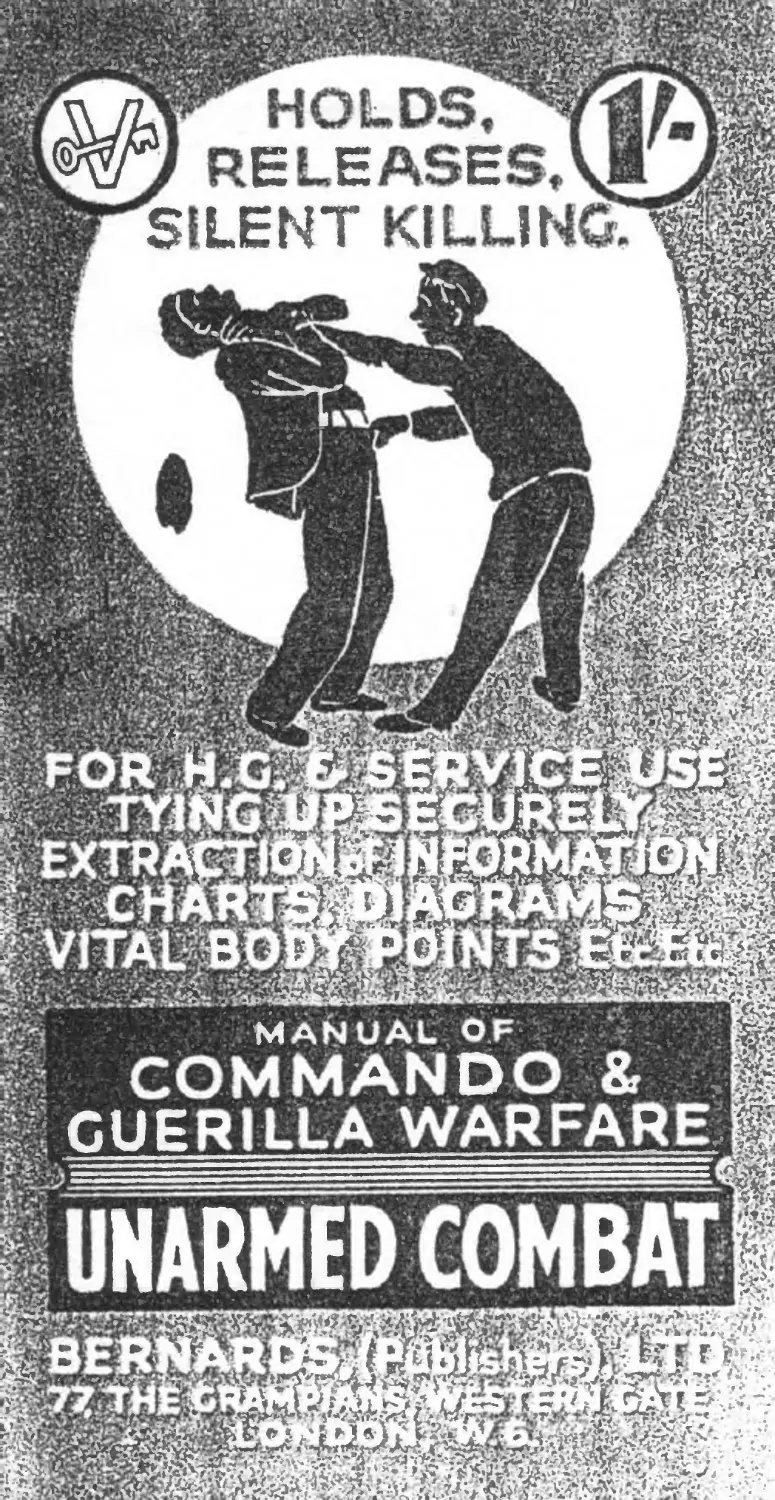
IF' HOLDS,
J RE LEASES. \j
SILENT KILLING.
Ж
Si
UNARMED COMBAT
MANUAL OF
COMMANDO &
GUERILLA WARFARE

PROTECTION AGAINST KICKS AND BLOWS.
Sketch A.
Attack commences
Sketch B.—Approach near
beneath his right arm, lean
to the left, so that he cannot
reach you with his blow,
whilst putting your right
arm above his left shoulder,
and grip him by the neck.
Sketch E.—Then give him a
knock-out blow so as to make
him insensible.
FREEING YOURSELF FROM A STRANGLE-HOLD
Sketch A.—If your opponent grips your neck
os in the above sketch, get hold of his thumbs,
sharply Jerking in an upwards and then down-
wards and backwards direction, at the same
time bringing your knee to his testicles. (See
Sketch B).
PROTECTION AGAINST A STRANGLEHOLD
ON THE GROUND.
Sketch A.—If your opponent has you on the ground with •
strangle-hold round your neck, give his ears blows with both your
fists (Sketch в).
Sketch C.—Then grip his
left wrist by passing your left
arm under his right arm,
simultaneously gripping above
on top of his right wrist with
your right hand.
Sketch D,—Move in an up-
wards direction, with an ab-
rupt stroke of your left elbow
and pull over to the right with
your right hand, simultane-
ously pressing up with your
stomach ; twist your body to
the right.
Sketch £.—To complete the
defeat of your opponent, hit or
kick him as hard as you can.
ACTION AND DEFENCE AGAINST BEING HELD
BY THE*RaIR FROM THE FRONT.
Sketch A.—Held аз shown.
Sketch B.—Put your two
hands on top of your op-
ponent’s and counter his knee
blows with one of your knees.
Sketch C—Leap round and
lean forward so that you turn
your back on him.
Sketch *D.—Throw him over your
head by pulling his two hands
towards your feet and using your
posterior as a. fulcrum to tilt him
over.
Sketch Then dispatch your
enemy with kicks, blows, or by
foujinj his eyes out.
KNIFE ASSAULT FROM THE FRONT.
UPWARD DIRECTION.
Sketch A.—«Opponent go^s for you
with a knife in his right hand, In an
upward direction. Step to the
right. Ward off his thrust with your
left hand, gripping his right shoulder
with your right hand.
Sketch fl.—Press his
shoulder down, so that his
chest is against your right
thigh. Simultaneously, slip
your left arm underneath
his right arm, putting your
left hand Just below hts
right shoulder.
Sketch C.—Get hold of his
right wrist with your right
hand, pressing his arrn rear-
wards, and ал high as you can.
This will make him release the
knife. Grip your opponent’s little finger and wrench backwards.
He is then in your power.
N.B.—Reverse hinds, If opponent attack* you with knife in
left hand.
KNIFE ASSAULT FROM THE FRONT.
DOWNWARD DIRECTION.
Sketch A.—Opponent goes for you
with a knife in his right hand, in a
downwards direction.
Sketch в.—Ward off this
thrust with your left hand,
bending sideways to the
right.
Sketch C.—Put your right
arm as far as possible over
his right shoulder, slipping
your forearm underneath
nls arm. and clasp hold of
the Inside of your other
arm. Your opponent |s
now in an arm JocK
Sketch D.—Press opponent's
right arm as far rearwards as
possible : this will make him
fall to his knees. Then kick him
in a sensitive spot, or finish him
off with the knife, which by now
ha will have probably drooped.
PROTECTION AGAINST KICK.
Sketch A.—Before your opponent*» kick
attains Its objective, which Is usually the
testicles, step to the left, simultaneously
seizing his leg. with your right hand. If
possible seize under his knee.
Sketch B.—Push your opponent's leg sharply
up, pressing forward, and thus throw him to
the ground. Take advantage of him being In
Ch is position by kicking him as hard as you can.
THREATENED FROM THE BACK WITH A REVOLVER.
FAVOURABLE RESULTS ONLY OBTAINED IF
OPPONENT IS WITHIN ARMS’ REACH, OR HAS
THE REVOLVER STUCK IN YOUR BACK.
Sketch A.—Your opponent Is behind
you, threatening you with a gun, and
you are standing with your arms up.
Sketch B.—Sharply swing round
to your left, bringing your left
arm downwards and then up-
wards, hitting the arm with the
gun outwards
Sketch C— Bring your right
hand to your opponent's
right shoulder and continue
with arm lock, as stated pre-
viously.
THREATENED FROM *^4E FRONT WITH A REVOLVER»
FAVOURABLE RESULTS ONLY OBTAINED IF
OPPONENT IS WITHIN AN ARM’S REACH.
Sketch A—Your arm$ will be
held up. Bring your left hand
downwards, hitting the hand
holding the gun outwards,
simultaneously bending side*
ways to the right.
Sketch 8.—Bring your right
hand across his right shoulder,
pass your left arm under his
right armpit, and clasp your
two hands together.
Sketch C —Press down so that
your opponent’s right shoulder
is against your right thigh. Slip
lef; arm along to his shoulder.
You are then ready to administer
the arm lock.
Sketch D.—Grip opponent’»
right wrist with your right hand,
keeping the pressure up on his
shoulder with your other hand.
Administer arm lock.
ARMED SENTRY ATTACKED FROM THE BACK.
on
Sketch A.«—Opponent approaches from
the back, puts hi $ right arm around your
neck, and pulls your helmet backwards,
so that it presses in your back, and the
strap throttles you, with his left hand.
He also kicks the bayonet out of your
hand.
Sketch B.—Quickly fall
your right knee, leaning some-
Sketch
opponent
clutching
make him fall on his back.
your
to * the right, still
ms arm. This will
what forward, and grab hold
of his arm around your neck
with your two hands.
Sketch 0.—Now that your
opponent Is on the ground,
either use your bayonet. If It
is handy, and finish him off, or
use an arm lock.
This is done by putting your
foot In his right armpit,
gripping hold of his arm, palm
outwards, twisting It, and
pressing it rearwards across
your leg.
N.0.—If opponent puts his
left arm around your neck,
fall -on your left knee, throw
him to your left, and if you
apply arm lock, do so to the
4eft arm. Then, whilst op-
ponent is down and out, dis-
patch him.with your bayonet
(Sketch E).
ATTACKED BY A STRANGLE-HOLD
FROM. THE BACK
Sketch A.—Your opponent
approaches from the rear and
clasps your throat.
Sketch B.—Jumping astride,
bend down, and get hold of
your assailant's leg.
Sketch C.—Take a step for-
ward, pulling your assailant's leg
in an upwards direction, thus
making him fall on his back. Sit
down heavily on his stomach—
this has the effect of winding
him—Still holding on to his leg.
Sketch D.—Let go of his leg
and put your left hand across hit
toes, and bring your other arm
around the back of his ankle,
and clasp hold of your left wrist.
Squeeze with your arms, and at
the same time wrench his foot
with your left hand.
IF ATTACKED BY A STRANGLE-HOLD WITH
ONE HAND. AND CLOTHING CLUTCHED WITH
THE OTHER.
Sketch A.—Your opponent
grip» your throat with his
left hand and your clothing
with his other hand.
Sketch 8.—Grip the wrist
clutching your throat with
both your hands.
Sketch C.—Turn your
opponent to the left, quickly
placing your right hand on
his left shoulder, bear
heavily downwards, so that
his chest presses on your
right thigh.
Sketch D.—Twist his arm back-
wards to rest on his shoulder,
with your left hand, keeping up
the pressure on his shoulder.
Grip the thumb of his bent arm
and sharply bend rearwards.
ATTACKS FROM THB BACK.
Sketch A.—Your opponent ha»
approached you from the back,
grasped your hair, and has his
knee in the small of your back.
. Sketch fl.—Get hold of the
hand grasping your hair with
both your hands.
Sketch D.—Then use lock ax
thQWOv
SECURING PRISONERS.
THE SELF-LOCKING GRAPE VINE HOLD,
A unique method of aecuring a prisoner without the aid of ropes»
chains or handcuffs, can be easily achieved by means of any pole or
street lighting standard, as long as the diameter of these do not
exceed about 9 Inches.
To effect, force the prisoner to clamber up the pole about 2 feet,
put his right leg around the front of the pole with the foot pointing
to the left. Then force his left leg over his right ankle, and bend
his left foot to the rear behind the tree. In this position, command
your prisoner to slide to the bottom of the pole and force him down
bodily, pressing on his shoulders. It will then be seen that the
weight of his own body secures his left foot around the pole. (See
sketches).
Although the prisoner's hands are left free, it Is impossible for
him to escape, due to the locking action Involved, and. as a matter
of fact, should he attempt co throw hhnself backwards co relieve
possible cramp, he would undoubtedly kill himself, due to virtually
splitting himself up the middle. Therefore, great caution must be
taken when releasing ; two people, one on either side, must take
hold of his legs and lift him up, the pole, until there is enough room
to unlock hls'Jegs.
MOST SUSCEPTIBLE SPOTS
OF
THE HUMAN BODY.
The human frame Is composed of many parts, some being soft,
others hard. Some will bend, some will not. In many places, vital
nerves are near the surface. 1 he following parts of the body are
the most susceptible.
BOTH SIDES OF THE THROAT.
A hard rabbit punch delivered under the ears will definitely
dislocate the neck, and very likely break it.
KNEES.
/X blow at the back of the knees will always make an enemy
literally fold up, and thereby give you further opportunity for com-
pleting his destruction.
TESTICLES.
Undoubtedly the most sensitive part of the body. A knee, foot,
or clenched fist in the correct place will, without a doubt, completely
knock out the strongest man.
WINDPIPE.
A well-delivered blow across the wind-pipe causes severe
temporary blackout. vVith your enemy in this scmi-conscious con-
dition, you can soon finish him off.
CHIN.
A heavy blow, whether with a closed fist, or the open hand, can
effect the necessary knock-out, when placed properly on either side
of the chin.
SMALL OF THE BACK AND THE KIDNEY AND LUMBAR
REGIONS.
This part of the body is so sensitive that a double blow here with
the two fists can quite easily stun the strongest man. without giving
him even an opportunity to cry out. This is an ideal form of rtteck
for an enemy who is kneeling or is looking downwards at the ground.
ARMS.
Each arm has three vital joints, the shoulder, the elbow and the
wrist. These only bend in one direction, as nature ordained. By
exerting a force in the opposite direction, your man is downed, or
else the joint breaks.
THE KICK.
The kick is an extremely useful method of downing a man, or at
least putting him out of action for a while, if it is aimed at a sensitive
place, especially if the spot is not well protected.
A kick in the testicles will make the strongest man double up,
giving you an opportunity to smash him on the jaw, thus sending him
into pblivion for a time.
The shins are also very sensitive, and a kick with a heavy shoe or
boot just below the knee, and then dragged down, thus scraping the
skin off the leg, is extremely painful.
In other words, the kick is a great form of protection for yourself,
if you know just where and how to place it.
HELD BY BARE GRIP OVER THE ARMS.
This is a vital method in unarmed combat to hold your man and,
should you be in a position of being yourself held, there is one certain
way to effect your release, and that is to attempt to bite either your
opponent’s ear or side of his neck. This will definitely cause him to
lean forward, and into a perfect position to enable you to seize his
testicles in your hands. This causes excrutiating pains, and-he will
automatically release you from his hold, thereby giving you an
opportunity to deliver hirn a knock-out blow and make him your
prisoner.
TYING UP PRISONER.
Put him face down with his arms behind his back, and the back
of his hands placed together, with fingers away from the body. Tie
the hands together and push them up to the shoulder blades, then
put one end of the rope round his neck, and then pass it between his
arms and back and down to his legs. Force his right leg to bend into
the back of the knee of his left leg, and the left leg is then pressed
backwards, locking the right one. Tie the end of the rope to the
left ankle, making sure the rope is pulled taut. Should he struggle
he will strangle himself.
SEARCHING A PRISONER.
Force the prisoner to put the palms of his hands on a wall and
then move his feet rearwards, so causing him to take the weight of his
body on his hands, until he is stretched out fully. He is then helpless
and cannot attack you whilst you proceed to search him.
KNOCK-OUT BLOWS.
Clouting th© Ears.—Use this method when your enemy has
no ear protection. Proceed as follows :—Cup your hands by holding
the thumb and fingers slightly bent and close together, then strike
your assailant from the back simultaneously over both ears with the
cupped hands, using a force gf ten to twelve pounds. This has the
effect of creating an artiflcja^^^s(f^.in both of his ears and will more
than probably burst bo^J^rt	sending him completely deaf
and causing him to lor^jJxogjciuu^pe's^Ltefnporarily. You then have
the opportunity of dl^l^MihX'foln^ easily whilst at your mercy.
Match Box Blov^’Xjli'ql.cibi^atamJard type wooden match box
In your hand lengt h wisXfch«r9«’yei/;yM^e of the best weapons available,
and, by clenching your fistMtuMH-ike box and striking your opponent
with a sweep of your hand held sideways you will undoubtedly knock
him out when contact is made on his chin or on the side of his neck.