/





















Text
                    NATIONAL
GEOGRAPHIC
LEARNING
CENGAGE
SECOND EDITION
•* Learning
IN THIS UNIT YOU LEARN HOW TO:
•	say more about yourself and other people
. ask and answer common questions
	ask follow-up questions and maintain
conversations
•	describe how well you use different languages
•	pay more attention to the language in texts
-	• tell better stories
page 6
•	talk about how you feel - and why
•	respond to good and bad news
•	talk about your life now
•	explain why you can't - or don't want to - do
things
page 14
VIDEO 1: Kenya comes to Central Park page 22 REVIEW 1: page 23 WRITING 1: Keeping in touch page 150
♦	describe places and explain where they are
•	give and respond to suggestions
	discuss future plans
•	talk about the weather
•	recognise and reuse useful chunks of language
•	ask and talk about holiday experiences
page 24
•	talk about free-tlme activities
•	describe how often you do (or did) things
•	explain how good you are at things
•	talk about injuries and sports problems
•	ask about tastes
page 32
VIDEO 2: World Heritage quiz page 40 REVIEW 2: page 41 WRITING 2: Short emails page 152
, WORKING LIFE
page 42
♦ talk about jobs and what they involve
• comment on people's experiences
• discuss rules and freedoms at work
• talk about getting used to changes
• say longer chunks better
K2I ING AND
1 ill Г
N <i
page 50
	talk about phones and phone companies
•	compare products
•	describe what people are wearing
•	discuss shopping habits
•	describe souvenirs and presents
•	negotiate a good price
VIDEO 3: Wheelin' and dealin' antiques page 58 REVIEW 3: page 59 WRITING 3: Stories page 154
VIDEO 4: The business of cranberries page 76 REVIEW 4: page 77
•	describe courses, schools, teachers and students
•	show you believe or sympathise with what people
tel! you
•	talk about different education systems
•	talk about possible future plans or situations
•	discuss different aspects of education
__	• form and say different words from the same root
page 60
•	describe different dishes and ways of cooking food
•	explain what is on a menu
•	discuss experiences of foreign food
•	make generalisations
•	describe restaurants
page 68
WRITING 4: Making requests page 156
2
GRAMMAR
VOCABULARY
READING
LISTENING
DEVELOPING CONVERSATIONS
• Auxiliary verbs
• Narrative tenses
Talking about people
Talking about
languages
The Google
translators in human
form
Meeting for the first
time
Stories connected to
speaking a foreign
language
• Asking follow-up questions
• Linking verbs
• Present simple and
present continuous
• Feelings	• It only takes Juan	• Talking about
* Understanding	Mann to change the	feelings
vocabulary: -ed ! -ing	world!	• Juan Mann
adjectives		• Bumping into an old school friend
• Response expressions
•	Future plans
•	Present perfect
simple
Places of interest	• Things to see and do	• Visiting Krakow
Weather	in Krakow	• Holiday plans
Understanding	• Is disaster tourism
vocabulary: Useful chunks In texts	such a total disaster?
♦ Giving and responding to
suggestions
•	Habit and frequency
•	Present perfect
continuous and past
simple for duration
•	Free-time activities
•	Injuries and problems
 Describing music
• The playlist of your
life
 Free-time activities
• Hidden talent
• Are you any good?
• Talking about tastes
•	Must and con f for
commenting
•	Talking about rules
•	Jobs	• Terrible jobs not a ♦ Talking about work
•	Describing jobs	thing of the past	. Rules at work
•	Work rules and laws
•	Understanding
vocabulary: Be used
to and get used to
• Doing what?
• Comparisons
• Noun phrases
•	Smartphones
•	Clothes and
accessories
•	Describing souvenirs
and presents
• Shop till you drop!
•	In a phone shop
•	Talking about gifts
• Avoiding repetition
♦ Negotiating prices
•	Future time clauses
•	Zero and first
conditionals
•	Describing courses
•	Education
•	Understanding
vocabulary: Forming
words
. What works in
education
•	Talking about a
course
•	Talking about
education
• I can imagine, I bet, etc.
•	Generalisations and
tend to
•	Second conditionals
•	Describing food • Food for thought
•	Restaurants
• In a Peruvian
restaurant
• Talking about
restaurants
 Describing dishes
Contents 3
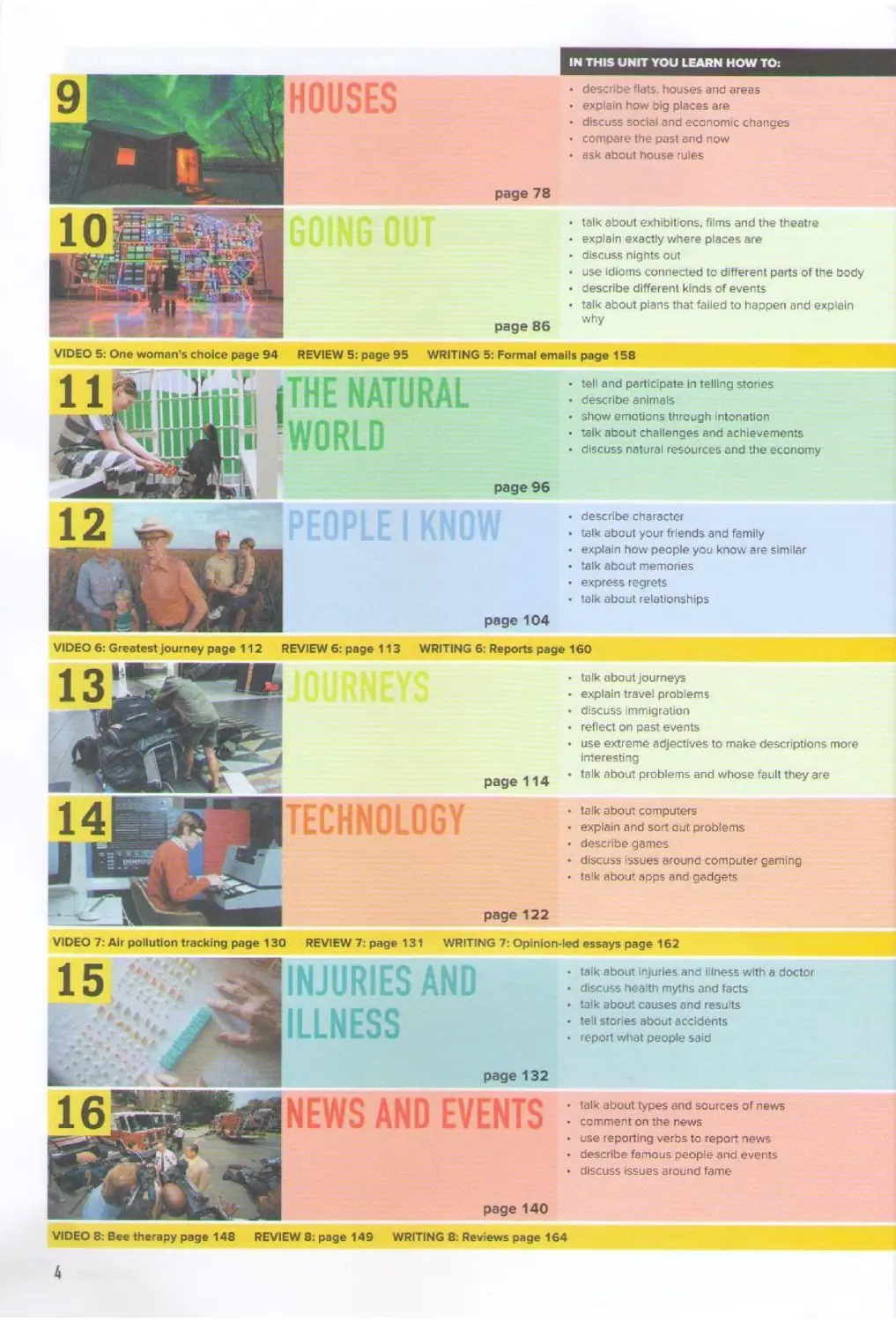
IN THIS UNIT YOU LEARN HOW TO:
•	describe flats, houses and areas
•	explain how big places are
	discuss social and economic changes
•	compare the past and now
	ask about house rules
page 78
•	talk about exhibitions, films and the theatre
	explain exactly where places are
•	discuss nights out
•	use idioms connected to different parts of the body
•	describe different kinds of events
•	talk about plans that failed to happen and explain
page 86
VIDEO 5: One woman's choice page 94 REVIEW 5: page 95 WRITING 5: Formal emails page 158
jij |THE NATURAL
" 'world
page 96
•	tell and participate in telling stories
•	describe animals
•	show emotions through Intonation
•	talk about challenges and achievements
•	discuss natural resources and the economy
page 104
•	describe character
♦	talk about your friends and family
•	explain how people you know are similar
•	talk about memories
♦	express regrets
*	talk about relationships
VIDEO 6: Greatest journey page 112 REVIEW 6: page 113
WRITING 6: Reports page 160
•	talk about journeys
•	explain travel problems
•	discuss Immigration
•	reflect on past events
•	use extreme adjectives to make descriptions more
interesting
л л »	• talk about problems and whose fault they are
page 114	'
•	talk about computers
•	explain and sort out problems
•	describe games
•	discuss issues around computer gaming
•	talk about apps and gadgets
page 122
VIDEO 7: Air pollution tracking page 130 REVIEW 7: page 131 WRITING 7: Opinion-led essays page 162
INJURIES AND
ILLNESS
page 132
•	talk about injuries and illness with a doctor
♦	discuss health myths and facts
•	talk about causes and results
•	tell stories about accidents
•	report what people said
NEWS AND EVENTS
page 140
•	talk about types and sources of news
	comment on the news
•	use reporting verbs to report news
•	describe famous people and events
•	discuss issues around fame
VIDEO 8: Bee therapy page 148 REVIEW 8: page 149 WRITING 8: Reviews page 164
4
GRAMMAR	VOCABULARY	READING	LISTENING	DEVELOPING CONVERSATIONS
• Present perfect simple and present perfect continuous • Comparing now and the past	• Describing homes • Social issues • Describing areas	• Waiting for the bubble to burst • Small ads	• A new apartment  Room to rent In Berlin	• Explaining how big a place is - Asking about rules
• Quantifiers	• Exhibitions, films and • Big night out
• The future in the past theatre
• Idioms
• Understanding
vocabulary:
Describing events
• Going to the cinema * Explaining where places are
♦ What did you do last
night?
Past ability I	• Movements and	• The strange story of	♦ Animal stories	• Helping people to tell stories
obligation	sounds	Maurice Wilson	• Maurice Wilson
Passives	• Challenges and achievements	• Natural resources fact file	• The resource curse
• Used to. would and	• Describing character	• Struggling to fit Into	• Talking about family	• That's like...
past simple  Expressing regret using wish	• Relationships	the role of granny	• Talking about Nicolas
• Third conditionals	* Ways of travelling	• The long journey to a	• Talking about	• How come?
• Should have	and travel problems * Phrasal verbs ♦ Understanding vocabulary: Extreme adjectives	new life	journeys • Holiday problems	• Blaming people
Articles Infinitive and -Ing	• Computers • Describing games	• My life as a gamer	• IT help desk • The gaming Industry	• Sorting out problems
forms	• Apps and gadgets		• Totally great or totally rubbish?
• Adverbs  Reported speech	• Injuries and illness  Understanding vocabulary: Word endings and word class  Accidents and health problems	• Fact or myth?	• At the hospital • Accident on holiday	♦ Short questions with any
• Reporting verbs • Defining relative clauses	• News • Explaining who people are	• Seeking fame and fortune	• Talking about news stories • Talking about famous people	• Introducing and commenting on news
Grammar reference pages 166-186 Information files pages 187-193 Audio scripts pages 194-213
Contents 5

IN THIS UNIT YOU LEARN HOW TO
SPEAKING
Work with a new partner. Discuss the
questions.
• Why are you learning English?
• What English classes have you done before?
• Do you know anyone in this class?
• Are you still friends with people from previous
classes? Tell your partner as much as you can
about each person.
say more about yourself and other people
ask and answer common questions
ask follow-up questions and maintain conversations
describe how well you use different languages
pay more attention to the language in texts
tell better stories
Work in pairs. Discuss the questions.
• Look at the photo of a language class. What do
you think is happening?
• Where do you think it was taken?
• What do you think they're learning?
• Would you like to have a class like this? Why? /
Why not?

LISTENING
1 ЕЯЛ Listen to two conversations in which people
meet for the first time. Answer the questions for
each conversation.
1	Where do they meet?
2	Why are they there?
VOCABULARY Talking about people
4 Check you understand the words in bold in
the sentences below. Then decide which two
words / phrases in the box could replace each
word / phrase in bold so you are talking about
the same subject. The first one is done for you.
2 СП Work in pairs. Try to answer the questions
below. Then listen again and check your
answers.
Conversation 1
Portugese	Japan	an only child	sport
a civil servant	married	reading	a translator
Economics	Medicine	Arabic	a twin
Germany	an office	separated	a warehouse
1	How is Alfie feeling? Why?
2	Is Holly a new student?
3	When did Alfie start studying French?
4	What does he think his strengths and weaknesses
are?
5	According to Holly, where is French an official
language?
Conversation 2
6	How did Noah feel about the talk he attended?
7	Where is Noah from - and where is he living now?
8	When did Noah move to his current home?
9	Has Giuliana visited the city Noah is living in?
10	What does Noah do for a living?
1	My friend Marcin is from Poland. Japan, Germany
2	My husband’s a software engineer.
3	My brother works in a university.
4	My mum speaks good French and a bit of Russian.
5	My sister’s doing a degree in Law at the moment.
6	My parents are really into travelling.
7	My friend Imke is the youngest of six kids.
8	My aunt Maria is single.
5 Think of one more word or phrase that could
replace each word / phrase in bold.
6 Work in groups. Use language from Exercises 4
and 5 to say five true things about people you
know.
3 With your partner, take turns to tell each other
as much as you can about the last new person
you met.
8
GRAMMAR
DEVELOPING CONVERSATIONS
Auxiliary verbs
When we make questions and negatives, we use different
auxiliary verbs. There are only three: be, do and have.
' don’t know, (present simple)
How’s it going? (present continuous)
Have you been there? (present perfect simple)
Look at these questions from the conversations.
Then work in pairs and answer the questions
below.
a Do you know it?
b Did you enjoy it?
c Have you studied here before?
d Where are you based?
e Whot are you doing there? Are you working?
f How long have you been learning French?
1 Which auxiliary goes with the infinitive (without fo)?
2 Which two auxiliaries go with the past participle
(often an -ed form) of the verb?
3 Which auxiliary goes with the -ing form of the verb?
PRONUNCIATION
8 СЖЗ Listen to the questions from Exercise 7 -
first said slowly and then faster. Notice that in
faster speech, the auxiliary verbs are hardly
heard at all.
9 DO Listen again to the faster version. Practise
saying the questions as quickly as you can.
0 Complete the questions with the correct
auxiliary verbs.
1	Where you live?
2	Who you live with?
3	How long have you living there?
4	Where you born?
5	How long it usually take you to get to
work / school?
6	What you do last weekend? Anything
interesting?
7	Why you studying at this school?
8	you ever been to an English-speaking
country?
9	anyone else in your family speak English?
10	anyone you know ever lived abroad?
Where?
11	Work in pairs. Ask and answer the questions in
Exercise 10.
Asking follow-up questions
After someone answers a question we have asked, we
often ask a second related question. This helps us to find
out more details and to keep the conversation going.
A: So have you studied here before?
B: Yeah, last term.
A:	Oh really? OK. And did you enjoy it?
B:	Yeah, it was amazing.
12 Match the questions (1-6) with the pairs of
possible follow-up questions (a-f).
1	What are you studying?
2	Have you studied here before?
3	What do you do when you’re not studying?
4	Do you have any brothers or sisters?
5	What did you do at the weekend?
6	What do you do?
a Whose class were you in? / Where did you learn your
English?
b What year are you in?! What does that involve?
c Older or younger? 1 What do they do?
d Where do you work? / Do you enjoy it?
e How often do you do that? / Did you get anything
nice?
f How long have you been doing that? / What kind of
music are you into?
13 Write one more follow-up question you might
ask after someone answers questions 1-6 in
Exercise 12.
14
Listen to six short conversations. What
follow-up questions do you hear?
CONVERSATION PRACTICE
15 Choose six questions from this lesson that you
think are good to ask people when you first meet
them. Then think of two other questions you
could also ask.
16 Choose one of these tasks.
a Work with the whole class and have conversations to
get to know other students.
b Imagine you are at a party for language students.
Look at File 1 on page 187. Choose a person to
pretend to be. Then have conversations to get to
know other people. Ask and answer questions in the
role of the person you chose.
1 To watch the video and do the activities, see the DVD ROM. J
Unit 1 First class 9
TALKING MY LANGUAGE
VOCABULARY Talking about languages
1 Work in pairs. How many of the languages in the
picture do you recognise?
2 Complete the sentences about using foreign
languages with these words and phrases.
j accent	express	fluently	picked it up
; accurate	get by	mastering	struggled
1 I’m not very, but I can hold a conversation
and make myself understood.
2 I know the basics - enough to when I'm
travelling there.
3 I really with French when I was at school,
so I just gave up.
4 I get frustrated when I can’t myself.
5 I never went to class. I just from talking to
people.
6 I'm a bit embarrassed to speak sometimes because
I know I have a strong
7 I grew up bilingual so I speak Spanish and Japanese
8 I’m not interested in the language, I just
want to be able to read it for my job,
7 Work in pairs. Read the comments that follow
the article and discuss these questions.
•	Which comments do you agree with and which do
you disagree with? Why?
•	What did you find most interesting about the article?
•	Did you read anything about the habits of hyperglots
that could help you study better?
3	Work in groups. Use some of the language from
Exercise 2 to discuss these questions.
•	What languages have you studied?
•	What languages do you know at least a few words
in? What can you say?
•	How did you learn? Do you use these languages
now? How well do you know each one?
Understanding reading texts and Improving your vocabulary
involves more than just learning single words. You also need
to notice the connected words and grammar.
8 Find these words in the article and notice the
connected words and grammar.
READING
far	evidence	growing
allow	terms	opportunities
4	You are going to read an article about ‘hyperglots’
- people who speak many languages. Work in
pairs. Look at the photos and the title opposite
then discuss how these words and numbers might
be connected to the topic.
72	a parrot	translator	10,000
two weeks	globalisation	genes	mistakes
5	Read the article and check your ideas from
Exercise 4.
6	According to the article, are the sentences
true (T) or false (F)?
1	Mezzofanti spoke 72 languages fluently.
2	Some people who heard Mezzofanti speak probably
couldn’t know if he was fluent
3	There is no proof that Mezzofanti really was
multilingual.
4	Globalisation will create more hyperglots.
5	Hyperglots often posess genetic advantages.
6	Hyperglots aim to speak all their languages fluently.
9	Work in groups. Cover the article and complete
the sentences. Then check your ideas.
1	But far?
2	There evidence he could use
many languages.
3	There will growing in the
future.
4	Top may genes
allow get the their training.
5	They often limited terms
individual languages.
6	They opportunities language
closer to home.
10	Work in pairs. Discuss the questions.
•	Think of two examples where there are growing
numbers of something. Why are they growing?
•	How is your English in terms of vocabulary, speaking,
listening etc.? What can you do to improve these
different aspects?
•	What opportunities do you have to practise English?
10
Michael Erard's new book investigates the master
linguists or ‘hyperglots'
Liam Scanlon
OOOO
The 18th century Italian priest Cardinal Giuseppe Mezzofanti is a legend
among linguists.They say he studied 72 languages, 30 of which he mastered.
He spoke another nine fluently, though not perfectly, and could hold a basic
conversation in at least eleven more. And all that without leaving Italy! One
story suggests he picked up Ukrainian in just two weeks, after meeting a visitor
from there.
But how far is this true? Certainly, the figure of 72 is too high and some people
perhaps exaggerated how fluent he was. He lived at a time when travel was
difficult and learning other languages was still unusual.Therefore, many
reports of his abilities come from visitors who were probably struggling to
express themselves in Italian.There were also those who, while appreciating
his good accent and accurate grammar, described him as merely a parrot
who said nothing of interest. However, according to Michael Erard. author of
the book Mezzofanti's Gift, there is sufficient evidence to believe he could use
many languages.
Erard also argues that there are many hyperg lots in the world today and that,
with globalisation, there will be a growing number in the future. For example,
Alexander Arguelles is fluent in around twenty languages and has studied 60.
He studies nine hours a day, down from fourteen before he got married! The
Hungarian translator Kato Lomb worked with sixteen, and you can watch a
YouTube video of Alex Rowling speaking eleven languages at the age of twenty.
A central question of the book is whether hyperglots are born or made.
Are their achievements genetic or do hyperglots have secrets that normal
language learners can learn from? Erard's conclusions agree with research on
highly talented people in other areas such as sport and music.These people
generally have advantages they are born with: top athletes may have genes
that allow them to get the most from their training; hyperglots seem to possess
excellent memories and have brains that are more efficient in processing
speech sounds. However, becoming the best also requires a lot of hard work,
Some argue that the difference between a top performer and someone who's
just 'very good' is that the top performer has practised for 10,000 hours instead
of 6,000.
The fact is that most ordinary language learners lack these natural
advantages and simply don't have that much time. So is there any hope for
us? Erard believes there is and that research on hyperglots can offer some
useful lessons. For example, they often have limited ambitions in terms of
individual languages: they're happy to get by, or to be only able to read, or
not to have a perfect accent.They're practical: if they can't travel, they look
for opportunities to use the language closer to home Some simply imagine
conversations in their heads.They also use other techniques like learning words
in context. Finally, they're never afraid to make mistakes or appear stupid and
so never give up
fafXIOTti
t <!r
THE SEARCH FOR
THE WORLD S МОЯ
EXTRAORDINARY
LANGUAGE LEARNERS
Partlravetoguft part science
lesson part inietectua
mvssogaliDn an entertalnmg
intormalivp stwwy at some (И
the mast fascinating polygtols
MICHAEL ERARD
COMMENTS
langlearner: I've actually read Kato's book about language learning and I think the best advice is to read what you're
interested in and read a lot
bobjob:	I know it's wrong, but I kind of hate these people! I'm struggling to learn one extra language.
unconvinced: How does Alexander Aguelies earn a living? I think you need to be rich to be a hyperglot*
hughd:	You have to start learning languages when you're young.
andyw:	When people say they're bad at languages, they just mean they don't want to spend the time required to learn.
artist:	I con say 'do you work or study' in fifteen languages. Does that make me a hyperglot?
r. sewell:	The thing about vocabulary in context is good I never learn single words. I always learn words in groups.
Unit 1 First class 11
к-w-«mb^^v v 'вввг^в*иж*г«’-^'гвв i овм-имваот^ *?-- •""ч^~*ш .WVWMgraBHMIV^WBPW
PUTTING YOUR WORDS TO WORK
SPEAKING
1 Work in pairs. Discuss the questions.
•	Where and when do you use English outside the
classroom?
•	What do you do most: read, listen, speak or write?
•	When was the first time you used English outside a
classroom? What did you talk about? How successful
was it?
•	What’s been your best moment using English outside
the classroom? Why was it good?
LISTENING
2
Listen to three people telling stories
connected to speaking a foreign language. Match
two sentences to each speaker (1-3). There
are two sentences you do not need.
a They helped someone by using a foreign language.
b Their parents fell in love in Rio de Janeiro.
c They have an unusual family background.
d They were involved in a misunderstanding.
e Their parents speak together in a foreign language.
f They filmed an animal attacking someone.
g They changed their behaviour as a result of the
experience.
h They work with people from other countries.
Listen again and complete the sentences
with three words in each space. Contractions
count as one word.
1	a Two Chinese guys me and stopped me.
b They started talking really fast, you know, and I
___________at all!
с I asked them to slow down, and then,
of my bad Chinese and gesture, I explained ...
2	a He worked in the engine room and she was
b My mum said Dad was a really good dancer,
very difficult to believe.
c They also said it about whose country
to live in.
3	a We go all over the place unusual wild
animals.
b We often need local people to act as
guides or cooks for the film crew.
c Anyway, last year we were filming in Sumatra in
_____________a forest...
4	Work in groups. Discuss the questions.
•	Which of the stories did you like the best? Why?
•	Do you know any families where they speak more
than one language? Why?
•	Have you ever been on a cruise? When? Where?
•	Have you ever helped anyone in the street? Where?
What did you do?
•	Do you know any ‘false friends’ - words that look
or sound the same, but have a different meaning in
different languages?
12
GRAMMAR Narrative tenses
5 Look at these sentences from the stories. Then
complete the rules below.
a They first looked really surprised and then they
started talking really fast, you know.
b It was actually the first time I'd spoken to anyone
Chinese outside of my class.
c They first met when they were both working on a
cruise ship.
d Neither spoke each other's language, but my mum
had worked in Germany before.
e Lost year we were filming in the middle of a forest
... and one time at dinner I was talking to the guide
and I tried to ask about 'the people of the inner
forest’...
We use three main tenses when telling stories: the past
simple, the past continuous and the past perfect simple.
•	Past simple: add to the infinitive (without
to) of the verb, Some past forms are irregular, e.g.
•	Past continuous: use/+ -/ng form
of the verb.
•	Past perfect simple: use+ past participle.
Some participles are irregular, e.g____________
6 Look at the sentences in Exercise 5 again and
answer the questions.
1	Which tense is the most common in telling stories?
2	Which tense is often used at the beginning of the
story to give background information?
3	Which tense shows the events followed each other
in order?
4	Which tense shows the ‘past in the past’ - an action
that happened before something else we talked
about?
5	Which tense shows an action was unfinished or
stopped by another action?
Check your ideas on page 166 and do Exercise 1.
Read this story about how another person’s
parents met. Decide if the past simple forms
are correct or not. Correct the ones which
are wrong.
I love the story of how my parents met. My dad was
twenty. One day my dad takcd an overnight train to
Prague in Czech Republic and during the night he -fell
asleep. When he I * 3waked up, he realised they 4 * * * *was in Prague
so he rushed to get off the train. He See a policeman looking
at someone’s papers and he suddenly realised he ^hadn’t
his passport or money or phone. He "ran back to the train.
He sat down, but then this guy 9 * *came up to him and asked
htm something in Czech. He then said in English, ‘What’s
(he matter?’ and so my dad -explained. So basically, this guy,
who was called Anton, whelped him. He took my dad home,
given him something to eat, 12let him phone his parents to
get some money - everything. And later that evening my
dad met Anton’s parents ... and he met his sister. And that's
how he met my mother!
PRONUNCIATION
8 CK3 Some of the details of the story in
Exercise 7 are missing. Listen and write down
the eight phrases and sentences you hear.
You will hear each twice: first fast and then
slower.
9	DEI Listen again to the faster version. Notice
the weak forms of the auxiliaries: was /waz/,
were /wo/, had /bd/. Practise saying the
phrases and sentences as quickly as you can.
10	Work in pairs. Decide where each of the eight
phrases and sentences from Exercise 8 should go
in the story in Exercise 7.
11	Complete the sentences with your own ideas.
1	When I got home, I suddenly realised ...
2	I didn’t recognise her at first because ...
3	I wasn’t looking where I was going and ...
4	This guy came up to me and ...
5	I had meant to say ..., but I’d actually said ...
6	I found out later that...
12 Work in pairs. Compare your ideas from Exercise
11 and decide which is the most interesting.
Then write a story around the sentence.
(j For further practice, see Exercise 2 on page 167*
SPEAKING
13 Choose two of these ideas for stories. Spend a
few minutes thinking about what happened and
how you will tell the stories.
•	the first time your parents met
•	the first time you met your best friend / wife /
husband / boyfriend / girlfriend
•	a time when you forgot or lost something important
•	a time you had a good or funny experience using a
foreign language
•	a time a stranger helped you or you helped a
stranger
14 Work in groups. Share your stories.
Unit 1 First class 13

IN THIS UNIT YOU LEARN HOW TO:
•	talk about how you feel - and why
•	respond to good and bad news
•	talk about your life now
*	explain why you can’t - or don’t want to - do things
SPEAKING
1	Work in pairs. Discuss the questions.
•	Who do you think the people are?
•	How do you think each person is feeling? Why?
•	What happened before the picture was taken?
•	How does the picture make you feel?
2	Work with a new partner. Tell each other
about the last time you felt:
• very happy. • very tired. • quite annoyed.
3	What other words do you know to describe
feelings?
<-vS
ARE YOU OK?
VOCABULARY Feelings
1 Match the words in bold in the sentences to
these basic meanings: happy, annoyed, tired,
bad, sad, angry, worried,
1	We left at six in the morning and didn't get back till
midnight. I was exhausted.
2	You must be really pleased with the results. They’re
great.
3	She was absolutely furious when she saw the mess
that they had made.
4	I'm under so much pressure at work. I’m really
stressed about everything.
5	His dog died last night He was very upset when I
spoke to him. He sounded as if he might cry.
6	I'm so sorry. I feel really guilty about leaving you
with all the work to do.
7	Ask her now. She looks like she’s in a good mood.
She might say yes.
8	It was good to see her happy and enjoying herself
because I know she’s been a bit down.
9	I was pleasantly surprised by the film. I really didn’t
expect it to be so good.
10	I'm fed up with this weather. It's so hot you can’t do
anything. I've had enough of it!
2 Work in pairs. Answer the questions.
1	Can you find the five prepositions connected to
adjectives in Exercise 1?
2	Why else might you feel exhausted?
3	How do you know if someone is pleased with
something?
4	How do you know when someone is furious?
5	Why might someone get upset?
6	What other things might you feel guilty / bad about?
7	What things might put you in a good mood?
8	What’s the opposite of being pleasantly surprised?
Do you remember why they feel this way?
Listen again and check your ideas.
5 Work in pairs. Discuss the questions.
•	What would you do or say if a friend was upset?
Would it be different if it was a man or a woman?
•	What kind of things do you do to cheer yourself up if
you are a bit down?
•	Are you good at sorting out problems?
•	Who do you talk to if you have a problem?
GRAMMAR
Linking verbs
Be, look, seem, feel, sound, taste and smell are all linking
verbs. These verbs can be followed by different patterns.
6 Look at these sentences from Exercise 1 and the
conversations. Then work in pairs and answer
the questions below.
a That chocolate cake looks nice.
b He seemed a bit down.
c He sounded as if he might cry.
d She looks like she's in a good mood.
e That sounds like a nightmare.
1 What is the pattern when an adjective comes after a
linking verb?
2 What two patterns are possible when a clause comes
after a linking verb?
3 What is the pattern when a noun comes after a
linking verb?
7 Complete the sentences with the correct form
of the verbs. You may also need to add other
words.
LISTENING
3 DEI Listen to two conversations. The first is
between two people talking about their friend
Karim. The second is between two women, Belinda
and Alisha. How do these three people feel?
1 Karim 2 Belinda	3 Alisha
1 Are you OK? You a bit stressed, (look)
2 Are you all right? You you’ve seen a ghost
(look)
3 Is Julie OK? She disappointed when I
spoke to her. (sound)
4 Is Mike all right? He a bit down, (seem)
16
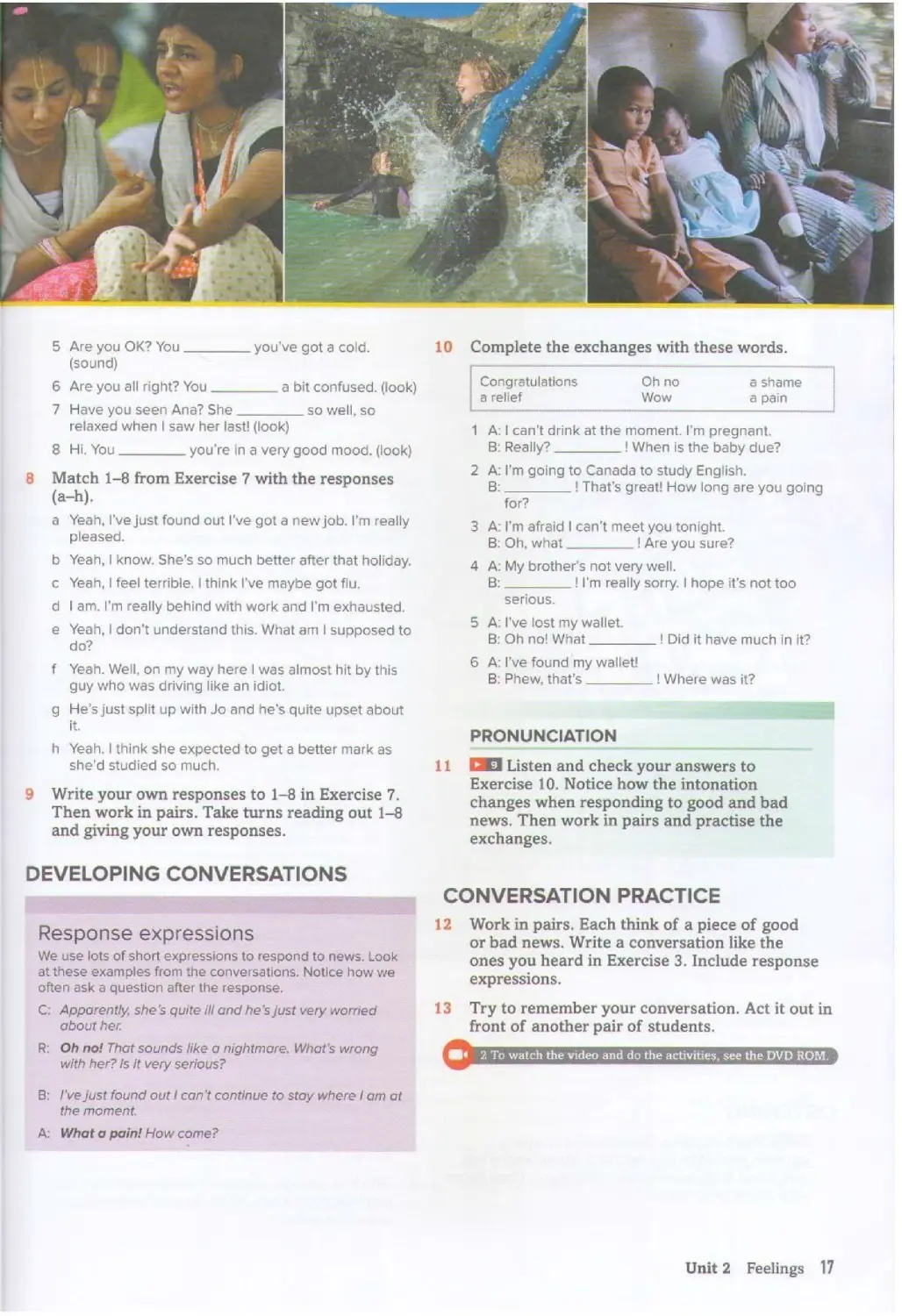
5 Are you OK? You you’ve got a cold,
(sound)
6 Are you all right? You a bit confused, (look)
7 Have you seen Ana? She so well, so
relaxed when I saw her last! (look)
8 Hi. You you’re in a very good mood, (look)
8 Match 1-8 from Exercise 7 with the responses
(a-h).
a Yeah, I’ve just found out I've got a new job. I’m really
pleased.
b Yeah, I know. She’s so much better after that holiday.
c Yeah, I feel terrible. I think I’ve maybe got flu.
d I am. I’m really behind with work and I’m exhausted.
e Yeah, I don’t understand this. What am I supposed to
do?
f Yeah. Well, on my way here I was almost hit by this
guy who was driving like an idiot.
g He’s just split up with Jo and he’s quite upset about
it.
h Yeah. I think she expected to get a better mark as
she’d studied so much.
9 Write your own responses to 1-8 in Exercise 7.
Then work in pairs. Take turns reading out 1-8
and giving your own responses.
11
10 Complete the exchanges with these words.
Congratulations	Oh no	a shame
a relief	Wow	a pain
1 A: I can’t drink at the moment. I’m pregnant.
B: Really?! When is the baby due?
2 A: I’m going to Canada to study English.
B:! That’s great! How long are you going
for?
3 A: I’m afraid I can’t meet you tonight.
B: Oh, what 1 Are you sure?
4 A: My brother’s not very well.
B:! I’m really sorry. I hope it’s not too
serious.
5 A; I’ve lost my wallet.
B: Oh no! What! Did it have much in it?
6 A: I’ve found my wallet!
B: Phew, that’s! Where was it?
PRONUNCIATION
► 9
Listen and check your answers to
Exercise 10. Notice how the intonation
changes when responding to good and bad
news. Then work in pairs and practise the
exchanges.
DEVELOPING CONVERSATIONS
CONVERSATION PRACTICE
Response expressions
We use lots of short expressions to respond to news. Look
at these examples from the conversations. Notice how we
often ask a question after the response.
C: Apparently, she's quite ill and he’s Just very worried
about her.
R: Oh no! That sounds like a nightmare. What's wrong
with her? Is it very serious?
B: I've Just found out I can’t continue to stay where I am at
the moment.
A: What a pain! How come?
12 Work in pairs. Each think of a piece of good
or bad news. Write a conversation like the
ones you heard in Exercise 3. Include response
expressions.
13 Try to remember your conversation. Act it out in
front of another pair of students.
к 2 To watch the video and do the activities, see the DVD ROM.
Unit 2 Feelings 17
HUGSAND KISSES
SPEAKING
1 Check you understand the words and phrases
in bold. Then work in groups and discuss the
questions.
• How often do you do these things? In what
situations?
-	hug people
-	kiss people on the cheek or lips
-	walk arm in arm with people or hold hands
-	shake hands or bow
-	touch people on the arm or put your arm round
their shoulder
•	Do you do any of these things more often or less
often than most people in your country? Why?
•	Have you been anywhere where they do these
things differently to you? Where? What do they do?
READING
2 Work in pairs. Look at the photo opposite and
discuss the questions.
•	What is the man in the photo doing? Why do you
think he’s doing this?
•	What would you do if you saw someone like this?
Why?
•	Are there any famous local characters in your local
area I town I city? Why are they well known?
3 Read the article. Answer the questions.
1	What made Juan Mann start his campaign?
2	How did he feel when he went out for the first time?
3	Who first asked for a hug, and why?
4	How did Mann become so famous?
5	What two theories are put forward to explain the
success of the Free Hugs movement?
4 Work in pairs. Cover the article. Try to
remember the adjectives that went with these
nouns. Then look at the article and check your
answers.
1	connections
2	a attempt
Зап star
4	3.________year
5	his identity
6	one of the shopping districts
7	skills
8	experiences
LISTENING
► 10
Work in pairs. Discuss what impact
success probably had on Juan Mann and what
you think happened to his campaign. Then listen
and check your ideas.
6 Work in pairs. Discuss the questions.
•	Do you think Juan Mann was right to walk away from
the Free Hugs ‘brand’? Why? / Why not?
•	Why do think the Free Hugs movement has been
controversial in some countries?
•	Do you think it has a future? Would it be popular in
your country? Why? / Why not?
UNDERSTANDING VOCABULARY
-ed I -ing adjectives
A small group of common adjectives can end in both -ed
and -ing. The -ed form describes people’s feelings. The
•ing form describes the things that cause the feelings.
In the modern world, it Is not unusual for people to feel
depressed.
It was a depressing time
7 Complete the pairs of sentences with the correct
adjective form of these verbs.
annoy	confuse	bore
depress	shock	disappoint
1 a Can you explain it again? I’m still a bit
b The instructions for this camera are really
2	a He has a really habit of repeating the
same stories over and over again.
b I’m a bit_________.that he hasn’t phoned me. He
promised to!
3	a He's been for a while, but he refuses to
try counselling.
b This weather’s so It’s so cold and wet!
4	a I found the violence in the film quite.to
be honest.
b I was really to see so many homeless
people on the streets there!
5	a I'm Can’t we go out somewhere?
b I find her quite. All she ever talks about
is her children!
6	a Obviously, I’m a bit that I didn't get the
job.
b I loved her last film, but to be honest I found this
one quite_____________
8 Complete the sentences so they are true for you.
1	I find it really annoying when people ...
2	The last time I got really bored was when ...
3	I always get really depressed when ...
4	One thing I found really disappointing was ...
5	The most shocking thing I’ve ever seen was ...
6	I still get quite confused about...
9 Work in groups. Compare your sentences and
explain your ideas. Who do you have most in
common with?
10
IT ONLY TAKES JUAN MANN TO
CHANGE THE WORLD!
In the modem world, it is not unusual for
people to feel depressed or isolated. It can be
hard to make meaningful connections with
others. That was certainly how the mysterious
Juan Mann ('One man ) felt - until the day he
decided to start giving free hugs to strangers.
What started as a desperate attempt to change
his own life subsequently transformed him into
an international star
On returning to Sydney, Australia, in early
2004, after travelling in Europe, Mann (who
has always kept his true identity secret) had a
miserable year His parents had divorced and
he found himself lonely and unemployed. It
was a depressing time as many of his friends
were no longer around and his family was also
elsewhere. After spending months hiding away
from the world, feeling sad and sorry for himself,
he decided to change his life and do something
completely different.
And something different is exactly what he did!
Mann went to one of Sydney's main shopping
districts holding a cardboard sign saying ‘Free
Hugs' - and waited. He expected to last an hour
at the most and had even asked a friend to come
along to protect him. He also very deliberately left
his wallet at home.
After fifteen minutes, however, a woman
approached him and said that her dog had died
that morning and on top of that it was the first
anniversary of her daughters death, so she could
really use a hug. Mann was happy to help!
His ’Free Hugs’ campaign continued quietly for a
couple of years until a songwriter he knew filmed
him in action. This friend then added a song by
his own band Sick Puppies and posted the video
on YouTube, where it has now had over 75 million
 Ц
 A


-i-:
F
kl
кд'


J


hits. Mann quickly became something of a
celebrity, was interviewed by legendary American
chat show host Oprah Winfrey and saw Free I lugs
go global, with similar groups appearing all over
the world.
Mann seemed to find the success of his project
funny as he had been told at school that he lacked
the social skills to work with people in need, yet
had ended up as a kind of therapist for a whole
city His explanation was that many people needed
someone to listen to their problems, but were too
embarrassed to call a helpline or seek counselling.
To some, the growth of the Free Hugs movement is a sign that
acts of kindness are becoming more socially acceptable. In an age
when nobody expects to get something for nothing and where
economic competition and greed have become the norm, perhaps
the movement offers a different, softer approach to life. Also, shared
experiences in the real world may be more important to us now
that we spend so much lime in virtual online worlds.
However, the most incredible aspect of Juan Manns story has not
been the effect it has had on those he shared hugs with or even
on those inspired by his story, but actually the effect it has had on
himself.
Unit 2 Feelings 19
IT’S SO GOOD TO SEE YOU!
SPEAKING
bump into/.Ьлтр 'into/(phrasal verb)
If you bump into someone you know, you unexpectedly
meet them somewhere - when you have not planned to.
3 ВП Listen again and complete the sentences
with two words in each space. Contractions
count as one word.
1 Sorry. I just you. You look so different.
2 I do sales for a film company.
3 That's amazing. I’m really you.
4 I’m working really.
5 I’m learning a lot and the money’s not bad either, so
I___________
6 OK. And are you still living?
7 She still talks about you from time
8 That's my idea!
4 Work in pairs. Discuss the questions.
•	Have you ever failed to recognise someone you
knew? Why?
•	Would you like to work in sales and marketing?
Why? I Why not?
•	Do you know anyone who’s getting married
sometime soon?
•	Do you know anyone who is out of work at the
moment?
•	Do you know anyone who trains regularly? What for?
•	What’s your idea of hell?
1 Work in pairs. Discuss the questions.
•	Where you live, in what places do you often bump
into people you know?
•	What’s the most surprising time you’ve bumped into
someone? Why was it so unexpected?
•	When was the last time you bumped into someone?
Where was it? What did you talk about?
•	Is there a famous person you would like to bump
into? What would you ask them?
•	Is there anyone you wouldn’t want to bump into? Why?
LISTENING
Listen to two people, Carla and Robin,
who bump into each other in the street. Are the
sentences true (T), false (F) or not mentioned (N)?
1	Carla and Robin went to school together.
2	Robin has put on a lot of weight since they last met.
3	Carla isn’t working today.
4	Carla is a website designer.
5	Her work is very busy at the moment.
6	Carla lives with her boyfriend.
7	Robin has a part-time job at the moment.
8	Robin’s parents are separated.
9	Carla is really into running.
10	Robin would like to run a marathon.
GRAMMAR
Present simple and present
continuous
The present simple uses the infinitive form of the verb
(without Го). The third person form adds an -s.
I work in soles and marketing.
The present continuous uses a form of the auxiliary verb
be and the -ing form of the verb.
И/е’ге setting up a new website at the moment.
5 Look at these sentences from the conversation.
Answer the questions below.
a И/e ’re getting married in the summer.
b She’s staying with her brother on the coast.
с I train on Saturdays.
1 Which sentence is about a habit or a regular
repeated activity?
2 Which sentence is about a temporary, unfinished
activity?
3 Which sentence is about something in the future that
is already arranged with other people?
4 Do you know what the connection is between these
verbs?
agree	believe	belong	disagree	forget
like	need	own	seem	want
20

6 Put the words in italics into either the present
simple or the present continuous. Use
contractions where possible.
1	A: How your course I go? Are you still enjoying it?
B: Yeah, although I / find / It a lot harder than before.
2	A: Are you busy this weekend? you I want I go out /
somewhere?
В: I / work I Saturday mornings, but I'm free in the
afternoon.
3	A: What's your sister doing these days? she / still /
study?
B: Yeah. She graduated last year, but now she Idol
a Master’s.
4	A: / / need! a coat? Is it still raining outside?
B: Yeah, it / pour I down.
5	A: you I have I any plans for tonight?
B:	Yeah. 11 meet I an old friend of mine for dinner,
actually.
6	A: What's the matter with him? Why he I shout I at
everyone like that?
В: I don’t know. He's Just in a bad mood, he/ get I
like this sometimes.
9 Write reasons to explain why you can’t or don’t
want to do the things below. Use the present
simple or present continuous.
1	A: Do you think you could help me move this table?
B: No, sorry but I can’t.
2	A: We’re going out for dinner later. Would you like to
join us?
B: Oh, I’d love to, but I can’t
3	A: Can I just use your computer for a few minutes?
B: No, sorry.
4	A: Can you turn this music off? It’s driving me mad.
B: No, leave it on.
5	A: Would you like to go out with me on Friday?
B: Oh, it’s nice of you to ask, but I can’t. Sorry.
10	Work in pairs. Take turns reading out the
questions in Exercise 9. Say your responses
and continue each conversation for as long as
you can.
For further practice» see Exercise 2 on page 168.
PRONUNCIATION
Listen to the present continuous
12
sentences in Exercise 6 - first said slowly and
then faster. Notice the contractions and the
weak forms of the verb be.
8 Work in pairs. Practise reading out the
exchanges in Exercise 6. How quickly can
you say them?
If you say you can't or don’t want to do something, it's
polite to give a reason. The reason will often use the
present simple or present continuous. Look at this extract
from the conversation:
R: What are you doing this Saturday? Do you want to
meet for lunch or something?
C: Oh, I'd love to, but I train on Saturdays. I’m doing the
marathon next month.
SPEAKING
11	Work in pairs. You are going to roleplay a
conversation between two old friends who bump
into each other in the street.
Student A: read File 3 on page 188.
Student B: read File 7 on page 189.
12	Now roleplay the conversation. Use some of the
language below.
•	I haven’t seen you for ages.
» How have you been?
•	It’s so good to see you.
•	So what are you doing here?
♦	So what are doing these days?
•	How’s your family?
•	Anyway, listen. I’m actually In a bit of a rush.
•	We must meet again sometime.
1 Work in pairs. Look at the photo and imagine
you met these people.
•	What might you say to them? What questions would
you ask?
•	What things do you think you might have in common
with them?
Watch the first part of a video about two
< 3
men like those in the photo (0.00-1.28). Find out:
1 why they are running in the park.
2 where they are from.
5 Work in groups. Discuss the questions.
•	What do you think of what happens in the video?
•	Why do you think Jimmy sleeps In the park?
•	Would you find it easy to start conversations like this
in a park? Why? / Why not?
•	Have you ever made a fire? Where? How?
•	How well would you survive living outside? Why?
•	Tell your group about one experience that will stay
with you for the rest of your life.
3 what they have in common with the man they talk to.
UNDERSTANDING FAST SPEECH
3 The words and phrases below all appear in the
second part of the video. Work in pairs. Check
you understand them, then discuss what you
think might happen in the second part of the
video.
6
< 4
Read and listen to this extract from the
video said at natural pace and then slowed
down. To help you, groups of words are marked
with / and pauses are marked //. Stressed
sounds are in CAPITALS.
1 East Africa
5 leopards
2 The Bronx
6 sticks
You know YEAH I we GOTta hang OUT someTIME I
you KNOW // You KNOW you VISit HERE / any time you
3 some issues
7 elephant dung
4 sheets and blankets
8 the rest of my life
HERE you VISit US / and any TIME we’re over THERE /
we COME VISit YOU
4 LJfcl Watch the second part of the video where
the two men meet someone called Jimmy
(1.29-4.51). Find out why the words and phrases
in Exercise 3 are used. Then compare your ideas
with your partner.
7 Now you have a go! Practise saying the extract
at natural pace.
22
REVIEW 1
5 Write a sentence before and after the sentences
from Exercise 4 to create short dialogues.
VOCABULARY
GRAMMAR
6 Match the verbs (1-8) with the collocates (a-h).
1 Complete the text with one word in each space.
Contractions count as one word.
Have I ever told you how my parents met? I don’t think
I 1	. Well, they met in the middle of nowhere
in Peru. My dad 2 walking on his own to
the lost city of Machu Picchu. He was very fit at the
time, but found he was3.__________slower and slower
and then he stopped and was really sick. Apparently,
it4 caused by being so high up in the
mountains. Eventually, he got to a little village to ask for
help, which was a bit difficult as he 5 speak
much Spanish. Fortunately, there was another group
who6 just visited Machu Picchu and were on
their way back to the nearest city, Cuzco. My mum was
in that group. She had 7 Spanish at university,
so she translated for him. She told me that8__________
she first saw him, she was really shocked because he
looked 9 if he was dying! Fortunately, he
10 1 My dad recovered and they fell in love.
And that’s why they 11 going back to Machu
Picchu later this year to celebrate their 25"1 wedding
anniversary. My dad still12 been there!
2	Make two questions from each group of
words (1-6).
1	Where / What I does / are / that I you / based /
involve
2	Have / Are / you / you / working / been /
here before / at the moment
3	Where / When / does / was / she I she / live I born
4	Did / Has / you / she / go out / seen / it / last night
5	What i How / kind of music / often / do / are / you /
you I into / do that
6	How many I How long! have / brothers and sisters /
do / you / you / been / have / doing that
3	Choose the correct option.
1	What do you do when you’re not I you don’t
working?
2	Are you OK? You look I look like a bit confused.
3	Sorry, I can’t speak to you now. I do I I'm doing
something.
4	Why don’t you come round on Friday? We have I are
having a barbecue for my birthday.
5	We couldn't get back into the house because I left /
had left my key inside.
6	Is Hasan OK? He sounded I sounded like he was
getting a cold.
7	It was stupid. I was trying / had tried to carry too
many things and in the end I dropped everything.
8	I asked them to turn their music down because I was
studying / studied.
9	He said he can’t come on Friday because he has I is
having too much work.
10	We met I were meeting some clients when we
heard / was hearing the news.
► 13
Listen and write the six sentences you hear.
1	express	a	hands / her head
2	shake	b .myself understood / a mess
3	pick it up	c	frustrated / the most from the class
4	hold	d	myself clearly / his feelings
5	get	e	as you go along / slowly
6	make	f	hands / a conversation
7	find it	g	the language / the basics first
8	master	h	difficult to believe / annoying
7 Decide if these words and phrases are connected
to relationships, language or feelings.
accent	fluent	mood	get by
only child	furious	accurate	twin
down	single	separated	upset
8 Complete the sentences. Use the word in
brackets to form a word that fits in the space.
1	I didn’t expect it to be very good, so I was
surprised, (pleasant)
2	I struggled with German at school because I just
found the grammar so(confuse)
3	We were quite with the results of the
research, (disappoint)
4	Did you see the news yesterday? It was quite
______________ wasn’t it? (shock)
5	I think it’s easier to remember words if you can make
a meaningful to your own language,
(connect)
6	Apparently, he can speak six languages.
(fluent)
7	Meeting her again after all these years. I had a
of emotions, (mix)
8	My flight was overnight and I didn’t sleep at all, so I’m
____________(exhaust)
9	Complete the extract from an email with one
word in each space. The first letters are given.
By the way, did I tell you I 'bu into Brian in
town the other day? It was a bit 2em actually
because I didn't 3re him at first as he's grown
this huge beard. I was walking along and this guy came
*u t__________________me and he looked as If he was
about to hit me and I actually screamed. Then he said
his name and of course I just laughed with
sre and I gave him a big 6h We
were in the 7mi of the supermarket so we
got quite a few strange looks. He’s actually doing really
well. You know he was working as a civil
Ss? Well he left that job last year and he's
gone back to university. He’s studying 5Me.
His brother was ill for a while and Brian did some
,ore into his illness as a way to support him
and now he wants to do more. I think he was also a bit
”f___________u________of his old job and he’ll have far
more ,2op when he gets his degree. It really
was great to see him.
Review 1 23


IN THIS UNIT YOU LEARN HOW TO:
•	describe places and explain where they are
•	give and respond to suggestions
•	discuss future plans
•	talk about the weather
•	recognise and reuse useful chunks of language
•	ask and talk about holiday experiences
SPEAKING
1 Work in groups. Look at the photo and discuss
the questions.
•	Would you like to go to a place like this for a
holiday? Why? / Why not?
•	What’s the best place to get a view where you
live? What can you see from there?
•	What's the highest building or place you have
been up? How was it? When did you go there?
CAN YOU RECOMMEND ANYWHERE?
VOCABULARY Places of interest
1 Complete the sentences with these words.
Then check you understand the words and
phrases in bold.
gallery	ruins	walls	old town	lake
nightlife	palace	mosque	stalls	theme park
1	There’s э about a mile out of town, where
you can hire a boat and go fishing.
2	There’s an old castle above the city. You can walk
along the and go to the top of the tower
3	There’s a street market in the east of the city with
selling everything from antiques to apples.
4	There’s an old royal down by the river. It
reopened recently after being restored.
5	There’s a really fun further along the
coast. They've got some great rides there.
6	The main is in the old Jewish district.
There are lots of bars and restaurants there and it’s
always very lively.
7	There are Roman all over this part of the
country. They discovered some near here recently.
8	There’s a beautiful near here. You’ll hear
the call to prayer in the morning.
9	They built a new modern art recently. It’s
an amazing building. It was designed by a famous
Brazilian architect.
10	Most of the was built in the 17th century,
but there’s a famous church which is medieval.
2 Work in pairs. Think of a word or phrase
connected to each of the words in the box in
Exercise 1. Use a dictionary to help you.
gallery - exhibition lake - go for a swim
3 Complete the phrases with prepositions from
Exercise 1.
1	It’s about ten miles / sixty kilometres I an hour
	of town.
2	You can walk the walls I the river / the
beach.
3	It's the east of the city / the financial
district! the old town.
4	It's by the river I the beach / the lake.
5	It's further the coast / the river / the canal.
6	You find them all this part of the country /
this area / the city.
PRONUNCIATION
4
Listen to some of the phrases in
► 14
Exercise 3 said slowly. Notice how consonant
sounds link to vowel sounds.
5
Listen again and practise saying the
► 14
phrases in the same slow way. Then practise
saying them as quickly as you can.
6 Think of a tourist destination you know
well. Spend a few minutes preparing a short
presentation about the place and what you
can see and do there. Try to use some of the
vocabulary from Exercises 1-3. Then work in
groups and give your presentations to each other.
LISTENING
7 Look at the places to visit in and around Krakow,
Poland’s top tourist destination. Work in pairs.
Decide which places you would go to and why.
KRAKOW
H.ACESTQ VISIT.
A huge medieval square in the centre
of the old town where there is a
market with some great stalls.
ULICA JOZEFA
This street is full of shops selling
products by Poland's top designers.
Krakow's modern art gallery,
designed by the Italian architect
Claudio Nardi,
The old Jewish district, now a
lively area with excellent nightlife.
NOWA HUTA
The industrial and housing district
built in the 1950s during the
communist time.
Enjoy a day's walking in this
beautiful location.
FULL-DAY TOUR
TO AUSCHWITZ-
BIRKENAU MUSEUM
ST. MARY S CHURCH
The city's most important church,
built in the sixteenth century.
The best club in town. Tues-Sat
from 10 till the last guest leaves.
NEAR KRAKOW
Half-day tour to Wieliczka Salt
Mine. Go down and see the
amazing underground world of
these ancient mines.
Auschwitz-Birkenau was a Nazi
concentration camp during
World War II.
8 Ukn Listen to a conversation between a tourist
and a hotel receptionist in Krakow. Which of the
places in Krakow are mentioned? What does the
tourist decide to do? Work in pairs and compare
your ideas.
Complete the sentences with one word in
► 15
each space. Then listen again and check your
answers.
1	Hello there. I if you can help me.
2	I’m of going sightseeing today.
3	Can you anywhere good to go?
4	It depends on you like.
5	I’m not really a big of churches, to be
honest.
6	Well, in that case, you try Kazimierz.
7	How a guided tour of Nowa Huta?
8	I can call and a for you, if you
want.
DEVELOPING CONVERSATIONS
Giving and responding to suggestions
Put the two conversations into the correct order.
The first one is done for you.
Conversation 1
a Well, you could try Oxford Street. There are lots of
big department stores there.
b Oh, OK. Well, In that case, how about Portobello
Road? It's a big street market. You can find lots of
bargains there.
c To be honest, I’m not really a big fan of department
stores.
d Oh, that sounds great. I love that kind of thing. Is it
easy to get to?
e I’m thinking of doing some shopping today. Can you
recommend anywhere? 1
f Yes, very. I’ll show you on the map.
Conversation 2
g Right. I’m not really into museums, to be honest.
h Well, you could try the local museum. That's quite
close to here. They've got lots of interesting things in
there.
i No, it’s quite cheap. It should only be about $ 10.
j I’m thinking of doing some sightseeing today. Can
you recommend anywhere?
к Oh, that sounds better. Are they expensive to get
into?
I That’s OK. In that case, how about going to the
Roman ruins down by the lake? There are also some
nice cafes and you can swim there.
Listen and check your answers. Then work
11
► 16
in pairs and practise reading the conversations.
CONVERSATION PRACTICE
12	Make a list of places in your town / area that
you think are good for visitors to go to.
13	Work in pairs. You are going to roleplay a
conversation between a tourist and a hotel
receptionist in the place where you live.
Student A: you are the tourist. You are thinking of
going sightseeing. Ask for recommendations. Reject
some before deciding on one.
Student B: you are the hotel receptionist. Suggest
some different places to the tourist. Explain why
they are good.
14	Now roleplay the conversation. Try to use
some of the phrases in bold from Exercise 10.
When you have finished, change roles and have
another conversation.
< 5 To watch the video and do the activities, see the DVD ROM.^
KRAKOW
PLACES TO VISIT
MY KIND OF HOLIDAY
LISTENING
1 Work in pairs. Look at the
photos and the descriptions
of people and holidays.
What do you know about the
places in the photos? Which
people do you think go with
which holiday? Explain your
decisions.
2
Listen to three people
talking about their holiday
plans for this year and
answer the questions.
1 Which of the people in the
photos are talking?
2 Where is each person having
their holiday?
3 What other places do they
mention?
► 17
Decide which of
the following things are
important for each speaker
(1-3) when planning their
holiday. There is one you do
not need. Then listen again
and check your ideas.
WENDY. 45
A British teacher with
teenage kids.
a nice accommodation
b evening entertainment and
nightlife
c guaranteed good weather
d sights and history
e meeting local people
f mountains or beautiful
countryside
g good food
h peace and quiet
i extra activities (e.g. tennis,
sailing, diving, climbing)
SPEAKING
4 When choosing a holiday,
what is most important for
you? Rank the things in
Exercise 3 from 1 (= most
important) to 9 (= least
important). Make some
notes to explain why.
5 Work in groups and compare
your choices. Who in your
group would make the best
partners to go on holiday
with? Where might you go
and what might you do?
LIAN. 61
A retired Chinese civil
servant with husband.
WALEED. 19
A Saudi student with parents
and sisters.
ALAIN. 27
A French waiter on his own
28
GRAMMAR
Future plans
When we talk about plans in the future, we can use a
variety of forms; will; be going to; the present continuous;
have to; may / might; be thinking of.
Look at these sentences from the listening.
Answer the questions below.
a We’re staying in a five-star hotel, of course.
b So we 7/ probably hire a car to do off-rood.
с I have to work iong hours in July and August.
d When the season ends, I might take a short holiday.
e I’m going to travel round Vietnam later in the year.
f So we’re thinking of going to a show or two.
1	Which three sentences show plans that are definite -
already decided or arranged?
2	Which three sentences show plans which are less
certain?
3	Which sentence shows a plan which is an obligation?
4	Do you know two questions we often use to ask
about future plans?
5	What are the negative forms of each of the structures
in a-f?
<gTJ.I JJ* U.lll J I.L.H.I.I .HI Д
68 and do Exe
Complete the conversations with one word in
each space. Contractions count as one word.
A:	1 you going away in the summer?
B:	Probably, but we’re 2 to leave it till the last
minute to book and try to get a cheap package deal
to Greece, or somewhere like that. What about you?
A: Nowhere special. We 3 probably just go
to my parents' in Scotland. I suppose we4
possibly go camping along the coast. We’ll see how
things go.
8:	That sounds nice. What’s the weather usually like up
there at this time of year?
C:	Do you have any5_________for the weekend?
D:	Well, I have an exam next week so 16_______to do
some revision, but I'm 7_______a friend on Sunday
morning to go to the Mocak gallery. We8
go for lunch too. It depends how much work I do on
Saturday. Why? What about you?
C: Well, I’m 9_______of maybe going to the cinema
on Saturday night and thought you might like to go,
but maybe you 10__________be too busy.
D: No. I can work during the day. but then I probably
”want to work In the evening. What are
you 12____________of seeing?
С: I haven't decided. Let’s have a look now and see
what's on.
8	Work in pairs. Discuss the questions,
•	Are you going away in the summer?
•	Do you have any plans for the weekend?
•	What are you doing after the class?
•	Are you going to do anything for your birthday?
•	Are you going to continue studying English after this
course?
•	What are you going to do after you leave school /
graduate?
•	Do you have any plans to change jobs?
For further practice, see Exercise 2 on page 168,
VOCABULARY Weather
When we want to know about weather in the future, we
usually ask one of these questions;
What’s the forecast for tomorrow t the weekend?
What’s the weather going to be like this afternoon / when
you’re there?
To talk about predictions we’re sure of, we use will or be
going to. To show we're less certain, we use it’ll probably
or it may I might.
They said it’s raining it’ll probably rain this afternoon but
it might clear up by this evening.
9	Match the two parts of the sentences.
1 They said it’ll be hot and humid during the day,
and so
2 They said it’s going to be really windy, so
3 Apparently, it’s going to be really sunny, so
4 They said it’ll be freezing and
5 They said it’s going to be boiling hot all week and
6 Apparently, it’s going to pour down tomorrow, so
7 They said it’ll be generally quite warm during the
day, but
8 The same as today: grey and miserable, but
a it might drop to minus 10’.
b on Tuesday it might reach 36е. I hate the heat!
c there might possibly be a storm this evening.
d we should take down the parasol or it’ll blow away.
e I'll probably stay at home and keep out of the rain!
f I might even get a suntan!
g they said it might clear up next week!
h it might get a bit chilly at night.
10	Work in pairs. Discuss the questions.
•	Do you know what the forecast is for tomorrow / the
weekend / next week?
•	Are there any bad times to visit where you live
because of the weather? Why? When is the best time
to visit?
•	What’s the coldest it gets in your country? What’s the
hottest?
•	How many of the different kinds of weather in
Exercise 9 have you had in the last year?
Unit 3 Time off 29
A COMPLETE DISASTER
STRANGE WORLD	LUCY CLEGG
Is disaster tourism such a total disaster?
For most of us, if we describe a holiday as a disaster,
it might mean we got robbed, were stuck indoors
as it poured with rain outside, or experienced any
number of other things that could spoil our two
weeks of relaxation. We generally want to avoid these
things. So you might be surprised to learn that there
are now companies that actually organise'disaster
experiences'for people looking for adventure in their
time off. You can travel to look for a storm - the kind
that might blow your house down, not just blow
your hat off. Or perhaps you might like to visit a war
zone? Visas, travel and accommodation can all be
arranged and personal protection can be provided at
a cost of anything up to $20,000. How about visiting
Chernobyl, the nuclear power plant that exploded
in 1986? There is even a company that organises
a realistic simulation of a plane crash'including a
smoke-filled cabin.'According to their website, this
could provide an excellent day out for employees
as a company team-building experience, because
'disasters bring people closer together!' Are they
serious? Don't we have enough stress at work without
having to pretend we're all going to die*
READING
1 Work in groups. Think of:
-	four things that could be described as a disaster.
-	four things that could spoil a holiday.
Then discuss whether you have experienced or
heard of any of the things. Explain what
happened in as much detail as you can.
2	Read the first paragraph of an article about
disaster tourism above. Answer the questions.
1	What examples of disaster tourism and disaster
experiences are given?
2	What does the author seem to think of disaster
tourism?
3	What do you think of it? Would you want to try any of
the holidays / days out mentioned?
3	Work in pairs. Look at the four photos in this
lesson and discuss the questions.
1	Do you know what countries they are in or why they
are famous?
2	How might they be connected to disaster tourism?
Then read the rest of the article in File 2 on
page 187 and check your ideas.
4	Read the article again. Find:
1	why the website ‘Selfies at serious places' is
mentioned.
2	two reasons why the author visits places with bloody
histories.
3	the aims of the company Political Tours.
4	two benefits of disaster tourism that James Wilcox
mentions.
5	how the author ends up feeling about disaster
tourism - and why.
5	Work in groups. Discuss the questions.
•	Can you think of other places that tourists visit which
have a connection to disasters and death? Would you
like to visit them?
•	What other benefits of disaster tourism might there be?
•	Are there any problems with disaster tourism that the
author hasn't mentioned?
•	Do you think there are times when / places where
you shouldn’t take photos or selfies? Why?
UNDERSTANDING VOCABULARY
Useful chunks in texts
A chunk is a group of words that often go together. The
words may all be next to each other in a sentence, or they
may be spread out across a sentence with other words
between the different parts of the chunk. Noticing chunks
and thinking about how to use them to express your own
ideas is important if you want to get better in a language.
We often reuse chunks, but change the words around them.
You might be surprised to learn that there are now
companies that actually organise 'disaster experiences '
You might be surprised to learn that there are more
pyramids In Mexico than Egypt.
6	Work in pairs and look at the chunks below. How
much can you remember about what the writer
said using these chunks? Then look at the article
and check your ideas.
1	... my initial reaction when I first... was to ...
2	I told myself that there’s no way...
3	... which commemorates the people who died ...
4	... which was completely destroyed by...
5	... looking at... now, I am wondering ...
6	... have a lot to offer.
7	... willing to take the risk and ...
7 Write your own sentences using the chunks in
Exercise 6. Try to make the sentences true.
My initial reaction when I first saw the mess in the
house after the party was to scream!
8 Work in groups. Compare your sentences and
explain as much about them as you can. Who
has the best example for each chunk?
30
11 Complete these answers to the question Have
you (ever) been to X? with Yes or No (never).
1	What’s it like?
2	, but it's supposed to be amazing.
3	Several times.
4		 but I might actually go at the weekend.
5	I’ve never really fancied	it
6	I’d love to, though.
7	It’s great. You should go.
8	I spent a week there last year.
9	I’m going this summer, though.
10	Have you? I've heard it's quite nice.
For further practice, see Exercise 2 on page 169.
12 Write five questions starting with Have you (ever)
been to ...? Ask about places you know and want
to compare experiences of - or places you’re
thinking of going to and want opinions of.
GRAMMAR Present perfect simple
9	Look at this extract from the article. Answer the
questions below.
/ have been to the peace park in Hiroshima, which
commemorates the people who died from the first
nuclear bomb. I’ve visited many castles like the
Tower of London where people were executed Last
year I went to Pompeii, the ancient ruins of a city
which was completely destroyed by a volcano in
the first century. While there, I took a photo of the
2,000-year-old dead person.
1	Which verbs are in the present perfect simple?
2	Do you know how to make the present perfect
examples into questions and negatives?
3	Which of these statements are true?
a The present perfect is often used to introduce
experiences connected to a present discussion.
b When we use the present perfect, we make clear
the time of the experience,
c The details of the experience are usually in the
past simple.
Check your ideas on page 169 and do Exercise 1.
10	Read the Grammar box and answer the
questions below.
When someone asks us a present perfect question, we
usually give information or opinions about our experiences
- or we ask questions. Note that we often answer using
tenses other than the present perfect.
1	Why might someone ask this question?
Have you been to the theme park along the coast?
2	Which of these answers do you think help to develop
the conversation? Why?
a Yes, I have.
b Yeah. It's great.
c No. I haven't. Why?
d No.
e Yeah, I went there last year.
13 Talk to some other students. Ask your questions
and answer other students’ questions. Give as
many details as you can.
Unit3 Time off 31

IN THIS UNIT YOU LEARN HOW TO
•	talk about free-time activities
•	describe how often you do (or did) things
•	explain how good you are at things
•	talk about injuries and sports problems
•	ask about tastes
SPEAKING
1 Work in pairs. Discuss the questions.
•	Where do you think this photo was taken?
•	What time of day do you think it is?
•	Have you ever done anything similar to this?
When? Where?
•	Do you do anything to keep fit? What?
•	Are you more of a morning person or a night
person?
•	What do you usually do early in the morning and
late in the evening?
VOCABULARY Free-time activities
1 Match each sentence beginning (1-6) with the
two most likely endings (a-1).
1 I went
2 I went to
4 I just stayed in and
5 I had
3 I went for
6 I did
a a run round the block this morning.
b took it easy.
c climbing in the mountains last weekend.
d sailing on a big lake near my house.
e the theatre and saw an amazing play.
f a drive to the beach with my girlfriend on Friday.
g a friend’s place for dinner last night.
h a Russian lesson last night.
I some baking for my sister's birthday party.
j played cards with some friends until about two in the
morning.
к an early night last night.
I a bit of exercise before breakfast.
2 Work in pairs. Think of one more way to finish
each sentence beginning from Exercise 1.
3 Work in groups. Talk about activities in Exercise
1 that you:
1 have done recently.	3 don’t really like doing.
2 only do occasionally.	4 have never done.
LISTENING
4 CK3 Listen to three conversations. Answer the
questions.
1 Which free-time activities from Exercise 1 do they
talk about?
2 How often do Brenda, Domi and Frank do these
activities?
5 EXE] Listen again. Are the sentences true (T) or
false (F)?
Conversation 1
1	Both speakers have seen the play.
2	One speaker goes to the theatre a lot more often
than the other.
Conversation 2
3	The weather wasn’t very good at the weekend.
4	Domi went sailing more in the past than now.
Conversation 3
5	Frank had a late night last night.
6	Frank's father doesn’t like playing cards.
GRAMMAR
Habit and frequency
To talk about present habits, we use the present simple.
To talk about past habits, we use the past simple or used to
+ infinitive (without to).
We use these structures with a range of different
frequency phrases.
6	* Work in pairs. Try to remember the
missing words from the conversations. Listen
and check your ideas.
1 A: So 1 you go to the theatre a
2___________then?
B: Yeah,3 a lot, I guess. Maybe two or
three times4 month.
2 С: I didn’t know you sailed. How5 do you
do that?
D: Not as much as 16__________to, to be honest.
When I was living in Brittany, 17 all the
time, but 18 often get the chance now.
3 E: Do you 9__________play poker?
F: Yeah, quite 1C, actually.
34
Underline all the frequency phrases in Exercise 6.
Then work in pairs and answer the questions.
1 Which frequency phrase compares now with the past?
2 Which frequency phrases mean the same thing?
3 Do you know any other frequency phrases you could
use to answer the questions in Exercise 6?
Complete the frequency phrases with these words.
all	every	hardly	quite
that	used	whenever	would
1 A: Do you go swimming a lot?
B: Yeah, nearly day, unless I’m really busy.
2 A: Do you eat out a lot?
B: Not as much as we to. Before we
were married, we went out all the time.
3 A: So do you read much?
B: Yeah,the time - at least a book a week.
4 A: Do you go to the cinema much?
B: Yeah,a lot. I probably go once every
two weeks.
5 A: How often do you play games on the computer?
B: Not often, actually. I don’t have time.
6 A: So how often do you go to the gym?
B: ever now, to be honest. Today was the
first time in ages. I used to go more often.
7 A: Do you ever try to read in English?
B: Yeah,I get the chance. It’s hard to find
time, though. Work’s so busy.
8 A: Do you ever watch your favourite team play?
B: Yeah, but not as much as I like to.
I only went four times last season.
PRONUNCIATION
10 Work in groups. Use the questions from
Exercise 8 to ask each other about habits.
Use frequency phrases to give true answers.
DEVELOPING CONVERSATIONS
Are you any good?
We usually use a short phrase to answer the question Are
you any good? We then explain the phrase in more detail.
A: I play cards sometimes too. Are you any good?
B: Yeah, Гт OK. I mean. Гт not a professional or
anything, but I enjoy it.
11 Choose the correct option.
1	a No, Гт useless. / Гт OK. I can’t even boll an egg.
b Yeah, quite good. / No. not really I do good soups
and I bake quite a lot as well.
2	a I’m OK. / No, not really. I used to be OK when I was
at school, but I lost interest.
b No. I'm useless. / Yeah, quite good. I usually hit the
ball out of the court or into the net.
3	a Yeah, quite good. / No, not really. Most people
seem to trust me.
b Гт OK.! No, Гт useless. I usually end up telling
everybody everything!
4	a Yeah, quite good. I No, Гт useless. I mean, I can’t
even kick a ball in a straight line.
b Гт OK. I No, not really. I didn’t enjoy it at school,
but now I play tennis quite a lot.
12	Match the questions (а-d) with the four pairs of
answers in Exercise 11.
a Are you any good at sport?
b Are you any good at cooking?
c Are you any good at tennis?
d Are you any good at keeping secrets?
13	Write four more Are you any good at...? questions.
Then work in groups. Ask and answer the questions
from Exercise 12 and your own questions.
CONVERSATION PRACTICE
14	Think of a free-time activity that you do quite
a lot. Think about how often you do it, where
you do it and if you’re any good at it. Then have
conversations with other students in the class.
Use the guide below to help you.
Student A
Student В
Ask B: Did you have a
good weekend?	Say Yes. Explain that
you did your free-time
________________activity. Say when.
Ask if В does this much /
how often В does this.
Answer.
► 20
Listen to the questions in Exercise 8.
Ask for more details.
Practise saying the questions as quickly as
you can.
К 6 To watch the video and do the activities, see the DVD ROM. J
Unit 4 Interests 35
HIDDEN TALENT
LISTENING
1 Look at the photos of different martial arts on
these pages and discuss the questions.
•	What do you know about the martial arts in the
photos?
•	Why do you think people do martial arts?
•	What abilities / qualities do you think you need? (e.g.
strength, good balance, patience, etc.)
•	Do you know anyone who does a martial art? Are
they any good?
•	What sports did you do at school? Did you like them?
Why? / Why not?
2 ПЕП Listen to a conversation between Rika and
her colleague Ian, who is working in Japan for
an international company. Answer the questions.
1 What is the surprising information Ian finds out?
2 Why is he so surprised?
3 Why is Rika annoyed?
Work in pairs. Decide if these sentences
► 21
about the conversation are true (T) or false (F).
Can you remember what lan and Rika actually
said? Listen again and check your ideas.
1	Rika gives someone her autograph.
2	Rika won the judo tournament she entered.
3	You need to be tall to do judo.
4	Rika started doing judo when she was a child.
5	Her teachers at school persuaded her to start doing
it.
6	Rika boasts about how good she is.
7	She practises two or three times a week.
8	Rika was once national champion.
4 Work in groups and discuss the questions.
•	Do you understand why Rika doesn’t talk about her
talent at work?
•	Do you know anyone who has an unusual hobby or
'hidden' talent? What is it?
•	Do you think learning a martial art is the best way to
deal with bullying? Why? / Why not? What else could
be done?
•	Do you know anyone who is very competitive or a
bad loser? Give examples.
•	Have you ever taken part in a competition? What
kind? When? Use some of the phrases below to talk
about how well you did.
•	I came first / second / 357ш / last. etc.
•	I lost in the first round I the second round, etc.
•	I got to the quarter final / semi-final / final, etc.
•	I did it in three hours ten minutes / under an hour, etc.
VOCABULARY Injuries and problems
5 Complete the sentences with these words.
injury	pulled	injured	unfit
confidence	broke	banged	stiff
1	I fell off my bike and my head. Luckily, I
was wearing a helmet.
2	I was playing football and my leg. It was in
plaster for six weeks.
3	I didn’t really warm up before we started playing and
so I a muscle in my leg,
4	I'm so! I went running with a friend, but I
had to stop after ten minutes.
5	We did a twenty-mile walk yesterday, so my legs are
really this morning.
6	I my back skating. I tried to stand up and I
slipped and fell backwards.
7	He beat me 6-0, 6-0.1 lost a lot of after
that and it took a while to recover.
8	I got a really bad knee a few years ago
and it's never really recovered properly.
6 Work in groups. Rank the problems from
Exercise 5 from 1 (= most serious) to 8 (= least
serious). Explain your decisions.
7 Choose three problems from Exercise 5 that you
have experienced. Then work in pairs and tell
your partner what happened.
GRAMMAR
PRONUNCIATION
Present perfect continuous and past
simple for duration
We can use both the present perfect continuous and the
past simple to talk about the duration (how long something
lasts) of an activity or situation.
10
► 22
Listen again to the questions from
Exercise 9. Notice the contractions and weak
forms of have, has, been, did, you, etc. when
we speak fast. Practise saying the questions
as quickly as you can.
Look at these extracts from the conversation.
Then work in pairs and answer the questions
below.
I: So how long have you been doing judo, then?
(present perfect continuous)
R: Ever since I was a kid.
I: Really? How long were you out of action?
R: Well, I didn't do anything for a couple of months.
(past simple)
I: How long have I known you now? Six years?
(present perfect simple)
1	Does Rika still do judo?
2	Is Rika still out of action?
3	Does Ian still know Rika?
4	Why don’t we say: How long have I been knowing
you now?
5	What’s the difference between for and since?
Check your ideas on page 170 and do Exercise L
Respond to these comments by writing a
22
How long ...? question using the verb in brackets.
Then listen and check your answers.
1	It's the first accident he’s ever had. He’s actually a
very good driver, (drive)
2	I can’t meet tonight. I have my kickboxing class, (do)
3	I used to be quite good at basketball before I gave
up. (play)
4	He only started playing again after the injury two
months ago. (be injured)
5	I need to stop. I think I’ve pulled a muscle, (warm up)
6	My parents are having a party for their wedding
anniversary on Saturday, (be married)
7	Her Arabic is pretty good already, (learn)
8	At last! You’re here. I was beginning to worry, (wait)
11 Work in pairs. Have eight conversations
starting with the comments and questions
from Exercise 9. Continue each conversation
for as long as you can.
A: It’s the first accident he’s ever had. He’s actually a
very good driver.
B: I’m sure. How tong has he been driving?
A:	About five or six years.
B:	Right. So how did the accident happen?
A:	This car didn't stop at the lights and crashed into him.
B:	Oh dear.

in page
SPEAKING
12 Work in groups. Find the answers to the
questions below for your group. Find out two
more details, such as how long, when, where, how
often, why or how.
1	Who is the fittest person?
2	Who has run the longest distance?
3	Who has given up a hobby or sport?
4	Who plays a musical instrument well?
5	Who has got to this level of English the quickest?
6	Who has done the last homework the teacher
gave you?
7	Who has been on the longest Journey?
8	Who has experienced the longest wait for a plane
or train?
9	Who has lived in their house for the shortest time?
10	Who has seen the longest film?
11	Who had the shortest journey to get here?
THE SOUNDTRACK OF OUR LIVES
VOCABULARY Describing music
1 Check you understand the adjectives in bold in
the sentences below. Think of songs or genres of
music you could describe using these adjectives.
1	If a song is catchy, you quickly want to sing it and
can’t stop.
2	If music is repetitive, it has the same boom boom
beat all the way through.
3	If a song is heavy, it’s very loud and has a strong beat.
4	If a song is soft, it’s quiet and relaxing to listen to.
5	If we say the music or lyrics (the words to the song)
are sentimental, they are romantic or sad in a bad
way.
6	If we say a song is very commercial, it is a negative
way of saying it is written to sell a lot.
7	If music or songs are moving, they make you cry.
8	If music is bland, it’s boring.
9	If music is uplifting, it makes you happy or hopeful.
10	If music is depressing, it makes you sad.
2 Work in pairs and compare your ideas. Say
whether or not you like the songs / genres you
thought of and explain why.
DEVELOPING CONVERSATIONS
Talking about tastes
We often move from asking about general tastes to more
specific tastes. There are common questions we ask when
talking about music, films and books.
3 Put the conversation into the correct order. The
first one is done for you.
a Erm, I don’t know ... Girls Rock, Soul Train, stuff like
that.
b All sorts really, but mainly pop music and R&B.
c Oh right. Anyone In particular?
d Yeah, all the time.
e So have you heard anything good recently?
f What kind of music are you into?
g Do you listen to music much? /
h Well, I downloaded this great song by К Boy. It’s
fantastic.
4
► 23
Listen and check your answers.
5 Talk to other students and have similar
conversations about music, films and books.
Try to use some of the expressions in bold from
Exercise 3.
READING
6 Work in pairs. Look at the song titles and artists
below. Do you know any of them? Do you like
them?
•	Hey Jude (The Beatles)
•	Stuck Me (The Gimmies)
•	Starships (Nicki Minaj)
•	The Four Seasons (Vivaldi)
•	Limon Y Sal (Julieta Venegas)
•	/ Wanna Be Like You (from The Jungle Book)
•	Токе My Hand (Ivan & The Parazol)
•	My Heart Will Go On (Celine Dion)
•	Gangnom Style (Psy)
7	Read the article and find out if the readers like
the songs in Exercise 6 or not - and why.
8	Read the article again. Which person / people in
the article:
1	likes different kinds of music to their father?
2	finds some songs drive them mad?
3	has good memories of time spent abroad?
4	went to a concert by one of their favourite bands?
5	predicts that one band will become famous?
6	mention special ceremonies?
9 Correct the words in italics with words from the
article. Then work in pairs. Discuss if any of the
sentences are true for you.
1	There’s a song I dance to whenever it puts on In a club.
2	If I'm sad, I like to play something sad to same my mood.
3	I love singing together to songs. I like karaoke.
4	I've seen lots of bands lively.
5	I don’t like sensitive songs about love and romance.
6	There's a song which really remembers me of my father.
7	I sometimes make stupid dances to some songs.
8	I like to study with music on in the behind.
9	Classical music doesn’t feel anything for me. It’s bland.
10	With your partner, discuss which person in the
article you are most / least similar to - and why.
SPEAKING
11	Choose two playlist titles from below and make a
list of three songs you want to include.
• My current favourites
•	That reminds me of...
•	Party music
•	Music I can’t stand
Music to fall asleep to
Music for a romantic
evening
I can’t get it out of my
head
12
Work in groups and compare your lists. Say as
much as you can about the songs you have
chosen.
Ask extra questions to continue each conversation.
38
THE PLAYLIST
OF YOUR LIFE
For generations, music lovers have made collections of
songs to soundtrack their lives. Nowadays, technology
makes it easier than ever to create, find and share
playlists to suit every mood and occasion. We set our
readers ‘a playlist challenge'. Here is their response.
THAT WAS A GREAT YEAR PLAYLIST
Starships by Nicki Minaj reminds me of 2012, which I spent
studying in Amsterdam.There were loads of other foreigners
studying there and we became very close. We all worked hard,
but we partied hard as well. Whenever this song came on at a
party or club, we all jumped up and danced - it didn t matter
how tired we were. There's a great video that goes with it too.
I sometimes watch it online. [Conna. Germany]
Good Feeling FLO RIDA
Levels AVICII
Bom Bom
SAM & THE WOMP
Don't You Worry Child
SWEDISH HOUSE MAFIA
i NOW PLAYING
Starships
NICKI MINAJ
ALL-TIME CLASSICS PLAYLIST
The top of any all-time classic list has to be Hey Jude by the
Beetles It’s a song you immediately want to sing along to The
Beatles ore the reason why I learnt English. Stuck Me is by The
Gimmies, о Japanese band. I've seen them live and they were
loud and energetic - incredible. [Toshi. Japan]
Hey Jude THE BEATLES
Stuck Me THE GIMMIES
, NOW PLAYING
Communication
Breakdown
LED ZEPPELIN
I Feel Good THEEE BAT
Shake Some Action
THE FLAMIN’ GROOVIES
MUSIC FOR MY WORST ENEMY PLAYLIST
This was difficult to choose. I hate that Celine Dion song that
was used in the film Titanic - My Heart Will Go On. I can’t stand
commercial pop music - it's so sentimental. However, the worst
is Gangnam Style by Psy. It reminds me of family weddings and
people doing the stupid dance.The problem is it's so catchyl
The other day I heard it as the ringtone on a mobile phone
and I couldn't get it out of my head all morning! It was really
annoying. [Kevin. Scotland]
My Heart Will Go On CELINE DION
Gangnam Style PSY
The Hamster Dance HAMPTON THE HAMSTER
The Final Countdown EUROPE
Superstar TOY BOX
MUSIC WHEN I'M DOWN PLAYLIST

I ve put Vivaldi's The Four Seasons, but I actually only ploy
two seasons! The winter section is sad and moving and that
sometimes matches my mood, but then I play the spring
section because it's so uplifting. I'd actually like it played at my
funeral! There was life before me. there will be life after me. like
spring that comes again after winter.
Julieta Venegas’ Limdn Y Sal also cheers me up. My husband
bought it for me.The lyrics basically say ‘I love you however you
are; you don't have to change anything.' [Kari, Chile]
The Four Seasons
VIVALDI
M ► H

MY FAMILY PLAYLIST
My dad’s a big jazz fan and always has music on in the
background. Personally, jazz doesn't do anything for me. I just
find it strange. However, he used to play one song for me - I
Wanna Be Like You from the film The Jungle Book. Now we play
It to my younger brother and it always makes him laugh.
Take my Hand is for my sister. We both love indie music and it's
by a relatively new Hungarian band called Ivan & The Parazol
that we've been listening to a lot recently.They're going to be
big. [Natalia. Hungary]
Someone Special
POETS OF THE FALL
Happy
THE ROLLING STONES
Bridge Over Troubled
Water
SIMON & GARFUNKEL
J NOW PLAYING
Limon Y Sal
JULIETA VENEGAS
Unit 4 Interests 39
/ Wanna Be Like You
LOUIS PRIMA
Take My Hand
IVAN & THE PARAZOL
NOW PLAYING
Move With The Season
TEMPLES
A Love Supreme
_ JOHN COLTRANE
Not Quite Right
” WOHLLEBE
3
< 8
VIDEO 2
WORLD
HERITAG
QUIZ
1 Work in pairs. Look at the photos and discuss
the questions.
• Do you know where it is?
What do you think happened here? Why?
Do you know what World Heritage Sites are and who
manages the list?
What kinds of places are included on the list?
Read this short article and find the answers to
the questions in Exercise 1.
The idea of creating a list of World Heritage Sites
began in the 1950s when the ancient ruins of Abu
Simbel in Egypt were in danger from a plan to build
a dam and create a huge lake. The lake was going
to flood the Abu Simbel Temple and destroy it.
However, several countries worked together to save
the temples by cutting them up and moving them to
higher ground. The work involved archaeologists,
engineers and financial support from a number of
governments internationally. After this, an agreement
was signed by many countries to protect places which
are very important culturally or environmentally. Since
the 1970s, almost 1,000 places have been listed.
These include islands, lakes, mountains and rivers,
and everything from cave paintings to roman ruins,
medieval towns to churches and mosques, and even
early industrial buildings. The list is managed by the
United Nations organisation UNESCO.
OD You are going to do a quiz. Work in teams.
Watch the video and make notes to answer the
twelve questions you hear.
Watch the video to find the answers. Write
one new piece of information you hear for each.
The winner is the team with the most points,
but if it’s a draw, the team with the most extra
information wins.
5 Work in groups. Discuss the questions.
Which three places would you most like to visit? Why?
Are there any you wouldn’t want to visit? Why?
Do you know any other World Heritage Sites? Why are
they World Heritage Sites? Have you been to them?
• What would you recommend as a new World
Heritage Site? Why?
40
REVIEW 2
VOCABULARY
6 Match the verbs (1-8) with the collocates (a-h).
RAMMAR
Complete the text with one word in each space.
In March, I’m 'to Taghazout in Morocco for a
holiday. I’m really 2 surfing, and it’s supposed
3 be one of the best places for surfing in the
world. I've been surfing 4 about five years
now, but nowhere that has big waves like they do in
Taghazout, so I’m looking forward to testing myself. A
friend of mine is thinking 5__coming with me,
but he still hasn't6. We’ve known each other
7 we were kids, but he only started surfing
a few months 8, so he feels he’s not quite
ready. I've told him he could go sightseeing instead
as there are lots of interesting places all9
the area. It's warm and sunny 10__every day at
that time of year, so he could just lie on the beach and
get a suntan.
2 Complete the second sentence so that it has a
similar meaning to the first sentence using the
word given. Do not change the word given. You
must use between four and five words, including
the word given.
1 Before I started work, I read a lot more.
1 don’t read as. USED
2 I go to the gym as much as I can.
I go to the gym CHANCE
3 I joined the club ten years ago now.
I of the club for ten years now. MEMBER
4 We might go to see a show while we're there.
We to see a show while we’re there. ARE
5 I've never been there, but I've heard it’s great.
I haven't been there, but it great. BE
6 When did you start working here?
How here now? WORKING
3 Choose the correct option.
1 A: Have you ever been to Europe?
B: Yeah. I spent / have spent some time in Spain a
few years ago.
2 A: What’s the forecast for tomorrow?
B: They said it’s going to rain / raining most of the
day.
3 A: Do you have i Are you having any plans for the
weekend?
B: Yeah. We’re going to I We will visit some friends
who live in Milan.
4 A: Do you go / Are you going to the cinema much?
B: Hardly never / ever, I usually just watch them on
my computer.
5 A: I played / wos playing basketball a lot but I gave
up after I injured my knee.
B: How long have you played? I did you play for?
6 A: Do you ever eat out? / Have you ever eaten out?
B: Quite often - maybe once a / every couple of
months.
► 24
Listen and write the six sentences you hear.
1	SO	a	Roman ruins / a royal palace
2	go for	b	sailing / climbing
3	pour	c	by fire / in a storm
4	hire	d	my head 1 my leg
5	restore	e	with rain / down
6	match	f	my mood / the description
7	bang	g	a bike / a boat
8	be destroyed	h	a meal / a run
7 Decide if these words and phrases are connected
to places of interest, weather or sport.
	 blow away	injure	gallery	stiff
lively	miserable	humid	freezing
unfit	medieval	warm up	stalls
8 Complete the sentences. Use the word in
brackets to form a word that fits in the space.
1 It was absolutely last month so I’m glad it’s
cooling down now. (boil)
2 It’s going to be nice and sunny, so we could go
, if you like, (fish)
3 My first when I heard it was to start
dancing, (react)
4 It was a bit embarrassing because I’m at
dancing, (use)
5 I can’t get that song out of my head, it’s so
_____________. (catch)
6 I don’t listen to much pop music. I find it too
_____________(repeat)
7 She thought the film was really but I
thought it was too(move, sentiment)
8 Since I had my I've lost quite a lot of
(Injure, confident)
9 Complete the text with one word in each space.
The first letters are given.
I went to Istanbul on holiday last year. We were a bit
stupid, because we didn’t check the weather
’fo before we went - we just assumed it was
going to be 2bo hot. When we arrived though,
it was quite -gr________and cloudy and at night It
turned out to be quite 4ch. We ended up
going to a street market to buy some extra clothes! The
city itself was fantastic. We stayed in the old
sdi where you have the Topkapi ePa
where the Sultan lived and we went to see and pray in
the famous Blue 7Mo. We also went up the
Galata 8To which had fantastic views over
the city. And also to Taksim Square, where there is a
monument that 9co the foundation of the
Turkish Republic. There was also great 10ni
in and around Taksim. We stayed out till five in the
morning one night. And I loved that mixture of old and
new. We went to a quite trendy restaurant which had a
glass floor over some ruins from the fifth
”ce I’ll definitely go there again. Even the
weather 12cl u by the end of our
week and it was lovely and sunny.
5 Write a sentence before and after the sentences
from Exercise 4 to create short dialogues.
Review 2 41

IN THIS UNIT YOU LEARN HOW TO
•	talk about jobs and what they involve
•	comment on people’s experiences
•	discuss rules and freedoms at work
•	talk about getting used to changes
. say longer chunks better
SPEAKING
Work in pairs. Look at the photo and discuss
the questions.
•	What do you think the people are doing?
•	Where do you think it is? Why?
•	What might be good or bad about this job?
Work in groups. Which of these jobs are
needed to get the tea leaves in the photo to
a person drinking the same tea in another
country? Explain why each job is needed.

labourer	graphic designer	trader
engineer	programmer	surgeon
truck driver	electrician	sales rep
civil servant	lawyer	security guard
plumber	accountant	estate agent
7./
THAT MUST BE STRESSFUL
VOCABULARY Describing jobs
1 Work in pairs. Check you understand the words
and phrases in bold in the sentences below.
Then think of one job that each sentence could
describe.
1	It’s very competitive. Lots of people want to get into
that field and hundreds of people apply for each job.
2	It’s very well-paid. He gets £60,000 a year as well as
a bonus at the end of the year.
3	It’s quite rewarding. You really help people and that
makes you feel good.
4	It’s quite insecure. You’re either self-employed or
have a temporary contract and it’s quite badly paid.
5	It’s easy. You don't have any real responsibility like
managing anyone. You do the job, go home and
forget about it.
6	You need to be quite creative. You have to think of a
lot of new ideas and new ways of doing things.
7	It’s very stressful. You’re under a lot of time
pressure.
8	Physically, it’s very demanding. You have to be
strong and fit.
9	It’s very varied. You get to do lots of different things.
10	It’s a bit dull. It mainly involves admin and
paperwork. I basically sit at a desk all day.
2 Work in pairs. Answer the questions.
1	What's involved in applying for a job?
2	What’s the opposite of well-paid?
3	Why might someone get a bonus?
4	What other important responsibilities might a job
have?
5	What's the opposite of a temporary contract?
6	What kinds of things might admin Involve?
3 Work in groups. Look at the jobs on page 43 and
discuss these questions.
•	Are the jobs good or bad jobs to have in your
country at the moment? Why?
•	Do any of your friends or family do any of these jobs?
•	Who do they work for? Do they enjoy it?
LISTENING
4
Listen to two people - Amanda and Ivan -
► 25
who have recently met. Answer the questions.
1	What do they do now?
2	What jobs have they done in the past?
3	What are Ivan’s plans for the future? Why?
4	How old are they both now?
5
► 25
Choose the correct option. Then listen
again and check your answers.
1	I’m involved in / on designing what you see on the
screen.
2	How did you getting I get into that?
3	Vodafone were recruiting people so I applied /
replied and I got a job.
4	It’s like any job. It has its boring moments / minutes,
5	It depends if we have a deadline to complete I meet.
6	That can’t t can be easy.
7	I sometimes work better under I in pressure.
6 Work in pairs. Discuss the questions.
•	What do you think of Amanda’s job? Would you be
any good at it? Why? / Why not?
•	Would you ever work for little or no money like Ivan?
•	Are there any jobs for life in your country? Do you
think having a job for life Is good?
44
DEVELOPING CONVERSATIONS
Doing what?
When people reply to the question What do you do? by
talking about their company, place of employment or
department, we often try to find out exactly what work they
do by asking Doing what? Notice the other useful phrases
in bold in the extract below:
I; So what do you do. Amanda?
A: / work for a mobile phone company.
Oh yeah. Doing what?
A: I work in the design department. Гт involved in
designing what you see on the screen.
Match the jobs (1-5) with the specific job
descriptions (a-e).
1 I work in the warehouse.
2 I’m in the accounts department.
3 I work in human resources.
4 I’m in sales.
5 I work in the marketing department.
a I mainly do admin, but sometimes I’m involved in
planning the campaigns.
b I’m the rep for the whole of the south of Italy.
с I do all the orders and get them ready for the
delivery.
d I’m responsible for recruitment contracts and
working conditions.
e I deal with all the pay and finances.
Use the language from the box above and
Exercise 7 to have five conversations starting
with What do you do?
GRAMMAR
'Aust and can't for commenting
Look at these extracts from the conversation.
Then choose the correct option to complete the
rules in the Grammar box.
A: / was 25 when I joined, so eightyears. Time goes so
fast!
I: You must enjoy it.
A: Yeah, I do generally. It’s quite varied.
A: Sometimes I do something like fifty or sixty hours a
week.
I: Really? That can’t be easy.
A: It’s actually fine. I mean, it is a bit stressful
sometimes, but you get used to it.
I: It’s almost a job for life.
A: Really? That must be very competitive.
I: Yeah, it is.
We often use must and can't + infinitive (without to) to
comment on other people’s experiences and feelings.
Must and can’t show that we think our comments are
'definitely true / probably true, but we're not 100% sure.
In sentences with a positive meaning, we use 2must/ can't.
In sentences with a negative meaning, we use 3must / can't.
When we respond to comments using must or can't, we
4often use ! don't often use the present simple. This shows
we "-know / believe but aren’t sure these things are true.
When responding, we &usually / don't often repeat the
verbs and adjectives used in the comments.
Г Ch'
as on page
HEEE3S3B
10 Write comments on these sentences using must
and can’t.
1	I’m the sales manager for Europe. I’m in charge of
thirty reps.
2	I travel a lot round Europe and the Middle East.
3	I care for people who are dying.
4	His wife’s a tax lawyer for a top accountancy
company.
5	I really see my students develop and improve.
6	Basically, I just sit in front of a screen all day.
7	I don’t have any work after this contract comes to an
end next month.
8	They said they’re going to give us all a bonus.
PRONUNCIATION
11
12
► 26
Listen to some possible comments on
the sentences in Exercise 10. Notice how we
often don’t pronounce the ’f in must or can’t.
► 26
Listen to the comments again and
repeat.
13 Work in pairs. Practice having three-part
conversations starting with the sentences from
Exercise 10.
A: I’m the sales manager for Europe. I'm in charge of
thirty reps.
B: That must be interesting.
A: It is. I really love it.
CONVERSATION PRACTICE
14 Choose one of these tasks.
a Work in pairs. Think of two jobs each. Take turns to
use language from this lesson to describe the job
without saying what it is. Your partner should guess
the job.
b Have conversations with other students and find
out about their jobs. Use language from this lesson.
Comment on what others say using must or can't at
least once.
• 9 To watch the video and do the activities, see the DVD ROM.
Unit 5 Working life 45
IT’S AGAINST THE RULES
LISTENING
GRAMMAR
1 Look at the sentences below about rules at
work. Then work in groups and discuss these
questions.
•	Why do you think companies have these rules?
•	Do you think they are sensible and fair?
1	Women have to wear skirts or dresses at work.
2	We have to agree holidays with our boss. We can’t
just take time off when we want.
3	We have to ask the admin assistant to make
photocopies for us. We can’t just do them ourselves.
4	We have to take our breaks at set times.
5	We have to wear a hard hat at all times.
6	We can’t surf the web on company computers.
7	We can’t install any software on the company’s
computers.
8	We can't talk to each other while we’re working.
9	We can’t wear watches in the warehouse.
10	We can work from home one day a week.
2
► 27
Listen to three conversations about rules at
work. Match each conversation (A-C) to one of
the rules in Exercise 1.
3
► 27
Choose the correct option. Then listen
again and check your answers.
1	Apparently, he’s been given a writing / written
warning.
2	He was always sending person / personal emails.
3	He somehow got a computer virus and then It
infected the whole I all system.
4	I've got this new job working in a law I lawyer firm.
5	What if you can’t wear something for religion I
religious or health reasons?
6	I don’t know. I guess they make / give an exception.
7	Can I have a quick / fast word?
8	Listen, I’d like to take the day out / off on Friday.
9	I’ve asked you at short / recent notice before and it
hasn’t been a problem.
4 Work in pairs. Who do you have more sympathy
with in each conversation - the company or the
workers? Why?
Talking about rules
When we talk about rules we generally use have to, can I
can't, be (not) allowed to, be (not) supposed to. We prefer
to use these forms instead of must/ mustn’t because
must I mustn't can sound too direct and rude.
5 Look at these sentences from the conversations.
Complete the statements below with the
structures in bold.
a We’re certainly allowed to do it in our breaks.
b Apparently, you’re not allowed to use the company
computers like that.
c You can’t even wear smart trousers.
d You have to wear skirts!
e You’re supposed to arrange time off with me a
month in advance.
1 We often use or instead of
must.
2	We often use or instead of
mustn't.
3	We often use instead of can.
4	We often use when the rule has just been
broken or is often not followed.
^лм1'т.|иилмм1ши
r2 and do Exercisi
6 Replace the words in italics with the correct
form of be allowed to, be supposed to or have to.
1	One other rule we have is that you mustn’t smoke on
any part of the company property - inside or outside.
2	Is there a dress code? Can I wear make-up or
jewellery?
3	I mustn't help you. It’s against the rules, but for you,
I’ll make an exception.
4	Our contract says we must be in the office a
minimum of 35 hours a week. They’re very strict
about it.
5	Must you work at weekends, if the company asks
you to?
6	Other people can’t work from home, but they made
an exception in my case because of my heart
problem.
7	We sometimes must work late or at the weekend, but
we can take time off the following week if we do.
8	I'm sorry, but only senior staff can use these toilets.
You must go to the ones downstairs.
46
Work in pairs. Decide if you are going to talk
about rules where you work» where you study or
at home. First, work on your own and think of
the following:
•	two rules you like I don't like - and why
•	two rules which are often broken
•	two questions for your partner about rules where
they work / study
Now work with your partner, compare your
ideas and ask each other questions.

, see Exercise 2 on page 172.
VOCABULARY Work rules and laws
Complete the sentences below with these pairs
of words. Underline the other words that go with
each word. The first one is done for you.
against + discrimination
banned + unpopular
breaking + fine
court + won
fined + ignored
changed + fire
reqtrifement-b-enferce
introduced + reduce
1	It is actually a legal reguirement to pay the minimum
wage, but the government doesn't do enough to
enforce the law.
2	The company was found guilty of
environmental laws so they had to pay a huge
3	The company the use of social media
during work hours, which was quite an
decision.
4	The government has employment laws,
so it is easier for companies to hire and
people.
5	The company was because it had
health and safety rules and had put its
workers at risk.
6	The workers took the company to
because they had been exposed to dangerous
chemicals and they their case.
7	They recently new rules about accepting
gifts because they’re trying to corruption.
8	It’s the law to discriminate against women,
but it doesn't mean that doesn’t still
happen at work.
Work in pairs. Discuss the questions.
•	Have you heard of any companies being taken to
court? Who by? Why? Who won the case?
•	What employment laws do you know? Do you think
they are good? Why? / Why not?
•	How strict are health and safety rules in your
country? Is that good or bad? Why?
•	Would you like to see any rules / laws introduced or
relaxed? Which ones? Why?
•	Is there much discrimination in your country? Against
who?
Unit 5 Working life 47
SOMEONE HAS TO DO IT
READING
1 Work in groups. Read the introduction of the
magazine article below and discuss the questions.
 How much free time do you have? Is it more or less
than in the past? Why?
2 Read the rest of the article about four terrible
modern jobs. Match the sentences below to the
jobs. Sometimes there is more than one possible
answer. Underline the parts of the article
that help you decide. Then work in pairs and
compare your ideas.
• Give an example of one terrible job from the
past that has disappeared. Why do you think it
disappeared?
. Think of one job where you:
*	risk injury.
-	are exposed to chemicals or dirt.
-	might die of boredom.
TERRIBLE JOBS
 • Jti I г В I
For over a century’, people have been predicting that
technology would give us more free time, we could eat
pills instead of cooking, robots would clean our houses,
the Internet would mean none of us would have to
waste time travelling to work. Technology would also
solve other nasty problems, so no-one would have to do
dangerous, dirty or dull work to earn money. That was
the prediction! Sadly, it’s not quite worked out that way.
In many countries, people are working more hours than
fifty years ago. Some terrible jobs may have disappeared:
for example, we don't make the colour purple with rotting
seafood anymore! However, there are still plenty of bad
jobs left - jobs in which you may risk injury; be exposed
to chemicals and dirt or maybe just die of boredom!
1 HUMAN GUINEA PIG
Hundreds of people take pan in drug trials every year.
For between €45 and €4,500, they take a new drug to test
for any side effects, such as vomiting or headaches Some
students join these drug trials as a relatively quick and
easy way of earning money. John Spiral, a history student
from Dublin, regularly does them. ‘You might go to the
hospital three or four times, maybe eight hours 'work 1
had a really upset stomach once, and another time I got
strange red marks on my skin, but that’s all. Usually it’s
fine, and you're helping science, which benefits everyone!'
Embalmers preserve dead bodies in preparation for
funerals. They work anything up to 50 hours a week
for a salary’ of around £15,000 a year, far less than the
national average. They spend most of the day on their feel
and generally work bent over a table They also have to
work with very strong-smelling chemicals. 1 suffer from
backache, but the job's noi as bad as you might think,
says Frank McCreary. I’m even used to the smell now -
1 don't even notice it. And of course the families of the
dead are usually very grateful for the job I’ve done, which
is obviously a big motivation for me.’
46
a The hours are very long.
b Someone had a good relationship with their
co-workers.
c People shout at and insult the workers.
d The workers risk catching a disease.
e Someone has an injury as the result of work.
f Someone feels stuck in their job.
g Someone finds the work rewarding.
h People are paid quite well for the hours they do.
3 Rank the jobs in the article from 1 (= best) to 4
(= worst). Then work in groups. Compare your
lists and explain your decisions.
4 The chunks in bold below are all used in the
article. Find the missing words to complete them.
1	The company has developed a relatively
and way of treating the disease.
2	I’m taking a course preparation
the civil service exams.
3	Working in the warehouse is not as bad as you
________________________We have some fun.
4	Apparently, even low stress
can increase the risk of heart attacks.
5	I’ve been rushing around so much. I've had
to think about this meeting.
6	I’m working in a factory for minimum
. so I can’t afford to rent a flat on my own.
7	I'm surprised she’s decided to accept a job there.
She could better herself!
5	Work in pairs. Discuss the questions.
•	What quick and easy ways of making money do you
think there are?
•	What are the three most important things you should
learn in preparation for adult life?
•	Do you know what the minimum wage Is In your
country? What do you think of it?
•	Do you know anyone who could do better for
themselves? In what way?
3 CALL CENTRE WORKER
Many banks and other companies have call centres abroad
where customers can ring for information or to complain.
Levels of stress among workers are very high. They often
work in cramped conditions, have to stare at a computer
all day, and have little opportunity to laugh or joke with
their co-workers.
One worker, from an Indian call centre, said. ’We get
quite a lot of abuse. 1 can t repeat what some people
scream at us. Often there is nothing you can do about
their complaint, so the)' slam down the phone, but then
you have no time to think before another person calls you
straightaway. I don’t think 1*11 ever get used to it. I’d like
to leave, but the money’s quite good and there's a lol of
competition for jobs here in Mumbai.'
4
You’re supposed to sort your own rubbish and put glass in
one bag, paper in another, but unfortunately many people
still don’t do this. So workers in a recycling plant have to
find the recyclable items from a big pile of rubbish, and all
for the minimum wage. ‘You’re just dirty all the time and
you go home smelling.’ says Solomon Iwenofu, an ex-plant
worker. ’I got used to it after a while, but my wife never
did!' Apart from the smell, there are dangers tn handling
everything from dirty nappies to rotting meat and used
syringes. ‘1 got on really well with my co-workers and we
often joked about things we found, but we also knew you
can get hepatitis or other serious illnesses if you're not
careful.’ Luckily for Solomon, it was only a temporary' job.
'It helped me when 1 first came to America, but 1 always
knew I could do better for myself and my family.’
UNDERSTANDING VOCABULARY
Be used to and get used to
Be used to shows a habit or situation is normal for us
because of our experience, but others might think of it as
difficult. Be used to can be followed by a noun or an -ing
form.
I’m even used to the smell now -1 don't even notice it.
Get used to shows a change from being difficult to
becoming normal or easy.
I got used to it after a while, but my wife never did!
6	Complete the exchanges by putting the words in
brackets into the correct order.
1	A: It must be difficult getting up so early.
B: Oh,(to / I’m / it / used). I had to get up
at five in my last job.
2	A: How are you finding the new job?
B: It is difficult, but(getting / slowly / to /
it / I’m / used). The people I work with are being
very supportive.
3	A: How are you finding your new job?
B: Not that good, to be honest. I hate sitting at a
desk all day, but I need the money, so I guess
(toi I’ll / get / used / to / just / have / it).
4	A: How do you find working shifts?
B: OK. although it(get / to / me / a / while I
used / took / to) working nights. I couldn't sleep
during the day to begin with, but it's fine now.
5	A: How do you find working nights? It must be quite
difficult.
B: It was to begin with, yeah, but(it /
totally I now / I’m / to / used).
6	A: How are you finding your new job?
B: The job’s OK, but I hate the journey to work.
(I’ll / think / don’t / ever /1 / used / to /
get) the crowded trains!
PRONUNCIATION
When learning to say longer chunks,
► 28
it helps to say them a bit at a time, starting
from the end. Listen to and then repeat I guess
I'll have to get used to it divided into bits.
8 Practise saying the other be used to and get
used to phrases in Exercise 6. Then work in
pairs and practise reading out the exchanges.
SPEAKING
9 Think about the biggest change you have had in
your life. Make notes about the following. Then
work in groups and tell your stories.
•	when and why it happened
•	how you felt about the change
•	what was good about the change
•	what was difficult and how you got used to it
•	how you feel about that change now
Unit 5 Working life 49

IN THIS UNIT YOU LEARN HOW TO
SPEAKING
Work in pairs. Look at the photo and discuss
the questions.
• Where do you think this photo was taken?
• Do you have any places like this where you live?
Do you ever go there?
• What do you think is good / bad about shopping in
a place like this?
• What kinds of things do you most / least like
shopping for?
• What was the last thing you bought?
•	talk about phones and phone companies
•	compare products
•	describe what people are wearing
-	discuss shopping habits
•	describe souvenirs and presents
•	negotiate a good price
K1E1E1I
1ННЙ1
НИК1
Й» «t
VOCABULARY Smartphones
1 Complete the sentences with the correct form of
these verbs.
charge	navigate	sign	swipe	tap
last	offer	store	take	upgrade
1	My phone’s out of date. I really want to to
the latest version. Its operating system is better.
2	It’s not a bad phone, but the battery only
a few hours.
3	The camera on it is amazing. It great high
quality pictures.
4	It uses a touch ID system, so you don’t need a
password. You just your finger across the
screen to unlock It
5	They persuaded me to a two-year
contract, but I really want to get out of it now.
6	Сап I plug my phone in here? I need to it.
The battery’s almost dead.
7	If you want to turn the voice recognition on, you
just this icon here.
8	The screen Is beautifully designed It’s really easy to
your way round.
9	It can up to 50 voicemails at a time.
10	I’m with Vodafone at the moment, but if another
company could a better deal. I’d switch.
2 Look at the chunks in bold in Exercise 1. Work in
pairs and think of three ways each chunk could
be changed.
1 I really want to upgrade to the latest version.
I should upgrade to the latest version.
I really want to upgrade to the ePhoneS.
I’d like to upgrade to business class.
3	Work with a new partner. Discuss the questions.
•	How often do you upgrade?
•	How long does your battery usually last?
•	Do you use the camera on your phone much? What
do you take photos of most?
•	Who are you with? Why did you choose that
company?
•	What kind of deal do you have?
LISTENING
Listen to a conversation in a mobile phone
► 29
shop. Complete the table about the two different
phones discussed. Then work in pairs and
compare your answers.
	S620	N570
Monthly payments
Screen	fairly small
Battery life
Camera (megapixels)
Storage capacity
Speakers	fairly small
Number of minutes / texts per month first offered
5 What was the final deal the customer was
offered? Would you accept this offer? Why? /
Why not?
52
GRAMMAR
Comparisons
When we want to compare two things, we use a number
of different patterns with adjectives or nouns. We can also
modify comparatives with words like for and slightly to
show how big the difference is.
4	I feel far safer / a tiny bit safer less sere -
have my mobile phone with me.
5	For me, when it comes to choosing a phone, battery
life is a lot more important than I a tiny bit more
important than / not as important as the brand.
6	Now so many people have smartphones, the quality
of life is way better / quite a lot better I slightly better I
a bit worse than it was in the past.
For further practice» see Exercise 2 on page 173»
6 Look at these sentences from the conversation.
Answer the questions below.
a The camera is much more powerful.
b H’s a bit easier to navigate.
c The other phone uses a polymer battery, which isn’t
as good.
d The screen folds out. so it's about twice the size of
your current phone’s.
e It's about twice as big as the speaker you currently
have.
1	Why does the comparative adjective in a) use more,
but the comparative in b) doesn’t?
2	Which word used before the adjective shows a big
difference?
3	Which phrase used before the adjective shows a
small difference?
4	Do you know any other words that show how big /
small a difference is?
5	Which sentence is a negative comparison? Which
structure Is used?
6	How are the structures in bold in d) and e) different
from each other? Why?
Check your ideas on page 173 and do Exercise 1.
29
The words in italics in these sentences about
the two phones are factually incorrect. Correct
them, then listen again and check your answers.
1 The N570 offers a slightly better user experience.
2 The N57O isn't as easy to navigate as the S620.
3 The lithium-ion battery lasts a tiny bit longer than the
other one.
4 The camera on the N570 is almost twice as powerful.
5 The S620 can store far more photos than the N570.
6 The speaker on the N570 is a bit smaller.
Make the sentences below true for you by
choosing the best words in italics. Then work in
pairs and share your ideas. Explain as much as
you can about each one.
1	I’m less I slightly more I much more interested in
technology than I was five years ago.
2	Sending texts is not as easy as I far easier than I a
bit easier than calling someone.
3	Using mobiles while driving is a lot more dangerous
than I a bit more dangerous than I as dangerous as I
not as dangerous as drink driving.
DEVELOPING CONVERSATIONS
Avoiding repetition
To talk about the differences between things, we often use
one I ones to avoid repeating the noun. To join contrasting
parts of the sentences together, we often use whereas I
while.
And then the camera is much more powerful. This one Is
32 megapixels, whereas the one on the S620 is Just 15.
9	Match the two parts of the sentences.
1	This phone comes with a nice protective cover,
2	This one only has 100 megabytes of memory,
3	This one is only £43.99,
4	These phones are on special offer,
5	These ones all use a touch ID system,
6	You can store up to 500 messages on this one,
a whereas this one is £85.
b whereas this one has 250.
c whereas this one doesn't.
d while that one only has room for 250.
e while those just use a password, which isn't as
secure.
f while those ones aren’t.
10	Work in groups. Compare the features of any
phones you have. Find at least three ways in
which each one is different from the others. Use
one / ones and whereas / while.
CONVERSATION PRACTICE
11	Work in pairs. You are going to roleplay a
conversation in a mobile phone shop.
Student A: you are a customer. Read Fife 4 on
page 188.
Student B: you are a salesperson. Read File 8 on
page 189.
12	Now roleplay the conversation. Use as much
language from this lesson as you can.
O* 10 To watch the video and do the activities, see the DVD ROM.
Unit 6 Buying and selling 53
SHOP TILL YOU DROP
VOCABULARY Clothes and accessories
1 Work in pairs. Tell each other as much as you
can about the clothes and accessories you are
wearing at the moment. Think about:
•	why you chose them.
•	where you got them.
•	how long you’ve had them.
2 With your partner, decide which is the odd one
out in each group. Explain your decisions.
1	necklace / bracelet / chain / belt / ring
2	top/shirt/jacket/skirt/jumper
3	jeans / trousers / earrings / tracksuit bottoms / leggings
4	slippers / trainers / sandals / boots / high heels
5	scarf / gloves / T-shirt I wool hat / thick socks
6	scruffy / trendy I smart / cool / nice
7	colourful / stripy / tight / bright / plain / checked
3 How many of the things in Exercise 2 can you
see in your classroom? Which do you like best?
Why?
4 Work in pairs. Say what you think of the way the
people in the photos are dressed. Use some of the
language from Exercise 2 and the phrases below.
•	That top / shirt doesn’t fit him I her properly.
•	Those trainers / socks (don't) really suit him I her.
•	Those trainers (don't) really match / (don’t) really go
with that / those ...
READING
5	Read the questionnaire opposite about attitudes to
shopping, fashion and money. Circle the answers
that are most true for you. Then work in pairs.
Compare your answers and explain your choices.
6	With your partner, look at File 9 on page 189.
Calculate your scores and read the descriptions
Is the description of you accurate? Why? /
Why not?
7	Match the definitions below to the words in
italics in the questionnaire.
1	something that doesn’t follow - or that breaks -
a rule
2	a set of clothes that you wear together
3	buying things in order to make yourself feel happy
4	something far more expensive than It should be
5	without getting what you wanted
6	old but valuable because it’s in great condition and
it’s rare or unusual
7	in a situation where you owe money
8	unattractive and bad quality
8	Work in pairs. Invent a very short story using
six of the words in Exercise 7. Then tell it to
another pair.
SPEAKING
9	Work in groups. Discuss the questions.
•	How much pressure do you think there is on young
people to have expensive products and designer
brands? Where does the pressure come from? Do
you worry about it at all? Why? I Why not?
•	Is debt an issue in your country? Why?
•	Do you ever check where / how the things you buy
were produced?
•	Do you buy much online? Is online shopping having
an effect on shops in your country? How?
•	Can you think of any shops that have had bad
publicity because of the way they make / get their
products - or the way they run their business? What
happened?
Shop
till you ।
drop!
1 How keen on shopping are you?
a Not at all. I find it boring and often
stressful. I avoid it if I can.
b It's OK if you go with friends, or have
nothing else to do.
c Very. I go all the time. I love it.
2 What's the most important thing
when you buy clothes?
a They're cheap.
b They will last a long time.
c They look good on me.
3 If you see something you really like,
but can’t really afford, what do you do?
a I just do without it. I don’t really need it
anyway.
b I save up and buy it when I have enough
money or when it’s in the sales.
с I buy it with a credit card. I don’t mind
being in debt for a week or two.
4 If you go shopping and come back
empty-handed, how do you feel?
a A bit frustrated, but I like to shop around
for the best bargains and sometimes it
takes time.
b I don’t mind. Sometimes it’s nice just to
go window-shopping.
с I never come back empty-handed! What’s
the point of going shopping if you don’t
buy anything?
5 Have you ever lied to someone about
the price of something?
a Yes. I didn't want them to realise how
little I’d spent.
b No. never. Why should I?
c Yes. I didn't want them to realise how
much I’d spent.
6 When you include trainers, boots and
sandals, how many pairs of shoes do
you own?
a 5 pairs or fewer.
b 6-19 pairs.
c I've lost count. It must be at least 20.
7 Do you have any clothes you only
wear at home?
a Yes. they have holes in, but they're OK to
wear around the house.
b Yes. They're not fashionable, but they're
comfortable.
c No. You never know who will call at your
house. I always look my best.
8 Do you have any clothing you haven't
worn much?
a Not really, but I have one outfit I only wear
on special occasions.
b Yes. It doesn't fit me at the moment, but it
will once I lose some weight!
c Yes. One piece still has the price tag on.
9 Are there any shops you normally
avoid going to?
a Yes, because I don’t like the politics
connected with the shop.
b No, not really. I sometimes
worry about how things f
were made, but I also
love a bargain!
c Not really. I don't
really like shops full
of cheap, nasty
clothes, but
they're still worth
looking in.
10	Do you ever buy designer brands?
a Never. They’re a rip-off. You’re just
paying for the label.
b Sometimes - especially if they are in
the sales.
c All the time. Designer brands are just
better.
11	Do you believe in retail therapy?
a Not at all. Buying things doesn’t make
you happy.
b Shopping isn't the first thing I think of
to cheer myself up, but it does work
sometimes.
c Absolutely. If I’m feeling down, going
shopping or buying something always
cheers me up.
12	Have you ever had to buy an extra
bag to bring home all the purchases
you made on holiday?
a Never. Holidays are supposed to be
relaxing and the last thing I want to do is
go shopping.
b Once I did, but it was an exception.
с I usually make sure I have plenty of
space in my luggage before I go because
I know I'll do loads of shopping.
13	Do you ever buy second hand
clothes?
a Only if they fit me OK and they're really
cheap!
b No. I can't stand the idea of wearing
something that someone else wore
before me!
c Of course! You can find some incredible
vintage clothes in second-hand shops.
14	How often do you look at fashion
magazines?
a Never. They are stupid. A complete
waste of time.
b Sometimes. If they are in a waiting room
or someone else has bought them, I like
to have a look.
с I regularly buy them.
SOUVENIR SHOP
SPEAKING
1 Work in pairs. Look at the photos and discuss the questions.
• What part of the world do you think each of the souvenirs is from?
• How much would you pay for each of these things? Why?
• How would you put the souvenirs in order from the best to the worst?
VOCABULARY Describing souvenirs
and presents
2 Put the words in the box into three groups:
1 material
2 how things are produced
3 object
carved	leather	printed	silk	woven
clay	magnet	plastic	mask	straw
doll	pot	wood	glass	model
wool	handmade	rug	painted	scarf
LISTENING
5
Listen to four people talking about gifts
► 30
and souvenirs. Match each speaker (1-4) to one
of the following. There are two you do not need.
Which person:
a threw away the gift?
b collects magnets to put on their fridge?
c wasn’t pleased with a gift?
d was given a useful souvenir?
e prefers food or drink as souvenirs?
f talk about a souvenir breaking?
3 Work in pairs. Describe the things in the photos
using words from Exercise 2.
4 Work with a new partner. What objects do you
have that are made of the materials in Exercise 2?
Tell your partner about them.
► 30
Work in pairs. Discuss which speakers had
these souvenirs, where each souvenir was from
and how the speakers described them. Listen
again and check your ideas.
an apron	a model	a paperweight
a drink	pannetone	a tie
56
7 Work in groups. Discuss the questions.
•	What are typical souvenirs from your country?
•	Do you agree that the best souvenirs are things you
can consume? Why? I Why not?
•	Do you think the designer is being ungrateful not
wanting the gifts?
•	What’s the most useful souvenir you’ve bought or
been given?
•	Have you ever got upset about breaking something?
What was it? What happened?
GRAMMAR
5 My flatmates think I’m a bit weird because I keep a
bear my bed, but I don’t care. It
means a lot to me. (teddy / cute / yellow)
6 When I was on holiday in Tanzania, I bought this
mask a devil. It’s on my wall at
home, (hand-carved / wood / amazing)
10 Complete the sentences with your own ideas.
Use a noun phrase. Then work in groups and
share your ideas.
1	My favourite piece of clothing is ...
2	When I was on holiday in ... I bought...
3	My most precious possession is...
For further practice, see Exercise 2 on page 174.
Noun phrases
We often add information before and after a noun to help
describe it. This longer group of words is called a noun
phrase.
DEVELOPING CONVERSATIONS
8 Look at how some nouns from the listening are
added to. Then work in pairs and decide if the
statements below are true.
a The student bought me a tie.
b My wife’s student bought me a tie.
c My wife's student bought me о silk tie.
d My wife’s student bought me a horrible silk tie
e My wife’s student bought me a horrible bright silk tie
f My wife's student bought me a horrible bright silk tie
with a picture.
g My wife’s student bought me a horrible bright silk tie
with a picture of the Great Wall on it.
1	The compound noun silk tie describes a kind of silk -
NOT a kind of tie.
2	Both nouns in the compound noun silk tie can be
made plural (i.e. silks ties).
3	We use's to talk about a particular person or thing
belonging to or connected to a particular person,
animal or organisation.
4	The general rule for the order of adjectives is opinion
first and then facts such as size or colour.
5	We can add information after the noun using phrases
that start with different prepositions (e.g. with, of,
from, in, etc.)
11
Negotiating prices
When you buy souvenirs and other things, you may need
to negotiate a price. Seller and buyers often use common
phrases to justify the price they offer.
► 31
Decide if a seller or a buyer would say
these phrases. Then listen to a negotiation about
a leather jacket and check your ideas.
1 That’s very expensive.
2 It’s top quality.
3 It’s genuine.
4 It’ll last forever.
5	I won’t make any money like that.
6	I’ve seen similar ones that are cheaper.
7	I don’t have much money left.
8	Take it or leave it. I can’t go lower than that.
12 Write three more things either the buyer or seller
might say to justify their price.
PRONUNCIATION
13
► 32
Listen to some pairs of numbers and
notice the change in intonation when we
express surprise. Then listen again and repeat.
Check your ideas on page 173 and do Exercise 1.
9 Put the words in brackets into the correct order
before the nouns. Add correct prepositions after
the nouns where necessary.
1	My favourite piece of clothing is a hat
Peru that my dad bought for me. (lovely /
wool)
2	My most precious possession is my ring,
(gold / grandmother’s / old)
3	People there often cook in pots
a top like a kind of chimney, (clay / wonderful)
4	I recently bought this coat the
winter, (leather / nice / brown)
14 Work in pairs. Look at Track 31 on page 200
and decide who will take which role. Read out
the conversation, using intonation to express
surprise where necessary. Then change roles
and repeat.
SPEAKING
15 Work in pairs.
Student A: you are a tourist thinking of buying one
of the things in the photos in this lesson.
Student B: you are the seller.
Negotiate the price.
Unit 6 Buying and selling 57
1 Work in pairs and look at the photo. What kind
of place do you think it is? What are the people
selling?
2 Check you understand the words in bold below.
Which of the following is good advice for selling
in a place like this? Why? / Why not?
1 Don’t try to sell things that are broken or ‘garbage*
2 Be quite aggressive and decisive when negotiating.
3 Don’t worry about having a display that is very
organised or disciplined.
4 Make sure you have a price tag on everything.
5 Put the most expensive things at the front of the
stall
6 Always give a price that is higher than you think it's
worth.
3 LJut Watch a reality TV show where two men
are selling things in a flea market to raise money
with the help of an expert. Complete the table
for the two men.
	Steve (man in white T-shirt)	Trent (man with cowboy hat)
Raising money to...	buy a boat	I
Best sale	$2	for 3	$4	for 3
Fails to sell	a trunk	6 white chairs Apollo 11 toy
Good salesman	negotiates well	good 7	 - organised and disciplined
Bad salesman	8	not decisive enough shouldn’t put 9		on
4 Li*u Work in pairs. Which of the things in
Exercise 2 does the word it refer to in each
sentence? Watch again to check your ideas.
1	Someone ... turned it into a target and just started
shooting at it...
2	... there’s some stickers that have an ‘O’ and a ‘K’ on
them throughout the frame. Erm, I had four on it. I
would probably take three on it.
3	... everything is set up right. It’s organised It’s
disciplined.
4	I like the colour. I like the beat-up look. I think it was
a fair deal.
5	... if you came here like an hour ago, it was empty or
nothing sitting on top of it...
5 Work in groups. Discuss the questions.
•	Are there any similar markets where you live?
•	Do you like looking round these kinds of markets?
Why? / Why not?
•	Would you be any good at selling in a flea market?
•	What reality shows like this do you have on TV?
Do you watch any? Why? / Why not?
UNDERSTANDING FAST SPEECH
6
12
Read and listen to this extract from the
video said at natural pace and then slowed
down. To help you, groups of words are marked
with / and pauses are marked //. Stressed
sounds are in CAPITALS.
I’ve Actually seen OTHer things that are THIS I BUIIet /
SCULpted // KIND of appeal / and its JUST inCREdible
that this I GOssamer OBject I HOIds toGEther AFter
having been abUSed / for // you know HUNdreds of
YEARS II with BUIIets shot through it so it’s GREAT
7 Now you have a go! Practice saying the extract
at natural pace.
58
REVIEW 3
► 33
Listen and write the six sentences you hear.
VOCABULARY
GRAMMAR
Complete the dialogue with one word in each
space. Contractions count as one word.
A: What do you do?
В: I work a construction company.
A:	Oh yeah,2 what?
B:	I’m an electrician.
A:	Really? I thought most electricians are self-employed.
B:	Yeah, they are. I mean I was, but with this job my
hours are a 3 more regular. 14
have to work weekends very often. Obviously, the
money isn't5_________good. But I don’t mind that.
A:	So do you do any private work?
B:	We’re not6 to, but I do occasionally - for
people I know, usually.
A:	So it7 be a big company you work for.
B:	Yeah, it8 It’s huge. They’re involved
9 all sorts of projects here and abroad, so I
get to travel a bit
A: You 10 enjoy that.
В: I 11 sometimes, but it depends where it is
and if I ’2.______get back home for the weekend.
Complete the second sentence so that it has
a similar meaning to the first sentence using
the word given. Do not change the word given.
You must use between three and five words,
including the word given.
1 The company dress code doesn't allow jeans.
We at work. CAN’T
2 When we go to the toilet we mustn't leave our desks
for more than five minutes.
We a toilet break of more than five
minutes. ALLOWED
3 I really shouldn’t leave before six, but I could maybe
go at five.
I’m until six, but I could maybe go at five.
STAY
4 On this one, the design’s nicer but the battery life is
shorter than on that one.
On this one, the design’s nicer but the battery
doesn’t on the other one. LAST
5 Paris has around ten million people, compared with
about twenty million in Mexico City.
Mexico city is Paris. SIZE
3 Complete the sentences by putting the words in
brackets in the correct order.
1 He bought me a(nice I really / scarf /
wool) yesterday.
2 They sell a lot of(Big Ben / tacky / of /
plastic / models).
3 She was wearing a('Peace' I blue /
with / T-shirt / scruffy / written) on it.
4 I like the leather jacket, but I’ve seen
(that / ones / far / cheaper /similar / are).
5 His favourite piece of clothing is(a I shirt /
name / Barcelona / classic / with / Messi’s) on it.
5 Match the verbs (1-8) with the collocates (a-h).
1	take	a	to chemicals / to huge risks
2	ignore	b	500 voicemails / up to 32GB
3	introduce	c	my phone / to the latest version
4	sign	d	a lot of abuse / used to it
5	store	e	the rules / health and safety
6	upgrade	f	a new rule / an offer for customers
7	be exposed	g	them to court / it or leave it
8	get	h	a six-year contract / below
6 Decide if these words are connected to work,
phones or clothes.
admin	icon	gloves	tap
plug	rewarding	thick	bonus
plain	swipe	demanding	tight
7 Complete the sentences. Use the word in
brackets to form a word that fits in the space.
1 There’s a legal to give workers two weeks’
holiday pay. (require)
2 The government doesn’t do enough to enforce the
laws, (employ)
3 There’s still a lot of against women in the
workplace, (discriminate)
4 I could never be a security guard in a museum. I’d
die of. (bore)
5 Being a waiter isn't a great job but it’s
well-paid when you include the tips, (relative)
6 My main is to make sure everyone gets
paid on time, (responsible)
7 We got this beautiful painting on holiday.
It really brightens up the room, (colour)
8 I bought this amazing mask from wood,
(carve)
9 I normally don’t let my kids buy what they want, but
I made an this time, (except)
10 I got into this field when it was still new, but it’s far
more these days, (compete)
8 Complete the text with one word in each space.
The first letters are given.
I’m a regional manager for a supermarket chain and I'm
in 'ch of around 200 stores. It can be very
2st_________as we are under 3pr to improve
sales year on year, but generally I love it because
it’s very 4va- I travel and speak to lots of
different people.
I’m quite unusual in that I left school when I was sixteen.
I worked as a 5la on building sites for a
couple of years but I only had temporary work so it was
very 6in. So then I got a job in one of the
supermarket’s ’wa. It was still quite hard but
at least I had a permanent 8co After a while
I started 9ma a small team. I always thought I
could do l0be for myself, so I 11ap________________
for the company’s management training scheme and
they 12of_________me a place. It’s taken me twenty
years to get to my current position.
Review 3 59
lOF’OUS
этюда
омег its
Saive-oar gracious
j live our гюЫе C
IN THIS UNIT YOU LEARN HOW TO
•	describe courses, schools, teachers and students
•	show you believe or sympathise with what people
tell you
•	talk about possible future plans or situations
*	discuss different aspects of education
•	form and say different words from the same root
SPEAKING
1 Work in groups. Look at the photo of an
old Canadian schoolroom and discuss the
questions.
• Why do you think these things are there?
-	the painting above the teacher
-	the piano
-	the pointed hat by the desk
-	the bell on the teacher’s desk
-	the books on the teacher's desk
•	Are there any similarities between this classroom
and classrooms you've studied In?
•	How has education changed over recent years?
•	Do you think these changes have been for the
better or for the worse? Why?
HOW’S YOUR COURSE GOING?
VOCABULARY Describing courses
1 Match the questions (1-8) with the answers
(a-h). Check you understand the words and
phrases in bold.
1	Why are you doing it?
2	How’s it going?
3	How was it taught?
4	Did you enjoy it?
5	What were the tutors like?
6	Did you have much coursework?
7	Did you find it useful?
8	How is it assessed?
a 25% of the overall mark is on the coursework and
the rest is on the final exam.
b They’ve introduced a new system at work so we’re
all getting training in how to use it.
c I’m struggling a bit, to be honest. I failed my last
module so I can’t afford to fail another.
d Yes and no. I guess it was good for my CV. but it
wasn’t relevant to my current work as I never use
Excel.
e They were very encouraging and gave us a lot of
feedback.
f It was all done through workshops, so it was all very
practical.
g Well, I started out quite keen, but I lost a bit of
motivation as I wasn’t making much progress.
h Yeah, it was quite demanding We had regular
assignments and the seminars involved a lot of
reading beforehand too.
2 Work in pairs and answer the questions. Use a
dictionary to help you if you need to.
1	What might you do for an assignment? Apart from
have, what other verbs can go with assignment?
2	Why might you struggle on a course? What’s the
opposite of struggling on a course?
3	If tutors are encouraging, what do they say to you?
Think of two more adjectives to describe a tutor.
4	When do you get feedback? Why do tutors give you
feedback?
5	Think of three ways you can be assessed.
6	Think of four things you might get training in at work.
7	What things might help you maintain or increase your
motivation on a course?
3 With your partner, look at these different types
of courses and training. Tell your partner
about any that you have done. Ask each other
questions like those in Exercise 1.
a degree course
a postgraduate course
an evening course
an online course
IT training
first-aid training
leadership training
training in using a machine
LISTENING
Listen to two colleagues on a break at
► 34
work. They talk about a course the woman is
doing. Take notes about the following:
1	type of course
2	how they learn
3	tutors and students
4	length of course
5	assessment & qualification
► 34
5 Do you think the course will be good for her
career or not? Why? / Why not?
Listen again and complete the sentences
with three words in each space.
1	Well, you learn You know, how to listen
and guide people through problems.
2	It’s very practical. I mean, we have some
which are about theory ...
3	Great. They’re all very___________ but they present
things in a very clear way.
4	Well, there are one or two guys that aren’t as
supportive
5	I can imagine. You want!
6	I think there are eleven weeks left. It's-
an evening a week.
7	... you could do more, but I don’t have time
my workload here.
62
Work in pairs. Discuss the questions.
•	Is encouragement always better than criticism?
•	Do you think you would be good at counselling?
•	Do you know anyone who has studied something
that they don’t use anymore?
•	When do you think is a good time to stop studying?
GRAMMAR
Future time clauses
When we want to specify the time at which a future action
will happen, we often use a clause starting with a time
expression such as when, after, once, etc.
8	Look at these sentences from the conversation.
Answer the questions below.
a I'm going bock after I’ve had this coffee.
b So what are you going to do when it ends?
с I might do another course once I've finished this one.
d As soon as I find a proper job. I’ll probably stop
doing any studying.
1	What are the time expressions in each sentence?
2	Do you know any other time words like when and
after that can join two parts of a sentence?
3	What tenses follow the time expressions?
4	Do the time clauses refer to now or the future?
5	Can the sentences start with the time clause?
Check your ideas on page 174 and do Exercise 1.
9	Complete the questions with your own ideas.
Then work in groups and take turns asking and
answering your questions.
1	What are you going to do after...?
2	Where are you going to stay when ...?
3	While you're on holiday ...?
4	What'll happen once ...?
5	How long is it before ...?
DEVELOPING CONVERSATIONS
I can imagine, I bet, etc.
When someone makes a statement about how they feel
or how a situation is, you can show you believe them or
sympathise with them by saying Гт sure. It sounds it. I can
imagine or I bet.
P: They can be a bit more critical than the others, which is
a bit annoying.
D: I can imagine.
10 Look at Track 34 on page 201 and find examples
of the phrases in the box. What feelings or
situations does Daniel show he believes?
11 Complete the sentences about courses with your
own ideas. Then work in pairs. Take turns reading
your sentences and responding with I bet, etc.
A:	We have to do a huge amount of reading at home
every week so I'm struggling.
B:	/ bet. It must be hard.
1	so I’m struggling.
2	which was annoying.
3	so I’m really pleased.
4	, which is really helpful.
5	so it’s quite demanding.
6	which is a pain.
CONVERSATION PRACTICE
12 Work in pairs. You are going to roleplay a
conversation between two people who are doing
degrees. Either use your own ideas or choose
a roleplay card (Student A: File 5, page 188;
Student B: File 10, page 190). Spend a few
minutes deciding what you will say. Think about
how to answer the questions below.
•	What are you studying?
•	And what does that involve?
•	Why are you doing that?
•	How’s it going? Are you enjoying it?
•	What are your tutors like?
•	And what about the other people on the course?
•	Do you have much coursework?
•	How’s it assessed?
•	How long does the course last? When does it finish?
•	And what are you going to do once it ends?
13 Now roleplay the conversation. Ask and answer
the questions above. Use as much language from
this lesson as you can.
I< 13 To watch the video and do the activities, see the DVD ROM.
For further practice, see Exercise 2 on page 175.
Unit 7 Education 63
PAY ATTENTION
SPEAKING
1 Work in pairs. Look at the photo of a teacher
and student and discuss the questions.
• Do you like the photo? Why? / Why not?
• What do you think it says about teachers and
students?
• Look at these qualities connected to teachers. Are
there any you would add? Are any of them not
necessary to be a good teacher? What’s the most
important?
patient	well-prepared
friendly	strict
encouraging	knows their subject well
• Look at these qualities connected to students. Are
there any you would add? Are any of them not
necessary to be a good student? What’s the most
important?
bright
enthusiastic
does homework
pays attention in class
ambitious
a keen reader
VOCABULARY Education
2 Complete the sentences below with these words.
Then work in pairs and decide if each sentence
refers to a school or a university.
academic reputation
research facilities
entry requirements
bilingual school
strict discipline
school fees
alternative approaches
social problems
Master's programme
1 It’s a, so some subjects like PE and
science are taught in English.
2 It’s very traditional. Pupils wear uniforms and there’s
very.
3 It has a big that attracts a lot of
international students.
4 It has a very good They really push
pupils to achieve high marks.
5 It’s difficult to get into because the are
very high, especially for Medicine.
6 It’s in quite a rough area, so they have to deal with
quite a few
7 Lectures are very crowded, and are a bit
limited.
8 They have some to teaching and learning,
which the headteacher introduced.
9 The are so high that only wealthy families
can afford to send their kids there.
5
6
3 With your partner, think of a word or phrase
connected to each of the words in the box in
Exercise 2. Use a dictionary to help you.
academic reputation - top university! hard to get into
4 Work in groups. Discuss the questions.
• How many of the sentences in Exercise 2 can you
use to describe schools and universities you know or
have heard of?
• What places have you studied at? What were they
like?
LISTENING
35
Listen to four conversations about different
aspects of education. Who is the main speaker
in each conversation (1-4)? There is one person
you do not need.
a a parent
b a school teacher
c a university lecturer
d an overseas student
e a postgraduate student
Work in pairs and answer the questions.
► 35
Then listen again and check your answers.
1 Why is the teacher annoyed? What advice is she
given?
2 Why is the overseas student unhappy? What is she
going to do?
3 What rule does the lecturer explain? Are there any
exceptions to the rule?
4 Why is the parent happy?
64
With your partner, try to remember which verbs
went with these nouns in the four conversations.
Then look at Track 35 on page 201 and compare
your ideas.
1 attention,to each other,
their respect
2 one of the questions,my score,
________the test
3 a deadline,an exception,
any excuses
4 the kids,classes,a
good reputation
Work in pairs. Discuss the questions.
•	What do you think the teacher in the first
conversation should do? Why?
•	How were difficult students dealt with in your school?
Do you think it was a good approach?
•	Have you ever made a stupid mistake in an exam I
a test? If yes. what did you do?
•	Do you know anyone who has changed schools? Why?
GRAMMAR
Zero and first conditionals
We use conditional sentences to talk about situations and
their results. In zero and first conditionals, we use present
tenses in the /f-clause to talk about general, present and
possible future situations.
Look at these sentences from the conversations.
Then work in pairs and answer the questions
below.
a If I try to explain something, they sit whispering to
each other.
b If they talk, send them to the headteacher.
c If they don’t accept me, i'll either retake the test or
I might look for another Master’s.
d If you have any problems which are affecting
your coursework, you should contact the student
counselling service.
1 Which sentence is about a situation that has already
happened before and may happen again?
2 Which sentences show possible future situations?
What tense is used in the //-clause?
3 What's the difference in meaning between will and
might?
4 Which two clauses give advice about possible future
situations?
10 Complete the sentences with the correct form of
the verbs.
A:	What are you going to do when you graduate?
B:	It depends on my marks. If 11 a good
degree, 12 a Master’s in Business
Administration, (get. probably / do)
A:	And what if you don’t?
B:	I’m not sure. 13 4_____travelling for a while if I
4 in too much debt, (go, not / be)
C: What happens if I lose the key for my room?
D:5__________the security guard to open it. (ask)
C:	And what if he 6______at the front desk? (not I be)
D:7 around. Just8 the emergency
number. Someone from the main office9___________
(not / wait, call, come)
11	Write answers to these questions.
1	What are you going to do in the summer holidays?
2	What happens if I'm struggling in class?
3	How do you think your life will change in the next
few years?
12	Work in pairs. Take turns asking the questions
in Exercise 11. Say the reply you wrote. Your
partner should continue the conversation
by asking And what if ...? How long can you
continue each conversation?
For further practice, see Exercise 2 on page 175.
SPEAKING
13	Work in groups. Look at the rules below
connected to education from round the world.
Discuss the questions.
•	Do you have any of these rules - or similar ones - in
your country?
•	Which rules do you think are good and which do you
think are bad? Why?
•	Why do you think these rules were introduced?
•	What results might these rules cause?
•	Do you think any of these rules should be introduced
(or reversed) in your country? Why?
IN TUP UK if a child skips school,
IL Uf\, the parents can be lined.
IN ITAI V tf you <ail three or more subjects,
111 11 ML I, you have to repeat the whole year.
ge 175 and do Exe
n conversations, we often ask What (happens) if...? When
•ve answer these questions, we don't usually repeat the
'clause. We generally only say the result clause.
A If you miss a deadline that your tutor has set, you will
be given a zero.
3 ... but what if you have a family crisis or something?
A Well, obviously we'll make an exception for certain
cases.
IN SOME STATES IN THE USA,
teachers get increased pay if their students
get good exam grades.
IN Г Ml NA you cant 9ra£fuate (whatever the
111 LllIIlM, degree) unless you pass an English test.
IN PANAPIA m some academic jobs you can’t
111 UMliMUM» ever be fired unless you break a law.
Unit 7 Education 65
MAKING A DIFFERENCE
READING
1 Work in groups. What do you think the
following people worry or complain about when
discussing schools and the education system?
parents	teachers	students
politicians	business people
2 Compare your ideas as a class. What do you
think is the biggest education issue in your
country at the moment? What solutions have
been suggested? Do you agree with them?
3 Read a short article about the academic John
Hattie, author of Visible Learning, and his
research into achievement in schools. Find out:
1 if any of the worries or issues you thought of were
investigated.
2 why the following figures are mentioned: 15, 60,000,
250 million.
3 what Hattie believes are the most Important factors.
4 why his work is called Visible Learning.
4 Work in groups of three. Below are nine factors
Hattie studied that the article goes on to discuss.
What do you think are the top two most effective
factors and what are the bottom two?
a Teachers having high levels of subject knowledge
b Programmes to extend students' vocabulary
c Setting up schools outside of government control
d Reducing class sizes by 50%
e Providing information on how students will be
assessed and feedback on what they did
f Talking about students’ expectations
g Practising what you have learnt over time
h Doing homework
I Summer holidays
5 Work with the same group. You are going to
read about how effective the nine factors in
Exercise 4 are.
Student A: read File 6 on page 188.
Student B: read File 12 on page 190.
Student C: read File 13 on page 191.
Then work together and rank the factors from
1 (= most effective) to 9 (= least effective).
6 With your group, discuss the questions.
•	What do you think of the results of the research? Did
you find anything surprising or obvious? Why?
•	How many of these factors were present in schools
you have been to?
•	Do you think the results would be the same in all
countries in the world? Why? / Why not?
WHAT WORKS IN
EDUCATION
Few things cause more worry and debate than
education. Wherever you go in the world, you will
rarely find a place where everyone is happy with
the education system they have. Parents worry
about their kids’ grades: businesses complain that
students don’t have the right skills; politicians
look at other countries' education systems and see
only failure in their own. Alt want to see higher
achievement, but the debate is how' to do it. Should
it be smaller classes or more homework, wearing
school uniform or better pay for teachers?
Not only are there a huge number of things that people
say will make education better, but people also disagree
about whether each factor actually improves learning
or not. So who’s right? This is the question that the
New Zealand academic John Hattie tried to answer over
fifteen years of work when he analysed 60,000 studies
into student achievement carried out with around
250 million students, mainly from English-speaking
countries around the world. Its an amazing piece of
work and has produced some surprising results.
Hattie discovered that, with only very few exceptions,
every factor which people think will improve students’
achievement does work to some degree, when
compared with doing nothing! He therefore quickly
realised that rather than asking what policies and
actions are positive, he needed to compare the size of
the improvements. This resulted in a league table of
over one hundred factors showing what really helps
and what is less effective.
Hatties interpretation of this table is that it is passionate
teachers that make the big difference. These teachers
don’t have to be specialists in their field with MAs and
PhDs, but they need to understand what level their
students are at and show them how to exceed their
expectations. In contrast, the things that often cause
the loudest arguments or cost the most money - such
as uniforms or reducing class sizes or investing in IT
- have a relatively small impact. Hattie suggests they
continue to get more attention because these are the
things that parents and politicians can see, whereas we
don’t see teachers and students at work. This is why
he calls his analysis Visible Learning: he wants to show
those factors that can make a big difference.
So what are the specific factors that score best in
improving performance and which ones are less
effective?
66
UNDERSTANDING VOCABULARY
PRONUNCIATION
Forming words
One way to build your vocabulary is to learn the
noun and the verb form of words, e.g. achieve and
achievement. Common noun endings are: -ment, -tian,
-ation, -once, -ence. -ist. Many words, such as worry,
are both nouns and verbs. Make sure you learn the
pronunciation and collocations that go with the different
forms to help you use them correctly.
►: 36
Listen to ten verbs and nouns with the
same root and underline the main stress.
Notice how the position of the main stress
can change.
1 know - knowledge
2 analyse - analysis
3 assess - assessment
6 interpret - interpretation
7 worry-worry
8 increase - increase
4 define - definition
9 refund - refund
7 Complete the phrases (1-8) with nouns from the
article that are based on the verbs in bold.
1	need further(improve standards)
2	get a good in the exam (teachers grade
the essays)
3	a in data analysis (specialise in marketing)
4	a big between them (the effects differ
widely)
5	measure students’(perform well in the
test)
6	meet my(expect great things of you)
7	the project was a(fail an exam)
8	improve your of the subject (know a bit of
French)
5 inform - information
10 protest - protest
9	Practice saying the pairs of words.
10	Choose three pairs of words from Exercise 8
and write short phrases like those in Exercise 7.
Then work in pairs and read out your examples.
11	Work in groups. Discuss the questions.
•	What improvements could be made in your
education system? Explain why and how.
•	Do you use the knowledge you gained at school in
your life much? In what ways? Is there anything you
think should be taught that isn't?
•	What expectations do you have of your future life?
Do you think they are high or low? Why?
•	What protests have you heard about in education?
What were the people protesting about?
Unit 7 Education 67


IN THIS UNIT YOU LEARN HOW TO
SPEAKING
• describe different dishes and ways of cooking food
• explain what is on a menu
• discuss experiences of foreign food
• make generalisations
• describe restaurants
1 Work in pairs. Discuss the questions.
• What do you think this man is making? Where do
you think this photo was taken?
- Are you any good at cooking? If you are. how did
you learn?
• What is the best dish you can cook?
• What kind of thing do you usually eat: in the
morning? for lunch? in the evening?
 Are you a fussy eater, an unadventurous eater or
an adventurous eater?
 Do you prefer to eat out at a restaurant or at
home? Why?
:. <	.. v

 /

I LL GO FOR THAT
VOCABULARY Describing food
1 Label the picture with these cooking verbs.
deepfry	steam	mash	slice	grill
marinate	stir-fry	grate	boil	roast
2	Work in groups. Discuss the questions.
•	Which of the ways of cooking in Exercise 1 are most
used in your house? To cook what?
•	Which do you think is the easiest to do? Which is the
most complicated? Why?
•	Are there any ways of cooking you can’t do or have
never tried?
3	Work in pairs. Think of two examples of food
for each of the adjectives below. Can you see any
food in the picture that could be described using
these adjectives?
; bland	filling	juicy	sour	tasty
fattening	greasy	raw	spicy	tender
4	Work in pairs. Look at the photos in File 14 on
page 191. Discuss the questions.
•	Which of these things do you eat most often?
•	Are there any things here you have never eaten?
•	What's the best way to cook each one?
•	Which could you describe using the adjectives in
Exercise 3?
• Do you know anyone who can't - or doesn't - eat
any of these things? Why not?
70
LISTENING
5 Look at the menu from a Peruvian restaurant.
Do you know what kind of dishes they might be
or what might be in them? Do any of the words
sound similar to food or dishes in your language?
Listen to a conversation between Aurora,
a Peruvian businesswoman, and Claes, who
is visiting Peru. Tick the dishes he decides to
order and take notes on the reasons he gives for
rejecting the dishes below.
1 Papa Rellena
2 Anticuchos
3 Lomo Saltado
Listen again and complete the sentences
with one word in each space.
1 They don’t have an English menu, I’m
2 You’ll just have to talk me it.
3 That’s balls of mashed potato,with beef,
raisins and olives.
4 It’s sliced cow’s heart, very and
5 I'll go that
6 That’s steak, sliced very and then fried
and with rice.
7	It’s a bit a Spanish paella, but.
8	It’s a of stew with goat meat In.
9	They serve it with beans on the
10	That sounds very.
Work in pairs. Discuss the questions.
•	Would you order any of the dishes mentioned? If yes,
which ones? If not, why not?
•	Do you like steak? If so, how do you usually like it?
•	Do any of the dishes sound similar to any dishes
from your country?
•	Do you think your country has a national dish?
•	Did they mention any ingredients you often / never
use in your own cooking?
DEVELOPING CONVERSATIONS
Describing dishes
When we have to explain different foods or dishes, we
Often use the patterns below.
It's a kind of vegetable / side dish I spice.
It’s a bit like an oyster, but smaller I but not as big.
It’s made from plums or pears / a special kind of bean.
It’s cooked with tomatoes and onions and spices.
1	Think of four different kinds of drinks, dishes,
fruit or vegetables from your country. Decide
how to describe them using the structures above
and any other useful language from this lesson.
Work in groups. Take turns to describe your
food. Can the rest of the group guess what you
are describing?
Crema
Voleada
Mazamorra Morada
Illi III I II III III Hill
CONVERSATION PRACTICE
11	Write a typical menu for a restaurant in your
country. Write it in your own language. Include
two or three dishes for each stage of the meal.
12	Work in pairs. Roleplay a conversation like the
one you heard in Exercise 6.
Student A: you’re visiting the country on holiday or
on business. You don’t speak the local language.
Student B: talk Student A through the menu.
Student A: reject at least two things. Explain why.
Then decide what you’d like to eat for starter, main
course and dessert.
When you have finished, change roles and have
another conversation.
14 To watch the video and do the activities, see the DVD ROM.
Unit 8 Eating 71
CULTURE CLASH
SPEAKING
1 Work in pairs. Read the introduction of an
article about foreign food culture and living
abroad below. Then discuss these questions.
•	What foreign cuisines can you get in restaurants in
your town / city? Do you ever eat in any of these
places? If yes, what do you usually order?
•	Are there many specialist shops selling foreign food
where you live? Why? / Why not?
•	Do you ever buy foreign / imported food? If so. what?
If not, why not?
•	What food from your country would you miss if you
went to live abroad? Is there anything you wouldn’t
miss?
•	Do you agree with the author’s opinions?
i Look around most big cities
m 31J j Ц I rnp and you'll find a wide range
of restaurants serving
foreign food and shops
Til	11P UT	sellin9 specialist products
1П	Uunl	from abroad.
Some of them have perhaps been set up by adventurous
locals trying to introduce something fresh and new.
However, in most cases they were probably set up by
foreigners who simply couldn't cope with the food of
their host country. These places represent everything their
owners miss about their home countries. Essentially they
say ‘I may love your people, your job opportunities, your
climate, but let me show you what real food is!’ In fact,
maybe we can say that you have only fully integrated
into your new country when you have accepted its food
culture. So if you’re living abroad, how are you finding its
food culture? Are you used to it yet. or is full integration
some way off?
READING
2 Work in groups of four: two As and two Bs. You
are going to read the rest of the article.
Student As: read the texts on these pages.
Student Bs: read the texts in File 15 on page 192.
With the person who read the same texts, answer
the questions.
1	Where are the two people in your texts from?
2	Where are they living now? Why?
3	What do they like about the food and the way people
eat there?
4	Is there anything they miss about their home?
5	Is there anything they still find strange or annoying
about the host country?
6	Is there anything they’ll never get used to? Why?
72
3 Now work in pairs: one Student A and one
Student B. Ask and answer the questions in
Exercise 2 about the texts you read.
4 With the same partner, complete the sentences
with words and phrases from all four texts. The
definitions in brackets will help you.
1 Ian said 'stinky tofu' smells like sweaty socks and
rotting fish and it’s really. (making you not
want to eat it)
2 Ian said Americans usually just the bill,
(divide equally)
3 Isabella didn’t like having dinner at six in the evening.
She was always by bedtime, (really
hungry)
IAN (American)
I moved to Taiwan fix e years ago because my wife is from
Taipei, and 1 love it here. We eat out a lot and there are lots
of good, cheap restaurants and street snacks. I’m vegetarian
and there's a long tradition of veggie food here so its great
for me. Having said that. Г11 never get used to ’stinky tofu’.
The name is very accurate - it smells like sweaty socks
mixed with rotting fish! 1 tried it once. The sauce was
actually OK, but that smell is just so off-putting’
When you go to restaurants here, generally speaking, you
all just order lots of different dishes and then everyone
shares, which is nice The first time I went out with my
wife’s family, my father-in-law insisted on paying, which
is pretty normal I suppose. What is still a bit strange for
me, though, is when you go out with people of your own
age and all the men always offer to pay for everything.
There’s sometimes almost a fight to get hold of the bill
first! Generally speaking, back home we just split the bill
between everyone.
One final thing I find a bit annoying here is how
surprised everyone is that I can use chopsticks. 1 mean,
just because you're foreign, it doesn't mean you can’t
learn how to use chopsticks’
GRAMMAR
4 She said she was about eating new food
before going to Scotland, (not brave)
5 Ya-Wen described blue cheese as cow fat.
(rotten)
6 She said she sometimes ordered things that didn't
very nice, (end up being)
7 Alan is now happy either pouring olive oil or
butter on his bread, (putting)
8 He says people in Britain eat a lot of
meals instead of cooking fresh food, (pre-cooked)
5	Work in groups. Discuss the questions.
•	Have you ever experienced any of the foods or
eating habits mentioned in the texts?
•	Does your country share any of the foods or eating
habits mentioned in the texts?
•	What do you think was the strangest thing mentioned?
•	What food and eating habits in your country do you
think foreigners might find strange?
ISABELLA (Spanish)
I’ve been studying in Glasgow for two years now, and it’s
a great city. When I first moved here. 1 spent six months
living with a host family and they provided me with my
first experience of the food. British food has got a bad
reputation, but they served great stuff. They introduced me
to some really interesting things like the Scottish national
dish, haggis, h’s a bit like a Spanish blood sausage called
mordllci, but bigger.
There were a couple of things I just couldn't get used to,
though. The first thing was that they always ate everything
with bread and butter, к really made me miss olive oil! The
other thing was that they used to have dinner at six o’clock
ever\r evening. I was starving by bedtime and it didn’t give
me time to do anything beforehand!
Another cultural difference is that lots of people here go
for a drink after work. They tend not to eat while they’re
drinking, and only get something to eat when the pub finally
closes: usually fish and chips, pizzas, that kind of thing. I’ve
even seen deep-fried bars of chocolate! With food like that,
it’s no wonder there are so many foreign restaurants here!
Having said that, 1 think I was actually quite
unadventurous before coming here, but the Scottish have
introduced me to food from other countries - Indian, Thai,
Mexican - all of which 1 love now
Generalisations and tend to
We can show that something is generally true by using the
structure tend to (+ infinitive without to), an adverbial phrase
like generally speaking, or an adverb like usually or hardly.
6	Look at these sentences from the texts. Answer
the questions below.
a The portions here tend to be enormous.
b They tend not to eat while they're drinking.
c People usually order things individually for
themselves.
d Generally speaking, back home we just split the bill.
1 How do you make the negative of tend to?
2 Where does an adverbial phrase like on the whole or
in general go in the sentence?
3 Where does an adverb like normally go in positive
sentences?
Check your ideas on page 175 and do Exercise 1.
7	Rewrite the sentences using the words in
brackets.
1	As a rule, I eat ready meals, because I can’t be
bothered to cook, (tend)
2	We don’t normally keep food which is left over after
dinner, (tend)
3	People here tend to eat food with their hands,
(general)
4	On the whole, I skip breakfast during the week
unless I wake up particularly early, (normally)
5	Generally speaking, our family doesn’t eat out unless
it’s a special occasion, (hardly ever)
6	People don’t usually leave tips here unless it was an
exceptionally good meal, (rule)
7	I hardly ever have a dessert when I go out for dinner,
{tend)
8	Most of the time people here avoid making any
noises while they’re eating. It’s seen as bad manners,
(normally)
9	I don’t usually have time to have a big lunch, so I
normally just have a sandwich, (whole, tend)
8	Work in pairs. Discuss which of the sentences in
Exercise 7 are true / not true for you and your
country.
I tend not to eat ready meals unless I'm really busy.
I normally buy fresh food and cook most evenings.
9	Write five sentences about the culture of your
country using tend {not) to. The sentences could
be about food, eating, shopping, work, education
or character. Then work in groups and compare
your ideas. What ideas do you agree with? What
ideas are you surprised by?
In the villages, people tend to eat with their right hands,
rather than with forks or spoons.
If they have money, most people tend to do most of
their shopping in big malls.
Unit 8 Eating 73
SPEAKING
1 Work in groups. Discuss the questions.
•	How often do you and your family eat out? Where do
you usually go? Why?
•	What's the best / worst restaurant you’ve ever eaten
in? What was so good / bad about it?
•	Are there any restaurants you've never been to but
would like to try? Why?
3 Work with a new partner. Think of places you
know that fit the descriptions in Exercise 2. Say
as much as you can about them to your partner.
LISTENING
► 38
Listen to four conversations about
restaurants. Match each conversation (1-4) to
one of the topics below. There is one topic you
do not need.
VOCABULARY Restaurants
2 Work in pairs. Read the sentences below and
discuss whether you would like to visit each of
the restaurants described. Explain your ideas.
1	It's always packed.
2	It’s always deserted.
3	It looks out over the sea.
4	It’s got very trendy decor.
5	The portions are very generous.
6	The food Is beautifully presented.
7	The food’s very rich.
8	It’s all organic.
9	It’s home-style cooking
10	It only does seafood.
11	It’s very fancy, very posh.
12	The service is outstanding.
a the restaurant’s poor service
b a crime that's maybe happened
c sending food back to the kitchen
d noticing a health issue
e the quality of the dishes they're eating
Work in pairs. Choose the correct option.
► 38
Then listen again and check your answers.
1 a I was wondering if it might be a screen I front for
something.
b I don’t think I’ve ever seen о single / an only
person eating there.
2 a The sauce is quite rich so it really overcooks I
overpowers the taste of everything else.
b I think I’ll stick / stay with my one.
3 a It’s been in the papers quite a bit I little.
b We arrived and sat down and demanded I asked
for the menu.
4 a The restaurant doesn’t deserve i merit the money,
b The portions weren’t very great / generous.
74
GRAMMAR
Second conditionals
We use second conditionals to speculate about situations
and possible results. They usually have two parts: an
Y-ciause referring to the situation and a second clause
showing results or consequences.
10 Complete the sentences so they are true for you.
1 If I had to wait half an hour to pay the bill. I’d ...
2 If I spilt cola all over someone's clothes. I’d ...
3 if a waiter was being very rude to me, I’d ...
4 If I forgot my wallet and couldn’t pay for my meal,
I’d... ’
5 If I was undercharged, I’d ...
6 Look at these sentences from the conversations.
Complete the rules below.
a It wouldn "t surprise me if it was
b I guess it might be better if it didn’t have so much
sauce on it.
c You wouldn’t go there if you were paying yourself.
d What would happen If they called the police?
1 The /f-clause uses or past continuous.
2 The /f-clause refers to a situation in the or
future which is impossible to change or is not going
to take place.
3 The other clause explains the imagined results
or consequences. You use+ infinitive
(without to) for a more likely result or+
infinitive (without to) for a less likely result.
Complete the exchanges with the correct form
of the verbs.
1 A: How’s the soup?
B: It's a bit bland, to be honest. It(be)
better if it(have) some spices in it.
2 A: Would you like any more?
B: No. Honestly! I couldn't eat another thing. I
(explode) if I(eat) any more!
3 A: They told us we’d have a table in five minutes,
but we had to wait for an hour.
B: That’s awful! I hate it when that kind of thing
happens. If they just(tell) the truth
at times like that, everyone(be) far
happier.
4 A: They should do something about the decor. It
looks so cold and bare in there.
В: I know. It(look) a lot more inviting if
they(paint) it a warmer colour and
(change) the lighting.
5 A: I tasted this crunchy thing in my pasta and spat it
out - and then saw it was a fingernail!
B: Seriously? Oh, that's disgusting! I(die)
if that(happen) to me.
6 A: Do you like it? Is it OK?
B: Yeah. It’s delicious! If I(cook) as well as
you. I(open) my own restaurant!
11 Work in pairs. Ask each other what you would
do in each of the situations in Exercise 10. Then
ask and answer four more questions starting
with What would you do if ...?
For further practice, see Exercise 2 on page 176.
SPEAKING
12 Below are eight sentences connected to food and
drink. Decide if you agree or disagree with each
one - and why. Think about what the results of
each could be.
If they banned the sale of chocolate....
... shops would lose a lot of money
... it might damage the economy
... people might lose their jobs, etc.
1	If they want to improve public health, they should
ban the sale of chocolate and ice cream.
2	School students should be given two free pieces of
fruit a day at school.
3	The legal age for drinking should be raised to 21.
4	All the extra food produced in rich countries should
be donated to developing countries.
5	Children should discuss issues connected to nutrition
more in school.
6	Fast food restaurants should be taxed more - and
the money should go towards health care.
7	The government should stop telling me what to eat
and how to live. It’s not their job!
8	People who get ill because they eat or drink too
much should pay more for health care.
13 Work in groups. Compare your opinions about
the sentences in Exercise 12. Use second
conditionals and some of the language below.
•	It's not a bad idea.
•	I agree with this up to a point.
•	That’s completely mad! I That's a stupid idea!
•	Can you Imagine what would happen if they did that?
•	If they did that, they’d create all kinds of problems.
For example,...
•	It’d solve a few problems. For example,...
PRONUNCIATION
► 39
Listen and write down the six sentences
you hear. Look at Track 39 on page 203 and
check your answers.
► 39
Listen again and notice the contraction
of would. Then practise saying the sentences
as quickly as you can.
Unit 8 Eating 75
1 Work in groups. Look at the photo and discuss
the questions.
•	Do you eat much fruit or drink much fruit Juice?
Why? / Why not?
•	What fruits are grown in your country? In what area?
•	Have you ever eaten cranberries? Did you like them?
•	What do you know about where they grow and what
the tree / plant is like?
•	How do you think they are harvested?
Watch the first part of the video (0.00-
- 15
2.20)	. Are the sentences true (T) or false (F)?
1 Mary’s job starts at dawn.
2 Mary always wanted to have both a career and a
family.
3 The cranberry vines live on average for seventeen
years.
4 Mary is the boss of the cranberry business.
5 Cranmoor is the biggest producer of inland
cranberries in the world.
6 To grow well, cranberries like water, acid conditions
and sand.
When the berries ripen in early fall, the growers
1 the marsh beds. They use machines called
2_________to remove the berries, which then float to
the surface and are collected together.
They have to keep an eye on -because a
hard frost can destroy the crop.
When the berries are in danger of4______the
growers turn on an irrigation system to keep the
temperature above 5________and to produce a
bumper crop.
6	dykes and ditches store water to provide
an adequate supply at a 7
Mary thinks the cranberry harvest is not just good
for her business but also good for8 She
sees herself as a mother to both her children and the
environment in which she lives.
5 Work in groups. Discuss the questions.
•	In which areas of your country Is there most farming?
What are the main crops?
•	Have there been any problems for crops in recent
years because of the weather? What happened?
•	Do you think farming benefits or damages wildlife in
your country? In what ways?
7 Mary inherited the cranberry farm.
3 Work in pairs. Discuss the questions.
•	In what ways is Mary lucky?
•	Do you know anyone who is similar to Mary in any
way? How?
•	Would you like to be her? Why? / Why not?
UNDERSTANDING FAST SPEECH
6
Read and listen to this extract from the
video said at natural pace and then slowed
down. To help you, groups of words are marked
with / and pauses are marked //. Stressed
sounds are in CAPITALS.
Read the short summary of how they
15
harvest the cranberries. Then watch the second
part of the video and complete the summary
with one or two words in each space (2.21-4.04).
when PEOple would ASK me / what I WANted to BE /
when I grew UP /1 KNEW / all aLONG I there were TWO
things I WANted to DO // urn / be a MOM // and WORK
outSIDE.
7 Now you have a go! Practice saying the extract
at natural pace.
76
REVIEW 4
5 Write a sentence before and after the sentences
from Exercise 4 to create short dialogues.
VOCABULARY
GRAMMAR
Complete the text with one word in each space.
Contractions count as one word.
Generally ', when I was growing up we had
a traditional Sunday lunch. As a2________, my mum
cooked some roast meat like chicken or beef served
some boiled vegetables and a sauce which
we call gravy. I loved it, but now I live on my own I
*__________ever have a Sunday lunch 5__________I visit
my parents. Basically, cooking a roast dinner takes a
long time and I’m usually too tired on Sunday as I
to go out till late on Saturday. Maybe if I
cooking for more than one person I
'make an effort, but it’s not worth it just for
me. Maybe -I ever get married and
’°.________my own family,11 make them a
proper Sunday lunch, but I bet it13 taste as
good as my mum's.
Choose all the correct options.
1 If you are ill, take / you should take I you would take
a day off.
2 If they improved / improve / have improved the
decor, maybe more people would come in.
3 Hopefully, I’ll get a job after I graduate I
I'll graduate I / have graduated.
4 If I don’t find anything soon, / might look I I’ll look 11
look for a job abroad somewhere.
5 I almost never I tend not I don’t tend to eat out. It's
just too expensive.
6 I’ll let you know os soon as I when I if\ hear anything.
7 I'll call you when I once I if I’m ready.
8 What if he finds out / found out I will find out?
Complete the second sentence so that it has
a similar meaning to the first sentence using
the word given. Do not change the word given.
You must use between three and five words,
including the word given.
1 My main meal of the day tends to be lunch,
my main meal in the middle of the day.
WHOLE
2 First, I'm going to speak to this gentleman. Then I’ll
deal with your problem.
I'll deal with your problem to this
gentleman. ONCE
3 He’ll never pass his final exams because he hardly
ever goes to class
If he classes, he might actually pass his
final exams. SKIP
4 The only reason you are allowed to miss a deadline
is serious Illness.
We if you are seriously ill. EXTEND
5 My plan is to retire at the age of 60.
I'm I'm 60. WORK
6 I’m lucky that my parents can afford to pay for my
university fees.
I university now if my parents didn’t have
the money to pay the fees. BE
► 40
Listen and write the six sentences you hear.
6 Match the verbs (1-8) with the noun (a-h) they
both collocate with.
1	make / slow my	a	an excuse
2	pay / give plenty of	b	progress
3	make / accept	c	an assignment
4	ask for / split	d	the bill
5	have / hand in	e	my motivation to study
6	lose / increase	f	the fish
7	give / receive good	g	attention to someone
8	marinate / steam	h	feedback from my tutor
7 Decide if these words are connected to food /
restaurants or teachers / courses.
bland	fee	mash	patient
deserted	grate	module	raw
discipline	lecture	organic	supportive
8 Complete the sentences. Use the word in
brackets to form a word that fits in the space.
1 The university has lowered its
requirements to attract more students, (enter)
2 I have to say. the course didn’t really meet my
___________(expect)
3 It’s more important to be and have
passion than have high(enthuse, qualify)
4 The school has faced a lot of over its
pupils’ poor exam(criticise, perform).
5 It needs to adopt an approach to improve
students’ grades, (alter)
6 The headteacher went on a course to improve his
but he’s still not very good! (leader)
7 The initial results of the changes are quite
and there are many signs of(encourage,
improve)
8 They said her coursework was- some of
the best they’d had. (stand out)
9 Complete the extract from an email with one
word in each space. The first letters are given.
Did I tell you Tim's gone back to college to 1 tr_
as a chef? As you know, he 2str___at school,
but he’s doing really well on this course. Obviously,
the course is very 3pr so most of the lessons
are 4wor to learn the skills they need such
as 5sl vegetables quickly without chopping
your fingers off! But he’s even enjoying the more
6ac subjects like maths and biology. I guess
it’s because they make them 7re to what
he wants to do, which is to have a good business
and not poison anyone! Anyway, the college has a
restaurant and we went last week. It doesn’t look very
afa- I don’t think they’ve changed the decor
for years - but the food was amazing. I had this lamb
which had been 9ro really slowly, so it was
so juicy and ,ote_____. And it came with a lovely
”ri sauce - fantastic. The meal was actually
part of Tim’s ,2as and of course he passed! I
was so proud of him.
Review 4 77

IN THIS UNIT YOU LEARN HOW TO
•	describe flats, houses and areas
•	explain how big places are
•	discuss social and economic changes
•	compare the past and now
	ask about house rules
SPEAKING
1 Work in pairs. Discuss the questions.
•	Where do you think this photo was taken? Why?
•	What do you think would be good / bad about
living in a place like this? Think about:
 the house
-	where it is
-	the local facilities
-	the people who live there
-	the way of life
• Would you like to live there? Why? I Why not?
HOME SWEET HOME
VOCABULARY Describing homes
1 Label the picture with these words.
wood floor	garage	swimming pool
patio	gas central heating	open fire
back garden	balcony	attic
tiled floor	roof terrace	basement
2 Work in groups. Discuss the questions.
•	Which of the things in Exercise 1 do you have where
you live?
•	Of the things you don’t have, which two would you
most like? Why?
•	Which two things could you most easily live without?
•	Which things make the biggest difference to the
price of a house / flat in your country?
3 Match the sentences (1-10) with the follow-up
comments (a-j).
1 It’s lovely and bright in the summer.
2 It’s nice and compact,
3	It's very central.
4	It’s very convenient for transport.
5	It’s very spacious.
6	The rent’s very affordable
7	I’m renting a room in a shared apartment.
8	I live in a newly-built apartment block.
9	It’s quite cramped with four of us living there.
10	It’s quite old and run-down.
a It's the biggest place I’ve ever lived in by a long way!
b I don’t need that much space and it’s easy to keep
clean,
c I’m only paying €80 a week plus bills.
d Luckily, I get on OK with the five other students,
e I can walk into town in ten minutes.
f I mean, it’s only a two-bedroom flat and there’s only
one bathroom,
g It's great - and obviously I don’t need to do any work
on it!
h It faces south, so we get a lot of sunlight.
i We’ll need to do some work on it.
j There’s a station five minutes’ walk away and several
buses go into town.
4 Work in pairs. Discuss which of the words in
bold in Exercise 3 describe where you live.
Explain why.
LISTENING
Listen to two people - Gavin and Lynn
- talking about their friends’ new apartment.
Answer the questions.
1 Why did Nick and Carol move?
2 What is nice about their new place?
3 What are the problems with the new place?
Listen again and complete the sentences
with two words in each space.
1 Did I tell you I to see Nick and Carol the
other day?
2 I haven’t seen them
3 They said‘hello’ to you.
4 That must be nice for them now the kids are
5 They wanted for the kids.
6 It’s on the of an old block.
7 It has got though.
8 I must go round and see them
Work in groups. Discuss the questions.
•	How many times have you moved in your life? Why?
•	Have you ever done any work on your place? What?
•	Have you ever shared a room? How was it?
PRONUNCIATION
Listen to six phrases said slowly. They
► 42
all have an added Zj/ sound to make it easier
to move from one vowel sound to another.
Practise saying the phrases in the same slow
way. Then practise saying them as quickly as
9 Correct the mistakes in these sentences. You
may need to add extra words.
1	His bedroom’s tiny. It's about half size of this room.
2	The kitchen is huge. It’s three times the size of my.
3	The bathroom's OK. It’s about same size as yours -
maybe a little bit bigger.
4	They've got a huge garden. It’s twice the size of your.
5	They've got a small basement. It’s a similar size of
this room - maybe a bit smaller.
6	They've got a lovely front room. It’s twice as wide as
this room and maybe a little bit more long.
7	It’s not that big - maybe about from here where that
desk is.
10 Think of how large the different rooms in your
house / apartment are compared with the room
you are in now. Then work in groups. Share your
ideas, using the patterns in the box.
CONVERSATION PRACTICE
11 Work in pairs. You are going to roleplay a
conversation like the one you heard in Exercise 5.
Together, invent a person and details about their
new home. Think about the following:
•	the location: where they live, who with, when they
moved there, and why
•	the best / worst things about where they live
•	the size of the place - and of the individual rooms
•	the local area and facilities
12 Now work with a new partner and roleplay
the conversation. Start by asking Did I tell you
I went round to see ... the other day? When you
have finished, change roles and have another
conversation.
you can.
DEVELOPING CONVERSATIONS
Explaining how big a place is
•Ve often explain the size of places by comparing them
•‘•nth things both speakers know, including the room we
are in. We may also point and use gestures. Look at the
patterns we often use:
The front room is huge. It’s about twice the size of this
room.
:'s got a great kitchen. It's a similar size to yours - maybe
a bit bigger.
Her garden's nice, It's about the size of mine. /It's about
the same size as mine.
Their bathroom is enormous. It's about from that wail over
there to here. I guess.
!• 17 To watch the video and do the activities, see the DVD ROM.
Unit 9 Houses 81
HOUSING BUBBLE
SPEAKING
1 Work in pairs. Discuss the questions.
• What age would you normally expect to do the
following things? Does your partner agree?
-	leave home
-	meet your partner for life
-	buy a home
-	earn a good salary
-	start a family
• Do you think the average age to do these things has
changed in your country? Since when? In what way?
READING
2 Read this article from 2015 about housing in the
UK and China. Then work in pairs. In what ways
are the situations in the UK and China similar to
your country now or in the past? In what ways
are they different?
3 Work in pairs. Decide if the sentences below are
about the UK, China or both. Read again and
check your answers.
1	Many young people don't have the money to buy a
home even if they're working.
2	Property prices have risen quickly in the last year.
3 There aren't enough places for people to live.
4 In general, people prefer not to live too close to
others.
5 Wages are generally increasing for middle-class
people.
6 A lot of foreign people are buying property as an
investment.
7 The current situation will probably change soon
because of economic reasons.
8 Many people try to stop big building projects near
where they live.
4 Work in groups. Discuss the questions.
• What do you think of the following solutions to
the problems talked about in the article? What
consequences might there be to each of these
solutions?
-	Let house prices crash.
-	Make It more difficult for foreigners to buy housing.
-	Let poor people live in empty homes for free or at a
discount.
-	If houses are empty for more than six months, the
government can take them.
-	The government gives money to help young people
buy a home.
•	Can you think of one more solution?
•	How much do house prices vary in your town / city /
country? Where is the best place to buy?
•	If you could live anywhere you wanted, where would
you choose? Why?
VOCABULARY Social issues
5 Complete the sentences with these words and
phrases.
climate change	cost of energy	house prices
immigration	crime rate	divorce rate
1 The sharp rise in is largely because of the
economic problems in nearby countries.
2 I heard the increase in the is mainly due
to conflicts going on in oil-producing regions.
3 The fact that couples work such long hours may
have something to do with the high
4 must have something to do with all this
recent strange weather.
5 The sharp fall in has something to do
with the fact that banks are lending less money.
6 The is going down due to better policing
and the fact that the economy is doing well.
WAITING FOR THE
BUBBLE TO BURST
Priced out of the market
Li Jian is a 28-year-old salesman from Guangzhou. China.
He is a member of China’s growing middle class, who
are highly educated and in good jobs with rising salaries,
hut who cannot afford to buy a home. Properly prices in
China have been rising steadily for over a decade and the
price of a home is currently 25 times the average wage.
Li Jian is frustrated by the situation:
'It’s impossible for me to buy a home now. I will need the
help of my parents, but I aLso need to find a wife and that’s
not easy if all I can offer is life in a tiny apartment. I have
seen one or two places on sale with a discount, so maybe
now the market is beginning to slow down, but then that is
a new problem. When do you know the market has hit the
bottom? I don’t want to buy somewhere and find it’s worth
less a year later!’
The Shanghai building boom
GRAMMAR
Present perfect simple and present
perfect continuous
The present perfect simple and the present perfect
continuous can be used to talk about changes or trends
from some time in the past to now.
7 Write sentences about trends using the prompts
below and a word from each box.
Population t 57 to 60 million /10 years
The population has been rising gradually over the last
ten years.
fall	go down rise	go up
6 Look at these sentences from the article. Then
work in pairs and answer the questions below.
a Property prices in China have been rising steadily
for over a decade.
b Over the last year prices have increased sharply.
с I have seen one or two places on sale with a
discount.
1 Which two phrases show a period of time when the
change took place?
2 Can both the present perfect simple and continuous
be used with these phrases?
3 Why is the continuous used in sentence a)?
4 Which of the two forms is used to show finished
events before now?
(j Check your ideas on page 176 and do Exercise 1.
gradually slightly dramatically a lot
1 The crime rate / 250.000 to 170,000 / twenty years
2 Unemployment / 8% to 15% / two years
3 House prices I down 27% / year
4 The birth rate / down from 2.4 to 1.9/ ten years
5 The average wage / up €2 / three years
6 Petrol prices / up one dollar a litre / two months

e Exe

SPEAKING
8 Think of four social or economic changes that
have taken place in your country. Then work in
groups. Discuss the changes you thought of. Use
some of the phrases in bold in Exercise 5 to say
what caused them.
A worldwide problem
China is not alone in experiencing problems
with house prices From London to Seoul
and Oslo to Taipei, young people in work
are finding that their opportunities in
life are being limited by high housing
costs. Research in the UK has found a
growing gap between reality and people s
expectations for ‘life goals'. In general,
young people expect to earn £30,000 a
year by the time they're 31. However, over
70% fail to reach this target. Interestingly,
even when they do, most people can still
not afford to buy the house of their dreams
because property prices have risen so
much faster than wages. It is, therefore, not
surprising that although the average person
expects to leave home before they're 22.
nearly 10% of adults aged between 30 and
34 still live with their parents. Similarly,
while most people hope to have found love
by the age of 25, one third are actually still
single 15 years later.
Hope in a crash
So what hope is there lor people like Li Jian?
Well, there are people who believe that ihe
best hope is for the property bubble to burst.
Some believe that the current high price
of real estate is not good for standards of
living or the economy and with over 20% of
all homes in China’s urban areas currently
empty, it is entirely possible that prices could
crash in the near future.
Economics correspondent Tim Gordon
January 29 2015
Cultural barriers to change
In the UK, the problem is different. There is a shortage of housing which
generally keeps prices high and over the last year prices have increased sharply
-to 15 times the average income. The problem is particularly bad in London,
where investors from abroad are buying huge amounts of property. However,
there are also cultural attitudes that prevent change. Take, for instance, the
saying ‘An Englishman's home, is his castle.' As it suggests, many people in the
UK like their space and privacy and will fight for it. As such, most buyers prefer
to own a house with a garden, rather than live in an apartment block. Finally,
when there are plans to build new large blocks, many local people often protest,
to protect their homes from the shadows of large buildings and the increased
people, noise and traffic they bring. Without a change of attitudes, falling house
prices are less likely than in China.
Unit 9 Houses 83
ROOM TO RENT
SPEAKING
1 Work in pairs and look at the photos of Berlin.
What do you know about the city?
2 Read the adverts for six host families for foreign
students studying in Berlin. Rank them from
1 (= best) to 6 (= worst) according to your opinion.
Close to U-Bohn M
underground station.
8km from the city centre - near airport,
lake Tegel and woodlands. Huge and
beautifully decorated house This very
friendly family offers half board (€260)
or self-catering (€190) accommodation
BRIGHT APARTMENT
in the up-and-coming area of
Freidrichshain. Self-catering
rooms for two single students
sharing with a friendly lady
owner. Relaxed atmosphere.
Within walking distance of
lively nightlife. (€180)
I
COMPACT ROOM with access
to own kitchen facilities. Large
old house owned by a retired
couple offering quiet, comfortable
accommodation. Very central. (€220)
Good-sized room
This cheerful household consists of а
young couple, two-year-old boy and
baby. Breakfast and evening meal
included. Lovely, spacious room in a flat
in smart residential area near Tiergarten
Park and embassies. (€290)
Beautiful count Гц house
in village 35km from Berlin.
Very green! Young and friendly
homeowner. Internet access.
15 minutes to train station. (€170
with breakfast)
in lovely big apartment.
A 45-minute bus ride from
the centre. A very pleasant
family of four (children 16
and 20). The flat is beautifully
decorated. Half board (very
good cuisine). Two dogs. Non-
smoking girls only. (€200)
3 Work in groups. Discuss the order you chose
and why.
LISTENING
► 43
Listen to a conversation between an English
VOCABULARY Describing areas
4 Complete the descriptions of areas in a city with
these words.
man, Shola, and a German woman, Anastasia,
who has a room to rent. Work in pairs and
discuss the questions.
1 Which of the places in Exercise 1 is he visiting?
rough	isolated	connected	smart
dead	multicultural filthy	lively
1 There are a lot more bars and restaurants than there
used to be, so it’s quite at night now.
2 There’s a lot of crime and quite a few social
problems, so it’s a bit
3 A lot of Immigrants have settled there so it’s a lot
more than it was in the past.
4 It used to be a fairly cheap, working class place, but
it’s become a very residential area - and
very expensive!
5 It’s in the middle of nowhere. You basically need a
car or you’ll be a bit
6 The streets are. They're covered in litter
and there’s graffiti everywhere.
7 There’s absolutely nothing to do around there so it’s
pretty at night. There isn’t even a cafe.
8 It’s better than it was thanks to the new
tram line.
5 Write a list of areas you know. Then work in
pairs. Swap your papers and ask What’s X like?
Answer using language from Exercise 4.
2 Do you think he’ll rent the room? Why?! Why not?
With your partner, decide which of these
► 43
sentences are true based on what you heard.
Listen again and check your answers.
1 Shola walked to the area to meet Anastasia.
2 The flat is on a main road.
3	The area has changed over recent years.
4	The weather is sunny and warm on the day they meet.
5	The building where the flat is is old.
6	Anastasia’s been looking for a tenant for a while.
7	Anastasia suggests they can share the cooking.
8	Shola really likes rap music.
GRAMMAR
Comparing now and the past
We often make comparisons between situations and
things as they are now and as they were in the past.
There are a lot more bars and restaurants than there
used to be.
84
8 Look at these sentences from Exercise 4 and the
conversation. Then work in pairs and answer the
questions.
a There are fewer cars on the road than before.
b There’s much less crime now.
c It's more popular than it used to be.
d I’m much thinner than I was.
e It was so much worse in the past.
f I’m not as fit as I used to be.
1 Which sentences use nouns in the comparisons?
Which use adjectives?
2 When do you use fewer to compare and when do
you use less?
3 What time words and phrases are used to refer to
the past?
4 What usually comes first in the sentence - the
situation now or the situation in the past?
5 What do you remember about the rules for
comparative adjectives from Unit 6?
Check your ideas on page 177 and do Exercise 1.
10 Match the questions (1-6) with the replies (a-f).
Notice the phrases in bold.
1	Would it be OK if I have friends to visit?
2	Would you mind if I cooked for myself sometimes?
3	Do I have to be home before a certain time?
4	Can I use the washing machine whenever I like?
5	Would it be possible to move a table into my room?
6	Is it OK if I play music in my room?
a No. not at all - as long as you’re quiet if you're
back late.
b I’m afraid not, no. The two we have are needed
downstairs.
c Not at all - as long as you clean up after yourself.
d It depends how long for. It's fine if it’s just a few
days.
e Of course, within reason. Obviously, you shouldn’t
play it too loud.
f Within reason. Obviously, I don’t want you washing
clothes In the middle of the night!
PRONUNCIATION
9 Work in groups. Discuss the questions.
•	What’s better and what’s worse about your area now
compared with the past?
•	What's better and what's worse about the city or
region you live in?
•	What’s better and what's worse about your country
now?
•	What’s better and what's worse about your life
compared with five years ago?
•	What's better and what’s worse about the world than
it was twenty years ago?
For further practice, see Exercise 2 on page 177.
DEVELOPING CONVERSATIONS
Asking about rules
In the conversation, you heard Shola check the rules of the
house. For example:
S: Is it OK if I cook here whenever I like?
A: Sure - as long as I’m not preparing something.
When we reply, we often say ‘no’ using I'm afraid not or
we suggest limits using as long as, it depends or within
reason.
Listen to the exchanges from Exercise 10
11
44
and check your answers. Notice how some
words are linked together.
12 Work in pairs. Practise saying the exchanges
slowly and concentrate on linking the words.
Then practise saying them as quickly as you can.
13 With your partner, roleplay a phone call between
a student and a host family. Use as much new
language from this unit as you can. When you
have finished, change roles and have another
conversation.
Student A: you are the student. Ask questions
about:
-	the house.
-	the area.
-	rules.
-	any special requests.
Student B: you are a member of the host family.
Unit 9 Houses 85

IN THIS UNIT YOU LEARN HOW TO
SPEAKING
a painter
a director
a stand-up comedian
a sculptor
a DJ
a singer-songwriter
Work in pairs. Discuss the questions.
• Do you like the art in this photo? Why? / Why not?
• What point do you think the artist is trying to make
with this piece?
• How often do you go to art exhibitions / the
cinema / the theatre?
• What kind of art / films / theatre do you like?
• Are there any exhibitions / plays on at the moment
that you would like to see?
•	talk about exhibitions, films and the theatre
•	explain exactly where places are
•	discuss nights out
•	use idioms connected to different parts of the body
•	describe different kinds of events
•	talk about plans that failed to happen and explain why
Work with a new partner. Can you think of
an example of each of the different kinds of
people below? Do you have any favourites?

Unit 10
Going out 87
WHAT’S ON?
VOCABULARY Exhibitions, films and
theatre
1 Work in pairs. Decide what the words in each of
the groups below have in common.
1	a thriller / a classic / a documentary / a comedy
2	a musical / a tragedy / a historical play / a drama
3	an installation / a landscape / a portrait / a sculpture
4	soundtrack / special effects / photography / plot
5	acting / costumes / lighting / staging
2 With your partner, give examples of as many of
the things in Exercise 1 as you can.
A:	One of my favourite thrillers is 'Shutter Island’. Do
you know it?
B:	No, I don't think so. Who’s It by?
A: Martin Scorsese. It came out maybe five or six years
ago.
3 Match each question (1-6) with two possible
answers (a-1).
1	What’s on in town at the moment?
2	What kind of exhibition is it?
3	What’s it about?
4	When’s it on?
5	Who’s in it?
6	What was it like?
a They’ve got showings at 6.00, 8.50 and 11.00.
b Johnny Depp and Morgan Freeman.
c It’s a drama about life in a rural community.
d Not much, really. There’s a musical on at the theatre
that might be OK.
e It’s a collection of historical objects from Central
America.
f It's on till next week and the gallery’s open between
10.00am and 8.00pm.
g It was great. The staging and the lighting were
amazing.
h Nobody I’ve heard of.
i I think it’s some kind of romantic comedy.
j There’s the new film by that Swedish director Lukas
Moodysson.
к It’s a series of installations by a Danish artist called
Jeppe Hein.
I It was brilliant. The special effects were amazing.
4 Work in pairs. Think of one more possible
answer for each of the questions in Exercise 3.
LISTENING
5
Listen to the first part of a conversation
► 45
between two friends, Dan and Jason. Answer the
questions.
1 What’s on?
3 When’s it on?
2 What’s it about?
4 Where’s it on?
88
► 46
Listen to the rest of the conversation.
Answer the questions.
coming back
towards out facing
1 Where is the cinema? Mark it on the map below.
2 What time do they arrange to meet? Why?
6 If you have your to the station, you turn
left.
7 If you’re the station, the shop will be on
your right.
8 If you’re down the road away from the
station, Church Street’s the second turning on the
left.
9 If you're going up the road the station and
away from the river. Pemberton Road’s the second
on the right.
10 When you come of the building, you'll see
the cinema right opposite.
PRONUNCIATION
► 47
Listen to the sentences from Exercise 7
and check your answers.
► 47
Listen again. Notice the pauses at the
punctuation marks. Practise saying the
sentences in the same way.
10 Work in pairs. Take turns to draw small maps
to illustrate each of the ten descriptions in
Exercise 7. As you draw, explain what your map
shows. How good are your partner’s drawings?
11 Think of three places near where you live or
study that you can describe using language from
Exercise 7. Then work in groups and describe
where these places are. Can the rest of your
group guess the places you mean?
DEVELOPING CONVERSATIONS
CONVERSATION PRACTICE
6
Explaining where places are
When explaining where places are, we often start by
mentioning places that we think will be known and give
directions from there. For example, in the conversation
you heard:
You know Oxford Road, yeah? Well, that's the main street
which goes past the railway station. Well, if you have your
back to the station, you turn right down Oxford Road.
12 Work in pairs. Think of a film / exhibition / play
you want to invite other students to tonight. It
can be a real event or you can invent details.
Decide what it is, why you think it’ll be good and
where and when it’s on.
13 Work with a new partner. Have conversations
similar to the one you heard in the listening.
Take turns being A and B. Use the guide below
to help you.
7 Complete the sentences with the words in the
boxes.
Student A
Student В
front off next at halfway
1 You know Columbus Avenue? Well, the restaurant's
about down there.
2 The bus stop is right in of the main
entrance to the station.
3 You know the post office? Well, St Ann’s Road is the
turning down from there, on the other side
of the road.
4 You know the cinema? Well, there’s a car park
____________the back.
5 You know the main square? Well, Hope Close is one
of the streets there.
Ask Student В if they
fancy going out tonight
Ask what's on.
Explain and say why you
think it'll be good.
Ask some other
questions.
Answer. Suggest
where / when to meet.
Agree to go. Ask where
it is exactly. Don’t accept
the first meeting time
that A suggests.
18 To watch the video and do the activities, see the DVD ROM.
Unit 10 Going out 89
BIG NIGHT OUT
READING
1 Work in groups. You are going to read an article
about typical nights out around the world. First,
discuss the questions.
•	Which day of the week is the main night out for you?
	What do you normally do?
•	What time do you go out and get back home?
•	How expensive is going out where you live?
•	What do you know about the places in the photos?
What do you think the nightlife might be like?
2 Now read the article. With the same group,
discuss your answers to these questions.
•	Which night out sounds most like where you live?
•	Which night out sounds the best to you? Why?
•	Which sounds the worst? Why?
3 Match the sentences below to the people and
places in the article.
a The nightlife is restricted by the government.
b They go out into the countryside.
c Their night out often finishes early.
d People sometimes get away with breaking the law.
e They don’t like the wealth gap.
f They think carefully about what they wear.
g They have been given some useful suggestions.
h They have changed a habit.
4 Work in pairs. Discuss the questions.
•	Do you think you are past anything? Why?
•	What restrictions are there on nightlife where you
are? Do you agree with them?
•	Do you ever go to sports events?
•	How do you like to dress when you go out at night?
t out here in the summer is quite special, as
the sun never sets. I usually start with a light meal - a little
sushi or something like that - and then around midnight. I’ll
go and play eighteen holes of golf. I'm normally back around
four a.m. Saturday I sleep in till the afternoon and have an
early dinner - some puffin or whale. I usually go for a swim in
one of the natural hot springs till midnight. It depends on my
mood what I do next, but these days I’m a bit past clubbing,
so I tend to go for a walk and just enjoy our amazing
out in Tehran. Many students
like me start the evening by going for a coffee or maybe
sharing a hookah pipe. By twelve, the streets are dead,
though. The law says that no shops, cafes or restaurants
are allowed to open past midnight, but don’t be fooled by
the silent streets - the city’s heart is still beating! We have
a saying that what happens behind a closed door is no-
one’s business, so a lot of people have parties at home and
generally the police Vi/on’t disturb you. There are also a few
places like Super Jordan where the police turn a blind eye
and you can buy supplies after twelve.
.	=», a Friday or Saturday night out
will normally mean a trip to see the Lotte Giants baseball team.
Before I came here, I’d had little interest in any sport, but one
trip to a game here was enough to convert me to baseball. I go
to every game now. The atmosphere is incredible. From start to
finish, most people are cheering and singing the team song, even
when the team is getting beaten badly. There's dancing, food,
drink, good company - everything you need for a good night out.
It usually finishes around nine, but by then I’m exhausted and
head home rather than going on somewhere else.
I came to Luanda to teach English.
Since the discovery of oil, the
economy has boomed and attracted
a large foreign community. When
I first came here we used to go to
restaurants along the bay and they
cost an arm and a leg! Even a simple
burger is upwards of $20. It's pretty
shocking when so few local people
could afford it and there is still so
much poverty. Recently, I started
doing some volunteer work in a
school. Through my colleagues I've
been introduced to some places
where locals eat, which are miles
cheaper. Afterwards, we might go
on to a party in someone’s backyard
and dance till the early hours.
GRAMMAR
UNDERSTANDING VOCABULARY
Quantifiers
Quantifiers are words that go before nouns, for example no
chance, a lot of places, few people, etc. We use quantifiers
to show the quantity of the noun we are talking about.
5	Work in pairs. Match the quantifiers in bold in
the article with the basic meanings below.
1	not any ______________
2	almost no _____________
3	some____________________________
4	a lot of _______________________
5	almost all
6	all	__________
Idioms
An idiom is a fixed group of words that mean something
different to the meaning of the Individual words. You
can sometimes work out the meaning of an idiom from
the words and the context. If you look up the idiom in a
dictionary, it's usually listed under the entry for the noun.
In the article, you read It cost me an arm and a leg and
The police often turn a blind eye. \Ne often use parts of the
body in idioms.
8 Complete the definitions with these parts of the
body. You will need to use some of the words
more than once.
arm back eye face feet hand leg
6	With your partner, explain the difference in use
between the following:
1	a few and о little	3 much and many
2	a few and few	4 no and not
Check your ideas on page 178 and do Exercise L
7	Decide which of the sentences below are true for
where you live now. Rewrite the other sentences
using different quantifiers to make them true.
Then work in groups and compare your ideas.
A lot of people go out on Friday night, but I think most
people usually go out on Saturday. Of course, some
poeple go out both nights!
1	Friday is the night that most people go out at night.
2	There's very little entertainment at night round here.
3	There are a lot of good clubs near here.
4	Not many people are interested in cinema here.
5	There are a few good restaurants here.
6	Not many parents go out on their own once they’ve
had kids.
7	There are no buses at night so most people drive.
8	Women don’t get much hassle when they go out at
night here.
For further practice, see Exercise 2 on page 178.
1	If you turn a blind you know people
might be doing something wrong, but you ignore it.
2	If something costs an and a leg, it is very
expensive.
3	If you give someone a you help them.
4	If you are on your for a long time, you are
standing. Afterwards, you will probably want to put
your up - sit or lie down and relax.
5	If you try to catch someone’s___________ you try to
get their attention.
6	If you can't take your s off someone or
something happening, you keep looking because the
person or thing is so attractive or interesting.
7	If you talk or do something behind someone’s
, you say or do something unkind when
the person doesn't realise what you're doing.
8	If you make or pull a your expression
shows you don’t like something.
9	If you say I’m just pulling your*, it means
that you are not being serious, you're just joking.
10	If a situation or argument gets out of, it
becomes a problem that is difficult to control.
9 Work in pairs. Think of a night out you might
have. Give examples of when you could use the
idioms in bold in Exercise 8.
When I goto a restaurant, I try to catch the waiter's eye
to ask for the bill.
I occasionally
go and see a stand-up comedy
show, but at the weekend I
mainly go clubbing as I love
dancing. Because of the way I
am and the way I want to live,
I dress in a certain way, which
sometimes attracts people's
attention. But I'm not going to
change - as Oscar Wilde said,
you can never be overdressed or
overeducated! The only things I
don’t wear are high heel shoes.
I can't dance like I want to in
them, and if you’re out all night
your feet hurt too much by the
time you get home!
A CHANGE OF PLAN
SPEAKING
1 Write down three places you have been to in the
evening recently and think about the following:
•	where each place is	• who you went with
•	how often you go there	• what it was like
Now work in groups. Talk about your places and
ask each other questions to find out more.
VOCABULARY Describing events
2 Match the sentences (1-8) with the follow-up
comments (a-h).
1	It was a great exhibition, but the paintings were quite
weird
2	It’s not a bad film, but I thought it was a bit overrated
3	It was really moving.
4	It was completely sold out.
5	It attracts a much older crowd.
6	The headline band were rubbish - just very dull.
7	It was boiling hot in there.
8	It was an amazing night. There was such a great
atmosphere.
a Honestly, we were really sweating and we could
hardly breathe.
b I can’t really describe them or say why I like them.
c It wasn’t as great as everyone’s been saying.
d It was absolutely packed in there.
e I was in tears by the end.
f The music, the audience, everything.
g I felt a bit out of place, actually.
h We actually left halfway through.
3 Work in pairs. What are the opposites of the
words and phrases in bold in Exercise 2?
4 Work in groups. Think of examples of the
following:
1	two artists / musicians / films that you think are quite
weird
2	two famous films / sports stars that you agree are
overrated
3	two films / TV shows I news events that you found
really moving
4	two situations when you might feel a bit out of place
5	two other things you could leave halfway through,
apart from a concert
LISTENING
5
► 48
Listen to three conversations about what
people did last night. Answer the questions
about each of the conversations.
1 What kind of event was it?
2 Did they change their plans? If so, why?
3 Did they have a good night? Why? / Why not?
4 Did their experiences match what other people had
said about the event they went to?
Listen again and complete the sentences
► 48
with three words in each space. Contractions
count as one word.
1	a Really? I’d heard it.
b Maybe it’s because I didn’t think it’d
c And then you go and you just end up thinking it
was.
2	a Oh, we didn't go
b Well, that’s really good. It's quite trendy,
isn't it?
c Oh dear. Maybe you just went on
3	a I thought you said you were going to have a
b She mentioned she had for this play in
town.
c It’s had in the papers.
8	Look at these sentences from the conversations.
Answer the questions below.
a Hans was going to pick me up at seven.
b I was going to stay in.
c It was brilliant - much better than I thought it’d be
d / didn't think it’d be anything special.
e / said I’d go with her.
1	In sentences a) and b). did the plans actually
happen? Why? / Why not?
2	What structure is used in sentences a) and b)?
3	What were the original thoughts / promises that
sentences c), d) and e| are describing?
4	What is'd short for in sentences c), d) and e)?
5	What tense is used in sentences c), d) and e)?
7 Work in pairs. Discuss the questions.
. Who do you think had the best night? Why?
*	Can you think of any recent films that had a lot of
advance publicity?
•	Do you ever go to concerts? If yes. what was the last
one you went to? Was it any good?
•	Can you think of anything that's had great reviews in
the papers recently?
GRAMMAR
The future in the past
There are several different ways of talking about plans,
promises or predictions made in the past. Often the reason
these things are mentioned is because they then failed to
happen or to come true.
Check your ideas on page 178 and do Exercise 1.
9 Make sentences using the prompts below. Link
the ideas using but and so.
I / go out / feel exhausted / just stay in and go to bed
early
I was going to go out, but I felt exhausted so I just
stayed in and went to bed early.
1	They / have a barbecue / start pouring with rain /
have to cook indoors instead
2	We / go to the beach for the day I miss the train / end
up going to the park instead
3	She / give me a lift / car not start / get a taxi instead
4	11 walk here / start pouring with rain / have to drive
5	I / stay in and study / a friend call me / go out / meet
him
10	Work in pairs. Think of as many different
endings for each sentence as you can.
1	We were going to stay with friends, but...
2	I was going to stay in last night, but in the end ...
3	She said she was going to call me, but...
4	I was going to buy a new one, but in the end ...
5	I really thought we were going to crash, but...
11	Work in groups and discuss the questions. Use
the future in the past to explain your ideas.
•	Can you think of a time you had a last-minute change
of plan? What happened? Did it turn out well / badly?
•	Have you ever been very disappointed or pleasantly
surprised by a film, party etc. you went to? Why?
•	Can you think of any predictions that have failed to
come true?
•	Have your parents ever promised to do something
and then not done it? How did you feel about it?
•	Has the government / local council in your country
broken any of its promises? What did they say they
would do?
•	Have you ever broken a promise? What happened?
For further practice, see Exercise 2 on page 179.
Unit 10 Going out 93
ONE WOMAN’S
CHOICE И
1 Work in pairs. Discuss the questions.
• Where do you think this photo was taken?
• What do you think life there is like? What problems
might people have?
4 Did Flora have a good or bad relationship with her
mother?
5 What does her mother think she should do?
6 What do you think Flora will do?
• Why might people from an area like this move to
a city?
• Why might people from a city move to live there?
  19
Watch the final part of the video (4.27-
5.20). Find out what Flora decides to do - and
the reasons she gives for her decision.
5
’ 19
Watch the first part of the video about a
woman, Flora, who lives near where the photo
was taken (0.00-2.34). Are the sentences true (T)
or false (F)?
1	Flora grew up in the city.
2	Flora is uneducated.
3	She had an arranged marriage.
4	The village they live in has no electricity or water.
5	Most of the Dorobo people raise cattle and farm
crops.
6	Her husband is often away from home.
7	Flora regularly sees her own parents and family.
8	She sometimes regrets the decisions she has made.
3 Work in groups. Discuss what you think of Flora
and her situation and what you think she will do.
Watch the next part of the video, where
•’ 19
Flora visits her mother (2.35-4.26). Answer the
questions.
1 What kind of place is Arusha and why is it important?
6 Work in pairs. Discuss the questions.
•	What do you think of Flora’s decision and reasons?
•	Could you live where Flora does? Why? I Why not?
•	In your country, where would you rather live: in the
city or in the country? Why?
•	Do you know anyone who has made a big change in
their lives? Why? What happened?
UNDERSTANDING FAST SPEECH
20
Read and listen to this extract from the
video said at natural pace and then slowed
down. To help you, groups of words are marked
with / and pauses are marked //. Stressed
sounds are in CAPITALS.
FLOra’s FAMily KNEW / that she was LEAving the
COMforts of the City // for a WORLD without Electricity /
or ALmost ANY / Modern conVENiences // a WORLD
where it TAKES a FORty-MINute WALK / JUST to get
WAter
2 How do you think Flora feels about the city?
3 When was the last time Flora saw her mother?
8 Now you have a go! Practice saying the extract
at natural pace.
94
REVIEW 5
VOCABULARY
5 Match the verbs (1-8) with the collocates (a-h).
GRAMMAR
Complete the text with one word in each space.
In general, the crime rate 1 fallen quite
dramatically2 recent years. There are
3_________robberies than there4 five years
ago and there’s 5________violent crime. There were
6_________any murders last year. This may well have
something to do with the fact that there are 7
policemen on the street than there 8 to be.
However, online crime has 9.increasing
steadily over the '°_______few years. 11
bank account is completely safe anymore and
12________bank is working hard to improve online
security.
- Choose the correct option.
1 House prices have increased / been increasing 50%
in the last six months.
2	I have little / few interest in politics.
3	All the / Every people I work with really love the new
boss we’ve got.
4	It was much better than I thought it will I would be.
5	The cost of energy isn’t as / more low as it used to
be.
6	We аге I were going to go and see a movie, but we
didn't in the end.
7	It’s not a bad area, but it’s not as well I good as it
used to be.
8	Unemployment has I has been fallen steadily over
recent years.
9	Would you like a few / little more cake?
10	I’m a bit fitter than I would be / was this time last year.
3 Complete the second sentence so that it has
a similar meaning to the first sentence using
the word given. Do not change the word given.
You must use between three and five words,
including the word given.
1	It’s better now than ft used to be.
It was than it is now. PAST
2	There are fewer jobs available these days.
There jobs available. BE
3	I was really surprised by how good it was.
I honestly didn’t anything special, but it
was amazing. THINK
4	They said they don’t expect to find any survivors.
They said there’s not finding any
survivors. HOPE
5	I usually do portraits, but I also occasionally do
landscapes.
, I do portraits, but I also do some
landscapes occasionally. TIME
6	Inflation was 5% at the start of the year and now it’s
almost 18%.
Inflation the start of the year.
DRAMATICALLY
► 49
Listen and write the six sentences you hear.
1	feel	a	north
2	rent	b	the waiter's eye
3	face	c	a face
4	catch	d	a blind eye
5	pull	e	halfway through
6	give	f	out of place
7	turn	g	you a hand
8	leave	h	a shared apartment
6 Decide if these words and phrases are connected
to houses, the arts or areas.
cramped
a classic
a landscape
an attic	lively	rough
compact a patio	staging
a plot	well connected	dead
7	Complete the sentences. Use the word in
brackets to form a word that fits in the space.
1	We went to see this really funny new stand-up
last night, (comedy)
2	It was an interesting It was a series of
that all use mirrors in different ways.
(exhibit, install)
3	It was good. It was a play set in the
1930s. (history)
4	It’s an amazing play. The acting's wonderful and the
is very clever, (light)
5	I’d like to study at art college if I can.
(photograph)
6	It’s a nice place. It’s much more than her
old flat, (space)
7	It’s not a cheap place to live, but it is quite
_____________. (centre)
8	The government has recently changed its position on
(immigrant)
8 Complete the email with one word in each
space. The first letters are given.
Hi Ian,
How are you? Hope you’re well.
We’re all on our last legs here. We’ve been looking
at houses for the last few weeks and It’s a very tiring
process. We saw a lovely ’pl yesterday,
though. Do you know Church Street? Well, it’s in a little
street 2o there, about halfway 3d
on the left. It’s only two minutes from the station, so it’s
4co for transport and the area’s quite smart
as well — not much 5li on the streets and
no 6gr_________on the walls or anything. Amazingly,
though, the place itself is still quite 7af____I was
expecting everything round there to cost an
a8 and a leg. Anyway, it’s very modem -
newly-9b__________, I think - and it's lovely and
,obr_________with great big windows facing south.
There’s a ,1ga for the car and a back
lIga_________for the kids to play in.
We put an offer in this morning and we’re waiting to
hear if it’s been accepted.
Review 5 95

SPEAKING
Look at the photos in File 16 on page 193 and
discuss the questions.
• Which of these animals do you like? Why?
• Are you scared of any of these animals? Why?
• Would any of them make good pets?
Work in groups. Look at the photo and discuss
the questions.
• Why do you think the prisoners were given dogs?
• Do you think letting prisoners look after dogs is a
good idea? Why? I Why not?
• Have you got a pet? If yes, what and why? If not.
why not?
Unit 11 The natural world 97
IN THIS UNIT YOU LEARN HOW TO
•	tell and participate in telling stories
•	describe animals
•	show emotions through pronunciation
•	talk about challenges and achievements
•	discuss natural resources and the economy
SO WHAT HAPPENED?
VOCABULARY Movements and sounds
1	Work in groups. You have one minute. Which
group can write down the most names of
animals in English?
2	Work in pairs. Check you understand the words
and phrases in bold in the sentences below.
Think of two animals for each sentence that the
speaker may have seen or heard.
1	Oh look, what are they? Can you see them circling in
the sky above that cliff?
2	What was that? Did you see it? It just disappeared
into the long grass.
3	Oh look, what’s that lying on the rock?
4	Did you see that? It just raced across the road.
5	Oh, look! What’s that thing crawling along the floor?
6	Did you see that? Something leapt out of the water.
7	Can you hear that noise in the distance?
8	What’s making that dreadful noise? Are they birds?
9	Can you hear that? There’s something moving
around in the bushes.
10	Oh. what's that buzzing noise? It’s really irritating.
3 Tell your partner about six animals you have
seen in the wild or in your town. Try to use
language from Exercise 2.
When I went to Spain last year, I saw some vultures
circling above our campsite.
The other day, I saw a rat crawling along the railway
tracks.
LISTENING
► 50
Listen to three stories about animals.
Answer the questions.
1 What animal(s) is each story about?
2 Where were the speakers at the time? What were
they doing?
3 How did each speaker feel?
PRONUNCIATION
5
Work in pairs. Decide in which story you
heard the following. Explain how you think each
sentence is connected to the story. Then listen
again and check your ideas.
► 50
51
Listen to eight sentences. Notice the
extra stress and long vowel sound on the
adverbs. They help to emphasise how we feel.
Then listen again and repeat.
a I really thought they were going to eat me.
b I managed to catch it and put it into a box.
c They were all making this dreadful noise,
d It’s so cute!
e It must’ve escaped from somewhere.
f She crawled through a little hole.
g Honestly, I hope I never see another crocodile in my
life!
h We had to call the fire service in the end.
i Everyone ran away.
7 Underline the adverbs below that you think
could carry an extra stress. Then work
in pairs. Take turns to say the paragraph.
Whose version sounds best?
I don’t really like dogs, but I really hate some dog
owners. They can be so annoying - the way they
talk about their pets like they were actually human
beings! They say things like, ‘Oh. my little baby. You’re
so beautiful! Yes, you are. Yes. you are.’ It’s so stupid.
What really annoys me, though, is the way they let
their dogs run out of control. They even let their dogs
jump on top of you. Then, if the dog bites you, they
actually blame you. They say you scared the dog!
96
GRAMMAR
DEVELOPING CONVERSATIONS
Past ability I obligation
We use could with sense verbs like see, hear, feel. etc.
We use couldn’t to talk about Inability or a specific failure
We use managed to to show an ability to do something
difficult at a particular time.
We use had to for past obligations or for when there was
no choice.
Helping people to tell stories
Good listeners ask questions when people tell stories.
For example, in the listening you heard:
F; I really thought they were going to eat me.
E: Really? That sounds terrifying! So what happened?
F: Well, luckily, the guides managed to stop the lizards.
8 Work in pairs. Look at the mistakes crossed out
in these sentences. Decide what the correct form
should be according to the Grammar box.
1 I must put some fruit and seeds on the ground to
tempt it down and when it came down I ean catch it
and put it into a box.
2 We ean hear these little cries coming from
somewhere, but we eamt see her anywhere.
3 We must call the fire service in the end, and they can
get her out.
Check your ideas on page 179 and do Exercise L
9 Work in pairs. Choose four of the situations
below. Write two sentences for each situation
using had to, managed to, could or couldn’t that
might explain what happened and / or how you
resolved the situation.
1	Your cat got stuck in a tree.
2	You were driving in the countryside and hit a sheep.
3	You fell and hurt yourself when walking in the
mountains.
4	Your bag was stolen just before you travelled home
from holiday.
5	You locked yourself out of your second-floor flat.
10 Complete the conversations with these
questions.
What was that doing there?	Seriously?
What was that?	What?
So what happened in the end?
1 A: You’ll never guess what happened last night.
B:	Go on.1
A: Well, I was walking home when I suddenly saw a
horse standing there in the street!
2 С: I saw something really strange while we were
away.
D: Oh yeah?2
C:	We saw this whale stuck on the beach.
D:	3_________Still alive?
C: Yeah! It was actually quite upsetting! We phoned
the police to see if they could organise help.
3 E: I was just about to put my shoes on when I found
a scorpion hiding in one of the shoes!
F: Really?4
E:	I don’t know. I guess it was just looking for
somewhere to sleep.
4 G: We spent hours trying to persuade the cat to
come down from the tree, but it refused to come.
H: Oh no. That’s awful! 5.______
G: Well, eventually, we gave up, but an hour later it
walked into the kitchen, looking for its dinner!
Listen and check your answers. Then
► 52
work in pairs and practise reading aloud the
conversations.
CONVERSATION PRACTICE
12 Work with a new partner. Each choose one of
these ideas for a story and spend a few minutes
making notes. Then tell each other your stories,
starting with Did I tell you what happened...?
Help your partner by making comments and
asking questions as in Exercise 10.
•	a story about your pet
•	a story about a time you saw a wild animal
•	a story based on the ideas in Exercise 10
К ' 21 To watch the video and do the activities, see the DVD ROM.
Unit 11 The natural world 99
CHALLENGES AND ACHIEVEMENTS
SPEAKING
1 Work in groups. Discuss the questions.
•	Do you spend much time in nature? Where do you go?
•	Have been to one of these places? When? Where?
What was it like?
-	a desert
-	a glacier
-	the summit of a mountain
-	the middle of the ocean
• Do you know any stories of people doing the
following challenges? Were they successful?
Why? / Why not?
-	sailing round the world
-	reaching the North Pole
- crossing a desert
-jumping from a high altitude
READING
2 Work in pairs. You are going to read an article.
First, look at the main photo opposite and discuss
the questions.
1 Where Is it?
2 What’s happening?
3 What might be the problem?
3 Read the first three paragraphs of the article and
answer the questions in Exercise 2.
4 Work in groups. Choose six words from the box
and discuss how you think they will relate to
Wilson’s story. Then read the rest of the article
and find out what happened.
barriers	solo	tent
shot	achievement	blind
partially	disguise	supplies
authorities	expedition	desperately
territory	storm	optimism
5 Work with the same group. Discuss the
questions, based on your knowledge of the
world, what you understand from the text and
your opinions.
1	Why do you think he was refused entry into Tibet
and Nepal?
2	Why do you think flying solo to India was described
as ‘a huge achievement’?
3	Why do you think he ignored the climbing equipment?
4	Why do you think he was starving, half blind and in
great pain?
5	What do you think happened to the Sherpas?
6	What do you think drove Wilson to do what he did?
7	In what ways do you think Wilson is the same
or different to the amateurs talked about at the
beginning of the article?
8	What do you think of Wilson?
LISTENING
Listen to someone talking about the article
6
► 53
you read. How does he answer questions 6,
7 and 8 in Exercise 5? Do you agree with the
speaker? Why? / Why not?
VOCABULARY Challenges and
achievements
7 Complete the sentences below with these pairs
of words and phrases.
set myself a target + achieve
overcome many barriers + disabled
scared + overcame my fear
peak + reached the summit
ambition + reaching my goal
tough + get through the pain
took several attempts + determination
dreamt + my dream’s come true
1 I climbed the highest in Europe - Mont
Blanc. I was so happy when I, I can’t
express it.
2 A year ago I did the Marathon des Sables challenge,
which is a 254km race through the Sahara desert.
It was very______________ but I managed to
and finish.
3 Until last year. I’d never been in the sea because I
was so of drowning, but last year I had
some swimming lessons and I finally I
was so proud of myself!
4 My biggest ever challenge was giving up smoking. It
and a lot of strength and________________________ but I
finally managed to do it. My son is very proud of me!
5 I’ve always of becoming a writer and
now because my book is going to be
published.
6 My is to become a millionaire before I’m
40 and I'm well on the way to.
7 I of learning 50 words or phrases each
week. I’m sure I can it
8 I’m blind so I think getting a degree and a good
job has been a big achievement as you have to
when you’re.
8 Work in groups. Discuss the questions.
•	What do you think is the biggest challenge /
achievement in Exercise 7?
•	What examples can you think of of successful people
who have overcome a barrier or disability?
•	Do you set yourself any targets for learning English?
Do you achieve them?
•	What are your three biggest achievements so far?
•	What dreams or ambitions do you have? How close
are you to making them come true?
100
THE STRANGE STORY OF
MAURICE WILSON
Maurice Wilson
Looking at the photo - the clear blue sky and queues
of people - you might think that this is a group of
walkers on a summer’s day climbing a popular local peak.
But this is the summit of
Everest - almost 9,000 metres high, with
temperatures of -15 and winds blowing at
50km/h on a ‘good' day What’s more, at
this altitude the lack of oxygen can cause
confusion, slow your movements and
make it almost impossible to keep warm.
It’s so dangerous they call this place the
Death Zone’.
Some argue that pictures like this create
a false impression. They attract too many
amateurs who have a romantic idea of reaching the top of
the world’ and are rich enough to pay $70,000 to make
their dream come true. However, they have no proper
concept of the risks when they climb Everest. They rely
too heavily on using fixed ropes and the support of their
guides and they don’t have the skill or experience to cope
when things go wrong.
But amateurs on Everest are nothing new In the 1930s,
some eighty years before this photo was taken, a man
called Maurice Wilson attempted to climb Everest.
His plan was to fly from Britain and land on the Great
Rongbuk glacier, and from there go to the top. There
were only two problems - he didn't know how to fly a
plane and he’d never climbed before.
In fact these weren't the only barriers to achieving his goal.
He had been shot during the First World War and could
only partially use his left arm. The British government
tried to stop him even getting to India because they saw
him as dangerous; the authorities in Nepal and Tibet also
refused to let him enter their territory.
Incredibly then, just two months after his first fly ing
lesson, he managed to fly solo all the way to India in a tiny
second-hand plane - a huge achievement for the time.
He then managed to enter Tibet by disguising himself as a
Tibetan monk and walked several hundred miles to reach
the Rongbuk monastery at the foot of Everest.
Without a guide, Wilson set off up the
glacier. He frequently got lost among the
lowers of ice and it took him three days to
reach Camp 2, which had been established
by a previous expedition. There was climbing
equipment at the camp but he ignored it and
continued up the mountain. Al 6,500 metres
a storm hit and he was forced to sit in his
tent for two and a half days. When the storm
eased he struggled back to the monastery’ -
starving, half blind and his arm in great pain.
However, he rested for just two day before he tried again.
This lime he persuaded two local Sherpas to help him
carry supplies up the mountain and guide him through
the glacier With their help he went higher up to Camp
3 but once again high winds and snow stopped them
going further. As the weather cleared, Wilson continued
up the mountain on his own, reaching around 7,500
metres before reluming to Camp 3. He was by this time
exhausted and six days at such high altitude was giving
him headaches. The Sherpas desperately tried io persuade
him to give up. but Wilson insisted on trying one more
lime. The last words in his diary’ are still full of optimism.
‘Off again. Gorgeous day.’ He never returned His body was
found a year later. He was wearing green boots, a grey suil
and a purple jersey - almost as if ready for a walk in the
park on a chilly London afternoon.
GLOSSARY
a monk = a member of a group of religious men who live away
from other people
a monastery = a religious place where monks live and pray
a sherpa = a mountain person in Tibel and Nepal
Unit 11 The natural world 101
READING
1 Work in pairs. Discuss the questions.
1 Do you know which country has the most natural
resources (oil. coal, gas, etc.)?
2 Which countries do you think produce the most oil
and coal?
3 Where do you think the biggest oil companies are
from?
4 How long do you think the coal, oil and gas that we
still have will last?
5 Do you think countries rich in natural resources are
wealthier than those without?
2 Read the fact file. Find the answers to the
questions in Exercise 1.
3 Match the words in bold in the fact file to the
meanings below.
1 use a resource or product
2 take something out of somewhere, often with difficulty
3 areas of a country where they take oil from the ground
4 the speed at which something is happening at the
moment
5 the available amount or supply of something that a
country has
6 make a hole (usually round) with a tool or machine
7 something causing disagreement or anger among the
public
8 dig a big hole or tunnel in the ground to get gold etc.
4 Work in groups. Do you find each fact in the
fact file surprising, unsurprising, interesting or
depressing? Explain why.
Russia is the richest country in terms of natural resources.
It has the biggest reserves of natural gas and wood. In
addition, it has the world's second-largest reserves .
of coal and the third-largest reserves of gold.	**
However, in terms of average wealth per person,
it's not even in the top 50 countries.
Nigeria is the largest producer of oil in Africa. It
is one of the 20 poorest countries in the world.
Many people who live in its oil-producing
regions earn less than $1 a day.
India is the third biggest coal producer. In
terms of average wealth per person, India
comes 130'" in the world.
China is the world's biggest producer of coal.
It mines over 47% of the world’s total.
The USA is the biggest oil producer in the world,
bigger than Saudi Arabia.There's been some
controversy about how it drills for oil in the sea.
Only three of the 25 biggest oil companies in
the world are American.The three biggest are
Saudi, Russian and Iranian.
If we consume coal at the current rate it
will last for two hundred years. Some argue oil
will run out in 50 years and gas will run out in 60
years. Others say there is more than that, but it's
very expensive to extract from the ground.
102
LISTENING
5
You are going to hear the introduction of a
54
short talk on ‘the resource curse*. What do you
6
think it is? Listen and find out.
► 54
Listen to the introduction again and
complete these notes.
Resource curse' -1990 s - by1 Auty
People in resource-rich countries2_____than others
Four reasons: conflict, corruption, value of manufactured
products,
Conflict
Local people -leave land. No compensation
5_________want independence - civil war
Corruption
Companies pay officials to avoid6______
Manufacturing
Manufactured goods like more6___________________
If you have no resources •» manufacturing - economy
9
Why not invest?
Economic10__________» reduced investment
Prices vary:
♦	fall — crisis
♦	rise » currency rises — imports 11,
exporting  - factories can’t sell * less
investment
9	Look at these sentences from the talk. Answer
the questions below.
a This phrase was first used in the 1990s by the writer
Richard Auty.
b Local people are often forced to leave their land...
C ... so that resources can be extracted...
d For over 40 years now. profits have been invested in
health care...
1	What tenses are used in sentences a), b) and d)?
2	What passive form follows modal verbs?
3	Which sentence gives the person / thing doing the
action? Which word is used to introduce the doer?
4	Who or what do you think did the actions in the other
sentences?
(j Check your ideas on page 180 and do Exercise 1.
10	Complete the sentences with the correct passive
form of the verbs.
1	Most of their gas and oil from abroad,
(import)
2	The city grew a lot after gold near there,
(discover)
3	Wind farms over the country at the
moment, (construct)
4	Solar energy is cheap here because it by
the government, (subsidise)
5	Locals don't want the drilling to take place because
they believe their houses(damage)
6	More could to exploit our resources, but
the government often faces protests, (do)
7	A lot of money from our natural resources
but it wisely, (make, not / invest)
7 Work in pairs. Discuss the questions.
* Had you heard of ‘the resource curse’ before?
•	Do you think it is always true? Can you think of any
examples where it is different?
•	Have you any idea how it might be avoided?
11 Work in groups. Use the sentences in Exercise
10 to talk about places you know.
Most of the gas in our country is imported from abroad.
It mainly comes from Russia.
I think Dubai only grew after oil was discovered there.

► 55
Listen to a later part of the talk about a
ее Exe:
e 2 on page
country that has a natural resource. Find out:
1	which country it is.
2	what was discovered.
3	what happened to the money.
4	what made this possible.
GRAMMAR
Passives
We make passives using a form of the verb be + past
participle.
We usually use passives when:
1	we want to focus on the person / thing affected by an
action - rather than on the doer of an action.
2	we don’t know who or what did an action.
3	when it’s simply not important - or it’s obvious - who
did an action.
SPEAKING
12 Imagine a natural resource was suddenly
discovered in your country. What should the
money be spent on? Rank the ideas below from
1 (= most important) to 7 (= least important).
•	building more airports and motorways
•	providing free university-level education for
everyone
•	building factories that can process the raw material
•	giving $ 10,000 to every family
•	bringing as many women into the workplace as
possible
•	improving health care
•	increasing wages of people enforcing laws (police,
tax inspectors, judges, etc.)
13 Work in groups. Compare your lists then try to
agree on the best two ways to spend the money.
Unit 11 The natural world 103
12
IN THIS UNIT YOU LEARN HOW TO:
. describe character
•	talk about your friends and family
•	explain how people you know are similar
•	talk about memories
•	express regrets
. talk about relationships
SPEAKING
1	Work in pairs. Discuss the questions.
•	What do you think the relationship is between the
different people in the photo?
•	What are the advantages and disadvantages of
living with your extended family?
•	Who are the oldest and youngest people in your
family?
2	Talk to other students and find who:
1	lives with more than one generation of their family.
2	has the most brothers and sisters.
3	has the most nephews and nieces.
4	has the oldest relative.
5	has a half-brother or half-sister.
6	has a step-brother or step-sister.
7	has family members living in another country.
3	Work with your partner again and compare
what you found out. What was the most
interesting thing you learned?
FAMILY AND FRIENDS
VOCABULARY Describing character
1 Complete the sentences below with the words in
the boxes.
creative intense loyal sensitive bright calm
1	He’s a great friend to have. He’s very-
always there for you when you need him.
2	She’s very I mean, she draws, she paints,
she plays the guitar.
3	He’s one of the smartest guys I know - just very
clever, very
4	She’s always very and relaxed, even when
everyone else is stressing about things.
5	He’s very I mean, he gets upset very
easily and he takes things very personally.
6	Some people find her quite hard to get on with
because she’s so focused, so
ambitious	charming	competitive	direct
diplomatic	modest
7	He’s a very man. I mean, he’s very popular
with the ladies.
8	She's always very She never upsets
anyone or makes anyone angry.
9	She’s very She always says what she
means.
10	He’s highly He really pushes himself.
11	He’s very successful, but he’s also incredibly
He never shows off or anything.
12	She's very sporty and very She always
wants to win and she really hates losing!
PRONUNCIATION____________
2 Work in pairs. Say the adjectives in the boxes
in Exercise 1 and decide where the main
stress is.
creative
Listen and check your answers. Then
► 56
practise saying the adjectives with the correct
stress.
4 Work in pairs. Discuss the questions.
1	Can you think of three other things creative people
might do?
2	What kind of things might a very charming person
often say or do?
3	In what ways is being ambitious a good thing? And in
what ways could it be bad?
4	In what ways is being sensitive a bad thing? And in
what ways could it be good?
5	Do you like people to be modest about their
achievements? Why? / Why not?
6	Do you prefer people to be direct or a bit more
diplomatic? Why?
7	Can you think of times when it's good not to be very
competitive?
8	Can you think of times when it’s a bad thing to be
very loyal?
106
5 Work in groups. Tell each other which adjectives
you think best describe the people below and
explain why.
•	other people in your family
*	friends of yours
•	yourself
• other students in the class
LISTENING
Listen to a man called Lewis talking to his
► 57
friend, Jessica, about her family Answer the
questions.
1 Why does Lewis start asking about Jessica’s brother,
Noel?
2 In what way is Lewis’s mum similar to Noel?
3 What’s Noel like?
4 What does Jessica think of her younger brother?
5 Why is she a bit annoyed at the end of the
conversation?
Listen again and complete the sentences
► 57
with three words in each space. Contractions
count as one word.
1 Yeah, sorry. I had to my brother, Noel.
2 I know. I was only five minutes ...
3 OK,_______________ but she is very talkative.
4 No, he to study Physics.
5 I don’t think before.
6 I don’t know. He’s just so sensitive. I seem
a lot, anyway.
7 You need to be ambitious or you’ll never
make any money.
8 Well, I guess you get in the art world ...
8 Work in pairs. Discuss the questions.
•	As a child, which is worst: being the oldest, the
youngest or in the middle?
•	Do you know any brothers or sisters who are very
different to each other? In what way?
•	Do you know anyone who has won a scholarship?
Where to?
•	Which of these sentences best describes what you
think about Jessica?
a She's too hard on her brother. She should support
him more.
b It’s fine to tell her brother what she thinks, but
maybe she should be more diplomatic.
c She’s right to be hard on him. He sounds like he
needs a push!
d She actually sounds quite sensitive herself!
DEVELOPING CONVERSATIONS
That’s like...
When people tell us about the character or habits of
someone, we often compare the person to someone
similar that we know. To introduce our comments, we often
use That's like...
J: Once he starts talking, he doesn't stop!
L: Oh, that's like my mum. She con talk for hours.
9 Match the sentences (1-6) with the comments
(a-f).
1	He never does anything around the house.
2	He's only three and whenever he sees me, he runs
up and gives me a big hug. It’s so sweet.
3	He’s so serious. All he ever talks about is politics.
You can never just have a laugh with him.
4	She just lets her son do whatever he wants. She
really spoils him.
5	She’s very shy. She’s not very good with people.
6	She works really hard and she’s very focused and
ambitious.
a That’s like my cousin. He finds it quite hard to make
new friends.
b That’s like my brother-in-law. He’s very intense.
c That’s like my brother. He's only 23. but he’s already
running his own company.
d That's a bit like a friend of mine. He never says 'no'
either - and his kid’s really naughty.
e That's just like my sister. She's really lazy too.
f Ah! That’s like my niece. They’re so cute at that age.
10 Work in pairs. Student A: read out sentences 1-6.
Student B: say the matching comment, but
change the people so the sentences are true for
you. Then change roles and repeat.
A:	He never does anything around the house.
B:	That's just like my brother Dan. He's really lazy.
CONVERSATION PRACTICE
11 Think of three family members you want to
talk about. If you have photos of them on your
phone, find them. Decide how to answer the
questions below for each person.
•	How old is he / she?
•	What's he / she like? Do you get on well?
•	Are you close? Do you see him / her a lot?
•	What does he / she do?
•	Where does he I she live? Is It near here?
12 Work in groups. Talk about your family and
show photos if you have any. Ask each other the
questions above and any others you can think
of. Add comparisons with your own friends and
family when you can. Use That’s like ...
И 22 To watch the video and do the activities, see the DVD ROM.
Unit 12 People I know 107
THE OLDER GENERATION
READING
1	Work in groups. Discuss the questions.
•	At what age would you describe someone as old?
•	Do you think it’s better to be an old person or a
young person In your country? Why?
•	How often do you spend time with people of a
different generation?
•	Have your grandparents played an important role in
your life? Why? / Why not?
2	Check you understand these words, which are
from an article you are going to read. Then
work in groups and discuss which words you
associate with grandparents. Explain your ideas.
career	wrinkly	childcare	indulgent
a pipe	active	sacrifice	discipline
STRUGGLING TO FIT INTO
THE ROLE OF GRANNY
Jean Winship is finding it hard to adapt to life
as a grandparent - and claims she’s not alone.
I am a grandma. I’ve been trying hard to get used to the idea
ever since my daughter gave birth last year, but fourteen
months on, I’m still not quite sure how 1 feel. It doesn’t help
that my daughter has started referring to me as Granny Jean.
Obviously, I'm happy for my daughter and think her son,
Ollie, is gorgeous, but Granny? 1 1 only recently
turned 50. 1 still have a career, big nights out and holidays in
unusual countries.
1 suspect that one of the reasons I'm not yet comfortable
with my new status is that very little about my life matches
the vague memories 1 have of my own grandparents. My
dad’s parents both died before 1 was bom and the only thing
1 can really remember about my other grandfather was that
he often smoked a pipe. 1 used to love the smell of the fresh
tobacco. ’After he died. Gran moved to a town by
the seaside and we'd go and visit for a week each summer. I
have fond memories of her because she’d completely spoil us,
like we imagine grandmas are supposed to do.3_
She also looked like my idea of a typical granny: she was old,
white-haired and wrinkly.
"._______Contrary to the common stereotype, the average
age for becoming a grandparent is still only 51 in the UK and
48 in the States. However, compared with our grandparents,
we re filter and will live longer, which means we can
potentially play a more active role in helping with childcare.
With more women working and with the costs of childcare
rising, it’s estimated that almost 20% of grandparents now
look after grandchildren for more than ten hours a week.
All of this poses a problem for women like me
who fought for the freedom to get out of the home and have
a career: we want our daughters to have the same freedom to
work, but are reluctant to give up our own jobs in order to
help them. We might provide financial support instead, but
again that might mean making sacrifices, such as spending
less on the leisure and travel we enjoy so much.
On lop of this, my notion that the role of grandparents is
to be indulgent also seems to be problematic. It’s true that
many grandparents today are often reluctant to discipline
their grandchildren because it breaks the unspoken rule that
grandparents should never interfere with their children’s
parenting. Yet at lhe same lime, it’s fairly obvious that a lack
of discipline can produce spoilt children who rule the house.
6
Still, while there are complications, research also suggests
there'll be benefits for me in the longer relationship I’ll have
with my grandson. A study in Contemporaiy Grandparenting
found that such relationships are stronger and more two-
way than we perhaps realise. 7 However, research
suggests that grandchildren increasingly contribute to the
relationship by helping iheir grandparents stay up-to-date
with changes in the world and 'keeping them young'. Now
that’s something I’d certainly feel good about.
108
3	Read the article. Find out:
1	what reasons the writer gives to explain why she’s
struggling with her new role.
2	how she feels about being referred to as Granny -
and why.
3	which of her grandparents she knew best.
4	two stereotypes of grandparents that are mentioned.
5	how the writer might benefit from her relationship
with her grandson.
6	why the writer mentions each of the words in
Exercise 2.
4	Work in pairs. Put the missing sentences below
in the correct place (1-7) in the article. There is
one sentence you do not need.
a Perhaps unsurprisingly, though, many say they’d
prefer to do less.
b In China, they even have a name for this
phenomenon - ‘Little Emperors’.
c She’d take us to the circus, buy us sweets and cook
us our favourite meals.
d The name just doesn’t seem right.
e We typically think it's grandparents that give most,
whether that be money, love or wisdom.
f I can’t be alone in having these mixed and complex
feelings.
g Grandparents like travelling too.
h I’d sometimes even open the tin when he wasn’t
there to smell it.
5	Each group of phrases (1-8) has the same word
missing. Find the mising words in the article.
1	have vague - of / have some wonderful - of / one of
my earliest - is of
2	- to what most people believe / - to the stereotype /
~ to what you may have heard
3	~ to him, I’m doing well / ~ to our grandparents,
we’re fitter / - to other countries
4	play an active ~ in their lives / play a minor - / the
traditional — of the husband
5	it’s - that 30% of grandparents work I it's - that
fewer than one in six men help in the house
6	they gave me the - to choose / they’re restricting
our — / fight for the — to have a career
7	they're - to help / he was - to leave / we’re - to
give up our freedom
8	— to the relationship / all our kids — to the
housework / he didn’t - much to the discussion
6 Write four true sentences using phrases from
Exercise 5. Then work in groups and share your
ideas.
One of my earliest memories is of sitting on my
grandmother's knee. It was a sunny day and we were
outside under a tree somewhere.
SPEAKING
7 The article is mainly about the UK. Work in
groups. Discuss how similar or different things
are in your country. Talk about the following:
•	the age of grandparents
•	the role of grandparents
•	childcare - the cost and who does it
GRAMMAR
Used to, would and past simple
When we talk about our memories, we can use used to
and would as well as the past simple
8	Look at these sentences from the article. Answer
the questions below.
a He often smoked a pipe.
b I used to love the smell of the fresh tobacco. I’d
sometimes even open the tin when he wasn’t there
to smell it.
c After he died. Gran moved to a town by the seaside
and we’d go and visit her each summer.
d She was old, white-haired and wrinkly.
1	Which forms in bold show a habit or regular event in
the past?
2	Do you know how to form the negative of used to?
3	Which forms are used to talk about a past state, such
as having, liking and being?
4	Which form do we use to talk about single events in
the past?
9	Complete the texts with one word in each space.
Contractions count as one word.
1	My brother used to 1 really naughty when
he2 younger. He 3 write on the
walls and he 4________never do what my parents
told him. He often 6_______fights at school too.
2	We used 1 go camping a lot when I
2 a kid. We usually3 by the
beach. We’d 4 swimming every day and
do lots of sunbathing. One year, we 5______to
Slovakia and 6________a week there.
10 Work in pairs. Tell your partner about two of
the things below. Try to give an example of one
particular incident you remember.
•	your memories of a grandparent
•	someone you know whose character has changed
•	your memories of summer holidays with family
•	a free-time activity you no longer do
•	the lunch break when you were at primary school
Unit 12 People I know 109
HOW DO YOU KNOW EACH OTHER?
SPEAKING
3
1 Work in groups. Talk about how you got to know
two of your closest friends and, if you have one,
your girlfriend / boyfriend or partner. Use some
of the language below.
•	We grew up together.
•	We met at primary I secondary school.
•	We met at university / work.
•	We met through a friend.
•	We met at a party.
•	It’s a long story!
LISTENING
► 58
Listen again. Are the sentences true (T) or
false (F)?
1 a Nicolas once spent a summer working as a waiter,
b He complained to his boss in the cafe about the
way he was being treated.
2	a Sandra remembers him as a very outgoing person,
b Sandra is glad they split up.
3	a Nicolas and Shane, the friend he met while
travelling, are very different to each other.
b Two years ago, Shane visited Nicolas from
Australia.
4	a Brigitta, his girlfriend, thinks Nicolas has a very
different character to her.
b She made the first move in their relationship.
5	a Franck, Jef and Nicolas used to live together.
b Franck regrets he’s no longer friends with Jef.
► 58
Listen to five people talking about how
they know a Belgian man called Nicolas. Match
each speaker (1-5) to one of the sentences
below. There is one sentence you do not need.
a They met while travelling round a country.
b He / She shared a bad experience with Nicolas.
c They didn’t like each other to begin with.
d He / She fell out with a friend of Nicolas’s.
e She's an ex-girlfriend of Nicolas’s.
4 Work in pairs. Discuss the questions.
•	Why do you think Sandra (his ex-girlfriend) and
Brigitta (his current girlfriend) have such different
views of Nicolas?
*	Do you think you show different sides of your
personality in different situations? Give examples.
•	Do you think you’ve changed in the last year? The
last five years? The last ten years?
•	Have you ever fallen out with anyone? When? Why?
Are you friends again now?
f She’s going out with Nicolas.
no
GRAMMAR
=xpressing regret using wish
Look at these sentences from the listening.
Complete the rules in the Grammar box below.
a / sometimes wish we’d stayed together.
b I wish we hadn't split up.
To express regret about things in the 1. we use
wish + 2 tense. To express regret about things
that didn't happen, but that we wanted to happen, we
use wish + 3+ past participle. To express regret
about things that did happen, but that we didn’t want to
happen, we use wish + 4+ past participle.
Check

Work in pairs. Think of possible things that were
said before / after these sentences.
For number 1, moybe it was something like this: ‘I
asked her out on a date, but then she told me she was
married. I wish I’d known before I asked her! I felt so
stupid.’
1	I wish I’d known.
2	I wish I’d met him.
3	I wish they’d told me earlier.
4	I wish I’d tried harder at school.
5	I really wish we hadn't moved house.
6	Honestly, I wish I hadn’t said anything.
7	I wish I hadn’t gone to the meeting.
8	I sometimes wish they'd given me a different name.
PRONUNCIATION
7
► 59
Listen to the sentences in Exercise 6.
Notice that in natural speech, the ‘cT in I’d
and the ‘f in hadn’t are hardly heard at all.
Practise saying the sentences as quickly as
you can.
8 Write three sentences about things you wish
you had / hadn’t done in the past. Then work in
groups and talk about your regrets.


Exerc
VOCABULARY Relationships
9	Check you understand the phrases in bold. Then
put the lines into the correct order to make two
stories.
Story 1
a We were very close at secondary school.
b so l made new friends and we slowly drifted apart.
c Then he started dating this girl and he spent more
time with her
d but I can’t remember the last time we met up.
e We still keep in touch via Facebook from time to time,
f We used to hang out all the time together.
Story 2
g A few years later, I bumped into her through work.
h and I ended up removing her from all my social
media.
I We were friends for a while before I went to
university,
j and we’ve remained friends ever since.
к but then we fell out over something stupid
I At first it was awkward but then we actually got on
really well
10	Work in groups. Discuss the questions.
•	Who did you hang out with when you started
secondary school? What did you do? Have you
remained friends? Why? / Why not?
•	Have you ever been close to someone but then
drifted apart? Do you regret it?
•	How many people do you keep in touch with? How?
How often do you actually meet up?
•	Have you ever removed anyone from your social
media? Why?
•	Can you think of any friends who fell out? Why?
Did they become friends again? Did it cause any
awkward moments?
Unit 12 People I know 111
1 Read the introduction to the video and check
you understand the words and phrases in bold.
It is widely accepted that the human race originally
came from Africa and migrated round the whole world,
but less is known about the routes our ancestors took
to reach where we all live now. National Geographic’s
Genographic Project aims to trace those routes by
collecting DNA samples like those being taken in the
photo from thousands of people in 400 countries, from
the smallest village to the largest cities. Working with
IBM, the samples are analysed through a process called
computational biology, which reveals the genes in
our DNA that people from very different places share.
The goal of the project is to unlock the secret of the
connections between us and to show how they go right
back to the distant past.
4 Work in pairs. Explain how the words and
phrases in Exercise 3 are connected to the
people and what they said.
5
23
Which people see a connection between
their ancient ancestors and their lives now or
their immediate family? In what way? Watch the
video again to check your ideas.
6 Work in groups. Discuss the questions.
•	Is there much interest in family history in your
country? Why do you think that is?
•	How much do you know about your great-
grandparents and your great-great grandparents?
•	Can you trace your family back further? Would you
like to know more? Why? I Why not?
2 Work in pairs. Discuss the questions.
•	Why else might someone have a DNA sample taken?
•	What other secrets might DNA reveal about
someone?
•	Have you heard any news stories about DNA?
UNDERSTANDING FAST SPEECH
* 24
Read and listen to this extract from the
3
23
Watch the video about the Genographic
Project and four Americans who took a DNA test
video said at natural pace and then slowed
down. To help you, groups of words are marked
with / and pauses are marked //. Stressed
sounds are in CAPITALS.
in New York’s Grand Central Station. Match the
words and phrases that you hear with the people.
1 Didi, Minneapolis
2 Frank, California
a adaptable
b Aztec blood
c The Baring Strait
d cultivation of crops
e killed them
f Middle East
3 Cecille. New York
4 J. W., Brooklyn
g New York City cop
h people person
i proud
j South East Asia
к stone blades
I Spanish
YOU STARt OFF // in AFrica // ALL those YEARS aGO /
just like Everybody ELSE / ALL over the WORLD //
AND aROUND / FORty-FIVE THOUsand years aGO /
after Living in AFrica / for a VERY LONG TIME / a Little
GROUP / of YOUR ANcestors // LEFT AFrica / and
MOVEd up into the Middle EAST
8 Now you have a go! Practice saying the extract
at natural pace.
112
REVIEW 6
VOCABULARY
5 Match the verbs (1-8) with the collocates (a-h).
GRAMMAR
1	Complete the text with one word in each space.
I 1 up in the countryside and me and my
younger brother2 to love looking for animals.
We 3 go into the forest and the fields trying
to find things. We *to be careful, though,
because there were some dangerous things out there.
My brother5,_________once bitten by a snake and
nearly died, but luckily we 6______to get him to a
doctor just in time. I wish I'd taken better care of him,
but back then 17 used to worry about things
like that. For special festivals, animals8____killed
and eaten. The first time I saw an animal get killed, I
was so shocked I could ®________speak! Most people
have stopped killing their own animals, though, as good
quality meat can 10________bought everywhere these
days.
2	Complete the second sentence so that it has
a similar meaning to the first sentence using
the word given. Do not change the word given.
You must use between three and four words,
including the word given.
1	We’ve redecorated the flat since the last time you
visited.
The flat you last visited. SINCE
2	You'll need to pay the full fee before you arrive.
The full fee in advance. SHOULD
3	I had really long hair when I was younger.
I really long hair when I was younger. TO
4	They usually collect the rubbish every Wednesday.
The rubbish every Wednesday.
NORMALLY
5	It was so cold that I lost all feeling in my hands.
It was so cold that I my hands at all. NOT
6	It’s a shame I didn’t practise more when I was
younger.
I more when I was younger. WISH
3 Choose the correct option.
1	I had such a bad cold that I couldi couldn't hardly
speak,
2	I wish I wouldn’t hove I hadn't mentioned it to
anyone now.
3	I looked everywhere, but I didn't manage I managed
not to find it.
4	I applied for about 50 jobs and in the end I managed
to I could find one.
5	To be honest, I regret to tell I telling my parents
about It.
6	My grandfather used to I would be very direct. He
always said what he meant!
7	Something really strange was happened I happened
to me yesterday.
8	I went I used to go to Texas for a month with my
parents when I was eleven.
4 DE33 Listen and write the six sentences you hear.
1	overcome	a	a dreadful noise
2	set	b	over money
3	fall out	c	a target
4	get	d	the pain
5	take	e	upset easily
6	make	f	barriers
7	reach	g	things personally
8	get through	h	the summit
6	Complete the sentences with the best prepositions.
1	I’ve been really stressing how I’m going to
find a job after university.
2	I like being able to play an active role my
grandchildren's lives.
3	I’m trying to get fit at the moment. I've set myself a
target running five kilometres a day.
4	I managed to get top grades in the test. I’m quite
proud myself.
5	We could hear this strange noise the
distance. It was quite scary.
7	Complete the sentences. Use the word in
brackets to form a word that fits in the space.
1	He’s very I mean, he makes things, he
writes a lot and he plays the violin, (create)
2	He was born without legs and yet he’s managed to
overcome severe and become a well-
respected politician, (able)
3	My sister is always very I mean, she
really hates losing, (compete)
4	She’s really. She really pushes herself.
She’s going to go a long way. (ambition)
5	He's a great player. He has this real to win.
(determined)
6	To be good at tennis, I think you need to very intense
and very. (focus)
8	Complete the text with one word in each space.
The first letters are given.
We were best friends at school. I mean, we were very
’cl We used to 2ha out together
a lot. She was very 3br_________, very smart and
I respected that. She’s from a poor family, but she
managed to 4ov poverty and become very
successful. She once told me that she’d always
5dr_________of becoming a lawyer and she managed
to reach that 6go and make her dream
7c true.
Despite her achievements, though, she was always
very 8mo- she never showed off or anything.
However, she started 9da this guy I didn’t
like and our lives went in different directions. I tried
to talk about it with her once, but she's incredibly
10se and took it badly. She saw it as a
personal attack. She ”re me from her
social media and we haven’t talked for ages. The
thing is, though, she'll be at an old friend’s wedding
this weekend and I'm really hoping it won't be too
12aw__________or difficult!
Review 6 113

IN THIS UNIT YOU LEARN HOW TO
•	talk about journeys
•	explain travel problems
•	discuss immigration
•	reflect on past events
•	use extreme adjectives to make descriptions more
interesting
•	talk about problems and whose fault they are

SPEAKING
1
Imagine you are the man in the photo. Think
about the questions below.
•	Who are you? What do you do?
•	Where are you from? Where are you trying to
get to?
♦	What’s happened? Why?
•	What are you going to do next?
Work in pairs. Take turns to tell your stories.
Your partner should sympathise and ask extra
questions.
Work with a new partner. Discuss the
questions.
•	Do you usually take a lot of luggage on holiday or
do you travel light? Why?
• Do you know anyone who has spent a few months
travelling? Where did they go?
* What's the longest journey you’ve ever taken?
How long did it take door-to-door?
Unit 13
HOW WAS YOUR JOURNEY?
VOCABULARY Ways of travelling and
travel problems
1 Put the words in the box under the correct
heading in the table. Some words can go under
more than one heading.
: tyre traffic lights	security take-off	line carriage	crossing deck
platform	bend	harbour	check-in desk
By train	By ferry	By car	By plane

2 Work in pairs. Add two more words to each
group in the table.
3 Complete the sentences with nouns from
Exercise 1.
1 I was waiting on the wrong and so I ended
up missing my train!
2 The sea was really rough. It was pouring with rain
and very windy, so we couldn’t go out on.
3 We got a flat on the motorway and had to
stop and change it
4 I hate flying. I get really anxious - especially during
and landing.
5 Last time we came over it was quite rough, but this
time we had a very smooth. It was lovely.
6 There'd been a terrible storm and there were trees
on the____________ so the train was delayed for ages.
7 I got stopped going through and they
confiscated a little penknife that I’d forgotten to take
out of my bag.
8 It was terrifying. The taxi driver overtook another
car on quite a tight. You couldn’t see if
anyone was coming in the opposite direction.
4 Work in pairs. Look at the photos. Discuss what
is good and what is bad about each way of
travelling. Which way do you prefer? Why?
LISTENING
5
► 61
Listen to two conversations about journeys
and answer the questions.
1 How did the people in each conversation travel?
2 What three problems did each have?
► 61
Can you remember what these adjectives
were used to describe? Work in pairs and
compare your ideas. Then listen again and
check.
Conversation 1: huge bumpy terrifying
Conversation 2: slippery wrong stupid
hurt
П6
Work in groups. Discuss the questions.
•	How long before your flight do you usually get to the
airport? Why?
•	Have you ever missed a flight? Why?
•	Has anything strange or scary ever happened to you
while flying / driving?
•	Can you drive? What are your strong points and
weak points as a driver?
•	Do you agree with Lara’s comments about male
drivers?
DEVELOPING CONVERSATIONS
How come?
In conversations, we often use How come...? instead of
Why...?
К:	I hod a bit of a nightmare getting here.
L:	Oh really? How come?
Notice that after How come we use sentence order rather
than question order:
Why was it so busy? * How come it was so busy?
Why didn't you take the train? * How come you didn’t
take the train?
Complete the sentences with how come or why.
1	So it took you so long to get here?
2	was the plane delayed?
3	So you left the car at home?
4	you know so much about trains?
5	are you going to Vietnam, then?
6	they’ve decided to move to Australia?
9 Work in pairs. Take turns asking and answering
the questions from Exercise 8.
- Work with a new partner. Ask your partner four
questions starting How come ...?
UNDERSTANDING VOCABULARY
Phrasal verbs
A phrasal verb is a verb (put. throw, take, etc.) plus a
particle (up, off, out, down, etc.) Often the meaning is not
obviously connected to either the verb or the particle. For
example, when a plane takes off. it’s not taking anything
and it goes up into the sky!
When you translate phrasal verbs, you may use just one
word in your language, while others may be translated into
a phrase.
Phrasal verbs appear in all kinds of text - formal and
informal, written and spoken - but are more common in
speaking. Learn them as you would any other verb: for
example, in groups connected to a topic or as they appear
in a text. Notice collocations and other phrases connected
to each phrasal verb.
11 Replace the words in italic in the sentences
with the phrasal verbs that were used in the
conversations. Then look at Track 61 on page
208 and compare your ideas.
1	Andre didn’t want to spend too long sitting, waiting
and not doing much at the airport.
2	I don’t want to experience that again. I can tell you!
3	Do you want to go and get something to eat, or do
you want to register at the hotel first?
4	Well, to begin with, it was still dark when I started
my journey.
5	And then it immediately started to rain very heavily,
so the roads were really slippery.
6	I couldn’t find an answer to the problem of where I
was or where I was going!
7	When I finally returned onto the right road, I almost
had an accident.
8	I did have to stop and park the car for a few minutes
to stop feeling so angry and upset.
12	Add the missing particle to these sentences.
1	We set at five in the morning, so I'm exhausted.
2	We didn’t have to queue because we checked
online.
3	We had to hang at the station for an hour because
my mum couldn’t pick us up till four.
4	I was exhausted. I left home at six in the morning and
I didn’t get till ten at night
5	My child got into a panic and she wouldn’t calm.
6	We went absolute hell to get here, I can tell you!
7	I was totally lost. I couldn't work where I was.
8	It started to pour halfway there. We were absolutely
soaked by the time we arrived.
13	Work in pairs. Answer the questions.
1	What's the opposite of setting off?
2	Can you think of three different times when you
might need to check in?
3	Can you think of three places where you might have
to hang around? Why?
4	Can you think of three situations when you might
need to tell someone to calm down?
5	Can you think of three different things you might go
through in life?
CONVERSATION PRACTICE
14	You are going to talk about a terrible journey.
First, think about how to describe the journey
using vocabulary from this lesson. Invent details
if you need to. Next, work in pairs. Take it in
turns to tell your stories. Remember to react to
the stories and to ask follow-up questions.
И 25 To watch the video and do the activitiest see the DVD ROM. J
Unit 13 Journeys 117
A BRAND NEW START
READING
Work in pairs. Think of five different reasons
why people might decide to leave their country.
Then discuss the questions.
•	Do you know anyone who has moved to another
country? Which one? Why?
•	Would you like to live in another country? If yes.
which one? Why? If not, what might make you?
Read the first three paragraphs of the article
below. Find out:
where the people in the photo are from and where
they are trying to get to.
why Hussain Bashardost made this journey.
what difficulties he faced on his journey.
what happened to him in the end.
Work in pairs. Discuss why the numbers and
things below were mentioned. Read the article
again and check your ideas.
sixteen
$5,000
one bedroom
ten
eight other people
Work in groups. Discuss the questions.
•	What problems do you think Hussain faced once he
was given asylum in Australia?
•	In what ways do you think the experience of his
journey was an advantage to him?
Read paragraphs 4-6 of the article. Decide if the
sentences are true (T) or false (F). Underline the
parts of the article that support your answers.
Hussain works for a small printing company.
He has no regrets about leaving Afghanistan.
Businesses started by immigrants don't generate
much money.
The journeys made by refugees often make them
more afraid of risk.
The journeys can help refugees get better at making
deals.
The writer is critical of the way immigration is often
discussed.
5
1
2
3
2
4
2
3
4
5
3
1
2
3
4
5
6
6
6
Work in pairs. Look at the words and phrases in
bold in the two parts of the article. Decide what
they mean from the context.
four times
three days
400 people
80 hours
nine months
8
9
10
Ж	Darrell Banks considers the p
impact Australia’s boat people
JOURNEY TO A
NEW LIFE
Darrell Banks considers the positive
le can make
While most people entering Australia
arrive at one of the country's
international airports, relaxed after
a comfortable flight, for some the
journey is far longer and involves
dangers most of us can hardly imagine.
Take Hussain Bashardost, for example.
A member of the Hazara ethnic minority, often targeted and treated
badly in their native Afghanistan, Hussain was just sixteen when his
family decided that it was in the interests of his own safety to gel him
out of the country. He was driven to Kabul, the capital, where a family
friend paid an organised gang $5.000 to get him to Australia,
Hussain was then flown to Jakarta in Indonesia. He was met at the
airport by a man who took him to a liny one-bedroom apartment,
where he lived for the next ten months with eight other asylum seekers
- some Afghan, some Iranian - all wailing; wailing io hear lhai their
boai was ready to leave. Four times he was driven in an overcrowded
truck to the south coast of Java; four times he was squeezed into a
fishing boat that really didn't look as if it would last three days at sea,
let alone hold 400 people, and four limes he ended up back in Jakarta
after being caughi by the local police. If he hadn’t been so determined,
Hussain could easily have given up and returned home.
Eventually, though, a boat managed to set sail and after 80 terrifying
hours on heavy seas, they finally landed on Christmas Island. Australia’s
most northerly territory. He had survived in some of the most hazardous
waters on Earth, but his ordeal was not yet over. Hussain was then
kept in a government detention centre for another nine monihs before
finally being allowed to stay in the country' he now calls home.
118
7 Work in groups. Discuss the questions.
•	Do you know what kind of restrictions on immigration
there are in your country?
•	Can you think of any famous immigrants into your
country? What difference have they made?
•	Can you think of any famous people from your
country who have moved abroad?
GRAMMAR
Third conditionals
We use third conditionals to talk about imagined situations
in the past. They usually have two parts: an //-clause
referring to the situation and a second clause showing
results or consequences.
9 Match the two parts of the sentences.
1 The economy would've collapsed
2 If It hadn’t been for the war,
3 If I hadn’t had that teacher,
4 If we’d left a bit earlier,
5 The team might have won
6 I’d never have met my wife
a I probably would never have gone to university.
b if I hadn’t gone to that party.
c if all the players had been fit.
d if the government hadn’t helped the banks.
e we would've stayed in our own country.
f we might not have missed the train.
10 Work in pairs. Think of alternative endings for
1-6 in Exercise 9.
8 Look at these sentences from the article. Answer
the questions below.
a If he hadn't been so determined, Hussain could
easily have given up and returned home.
b If I’d stayed in Afghanistan, none of this would’ve
happened.
11 Think of three important moments in your life.
Then write three third conditional sentences
to show how things could / would have been
different if they had never happened.
12 Work in groups. Explain your sentences to each
other in as much detail as you can.
1 What structure is used in the //-clauses?
2 Which two modal verbs are used in the other clauses?
3 What structure follows the modal verbs?
4 What really happened in each situation?
(j Check your ideas on page 181 and do Exercise 1.
After I graduated from university, I spent six months
travelling around Latin America. One day I was on a
bus in Chile and I got talking to the guy next to me -
and he ended up becoming my husband. И/e would
never have met if I hadn't decided to go travelling.
• practice, see Exercise 2 on p.
So was it all worth it? 'Absolutely,' Hussain tells me when
1 meet him in the office of his printing company that now
employs six people and has an annual turnover of $500,000.
If I’d stayed in Afghanistan, none of this would’ve happened
Al best, my life would’ve been incredibly hard and I would've
struggled to have even a basic standard of living. I’m not
saying life here has been easy, but at least Australia has given
me a chance and I hope your readers can see I’m now paying
the country back.’
In fact, Hussain is part of a global trend that has attracted the
attention of researchers. A number of recent studies agree that
immigrants - and in particular immigrants who have fled their
own countries - are more likely to start their own businesses
than locals, with these businesses then making considerable
contributions to the national economies. Theories as to why
this might be vary One idea is that refugees are less worried
about risk, as they have already risked everything on their
journeys out of their own countries. Secondly, refugees are also
often well connected, and may well have friends and families
in countries all over the world. Thirdly, they may lack the
necessary language skills or qualifications needed to succeed
locally and so decide to set up on their own. Finally, they often
possess excellent negotiating skills, which they have had to
develop on their journeys here.
Such skill sets are often forgotten among all the political
debate on the subject of immigration as. of course, is the fact
that most refugees have risked their lives many times over io
be where they are today. Maybe it’s lime io recognise it’s not
just individuals that mature and grow thanks to immigration
- it’s nations as well.
Unit 13 Journeys 119
IT’S MY OWN FAULT
SPEAKING
1 Work in groups. Discuss the questions.
• How do you usually react when things go wrong? Do
you do any of the following?
-	I often panic.
-	I go very quiet.
-	I'm very relaxed. I usually believe the situation will
sort itself out.
-	I usually organise people and focus on solutions.
-	I blame myself.
•	Who's the best I worst person you know in a crisis?
•	Give an example of a time something went wrong in
these contexts. What happened? How did you react?
- on holiday
-	at work or college
-	making or repairing something
LISTENING
UNDERSTANDING VOCABULARY
► 62
Listen to four conversations about
things going wrong on holiday. Match each
conversation (1-4) to one of the problems below.
There are two problems you do not need.
Extreme adjectives
We often use extreme adjectives like freezing (= very cold)
and boiling (= very hot) for emphasis. Extreme adjectives
make our descriptions more interesting. For example, in
the listening you heard:
A: What was the weather like in Peru? Was it hot?
B: No, it wasn't, actually. We arrived at night, and it was
freezing.
E: How was Greece? Nice and hot?
F: Yes, it was. It was boiling!
We don't usually use extreme adjectives In questions.
Was the party good? NOT Won the party brM'ont?
If we want to make an extreme adjective stronger, we use
really or absolutely. We don’t usually use too, a bit or very.
it was really filthy. NOT was too filthy.
it was absolutely amazing. NOT ft-wee very
3
a There was a problem going through security.
b They had a problem with the heat.
c There was a problem at check-in.
d They had a problem with the accommodation.
e There was a problem with what they packed.
f They got a rash on their skin from insect bites.
► 62
Match these verbs to the nouns they were
used with in the conversations. Then listen again
and check your answers.
check	choose	go	have
pay	put on	stay	weigh
1 the forecast
2 an amazing time
3 in a little place
4 the first cheap place we came across
5 purple
6 some sun cream
7 your bags
8 an excess baggage charge
4 Work in pairs. Discuss the questions.
•	Have you ever had bad weather on holiday?
•	Have you ever had to complain about a hotel or
place you stayed in? If yes, what about?
•	Do you like to spend time in the sun? Why? I Why not?
•	Do you ever travel on low-cost airlines? What do you
have to pay extra for?
5 Complete the exchanges with a basic adjective
and its corresponding extreme adjective. You
may need to change the order of the adjectives.
angry-furious	hungry - starving
wet - soaked	interesting - fascinating
crowded - packed	tasty - delicious
dirty - filthy	tired - exhausted
1	A: B:	How did you find the museum? It was absolutely 	when we went! It was busy, but it wasn’t too	.
2	A: B:	You must be	they’ve lost your luggage. Yeah, I am. I’m absolutely	!
3	A: B:	You must be	after such a long journey. I am a bit	but I actually slept on the plane for a while.
4	A: B:	You must be	after such a long journey. I am. I’m absolutely	Have you got anything to eat?
5	A: B:	How was the journey back? Did you get 	in that storm? We got absolutely	11 didn't have an umbrella or anything
6	A: B:	Did you like the food? I thought it was absolutely Yeah, it was quite	but I’ve had better.
7	A: B:	The place we stayed In was a bit	 A bit? It was absolutely	.! I couldn’t believe it.
8	A: B:	I’ve heard Tabriz is a very	city. Yeah, it is. It’s	. It has so much history!
120
PRONUNCIATION
Listen to the exchanges in Exercise 5.
Mark the main stress in the extreme adjectives
and notice the intonation.
7 Work in pairs. Practice reading out the
exchanges. Try to give emphasis to the
extreme adjectives.
8 Work in groups. Tell each other as much as you
can about places you have been to that were:
boiling, fascinating, filthy, freezing or packed.
GRAMMAR
Should have
We use should (not) have + past participle to talk about
things that went wrong in the past.
9 Look at these sentences from the conversations.
Answer the questions below each one.
a И/e should've looked around more.
1 Did they check tots of places?
2 Was that the right decision? Why? / Why not?
b / shouldn’t have stayed in the sun for so long.
3 Did the speaker stay in the sun a long time?
4 Was that a good idea? Why? / Why not?
Check your ideas on page 182 and do Exercise 1.
10 Work in pairs. Imagine what actually happened
in 1-6 below. Then use a third conditional to
explain what would have been a better idea.
I knew we should’ve taken the plane instead of the
ferry.
We took the ferry, but it took ages and the sea was
really rough as well. If we'd taken the plane, we
would’ve got there a lot quicker.
1	I should’ve worn something lighter.
2	He shouldn't have been driving so fast in the rain.
3	You should’ve read the instructions more carefully.
4	I knew we should’ve booked the tickets in advance.
5	His parents shouldn’t have left him on his own at
home.
6	I shouldn't have left my bag hanging from the back
of my seat.
11 Work in groups. Read the situations in File 11
on page 190. Which group can write the most
should've / shouldn’t have sentences about each
situation?
For further practice, see Exercise 2 on page 182.
DEVELOPING CONVERSATIONS
Blaming people
We use it’s my I his fault or I blame myself / him to say who
caused a problem. We often use should have and third
conditionals as well.
12 Complete the sentences with one word in each
space.
1	Don’t me. You’ve read the small
print.
2	It’s not fault we're late. If you hadn’t
so long to get ready, we would
caught the train.
3	It’s not my fault - it’s! You were the one
who was driving. You should’ve more
careful.
4	If you ask me. it’s your airline's They
have waited for you for one more minute.
5	I myself. I should’ve listened to my dad. If I
done what he said, none of this would've
happened.
6	The problem could happened to anyone.
It’s nobody’s It’s just one of those things
that happen.
13 Work in pairs. You are going to roleplay a
conversation. Choose one of the situations from
Exercise 11. Decide who will take which role
and think about how you will try to blame the
other person.
14
хилпигн
9
.ЧйнЛ’
I


06

IN THIS UNIT YOU LEARN HOW TO
•	talk about computers
•	explain and sort out problems
•	describe games
•	discuss issues around computer gaming
•	talk about apps and gadgets
SPEAKING
1 Work in pairs. Discuss the questions.
• When do you think this photo was taken?
	What do you think the equipment in the photo is
and what is it for?
•	How have computers changed since you first
started using them?
•	What do you think has been the most significant
change? Why?
2 Work with a new partner. Discuss the
questions.
•	Which of the following do you have: a desktop? a
laptop? a tablet? a smartphone?
•	Which make/s do you have? Why did you choose
them? Are you happy with them?
•	Which of these things do you use computers to
help you do? How good are you at each one?
- prepare presentations
- design things
- edit videos
	manage accounts
*	hold video meetings
-	code new programmes
• What else do you use your computer for at work,
when studying and in your free time?
MY COMPUTER HATES ME
VOCABULARY Computers
1 Label the picture with these words.
cable	external hard drive	mouse	scanner	cursor	keyboard
plug	socket	file	menu	printer	screen
2 Complete the sentences with words from	3
Exercise 1.
1 I can click on the icon and see the drop-down
, but then when I try to select one of the
options, nothing!
2 The reason it’s running so slowly is because the
memory’s almost full. You ought to move some of
your files to an to free up some space.
3 You need to check your connections again. Maybe
you’ve plugged something into the wrong.
4 The isn’t working. I don’t know why.
Maybe it needs more ink or something.
5 I tripped over a on the floor and managed
to knock the whole computer over.
6 You need to move the over the image and
then the instructions should come up.
7 I might be wrong, but it sounds like the on
your power cable isn’t properly connected.
8 I'm not sure why, but my isn’t working.
It was fine yesterday, but I’ve just tried to scan a
picture in and I’m not getting anything.
9 Next time, remember to make a backup copy of the
Copy it to the Cloud once it’s done.
10 My computer crashed and when I rebooted it, the
was completely blank.
Which of the sentences in Exercise 2 were said
by someone who works on an IT help desk
and which were said by someone calling the
help desk?
Work in pairs. Think of six more problems
you could have with some of the things from
Exercise 1.
Work in groups. Check you understand the
words and phrases in bold in the sentences
below. Then discuss the questions.
1 Can you think of three other things you can click on.
apart from icons?
2 To free up space where else could you move files to,
apart from an external hard drive?
3 Can you think of two other reasons why computers
run slowly? What’s the best solution?
4 Can you think of four things you plug in?
5 Can you think of any other reasons why a mouse
might not work properly?
6 What else might you want to scan in, apart from a
picture? Why?
124
LISTENING
Conversation 2
► 64
Listen to four phone calls to an IT help
desk. For each call, answer these questions.
1 What’s the problem?
2 What advice is given?
► 64
Work in pairs. Say which phone call (1-4)
you think each sentence is from - and why. Then
listen again and check your ideas.
a You’re not the worst offender.
b It’s stupid of me, I know, but I always forget to copy
them.
c Honestly, it’s driving me mad!
d That’s a disaster!
g No, not yet. Do you think I should?
h My boss wants us all to start using this new system,
but I don't get how it works.
i I’ve tried, but it didn’t make any difference. She just
said we all have to switch!
j Yeah, try it. Otherwise, you’re probably best doing
an actual course somewhere.
к Have you tried talking to her about it? Maybe you
should tell her.
I Wow! OK. Well, have you looked on the Internet?
There must be videos showing you how to use it
somewhere.
e It’s the age we live in!
f One minute. Let me just have one more look.
g Yeah, try that and see what happens.
h I need these things in plain English, you see!
PRONUNCIATION
► 65
Listen to some of the sentences from
8 Work in pairs. Discuss the questions.
•	Which of the four problems is the most serious?
Why?
•	What do you think of the advice the IT help desk staff
gave?
•	Have you ever had any similar problems? If so,
when? What happened? Did you sort the problems
out? How?
•	Do you know anyone who works in IT? Do they
enjoy it?
•	Would you like to do that kind of work? Why? / Why
not?
Exercise 9. Notice the way the main verbs
and nouns are stressed. Then listen again and
repeat.
DEVELOPING CONVERSATIONS
11 Work in pairs. Take turns to say the six
problems below and to give advice on them.
Use some of the phrases in bold from the box
and Exercise 9.
1	The printer’s not working.
2	I'm trying to download a file and it's taking forever!
3	I really want to get a new phone, but I can’t afford
one at the moment.
4	My boss wants me to run our social media campaign,
but it’s too much responsibility.
5	I found my boyfriend texting other girls.
6	My boss wants me to add him as a friend on
Facebook.
Sorting out problems
There are some common phrases we use when sorting out
problems.
A:	All my files have disappeared from the screen.
B:	Have you tried rebooting at all?
A: Yes. I have and it didn't do any good.
B: OK. Have you tried searching for specific files by
name?
A: No, not yet Should I?
B: Yeah, try that and see if anything comes up.
9 Put the two conversations into the correct order.
Notice the phrases in bold.
Conversation 1
a OK. Well, you can’t handle that file type, then Maybe
you should email the sender and ask them to resend
it as a different file type.
b Have you tried downloading it to your desktop and
seeing if you can open it from there?
c Otherwise, I don’t know what else to suggest.
d Yeah, but I didn't have any success.
e I don’t know why, but I can’t open this file.
f OK. I’ll try that.
CONVERSATION PRACTICE
12 Work in pairs. You are going to roleplay four
phone conversations between someone who
works on an IT help desk and someone with
computer problems. Make a list of as many
problems you could have with a computer as you
can. Compare your list with another pair. Did
they have any ideas you had not thought of?
13 Now roleplay four conversations with your
partner. Change roles after each conversation.
Use as much language from this lesson as
possible.
* 26 To watch the video and do the activities, see the DVD ROM.
GAMES PEOPLE PLAY
SPEAKING
1 Work in pairs. Discuss the questions.
•	How do you feel about computer games?
•	Do you ever play them? If so, how often?
• Do you know anyone who is very good at computer
games? Which ones?
VOCABULARY Describing games
2 Complete the descriptions by putting the words
in brackets into the correct order.
1 It’s pretty basic. You move bricks in a wall so you
have three or more(in / of / same / the /
colour / row / a) and then they disappear. You
advance to the next level by clearing all the bricks
(time / the / out / before / runs),
2 Basically, you(the I role / of / take) an
army leader and you go on a mission to recover
secret papers from the enemy base(kill /
and / you / to / shoot / have) the enemy to reach your
goal.
3 Basically, you(build / resources / gather /
to) your own city. You can play on your own or
interact with other players It’s very creative, so
(possibilities / endless / the / are).
4 It’s a driving game. You select a car and can change
it any way that you want to. You can play as one
player and try to beat your best time or you can
(to / opponents / against / race / up / six)
live.
5 It(experience I to / you / allows) the
daily life of a farmer and you can make your own
modifications, which is really great. They
(the / the / look / game / of / enhance) and make it
more realistic.
3 Work in groups. Describe games you know
using the phrases in brackets and in bold from
Exercise 2.
I sometimes play this game on my iPad called AcChen.
You have to find matching pictures and if you can
match all the images before the time runs out, then you
advance to the next level.
LISTENING
4
► 66
Listen to some news about the gaming
industry. Find:
1	an example of how the industry has grown.
2	a prediction about Its future.
3	how many people work in the industry.
4	why $500 million and one day are mentioned.
5	a problem that the industry still faces.
5 Work in pairs. Discuss the questions.
•	Do you know of any other games that have made
huge amounts of money? Have you played them?
If you have, what were they like? Would you
recommend them?
•	How big do you think gaming is in your country? Do
you know any locally produced games?
•	How many different jobs within the gaming industry
can you think of? Do you know anyone who works in
the industry? Would you like to? Why? / Why not?
•	Do you have any stereotypes of what a typical gamer
might be like?
READING
6 Read about three gamers. Match each of the
following to the people in the article. Which
person:
1	enjoyed the fact that gaming used their imagination?
2	has a large number of fans?
3	finds it funny that consumers get so annoyed about
poor service?
MY LIFE AS A GAMER
Martin Percy. Sevenoaks. England
I'm 44 and I'm a computer engineer, so perhaps it’s
not surprising that I’m such a big gamer. I’m really
into simulation games, the kinds of things that let you
experience what it’s like to do something like lly a plane
or drive a huge truck - all from the comfort of your own
home. 1 have my own YouTube channel and 1 play live to
audiences of over 100,000.
I’ve always been interested in big machinery and the
games are incredibly detailed. They feature traffic and
buttons and everything, and are very realistic. The feeling
of landing a passenger jet safely is incredibly exciting,
I also love the social side of it. It enhances the whole
experience. I read all the comments from other gamers and
enjoy interacting with them.
Contrary to expectations, by the way. I don’t live in my
parents’ basement. I am married, 1 have three kids and I
do have other hobbies as well’
Jessie. Taichung. Taiwan
I got my first desktop when I was at university, and to
begin with 1 wasn’t very keen on computer games. The big
change came after I graduated and found that I couldn’t
get a job. I applied for hundreds of different positions and
went for a few interview’s, but without any success.
Around this time. 1 discovered The Sims and soon I was
completely obsessed. 1 don’t know’ if you know the
game or not, but it’s quite unusual as there are no fixed
objectives; it’s more like a virtual world where you can
create characters and stories, and so on. 1 loved the fact it
allowed me to be creative. After a while, though. I realised
that while 1 was busy trying to fulfil these fantasy versions
of my life. I’d more or less given up on my real life!
126
4	makes fun of the stereotypes of gamers?
5	found gaming was having a negative impact on their
life?
6	is unable to do much online gaming?
7	works in IT?
8	mentions something illegal?
9	had to overcome an addiction?
GRAMMAR
Articles
The Is known as the definite article. A! an are called
indefinite articles. In some situations, we don’t use any
articles at all
7 Work in pairs. Cover the article. Try to
remember which verbs went with these words.
Then read again and check your ideas.
1	what it's like to do something
2	traffic and buttons and everything
3	the whole experience
4	characters and stories
5	fantasy versions of my life
6	the habit
7	the kind of games we play
8	money away from designers
9	me laugh
In the end. 1 decided to quit. It was hard to break the
habit, but it’s been for the best. I’m working now - for
a company that sells household goods - and I've met
someone loo!
Emerson. Freetown. Sierra Leone
Internet speeds and connections are still a real issue in
many areas here, so most of my gaming is done on my
smartphone. Obviously, this affects the kind of games
we play here. It s not common to play games online with
different friends. For us, playing multiplayer just means
playing side by side!
Another way in which gaming here is different is the huge
number of pirate copies on the market. I’m not saying it’s
good, because I know that it's taking money away from
designers and programmers, but without black market
copies, people here could never play most games as they’re
too expensive.
One other difference here is that we don't get angry like
western people. 1 read recently about all these organised
protests in the United States because one part of a game
was released later than promised. Il made me laugh. Don’t
gel me wrong. I wouldn't be happy in lhat situation either,
its just lhat we have bigger things to worry about.
8 Look at these sentences from the article.
Complete the rules below with the, a / an or no
article.
1	I'm a computer engineer.
2	I wasn ’t very keen on computer games.
3	I've always been interested in big machinery.
4	I read all the comments from other gamers.
5	I got my first desktop when I was at university
6	/ read recently about all these organised protests in
the United States.
7	The feeling of landing a passenger Jet safely is
incredibly exciting.
8	In the end, I decided to quit.
a We use:
-	before nouns when they are one of several, when
it’s not important which one we mean, or when we
mention something for the first time.
-	to say what people are.
b We use:
-	before nouns when we think it's clear which thing
or things we mean.
-	before some place names.
-	as part of some fixed expressions.
c We use:
-	before uncountable nouns.
-	with plural nouns to talk about things In general.
-	after prepositions in lots of expressions with places.
E
9 Complete the sentences with a, an, the or
X (= nothing).
1	use of smartphones in class
should be forbidden.
2	computer games can be really
good way of learning language.
3	No-one should ever buy pirate copies of
computer games or software.
4	I’d never take part in protest about
late release of part of game.
5	I'm quite happy with computer that I have
at moment.
6	Internet addiction is really
serious problem nowadays.
deas on page 182 and do Exer
10 Work in groups. Discuss how far you agree with
each of the opinions in Exercise 9. Explain your
ideas.
Qe®ssssiss^eses2203
n page
Unit 14 Technology 127
SPEAKING
1 Work in groups. Discuss the questions.
•	Do you know anyone who always buys the latest
gadgets, technology or software? Give examples of
what they have bought or use.
•	Do you know anyone who is a bit of a technophobe?
•	Have you bought any new gadgets, apps or software
recently? What? Why did you get them?
VOCABULARY Apps and gadgets
2 Complete each pair of sentences with the same
word from the box.
5 a You set the timer and the heater comes on
at whatever time you tell it to.
b It’s amazing. The light just comes on
when you open the door.
6 a It’s got a very clear user
b The isn’t very user-friendly. It’s quite
confusing.
3 Think of three gadgets, apps or pieces of
software that you have. Then work in pairs and
tell your partner as much as you can about them
using language from Exercise 2.
LISTENING
4
* : 67
allows	automatically	built in
Interface	recognise	runs
Listen to a podcast where three people
review technology. What three apps and gadgets
are reviewed?
1	a You train it to your voice.
b If you swipe too fast, it doesn’t your
fingerprint.
2	a The whole house on solar power.
b He’s got this new bike that on a small
battery.
3	a It has a sensor that can tell what
temperature it is.
b The suitcase has GPS, so you can
track it wherever it is.
4	a It you to record, edit and share videos.
b It you to organise meetings, invite
people and send reminders.
5	am Are the sentences true (T), false (F) or not
mentioned (N)? Listen again and check your
answers.
1	The speakers choose the things to review.
2	The cry for help is supposed to scare off attackers in
the street.
3	One of the speakers has had their phone robbed.
4	You use the universal translator to translate texts to
and from a foreign language.
5	Not all the translations are accurate.
6	James and a friend tried the translator when they
went on holiday.
7	It’s very easy to fit the remote lock on a door.
8	You need to get an app to use the remote lock.
128
6 Work in pairs. Discuss the questions.
•	What do you think of the three apps and gadgets?
•	Do you ever listen to podcasts? What about?
•	What things did you find embarrassing when you
were a teenager?
GRAMMAR
Infinitive and -ing forms
Verbs can be an infinitive with to or an -Ing form. The
choice of form is sometimes decided by rules, but in many
cases, there are no rules. It’s just the way things are.
7 Look at these extracts from the podcast.
Complete rules 1-6 with a-f below.
1	We use the -ing form in these extracts because ...
Having something like that on your travels has to be
good.
... what's more embarrassing - the translation or
saying your mate's mum is 'nice'?
2	We use the -ing form in these extracts because ...
Good for scaring your little brother...
What’s wrong with using your own voice?
3	We use the -Ing form in this extract because ...
... what’s more embarrassing...?
4	We use the -ing form in these extracts because ...
Someone’s following you — a robber or worse.
... some creep's considering robbing me...
8 Decide if the sentences below are correct or
incorrect. If there is a mistake, correct it.
1	I should get a new computer because it keeps to
crash.
2	They should bring out an app to do my school
assignments automatically.
3	To make your own films is much easier with this new
software because the user interface is really clear.
4	I saved so much money after buying this gadget that
measures how much electricity is being used in the
house.
5	I never turn down the heating for to save energy.
6	We’re all guilty of to damage the planet in some way.
7	People need to get used to not drive everywhere.
They should walk more.
8	I took the laptop back to the shop and luckily they
agreed to exchange it.
9	Complete the sentences so they are true for you.
Use an -ing form or an infinitive with to. Then
work in pairs and compare your ideas.
1	They should invent a machine...
2	I think ... is OK for women, but not for men.
3	I’m hoping ... sometime in the future.
4	I keep...
5	I think ... is better for you than ...
6	I spend most of my weekends ...
7	I’ve arranged ... at the weekend.
For further practice, see Exercise 2 on page 184.
5 We use the infinitive with to in this extract because ...
You can use the app on your phone to lock or unlock
it from anywhere.
6 We use the -ing form and the infinitive with to in
these extracts because...
You don’t think he might be more tempted to rob
me?
Imagine walking home at night...
It’s an app that allows you to speak in a foreign
language you don't know.
... some creep's considering robbing me...
a it’s part of a continuous tense.
b some -ing forms are adjectives.
c we want to use a verb as a subject or object of a
sentence. (It’s like a noun.)
d we always use an -ing form of the verb after a
preposition. (It's like a noun.)
e some verbs are always followed by an -ing form and
others are always followed by an infinitive with to -
that’s just the way it is!
SPEAKING
10 Work in groups. Look at each of the gadgets and
apps below and decide how you think they work,
why people might need them and if they are
totally great or total rubbish. You must choose
one or the other and you must all agree.
•	a set of bicycle handlebars with GPS built in
•	a waterless egg boiler
•	a T-shirt that records your heart rate and other data
» an app to calculate how long food or drink will take
to reach a specific temperature in the fridge or oven
•	a pen that allows you to draw in 3D
•	a pillow with built-in speakers
•	an app that turns your phone into a torch
•	a machine to exercise dogs
11 With your group, talk about gadgets or apps that
you think are rubbish. Explain why.
f
we want to explain the purpose or reason for
something.
Unit 14 Technology 129
Work in pairs. Look at the photo and discuss the
questions.
• What do you think the purpose of the experiment is?
• How do you think the experiment works?
• Have you ever taken part in any experiments or
research of any kind?
Complete the definitions below with these words
from the video you are going to watch.
asthma	data	sensor	urban
breathe	volunteer	pollution	GPS
1 If you collect, you gather information that
can be analysed.
2 If there are high levels of then there are
lots of dangerous chemicals in the air.
3 If you study the air in cities, you research the
atmosphere.
4 When you, you take air into your lungs
through your mouth or nose.
5 A tracking system uses satellite
technology to help you find your way around.
6 If you suffer from___________ you have a medical
condition that makes it hard to breathe.
7 If you- or if you are a- you
offer to work for no money.
8 A piece of equipment that reacts to changes in the
physical environment is called a.
’ 27
6
Watch the video and answer the
questions. Then work in pairs and compare your
ideas.
1 What’s the research trying to discover?
2 How is the information collected? Who collects it?
3 What might happen once the findings of the research
become available?
With your partner, decide if the sentences
are true (T) or false (F). Then watch the video
again and check your answers.
1 Cassandra has two children.
2 Her kids suffer from asthma.
3 The air sensors breathe in air once every minute.
4 The GPS tracking system marks where each sample
of air was taken.
5 On roads with lots of trucks and buses, the air is
generally unhealthy for everyone.
6 Parents are using air pollution data to help them
decide where to send their kids to school.
5 Work in groups. Discuss the questions.
• Do you worry about air pollution - or any other kind
of pollution? Why? I Why not?
• Do you know any areas in your town / city that would
be red / green if they were analysed?
• Can you think of three things about your
environment you would like to gather data about?
UNDERSTANDING FAST SPEECH
< 28
Read and listen to this extract from the
video said at natural pace and then slowed
down. To help you, groups of words are marked
with / and pauses are marked //. Stressed
sounds are in CAPITALS.
There's a LOT of HEALTH PROBIems / in my comMUnity
// and I'd LIKE to FIND OUT // WHAT’s in the AIR // and
/ WHAT my KIDS are BREAthing ALL THREE of my
CHILdren // have ASthma.
7 Now you have a go! Practice saying the extract
at natural pace.
130
REVIEW 7
GRAMMAR
1 Complete the text with one word in each space.
I'm 1 computer programmer and I love my job.
2_________in IT means I can dress how 1 want, be as
creative as I want3______be and work 4__________
hours I feel like working. Sometimes, though, it causes
problems. Last month, for example, a friend asked me
5 help her design a website for her company.
Looking back on it, I realise that 16've said
no. Honestly, if 17 known how much work it'd
be. I would never8 agreed to help. I spent
night after night9_______to sort out problems with
10________design - and all for nothing, because I
didn’t get paid for it. It was basically just a favour!
2 Complete the second sentence so that it has a
similar meaning to the first sentence using the
word given. Do not change the word given. You
must use between two and four words, including
the word given.
1	I blame myself for eating too much.
It’s my own fault. I so much! NOT
2	I only forgot to do it because I was exhausted!
If I tired. I'm sure I would’ve remembered
to do it. SO
3	If you text while you’re driving, of course you’re
going to have an accident!
It's not really surprising he had an accident. I mean,
he texting while he was driving. HAVE
4	I was interested in what he was saying in his talk.
I found what he was saying in his talk.
ABSOLUTELY
5	It's really hard to find affordable accommodation in
the centre of town.
We're faced with somewhere that’s both
cheap and central! PROBLEM
3 Choose the correct option.
1	I would've! wouldn’t have probably been OK if the
flight had I hadn't been so bumpy.
2	Thank you so much. I could I couldn’t have done it if
you had t hadn't helped me.
3	It’s my fault. I should I shouldn't probably have
updated the software more often.
4	We shouldn't stop I shouldn't have stopped for lunch.
If we did I had I hadn’t, we wouldn't miss I wouldn’t
have missed the flight.
5	It’s quite easy to play. Basically, you gather resources
for I for to I to build your own little town.
6	He was caught to try/ trying / try to take a gun
through security.
7	It allows you experience I experiencing I to
experience motorway driving in extreme conditions
without risking your life!
8	It’s amazing I an amazing I the amazing piece of
technology!
9	Life I The life for most students currently at
university / a university/ the university is going to be
hard in the future.
► 68
Listen and write the six sentences
hear.
you
5 Write a sentence before and after the sentences
from Exercise 4 to create short dialogues.
VOCABULARY
6 Match the verbs (1-8) with the collocates (a-h).
1	make	a	on a tight bend
2	beat	b	your best time
3	wait	c	the look of the game
4	run	d	to the next level
5	enhance	e	a backup copy
6	overtake	f	a tyre
7	advance	g	on the wrong platform
8	change	h	a security scan
7 Decide if these words and phrases are connected
to journeys, technology or games.
advance to the next level	set off
built-in sensors	on a mission
beat your best time	interface
run on solar power	ferry
a rough crossing	swipe
gather resources	carriage
8 Complete the sentences. Use the word in
brackets to form a word that fits in the space.
1 It's very user-friendly and you can make your own
as well, (modify)
2 With the new technology that's available, the
are endless, (possible)
3 Have you checked all the? Something
might not be plugged in. (connect)
4 Businesses owned and run by women make a
considerable to the national economy,
(contribute)
5 Be careful out there. The roads are really
(slip)
6 It’s a great app. It sends me a a week
before important birthdays, (remind)
9 Complete the text with one word in each space.
The first letters are given.
I went sailing last weekend with an old friend of mine.
We met at her place, and then walked down to the
’ha, where she keeps her boat. We set
2sa__________quite early and the weather was amazing
- absolutely 3bo After an hour or so, though,
the sea starting getting 4ro and before long
we were being hit by these 5h waves. Then
the storm started and It absolutely 6po________down.
It was really scary. I honestly thought we were going to
sink! Then I almost went overboard! I ’tr._____over
a rope on the ®de and onlyjust managed to
grab something to hold onto. I guess it was my own
9fa____________ as I was wearing the wrong shoes, but
it was still quite an ’°or and certainly not
something I want to go ”th again! It took me
quite a while to 12ca________myself down after that,
I can tell you.
Review 7 131

IN THIS UNIT YOU LEARN HOW TO
SPEAKING
• talk about injuries and illness with a doctor
• discuss health myths and facts
• talk about causes and results
• tell stories about accidents
• report what people said
Work in groups. Look at the photo and discuss
the questions.
• What do you think the photo shows?
• Do you think it shows a positive or a negative view
of health and medicine? Why?
• What kinds of things do you think the pills might
be for?
• What different kinds of medication can you buy in
a chemist's without a prescription?
• How are the following conditions usually treated?
a broken bone	a rash	a sprain
a nasty cut	flu	an allergy
Unit 15 Injuries and illness 133
WHAT SEEMS TO BE THE PROBLEM?)
VOCABULARY Injuries and illness
1 Match the doctor’s comments 1-5 with the
patient’s replies a-e. Then match the patient’s
comments 6-10 with the doctor’s replies f-j.
1	You’ve broken your collarbone. I’m afraid.
2	Your throat is very sore, but it doesn’t look infected.
3	It’s quite a nasty cut. It’ll take a while to heal
4	We can give you an injection for the pain. Are you
on any medication?
5	You've got very high blood pressure.
a Well, I have been under a lot of stress recently.
b Oh no! How long will I take to mend?
c Will it need any stitches?
d Yes, I take something for a heart condition and a
dust allergy.
e Right. Is there anything that’ll make it easier to
swallow?
6	My ankle’s swollen and it really hurts I can hardly
walk on it.
7	I’ve developed this rash on my skin. It’s really red.
8	I felt dizzy and fell and hit my head.
9	I’ve had this nasty cough for weeks.
10	I’ve had a high temperature and an upset stomach.
f It’s a chest infection. It should clear up with
antibiotics
g I’m afraid there’s a virus going around. Just rest and
drink lots of fluids.
h It’s probably just sprained, but we'll give you some
painkillers and do an X-ray to check.
I Yeah, that’s a nasty bruise. Did you actually lose
consciousness?
j It could be a reaction to an insect bite. I’ll give you
some cream for it.
2 Work in groups. Take turns to act, draw or
explain the words and phrases in bold. Your
partners should say the words and phrases,
3 With your group, take turns to tell your partners
things which are true about you or people you
know using as many of the words in bold in
Exercise 1 as you can. You have three minutes
each.
134
LISTENING
4
You are going to hear two conversations in
► 69
a hospital. Work in pairs. Look at the questions
asked in each conversation and discuss what you
think is wrong with the patients. Then listen and
check your ideas.
Conversation 1
1 Can you put any weight on it at all?
2	How did you do it?
3	How long will I have to wait for the X-ray?
4	Are you on any medication?
5	Have you ever had any adverse reactions to any
painkillers?
Conversation 2
6	What seems to be the problem?
7	How long have you been like this?
8	Any diarrhoea?
9	Has he been able to drink anything?
10 Does it hurt? And here?
► 69
Listen again. Note down the answers to the
questions.
9 Correct the mistakes with the adverbs in these
sentences.
1	I have been under a lot of stress because I've been
working so hardly.
2	Have you had any of these symptoms previous?
3	You shouldn't go to bed so lately. You need to get
some rest.
4	Open your mouth widely and say ‘ahhh’.
5	It was my fault it happened. I was incredible stupid.
6	Never should you leave pills where children can
reach them easy.
7	Can you just say it again slowlier, please?
8	It doesn’t hurt. I can feel it hardly.
DEVELOPING CONVERSATIONS
Short questions with any
We often shorten questions with any, especially when they
follow other related questions.
Have you ever had any adverse reactions to any
painkillers? * Any adverse reactions to painkillers?
Do you have any questions? * Any questions?
6 Work in pairs. Look at Track 69 on page 211 and
practise reading the conversations.
GRAMMAR
Adverbs
We can use adverbs to add information to verbs and show
the way things happen, how frequently they happen or
when they happen. We also use adverbs to show our
opinion or attitude about something we're saying.
7 Complete the sentences from the conversations
with these adverbs.
quite	badly	hardly	lately	hard
first	hopefully	fast	long	really
1	It might just be sprained.
2	Have you been waiting?
3	We’ve been a bit short of staff
4	, it won't be more than half an hour.
5	He’s slept.
6	His heart was beating
7	He said he felt a bit sick yesterday.
8	I’m going to press
8 Look at the sentences in Exercise 7 again. Then
work in pairs and decide if the statements below
are true (T) or false (F).
1	Adverbs are always based on adjectives and end
in -ly.
2	Adjectives can sometimes have two adverb forms.
3	Any adverb can be placed: at the beginning or end
of a sentence, and before a verb or after a verb.
10 Match the two parts of the questions.
1	Any pain	a	for the weekend?
2	Any symptoms	b	you want to know?
3	Any idea	c	apart from the cough?
4	Any questions	d	what it is, doctor?
5	Anything else	e	want to help me?
6	Anyone	f	when I press here?
7	Any plans	g	from Frank recently?
8	Any news	h	before you go?
11 Write your own endings for the first halves of
the questions 1-8 in Exercise 10. Then work
in pairs. Practise asking and answering the
questions.
A:	Any pain when you stand on it?
B:	A little.
CONVERSATION PRACTICE
12	Work in pairs. You are going to roleplay a
conversation between a patient and a doctor.
First decide together on a medical problem.
Student A: you are the patient. Think of details of
your problem and plan what questions to ask the
doctor.
Student B: you are the doctor. Decide what advice
to give.
13	Now roleplay the conversation. Use as much
new language from this lesson as possible.
I« 29 To watch the video and do the activities, see the DVD ROM. J
Check your ideas on page 184 and do Exercise 1.
Unit 15 Injuries and illness 135
IT’S A BIT OF A MYTH
READING
1 Work in pairs. Look at the following claims
and discuss if you think they are true. Explain
your ideas.
1	You can catch a cold if you go out with wet hair.
2	Antibiotics can cure a cold,
3	Eating chocolate can cause acne.
4	Cracking the joints in your fingers can cause arthritis.
5	Having less cholesterol in your diet prevents heart
attacks.
6	Swallowing chewing gum is bad for you.
7	Coffee is a drug.
2 Read the article from a health website opposite.
Decide if the claims in Exercise 1 are true or if
they are myths, according to the writer. Why?
3 Work in groups. Without looking at the article,
see if you can you remember:
1	what mothers often tell their children.
2	the best way to avoid catching a cold.
3	when you may need antibiotics.
4	the best way to deal with a cold.
5	what makes acne worse.
6	what other factors can cause heart attacks.
7	what people think happens when they eat chewing
gum.
8	what can happen when people give up coffee.
4 Look at the article again. Did you remember the
exact words?
5 Work in groups. Discuss the questions.
•	Was there anything in the article that surprised you?
•	Is there anything In the article you disagree with?
Why?
•	Do you know any other claims about health issues?
Do you think they are myths or facts?
*	Do you ever check symptoms or find out about
health issues on the Internet? If you do. which sites
do you use? If you don’t, why not?
•	Have there been any news stories about health
issues recently? What do you think about them?
6	Look at the phrases in bold in the article. Notice
the patterns connected to each verb. Now
complete the sentences below with the verbs in
bold.
1 Sitting too close to the television can to
problems with your eyes.
2 Children who watch a lot of TV spend too much time
sitting, which their health suffers.
3 Apparently, watching a lot of TV can
people to become depressed.
4 Young children will get better grades later at school if
you them watch videos of great artists and
classical composers.
5 Increases in violent crime are by the
increased violence shown on TV.
6 Watching TV late at night it difficult to get
to sleep.
7	Work in groups. Which of the sentences in
Exercise 6 do you think are myths? Why?
8 Write four sentences like those in Exercise 6
about health fears / benefits connected to the
things below. They may be facts or myths! Then
share your sentences in groups. Try to decide
which are facts and which are myths. Explain
your ideas.
mobile phones	vitamins
computer games	sugar
UNDERSTANDING VOCABULARY
Word endings and word class
The endings of words often show their word class. For
example:
•	-/ous / -/c / -able I-ful I -less! -ive I -al indicate
adjectives
•	-ion I -ment i -ness / -once / -ence I -1st indicate nouns
•	-ise I -en indicate verbs
•	-ly indicates adverbs (but not always!)
You can build your vocabulary by learning connected word
forms of new items you meet.
9 Work in pairs and look at these words from this
unit. Think of other words you can make from
these words and say if each is an adjective, a
noun, a verb or an adverb. Use a dictionary to
help you.
benefit	injection	prevent	stimulant
consciousness	nutritional	painful	treatment
10	Choose the correct option.
1	A viral infectious / infection can’t be treated with
antibiotics.
2	I know several people who are allergic / allergy to
nuts.
3	I’m often quite irritable I irritation when I wake up in
the morning.
4	I’m sure most diseases will be cure ! curable by the
end of this century.
5	I do regular / regularly exercise.
6	Most medical I medicine conditions are the result of
poor diet.
7	They need to modernise I modern our health service.
8	All drugs are addictive / addiction.
11	Work in pairs. Read out the sentences you agree
with from Exercise 10 and explain why.
136
TAG OK
МШ1
ABOUT
BLOG CONTACTS
•л*


It’s difficult to ignore your mother when she tells
you to ‘wrap up warm’ or ‘dry your hair or you’ll
get a cold’ - but colds are not caused by the
cold: they are caused by viruses! Walking
around with wet hair or a T-shirt in winter may
look silly, and will make you feel cold, but
you will only get a cold if you come into contact
with an infected person. The best way to
avoid viruses like these is to wash your hands
regularly when there’s a bug going around.
Despite the huge medical advances that have
been made over the last century, the common
cold is still incurable and medicine does little
for the symptoms either. Antibiotics won’t
help as your cold is caused by one of over
200 viruses. The only time you may need
them is if you develop a throat or ear infection.
Otherwise, go to bed and drink lots of fluids
and wait till you get better.
Acne is a condition that causes the skin to
produce too much oil. However, research has
failed to find any connection between eating
fatty foods and acne - although too much
fat in your diet might be bad in other ways.
Incidentally, washing too much can make the
condition worse. It’s best just to wash gently
twice a day and don’t rub the skin too hard.
Arthritis affects all kinds of people, including
young children who have never started
cracking their fingers. Suffering from a viral
infection may lead to developing the
condition, as might jobs which involve an
overuse of your joints, but doctors are still not
sure of the real cause.
You can buy foods that are advertised as being
low in cholesterol or able to reduce how much
you have, so you might think cholesterol is an
entirely bad thing. You’d be wrong. Cholesterol
is essential for life and is produced naturally
by the body. The body also adjusts how much
it produces based on what you eat. If you eat
food containing a lot of cholesterol, your body
simply produces less in order to balance its two
sources. This means it’s difficult to reduce
cholesterol in the body through diet. Some
doctors have even questioned if there is any link
between cholesterol levels and heart disease.
They point to factors such as lack of exercise,
smoking, stress and high blood pressure that are
far more likely to lead to heart attacks.
Don’t worry. Stories that chewing gum will
stay in your stomach forever or block your
insides have no basis in fact. However, it has no
nutritional value which means you won't get
any benefits from eating it.
The caffeine in coffee is a stimulant that makes
your body speed up: your heart rate increases
and it wakes you up. You may see these
things as benefits, but caffeine also has a
number of negative side effects. It’s addictive.
People who suddenly stop drinking coffee
may suffer from headaches or be irritable and
restless. Caffeine has also been linked to other
problems, but, like most things, coffee is fine if
you don't drink too much.
Remember this is for information only. If you
have any worries about your health, you should
always consult your doctor.
Comments 14 I Add a comment I Share
'I DALI HAVE
ORE CUP OF
COFFEE A PAI
Unit 15 Injuries and illness IJ
'/ \ »

ACCIDENTS AND
INJURIES
SPEAKING
1 Look at eight different places where accidents
often happen. Rank them from 1 (= most
dangerous) to 8 (= least dangerous). Then work
in pairs and compare your lists.
the kitchen	the bathroom
the countryside	the living room
the garden	the gym
the park	the roads near your home
4 two other things that can bite you, apart from dogs?
5 two kinds of food you could get food poisoning
from?
6 two other reasons why people sometimes faint?
7 two other things you can slip on, apart from ice?
8 two other things that can sting you, apart from a bee?
LISTENING
4
► 70
Listen to Anna talking to her colleague Dan
about his holiday. Answer the questions.
VOCABULARY Accidents and health
problems
2 Choose the correct option.
1	I was grilling some meat and I caught my hand on the
grill and burned / bruised it quite badly.
2	I was jogging and I tripped / slipped over a rock and
hurt my knee really badly.
3	I was out riding and the horse got scared by a bang
and I fell off/ fell down the horse and broke my
collarbone.
4	I was walking down the street and this dog suddenly
attacked me and bit / stung me on the leg.
5	I was cycling and a car drove in front of me. I crashed
into / fell into the side and sprained my wrist.
6	I had some food at a street market and I think I got
food infection / poisoning from there, It was awful.
7	I spent the whole day on the beach and ended up
with terrible suntan / sunburn.
8	It was really hot on the underground and I felt dizzy
and then just fainted / fell down.
9	I broke my arm when I tripped i slipped on some ice.
10	This bee stung / bit me on the arm and my whole arm
swelled up.
3 Work in groups. Can you think of:
1	two other things you can trip over, apart from a rock?
2	two parts of the body that often get bruised? Say
how.
3	two other things you can fall off, apart from a horse?
1 What kind of holiday was it?
2 How did the accident happen?
3 What did they think was wrong with James?
4 How did they get him to a hospital?
5 What did the doctors tell him?
► 70
Work in pairs. Put the events from the story
into the correct order. Listen again and check
your answers.
a He had quite a few cuts and bruises.
b It spoilt his holiday.
c James went off the road into some bushes and fell off.
d He had to have a few stitches in the cuts.
e She took him to hospital, which was really kind of her.
f We were going back to the hotel down a steep road.
g He found out his bike frame was broken.
h A woman came past in her car a minute or two later.
6 Work in pairs. Discuss the questions.
•	Do you like cycling? Have you ever been on a
cycling holiday? When? Where?
•	When was the last time someone was very kind to
you? What did they do?
•	When was the last time you were very kind to
someone else? What did you do?
•	Did Dan’s story about James remind you of any other
stories you have heard?
138
GRAMMAR
Reported speech
When we tell people about things that happened to us, we
often report things using said i told me (that) + clause. We
also report questions using ask me / us + clause.
7 Look at these sentences from the conversation.
Answer the questions below.
a He kept asking us where he was and what had
happened.
b He even asked if we’d met somewhere before!
c The woman driving said she’d take James to the
nearest hospital.
d He kept saying he’d be OK.
e They rang and told me they’d given James an X-ray
and there was nothing broken.
f They said he needed to stay there a bit longer, as he
was waiting to have a few stitches in the cuts.
g He said he’s going to have to buy a new bike now.
1	Can you name the structures in bold?
2	What do you think the people actually said in each
case?
3	When we report what people said, what often
happens to tenses and words like will and can?
4	What's different about sentence g)? Why is it different?
5	Which sentences report questions? How do reported
questions differ from direct questions?
Check your ideas on page 185 and do Exercise 1.
8 Complete the sentences with the correct past
form of the verbs. Then decide in which of
the sentences the present form would also be
possible.
1	The doctor told me I a chest infection and
me some antibiotics. It cleared up after a
week, (have, give)
2	The doctor said he too much and he
to go on a diet, but he refused, (eat, need)
3	The doctors said she some problems
in the future, but she incredibly lucky to
survive the crash, (have, be)
4	The doctor told me the injection___________ but it
really painful! (not / hurt, be)
5	They said the surgeon all she
to keep him alive, (do, can)
6	She told me they several tests already, but
they still didn’t know what the problem, so
they had to do more, (do, cause)
7	They asked me how it and whether or not
it ever me any pain, (happen, cause)
8	He asked if I his phone conversation
and if I more or less what it meant, (hear,
understand)
9	Work in pairs. Take turns to ask each other
So what did the doctor say? Report something
different each time.
A:	So what did the doctor say?
B:	She said I'm quite unfit and I need to do more
exercise. So what did the doctor say?
A: He asked if I smoke and then told me I need to cut
down.
For further practice, see Exercise 2 on page 185.
SPEAKING
10 Work in pairs and choose one of these tasks.
a Work in pairs. Talk about a time when you had an
accident or were ill. Describe what happened. Use
reported speech and vocabulary from this lesson.
b Look at the photos on these pages. Choose one
and imagine you are the person in it. Decide how
to describe your accident / injury. Add extra details
about what happened before and after. Then tell
your partner your story.
Unit 15 Injuries and illness 139

IN THIS UNIT YOU LEARN HOW TO
SPEAKING
• talk about types and sources of news
• comment on the news
• use reporting verbs to report news
• describe famous people and events
. discuss issues around fame
Look at the photo and imagine what the news
story is. Think about these questions.
•	Who is the man being interviewed?
•	What did he do or what happened to him?
•	Where is he now?
•	What will happen next?
Then work in pairs and tell each other your
stories.
Work in groups. Tell each other which of the
types of news below you are most interested
in and say where you get your news from.
Who is most similar to you in the group?

crime and justice	foreign affairs
business and economics	national politics
celebrities and gossip	reviews and entertainment
weather	funny news stories
technology	sport
Unit 16 News and events 141
VOCABULARY News
1 Work in pairs. Match each group of words
below to the type of news on page 141 they are
connected to.
1 	 have an affair be photographed		4	resign be elected introduce a policy
	split up
2	expand go bankrupt be taken over	5	be found guilty be stabbed investigate
3	be injured be beaten sign a player	6	hold a summit call a ceasefire negotiate
3 Work in groups. Give an example of recent news
for each type of news in Exercise 1. Try to use at
least one word from each group of words.
LISTENING
Listen to five short conversations about
news stories. Match each conversation (1-5) to
one of the following. There is one that you do
not need.
a a football player
b a politician
c a celebrity
d a violent crime
e a factory
f a law firm
Listen again and note down which of the
words from Exercises 1 and 2 were used in each
conversation. Then work in pairs and summarise
each news story.
2 Put these nouns in the correct group (1-6) in
Exercise 1.
share price	film premiere	deputy mayor
victim	peace agreement	new season
6 Work with a new partner. Look at Track 71
on page 211. Choose the two conversations
you think are most interesting. Read them out
loud and continue each conversation for as
long as you can by adding your own ideas and
comments.
142
GRAMMAR
Reporting verbs
When we report a conversation, we sometimes use
different verbs to introduce what was said, such as
announce or claim. Sometimes we use verbs such as
promise or apologise to summarise what was said rather
than repeat the exact words. These verbs are often
followed by different patterns.
7 Look at these sentences from the conversations.
Put them into three groups (1-3) of reporting
verbs that follow the same pattern.
a She's just announced they’re splitting up.
b They even promised to expand last year.
c He’s been accused of doing all kinds of things.
d Not that he’s admitted to doing anything.
e The new management claim it's too expensive to
run.
f He just apologised for 'causing the government
difficulties’.
g No-one offered to help the victim.
h He’s refused to play in any friendly matches.
Check your ideas on page 185 and do Exercise 1.
9 Complete the questions about news by putting
the words in brackets into the correct order.
1	Have you seen that thing{player / on /
about / Twitter / that / tennis), James Jenkins?
2	Have you seen that video(on / of / the /
prime I YouTube / dance / minister / trying I to) to hip-
hop?
3	Did you see that thing(TV / about / on /
them / new / a / airport / building)?
4	Did you see that thing(the / news I on /
about / the / here / murder / near) last night?
5	Did you see that thing(the / website /
arrested / Times / about / Shaynee Wilson / getting /
on)?
10 Match the responses (a-e) to the questions (1-5)
in Exercise 9.
a Yeah, it’s good news, isn’t it? Apparently, it’s going to
create 1,000 jobs.
b Yeah, it’s sad, isn’t it? The media are obsessed with
that woman.
c Yeah, it’s awful, isn’t it? Apparently, the victim was
quite young.
d Yeah, it’s so funny, isn’t it? Apparently, it was from
before he went into politics, though.
e Yeah, what an idiot. Apparently, it’s been retweeted a
million times already.
8 Work in pairs. Think of an example from the
news where a person or organisation:
1	was accused of something.
2	had to apologise for something.
3	announced something important.
4	refused to do something.
5	gave a warning.
6	made an offer.
PRONUNCIATION
Listen and check your answers to
11
Exercise 10. Notice how the intonation falls
on it’sX, isn’t it? to show we are agreeing.
12 Work in pairs and practise reading out the
exchanges, paying attention to the falling
intonation on the it’sX, isn't it? patterns.
For further practice, see Exercise 2 on page 186.
DEVELOPING CONVERSATIONS
Introducing and commenting on news
Conversations about the news often have common
features. You can start the conversation using this common
pattern or similar questions:
Did you see that thing on the Times website about the
steel plant closing down?
If you know the story you can comment using one of these
patterns:
Yeah, it’s shocking, isn’t it?
I know, it's bad news, isn’t it?
You can give details about the story starting with
apparently. It shows you are reporting what you heard or
read.
Apparently, he took illegal payments...
13 With your partner, take turns saying the
sentences below. Respond with an it’s X, isn’t it?
comment.
1	Did you hear about Jay and Selma splitting up?
2	Did you hear about John getting food poisoning from
his own cooking?
3	Did you read about Angelina booking a special hotel
room for her dog?
4	Did you see that the ceasefire has ended already?
5	Did you see that thing in the paper about that woman
who paid $5,000 forthat dress?
6	Did you hear that Jay and Selma are back together?
CONVERSATION PRACTICE
14 Think of two news stories you have read or heard
about recently. Write one question for each story,
using patterns like those in Exercise 9.
15 Work in groups. Discuss the stories. Start
your conversations with your questions from
Exercise 14.
• 30 To watch the video and do the activities, see the DVD ROM.
Unit 16 News and events 143
I’VE NEVER HEARD OF HIM
SPEAKING
1 Work in groups. Do you know who
the people in the photos are? Use
some of the language below.
•	I haven’t got a clue!
•	He looks really familiar, but I can’t
remember who he is.
•	Isn’t he that American politician?
What’s his name?
•	I’m fairly sure that's...
VOCABULARY
Explaining who people are
2 The sentences below describe
some of the people in the photos.
Complete the sentences with
these words. Then work in pairs
and match them to the photos.
activist
athlete
doctor
mathematician
artist
politician
founder
scientist
LISTENING
4
► 73
Listen to three conversations about
1 Marie Curie was a Polish who studied
radiation and discovered the radioactive substance
famous people. Answer the questions for each
conversation.
polonium.
2 Nelson Mandela was a civil rights who
campaigned for the rights of black people in South
Africa. He became the country’s first black president
in 1994.
3 Takako Doi was perhaps the most important female
lapan has ever had. She was leader of
the Socialist Party and was responsible for bringing
more women into politics.
4 Kemal Ataturk led the liberation struggle in Turkey
and became a national hero. He was then the
of the republic.
5 Martina Navratilova is a Czech / American former
tennis player. She’s seen by some as the greatest
female of all time. She completely
dominated the sport for many years.
1	Why do they start talking about Garibaldi I
Comenius / Eddy Merckx / Magritte?
2	What is each person famous for?
3	Where is each person from?
4	What else do you learn about each one?
5	Work in pairs. Can you think of:
1	a statue of a famous person?
2	someone who is seen as a national hero?
3	someone who was way ahead of their time?
4	a place that is named after a famous person?
5	a place that is decorated with memorabilia?
GRAMMAR
6	Euclid was a Greek who is considered to
be the father of geometry. He was a genius and way
ahead of his time.
7	Pedro Alonso is a Spanish He led a team
which developed a vaccine against malaria.
Defining relative clauses
6 Underline the relative clauses in these sentences.
The first one has been done for you. Then
complete the rules in the Grammar box below.
8 Salvador Dali was a Spanish Catalan
whose most famous work is probably ‘The
Persistence of Memory’.
a It's a European Union scheme which provides grants
to teachers.
b He was a Czech writer who wrote about education.
3 With your partner, check you understand the
phrases in bold in Exercise 2. Then use as many
of the phrases as you can to talk about other
famous people - living or dead.
c When I went to Belgium I visited the metro station
where they have Eddy Merckx's bike.
d Michael Jordan was an athlete whose strength and
skill inspired millions around the world.
e They left South Africa during the time that Mandela
was in prison.
We use relative clauses to add information after nouns.
Clauses begin with different relative pronouns depending
on the noun we are adding information to or on the
information that follows.
•	To add information about people, use a clause
beginning with that or1
•	To add information about things, use a clause beginning
with that or2
•	To add information about times, use a clause beginning
with when or3.
•	To add information about possessions, use a clause
beginning with 4_______________
•	To add information about places, use a clause
beginning with 5_______________
QlMWIlIJMMMS
age 136 am
7 Cross out the word or words that are not correct.
1	He was a military leader in the nineteenth century
who / that I which helped unify Italy.
2	It’s a European Union scheme that i who / which
provides grants to teachers.
3	It's who i when / where they have Rembrandt's most
famous paintings.
4	He set up a charity that! which / where has helped
thousands of poor children.
5	He's a composer who t that / whose most famous
work is probably The Rite of Spring.
6	At the time that! who / when he was writing, his
ideas were very radical.
7	It’s supposed to be the house when / where I that
Shakespeare was born.
8	She was a writer whose / who / which ideas were
very influential.
8 Write down a name for each of the following
that you think other students may not know.
1	a writer, artist or musician
2	a scientist or inventor
3	an athlete or sportsman / sportswoman
4	a politician or person from history
5	two places of historical importance
9 Work in groups. Take turns to test each other.
Ask Do you know who X is? / Do you know why
X is important? See who has the best general
knowledge and can answer the most questions.
When answering or explaining, use relative
clauses.
A:	Do you know who Tim Berners-Lee is?
B:	No, sorry. I haven't got a clue.
C:	He’s the guy who invented the World Wide Web. He's
British, I think.
B: Oh, OK. Do you know why Robben Island is
important?
A: Yeah. It's where Nelson Mandela spent all those
years in prison.
) For further practice, see Exercise 2 on page 186.
Unit 16 News and events 145
THE FAME GAME
READING
1 Read the introduction of the article below.
Then work in pairs and discuss the questions.
•	Why do you think so many people want to be famous?
•	What kind of problems might be caused by the
desire for fame and money?
•	What do you think is the best way to become famous?
•	Can you think of any bad ways of becoming famous?
•	Do you know about any celebrities who have found
fame hard to cope with?
• Which six different ways of becoming rich and
famous do you expect the article to mention?
2	Read the rest of the article. In which section
were the following mentioned?
a a popular talent show
b retired people
c an act of great generosity
d an act of great bravery
e advertising on a website
f physical attraction
3	Work in pairs. Discuss why the people and
things below were mentioned. Check your ideas
by looking at the article again if you need to.
1	the gossip magazines
2	karaoke
3	Kurt Nilsen
4	Howard Davies-Carr
5	YouTube
6	Paris Hilton
7	Golda Bechal
8	Kuldeep Singh
9	The Zimmers
10	The Who
4 Work in groups. Can you think of any other
people who have become famous in the six ways
mentioned in the article? Say as much about
them as you can.
In a recent survey, over 80% of 18-10-25-year-olds said
getting rich was their first or second most important life
goal, whilst 51% said the same about becoming famous.
Of course, being a celebrity can be problematic. We have
all seen stories about stars turning to drink or drugs as
they find themselves unable to cope with the emotional
stress of life in the public eye. However, this doesn’t seem
to discourage anyone. The main problem for many seems
to be how to actually become rich and famous - especially
if you have no real talent! Given this, here’s our six-point
guide on how to go about it.
Date someone who’s already famous
Obviously finding a famous partner is easier said than
done. However, anyone who can manage to catch the eye of a
top footballer or movie star can expect to find themselves on
the front page of the gossip magazines before too long. This
might then be enough to get a TV or advertising company
interested and you can end up becoming a star yourself.
Go on a reality TV show
The kind of out-of-tune singing that was once reserved for
the privacy of a karaoke room has now become prime-time
Saturday night TV - and shows such as The X Factor and
Pop Idol have brought instant fame and fortune to hundreds
around the world. Take Norwegian Kurt Nilsen, for example.
His versions of well-known songs were so popular that he
was able to give up his job as a plumber! He then went on to
win World Idol and became a huge star in his native country.
If you can sing, you could follow in Kurts footsteps. If this
option isn't available to you, then why not just try to appear
on any of the reality TV shows which require no talent at all
from their contestants?
The Internet has given many their fifteen minutes of fame.
You get a message from a friend containing a link to an online
video, a blog or a new site. You have a look, forward the
link, and before long, things start getting out of control and a
million people have seen it!
And, of course, the more views a video gets, the more
money can be made from it. A fewr years ago, Howard
Davies-Carr uploaded a short film of his two sons sitting
side by side in a chair Entitled Charlie bit my finger, nothing
much happens in it - apart from a finger being bitten.
However, the clip is now the fourth most-watched film
ever on YouTube and the family has earned hundreds of
thousands of pounds from advertising.
146
5 Complete the sentences with the correct form of
these words from the article. Then underline the
words that go with them in each sentence.
will option footsteps control barrier
1 We would love to buy a house and move in together,
but on our wages that isn’t available to us.
2	My dad wants me to follow in his and join
the army, but it's just not what I want to do with my
life.
3	Physical disability is no to a successful
career.
4	My spending got out of If you ask me, it’s
the bank’s fault for lending me so much money.
5	My aunt left me a house In her
save repay forward come into catch
6	You my life! How can I ever thank you
enough? I would’ve died if you hadn’t rescued me.
7	Could you the email from Head Office to
me?
8	There were some really good-looking guys at the
party, but one in particular my eye.
9	Thanks again for everything you did for us. I hope
that one day we can your kindness. All the
best, Omar
10	She a lot of money when her father died.
6 Work in pairs. Use three of the underlined
groups of words from Exercise 5 to say
something about your life.
I’d like to follow in my father’s footsteps and become
a surgeon.
SPEAKING
7 Work in groups. Discuss what you think each
quotation about fame means. How far do you
agree with each one? Explain why.
‘Fame means millions of people have the wrong idea of
who you are.’
‘Wealth is like sea-water; the more we drink, the thirstier
we become; and the same is true of fame.’
‘To people who want to be rich and famous, I’d say get
rich first and see if that doesn’t cover it.’
‘Fame is the thirst of youth.’
‘Fame is a constant effort.’
‘Fame usually comes to those who are thinking about
something else.’
’The longer a man’s fame is likely to last, the longer it
will be in coming.’
'The day will come when everyone will be famous for
fifteen minutes.’
8 Work with another group. Which of the eight
quotations do you think is the best? Why?
4Inherit a fortune
Obviously, if you want to come into a lot of money when
one of your loved ones dies, it helps if you have incredibly
rich parents - like Paris Hiltons. Alternatively, you just
need to be lucky when choosing your friends, like Chinese
restaurant owners Kim Sing and Bee Lian Man were. They
befriended an elderly widow, Golda Bechal, who then repaid
their kindness by leaving the couple £10 million in her will
when she died.
One good way of getting yourself in the papers is to save
someone’s life or catch a wanted criminal. Kuldeep Singh, for
instance, became a national hero in India when he removed a
bomb from a bus he was driving in Delhi. Mr Singh, who was
injured when the bomb later exploded, was widely praised for
his courage.
Age is no barrier to becoming famous either, as plenty of
old-age pensioners have proved. The Zimmers are among
recent examples: a group of around 40 British pensioners put
together by a documentary' film maker who was interested in
the experiences of the elderly, the band’s first singer was 90
when he joined and the oldest member was 101! They had
a hit with a cover version of The Who’s My Generation and
went on to appear on TV’ and travel to America.
Unit 16 News and events 147
- 31
VIDEO
BEE THERAP
1 Work in pairs. Discuss the questions.
•	How much do you know about bees?
•	How do you feel about bees? Why?
•	Have you - or any you know - ever been stung by a
bee? When? What happened?
•	Why are bees important to humans?
•	What do you think is happening in the photo?
•	Read the definitions below. How do you think the
words in bold might be connected to bees?
Acupuncture is a traditional way of treating pain. It
involves placing needles into particular points on the body.
Histamines are chemicals that are released in the body
as pan of an allergic reaction. They cause typical allergy
symptoms like swelling and itching.
Multiple sclerosis (MS) is a disease that slowly attacks
the nerves in the body. Symptoms include a feeling of
small sharp points pushing into the skin or a slinging
sensation (sometimes called a tingling sensation) as well
as a loss of feeling (often called numbness).
When part of your body is under attack, white blood
cells quickly mo\’e to that area to help destroy the
harmful substances and prevent illness.
Watch the second part of the video
(1.48-3.46). Are the sentences true (T) or
false (F)?
1 To begin with, Mr Chen had his doubts about bee
sting therapy.
2 His wife developed a mild form of arthritis.
3 Western medicine didn’t really help her.
4 After starting bee sting therapy, it took a very long
time for her condition to improve,
5 Bee sting therapy has cured Hso-Rong Chen’s
multiple sclerosis.
6 Most western doctors would disagree with her
explanation for the change in her condition.
7 There hasn’t yet been enough research to prove that
bee sting therapy really works.
8 Hso-Rong Chen feels better than she has done for at
least a year.
5 Work in groups. Discuss the questions.
•	What do you think of bee sting therapy?
•	Do you think it’s OK to use animals to help find cures
for human diseases? Why? / Why not?
•	Do you know anyone who’s tried acupuncture or
other alternative therapies? Why? Did it help?
2
•• 31
Watch the first part of the video (0.00-
1.47). Find out how each of the words in bold in
Exercise 1 is connected to bees.
UNDERSTANDING FAST SPEECH
’ 32
Read and listen to this extract from the
3
niFTl Work in pairs. Discuss why the numbers
and things below were mentioned. Watch the
first part again and check your ideas.
1 dozens of times
2 six months
5 6,000
6 600
7 five years
8 one hour
3 twelve years
4 200
video said at natural pace and then slowed
down. To help you, groups of words are marked
with / and pauses are marked //. Stressed
sounds are in CAPITALS.
EVery WEEK / MISter CHEN I and his aSISStants /
TREAT TWO HUNdred PAtients / and SAcrifice SIX
THOUsand HOney BEES // The reSULTS / he SAYS /
can be asTOUNding
7 Now you have a go! Practise saying the extract
at natural pace.
148
REVIEW 8
5 Write a sentence before and after the sentences
from Exercise 4 to create short dialogues.
VOCABULARY
GRAMMAR
6 Match the verbs (1-8) with the collocates (a-h).
1 Complete the text with one word in each space.
A few years ago, the company 1 I was
working for officially2______that they3
launching this new scheme that4 provide us
all with excellent health insurance. My employers
5_________to pay us all sick pay and to cover most
medical bills. All we had to do was go for a quick check-
up with the doctor. Sounds great, right? Well, I went the
6 week and got a bit of a shock. The doctor
7 asking me endless personal questions -
you know, like 8________I was married,9_________
I didn’t have any kids yet. and so on. I couldn’t believe
it! The next thing I knew, the company sent me an email
apologising ’°bringing me bad news, and
saying I didn’t qualify. Incredible! I briefly considered
complaining ''the experience to someone,
but my dad warned me ”2__________to, so I didn’t.
2 Complete the second sentence so that it has a
similar meaning to the first sentence using the
word given. Do not change the word given. You
must use between two and five words, including
the word given.
1 I offered to pay, but he refused to even listen!
He absolutely, even though I offered
myself. PAYING
2 After hours of questioning, he finally told them he’d
cheated in the exam.
In the end, after hours of questioning, he
in the exam. TO
3 I’ve always wanted to go to Abbey Road. The Beatles
recorded there.
I've always wanted to go to Abbey Road
The Beatles recorded. PLACE
4 I can’t understand you. Can you speak a bit more
slowly?
Sorry, but I can’t follow you. You’re speaking a bit
for me. TOO
5 He seemed sure everything was going to be fine.
He kept saying OK. WOULD
3 Choose all the correct options.
1 That’s the hospital that / which / where I had my
operation in a few years ago.
2 We met during the time when / which / that I was
working in the Munich office.
3 He was a military leader who / that I which inspired
great loyalty in his men.
4 He said he was going to I is going to / would do it
sometime later in the year.
5 He suggested I complained / refused to consider my
suggestion.
6 He kept asking what had happened 1 was happening I
was going to happen.
7 She promised she’d help i helping I to help me, but
she never did!
► 74
hear.
Listen and write the six sentences you
1	campaign	a	a new player
2	break	b	bankrupt
3	forward	c	your collarbone
4	go	d	an email
5	hold	e	on some ice
6	sign	f	for civil rights
7	slip	g	a disease
8	cure	h	a summit
7 Decide if these words and phrases are connected
to illness, accidents or news stories.
high blood pressure	bankrupt	badly burned
get bruised	slip over	have an affair
introduce a policy	crash	go on medication
under a lot of stress	sore throat	call a ceasefire
8 Complete the sentences. Use the word in
brackets to form a word that fits in the space.
1 I read that the pilot lost and that’s what
caused the crash, (conscious)
2 They need to the whole system - and
soon! (modern)
3 The two countries recently signed a new trade
______________(agree)
4 Polio is a highly disease, (infection)
5 The doctors said it was probably some kind of
reaction to something i’d eaten, (allergy)
6 They warned me that the pills could cause minor
to my eyes, (irritable)
7 Nicotine is highly. (addiction)
8 He led the struggle against England,
(liberate)
9 Most diseases are if they’re treated early
enough, (cure)
10 They've developed this amazing new for
addiction, (treat)
9 Complete the text with one word in each space.
The first letters are given.
When I was in Texas, I had to go Into hospital because
I had a high 'te_________and quite a 2na
cough. I kept feeling a bit 3dl everytime I
stood up as well. The doctor that I saw told me there
was a nasty 4vi going around and gave me a
check-up. Then he said that, judging by my symptoms,
I probably just had flu and It should 5cl up in
a few days. He gave me an 6in and then sent
me home with some 7an to take. I drank a lot
of 8fl and was soon feeling much better.
When I got the hospital bill, though. I nearly had a
9he attack! I don’t have any health
Insurance, but luckily I came into a bit of money
when my grandfather died. He left me £2,000 in his
,owi____________ so at least I was able to pay my bills.
Review 8 149
1 WRITING Keeping in touch
SPEAKING
1 Work in pairs. Discuss the questions.
•	Are you good at keeping in touch with
people? Why? / Why not?
•	What’s good and bad about these ways
of keeping in touch?
-	email
-	phone
-	Facebook (or similar)
- WhatsApp (or similar)
• Think of someone you know who you
haven’t been in touch with for a while.
Why haven't you been in touch? What
was their situation last time you were in
touch? Do you know if it has changed at
all? In what way?
WRITING
2 Read an email from an Italian student,
Chiara, to a Chinese friend she met
while studying in the UK. Put the parts
(a-g) into the correct order. Then work
in pairs and explain your order.
3 Use words from the email to complete
the phases that we often use in emails
when catching up with news.
1	How are you? Sorry I haven't
recently, but I've very busy.
2	When I wrote I told you ...
3	what? We’re getting married!
4	, what about you? What
you doing at the?
5	I often think you and the great
________we had.
6	Write to me and tell me your
4 Work in groups. Discuss the questions.
•	Do you think Chiara and Hugo have
decided to get married too quickly?
Why? / Why not?
•	Would you like to study abroad?
Why? / Why not?
•	Do you have any friends from other
countries? How did you meet?
	Apart from emails, what ways can you
think of to practise writing in English?
What’s the best way?
To	Lian@hotmail.rr»l
From	Chiara@hotmail.ml
Dear Lian,
a Apart from getting married, looking for a flat and working
six nights a week. I’m also going to the gym a lot. I want to
get fit and lose some weight so I look good in my wedding
dress. And that’s another thing I need to do - get my
wedding dress! I’m completely exhausted, but I’m also
really happy!
b Lots of love
c When I last wrote, I told you I’d met a guy called Hugo.
Weil, guess what? We’re getting married! He proposed
when we were having a meal to celebrate our first six
months together. I know it seems quick, but he’s a really
wonderful guy. It now looks as if I’m going to stay in
Scotland for a long time!
d Anyway, what about you? What are you doing at the
moment? When you wrote last, you said you were feeling
a bit tired and you were thinking of taking a holiday and
going to see Eri in Japan. Did you go? How was it? How
is Eri? I often think of you and her and the great times we
had at school here. It would be great if you could come
and visit.
e Write to me soon and tell me your news.
f How are you? Sorry I haven’t written recently, but I’ve been
very busy. So many things are happening in my life at the
moment it’s difficult to find time for anything else!
g As well as getting married, we’re looking for a new place
to live. We want to find a house - somewhere nice where
we can start a family. It's very expensive here, so it’s good
that I also started a new job two months ago. I’m working
in an Italian restaurant. The basic wages aren’t great, but I
usually get a lot of tips, so the money could be worse. The
owner is Scottish. His grandparents were Italian, but he
doesn’t speak Italian very well, so it’s good for my English
too. And, of course, I speak English with Hugo and his
family. Before I met his parents, I was very nervous, but
they're very kind and friendly.
Chiara
150
KEY WORDS FOR WRITING
as well as, apart from, too and also
We use as well as and apart from to join ideas and
different parts of sentences. Notice how these phrases
can start a sentence and that they are followed by an -Ing
form without a subject pronoun. At the end of the clause
starting with as well as I apart from, add a comma
As well as getting married, we're looking for a new place
to live.
Apart from getting married, looking for a flat and working
six nights a week, I’m also going to the gym a lot.
Too and also add ideas, but you need another word such
as and, but or so to join the two parts of a sentence. Too
goes at the end of the sentence / clause. Also usually goes
in the middle.
I am exhausted, but I'm also really happy.
He doesn't speak Italian very well, so it’s good for my
English too
It's very expensive here, so it's good that I also started a
new job two months ago.
5 Join the pairs of sentences using the words
in brackets and making any other necessary
changes.
1	I started a new job last week. I'm moving house,
(also)
2	I’m studying a lot. I'm training hard for a marathon,
(as well as)
3	My brother is living with me at the moment. I’m busy
looking after him. (too)
4	I helped to organise my Mum’s 50’" birthday party.
I’ve been busy at work, (apart from)
5	I went to Germany on holiday. I went to Sweden for a
conference recently, (as well as)
6	Quite a lot of bad things have happened. I have
some good news, (too)
6 Write three sentences about your recent life
using too / also or as well as / apart from. Then
read your sentences to a partner.
GRAMMAR
Reporting what people said
When we write to catch up with news, we often refer to
the situation the last time we wrote to / spoke to / saw
the person we’re writing to. Notice how we use the past
perfect simple or the past continuous to show if the action
happened before we spoke, or around the same time.
The other week when I saw you, I remember you said your
mum was ill. {= ill at the time we met)
When I last wrote, I told you I had met a guy called Hugo.
(= We met before I wrote.)
When you wrote last, you said you were feeling a bit tired
and you were thinking of taking a holiday and going to
see Eri in Japan (- You were thinking around the same
time as you wrote.)
7 Complete the sentences with the correct
auxiliary forms. To do this, you will need to
decide if the action took place before or around
the same time that you wrote / spoke. Note that
you may need to use negative forms.
1 The last time you wrote, I think you told me you
started a new job.
2 The last time I wrote to you, I think I still
pregnant.
3 The last time we spoke, you said you
feeling a bit down.
4 The last time I saw you, you doing your
exams.
5 The last time I saw you, I_______. have a job.
6 The last time you wrote, you said you
planning to move.
7 The last time we spoke, I still graduated.
8 The last time I wrote, I going out with
Karen.
8 Match sentences 1-8 from Exercise 7 with the
follow-up comments / questions a-g.
a How are you now? I hope you’re better.
b How’s it going? Are you finding it easier?
c Did you find anywhere nice? What’s your new
address?
d How did you do? Did you pass them all?
e Well, Sara is two now and I’m actually expecting my
second!
f Well, guess what? I’m now the assistant manager of a
local store.
g Well, unfortunately we've split up.
h Well, I finished last July and now I'm doing a Master’s.
9 Complete the sentences with your own ideas.
Then add a follow-up question or comment.
1 The last time you wrote, you said ...
2 The last time I saw you, I think I...
3 The last time I spoke to her,...
PRACTICE
10 You are going to write an email to someone who
you haven’t been in touch with for a while. You
want to catch up with their news. Before you
write, think about the following.
•	why you haven’t been in touch
•	the situation you were both in when you last spoke
and / or what you talked about
•	your situation now; things you’re doing; events that
have happened to you recently
•	questions you want to ask your friend
11 Write your email. Use the model email to help
you and use as much language from this lesson
as you can.
Writing 151
2 WRITING Short emails
SPEAKING
1	Work in pairs. Discuss the questions.
•	How often do you check your email?
•	How many emails a day do you think you
send?
•	Who do you write to most often?
•	Do you ever send emails in English? Who
to? Why?
WRITING
1
Explaining why you are writing
We generally begin emails with a line explaining
why we are writing. To people we already know,
we often begin with sentence starters like this:
Just a	quick short	one note email	to let you know to remind to ask to tell to say I’m sorry to say thank you to say congratulations
Dear Thorsten,
_________I’m planning to come to Germany next month
on business and need to contact Matthias Einhoff
before I arrive. I want to arrange a meeting with him to
discuss a new project. The problem is, though, I've lost
his contact details. Do you know anyone who might
have them? I’d be really grateful if you could try to
find out.
Anyway, I hope all is well - and hope to hear from you
soon.
Many thanks,
Oliver
All of these sentence starters can be used with
friends or with colleagues. However, in more
formal contexts, it may be best to avoid the word
one and use note or email instead.
Hi Lars
2	Complete the pairs of sentence endings
1-7 with sentence starters from the box.
1	... you that next Monday Is a public holiday.
... you to bring that book you said you’d lend
me.
2	... I missed you while you were in Paris.
... to hear you’ve been ill.
3	... for all your hard work organising the
conference.
... for a lovely weekend.
4	... I arrived safely in Hong Kong.
... I’ll be a bit late to the meeting tomorrow.
5	... if you could do me a big favour.
... if you could send me the photos you took
at the party.
6	... you I can’t make the meeting tomorrow.
... you how much we enjoyed the barbecue
last night.
7	... on your exam results.
... to you both. The baby’s beautiful.
3	Work in pairs. Write one more possible
ending for each of the seven sentence
starters in the box above.
4	Complete the three short emails with the
correct whole sentence from Exercise 2.
I think you arrived the day after
I had to go to Vienna for a friend’s wedding. I was
there for three days and had a great time, and then
came back on the 27th and tried to call you, but I got a
message saying the number wasn’t available. Have you
changed your mobile or lost it or something?
Anyway, I hope you had fun here and please let me
know in advance next time you're planning to come
here again. I would love to see you again. It’s been a
long time!
All the best,
Maria
Hi Tatsu,
I can’t believe you got an A! You must
be really pleased. Still, after all your hard work, you
deserve it! I hope you’re going to go out and celebrate.
I've got my exams next month and am really worried
about them. I just hope I do as well as you did.
Anyway, write to me when you have a free minute and
tell me all your news.
Cheers for now,
Davorka
152
7 Rewrite each of the groups of sentences below
as one sentence. Link your ideas using and / or.
Leave out any words you think are unnecessary.
1 We left Sydney on Friday night. We arrived in Hong
Kong on Saturday morning.
2 I really want to send one of the photos to my mum. I
want to burn some of the other photos onto a CD.
3 Don’t worry about missing class tomorrow. Don't
worry about taking time off if you need to.
4 Don’t feel you have to wear a suit to the party
tonight. Don’t feel you have to bring a present.
5 I’m going to Prague tomorrow. I'm going to Pisa on
Friday, so I won’t be at the meeting on Thursday. I
won’t be at work for the rest of this week.
6 I thought the story was great. I thought the acting
was really good, but I didn’t really like the ending. I
didn’t really like some of the songs.
VOCABULARY
SPEAKING
5	Work in pairs. Discuss the questions.
. Have you ever lost anyone's contact details? How
did you lose them? Did you manage to get them
back again?
•	Have you been to a wedding in the last few years?
When? Whose was it? What was it like?
•	Have you congratulated anyone recently? Why?
•	Have you got any exams in the near future? Do you
know anyone else who has?
GRAMMAR
Leaving out words
When we add information to a sentence using and! or. we
often leave words out if they have already been used. We
assume the missing words are understood by the reader.
I'm planning to come to Germany next month on business
and (I) need to contact Matthias Einhoff before I arrive.
6 Decide which words have been left out of these
sentences. Then work in pairs. Compare your
answers. What kinds of words are generally
left out?
1	Have you changed your mobile or lost it or
something?
2	I’ve got my exams next month and am already really
worried about them.
3	I hope this is OK with you and won’t cause too many
problems.
4	I will talk to Rose on Thursday and ask her what I
missed, but please do let me know if there's anything
urgent I need to do or know about before then.
Ending emails
The way we end emails depends on who we are writing to.
Some endings are more common for formal emails, while
others are more common for neutral or informal ones.
8 Look at these nine different ways of ending
emails. Work in pairs. Discuss which endings
you could use:
1 in more formal situations (e.g. applying for a job,
writing to someone you don’t know at all).
2 in more neutral situations (e.g. colleagues at work,
people you already know).
3 in more informal situations (e.g. close friends and
family).
Kind regards	Love	Lots of love
Yours	All the best	Cheers for
faithfully	Yours	now
Many thanks	sincerely	Yours
9 Work in pairs. Think of the letters and emails
that you send. Which of the endings in Exercise
8 could you use if you wrote them in English?
Say as much as you can about who your emails
are to, and which endings you would use.
PRACTICE
10 Write four short emails. Begin each one with a
sentence starter from the Writing box. Try to
write two more informal emails, and two more
formal ones. Use as much of the language from
this lesson as you can.
Writing 153
3 WRITING Stories
SPEAKING
SPEAKING
1 You are going to read a short story written for
an exam. It starts with the line: It was dangerous,
but 1 knew I had to do it. First, work in pairs and
do the following.
•	Based on this first line, think of four possible things
that the writer was about to do.
•	How do you think each of these four stories might
then develop?
WRITING A story
4 Work in pairs. Discuss the questions.
•	Do you know anyone who has done a parachute
jump?
•	Would you like to do one? Why? i Why not?
•	Would you like to do any of these other dangerous
things? Are there any you have done already?
-	go whitewater rafting
-	go mountaineering
-	do a bungee jump
-	go hang-gliding
-	hitchhike round the world
2
The four sentences below are from the story.
Check you understand the words in bold. Then
work in pairs. Discuss the order you expect to
read the sentences in. Explain your ideas.
I could feel the wind rushing past me as I fell.
I floated slowly down.
I moved my feet closer to the edge and looked
down!
Eventually, I pulled the cord.
Now read the story and complete it with the
correct form (past simple, past continuous or
past perfect simple) of the verbs. Then work in
pairs and compare your ideas.
d
3
a
b
c
- explore caves
It was dangerous, but I knew I had to do it.
If there is one thing 1 love, its a challenge. I
moved my feet closer to the edge and looked
down. I was just about to jump when it
suddenly hit me. I was really going to do it!
Nobody had believed me when I !_______(say)
1 would do it, but there 1 was.
1 moved my feet closer to the edge and looked
down. It was a very long way to the ground!
Everyone else 2________(seem) so relaxed, but
my heart '_________(beat) like crazy. Just as I
4________(think) about maybe changing my
mind, the voice behind me 5_________(scream),
‘Go! Go! Go!' - so 1 jumped.
Suddenly, the panic and the fear just
disappeared. 16________(really / Пу)! 1
could feel the wind rushing past me as I fell.
Eventually, 1 pulled the cord on my parachute
and it7________(open) - thankfully! I floated
slowly down, enjoying the incredible views. 1
8________(land) safely and knew at once that
this was something I wanted to do again.
KEY WORDS FOR WRITING
VOCABULARY
Just about to, just as
Was / Were (just) about to + infinitive (without to) is used
to talk about something you were planning to do before
something else happened. When suddenly often follows
just about to.
I was just about to jump when suddenly it hit me!
Just as is used to emphasise that two verbs happened
at exactly the same time. It is more common to use the
past continuous after just as but the past simple is also
possible.
Just as I was thinking about maybe changing my mind,
the voice behind me screamed. 'Go! Go! Go!'
Just as I turned on the computer, I heard a bang and the
lights went out.
5 Match the two parts of the sentences.
1	I was just about to give up and stop looking
2	She was just about to go back to bed
3	We were just about to kiss
4	Just as the band appeared on the stage,
5	Just as we were all sitting down to eat dinner.
6	Just as I was walking out of the store,
a when she suddenly heard a strange noise
downstairs.
b three men ran in, holding guns and pushed past me.
c when suddenly I saw something shiny in the dirt.
d there was a loud knock at the door.
e when my ex-boyfriend suddenly walked in.
f the woman next to me started screaming like crazy!
6 Work in pairs. Think of one more possible
ending for each of the sentence beginnings 1-6
in Exercise 5.
7 Rewrite each pair of sentences as one sentence.
Link your ideas using the words in brackets.
Make any other changes you think are
necessary.
1 We were planning to leave. Then they gave us a
table, (just about to)
2 I was planning to give up and go home. Then I saw
him walking towards me. (just about to)
3 I was planning to go to bed. Then the doorbell rang,
(just about to)
4 We were walking towards our car, A police car
suddenly drove up and stopped right in front of us.
Oust as)
5 We were starting to think the holiday was going to be
a disaster. At that moment, the sun came out.
(just as)
Descriptive verbs
We can use descriptive verbs to make stories more
exciting.
The voice behind me screamed, 'Go! Go! Go!'
8 Match the descriptive verbs 1-7 with their
definitions a-g.
1	slam	a	say very quietly
2	grab	b	move very quietly / slowly
3	shout	c	look at something for a long time
4	stare	d	close: put something down angrily / loudly
5	rush	e	say very loudly
6	creep	f	run; go in a hurry
7	whisper	g	take hold with your hand suddenly
9 Work in pairs. Take turns to act the words from
Exercise 8. Can your partner guess what you are
doing?
10	Complete the sentences with the correct form of
the verbs from Exercise 8.
1	The train was leaving in ten minutes so we
to the station.
2	He ran out and the door shut behind him.
3	I at the paper. I couldn’t believe what it
said.
4	Just as I was leaving, someone my bag
and ran off.
5	It was chaos. Everyone was screaming and
6	I down the stairs, trying not to make a
noise.
7	I tried to the answer to my friend but the
teacher heard me.
PRACTICE
11	Look at the exam questions below and choose
one.
a Write a story that starts with one of the following
lines:
-	It was three o’clock in the morning when the phone
rang.
-	It was dangerous, but I knew I had to do it.
b Write a story that ends with one of the following
lines:
-	... and that was the best day of my life.
-	... and that was the worst day of my life.
12	Plan your story. Then work in pairs and discuss
your ideas. Can you think of any ways to make
the story more exciting?
13	Write the story. Use between 150 and 180 words.
Writing 155
4 WRITING Making requests
SPEAKING
1 Check you understand the words in bold. Then
work in pairs and discuss the questions.
•	When was the last time you did a friend a favour?
What was it?
•	When was the last time you asked a friend to do you
a favour? What was it? How did you ask? What did
they say?
•	Do you owe anyone a favour at the moment?
GRAMMAR
1
Dear Sir/Madam,
I have already 'a reservation under
the name of Rosario for the 18!h-20th January.
Would it be possible to stay an extra night on
Saturday 21st January? If not, do you 2________
you could inform me as 3 as possible
as I will then need to make other arrangements.
Many thanks.
Yours faithfully,
Sandra Rosario
Indirect questions
In writing, we often avoid direct requests and questions.
Notice how the word order changes after the indirect
question phrase. For example:
Can you send me the files as soon as possible? -*
Do you think you could send me as soon os possible?
How much is it? -*•
Could you tell me how much it is?
Hi Zarina,
Just a quick one to 1 thank you for the
email. I love the photos! Is there any2
you could print them out, though, as my printer
isn’t very good? I’d 3 to frame the
photos and put them on my wall.
Michaele
2	Complete the indirect questions by putting the
words in brackets in the correct order.
1	Could you do me a favour and(it / now /
for / buy / me) and then I’ll pay you back later?
2	Do you think(could / ring / give / him / a /
you) and speak to him about it?
3	Is there any way(letter / could / this /
you / translate) for me?
4	I was wondering(could / if / me / you /
send / possibly) some samples of your work?
5	Could you tell me(everything / when / be
/ will / collect / to I ready)?
3	Write a different ending for each of the five
indirect question starters in bold in Exercise 2.
WRITING
4	Read these four emails and complete them with
one word in each space.
5	Work in pairs. Discuss these questions for
each email.
•	Who is writing to whom?
•	What phrase(s) are used to say thank you?
•	Do you think the requests are reasonable? If not,
why not?
•	Are there any requests you would not ask or would
refuse to do? Why?
Dear Margot,
Long time, no see. How are you? I've been very
1 finishing my final dissertation for my
Master’s. It’s 20,000 words, so I haven’t been
out much! I’ve attached it here. As your English
is so good, could you do me a big 2__________
and look through it carefully to check it’s OK?
i’d 3_________really grateful.
Cheers,
Olaf
Dear Mario,
Just a quick email to 'you know
when I’ll be arriving in Milan. The flight gets
in at 05.10 on Friday morning. Actually, I was
2__________if you could possibly come and pick
me up, if it’s not too much trouble? I’d be really
grateful as I'll have loads of luggage.
3__________the best,
Andre
156
VOCABULARY
KEYWORDS FOR WRITING
Synonyms
In the first email, Sandra asks if they can inform her as
soon as possible. Inform is a synonym for tell. We can use
synonyms to make something sound more formal or more
‘chatty’, but often there is no difference in formality.
6 Match the verbs in italics 1-8 with their
synonyms a-h. Which verbs are more formal?
1	request a refund	a	pick up
2	collect Maria from the airport	b	send on
3	the flight arrives at five	c	get in
4	inform me when it is ready	d	fill in
5	enquire about prices	e	ask for
6	complete the form	f	say sorry
7	forward the email to him	g	ask
8	apologise for the error	h	tell
7 Work in pairs. Tell each other about the last time
you:
*	requested something by email.
•	informed someone of something by email.
•	enquired about something by email.
♦	completed a form.
•	sent on an email, message or link.
•	apologised for something.
as
We saw in Writing 3 that as I just as is sometimes used
to mean while. As is also very commonly used to mean
because.
As your English is so good, could you do me a big favour
and look through it carefully to check it's OK?
I’d be really grateful as I'll have loads of luggage.
As is also used in certain common expressions.
Do you think you could inform me as soon as possible?
8	Use the ideas below to write five requests and
add reasons using as. Use one of the expressions
from Exercise 5 to say thanks.
look after the kids?
Is there any way you could look after the kids on Friday
as we have tickets for the theatre? We'd be really
grateful.
1	send me another copy of the invoice?
2	give me a lift?
3	stay at your place for a few days?
4	extend the deadline for my essay?
5	complete the work by Thursday?
9	Complete the sentences below with these
expressions.
a as far as I know
b as far as the hotel is concerned
c as soon as you hear
d as soon as you arrive
e as quickly as you can
f as soon as possible
1	Do you think you could email me any
news as I’m a bit worried about him?
2	When you arrive, you need to go to
Terminal В as there isn't much time for the transfer
between fights.
3	Give me a call at the station and I’ll come
and pick you up. Just wait outside the main entrance.
4	it’s all booked and confirmed. Is there
any way you could sort out the car hire, though, as I
don't have a driving licence?
5	Could you let me know whether you can
come or not as we need to make the booking?
6	____________ the shuttle bus runs all night, but perhaps
you should ring the tourist information office to
check.
PRACTICE
10	Work in pairs. First, working on your own, write
two short emails making requests. One should
be to a hotel or company and the other should
be to your partner. Use as much language from
this lesson as you can.
11	Swap your emails with your partner. Write a
reply to each one.
Writing 157
5 WRITING Formal emails
SPEAKING
1 Work in groups. Discuss the questions.
• What things need doing when you organise the
following?
•	a meeting
-	a wedding
-	a group excursion
•	a conference
-	a party
•	Which is the most difficult thing to organise? Why?
•	Have you ever been involved in organising any of
these things? How easy was it?
•	Did you have to make any changes or compromises?
WRITING
Fourteen 16-year-old schoolchildren are going on an
exchange visit to Valencia, Spain. One of them has
written to the organisation arranging the trip to ask
to change the programme.
2	Read the email below. If you were Ms Roberts,
would you agree to the change? Why? / Why
not? What ways does Simon Holden use to try to
persuade Ms Roberts?
3	Work in pairs. The email should have
paragraphs to organise the different information
and make it easier to read. Mark where you
would start each new paragraph with //.
roberts 14’!®ex-spain-ge.es
To
From simonholden^exploremail.com
Dear Ms Roberts,
I am writing on behalf of the students who
are going on the trip to Valencia in October.
Firstly, can we say thanks for all your hard work
organising the trip. On the whole, it looks great
and we are all very much looking forward to
it. However, we were wondering if we could
possibly suggest one change. The Sunday
after we arrive, there is a motorcycle Grand
Prix In Cheste and ten of us would like to go.
Currently, we are scheduled to go to the zoo
that day and are free after lunch. Although we
are sure the zoo is really nice, it seems a shame
to miss such a big event while we are there,
and Cheste is supposed to have a very special
atmosphere. The four who are not Interested
in the motorcycling said they do not mind
missing the zoo either. Alternatively, we could
visit the zoo on Wednesday afternoon, which is
currently free for shopping. We can take public
transport to the Grand Prix as it is only 30km
from Valencia. Obviously, we would pay for any
extra cost, although we imagine you would have
to come with us to supervise. We are sorry if this
causes any inconvenience, but we are all very
keen to go. We really hope that the change is
possible and thank you again for all your work
putting together the programme - we very much
appreciate it. Yours sincerely,
Simon Holden


4	More formal writing has some rules such as those
below. Find an example of each in the email.
1	Use surnames to address people.
2	Use full forms, not contractions (e.g. did not rather
than didn't).
3	Avoid direct questions.
4	Use more formal words (e.g. request rather than
ask for).
5	Use formal ways to sign off.
5 Look at the words in bold in the letter. Underline
the whole chunk you could use for a similar
letter.
6 Work in pairs. Cover the email and complete the
extracts with one word in each space.
1_____________________________________behalf
the students who are going on the trip to
Valencia.
2	Firstly thanks
organising the trip.
3	whole, it looks great and we
are all very much looking forward to it.
4	... we wondering
suggest one change.
5________________________scheduled
go to the zoo ...
6	Alternatively,visit the zoo on
Wednesday ...
7	We
inconvenience, but we are all
very keen to go.
8	Thank you again for all your work putting together
the programme -
appreciate
KEYWORDS FOR WRITING
however, although and but
However, although and but can all have a similar meaning,
but they use different grammar.
7	Look at these sentences from the email and
complete the rules below.
a Although we are sure the zoo is really nice, it seems
о shame to miss such a big event.
b On the whole, it looks great and we are all really
looking forward to it. However, we were wondering if
we could possibly suggest one change.
c We are sorry if this causes any inconvenience, but
we are all really keen to go.
1	and connect two parts of
the same sentence.usually starts the
sentence, but can come in the middle.
2	 always connects to an idea in a previous
sentence. It usually starts the second sentence, but
it can come in the middle or at the end of the second
sentence.
8	Complete the sentences with one word in each
space.
1	it would be nice to visit the museum, we
don't have enough time.
2	It’s a very full programme-- there is space
for one more visit on Monday afternoon.
3	We would really like to go to the exhibition,
we were wondering if we could go on
Tuesday instead of Sunday.
4	Thanks again for your help we realise
these last minute changes are inconvenient, we are
sure they will improve the programme.
5	On the whole, everything seems to be very clear. I do
have couple of queries,
9	Rewrite each pair of sentences as one sentence
using the words in brackets and the correct
punctuation.
1 Giving all the participants a souvenir is a nice idea. It
might be a bit too expensive, (but)
2 I personally like rock music. Some of those attending
might prefer something different, (although)
3 The menu for the dinner looks great. I think we should
have a better option for vegetarians, (however)
VOCABULARY Programme
10 Complete the collocations with programme by
using the correct form of these words.
exciting	include	put together
full	last-minute	swap
1	Thank you for all your hard work the
programme.
2	We were wondering if we could make two
changes to the programme.
3	Alternatively, we could some things round
in the programme.
4	Currently, it is a very programme. Could
we perhaps drop something from the programme
and make room for some free time?
5	It looks like a very programme of events
and we are very much looking forward to it.
6	We regret to inform you we will be unable to
your talk in the programme.
PRACTICE
11	Work in pairs. Plan a week’s programme for a
group of exchange students visiting where you
live or a programme of lectures and activities for
a company team-building day.
12	Swap your programme from Exercise 11 with
another pair. With your partner, discuss what
you would change in the programme, why you
would change it and how.
13	Write a formal email to the organisers to request
your changes. Use as much of the language from
this lesson as you can.
Writing 159
6 WRITING Reports
SPEAKING
1 Work in pairs. Discuss the
questions.
•	Look at the photos. What kind
of age group do you think the
activities / places are good for?
•	What other activities I places are
good for the following ages?
3-6	12-15
7-11	16-18
•	What facilities are there for
young people where you live?
Do you think there are enough?
Why? / Why not?
WRITING
2 Read the report on the
facilities for young people
in a Spanish village called
Rocafort. Then work in pairs
and discuss the questions.
•	Do you think the area is better
or worse for young people than
where you live? Why?
•	Can you think of any other
services or facilities that could
be provided for the young
people of Rocafort?
CURRENT YOUTH PROVISION IN ROCAFORT
Introduction
At present, there are only a limited number of things for young people to do
in Rocafort. As a result, the main free-iime activity is simply hanging out in
the street.
Sports
There is a small outdoor sports centre, which has a football pitch, a
basketball court and two tennis courts, in addition, there is a swimming
pool, although this is only open from July till the first week in August.
Nearby there is a small park with a climbing frame and swings.
Other activities
The village has a social семге that runs classes in dance and yoga two days
a week. For younger children, there are painting classes. This centre also
has a small cinema screen and auditorium. However, this is rarely used.
Recommendations
As far as classes are concerned, the council could provide a wider range
for all age groups. For example, they could do drama or run music groups.
More could be done with the cinema: why not show regular films on Friday
evenings or Saturday mornings?
In terms of the sports facilities, the council could provide more organised
teams and subsidise coaching sessions. Finally the council should consider
covering the swimming pool so it could be used in winter.
160
3 Look at the report again. Underline all the
examples of the passive that you can find. Then
work in pairs and discuss why the passive is
used in writing reports.
4 Find four ways of giving advice / making
recommendations in the report.
VOCABULARY Describing facilities
5	Complete the sentences using words from the
report.
1	There are only a limited of classes you
can go to.
2	The problem is that there’s nowhere safe for kids to
out with their friends.
3	There are several squash and table tennis
tables.
4	The school a drama club in the evenings.
Anyone can go.
5	There is a sauna at the sports centre, but for some
reason it is used.
6	The cinema could put on a range of films.
7	More could be with the existing facilities -
why not open them in the evenings?
8	The government should swimming pools
so everyone can afford to use them.
9	The council should providing free sports
equipment.
6	Work in pairs. Discuss the questions.
•	Where do kids hang out in your town / area? Is it a
problem?
•	Does the government subsidise anything in your area?
•	Are there any places / facilities you know which are
underused? How could more be done with them?
•	Is there anything your local council should consider
doing?
KEY WORDS FOR WRITING
Referring to things
We often refer to particular things in a report using os far
as X is I are concerned or in terms ofX.
As far as classes are concerned, the council could
provide a wider range for all age groups.
In terms of the sports facilities, the council could provide
more organised teams.
7	Match the two parts of the sentences.
1	As far as public transport in the area is concerned,
2	In terms of the canteen,
3	As far as the hotel facilities are concerned.
4	In terms of security,
5	As far as the French classes are concerned,
6	In terms of the park,
a the number of students should be reduced.
b the owners should consider building a swimming pool.
c more could be done to stop robberies.
d most people are satisfied with the quality of food.
e there’s a good range of play equipment for younger
kids.
f many complain that the trains do not run late enough.
8	Think of the area where you live. Complete the
sentences with your own ideas, explaining how
people feel or how things could be different.
1	As far as public transport is concerned....
2	As far as schools are concerned....
3	In terms of sports facilities,...
4	In terms of things for young people,...
9	Work in pairs. Discuss your sentences from
Exercise 8. Do you agree with your partner’s ideas?
PRACTICE
10	Write a short report on one of the following.
	Facilities for young people the place where you live
•	Public transport where you live
•	Your school / university I workplace
Write about the current situation and make
some recommendations about how things could
be improved. Use the passive where appropriate
and add suitable subheadings at the start of each
new section.
Writing 161
7 WRITING Opinion-led essays
SPEAKING
1 You are going to read a short essay about cars.
First, work in pairs and discuss the questions.
•	What kind of car do you / the people in your family
have?
•	Do you have a favourite kind of car?
•	What is the traffic like where you live?
•	Do you use the car much? To go where?
5 Complete the essay with these words.
obviously	However	Otherwise	Secondly
Firstly	thirdly	In conclusion	Personally
6 The list below contains six pieces of advice for
writing essays. Find examples in the essay of
where the writer follows each piece of advice.
DOS AND DON’TS FOR OPINION-LED ESSAYS
WRITING
2 Look at the essay title below. Write three
reasons why people might agree with the
statement in the title and three reasons why
people might disagree.
'Cars are no longer the best means of transport.’ How
far do you agree with this statement?
Cars are good because...	Cars aren’t good because...
1.	1.
2	2.
3.	3.
3 Work in pairs and compare your ideas. Then
discuss how far you agree with each of the
reasons you thought of.
4 Read the essay. Does the writer think the same
as you?
1 Show you know why the question is being asked
by giving examples of current trends or problems
connected to it.
2 Make your own opinion clear in your introduction.
3 Allow space for points of view you disagree with and
explain why you disagree with them.
4 Use paragraphs.
5 Avoid using you. Use impersonal forms like people
or one.
6 Do not use contractions like it'll or that'd. Use full
forms instead.
GRAMMAR
Describing trends
We usually begin introductions to opinion-led essays by
describing trends or problems connected to the title. This
helps to show the reader we understand why this question
is important. To describe trends, we often use a ‘double1
comparative.
Traffic is getting worse and worse every year.
Cycling is becoming more and more popular
More and more people ore moving out of the city.
Fewer and fewer people have driven to work as a result
of the congestion charge.
The number of cars on our roads has increased a lot
over the last twenty years. Traffic is getting worse and
worse every year and we are slowly running out of oil.
As such, it is worth asking if cars are still the best way
to travel. 1 I do not believe they are
There are several reasons why cars remain so widely
used.they allow one to gel directly from A
to B. ’_______, people feel comfortable in their cars
and 4_________, the car industry is a large employer
and has influence with the government.
5, in the long term we 6_________________need to
find alternatives to the car. ', we will end
up unable to move round our cities, as our streets
become full of traffic. Road deaths will increase and
there will be terrible environmental damage. Lt is lime
to limit car use and to encourage greater use of public
transport and bicycles.
*__________while car users may want to continue
using their vehicles, other options must be explored
more fully.
162
7 Complete the introduction sentences below by
making ‘double’ comparatives with these words.
The first one is done for you.
bad	expensive	less	more
cheap	few	long	old
1	As property becomes more and more expensive,
children are living at home___________., with the
average home-leaving age now well over 30.
2	Public transport has improved dramatically over the
last few years. Despite this people are
driving into the city centre to work every day.
3	Crime is getting at the moment The
government recently increased the amount of money
available to the police, but this has not made much
difference.
4	We are constantly demanding food. As
financial pressures grow, animals are given
space to live in and the risk of diseases resulting from
poor conditions is growing every year.
5	_________. people are having children these days.
The average age to become a mother is getting
As such, the birth rate is dropping quite
dramatically.
8	Work in pairs. Discuss which trends in Exercise
7 are the same in your country - or how they are
different.
9	Write similar introduction sentences to those in
Exercise 7 for the two essay titles below.
‘The Internet has destroyed both jobs and profits for far
too many people.' Discuss.
'Fast food is having a terrible effect on the health of the
nation. As such, it should be banned.' Do you agree?
KEY WORDS FOR WRITING
as such
10	Match sentences 1-5 with the results /
conclusions a-e.
1	Many people nowadays are too busy to meet
potential partners in the traditional way.
2	The war had become one disaster after another.
3	Over the last few years, the company has decided to
do a lot more e-marketing.
4	More and more people are suffering from
depression.
5	The school had the best results in the country last
year.
a As such, sales have grown dramatically.
b As such, it is important to learn from its success.
c As such, Internet dating is growing in popularity.
d As such, the decision was made to bring the army
home.
e As such, research into the factors affecting
happiness has become more and more important.
11	Work in pairs. Think of one more possible
sentence that could follow each sentence 1-5 in
Exercise 10. Start each one with As such.
PRACTICE
12	Work in pairs. Choose either the title below or
one of the titles in Exercise 9. Discuss possible
reasons why people might agree or disagree
with the main statement in the title you choose.
Then discuss your own opinions.
‘Some sports and entertainment stars earn far too much
money.’ How far do you agree with this statement?
13	Plan the content of each of your paragraphs.
Use the model essay in this lesson to help you.
14	Write the essay. Use between 150 and 180
words. Use as much language from this lesson as
you can.
To introduce results or conclusions, we often use as
such, it means 'because what has just been said is true'. It
usually begins a sentence and is followed by a comma.
Traffic is getting worse and worse every year and we are
slowly running out of oil. As such, It is worth asking if cars
are still the best way to travel.

8 WRITING Reviews
SPEAKING
1	Work in groups. Discuss the questions.
•	How often do you watch films?
•	What kinds of films do you usually enjoy watching?
•	Are there any kinds of films you usually avoid? Why?
•	Do you prefer to watch films at the cinema or at
home? Why?
•	How do you decide what film you want to watch?
Do you ever read reviews?
•	Have you ever been given a recommendation which
turned out to be a bad one?
VOCABULARY Describing films
2	Match the descriptions below to these words.
moving	gripping	entertaining
uplifting	hilarious	scary
1	I couldn't stop laughing. It’s great.
2	It’s so sad! I was in tears at the end of the film.
3	Some scenes make you jump out of your seat and it
could give you nightmares!
4	It’s really exciting. You just never know what’s going
to happen next.
5	Although she has a difficult life, the film leaves you
feeling really happy and positive. It’s a very inspiring
story.
6	I enjoyed it. It’s a fun film. It’s got everything - a great
cast of actors, lots of action, a good soundtrack.
3 Complete the sentences below with these
adjectives.
acted	chosen	directed
filmed	set	written
1	The film is in Belfast in the early 1970s.
2	The main character is superbly by
Leonardo DiCaprio.
3	It has a very well-script, full of jokes.
4	The mountains and countryside are beautifully
5	The film is brilliantly by David Fincher.
6	The soundtrack contains several well-
songs, which really remind you of the time the film is
set in.
4 Choose four adjectives from Exercises 2 and 3.
Use them to tell a partner about films you know.
WRITING
5 Read this online article recommending three
films. Then work in pairs and answer the
questions.
1	Have you seen any of the films? Do you agree with
the descriptions?
2	Would you like to see any of the films? Why? /
Why not?
3	What tense is used to describe the plot in each
review?
4	Are you told the whole plot? If not, why not?
5	Can you find eight adverb + adjective collocations in
the three reviews?
FILM online SEARCH
HOME MOViE NEWS '••ДИЖ'' BLOGS
Three all-time favourites
LIFE IS BEAUTIFUL (LA VITA Ё BELLA)
★ ★ ★ ★ ★
This is a strangely uplifting film directed by and starring
Roberto Benigni. It tells the story of an Italian man and
his son who are sent to a concentration camp during the
Second World War. While they are there, the father distracts
the boy from all the bad things that are happening by
turning their life into a game. The film has everything: it’s
funny, heartbreaking, superbly written and beautifully
filmed.
SEVEN PSYCHOPATHS
When this thoroughly entertaining film begins, we see the
Hollywood sign in the hills of Los Angeles, and it's very much
about the whole process of creating movies. It features
a well-chosen cast and stars Colin Farrell, who is a writer
working on a film called ... Seven Psychopaths} As part of
his research, Farrell meets all kinds of strange people and
the line between life and art becomes increasingly unclear.
The film manages to be hilarious, complex and clever. I can't
recommend it enough.
12 YEARS A SLAVE
The historical drama 12 Years a Slave is a remarkable film
about the experiences of Solomon Northrup, a free black
man who was kidnapped while he was living in New York
and then sold into slavery. The film is based on a true story
and is both gripping and extremely moving. Directed by
British filmmaker Steve McQueen, it's not an easy watch as
it's very violent in places. However, it's a powerful story that
is incredibly well acted.
164
KEY WORDS FOR WRITING
while, when and during
While, when and during show how two or more actions
relate to each other in time. While and during introduce
a continuing action or a period of time in which another
action happens. l/IW/e is followed by a clause (often using
the past continuous). During is followed by a noun.
... a free black man who was kidnapped while he was
living in New York.
It tells the story of an Italian man and his son who are sent
to a concentration camp during the Second World War
When introduces a finished action. It is usually followed by
a clause using the present or past simple.
When this thoroughly entertaining film begins, we see the
Hollywood sign in the hills of Los Angeles...
Note that you can also use when instead of while for
continuous actions, but while is more common.
6	Decide if both options are possible in each
sentence. If not, choose the correct option.
1	The film takes place during / when the Gulf War in
1990.
2	They fall in love when / while she is planning his
wedding!
3	While / During he’s not looking, he puts a drug in her
drink.
4	While I During the night, the toys come alive.
5	Things start to go wrong when I while the main
character decides to change his name.
6	While I During the parents are away, he has to
defend the house against robbers.
GRAMMAR
Adding information after nouns
7	Read the Grammar box. Then match each
sentence a-f to one of the three ways (1-3) we
add information after nouns.
We often add information after nouns in three different ways:
1	by using -ed I -ing participles
This is a strangely uplifting film directed by and
starring Roberto Benigni.
2	by adding a prepositional phrase
The historical drama 12 Years A Slave is a remarkable
film about the experiences of Solomon Northrup.
3	by using relative clauses
It features a well-chosen cast and stars Colin Farrell,
who is a writer...
a This a moving love story about a disabled woman.
b This is a comedy action film starring Akshay Kumar.
c The film is directed by Lasse Hallstrom, who also
directed The Cider House Rules.
d The film is set in a small town during the mayoral
election.
e The main character is a brilliant but lonely doctor
superbly played by Jennifer Jenkins.
f The documentary follows the lives of four couples
who have recently emigrated to Australia.
8 Work in pairs. Replace the words in italics in
the sentences in Exercise 8 with ideas of your
own. Think of two possible alternatives for each
sentence.
PRACTICE
9 A film magazine has a competition inviting
readers to send in a review of three films. Each
week they publish one winner. Write your entry
for one of the choices below. Use between 180
and 225 words.
*	Three best films of last year
•	Three films for a Sunday afternoon with the family
•	Three classics
•	Three films for three different moods
Writing 165
GRAMMAR REFERENCE
1 FIRST CLASS
AUXILIARY VERBS
do
We use forms of the verb do with the infinitive (without to).
Do you like Indian food? (present simple)
We don’t live very near each other, (present simple)
Does your brother live near you? (present simple)
He doesn’t really like this kind of music, (present simple)
Did you have a good time last night? (past simple)
I didn’t go anywhere last night, (past simple)
have
We use forms of the verb have with the past participle form of
the verb.
Have you ever eaten snake? (present perfect simple)
Has your brother been to Lisbon before? (present perfect
simple)
I haven’t been there, (present perfect simple)
be
We use forms of the verb be with the -ing form of the verb.
What are you studying? (present continuous)
She isn’t feeling very well, (present continuous)
Where were you living at the time? (past continuous)
What was she doing in Kazakhstan? (past continuous)
Notice how we combine have and been to form the present
perfect continuous.
How long have you been studying English?
He hasn’t been working there very long.
We also use the verb be with the past participle to make
passive forms of the verb.
What language is that written in? (present simple)
When was this film made? (past simple)
Exercise 1
Choose the correct option.
1	I heard you were ill yesterday. Is / Are I Does you feeling
better now?
2	Do / Does you and your sister get on OK?
3	Where did you I were you born?
4	Did I Have / Were you visited many foreign countries?
5	Have ! Has / Is your parents met your girlfriend yet?
6	Where were / did / does your parents first meet?
7	How long you been I have you been waiting?
8	How long is / have / has / does he been married?
Exercise 2
Make negative sentences by adding the correct auxiliary
+ not / -n’t.
1	She working today, I’m afraid. I think she’s sick.
2	Can we go somewhere else? I really like this
place very much.
3	I don’t see my sister very often. She live very
near me.
4	I working at the moment. I need to find a job!
5	When I told them, they believe me. They said I
was lying!
6	We going away anywhere during the holidays.
We’re just staying at home.
7	He studied for his exams at all! He’s going to fail!
8	She went home because she feeling very well.
9	I feel bad because I done the homework for
today.
10	He speaks really well given that he been
studying for that long.
In the examples and exercises above, you have met different
forms. You will meet all these forms again in the book.
Past simple and past continuous	Unit	1
Present simple and continuous	Unit	2
Present perfect simple and past simple	Unit	3
Present perfect continuous and past simple	Unit	4
Present perfect simple and continuous	Unit	9
Passives	Unit	11
NARRATIVE TENSES
Past simple
Add -ed to the infinitive (without to). Some past forms are
irregular, such as spoke, fell and met. To make a negative,
use didn’t + infinitive (without to). The past simple is the most
common tense used when telling stories. It shows the events
followed each other in order.
/ heard a noise and turned round to look. I didn’t see the hole
in front of me and so I tripped and fell. I hurt my knee quite
badly.
Past continuous
Use was I were + -ing form.
I / She I He was(n’t) waiting for a long time.
It was(n’t) raining outside.
You / We / They were(n’t) working.
We often use the past continuous at the beginning of the story
to give background information - the events taking place
around the time of the story.
Something similar happened to me when I was living in Dubai.
One day, I was at work...
Anyway, last year I was filming in Sumatra and at dinner one
day...
The past continuous shows an action was unfinished or
stopped by another action.
I was walking down the street when I heard a noise behind
me. I turned round to look and tripped and fell. (= I fell before I
got to the end of the street.)
Past perfect simple
Use had + past participle.
/ / She I We i They etc. had(n’t) seen the film before.
had(n’t) spoken to him.
The past perfect shows the ‘past in the past’ - an action that
happened before something else we already talked about. It
often goes with words like previously, already or before.
I suddenly remembered I hadn’t turned off the cooker, so I
went back home, but by the time I got there, the kitchen had
already caught fire.
I knew quite a lot of people in the music industry because I’d
previously been in a band.
166
Exercise 1
Match six sentence starters from 1-12 with the sentence
endings a-f. There are six sentence starters you don’t
need.
1 I was really surprised he failed the exam because
2 I asked them to turn the music down because
3	He didn’t post the letter because
4	He didn’t post the letter, even though
5	We were running out of petrol, so
6	We ran out of petrol, so
7	When she told us she was thinking of becoming a model,
8	I think she got upset because
9	By the time we got there the show had already started, so
10	When we got there the show was just starting, so
11	I met my girlfriend while
12	I met my girlfriend and then
a we stopped at a garage,
b he’d studied a lot.
c we went to a friend’s for dinner.
d we didn’t really miss much.
e I’d reminded him at least three times,
f we were laughing at her.
Exercise 2
Complete the story with the correct form of the verbs.
I remember a mistake I made when 11(teach)
English in Argentina. 12(learn) a bit of Spanish
before in the UK, but I wasn’t very accurate or fluent. Anyway,
I was in class one day trying to get the students to talk, but
they 3(not / say) anything, so I said in Spanish,
‘Don't get embarrassed! We all make mistakes. Just try.’ The
students4(look) surprised and said ‘Embarazada?’
‘Yes,’ I said, ‘I know how you feel because I’m a Spanish
student and I’m embarrassed too sometimes.’ I later found out
15_________(not / use) the right word - embarazada actually
means pregnant! After that being ‘embarrassed’ 6____
(become) a joke in class and I never7(make) that
mistake again! Funnily enough, though, the students actually
8(start) talking a bit more English in class as a result.
2 FEELINGS
LINKING VERBS
The most common linking verbs are be, look, seem, feel,
sound, taste and smell. After these linking verbs, we use one
pattern when they are followed by an adjective and different
patterns when they are followed by a clause or a noun.
Linking verb + adjective
The verbs can be followed by an adjective without adding any
other words (apart from adding modifiers like very, a bit, etc. to
the adjective).
I feel fine.	This cake tastes strange.
He looked a bit upset.
Linking verb + clause
When these verbs are followed by a clause, the verbs can be
followed by as if or like.
You look as if you're in a very good mood. How come?
I feel guilty. I feel as if it's my fault.
You sound like you’re better.
DID YOU KNOW?
Like and as if mean the same thing in this context However,
some people believe that using like with clauses is wrong or
too informal. In exams and when writing, it may be better to use
as if.
Linking verb + noun
When these verbs are followed by a noun, add like. It means
the same as, or similar to.
She looks like a model! It tastes a bit like chicken.
Exercise 1
Decide which five sentences are incorrect then correct
them.
1	Do you understand? You still look like a bit confused.
2	She said the flight would cost €50 and the hotel €30 a
night, which sounds like a really good deal.
3	I had to tell him the bad news. I felt as if terrible afterwards.
4	Don’t eat that. It tastes like really disgusting.
5	It’s quite frustrating in the class. It sometimes seems as if I’m
the only person who wants to study and learn.
6	She sounded like quite upset the last time I spoke to her.
7	I’ve only met him once, but what he said about women really
annoyed me. He seemed like an idiot to me.
8	Do you think this dress makes me look like fat?
DID YOU KNOW?
These verbs are usually used in the simple tense. Sometimes
people will use a continuous tense, but the meaning is the
same. If in doubt, use the simple tense.
You’re looking well! = You look well.
I’m feeling a bit ill. = I feel a bit ill.
PRESENT SIMPLE AND PRESENT
CONTINUOUS
Present simple
We use the present simple to talk about habits / regular
repeated activities. We also use the present simple to talk
about more permanent things.
/ train on Saturdays. (= a habit / regular repeated activity)
/ live in Budapest. (= this is always true)
We explain ‘how often’ using adverbs such as usually, often,
sometimes, hardly ever, never.
I usually play football on Wednesdays.
Present continuous
We use the present continuous to talk about temporary,
unfinished activities.
She’s staying with her brother on the coast.
This weather’s depressing! It’s raining again.
To emphasise that something is temporary, we often use
expressions such as at the moment, currently, this week and
this month.
I’m reading a great book at the moment. I’ll lend you it when
I’ve finished it.
We also use the present continuous to talk about things in the
future that are already arranged with other people.
I’m going out for dinner with a client on Friday.
IVe’re getting married in the summer.
Some verbs are normally used in the simple tense even when
the situation is temporary.
Are you OK? You seem a bit sad.
I don’t want to talk about it at the moment. I’m still really upset
about it.
Here are some other verbs like this:
agree	believe	belong	depend	disagree	doubt
forget	hate	know	like	matter	mind
need	owe	own	prefer	realise	sound
seem	suppose	taste	want
Grammar reference 167
Exercise 1
Choose the correct option.
1	A; What are the hours like where you work?
B:	OK. I'm usually Just working 11 usually Just work nine to
five, but this month Гт doing 11 do a lot of extra hours
because we’ve got a really tight deadline to meet, so
Гт starting /1 start at nine in the morning and finishing I
finish at nine or even ten at night most days.
2	A: Where do you work?
B.	Well, I’m normally working /1 normally work in the centre
of town, but next week I’m working 11 work from home
because they decorate / are decorating our office.
3	A: What does your job involve?
B:	It’s general office work, really. Гт answering 11 answer
the phone and making I make appointments for my
boss, that kind of thing, but we’re holding I we hold a
conference in a couple of months, so at the moment
I’m sorting out 11 sort out lots of things for that as well.
Exercise 2
Decide which five sentences are incorrect then correct
them.
1	Can you phone back later? I have dinner.
2	Ignore him. He’s just being silly.
3	Is she seeing anyone at the moment?
4	I’m annoyed with him. He’s still owing me money.
5	I don’t need any help thanks. I just look.
6	I go to the shops. Do you want anything?
7	I’m not a tea drinker. I’m preferring coffee.
8	I love cycling. I belong to a local cycling club.
3 TIME OFF
FUTURE PLANS
There is no future tense in English and sometimes there is
no real difference in meaning between two forms. Take any
explanation of future forms as just a guide, not as fixed rules.
Questions about plans
We use the present continuous or be going to + infinitive
(without to) to ask about plans.
What are you doing this afternoon?
Are you going away in the summer?
Where are you going to stay?
When are you going to finish work tonight?
You can also ask:
Do you have any plans for today / this afternoon I the summer?
DID YOU KNOW?
Instead of saying be going to go, we often just say be going.
It’s shorter and easier to say. For example, we usually prefer
Are you going away? to Are you going to go away?
Definite plans
We generally prefer to use be going to to talk about things that
we have decided before we speak. The present continuous is
also possible and doesn't change the meaning.
We generally prefer to use the present continuous to talk about
arrangements we have made, but we can also use going to.
Гт going to travel round Vietnam later in the year.
Гт not going to hove a holiday this year.
We’re staying in a five-star hotel.
I’m seeing my grandparents on Sunday.
To show the plan or arrangement is an obligation, we use have
to + infinitive (without to).
/ have to work long hours in July and August.
I don’t have to work on Friday so we could go out then.
168
Less certain plans
When we have not completely decided a plan or we war: toj
show uncertainty, we use.
will + probably / possibly + infinitive (without to)
OR probably won’t + infinitive (without to)
Гт not absolutely sure, but I’ll probably go out later.
We’ll possibly go out later, but it probably won’t be for lor g
might 1 may (possibly) (not) + infinitive (without to)
И/e might not go on holiday this year.
I might have to work right through the summer.
be thinking of + -ing
A:	I’m thinking of going to China. I have a friend there who’s
invited me to visit. I’ll see if I can afford it.
B:	Really? When are you thinking of going?
You may also see the patterns below that show the speaker
hasn’t fully decided:
It depends... how much it is I if I have time I on the weather.
I’ll see ... what happens / what the weather’s like I if I can later.
Exercise 1
Decide if either one or both forms in italics are correct.
1	I can’t wait for the holiday. I have to / Гт going to see my
grandparents in Hong Kong.
2	My dad probably won’t come I isn’t coming with us. It
depends how much work he has.
3	Over the holidays, I have to I I’m having to study for my
exams. It's a pain.
4	We’re thinking of going I to go to Cuba in April. It’s
supposed to be great.
5	A: What are you doing / will you do in the summer holidays?
В: I haven’t decided really. I’m going to /1 might)ust stay at
home.
6	A: Do you have any plans on 1 for the weekend?
B: No, I’m not doing / I’m not going to do anything.
7	I might possibly go / I’m thinking of going travelling after I
finish university. I’ll see how much money I have.
will and making decisions
We prefer be going to or the present continuous to talk about
plans that are certain and exist (i.e. already planned I arranged).
However, we prefer will when we are making a decision or
promise about the future now.
A: I’ve Just heard I have to go to a meeting later, so I can’t drive
you to the hospital.
B	: Don’t worry. I’ll take the bus instead.
Exercise 2
Complete the sentences below with the correct form (will
or be going to) of these verbs.
text
get
be
go
call	come
visit	do
see
1 A: I’m afraid I can’t meet you at the station. I in
Spain on a work trip that day.
B: That’s OK. I a taxi to my hotel. It’s not a
problem.
2	A: My plane is landing at around half past six.
B:	OK. Well, I and meet you at the airport, then.
3	A: What are you doing tomorrow? Do you have any plans?
В: I a client in the morning, but after that I’m free.
I you sometime after one.
4	A: I home now. I’m tired and it's late. I need to
sleep.
В: OK. I you in the meeting tomorrow morning
then.
5	A: So what you about it? Any idea?
B: Hey, my boss is here. Can’t talk now. I you
back later.
PRESENT PERFECT SIMPLE
The present perfect simple is have / has + (not / never) +
past participle.
I’ve been to Hiroshima.
He’s never been there before.
Have you (ever) visited there?
The present perfect simple is used to introduce or list
experiences connected to a present discussion.
A:	Do you know where Cologne is?
B:	Yes. I’ve actually been there several times.
A:	Why do you think you'll make a good English teacher?
B:	Well. I’ve done some teaching before. I’ve travelled a lot.
I’ve been to several countries in Europe and Asia, so I think
I’ll be good at talking to foreign students and I’ve also tried
learning a language myself.
When we use the present perfect simple, we don’t usually say
the exact time of the experience.
/’ve boon I went there when I was living in Germany.
/Ve done / did some teaching last year.
Details about the experience are usually in the past simple. We
often use a time phrase with these details, but not always.
Well, I’ve done some teaching before. I taught computer skills
to unemployed people back home. I've travelled a lot. I’ve
been to several countries in Europe and Asia. I actually went
to Japan a few months ago. So I think I’ll be good at talking to
foreign students. I’ve also tried learning a language myself. I
tried to learn Japanese before I went there.
Exercise 1
Complete the sentences with the correct form (present
perfect simple or past simple) of the verbs.
1 One of the best places 11(visit) is Isfahan in Iran.
It's a very historic city. About 500 years ago, it2
(be) the capital of Persia. The capital3___(move) to
Tehran quite a long time ago, though.
2 I 1(be) to some great places in my life but, without
a doubt, Shanghai is the best. I first2(go) there
in 2002 and 13(go) back three times since then.
It’s very different now to how it used to be. In 2002, there
4(not / be) as many skyscrapers and not that
many people spoke English.
3 I know it sounds strange, but I ’(be) to Peru five
or six times now, but 12(never / go) outside of
Lima, the capital. The last time 13(be) there, I
4(plan) to visit Machu Picchu, but in the end I just
5___________(not / have) time.
4 A: 1(you / be) to Russia?
B: Yes, quite a few times. Why?
A:	Well, we’re thinking of going there on holiday this summer.
B: OK. Where to?
A: Maybe St. Petersburg,
B:	Oh, OK. 12________(only / go) there once and it
3__________(be) quite a long time ago.
A:	What4__________(you / think) of it? 5___(you /
like) it?
B:	To be honest, 16_______(not / see) very much of it. I
7(be) only there for a few days. 18______________
(spend) a lot more time in Moscow as my company has
an office there.
Answering present perfect questions
When we answer present perfect questions, we often use other
tenses. Here are some common answers to the question Have
you ever been to... ?
Yeah (I have).
No (never),
A couple of times.
I’ve been there quite a few times.
Have you? What did you think of it?
I went there last year on holiday.
I went there a few years ago on business.
I've never really wanted to.
It's never really appealed to me.
I’ve heard it’s amazing, though,
but it's supposed to be great,
but I'd love to I like to one day.
but I’ve always wanted to.
but I'm going there next month, actually,
but we’re thinking of going there this summer,
actually.
Exercise 2
Correct the mistakes in B’s answers.
1 A: Have you read The Shadow of the Wind?
B: No, I haven’t, but it's supposed to good. Is it?
2	A: Have you discussed the problem with Matt?
B:	Yeah, he’s actually rung me about ten minutes ago to talk
about it.
3	A: Have you been to that new market yet?
B:	Yes, I have, actually. I’ve been shopping there yesterday -
and guess what? I bumped into Rick while I was there.
4	A: We went to see the musical We Will Rock You last night.
Have you seen it?
B: No, but I like to. I’ve heard it’s really good.
5	A: We went to that Italian restaurant round the corner. Have
you eaten there yet?
B: No. What it’s like?
6 A: Have you ever done a parachute jump?
B: No never, but I always want to ever since I was a kid.
7 A: Have you ever been to that fish restaurant on the high
street?
B: Yeah! I went there loads of times. It’s one of my favourite
restaurants.
8 A: Have you ever been to Seoul?
B: No, but I’ll go there next week.
4 INTERESTS
HABIT AND FREQUENCY
Present and past habits
To talk about present habits, we use adverbs and the present
simple.
I sometimes go cycling by the river. It’s lovely there.
I never watch TV. I just don't have time.
To talk about habits in the past, we use adverbs and the past
simple or used to + infinitive (without to).
I hardly ever went / used to go swimming when I was younger.
When I was a kid, we always went/ used to go to Blackpool for
our summer holidays.
Asking about frequency
When we ask about frequency of habits, we use these questions:
Do you play tennis much?
Do you go walking a lot?
How often do you do that?
Do you ever go swimming?
Did you go climbing much when you lived in Switzerland?
Did you use to go to that amazing restaurant on the lake?
Grammar reference 169
Answering about frequency
We usually reply to these questions with one of the following
phrases and more details.
(Yes I Yeah) All the time. Maybe three or four times a week.
A lot. Maybe two or three times a month.
Quite often I Quite a lot. I probably go once or
twice a week.
Sometimes, it depends how I feel.
(No) Not that often. I don't have much spare time.
Hardly ever. The last time I went was about three years
ago.
Never. I’m just not interested.
When we answer a How often question, we use a frequency
phrase - we don’t just say Yes I No.
How often do you see your grandmother?
Once a month. I Three times a week.
Once every two months. I Once every three weeks.
Say small numbers first: once or twice / two or three times
We also often answer using phrases that compare one thing
with another.
Not as much as I used to. (= In the past, I did it more than I do
now.)
Not as often as before. (= In the past, I did it more than I do
now.)
Not as much as I'd like to. (= I want to do it more, but I can’t.)
Not as much as I should. (= I don’t do it enough. I feel guilty
about it.)
We can also answer questions about frequency with whenever
meaning ‘every time’.
Yes / Yeah. Whenever I can.
Yes I Yeah. Whenever I get the chance.
Frequency phrases usually go at the end of sentences.
I go there once every two or three months.
I try to visit her whenever I get the chance.
She goes running almost every day.
Adverbs normally go between the noun and the verb, although
they can go in other places.
We always go to that restaurant. Let’s go somewhere different.
In my old job, I sometimes had to work late, but I hardly ever
worked weekends.
Exercise 1
Correct the mistakes with the frequency phrases.
1	A: Do you ever go swimming?
B: No, hardly never. I don’t really like it.
2	A: How often do you go out?
B:	Not much often. I’m very busy with my studies.
3	A: Did you used to go and watch them play a lot?
B: Yeah, basically once a two weeks.
4	A: Did your parents ever take you to art exhibitions?
B: Yeah, sometimes. Probably twice or once a year.
5	A: Can we meet on Tuesday evening?
B: I’m sorry, I can’t. Always I go to my art class on Tuesdays.
6	A: So how often do you go walking?
B: Whenever I will get the chance.
7 A: Do you go to the gym a lot?
B: Not as much how I should.
8 A: Do you do much sport?
B: Not as much as I used. I had a foot injury for a while
which stopped me.
Exercise 2
Complete the sentences with the correct form of the
verbs. There may be more than one possible answer.
1	When I was a kid, my parents me stay out late,
{never / let)
2	My brother swimming every morning before I get
up. (go)
3	I my parents as much as I used to, now that
we’ve moved, (not / see)
4	When I was at school, I always really hard, but
now I’m at university I to. (study, not / need)
5	I an hour in the gym every day, but I hardly ever
now. That’s why I’m so unfit, (spend, go).
PRESENT PERFECT CONTINUOUS AND
PAST SIMPLE FOR DURATION
Present perfect continuous or simple?
To talk about duration when an activity or situation is still taking
place or affecting the present situation, we use the present
perfect continuous (have I has + (not) been + -ing).
How long have you been learning English? You speak very
well.
How long has he been working here? He doesn’t seem to
know what to do.
Aren't you tired? You’ve been driving all day.
Some verbs, such as know, have and belong, are usually used
in the simple form (have I has + (not) + past participle) rather
than the continuous.
How long have you known each other?
They’ve had that car for years. I'm not surprised it breaks
down so often.
Have you belonged to the club a long time?
Past simple
To talk about duration when the activity or situation is finished,
we use the past simple.
A:	I ran in a team when I was younger.
B:	How long did you do that?
A: About five years, I guess. I stopped when I started working
full-time.
I lived in Brazil for around ten years before I moved back to the
States.
I played tennis for years until I injured my knee and had to give
up.
since
Since or ever since show when a current activity / situation
started.
since 1993 / April 10/h! fast Monday I five years ago
since his injury I the election! the start of the season / the
wedding
ever since I was a kid 11 got injured / they won the election I
we got married
VJe usually use since phrases with perfect tenses.
I’ve been really into martial arts ever since I went to Japan.
for
For shows the length / period of time something lasted -
whether the activity is finished or not.
for five minutes I six months etc.
for ages I hours I weeks I years etc.
for a while / a long time / a week etc.
170
DID YOU KNOW?
In spoken English, we sometimes miss out for, especially in
answers to How long...? questions.
A:	How long have you been waiting?
B:	Half an hour. / Ages.
I worked there (for) a long time before I got to know people.
Exercise 1
Choose the correct option.
1	A: I have my yoga class tonight.
B:	Really? How long have you been doing I did you do that?
2	A: I think I spent too long in the gym yesterday. I’m really
stiff this morning.
B: How long have you been I were you there for?
3 A: My brother's been skiing! skied ever since I can
remember. He’s really good.
B: I’m jealous! I've been going /1 went skiing for two weeks
once and I never really managed to go more than 100
metres without falling down.
4 A: Are you still going to karate classes?
B: Yeah, but I have an injury at the moment, so I haven’t
been going I didn’t go for a few weeks.
5 A: How long have you been going running?
B: Since I For last year. I feel so much fitter.
6 A: Do you know anyone who’d like to play handball? We
haven’t had I haven't been having enough players since /
for the end of last season.
B: You said. I’ve been trying to persuade my friend to play
for you since I for ages, but he says he can’t commit to
playing every week.
A: Well, he doesn’t have to play every week. Once every
two weeks would help.
COMMON MISTAKES
1	You speak German very well. How long ere yeu have you
been living here?
Don’t use the present continuous (or simple) to talk about
the duration of an activity that started in the past but is
still taking place or affecting the present situation. Use the
present perfect continuous (or simple).
2	/ haven't had any work fern since leaving my last job.
I went to university since from 2010 till 2014.
Use since not from when talking about the start of a period
of time that continues up to now. Use from I from when
to talk about the start of a period of time which is finished
before now.
3	I waited for the plane dturng for two hours and they told us
it was cancelled.
Don’t use during to show how long something continued -
use for. During is used to refer to a point within a period of
time.
They only had two shots during the whole match.
Exercise 2
Correct the mistake in each sentence.
1	I’ve been doing these exercises during three years. I usually
do them for an hour a day.
2	From the accident, it has taken a long time to recover my
confidence.
3	I'm studying Chinese six years now, but I can still only have
very basic conversations.
4	My grandparents have been married since fifty years and
apparently they’ve never argued once.
5	I banged my head during the game and I’ve been having a
headache since then.
5 WORKING LIFE
MUST AND CAN’T FOR COMMENTING
We often use must or can’t + infinitive (without to) when we
comment on other people’s experiences. This shows we are
guessing about things, though we think we are probably right.
A: I’m a heart surgeon.
B: Really? Wow! That must be stressful. (= I’m guessing this is
true, but I understand your experience may be different and
I may be wrong.)
We use must in positive sentences. In negative sentences, we
use can’t.
A:	I've been working here for ten years now.
B:	Wow. So you must enjoy it.
A:	My husband is ill and off work at the moment, so I'm
working full-time and looking after the kids.
B:	Oh! That can’t be easy.
Responding to must / can’t comments
When we reply to must / can’t comments, we usually use a
present (or past) tense to show the true facts or our own true
feelings / experiences. We may use a form of the auxiliary verb
be to avoid repeating an adjective or a form of the auxiliary
verb do to avoid repeating a verb.
A: It must be difficult. A:
B: Yes, it is (difficult). B:
B: It is (difficult) sometimes. B:
B: No, not really. / Actually B:
it isn’t (difficult).
A:	It can’t be easy.	A:
B:	No, it isn’t (easy).	B:
B: Oh, it’s OK.	B:
A:	Actually, it is (easy). B:
You must enjoy it.
Yeah, I do (enjoy it).
I do (enjoy it) most of the time.
Not really. / Actually I don’t
(enjoy it).
You can’t enjoy it that much.
No, I don’t (enjoy it very much).
Well, I do sometimes (enjoy it).
Actually I do (enjoy it).
Must is much more commonly used to comment on other
people’s experiences and feelings than can’t, so practise must
comments and replies more.
Exercise 1
Complete the dialogues with one word in each space.
Contractions count as one word.
1 A: We’re so busy. I think I’ve worked 70 hours this week.
B:	Wow. You be exhausted.
A: I, but it’s going to be the same next week too.
2 A: Between emergencies, we often have nothing to do for
hours.
B: You get quite bored.
A: Yeah, we sometimes, but I read a lot and we
sometimes play cards.
3	A: My husband is away a lot with work.
B:	That be easy when you have three young
kids.
A:, it’s fine. My mother helps me.
4	A: The chemicals we use have a very strong smell.
B:	That must horrible.
A:really. I mean, it to begin with, but
you quickly get used to it.
5	A: The kids just don’t listen.
B:	You must to scream at them sometimes. I
know I would.
A: I do! But obviously I actually do it. Shouting
doesn’t work.
Grammar reference 171
We can also follow must I can't with be + -Ing to form a present
continuous meaning, and have been when talking about the
past.
A:	They're going to give me a bonus.
B:	You are doing well must be doing well.
A: Zes, I am.
A:	They were two hours late.
B:	You were must’ve been annoyed.
A: Yeah, I was. Really annoyed.
DID YOU KNOW?
We sometimes use / bet instead of must I can't. For example, in
Exercise 1, we could say:
/ bet you’re exhausted.
I bet you get quite bored.
I bet that isn’t good.
Exercise 2
Rewrite these responses using I bet.
1	He must’ve been furious.	1 bet he
2	They can’t be making any money.	1 bet they _
3	That can't be very interesting.	1 bet that _
4	He must be earning good money.	1 bet he
5	She can’t have been feeling well.	1 bet she _
6	That can’t have been much fun.	1 bet that _
7	You must be pleased about that.	1 bet you _
8	You must’ve been driving too fast.	1 bet you _
TALKING ABOUT RULES
must / mustn’t
We sometimes use must(n't) + infinitive (without to) to show it’s
essential (not) to do something, especially when you made the
rule and I or have authority.
You must arrive in class on time. I don’t allow any students in
the class if they are late.
You mustn’t use these computers for personal use.
Must(n’t) sounds very strong so we usually replace it with other
structures.
have to and be supposed to
We usually use have to + infinitive (without to) instead of must
as it sounds less direct and rude. We also use it to ask about
rules.
I have to wear a stupid uniform at work. I hate it!
Do I have to attend all the staff meetings?
We also use be supposed to + infinitive (without to) to replace
must, especially where a rule has just been broken or is often
not followed.
I’m supposed to be available to cover if anyone Is off sick.
Hey, don't leave your dirty cup in the sink! You’re supposed to
wash them yourself.
can’t, be not allowed to, be not supposed to
We usually use can’t or be not allowed to + infinitive (without
to) instead of mustn’t. They mean it’s not possible to do
something.
We can’t work from home in my company.
Sorry, but you’re not allowed to bring dogs in here.
We also use be not supposed to + infinitive (without to) to
replace mustn’t, especially where the rule has just been broken
or is often not followed.
You’re not supposed to use this entrance into the building, but
it’s more convenient.
can, be allowed to
We use can or be allowed to + infinitive (without to) to ask
about rules, to show there is no rule or to say that a rule says it
is OK to do something.
Can I use any of the computers in the building?
Are we allowed to work from home at all?
We are allowed to start to work late if we then work later in
the evening to make up the time.
Exercise 1
Choose the correct option.
1	Sorry, you’re not allowed to / you have to smoke in here.
Can you go outside please?
2	Are you allowed to / Are you supposed to wear jeans at
work? I don’t really have anything else to wear!
3	I'm supposed to /1 can carry my ID at all times, but nobody
ever asks me for it!
4	Do you have to / Can you ask your manager if you want to
leave the office?
5	We are allowed to I aren’t supposed to come out here on
the roof of the building, but it’s a really nice place to have a
break!
6	You can't / You're not really supposed to eat or drink in the
classroom, so please tidy everything up after you finish your
coffee.
7	We have to! are allowed to belong to a trade union, but not
many people are members.
8	I can’t / have to start really early some days, but at least I
have to / I’m allowed to go home early.
DID YOU KNOW?
A more formal word you may see written is permitted.
Smoking is only permitted outside. (= allowed)
Exercise 2
Complete the second sentence so that it has a similar
meaning to the first sentence using the word given. Do
not change the word given. You must use between three
and five words, including the word given.
1	You shouldn’t really leave before five, but there’s nothing to
do now.
SUPPOSED
I know you before five, but there’s nothing to do
now.
2	We’re not allowed to give out personal details of clients.
PERMITTED
Giving out personal details of clients
3	You absolutely mustn’t make any noise while the exam is
taking place.
HAVE
We really quiet while the exam is taking place.
4	There’s a room at the back of the building where you can
smoke.
ONLY
You’re in the room at the back of the building.
5	It's against company rules to leave your computer on
overnight.
OFF
You your computer when you go home. It’s a
company rule.
6	Don’t tell anyone I’m here. I told everyone else I’m working
from home.
SUPPOSED
working from home, so don’t tell anyone I’m
here.
172
6 BUYING AND SELLING
COMPARISONS
Comparative adjectives
To make comparative adjectives we add -er to adjectives of
one syllable.
Two-syllable adjectives ending in -y change to -/er.
We use more with two or three-syllable words.
A:	This one is cheaper.
B:	Yes, but this one is easier to navigate and the camera is
more powerful.
Remember that some comparative forms are irregular, e.g.
good - better, bad - worse.
Often we don’t mention both things we are comparing because
it’s obvious. However, when we compare two things in the
same sentence, we use than.
I'm with Blue. They're cheaper than the other companies.
Big and small differences
To say there's a big difference, add much, way, far, a lot, quite
a lot before the comparative adjective.
To say there’s a small difference, add a bit, slightly, a little bit.
Negative comparisons
To make negative comparisons, we can use not as... as.
It looks nice, but it’s not as fast as the other tablet we looked
at.
Their selection isn’t as varied as it used to be in the past.
Note that as... as means two things are equal or the same.
My phone is as good as yours.
We can also use less to make negative comparisons before
any adjective.
It looks nice, but it’s less fast.
Their selection is less varied than it used to be in the past.
twice / three times, etc.
We sometimes make comparisons using twice! three times I
half, etc. The two patterns are:
twice as + adjective + as
twice the + noun + of
It’s not cheap. It’s about twice as expensive as the phone you
have now.
It’s a lot cheaper than the other one we looked at, but then it’s
almost half as powerful.
Their new place is almost three times the size of their old flat.
It is a bit better, but it’s more than twice the price. I don’t think
it’s worth it.
Exercise 1
Complete the sentences with the correct form of the
adjectives. Then underline the adjectives and the words
used before them to show the size of the difference. The
first one is done for you.
1	This phone looks much nicer, but the problem is, the battery
doesn’t last nearly(nice, long)
2	These speakers are quite a lot so the sound
quality on them is far(big, good)
3	This one is a lot________ but it’s probably worth it. It’s
not the other phones, so it’s much to
carry, (expensive, heavy, easy)
4	I know it’s not the other phones on the market,
but I’m really into photography, and the camera on this one
takes much quality photos, (cheap, high)
5	To be honest, for me, the brand name is a lot less
the speed it operates at. (important)
6	If the screen is a bit, then usually it’s slightly
to navigate and it’s not to see all the
icons and everything, (large, easy, difficult)
7	It is lovely, but it’s also way the phone I have at
the moment, (expensive)
8	Personally, I’d rather have a phone that wasn’t
and was slightly if it meant I also had a
battery that lasted longer, (thin, heavy, efficient)
Exercise 2
Complete the second sentence with an adjective and
other words so that it has a similar meaning to the first
sentence.
1	The screen on this one is twice the size of the one you have
at the moment.
The screen on this one is twice the one you have
at the moment.
2	My old phone was almost double the weight of this new
one.
My old phone was almost twice this new one.
3	My old deal was twice the price of my current one.
My old deal was twice my current one.
4	The connection here is terrible. It’s half the speed of my one
at home.
The connection here is terrible. It’s twice my one
at home.
5	The business has really grown since last year. We have
three times the work.
The business has really grown since last year. We are three
times___________
NOUN PHRASES
Compound nouns (noun + noun)
Compound nouns are formed by adding two nouns together.
The first noun describes the main noun. The first noun is like an
adjective and is not made plural.
о silk scarf/ silk scarves (= scarves which are made out of silk)
a paperweight / paperweights (= a weight for holding down
paper)
Noun + ’$ / s’
We use noun + ‘s to show a particular thing belongs to a
particular person, animal or organisation. If a particular thing
belongs to more than one person, animal or organisation,
we use noun + s’. We usually use noun + noun to talk about
general connections between other things.
My wife’s student / my wife’s students gave her a lovely
present.
It’s my parents’ wedding anniversary next month. (It’s the
anniversary of both of my parents.)
The hotel’s restaurant was very good. (The restaurant
belonging to one particular hotel.)
Hotel restaurants are usually very expensive. (All restaurants
in different hotels.)
Adjective order
The most important rule about adjective order is that opinions
go before facts. Nouns always go next to the main noun.
a horrible yellow tie.	{horrible is an opinion)
a yellow silk tie	{silk is a noun)
a lovely big bunch of flowers	{lovely is more of an opinion
than big)
We usually only use one or two adjectives before a noun. We
hardly ever use more than three.
Grammar reference 173
Prepositional phrases
We can add information after nouns using phrases beginning
with different prepositions.
We use with to show a feature of the main noun.
о tie with a picture I a shirt with horrible buttons/ a guy with
black hair
We use of to explain the specific thing you see on the main
noun or what it contains.
a postcard of the Niagara Falls I a model of the Eiffel Tower I a
bottle of water
We use from to show where the main noun was made or where
you met a person.
some cheese from Norway / о shirt from Bolivia / a friend from
university
We use for + -ing to show the purpose of the main noun.
a pan for cooking paella I a machine for making coffee
We use a variety of different prepositions to show the position
of an object
the photos on the shelf/ a box under the stairs / the drawer in
my bedroom
Exercise 1
Choose the correct option.
1	He said they were made from genuine cow leather / leather
cows, but they were so cheap, I’m not sure I believe him.
2	I wanted to buy this beautiful Turkish rug / Turkish beautiful
rug, but I couldn’t afford it.
3	They bought us some wine from / with their region as a
present. I didn’t tell them we don’t drink!
4	My second wife’s son / son's wife is pregnant, so I'm going
to become a grandfather.
5	I bought Real Madrid's shirt / a Real Madrid shirt for my son.
6	I bought this huge pan for / with cooking this rice dish they
make called plov. It was a nightmare to bring it home on the
plane!
7	They sell a lot of plastic tacky toys / tacky plastic toys in the
market street / street market in the main square.
8	He was wearing a top with / of a picture from / of Mickey
Mouse.
Exercise 2
Decide which six sentences are incorrect then correct
them.
1	I want to get one of those fridge magnets to take home for
my flat.
2	I need to buy presents for both my sister’s weddings this
summer!
3	I found this amazing stuff for to keep leather shoes in good
condition.
4	My son bought me an Italian beautiful silk tie for my birthday.
5	I’m looking after the house of my parents this week. They’re
away on holiday.
6	You should buy some cheese of this area to take home with
you.
7	My girlfriend bought me this awful comedy tie with a cartoon
of Superman in it.
8	I need to buy a couple of wool scarves for the winter.
7 EDUCATION
FUTURE TIME CLAUSES
To specify the time at which a future action will happen, we
often use a clause starting with a time expression such as the
following:
(right) after	the moment
as soon as	until
before	when
once	while
Present tenses, future meaning
The verbs in the clauses after the time expressions always
use a present tense to refer to a future situation or action. This
can be the present simple or the present perfect. The present
perfect emphasises that the action / situation happened before
the point in the future. Don’t use will or going to.
I'll tell him the news when he will-get gets home.
We’ll start cooking as soon as the kids are geieg te get back
have got back from school.
We can also begin sentences with the time clauses. It depends
whether we want to emphasise the action or the time the
action will happen at.
The moment he comes through the door. I’ll tell him to call you.
Once I've finished this bit, I’ll come and help you with that, OK?
Exercise 1
Rewrite each pair of sentences as one sentence.
1	I’m going to leave school next month. Then I might go away
for a few weeks.
After, I.
2	The course finishes soon. Then I’ll have to start paying back
all my debts.
Once, I
3	You’re going to move to Germany soon. Are you going to
look for a job there?
Are when?
4	I have my final exams soon. I'm not going to go out.
I until
5	I’m in a lecture at the moment. It finishes at three. Then I’ll
call you back.
I right after
6	He’s going to graduate next year. He said he’s immediately
going to burn all his notes.
He said he the moment
7	I’m waiting to hear from my boss. I promise I’ll call you right
after he calls me, OK?
I you as soon as I
8	I start university in September. I’ll need to work part-time to
help pay for everything.
I start university in September. I’ll need to while I
to help pay for everything.
9 I graduate next spring, but I think I'll need to start looking for
a job before then.
I a job before I in the spring.
Future possibilities and certainties
Where the future situation is only a possibility and not a
certainty, we use if.
I’m not sure I’ll have time, but when if I do, I’ll do the shopping
later.
If / When I pass, my dad’s going to buy me a car. (Both are
possible - it depends how confident you are!)
Give this letter to your mum if when you get home from
school. It’s urgent.
if When I die, my children will get everything I own.
Instead of if, we sometimes use as long as.
I’ll help you study for your exams as long as you help me
improve my English.
174
Exercise 2
Choose the correct option.
1 I’ll phone you when I if\ can’t come to the meeting.
2 After I wil! finish I finish my Master’s, I’m going to do a PhD.
3 I’ll phone you when I if I get home.
4 I’m going to have a holiday once I if my final exams have
finished. I deserve it!
5 I’m going to take a nice, long holiday once the course
finished/ has finished.
6 If you're strict with them, you’ll gain their respect - os soon
as I as long as you’re fair as well.
7 I’m probably going to Canada to study English before I will
start / start university.
8 I’m going to bed os soon as / /fl get to the hotel.
ZERO AND FIRST CONDITIONALS
Regular situations
We can use the zero conditional to talk about situations that
regularly happen or rules. The /Т-clause and the result clause
are both in a present tense. We can replace if with when in
these sentences. There’s no difference in meaning.
regular situation result clause
(if-clause)
regular	If I try to explain	they sit whispering	to
situation	something,	each other.
rule	If a child skips school	the parents can be
fined.
Possible future situations
To discuss possible future situations we use if+ a present
tense. To discuss the results of that situation you can use will or
going to for results you think are definite and might for results
you think are possible. This is called a first conditional.
possible future
situation (/f-clause)
result clause
I’ll retake / I’m
going to retake the
test.
! might look for
another Master's.
we won’t accept
any excuses to do
with illness.
will / going to = definitely	If they don’t accept me,
might = less certain	If they don’t accept me,
won’t = definitely not	If you don’t produce a doctor's certificate,
Advice
We can also use a conditional to offer advice about a possible
future situation.
	possible future situation (/f-clause)	result clause
imperative	If they talk,	send them to the headteacher.
should	If you have any problems,	you should contact the student counselling service.
unless
We use unless to mean ‘if not’.
We won’t accept any excuses to do with illness unless you
produce a doctor’s certificate.
He'll probably fail, unless he starts studying a bit harder.
Don’t speak unless I tell you to.
DID YOU KNOW?
We only use a comma when the /f-clause comes first.
You won't gain the students' respect if you're not strict.
If you’re not strict, you won't gain the students' respect.
Exercise 1
Choose the correct option.
1 Next time, just ask if you need / will need to borrow my
notes.
2 I might I should skip the lecture tomorrow if I’m still feeling
tired.
3 I’m a bit stressed because if I fail / will fail this module, I fail
the whole course.
4 I usually find if I don’t revise my notes straight after class,
I forget I will forget most of it.
5 If you’re finding the course difficult, tell/you will tell your
teacher.
6 My tutor's quite strict if you are not working I might not work
hard enough.
7 He’s so annoying. If I tell him to be quiet he always will
ignore I ignores me.
8 I got good marks on my coursework so I’ll definitely pass if/
unless I mess up the exam really badly.
Exercise 2
Decide which six sentences are incorrect then correct
them.
1 If you want to get a good grade, you’ll have to work a lot
harder!
2 If he’ll find a job, he might move out.
3 They told us that if he skips any more classes, they’re going
to ask him to leave the course.
4 Your students don’t behave better if you don’t set some
clear rules.
5 What you will do if you don’t get offered a place on a
Master’s?
6 I won’t can finish this essay by tomorrow unless you give me
some peace and quiet!
7 You’ll fail the exam if you revise properly.
8 If you won’t have your passport or some other kind of ID,
they’ll refuse to register you on the course.
EATING
GENERALISATIONS AND TEND TO
We can show that something is generally true by using tend to,
adverbial phrases or adverbs.
tend to
Tend to + infinitive (without to) can be used in different tenses
as with normal verbs.
I tend to avoid red meat if I can. I tend to mainly eat
vegetables, rice and fish.
We generally didn’t go out much at night. We tended to eat in
the hotel.
Since I saw that documentary about factory farming, I’ve
tended to avoid eating chicken.
The negative form is normally tend not to. However, don’t tend
to is also possible.
I tend not to eat after seven at night.
I don’t tend to eat after seven at night.
We tended not to eat much meat when I was younger
because it was so expensive.
Grammar reference 175
Adverbial phrases
We can use the following adverbial phrases to mean generally
/ tend to. They go at the beginning of the sentence or clause.
In general, people here don‘t eat much foreign food.
On the whole, people meet in a restaurant rather than at their
home.
As a rule, we didn’t eat much meat when I was a kid.
Generally speaking, I eat after seven at night.
Adverbs
You can also use adverbs like usually, generally, normally or
hardly ever I any. They usually go between the subject and the
verb.
I normally stay at home during the week.
People hardly ever kiss in public.
In negative sentences, they usually come after the auxiliary
verb and before the main verb.
I don’t normally eat lunch.
People don’t generally kiss in public.
Exercise 1
Complete the sentences with one word in each space.
Contractions count as one word.
1	I don't like cooking, so I to eat out a lot.
2	general, the food here is really good.
3	I don’t eat shellfish, but this is really nice.
4	People here complain If the service Is bad. It’s
just that I personally tend to.
5	As a, I eat as healthily as I can, so I
ever eat fried foods.
6	The problem is, most people tend to think about
where meat comes from once it’s packaged, so
speaking, they don’t worry that much about animal welfare.
7	On the, food from my country is fairly unhealthy,
but I still love it.
8	He has a terrible diet. I mean, he eats hardly
vegetables or fruit.
SECOND CONDITIONALS
We use second conditionals to speculate about situations
and possible results. They usually have two parts: an //-clause
referring to the situation and a second clause showing results
or consequences.
We use the past simple, past continuous (or could} in the
//-clause. The //-clause refers to a situation in the present or
future which is impossible to change or is not going to take
place.
The other clause explains the imagined results or
consequences. We use would + infinitive (without to) to show
a definite result, or might + infinitive (without to) to show a
possible result.
Either clause can come first. When the /Т-clause comes first,
add a comma after it.
If I ate this kind of thing every day, I’d get really fat!
If I wasn’t working part-time in the restaurant, I wouldn’t be
able to pay my university fees.
I’d go there more often if it wasn’t so expensive!
It’d be better if they served bigger portions.
You’re so unadventurous! If you actually tried it, you might like
it!
I’d buy more organic food if it was i were cheaper.
If it wasn’t/ weren’t so expensive, I’d shop there all the time.
DID YOU KNOW?
It is very common in spoken English to say If I / he / she /
it was .... However, some people see this as incorrect and
prefer If I / he / she / it were ....
Exercise 1
Choose the correct option,
1	I’d love to come tonight, but I'm afraid I have to take an
important client out to dinner. If it is / was I would be anyone
else, I cancel / will cancel i would cancel it, but I really can’t.
Sorry.
2	It’s not really my kind of place, to be honest. Perhaps if I am
/ would be I were a bit younger, I enjoy / might enjoy / would
be enjoy it, but it’s just a bit too trendy for me now.
3	That sounds horrible! I don’t know what I do / would do / will
do if that happens / would happen / happened to me.
4	I would be / am / will be happy to have the party at our place
if our flat is / were / would be a bit bigger, but it’s just too
small for something like this.
5	It’s a lovely place, but it’s not cheap! I mean, you will only
go / would only go / only go there if you would be / will be I
were earning good money!
Exercise 2
Decide which six sentences are incorrect then correct
them.
1	I will really miss eating fried chicken if I were a vegetarian!
2	You’d be in trouble if you had to use chopsticks all the time!
3	I wouldn’t eat tripe even if you’d pay me!
4	You might lose weight if you didn’t drink so much!
5	They would can make more money if they started stocking
more foreign food.
6	If I would be better at cooking, I might invite people round
for dinner more often.
7	I’d be happy to pay for dinner sometimes - if you wanted
me to!
8	I would go crazy if I had to go on a diet!
9	I wouldn’t ask you if I wouldn’t really need your help.
10	If I am you, I’d just do what it tells you to do in the book.
9 HOUSES
PRESENT PERFECT SIMPLE AND PRESENT
PERFECT CONTINUOUS
The present perfect simple (have I has + (not) + past participle)
is often used to talk about trends continuing from the past to
now. We often use an adverb to say how quickly the change
happened, or by how much. We use a time phrase to show the
period of time.
over the past
few months.
over the last
Unemployment
has
House prices
have
risen increased	dramatically sharply a lot	few years. over the past ten years.
gone up	steadily	in recent
gone down	gradually	months.
dropped	slightly	in recent
fallen	a bit by 15%	years. since last
year.
since the last
election.
176
Continuous or simple?
We also use the continuous form (have / has + (not) + been +
-ing) to talk about trends continuing from the past to now. The
continuous form can be used to emphasise the duration of an
activity or the fact that it is regularly repeated.
Unemployment has been rising over the last year.
House prices have been falling steadily.
The situation has been gradually improving over recent
months.
We don’t use the continuous form when showing quick
changes or to say exactly how much.
The price of oil has been ieefeesing has increased
dramatically.
Inflation has been felling has fallen by 3% this year.
We also use the simple form for finished changes / events that
took place at some point before now.
They have built 6,000 new houses in our city in the last two
years. (= already built)
I’ve seen one or two places on sale with a discount. (= in the
past, before now)
Exercise 1
Decide if both forms are possible in each sentence. If not,
choose the correct option.
1	Inflation has been gradually falling / has gradually fallen
over the last two years.
2	The population has grown I has been growing dramatically
in recent years.
3	The government has introduced I has been introducing laws
in the last year to prevent foreigners buying property and
leaving it empty.
4	More and more people have been leaving I have left the
country because of the economic problems.
5	Unemployment has increased! has been increasing by 6%
since the crash.
6	Things have improved / have been improving slowly over
the last few years.
7	We have moved I have been moving house three times In
the last five years.
8	I’ve been under a bit of stress, because I've moved I I’ve
been moving house recently.
Exercise 2
Complete the sentences with one word in each space.
Sometimes more than one answer is possible.
1	The crime rate has falling steadily over the last
twenty years.
2	Unemployment has risen sharply the start of the
economic crisis.
3	The birth rate has fallen from 2.4 to 2.1 over the
last decade.
4	In the last decade, the population has grown
25% to reach WO million people.
5	Oil prices have dramatically in
months. It was $ 125 a barrel at the beginning of the year
and now it’s $80.
6	House prices more or less stayed the same
the two years.
COMPARING NOW AND THE PAST
Comparisons with nouns .
We can use more with any kind of noun.
We use fewer or not as many with plural countable nouns.
We use less or not as much with uncountable nouns.
We often make comparatives between now and the past using
the following patterns.
There are	(many) more (far) fewer	cars on the road bars in the area	than	before. in the past.
There aren't	(nearly) as many	schools here working-class people	as	there were. there used to be.
There is	(much) more (far) less	pollution car crime	than	there were when 1 was a kid.
There isn’t	as much	investment news on TV	as	there were 20 years ago.
Note that we more commonly start with the present situation,
but we can also start with the past.
There were fewer problems in the past than there are now.
Twenty years ago. parents spent more time with their children
(than they do now).
Comparisons with adjectives
We also compare the past and present using comparative
adjectives.
The area Is more popular with young people than it used to
be.
That part of town used to be much rougher than it is now.
I'm not as fit as I was when I was at university.
Exercise 1
There is one word missing in each sentence. Add the
word in the correct place.
1	It’s far multicultural than it was ten years ago.
2	It wasn’t nice as the last time we went there.
3	There aren't as people living here as when I was a kid.
4	There’s less unemployment there used to be.
5	There are more restaurants than were before.
6	The area isn’t as working class as used to be.
7	There isn’t as pollution round here since the government
tightened the laws.
8	There didn't use to be as many shops here as there now.
Using auxiliary verbs in comparisons
Notice that the second auxiliary verb in comparisons might be
different to the first.
The area has more cultural events than it did before.
It’s not as interesting as it was twenty years ago.
Exercise 2
Complete the sentences below with these verbs.
used to be can do did were is
1	It’s not as difficult to get round the city as it
2	There are so many more cars on the street than there
a few years ago.
3	I used to work a lot harder than I now.
4	We spend less money at the supermarket than we
in the past.
5	Before they changed the laws, we could work more hours
per week than we now.
6	It never used to be as multicultural as it now.
Grammar reference 177
10 GOING OUT
QUANTIFIERS
We use quantifiers when we want to give information about the
number or amount of something.
not any	no	There are no cinemas nearby. There aren’t any cinemas nearby.
hardly any almost no	(very) few (very) little	Few / Hardly any locals can afford to go to the top restaurants. 1 heard it can be dangerous, but we saw almost no / very little trouble.
some	a few a little not much not many	A lot of us went home, but some / a few people went on to a club. 1 don’t drink much, but 1 may have some / a little wine at dinner. There weren’t many people there. Some, but 1 expected more. There isn’t much nightlife here. There are a few places, but there could be more.
a lot of	(so) many (so) much	A lot of! many people are living in poverty. Apparently, things are expensive because there’s a lot of / so much corruption.
almost all almost every	most	Almost all / Most clubs charge you to get in. Hardly any have free entry. Almost every place we went to had a TV with a fashion channel on.
all / every		The DJ plays all kinds of music. Every time 1 go out someone hassles me!
few and many, little and much
(A) few and many go with plural countable nouns, e.g. people,
cinemas, locals, etc.
(A) little and much go with uncountable nouns, eg. money,
corruption, poverty, etc.
We often use these quantifiers with so. They often link a cause
and result.
И/е have so much daylight in the summer that it’s difficult to
sleep sometimes.
There was no real atmosphere in the place because there
were so few people.
a few and few, a little and little
A few and a little generally have a more positive meaning than
few and little.
I had a little break and took a few days off work.
I have little time to myself, so I know few people here.
no and not
We cannot use not directly before a noun - we have to use no
or not any.
I haverft have no I don’t have any idea where it is.
There oren't are no I aren’t any clubs round here.
all and every
We can use a//with singular and plural nouns. We usually _ —
determiner such as the, my, your or these with plural пои-'s. w
use every only with singular nouns.
The party lasted all day and all night. (= the whole day n
We sow all the sites while we were there.
We visited every museum and gallery in the city!
DID YOU KNOW?
In spoken language, we usually use a lot in positive sentences
We generally use much and many in negative sentences or
with so (see above). However, in formal or academic writing,
much and many are often used in positive sentences.
Exercise 1
Complete the text with one word in each space.
I live in a fairly small place in Chile, so there’s 1
entertainment at night. There are a 2_______bars, but only
one is open late and they don’t play3 music that I like.
So4 weekends, I travel to Santiago where there are a
5__________of clubs playing 5_________kinds of music, such as
Salsa, Reggaeton, Pop stuff. Personally, I’m a big fan of electronic
dance music and there’s a growing scene in Santiago. It’s
mainly Chilean DJs playing in the clubs, but we get7_______
international DJs coming over and there’s also a big festival
- Sensation -8__________year. I’d like to move to Santiago
soon, because I spend so9__________time there, but there are
10_________jobs available at the moment so I’ll have to see.
DID YOU KNOW?
When we use nouns with the or pronouns after some
quantifiers, we add of after the quantifier.
some of us, (a) few of them,
most of the time, many of the best restaurants
Exercise 2
Complete the second sentence so that it has a similar
meaning to the first sentence using the word given. Do
not change the word given. You must use between three
and four words, including the word given.
1	I went to the cinema with several friends last night.
US
A to the cinema last night.
2	We could hardly move because the place was packed.
PEOPLE
There there, we could hardly move.
3	There won’t be anything to eat at the party.
FOOD
There’ll at the party.
4	Crime is almost non-existent, so you can walk safely at night.
VERY
You can walk safely at night as there crime.
5	A lot of restaurants in town have discounts for students.
MANY
If you’re a student, you can get a discount at
town’s restaurants.
THE FUTURE IN THE PAST
Plans and intentions
We often use the structure was I were going to + infinitive
(without to) to talk about things that were planned or intended,
but then didn’t happen. To explain why, we often add a clause
starting with but.
I was going to go swimming after work yesterday, but in the
end I was too tired.
Some friends were going to come for dinner, but they rang to
say they couldn’t make it.
I was just going to go out for a walk when it started pouring
with rain.
178
Promises and predictions
We often use would(n't) + infinitive (without to) to talk about
promises and predictions in the past - especially ones that
didn’t then happen or come true. We also usually use another
verb in the past simple in the same sentence.
He promised he wouldn’t be late, (but he was late / but he is
late now)
(His actual words were probably *1 won’t be late.’)
/ said I’d go with her. (but you didn’t!)
(Your actual words were probably I’ll go with you.’)
The play was better than I thought it would be.
(My actual thought was ‘I don’t think it’ll be very good.’)
I didn’t think it’d be anything special, (but it was)
(My actual thought was ‘I don’t think it will be anything
special.’ 1 ‘It won’t be anything special.’)
Exercise 1
Complete the exchanges with one word in each space.
1	A: So did you go and see that film last night?
B:	No, I was going 1__________ but I had an essay to hand
in and it took longer than I thought it 2____, so by
the time I’d finished, it3_____too late.
2	A: What did you do at the weekend?
B:	Nothing much. We 1 going to go to the beach,
but the weather was so awful, we just stayed at home.
A: I know. It was terrible, wasn’t it? It was so annoying,
because the forecast said it2 be sunny!
3	A: So how was your holiday? Did you go away anywhere?
B: Bad question, I’m afraid! You see, me and my brother
1 going to go to visit our uncle in Spain. He’d
promised he2___________pay for the flights, but in the end
he said he couldn’t afford it, so we just had to3
at home instead.
Exercise 2
Complete the second sentence so that it has a similar
meaning to the first sentence using the word given. You
must use between three and five words, including the
word given.
1	A friend rang and said he had tickets for the Slayer concert,
which is why I didn’t stay in.
OUT
I was____________ but a friend gave me a ticket for the
Slayer concert.
2	I expected him to be rubbish, but he was actually quite
good.
THOUGHT
His performance was much better be.
3	It’s so sunny! The forecast was for rain.
IT
They said, but it’s turned out really nice.
4	My dad promised to help me later.
SAID
He me later.
5	The government has broken their promise not to raise taxes.
INCREASE
At the election, the government said, but they
have.
6	I feel a bit guilty about not going to the party because I
promised to be there.
DEFINITELY
I told her at the party, so I feel guilty that I haven’t
gone.
11 THE NATURAL WORLD
PAST ABILITY / OBLIGATION
could
With sense verbs (see, hear, feel, smell, taste), we usually use
could(n’t) + infinitive (without to) rather than managed to.
We managed to could hear these little cries coming from
somewhere, but we couldn’t see her anywhere.
When I walked in, I managed ta could immediately smell gas.
We also use could to talk about general abilities in the past.
I could ride a horse by the time I was five.
He could make these crazy noises like a dog! It was really
funny.
couldn’t I could hardly
We use couldn't or could hardly to show it wasn’t possible to
do something in a specific situation.
We couldn’t see her anywhere. (= It wasn’t possible for us to
see her.)
/ chased it for ages, but I just couldn’t catch it. (= It wasn’t
possible.)
I was so nervous I could hardly say a word.
Note that we can also use didn’t manage to or hardly managed
to in these situations. However, these structures are less
commonly used than could / could hardly.
managed to
We use managed to + infinitive (without to) - not could - to
show an ability to do something difficult in a specific situation.
When it came down, I eould managed to catch it and put it into
a box.
The fire service took ages trying to get the cat out of the tree,
but they eou/d managed to do it in the end.
I screamed and screamed and eventually / cou/d managed to
attract someone’s attention.
Note how managed to often goes with words and phrases
such as finally, in the end and eventually.
DID YOU KNOW?
We often use managed to when talking about stupid mistakes.
I managed to lose my passport somehow.
We managed to get ripped off everywhere we went.
had to
We use had to + infinitive (without to) - not must — to show we
felt there was no other choice.
We had to call the fire services.
I had to put some fruit and seeds on the ground to tempt it
down.
I couldn’t see the monkeys so I had to sit on my boyfriend's
shoulders.
Grammar reference 179
Exercise 1
Complete the sentences with could, couldn’t, managed to
or had to.
1	I was cycling along and this dog suddenly chased after me,
but I just cycle fast enough to escape.
2	We went on a whale watching trip, but we see
anything because the weather was terrible.
3	It was a bit scary camping at night, because you
actually hear wolves howling in the distance!
4	It got so dark we hardly see anything. I’m amazed
we get down the mountain without falling.
5	My dog was making such a dreadful noise I lock
him inside a room so the neighbours hear.
6	There were cockroaches in the house and I get
rid of them, so in the end we call a specialist to
deal with the problem.
7	There were so many people on the train, you
really move, but I actually get a seat in the end. I
was really lucky.
8	The car broke down in the middle of nowhere and I
get it to start, then we wait for ages
for the breakdown service to come.
PASSIVES
Passives allow us to emphasise the person or thing an action
is done to. We make passive sentences with a form of the verb
be + past participle. Passives can be used in different tenses.
Present simple
Most of the coal is exported.
Over 3,000 people are employed in the mine.
Present continuous
More gas than ever is being exported from the country.
Many people believe that prices are being controlled by the
major suppliers.
Past simple
A lot of money was stolen by corrupt politicians.
During the civil war thousands of people were killed.
Past continuous
About 80% of the oil was being sold, the rest was being kept.
The government was worried that diamonds were being
exported illegally.
Present perfect simple
The profits from oil have been invested in health care.
Oil has been discovered in the north of the country.
DID YOU KNOW?
We don’t usually make passives in the present perfect
continuous.
Modal verbs
To make passives after a modal verb, use be + past participle.
The resources there can now be extracted more easily.
Most natural resources will be used up in the next 50 years.
More should be done to help developing countries.
by
You can introduce who or what did the action using the word
by after the verb.
The phrase 'the resource curse’ was first used by the writer
Richard Auty.
However, we often don’t mention who or what did an action
because:
1	it is not clear or not known.
0/7 has been discovered in the north. (= We don't know
who by.)
2	it is obvious.
Most of the coal is exported, (by the companies who mine it)
Taxes are not being spent wisely, (by the government)
Exercise 1
Choose the correct option.
I recently 'attended / was attended a conference on how
profits from the sale of natural resources can best * 2use /
be used for human development. It’s an important question
because oil and gas have recently 3discovered I been
discovered in many African countries, including Ghana, Uganda
and Kenya. In many sub-Saharan countries, natural resources
have 4 5 6managed/ been managed very badly for too many
years, and people in many resource-rich countries often still
5rece/ve / are received worse educations and health care than
people in countries without resources.
Interestingly, I learned that in many countries with lots of
natural resources, people ^aren't taxed / don't tax very much.
As a result, they 7aren't expected I don’t expect much from
their governments in return. They pay less and so they have
less reason to worry about how their money ^spends / is spent.
This leaves politicians free to keep the money that has
^earned! been earned by selling the natural resources. Sadly,
if people do complain, the government often uses oil or gas
money to '°pay/ be paid the army to stop any protests.
Exercise 2
Complete the second sentence so that it has a similar
meaning to the first sentence using the word given. Do
not change the word given. You must use between three
and four words, including the word given.
1 They discovered oil there back in the 1970s.
WAS
back in the 1970s.
2 The government subsidises petrol prices, which is why they
are so low.
BY
Petrol is so cheap there because the
government.
3 There’s a lot of pollution in the rivers because of the mining.
BADLY
The rivers have because of the mining.
4 The government could do more to stop corruption if it
wanted to.
DONE
More stop corruption if the government wanted
to.
5 They are building a new motorway which will destroy the
area.
BUILT
The area will be destroyed by this new motorway
6 They should do more to prevent people cutting down trees
illegally.
BEING
More should be done to prevent illegally.
180
12 PEOPLE I KNOW
USED TO, WOULD AND PAST SIMPLE
Habits and regular events
We can use all three forms: used to + infinitive (without to),
would + infinitive (without to) and the past simple to talk about
habits or regular events in the past. Often these habits I events
no longer happen now.
Would is more common than used to. We often start with used
to and then give extra details using would.
He smoked о pipe. I used to love the smell of the fresh
tobacco. I’d sometimes even open the tin when he wasn’t
there to smell it
We used to live next door to my cousins so we’d spend a lot
of time together. We’d play together most days in the street in
front of our block of flats.
Negatives
All of the following are commonly used by native speakers,
though some people say the last form is incorrect. In exams, it’s
best to avoid it, but don’t be surprised if you hear or see it used.
My grandparents never used to visit us. We’d always go to
their house.
My grandparents didn’t use to visit us. We'd always go to their
house.
My grandparents didn’t used to visit us. We’d always go to
their house.
Past state
We talk about past states with the past simple or used to — not
would.
I loved I used to love the smell of fresh tobacco.
He had / used to have long white hair.
I belonged / used to belong to a gym, but I never went, so I
stopped paying in the end.
Single events
We only use the past simple for single events.
When he used to die died, Gran weald move moved to a town
by the seaside.
They used te get got married and would have had their first
child a year later.
Exercise 1
Decide if both forms are possible in each sentence. If not,
choose the correct option.
A: Arnedo’s a lovely place, isn't it? How do you know it?
B: Well, my parents 'used to have! would have a little house
near there. We 2would go I went there every summer for a
month.
A: Really? Whereabouts?
B: The house 3 wos / would be just outside the town.
A:	Lovely. Did you 4use to go I go walking round there?
B:	Not really. In fact, we 5would never I never used to do much
while we were there. We 6would go I went swimming in the
river, we 7 went / used to go for bike rides, but to be honest,
none of us were into walking.
A: Oh, OK. So how come your parents Bused to sell I sold the
house?
B: Well, as we *would get I got older, we used to complain so
much about going they 10wou/d decide I decided to sell it.
EXPRESSING REGRET USING WISH
We use the past perfect simple (had + past participle) after wish
to express regret about things in the past. To express regret
about things that didn’t happen, but that we wanted to happen,
we use wish + had + past participle.
I wish I'd been a bit stricter with my children. (= I was quite
indulgent with them and they became spoilt.)
To express regret about things that did happen, but that we
didn’t want to happen, use wish + hadn’t + past participle.
I wish I hadn’t eaten so much. (= I ate a lot and now I feel sick.)
Exercise 1
Choose the correct option.
1	I often wish I had I hadn’t travelled more when I had the
chance, but it’s impossible with the children.
2	I wish I had I hadn't gone. It was such a waste of time.
3	All the flights are really expensive. I wish I had I hadn’t left it
till the last minute to book them.
4	I wish I had I hadn't brought up my children in the country.
It’s healthier and they would’ve had more freedom.
5	I wish I had I hadn't ignored him. He was right.
6	Thanks. You’ve been really helpful. I wish I had I hadn’t
spoken to you earlier.
7	I really shouted at her and I wish I had I hadn't now.
8	I never really pushed my children very hard, but I sometimes
wish I had / hadn’t. They would've thanked me for it.
DID YOU KNOW?
There are other common ways of expressing regret
I really regret not asking for her phone number. (= I wish I’d
asked her for her phone number.)
It’s a shame I didn’t think of that. (- I wish I’d thought of that.)
Exercise 2
Complete the second sentence so that it has a similar
meaning to the first sentence.
1	I really regret starting smoking.
I really wish
2	I really regret not asking her.
I wish___________
3	It’s a shame you didn’t tell me.
I wish___________
4	I regret being so hard on my children.
I wish___________
5	It’s a shame I lost touch with them.
I really wish
6	It’s a shame I didn’t move when I had the chance.
I wish___________
13 JOURNEYS
THIRD CONDITIONALS
We use third conditionals to talk about imagined past
situations. To form third conditionals, use the past perfect in
the /f-clause. The other clause shows the possible results or
consequences of the /f-clause. We use would + have + past
participle if the consequence seems definite. We use could (or
might) + have + past participle if the consequence seems only
possible.
Either clause can come first. When the /Г-clause comes first,
add a comma after it.
Compare these examples with the real situations given in
brackets.
If he hadn’t been so determined, Hussain could easily have
given up and returned home.
(= He was really determined and so he didn’t give up and go
home. He continued with his journey.)
If I'd stayed in Afghanistan, none of this would’ve happened.
(= He didn’t stay in Afghanistan. He moved to Australia, where
he set up his own business.)
Grammar reference 181
Exercise 1
Complete the sentences with the correct form of the
verbs.
1	I you last night if I your number, (call,
had)
2	I if I she was going to be here, (not /
come, know)
3	If you your bag in such a stupid place,
I over it. (not / leave, not I trip)
4	We lost if the battery on my phone
(not I get, not / die)
5	There’s no way I my own business if I
in my own country. It just possible, (set up, stay,
not / be)
6	If there so much traffic on the way to the airport, I
that plane which crashed, and I wouldn’t be here
today! (not / be, catch)
DID YOU KNOW?
Although we usually use the past perfect simple in //-clauses,
we can also use the past perfect continuous {had been + -ing)
to talk about actions that happened over an extended period
of time.
If he’d been driving a bit slower, he wouldn’t have crashed.
{= He was driving really fast and that’s why he crashed.)
We might never have met if I hadn’t been working that day.
(= I was working and on that day, we met.)
Exercise 2
Decide which six sentences are incorrect then correct
them.
1	If you’d asked me earlier, I could come yesterday, but I didn’t
have time to rearrange my meeting.
2	If we would set off at ten instead of eight, we would've
missed the rush hour.
3	It would’ve been worse if she hadn’t been wearing a
seatbelt.
4	I don’t know what I would’ve did if I hadn’t come here.
5	If it hadn’t been for that long journey, we might never have
got to know each other.
6	If there’d been a traffic jam, I might’ve got there on time.
7	We wouldn’t have got lost if we’d given better directions.
8	My career would have been ended if I hadn’t had that
operation.
SHOULD HAVE
We use should've / shouldn’t have + past participle to talk
about things that went wrong in the past.
Should've explains good things that people failed to do or
were unable to do. Shouldn’t have explains things people did
which were bad. There is often a present reason for stating
these regrets.
My mobile’s dead. I should’ve recharged it before I left.
I overslept. I should’ve set my alarm clock.
I shouldn’t have eaten so much earlier. I feel dreadful.
You can also use never to make a negative.
I should never have started smoking!
DID YOU KNOW?
We prefer to use so instead of very after shouldn’t have.
He shouldn’t have been driving so fast.
I shouldn't have eaten so much.
Exercise 1
Complete the sentences using should’ve / shouldn’t have
and the past participle of the verbs.
1	It’s crazy! They so many people onto the ferry,
(let)
2	Look at the traffic! I knew we the train, (take)
3	We somewhere else. It was a rip-off. (go)
4	It’s my own fault. I to overtake on such a tight
corner, (try)
5	You me you were having difficulties. I could’ve
helped you. (told)
6	It’s my fault. I so stupid, (be)
Continuous and passive
We also use should’ve and shouldn’t have with continuous or
passive forms of the verb.
You should’ve been working, not surfing the Web. (You weren’t
working when he saw you.)
They shouldn’t have been arrested for demonstrating against
the government.
Exercise 2
Complete the second sentence so that it has a similar
meaning to the first sentence,
1 We didn't set off early enough.
It was silly. We earlier.
2	I wish I hadn’t left it till the last minute.
I should till the last minute.
3	It’s a shame you didn’t come to the party. It was great.
You party. You would've enjoyed it
4	Nobody told us about the change until it was too late.
We really about the change sooner.
5	I’m not surprised you fell over if you were looking behind you.
It’s your own fault you fell. You where you were
going!
6	If you hadn’t been in such a rush, you wouldn’t have crashed
the car.
It’s your fault you crashed. You fast.
14 TECHNOLOGY
ARTICLES
Indefinite articles: a / an
We use a (or an if the following word starts with a vowel):
1	to say what someone is.
I’m a computer engineer.
I'm a programmer.
It's strange to think I'm now a grandmother.
You're an idiot!
2	before nouns when they are one of several, when it’s
not important which one we mean, or when we mention
something for the first time.
The feeling of landing a passenger jet safely is incredibly
exciting. (= It doesn’t matter which passenger jet. All jets are
exciting to land.)
Internet speeds and connectivity are still a real issue in
many areas here. {- There are lots of other issues too. This
is one among many.)
One part of a game was released later than promised.
{- This is the first time this game has been mentioned - and
it doesn’t matter which game.)
Note that we do not use indefinite articles with uncountable
nouns.
I’ve always been interested in big machinery
Thanks for the information.
He gave me some really useful advice
182
The definite article: the
We use the:
1 when we think it’s clear which thing or things we mean.
I read all the comments from other gamers.
(= the comments that other gamers make on my YouTube
channel)
2 before some place names.
I read recently about all these organised protests in the
United States.
It was made in the Philippines.
We’re going to the Science Museum tomorrow.
We sailed down the Nile.
Note, however, that we don’t use any articles before a lot of
place names.
3 in some fixed expressions.
In the end, I stopped gaming.
By the way, I don’t live in my parents’ basement.
I’m quite happy with what I’ve got for the time being.
(= from now to sometime in the future)
You just have to learn these expressions one by one, when you
meet them.
We don’t usually use any articles:
1	when we're using plural nouns to talk about things in
general.
I became obsessed with roleplay games.
It’s taking money away from designers and programmers.
2	after a preposition in a lot of expressions with places.
/ started gaming seriously when I was at university.
I almost completely stopped going to class.
3	when we talk about continents, street names, parks,
universities, restaurants, airports, stations and mountains.
Europe, Asia
Oxford Street. Fifth Avenue
Central Park, Hyde Park
Harvard, Beijing University of Technology
Noma, Central, Pujol
Heathrow, Narita, Schipol
Grand Central, Atocha, Victoria
Mount Everest, K2, Table Mountain
4	before the names of academic subjects, holidays, seasons
or meals.
Law, History, Economics
Easter, Eid-al-Adha, Chinese New Year
Spring, Summer, Autumn, Winter
breakfast, lunch, dinner
Exercise 1
Choose the correct option.
1	The technology / Technology IA technology has completely
changed the way people work.
2	The technology / Technology IA technology inside the
camera is really clever.
3	My brother is games designer / a games designer / the
games designer.
4	I’ve always been interested in the computers / a computer I
computers.
5	China I the China is now the world leader in green
technology.
6	I’ll call you back later. I’m still at work I at the work /ata
work at the moment.
7	The man / A man / Man who invented Internet / an Internet /
the Internet is actually from England / the England.
8	A main thing / Main thing / The main thing I love about
gaming is that it brings people / a people / the people
together.
9	You probably don't know it, but it was a very popular / very
popular/ the very popular game when I was a kid / the kid /
kid.
10	To tell a truth / truth / the truth, I used to be a bit of a gaming
addict.
Exercise 2
Decide which six sentences are incorrect then correct
them.
1	Very few of the people I know play computer games.
Some don't even have mobiles!
2	I always hated the Science when I was at school.
3	I can’t call you at the moment because I’m in the class.
4	The copper is an incredibly important metal used in
computer manufacturing.
5	It’s a shooter game. It’s maybe the best thing I’ve ever
played in my life.
6	He works for big computer company in Moscow.
7	I bought it when I was in United Arab Emirates for work
last year.
8	I've always loved the gadgets.
INFINITIVE AND -ING FORMS
-ing forms as nouns
When we want to use a verb as a subject or object of a
sentence, we use an -ing form.
Having something like that on your travels has to be good.
We didn't do programming in our IT classes at school.
-ing forms after prepositions
When a verb follows a preposition, we use an -ing form.
What's wrong with using your own voice?
We were all involved in organising the event.
I’m really looking forward to going to the gadget fair in San
Francisco.
-ing forms as adjectives
We can use some -ing forms as adjectives.
What’s more embarrassing...
It’s a very exciting development.
-ing forms and continuous tenses
Remember we also use an -ing form to make continuous
tenses.
Someone’s following you. (present continuous)
I was talking to him the other day and he said he'd bought a
new car. (past continuous)
Have a rest. You’ve been playing that game for three hours!
(present perfect continuous)
Infinitive with to for purpose
We use an infinitive with to to explain the reason or purpose for
doing something.
You can use your phone to lock or unlock it from anywhere.
I need to go to the bank to sort out a problem.
I made a recording of my own music to give to friends.
Grammar reference 183
-ing form or infinitive with to?
Both -ing forms and infinitive with to can follow verbs with no
preposition. There are no rules for which form goes after which
verbs. It’s just the way it is.
Imagine walking at night, (imagine + -ing form)
It’s an app that allows you to speak in a foreign language.
(allow + object + infinitive with to)
Other verbs followed by an -ing form:
be caught	can’t stand	fancy	feel like
keep	involve	mind	miss
recommend	risk	spend	suggest
Other verbs followed by an infinitive with to:
agree	arrange	ask	decide
deserve	fail	hope	intend
learn	manage	persuade	plan
promise	refuse	threaten	want
Exercise 1
Complete the sentences with the correct form of the
verbs.
1	computer games can be very educational, (play)
2	I was involved in the website at work, (develop)
3	They should invent a robot your pets while
you’re away, (look after)
4	The company finally agreed me a refund for the
faulty gadget, (give)
5	The app allows you if any of your friends are
nearby, (find out)
6	I can’t stand people with their smartphones while
they’re to me. (mess around, talk)
7	I was thinking of Computer Engineering there,
but I failed the grades I needed, (study, get)
8	You should get a cover for your phone it
damaged, (prevent, get)
Exercise 2
Choose the correct option.
1	My job involves travelling / to travel a lot.
2	Do you fancy going / to go out somewhere this evening?
3	Sorry. I’ve arranged meeting / to meet a friend.
4	I’d rather stay in. I don’t feel like going / to go out.
5	He played well. He didn’t deserve losing / to lose.
6	I asked her very politely emailing / to email me a response,
but I still haven’t heard back from her.
7	I avoid talking ! to talk to him as much as I can.
8	Unless you want to risk losing / to lose your work, you
should set your computer to save automatically.
15 INJURIES AND ILLNESS
ADVERBS
Form
Most adverbs - but not all of them - are formed by adding -ly
to an adjective. Adverbs ending with -ly often show the way we
do something, or how much t how good. These adverbs are
sometimes called adverbs of manner.
look carefully	walk slowly	shout angrily
wait patiently	produce it naturally
absolutely fantastic incredibly painful
really hurt	badly sprain it
Adverbs of frequency don’t usually end in -ly.
always go	often find	sometimes wish
never need
Some adverbs have the same form as an adverb and an
adjective.
run fast	hit it hard	get up early
a fast runner	a hard exam	an early breakfast
arrive late	take long
a late arrival	a long time
Words with two adverb forms
Some adjectives have two adverb forms, e.g. first / firstly, hard
I hardly, late I lately. Be careful - the two adverb forms often
mean quite different things.
He works hard. (= He works a lot.)
He hardly sleeps. (= He doesn’t sleep very much.)
/ sleep late most weekends. (= I sleep till a late time.)
I've been sleeping badly lately. (= I’ve been sleeping badly
recently.)
Position
A lot of adverbs can go in different positions in sentences. Use
the following as a guide to what is generally correct.
Start of a sentence
Adverbs that show our opinion or attitude about what we’re
saying in the following part of the sentence usually go at the
start of a sentence. These adverbs are sometimes called
adverbs of attitude. They are followed by a comma.
Hopefully, it won’t be more than half an hour.
Fortunately, the hospital didn't charge us for the treatment.
Other adverbs like this:
Amazingly Apparently Luckily Personally Sadly
Unfortunately
Before the verb
Adverbs describing frequency or how much / how good usually
go before the verb.
I’ve never had any adverse reactions before.
I really enjoyed it.
It was badly sprained.
After the verb
Adverbs showing how we did something tend to go after the
verb.
I listened carefully, but I didn't understand everything.
He works very hard.
Can you speak more slowly?
End of a sentence
Adverbs showing when things happen often go at the end of a
sentence (or clause).
/ haven't been sleeping well lately.
I went to see a specialist a few days ago.
I have an appointment tomorrow afternoon.
Exercise 1
Put the adverbs in the most likely place in the sentences.
You may need to change the punctuation.
1 I need to give you an injection, but you’ll feel it. (hardly)
2 He's never had a day off work because of illness in 40
years, (amazingly)
3 I have been very tired. Maybe I’m getting a virus, (lately)
4 I was walking, but I still slipped, (quite carefully)
5 I broke it so I had to have an operation, (badly, unfortunately)
6 I was lucky I didn’t hurt myself more, (really, seriously)
7 I wish I didn’t have to get up, but usually I don’t mind,
(sometimes, early)
8 They can do the operation. You’ll only be in the hospital for
an afternoon, (these days, very quickly, apparently)
184
REPORTED SPEECH
When reporting things that have finished or which we believe
to be untrue now, use past tenses. Reported speech usually
moves one tense back from direct speech.
Present simple	* Past simple
Present continuous	* Past continuous
Present perfect simple *
Past simple	*
be going to	*
will	*
con	*
mustI have to	*
Past perfect simple
Past perfect simple
was going to
would
could
had to
We’ve given him an X-ray and luckily nothing is broken.’
(present perfect simple, present simple)
They rang and told me they’d given James an X-ray and there
was nothing broken, (past perfect simple, past simple)
‘He needs to stay here a bit longer, I’m afraid. He’s waiting
to have a few stitches in the cuts.' (present simple, present
continuous)
They said he needed to stay there a bit longer, though, as he
was waiting to have a few stitches In the cuts, (past simple,
past continuous)
‘I’ll take him to the nearest hospital.’ (will}
The woman driving said she’d take James to the nearest
hospital, (would)
When what we are reporting is still true, we can use present
and future forms in the normal way because we are talking
from the point of view of now.
He said he’s going to have to buy a new bike now.
She said she lives in Madrid now.
They said they can’t come tomorrow because they’re working.
Reporting questions
When we report questions, there is no inversion and we don’t
use do, does or did. As with reported statements, tenses
usually go back if things have finished or are untrue now.
‘Where am I? What happened?’ (present simple, past simple)
He kept asking us where he was and what had happened.
(past simple, past perfect simple)
When we report yes / no questions, we use if or whether.
‘Have we met somewhere before?’
He even asked if I whether we had met somewhere before.
’Are you happy for me to have a look at it?’
She asked if/ whether she could have a look at it.
Note that we can say either The doctor asked or The doctor
asked me. It doesn’t matter if we include the pronoun or not.
DID YOU KNOW?
Time and place words and pronouns often change when we
report things people said.
7 saw him yesterday.’
She said she’d seen him the day before I the previous day.
We can arrange an appointment for you tomorrow.’
They said I could come in and see a doctor the next day / the
following day.
‘Is there a hospital near here?'
He asked if there was a hospital near there.
Exercise 1
Complete the reported speech sentences below with the
correct form of these verbs. You will need to add modal
verbs in two sentences. Sometimes more than one answer
is possible.
be have qualify stop suffer take
1 A: He’s suffering from stress.
B: Really? That’s strange. He told me he from a
heart condition.
2 A: She’s having an operation to sort out the problem.
В: I thought she said she one already.
3 A: He’s looking really well, isn’t he?
В: I know. It’s amazing! The doctors told him it
him years to recover.
4 A: He’s got his final exams next month.
B: That’s strange. I thought he said he as a
doctor already.
5 A: I feel guilty because we didn’t help.
B: You shouldn’t. We did offer, but he said he fine.
6 A: I just saw James outside - smoking again!
B: Really? I thought he said he the last time I
spoke to him about it.
Exercise 2
Report the doctor’s questions. If you think more than one
answer is possible, write both options.
1 ‘Has anything like this happened before?’
She asked me.
2 ‘Does it hurt if I press here?’
She asked if she pressed on my arm.
3 ‘How do you think it happened?’
She asked me
4 Are you free to come in again next week?’
She asked___________
5 ‘How did you manage to do that?’
He asked me it.
6 ‘Have you lost weight since the last time I saw you?’
He asked weight since the last time
me.
7 ‘Do you ever have problems sleeping?’
He asked me
8 ‘Do you have any other questions you want to ask me?’
He asked______________
16 NEWS AND EVENTS
REPORTING VERBS
Verb + clause
She’s Just announced (that} they’re splitting up.
The new management claim (that) it’s too expensive to run.
Other verbs like this are: explain, say, state, reply, mention.
Some verbs such as tell and inform need an object.
He told me (that) he’s getting divorced.
verb + infinitive with to
They even promised to expand last year.
No-one offered to help.
He’s refused to play in any friendly matches.
Other verbs like this are: agree, ask, threaten, demand.
Some verbs such as advise, encourage, persuade, order, tell
and warn need an object.
I warned him not to do it.
Apparently, they’ve persuaded him to stay.
Verb + preposition + -ing
He Just apologised for causing the government difficulties.
Not that he’s admitted to doing anything.
He’s been accused of doing all kinds of things.
Other verbs like this are: complain about, insist on.
These verbs can be followed by a noun instead of an -ing form.
They apologised for all the problems we’d had.
I complained about the service at the hotel.
Grammar reference 185
Exercise 1
Choose the correct option.
1	The company finally agreed to increase / they increase the
workers’ wages.
2	The player was accused to cheat / of cheating to win the
match.
3	The government is advising the public not to travel /
travelling because of the bad weather.
4	The company has stated not to know! it didn’t know about
the problem until very recently.
5	Apparently, she threatened to tell / she tell the newspaper
about their affair.
6	Before the election, the government promised to lower I
lowering taxes, but they still haven’t.
7	I’m not surprised you’re ill. I did warn you not to eat I not
eating the food at that place!
8	The police questioned him about the murder, but apparently
he refused to say I he said anything.
Verbs with more than one pattern
Some verbs have more than one pattern.
The company has warned staff that they may have to reduce
the number of workers in the factory, (verb + clause)
The police warned people not to gather in the square to
demonstrate, (verb + infinitive with to)
The government insisted that its policy would work
eventually, (verb + clause)
After he was arrested, the man insisted on his innocence
(verb + preposition + noun)
He insisted on paying for everything, even though I offered to
give him some money, (verb + preposition + -ing)
Exercise 2
Complete the second sentence so that it has a similar
meaning to the first sentence using the word given. Do
not change the word given. You must use between three
and five words, including the word given.
1 He said he was sorry he was late.
APOLOGISED
He__________. late.
2 His exact words were, ‘If you tell anyone about this, you’re
fired!’
THREATENED
He I told anyone about it.
3 She said there was absolutely no way she was signing the
contract.
REFUSED
She simply the contract.
4 She said I would be good and I should apply for the job.
ENCOURAGED
She the job.
5 They warned me not to go out at night on my own.
SHOULDN’T
They said on my own at night.
6 He told me he would definitely pay me tomorrow.
TO
He me tomorrow.
DEFINING RELATIVE CLAUSES
We use relative clauses to add information after nouns. We use
different relative pronouns (who, which, that, etc.) in clauses
depending on the nouns we are adding information to or on
the information that follows.
To add information about people, we use a clause beginning
with that or who.
She's the woman that spoke to me earlier.
Roentgen was the scientist who discovered radiation.
To add information about things, we use a clause beginning
with that or which.
She wrote a book that was a huge best-seller.
It's a government scheme which helps unemployed people
To add information about times, we use a clause beginning
with when or that.
I remember the day when Princess Diana died very clearly.
At the time that he was writing, there was a war going on.
That's when / realised I’d made a mistake.
To add information about possessions, we use a clause
beginning with whose.
That’s the couple whose child went missing last year.
He made a film whose main character becomes the US
President by accident.
To add information about places, we use a clause beginning
with where.
That’s the hospital where I was born!
What's the name of that bar where you went for your
birthday?
DID YOU KNOW?
When adding information about places, we can replace where
with that / which + preposition.
That’s the hospital that / which I was born in.
What’s the name of that bar that I which you went to for your
birthday?
Exercise 1
Match the beginnings of sentences 1-6 with the pairs of
relative clauses a-f.
1	Did you apply for that job
2	Did you read about that guy
3	What’s the name of that company
4	We met that woman
5	We went to that bar
6	He’s the writer
a that you recommended. It was really good!
where all the stars go, but we didn’t see anyone famous!
b which went bankrupt last week?
that Maria works for?
c whose novel was banned by government,
who won the Nobel prize a couple of years ago.
d that you were telling me about?
which was advertised in the paper yesterday?
e who works with you. I’ve forgotten her name!
that you said you’re interested in.
f who they arrested for that big robbery?
that was awarded the Nobel peace prize?
Exercise 2
Complete the film review with appropriate relative
pronouns.
Lorenzo’s Oil is a film 1 tells the true story of a
couple 2 child develops medical problems at the age
of seven. The first doctors3_______see him have no idea
what is causing the problem, but he is eventually diagnosed
with a disease4 is called ALD and is incurable. They
ask about hospitals 5________they are doing research on this
disease, but they are told it is so rare that no-one will pay the
money6___________is needed to investigate it. The couple, who
have no medical training, then start to study medical literature
to find something 7 will help their son. I love this film
because at the time 8 I saw it, I was also quite ill, and
it was very uplifting. Like the boy in the film, I eventually got
better.
186
INFORMATION FILES
Unit 1 page 9 CONVERSATION PRACTICE
Unit 3 page 30 READING
STRANGE WORLD
LUCY CLEGG
As you can probably tell, my initial reaction when I
first read about the phenomenon of disaster tourism
and experiences was to think these people are mad. I
saw it as holidays in other people's misery. I told myself
that there's no way I would be interested in anything
like that, but then I started thinking about some of
the places I’ve visited over the years, I slowly came to
realise that maybe I'm not so different. For instance,
I've been to the Hiroshima Peace Memorial Park, which
commemorates the people who died as a result of
the first nuclear bomb. I've visited many castles, like
the Tower of London, where people were executed.
Last year I went to Pompeii, the ancient ruins of a city
which was completely destroyed by a volcano in the
first century. While there, I took a photo of a 2,000-year-
old dead person. OK, I didn't take a smiling photo of
myself in front of it, like the people on the website
‘Selfies at serious places'. But still, looking at it now, I am
wondering why I took it and I've come to the conclusion
that perhaps I am a disaster tourist myself.
I guess I go to these places because I'm interested
in history. Visiting them reminds you of the power
of nature and the value of your life. Many so-called
disaster tourists actually have similar motivations,
it's just that the history' is now. Nicholas Wood of the
company Political Tours says:'We're not for people
looking for danger, we're for people who want a deeper
understanding of the world.' His company sometimes
takes clients to scenes of recent conflict to meet local
people and experts, but may equally help clients
understand the risks of the globalised financial world
by touring the City of London and introducing them to
decision-makers there.
James Wilcox, whose company does specialise in active
areas of conflict, also argues his'disaster'tours bring
much-needed money to the places affected and locals
welcome them.'To be honest, the majority think we're
crazy, but the second reaction is they're proud. It's as if
they've almost forgotten they have a lot to offer. They
might be struggling, but other people are willing to take
the risk and travel halfway around the world to visit.'
Maybe disaster tourism isn't such a disaster.
Information files 187
Unit 2 page 21 SPEAKING
Unit 6 page 53 CONVERSATION PRACTICE
Student A
You bump into someone you knew at school. You
stop to say ‘hello’ and you are really happy to see
them again. When you were at school, you had
difficulties with schoolwork and with other students,
but you always liked this person. Now you are very
successful.
*	Think about what you do now and your situation -
for example, work, family, etc. (This can be true or
you can invent the information.)
•	Try to keep the conversation going for as long as
you can, even if the other person tries to end it.
•	Offer to meet or take them out somewhere in the
future - think about where and when.
•	Remember, you don’t want to lose touch again.
Student A
You are a customer. Decide:
•	how much you currently pay for your phone.
•	how many text messages you get per month: 200?
400? 500?
•	how many minutes you get per month: 300? 500?
800?
•	Then decide what questions you want to ask
about the new phone:
-	camera?
-	battery life?
-	screen size?
-	how well does the operating system link with
other devices?
-	how easy is It to navigate?
Unit 7 page 63 CONVERSATION PRACTICE
Student A
•	You are studying Medicine. It’s a five-year course.
Decide which year you are in.
•	You have an exam on endocrine systems. Use a
dictionary so you can explain it.
•	You are positive about the course, your tutors and
classmates. Think of reasons why.
•	You want to become a doctor.
•	You are going to talk to a friend who is studying
Business Management.
Unit 7 page 66 READING
Student A
Hattie gives a score for the effectiveness of each factor. Anything with a negative score has a negative
effect. 0 has no effect. 0.4 is the average positive effect.
Teachers having high levels of subject knowledge Score: 0.09
The level of qualifications that teachers have in their subject doesn't have very much impact. This may be because
in many classes the level of knowledge the students are learning is quite low, for example primary school maths.
What’s more important is the teacher's ability to be clear, encouraging and good at giving feedback.
Programmes to extend students' vocabulary Score: 0.67
Trying to increase the amount of vocabulary students know seems to work well, especially providing both
definitions and examples of how the words are used. It’s an example of challenging students and helps with several
subjects by improving reading skills.
Setting up schools outside of government control Score: 0.2
Several countries have set up schools (e.g. Charter schools in the USA) which are more independent from
government: they can choose what to reach, which teachers to employ etc. They gel some money from the
government and some from private sources so students don't have to pay. They do make a difference, but just a
very' small one.
180
Unit 2 page 21 SPEAKING
Unit 6 page 53 CONVERSATION PRACTICE
Student В
Student В
Someone you knew from school stops you outside
a shopping mall. You hardly recognise them. They
had struggled at school. They weren’t very popular,
although you got on quite well. Now they look
different, are very well dressed and seem to be very
successful.
•	Think about what your situation is - for example,
work, family, etc. (This can be true or you can
invent the information.)
•	Have a conversation with them for five minutes.
•	You are in a bit of a rush so you will try to end the
conversation - think of a reason.
•	Although you liked them, your life is very busy and
you don’t need a new friend. Try to avoid making
any arrangements in the future - think of excuses.
You are a salesperson in a mobile phone shop. Think
about the phone you want to sell.
•	Decide the details of the phone:
-	camera?
-	battery life?
-	screen size?
-	links with other devices?
-	user experience?
• What makes it better than other phones?
- battery?
• price?
- something else?
•	How many text messages per month you can
offer: 200? 400? 500?
•	How many minutes per month you can offer: 300?
500? 800?
•	What price can you offer?
Unit 6 page 54 READING
Add up your score:
A answers - 1 В answers - 3 C answers = 5
14-28
You really can't stand shopping. Some people might even say
you’re mean because you never spend money, although you
prefer to say it’s because of political reasons such as protecting
the environment. Fashion doesn’t interest you and sometimes
people say you look scruffy or old-fashioned. You’re only
interested in getting the cheapest things available.
43-56
You're quite fashion conscious and love shopping. It's one
of your main leisure activities and it often cheers you up. You
probably have a particular obsession - shoes, shirts, DVDs.
Although you generally control your spending, from time to time
you spend more than you should. Sometimes you buy things
without thinking and then later realise it was a bad idea.
29-42
You don’t mind shopping, but you’re quite careful with your
money and you often keep an eye out for bargains. You want
to look good, but you also want clothes to last, so the latest
fashions don't interest you so much. There’s more to life than
shopping.
57-70
Your only interest is shopping and fashion and you are out of
control! You can't go shopping without buying something - even
if you don’t need it. You follow all the latest fashions and have
drawers and wardrobes full of clothes you hardly ever wear. Your
buying habits are getting you into debt. You should get some
help before you end up owing the bank too much money!
Information files 189
Unit 7 page 63 CONVERSATION PRACTICE
Student В
You are studying Business Management.
•	One of your current modules is Tax and
Accounting. Use a dictionary so you can
explain it.
•	You’re struggling. Think of reasons why.
•	The tutors are not so good. Think of
reasons why.
•	You want to get a job in a bank.
•	You are going to talk to a friend who is
studying Medicine.
Unit 13 page 121 GRAMMAR
Situation 1
You checked in for a flight and went to have something to eat.
When you went to the departure lounge, there was a queue to
transfer to the terminal and extra security. When you walked
up to the boarding gate, the airline said it was closed and they
would charge you for a new ticket.
Situation 2
You hired a car. You got a flat tyre and there wasn’t a spare
one so you called roadside assistance. Just before you took
the car back, you filled the tank with the wrong kind of petrol.
Now the car company wants to charge you for both problems
and you don’t have any insurance.
Situation 3
You reserved a seat on a train to attend an important meeting.
The first train arrived five minutes late so you missed the
connection. The next train was full and you had to stand for
two hours. You arrived at the meeting tired, late and angry
and it went badly. Now you want compensation from the train
operator.
Situation 4
You and a friend hired a car to go to a wedding. Your friend had
been to the place before so said you didn’t need a GPS. You
left the motorway to avoid a traffic jam and then got completely
lost. When you got back on the motorway, you tried to make up
for lost time, but were caught speeding and now you have to
pay a fine. You think your friend should pay it.
Unit 7 page 66 READING
Student В
Hattie gives a score for the effectiveness of each factor. Anything with a negative score has a negative
effect. 0 has no effect. 0.4 is the average positive effect.
Reducing class sizes by 50Z Score: 0.21
Smaller classes are better, bin the increase in achievement is very small. Hattie suggests that one reason for this
may be that teachers don't change the way they teach when the class size is reduced.
Provide information on how students will be assessed and feedback on what they did Score: 0.73
This has a very positive effect. Hattie says it is because students will often try harder when it is clear how they can
get a higher grade. If the teacher then shows the next steps to improve, this is more encouraging than saying just
‘well done’.
Talking about students' expectations Score: 1.44
This had the highest effect in Hanies study. When you ask students to grade themselves or to predict their grades
in exams (sometimes called ‘self-report grades’), they are often very accurate. Hattie suggests this is because they
have learnt what level they are by what teachers say or how they are grouped in class. By asking students, teachers
understand their expectations better, and can then challenge their students and show them how to exceed these
expectations
190
Unit 7 page 66 READING
Student C
Hattie gives a score for the effectiveness of each factor. Anything with a negative score has a negative
effect. 0 has no effect. 0.4 is the average positive effect.
Practising what you have learnt over time Score: 0.71
Sometimes people learn something then immediately practise it. They might do several practice activities in
the same short space of time. However, the evidence from Hatties research is that it is much better to do some
learning, then leave it: practise a day or so later, then leave it; then practise again a week later, etc. This is
called ‘Spaced Practice’.
Doing homework Score: 0.29
Students everywhere might be happy to hear that homework isn't very effective. However. Hallie says it
depends at what age and what kind. In primary school, it has no effect at all (nearly 0). In secondary school,
the effect is higher (nearer 0.4). especially if it is a simple, short practice of what has been learnt (see practice
over time). He doesn’t recommend not giving it!
Summer holidays Score: -0.09
There are complaints that long summer holidays are bad for student achievement, and unfortunately if you
are a student or teacher it is true! However, the negative effect is very small so maybe there are other things we
should worry about First’.
:ILE 14
Unit 8 page 70 VOCABULARY
Information files 191
Unit 8 page 72 READING
Student В
YA-WEN (Taiwanese)
I work for a big accounting firm and they transferred me
to the States a couple of years ago. It’s been quite a shock!
For one thing, the portions here tend to be enormous. You
see people with steaks the size of their plate - and they eat
it all! It’s really off-putting. Even worse is steak with blue
cheese sauce. I can’t stand the way it smells! W hy would
you put something which is basically mouldy cow fat in
your mouth? And it’s served with French fries all the time!
1 really miss having rice with my meals.
Of course there’s good food here too. To begin with, there
are some good Taiwanese restaurants here! There are
also lots of amazing health food shops. I've also got some
friends who are great cooks and they often have me round
for dinner. Back home, we tend to meet in restaurants, so
it’s a lovely thing to do.
One last thing that I sometimes find frustrating is the way
people usually order things individually7 for themselves.
Sometimes you choose something which doesn’t turn out
to be lhat nice and the food goes to waste. It would be
better if people shared more. That way, everyone would get
something they like.
ALAN (Scottish)
One of the first things I saw when I came to Valencia to
teach English was people pouring oil on their bread. I
thought it was really weird, but then I tried it and I quite
like it now. It s not so different to spreading butter on bread.
In general, there's a lot more good food here and people
tend to buy fresh food every day and cook, rather than
buying lots of ready meals from the supermarket. Eating
out is also good. 1 always enjoy ordering tapas - lots of
little dishes that you share.
Having said that, it’s not very good if you're a vegetarian.
A friend of mine came over and they were always giving
him vegetable' dishes with bits of ham or sausage in them
Its quite strange - they don't seem to think of ham as
meal! The other thing is. its difficult to get food which isn't
Spanish - maybe because there’s a lot of regional variation.
I love curry; but there are hardly any Indian restaurants
here, and the curry is never spicy enough!
One last thing that I’m still not used to is having dinner
so late. When we eat out, we sometimes don't get to the
restaurant until around eleven, and I’m usually starving
by then!
192
Unit 11 page 97 SPEAKING
□
rat
Information files 193
AUDIO SCRIPTS
UNIT1
a TRACK 1
1
A = Alfie, H = Holly
A: Hi. Nice to meet you. I’m Alfie.
H: Hey. Holly. How’s it going?
A: Yeah, OK. thanks. I’m a bit nervous though, to be honest.
H: Yeah? Why?
A: I don’t know. You know ... first class. New people.
H: Yeah, I remember that feeling. Don’t worry. You’ll be fine. It’ll
be fun.
A: So have you studied here before?
H: Yeah, last term.
A: Oh really? OK. And did you enjoy it?
H: Yeah, it was amazing. Our teacher was brilliant. Really great.
So patient and helpful, you know. So, what about you? How
long’ve you been learning French?
A; For about three years now, I guess, but just on my own at
home, using the Internet.
H: Yeah? Have you learned much?
A: Well, my reading has improved and I’ve learned quite a lot of
vocabulary, but I really need to practise my speaking more,
you know. That’s why I’m here. What about you? Why are
you learning?
H: Well, I’d like to be a translator and French is an official EU
language and UN language, so ... you know.
A: Wow! OK.
2
N = Noah, G = Giuliana
N: So what did you make of that session?
G: Oh, um. Well, it was ... um ... different, wasn’t it?
N: i’m glad I’m not the only person that didn’t really enjoy it.
G: So, what’s your name, then? Where are you based?
N: Oh, I’m Noah.
G: Giuliana. Hi.
N: Hey. And I’m originally from Canada, from Halifax, but I’m
working in Santiago now.
G: Oh really? Nice. How long have you been there?
N: A couple of years now. Do you know it? Have you been
there?
G: Yeah, loads of times. I’m from Mendoza, just the other side
of the mountains. We can drive there in five or six hours.
Great city.
N: I like it, yes.
G; What are you doing there? Are you working?
N: Yeah. I'm a researcher - attached to the university there. I’m
doing work on climate change.
G: Wow, interesting. And are you presenting at the conference?
N: Yeah. I was on yesterday, actually. What about you?
G: No, goodness! The whole idea really scares me. I don’t think
I could do it. I’m happy just attending and going to the talks.
□ TRACKS 2 & 3
1	Do you know it?
2	Did you enjoy it?
3	Have you studied here before?
4	Where are you based?
5	What are you doing there? Are you working?
6	How long have you been learning French?
□ TRACK 4
1
A:	What are you studying?
B; Media studies.
A: Oh right. What does that involve? I’ve never heard of that
subject,
B:	Really? It’s quite popular here. You study everything about
TV, newspapers and advertising. Some of it’s practical and
some of it is more theoretical, almost like philosophy. It’s
really interesting.
2
C:	Have you studied here before?
D: No, never.
C: How long have you been studying English?
D:	For about five years now, but only for two hours a week.
3
E:	What do you do when you’re not studying?
F:	I love movies and reading and I’m really into music. I play
the guitar in a band.
E:	Oh really? What kind of music are you into?
F:	Garage, punk and rock'n’roll.
4
G:	Do you have any brothers or sisters?
H:	Yeah, I’ve got one older sister.
G: Do you get on with her OK?
H: Yeah, really well. We’re very close.
5
I:	What did you do at the weekend?
J:	Nothing much. I went shopping on Saturday, but that’s all.
I:	Oh right. Did you get anything nice?
J:	Yeah, I did actually. I got this really nice jacket in the market.
6
K:	What do you do?
L:	I'm a computer programmer.
K: Oh yeah? Who do you work for?
L: A small educational technology company in the centre of
town.
194
□ TRACK 5
1
I was in town and I was walking down the main street and two
Chinese guys came up to me and stopped me. They showed
me a business card and pointed at a map on their phone.
They just said, ‘Donde, donde? Where, where?’ So I said in
Chinese, ‘I don’t know.’ They first looked really surprised and
then they started talking really fast, you know, and I didn’t catch
anything at all! I asked them to slow down, and then, with a
mixture of my bad Chinese and gesture, I explained they had
put the wrong postcode in the phone and they needed to go
to another part of the city. I was quite proud of myself. After
three years of study, it was actually the first time I’d spoken to
anyone Chinese outside of my class and it really motivated me.
Since then I’ve found someone to practise with.
2
I’m Brazilian so I speak Portuguese, but I speak German at
home. People are interested when they find out, but they’re
amazed when I say my parents are from Russia and Turkey!
They say, ‘Wow! How’s that?’ Well, they first met when they
were both working on a cruise ship. He worked in the engine
room and she was a cabin cleaner. The ship’s crew had a kind
of party each week and they met there. My mum said Dad
was a really good dancer, which I find very difficult to believe.
Anyway, neither spoke each other’s language, but my mum had
worked in Germany before and Dad knew German from school,
so that’s how they communicated. They chose to settle in Rio
because the cruises usually stopped here and when they were
married they often had a short holiday here. They also said it
saved them arguing about whose country to live in.
3
I’m a sound engineer on a National Geographic show called
Beast Hunter. We go all over the place in search of unusual
wild animals and we often need the support of local people to
act as guides or cooks for the film crew. I always try to learn
a bit of their language to. you know, just connect somehow.
Anyway, last year we were filming in Sumatra in the middle of
a forest, looking for orangutans. And one time, at dinner, I was
talking to the guide and I tried to ask about 'the people of the
inner forest’, but apparently I asked about ’people with tasty
insides'. I thought the guide looked a bit worried and then later
I found out that the presenter of the programme had previously
tried to thank him for the meal and instead of saying the food’s
really delicious, had said ‘I’m eating a child!’ Who knows what
they thought of us!
D TRACKS 6 & 7
1	He was travelling around Europe by train.
2	people were getting off the train
3 when he was leaving the station
4 because he’d left his bag on the train
5 but it had gone
6	and was sitting there crying
7	what had happened
8	he was still living with his family, you see
UNIT 2
□ TRACK 8
1
R = Ryan, C = Clara
R: Hey, Clara!
C: What is it, Ryan?
R: Have you seen Karim this week?
C: Yeah. I saw him yesterday. Why?
R, Is he OK? I haven’t spoken to him for a while, but the last
time I saw him he seemed a bit down.
C: Hmm, I know. I think it’s his mum. Apparently, she's quite ill
and he's just very worried about her.
R: Oh no! That sounds like a nightmare. What's wrong with
her? Is it very serious?
С: I think it must be. He was quite upset when I spoke to him
and he didn’t want to say much.
R: Oh dear. That’s awful. I feel a bit guilty now that I haven’t
rung him - I had a feeling something was wrong.
C: Why?
R: Well, I met him outside the university with Chris. Chris and I
were chatting, but Karim didn’t say much. In fact, he hardly
said anything at all.
C: Really?
R: And Karim is normally really chatty.
С: I know. Well, he probably isn’t in the mood to talk to anyone
at the moment.
R: Oh dear. Well, if you see him, tell him I’m thinking of him. Say
‘hello’ to him from me.
C: Sure.
2
В = Belinda, A = Alisha
B: Hello Alisha! How’s it going?
A; Great actually, Belinda. I’ve just finished all my exams!
B: That must be a relief. How did they go?
A:	Quite well, I think. I was really pleased with how I did.
B:	That’s great.
A: Are you all right? You look as if you need cheering up.
B. Yeah, sorry. I’m just a bit fed up with the situation with my
accommodation.
A: Oh dear. What’s the problem?
B: Oh, I’ve just found out I can’t continue to stay where I am at
the moment.
A:	What a pain! How come?
B: Basically, I need to find something else and, to be honest, I
just don’t need the stress.
A: I can imagine. Can I do anything to help?
B: No, it’s OK. I'm sure it’ll sort itself out, butthanks
A: Well, at least let me buy you a drink.
B:	OK. That'd be nice.
A:	What would you like?
B:	A cappuccino would be good,
A:	Anything else? A bit of cake? Go on. It’ll cheer you up.
B:	Well, I have to say that chocolate cake looks nice.
A; I think I’ll join you - to celebrate finishing my exams.
Audio scripts 195
□ TRACK 9
1
A: I can’t drink at the moment. I’m pregnant.
B: Really? Congratulations! When’s is the baby due?
2
A: I’m going to Canada to study English.
B: Wow! That’s great! How long are you going for?
3
A: I’m afraid I can’t meet you tonight.
B: Oh, what a shame! Are you sure?
4
A: My brother’s not very well.
B: Oh no! I’m really sorry. I hope it’s not too serious.
5
A: I’ve lost my wallet.
B: Oh no! What a pain! Did it have much in it?
6
A: I’ve found my wallet!
B: Phew, that’s a relief! Where was it?
□ TRACK 10
Having seen his Free Hugs campaign attract the attention
of the world’s media, Juan Mann wrote a book called The
Illustrated Guide to Free Hugs, became a well-known public
speaker and published his mobile number online, offering
to go out for dinner with anyone who contacted him. In the
meantime, however, his then-friend Shimon Moore, who had
initially posted the video on YouTube, found his band was
getting offered record deals. They moved to Los Angeles and
started selling Free Hugs goods at concerts. And that's where
it all went wrong,
By 2010, the pair had fallen out, with Mann claiming that he
hadn’t earned any money at all from the sales. He now leads
a quiet life well away from the public eye, while Moore is
still promoting the Free Hugs ’brand’, and what a brand it’s
become: there’s now an annual international Free Hugs Day;
Free Hugs have been used to raise awareness of HIV and AIDS
in some countries, while in others the movement is viewed with
suspicion and huggers have been arrested.
Even though its founder is no longer actively involved, it seems
that, in the end,, free hugs are about more than Juan Mann!
□ TRACK 11
R = Robin, C = Carla
R: Carla! Hey! Fancy seeing you here.
C: Um ... sorry, but do I know you?
R: It’s me, Robin. From school?
C: Robin! Wow! WOW! Sorry. I just didn’t recognise you. You
look so ... different.
R: Oh, um. yeah I guess. Anyway, how are you? You’re looking
really well.
C: Thanks. I'm fine, yeah. I’m good.
R: What are you doing here?
C: Oh, I work quite near here. I’m Just on my lunch break,
actually,
R: Oh really? Where do you work?
C: Just round the corner actually. I do sales and marketing for a
film company.
R; That's amazing. I’m really pleased for you. You sound like
you’re doing really well.
C: Thanks. I’m enjoying it. It’s hard work, though. I mean, we're
setting up a new website at the moment, so I’m working
really long hours. I’m not finishing till nine most days.
R: Really? You must be exhausted.
C: Yeah. But it’s fun and I’m learning a lot and the money’s not
bad either, so I can’t complain.
R: And are you still with your boyfriend? What was his name?
C: Cass? Yeah, we’re engaged now, actually. We're getting
married in the summer.
R: Really? Wow! Congratulations! That's great.
C: Thanks. Anyway, enough about me. How are you? What are
you doing these days?
R: Me? Oh, you know ... nothing much, actually. I mean, I’m not
really working or anything. I’m just kind of taking my time,
thinking about what I want to do, you know.
C: OK. And are you still living at home?
R: Yeah. Yeah, I am. I can’t really afford a place of my own at
the moment.
C: Right. How's your mum? Is she OK?
R: She’s fine, yeah. She’s away at the moment, actually. She’s
staying with her brother on the coast.
C: Oh, nice.
R: She remembers you, you know. She still talks about you
from time to time.
C; That’s nice to know. Say ‘hello’ to her from me.
R: I will, yeah. Anyway, it’s good to see you again.
C: Yeah, you too. We must meet again sometime.
R: Yeah, let’s. Listen, what are you doing this Saturday? Do you
want to meet for lunch or something?
C: Oh, I’d love to, but I train on Saturdays. I’m doing the
marathon next month.
R: Rather you than me!
C: Oh, I love running - I’m really looking forward to it.
R: I have to say, that’s my idea of hell! But still, good luck with it.
C: Thanks.
□ TRACK 12
1	How’s your course going?
2	I'm finding it a lot harder than before.
3	Is she still studying?
4	She’s doing a Master’s.
5	Is it still raining outside?
6	It’s pouring down.
7	I’m meeting an old friend of mine for dinner
8	Why’s he shouting at everyone like that?
REVIEW 1
□ TRACK 13
1	You look as if you need to go to bed.
2	What are you doing after the class? Do you fancy a coffee?
3	We’re going out for dinner later. Do you want to join us?
4	We met when we were working at the same law firm.
5	Sorry, what did you say? I didn’t hear.
6	I’d forgotten to put it in my diary.
UNIT3
□ TRACK 14
1	it’s about ten miles out of town
2	you can walk along the walls
3	it’s in the financial district
4	it’s down by the beach
5	it’s further along the coast
6	you find them all over this area
196
□ TRACK 15
С - Claire, R = Receptionist
C: Hello there. I wonder if you can help me. I’m thinking of
going sightseeing today. Can you recommend anywhere
good to go?
R: Well, it depends on what you like. There are lots of places to
choose from. What kinds of things are you interested in?
С: I don’t know. Um, something cultural?
R: Oh, right. OK. Well, quite close to here is St Mary’s Church.
It’s Krakow’s most famous church - and very beautifully
decorated. You can walk there in five or ten minutes.
C: OK. I’m not really a big fan of churches, to be honest.
R: That’s OK, I understand. Of course, the most visited place
near here is Auschwitz. There’s a day tour leaving soon.
C: Actually, we’re planning on going there later in the week.
R: Well, in that case, you could try Kazimierz, the old Jewish
Quarter, where Steven Spielberg filmed some of Schindler's
List. It’s actually quite a lively area now. There are lots of
good bars and restaurants round there.
C: Oh, so that might be nice for this evening, then.
R: Yes, maybe. Let me know if you want more information
about places to eat or drink there. Erm, then if you’d prefer
something a bit different, how about a guided tour of Nowa
Huta, the old communist district? They’ll show you what life
was like in the old days there.
C: Oh, that sounds interesting. How much is that?
R: About €40.1 can call and book a place for you if you want.
C: What times does that leave?
R: Every two hours from outside the hotel and the tours last
around 90 minutes. They leave at 10 o'clock, 12 o’clock,
2 o’clock and 4 o’clock.
C: OK, that’s great. Can you book me onto the 2 o’clock tour?
Then I can do some shopping in the main square in town
beforehand.
R: Sure.
□ TRACK 16
1
A: I’m thinking of doing some shopping today. Can you
recommend anywhere?
B:	Well, you could try Oxford Street. There are lots of big
department stores there.
A: To be honest, I’m not really a big fan of department stores.
B: Oh, OK. Well, in that case, how about Portobello Road? It’s a
big street market. You can find lots of bargains there.
A: Oh, that sounds great. I love that kind of thing. Is it easy to
get to?
B; Yes, very. I’ll show you on the map,
2
C:	I’m thinking of doing some sightseeing today. Can you
recommend anywhere?
D: Well, you could try the local museum. That’s quite close to
here. They’ve got lots of interesting things in there.
C: Right. I’m not really into museums, to be honest,
D:	That’s OK. In that case, how about going to the Roman ruins
down by the lake? There are also some nice cafes and you
can swim there.
C: Oh, that sounds better. Are they expensive to get into?
D: No, it’s quite cheap. It should only be about $10.
□ TRACK 17
1
In July and August it’s boiling hot here. The temperature
regularly rises to above 40 degrees and sometimes even
reaches 50, so we often try to get away. We went to Malaysia
last year. This year we’re going to Salalah. The weather is
wonderful then - light rain most days, cloud from the sea and
cool, it’s never much more than 25 degrees. At night we can
even say it’s chilly. Wonderful. Such a relief to escape the heat.
We’re staying in a five-star hotel, of course. This is important for
my family because my mother and sisters spend a lot of time
in and around the hotel. But my father and I, we love driving
off-road - four by four. At home we drive in the desert, but the
countryside in south Oman is mountainous and so green. It
offers something different. So we’ll probably hire a car to do
off-road.
2
The summer’s a busy time of year. I work from May through to
September and this year I have to work long hours in July and
August. When the season ends, I might take a short holiday, but
if I do, I’ll probably just go and visit a friend in Lyon. Basically,
I’m saving money because I’m going to travel round Vietnam
later in the year. I’ve heard it’s best to visit after October
because it’s still warm but not so humid. Not that the weather
is so important. What’s Important to me is the experience of
travel. I went to Morocco last year and I was in the desert near
these ancient ruins. I was in a small hostel and it was freezing
at night, but the people and place, the experience - it was
fantastic.
3
We’ve decided we’re not going to go on holiday this year.
We’re just going to stay at home. Last year's holiday was
such a nightmare. We rented a small cottage near the beach
in Cornwall, but it poured with rain most of the time and the
kids complained so much. ‘Ooh, there’s nothing to do.’ ‘Aargh!
My phone's got no signal!’ Constant. And it wasn’t cheap.
So, this year, instead of spending the money on travel and
accommodation, we’re going to spend it on doing nice things
here. So, we’re thinking of going to a show or two, we might
visit Buckingham Palace and the British Museum, which,
believe it or not, I’ve never been to! Maybe a boat trip down
the river, and also just relax at home in the garden for a change
as well. And the kids want to go paintballing with some friends.
And then there are all the great restaurants here. We’re going
to eat out every night. I don't know why we haven’t done it
before.
UNIT4
aTRACK 18
1
A = Alan, В = Brenda
A: So what did you do last night Brenda? Anything interesting?
B: Yeah, I went to the theatre, actually, and saw this amazing
play.
A:	Oh really? Which one?
B:	It’s called Routes. Have you seen it?
A: I don’t think so. What was it like?
B: Oh, it was great. A bit depressing, but really interesting.
I enjoyed it.
A; So, do you go to the theatre a lot, then?
B: Yeah, quite a lot, I guess. Maybe two or three times a month.
A: Wow! That’s impressive. I hardly ever go. I can’t even
remember the last time I went!
Audio scripts 197
2
С = Charlotte, D = Domi
C:	Did you have a good weekend Domi?
D:	Yeah, it was great. I went sailing with some friends. We went
along the coast as far as Guernsey and then came back.
And it was boiling as well, so I got a bit of a suntan.
C: Wow! I didn’t know you sailed. How often do you do that?
D: Not as much as I used to, to be honest. When I was living in
Brittany, I went all the time, but I don’t often get the chance
now. That’s kind of what made it really special, you know.
C:	Yeah.
D:	Have you ever been?
C: No, never, but I'd love to. It looks amazing.
D; Well, next time we go, I’ll let you know.
3
E = Evan, F = Frank
E:	Are you OK, Frank? You look a bit tired.
F:	I know. I didn’t go to bed until two thirty.
E: Really? Why?
F: Oh, some friends of mine came over and we sat up late
playing cards and talking and stuff.
E: Oh really? I play cards sometimes too, Are you any good?
F; Yeah, I’m OK. I mean, I’m not a professional or anything, but I
enjoy it.
E: Do you ever play poker?
F: Yeah, quite often, actually. It’s my dad’s favourite game, so
we play together when we meet.
E: OK. That’s nice. Well, maybe we could play together
sometime.
□ TRACK 19
1
A; So do you go the theatre a lot, then?
B: Yeah, quite a lot, I guess. Maybe two or three times a month.
2
С; I didn't know you sailed. How often do you do that?
D:	Not as much as I used to, to be honest. When I was living in
Brittany, I went all the time, but I don’t often get the chance
now.
3
E:	Do you ever play poker?
F:	Yeah, quite often, actually.
□ TRACK 20
1	Do you go swimming a lot?
2	Do you eat out a lot?
3	So do you read much?
4	Do you go to the cinema much?
5	How often do you play games on the computer?
6	So how often do you go to the gym?
7	Do you ever try to read in English?
8	Do you ever watch your favourite team play?
□ TRACK 21
I = Ian, R = Rika
I: What happened there, Rika? Did you just sign that guy’s
book?
R: You saw that?
I: Yeah! It was like you were famous or something.
R: That’s because, er... I don’t know. I guess I am, kind of - if
you’re a judo fan.
I: What?
R; Well, in my other life, away from selling books, I do judo anc
last week I was in a competition on TV. That guy recognisec
me from there.
I: Seriously? That’s amazing!
R: Oh, it’s no big deal. I didn’t win it or anything. I lost in the
semi-finals.
I: You got to the semi-finals! I can't believe it! I mean, no
offence, but you don’t look big enough to fight.
R: Well, you fight according to your weight in judo, so
size doesn’t matter. Although being big isn’t always an
advantage. It’s more about balance. Someone can be big
and strong, but if they’re off-balance, you can easily throw
them. I bet I could throw you over!
I: Hey, I believe you! So how long have you been doing it,
then?
R: Ever since I was a kid. At school, the big kids often used to
bully me because I was so small and I got into fights, so my
dad suggested I did a martial art to defend myself and that
was it, really.
I: Well, you’ve kept very quiet about it. I mean, how long have I
known you now? Six years?
R: Yeah, well, I don’t really feel like it’s connected to what I do
at work and, I don’t know, I think it’s strange for me to just
tell colleagues I’m a judo champion for no reason.
I: I guess. So, how often do you have to train?
R: Well, I usually practise all the techniques for at least an
hour a day once I get home in the evening, and then two or
three times a week I go to a special judo school to practise
fighting.
I: Wow! And this competition the other week ... what was it
exactly? Was it a big thing?
R: Um, yeah ... it was the women’s national finals!
I: No! And you got to the semi-finals!
R: Yeah! I've actually won it before so I’m a bit annoyed I didn't
win it this time, but I had quite a bad back injury last year,
which stopped me doing any training or fighting.
I: Really? How long were you out of action?
R; Well, I didn’t do anything for a couple of months and I only
started full training a few weeks before the finals.
I: OK. Well, it sounds as if you did well to get to the semi-finals
then.
R: I guess. And the girl who beat me went on to win the whole
thing, so... still, I hate losing!
I: Amazing. You learn something new every day!
□ TRACK 22
1 How long has he been driving?
2 How long have you been doing that?
3 How long did you play for?
4 How long was he injured?
5 How long did you warm up for?
6 How long have they been married?
7 How long has she been learning?
8 How long have you been waiting?
□ TRACK 23
A:	Do you listen to music much?
B:	Yeah, all the time.
A:	What kind of music are you into?
B:	All sorts, really, but mainly pop music and R&B.
A:	Oh right. Anyone in particular?
B; Erm, I don’t know ... Girls Rock, Soul Train, stuff like that.
A: So, have you heard anything good recently?
B:	Well, I downloaded this great song by К Boy. It’s fantastic.
198
REVIEW 2
a TRACK 24
1	How long have you been doing that?
2	I’ll probably just stay in and have an early night.
3	I might go to a friend’s house and play cards.
4	Not as much as I should, to be honest.
5	How long has he been injured?
6	No never, but I'd love to.
UNIT5
□ TRACK 25
1 = Ivan, A = Amanda
I; So what do you do, Amanda?
A: I work for a mobile phone company.
I: Oh yeah? Doing what?
A: I work in the design department. I’m involved in designing
what you see on the screen of the phone. You know, all the
graphics and icons.
I: Oh right. Sounds interesting. How did you get into that?
A; Well, I studied graphic design. After I graduated, I worked
for a company that designed websites. Then one day I saw
Vodafone were recruiting people so I applied and I got a job.
They gave me some training and I just got into it that way.
I: OK. So how long have you been working there?
A: It must be seven years now. Wait! No, eight! I was 25 when I
joined, so yeah, eight years. Time goes so fast!
I: You must enjoy it.
A: Yeah, I do generally. It’s quite varied because they're
constantly changing the phones and designs, and of course
it’s quite a creative job, which is nice. But, you know, it’s like
any job. It has its boring moments and the hours can be quite
long.
I: Really? How long?
A: Well, it depends if we have a deadline to meet, but sometimes
I do something like fifty or sixty hours a week.
I: Really? That can’t be easy.
A: It’s actually fine. I mean, it is a bit stressful sometimes, but you
get used to it. In fact, I sometimes need that stress to work
well, you know. I sometimes work better under pressure.
I; Really? I can’t work like that.
A: So what do you do?
I: Oh, nothing! At the moment, I’m just studying.
A: Really? How old did you say you are?
I: Thirty.
A: Really? You look younger.
I: Thanks.
A; So were you working before?
I: Kind of. I worked in a law firm two years ago, but it was really
insecure. When I started, I was basically working for free,
more or less. I mean, they covered my lunch and my travel
costs, but basically I didn't get paid.
A: Seriously?
I: Yeah. And, of course, I didn’t mind to begin with. I needed the
work experience and they were a well-respected firm. I guess
I just expected that sooner or later they’d offer me a full-time
job.
A: And did they?
I: No, not a chance! There were some vague promises -
enough to keep me thinking I might get something - but in
the end I realised it was never going to happen.
A: How long were you there?
I: Just over a year and a half!
A: That’s terrible.
I: Yeah, but you know, it happens quite a lot. Anyway, now I’m
preparing for government exams, so I can get a civil service
job. It’s much more secure. It’s almost a job for life.
A: Really? That must be very competitive if other jobs are so
insecure and badly paid.
I: Yeah, it is. I think there were a thousand people applying for
ten jobs last time.
A: Gosh. Well, good luck.
□ TRACK 26
1 That must be quite demanding.
2 That must be great.
3 You can’t find that very easy.
4 She must earn a fortune.
5 That must be really rewarding.
6 That can’t be much fun.
7 That must be a worry.
8 You must be doing well.
a TRACK 27
A
D = Dom, L = Laura
D: Did you hear about Patrick?
L: No. What?
D: Apparently, he’s been given a written warning.
L: You’re joking! What for?
D: He was going on the Internet to buy concert tickets and
book holidays. And he was always sending personal emails.
L: Yeah? So what? Doesn’t everyone do that? I mean, we’re
certainly allowed to do it in our breaks.
D: Well, apparently, you’re not allowed to use the company
computers like that at all. Not in his company, anyway.
L: That’s a bit unfair, isn't it?
D: You say that, but actually what happened to him was he
visited some site or other and somehow got a computer
virus and then it infected the whole system. He said the
company had to spend a fortune sorting it all out.
L: Oh right. Well, in that case, I can see why they might be a bit
angry, then!
В
F = Francesca, J = Jade
F: Are you thinking of buying that?
J; Yeah, what do you think?
F: Very smart. I don’t usually see you wearing stuff like that.
J: No, I know, but I’ve got this new job working in a law firm.
F: Oh really? That’s great news! What are you going to be
doing there?
J: Just admin work really, but they have a strict dress code -
you can’t even wear smart trousers; you have to wear skirts!
F: You’re joking! Is that legal?
J: I guess so. They can do what they want, can't they?
F: You think? What if you can’t wear something for religious or
health reasons?
J: I don’t know! I guess they make an exception. Anyway,
listen, I’ve been looking for a job for ages so I’m not going to
complain!
Audio scripts 199
с
А = Adam, В = Bill
A: Bill, sorry to interrupt, but can I have a quick word?
B: Yes, of course. What’s up?
A: Listen, I’d like to take the day off on Friday. My son's
performing in a school concert.
8:	Friday? I’m afraid that’s impossible.
A:	Are you sure?
B: Sorry, Adam. It wouldn’t be a problem normally, but we’ve
got a bit of a crisis this week. Vicky’s off sick and we really
have to complete this order by Saturday.
A: Can’t someone else help? My son will be so disappointed if I
don’t watch him play. And I do have some holiday left for this
year.
B: I’m sure. But if we’re late with this order, we might lose the
whole contract.
A: I see.
B:	You’re supposed to arrange time off with me a month in
advance, you know.
A: I know, I know It’s just I’ve asked you at short notice before
and it hasn’t been a problem.
B: Well, as I say, normally it isn’t.
A: Well, I guess that’s all. I don’t know what I’ll tell my son.
B: I’m sorry. You’ll be really helping me and the company.
□ TRACK 28
to it
get used to it
have to get used to it
I’ll have to get used to it
I guess I’ll have to get used to it.
UNIT 6
□ TRACK 29
S = Sales assistant, C = Customer
S: Hello there. Can I help you?
C: Yeah, hi. I’m thinking ofchanging phone companies.
S: Alright, Well, you’ve come to the right place! Who are you
with at the moment?
C:	Blue. But I’m looking to see if there are any better deals
around.
S: I’m sure we can find you something. What phone do you
have at the moment?
C: This one, but they’ve offered to upgrade it to the S620.
S: OK, that’s a nice phone. And what are the monthly payments
on that?
C: £30 a month.
S: OK. Well, I think we could offer you something better. For
example, this one - the N570.
C: OK. What’s the difference? They look pretty similar to me.
S: Well, with this one, the N570, you get a much better user
experience. It’s a bit easier to navigate and, as you can
see, the screen folds out so it’s about twice the size of your
current phone’s.
C: Wow! That is nice.
S: I know. It’s impressive, isn’t it? It's got a great battery life
as well. It uses a lithium-ion battery, while the other phone
uses a polymer battery, which isn’t as good. It usually needs
recharging after ten hours, whereas the lithium-ion one lasts
up to twelve hours longer.
C: Oh, OK.
S: And then the camera is much more powerful. So this one is
32 megapixels and has an excellent digital zoom, whereas
the one on the S620 is just fifteen.
C: Right. And how many pictures can the N570 store?
S: It holds up to 6,000 - that's three times the capacity of the
S620 - though obviously it depends on what else you're
storing on there. And, of course, you can always just store
all your images in the Cloud if you'd prefer.
C: OK. And what about sound quality?
S: Well, the N57O has a fairly large speaker built in on the
back here. See? It’s about twice as big as the speaker you
currently have, so no worries there.
C: OK Well, I must admit, it is a nice phone. I’m tempted. What
about calls and text messages? How many can you offer
me?
S: Well, for £45 a month we could give you 700 free minutes
and 400 texts.
C: 400! That’s quite a lot less than Blue are offering me.
S; Well, I’m not sure we can give much more for that phone.
What do you get with them?
C: 800 free minutes and 600 texts.
S: OK. Well, we could probably match that and still give you the
better phone.
a TRACK 30
1
I don’t like souvenirs like magnets or key rings. They’re a
waste of money. Better to have something you can consume.
My neighbour’s Italian and he gave us this delicious fruitcake.
Apparently, it’s very typical. Oh, what do you call it... um ...
comes in a box ... oh, Pannetone - that’s it! Anyway, yeah, I also
went to Malta recently and we bought a bottle of drink made
from prickly pears. Lovely. We finished the drink in about two
days, but I kept the bottle as it was actually perfect for keeping
oil in.
2
My wife’s an English teacher and she gets all kinds of presents
from her students - and I know I'm going to sound ungrateful -
but I don’t want them! One student gave her a present for me.
It was a horrible bright silk tie with a picture of the Great Wall
of China printed on it! Another time we had this plastic model
of the Eiffel Tower with a light in it. I mean. I’m a designer! Why
do I need these things? My wife refuses to throw them away,
though, so we keep them in a box under the stairs and I agree
to display one item each month in the kitchen.
3
One of my friends spent last summer travelling round Europe
by train and she brought me back an apron from Lithuania, I
think it was, to wear while I’m cooking. It’s the best souvenir
I’ve ever had. It’s made from this beautiful hand-woven material
and it has a lovely stripy pattern which she said is typical from
there. She’s clever, because she knows I love cooking and
she’s also seen the mess I make when I cook. Maybe I’ll look
less scruffy now!
4
I visited Greece last year and we went to Athens. As a souvenir,
my daughter bought a glass paperweight with an image of the
Parthenon inside. She was really happy with it. Then on the
way home, the airline lost our luggage. The paperweight was
in her bag so she was upset, but then they found the bags and
when they arrived the paperweight was there and it was fine.
Big relief! But then, she was putting it on her shelf and she
dropped it! Oh dear, she was so upset! She cried for ages.
200
□ TRACK 31	P: Well, you learn basic counselling skills. You know, how to listen
S = Seller, В = Buyer S: Yes darlin’. You like the jacket? B: Yeah, it’s nice. How much is it? S: Two hundred and fifty. B: Two hundred and fifty! That's very expensive. S: Not really. It’s top quality. Feel it. B: Hmm. S: That’s genuine leather. It’ll last forever, that will. B: Sure. It's nice. But two fifty? S: How much do you wanna pay? B: Well, I was thinking fifty. S: Fifty! Come on! B: OK, one hundred? S: One hundred. You’re insulting me! I won’t make any money like that. Listen, I’ll give it to you for two hundred. 8; Come on. I’ve seen similar ones that are cheaper. One fifty. S: Similar, but not as good. Go on then! Go and buy it. You're wasting my time ... OK, I tell you what, I’ll do it for a hundred and ninety. B: One sixty. I don't have much money left. S: One hundred and eighty. Final offer. Take it or leave it I can’t go lower than that. Look, it’s perfect on you. You look gorgeous. B: It is nice ... OK, one eighty. S: Love, you drive a hard bargain. My wife’ll kill me if she finds out how much I gave that away for! That's her summer holiday she's losing on that deal. You want anything else? Hand-printed T-shirts? Unique, they are. Look.	and guide people through problems, but it’s focused on the kinds of psychological problems people have when they have a difficulty with speaking. D; And how come you’re doing that? P: Well, I did speech therapy at college and, you know, that’s still what I want to do. D: Oh right. P: So it’ll be good for my CV. D: Yeah. I’m sure. So, how’s it going? Are you enjoying it? P: Yeah, it’s good. It's very practical. I mean, we have some lectures and seminars which are about theory, but most of the time we just practise with each other and a tutor observes us and gives feedback. D: So, what about the tutors? What are they like? P: Great. They're all very experienced and knowledgeable, but they present things in a very clear way, you know, they’re like on our level. They’re really good, actually D: It sounds it. And what are the other students like? Do you get on with them OK? P: Yeah, mostly. D: Mostly? P: Well, there are one or two guys that aren’t as supportive as everyone else. Like when we do the feedback after the practice sessions, they can be a bit more critical than the others, which is a bit annoying. D: I can imagine. You want encouragement, not criticism! P: Exactly. D: So how iong does the course last? When do you finish? P: I think there are eleven weeks left. It’s a six-month course - an
a TRACK 32 1	Two hundred and fifty. 2	Two hundred and fifty! 3	One hundred. 4	One hundred! 5	One eighty. 6	One hundred and eighty!	evening a week. D: Do you have any coursework on top of that? I mean, is it assessed? P: Not exactly. You just get a certificate for completing the course. D: And to get that? P: You have to attend 80% of the classes and do an assignment, which is basically a kind of diary of our counselling sessions - nothing too demanding.
REVIEW 3	D: OK. So you don’t have to do much reading? P: There’s a bit connected to the seminars and you could do more, but I don’t have time on top of my workload here.
a TRACK 33 1	It must have been very difficult getting a job in the media. 2	It can’t be easy getting by on such a low salary. 3	Working there is not as bad as you might think. 4	I don’t think I’ll ever get used to it, to be honest. 5	We’re allowed to work from home one day a week. 6	This one has slightly better sound quality.	D: I bet. So what are you going to do when it ends? P: Well, I might actually do another course once I’ve finished this one. D: Wow! You're keen! P: Maybe, but as soon as I find a proper job, I’ll probably stop doing any studying. D: Sure. P: I’d better get back. D: OK.
UNIT 7	□ TRACK 35
a TRACK 34	1 A: How’s the class?
D = Daniel, P = Paulina P: Wow. It’s busy today. D: I know, it’s crazy. I was supposed to take a break an hour ago. P: Yeah, I’m going back after I’ve had this coffee. D: OK Are you going to the thing for Holly’s birthday later? P: No, I can’t. I have a class. D: Oh yeah? What are you studying? P: It's a counselling course for speech therapists. D: Oh, right. What does that involve?	B: Awful! They just don’t pay attention. If 1 try to explain something, they sit whispering to each other. It’s so rude! And then there’s one boy who always walks in twenty minutes late. He doesn’t apologise. He just puts his mobile on the table, takes off his iPod and his Armani sunglasses, and then he sits there looking bored because he thinks he knows it all. He’s got no pen, no paper, nothing. It's really annoying! A:	1 think you need to set some rules. If they talk, send them to the headteacher or give them a detention. B:	Maybe. 1 don’t want to be too strict. A: But you have to be! If you’re strict from the start, you’ll gain their respect. Obviously, you need to be fair as well.
Audio scripts 201
2
C: Are you OK? You look a bit fed up.
D: I've just got the results of my English test.
C: Oh dear. What did you get?
D: A 6. And I needed a 6.5 to do a Master’s.
C: Oh no! I’m sorry. But you worked so hard. I was sure you’d
get at least a 7.
D: I know. I was so stupid. I misread one of the questions. That
probably lowered my score.
C: Oh dear. So, what are you going to do now?
D: It depends. I'm going to ring the course leader and see if
they’ll accept me with a 6. If they don’t accept me on the
course, I’ll either retake the test or I might look for another
Master’s.
3
E: Right, there are a number of things I need to tell you about
assessment. Firstly, 50% of your final marks are based on
your essays during the course. Because of that, we’re very
strict on deadlines. If you miss a deadline that your tutor has
set, you will be given a zero. No arguments! Secondly, er...
yes?
F: Yeah, sorry to interrupt, but what if you have a family crisis,
or something?
E: Well, obviously we’ll make an exception for certain cases
if a close family member is affected. Also, we won't accept
any excuses to do with illness unless you produce a
doctor’s certificate within two days of the deadline. Does
that answer your question? Good. I should say, while we're
on the subject, that if you have any problems which are
affecting your coursework, you should contact the student
counselling service. Their number is ...
4
G: So how’s Angela doing at her new school?
H: Oh, much better, thanks. I'm so glad we decided to move
her to St James’s. The teachers seem a lot better prepared.
And they push the kids. I think Angela was just a bit bored at
her last school
G: Well, she’s a bright kid.
H: And that other school was quite rough. I was always hearing
about fights in the playground and lots of kids there skip
classes on a fairly regular basis as well.
G: Well, St James’s has a very good reputation.
H; Yes. Discipline is very good there. And I think they look so
much smarter in a uniform.
G: Hmm.
□ TRACK 36
1	know - knowledge
2	analyse - analysis
3	assess - assessment
4	define - definition
5	inform - information
6	interpret - interpretation
7	worry - worry
8	increase - increase
9	refund - refund
10	protest - protest
UNIT 8
a TRACK 37
A = Aurora, C = Claes
A; They don’t have an English menu, I’m afraid, Claes - just a
Spanish one.
C: That’s OK. You’ll just have to talk me through it.
A; No problem. Well, for starters they’ve got Papa Rellena.
That’s balls of mashed potato, stuffed with beef, raisins and
olives, and then deep-fried.
C: OK. That sounds very filling for a starter!
A: It can be, yeah. Then there’s Anticuchos. That’s a bit like a
Peruvian kebab. It’s sliced cow heart, very tender and juicy,
grilled on a stick.
C: Right. To be honest, Aurora, I don’t really like the idea of
eating heart. I don’t know why. I just don’t.
A: That’s OK No problem. There are plenty of other dishes to
choose from.
C: Sorry. Anyway, what’s next? What’s Ceviche?
A: Ceviche! That’s Peru’s national dish. Have you never tried it?
C: No, never.
A; Oh, you really should. It’s delicious. It’s basically raw fish
marinated in lime juice or lemon juice and served with the
local kind of potato and corn. You get lots of different kinds
of Ceviche, using different fish and seafood.
C: OK. Well, I’ll go for that, the Ceviche. What are you going to
have?
A: The Tallarin Con Mariscos. It’s a kind of spaghetti served
with shrimps and prawns and squid.
C: Sounds great. And what about the main courses?
A: Well, the Bistec Apanado. That’s steak, sliced very thinly and
then fried and served with rice.
C: OK.
A: And then there are two rice dishes - Arroz Con Mariscos,
which is rice with fresh seafood. It’s a bit like a Spanish
paella, but spicier. Then there’s Arroz Con Pato, which is rice
with duck. The Lomo Saltado is a kind of steak dish.
C: Another one? I don’t really eat steak very much, to be
honest. I tend to find it quite bland.
A: Bland? Not this one. It’s cooked with tomatoes and onions
and spices and things. It’s really good. Honestly!
C: I’ll take your word for it, but I don’t really feel like steak
tonight anyway.
A: OK. Well, finally, there’s Seco De Cabrito. It’s a kind of stew
with goat meat in, young goat meat - and they serve it with
beans on the side.
C: That sounds very tasty. And quite unusual too. I’ll have that.
□ TRACK 38
1
A:	You know that restaurant in the main street?
B:	What? The one that's always deserted?
A: That’s it, yeah. Well, guess what?
B: What?
A:	I walked past there this morning and there were loads of
police everywhere outside, guys with guns - everything.
B:	Seriously? How come?
A: I’m not sure, but I was wondering if it might be a front for
something. You know, some gang using it to wash their dirty
money - maybe what they’ve made from selling drugs or
something.
B: Hmm, it wouldn’t surprise me if it was. I don't think I’ve ever
seen a single person eating there.
202
2
C: How's your fish?
D: Oh, it’s OK, but I guess it might be better if it didn’t have so
much sauce on it.
C: There is a lot of it.
D: Yeah, and it’s really overpowering. I mean, the sauce is quite
rich so it really overpowers the taste of everything else.
C:	Oh dear. Do you want to try some of mine?
D:	Go on then. Here, try some of this as well. It’s not that bad.
Mmm ... that’s gorgeous1 2 3 4 5 6. That steak is so tender! You don’t
want to swap, do you?
C: Erm, no thanks. I think I II stick with my one. You can have
another bite, though.
3
E:	You won’t believe what happened to me last night!
F:	Go on. What?
E: Well. Jacques took me out to that new organic place up on
the hill. You know the one I mean?
F: Erm, no. I guess I missed that.
E:	Oh, it’s called Green Revolution. It's been in the papers quite
a bit. It’s got very trendy decor and they only serve locally-
sourced organic food, so it’s all super healthy.
F:	OK. It sounds very fancy.
E: It is! And it isn’t cheap either. I mean, you wouldn’t go there
if you were paying yourself.
F: Right.
E: It is lovely, though. It looks out over the valley, you know.
F: Nice.
E: Yeah, but the crazy thing was, we arrived and sat down and
asked for the menu and literally that second, I saw this rat
go running into the kitchen!
F: Ugh! Seriously? So, what did you do? Did you leave?
E: I wanted to, yeah, but Jacques just joked and said it must be
an organic rat so it’d be fine.
F: Really? I’d be out of the door in an instant if that happened
to me.
4
G:	When did we ask for the bill?
H:	I don’t know. At least half an hour ago!
G: I know they’re busy, but this is ridiculous. I think we should
just go ...
H: What? Without paying? Are you mad?
G: Well, they don’t seem to want our money, do they?
H: Don’t be ridiculous. I mean, what would happen if they
called the police?
G: They wouldn’t do that. Anyway, the restaurant doesn’t
deserve the money. I mean, the food wasn’t that great.
H: The asparagus was OK.
G: Yeah, but the portions weren’t very generous, were they?
That lamb was much too spicy and then everything else was
just a bit bland.
H: Yes, but you can't just leave without paying, can you?
G: No, I suppose not!
□ TRACK 39
REVIEW 4
a TRACK 40
1 I would if I could, but I can’t.
2 I’ll do it once I’ve done this.
3	I tend not to, no.
4	I think I’d find that off-putting.
5	What if they don’t get back to us?
6	That sounds great. I’ll go for that.
UNIT 9
a TRACK 41
G = Gavin, L = Lynn
G: Did I tell you I went round to see Nick and Carol the other
day?
L: No, you didn’t. How are they? I haven’t seen them for ages.
G: Oh, they’re fine. They said to say ’hello’ to you. You know
they've moved recently, don’t you?
L: Oh really? No, I didn’t, actually. The last time I heard from
them they were still in that place near the centre.
G: Oh, OK. Well, yeah, they’ve moved, um ... I think it was last
month. To be honest, they seem much happier now.
L: Oh, that’s good. So what’s their new place like? Is it nice?
G: Yeah, it is. It’s OK. It’s quite a lot bigger than their old place.
The front room is huge - it’s about twice the size of this
room - and the whole place is pretty spacious.
L: That must be nice for them now the kids are growing up.
G: I know. They said the old place was getting a bit cramped
for them all. They wanted separate rooms for the kids. They
didn’t want them sharing forever! That’s the main reason
they moved out
L: So what kind of place is it? I mean, is it a house or an
apartment?
G: Oh, it’s an apartment. It’s on the third floor of an old block.
It’s a little bit run-down and they’ll need to do quite a bit of
work on it, but they’ve actually bought it, so they can do
what they want to it.
L: Lucky them! All those weekends spent painting and
decorating to look forward to!
G: I know! I don’t envy them! It has got real potential, though.
It’s got a great kitchen - it’s a similar size to yours, maybe
a bit bigger - and it’s got these lovely old wooden floors
throughout. And huge windows, so they get a lot of sunlight
coming in, which is great. Then there’s a little balcony where
you can sit and eat in the summer and a shared garden out
the back where the kids can play, and everything.
L: Oh, it sounds lovely. I must go round and see them
sometime soon.
G: Yeah, I’m sure they'd like that. The only problem is, though,
it’s not as central as their old place was. It’s quite a lot
further out, so it takes quite a long time to get there.
L: Oh, OK.
1 I’d complain if that happened to me.
2 I’d go crazy if I worked in a kitchen.
3 I’d be in trouble if I had to cook for myself every day.
4 If they tried to charge me for water, I’d just refuse to pay.
5 I’d come with you if I wasn’t working tomorrow.
6 I wouldn’t eat that even if you paid me!
QTRACK 42
1 the other day
2 to be honest
3 the only problem is
4 in the attic
5 on the eighth floor
6 Where’s the exit?
Audio scripts 203
□ TRACK 43
S = Shola, A = Anastasia
A: Are you Shola?
S: Yeah. Anastasia?
A: Yes. Nice to meet you.
S: You too.
A; You found the right stop then?
S: Yeah, yeah. It was all very easy. Is the flat near here then?
A; Yes, it’s just down this side street. I just thought it was easier
to meet here.
S: No, sure. It’s very convenient to get around then. I didn’t
realise it was quite so central.
A: Of course. I guess that’s why it’s more popular than it used
to be.
S: Right. What’s happening there then?!
A: I don’t know. Maybe just an accident.
S: Really? Because I saw a burnt car on my way here - it
seems a bit rough.
A: No. It’s true it was a bit dangerous before, but the authorities
did a lot and there’s much less crime now. I mean, of course
there can be trouble now, but it was so much worse in the
past.
S: The graffiti’s kind of cool.
A: It is cool. And of course we have the park and the river.
S: Yeah?
A: You like running?
S: Not really.
A: Well, it’s good for sunbathing then.
S: A bit chilly for that.
A: In the summer, though ... you can go naked!
S: Er ...OK.
A; So, here we are.
S: Nice building.
A: Much better now it’s restored. It was falling down before
my parents bought the place. It had ... I think you call them
... urn, squatters? You see all this staircase? It’s ail been
restored.
S: So your parents bought it? You mean, the whole building?
A: Yeah, it was an investment a few years ago. Property prices
have gone up a lot now.
S: Right.
A: So, we’re on the top floor.
S: Wait, there’s no lift?
A: No, it’s not possible.
A: Almost there! OK, you’re here!
S: Oh! I’m not as fit as I used to be! I guess you must be used
to it, though.
A: Yeah, I’m much thinner than I was. I’ve lost 30 kilos!
S: Really?
A: No, I’m joking. But it keeps you fit. So come in. Here's the
living room. We share.
S: OK. Nice. Oh, great view.
A:	Yes. And this would be your room.
S: OK. It’s a bit smaller than I expected.
A: Really? I had another English man here who said it was
‘cosy’!
S: That’s one word. But not much space if I wanted a friend to
visit. Can I have visitors?
A: I’m afraid not. I want you to myself. Ha, ha. I’m joking,
of course. It is very small I think with visitors, but I can
recommend some places nearby.
S: OK. Well, the kitchen’s nice and big. Is it OK if I cook here
whenever I like?
A: Sure - as long as I’m not preparing something.
S: Right - that might be awkward.
A: But there’s a microwave. You can do microwave meals.
S: Hmm. Hey, nice speakers! You like music, yeah? Would you
mind if I played my music in here?
A. Within reason. Obviously you can’t play rap.
S: Well, that’s OK. I’m not really into ...
A: I’m joking! Of course I love rap!
S: OK ... well... rap’s OK. You know, I think I’ve seen enough.
A: I’ll show you the toilet.
S: I have a couple of other places to see. So I’d better get
going
A: OK, well ring me when you’ve decided.
S: Sure,
a TRACK 44
1
A: Would it be OK if I have friends to visit?
B:	It depends how long for. It’s fine if it’s just a few days.
2
A:	Would you mind if I cooked for myself sometimes?
B:	Not at all - as long as you clean up after yourself.
3
A:	Do I have to be home before a certain time?
B:	No, not at all - as long as you’re quiet if you’re back late.
4
A: Can I use the washing machine whenever I like?
B: Within reason. Obviously, I don’t want you washing clothes
in the middle of the night!
5
A:	Would it be possible to move a table into my room?
B:	I’m afraid not, no. The two we have are needed downstairs.
6
A: Is it OK if I play music in my room?
B: Of course, within reason. Obviously, you shouldn’t play it too
loud.
UNIT 10
a TRACK 45
D = Dan, J = Jason
D: Do you fancy going out later?
J: Yeah, maybe. What’s on?
D; Well, do you like horror films?
J: Yeah, if I’m in the right mood. Why?
D: Well, there’s this Brazilian film on in town that I’d quite like to
see. It’s got English subtitles, so it should be OK.
J; Oh right. So what’s it about, then? What’s the plot?
D: Well, apparently, it’s about zombies taking over Brasilia.
J: That sounds fun.
D: Yeah and the special effects are supposed to be amazing
as well.
J: Cool. So when’s it on?
D: There’s a showing at just after nine and then a late one at
twelve.
J: OK. Well, I’m not sure I want to go to the late one. I need to
be up quite early tomorrow.
D: That’s OK. The ten past nine showing is good for me.
J: Where’s it on?
D; The Capitol.
J: OK then. Great.
204
a TRACK 46
D - Dan, J = Jason
D: So do you know where the cinema is?
J: I think so. Isn’t The Capitol that one near the river?
D: Nope. That's the ABC.
J: Oh right. Well in that case, no, I’m not sure.
D: The Capitol’s in the centre - on Crown Street.
J: OK. I don’t know it, then.
D: You know Oxford Road, yeah? Well, that’s the main street
which goes past the railway station.
J: Yeah, yeah.
D: Well, if you have your back to the station, you turn right
down Oxford Road. You walk about 200 metres and you go
past a post office.
J: OK.
D: And the next street after that is Crown Street. The cinema’s
along there, about halfway down on the left.
J: Oh yeah. I think I know the place now. There’s a big sweet
shop right opposite, isn’t there?
D: That’s the one.
J: OK. So if the programme starts at ten past nine, what time
do you want to meet? Shall I just meet you on the steps
outside at nine?
D: Can we make it eight thirty? We want to be sure we get a
ticket.
J: I doubt it’ll be that busy, but I suppose we could get there a
bit earlier. We can always get a coffee before the film starts.
D: Exactly. Maybe whoever gets there first should start queuing,
OK?
J: OK, but I don’t think we need to worry. I don’t think that many
people will want to see a Brazilian zombie movie.
D: Hey, you never know!
□ TRACK 47
1	You know Columbus Avenue? Well, the restaurant's about
halfway down there.
2	The bus stop is right in front of the main entrance to the
station.
3	You know the post office7 Well, St Ann’s Road is the next
turning down from there, on the other side of the road.
4	You know the cinema? Well, there’s a car park at the back.
5	You know the main square? Well, Hope Close is one of the
streets off there.
6	If you have your back to the station, you turn left.
7	If you’re facing the station, the shop will be on your right.
8	If you're coming down the road away from the station, Church
Street’s the second turning on the left.
9	If you’re going up the road towards the station and away from
the river, Pemberton Road’s the second on the right.
10	When you come out of the building, you'll see the cinema
right opposite.
□ TRACK 48
1
A: So how was it?
B; Oh, it was brilliant — much better than I thought it’d be.
A: Really? I’d heard it wasn’t that good.
B:	Well, me too, but I actually really enjoyed it.
A: So, what's so good about it?
B: Oh, the story, the acting - everything. It’s just really funny and
it’s quite exciting too. I don't know. Maybe it’s because I didn’t
think it'd be anything special.
A: I know what you mean. You see so many films these days
where there’s so much advance publicity - especially from
Hollywood. It’s all in the papers and everyone’s saying, ‘You
have to go and see it.’ And then you go and you just end up
thinking it was a bit overrated. It’s nice to go to something
that actually meets your expectations.
2
C:	Did you have a good night out? How was the concert?
D:	Oh, we didn’t go in the end.
C:	Really? What a shame.
D: I know! Hans was going to pick me up at seven, but as it
happened he had to finish some work at the office and by the
time we got there, there was a massive queue for tickets. So
we decided we weren’t going to get in and we went to a club
instead.
C: Oh right. So what club did you go to?
D:	Radio City.
C: Well, that’s supposed to be really good. It’s quite trendy, isn’t
it?
D: That’s what they say, but I hated it!
C: Really? What was so bad about it?
D: It was just awful - the people, the music, everything. It’s one
of the worst clubs I’ve ever been to.
C: Really?
D: OK, maybe I’m exaggerating a bit. I mean, it was OK to begin
with, but then it got absolutely packed, so you couldn’t really
dance properly. And it was boiling hot, so you were sweating
like crazy. And then they changed the music later to this
heavy techno stuff, which I hate. And the drinks were a rip-off.
C Oh dear. Maybe you just went on the wrong night.
3
E:	I’m so tired! I was out late last night.
F:	Really? I thought you said you were going to have a quiet
night in.
E: I know. I mean, I was going to stay in, but Clara phoned and
while we were chatting, she mentioned she had a spare
ticket for this play in town and so I said I'd go with her.
F: Oh right. So what did you go and see? Anything good?
E: Yes, actually. It was called A Man for All Seasons.
F: Oh! I’ve been wanting to see that for ages! It’s had some
great reviews in the papers. How was it?
E: Brilliant! One of the best things I’ve seen in a long time.
F: That's what I’d heard.
E: Yeah. It’s so moving. Honestly, I was in tears at the end. And
the whole staging - the lighting, the costumes, everything -
it’s just really well done.
F: I’ll have to go.
E; Yeah, you should.
Audio scripts 205
REVIEW 5
D TRACK 49
1	I said I’d do it and I will.
2	I said I wouldn’t, but in the end I did.
3	The divorce rate has risen dramatically over recent years.
4	There’s been a steady fall in unemployment.
5	Much was said, but little was done.
6	There’s not as much crime as there was in the past.
UNIT 11
П TRACK 50
1
A: That’s a nice photo. Who’s that?
B: Oh, it's a friend.
A:	And is that your cat?
B: Yeah.
A: It’s so cute!
A; I know. Mind you she’s lucky she’s still alive!
B:	Really? What happened?
A: Well, when she was a little kitten she actually got stuck
inside the wall of our house!
B:	You're joking! How did that happen?
A: We’re not absolutely sure, because we didn’t see her
disappear, but we think she crawled through a little hole in
the floor in our bedroom and then she fell down the gap
between the walls.
A: Oh no.
B: Anyway, we were watching TV and we could hear these
little cries coming from somewhere, but we were going mad
because we couldn’t see her anywhere and then we worked
out she was actually inside the wall!
A:	So how did you get her out?
B:	We had to call the fire service in the end, and they basically
broke a bit of the outside wall and they managed to get her
out like that. Here, I think I still have a picture ...
A: Oh, look at that! Oh that sad little face!
В:	I know. I’m glad we found her.
2
C: You’ll never guess what happened last night
D: Go on. What?
C: Well, I was writing some reports on my computer at home
when I suddenly noticed a group ofcrows looking quite
excited They were all making this dreadful noise so I went
outside to see what was happening.
D: And?
C: Well, the crows were chasing a little parrot up and down the
street.
D; A parrot? What was it doing there?
С:	I have no idea. I guess it must’ve escaped from somewhere.
Anyway, it was obviously very scared and cold. I felt really
sorry for it so I chased the crows away. The parrot was then
sitting on my neighbour’s roof and I didn’t want to leave it.
D:	Yeah? So what happened in the end? Did you catch it?
C: Yeah, I had to put some fruit and seeds on the ground to
tempt it down and then when it came down, I managed to
catch it and put it into a box. We’ve got it at home now.
D: Wow! That's mad. Actually, it reminds me of something I
saw a few weeks ago. I was coming home from work on my
bicycle when ...
3
E:	I really thought I was going to die. Honestly, I hope I never
see another crocodile in my life!
F:	I can imagine. That’s awful! It actually reminds me of
something that happened to me last year in Indonesia.
E: Oh yeah? What was that?
F: Well, I was there on holiday, and I'd decided to spend a
few days trekking through the jungle. On the second day,
we were walking along a path through the rainforest when
suddenly these huge lizards came running out of the bushes
from all sides. They were enormous - much bigger than me!
Everyone ran away, leaving me with three of these monster
lizards running towards me. I tried to scream, but just
couldn’t! I really thought they were going to eat me.
E: Really? That sounds terrifying! So what happened?
F: Well, luckily, the guides managed to stop the lizards with
these big sticks they had, and so I managed to escape.
□ TRACK 51
1	Oh, they're so cute!
2	He’s so lovely.
3	He’s so annoying!
4	Their dog is just really out of control!
5	It smells really bad.
6	It’s just incredibly noisy!
7	He even lets the cat walk on the table.
8	He actually kisses the dog and lets it lick his face!
□ TRACK 52
1
A:	You’ll never guess what happened last night.
B:	Go on. What?
A: Well, I was walking home when I suddenly saw a horse,
standing there in the street!
2
С:	I saw something really strange while we were away.
D:	Oh yeah? What was that?
C: We saw this whale stuck on the beach.
D: Seriously? Still alive?
C: Yeah! It was actually quite upsetting! We phoned the police
to see if they could organise help.
3
E:	I was just about to put my shoes on when I found a scorpion
hiding in one of the shoes!
F:	Really? What was that doing there?
E: I don't know. I guess it was just looking for somewhere to
sleep.
4
G:	We spent hours trying to persuade the cat to come down
from the tree, but it refused to come.
H:	Oh no! That’s awful! So what happened in the end?
G: Well, eventually, we gave up. But an hour later it walked into
the kitchen, looking for its dinner!
□ TRACK 53
Obviously Wilson’s story is a tragedy. He had no real idea of
the power of nature and he died because of it. But I don’t think
he was stupid. Remember his terrible experience in the war.
That can affect people in different ways, and maybe those
terrible memories are what drove him. Then think about his
achievement. Just reaching Everest was really amazing. All
those difficulties he overcame: the flight to India, the walk,
everything. And he showed skill in learning to fly and amazing
206
strength and determination - and he did it alone. That’s so
different to these people who pay to go up Everest. They arrive
in helicopters. They carry almost nothing and they’re not just
risking their own lives, they risk many lives. If a rope broke, how
many people would fall? If a guide got injured, these amateurs
couldn’t help. And with so many of them, serious climbers have
to wait in these really dangerous conditions. And if that wasn’t
bad enough, they leave so much rubbish on the mountain -
broken tents, ropes, empty oxygen bottles - things that stay
there forever in the freezing cold.
□ TRACK 54
Now, you might think that countries and regions that are rich in
natural resources, such as coal or oil, would have the strongest
economies. In fact, though, they often suffer from something
called ‘the resource curse’. How many of you have heard of this
before? OK, a couple of you. Well, this phrase was first used in
the 1990s by the writer Richard Auty, who argued that having
lots of natural resources actually causes problems for the
economy. Since then, his theory has been supported by several
studies that have found that, yes, there are rich people in these
countries, but, on average, the typical person in resource-rich
countries is less wealthy than in countries with few natural
resources. The question is, why? What’s happening? Well, I’m
going to suggest four main reasons: conflict, corruption, value
of manufactured products and instability.
So, conflict. Where there are natural resources, there is big
money to be made. But where there’s big money, there’s
often big trouble and a fight for control. Local people are often
forced to leave their land so that resources can be extracted,
and that causes controversy. The anger may be worse
because they receive no money for moving and the profits
from the extraction go to foreign companies or other parts
of the country. Regions with large reserves may try to gain
independence from the rest of the country so that they can
control the natural resource. The result can be violent protests,
even civil war. And you don’t need me to tell you how oil has
also caused expensive international wars.
Then there’s corruption. Profits from mining and drilling often
go to politicians and officials, rather than helping to build
schools or hospitals for local people. Companies may give
‘presents' to officials to avoid expensive rules and regulations
- I’m sure you know what I mean. Politicians may directly run a
mining company or be employed by them on huge ‘salaries’.
Thirdly, the basic materials, like oil or wood, are not as valuable
as manufactured products made from them, like petrol or
furniture. So if you are a country with few resources, you have
to do something else. So you invest in manufacturing and then
these economies grow quicker than the countries which mainly
produce natural resources.
Why don’t resource-rich countries invest in factories? Well,
largely because of corruption and conflict, but it’s also because
economic instability can reduce investment. Global prices of
natural resources vary a lot. If the price falls suddenly, there
Is obviously crisis. But big price rises are also bad. When
resource prices go up, the country’s currency also rises. If the
currency is high, factories can’t sell their products because
imports are cheap and exporting is expensive. These risks
mean less investment is made, which then makes the economy
depend more on the natural resource, which is why it's called a
‘resource curse’!
□ TRACK 55
Not every country rich in resources has suffered though. A
few have managed to become successful and one of the best
examples is the African state of Botswana. The country gained
independence from Britain in 1966. It was then one of the
world’s poorest countries, but, one year later, diamonds were
discovered in the Kalahari Desert. In 1969, the government
made an agreement with the South African company De Beers,
and today around a quarter of all the world’s diamonds are
mined there. For over 40 years now, profits have been invested
in health care, education and infrastructure, such as roads.
This investment has made the big difference, but it could
only happen because there’s a strong democracy and good
government, which according to Transparency International
has the lowest level of corruption in Africa.
UNIT 12
□ TRACK 56
creative	sensitive	ambitious	direct

intense	bright	charming	diplomatic
loyal	calm QTRACK 57		competitive	modest
L = Lewis, J = Jessica
L: Where did you disappear to?
J: Yeah, sorry. I had to go and phone my brother, Noel. It’s his
birthday today.
L: Oh, OK. It’s just that you were quite a long time.
J: I know. I was only going to be five minutes - just wish him
'Happy Birthday’ - but once he starts talking, he doesn’t
stop!
L: Oh, that’s like my mum. She can talk for hours. I sometimes
think we could be on the phone and I could go off and have
a coffee and then come back and she’d still be talking! She
wouldn’t have noticed I’d gone!
J: Right. Well, I’m not sure he’s quite that bad.
L: OK, maybe I’m exaggerating, but she is very talkative.
Anyway, it sounds like you and Noel get on well.
J: Yeah, really well. Unfortunately I don’t see him that much
now because he’s living in the States.
L: Really! What’s he doing there? Is he working?
J: No, he won a scholarship to study Physics.
L: Wow! He must be clever.
J: He is. He's really bright - always top of his class. But, you
know, he’s not one of those intense clever people. He’s
really funny and very good with people.
L: Sounds a great guy. Do you have any other brothers or
sisters? I don’t think you’ve told me before.
J: Maybe not. Er I’ve got a younger brother called Greg.
L: And what’s he like? Do you get on well?
J: Yeah, I guess.
L: You don’t sound too sure.
J: No. I mean, he’s nice and everything. We’re just... different.
L: Yeah? In what way?
J: I don’t know. He's just so sensitive. I seem to upset him a lot,
anyway.
L: Oh yeah?
J: Yeah, for example, he wants to be an artist, yeah?
L: Oh right.
J: And the other week I saw him at my mum and dad’s and
he was talking about his big new art project - some kind of
installation.
L: Right.
J: And I asked, ‘So where and when is this going to be on?’,
and he just got annoyed and went quiet.
L: Oh?
Audio scripts 207
J: Basically, because it won’t happen. He likes the idea of
being creative, but he doesn’t want to do the work. I’ve told
him before: you need to be ambitious, push yourself more,
or you’ll never make any money.
L: Oh ... right.
J: What?
L: No, you’re right. It’s tough being an artist. It’s just that...
J: What?
L: Well... 1 guess you get plenty of criticism in the art world and
maybe he doesn’t want his sister to be so direct?
J: Oh, right. So you think it’s my fault!
L: No! I’m just saying ...
J: Whatever.
L: It’s... hard ... so, are we going for coffee?
J: I guess.
□ TRACK 58
1	Doug
I met him while doing a summer job in England. We were both
working in this cafe - he was in the kitchens and I was a waiter.
Our boss was a bit of an idiot. He was really strict - he was
always shouting at us and was just horrible. Anyway, we used
to go out after work and we'd sit and complain about our boss.
We’d talk about the things we wished we’d said to him. Nicolas
was always very funny about it.
2	Sandra
We were dating for a while. I met him when we were studying
in Rome on an Erasmus programme. It was a great few months.
He was always so much fun and so full of life. We tried to keep
the relationship going after he went back to Belgium, but it’s
difficult maintaining a long-distance relationship. We couldn’t
afford to visit each other very often and, in the end, we split
up. We’ve remained friends, which I suppose is important, but
I sometimes wish we’d stayed together. Yeah, I wish we hadn’t
split up.
3	Shane
I met him while I was backpacking. We were staying in a hostel
and we had to share a room. We got talking and found we had
a lot in common. We ended up spending a couple of weeks
sightseeing until I went back to Australia. We kept in touch via
email and social media after that and two years ago I moved
to Britain. Since then, I’ve been over to Belgium to see him a
couple of times.
4	Brigitta
We met at university. We didn’t have much to do with each
other at first as we’re so different. I think I’m quite sociable
and outgoing and, as you probably know, he’s a bit quiet and
shy. It’s not that we didn’t get on at all. We’d see each other in
class and in the library and we’d chat a bit. Over time, though,
our chats got longer, and then, just before we left university,
I asked him out on a date. He looked a bit surprised, but he
said OK and we’ve been seeing each other now for about two
years. It’s a shame it took so long for us to get together, really!
5	Franck
I met him through a friend, Jef, who he was sharing a flat with.
We all used to hang out together so I’d talk to Nicolas and got
to know him very well. At some point I had an argument with
Jef. It was about something stupid, but we basically stopped
talking to each other. We’re both very stubborn and I didn’t
want to be the first to apologise, but of course, neither did
he! I regret that, really. I wish we’d managed to sort things out
between us. but... there you go. Anyway, to cut a long story
short, I haven’t seen Jef for years, but I’m still friends with
Nicolas.
□ TRACK 59
1 I wish I’d known.
2 I wish I’d met him.
3 I wish they'd told me earlier.
4 I wish I’d tried harder at school.
5 I really wish we hadn’t moved house.
6 Honestly, I wish I hadn’t said anything.
7 I wish I hadn’t gone to the meeting.
8 I sometimes wish they’d given me a different name.
REVIEW 6
□ TRACK 60
1	I used to, but I don’t anymore.
2	I tried it, but I really wish I hadn’t.
3	I’d go there all the time when I was a kid.
4	They found it again two days after it’d been stolen.
5	I could see it from the hotel, but didn't manage to visit.
6	We couldn’t use the pool because it was being cleaned.
UNIT 13
□ TRACK 61
1
M = Maria, В = Belinda, A = Andre
M: Thanks for picking us up. It’s really kind of you
B: That’s OK. It’s no problem. So, how was your journey?
M: Oh, quite stressful, actually. It’s a relief to finally be here.
B: Oh no! What happened? You weren’t delayed or anything,
were you?
M: No, no, it wasn’t that, thank goodness, but everything else
that could go wrong did! To begin with, we almost missed
the flight, because Andre didn’t want to spend too long
hanging around at the airport.
A: I’ve already said I’m sorry!
M: He said we’d be OK if we got there an hour and a half
before take-off, but there was a huge queue at the check-in
desk and then another one going through security, so in the
end we only just caught the flight.
B: How come it was so busy? It’s not really the holiday season.
A:	Exactly. They were doing extra security checks for some
reason.
B:	Oh right.
M: Whatever, if we’d been there earlier...
A: OK, OK.
M: Anyway, the flight was dreadful too.
A: Awful. We hit a big storm coming over France and it was so
bumpy...
M: Honestly, at one point, I thought we were going to crash!
A:	I was sweating!
B:	That sounds terrifying.
M: It was! I don’t want to go through that again, I can tell you!
A: Me neither.
B: I’m sure. What do you want to do now? Do you want to go
and get something to eat, or do you want to check in at the
hotel first?
208
2
L = Lara, К = Karen
L: Hi. There you are! I was starting to worry.
K: Yeah, sorry I'm so late. I had a bit of a nightmare getting
here.
L: Oh really? How come?
K: Well, to begin with, it was still dark when I set off.
L: Really? What time did you leave?
K: Six. And then it immediately started to pour down, so the
roads were really slippery.
L: Oh, I hate driving in the rain - especially in the dark.
K: So do I. That’s probably why I took a wrong turning. I got
completely lost and ended up going round in circles for
ages. I couldn't work out where I was or where I was going!
Then, when I finally got back onto the right road, I almost
had an accident.
L: Seriously? What happened?
K: Oh. it wasn’t anything bad. It was just this stupid guy in a big
expensive car who drove straight across me. I had to brake
to avoid hitting him. I wasn't hurt or anything, but I did have
to stop and park the car for a few minutes to calm down.
L; Oh, you poor thing. That’s awful - but that’s male drivers for
you!
□ TRACK 62
1
A: What was the weather like in Peru? Was it hot?
B: No, it wasn't, actually. We arrived at night and it was
freezing. Then during the day it was still chilly and cloudy.
A:	Oh dear.
В:	I wish I’d taken some warmer clothes. I only had T-shirts and
one thin jacket.
A:	Oh no!
B:	It was stupid. I should've thought more carefully before
setting off. I knew we’d be in the mountains and could’ve
checked the forecast.
A: I guess, but South America - you assume It’ll be hot.
B: Exactly! It's silly, really! Anyway, we still had an amazing time!
2
D: Hello.
C: Hello, Mum. It’s me, Alan.
D; Oh hello. I was worried. Did you arrive safely?
C: Yeah, sorry, we got here late - that’s why I didn’t phone.
D: Oh right. So, is everything OK? Are you both well?
C: Yeah, fine, except for the cockroaches in the hotel.
D: Cockroaches’.
C:	Yeah. We stayed in this little place last night and the room
was filthy.
D:	That’s horrible!
C: We were silly. We should’ve looked around more, but
because we got here so late, we just chose the first cheap
place we came across.
D: Oh Alan!
C:	Don’t worry — we’ll check the place out better next time.
D:	I hope so.
3
E:	How was Greece? Nice and hot?
F:	Yes, it was. It was boiling!
E: Lucky you! I bet that was nice.
F: It was, but I did get sunburnt on the first day.
E: Oh no!
F: It was really hot and I was sunbathing and just fell asleep.
The next day, my skin went purple! It was horrible.
E:	Oh you poor thing!
F:	Oh, it was my own fault. I shouldn’t have stayed in the sun
for so long, especially with my skin. I should’ve at least put
on some sun cream!
4
G:	Hello Sir. Are all three of you flying together to Prague?
H: Yes, that’s right.
G: In that case, I’ll just need to weigh your bags.
H:	Sure.
G: I’m afraid you have to pay an excess baggage charge of
€100 on this bag.
H: What? But there are three of us! The baggage allowance is
fifteen kilos each.
G:	I’m sorry Sir, but the rules are very clear: the maximum for
any one bag is fifteen kilos, and this one weighs 25. You can
transfer some weight to your hand baggage if you like.
H:	How can we fit ten kilos in there? It’s tiny!
G: Well, in that case you need to pay the excess.
H: That’s ridiculous.
G: I’m sorry, but it really isn’t my fault The ticket conditions are
very clear. I’m afraid you have to go back to the desk over
there and pay the excess.
H: But the queue’s huge!
I:	I told you we should’ve brought another suitcase.
H: I just thought it would be easier with two.
I: €100! That's such a rip-off!
□ TRACK 63
1
A:	How did you find the museum? It was absolutely packed
when we went!
B:	It was busy, but it wasn’t too crowded.
2
A:	You must be angry they’ve lost your luggage.
B:	Yeah, I am. I’m absolutely furious!
3
A:	You must be exhausted after such a long journey.
В:	I am a bit tired but I actually slept on the plane for a while.
4
A:	You must be hungry after such a long journey.
В:	I am. I’m absolutely starving. Have you got anything to eat?
5
A:	How was the journey back? Did you gel wet in that storm?
B:	We got absolutely soaked! I didn’t have an umbrella or
anything.
6
A:	Did you like the food? I thought it was absolutely delicious.
B:	Yeah, it was quite tasty, but I’ve had better.
7
A:	The place we stayed in was a bit dirty.
B:	A bit? It was absolutely filthy! I couldn’t believe it.
8
A:	I’ve heard Tabriz is a very interesting city.
B:	Yeah, it is. It’s fascinating. It has so much history!
Audio scripts 209
UNIT 14
□ TRACK 64
1
A:	Hello. Help desk.
B:	Yeah. Hi there. I wonder if you can help me. I’ve just turned
on my computer and found that the Internet’s down.
A: What? No! All of it? That's a disaster!
B:	What?
A: Oh, nothing. Just my little joke. Have you checked all the
connections? Maybe something’s not plugged in properly?
В: I think everything’s OK, yes. One minute. Let me just have
one more look ... yep ... I’ve just checked all the plugs and
sockets again, but it hasn’t made any difference.
A; Hmm. Well, in that case, there’s probably an issue with the
cable then. I’ll come down and have a look in a bit, OK?
2
A: Hello. IT.
C:	Hi. I’ve got a bit of a problem. My computer crashed this
morning and when I turned it back on all the folders I keep
my files in had disappeared from the screen.
A; OK. Well, you must have backup copies somewhere, right?
On an external hard drive or in the Cloud?
C: I’m afraid not. It’s stupid of me, I know, but I always forget to
copy them.
A: Right, Well, in future, you might want to think about backing
up more often. Have you tried rebooting at all?
C: Um ... what does that mean?
A: Turning it off and turning it on again.
C: Oh, OK. I need these things in plain English, you see! But
yes, I have and it didn’t do any good.
A: OK. Have you tried searching for specific files by name?
C: No, not yet. Should I?
A: Yeah, try that and see if anything comes up.
3
A: Hello Help desk.
D: Hi there. I’ve got a bit of problem down in accounts. I’m
trying to print some files and every time I go to select ‘print’
from the drop-down menu, my cursor just turns into that
spinning wheel of death thing, you know, that circle that just
goes round and round and round, I move it away with the
mouse and it stops and goes back to normal. Honestly, it’s
driving me mad!
A: OK. That’s a very specific problem. I’m not sure I’ve dealt
with anything like that before. I think you may have got a
virus. Have you run a security scan?
D: No, I haven’t, but I could if you think it’ll help.
A: Yeah, try that and see what happens. It should find any
unwanted software that’s hiding away in there and it'll give
you greater protection in future if you need it as well.
D:	OK.
A: Otherwise, let me Google it and see what I can find.
4
A: Hello, IT Help desk.
E: Hi Bob. It’s me, Martin again, I’m afraid.
A: Let me guess. Password problems?
E:	Yes. Sorry. I’m just hopeless at remembering these things!
What is it now? Three times this month.
A: At least. But don’t worry. You’re not the worst offender
E: It’s the age we live in! I’ve got more passwords than I have
friends!
A: I’ll reset it for you and email you a new one in a minute, OK?
E: Thanks.
A; Have you tried that app, by the way? I think it’s called ‘All My
Passwords’.
E: No.
A; Well, try that. It might help. Otherwise, you might need to get
some more memory installed.
□ TRACK 65
1	Have you tried downloading it?
2	Yeah, but I didn’t have any success.
3	Maybe you should tell her.
4	OK. I’ll try that
5	Otherwise, I don’t know what else to suggest.
6	I’ve tried, but it didn’t make any difference.
7	OK. Well, have you looked on the Internet?
8	No, not yet. Do you think I should?
9	Otherwise, you’re probably best doing an actual course
somewhere.
DTRACK 66
The computer and video games industry has experienced
remarkable growth. Worth around $25 biflion around a decade
ago. interactive entertainment now generates well over
$100 billion a year worldwide, a figure which is only going to
rise in the coming years.
The industry is home to many different occupations and
employs hundreds of thousands around the world.
Video games can cost as much to produce as major Hollywood
movies - and can earn much more. 2014’s Destiny, for
instance, cost $500 million to develop - twice as much as any
film made that year. But apparently, following its release, the
game made that money back in just one day!
Yet many still see gaming as child’s play, and the industry still
struggles to be taken seriously. With over 1.2 billion people
now playing games, 700 million of them online, perhaps it’s
time to reconsider our ideas of who gamers are and why they
spend so much time and money on their passion.
И TRACK 67
Je = Jermaine, Jo = Jodie, Ja = James
Je: Welcome to another three Jays podcast - Totally great or
Total rubbish? For those joining us for the first time, me -
Jermaine - and my friends James and Jodie review random
stuff chosen by listeners and decide if they’re totally great
or total rubbish. That’s it. No maybes - it’s all or nothing.
You’re either grade A or a hopeless fail. So first up, it’s me
with ‘Cry for help’, an app to scare off attackers.
OK. Imagine walking home at night. Someone’s following
you - a robber or worse. You open the app and ‘Help!!!’ No-
one’s going to attack you with that screaming in their ear.
Jo: Come on! What's wrong with using your own voice?
Je: You haven’t had that dream where you want to scream, but
nothing comes out?
Jo: Er, it’s a dream, right - not reality.
210
Ja: They might cover your mouth.
Jo: Or smash your phone.
Ja: True.
Jo: Apart from that, some creep’s considering robbing me,
right, so I pull out a £500 phone and start searching
through my apps! You don’t think he might be more
tempted to rob me?
Ja: She has a point.
Jo: It’s rubbish.
Je: Good for scaring your little brother, though ... ’Help!!!'
Ja: No maybes. Total rubbish.
Je: OK, a hopeless fail. So, James, what about your ‘Universal
Translator'?
Ja: Yeah, basically, it’s an app that allows you to speak in a
foreign language you don’t know. You just say the words
in English and the app plays a spoken translation with the
correct accent.
Jo: Wow. Sounds cool. Having something like that on your
travels has to be good, no?
Ja: It’s good in theory, but it’s difficult to know if the translation
is accurate, so I asked a Chinese friend to try it out with me.
Je: Ha! Any good?
Ja: Well, some were OK - like ’Hello*, ‘Goodbye’, ‘Can I have a
coffee?’ Stuff like that.
Jo: Cool.
Ja: But I did try and say ‘Your mum’s nice* and, apparently, it
said ‘I like your cow.’
Je: Ha ha! Dude, I’m not sure what’s more embarrassing - the
translation or saying your mate’s mum is ‘nice’.
Ja: She made us cookies.
Je: OK.
Jo: Whatever. What about the other way round?
Ja: Oh, it only recognises English at the moment.
Jo; So you ask the way to the bank, but you can’t follow the
directions. Hardly a universal translator!
Ja: True. But it is half the problem sorted in twelve languages.
And the other people could point. They might even take
you there.
Je: And if they try and attack you on the way it could translate
this - ‘Help!!!’
Ja: Exactly.
Je: Saves you having to learn a language.
Ja: I’d say it’s totally great.
Jo: OK. you win.
Je: Universal Translator we are agreed you are totally great.
Which brings us to Jodie and the ‘Remote Lock’.
Jo: So you install this lock, and then you can use the app on
your phone to lock or unlock it from anywhere - Australia if
you wanted to!
Ja: Why on earth would you want to open a door from the
other side of the world?
Jo: Well...
REVIEW 7
□ TRACK 68
1	I need it to fix this with.
2	You should’ve told me.
3	You shouldn’t have done that.
4	If I’d known, I could’ve done something about it.
5	Being the boss’s daughter made working there quite hard.
6	I’m really looking forward to seeing you all again.
UNIT 15
□ TRACK 69
1
A: Hello. Mr Gomez?
B: Yes?
A:	I’m sorry. Have you been waiting long?
B:	About two hours.
A: I’m sorry, we’re quite busy today. You’ve done something to
your ankle?
B: Yes.
A: Hmm, it’s quite swollen. Does this hurt?
B: Yeah, it’s very painful.
A: Can you put any weight on it at all?
B; No, no. It hurts too much.
A:	Hmm. And how did you do it?
В:	I was just coming out of the hotel and I slipped on the stair
and my ankle... it just...
A: You just fell over on it. Nasty. Well, I think we should do an
X-ray. It might just be badly sprained, but it could be broken.
You’ll have to wait again, I’m afraid. We’ve been a bit short
of staff lately. I’ll ask the nurse to give you something for the
pain.
B:	Good. How long will I have to wait for the X-ray?
A: Hopefully, it won’t be more than half an hour Are you on any
medication?
B:	Er... I take something for my asthma.
A: That’s fine. Have you ever had any adverse reactions to any
painkillers - paracetamol or anything?
B: No, never.
A: OK, fine. Well, I’ll get the nurse to give you something and
then take you down for the X-ray.
2
C:	Hello.
D: Hello.
E: Hello.
C: Take a seat. What seems to be the problem?
D:	It’s my boyfriend. He’s been up all night throwing up. He’s
hardly slept, he had a high temperature - 39 - and his heart
was beating really fast.
C: And how long have you been like this?
D: Sorry, he doesn't speak much English. He first said he felt
a bit sick yesterday afternoon and then he threw up about
seven and he hasn’t really stopped since.
C: Oh dear. Any diarrhoea?
D: Actually, no, none.
C: And has he been able to drink anything?
D: No, that’s the problem. When he drinks water, he’s sick
again.
C: Right, well, let’s have a look. Can you just take off your
jumper and sit up here? Open your mouth and stick your
tongue out. Lovely. And now take a deep breath. Again ...
breathe in ... and out. Just lie down. I’m going to press quite
hard. Does it hurt? And here?
E; Hmm. It’s OK.
C: Maybe a bit uncomfortable - but no pain?
E:	Yes ... no pain.
C: OK, you can put your jumper back on. I think it’s viral
gastroenteritis, so there's no need for antibiotics. I’ll give him
an injection to stop the vomiting and then he just needs to
rest and take lots of fluids. OK. Any questions?
D: No, I don't think so. I’ll explain to him.
Audio scripts 211
a TRACK 70
A = Anna, D = Dan
A: How was your holiday? You went mountain biking in Austria,
didn’t you?
D: That’s right. It was great, except for James’s accident.
A: Why? What happened?
D: Well, we’d been cycling in the mountains round Kaunertal,
and we were going back to the hotel down this steep road.
James went round this tight bend too fast and he went off
the road into some bushes and fell off. It was horrible.
A: It sounds it! Was he badly hurt?
D: Well, we thought so. We were worried that he’d maybe hit
his head because he kept asking us where he was and
what had happened. He just seemed really confused. At
one point, actually, he even asked if we’d met somewhere
before!
A: Really?
D: Yeah, and we could see that his knee was very swollen
as well. He also had quite a few cuts and bruises and was
bleeding quite a bit. The problem was, though, we were still
miles from the next village.
A: So, what happened? How did you get him to a hospital?
D: Well, luckily, we were actually on a road and a car came past
a minute or two later. It stopped and the woman driving said
she’d take James to the nearest hospital. He kept saying
he’d be OK, but she insisted and in the end we managed to
get him to go - just to be safe. We got him into the car and
she took my mobile number and promised to call me once
there was more news.
A; Wow! That was nice.
D: I know. It was really kind of her. Anyway, we then cycled
back to our hotel and waited to hear from the hospital.
A; And did they call?
D: Yeah, they did. After a couple of hours, they rang and told
me they’d given James an X-ray and there was nothing
broken and nothing wrong with his head. But they said he
needed to stay there a bit longer, as he was waiting to have
a few stitches in the cuts.
A: Oh, poor guy!
D: Yeah, I know. In the end, he spent the rest of the holiday
hanging around the hotel. He was desperate to go out with
us, but the doctors told him not to cycle for a week and to
rest the knee. It spoilt his holiday really.
A: I bet!
D: And, on top of all that, I spoke to him yesterday and he said
he’s going to have to buy a new bike now because of the
accident. He’s found out the bike frame’s broken.
A:	Ouch! That actually reminds me of something that happened
to some friends of mine when they went camping in
Croatia ...
UNIT 16
□ TRACK 71
1
A: Did you see that thing in the paper about Shaynee Wilson?
B: No. What was that?
A: Well, you remember she got married last September, right?
B; Yeah, they were at that film premiere recently. He’s that
short blonde guy.
A: Exactly. Well, she’s just announced they’re splitting up!
B: Wow, that didn’t last long, did it?
A: Apparently, she found out that he’s having an affair with
some other Hollywood actress.
B:	So, did he get much of her money?
2
C:	Did you see that thing on the Times website about the steel
plant closing down?
D: You’re joking! Doesn’t your friend Jim work there?
C: Yeah. I haven't spoken to him yet.
D:	So how come it’s being shut down? Has the company gone
bankrupt?
C: No! Apparently they’re doing quite well. They even
promised to expand last year.
D: So how come ...?
C: The usual - it was taken over and the new management
claim it's too expensive to run. They’re moving production
abroad.
D: That’s terrible! So how many people are going to lose their
jobs?
3
E:	Did you see that thing on TV about that murder in town?
F:	Yeah, shocking, isn’t it? How can someone stab someone to
death in a crowded place like that in the middle of the day
and then get away?
F: I know.
E; Apparently, no-one offered to help the victim or did anything
to stop the guy who did it.
F: It is bad, but then again, what would you have done?
4
G:	Have you heard the news?
H:	No. What?
G:	The deputy president’s resigned.
H:	Really? Why’s that?
G: Haven’t you been following the story? He’s been accused
of doing all kinds of things. Like apparently, he took illegal
payments connected to that new national sports stadium.
H: Right.
G: Not that he’s admitted doing anything. He just apologised
for ‘causing the government difficulties’.
H: Right. So what else has he been accused of?
5
I:	Did you see that thing in the paper about Real Madrid
wanting to sign Geraldinho?
J:	I know. It’s bad news for our team, isn’t it? Apparently, he’s
refused to play in any friendly matches before the start of
the season.
I: Well, that’s that then! This is going to be a terrible season.
We needed to buy a top midfielder, not sell one!
J: Well, Real are supposed to be offering 40 million, which will
help.
I: Maybe. But who are we going to get to replace him?
D TRACK 72
1
A: Have you seen that thing on Twitter about that tennis player,
James Jenkins?
B: Yeah, what an idiot. Apparently, it’s been retweeted a million
times already.
2
A: Have you seen that video on YouTube of the prime minister
trying to dance to hip-hop?
B: Yeah, it’s so funny, isn’t it? Apparently, it was from before he
went into politics, though.
3
A: Did you see that thing on TV about them building a new
airport?
B: Yeah, it’s good news, isn’t it? Apparently, it’s going to create
1,000 jobs.
212
A: Did you see that thing on the news about the murder near
here last night?
B: Yeah, it’s awful, isn’t it? Apparently, the victim was quite
young.
5
A; Did you see that thing on the Times website about Shaynee
Wilson getting arrested?
8: Yeah, it’s sad, isn’t it? The media are obsessed with that
woman.
a TRACK 73
1
A: Who’s the statue of?
B:	That’s Garibaldi.
A: Garibaldi?
B; You've never heard of him?
A: No, I don’t think so. Who was he?
B: He was a military leader in the nineteenth century who
helped unify Italy. He’s like a national hero. He fought
in South America as well. He was part of the liberation
struggles in Brazil and Uruguay. I think his first wife was
even Brazilian. I’m surprised you haven’t heard of him.
A: Well, I’m not really interested in history.
2
C: You’ve been away, haven’t you?
D: Yeah, I went to Germany as part of a Comenius project.
C:	Comenius project?
D:	Yeah, it’s a European Union scheme which provides grants
to teachers so that they can go on courses or set up
partnerships with other schools abroad.
C: Sounds interesting. I’ve never heard of it. Why Comenius
then? What does that mean?
D: He was a Czech writer who wrote about education.
Apparently, he’s seen as the father of modern education.
C: Oh yeah? I’ve never heard of him.
D: Well, to be honest, neither had I before I went on this
course. He sounds incredible, though. He was writing in
the seventeenth century, but even then he was arguing for
education for both boys and girls.
C: Really? Wow! That was very radical.
D: Yeah, and he was against just learning by heart, you know.
He wanted kids to learn by actually doing things and he
encouraged them to think for themselves. He was really
ahead of his time.
C: He sounds it.
3
E:	So what are you going to do while you’re in Brussels?
F:	Work mainly, but I’m hoping to go to the Eddy Merckx metro
station while I’m there.
E: Really? Why do you want to go there?
F: It’s where they have Eddy Merckx’s bike, which he used to
set the hour record.
E: What? What are you talking about?
F: Eddy Merckx? He’s like the greatest cyclist of all time! They
named the metro station after him and it has all kinds of
memorabilia there.
E: Oh right.
F: You’ve never heard of him?
E: Er... no. And you’re not planning to go anywhere else, like
the Magritte Museum?
F: Magritte?
E: The surrealist painter. He was the guy that did pictures of
office workers raining down from the sky.
F: It doesn't sound familiar.
E: ‘Ceci n'est pas une pipe?’
F: Sorry, you’ve lost me.
E: You must know it! It’s one of his paintings. It’s a picture of a
pipe and underneath it says, ’This is not a pipe’ in French.
You’d recognise it if you saw it. It’s really famous.
F: Yeah, well, so is Eddy Merckx, but you didn't know him!
REVIEW 8
a TRACK 74
1	I’ve been under a lot of stress lately.
2	Hopefully, it’s just an upset stomach.
3	They asked if I was allergic to anything.
4	He’s never apologised for saying what he said.
5	It didn’t happen during the time that I worked there.
6	She’s been accused of stealing money at work.
Audio scripts 213
NATIONAL
GEOGRAPHIC
LEARNING
/Л CENGAGE
•* Learning'
Outcomes Intermediate
Student's Book
Hugh Cellar and Andrew Walkley
Publisher: Gavin McLean
Publishing Consultant: Karen Spiller
Development Editor: Katy Wright
Editorial Manager: Alison Burt
Head of Strategic Marketing ELT: Charlotte Ellis
Senior Content Project Manager: Nick Ventullo
Senior Production Controller: Eyvett Davis
Cover design: emc design
Text design: Alex Dull
Compositor: emc design
National Geographic Liaison:
Wesley Della Voila / Leila Hishmeh
Audio: Tom Dick & Debbie Productions Ltd
DVD: Tom Dick & Debbie Productions Ltd
© 2016 National Geographic Learning, a part of Cengage Learning
ALL RIGHTS RESERVED. No part of this work covered by the copyright
herein may be reproduced, transmitted, stored or used in any form or by
any means graphic, electronic, or mechanical, including but not limited to
photocopying, recording, scanning, digitising, taping, Web distribution,
information networks, or information storage and retrieval systems,
except as permitted under Section 107 or 108 of the 1976 United States
Copyright Act, or applicable copyright law of another jurisdiction, without
the prior written permission of the publisher.
For permission to use material from this text or product, submit all requests
online at cengage.com/permissions
Further permissions questions can be emailed to
permissionrequest@cengage.com.
student Book ISBN: 978-1-305-09334-8
Student Book w/o Access Code ISBN: 978-1-ЗО5-65189-О
National Geographic Learning
Cheriton House
North Way
Andover
UK
SP10 5BE
Cengage Learning is a leading provider of customized learning solutions
with employees residing in nearly 40 different countries and sales in more
than 125 countries around the world. Find your local representative at
www.cengage.com.
Cengage Learning products are represented in Canada by Nelson
Education Ltd.
Visit National Geographic Learning online at ngl.cengage.com
Visit our corporate website at www.cengage.com
CREDITS
Although every effort has been made to contact copyright holders before publication, this has not always been possible. If contacted,
the publisher will undertake to rectify any errors or omissions at the earliest opportunity.
Printed in Greece by Bakis SA
Print Number: 01 Print Year: 2015
781305
AIM’
learning
NATIONAL
GEOGRAPHIC
LEARNING Я
ISBN-13! 47fi-l-3D5-bSlft4-D
90000
651890*
CEFR correlation:
B2 C1
Outcomes Intermediate is for students who are
around level Bl and want to progress towards B2.