/
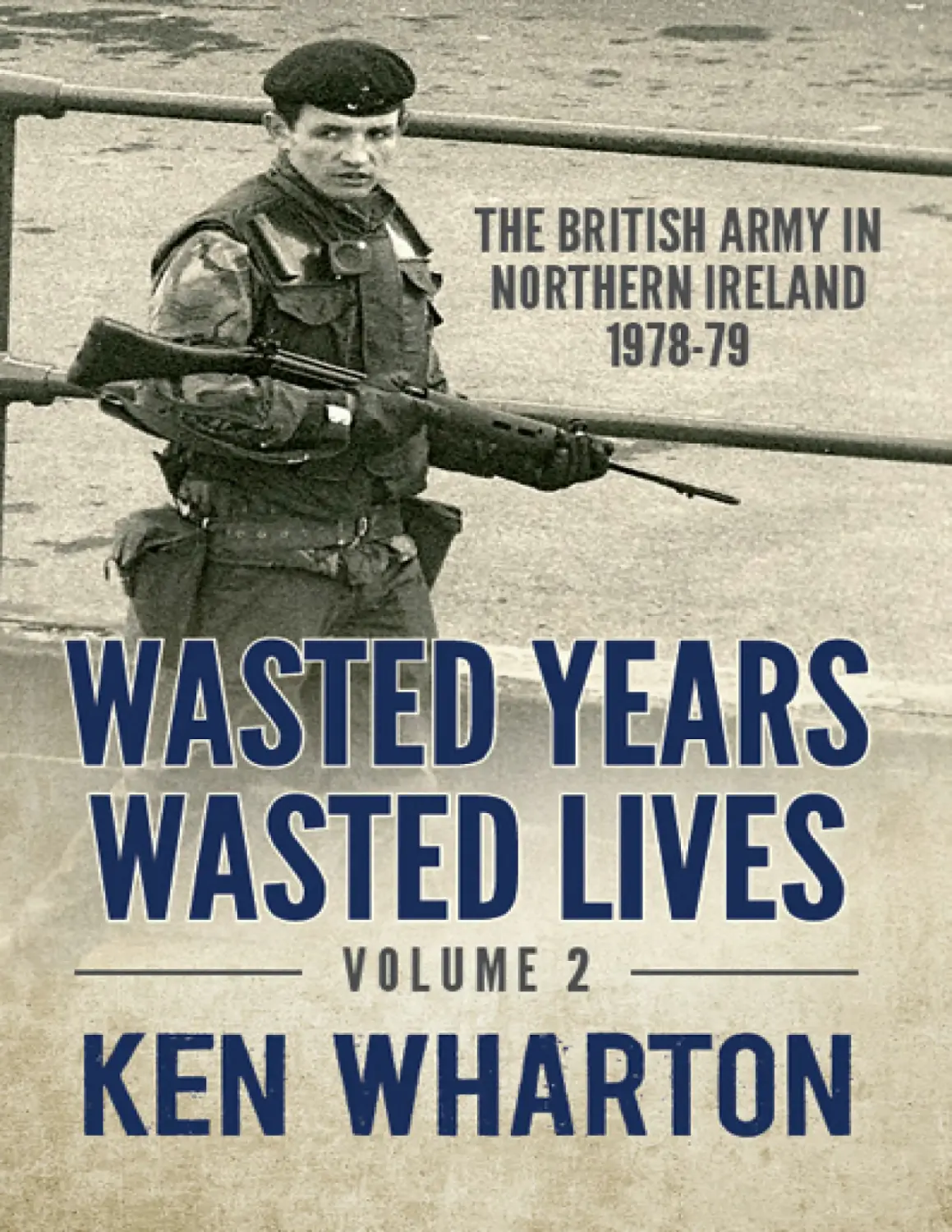


Author: Wharton K.W.
Tags: history british army international relations european history historical literature
ISBN: 978-1-910294-91-8
Year: 2014
Similar

Text
                    Like every good investigator, Ken Wharton is relentless in his pursuit
of the facts and remains true to the evidence. Through his crisp,
direct crisp storytelling he makes the past accessible for the rest of
us and adds a special dimension to the study of conflict.
Martin Dillon, bestselling author of
The Dirty War, The Trigger Men, The Shankill Butchers
A former squaddie who himself patrolled the dangerous streets and
lanes of Northern Ireland, Ken Wharton once again succeeds
brilliantly in recreating what it was like for a soldier to be there in the
darkest days of the Troubles. A must-read for anyone interested in
knowing what really happened.
Toby Harnden, author of Bandit Country: The IRA & South
Armagh
and Dead Men Risen: The Welsh Guards & the Defining Story of
Britain’s War in Afghanistan
A crucial reminder of the sacrifices of our armed forces in Northern
Ireland - even more timely with prosecutions being mooted over
Bloody Sunday.
Damien Lewis, bestselling author of
Zero Six Bravo, Operation Certain Death, Apache Dawn
Without Ken’s voice many of these tales would be lost to the sands
of time and the courageous sacrifice of these men would be
forgotten; but thanks to him they won’t and their stories will live on.
All of us who have ever worn green owe Ken and the men he writes
of a debt; because lest we forget it could have been us.
Steven McLaughlin, bestselling author of Squaddie

Another compelling insight into the British Army’s long war in
Northern Ireland. Deeply moving, often tragic, sometimes darkly
funny, it gives a startling insight into a normally unseen side of the
Troubles. Students of Irish history owe the author a huge debt of
gratitude for assembling such a unique and indispensable narrative.
Kevin Myers, author of Watching the Door; Cheating Death in
Belfast in the 1970s

Helion & Company Limited
26 Willow Road
Solihull
West Midlands B91 1UE
England
Tel. 0121 705 3393
Fax 0121 711 4075
Email: info@helion.co.uk
Website: www.helion.co.uk
Twitter @helionbooks
Blog http://blog.helion.co.uk/
Published by Helion & Company 2014
Designed and typeset by Farr Out Publications, Wokingham, Berkshire
Cover designed by Paul Hewitt, Battlefield Design (www.battlefield-design.co.uk)
Printed by Gutenberg Press Limited, Tarxien, Malta
Text © Ken M. Wharton 2014
Photographs © as individually credited within the book
Maps of Belfast and Londonderry originally appeared in The British Army in Northern
Ireland
by Michael Dewar (1985) and are © Weidenfeld & Nicolson, a division of The Orion
Publishing
Group (London).
Cover photos © Walter Stirling
The opinions expressed in this book are those of the individuals quoted and do not
necessarily
accord with views held by the author or publisher.
The author would be delighted to receive comments about his writing or for future
publications
at ken_wharton@hotmail.co.uk
Print ISBN: 978-1-909982-17-8
DIGITAL ISBN: 978-1-910294-91-8
British Library Cataloguing-in-Publication Data.
A catalogue record for this book is available from the British Library.
All rights reserved. No part of this publication may be reproduced, stored in a retrieval
system,
or transmitted, in any form, and by any means, electronic, mechanical, photocopying,

recording
or otherwise, without the express written consent of Helion & Company Limited.
For details of other military history titles published by Helion & Company Limited
please
contact the above address, or visit our website www.helion.co.uk.
We always welcome receiving book proposals from prospective authors.

Dedicated to the memory of Colour Sergeant Ken
Ambrose
On 9 January, 2013, one of the finest soldiers in the finest
Regiment in the British Army – the Royal Green Jackets –
passed away. His passing was sudden and shocked all of us
who were fortunate to have known him. There will be many who
have worn that coveted Rifle Green beret who, like all who met
him will share the shock and grief. He has enriched the lives of
the soldiers he took into battle and his loved ones and family.
He was an inspiration to me; he encouraged me and he helped
me. His was the first name on the dedications page of all my
books and he had a pivotal role in my 2009 documentary for the
History Channel, ‘Soldiers’ Stories.’ I am proud to have known
him and honoured that he chose to do so much for me. We
share the loss with his lovely wife, Penny and his family.
Celer et Audux; Swift and Bold. Until the final RV.

Dedications
To every young, fresh-faced British soldier who headed to
Northern Ireland with the optimistic hope of making a
difference; to the eternal memory of every lad and lass who fell
in Belfast, Londonderry and countless other places of the
northern part of that ‘Emerald Isle’
To the late Ken ‘B’, who did so much to help me.
To the 1,300 who never returned to their loved ones.

To Darren Ware, Dave Hallam, Ken Pettengale, Gren Wilson,
Dave Judge, Tim Marsh; to the Royal Green Jackets, Celer et
Audux
To Mike Sangster, John & Bernie Swaine, Mick Potter, Royal
Artillery, Ubique
To Paddy Lenaghan, George Prosser, King’s Regiment
To Mick ‘Benny Hill’ Steve ‘Foxy’ Norman, Andy Thomas, Royal
Anglians
To Mark ‘C’, James Henderson, B.R., Haydn Williams, Glen
Espie and the men and Greenfinches of the Ulster Defence
Regiment
To Dave Parkinson, RTR
To Jay Bell, ATO
To Kenneth Anderson, Kev Wright, Tommy Clarke, Royal Corps
of Transport
To Dave ‘Slops’ Langston, Army Catering Corps
To Eddie Atkinson & Mick Brooks, Green Howards
To Tam Hutton and the Royal Highland Fusiliers
My cousin John Leighton, a Royal Artillery TA soldier
To Helen, my partner, for all her support and energy and
patience and her guidance.
To my children: Anne-Marie, Anna-Martina, Jonathan, Jenny,
Robbie, Alex and Nathan; love you all and always will.

To my grandchildren: Sherriden, Kelsy, William, Sammy and
Layla-Mae; also to Morgan Addy.
To my Aussie friends Rachel Barnard and Sophie Sheldon –
thank you for understanding what we went through.
To Donna Johnston, a very special lady.

Anyone else remember being on mobiles and coming to a red light in
the early morning hours, running to take up all round defence, until
the light changed to green and returning with a bottle of milk from
some poor sod’s door step?
Erich Modrowics
I have long wondered what the Yanks would have done or said if,
say, the Mormons had set up a military wing that killed policeman
and soldiers, and we took collection tins around pubs so they could
buy more guns.
Martin Wells
Thank you, Ken, for pursuing the publication of another book that I
am sure will tell many truths, collate a wide range of stories that
might have got lost on their own, and will serve as a record for
posterity.
Andrew MacDonald, King’s Royal Border Regiment
You run across gaps, hide in doorways, move all the time, even
when stopped, use the locals as human shields, kids are even better,
stand at a house window, a gunman won’t fire if you have a living
room window behind you. Use every trick in the book, even the dirty
ones to stay alive; it is cat and mouse out there on every patrol. On
each patrol you feel like a walking ‘Figure 11’ (a full sized ‘running
enemy’ target used on the rifle ranges)
Steve Hale, Scottish soldier

It was such a terrible time for so many young men / women. Do not
think any amount of pre-deployment training could prepare one for
what we saw and did. Through the pain, fear and uncertainty, it was
one’s comrades that never came home that will never be forgotten.
Robert McGregor, Royal Artillery
We all went through the same shit, so we know what it is all about. I
was 1 Scots Guards. The Regiment was formed in 1642 to pacify
Ireland; 340 years later, we were still at it.
Tom Mitchell, Scots Guards
I remember in Belfast this tiny kid threw a stone at us around 9pm,
one night; he must have been about six or seven, so I asked him
why he threw it. He said because you are British bastards. If I had
asked him why, he probably wouldn’t have known.
Tony Bramley
Your books on the Troubles have grown into a wonderful volume on
our war and I for one think that they have pride of place on many
bookcases. Once again, well done mucker, and I look forward to the
next one for two reasons – one, because of the tribute to Paul
Sheppard, and the other is to add to the collection of a wonderful set
of books on OP Banner.
Mark Shaw
I still feel you around me; still hear you come beside me; feel you
panting in the dark. Still see your tail wagging; still hear you when
you bark; can see you stand right next to me, alert and full of pride,
willing to do your duty; from that you never did hide. You will always
be with me until the day I die. We went through so many things,
good and bad; together you and I. I was proud to serve with you, my
special pal and friend; we did our job together, right until the end.
Mark Shaw, Army Dog Handlers’ Unit
In special memory of my service dog, 7C55 ALI Groundhog,
Northern Ireland

Contents
List of Maps and Illustrations
Foreword
Preface
Note to the Reader
The Author: a Personal Statement
Abbreviations
My Dad, the Soldier
Maps
Introduction
Part Four: 1978
37 January
38 February
39 March
40 April
41 May
42 June
43 July
44 August
45 September
46 October
47 November
48 December
Part Five: 1979
49 January

50
51
52
53
54
55
56
57
58
59
60

February
March
April
May
June
July
August
September
October
November
December

Postscript
Appendices
I
Poetry of the Troubles
II
Northern Ireland Roll of Honour 1969–98
III
RUC Roll of Honour 1969–98
Select Bibliography

List of Maps and Illustrations
Maps
Northern Ireland
Londonderry
Belfast
South Armagh (‘bandit country’)

Illustrations
ATO detonating a small bomb in a van, Hightown Road, Belfast,
1979. (© Mark ‘C’)
Soldier from 25 Field Regiment, Royal Artillery on patrol, Sandy
Row, Belfast, 1979. (©Mark ‘C’)
Canteen at Forkhill after mortar attack. (©Alan Simons)
Riflemen Ian Blackmore and Ken Pettengale, Royal Green Jackets,
after the mortar attack at Forkhill. (©Alan Simons)
Mortar baseplate lorry before booby-trap. (©Alan Simons)
9 Platoon Royal Greenjackets accommodation after the mortar
attack at Forkhill, 23 January 1978. (©Alan Simons)
9 Platoon Royal Greenjackets accommodation after the mortar
attack at Forkhill. (©Alan Simons)
Looking out from a sangar at Kinnard Street, with the Antrim Road
visible, Belfast, 1979. (Mark ‘C’)
Looking out over the Ardoyne. (©Brian Sheridan)
North of Jamaica Street, Belfast. (©Brian Sheridan)
Civilian searchers, Belfast, 1979. (©Mark ‘C’)
Somewhere in South Armagh. The original caption wittily notes
‘Result of underfunding of the N.I. education system!’
(©Alan Simons)
Engineers demolishing a sangar, Victoria Street, Belfast, 1979.
(©Mark ‘C’)

Lance-Bombardier Chris Hunter, 23 Battery, 27 Field Regiment RA,
North Howard St Mill, Falls Road, 1979-80. (©Dave
Malster)
View from a sangar over the Ardoyne. (©Brian Sheridan)
South African-made 9mm LPD sub-machine gun, found by 25 Field
Regiment Royal Artillery, Roy Street, Markets area of
Belfast, October 1979. (©Mark ‘C’)
Bomb in Post Office van, Hightown Road, Belfast, 1979. (©Mark ‘C’)
Royal Artillery on patrol near Armagh, 1979. (©Walter Stirling)
Royal Artillery on patrol near Armagh, 1979. (©Walter Stirling)
Royal Artillery, Armagh, 1979. (©Walter Stirling)
Royal Artillery, Armagh, 1979. (©Walter Stirling)
Flyer handed out to the local population by B Company 2 Royal
Green Jackets, Crossmaglen, 1978. (©Gary Cootes)
Turf Lodge, Belfast, c 1978. (©George Prosser)
Patrol brief, Royal Artillery, Armagh, Christmas 1979. (©Walter
Stirling)
Patrol brief, Royal Artillery, Armagh, Christmas 1979. (©Walter
Stirling)
Letter given to all members of B Company 2 Royal Green Jackets,
South Armagh, to send home to parents etc. (©Gary
Cootes)
Mosaic of newspaper clippings related to 2 Royal Green Jackets in
South Armagh, 1978. (©Gary Cootes)
Crumlin Road area looking towards Holy Cross, Belfast. (©Brian
Sheridan)
On patrol, Royal Artillery, Armagh, 1979. (©Walter Stirling)
H Block riot, Durham Street/Grosvenor Road, Belfast 1979 – 25
Field Regiment, Royal Artillery. (©Mark ‘C’)
Foot patrol, Sandy Row, Belfast, 1979. (©Mark ‘C’)
A poster issued by the Security Forces after a bomb attack. (via
author)
Royal Artillery, Armagh, 1979. (©Walter Stirling)
Mobile patrol, Royal Artillery, Armagh, 1979. (©Walter Stirling)
Soldier outside Grand Central Hotel base, Belfast, 1979. (©Mark ‘C’)

Scene of the murder of a prison officer, Crumlin Road, Belfast, 1979.
(©Mark ‘C’)
Car in which a prison officer was murdered, Crumlin Road, Belfast.
(©Mark ‘C’)
On guard, Belfast, 1979. (©Mark ‘C’)
Ballygomartin Road, Belfast, October 1979 – a bomb had fallen off
another vehicle and three men were injured when their van
ran over it, detonating it. Incident dealt with by 25 Field
Regiment, Royal Artillery. (©Mark ‘C’)
In the front seat of a scout flying fast and low back to Bessbrook,
Armagh. (©Brian Sheridan)
Foot patrol, Ormeau Road, Belfast, 1979. (©Mark ‘C’)
Foot patrol, Ormeau Road, Belfast, 1979. (©Mark ‘C’)
E Troop, 16th Air Defence Regiment, Royal Artillery. 1979. (©Walter
Stirling)
Belfast, 1979. (©Mark ‘C’)

H

Foreword

aving reported the Northern Ireland Troubles for well over a
quarter of a century, I’ve often been struck by the quality and
standard of work of those who started out with little or no personal
connection to this most complex of conflicts. Former British soldier
turned Troubles chronicler Ken Wharton fits easily into this category
– and Wasted Years, Wasted Lives Volume 2: The British Army in
Northern Ireland 1978-79, his latest contribution, may yet prove to be
the best example of his work so far.
Of course, it is not entirely accurate to state as I did earlier that
Ken has no connection to the tribal battlefield that was – and still is –
Northern Ireland. Because as a serving soldier with two NI tours
under his belt he is a man who, as they say here in Ulster: “Walked
the walk and talked the talk.” The iconic place names of the Troubles
– Creggan, Bogside, South Armagh ‘Bandit Country’, Falls and
Shankill Roads – which were so well-known to TV audiences around
the world in the recent past, fall easily from Ken’s lips. In other
words, he knows the territory well and that’s not a bad starting point
for any writer of historical fact.
As a writer, Ken Wharton’s stock in trade is the quality of his firsthand accounts. Not only is the reader able to tap into the memory of
the eyewitnesses Wharton interviewed for his book, they will also
delight in his own personal recall of his days as a squaddie patrolling
the villages, towns and cities of Northern Ireland. I remember
wondering a few years ago when Ken Wharton first burst on to the
Troubles book scene with his initial contribution A Long Long War if
this was just another ex-member of the Security Services recording
for posterity the fact that he had once risked life and limb serving in
Northern Ireland. How misplaced my scepticism was because here
we are, seven books later, and Ken Wharton shows no signs of
quitting.

Wasted Years, Wasted Lives Volume 2 is the natural follow-on
from Ken Wharton’s last book Wasted Years, Wasted Lives Volume
1: The British Army in Northern Ireland 1975-77. As with all
Wharton’s previous books, his latest contribution has the same
attention to detail. Detail has become the hallmark of a Ken Wharton
book. In fact, for someone who wasn’t trained in the testing world of
busy newsrooms or TV studios he would put many a hard-nosed
news reporter to shame. It is his commitment to delivering the very
best information available which affords the reader a better
understanding of very complex – and at times mystifying – situations.
As the Troubles dragged on year after year, the interest of the
British public (and to a lesser extent the Northern Ireland public too)
waned considerably. A ‘Richter Scale’ of atrocity emerged and many
murders never even made the News at Ten on TV. And yet Ken
Wharton – a battle-hardened soldier who had witnessed death up
close – was still possessed of enough humanity to treat the passing
of each victim full respect and sensitivity. His account of the shooting
of 69-year-old grandmother Martha McAlpine is very moving indeed.
The pensioner was standing on Belfast’s Shore Road alongside
three of her grandchildren – all under the age of 10. From nowhere a
van containing an IRA hit-squad pulled up intent on shooting a police
officer who was standing nearby. Most of the shots fired missed the
officer completely, although one struck him on the leg. But another
struck Mrs McAlpine in the stomach and she died in hospital a short
time later. And Wharton’s account of the shooting of an infant child –
who miraculously survived the ordeal – a few days before, brings the
full horror of the Troubles home to the reader.
Ken Wharton’s books also cover the culmination of one of the
most evil episodes in the entire history of the Troubles: the conviction
and sentencing of a psychopathic Loyalist killer gang known as the
Shankill Butchers. Its leader, Lenny Murphy, was never convicted for
many of the heinous crimes for which he was responsible. But in
handing down 42 life sentences to 11 of his cohorts for their part in
19 murders of mainly innocent Catholics, the trial judge did civil
society a great favour.

The army in which Ken Wharton served is no longer a feature of
day-to-day life in Northern Ireland. Although the Troubles haven’t
completely disappeared, most of the disagreements which were
previously played out violently on the streets are now dealt with in
the debating chamber of the Devolved Assembly at Stormont. The
Royal Ulster Constabulary has been replaced by the Police Service
of Northern Ireland. The cities of Belfast, Londonderry and Armagh
resemble their UK or Irish counterparts in that visitors are spoilt for
choice when it comes to entertainment or dining out. Tourists abound
and despite the odd blip we see on our TV screens, normality has by
and large returned to this most beautiful Province.
However, we should never forget that only a few decades ago –
as a result of the potent mixture of history, bad law and tribal
entrenchment – civil society actually broke down in this remote
corner of the United Kingdom. And it took many years to put it back
on an even keel. Ken Wharton’s latest book gives us some
understanding of just how bad life was for everyone during those
dreadful days. For students of Northern Ireland history or even just
for ordinary people with a genuine interest in the place, Wasted
Years, Wasted Lives Volume 2 is essential reading. I’m convinced it
will occupy pride of place on the shelves of many libraries and book
collections.
Hugh Jordan, Belfast, 9 September 2013
Hugh Jordan is a senior reporter on the Sunday World. He has
reported on Northern Ireland for many years and regularly
broadcasts on TV and radio. He is also the author of two acclaimed
books relating to the Northern Irish conflict.

T

Preface

he name Ken Wharton first came to my attention in 2008 when
his first book A Long Long War was published. I read that he
was asking for further stories and photos from former soldiers with
the intention of writing a second book on the subject. This became
Bullets, Bombs and Cups of Tea. As a soldier who had completed a
tour with the gunners in 1979 – then nearly eight further years in the
full-time UDR – I thought I could contribute and phoned the number.
Our firm friendship started and I have had the pleasure do research
for all the subsequent books – and Ken has been over to Northern
Ireland twice. Whilst here, myself and my mate and former comrade
BR escorted Ken and his cousin John around all the former (and
some still very) hotspots to take photos for the books.
So when Ken asked me to write a Preface for this book – Volume
2 of Wasted Years, Wasted Lives – I was very, very honoured to be
involved with what I class as must-reads for anybody interested in
studying that very, to say the least, very turbulent period in the
history of my country.
This volume covers the years 1978-1979 and indeed it was
September 1979 that I undertook my first tour of duty in Belfast with
25th Field Regiment RA; back to the city I was born and raised in
and had left three years previously to join the army. These years
were very challenging for the British Army; the Ulsterisation Policy,
which was implemented so the RUC could take the lead in the
security battle, was gaining momentum and in my opinion 1979 was
really the last year where the army could act in any way on their own
initiative. When I came back in spring 1981 – just in time for the
Hunger Strikes to kick off – after transferring into the UDR you could
see the difference … with the RUC far more involved at all levels.
Of course this did not happen without death or casualties; in this
two-year period 70 soldiers died at the hands of the Republican

Terrorists, PIRA and INLA (including 18 in one incident at
Warrenpoint) with a further 70 dying of other causes such as RTAs.
The RUC lost 24 over the same period.
As Ken takes the reader through to December 1979 and the
dawn of a new decade which would herald in even bigger changes,
once again it is the ordinary soldier who is at the heart of everything;
their stories, including my own, written by their own hand in our own
language – all interwoven with a daily list of bombing, shooting,
death and destruction. This was, in essence, a war fought on British
soil – half an hour’s flight from Liverpool. Share the fear, the drama
and the funny squaddie humour which got all of us who served in NI
through the hard times.
Mark C, RA, UDR and Friend.
Belfast 2013

T

Note to the Reader

his is the companion volume to Wasted Years, Wasted Lives
Volume 1, which covered the period 1975-77. This volume
covers the following two years of 1978 and 1979. For continuity of
information, it needs to be read in conjunction with the first volume.
Chapter numbering follows the course set by the earlier volume and
will continue from Chapter 37. There is a full Roll of Honour for the
full period of the Troubles at the end, as well as an ROH for the
Northern Ireland Police, the RUC.
N.B. In Volume 1 the author erroneously refers to Robert Craven as
Robert Conway on page 216 and apologises for this error.

I

The Author: a Personal Statement

am often asked by members of both what my son-in-law calls my
‘tribe’ and also by members of the general public if Ireland will
ever be – indeed, should ever be – reunited. One does not intend to
indulge in the semantics of a debate which can only be described as
polarising, as there is – by definition – no ‘middle ground’. My
personal feeling is that the country will never be reunited, nor should
it be just so long as the vast majority of those who live in the part of
the island most likely to be disadvantaged – the Loyalists/Protestants
– wish to remain British. Partition may not be ideal and it was right
that the Ulster Ruling Classes had to be dragged kicking and
screaming into a belated democracy. Equality had, in many ways, to
be foisted upon then.
I foresee only one set of circumstances where the border might
be removed and direct rule from Dublin put into effect. That is if
some future British Government decides that enough is enough and
pulls out – politically and economically – from Ulster. Should that day
come, it will be a betrayal of those who wish to remain British and
those of my comrades and others who gave life and limb to
safeguard that wish.
Further to this I will not disguise my utter contempt for the IrishAmerican community who either overtly or tacitly supported the
Republican terrorists in Ireland, North or South. I will always detest
the staff and the officers of NORAID and those hateful or naïve
enough to support this loathsome organisation. Remember the
words of the Stiff Little Fingers’ song: ‘Each dollar a bullet’. This
stance will remain constant throughout all of my writings.

Abbreviations
2IC
3LI
AAC
ADU
APC
APNI
ASU
ATO
AWOL
BFBS
Bn HQ
BOI
CESA
CO
CS
CVO
DC
DERR
DOE
DoW
DOWR
DUP
DWR
EOD
ETA

Second in Command
Third Battalion Light Infantry
Army Air Corps
Army Dog Handling Unit
Armoured Personnel Carrier
Alliance Party of Northern Ireland
Active Service Unit
Ammunition Technical Officer
Absent Without Leave
British Forces Broadcasting Service
Battalion Headquarters
Board of Inquiry
Catholic Ex-serviceman’s Association
Commanding Officer
Tear Gas
Casualty Visiting Officers
Detective Constable
Duke of Edinburgh’s Royal Regiment
Department of the Environment
Died of Wounds
Duke of Wellington’s Regiment
Democratic Unionist Party
Duke of Wellington’s Regiment
Explosive Ordnance Disposal
Euskadi Ta Askatasuna (Basque Separatist Terrorist
group)

FOI
FRG
GAA

Freedom of Information
Federal Riot Guns
Gaelic Athletic Association (Irish: Cumann Lúthchleas
Gael)
GC
George Cross
GHQ
General Head Quarters
GPMG
General Purpose Machine Gun
GPO
General Post Office
HET
Historical Enquiries Team
HQNI
Head Quarters Northern Ireland
IJLB
Infantry Junior Leaders Battalion
INLA
Irish National Liberation Army
Int
Intelligence
IRA
Irish Republican Army
IRSP
Irish Republican Socialist Party
KIA
Killed in Action
KOSB
King’s Own Scottish Borderers
LSL
Landing Ship Logistics
MO
Medical Officer
MoD
Ministry of Defence
NAAFI
Navy, Army and Air Force Institute
NCND
neither confirm nor deny
NCO
Non-Commissioned Officer
NG
Negligent Discharge
NI
Northern Ireland
NIVA
Northern Ireland Veteran’s Association
NMA
National Memorial Arboretum
NORAID Northern Aid Committee
NTH
Newtownhamilton
ODC
Ordinary decent criminals
OP
Observation Post

OTR
Pig
PIRA
PLA
POA
POW
PRO
PSNI
QLR
QOH
QRF
RAF
RSF
RCT
RE
REHQ
REME
RGJ
RIRA
RMP
RAOC
ROE
RPG-7
RRF
RRW
RSM
RTA
RUC
RUCR
RVH

On the Run
Armoured Vehicle (named as such due to its pig-like
appearance)
Provisional Irish Republican Army
People’s Liberation Army
Prison Officers’ Association
Prisoner of War
Public Relations Officer
Police Service Northern Ireland
Queen’s Lancashire Regiment
Queen’s Own Highlander’s
Quick Reaction Force
Royal Air Force
Republican Sinn Féin
Royal Corps of Transport
Royal Engineers
Royal Engineers Headquarters
Royal Electrical and Mechanical Engineers
Royal Green Jackets
Real Irish Republican Army
Royal Military Police
Royal Army Ordnance Corps
Rules of Engagement
Rocket Propelled Grenade
Royal Regiment of Fusiliers
Royal Regiment of Wales
Regimental Sergeant Major
Road Traffic Accident
Royal Ulster Constabulary
Royal Ulster Constabulary Reserve
Royal Victoria Hospital

SB
SDLP
SF
SIB
SLR
SOP
SUIT
TA
TD
TAOR
UDA
UDR
UFF
USC
UTV
UUP
UVBT
UWC
VCP
WOII
WRAC

Special Branch
Social Democratic and Labour Party
Security Forces
Special Investigation Branch
Self Loading Rifle
Standard Operating Procedure
Sight Unit Infantry Trilux
Territorial Army
Teachta Dála (Member of the Irish Parliament)
Tactical Area of Responsibility
Ulster Defence Association
Ulster Defence Regiment
Ulster Freedom Fighters
Ulster Special Constabulary
Ulster Television
Ulster Unionist Party
Under vehicle booby trap
Ulster Worker’s Council
Vehicle Check Point
Warrant Officer Second Class
Women’s Royal Army Corps

My Dad, the Soldier
Anita Bailkoski, Daughter of Sergeant John Haughey
My dad was my personal hero. He loved army life and enjoyed every
opportunity that went with it. We had a wonderful life as a family stationed in
Celle, Germany. We travelled over the Continent during the summer holidays
camping and discovering new places. Dad was very loving, patient and great
fun. He always had time for us kids and I still miss him. 21 January 1974 was
the day my life changed. I was seven years old and the ripples in the pond that
were created by my father’s death still continue to this day. I will never forget it.
I don’t remember the first call – maybe we were still at school – but I knew my
mother was preparing to visit my father in Londonderry as he had been injured
in a bomb blast, but was expected to survive.
There was a knock at the door as nobody had a home phone in married
quarters in those days. I remember standing with my two brothers, Martin and
Andrew, to see an officer in his no 1 uniform – his polished Sam Browne belt
shining in the light from the hallway. He was accompanied by another person
whom I don’t remember. I think somehow I had expected to see my dad
magically returned from Northern Ireland as he had recently done at the
Christmas just passed. It wasn’t to be.
The officer was invited in and we were ushered into my bedroom to amuse
ourselves. My mother already had a friend with her, Sheila Jackson, who I
think was going to be looking after us while my mother was away. Sheila was a
very supportive and close friend and was a person we could trust and knew
well amongst the army personnel. Myself and my two brothers had no idea
about what was happening; we already knew our dad had been injured and
that our mother would be travelling to Northern Ireland to visit him, but we had
no clue his life had been in danger.
We were called in to the living room after the officers had left. I looked at
my mum. Her face looked strange – swollen and puffy from the tears. I did not
understand why my mother looked so different. Mum falteringly told us: “I’ve
got something to tell you…. Your daddy’s dead, kids”… and then collapsed into
tears. I was scooped into the arms of Sheila Jackson whilst my mother hugged
the boys. I didn’t want to cry, but felt I should. I felt numb and very strange as I
had not witnessed this kind of emotion in adults before. I remember also
feeling angry that nobody had warned me that my daddy might lose his life in

Northern Ireland. Within 24 hours we were on a plane heading back to the UK.
We had lost everything. Along with my father we lost our home, schools,
friends, a support network within the regiment and a wonderful life. It was all
changed.
I learnt from later reports that my father had, in a semi-conscious state,
tried to enquire about the other men in his troop whilst been driven to hospital
in the ambulance. Fortunately there were no other fatalities on that occasion.
The irony for our family was that my dad’s own family were Irish Catholics and
my grandfather was born in Londonderry, but as a young child he had been
burnt out of his house by the black and tans. The family then fled to the
relative safety of Donegal, which is where he had grown up. I still find it so
hard to fathom how my dad had been killed on the streets and by the hands of
the people that his own father had been born amongst in that bloody civil war.
My dad’s body was flown back to Manchester, where he had been born,
and he was given a military funeral at St Catherine’s RC Church where my
parents had married 10 years earlier. Eight members of 94 Locating Regiment
– including Major Tom Hughes – also came over. The coffin was carried
through the streets of Didsbury on a 25-pound gun carriage draped with the
union flag. The sudden death of my beloved grandparents 15 months later can
be attributed to the stress they endured during the previous year. They were
still young and vital, but died within 10 days of each other. We also lost my
younger brother Andrew at the age of 18 in a car accident. I know things would
have been different had my Father lived.
I try not to entertain any bitterness as it destroys people’s lives even more
than loss, but sometimes it is difficult. I often think about the many thousands
of human beings whose lives have been blighted by the senseless murders in
Northern Ireland and it helps to realise I am not alone – and I live in hope that
one day I can get some kind of acceptance and peace.

Sergeant John Haughey was killed in action on 21 January 1974 on
Lonemoor Road, Londonderry by an IED. His death is covered in Sir,
They’re Taking the Kids Indoors: The British Army in Northern Ireland
1973-74 by Ken Wharton.
During the last seven or eight years, several authors have made
some extremely flattering comments about my works. These writers
include Martin Dillon, Damien Lewis, Toby Harnden, Kevin Myers,
Patrick Bishop, Steven McLaughlin and Tony Clarke to name a few.
To have my name mentioned in the same context as theirs is a truly

humbling experience and I will be forever grateful. The following
praise from the niece of one of our fallen in Northern Ireland is also
truly humbling.
I had originated contact with you as I was looking for
information on my uncle Lance Corporal David Card
24191193, 1RGJ; he was shot and killed by an IRA sniper in
1972 in Andersonstown, Belfast. I was aware after speaking
to Philip Pickford (1RGJ) that he might be in one of your
books so I managed to find your email address and wrote to
you; within a day you emailed back; within 2 days we had
spoken on the phone. You rang me all the way from Australia!!
We had a lovely chat and you confirmed he was in ‘The
Bloodiest Year 1972’. I ordered my copy straight away.
In June 2013 I was very honoured to attend your book
launch in Davies Street London, for your new book ‘Wasted
Years, Wasted Lives Volume 1’. This would be the first time of
actually meeting you. Nervous and excited I got off the tube; I
didn’t have a clue where I was supposed to be going, so
taking a look at the crowds around me, I picked on 2 people to
ask for directions and they both had their backs to me. Those
2 people were you and Paddy Lenaghan; of all the people I
could have picked, YOU were the first person I spoke to in
London. It was just meant to be!! To cut a long story short,
your book launch was a huge success; you signed my copy of
‘The Bloodiest Year 1972’ with a personal message that
makes me emotional every time I read it. Thanks to you I met
some wonderful soldiers that day: Michael ‘Benny’ Hill, John
Hill, John Corr, Ian Flynn, Mark Campbell, Paddy Lenaghan to
name just a few and of course your good self Ken. Everyone
made me feel so very welcome, like part of the ‘family.’
I have stayed in contact and will continue to do so,
although my quest for information about Uncle David
continues and the web of information is spreading but I have
learnt so much more thanks to your books, and to the brave
soldiers themselves for reliving their humour, sadness and

fear in these books. Like I have said so many times, without
you guys I would have nothing to remember my uncle by.
Since meeting you I have also found him in another of your
books ‘Bullets, Bombs and Cups of Tea’.
Ken thank you so very much for your compelling writing in
this series of books and to be frank, for having the balls to
write the British soldiers’ side of the story. ‘The War That
Never Was’ will never be forgotten, nor will the tragic waste of
thousands of lives.
Tammy Card, niece of David Card, KIA in Andersonstown.

Maps

Northern Ireland

Londonderry

Belfast

South Armagh (‘bandit country’)

T

Introduction

his book looks at the two years which witnessed the end of
what was effectively the second decade of the Troubles. For
those who thought that the latest tranche of violence in Ireland’s
troubled history would be short-lived, the opening days of 1980
which took the period into a third decade must have been most
disheartening. That it did move into a fresh decade was down to
several main reasons: it was down to the men of evil on both sides of
the sectarian divide; it was down to the willingness of mad dogs such
as the Libyan leader Gaddafi and also the USSR and the naïve IrishAmericans who funded the violence – and it was down to the
determination of the British Government to support the vast majority
of the population who wished to remain British.
The two years under review, whilst not as violent as the years
1972 and to a lesser extent 1975, nonetheless produced slaughter
on an almost comparable scale. It was a 24 months which witnessed
the PIRA atrocity with a napalm-like attack on the La Mon
Restaurant in February 1978, which killed 12 people at a dogbreeders’ function and terribly injured 42 more. It was a 24 months
which saw the killing of 18 soldiers at Warrenpoint, Co Down on the
same day as the murder of the Queen’s cousin Lord Mountbatten
and members of his family in August 1979. It also included the end
for 11 members of the UVF known as the Shankill Butchers who
were sentenced to life in prison for 19 murders. The infamous group
was named for their practice of torturing and mutilating their victims
with butcher’s knives.
In short, for the terror groups who frequented the bars of both the
Nationalist areas and the Loyalist parts of Northern Ireland, it was
‘business as usual’. For the Provisional IRA – as well as the Irish
National Liberation Army – it was a further period in which they
attempted to push the British into the sea and sicken the British

people into pressurising their Government to withdraw from the
Province. For the Loyalists, it was more of the same from their ‘foot
soldiers’ – the Ulster Freedom Fighters, the Ulster Volunteer Force
and the Red Hand Commando – as they targeted Republican
members, although for the most part their energy was devoted to the
senseless sectarian slaughter of the Catholic population. For Loyalist
murder groups such as Lenny Murphy’s Shankill Butchers, it was
very much ‘carry on as before’. For the soldiers of the British Army –
the stereotype ‘piggy in the middle’ – it was very much more of the
same.
Ken Wharton, Gold Coast, Queensland, July 2013

Part Four

T

1978

his was a year in which 49 more soldiers would lose their lives
and more UDR would be murdered off duty. The Republicans
would continue to target and kill policemen – and sectarian deaths
began after a short lull. In total 110 people would die, or 13 more in
an entire year than were killed in one month in 1972. It was the year
of an appalling ‘napalm-like’ PIRA bomb attack at La Mon which
killed 12 people as they ate and drank at a quiet restaurant in Co
Down.

37

J

January

anuary was a quiet month by the murderous standards of the
Troubles with only two deaths – both of UDR soldiers. There
were, however, numerous near-misses and the utter tragedy of La
Mon was just a few weeks away.
The first serious attacks of the New Year of 1978 took place in
Castlederg, Co Tyrone and there was some confusion as to the
architects of this mini blitz. The attacks bore the usual PIRA
hallmarks: close to the border and a quick and easy bolthole. On the
other hand the area was predominantly Nationalist and ended with a
robbery which was more the trademark of the Loyalist paramilitaries.
The devices were all placed by a gang of four masked men at
various sites all within a mile of each other. An electrical shop in
William Street, a garage in Upper Strabane Road and a grocer’s in
the same street were all hit by large devices which caused major
damage – as well as major panic. A fourth device was planted at a
large furniture store in the town. When Baskin’s Grocers was robbed,
the two bombers rifled the till and stole the day’s takings, which led
to speculation that it was Loyalists. Both the Provisionals and INLA
often carried out bank and post office robberies in order to finance
arms purchases, but the Loyalists were more likely to carry out the
petty thefts. Whilst trying to evacuate the area, one of the bombs – at
Lyon’s Brothers Garage – exploded and caused some shock injuries
to the RUC officers involved.
The remainder of the day saw devices planted in Londonderry,
Belfast and Altnagelvin, Co Londonderry. Some were defused and
others caused some damage. The following day saw a PIRA attack
on a PO in Saintfield Road, South Belfast and an extremely lucky

escape. The officer, aged 33 and a six-year veteran, had parked his
car in his garage overnight but a bombing team had managed to get
inside and planted a deadly UVBT. The officer started his car and
had just started to move when the device detonated – causing him a
severe wound to the leg (although he was able to limp back to the
house). His wife and two young children were in the house at the
time and his 12-year-old was greeted by the sight of his bloodied
father with a gaping hole in his leg. The PO later recovered, but the
Provisionals would ensure that many would be attending their own
funerals in the troubled years to come. Later that day there was
another lucky escape for a family sleeping above their shop in
Winetavern Street in Belfast (close to Smithfield Market) when an
incendiary device planted by the IRA exploded beneath their living
quarters. The firebomb – inside a tea chest – was dragged out of the
building and the family managed to escape. A spokesman for the
RUC later revealed that had the family all been asleep at the time,
they would have been trapped with no possibility of escape. Over the
course of the Troubles, the Republicans – mainly PIRA – were
responsible for the deaths of 67 children so it is highly unlikely that
they would have shed tears over two more innocents.
On the 4th, the Provisionals planted another bomb at another
section of the tourist economy: the Four Winds Restaurant at
Knockbracken in Belfast. This was slightly different and was possibly
a dress rehearsal for the La Mon. The device was attached to a
safety grill over the window – a tactic which they would repeat with
absolutely devastating effect the following month. The device
exploded – destroying the bar, but there were no injuries. It would be
repeated at the Manhattan Restaurant in Lurgan and then at the La
Mon. On that same day, five young male joyriders came very close
to death when they crashed through an army VCP in a stolen car.
The checkpoint at the junction of the Glen Road and the Falls Road
in Andersonstown was manned by soldiers based at Fort Monagh.
The stolen car made no attempt to stop and under ROE it was fired
upon. It crashed and four of the five occupants were wounded. All
were taken to the Musgrave Park Hospital for treatment.

The following day saw more blast and incendiary devices in
Belfast City Centre as the IRA attacked three major shops with
devastating effect. Shortly afterwards, a PIRA bombing team planted
a UVBT on a car which they wrongly assumed belonged to a PO
who lived in Glengormley, North Belfast. In actual fact the car
belonged to the PO’s brother and as he was driving on Whitewell
Road (in the direction of Antrim Road) it exploded – severely
damaging the car, but miraculously leaving the man uninjured.
Two days later, acting upon information from an informer inside
the Provisionals, the army raided a Catholic school in the Lower
Falls area. Inside the roof space at St Louise’s Girls’ Secondary on
St James Street, soldiers found explosives, weapons and
ammunition. The ammunition could have exploded at any time and
the Republican ‘defenders’ of the Nationalist community clearly gave
no thought to the safety of the pupils. The Provisionals then planted
a large device in the Capstan Lounge in Main Street, Newcastle, Co
Down. Armed masked men had planted the device and then run off.
The RUC were quickly on the scene, but staff were able to evacuate
drinkers and surrounding premises before the resulting explosion
wrecked the pub. The device was a mortar-type and caused a major
fire. Further south-west, an armed gang of PIRA volunteers hijacked
several lorries in Cullaville – close to Crossmaglen – and held the
drivers in a derelict cottage. Army helicopters were quickly on the
scene, and aided in a joint operation by RUC and Gardaí, were able
to rescue the hostages. No arrests were made on either side of the
border.
FORKHILL, 1978.
Ken Pettengale, Royal Green Jackets
We had settled in pretty well to our tour. Everything was going along quite
nicely; out for four-day patrols in the cuds, in for sangar duties and town
patrols. It was all ticking along very nicely – just as we thought it would do.
In early January of that year, we had been sent out on foot patrol and were
dropped off by helicopter – Puma or Wessex, can’t remember which. What I do
remember is that the pilot couldn’t land because the ground was too soft so we
had to do a heli jump onto the boggy ground. The ground was a bit more than
boggy though, and with our bergens and weapons (I was a GPMG Gunner) we

sank up to our waists. I reckon we didn’t go completely under purely because
our packs kept us up. Anyway, we were completely soaked. It was mid-winter
and it was totally freezing. We had to face four days’ patrol in that condition,
living under bashas and bushes … not funny!
The following morning, Sergeant ‘Baz’ Rimmer briefed the NCOs: due to
the conditions we would go back to Forkhill, have a kit change and get back
out on the ground. When I heard that, I was happy. Any time away from this
shit was a bonus!
We hadn’t been back in Forkhill very long – not long enough to get sorted
anyway – when all of a sudden the walls of our portacabin accommodation
collapsed! Stuff was flying everywhere: plates, kit, clothing, glass, loads of
stuff. Then there was a huge, but muffled bang! At this point it just started to
dawn on me that something wasn’t right. A couple of our corporals – Dave
Judge and Derek Randall – then got in among us. They calmly, but forcefully
shouted: “Weapons, ammo, boots … Everybody out! Now!” Then the siren
started wailing, activated by the ops room. The reaction told us what we
already knew: we were under attack! There we were, stuck in a big hole in the
ground and trapped by twisted metal, wood and the remnants of an SF base.
Bang, the second round went off! My training kicked in and I realised that it
was a Provie mortar attack! All I wanted to do was get the hell out! I remember
passing one of the Riflemen, Tom Cutbush. He was standing there holding an
aluminium plate and bleeding from his head into it. He didn’t look too bad and
was moving along with us. I passed by him with Ian ‘Blacky’ Blackmore and we
both made our way out to the heli-pad. I don’t know why now, but I did know
then that we were being covered by GPMGs in the two rear sangars.
Me and Blacky were deployed to the flank overlooking the road. I was so
twitchy and had a full belt of 200 link slapped on my gun – and a couple of
times I took aim on bobbing heads, but they were just civvies who were also
taking cover. If I had thought about it, I would have realised the boyos were
long gone.
Luckily we never lost anyone on that attack – surprisingly as the camp was
full at that time. That was my baptism of fire: a harsh one, a quick one and one
on which I was unable to return fire. But it wasn’t over yet … the bastards still
had another card to play.

The Jackets had three deaths on that tour, which will be dealt
with in date order. Lieutenant-Colonel Ian Corden-Loyd (17
February); Rifleman Nicholas Smith (4 March) and Major Thomas
Fowley (24 April).

On the 8th, Jack Lynch – Taoiseach (Irish Prime Minister) of the
Irish Republic – called for a British declaration of intent to withdraw
from Northern Ireland. The statement was supported by many in the
Nationalist community in Northern Ireland. Three days later, a
damning report by the Fair Employment Agency (FEA) indicated that
the Catholic community experienced a higher level of unemployment
than the Protestant community. In particular it pointed to the fact that
Catholic men were two-and-a-half times more likely to be
unemployed than Protestant men. Lynch’s comments were followed
up a week later when Tomás Ó Fiaich, then Catholic Primate of
Ireland, was quoted in the Irish Press as saying: “I believe the British
should withdraw from Ireland. I think that it is the only thing that will
get things moving.” The comments drew a lot of criticism from
Loyalists, including Ian Paisley, then leader of the Democratic
Unionist Party (DUP), who called Ó Fiaich: “… the IRA’s bishop from
Crossmaglen …”
A BOOZED-UP DWARF AND A SUSPECT CAR BOMB OFF SANDY ROW
Mick Kelly, Royal Artillery
On this one particular night, the Battery Commander (BC) asked me to ride
‘shotgun’ for him – something I enjoyed doing. It was a Saturday and the
weather was quite warm. Most of the bars we went past looked filled to
capacity. The BC would invariably stop the wagon and talk to the ‘working girls’
in Cecil Street and they were pleased to see him, but one took an instant
dislike to me. I think the reason was that I was very much the professional
when out with the BC and scarcely looked at the girls as I scanned the street
whilst protecting arguably one of the most important men in the battery – if not
the regiment!

ATO detonating a small bomb in a van, Hightown Road, Belfast, 1979. (© Mark
‘C’)
A tall blonde one, who in truth wasn’t a beauty and her 40th birthday was I
suspect a distant memory, said to me: “You think I’m shit, didn’t ye?” I knew
she was from the Shankill. I told her no, but as we spoke I was still looking up
the street in case the IRA sent a battalion in to ruin our evening. “Yes you do,
so you do, you can’t even fucking look at me.” she continued. Just then, we
received word of a car bomb rammed up against a pub in a street just off
Sandy Row. We arrived before ATO got there and went into a side street. I was
surprised to see most of the elderly residents sitting outside their terrace
houses on dining room chairs chatting to each other across the street.
ATO turned up in a Saracen along with a Pig and a warrant officer got out
and assessed the situation. One of the locals asked if we were going to make
a bang and when we nodded, he walked into the various houses unasked and
uninvited and proceeded to take out the sash windows in the upstairs rooms
and lay them on the beds. He saw me looking and recognised the puzzled look
of a foreigner and said: “It’ll save the glass from breaking when yer man
makes a bang!” One of the ATO lads told us that they were going to blow the

rear windows out, but clearly felt that it wasn’t a PIRA bomb as it had been
hijacked locally. The RUC told us that it was a joyriding incident which had
ended in a crash. I followed the corporal, who was going at some pace. He
was armed with a Browning A5 automatic shotgun and carrying a drum of don
10 wire and a package which was wrapped in what looked to be brown
greaseproof paper; the drum was discarding a trail of wire behind us. The
Browning shotgun is usually found fixed on the top of the wheelbarrow that
ATO uses, but for some reason the wheelbarrow seemed inoperative and
stayed in the Pig this night.
We turned into Sandy Row where there was a pub on the other side of the
road and most of the occupants had spilled out to watch the action. A child
started running from the pub crowd towards the corporal, who was armed with
the shotgun. I went towards the child only to realise it was a male dwarf aged
in his late twenties to early thirties. This threw me somewhat as I had no idea
what this little person wanted. My wonderment ceased when he started to
make a grab for the A5 Browning the corporal was holding. I was there as
escort and immediately put myself between the dwarf and the corporal. The
dwarf then started to try and grab my SLR. In truth I had never grappled with a
little person before so was unsure what I could grab and what I couldn’t. In the
end I put my left hand on his head and pushed the little fella as far away as I
could whilst holding my SLR in my right hand and held that as far away in the
opposite direction as my arms would stretch. He was swing-punching the air
between the pair of us. I was aware of laughter coming from the pub and then
realised the dwarf and I had become the main attraction of the evening.
Two lads of similar age to the dwarf stepped out from the crowd. Both of
them were wearing multi-patterned short-sleeve jumpers and holding straightwalled pint beer glasses. They both looked quite tall until I noticed they were
wearing platform-soled shoes. They took the dwarf away – guiding him
towards the crowd outside the pub who give him a big cheer with the
enthusiasm that only alcohol makes possible. As I looked back the dwarf was
now throwing punches at the two lads. The crowd cheered some more. I now
felt a little sorry for the two who had rescued me from looking a complete twat
in front of the corporal.
The corporal turned to me and said: “What I’m going to do is blow the rear
window out and put an incendiary in the back to torch it.” Bang! The shotgun
goes off and the rear window collapses into the back seat of the stolen car –
and then he tossed an incendiary device in and we raced back to the vehicles.
The RUC have taken up a position at our end of the street now and as we ran
past the pub – still with a healthy throng of onlookers outside … all with a glass
in their hands – I look and see one of my rescuers. We grin at each other; the
dwarf is nowhere to be seen. I imagine him locked in a suitcase inside the pub.

Once in a safe position, ATO screamed: “Firing now!” I had advised the
residents that there would be a loud bang, but in the event we are treated to a
whooshing noise as the car goes up in flames. After this the local starts to
retrieve the sash windows he left on the beds and puts them back into the
window frames.
ATO were waiting for the car to finish burning and declare it free from other
ordnance when two low-velocity rounds are heard over our heads. As we
stand and look at each other, we see two petrol bombs thrown into what looks
like a builders’ yard about two streets away. We run like the clappers to the
end of the street – my heart and breathing are going 10 to the dozen. Looking
deep into the shadows I start to notice movement; was there something or am
I being a complete dick? I look again, nothing. I’m scared the sound of my
breathing can be heard back at GCH.
Then I saw him – looking round a street corner about 50 yards away. He
pulled his head in, but I have seen him! He starts to look round the corner
again and this time I am ready for him – my right-hand thumb pushed down on
the safety catch of my SLR. I try and do it as slowly as I can as I don’t want to
alert him to my intention of ending his life once I have confirmed that he is fully
armed. His chest was visible, but I couldn’t see the rifle and I assumed that he
only wanted to bring the rifle to his shoulder at the last minute and shoot at us.
Should I shout a warning? I couldn’t remember what I was supposed to say or
do when I’m about to end somebody’s life. I couldn’t ask the other lads
because it would alert the gunman to my presence. No! No! He’s moving from
behind cover of the corner and his arms are moving from behind him to a firing
position. I knew that I must properly identify the weapon before firing. The
centre of mass is where I will place my shot. The blade of the foresight is now
nicely centered on the middle of his chest. My lack of fitness and rapid
breathing does not alter my point of aim.
Here it comes … his arms are slowly sweeping round. I was sure that it
was an American M1 Carbine, but why is he pointing it at the ground? The
movement at his feet makes me realise he is not alone; is there another
gunman in the prone position also about to fire? Who do I shoot first? But just
before I shot, the ‘gunmen’ transformed themselves into a local resident taking
a rough-coated, long-legged Jack Russell out for his evening constitution!

Soldier from 25 Field Regiment, Royal Artillery on patrol, Sandy Row, Belfast,
1979. (©Mark ‘C’)
Not for the first time in the Province do I feel a complete twat. I looked at
the other two who were looking in the other direction: “Nah, nothing here,” I
said, “although I nearly had the geezer with the dog!”
The 9th saw the death of UDR NCO Robert Galloway (41), whose cause of
death is listed as ‘unknown’. He is laid to rest at Carnmoney Cemetery in
Newtownabbey – the same resting place of the psychopathic Shankill Butcher
Lenny Murphy. On the 10th, the ‘economic’ war continued as the Provisionals
made every effort to use their explosives in order to turn the centre of Belfast
into something resembling the surface of the moon. This campaign continued
without let-up for the month of January – and Belfast, Londonderry, Newry and
Strabane in particular all suffered as the Republican terrorists attempted to
cause a commercial meltdown and ruin the Province’s economy. The IRA were
now trying to carry out a sustained campaign which Gerry Adams
characterised as the ‘Long War’, with the eventual aim of weakening the
British Government’s resolve to remain in Ireland. In burning down the
commercial heart of Northern Ireland they hoped to sicken a war-weary public
into putting pressure on the British Government to expel Ulster from the United

Kingdom and withdraw troops. One wonders however, what the Republican
terror group expected would happen to the country’s one million Protestants.
The late Edward Kennedy, doyen of the IRA and the Irish-Americans, had
talked of ‘assisting the Scottish Protestants’ into evacuating the North and,
presumably, returning to Scotland whence they had come some 300 years
earlier.
TURF LODGE MEMORIES
Corporal Jonathan ‘Swede’ Tomkinson, 2nd Battalion Queen’s Regiment
I joined ‘C’ Company 2nd Battalion, Queen’s Regiment in early August 1977
after completing basic training in Bassingbourne Barracks. The basic training
was a revelation to me as I was brought up in Sweden and never experienced
any particular discipline, so joining the army was something very new. Once in
my platoon I was always the ‘NIG’ which was no surprise to me. On hearing
that the battalion was being posted to Ulster early the following year, I was
filled with foreboding. However, it really hit home to me in January 1978 whilst
disembarking from the LSL and the RSM shouted: “Don’t use all the rounds
before getting to camp!” Bloody hell, this is it I thought, as I scanned every
chimney and rooftop – sitting in the Bedford four-tonner en route to our
company location at Fort Monagh. This was to become our base until late
June. The days ceased to be weekdays or weekends; now it was
patrol/standby/guard, patrol/standby/guard (apart from the R&R, which was
only a drunken blur at the Union Jack club).
The posting proved to be one long bad dream and sometimes worse for me
– such hatred from the locals and the tension on every patrol around Turf
Lodge. Hard targeting for hours; the lift operations; mortar runs through the
night and the hours spent on stag in the different sangars left me depressed
and wondering what the hell I had signed up for. Never being able to sleep in
proper sheets for the whole tour; always cold showers and never a full night’s
sleep made me feel even more depressed. I was always the ‘tail-end Charlie’
and the feeling of being in the sights of a potential sniper preyed on my mind. I
was, of course, getting my share of abuse – bottles, urine and whatever
thrown at me. I was a freshfaced soldier raised in Uppsala, Sweden who had
previously never had a bad word said to me. It was hard to cope with. The
constant banging of dustbin lids, whistling and other noises kept me on my
toes just waiting for the next ‘contact’ – of which we had many. The rioting was
nearly a daily occurrence and if we were not involved, we always helped out
the other platoons when things got really nasty. During the tour we had 118
searches of houses, 122 hot pursuits and 176 arrests – and this in a relatively
small housing estate.

One defining moment in the tour was on 7 June around 3-3.30pm when we
were patrolling out of Turf Lodge and on Norglen Parade. There was the usual
mob of about 80-100 youths following our patrol, led by Sergeant ‘B’. They
were throwing stones, bottles and keeping me occupied as the last man. As
we turned down Norglen Drive, I passed a concrete wall on my right when an
enormous explosion threw me across the road. When I came to, lying in the
middle of the road on my back, I looked up and thought: “Fuck, is that it?” and
wondering what my parents were going to say. I seemed to just lie there for
what felt like ages and then looked down the road – and through thick white
smoke, two dark figures appeared. To my delight it was Martin and Phil, who
grabbed me by the arms and pulled me into an empty garage. I sorted myself
out and continued the patrol – although I felt sick and very dizzy. Corporal ‘K’
was later taken to MPH with a perforated eardrum and minor cuts.
On returning to camp I noticed that the top cover on my SLR had received
a big dent so I went to the stores for a new one. I then received a bollocking
for damaging army property! After this I went back to my room, hopped into my
bunk and thought that there is no sympathy for you in the army. I later found
out from SOCO that they had found 15 six-inch nails in the blast area. For
some reason or other I wrote a few lines each day in Swedish in a little
notebook and for that day, I wrote: ‘Search early in the morning. Then T.L (Turf
Lodge patrol) in the morning, little aggro. Cop shot in Andytown, snipe at Fort
Monagh, then patrol in T.L. Nailbomb thrown at our patrol, nearly killed. Then
lazed around. Mortar runs all night’.
The rest of the tour I felt surprisingly elated and grew in confidence.
However, standing on the railing on the LSL taking us back to England –
having handed over to 42 Commando – I did have tears in my eyes of relief; a
nightmare was over. I went back to Ulster in 1980 as brick commander in a
COP unit (had another incident – a ‘blue on blue’, which shook me up badly –
and worked Co Armagh). That tour was exciting, hard and very demanding but
no similar feelings as I had in 1977.
In 1998 when I was diagnosed with PTSD, I was asked by the psychologist
to name 10 incidents which affected/defined my life. Ulster was mentioned four
or five times. We talked at length about Ulster and my army time and as a
result I was treated with EMDR and the treatment worked very well for me.
Despite having a couple of relapses since, I look back on my whole army time
with great pride and satisfaction of serving with such bloody good mates who
were always at hand. I rarely talk about Ulster in Sweden. Nobody
understands and really cares. My brother, after the first tour, asked: “How was
Ulster?” I replied: “Being shot at is very dangerous.” He replied: “What! You
were shot at with live bullets?”

The incredulity of civvies was something which many soldiers found difficult
to take. The author himself was asked ridiculous questions such as: “Does it
hurt when you’re shot?” “Don’t know; never been shot, but I will tell you if I
ever am!” “What’s it like to kill someone?” “Don’t know; never done it!” “It can’t
be dangerous over there because it is never on the news.” Exasperated
silence from the author. Many soldiers going back to the mainland withdrew
from their civvie friends and just counted the days until they could get back to
their platoons and their ‘real’ friends. One Green Jacket told the author – on
condition that it was anonymous:
GOING HOME
Rifleman ‘L’, Royal Green Jackets
“When I went back to ‘the Smoke’ on leave, I wanted to go to all of my old
muckers and tell them what had happened. I wanted to tell them about the lad
from my platoon who loved playing football, but lost his lower leg in an
explosion; I wanted to tell them about what it was like when a high-velocity
round whips over your head; I wanted to tell them about the bricks and the ball
bearings which were fired at us and the shit and the filth and the way even the
women spat in our faces; I wanted to tell them about the little old lady who
smiled at me and said: ‘God bless you, son’ and then had all her windows
bricked by the scum; I wanted to tell them that, but they weren’t interested. I
used to go down the ‘Bridge with them to watch Chelsea play, but after a while
even football didn’t cheer me up. My old man had served and he knew what it
was like, and in the end this geezer who had fathered me but who I never
liked, became my best mate in Civvie Street. He was a diamond geezer and I
will never forget that. When I came out of the mob, I never bothered with the
same friends again. Even today, I prefer ex-military mates.”

As previously stated, there was only one Troubles-related death
this month and that took place on the 12th when the IRA killed a
part-time UDR soldier in Newry. Corporal Cecil Grills (56) also
worked as a manager for a company in Merchant’s Quay in Newry.
He had finished work for the day and was en route for home when
gunmen who had hidden behind a wall in Arthur Street opened fire
on his car. He was struck several times in the head and chest and
mortally wounded. The gunmen ran off in the direction of the
Nationalist Derrybeg Estate and the part-time soldier died shortly
after reaching hospital. An apologist for the Republican terror group
claimed responsibility for the killing, with the sickeningly pathetic

justification that Cecil Grills was a part of ‘… the British war
machine’. One wonders if these people actually believed their own
propaganda. At his funeral, a churchman said: “One wonders
whether those who so coldly and callously took life on Thursday
evening could really have known Cecil Grills and what he was really
like. We feel a deep, but we believe a righteous and moral, anger
over this immoral deed” (‘Lost Lives’, p743). The soldier had two
young children under 10 and the IRA left them fatherless.
On Friday 13th, the IRA carried out a bomb attack on the
Guildhall in Londonderry – causing serious damage. The building
had only reopened seven months earlier following severe damage
caused by an IRA firebomb attack in July 1972. The bombers had
deliberately waited until the SF had been lulled into a false sense of
security in the hope that ‘lightning never strikes twice’ before striking
again at the symbol of British rule. The IRA had cleverly engineered
a riot outside the building – during which mobs of youths battled with
the army and police. Rocks and petrol bombs were hurled and 12
people were injured as the SF attempted to evacuate the area after a
telephoned bomb warning. During a statement admitting
responsibility, a spokesman for the Provisionals also admitted that
they had carried out 18 major bombings in the first 12 days of the
year and would continue in the same vein until ‘… a British
withdrawal …’
On that same day, an IRA volunteer threw a blast bomb over a
security fence at the former RAF base at Shackleton, Ballykelly in
northern Co Londonderry. It exploded – injuring one soldier slightly –
but it was an alarming breach of security and prompted calls of ‘what
if?’ An attempt was then made to cause a massive fireball when an
incendiary device was left next to petrol pumps at a petrol station in
Dungannon. It was defused by the army.
On the following day, the IRA started a fire in a derelict house in
William Street, Londonderry on the fringes of the Nationalist
Bogside. There was a possibility that this had been started as a
‘come on’ but as there was a clear danger that the fire could spread
to neighbouring houses, an army ‘Green Goddess’ fire engine was
called in. As the troops were fighting the blaze, IRA snipers began

firing from residential homes and a total of 10 shots were fired at the
soldiers. Fortunately none were injured, but because of the proximity
of innocent civilians – deliberately chosen as cover by the gunmen –
soldiers were unable to return fire. On the 16th, PIRA bombing
teams caused the destruction of two shops and a garage on the
Ormeau Road in South Belfast. Shots were fired at soldiers fighting
the resultant blazes.
The 17th witnessed a blatantly obvious sectarian attack by
Republican gunmen, thought to be INLA, on two Protestant men who
were working on roof repairs at the Coop store in Springfield Road,
Belfast. The store had been earlier damaged in a PIRA bomb attack
and the company was trying to get it back into service. Two masked
gunmen climbed a ladder onto an opposite rooftop and opened fire
on the rooftop workers. One man was hit in the groin, legs and face
and slumped – badly wounded – but was able to maintain his finger
hold on the roof. The second, in desperation, threw himself off and
fell around 30 feet to the ground – breaking both wrists. A passing
RUC patrol chanced upon the scene as the gunmen attempted to
escape in a stolen car. A pursuit began through the Flush and then
through the Beechmounts with shots being fired by both police and
terrorists, which resulted in both windscreens being shattered, but
the IRA gunmen escaped towards the Falls Road area. A revolver
was later recovered which was linked to other shootings by the
Provisionals. The Londonderry brigade was active on the same day
when they deliberately targeted one company – the Irish Bonding
Company – on the Pennyburn Industrial Estate. Masked gunmen
raided the premises at around 17:30 hours and planted a total of five
bombs – warning that they were timed to go off at intervals. Much of
the bonded alcohol, wines and spirits etc was destroyed and caused
the loss of several million pounds’ worth of untaxed booze. Cynics
suggested, not unreasonably, that this would benefit the illegal
shebeens owned by the Provisionals and stocked with hijacked
supplies of all manner of alcohol. A shebeen is an illicit bar or club
where excisable alcoholic beverages were sold without a licence.
Often the breweries would, in return for their delivery vehicles being
left alone, supply the IRA with the odd lorry loaded with pub supplies.

Other than that, the IRA would simply hijack a vehicle and use the
goods to keep their shebeens stocked up.
On the 18th, the European Court of Human Rights made its ruling
on the case of alleged ill-treatment of internees during 1971. The
case had been initially referred to the European Commission by the
Irish Government on 10 March 1976. On 2 September 1976 the
European Commission on Human Rights decided that Britain had to
answer a case of ill-treatment of internees and referred the matter to
the European Court of Human Rights. The Commission found that
the interrogation techniques did involve a breach of the Convention
on Human Rights because they not only involved inhuman and
degrading treatment, but also torture. The European Court of Human
Rights however decided that the Commission was wrong to use the
word ‘torture’ but did agree that the internees had been subjected to
‘inhuman and degrading treatment’. This was a major
embarrassment for the Callaghan Government, although the alleged
ill-treatment had occurred under the previous Conservative
administration of Edward Heath.
The following day, the ‘economic war’ took a new step as an
additional dimension was added by the Provisionals. The newly
returned Belfast fire brigade was fighting a blaze when an explosive
device was discovered – strapped to a pillar – and was clearly
designed to kill or maim the fire fighters. On this occasion, the device
failed to explode. More bombings took place throughout Belfast and
Londonderry where PIRA bombed a shopping centre – causing
mass panic in Great William James as well as a nearby Protestantowned pub. Loyalist paramilitaries who had been relatively quiet of
late then attacked a minibus carrying Catholic workmen to their place
of work. Gunmen, thought to be UFF, were hiding behind a wall at
the junction of the Falls Road and Broadway in West Belfast and
opened fire as the vehicle drove past. There were no injuries.
On the 20th, there was a major fire fight between troops based at
Crossmaglen when the Provisionals opened fire on an army patrol.
The battle lasted for around 30 minutes – during which over 200
rounds were fired by the terrorists, although there were no injuries.
Two helicopters were called in and their searchlights were used to

help capture the gunmen, who were chased in the direction of
Cullaville where they melted into the border landscape. On the same
day, car bombs in both Cookstown and Dungannon caused havoc
and led to some minor injuries, but major damage to property. An
ambush by armed PIRA volunteers in Londonderry saw three
policemen wounded – one of them badly. Using a derelict house for
cover, gunmen waited until their Land Rovers had just reached Lone
Moor Road and Letterkenny Road on the Creggan Estate before
opening fire. Using a machine gun, the gunmen registered at least
20 hits on both vehicles. Shortly after this incident, the IRA set off a
car bomb whilst a large patrol of police in Cookstown were clearing
the area. A total of five RUC officers and three civilians were caught
in the blast. Some were badly injured by the blast, which occurred
between the town post office and a large hardware shop.
On the 23rd, a major mortar attack on the SF base at Forkhill,
South Armagh saw six soldiers injured; parts of the base badly
damaged and a casualty evacuation by helicopters. Several
explosive devices were fired into the base from the back of a lorry
parked some 100 yards from the base and crashed into the sleeping
quarters and toilet areas of the joint RUC/army base. The soldiers
involved were the 2nd Battalion Royal Green Jackets – motto Celer
et Audux (Swift and Bold) – and whose battle honours include the
incredible storming of the heights of Québec with General Wolfe in
1759. Formed as the Royal Americans, elements of this famous
regiment have served their country from the American War of
Independence through two World Wars and countless colonial
conflicts until it was amalgamated into the Rifles in 2007. It suffered
49 fatalities – the third highest of any unit – during the Troubles and
were lucky not to lose more at Forkhill on 23 January.
THE JACKETS AT FORKHILL: VARIOUS CONTRIBUTORS
Ken Pettengale
We had settled in pretty well to our tour. Everything was going along quite
nicely; out for four-day patrols in the cuds, in for sangar duties and town
patrols. It was all ticking along very nicely – just as we thought it would do.
In early January of that year, we had been sent out on foot patrol and were
dropped off by helicopter – Puma or Wessex, can’t remember which. What I do

remember is that the pilot couldn’t land because the ground was too soft so we
had to do a heli jump onto the boggy ground. The ground was a bit more than
boggy though, and with our bergens and weapons (I was a GPMG Gunner) we
sank up to our waists. I reckon we didn’t go completely under purely because
our packs kept us up. Anyway, we were completely soaked. It was mid-winter
and it was totally freezing. We had to face four days’ patrol in that condition,
living under bashas and bushes … not funny!…
Alan Symons
We were soaked to the skin, freezing cold and very pissed off. Our wonderful
Sergeant, Derek ‘Baz’ Rimmer, made the only sensible tactical decision: we lit
a fucking great fire!
Ken Pettengale
The following morning, ‘Baz’ Rimmer – our Platoon Sergeant – briefed the
NCOs: due to the conditions we would go back to Forkhill, have a kit change
and get back out on the ground. When I heard that, I was happy – any time
away from that shit was a bonus!
Dave Pomfrett
We were just walking down to the briefing room – probably the smallest room
in the whole place – in the Forkhill Police Station. As usual, cup of tea in one
hand, we had just got into the briefing room and were settling down for our Int
guys to come in to brief us on any extras when BOOM! The whole place shook
and like any comedy film, straight away we all did nothing … just stood still
and looked around the room just to make sure we had heard correctly, then
again: BOOM!
Gren Wilson
I was in the briefing room being briefed for a two-day patrol, when two large
explosions violently interrupted us.
Ken Pettengale
All of a sudden the walls of our portacabin collapsed and stuff was flying
everywhere: plates, kit, clothing, glass, loads of stuff. Then there was a huge,
but muffled BANG!
Alan Symons
KER-FUCKING-BOOM! Pitch-black, smoke everywhere, shouting, confusion.
I.A. Get under the bed and cower in the dark. KER-FUCKING-BOOM. Two
more, but further away this time. Waiting for No.3; Order starts to return. “Grab
your weapons, let’s go!”
Gren Wilson
The room quickly emptied and the sight that came into view was one of
devastation. There was people wandering around in shock with small splinter
wounds. I recall a guy called Alan ‘Scouse’ Cole walking past me with his arms
a little distance away from his side saying: “The bastards have got me.”

Ken Pettengale
That was it; we all took immediate action and stood up. I think it was ‘Teasy’
Teasdale who drank his tea down in one as if just in case the next one spilt it. I
looked to my left and Neal ‘Claude’ Jeeves was crouched on his knees and for
protection, held above his head, was a small tin ‘Tartan Bitter’ ashtray. Then
the door from the ops room opened and in came our OC Major Myers in his
hunter wellies, wide-eyed but calm, and said: “WHAT THE BLOODY HELL
WAS THAT?”
Ken Pettengale
At this point it just started to dawn on me that something wasn’t right. A couple
of our Cpls – one of whom was Derek ‘Randy’ Randall – then got in among us.
They calmly, but forcefully, shouted: “Weapons, ammo, boots. Everybody OUT.
NOW!” Then the siren started wailing – activated by the ops room. It dawned
on me that we were under attack and here we were, stuck in a big hole in the
ground and trapped by twisted metal, wood and the trappings of an SF base.
Bang! The second round went off! MORTAR attack! All I wanted to do was get
the hell out! I remember passing Tom Cutbush. He was standing there holding
an aluminium plate and bleeding from his head into it. He didn’t look too bad
and was moving along with us.

Canteen at Forkhill after mortar attack. (©Alan Simons)

Riflemen Ian Blackmore and Ken Pettengale, Royal Green Jackets, after the
mortar attack at Forkhill. (©Alan Simons)

Mortar baseplate lorry before booby-trap. (©Alan Simons)

9 Platoon Royal Greenjackets accommodation after the mortar attack at
Forkhill, 23 January 1978. (©Alan Simons)

9 Platoon Royal Greenjackets accommodation after the mortar attack at
Forkhill. (©Alan Simons)
Alan Symons
We were waiting for number 3. Order starts to return. “Grab your weapons,
let’s go!”
Dave Moloney
Not much to say about the attack itself mate as I was out on patrol near
Jonesborough with John Dowling’s multiple (30A). We heard the explosions
and listened to the contact rep on the radio. We knew there were casualties
and John made the decision to head in on foot.
Dave Judge
I had just arrived at Bessbrook Mill and was transiting through the mill on my
way to join the Northern Ireland Reinforcement Training Team (NIRTT). The
CO, Lieutenant-Colonel Ian Corden-Lloyd, had arranged this posting for me! I
had not been at the mill for very long when there was a great deal of hurry up
and hurry up some more going on! Things had gotten quite mental with H.Q.
wallahs running around and shouting orders left right and centre! The RSM
was close to me and I heard him asking for anyone who knew the Forkhill
area? Well I had just left it and knew it like the back of my hand. It became

clear that there had been a major incident there at my old company base. I
piped up and told the RSM that I knew the place very well. He replied: “Of
course you do! There has been a mortar attack on the base and I need to fill a
chopper and get there ASAP.” I didn’t need any more info. I scarpered to the
heli-pad and threw on what was basically my whole 1157 (everything I owned)
and waited for the chopper to fill.
Ken Pettengale
Me and Blacky were deployed to the flank overlooking the road. I was so
twitchy and had a full belt of 200 link slapped on my gun. A couple of times I
took aim on bobbing heads, but they were just civvies who were taking cover.
If I had thought about it, I would have realised the boyos were long gone. Then
our real leader came in – Lieutenant-Colonel Ian Corden-Lloyd, MC – armed to
the teeth and beret perfectly placed on his head and said: “Anyone hurt?”
Then he and Major Myers left and they went straight out with their Rifle group
– consisting of Rifleman Steve Wyatt – onto the streets of Forkhill.
We left the briefing room by the back door and as soon as we were outside
we could smell burning. Nothing was on fire, but what we could smell was the
after burn of the explosion and dust thick in the air. There were men shouting –
not just shouting rubbish or swearing, but good, ordered shouting of
instructions and names and drills; things to do; things not to do. As we reached
the area of our accommodation it was: “where is our shed?” It was complete
devastation and I saw our Lance Jack, Willy Wareham, in his vest calling
names and getting replies. He was heading for the top of the accommodation
towards the heli-pad. Willy was heading up there because his brother Graham
slept in the sheds there and they had had a direct hit by mortar number two. I
could hear Randy in the background telling someone to go to each sangar and
check it. Soon we could hear the unmistakable sound of rotor blades circling
around and I saw squaddies, riflemen, my company’s fellow Jackets being
pulled out of the devastation; then I went cold and thought this is serious …
this is the real thing … and I will tell you I was very scared then. Someone was
picking up rifles and boxes of rounds and the Royal Engineers were already
making safe the structures and probably planning a rebuild of the
accommodation blocks.
Gren Wilson
Our group loaded our weapons and ran out of the camp to find the base plate,
which was a flatbed lorry. We put a cordon around the area while ATO cleared
the lorry to make sure it was safe to go near.
Alan Symons
Out of the gate and run up the road. Some fat bitch on her doorstep,
screaming at me, something like: “I hope they got some of yer!” Cock my LMG,
point it at the cow. Door closes pretty quick! Up the road and run past the

flatbed with the tubes on its back. We form a cordon; adrenaline wears off,
cold sets in.
Dave Judge
We took off sharpish and flew low and as fast as the bird could go. I can’t
remember the scene from the air at all, but on the ground it was a bomb site!
The buildings were disrupted – some parts were flat-packed! Glass and
splinters of wood littered the scene. It strangely looked like it had been
snowing. In just local parts of the rubble there was the contents of sleeping
bags – feathers sticking to all sorts of jagged edges, walls, windows, wooden
steps and the like. We deplaned and I dumped all of my kit by a wall for later
on as I had no intention of boarding that chopper when it left Forkhill for the
mill on the return journey. The rest of the company was there. They looked like
Fred Carno’s army – some fully dressed and some with no shirts, but vests
and flak jackets. There were some with army shirts not fastened! Not one had
a helmet on! Some had no head gear at all on! They had simply swarmed out
of the base like termites and took up defensive positions. I found Derek
Randall and he told me what had occurred.
Dave Moloney
The rest of my team – Taffy Reinthal, Chris Brown and Alan Cole – were in our
room, which was near to the seat of one of the explosions and was absolutely
devastated. Luckily Taffy was uninjured whilst Chris (bed end into his thigh)
and Alan (shrapnel wounds to the face) both were back on the road within 48
hrs.
Ken Pettengale
I remember the RCT drivers were starting up the sari cans (Saracens). The
chefs were out in their whites – digging and moving things. Even Albert Wall
was outside during daylight hours!
Dave Judge
The press had arrived. So had C.A.T.O. (Chief Ammunition Technical Officer)
along with his weapons inspection team. The mortars had been transported to
their firing point in a flatbed lorry – under cover in a large plywood box as a
method of concealment – and the mortars fired from a timer switch, which
gave the boyos time to escape. The CO gave a conference to the press in
front of the now ‘safe’ lorry (having been cleared by CATO and his team). The
press and photographers began to disperse from the scene. Two police
officers decided to remove the lorry – possibly the police station – for forensic
exam later. A police Sergeant named Alex Pedlar climbed into the cab to drive
it away.
Gren Wilson
Boom! The cab of lorry was totally destroyed and two plain-clothed RUC
officers were lying on the ground motionless. Lieutenant-Colonel Corden-Lloyd

shouted to everyone to stay back as he ran to the men.
Ken Pettengale
Luckily we never lost anyone on that attack – and the camp was full at that
time; that was my baptism of fire. A harsh one, a quick one and one on which I
was helpless to return fire on. But the day was not over. There was another
muffled bang and, I believe, a minor shock wave. The ASU who had mortared
us had also booby-trapped the cab of the lorry used as the baseplate. This had
gone off when two RUC detectives were moving the vehicle. I could hear more
shouting and see blokes running everywhere.
One of the RUC men was seriously injured with a bad wound to the neck. I
think it was Rifleman Steve Wyatt, who had shoved his beret into his neck
wound to stem the loss of blood, but I don’t remember any medics or
ambulances at the scene at all that day – just squaddies and RUC doing their
best. The RUC detective and his colleague who was also injured in the lorry
blast were both back at work in just a matter of weeks. Now that was the
commitment from the courageous RUC.
Gren Wilson
Someone moaned and we were ordered to get doors to use as stretchers.
Within minutes the guys were being choppered to hospital. We went back into
camp and started to help tidy up the place while other members of the
company dug one of our guys out from under rubble. We were very lucky that
day as no-one was killed or seriously injured. The only inconvenience I had
was that I had to sleep in a room with part of its roof missing.
Dave Judge
Me and Derek Randall were stood to the rear of the lorry, about 10m behind it,
when one of the RUC men turned the ignition key! There was a huge bang and
the front left of the vehicle disintegrated. Pedlar was talking to the second
officer through the open window of the passenger door. We now had two
seriously injured police officers that needed immediate medical intervention
and evacuation! The CO took immediate control. I think Derek ‘Baz’ Rimmer
dealt with one of the cops; I can’t remember who dealt with the other. Only first
field dressings were available and it was obvious that a lot more medical
attention was going to be required. We commandeered doors from houses and
used them as makeshift stretchers for the casualties. I ended up looking after
one cop on the door/stretcher – the cop who was stood next to the cab when it
blew. Suddenly a doctor, a civvie doctor, turned up! I know not from where, but
I was glad he did and he took over from me and I think he got on the chopper
as it left the scene.
Dave Moloney
What really sticks in my mind – and is as clear today as it was then – is on my
return some three hours later the shock of what happened and how lucky we

all had been quickly sank in. There was an air of focus and underlying anger
that seemed to be affecting everyone who had been involved in that day’s
mayhem. I had not experienced it before that day; I have, unfortunately,
experienced it too many times since. It’s hard to put into exact words, but I’m
sure you and everyone else who have been there will understand that feeling.
Over the next 12-24 hours I came across many an old sweat (those who
considered themselves hard men) in tears or wandering aimlessly around in
the dark. I found one NCO in particular in tears trying to get out of the back
gate. He was very distressed – almost uncontrollable. I managed to eventually
calm him down and we sat by that gate for hours just talking. In the end we
shook hands and promised that what had been said would remain between us
and us alone. He turned out to be one of my closest mates in years to come
who earned my utmost respect and covered my back on more than one
occasion.
Alan Symons
We returned to base and what was left of our accommodation, which was very
little. We recovered what we could of our possessions – another day in
Paradise?

On the 24th, an RUC officer escaped serious injury when a wellconcealed IRA sniper fired a shot at him as he locked security gates
at the police station where he worked. The unnamed policeman was
locking up for the night at Cloughmills RUC Station in Co Antrim
when a single shot crashed into the brickwork just above his head.
The month ended with more bombs in both Belfast and Londonderry
and a major fire fight between the Provisionals and the army
following a landmine blast at Kinawley, Co Fermanagh, which
wrecked an army vehicle but only slightly wounded the occupants.
The soldiers fired over 200 rounds at the bomber as he ran across
fields towards the sanctuary of the Irish Republic. Sadly, no hits were
recorded. On the 28th, an IRA gang staged a robbery at
McCrearey’s Supermarket in Co Donegal in the Irish Republic.
Bernard Brown, who was in the shop at the time, attempted to
prevent the robbery and was shot down in cold blood and mortally
wounded; he died the following week.
The month ended with only two deaths – both were part-time
UDR soldiers. The next month however would see a restaurant –

known only in the East Belfast area – suddenly become, for the
wrong reasons, a name on the lips of the world press.

38

J

February

anuary’s relatively low number of deaths had proven to be a
false dawn and thanks to the murderous, unjustified and
inexcusable actions of the Provisional IRA, February’s death toll
would outdo the previous four months put together. It was a month
when the Provisionals killed a part-time UDR soldier and his 10 year
old daughter; it was also the month of La Mon.
The first day of the month witnessed not one, but two suicidal
attempts for joyriders in a stolen car to charge through army VCPs.
The first attempt succeeded as they mowed their way through a VCP
on the Falls Road and shots were fired at their vehicle. Minutes later,
they attempted the same trick at another VCP on the Andersonstown
Road, but this time several shots hit the vehicle and it was later
recovered at Milltown with bloodstains on the front passenger seat –
indicating that at least one of the car thieves had been wounded.
Over the next two days, PIRA exploded five more bombs in and
around Belfast City Centre – causing much damage and some
injuries. They were alternating genuine warnings with hoax alerts
and thus attempting to throw the emergency services into total
confusion. With money pouring in from the USA, Australia and other
countries in order to purchase arms and explosives, they had no
shortage of materiel. The UVF tried to get in on the act – although on
a smaller scale and certainly in a more sectarian manner. A UVF
murder gang threw two grenades at properties in Hillman Street,
Belfast on the Nationalist New Lodge area. A later attack by the UVF
in the area only succeeded in injuring a soldier.
On the 2nd, a Loyalist murder gang burst into a Catholic house
on the Falls Road and despite their intended victim sitting down,

cradling a small baby, callously opened fire and shot him five times.
He was injured, but the tiny tot was hit in the jaw, thigh and arms and
was rushed to the nearby RVH for emergency treatment. The child
survived, but with disfiguring injuries.
On the 3rd, Bernard Brown (50), who was mortally wounded in an
IRA shop robbery, died of his wounds (see previous chapter). He
was shot and wounded inside the Irish Republic at Killygordon, Co
Donegal. Two MPs (Military Police) were shot and wounded when
IRA gunmen who had been hiding behind a wall in Crumlin Road
Health Centre opened fire on the two soldiers as they waited outside
the Jail on the opposite side of the Crumlin Road. Both men were
badly wounded and the gunmen ran off in the direction of the nearby
Nationalist Oldpark area.
On the following day, an apologist for the Provisionals was forced
to make a grovelling – in this author’s opinion, meaningless –
apology for the killing of Martha McAlpine (69), whom they shot in
North Belfast. The heroic freedom fighters – author’s own italics –
had decided to shoot a policeman who was on crowd control duties
outside Crusaders AFC’s ground on the Shore Road. A hijacked van
pulled up to a vantage point and firing from a van with the rear
windows removed, six shots were aimed at the RUC officer. Four of
the shots missed, but one struck Mrs McAlpine in the stomach. She
was standing with three of her grandchildren – all aged under 10 –
when she was hit. She died in hospital. The policeman was wounded
in the groin and collapsed in agony. An apologist for the Provisionals
later spoke of a ‘tragedy’ and offered their ‘… sincere condolences
…’ The spokesman partially blamed the dead woman when he
added: “… we again warn the public to stay clear of British troops,
UDR and RUC personnel … .” Clearly the fault was not the
Republican terrorists who turned an innocent pastime such as
watching football into part of an urban battleground; it was the fault
of the dead lady for standing too close to a policeman!
Later on the 4th, two restaurants in Belfast and the courthouse in
Omagh were bombed by the IRA. There was extensive damage to
all three places, but no serious injuries. The Loyalists then terrorised
a group of Catholic schoolchildren when they raided a Primary

School on the Springfield Road and planted a hoax bomb. The
children were not to know that it was a dummy and most of them
were later treated for shock.
PIG VERSUS TRANSIT VAN
Doug Hook, Royal Artillery
Whilst out on a foot patrol sometime in the early part of 1978 in North Belfast,
contact (i.e. shots fired) was made with a patrol some three or four streets
away. A cordon was set up to trap a vehicle seen at the shooting – a white
Ford Transit van – and my patrol took up static positions at the top of Duncairn
Gardens with a grand old Pig in support. We took up positions and waited and
after what seemed like hours, the aforementioned transit van came into sight
at the bottom of the road.
All weapons were now trained on the vehicle as it accelerated up towards
us at considerable speed. Crouched in a doorway about 75 metres down from
the top of the road, I heard the distinctive roar of the Pig as
its engine fired up. By this time the van had built up its speed and the Pig
started to move slowly but steadily down the road – ominously in the direction
of the van. The driver of the transit increased his speed to what seemed like
80 mph. Then, as if in slow motion, right in front of me the van hit the
armoured vehicle head-on! Contrary to what you might imagine, the sound
was not an almighty crash as I was expecting, but just a thud as the front of
the van crumpled inwards to the position of the seats.
At this point I quickly assessed the possible threat – if any – from the van;
no chance there. At this point I opened the Pig’s passenger door to check on
its driver, and fortunately the brave lad was ok. He had clearly suffered just a
little whiplash and minor shock, but this was overridden by the adrenaline rush
from what he had just done. Needless to say, all occupants in the Ford Transit
van did not exactly jump out, and they were barely alive from the impact. I
didn’t see an ambulance arrive, but we found a nice little cache of weapons
and ammo in the van.
The moral of this story is: never attempt to take on a Pig head-on and
expect to walk away unscathed. When the army tells you to stop, you stop!

John Hume, then Deputy Leader of the Social Democratic and
Labour Party (SDLP), said that the British Government should
consider a third option in its search for a political solution to the
conflict in Northern Ireland. The first option – of maintaining the
status quo or further integration with Britain – was one which

Nationalists believed the Government had been following, and the
second option was withdrawal from Northern Ireland, which was
being advocated by many Nationalists. The third option was an
‘agreed Ireland’ where the British Government would declare that its
objective was to bring the two main traditions in Ireland together in
reconciliation and agreement.
On the 5th, a dramatic chase saw the arrest of three terrorists;
the seizure of unprimed bombs; and probably the prevention of loss
of life and damage to property. Armed men had seized a car in the
Nationalist Short Strand, loaded it with explosives and then set off for
an unknown destination. However, they were spotted by an RUC
mobile patrol and chased. When cornered, they were arrested.
On the 7th, an inexcusable lack of security at Draperstown RUC
Station in Co Londonderry almost led to the deaths of two policemen
and what would have been a major coup for the Provisionals. The
station in Main Street had an attached car park for police vehicles
and this was penetrated overnight by a bombing team who planted a
UVBT on a police car. Two officers got into the car and started the
ignition and triggered the device. The car was blasted into pieces
and surrounding property was badly damaged – and both officers
were badly injured. Just a few hours later, PIRA was busy again –
this time lying in wait for a postman in the hamlet of Rock close to
Cookstown in Co Tyrone. Sergeant Jock B. Eaglesham (58), father
of four, was also the local postman who gave his spare time to the
UDR. He was delivering mail to a remote farmhouse when masked
gunmen opened fire on his car with automatic weapons. He was hit
twice in the chest and died almost immediately. He was one of two
part-time UDR soldiers to be killed by the IRA in a 24-hour period.
On the following day the Provisionals stooped to another low
when they killed UDR Corporal William J Gordon (41) and his
daughter Lesley (10). Mr Gordon had just placed Lesley and her
brother into the car and was preparing to drive them from his home
in Maghera, Co Londonderry to their nearby school. As per SOP, he
had checked underneath the car but must have missed the device.
As he set off – watched from only a few feet away by his wife and
their baby – the vehicle exploded. William and Lesley were killed

instantly and his other son, Richard, was badly injured having been
thrown clear of the car. Francis Hughes, a leading Provisional, was
said to be behind the double murder. Some three years later,
Hughes died whilst on hunger strike. His death was certainly
unmourned by the Gordon family and their loved ones. He was shot
and wounded the following month and imprisoned for 10 years.
On the 10th, eight schoolchildren and their driver had a most
fortunate escape when, despite the certainty of the presence of
children, the Provisionals planted a UVBT under a school bus driven
by a UDR soldier. The bus had eight children on board and was
driving between Ballymoney and Rasharkin in North Antrim. As the
bus struck a ramp on the road, the device – weighing 10lbs – fell off
and exploded. No-one was injured, but experts say that had the
device exploded underneath the bus all on board were likely to have
been killed or maimed. Could the Provisionals stoop any lower? The
answer to that question was only days away. Another UDR part-timer
came close to death just a few miles away from this incident. The
soldier, who also worked as a farmer in Rasharkin, was in the
process of opening a farm gate in order to drive his tractor through
when an explosive device attached to the gate detonated. He was
thrown to the ground by the blast but suffered only cuts and bruises.
In the bloody game of murderous tit-for-tat that was sectarianism,
reprisals were not far behind and on the 12th, a UVF firebomb attack
on the home of a Catholic family in the Oldpark Road area of North
Belfast cost the lives of a grandmother and her young grandson. A
Loyalist murder gang planted the device in a gas cylinder outside the
home of Mary Smyth (70) in Oldpark Avenue and the blaze trapped
them in the downstairs lounge. One of her sons – an ex-Internee for
whom the bomb may have been intended – managed to jump from a
bedroom window but his mother and his nephew, young Michael
Scott (10), were burned to death. A photograph in the Belfast
Telegraph shows an angelic-looking Michael in his school uniform;
sacrificed on the un-Godly altar of sectarianism. The blaze spread to
adjoining properties and a family of eight next door were pulled to
safety by neighbours.

Over the course of the next two days, two more UDR soldiers
died in circumstances which this author can only refer to as
‘unknown causes’. On the 13th, Corporal John Hillis (38) died and
the following day, Private Robert Reid (55) also died. He is buried at
Christchurch Cemetery in Derriaghy near Lisburn.
Over the next several days, a series of PIRA bombs destroyed
both commercial and industrial premises in Belfast and Londonderry
as the seemingly endless economic warfare continued at a deadly
pace. On the 16th, The Belfast Newsletter revealed a sensational
PIRA plot to smuggle 100 expert snipers over the border in order to
orchestrate a savage onslaught against troops and policemen.
Intelligence experts had revealed an influx of American sniper rifles
had been brought into the country – financed largely by the IrishAmerican NORAID – and that men were being honed in sniper skills
in remote areas of Co Donegal in the Irish Republic.
On the evening of the 17th the Provisional IRA plumbed new
depths of depravity that a few observers had predicted, but even
fewer had dared to fear would happen. In a cowardly, murderous
action for which even their most holier-than-thou apologist would
struggle to find an excuse, they cold-bloodedly murdered 12
innocent people at a restaurant between Gransha and Castlereagh,
Co Down. The vast majority of the dead were consumed by a
napalm-like fireball which literally burned them to death where they
stood or sat. An IRA unit planted an incendiary bomb attached to
petrol-filled canisters on security grills outside the window of the
Peacock Room of the La Mon House Hotel – located at Gransha, Co
Down – about six miles southeast of central Belfast. The restaurant
was packed with members of a Junior Motor Cycle Club and the Irish
Collie Breeders Club. After planting the bomb, the bombers tried to
send a warning from the nearest public telephone, but found that it
had been vandalised. En route to find another, they were delayed
again when forced to stop at a UDR VCP. By the time they were able
to send the warning, only nine minutes remained before the bomb
exploded at 21:00. The RUC base at Newtownards had received two
further telephone warnings at 20:57 and 21:04, but by the time the
latter call came in it was too late. When an officer telephoned the

restaurant to issue the warning, he was told by a shocked and
distraught member of staff: “For God’s sake, get out here. A bomb
has exploded!”
The device used was a small blast bomb attached to four large
petrol canisters – each filled with a homemade napalm-like
substance of petrol and sugar. The sugar would turn molten by the
blast and was designed to stick to whatever it hit – a combination
which caused severe burn injuries. The victims were found beneath
a pile of hot ash and charred beyond recognition – making identity
extremely difficult as all their individual human features had been
completely burned away. Some of the bodies had shrunk so much in
the intense heat that it was first believed that there were children
among the victims. One doctor who saw the remains described them
as being like ‘… .charred logs of wood … .’
The following morning, the Saturday edition of the Daily Express
cried: ‘Disco Bomb Horror’. Positioned above the smiling face of the
new Doctor Who companion, Derek Ogilvie wrote: “At least 14 (sic)
people died as Ulster terrorist bombers struck at a packed teenage
disco on the outskirts of Belfast. Shouting and screaming teenagers
fled with their clothes on fire and others jumped from upstairs
windows. Scores were rushed to hospital from the blazing building.
The bomb exploded at the La Mon House country restaurant near
Castlereagh where the Northern Ireland Junior Motor Cycle Club
was holding its annual dance. The well-known nightspot was packed
with 200 youngsters as well as people attending another function.
Members’ children were holding a fancy dress party in another part
of the building. They were among some of the victims. One witness
to last night’s bomb attack said: ‘The band had just struck up when
there was an explosion at the back of the hall. A ball of flame spread
across the room. Dozens of people, their clothes blazing, struggled
to get clear.’ Another said: ‘I saw bodies being carried out. They
looked like lumps of a log.’ Another man said: ‘When I arrived it
didn’t look too bad, but then people began being brought (out)
without legs and arms. I saw some charred bodies; it was a terrible
sight. There was nothing I could do.’ Freelance photographer Bill
Hammond said: ‘There was terrible panic. At the main door, a

number of people had been trampled in the rush to escape. I could
hear screams from another part of the hotel where a number of
people were thought to be trapped.”
The first doctor to see the victims at the Ulster Hospital – Doctor
Ronnie Armstrong – said he initially thought they were charred logs
of wood. He had to stick his finger in two inches deep to realise they
were human beings.
Hugh McGucken, Vice-Chairman of the Irish Collie Club, visited
the survivors in hospital: “I walked into the ward and I’d never seen
such faces, like big black footballs.” His wife Irene said: “These were
my friends, but I didn’t recognise them. I knew Billy McDowell only by
his voice. I started crying. I kept thinking how could human beings do
this to other human beings? It was like being inside an incinerator
plant. People said nothing or very little; they were in utter shock.”
(Source:
http://www.nuzhound.com/articles/Sunday_Tribune/arts2008/jan27_t
hirty_years_on_La-Mon__SBreen.php)
As part of the Police investigation, 25 people were arrested in
Belfast – including the man known to many squaddies as ‘Teflon
Man’, Gerry Adams. However, he was released from custody in July
1978 and became President of Sinn Féin two months later. In
September 1981 another Belfast man, Robert Murphy, was given 12
life sentences for the manslaughter of those who died. Murphy was
freed on licence in 1995. As part of their bid to catch the bombers,
the RUC passed out leaflets which displayed a graphic photograph
of a victim’s charred remains. Secretary of State for Northern Ireland,
Roy Mason, described it as ‘… an act of criminal irresponsibility …’
As a consequence of the botched attack, the PIRA Army Council
gave strict instructions to all units not to bomb buses, trains or hotels
– too little too late. One wonders how much celebration went on in
Irish bars throughout the USA as it suddenly dawned on the naïve
drinkers just exactly what their donated dollars for the ‘folks back
home’ were actually purchasing. One suspects not much! Did the
rattle of the donation tins in various Eastern seaboard Paddy’s bars
sound a little more like a death knoll as the news filtered through to
the insular Irish-Americans? One wonders. This author wrote down

these words through a veil of tears of anger – even allowing for the
passage of 36 years since the atrocity.
Those who died – all Protestants – in the La Mon atrocity were:
Thomas Neeson (52), father of three; Sandra Morris (27), mother of
two; Christine Lockhart (32); Ian McCracken (25) and his wife
Elizabeth (25); Sarah Wilson Cooper (62); Gordon Crothers (30),
RUCR and his wife Joan (26), mother of one; Daniel Maghill (37);
Carol Mills (27); Paul Nelson (37) and his wife Dorothy (35), mother
of two. Twelve people – seven of them women – had died in the
second worst atrocity of the Troubles involving civilians.
One of the survivors, Lily McDowell, told the Sunday Tribune on
the 30th anniversary of the bombing: “It was about 9pm and we’d
just finished our starter in the Peacock Room. There was a loud
bang and then a huge fireball swept across the floor.” She described
how she and her husband headed for the exit and then: “… .beside
us, a girl’s hair caught fire and Billy took off his jacket to try and put it
out. I lost my grip on him. I tried to escape by myself. I got down on
my hands and knees – crawling along the floor. But then my way
was blocked. I didn’t know what by at first, but then I felt them – the
dead bodies. I tried to climb over them but I couldn’t. So I turned and
went the other way. I’d inhaled so much smoke, I could hardly
breathe. The lights went out. The room was black except for the
flames. People started running and screaming – their clothes and
hair ablaze. The smoke choked us. It was like a scene from hell. My
hair was on fire and I was badly burned. I thought I was dying.
‘Please God, let Billy live so there’s somebody to take care of our
sons’, I whispered. I tried to say the ‘Our Father’. I’d been saying it
since I was a wee girl, but I couldn’t remember the words. Then a
voice in my head told me to be calm and try again. It all came back
to me. I said the last ‘Amen’ and passed out.”
Suzanne Breen in the Sunday Tribune continued: “Lily McDowell
was the most seriously injured survivor. She suffered third-degree
burns to half her body and spent three months in hospital – mostly
on a water bed. She has had six operations, numerous skin grafts
and two nervous breakdowns. The top of one arm was fused to her
back and had to be surgically separated.” Another survivor, Rita

Morrison, described her experience: “It was like the sun exploding in
front of my eyes. My husband Ernie and I were glued to the spot, but
people pushed us towards the exit. When I got out, I couldn’t find my
daughter. I was screaming ‘Elizabeth! Elizabeth! Where’s my
Elizabeth?’” Her daughter, Elizabeth McCracken, was amongst those
killed.
The utter tragedy of La Mon had far wider-reaching
consequences and Michael Stone, who I have condemned as a mad
dog Loyalist killer in previous books, was apparently so overcome by
the outrage that it set him on the path to joining the UDA/UFF and
the Red Hand Commandos. It was a path which would culminate in
the Milltown Cemetery massacre and the public lynching of two
Signals’ Corporals in Andersonstown in March 1988. In his selfserving autobiography None Shall Divide Us (John Blake Books,
2003), Stone writes of La Mon: “I was coming up to 23 when the IRA
bombed the La Mon House Hotel in February 1978. I was horrified at
the slaughter of innocent people caused by the blast, which came
without warning. The La Mon bombing was an important step in a
journey which would eventually lead me to the Republican Plot at
Milltown Cemetery, almost 10 years later, with grenades around my
waist and a browning in my hand.
‘Twelve people were killed. Seven of the dead were women and
there were three married couples amongst the toll. All the victims
were attending the annual dinner dance of the Irish Collie Club. The
hotel was packed with 400 people enjoying a Friday night out when
the place was turned into a fireball after the IRA attached cans of
petrol to the window grilles. The device … .was designed to sweep
the room like a flamethrower. As it went off, it blew out the window
and sprayed the room with blazing petrol, which had been mixed
with sugar to make sure it stuck to whatever it touched. The people
inside didn’t stand a chance. Some stumbled out of the hotel or
jumped out of the windows with their hair, skin and clothes on fire.”
Stone managed to bluff his way into the grounds of the hotel and
walked past RUC officers and firefighters and came across an object
covered by a sheet of tarpaulin. He continues: “I gently pulled back
one cover and quickly replaced it. It was an horrific sight. What I saw

in those five seconds has stayed with me for the rest of my life. I can
only describe it as looking like a lump of charred wood. I couldn’t tell
what gender the person was; there were no limbs and what was left
of the face was a mouth wide open in a silent scream … . I could feel
anger rising in the pit of my stomach. I wanted revenge. I wanted
retribution of a similar kind. I was burning with rage and hatred for
the people who had done this. I wanted the Republican community
to pay dearly for this atrocity.” (page 54/5)
The Royal Green Jackets – still getting over the shock of the IRA
mortar attack at Forkhill the previous month – were dealt another
body blow by the loss of their popular commanding officer,
Lieutenant-Colonel Ian Corden-Lloyd (39) and father of three, in
what was thought to have been a helicopter accident. Another officer
was seriously injured in the ‘crash’ but later recovered from his
injuries. It was a widely held view that the Provisionals had long had
the technology to bring down an aircraft, but it was thought on this
occasion that it had been mechanical failure. Naturally a delighted
spokesman for the IRA claimed that they had shot it down, but it was
denied by both the MOD and HQNI. For many years the British Army
denied the claim before finally acknowledging that the IRA had
indeed caused the crash some years later. The helicopter came
down near Jonesborough, Co Armagh having taken off shortly
before from Bessbrook Mill. The official version was that the crew
were taking evasive action after coming under fire and crashed when
it lost control. The popular officer had been awarded the MC six
years earlier for his bravery in the Province. He received a funeral
with full military honours at Magdalene Hill Cemetery, close to the
Jackets’ spiritual home in Winchester.
SUNRAY DOWN!
Dave Pomfrett, 2nd Battalion, Royal Green Jackets
Early morning on 17 February 1978, 11 Platoon, 2nd Royal Green Jackets
were laid up in an ambush on a hill overlooking a country lane somewhere in
South Armagh. INT had suggested that this was to be the site of a PIRA IVCP.
We were there all day, bored to hell, but nobody spoke or took the piss, which
was difficult for the ‘Chosen Men’. We knew that we had players nearby but
no-one saw them, but we knew they would be there.

I am not sure of the timings, but at some stage a radio message was
received and almost simultaneously we saw two helicopters fly past very low
and very fast. The radio operator, who I think was ‘Hubby’ Hubbard, signalled
to our Full Screw – Dave Judge – and, following further radio transmissions,
cover was broken and Dave spoke two words which made us go cold; two
words that I will never forget: ‘Sunray Down’ – and I think I could see a tear in
his eye. We looked around for someone to make sense of it. However, we all
knew what it meant, but we were hoping it was wrong or a drill. In silence we
moved off in our bricks and I’m not sure what came next, but what I do know is
there was mostly silence and no idle chat.
It was a very sad day and one of my clearest memories was of a British
scout helicopter facing down a helicopter from the Irish Army – bearing in mind
we were just a field away, one dry stone wall away, from the country of Eire.
Like a little bulldog, the Scout was pushing forward – pushing back the bigger
Sud Aviation ‘Aérospatiale Alouette’ helicopter as we were trying to look after
our colonel – our boss – the great man that Colonel Ian was. The Irish Alouette
finally gave up and flew away, although I think that the colonel’s body had
been taken away before our arrival.
We bashered up and brewed up later and I think stayed the night to babysit
the wreckage. I think that soon after sunrise the wreckage was airlifted from
the site and flown away, although my memory is not that clear on this. I do
have a vision of a Wessex lifting the wrecked Gazelle. I saw Mr Schofield, who
was injured in the crash, last year at the Cenotaph – marching with the Green
Jackets … still bearing his scars of that day. It was sad to hear that Sergeant
Ives, the pilot that day in South Armagh, lost his own life in another helicopter
crash just a few years later. This is just MY memory of this day – the day a
great man lost his life; a man who is still to this day spoken of in reverence by
those who knew him and by those who wish they had.

The author endorses fully the eloquent words of Dave Pomfrett;
RIP, Ian Douglas Corden-Lloyd, MC – Celer et Audux.
One of the soldiers in the helicopter when it crashed, as stated
earlier, was Captain (later Lieutenant-Colonel) Philip Schofield.
Despite the anguish of his personal memories, I am most grateful to
him for the following comments:
THE DEATH OF THE CO
Philip Schofield, MBE, Royal Green Jackets
It was 4.30pm on 17 February 1978. “41 Echo, Contact, wait, out.” The voice
of Fred Ramsden came over ‘C’ Company and COP nets. Sergeant Ramsden

and four men – Corporal Ian ‘Oscar’ Ward, Riflemen Phil Vaughan, Gower and
Rod Babbins – were hidden deep in the thick undergrowth of the walled
garden of a Vicarage at the southern end of Jonesborough. The border with
the Irish Republic ran a few hundred yards to the east of the Vicarage along
the March Wall, which a mile or so further south turned west. The local Green
Jacket rifle company was ‘C’ Company in Forkhill, commanded by Major
Christopher Myers. The purpose of the OP was to monitor and observe the
Edenappa Road running out of Jonesborough which the IRA used to mount
illegal VCPs. IVCPs were normally done in the short, early evenings and from
behind the Vicarage wall the riflemen could observe the road whilst being
hidden by day. The OP would be within rifle and LMG range and able to deal
with any IRA incident.
2 RGJ’s CO, Colonel Corden-Lloyd, was going home on his four-day R&R
the next day (Saturday, 18 February) and myself – Captain Schofield, the
Close Observation Platoon (COP) commander – was due to go on leave on
Monday, 21 February before being posted to a NI surveillance organisation
[name deleted] for two years. The ops room immediately re-called a helicopter
that had just taken off from Bessbrook and Colonel Ian and myself ran down to
the helicopter pad to meet it as it returned. Off stepped Captain Tom HamiltonBaillie, who was about to take the COP over from me. He had been on his way
to ‘I’ Company in Newtonhamilton to be briefed. Having been listening to the
net, he was aware of what was going on and that it was a COP contact. Tom
asked if he could accompany us, but the pilot had only enough fuel for two
passengers and Colonel Ian refused the request.
It took us just over six minutes to get to the contact site. I was carrying my
rifle (an Armalite) in case the helicopter put down and I joined the patrol on the
ground. Colonel Ian only had his lap strap done up. I knew exactly where the
OP was and the Gazelle flew slowly along the March Wall – about 300 yards
east of it at about 50 feet – trying to identify the IRA firing positions. Sergeant
Brian Ives, the pilot, was young and inexperienced but did as he was ordered.
About half a mile away, the ARF (Airborne Reaction Force) scout helicopter
was laying off watching what was going on. It contained the regimental medical
officer, Captain Chris Box, and the three-man ARF patrol provided by 13
Platoon, ‘D’ Company, from 2LI comprised of Corporal John Speight, LanceCorporal Paddy Moran and Private Josh Lay – the GPMG Gunner. At the
same time a covert, plain-clothes RUC police patrol from Forkhill was driving
up the Edenappa Road towards Jonesborough. At this point, the official report
takes over:
“The Gazelle got to the point where it had to turn back. According to the
ARF Scout, a burst of tracer came up from across the border and the Gazelle
rose to 150 feet. The helicopter, avoiding the tracer fire, carried out a fast

evasive manoeuvre – during which the pilot may have made an error. It
appeared to stall before falling and hitting the ground. It bounced, was seen to
cartwheel, hit a stone wall and landed in another field on its right side. The IRA
confirmed to the press the next day that they had been firing at the helicopter,
but there was no evidence that the helicopter had been hit.
The first men on the scene were the two men in plain clothes running up
from the road. One was a RUC policeman [name deleted] and the other was
Sergeant Welling from ‘C’ Company, 2RGJ. The area round it was covered in
aviation fuel, debris and live rounds of ammunition that had spilled from the
weapon carried on board. The pilot was underneath trapped by the battery
pack but protected by his helmet. Lieutenant-Colonel Corden-Lloyd was still
strapped in his seat with his head lying to the right. Captain Schofield had
been catapulted from the rear seat where he had been sitting on the floor and
had a deep wound to the centre of his forehead. The two men were in civilian
clothes and neither the terrorists nor Close Observation Platoon team
members knew who they were; consequently both sides were firing at them.
Although the team was under heavy and continuous fire at the time, Captain
Schofield was quickly removed to the cover of a ditch a few feet from the crash
site.
The ARF scout arrived and the ARF patrol and the two men in plain clothes
helped to remove the colonel from his seat and carried him to the ditch where
the RMO and the medical staff made an initial assessment of the injuries. The
colonel was already dead. The ARF had to take cover a couple of times as the
fire from PIRA was still intense and they couldn’t fire back due to the amount
of spilled AVGAS around the crash site. The remainder of the 2LI ARF Platoon
arrived in a Wessex helicopter. The platoon had been ordered to stop carrying
knives on their webbing a few days before and so had difficulty cutting the pilot
out of the webbing straps on the aircraft. They lifted the main wreckage of the
helicopter whilst one policeman went underneath to unstrap the pilot’s helmet.
The pilot was then pulled free from the wreckage. Following the crash, firing
continued along the border as the terrorists extricated themselves.
The Close Observation Platoon OP provided covering fire until they were
able to join the others on the crash site. By the time they got there, Captain
Schofield and Sergeant Ives and the body of Colonel Corden-Lloyd had been
evacuated to the Military Wing, Musgrave Park Hospital, Belfast in the Wessex
helicopter – arriving there 30 minutes later. Lieutenant-Colonel Ian CordenLloyd was confirmed dead on arrival.”
Philip Schofield
Lieutenant-Colonel McDermott FRCS, the consultant surgeon at the Musgrave
Park Hospital, summarised my injuries in his report which was dated the same

day: Depressed skull fracture with cerebral contusion; fracture of right elbow;
fracture of spine; contusion of kidneys; multiple contusions and minor
abrasions and fracture of three teeth. He wrote: “Permanent disability is likely.
The prognosis of this severe combination is not good in terms of future military
service. The head injury may result in some permanent intellectual deficit and
problems with double vision. The spine and elbow fractures may be the cause
of future disability.” The injuries to Sergeant Ives are not recorded here.
An incident occurred after I had been evacuated. I wasn’t there, but George
Coney refers to an OP near H24 close to ‘Slab’ Murphy’s farm. He was with
Riflemen Danny Bosworth, Colin Harris and Richard ‘Polly’ Parrott. I think
2RGJ Close Observation Platoon had been set up and it involved a 28-minute
contact with at least 12 enemy gunmen who were dressed in combat uniform.
‘THAT DAY’
George Coney, Royal Green Jackets
Myself, Riflemen ‘Polly’ Parrot, Colonel Harris and Danny Bosworth –
members of 2 RGJ’s Close Observation Platoon – had been tasked to carry
out an OP on ‘Slab’ Murphy’s farm, which was located on the border crossing.
I should point out that Murphy was known to have participated in several
attacks on the SF, which resulted in the deaths of British soldiers. The
objective of the OP was to gather information on the man so that his routine
could be established and also to try and ascertain the number of men in his
location. We were dropped off 2km from the objective and moved in and set up
the OP on the top floor of an abandoned farmhouse about 500 metres from the
objective. By 1800 hours the OP was up and running so I sent Danny and Col
out to carry out a perimeter check prior to night falling. At approx. 1800 hours I
received a radio call from Danny saying that there were armed men in the
corner of the field he was in; they were wearing black berets. I recalled them
both to the farmhouse, but before they could get back it came under heavy
and sustained gunfire from several firing points. ‘Polly’ was giving covering fire
from the north-facing window, while at the same time getting him to call in a
contact report. Whilst he attempted to radio this in, I was on the floor firing my
Bren gun towards the south from the open doorway. By now, Danny and Col
had got back to the farmhouse and were taking up positions on the ground
floor covering the open farmyard. At this time, there was incoming small arms
from multiple firing points, which lasted for approximately 28 minutes, until it
slowed and stopped. I believe that this was because the Quick Reaction Force
(QRF) were advancing clearing hedge lines with M79 rounds. During the
firefight, we could hear the PIRA men shouting instructions to one another as
our positions were very close.

Following our extraction back to base we were debriefed and in the days
that followed, members of an undercover unit went back to the contact area
and confirmed that there had been 24 IRA firing positions – and from the
empty cases it showed that they were using 45, 9mm rounds and belt-fed
7.62. We did not claim any kills, although blood trails were found leading
south; it was just another day in South Armagh.

Gerry Adams, then Vice-President of Sinn Féin, was charged
with membership of the Provisional IRA. On 6 September 1978
Adams was freed when the judge hearing the case ruled that there
was insufficient evidence to prove that he was a member of the IRA.
This decision left many soldiers and policemen shaking their heads
in disbelief. It is not recorded if later, men in white coats took the
learned judge away for treatment. This author recommends that the
reader peruses the words of Adams’ closest comrade, Brendan ‘The
Dark’ Hughes (1948-2008), in Ed Maloney’s Voices from The Grave.
On the 20th, the IRA firebombed the Ulsterbus depot in
Londonderry City after a gang of masked gunmen forced staff out
and planted bombs. Over 30 buses were either damaged or severely
damaged by the blaze, which cost over £1 million worth of damage.
On Wednesday 22nd, a massive outbreak of public grief and
sympathy greeted the funerals of some of the victims of the La Mon
House atrocity. Belfast Airport closed for an hour and many factories
– including the giant GEC – saw their workforce down tools in protest
against the IRA’s grotesque actions. There was a very well-observed
five-minute silence throughout the Province – even in some
Nationalist areas.
Four days later, an RUC officer came close to death as he drove
past Creggan Bridge near Crossmaglen when a concealed landmine
was detonated by remote control. An IRA bombing team – watching
from concealed hillside positions close to the Irish border –
detonated the device which, when it exploded, blew the RUC vehicle
over and into a ditch. The officer escaped with cuts and bruises.
FACE TO FACE WITH THE IRISH ARMY
Gary Weeks, Royal Engineers

We were on what was termed ‘Border Crossing-Denial’ detail with my troop.
We were putting in ancient Braithwaite tanks and filling them with concrete on
the Irish border in Co Londonderry. We were right on the line – between north
and south – and were just fucking about, jumping into the south and back
again, when all of a sudden this ‘bush’ in the south spoke to us!
He was telling us to watch out because the Gardai were close by and they
would arrest us! Upon a closer examination, the ‘bush’ was a lad about the
same age as us in green fatigues with an SLR rifle and belt order. We were
just, what the Irish call, ‘yarning’ with him when the food wagons with the hay
boxes for dinner turned up. It was fish and chips. We told the lad in the bush
that we were off for scran and asked him what he was doing for something to
eat.
He shrugged his shoulders resignedly and told us that sometime later a
van would turn up on their side and they could go and buy some sarnies. Buy?
We said ‘fuck that’ and went and got him a pack of fish and chips, which we
threw to him. Suddenly all these other bushes started asking for some, so off
we go and got more and throw them over, so they came out of cover to grab
the food. So there we were, all young lads, different uniforms on each side of
the border, eating fish and chips; surreal because we were just the same.
Just then, one called out that the guards were coming so back into the
bushes – rifles pointing at us and our infantry guys pointing theirs at them.
Makes you think, because the locals used to come and dig these tanks out
before the concrete even dried. So a section of infantry would man an OP to
stop them fucking with it; talk about being a ‘goat staked out for the tiger’. I will
never forget the look of those lads coming out of the OP – their eyes on stalks
and edgy as fuck. It later turned out that all the Irish Army boys knocked off at
7 and went home!

As the month drew to a close, the army was accused once more
of a shoot to kill policy when undercover soldiers shot two IRA men
in a farm shed at Ardboe, Co Tyrone as they removed weapons from
an arms cache. One of the PIRA men, Paul Duffy (21), was the
nephew of a prominent SDLP politician and was a member of the
East Tyrone Brigade of the IRA. He was shot dead and his comrade
badly wounded. The wounded IRA man was taken under heavy
guard to the Mid Ulster Hospital in Magherafelt. When this author
first picked up an empty SLR 7.62mm, he was given some sound
advice by his Weapons Instructor and that was to aim at the biggest
body mass; don’t point it unless you intend to fire; and shoot before

your enemy does. Under ROE in Northern Ireland and in all combat
zones involving the British Army, an individual soldier may fire if he
feels that his life or the lives of his comrades are under threat. The
Provisional IRA, the INLA and the Official IRA all shot to kill without
hesitation and the concept of disarming a man and taking him a
prisoner is both alien to them and certainly not in their ‘Green Book’.
The Republican and Loyalist terrorists shot to kill; so too did the men
who were defending the public safety, but to protect life – not take it.
SHOOT TO KILL
Corporal ‘A’, Royal Green Jackets
You asked me to comment on the so-called shoot to kill policy. Well how else
does one shoot? We didn’t shoot to wound and we certainly were never
trained to shoot the weapons out of the terrorists’ hands; you want that, then
go watch a cowboy film! What I will say is that we arrested scumbags like
Adams, Meehan – both Martin and Seanie – Steenson, McGlinchey, Dessie
O’Hare, Brendan Hughes and that other bleeder, Patrick Hughes, and we took
them into custody and they went to court. Ok, so the courts let them go, but tell
me this: if we had a shoot to kill policy, why didn’t we slot those bastards?

On the 25th, the Vanguard Unionist Progressive Party (VUPP)
was dissolved as a political party and most of the party’s members
joined the Ulster Unionist Party (UUP). According to the Standing
Committee of Irish Catholic Bishops Conference the vast majority of
Irish people wanted the conflict in Northern Ireland to end.
On the 27th, the Mountainview Tavern was again attacked by the
Provisionals. The bar, which stands on the Shankill Road, is close to
the Shankill Somme Association Memorial and was the scene of an
earlier bomb and gun attack in April 1975 (see Chapter 4). On a visit
in 2012, the author was taken into the bar for a quick drink and was
later surprised to be informed that a member of the notorious
Shankill Butchers was standing, watching me intently, just a few feet
away. On this occasion, masked gunmen burst into the pub carting a
bomb, which they placed on the floor of the bar and ordered staff
and customers into the back. They grabbed the takings and ran out –
and the resulting explosion wrecked the bar again. There were no
injuries this time.

The final incident of this depressing month cost the life of another
policeman: Constable Charles Simpson (26), father of three. An
RUC mobile patrol, consisting of two Land Rovers, was on Francis
Street and had just started to make the turn into Clarendon Street on
the periphery of the Creggan Estate in Londonderry. As they did so,
PIRA gunmen opened fire from behind a wall – hitting the RUC
officer in the head and wounding one of his comrades. He was
rushed to Altnagelvin Hospital but died shortly after admission. He
was the second policeman to die this month after a lull of several
fatality-free months.
The Constable had only been a full-time officer for a year –
following three years in the RUCR – and had three sons aged five
and under. When the gunmen had opened fire there were a number
of children almost in the line of fire – and they had been forced to
throw themselves to the ground in order to escape the hail of bullets.
The mother of the children said: “It was the most callous thing to
shoot when children were about. Some of my children knew to lie
down, but my two girls just ran screaming as the bullets were flying
… . It lasted several minutes and the noise was terrible. I could only
lie flat on the floor of my hallway and scream with fear.”
February had been a bloody month, but for the near-misses and
narrow escapes it could have been the worst month since 1975. In
all, 25 people died; the army lost six soldiers and two policemen
were killed – including one in the La Mon House atrocity. A total of
16 civilians were killed – comprising 14 Protestants and two
Catholics – amongst whom, taking the religion of the dead in the La
Mon into consideration, 11 of the deaths were overtly sectarian. One
Republican terrorist died. Republicans killed 19 people this month
and Loyalists killed two.

39

S

March

even people would die this month – including four soldiers –
and it would witness the shameful sight of an IRA gunman
chasing after an unarmed civilian helper and shooting her dead in a
shop doorway in Belfast City Centre.
A photograph in early March on the front of the Belfast Newsletter
showed wrecked buildings which resembled street scenes in Berlin
in the April of 1945. Just as Soviet shells and Katyusha rockets and
RAF bombs had pounded the city to dust, so too had the Provisional
IRA attempted to bomb Belfast back to the Stone Age. The month
began with the death of a soldier from the Royal Artillery and as the
Troubles continued unabated and entered its 100th month, he
became the 48th soldier from this regiment to die in or as a
consequence of the problems which were besetting Northern Ireland.
Gunner Paul Sheppard (20) was a married soldier and lived on
the Isle of Wight. He was part of a Royal Artillery foot patrol on
Cliftonpark Avenue – en route for Girdwood Barracks. As the patrol
left Manor Street and neared the junction with Cliftonpark Avenue,
an IRA gun team – who had taken an elderly woman hostage –
opened fire with an American M60 heavy machine gun. The M60 is a
member of the ‘family’ of American general-purpose machine guns
and fired 7.62mm rounds from a disintegrating belt of M13 links.
There are several types of live ammunition approved for use in the
M60 including ball, tracer and armour-piercing rounds. It is capable
of firing 40+ rounds in a three-second burst. Gunner Sheppard was
hit several times in the chest and died very quickly at the scene. A
shocked eye witness said: “I had just passed some soldiers in Manor
Street. Suddenly there was a burst of gunfire and bullets were just

bouncing off the walls.” The IRA unit – with the willing complicity of
their supporters – escaped from the vicinity and spirited the weapon
away. It was a heavy weapon – weighing almost 2 stone (12.7 kgs) –
and a wheelbarrow was used to ferry it away. Eighteen months later,
the same weapon which killed Gunner Sheppard and several other
soldiers was captured by the army on the Antrim Road. One soldier
told the author that for months afterwards, there were a lot of bullet
strike marks across the road where the heavy-calibre rounds had
landed. When, in 2012 I stood on almost the same spot as the young
Artillery man was shot, the passage of almost 34 years and
numerous resurfacings had eroded the marks; all visible evidence of
his passing had been removed.
THE DEATH OF A GUNNER
Keith Page, Royal Artillery
‘Jock’, our brick commander, was a bit of a character and so were the other
two blokes. He had already done a couple of tours and told us that once whilst
out in the ‘Cuds’ (rural locations), when they got to the location it wasn’t a nice
sight; a body was lying in some undergrowth with a gaping wound in it. He
didn’t need to explain to anyone what an exit wound from a 7.62 high-velocity
round looked like. He was a bit of a character and there wasn’t anything that
he wasn’t into! He even got us into drinking at this Loyalist shebeen – a
drinking den. Only one pint per visit, but we all clambered down some dark
steps – uniformed and with our SLRs slung over our shoulders. It was old and
smoky and you couldn’t swing a dead cat in there! It was alright at first but
soon, after about four visits, we were told to sling our hooks and not come
back.

Looking out from a sangar at Kinnard Street, with the Antrim Road visible,
Belfast, 1979. (Mark ‘C’)

There were a few other things happened on the tour which I won’t go into –
other people can if they wish – but you would have the MOD down on you like
a ton of bricks! There were the endless cordons for car bombs and house
searches and bumping into the sneaky beakies – the undercover soldiers who
were covertly watching known players.
We spent some time in the Ardoyne – a real shithole of a place. Street after
street of terraced houses and savagely Republican and pro-IRA. I would like to
say something in memory of Gunner Paul Sheppard, who was killed in a gun
battle on 1 March 1978. He was out on a mobile patrol when they came under
heavy machine gun fire attack from PIRA gunmen. Myself, ‘B.R.’, ‘Johno’ and
another lad called ‘Jed’ were doing a 48-hour stint in an OP. Johno incidentally,
was to die tragically a couple of years later. You needed a breather every now
and then and this time in the OP – doing ‘P’ checks on the radio etc – gave us
that respite.

Then, out of the blue one morning, a call came through from our ops room
in Flax Street Mill – crashing us out of the OP to cut the road off outside, There
had been a contact and we had to stop and search the cars coming through.
Rumours fly thick and fast and we knew that we had lost one of our mates; we
just didn’t know whom at that stage. It was only when we got back to Flax
Street that we found out that it was a mate of Jed’s – in fact, his best mate,
Paul Sheppard.
Jed was very close to both Paul and his wife and he was devastated at the
loss. My Troop Commander (TC) instructed me to watch out for Jed whenever
we were out on patrol and make sure that he was careful and didn’t get
provoked by the locals. We were both ‘tail-end Charlies’ and naturally we did
watch each other’s backs. Back then, you were given a 72-hour R&R pass so
that you could fly home and just recharge your batteries. I was due for a pass,
but my TC called me over again and asked me if I would let Jed take my R&R.
It didn’t always end up as a rest, and on my previous one I got up to all sorts of
mischief and might have been better staying in Belfast! Anyway I agreed
without hesitation and Jed flew home to spend some time with Paul’s wife.
When he came back, he was a pitiful sight and my heart went out to the pair of
them at their loss.
Just a few weeks before that contact, our brick was out on a foot patrol in
the Ardoyne when of the local hard men – the top player in the area – shouted
over the road to us: “Keep your heads down, boys!” If he’d have come out with
a comment like that after Paul’s death, I wouldn’t like to even speculate on
what Jed would have done to him – and he wouldn’t have cared about the
consequences. Even though Jed would have been in big trouble, I couldn’t and
wouldn’t have done a thing to try and stop him. I might even have been
tempted myself. It seemed to me that it was just one-way traffic all the time,
and I was getting a bit fed up with it to be honest. I can only say that for the
rest of the tour Jed was professional and stayed strong.

Looking out over the Ardoyne. (©Brian Sheridan)

North of Jamaica Street, Belfast. (©Brian Sheridan)
I have neglected to mention something: In the incident when Paul was
killed, during the ensuing gun battle one of the blokes in the patrol saved the
day by very aggressively returning fire. We heard at the time that there was a
chance he was going to get mentioned in dispatches, but I’ve looked at the
date at the time and he is not there. I think the bravery of a lot of soldiers in
Northern Ireland went officially unrecorded.
I was almost in trouble one night when we were crashed out to some shops
on the outskirts of the Ardoyne. I was about 10 metres away from this shop
window when I heard a sort of ‘vooming’ noise. When I looked around, there
were two incendiary devices going up. I was lucky they weren’t explosive
devices. There were two other deaths on the tour when the UVF made bomb
attacks on two houses – killing a young boy and an elderly woman.
The last thing I remember was as we were leaving Lurgan in the fourtonner on the way to Aldergrove Airport to fly back to Germany. I was hanging
out the back of the lorry waving a big flag of the Red Hand of Ulster. I was still
young and caught up in it all.
GUNNER PAUL SHEPPARD

Mark Shaw, Royal Artillery
It’s been so long since that fateful day when the sniper’s bullets took your
young life away. I have spent so many days asking why and so many nights I
just sit and cry. I feel the guilt of coming back and in passing, my mind still
remembers that fateful day. I will never forget you – my brother and comrade –
nor will I forget the price that you paid forever in passing. Until we meet once
again, I will always have the memory of your passing; the tears and the pain.

On 3 March, Norma Spence – a civilian searcher employed by
the RUC – and Trooper James Nowasad of the Royal Tank
Regiment were both shot dead by IRA gunmen in Lower Donegall
Street, Belfast. Norma Spence (25) and Trooper Nowasad (21) were
working in the city centre during a Rag Day event from Queen’s
University. The soldier, a married man from Fifeshire, was shot dead
by gunmen in masks masquerading as students. The same men
then chased Miss Spence, who was unarmed, and shot her down in
cowardly fashion. Eyewitnesses stated that one of the gunmen,
dressed as an Arab, walked up to the young Tankie and the soldier
smiled at him. Seconds later the cowardly assassin pulled out a
pistol and shot him dead at almost point-blank range. Ms Spence,
who had no way of protecting herself, ran towards Church Street and
she was hit three times and collapsed into a shop doorway. Her
heroic killer, a man Republican apologists would call a ‘soldier’,
stood over her to finish her off. The killers then ran off to their stolen
car, which they later abandoned in Baltic Avenue in the Newington
area of North Belfast. The following day, the Glasgow Herald under
the headline: ‘Fancy Dress Gunmen Kill Girl and Scots Soldier’, ran
the following: “The area – near the city’s Cathedral – was sealed off
and traffic diverted away from the main thoroughfare. Carnival
atmosphere changed to shock and horror. A Students’ Union
spokesman said: ‘I think it is terrible that the gunmen should use Rag
Day as a front to kill those people.’ Trooper Nowasad had been
married for 18 months. His wife stayed at his unit’s base in Münster,
West Germany when he was sent to Northern Ireland three weeks
ago for a four-month tour of duty. His father, Mr George Nowasad,
who served in the army during the Second World War said: ‘James

joined the army as a boy soldier when he was only 15. He served in
Northern Ireland last year for four months. He didn’t want to go there,
but he was a soldier and it was his duty. The trouble now is soldiers
don’t know what they are fighting for or who is the enemy. I don’t
know how people can kill without a reason. You need a reason.”
Norma Spence’s brother was due to marry the following day and
following a shortened ceremony, the wedding reception and
honeymoon were cancelled as the groom left to attend his sister’s
funeral. At her funeral, 2,000 students from Queen’s University
marched behind her coffin in silent protest.
‘RAG DAY’ SHOOTING IN BELFAST
Sergeant Murdo Macleod, Sergeant 4th Royal Tank Regiment
James ‘Nifty’ Nowasad was a friend of mine and I was also a good friend of
the soldier who was on the sangar duties with James that day. His name was
Trooper Ralph Anderson and he is the soldier in the picture which the Daily
Record printed the following day – showing him sitting on the pavement with
his head bowed in shock! Ralph recounted the day’s event to us. He told us
that the centre was busy with the Rag Day event and that he was located at
the front of the public sangar when the terrorists arrived dressed as Arabs.
James Nowasad was at the rear of the sangar providing protection for the
civvie search staff, which included Norma. They passed by Ralph and started
throwing flour, which was their ‘good-natured’ way of showing their annoyance
to those who did not donate. This distraction was used for one of the terrorists
to pull out a revolver and he shot James through the head. Panic immediately
took place with everyone trying to get out of the shelter. Ralph recalled hearing
the shot and reacted, but had difficulty raising his weapon. At this stage the
terrorist was firing his second shot, which caught Norma in the wrist as she ran
outside, but the bullet went through her wrist into her neck. She collapsed
approximately 20 yards from the sangar on the street and very quickly died of
her wound.
The gunmen then ran back out the way they had entered – with the crowd
in absolute panic. Ralph recalls getting one round off, which missed one of the
assailants (I think the round was later discovered lodged in the door of the
Church across the road). Tragically, he then had a blockage on his SLR and by
then they had escaped. Ralph stated he was in total shock and just sat down
on the pavement with his rifle on the ground beside him. He could see that
James was dead and everything around him became a blur until the other
patrols came to assist – but by then it was too late. He always felt remorse for

the stoppage which he encountered, but as we all know it happens to the best
and was just a tragic circumstance. It is a tragic story and something Ralph
has had to bear ever since.
I was a young 18-year-old in the same troop as James, who was a soldier
who left a big impact on us during my first tour in Northern Ireland as part of
City Centre Squadron. He was a well-respected lad and his death in the Rag
Day shooting incident was a shock for us all. I will always remember that day.
My troop was taken off patrol after the incident and we were all sitting in the
canteen in deadly silence. Some were weeping and there was lots of internal
reflection going on as to what had occurred. We all felt some shame! We had
lost a comrade and a mother and child had lost a husband and father!

Civilian searchers, Belfast, 1979. (©Mark ‘C’)
In those days there was no counselling for those affected by the trauma of
losing someone whom you held as a family member in a troop. We were given

24 hours off and then it was back to what we had to do as professionals on the
streets of Belfast. I recall after leaving Belfast – when our tour was over – that I
spent the first weekend in London and I was passing St Paul’s Cathedral and I
went in to leave a prayer to him and his family. I remember signing the ‘In
Memory’ book, which was located in the building for visitors to leave their
remarks. I simply wrote the following words: “To James ‘Nifty’ Nowasad;
murdered by the PIRA, 3 March 1978 Rag Day shooting, Belfast. Will never be
forgotten.”

(The author stood proudly on the steps of that hallowed building in
September 2008 along with his partner Helen – alongside fellow
writer and Royal Artilleryman Tim Francis – to commemorate the
fallen of Op Banner.)
In 2004, I revisited Belfast and took time away from my friends to re-walk
down the street where James was shot that day. The whole area has changed;
gone are the shops on the left, which are now a public car park. I sat for 10
minutes, just staring at the area, reflecting back on that day. It left a strange
feeling; the loss of two good people and yet there was nothing to signify them
giving their lives to protect others. I wondered was it all worth it? Two people
with families who never saw each other again, and what for? I must admit it left
us angry and sad at the same time.
Today in the UK we have political correctness pushed in our face by those
who don’t understand; we have British businesses banning staff from wearing
Poppies in our own communities and young children being told they can’t wear
their fathers’ medals at community events because it may offend!
We are in sad times Ken!

In 2011, the Provisional IRA apologised for the killing of all ‘noncombatants’ who died during its campaign of terror. In a statement,
which bore all their usual piety and hand-wringing, the Republican
terror group offered its ‘… .sincere apologies and condolences … .’
to the families of victims during 30 years of violence. At the same
time it said it acknowledged the grief and pain of the families of the
combatants – police, soldiers and Loyalist paramilitaries – killed
during the violence. It is estimated that they killed nearly 2,000
people during its terror campaign – close on 650 of them civilians.

One wonders if this included Norma Spence; it certainly didn’t
include young Nowasad.
The day after the ‘Rag Day murders’ a foot patrol of 2 RGJ were
in the town of Crossmaglen when they spotted an Irish tricolour atop
a telegraph pole in the Town Centre close to the Parochial House.
This was an illegal act and Rifleman Nicholas ‘Nicky’ Smith (20) was
ordered to shin up the pole and remove it. Unknown to the soldiers,
PIRA had booby-trapped the flag with a deadly explosive device and
as the young Jacket tugged it, it exploded – killing him instantly and
throwing his shattered body to the ground. Another soldier standing
beneath his comrade was also badly injured in the blast. Immediately
afterwards, gunmen with automatic weapons opened fire on the
shocked survivors, who returned fire and the gunmen ran off.
Rifleman Smith was from Battersea, London and his funeral was
held at Putney Vale Crematorium in Wandsworth. He was the 19th
Green Jacket to die in Northern Ireland.
NICKY SMITH
Bernie Parker, Royal Green Jackets
It was a brick from 7 Platoon, ‘B’ Company. The brick commander was called
Foster, but I can’t remember his first name. Also in the brick were Riflemen
Kelly Herbert, Paul Thomas and – of course – Nick Smith. I was back at base
when they were out on foot patrol. I remember being in the TV room at the
time. We all heard the explosion followed by a long burst of gunfire. We heard
almost immediately that we had lost a man from the contact report.
Once all had settled down and the patrol had returned to base, we found
out that their Saracen had parked next to a telegraph pole which had a
tricolour flying from it and Nicky climbed onto the ‘Sarry’ to pull it down for a
souvenir, but it was booby-trapped. Rifleman Herbert, having just seen his best
mate blown up, fired off a belt of 50 rounds in pure anger – although it was not
aimed at anyone. I also pulled a tricolour from a telegraph pole a week or so
before and have often felt that it could have easily been me. Also I have felt
guilt as I may have helped set a pattern; that part still eats at me to this day.

Two days later, an RUC Land Rover driving along Boucher Road
in West Belfast came under automatic fire from hidden PIRA
gunmen. Over 20 shots were fired from gunmen in Rodney Parade,
but although several of the rounds hit the police vehicle, none of the

three officers were wounded. Just moments later, a joint army/RUC
patrol in Woodstock Road, East Belfast came under fire also from
PIRA gunmen. At around the same time, shots were fired at
Mountpottinger RUC Station in Ballymacarrat, Belfast and there was
a brief fire fight in Keady, South Armagh when a Green Jacket patrol
came under fire. There were no injuries. The Jackets were again in
action just 48 hours later when over 200 rounds were expounded in
a gun battle with the Provisionals in the border area around
Cooldeery, Crossmaglen. The soldiers were in a covert OP in a
derelict house some 400 yards from the border when they came
under fire. A later search on both sides of the border failed to catch
any of the terrorists. A day of several actions ended when an IRA
gunman opened fire on an army foot patrol at Glen Road,
Andersonstown and a soldier was wounded. Schoolchildren in a
nearby school had to dive for cover as some of the gunman’s shots
hit their playground.
The following day, a two-man IRA team tricked their way into a
house in Gransha Park on the Turf Lodge and held the two female
occupants as hostages whilst they set up a firing point in one of the
bedrooms. As a foot patrol returned to Fort Monagh army base, one
of the gunmen opened fire with an automatic weapon and one
soldier was struck in the chest and badly wounded. At least 18 shots
were fired. The two IRA men escaped through the back and melted
away into the Nationalist estate. Shortly after this incident, over in
Armoy, Co Antrim the Provisionals attempted to blow up a sub post
office. Three armed men burst into Drumdollagh Post Office and fired
three shots into the ceiling before planting an explosive device and
escaping in a stolen car. An extremely brave member of staff carried
the device into the street where it exploded just seconds later. The
staff member was unhurt, but there was some damage to the
exterior of the building.
SEXUAL COMFORTS IN ‘BANDIT COUNTRY’
Ken Pettengale, 2nd Battalion, Royal Green Jackets
When I was sent out for my first tour of Northern Ireland in 1978, I was a
gobby 19-year-old from the East End of London. My battalion had been

allocated the bandit country of South Armagh, and ‘C’ Company were
‘rewarded’ with the wonderful area of Forkhill – a strategic location due to its
proximity to the border. Of course, strategy and tactics weren’t high on my
priorities just then; my priority was getting through the tour intact. According to
the old sweats in the company though, that wasn’t a likely option because this
was PIRA country. The boyos out here were professional, used exactly the
same tactics as us and could choose the time and place of our demise.
My first foot patrol was in and around the town of Forkhill the same day we
arrived. We drew ammo and went out. No standing on ceremony; no
welcoming committee – just get on with it. I was a wiry thing in those days, but
my ‘weapon of choice’ was the GPMG – although I had been told that if we did
get a contact, one of the NCOs (my brick commander in fact) would take it off
me so HE could cabby off. I was, in effect, his gun bearer – or so he thought!
That first patrol was really nerve-wracking for me. If the truth be told, I was
shitting myself. Every glance from a local; every car that drove by; every
curtain that twitched was just seconds away from contact. Although we had
studied the area intensely in the months leading up to the tour, I didn’t have a
clue where I was except that I was still in Forkhill! That patrol lasted for what
seemed like hours, although it was in reality a very short familiarisation patrol.
Back, in, unload, debrief, many cigarettes and bravado – what today would be
termed as ‘cool’ and ‘laid-back’.
The next few patrols consisted of being heli-dropped out for a few days at a
time. It was proper soldiering, but we were always miserable – cold and wet.
The monotony soon made me relax and be less jumpy as I settled into the
tour. Monotony gave way to boredom, which needed an outlet. Mine was a
sangar which overlooked part of a housing estate. One of these houses was a
few metres away and was occupied by a woman known as ‘Mrs X’. She had
an unusual way of entertaining the troops and, despite the warnings that she
was being used as a ‘distraction’ to stop us doing our jobs, I was a young
bloke with raging hormones and a distinct lack of female company; I
succumbed! Anyway, mutual appreciation soon blossomed into wanting to
physically meet up – and I put a plan into action.
At first there would be just a few of us – men looking for female company –
and we would arrange the odd, unconventional patrol in the direction of
aforementioned lady’s house. Each man would have his own task, and an
allround defence would be formed for our protection – and I don’t mean
condoms – and to ensure we weren’t slotted by one of our own; the sangar
sentries would be told where we were going. My only stipulation was that I was
always to be the first for comfort!
As time went on, these ‘patrols’ got to be very big – the biggest was about
15 blokes – but this sort of illicit operation though can only lead to disaster.

The start came when one of my patrols bumped into one of the company
officers wearing combat trousers, a civvie jumper and running shoes and
carrying a 9mm pistol! He looked shocked, we thought we had all been caught
and then the penny dropped! This ‘Rupert’ was also availing himself of Mrs X’s
favours!
Anyway, this was my last patrol because the very next day I was dragged
before the OC, Major Myers, and the C.S.M, ‘Nobby’ Winkworth, and was
given a real bollocking. When Major Myers asked Nobby what should happen
to me, I don’t know who was more shocked at his answer – me or the O.C.
Nobby said: “Send him on an NCO’s cadre, Sir. He obviously has a knack for
leading men and organisation!” And that was it – no further action was taken
with me at all.

On the 8th the Loyalist UVF which had, by its bloody standards,
been quiet for a while was involved in a double killing in Co Armagh.
Both victims were Catholic, but only one of them was a paramilitary.
Loyalist gunmen on a stolen motorbike had stalked INLA gunman
Thomas Trainor (29), who was known to sign on at the Labour
Exchange in Armagh City. He was walking along Armagh Road in
the company of a fellow Catholic, Dennis Kelly (21), an acquaintance
but someone who was not connected with either the INLA or any
other Republican organisation. As the two men walked along the
road, one of the UVF gunmen dismounted the motorbike and opened
fire with an automatic weapon on Trainor and Mr Kelly. Both men
died at the scene.

Somewhere in South Armagh. The original caption wittily notes ‘Result of
underfunding of the N.I. education system!’ (©Alan Simons)

On the 11th, IRA gunmen took over a house in Gleveagh Park,
West Belfast and held a family hostage whilst they set up a firing
point in order to ambush an army convoy in Glen Road,
Andersonstown. Shots were fired but no soldiers were hit. The
gunmen held a woman and her two terrified young children at
gunpoint whilst they tried to kill soldiers. An RUC foot patrol in Moss

Road, Lisburn was fired on by an IRA sniper the same day, but his
shot narrowly missed a policewoman.
On the 13th, there was some cross-border co-operation between
the RUC and the Gardaí Siochana after an IRA attack at Killea, close
to the Londonderry to Letterkenny Road. An army foot patrol was on
the Heater Road, just a few yards from the border, when a machine
gun opened up on them from the Irish side. There were only slight
injuries, but as the PIRA gunmen were attacking, Gardaí entered the
area. Although there were no arrests, a search of a derelict
farmhouse revealed 120 rounds of spent ammunition and 20 live
rounds. A van used by the gunmen was found abandoned a short
distance away.
Three days later, a brief exchange of fire between IRA gunmen
and the army in Andersonstown left two men wounded – a civilian
and a soldier. A foot patrol came under fire on the Glen Road and a
soldier was hit and fell wounded to the ground. A gunman was seen
and he was shot – and he too fell wounded. People in the area
reported hearing about a dozen shots and then to seeing a soldier
on the ground and one man – injured, but still standing and with his
hands in the air. A large crowd gathered – as was often the case –
but more troops were called in not only to ensure the evacuation of
both men to the nearby MPH, but also to reinforce the original foot
patrol. In instances such as these, it was not uncommon for PIRA
sympathisers and active helpers to try and seize the wounded
terrorist and spirit him across the border for treatment and to evade
capture. Both men recovered in hospital and the IRA member was
later sent to prison. In nearby Hannahstown, thanks to a tip-off, the
RUC found a bomb in Hannahstown Hill Cemetery behind a wall
where the army was known to regularly set up VCPs. The device
was defused. The bomb was made up of 50lbs of explosives and
was attached by wires to a firing point some 200 yards away behind
the cover of gravestones.
On the 16th, a soldier from the Parachute Regiment was fatally
wounded in a brief exchange of shots with a future hunger striker,
Francis Hughes, at Glenshane Pass, Co Londonderry. LanceCorporal David Jones (23) was among a small section of his unit’s

Close Observation Platoon and were hiding in bushes – keeping an
eye on a house where a UDR soldier lived. They had received
intelligence that a PIRA ASU was en route to kill the off-duty soldier.
They observed two armed men in combat jackets walking towards
them and, thinking that they were UDR, stood up to speak to them.
The men immediately opened fire – hitting the para NCO and one of
his comrades. Jones, though badly wounded, fired back and hit one
of the men – PIRA member Francis Hughes – and wounded him.
The IRA men then melted into the bush and the Close Observation
Platoon radioed in for medical assistance. Lance-Corporal Jones
died in hospital the following day. His funeral was held in his home
area of Bromsgrove in the Midlands. Hughes was captured very
close by, the next day – hiding, badly wounded in undergrowth
where he had been left by the other Provisional.
Mick, 1 Glosters
We were deployed to the old RAF base at Ballykelly where they had previously
flown Shackletons for coastal command. Situated about midway between
Coleraine in the east and Londonderry in the west – and within a stone’s throw
of the Northern Ireland coast alongside the main Belfast Highway, which
passed its front gate – it was ideally situated for a resident infantry unit base.
Two Companies were out in the TAOR: one in County Londonderry centred on
Kilrea and the other in South Tyrone and centred on Dungannon. There were
also lots of smaller unit bases and it was a very busy time out there for your six
weeks’ rotation.
Operations went on in a similar fashion to other tours, with search ops–
VCPs and reconnaissance a daily and routine affair. There were Eagle VCPs
(airborne in a Wessex or Puma or Lynx or Scout – swooping down on a
vehicle in a lonely area of moor or mountain) flying out of Kilrea. We spent a lot
of time perfecting these techniques, and in this we much preferred the Navy
flyers who would go almost anywhere and do almost anything asked, whilst
the RAF stuck very much to the strict interpretation of the rules and the task
was second best.
The wide open spaces of the hills and mountains around South County
‘Derry were much used by the Provos for transit–weapons caches and
training, but finding them was a needle in a haystack task in this type of
country. However, sometimes we got lucky and after a team had bumped an
ASU near Maghera (Glenshane Pass), we were called in to do the follow-up.
One squaddie had died and another was hit seriously, but in the fire fight – at a

range of just a few metres – they had hit one and the blood trail from the
contact point was a foot wide and 25 metres long, until it suddenly stopped.
After close examination you could clearly see where he had used grass and
moss to stuff into the wound and stop the bleeding, but a faint trail was still
visible and it led up the hill to a large thicket of trees and gorse. Two of the
guys went in and after a shout and the clicking of cocked weapons and safety
catches, there came another cry of “Ok, I give in.” It was a known player,
Frankie Hughes!
Frankie Hughes had been wanted for some time after the killing of several
UDR soldiers by UVBT and other shootings. He was carrying a chromed .38
revolver, which was removed by the SB officer, and the large and bloody hole
in his side – made by the SLR round – had been stuffed with a Jay Cloth as
well as grass and moss. He was taken away and after interviews he went into
the Kesh, but the saving of his life was a waste of time because he starved
himself to death later as one of the hunger strikers.
At his trial he was sentenced to prison and he died during the 1981 hunger
strike in HMP Maze. In February 1980 he was sentenced to a total of 83 years
in prison. He was tried for, and found guilty of, the murder of one soldier (for
which he received a life sentence) and wounding of another (for which he
received 14 years) in the incident which led to his capture – as well as a series
of gun and bomb attacks over a six-year period. Security sources described
him as ‘an absolute fanatic’ and ‘a ruthless killer’.

On the 20th, a bomb warning was telephoned through to the
RUC in Strabane – stating that there was a bomb at Ballymagorry. A
patrol car containing three officers were alerted to attend, but as they
passed under a flyover on their way there, IRA gunmen opened fire
on them with automatic weapons. Several shots hit their vehicle and
two of the officers were wounded – albeit only slightly – and were
later taken to hospital. On the same day, there was another attempt
on the life of a PO – again in the North Belfast area. The off-duty
officer was driving along Madrid Street, on the southern periphery of
the Nationalist Short Strand, in the company of a friend. A car,
hijacked earlier in the New Lodge, was waiting on the exact route
which the man always took after leaving Crumlin Road Jail. As the
PO’s car passed, gunmen inside the hijacked vehicle opened fire
and the shots shattered the windscreen of the PO’s vehicle. Both he
and his companion were injured by flying glass, but they were able to

accelerate away. The IRA unit escaped into the nearby Short Strand
and abandoned their stolen car. As was common in these cases,
they went to safehouses where they were given fresh clothes and a
quick bath in order to remove any forensic evidence. Lemon juice
was generally on hand and was very useful for removing even the
tiniest of powder residue from their bodies. Their original clothes
were dumped elsewhere and their weapons dismantled and
smuggled out of the area -generally underneath sleeping babies in
prams.
On the 22nd, there were two major incidents – amongst several
blast and incendiary explosions – in the Province. In the first
incident, a foot patrol on the Turf Lodge came under fire from a lone
PIRA gunman. As the soldiers reached the junction of Monagh Drive
and Norglen Drive, they spotted three men armed with rifles. One of
the gunmen opened fire before running off with the other two.
Members of the foot patrol returned fire, but claimed no hits. Shortly
afterwards a UDR soldier, Glen Espie, was ambushed and wounded
by an IRA unit at Killygonland, Co Tyrone.
Glen Espie
The morning of 22 March 1978 was a normal March morning – not too cold
with a cloudy overcast sky. I left for work about ten past eight, but before
leaving my house I would look through the window to see that there were no
suspicious vehicles parked near my home that could conceal an ambush team
in waiting. Then I would check my car for undercar booby-traps before driving
off. I was unable to vary my routes to and from work to any degree because of
the location of my home and workplace. On arrival I would park in different
locations in the car park – trying not to set a pattern. After clocking into work I
would check my work’s van for under-vehicle booby-trap bombs under the
watchful eyes of some of my work colleagues, who were players or suspected
PIRA members.
My first job that day was in Parkview Pomeroy – a Republican estate to the
north of the village. At lunchtime the foreman called me over and said that he
had just received a call that the copper cylinder had burst at 3 Killygonlan
beside the Diamond in Ardboe. This was on the shores of Lough Neagh, about
11 miles from Cookstown, and a Republican area. This could be a ‘come on’
situation as there had been a lot of PIRA activity in this area. Soldiers had shot
and killed a Terrorist loading a bomb into a car at a derelict house close to the

village three weeks earlier. (Paul Duffy (23), an IRA member, was shot and
killed by soldiers in Washing Bay, Co Tyrone on 26 February. He was a
member of the Tyrone Brigade of the IRA.) In another incident, a UDR soldier
was travelling through the Ardboe area on his way home when PIRA fired 23
rounds – striking his car but fortunately not hitting him – just two weeks earlier.
I worked in these areas daily, and my civilian job was a plumber with the
Northern Ireland Housing Executive (NIHE). I was always wary when called
out to emergency jobs as the house could have been taken over by PIRA and
used to mount an assassination attack. On my way to 3 Killygonlan I called at
home and put on my concealed body armour. I didn’t always wear it at work
because of the physical activity involved and you sweated like a pig wearing it.
The day had cleared up with some hazy spring sunshine as I drove a
roundabout route to get to Killygonlan. The properties are pre-war, two storeys
three-bedrooms with a downstairs bathroom at the bottom of the stairs. The
properties are set in a square bounded by the main road – six terraced houses
facing the main road with two semi-detached houses at either side of the
terraced block. On arrival I drove up to the house and reversed my van up to
the door and kept the wing mirror in line with the front door. I never took my
eyes off the door – watching for signs of suspicious activity. I got out of the van
and walked towards the door. My heart was pounding – expecting the door to
be flung open, or a burst of gunfire from the house or entry on my left as I
walked the short distant from my van.
I stood to the side of the door and knocked so that if someone fired through
the door they would be unable to hit me. The door was opened slightly by a
male person. I advised him that I was there to repair the burst cylinder from the
Housing Executive. He said: “Ok son, go ahead. It’s at the top of the stairs.” I
pushed the door open as the male in the house went through a door on my
right into the living room and closed the door behind him. Having talked with
the male at the door, that I assumed to be the tenant, I relaxed as it appeared
to be just another burst cylinder … all in a day’s work. On entering the hall of
the house, I turned left and walked to the bottom of the stairs. I became aware
that the curtains were pulled on the circular window at the bottom of the stairs
and the hall – even though it was about 2.15pm. It was very dark.
The door into the downstairs bathroom was open. It was to the right of the
hall at the bottom of the stairs. As I was taking all this in, a male of stocky build
emerged from the downstairs bathroom in front of me. I saw that he was
wearing a black balaclava mask and I could see his eyes and mouth perfectly.
He had a pistol in a two-handed grip pointed at my chest literally inches away.
The initial shock to the system literally stopped me in my tracks as I stared
at this frightening figure. My first thoughts were: “Fuck, this is it!” He fired and
hit me on the left side of the chest – just below the nipple, in the heart area –

and the force of the shot was like being kicked by a horse. It lifted me off my
feet and propelled me backwards and I fell to the ground – lying against the
open front door. As I looked up at the gunman, he had stepped forward and
levelled the pistol at my head. In those milliseconds, my life really did pass in
front of me like a cinema screen in fast-forward: my wife, children, mum and
dad – all the people who really mattered in my life flashed across my brain in a
fraction of a second.
As the gunman levelled the pistol at my head I ducked and rolled out of the
open front door – and getting to my feet, I ran past my parked van to get away
from the gunman, who fired again. I could feel rounds going past my head and
had covered about 10 to 15 yards when I was hit again in the left shoulder.
The impact of the bullet spun me round and down with the impact of a kicking
horse. As I was running, I was trying to get the zip down on my boiler suit as I
had a .22 Walther Pistol tucked into a holster on my left side. I was now lying
on my back on the ground – looking over my head back towards the door. Two
PIRA terrorists ran from the door of the house towards me to finish me off.
They looked to be running in slow motion and it was only later I discovered
that because of the adrenaline pumping in my system, my brain was thinking
so fast that everything in real-time looked to be in slow motion.
As I lay on the ground I was able to pull my pistol from its holster, but
because of the gunshot wound to my shoulder I couldn’t pull back the slide to
cock it in the normal manner. I pushed the pistol into my left hand, held the
slide and pushed the pistol forward with the right hand – chambering a round –
and as I did this I brought the pistol up and over my head and fired at the two
men. I can still see them to this day – and by this time they were about halfway
between me and the house. When I fired, both gunmen hit the deck and I
rolled over onto my belly and went to fire again, but nothing happened. The
pistol had jammed. I couldn’t clear it as they were too close, so I jumped to my
feet and ran around the side of the last two semi-detached houses at the end
of the square. There was a five-foot high chain-link fence at the rear of the
garden and I jumped clean over the fence. Adrenaline does work! I ran behind
a filling station, over a wooden fence and across an open field for about 150
yards.
As I ran, my breath was coming in large gasps; my heart was pounding and
my lungs were on fire – and the hedge at the far side of this open field seemed
so far away. I was expecting to be shot again, but I jumped up into this large
thorn hedge and tore through it. I was able to clear the jammed pistol and take
stock of my situation. I looked back towards the rear of the filling station and
could see men moving about and pointing towards the hedge where I was. I
was aware that the front of my boiler suit was all bloody. It was coming from
my mouth because the round hit my concealed body armour and impacted

against my left lung. I had never been shot before and was alone and
wounded in this Republican area with the nearest haven of safety the Unionist
village of Coagh five miles away. To get there I was going to have to
commandeer a car and either drive it or force the driver at gunpoint to drive me
there.
I was very much aware that this being a Republican area, no-one would
have reported the shooting to the police. Therefore the gunmen involved could
still be looking for me in the area. I used the cover of hedgerows to make my
way across country to a bungalow. To get to the bungalow I had to cross a
secondary road about 350 metres from the house in which I was attacked, so I
waited until there was no traffic and scrambled over the hedge and ran up the
drive and to the rear of the bungalow to be out of view from the road. No
vehicle was visible but I tried the rear door, which was unlocked. On entering I
found the bungalow unoccupied. I remember checking out each room in turn
and finding a very large map of the Ardboe Area fastened to the wall in a
bedroom. I wondered had I stumbled into a PIRA ops room? This was long
before mobile phones and luckily for me, the bungalow had a telephone. I
dialled 999 and asked for the police. On speaking to them, they thought it was
a ‘come on’ situation to get Security Forces into the area to ambush them. I
told the police operator my name and that I was a part-time lance-corporal with
‘G’ Company 8 UDR based in Cookstown. I also told them that my civilian job
was a plumber for the Housing Executive and I had been shot and wounded
twice and needed help and medical attention.

There were no further deaths in the month of March, but there
were several other major incidents. On the 28th, two men threw a
primed grenade through the glass doors of the Queen’s Bar in
Thomas Street, Portadown. This was one of several incidents in the
town, which involved attacks on the RUC and a major sectarian
punch-up on the train in Portadown Railway Station. The grenade
exploded almost immediately and one man standing near the door
was very seriously wounded. Several other drinkers were hurt in the
blast. The men who threw the grenade were spotted by a passing
foot patrol and soldiers fired several shots at the men who escaped.
In the City Cemetery just below the Creggan Estate in Londonderry,
an Easter Commemoration at the Republican plot to remember the
1916 uprising degenerated into a riot. Several RUC officers were
injured and 14 arrests were made. Seven of those arrested were

from the Irish Republic. The author and a friend visited the plot in
2008 and stood by the graves of the people killed on Bloody Sunday
in January 1972. It was a cold, November day and the windswept
cemetery was deserted – deserted other than the souls of those who
had died in the Troubles and for other more natural reasons.
Amongst the graves was the poignant final resting place of Ranger
William Best, a Creggan boy who was in the British Army, lured
home by the promise of a safe passage and then cold-bloodedly
murdered by the OIRA (see The Bloodiest Year 1972 by the same
author). As we walked out of that sad place in a sad area of a sad
city, we passed by a statue of an INLA gunman. The author’s
companion remarked: “Even their statues are masked!”
On the 29th an RUC mobile patrol spotted a car – which had
been hijacked earlier in Andersonstown as they drove along the
Finaghy Road in South Belfast – and cautiously approached it,
weapons drawn. It was as well they did, for three men jumped out
carrying weapons. They were ordered to stop and one of the men
turned and pointed his gun at the police and was promptly shot and
wounded. The injured man, aged 21, was arrested but the other two
disappeared into nearby streets. The car contained a primed bomb,
which was later defused by EOD, and a follow-up search found a
Walther revolver which had been thrown into a nearby garden.
That was the final chapter of an incident-packed month which
had left seven people dead. Of these, four were soldiers and one of
their civilian searchers – Norma Spence – all of whom were killed by
the IRA. There was one other civilian death – that of a Catholic –
killed by the UVF as they shot dead an INLA member. None of the
deaths this month could be said to be overtly sectarian.

40

D

April

eaths would remain low again this month (‘acceptable’ by the
bloody standards of the last) and it was hoped by many Ulster
men and women – wearied by almost nine years of murder, violence
and bombings – that February and La Mon was just a blip. Six
people died in April, but two of those were police officers and yet
another UDR soldier was murdered off duty.
On ‘All Fools’ Day’, two IRA members were stopped at a snap
VCP on the Broadway between the Falls Road and Donegall Road in
Belfast. Both men were arrested after a loaded pistol was found in
the car. The weapon was later linked to several murders. Three days
later, acting on information received, the RUC raided a house in
Kansas Avenue, North Belfast and found an M60 machine gun (not
the same one which killed Paul Sheppard of the Royal Artillery) as
well as four revolvers, ammunition and bomb-making equipment.
There was also a lucky escape for a heavily pregnant woman when
an IRA bullet, which had been aimed at a foot patrol on Whiterock
Avenue, West Belfast, went through her kitchen window. It missed
her by inches and lodged in the kitchen wall, but she suffered shock
and slight deafness as a consequence of the absolute irresponsibility
of the Provisional IRA.
On the 7th, several IRA gunmen in a stolen car approached
Charles Street, Lurgan and parked opposite Lurgan courthouse to
wait for the normal RUC patrol which opened the security gates each
morning. Three policemen, accompanied by a British ‘Red Cap’
(RMP), were in the process of unlocking the gate and several
civilians were in the immediate location. Despite the proximity of the
passers-by, the gunmen opened fire on the SF group. The RMP and

one of the RUC officers received slight head wounds as the bullets
grazed them and one officer was hit in the hand. The civilian was
badly wounded in the back. After firing several shots, the gunmen
jumped back into the car, which drove off at speed in the direction of
a Nationalist area.
The 7th also saw major talks between the British Government
and their Irish counterparts. Airey Neave, then Conservative Party
spokesperson on Northern Ireland, said that power-sharing no longer
represented practical politics. James Callaghan, then British Prime
Minister, held a meeting with Jack Lynch, then Taoiseach, at the
European Community summit at Copenhagen. The talks were
designed to help ease relationships between the British and Irish
Governments.
On the 8th, the first murder of the month occurred in the
Twinbrook area of southwest Belfast. At least eight armed men
entered the house of Brendan Megraw (22) and seized his wife, who
was pregnant at the time. She was immediately grabbed and
questioned by the men – all wearing surgical gowns and masks. One
of them stabbed her with a syringe and she collapsed semiconscious to the floor. When her husband walked into the house, he
was interrogated by the men about ‘guns’ and then taken away.
Before he was dragged away he managed to reassure her that he
had done nothing wrong. That was the last time that she saw him
again, dead or alive. That he was taken away and tortured and then
killed by a PIRA ‘Nutting Squad’ (also known somewhat
euphemistically as the ‘Central Administrative Team’) is not in doubt.
What happened to his body and why he was killed is a question
which has only been partially answered. Brendan McGrew became
one of the ‘disappeared’ – a sad group of people who were
murdered by the IRA and their bodies hidden away from public view.
The list includes Jean McConville, who was murdered on 7
December 1972 and two ‘Freds’* Seamus Wright (murdered 2
October 1972) and Kevin Mckee (murdered on the same day).
Please see The Bloodiest Year 1972 by the same author. In March
1999 – a staggering 21 years later – the Provisionals finally admitted

to murdering Mr McGrew, but accused him of being an ‘agent
provocateur’ and a member of a British Army undercover team.
The Provisionals like to portray themselves as freedom fighters
and resister of the ‘British war machine’ – especially to their
sycophantic Irish-American audience – and profess to be honest and
open in their dealings with the Catholic community. They have been
anything but and the scandal of the ‘disappeared’ lingers painfully
on. Belfast journalist Malachi O’Doherty wrote: “It took another four
years and an exhaustive search of a beach in County Louth before
Jean McConville was found. The search for her body had closer
media coverage – probably because it was easier for broadcasters
to marshal their cameras on a beautiful beach in fine weather.
Reporters watched a digger scoop and sift the sand – hour after
hour, day after day – looking for clothing or a few bones. The
searching seemed to unite the scattered McConville family and they
erected a small shrine to their mother at the beach. The search itself
proved fruitless. The body was found at a separate beach. It then
became clear that Jean McConville had died of a single bullet wound
to the head. There were two unsuccessful searches also for Danny
McIlhone – in 1999 and 2000 – before his remains were found last
year in the Wicklow Mountains. The story behind his death is that the
IRA had been questioning him about the theft of some of their
weapons and that he had been killed in a struggle to escape. The
IRA admits to having killed four other missing people: Kevin McKee,
Columba McVeigh, Brendan McGraw and Seamus Wright. The
families of the disappeared still meet formally twice a year for a Mass
on Palm Sunday and a small ceremony at Stormont on All Souls.”
On the same day that Mr McGrew was taken away by a PIRA
‘Nutting Squad’, gunmen from the same organisation ambushed a
military vehicle at the RVH. The vehicle had just pulled up outside
the Casualty Department and as a soldier and a policeman got out,
shots were fired by IRA members hidden behind some air
conditioning units and hit both of the SF men. A nurse was right in
the line of fire and desperately threw herself to the ground in order to
escape the crossfire. Over 60 shots were exchanged whilst she lay
terrified as rounds passed over her. The gunmen eventually ran off –

leaving two policemen and a soldier wounded and the nurse very
badly shocked.
THE RVH: CARE AND BIGOTRY
Raymond Clark, Royal Regiment of Fusiliers
In 1976, I was a SNCO serving with the Regimental Band of The Royal
Regiment of Fusiliers in Cambridgeshire – and the regiment was to go on a
tour of duty to Belfast. Three SNCs from the Band were to go and work
alongside 1SNCO from the regiment and our ‘patch’ was to be ‘The Royal’ or,
to give it it’s full title, The Royal Victoria Hospital – one of the world’s leading
hospitals specialising in trauma victims. Our role was to live and work in the
hospital for six months; to interview and record their details in a register of all
those injured (details were recorded in red and were used for injury claims); in
the case of deaths, to record their details and sometimes attend operations;
and to collect ‘evidence’. Security was provided by armed Fusiliers for people
deemed to require it (i.e. security personnel – civil and military – witnesses
who may have been injured and, of course, suspected terrorists). The Royal is
bordered by The Falls Road and The Grosvenor Road – both of which are in
predominately Nationalist areas – and doors to the main corridors were
accessible from these roads.
As we were working and living within the hospital our dress was ‘barrack
dress’ and not ‘combat’ as worn on patrol. We were the public face of the army
– both helping and advising. Because of the nature of the work we worked
very closely with all the frontline staff: casualty; reception; ambulance; doctors;
nurses; and ancillary staff, which included the mortuary staff; cleaners;
security; catering and even bar staff in the Doctors’ bar! At the time one of the
questions that the powers-that-be had on their forms was: religion! We were
often advised by staff that if this was not given you can try and work it out by
getting their name, address and senior school attended (i.e. ‘Sean from the
Falls Road going to St Benedict’s School’ stood a fairly good chance of NOT
being a Protestant).
One day we went to collect the meal trolley from Bostock main kitchen and
we were greeted by the head kitchen worker (a strong Loyalist from the
Shankill Road area) with the comment: “I hear two children have been brought
in with severe petrol bomb burns?” I replied that was correct and she said:
“Poor wee ones. Where were they from?” I gave an area and she simply
replied: “Oh, Fenians. It’s ok then as it might save them growing up into big
Catholics!” I was stunned that a fellow human being that would do anything to
help the troops could think and say something like that about two kids.
Another time we were given some homemade cakes etc by one of the bar
staff, who was a Roman Catholic, and she told us that she would get into deep

trouble from her husband (who worked on the security in the Royal and did not
like the ‘Brits’) if he knew and asked us never to speak if we saw her in the
corridor etc. I asked her why she was doing it and she replied that she would
like to think that someone was keeping an eye on her son whilst he was at
university in England. I remember a young lad who had been brought in
because of a shooting incident. He had been ‘kneecapped’ and would be
crippled for life because of an ‘offence’ he had committed. He was seen
speaking to the police and army. I remember he was in his late teens and built
like the proverbial, but was terrified. His father was present in the ward when I
chatted to him but would make no comment because of the consequences that
would await him by the ‘local administers of justice’ if he did. His father,
obviously tired with all the Troubles, said: “You are worried about what ‘they’
will do to you if you talk! You should be worried what I will do to you if you do
not play your part in stopping all this hatred.”
This bigotry has not gone away – despite all the talk that politicians say and
all the agreements that are signed. I recall two young gay men who lived in my
local village in Northern Ireland talking about the ‘Troubles’. One was
Protestant and the other Catholic and they said: “Everyone from Northern
Ireland should go and live abroad for a while. Once you have lived there you
start to realise that people are not interested in your name, address etc which
may indicate your religion. They accept you as being ‘Paddy’, ‘Mick’, ‘Fred’
etc.” Bigotry is ignorance and will always provide a martyr for the cause, but
bigotry is the enemy within.

On the 10th, Captain Michael James Kett (27) of the Royal
Artillery, on attachment to the Army Air Corps, was killed in an
‘aircraft accident’ somewhere in the Province. The author has been,
at the time of publication, unable to discover more details. He was
from Norwich and his funeral was held at Horsford Parish Church in
Norfolk.
The UVF were back in action on the 12th as a bombing team
targeted the Republican drinking club – Kelly’s Bar on the Whiterock
Road – during the lunchtime drinking session. Armed men, guarded
by an armed man and driver outside, stormed inside the pub and
planted three explosive devices before escaping on the
Ballygomartin Road towards the Loyalist Woodvale area. The
drinkers very quickly evacuated the bar before the first of the bombs
exploded – quickly followed by the second. The blasts brought the

roof down and caused extensive damage – and children in the
adjoining Catholic Primary School, St Aidan’s, were evacuated for
their own safety. On the same day, the Belfast Newsletter reported
that a 27-year-old man would appear in court for the Gilford bombing
on New Year’s Eve in 1975 (see Chapter 12) and also for the murder
of Thomas Rafferty in February 1976. This was covered in Chapter
14 of this book.
On the 13th, Irish Gardaí – acting on a tip-off from an informer –
managed to intercept and seize a quantity of explosives in Dublin
docks after a South African ship had docked. Over the border with
the North, a PIRA landmine came close to wiping out a mobile patrol
in Keady, South Armagh. A two-vehicle patrol group was on the
Crossdall Road, just outside Keady, when the lead vehicle was hit by
the blast from a 200lbs landmine. The vehicle was picked up and
hurled into a bank and ended up in a ditch. It left a crater 10 feet
deep, but miraculously the only injuries were to a soldier and two
RUC officers. Troops from the second vehicle set up all-round
defence, as it was an IRA tactic to open fire on the shocked
survivors. On this occasion, the gunmen had fled across the border.
THE BORDER
Private ‘B’, Parachute Regiment
The border … the fucking border … that was a bastard. We suffered all kinds
of shit thrown at us from the IRA, but we weren’t allowed to fight them on a
level playing field. They would shoot and scoot; explode their bombs and then
run over the border and know that they would be protected by the Irish police
and the army. Even when they got caught, the judges and all would just fine
them a couple of punts for being a member of an illegal organisation and
they’d do six months in a holiday camp or run away to America where the
Yanks saw them as some sort of resistance movement to the Brits. The truth
was that most of the people in Northern Ireland wanted to be part of the UK
and they had no desires to be part of a country with its religious thinking rooted
three centuries ago!
I seen a geezer once who had been hit by a shot from a terror Mick who
had then run across some fields and into the Republic. The lad had been hit in
his shoulder and survived, but he was white as a sheet and trying to speak –
coughing up big gobs of blood. One of our lads fired a full burst from his
GPMG at the twat as he ran away – somewhere into Co Monaghan. The lad

firing was so fucking incensed about his mate being injured that he was firing
wild. A full screw eventually stopped him, but later some Mick farmer put a
complaint in about us scaring his sheep!
One of the lads from another platoon – who later did selection for the SAS
– met up with me in Aldershot after one of the tours and over a pint told me
about a covert op they did somewhere in Dundalk inside Ireland. They lifted an
IRA geezer right out of his bed and took him in his bleeding pyjamas into
Ulster and handed him over to an RUC patrol on the right side of the border. I
would have paid a fortune to see the git’s face when he saw them peelers! We
should have been allowed to do that more often, because the cowardly
bastards knew they could kill us and then nip over the border and sit in their
local boozer and have a pint in the safety of Ireland. It wasn’t right mate and I’ll
tell you this: I hated them Irish bleeders then and I still do.

On the 14th, another part-time soldier from the UDR was killed as
Republican terrorists targeted him whilst he worked at his full-time
job. Corporal William McKee (61) was a school bus driver and on the
day of his death, was delivering school meals to schools in the area
of Cookstown, Co Tyrone. He was on the main road from Omagh
when he was ambushed by three armed PIRA volunteers – including
two members of the Cumann mBan (Women’s’ IRA). The first
fusillade of shots badly wounded him, but despite his injuries he
continued driving for the safety of Cookstown. His killers were
ruthless and pursued him until his vehicle slewed to a halt at
Creggan Crossroads as he lost control. They entered the bus and
shot him three more times in the head and stomach as he lay
helpless. His cowardly assassins then drove off – leaving him lying
half in, half out of the bus. Despite his mortal wounds, he tried to
crawl away but sadly died on the cold tarmac of a British spring day.
The local newspaper covered the murder and the school bus, with its
registration number of DJI 6136, stands silent and a black body bag
lies in front – another human being sacrificed on the IRA’s altar to its
insane demands for a British withdrawal from a part of the United
Kingdom.
On the same day as this cowardly murder, the UVF showed that
it too could stoop to such depraved and barbaric standards when it
killed one of its former members. Robert McCullough (26), from

Rathmore Drive on the Loyalist Rathcoole Estate, was a former UVF
paramilitary who had left the UVF and turned to God – investing his
energies into youth and community work. Loyalist gunmen got into
his house and shot him dead as he lay asleep in his bed with his
wife. She was uninjured and a spokesman for the group claimed that
he had been executed for being an informer. With something of a
supreme irony, one of his convicted killers also ‘found’ God. This
author believes that God was never ‘lost’ and deprecates those who
claim that they became ‘born again’ after committing a hideous
murder.
On the 15th, another policeman was killed by the IRA when they
planted a booby-trap on a farm in Armoy, Co Antrim. John Moore
(57) was a part-time policeman and spent his days farming the land
which had been in his family for many decades. He had never
married and gave his spare time to working to keep his community
safe – and the previous year had fought off two IRA gunmen who
had burst into his house and tried to shoot him. On this occasion the
IRA had left an explosive device on the lane which ran into his farm.
He drove to tend his sheep – which were kept a few miles away –
and part of his route took him past the deadly booby-trap. In his car
were his collie and a lamb which had been rejected by its mother.
The device detonated as he was passing by and the car was utterly
wrecked – parts of it being flung over 100 yards. The RUCR man
and both animals were killed absolutely instantly.
The day after, a soldier suffered a broken arm when PIRA
exploded a culvert bomb at Kinawley, Co Fermanagh as an army
mobile control was checking for such devices. Gunmen opened fire
from a nearby hillside, but when the troops returned fire the gunmen
fled. On the 17th, army EOD was called to Flushtown Bridge
between Strabane and Clady to investigate some suspect devices.
They found several milk churns packed with explosives and intended
for a passing army mobile patrol. Command wires were found which
led across the border into the Republic. They were made safe but
had they exploded, would have caused utter carnage. On the same
day, there was a gun attack on an RUC mobile patrol on the
Tullyhagnas Road near Dunloy in Co Antrim. A total of 12 shots were

fired at the police vehicle and several hits were recorded, but no
policemen were injured.
On the 19th, James Callaghan – British Prime Minister –
announced that legislation would be brought forward to increase the
number of Members of Parliament (MPs) who represented Northern
Ireland at Westminster from 12 to between 16 and 18. A Bill was
later passed on 28 November 1978 which increased the
representation to 17 seats. Even whilst Callaghan was speaking, the
Provisionals launched a gun attack on Portglenone RUC Station
near to Ballymena in Co Antrim with the sole intention of killing police
officers. A female RUCR officer was just closing the security gates
after admitting a police Land Rover when the attack commenced.
She was wounded in the head but recovered after treatment.
Three days later, an IRA gunman tricked his way into the house
of an RUC officer as he relaxed off-duty at his home in Woodland
Park in the HQNI town of Lisburn. Millar McAllister (36), father of
two, was a police photographer and a keen pigeon fancier. Two men,
both armed PIRA, turned up at his home and tricked their way in –
claiming an interest in pigeons – but as the RUC man showed them
around they shot him four times at almost point-blank range, mortally
wounding him. They ran off – past the shocked teenaged son who
had let them into the house – leaving Mr McAllister dying. He
managed to summon up the final pieces of energy to crawl into his
kitchen where he died moments later.
On the 24th, in an unusual display of diligence, the Gardaí
signalled a car coming from Co Londonderry to stop at a VCP in St
Mary’s Road, Buncrana. The car, containing two IRA volunteers,
failed to stop and accelerated away but Gardaí gave chase and
eventually the car they were chasing crashed and the two occupants
ran off. Inside the crashed car, the Irish police found an M60
machine gun – the second to be seized this month – and 500 rounds
of ammunition. It was a major blow for the Provisionals to lose two of
the deadly weapons in such a short space of time. There was a
further blow to them the following day when soldiers saw two men
acting suspiciously as they patrolled on Lower Road in
Londonderry’s Bogside area. The patrol from the Cheshire Regiment

challenged the men, who ran off – leaving behind a sack in the road.
The soldiers carefully searched the sack and found four of the lethal
American Armalites, a pistol and over 200 rounds of ammunition.
Also on that day, the Green Jackets lost another officer when Major
Thomas Fowley (51) collapsed whilst on duty and sadly died. Other
than the fact that he lived in Winchester and was buried at
Magdeline Cemetery in the home of the Jackets, nothing further is
known.
The Cheshires lost eight men during the Troubles, but strangely
only one of their losses was in open action. This occurred on 4 July
1974 when Corporal David Smith died of his wounds after being
fatally injured in a shooting on the Ballymurphy Estate. The regiment
– whose motto is ‘Ever Glorious’ – has battle honours which date
back to Martinique in 1762 and includes Gallipoli, El Alamein and the
Italian campaign. It lost seven of its soldiers killed in the INLA
bombing of the Droppin’ Well disco in Ballykelly, Co Londonderry on
6 December 1982 when 17 people were killed. The atrocity was the
work of Dominic McGlinchey.
The month ended with two major incidents involving the IRA’s
Newry Brigade as they struck twice in the Co Down town. On the
26th, gunmen hiding inside an old building at Canal Quay opposite
the courthouse opened fire on a foot patrol as they passed by. A total
of 20 shots were fired at the soldiers and some passed through the
windows into the building where a case was being held. Staff and
others were forced to take cover as the gunmen clearly didn’t care
just who they killed. In the second incident, a two-man team was
waiting close to Newry courthouse in order to murder a member of
the Judiciary – against whom they were conducting a campaign.
However, they mistook a local Employment Exchange Manager for a
Magistrate and shot the man as he left by the Bridge Street entrance
of the Crown Building. He was shot and wounded four times in a hail
of bullets and badly wounded. He was rushed to Daisy Hill Hospital
where he later recovered. After the shooting, the two gunmen
dashed to a waiting getaway car and sped off towards the border.
April ended with seven deaths: three were soldiers and two were
policemen. Two civilians died – neither of whom were overtly

sectarian; one killed by the IRA and one by the UVF.
*

‘Freds’ was a term applied by army undercover groups to IRA members who had been
‘turned’ and who spied on their former comrades. The Republicans referred to this as
‘touting’.

41

T

May

here were only five killings this month – one of which was
sectarian, but the IRA’s ‘Nutting Squad’ had a busy month. The
subject of the ‘disappeared’ raised its ugly head again. For only the
second time in the period under review, there were no military
deaths.
On the 2nd of the month, an incident in Co Fermanagh almost
made the first paragraph to this chapter somewhat redundant as a
UDR soldier came close to death. The part-time soldier – who
worked at the Department of the Environment drainage works at
Aghavea, Brookborough – had just started his bulldozer when a
booby-trapped device exploded. He was badly injured but survived
those injuries. The device was thought to have been planted by the
Provisionals. On the same day another UDR soldier – who also
worked for the Forestry Commission – came under fire as he worked
on his own in Castlewellan Forest Park. He had just arrived by Land
Rover at the section of the forest he was working when hidden
gunmen opened fire on him. He was wounded in his stomach, arms
and legs but fortunately – as he was close to his home – the shots
were heard and he was found and rushed to hospital. That day
finished with a sniper attack on the sangar at Springfield Road RUC
Station with one of the most miraculous escapes of the Troubles.
Sinn Féin had organised a protest rally outside the station, which sat
strategically on the ‘Peace Line’ and close to the Falls Road and not
far from the Shankill Road. The protest degenerated into a stoning
match – and under cover of the riot a sniper fired several shots at the
station. One soldier was struck on his steel helmet and the shot
ricocheted away. Had he been wearing a beret as most of us did,

that man’s name would now be on the ROH and this chapter would
have been so different.
Over the next two days, a series of concerted attacks on the
railway infrastructure caused chaos throughout the entire rail
network. The Provisionals chose the disruption of trains at one of
their ‘our targets for this week’ meetings. First of all, bomb attacks on
five railway bridges caused chaos on the Dublin-Belfast-Londonderry
Line with explosions in South Armagh and then further north in the
Ballykelly area of Co Londonderry. The first attack was a massive
bomb at Kilnasaggart near Newry and three men were arrested
shortly afterwards. The following day a rail security guard confronted
several men at Waterside station in Londonderry who he saw acting
suspiciously. However, they overcame him after a struggle and
locked him in a cabin. They then planted four bombs around the
station and in a diesel train and these exploded shortly afterwards.
On the 5th, the IRA attempted to kill a solicitor in Maghera, Co
Londonderry whom they considered an enemy simply because he
had prosecuted members of the paramilitary group. A UVBT was
attached to his car, which was parked outside the courthouse. As he
drove off the detonator fired, but due to being badly fitted it failed to
ignite the 4lb bomb. The solicitor heard the initial bang, but it wasn’t
until he arrived home and saw the wires still attached to the bomb
that he realised how close he had come to death. The device was
later defused by EOD. The army disposal team were called out again
the same evening when a foot patrol in Moybane Road,
Crossmaglen discovered several milk churns packed with 100lbs of
explosives. Command wires were traced to a firing point on hills just
inside the Irish border.
The following day, an explosion on the Crumlin Road slightly
injured a boy on a bike as he drove past a bomb hidden in a
manhole cover. A bomb then exploded on the Upper Springfield
Road after the IRA had hijacked a van on the Falls Road and then
abandoned it on the known route of army mobile patrols. It exploded
prematurely and there were no injuries. Shortly after, Belfast City
Centre was thrown into chaos by a series of bomb hoaxes and
deliberately abandoned stolen vehicles which the army and RUC

were forced to examine. Suspect vehicles were left at Monagh Road
Roundabout, Dunmurry Lane, Cromac Square, Corporation Street,
the Short Strand, Suffolk Road and under the Sydenham Bypass.
On 7 May, the dangers inherent in joyriding in Northern Ireland
during the Troubles became very apparent with the death of John
Collins (17) near to Andersonstown RUC Station. The station stood
on a triangle formed by the meeting of Glen Road and the Falls
Road as they converge opposite Milltown Cemetery. It was
dominated by a huge security tower with anti-rocket netting and tons
of armour plating. Today the triangle lies empty – surrounded by
huge rocks (presumably to keep squatters away) – and adorned by
pro-Republican, anti-PSNI propaganda. The barber’s shop from
where IRA gunmen shot Blues and Royals’ soldiers Thornley and
Dykes in April 1979 (see Chapter 52) is still there; its red and white
pole still beckoning in its male customers for a short-back-and-sides
or something more modern if that is possible in this sad part of
Belfast.
In the very early hours of that May morning back in 1978, a car
containing four joyriders – including young Collins – attempted to
bludgeon its way through an army VCP next to the RUC station.
Troops were entitled to open fire under ROE and did so, with several
shots striking the vehicle which was stolen. It ground to a halt
several hundred yards up Glen Road and two youths were seen to
run away. As soldiers cautiously approached the car they found two
men inside; one was mortally wounded and the other was wounded
in the back. He was rushed to hospital where he later recovered. He
and the other two who had run off were later charged and convicted
of the theft of the car from Gransha Park. John Collins died en route
to hospital – a victim of the violent times in which he had lived and
tried to flout the law. The troops manning the VCP were from the
Parachute Regiment and were not the type of soldiers with whom to
mess. There were echoes of this tragedy on 30 September 1990
when teenage joyriders failed to stop at a VCP – also on Glen Road
– and by a tragic coincidence, also manned by the Parachute
Regiment. On that day Private Lee Clegg shot and killed Karen

Reilly – who was 18 – and fatally wounded Martin Peake, who was
also 17 and who died shortly afterwards.
On the following day, a gunman – thought to have been either
PIRA or INLA – fired shots into a house in Ballygawley, Co Tyrone
and badly injured a young girl. As it was the home of a Protestant
family, it is thought likely that the intended target was the male head
of the house. The girl, aged 11, was in the hallway of the house and
the gunman fired seven shots with an Armalite through the door –
hitting her in the arm and badly wounding her. No organisation ever
claimed responsibility. The most obvious explanation is that the
Republicans were targeting a PO and had attacked the wrong
house. PIRA planted another manhole bomb similar to the one on
Crumlin Road a few days earlier – this time at the junction of Suffolk
Road and Glenveagh Drive in the Nationalist suburb of
Hannahstown, West Belfast. It was intended to hit an army foot
patrol but could have easily claimed the lives of children playing
nearby. The 10lb device – made up of homemade explosives – was
packed into a gas cylinder and was later defused by EOD.
There was a rather controversial death on the 10th when the
suspected killer of policeman Millar McAllister (see previous chapter)
was found hanged in his prison cell at Castlereagh detention area.
Brian Maguire (27) had been arrested the previous day at his home
in Ardane Gardens, Lisburn and had been questioned about the
murder which had taken place on 22 April. He had used a torn-off
piece of sheet and tied it around his neck and then hung it on a
ventilation grille. A senior UDA member, who had been held in the
same area, made a claim that he had overheard RUC officers claim
that they had killed Maguire because he was a ‘cop killer’. The
incident was subject to an internal investigation and the allegations
were found to be unsubstantiated.
The following day, an unknown paramilitary group – thought to
have been either PIRA or INLA – booby-trapped the car belonging to
a security officer at a factory in Portadown. The man jumped into his
car and began to reverse out of his parking space when the UVBT
exploded – blowing the bonnet onto a nearby roof and wrecking the

vehicle. Parts of the car were blown over 50 yards away. By a
miracle, the 30-year-old was left without injuries.
On the 12th, mobs attacked the home of SDLP Leader, Gerry Fitt
MP, for the second time and his wife was left badly shocked by the
damage caused by rioters at their home in Antrim Road, Belfast. The
Provisionals hijacked a lorry belonging to an English company as it
was delivering products in the Markets area of Belfast. They held a
passenger hostage before planting explosives on board and using
the driver to deliver the proxy bomb. He was given instructions to
drive the bomb to Belfast’s law courts but he lost his way and
abandoned the lorry on the Stranmillis Embankment. He raised the
alarm and EOD carried out a controlled explosion which neutralised
the bomb.
GUARDING THE IRA
Mel Price, 3rd Battalion, Royal Green Jackets
I cannot remember the exact date, but I think it was sometime in 1979 when
the Northern Ireland prison officers went on strike. Any prisoners who had to
go to court etc were not allowed back into the prisons during their trials and
other hearings. As a consequence, the Royal Engineers were instructed to
turn some old huts near the ranges at Magilligan into a camp – which, when
finished, that looked like a stalag from the Second World War! There was
barbed wire fencing, floodlights and sangars which looked like watch towers. It
was like a scene from the German camp at Sagan from The Great Escape.
There were some really serious players involved at the time and it was our
job to guard them. There at the time was the notorious Francis Hughes, or so
we were told! (Francis Hughes: 28 February 1956 – 12 May 1981 –

was a member of PIRA and at one time was the most wanted man in
Northern Ireland until his arrest following a gun battle with the SAS –
during which a soldier was killed. At his trial he was sentenced to a
total of 83 years’ imprisonment and he died during the 1981 hunger
strike in HM Prison Maze.) It was a worthwhile job knowing we were
helping to keep this lot off the streets.
What happened when the strike was over and the prisoners had gone left a
really bad taste in my mouth. I was used to bullshit and leaving everything
cleaner then you found it and I accepted that. But being told to clean up the
huts after these bastards – who let’s face it would love to have killed me and
the rest of the lads given half a chance – was the last straw. As far as I know

not one officer or senior NCO stood up for us and said my lads are not doing
this; get in a civvie firm. We got the job done but it left a nasty taste in my
mouth and I know I wasn’t the only one. We got the job done but I was not
happy and I know I wasn’t the only one.

In March 1978 some PIRA and INLA prisoners refused to leave
their cells to shower or use the lavatory because of alleged attacks
by officers. Consequently they were provided with wash hand-basins
in their cells. However, there were further demands from the inmates
for showers inside the cells and this demand was refused. The
outcome was that they then refused to use the hand-basins. At the
end of April 1978 a fight occurred between a prisoner and a prison
officer in one of the H-Blocks. The prisoner was taken away to
solitary confinement and a false rumour spread across the wing that
the prisoner had been badly beaten. The prisoners responded by
smashing the furniture in their cells and the authorities responded by
removing the remaining furniture from the cells – leaving the
prisoners with just blankets and mattresses. The PIRA/INLA men
then escalated their protest further by refusing to leave their cells
and as a result, the prison officers were unable to clear them. This
resulted in the ‘blanket protest’ where they refused to wear uniform
and this degenerated into the so-called ‘dirty protest’. The prisoners
then resorted to smearing excrement on the walls of their cells. It is
this to which Mel Price refers.
The 15th saw a nasty assault on a female soldier when a WRAC
accompanying a patrol from the Parachute Regiment raided the
Donegall Celtic Supporters’ Club in the Turf Lodge. A mob separated
her from the soldiers and forced her onto the ground where a
Republican ‘hero’ thrust a broken glass into her face whilst his
friends kicked the helpless woman. A para fired three rounds from
his SLR into the ceiling and then dived in to rescue the woman
soldier. A total of 21 arrests were made. The author visited the club
in June of 2012 on a visit to the Turf Lodge, but wisely remained
outside. Even after 15 years of ‘peace’ there was a feeling of
menace in the air – and on every face of the residents of the Turf
Lodge, Whiterock and the ‘Murph there was a look of suspicion.

The day after, the oft-mentioned thin gossamer thread of fate
again played a role in keeping three policemen alive in the Clogher
area of Co Tyrone. An RUC patrol along the border drove past an
IRA landmine at Ballywholan and was observed by a command wire
team in nearby hills. The detonate command was sent but in the
second-or-two delay in firing, the RUC vehicle had moved about 25
yards. The explosion tore a huge crater in the road, but all the
officers suffered was shock at this incredible escape.
On the following day, the Provisionals planted a bomb in the post
office in Dial House, Upper Queen’s Street as the action returned to
Belfast City Centre. Three IRA men – all armed – had carried
devices into the building and then ran off. A double blast caused
major damage and a huge fire, but fortunately the RUC had cleared
the area and there were no casualties. Traffic in the area was
disrupted and there was major chaos around Howard Street and
Wellington Place. The author also visited the building on a return trip
in June 2012 and shopped in the ground floor sales area where the
bombs exploded.
On the 18th, a wedding party in the Falls Road area was caught
up in the drama of the Troubles. The wedding was taking place at St
Paul’s Church, which sits on the junction of Cavendish Street with
the Falls Road and opposite the RVH. A man was arrested at the
party after a foot patrol found several boxes packed with ammunition
and were forced to seal the area off and delay the wedding by 90
minutes. It was not the only time that a wedding was disrupted at St
Paul’s, as the following account testifies.
PIG AT A WEDDING
Lance-Corporal, Royal Corps of Transport
I was stationed at Springfield Road RUC Station and in those days the top part
of Violet Street was sealed off, so we had to turn left at the side entrance of the
station; drive down Violet Street and then we hit Cavendish Street, which was
one-way only. We would then turn right and in order to get back onto
Springfield Road would have to turn right up Crocus Street – a real ambush
black spot – and then back onto Springfield Road itself. Anyway, on this day
we had to get onto the Falls Road where there had been a shooting incident –
and soldiers on foot patrol had radioed in a contact. My skipper told me to get

there fucking fast and I really didn’t want to fuck about. At the bottom of Violet
Street I illegally turned my Pig left, thinking that if there was any traffic coming
against me they would soon shift!
Fuck me, but as I get near the end of Cavendish Street there’s only a
wedding taking place and they’re all blocking the road! No way did I have time
to stop and reverse back up the road and do it legally, so I just ploughed
through them. The guests just scattered and people just scrambled out of the
way as I muttered my apologies and carried on towards the Falls and the
contact. There were a few clumps and thumps as things were thrown against
the side of the Pig, but we just continued and got to the contact point. I don’t
suppose we won many ‘hearts and minds’ that day!

Later that same day, an off-duty RUC officer came very close to
death as a PIRA murder gang went to the fitness gym where the
officer had gone for a workout. The policeman had just arrived at
McShane’s Studio in Arthur Street, Belfast when armed men burst in.
The quick-thinking officer threw a case at them, but they fired several
shots – hitting him in the chest and side – badly wounding him.
There were six gym users close to the officer, but the gunmen fired
anyway. They ran off – leaving the policeman seriously hurt and lying
in a pool of his own blood. He later recovered after an emergency
operation. McShane’s was where Belfast Olympian Mary Peters
trained in her early days
On the 22nd, an army foot patrol observed three men in a car
behaving suspiciously in Beechmount Avenue close to the Falls
Road. One member of the patrol stepped in front of the car and the
driver suddenly accelerated away – knocking him to the ground and
slightly injuring him. The other members of the patrol opened fire and
several of their rounds struck the fleeing vehicle – hitting the driver –
and the car crashed into a wall several hundred yards away. Two of
the men ran off, but at least one of them was injured as bloodstains
indicated. The wounded driver, aged 17, was arrested and taken to
the nearby RVH.
This author has previously mentioned the ‘disappeared’ and
sadly, two more were added to that tragic list. The Provisional IRA
had no heart and no soul and was a professionally ruthless killing
machine which had cornered the market on cant, hypocrisy and

callousness. On at least 10 occasions (Jean McConville, Robert
Nairac et al.) their ‘Nutting Squad’ – or CAT – killed its enemies real
or imaginary; guilty or innocent; and dumped their bodies in
inaccessible or secret places – their actions thus denying their
grieving loved ones of the comfort of closure and the victims of the
honour of a known grave. On the 25th, two local men from
Andersonstown were abducted by PIRA gunmen, taken away to be
interrogated and presumably tortured before being killed. John
McLory (18) and his friend Brian McKinney (22) set off for the Mary
Peters Track where one of them worked. Mary Peters OBE won
Olympic Gold in München in 1972 and was a Belfast girl. The sports
centre was named in her honour.
Little is known of their abduction and torture and eventual death,
but PIRA alleged that they were robbers – and as ‘anti-social’
elements they were executed (although they did not admit this until
March 1999). Their bodies were buried in, at the time, unknown
locations and were not discovered until 29 June 1999 – over 21
years after their murders. After tip-offs from Sinn Féin, an extensive
search of bogland at Colgagh, Iniskeen in the Irish Republic
unearthed their skeletons in shallow graves. Two more of the
‘disappeared’ had been returned to their loved ones. Where is the
body of Captain Robert Nairac, Mr Adams? His loved ones would
dearly like to know.
On the 27th, Colette Brady (27) was walking along Cavehill Road
in the northern suburbs of Belfast with a male friend as they returned
from a disco. Miss Brady was a Catholic and was employed in a
local brewery. She and her companion had been dancing in the city
centre and were en route for a friend’s house. She was from
Andersonstown and as such, was a long way from home. Why two
members of the UFF should suspect her of being a Catholic and
single her out for murder is unknown. The Cavehill Road starts at a
section of the Antrim Road and then winds its way in a northwesterly direction towards the mountain from which it takes its name.
The two men demanded money from the pair and then asked her
which religion she was. Being worldly-wise, she replied that she was
a Protestant but they clearly did not believe and drew guns on the

pair of them. Her companion had a revolver pointed at his head and
the trigger was pulled twice, but failed to fire and they then drew
knives and began stabbing at him. After a brief scuffle, he managed
to run off but heard several shots being fired. These were the fatal
head shots which killed Miss Brady and they ran off – leaving her
mortally wounded in the street. She was rushed to the Mater
Hospital in Crumlin Road where she died shortly after admittance.
Her wounds – she was shot three times in the back of the head –
proved untreatable.
On the 31st, an IRA murder squad went to the home of a PO
from Crumlin Road Jail with the intention of killing him. Two armed
men called at the house in Outram Street, Belfast and when the
PO’s wife answered, demanded to see her husband. Correctly, she
refused and closed the door before starting to walk up the stairs. The
men then fired several shots through the glass section of the door
and rounds struck her several times. She was hit twice in her side
and badly wounded. She later recovered in hospital. The final event
of May took place in Co Armagh when a Green Jackets foot patrol at
Cullaville near Crossmaglen uncovered two five-gallon milk churns
packed with 300lbs of explosives concealed in a grass bank where
soldiers were known to patrol. The devices were found at the side of
a Concession Road which ran from Castleblaney to Dundalk in the
Irish Republic. The explosives were taken to a safe place where they
were detonated safely. A follow-up search found command wires
leading across the border where they found a detonator, batteries
and a pair of binoculars.
The month of May saw five deaths – all five of whom were
civilians. Four were Catholics and one was a Protestant. There was
one overtly sectarian death during the month. It was not for lack of
effort on the part of PIRA that no soldiers or policemen died.

42

J

June

une saw four soldiers or former soldiers killed along with three
police officers. It was also a month in which the Provisionals lost
three of their men in a major shoot-out with the British Army. It was a
month which saw the officially recognised death of a soldier from the
SAS – an organisation whose very presence in Northern Ireland is
still unacknowledged by the MOD.
On the 1st of the month, David Cook – then a member of the
Alliance Party (APNI) – became the first non-Unionist Lord Mayor of
Belfast. Cook secured this post because of a dispute between
Unionist councillors. It was not until 1997 that a Catholic became
Lord Mayor of Belfast. At the start of the month, in an attempt to
postpone a major embarrassment for the British Government, Roy
Mason – Secretary of State for Northern Ireland – asked Amnesty
International to delay publication of a report it had written into alleged
ill-treatment of detainees at Castlereagh detention centre. The report
was eventually published on the 13th.
Earlier in the year, the Provisionals had launched a major mortar
attack on the Green Jackets in South Armagh and they followed this
up with another attempt to kill and maim British soldiers at
Crossmaglen on the 2nd. On this occasion, the Gardaí were involved
in helping foil an attack from their side of the border. A lorry – the
launching pad for explosive rockets – had been reinforced with iron
plates and was carrying five huge mortars towards the selected firing
point in a remote rural area on the border. A Gardaí patrol vehicle
intercepted the lorry in a very narrow lane at Drummackavall en
route for Crossmaglen. The driver of the PIRA vehicle desperately
tried to reverse back up the lane, but was forced to stop and

eventually jumped from the cab and escaped across fields. Many
lives were saved that day thanks to the well-organised Gardaí
Siochana. Later that day, a PIRA sniper almost claimed the life of a
soldier on sangar duty at Glassmullan Camp on the sprawling
Andersonstown estates. The sniper had taken up a firing position in
Glassmullan Gardens and fired a single shot which hit the soldier in
the back. His comrades dragged the stricken man under cover
before returning fire on the gunman. He later recovered in hospital.
On the 3rd, the obscene double standards of the IRA were aptly
demonstrated by their statement that they had ‘executed’ an ‘antisocial’ element at Jonesboro, Co Armagh. Daniel McErlean (26) was
abducted by an IRA ‘Nutting Squad’ and taken across the border into
Co Louth where he was ruthlessly interrogated – which in
Provisional-speak was a euphemism for tortured. He was later taken
over the border to fields near Edenappa where he was bound and
hooded before being shot dead. He was a known Republican but
also had dabbled in robberies and as such, was considered a ‘hood’
and fell foul of an organisation which killed without mercy. He was
also wanted by the RUC for questioning about serious crimes and it
is thought likely that he would have been better treated by the police.
Two days later, Lance-Corporal Anthony Peter Bennett (29) of the
Glosters was killed in an RTA in Belfast. His transport was in collision
with another army vehicle whilst en route to Belfast Docks. The
soldier was on his way to meet his wife and newborn twin daughters
who were coming over on the ferry. Sadly he never was given the
chance to see or hold his children.
On the 6th, a former Republican internee aged 25 was stalked by
a Loyalist murder gang – thought to have been UVF – at his place of
work in the Smithfield Market area of Belfast. The man was shaving
behind the counter of the shop where he worked when two men
walked into the store and straight to where he was standing and shot
him twice. One of the rounds missed, but the other entered his head
just below his eye and he fell to the floor badly wounded. He later
recovered. His crime was that he had once been in the IRA.
The phenomena of the Road Traffic Accident (RTA) and the
British soldier – especially the UDR – has been covered times

passim by this author in all of his works on the Troubles. Literally
hundreds died in the Province from this admittedly prosaic cause of
death – certainly not prosaic to their loved ones, but sufficiently so
that the Whitehall mandarins do not consider a worthy enough cause
of death to ensure a listing in the ROH. Lost Lives concurs, but have
reserved a place in their list of the dead for Staff Sergeant David
Naden (31) of the Scots Guards – attached to the SAS – killed on
the 7th. He was possibly on undercover ops when his car crashed,
or was forced off the road by an IRA unit at Shanalongford Bridge
near Limavady, Co Londonderry. Whatever caused the impact must
have been considerable as his vehicle was split completely in two
when it hit the stone bridge. This author understands that it is merely
speculation on his part when the suggestion is made that the IRA
were involved.
Michael Riley was a former member of the UDR who lived in
Denmark Street just off the Shankill Road. Although he had not been
part of the regiment for some time, his past association was enough
to condemn him to death. On the night of the 8th, two armed men
walked into his house and shot him at close range in the chest –
badly wounding him. He was rushed to hospital where he was
treated for his dreadful wounds. He died on 19 August. Shortly after
he was shot, the IRA exploded three devices at a post office garage
in Clifton Street, Belfast. Several vehicles were destroyed in the nowarning explosions. A major fire broke out and several fire engines –
now no longer on strike – were called out to fight the blaze. Just five
minutes after the third blast, an architect’s office in nearby University
Street also exploded – again without warning. To add to the utter
chaos and confusion, another IRA bomb exploded at a Government
office next door.
On 10 June another Republican terrorist and would-be car thief
chose the wrong vehicle to steal following Colm McNutt’s death in
December 1977 (see Chapter 36). Just as McNutt (INLA) tried to
steal a car in Londonderry in which two armed Det-14 operatives
were sitting, so too did Dennis Heaney (21) remove himself from the
gene pool with the same unfortunate choice of vehicle. Heaney and
another IRA man attempted to hijack a car in the centre of

Londonderry in which another two heavily armed undercover soldiers
were sitting. The soldiers shot him dead. The other IRA man made
good his escape and later the area was the scene of a major riot. His
family later made a claim in court that he had been a victim of the
‘shoot to kill’ policy and tried to claim compensation. The case was
thrown out as the judge ruled that Heaney was an armed terrorist
who was prepared to murder. Their claim for damages was rejected
– as was their demand that the two undercover soldiers appear in
court.
Also on the 10th, the Provisionals proved again what a deadly
and ruthlessly effective terrorist force they were – especially down in
Crossmaglen; the heart of what Merlyn Rees MP had coined as
‘bandit country’. Having killed a young paratrooper there two years
earlier, James Borrucki (see Chapter 20), they planted a booby-trap
in the derelict market house close to Crossmaglen Square and on
the route which soldiers took in order to return to the RUC base. As
a patrol hurried past, the device was detonated and two soldiers
were caught in the blast and slightly injured. It is thought that the
thickness of the walls prevented the full force of the bomb from
causing further injury or death.
On the 12th, a blast in Co Fermanagh left a young 19-year-old
soldier with severe injuries as an army mobile patrol was hit by a
PIRA landmine. The military convoy was travelling along the road
between Newtownbutler and Wattlebridge when the lead Land Rover
was caught in the blast and blown onto its side. The soldier was
seriously wounded and four others were slightly injured. There was
another PIRA explosion in Crossmaglen and another paratrooper
was badly injured by shrapnel. There was some embarrassment for
the police on the 13th after a report from Amnesty International
claimed that people held at Castlereagh RUC detention centre on
the outskirts of Belfast had been ill-treated. Kenneth Newman, then
Chief Constable of the RUC, rejected the claims. Later on Roy
Mason, Secretary of State for Northern Ireland, promised an inquiry
into the allegations.
The Provisionals planted a total of 10 bombs at the Ulsterbus
depot in the Smithfield area of Belfast. The blasts left the depot with

extensive damage and destroyed a total of 21 buses. The Belfast
Newsletter led with ‘10 Bomb Blitz on Bus Depot’. Their reporter
wrote: “Thousands of people in Belfast’s suburbs and East Antrim
will be walking to work today or depending on lifts from car-owning
friends after an IRA 10 bomb blitz on the city’s main Ulsterbus depot
last night. And the bombers who struck at the Smithfield depot
serving the northern suburbs forced residents of the WinetavernSamuel Street area to take to the streets when many were preparing
for bed. The bombs were planted at about 10.20pm by three armed
men who held up staff at the depot. The bombs were placed in
strategic positions underneath and alongside and at the back of the
single-decker buses. A warning was telephoned through to the
Samaritans about four minutes before the first device went off at
10.26pm. No-one was injured and 100 residents … many still
wearing pyjamas, were able to get clear.”
A resident of the area told the author in 2012: “I lived through the
German blitz on the city back during the war. I was only a wee girl,
but I remember the air raids so well and the people me Ma knew
who were killed. That night the IRA blew up the bus place brought
those awful memories racing back to me, sure they did.” (Her name
will be withheld at her request.)
On Thursday the 15th, a young soldier on sangar duty outside
Cookstown RUC Station had the sort of day which he will remember
– even on his death bed. An IRA gunman in a concealed position
fired a burst of fire from an automatic weapon at the man as he
leaned out of the sangar. Two rounds struck him just below his neck
and exited through the collar of his flak jacket – one of which
continued onwards and gouged a huge strike mark in a metal plate
behind him. This author has identified 1,306 names of soldiers killed
in, or as a consequence of the Troubles; it could so easily have been
1,307.
LIKE WILD ANIMALS
Kevin Campbell, King’s Own Scottish Borderers
Later I will tell you about my ‘accidental’ shooting of a BBC cameraman – and
whilst this was the funny side of the tour for me, although not for the man

concerned, something which happened in Grosvenor Park will stay with me for
the rest of my life.
Even though I was shot at more than once; was involved in bombing
incidents, riots etc one incident which stays with me and is still – all these
years later – the cause of my nightmares, occurred later that month. We were
called to a suspect car bomb outside the Sinn Féin office. We set up the usual
cordon and were abused as usual by the locals. We set up in defensive
positions in and around the bushes on the edge of the park. A woman, who
would be around 40, was walking towards me and by this time I was no longer
the green 17-year-old and was suspicious. Why, I thought, was she was
heading straight for me? I challenged her and told her to get back and she
replied: “It’s alright son. I just want to tell you we’re not all bad; we don’t all
want this here. I have kids too and I know that your mother, God bless her, will
be worried sick about you.”
By now she was really close to me and she bent forward and told me: “May
God bless and protect you, son” before walking off back towards the crowd. I
watched as she got close to them. I will never know what she said, but they set
on her with such brutal force – kicking and punching her as she was dragged
into the crowd. They were like a pack of wild animals as they laid into her with
a terrible anger. I never saw her again and never found out what happened to
her, but I never forgot her words and it made me see the rest of my tour
through different eyes. I still think of her and she still inspires me. Even though
she is the cause of some of my nightmares, she’s also the reason that I never
judge everyone just because of their circumstances.

This oft-repeated incident was a mere four years after the
incident in which Queen’s Lancashire Fusilier Gary Barlow was
abducted by a mob from the same area prior to being shot by an IRA
gunman. The women of that Falls/Divis/Balkans and Springfield
Road area were more violent than the men – or certainly as vicious
as their menfolk. These were the people who would hurl excrement,
urine – even soiled sanitary wear – at passing soldiers without a
thought for their actions. They would scream and spit and hurl abuse
as the soldiers passed by on foot patrol and participate with the other
rioters who threw stones, broken paving slabs and broken glass – as
well as petrol and nail bombs at members of the Security Forces.
Ten years later these same people, or their Andersonstown and Turf
Lodge counterparts, would almost tear to pieces two corporals from
the Signals prior to them being cold-bloodedly ‘executed’ by IRA

terrorists. This author was once asked by a BBC interviewer if he
hated all the Irish. The author replied: “No, but I can give you a list of
the ones I do.” Numbered on that list are the aforementioned hags
who were in evidence in Kevin Campbell’s account of an incident in
Grosvenor Road.
On the following day, another young police officer was added to
the RUC ROH, which eventually topped the 300 mark. Constable
Robert Struthers (19) was a member of the RUCR and worked fulltime in an electronics factory in Lorne, Co Londonderry. He was an
apprentice electrician and had just finished typing a letter to a
member of the firm’s clerical staff when two armed men – who had
simply walked into the factory – found their way into the Admin
section and shot the part-time policeman dead in front of his shocked
colleagues. It is thought that one of the assassins had either been
into the office previously by subterfuge or had been briefed by a
sympathiser in the company. The young officer lived on Glen Bank in
the west of the city and was rushed to Altnagelvin Hospital where he
died shortly afterwards. It was later revealed that Republicans had
threatened his life if he joined the RUC, but bravely chose to ignore
the threats. Robert Struthers was the first of three policemen to be
killed in the space of two days.
Two young Catholic boys had an extremely lucky escape when a
Loyalist murder gang – likely to have been UVF – pulled their stolen
car alongside them as they walked along the West Circular Road. A
gunman aimed his weapon at the two boys from very close range
and they were too shocked to react. The trigger was squeezed
several times, but jammed on each occasion before the car raced off
out of Belfast along the Upper Springfield Road. The Provisionals
then surreptitiously left a bomb outside the front sangar of North
Queen Street RUC Station and, without any warning, the device
exploded. The soldier escaped serious injury, but the blast
demolished the sangar and bent his SLR into a ‘U’ shape. Parts of
the rifle were found several hundred feet away. North Queen Street
runs along the southeastern axis of the Nationalist New Lodge area
and as such, was extremely vulnerable to attacks from the New

Lodge Road, Spamount Street and several other residential areas of
the ‘Long Streets’.
An error of judgement and a chance encounter with a Loyalist
murder gang led to the death of a young Catholic man – Kevin Dyer
(26) – on the 17th. The young man, from Glenalina Road on the
Republican Ballymurphy Estate, was enjoying an after-work drinking
session in and around Belfast City Centre. He and a companion
walked over to the Crumlin Road and found a pub in which to drink.
He was aware of where he was and the dangers therein, but as he
was in the presence of a Protestant workmate, perhaps thought that
he was safe as long as nothing drew attention to the fact that he was
a Catholic. However, a group of Loyalists from the UVF were
suspicious and waited in a group in order to see which way he
walked after he had left the pub. The fact that he walked over the
Shankill Road in the direction of the Nationalist Springfield Road
sealed his fate. The young man saw someone whom he recognised
as they stopped close to the Lawnbrook Social Club and foolishly, or
perhaps naively, mentioned the Ballymurphy Estate. The man
shouted to the Loyalist gang that they were Catholics and the men
ran towards them. His Protestant friend ran off when the UVF men
came towards them, but young Dyer didn’t. He was forcibly taken to
waste ground in the Glencairn area where he was beaten and
eventually a heavy piece of metal engine casing was dropped onto
his head as he lay helpless on the ground. He died almost
immediately – a victim of the savage hatred of animal-like Loyalist
murderers. His wife was pregnant at the time and another child
would grow up in the Province never having known their father.
On the following day, two policemen were attacked as they drove
through the area of Sturgan’s Bay close to Camlough in Co Armagh.
Their vehicle was ambushed by a gang of Provisionals who opened
fire from behind a hedge with automatic weapons. The RUC car was
hit at least 20 times and Constable Hugh McConnell (32), father of
two, was hit several times and died almost immediately. However,
despite evidence that his colleague Constable William Turbitt (47),
father of four, had been badly wounded there was no trace of his
body. Although hit in the head and fatally injured, the gunmen

revealed an utterly depraved opportunistic streak and abducted the
dying policeman. Later evidence suggested that he would have died
within minutes anyway but he was dragged into a stolen car and
driven to a derelict farm – then after death, dumped into a marshy
area before again being taken to a remote farmhouse in the area.
On 10 July 1978 the body of Constable Turbitt was discovered. It
was evident that that the gang had considered using him as a
bargaining chip, but all that came to nothing. The UVF kidnapped a
Catholic priest to hold as a counter-threat, but he was later released
unharmed. A spokesman for the Provisionals claimed that he had
been interrogated and revealed some information, but an inquest
was told that his death would have been “… rapid …” and in any
case, after such a traumatic head wound, would have been highly
unlikely to have said a word. Hugh Murphy, a Catholic priest, was
kidnapped in retaliation for the abduction of Constable Turbitt the
day before. The kidnappers issued a statement saying that they
would return the priest in the same condition as the RUC officer was
returned. A number of Protestant ministers appealed for the priest to
be released and, as stated, he was subsequently returned
unharmed.
The next death occurred in a Loyalist shebeen – an illegal
drinking club – and there was some mystery surrounding the demise
of Edward Ferguson (40), who was shot by an armed UVF member.
Mr Ferguson was a former PO and worked for the docks police at
the time of his death. Apparently he had been asked to leave the
drinking den and was threatened by a UVF member with a revolver.
The former PO was shot and fatally wounded – later dying in
hospital. In court, his killer – who was convicted and jailed for life –
claimed the gun had discharged accidentally. The UVF were again
busy the following day when gunmen in a stolen car driving along the
Ballygomartin Road close to New Barnsley RUC Station spotted
eight youths whom they took to be Catholics. The gunmen opened
fire and drove off before doing a U-turn and returning to open fire a
second time. None of the youths were badly injured.
On the 21st, as the first day of the British summer dawned, a
three-man PIRA ASU stole a white Mazda car and packed it with

arms and explosives with the intention of blowing up a GPO depot in
Belfast. The car drove from the Bone/Oldpark area in North Belfast
towards the depot in Ballysillan Road only a mile or so away.
Unknown to the Provisionals, the operation was already
compromised thanks to a possible high-ranking informant – and a
well-armed unit of undercover soldiers were already in waiting at the
depot. The car parked at Wheatfield Drive a few hundred yards from
the post depot. Here the various accounts differ: Sinn Féin state that
the men were unarmed and were cut down in an indiscriminate hail
of bullets – thus demonstrating a ‘shoot to kill’ policy. The soldiers on
the ground state that they challenged the gunmen, who opened fire,
and under ROE returned fire and killed the three Provisionals. Sadly
a fourth man, an innocent Protestant bystander, was also hit and
died at the scene. All of the three IRA men died at the scene. They
were Denis Brown (28), Jackie Mailey (31) and James Mulvenna
(28). The innocent Protestant who was caught in the crossfire as he
walked across a nearby playing field was William Hanna (27).
There was more drama just a few days later as Loyalist
paramilitaries attacked the funeral procession of the three PIRA
bombers as it wound its way from North Belfast to Milltown
Cemetery. As the cortege passed Lepper Street in the New Lodge, a
small explosive device went off – causing disruption and shock – but
three police officers and two soldiers were injured as a store was
wrecked and dozens of windows in the area were shattered. Earlier
there had been scuffles on the Antrim Road between mourners and
the RUC as the officers tried to remove illegal tricolours from the
coffins.
Patrick McEntee (53) was a married man with five children and
five years before his death, had been the victim of an IRA
‘punishment’ shooting. He had been accused of being a former
British soldier and an army sympathiser. Had he been so, he would
have hardly continued to live in the black heart of ‘bandit country’,
the town of Crossmaglen (or XMG as it was known to soldiers). On
the 24th he was driving with his wife in the area of Drumuckavall,
South Armagh when his car was stopped by an IRA IVCP. Mrs
McEntee was ordered out of the car and gunmen got in and took her

husband across the border after giving her one of their famous
hollow ‘assurances’ that he would be released unharmed. He had
been picked up by the Provisionals’ local ‘Nutting Squad’ and was
taken into the Republic where he was beaten and tortured before
being shot in the head as a ‘tout’. There is no substantial evidence to
prove that he had been informing and it is thought that the pious
Provisionals were trying to justify their latest barbarity.
MEMORIES OF A LONG TOUR
Marcus Townley, Welsh Guards
I was 19 at the time and some salient memories really stand out for me. I can
remember stepping out of some dark shadows to P-Check a local walking
home in the dark; I remember the sense of relief that it was SF (army) on the
faces of the Catholic civvies – in the knowledge that they would be getting
home to see their loved ones; patrolling past known players and nodding a
‘hello’, which would have surely pissed them off; like when one of our lads was
killed – Guardsman Paul Fryer – an old woman crying and saying sorry about
our sad loss – it was at night when she said all this; like patrolling through
Camlough where the local ‘Mr Big’ had a pub which was called the ‘Mickey
Mouse Bar’. He was a former U.S. Marine in a town which was hostile to say
the least.
I recall patrolling through another nameless village – the name escapes me
now – and as we moved through, fires would be lit in the hearth of the houses
and the chimney stacks would bellow out smoke … plotting our route no doubt.
Once we couldn’t be picked up by chopper, so we had to tab a few miles to be
picked up by Sarras by our neighbouring company. We had to be taken back
to Bessbrook via the Derrybeg in Newry, and hearing the side being hit
constantly by bricks. There is a plaque on that estate to a 10-year-old boy who
was shot and killed by SF. What the plaque didn’t tell you was that during a
firefight between SF and the IRA he was shining a torch to illuminate the
troops. That was until a soldier put one or two rounds at the light source.
It was around this time the PIRA used a new tactic: a patrol by members of
2 Para was compromised at an old disused farm building. They bugged out
and left the place, but later returned – only for the PIRA to install a baby
monitor so that they knew when the soldiers returned. They triggered a bomb
which killed or badly injured two I think. We were once tasked to take part in a
‘lurk patrol’ at the farmhouse of a UDR member as we knew that the ‘freedom
fighters’ were going to pay the man a house call. We got into position and laid
in wait, but it started to snow heavily. We waited for five hours, but the players
never showed up. Another incident happened when we were sent down to the

XMG area to do a few ops. We moved out after dark, but shortly afterwards we
heard the tell-tale sound of an explosion. When we returned to XMG a few
days later, we were told what had happened. The (XMG) company would
always pick up the Sarra by the Borucki sangar and PIRA dickers clocked this.
A PIRA team placed a bomb in a water bottle carrier and left it at the base
of the sangar. One guardsman noticed it and attempted to reach, but was
stopped by a quick-thinking sergeant who used a length of cord and detonated
the bomb – fortunately causing only minor damage. Red faces all around for
our XMG Company.

On the 25th, a two-vehicle UDR mobile patrol was called to a
suspected robbery at Belcoo Post Office in the small village of
Scribbagh, Co Tyrone. As they debussed, a landmine exploded
nearby causing some minor injuries. However, an IRA team using
one of their American M60 machine guns, which they had set up
over the border in Co Leitrim, opened fire. The firing point was in hills
located near Gubmanus and the fusillade of 7.62mm rounds hit
several soldiers in the patrol. The rounds, which have a muzzle
velocity of 2,800 feet (853 metres) per second, broke one soldier’s
arm but Private Alan Ferguson (25), from Enniskillen, was mortally
wounded and died at the scene.
The Loyalist ‘window cleaners’ were back in action after a lull of
several months when they attacked and attempted to murder two
Catholic women at their home in Richmond Square, North Belfast in
the early hours of the 27th. Using a ladder propped against a
bedroom wall, an armed man partially levered open the bedroom
window and opened fire – wounding both women in their legs. The
injured were a woman of 65 and her 35-year-old daughter. Their
would-be assassins escaped in the direction of the Loyalist
Ballysillan or Westland areas. The next morning, an unnamed
paramilitary group went on to a building site in Lurgan and asked for
a workman by name. The man was a Protestant and it is thought
likely that his attackers were either INLA or PIRA. The man, who was
in a workmen’s’ hut on Lough Road, was shot in the head and badly
wounded. The gunmen then drove away in a stolen car and the man,
who was thought to have no Army/RUC connections, recovered after
a long time in hospital.

The month ended with two false alarms after a warning was
telephoned through to the RUC that an explosive device had been
left at the Stormont Hotel. Controlled explosions were carried out in
the car park, but these turned out to be hoaxes. Finally, an RUC
officer came out of his flat in the Belvoir area of South-East Belfast
and upon inspecting underneath his car, found a cardboard box with
wires leading from it. Army EOD were called in, but upon
examination the box was found to be empty.
June had been a more violent month than of late, and 16 people
were killed. The army lost three soldiers – and a former soldier was
also killed. The RUC lost three officers. A total of six civilians were
killed; four Catholics and two Protestants. The Provisionals lost four
members, all killed by the army. Of the six civilian deaths, two were
overtly sectarian.

43

T

July

he month of July saw a total of 10 deaths – with seven of the
deaths being Security Forces (SF); four of who died in two
separate RTAs. The new PIRA tactic of manhole bombs saw the
death of a paratrooper and the death of a young boy allegedly at the
hands of the SAS.
The month began with the loss of two more Light Infantry boys –
this time as a result of a traffic accident. Lance-Corporal Terence
Wilson (19) from Pontefract in West Yorkshire and Private Kevin
McGovern (22) from Sunderland, Tyne and Wear died on the 1st and
3rd respectively. Given the nature of their deaths – RTA – and the
fact that they were in the same battalion in Northern Ireland, leads
one to speculate that they were involved in the same accident. They
were buried in their respective areas of Heworth, Tyne and Wear and
Pontefract (close to the author’s home prior to emigration). The 1st
also saw PIRA carry out one of their brutal punishment shootings
and two brothers received gunshot wounds to their arms and legs in
the Nationalist New Lodge area. There was a suggestion of an ‘own
goal’ bomb explosion in what the IRA called the ‘Planet of the Irps’ –
the Divis Street flats – when a blast caused some damage and two
people were hurt – including a 22-year-old man who was very badly
injured.
On the 2nd of the month, the Royal Artillery lost Gunner Roger
Edwards (22) in a tragic, but accidental shooting. The circumstances
are vague and what few eyewitnesses are available are reluctant to
speak. It would appear that there was a negligent discharge of a
weapon and Gunner Edwards was mortally wounded and died
shortly afterwards. It must be stressed that the author is acting upon

information received, but cannot vouch for the veracity of said
information. Gunner Edwards was from Beaconsfield, Herts and is
buried in Holtspur Cemetery in his hometown. On the morning of the
4th, the Provisionals killed another policeman – this time in
Castlederg, Co Tyrone. RUCR Constable Jacob Rankin (37) had left
the police station in order to visit a local shop and buy cigarettes and
had wisely covered up his uniform. A car, hijacked earlier by IRA
gunmen, drove past the part-time policeman and opened fire –
hitting him several times and mortally wounding him. He was rushed
to Tyrone County Hospital in Omagh where he died shortly
afterwards. It is not known if he was recognised and then shot, or
that he was observed coming out of an RUC base and his killers
assumed that he was a policeman. Constable Rankin had three
young children and lived in Castlederg close to the station. The town,
whose name in Irish is ‘Caslanadergy’, was one of the most bombed
towns in the Province during the Troubles. With the border with the
Republic just a stone’s throw away, it was a popular target to hit for
the Provisionals as their sanctuary and bolthole was so close.
On the 7th an IRA gunman ambushed a patrol of the Parachute
Regiment at Coolderry, close to Crossmaglen, as soldiers searched
along the border area for signs of incursion. A lone gunman in a
stolen car had driven just inside the border with the North and then
had walked towards a chosen firing point before sniping at members
of the foot patrol. As the paras came into view, he loosed off around
six shots – several of which came close to finding targets – but as he
tried to escape, at least one round fired by the paras hit him. There
were blood stains at the firing point and also inside the car, which
was abandoned inside the Republic. The following day, a customs
post was attacked along the border at Rosslea, Co Fermanagh. A
small bomb exploded just as an RUC patrol reached the building, but
there were no injuries.
On the 11th, there was a killing near Dunloy, Co Antrim which left
a sour taste in the mouths of many people in Northern Ireland – and
one in which the army did not exactly cover itself in glory. A young
boy – John Boyle (16) – had found an IRA arms cache in a cemetery
close to his home and immediately told his father. As a

consequence, his father – a Catholic – informed the RUC and the
case was handed on to the army. A surveillance team dug in to
watch the cache and apprehend IRA operatives who came to collect
any arms. The four members of the SAS were briefed by RUC on the
ground extensively before they dug in and warned that the family
might approach the site because of the proximity of the farmland
which they were working on.
Tragically for the young and naïve boy, he returned to the
cemetery – unaware of the presence of undercover soldiers – in
order to look at the weapons. A soldier opened fire, allegedly without
warning, and shot the boy three times in the back. The teenager died
at the scene. His brother and father, on hearing the shots, raced to
the scene to find the dying boy and were promptly and insensitively
arrested. They were later released without charge. There was
naturally an inquest and the judge eventually accepted that the
soldier had opened fire because he believed that his life was under
threat. One of the men, however, was described as: “… .an unworthy
witness, eager to make unmeritorious points …” and there were
allegations that the SAS men, when giving evidence, were less than
helpful. They were eventually acquitted, but this author believes that
the killing was unnecessary and gratuitous. Their mission was to kill
any IRA men attempting to recover the weapons and the boy
stumbled in on the operation.
There was also a slightly more humorous side to surveillance, as
the following contribution by a man for whom I have the greatest
respect – Martin McGartland – attests. Marty, as he is known to his
friends, infiltrated the IRA for RUC Special Branch and saved many
lives by his brave, undercover work. This author recommends his
highly readable Fifty Dead Men Walking, which describes his life as
an informer deep inside the Provisional IRA.
SURVEILLANCE
Martin ‘Marty’ McGartland
When we were kids the British soldiers would often pull pranks on us and other
kids. The solders would often use the Moyard flats as temporary observation
posts whereby they would climb into the blocked-up drying rooms – through
small holes in the block-work – where they would then carry out surveillance

on properties and also individuals (including PIRA members – aka ‘players’) in
the local Ballymurphy area. Those drying rooms were pitch-black inside and as
young kids we would often climb in. Sometimes the soldiers would stay in the
old drying rooms and stairwells for hours, if not days, just waiting and
watching.
However this was not known to many unless they too were visiting
someone who lived in the flats. One night about 10pm, a pal of mine and his
girlfriend climbed into one of the old drying rooms in the block of flats which
had been blocked up at some point, but which some blocks had been broken.
Sam and Fay climbed into the room and were doing things they should not
have been doing when they both heard a laugh, then another coming from
inside the pitch-black room. Sam ran with his jeans half-on, half-off and he
jumped head-first through the small hole of the drying room and landed on his
head on the other side. He left poor Fay in the pitch-black room, screaming at
the top of her voice. Sam ran straight past me and the girl I had been standing
with on the stairwell. He did not say a word as he rushed past us. We thought
he had done something to her, but it turned out it was the soldiers in the drying
room. The sounds coming from in there were like something you would hear in
a very scary horror film!
Anyway, we ran up to investigate and it turned out that the soldiers inside
were trying to calm poor Fay down, but that was having the opposite effect as
she became even more hysterical and she was squealing at the top of her
voice. She only began to calm down after some of the soldiers switched on
their flashlamps, but poor Fay got the biggest fright of her life that night. One of
the solders was so drunk that he virtually had to be carried down the stairwells
to a waiting army vehicle, which had arrived soon after, along with RUC
officers. Fay was taken home by the girl I had been with. We were surprised at
the amount of equipment that was being taken out of the drying room by the
RUC and army. There was all sorts of kit – cameras and surveillance
equipment … all this despite one or two of the soldiers showing signs of being
heavily intoxicated. We learned that the soldiers inside had been on a
surveillance operation and poor Fay and Sam had unwittingly walked into the
middle of it. They were both very lucky they were not shot due to being
mistaken as PIRA terrorists.
The solders must have got so bored that most of them had been drinking
while on the job. The next day we gained enough courage to climb in to the
drying room – which was still pitch-black even during daylight – and with
flashlights we could see that the army must have been in the drying room for
some time. There was loads of food packaging lying around; lots of empty
beer cans and even some full beer cans they had left behind unopened along
with empty cigarette packets which they had left behind in their haste to get

out of the flat. Poor Fay was badly traumatised by her experience and was
reluctant to even go near the flats – let alone the drying rooms.
The drying rooms also had a more sinister reputation – as did the flats –
because both the IRA and INLA would use them to carry out some of their
most savage so-called ‘punishment beatings’ where their poor defenseless
victims would be very badly beaten and even shot in the legs. Some of my
close friends were on the receiving end of such beatings and shootings.

Martin ‘Marty’ McGartland is the author of 50 Dead Men Walking
and I am indebted to him for contributing to this book.
On the day after the killing of young John Boyle, a soldier from
the Parachute Regiment was killed by the comparatively new PIRA
tactic of the manhole bomb. Devices placed just underneath
manhole covers were detonated by remote control at the optimum
time for the firer. Private Jack Fisher (19), a ‘monkey hanger’ as the
people of Hartlepool are known, was patrolling along Dundalk Road,
Crossmaglen and had just reached St Joseph’s Primary School. As
the young private, who was due to leave Northern Ireland within the
week, passed the manhole it exploded – killing him instantly. It also
injured other members of the six-man patrol. Damage was also
caused to the school building and nearby houses. On the same day,
five RUC officers attempted to break up a crowd disturbance at
Carlisle Circus where the Crumlin and Antrim Roads meet in North
Belfast. They were then attacked by a 50-strong mob and all of the
officers were badly beaten and hospitalised. Another soldier died on
that day and became the first of two 13/18 Hussars to perish in RTAs
in a period of a week-and-a-half. Trooper Paul Shepherdson (20)
died on the 16th and a comrade, Philip Jonathan Ridgway Smith
(19), died on the 27th. The latter received a full military funeral at
Catterick Garrison in North Yorkshire.

Engineers demolishing a sangar, Victoria Street, Belfast, 1979. (©Mark ‘C’)

On the 17th, a mini bombing blitz by the Provisionals saw severe
damage caused in Belfast City Centre – including hundreds of
thousands of pounds’ worth of damages to stock at Watson’s Car
Showroom in Little Victoria Street. Several other premises were hit
by a mixture of blast bombs and incendiaries. A paper company and
picture-framing company were also destroyed. A photograph of
destroyed buildings in Little Victoria Street, which appeared in the
Belfast Telegraph, resembles a scene from the London blitz in 194041.
On the 19th, Private Mark Carnie (18) – on attachment to the
Queen’s’ Own Highlanders – was killed by an IRA culvert bomb in
Co Tyrone and became the first member of that superb Scottish
regiment to be killed in over seven years. The regiment, whose

motto is Nemo Me Impune Lacessit (No-One Provokes Me With
Impunity), was founded in 1739. Its battle honours include
Guadaloupe, 1759; South Africa 1846-7; Boer War, 1899-1902;
Mons, 1914; Somme, 1916; Dunkirk, 1940 and Burma, 1944. Private
Carnie was the middleman of a three-man patrol and was killed
instantly by the culvert bomb as he patrolled along the Ballygawley
Road near Dungannon. The other members of the patrol were also
injured. His murder attracted a surprising response from a local
Catholic priest who not only condemned the bombing, but was also
most critical of the Provisionals.
On the 24th, a PIRA gunman opened fire on an RUC foot patrol
as it walked through the Nationalist Ardoyne in Belfast. The
policemen had just turned on to the Crumlin Road and as it did so, it
passed a small group of children playing in the street. Several shots
rang out and a little girl was hit twice in the back and a policeman
was hit in his legs. One of the rounds passed straight through her
whilst the other lodged near her spine. Both injured persons were
taken to hospital and a follow-up search found three American
Armalites in a derelict house in the area. The girl later made a full
recovery in hospital. On the following day, a soldier was critically
injured following an explosion in Clonard Gardens in the Falls Road
area. As a foot patrol passed St Vincent’s Monastery, a bomb
concealed inside a lamppost exploded. The patrol from the Royal
Anglians bore the full brunt of the explosion, but three civilians –
including an elderly woman – were also injured. The platoon
commander, a young lieutenant, received terrible injuries and was
immediately rushed to the RVH for emergency treatment. The
monastery received some structural damage as the Provisionals
clearly demonstrated their utter contempt for their own supporters.
NEAR-MISS AT HASTINGS STREET
Kevin Campbell, 1 KOSB
It was 12 July 1978 – the glorious 12th if you were an Orange man! I am of
Irish-Catholic descent, so the only thing I was celebrating was that we were
stagging on at Hastings Street police station away from the rest of the
company – and it meant no patrols in the blistering sun. I had just come off
break and was taking over on the front gate from Jock Bow. There was a girl

called Avril, with whom I was chatting, and she was really nice. Anyway at 3pm
the RUC relief arrived and he was dropped at the gate on his way in from a
mobile patrol. I noticed immediately that he stank of booze and he headed
straight into the sangar and flaked out on the chair.
Around 3.30pm I had to open the gates to let in a Hotspur. The gates were
at the end of a road about 75m long, if I remember right, and were constructed
of corrugated sheets about 20 feet high. Just as I was closing the gate, a
gunman opened up from the direction of the Divis flats. He couldn’t see me
through the sheeting as this ran the length of the road on both sides. What he
was doing was taking a line onto the top edge of the gate as he looked down
from the top of the flats, dropping his aim and firing through the sheeting on
the road side.
As the first round hit the ground just in front of me I convinced myself that it
had not happened, but a few seconds later there was another splash of tarmac
thrown up in front of me – then another and another. I ran the length of the
road onto a street. I can’t remember its name, but it was the one that linked
Divis Street with the Crumlin Road (Northumberland Street). I got out onto the
road and scanned the Divis with my SLR as cars drove past me on both sides.
I had the sudden realisation that I was on my own, with no cover and was at
serious risk from both the gunman and the cars. I took cover behind one of the
concrete bollards on the left side, but it was too late … the IRA had done their
usual ‘shoot and scoot’.
When I got back to the sangar the copper I had been on with had been
ghosted away and Avril had been put back on stag. It transpired that he was
nearing his pension and they wanted him out the way before the brass got
there. I was dying for a smoke but had to wait till I had been debriefed on
position and the brass had gone. I sat in the chair, pulled the Golden Virginia
out of my map pocket took out a fag paper. It was only then, as the adrenaline
rush had died, that I realised just how scared I was. I could not get the tobacco
onto the fag paper as I was shaking so much. Avril gave me one of her
‘straights’.
This was the most exciting thing that had ever happened to me and I was
as high as a kite from the adrenaline rush. I have tried lots of things since
trying to get that high again, but nothing has ever come close. Incidentally, I
still have a scar on my leg where some of the tarmac thrown up from the
impact of the round broke the skin. When I look back at it now, I only reacted
the way I did through the level of training we had before the tour – that and
more likely the fact that at 17 you think you’re invincible and nothing, not even
the IRA, could get me.

Although the Provisionals’ England Department had been
decimated by arrests before and after the Balcombe Street Siege
(see Chapter 12), they had enough operatives or willing sleepers on
the mainland to be a dangerous nuisance. On the 26th a parcel,
posted in London and addressed to the Conservative Central Office
in Westminster, was intercepted and examined. It was found to
contain enough explosives to be fatal to the opener and it was
defused by the army. Over 100 people were evacuated from the
building and it is thought that the future Prime Minister and then
Leader of the Conservative Party, Margaret Thatcher, was not in
attendance at the time.
On the 26th – on a day of incendiary attacks, blast bombs, hoax
warnings and a busy day for army EOD – an innocent Catholic was
killed by Loyalists in what can only be described as a sectarian
murder. Noel McKay (29) was an engineer who worked for the then
GPO. He lived in the Finaghy area of South-East Belfast. In what
was thought to have been a targeted Loyalist attack, a murder gang
from either the UVF or UFF shot him as he arrived home from work
and parked outside his house. Two armed men were waiting for him
and as he got out of his van, they shot him 10 times – leaving him
lying in a pool of blood to be found by his pregnant wife. There was
speculation that the Provisionals might have been involved, as the
car the gunmen hijacked had been taken from the Falls Road and
the car which they used to escape in was later abandoned in the
Nationalist Stewartstown Road. This could also have been a Loyalist
ploy to confuse the authorities and lay the blame at the door of the
Provisionals.
Mark ‘C’, UDR and Royal Artillery
Ref the shooting of Noel McKay at Finaghy Road North: Finaghy is South
Belfast and I know that area of Ardmore well as I had school friends there up
to and just after the beginning of the Troubles. Near there is Orchardville,
which is built on the original field the Orangemen used to go to on 12 July. It is
very close to Andytown and because of the start of the Troubles we moved
away from there in the early seventies. Anyway that area had a few Prod
families right up to 1973-4 but by 1978 would have been 100 per cent RC –
and looking where the cars were hijacked and then abandoned I cannot see it

being a Loyalist attack and in Lost Lives the RUC believed it was not
sectarian.

The last action of July took place at the border crossing of
Augher, Co Tyrone when PIRA gunmen ambushed an RUC mobile
patrol with bullet and bomb. The terrorists had lain in wait and when
the police approached the ambush point, exploded a small device
which caused their Land Rover to stop. They then opened fire with
automatic weapons as the officers jumped out from their damaged
vehicle. Heavy gunfire poured in from the PIRA men, but none of the
officers were hit. Fire was returned but the gunmen escaped across
the border. On the 30th Tomás Ó Fiaich, Catholic Primate of Ireland,
paid a visit to Republican prisoners in the Maze. The prisoners were
taking part in the ‘blanket protest’ with over 300 Republicans refusing
to wear prison clothes or follow normal regulations in an attempt to
secure a return of special category status.
July had ended with 10 deaths. The army lost seven men and the
RUC lost one officer. Two civilians, both Catholics, were killed – one
of whom could be described as sectarian.

44

T

August

his month saw a total of eight soldiers, or former soldiers –
killed as a consequence of their past military association – die
in the Province. It included the death of a soldier on undercover ops
and two other sneaky beakies were killed in an RTA which may have
been security-related.
August could have so easily started with multi-fatalities as the
irresponsibility of the IRA was again in evidence. Children playing in
their play area in Newcastle, Co Down found a part of an explosive
booby-trap device which was intended for an army foot patrol. Wisely
they did not touch the device, but called the RUC and the army later
defused the device. On the same day, a van was hijacked and the
driver forced to drive to the City Cemetery on Whiterock Road. A
bomb was loaded on board and he was instructed to drive to New
Barnsley RUC on the northern tip of the Ballymurphy Estate. The
driver drove the short distance up Whiterock Road and along
Springfield Road and once he had reached the RUC base, managed
to alert police officers. The van later exploded, but thanks to the
brave and quick-thinking driver there were no injuries.
On the 2nd of the month, Tomás Ó Fiaich’s comments were
pounced upon by Sinn Féin/IRA and used for propaganda purposes
in the USA. A new campaign painting the British Government as
solely responsible for the filthy conditions, which the prisoners
themselves have created, was very successful to an Irish-American
audience desperate for some anti-British news – and NORAID’s
collection tins were filled to overflowing.
However even whilst naïve Irish-Americans were donating their
money in order to swell PIRA’s arms fund, their ‘freedom fighters’

were busy killing another policeman. John Lamont (21), an RUCR
constable, was walking in the direction of Ballymena police station in
the small Co Antrim town. He was in George Street – only a minute
or two from his base – when a car, stolen earlier in Toomebridge,
pulled past him and shots were fired from the rear window. He was
hit several times and slumped to the street mortally wounded.
Drinkers from a nearby pub rushed out to help him and he was then
rushed to the nearby Waveney Hospital. He died shortly after arrival.
During the Troubles, there were 11 deaths in or near Ballymena.
Eight people were killed by various Loyalist groups and three by
Republican groups – mainly PIRA. Two of the IRA’s victims were
members of the RUC. All other victims were civilians. Of the 11
victims, six were Protestant and five Catholic.
On the 7th, the IRA tried to blow up a Protestant-frequented
supermarket on the Crumlin Road, but their attempts were foiled by
the shop manager and the army were able to minimise the blast
damage following a controlled explosion. The Mountainview Tavern
on the Shankill Road was hit by the IRA for the third time in another
gun and bomb attack. There was some damage, but no injuries. In
Belfast City Centre there was a narrow escape for four policemen as
they almost became victim to what the Belfast Telegraph called
‘hanging bombs’. The devices were attached to a security grill and a
metal fence at a business in Kent Street, Belfast close to Royal
Avenue. The RUC was alerted and four officers were sent to
investigate as dusk approached. Just after 1930 hours, the bombs all
went off – causing some damage to the building and a nearby carpet
store. Two of the police officers received injuries – including shock.
More of the ‘hanging bombs’ were left by PIRA operatives outside
Armagh House in Belfast City Centre and a team of cleaners were
forced to run for their lives as the devices exploded.
Shortly afterwards and several miles away near Omagh, fate
smiled on the crew of an RUC mobile patrol as it drove over a culvert
at Beragh – a tiny hamlet in Co Tyrone. Packed into the culvert was
a 300lb device which was designed to cause carnage to police or
soldiers. As the patrol passed over the culvert, the detonator fired
but failed to set off the explosives. The small explosion was heard

and the vehicle stopped some distance away in order to investigate.
The army was called out to defuse the device and were on-hand also
to defuse a PIRA bomb left in creamery cans and packed into a
hijacked car at a farm near Strabane. The vehicle’s owners were
forced to drive this proxy bomb to an army VCP. There were no
injuries in either incident.
On the 8th of the month, the Provisional IRA tried to kill and maim
soldiers and set up a bomb attack along a regular route. They chose
a wall which bordered Mackie’s Engineering and placed a large
device behind it. Mackie’s eventually closed in 1999. At its height
James Mackie & Sons was one of the largest employers in Belfast.
Mackie’s, as they were known locally, were a major supplier of
munitions during the Second World War. The bomb exploded
prematurely however and three civilians – two of whom were
pregnant – were chatting at their front doors in the time-honoured
manner, were caught by the blast. One of them, 60-year-old widow
Mary McCaffrey, was blown over and received a broken leg and
other – at the time unknown – internal injuries. Her neighbours found
her crying for help – covered in dust and blood – and she was later
taken to hospital. Complications set in and she died on the 28th.
The home of outspoken SDLP Leader Gerry Fitt was attacked
again – for the fourth time – as a Republican mob caused some
damage to his house in Belfast’s Antrim Road. Fitt was a keen critic
of both the army and the RUC and his constant sniping criticism was
bound to ruffle a few feathers. He was again critical of the RUC for
taking a long time to respond to his 999 calls. Three simultaneous
attacks by PIRA gunmen on soldiers returning to their base after
patrols were made on the evening of the 9th. Several shots were
fired at soldiers at McCrory Park RUC base, Moyard RUC base and
New Barnsley RUC Station. There were no injuries. Less than an
hour later the RUC were called into Glen Road, close to
Andersonstown, to remove a barricade and came under small arms
fire – as well as rocks and bottles thrown by rioters. A total of six
police officers were taken to hospital and there was a similar story
when the UDR started to remove another barricade in Agincourt
Avenue near the Stranmillis Embankment in South Belfast.

Reinforcements were required and there were several soldiers
injured.
DON’T SHOOT THE BBC!
Kevin Campbell, King’s Own Scottish Borderers
This is my account of the events of 9 August 1978 and just to give you the
background I was serving with 4 Platoon, ‘B’ Company, and 1 KOSB. I was
only a boy of 17-and-a-half – stationed at North Howard Street Mill – and this
was my first time out of Scotland. Anyway to the point …
We were part of a multiple mobile patrol. We had just left the mill in Pigs
and turned right up the Falls towards the edge of our area, which included the
RVH. As we came to Grosvenor Park we were met by about 2,000 locals all on
a demo in and around the park, but centred on the Sinn Féin office only 20 feet
or so away from us. Directly in front of us, blocking the road was a sky-blue
Ford Transit, which was well alight and had thick black smoke billowing out
from it. Needless to say, the locals were less than pleased that we had
gatecrashed their demo and started to help us on our way by throwing the
usual bottles, bricks, stones etc. There was a Sinn Féin man there with a
camera and he was clearly interested in what we were up to.
Our platoon sergeant told the RCT driver to floor it and ram the van –
instructing him to stop for nothing! We braced ourselves and then there was a
loud crash as the Pig smashed into the van. No sooner had we hit it than we
ground to a halt as the ‘Paddie’ bars on the front of the Pig had burst the soft
skin of the van and we were now embedded and stuck firmly! Thick black
smoke was now pouring into our vehicle and we were all gasping for air. The
sergeant told us to secure the area whilst the driver got the Pig extricated from
the burning van.
He shouted to me: “Right, 71 get that FRG (Federal Riot Gun) loaded. This
is going to be brutal! When the doors open, you hit the cameraman square on,
right?” I shouted: “Aye, Sarge!” and the doors swung open. This was it – my
big moment of glory. I adopted the standing position and from a distance of 15
to 20 feet, fired my baton round – hitting the cameraman square in the chest;
making him reel backwards; camera flying in the air. A split-second later he
was lying flat on his back and I started to reload, but just as the sense of pride
started to well up inside me, I felt a thud in my back as the sergeant punched
me. He screamed: “You fucking idiot, 71! I meant the Sinn Féin cameraman,
not the fucking BBC!” The Pig freed itself and as soon as we got out, it was
straight back on board and we got out of there as fast as we could.
All of the lads thought it was hilarious and ripped the shit out of me rotten!
Later that night, whilst still on QRF we were watching the TV when the news
came on. They were showing this so-called peaceful protest from earlier in the

day when the reporter from the BBC says: “Even our own crew were not
immune to the violence shown by the army!” This was followed by pictures of
me de-bussing from the Pig – a puff of smoke and then a beautiful shot of a
brilliant Belfast summer sky. Fame at last!

On the 11th, an undercover soldier on covert ops in Letterkenny
Road, Londonderry was killed by several PIRA gunmen. LanceCorporal Alan Swift (25), a Lancashire lad, was with the Scots
Guards whose origins lie in the personal bodyguard of King Charles I
of England and Scotland. Its lineage can be traced as far back as
1642. However, at the time of his death he was attached to Det-14.
During the early afternoon, as he sat in his ‘Q’ car in a layby, he was
spotted by dickers and a PIRA ASU was dispatched to a weapons
cache to collect rifles. In a stolen car they pulled up in front and
opened fire on the soldier – who was wearing, naturally, civilian
clothes. He was hit numerous times and died almost immediately.
Also on the 11th, armed men hijacked a bus in Andersonstown
and forced the driver to drive it to the army base in the Ballymurphy
Estate once they had ordered all of the passengers off at gunpoint.
They then placed a bomb on board and the terrified driver was told
that his family would be harmed if he refused to follow their
instructions. The driver drove to the heavily fortified base at the
Henry Taggart Memorial Hall, where he managed to alert the
soldiers, and he was dragged to safety. The bomb went off –
wrecking the bus and damaging the front of the hall and surrounding
houses.

Lance-Bombardier Chris Hunter, 23 Battery, 27 Field Regiment RA, North
Howard St Mill, Falls Road, 1979-80. (©Dave Malster)

On Monday 14 August the Daily Mirror, a leading British tabloid
newspaper, announced its support for a British withdrawal from
Northern Ireland. To many soldiers this was a betrayal as it appeared
to be failing to support them in a difficult period. At the same time as
the Mirror’s comments, Roy Mason – then Secretary of State for
Northern Ireland – announced that a sports car factory would be built
in West Belfast and would mean 2,000 new jobs. The new factory
was seen as a breakthrough in securing American investment in
Northern Ireland. However the DeLorean factory required a British
investment of £56 million out of a total of £65 million. At the time a
number of commentators expressed reservations about the potential
success of the venture – and indeed the business did fail with the
loss of substantial public funds.

On the 15th, there was more trouble on the extremely unpleasant
Nationalist Kilwilkee Estate in Lurgan where RUC officers attempting
to control a riot came under heavy attack from around 100 troublecausers who threw bricks and bottles – and several officers were
hospitalised. Incidentally, in order to bring readers up to date, the
Kilwilkee Estate in Lurgan is the heartland of the dissident
Republican movement and where the killing of PSNI Constable
Carroll took place in 2008.
Just 48 hours later the Royal Marines lost one of their men –
killed by a car bomb planted by PIRA in the centre of Forkhill, Co
Armagh. As his four-man brick was returning to Forkhill RUC Station
they passed by a Cortina which, unknown to them, had been
hijacked in the Republic and Northern Ireland number plates fitted to
reduce suspicion. The bomb detonated and the young marine from
South Wales was killed absolutely instantly and the other three
marines were all injured. The author spoke to a medical professional
about these types of death and whilst nothing can be proven
definitively, it is considered that when a human being is killed in this
manner they probably feel no pain whatsoever – just hopefully a
powerful flash of whiteness and then no more.
On the 16th, a soldier from the Gloucestershire Regiment – the
Glosters – died in a tragic accident at an RUC base. The author has
learned of the nature of the man’s death and prefers not to publish
any further details. He was Private David James McCahill (24) from
Henbury, Bristol. On that same day the Light Infantry also lost a
soldier – again the cause of death is listed as ‘unknown’. Private
Gary Stewart Hardy (18) was from Morden in Surrey. His funeral was
held at North East Surrey Crematorium.
On the 17th, there was a close call for an RUC inspector who
was driving to Omagh for a conference. Just after he had passed
Cookstown, a white van which was in front of him began to slow
down and on the narrow country roads – with few safe overtaking
points – the policeman was unable to get past. Suddenly the rear
doors opened and two gunmen using bales of straw for cover riddled
the police car with bullets. The RUC managed to turn his car around
but was hit in the back. He drove eight miles, though badly wounded,

back to Cookstown RUC Station from where he was rushed to
hospital. At the same time an IRA murder team had just arrived in a
stolen car at the house of a UDR soldier in Coalisland, Co Tyrone
prior to attacking. The part-time soldier chose that very moment to
take his dustbin outside for the following morning’s collection.
Unprepared for this the gunmen prematurely opened fire and the
UDR man, though wounded, managed to get back inside his house
and the would-be killers drove away.
Throughout this author’s works there has been utter
condemnation of the both the Provisional IRA and the INLA for their
intentional murders of former UDR, RUC or regular soldiers on the
basis of their past associations. During the course of the Troubles, a
total of 64 former UDR members and five former Regular Army men
were killed by Republican terrorists. On the 19th, a Saturday night,
Thomas Johnston (25) and his girlfriend had called into a shop in
Victoria Street in Keady, Co Armagh. The couple had intended to
buy a packet of crisps to eat as they walked through the town. As
they stepped onto the pavement two IRA gunmen, armed with
Armalites, opened fire without warning and Mr Johnston was hit in
the head and died immediately – and his girlfriend was wounded in
the arm. The Provisionals claimed responsibility and tried to justify
their brutal murder by stating, erroneously, that the former UDR man
was still involved with the army which he had left almost four years
earlier.
Shortly after the killing of the former UDR soldier, another man
who had left the regiment died from the injuries he had received in
June – Michael Riley (31) (see Chapter 42). The Provisionals –
having attacked economic targets – now turned their hands to
destroying the culture of Ulster with an attack on the Bell Art Gallery
on Malone Road, Belfast close to Queen’s University. A warning was
telephoned through and although damage was considerable –
destroying many priceless works of art – there were no injuries. Two
bombs inside the gallery exploded and a third bomb in a car outside
was defused by the army EOD.
On the 18th, the IRA replicated their recent attack on the
Ulsterbus depot in Belfast and made a similar attack on the firm’s

depot in Newry where they destroyed seven buses. Later in the day
an officer from the Royal Anglians was badly injured in the Falls
Road area. A 15-man patrol from the regiment’s 3rd Battalion was in
the Clonards area when the officer saw wires leading from a
concrete lamp standard. He got his men under cover and went to
investigate, but as he reached it, it exploded and he was hurled 30
feet through the air and badly injured. He suffered shrapnel wounds
to his face, chest and legs.
On the 21st, a young soldier from an unnamed regiment was
arrested by the RUC when he apparently had a mental breakdown
whilst on duty in Belfast City Centre. The soldier opened fire with his
SLR and fired several shots at the American Consulate in Queens
Street. Some of his shots penetrated the building and consular staff
had to dive for cover. Further south, a snap VCP by the army on the
Banbridge-Newry Road netted two IRA volunteers and a staggering
1,700 rounds of ammunition – as well as four pistols and several
magazines.
Before that day was over, the Provisionals – having received
intelligence that a parttime UDR soldier regularly drove a works bus
in the Enniskillen area – decided to ambush the bus and kill him. The
ambush was set for Duffy’s Cross between Belcoo and Garrison as
the bus with fishery workers on board travelled towards Lough
Melvin to prepare for an angling competition. As the UDR man drove
through Duffy’s Cross, he saw the masked gunmen leap out from
behind a hedge and they opened fire with automatic weapons. The
bus was riddled and everyone on board – including the UDR man –
was wounded. He bravely accelerated away and manged to get the
wounded – as well as himself – to safety and medical attention.
However, one of the men – Patrick Fee (64) – who had been sitting
in the front seat was terribly wounded and close to death. The
wounded UDR man drove the bus for a further two miles to a small
village and ran to a house where he begged for help, but the
householder refused and he was forced to run to a country shop
where the alarm was finally raised and police and ambulances
called. The female proprietor of the shop said: “I went out to the van
with my husband and saw a man lying across the front seat. There

was nothing we could do. He was in a terrible condition and I think
he was dying. We washed the injured men’s wounds, gave them
minerals and tried to make them as comfortable as possible until the
ambulances arrived. There was blood all over the place. It was like a
butcher’s shop. I tried to bandage a bullet wound for one of the men
with a homemade cloth, but he was so nervous he just wanted to be
left alone.” (Belfast Newsletter – 22 August 1978) The same
newspaper shows the white, bullet-riddled works bus with the words
‘Fermanagh District Council’ emblazoned on the side; the interior
photograph shows the detritus of the carnage.
Five days after the murder, sniffer dogs and alert soldiers
discovered a bomb which had been planted inside a derelict pub and
designed to kill Orange Order marchers. The Bridge Bar once stood
at the junction of Madrid Street and Albert Bridge on the periphery of
the Nationalist Short Strand and was on the Loyalist marching route.
The parade would just touch on the Short Strand – close enough to
wind up the Nationalists and provoke a reaction. The bomb was
discovered behind a wall with command wires leading to the rear of
the ruined club. This would have given the firer a safe point at which
to detonate the bomb and then the ability in the confusion to melt
way into the Nationalist enclave. He would have found a warm
welcome in any of a dozen safehouses in Lisbon Street or the Arans
or Andersons.
Later on the Provisionals hijacked a tipper truck and drove it to
the Dundalk Road, Crossmaglen and used it as a mortar launch to
attack the RUC station there. A total of 17 bombs were fired.
Accuracy was not the IRA’s strong point and two landed in a nearby
garden – causing damage to a shed and a fence. The other 15
landed on a nearby sports field and of those, eight failed to explode.
Houses nearby were evacuated as EOD were called in to defuse.
Once again, the Provisional IRA ‘defenders’ of the Nationalist
community had put their own supporters at risk. As stated their main
weakness was accuracy, but they only needed to be accurate once
in order to cause carnage. This became evident when they launched
a mortar attack on Newry RUC Station in 1985 some years later. In
the early evening of 28 February 1985, nine Mark 10 mortars were

launched from the back of a lorry that had been hijacked in
Crossmaglen. Eight overshot the RUC station in Corry Square, but
one landed directly on a portacabin containing a temporary canteen.
Nine police officers were killed and 37 people were injured –
including 25 civilian police employees. The death toll was the highest
inflicted on the RUC in its history.
On Sunday the 27th, approximately 10,000 people took part in a
march from Coalisland to Dungannon, Co Tyrone to commemorate
the first civil rights march 10 years earlier. Some observers feel that
the original event was the main precursor for the Troubles.
On the 28th, Mary McCaffrey (60) – who had been badly injured
in an IRA bomb almost three weeks earlier – died of her injuries after
a brave fight for life in hospital. She was a widow and a Catholic. On
the final day of the month, two soldiers from the Army Intelligence
Corps were killed in an RTA in the Province. The author is not
permitted to say if they were killed whilst working undercover or if it
was simply a prosaic tragedy; that is, prosaic by the standards of the
Troubles. Corporal John Peter Roeser (30) and Corporal Michael
John Bloor (28) were killed at approximately the same time.
The month ended with more explosions in Belfast as the
Provisionals continued with what history eventually saw as a flawed
campaign to cause a British withdrawal from Ulster. In achieving the
‘distinction’ of causing more damage to Belfast than Hermann
Wilhelm Göring’s Luftwaffe they caused untold misery, suffering and
hardship for thousands of Northern Irish people. Even by this stage
the leaders of Sinn Féin and the Army Council of the Provisionals
knew that they could never achieve what they termed a ‘British
withdrawal’ from Northern Ireland. They were aware that they could
not achieve this either politically or militarily. Therefore, the killing
which continued for 20 more years can only be viewed as killing for
killing’s sake.
August ended with 11 deaths – amongst them eight British
soldiers and a policeman. Two civilians died – a Catholic and a
Protestant – both at the hands of the IRA. In fact, the Provisionals
were responsible for at least seven – and possibly nine – of the
deaths in August.

45

T

September

he month saw the Troubles-related deaths of 11 people –
including two regular soldiers and one army cadet officer – as
well as another policeman. It also saw PIRA attack an airfield and
destroy planes in an escalation of its so-called ‘economic war’ and it
saw the death of another civilian searcher following the death of
Norma Spence in the ‘Rag Day’ shootings.
The Creggan Estate in Londonderry sits high on a hill above the
city of Londonderry. It is 100 per cent Nationalist – as evidenced by
the plethora of tricolours – and it was a very dangerous place to be
an RUC officer or a soldier during the Troubles. It apparently still is,
because when I returned to Northern Ireland in 2008 it was a place
where I felt fear and menace. When I went back in 2012 I was
warned unequivocally not to enter the estate known in Irish as ‘An
Creagán’ – meaning ‘Stony Place’. It was the first housing estate
built in Londonderry specifically to provide housing for the Catholic
majority. The estate is very close to the border with Co Donegal and
the Irish Republic. Ballymore Road and Glassagh Park on its far
north-western extreme are only 7,500 feet – or a mile-and-a-bit –
from the unmarked and porous Irish border. On the first day of the
new month, a gunman – firing a high-velocity weapon thought to
have been an Armalite from a bedroom window of a house where
the family were being held at gunpoint downstairs – fired a round at
a passing army Land Rover. The round missed and continued
onwards – entering the lounge window of a family who were
watching TV. They were forced to dive for cover and the lethal round
embedded itself near the television set.

Later on that same day – over in the aforementioned Republic –
a young British Army lieutenant was marrying his Irish sweetheart at
a church in Navan, Co Meath. Dickers had alerted the Provisionals
and two gunmen lay in wait for the couple to leave the church and as
they did so, they callously opened fire. He was badly wounded in the
chest and stomach and was airlifted to hospital where he later
recovered. On the same day a soldier from the Royal Engineers died
in circumstances unknown. Corporal James Andrews (27) was a
native of Glasgow and his funeral was held in his hometown. No
further details are known.
On the 2nd, Private Noel Patterson (27) of the UDR died in
circumstances unknown. It was only five days since his 27th birthday
and it is thought to have been an RTA.
On the 5th, an Army Cadet Officer (ACF) was shot and killed by
the Provisionals – making him the fourth member of the Cadets to be
killed during the Troubles. The others were: Cadet Leonard Cross
(11 November 1974), Corporal Edward Wilson (26 January 1975)
and Captain Paul Rodgers (19 April 1979). William McAlpine (45),
father of four, held the rank of Major in the ACF and was also an
engineer. He worked in Newry and was in the habit of driving home
for lunch every day – a routine which PIRA dickers had noted. As he
drove along Chapel Lane, close to St Mary’s Church, a gunman who
had been hiding behind a wall opened fire on the car – wounding the
ACF man and causing him to lose control and crash. As he lay
helpless in the damaged car, the gunman ran over to him and
reached into the car and shot him in the head at point-blank range.
He died instantly. The usual PIRA apologist was wheeled out to
make a statement for their sycophantic supporters on the Nationalist
housing estates and over in Irish bars down the Eastern seaboard of
the United States. Their pathetic and incredible excuse: Mr McAlpine
was a part of the ‘British war machine’.
The day after – almost as though to rub salt into the wounds of
Mr McAlpine’s loved ones – Gerry Adams, then Vice-President of
Sinn Féin, was cleared of a charge of membership of the Provisional
IRA when the judge hearing the case ruled that there was insufficient
evidence to prove that he was a member of the organisation. One

recommends Voices from The Grave by IRA apologist Ed Moloney
and that the reader should peruse Brendan Hughes’ comments
about his one-time comrade.
In December 1971 the UVF bombed McGurk’s Bar in the New
Lodge area and killed 15 innocent Catholics. For a more detailed
account please see The Bloodiest Year 1972 by the same author. In
November 1975 the RUC received intelligence that a man called
Robert Campbell, a high-ranking UVF member, was responsible. In
March 1976 the RUC received further intelligence that linked
Campbell and four others to the McGurk’s bombing. Campbell was
arrested on 27 July 1977 and held at Castlereagh RUC base. He
was interviewed seven times during 27 and 28 July where he
admitted his part in the bombing, but refused to name the others. On
29 July 1977 Campbell was charged with the 15 murders and 17
attempted murders. On 6 September 1978 he pleaded guilty to all
charges and received life imprisonment with a recommendation to
serve no less than 20 years. He is the only person to have been
charged for the bombing. On the day of his conviction the Belfast
Newsletter led with: ‘Bar bomber gets life 16 times over’. The judge
referred to the bombing as ‘callous’ and Campbell told him that he
was glad that it was over and that the killings had bothered him ever
since.
On the 8th, the notorious Lawnbrook Social Club (see references
passim to the ‘Shankill Butchers’) was back in the news again when
two UVF members who had grievances with several members of the
club went in there seeking revenge. The men, who claimed that they
had been assaulted and ejected, went back on the same evening
and fired several high-velocity shots through the thin walls. Several
people inside were wounded, but William Crawford (17) was fatally
injured. He was rushed to hospital, but died of his wounds on 13
September.
Following the recent IRA mortar attack on the SF base at
Crossmaglen, a live round which had lain undiscovered since the
attack was found by children. The army was called in to defuse it and
this was achieved safely. The live round lay undiscovered until the
8th. The following day, Republican gunmen fired shots at a Loyalist

social club on the Shankill Road and two shots penetrated the
building – leaving two young Protestants wounded.
On the 11th, an off-duty policeman was killed by IRA gunmen as
he worked on a house which he had bought for himself and his
bride-to-be. RUCR Constable Howard Donaghy (24), who also
worked for the GPO, was renovating the house at Loughmacrory
Road, Omagh, with his brother and another friend at the time of his
death. Three men brandishing rifles made their way onto the land
which was owned by Mr Donaghy, Senior and opened fire – hitting
the young policeman. He slumped to the ground wounded and the
three gunmen stood over his prostate body and fired into him from
close range several times. He died at the scene – cradled in the
arms of his distraught mother – leaving his brother and friend deeply
shocked and a heartbroken fiancée who was due to marry the
murdered policeman the following year. On that same day an army
foot patrol in the Canal Basin in Strabane came under fire from an
IRA sniper. No soldiers were hit, but the gunman was hit as the foot
patrol members returned fire. The wounded terrorist escaped and
fled across the border – no doubt to receive medical attention from a
friendly doctor.
There were more bombs planted in Belfast City Centre where the
Provisionals continued to employ the ‘hanging bomb’ concept and
devices were left on security grills outside a furniture store in Carlisle
Circus. There was also a case of attempted murder when
Republicans shot a 22-year-old man at the Sportsman’s Bar in
Coalisland, Co Tyrone. The motives were never established, but he
later recovered in hospital. At the same time, acting on a tip-off, the
RUC raided a house in Mayo Street in the Loyalist Shankill where
amongst the finds was an SLR stolen from the UDR and a Steyr rifle
thought to have belonged to the RUC. A 25-year-old fitter, thought to
have been a member of the UDA, was arrested and charged with
arms offences.
On the 18th, another hanging bomb was discovered outside the
Busy Bee Shopping Centre in Belfast and the army was called in. A
solider from EOD and also a marksman fired several rounds at the
bomb until it fell to the ground (it was then safely defused). In Newry

an IRA bomb was left in a van with the intention of transporting it to
an army or RUC base. The explosives packed into gas cylinders
were clearly volatile and the army were called in to investigate the
van in the Mallin Park area. It was eventually made safe, but such
was the potential threat that 150 houses were evacuated. On the
21st, two RUC officers were badly injured when they investigated a
telephoned warning of a bomb at Ravensdene Manufacturing in
University Street, Belfast. The building was badly damaged in the
blasts and the two officers were rushed to hospital. There were also
blasts within hours in the Boucher Road area of Belfast where two
further factories were hit by the IRA. On the same day, the same
organisation tried to kill a PO as he drove home from work at the
Crumlin Road Jail. The man, who worked in the prison hospital, was
riding home on his motorcycle and had reached the bottom of the
Antrim Road when a car pulled alongside him. A gunman had
already wound the window down and as the car was level, he fired
two shots at the PO – wounding him and causing the bike to crash.
The car sped off and the officer later recovered in hospital despite a
chest wound. The day after witnessed the death in another RTA of a
UDR soldier, Alister Samuel James Cooke (20). He is buried at
Edenderry Presbyterian Churchyard in the Irish Republic.
On the 22nd, as a part of its escalating ‘economic warfare’, PIRA
targeted a flying club at Eglington Airfield near Londonderry. The
main business there was a charter flights company which flew
Londonderry businessmen to meetings in England and Scotland – as
well as Europe – and was a vital link for those who didn’t wish to
drive the 70 miles to Belfast to use the City Airport. In the dead of
night several explosive devices were planted in the main terminal –
in the hangar which belonged to Keysair – and underneath the two
planes which were stored there. No warnings were given and the
terminal, hangar and both planes were destroyed by the blasts. A
2012 search by the author revealed no details of a surviving
company which traded under the name Keysair. Also on the 22nd,
Roy Mason – Secretary of State for Northern Ireland – and Airey
Neave, the Conservative Party spokesperson on Northern Ireland,

issued statements rebuffing calls in Britain for a British withdrawal
from Northern Ireland.
Several hours later a spate of bomb hoaxes had led to hundreds
of families being evacuated – mainly in West Belfast – and then
traffic chaos as abandoned lorries across the city had to be
investigated for bombs. Once the Provisionals had paralysed the
city, three real bombs exploded at business premises on the Antrim
Road. The following companies were hit: Capital Cars, Calvert
Electrical and the Swift Screw Company at Dunmore Industrial
Estate. The nearby Dunmore Stadium, where a greyhound meeting
was taking place, had to be abandoned and races cancelled. Further
hoaxes led to evacuations in the south of the city and a device left
outside the Northern Bank in Ormeau Road led to mass evacuations
there also. Two newspapers were also targeted and separate hoax
bombs led to the evacuation of staff at the Irish News and the Belfast
Telegraph. Finally an oil tanker was hijacked from the Falls Road and
abandoned across the entry to the M1 motorway, which led to its
closure.
On the following day a proxy bomb was placed inside milk churns
and gunmen forced the driver to drive the device to Castlederg RUC
Station. He managed to alert the police and the van was abandoned.
Part of the 200lb device later exploded, but there were no injuries.
There was also another attempt on the life of a PO when a PIRA
gang went to his house in Saintfield Road – south of Ormeau Road
in Belfast. As he answered a knock on the door, a gunman fired a
single shot at the outline in the glass and the officer was shot in the
leg. The gunmen escaped on a stolen motorcycle.
On the 28th, an unarmed civilian searcher employed by the
army/RUC to help with security checks was shot dead by the IRA.
Brian Russell (31) was accompanying members of the RMP in a
search in Waterloo Place in Londonderry City Centre. In the
company of another civilian colleague he was chatting to passers-by
when a single round from an IRA gunman rang out and he was hit in
the head. He was mortally wounded and died a short time afterwards
in Altnagelvin Hospital. That his murder was sanctioned by the
Londonderry Brigade of the Provisional IRA – the leader at the time,

allegedly was one Martin McGuiness – is in no doubt in this author’s
mind. That the killing was claimed by a hitherto unheard of splinter
group, the ‘Irish Freedom Fighters’, is of no surprise. The killing was
not a popular one amongst their supporters and it was clear that they
quickly needed to distance themselves from the murder. Even a later
statement from the splinter group which claimed that: “… he was not
the intended target …” rang hollow somehow. Mr Russell’s wife was
pregnant with their second child at the time.
Two more deaths followed on the 29th, but there was an element
of tragic farce and misunderstanding about them – so much so that
this author considered not including them in the toll of the Troubles.
The incident involved an undercover soldier from the Queen’s Own
Regiment who thought that his life was in danger and reacted
naturally, but tragically. Samuel McHugh (20) and Tony Fisher (21) –
both Catholics and both from the Ballymurphy/New Barnsley area –
and another friend had been out drinking. The friends had just left
the Terry McDermott Social Club on the Upper Glen Road,
Andersonstown and apparently were trying to hail a taxi. They saw
the ‘Q’ car driven by an undercover soldier and ran towards it. The
soldier thought that he had been rumbled and that his life was in
danger. Consequently he accelerated and hit all three men – two of
whom were killed and the third man was seriously injured. The
deaths were tragic and avoidable, but then this author has never
before found himself in such a situation.
On the same day that the two innocent Catholics were killed, the
Provisionals tried to kill a former RUCR man. The former policeman
had left the service some years ago, but that mattered not to the
men on the Provisional Army Council. The man and his father-in-law,
Joseph Skelly (74), were driving along Quay Street in Newry from
the Greenbank Industrial Estate where Mr Skelly helped out in order
to supplement his pension. In Quay Street, shots were fired from IRA
gunmen and both men were hit. The younger man was attempting to
drive to the nearest hospital and had reached Lower William Street,
where a pursuing car fired more shots at them. The car finally
ground to a halt near Daisyhill Hospital, where further shots were

fired. Mr Skelly died shortly afterwards and his son-in-law was badly
wounded in the back.
On the 28th, Joshua Eilberg – then a Democrat Congressman –
and Hamilton Fish, then a Republican Congressman, paid a five-day
visit to Northern Ireland. The two men later argued that the USA
should play a part in finding a political settlement in the region. “Why
not,” were the thoughts of most British soldiers. “You lot are financing
it and prolonging it.”
A foot patrol of the Royal Marines on the border in South Armagh
can thank a poorly-trained IRA bomb-maker for their lives. As they
approached a culvert some 50 yards ahead of them, a bomb
consisting of three gas cylinders and 50lbs of explosive was
detonated by remote control. Fortunately the bomb was badly made
and only one cylinder detonated. The marines were showered in
debris, but all of the patrol were uninjured.
The final incident of the month resulted in yet another avoidable
death and again involved an undercover soldier. Protestant James
Taylor (23), father of two very young children, was a water surveyor
and was on a hunting trip at Ballinderry River in Co Tyrone. He and
some colleagues had returned to their parked car and found that all
of the tyres had been let down. Not realising that he still had his
shotgun cradled in his arms, he confronted some men who were
nearby. The men, soldiers, claimed that they considered that their
lives were in danger and shot Mr Taylor. He was hit twice in the back
and died at the scene. At the inquest the soldiers’ explanations were
challenged by the other members of the hunting party, but they were
acquitted.
The month had proven more violent than of late and a total of ten
people died. The British Army lost three and the RUC lost one
officer. Five civilians were killed – made up of three Protestants and
two Catholics – and included the civilian searcher. None of the
deaths could be said to be overtly sectarian. The Provisionals were
responsible for four of the fatalities this month.

46

T

October

he month of October saw deaths at just four – amongst the
lowest number of fatalities since the early days of the Troubles.
One soldier was killed, as were three civilians – including a young
teenage boy. It was, however, the month in which the Provisionals
detonated four bombs on a packed train – and by some miracle only
one person was killed.
On the second day of the month the IRA attempted to kill an offduty UDR man whom they knew regularly attended a cattle market in
Newry. The soldier, who doubled his life as a farmer, was just driving
out of the Patrick Street Market when three gunmen stood in front of
his lorry. Captain Charles Henning (52) jumped from the cab and
attempted to run back into the market, but he was hit three times as
the gunmen opened fire. He was hit in the back and received a fatal
head wound. He was immediately rushed to Daisyhill Hospital in the
town, but he died of his wounds on the 6th. At the same time, further
north, an IRA bombing unit planted two devices in the world-famous
Customs House in Belfast. Warnings were telephoned through to the
Samaritans and the building was evacuated. The bombs went off
within three minutes of each other and a major fire was started.
Because of the fear that other bombs might be in the building, the
firemen were only able to deal with superficial blazes in or around
the ground floor.
On the 3rd, traffic in Belfast City Centre was again thrown into
chaos after explosions in Corporation Street and the placing of a
suspect car near Queen’s Bridge. The first two bombs caused
serious damage to a shipping office and came close to killing a
passing cyclist who was blown off his bike in the first blast. The

entire area was sealed off – causing both traffic and commercial
disruption as people were unable to get to work. On the following
day PIRA gunmen ambushed an RUC Land Rover at Derrymacesh
close to Lurgan. A 999 call had lured them to a spot close to the M1
motorway to investigate youths stoning passing cars from a bridge.
Gunmen had positioned themselves on high ground overlooking the
spot where the RUC were expected to park. Almost 20 rounds were
fired, but the police received no injuries. The gunmen escaped
before the army were able to flood the area.
No bombs had exploded on the English mainland for some time,
but on Saturday 7 November the Orange Hall in Everton Road,
Liverpool was targeted by a Republican group possibly acting
independently of both the England Team and the IRA Army Council.
A 44-year-old member of the Orange Order was badly injured when
the bomb – a UVBT – exploded underneath his car. On the same
day a lone undercover soldier on covert duties in Ann Street,
Dungannon was attacked by two IRA gunmen who had been
watching him for some time. They approached the car (in a car park)
from the rear and then opened fire – hitting the soldier in the head
and also wounding him in his back. Six shots were fired before they
ran off.
A number of groups in Londonderry – including Sinn Féin – held
a march to commemorate the 10th anniversary of the 5 October
1968 Civil Rights March. It remembered the Loyalist ambush at
Burntollet Bridge – the images of which were flashed around the
world – and from then onwards it was downhill at a rapid speed. The
Democratic Unionist Party (DUP) staged a counter-demonstration
attended by Loyalists and led by Ian Paisley. Trouble developed and
67 RUC officers were injured in clashes with Loyalists. Two RUC
officers were also injured in confrontations with Republicans. Nine
days later the DUP organised another march in Londonderry to
protest against the march in the city on the previous Sunday (8
October). There were clashes between Loyalists and RUC officers –
which resulted in 32 policemen being injured – and there was also
damage to property in the city.

On the 9th, PIRA gunmen on a stolen motorcycle attempted to
murder an off-duty RUC officer as he drove home. He was driving on
the Balmoral flyover, en route for Lisburn, when the pillion passenger
opened fire as they passed the officer’s car. The officer received two
wounds to his thigh and buttock, but was able to drive himself to
hospital. Later in the day a motorbike – very likely the one from
which the RUC officer was shot – was used in two shooting attacks
on police VCPs in the West Circular Road and Springfield Road
areas and later in the Clonards.
On the 10th, a Loyalist gang threw two petrol bombs into the
home of a Catholic family in Bristol Road just off the Antrim Road.
The attacks were made at the back of the house – one through a
bedroom window and the other through a ground floor window. The
householder tried to beat out the flames with his bare hands –
sustaining bad burns – but he still managed to get his wife and four
young children to safety. On the day after, the IRA needlessly put the
lives of hundreds of Andersonstown residents at risk after they
abandoned a hijacked double-decker bus packed with explosives
outside the RUC station. The station, which would witness the
deaths of four soldiers there the following year, was located close to
Milltown Cemetery and sat strategically on the junction of the Falls
Road and Glen Road. The bus had been hijacked near Glen Road
when gunmen boarded and forced the passengers off. They then
forced the driver take the bus, by this time loaded with explosives, to
the RUC base. Hundreds of civilians were forced to leave their
homes for over five hours whilst EOD made the bombs safe.
On the 12th, the Provisionals plumbed new depths of depravity
just at a time when most observers thought that was impossible to
do. Several bombs were planted on the Dublin-Belfast Enterprise
train, which they knew would be packed at the time. The bombs –
four in all – had been left in a compartment and the planters had
exited the train. This service was known to be packed with shoppers
from the Republic looking for bargains in Belfast and on a cheap day
excursion – as well as commuters who lived in the south and worked
in the north. The Provisionals phoned a warning through to the
Samaritans, but insufficient time was left – and in any case the caller

stated that the bombs were on the Belfast-Dublin line and not the
Dublin-Belfast service. The train arrived at Belfast South at around
0800 and the first bomb exploded. Passengers – many said to have
been carrying empty shopping bags – numbering about 100 began a
major panic as they desperately sought to find a way off the train.
Eyewitnesses stated that there was pandemonium and that just as
the second bomb exploded, passengers were throwing themselves
out of the doors and falling to the track and desperately stumbling
away. The narrow doorways were jammed as four or five people
tried to squeeze their way through spaces designed for one person.
In the confusion it was not known when injuries were caused, but
there was a second and then a third blast. In total five passengers
were injured – four of them seriously, suffering traumatic amputations
– and Letitia McGrory (55), mother of five girls, was killed instantly.
Mrs McGrory was from Dublin and had been looking for cheap
bargains in Belfast, but she was killed by the bombers of the
Provisional IRA. An apologist later had the brass neck to blame the
RUC for not passing on the warnings. It wasn’t however the first time
– and nor would it be the last – that PIRA gave insufficient or
misleading warnings. To further demonstrate their complete lack of
humanity, the following day the IRA telephoned the RUC and warned
that further bombs were on that day’s train service. The train was
halted and evacuated, but there were no bombs on board. To
exacerbate things further two PIRA bombers blew up the main signal
box on the line, which caused further delay and confusion. One
wonders if the Irish drinkers on the United States’ Eastern seaboard
dug deeper into their pockets when the NORAID collecting tins came
around once the train bomb news had filtered through.
Each dollar a bullet, each victim someone’s son – and
Americans kill Irishmen as surely as if they fired the gun.
The much-respected Irish News on the 13th stated: ‘Wave of
horror and revulsion at bombing of express from Dublin’. Their lead
writer continued: “A wave of horror and revulsion swept Ireland
yesterday in the wake of the bomb attack on the Dublin-Belfast

Enterprise express when a middle-aged woman died and four people
were seriously injured. The outrage brought a call for the
reintroduction of the death penalty for murder from one political party
and utter condemnations from all others.” Alderman Seamus Lynch,
a Republican, was also quick to condemn and he described the
attack as an act of “… fanatical hatred designed solely to kill and
maim civilians…”
On the 14th, there was a tragic death in the Woodvale area of
Belfast involving a friend of the son of a UVF member. The august
tome Lost Lives deems it worthy of being listed as a Troubles-related
death. Graham Lewis (13), from Leopold Street just off the Crumlin
Road, was playing with friends in the Woodvale area – one of whom
was the son of a known UVF member. The boys were inside the
UVF man’s house when they found a revolver – hidden inside a gas
heater – and began messing around with it. The gun was
accidentally discharged and Graham Lewis was hit in the head and
died almost immediately. His sad death was of course tragic, but
who other than his grieving loved ones would notice one more
tragedy in a sea of tragedies?
On the 16th, the IRA then planted incendiary devices at printing
works and two clothing factories in the Donegall Road area of Belfast
– setting off five separate blasts in a 10-minute spell and causing
entire streets to be evacuated. There was extensive damage to the
area and several people were treated for shock. During the Second
World War, the British Midlands city of Coventry was blitzed on the
night of 1940 and people died – with large parts of the city laid
waste. The British coined the term to ‘Coventrate’, which described
the destruction which RAF and USAAF Bomber Command created
in Germany. There was now a new word to describe the piecemeal
destruction of Belfast by the Provisionals: to ‘Belfastrate’. The
following day, a spate of hoax bombs in the city centre caused
further chaos and disruption to commercial and business life. At one
particular hoax, in Donegall Square East, shots were fired by
gunmen at RUC officers who were examining yet another suspect
package; no officers were hit. Two days later an RUC officer
attended a community meeting at Magee University and left his car

under the observant eyes of the university watchman. However, an
IRA unit abducted the man at gunpoint whilst they fitted a UVBT to
the policeman’s vehicle. Fortunately the watchman’s absence
aroused the RUC man’s suspicions and when he checked under the
car he saw the device; it was defused by EOD.
On the 19th, PIRA gunmen and soldiers on foot patrol on New
Monagh Road, Turf Lodge exchanged around 20 shots but there
were no casualties. On the following day and the day after, the IRA
called in a number of sick bomb hoaxes – claiming that they had
planted more bombs on the Dublin-Belfast and Bangor-Portadown
lines. It resulted in a day of utter chaos on the line as services were
cancelled or delayed so much that travel by rail became nigh-on
impossible. More hoaxes on the next day led to many travellers
abandoning the trains and took to the roads – again further adding to
the transport chaos. Everyone naturally was reluctant to get on a
train again after the murder of Letitia McGrory a week earlier. On the
third day, more hoax bombs led to further cancellations as the IRA
claimed that they were targeting the Londonderry-Bangor line. In just
a week, the Provisionals had virtually paralysed the entire Northern
rail network.
On the 24th, RUC officers were despatched from Mount Pottinger
RUC Station after reports that their patrol vehicles were being
regularly stoned by youths in the Short Strand area. When they
arrived at Maria Street on the periphery of the Nationalist enclave,
they came under fire from American Armalites. Several rounds
impacted near their vehicle, but due to the proximity of civilians (it
was a PIRA tactic to use civilians as cover as they knew that SF
wouldn’t fire back) they were unable to return fire. Shortly after this
incident – and across Belfast at Springfield Road – PIRA bombers
were busy causing more disruption. Several devices were planted at
a company called SPD and exploded without warning – forcing over
100 workers to race for cover. The blasts started a massive fire –
described by the Belfast Newsletter as ‘spectacular’. Its front page
the next day showed a photograph of a dense cloud of smoke
drifting eastwards across Belfast.

The final killing of the month, though never claimed by them, was
committed by the Loyalist UFF when they shot a Catholic in North
Belfast. William Smyth (54) had been drinking in a CESA club in
Ardilea Street in the Oldpark area. The club, run by the Catholic ExServicemen’s Association, included among its members former Irish
soldiers – as well as former British soldiers – and it was there that Mr
Smyth spent many happy hours drinking with former comrades. He
had walked towards his home in Ballyclare Street, which is
approximately 200 yards away and involves crossing the Oldpark
Road. When he was just yards from his house, a gunman walked up
behind him and fired a single shot into the back of his head –
mortally wounding him. He was rushed to the nearby Mater Hospital,
but the dash was in vain as he was found to be dead on arrival.
As the month ended, two of the ‘Shankill Butchers’ were in court
and the Belfast Telegraph reported that William Moore and Robert
‘Basher’ Bates had pleaded guilty to the slaying of seven Catholics.
The report went: “It took just 22 minutes for Moore and Bates to
plead guilty to a total of 36 charges, which included 21 charges of
murder; six attempted murders; three kidnappings; possession of
guns and ammunition with intent and under suspicious
circumstances; conspiracy to murder; assault and membership of the
UVF. Moore pleaded guilty to 11 charges of murder and Bates to 10.
Moore, in addition to admitting his membership of the UVF, pleaded
guilty to the kidnapping charges and conspiracy to murder Catholics
on the Falls Road in March 1977.”
It was such a catalogue of crimes that it almost dwarfed those
committed by Peter Sutcliffe – the ‘Yorkshire Ripper’ – whose
heinous activities terrified thousands of women in the Leeds,
Bradford, Huddersfield and Heavy Woollen Districts of Yorkshire
around the same time as the ‘Shankill Butchers’. The leader of the
UVF murder gang – Lenny Murphy – was in prison on lesser charges
and would escape ‘Butcher’ charges, but he had an appointment
with PIRA killers just a few years later.
The month was over and although it included ‘only’ four killings,
PIRA’s intent was to kill many times that number – and it was only
sheer good fortune that they failed. One soldier and three civilians

died – two Catholics and a Protestant. Two people died at the hands
of the Provisionals and one at the hands of Loyalists – the latter
killing being overtly sectarian.

47

S

November

ix people died during the month of November (half of whom
were soldiers) and another PO died – this time a very senior
officer – and the Provisionals declared ‘the long war’. This was after
the second of two mini-blitzes across the Province.
On the 1st of the month the Provisionals’ South Armagh Brigade
ordered the abduction of a local Crossmaglen man suspected of
being a possible informer. The man was dragged over the border
and interrogated for several hours, but was then released unharmed
and dumped at Ballsmills just three miles from home. When the
‘Nutting Squad’ was called into action there was generally only one
outcome – and it involved a hood over the head, two rounds into the
base of the skull and burial in a shallow grave. On the day after, at a
VCP manned by the RUC in the centre of Lurgan, there was an
attempt to kill officers as a van drove straight at them. The officers
opened fire and an exchange of shots left one PIRA man wounded.
An automatic weapon was seized and a large amount of blood found
in the wrecked car suggested that another of the passengers had
also been wounded.
In Belfast the IRA planted two bombs in College Gardens, close
to Queen’s University, on window ledges with the intention of
causing injuries and/or death to the emergency services. Both
bombs exploded within three minutes and extensive damage was
caused to both properties and a policeman and a firefighter were
both injured. Minutes later, bomb warnings led to the evacuation of
both Marks & Spencer and Woolworths in Royal Avenue and more
disruption to the commercial heart of Belfast. The next morning,
Encore Music Supplies on Lower Donegall Street was damaged by a

bomb and a stolen car packed with explosives was left outside
Modern Office Supplies in the same street – which was made safe
by EOD – as PIRA continued to attempt to bomb the British
Government to the negotiating table. Also on the 2nd, a British Army
intelligence document – ‘Northern Ireland: Future Terrorist Trends’ –
was uncovered. The document contained an assessment of the
capacity of the Provisional IRA. It noted that the calibre of members
was high and that the new ‘cell structure’ that the Active Service
Units (ASUs) had adopted made them less vulnerable to informers.
The Social Democratic and Labour Party (SDLP) annual conference
voted that British withdrawal was ‘desirable and inevitable’. The party
also called for fresh talks between the British and Irish Governments
and representatives of the two communities in Northern Ireland.
In Newry a driver was stopped at gunpoint in the Nationalist
Derrybeg by masked gunmen who placed explosives into his car
and, having ascertained his name and address, warned that unless
he drove to Edward Street his family would be harmed. The driver
did as he was bid, but left the car and informed the RUC who called
Army EOD who made the bomb safe. Two hours after the shoot-out
in Lurgan, RUC officers arrested another IRA man and recovered a
further automatic weapon as they followed up the initial incidents. At
around the same time Newry was hit again by the Provisionals and
the offices of the Department of the Environment were badly
damaged by a car bomb which exploded just a few yards away. A
further seven devices all exploded within minutes and extensive
damage – but no loss of life – was caused to the city centre.
On Tuesday 7 November there was a development in the search
for Thomas Niedermayer. Thomas Niedermayer was a German
industrialist who ran the Grundig plant at Dunmurry in the western
part of Belfast. He was abducted on 27 December 1973 by two men
who lured him outside his house on the pretext that they had
crashed into his car. The incident was witnessed by his 15-year-old
daughter Renate, who had answered the door to the kidnappers, and
by a neighbour who worked at the Grundig factory. Niedermayer was
never seen alive again (see Sir, They’re Taking The Kids Indoors by
the same author). The search for the German industrialist took a new

twist when the RUC – after some incredibly resourceful detective
work – began digging up Antrim Road, Belfast. They believed that he
was buried at Tavanagh near Cushendall. His body was eventually
discovered and he was finally laid to rest on consecrated ground in
March 1980.
Even as the police were searching for the body of the murdered
industrialist, a three-man PIRA team was trying to kill their
colleagues further north in Draperstown, Co Londonderry. After
driving close to the RUC station in a stolen car, two gunmen opened
fire with automatic weapons on the manned base. Almost 30 rounds
hit the station, but officers inside were unable to return fire due to the
proximity of civilians in the area. The gunmen fled and abandoned
the stolen car close by and escaped in a second car which had been
parked strategically. Draperstown was founded in 1798 and received
its name in 1818 after the London Drapers’ Company.
On the 9th, there was more violence in Crossmaglen and a
young Royal Marine was mortally wounded in a PIRA bomb
explosion. A foot patrol from 42 Commando was en route for the
RUC base and had just reached the junction of Loughview Park and
Castleblaney Drive opposite a derelict house. A massive blast ripped
through the area – causing major damage and injuring three of the
marines. Gareth Wheddon (19), from Sussex, was dreadfully injured
and was rushed by helicopter to hospital. After a three-day fight for
life, he died of his injuries in hospital on the 12th. 42 Commando had
just two weeks left of their four-month tour. Their motto is: Per Mare,
Per Terram (By Sea, By Land).
MARINE WHEDDON
Tony Price, Grenadier Guards
I recall that the advance party from our company, 1 Grenadier Guards, had
arrived at the base early November 1978. The particular patrol which Marine
Wheddon was a part of was a joint patrol of marines and guards. I can’t recall
all the names, but I’ll always remember that the company medic – Sergeant
Keith Regan – was part of that patrol as well as another grenadier along with
Marine Wheddon. As we learnt later, the patrol was crossing the road to avoid
a derelict building – as was standard procedure back then. As a result of
crossing the road they were contacted by the device, which was hidden behind

the stone wall on that side of the road, in two gas canisters. They were
remotely detonated by terrorists presumably sitting in a nearby car on the
Castleblaney Road. We learnt that Marine Wheddon received most of the blast
and that the other grenadier and the medic were also blown across the road by
the shockwave and debris which followed.
The grenadier was injured, but not to any great extent. Sergeant Regan
apparently picked himself up off the floor and was able to check himself over
before going to the aid of Marine Wheddon. I believe every single field
dressing that he had on him – plus those of the rest of the patrol – were used
before the QRF arrived. Shortly afterwards, the casevac helicopter landed in
order to take him to hospital. I don’t think the grenadier and Regan went to
hospital as their injuries were eventually dealt with back at XMG Base –
lacerations and bruises mainly and shock.
I’ll always remember the marine contingent back in base feeling like their
world had been torn apart. I don’t think they had suffered any fatalities up to
that point during their whole tour. The joy of nearing the end of the tour for
them was soon over.

The Royal Anglians lost one of their young soldiers on the 13th
when Private Stephen Foster (22) was accidentally killed at Palace
Barracks, Belfast. The exact circumstances of his accidental death
are not known and this author has made representations to the MOD
in order to have the causes of death of over 50 soldiers made public.
On Tuesday the 14th, the Provisionals carried out a number of
bomb attacks in towns across Northern Ireland. Serious damage was
caused in attacks in Armagh, Belfast, Castlederg, Cookstown,
Londonderry and Enniskillen. Thirty-seven people were injured in the
attacks. Another mini blitz followed this series of bomb attacks and
represented part of a renewed bombing campaign as over 50 bombs
were exploded during the next seven days. All of the targets were in
streets in which the security barriers had been removed to aid the
run-up to Christmas. It was intended to give some financial relief to
hard-pressed retailers, but instead merely served to compound their
misery.
On the 16th, a massive PIRA bomb exploded in the Ulster
brewery in Glen Road, Andersonstown – causing massive damage
and a huge fire. The bomb had been planted by a group of masked
gunmen who had held the security guard in his office and drove in

through the brewery gates. They burst into the warehouse and
planted a large bomb and then left a smaller device – hidden behind
stock – before accelerating away in their stolen car. The first device
exploded moments later and firemen were called in to fight the
flames. As they did so the second device exploded as Sub Officer
Wesley Orr (53), father of three and a fireman for over 30 years, was
hit and killed instantly. The veteran fireman caught the full blast and
did not stand a chance. Several of his colleagues were also injured.
Shortly afterwards, bombs planted nearby by a different PIRA ASU
exploded – wrecking Finlay Packaging on Ballygomartin Road. On
the following day, bomb hoaxes caused traffic chaos and panic
amongst civilians as Belfast City Centre ground to a halt. The level of
bombing and bomb hoaxes was the worst since the bloodiest year of
1972 and the IRA was demonstrating its strength and its ability to
cause disruption and destruction over a long and sustained period of
years. The day also saw the M1 motorway closed and the rail
network almost emasculated by the Republican terror group. In
Londonderry, a series of IRA bombs almost replicated the disruption
which Belfast was suffering some 70 miles to the south.
From the 18th to the 23rd the destruction continued and Strabane
Golf Club was hit. Although EOD managed to defuse one of the
bombs, there was extensive damage caused to the club house at
Ballycolman Road. During this period, the IRA hijacked a CIE freight
train carrying 2,000 kegs of Harp lager and Guinness beer. Suspect
devices were left on board and EOD were called out to examine
them. Two bombs exploded under parked cars in the centre of
Dublin, but as no group claimed responsibility it could well have been
Loyalists attempting reprisals – albeit on a more truncated basis.
Finally, on the 23rd the Belfast-Lisburn rail service was closed after
the IRA detonated a large device near the embankment at Abingdon
Street/Utility Street pedestrian bridge in South-West Belfast.
It is always interesting that the Provisional IRA/INLA and OIRA
can kill so easily and without mercy – and yet when one of their
members was killed in perhaps the same manner, could whinge and
complain and call out ‘not fair’. Patrick Duffy (54) was a member of
PIRA’s Londonderry Brigade and was killed – probably by

undercover soldiers – at one of their arms caches in a house on the
periphery of the Bogside. Acting upon information received, arms
were discovered in the house and a four or five-man unit were inside
the house. Duffy, a known player, went into the house – presumably
with the intention of retrieving weapons. Exactly what happened
inside the house has not been made public, but his daughter – who
was outside – heard two bursts of fire from within. The PIRA man
was hit at least 11 times and died more or less instantly. He was
unarmed when he went into the house. Circa 1,800 people were
killed by the Provisionals during the period 1970-97 – some by bomb
and others by bullet. The research required to ascertain the exact
number of people – military, police and civilian – shot dead by them
without mercy and often whilst unarmed, is beyond the ability or
timescale of this author. Further comment is superfluous.
On the same day that Duffy was killed, the IRA showed their
scant regard for innocent civilians when it firebombed a music shop
on Lisburn Road, Belfast. The fire spread to a Chinese restaurant
next door where three children were sleeping in a flat above. The
residents fled the building as flames and smoke made survival
extremely precarious. At one stage there was a panic by the Chinese
owners of the restaurant as they thought that their children were
trapped by the flames and soldiers and police prepared to brave the
fire in order to rescue them. However, it transpired that another
family member had already rescued the three young children and led
them to safety.
On Sunday the 26th, Albert Miles (50) – the Deputy Governor of
Crumlin Road Prison – was shot dead by an IRA gunman at his
home in Evelyn Gardens, North Belfast. Three IRA members
smashed the front door open and rushed in – one of them grabbing
the PO’s wife and the other two found Mr Miles and shot him several
times in the head, killing him instantly. The IRA gunman who held his
hand over Mrs Miles’ mouth was Charles McKiernan, who lived in
the Unity flats in Belfast. He admitted under police questioning to
taking part in the murder of the Deputy Governor. The trigger was
pulled by fellow terrorist Kevin Artt – one of the 1983 Maze escapers.
They then ran out and escaped in a waiting stolen car and drove off

in the direction of the New Lodge. On the following day, Robert
Batchelor (36) – a sergeant in the UDR – had just left work at the
main GPO in Belfast and had just returned to his car in Institution
Place near Hammill Street. He was in the habit of parking there and
walking the short distance to the GPO sorting office where he
worked full-time as a postman. The part-time soldier had established
this habit and had clearly been dicked, as on this occasion IRA
gunmen were waiting nearby in a stolen car. Institution Place is only
200-250 yards from the Divis Tower and the former Divis complex
known to soldiers as the ‘Zanussi’. As such, it was a relatively short
run or drive for the gunmen to the safety of a hardline Republican
area. As the part-time soldier got into his car, the waiting gunmen
came up behind him and shot him eight times in the back of the head
– killing him instantly. His cowardly killers escaped and were never
caught – although a taxi driver from the Falls Road area was later
jailed for a year for conspiracy.
On the 28th, a Bill was passed in the House of Commons to
increase the number of Northern Ireland Members of Parliament at
Westminster. The number was increase from 12 to 17 seats. On the
final day of the month, the Provisionals carried out a number of
bomb and firebomb attacks in 14 towns and villages across Northern
Ireland. They later issued a statement admitting the attacks and
warning that it was preparing for a ‘long war’. They further reiterated
that there would be no Christmas truce again this year. 1978 was
drawing to a close and the tragedies of Warrenpoint and
Mountbatten were moving ever closer. Over 100 police officers had
been killed during the four years of this study; another 14 would be
killed in the final year of this book.
The month had ended with just six deaths – three of the dead
were soldiers, two of whom were killed by the IRA. No civilians died
this month, although the two non-military deaths were a fireman and
a PO. One Republican paramilitary was killed this month. Of the total
of six deaths, four were at the hands of the Provisional IRA.

48

D

December

ecember was a watershed with technically no civilians killed –
with the exception of a member of HMP, a clerical assistant,
shot by the IRA as they continued to target POs. However it was one
of the worst months of the year for military deaths, with eight soldiers
being killed in a variety of incidents including a mysterious helicopter
crash which cost the lives of two squaddies. It was also a month in
which the bombing terror returned to the English mainland.
The month began as the previous month had ended with a miniblitz as PIRA bombs exploded in 11 cities and towns across the
Province. Damage was immense, but there were no fatalities as a
result of the blasts. On the second day of the month there was a
helicopter crash, which killed the two pilots and one of the
passengers. In situations such as this, it is difficult to elicit
information from the MOD – especially if the mission involved covert
operations and the secret insertion of troops. On that day, the crash
claimed the lives of Captain Allan Johnston Stirling (41) – Army Air
Corps (AAC) from Paisley near Glasgow – and Corporal Roger
David Adcock (25), Parachute Regiment (attached to the AAC), from
Aldershot. Both men were cremated in their respective hometowns.
What the author has gleaned from unofficial sources is as follows:
Because of the specialist nature of operations in Northern Ireland, a
particularly important piece of role equipment was introduced in the
form of the ‘Nightsun’ 3.5 million candle power searchlight.
Operations at night were greatly enhanced with the introduction of
Night Vision Goggles (NVGs) – although these missions could still
be hazardous. This was evident on the night of 2 December 1978
when the pilot of XW614, 659 Squadron, became disorientated

during a sortie and crashed into Lough Ross, Co Armagh close to
Crossmaglen – killing both members of the crew. XW614 was the
last of five Scouts written off during operations in the Province.
The Daily Mirror of the 4th reported that the Provisionals were
threatening a renewed bombing campaign on the English mainland.
They reported: “IRA terrorists are threatening to unleash a preChristmas firebomb blitz on English cities. Provo chiefs lit the fuse
last month when four of their bombers slipped into the centres.
Meanwhile other terror teams have been laying low in England
awaiting orders to launch a wave of destruction. ‘Clean’ of
Republican involvement, they are virtually undetectable by Scotland
Yard anti-terror squads. The havoc bombs – which have turned
Ulster’s high streets into ruins – could be triggered off by a coded
advert in an English newspaper.” It was a commonly held view that
the PIRA Army Council was dangling the threat over the heads of the
British Government in an effort to force them into producing a
timetable for withdrawal.
On the 4th, another member of the UDR was killed in an RTA in
the Province whilst on duty. Private Trevor Herron (25) lost his life in
a car crash in the southern part of Co Antrim. His funeral was held in
his hometown of Comber. The following day, PIRA operatives
launched a major car-bomb blitz on Belfast as they hijacked a dozen
cars, packed them with explosives and forced their terrified owners
to drive them to pre-determined points inside Belfast. A railway
embankment, a bus depot and an office car park were blasted and
hundreds of office workers and terrified Christmas shoppers were
sent running for safety as the bombs brought chaos to the city. The
Provisionals clearly had the financial ruin of the Province in their
sights as they fought to escalate their economic warfare.
In the early evening of the 11th, three members of the
administration team at Crumlin Road Jail were driving home and had
used the eponymous Crumlin Road to travel in the direction of
Carlisle Circus. John McTier (33), a colleague aged 54 and another
friend had finished work for the day and had been – unknown to
them – followed by a car which was parked on Crumlin Road. As the
PO’s car slowed down, the following car drew alongside them and a

gunman opened fire with an automatic weapon and a burst of bullets
hit their car. Two of the prison workers were hit in the head and the
car slewed across the road and came to a halt against a wall –
thanks to the other colleague’s quick-thinking attitude in pulling on
the handbrake. Both of the wounded were taken to hospital, but the
younger man was fatally wounded and died in hospital on the 14th.
His older colleague was in hospital for over two years.
On the same day as the attack on the POs, PIRA took their
campaign against the officers to new lengths with a concerted letterbomb campaign. Letters and parcels were addressed to prison
officers’ homes and before warnings could filter through, seven
people had been injured. Three of the victims were wives of officers
who opened mail addressed to them. The first indication of the
campaign occurred at a sorting office in Lisburn when three postal
workers were injured as several devices exploded as they were
handling letters and parcels. A Province-wide warning was issued by
the RUC for POs and their families to be on their guard. The warning
came too late, however, for a postman who was badly injured in
Dundonald, Co Down when a letter in his mail sack exploded. On the
13th, there were farcical scenes in a French court as the
Government of West Germany applied to have a suspected PIRA
bomber extradited to face trial on charges of bombing British Army
bases. The man walked free when the man’s defence team claimed
that the suspected bomber, James McCann, was really Joseph
Kennedy and that McCann had actually been killed in Belfast in
1978. Appeal Court judges at Aix-en-Provence ruled that the man
wasn’t McCann and ordered his immediate release to the chagrin of
both the German and British Governments.
On Sunday the 17th, the IRA carried out a series of bomb attacks
on cities in England and bombs exploded in Bristol, Coventry,
Liverpool, Manchester and Southampton. The Daily Mirror’s front
page headlines for the 18th screamed: ‘Taste Of Terror To Come’.
The report continued:
The IRA bomb blitz on England yesterday is feared to herald
a Christmas terror campaign. Godfathers of the Provisionals

ordered blasts in five cities as a taste of things to come.
Security experts believe it could be London’s turn next. At
least one group of terrorists are already hauled up in London
waiting for orders to plant much larger bombs. Yesterday’s
attacks on Manchester, Liverpool, Bristol, Coventry and
Southampton were unleashed as a reprisal following the
breakdown of informal talks between the Provos and The
British Government two days ago … When the word is given
the ‘sleepers’ will set out to burn city centres using a new
weapon – tiny bombs made from tape cassettes and packed
with highly flammable material. Provo chiefs aim to avoid the
human carnage that did them more harm than good in
previous blitzes on Britain. Instead, they will produce the type
of devastation that has turned high streets all over Ulster into
ruins without risking the revulsion of their own supporters … .
A senior spokesman at the Scotland Yard said: “We consider
yesterday’s bomb strikes were a possible prelude to a bigger
campaign. For that reason, we urge everyone to be on their
guard and take no chances.”
In Bristol, six young men and a girl were hurt when a bomb blew
out the front of a major store in Clifton. One of the men was
wounded when a piece of plate-glass stabbed him in the back – and
all of the group were deafened for a time. A senior policeman said:
“The area is popular for clubs and restaurants and we should count
ourselves lucky that people were not killed.” In Southampton two 5lb
bombs were planted 300 yards apart, but fortunately only one
exploded. The blast in the early hours of the morning devastated
shops in East Street. The other bomb was timed to go off shortly
afterwards in nearby Bargate, but it did not explode. The police later
made a statement believing that the terrorists were posing as
courting couples – cuddling together to disguise the placing of
bombs.
In Coventry hundreds of youngsters were packed into four
nightclubs when a blast in a shopping precinct at 0130 caused major
damage, but there would have been absolute carnage if the bomb

had gone off 20 minutes later as the precinct was where the
clubgoers would have exited. In Manchester, a huge blast at Barton
Square at 0200 sent restaurant customers racing into the street.
They had just been cleared to go back to their tables when another
explosion ripped through Deansgate. A policeman said: “The first
bomb may have been designed to attract people into the area. That
has happened before, but it could have just gone off early.” In
Liverpool, a young couple were injured by flying glass when another
early-morning blast blew in a wall at the city centre Taverna Club.
Moments later another bomb went off under a children’s roundabout
in the St Johns (sic) Shopping Centre. An eyewitness said:
“Everyone was eating when this tremendous bang came. It was
bedlam afterwards.”
The Daily Express led with ‘London Blasted’ as its main headline
and inside with ‘Inter City Horror’ and warned that: “Bombers launch
new wave of attacks throughout Britain” (Edition 18/12/1978). All of
the nationals spoke of the size of the bombs being used and opined
that the profligacy of the bombers demonstrated that PIRA had
explosives to spare and was their way of telling the British
Government that there was lots more where that came from!
A lorry driver was later praised for saving a city from major
devastation. A massive bomb was taped to a tanker en route for a
massive oil refinery. The driver however saw the explosives -19
sticks of gelignite – and steered the lorry away from other oil tankers.
The driver very wisely asked the police not to name him. A witness
however said: “He knew the terrible chance he took. He just put
other peoples’ lives before his own.” The bombers planted the
explosives at the Lex Tillotson Garage at Redbridge in the Midlands.
The massive Fawley Refinery was the main target. Had the bombers
been successful, the loss of life would have been simply appalling.
The front page of the Daily Express (19/12/1978) under a headline of
‘Bomb Hero’ spoke of: “Two army men went in – their lives trembling
on the spring of a cheap watch. They did a swift job in what must
have seemed a lifetime.”
On the same day, Provisional Sinn Féin issued the following
statement: “We deliberately chose the time and the target. Your

intelligence service has given us – and will continue to give us –
logistical problems which, however, we can overcome. We now give
due warning to you, the English people, that in future both the
targets and the timing may be changed. Continuing acts of brutality
against prisoners would force the IRA to consider inflicting civilian
casualties.” Their statement dripped with hypocrisy and cant. Few
were fooled by the double standards of the Republicans, but the
overtly worded threat was taken seriously.
On the 19th, it was only the news of a tragic train crash between
London and Brighton – which killed five passengers and injured over
40 – which kept the continuing bombing news from the main
headline. The Daily Mirror reported that suspected IRA members
had opened fire on a policeman near Farnham in Surrey when he
attempted to flag down the car. He was forced to dive to the ground
and once he had radioed his colleagues, a massive police hunt was
launched in the Surrey/Hampshire area. As most readers will know,
the British police – with the exception of Northern Ireland – are not
routinely armed, but the Metropolitan police flooded the main
shopping areas of London to protect the shoppers. The operation,
which went under the imaginative title of ‘Operation Santa’, involved
2,000 officers – all of whom were armed.
Sean O’Callaghan names Kevin McKenna as the head of PIRA’s
Northern Command and, as such, effectively overseeing the England
department or England Team – different terms for the same thing.
Owen Coogan was the actual head of the team and was also
charged with prosecuting their murder campaigns in Germany,
Belgium and Holland – as well as on the English mainland. The
former quartermaster-general of the Provisional IRA – a man
responsible for co-ordinating the stockpiling of the Provos’ massive
arsenal – is said to have masterminded a number of high-profile IRA
operations including the Brighton bomb in 1984. There are claims
that he is now a member of the so-called ‘Real IRA’.
McKenna was greatly influenced by the 1971 Internment
campaign, when flawed intelligence – often based on information
from the 1940s and 1950s – led to many unnecessary arrests. Not
only was the information flawed, but virtually no Loyalist

paramilitaries were picked up, which led to accusations of bias and
ended any chances that the army was being even-handed in their
treatment of the Catholics/Nationalists. McKenna joined the IRA in
the mid-1960s before he emigrated to Canada. After internment was
introduced in Northern Ireland he returned to Ireland and again
became involved in IRA matters – forming a new ASU based in
Aughnacloy. When McKenna returned from Canada – and following
the departure of Brendan Hughes in 1972 – he became the
commander of the Tyrone Brigade. Another major player in the
England Team was Glaswegian – and former British soldier – Pat
Murray. O’Callaghan describes him as a man with a long history of
violence and a “… .classic sociopath …” Together with Pat Dingus
Magee, the England Team contained a formidable gang of violent,
committed terrorists.
The next day, attention was once again focused in Northern
Ireland as the IRA killed a soldier in North Belfast. Corporal James
Burney (26) of the King’s Own Scottish Borderers had been part of a
search team and was just leaving a house in Baltic Avenue close to
the Antrim Road. A sniper – concealed in an upstairs window of a
derelict house on the Antrim Road – fired a single shot from a Lee
Enfield .303 fitted with a sniper scope. The round hit the NCO from
Cumbria – the traditional recruiting ground for this regiment – and he
died shortly afterwards. Another soldier was also wounded by the
same round. The rest of the patrol raced to the house where they
seized the weapon, but the killer had just melted away.
NEW LODGE, BELFAST: 1978
Stephen Griffiths, 1st Battalion, the Green Howards
I had started the long haul of walking the streets of Belfast in areas such as
the New Lodge, Ardoyne, and – of course – the city centre. Like most units on
active service, your day is split up into different times such as two hours on
immediate and then 10 minute rest. Then comes all the rest camp duties; ops
room; sangars; gate duty – the list is endless and tiring. Like many others I
was only 18 when I landed in Ulster and raring to go.
The first couple of weeks were very quiet and not a lot was happening.
That was all to change! We had riots, contacts, kneecappings, bombs and
robberies – as I said before the list was endless! It seemed like a big game at

first … going out to riots; giving protection to the RUC; checking people; VCPs;
house searches and the like.
Later I was stood down at North Queen Street police station – having a
drink and a burger in the choggy shop waiting for my next patrol. I was talking
to Corporal Jim Burney – from the 1st Battalion of the King’s Own Borderers –
who was just going out on patrol. He said to me: “See you in a couple of hours!
Get them pool balls set up.”
It never happened! He had just two weeks to the end of his tour when he
was hit in the chest by a sniper. That’s when it hit me; the short time I had
known him, I had found him a great bloke and morale booster. RIP, Jim.

The next day in Northern Ireland – the 21st – the army lost three
of its soldiers in a PIRA ambush in Crossmaglen. It was one of the
worst incidents for several years and it involved the Grenadier
Guards. The guards, whose motto is Honi soit qui mal y pense (Evil
be to he who thinks evil) can trace their lineage to 1656 and were
originally the loyal bodyguard of King Charles II. A four-man patrol
from the 1st Battalion was patrolling close to the centre of
Crossmaglen. A green GPO van drove up and parked not far from
the four soldiers. They moved towards it in order to investigate,
although unknown to them the van had been hijacked just an hour or
so earlier and was carrying heavily armed PIRA terrorists. As they
closed on it, gunmen opened fire with an assortment of weapons –
newspaper reports later claimed that it was the deadly M60 machine
gun – spraying the soldiers with over 200 rounds. Civilians were
forced to dive for cover as rounds flew everywhere – and after return
fire from a grenadier the vehicle sped away. Three soldiers lay in
pools of their own blood – all mortally wounded.
The three were immediately casevaced to hospital by a military
helicopter – which landed in the square in order to try and save
precious seconds – but the three wounded men were all dead on
arrival at hospital. The soldiers were: Guardsman Kevin Johnson
(20) from Blackpool; Guardsman Glen Ling (18) from Suffolk and
Guardsman Graham Duggan (22) from Cheshire. The Daily Express
on the following morning led with the simple words: ‘Wiped Out!’ The
report continued:

They were soldiers three – like Kipling’s famous friends – and
they were shot to death under the lights of a village Christmas
tree. The IRA admitted the cold-blooded murder on the Ulster
border. And last night a grieving mother remembered the
brave and prophetic last words her guardsman son spoke to
her at her home. “When I said I was very worried that he was
going back to Ireland, he told me: ‘Don’t worry mum, a bullet
is quick; you don’t feel anything’. Graham Duggan (22) from
Cheshire always stuck close to Kevin Johnson and Glen Ling
when on dangerous patrol for they were Frontline friends in
the Grenadier Guards. Kevin (20), from Blackpool, and Glen
(18), from Saxmundham, Suffolk covered Graham yesterday
as he moved up to investigate a suspicious green van parked
in the tinselled square of Crossmaglen village. The backdoor
of the van swung open revealing a sandbag-mounted M60
machine gun – a terrible American weapon which fires 600
rounds a minute and outshoots anything a soldier on patrol
can carry. In a shattering long burst – ‘a bullet’s quick’ – it
killed all three men instantly. Then the van drove off –
presumably across the nearby border to Eire. Helicopters and
foot patrols hunting them on both sides of the line found no
trace. At Kevin Johnson’s Blackpool home last night a
Christmas tree was shining in a window. Glen Ling, the
Suffolk country boy, completed his training at Pirbright, Surrey
barely four months ago. “His mother was worried,” a friend
said, “but Glen shrugged it off.”
Within minutes CVOs from the regiment were being given orders
to report to homes in Lancashire, Cheshire and Suffolk to impart the
tragic news to the guardsmen’s families. Once there, each CVO
would knock on the door of a neighbouring house and appraise the
shocked woman or man of the news which he had to deliver to the
mother of a soldier next door. The CVO would instruct her put the
kettle on and then, whilst it boiled, walk to the house – usually in the
company of a vicar or a priest – and pass on the news which would
forever break the hearts of the recipients; an early Christmas present

from the Provisional IRA. For one of the CVOs there would be
another daunting task just 48 hours later when Guardsman Paul
Weaver (21) died from violent or unnatural causes. The author has
been informed that this may have been caused by the earlier tragic
loss of one or more of his friends. Accordingly, this author will pass
no further comment on the death of this young soldier from Oxford.
One dissenting voice was raised during the research for this book
and the former soldier – who wishes to be described only as the
Patrol Commander – told me the following:
On 21 December 1978 at 1145 hours I was a multiple commander operating in
the South Armagh village of XMG. I had split my men into three four-man
bricks. I was patrolling down the Castleblany Road when I heard a shot
coming from the direction of the camp! We were running back towards the
camp when I received a radio message that a sangar sentry had had a
negligent discharge. So as not to create a pattern, I led my men towards and
down the Newry Road – the only road that led directly away from the border.
The road was deserted and, as I approached the Rio Bar, I noticed a van
parked on the left with its nearside wheels on the pavement approximately 40
metres to my front. I had Guardsman Duggan behind me with the LMG,
Guardsman Johnson, on the other side of the road with Guardsman Ling
behind him. As I looked towards the van I noticed it was like a BR delivery van
– tailboard with a roller shutter that pulls down. The strange thing was it was
piled to the roof with what appeared to be parcels, which appeared to be flush
to the tailboard. I raised my rifle to my shoulder to look through the SUIT site.
As I did, I noticed four firing slits cut in the boxes! I fired a full mag at the back
of this wagon at the same time that they opened fire! The weapons which were
being fired at us were three Armalites and an AK47 – all on full auto. When my
mag was expended I ducked behind a wall and gave a quick contact report. All
my men were down, though Duggan was still able to talk. I ran back, took his
LMG and let them have the whole mag, which quietened them down a bit.
When the mag was expended I ran across the road and carried on with
another SLR from one of my other fatally injured men. At that moment, the van
drove off. It was a very professional, well-set-up ambush and my men – who
were the best in the platoon – did not have a chance to fire a shot!
I recall that the back of the van behind the boxes was armour-plated; I
know because every fourth round I fired was tracer and I could see them going
straight up in the air as my rounds hit the van. The van was not parked in the
square; it was about 200 yards down the Newry Road just past the Rio Bar on

the left. We were not doing VCPs – we were hard patrolling towards it! We
were all concentrating on our jobs. Christmas aside, it was just another serious
foot patrol; no time for thoughts of anything apart from doing our jobs! Poor
Duggan did not die until he was on the chopper. He was talking to me and in
fact he said: “Fancy being shot outside a pub and it’s closed!” He had been
shot by an Armalite round which had split into three pieces and ripped into his
liver. There were four automatic weapons being fired at us – and not an M60
as the cheap sensationalism of the newspapers stated – in order to sell their
wares. My men were all professional soldiers and although fully alert to
danger, were unsuspecting of the ambush because that is what it was! PIRA’s
plan was also very well thought out and should have killed us all. I opened fire
a fraction of a second before they did, which is one of the things that saved my
life. Another was the fact that I had converted my SLR back to the fully auto for
which it was originally designed. They were shocked when they got a full mag
in one burst, which put whoever was firing at me off their aim. I could still see
rounds hitting the road all around me and the wall to my left. One round went
through the right arm of my smock and for hours afterwards I was deaf due to
the rounds passing close to my head!

View from a sangar over the Ardoyne. (©Brian Sheridan)

I have given the author this information because I want it written as it was
and not how the press made it out

The Province was quiet on the Boxing Day, but the Primate of
Ireland – Archbishop O’ Fiaich – chose the day to boost his standing
amongst Nationalists by calling for a ‘British withdrawal’ from
Northern Ireland. He described the option as: “… the best hope of
producing an acceptable long-term solution … .” He called for a fiveyear plan in order to bring the troops ‘home’ – conveniently forgetting
that Northern Ireland was a part of the UK and for the thousands of
UDR troops, Northern Ireland was ‘home’. He added that it would
need a carefully phased exodus because of the threat of civil war.
The churchman was clearly a man who lived in a utopian world and
had no grasp of what it was like to be a soldier – trapped like ‘piggy
in the middle’ between warring factions – nor the fears felt by both
sides of the sectarian divide; deeply suspicious of the other fellow.
December was finally over and a total of nine people had been
killed in Troubles-related incidents. Eight soldiers and a civilian
prison officer, a Protestant, had died – of whom five were at the
hands of the Provisional IRA.
1978 was over and 110 people had died in the Troubles:
British Army
RUC
Civilians
Protestants
Catholics
Republican
Loyalists

49
11
44*
26
18
6
-

*21 of these were overtly sectarian. Following the 259 sectarian
murders in 1976-77, this was a welcome – though far from ideal –
fall

Part Five

T

1979

his was to be the year when the British Army lost more soldiers
in a single day than at any time since the Arab Police mutiny in
Aden. The year would witness the deaths of 78 serving or former
soldiers. It was the year of Warrenpoint and the year of the murder of
Lord Louis Mountbatten (1st Earl, Mountbatten of Burma), the
Queen’s cousin. It was the year of the assassination of yet another
British ambassador and it was the year that INLA murdered a future
Secretary of State for Northern Ireland within the very precincts of
the Houses of Parliament.

49

T

January

he New Year would open with just five Troubles-related deaths
– two of which involved an IRA ‘own goal’ where two bombers
would remove themselves, unintentionally, from the gene pool and
two soldiers would die in circumstances unknown. Towards the end
of the month there was some mystery as to the motive for the killing
of a salesman from England.
On the 2nd of the month, as the snow began to fall throughout
the Province, a special Gardaí Siochana task force was set up inside
the Republic with one specific aim: to stop terrorist action. Their brief
was to stop PIRA and INLA from operating in the South and crossing
to the North and to stop the Loyalists from the opposite terror
journey. Many RUC officers and soldiers – especially those who
operated in the dangerous ‘cuds’ (border areas) – felt that the Gardaí
were soft on the IRA. It was felt that they often ‘did a Nelson’ and
turned a blind eye to their activities. The Irish SF had to be aware of
PIRA activities on the Irish side – in particular when they (PIRA) set
up firing positions to snipe at troops on the border.
On the 3rd, an RUC/army patrol in Londonderry’s Shantallow
area – soldiers from The Royal Welsh Fusiliers (RWF) acting on a
tip-off – went to a house in Danesfort Crescent and found arms and
ammunition. In the afternoon, another RWF platoon on the Creggan
Estate also discovered arms and ammunition including two stolen
British Army SLRs. The UDA also announced that their prisoners –
UFF paramilitaries – in the Maze would begin a three-day fast. It was
to protest against the ‘lack of humanitarianism’ shown by the
Northern Ireland Office (NIO) in their ‘unfair’ treatment of UFF
prisoners.

Two days later there was a further setback for the Provisionals as
two of their members from the North Belfast Company killed
themselves in a classic ‘own goal’ explosion. A two-man bombing
team was tasked to plant a bomb in Belfast City Centre and were
moving explosives from a safehouse in Northwick Drive in the
Ardoyne. Francis Donnelly (24) and Lawrence Montgomery (24)
were packing explosives into a stolen car when a detonator fired –
resulting in a huge explosion. Both men were mortally wounded and
died a short time after they arrived in to hospital. Donnelly was a
known player, but Montgomery was unknown to the SF. A
contemporary newspaper showed photographs of RUC officers
collecting body parts and placing them into plastic bags. It was a
scene reminiscent of ‘Bloody Friday’ and evoked memories of
emergency services shovelling the shattered remains of PIRA’s
murderous attack on Belfast City Centre.
The two men belonged to the Belfast Brigade of the Provisional
IRA and was the largest of the organisation’s command areas. It was
founded in 1969 along with the formation of the Provisional IRA. It
was historically organised into three battalions: the 1st Battalion was
based in the Andersonstown/Lenadoon/Twinbrook area of SouthWest Belfast; the 2nd Battalion was based in the Falls
Road/Clonard/Ballymurphy district of West Belfast; and the 3rd
Battalion organised in Nationalist enclaves in the north (Ardoyne,
New Lodge, Ligoniel), south (the Markets, Lower Ormeau) and east
(Short Strand) of the city. Next to the South Armagh Brigade, it was
the most prolific killing machine of the organisation.

South African-made 9mm LPD sub-machine gun, found by 25 Field Regiment
Royal Artillery, Roy Street, Markets area of Belfast, October 1979. (©Mark ‘C’)

On the 6th, an undercover RUC Special Branch officer was
spotted by Republican dickers in the RVH and an ASU was called in.
The officer’s duties that day have not been revealed, but it is likely
that he was guarding wounded policemen. As he stood in a corridor
near one of the wards, gunman opened fire and shot him several
times in the chest. Although injured, he was not seriously wounded
and eventually returned to duty. It sparked memories of the shooting
of Royal Anglian ‘Tiny’ Rose in the hospital in May 1977 (see
Chapter 20). On the 9th, UDR soldier Lance-Corporal Thomas Forde
(56) died in unknown circumstances. The author regrets that he has
no further information.
The whole of Britain had entered what the anti-Labour
newspapers famously labelled the ‘Winter of Discontent’ in this early
part of 1979. The Labour Government of James Callaghan had tried
to staunch the ‘bleeding’ of the economy by imposing a blanket five
per cent pay increase across the country and across all professions.

The Ford workers went on a five-week stoppage and the petrol
tanker drivers threatened the same. The Provisionals had come
close to crippling the economy and now the militant unions would
achieve in a few short weeks what the Republicans had spent almost
10 years trying to do.
The first blow to the Labour Government’s attempt to impose a
five per cent limit on pay rises that winter had come when the Ford
motor company settled their strike by paying a 17 per cent increase.
Callaghan was left powerless after he lost a key Commons vote to
impose sanctions on the car maker. Then 8,500 Esso, Texaco, BP
and Shell tanker drivers gave notice they would strike from 3
January 1979 in pursuit of their 25 per cent pay claim. As it
happened, Tony Benn – who the cabinet papers show had earlier
urged Callaghan to adopt a ‘no confrontation’ policy with the unions
– was the Energy Secretary and so the cabinet minister responsible
for the tanker drivers.
This settlement set off a chain reaction. The local authority
manual workers and NHS ancillary staff prepared for a campaign of
industrial action. As the ambulance drivers refused to answer 999
calls and the dead went unburied in municipal cemeteries, Mrs
Thatcher’s Conservatives prepared for their May 1979 General
Election victory. The same applied in Northern Ireland and soldiers
were flown in from England – along with other specialist tanker
drivers – to assist in the maintenance of essential fuel supplies.
There was a major oil refinery at Sydenham near Belfast and troops
and strike-breaking drivers were used to ensure that all priority
needs – hospitals, aged care, schools etc – were taken care of. The
state of emergency ended on the 14th. The writing on the wall was
evident – and for Callaghan, it was terminal. In a crucial vote of
confidence in the House on 28 March, the votes were deadlocked at
310:310 with one vote to be cast – that of Gerry Fitt, SDLP MP. He
voted against the Labour Government and it was forced to go to the
country. Northern Ireland had brought the British Government down.
On 17 January 1979 the UVF carried out its only major attack in
Scotland when its members bombed two pubs in Glasgow
frequented by Catholics. Both pubs were wrecked and a number of

people were wounded. It claimed the pubs were used for Republican
fundraising. In June, nine UVF members were convicted of the
attacks.
On the 18th, in a repeat of earlier attacks on the public transport
infrastructure, Provisionals broke into the Falls Road bus depot close
to Andersonstown RUC Station. Under cover of night, they set fire to
several buses and the resultant blaze saw 25 buses destroyed at a
cost of over £1 million.
THINGS HAD TO CHANGE
Mick ‘Benny Hill’, Royal Anglians
In early 1979 we were back in Belfast – Palace Barracks, Holywood to be
precise. In the five years since we had first been deployed to Belfast, things
had changed – but now we were back for a Resident Battalion tour. Things
were different – better equipment for starters; the radios were smaller and
better; no more A41s to lug around; urban patrol boots were much better for
tabbing the streets than DMS boots; and the flak jackets had patches and
ridges on the shoulder so that rifle butts didn’t slip. Also, we had half-decent
waterproofs. It has been said by someone much wiser than I am that you do
not commence a conflict with the army trained and equipped for that conflict;
you commence with the army and equipment you’ve got! How very true this
has proved to be over the centuries.
Training had improved beyond all recognition. The ‘Tin Cities’ at Lydd and
Hythe and in Sennelager gave young soldiers the training they needed for the
‘job’. The ‘Int’ courses were superb too. Unfortunately, we weren’t the only
ones to have learned lessons. The IRA no longer conducted random shootouts. Their ambushes were usually well-planned ‘shoot and scoots’. They
learned the hard way that a drawn-out gun battle with well-trained soldiers has
only one result: you lose! The battalion was organised for a long tour. A big Int
Section; a Recce Platoon appropriately trained and equipped for COP (Close
Observation Platoon) work; Heavy Weapons Company turned into a Rifle
Company and a small Camp Security Section. The CONCOs were all
experienced corporals or sergeants who were permanently detached – in pairs
– to all the SF bases in West Belfast (the Aldergrove Battalion performed the
same service for the North Belfast bases). Their long-term knowledge was
invaluable to Roulemont Companies – especially during the first few weeks of
a tour. Most of the companies valued their expertise and local knowledge and
treated them very well. The CONCOs lived on the bases for weeks at a time
with only the occasional weekend or couple of days off in Palace when the
Roulemont Companies were settled in – and the two never both at once.

I can only remember of two cases of friction. One was a major personality
clash where a platoon commander didn’t appreciate the CONCO’s wealth of
local knowledge and didn’t consult him at all. An ‘interview without coffee’ with
his OC did a lot to clarify the situation and explain the error of his ways! (They
still didn’t like each other but managed to work together and appreciate each
other’s good points, which was far more important.) At another base, the
incoming CSM decided that everyone in his base would do their share of gate
guards and ‘Dixie Land’ (cookhouse fatigues). He was quite surprised when a
scruffy, longhaired unshaven bloke in trainers, jeans, and a very dodgy anorak
knocked on his door and produced an ID card showing him to be a colour
sergeant in 3 Royal Anglian. After five minutes of very amicable conversation
the duties roster was immediately changed and the two CONCOs reverted to
their normal routine of loads of patrols and int cell duties.
Liaison is very important. Just because your units have fixed boundaries
doesn’t mean the ‘other side’ have the same restrictions, so knowing what is
going on in other areas is vital. Just because a ‘face’ lives on your patch
doesn’t mean he drinks on your patch or sees his mates on your patch. Liaison
and cooperation is easier face-to-face rather than a disembodied voice on the
phone – and it is easier to build up trust with a person you actually know rather
than a unit. My duties brought me into contact with all sorts and ranks. Luckily,
I can make people laugh and I can remember jokes. It helps sometimes after a
really shitty week having someone make you laugh and just be prepared to
listen to you rather than talking ‘at’ you; it can be a big help. Luckily my accent
was easy on the ear (to the Ulstermen at least) and my difficulty in
pronouncing ‘th’ and aitches was often a source of amusement. ‘Three’ and
‘free’ may sound the same, but obviously mean different amounts!
Our COP had a very experienced colour sergeant – a veteran of nearly 20
years – with medals from Malaya, Cyprus, Aden, several Op Banner tours and
possibly somewhere I’ve forgotten. Their task was cover OPs, which basically
meant hiding in an attic, derelict building or somewhere with a bit of cover;
eating cold food for days on end; crapping in poly bags and pissing in bottles;
and observing and remaining undetected for days at a time – not very
glamorous and most wearing on the nerves. Getting rid of all of the detritus
bought out of an OP wasn’t really a task to be relished either.
All in all, a long tiring tour with one of the section killed (Paul Wright) and
one seriously injured. It may have only been one, but it was all the world to
Paul’s family. Nothing to make headlines or make ‘wannabes’ think: “This is
exciting. I want to do that!” but we played our part in making Ulster a safer,
better place. No glory there then – just insults and incomprehension from
civvies when it was all over. Plus la change, c’est la meme chose!

On the 23rd, the IRA carried out a plan whereby several of their
gunmen dressed as road sweepers and carrying the stolen
accoutrement of the trade (brushes, shovels etc), attacked the SF.
An RUC sergeant, en route for Hastings Street police station, was
walking along West Street close to the Markets area when the
gunmen dropped their tools and opened fire. The officer was
seriously wounded and fell to the ground – having been hit five
times. The gunmen escaped in a waiting car. Within an hour of this
incident a traffic policeman was on duty close to the M1 junction on
Kennedy Way, Andersonstown. Two IRA gunmen had taken over a
house in Stockman’s Lane with one downstairs holding the family at
gunpoint whilst the other set up a firing point in a bedroom
overlooking the junction with the M1. He fired a single high-velocity
shot which hit the policeman in the shoulder – hurling him to the
ground. He was rushed to hospital and later recovered from the
wound which, an inch or two further over, would have resulted in his
death.
On the 25th, a member of the Royal Military Police (RMP) died in
circumstances unknown. Corporal William Ian Snaith (22) is
remembered on the wall at the National Memorial Arboretum at
Alrewas, but the author has no further details. On the same day an
army foot patrol approached a suspicious car to the south of the
Bogside. As they did so, four PIRA men in the car jumped out and
opened fire on the soldiers – wounding two of them – but their
comrades returned fire immediately. One terrorist was hit and as he
fell; was dragged away by his fellow Republicans. The troops gave
chase, but the PIRA gang disappeared into a ‘rabbit warren’ of
Nationalist housing. When the car was searched, it was found to
contain arms and bomb-making equipment.
On the following day it was a case of PIRA shooting first – even if
civilians were in the firing line. As an army mobile patrol drove along
the Whiterock Road in West Belfast, gunmen opened fire from the
walls of the city cemetery. Their high-velocity rounds missed the
Land Rovers, but instead wounded two schoolboys as they walked
home from their nearby school. The boys, aged 13 and 15, were
rushed to hospital but thankfully survived their wounds. RUCR

Constable Nigel Beattie had a lucky escape when shots were fired at
him by a PIRA gunman – Michael James Ryan – in the Coagh, Co
Tyrone area. Ryan was later tried for this and other attempted
murders. Earlier in the day an IRA bombing team had placed a large
device at the offices of the Housing Executive in Dungannon, Co
Tyrone. It was a clear attempt to disrupt the Government
infrastructure in their campaign to make Ulster ungovernable. One
device exploded – causing some structural damage – but army EOD
officers were able to defuse the others.
STORIES OF MY DEATH
Major Allan Harrhy, RRW
Whilst on foot patrol in Coalisland, it was brought to our attention by a civvie
that there was a suspicious-looking package tied to the window sill of a nearby
bank. We checked his story and it was correct, so true to our training we
evacuated the area and threw a cordon around several surrounding streets –
and I looked at the package through my binoculars and confirmed that it was
very likely to be a bomb. I radioed for the ATO and also the RUC and received
instructions that the former was on his way.
I got the message back that ATO was on his way and the route he would
take and I needed to let the patrol know this – and then I made what was
nearly a fatal mistake. Instead of going behind the shops to see the rest of the
cordon, I decided to avoid all the mud and the puddles and instead walked
past the bank – on the opposite side of the street of course – and the suspect
package. As I got directly opposite and just 20 feet away, I heard the timing
device go (just like an egg-timer sounding) and I dived into the doorway right
next to me and it exploded! It shattered all the windows around me and set fire
to the bank – and a huge chunk of metal whizzed past where my head would
have been and straight through the window of the doorway. My ears were
ringing and I was dazed and I couldn’t believe that I was alive.
Despite this incredible ringing in my ears, I heard my radio burst into life –
and I will never forget, to my dying day, what was being shouted. It was LanceCorporal Murphy and he called: “The colour sergeant is dead; he’s been
killed!” I quickly got on the radio and explained that rumours of my death had
been greatly exaggerated.

There was an air of mystery about the fourth death of the month
– on the 28th -and could have resulted from a man many consider,
with the obvious benefit of hindsight, to have possibly been a ‘Walter

Mitty’ character. Arthur Lockett (29) was a salesman for several
European countries and plied his trade through mainly Germany,
France and Switzerland. He had occasion to find himself in Dublin
and became involved with some INLA men to whom he may have
foolishly boasted of his ‘connections’ in British Intelligence and/or the
army. It is likely that he exaggerated his relationship with the army –
confined to selling glassware to members of BAOR – and this was
his ‘death warrant’. On a cold winter’s night, he was taken to a rural
area just outside the Irish capital and beaten close to death with
Hurley bats and left to die from a combination of serious head
injuries and exposure to the cold night air. An INLA member – James
McDaid – was later tried and convicted of the murder of Mr Lockett.
On the 29th, an almost completed hotel in Downpatrick was
attacked by a Provisional bombing team less than a month before it
was due to open. A three-man team planted several devices in the
Abbey Lodge Hotel on the Belfast Road. The first device exploded –
causing extensive damage to one wing of the hotel – but the other
devices were made safe by EOD. The final two incidents of the
month took place in Belfast City Centre. In Academy Street an
RUCR officer was returning to his car when he was confronted by
three gunmen who had been waiting close to where he had parked.
He was shot several times at point-blank range – including a wound
in his face; he made a full recovery. The gunmen ran off to a waiting
car, but it crashed as they made good their escape. The gunmen –
one of them limping – got away on foot.
The month ended with just five Troubles-related deaths – two
soldiers and one civilian, a Protestant, died. His death was not
sectarian. The IRA lost two of their volunteers in a premature
detonation.

50

T

February

he month saw the deaths of nine people, including four
soldiers – two of which were very controversial. It also
witnessed the outrageous murder of a retired PO and his wife –
killed by the IRA because of ‘past associations’. It was also the
month in which the infamous ‘Shankill Butchers’ were finally sent to
prison.
On the 1st of the month, Provisional gunmen attempted to
assassinate a leading Protestant businessman in the centre of
Belfast. As the 56-year-old man walked along Upper Queen Street,
gunmen in a stolen car parked on his route opened fire several times
– hitting him in the chest and upper arm. He was taken to hospital
where he recovered. Several thousand miles away, one of PIRA’s
European teams was caught attempting to smuggle arms into
Greece. The team had collected the arms from a Middle Eastern
terror group in the Lebanon and had smuggled them through Syria
and into Turkey. Their plan was to cross into Greece where a friendly
tanker would ship them to Ireland from one of the many Greek ports.
The plan went awry as they crossed over the Turkish border and the
men’s car was directed to a search area by armed soldiers – tipped
off by British Intelligence. Two men – one from Belfast and one from
Newry – were arrested and a large cache of arms were also seized.
In 1970 a major arms trial (Irish: Géarchéim na nArm or Triail na
nArm) was held in the Republic, which created a major political
scandal. Two cabinet ministers — Charles Haughey and Neil Blaney
— were removed from office for allegedly attempting to illegally
import arms for the IRA. Thereafter, other sources were required.
Irish-American groups – backed by NORAID – sent huge sums of

money to the terror group and many arms were smuggled across the
Atlantic. However, the bulk of their arms came from the crazed
Libyan dictator Muammar al-Gaddafi – as well as from other Middle
Eastern groups such as the PLO (Palestine Liberation Organisation)
and also from the Comintern of the USSR. At around the same time
that the PIRA smugglers were being arrested by Greek police, a
Green Jacket soldier was shot and wounded in Strabane. Around 10
shots were fired at an RGJ VCP in the centre of the town at the 20year-old, who was wounded in the thigh and was taken to hospital.
The gunmen had crashed through the checkpoint in a stolen car
before turning and firing a long burst at the soldiers. The border with
the Republic is a quick one-mile dash down the A38 Lifford Road
and over the Strabane Canal into Ireland.
On the 3rd, the peace of what had been a quiet – but cold –
Saturday evening in Belfast was shattered by a double murder by
the IRA. Patrick Mackin (60) was a retired PO and lived with his wife
Violet (58) in the North Belfast area of the Oldpark Road. In the early
evening a car hijacked in the Ardoyne area drove up to the retired
couple’s home and several gunmen forced their way in and found
the couple relaxing in front of the television. Mr Mackin was shot
several times – and it would appear from the wounds and position of
her body that his wife bravely struggled to save him from being shot
and threw herself across her mortally wounded husband. Both
bodies lay undiscovered until the following morning when they were
found by worried neighbours. A spokesman for Sinn Féin/IRA stated
that the retired PO’s wife had not been a target and had been shot in
the confusion. Their apologist issued the following statement: “We
also wish to inform all prison officers that if they resign and make
their resignation known to the IRA, we will consider removing their
names from our target list.”
On the 5th, the Dungannon IRA executed a plan involving major
disruption of public services – and in a well-co-ordinated attack
planted bombs on several buses in the town’s bus station. Bombs
were also planted on buses at Benburb, Caledon and Aughnacloy.
All of the devices exploded – causing hundreds of thousands of
pounds’ worth of damages and leading to a complete dislocation of

all passenger services (including school buses). The team
responsible for planting the bombs then attacked a local Protestantowned transport company – Capper and Lamb, Tamnamore – and
destroyed the bulk of their fleet of lorries. Further incendiary attacks
were carried out through the Dungannon area, which resulted in
major disruption of life. One former UDR soldier from the area told
the author: “Looking around after a day of PIRA activity was like
looking at photos and newsreels which I had seen growing up of the
German air raids on Belfast. My parents were living near Harland &
Wolff in the east of the city when it was bombed on the night of 15
April 1941 and they were bombed out of their home.” (On that night,
900 people were killed and 1,500 people were injured. Outside of
London, it was the worst night for deaths of the entire blitz.)
Lisnaskea sits in a salient of Co Fermanagh, which juts into
Counties Monaghan, Cavan and Leitrim – and, as such, is of
strategic importance to the IRA in the movement of arms and
explosives into the North. During the Troubles the RUC station was a
heavily fortified and permanently manned SF base. The main road
south led directly to Co Monaghan through the rolling green hills and
pleasant pastureland of Fermanagh down to the Irish border. It was a
dangerous place for both soldier and policeman – and the ROH of
SF dead for the Troubles reflects this danger. On the 5th, warnings
had been received of an explosive device in the Bank Brae area of
Lisnaskea and the RUC were deployed to divert traffic from around
the immediate area. However, the device exploded earlier than the
IRA warning had suggested and two RUCR officers were badly
injured by flying shrapnel and debris. The explosion brought down
power cables and part of the town was blacked out. A second device
was defused by EOD.
There was a near-disaster on the 7th of the month when two
undercover soldiers – possibly 14 Det – were operating in the
Maghera area of Co Londonderry. PIRA dickers had spotted the two
soldiers, who were wearing civvie clothes, near the corner of Station
Road and Crew Road and quickly alerted a local ASU. The PIRA unit
quickly got into place and found a firing position, but fortunately for
the soldiers the terrorists opened fire prematurely and although both

were hit, they remained sufficiently in control to return fire and hit at
least two of the IRA men who escaped in a stolen car – leaving
several bloodstains. A nearby unit of the 1st Glosters was
immediately called into action and a massive manhunt was launched
in tandem with RUC officers around the surrounding countryside.
Although two of the terrorists were wounded, they attempted to
escape across the border to the sanctuary of the Republic. On the
following day, several men were arrested and weapons were found
in the abandoned car.
On the 12th, the British Government finally recognised the
bravery of Captain Robert Nairac and announced the award of a
posthumous George Cross. The citation read: “For exceptional
courage and acts of the greatest heroism in circumstances of
extreme peril.” The award was presented to members of Captain
Nairac’s family. The GC is the second highest decoration of the
British honours system, which includes some countries of the
Commonwealth. It is ranked second only to the Victoria Cross. It was
famously awarded to the entire island of Malta for its collective
gallantry in the face of overwhelming Nazi bombers and for being ‘…
a thorn in Rommel’s side … .’ More recently, the RUC also received
a collective George Cross. The then GOC of Northern Ireland,
Lieutenant-General Sir Timothy Creasey, commented: “I am
delighted that Robert Nairac’s devotion to duty has been so properly
rewarded.” On a fitting footnote, three days later six RUC officers
were awarded George medals. Five won Queen’s Gallantry Awards
and five were awarded the Queen’s Commendation for brave
conduct.
On the same day on which Nairac’s courage was being
recognised, an internal fall-out amongst members of Co Donegall
IRA led to the death of Patrick Sills (27). The IRA man was attacked
whilst visiting a neighbour’s house in Castlefin inside the Irish
Republic. He was dragged to a field close by where he was beaten
with Shinty sticks and shot in both legs. It is considered likely that he
crawled or dragged himself towards the shelter of a nearby building
on the border, but died either from exposure or – more likely – loss of
blood. Later on his lifeless body was collected and taken over the

border to Laghtfoggy near Castlederg, Co Tyrone. The IRA never
acknowledged his murder, but most informed sources attribute the
death to an internal dispute. Friends and family of the dead
Republican claimed that he received drawings of coffins through his
letterbox in the days before his murder and that one of the coffins
contained Sills’ name. Earlier in the day – also in Co Tyrone – PIRA
had placed a landmine in a culvert underneath the Annaghmore to
Coalisland Road designed to kill or maim a passing army mobile
patrol. The device was triggered prematurely and a farmer and his
11-year-old son working on a nearby hayshed were caught in the
blast and both were injured. The blast left a crater 20 feet wide and
seven feet deep. The Provisionals killed over 600 members of their
own community during the course of the Troubles and this author is
unaware of any apologies to the farmer or his son by these doyens
of Irish-American society.
On the 14th, a popular young officer from the Royal Welch
Fusiliers (RWF) was killed by a PIRA gunman in Londonderry. The
RWF, whose motto is Ich Dien (I Serve), was formed in 1713 and
saw action in virtually every campaign from the War of the Spanish
Succession through the American War of Independence and both
World Wars. A patrol from the regiment had set up a VCP close to
Craigavon Bridge at the junction of Wapping Lane and Abercorn
Road. Lieutenant Steven Kirkby (22), from Erith in Kent, was
supervising his men when a single round was fired by a PIRA sniper
– reputed to be from the Creggan IRA – hitting him the chest. The
lieutenant, who had just arrived by mobile patrol, slumped to the
ground mortally wounded as his men attempted to locate the
gunman and return fire. He was rushed to the Altnagelvin Hospital
but he died shortly after admission. On the same day there was a
meeting between Roy Mason, Secretary of State for Northern
Ireland, and Michael O’Kennedy, Irish Minister for Foreign Affairs, in
London to discuss cross-border security matters. One wonders if the
news of the death of the young RWF lieutenant was passed on to
the two high-ranking politicians.
On the 19th, there was a lucky escape for an RUC mobile patrol
and for a family of four driving in a private car in the Andersonstown

area of Belfast. Three masked PIRA gunmen burst into a house at
Riverdale Park and held the family hostage. One of the gunmen set
up a firing point – very professionally, with sandbags according to
one soldier who spoke to the author – in a back bedroom and waited
for the expected RUC vehicle. As the police car came into his sights
he opened fire – loosing off over 20 rounds – but as he did so, a
private saloon car crossed with the policemen. In all the two cars
were hit a total of 18 times, but miraculously there were no injuries.
There was a similar lucky escape for another police officer in Co
Tyrone later on the same Monday. A 25-year-old policeman was
driving along a narrow lane at Gorey, near Cabragh, when three IRA
gunmen opened fire on his vehicle from behind a thick hedgerow. He
was badly wounded and his car careered to a halt around about 100
yards from the scene of the ambush. Although badly wounded, he
survived the attack.
The trial of the ‘Shankill Butchers’ came to an end on 20
February 1979. Eleven men were convicted of a total of 19 murders
and the 42 life sentences handed out were the most ever in a single
trial in British criminal history. The 11 found guilty were: William
Moore, Robert ‘Basher’ Bates, Sam McAllister, John Townsley,
Benny Edwards, Arthur McClay, Norman Waugh, Edward Leckey,
Sam McIlwaine, James Watt and John Murphy. Moore pleaded guilty
to 11 counts of murder and Bates to 10. The trial judge, Lord Justice
O’Donnell, said that he did not wish to be cast as ‘public avenger’
but felt obliged to sentence the pair of them to life imprisonment with
no chance of release. He stated that their crimes were “… a
catalogue of horror …” and “… a lasting monument to blind sectarian
bigotry.”
The Daily Express reserved their centre pages for the trial and
headlined: ‘The Butchers: And the weapons they used’ with a
photograph showing a terrifying array of metal knives which would
not have looked out of place at the Co-op Butchers in Austhorpe
Road, Leeds where the author’s late parents sent him as a young
boy to purchase meat. It featured photographs of grim-looking men
who stared back at the police photographer with that sick look of
knowing that their bloody reign of terror was almost at an end. The

Express journalist wrote under a sub-heading of ‘Victim who got
away’: “The ‘Shankill Butchers’ made one mistake in their campaign
of mass murder – they only half-killed victim no 20. And when 24year-old Gerard McLaverty left hospital he put the finger on his
attackers. As the gang was sentenced yesterday, McLaverty – in fear
– was planning a new identity and life abroad. He is certain to be top
of the fanatical Protestants’ death list and if he stayed in Ulster they
would not be likely to make a mistake next time. McLaverty was left
for dead … .beaten up; his wrists gashed; a noose tight around his
neck. But only a week later he left hospital, disguised, and was
driven in an unmarked car along the Shankill Road where strikers
were lining the pavements. And in the crowd, McLaverty spotted two
of the gang.”
And the rest, as they say, is history.
The group of 11 ‘butchers’ were sentenced to life imprisonment
for 112 offences (including 19 murders). The 11 men were given 42
life sentences and received 2,000 years imprisonment, in total, in the
form of concurrent sentences. Other sentences included: Moore and
Bates were sentenced to spend “the rest of their living lives in jail”;
McAllister, Edwards and McClay received 20 years; Waugh 18 years;
Townsley received an indefinite sentence; Bell received life; Watt
received a 10th life sentence; Leckey 10 years and McIlwaine, eight.
Bates was freed two years after the paramilitary ceasefires of
1994 and Moore released under the Good Friday Agreement of
1998. Without a doubt, the best – and certainly most definitive –
study of the murder gang is Martin Dillon’s The Shankill Butchers
(Arrow Books, 1990). Martin Dillon’s own investigations suggest that
a number of other individuals (whom he was unable to name for
legal reasons) escaped prosecution for participation in the crimes of
the ‘Butchers’ and that the gang were responsible for a total of at
least 30 murders. After the trial, leading RUC Detective Jimmy
Nesbitt’s comment was: “The big fish got away,” which was believed
to be a reference to Lenny Murphy’s brother, John, and who was
referred to in the book as ‘Mr B’. In November 2004 the Serious
Crime Review Team in Belfast said they were looking into the
unsolved death of Rosaleen O’Kane – aged 33 at the time of her

death – who was found dead in her home in September 1976. Her
family and authorities believe the ‘Shankill Butchers’ may have been
involved in her death.
The author Martin Dillon confirmed to me in a conversation in
2012 that he revealed the identity of ‘Mr B’ because the Sunday
World newspaper contacted him after John Murphy, Lenny’s older
brother, died in a car accident. He was free legally to reveal that
John Murphy was ‘Mr B’. Ironically, John Murphy died in an accident
in the Lower Falls close to the Grosvenor Road. Catholics went to
his aid, but were unable to save him. They did not know his identity –
the supreme irony that the butcher and psychopathic slayer of
Catholics was being tended to by the hated ‘Taigs’ no doubt lost on
him as he drifted in and out of consciousness. The Sunday World
made the error of declaring that John was ‘Mr A’, which he was
certainly not. ‘Mr A’ was a much more serious prime mover within the
gang and is still alive. I have checked the veracity of my comments
with the author – Martin Dillon – and he confirms that I am accurate
in every way. ‘Mr A’ has never been unmasked for legal reasons.
Jimmy Nesbitt was quoted as saying that he regretted the fact
that the two men were not brought to justice – though ‘Mr B’ was
later unmasked by Martin Dillon as John Murphy. ‘Mr A’ is still alive
and Mr Dillon cannot name him for legal reasons, but when he
passes on – as will some of the others close to the gang – one
expects this esteemed author and journalist to reveal to us the true
horror and bizarre make-up of the ‘Butchers’ gang. As the last
echoes of the ‘Butchers” court case were dying down – and the gang
were being led below to begin their sentences – a PIRA ASU
attacked an RUC patrol close to Albert Street Mill. The joint
RUC/army patrol was on Cullingtree Road when shots were fired by
gunmen in spite of the proximity of children. A 15-year-old schoolgirl
frantically tried to escape the crossfire, but was hit in both her arm
and legs. The author cannot substantiate what happened later as the
girl’s parents gathered at their shocked daughter’s hospital bedside
at the nearby RVH and discussed the incident. However, it is a safe
bet to assume that the shepherding Sinn Féin councillor/PIRA
apologist no doubt blamed the RUC for their irresponsibility in firing

back at the IRA gunmen. One wonders if even their most
sycophantic supporters actually swallowed Sinn Féin’s/IRA’s pious
propaganda as another ‘mini Joseph Goebbels’ was wheeled out –
yet again to milk the publicity.
On the 24th, there was further need for a Sinn Féin/IRA apologist
to step up to the microphone and face the music as they yet again
caused the blood of their community to stain the streets and fields of
Northern Ireland. This time the innocent blood was spilled around the
Newtownhamilton, Co Armagh area. A PIRA bombing team had
primed explosives and planted them on and around a stolen trailer
which they abandoned in a rural area along the road, which runs
from what the troops called NTH and Keady near the village of
Darkley. It is unclear if the plan was to lure troops or RUC to the area
to investigate the stolen vehicle or if it was intended to blast a
passing mobile patrol. However, sometime on the Saturday night a
group of five young friends en route for the local bus to take them to
a disco strayed too close to the trailer and activated the explosives.
In a massive blast, which left a five-feet-deep crater, the five young
men were hurled to the ground with one of them – James Keenan
(16) – being killed absolutely instantly. His friend, Martin McGuigan
(also 16), was mortally wounded and died a few hours later despite
the best efforts of surgeons to save his shattered body. One of the
group lost a leg and another was left paralysed for life. The bombers
were secreted some 500 yards away and immediately opened fire on
the shattered bodies with automatic weapons before slinking over
the border with the Republic less than two miles away.
Once the elated Provisionals had celebrated and revelled in the
deaths of ‘soldiers’ – before being brought down to earth with the
news that they had wrecked the lives of members of their own
communities – a spokesman was conjured up in order to issue a
grovelling apology. One wonders if they had ready-made template
apologies prepared for each and every occasion. “Tragically, the
youths and their position on the road were mistaken for the
movements of soldiers and the bomb was set off.” Presumably this
was why they also fired on the bodies? The apology was somewhat
delayed and it was not issued for a week – by which time the dead

boys’ bodies had been interred and their loved ones’ grieving
processes were just beginning; a process that would take a whole
lifetime to complete
1979 was to be a tragic year for the Blues & Royals – the
regiment in which Leeds United footballer Jack Charlton served his
National Service – as they lost four of their men. There was some
mystery – and not a little controversy – about two of the deaths
which occurred on the 25th. For several years the events of an
incident at an RUC station in South-West Belfast were hushed up by
both the army and the MOD, but were brought back into the public
domain by the Troops Out pressure group ‘Oliver’s Army’. A soldier –
Trooper Eddie Maggs (20) – was alleged to have lost control in a
drunken moment and killed another soldier before being killed
himself by RUC officers and another soldier. An Phoblacht
(Republican News) – the organ of Sinn Féin/IRA – also picked up on
the story and made unproven allegations that another soldier had
also ‘gone berserk’ in the Andersonstown area.
Trooper Edward ‘Eddie’ Maggs was on duty at Woodbourne RUC
Station and had apparently been drinking – certainly more than the
‘two cans a day’ ration which we were allowed to consume whilst in
Northern Ireland. The soldier was, according to some comrades,
‘troubled’ and this should have been picked up by his platoon or
company commander and he should have been sent home to
convalesce. A comrade has reported that pre-tour: “Trooper Eddie
Maggs had always been a bit of a loner – often brooding and tucked
up in himself. He’d suddenly launch into an aggressive outburst for
little or no apparent reason … He looked pissed off. I asked: ‘What’s
the matter, Eddie?’ Eddie looked up. ‘Fuck off. When I get to
Northern Ireland, I’m going to shoot me some Irish twats’. At the
time, I didn’t pay him much attention.” (Source: ‘Bullet Magnet’ Mick
Flynn)
According to some accounts, Maggs had been drinking inside the
Woodbourne RUC Station when he had suddenly started firing at
other soldiers. Staff Corporal John Tucker (32) from Bushey, Herts
tried to reason with the deranged trooper and even attempted to
approach him in order to calm him down and disarm him. For his

troubles he was shot and fell to the ground – mortally wounded.
Maggs then shot and seriously wounded Lance-Corporal David
Mellor. According to a trusted source in the Army Dog Handler’s Unit
(ADU), the decision was taken to shoot the out-of-control soldier and
the fatal rounds were fired by RUC officers and possibly another
soldier. Maggs was then shot and killed instantly by the
aforementioned combination of Security Forces.
His father, retired bank official Douglas Maggs, told the Daily
Mirror the day after: “We don’t know what went wrong yet. All we’ve
been told is that Eddie cracked up, ran amok with a rifle and was
shot dead by another soldier to prevent further bloodshed. This
wouldn’t have happened if he hadn’t been sent to Northern Ireland
for a second time. He was a victim of Northern Ireland just as surely
as if he’d been shot in the back by a sniper’s bullet. My son loved the
army, but four months out there last year finished him. He was
terrified of going back. He planned to get out before his 21st birthday
this September and he’d applied for a job as a fireman in London. He
was a good soldier and I only hope that some good will come out of
this tragedy.” His mother, Pamela Maggs, added: “We adopted Eddie
when he was six. Before he came to us his life had been rotten. We
gave him all the love we could. He was always crazy about being a
soldier, but he was desperately scared of returning to Northern
Ireland.”
THAT DAY IN WOODBOURNE
Dougie Durrant, Army Dog Handlers’ Unit
This life event story might stir up a bit of controversy from some who were
there at Woodbourne Base on 25 February 1979. There are some who were
there and don’t like to discuss what happened on the night. I am not sorry for
bringing it up as it has, over the years, had an impact on my life. Some say the
system was to blame; some say the officer commanding was to blame; I say it
was the individual who was to blame that started the tragic events of the night
of 25 February 1979. It was a normal cold February night in Woodburn Base
and I’d just walked my ADU dog, Bluce, after a hard day’s work searching in
and around the Blues & Royals TAOR. On the way back to the kennels I had a
short chat with Corporal Major Tucker – the unit search team advisor for the
Blues & Royals. We chatted about the day’s operations and what his intentions
were for the next few weeks. We also discussed the disco which was to take

place in the base that night and I had admitted to him that it was the first time I
had seen a unit in West Belfast plan such an event, but he seemed ok with it.
He had a few reservations – mainly to do with women from the surrounding
area coming onto the base.
I went back to my room and watched a bit of TV and then showered,
changed and had a quick power-nap before taking Bluce for his late-evening
walk. I could hear the disco in full swing, but on arrival at the kennel two highvelocity rounds went whizzing past my head. As normal I ran back to my room
with Bluce in tow, grabbed my kit and went straight to the ops room. On arrival
there, it was clear there was panic in the air with people not knowing what to
do – and above all what was happening. It soon became clear that a solder
was on the rampage around the camp and that he had discharged his weapon
in the unloading bay. He had been loading or unloading his rifle and he had
fired a number of rounds at the QRF who were returning to base. Two soldiers
were sitting in the ops room suffering from shock. It appeared they were shot
at during the prevailing incident. I gave them some warm blankets and told the
Ops that they needed medical help soonest. All in the ops room were in blind
panic mode – dealing with a ‘blue on blue’ incident.
I left them to it and went outside and walked towards the cookhouse, when
suddenly more shots rang out. I hit the deck hard, thinking: “What the fuck is
going on?” I turned a corner leading to the rear of the cookhouse and saw that
there were two men down. One was Corporal Major Tucker and the other was
the QRF commander. Both had been shot several times by one of their own.
Just then there was another shot which sounded different to the others. I later
learnt that it was a member of the RUC who had shot the soldier who had
been firing and that he was dead. Being a dog handler I carried more first field
dressings than most so I gave them to the guys trying to keep both men alive
and left as I could see they wanted to look after their own. I went back to the
ops room and it was there I had found out that Corporal Major Tucker had
been killed along with Trooper Eddie Maggs. The QRF commander was on his
way to hospital and would later recover from his ordeal.
There are a few things that I still feel need answering. Was the fact that a
disco was on the camp to blame? It was alleged that Trooper Maggs was
drunk on duty. Why was he allowed to be if that was the case? Or was Eddie
Maggs just another victim of the Troubles? John Tucker was a well-respected
individual amongst his troops and his sheer presence commanded respect in
my eyes. RIP, Sir.

Eddie Maggs’ name is not on the MOD ROH and nor is his name
engraved on the wall at the National Memorial Arboretum at Alrewas

in Staffordshire. Whatever the rights and wrongs – and this author
will not excuse the murder of Corporal Tucker – of Maggs’
breakdown and death, he was killed in Northern Ireland as a
consequence of the Troubles as much as if he had been shot by a
PIRA sniper or blown up by an INLA bomb. On the same day as the
tragedy at Woodbourne, Lance-Corporal Richard Davies (29) of the
Royal Corps of Signals was killed in an RTA in the Province.
In the final action of the month, the Provisionals came close to
claiming the life of another off-duty UDR soldier. A 38-year-old NCO
was returning to his home in Donaghmore between Pomeroy and
Dungannon in Co Tyrone. His rural property was accessible only via
a narrow and lonely country lane. An armed gang – thought to have
comprised three men – lay in wait on a blind bend in the road where
the part-time soldier would have to slow down. As he did so they
opened fire with automatic weapons and he was hit several times –
sustaining a bad neck injury. He was, however, able to drive out of
the ambush and reached the safety of home – from where an
ambulance was sent for and he recovered later in hospital.
February had ended. The ‘Butchers’ were in prison and Lenny
Murphy’s days, although he didn’t know it, were numbered. A total of
nine people had died as a consequence – directly or indirectly of the
Troubles. Four soldiers had been killed, as had four civilians –
including the retired PO and his wife. Two Catholics and two
Protestants were killed – all by the Provisionals. One Republican
died in an internal dispute and the IRA was responsible for six of the
deaths – none of which were overtly sectarian.

51

T

March

his month witnessed the deaths of 13 people – including eight
soldiers – and the Conservative MP and Shadow Spokesman
on Northern Ireland, Airey Neave. It saw another British ambassador
assassinated by the IRA. It also brought forward the return of the
Conservatives at the General Election in May – and the Provisionals
were then on a collision course with Margaret Thatcher.
On the 1st of the month, the efforts to trace the killers of
Lieutenant Steven Kirkby the previous month bore fruit and arrests
were made amongst the Nationalist community on Londonderry’s
Creggan Estate. On the same day an IRA member on the Turf Lodge
was jailed for membership of the organisation. He received a paltry
two years, but at least it was one terrorist less on the streets of the
Province. It was, however, but a pinprick against the Provisionals.
Between the 1st and the 30th, a total of six UDR soldiers died in
circumstances for which the author has no information. The soldiers
were: Private Joseph Hogg (54) on the 1st; Private James Hunter
(19) on the 4th; Sergeant Patrick McMulkin (48) on the 9th; Sergeant
Thomas Johnston Doak (51) on the 13th; Lance-Corporal William
Crawford (50) on the 15th and Private Victor Wilson (32) on the 30th.
The author has no further information.
On the following day PIRA bombers targeted Balmoral
Furnishings in the South Belfast suburb of Dunmurry as part of their
ongoing economic warfare. Three masked gunmen walked into the
store and one of them held a gun to a female receptionist’s head
whilst his two colleagues planted holdalls packed with explosives.
They ran out and warned the staff not to touch the holdalls or to call
the RUC. However, a security guard took his life into his hands and

bravely carried one of the bombs into the car park where the army
later defused it. The other device failed to explode. This was not the
first time that Balmorals had been bombed and the Provisionals had
tried earlier in 1976. Amongst those arrested for the earlier raid in
Dunmurry was Bobby Sands, who later became the first of the
hunger strikers to die during the 1981 campaign. He was charged
with involvement in the October 1976 bombing, although he was
never convicted of this charge – the presiding judge stating that
there was no evidence to support the assertion that Sands had taken
part. However, after the bombing Sands and five others were alleged
to have been involved in a gun battle with the RUC – although due to
lack of evidence Sands was not convicted. In the firefight, the PIRA
ASU left behind two of their wounded friends: Seamus Martin and
Gabriel Corbett. Sands, Joe McDonnell, Seamus Finucane and Sean
Lavery tried to make their escape in a car, but were apprehended.
Later, one of the revolvers used in the attack was found in the car in
which Sands had been travelling. His trial in September 1977 saw
him being found guilty of possession of firearms as forensics linked
the pistol found in the car to the one used after the Balmorals’
bombing.
He was later sentenced to 14 years’ imprisonment and ended his
life in HMP Maze on 5 May 1981. The arrest, which led to his death
on the hunger strike, was not his first brush with the law. In 1972,
shortly after he joined the Provisionals, he was arrested when four
handguns were found in the house where he was staying at the time.
He was charged with possession of weaponry and was sent to Long
Kesh – being released in 1976. Sands was born in Newtownabbey,
but the family moved to the Loyalist Rathcoole area of North Belfast
and he spent his formative years there. However, his Catholic family
was intimidated off the estate at gunpoint and they moved to the
Nationalist Twinbrook area of West Belfast where he joined PIRA.
Whilst the RUC and EOD were focusing their attention on the
Dunmurry area, the Provisionals caused traffic chaos in the city
centre by planting no less than 11 suspect devices at important road
junctions. Ten of the devices were hoaxes and traffic was gridlocked
for miles around as drivers were held up for hours and public

transport, commercial traffic and school-run convoys simply ground
to a halt. In one of the most major incidents, a hijacked lorry with
wires strategically – and ominously – placed was abandoned at the
junction of Wellington Place and Fountain Street close to City Hall.
Other lorries were left at major traffic junctions such as York Street
and Great George’s Street and Tennent Street and the Shankill
Road. Loyalists fumed in the long jams as even their own heartland
was embroiled in traffic inertia at the behest of their hated
Republican rivals. The Crumlin Road was at a standstill and devices
near the airport led to massive delays and cancelled flights. The one
device which was genuine – and indeed did explode – was left at the
junction of Donegall Road and Roden Street. Devices were also left
at York Road railway station and the rail network was severely
disrupted.
On the following morning, just after the Sinn Féin/IRA apology for
the Darkley deaths, their paramilitaries planted a series of bombs in
Belfast City Centre which necessitated calling out EOD. One of the
IRA’s major targets was the Ulster Bank in Market Street, which EOD
managed to safely detonate. A short while later, children playing on
waste ground adjacent to Melvin Park in Strabane found a cocked
and loaded Lee Enfield .303 rifle which appeared to have been
abandoned. The parents of the children sensibly called in the police
and army and the weapon was found to have been booby-trapped.
An IRA bomb-maker had hollowed out the butt of the rifle and filled it
with explosives. Although the children played with the weapon, it
failed to explode. EOD were again in action.
That week’s edition of the Belfast Newsletter led with: ‘UVF
behind many attacks on prison officers – allegation’. Their writer
followed with: “The scale of alleged UVF attacks on officers in the
Newtownabbey area from 1976 until last year was revealed
yesterday. A police inspector told Belfast City Commission that there
had been 18 attacks on prison officers in the area between October
1976 and October last year. ‘These attacks were carried out with
firearms, anti-personnel bombs or the setting off of devices at
officers’ houses. I was involved in all these allegations and believe
that quite a number were carried out by the UVF.’” The report

centred on the trial of William McGookin for the attempted murder of
a prison officer’s wife at Carmoney on 11 March 1977 (see Chapter
27).
Republicans were busy all over the Province on the 5th and there
was a lucky escape for a soldier who was flying over the village of
Crossmaglen in a helicopter. A PIRA sniper fired at him as he sat in
the doorway – and from some distance – and against a moving
target, succeeded in wounding the soldier in his lower leg. The pilot
was also wounded by flying glass as three high-velocity rounds
impacted the military aircraft. In Belfast the RUC came under attack
from a mob – estimated at 1,000 strong – protesting against
conditions in the ‘H’ blocks. The officers were trapped at the junction
of Castle Street and King Street and there were some quite nasty
injuries amongst the 10 injured officers. Finally, in Londonderry, PIRA
bombing units attacked the Carraig Bar and the nearby Coles Bar
and an unnamed bar in Strand Road. Damage was slight in all three
attacks.

Bomb in Post Office van, Hightown Road, Belfast, 1979. (©Mark ‘C’)

On the 6th, the IRA attempted to kill an off-duty UDR soldier in
Portadown, Co Armagh. The part-time soldier had been dicked as he
parked in a car park in West Street and whilst he was away from his
vehicle, an INLA bombing team planted a UVBT beneath the car and
awaited his return. As the soldier started the vehicle, the device
exploded – wrecking the car and shattering his lower body. The
dreadfully injured man, who suffered traumatic amputations, was
dragged from the mangled wreckage by brave passers-by and
rushed to hospital for emergency treatment. The dreadfully injured
soldier – Private Robert McNally (20) – fought for his life, but a series
of emergency operations were unable to save him and he died on
the 15th. He left a very young widow.

The day after – following a major surveillance operation by the
army/RUC in the Nationalist Short Strand area of Belfast – the
largest find of ready-made bombs at that stage in the Troubles was
made. Shortly before 0100, during what the Belfast folk call the ‘wee
hors’, soldiers and police sealed off a large area around Kilmood
Street. In a shed belonging to one of the houses, searchers found 42
gas cylinders each containing 10lbs of explosives and timing
devices. There was enough explosives to devastate the whole of
Belfast City Centre according to an RUC source of the author. An
ATO officer said that had just one of the bombs had exploded, the
chain reaction would have set off the others and the Short Strand
might easily have been removed from the map of East Belfast. There
is little doubt that the successful operation prevented mass damage,
injury and death on a large scale in the Belfast area – as well as
being a major blow against the Provisionals.
Illegal Vehicle Checkpoints – or IVCPs – were the IRA’s way of
controlling their areas and cocking a snook at Security Forces. They
would often set up IVCPs at random times and in random areas in
order to demonstrate their strength to their followers. Their South
Londonderry Battalion made an unfortunate choice of time and
venue on the 7th and they were caught napping by a chance army
foot patrol. The soldiers confronted masked gunmen and, as they
were entitled to do under ROE, opened fire on the gunmen. At least
one gunman was hit and arrested and two weapons were recovered.
On the 9th, PIRA attacked the Co-op Supermarket in Omagh –
planting four incendiary devices on window sills. The outlet on the
Dromore Road was evacuated and the army managed to make them
safe, but moments later further devices – for which no warnings were
given – exploded nearby. The Housing Executive offices at Gortin
Road were damaged by a mixture of explosives and petrol and
nearby homes also suffered structurally.
There was further evidence of the Provisionals’ absolute
contempt for the safety of their own community on the 10th when a
bomb was hidden in a drainpipe outside a pub on an army foot patrol
route – despite nearby residences and the proximity of civilians in
the immediate vicinity. The Rock Bar in Belfast’s Whiterock area was

targeted as a known route and a patrol had passed by only seconds
earlier when the device exploded. The bombing unit must have seen
a civilian car parked outside the bar containing three girls –
presumably eating crisps whilst their parents enjoyed a quiet drink.
The explosion caused a mass of flying glass and all three children
were cut, necessitating hospital treatment. Two days later the safety
of an innocent child was the last thing on their minds when they
attempted to murder an off-duty police reservist in Stewartstown, Co
Tyrone. A 35-year-old RUCR officer was taking his two children to
school when his car was ambushed by PIRA gunmen close to his
home. Several shots were fired at the car, which crashed, and the
man’s eight-year-old daughter was hit in the neck and shoulder and
badly injured. The policeman and his son, aged 11, escaped
unwounded and the gunmen raced off in a waiting stolen car which
was found abandoned in a Nationalist area.
On the 16th, the RUC attempted to stop a car at a snap VCP
near Abercorn Square, Belfast. The car contained at least one PIRA
gunman and the driver panicked and sped through the checkpoint.
The police gave chase and the PIRA man threw a Lee Enfield .303
rifle and ammunition out of the window. The car was later found
abandoned and even more ammunition was discovered.
That same day was also to witness one of the largest bombs of
the entire Troubles at that stage, when PIRA literally tried to remove
the RUC base at Kinawley from the face of the Earth. Kinawley, from
Irish ‘Cill Náile’ – meaning ‘Náile’s Church’ – is a small village in Co
Fermanagh. It sits astride the busy B108 and is only a few miles
from the border with the Irish Republic. As such, it is of strategic
importance to the British Government and it was an easy five-minute
‘shoot and scoot’ for the Provisionals. Trooper Gordon Scott of the
13/18 Hussars, from Hull in East Yorkshire, was manning a sangar at
the base.
On that quiet Sunday evening in early spring, Trooper Scott
observed a 4x4 car pull up to the security gates, quickly detach a
horsebox and then roar away. There were two security ramps
outside the base and the 4x4 towed the horsebox slowly over the
first ramp, then detached itself and drove over the second ramp –

leaving the horsebox sitting between the two ramps outside the main
gate. At that stage, what Scott didn’t know was that the box was
packed with explosives. His training and instincts kicked in and he
dived to the floor of the sangar and instantly pressed the bomb alarm
button – thus warning everyone of the imminent danger and giving
them that precious second or two to get clear of the front of the base.
Just seconds later the explosives, one of the largest ever in the
Troubles, exploded – completely removing the anti-blast wall of the
border outpost and creating a crater six feet deep and over 15 feet
wide. The blast also completely demolished several nearby houses
and an entire farm building. Trooper Scott’s quick thinking saved the
lives of many soldiers and policemen that night. I am grateful to John
Hunter for additional information relating to this attack.
Three days later the RUC base at Newtownhamilton came under
mortar and rifle attack, which resulted in the death of a soldier and a
further eight people were injured. Four soldiers from the Queen’s
Regiment, two RUC officers and two civilian workers were injured by
the mortar explosions – some badly. Newtownhamilton takes its
name from Alexander Hamilton – a descendant of Scotland who
founded Hamiltonsbawn in 1619 and the parish was created in 1773
out of the neighbouring parish of Creggan. The modern Irish name of
Newtownhamilton is ‘an Baile Úr’, or ‘the new town’ – although the
Nationalists sometimes use ‘Baile Úr Uí Urmoltaigh’.
On the afternoon of the 19th, a PIRA ASU penetrated to within
100 yards of the heavily fortified base and fired seven high-explosive
devices at the base from the bed of a hijacked lorry. All seven hit
their intended target, although there was also damage to
surrounding properties. Several civilians were buried alive in the
wreckage of a hotel and several shops and rescuers were forced to
free them with their bare hands. Private Peter Woolmore (23), a
London boy, was terribly injured and died very shortly afterwards. He
had been off duty at the time and was in the washroom, which took a
direct hit – giving him no chance of survival. Within minutes, in what
was clearly a co-ordinated attack, another ASU attacked the RUC
base at Kinawley with several mortars. There were no SF fatalities,
but two civilians were badly injured. The PIRA unit parked suspicious

vehicles across the route out of the town, which needed to be
investigated by the army/RUC – thus giving the bombers time to flee
towards the nearby border.
NEWTOWNHAMILTON AND THE DEATH OF PRIVATE PETER
WOOLMORE
Private Martin Riley, 3 Queen’s
I can only give my story from the view of a nig (new soldier) on my first tour of
active duty. I was with our platoon at the aftermath of the Newtownhamilton
mortar attack as part of the XMG response team. We were standby section –
having just come off our town patrol in XMG. We were now beginning our fourhour standby and were still in full kit for any emergency response that might
occur. Only 10 minutes into our standby, we got the call from the ops room to
prep up and get ready. Newtownhamilton had just been mortared and a
chopper was en route to airlift us out to provide support. A Puma arrived on
the helipad within minutes and we boarded her for the bumpy flight to
Newtownhamilton. It was 19 March 1979.
I remember the flight – hedge-hopping all the way near enough – and then
the chopper dropping into the valley down to the town. The LZ was on the
rough grassland in front of the camp and there was no time to think or look or
take anything in – just a rapid debus from the chopper and we all went to
ground. The chopper quickly took off again and we were commanded to
immediately take up firing positions around the base, which we did.
Newtownhamilton is just another sleepy-looking village belying a hidden
danger under its surface. You could smell the scent of burning wood and
clearly see the RUC station had been damaged by a number of mortars. I think
that three or four made direct impact on the building. There were roadblocks in
position at each end of the road (Dundalk Street and Newry Road/Newry
Street) and various people all over the place – RUC, troops and search teams.
The attack (from my memory now) was late in its delivery (fortunately).
Most of the lads based there had already eaten and were out of their bunks on
various duties. This most likely helped reduce the number of casualties. From
what we understood at the time, the mortars were small in size (2-3 inches)
and when launched had gone through the mortar netting, which was designed
for much larger missiles – something the IRA normally used in their attacks. As
for the timing of the attack, well it did cause major damage and injuries to a
number of personnel and one fatality. However, had it been some half an hour
earlier it may well have killed so many more people.
I remember this day well. Early 1979 had been regarded as the coldest
spell in 10 years and it had been freezing cold – except for this particular day.

It was a milder day with overcast sky, but bright and the air was still. It was
around 1400. Not long after the first chopper left, another chopper came in to
land and I was ordered to unload a tripod case for the GPMG SF (General
Purpose Machine Gun: Sustained Fire) role. For the uninitiated, the GPMG
was mounted onto a tripod – making it very stable and accurate over a long
distance. However I am only very short and small in frame, and trying to
unload this very heavy piece of kit in its bag was very difficult. I then had to
cart the heavy load across the very rough grass and hand it over to the
gunner. Needless to say I had to drag the bloody thing because it was too far
and too heavy for just me on my own.
Immediately after this I was then tasked to carry out a search using a probe
and headphones. This was something I had never done or been trained to do,
but once shown the basics off I went along the undergrowth that ran parallel to
the camp. I have to admit that I was constantly shaking because we were not
sure if this may have been a ‘come on’ (a lure to expose troops to a sniper or
another mortar attack).
There were numerous other teams carrying out their respective searches
and one or two dog handlers further along the hedgerow. It was strange as
everything was now eerily quiet apart from the sound of the odd voice giving
out orders. I proceeded to carry out my search in the designated area. I then
heard the pitch of frequency increase in my headset and it got me worried, as I
suspected there was a device in the small hedge where I had inserted the
probe. This was at least a false alarm as the device had detected a small
screw, but I still had to get my hands into the scrub to find it. I have to say that
searching was not my first choice of job. I knew only too well in training how
easy it was to mistake what appeared to be an inert object absolutely lethal.
I did not know Private Peter Woolmore. Even though we were in different
companies there is a respect and concern for all those in your regiment – and
especially during times like these. Peter was two years older than me, but that
loss has never been forgotten even to this day. I know of guys now who still
mention his name on various regimental groups, but the impact of that day
was very profound for us all. It heightened the alertness of everyone at XMG
and it was clear that everyone was in deep thought about this tragedy. No-one
really spoke about it at the time. We were all wrapped up in our own thoughts
and then we had to move on. We were only in our second or third week of duty
and I was hoping I would make my four-day R&R in early April.
To those of you who know or knew Peter Woolmore, I am sure that all
those of us in ‘A’ Company felt for your loss. For us it was frustrating that all we
could do was provide as much support as we could and continue in a
professional way. All those men lost during these Troubles will not be forgotten

during our lifetime. We carry the burden of our memories to the grave and the
names and faces of those who died serving their country.

Three days after the death of Private Woolmore, a team of IRA
assassins operating on the European mainland killed the British
ambassador to the Netherlands and a civilian Embassy worker. It
was only two years since the murder of Sir Christopher Ewart-Biggs
– the British Ambassador to Ireland – and the Provisionals continued
to make a mockery of the British Diplomatic Protection Services. The
ambassador had declined the use of bodyguards and his fateful
decision – combined with the Embassy’s failure to put in place a
covert watch – culminated in two unnecessary deaths. Sir Richard
Sykes (58) lived in the official residence in the centre of Den Haag
(The Hague) and had been observed over the course of several
weeks by a PIRA hit team being collected by the Embassy chauffeur,
Karel Straub (19). The car arrived on time as always, and the
ambassador got into the back as Straub held the door open. The
young Dutchman walked around to the driver’s side and as he was
about to enter, the assassins struck – firing several times – killing the
ambassador and mortally wounding the driver. Mr Straub, despite
the intense pain and loss of blood, managed to drive to the nearest
hospital where he collapsed and died. Sir Richard was a wartime
hero and was awarded the British Military Cross and the French
Croix de Guerre in 1945. He had been ambassador to the
Netherlands for less than two years. It would be another year before
the Provisionals admitted the double murders.
On the following day the IRA turned its attentions back to the
Province and its economic bombing campaign. A total of 23 banks
were targeted across the country, with no less than nine branches of
the Ulster Bank coming under attack. One of their branches – in
Stewartstown – was completely destroyed. Other banks affected
were the Bank of Ireland; Trustee Savings Bank (TSB) and the Allied
Irish, whose branch in Dungannon was completely destroyed.
Finally, the Waring Street, Belfast branch of the Northern Bank had
its complete ground floor gutted by an incendiary blast. The bank’s
Donegall Square branch was famously robbed by the IRA – some

seven years after the ending of armed hostilities – and a total of
£26.5 million was stolen.
On the 27th, the growing list of the ‘disappeared’ increased by
one as Gerald Evans (24) went missing from a roadside at
Castleblaney in the Irish Republic – some 10 miles from his home in
the North at Crossmaglen. He had apparently no paramilitary links
and it is considered that he had somehow fallen foul of the
Provisionals. He was picked up well inside the border and it is
unlikely that Loyalist paramilitaries would have been operating that
deep inside the border on the off-chance of killing a Catholic.
Besides, the body would have been dumped in an area where it
would have been easily discovered and serve as a warning to the
Nationalist community. It seems more likely that he was abducted by
a Provisional ‘Nutting Squad’ and tortured before being murdered. If
PIRA had realised that they had made a mistake, it would have been
in their own interests to remain silent and simply bury the body in
remote farmland. Mr Evans remains – like several others – on that
tragic list known simply as the ‘disappeared’.
On the 29th, Republican thugs ambushed a lone RUC officer in
the centre of Belfast and pushed him through a plate-glass window –
seriously cutting him. As other officers raced to the scene in
Donegall Square West, a hidden IRA gunman opened fire. His shots
missed, but an innocent bystander was hit and seriously wounded.
Several hours later and 70-plus miles further north, an RUC patrol in
the Carnhill area of Londonderry was ambushed by PIRA gunmen
armed with Armalites. As the patrol passed along the street, around
20 shots were fired at them from a concealed alleyway. No officers
were hit and no shots were returned at the gunmen, who fled in the
direction of the Nationalist Shantallow area.
On the 30th, in what was a stunning coup for the still-fledgling
INLA, a major blow was struck at the very seat of power in Britain:
the Houses of Parliament in the heart of Westminster. The killing of a
man who not only represented the future hardline against
Republican paramilitaries, but was one the country’s quintessential
war heroes sent shivers down the collective British spine. Airey
Neave DSO, OBE, MC was a former British soldier, barrister and

politician. He was one of the few servicemen to escape from Colditz.
At the time of his death he was Shadow Spokesman for Northern
Ireland and had already made enemies amongst the hardline
Republicans. Neave served in France in 1940, was wounded and
captured by the Germans in the heroic rearguard action at Calais on
23 May 1940.
Airey Neave was killed in mid-afternoon of the 30th after finishing
his duties at the House of Commons for the day. A magnetic car
bomb fitted with a ball bearing tilt switch exploded under his Vauxhall
Cavalier as he drove out of the Palace of Westminster car park. Both
of his legs were blown off and he was mortally wounded. He died in
hospital an hour after being freed from the wreckage. The INLA
admitted responsibility for the killing. Margaret Thatcher led tributes
to Neave, saying: “He was one of freedom’s warriors. No-one knew
of the great man he was except those nearest to him. He was
staunch, brave, true and strong – but he was very gentle and kind
and loyal. It’s a rare combination of qualities. There’s no-one else
who can quite fill them. I, and so many other people, owe so much to
him and now we must carry on for the things he fought for and not let
the people who got him triumph.” Labour Prime Minister James
Callaghan – soon to lose the General Election – said: “No effort will
be spared to bring the murderers to justice and to rid the United
Kingdom of the scourge of terrorism.”
The INLA issued a statement regarding the killing in the August
1979 edition of The Starry Plough. “In March, retired terrorist and
supporter of capital punishment, Airey Neave got a taste of his own
medicine when an INLA unit pulled off the operation of the decade
and blew him to bits inside the ‘impregnable’ Palace of Westminster.
The nauseous Margaret Thatcher snivelled on television that he was
an ‘incalculable loss’ — and so he was — to the British ruling class.”
To date, no terrorist has ever been brought to justice for the murder
of Mr Neave.
The Daily Express on the morning of Saturday the 31st led with
the banner headlines: ‘Bloody Murder’ and ‘IRA kill top Tory in
Commons bomb outrage’. Their front page on the morning after
shows an overhead photograph of Neave’s damaged car and,

poignantly, a single shoe amongst the debris of the explosion. Alan
Cochrane and Derrick Hill wrote:
This is the horrifying wreck of a car in which an IRA (sic)
bomb at the House of Commons yesterday killed Mr Airey
Neave – war hero Tory MP and Shadow Ulster Secretary. A
young man in a dark suit and white shirt was seen running
from the scene and last night a vast hunt for the bomber was
going on in London and at airports and seaports … In Dublin
the Provisional IRA said it did it, but a splinter called the Irish
Liberation Army (sic) also claimed responsibility. Big Ben was
chiming three o’clock when 63-year-old Mr Neave – one of
Mrs Thatcher’s closest advisors and probable Ulster
Secretary in a Tory Government – started up his blue Vauxhall
Cavalier in the Commons’ underground car park and drove up
the ramp. It is believed that the bomb, which twisted the car
like a tin can, was a new limpet-type stuck underneath –
perhaps activated by a row of ball bearings running into
contact on the slope. Scotland Yard said it would be
impossible for a bomber to break the car park’s security
system of police checks and TV cameras, so possibly the
bomb was fitted earlier while the car was outside Mr Neave’s
flat near the House.
The newspaper continued with ‘Maggie’s Grief’ and then a subheadline of ‘Against all odds they fought to save his life’. Graeme
Bowd wrote:
The battle to save Airey Neave’s life began at 3.04pm on the
blood-spattered ramp to the Commons’ car park. Two minutes
earlier the alarm bells rang at Westminster ambulance station
at Causton Street, half a mile from the Mother of Parliaments.
It signalled ‘Echo Delta’ – ambulance code for ‘Explosive
Device’ – and sent crews racing to Mr Neave’s tangled,
shattered Vauxhall. In the first ambulance were 23-year-old
Brian Craggs and 21-year-old Barry Davies. Said Mr Craggs:

‘There was this Vauxhall on the ramp to the car park. It was a
real mess. All the panels were twisted and the windows were
shattered. In the driving seat was a man. I think he was
wearing a greyish suit. I thought at the time that he was an
MP … I didn’t recognise him. He was in a terrible mess. The
whole of his front, including his face, was badly charred. We
couldn’t open the doors of the car so I climbed on the bonnet
and through the hole where the windscreen had been. Then I
crouched on the passenger seat. I saw then that the bottom of
the car had blown out. Perhaps the bomb had been placed
under the driver’s seat, but I can’t be sure about that. Anyway
the poor chap had lost his right leg below the knee and his left
leg was only held on by a flap of skin. Surprisingly there
wasn’t too much blood around, but I think a lot had gone
through the bottom of the car. His pulse was very weak, but
he was breathing and I put a plastic pipe down his throat to
help him breathe more easily.
The interview went on to say that as firemen were sawing
through the tangled metal, both the ambulance men desperately
tried to apply dressings to Neave’s shattered lower body and fit
saline drips into his arm. The MP arrived at Westminster Hospital
shortly after 3.30pm without regaining consciousness. Just eight
minutes later as medical staff fought to save him, he died.
Over the years the conspiracy theories have abounded, with
some claiming that the bomber was ‘allowed’ into the car park by a
Republican sympathiser employed by the House of Commons – or
even that said sympathiser planted the bomb himself; others that it
was a British Secret Service plot to eliminate Mr Neave. Kevin Cahill,
an Irish investigative journalist, claims Neave was on the verge of a
massive overhaul of the security services – possibly involving a
merger of MI5 and MI6 – and arising from his belief in corruption in
the security services. Mr Cahill’s most frequent claim was that
‘everyone knew’ the story behind Neave’s death, but that no-one
could talk about it in detail because it would have been too
dangerous. Cahill claims that many did not believe that the INLA

killed Neave, but that it was an ‘inside job’. Cahill concluded that he
was killed by the security services – in all probability MI6 agents
working with the CIA because Neave sought to prosecute senior
figures in the intelligence establishment for corruption. The final
claim is that INLA claimed the murder purely as an opportunistic way
to elevate their status as terrorists. This author prefers to believe the
more prosaic explanation that the device was fitted outside the MP’s
house.
As an aside, a film was made of Thatcher’s life – The Iron lady
starring Meryl Streep – and the murder of her great friend is covered.
There is one major historical inaccuracy in that a horrified Thatcher
(Streep) is shown running up the car park ramp at the House of
Commons to find Neave’s shattered body. The scene shows that she
had to be held back from the scene by security officers. In fact, she
was not in Westminster at the time of his death and was informed of
it while carrying out official duties elsewhere. On the same day that
the INLA killed Airey Neave, Martin McConville (25) – a Catholic
from Armagh who worked for the Inland Revenue – was murdered
by the UFF. The murder was a purely sectarian killing – the first for
some time – and his body lay undiscovered in the River Bann close
to Portadown almost four weeks later. He was abducted whilst
walking to his home in Craigavon from Portadown. He had been
seriously assaulted and then thrown into the river, where he
drowned. His death attracted considerably less column inches than
the death on the same day over at Westminster of Colditz hero, Mr
Neave.
On the final day of March an armed PIRA gang was involved in a
shoot-out with Gardaí officers at a farmhouse on the Co Monaghan
side of the border with the Republic. The armed gang was
confronted by the Gardaí patrol at a derelict building and the gunmen
shot and wounded two officers before escaping – firing over 100
shots in the process. In Andersonstown at around the same time,
Republican troublemakers attacked an RUC Land Rover with petrol
bombs. The attack was clearly premeditated owing to the supply of
ready-prepared petrol-filled bottles. Several officers were injured and
under precedents already laid down in 1970-71, the police opened

fire on one of the bombers – aiming three rounds from his SMG as a
youth was about to hurl a bomb. He was seen to fall to the ground
and was dragged away by his friends – leaving blood streaks. He
was never apprehended and it is likely that he smuggled over the
border to be treated by a medical sympathiser.
The month of March was over. Deaths had not been high by the
standards of the Troubles, but had – nonetheless – been
momentous given the nature of the attack in the very heart of British
Government. Thirteen people had died during this month. Eight were
soldiers – two of whom killed by the IRA – and five were civilians.
Two of the dead were Catholics – the death of one of whom was
overtly sectarian. Republicans were responsible for six of the deaths
and Loyalists for one.

52

D

April

eaths would increase in quite dramatic fashion this month
with the loss of nine soldiers, four policemen and two prison
officers. Additionally, a PIRA member would be assassinated by
Loyalists. It would also witness the moral bankruptcy and
degeneracy of Republicanism as they shot dead a PO as he
attended his sister’s wedding.
On the 1st of the month – always an unfortunate choice of date
for a major announcement – two companies of the 2nd Battalion
UDR from Co Armagh were merged into a new, stronger company
as part of the regiment’s streamlining. As part of their first operation
they swapped their Land Rovers for helicopters and they swooped
on Camlough in what were termed ‘Eagle patrols’ in order to set up
searches, patrols and snap VCPs. The move, known as the
‘Glennane merger’, was the final part of an operation to combine
some companies in the same centres – and so free soldiers
engaged on duplicate administrative tasks for more active
operations.
As this was being undertaken, the Provisionals demonstrated that
they had yet more moral depths to plumb when they made an
opportunistic attack on RUC officers. They had previously shot and
killed an RUC officer as he cradled an injured woman following a car
crash – and on the 1st of the month, armed men spotted the police
attending an injured dog. A patrol car containing two male and one
female officer had stopped on a road in Armagh City to treat a badly
injured dog when a car containing armed PIRA drove past. As the
officers tended to the animal, several shots were fired from the car –
slightly wounding the three RUC personnel. It was a chance

shooting, but it further demonstrated their gutter tactics. One
wonders what the contributors to NORAID might have made of the
terrorists’ attempts to murder policemen on an errand of mercy.
On the following day the small town of Markethill, Co Armagh
was targeted by the Provisionals. It was a predominantly Protestant
town and the attacks were clearly meant to intimidate the Loyalist
population – rather like the later, 1983 sectarian attack on the
Protestant church in nearby Darkley – into realising that PIRA could
hit any time of their choosing. A massive car bomb exploded that day
– blowing up the local factory, two chemists’ shops, the cattle mart
and several residential homes. That there were no fatalities was little
short of a miracle, but fate was reserving that for the future – and in
the 1980s, two RUC officers were shot down in cowardly fashion by
IRA gunmen as they guarded the town.
BEFORE NORTHERN IRELAND
Marcus Townley, Welsh Guards
I would like to begin my story, if I may, sometime before my battalion deployed
to Ulster. My battalion was stationed in Berlin – and like all tours to the ‘funny
farm’, ours started as merely a rumour. Sometime in 1979 I was posted down
the American zone of Germany to take part in the SA80 trials with nine other
Welsh Guardsmen. Our CO came and told us our future plans, and yes we
were going to Northern Ireland – and to South Armagh with the Battalion HQ
based in Bessbrook; the dreaded ‘bandit country’ which we had heard so
much about not only from other guardsmen who had served out there, but
daily from the newspapers.

Royal Artillery on patrol near Armagh, 1979. (©Walter Stirling)

Royal Artillery on patrol near Armagh, 1979. (©Walter Stirling)

As we were in the American zone of Germany, we received daily
newspapers a day late. One morning I glanced at a British paper and saw the
headline: ‘4 Killed in Blast’. I read on and it reported that four RUC constables
had been blown up by a 1,000lb bomb in the border town of Camlough, Co
Down and all four were KIA. As I was reading this, I just thought to myself:
“Fuck; we are as sure as hell going into the firing line!” Was I worried? The
truth is, yes I was. It really made you sit up and think, but with the optimism of
youth after a while I put this snippet of news to the back of my mind.

(This incident took place on 17 April 1979. The four RUC officers
were constables Richard Baird, Paul Gray and Noel Webb and
Reserve Constable Robert Lockhart. All four men were killed when
their RUC Land Rover was caught in the blast of an IRA van bomb.
This incident will be dealt with in further detail in this chapter.)

I just thought: “Well these bastards are killing British soldiers and
policemen. Will I be able to cope and not let my mates down?” It was a feeling
which remained with me until I had completed my Northern Ireland training and
had actually set foot in that bloody Province. Anyway our battalion got back
from Berlin in July 1979 and after embarkation leave, the CO spoke to us and
told us our company locations. Prince of Wales got Crossmaglen; 2 Company
got Forkhill, but for some reason they got sent to Newry instead. My own 3
Company were to be based in Bessbrook at Battalion HQ and our Drums &
Support got Newtownhamilton.
We did our Northern Ireland training on Salisbury Plain – then onto Lydd
and Hythe. There is one incident which still sticks in my mind whilst we were in
Salisbury Plain. It was the Monday, also my 19th birthday, after the double
tragedy of Warrenpoint and Mountbatten getting killed – and rumours soon
spread through the unit. The number of dead kept rising, including the Jock
battalion we were taking over from – the Queen’s Own Highlanders – and also
members of 2 Para (whom we served with in Berlin). Everyone was stunned at
the huge loss of life, and a little later my platoon commander came over to give
us a prep talk. Rather stupidly, in all our opinions, he started with a bit of an
insensitive comment. He said: “What a shame about Lord Louis Mountbatten,”
and I burst out with: “Fuck him sir; what about the 18 dead soldiers?”
He just looked at me, rather shocked, but didn’t respond! The one thing
that I was really scared of was not getting killed or maimed; it was not letting
my comrades down and I am sure that is uppermost in most squaddies’ minds.

On the same day as the Markethill bombing, PIRA volunteers
parked a van up in the centre of Omagh having primed 300lbs of
explosives. A warning was telephoned through to the Samaritans
and the RUC were called in to evacuate the area. As they were
shepherding the frightened shoppers and retail staff away from the
van bomb, it suddenly detonated. The bomb, which was planted
outside the Allied Irish Bank, exploded and three RUC officers –
including a female – were badly injured by the blast, which also
injured two civilians. The bank took the full force and the 115-yearold building was badly damaged – as were several other buildings
and shops.
The Blues & Royals, having been hit by an earlier tragedy in
February with the deaths of Eddie Maggs and John Tucker, suffered
another double tragedy on the 5th of the month. The regiment, Royal

Horse Guards and 1st Dragoons – whose motto is Honi soit qui mal
y pense (Evil be to him who evil thinks) – can trace its lineage back
to Tangier 1662, suffered badly in the Hyde Park outrage in 1982. On
that day, 22 July, a car bomb planted by the Provisional IRA in the
South Carriageway killed four soldiers and seven horses as they
rode along towards Buckingham Palace. On 5 April, two of their
soldiers died in a less salubrious place and their blood stained the
grim concrete of Glen Road, Andersonstown. This author has
previously written about dickers and the term ‘dicking’. The
Provisionals made good use of dickers and, given the nature of
urban guerrilla warfare where everyone looks the same other than
the soldiers, these low-lives could blend in so easily. Given also that
– often through no fault of their own – many Catholics were jobless
they had an excuse for hanging around on street corners; outside
pubs; outside their own front doors etc – all precisely the very places
where soldiers and police patrolled. The dickers could watch,
observe and note down routines, habits, Standard Operating
Procedures (SOP) etc and build up a useful intelligence dossier of
SF behaviour. The dickers had long been observing the routines
outside Andersonstown RUC Station – particularly in relation to exit
and reentry of mobile and foot patrols.
Today, in 2014, Mcaneny’s pub stands on the corner of Divis
Drive and Glen Road and the pub would have provided excellent
observation points for dickers masquerading as innocent drinkers.
Next door is the Imperial Palace Chinese Restaurant (the author has
no knowledge of what stood there in 1979); next to that Archer,
Heaney & McGee Solicitors where, had it been the same 30-plus
years ago, would have had a steady stream of Catholic men seeking
legal advice. Finally – and more saliently – there is M.D. Bradley &
Sons, hairdressers. Of one thing the author is certain: on the day
that two Blues & Royals were killed, it was a men’s barbers. Armed
with information from their army of dickers, several armed PIRA
members had taken over the barbers’ shop and with one gunman
posing as a customer downstairs to keep an eye on the owner and
his customers, the other two had gone to an upstairs room and set
up a firing point. Their observations had illustrated the methods

which soldiers employed when returning to the RUC station and, in
particular, the way two men always held open the security gates until
the vehicle was safely inside.
As a Saracen returned to the Glen Road entrance, two soldiers –
troopers Anthony Dykes (25), father of two, and Anthony Thornett
(20) – ran either side of the vehicle and shepherded it inside. As they
did so, several shots rang out and both men fell – mortally wounded
– to the street. Both soldiers died en route for hospital – their wounds
being so severe. Trooper Dykes was from Doncaster in South
Yorkshire and is buried in Harworth Parish Church. Trooper Thornett
was from Coventry and is buried at London Road Cemetery in the
city.
On the 6th, an RUC officer was badly injured when two bombs
exploded at a factory in North Belfast. The devices had been left at
the Lombard factory at Limestone Road and RUC officers were
helping to evacuate surrounding residences. The officer was rushed
to hospital and fire crews fought the blaze once it was established
that no further devices were inside.
The King’s Regiment recruited from the Greater Manchester and
Merseyside districts of England’s North-West – officially known as
simply ‘The Kings’ – and was an infantry regiment of the British Army
(part of The King’s Division). It was formed on 1 September 1958 by
the amalgamation of The King’s Regiment (Liverpool) – which had
been raised in 1685 – and The Manchester Regiment, which traced
its history to 1758. Its motto is Nec Aspera Terrent (Difficulties be
Damned). During the Troubles, ‘The Kings’ toured Northern Ireland
many times and lost a total of 18 men from 1972 to 1990. It returned
for another tour in 1979 and parts of the regiment were located as
follows: ‘A’, Coy-McCrory Park (Whiterock Road); ‘B’, Coy-Fort
Monagh; ‘C’, Coy-Moyard; ‘D’, Coy-North Howard Street; and
Tactical HQ, Springfield Road. Although not used on this tour, the
regiment had also been based at Vere Foster School on the
Ballymurphy Estate. The Vere Foster School is also famous for being
the alma mater of Martin ‘Marty’ McGartland – former British agent
who infiltrated the Provisionals.

One of the ‘Kingo’s’ companies was based at Moyard and had its
TAOR on the Whiterock Road side of the notorious ‘Murph. One of
its armoured vehicles was a Saracen, which was known to have had
faulty doors which wouldn’t close and which left a substantial gap –
wide enough to be noticed. Concerns were raised, but the vehicle
was sent out – driven by an RCT driver and with (the author
understands) two soldiers in the back. The men were Kingsman
Christopher Shanley (21), from Liverpool, and Lance-Corporal
Stephen Rumble (19), also from Huyton, Liverpool. The armoured
vehicle had driven towards the Bull Ring from Glenalina Road before
driving down Ballymurphy Road and then turning into Glenalina
Crescent – with the intention of driving up this street and returning to
Glenalina Road. At the very bottom of the crescent, at least two
PIRA gunmen had broken into a house whilst the owner was at work
and set up a firing point in a bedroom. The author has been unable
to ascertain if the route which the Saracen took that day was a
regular route and the dickers had passed on this information, or if the
vehicle was not the intended target and the gunmen were waiting for
a passing foot patrol.
As the Saracen passed the house at the bottom of Glenalina
Crescent, it started up the slight incline to continue its circuit. At least
one shot was fired into the back of the vehicle through the slightly
opened doors. The shot hit Kingsman Shanley before ricocheting
around the armoured insides and fatally wounding Lance-Corporal
Rumble. To the startled driver the sounds may have seemed like
multiple strikes – and there is a suggestion that he naturally
panicked and raced back to base. The shocked RCT man arrived
back and was apparently too shaken to relate what had happened.
What happened next was related to me by an army dog handler
attached to the Kings, but I have decided for the sake of both
decency and sensitivity not to divulge his information. Kingsman
Shanley was already dead and Lance-Corporal Rumble, whose wife
Karen was heavily pregnant with their daughter, was critically injured.
He died on the 19th with his family at his side in hospital.
An impeccable source told the author: “I cannot say definitively
as to whether on that occasion it was the door. Although a problem

had been reported, I can’t say. I initially heard that a foot patrol was
the intended target, but that a moving vehicle with an open door
created a better opportunity for the gun team.”
Mrs Rumble had a daughter, whom she named Stevie, and this
author has had both the honour and the pleasure of meeting both
ladies on several occasions. This author understands that there is an
ongoing investigation into the events which led to the double murder
and hopes in a later publication to reveal the outcome of such. As a
postscript, a 25-year-old PIRA member was later jailed for his part in
the killings and for a later killing (see Chapter 57).
LANCE-CORPORAL STEPHEN RUMBLE
Dougie Durrant, Army Dog Handlers’ Unit
On 11 April 1979 I found myself on a normal cold overcast day in Moyard Base
in West Belfast. I had been there many times over the years being an arms
explosive search dog handler with the Army Dog Unit (ADUNI). However, this
day would change my life – along with a number of other traumatic incidents
over the course of the next 30 years. Some things you put to the back of your
mind as the only people who are able to understand them are the people who
were there. It would re-live itself in my mind later in life in the finest detail – and
although I have long forgotten the names of people involved, the incidents
remain there.
I was walking my dog, Bluce, around the small base situated in the west of
the city – overlooking the Ballymurphy. I had fed him and now it was time for
my normal army breakfast. As I popped into the cookhouse I bumped into
Lance-Corporal Stephen Rumble and his men, who were just about to depart
on a mobile patrol around the ‘Murph. Stephen wanted to be a dog handler so
we would often talk over a hot brew about what he needed to do. Anyway, I
wished him well and off they went in the six-wheeled Saracen armoured
personnel carrier. I just remember the front gates slamming shut as they left. A
bit later, shots rang out around the area.
At once solders started to run to their posts – and with that I ran to my bunk
and grabbed my kit ready for the follow-up operation. I got Bluce ready and
walked towards the Saracen, which had returned to the base. The Company
Sergeant Major (CSM) was standing there – and the look on his face told me
he had a man down. Bluce jumped in the back of the vehicle, like we had done
on numerous occasions, but the CSM shouted: “Doug, call Bluce out of the
vehicle!” With that, I looked into the Sarra and it was covered in blood and
parts that only a high-velocity round can cause. Bluce jumped out, covered in

blood. I was informed that one man was dead and one man – Stephen Rumble
– was very seriously injured. They had come under contact from an IRA sniper
and one round through the slightly open back door of the Saracen had caused
this carnage. The third member of the patrol had returned fire and they had
returned back to base as fast as possible. Lance-Corporal Rumble died from
the terrible wound he had received.
THE ‘MURPH
Gary Weeks, Royal Engineers
Anyone who has been in the Ballymurphy will relate to this – let alone us
wearing the uniform of the British Army. We were on a house search. The
cordon was set and in place, so we’re as safe as we could be in the ‘Murph.
We searched the house, but found fuck all as usual because the weapon etc
had already been moved. Then there was a major drama … We were out of
ciggies, so it’s off to the shop up on the waste ground. In we went, but the old
fella behind the counter won’t serve us. He told us that he was sorry, but he
had no anger or hatred in his voice. “I can’t serve you ‘cos the Provos will
come and teach me a lesson for collaborating with the occupation forces!” He
was scared shitless they’d kneecap him for selling us 20 Bensons, so we left
saying goodbye and wishing him the best and he says the same. So they were
all against us? I don’t think so, but it wasn’t a war or ethnic cleansing or
anything nasty like that according to the politicians. Maybe they should have
went to the ‘Murph for a bit.

Royal Artillery, Armagh, 1979. (©Walter Stirling)

Two days later an off-duty UDR was driving home after finishing
work for the day as a gamekeeper on the Caledon Estate in Co
Armagh. Lance-Corporal Thomas ‘Tommy’ Armstrong (64) was
driving along Corr Road in Tynan in his van when he reached a point
some 400-500 yards from the Irish border. Fit for his age – the oldest
UDR killed in the Troubles – he clearly represented a threat to the
Provisionals and they must have feared for their lives judging by the
amount of gunmen and firepower which they used to murder him. In
the region of six terrorists ambushed him – unarmed as he was –
and he was hit twice in the back as at least 15 rounds hit his van. It
is likely that death was mercifully quick. His cowardly murderers may
have scoured the bullet-riddled van for his service weapon, but he

never carried it around with him despite the threats to his life. This
author has been criticised for committing the ‘cardinal sin’ of
attempting to interact with the reader. However, I ask Mr Gerry
Adams, Mr Martin McGuiness, Mr Daniel Morrison, Mr Martin Galvin
of NORAID and any Republican sympathiser to publically explain to
me – and I will meet them in Northern Ireland – how the death of this
old soldier advanced their cause of a United Ireland? The following
words of a former UDR man dwarf my own eloquence and I urge the
reader to linger over his thoughts.

Royal Artillery, Armagh, 1979. (©Walter Stirling)
THE DEATH OF A UDR MAN: 1979
RSM Haydn Davies, 2 UDR
I was posted as RSM of the 2nd Battalion of the UDR in Armagh City. While I
was there I befriended Lance-Corporal Tom Armstrong. He was the
gamekeeper to the Earl of Caledon on his estate near to the Irish border at

Middleton. Caledon Estate was a large and beautiful wooded country estate
where deer and wildlife ran wild.
The present Earl was second in command of the battalion and the son of
the late Earl Alexander of Tunis. Tom was 65 and overage to serve in the
UDR, but a few white lies were told to allow him to serve and look after the
security of the estate while guarding the battalion second in command. Tom
was armed with a service rifle and a personal protection weapon – a small .22
pistol.
Tom was certainly out on a limb; he was often alone by day and night.
Being right on the border, his life was positively under threat. We all feared for
his safety. The estate had been attacked recently and UDR members had
been killed locally. Tom actually lived on the Irish border – with the back door
of his cottage virtually in the south. I visited his house several times and found
it quite unnerving. We had his chimney fitted with night marker flares. In the
event of attack he could pull a cord and the flares would shoot skywards. A
British Army infantry company was situated at a border checkpoint about one
mile away.
Some nights I spent some hours with Tom on the battlement roof of the
estate house at Caledon. I once introduced him to the ‘Starlight scope’, which
allowed vision at night. Tom thought it quite magic, but thought it would never
replace his ‘eyes and ears’ for knowing what went on around and about the
estate. As we packed up to leave on these evenings Tom would place his rifle
in the Earl’s arms room and lock it up with a chain lock. Several times I said to
Tom: “Why don’t you take your rifle home with you?” His answer was always
the same: “When they come for me there will be too many of them.”
They came for Tom on 13 April 1979. The estimation is that there were
between three and six of them. Tom was ambushed in his little van on the way
home after feeding stock at the estate during early morning. He died at the
scene from multiple gunshot wounds. I attended Tom’s funeral with a heavy
heart. He was most certainly one of the world’s nice fellows – gone! I recalled
his stories of how he would heat the greenhouse each spring time and always
produce new potatoes on St Patrick’s Day for the Earl’s lunch; also how he
thought he knew who bombed the main Caledon house and that he would
‘have a word with him one day’.
As I stood at the graveside I looked out over the countryside and saw three
castles: One a medieval Mott and Bailey affair; the other a 17th century castle
still occupied. A little distance away was the third – a British Army tinned and
sandbagged fort! I looked at all three defensive sites dating over 10 centuries
– all situated within a kilometre square. I realised then that dear old Tom was
far from being the last to suffer a violent death hereabouts.

The Oxford English dictionary describes ‘depravity’ as ‘moral
corruptness; wickedness’. Synonyms include ‘debasement’,
‘degeneration’, ‘perversion’ and ‘corruptness’. This author has often
been accused of overusing the word ‘depravity’, but the
aforementioned synonyms of the word can all be applied in equal
measure to the following murder. Just three days after the cowardly
slaying of Tommy Armstrong, a PIRA ASU dragged itself from its
moral sewer and drove towards St MacCartan’s Church in Clogher,
Co Tyrone to the wedding of a PO’s sister. Dickers in the local
Catholic community had forewarned the IRA that Michael Cassidy
(31), a PO from Dunlambert Avenue in the Fortwilliam Park area of
North Belfast, would be visiting the village for his sister’s wedding on
Easter Monday. What transpired next was indeed sickening, but one
must also remember the hands of those who informed the terrorists;
those same hands are covered in an innocent man’s blood. Those
who informed and contributed to the wickedness of the day must
question their roles.
With the ceremony over – confetti thrown and photographs taken
– the newlyweds bade their farewells and Mr Cassidy walked
towards the departing car clutching the hand of his three-year-old
daughter. As he did so several gunmen shot him several times and,
as he slumped to the ground, shot him twice more in the head as he
lay defenceless. Brave guests tried to wrest the weapons from the
killers’ hands, but to no avail. One can only begin to comprehend the
horror and confusion felt by the little girl as she saw her beloved
daddy torn from her hands and be dragged away by concerned
loved ones as his life ebbed away. The author has seen a
photograph taken at the murder scene several hours after the
slaying. It shows a body – covered by a plastic sheet – alone and left
there awaiting the forensics team to do its job and then be taken to a
mortuary in the Co Tyrone area. The shocked guests have long
departed and somewhere in the area is a bewildered, distraught
child – orphaned by depraved murders from a depraved terrorist
organisation.
With the gunshots and emotional repercussions still echoing
around Clogher the Provisionals struck again within 24 hours – this

time at Camlough, Co Armagh. An armoured Land Rover of the RUC
– on mobile patrol out of Bessbrook Mill – was driving along Millvale
Road en route for Camlough Road. They spotted a van parked at the
side of the road and pulled out in order to overtake it. Unknown to
them the van, belonging to a company from the Irish Republic, had
been hijacked whilst delivering cheese and a PIRA bombing team
had planted 1,000 lbs of explosives inside the van. This was
believed to be the largest bomb used by the IRA up to that date. As
the police vehicle drove past a bombing team, hidden behind bushes
on a nearby hillside, detonated the bomb by electronic means. The
blast obliterated even the armour of the RUC vehicle – in fact the
Land Rover was mangled and torn beyond all recognition.
The resultant explosion severely damaged several other civilian
vehicles travelling behind and 11 people – including several children
– were injured. The IRA bombing team must have seen civilian cars
in the immediate proximity, but so great was their obsession to kill
the police and so great was their hatred that they simply had no
qualms in risking the lives of innocents. The hijacked van, which had
been taken from a nearby village, was parked beside the road in a
valley overlooked by houses. Another RUC car some 200 yards
away had its windscreen blown in by the blast and both officers
inside were cut by flying glass. Several houses nearby were also
damaged and one of the first civilians on the scene described how
he was confronted by body parts – seemingly everywhere. He
described his shock at finding boots with mangled feet still inside
them – such was the ferocity of the blast. The RUC’s most senior
officer, Sir Kenneth Newman, said: “This is the worst single tragedy
we have had. It is the first time that we have had four men killed in
one incident.”
The four officers were killed absolutely instantly and all were so
mutilated that they could only be identified by dental records and
fingerprints. The officers were: Constable Noel Webb (30); Constable
Richard Baird (28); Constable Paul Gray (25) and RUCR Constable
Robert Lockhart (44). A total of five children were left fatherless. In
January 1981 Patrick Joseph Traynor, from Crossmaglen, was found
guilty of the four murders and a range of other charges. He was

jailed for life on each of the four murder charges and was sentenced
to 12 years for the other terrorist-related crimes.
The day after the Camlough explosion, a foot patrol of the Royal
Anglian Regiment was sniped at by a PIRA gunman as they walked
along Norglen Parade on the Turf Lodge. One young soldier, 22year-old Private William Lewis, was hit in the back and terribly
injured. He was immediately casevaced to hospital for emergency
treatment. The young private recovered from his wound, but the
author was – until recently – unable to discover the outcome of the
incident or of his further career in the army. The author was told by a
reliable source in the regiment: “He recovered from his injuries. He
used to live in Luton and I used to bump into him in the town centre
quite often. Since I’ve moved to the suburbs I don’t go into town as
often and don’t see him. He was in hospital for some time, but as far
as I know made a full recovery.”
On the 19th, a combination of ill luck, poor planning and an
unbelievable lapse in security contributed to the death of a visiting
army cadet officer from England. Captain Paul Rodgers (37), from
Herts in England, was visiting his local county regiment – the Royal
Anglians – on their current tour of the Province. He was a teacher at
St Edmund’s School in Ware. The officer – along with an RCT driver,
an escort from the regiment and a young cadet from the same
school – had been visiting a wounded Anglian in the RVH and were
returning to base in a Land Rover. As it reached La Salle Drive off
the Falls Road, some half a mile from Milltown Cemetery, PIRA
gunmen opened fire from a house in which they had taken the family
hostage. Captain Rodgers was hit and died shortly afterwards – and
the young cadet was wounded in the arm. The Land Rover
attempted to escape, but drove into a dead end and the Anglian
soldier – himself wounded – and the RCT man got the wounded men
under cover. The gunmen raced off along the Falls Road and
disappeared into safehouses in the Beechmounts. An elderly lady
walking along the Falls Road was also hit and was taken to the RVH
for treatment of gunshot wounds.
CAPTAIN RODGERS

Private, Royal Anglian Regiment
During the early part of 1979 whilst being stationed at Palace Barracks,
Hollywood with 3rd Royal Anglian Regiment l had become interested in the
mug photos of known/active members of terrorist groups – and being new to
the battalion set about trying to learn all l could to remember the names to the
faces. After a while not only was l remembering the names but their
addresses, date of births etc.
During patrols, certain section commanders started asking me if l
recognised a certain person that was stood in front of them – and of course
being a keen 18-year-old trying to impress l would more often than not give
their name, address and date of birth. This practice went on for a while without
any thought.
There came up a recognition competition within the battalion, which l
entered with relish. Whoever won was to be given three days off and they
could do what they liked. Anyway, yours truly won the competition and was
given the next three days off. During the first day off l was asked if l would
escort two persons around Belfast the next day. Naturally, I said yes – again
trying to impress.
The Land Rover turned up outside my barrack block and inside were two
persons who l didn’t have any idea were at that time, but found out as the
morning progressed. Before setting off l was asked to face the rear of the Land
Rover as we were going round the city – something I couldn’t understand. As
we started off l found out the person sitting down without a weapon was a 19year-old army cadet and the bloke facing the front was an army cadet officer
armed with an unloaded SLR. Then, for the first time, l questioned: “What the
bloody hell was l doing here when l could be relaxing in the NAAFI?”
After a while we started driving up the Falls Road before going onto North
Howard Street Mill for a smoke break and a cuppa. When we arrived the Land
Rover commander went and did something or other – and me, the other two
and the driver had our cuppa and chat and l had a smoke or two. Just before
leaving the mill it started spitting with rain – and as I had had the foresight to
bring along my rain jacket, I quickly donned it. I said to the cadet officer that l
would face the front as l had my jacket on and if he faced the rear he wouldn’t
get so wet.
We visited the Royal Victoria Hospital and then set off for Andersonstown
RUC Station. As we proceeded onto the Falls Road – heading towards the
police station – l became aware of a known face stood on a corner and then as
we drove past, a car backfired … or so l thought. But then, as quick as that car
backfired, the officer slumped against me and I realised that we had come
under fire – and I shouted to the driver and commander that the officer had
been hit.

Whilst this had been going on another two or three shots had been fired –
and I had seen where l thought the shots had been fired from and quickly
cocked my rifle. I returned fire with maybe eight or 10 rounds. We then turned
a corner and l grabbed the army cadet. My next thought was: “Oh, shit!” as we
had driven into a cul-de-sac. As l said, l grabbed the cadet and my next
thought was get him safe – as we probably had driven into a trap – so I shoved
him under a nearby car and knelt down beside the car to protect him.
Before l realised anything else we were surrounded by a big crowd
shouting, spitting and throwing objects. They started getting nearer so I fired
two rounds into the air. Then, before l knew it, there were squaddies
everywhere. It was at this point that I felt my left arm burning and warm fluid
trickling down my face. I had two cut-like injuries to my head and left arm
caused by two rounds grazing my skin.
Sadly the officer had been killed, but one known gunman had been found
dead in the grounds of the local hospital. I had two slight injuries; the cadet
was safe, but what must have been going through his mind God only knows.
Everything from then just moved so fast and I was questioned about how
many rounds l had let off; why l had fired into the air and everything that had
happened and said from leaving Palace Barracks. Naturally, I told them
everything.
It wasn’t until later in life that l started asking questions about that day: Why
was l asked to escort the two persons when l was one of the least experienced
in the battalion? Why was l asked to face the rear of the Land Rover before
leaving Palace Barracks? Why did we drop into North Howard Street when our
first stop was supposed to be Andersonstown Police Station? What the hell
was an army cadet doing there along with the unarmed cadet officer?

On the same day as the death of the cadet captain, the
Provisionals turned their attention to POs once more and struck
outside Armagh Jail. A group of four female officers had just left the
jail at lunchtime in order to go for refreshments at a nearby café
known for serving prison staff. The women were all dressed in a
mixture of civilian clothes and PO’s uniforms. Waiting PIRA gunmen
in a stolen car drove up to where the women were walking as a
group and opened fire from the rear of the stolen car. Three of the
POs were hit immediately and fell to the ground; one of whom –
Agnes Wallace (40), mother of six children – was fatally wounded.
As the wounded women lay in a bloodied heap, one of the gunmen
cynically threw a hand grenade at his helpless victims. The resultant

explosion further injured the women and Agnes Wallace died shortly
afterwards. The attack was cold, calculated, cynical and cowardly. It
was, after all, the Provisional IRA. A passing doctor gave first aid,
but for Mrs Wallace – a PO for only three months – it was too late.
Her funeral was held in the same church where two weeks earlier
she had proudly posed for photographs at her eldest daughter’s
wedding.
On the 20th, the Director of Public Prosecutions (DPP) made a
public announcement that the undercover soldiers who had killed
James Taylor at the Ballinderry River on 30 September of the
previous year would not face prosecution (see Chapter 45). The 23year-old had died when he was fired on by undercover soldiers as he
and friends returned from a duck-hunting trip. It had been alleged
that the soldiers were undercover and that they had ‘developed a
policy of shooting first and asking questions afterwards’. An SDLP
spokesman said that Mr Taylor had been: “… illegally shot in an
incident in which the Security Forces were in no danger …” He
further made an unsubstantiated claim that a further 10 deaths could
be attributable to this ‘policy’ in the last 12 months.
It has long been a source of bemusement to this author that the
Republicans and their apologists and sympathisers could scream
about human rights and ‘State terrorism’ and ‘shoot to kill’ when their
doyens – the Provisional IRA – could take life so quickly; so
arbitrarily; so coldly and without mercy – thus denying their own
victims any sense of justice or fair play. It was a case of ‘we can
shoot you in the most cowardly fashion, but you must treat us with
fairness and offer us the opportunity to surrender’.
On the 21st, the RUC prevented a major bombing attack in the
city of Londonderry when received information led it to raid a power
station on a Nationalist estate. Acting upon information received from
informants and clever surveillance work, the substation on the
Waterside was raided and a cache of 16 gas cylinder bombs – ready
and primed – were discovered. Several arrests were made in the
area. Earlier that day an armed man and an accomplice had boarded
a train as it slowed on the Irish border prior to entering the North.
Holding the train staff at gunpoint they had forced them to drive two

to three miles inside the border, where they made them halt again.
Once there, waiting accomplices loaded two milk churns packed with
explosives onto the train. They abandoned the train and warned staff
to do the same. The bombs exploded shortly afterwards – causing
major damage.
On the 22nd, the then Governor of New York – Hugh Carey, IrishAmerican prima donna and IRA apologist extraordinaire in the
author’s eyes – made an outrageous demand of the British
Government and the United Nations. Hugh Leo Carey (11 April 1919
– 7 August 2011) was an American attorney; the 51st Governor of
New York from 1975 to 1982. In some eyes Carey led the IrishAmerican support for the Provisionals’ campaign of violence in
Northern Ireland. He was also behind an ongoing plot to stop the
U.S. arms industry from supplying the RUC and now demanded that
the U.N. implement ‘Rhodesia-like sanctions’ against the British
Government!
Carey called for sanctions to force the British Government to pull
out of Ulster. Naturally, the British were extremely angry at the latest
round of U.S. meddling. He accused both Labour and the
Conservatives of pandering to the Ulster Loyalists with a General
Election just weeks away. When criticised about the U.S. involving
itself in other nations’ affairs, he rejected the suggestion – stating
that the: “… Irish tragedy is but a moral affront to the entire world
community.” He made spurious claims of ‘official brutality in Ulster
interrogation centres’ and urged the U.S. Government to call upon
the British to announce a plan for political and physical withdrawal
from Ireland. Having researched the statement, one is most
surprised that Carey made no condemnation of the IRA’s murders of
11 people at the La Mon House; no condemnation of the killers of 10
Protestant workers at Kingsmills; no words of support or sympathy
for murdered PO Agnes Wallace’s six children – nor of the murder of
pensioners with no connections with the Security Forces. This
arrogant Irish-American apologist died in 2011. He will not be
mourned by this author.
GOVERNOR CAREY

Jeanne Griffin
This was a typical example of arrogant Irish-American meddling in affairs that
were none of the United States’ business, but rather that of its staunchest ally
(which happens to be the United Kingdom). This pathetic excuse of a politician
did what most IRA apologists do – namely cherry-pick Troubles events in
which Catholics were the victims such as Bloody Sunday, McGurk’s etc.
However, they fail to study the entire history of the Northern Ireland conflict
beginning in 1921 when Michael Collins signed the Anglo-Irish Treaty in
London ratifying partition. Therefore, Hugh Carey – whose ancestors were
likely pursuing the American dream inside the apparatus of the corrupt Irish
political machine – had no part in events which occurred after this watershed
event, such as the Irish Civil War (which he probably did not know involved
Irish people only in the Free State and was not a British-Irish squabble). He
also did not – or chose not – to comprehend that Ulster was part of the UK
because the Protestant majority wished it to be so.
He closed his eyes to PIRA bombings of men, women and children. He
also most likely closed his eyes to the PIRA’s links with the PLO, Soviets and
Libya. The fact that an American State Governor actively encouraged his
national Government to support a proscribed terrorist organisation with
documented ties to the enemies of the U.S. – and by doing so was
undermining NATO – is nothing short of treason. Hugh Carey was a nasty,
sneaky meddling traitor. If he hated the British so much, why in hell didn’t his
ancestors sail for a Catholic haven like Brazil or Mexico? My Irish uncle (my
dad’s brother), Leo Griffin, was murdered by the henchmen of Irish-American
political boss Tom Pendergast of Kansas City. The Irish-American politicians
are as corrupt and bloodstained as their cousins in the ‘Ould Sod’ – shed
copious tears as they sing ‘Danny Boy’ in their plastic shamrock-adorned bars,
yet casually mete out death and destruction across the ocean and at home;
useless idiots. Carey’s arse should have been impeached; then slung into a
federal prison.

On the 25th, Carey’s heroes tried to kill another PO and an offduty UDR soldier; they were successful in the latter case. The offduty PO, who lived in North Belfast, worked in Crumlin Road Jail. He
answered an early-morning knock at his door and as he opened it,
he was blasted with a shotgun and critically injured. The author
understands that he made a full recovery. A few hours later Private
John Graham (55), father of five and a part-time UDR soldier, was
ambushed as he drove his Milk Marketing Board lorry collecting milk

churns from dairies in the Co Tyrone area. A member of ‘F’
Company, 5 UDR, he had just reached Garvallagh Crossroads close
to Seskinore when hidden PIRA gunmen opened fire from behind a
roadside hedge. At least a dozen rounds were fired into the vehicle’s
cab and the part-time soldier was fatally wounded when he was hit in
the face and chest. He died at the scene. In the space of just 20
days, the IRA had left 24 children without a parent. Significantly,
Governor Carey made no mention of this fact.
That same day a UVF murder gang consisting of William John
Mullan and Billy Dodds visited PIRA man William Carson’s home on
Rosevale Street in Belfast’s Oldpark area with the intention to kill
him. They were told by his young son and daughter that their parents
were not home, and left. They returned an hour later and as Carson
(32) was still not home the men sat with his 11-year-old daughter,
watching television, until he returned at 11.30pm – at which point
they shot him in front of his child. He died in hospital in the early
morning hours.
On the 26th, a Republican gang entered a bus close to
Andersonstown and forced the passengers and driver off at
gunpoint. A suspect package was placed on the bus and the gang
ran off. Before the RUC could arrive, a senior figure from the bus
company – motivated by a combination of foolhardy bravery and
frustration at the number of vehicles his bus company had lost to the
Provisionals – stepped on board. Despite the fact that he thought
that a detonation was imminent, he carried the device into the street
– where it was later found to be a hoax.
On the 27th and 30th, two UDR men in separate parts of the
Province had miraculous escapes. In the first incident – at Forthriver
Road, North Belfast – PIRA bombers placed a thermos flask bomb in
the boot of a part-time soldier’s car and then let down one of his
tyres. The following morning the man discovered the flat tyre and
went to the car boot in order to get the spare wheel. However, as he
opened it he saw the thermos flask and quickly slammed the boot
shut. The device exploded and he was injured; however the bulk of
the blast was contained inside the boot. Three days later – in
Ballymena – a postman who was a part-time UDR man was driving

through the town when he noticed smoke pouring from his boot.
Realising that it was probably a bomb, he screeched to a halt and
dived out of the car. Seconds later it exploded – causing a small fire
outside a nearby market. He was uninjured and there were no
civilian casualties.
On the 29th however, two members of the UDR were killed – the
first as a consequence of one of the seemingly ubiquitous RTAs and
the other a result of a cowardly attack by the Provisionals on an offduty soldier. Private William ‘Billy’ Morton (47) met his death in a
tragic car crash in the Province. In previous works by this author,
countless UDR men have written of their utter exhaustion during the
Troubles. These men were physically and mentally tired as a
combination of working full-time and then returning home before
donning their uniforms, grabbing their weapons and then going out
until the early hours on patrols and VCPs. Often they would spot and
confront known players who also lived in their own communities and,
more sinisterly, who knew where they lived too. Combine those
factors and suddenly the reasons for the high incidence of RTAs and
RTA deaths becomes clear. The author has managed to identify a
minimum of 71 UDR soldiers who died in RTAs – and with
approaching that number killed in ‘unknown circumstances’, the
figure could well be much higher.
Earlier that morning Private G. ‘Sammy’ Gibson (52), father of
two and a part-time member of the UDR, was cycling to work in Co
Tyrone. He regularly cycled along the same route, which took him
through Edendork. As he rode along the Coalisland Road at least
two armed PIRA men were waiting for him and as he passed them,
they opened fire with automatic weapons and he was hit 10 times
and mortally wounded. An ambulance was called but he died very
quickly after it arrived. Poignantly, his wife and children were driving
along shortly afterwards and came upon the scene where her dying
husband was being treated by ambulance men and police officers –
and she was stopped and given the tragic news.
April had ended, and with it the lives of 16 people – up on the
tallies of previous months. A total of nine soldiers had been killed –
all but one at the hands of the Provisionals – and the same terror

group had also killed four policemen. Two POs had been murdered
by the IRA and one Republican paramilitary had been killed by the
Loyalists. The Provisionals were responsible for 15 of the 16 deaths
in April.

53

T

May

he General Election would sweep the Conservatives back into
power and Margaret Thatcher would become Britain’s first
female Prime Minister. Five soldiers would die this month – as well
as two more policemen. There were also two ‘guilty by past
association’ deaths in this spring month.
May Day 1979 fell on a Tuesday and General Election fever was
high. The opinion polls were predicting a Conservative return to
power and the political ‘first’ of a female Prime Minister. James
Callaghan’s mortally wounded Labour Party – soon to tear itself
inside out with internecine fighting – would lose the election and
begin a period of 18 years as an almost ‘perma-opposition’. In
Northern Ireland, over 30,000 soldiers and RUC were on ‘red alert’
for trouble and the feared PIRA spectacular. On that first day of the
month a former RUCR officer was murdered because of his past
associations.
Frederick Lutton (40) worked for the National Trust at Moy, Co
Tyrone and was the father of two children. He was a former RUCR
member, but had been retired from the force for some time. In the
late afternoon of that fateful Tuesday as he prepared to lock the
gates of Argory House, masked PIRA gunmen drove up in a car and
shot him several times. He slumped to the ground, mortally
wounded. The shooting was witnessed and the terrorists scuttled
back to their car and raced off. He was rushed to hospital in
Dungannon but died en route.
Internment had been a public relations disaster the first time
around and permanently soured the fragile support some Catholics
still had for the army. ‘Operation Demetrius’ on 9–10 August 1971

involved the mass arrest and internment of 342 people suspected of
being involved with Irish Republican paramilitaries, but neglected to
target their Loyalist counterparts. The intelligence lists were supplied
by the RUC and were hopelessly out of date – often relating to the
1940s campaign and the border campaign of 1956. As stated, no
Loyalist paramilitaries were included in the sweep – and many of
those who were arrested had no links with Republican paramilitaries.
However, by 1979 there were many in the senior echelons of the
army who felt that given the increased intelligence and surveillance
techniques, the Provisionals and INLA – as well as the Loyalist
terrorists – could be effectively emasculated by a fresh round of
internments. The increased activities of PIRA and use of new tactics
and organisation, it was felt, would push the new Ulster Secretary
into more draconian measures – which by definition included
internment. Certainly, some members of the SF felt that valuable
short-term advantages could be gained if they were free to hold
known terrorists without trial for an indefinite period. Both PIRA and
INLA had by this time become so security-conscious that evidence to
secure convictions had become next to impossible to obtain. In
particular, the development of the ‘cell’ system meant that many
members never even saw or knew those who were actually giving
the orders. It also meant that the task of informers was more
problematical because if an operation was compromised, there were
only a finite number of men in the know and there were fewer people
to blame.
On the following Thursday Margaret Thatcher ousted the
incumbent Labour Government of James Callaghan with a
parliamentary majority of 43 seats. The election was the first of four
consecutive election victories for the Conservative Party and
Thatcher became the United Kingdom’s – and Europe’s – first female
head of Government. On the 5th, Humphrey Atkins succeeded Roy
Mason as Secretary of State for Northern Ireland. The appointment
prompted the Belfast Telegraph to ask: ‘Humphrey Who?’ No doubt
the Provisional IRA’s Army Council was asking the same question as
they frantically sent out for a copy of Who’s Who? This is what they
would have learned: Atkins was educated at Wellington College,

Berkshire and served in the Royal Navy from 1940–48. He worked
for a linoleum manufacturer and then as a director of a financial
advertising agency. He contested the Scottish constituency of West
Lothian in 1951 and was elected as MP for Merton and Morden in
1955. He became MP for Spelthorne in 1970 and was Conservative
Chief Whip from 1973–77.
On the morning of the election, George Colley – the Tánaiste
(Deputy Taoiseach) of the Irish Republic – called on the UK to
withdraw from Northern Ireland. His timing was impeccable as he
demanded that Britain should set a timetable for departure and end
the constitutional guarantee that Ulster should remain part of the UK
should the majority so desire. He claimed that under British rule the
500,000 Catholics would remain as ‘second-class citizens’ and that
such an event would result in peace. Few people thought that the
Fianna Fail politician actually believed the nonsense which he was
spouting.
On the 5th, the Provisionals launched a sniper attack on soldiers
patrolling in Crossmaglen as South Armagh again lived up to its
reputation as ‘bandit country’. One soldier was wounded as a foot
patrol of the Queen’s came under fire. He later recovered from his
wounds.
THE WOUNDING OF LANCE-CORPORAL AVERY IN CROSSMAGLEN
Private Martin Riley, 3 Queen’s
There was similar weather on this day, 5 May, to when Newtownhamilton was
mortared. Our patrol had not long been in from a town patrol and we were on
standby again. About an hour after we had returned, the alarm was raised by
the ops room informing us of a sniper attack in the Carran Road,
Crossmaglen. One of our lads – Lance-Corporal Avery – had been shot and hit
close to his groin, and we were told later the round had exited his buttock.
Although injured, he was still able to radio through a contact report and we
were called out.
I remember leaving the base camp gate and just seeing this large group of
squaddies rapidly moving across the square in tight formation towards the
Newry Road. I remember thinking to myself: “If this is another ‘come on’ they
are a perfect target.” I am not afraid to admit that this made me back off the
main group by about 30 yards. Our gunner, Jap, was behind me trying to catch
up. I remember one of the sergeants shouting: “Riley, get a fucking move on!”

and as I did so, Jap overtook me – struggling with the GPMG and the ammo
belt round his knees, making him trip up.
As I was moving past Jap I offered to help him, but he just told me to move
on – which I did – and we both caught up with the main group, which were now
heading down Newry Road. The aim was to get to an area in the Newry Road
that overlooked the fields that were to the right of the Carran Road. We were
then positioned along the hedgerow to take up firing positions in the event we
spotted the sniper trying to get away. Needless to say, they did get away.
After all the turmoil of that day, it came to light that these snipers had been
lying in wait for at least two days. They had taken up position on a small
residential building site opposite the school at the end of the Carran Road.
They laid in wait until a patrol had come out of the Ardross Estate. Young
Avery had just led his brick out of the estate and they were heading back
towards the square. The sniper waited until all the soldiers in that brick were
facing away from his firing position so they would not see the flash of the rifle
muzzle when fired. He then took aim on the lead man, who was – of course –
Lance-Corporal Avery. Avery must have turned to look back just at the moment
the sniper took his shot; the rest you now know. I am pleased that we did not
lose a member of our regiment during our tour, but the RUC did unfortunately
– but that is a story for another time. Avery fortunately recovered in hospital.
When a search was carried out, the position the sniper had actually laid
was a small hollow on the building site near the hedgerow – well-camouflaged
and apparently tactically done. This unit had used plastic bags to put their food
waste and faeces so that they would not be detected. This stopped any
animals from getting curious and coming close – giving their position away –
and they had been there for around two days just watching and waiting for
their opportunity to take the shot and bug out. This position was the exact
same spot that both Corporal Graham Booker and I had been laying in during
the polling day at the school.
Anyone who thought that the IRA were just thick Irish men were very
wrong. In many respects some of them were very well-trained and wellequipped – and we had a very healthy respect for what we were dealing with
whatever their motivations were.
For myself I did not have to experience this kind of situation again (as I left
the army in 1981), but I do often wonder the impact for all those involved in the
atrocities of this so-called campaign. As I sit and reflect now after so many
years, it has become apparent that Northern Ireland is a forgotten war. It is
never mentioned and rarely gets recognition for the impact it had on so many
lives. The Falklands, Iraq One and Two and Afghanistan are now the new
breeding grounds for this type of guerrilla warfare. Technology may change,
but the basic principles remain the same and the terrorist mindset has no

regard for life in general – only a distorted ideology with a fanatical
psychopathic or sociopathic sense of the world.

Three days after the General Election – with Margaret Thatcher
settling in to 10 Downing Street – two undercover SF members (one
army and one RUC) were killed in Lisnaskea, Co Fermanagh. The
small town’s name is taken from Irish: Lios na Scéithe – meaning
ring fort of the shield – and is the second-biggest settlement in the
county. It is almost equidistant between Northern Ireland’s southern
and western borders with the Republic and was of strategic
importance to both the army and the Provisionals. On the day in
question, Sergeant Robert Maughan (30) and RUC Detective
Constable Robert Prue (29) – a father of two – were on undercover
duties in Lisnaskea. Sergeant Maughan, of the 9/12 Hussars, and
DC Prue had been observed buying a Republican newspaper on
several preceding Sundays by PIRA dickers – and their regular
pattern was to prove fatal. As they pulled up outside Holy Cross
Church the RUC man got out of the car and walked towards a
newspaper seller – leaving Sergeant Maughan in their unmarked car.
As he did so, masked gunmen ran from behind a wall and shot DC
Prue – and seconds later the soldier. Both men died instantly in a
salvo of shots – some of which hit the outside of the church. Lost
Lives quote the local priest as saying: “I was called outside because
I was told that two men had been killed. One of the men was lying
across the front seat of the car and partly on the floor. The side
window was smashed as if he had been shot at close range. The
other man was lying dead on the road and I saw that I could do
nothing for him.” (p.784) Robert Maughan was from Newcastle-uponTyne and Robert Prue was a local man from the town.

Flyer handed out to the local population by B Company 2 Royal Green
Jackets, Crossmaglen, 1978. (©Gary Cootes)

On the day after the Provisionals sent an early warning to the
incoming Conservative Government and left a stolen car packed with
explosives outside one of Dungannon’s most popular hotels – the
Dunowen in Market Square. At around 2.15pm the bombers set the
device and then walked off in such a casual manner that no-one paid
them much attention. A warning was telephoned through and this
gave the RUC and soldiers from the Royal Regiment of Wales just
enough time to evacuate the area. At 2.30pm the device exploded –
obliterating the car and causing serious damage to the hotel and the
next door branch of the Ulster Bank. There were no injuries, but
some people were treated in hospital for shock.
Ardmonagh Gardens, on the Turf Lodge, is close to the
Whiterock Road and the Whiterock Leisure Centre – and a stone’s
throw from the nearby cemetery. The Turf Lodge is the ‘sister’ estate
to the ‘Murph and is separated only by the length of the
aforementioned Whiterock Road. It is a local authority housing estate
built after the Second World War and the Black Mountain offers a
stunning backdrop to the houses. The area was built in the late
1950s to house excess people from the overcrowded districts of the
Lower Falls. The area had formerly been occupied by the Turf Lodge
Farm and so the name was retained for the new estate. Much of the
housing was of a low standard – consisting of blocks of flats and
maisonettes – although following a campaign by local women in the
1970s some of the lowest-quality housing stock was demolished and
redeveloped. The estate is encircled by ring roads – a state of affairs
which has helped to encourage joyriding amongst local youth. This in
turn engendered a culture of summary justice where the local PIRA
handed out punishment beatings and kneecappings to those
deemed guilty of what the Republican paramilitary hypocrites termed
‘anti-social behaviour’.
Ardmonagh Gardens is also the place where a young lancecorporal from the King’s Regiment lost his life to a callously-placed
PIRA IED on the 9th of the month. A routine patrol from the Kingos

was on the Turf Lodge and two men went into what they referred to
as the ‘Disco Block’. There were dance parties held there for the
local children of the estate and a crèche-come-playgroup had been
established in order to give the mothers a little respite. On the day of
the patrol, the lower part of the block was full of young children – and
a dance to raise funds for the Save the Children charity was under
way. As the two soldiers climbed the steps in order to give cover
from the roof, Lance-Corporal Andrew ‘Andy’ Webster (20), from the
Merseyside area, was slightly ahead of his comrade. As he turned
up the stairs a deadly IED was detonated and the blast killed him
absolutely instantly. The blast was so severe that he would have
mercifully known nothing at all. As the following contributor writes, it
beggared belief that the Provisionals could put all those young
children’s lives at risk in order to kill and maim soldiers. Perhaps
messers Kennedy, O’Neil, Carey et al would have seen their callous
action as perfectly justifiable.
TURF LODGE
George Prosser, King’s Regiment
I saw smoke coming from a large hole in the roof of the ‘Disco Block’ and I
recall a great sense of disbelief where everything stopped and I didn’t know
what had hit me; this is shock. Confusion was overcome by an order from the
patrol commander to follow him and we raced down four flights of steps –
cocking our weapons as we ran. At the rear of the building as we ran through
an alleyway, we were warned that we were in full view of the ‘Murph and a
secondary attack – used with great effect by the IRA – could occur. In
Ardmonagh Gardens there was chaos and confusion as other patrols poured
in and I got down on my belly in one of the gardens faced out towards
Whiterock Road – making myself as small as possible. By now people were
flooding out of their houses and there was another bang. I jumped as I knew it
was a shot, but had no idea where it had come from. My heart was pounding.
Things calmed a little as snap-searches were being made and we heard that
someone had been killed and any door not opened immediately was kicked in.
All the flats were empty apart from one in which a couple were sitting.
They were unwelcoming, but they knew from our mood that we weren’t
going anywhere until we had searched it. News began to filter through that one
named guy had been killed, but we were not told that it was Andy Webster. A
little later it was confirmed and I went into complete denial. It was such a
hammer-blow, but I had to accept that there was nothing I could do about it.

Back at Ardmonagh Gardens a Saracen ambulance was there and there were
people milling about – including lots of children, which struck me as odd. Many
of them were shocked and crying. Then we realised that the IRA had launched
a bomb attack whilst a Save the Children playgroup was taking place – yes,
the IRA had detonated a bomb as the children attended a nursery class! It
beggars belief that the IRA, who claimed to have the interests of local people
at heart, could carry out such a callous attack.

The contributor has, over the years, become a personal friend
and a man I am honoured to know. Through him I have met Nell
Webster, Lance-Corporal Webster’s mother. She is a saddened, yet
dignified lady, but to whom the loss of two sons – Andy’s brother
died after a severe asthma attack–the grief has taken its toll. One
Kingo told the author that the IRA knew that the army used the roof
for ad-hoc ops, and planting a bomb – with all the attendant risks in
order to kill soldiers – was simply too good an opportunity for them to
miss.
On the 10th – in the USA – a senior judge ruled that a group of
men (all members of the IRA and also considered to be responsible
for bombing Ripon Barracks in North Yorkshire) should not be
extradited to Britain. This was situation normal for the U.S. courts at
all levels – especially the Supreme Court, which for years did all that
it could to delay and hinder trials and the extradition of wanted PIRA
criminals (including those already convicted of murder, but who had
escaped from UK jails). On one famous occasion, thanks to the
lobbying of the all-powerful Irish-American lobby, the Supreme Court
refused to allow an extradition hearing to take place on the incredibly
spurious grounds that a form had been filled in wrongly! Defence
used the argument that the crimes were political – the shooting of
policemen, soldiers and prison officers and the blowing up of
innocent people were adjudged to be political – and because of the
U.S. Constitution, people could not be extradited for ‘political crimes’.
The constant lobbying from bleeding-heart Irish-American
newspapers who saw the Provisional IRA as ‘freedom fighters’
meant that even when sympathetic, U.S. presidents from Nixon,
Carter and Reagan onwards were unable to overrule these powerful
institutions.

Turf Lodge, Belfast, c 1978. (©George Prosser)

With absolutely exquisite timing – displaying no sensitivity
whatsoever – Senator Edward Kennedy demanded that the British
Government announce a new strategy on Northern Ireland. What he
meant, echoing the Provisional IRA, was a fresh demand for a
timetable of withdrawal. There should be no surprises there, as this
unlamented politician once famously agreed to help with the
‘repatriation of Scottish Protestants from Ulster back to Scotland’.
Back in October 1971 he said: “… Ulster is becoming Britain’s
Vietnam …” and demanded that British troops leave the northern
counties. He called for a United Ireland and declared that Ulster
Unionists who could not accept this ‘should be given a decent
opportunity to go back to Britain’.
On the same day that American politicians were once again
involving themselves in another country’s business, the British Army
was forced to admit to the theft of a top-secret document written to
the British Government. Further, it humiliatingly had to concede that
the document had fallen into the hands of the Provisional IRA. In it,

the army had analysed the last 10 years of its involvement in
Northern Ireland and admitted that it could not defeat the IRA
militarily – not playing by the ROE at least. With the death toll
already topping 2,000 it stated that a British military presence would
continue. The report stated that the army had to be prepared for
PIRA to acquire within five years advanced weapon sights; anti-tank
weapons; and anti-aircraft rockets such as the SAM-7, which had a
range of around five miles. The report concluded that there was
unlikely to be peace in the Province ‘before 1983’. The compiler was
only 14 years out in his predictions!
It went on to state that the report had been prepared for civil
servants back in December 1978 and that the British Transport
Police were investigating the theft of MOD documents after GPO
mailbags had been stolen from a train travelling between
Birmingham and London. It was indeed a worrying lapse in security
and further demonstrated that the tentacles of Provisional IRA
influence could stretch to places hitherto considered inviolate. It
further brings to mind an unproven allegation – voiced by many
soldiers who served – of the theft of letters home by IRA
sympathisers working for the GPO. Soldiers – the author included –
sent flimsy airmail envelopes home crammed with entreaties for
money or sweets, or even comics or just declarations of love. These
flimsies were known as ‘blueys’ and were a cheap and easy way to
keep in touch with home.
There was a long-standing allegation that ‘blueys’ were being
stolen at the sorting office and passed on to PIRA INT – thus
providing the Provisionals with the soldiers’ home addresses. There
are far too many incidents involving PIRA writing to the families of
dead or injured soldiers as part of the psychological warfare and
mind games practised by the terror group. This author has previously
written about the mental ordeals faced by loved ones – already
numbed by shock at the loss of a son or a husband – when being
taunted by Republicans who had learned their address. The
information could have come, of course, from newspaper reports –
particularly the regional press who might have written of the loss of
‘such and such’ from ‘such and such street’ in the town. Equally, the

information might have been gleaned from ‘blueys’ falling into the
wrong hands.
On the 19th, it was another ‘guilt by association’ death as the
Provisionals killed a man who had retired from the UDR in 1975 –
some four years previously. Jack McClenaghan (63) was a former
part-time soldier who now worked as a delivery driver for a local
bakery firm. His regular route took in Garrison, Co Fermanagh and
he had been ‘dicked’ by a local PIRA sympathiser who knew full well
that he was delivering an innocent man into the hands of his
executioners. Garrison is a small village near Lough Melvin, through
which runs the Roogagh River. As the former part-time soldier
parked his delivery van, two masked gunmen on a stolen motorcycle
pulled up alongside him and opened fire without warning. Mr
McClenaghan was hit over half a dozen times and died instantly. His
murderers raced down the rural B53 road and into the Irish Republic,
which was less than .6 of a mile away – the amorality of their actions
clearly defined by the fact that they could end an innocent man’s life
and then race down a road to what was, essentially, an artificial
border in less than one minute and thus be immune from punishment
for an act of evil. There can be no doubting the amorality of both sets
of paramilitaries in the latest tranche of Troubles; none whatsoever.
On the following day – demonstrating a lack of contrition for the
murder of the deliveryman and also further proof that their fanatical
determination for the unachievable objective of Irish reunification
blinded them to morality or decency – PIRA killed an off-duty RUCR
man. It was their third attack in or close to a church in just two
weeks. IRA INT had shown that David Wray (50) worshipped at
Claremont Presbyterian near Pennyburn in the northern suburbs of
Londonderry City. Constable Wray had just parked up outside the
church and was walking towards the entrance in the company of his
two children. Two armed PIRA men got out a car – which they had
stolen earlier from outside a Catholic church – and walked up to the
off-duty policeman and shot him several times in the back. He was
mortally wounded and died very shortly afterwards as his shocked
teenaged children looked on. His killers raced back to St Colman’s in
the Nationalist Bogside and left with its terrified owner. The killing

outside a place of God and in front of shocked and innocent children
horrified even the hardened ladies of the Creggan Estate – and they
were moved enough to arrange flowers and letters of sympathy for
Mr Wray’s family deploring the murder. Did this make the killers and
the men who sent them there any less unrepentant? Two weeks later
and three more policemen dead – shot by Republicans – would tend
to indicate no.
On the 25th – acting upon information received from a highplaced informer – a joint RUC/army operation in Lurgan, Co Armagh
saved dozens of potential casualties and arrested three members of
a PIRA bombing team. Lurgan is located south of Lough Neagh and
some 20-plus miles from the border with the Republic. Its name is
derived from the Irish an Lorgain – meaning the shin-shaped hill –
and was once an important textile town. Close to midnight, three
PIRA members in stolen cars drove into the centre of Lurgan and
attempted to leave one of the cars – packed with explosives – close
to the commercial heart of the town. Hidden SF forces pounced as
the masked men ran towards the other car where a getaway driver
was waiting. After a brief scuffle, all three bombers were arrested.
On the 26th, UDA leader Jim Craig was involved in what was
thought to be an accidental shooting in the Royal Bar in the Shankill
Road. However, other than the certainty that George Surgeoner (28)
– a fellow UDA member – died, the circumstances surrounding his
death are unknown. Given the air of secrecy and intimidation of
witnesses with threats of death or maiming, all the circumstances of
the death are unknown to all but a select few. Even Craig took the
secret to his grave with him when he was shot by the UFF in the
Bunch of Grapes pub in Beersbridge Road in Loyalist East Belfast in
1988. The facts of the Surgeoner shooting are somewhat hazy, but it
would appear that Mr Surgeoner was in the poolroom of the Royal
Bar when Craig fired a round at him – fatally wounding him. He died
three days later. James ‘Jim’ Pratt Craig was born in Belfast and
grew up in the Shankill Road. In the early 1970s, Craig – a former
boxer – was sent to the Maze Prison for a criminal offence unrelated
to paramilitary activities. Whilst serving his sentence at the Maze he
joined the UDA and he was asked by the organisation’s commander

at the time, Charles Harding Smith, to take control of the UDA
prisoners inside on account of his reputation as a hard man. Craig
was asked by someone how he managed to maintain discipline
amongst his fellow inmates. He replied: “I’ve got this big fucking
hammer and I’ve told them if anybody gives me trouble, I’ll break
their fucking finger!”
On the 27th, the IRA returned to an earlier ‘proven’ tactic and
attacked another bus depot. Thwarted in an attack on
Andersonstown Bus Depot by the location of an army unit, they
attacked the Ardoyne Depot again – planting nine bombs. Not all of
the devices exploded, but damage was nonetheless substantial. All
of the devices exploded late at night when the building was closed
and unstaffed and there were no injuries. However, the bus company
suffered financially and traffic throughout the city was disrupted and
many services were curtailed. The following day, Trooper Gary Lines
– (19)14/20 King’s Hussars and 15/19 King’s Royal Hussars – was
killed in a tragic RTA thought to have involved a Saracen armoured
vehicle. He was from the Newcastle-upon-Tyne area and his funeral
was held in Birtley, Co Durham.
As the month drew to an end the Royal Hampshires – who were
based in Londonderry – made a timely intervention of several PIRA
bombers from the Creggan Estate and possibly saved lives. Three
men had packed several milk churns with explosives weighing over
350lbs and had parked up in the city centre. They had placed one of
the deadly devices on the pavement when they were disturbed when
a patrol from ‘Y’ Company 1st Hampshire Regiment arrived on the
scene. The bombers ran off and abandoned the four bombs – and
eventually lost the pursuing soldiers in the maze of streets which
made up the Nationalist Bogside. In these areas there were the ‘ever
open’ doors of either safehouses or places of residence where the
occupants had been warned not to lock up during operations. Once
the PIRA volunteers were safely ensconced or had departed through
the back, the doors would then be locked to searching soldiers or
police.
On 3 March 1978 in the ‘Rag Day murders’, Trooper James
Nowasad and civilian helper Norma Spence were shot dead in the

centre of Belfast. On the 31st of this month, one of his killers was
convicted of the cowardly murders and sentenced to a double life
sentence. Close to midnight on the same day, three masked UVF
gunmen attacked the family home of the jailed killer’s parents on the
Antrim Road. They fired several shots at random when they
discovered the killer’s father was not home. They caused substantial
damage as anger at the cowardly killers spilled over.
Earlier in the day a staff officer – a captain – from 39 Brigade was
driving into Belfast from nearby Lisburn when he had a narrow
escape when he came under fire from a PIRA gunman. He was en
route for the King’s Base at Fort Monagh. As the officer’s car, an
unmarked ‘Q’ car, reached the junction of the Whiterock Road and
the Falls Road, a gunman (who with four others had taken over a
dental surgery) fired four rounds from an American Armalite – hitting
the car and wounding him in the shoulder and cutting him with flying
glass. Despite the injury he managed to radio the King’s bases and
drove into Fort Monagh where the regiment’s ‘B’ Company was
based. The King’s made a fast follow-up – and following some
enthusiastic and aggressive patrolling, managed to capture the
gunman within 30 minutes of the murder attempt. They quickly
established the firing point and discovered the getaway car used by
the PIRA gang in the southern part of the Turf Lodge. Working with
an ADU dog handler, the track was picked up by the highly-trained
dog in the city cemetery and traced to the Bullring on the
Ballymurphy Estate, where one of the gunmen was arrested.
The 2nd Battalion of the Royal Green Jackets were in action as
May gave way to June with a major arrest in Strabane. A unit from
the regiment – whose motto Celer et Audux underlies their speed of
advance on the battlefield – set up a snap-VCP on the A38 Lifford
Road, right on the border with the Republic. The men on the VCP
were alerted by an undercover border watcher that a suspect van
was coming towards them. The van approached the VCP and the
driver was immediately forced to stop at the sight of armed troops
cammed up and pointing SLRs at them. The business end of another
SLR was aimed at them from the rear as the RGJ’s cut-off man took
up his well-practised position. Inside the van were two armed PIRA

members, 400 rounds of ammunition and an Armalite rifle. The RUC
were called and the Provisionals were two volunteers less!
The month ended with the death of an RCT officer and the
circumstances of his death remain unknown. Lieutenant Nigel
Brewer (22) was from the Beckenham, Kent area and the author has
no further information.
In May, a total of nine people died. Five were soldiers – or former
soldiers – and three were policemen or former officers. One UDA
member died in what was possibly an accidental shooting. The
Provisionals were responsible for six of the nine deaths during the
month of May.

54

T

June

his month – the first of the British summer – would see the
deaths of 12 more people and included four members of the
UDR, four policemen and a shoot-out between what was thought to
be SAS troops and PIRA (involving a future best-selling author).
One of the major hypocrisies of the Northern Irish Republicans
and their supporters who slammed Britain; deplored the presence of
British troops on their streets; fought the lawful police organisation;
and refused to fly the Union flag was/is their eagerness to grasp
State handouts with open hands. Many were quick to deprecate and
vilify the UK, but even quicker when it came to collecting
unemployment and other social security payments. It would have
come as an awful shock on the morning of the 1st when it was
discovered that the previous day the Provisionals had stormed into
Belfast’s main DHSS building, held up staff and planted bombs
which caused major damage. This author would have enjoyed being
a ‘fly on the wall’ when it was announced to the claimants that
payments were delayed courtesy of the Provisional IRA.
On the 2nd, a murder gang from INLA set out to kill a policeman
at his home in Armagh City. RUCR Constable David Dunne (36) had
just reversed out of his drive in Ballinahone Crescent – just on the
eastern outskirts of the city – intending to drive to nearby Gough
Barracks for his shift as a part-time policeman. As he was about to
drive off he noticed one of his friends, David Stinson (31), a fellow
darts player. Between them they had eight children. As Mr Stinson
leaned into the RUCR man’s car, a stolen car containing several
INLA gunmen pulled close by and the men inside opened fire with
automatic weapons – mortally wounding both men. Constable

Dunne’s son said later: “I ran to where my father was lying on the
ground. When I saw the blood on his shoulder, I knew that he had
been shot and I ran to get help.” (Lost Lives, p.786) Both men died
before an ambulance arrived. The Irish National Liberation Army –
brainchild of Seamus Costello and home to psychopaths such as
Gerard Steenson, Dominic McGlinchey and Seamus Grew – had left
eight children fatherless in their pursuit of an impossible goal.
The town of Strabane has its name taken from the Irish an Srath
Bán, which means the white Strath, or large river valley. It was
historically spelt ‘Straban’ and is located in the western part of Co
Tyrone. It has a population of around 20,000 and is the secondlargest town in Tyrone after Omagh – lying on the east bank of the
River Foyle. It is roughly equidistant from Omagh, Derry and
Letterkenny. The Foyle marks the border between Northern Ireland
and the Republic of Ireland. On the other side of the river and inside
the Republic is the smaller town of Lifford, which is the county town
of Co Donegal. The River Mourne flows through the centre of the
town and meets the River Finn to form the Foyle. Strabane suffered
huge economic damage in 1987 when much of the centre of the
town was flooded and was a hotbed of Republican terrorism
throughout the course of the Troubles.
Among the many seminal moments of the Troubles the murder of
Gary Barlow, who was disarmed before being killed, is one which
springs to mind. The following story by a Green Jacket has ominous
undertones of the Barlow murder – and whilst Mel Price was not
abducted, the outcome might just have easily been the same.

Patrol brief, Royal Artillery, Armagh, Christmas 1979. (©Walter Stirling)

Patrol brief, Royal Artillery, Armagh, Christmas 1979. (©Walter Stirling)
STRABANE
Mel Price, 3rd Battalion, Royal Green Jackets
The following is my account of an incident which happened to me on a patrol
in Strabane:
I was on a quick three-man patrol around the town centre – just to show a
military presence – and we were only three because we were under strength. I
think our platoon only had about 19 or 20 at the time instead of the standard
24-30. On the way to the town centre from the police station I noticed that the

film playing at the cinema was Carry on England, but the word ‘England’ had a
sticker over it which said ‘Banging’. It was changed so as not to upset the
locals. It was utterly pathetic in my opinion! I was ‘tail-end Charlie’ and as we
came down a narrow street into the town square I noticed that there were the
usual groups of unemployed men just hanging around – as well as people
going about their daily business.

Letter given to all members of B Company 2 Royal Green Jackets, South
Armagh, to send home to parents etc. (©Gary Cootes)

Mosaic of newspaper clippings related to 2 Royal Green Jackets in South
Armagh, 1978. (©Gary Cootes)
The other two in front of me had just gone around the corner and I saw
about four men standing in the doorway of a bar. As back man, just for a
second or two, I was out of view. As I got to the corner a man come past me
and I immediately recognised him as a suspect who was on the watch list in
the ops room. He was not a player, but was a bit of a ‘gofer’ and a troublemaker trying to prove himself. As he drew level with me he pushed me
sideways and instinctively I lashed out with the butt of my SLR, but it did not
make good contact. At the same time a pair of hands grabbed the collar of my
flak jacket and I went down. Immediately boots started to lay into me, but I did
not feel them much as I was having a tug of war with the guy who pushed me.
He had hold of the wrist sling, which he was trying to pull free – and although
this was only a few seconds, believe me it felt a lot longer.
Fortunately the two soldiers in front of me saw what was happening and
came running back towards me. I suppose they could have shot him as he
was trying to get the SLR and I heard a weapon being cocked and saw the
barrel of an SLR shoved in the face of my assailant. He then wisely let go of
the sling and the ones doing the kicking disappeared into the crowd. I am glad
nobody shot him because a large crowd had gathered and as I said earlier, it
was a narrow street and the situation could have been made a lot worse. We
had the guy under arrest but our QRF were busy elsewhere and the RUC took
ages to come. The crowd became louder and aggressive with the standard
foulmouthed hags spitting and swearing. Anyway the three of us backed up
the street with the prisoner towards the Hump VCP – but then the RUC arrived
and we were able to leave the area. Yes it would have been easier to leave the
toe-rag, but that would have lost us face – and the next time the mob would
have been more adventurous. I did not think much about it at the time, but
when I look at the other things that have happened – the two signals corporals
for instance and Gary Barlow – I realise how it could have had a different
ending if I hadn’t hung on to my SLR for dear life.

The following day two more policemen were killed – this time by a
PIRA bomb close to Silverbridge in Co Armagh. The Provisionals
had been developing the black art of death by explosions for almost
10 years by this stage of the Troubles. By 1979 they were masters of
killing and had developed a bomb expertise which was envied by
other terror groups throughout the world. The PLO, Italian Red Army

Faction, German Baader-Meinhof, Peru’s Shining Path, Columbian
FARC and Spain’s ETA were all admirers of PIRA. Indeed, there was
a programme of mutual co-operation between the Irish terror groups
and their global compatriots. On this warm June day a joint
RUC/army search operation was taking place in the area of Clonalig
and Sheelagh close to Crossmaglen. The Queen’s Own Highlanders
were in the vicinity – soon to have their own tragedy in the coming
weeks – and were aware of suspicious activity in the area. A QOH
patrol had gone firm and observing two policemen – including a very
senior officer walking towards the Sheelagh Youth Club – warned
them not to proceed. There is much conjecture at this stage in
relation to why the two RUC chose to keep on walking. One QOH
saw them reach a wall and then saw and felt a huge explosion.
When the smoke had cleared both officers lay dead – killed instantly
and torn apart by the huge blast.
Knowing that the SF men would be certain to investigate reports
of a suspect device in a nearby hall, the IRA had planted a huge
device behind a wall and their bombing crew triggered it
electronically as soon as the two men were in killing range.
Superintendent Stanley Hanna (48) – father of three from South
Belfast – and Constable Kevin Thompson (23) were the two dead
policemen. The young constable, from Portrush, was due to be
married in September and had been in the RUC for less than two
years. The following day, south of the border, Gardaí Siochana
officers arrested three PIRA men in Co Monaghan and they were
held for questioning. A Crossmaglen OIRA member was later
charged with the double killing and for the killing of a soldier the
following month. He was cleared on the Silverbridge bomb deaths,
but found guilty of killing a QOH soldier (see Chapter 55).
Three days later – as Normandy veterans throughout the world
prepared to commemorate the 35th anniversary of the Allied
landings in France on D-Day – the Provisionals attacked a full-time
UDR barracks in a leafy Belfast suburb. 10 (City of Belfast) UDR
were based at Malone Road approximately a mile south of Belfast
City Centre. It was a typical ‘hit and run’ attack and a stolen lorry was
reversed close to the camp late on the morning of the 6th. A salvo of

at least 40 shots from automatic weapons was fired into the camp
and four soldiers were hit. One of the PIRA men then threw a
homemade hand grenade towards the wounded men, but it failed to
cause any damage or further injury to them. All four collapsed to the
ground, but one man – Private Alexander Gore (23) – was mortally
wounded and died shortly afterwards. He had only been in the UDR
for 16 months and he left a young, pregnant widow and a young son.
The pair had only been married since February of this year. Colour
Sergeant J.B. saw the mortally wounded soldier being dragged in by
D.D., who was bravely trying to drag him to safety – ignoring his own
head wound. J.B. ran across to help.
The gunmen raced off but opened fire on an off-duty RUC officer
standing on Tate’s Avenue. The policeman returned fire and the lorry
drove off to be later abandoned near Milltown Cemetery. One former
UDR soldier told the author: “Alex Gore, who was killed in the attack;
his son used to come out with us on Remembrance Day to talk to
people who knew his dad as he was only a baby when he got shot.
He later joined the army himself and has done a couple of tours in
Afghanistan. There is a postscript to Alex Gore’s killing, as I found
out from his widow when we met. There has only been one man
convicted of the murder – the driver of the getaway car by the name
of Brendan Patrick Mead. He also escaped from the Maze in the big
breakout in 1983 and was released under the GFA. The HET has
also completed the new investigation into the killing and found no
new evidence, so the family still don’t know who the shooters were
and have probably walked past them in Belfast – or they indeed
could be MLAs at Stormont … who knows.”
THE ATTACK ON 10 UDR AT THE MALONE COMPLEX
Corporal T.H., UDR
On 6 June 1979 I was a serving corporal at the Malone Complex – also known
as Windsor Park Barracks – employed in the company office when the attack
took place. A tipper lorry came down the Malone Road and stopped beside the
fence of the complex opposite the garage. Everyone was doing their normal
routine and no-one really noticed the lorry stopping. As a consequence, the
attackers had the element of surprise.

I recall that the attackers threw an explosive device over the fence, which
resulted in everyone diving to the ground when it exploded. The explosion was
quickly followed by automatic fire from two gunmen at the back of the lorry. At
the side of the fence was a portacabin running alongside and inside was
sections of soldiers who were coming off or going out on patrols. The gunmen
targeted this as they knew that there would be men inside – spraying it with
automatic fire. Luckily enough, not one was hit or injured. They then fired at
the company office where I was, but again there were no injuries. Sadly, the
initial blast hit Private Alex Gore and Corporal D.D. [The author is aware of the
identity of the wounded soldier, but has been requested to omit his name] as
they were coming out of the main building and turning a corner towards the
portacabins.
Private Gore was hit in the centre of the chest and Corporal D.D. was hit in
the forehead. Just then the firing stopped and the terrorists drove off down the
Malone Road in the direction of Belfast. I had a very good look at one of the
gunmen and it looked as though he was out of his head on drugs. His eyes
were wide and staring. Things started to settle down and soldiers began to
emerge from cover and I was sent out to check on the injured. When I turned
into the main entrance to the guardroom I saw Alex Gore just outside the main
doors – being treated by two Greenfinches – and was clearly unconscious with
blood pumping out of his chest. The Greenfinches were calling for more field
dressings in order to stem the loss of blood. Shortly after this, civvie
ambulances arrived at the scene – but I believe that it was too late for him and
he was certified dead at the hospital.

The following information is taken from the Historical Enquires
Team (HET) examination of the death of Alexander Gore. I am
indebted to his son, Alex Jnr, and also to Mark ‘C’ for permission to
use this.
About 9am a red, open-back tipper lorry was hijacked in
Andersonstown Road, Belfast close to the junction with
Finaghy Road North by two armed men who said they were
from the Provisional IRA. At 11.18am the lorry drove along
Malone Road in the direction of the city centre and stopped
outside the headquarters of 10 UDR. About 40-50 highvelocity and low-velocity rounds were fired into the camp.
Alexander (Gore), who had been standing near a flagpole
talking to some colleagues, was struck in the chest and three

of his colleagues were also injured in the attack. The lorry
then sped off into Windsor Avenue. A motorist driving behind
the lorry followed it for a short distance, but stopped when he
was fired at by the gunmen. An off-duty policeman – who was
re-fuelling his car at Malone Road – saw the lorry and fired
two shots at it, but it is not known if either shot hit anyone.
The lorry, with a man standing in the back, was next seen
speeding along Tate’s Avenue. The gunmen fired four or five
shots at the patrol, but no-one was injured. The police did not
return fire and the lorry was later found abandoned in Milltown
Row, Andersonstown.
The report continues to describe how Private Gore was taken to
Belfast City Hospital where he was pronounced dead at 11.50am –
some 32 minutes after the attack was launched.
The report continues:
Later that day a statement was issued by the Republican
Press Office, Falls Road, Belfast in which the Provisional IRA
admitted they had carried out the attack on 7 June 1979.
Police arrested five suspects – four of whom were interviewed
and released without charge. One, Brendan James Mead,
admitted his involvement in Alexander’s murder. In 1980
Mead was convicted of Alexander’s murder and sentenced to
life imprisonment. He was also convicted of other crimes
connected with the attack, for which he received prison
sentences ranging from three to 15 years – all to run
concurrently with the life sentence. He was released from
custody on life licence on 15 August 1994 having served 15
years and two months’ imprisonment.
He was also convicted of the attempted murder of two UDR
privates; causing an explosion; possession of firearms; possession
of explosives; hijacking of a lorry; and membership of PIRA. He was
sentenced to a further 75 years in prison, to run concurrently.

(Mead) told officers that he had been a member of the IRA for
about 11 months and that the attack on the UDR barracks
was planned during the evening of Tuesday, 5 June 1979. His
role was to hijack a lorry and drive it along during the attack.
He described how early on the morning of Wednesday, 6 June
he and others completed a ‘dry run’ of the route – during
which he was told to stop precisely outside the UDR camp.
He then hijacked a lorry from St Catherine’s – an area close
to his home – and took the (hijacked) driver to a house in the
Whiterock area where he was to be held. Others with rifles
then got onto the back of the lorry and he drove it to Malone
Road. His instructions were to drive off when he heard
shooting. He described the route back after the attack and
remembered hearing shooting on the way. He drove back to
St Catherine’s and into the grounds of St Louise’s School,
where the gunmen got off. He then abandoned the lorry in
Milltown Row.
Mead was one of the Maze ‘Great Escapers’ and his part in the
Maze Prison escape of September 1983 is covered in the author’s
next book (Northern Ireland 1980-83: An Agony Continued).
There was a further postscript to this sad story when it emerged
that the soldier’s grave had fallen into a state of disrepair and his
widow was unable to pay for restoration work to be carried out.
Duncan Elder in the Newtownabbey News wrote in August 2013:
Private Alexander Gore, a full-time soldier with the Ulster
Defence Regiment’s 10th Battalion, was killed in June 1979 in
an IRA gun and grenade attack at a military base on the
Malone Road in Belfast. He was 23 years old. Private Gore,
from the Sandy Row area of Belfast, had only been married a
few months. He was laid to rest beside his father in
Carnmoney Cemetery. Over the years the granite headstone
had become badly weathered and was in poor condition.
Seeing that the stone could do with some attention, a group of
big-hearted ex-servicemen and supporters of the Armed

Forces from the Newtownabbey area chipped in for it to be
professionally repaired. His widow said: ‘The fellas paid the
money themselves to have this done and I am extremely
grateful to them. I can’t thank them enough.’ She added:
‘They’re not classed as war graves so the Commonwealth
War Graves Commission don’t bother with them, but whether
they served here or abroad they were still British soldiers and
their graves should be looked after – especially their
headstones.’
Also on the 6th, the Irish Government – Rialtas na hÉireann –
announced that it was adding an additional 1,000 new recruits to its
army in order to ‘reduce border terrorist activities’. A former officer,
who didn’t wish to be identified, told the author:
For those among us who enjoyed a good laugh, we thought
that Eire’s announcement of additional troops was just an
April Fool’s joke until we realised that it was June! But it had
to be a joke because those of us who served in the border
areas just knew that both the Gardaí and the Irish Army didn’t
have the will – nor inclination – and certainly not the ability to
do anything. I have stood and watched in utter rage and
frustration as cars or terrorists fleeing on foot have glided by
Gardaí roadblocks with impunity – and then seeing the Free
State Forces, stand-to to prevent us following. On one
occasion, near Cullaville, we had an IRA man – still armed –
run up a country road after shooting at my chaps and then
throw his weapon into a bush in plain sight of an Irish Army
mobile patrol and then just saunter past them. The Irish
soldiers took no notice whatsoever and he just escaped, scotfree. We knew that his mates would recover the weapon
under cover of darkness, but we were not permitted to cross
over and wait for them. It was damned frustrating, but I am
convinced that the Irish Government briefed their so-called
border patrols to do a ‘Nelson’.

As ‘Ulsterisation’ continued apace, the Northern Ireland Police
Federation – the ‘trade union’ of the RUC – made an announcement
on the 7th stating that British Army activity in the tough border areas
was on the decline. An HQNI spokesman was quick to counter this –
claiming that helicopter activity was in fact on the increase; that more
troops were now stationed on the border; and that they were working
longer hours. Moreover there were more undercover soldiers in the
field, but the regular soldiers were only able to operate VCPs for a
maximum of 15 minutes as terrorists were quickly alerted to their
presence and that cross-border snipings were set up. The
announcement by the Police Federation was yet more evidence of
the new policy of ‘RUC primacy’ and the dissension between
themselves and the military.
On the 8th, the UDR lost another soldier – this time to that
ubiquitous of causes: an RTA. Corporal Ivan McCorkell (23) was
killed in an on-duty traffic accident. No further details are known.
NEARLY FATAL
Kevin Campbell, King’s Own Scottish Borderers
During our summer 1979 tour of West Belfast, we were on QRF at North
Howard Street Mill with our Tactical HQ (Tac HQ) being at nearby Springfield
Road RUC Station. This is around 2,000 feet – or less than half a mile – as the
crow flies and has the Falls and Cupar Street sandwiched menacingly in
between. I forget the exact time of day, but we received a report of a contact at
Tac HQ and our company commander, Major ‘H’, called out the QRF with
himself in attendance.
We raced to the scene – and given the short distance, were there within
minutes. I have a photo of the incident and all these years later I don’t need to
look at it, as it is crystal-clear in my mind’s eye. I remember seeing the RVH
(Royal Victoria Hospital) on the Falls Road and in the middle distance, a softskinned Bedford four-tonne lorry. What had happened was that as it exited the
rear of the RUC station onto Cavendish Street, it came under heavy fire from
one of the houses close to the rear exit. The rounds were fired from about 15
or 20 feet, with a further volley of small-arms fire both sides.
The truck was manned by a driver and escort – and whilst I am unsure of
the exact regiment, I am led to believe that it was the ‘Duke of Boots’ (Duke of
Wellington’s) and the escort was one of our company medics. The first burst
caught both men and the driver was shot through the neck and in the face.
The medic – although wounded – got out of the truck and in the face of

continued heavy fire, ran round the front and dragged the driver into cover
despite suffering further injuries himself.
When we arrived there were still gunshots coming from the rear of the
house – and our officer shouted to us to go through the door and follow up.
Something wasn’t right and our section commander, Lance-Corporal Jim
Black, shouted out that it was a ‘come on’ and to us to hold our positions –
much to the officer’s dismay. Anyway we set up a cordon whilst our
neighbouring company followed up through the churchyard at the rear, but the
IRA had done their usual ‘shoot and scoot’.
It transpired that the house had been taken over the night before and the
elderly residents – a couple – were taken hostage. Through the night, the
PIRA ASU had constructed a massive and most deadly booby-trap. When the
house was finally made safe, a gigantic nail-bomb was found on the stairs at
chest-height facing the front door. Had that detonated, any human body within
its deadly range would have been literally shredded! Thank God Jim had the
sense to realise it was a ‘come on’ and stopped us following up. I’ve said it
before, but that man saved my 17-year-old arse on more than one occasion. It
was following this incident that they stopped using soft-skinned vehicles for
deliveries; they had learned their lesson, but way too late. As for the
aforementioned officer [name removed by the author], he clearly hadn’t
learned a lesson and took the whole company – including me – on a road
runout of the mill up the Falls and then into the Springfield Road, Cupar Street
areas and finally down the Shankill and back to the mill. The lads did the run in
denims, boots and military sweatshirts with only two vehicles and four
weapons covering us. He even brought all the sections in from ops – leaving
each OP dangerously undermanned. There were consequences to his career
which I will not mention here, but the big thing was that he lost the respect of
every single soldier serving under him.
Sorry for the rant, but all these memories seem to roll into each other and
I’m shaking with anger and fear as I write this 33 years afterwards.

Three days after the killing of Private Gore, two Republican
paramilitaries died in separate incidents. In the first the UFF targeted
OIRA member Joseph McKee (34), who was also employed as a
bouncer at an amusement arcade in Belfast City Centre. He had
been targeted by UFF members from the Woodvale area and they
had stolen a motorcycle to make a quick entry and exit to the scene
of the intended killing. The Loyalists were aware of his movements –
and of the fact that on a Saturday morning he always visited a

butchers’ shop close to where he worked in Castle Street (and not
far from the Abercorn Restaurant which had been bombed by PIRA
in March 1972). As the OIRA man stood outside the butchers’, the
stolen motorcycle approached him and the pillion passenger fired
four times at very close range into the back of his head. McKee died
instantly and his Loyalist killers sped off and later abandoned the
motorcycle on the Ardoyne, but close to the safety – for them – of
the Crumlin Road.
Later on the same day a PIRA ASU attempted to carry out a
rocket attack from the back of a stolen lorry on a Royal Green
Jackets patrol in Keady, Co Armagh. The ASU – which included
Dessie O’Hare, the so-called ‘Border Fox’ – opened fire on soldiers.
Their aim was bad however, and the Jackets – professional soldiers
to a man – once alerted to the presence of gunmen returned fire –
hitting three of the IRA men. Both O’Hare and Peadar McElvenna
(24) were amongst the wounded and the driver of the lorry managed
to drive off in the direction of the border. However it paused outside
the home of a PO who lived nearby, but – alerted by the gunfire – he
had already equipped himself with his shotgun and was prepared.
When the men on the truck began shooting at his house, he opened
fire and possibly inflicted more hits on the already-wounded men.
The lorry then raced down the B3 road, which is a short six-mile
drive to Bree on the border – abandoning a getaway car in the
process. From there the wounded were taken to Monaghan Hospital
for treatment, but McElvenna was already dead; another PIRA
martyr had been created. There was one exception, and that was
O’Hare, who hijacked a car – and although wounded twice, managed
to lead the Gardaí on a cross-country chase through Co Monaghan
before he crashed and was arrested. The police on both sides of the
border linked him to a series of killings and attacks – including the
attempted murder of UUP member Jim Nicholson.

Crumlin Road area looking towards Holy Cross, Belfast. (©Brian Sheridan)

On patrol, Royal Artillery, Armagh, 1979. (©Walter Stirling)

It is rumoured that best-selling military author Andy McNab – a
former Green Jacket who later joined the SAS – was honoured for
his part in the action with a MM. O’Hare later joined the INLA.
O’Hare had previously joined the South Armagh Brigade of the
Provisional IRA at the age of 16 and was part of a unit that targeted
off-duty members of the RUC and UDR. His colleagues nicknamed
him the ‘Border Fox’ following his escape from a number of shootouts with the Garda Síochána and the RUC. In 1975 he was
convicted for the first time for possession of explosives and received
a suspended sentence. In October 1977 O’Hare and his unit killed
Margaret Ann Hearst – a part-time UDR member – in front of her
three-year-old daughter (see Chapter 34). He was also linked to a
series of killings and attacks – including the attempted murder of
Ulster Unionist Party politician Jim Nicholson. He once famously told
journalists that he was only interested in ‘the bomb and the bullet’

and did not believe in politics. He also confessed to murdering 26
people. At his trial in 1980 he was sentenced to nine years’
imprisonment for possession of a firearm. He was released in 1986.
The following year he was at it again – and after kidnapping a Dublin
dentist in 1987 and cutting off two of his fingers, he was recaptured.
He was imprisoned until 2006 when he was granted extended
temporary release. To date, he is a free man.
On the 10th, PIRA again tried to plant a car bomb in Londonderry
City Centre but were thwarted by the army. A stolen car containing
two milk churns packed with 200lbs of explosives was left close to
the city’s commercial heart. ATO were called, and assisted by ‘Y’
Company of the Royal Hampshires, were able to defuse both
devices and the car was removed – together with absolutely
invaluable forensic evidence including the ‘signature’ of the bombmaker.
Readers of the author’s previous works which covers 1973-74
(Sir, They’re Taking the Kids Indoors) will be aware of the
Birmingham pub bombings of 21 November 1974 which killed 21
people and injured 182. Just 56 months later, the clearly ‘sensitive’
Provisionals again attacked Britain’s ‘Second City’. On the 12th, a
package exploded in a Royal Mail sorting office in the city and seven
employees were injured – some seriously. After the 1974 bombings
there had been such a backlash in a city with a proud Irish heritage
and culture that it was considered that Birmingham would not be
targeted again. However, on that day 13 devices either exploded or
were defused at post offices in the Birmingham area. Photographs
from the time show the aftermath of the explosions with bags of mail
littering the ground and security guards helping shocked workers
away from the sorting office. A police spokesman said: “Only minor
injuries were caused by those that exploded. The incidents
necessitated protracted searches being undertaken at postal sorting
offices – and the manner in which this dangerous work was carried
out reflected highly upon the officers concerned.”
On the 16th, ‘B’ Squadron of the Queen’s Own Hussars (QOH)
was patrolling the Andersonstown area in Saracen-armoured
vehicles when they came under attack from the Provisionals. The

QOH (motto: Nec Aspera Terrent, which translates as: Nor do
difficulties deter) mobile patrol was passing by one of the regular
markets in the area – and civilians were clearly in evidence when
PIRA gunmen opened fire. With a clear disregard for the safety of
the innocents, several shots were fired at the soldiers – with just two
striking one of the vehicles, but also hitting two women and a small
child who were close by. The three injured were immediately rushed
to hospital with a military escort, but fortunately all three survived.
The QOH would lose three soldiers the following month.
On the 19th, Private John Hannigan (33) became the first of two
UDR soldiers to be killed by Republicans in the space of just five
days when he was shot en route for work. A total of three SF
members would die in this brief period and 12 children would be left
fatherless. Private Hannigan also worked in the cemeteries
department of Omagh City Council and as he walked to work on a
bright, sunny morning he called into a sweet shop. When he
emerged, gunmen – who had been waiting in a parked stolen car –
walked over to him and shot him five times in the chest and a further
twice in the head as he lay helpless and fatally wounded in the
street. Two PIRA members were later convicted and jailed for their
part in the cowardly murder of the father of three – one of whom was
also convicted of the murder of John Graham in April of this same
year at Seskinore, Co Tyrone (see Chapter 52).
SHOOT TO KILL
Lance-Corporal, Green Howards
Ok, I have read much on this subject – especially as we are now having all
these bloody inquiries about how we didn’t fight fair and how we shot first and
asked questions later – and it is getting on my tits! Before you asked me to
write for you, I had just read that there is going to be an inquiry into how the
SAS didn’t stick to the rules. What fucking rules? They weren’t any as far as
the IRA were concerned. They just shot without warning and the more helpless
a target, the better for those cowardly twats!
Take for example the killing of that UDR lad in Omagh. He were just on his
way to work. He was unarmed and popped into a spice shop (confectionery) to
buy some spice to eat on his way in. He obviously had been dicked and the
IRA knew his journey patterns. So up they pop and shoot him down like a dog
outside the shop. What warning did they give him? Did they abide by the rules

of engagement? Did they offer him a chance of surrender? Did they fuck! And
yet, when one of their lot got shot down by us they were whining and
whingeing and complaining about ‘rules’ and now we have all these
investigations and inquiries. They make me sick. They’d kill us in cold blood
without a second thought and drink in their slum pubs and cheer about ‘killing
a Brit’ – and then when the same thing happened to them they’d be whining
and crying to the Yanks and European Courts of Justice. I’m only sorry that we
weren’t allowed to take more of the bastards out! Martyrs? I would have loved
the chance to create a few more of the bastards. I’d have given them more
martyrs to sob into their pints over.

The previous comment from someone I know well might contain
some most controversial views, but I can understand the bitterness
and the frustration which he expresses. This author may not always
agree with the views of the oral contributors, but on this occasion
would be hard-pressed to argue with him.
On the same day of the murder of the off-duty UDR soldier, the
IRA bombed five seaside resort hotels throughout the Province. In
the most serious attack they bombed the Marine Hotel in Ballycastle,
Co Antrim – terribly injuring one guest. William Whitten was rushed
to hospital with serious burns and he spent just over six weeks in
hospital fighting for his life. He died as a result of those bombing
injuries on 3 August (see Chapter 56).
The day after, Francis Sullivan (34) – and the father of two
toddlers – was killed by the UFF at his home in the Falls Road area
in what was a blatant sectarian murder. Mr Sullivan – a Catholic –
lived in Bombay Street, which today sits in the shadows of the
permanent metal ‘Peace Line’ which separate Cupar Way and
Loyalist territory from the Nationalist Falls area. Today, one can
stand in the side garden of 2 Bombay Street and stare up at the
hideous metal and mesh structure which has Berlinised this part of
West Belfast. The very fact that it still stands – some 18 years after
the end of hostilities – bears witness to the fact that there still needs
to be sectarian separation for the safety of both sides of the divide.
In June 1979 Bombay Street was different. The houses were
blackened terracing and the ‘Peace Line’ not so permanent. Back
then there was easier access for the Loyalist murder gangs – and on

the 20th they knocked on the front door of Mr Sullivan’s home and
asked his wife if he was in. When he went to see who was there they
produced a pistol and chased him towards the rear of the house –
watched by his terrified family. As he reached the kitchen, one of the
men fired one round into his back – mortally wounding him – before
walking calmly out of the house. He died shortly after reaching the
nearby RVH.
The first day of the British summer dawned and the longest day
of the year saw the King’s Regiment in action again as their tour
neared its end. It had been eventful – with the loss of three popular
soldiers – and the Merseyside-based unit was no doubt looking
forward to a home posting and some relative peace. They were
involved on both the 21st and the 22nd – with 1 Kings in Belfast’s
Ballymurphy Estate being particularly involved. A search of one
garden discovered a well-hidden weapons’ hide beneath paving
stones of a house in Glenalina Park. The search team, led by CSM
Wearing, discovered a milk churn – inside which were an Armalite
rifle, a 9mm pistol, safety fuse and almost 500 rounds of ammunition.
On the following night the Kingos were again involved in major
disturbances after making arrests in drinking dens in the Whiterock
and Ballymurphy districts. ‘A’ and ‘C’ Companies were forced to fire
baton rounds before being evacuated from the area as the rioting
rapidly escalated into an out-of-control and highly dangerous
situation. Bottles and chairs, glasses and bar stools had been hurled
with venom at the soldiers – and six members of ‘A’ Company were
injured.
There was also a UFF attempt to kill Catholic drinkers at
Murdoch’s Bar at the corner of Springfield Road and Cupar Street –
and very close to the sectarian murder of Francis Sullivan just 48
hours earlier. The bar – formerly known as The Orient – was
‘suspected’ by Loyalists to be a PIRA haunt, but the truth of the
matter is that any Catholic bar was a legitimate target in their bigoted
eyes. Today, a bar bearing the name stands on nearby Springfield
Crescent – and on the night of the 22nd, a member of the UFF
slipped an explosive device into the pocket of a jacket hanging up in
the cloakroom of Murdoch’s. Fortunately, it did not fully detonate and

the smouldering clothing was thrown into the street (where it was
later made safe).
Also on the 22nd, the Provisionals shot and killed a part-time
policeman at Ardboe, Co Tyrone as he went about his normal work
duties. Reserve Constable John Scott (49), father of nine, drove milk
tankers for a living and his rounds included the Lough Neagh area.
He had clearly been observed by PIRA dickers – and his movements
patiently monitored and noted – and his murder had been planned
with equal patience. In midafternoon he reached Hill’s Corner, close
to Coagh and the battery, when a PIRA gunman armed with an
American Armalite stepped into the road and shot him several times
in the head. Mortally wounded, the RUCR man lost control and the
tanker crashed into a hedge. Moments later another car arrived on
the scene and the gunman ran off. However, as the driver reached
Constable Scott, he could see that he was already dead. He was
due to celebrate his silver wedding anniversary in July and a
massive family celebration was planned. The same Armalite was
later taken from the body of one of two PIRA men killed in a shootout with the SAS in late 1983.

H Block riot, Durham Street/Grosvenor Road, Belfast 1979 – 25 Field
Regiment, Royal Artillery. (©Mark ‘C’)

THE UDR
Marcus Townley, Welsh Guards
There is absolutely no doubt in my mind that the bravest people I met during
the Troubles has got to be the Ulster Defence Regiment. During my service in
the Province we came into close contact on numerous occasions – be it joint
patrols and/or VCPs. It’s ironic really, but in my opinion they were much
friendlier than the RUC. Often, before a town patrol, you would go to the INT
cell for briefing and tasking to be met by the smiling, friendly faces of these
gallant people. What I admired was the cheerful way they went about their task
– which was to try and bring a peaceful solution to their native country – only
to be attacked and killed by their fellow (sic) countrymen. They never gave
their names, but beneath the joyful smiling faces their eyes gave away the
huge amount of stress that had to endure – and after the patrol was over we
offered our hands to them to thank them for their help that particular night, but
they would simply say words along the lines of: “No, thank you and please stay
safe.” After over 30 years I am still humbled by these brave gentlemen and
ladies of the Ulster Defence Regiment.

Sadly I had to attend the aftermath of one poor soul’s murder. Sorry I can’t
remember the time or place, but it was just north of Bessbrook between 1979
and 1980. A UDR reservist was shot and killed at his remote cottage. I
attended with my company commander, Major ‘G’, as his escort. The lad’s car
windscreen was shattered and there was a pool of blood where his life was
swept away. The gable end of his house was pockmarked with the strikes of
the rounds. What struck me was how peaceful and quiet the whole scene was.
Another sad life snuffed out.

The UDR man was Private Joseph Porter (64) and one of the
oldest members of the SF to be killed in the Troubles. He lived at
Mountnorris in Co Armagh and was shot and killed at his home by an
IRA murder squad on 24 June 1979. Private Porter lived alone at
Creggan Road and at least two armed PIRA men burst into his
house as he relaxed and dragged him into the road and shot him
dead with automatic weapons. He was left lying in a pool of blood as
they re-entered his house – stealing his service-issue weapon and
leaving his lifeless body, lying like an animal, struck by a truck.
Targeting the RUC reservists and part-time UDR personnel
became almost a ‘pastime’ for the Provisional IRA and INLA. As the
last contributor has said, the hits were relatively easy to set up as
their INT cells already knew names and addresses and regular
patterns of movement. They knew the routes which the men took
and knew the times of departure for work and times of arrival back
from their places of employment. The ASU knew the lie of the land
and were generally from the local community and familiar with the
terrain. The army – in order to keep these men and their families
safe – occasionally employed lurk patrols (meaning, quite literally, to
lurk unnoticed) and on several occasions when they were able to
surprise and confront PIRA murder squads, the end result was one
or more dead terrorists. Sinn Féin, over the many years of the
Troubles, bleated about a ‘shoot to kill’ policy – and events such as
Loughall leave one in no doubt as to the efficacy of these tactics.
However, one finds it somewhat rich for the IRA killers – who had
only the intention of shooting dead the off-duty personnel – to
actually complain, when allegedly the army used the same tactics on
them!

On the 25th, U.S. General and NATO Chief of Staff Alexander
Haig was targeted by terrorists in Belgium and it has long been
considered that an explosion underneath his car – which injured
several aides – was the work of the Provisionals. Belgian police
blamed the IRA, but with so much Irish-American money at stake it is
unlikely that the Republican terror group would have risked losing
their U.S. ‘cash cow’ by attacking such a senior American. Four days
later Princess Alexandra paid a surprise visit to Northern Ireland in
order to pay tribute to the RUC fallen. By this stage of the Troubles –
nine years gone and with a mammoth 19 years still to run – 204
RUC officers had been killed by terrorists. The Princess unveiled a
Book of Remembrance to the 204 at RUC HQ in Belfast. Almost 100
more names would be added to that list before the Troubles ground
to a halt in 1997. Today, there is sadly a growing list of the PSNI
dead.
On the 30th, PIRA attacked the post office in Killeter, Co Tyrone –
a little village a shade over two miles from the Irish border and north
of the dense Carrickaholten Forest. Masked gunmen stormed into
the post office and forced terrified staff to leave before planting
several devices. The devices detonated shortly afterwards and the
blast and resulting fires destroyed the building – as well as an
adjoining house. There were no injuries and the terrorists
disappeared over the border.
June ended with 12 Troubles-related deaths – of whom four were
soldiers and four were policemen. Two civilians – a Catholic and a
Protestant – were killed. One of the deaths was overtly sectarian.
Additionally, two Republicans were killed – one in a shootout with the
army and the other was by Loyalists. Of the 12 deaths, Republicans
were responsible for eight.

55

T

July

his month would witness the deaths of five soldiers – all but
one would be accidental or to ‘unknown’ reasons. It would be
the ‘lull’ before the carnage of August and the disaster at
Warrenpoint. Another policeman’s name would be added to the RUC
Book of Remembrance – unveiled only four weeks earlier by
Princess Alexandra – and there would be another sectarian killing.
On the 1st day of the month, the Reverend Ian Paisley – then
leader of the Democratic Unionist Party (DUP) – made a somewhat
bizarre statement alleging that the army had arrested the entire
Belfast PIRA Command and then released them without charge or
investigation or the involvement of the RUC. A spokesman for the
RUC vehemently denied this and stated that a number of people had
been arrested by soldiers in a house in the Turf Lodge area and
immediately handed over to the police. The men were all questioned
and then released some hours later. Paisley, ever controversial, was
in particularly fine form this month and was involved several times in
different matters. On the 17th, he interrupted the opening
proceedings of the European Parliament to protest that the Union
flag was flying the wrong way up on the Parliament buildings. The
following day he tried to interrupt Jack Lynch – then Taoiseach (Irish
Prime Minister) and President of the European Council – but was
shouted down by other Members of the European Parliament
(MEPs). Finally, on the 21st, it was announced that Pope John Paul
II would pay a visit to Ireland on 29 September 1979. Mr Paisley – to
whom a Papal visit was a red rag to a bull – warned in most
vociferous terms that he should not visit Northern Ireland.

On Monday, 2 July 1979 the INLA was declared illegal across the
whole of the United Kingdom. This was the Thatcher Government’s
natural reaction to the murder of Airey Neave on 30 March 1979 (see
Chapter 51). However, just 10 days later the British Prime Minister
was forced to criticise the BBC after it had controversially broadcast
an interview with a member of the INLA. This incident was to set a
pattern of confrontation between the media – particularly the
broadcast media – and Conservative Governments during the 1980s
and 1990s. It culminated in a later order by the (1992-97) John Major
Government which banned the broadcasting of Sinn Féin
spokesmen’s voices on TV or radio. This resulted in the ludicrous
sight and sounds of actors speaking the words of messers Adams,
McGuiness et al – albeit in Northern Irish accents. In the modern
vernacular, it was lip-syncing gone mad!
On the 4th, Corporal Alan Bohan and Trooper Ronald Temperley
– the two SAS soldiers who had shot and killed 16-year-old John
Boyle at Dunloy, Co Antrim in July of the previous year (see Chapter
43) – were acquitted of his murder. The young boy – who discovered
a PIRA arms cache on his father’s farm and who had indirectly
alerted the authorities – was shot dead as he innocently, but foolishly
returned to look at the weapons. In a reserved judgement the Lord
Chief Justice, Sir Robert Lowry, found the two men not guilty after he
stated that the case could not be proved. After the verdict was
announced, the senior British soldier in Northern Ireland –
Lieutenant-General Sir Timothy Creasy, GOC – said: “I have never
doubted that the two NCOs (sic), who were on an operation –
properly mounted by the RUC – acted in good faith.”
The following day, Ranger Robert Quail (18) of the Royal Irish
Rangers died in circumstances unknown. Unfortunately – although
the MOD has confirmed his death – no further information has been
forthcoming. On the 8th, the death of a soldier in Crossmaglen
Village Square led to recriminations within the Queen’s Own
Highlanders (QOH) after earlier intelligence had been ignored. A
QOH foot patrol on the 5th had reported seeing a suspicious wire
protruding from the letterbox of a house which they had passed en
route back to the RUC base. The patrol commander apparently

reported this to INT but no follow-up search was made – and the
next morning a foot patrol was again dispatched into Market Square.
As the patrol reached the very same house, a PIRA unit remotedetonated a device and several soldiers were injured by the blast.
Private Allan McMillan (19) was fatally wounded and was
immediately evacuated by helicopter to hospital in Belfast. He was
taken to the military wing at the Musgrave Park Hospital (MPH)
where his parents were flown from Evanton, Ross-shire to be at his
bedside. He died of his terrible wounds on the 8th. The eldest of five
children, he was buried at Kilternan.
On the 10th, the ‘European’ department of the Provisional IRA
attacked a British Army barracks in Dortmund, West Germany. With
the collapse of the USSR, Eastern European Communism and the
bringing down of Der Berlinermauer still over a decade away, British
commitment to maintaining the peace in Europe was at its zenith.
The British Army of the Rhine (BAOR) was attacked many times by
the IRA during the course of the Troubles – and a perusal of the
ROH demonstrates that for many, it was not a safe place to be (that
included wives and children of service personnel also). On the 10th,
two bombs planted by the IRA exploded at West Riding Barracks
and Ubique Barracks in Dortmund in the North Rhine-Westphalia
area. The 2nd and also the 26th Field Regiments of the Royal
Artillery were based there at the time. The first of the two explosions
took place at 0500 in the officers’ mess of 26 Regiment and the
second occurred a mere five minutes later in the sergeants’ mess of
2nd Field Regiment. Neither explosion caused any casualties.
PROVOS IN GERMANY?
Mark ‘C’, Royal Artillery and UDR
Around about the time of the bombings in Dortmund I was in 25th RA then in
Paderborn doing the last of our own Northern Ireland training prior to
deployment. There had been heightened security at all the camps previous to
this. Sandbags put round the guardroom; extra patrols; weapons issued (no
rounds) etc. One night we went into Paderborn for a drink. In one of the bars a
couple of guys approached us saying they were squaddies also, but we were
suspicious from the off as one of them had a Belfast accent and maybe one of
the others slightly foreign. They were asking questions about what unit we

were and what barracks, so we told them to fuck off and went to Sennelager to
the Monkeys Guardroom (RMP) to report it. A sergeant questioned us, but I
quickly got the impression that he didn’t trust or like me because of my accent.
He was asking me stupid questions about what part of Belfast did one of the
guy’s accent sound like – and to be honest I never really realised the
difference in accents in Belfast so he was getting really shitty with me instead
of trying to find out who these guys were, but I suppose that went with the
territory at times with some soldiers.
I don’t think they ever found out who they were, but on orders it seems they
had been seen around other squaddie bars in the district asking the same
questions so maybe if the MP Sergeant hadn’t been so obsessed with me, we
might have caught them and found out what they were up to.

Three days after the death of Private McMillan in a cross-border
chase involving a stolen cabin cruiser and a helicopter, a
Crossmaglen man was arrested as he tried to swim across Lough
Ross into the Irish Republic. The boat, which contained bombmaking equipment, was seized and a further two men were arrested
– one of whom was wounded by soldiers He was also charged and
convicted of the murder of RUC officer Stanley Hanna in June (see
previous chapter). The incident started when Gardaí raced to
investigate reports of a boat and a trailer which had been stolen in
Dundalk. The stolen boat was traced to Lough Ross on the Irish
side, but was stolen again under the noses of Gardaí who
immediately and correctly informed the RUC on the other side of the
Lough. An army helicopter containing RUC and QOH personnel
began patrolling the eastern side of the Lough and found the boat
anchored and with one man already ashore. The aircraft landed and
a gunman on or near the boat opened fire. He was then seen
running for the mouth of the feeder river (the other side of which was
the Republic) and soldiers fired at him – hitting him – and although
wounded, managed to wade across to the Irish side. The other men
were quickly arrested as they tried to return to Ireland.
Troops had gone onto the streets of the Province in the very early
days of the conflict – and if not exactly untrained, they were certainly
naïve and so, tragically, were many of the tactics employed by the
British Army. By the time of the eighth or ninth year of deployment

soldiers were better-trained, more streetwise and more receptive to
the dangers of an urban war. No longer did patrols either pause or
merely saunter across the entrances to roads or alleyways or stand
under streetlamps – and they learned to avoid the white-painted
walls which would frame them in a sniper’s sights. Soldiers had
learned that whereas the IRA accepted the ‘collateral damage’ of
shooting their own communities, they would often pause before
opening fire. They knew that if they stood near civilians, they had a
good chance of staying alive. The piece by Mick Hill serves to
illustrate how tactics, equipment and common sense had improved
greatly – and although PIRA/INLA still took a tragic toll of soldiers’
lives, the numbers of both fatalities and wounding would continue to
spiral downwards. The following is the incident to which the last
contributor refers.
Mick ‘Benny’ Hill, Royal Anglians
An example of how the Security Forces were co-operating and collaborating
happened well into our 1978-79 tour. Some senior RUC officers arrived in
Palace Barracks one afternoon. The COP and (I think) another platoon were
put on immediate standby. Big Jimmy, the provost sergeant and the provost
staff went to the other ranks’ dining hall and guarded all the doors – with Big
Jimmy in the master cook’s office. Sometime later, minibuses full of RUC
arrived in barracks and were unloaded outside the dining hall and shown in.
The RPs had orders that no-one was to leave and Big Jimmy stopped anyone
using the phone. We found out later that in Belfast, neighbouring police
stations had staggered shift change times and that at several stations finishing
their shifts at the same time, the officers weren’t allowed home and weren’t
allowed to phone anyone (no mobile phones in those days). They were loaded
into minibuses and driven to Palace. They were forbidden to contact their
families – hence Big Jimmy guarding the phone – and, at their duty stations,
there was no apparent difference in the usual comings and goings; no sudden
influx of staff at unusual times as comings and goings at RUC stations was
often noted by the other side. The reason for all the secrecy was that there
was very good intelligence of a bomb factory in the Short Stand area of the
city, which was in a ‘police primacy’ area – in other words, the RUC was
responsible for all policing and anti-terror activity and called on the army only
when absolutely necessary. Tea and sandwiches were laid on for the police,
they were briefed and the op went ahead with our two platoons as the outer
cordon and on call if things got noisy. The op was a great success and a large

bomb factory was put out of business; a successful op and a great example of
how different parts of the Security Forces could co-operate to everyone’s
mutual benefit.

Also on the 11th, the Provisionals’ Central Administration Team –
or ‘Nutting Squad’ – was in action after one of their major bomb
stores in the Nationalist Short Strand area of Belfast was discovered
by the army after a tip-off. The discovery and seizure of such a
massive amount of ordnance was a major blow to PIRA and an
immediate investigation was launched. Given the amount and depth
of penetration by both the army and the RUC/Gardaí Siochana
Special Branch of the IRA, this type of SF coup is most unsurprising.
Perusal of at least half a dozen informer books demonstrates that
much is true. However, the ‘Nutting Squad’ needed an informant and
despite the fact that they knew that they didn’t always necessarily
execute the correct person, the occasional – and public – execution
served a purpose. It either deterred those thinking of becoming a
tout or reminded the already inplace tout that it was a risky
occupation. It further kept the rank-and-file volunteers in line. The
unfortunate victim was Michael Kearney (20) from Glenveagh Drive
in Lenadoon, West Belfast.

Foot patrol, Sandy Row, Belfast, 1979. (©Mark ‘C’)

He had been arrested earlier by the RUC and taken to the
Castlereagh Detention Centre, where after extensive interrogation he
cracked and revealed the location of a bomb store. He also agreed
to be a paid informer. However, on release he immediately went to
his company command and admitted everything – stating that he
had no intention of informing. The case was passed onto the ‘Nutting
Squad’ and he was abducted from somewhere in the Andersonstown
area. He was taken and shot – with his body left at the border near
Newtownbutler, Co Fermanagh. At the time the Provisionals stated
that he was one of their volunteers and was executed for ‘breach of
general army orders’. Between 2001-03, at the insistence of the
Kearney family, an investigation by the Provisionals finally cleared
the dead man of charges that he was a paid informer at the time of

his death – and it also admitted that he was not responsible for
informing on one of the IRA’s biggest-ever operations.
BELFAST DRUNK
Herb Jackson, Royal Artillery
On a funny note, this particular evening we came across this fellow moving
about in the gutter trying to get comfortable. We pulled up and discovered he
was as pissed as a fart and covered in blood. We dragged him from his
comfortable drain griddle and lifted him into a sitting position on the tail of the
Land Rover. He was mumbling away in ‘drunkese’, which usually involves the
words ‘fuck’ and ‘bastards’. They are used in abundance – often mixed as
‘fuckstard’ – and served with a growl or a drool … and that’s just the polite
conversation.
We followed the trail of blood all over him to a gaping great hole in his neck
and we thought this guy had been glassed or stabbed in some pub brawl. It
was only later that we discovered he was from one side of the sectarian divide
and decided that he’d had the right amount of alcohol to qualify him for the
invincibility passport, and chose then to go over to a pub on the other side of
the divide and say hello! He was lucky he wasn’t dead, as his hosts had given
him a very severe welcome. Typical soldier humour dictates that we had to
take the piss when checking him out – and comforting this drunk – by telling
him: “Your face is a mess mate, but don’t worry – I can see you’re an ugly
bloke anyway.”
This kind of broke the ice and I am sure the drunk didn’t really notice what
was said as it was done in a ‘caring’ sort of first aid way. Then, as if looking for
a fight after mumbling repeatedly the same thing for a while, he made the extra
effort to lose his native ‘fuckese’ and use broken ‘English drunkard’ for a brief
moment in time. “Have you a fucking cigarette?” We sniggered at this outburst
and Jeff reached into his pocket to extract a pack of Regal King Size and
offered one to the drunk – still swaying about all over the place. “Well, do you
want one or not?” Jeff said. The drunk reached out a blood-soaked hand –
waving it about in the air like he was trying to catch a pet budgie. Jeff, stepping
back, said: “No, I will get it for you.” Not wanting blood all over himself he lit a
cigarette for the guy; then reached out saying: “Where do you want this? I
know … it will fit nicely in here.” He promptly popped it in the gaping hole in his
neck for a moment before retracting it and shoving it in the gob of the unaware
drunk. We cracked up at this scene, though we continued to offer first aid
through giggles galore. The humour was eventually broken by the attention of
the CO who, as all this went on, had been busy chatting with the RSM and
contacting the RUC and ambulance for this chap. “Let’s go bombardier; the

ambulance and RUC have arrived. Leave it to them,” he ordered and off we
went.
It’s funny that I can remember this guy’s neck more than I remember him –
perhaps because for a moment it had a Regal King Size sticking out of it.

On the 15th, a PIRA murder gang drove a stolen Ford Cortina
into the car park of Andersonstown’s Fruithill Bowling Club and
searched for the Toyota which belonged to an OAP, Patrick O’Hanlon
(69). One man got out of the car and walked inside the club to inform
the pensioner, whilst the driver and a gunman waited by the two
cars. Once inside they located Mr O’Hanlon and persuaded him to
come outside and inspect the damage. As the two men walked out of
the club together, it is likely that they struck up a brief conversation
centred on the PIRA man’s sincere-sounding apologies. Lulled into a
false sense of security, the older man walked calmly towards his
executioners. He was shot several times as he reached his damaged
car and mortally wounded. He died before reaching hospital. His
crime – for which in the perverted eyes of the IRA meant his
punishment was death – was to report to the RUC that his car had
twice been hijacked. On the second occasion the IRA hijackers were
caught – and for the Provisionals, this was tantamount to touting. He
left three grown-up children.
Two days later another civilian died needlessly and three were
injured – one very, very seriously – whilst standing at a bus stop, at
the bloody hands of the Provisionals. The attack took place close to
Rosslea, Co Fermanagh on the road to Lisnaskea. Quite how Sinn
Féin spokesmen could stand straight-faced in front of a phalanx of
pressmen and spout their usual nonsense about them being the
protectors of the Nationalist community is beyond the
comprehension of this author. The bombers had packed around
500lbs of explosives into several milk churns and left them on a
trailer – only yards from a rural bus stop. Their objective was a twovehicle mobile patrol from the 4th Battalion (Co Fermanagh) UDR,
which was known to use the main Rosslea to Lisnaskea road.
The command wires ran back to the firing point where the
bombing unit waited inside a residential caravan, where they had

taken the family hostage. As ill luck would have it, a shoppers’
special bus was due to stop there en route for Enniskillen. Four
people – including a mother and adult daughter and a brother and
sister – waited for the bus just as the UDR patrol drove towards
them. What is extremely controversial and damning of the PIRA ASU
is that they had a clear view of the bus stop and the passengers – as
well as the UDR vehicles – when they detonated their bomb. There
is no doubt of that and there is no excuse which the IRA apologists
could use for what happened next. The explosion blasted the leading
Land Rover off the road – injuring all four occupants – and caught
the civilians who were standing only 10 yards away. Sylvia Crowe
(32), who worked for a Christian organisation, was killed instantly
and her mother was very badly injured – as were the brother and
sister. The bus arrived just a minute or so later – the driver having
heard the massive explosion as he drove along. Had the bus and the
military vehicles arrived at the same time, then there could have
been absolute carnage.

A poster issued by the Security Forces after a bomb attack. (via author)
HEART AND MINDS
Graham ‘Bernie’ Briggs, Royal Artillery
Every now and then we would swamp entire areas with scores of troops as we
wanted to put on a show of strength for the locals – just to let them know that
we were there and to ensure that the IRA were kept on their toes and restrict
their movement of arms and ammunition. This one night, in the New Lodge,
was one of those occasions.
We had been patrolling for about two hours and the word was passed back
that we were getting ready to head back to Girdwood Barracks – our base just
off the Antrim Road. Just as we prepared to head back there, the troop
sergeant told us that a suspect car had been spotted on Lepper Street and we
had to put a cordon in as ‘Felix’ (Ammunition Technical Officer) was en route to
investigate. The Republican New Lodge area is made up of back-to-back
terraced housing with all the streets running parallel to each other. Haliday’s
Road ran across the top and North Queen Street along the bottom – with the
aforementioned Lepper Street in the middle.
Anyway, the troop sergeant decided that we had enough men on the
streets and could afford to put an inner – as well as an outer – cordon in to
protect ‘Felix’. I was tasked to start knocking on peoples’ door to tell them of
the situation – and as usual when you knocked on the doors, the occupants
were not interested. I just thought: “Sod this!” and the next door I knocked on, I
just shouted: “Suspect device; you know the score!” and walked on. I carried
on doing this until I had done my side of Stratheden Street. I was then tasked
to repeat the warnings over on Lepper Street.
I then noticed a bit of an altercation going on and there was this local
woman – no idea where she came from – having a real go at one of the lads.
Anyway, he walked away and she carried on verbally abusing him and then
turned her attention to the next soldier who passed her and so on and so forth
– abusing a different one in turn. This had been going on for about 15 minutes
and then she made the mistake of turning her foul-mouthed attentions to me.
As I was trying to patrol up the street, she deliberately stood in front of me –
walking backwards so that she could keep me in sight and continue to abuse
me. I told her to go away, but she took no notice and just carried on swearing.
Eventually, I snapped and told her to: “Fuck off!” as diplomatically as I could.
She just smirked and shouted back: “Why soldier boy; ye gunna shoot me?”
As she spat the words at me, I unclipped my SLR – transferred it into my
left hand and brought my unloaded Federal Riot Gun (for firing baton rounds)
and put it right in front of her mouth and said: “No, but this will shut you up!”

The look on her boat race – talk about seeing the white of her eyes – and as
she stood there, mouth open, all of the colour drained from her gobby face. It
was good – just for once – to wipe the smirk off her ugly, foul-mouthed mug.
Just then I heard my name being called and as I looked across the street,
Sergeant ‘X’ was walking towards me, asking what was going on. I explained
that she had been giving grief to all the lads all the time we had been doing the
roving patrol. He sent me across the road and just ushered the shocked
woman away. I thought that I was in for a major bollocking, but it was all dealt
with the usual nod and a wink. Looking back, I don’t suppose that I won many
hearts and minds in the New Lodge that day!

On the 18th, Private Geoffrey Davis (19) of the Army Catering
Corps died in circumstances unknown. He was to be the first of two
soldiers to die with no reason being made public in the space of 24
hours. The Army Catering Corps (ACC), or – as it is known
throughout the British Army, the Aldershot Cement Company – was
originally formed in March 1941 as part of the Royal Army Service
Corps and became a corps in its own right in 1965. Its cooks are
known as ‘Slop Jocks’ and through its diligence – often in difficult
circumstances – has helped to maintain the saying, as attributed to
Napoleon Bonaparte, that ‘an army marches on its stomach’. Just 24
hours later Major Rhodri Lloyd Howell (33) of the Royal Army
Education Corps died – and this author has no further information.
Despite his most Welsh name he was buried at Swindon, Wiltshire.
Three days after the two unexplained deaths, Private Ronald
Stafford (20) of the Light Infantry was killed in a RTA whilst on duty in
the Province. He was from the Sunderland area and his funeral was
held at Bishopwearmouth. He was due to celebrate his 21st birthday
less than three weeks later.
On the same day as Major Howell died, the IRA attempted to kill
and maim members of an army foot patrol in the Andersonstown
area. A ‘footsie’ from the King’s Own Scottish Borderers (KOSB) was
walking through the area when a medium-sized device exploded
near to some houses. Three of the men were slightly injured, but all
three recovered. There were no further injuries. The regiment was
raised in 1689 to defend Edinburgh during the Jacobite Rebellion
and its proud motto is Nisi Dominus Frustra (Without the Lord,

everything is in vain). The regiment lost a total of nine soldiers in
Northern Ireland – and one of their number would die in a tragic RTA
later this year (see Chapter 58).
On the 23rd the Provisionals put into action a well-planned, wellco-ordinated operation of total disruption throughout the Province. It
was aimed at demonstrating just how ungovernable they could make
the country – and also at stretching the SF to breaking point. PIRA
volunteers hijacked commercial vehicles in Belfast, Londonderry,
Coalisland, Moy, Keady, Newtownbutler, Lisnaskea and Pomeroy. A
further three lorries were hijacked south of the border and all the
vehicles were used to carry a mixture of real and hoax devices –
although in every case, ATO were called out to investigate. A total of
14 controlled explosions were made during the day of disruption.
One of the most dangerous parts of the operation took place inside
the Irish border. Armed men forced a goods train to halt and the crew
were forced off at gunpoint. One of the IRA men forced the driver to
set the train in motion before both men jumped off and the train
began to pick up speed as it hurtled – totally unmanned – towards
the North. The terror group had absolutely no regard for what or
whom the runaway train might hit; it simply increased speed and
disappeared over the border. It reached Goraghwood, Co Down
some three to five miles due north of Newry before it hit a bend at an
uncontrollable speed and derailed in a tangle of twisted metal with
shattered rolling stock littering the line. ATO had to first declare the
wreckage free of explosives before the workmen were allowed to
begin the task of clearing the area.
The vehicles hijacked in the South were made safe by the Irish
Army and several controlled explosions were made. In Londonderry
City, a bus passing close to the Creggan Estate was stopped by
armed IRA men and once the passengers had been forced off at
gunpoint, a parcel was placed under one of the seats. Seconds after
they had run off a passing foot patrol from the Duke of Edinburgh’s
Royal Regiment (DERR) came upon the scene and ATO were called
in as the DERR soldiers formed a safety cordon and evacuated
nearby houses. ATO found that the parcel contained a viable device
and made it safe.

EAST BELFAST INCIDENT
‘Skip’ Hansford, Royal Horse Artillery
It was during the late 1970s and whilst on patrol in East Belfast – in the
Ballymacarrat area – during the engineers’ strikes. My battery of 1RHA were in
the middle of a very big set of riots/marches just prior to the Orange (Loyalists)
of 12 July, which always took place in Belfast City Centre.
We were en route to liaise with another section who were having trouble in
the area of Mountpottinger Road/Arran Street. The section had been split and
one half-brick was cut off. In the ensuing confusion, one of the lads got
separated and was trapped in a doorway. He was having trouble with a lot of
Catholic women who were trying to relieve him of his weapon. On seeing this,
our sergeant came up to me and grabbed my baton round gun off me and
asked for a ‘special round’. I understood immediately and handed him an
assortment of old pennies and batteries. As cool as you like he then walked
over to the group of women and without as much as a pause, fired – and shot
one in the face!
I have never seen a street clear so fast – ever! “Ok lads,” he said, “back to
camp quick as we can.” There is a postscript to that story. In the early 1980s I
was in the Province again when on the news came a headline that a woman –
who had been shot whilst walking ‘innocently’ down a street in East Belfast –
was awarded thousands of pounds for facial injuries received from
overzealous soldiers in 1974! Bloody cheek, if you will pardon the pun.

On the 26th, the Provisionals continued to defy those who
thought that they were unable to sink any lower when they bombed a
hotel for the elderly and infirm. Six members of the Provisional IRA
walked into the Belgravia Hotel on Ulsterville Avenue, close to the
Lisburn Road in South Belfast – five of whom were carrying bombs.
One member held the owner, Pearl Richardson, and some of her
colleagues at gunpoint in the office and told the staff they had half an
hour to evacuate the building. Meanwhile, the other five men placed
bombs around the building. One bomb was left under the chair of a
sleeping resident in the lounge. Miss Richardson told the Belfast
Telegraph: “It was so frightening; we only just managed to get the
feet of the last resident off the front doorstep before the first bomb
went off. None of us had time to take a single thing. The building just
went up in flames so quickly.” The terrorists had promised that the
first bomb would explode in 60 minutes. In fact, the first explosion

occurred after just 23 minutes. Given the nature of the residents –
infirm and elderly and aged between 70 and 97 – it seems clear that
the intention was to kill. Quite why PIRA wished to terrorise the
elderly was never made clear.
Despite the trauma of seeing her family home disappear she
managed to get every resident out of the old building safely and into
temporary accommodation that night. Pearl Richardson’s bravery
and initiative was rewarded with an MBE. Most of the building was
deemed structurally unsafe and had to be demolished. In 1987, on
the site of the old Belgravia Hotel, Oaklee Belgravia was built as a
supported housing scheme for the local community.

Royal Artillery, Armagh, 1979. (©Walter Stirling)

The following day a bombing unit from INLA targeted a former
RUCR officer at his home in Portadown. Under cover of darkness,
one of their units placed a UVBT beneath the car of Jim Wright (48)
in Corcrain Drive in the small Co Armagh town. The following
morning – the 27th – he set off to work accompanied by his 21-yearold daughter. As he began to drive, a mercury tilt device – identical
to that which killed Airey Neave, MP at the House of Commons car
park – detonated and he was killed instantly. His daughter received
dreadful lower-body wounds and was lucky to recover after a long
time in hospital. Lost Lives report that half of the population of the
mainly Protestant town of Portadown attended Mr Wright’s funeral.
He had left the RUCR in 1977, but this did not deter the mad dogs of
the INLA. Three days later the same Republican terror group killed a
serving police officer in Armagh City.

Retaliation was expected – and was not long in coming – as
gunmen from the Mid-Ulster Brigade of the UVF killed a Catholic in a
blatantly sectarian murder and set off another tragic and violent titfor-tat. A young Catholic, James McCann (20), was walking through
the town some 24 hours after the murder of Mr Wright when a stolen
car containing UVF gunmen pulled alongside and opened fire –
hitting and mortally wounding Mr McCann. The incident took place in
Obins Street and although dying, he dragged himself to the doorway
of a nearby pub where drinkers called for an ambulance and tried to
comfort him. He was rushed to the nearby Craigavon Hospital, but it
was too late. A day later – in what was seen as an act of poignancy
and mutual grief which bridged the sectarian divide – the son of
murdered Jim Wright visited the McCann family.
On the final day of the month the INLA showed their ruthlessness
and killed another police officer – this time in Armagh City. A stolen
car containing armed INLA men drove up to the courthouse where
they knew RUC men would be on duty. When they arrived they
spotted Constable George Walsh (51) sitting in a car as he waited for
colleagues. One gunman, armed with an American-supplied
Armalite, opened fire on the officer’s car – spraying it – hitting
Constable Walsh multiple times and killing him instantly. The killers
roared off in the car, which was later found burned-out close to the
border.
July had ended, but very soon the name of Mountbatten and the
small Co Down town of Warrenpoint – with its population of less than
7,000 – would be echoing simultaneously around the world. During
the month of July, 11 people were killed in the Troubles. Of these,
five were soldiers; two were RUC (or former RUC); and three
civilians – two Catholics and a Protestant – died. One of the deaths
was overtly sectarian. One Republican was killed at the hands of the
IRA’s ‘Nutting Squad’. Of the 11 deaths, six were carried out by
either PIRA or the INLA.

56

A

August

ugust was to prove an absolute tragedy for the Parachute
Regiment in particular – and for the British Army in general –
as 25 soldiers and one airman were killed in a variety of places and
to a variety of causes. It was a month which witnessed the death of
Lord Louis Mountbatten and one in which the toll exceeded 30 for
the first time in many, many months.
The month began with the finding of the proceeds of a PIRA
robbery in Portadown. Armed IRA men had threatened the staff of
the main GPO in the city with handguns and had tied up staff whilst
they rifled over £200,000 from the safe. After their getaway a
substantial part was hidden outside the town, but on the 1st – thanks
to a tip-off – the army and RUC were able to recover a substantial
part of the money. Soldiers from 45 Field Regiment, Royal Artillery
assisted in the finding of the money, which was hidden underneath
straw in a derelict house. More money was found in an adjoining
house and one man was arrested. Although money was still flooding
in from NORAID, their war chest needed topping up from time to
time – and that was achieved through a series of robberies – as the
‘urban guerrillas’ proved themselves to be cheap hoods underneath.
On the same day the UDR lost Private Norman John Wysner (48) in
circumstances unknown.
This author has never been slow to criticise the Irish-Americans
for their obsessive support for their former ‘homeland’ – a homeland
from which their ancestors had departed many generations back –
and the influence the Irish-American lobby had on all aspects of the
U.S. administration and judiciary. On the 2nd there was more
controversy as a major row broke out and threatened the so-called

‘special relationship’ between Britain and the USA. President Jimmy
Carter had been keen to continue to supply arms to the RUC – often
at favourable rates – but he was overruled by the un-Godly alliance
of Edward Kennedy, Moynihan, Carey and Tip O’Neil who effectively
brought about a ban on the sale of arms. These ‘denizens’ of U.S.
political life were seemingly less than enthusiastic when it came to
helping a legally constituted and legitimate police force combat crime
and terror.
On the same day that the real hypocrisy of the U.S. Government
was being revealed – and with the 10th anniversary of deployment
fast approaching – the Provisionals were back to killing soldiers, this
time in Co Armagh. A three-vehicle mobile containing soldiers from
the Royal Artillery, UDR and the Royal Signals was returning from
investigating a burned-out car which had been used by the INLA
killers of RUC Officer George Walsh two days earlier. As the convoy
drove along Cathedral Road between Moy and Armagh City, a 400lb
bomb concealed in a culvert was detonated by watching PIRA men.
The second vehicle took the full brunt of the explosion and two
soldiers were killed instantly – and at least three more were seriously
injured. The third vehicle containing UDR soldiers crashed headfirst
into the massive crater left by the explosion and more injuries were
caused.
As the injured UDR men began to scramble from their wrecked
vehicle – and the first vehicle stopped and reversed back to the
scene of utter devastation – the watching gunmen began spraying
them with automatic weapons. The soldiers reacted professionally
and returned fire – causing the gunmen to run off across fields to
waiting stolen cars and escape into the Republic. The two soldiers
who were killed outright were Gunner Richard Furminger (19) – an
Essex boy who had only been in Northern Ireland for nine days –
and Signalman Paul Reece (also 19) from Crewe in Cheshire. Like
his Royal Artillery comrade, he had also been in-Province for only
nine days.

Mobile patrol, Royal Artillery, Armagh, 1979. (©Walter Stirling)

Michael Flannery, a NORAID fundraiser, was sickeningly quoted
in the Montreal Gazette as saying: “The more British soldiers sent
home from Ulster in coffins, the better.” The same newspaper in its
15 August edition wrote: “The body of Gunner Richard Furminger
came home last week – the 301st (sic) army victim of the war in
Ulster. The husky young soldier had been planning a homecoming to
celebrate his 20th birthday. Instead, he was blown to pieces by the
IRA. At his funeral at St Mary’s Roman Catholic Church in Crewe,
his parish priest said this of Ulster: ‘This world is haunted by the
faces of sorrowing mothers.’” It went on to say, on the day after the
10th anniversary of deployment: “It began this haunting when the
British Army’s peacekeeping force arrived in Northern Ireland ‘… to

help out the police for a few weeks …’ Yesterday, it had been there
for 10 years.”
Later that day an RUC officer was killed in Belfast as he
responded to a hoax call in what tragically turned out to be a classic
IRA ‘come on’. Even during those terror-ridden days the RUC still
had to investigate burglaries, petty theft, stolen cars – of which
between PIRA hijackings and joyriders there were many – vandalism
and the like. Their stations still received 999 calls and these all had
to be investigated – albeit dressed in body armour and their .38
Ruger Security Six Revolver or Ruger Mini-14 to hand (and possibly
even cocked in the eventuality of a terrorist attack). On this day the
police at Springfield Road received a call relating to a burglary at
Clondara Street just under a mile from the station and southwestwards down the Falls Road (and very close to Milltown
Cemetery). As the police Land Rover arrived, Constable Derek
Davidson (26) – a Scotsman – jumped out. An IRA sniper – using a
high-powered rifle – fired from the bedroom window of a house
opposite, which they had taken over some hours previously. The
officer was hit by a single round to the head and he died instantly. He
was the father of a young child. The other officers dived to the
ground and returned fire – one of whom was hit by a burst of
automatic fire – but the bullets tore through his uniform without
hurting him. The gunmen escaped through a back door and fled
towards the nearby cemetery.
On 12 April 2000 the RUC was awarded the George Cross for
Bravery in dealing with terrorist threat – a rare honour which had
only been awarded collectively once before (as the author has
previously mentioned) to the nation of Malta. The award stated: “For
the past 30 years the Royal Ulster Constabulary has been the
bulwark against, and the main target of, a sustained and brutal
terrorism campaign. The force has suffered heavily in protecting both
sides of the community from danger; 302 officers have been killed in
the line of duty and thousands more injured – many seriously. Many
officers have been ostracised by their own community and others
have been forced to leave their homes in the face of threats to them
and their families.”

On the following day, Co Down pensioner William Whitten (65)
died from the blast and burn injuries which he had received during
an IRA explosion. He had been a guest at the Marine Hotel in
Ballycastle on 19 June (see Chapter 54) on the day that the
Provisionals bombed a total of five seaside hotels. In Portadown, the
SF struck a massive blow against the UVF when a joint RUC/army
search operation – in all likelihood alerted by undercover operatives
– raided an arms workshop/store in the Mount Pleasant area. Gunmaking equipment – including lathes – was seized as well as five
homemade pistols. Many of the arms seized were in the one house,
but more was found in a hut some 100 yards away from the
premises. A number of Bren guns, rifles, shotguns and revolvers
were also seized – as well as 10,000 rounds of ammunition. It was
not only one of the biggest seizures of the Troubles, but it was the
biggest blow ever struck against the UVF.
TEMPTATIONS AND WHAT IF AT LOYALIST CLUB
Kevin Campbell, King’s Own Scottish Borderers
We were sent out from North Howard Street Mill (NHSM) on a mobile patrol to
cover the ‘Peace Line’ at the junction of Cupar Way/Lawnbrook Avenue and
we parked up the Pigs in Lawnbrook Avenue just opposite the Loyalistcontrolled social club*. This was around 300 yards from our base at NHSM.
We had been there for about an hour or so when their doorman came over and
introduced himself. He asked the brick commander what we were doing, as it
was scaring his customers. It was explained to him that we were there as a
response – should anything happen in the area – rather than waiting in the mill
for a shout. At this he seemed happy and went back inside the club.
About 10 to 15 minutes later he returned and asked if we wanted to come
in for a drink, so a quick briefing was held and it was decided that two should
stay with the Pigs and the rest would go for a pint. I was ‘volunteered’ to stay
along with one driver whilst the other lads went in, but no sooner had they
entered they came straight back out. Apparently the weapons were scaring the
customers. To my amazement, the lads had only come back out to put their
rifles in the Pig and then they returned to the club! Me and the driver were left
there to look after the rest of the weapons!
However, within a minute or so a group of gorgeous young women came
out to talk to me and the driver. At first it all seemed totally innocent and they
were just having a laugh, but soon they were coming on to us really strong –
trying to get us to come into what was meant to be one of their houses just a

couple of doors away. As much as we were tempted, we resisted as we would
never have been able to secure and protect all the weapons and vehicles. The
girls seemed very persistent. God alone knows why – and the boys seemed to
be away for ages. Eventually they came out from the club – worse for wear –
and we made our way back to the mill. Naturally the lads had to keep their
heads down and stay out of the way, but in the maze and vast expanse of
rooms which was the mill, this was easily done.
Looking back at the incident I have often wondered: Were we being set up?
Being Loyalists, were they about to have two brick’s worth of weapons and
ammo added to their cache of weapons? But worst of all, what could have
happened to me and the driver because after all, the club was where the
‘Shankill Butchers’ based their operation from. We all know the main man
(Lenny Murphy) walked free from that – and being a Saturday night was
probably in the club at the time.

NB. The ‘Shankill Butchers’ have been dealt with in other
chapters in this book, but in terms of the previous contributor’s
speculation about the leader of the murder gang – the mad dog
Lenny Murphy – he may be correct. Murphy may have occasionally
used the Lawnbrook Social Club, but he was also known to use the
upper floor of the Brown Bear pub – at the corner of Mountjoy Street
and the Shankill Road near his home – as an occasional meeting
place for his unit. Most of the gang were eventually caught and, in
February 1979, received the longest combined prison sentences in
United Kingdom legal history. However, gang leader Lenny Murphy
and his two chief lieutenants – one of whom is known to have been
one of his brothers – escaped prosecution. He was killed in
November 1982 by PIRA who were, in all likelihood, acting upon a
tip-off from Loyalist sources.
On the 7th, the Provisionals raided a bank at Tramore, Co
Waterford inside its ‘homeland’ in order to top up its funds. Masked
gunmen entered the bank and forced staff and customers lie on the
floor whilst they rifled the safe. One of the customers – Eamon Ryan
(32), father of two – was on holiday in Tramore at the time and was
with his three-year-old child. He was shot and fatally wounded as he
lay helpless – and the circumstances behind his shooting are
somewhat hazy. Eyewitness accounts are unclear and whether he

moved in order to calm down his toddler son – or if he saw the face
of one of the robbers, or indeed was shot accidentally – is open to
conjecture. However, he was shot and died later in hospital. It later
emerged that three unarmed Gardaí had turned up but were
overpowered by the armed robbers and also held hostage.
Sometime later the money from the robbery – £5,500 – turned up
and as a result of a Gardaí agent inside the local IRA, two men were
arrested and convicted of the killing and robbery. On 1 September
1987 the alleged agent – Eamonn Maguire – was tried by an IRA
‘Kangaroo Court’ and executed by the ‘Nutting Squad’.
Interestingly enough, the weapon used to kill Mr Maguire was
later used in the murder of the most senior RUC officers to die in the
Troubles. On the afternoon of Monday, 20 March 1989 Chief
Superintendent Harry Breen and Superintendent Bob Buchanan –
both high-ranking officers in the RUC – were returning from an
informal security conference with senior officers of equivalent ranks
of the Gardaí Siochana in Dundalk, Co Louth. The two RUC officers
were travelling without escort in Buchanan’s personal unmarked car
(a red Vauxhall Cavalier, which was not armoured-plated nor had
bulletproof glass). They were stopped by armed PIRA men at an
IVCP. The gunmen approached the car and immediately began
shooting – mainly at the driver’s side – hitting the two officers.
Buchanan made two frantic attempts to reverse and escape, but his
car stalled on each attempt and he was likely already dead before
his car came to a rest. Examination of the car the following day
found it still to be in reverse gear with Buchanan’s foot fully pressed
against the accelerator. Breen, despite his gunshot wounds,
managed to stumble out of the car – waving a white handkerchief at
the gunmen in a gesture of surrender. According to eyewitnesses
one of the gunmen walked over to him, told him to lie on the ground
and fired a shot into the back of his head – killing him instantly.
Another gunman then approached Buchanan’s already dead body in
the car and shot him again in the side of the head at point-blank
range.
On the same day as the robbery in Tramore, four young IRA
members – in what was seen as an act of reckless bravado –

opened fire on a foot patrol from ‘D’ Company, 1 KOSB walking
through the Ballymurphy Estate with an RUC contingent. The PIRA
men had driven up in a stolen white van and the soldiers formed a
phalanx across the road and ordered them to stop. As the van
screeched to a halt in Springhill Avenue, one of the men inside the
van opened fire. Soldiers from the famous Scots regiment
immediately returned fire and two would-be terrorists were hit and
wounded. To add insult to injury, they were also arrested. Two other
men in the car dashed out and escaped in the direction of
Ballymurphy Road. Less than 48 hours later – to mark the
anniversary of internment – PIRA snipers opened fire on soldiers at
several locations throughout West Belfast. Several troops were
wounded, but all recovered from their wounds. Following three gun
battles in the Falls area, young Republican thugs looted and burned
out several shops. They saw the wanton damaging of Catholicowned businesses as their part in the ‘liberation’ of the North.
On the night of the 10th – acting upon their own flawed
information – an IRA murder gang attacked a house close to the
village of Garvagh in Co Londonderry. They had been led to believe
that a family with UDR connections lived in the house, but they were
wrong. Although their victim – William McGraw (29) – had three
brothers in the regiment and a fourth brother was a PO, he was not a
member in any capacity at all. Mr McGraw had been drinking that
evening and several men befriended him – buying him drinks and
offering him a lift home to his house in the remote Moneycarrey
Road area. However, when they arrived and they saw that there
were no UDR members there they shot him six times in the face and
chest. He died just minutes later.
No further terrorist-related deaths followed in the Province for a
period of 17 days, but when that happened over 20 people –
including 18 soldiers – would die in the space of a few hours.
Meanwhile, on the 16th, Lance-Corporal Kathryn Waterland (20) –
Women’s Royal Army Corps (WRAC) – died in a tragic RTA whilst on
duty in the Province. She was one of eight WRACs who died during
the Troubles – five of whom perished in traffic accidents. Four days
later on the 20th, Private Douglas McKelvie (20) of the Argyll and

Sutherland Highlanders was killed in a similar accident. He was the
first Argyle killed in Northern Ireland in almost seven years. No other
Argyle would be killed for 15 months – and then it would be 18 years
before three more were killed in the same accident. On the 24th, two
soldiers from QOH were killed in a helicopter accident. It was the
prelude to a further tragedy for this relatively new Scottish regiment,
which would unfold within the next 72 hours. Their motto is Cuidich
‘n Righ (Aid the King) and they were based in Co Down for the 1979
posting. In the accident they lost Lance-Corporal David Lang (25)
from Nairn, Scotland and Lance-Corporal David Alexander Wares
(23). The author has no further information in relation to the accident
in which they died.
THE DAY I WAS SHOT!
John Mozley, Royal Artillery
In August 1979 I was serving in the Maze Prison with my unit (45 Regiment,
Royal Artillery) and I was the regimental medical assistant. One particular day
we were tasked to go to Musgrave Park Hospital (MPH) to collect medical
supplies. We had to use a loan Land Rover ambulance as ours had broken
down that morning. The one we were given was brand new, but with no
Makralon on it or radio fitted. We were also taking a REME lad with us as his
mate had been admitted to MPH the previous day.
Because we had no radio we had to book out with the ops room and then
ring them from MPH once we arrived. We set off on just a routine supply run –
or so I thought! We were on the M1 motorway – approaching the slip-road for
our turn-off – when I decided to move the little transistor radio we took with us
from the dashboard as we were not meant to have it. At that precise moment I
heard what I thought was us running over gravel or grit – then a bang on the
passenger side door. I looked at the door to see a hole in it and the REME lad
in the back shouted that we were being shot at and he dived down between
the stretchers in the floor well. He probably saved his own life because just as
he did so – as I found out later – a round whizzed over his head missing him
by a few inches. I then folded my arms and tried to duck down below windowlevel. It was then that I felt the blood on my left arm. I looked and saw a lot of
blood oozing from a hole so I grabbed the nearest thing to plug it, which just so
happened to be my driver’s beret. Well I wasn’t using my own!
We then got to MPH as fast as we could and I got out of the ambulance.
My mates had always told me that you shit yourself on your first contact – and
I could feel something wet running down my left leg! It was then that my driver,

Sid, told me that I had two holes in the back of my left leg. We went into
reception and called our ops room at the Maze to tell them what had
happened. At first they did not believe us, and it was only when a WO2 from
MPH told them that they got a contact report out. I had two operations in about
a week and spent two months in the hospital – and Sid was given three days
off to recover. The IRA firing point was from a house in Andytown which they
had taken over and held the family hostage. The window they used had a
great view between two groups of trees overlooking the motorway. My CO
came to the hospital to visit me later that day with a copy of what I think was
some NORAID paper stating we were part of a heavily armoured convoy
carrying military intelligence personnel and SAS – but, as he put it, we didn’t
have an ounce of intelligence between the three of us. You can imagine the
bullshit the IRA told the Irish-Americans about how their ‘brave’ volunteers’
had taken on the British war machine!
This incident took place three days before Mountbatten and Warrenpoint
occurred, so we were very quickly forgotten news as the double tragedy
eclipsed everything else. The following week the hospital was buzzing with
everywhere being cleaned and dusted as the Secretary of State for Northern
Ireland was visiting. I was made to get out of my bed and sit in a chair next to
it; then the CO of MPH arrived with some bod in a suit and he introduced
himself as Government Press Agency and said that Margaret Thatcher was
coming to see me in 20 minutes or so and did I mind pictures being taken. I
looked at the CO and he nodded ok; then this bod asked if I wanted to express
my views on the Ulster situation to the PM. Again I looked at the CO and he
had his hand in a fist and was shaking his head, so I said no. The Prime
Minister arrived and sat on my bed and we spoke for about five minutes and
had some pictures taken by the hordes of press and TV crews who
accompanied her – and then she went on her way!
SQUALOR IN THE NEW LODGE
Graham Briggs, Royal Artillery
During my tour of Northern Ireland I was a member of one of the battery
search teams – and this one particular day it was our turn to do the searching.
On the morning in question we started early – up at 0400 – and had to be at
the property at approximately 0500 for the early morning call by the RUC. We
had to be there early so that the occupants were not expecting us. [The dawn
raid, or the ‘4am knock’, was perfected by the British in South Africa during the
interminable Boer War. They quickly learned that at that time in the morning
the human body is at its absolute emotional and physiological nadir.] The
property we were tasked to search was a flat in one of the high-rise blocks in
the New Lodge area of Belfast.

On arrival the RUC officer did his usual thing – banging like fuck on the
door until he got a response. When the occupants finally opened the door
there was this fusty, unclean smell coming out. The whole search team
entered and went into the living room (I use this term loosely) except one lad,
left to guard the door. The occupants were all woken and brought into the
living room. They were the parents and two young children of about six or
seven years of age. As we entered the living room I had a quick look around
and thought I was back in a training house in ‘Tin City’. [‘Tin City’ was a
training ground in Sennelager, West Germany constructed to resemble a
Belfast or Londonderry street.] This flat was minimalistic even before
minimalistic had become fashionable. The décor was the same throughout the
property – a nice colour of grime over paint. The living room consisted of two
armchairs, one settee, a sideboard and a rug – the colour of which I cannot
remember; just remember that it was incredibly filthy. There was a TV on a
stand and that was it – no pictures, no ornaments.
We started to search the flat and my partner and me went into the main
bedroom whilst the other two lads went into the smaller one. I got a shock
when I entered the bedroom as it contained a double-bed with nylon sheets on
and only two blankets. I should point out that it was winter and it was bloody
freezing. In the bedroom there was a small dresser and a grotty-looking rug
that I would not have put a dog on. On the walls were smears of human
excrement as well as the grime colour on the paintwork – and that horrible
stale smell of urine. The curtains? Well, I’ve used better hessian on vehicles
for ‘camming’ up and they were so filthy I don’t know when they had last seen
the inside of a washing machine. In fact, I don’t think I saw a washing machine
in the flat whilst we were there. This was more like doing a rummage search
instead of a property search as there was hardly anything in the property to
hide anything in. I took off the wall vent for the heating duct as this was the
size of a rifle – nothing.
We then moved into the kitchen and, like the rest of the flat, this was filthy.
There was a cooker, which was white enamel, complete with decorative
grease and food splashes over it. The table and chairs were the type you
would have seen in a 1950s transport café (i.e. thin metal legs with a thin
piece of wood covered in plastic – sticky-back, wood pattern). The chairs were
of the same design except they had a thin piece of covered foam on the seat.
There was simply nowhere to hide anything. I took off a wall panel and shone
my torch inside – nothing.
The search came to an end and as we left the flat I thought to myself: “How
can anyone live like this? They weren’t living; they just existed on the very
edge of poverty. I know that during the Troubles times were hard, but personal
hygiene costs nothing – nor does keeping a flat clean. When I got back to

Girdwood it was straight into the shower – and all my clothes went straight into
the washing machine. I’m glad we only got one property like this to search
during our tour.
People who are reading this account – and did not serve in Northern
Ireland or the British Army – may think that this is just another ex-squaddie
ripping an Irish family apart. I come from a family of seven; that’s my mum and
dad, three sisters, a brother and me. I have always lived on housing estates in
a city – in the East Midlands – where we had some rough areas and rough
families, which would have given parts of Belfast a run for their money. The
author of this book wanted true accounts of what we went through whilst we
were serving in Northern Ireland; that is what I have tried to do here.

For the author, the overwhelming memory of searches such as
this was an overpowering smell of boiled cabbage and stale urine.
One remembers soiled nappies littering the floor; unwashed dinner
plates and squashed beer cans and old newspapers. Looking down
upon these scenes of squalor was inevitably a stern-looking poster
or mass-produced painting of Jesus or an angelic Virgin Mary.
The morning of Monday, 27 August dawned with the promise of
late summer British sunshine. It would prove to be a black day in
British history as 18 soldiers would die – the worst terrorist incident
in relation to the army of the Troubles – and a member of the Royal
Family would be killed as well as other innocents in his party to
further the cause of the Provisional IRA. The army has suffered
worse days since the end of the Korean War – the Arab Police
mutiny at Khormaksar, Aden on 20 June 1967 when 22 British
soldiers died in a single day for example, and on several days during
the 1982 Falklands War – but this was an appalling day for both the
Parachute Regiment and the QOH.
Lord Louis Mountbatten – Admiral of the Fleet, 1st Earl
Mountbatten of Burma – was a British statesman and naval officer;
an uncle of Prince Philip, Duke of Edinburgh, and second cousin
once-removed to Elizabeth II. He was the last Viceroy of India (1947)
and the first Governor-General of the independent Union of India
(1947–48) – from which the modern Republic of India emerged in
1950. From 1954 until 1959 he was the First Sea Lord – a position
that had been held by his father, Prince Louis of Battenberg, some

40 years earlier. Thereafter he served as Chief of the Defence Staff
until 1965 – making him the longest-serving professional head of the
British Armed Forces to date. During this period Mountbatten also
served as Chairman of the NATO Military Committee for a year.
Mountbatten usually holidayed at his summer home in
Mullaghmore, Co Sligo – a small seaside village between Bundoran,
Co Donegal and Sligo Town on the North-West coast of Ireland. The
village was only 12 miles away from the border with Northern Ireland
and near an area known to be used as a cross-border refuge by the
Provisionals. Despite security advice and warnings from the Gardaí
he went lobster-potting and fishing in the Shadow V, which had been
moored overnight in the harbour there. On the fateful morning,
Mountbatten (79) set off for a yachting trip from Mullaghmore. On
board were his grandsons (twins) Nicholas and Timothy Knatchbull;
cabin boy Paul Maxwell; Lady Doreen Brabourne, who was the
mother-in-law of Mountbatten’s daughter; and Lord Brabourne, his
son-in-law. PIRA member Thomas McMahon had slipped onto the
unguarded boat that night and attached a radio-controlled 50lb
bomb. Mountbatten was aboard and had set sail for Donegal Bay.
Just a few hundred yards from the shore, the bomb was detonated.
Who activated the radio-controlled bomb is not known, as one of the
chief suspects – a known player by the name of Thomas McMahon –
had been arrested earlier at a Gardaí checkpoint between Longford
and Granard. However, in his 2014 book What Price Truth?
Raymond Gilmour who infiltrated the IRA names Padraig Mullaine,
Rory Stanley and Fred Davey as the men who killed Mountbatten.
This will be dealt with in a later book by this author. Source: What
Price Truth? Raymond Gilmour, pp 248, 249.
When the device exploded, the 30-foot yacht was torn to pieces
and reduced instantly to matchwood. Mountbatten was fatally
wounded, but was pulled alive from the water by nearby fishermen.
He succumbed to those injuries en route to the shore. Nicholas
Knatchbull (14) was killed outright – as was Paul Maxwell (15).
Nicholas’ twin brother – Timothy – was dreadfully injured, but
recovered in hospital. The twin lost an eye in the explosion and was

ill for some time. Lady Bradbourne (83) was fatally wounded and
died in hospital the next day.
A day or so later, one of the survivors – Lord Brabourne –
described the moment of impact and the immediate aftermath: “We
had just got out of the harbour and I was sitting on the side of the
boat when it happened. The boat was moving slowly to the lobster
pot. We were just about to haul it up when the explosion happened.
Everything went up like that. I must have lost consciousness
because I remember coming to under the water and fighting to reach
the surface.” The Peer had lost one of his twin sons – as well as his
mother – and was himself badly injured in the explosion.
Paul Maxwell’s father had dropped off his young son at the boat
and had just driven off. He heard the explosion and immediately
drove back towards the harbour. His poignant words about the loss
of a young Irishman, killed by fellow Irish, speak volumes: “I knew
that my son was dead. I couldn’t believe that anybody survived such
an explosion. There was little left of the boat apart from debris
floating on the surface. I knew he was gone. He was a better
Irishman than those who did that foul deed.” His emotional words
can be contrasted with the nauseating mellifluence of Mr Gerry
Adams (see below).
Later on that terrible day, an IRA/Sinn Féin apologist gloatingly
issued the following statement: “The IRA claim responsibility for the
execution of Lord Louis Mountbatten. This operation is one of the
discriminate ways we can bring to the attention of the English people
the continuing occupation of our country.”
Adams added his comments in a sickeningly similar fashion: “The
IRA gave clear reasons for the execution. I think it is unfortunate that
anyone has to be killed, but the furore created by Mountbatten’s
death showed up the hypocritical attitude of the media
establishment. As a member of the House of Lords, Mountbatten
was an emotional figure in both British and Irish politics. What the
IRA did to him is what Mountbatten had been doing all his life to
other people – and with his war record I don’t think he could have
objected to dying in what was clearly a war situation. He knew the
danger involved in coming to this country. In my opinion, the IRA has

achieved its objective. People have started paying attention to what
is happening in Ireland.”
Sean O’Callaghan, in his excellent book The Informer (Bantam
Press, 1998), was greatly affected by the Mountbatten murder and
he wrote: “These murders had a profound impact on me. Not only
had the IRA targeted a man who had been visiting that area for
many years and was the softest of soft target, they had exploded the
bomb knowing that other people who were not remotely associated
with the Royal Family would also be killed. They carried out the
operation in the Irish Republic in direct contravention of their own
orders. This had to be a decision taken at Army Council level. For
me though, it was the final straw.”
In The Informer, the author (ex-PIRA member turned informer)
Sean O’Callaghan stated that the PIRA were paid £2 million by the
Syrian Government for Lord Mountbatten’s murder. The idea to kill
Mountbatten had been conceived by senior IRA leader Brian Keenan
– son of a former RAF officer – who together with Ivor Bell was
seeking to push the organisation in a Marxist direction. According to
O’Callaghan, Keenan had close contacts with GRU (the Soviet
Military Intelligence), East Germany and Libya. During his
discussions with GRU and the East Germans he was asked to prove
PIRA’s sincerity in its move towards Marxism by ‘striking at the heart
of imperialism’. He and Bell received GRU’s approval in their choice
of Mountbatten and the IRA subsequently received their money from
Syria via the GRU. O’Callaghan suggested that the IRA’s links were
mainly with GRU and the East Germans.
O’Callaghan also speaks of several plots to kill the Irish
Taoiseach Charles Haughey over a period of years to revenge the
death of Mountbatten. He was aware that the Taoiseach, like the
murdered Lord, also had a passion for sailing. Haughey’s boat – the
Celtic Mist – was moored in Dingle. Like Mountbatten’s it had little or
no security and he planned to sneak on board and place an
explosive charge designed to explode when it was in deep water.
The plan was later abandoned.
One wonders just what the death toll would have been; how
much more the grief would have been widespread; how many more

millions of pounds of damages would have been caused had it not
been for a brave and select band of agents and informants. We owe
much to the bravery of Marty McGartland, Sean O’Callaghan, Kevin
Fulton, Raymond Gilmour and dozens of other unsung heroes who
dared to defy the Provisional IRA.
Thomas McMahon was a member of the South Armagh Brigade
of PIRA. He was one of their most experienced bomb-makers. He
was convicted of the murder of Admiral of the Fleet Lord
Mountbatten of Burma and three others. As stated earlier, McMahon
was arrested by the Gardai two hours before the bomb detonated –
having been initially stopped on suspicion of driving a stolen vehicle.
He was tried for the murders in the Republic of Ireland and convicted
by forensic evidence supplied by Dr James O’Donovan that showed
flecks of paint from the boat and traces of nitro-glycerine on his
clothes. He was sentenced to life imprisonment for murder on 23
November 1979, but was released in 1998 under the terms of the
Good Friday Agreement. He has twice refused to meet Paul
Maxwell’s father, John, who has sought him out to explain the
reasons for his son’s death. Mr Maxwell stated that he had: “… made
two approaches to McMahon; the first through a priest, who warned
me in advance that he thought there wouldn’t be any positive
response, and there wasn’t. I have some reservations about meeting
him, obviously. It might work out in such a way that I would regret
having made the contact. On the other hand, if we met and I could
even begin to understand his motivation; if we could meet on some
kind of a human level – a man-to-man level – it could help me come
to terms with it, but that might be very optimistic. McMahon knows
the door is open at this end.”
He helped with Martin McGuiness’s Presidential Campaign in
2011 – erecting posters for the former ‘Butcher of the Creggan’
around Carrickmacross. He has never apologised for the Sligo
murders and has refused to meet any of the victim’s relatives.
The world thought that it could not get any worse, but at a
picturesque place called Warrenpoint in Co Down, events would
prove them wrong. Warrenpoint, the guidebooks tell us, is: “… ..a
small town in Co Down. It lies on the northern shore of Carlingford

Lough and is separated from the Republic of Ireland by a narrow
strait. The town sprang up within the townland of Ringmackilroy
(from the Irish Rinn Mhic Giolla Rua, meaning MacIlroy’s Point) and
is locally nicknamed ‘The Point’. Warrenpoint is known for its scenic
location; the Maiden of Mourne Festival; the Blues on the Bay Music
Festival; the passenger ferry service between Warrenpoint and
Omeath; and the nearby Narrow Water Castle which dates from the
1660s.” In July 2013 the author visited the area for the first time and
was impressed by its beauty – in particular the old Elizabethan castle
which, although propped up by scaffolding, nevertheless still stands
five-and-a-half centuries after its construction. By the side of the
busy main road which runs through it is a place called Narrow Water
and over a small stretch of water sits the green forests of the Irish
Republic – a beautiful place which would be forever scarred by
violent death.
Just after 1630 hours on that fateful Monday, an army mobile
consisting of a Land Rover and two lorries was driving past Narrow
Water Castle on the A2 road. As it passed by a trailer loaded with
straw bales, a watching PIRA unit detonated a 500lb device. The
explosion caught the last lorry in the convoy – hurling it on its side
and instantly killing six soldiers of 2 Para, whose bodies were
scattered across the road. The driver was sadly unrecognisable and
identifiable only by forensic science. Of the eight men in the lorry,
only two survived and both were appallingly injured. Immediately
after the blast, the soldiers from the other vehicles mistook the
sounds of 7.62mm ammunition ‘cooking off’ in the burning lorry for
incoming gunfire. It was common for PIRA gunmen to pour fire into
the groups of shocked survivors following an explosion – and
although what happened next is extremely regrettable, it was a
natural reaction for the paras to think that they were being fired on.
They thought that the incoming was being received from woods on
the other side of the border, which was less than 200 feet away, and
they began firing across the water.
Although it was forbidden under International Law and under
ROE to fire into the Republic, they reacted as per their training and
instincts – and this author will not condemn them. Tragically their

rounds found two innocent targets – and one man, Royal Coachman
Michael Hudson (29), whose parents lived in the Royal Mews, was
killed instantly. His cousin, Barry Hudson – who had been birdwatching with him – was also hit and badly wounded. He survived
his wounds.
On hearing the explosion, a Royal Marine unit alerted the army
and reinforcements from other units of the Parachute Regiment were
dispatched to the scene by road. A rapid reaction unit consisting of
medical staff and Lieutenant-Colonel David Blair, who was CO of the
nearby unit of the Queen’s Own Highlanders together with his
signaller Lance-Corporal Victor MacLeod, was sent by Gazelle
helicopter. A larger Wessex helicopter was also dispatched to collect
the wounded. Upon landing, Lieutenant-Colonel Blair as senior
officer took command and immediately set up an ICP (Incident
Command Post) at the other side of the road behind a farm lodge
wall. The wall, which belonged to a lodge, was approximately 120
yards and diagonally opposite the scene of the first blast. Over the
years of the conflict PIRA INT, as well as their army of ‘dickers’, had
carefully watched the army’s standard responses to shootings and
explosions – and copious amounts of handwritten scrawl in dogeared notebooks, still photos and (later) camcorders had recorded
how they would react. They were correct in this instance and it
doubled the tragedy for the army.
As a consequence, a second device – weighing 800lbs – had
been concealed behind the wall where the ICP had been set up.
Satisfied that sufficient soldiers were now assembled there (some 30
minutes after the first blast), a watching PIRA unit detonated the
second bomb – causing utter carnage. When the smoke cleared, 12
more soldiers had been killed absolutely instantly and others terribly
injured. Lieutenant-Colonel Blair’s body was never found as he had
been vapourised by the blast – and indeed could only be identified
by his bloody epaulette, which was found nearby. His signaller was
also killed – as well as 10 more paratroopers. One of the soldiers,
whom I will not name, had his entire face torn off by the blast and
could only be identified when it was found almost intact in the nearby
water. General Sir Mike Jackson – then Major Mike Jackson – was

on the scene and in his various writings described how he saw body
parts hanging from trees, scattered across the road and floating on
the surface of the nearby water. Cameraman Peter Molloy, who
arrived at the scene of what could only be described as utter
carnage, came close to being shot by a distraught paratrooper.
Molloy was seen taking photos of body parts and clearly more intent
on that than helping. The para aimed his SLR at the photographer,
but his comrades hustled him away. Molloy was told to “fuck off” and
ordered away from the scene.
One soldier who had been due to travel in the first lorry was
Private Peter Grundy. However, as there was insufficient room he
travelled in another vehicle. He survived the first and second blasts,
but his luck ran out on 16 December when he was killed by the IRA
at Forkhill (see Chapter 60).
The soldiers who were killed were: Lance-Corporal Donald Blair
(23); Corporal Nicholas Andrews (24); Private Gary Barnes (18);
Private Raymond Dunne (20); Private Anthony Wood (19); Private
Michael Woods (18); Private John Giles (22); Private Ian Rogers
(31); Sergeant Walter Beard (33); Private Thomas Vance (23);
Private Robert England (23); Private Jeffrey Jones (18); Corporal
Leonard Jones (26); Private Robert Jones (18); Lance-Corporal
Chris Ireland (25); and Major Peter Fursman (35). All were members
of the Parachute Regiment. The two Queen’s Own Highlanders killed
alongside their para comrades were: Lieutenant David Blair (40) and
Lance-Corporal Victor McLeod (24). Both of the QOH soldiers were
from Scotland and the paras were from English towns and cities –
although Robert Jones was Welsh and David Blair, like his QOH
namesake, was a Scot. Several children were left fatherless by the
double blasts and the widow of Leonard Jones said: “I don’t know
why he had to die. I feel so numb and confused. It seems so wrong
that a young man with everything to live for should be killed like this.”
The soldier, from Manchester, left a toddler daughter who would now
be around 35. This author would be honoured if she or any of the
other children of Northern Ireland veterans or the fallen would care to
contact him at the email address at the rear of this book.

Alexandra Blair, daughter of the QOH CO who was killed by the
second bomb, was interviewed by the Irish Independent on the 25th
anniversary of the outrage.
‘David’s dead.’ The words were barely audible, but moments
later I heard my mother sobbing in the next room. Numb with
shock and disbelief, I carried on watching The Great Escape
with Andrew – my eight-year-old brother. Then my grandfather
came to us. He, too, was in tears. That was exactly 25 years
ago – the evening of 27 August 1979 – and I was 10 years
old. My father – Lieutenant-Colonel David Blair, commanding
officer of the 1st Battalion, The Queen’s Own Highlanders –
had been killed by the IRA at Warrenpoint along with LanceCorporal Victor Macleod and 16 soldiers from the 2nd
Battalion, the Parachute Regiment.
My father had been my hero. Dark-haired, 6ft tall with
green eyes, he was fit, strong and handsome and always with
a ready smile. My father treated me as an adult – encouraged
me to explore and learn. The last words I remember him
telling me before he left our home in Redford Barracks in
Edinburgh – where we lived with the rest of the regiment –
were: “Look after mummy and Andrew.” My father’s death was
quick – just a fraction of a second. All that remained of him
were two epaulettes. He was 40 years old. Eleven other men
also died – almost vapourised by the blast. News of Lord
Mountbatten’s death and the first bomb had just reached my
mother in Edinburgh. Anxious to reach my father, she rang the
headquarters late that afternoon. “The colonel is unavailable,”
a voice said. He was probably already dead.
Brendan Burns [considered to be one of the Warrenpoint
bombers] died nine years later – accidentally blowing himself up. He
is thought to have killed at least seven other people with large-scale
bombs. My father’s other killer still walks free. In a sense, the
absence of justice never mattered to my family. We knew that neither
justice nor revenge would bring our father back. Instead, we were

looked after by the tight-knit community of the Queen’s Own
Highlanders. Nobody could have wished for a closer family and
without them we would not have survived. There is no memorial at
Warrenpoint for fear that it would be defaced. A harmony of a sort
reigns in the area now – and with that lives the hope that one day
both sides will talk openly and make a permanent peace.”
(Source:
Irish
Independent
28
August
2004:
htp://www.independent.ie/unsorted/features/the-day-my-dad-waskilled-by-the-provos-160814.html)
The following morning the world’s press revealed the real horror
of the event – many (unfairly in this author’s opinion) concentrating
on the murder of Mountbatten and his party rather than what had
unfolded at Warrenpoint. The Daily Express referred to Mountbatten
as ‘Britain’s favourite uncle’. Under a justifiably angry headline – it
proclaimed: ‘These Evil Bastards’ – followed by ‘Horror Killing of
Mountbatten – then soldiers are massacred as IRA unleash day of
death’. The front page continued: “As the world recoiled with horror
at the murder of Lord Louis Mountbatten, IRA killers struck again in
Northern Ireland. At least 15 British soldiers died. Lord Mountbatten
– one of the greatest men of the century – was the first victim in
Britain’s blackest day in Ireland for a decade.”
It quoted villagers from Mullaghmore as being in mourning,
saying: “The whole place is shocked. We feel ashamed that such a
thing could happen here.” The reporter wrote that: “House blinds are
drawn. A group of people prayed at the harbour-side and flowers
were thrown into the water where pieces of wreckage are being
washed in.”
He quoted a local resident – a retired nurse – as saying: “If only
those who planted the bomb could see the terrible injuries they
inflicted or a boy calling out for his daddy.”
The reporter also quoted other eyewitnesses: “As the boat went
out, the Earl waved at us.” Minutes later they heard the explosion.
“We went to the edge of the cliff and there was nothing but
matchsticks.”
Denis Devlin said: “The boat just went up; there was nothing left.”

John O’Sullivan: “I heard the injured survivors crying for help – I
will never forget it.”
Christina Curran: “As soon as the people ashore realised what
had happened, all the boats took to sea to help.”
The newspaper also wrongly reported that 15 soldiers had been
killed – although in all the chaos and confusion of the double
disasters, they perhaps can be forgiven for their error.
On pages 2-3, the headlines were: ‘Blown up by Lurking Killers’
and ’15 Soldiers (sic) die in horror blasts’. It continued: “At least 15
soldiers were killed yesterday in an IRA massacre. Late last night it
was feared the death toll might be as many as 23. It was the highest
death toll for one outrage ever suffered by the army in Ulster. All the
dead men were from the Parachute Regiment – blamed for the
Bloody Sunday killings in Londonderry seven years ago – and the
Queen’s Own Highlanders. Two massive booby-trap bombs took
most of the lives in an ambush near Warrenpoint, South Down only
yards from the border with the Irish Republic … As well as the dead,
at least eight soldiers were seriously wounded.”
The newspaper report went on to describe how a medical
helicopter was just taking off when the second blast occurred. It
described how: “Hundreds of police and troops were at the scene
sifting through the debris and completing the grisly task of looking for
human remains. Police and army officers said they were startled at
the pinpoint accuracy of the attack. The terrorists not only hit the first
lorry-load of troops, but accurately judged the reactions of the
soldiers. Said a senior police officer: ‘It was cool and calculated. You
would have expected them to have retreated after the first attack for
fear of the Irish police and army, yet they waited a full 25 minutes
before detonating the second bomb where they expected the troops
to de-bus.’”
Somewhat incredibly – and somewhat belatedly – President
Jimmy Carter of the USA decided to act and the U.S. State
Department condemned the men who were behind the murders. A
White House spokesman urged Americans not to support any of the
organisations in the violence which led to the explosions in Ireland.
The Daily Mirror quoted the spokesman as saying: “I reiterate in the

strongest terms the condemnation of the U.S. Government of all
groups or organisations which seek goals in Northern Ireland
through violence. We again urge all Americans to refrain from
supporting all such organisations.”
One of the gang of four hypocrites – Tip O’Neill, Speaker of the
House of Representatives – reiterated his clamour for the British
withdrawal from Northern Ireland and said with the sort of sincerity
which only a mother could believe: “We Irish-Americans must reject
those who seek to unite Ireland through the use of violence.” This
then was the same U.S. politician who put his influence behind the
move to prevent the RUC from purchasing weapons to combat these
same men of violence whom he was allegedly condemning. Senator
Edward Kennedy was quoted as being ‘shocked’ – there were many
soldiers and members of the British establishment who would have
stifled a smile at this had they not been grieving at the day’s
tragedies.
Other Irish-American comments included a senior NORAID
figure, who was quoted as saying: “All members of the enemy camp
were legitimate targets.” This presumably included the young Irish
cabin boy and the Earl’s twin 14-year-old grandsons?
On the following day the Express interviewed Lieutenant-Colonel
Jim Burke from the Parachute Regiment – by which time the
newspaper had revised the number of dead soldiers to 18. He said:
“I am cold and numb and all I can say is that we are very angry. We
feel a sense of monumental loss. One is left numbed by it. But what
we are left with is a great resolve to get on with the job. We will not
allow this to cause us to overreact because we pride ourselves in
every respect on being professionals.” In the same article, the father
of one of the dead soldiers – Private Jeffrey Jones – said: “His mates
were against serving in Ulster too. My son said that none of them
could understand what they were supposed to be fighting for.”
Finally, the Express was angry at the inertia of both the Gardaí
Siochana and the Irish Army, who as usual were found to be wanting
when it came to policing their side of the border. Their reporter wrote:
“There was concern in Ulster last night that the IRA ambush gang
was able to operate for almost half an hour from a position just inside

the Irish border without interception by the Irish Security Forces. The
time-lapse was revealed as an investigation into the massacre at
Warrenpoint, Co Down got under way. Ulster police confirmed that
immediately after the first bomb went off, a message was flashed to
the Irish police – yet 20 minutes later the hidden terrorists detonated
a second bomb. About 30 minutes elapsed before Irish troops and
police reached the wooded hillside overlooking the ambush scene.
By then the killers had melted away.”
Where the first blast took place is a flimsy wooden fence – over
which one can see the strip of water which delineates the Irish
border. It is there that former paras and their loved ones have built a
makeshift shrine to their fallen. It consists of a small wooden square
– on which there is a plastic wreath-holder – and placed underneath,
a dozen or more small wooden crosses. Although weather-faded, the
names of individual soldiers can be just about read. On the day that
the author visited the wreath had been removed, the plastic holder
smashed and the crosses all kicked over – no doubt the work of
PIRA or some other Republican grouping’s pathetic supporters.
During this author’s visits to Northern Ireland, he has encountered
several Republican shrines. At no time has it ever crossed my mind
to desecrate these homages to their fallen. One can only imagine the
outpourings of outrage if this were to happen. If former soldiers or
Loyalists desecrated Republican shrines in the same manner that
they have damaged those at Warrenpoint or Kingsmill etc, every
Sinn Féin councillor or MLA would be screaming blue murder.
During the construction of this book – in July 2013 – there was a
further poignant reminder of that appalling day when one of the
survivors of the first blast died. The Daily Telegraph reported the
death of one of the survivors – Lance-Corporal Paul Burns – who
had died in hospital in Reading where he had been recovering from
an accident sustained while bicycling in a charity event. The
newspaper wrote: “The four-tonne truck in which Burns was
travelling took the brunt of the blast. Six of the eight men on board
died. A second explosion killed a further 12 soldiers. Burns had no
memory of the bombing or of the seven weeks that followed. He was
taken to hospital in Northern Ireland and then flown to England

where his left leg was amputated below the knee. His right leg was
also severely injured (it too was eventually amputated in 2012). A
year passed before he was well enough to leave hospital. ‘I didn’t
wake up for weeks. I should have been dead,’ he said. ‘I went down
to five stone. I couldn’t eat and had drips on both arms. I had
tremendous guilt about being alive.’ Re-joining his battalion after a
year’s rehabilitation, he continued to serve with the army until 1991 –
working as a rigger for the Joint Services Parachute Centre. He
completed more than 1,000 parachute jumps – even joining the Red
Devils display team. In the same period he joined the British
Limbless Ex-Service Men’s Association (BLESMA) and learnt how to
sail – also qualifying as a ski instructor.”
Two days after the attacks (with Irish Taoiseach Jack Lynch
preferring to remain on holiday under the Portuguese sun) Britain’s
Prime Minister, Margaret Thatcher, flew directly to Warrenpoint to
survey the scene of the carnage and also fired a ‘broadside’ of the
Irish Government – accusing them of a feeble and apathetic
response to the IRA’s handiwork. The Irish responded with a reward
of £100,000 for the capture of the killers – and whilst conceding that
the killers were known, admitted that they might never be brought to
justice. She also visited the military wing of the Musgrave Park
Hospital in Belfast, but five of the more badly wounded paras were
too ill to be seen. The Parachute Regiment went straight back out on
patrol. Any suggestion their 18-month tour of duty would be curtailed
was swiftly rejected. A memorial service was held for the dead at the
Royal Garrison Church in Aldershot on 26 September.
Lost in all the attacks, carnage and outcry there was an attack on
a bandstand in Brussels on the day after Warrenpoint. An army band
from the Duke of Edinburgh’s Royal Regiment (DERR) was playing
at an open-air concert when a device – planted by the Provisionals’
European Team – exploded and slightly injured seven of the DERR
musicians. It was a chilling dress rehearsal for an event which would
take place in Regents Park, London on 20 1982 when seven
members of the Royal Green Jackets were killed by the same terror
group.

Over the years there have been many calls to investigate
collusion between the army/RUC and Loyalist paramilitaries. Indeed,
this author concedes that there may well have been evidence of this
as possibly the SF felt that the Loyalists were fighting a common
enemy. However, one cannot condone this – and this author has
been extremely careful not to reserve his opprobrium for just
Republican terror groups and has never shirked an opportunity to
decry the likes of the UVF, UFF and the Red Hand Commandos.
However, one needs to demand answers from the Irish Government
in relation to allegations of collusion between Gardaí and the
Provisional IRA.
The Smithwick Tribunal was a judicial inquiry being held in Dublin
into the events surrounding the killing of Chief Superintendent Harry
Breen and Superintendent Robert Buchanan of the RUC. The men
were killed in a Provisional IRA ambush near the Irish border at
Jonesborough between Co Louth and South Armagh on 20 March
1989 as they returned in an unmarked car from a cross-border
security conference in Dundalk with senior Gardaí officers (see
earlier in this chapter). When the subject of ‘lost’ evidence relating to
the Warrenpoint attack was raised, some very interesting facts were
announced.
A leading forensic expert – Dr Alan Hall – told the tribunal he was
‘furious’ when he discovered that the scene of the Warrenpoint bomb
attack in 1979 had not been preserved. Dr Hall first inspected the
‘nest’ where the IRA unit had waited and detonated their bombs – on
the evening of Thursday, 30 August – four days after the attack. But
when he returned with a forensic team the following morning, he
found ‘the complete area had been obliterated’. He told the tribunal:
“I can’t see what advantage you would gain by scything the
vegetation to the ground. I was furious at the loss of potential
evidence. I was furious that having gone to the effort of setting up a
whole team to do a job that was no longer necessary.” Further, he
said that the clearance was either ‘unbelievable incompetence or
deliberate obstruction’.
Dr Hall said he had told the plain-clothes Gardaí in charge of the
site the first time he visited it that he would return the following

morning with a full forensic team. He said he did not know the name
of the officer he had spoken to. A former RUC officer told the tribunal
that the plain-clothes officer was Detective Sergeant Owen Corrigan.
Mr Corrigan, who was represented at the tribunal, denied the
allegations of collusion which the tribunal was investigating.
Dr Hall said his recall was that there were still items at the scene
such as sandwich wrappers, from which fingerprints might be
recovered when he first visited it. Mr Dermot McGuinness – on
behalf of the Gardaí commissioner – said that the scene had already
been forensically examined by Gardaí forensic officers before Dr Hall
arrived at the scene.
Allegedly, RUC Special Branch (SB) officers and a uniformed
Gardaí sergeant warned an RUC chief inspector assigned to the
border in 1979 to be careful of what he said in the presence of
Gardaí officers because of security leaks, the tribunal was told. The
SB officer was one of the first investigators on the scene following
the Warrenpoint ambush in which 18 British soldiers died in August
1979. The retired detective chief inspector said he was told by RUC
Special Branch to be careful what he said in front of Gardaí
Detective Sergeant Owen Corrigan. He said he was later told by a
uniformed Gardaí sergeant to be careful what he said because of
leaks, but the Gardaí sergeant did not name any particular officer. At
the time of writing, the tribunal was still ongoing.
LIFT ON SIGHT
Graham Briggs, Royal Artillery
The troop was on night patrol in the New Lodge and included a couple of UDR
lads who were attached to us. We had been out for about two hours and were
starting to make our way back to Girdwood via Dawson Street. I remember
that there was a big wall near the flats; someone had painted ‘We got 18 and
Mountbatten’ – a sick reference to the murder of 18 soldiers at Warrenpoint
along with Lord Mountbatten of Burma by PIRA.
As we were approaching the junction of Dawson Street and the Antrim
Road, Andy called to us and told us that there was a bit of trouble and ordered
me to load the FRG (Federal Riot Gun) and I did so – handing my SLR to
another member of the brick. When we got onto the Antrim Road we turned
right and we saw JC’s brick with two people – one of whom was a known
player (the PIRA Quarter Master (QM) for the New Lodge) and there seemed

to be a rather heated argument going on. I stood right in front of the known
player with the FRG aimed at his chest. It’s amazing how these so-called hard
men suddenly become co-operative when they are looking down the barrel of
a weapon and there are 10 squaddies around them.
Andy started to speak to JC and found out that all they wanted to do was
‘P’ check them both. The checks were carried out and a quick body search
was done; they then went on their way and we returned to camp. The following
day we were back out on patrol, but during the briefing we were told that the
PIRA QM was now a ‘lift on site’ as he was wanted for questioning. There was
no siting of him at any time during the day, which was unusual as he was
always around the area. In fact, there was no sign of him on the entire Lodge.
Later that evening – during the briefing for the night patrol – the INT officer
announced that the troop was going to patrol around the flats on Dawson
Street and then go firm to seal the flats off as a joint army/RUC team were
going to the QM’s house and arrest him. My section left the base in two bricks,
and as usual we ‘star-burst’ out of the gates – fast as we could – for safety. We
then formed up in patrol order and started our patrol. At the end of Kinnaird
Street, we turned right and then headed into Dawson Street. We patrolled the
area until all the troop was on the ground. Andy then told us that we were to go
to the waste ground at the back of the flats. This area was dimly lit by the
streetlights of the flats and had plenty of shadow to hide in. Once there we
were put into our covering positions and told where to watch. Mine was at the
end of an alleyway looking directly at the QM’s living room window.
I remember that the backs of the house were ankle-deep in rubbish and the
locals must have just tossed all their crap over thinking that it was an
extension of their dustbins! A lot of the lads who served out there just
wondered how they could live in all this filth! Anyway I got down in the prone
position and took aim at the target’s window – he had red curtains and the light
was on – and started to observe my area. It was so quiet … it was eerie – and
even though I knew that comrades were within six feet of me, it was unnerving
as I felt so alone! After what seemed hours we were moved out as the main
team had gone in the front door and done a search; no sign of the PIRA man.
Later – at the debrief – we were told that although he was not at the address
he was definitely to be lifted the next time he was seen.
Anyway, the next day we were back out on patrol in the New Lodge area.
Andy suddenly informed us that there was going to be a ‘Rat Trap’ by our QRF.
The QM had been spotted by one of our ops getting into a yellow car and we
were going to have him! Andy had the one and only radio, and as we entered
Lepper Street [where Gunner Rob Curtis was shot dead in March 1971] he told
us to go firm as the target car was in North Queen Street. It was assumed that
it would then turn into New Lodge Road. Once the trap was sprung, our job

was to move onto the New Lodge Road and stop any vehicles going up
towards the trap area.
We had been firm for a few minutes when we noticed a yellow car go by
and collectively wondered if that was the one. We were then ordered to move
and witnessed the execution of a well-sprung trap! We saw the known player
being manhandled into the back of a Land Rover and he was on his way for
interrogation at North Queen Street RUC Station. It took us three days, but we
got him. It shows how much we had to be on our toes to catch the IRA.

With their perverted sense of justice and honour, the UVF
decided that it would begin the process of retaliation over
Mountbatten and Warrenpoint and set out to kill a known member of
the Provisionals. They targeted a PIRA member who was known to
live in Ashton Street in the Nationalist New Lodge. However, they
were thwarted by their target being out and instead simply knocked
at the first random house they found in the same street. An entirely
innocent Catholic – John Hardy (43), father of 10 children –
answered the door. As he did so, in front of his curious children, the
masked UVF men shot him the head and chest – killing him
immediately. When asked by the trial judge at their subsequent court
case, one of the killers said that they had randomly shot Mr Hardy
because they had been told not to come back without a result.
Also on the 28th, Private Peter Mcclelland from Bangor, Co Down
was struck by a vehicle at a VCP near his hometown. He was badly
injured and died on the 4th of the following month. Finally, on that
same day, the RAF lost LAC Jack Hawkins (20) – killed in an
accident near Carrickfergus, Co Antrim. He is buried at Victoria
Cemetery in his hometown.
August ground to a bloody halt. It was the worst month of the
year and the bloodiest for quite some time. In all, 36 people had lost
their lives in the Troubles or Troubles-related incidents. A total of 26
military personnel had been killed – 20 of whom at the hands of
PIRA. One policeman had died also. Nine civilians, six Protestants
and three Catholics, had been killed – of which just one was an
overtly sectarian killing by the UVF. Of the 34 deaths, a staggering
30 were at the hands of Republican terrorists.

*

On 8 September the previous year, the UVF shot and fatally wounded a Protestant
civilian in the same Lawnbrook Social Club. William Crawford, who was only 17, died in
hospital five days later.

57

T

September

he month of September – in comparison with the previous one
– was a period of ‘only’ 13 deaths. Seven soldiers died in nonterrorist related deaths, but there were three overtly sectarian
murders by the Loyalists and two POs were shot and killed by the
Provisionals. It was almost as if the Republicans had been sickened
by the gross bloodletting of the Warrenpoint/Mountbatten killings and
had eased off. That, however, was not the case – as the next 18
years would prove. The RUC had lost 129 officers killed and over
1,000 injured during the 10 years of the Troubles and would shortly
be recruiting an additional 1,000 officers. This month a quite
staggering total of 31 children would be left fatherless by murder
gangs from both sides.
On the very first day of the month, the Loyalist ‘backlash’
continued in the wake of the IRA attacks against the paras and the
man whom the Daily Express had referred to as ‘Britain’s favourite
uncle’. Gerry Lennon (35) was a Catholic who lived and worked on
the Antrim Road at a fruit and veg store in a small parade of shops
south of Glandore Avenue. Today the small parade of shops is still
there, but the business where Mr Lennon was murdered is long
gone. The space is now occupied by four shops including a
hairdresser’s, a newsagent, Cedar Cabs and the almost ubiquitous
Chinese takeaway. At around 9.30am two armed UVF men – who
had arrived and parked a stolen motorcycle in Cedar Avenue –
casually walked into the shop and shot him in the back and head as
he bent over arranging a display of fruit. He was killed instantly and
the two men dashed across the Antrim Road – avoiding traffic – and
down Cedar Avenue where the stolen motorcycle was parked. It was

later abandoned in the Protestant Glencairn area. On the same day,
ATO was called out to defuse several PIRA devices which had been
left at Cliftonville Golf Club. Two masked men forced their way into
the club, situated on Westland Road, and placed the devices (three
in all) in various locations – warning the terrified staff and golfers that
they would explode in 10 minutes. All those present – it is thought in
excess of 60 – were evacuated and RUC and army personnel were
called in to make the devices safe. Some damage was caused, but
there were no deaths or injuries.
On the following day the UFF – the military wing of the UDA –
‘declared war’ on the Provisional IRA in direct retaliation for
Warrenpoint. At a press conference, hooded men – flanked by
armed minders – stated that they would target members of the
Provisional IRA and their homes or places of work. They had never
been backwards at coming forwards, but now warned that there
would be no hiding places for PIRA men or women. This threat was
put into action the next day, but their flawed intelligence led them to
kill an innocent Catholic – and it could only be seen as another
sectarian murder. Henry Corbett (27) was a local darts player who
lived in the Shore Road area of North Belfast. In the very early hours
of the 3rd, four masked UFF men burst into his home as he was
preparing for bed and chased him through his house – relentlessly
shooting him as he desperately tried to escape. He was hit in the
back a staggering 19 times before he finally collapsed and died in
front of his horrified wife. His house was located at Bawnmore Grove
– not far from Belfast Docks – and his killers had the relatively simple
task of escaping up the Shore Road to the mainly Protestant
Whiteabbey area or the Loyalist Rathfern or Rathcoole. Mr Corbett
had extremely tenuous Republican connections and it is thought that
the Loyalist murder gang was after ‘bigger fish’. Not that the Loyalist
paramilitaries needed excuses, but they felt that the killing was
justified after the Joseph Cunningham/Sinn Féin Cumann’s decision
to place an obituary on behalf of the dead Catholic. The following
morning, Private Peter Alan McClelland (21) – the UDR soldier badly
injured at a VCP outside Bangor the previous month – died of his
injuries.

The RUC was quick to respond to the Loyalist ‘declaration of war’
and a spokesman issued the following statement: “The public is
assured that the RUC is determined to act against any organisation
taking part or threatening to participate in violence.” The response to
the UVF’s statement that they would no longer indulge in sectarian
murders – false as posterity has recorded – and actively target
Republicans showed that the RUC wished to allay suspicions from
the Nationalist community. On the same day – on the English
mainland – a soldier by the name of Stephen Shepherd committed
suicide in Roman Barracks, Colchester. The author has no further
details, including age or unit. He had apparently witnessed the death
of three of his friends in Northern Ireland and shot himself with an
SMG. His name does not appear on the NMA ROH.
ANOTHER DAY AT THE OFFICE, 1979
Dougie Durrant, ADU
In late 1979 the Royal Military Police (RMP) started a small unit called The
Pointer Team – a small unit of only four men – whose task was to respond to
any incident in their TAOR and act accordingly. This meant any incident such
as bombings, shootings etc; anything that was terrorist or military-related.
They operated out of Glassmullan Base – situated on the Andersonstown
Road – and it was our task to support them with tracker and search dog
capability. We were called to a post office robbery just off the Andersonstown
Road – during which a number of terrorists had entered the post office and
held up the cashier and got away with £5,000 or more.
We arrived at the location of the robbery and looked around – always
weary of a ‘come on’ situation; coast seemed clear. The RMP team entered
the post office with the RUC in support. The woman explained what had
happened: two armed men had entered the post office with pistols and took
the money and ran off in ‘that direction’ – and she pointed to the north. I
walked up the road a short distance and was asked if we needed a tracker.
“Not at this point,” I said. “Let’s just follow the money,” as the robbers had
unknowingly dropped a number of £5 notes in the direction of the housing
estate up towards the Glen Road. So we followed the trail of cash and after
about 500 metres it disappeared into a house. During the follow-up operation
two men were arrested for armed robbery.
On our way back we got a call informing us to make our way to the
Stewartstown Road area of Belfast as workmen had found an unexploded
shell, so I tagged along for the ride rather than go back and sit by myself in the

ops room. On arrival at a building site I saw a few workmen gathered around a
JCB and someone was banging what I thought at the time was a hammer on
the bucket of the JCB. As I got closer it became apparent that it was not a
hammer but a 105mm shell with the fuse in! I shouted for them to stop, which
they did. I then asked them to place the shell on the floor and move away. Not
taking any chances we called ATO, who arrived a few minutes later and blew
up the shell in situ.
The young workman who was banging the shell off the JCB bucket walked
over to me and said: “Sure, I was going to take that home and show the kids!” I
then asked him how many kids he had. “Six” came the reply – and I told him
that he would have needed seven coffins! He asked me why and I smiled: “Six
kids and you!” He just muttered: “Fuck!” and wandered off; just another normal
day at the office.

On the 5th, Prime Minister Thatcher attended the funeral of Lord
Louis Mountbatten – murdered the previous month by the IRA in Co
Sligo. The State funeral was held at Westminster Abbey and was
attended by representatives from all over the world – especially
heads of the Commonwealth nations. The President of Ireland,
Patrick Hillery, was present at a memorial service for Mountbatten in
St Patrick’s Cathedral in Dublin. Mountbatten was buried in Romsey
Abbey after a televised funeral in Westminster Abbey, which he
himself had comprehensively planned. The procession from
Wellington Barracks, near Buckingham Palace, to Westminster
Abbey was accompanied by the sound of bells and the solemn brass
of Royal Marine bands. The cocked hat of an admiral of the fleet –
his sword of honour and his gold stick – were laid on top of the Earl’s
coffin. Lord Mountbatten’s horse, Dolly, was led near the head of the
parade with the admiral’s boots reversed in the stirrups. Thousands
lined the route of the procession and the memorial service at
Westminster Abbey was attended by royalty, leaders and politicians
from all over the world. The Archbishop of Canterbury praised the
Earl for his ‘lifelong devotion to the Royal Navy’. President Carter of
the USA delivered a snub to the British and did not attend the funeral
– instead sending his representative, William Averell Harriman, to
attend. It was later revealed that Mountbatten had expressed a wish

that no Japanese attend his funeral – stemming from his
experiences of their brutality during the Second World War.
Sadly for the 18 soldiers killed at Warrenpoint there was no State
occasion and their sand-filled coffins were interred or cremated at
private family funerals or with a military send-off from their grieving
comrades. There were 18 separate funerals up and down the UK –
none as grand as that which occurred at Westminster Abbey, but
each – nonetheless – containing the same grief and poignancy.
Jack Lynch, Gerry Fitt and leading Unionist James Molyneaux
were among the Irish attendees from both sides of the border.
Thatcher later met with senior Irish politicians in London in order to
discuss security matters. Over in Ireland Lynch had finally cut short
his holiday in Portugal in order to deal with the cross-border security
crisis, which was partly the fault of the inertia and apathy of the Irish
Government. He was also stung by Thatcher’s justifiable anger and
justifiable criticisms following Warrenpoint. If collusion between the
Gardaí and the Provisionals was on the agenda, it is not a matter of
public record. Three days before, Lynch had rubbed more salt into
the wounds when he stated that he opposed all of Britain’s demands
for tougher action against the IRA. He further stated that he didn’t
wish British troops to cross the border in pursuit of terrorists; refused
to allow the RUC to cross the border to question suspects and ruled
out the possibility of security contacts between the Irish and British
armies.
CAR BOMB: DUNGANNON
Dave Pomfrett, Royal Green Jackets
I can’t remember the date of this incident, but I will always remember it for a
couple of reasons: ‘The Dungannon Jeweller’ and the force of the blast that
shook our barracks on top of Castle Hill. I was in my room with my brick – 31C
– with our full screw (Randy, Hovis and Tibs). The radio was on because we
were due to go into a briefing and we liked to listen to Down Town Radio
because we used to get more intel from that radio station than we did in our
briefings. We heard on the radio that a suspect vehicle had been found in the
town centre of Dungannon. At that moment, we were getting our kit ready for
mobile patrols and drinking a brew – and generally taking the piss – when we
heard a massive boom.

Now I had heard that sort of boom before, but we all jumped – except
Randy, who laughed (probably at us jumping). Hovis got under his bed and the
whole place shook. I thought our window was going to come in; you could see
it shaking. Randy told us to get ready and get out by the rovers and he left the
room. Minutes later he joined us outside and he gave a quick briefing by the
unloading bay. His briefing was: “Load and Cock.” Now that was the first time
we had left the barracks with authorised cocked weapons on this tour! We
walked out of Castle Hill Camp and when we got into the first street we could
still see the smoke and the dust on the far side of the square to the right side.
We hard-targeted down the hill and across the square; by then everyone were
there (fire, ambulance, RUC and UDR).
Irish Street was a very narrow street which came out into the square from
the far-right corner as you looked at it from Castle Hill up to the corner of
Scotch Street. Irish Street was a long, narrow retail street that went downhill to
William Street. I think the bomb was in a Datsun or maybe a Toyota car, but its
position was chosen for maximum devastation – and that part of the plan
worked. It totally devastated the whole length of Irish Street. As you will all
know, blast will go round corners – and this blast certainly did that. The engine
block of the car flew up and over rooftops – landing close to Lance-Corporal
Keating and Rifleman Ivor Lane, who both had lucky escapes.
Luckily – and due to the quick actions of the RUC and UDR – no-one was
seriously injured. It was mostly just shock – and just a big hole in the tarmac in
the street outside the jewellers’ shop. This was at the top of Irish Street, which
was close to the seat of the explosion, and we gave these premises probably
more attention than all the others! Well, they had to start the investigation
somewhere I suppose. But you would have thought many were injured or killed
by the scum which had planted that bomb … The unbelievable sight of
devastation that met my eyes is something I will never forget. What was even
more unbelievable was that most were back trading within weeks. We stayed
out on the town for the rest of the day and into the night as contractors worked
to make the buildings safe. I seem to remember a Republican bar on the right
side of the street as you walked down the hill from the barracks. Standing out
in front was a couple of gobby PIRA wannabes that were lifted by the
UDR/RUC that night, but no follow-up. That is my memory of just one busy day
in Dungannon in 1979.

On the 6th, a Loyalist murder gang burst through the doors of a
taxi company on the Falls Road, which they suspected of being
PIRA-connected. The waiting room was full of waiting passengers
and a gunman – armed with a Sub-Machine Gun (SMG) – tried to

spray the passengers. However, the SMG jammed and the would-be
murderers fled in a stolen car. The following day a known Republican
on Springfield Road was targeted by Loyalists as they painted white
target circles on his front door and front wall. When he came out to
remove them they opened fire with automatic weapons and badly
wounded him. He recovered later in hospital. On that same day the
Nationalist New Lodge area of North Belfast was flooded by soldiers
from two battalions of the Royal Anglians and by the 1st Battalion of
the Green Howards. With well over 100 soldiers on the ground –
backed by eight search teams and five ADU dogs – several houses
were raided and searched. In Hillman Street, a massive cache of
arms and explosives was uncovered. The ATO considered the
explosives too dangerous to transport and he carried it to waste
ground where it was destroyed in a controlled explosion. The
callousness of the Provisionals in storing such volatile matter in a
residential street was further illustration of their attitude towards their
own community.
BOMBS?
Mark ‘C’, Royal Artillery and UDR
During my tour in Belfast City Centre with 25th Field Regiment RA in 1979-80,
we had several bomb scares and one big real one during that time. One of the
scares was frightening because at the time we did not know if the bombs were
real or not. Our brick had been called to the Anderson and McCauley store at
the corner of Castle Street as there was a report that a security guard had
found VHS cassette-type incendiary bombs. We headed round to the rear
doors in Fountain Street and we had nearly reached them when the glass door
burst open and the end of a large spade appeared with a load of black
cassettes on them. It was then swung in our direction and the cassettes
landed all around us. Well, as you can imagine, there was then a scattering
match back into Castle Street.
What happened was the guard – fearing they were real and about to go off
– decided to get them out of the shop; so got them unto a spade and chucked
them out the back doors without realising four soldiers were approaching
outside. He couldn’t apologise enough when he found out what happened and
we had a laugh about it at the time, but now I still have a few nightmares about
them being real and exploding at our feet.

The issue of setting up a border buffer zone was again urgently
raised by the British Government – and in military circles the idea of
a 317-mile, border-long concentration of towers and manned by a
huge number of troops was mooted. The RUC was against this and
wished to concentrate on their objective of isolating PIRA from the
communities in which they operated. They maintained that their
strategies were working and the recent Warrenpoint/Mountbatten
incidents had occurred because of the lethargy and lack of political
will in the South. However, a leading expert in counter-terrorism
studies maintained that not only should the border wall be
entertained, but at the very least a 15-mile-deep buffer zone
straddling the border was the solution in order to counter terrorist
activity. He maintained that there would not be issues of sovereignty
or jurisdiction as the present border would remain, but the SF forces
of both countries would be allowed to operate freely in the area.
Whether or not the political will was there on the part of the British is
not recorded, but the inert and vacillating Irish Government wanted
no part of it.
There was more controversy however when a Euro MEP
(Member of European Parliament) – John Taylor, a Loyalist – called
upon UFF and UVF terror squads not to attack Catholics or Catholic
targets in the North, but instead to attack the ‘weak-kneed
Government of the Republic’. He warned that Loyalists: “… .would
not remain dormant when all they are offered are the usual
statements about undefined new security moves. If the leadership of
the Loyalist paramilitaries find it impossible to refrain from renewed
action, then it should be directed to targets within the Republic from
which most of the more serious IRA targets now emanate.” He went
on to accuse the Republic of being ‘a safe haven for the IRA’.
On the 7th, a heavy-handed OIRA punishment squad beat a man
so badly that he died in hospital three days later. He had allegedly
knocked down a girl in his car in Belfast’s Twinbrook area. Hugh
O’Halloran (28) – father of five – was targeted by the OIRA thugs as
he walked up to his front door in Moyard Park, West Belfast after a
night’s drinking. Although he protested his innocence, the
punishment squad from the ‘Stickies’ were in no mood to

compromise and he was beaten with pickaxe handles and Hurley
sticks to the point of unconsciousness; he died on the 10th from
brain damage – drowning in his own blood. Two men were later
jailed for 15 and 13 years respectively. On the same day, PIRA
gunmen using automatic weapons opened fire on a low-flying army
Gazelle helicopter in the South Armagh area. The aircraft was hit
several times as it flew over the Cullaville Road close to
Crossmaglen. None of the soldiers on board were injured.
Also on the 7th, the Provisionals – through the Republican
Publicity Bureau in Dublin – issued a grim warning via a statement
addressed to the ‘British people’. “Now that you have buried your
dead – and the understandable responses which followed the events
of last week have begun to subside – we sincerely hope that you can
now understand the problems which your Government’s presence
has created in our country.” By ‘British people’, did they also include
the vast majority of the population of the North who felt British and
were prepared to fight tooth and nail for their ‘Britishness’? It
continued: “You must understand that while Britain continues to
interfere in the internal affairs of the Irish nation, there will be many
more deaths of both British and Irish people.”
On the 11th, armed PIRA men hijacked a goods train just north of
Newry in Co Down after flagging the driver down with a red warning
flag. The cargo of mainly Harp lager and Guinness beer was strewn
around the tracks and a call was made claiming that explosives had
been planted. The lines closed and ATO and army search teams
from the QOH and UDR had to ensure the safety of the product and
the rolling stock before the line was reopened. Despite exhaustive
research by this author, it has not been established if the odd beer
keg or two managed to find its way into the messes of the two units
mentioned earlier.
Despite the earlier claims of the UVF that they had forsaken the
sectarian murder path, an armed murder gang targeted a Catholic –
Gabriel Wiggins (56), father of 14 children – who lived on the
Springfield Road as it sweeps down towards New Barnsley. They
knocked on the door late on the night of the 12th, but Mr Wiggins – a
local gardener – wisely refused to answer. However, the gunmen

fired several shots through the glass in the front door – mortally
wounding him. One of his daughters heard the shots and dashed
into the hallway in the darkness (her father had turned off the lights
just before he was shot) and found him lying there. The UVF were
sectarian murderers through and through and no amount of press
conferences avowing the ‘nobility’ of taking the fight to PIRA would
ever change that.
Less than 48 hours after the train hijack, the IRA’s Co Down
Brigade were again involved and several bombs were planted
outside banks in Newry City. There was structural damage, but no
injuries. Because of the increased threat of sectarian violence from
the Loyalist paramilitaries, army/RUC patrols through Catholic areas
were increased. Rather than allay the fears of Catholics, Sinn Féin
complained that it was a cynical move by the SF to further infiltrate
and control Nationalist communities.
On the 12th, Kevin McAteer – an IRA member from West Belfast
who had given evidence against his former comrades – was
publically sentenced to death by the local ISU (Internal Security
Unit). He was forced to flee Northern Ireland and taken to England in
order to begin a new life and new identity.
DEATH OF A PRISON OFFICER
Herb Jackson, Royal Artillery
One day we were sent out on an errand for the BQMS to Flax Street Mill and
we took a couple of store lads with us for a ride. We drove up to the mill, did
our errand and headed back to our base at the Grand Central Hotel (GCH) in
the centre of Belfast. The CO was busy with the RUC at the time and on our
way down the Crumlin Road we were debating which way we should go back
to GCH – a normal thing for us to do as changing routes was expected and
encouraged [this was vital as PIRA had a veritable ‘army’ of dickers whose job
was to observe and report British Army routine and predict patrol and vehicle
patterns. Armed with this information, ambushes on soldiers were easier to
plan and vulnerable points easier to predict. Interestingly enough on the 13th
of this month, three West Belfast youths were charged with several offences all
related to dicking]. We also invited choice from the lads in the back who had
joined us that day. We finally made up our minds to turn off and head across to
the Shankill Road and head into the GCH on that route.

Soldier outside Grand Central Hotel base, Belfast, 1979. (©Mark ‘C’)
A mate of mine called Jeff was driving and we had just turned a corner
when we heard two or three gunshots. He stopped immediately and we agreed
with each other as to the direction of the shots. We were spot-on in our
assessment and I immediately radioed in: “Hello, Zero; this is Zulu niner;
Contact. Wait. Out.” By now we had turned and reached the junction of the
road and turned right in the direction of the shots. Literally 200 yards later we
came across the RAOB (Royal Antediluvian Order of Buffaloes) Lodge – a
charitable organisation; some might uncharitably say ‘the poor man’s Masons’.
A body lay in the doorway – a pool of blood beside him. A brick had also
quickly arrived on scene, which freed us up to run back to the ‘Landy’ and
follow a directed route where the gunmen had sped off in a car. We raced off
quickly – sending a quick sit-rep (situation report) over the radio to inform of
our action. The brick on the ground would take control and fill in details at the
scene. We travelled at high speed looking for the guilty – sadly in vain as they
had too much of a head-start and so many roads to choose their escape route.

On our return – after searching several streets for the gunmen – the RUC
were now there and another brick had arrived. The man we saw in a pool of
blood earlier was a prison officer from the nearby Crumlin Prison. He had been
shot dead at point-blank range – shot more than once and more than
necessary. He was off duty and going for a drink at his club. His life ended on
a cold, wet pavement simply because he chose the wrong job. I could very
often find myself understanding the arguments made by both sections of the
Northern Irish community regarding the Troubles, but never understood their
targeting choices or methods.
As we eventually headed back to the GCH it became clear to me that fate
is a very real thing. Had we not turned off that day we would probably have
arrived at the scene as the gunmen were about to carry out their deed. After
all, we were only 2-300 yards away when the shots rang out after making our
turn. We may even have stopped it happening or even caught those
responsible. A lot of ifs I know, but it was perhaps that man’s fate that we
preferred the Shankill to the Crumlin that day. Had we done the opposite, we
might have saved his life and the grief of his family.

The prison officer killed that day – 14 September – was George
Foster (30), who was off duty. He was shot by IRA gunmen outside
Buffs Social Club, Century Street off Crumlin Road, Belfast. On that
day the Provisionals targeted a regular lunchtime venue for POs
close to Crumlin Road Jail. These men, enjoying a respite from a
difficult and dangerous job, would be what Mr Gerry Adams might
have called a ‘legitimate target’. George Foster had driven to the
cafè with three other colleagues and, having eaten lunch, the four
POs drove off back to Crumlin Road. Unaware that they were being
trailed by PIRA gunmen in a stolen car, they turned into Century
Street just before they were due to turn left onto Crumlin Road (just
2-300 yards from the jail). The gunmen in the following car then
opened fire with an automatic weapon – with several shots entering
the car. One of the POs was wounded in both arms, but Mr Foster
was hit in the head and died very shortly afterwards. The gunmen
then raced off in their stolen car and it was abandoned close to a
Nationalist area in the Antrim Road. Provisional IRA bombers also
targeted a bank in Dungannon and other shops in Londonderry on
the same day. There were no injuries during any of the subsequent
explosions.

CROSSMAGLEN BOMB
Joe Paterson, Royal Marines
I had been in Northern Ireland for about four months. As per normal, all was
going well; lots of observations, checking persons and vehicles. On the day of
30 September, nothing seemed out of the ordinary. There were four patrols out
on the street, but to our disadvantage there was always one street unmanned
– being watched from the ops room by CCTV – until we entered the street.
Until we radioed into control that we were moving into the street, they would
continue to monitor.
As we entered the street adjacent to Newry Road I was the left-front of the
brick (four-man team). I first moved to the right of the road to observe the
forward street from a good firing position until my colleague came up to me
from behind and indicated for me to move on. I then sprinted back across to
the left of the road and maintained my observations as the rest of the patrol rejoined us now on the Newry Road. Everything at this point seemed ok – nice
and sunny and good observations all around. As I started patrolling on the left
of the street (I was still front-left) I observed forward and right of myself. Two
guys, who looked like they were weed-killing in the grounds of the church
graveyard, were just up and to my right. Now these guys had green backpacks
on of the type that you would normally see gardeners wearing, but to me that
did not seem right for reasons that I still can’t explain. So as I was patrolling
down said street, I informed my other three colleagues that I was going to
question this pair. I also said that I would move to where I would be parallel
with the church steps to my right and go up them.
At that point it was safety first and I looked forward to my cover positions
whilst moving forward – thinking about where I would take up a fire position.
My training kicked in and I wanted to make sure that I could observe the
ground to my front and left. As I walked, I saw to my left about 60 feet away
two detached houses with front-walled gardens – both being separated with a
driveway. As I approached the driveway – at this stage I was about 15 feet
away – I was thinking about taking up a fire position. I was going to stop and
intended to crouch down and make myself a hard target as I knew you could
see right through the driveway from the rear.
Now I don’t know where the thought that came into my head came from,
but out of the blue I heard my own voice saying: “DONT STOP!, DONT STOP!”
I could not work this out, and as I was trying to I was still walking forward but I
was fighting myself to stop. But for some unknown reason, I decided to go with
my thoughts (I’m now at the corner of this wall). So I went forward and stepped
off the pavement and onto the driveway – looking to my left to make sure I was
safe; all seemed ok. But as I was stepping back onto the pavement off the
driveway there was a massive high-pitched whine and something hit me on the

top of the head, which made me bend forward slightly. I felt my beret come off
my head at this point, and also to my right I saw something come past me
about the size of two footballs put together. It was travelling upwards from
about waist-height (I think it was part of the wall). It bounced off the armoured
personnel carrier, which was now on my right side. The said item hit the mesh,
which was attached to its left side, and then it bounced off. At this same time I
was being pushed forward – not knowing why (possible force from bomb). I
saw another driveway to my left and dropped into it and lay there. It seemed
like things were on a slow motion, but as I lay there face-down I realised that a
bomb had gone off and I hoped I was still alive. I realised I was and a tear
came to my eye.
I don’t know how long I was there, but some time later someone grabbed
my left arm and tried to turn me over. I pulled my left arm back to the ground –
and again my arm was grabbed – and I was turned over only to see a strange
face looking at me. My first words were: “Who the fuck are you?” At this point
this guy tried to talk to me, but I could not hear a thing. All I could hear was
ringing in my ears. Just after I was turned over I also started seeing my
colleagues coming towards me as I was still lying down. I was being checked
over by this guy (I later found out he was a doctor from one of the two houses
involved).
I then saw the APC with a red cross on it and thought: “That’s here for me;
I’m safe.” I eventually walked back to the APC, which was about 10 feet from
me. I was taken back to the ops room and immediately asked what I thought
had happened. I told them that I wasn’t sure, but my head was all over the
place and I do remember telling them I had heard the same wall creak the
night before as I had patrolled past it. Was it some sort of premonition?
Perhaps I will never know.

Between the 15th and the 26th the UDR lost four more soldiers in
circumstances unknown. The men were: Sergeant Joseph Turner
Agnew (50) from Markethill, Armagh on the 15th; Sergeant Major
James Warnock (56), also on the 15th; Corporal Ernest Atkinson
(54) on the 23rd; and Corporal Cecil Stewart Roleston (45) on the
26th. Private Roleston was buried at Cloveneden Presbyterian
Church close to Loughall in Co Armagh.
On the 15th, Corporal Robert Moore (28) of REME was killed in
an RTA somewhere in the Province. Sadly the author has no further
details about this accident. His funeral was held at Goytre Cemetery
near the South Wales town of Port Talbot. Some 48 hours after the

death of Corporal Moore, the IRA attacked a Protestant business –
Herbert & Son Carpets – on the Boucher Road close to Balmoral
Cemetery. Armed men forced the staff to remain on the premises
and then deliberately misled them about the timings of the
explosions. The workers were told that they had a good 30 minutes
before the devices were due to detonate. However, the plan was
also to lull army personnel into thinking that more time was available
– and in the event staff were barely able to evacuate before the
bombs started to explode. That day continued with a major RUC raid
on a house in the Nationalist New Lodge area searching for arms
and ammunition. Thanks to the work of an informer an Armalite and
some 700 rounds of ammunition were seized and an arrest made.

Scene of the murder of a prison officer, Crumlin Road, Belfast, 1979. (©Mark
‘C’)

Car in which a prison officer was murdered, Crumlin Road, Belfast. (©Mark ‘C’)

Another PO was murdered by the Provisionals just five days later
– this time a mere 200 yards from where PO George Foster was
killed. Edward Jones (60), father of ten children, was returning to
Crumlin Road Jail on the 19th along with another colleague. They
had just driven down Cliftonpark Avenue and had halted at traffic
lights before turning left into Crumlin Road. The jail is less than 100
yards to the left and on the day that the author visited – at the traffic
lights where the assistant governor stopped – the jail is easy to see
over a patch of waste ground. Back on 19 September 1979, if the
PO had looked left his view of the jail would have been partly
obscured by the blackened stone houses of Landscape Terrace (now
long since pulled down). As the two men waited for the lights to
change, a car (stolen earlier) pulled alongside and the front-seat
passenger pointed a revolver at Mr Jones and fired twice – hitting
him in the head and mortally wounding him. The stolen car raced
through the lights – still at red – and disappeared towards the Falls
Road where it was abandoned. Mr Jones was rushed to the nearby

Mater Hospital but he was already dead. During the Second World
War he had served with distinction in the Irish Guards – holding the
B.E.M. As previously mentioned he was the second PO to die in less
than five days. Four more would be murdered by PIRA before 1979
had finished.
VCP MADNESS
Mark ‘C’, Royal Artillery and UDR
From September 1979 to January 1980 I did a tour in the GCH Belfast with
25th Field Regiment RA – and there is one incident that stands out for me and
shows how surreal the situation was in Northern Ireland at the time. Our brick
was doing a VCP in Smithfield Market when we stopped a car. The brick
commander, Bombardier ‘L’, was suspicious of the driver and decided he
wanted the car back to the GCH for a more thorough search. However, the
problem was how to get it back to base as there were no other units available
and there were only four of us and a Land Rover. So the NCO decided in his
wisdom to put me in the back of the suspect’s car and accompany him to the
GCH. So in I jumped, cocked my weapon and told the guy to follow the rover
round to the base after telling him in no uncertain terms that I was under
orders to shoot him if he tried to drive away.
Now I was in a bit of a dilemma. I had to hope the driver would comply with
orders and not attempt to drive to the nearby Republican Divis or Unity Flats
areas. If he was hiding something and was a terrorist, surely he knew where to
escape to – and if he did do that would I then have to shoot him (possibly
injuring or killing myself in the certain crash that would follow)? With all this
going on in my mind we set off – with the driver chatting to me as if he was on
a shopping trip! Being from Belfast myself, my answers were of one syllable –
trying not to give my accent away to a potential terrorist – but as we got to the
GCH, he said: “You must be UDR then, working with the Brits!” I said no and
was very glad to see the guard let us in and we drove into the garage where
‘Felix’ (EOD) kept their vehicles. The car was searched, but nothing was found
and I don’t think the driver was a threat. It was just another mad incident in a
mad 1970s Belfast.

On the 20th, there were several major attempts to kill both civvies
and SF as the Provisionals continued their relentless murder
campaign. In the first incident an armed PIRA gang took over a
house close to the Whiterock Road – and whilst the family were held
at gunpoint, an automatic weapon was set up in an upstairs

bedroom. A hoax call relating to a bogus break-in was called through
on the 999 line – a tactic which had seen the deaths of several
policemen over the years – and the gunmen waited for an RUC
response. As the police vehicle arrived the gunmen panicked and
fired off a round at the officers who, now alerted, were able to take
up defensive positions. The gunmen fled – thwarted for at least the
time being. Then in shades of previous attacks – both failed and
deadly – the IRA bombed a train in Belfast. As the Belfast-bound
service pulled out from Finaghy Road North Station, the guard
spotted a brown bag in one of the toilets. The train then made an
emergency stop at Balmoral and the passengers were evacuated.
The bomb exploded, with a second device failing to detonate. Noone was injured, but the disruption had the desired effect and all
services were delayed. An elaborate hoax was perpetrated just
several days later when Republican youths placed several beer kegs
near the line at Lurgan. Naturally, the SF could take no risks and the
area was sealed off and train services suffered further disruption.
The beer kegs were empty, but controlled explosions and further
searches resulted in the line being closed for most of the business
day. On the following day a PIRA ‘come on’ almost resulted in the
deaths of policemen on Shore Road in North Belfast. An RUC patrol
was called to a suspicious vehicle seemingly abandoned in
Skegoneill Road – and as officers were examining the car they came
under fire from a car which had lain in wait in a side street awaiting
their arrival. For the second time in 24 hours the gunman’s shots
were hurried and no officers were injured.
‘FELIX’
Eddie Atkinson, Green Howards
I remember calling ‘Felix’ out in the Ardoyne as we had found a carrier bag
with wires etc. It looked highly suspicious – and a possible bomb – near to the
Flax Street Mill. Up comes ATO and susses it. He walked up to it and after a
quick glance, picks it up and shouts: “Hoax!” When he came back, I said: “I
wouldn’t have your job for all the tea in China.” He just looked at me and
replied: “You know what; I wouldn’t have your job. You never know what’s
coming. At least I know what I’m dealing with!” I will never ever forget it. God
bless all ‘Felix’ teams.

On the 22nd, a pub was bombed in Forkhill, South Armagh – in
all likelihood by the Loyalists. The bar was Catholic-owned and
Catholic-frequented and two devices wrapped in plastic bags were
thrown inside. There were no serious injuries, but the building was
almost demolished. No claims of responsibility were made, but most
observers would point to the proximity to Warrenpoint and to the
avowed intention of Loyalist revenge. Three days later the
Provisionals planted several devices inside the main Lisburn
shopping centre. As usual, inadequate warnings were given and the
police and army were evacuating the centre when the devices began
to explode. A total of eight shoppers were injured by the blasts. On
the Shankill Road, a foot patrol of the UDR – providing protection to
an RUC arrest team – was mobbed by several hundred Loyalist
supporters. Amidst cries of “Fucking traitors” and the like, the UDR
patrol leader was forced to fire his weapon over the heads of the
threatening mob in order to extricate both police and soldiers out of
the area.
ALMOST AN ND
Herb Jackson, Royal Artillery
The nearest any of us knowingly came to being shot was when we got the taxi
job of taking the 2IC (2nd In Command) – a Major – to the Crumlin Road Jail.
We knew not why he was visiting the jail. Maybe it was a requirement during
the tour. Anyway, I assumed that the pressures out there and the
responsibilities of officers weighed heavy on them sometimes; well that’s what
I put it down to. The 2IC seemed preoccupied that day and a little rushed
judging by the way he urged us on from the start. My mate Jeff was driving on
this occasion. We got the job and picked up the 2IC in the garages and went
on the relatively short drive to the nick on Crumlin Road. When we got there,
the 2IC would have to relinquish his weapon into our care as he would not be
allowed to enter the prison whilst armed.
The 2IC carried a 9mm semi-automatic pistol – as did most senior officers.
There is a procedure for handing a weapon to someone. First of all the
magazine is removed and the weapon cleared by cocking the weapon –
showing the open and clear chamber to whoever you are handing it to; then
the working parts are released forward with your finger up the slot where the
magazine goes; then you would pull the trigger to release the mechanism then
hand it separately to whoever, followed by the magazine.

Now when we came to a halt we reminded the 2IC he needed to give us
his weapon. He clearly had lots on his mind and took out his pistol, cocked it
with the magazine still in it, pointed it towards Jeff’s leg as he sat in the driver
seat and was about to pull the trigger. Those of us watching jumped in,
instinctively, to stop him shooting Jeff in his ‘credentials’ – as did Jeff himself.
One pair of hands pushing the barrel downwards – with someone else’s thumb
on the cocking mechanism – and hushed voices pointing out the error.
“Whoah, Sir!” I heard someone shout: “Stand fast!” and we quickly took the
9mm from him and let him go on his way – saying: “It’s ok Sir; we will sort it,”
as casual as you like. He then seemed to calm down and walked into the jail.
We looked at each other and there was a collective sigh of relief and a
breathed: “Fookin’ hell!”
There were the usual jokes about us allowing the officer to shoot us in the
foot in order for us to grab some sick leave! We never reported this or even
mentioned it to any other lads. We didn’t feel it necessary to crap on someone
under stress for something that could happen to any of us if the circumstances
were against us. Besides, if we did say something he was the 2IC with a lot of
clout and we might have ended up on sangar duty for two months!

Four days before the planned arrival of the Pope, PIRA gunmen
took over a house in Monagh Road in the Nationalist Turf Lodge.
The raid was carried out under cover of darkness and the family
were held hostage overnight whilst the gang set up a sniper shot on
the army base at Fort Monagh, which was almost directly opposite.
At first light – as a foot patrol bomb-burst from the fortified base – a
gunman opened fire with an automatic weapon (thought to be a
U.S.-supplied Armalite) and five rounds were aimed at the soldiers.
As a result of the IRA’s customary lack of consideration for civilians,
they took no notice of two passing women and the proximity of the
shots caused both to faint. A dog was hit and wounded; no soldiers
were hurt. The gunmen were spirited away into safehouses where
prepared hot baths and clean clothes were awaiting in order to
eradicate all forensic evidence. The weapon was carefully
dismantled and moved around the Turf Lodge in several component
parts to be delivered to the local armourer once the heat had died
down.
On the 29th, Pope John Paul II visited Drogheda, Co Louth in the
Republic. He spoke to an estimated crowd of 250,000 people and

appealed for an end to violence in Northern Ireland. Before travelling
to Drogheda he was flown to Phoenix Park in Dublin where he
delivered an open-air sermon to more than 1.25 million people –
nearly a third of Ireland’s entire population. He was loudly applauded
at Drogheda when he said (in a direct address to the consciences of
both terrorists and politicians): “On my knees I beg of you to turn
away from the paths of violence and to return to the ways of peace.”
He continued: “To Catholics; to Protestants; my message is peace
and love. May no Irish Protestant think the Pope is an enemy, a
danger or a threat?” It is not recorded if any of PIRA’s Catholic
members heeded his heartfelt pleas. Perhaps he should have looked
more deeply into collusion between his own Catholic priests and the
Provisionals. There was massive security by both the Gardaí
Siochana and the Irish Army as it was feared that there might be a
Loyalist outrage in the wake of the Warrenpoint and Mountbatten
murders, which had occurred only four weeks earlier. The Pope later
returned to Dublin where an estimated 750,000 people watched his
motorcade drive through the Irish capital.
Whilst the Pope was preaching to the Catholic faithful – and
being ignored by PIRA and their supporters – Driver John Dorrity
(30) of the Royal Corps of Transport (RCT) was killed in an RTA. On
the same day two POs had a lucky escape as they drove home after
their shift at Crumlin Road Jail. The two men were about to enter the
M1 motorway at the Sprucefield roundabout when they came under
fire from concealed gunmen. Fortunately – although the car was hit
several times – neither officer was injured and the gunmen escaped
in a waiting stolen car.
September had ended with 13 deaths – seven were soldiers –
and two POs were murdered by the Provisionals. Four civilians died
– three Catholics and a Protestant – and three of the deaths were
overtly sectarian.

58

A

October

total of 16 people would die this month – of whom nine were
military personnel (including one former soldier killed because
of his past association). There were more sectarian murders by the
Loyalists and there was some speculation that the Provisionals had
showed their gangster side when a civilian was killed in doubtful
circumstances.
A Catholic family from Andersonstown had just returned from the
Republic where they had been – just a minute – part of the estimated
1.5 million people who had been to see the Pope. As they pulled off
the motorway directly opposite their house, they found masked
gunmen already in-situ. PIRA gunmen were setting up a shoot at a
passing SF mobile patrol and the family were pushed at gunpoint
into a downstairs room and warned to keep quiet. They had set up
Armalites on tripods and opened fire as an army Land Rover slowed
down to exit the Belfast-Dublin M1 with a salvo of rounds – hitting
the driver’s section. The vehicle turned over, but fortunately –
although only lightly wounded – the three occupants were able to
scramble clear and take up all-round defence. The gunmen quickly
packed up and disappeared towards the Turf Lodge. The Belfast
Telegraph’s front page the following day was justifiably predictable:
‘Provo guns answer the plea for peace!’ One of the injured soldiers
describes the incident:
GETTING SHOT FOR A LIVING!
Michael Dackombe, Royal Green Jackets/Army Catering Corps
The incident happened on Monday, 1 October 1979 at 10.45am. We were
proceeding along the M1 motorway and had just passed Andersonstown
Cemetery. What I can only describe as a series of cracks echoed around us

through the open lorry window. My instant thought was somebody was
shooting at a patrol within the housing estate that ran alongside the motorway.
Then, in that split-second, I realised that somebody was shooting at us. I
instantly ducked into the footwell within the cab of the lorry.
Suddenly, the windscreen of the lorry shattered and then I felt what can
only be, described as being hit in the side of the head with a hammer. The next
thing I was aware of was the blood running down the side of my face. Whilst
this was happening, the driver of the lorry was desperately trying to
manoeuvre the vehicle along the motorway and around other vehicles that
were in his path. He was doing this from a crouched position in the footwell! In
what seemed a long time – but was only a couple of minutes – we had
overtaken a diesel tanker in front of us which had also been caught in the line
of fire. From what I gather from sources after the incident, the driver of the
tanker was so scared of being caught in the line of fire that he drove his
vehicle off the motorway and left it abandoned on the housing estate in his
panic.
A minute or two after the initial contact – because that’s all it took – the
driver of the lorry drove us into the back gate of Musgrave Park Hospital and
we pulled up and I climbed out looking a right mess with blood pouring over
the left half of my face and down my flak jacket. I was greeted by a couple of
medics who took me into the hospital reception area to be assessed in triage.
The press were already in the reception and I was asked if I could give my
account of the incident, but declined until I had spoken to my CO first. I believe
that my incident was reported in the major newspapers within Northern Ireland
and the northern half of the UK.
Whilst in triage I was assessed as having superficial lacerations to the side
of my head – with shards of windscreen glass embedded into the skin – but it
wasn’t until the doctor had received the results of the x-ray that they
discovered it was not glass embedded in my skin, but shards of bullet
fragments. The picture of my skull looked like a pepper pot. I was then told that
some of the fragments were lying close to the skull itself and they would try
and remove as many of them as possible. However, even today in 2014, I still
have several fragments lying against my skull as they had deemed it too
dangerous to remove them. As I later found out at a military briefing on the
incident, my ops room were not told about the incident until several hours later.
It also transpires that the two members of the IRA team had set up a firing
point from the back bedroom of a bungalow overlooking the M1 after first
having taken hostage the family that had just returned from Dublin after having
seen Pope John Paul.
As a result of the shooting I now have partial nerve loss around the wound
site and scar tissue – and will have for the rest of my life – and I have a war

pension for the injury and the inevitable PTSD injury. This was my first of many
tours in Northern Ireland and I arrived at Castle Dillon in July of 1979 and was
there when Warrenpoint took place – and having been through such a
traumatic experience, over the years I have felt for all the lads and lasses that
we have lost. I hope this piece will contribute – and can be used in your
publications or written history of Northern Ireland – to bring to light to other
people some of the things that the British Army went through over there, as it
is a piece of my life history .

On the following day Sir Maurice Oldfield was appointed Chief
Security Co-ordinator and he took up the role amid speculation that
he had been put in place in order to bring the army and the RUC
closer. ‘Ulsterisation’ – or ‘police primacy’ – was here to stay, but
there was disquiet in the top ranks of both institutions and it was felt
that Oldfield could be the man to bring them together. The urgency of
his appointment had been triggered, many people felt, by the recent
explosion in PIRA activity – unintentional pun – and also by the fact
that both the RUC and the army were often working at crosspurposes and that intelligence was not being shared. Oldfield’s role
was to ensure that there was no duplication of work and that rivalry
should now cease and cease forthwith if they were to defeat the
increase in Republican terror. Although he died just two years later, it
is known that he put the emphasis on targeting top Provos and
concentrating efforts on cutting off the many heads of the terror
organisation.
On the 4th, in a move which even the UDA condemned, the
‘blacknecks’ of the UVF murdered a popular local Catholic woman in
a blatant sectarian slaying. Sarah ‘Sadie’ Larmour (44), mother of
two, was well-known in the Rodneys – an area of terraced housing
just off the Falls Road close to Donegall Road. In the early evening,
two gunmen on a stolen motorbike parked close to the house and
the pillion passenger calmly walked through the unlocked front door
and found her sitting with her sister and elderly mother. Without
speaking the gunman shot her in the chest and then as Mrs
Larmour’s sister tried to protect their mother, the gunman fired again
but missed before running out of the house. She died very soon after
reaching the RVH, which is less than a mile away from the Rodneys.

It was a blatant sectarian murder and even the UDA condemned the
killing.
The same Loyalist terror group struck again the following day
when their Mid-Ulster Brigade shot a man in Camlough, Co Armagh.
Camlough is deep inside Nationalist territory and is close to both
Newry and the Irish border. Striking so deep, the UVF were clearly
showing the Provisionals that they would come into the very heart of
their territory. Martin Rowland (26), a Catholic with no known
Republican links, was singled out for murder because he lived in a
remote area. He was shot dead by a group calling itself the South
Armagh Action Group – a cover name for the UVF. Mr Rowland had
set off for a stroll and had only walked some 400 yards from his
house when he was shot by members of a Loyalist murder gang. His
lifeless body was left in the lane opposite a rubbish dump.
WELCOME TO BELFAST
Graham Briggs, Royal Artillery
It was already late when we de-bussed and I got settled in – stowed my kit
then over to the cookhouse for some scoff. After we ate we then went to the
BQMS stores to draw our flak jackets and ammo. As I took the 7.62mm rounds
I began to realise that it was serious; it wasn’t training any longer.
I had time for a quick phone call home to let my parents and fiancée know
where I was – and they got bit of a surprise when I told them that I was in
Belfast! It must have been about 2200 hours when our duty officer came in and
told me I was to relieve the sentry at the top gate. I had been in Northern
Ireland for about five hours and was stagging on. When things like this
happen, your body and mind starts to kick in that you are really in a hotspot.
Next morning I got to see Girdwood properly and started to acquaint myself
with everything. About midmorning I was informed that I was going out on a
mobile patrol with the Anglians and that our transport was a Pig, which was a
new experience for me. We were going to North Queen Street RUC Station
and as we drove the route the Anglians were pointing out different things and
trying to familiarise me with my new surroundings, which was not easy looking
through the observation slit of a Humber Pig. We arrived at North Queen
Street and what a shock this was – nothing like any police station I had ever
seen before as it resembled a fortress!
Maybe I didn’t know what to expect but the sight of armed police officers;
sangars on the front gate with blast doors when you went inside. So after we
had finished it was back to Girdwood. My first taste of life in Northern Ireland

and all was well. After lunch I was told that I would be going out on patrol with
The Green Howards (the residential battalion). So it was off to the briefing
room and then up to the top gate where we loaded our weapons and received
instructions. I was told to go to the end of the wall and take up a defensive
position and look down Clifton Park Avenue. I did as ordered and then the rest
of the brick came out and we formed up into our patrol and off we went down
Clifton Park Avenue and turned left onto Crumlin Road where I got a better
view of the courthouse and nick.
The Lower Shankill was pointed out to me and then on we went to the
place I came to hate during my tour: Unity Flats. What a fucking hole this place
was. During our patrol around the flats I did my first ‘P’ check – something
which I’ll never forget. I stopped this youth of about 18 and the brick took up
all-round defensive positions. I asked him his name, date of birth, address,
where he had come from and where he was going. About the only thing they
cannot do in training is get you used to the Northern Ireland accent with a
Belfast twang. His answer to my question about where he was going sounded
like “Mibrrrrr.” I asked what he meant and he repeated “Mibrrrrr.” It transpired
that he meant his brothers’ and I asked him why the fuck he didn’t say that in
the first place.
I gave his details to the brick commander, who sent them back via radio.
He came back ‘clean’ and off he went. We carried on into what I used to call
the car park area of Unity and went up onto the first floor balcony and got a
look over the area in front of me. I never liked it whilst I was up there. I thought
if anything happens, the quickest way out is over the balcony as the ends of
the flats could be shut off by locals easily and quickly. During the rest of my
tour neither I nor any of the brick I was in went up onto the balconies again.
So I had done my first patrol and over the next two weeks the rest of the
battery came out and we got full command of the New Lodge. The first time I
went into the New Lodge Road area, all the known players came out. One of
the things which really pissed me off was you could see the murdering
bastards; you give them the eyeball, but they knew that we knew who they
were and they also knew that we couldn’t do a thing about it! If they crossed
the line, all you could do then was harass them and ‘P’ check them.
My tour was fairly quiet in that we had no major incidents. We had hoax
bomb calls and a little bit of trouble from a couple of known players, but when
they’re looking down the barrel of an FRG they piss off very quickly. The IRA
attacked and killed several prison officers whilst we were out there, which
meant the army brought in the ‘POP’ run (Prison Officer Protection) – which we
never liked doing. Every shift change we had to put in a VCP on the Crumlin
Road whilst the POs got out of the prison and we could be there for up to 30

minutes and exposed to IRA snipers. Eventually they built a sangar which did
the job of covering the shift change.
What do I remember of my time in Belfast were the Unity Flats. They were
a 1960s grey concrete jungle – a pigsty of a housing estate. The next housing
estate to it was on the edge of equally Republican New Lodge. This was a
1970s design of high-rise flats and was not much better – and the rest of the
Lodge was a Victorian back-to-back terraced shithole. Patrolling through all
three was like going through a time-warp. The young kids of five or six years of
age stood in gaggles outside the pubs waiting for their parents to come out.
I was out on patrol and we had made our way down Crumlin Road to Unity
Flats. We stopped and had a word with the guys in the OP there overlooking
that shithole as they were from our battery.
We then went around the back of Unity into what I used to call the car park
area and as we were patrolling, a bloke came onto the first floor balcony and
started to shout abuse at us. Nothing unusual about this except in his hand
was a big chef’s knife. I even remember what he was wearing. He had on a
mucky vest, his hair looked like he had just got out of bed and he had a
massive beer gut. He carried on giving us grief. He was shouting: “I’ll come
down there and kill you, you Brit bastards! Fuck off out of here!” All the time he
was waving this knife about.
He had been going on for about five minutes with this verbal abuse. He
carried on shouting: “I’ll fucking kill you!” So I turned around and looked up to
him. I was on the left-hand side of the car park area and right in front of where
he stood on the balcony. As I did this the rest of the brick took up defensive
positions near me. I then put my arms out at shoulder-height and shouted:
“Come on down then; the first one is free.” He shouted back: “Oh, you’re a big
man with your gun!”
At that point I handed my rifle to my mate, Pixie, and shouted to him that I
didn’t have my rifle anymore. This shut him up – then he shouted: “You’re
fucking crazy!” I was thinking: “Yup, I must be to work in this shithole!” I took
my rifle back off Pixie and we carried on with our patrol. As we got out of the
area the lads turned and looked at me with incredulous looks on their faces.
With hindsight I realise this had been a stupid thing to do as it could have
been a ‘come on’ and I could have put my life and my mates’ lives in danger.
But it was funny at the time. I still have a little giggle to myself even now when
I think of it
Girdwood – where we were based – was sandwiched between this lot and
the Antrim Road. All the houses around it were derelict and bricked-up. None
of the locals seemed to give a shit about themselves. Some of the houses we
searched were absolutely filthy inside. In fact, the houses we trained in were in
better condition. Quite a few times we had abuse shouted at us, but as the

saying goes ‘sticks and stones may break my bones, but names will never hurt
me’. I gave as good as I got some of the time. Another thing which always
amazed me was how did the milkmen deliver milk as the amount of bottles that
were thrown at us must have meant a real glass shortage?
My tour came to an end on 12 January 1980, but Northern Ireland never
leaves you; it is always in the back of your mind. It is approximately 33 years
since I left and I can still see everything as clear as if I was still there. Does it
trouble me? I don’t know, but I have a stress-related skin complaint and I have
been told that I suffer from dysfunctional behaviour. Were these caused by my
time out in Ireland?

Built by the Unionist Government of Stormont in the 1960s, the
Unity Flats were seen as a solution to Belfast’s terrible housing crisis
of that time. Many Catholics were living in terribly overcrowded
slums and it was thought that rehousing them in brand new blocks –
sold to them as some sort of ‘brave new world’ – would ease some
of the problems of social deprivation. The new flats, however, were
not without their own problems and by the late 1960s Unity was best
known for anti-social behaviour and crime – and, of course, a
breeding ground for Republican dissidents.
Robert Hawthorne (37), father of three, had joined the UDR in the
early 1970s and in 1974 had been shot and wounded by the IRA in
Co Down whilst driving a Land Rover. Despite being wounded, he
managed to keep the vehicle under control and later received a
bravery award for his cool handling of the situation. In late 1978 he
resigned from the UDR and began working as a forklift driver at a
timber firm in Newry. On the morning of the 5th he arrived at work as
usual and parked up at the Soho car park in Newry. As he and a
colleague stopped the car and prepared to get out, a stolen car
pulled up alongside and a gunman immediately opened fire with an
automatic weapon – hitting both men. Mr Hawthorne was hit in the
head and died instantly and his work colleague received serious
wounds. To the psychopaths in the Provisional IRA, it mattered
absolutely nothing that he had resigned and had no connections with
the military. He was unarmed and helpless and posed no threats to
them – and yet he was shot down in cold blood. The Republican
terror group and their apologists in Sinn Féin had the gall to

complain that British soldiers shot to kill – and this breathtaking
hypocrisy was simply lapped up by the Irish-Americans. A
spokesman later claimed that Mr Hawthorne was ‘a part of the British
war machine’ and had indulged in ‘active undercover activities for the
Crown Forces’. Their excuses were simply laughable – and were it
not for the tragedy of the murder one might have loudly guffawed at
their pathetic press conference.
HEARTENING INCIDENTS
Trooper Ernest Martin, 5th Royal Inniskilling Dragoon Guards
I recall a couple of incidents during those years. In the first we were out in the
Cuds somewhere doing an early-morning farm search late. The farmer’s
reaction to us poking about was to whisper: “Silly buggers! It’s the next one;
over the hill … that’s the one you want – and look closely ‘under’ the barn!” He
was right; there was a built-in hide with all sorts of goodies. God bless him.
The other one which I remember was a priest handing me a piece of paper
at a PVCP on the border and telling me: “The RA* have this information, but
they don’t know I have copied it.” I can tell you that as a direct result of that
information, lives were saved. I have already checked and I found out that the
priest died some years ago. I hope he has gone to his heaven.

In what clearly was a snub to the Pope’s recent pleas for peace,
a Sinn Féin apologist made the following statement: “… the Irish
Republican Army rejects Pope John Paul II’s call for an end to the
violence in Northern Ireland. The IRA has widespread support and
will continue to grow. Only Britain’s withdrawal from Northern Ireland
will end this. Force is by far the only means of removing the evil of
the British presence in Ireland. We know also that upon victory the
Church would have no difficulty in recognising us.” The author does
not intend to comment upon their remarks.
Between the 6th and the 29th of this month, three members of
HM Forces died in Northern Ireland. These were: RAF Flight
Sergeant Eric John Bronte Simpson (44), from RAF, Benson on the
6th (he was from Hailsham, Sussex); UDR Private Melvyn Doherty
(23) on the 14th (he was from Aghadowey – near Coleraine in Co
Londonderry – and is buried at Aghadowey Parish Church); and
Corporal William McCrossan (27) on the 29th (it is thought that he

was from Dunamanagh, Co Tyrone and is buried at Mountcastle
Cemetery).
HQNI LIFE
Michael Shepherd, RAOC
I was posted from HQ Berlin Infantry Brigade to HQNI in mid-1978 as a Staff
Clerk in the RAOC. I was employed within ‘Q’ Branch, which in later military
terminology became G4 to conform with the rest of NATO. For me it was not
the harsh living and working conditions of those that patrolled regularly and
faced the hordes that were intent on creating a cloud of fear and hatred;
instead I went to work in a corner office shared with three military clerks and
three civilians. My accommodation was a small two-man room in a portacabin
– which was either too hot or too cold – and from where I could hear the buzz
of conversations and the metallic sound of cheap transistor radios. No TV
rooms and no shared sitting rooms; these facilities were still better than the
majority in the Province, and yet there were still those who complained.
Each soldier is attached to a roulemont unit for a week. I was at Woodburn
Camp – a semi-derelict hotel in Belfast which looked after Dunmurry,
Twinbrook and Ladybrook. For me it was exciting and worthwhile – and the
lads from the Royal Anglian Regiment treated me well and took the mickey as
often as they could. For me there was no complaining and no moaning – after
all, it was for a week whilst they were there for a lot longer. The differing
patterns of exiting and entering the base were new to me and had not been
taught on the course – nor was the fun they got up to in the Kevlar-coated
Land Rovers. The interaction with the local population was an eye-opener as
we patrolled areas of both persuasions. My biggest scare occurred on one of
the only two-night patrols that I took part in. We were in an area of Twinbrook
which had rows of houses with lanes behind them and chain-linked fencing
with a concrete shed-type building against each fence next to a gate. In the
half-light – as we went down one of the lanes – I saw the corporal give the sign
to get down; one knee as was the norm. As he signalled to move I got up –
and at that moment a dog hit the fence barking. I nearly shit myself whilst the
corporal tried to gain order amongst a group of giggling infantry soldiers. I was
grateful for the week spent with those lads, but also happy to be going back to
Thiepval Barracks. Subsequently I would join a mixed patrol of clerks,
signalmen, REME and drivers to wander (on average) twice a month around
Lisburn.
The duty that I most hated was escorting the bus to and from the docks to
meet the incoming ferry from Liverpool. The bus was never the same two days
running and was always run-down and ready to break down. Surprisingly, this
never happened when I was escort. The escort was a masterpiece of military

planning: a driver, an escort, two 9mm pistols and a radio. The instructions
included radio frequencies, unit TAORs that we went through and the
instruction to contact HQ 39 Bde on the merest hint of trouble or any
suspicions. The RSM’s brief was slightly contrary to that as he said if we got
windy and cried ‘wolf’ too often, it would draw attention to the bus. So the
general consensus was to do everything that you could not to use the radio.
However, even that was not really a problem as there were so many black
spots that we were only in contact for about two thirds of the route. The fact
was that for two years there was not an occurrence – and no-one that I knew
shouted for assistance.
On one of my trips to the ferry I had arrived in time to get a coffee, so clad
in my desert boots, jeans and sweatshirt I bounded up the stairs to the
canteen. Almost at the top, my 9mm pistol fell on the floor with a massive
clatter and my heart stopped – not through fear, but because of massive
embarrassment. What a tit! Looking around, it seemed that not many had seen
what had occurred apart from a very large gentleman dressed in green stood
at the top of the stairs – carrying what I thought was a version of the American
M1 Carbine. He stood there, leant forward and said: “If you can’t show me
your ID card, I shall have to shoot you!” I produced and he smiled. After that I
used the almost useless plastic issue shoulder holster with the stay cut off.
Anyway for two years I worked 12 to 14-hour days; completed the
documentation for the movement of SAPA (Site Assembled Portable
Armouries), Portaloos, multi-gyms and portable accommodation whilst
venturing out into the world populated by Protestants, Catholics and the British
squaddie. I have never boasted of my exploits and prefer instead to talk of the
shit accommodation and long hours.

Three days later – in what was clearly a sectarian tit-for-tat – the
UDA/UFF shot dead a young Catholic man in what could be seen as
a purely sectarian act. Despite their criticisms of the UVF at the
murder of ‘Sadie’ Larmour, the UDA had no qualms about indulging
in the same sordid activities themselves. Mark McGrann (24) was
walking across the Albert Bridge in East Belfast with his girlfriend
and his younger brother in the very early hours of the 8th – en route
for Carlisle Square having walked from the Nationalist Short Strand.
A UFF gunman riding a bicycle saw the pair and cycled towards
them – pulling a handgun as he did. Seeing the danger Mr
McGrann’s girlfriend warned him to run, but he bravely placed
himself between his brother and his girlfriend – and the gunman who

fired hit him in the chest. He collapsed to the ground and the
gunman stood over the helpless man – and in cowardly fashion fired
two more shots into him. He died very quickly afterwards. It is known
that the murdered man had no paramilitary connections whatsoever.
Private Paul Wright (21) from Leicester (and a member of the
Royal Anglians) was driving an unmarked ‘Q’ car – and along with a
colleague from an unnamed regiment, was dressed in plain clothes
on the afternoon of 8 October. As his car turned into Whiterock Road
near St James Crescent, an IRA gang (who had taken over a
hardware shop close to the Falls Road) opened fire – causing the
car to crash. As the young soldier lay dying and with his badly
wounded comrade helpless, the IRA gunmen fired further shots into
the car – killing Private Wright. A weapon or weapons were seized
and the gang fled. The wounded soldier died shortly afterwards. A
spokesman for the British Army stated that the pair were on routine
courier work, but it is a widely held view that the pair were working
undercover.
On the 10th, Private Paul Brown Scott (19) of the KOSB was
killed in an RTA in Northern Ireland. The author has no further
information other than he came from the Edinburgh area and his
funeral took place at Warriston Crematorium close to his hometown.
He was the first member of this famous Scottish regiment to die in
Northern Ireland for almost three years.

On guard, Belfast, 1979. (©Mark ‘C’)

On the 12th, a young solicitor – John Donaldson (23), who
worked for the Crown Prosecution Service – was shot dead as he
rode out of Andersonstown RUC Station. The young man had been
sent to the RUC base in order to deliver a witness summons to an
officer based there – and his entry had been noted as gunmen were
waiting for him to leave. A stolen van had been seen in the area and
it had been circling the area around the base (Milltown Cemetery
and Glen Road). As the young man drove off down Andersonstown
Road, a gunman opened fire from the cut-out windows with an
automatic weapon. Mr Donaldson was hit several times in the face
and chest and died very quickly afterwards. The usual Sinn Féin

apologist was wheeled out to explain their ‘shoot to kill’ policy and he
claimed that they thought that he had been an RUC spy and
‘apologised’ for the mistake. It is not recorded how the loved ones of
the murdered man received this ‘apology’.
On the same day a number of terrorist court cases reached their
conclusions – with heavy sentences being handed out to a number
of PIRA men. Amongst those beginning a long term of imprisonment
was the killer of Gunner Paul Sheppard in March 1978 (see Chapter
39) and the killer of Corporal Gerard Bristow of the Royal Welch
Fusiliers in April 1972 (see The Bloodiest Year by the same author).
Two PIRA men were jailed for throwing blast bombs at army patrols
on the Garvaghy Road, Portadown on 24 August 1977. Both
received 10 years. Another PIRA man – who was caught in
possession of an American Armalite – was also sent to jail for 10
years.
On the 15th, a cold-blooded and cowardly murder was carried out
by the IRA at a school in Roslea, Co Fermanagh. What was worse
was that children were first held hostage and then forced to witness
the murder of a part-time UDR soldier. Corporal Herbert ‘Herbie’
Kernaghan (36), father of two, was also a full-time delivery driver –
and amongst his regular jobs was to deliver to St Tierney’s Junior
School in Roslea. Shortly before school started for the day, masked
gunmen – knowing of the UDR man’s regular patterns – arrived and
immediately took the head and other teaching staff (together with
many of the children) hostage. They intentionally left a number of
children in the playground in order to give the illusion of normality.
Just after 9am, Corporal Kernaghan drove into the school – pausing
to smile at one of the young children who witnessed what happened
next. As he slowed down an IRA gunman walked across to the cab
and fired several rounds (eyewitnesses said six or seven) and he
was mortally wounded – dying just minutes later. The cold-blooded,
callous nature of the murder – using children as a distraction – was
their clear message to the world that they had no emotions, no
morals and had simply evolved into a ruthless killing machine. This
was hardly the image of daring-do, heroic liberators which NORAID
and their Democrat Party apologists liked to portray. Herbie

Kernaghan’s wife gave birth to their third child a fortnight after his
death.
THE CAR CHASE
Herb Jackson, Royal Artillery
We were out and about this one particular day when over the radio came the
familiar: “Rat trap! Rat trap! Rat trap!” call which alerted us to a stolen car and
a possible chase – and our need to blockade off one of the rat-runs we were
situated on. Quickly we pulled over and blocked the road – making a narrow
chicane with our two Land Rovers – but the details were vague; just a few car
details and a failure to stop action, but little more information. Just as we had
dismounted, around a distant corner and coming towards us was a car fitting
the description. It was as though the script of a new adventure had been
written for us. It slowed as it got near and we became more alert as the
adrenaline began to pump. The car was now slowly weaving so we took
covering positions in readiness. Then it shot round us on the pavement and
grass – narrowly missing a lamppost – and he raced off.
We quickly remounted and blasted off in pursuit – with everyone clinging on
for dear life – as we chased this car round what seemed to be most of the
streets in Belfast. We kept up with this large Vauxhall as it sped up and down
streets until we found ourselves heading into the city centre. The car was
screeching round every corner trying to get away – yet there we were in our
heavy old ‘Landy’ – with four on board – still keeping up with him as we
pitched and rolled around every turn. The guy in the car was losing ground on
every corner as he skidded or spun his wheels frantically – perhaps in panic or
because he was useless.
Finally as he rounded a corner near the City Hall, halfway down the street
he saw an RUC roadblock and promptly lost control before crashing into
concrete bollards and then bouncing over them and hitting a rather large office
building window. When we dragged this guy out – with the help of RUC officers
now onscene – we found the driver expectedly drunk. We dragged him from
the car and took control of him momentarily. He admitted to us that he thought
he would test us out as he believed he could outrun us easily. He was wrong of
course. It turned out that he was a member of the UDR and didn’t want to get
stopped for drinking and driving. He always thought he would get away from
us if he ever had to. The tithead found out differently that day! He was close to
being shot – let alone smashing his car up and done for drink-driving. Half the
stuff out there was in no way linked to the Troubles; it was just the everyday
crap of any big city that cops deal with on a daily basis. It used to hamper the
more important stuff on many occasions. If you removed the general crime and

pointless outrage of the community spirit, we would have had our feet up most
of the tour.

The American singer Cindy Lauper once famously sang about
‘True Colours’ – and on the 16th the people of the Irish Republic
demonstrated their true colours when the Dublin-based Economic
and Social Institute revealed the results of an Ireland-wide survey
into people’s opinions. Despite the recent murder of a UDR man in
front of shocked under-11s and the murders at Warrenpoint and that
of Mountbatten, 21 per cent of Irish people supported the activities of
the Provisional IRA and a staggering 41 per cent supported their
motives. These findings however were rejected by the Taoiseach,
Jack Lynch, who claimed that a BBC survey in 1978 put the figure of
support at only two per cent. “That figure must be recognised as
being more correct,” he claimed. His tenure as Taoiseach was
coming to an end. He resigned on 11 December this year and died in
October 1999.
On the 16th, the ranks of the INLA were reduced by one when a
volunteer from their Armagh Brigade – Tony McClelland (25) – was
killed when the car he was riding in was involved in an accident in
Co Monaghan during a pursuit by Gardaí officers. The car, which
also contained the infamous ‘Border Fox’ Dessie O’Hare, refused to
stop at a Gardaí VCP near Castleblaney, Co Monaghan. They were
transporting weapons and were chased by officers in a marked car.
After a chase of 10 miles they collided with an oncoming car at a
crossroads – seriously injuring several innocent people. McClelland
died at the scene and O’Hare was arrested and later jailed for nine
years. Both men were armed with rifles. Somewhat incredulously,
the priest at his funeral in Co Armagh said of the dead terrorist: “We
know Tony was such a good man and nice person – and Christ will
reward him for all his goodness.” One trusts that was the case! As a
postscript, O’Hare demanded bail at the Dublin Special Court as he
was ‘due to get married’. Quite naturally, this was refused.
The following day – in a series of moves against the leadership of
the UDA – the RUC raided several homes in hardline Loyalist areas
centred on the Shankill Road. Five senior members of the biggest

Loyalist group were arrested and questioned about sectarian killings
and other illegal paramilitary activities. On the same day a foot patrol
of the KOSB was fired upon by several PIRA gunmen in the Falls
Road area of West Belfast. Two soldiers were hit, but one was very
seriously wounded and although he later recovered the author
understands that he was eventually discharged on medical grounds.
KEEPING THE PLAYERS ON THEIR TOES
Graham Briggs, Royal Artillery
Whilst we were out there some of the houses at the bottom end of Spamount
Street were being refurbished or updated by a firm, if my memory serves me
correct, called ‘Felons’. This firm seemed to employ a few of the local players,
which was good for us as we saw them every time we were on patrol and
basically knew where they were during the working hours. The firm had a
storage area on Spamount Street and the compound was not that big – maybe
the size of a normal terraced house. I have no idea who came up with this, but
whilst out on patrol in the New Lodge we went into the compound for a quick
look around whilst another brick gave cover outside.
As the patrol continued around the New Lodge streets, every time a brick
went up or down Spamount a brick would go into the compound and have a
look around. Also – during this time of patrolling – a well-known player was
seen walking around so he got ‘P’ checked. To walk one of the streets in the
New Lodge should take approximately 10 minutes, but this player took 30 to
45 minutes to get along the street as each brick would stop and ‘P’ check him.
This was done by the brick commanders talking to each other over the radios
and letting each other know which way the player was going and in which
direction. If he changed direction, the OP overlooking the Lodge could give
information as to where they were going.
We had done our patrol and had got back to Girdwood Park. The troop was
in the briefing room awaiting debrief and the Battery Commander (BC) came in
with the RUC officer who was attached to us. This had never happened before,
so we all looked at each other in surprise. The BC started to tell us that the
police had received a complaint that certain British soldiers had been
harassing the building workers on Spamount Street. He told us that it had to
stop. He was not shouting or using a raised voice – so it was not a bullocking –
and the RUC officer was standing with a smile on his face, so we knew there
would be no further action from him. So we had harassed them and they
complained, but when the locals harassed us – throwing bricks and bottles at
mobiles; spitting; verbal abuse; dogs trying to bite us – we never complained
… we just got on with our job.

The streets of Belfast were all different, but one that sticks in my memory
was just off North Queen Street. You turn right opposite the police station and
you were facing an old mill-type building – I think it was Gallaghers cigarette
factory. A short way up there was a place which was straight out of Victorian
times. The houses were of the Victorian ‘two-up, two-down’ type. The front
door opened straight onto the street. There were approximately 12 houses, but
what amazed me was the street lighting. It was still gas and there was a bloke
going along lighting the lights. The other thing was even though we were only
just off North Queen Street, it was so quiet and the Troubles seemed so far
away. Maybe this was Belfast’s place to go to forget the Troubles – I will never
know. I have said before that when you leave Northern Ireland or any other
war zone, the war zone never leaves you.

On the 19th – following another incident in which a UDR soldier
was shot and wounded – PIRA then targeted UDR Private James
Robinson (20), who also worked as a milkman in Co Fermanagh.
The part-time soldier had a regular delivery round and PIRA INT
knew that he drove his milk float along Blackfort Road in the Omagh
area. It is a remote and lonely rural road and PIRA gunmen were
waiting for him – in all likelihood hiding in bushes. As the slowmoving milk float passed by, they leapt out and opened fire – his
lifeless body was found slumped over the steering wheel after the
vehicle had crashed off the road. The Provisionals described the
murder as ‘the execution of a member of the British imperialist war
machine’. He was a member of ‘C’ Company, 6 UDR and was buried
in his home village of Fintona surrounded by his family of 10 brothers
and sisters.
On the same day OIRA man John McGuiness (31) died from
injuries which he had received in early February 1971 after a PIRAOIRA internal feud. He had been shot during a dispute with the then
fledgling Provisionals and had been paralysed and confined to a
wheelchair ever since. The coroner stated that although it was
almost nine years since he was wounded, his death was a direct
result of the shooting.
The day after, around 500 supporters of the Provisional IRA
staged a demonstration through the centre of the ancient university
town of Oxford. Contemporary newspaper reports state that it was

well-policed and that there was no trouble. One is stunned by the
brass neck of the supporters – and the ineptitude of the police for
allowing it to go ahead – who had the audacity to parade through a
town showing support for a terrorist organisation. Given that Oxford
is close enough to Birmingham for memories of the 1974 bombings
still to be fresh, one is simply amazed that this was allowed to
happen. For example, would the New York City authorities have
allowed a pro-Al Qaeda demonstration to take place in Manhattan
after the 9/11 bombings? Please forgive the author’s rhetoric.
On that same day – in West Belfast – there was a lucky escape
for an RUC officer and then a mixture of luck for three men following
the officer. As the officer drove along Ballygomartin Road, a UVBT –
which had been attached to his car in South Belfast and which had
failed to explode – worked its way loose and fell into the road.
However, a van carrying three innocent workmen immediately
behind the RUC man’s vehicle ran over the device, which then
exploded. The front of the van was wrecked and the three men were
badly injured. All recovered after hospital treatment. Had the
following vehicle contained children on the school run, the results
might well have been more catastrophic.

Ballygomartin Road, Belfast, October 1979 – a bomb had fallen off another
vehicle and three men were injured when their van ran over it, detonating it.
Incident dealt with by 25 Field Regiment, Royal Artillery. (©Mark ‘C’)

On the 24th, Walter Moore (50) – the owner of a restaurant on
the Shankill Road – was murdered by PIRA gunmen outside his
home in Ballygomartin, West Belfast. He had been involved in an
argument – possibly with PIRA members at his restaurant – and
there is some speculation (but it is just that, speculation) that he
refused to pay the gangsters – apologies to NORAID supporters –
protection money. He was followed to his home in Lyndhurst Parade
– just under a mile away from his business. Just as Mr Moore and
his wife settled down for the night, armed men smashed their way
into the house and opened fire on the couple. Mr Moore bravely
threw himself in front of his wife and all the shots hit him. He was hit
five times and died at the scene. Whilst there is some doubt about

the nature of the dispute, the RUC maintained that it was the IRA
who killed Mr Moore; the idea of ‘protection money’ can be
dismissed out of hand. In that part of Belfast, this particular aspect of
gangsterism would have been handled by the UVF or UFF. It is more
likely that it was a straightforward sectarian killing by the nonsectarian Provisionals.
The next day, Humphrey Atkins – then Secretary of State for
Northern Ireland – announced that he was going to invite the four
main parties (Ulster Unionist Party, UUP; Democratic Unionist Party,
DUP; Social Democratic and Labour Party, SDLP; and Alliance
Party, APNI) to a conference held at Stormont to discuss potential
political settlements. The UUP rejected the invitation and called on
the Government to introduce a system of two-tier Local Government.
At the time of the Atkins initiative there was little support for another
round of talks and some commentators believed the initiative was a
response to try to ease growing American pressure for action.
On the 27th, there was another murder attempt at the RVH in
Belfast (please refer to the shooting of Royal Anglian soldier ‘Tiny’
Rose in Chapter 20 in May 1977). Private Phillip Peet of the Duke of
Wellington’s Regiment was on duty at the hospital guarding a
wounded soldier from KOSB. The IRA wanted to ‘finish the job’ and
a gunman was sent to the hospital – and it is thought likely that he
was guided to the wounded soldier’s ward by a sympathiser amongst
the hospital staff (both nurses and porters have in the past ‘dicked’
for the Provisionals). The Intensive Care Unit (ICU) was located in
Ward 32 and just after 7.15pm a gunman – posing as a member of
the hospital staff – knocked to gain admission to where the wounded
KOSB soldier was being treated. Private Peet – thought to be from
the Leeds area – went to respond, but as he looked through the
glass panel he noticed that the man was holding a pistol. He reacted
immediately and stepped back to draw his own handgun (a Browning
9mm), but as he did so the gunman fired – the bullet smashing
through the soldier’s wrist and making it almost impossible to fire
back. The gunman then fired four or five more shots – one of which
wounded Private Peet in his other arm. Another sentry alerted by the
gunshots then appeared on the scene and fired several rounds at

the fleeing terrorist, but unfortunately his shots missed and he
escaped from the building; the alertness and courage of the ‘Duke of
Boots’ soldier clearly saved the life of the already seriously wounded
KOSB lad.
CAR THIEVES IN BELFAST
Herb Jackson, Royal Artillery
One time we were out – I think we were just off the Shankill Road – and had
just received a report (as so often we would) of a freshly stolen vehicle. We
turned onto a side street and, as luck would have it – about 50 yards in front of
us – was this small, red Ford van. The RSM’s crew shot round us to block it;
we remained at the rear. One young lad had just got out of the van and
another was leaning over talking to the driver. We thought we had ‘em bang to
rights only to see the lad in the van drive off over the pavement and round the
RSM’s rover – scraping it a little as it passed. The soldiers jumped back in and
made chase with ‘Bobby Rickshaw’ standing up in the back leaning over the
two seats in the front by resting against the canopy frame – looking like a
sailor ready with a harpoon gun chasing Moby Dick.
We remained with the two other lads and began to talk to them whilst the
CO discreetly called for a Pig – knowing at least one of these lads would be
arrested. This kind of thing is always done carefully so as not to stir up trouble
with the, er, law-abiding locals. Something both sides of the fence were guilty
of on many occasions would be interference. As we waited, a few people
emerged from their houses at the noise from these swearing and shouting
teens. Before long there were at least 20 people out there huddling together
and all of them aggressively asking us: “What was going on?” Some made up
their own minds that these lads were innocent and the army were the ones
causing trouble – yet focused as I was, I could only hear aggressive tones; the
rest was just a noise to me.
Some began swearing at us (as was usual) but just as the Pig came round
the corner one of the kid’s parents arrived – loudly trying to take over the show.
The orchestra of the crowd reached a crescendo of noise so I quickly put my
hand on one of the lad’s shoulders and said: “As a member of Her Majesty’s
Forces, I arrest you!” Well that was it; the pushing, shoving and gobbiness
increased ten-fold – and as a four-man brick came round the corner, more
people came from their houses. It was a comedy of errors in waiting. To calm
things a little we encouraged the father to travel with his kid in the Pig. As
arresting soldier I too had to travel with them.
The distance to Tennant Street RUC Station was not far, but really
unpleasant with critical comments from the father – as well as his son’s abuse

– and an assortment of rehearsed glares learned at mammy’s knee. All the
time I was dying to say: “Your son was observed climbing out of a stolen
vehicle; he was arrested – now shut the fuck up!” However, we had to be very
careful what we said or did out there as so many simple little things could turn
into a riot – or worse – in the blink of an eye. It could be a very volatile place
some days. Personally, I found that it really didn’t matter what you said or did
because the trouble-causers would always find a cause for more aggro.

On the 28th, a mobile patrol set off from Springfield Road RUC
Station intending to make a right-turn into the main road. Because
Violet Street had been closed off for security and because
Cavendish Street was one-way, it necessitated a right-turn across
traffic in order to enter the Springfield Road. Unknown to the joint
army/RUC patrol, PIRA gunmen had taken over a house on Crocus
Street. The two RUC officers got out to halt traffic and WOII David
Bellamy (31), father of two, moved into position to give covering fire
to them. As he stood ready, the concealed gunmen opened fire from
Crocus Street and hit three of the men. Constable John Davidson
was hit several times in the neck and head and fatally wounded. He
died on 18 November. A sergeant in the Duke of Wellington’s was hit
seven times in various parts of his body – including a near-fatal
chest wound – and was very badly injured. He recovered after a long
time in hospital. However, Sergeant Major Bellamy of the Army
Physical Training Corps (APTC) was mortally wounded following a
head shot. He died before reaching the RVH, which is only 4-500
feet from the ambush scene. The gunmen escaped in a stolen car
towards the Ballymurphy/Whiterock area. The dead soldier was
attached to the Duke of Wellington’s. The APTC (motto: mens sana
in corpore sano – a healthy mind in a healthy body) are the scourge
of new recruits and are the men responsible for turning unfit civvies
into lean, well-honed military men. David Bellamy was the only
member of the corps to be killed during the Troubles.
WITH THE DUKE OF BOOTS ON THE ‘MURPH
Dougie Durrant, ADU
I could so easily have called this: ‘The Ballymurphy Social Club Saturday
Night’.

A cool chill rushed through the air – another typical Saturday night in
Moyard Base in West Belfast. The Duke of Wellington’s Regiment had now
taken over from the Kings – and as normal, most regiments or units come up
with some sort of strategy on how they wish to stamp their authority on the
TAOR. So we, as dog handlers, just went with the flow and continued the
same as the last unit; in some cases, maintaining the difficult harmony with the
locals. Some units found innovative ways of upsetting the locals – and thus
setting an example for the rest of their tour. Some units were good at what
they did and some are bad. I found that during my years in the west, there was
no in-between.
I had not been out for some time – as it takes a few weeks for the unit to
plan and conduct its search operation – so what I did was keep pestering the
ops room into letting me tag along with a patrol so I could do a bit of rummagesearching around the area (most finds are done this way). One day, in the ops
room, I was asked if I fancied tagging on to a patrol without my dog. I was told
that the dog would be in one of the APCs and that they had a little task for me.
I went back to my room, grabbed my kit and walked to the briefing room.
On arrival there was about a platoon’s worth of men sat tooled up ready to
move. The ops officer came in and said: “Right guys, this will be our first
operation of the tour – and as you know we have a few teams on the ground
around the area of the Ballymurphy Social Club. They have noticed that one of
our top players is sitting in the in the bar. INT would like us to lift this man and
get him off to Andersonstown RUC Station for a chat.” He explained the details
of the op and then looked in my direction and said: “As the dog handler has all
the kit and is a big fucker, he will grab the subject and pass him down the
chain to the QRF APC waiting outside, ok?”
With the briefing over, I put Bluce in the APC with one of the guys from the
QRF and joined one section – and off we went on foot towards the
Ballymurphy Social Club. It was a Saturday night and it would be packed. I
thought to myself: “Am I really agreeing to do this? Well I’m in it now!” We
arrived at the club and saw that there were two guys at the door – one of
whom demanded: “What the fuck do you bastards want?” We informed him
that we were just going to check the bar and I walked in and it kicked off
straight away. Bottles and chairs were flying past my head and I thanked fuck I
had my visor down.
I managed to get to the far side of the bar – where the subject was sitting
with friends – and he looked at me as if he already knew his fate. I grabbed
him by the jacket and forced him in front of me, but as I did so a male jumped
on my back so he came as well! Thud … a bottle had smacked off my helmet,
but I managed to pass the subject onto the boys by the door – and in turn they
bundled him into the APC waiting outside, which drove off. All hell had now let

loose and then I realised that with the APC gone we would have to patrol back
through the ‘Murph on a Saturday night. This was going to be interesting.
It was a shit-storm, with bottles and chairs – and anything else they could
throw at us – following me out the door! We made our way back across the
notorious Nationalist estate – a real hotbed of Provisionals’ supporters –
followed by the crowd from the club. In fact, more seemed to join them as the
residents came out of their houses to see what the fuck was going on. Then a
brick had hit me in the back, which hurt like hell; then a stone hit me on the
knee. Despite that, we finally managed to get back to base. However, cars
were now burning all over the Springfield Road and in the ‘Murph. Petrol
bombs were being thrown and the odd shot rang through the air. The arrest of
a leading player had really stirred the natives up. Later, when the QRF
returned, they asked me to jump in with Bluce as we might be needed.
This went on for most of the night – with the place looking like hell on earth
in the morning. I thought to myself that this was going to be an interesting and
difficult tour for the Duke of Boots!

In two cases which have chilling echoes of the tragic death of
QLR soldier Gary Barlow, Private Marc Brown and an unnamed RHA
soldier found themselves alone in the middle of enemy country.
Previously – on Monday, 5 March 1973 – a routine foot patrol of the
QLR was passing through an area of the Lower Falls and reached
Albert Street and McDonnell Street. Mysteriously – and for a reason
which only Private Gary Barlow (19) knew and took to his premature
grave – he lost contact with his comrades and found himself
separated from them. His absence was only noted once the
remainder of the patrol had returned to their base at either North
Howard Street Mill or to Springfield Road Police Station after being
collected by an armoured vehicle. He was held hostage by a gaggle
of the Falls’ hags and an IRA gunman shot him dead as they herded
him into an isolated garage.
CROSSMAGLEN INCIDENT
Marc Brown, Royal Pioneer Corps
I had just come back from an R&R in 1979 and I was put straight on escort
duties as they were doing a replenishment of the RUC base at Crossmaglen. I
got dumped in the back of a 10-tonner, open-top truck in the middle of bloody
winter and sent on our way into the heart of ‘bandit country’.

Upon arriving in the village – but some way short of the base – a full screw
(corporal) ordered a de-bus in the middle of the square because he thought
there was a tailback of traffic. He clearly had forgotten about the danger there
– and just as I got down, the vehicles started moving again and I was left
stranded! Now, if any of you know Crossmaglen, you will know the fish and
chips shop on the corner of said square. Well, me being a ‘red arse’ and not
too bright, thought it would be a good idea to stand where I could see and be
seen. This clearly was not a good idea and the crowd in the chippy decided to
come out all at once – and some rather big men started to cross the road in
order to ‘introduce’ themselves to me. At this time I was just turned 18, stood a
huge 5ft 6” tall and weighed eight stone dripping wet.
I have to admit – not to put too mildly – that I started to get a bit worried as
it seemed that I was being offered a lot of free chips and drink. Incredibly, one
of them offered to hold my weapon whilst I ate them – even offering to place it
somewhere handy. All I can recollect was me muttering something about
wanting my mummy, when suddenly I heard a deep Yorkshire voice shouting:
“Standoff!” Ever since then I have loved the Grenadier Guards – and if I see
one to this day, I’ll buy him a drink!

As the month ended there was still another death; still another
reason for a CVO to be dispatched to an English, Scottish, Northern
Irish or Welsh town or city; still one more family to grieve. On the
30th, Corporal Fred Irwin (43) – father of five and part-time soldier in
the UDR – was murdered by the IRA. Corporal Irwin worked full-time
‘on the dust’ (as Britain’s invaluable army of dustbin men and council
cleansing department employees have referred to themselves). He
lived in Moy, Co Tyrone and was known to drive to his place of
employment in Dungannon every morning at around 8am. Like all
good security-minded UDR men he did vary his route, but it was
impossible to do so on the last leg of his journey. On this particular
morning, a PIRA murder gang was lying in wait for him. As he
reached Oaks Road and close to his place of work, masked gunmen
opened fire from behind a wall with U.S.-supplied Armalites. His car
was hit 30 times and he died almost immediately. In addition to his
own five children, the dead soldier and his wife also fostered three
other children following the death of his brother. One of the Armalites
used in the murder was later taken off the body of PIRA gunman

Brian Campbell on 4 December 1983. He was killed in a firefight with
the SAS in Coalisland, Co Tyrone.
October ended with 17 deaths; 10 were soldiers/RAF or former
soldiers – of whom six were killed by the IRA. Five civilians died
(three Catholics and two Protestants) – of whom three of the deaths
were overtly sectarian. Two Republican paramilitaries also died. Ten
of the deaths were at the hands of the IRA and three at the hands of
the Loyalists.
*

RA – or Republican Army – was how members and their supporters in Ireland referred to
the organisation.

59

T

November

his month would witness the deaths of nine people – including
two soldiers – but it would also see a tragic toll of prison
officers as no less than three would be murdered by the
Provisionals. Another policeman would die from wounds received the
previous month and sectarian murders would continue.
On the 1st of the month – in what was a landmark court case in
Belfast – three-year-old Catherine Gilmore was awarded damages
for an incident which happened during her mother’s pregnancy. In
1976 – in an incident not covered by this book – Mary Gilmore, who
was heavily pregnant, was shot in the womb by a Loyalist murder
gang. The round lodged itself in the spine of the unborn baby, who
was born less than two hours afterwards. She was awarded £4,000.
Just 48 hours later, Gardaí Special Branch detectives flew to
Philadelphia in the USA to take part in a deportation hearing against
a convicted PIRA bomb-maker. He had been on the run since 1976
when explosives were smuggled into the holding cells underneath
Dublin Crown Court and he blasted his way to freedom. The known
terrorist was also wanted for the murder of British Ambassador
Christopher Ewart-Biggs on 21 July 1976 (see Chapter 19). The man
– Michael O’Rourke – was eventually extradited to the Irish Republic
in 1984 where he was sent to Portlaoise Jail (see also Chapter 19).
On the 2nd, Irish Security Forces seized a quantity of arms at
Dublin Docks – which were believed to have originated in the U.S. –
naturally bound for the IRA. The shipment numbered 156 weapons –
and included M-60 machine guns – and was worth an estimated
£500,000. For once the Irish had been proactive, but this was
tempered when Taoiseach Jack Lynch stated that he believed that

the conflict in Northern Ireland continued to be ‘as intractable as at
any stage in the last 10 years’.
At around this stage of the conflict, sources in the USA were
linking a vicious organised crime organisation called the Winter Hill
Gang to arms shipments to the Provisionals. The gang – led by IrishAmericans with a deep hatred of Britain and the English – were
instrumental in supplying arms to PIRA. It was only the mass arrests
of the gang leaders and its members for other crimes which led to
the closing of this one particular conduit. It did little for the cosy
image of PIRA as modern-day Robin Hoods and ‘freedom fighters’
that it was seen that they were being supplied by vicious thugs and
gangsters. To the average blue or white-collar Irish-American who
gave willingly to NORAID, the notion of the Irish Mafia being involved
must have appeared unbelievable. It might or might not have dented
their enthusiasm for the ‘folks back home’ somewhat, but in the end
their naivety won through and the NORAID collection tins remained
as full as ever.
The Social Democratic and Labour Party (SDLP) held its annual
conference and the Troubles was a subject of much debate. In the
end the party rejected calls for talks with the IRA. They also called
for a joint approach by the British and Irish Governments to finding a
solution to the problems in Northern Ireland.
On the same day as the SDLP ‘great and good’ expatiated on
such weighty matters as the Troubles, the IRA planted four large
devices at the HM Customs post south of Newry. The post was
situated on the main Dublin-Belfast border crossing and was partly
demolished by the blasts. No personnel were injured.
On the 5th, an IRA murder gang hijacked a car in the Falls Road
area and drove towards Crumlin Road Jail. They were aware that
many POs from the jail parked up in and around Landscape Terrace
– and whilst the getaway driver remained with the car, a gunman got
out and walked to the junction of the aforementioned street where it
meets the Crumlin Road. Thomas Gilhooley (25), a father of two who
had served in the Province with the army, drove up to the T-junction
and waited for a gap in the busy Crumlin Road traffic. As he did so
the gunman shot him in the head and then fired two more shots into

him as he slumped over the steering wheel. The PO died almost
immediately. Another officer was nearby and he pulled out his
Personal Protection Weapon (PPW) and fired several shots at the
fleeing gunman and the stolen car into which he jumped. None of the
shots were successful and the murder gang raced off towards the
Falls Road. In a later statement the Provisionals named four POs
whom they intended to ‘execute’ and described the POA as ‘part of
the British war machine’.
POP PATROLS, BELFAST
Graham Briggs, Royal Artillery
My battery was responsible for the New Lodge area of Belfast, which included
the Crumlin Road – situated on which was the prison on one side and the
courthouse on the other. My tour started on 7 September 1979 and we had
been operational for approximately six to seven weeks when we were
informed that PIRA had killed a couple of prison officers near the Crumlin
Road Prison.* I cannot remember if they were killed or wounded. The prison
service asked the army for protection for the prison officers during shift change
as this is when the attacks had taken place.
The Prison Officer Protection (or POP) run – as it became known – was
introduced and entailed the two bricks of the section to go out onto the Crumlin
Road in Pigs and set up two VCPs: one outside the prison and the other
outside the courthouse. Both VCPs had to be in place before shift change
(0600, 1400 and 2200) seven days a week. This system went against
everything that we had been taught during our training. We were setting a
pattern and each one was roughly in the same area every time we set them
up. We could see that and so could PIRA – even if our ‘brass’ couldn’t!
The Crumlin Road is a straight road and there are not many places you can
take up defensive cover, so the Pig driver was used as cover as well. His place
was by the driver’s door looking towards the city centre or up to the junction of
Crumlin Road and Clifton Park Avenue depending which way the Pig was
facing. The remainder of the brick – excluding the person doing the searching
– took up positions on the pavement with one person covering the searcher.
We tried to vary as much as we could, but there are only so many variations
and combinations you can try. As the Crumlin is so straight it’s a wonder we
never came under sniper fire or a drive-by shooting.
After a while, PIRA then changed their tactics. They must have been
watching what we were doing because the attacks stopped near the prison
and they started following the prison officers home and attacking them away

from our patch. One was shot and murdered outside his own house and in
total I think eight prison officers were attacked – six of whom were killed.
The other part of the POP was the nightly patrol by two soldiers of the POA
married quarters, which were next to Girdwood Park (where we were based).
To get into the quarters’ area you had to go to the ops room and draw the gate
key and a patrol radio. Once you had these you went and let yourselves in.
The quarters patch had around 20 bungalows with a gatehouse manned by
two prison officers. The problem I saw with the quarters patch was at the
bottom was a wall – and beyond that waste ground (maybe 100-150 metres
across). I could see the Antrim Road and the top end of the New Lodge. It was
a perfect sniper shoot straight into the quarters patch.
After the POP run had been in operation for a few weeks, the powers that
be decided to build a sangar on the waste ground at the end of Clifton Park
Avenue next to the petrol station. Whilst this was being built, it had to be
guarded day and night. This was a difficult and trying time and we were
constantly on alert. I think the Gods were on our side during this period – and
once it was complete the prison officers took control of it and they could then
turn all the traffic lights to red on the crossroad, which then allowed all the
prison officers to leave at once in their cars. When the prison took control of
the sangar I think a huge sigh of relief went up and we would no longer be
doing the POP run – just normal patrols and mobiles along the Crumlin Road.

The other was David Teeney (25), who had joined the Northern
Ireland Prison Service in July 1976 and served for over three years
until his murder on 7 November. He worked as a wages clerk in
Belfast Prison prior to his death and was waiting for a bus in Clifton
Street in North Belfast to take him to work when he was shot by an
INLA gunman. The murderer escaped in the direction of the Unity
Flats. Mr Teeney was en route for work and at around 0800 hours a
man – who had been waiting in the same bus queue – suddenly
pulled out a gun and shot the PO at point-blank range. He was
rushed to the nearby Mater Hospital but died 30 minutes after
admission. He had almost certainly been dicked by the INLA, who
knew his routine of catching the same bus every morning. Three
men were later jailed for his murder.
The 8th witnessed three sectarian murders, as first of all the UFF
shot four Catholics and then the Provisionals killed a Protestant in
retaliation. The day began with controversy as the media were
accused of encouraging Republican paramilitary activity – or at the

very least of condoning it. The BBC was forced to make a public
statement denying criticisms by the Government of a ‘stunt’ in
Carrickmore. The BBC Panorama news programme had filmed
masked gunmen in the village setting up roadblocks, questioning
motorists and demanding identification and parading around with
weapons openly displayed. It was a major embarrassment for the
BBC, which was seen to be both glorifying and condoning
Provisional activity. Two days later the Guardian newspaper would
be accused of the same thing. Before the Panorama programme
could be aired the police raided the BBC offices in Wood Lane,
London and seized the film under the Prevention of Terrorism Act.
The BBC had no choice but to comply, but it resisted Government
accusations that they had contrived with the IRA over the ‘show of
strength’. At one stage, up to 140 armed terrorists were shown in
total control of the village of Carrickmore.
Jack Lynch – clearly stung by criticisms from the British in
general and from Margaret Thatcher in particular (especially the
accusations of him being feeble and weak-kneed) – was eager to
show that he could be decisive. He spoke to the U.S. President,
Jimmy Carter, and demanded that the American Government stifle
the flow of arms to the IRA from the USA. In a surprising move, he
also denounced NORAID – whom at the time was sending almost
£500,000 per annum to the Provisionals.
The day ended in tragedy as UFF gunmen targeted Kelly’s Bar in
Thompson Street, Belfast. Four Catholic friends from the Nationalist
Short Strand in East Belfast had enjoyed a night’s drinking and had
just left the pub. Several masked UFF men in a stolen Mini drove
alongside them and opened fire with automatic weapons. Two of the
friends were cut down and the other two were unscathed by the hail
of bullets. Marius O’Neill (23) was hit four times and mortally
wounded. He died shortly afterwards. His best friend, Paul McCrory
(23), was hit in the heart and died instantly. Mr McCrory had survived
the bombing of the same bar in 1978, but fate caught up with him on
this evening. His friend Marius had left Belfast to escape the violence
some years before to live in America and he was due to return there
after a trip to see his family in Belfast. The stolen vehicle was found

abandoned in the Loyalist Newtownards Road very close to the
heavily guarded UDA HQ.
Within the hour the bloody game of ‘tit-for-tat’ had commenced
and a PIRA murder squad drove to the Mountpottinger Road – which
is on the outskirts of the Short Strand – to the Sirocco engineering
works. They knew that the security guard – Edward McMaster (57),
father of eight – was a Protestant and after the killing of two Catholic
boys, any Protestant would do. Mr McMaster was in a security hut
watching late-night television when the armed men burst in on him.
They shot him twice in the chest – mortally wounding him. He died
very shortly after reaching hospital. His wife is quoted in Lost Lives
poignantly saying: “The doctor at the hospital said he never saw
anyone suffer as much. I don’t know anyone who would do him
harm, so the reason for his death must have been retaliation.”
(p.807)
On the 9th, a man and a woman believed to have been members
of the Provisionals unwisely tried to escape from an RUC VCP at
Strabane. The driver turned the car around and sped away – chased
by a marked RUC vehicle. One of the occupants opened fire at the
pursuing car and the officers naturally returned fire. Both the man
and the woman were hit and wounded and the car overturned as the
driver lost control. The two wounded Republicans were pulled from
the car and taken under armed escort to hospital. Several weapons
were recovered from the damaged vehicle. On the 12th, the British
media – in the form of the Guardian – were again in trouble for the
possible contriving of paramilitary activities. A reporter from the
newspaper described how he had seen seven masked PIRA
gunmen set up an IVCP on a remote border road in South Armagh.
He stated that neither he nor the other journalists there had
invited the terrorists to put on a show of strength and that they had
stumbled on the illegal VCP quite by chance. He was accompanied
by three other journalists and they claimed that the first time they
were aware of armed men was when two people dressed in anoraks
and masked emerged from bushes brandishing automatic weapons.
The journalist stated that the show of strength – which included
men posing in fields with Armalites and one lying in the prone

position with a deadly M60 machine gun – was not of their making.
The IVCP was just one mile from the heavily fortified RUC base at
Crossmaglen. In the subsequent news report, the IRA claimed that
they were not afraid of helicopters or the SAS and that they were
able to openly mount five or more patrols in the area every day.
BLOODY JOURNALISTS
Soldier, Royal Artillery
As you know Ken, I did several tours of Northern Ireland and was based up on
the ‘Murph on a couple of occasions. As a consequence I saw my fair share of
riots and shootings – and I had to use my FRG quite a few times and could
never get used to that suffocating stink of CS gas, which we also used. Do you
know what bothered me the most? Not getting killed – I was prepared for that
– or even getting disfigured because I was ugly enough anyway. It was the fact
that the BBC or ITV or some foreign TV crew were always there when the shit
happened. When a couple of our lads were injured, there was a Swiss or
German camera crew right on the spot to record them being dragged into a
medical Pig. Coincidence or what? Then, on a lovely clear day, no rioters in
sight and we were on a footsie around the Bullring. All of a sudden there’s
about 20 kids throwing rocks at us and then petrol bombs started flying in. I
was taking cover behind a Pig and I looked to my left and there were three or
four men with cameras and those big furry mikes and I’m thinking: “Where the
fuck did these bleeders spring from?”
Another time we had the local yobs throwing bricks at us and one of our
snatch squads grabbed a couple of the older ones – aged 16 or 17 – and we
brought them back behind the shields for a kicking. Anyway, one of our full
screws gets one of the lads by the throat and asked him what he was playing
at. The kid went white and he blurted out that a couple of American men had
given them £10 to throw some rocks at us so that they could bleeding film it!
The next time I saw a cameraman filming us I kicked him the backside and
‘accidentally’ trod on his camera. He put a complaint in, but he couldn’t identify
me as we all looked the same with our steel helmets and visors! Nice one,
son.

On the same day – the 13th – an army Beaver reconnaissance
aircraft was hit six times by an IRA unit as it flew over
Glassdrummond, South Armagh. The gunmen had mounted another
IVCP in the area and the slow-moving Beaver was seen as ‘a target
of opportunity’. No soldiers or flying crew were injured and the

aircraft landed safely. Shortly before – around 1300 hours – a fourman foot patrol from the Welsh Guards entered a field at Ford’s
Cross close to Crossmaglen. Earlier a PIRA bombing unit had
concealed a large device behind a telegraph pole close to a gate
where they had observed soldiers entering before. As Guardsman
Paul Fryer (18) went through as back marker, the watching terrorist
crew detonated the device. The young Welshman, from Gwent, took
the full force of the blast and he was killed instantly. Another of his
comrades was badly injured. His funeral was held at Danycraig
Cemetery at Caerphilly.
FIRST CONTACT
Marcus Townley, Welsh Guards
We soon settled in and got to know our TAOR. We got to know the ground
and, more importantly, we got to know who the local players were. We soon
settled into a routine of three days’ rural patrols – mostly along the border –
and sometimes we were tasked to other companies’ TAOR. Then it was three
days of static sangar duty and acting as QRF [Quick Reaction Force – on
permanent standby ready to be crashed out at a moment’s notice to any
security incident]. That was followed by three sangars at Bessbrook (BBK),
which included roof, gate and the helipad – the latter one used to rock
whenever helicopters took off. We also manned the Permanent VCP there
(PVCP), which was the site of the last official British fatality during the
Troubles. But, as the author has shown, the last ‘official’ casualty was far from
being the last soldier to be killed in Northern Ireland.
Our first contact was not long in coming! It was Tuesday, 13 November
1979 and it was my task that day to act as company runner. I was in the ops
room and an officer came in and called out: “Did anyone hear a shotgun going
off?” His question was met by blank stares, so he buzzed the rooftop sangar
and received the response that it sounded like a car backfiring. Just then, the
airways burst into life and we heard the dreaded: “Hello, Zero; this is ‘one’.
Contact; wait; out.” The whole net went quiet – in line with SOPs – but
professionalism kicked in and I was handed several padlocks and instructed to
lock up all the phone booths in the base. [It was SOP to ban all communication
with home in order to stop a soldier informing his family that a comrade had
been shot and possibly killed. It was the sad duty of the Casualty Visiting
Officer (CVO) to make the announcements official and it was not the remit of
another soldier to innocently cause any unnecessary suffering back home
through careless comments.]

The QRF was immediately crashed out and they departed the base at a
rate of knots in order to provide instant back-up and support for any wounded.
It transpired that an incident had taken place at Crossmaglen where a Welsh
Guardsman had been badly injured. Rumour and counter-rumour swept the
place – and it was just as well that none of us could add to the misery which
was shortly to be visited upon a soldier’s family back on the mainland.
Tragically, it later emerged that one of our lads – Guardsman Paul Fryer – had
been blown up by a PIRA IED as he stepped through a gap in a hedge.
Although I never knew the boy, we still all felt the loss as we were such a
close-knit Welsh battalion. On that very same day the IRA tried to bring down
an army spotter plane in the nearby area. Later that evening we were
patrolling through BBK and it was dark as an old woman came up to us in
tears at the sad loss of one of our boys. I somehow doubt if she would have
spoken to us if it had been in broad daylight.
After Paul’s death they recovered his GPMG (General Purpose Machine
Gun) – and what shocked me was that it was almost bent double. We knew
the weapon affectionately as the ‘Jimpy’ – and although not my weapon of
choice, I found myself as the brick’s ‘Jimpy’ man. About a week after Paul’s
death we were out on Cud patrol (rural areas) and every time we came across
gates and telegraph poles I was literally sweating with fear. It was ‘squeakybum’ time – and we coined that phrase long before the Manchester United
manager Sir Alex Ferguson did!

In the front seat of a scout flying fast and low back to Bessbrook, Armagh.
(©Brian Sheridan)
Another time, we had a tip-off that a UDR reservist was going to get a visit
from the ‘boys’ (PIRA) – so we put in a lurk patrol to counter the threat.
However, just as we got into position it started to snow – and in our waterproof
greens we stuck out like sore thumbs! For obvious reasons we couldn’t brew
up or make any noise whatsoever – and after five fruitless hours the platoon
commander ordered us back to base. The terrorists often targeted the off-duty
UDR and RUC lads because they were ‘easy’ kills and soft targets for their
cowardly killers. Fruitless lurks were par for the course over there!

On the 15th, a female UDR soldier died in unknown
circumstances. The Greenfinch was Woman Private Hilary Graham
(27) and it is thought that she may have been accidentally shot. Just
three days later, RUC Constable John Davidson (26) – who had
been fatally injured the previous month in the incident at Crocus
Street which killed Sergeant Major Bellamy – died from his terrible
wounds.

On the 23rd, Republicans killed another PO – the third this month
– when they targeted an off-duty officer at his home in North Belfast.
Gerald ‘Gerry’ Melville (45) worked at HMP Maze and was separated
from his wife. He lived alone in Glengormley in the northern outskirts
of Belfast. Officer Melville joined the Northern Ireland Prison Service
in February 1964 and served for over 15 years. Mr Melville was shot
at his home by PIRA gunmen and was found dead the following
morning when colleagues reported he had failed to report for duty.
He was survived by his wife and young daughter.
COMING CLOSE TO SHOOTING A ‘GOOD’ GUY
Peter Jojic, Royal Artillery
I was a brick commander on our 1979-80 tour and, as such, was in charge of
any VCPs which we had set. The battery commander had told me that any car
which, in my opinion, was attempting to run me – or any member of my brick –
down was to be classed as an offensive weapon and that ‘appropriate
measures’ were to be taken.
On one particular day we were doing a VCP outside Crumlin Road Prison
in order to deter Republicans from attacking prison officers (see below). It took
place at about 1730 hours on a cold and wet late December afternoon. Carl, a
member of my brick, was standing at the front end of our Pig – using his torch
to pull cars over. However, one car was refusing to stop and it was going
straight for him. I was about five metres behind and shouted at him to jump out
of the way, which fortunately he did. I brought my SLR up to fire at the driver,
but was unable to do as Carl was in my line of sight. As the car pulled level
with me I swung my rifle to hit the windscreen, but to my surprise I bloody
missed it! The car then pulled over and I ran up to it and tried pulling the
driver’s door open, but it was locked. I shouted to the driver: “Get out of the
fucking car!” – to which he responded with a two-word expletive!
By this stage, blood was already up and I was set to explode when he
opened his window. I told him to get out of the car and he refused – and I was
really pissed off then – so I poked my barrel into his face and said: “Get out of
the car or I’ll fucking shoot you!” He got out of the car and so did his
passenger, who had been sitting quietly. Carl checked the passenger over
while I asked the driver for his identification. It was then that I found out that he
was a prison officer. I said to him: “Didn’t you see my mate flag you down?”
and he said: “Yes, but I thought that you didn’t mean us!” I was furious and I
said that he should know that we did this twice a day to protect him and his
fellow officers. A couple of prison officers had been murdered by the INLA only
recently in the Crumlin Road.

It was then that I noticed something different about his accent and I asked
him where he came from and he told me: “Scarborough.” “Fuck me,” I thought.
Not only the IRA and every other organisation are trying to kill us, but now
even Englishmen. I pulled him to one side and said to him again that if he ever
pulled that stunt again I’d kill him. He said that he would report me as he knew
where I was based and he told his mate what I had threatened to do to him.
Later I had to fill out a report when I finished our VCP and that was the last I
heard of it. That was until the battery commander had a chat with us all and
said that we have to be more careful. He said that he had just recently had an
ND at the GCH unloading bay and now: “Lance-Bombardier Jojic has just
threatened to kill a prison officer!”
If I’ve run on too much Ken, I do apologise – but as I was writing this to
you, it brought it all back. Even now I’m shaking with rage after 30 years!

In November 2011 Northern Ireland’s Justice Minister, David
Ford, paid a poignant tribute to the 29 prison officers killed by
terrorists – mainly the IRA and INLA – during the Troubles. He laid
the first wreath at the Northern Ireland Prison Service annual
memorial service at the organisation’s training college in Millisle, Co
Down. The Belfast Telegraph quoted Ford’s speech: “Throughout
some very difficult years, prison service staff have served the whole
community and performed their duties against a backdrop of murder,
threats and intimidation. Today’s service provides an opportunity not
only to remember those who have lost their lives, but also
acknowledge the suffering and pain of their families, friends and
colleagues left behind. My thoughts are with them all.”
29 prison officers – including two females – were murdered by
Republicans between 1974 and 1993. The murdered officers
included Agnes Wallace, mother of six, killed in Armagh 19 April
1979 (see Chapter 52) and Elizabeth Chambers, killed by INLA in
Armagh, 7 October 1982. William McCully was the first to be killed.
DUNGANNON 1979
Sergeant Dave Judge, 2 RGJ
I was a sergeant in 9 Platoon and was based in Dungannon, North Armagh.
My very new, but already very good, platoon commander was SecondLieutenant David St John Homer. I can’t remember the date, but I was on duty
in the ops room doing my turn – manning the radios for a few hours. Part of my

platoon was resting and part of it was out on the ground patrolling with the
platoon commander. We had a report of a possible car bomb in the market
square, and as per SOPs all of the usual things were done and cordons put in
place etc – and the long wait for ATO began …
The ops room was a hive of activity: radios to Battalion HQ and the men
onthe ground were buzzing with hundreds of snippets of information coming in
and going out – and lines were ringing … secure scrambled phones were all
giving it max! My lads were out on the ground with the platoon commander
and I stuck in the ops room. We were simply passing radio messages back
and forth. I was a little beside myself with the fear that curiosity would get the
better of my lads on the ground. Someone might just get too close or not be
behind cover. Was this a ‘come on’? Were there other devices positioned in
areas likely to be occupied by my lads? There was always the very likely
possibility of gunmen watching and waiting for an opportunity to shoot.
Anyway, to cut a long story short, 500lbs of explosives suddenly detonated,
but thankfully all my lads were positioned away from the blast and were safe.
ATO had not yet arrived. All I could think of was: “Thank God it went off!”
Because every one of the troops involved in this incident now knew the impact
involved in a blast of this kind. I knew at that moment that it would put them all
in good stead for the next time – and having seen the devastation that this one
device caused, I knew that they would give each and every one of the lads an
example of what they would come across in the future. They were now aware
of the respect and undivided attention which they would have to give in the
future.
As a postscript, a jeweller’s shop was extensively damaged by this blast –
and a soldier was later to be given the name ‘the Dungannon Jeweller’. You
know who you are; so do I.

On the 23rd, Thomas McMahon was found guilty of the murder of
Mountbatten – as well as the murders of Paul Maxwell, Nicholas
Knatchbull and Lady Brabourne. One of the other men charged,
Francis McGirl, was found not guilty by the no-jury Special Court
(based on the Northern Irish Diplock system). McGirl walked free
and McMahon was jailed for life. McMahon was the only Republican
terrorist to be jailed for the murders. He has never publicly discussed
his role in the bombing. However, in the year before his release from
jail, his wife said: “Tommy never talks about Mountbatten – only the
boys who died. He does have genuine remorse.” Mrs McMahon has
been politically active. She is a former Sinn Féin councillor and a

former Mayor of Carrickmacross. McMahon had served the first 13
years of his life sentence in the IRA wing of Portlaoise. He and 10
others – armed with guns and explosives – failed in an attempt to
escape in 1985. Three years later he fired a shot from a Browning
pistol smuggled into a holding cell of Dublin’s Four Courts. But, in
1992, he claimed to have turned his back on the IRA (source: UK
Daily Telegraph).
GEORDIE’S BRUSH WITH DEATH, LONDONDERRY
Ian Cooper, Royal Regiment of Fusiliers
I had reached the dizzy heights of lance-corporal and, as such, was included
in the battalion’s advance party along with the officers and other NCOs. This
was basically to liaise with the in-situ battalion; get the feel of the place; be
briefed on the trouble spots and – more importantly – to be briefed (and
sometimes introduced) to the known players.
The outgoing lot were the Sherwood Foresters – although with the passage
of time I am not 100 per cent certain. What I am sure was that it was their first
tour for quite some time and most of their NCOs were on their first tour – full
stop. Anyway we tagged onto some of their patrols in our respective TAORs,
which in our case took in the city centre, the docks and out to the Buncranna
PVCP which was right on the border with the Irish Republic. It also included
the Shantallow and Carnhill estates – a particularly troublesome area not just
for the people living there, but for its patrolling problems. Two estates
separated by a large piece of open ground and restricted approaches.
After we took command and the rest of the troops arrived, we set about
business for real. The first few weeks on patrol duty were full-on – four to fivehour patrols, mainly showing a constant presence on the ground; letting the
bad guys know we were in town and that we were not about to stay home for
four months. Most of the patrols consisted of at least four call signs and a
double mobile unit to satellite them (and also to act as the QRF on the
ground). Things were going well – and for a brief moment I was feeling that it
may be another quiet one until Lord Mountbatten was assassinated whilst on a
fishing holiday. It was obviously the handiwork of some ‘brave Republican’!
The natives were in buoyant mood from then on and started to become
more restless as if there was more to come. One day I was on camp guard
duty as guard commander when I heard a distinctive crack from the area of the
Carnhill Estate. I reported to the ops room: “Single high-velocity shot from the
Carnhill.” “Roger that,” was the expected reply. Thinking no more of it, we all
carried on that day without any further incident. As evening fell, the night patrol
exited for a look around the estate – and for the most part went without

incident until the walk back, which was funnelled at one point along
Racecourse Road. I can’t be sure of all the facts as I was not on the ground,
but that’s not the important bit. What I do know from that night was that whilst
patrolling south on Racecourse Road, two call signs crossed each other. One
was led by the multiple commander and the other by an NCO whom I will call
‘Geordie’.
Geordie told me later that the patrol was on the way back out of the
Carnhill Estate and was crossing the road from east to west when he felt an
enormous pain in his neck and promptly collapsed. Others from the patrol filled
in the rest and I was shocked to hear that Geordie had been hit by a 5.56
Armalite round to the right side of his neck close to his collarbone. But he had
another sobering discovery to make… After an extensive and very quick
follow-up, the weapon – an Armalite with a telescopic sight – was recovered
from the rear of an abandoned vehicle (with its engine still running) not too far
away. This means, presumably, to the conclusion that they were very close to
catching the shooter.
The weapon was taken away for early forensic examination and then testfired on a Warminster bench. Results showed it was firing four inches low and
two inches left. If it had been zeroed properly, Geordie may have been in a
worse place than he was. What shook the rest of us was that the shooter had
taken the shot from over a wall a mere 75 metres away. The guy had big balls
in any language – either that or he was just plain stupid.
He recovered quickly in Altnagelvin Hospital and was soon back with us;
still sore, but keen to carry on. He was told that he could carry on once he felt
up to it and no pressure was put on him to get back on the streets. I think that
he was quite rightly feeling that he had had a close call the last time and was
given the choice of foot or mobile on his next multiple patrol. On his first patrol
back (in the town around the area of Strand Road RUC Station, the docks and
Waterloo Place), the IRA struck again! When his mobile approached the
Strand Road from Asylum or Clarendon Street, a burst of gunfire hit the Land
Rover he was in – luckily taking no casualties.
Later on, INT told us it was the work of the local M60 gun team. Geordie
came back from that patrol and had words with the CSM and OC – and was
allowed to see the rest of the tour out staying within the confines of Fort
George.

On the 24th, a PIRA ASU were thwarted in their efforts to kill a
soldier and found themselves confronted by a foot patrol from the
Royal Regiment of Fusiliers (RRF). The murder attempt took place in
Londonderry and the initial shots wounded a soldier. As the terrorists

tried to escape, the RRF opened fire at them – causing their getaway
car to crash. The men fled into a Nationalist area – leaving behind a
high-powered Armalite rifle. Two days later the Provisionals
launched a 10-city bombing blitz throughout the Province and the
RUC/army found themselves stretched trying to contain the damage.
In one of the incidents – in Newry, Co Down – a PIRA bombing crew
had to abandon the car in which they were transporting a bomb
when it broke down in the town centre. ATO were forced to enter the
car and neutralise the device by controlled explosion. Soldiers
tackled bombs and fires in shops, transport depots, cars and in at
least two train stations. Two devices were planted at Belfast’s
Central Train Station – one of which was defused by ATO, but the
second device caused considerable damage. As was common, on
most days throughout Northern Ireland, a pall of black smoke hung
in the air.
M16 AND A BIT OF PORNOGRAPHY
Graham Briggs, Royal Artillery
Bit of background … We were doing a lot of searches during our tour – and
about two to three weeks into the tour INT had been received that an
American sniper rifle – which had a killing range of two miles – had been
smuggled into Belfast and was being moved about and had been taken into
the New Lodge. Search team members were: Ronnie, who was Team IC;
Andy, 2IC; Jock, Janner, Bugsy, Pixie, me and another lad whose name I’ve
forgotten.
As usual it was a ‘daft o’clock’ time – about 0400 hours – and all we had
time to do was get up, go to the loo, quick swill and shave, over to the
cookhouse, make an egg banjo and brew and then into the briefing room for
about 0500 hours. The battery INT officer started to brief us. I remember
almost verbatim what he said to us all those years ago: “This morning we are
going to an address in one of the tower blocks of North Queen Street to carry
out a search. The patrols will go out after this briefing and make their way to
the area; put in the cordon by 0545. Search team: you are to be ready to move
by Pig as soon as the cordon is in place. On arrival at the address, the RUC
sergeant will gain entry and then the search team will enter.” It really is
amazing – even after all these 30-odd years – that I can remember his words
as well as if it had been yesterday.
We got all our gear ready and got into the Pig and, as was SOP, the search
team did not carry weapons whilst on search other than the two members who

guarded us. Anyway, we got the word and left Girdwood Park. About 10
minutes later we arrived at the tower block, debussed and made our way up to
the address by the stairs as this was the safest way. There were lifts of course,
but it would have been fatal if we were in there and a PIRA ambush took place
– and they dropped grenades down the lift shaft! The flat was about midway
up the block of flats and when we arrived, the RUC man knocked on the door
until he got a response. He then shouted out exactly who we were and that we
had come to search the property. The front door opened and we went in.
Immediately, the two team commanders and the policeman went into the front
room and started to question the head of the family. The rest of the team
waited in the hallway.
Pixie stayed by the front door – as he was one of our armed guards – and
the other armed guard positioned himself at the entrance to the front room.
Jock whispered to us that we would not find anything here. I asked why not,
and he said quietly: “Look around this place; it is too smart and clean.” He was
right. The property was well-presented, clean and tidy – not at all like some of
the houses we had searched previously. Ronnie was asking the head of the
house certain questions which had to be asked before we carried out the
search. One question was: “Are you under duress to keep any weapons or
ammunition at this property?” To my absolute surprise, the head of the house
answered: “Yes.” Ronnie asked where they were and the man replied that they
were in the cupboard in the hall.
Andy, the 2IC, sprang into action and told us to search it and then changed
his mind and did it himself. Clearly he remembered that there was a £10
reward put up by the BSM for the person who got the find. Andy’s job was to
make a report out during the search and not get involved in the searching.
Whist all this commotion was going on, the rest of us were told to carry on
doing the search. Janner and Bugsy were one pair; Jock and me the other.
We started in the bedrooms and went through all the wardrobes and
drawers. We looked under the bed – lifting the carpet. We even looked at the
photo albums for anything unusual. Just then, Janner told us in a quiet voice to
follow him into another room. When we entered, Bugsy showed us this photo
album which he had found. Well, there weren’t the usual snaps of the family on
a weekend to Blackpool or Margate, but were photos of the lady of the house
in certain poses and various states of undress – proving some jobs do have
their perks.
Nothing further was found at the address – and strangely, whilst we were
searching, the head of the house was sitting in the front room playing some
musical instrument and did not seem at all phased by what was going on
around him. What was found at the address was an M16 Armalite rifle; a Smith
and Wesson revolver; 360 rounds of M16 ammunition and spare parts for the

M16. It was ready for use with a round up the spout. We were later told that
the M16 had been used in previous attacks on the Security Forces.
There was a postscript; Andy got his £10, but would not split it with the rest
of the team – and we weren’t allowed to take the porn with us!

Although the find was a great success and there was a humorous
interlude, it was not always so. Many weapons were smuggled into
Northern Ireland for the Provisional IRA and INLA – as well as for the
Loyalist paramilitaries – not just across the whole length of the
porous border with the Republic, but also on isolated stretches of the
coastline and through the various docks. Weapons were not only
smuggled in (in packing cases and containers purporting to contain
other, more innocent goods), but also in the hand luggage of
Republican sympathisers and supporters who worked for lines such
as Cunard or as crewmen on Merchant ships. All it needed was a
nod and a wink from sympathetic or corrupt customs staff – or the
revelation of a back-way out of the docks from an IRA-supporting
docker – and another death-dealing instrument was on its way onto
the streets of Belfast or Londonderry.
On the 29th, a massive landmine was detonated in the path of a
Royal Marines mobile patrol in Co Fermanagh. The device –
estimated at 1,000lbs – was detonated a fraction of a second too
early and instead of three dead marines there were three serious
injuries, but all survived after hospital treatment. The author has not
been able to find out further details, but there is some mystery as the
regiment was not officially in Northern Ireland during 1979.
RELIGIOUS DIFFERENCES?
Derek O’Loughlin, Royal Artillery
Another time we were patrolling in the Loyalist Waterside area. There had
been some shots in from the Bogside and it was pitch-black as the streetlights
had been turned off. These two old ladies invited us in for tea, but I had to
laugh. They were staunch Protestants and five of the six-man patrol were
Catholics – ‘Taigs’, they would have called us! I was mentally thinking about
religious bigotry when she got some photos out of her son, who had died in the
army in Hong Kong. To my surprise, it turned out that he was our patrol
leader’s best friend when he was stationed out there. That was a revelation
which I hadn’t expected.

During the month, nine people had been killed – including two
soldiers, a policeman and three prison officers. Three civilians died –
two Catholics and a Protestant – all as a result of sectarianism. The
Republicans killed six people and the Loyalists killed two.
*

Two members of the Northern Ireland Prison Officers Association (NIPOA) were killed
within the timeframe which Graham specifies. The aforementioned officer, Thomas
Gilhooley, was the first. It is a moot point whether or not the terrorists were waiting for a
‘target of opportunity’ or whether they had deliberately targeted the officer.

60

T

December

he death toll in this season of goodwill and joy to all men would
reach 16 – with 11 of the dead being soldiers or former
soldiers. Two more POs would die and yet another policeman was
killed. There would be a pre-Christmas bombing blitz by the
Provisionals and bombs would explode in England again.
On the 2nd, the IRA exploded several bombs in three Co Down
towns. These were Castlewellan, Rathriland and Newcastle. They
mainly targeted shops, but in Rathriland they destroyed a bus depot
– damaging or destroying several buses.
Over the course of the next two days the UFF carried out the
sectarian slaying of a Catholic in West Belfast and the Provisionals
killed a senior PO at his home in Belfast. David White (35) was a
market man who operated several stalls in the Co Antrim area.
Masked gunmen from a Loyalist murder gang – UFF – had traced
him to his home in Brooke Crescent. The Brookes are a small estate
sandwiched between Andersonstown and Ladybrook Park. The
Loyalist murder gang entered by a back window and located Mr
White’s bedroom. As he lay in bed they shot him at least six times
and mortally wounded him. In his dying moments he attempted to
crawl to his door, but was unable to make it and his lifeless body was
found on the floor. Although he was not connected with any
paramilitary group, a UDA spokesman said that he had been
‘executed’ for being a ‘storeman’ in the IRA.
Just 24 hours later, William Wright (58) – father of three and a
senior PO at Crumlin Road Jail – was murdered at his home in
Lyndhurst Drive off the Ballygomartin Road in West Belfast. William
Moore was murdered the previous month at Lyndhurst Parade,

which was the next street to where the PO lived. He had finished
work for the day at the jail and had driven the mile or so to the smart
detached home in which he lived in a newish and upmarket area. He
stopped his car and went to open his garage door when a gunman
standing at the next house opened fire – hitting him six times in the
back. He was mortally wounded and died minutes later as the
gunman escaped in a stolen car. It was the second time that the IRA
had tried to kill him following a gun attack on him in October 1978.
He varied his route home, but it was too late as he had been dicked
and followed home by PIRA INT (it is thought, on a number of
occasions). He was a former soldier who had reached senior NCO
rank in the Royal Marines.
JUNIOR DICKER
Graham Briggs, Royal Artillery
One night we were sent out to do a patrol around our TAOR of North Belfast.
We gathered in the briefing room and we discussed the routine sort of stuff: ‘P’
checks, car checks and told to gather any INT that we could. We were then
joined by the battery INT officer, who proceeded to tell us that the word was
that something was expected to happen and that we should go out with our
SLRS cocked – i.e. ‘one up the spout’. He also informed us that a COP [Close
Observation Platoon – i.e. Covert OP] was already up around Haliday’s Road.
This was a dead-end street – in every sense of the word – between Duncairn
Gardens and Limestone Road.
After the briefing – and a warning to be alert – we went up to the Cliftonville
Avenue gate of Girdwood Park, made our weapons ready and star-burst out
into the New Lodge. Outside the base there is a gate – and if you turn left for
about 50 or 60 metres, on the left is a lamppost with bullet marks. This was
where a gunner from another regiment had been fatally wounded. When you
look at the lamppost, you could see where the gunman had fired from. In front
there was a large builders’ yard and then a set of factory windows – from
where the gunman had had a perfect view of the foot patrol which he fired at. It
was an unpleasant reminder to be on your toes at all times.
We carried on through various streets of the fiercely Republican New
Lodge area and the names of the streets are etched into my memory:
Cliftonpark Avenue, Cliftonville Road, Antrim Road, Hillman Street et al. We
were patrolling along the top end of the Lodge and we reached Haliday’s Road
– and then the nerves and the apprehension became apparent. We had
noticed the same group of lads standing on the waste ground and we had

passed them a couple of times. One of the patrol, Pixie, came up to me and
said: “Every time we pass this group, the lad in the blue anorak starts
whistling,” so I told Andy what was going on. I suggested that we should go
around again and that I would grab him as he might well be a dicker. So we
retraced our steps and as we came up to the youths, I noticed the lad that I
wanted was in the middle.
I just grabbed him by his jacket and pulled him clear of the group – taking
him to one side – and I stood with my back to the wall and him in front of me
as a shield just in case we were be in targeted. I started to question him –
asking him why he kept whistling when patrols were going by. All he did was
shrug his shoulders and smile. I suggested that he was being a ‘clever c***’,
but received no response. Next, I ‘P’ checked him and discovered his address
was given as the lower end of Upper Meadow Street. He was told in no
uncertain terms to go back down his end of the area and if he was seen up
here again he would be lifted. Off he went and we carried on with our patrol.
We went along Haliday’s Road and onto Lepper Street. Guess who was
hanging around there? Yes, the same lad I had just ‘P’ checked! This lad was
very clearly a dicker and we couldn’t do a damn thing about him.

On the 5th, Jack Lynch resigned as Taoiseach. His days were
numbered after his ineffectual response to the Mountbatten and
Warrenpoint murders the previous August. Seen by many as a ‘lame
duck’, he was on borrowed time from shortly after the Shadow V was
reduced to match stalks in the water off Mullaghmore. He was
replaced by Charles Haughey on 7 December 1979 when the Fianna
Fáil parliamentary party voted by 44 votes to 38 in favour of
Haughey.
In a number of cities across Britain, 24 people were arrested on
suspicion of being members of the IRA. This was an attempt to
disrupt an anticipated Christmas bombing campaign and was carried
out by armed police and the Anti-Terrorist Squad.
On the same day that Lynch was announcing his resignation,
there was a shock for a Catholic family who lived in Old Strabane
Road in Londonderry when they were held at gunpoint by masked
PIRA men. They were put in a room and forced to keep quiet whilst
the terrorists who had invaded their house executed their plan, which
was intended to kill or maim SF members. Leaving the family under
armed guard, two of the IRA men went out and hijacked a

commercial van, packed it with explosives and parked it outside the
post office at Spencer Road in the Waterside area. On returning to
the hostages, the husband of the family was forced to telephone a
bomb warning through to the RUC – giving the aforementioned post
office as the location. The 1st Battalion of the Staffords were in the
area and linked up with the RUC to form a protective cordon around
the van and assist in evacuating the surrounding residences. All
traffic in the Spencer Road/Craigavon Bridge area was diverted and
ATO were tasked to make the device – later discovered to be 300lbs
– safe. It did explode some time later and although there was
substantial damage to houses and businesses, no-one was injured.
MERRY CHRISTMAS
Mark ‘C’, Royal Artillery and UDR
I did my first tour of Northern Ireland as part of the City Centre Battery 25 Field
Regiment RA in 1979 – stationed in the GCH Belfast. For most of us, the tour
was quiet apart from a few bomb scares and Republican marchers trying to
get into the city centre. It was the start of what became the hunger strikes,
which quickly turned into serious rioting. That was all to change on Christmas
Eve and just as we were starting to wind down at the end of our four months.
PIRA terrorists hijacked a red GPO van, packed it with explosives and left it in
a small lane called Patterson’s Place beside Belfast City Hall. It was close to
one of the main segment gates into the city (X24 at Donegal Place), which
happened to be the city centre’s main shopping street.
The terrorists did not give a warning, but apparently the police received an
anonymous tip-off that it was there. So we had to clear the whole area. Luckily
it was Christmas and freezing cold so there was not many people about – and
anyway, Belfast City Centre in those days was a ghost town after 7pm
because of the Troubles. At the start of clearing the area etc we were not too
concerned because I remember being given the impression that it wasn’t a
real bomb. At times we got very close to the van and from my final position on
Donegal Square North I could also see it – probably about 120 yards away.
Anyway ‘Felix’ arrived and it went from what we thought would be an hour at
most on the cordon to an all-night job. Extra soldiers had to be brought in to
help us and to relieve us so we could get a cup of tea and a warm-up because
of the biting cold.
If memory served it took over six hours during the night to defuse it, so all
praise to the ATO who had to work in those freezing conditions to keep us
soldiers and civvies safe. However, looking back now it makes me shiver

thinking how close we were at times to a massive bomb. Incidentally, a mucker
in my brick says we had a bit of a fight with a BBC crew who tried to get too
close and kept getting in the way, but I can’t remember that; funny how
different soldiers remember different things at incidents.

Foot patrol, Ormeau Road, Belfast, 1979. (©Mark ‘C’)

Foot patrol, Ormeau Road, Belfast, 1979. (©Mark ‘C’)

On the 5th, the UDR lost Private Arthur Langley (37). The author
has no further details as to his death. On the 6th, PIRA launched
their threatened pre-Christmas blitz and chose Lisburn, Co Antrim –
the HQNI town. In an area packed with soldiers, it was the IRA’s way
of informing the SF that there was nowhere that they wouldn’t or
couldn’t bomb! The day started with a spate of hoax warnings which
the army and RUC were forced to take seriously and investigate.
The first warning took the SF out to the very outskirts – during which
a genuine bomb was planted in a shop in the town centre. ATO was
then tasked back to the real bomb, but following a warning which
was phoned in to the Samaritans too late for the SF to react, four
bombs exploded – causing substantial damage. Whilst the SF were
running around like ‘blue-arsed flies’ the Loyalists attempted to
murder Catholics at a betting shop in Belfast. It was a dress-

rehearsal for an incident which happened just over 12 years later. On
5 February 1992 a mass shooting was carried out at the Sean
Graham bookmaker’s shop on the Lower Ormeau Road in Belfast,
Northern Ireland. Five Catholics were killed and nine were wounded
in the attack. On this occasion – on 6 December 1979 – UVF
gunmen in a stolen car arrived at a betting shop in North Queen
Street at the lower end of the New Lodge and opened fire on the
gamblers inside. There were several wounded, but no-one was
killed. Before that eventful day was over, the UDA/UFF had been
dealt a severe blow when the RUC raided a major arms cache in the
Loyalist Tullycarnet Estate in East Belfast. Amongst the items seized
were machine guns and 5,000 rounds of ammunition.
CRUMLIN ROAD RTA
Herb Jackson, Royal Artillery
I remember once driving along – heading out of the centre of Belfast towards
the Crumlin Road – and as we were about to cross a crossroads, my mate Jeff
(in a voice like that of a child watching a fireworks display) shouted: “Oooh!
Look at that; a motorcycle in the air!” Then, instantaneously, another voice
added:”‘Oh; and a rider too!” Sure enough, as we quickly turned and looked in
the indicated direction, we were just in time to see the biker hit the ground in a
crumpled heap. I brought the vehicle to a halt and we just stared for a moment.
There had been a nasty crash at another junction up the road from us. We
quickly diverted to the scene and leapt out to offer assistance. Two of us
began checking things out whilst the CO got on the radio and others from the
RSM’s crew began covering the area.
It was obvious the injured rider was drunk as he had a broken leg and
grazed arm – or was it the other way round? Anyway it was one or the other. A
lot of effing and blinding was going on from the seemingly equally drunk car
driver, but by the time the RUC and ambulance arrived the two guys were both
admitting to each other that it was their fault. They were both patting each
other on the back like old pals would and both wanting to get on their way
home – even with broken bones with no bother.
They were not too pleased when the RUC made it clear that they were not
about to let that happen – and the biker was positively irate at being taken to
hospital. It was hilarious – and the emotions after the crash were so different to
ones I had witnessed in the past. The car driver was irate at having to wait for
an ambulance. It was as if we were splitting up a family or something. We

hadn’t done anything except help them. It was the RUC who were detaining
them, but it was us who got all the aggro.

On the 7th, the newly-crowned Taoiseach – Charles Haughey –
announced his arrival on the leadership stage with a warning for the
British. At a press conference in Dublin, he announced that it would
be his Government’s intention to achieve a peaceful reunification of
Ireland. The emphasis was on the word ‘reunification’ and he
reiterated the 1975 Irish demand that the British announce
immediately their intention to withdraw from the island of Ireland. In
what was viewed by most sensible thinkers as simply rhetoric, he
insisted that the British stop ‘meddling in the affairs of the Irish’ and
further exclaimed that the Northern Ireland Secretary’s plans for a
future constitution for Ulster was ‘wholly inadequate’. He stated that
the Irish police and army were perfectly capable of protecting the
territorial integrity of the Republic and dismissed criticism of his
arms-smuggling past as ‘just history’. [NB. The ‘Arms Crisis’ was a
political scandal in the Republic of Ireland in 1970 when two cabinet
ministers — Charles Haughey and Neil Blaney — were removed
from office for allegedly attempting to illegally import arms for the
IRA in Northern Ireland.]
Haughey’s remarks were belligerent and ill-thought out as it sent
a message to the British Government suggesting that Jack Lynch’s
latterly conceived plans for seeking agreement amongst the warring
factions in the North would disappear without a trace. It further sent a
mixed message to the Provisionals – effectively legitimising its
actions to the extent that they could claim to be representing the
wishes of the Irish State. If that were to occur, support from the IrishAmericans – which had waned slightly in the wake of the
Mountbatten murder – would now pick up again.
Meanwhile in London, anti-terrorist police raided a number of
houses in the capital’s fashionable Holland Park area and arrested
five men – including a man they believed was the head of the
England Team under the Prevention of Terrorism Act. Although no
explosives were seized, a number of weapons were and they

believed that they had foiled a blitz on innocent shoppers in the leadup to Christmas.
On the 12th, Sir Kenneth Newman – in what was one of his final
speeches before retiring as Chief Constable of the RUC – spoke of
community responsibilities. In remarks which were clearly aimed at
the Nationalist communities and supportive of Republican terrorists,
he said: “The community should ask itself how much longer it would
allow small groups of self-appointed dictators to kill; to hold back
economic development; to terrorise; to corrupt and destroy … to
exceed even the worst excesses of Mafia gangsterism; to hold us up
to international curiosity and disdain.”
On 12 December, Private Carl Alexander Rowe (20) of the UDR
was killed in an RTA whilst on duty. Unfortunately, the author has no
further details.
On the 16th, there were no less than six deaths as the
Provisional IRA sought to ‘celebrate’ their 10th anniversary as a
terrorist organisation. Five serving soldiers were killed in two
separate incidents and a former UDR man was murdered in a third.
In the first incident, a PIRA bombing team had planted 1,000lbs of
explosives into containers and hidden them in a culvert underneath
the road at Glenadush, Co Tyrone. There is no ‘good’ time for a
parent to lose their child – and it is the same for any mother or father
even if their son or daughter is a soldier. Christmas is an even more
cruel time for such a tragedy. As Christmas 1979 approached, every
parent’s nightmare came true for four families of Royal Artillerymen
serving in the Province. The 16th dawned – cold and crisp as a twovehicle Royal Artillery mobile patrol passed Glenadush a few miles
from Dungannon in Co Tyrone. It was en route for Dungannon and
the patrol commander had chosen the Ballygawley Road. As the
second vehicle passed over a culvert, a PIRA landmine was
detonated and the explosives detonated – throwing the shattered
vehicle high into the air, landing some 30 yards away in a field. All
four soldiers were killed absolutely instantly. The only consolation to
their loved ones was that there would have been no pain, no
sensation – just a white flash.

A crater over 30 feet deep and as wide was left in the road – and
the shocked occupants of the lead vehicle, which had stopped,
jumped out to take up defensive positions. As they did so, they came
under rifle attack from PIRA gunmen in concealed positions. The
soldiers returned fire, but claimed no hits. One can only imagine the
shock as they surveyed the shattered wreckage of the second Land
Rover – knowing with certainty that their mates were dead. They
would have looked at the rolling Irish countryside, located midway
between Lough Neagh and the border, knowing that the terrorists
were preparing to slip over there to be feted as heroes amongst the
Republicans. The four dead soldiers were: Gunner Keith Richards
(22), from Bromsgrove in the British Midlands; Gunner Simon Evans
(19), from Chippenham, Wiltshire; Gunner William Beck (23), from
Knocknagoney, Belfast; and Gunner Alan Ayrton (21), from
Accrington, Lancashire. Their unit had only been in Northern Ireland
for a fortnight when the tragedy occurred.
Gunner Beck was from the Province and, as such, he could not
be compelled to serve there. He was not prepared however to leave
his comrades – and though he was shortly to be married, told his
family: “If I don’t go, someone else will have to go instead.”
The Daily Express front page the next day cried out poignantly:
‘Last Words Of A Soldier: Provos’ bloody ‘No’ to truce for Christmas’.
John Ley and William Hunter wrote: “Two women wept for the young
soldier they loved last night, with nothing but his words to comfort
them. Gunner Alan Ayrton – 21 – and three colleagues were blasted
to death by an IRA landmine ambush yesterday. Just two days
earlier the 21-year-old soldier had written in his last letter home: ‘To
tell the truth this is a very quiet area. The only incident we have had
was a bank robbery this morning. It is a nice area really. Most of the
population speak to you. I have had an easy time so far. If it
continues like this until April, I shall be pleased.’ Those words had
given hope to his mother, Mrs Daphne Ayrton, at home in
Accrington, Lancs. She said: ‘I worried all the time Alan was in
Belfast, but this time he said he was in a quiet area.’ On Saturday he
phoned his fiancée, hairdresser Linda Brown, at her home in

Salisbury, Wiltshire. Linda said: ‘He did not say anything about what
he was doing; we just talked about the wedding.’”
Later, the East Tyrone Brigade of PIRA claimed responsibility and
warned civilians not to travel close to military vehicles as they ran the
risk of being caught in explosions. It was the case that in urban
situations, if a civilian car was approaching a red traffic light and a
military vehicle was stopped ahead of it, the driver would hang back
until the lights had gone green as traffic lights and jams were
favourite spots for PIRA to mount ambushes. Similarly military
drivers would often run a red light as fast as possible or, if heavy
crosstraffic didn’t permit this, they would ease between the crossing
vehicles rather than run the risk of ambush.
TRAFFIC SAFETY
Mark ‘C’, Royal Artillery and UDR
I was driving home up the Antrim Road with my wife and my then newborn
son, who will be 30 next Tuesday. As we turned into the road at Carlisle Circus
we got stuck behind three Pigs moving up the Antrim Road. I stayed well back
with my lights dipped (as you did in them days). As the Pigs got to the junction
with Kinnaird Street, about six petrol bombs rained down from the New Lodge
side. I immediately stopped, but the army vehicles drove through it. I was then
in a dilemma: whether to reverse, drive on or (it even crossed my mind) to
drive into Girdwood where my mates would have been on duty. I was
concerned about the possibility of a follow-up gun attack – which was very
likely – and I didn’t want the soldiers to think my car may be part of that. So I
took the decision to put the boot down and drive through the still-burning fires.
The Pigs had pulled in further up the Antrim Road and the soldiers had taken
up all-round defence, but made no attempt to stop me – thankfully. It shows
the dangers UDR soldiers and their families faced on and off duty. Luckily noone was injured – and it makes a good war story for my son.

E Troop, 16th Air Defence Regiment, Royal Artillery. 1979. (©Walter Stirling)
GLENADUSH POSTSCRIPT
Walter Stirling, Royal Artillery
I was on ARF that day and as we flew over the scene. All we could see was a
mass of tangled metal and a great big crater. When we landed I went forward
to the edge of the crater with the medical officer – and when she saw the
carnage in front of her she burst into tears. If I’m not wrong I think they were
lads from 22 Locating Battery who were killed. They were attached to 14
Battery, so the lads in the leading Land Rover would have belonged to the
same unit.
Trevor Bennett, Royal Artillery
We were in Cookstown and heard the explosion so we knew something major
had happened, but we didn’t know what it was. As the rumours started that a
patrol had been hit we were sent out straight away to patrol the town – so we
were all wondering what and who was involved. The first I knew that soldiers
were killed was when an old man of about 80 called me into an alleyway as I
passed and started crying. He apologised and told me that four had been
killed. Then he dug out a bottle of Scotch from his coat pocket and gave it to
me – and strangely, the fact that I didn’t like Scotch was the first thought in my
head!

We only found out who they were when we got back into camp – and
having only arrived in the Province about 10 days or so earlier, it really was a
terrifying time and a real wake-up call.
Keith Richards is only buried in Bromsgrove – a few miles from where I live
– but I did not personally know him. I went to his grave a few years ago but
can’t go back to it now; too upsetting. Stupid I know, but that’s how I feel.
RIP lads and I’ll leave it at that because for the first time in years I’m crying
about it. Soft gits really, ain’t we?
CASTLE HILL ND
Dave Judge, 2nd Battalion, Royal Green Jackets
In 1979 I was based in Castle Hill Camp in Dungannon. It was a police station
– and as the name indicates, it was situated on high ground above the market
town of Dungannon. The town actually boasted a market square. I had been
out of the camp for a couple of hours and when I returned, there had obviously
been an incident of some sort! It transpired that there had been a ‘blue on
blue’ shooting in the base. Using all of my sleuthing abilities, I soon discovered
what had transpired during my short absence.
At the guard room, Rifleman ‘M’ had been on sentry at the gate – armed
with a pistol. Herein lies the danger in giving a rifleman a pistol! At the end of
his stag the aforementioned rifleman went to the unloading bay and unloaded
the pistol – or so he thought. Instead of removing the magazine and then
cocking the action to ensure the breech was empty, he had firstly cocked the
pistol (thereby putting a live round into the chamber). He then inserted the mag
back into the weapon and entered the guard room. As he entered the building
he pressed the trigger to release the hammer. The round that was in the
breech now fired! Unfortunately the other chap waiting to go out and relieve
him was sleeping in a chair with his legs up on a table – legs slightly crossed! I
should add that the sleeping soldier was Rifleman Heslop – the only black
soldier in ‘C’ Company at the time. The now-discharged pistol had sent the
9mm round into the knee of the sleeping Rifleman Heslop!
The poor lad woke up the very instant that the round entered his knee. The
round exited at the top of his thigh – in the area of his buttock to be more
accurate. That was the extent of the ‘blue on blue’ incident. I can’t recall but I
think he was eventually invalided out of the army due to his wound, which as
you can imagine was no flesh wound! It was, all in all, a very sad way to end
your military service – and your time on stag! There is, however, a slightly
funny postscript to this in that all of the other black troops in our other
companies joked amongst each other that: “You don’t want to be posted to ‘C’
Company because they shot all the black guys in it!” All joking aside, this was
an example of poor weapon-handling with the worst possible outcome. We had

a wounded – but thankfully not dead – soldier. Obviously, Rifleman ‘M’ was
charged for this offence.

The 16th was far from over – and the next death was that of
Private Peter Grundy (21), whom fate had spared at Warrenpoint
some three months earlier when he had been moved from the first
lorry to be blasted. He was on patrol with 2 Para in rural country at
Tullydonnel at Forkhill, Co Armagh. He was part of a search team
inspecting a derelict building in the area and he – or another soldier
– pushed open a door, which (unknown to them) had been boobytrapped by the IRA. He was killed instantly by the blast and another
comrade very badly injured. Private Grundy was from the Isle of
Wight and had escaped the first blast at Warrenpoint by good fortune
– and he had been close enough to the second blast to witness the
horror of losing more comrades (less than 30 minutes after the first
murders). He is buried at Ryde Old Cemetery and his inscription
reads: ‘24509366 Private Peter Stephen Grundy, The Parachute
Regiment, 16 December 1979, age 21: God Giveth Life and He Also
Taketh Away’.
CLOSE OBSERVATION PLATOON
Corporal Ian Missenden, Duke of Edinburgh’s Royal Regiment
The battalion had deployed to Bessbrook Mill and four teams were summoned
to a briefing by the platoon commander. [Censored] post office was going to be
robbed by two gunmen; this was sourced information. The post office had
taken delivery of a large amount of money to pay out the giros the following
day. The local PIRA were planning to rob the place shortly after it had opened
– around 0800 hours. The village of [censored] centred on a crossroad – with
the roads going to the north; south; east; and west. Each team was assigned a
road to cover. I was not too chuffed at being given the road heading north. If I
was a terrorist and robbed the place, I would head south and straight over the
border. My team was to be the trigger for the op. We needed ‘eyes-on’ the post
office and alert the other call signs, who would then move onto their roads and
set up VCPs. The gunmen would be on a motorbike and would have to pass
through one of the checkpoints. The plan seemed simple enough; not much
room for a fuck-up.
It was nearly 1900 hours when the boss had finished his orders and we
were due to leave at 2200 hours. Team commanders had to plan and select

their positions from air photography (which was several years out of date) and
maps. A hedgerow about 100 metres to the north-east of the post office, which
stood on the south-west corner of the crossroads, appeared to be the best
location for my team. It was about 50 metres from the Newry Road, which
headed north, and allowed us time to trigger the op and then move onto the
road. The teams were flown in by two Lynx helicopters. We were dropped off a
couple of miles from the target. At the FRV I left two men and went forward
with Mick Cunningham to recce for a position. The out-of-date air photography
turned out to be more than useless. The hedgerow wasn’t very thick and not
possible for four men to hide in. We spent about an hour mooching around for
a better location – not possible – so I settled for two positions: the one I’d
selected off the air photography; and the second, the other side of the Newry
Road. We had two radios, so it was workable.
Time was passing quickly and we had about an hour of darkness left – and
we didn’t need to be seen by the locals; compromising the job before it had
even started! Mick and ‘Taff’ Newman left the FRV first; myself and Mick
Loveridge followed shortly afterwards. Mick entered the hedgerow first, I
checked that we’d left no ground-sign, and then followed him. Space was
really tight – with just enough room to crouch. With any luck the job would be
all done and dusted by 0830 hours. We settled in for the long wait. 0800 hours
came and went. The post office was busy for a one-horse town. I smiled to
myself: they hated the Brits, but they didn’t mind cashing in the Government
giros. By 12noon there was still no sign of the robbery and the post office had
to be running out of cash (judging by the amount of customers they’d had).
The boss had been on the net several times during this time – each time with a
change of vehicles that were going to be used by the robbers. The big change
to the plan came at about 1400 hours: when the robbery was in progress, my
team was to patrol towards the post office and catch them in the act. The
hours ticked by – and still nothing.
Just after 3pm a motorbike appeared on the pavement directly outside the
door of the post office. Where it had come from – or if he was alone – I didn’t
know. I’d not heard from any of the other call signs. Mick informed the other
call signs of the robbery in progress and we rushed out of the back of the
hedgerow and onto the road. I kept my eyes on the motorbike as we moved.
The guy on the bike was too busy looking into the post office to see us coming.
As we approached and got within 20 metres of the post office, I could see the
guy on the bike had a pair of socks on his hands. He still hadn’t seen us – and
didn’t until we were a few paces away. In true PIRA tradition he took flight –
revved up the bike and took off to the west. “Stop or I’ll shoot!” I yelled. He
must have taken my warning serious, as he stopped! ‘Taff’ Newman dragged
him off the bike and flung him against the wall. As we were dealing with him, a

guy in a bomber jacket came out of the post office – hands in pockets, head
down and moving fast towards the south. “Where are you going, c***?” asked
Mick Loveridge as he grabbed him by the collar and put him against the wall
next to his mate. He began screaming: “It’s not real; it’s not real!” He too had
socks on his hands. We found out what he meant. I found a replica handgun in
his pocket along with a wad-load of banknotes. It looked real enough –
especially if it was stuck in your face.
We passed the information to the boss and the other call signs. The RUC
and ARF were dispatched to our location. The owner of the post office started
to give us grief – shouting at me: “Brit bastard”. He obviously thought we were
being too rough with the two robbers. I reminded him that they had just held a
gun in his face and he should show a bit of gratitude. He continued with a big
mouth and was only saved by the two armoured Cortinas full of RUC men that
arrived. The RUC took over the scene; the ARF was minutes away – and we
were leaving. I was told that we couldn’t leave; he needed statements. After an
argument and a telephone call from the boss to the SB – and then a message
on his radio – he reluctantly said we could go.

There is a follow-up to this incident, which can be found later in
this chapter.
Before that day was over, another former UDR man would be
dead – shot down in front of one of his children. Mr James Fowler
(40), father of three, from Newtownstewart, Co Tyrone had resigned
from the UDR in 1978 and now made a living working for social
services and also operating a mobile fish and chips van. As he
parked up in the Lammy Housing Estate in Omagh on the evening of
the 16th, he would no doubt have been aware of the deaths of five of
his former comrades earlier that day. He was accompanied by his
13-year-old son when they were flagged down by a man on Lammy
Crescent, who indicated that he wished to purchase food. Mr Fowler
prepared the food – and his son added salt and vinegar – but as the
food was handed to the man, he produced a handgun and fired
repeatedly at the former part-time soldier. Lost Lives (p.810)
recounts the statement made by Mr Fowler’s son: “The man, who
was waiting on the order, then brought a gun up above the bottom of
the hatch and started shooting. At first I thought he was bluffing with
a cap-gun, but when I realised that they were real shots I threw a
box at the gunman. It hit him and fell into the van again – and he

continued to shoot at daddy. Daddy fell and the man ran away. I
opened daddy’s shirt to see if his heart was beating, but I don’t think
it was. The people came out from the houses and one of them took
me into their house.”
PLAYERS
Herb Jackson, Royal Artillery
Often during the tour the CO would be off doing briefings or PR work. When
this happened we would find ourselves on a boring and cold sangar duty. On
other occasions we might find ourselves doing a foot patrol around the inner
city. Often we would go on patrol in the vehicles – sometimes paired up with
the RSM’s crew or sometimes just to take lads from different departments out
on the streets. The BQMS staff loved to do a bit of active duty since they spent
a fair bit of the time doing other boring stuff in the stores or regular duty on the
segment gates or sangars. They loved a day out in Belfast in the back of our
Land Rover Cabriolet with the wind in their hair; the sun on their cheeks – and
all in -5 wind chill.
On foot we would get the chance to stop and check suspects from our
gallery of pictures in the ‘wanted/known or suspected’ category. This was a
booklet of photos of people we would stop and check on-site – or even arrest
on-site. It was a strange feeling checking a known player – unless it was an
‘arrest on-site’ situation; you just went through the motions. We knew that they
wouldn’t have anything on them that would allow you to nab ‘em – and they
would always be co-operative, if a little silent. The less well-known – or the
‘wannabe’ types – would be the gobby ones. Every now and then you might
see a ‘top of the list’ player with their steely-cold eyes – empty of feeling or
emotion. Some would even be chatty; others would say little or nothing, then
go quietly on their way after being checked – and all we could do was add to
the endless intelligence data list reporting our encounter.

Each morning (or before most foot patrols) the men would be
briefed as to who to look for and observe – and there was also a ‘lift
on sight’ list for wanted PIRA/INLA ‘players’. These were terrorist
suspects whose arrest was highly desired and whose absence from
the streets – even for a matter of hours – made the country a little
safer both for soldiers and civilians alike. There was also the muchvaunted – though oft-denied – ‘slot on sight’ list, which the MOD and
the British Army will deny with great alacrity. Discussion of this list –

mythical or otherwise – will not please the mandarins of the Ministry
of Defence and discussion will, therefore, be strangled voluntarily.
As Christmas approached, a Sinn Féin apologist announced that
the Provisionals would not be holding a ceasefire – as was often the
practice – and that the ‘war’ would continue throughout the
festivities. The spokesman stated that 180 PIRA had been killed and
over 1,000 arrested. On the 17th, the UK Daily Telegraph – a muchrespected, right-wing broadsheet – announced that the police had
uncovered a plan by PIRA’s England Team to hijack a helicopter and
fly over a London jail and help a convicted terrorist to escape. The
plan was to have been put into operation just before Christmas –
when staffing levels would have been reduced – and involved seven
male and one female PIRA members of the London cell. The plan
never went ahead.
In the early afternoon of the same day the IRA shot and killed
another PO – the 18th to be murdered during the Troubles and the
10th this year alone – close to where George Foster had been killed
on 14 September (see Chapter 57). William Wilson (58) had set off
to have lunch at the RAOB Club in Century Street – close to where
George Foster’s car had been ambushed. The location is a little over
330 yards from Crumlin Road Jail and involved a brisk walk of only a
couple of minutes. PO Wilson, father of two, had been in the habit of
walking there and back most lunchtimes – and PIRA dickers were
aware of this. As he arrived at the club and began walking up the
steps to the entrance, a car pulled alongside him and a gunman
leaned out of the window and shot Mr Wilson several times and he
slumped to the ground – mortally wounded. The car raced off into
Crumlin Road and disappeared into the lunchtime traffic. The PO
died at the scene. He had been in the service since 1949 and held a
senior position at the jail. He had turned down early retirement three
years earlier. The murder weapon had been used in six previous
murders of soldiers and policemen.

Belfast, 1979. (©Mark ‘C’)

On the same day – on the English mainland – a letter-bomb
containing a deadly amount of explosives was delivered to the home
of Sir William Mather, Chairman of the Institute of Directors. He was
at his Cheshire home when the letter arrived. As he started to open it
he noticed wires and immediately took the device into his front
garden and called the police. ATO were called in order to defuse
what was a viable device. This was the third PIRA booby-trap to
explode in a 24-hour period – one of which was in a Royal Mail
sorting office at Gerrard’s Cross in Bucks. All of the devices had
been posted by PIRA operatives in mainland Europe. On the
following day PIRA gunmen attempted to murder an off-duty PO in
Belfast, but were foiled as the officer was armed with his PPW and
they ran off.
During the period 21-29 December three UDR soldiers died in
unknown circumstances or as a result of accidents – and the author
has only basic information. On the 21st, Staff Sergeant Thomas
James McCulloch (56) died; no further details are available. On the
27th, in what was thought to be an RTA, Private George Brown (25)
died; he was from Irvinestown, Co Fermanagh and is buried at
Dedrryvullan North Cemetery. Finally, on the 29th, Private Robert
James Davison (44) also died in unknown circumstances. The
author would welcome further details in order to fully honour these
men.
BORDER FOLLOW-UP
Corporal Ian Missenden, Duke of Edinburgh’s Royal Regiment
We left on the chopper that brought the QRF and were flown directly to Gough
Barracks, Armagh. The boss met us there and we were debriefed by the SB.
They, like us, were chuffed with the result. One of robbers had already done
time for terrorist offences; the guy on the bike was an unknown – or, at least,
he was until we grabbed him! The robbery had been planned to take place as
soon as the post office had opened, and for some reason (which we didn’t
need to know) had been put on hold at the last minute – and then, for reasons
unknown, it was back on. The two handguns that were to be used in the job –
and were en route when the robbery was put on hold – were dumped in a ditch
opposite a derelict building about 500 metres from the border. They were
going to be picked up later that evening and we were tasked to recover them.
It was only when they pointed the derelict out on a map I realised why we had

to wait until after dark to pick them up. It was 500 metres south of the border! If
we were caught in the south by the Gardaí or Irish Army, we had to bluff it out
as a map-reading error.
The team loaded into the back of a covert van – the boss and a driver in
the front – and off we went. It was still light when we left Bessbrook, but would
be dark by the time we reached the drop-off. We had to beat the opposition to
the weapons – and I hoped they’d still be there! We were dropped off not far
from the border, and after a radio check we made our way across country –
and within minutes we were in the south. It took us about 20 minutes to reach
the FRV. The derelict stood about 100 metres away on the far side of the road.
We watched over the area for a while to make sure we were on our own. I
went forward with Mick Loveridge and stopped at the blackthorn hedge that
separated us from the road. There had been no vehicles on the road since
we’d been in the area. It took us several minutes to find a place to crawl
through the hedge. I left Mick and crawled through and into a ditch the other
side. The derelict covered about 15 metres, so anywhere in that space could
be called opposite! I worked slowly along the ditch. I’d reached the far end of
the derelict and had decided to go as far as a telegraph pole a further 10
metres up the road. I was almost there when Mick hissed: “Headlights coming
from the south.” I stopped and tried to bury myself in the ditch. I soon heard
the car getting closer. I could hear it slowing, and then it stopped level with me.
The passenger door opened and a guy got out. I was sure he’d see me. I
could have touched him if I wanted! He knew exactly where to go: the base of
the telegraph pole. I saw the plastic bag he collected and heard the metallic
clank of the weapons inside. Lucky for me, he wanted to waste no time; pick
up the weapons and get the hell out of there. I sighed with relief when the
vehicle sped off. I made a mental note of the vehicle registration as the white
Mini raced north. Mick was already calling the boss on the radio by the time I’d
scurried back to the hole in the hedge. ‘Murphy’s Law’ – no comms! We
returned to the FRV; then, as a team, we made our way north.
The boss had been driving a circuit, as we hadn’t planned to be on the
ground long. We finally got the boss on the radio as we crossed into the north.
He passed the vehicle details to our ops room and we were picked up within
minutes. The SB called it a result – although it didn’t feel like one to me. I’d
made the right decision by not interfering with the guys in the Mini and the
weapons. The SB was happy with the vehicle details and the description of the
two guys in it.

On the 23rd, the Provisionals murdered another policeman as he
crossed over the border – whilst off-duty – from Co Tyrone to Co

Monaghan in the Republic. Stanley Hazelton (48) was a part-time
policeman who also ran a garage/repair service in Dungannon. The
RUCR man lived at Moy and he crossed over the border two days
before Christmas in order to buy a turkey from a farm in Co
Monaghan. As he approached Glasslough on the Irish side, several
masked gunmen leapt out from behind a hedge and opened fire on
Constable Hazelton and fired over 20 shots into his car. He died at
the scene. Although a Protestant, he was described by a Catholic
priest as ‘a good neighbour’. As he made the trip only rarely, it is
unlikely that he had been dicked or that the Provisionals had set a
one-a-year ambush. It seems more likely that someone with intimate
knowledge of the planned trip to the Co Monaghan farm had tipped
off the IRA – possibly the day before.
On Christmas Eve, the PM – Margaret Thatcher – paid a surprise
visit to the Province in order to visit army units. She expressed her
gratitude for the men’s sacrifices and regrets at them not being able
to spend Christmas with their loved ones. The trip was conducted in
strict and heavy security and was an operation which was planned
and executed in top-secret fashion.
In what may be seen as an unusual step in a book which is
written from the perspective of the British soldier, I invited and have
included the words of a Nationalist. The lady concerned is a wellrespected journalist who works for the Irish News – and, might I add,
an excellent writer. I have only known her for a little over a year and
she recently told me a story from her past, which included a
childhood spent during the Troubles. I cannot agree with every word
she writes, but many soldiers and their loved ones will be moved by
her sentiments. As an author and a former soldier, I am honoured
that she agreed to write a piece for this book.
A CHILD IN THE TROUBLES
Allison Morris, Irish News
I grew up in the Andersonstown Estate facing the famous Casement Park
Gaelic Athletic Ground, which is named after Roger Casement – a former
British consul who was stripped of a knighthood and executed for treason
against Britain in 1916. As a child, negotiating my way through armed soldiers
crouched at the end of our garden path en route to school in the morning was

normal. We didn’t talk about it or think about it or even take the people in
uniform under our notice. Unless they spoke directly to us, we ignored them –
pretended they weren’t there. Living in those conditions is far removed from
how my own children have grown up with Northern Ireland – now in relative
peacetime.
With eight children, Christmas in our house was always a big event. Money
was scarce, but festive spirit was in abundance. My mother was an obsessive
cleaner. She worked as a cleaner in a local school all her life and said she did
it so no daughter of hers would mop floors for a living. One Christmas Eve my
mum opened the front door to clean the doorstep. I don’t know what it was
about cleaning doorsteps in the 1970s. In all my adult life I can’t ever recall
doing such a thing, but cleaning the front step was a weekly occurrence back
then. When she opened the door, a soldier – a man in his early 20s – was
sitting on our doorstep looking at pictures of his family.
In true Belfast fashion my mum said nothing and closed the front door. A
few minutes later she opened the door again to find the ‘Brit’ gone, but his
photographs and a brown envelope stuffed with cash had been left where he
once sat. She lifted his belongings and ran up the street in her slippers after
the foot patrol. When she finally stopped him and gave him back his personal
possessions, she said he looked as though he was about to burst into tears
and thanked her.
This story has always stuck in my head for a number of reasons. My
mother had eight children and my father rarely managed to find work. Money
was scarce on the ground, but the thought of keeping money that wasn’t hers
would have been an alien concept. My family had suffered greatly at the hands
of the British; family members shot and jailed. But my mother just saw a young
man far away from his family on Christmas Eve looking at pictures of happier
times – wishing he was back home in the warmth of his family.
The humanity in what went on – mainly unspoken – between my mum and
that unnamed soldier showed that even in those dark days of the 1970s there
was decency and hope that we would eventually have peace despite the
horrendous circumstances we all found ourselves in.

Finally, on the 29th, the Secretary of State for Northern Ireland –
Humphrey Atkins – claimed that terrorism had decreased from the
early 1970s. But he also warned against complacency as the
Troubles were about to enter its third decade (it would be well into its
fourth decade before it ‘ended’). He stated that he hoped new
initiatives would result from planned cross-party talks. As David
Barzilay commented: “He was to be mistaken.”

The following piece puts one in mind of that superb film Butch
Cassidy and the Sundance Kid (Director George Roy Hill, 1969) in
the scene where Paul Newman has to fight a new gang leader to the
death. He promises that there will be no interference from Robert
Redford’s character, but then whispers to him words to the effect of:
“If it looks like I’m losing, shoot him!”
EAST TYRONE 1979
Ken Pettengale, 2nd Battalion, Royal Green Jackets
I had been made up to lance-corporal, so this was my first tour as an NCO and
I felt quite proud to be commanding blokes in a difficult location. I had passed
out best recruit on my NCO’s cadre the previous year so I was more than
confident that I would do a good job. As members of 11 Platoon, ‘C’ Company
we were detached from the rest of the company and were based in Coalisland
RUC Station. It was hard for us as we had to carry out all of the usual duties
required: stagging on; manning the ops room; mobile patrols; foot patrols;
fatigues; everything – and all with just a rifle platoon!
As you can imagine this wore us down pretty quickly, but I felt we had been
put there for a reason. We were good and the OC felt comfortable with us
being there. When we did town patrols there was always a group of boyos
loitering around outside of the local hotspot, McGlinchey’s Café. You know the
sort: gobby individuals who were itching to become fully paid-up members of
PIRA. Every time we patrolled near or past them we always got shitloads of
abuse. There was one bloke who was always to the fore. We reckoned he was
their un-elected leader; the one they looked up to and all stood behind –
waiting for his lead.
One night I had had a bit too much of their spitting and abuse. I told them in
no uncertain terms that if they ever wanted to look me up in London I would be
more than happy to give them a real man-to-man kicking – one at a time or alltogether. I wasn’t bothered and I wasn’t afraid of fuckheads like them! Their
boss man said he was ok with that, and he felt the same. He said if we didn’t
have guns he would have a try there and then. At that point I flipped. I said that
was fine and we should go at it there and then. He said he didn’t think so as if
he beat me, we would either shoot him or arrest him. I told him that wasn’t the
way I played. I turned to the guys in the brick and said that under no
circumstances were they to join in, batter the twats or anything else. They
weren’t happy, but said they agreed not to butt in.
I took off my beret, handed over my belt order and rifle and we immediately
set to. No pre-amble, no handshake, no rules. I went into that fight like my life
depended on it. Even today, going over it in my mind, I can feel the sheer and

utter animal that I was that night. I wanted to kill him with my bare hands – and
I feel sure he felt the same. I wanted a victory for us! A little while in, and I
realised that I should have taken off my flak jacket! It was one of those that
had the thick collar and plastic shoulder-pads with a lip on to stop your rifle
sliding off – not designed for bare-knuckle fighting!
Anyway I was starting to lose and I didn’t know what was happening, but
the fight was broken up. Gren Wilson and Steve Mears always carried batons
with them shoved in their flak jackets – and I know they pulled them to stop the
other boyos joining in! I then realised that, at that very moment, the platoon
commander – Lieutenant Rigby – came into the square. Not good; it wasn’t as
if I could hide what had happened – and judging by my later bruising, wouldn’t
be able to for a few days!
I know for a fact though that we didn’t get any crap from the locals after
that. I don’t know whether it was a grudging respect or the fact that they knew
we weren’t going to be governed by the ‘rules’ anymore. Either way, things got
a little bit quieter in town. I lost the prize for the fight and I lost £500 in fines;
lucky to have kept my stripe, I reckon!

The final death of the month – indeed of the year of 1979 and the
decade – was Sean Cairns (19). He was a Catholic living only 400
yards from a Loyalist area and was murdered by Loyalist
paramilitaries. He lived in Tralee Street in the Clonards area. The
author remembers the street and the area, but the street is no longer
there as Kashmir Road and the surrounding area have been
redeveloped. Mr Cairns lived in the imposing shadow of Clonard
Monastery, but only a stone’s throw from the ‘Peace Line’ at Cupar
Way and a short journey from the Shankill Road. It was nearing
midnight and the Cairns family prepared to celebrate the New Year.
As they were watching television they heard a noise from the front of
the house and as they entered the hallway to investigate, they found
a man there whom they thought was a family friend. However, as he
entered their lounge, he pulled out a handgun and began firing at
both Mr Cairns senior and his son, Sean. The younger man was hit
in the head and died instantly and his father was hit in the temple
and face and collapsed – seriously wounded. The man walked
calmly out of the house. The last killing of the decade had just
occurred. The older Cairns recovered in hospital, but was unfit to
face an inquest for over 12 months.

The following piece from a soldier – who was based in the very
heart of what the former Secretary of State for Northern Ireland
(Merlyn Rees, MP) termed ‘bandit country’ – is outside of the
parameter dates of this book. It is, however, deemed worthy of
inclusion as it would be most churlish to omit it – and its omission
would be to the detraction of the reader’s interest. On a side note,
the author had the pleasure of meeting Mr Rees at a constituency
surgery in Beeston, Leeds in 1974. The MP was flanked by two burly
Special Branch officers – each with an ominous bulge under their
armpits. The author congratulated Mr Rees on his appointment and
he replied laconically: “Well, thank you; I certainly have a difficult
task.” He could not have been more prophetic.
Marcus Townley, Welsh Guards
On one particular day our ration truck was doing a re-supply run down in the
border area around Newry, Co Down. As the vehicle – a Bedford – drove past
what turned out to be a hijacked van, the explosives inside were detonated.
There was a massive explosion, but no-one was injured – although one of the
NCOs in charge began spraying the hedgerow with automatic fire. The IRA
firing team were long gone by this time. Somewhat incredibly, a guardsman in
an earlier patrol had passed the van and ran his finger across the dirty exterior.
He was well away when it exploded, but on returning he must have been just a
little white-faced!
Another lucky escape involved one of the lads who was based at Borrucki
Sangar at Crossmaglen. Out on a foot patrol, he noticed a water bottle just
lying there – and the idiot’s mind must have just gone blank and he reached
out for it! Luckily for him an NCO saw it and made him step back. It was a
booby-trap and it went off – causing minimal damage. The sound of the
explosion was heard some distance away, as I was part of a team setting up a
VCP. At the time I remember thinking that some poor bastard had copped it!
There are two events which remain with me today and still cause a shiver
down my spine. Several times whilst patrolling around the town – and
generally as ‘tail-end Charlie’ – I would be surrounded by kids who would try
and open my ammo pouches or grab at equipment. I thought nothing of it until
one day, when I was being debriefed, I happened to mention to the INT boys
that the kids always pounced whilst I was crossing a gap. Their ears pricked
up because at that time PIRA was using ‘through shoots’ in the gaps between
houses – and they were clearly hoping that myself or another soldier would
stand there correcting and readjusting equipment after the kids had ran off.

That set up a perfect target with either me or another soldier silhouetted
perfectly in the gap! Even today when I see a group of kids, I go into a bit of a
panic.
The other incident took place on New Year’s Eve (on the last day of 1979).
I was on QRF, but we were still allowed our customary two cans of beer and
we celebrated with handshakes all-round. Perhaps 1980 would be the year
when it all ended and we all went home? I was due on stag at 0100 so I went
to grab an hour’s kip. I was wakened by the sounds of the helicopters starting
up and I knew that the QRF was going to be crashed out. I got my kit and went
outside with rumours flying around about a shooting. But, as soon as it started,
it stopped and we were stood down. It turned out that there had been a ‘blue
on blue’ involving two paras who had accidentally fired at each other. Since
that night I have never celebrated another New Year’s Eve. As far as I am
concerned, it is merely another day.

The two soldiers were Lieutenant Simon Bates (23), from Dorset,
and Private Gerald Hardy (18), from Southampton, who had turned
18 only two days previously. Both soldiers were from the Parachute
Regiment and were killed at Forkhill, Co Armagh by other
paratroopers as they returned from a patrol. The incident took place
in the very early minutes of 1 January 1980 and in the dark, the two
men were mistaken for IRA gunmen and both tragically died at the
scene.
Did I hate my time in Ireland? The answer is no; I enjoyed my time over
there. Yes, it has left some mental scars, but reading your books has given me
the chance to try and slay some of my demons and for that I thank you.

December had ended – and so had 1979. Sixteen people had
died – of whom 11 were soldiers or former soldiers. One policeman
had died – as had two POs. Two civilians had died – both Catholics
and both were overtly sectarian in nature. The IRA was responsible
for nine deaths; Loyalists for two.
1979 was over and 169* people had died in the Troubles:
British Army
RUC
Prison Officers

96**
16
10

Civilians
37*
Protestants
17
Catholics
20
Republican
9
Loyalists
1
* 14 of these were overtly sectarian
** two of whom were RAF personnel
In the five years under review in both volumes of the book the
figures were:
British Army
292**
RUC
80
Prison Officers
18
Civilians
512*
Republican
76
Loyalists
47
*365 of these were overtly sectarian; 1,025 people had died as a
consequence of the Troubles in a mere 60 months
** two of whom were RAF personnel

M

Postscript
any of us have been back, this author included, but I have
deliberately chosen just two reports of two men’s return to

Ulster.

Mike Donohue, King’s Regiment
I went back about five years ago and never had any problems that weren’t
brought about by my own bravado – some might call it stupidity. I drove down
the Falls and parked up outside the Andytown RUC Station; drove through the
Rodney, the ‘Murph and out to Black Mountain. Back down Springfield Road
and had a few pints on the Shankill Road to finish. Next day, I drove over to
Ballykelly to pay my respects at the ‘Droppin’ Well’. Then I drove on to
Londonderry, over the new bridge into the Creggan and Bogside then back
over the river for a few pints in Molly’s Bar, Spencer Road. A day’s driving took
me to Letterkenny VCP, Buncrana, Strabane and Clady.
The day after I drove to Forkhill and made the decision to stop at the Spar
garage/supermarket on the Forkhill Road, where I filled up with fuel and went
into the shop to pay. I tried to buy a hot pie – only to be told the microwave
wasn’t working. I told him that I would have it cold, to be told: “We’re closed;
pay for your fuel and fuck off.” I did a smart about-turn and fucked off rather
smartly! I then drove over the border and went to Drogheda to a well-known
players’ bar and had a few pints – and a very deep conversation – with a
terrorist who lost both his hands to an own goal! Before you ask, he drank his
through a straw!
The purpose of my mission during that two weeks was to lay to rest the
demons. I also laid a flower at all the unmarked locations where members of
the regiment gave their lives to Op Banner. I came away with a better
understanding of my feelings and I am much more comfortable with myself
and my anger. I am not saying it’s for everyone, but it worked for me. Would I
do it again? Probably, but this time I’ll not run low on fuel in Forkhill!
Marcus Townley, Welsh Guards
It’s now almost 34 years since I was in Northern Ireland – and has it affected
my life? In some ways yes, I suppose it has. I am always aware of my

surroundings. I will always look around when walking the street. Even when it’s
pissing down with rain, I still refuse to wear the hood of my jacket (workissued). A workmate once laughed when I said that I didn’t wear hoods. I
walked away and let him assume his own opinions. When I am out walking
and if I hear footsteps behind me I often spin round – often startling the poor
person. I once picked my son up from the school and his teacher asked to see
me. Dreading the worst, I approached his teacher. She asked, as I was a
postman, would I be so kind to talk to her class about being a postman? I
refused – nonplussed. She asked why, so I told her about young children
stopping me by gaps in houses in Northern Ireland (through shoots). She was
almost shocked when I told the story. I still fly into a panic at the sight of young
children in the street.
I have never celebrated New Year’s Eve – now for 34 years – after two
members of 2 Para were killed (‘blue on blue’) at two minutes past midnight.
1980 was two minutes old. I recently had a beer with two ex-para lads who
were in the same company as them at Forkhill. I told them my tale and they
were amazed, as they were on the follow-up. So come midnight on New Year’s
Eve I steal away, shed a tear and a silent toast to fallen warriors.
I was brought up a Roman Catholic. Since my tour I have no time for
religion whatsoever. Whenever I am approached by religious groups, at first I
am polite and say I am not interested. Woe betides them if they persist; then
they get both barrels and the air gets blue. My wife goes apeshit when she
hears me. To her my Northern Ireland tour is represented by my campaign
medal(s), which I wear every Remembrance Day, and regimental reunions –
not the bigotry every Op Banner vet has witnessed. Had I undertaken further
tours, I may well have become agnostic. Often I will meet up with exservicemen for a beer or two. We call ourselves ‘The Brotherhood’ and chat
about this and that. We will seldom recall our banner tour, but more often than
not we take the piss out of each other. Civvies can’t contemplate what we are
saying, but fuck them. They wouldn’t take the ‘King’s Shilling’, which is their
tough luck.
Afterthought … Once, during our tour, someone put the question: when you
step off (leave the army), what occupation would I like to do. I replied that I
would like to do a job which doesn’t mean me getting up at ‘stupid o clock’ and
walking the streets. I have now been a postman for 24 years now – albeit not
walking backwards! My zap number in Northern Ireland was 3073. I joined
Royal Mail, was issued with uniform and badge – and my badge number was
3073!
Watching Tony Blair; giving his excuse for going to war; against terror; and
the cause of terror … The Good Friday Agreement stinks of hypocrisy
somehow. Blair is another wanker who knows fucks all.

Appendix I

Poetry of the Troubles
I did my duty
I did my best
I hid behind my bulletproof vest
I walked the streets with gun in hand
I held the peace in a foreign land
People didn’t want me there
They would often stand and stare
But my duty was to keep the peace
I tried to save a life, at least
I saw men die
I saw men suffer
Life couldn’t get too much tougher
Bombs and bullets played their tune
And forced me deep into the gloom
My duty there was never done
I worked until the passing sun
Then one day the years have passed
My memories would last and last
No corner of my mind is safe
I am haunted by that foreign place
I try to run
I try to hide
My demons always by my side
Did I serve my country true
Would I really die for you
Did I do my very best

Did I need my bomb-proof vest
Did I see my colleagues die
Or is it just a wicked lie
All I know is this you see
I can never be set free
The Troubles – they have left their mark
They keep me trembling in the dark
So enjoy your freedom that I won
For this soldier’s work is done
Steve Carr

Appendix II

Northern Ireland Roll of Honour 1969–98
1,336 Military Names
NB: Where the soldier was a member of the TA, they are included in
the roll for their parent regiment with the TA initials annotated next to
them (where known).
RTA: Road Traffic accident
DoW: Died of Wounds
9/12 Lancers
LT JOHN GARNER-RICHARDS

4/04/75:

TPR SEAN PRENDERGAST

5/04/77:

SGT ROBERT MAUGHAN

8/05/79:

SGT PAUL ORAM, MM

21/02/84:

RTA in Co Armagh in suspicious
circumstances
IRA landmine in Belleek, Co
Fermanagh
Shot on undercover duties by IRA,
Lisnaskea
Shot dead on undercover duties by
IRA, Co Antrim

13/18 Hussars
TPR ROBERT BARRACLOUGH
TPR PAUL SHEPHERDSON
TPR PHILIP SMITH

28/09/75:
16/07/78:
27/07/78:

RTA
RTA
RTA

14/20 King’s Hussars and 15/19 King’s Royal Hussars
SGT JOHN PLATT
CPL IAN ARMSTRONG
2ND LT ROBERT WILLIAMS-WYNN
TPR JOHN TYSON

3/02/71:
29/08/71:
13/07/72:
28/02/74:

Killed in RTA following IRA ambush
at Aldergrove
Ambushed at Crossmaglen by IRA
Shot by IRA sniper in West Belfast
RTA

CPL MICHAEL COTTON
CPL MICHAEL HERBERT
TPR GARY LINES

20/03/74:
20/03/74:
28/05/79:

Killed in friendly fire Co Armagh
Killed in same incident
RTA

18/10/71:
29/11/74:

Accidental shooting
Death by violent or unnatural
causes
DoW after being shot by IRA at
Mullan, Fermanagh

15/19 Hussars
TPR DAVID JOHNSON
TPR JOHN MAJOR
SGT WILLIAM ROBSON

7/02/75:

17/21st Lancers
TPR JAMES DOYLE

24/11/70:

TPR ROBERT GADIE
CPL TERENCE WILLIAMS
TPR JOHN GIBBONS
TPR KENEALY

17/02/71:
5/05/73:
5/05/73:
14/09/73:

Cause of death unknown; died in
Omagh
RTA at Ballygawley
Booby-trap bomb, Crossmaglen
Killed in same incident
Killed in helicopter accident,
Gosford Castle

16/5th Lancers
CPL DAVID POWELL

28/10/71:

2/LT ANDREW SOMERVILLE

27/03/73:

Bomb attack, Kinawley, Co
Fermanagh
IRA landmine, near Omagh

5 Regiment Army Air Corps
SGT I C REID

24/06/72:

L/CPL D MOON
C/SGT ARTHUR PLACE

24/06/72:
18/05/73:

C.O.FH BR COX
SGT DB READ
WO D C ROWAT

18/05/73:
18/05/73:
12/04/74:

MAJ J D HICKS
WO B A JACKSON
CAPT MJ KETT
CAPT A J STIRLING
CPL RAYMOND JACKSON
CPL BERNARD McKENNA

18/12/75:
7/01/76:
10/04/78:
2/12/78:
5/07/80:
6/04/82:

IRA landmine, Glenshane Pass, Co
Antrim
Killed in same incident
Booby-trap bomb, Knock-na-Moe
Hotel, Omagh
Killed in the same incident
Killed in the same incident
Killed in helicopter crash, Co
Armagh
Aircraft accident
Aircraft accident
Killed in helicopter accident
Killed in helicopter accident
RTA
Died of natural causes on duty

L/CPL SIMON J ROBERTS
L/CPL TONY ORANGE
S/SGT JEREMY CROFT

28/11/83:
20/10/87:
14/08/89:

RTA
RTA
Violent or unnatural causes

5th Royal Inniskilling Dragoon Guards
SGT FREDERICK WILLIAM DRAKE

3/06/73:

Died of wounds (bomb), Knock-naMoe Hotel Omagh

3/11/95:
3/09/97:

RTA
Died whilst on duty

Adjutant General’s Corps
CPL GLEN A. SLAINE
L/CPL PAUL MELLING

Air Cadet Force
CDT LEONARD CROSS

11/11/74:

CPL EDWARD WILSON

26/01/75:

MAJ WILLIAM MCALPINE

05/09/78:

Murdered by the IRA near Creggan
Estate, Londonderry
IRA booby-trap, Cavehill Road,
Belfast
Shot by IRA in Newry, Co Down

Argyll and Sutherland Highlanders
L/CPL DUNCAN MCPHEE
PTE DOUGLAS RICHMOND
L/CPL WILLIAM MCINTYRE
2nd LT STEWART GARDINER

10/09/72:
10/09/72:
11/09/72:
22/09/72:

PTE DAVID HARPER

12/11/72:

CAPT WILLIAM WATSON
C/SGT JAMES STRUTHERS
PTE JOHN McGARRY
PTE DOUGLAS MCKELVIE
CPL OWEN MCQUADE

20/11/72:
20/11/72:
28/11/72:
20/08/79:
11/11/80:

CPL STEWART MARSHALL
PTE WILLIAM BROWN
PTE STEVEN CRAW

20/08/98:
20/08/98:
20/08/98:

IRA landmine, Dungannon
Killed in same incident
DOW from same incident
Shot by IRA sniper, Drumuckavall,
Armagh
Killed by passing train whilst on
patrol
IRA booby-trap, Cullyhanna
Killed in the same incident
Friendly fire
RTA
Shot outside Altnagelvin Hospital,
Londonderry
RTA
RTA
RTA

Army Catering Corps
PTE LEONARD THOMPSON
PTE RODGER KEALEY

31/12/71:
18/06/72:

RTA
Killed in Londonderry; death by
violent or unnatural causes

SGT PETER GIRVAN
L/CPL BARRY HYLTON
PTE GEOFFREY DAVIS
PTE TERENCE M. ADAM

12/02/77:
17/11/77:
18/07/79:
6/12/82:

PTE PAUL JOSEPH DELANEY
PTE JOHN MAYER
PTE RICHARD R. BIDDLE

6/12/82:
19/03/83:
9/04/83:

RTA
Cause of death unknown
Cause of death unknown
INLA bomb attack, Droppin’ Well
pub, Ballykelly
Killed in same incident
RTA
IRA booby-trapped car, Omagh

Army Cadet Force
CAPT PAUL ROGERS

19/04/79:

Shot by IRA sniper near the Falls
Road, Belfast

CPL PAUL HARMAN ***

14/12/77:

CPL JOHN ROESER
CPL MICHAEL BLOOR
CPL MARCUS CHARLES-WILLIAMS
L/CPL BARRY JACKSON

31/08/78:
31/08/78:
8/11/86:
16/02/88:

Killed on covert op by IRA, Monagh
Road, Belfast
RTA
Killed in same RTA
Cause of death unknown
Cause of death unknown

Army Intelligence Corps

Army Physical Training Corps
WO2 DAVID BELLAMY

28/10/79:

IRA ambush, Springfield Road,
Belfast

30/06/76:

Thought to have been shot whilst
off-duty by the IRA

4/03/71:
18/11/71:
19/07/78:
21/06/95:

Accidental death
Shot by sniper in East Belfast
IRA bomb, Dungannon
Cause of death unknown

TPR EDWARD MAGGS

25/02/79:

STAFF CPL JOHN TUCKER

25/02/79:

Death by violent or unnatural
causes
Death by violent or unnatural
causes
Shot by IRA snipers,

Army Staff
COL Charles Eaton

Black Watch
PTE DAVID STEIN
L/CPL EDWIN CHARNLEY
PTE MARK D. CARNIE
PTE GEORGE IRELAND

Blues & Royals

TPR ANTHONY DYKES

5/04/79:

TPR ANTHONY THORNETT
LT DENIS DALY
TPR SIMON TIPPER
L/CPL JEFFERY YOUNG
SQMC R BRIGHT

5/04/79:
20/07/82:
20/07/82:
20/07/82:
23/07/82:

Andersonstown RUC Station
Killed in same incident
Killed in Hyde Park bomb outrage
Killed in same incident
Killed in same incident
DoW from same incident

Cheshire Regiment
CPL DAVID SMITH

4/07/74:

PTE NEIL WILLIAMS

6/12/82:

PTE ANTHONY WILLIAMSON
L/CPL DAVID WILSON-STITT
L/CPL STEVEN BAGSHAW
L/CPL CLINTON COLLINS
L/CPL PHILIP MCDONOUGH
PTE DAVID MURREY
PTE STEPHEN SMITH

6/12/82:
6/12/82:
6/12/82:
6/12/82:
6/12/82:
6/12/82:
6/12/82:

DoW after being shot, Ballymurphy
Estate, Belfast
IRA bomb, Droppin’ Well pub,
Ballykelly
Killed in same incident
Killed in same incident
Killed in same incident
Killed in same incident
Killed in same incident
Killed in same incident
Killed in same incident

Coldstream Guards
SGT ANTHONY METCALF

27/08/72:

GUARDSMAN ROBERT PEARSON

20/02/73:

GUARDSMAN MICHAEL SHAW
GUARDSMAN MICHAEL DOYLE

20/02/73:
21/02/73:

GUARDSMAN ANTON BROWN

6/03/73:

CAPT ANTHONY POLLEN***

14/04/74:

GUARDSMAN PAUL SIMMONDS
CPL JOHN SPENSLEY
CORPORAL RICHARD DREWETT*

12/01/76:
25/12/81:
15/06/84:

GUARDSMAN STEVEN SHAW
L/CPL SIMON WARE

21/01/89:
17/08/91:

IRA sniper, Creggan Heights,
Londonderry
Killed by IRA snipers, Lower Falls,
Belfast
Killed in same incident
Killed by sniper, Fort Whiterock,
Belfast
Killed by sniper, Ballymurphy Estate,
Belfast
Shot on undercover mission,
Bogside, Londonderry
Cause of death unknown
RTA
Death by violent or unnatural
causes
Cause of death unknown
IRA landmine explosion,
Cullyhanna, Armagh

Devon & Dorset Regiment
PTE CHARLES STENTIFORD

21/01/72:

IRA landmine, Keady, Co Armagh

PTE DAVID CHAMP

10/02/72:

SGT IAN HARRIS
CPL STEVEN WINDSOR
CPL GERALD JEFFERY
L/CPL STEPHEN TAVERNER

10/02/72:
6/11/74:
7/04/83:
5/11/83:

IRA landmine, Cullyhanna, Co
Armagh
Killed in same incident
Killed by sniper, Crossmaglen
DoW, IRA bomb, Falls Road, Belfast
DoW, IRA bomb, Crossmaglen

Duke of Edinburgh’s Royal Regiment
CPL JOSEPH LEAHY

8/03/73:

S/SGT BARRINGTON FOSTER
CAPT NIGEL SUTTON
PTE MICHAEL SWANICK
PTE BRIAN ALLEN
PTE JOHN RANDALL

23/03/73:
14/08/73:
28/10/74:
6/11/74:
26/06/93:

L/CPL KEVIN PULLIN

17/07/93:

DoW, booby-trap, Forkhill, Co
Armagh
Murdered off-duty by the IRA
Died in vehicle accident, Ballykinler
IRA van bomb attack, Ballykinler
Killed by sniper, Crossmaglen
Killed by sniper, Newtownhamilton,
Co Armagh
Killed by sniper, Crossmaglen

Duke of Wellington’s Regiment
PTE GEORGE LEE

6/06/72:

CPL TERRENCE GRAHAM
PTE JAMES LEE
PTE BRIAN ORAM
CPL DAVID TIMSON
PTE JOSEPH MCGREGOR
WOII PETER LINDSAY
2ND LT HOWARD FAWLEY

16/07/72:
16/07/72:
7/04/73:
7/04/73:
24/05/73:
28/08/73:
25/01/74:

CPL MICHAEL RYAN

17/03/74:

PTE LOUIS CARROLL
CPL ERROL PRYCE

7/04/74:
26/01/80:

PTE JOHN CONNOR
PTE JAMES RIGG
PTE JASON COST

24/02/88:
25/11/88:
25/05/95:

IRA sniper, Ballymurphy Estate,
Belfast
Landmine attack, Crossmaglen
Killed in same incident
RTA
Killed in same incident
RTA
Unknown
Landmine attack, Ballyronan, Co
Londonderry
IRA sniper at Brandywell,
Londonderry
Cause of death unknown
IRA sniper, Ballymurphy Estate,
Belfast
Cause of death unknown
RTA
Cause of death unknown

18/03/71:

Died on duty

General Staff
LT GEN VF ERKSINE-CRUM

Gloucestershire Regiment
PTE ANTHONY ASPINWALL
PTE KEITH BRYAN
CPL IAN BRAMLEY

17/12/71:
5/01/72:
2/02/72:

PTE GEOFFREY BREAKWELL

17/07/73:

PTE CHRISTOPHER BRADY
L/CPL ANTHONY BENNETT
PTE D.J. McCAHILL

17/07/73:
4/06/78:
17/08/78:

L/CPL A P. BENNETT

4/06/80:

DoW after gun battle in Lower Falls
area, Belfast
IRA sniper, Lower Falls area, Belfast
IRA sniper, Hastings Street RUC
Station, Belfast
IRA booby-trap, Divis Street Flats,
Belfast
Killed in same incident
Cause of death unknown
Died during the tour - not as a result
of terrorist actions
Killed in vehicle accident, Limavady

Gordon Highlanders
WO2 ARTHUR MCMILLAN

18/06/72:

SGT IAN MARK MUTCH
L/CPL COLIN LESLIE
L/CPL A.C. HARPER
PTE MICHAEL GEORGE MARR

18/06/72:
18/06/72:
8/08/72:
29/03/73:

CAPT RICHARD LAMB
CPL ALEXANDER CRUICKSHANK
L/CPL JACK MARSHALL

17/05/77:
26/06/77:
28/08/77:

Booby-trapped house in Lurgan, Co
Down
Killed in same incident
Killed in same incident
RTA
Shot by sniper, Andersonstown,
Belfast
RTA
Accidental drowning
Shot in gun battle, Ardoyne, Belfast

Green Howards
PTE MALCOLM HATTON

9/08/71:

PTE JOHN ROBINSON
PTE GEORGE CROZIER

14/08/71:
23/08/71:

L/CPL PETER HERRINGTON

17/09/71:

PTE PETER SHARP
PTE RAYMOND HALL
PTE FREDERICK DICKS
MAJ PETER WILLIS
CPL IAN METCALF

1/10/71:
5/03/73:
5/06/74:
17/07/75:
15/06/88:

Shot by sniper, Brompton Park,
Ardoyne
Shot by sniper in Ardoyne, Belfast
Shot by sniper, Flax Street Mill,
Ardoyne
Shot by sniper, Brompton Park,
Ardoyne
Shot on Kerrara Street, Ardoyne
DoW, sniper attack, Belfast
IRA sniper, Dungannon
IRA bomb, Ford’s Cross, Armagh
IRA booby-trapped lorry, Lisburn

14/05/77:

Murdered by IRA, undercover

Grenadier Guards
CAPT ROBERT NAIRAC G.C.

GUARDSMAN GRAHAM DUGGAN

21/12/78:

GUARDSMAN KEVIN JOHNSON
GUARDSMAN GLEN LING
GUARDSMAN PAUL WEAVER

21/12/78:
21/12/78:
23/12/78:

CAPT HERBERT WESTMACOTT
MC**
COL SGT JOHN WIGG

2/05/80:
17/01/86:

GUARDSMAN PAUL MACDONALD
GUARDSMAN BRIAN HUGHES
L/CPL GARY KITELEY

5/03/86:
11/03/86:
28/12/86:

GUARDSMAN DANIEL BLINCO

30/12/93:

mission, Irish Republic
Killed in attack on army patrol,
Crossmaglen
Killed in same incident
Killed in same incident
Death by violent or unnatural
causes
Killed on SAS undercover mission in
west Belfast
Death by violent or unnatural
causes
RTA on duty at Ballykelly
Killed in same RTA
Death by violent or unnatural
causes
IRA sniper in South Armagh

11/06/98:

RTA

14/11/77:

Murdered in front of his mother
whilst on leave, Andersonstown,
Belfast

Intelligence Corps
CAPT HENRIETTA STEELMORTIMER

Irish Guards
GUARDSMAN SAMUEL MURPHY

King’s Own Royal Border Regiment
PTE GEORGE P RIDDING

10/05/72:

C/SGT WILLIAM BOARDLEY
CPL JAMES BURNEY
PTE OWEN PAVEY
PTE JOHN B. BATEMAN
PTE SEAN G. WALKER
L/CPL ANTHONY DACRE

1/02/73:
20/12/78:
11/03/80:
15/03/80:
21/03/80:
27/03/85:

PTE DAVID HATFIELD
PTE MARTIN THOMAS
PTE DARREN MILRAY

24/02/92:
17/01/95:
21/02/95:

Died of natural causes after being
taken ill
Shot in Strabane by IRA gunman
IRA sniper, Newington, Belfast
Accidental shooting, Crossmaglen
IRA sniper, Crossmaglen
DoW, car bomb, Crossmaglen
Bomb attack, Divis Street Flats,
Belfast
Vehicle accident, Londonderry
Vehicle accident, Belfast
Road accident

28/07/70:

Violent or unnatural causes

King’s Own Scottish Borderers
S/SGT PETER SINTON

L/CPL PETER DEACONSIME

7/04/72:

L/CPL BARRY GOLD

24/04/72:

C/SGT HENRY S. MIDDLEMASS
PTE JOHN GILLIES
S/SGT H. SHINGLESTON, MM
PTE PAUL B. SCOTT
PTE JAMES HOUSTON

10/12/72:
6/10/76:
25/11/76:
10/10/79:
13/12/89:

L/CPL MICHAEL JOHN PATERSON.

13/12/89:

IRA sniper, Ballymurphy Estate,
Belfast
DoW after gun battle at VCP in
Belfast
IRA booby-trap, Turf Lodge, Belfast
Cause of death unknown
Accidentally shot
RTA
Killed at VCP in gun and grenade
attack, Fermanagh
Killed in same incident

King’s Regiment
CPL ALAN BUCKLEY
PTE EUSTACE HANLEY
PTE MARCEL DOGLAY
PTE JAMES JONES
PTE BRIAN THOMAS
PTE RENNIE LAYFIELD
PTE ROY CHRISTOPHER

13/05/72:
23/05/72:
30/05/72:
18/07/72:
24/07/72:
18/08/72:
30/08/72:

SGT DENNIS DOOLEY

15/03/75:

PTE DAVID OWEN
PTE PETER KAVANAGH

14/10/75:
14/11/75:

PTE CHRISTOPHER SHANLEY

11/04/79:

L/CPL STEPHEN RUMBLE
L/CPL ANDREW WEBSTER
PTE STEPHEN BEACHAM

19/04/79:
9/05/79:
24/10/90:

L/CPL STEPHEN BURROWS
PTE VINCENT SCOTT
PTE DAVID SWEENEY
PTE PAUL WORRALL

24/10/90:
24/10/90:
24/10/90:
24/10/90:

Shot on Turf Lodge, Belfast
IRA sniper, Ballymurphy Estate
IRA bomb, Springfield Road, Belfast
IRA sniper, New Barnsley, Belfast
IRA sniper, New Barnsley, Belfast
IRA sniper, Falls Road, Belfast
DoW after bomb attack, Cupar St,
Belfast
RTA outside of Londonderry; died in
hospital
Died of natural causes
Death by violent or unnatural
causes
Ambushed and shot, Ballymurphy
Estate, Belfast
DoW from same incident
Bomb attack, Turf Lodge, Belfast
Killed by IRA ‘proxy bomb’,
Coshquin, near
Londonderry - five soldiers killed
Killed in same incident
Killed in same incident
Killed in same incident
Killed in same incident

21/02/73:

DoW after riot in Belfast

Life Guards
CPL of HORSE LEONARD DURBER

Light Infantry:

1st Battalion
PTE RICHARD JONES
PTE R ROWE

18/08/72:
28/08/72:

PTE TA STOKER

19/09/72:

PTE T RUDMAN

30/09/72:

PTE STEPHEN HALL
PTE G M CURTIS

28/10/73:
10/06/83:

PTE NICHOLAS BLYTHE
PTE J J WILLBY
PTE B BISHOP

12/11/87:
6/02/88:
20/08/88:

PTE P L BULLOCK
PTE J BURFITT
PTE R GREENER
PTE A S LEWIS
PTE M A NORWORTHY
PTE S J WILKINSON
PTE J WINTER
PTE GRAHAM SMITH
PTE A J RICHARDSON

20/08/88:
20/08/88:
20/08/88:
20/08/88:
20/08/88
20/08/88:
20/08/88:
3/12/88:
12/03/97:

Shot by sniper in West Belfast
Shot accidentally in Ardoyne,
Belfast
DoW after accidental shooting in
Berwick Road, Ardoyne
Shot in Ardoyne, Belfast (brother
killed in 1971 Northern Ireland)
Shot in Crossmaglen
IRA bomb, Ballymurphy Estate,
Belfast
Killed in accident
Violent or unnatural causes
Killed in Ballygawley coach bombing
- one of eight soldiers killed
Killed in same incident
Killed in same incident
Killed in same incident
Killed in same incident
Killed in same incident
Killed in same incident
Killed in same incident
Violent or unnatural causes
Killed in attempted ambush by IRA
after ceasefire

2nd Battalion
PTE J R RUDMAN
SGT ARTHUR WHITELOCK
CPL T P TAYLOR

14/10/71:
24/08/72:
13/05/73:

PTE J GASKELL
PTE R B ROBERTS

14/05/73:
1/07/73:

L/CPL TERENCE WILSON
PTE KEVIN MCGOVERN
PTE R STAFFORD
PTE PAUL TURNER

1/07/78:
3/07/78:
20/07/79:
28/08/92:

Shot in Coalisland area
IRA sniper in Londonderry
Killed in bomb attack, Donegall
Road
DoW from same incident
Shot by sniper in Ballymurphy
Estate, Belfast
RTA
RTA
Killed in car accident
IRA sniper, Crossmaglen

3rd Battalion
PTE P K EASTAUGH

23/03/71:

Shot accidentally in the Ardoyne
area of Belfast

LCPL A KENNINGTON
LCPL C R MILLER
PTE R D TURNBULL
PTE MICHAEL E HARRISON
PTE LEWIS J HARRISON
CPL D P SALTHOUSE

28/02/73:
18/09/73:
29/06/77:
29/06/77:
9/08/77:
7/12/82:

IRA sniper, Ardoyne area of Belfast
Shot in West Belfast
Ambushed and shot, West Belfast
Killed in same incident
IRA sniper, New Barnsley, Belfast
IRA bomb, Droppin’ Well pub,
Ballykelly

Light Infantry (Battalion unknown)
PTE GARY HARDY

16/08/78:

Cause of death unknown

21/10/74:

Abducted and murdered off duty
(TA)

PTE PETER DOCHERTY
PTE VICTOR CHAPMAN
SGT M WILLETTS GC.

21/05/70:
24/06/70
25/05/71:

PTE R A BARTON

14/07/71:

SGT GRAHAM COX

17/10/71:

FATHER GERRY WESTON, MBE

22/02/72:

PTE ANTHONY KELLY

18/03/72:

PTE CHRISTOPHER STEPHENSON

24/06/72:

PTE FRANK T BELL

20/09/72:

CPL S N HARRISON
L/CPL T D BROWN
L/CPL D A FORMAN

7/04/73:
7/04/73:
16/04/73:

WO2 W R VINES
A/SGT J WALLACE
PTE R BEDFORD
PTE P JAMES
WO2 HERBERT COVEY
PTE WILLIAM SNOWDON

5/05/73:
24/05/73:
16/03/74:
16/03/74:
22/03/74:
28/06/76:

Accidental death
Drowned
Killed saving civilians in IRA bomb
blast, Springfield Road, Belfast
Shot protecting comrades,
Andersonstown, Belfast
Died of wounds after being shot by
IRA in Oldpark area
Killed in IRA bomb outrage,
Aldershot
Killed in accident, Holywood, Co
Down
IRA landmine, Glenshane Pass,
Londonderry
DoW after being shot on
Ballymurphy Estate, Belfast
IRA landmine, Tullyogallaghan
Killed in same incident
Accidentally shot, Flax Street Mill,
Ardoyne
IRA landmine, Crossmaglen
IRA booby-trap, Crossmaglen
Shot in IRA ambush, Crossmaglen
Killed in same incident
Cause of death unknown
IRA bomb, Crossmaglen

North Irish Militia
RANGER SAMUEL M. GIBSON.

Parachute Regiment

PTE J BORUCKI
L/CPL D A JONES

8/08/76:
17/03/78:

PTE J FISHER
CPL R D ADCOCK
MAJ P J FURSMAN

12/07/78:
2/12/78:
27/08/79:

WO2 W BEARD
SGT I A ROGERS
CPL N J ANDREWS
CPL J C GILES
CPL L JONES
L/CPL CG IRELAND
PTE G I BARNES
PTE D F BLAIR
PTE R DUNN
PTE R N ENGLAND
PTE R D U JONES
PTE T R VANCE
PTE J A VAUGHAN-JONES
PTE A G WOOD
PTE M WOODS
PTE P S GRUNDY
LT S G BATES

27/08/79:
27/08/79:
27/08/79:
27/08/79:
27/08/79:
27/08/79:
27/08/79:
27/08/79:
27/08/79:
27/08/79:
27/08/79:
27/08/79:
27/08/79:
27/08/79:
27/08/79:
16/12/79:
1/01/80:

PTE G M R HARDY
A/SGT B M BROWN
L/CPL PETER HAMPSON
L/CPL MICHAEL C MAY
SGT A I SLATER MM**

1/01/80:
9/08/80:
25/12/81:
26/07/82:
2/12/84:

SGT MICHAEL MATTHEWS
PTE ROBERT SPIKINS
L/CPL STEPHEN WILSON

29/07/88:
25/03/89:
18/11/89:

PTE DONALD MACAULAY
PTE MATTHEW MARSHALL
PTE ANTHONY HARRISON

18/11/89:
18/11/89:
19/06/91:

L/CPL RICHARD COULSON
L/CPL PETER H SULLIVAN

27/06/92:
27/06/92:

IRA booby-trap, Crossmaglen
Shot in gun battle, Glenshane Pass,
Londonderry
IRA booby-trap, Crossmaglen
Killed in helicopter accident
Killed in IRA double-bomb blast,
Warrenpoint - one of 16 paras and
two other soldiers killed
Killed in same incident
Killed in same incident
Killed in same incident
Killed in same incident
Killed in same incident
Killed in same incident
Killed in same incident
Killed in same incident
Killed in same incident
Killed in same incident
Killed in same incident
Killed in same incident
Killed in same incident
Killed in same incident
Killed in same incident
IRA booby-trap, Forkhill
Shot accidentally at covert op at
Forkhill
Killed in same incident
IRA booby-trap, Forkhill
Violent or unnatural causes
RTA
Killed in anti-IRA operation,
Fermanagh
DoW, IRA landmine, Cullyhanna
RTA, Belfast
IRA landmine, Mayobridge (three
soldiers killed)
Killed in same incident
Killed in same incident
Murdered by IRA in fiancée’s home,
East Belfast
Drowned crossing a river
Drowned trying to rescue his friend

PTE MICHAEL B LEE
PTE P F J GROSS
PTE CHRISTIAN D KING.
PTE MARC RAMSEY

20/08/92:
13/05/93:
4/12/94:
21/08/97:

Violent or unnatural causes
Accidental death at Holywood
Violent or unnatural causes
Accidental death

Prince Of Wales’ Own Regiment of Yorkshire
PTE JAMES LEADBEATER
PTE DAVID WRAY

11/02/73:
10/10/75:

L/CPL GRAHAM BIRDSALL
PTE WILLIAM CARNE

23/08/86:
20/07/96:

Cause of death unknown
DoW after being shot Creggan area,
Londonderry
Cause of death unknown
Cause of death unknown

Princess Of Wales’ Royal Regiment
MAJ JOHN BARR
L/CPL PAUL PARKIN

26/11/92:
8/10/95:

Helicopter crash, Bessbrook Mill
Cause of death unknown

Queen Alexandra’s Royal Army Nursing Corps
CAPT LYNDA SMITH

22/04/81:

Cause of death unknown

SGT JAMES SINGLETON
PTE STEPHEN KEATING

23/06/70:
3/03/72:

PTE MICHAEL MURTAGH

6/02/73:

Died on duty
IRA sniper, Manor Street, West
Belfast
Killed in rocket attack, Lower Falls
area, Belfast
IRA sniper, Divis Street area, Belfast
Disarmed and murdered by IRA,
Lower Falls area, Belfast
Shot whilst guarding school in
Lower Falls area, Belfast
RTA
Grenade attack, Divis Street Flats,
Belfast
IRA sniper, Andersonstown, Belfast

Queen’s Lancashire Regiment

PTE EDWIN WESTON
PTE GARY BARLOW

14/02/73:
4/03/73:

PTE JOHN GREEN

8/03/73:

L/CPL WILLIAM RIDDELL
PTE IAN O’CONNER

6/01/76:
3/03/87:

PTE JOSEPH LEACH

4/06/87:

Queen’s Own Highlanders
PTE JAMES HESKETH
PTE ALAN JOHN MCMILLAN

10/12/73:
8/07/79:

L/CPL D. LANG

24/08/79:

Shot dead on Lower Falls, Belfast
Remote-controlled bomb in
Crossmaglen
Killed in helicopter crash with
another soldier

L/CPL D.A. WARES
LT/COL DAVID BLAIR

24/08/79:
27/08/79:

L/CPL VICTOR MACLEOD
CPL RICHARD TURNER

27/08/79:
27/02/90:

Killed in same accident
Killed in IRA double-bomb blast,
Warrenpoint - one of 18 soldiers
killed in same incident
Killed in same incident
Accidentally shot

Queen’s Regiment
PTE DAVID PITCHFORD
PTE PAUL CARTER

27/06/70:
15/09/71:

PTE ROBERT BENNER

29/11/71:

PTE RICHARD SINCLAIR
PTE STANLEY EVANS

31/10/72:
14/11/72:

PTE PETER WOOLMORE

19/03/79:

PTE ALAN STOCK

15/10/83:

PTE NEIL CLARKE

24/04/84:

PTE STEPHEN RANDALL
WOI JEFFERY BUDGEN
CPL ALEC BANNISTER
SGT CHARLES CHAPMAN

23/05/84:
31/10/84:
8/08/88:
16/07/90:

RTA
DoW after being shot at Royal
Victoria Hospital, Belfast
Abducted and murdered by IRA, offduty at Crossmaglen
IRA sniper, New Lodge, Belfast
IRA sniper, Unity Flats complex,
West Belfast
Mortar bomb attack,
Newtownhamilton, Co Armagh
Remote-controlled bomb, Creggan,
Londonderry
IRA sniper, Bishop Street,
Londonderry
Cause of death unknown
Cause of death unknown
IRA sniper, New Barnsley, Belfast
IRA booby-trap, Army Recruiting
Office, Wembley, London

Queen’s Royal Irish Hussars
TPR HUGH MCCABE

15/08/69:

Killed by friendly fire, Divis Street,
Belfast

7/12/69:
10/07/71:
28/08/79:
6/10/79:
12/03/80:
13/10/81:
25/10/85:
26/10/89:

Natural causes
RTA
Cause of death unknown
Cause of death unknown
RTA
RTA
Killed in helicopter crash at Forkhill
Shot by IRA in Wildenrath, West
Germany and killed alongside baby

Royal Air Force
FLT SGT JOHN WILLOUGHBY
LAC ROBERT CALDERBANK
LAC JACK HAWKINS
SGT ERIC SIMPSON
SAC STEPHEN HENSELER
JNR TECH DAVID GILFILLAN
SGT DAVID RIGBY
CPL ISLANIA MAHESHKUMAR

SQN LDR MICHAEL HAVERSON

26/10/92:

FLT LT SIMON S.M.J. ROBERTS
FLT SGT JAN PEWTRESS

26/10/92:
26/10/92:

daughter Nivruti (six months old)
Helicopter crash, Bessbrook Mill
Base, Armagh
Killed in same accident
Killed in same accident

RAF Regiment
AIRMAN JOHN BAXTER

1/05/88:

AIRMAN JOHN MILLER

1/05/88:

AIRMAN IAN SHINNER

1/05/88:

CPL IAN LEARMOUTH

30/08/89:

IRA booby-trap, Nieuw-Bergan,
Holland
Killed with his friend in the same
incident
Killed by IRA sniper, Roermond,
Holland
Unlawfully killed at VCP

Royal Anglian Regiment
MAJ PETER TAUNTON

26/10/70:

PTE BRIAN SHERIDAN
PTE ROGER WILKINS

20/11/70:
11/10/71:

L/CPL IAN CURTIS

9/11/71:

2/LT NICHOLAS HULL
PTE JOHN BALLARD

16/04/72:
11/05/72:

L/CPL MARTIN ROONEY

12/07/72:

CPL KENNETH MOGG
L/CPL JOHN BODDY

13/07/72:
17/08/72:

CPL JOHN BARRY

25/09/72:

PTE IAN BURT

29/09/72:

PTE ROBERT MASON

24/10/72:

PTE ANTHONY GOODFELLOW

27/04/73:

PTE N MARWICK

12/09/73:

L/CPL ROY GRANT

2/11/73:

Death by violent or unnatural
causes
RTA
DoW after being shot on
Letterkenny Road, Londonderry
IRA sniper, Foyle Road,
Londonderry
IRA sniper Divis Street Flats, Belfast
IRA sniper, Sultan Street, Lower
Falls, Belfast
IRA sniper, Clonnard Street, Lower
Falls, Belfast
IRA sniper, Dunville Park, Belfast
IRA sniper, Grosvenor Road area of
Belfast
DoW after gun battle, Lower Falls,
Belfast
IRA sniper, Albert Street, Lower
Falls, Belfast
IRA sniper, Naples Street,
Grosvenor Road area, Belfast
Shot manning VCP, Creggan Estate,
Londonderry
Shot accidentally, Creggan,
Londonderry
Death by violent or unnatural
causes

PTE PARRY HOLLIS

13/11/74:

PTE STEPHEN FOSTER
PTE PAUL WRIGHT
PTE KEVIN BREWER
PTE ANTHONY ANDERSON

13/11/78:
8/10/79:
29/08/81:
24/05/82:

PTE MARTIN PATTEN

22/09/85:

MAJ ANDREW FRENCH

22/05/86:

PTE MITCHELL BERTRAM

9/07/86:

PTE CARL DAVIES
PTE DAVID J. KNIGHT
PTE NICHOLAS PEACOCK

9/07/86:
26/07/86:
31/01/89:

Died of natural causes during his
tour
Accidental death
Killed on covert op, Falls Road area
RTA
Killed by vehicle in confusion after
petrol bomb attack, Butcher Street,
Londonderry
Murdered off-duty, Limavady Road,
Waterside, Londonderry
Killed by remote-controlled bomb,
Crossmaglen
Remote-controlled bomb,
Glassdrumman, Crossmaglen
Killed in the same incident
RTA
Remote-controlled bomb, Falls
Road area, Belfast

Royal Army Dental Corps
SGT RICHARD MULDOON

23/03/73:

Murdered by the IRA whilst off duty

19/07/79:

Cause of death unknown

PTE DENNIS ‘TAFFY’ PORTER
CAPT HARRY MURPHY
CAPT JANIS CANT
PTE BRIAN ARMSTRONG (TA)
WOII PHILLIP CROSS

24/04/72:
15/03/73:
8/11/84:
25/08/85:
2/11/91:

CPL JOHN NEILL

13/04/92:

Violent or unnatural causes
Violent or unnatural causes
Cause of death unknown
RTA
IRA bomb planted at Musgrave Park
Hospital (killed with one other
soldier)
Death by violent or unnatural
causes

Royal Army Education Corps
MAJ RHODRI HOWELL

Royal Army Medical Corps

Royal Army Pay Corps
PTE MICHAEL PRIME

16/02/72:

WOII GEORGE JOHNSON
L/CPL ANDREW SNELL

16/03/76:
19/03/80:

Shot in ambush at Moira roundabout
near Lisburn
Cause of death unknown
Shot accidentally, McCrory Park,
Belfast

PTE M A MCLEOD
L/CPL HENRY M. MCGIVERN

15/12/93:

Cause of death unknown
RTA

Royal Army Ordnance Corps
CAPT D A STEWARDSON

9/09/71:

WO2 C J L DAVIES
PTE T F McCANN

24/11/71:
14/02/72:

SSGT C R CRACKNELL

15/03/72:

SSGT A S BUTCHER
MAJ B C CALLADENE

15/03/72:
29/03/72:

CAPT J H YOUNG

15/07/72:

WO2 WJ CLARK
SGT R E HILLS

3/08/72:
5/12/72:

CAPT B S GRITTEN

21/06/73:

SSGT R F BECKETT

30/08/73:

CAPT RONALD WILKINSON:

23/09/73:

2ND LT L. HAMILTON DOBBIE

3/10/73:

SSGT A N BRAMMAH

18/02/74:

CPL GEOFFREY HALL
SSGT V I ROSE
WO2 J A MADDOCKS

20/09/74:
7/11/74:
2/12/74:

WO2 E GARSIDE

17/07/75:

CPL C W BROWN
CAPT ROGER GOAD

17/07/75:
29/08/75:

CPL DOUGLAS WHITFIELD
SGT MICHAEL G. PEACOCK
SGT M E WALSH

13/03/76:
13/03/76:
9/01/77:

L/CPL MICHAEL DEARNEY

31/05/77:

Defusing IRA bomb, Castlerobin,
Antrim
Killed by IRA bomb in Lurgan
Abducted and murdered by the IRA,
Newtownbutler
IRA booby-trap, Grosvenor Road,
Belfast
Killed in same incident
IRA car bomb outside Belfast City
Hall
Defusing IRA bomb, Silverbridge,
near Forkhill
Defusing IRA bomb at Strabane
Attempting to make live shell safe,
Kitchen Hill
Killed inspecting explosives, Lecky
Road, Londonderry
Killed pulling bomb out of a post
office, Tullyhommon
Defusing IRA bomb, Edgbaston,
Birmingham
IRA bomb, Bligh’s Lane post,
Londonderry
Examining IRA roadside bomb,
Crossmaglen
Cause of death unknown
IRA landmine, Stewartstown, Tyrone
Examining milk churn bomb,
Gortmullen
Killed with three other soldiers - IRA
bomb near Forkhill
Killed in same incident
Killed defusing IRA bomb,
Kensington, London
RTA
Killed in same incident
Killed dismantling IRA bomb,
Newtownbutler
RTA

SIG P J REECE
WO2 M O’NEIL
L/CPL ROBERT PRINGLE

2/08/79:
31/05/81:
24/08/81:

PTE IAN ARCHIBALD
L/CPL DEREK W GREEN

15/02/83:
15/06/88:

WO2 JOHN HOWARD
L/CPL ANDREW DOWELL

8/08/88:
17/08/92:

IRA landmine near Armagh
Examining IRA bomb near Newry
Death by violent or unnatural
causes
RTA
One of six soldiers killed by IRA
booby-trap, Lisburn
IRA booby-trap, Falls Road, Belfast
Cause of death unknown

Royal Army Veterinary Corps
CPL BRIAN CRIDDLE, BEM

22/07/73:

CPL TERENCE O’NEIL

25/05/91:

DoW; was wounded whilst defusing
IRA bomb
Killed by hand-grenade, North
Howard Street, Belfast

Royal Artillery
GNR ROBERT CURTIS

6/02/71:

L/BOMB JOHN LAURIE

15/02/71:

GNR CLIFFORD LORING

31/08/71:

SGT MARTIN CARROLL
GNR ANGUS STEVENS

14/09/71:
27/10/71:

L/BOMB DAVID TILBURY
GNR IAN DOCHERTY

27/10/71:
31/10/71:

GNR RICHARD HAM

29/12/71:

L/BOMB ERIC BLACKBURN

10/04/72:

L/BOMB BRIAN THOMASSON
GNR VICTOR HUSBAND

10/04/72:
2/06/72:

GNR BRIAN ROBERTSON
SGT CHARLES COLEMAN
GNR WILLIAM RAISTRICK

2/06/72:
7/06/72:
11/06/72:

BDR TERRENCE JONES

11/07/72

GNR LEROY GORDON

7/08/72:

Shot by IRA gunmen, New Lodge
area, Belfast
DoW after being shot on Crumlin
Road, Belfast
DoW after being shot at VCP,
Belfast
IRA sniper, Creggan, Londonderry
IRA bomb attack, Rosemount RUC
Station, Belfast
Killed in same incident
DoW after being shot in Stockmans
Lane, Belfast
Shot dead in the Brandywell area of
Londonderry
Killed in bomb attack, Rosemount
Avenue
Killed in same incident
IRA landmine, Rosslea, Co
Fermanagh
Killed in the same incident
IRA sniper, Andersonstown, Belfast
IRA sniper, Brooke Park,
Londonderry
Shot in the back by IRA,
Londonderry
IRA landmine, Lisnaskea, Co

L/BOMB DAVID WYNNE
MAJ DAVID STORRY

7/08/72:
14/08/72:

GNR ROBERT CUTTING

03/09/72:

S/SGT JOHN GARDNER CRAIG
GNR PAUL JACKSON

15/09/72:
28/11/72:

GNR IVOR SWAIN

23/03/73:

GNR IDWAL EVANS

11/04/73:

GNR KERRY VENN

28/04/73:

SGT THOMAS CRUMP

3/05/73:

GNR JOSEPH BROOKES

25/11/73:

BDR HEINZ PISAREK
SGT JOHN HAUGHEY

25/11/73:
21/01/74:

GNR LEONARD GODDEN

4/02/74:

BDR TERRENCE GRIFFIN
LT/COL JOHN STEVENSON

4/02.74:
8/04/74:

GNR KIM MACCUNN
SGT BERNARD FEARNS
GNR KEITH BATES
GNR RICHARD DUNNE

22/06/74:
30/07/74:
4/11/74:
8/11/74:

GNR GEOFFREY B. JONES
GNR ANTHONY JEAL
GNR CYRIL MACDONALD

9/06/75:
11/07/75:
18/12/75:

GNR MARK ASHFORD

17/01/76:

GNR JAMES REYNOLDS
GNR WILLIAM MILLER (TA)

13/03/76:
3/07/76:

SGT DAVID EVANS
GNR ANTHONY ABBOT

21/07/76:
24/10/76:

Fermanagh
Killed in same incident
Booby-trap, Casement Park Base,
Andersonstown
Friendly fire incident, New Lodge
(att: Royal Marines)
RTA
Hit by bomb shrapnel, Strand Road,
Londonderry
RTA, North Belfast (att: Royal
Marines)
IRA sniper, Bogside area of
Londonderry
IRA sniper, Shantallow Estate,
Londonderry
DoW after being shot in
Londonderry
Shot in IRA ambush in Bogside area
of Londonderry
Killed in same incident
Remote-controlled bomb, Bogside,
Londonderry
Killed by IRA bomb on M62 in
Yorkshire
Killed in same incident
Murdered by IRA gunmen at his
home in Northumberland
IRA sniper, New Lodge, Belfast
IRA sniper, New Lodge area of
Belfast
RTA, Central Belfast
IRA bomb in Woolwich, London
(pub bombings)
RTA
Cause of death unknown
IRA bomb attack at Guildhall
Square, Londonderry
Shot at checkpoint, Great James
Street, Londonderry
RTA
IRA sniper at checkpoint Butcher
Street, Londonderry
Cause of death unknown
Ambushed and killed by IRA,

MAJ MICHAEL DILLON-LEE

2/06/90:

GNR DARREN OLDFIELD

1/06/92:

CAPT NIGEL FRENCH
L/BOMB PAUL GARRETT
2 LT JAMES C. FOX
GNR JON COOPER

12/03/92:
2/12/93:
21/01/95:
22/02/97:

Ardoyne, Belfast
Cause of death unknown
DoW from same incident as Gunner
Abbot
IRA sniper at VCP in Old Park area
of Belfast
IRA sniper, Markets area, Belfast
Shot in gun battle, Clifton Park
Avenue, Belfast
Cause of death unknown
Accidentally shot at Musgrave Park
Hospital
Killed in IRA landmine attack with
RAOC comrade, Cathedral Road,
Armagh
Killed with three others in landmine
explosion, Dungannon
Killed in same incident
Killed in same incident
Killed in same incident
Killed accidentally whilst clearing
barricades, Ligoniel
Cause of death unknown
Remote-controlled INLA bomb, Divis
Street Flats, Belfast
Cause of death unknown
IRA booby-trap, Carrickmore
IRA landmine, Buncrana Road,
Londonderry
Killed in same incident
Death by violent or unnatural
causes
Murdered outside his quarters in
Dortmund, Germany
Death by violent or unnatural
causes
Cause of death unknown
IRA sniper, Keady, Co Armagh
Violent or unnatural causes
Violent or unnatural causes

10/08/71:

IRA sniper, Bligh’s Lane post,

GNR STEPHEN NICHOLSON
GNR MAURICE MURPHY

5/11/76:
22/11/76:

GNR EDMUND MULLER

11/01/77:

GNR GEORGE MUNCASTER
GNR PAUL SHEPPARD

23/01/77:
1/03/78:

MAJ GEORGE MILBURN
GNR ROGER EDWARDS

16/03/78:
2/07/78:

GNR RICHARD FURMINGER

02/08/79:

GNR ALAN AYRTON

16/12/79:

GNR WILLIAM BECK
GNR SIMON EVANS
GNR KEITH RICHARDS
GNR PETER A. CLARK

16/12/79:
16/12/79:
16/12/79:
9/08/80

SGT SAMUEL MCCLEAN
L/BOMB KEVIN WALLER

30/05/81:
20/09/82:

BDR PAUL CREE
GNR LYNDON MORGAN
GNR MILES AMOS

5/02/88:
26/04/88:
8/03/89:

L/BOMB STEPHEN CUMMINS
L/BOMB DAVID SHEPPARD

8/03/89:
18/03/89:

Royal Horse Artillery
BDR PAUL CHALLENOR

GNR DAVID FARRINGTON

13/03/74:

GNR TIMOTHY UTTERIDGE
L/BOMB STEPHEN RESTORICK

19/10/84:
12/02/97:

Londonderry
Shot by IRA gunmen at Chapel
Lane, Belfast City Centre
Shot by IRA, Turf Lodge, Belfast
IRA sniper at VCP at Bessbrook Mill
Army Base

Royal Corps Signals
L/CPL MICHAEL SPURWAY
SIG PAUL GENGE
SGT DAVID MCELVIE
CPL JOHN AIKMAN

13/09/69:
7/11/71:
13/03/73:
6/11/73:

SIGNALMAN MICHAEL E. WAUGH
SIGNALMAN LESLIE DAVID WALSH
SIGNALMAN PAUL ANTHONY REID
SGT DEREK BASSFORD
SIGNALMAN DAVID ROBERTS
CPL ARTHUR FORD
L/CPL RICHARD DAVIES
SIGNALMAN PAUL J REECE
L/CPL ROBIN LISTER
L/CPL PAUL HOLT
SIGNALMAN BRIAN RICHARD
CROSS
CPL MICHAEL WARD

4/02/74:
4/02/74:
4/02/74:
24/10/75:
13/03/76:
7/01/76:
25/02/79:
2/08/79:
18/02/80:
3/11/80:
4/07/81:

SGT LESLIE MCKENZIE
SIGNALMAN KENNETH ROYAL
CPL DEREK T WOOD

24/05/83:
28/03/85:
19/03/88:

CPL DAVID HOWES
L/CPL GRAHAM P LAMBIE

19/03/88:
15/06/88:

SGT MICHAEL JAMES WINKLER
SIGNALMAN MARK CLAVEY
CPL WILLIAM J PATERSON
S/SGT KEVIN A FROGGETT

15/06/88:
15/06/88:
15/06/88:
16/09/89:

SIGNALMAN WILLIAM DRYDEN
SGT MICHAEL NEWMAN

7/08/91:
14/04/92:

1/04/82:

Accidentally shot, Gosford Castle
Shot by IRA whilst off-duty in Lurgan
Unknown
Shot by IRA gunmen,
Newtownhamilton
Killed by IRA bomb, M62, Yorkshire
Killed in same incident
Killed in same incident
Cause of death unknown
RTA
Aircraft accident
RTA
IRA landmine, Armagh
Helicopter crash near Lisburn
Cause of death unknown
Killed in road traffic accident,
Lisburn, en route to Castlereagh
Shot with REME soldier by IRA in
Bogside, Londonderry
RTA
RTA
Beaten by mob, shot by IRA, Penny
Lane, Belfast
Killed in same incident
Killed by IRA bomb, Lisburn (one of
six soldiers killed)
Killed in same incident
Killed in same incident
Killed in same incident
Shot by IRA repairing radio mast,
Coalisland RUC Station
Cause of death unknown
Shot by INLA at Army Recruiting
Office, Derby, England

SIGNALMAN JONATHAN EDMONDS
CPL PAUL SMITH
SGT JOHN LIVINGSTONE

27/05/92:
22/09/94:
21/04/98:

Cause of death unknown
RTA
Cause of death unknown

MAJ PHILIP COWLEY
CPL CHRISTOPHER YOUNG (TA)
DRIVER STEPHEN BEEDIE
DRIVER LAURENCE JUBB

13/01/70:
29/07/71:
26/03/72:
26/04/72:

L/CPL MICHAEL BRUCE
S/SGT JOSEPH FLEMING (TA)

31/05/72:
9/07/72:

DRIVER PETER HEPPENSTALL
DRIVER STEPHEN COOPER

14/07/72:
21/07/72:

DRIVER RONALD KITCHEN

10/11/72:

DRIVER MICHAEL GAY
SGT THOMAS PENROSE

17/03/73:
24/03/73:

CPL ANDREW GILMOUR
L/CPL EDMOND CROSBIE
DRIVER NORMAN MCKENZIE

29/08/73:
23/11/73:
11/04/74:

DRIVER HAROLD J. KING
DRIVER WILLIAM KNIGHT
DRIVER VICTOR DORMER
SGT WILLIAM EDGAR

19/04/75:
17/05/76:
1/10/76:
15/04/77:

LT NIGEL BREWER
DRIVER JOHN DORRITY
DRIVER STEVEN ATKINS
DRIVER IAN MACDONALD
DRIVER PAUL BULMAN

31/05/79:
30/09/79:
29/11/80:
8/03/81:
19/05/81:

DRIVER PAUL JOHNS
CAPT JOHN MEADOWS
L/CPL NORMAN DUNCAN

25/10/81:
8/08/84:
22/02/89:

THOMAS GIBSON (TA)

20/10/89:

Died on duty
RTA
RTA
Killed in vehicle crash after mob
attack, Armagh
IRA sniper, Andersonstown, Belfast
Shot dead by IRA in Grosvenor
Road area of Belfast
IRA sniper, Ardoyne area of Belfast
IRA car bomb on ‘Bloody Friday’,
Belfast Bus Depot
IRA sniper at VCP in Old Park
Road, Belfast
IRA landmine, Dungannon
Murdered off-duty with two others,
Antrim Road, Belfast
RTA
RTA
IRA landmine, Lisnaskea, Co
Fermanagh
RTA
RTA
Cause of death unknown
Abducted and murdered by IRA
whilst on leave in Londonderry
Cause of death unknown
Cause of death unknown
RTA
Cause of death unknown
Killed in IRA landmine attack along
with four RGJs at Altnaveigh, South
Armagh
Cause of death unknown
Cause of death unknown
Shot by IRA waterside area of
Londonderry
Murdered by IRA as he waited for lift
in Kilrea

Royal Corps of Transport

DVR C PANTRY
PTE MAURICE CARSON (TA)

2/11/91:
13/06/81:

Killed by IRA bomb at Musgrave
Park Hospital, Belfast
RTA

Royal Dragoon Guards
TPR GEOFFREY KNIPE

7/08/72:

Armoured vehicle crashed after mob
attack, Armagh

Royal Electrical & Mechanical Engineers
CFN CHRISTOPHER EDGAR
CFN ANDREW PATON
SGT STUART C REID

13/09/69:
26/05/71:
24/06/72:

L/CPL D MOON
CFN BRIAN HOPE

24/06/72:
14/08/72:

L/CPL COLIN HARKER

24/12/72:

CPL DAVID BROWN
SGT MALCOLM SELDON

14/03/73:
30/06/74:

L/CPL ALISTER STEWART
L/CPL DEREK NORWOOD
CFN COLIN MCINNES

9/10/74:
5/03/75:
18/12/75:

CPL ROBERT MOORE
CPL PETER BAILEY
CFN ALAN COOMBE
L/CPL PHILIP HARDING
SGT MICHAEL BURBRIDGE

15/09/79:
5/04/80:
16/02/81:
30/03/82:
1/04/82:

SGT RICHARD GREGORY
CFN WILLIAM PARR
L/CPL CM MONTEITH
CPL MD IONNOU
S/SGT SJ THOMPSON

22/10/82:
6/07/90:
5/08/91:
15/04/95:
30/06/95:

WO1 (ASM) JAMES BRADWELL

11/10/96:

Violent or unnatural causes
IRA milk churn bombs at Glenshane
Pass, Londonderry
Killed in same incident
IRA booby-trap Casement Park,
Andersonstown, Belfast
DoW after was shot by IRA sniper
Lecky Road, Londonderry
Unknown
Shot in an incident inside his base
(manslaughter by a comrade)
RTA
Cause of death unknown
IRA bomb attack on army base in
Londonderry
RTA
RTA
RTA
Cause of death unknown
IRA sniper, Rosemount Barracks,
Londonderry
Died of natural causes on duty
Cause of death unknown
RTA
RTA
Died of natural causes whilst on
duty
DoW after car bomb attack by IRA
on army base, Lisburn

Royal Engineers
SAPPER JOHN CONNACHAN

27/06/71:

Cause of death unknown

SAPPER DEREK AMOS
SAPPER RONALD HURST

28/12/71:
17/05/72:

S/SGT MALCOLM BANKS

28/06/72:

SAPPER EDWARD STUART

2/10/72:

WO2 IAN DONALD
MAJOR RICHARD JARMAN

24/05/73:
20/07/73:

SAPPER MALCOLM ORTON
S/SGT JAMES LUND
L/CPL IAN NICHOLL
SAPPER JOHN WALTON
WO1 JOHN NEWTON
SGT ROBERT MCCARTER
SGT DAVID EVANS

17/09/73:
19/01/74:
15/05/74:
2/07/74:
24/06/75:
17/07/75:
21/07/76:

SAPPER GARETH GRIFFITHS
SAPPER HOWARD EDWARDS

6/11/76:
11/12/76:

SAPPER DAVIS THOMPSON
SAPPER MICHAEL LARKIN
CPL JOHN HAYNES
SAPPER STEPHEN WORTH
SAPPER JAMES VANCE
CPL JAMES ANDREWS
SAPPER FRASER JONES
COL MARK COE

13/01/77:
10/02/77:
28/07/77:
1/08/77:
14/11/77:
4/09/78:
3/02/80:
16/02/80:

SGT KENNETH ROBSON
WOII EMANUEL MARIOTTI
SAPPER CHRISTOPHER BEATTIE
CPL THOMAS PALMER QGM **
L/CPL DAVID HURST
L/CPL MICHAEL ROBBINS

18/02/80:
22/08/81:
6/04/82:
8/02/83:
6/10/86:
1/08/88:

L/CPL PAUL CASSIDY
S/SGT DAVID HULL
S/SGT JAMES H. HARDY
SGT MICHAEL CASHMORE
SPR DEAN PITTS

15/03/88:
22/08/89:
12/06/90:
1/07/90:
3/08/91:

RTA
IRA sniper whilst working on base in
Crossmaglen
Shot by IRA Short Strand area of
Belfast
Shot whilst working undercover,
Dunmurry, Belfast
IRA bomb, Cullaville, Co Armagh
IRA booby-trap, Middletown, Co
Armagh
Cause of death unknown
Cause of death unknown
RTA
IRA booby-trap, Newtownhamilton
IRA bomb, Forkhill
IRA booby-trap, army base,
Waterside, Londonderry
Cause of death unknown
IRA sniper, Bogside area of
Londonderry
Cause of death unknown
Cause of death unknown
Cause of death unknown
Cause of death unknown
RTA
Cause of death unknown
Accidental death whilst on duty
Murdered by IRA gunmen at army
home in Bielefeld, Germany
Helicopter crash near Lisburn
Cause of death unknown
Cause of death unknown
RTA
RTA
Killed by IRA bomb at Mill Hill Army
Camp, London
RTA
RTA
RTA
Cause of death unknown
Cause of death unknown

SAPPER JOHN ROBINSON

21/04/96:

Cause of death unknown

L/CPL MICHAEL PEARCE
RFN MICHAEL BOSWELL
RFN JOHN KEENEY
CPL ROBERT BANKIER
RFN DAVID WALKER

24/09/69:
25/10/69:
25/10/69:
22/05/71:
12/07/71:

RFN JOSEPH HILL

16/10/71:

MAJ ROBIN ALERS-HANKEY

30/01/72:

RFN JOHN TAYLOR

20/03/72:

RFN JAMES MEREDITH

26/06/72:

Violent or unnatural causes
RTA near Omagh
Died in same incident
IRA sniper, Markets area of Belfast
IRA sniper, Northumberland Street,
Lower Falls, Belfast
Shot by gunman during riots in
Bogside, Londonderry
DoW after being shot in Bogside
area of Londonderry
IRA sniper, William Street,
Londonderry
Shot in Abercorn Road,
Londonderry
Killed by IRA gunman in
Andersonstown, Belfast
IRA sniper in Beechmount Avenue,
Belfast
IRA sniper, Clonnard Street, Lower
Falls, Belfast
Thought to have been shot by an
IRA sniper, Belfast
DoW after being shot whilst in
Whiterock area of Belfast
Death by violent or unnatural
causes
Shot along with RUC constable at
Forkhill on joint patrol
IRA sniper, Girdwood Park Army
Base, Belfast
Helicopter crash near Bessbrook
IRA booby-trap, Crossmaglen
Died of natural causes whilst on
duty
Shot and killed off-duty in
Rosemount, Londonderry
Killed along with four others, IRA
landmine at Altnaveigh
Killed in same incident
Killed in same incident
Killed in same incident

Royal Green Jackets

L/CPL DAVID CARD

4/08/72:

CPL IAN MORRILL

28/08/72:

RFN DAVID GRIFFITHS

30/08/72:

L/CPL IAN GEORGE

10/09/72:

RFN RAYMOND JOESBURY

8/12/72:

RFN NICOLAS ALLEN

26/11/73:

RFN MICHAEL GIBSON

29/12/74:

CPL WILLIAM SMITH

31/08/77:

LT/COL IAN CORDEN-LLOYD
RFN NICHOLAS SMITH
MAJ THOMAS FOWLEY

17/02/78:
4/03/78:
24/04/78:

RFN CHRISTOPHER WATSON

19/07/80:

RFN MICHAEL BAGSHAW

19/05/81:

RFN ANDREW GAVIN
RFN JOHN KING
L/CPL GRENVILLE WINSTONE

19/05/81:
19/05/81:
19/05/81:

L/CPL GAVIN DEAN
RFN DANIEL HOLLAND

16/07/81:
25/03/82:

RFN NICHOLAS MALAKOS
RFN ANTHONY RAPLEY
WO2 GRAHAM BARKER

25/03/82:
25/03/82:
20/07/82:

BANDSMAN JOHN HERITAGE
CPL ROBERT LIVINGSTONE
CPL JOHN MCKNIGHT
BANDSMAN GEORGE MEASURE
BANDSMAN KEITH POWELL
BANDSMAN LAURENCE SMITH
RFN DAVID GRAINGER

20/07/82:
20/07/82:
20/07/82:
20/07/82:
20/07/82:
20/07/82:
10/04/83:

RFN DAVID MULLEY
L/CPL THOMAS HEWITT
CPL EDWARD JEDRUCH

18/03/86:
19/07/87:
31/07/87:

SGT THOMAS ROSS
L/CPL WAYNE HARRIS
RFN CHRISTOPHER WILLIAMS
CPL MATTHEW MADDOCKS

18/09/91:
8/11/91:
8/11/91:
14/11/91:

CPL LARRY WALL

12/12/91:

RFN JAMIE SMITH
RFN RICHARD DAVEY

10/08/92:
29/10/92:

RFN DAVID FENLEY

17/02/93:

WO2 KEITH THEOBOLD

2/10/95:

IRA sniper near Crossmaglen
Killed with two others in gun attack
on Springfield Road
Killed in same incident
Killed in same incident
Killed in IRA bomb outrage, Regents
Park, London
Killed in same incident
Killed in same incident
Killed in same incident
Killed in same incident
Killed in same incident
Killed in same incident
Thought to have been shot by IRA
in Belleek
IRA bomb, Castlewellan, Co Down
IRA sniper, Belleek, Co Fermanagh
Killed in helicopter accident in South
Armagh
RTA
RTA, hit a bridge in Armagh
Killed in same incident
Helicopter crash, Gortin Glen,
Omagh
Death by violent or unnatural
causes
RTA
Death by violent or unnatural
causes
Death by violent or unnatural
causes
Death by violent or unnatural
causes

Royal Hampshire Regiment
PTE JOHN KING
PTE ALAN WATKINS

13/03/73:
3/08/76:

DRUMMER FRANK FALLOWS

10/11/76:

SGT MICHAEL P. UNSWORTH

2/01/77:

PTE COLIN CLIFFORD

30/04/82:

IRA booby-trap, Crossmaglen
INLA sniper, Dungiven, Co
Londonderry
Died in accidental shooting,
Magaheralin, Co Armagh
Drowned after helicopter accident,
River Bann
IRA landmine, Belleek, Co

PTE ANDREW COCKWILL

17/05/89:

Fermanagh
Cause of death unknown

Royal Highland Fusiliers
FUS JOHN B. MCCAIG

10/03/71:

FUS JOSEPH MCCAIG
FUS DOUGALD P. MCCAUGHE
L/CPL DAVID HIND
CPL ROBERT M THOMPSON

10/03/71:
10/03/71:
2/01/77:
20/07/80:

Abducted and murdered by the IRA
at Ligoniel, Belfast
Murdered in the same incident
Murdered in the same incident
Shot by IRA, Crossmaglen
IRA car bomb, Moy Bridge,
Aughnacloy

Royal Hussars
S/SGT CHARLES SIMPSON

7/11/74:

LT ROBERT GLAZEBROOK

14/11/76:

IRA booby-trap, Stewartstown, Co
Tyrone
RTA

14/06/72:

RTA

SGT THOMAS MCGAHON
CPL JAMES SINGLETON
RANGER WILLIAM J. BEST

19/01/71:
19/01/71:
21/05/72:

RANGER THOMAS MCGANN
L/CPL MICHAEL NORRIS
RANGER H THOMPSON
RANGER ROBERT QUAIL
RANGER SEAN REILLY
RANGER DAVID LANHAM
RANGER LAWRENCE PITMAN
RANGER WALTER LLEWELLYN
SGT JOHN PEDEN
RANGER CYRIL J. SMITH QGM

26/05/72:
27/07/74:
6/12/77:
5/07/79:
4/09/81:
10/01/83:
5/07/84:
22/05/86:
7/10/86:
24/10/90:

RTA
Killed in same incident
Abducted and murdered when on
home leave
RTA
Cause of death unknown
RTA
Cause of death unknown
Cause of death unknown
RTA
Cause of death unknown
Accidentally shot
Cause of death unknown
Killed saving colleagues during
bomb attack at Newry

Royal Horse Guards
L/COH KEITH CHILLINGWORTH

Royal Irish Rangers

Royal Irish Regiment
L/CPL MICHAEL W.A. PATTERSON
SGT ROBERT IRVINE

6/09/92:
20/10/92:

RTA (HOME SERVICE FORCE)
Shot by IRA in his sister’s home,
Rasharkin

PTE BRIAN MARTIN
L/CPL IAN WARNOCK

20/10/92:
19/11/92:

PTE STEPHEN WALLER

30/12/92:

L/CPL MERVYN JOHNSTON

15/02/93:

RTA (HOME SERVICE FORCE)
Shot by IRA as he met his wife in
Portadown
Shot by IRA when on home leave,
Belfast
Shot by IRA at his in-laws’ house,
West Belfast

PTE WILLIAM HARKNESS
PTE ROBERT GARDNER
CPL ROBERT NEWELL
PTE CHRIS WREN

27/03/93:
28/03/93:
5/03/93:
31/05/93:

CPL ROBERT ARMSTRONG
PTE SEAN MAIR
PTE WILLIAM SALTERS
PTE WILLIAM TOSH
PTE ADRIAN ROGERS
PTE REGGIE MCCOLLUM

21/11/93:
17/04/94:
30/04/94:
30/04/94:
15/05/94:
21/05/94:

CPL WILLIAM WOLFF

25/05/94:

PTE SIMON LECKY
CPL TRELFORD T. WITHERS

31/07/94:
8/08/94:

CPL RONALD JACKSON
PTE WILLIAM MCCREA
PTE PAUL KILPATRICK

10/10/95:
10/10/95:
13/12/95:

CPL ROBERT ANDERSON
PTE ALAN MCCORMICK
L/CPL STEVE RANKIN

19/05/96:
1/06/96
23/09/96:

PTE JAMIE CATER

25/10/96:

PTE WILLIAM WOODS
WOII ROBERT BELL
PTE MATTHEW FRANCE
PTE RONALD MCCONVILLE
CPL JACKY IRELAND
PTE JOHN MURRAY
L/CPL STUART ANDREWS
CPL GERALD BLAIR

3/09/97:
9/01/98:
1/05/98:
30/06/98:
13/07/98:
28/08/98:
16/09/98:
21/10/98:

RTA
RTA
Cause of death unknown
Killed by IRA bomb under his car in
Moneymore
RTA
RTA
Died in a fire at RUC station
Killed in same incident
Cause of death unknown
Abducted and murdered by the IRA
whilst off duty
Death by violent or unnatural
causes
RTA
Shot in his shop, Downpatrick
Street, Crossgar
RTA
RTA
Death by violent or unnatural
causes
Cause of death unknown
RTA
Death by violent or unnatural
causes
Death by violent or unnatural
causes
Violent or unnatural causes
Died on duty
Violent or unnatural causes
Died on duty
RTA
RTA
Died on duty
Died on duty

Royal Irish Regiment (V)
WO2 HUGH MCGINN

28/12/80:

SGT TREVOR A. ELLIOT
CPL TREVOR MAY

13/04/83:
9/04/84:

Killed by INLA in his own home in
Armagh
Killed by IRA at his shop in Keady
IRA bomb under his car in Newry
outside his work

Royal Logistic Corps
CPL TERENCE HEFFY
PTE MATTHEW EDWARDS
L/CPL DAVID WILSON

7/12/93:
29/12/93:
14/05/94:

L/CPL MARK TREHERNE
PTE PAUL SHEPHERD
L/CPL RICHARD FORD

29/07/94:
25/12/95:
30/10/98:

Cause of death unknown
Cause of death unknown
Killed by bomb attack at VCP at
Keady, Co Armagh
Cause of death unknown
Cause of death unknown
Died whilst on duty

Royal Marines
BAND CPL DEAN PAVEY

22/09/89:

BAND CPL TREVOR DAVIS
BAND CPL DAVE McMILLAN
MUSICIAN RICHARD FICE
MUSICIAN BOB SIMMONDS
MUSICIAN MICK BALL
MUSICIAN RICHARD JONES
MUSICIAN TIM REEVES
MUSICIAN MARK PETCH
MUSICIAN ANDY CLEATHEROE
MUSICIAN CHRIS NOLAN

22/09/89:
22/09/89:
22/09/89:
22/09/89:
22/09/89:
22/09/89:
22/09/89:
22/09/89:
22/09/89:
18/10/89:

Killed in IRA bomb outrage, Marine
Barracks, Deal
Killed in same incident
Killed in same incident
Killed in same incident
Killed in same incident
Killed in same incident
Killed in same incident
Killed in same incident
Killed in same incident
Killed in same incident
DoW from same incident

Royal Marine Commandos: 40 Cdo
MARINE LEONARD ALLEN
MARINE ANTHONY DAVID

26/07/72:
17/10/72:

Shot by IRA, Unity Flats, Belfast
DoW after being shot by IRA on
Falls Road
MARINE JOHN SHAW
26/07/73: RTA in highly controversial
circumstances *
MARINE ANDREW GIBBONS
28/05/83: Died at Camlough Lake, Co Armagh
from gunshot wounds
* Marine John Shaw’s death is recorded by the Royal Marines as ‘killed in action’

42 Cdo
MARINE GRAHAM COX
MARINE JOHN MACKLIN

29/04/73:
28/03/74:

CPL ROBERT MILLER
MARINE GARY WHEDDON

17/08/78:
12/11/78:

MARINE ADAM GILBERT

15/06/89:

IRA sniper, New Lodge, Belfast
DoW after being shot in the Antrim
Road, Belfast
IRA bomb attack, Forkhill
DoW after bomb attack,
Crossmaglen
Shot in friendly fire incident, New

Lodge Road

45 Cdo
CPL DENNIS LEACH
MARINE MICHAEL SOUTHERN
MARINE NEIL BEWLEY
SGT WILLIAM CORBETT

13/08/74:
13/08/74:
21/08/77:
23/08/81:

IRA bomb, Crossmaglen
Killed in same incident
IRA sniper, Turf Lodge, Belfast
Accidentally shot, Musgrave Park
Hospital, Belfast

16/02/82:
21/02/95:

RTA
RTA

Royal Marines (HQNI)
MAJ JOHN RICHARD COOPER
CPL MARK HARRY LAZENBY

Royal Military Police
L/CPL WILLIAM G. JOLLIFFE

1/03/71:

CPL ALAN HOLMAN
CPL RODERICK LANE
SGT SHERIDAN YOUNG

11/02/73:
20/05/73:
18/05/73:

CPL RICHARD ROBERTS
CPL STUART MILNE
L/CPL PAUL MUNDY
CPL THOMAS F. LEA

30/05/73:
20/02/74:
20/02/74:
21/01/75:

CPL JOHN BOOTH

29/01/75:

CPL MICHAEL HARDS
CPL WILLIAM SNAITH
CPL GEORGE MIDDLEMAS
SGT DAVID ROSS
L/CPL DUNCAN CHAPPELL

17/04/76:
25/01/79:
8/11/77:
27/03/84:
19/09/91:

CPL MICHAEL HEIGHTON

9/10/91:

Killed in crash in Londonderry after
petrol bombing
Cause of death unknown
RTA
Killed in IRA atrocity at Knock-naMoe Hotel
RTA
RTA
Killed in same incident
DoW eight months after IRA bomb
attack, Belfast
Shot accidentally at Aldergrove
Base
Cause of death unknown
Cause of death unknown
RTA
Killed in Londonderry after explosion
Shot accidentally in friendly fire
incident
Cause of death unknown

Royal Navy
NA (AH) DAVID SHIPLEY
AB MARK CARTWRIGHT
LT A. R. SHIELDS

11/01/87:
11/01/87:
22/08/88:

LT CDR JOHN MCMASTER

18/07/91:

RTA
Killed in same incident
IRA bomb in Belfast (was naval
recruiter)
Shot off-duty by IRA, Church Lane,

Belfast
RTA
RTA
RTA
RTA
RTA

CK1 THOMAS GILLEN
L/SMN GAVIN STEWART
STWD ROBERT STEWART
L/WREN ANNIE BYRNE
MEM ALAN BALMER

Royal Pioneer Corps
PTE IRWIN BOWEN
SGT JAMES ROBINSON

2/08/72:
8/02/73:

PTE PHILIP DRAKE
PTE GRAHAM HAYES
PTE DAVID P. BONSALL
PTE L. ROTHWELL
L/CPL GRAHAM LEE
PTE SOHAN VIRDEE

26/08/74:
2/05/75:
29/03/75:
25/10/76:
22/08/80:
5/09/81:

PTE S HUMBLE

26/08/81:

CPL DEREK HAYES

21/06/88:

RTA
Died of natural causes whilst on
duty
IRA sniper, Craigavon, Co Armagh
Cause of death unknown
RTA
Cause of death unknown
RTA
Murdered by the IRA whilst off-duty,
Antrim Road, Belfast
Killed in shooting accident negligent discharge
IRA booby-trap, Crossmaglen

Royal Regiment Fusiliers:
1st Battalion
FUS ANTHONY SIMMONS
CPL PHILLIP BARKER
CPL T H AGAR

15/11/74:
25/01/81:
18/05/84:

L/CPL R V HUGGINS
L/CPL P W GALLIMORE

18/05/84:
18/10/84:

Shot by IRA at Strabane
Shot at VCP in Belfast
Killed by IRA bomb under car at
Enniskillen
Killed in same incident
Died of heart attack after bomb
attack, Enniskillen

2nd Battalion
MAJ J J E SNOW

8/12/71:

L/CPL JAMES J MCSHANE

4/02/74:

FUS JACK HYNES
CPL CLIFFORD HAUGHTON
FUS STEPHEN WHALLEY
FUS K CANHAM

4/02/74:
4/02/74:
7/02/74:
14/07/72:

DoW after being shot by IRA in New
Lodge area
Killed in IRA bomb outrage, M62,
Yorkshire
Killed in same outrage
Killed in same outrage
DoW from same outrage
IRA sniper in Lenadoon

FUS ALAN P TINGEY
CPL D NAPIER
FUS GEORGE FOXALL
FUS THOMAS FOXALL
FUS ANDREW GRUNDY
L/CPL MICHAEL J BESWICK

23/08/72:
9/03/73:
16/06/80:
19/06/80:
1/05/92:
9/02/93:

IRA sniper, West Belfast
RTA
Violent or unnatural causes
As above - both were related. Based
at Palace Barracks
IRA bomb at VCP at Killeen
DoW after IRA bomb in Armagh

3rd Battalion
CPL JOHN L DAVIS
FUS CHARLES J MARCHANT

15/09/72:
9/04/73:

CPL DAVID LLEWELLYN
CPL E GLEESON
SGT S J FRANCIS
FUS M J SAMPSON

28/09/75:
9/10/75:
21/11/75:
22/11/75:

FUS J D DUNCAN
FUS P L McDONALD
CPL DONALD TRAYNOR
L/CPL WAYNE MAKIN

22/11/75:
22/11/75:
30/03/76:
3/01/83:

Shot by IRA in Bogside,
Londonderry
DoW after being shot in ambush at
Lurgan
RTA
IRA landmine, Lurgancullenboy
IRA booby-trap, Forkhill
Killed in major gun battle with IRA at
Drumuckaval
Killed in same incident
Killed in same incident
IRA booby-trap, Ballygallan
Violent or unnatural causes

Battalion unknown
FUS TERRY THOMAS

25/01/72:

Death by violent or unnatural
causes

PTE ALAN ROY ROGERS
L/CPL JOHN HILLMAN

13/03/71:
18/05/72:

L/CPL ALAN GILES

12/06/72:

PTE BRIAN SODEN
PTE DAVID MEEK

19/06/72:
13/07/72:

PTE JOHN WILLIAMS

14/07/72:

PTE GARY CHANNING
PTE GEOFFREY JONES

21/11/86:
5/01/87:

WO1 (RSM) MIKE HEAKIN

12/08/88:

RTA at VCP
IRA sniper, Flex Street Mill,
Ardoyne, Belfast
Shot in gun battle with IRA,
Ardoyne, Belfast
IRA sniper in Ardoyne, Belfast
IRA sniper, Hooker Street, Ardoyne,
Belfast
Killed in gun battle with IRA, Hooker
Street, Ardoyne
Accidental death at VCP in Omagh
Death by violent or unnatural
causes
Murdered at traffic lights by IRA,

Royal Regiment of Wales

PTE WILLIAM DAVIS

1/06/90:

Ostende, Belgium
Murdered in Litchfield Railway
Station by IRA

Royal Scots
PTE RODERICK D W C. BANNON
PTE DAVID FERGUSON
PTE JOHN PEARSON
COL SGT NORMAN REDPATH
PTE PATRICK J MCKENNA
PTE ALAN BRUCE
L/CPL LAWRENCE DICKSON

31/03/76:
31/03/76:
31/03/76:
2/02/81:
15/03/81:
17/09/82:
17/03/93:

IRA landmine explosion, Co Armagh
Killed in same incident
Killed in same incident
Died of heart attack whilst on duty
Accidentally shot
RTA
IRA sniper at Forkhill

TPR IAN CAIE

24/08/72:

TPR DONALD ROY DAVIES

18/11/74:

IRA landmine attack at
Crossmaglen
Cause of death unknown

Royal Scots Dragoon Guards

Royal Tank Regiment
L/CPL JOHN WARNOCK

4/09/71:

TPR JAMES NOWOSAD

3/03/78:

TPR JULIAN MILLS
L/CPL NICHOLAS BUSHWELL
CPL STEVEN SMITH

18/09/77:
2/10/80:
2/07/89:

IRA landmine attack, Derrybeg
Park, Newry
Shot by gunmen in ‘Rag Day’ killing,
Belfast City Centre - also killed was
a civilian searcher
Drowned whilst on duty
RTA
IRA bomb under his car, Hanover,
Germany

Royal Welsh Fusiliers
CPL GERALD BRISTOW

16/04/72:

FUS KERRY MCCARTHY

21/06/72:

CPL DAVID SMITH
CPL ALAN COUGHLAN

21/06/73:
28/10/74:

FUS ANDREW CROCKER

24/11/76:

LT STEVEN KIRBY

14/02/79:

CPL DAVID WRIGHT

16/12/93:

IRA sniper, Bishops Street,
Londonderry
IRA sniper, Victoria RUC Station,
Londonderry
IRA booby-trap, Strabane
Van bomb attack at Ballykinler Army
Camp
Killed by IRA at post office robbery,
Turf Lodge
IRA sniper Abercorn Road,
Londonderry
RTA whilst on duty

Scots Dragoon Guards
TPR ANTHONY SUTTON
TPR DONALD DAVIES

6/12/77:
17/11/74:

Accidental death whilst on top cover
in armoured vehicle
Cause of death unknown

Scots Guards
GUARDSMAN JOHN EDMUNDS
GUARDSMAN BRIAN HALL

16/03/70:
4/10/71:

GUARDSMAN GEORGE HAMILTON

17/10/71:

GUARDSMAN NORMAN BOOTH
GUARDSMAN STEPHEN MCGUIRE

30/10/71:
4/11/71:

GUARDSMAN PAUL NICHOLS

27/11/71:

GUARDSMAN JOHN VAN-BECK

18/09/72:

GUARDSMAN GEORGE LOCKHART

26/09/72:

L/SGT THOMAS MCKAY

28/10/72:

GUARDSMAN ALAN DAUGHTERY

31/12/73:

GUARDSMAN WILLIAM FORSYTH

5/10/74:

GUARDSMAN JOHN HUNTER
COL/SGT DAVID NADEN **
L/CPL ALAN SWIFT***

5/10/74:
7/06/78:
11/08/78:

COL/SGT EDWIN MURRISON
GUARDSMAN GARY CONNELL
L/SGT IAIN HANNA

9/04/80:
12/10/80:
20/10/80:

MAJ DONALD NICOL/ARDMONACH

21/10/86:

L/SGT GRAHAM STEWART
GUARDSMAN PAUL BROWN
GUARDSMAN ALEX IRELAND
GUARDSMAN DAMIAN
SHACKLETON

5/05/90:
2/08/90:
11/09/90:
3/08/92:

Drowned
IRA sniper, Cupar Street, Falls area
of Belfast
Ambushed and killed by IRA, Cupar
Street, Lower Falls
Killed in same incident
IRA sniper, Henry Taggart Base,
West Belfast
IRA sniper, St James Crescent,
Falls Road, Belfast
DoW after being shot by IRA, Lecky
Road, Londonderry
DoW after being shot by IRA,
Bogside, Londonderry
IRA sniper, Bishop Street,
Londonderry
IRA sniper, Beechmount Avenue,
Falls Road, Belfast
Killed in IRA bomb outrage,
Guildford (with four others)
Killed in same outrage
RTA
Killed on covert ops, Letterkenny
Road, Londonderry
Killed on covert ops in a car chase
Death by drowning at end of tour
Death by violent or unnatural
causes
Died of natural causes whilst on
duty
Killed on covert ops, Cullyhanna, Co
Armagh
RTA
Death by violent or unnatural
causes
IRA sniper, New Lodge, Belfast

GUARDSMAN ANDREW WASON

3/09/92:

Death by violent or unnatural
causes

Staffordshire Regiment
S/SGT JOHN MORRELL

24/10/72:

2ND LT MICHAEL SIMPSON

23/10/74:

PTE CHRISTOPHER SHENTON

20/01/81:

L/CPL STEPHEN ANDERSON
PTE MARK MASON

29/05/84:
15/08/89:

SGT DEAN OLIVER

9/05/92:

PTE WAYNE G. SMITH

1/07/95:

DoW after IRA booby-trap,
Drumargh, Armagh
DoW after being shot by IRA sniper,
Londonderry
IRA sniper whilst in OP, Bogside,
Londonderry
IRA landmine, Crossmaglen
Death by violent or unnatural
causes
Death by violent or unnatural
causes
RTA

The Highlanders
HIGHLANDER SCOTT
HARRINGTON

9/07/95:

Death by violent or unnatural
causes

The Royal Gloucestshire, Berkshire and Wiltshire Regiment
CPL GARY LLEWELLYN FENTON

22/06/98:

Run down and killed by lorry at VCP,
Crossmaglen (Posthumous mention
in Dispatches)

Ulster Defence Regiment: 2nd Battalion
SGT HARRY D. DICKSON
PTE SIDNEY W. WATT

27/02/72:
20/07/73:

PTE KENNETH HILL

28/08/73:

CPL JAMES A. FRAZER
L/CPL JOE REID
L/CPL D. JOHN BELL

30/08/75:
31/08/75:
6/11/75:

C/SGT JOE NESBITT
PTE JOSEPH A McCULLOUGH
CPL ROBERT McCONNELLl

10/11/75:
25/02/76:
5/04/76:

L/CPL JEAN LEGGETT
LT JOE WILSON

6/04/76:
26/10/76:

Murdered by the IRA at his home
Ambushed by the IRA at a friend’s
house
Shot in Armagh City whilst attending
an incident
Killed by IRA at a friend’s farm
Murdered at home by IRA
Killed by IRA as he returned from
work
Shot by the IRA on his way to work
Shot by IRA
Murdered at his home in Tullyvallen,
Newtownhamilton
Ambushed and shot by IRA on
patrol in Armagh
Killed at work by the IRA

PTE MARGARET A. HEARST

8/10/77:

CAPTCHARLIE HENNING
L/CPL THOMAS ARMSTRONG

6/10/78:
13/04/79:

PTE JAMES PORTER
PTE JAMES H. HEWITT
L/CPL FREDDIE A. WILLIAMSON

24/06/79:
10/10/80:
7/10/82:

SGT THOMAS G. COCHRANE
CPL CHARLIE H. SPENCE

22/10/82:
10/11/82:

CPL AUSTIN SMITH

19/12/82:

MAJ CHARLIE ARMSTRONG
PTE STEPHEN MCKINNEY

14/11/83:
25/09/88:

L/CPL DAVY HALLIGAN
PTE PAUL D SUTCLIFFE

17/11/89:
1/03/91:

PTE ROGER J. LOVE
PTE PAUL R. BLAKELY

1/03/91:
31/05/91:

PTE SIDNEY HAMILTON
L/CPL ROBERT W. CROZIER

31/05/91:
31/05/91:

Murdered at home by IRA near
Middletown
Shot by IRA whilst at work
Ambushed and killed by IRA on his
way home
Murdered at home by IRA
Killed by bomb under his car
Killed with a woman prison officer in
INLA-caused crash
Abducted and murdered by IRA
Shot by IRA as he left work in
Armagh
Shot by IRA after parking his car
near home
Killed by IRA bomb in Armagh City
Murdered by IRA as he arrived
home after quitting UDR
Shot by IRA as he drove home
DoW after IRA mortar attack in
Armagh
DoW from same incident
Killed in IRA bomb at the Glenane
Base with two others
Killed in same incident
Killed in same incident

3rd Battalion
L/CPL JOE JARDINE
CPL JIM D. ELLIOTT

8/03/72:
19/04/72:

C/SGT JOHN RUDDY
PTE THOMAS MCCREADY
CPL CECIL GRILLS

10/10/72:
17/11/74:
12/01/78:

PTE JIM COCHRANE

6/01/80:

PTE RICHARD SMITH
PTE RICKY WILSON
PTE COLIN H. QUINN
MAJ W.E. IVAN TOOMBS

6/01/80:
6/01/80:
10/12/80:
16/01/81:

L/CPL RICHARD W.J. MCKEE

24/04/81:

Shot by IRA whilst working
Abducted and murdered by IRA body then boobytrapped by his
killers
Shot by IRA on his way to work
Shot by the IRA in Newry
Shot by IRA as he drove home from
work
Killed by IRA bomb at Castlewellen one of three killed
Killed in same incident
Killed in same incident
Shot by INLA as he left work
Shot by IRA in Warrenpoint where
he worked
Shot by IRA at Kilcoo whilst on duty

CAPT GORDON HANNA

29/11/85:

CPL D. BRIAN BROWN

28/05/86:

PTE ROBERT W. HILL

1/07/86:

CPL ALAN T. JOHNSTON

15/02/88:

PTE W. JOHN MORELAND
PTE MICHAEL D. ADAMS

16/12/88:
9/04/90:

L/CPL J (BRAD) BRADLEY
PTE JOHN BIRCH
PTE STEVEN SMART

9/04/90:
9/04/90:
9/04/90:

Killed when IRA bomb exploded
under his car at home
Killed by IRA bomb when searching
after a warning
Killed when IRA bomb exploded
under his car at home
Shot by the IRA as he arrived for
work
Shot in his coal lorry at Downpatrick
Killed by IRA landmine with three
others at Downpatrick
Killed in same incident
Killed in same incident
Killed in same incident

4th Battalion
PTE FRANK VEITCH

3/09/71:

PTE JOHNNY FLETCHER

1/03/72:

L/CPL W. HARRY CREIGHTON

7/08/72:

PTE JIMMY E. EAMES

25/08/72:

L/CPL ALFIE JOHNSTON
PTE TOMMY R. BULLOCK

25/08/72:
21/09/72:

PTE J. ROBIN BELL
PTE MATT LILLY
PTE ALAN R. FERGUSON

22/10/72:
7/09/73:
25/06/78:

CPL HERBIE G. KERNAGHAN

15/10/79:

CPL AUBREY ABERCROMBIE
PTE W. RITCHIE LATIMER

5/02/80:
7/06/80:

PTE NORMAN H. DONALDSON

25/11/80:

L/CPL RONNIE GRAHAM

PTE CECIL GRAHAM

5/06/81:

11/11/81:

Shot by IRA at Kinawley RUC
Station
Abducted and murdered by IRA in
front of his wife
Murdered by IRA at his house near
Monaghan
IRA booby-trapped car at
Enniskillen
Killed in same incident
Murdered along with his wife at their
home
Shot by IRA whilst with his father
Shot by the IRA on his milk round
Killed in IRA landmine and gun
attack
Shot by the IRA as he delivered to
his school - witnessed by dozens of
children
Murdered by the IRA on his farm
Shot by the IRA at his hardware
store
Shot by IRA as he collected charity
money at RUC station whilst off duty
Shot by IRA as he delivered coal one of three brothers murdered by
IRA
DoW after being shot by IRA at his
wife’s house

CPL ALBERT BEACOM
PTE JIMMY GRAHAM BEM

17/11/81:
1/02/85:

PTE JOHN. F. EARLY
CPL JIMMY OLDHAM

3/02/86:
3/04/86:

CPL WILLIE BURLEIGH

6/04/88:

Murdered by IRA at his home
Shot in front of schoolchildren by
IRA
IRA landmine
Shot by IRA gunmen as he arrived
where he worked
Killed by IRA bomb under his car

5th Battalion
CAPT MARCUS MCCAUSLAND
PTE THOMAS CALLAGHAN

4/03/71:
16/02/72:

PTE SAMUEL PORTER

22/11/72:

PTE GEORGE E. HAMILTON

20/12/72:

CAPT JAMES HOOD
SGT DAVID C.DEACON
CPL JOHN CONLEY

4/01/73:
3/03/73:
23/07/74:

PTE ROBERT STOTT

25/11/75:

PTE JOHN ARRELL

22/01/76:

PTE JACK MCCUTCHEON
S/SGT BOBBY H.LENNOX

1/04/76:
2/04/76:

CAPT W. RONNIE BOND

7/11/76:

L/CPL JIMMY SPEERS

9/11/76:

L/CPL WINSTON C. MCCAUGHEY

11/11/76:

MAJ J. PETER HILL

23/02/77:

PTE DAVID MCQUILLAN

15/03/77:

L/CPL GERALD C. CLOETE

6/04/77:

LT WALTER KERR
CPL WILLIAM J. GORDON

2/11/77:
8/02/78:

L/CPL SAMUEL D. MONTGOMERY
PTE T. ALAN RITCHIE

10/02/81:
25/05/81:

Abducted and murdered by the IRA
Abducted and murdered in the
Creggan, Londonderry
Shot and killed by the IRA as he
walked home
Shot by the IRA as he worked on
repairs at a reservoir
Murdered by the IRA at home
Abducted and murdered by the IRA
IRA car bomb in Bridge Street,
Garvagh
Shot by the IRA on the way home
from work
Shot on board his firm’s minibus by
IRA
Shot at work by the IRA
Postman - lured to an isolated farm
and shot
Shot outside his home in
Londonderry as he got home
Shot by the IRA at his garage in
Desertmartin
Shot by the IRA as he stood outside
his house in Kilrea
Shot by IRA as he got home from
work, Londonderry
Shot by IRA as he waited for a lift to
work, Bellaghy
Shot by the IRA as he drove to work
in Londonderry
DoW after IRA bomb under his car
Killed along with daughter (10) after
IRA bomb exploded under their car
Shot by the IRA as he left work
Killed in IRA ambush at Gulladuff

PTE ALLEN CLARKE

12/09/81:

L/CPL BERNIE V. MCKEOWN

17/12/83:

PTE JAMES MCSHANE

22/01/84:

SGT BOBBY F. BOYD

18/11/85:

SGT TOMMY A. JAMISON

8/03/90:

PTE MICKEY BOXALL

6/11/91:

near Bellaghy
Shot by IRA as he walked through
Maghera
Murdered by the IRA in front of his
13-year-old son in their car
Death by violent or unnatural
causes
Murdered by the IRA at his front
door
Ambushed and killed by the IRA at
work
Killed in IRA mortar attack at
Bellaghy

6th Battalion
PTE WINSTON DONNELL

9/08/71:

SGT KENNETH SMYTH
PTE TED MEGAHEY
PTE WILLIAM J. BOGLE

10/12/71:
9/06/72:
5/12/72:

PTE ROBERT N. JAMESON

17/01/74:

PTE EVA MARTIN

3/05/74:

CPL W. DEREK KIDD
CPL WILLIAM J. MCKEE

18/11/76:
14/04/78:

PTE JOHN GRAHAM

25/04/79:

PTE JOHN A. HANNIGAN

19/06/79:

PTE JAMES A. ROBINSON
PTE WILLIE J. CLARKE

19/10/79:
3/08/80:

L/CPL JOHNNY MCKEEGAN

19/11/81:

LT J. LESLIE HAMILTON

27/04/82:

PTE H. A. (LEXI) CUMMINGS

15/06/82:

PTE RONNIE ALEXANDER

13/07/83:

PTE OSSIE NEELY

13/07/83:

First UDR man killed by the IRA manning VCP at Clady, Tyrone
Shot whilst off duty by the IRA
DoW after IRA shooting
Murdered in his car as he sat with
his children
Shot by IRA as he got off a bus at
Trillick
Killed by IRA in rocket and gun
attack at Clogher
Shot and killed at work
Shot and killed by gunmen as he
drove a school bus
Shot by the IRA as he collected milk
from farms
Shot by IRA as he came out of a
shop in Omagh
Shot and killed on his milk round
Shot in the Republic visiting
relatives
Lured to a house in Strabane and
shot by IRA
Shot whilst delivering to a
Londonderry supermarket
Shot by IRA as he prepared to drive
home from work
One of four men killed by IRA
landmine at Drumquin
Killed in same incident

PTE JOHN ROXBOROUGH
CPL THOMAS HARRON
CPL RONNIE D. FINDLAY
PTE GREG ELLIOTT
L/CPL THOMAS A. LOUGHLIN

13/07/83:
13/07/83:
23/08/83:
2/01/84:
2/03/84:

C/SGT IVAN E. HILLEN

12/05/84:

CPL HEATHER.C. J. KERRIGAN

14/07/84:

PTE NORMAN J. MCKINLEY
PTE W. VICTOR FOSTER

14/07/84:
15/01/86

PTE THOMAS J. IRWIN

26/03/86:

PTE WILLIAM C. POLLOCK
CAPT IVAN R.K. ANDERSON

8/04/86:
21/05/87:

L/CPL MICHAEL DARCY

4/06/88:

PTE OLVEN L. KILPATRICK

9/01/90:

Killed in same incident
Killed in same incident
Shot by IRA as he left work
Shot as he got into his van at
Castlederg
Killed by IRA bomb planted
underneath his work’s van
Shot and killed at his farm in Augher
by IRA
One of two UDR killed in IRA
landmine, Castlederg
Killed in same incident
IRA bomb planted under his car at
Castlederg
Shot and killed by IRA at his work in
Omagh
Killed by IRA booby-trap at home in
Castlederg
Shot by IRA as he drove home from
his school
Murdered at home by IRA in
Castlederg
Shot by IRA at his shoe shop in
Castlederg

7th Battalion
PTE JOHN B. HOUSTON
PTE PETER MCLELLAND
PTE JOHN D. SMITH

29/11/75:
04/09/79:
27/03/81:

L/CPL DAVID WHEELER

11/08/91:

Shot at work by the IRA
Killed at VCP
Shot by IRA as he walked to work in
Belfast
Death by violent or unnatural
causes

8th Battalion
PTE W. DENNIS WILSON
L/CPL HENRY GILLESPIE

7/12/71:
20/05/72:

PTE FRED D. GREEVES

15/12/72:

CPL FRANK CADDOO
CAPT CORMAC MCCABE

10/05/73:
19/01/74:

CPL ROY T. MOFFETT

3/03/74:

Murdered at home in Curlough
Shot by IRA patrolling near
Dungannon
Shot by IRA as he left work in
Armagh
Shot by IRA at his farm in Rehagey
Abducted and murdered by IRA in
Irish Republic
IRA landmine on Cookstown to

WO2 DAVID SINNAMON
PTE EDMUND R. L. STEWART

11/04/74:
29/04/76:

L/CPL STANLEY D. ADAMS

28/10/76:

PTE JOHN REID

9/03/77:

CPL DAVY GRAHAM

25/03/77:

CAPT W. ERIC SHIELDS

29/04/77:

2ND/LT ROBIN SMYRL

13/09/77:

PTE BOB J. BLOOMER

24/09/77:

SGT JOCK B EAGLESHAM (MID)

7/02/78:

PTE G. SAMMY GIBSON

29/04/79:

CPL FRED H. IRWIN

30/10/79:

PTE W. JACK DONNELLY
L/CPL CECIL W. MCNEILL

16/04/81:
25/02/83:

PTE ANDY F. STINSON

4/06/83:

PTE CYRUS CAMPBELL

24/10/83:

PTE N. JIMMY JOHNSTON
PTE ROBERT BENNETT
PTE TREVOR W. HARKNESS
PTE MARTIN A. J. BLANEY

8/05/84:
7/09/84:
28/02/85:
6/10/86:

MAJ GEORGE SHAW

26/01/87:

PTE WILLIE T. GRAHAM
CAPT TIM D ARRMSTRONG

25/04/87:
16/01/88:

PTE JOHN STEWART

16/01/88:

PTE NED GIBSON

26/04/88:

Omagh Road
IRA bomb in house in Dungannon
Lured to relatives house and shot by
IRA
Lured to remote farmhouse as
mailman and shot by IRA
Ambushed and shot by IRA as he
fed his cattle
DoW after being shot at work by
IRA, Gortonis
Shot by IRA outside his home in
Dungannon
Shot by IRA as he drove to work at
Plumbridge
DoW after being shot at home by
IRA in Eglish
A postman, he was shot by IRA on
his rounds
Shot by IRA as he cycled to work in
Tyrone
Shot by IRA driving to work in
Dungannon
Shot by INLA at his local pub in Moy
Shot by IRA at his work in
Tullyvannon
Killed by INLA booby-trap on his
digger at work
Shot by IRA at Carnteel as he drove
to farm
Shot by IRA disguised as
ambulance men at his hospital
Shot by IRA at his work in Pomeroy
Killed by IRA bomb at Pomeroy on
foot patrol
Shot by IRA as he drove home in
Eglish
Murdered by IRA at his home in
Dungannon
Shot by IRA at his farm in Pomeroy
Murdered by unknown gunmen
(Falklands veteran)
DoW after being shot by IRA at his
home in Coalisland
Shot by IRA as he worked on
dustbins in Ardboe

PTE RAYMOND A. MCNICOL
PTE JOHN HARDY
WO2 ALBERT D COOPER

3/08/88:
14/03/89:
2/11/90:

Shot by IRA as he drove to work in
Desertcreat
Shot by IRA as he drove his lorry to
Granville
IRA bomb planted in car left at his
garage in Cookstown

9th Battalion
SGT MAYNARD CRAWFORD

13/01/72:

CPL ROY STANTON
PTE HENRY J. RUSSELL

9/06/72:
13/07/72:

CPL DAVID W. BINGHAM
PTE THOMAS J FORSYTHE
PTE STEVEN CARLETON

16/01/73:
16/10/73:
8/01/82:

PTE LINDENCOLIN HOUSTON

20/01/84:

Shot as he waited in a car at
Newtownabbey
Shot by IRA as he drove home
Abducted, tortured and shot by the
IRA, Carrickfergus
Abducted and killed by the IRA
Killed in a shooting accident
Shot by the IRA at petrol station in
Belfast
Murdered by the IRA at his home in
Dunmurry

10th Battalion
PTE SEAN RUSSELL

8/12/71:

PTE SAMUEL TRAINOR
PTE ROBERT MCCOMB

20/03/72:
23/07/72:

PTE TERENCE MAGUIRE
PTE WILLIAM L. KENNY

14/10/72:
16/03/73:

CPL JOHN GEDDIS

10/05/77:

L/CPL GERALD W. D. TUCKER
CPL JAMES MCFALL
CPL HUGH A. ROGERS
SGT ROBERT L. BATCHELOR
PTE ALEXANDER GORE
PTE MARK A. STOCKMAN
SGT RICKY CONNELLY

8/06/77:
27/07/77:
8/09/77:
27/11/78:
6/06/79:
29/09/81:
21/10/81:

Murdered by IRA at his home, New
Barnsley, Belfast
IRA bomb, Belfast City Centre
Abducted and murdered by IRA in
Belfast
Abducted and murdered in Belfast
Abducted and murdered on way to
UDR barracks
Killed by UVF in explosion in
Crumlin Road, Belfast
Shot by IRA as he left work at Royal
Victoria Hospital
Murdered by IRA at his home in
Belfast
Shot by IRA as he left for work in
Dunmurry
Shot by IRA as he left work in
Belfast
Shot by IRA at UDR base, Malone
Road, Belfast
Shot by INLA at work in Belfast
Murdered at his home by IRA,
Belfast

PTE BILLY ACHESON

4/09/82:

PTE ALEX YOUNG

1/10/84:

PTE FRED GALLAGHER

3/10/84:

LT DUNCAN CARSON

6/04/85:

Death by violent or unnatural
causes
Death by violent or unnatural
causes
Death by violent or unnatural
causes
Death by violent or unnatural
causes

11th Battalion
L/CPL VICTOR SMYTH

6/09/72:

2ND/LT R. IRWIN LONG

8/11/72:

SGT ALFIE DOYLE

3/06/75:

PTE GEORGE LUTTON

15/11/76:

PTE ROBERT J. MCNALLY

13/03/79:

PTE S. DAVID MONTGOMERY

8/03/84:

PTE DAVID CHAMBERS

4/06/84:

PTE WILLIE R. MEGRATH

23/07/87:

PTE COLIN J. MCCULLOUGH

23/09/90:

IRA bomb underneath his car in
Portadown
Shot by IRA in Lurgan driving to
collect his daughter
He and two friends shot dead by
IRA as they returned from a meeting
in Irish Republic
Shot by IRA on duty in Edward
Street, Lurgan
Killed by INLA bomb under his car,
Portadown
Shot by IRA at his works, Moira on
the Airport Road
Shot by IRA as he arrived for work,
Dollingstown
Killed by IRA as he drove home to
Lisburn
Shot by IRA as he sat in his car with
fiancée, Lurgan

4-6th Battalion
L/CPL KENNY A. NEWELL

27/11/91:

Abducted and murdered by IRA at
Crossmaglen

7-10th Battalion
SGT DENIS TAGGART

4/08/86:

PTE JOE MCILLWAINE
PTE G. JOHN TRACEY
PTE STEVEN W MEGRATH
PTE JAMES CUMMINGS

12/06/87:
26/06/87:
17/09/87:
24/02/88:

PTE FREDERICK STARRETT

24/02/88:

Shot dead outside his home by IRA
in Belfast
Shot by IRA at his work in Dunmurry
Shot by IRA at his work in Belfast
Shot by IRA at his relatives’ house
Killed by IRA bomb in Belfast City
Centre
Killed in same incident

L/CPL ROY W BUTLER

PTE BRIAN M LAWRENCE

2/08/88:

17/06/91:

Shot dead by IRA in front of his
family in West Belfast shopping
centre
Shot by IRA as he arrived for work,
Belfast

UDR (Battalion Unknown)
PTE THOMAS WILTON
PTE JOHN PROCTOR
S/SGT GEORGE GILKESON
CPL THOMAS ADDIS
PTE EDWARD BROWN
L/CPL PHILIP THOMPSON
PTE THOMAS MOFFETT
PTE GEORGE CURRAN
PTE DONALD KANE
CPL BRIAN HERON

22/10/70:
24/10/70:
11/10/71:
4/12/71:
13/12/71:
31/12/71:
26/02/72:
12/03/72:
4/04/72:
18/05/72:

CPL SIDNEY HUSSEY
SGT WILLIAM REID

20/05/72:
28/05/72:

PTE WILLIAM WILKINSON
MAJ ERIC BEAUMONT
CPL ALBERT JOHNSTON
PTE ANDREW SIMPSON
PTE THOMAS OLPHERT
PTE EDMUND SIMPSON
PTE ROBERT MCKEOWN
SGT WILLIAM CALDERWOOD
MAJ JOHN MUNNIS
PTE THOMAS BOYD
PTE JOHNSTONE BRADLEY
CPL PATRICK DAVIDSON
PTE ALEXANDER MCCONAGHY
PTE SAMUEL BEATTIE
L/CPL HUGH WATTON
PTE COLIN MCKEOWN
PTE WILLIAM MAGILL
L/CPL THOMAS BEATTY
CPL WILLIAM MARTIN
PTE DAVID SPENCE
PTE EDWARD GIBSON

12/07/72:
25/07/72:
1/08/72:
18/09/72:
6/10/72:
10/10/72:
13/10/72:
15/10/72:
16/10/72:
28/12/72:
23/01/73:
17/03/73:
10/04/73:
14/04/73:
24/05/73:
17/10/73:
19/10/73:
4/11/73:
20/11/73:
20/11/73:
30/05/74:

Died on duty
RTA
RTA
Unknown
Unknown
RTA
Cause of death unknown
Cause of death unknown
Cause of death unknown
Death by violent or unnatural
causes
Cause of death unknown
Death by violent or unnatural
causes
Cause of death unknown
Cause of death unknown
Cause of death unknown
RTA
Cause of death unknown
Cause of death unknown
RTA
Cause of death unknown
RTA
Cause of death unknown
Unknown
Unknown
Unknown
Unknown
Unknown
RTA
Unknown
Unknown
RTA
RTA
Unknown

PTE NOEL SEELEY
PTE ROBERT RAINEY
PTE SAMUEL WORKMAN
PTE WILLIAM BELL
PTE ROBERT ALLEN
PTE JOHN S. MARTIN
PTE JOHN TAYLOR
PTE DAVID ARMSTRONG
PTE DAVID WEIR MCDOWELL

26/06/74:
27/07/74:
25/08/74:
21/10/74:
25/10/74:
18/11/74:
30/11/74:
28/01/75:
26/01/75:

S/SGT IVAN NIXON
SGT WILLIAM MILLAR
PTE WILLIAM KEITH DONNELL
PTE DAVID MOSGROVE
L/CPL JOHN NIBLOCK
PTE WILLIAM OVENS
CAPTAIN GEORGE CHAMBERS
L/CPL ROBERT MCCREEDY
PTE ISAAC STEWART
PTE JOHN SCOTT

31/03/75:
19/09/75:
13/11/75:
21/11/75:
20/12/75:
27/03/76:
14/04/76:
24/04/76:
6/05/76:
30/07/76:

LT JOHN HIGGINS
W/PTE ANN GAYNOR
CAPT ERIC SCOTT
CPL WILLIAM DUNN
SGT FREDERICK PULFORD
PTE ROBERT PURDY
PTE SAMUEL GREER
PTE RAYMOND MCFARLAND
PTE ALAN MCFARLAND
PTE WILSON PENNEY
S/SGT ROBERT GALLOWAY
CPL JOHN HILLIS
PTE ROBERT REID
PTE GEORGE FLEMING
PTE NOEL PATTERSON
CPL ALISTAIR COOKE
PTE TREVOR HERRON
L/CPL THOMAS FORDE
PTE JOSEPH HOGG
PTE JAMES HUNTER

8/08/76:
9/08/76:
28/08/76:
27/11/76:
18/02/77:
29/05/77:
30/07/77:
31/08/77:
31/08/77:
21/09/77:
9/01/78:
13/02/78:
14/02/78:
23/02/78:
2/09/78:
19/09/78:
4/12/78:
9/01/79:
1/03/79:
4/03/79:

Unknown
RTA
RTA
Unknown
Unknown
RTA
RTA
Unknown
Shot accidentally by a soldier in Co
Armagh
RTA
RTA
RTA
RTA
RTA
RTA
Cause of death unknown
RTA
RTA
Killed by PIRA bomb, Druminard,
Co Londonderry
RTA
RTA
RTA
RTA
RTA
RTA
Cause of death unknown
RTA
RTA
RTA
Cause of death unknown
Cause of death unknown
Cause of death unknown
Cause of death unknown
Cause of death unknown
RTA
RTA
Cause of death unknown
Cause of death unknown
Cause of death unknown

SGT PATRICK MCMULKIN
SGT THOMAS DOAK
L/CPL WILLIAM CRAWFORD
PTE VICTOR WILSON
PTE WILLIAM MORTON
L/CPL IVAN MCCORKELL
PTE NORMAN WYSNER
PTE ALAN MCCELLAND
SGT JOSEPH AGNEW
WO2 JAMES WARNOCK
CPL ERNEST ATKINSON
CPL CECIL ROLESTON
CPL WILLIAM MCCROSSAN
PTE MERVYN DOHERTY
PTE HILARY GRAHAM
PTE ARTHUR LANGLEY
PTE ALEXANDER ROWE
SGT THOMAS MCCULLOCH
PTE GEORGE BROWN
PTE ROBERT DAVISON
L/CPL SAMUEL KELLY

9/03/79:
13/03/79:
15/03/79:
30/03/79:
29/04/79:
8/06/79:
01/08/79:
4/09/79:
15/09/79:
15/09/79:
23/09/79:
26/09/79:
29/10/79:
14/10/79:
15/11/79:
5/12/79:
12/12/79:
21/12/79:
27/12/79:
29/12/79:
5/02/80:

W/PTE MARY COCHRANE
PTE CONSTANCE BEATTIE
LT DAVID PATTERSON
PTE SAMUEL WHITESIDE
L/CPL BRENDEN MCKEOWN
PTE JONATHAN MOORHEAD
PTE BRIAN WALMSLEY
PTE ALAN D MAULE

28/02/80:
25/09/80:
24/04/81:
20/08/81:
26/03/82:
22/02/82:
1/05/82:
2/01/83:

PTE KENNETH KELLY

14/04/83:

PTE LEONARD GREER
PTE BRIAN KIRKPATRICK
PTE ROBERT ALEXANDER IRWIN
PTE FRAZER BROWN
PTE SAMUEL JOSEPH BRADFORD
PTE ALBERT BROWN
PTE MERVYN SALMON
PTE BRIAN NICHOLL

16/04/83:
1/10/83:
21/12/83:
22/01/84:
21/12/84:
21/04/85:
28/01/86:
28/03/86:

Cause of death unknown
Cause of death unknown
Cause of death unknown
Cause of death unknown
RTA
RTA
Cause of death unknown
RTA
Cause of death unknown
Cause of death unknown
Cause of death unknown
Cause of death unknown
Cause of death unknown
Cause of death unknown
RTA
Cause of death unknown
RTA
Cause of death unknown
RTA
Cause of death unknown
Death by violent or unnatural
causes
RTA
Cause of death unknown
RTA
RTA
RTA
Shot accidentally with own pistol
RTA
Death by violent or unnatural
causes
Died accidentally whilst boarding a
helicopter
RTA
RTA
RTA
RTA
RTA
RTA
RTA
RTA

PTE ROY ALLEN
PTE ANDREW MONTGOMERY
W/CPL CIARA OUSBY
LT PAUL MAXWELL
PTE JOHN MCKERAGHAN
CPL JAMES ANDERSON
PTE THOMAS AICKEN
PTE CARL PEARCE
PTE WILLIAM REILLY
PTE FRANCIS GIBSON
L/CPL THOMAS BAILIE
COL SGT WILLIAM PAGE
PTE THOMAS JONSTON
STAFF SGT RIBERT MCKIMM
PTE JOHN GUNNING
PTE MATTHEW CHRISTIE
PTE JOHN JENNINGS
PTE ALEXANDER PHOENIX

26/06/86:
30/06/86:
20/07/86:
4/08/86:
14/03/87:
25/04/87:
11/08/87:
11/08/87:
8/11/87:
26/04/88:
9/01/89:
13/02/89:
8/05/89:
22/07/89:
5/09/89:
11/09/89:
25/09/89:
16/03/90:

PTE BRIAN CORDNER
PTE DAVID WILLIAMSON
PTE ALAN C. MCCONNELL
SGT GEORGE ROLLINS
W/PTE ELIZABETH SLOAN
PTE STEPHEN SCANLON
L/CPL THOMAS MCDONNELL

4/11/90:
15/11/90:
9/09/91:
27/09/91:
13/04/92:
11/05/92:
8/06/97:

RTA
RTA
RTA
RTA
RTA
RTA
RTA
RTA
RTA
RTA
Cause of death unknown
Cause of death unknown
RTA
Cause of death unknown
Cause of death unknown
RTA
Cause of death unknown
Killed at a VCP, Summerisland
Road, Loughall
RTA
RTA
RTA
RTA
RTA in Ballymena area
RTA
Violent or unnatural causes

The following UDR Soldiers were killed in accidents - places unknown
WO2 BERNARD ADAMSON
PTE GEORGE ELLIOTT
PTE WILLIAM HAMILTON
PTE KENNETH TWADDELL
PTE THOMAS I. MCCLELLAND
L/CPL DAVID GASS
PTE KEVIN HUTCHINGS

31/05/72
26/06/72
4/08/72
5/08/72
26/04/87
16/06/88
12/07/89

Ex Ulster Defence Regiment Soldiers Killed in Northern Ireland
MR D.J. MCCORMICK
MR ISAAC SCOTT
MR IVAN VENNARD

10/12/71:
10/07/73:
3/10/73:

Shot by IRA on way to work
Shot by IRA in Belleek, Co Armagh
Shot dead by IRA on his postal
round, Lurgan

MR GEORGE SAUNDERSON

10/04/74:

MR WILLIAM HUTCHINSON
MR GEORGE MCCALL
MR KENNETH WORTON

24/08/74:
2/08/75:
5/01/76:

MR NICOLAS WHITE
MR SIDNEY MCAVOY
MR JOHN FREEBURN
MR NORMAN CAMPBELL
MR ROBERT HARRISON

13/03/76:
12/06/76:
28/06/76:
15/12/76:
5/02/77:

MR JOHN LEE

27/02/77:

MR JAMES GREEN

5/05/77:

MR GILBERT JOHNSTON

19/08/78:

MR MICHAEL RILEY

19/08/78:

MR ROBERT LOCKHART

17/04/79:

MR JACK MCCLENAGHAN

19/05/79:

MR DAVID STANLEY WRAY

20/05/79:

MR DAVID ALAN DUNNE
MR GEORGE HAWTHORNE
MR JAMES FOWLER

2/06/79:
5/10/79:
16/12/79:

MR CLIFFORD LUNDY

2/01/80:

MR HENRY LIVINGSTONE

6/03/80:

MR VICTOR MORROW

17/04/80:

MR WILLIAM ELLIOT

28/06/80:

MR JOHN ROBINSON

23/04/81:

MR PTE JOHN PROCTOR

14/09/81:

MR HECTOR HALL

5/10/81:

Shot by IRA at his school in Co
Fermanagh
Shot by IRA at work
Shot by IRA in Moy, Co Tyrone
One of 10 men murdered in
Kingsmill Massacre
Shot at youth club, Ardoyne, Belfast
Shot at his shop in Dunmurry
Shot in Lurgan
Joined RUC and shot in Portadown
RUCR: shot by IRA Gilford, Co
Down
Shot by IRA in club in Ardoyne,
Belfast
Shot by IRA whilst working as a taxi
driver, Belfast
Shot by IRA at his shop in Keady,
Co Armagh
Shot at his home by IRA in Shankhill
Road, Belfast
RUCR: killed by IRA bomb at
Camlough
Shot by the IRA whilst delivering
bread in Fermanagh
Shot by IRA on his way to church in
Claremont
RUCR: shot by INLA in Armagh
Shot by IRA in Newry
Shot by IRA as he drove his fish van
in Omagh
Shot at work by IRA near
Bessbrook, Co Armagh
Shot by IRA at his farm at Tynan,
Co Armagh
Shot by IRA at Newtownbutler, Co
Fermanagh
Shot by IRA at cattle market in
Ballybay, Co Monaghan
Shot by IRA driving works van in
Armagh
Shot by IRA at hospital after visiting
his wife and newborn baby at
Magherafelt
Shot by IRA outside Altnagelvin

MR CHARLES NEVILLE
MR JAMES MCCLINTOCK

10/11/81:
18/11/81:

MR NORMAN HANNA
MR THOMAS CUNNINGHAM

11/03/82:
12/05/82:

MR WILFRED MCILVEEN

27/08/82:

MR CHARLES CROTHERS
MR JAMES GIBSON

5/10/82:
2/12/82:

MR JOHN TRUCKLE

20/09/83:

MR RONALD FUNSTON

13/03/84:

MR HUGH GALLAGHER

3/06/84:

MR MELVIN SIMPSON
MR DOUGLAS MCELHINNEY

8/10/84:
24/02/85:

MR GEOFFREY CAMPBELL

25/02/85:

MR HERBET MCCONVILLE

15/05/86:

MR HARRY HENRY

21/04/87:

MR CHARLES WATSON

22/05/87:

MR NATHANIEL CUSH

15/06/87:

MR WINSTON G FINLAY

30/08/87:

MR JOHN GRIFFITHS
MR ROBERT J GLOVER

4/05/89:
15/11/89:

Mr DAVID STERRITT

24/07/90:

MR DAVID POLLOCK
MR NORMAN KENDALL

20/10/90:
10/11/90:

MR HUBERT GILMORE
MR ERIC BOYD

1/12/90:
5/08/91:

Hospital
Shot by IRA at work in Co Armagh
Shot by IRA on his way home from
work, Londonderry
Shot by IRA at his works in Newry
Shot by IRA whilst working in
Strabane
IRA bomb underneath his car in
Armagh
Shot by IRA at Altnagelvin
Shot by IRA driving school bus at
Coalisland
IRA bomb underneath his car in
Portadown
Shot by IRA on his farm at Pettigoe,
Co Fermanagh
Taxi driver - he was lured by IRA to
Omagh and shot
Shot by IRA at work in Dungannon
Shot by INLA at friend’s house in
Londonderry
RUCR: one of nine killed by IRA
mortar attack, Newry
Shot dead by IRA whilst delivering
in Newry
Murdered by IRA at his home in
Magherafelt
Murdered by the IRA at his home,
Clough, Co Down
IRA bomb underneath his car in
Belfast
Shot by IRA at his home in
Ballyronan
IRA bomb underneath his car
IRA bomb underneath his car near
Dungannon
RUCR: killed with four others by IRA
landmine, Armagh
Shot by an IRA sniper in Strabane
Murdered with three others by IRA,
Castor Bay, Lurgan
Shot by IRA, Kilrea, Co Londonderry
Shot by IRA as he left work
Cappagh, Co Tyrone

MR RONALD FINLAY
MR DAVID MARTIN

15/08/91:
25/04/93:

Shot at work by the IRA, Co Tyrone
IRA bomb underneath his car,
Kildress, Co Tyrone
MR JOHN LYNESS
24/06/93: Shot by IRA at his home in Lurgan
MR JOHN ALEXANDER BURNS
30/10/93: Shot by UFF at Eglington
MR ALAN SMYTH
25/04/94: Shot by IRA in Garvagh
MR ERIC SMYTH
28/04/94: Shot by IRA at his home in Co
Armagh
MR DAVID CALDWELL
1/08/02: Working on army camp in
Londonderry - killed by ‘Real’ IRA
booby-trap
(David Cadwell’s name - although outside the dates parameter - is included because it is
believed that he was targeted by the ‘Real’ IRA because of his former UDR involvement)

Welsh Guards
SGT PHILIP PRICE

21/07/72:

GUARDSMAN DAVID ROBERTS
GUARDSMAN PAUL FRYER

24/11/73
13/11/79:

L/CPL MARK HOWELLS

12/07/92

IRA car bomb on ‘Bloody Friday’,
Belfast Bus Depot
Killed by IRA bomb, South Armagh
IRA bomb, Fords Cross, South
Armagh
RTA

Worcester & Sherwood Foresters
PTE MARTIN ROBINSON

16/04/72:

PTE MARTIN JESSOP

20/09/82:

CPL LEON BUSH

27/09/82:

CPL STEPHEN MCGONIGLE
L/CPL STEPHEN KENT
CPL GARY KIRBY
PTE DAVID PEAT

4/05/89:
2/02/90:
2/02/90:
24/07/94:

Killed in gun battle at Brandywell
Base, Londonderry
Killed in rocket attack, Springfield
Road RUC Station
IRA booby-trap, West Circular
Road, Belfast
IRA landmine, Crossmaglen
RTA
Killed in same accident
Cause of death unknown

Women’s Royal Army Corps
W/PTE ANN HAMILTON

5/10/74:

W/PTE CAROLINE SLATER
L/CPL ROBERTA THAIN

5/10/74:
25/03/75:

W/SGT ALISON STRYKER
W/PTE KATHRYN WATERLAND

4/06/76:
16/08/79:

Killed with four others in IRA bomb
outrage, Guildford
Killed in same outrage
Accidentally shot dead in Shipquay
Street, Londonderry
RTA
RTA

W/CPL ELAINE NEEDHAM
W/PTE MARIA HORNSBY
W/PTE KAREN R. COWAN
* Att Intelligence Corps
** Members of the SAS
*** Members of 14 Int.

14/02/83:
11/12/84:
10/11/85:

RTA
RTA
RTA

Security Services (date and cause of death withheld by MOD)
GE JOHN ROBERT DEVERELL-ANNE CATHERINE MACDONALD
CHARLES APCAR
12/08/74: Death by violent or unnatural
causes
MARTIN GEORGE DALTO
ROBERT DEVERELL
ANN CATHERINE MACDONALD

Although on the ROH, the following people are not included in the total
number of Military Deaths
Civilian Searchers
NORMA SPENCE

3/03/78:

BRIAN RUSSELL

28/09/78:

Shot by IRA in Belfast City Centre
by IRA
Shot by IRA, Waterloo Place,
Londonderry

JOHN STUART HAYNES
STEPHEN LEWIS RICKARD

The following Army Women and Children were also killed as a result of
terrorism:
MRS EMILY BULLOCK
MRS LINDA HAUGHTON
MASTER LEE HAUGHTON
MASTER ROBERT HAUGHTON
MR GORDON CATHERWOOD

21/09/72:
4/02/74:
4/02/74:
4/02/74:
30/10/74:

MR KIERAN MCCANN

22/01/75:

TREVOR FOSTER

8/11/81:

MISS LESLEY GORDON

8/02/78:

MRS IRIS FARLEY

7/02/87:

Murdered by IRA, Aghalane
M62 Coach Bomb outrage
Killed in same outrage
Killed in same outrage
Killed by IRA sniper aiming at his
UDR son and wife, North Belfast
Shot by IRA gunmen in Eglish, Co
Tyrone
Killed by IRA bomb meant for his
UDR father
Murdered with her daddy by IRA,
Maghera
UDR mother - killed by INLA,

HEIDI HAZELL
NIVRUTI MAHESKKUMAR

7/09/89:
26/10/89:

Markethill, Armagh
Murdered by IRA, Unna-Messen,
Germany
Murdered with her daddy,
Wildenrath, Germany

Army Civilian Personnel Killed in Aldershot IRA Bomb Outrage
(22/02/72)
THELMA BOSLEY
JOAN LUNN
MARGARET GRANT
JILL MANSFIELD
JOHN HASLAR
CHERIE MUNTON

Army Civilian Workers Murdered in Terrorist Incidents
Noor Baz Khan
John Dunn

26/06/73:
11/01/74:

Murdered by the IRA in Londonderry
Murdered by the IRA, Waterside,
Londonderry
Cecilia Byrne
11/01/74: Murdered in the same incident
Donald Farrell
23/03/74: Army careers officer - shot by IRA
Mohammed Abdul Khalid
22/04/74: Murdered by the IRA at
Crossmaglen
Hugh Slater
11/11/74: Murdered by the IRA, Londonderry
Leonard Cross
11/11/74: Murdered in same incident****
Patsie Gillespie:
24/10/91: Killed by IRA at Coshquin in ‘Proxy’
Bomb
Brendan McWilliams
18/04/92: Killed at home by IRA
**** Leonard Cross was a member of the Army Cadet Force and is also commemorated as
such.

Former Army Personnel Killed as a Direct Consequence of the Troubles
Brian Shaw (ex-RGJ): Murdered by IRA in Lower Falls area 21/07/74
Nicholas White (ex-Queen’s): Murdered by IRA in Ardoyne 13/03/76
John Lee (ex-Parachute Regiment): Murdered by IRA in Ardoyne 27/02/77
James Green (ex-Royal Irish Regiment): Shot by IRA whilst working as a taxi driver 5/05/77
Nigel Smyth (ex-Royal Artilery): Shot by IRA, Central Belfast 23/05/94
Petty Officer Frederick MacLaughlin: George Medal. He was severely wounded during the
vicious rioting in the Crumlin/Ardoyne in June 1970. A gunshot wound injured his spine.
Died as a direct result of a gunshot wound he received whilst driving an ambulance during
severe rioting in North Belfast on 27 June 1970. He refused medical treatment until he had
completed the evacuation of another gunshot victim. He was awarded the George Medal for

his bravery that day. Frederick died on 27 June 1993 aged 61 - exactly 23 years to the day
he was shot.

Other soldiers, military families and civilian workers were killed or
died during their time in Northern Ireland and the author invites
anyone with further knowledge of these people with regiments, dates
or causes of death to contact him on: ken_wharton@hotmail.co.uk I
apologise for any erroneous information, for missing names or for
misspelled names.
I gratefully and wholeheartedly acknowledge the incredible services
of Emma Beaumont, without whom the compiling of this
comprehensive Roll of Honour could never have happened.
Great assistance by individual regimental associations was also
given and I would like to mention Mike Sangster, Royal Artillery;
Norman Brown of the Royal Pioneer Corps; Kevin Gorman of the
Scots Guards; Kevin Stevens, Royal Green Jackets; the late Pete
Whittall, Staffords; Richard Nettleton, Grenadier Guards; and Robert
Osborne, QLR. I gratefully acknowledge the Armed Forces Memorial
Roll of Honour and the Northern Ireland Veterans’ Association for the
ability to cross-reference between these two excellent sites.

Appendix III

RUC Roll of Honour 1969–98

Select Bibliography
Barzilay, David, The British Army in Ulster Volume 1 (Belfast:
Century Books, 1973)
Clarke, A.F.N., Contact (London: Secker & Warburg, 1983)
Clarke, George, Border Crossing: true stories of the RUC Special
Branch, the Garda Special Branch and IRA moles (Dublin: Gill &
Macmillan, 2009)
Collins, Eamon, Klling Rage (London: Granta Books, 1997)
Cusack, Jim and McDonald, Henry, UVF: The Endgame (Dublin:
Poolberg Press, 2008)
Dillon, Martin, Political Murder in Northern Ireland (Harmondsworth:
Penguin, 1973)
Dillon, Martin, The Shankill Butchers: a case study of mass murder
(London: Hutchinson, 1989)
Dillon, Martin, The Dirty War (London: Arrow Books, 1990)
Dillon, Martin, Killer in Clowntown: Joe Doherty, the IRA and the
Special Relationship (London: Arrow Books, 1992)
Dillon, Martin, Stone Cold: The True Story of Michael Stone and the
Milltown Massacre (London: Hutchinson, 1992)
Dillon, Martin, God and the Gun: The Church and Irish Terrorism
(London: Routledge, 1999)
Dillon, Martin, The Trigger Men: Assassins and Terror Bosses in the
Ireland Conflict (London: Mainstream, 2003)
Doherty, Richard, The Thin Green Line: The History of the Royal
Ulster Constabulary GC 1922-2001 (Pen & Sword, 2004)
Feeney. Brian & Gerry Bradley, Insider: Gerry Bradley’s Life in the
IRA (O’Brien, 2009)
Gilmour, Raymond, Dead Ground: Infiltrating the IRA (London: Little,
Brown & Co, 1998)
Gilmour, Raymond, What Price truth? 2014 (Self-published)

Hamill, Desmond, Pig In The Middle: the Army in Northern Ireland,
1969-1984 (London: Methuen Books, 1985)
Harnden, Toby, Bandit Country: the IRA and South Armagh (London:
Hodder & Stoughton 1999)
Holland & Phoenix, Phoenix: Policing the Shadows (London: Hodder
& Stoughton, 1996)
Jordan, Hugh, Milestones in Murder (London: Mainstream
Publishing, 2002)
Latham, Richard, Deadly Beat: Inside the Royal Ulster Constabulary
(Edinburgh: Mainstream, 2001)
Lister, David & Hugh Jordan, Mad Dog: The Rise and Fall of Johnny
Adair and ‘C Company’ (London: Mainstream Publishing, 2004)
Maloney, Ed, Voices From The Grave: two men’s war in Ireland
(London: Faber & Faber, 2010)
McDonald & Holland, INLA: Deadly Divisions (Dublin: Poolberg
Press, 2010)
McGartland, Martin, Fifty Dead Men Walking (London: John Blake,
2009)
McKitterick, David et al, Lost Lives: The stories of the men, women
and children who died as a result of the Northern Ireland Troubles
(Edinburgh: Mainstream, 2000)
Myers, Kevin, Watching the Door: Cheating Death in 1970s Belfast
(London: Atlantic Books, 2008)
O’Callaghan, Sean, The Informer (London: Bantam, 1999)
Parker, John, Secret Hero: The Life and Mysterious Death of Captain
Robert Nairac (London: Metro Books, 2004)
Potter, John, A Testimony To Courage: the Regimental History of the
Ulster Defence Regiment (London: Leo Cooper: 2001)
Simpson, Alan, Murder Madness: True Crimes of the Troubles
(London: GM Books, 1997)
Stone, Michael, None Shall Divide Us (London: John Blake, 2003)
Urban, Mark, Big Boys’ Rules: the secret struggle against the IRA
(London: Faber & Faber, 1992)
Van der Bilj, Nicholas, Operation Banner: the British Army in
Northern Ireland, 1969-2007 (Barnsley: Pen & Sword, 2009)

Wharton, Ken, A Long Long War; Voices From the British Army in
Northern Ireland, 1969-98 (Solihull: Helion, 2008)
Wharton, Ken, Bloody Belfast; An Oral History of the British Army’s
War against the IRA (Stroud: Spellmount, 2010)
Wharton, Ken, Bullets, Bombs and Cups of Tea; Further Voices of
the British Army in Northern Ireland (Solihull: Helion, 2009)
Wharton, Ken, The Bloodiest Year: Northern Ireland 1972 (Stroud:
History Press, 2011)
Wharton, Ken, ‘Sir, They’re Taking the Kids Indoors: The British
Army in Northern Ireland 1973-74 (Solihull: Helion, 2012)
Internet Sources:
http://www.belfasttelegraph.co.uk/lifestyle/day-two-the-victims13413325.html#ixzz20dRSTW4g
http://www.telegraph.co.uk/news/obituaries/10203064/LanceCorporal-Paul-Burns.html
http://www.parachuteregiment-hsf.org/