/




















Text
. "
\
.
'
I f
Janis M in
.
. .
TASCH EN
\
. .
..
.
"An artist expresses himself with his soul,
with the soul the artwork must be assimilated."
MARCEL DUCHAMP
.
.2-l i '
>":"
,
-t
. .
itc.. -.-
.... '-1 c.(.......... -,.........,..,J
s.,
f
..,
..
r
t-
,: ,;-"(j
(
-: .
'\ i-
.t. ;"
..
"". .'IC
"
...
.
-
l .
.. ..,J
...,
<\ '
. .'rl
-!r
.
[ -41..,
..
it
I, '
''''
''t' .
; .;) '':J
'''' w
.,i
.
-.\
, ,...,,-,," <."
."k
..':>;
'f .
,.
. ",;/ ;{"
"::
-
,,: . . 1
' 'IIi Jo'
..
'
"'
.,
\ -A
.. "',
...
.#"
\
..
..
."
-
')..,
."
":', -.)
"
.),
J'.
...
':',
v, .
'\
..:>.
.. ...
....
"C...
-..
'".
, '.\
-
. ,
..t
'"
t'
"..
"\
.
.
.
.
",.
.
.
JI.!
">.t; 'It
... ...
N'"
I
,
.\".. ...
':t... -
-,; .:..
,:! '.
.
· 'to
...,
.
:
. . "\
-' ,-
J
'.
,
.'
.-
,\,
..,
-"<
.
...... !f 1
.' _"
-f
o
,."t
'..
"
T,i
l f.'
il': oi,
. -r!
, ,1\>
'14.
.
.
-i
....
';
d'!, !l
-
. >
.
...... .-
"''t.:
'"
',. .
, .w.....'"
t ,-
..'
1
s..
..
,
-.
) ,
I .",".
,.
}
'<If
'¥
"'.
'"
!IIo
. \-
.
.:
..'
l
.;,
.:!"
Janis Mink
MARCEL DUCHAMP
1887-1968
Art as Anti-Art
TASCHEN
K
LN LONDON LOS ANCElES MADRID PARIS TOKYO
FRONT COVER:
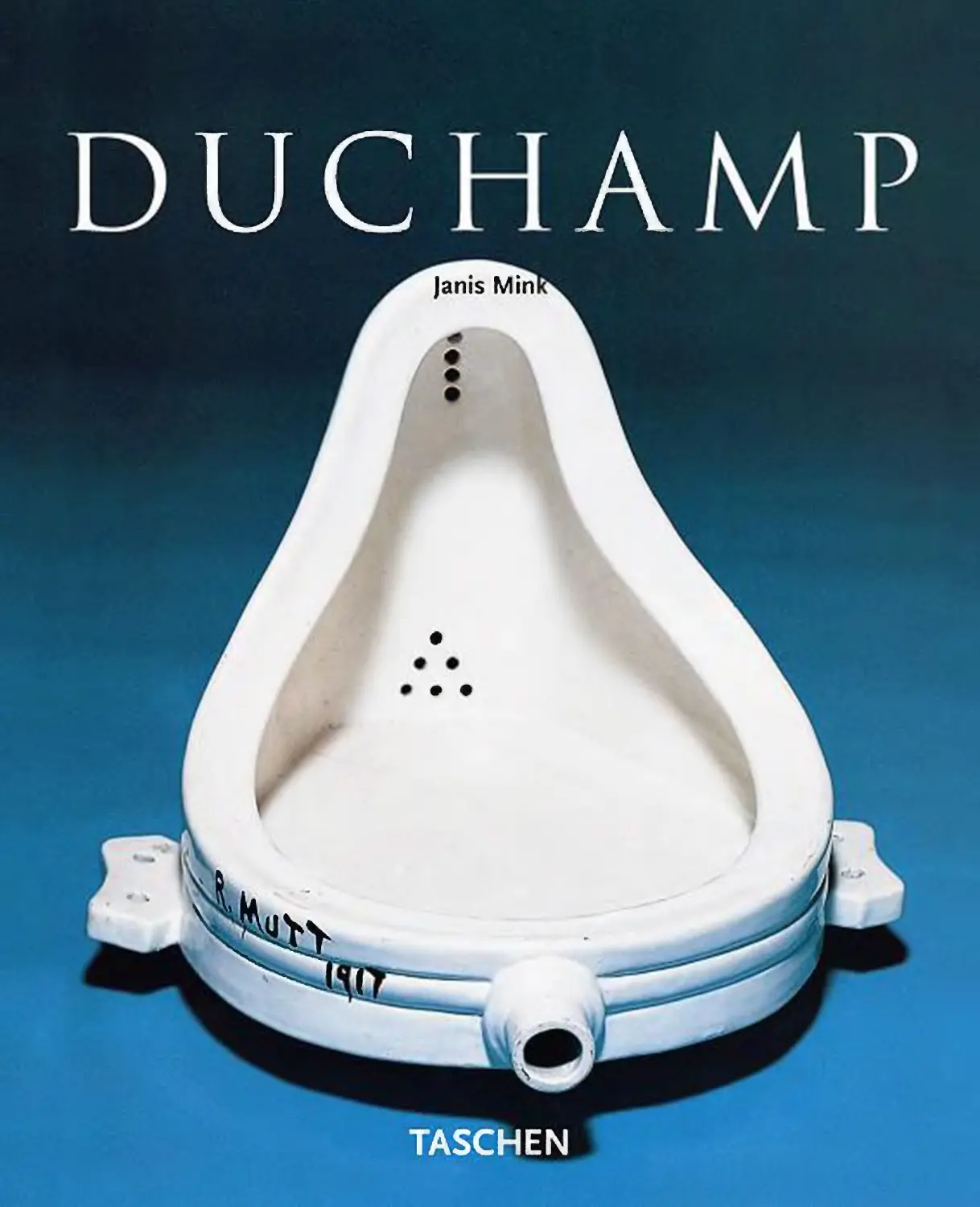
Fountain, 1917/1964
Fontaine
Readymade: porcelain urinal
Numbered edition, 36 x 48 x 61 cm
Catalogue Raisonne: 345d
PAGE I:
With My Tongue in My Cheek, 1959
Plaster on pencil and paper, mounted on wood,
25 x 15 x 5,1 cm
Paris, Musee National d' Art Modcmc,
Centre Georges Pompidou
Catalogue Raisonne: 571
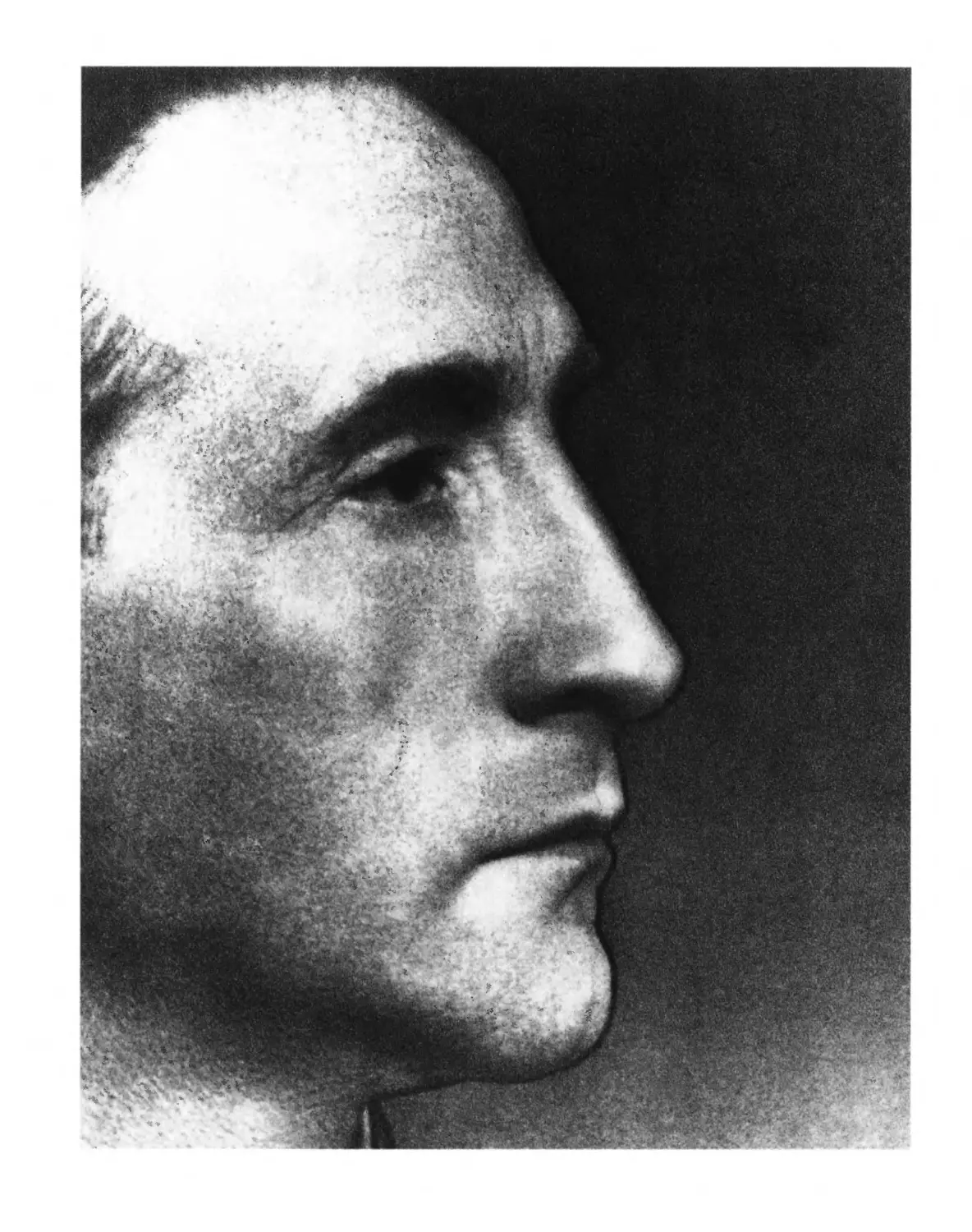
PAGE 2:
Man Ray
.
arcell>uchalnp,c. 1923
Black and white photograph
Paris, Lucien Treillard Collection
BACK COVER:
Man Ray
Marcell>uchalnp, 1916
Black and white photograph
Paris, Muscc National d'Art Moderne,
Centre Georges Pompidou
To stay infonned about upcoming TASCHEN tilles,
please request our magazine at www.taschen.com
or write to TASCHEN America, 6671 Sunset Boulevard, Suite 1508,
USA-Los Angeles, CA 90028, Fax: + 1-323-463.4442.
We will be happy to send you a free copy of our magazine
which is filled with infonnation about all of our books.
tj 2004 TASCHEN GmbH
Hohenzollernring 53, D 50672 Koln
'ww.taschen.com
2004 Succession Marcel Duchamp / VG Bild-Kunst, Bonn
V 2004 for the illustrations Man Ray, Matisse, Picabia: VG Bild-Klinst, Bonn
Editor and design: Burkhard Riemschneider, Cologne
Update: Gilles Neret. 2004
Cover design: Catinka Kelll, Angelika Taschen, Cologne
Printed in Germany
ISBN 3-8228-6316-5
Contents
6
Why Not Sneeze?
10
A Young Man in Spring
28
On a Train of Thought
42
Breaking Free
62
Major Accomplishments
94
Chronology
,
<
,
.:
. ;.
;
".
; '..
....
"':._i
'
; .
....t "
,
.
i
\" . ;
L L
/:
f
l
t"
. "
j.
''i
t
,
"1
. i
-t: .!
..r
t:
,1/
t;
"
"'!.:. n.
'; ,;
.f. i'
. ,
:
I
J"
I "
.
f- " :
. ;
!' .;
} ;
:
j.
i'
, 'j
<, if
,,
fi; ..
r
.
. , .
'.t
.
'" .-
";r'
'. ,.
. ,;
"'.
'>
i-
"
ft.t;
.f
J
!
..
: ,,\)'
,'\':>, - "
I.,..:
'}.,"\
,'",
, ..
,. ' ""
. ,.-
"
,
! '
. "',
""J
'
, ",. . .
;. .It',
" '
,
" " .'
\
j
...
.'"
')
)
..
.
.
: ",,:-:
.
1
\ "
.; .
..
\
\
,
f
J
. t
.f
.t.,
i !:.
.
'i
"
J
.
. :
4
'
-....
.
Why Not Sneeze?
Seen from today's perspective, Marcel Duchamp seems the most influen-
tial artist of the twentieth century. His critical examination of the condi-
tions under which art is created and marketed set a trend that has conti-
nued into the present. It was Duchamp who responded most radically to
the changes brought about in the art world by the industrial age. And yet
Duchamp was the least spectacular of artists this century has produced to
date. Although his work, due to it
artistically provocative nature, re-
ceived an enormous amount of critical attention, his life was surrounded
by the legendary Duchamp "wall of silence". While his work already
presents a kind of nerve-wracking IQ test for artists and art historians, it
certainly remains an enigma to the general public. Even Duchamp's dedi-
cated patrons were sometimes puzzled.
When asked by Katherine Dreier to produce an object for her sister,
Duchamp agreed, as long as he had complete freedom. Why Not Sneeze?
(1921, p.9), was what resulted - an assemblage of marble cubes that
look like sugar lumps, a thermometer and a cuttlebone contained inside a
handy old rectangular birdcage. Dorothea Dreier didn't want Why Not
Sneeze? and gave it back to Katherine, who kept it in her collection of
Duchamp's work until 1937, when she sold it without profit to another of
Duchamp's main collectors, Walter Arensberg.
Why Not Sneeze? was not a success. Not many people saw it. and those
who did found it hard to understand. but too strange to be meaningless. It
was the kind of transitional object that channeled the hot air of Dada into
the lungs of Surrealism, which was at that time just evolving. Later in
1936, Why Not Sneeze was even included in a Surrealist exhibition in
Paris. It was placed in a showcase alongside fetishes of the Papua, as well
as mathematical demonstration models from the Poincare (scientific) In-
stitute.
These neighboring comparisons hinted the viewer was to lift Why Not
Sneeze out of an art context and drop it down into - what? Duchamp him-
self didn't help out with explanations: "This little birdcage is filled with
sugar lumps. .. but the sugar lumps are made of marble and when you lift
it, your are surprised by the unexpected weight.1 The thermometer is to
register the temperature of the marble.'"
Why Not Sneeze?, with its suggestions of weight (heavy marble),
promised sweetness (fake sugar cubes), missing warmth (thermometer),
poetry (birdsong), arrested flight (cuttlebone and birdcage) and art (Cub-
ism, and also the use of marble) seems to have a message for the Dreier
sisters. The flippant title is a proposition. Why not do something like
sneezing, that cathartic reaction that grows from a tickle to a climactic
PAGE 6:
Marcel Duclulmp. 1965
Photograph by Ugo Mulas
7
, \
....
"
'.1l ,J t\.
II i. \ .....
Man Ray
Gertrude Stein, c. 1926
Black and white photograph
The American writer Gertrude Stein (1874-
1946) became a celebrated avant-garde per-
sonality in Paris before World War I. She col-
lected Cezanne, Matisse and Picasso, among
others. In 1933, she wrote a bestseller about
her companion called The Autobiography of
Alice B. Toklas. This prize-winning book was
a great success and also made clear how signi-
ficant was the role that Gertrude Stein played
in Parisian literary and artistic circles. Ma-
tisse, Braque, Joyce and Hemingway were fre-
quent visitors to her home. In 1934, she re-
turned to the United States in order to give a
series of lectures on literature and art, which
probably influenced Duchamp.
8
explosion, leaving only runny traces behind? Duchamp's signature on
the piece, his new pseudonym "Rose S61avy", sometimes also written
"Rrose", pointed in the direction of sex: Eros, C' est la vie. However, an-
other look at Why Not Sneeze? makes the viewer rather guiltily try to re-
press that association. Could it be that the small banged-up cage, the
jumble of white cubes, the glass thermometer and the brittle cuttlebone
are likely to erupt?
How were the serious-minded Dreier sisters supposed to understand
the piece? There were not many precedents for this kind of work in the
field of visual arts. Duchamp tended to look in other directions for in-
spiration - to scientific models, industry or to literature. One historian
finds convincing parallels between Why Not Sneeze and a poem by the
American living in Paris, Gertrude Stein. Duchamp was familiar with
Stein's writing, her role as a patron of Cubism and had even visited her
with Catherine Dreier in 1916. The poem, called "Lifting Belly" (1915-
1917), from which Duchamp may have taken individual elements,2 does
not contain any linear sense, but is a series of images and feelings: "Lift-
ing belly is no joke. Not after all. .. Sneeze. This is the way to say it. . .
Arrest. Do you please m..."
"I do love roses and carnations. . . A magazine of lifting belly. Excite-
ment sisters. .. You know I prefer a bird. What bird? Why a yellow
bird. . . Lifting belly is so kind. And so cold."
"Lifting belly marry. .. We do not encourage a nightingale. . . Can he
paint? No after he has driven a car. " Lifting belly is famous for recipes.
You mean Genevieve. " Lifting belly is sugar. Lifting belly to me. . ."3
In the poem as in Why Not Sneeze, the audience becomes tangled in a
series of ideas that refuse to let themselves be read in a narrative fashion.
Duchamp's possible references to the poem seem to be personal rather
than stringent. In a sense, the viewer is lost, or turned loose within an un-
known sensibility, namely that of the artist - a shaky start that has one
turning about in search of orientation points.
The challenge of understanding Duchamp's work has resulted in hun-
dreds and hundreds of interviews, books and magazine articles in many
languages. It has also given birth to many more works of art. One need
only turn the kaleidoscope of interpretation slightly to find that the chips
of Duchamp's life and work have fallen into yet another new pattern. Du-
champ himself calmly tolerated all interpretations of his art, even the
most far-fetched, since he was interested in them as the creations of the
people who formulated them, although not necessarily as the truth.
"
4
\
, --=--
I ' ;It
, \
L
.t
i
l... .,"
I h
"
-
-._.... -;:: ....
......'--
- - -,.:--=-- ---=- .-
- :;)..;..
t '(
-,=-
-$
.& ."
" , '(/.\1 t f:,\;i; 'j ,r
-. "'\'\":"' "' \ _ "' \;"
.1 ,'{\:."{),i\""' .
"I. ""\: .,' ;:.
.'.I..t,: , n..... i \ - ":
...:. ...::.. ... .{::i.: . :: - '_..1--,
1
J..
t
.. ,
-."--' r
, t7-!
I
_ --1 J ..).' '''.1'
, . '\ , ..' .' I'" .;;.;>-v
\' ." .: 3 .. ....
.; . !::' 4' I' ,
.... -
'}
\
l'
.
......
f
.-----.
1
I I
t_
Why Not Sneeze Rose Selavy?, 1921/1964
Rcadymade: 152 marble cubes in the form of
sugar cubes with thermometer and cuttlefish-
bone in a birdcage
Numbered edition, IIA x 22 x 16 cm
Catalogue Raisonne: 391
el.
.'\,
"{
.
...
1
f
L
14 "
",., I I
\ ""
'J I(
--
.I
I'
('.11
I
1
J ,:
- . ]
J
. -fI'!:; :
J".. .'
. " :" ";i';
'J,
,
, "
.\
;..'
". \ :f i it
.J\
'I.)' ..
-
,tI
-
"
"'":,,". '.'3
: .
/
-'a. ,
1. ..:. 1"
J,,;" '
. I. ...
_ I.r
r'
:t.... .
: .
....
. ' l.1o
!f " ,..
".;'
":"
;"
,
'(J. ,f.'/'
, ) :,i' "
,'. _..",), r"
i , "-;':-: ; " '
...;
. "
: 'II ..-(.'
:,.... -
". ',' " .: ;f: ',: ._'
,?-', {. . < \-!f.1 ' .',:"
" " '11.' . .',jp""- J .'. '
'
lor
-
'..
,- ,
l
J'
, ..
. l:o.£'-<:
'
rii
.\ ,..""
-.t :ty
...:'
'. t-
"'. .. ,JiI(.
" .flf-
,"
',. ,. .:;
:J:.'1
....- 4<-
. ;: :.
; I
::-'
: "i'
.'
J
,r fi
'?
."
1
;&
\: .1,
.,.!'f
. . -
I
j:
,.:;:?7! :;+ ', " . ,
'\ '.
1f;
..
"'1.,.-'
::"
...
. ':.
2,
"' 1<
1
, y,'.
.... ....-0. ,,'",...
.. I
!I !
t,
--i
... ...."'"'
:.. r.
"
}.
r t .. J....
' r
, " _.:
1 '" . ... :. .:.
.:" '.'
. I
,.. ..".1..
" ". ".'.- f.
. y. .' ll'
' ,-i'.
.
'JIII\.,
\. '.
<
f '.. ",' \
,.1 ': ".. i:(.', '. ",': ,I
; ".':";"", ,r ' ;" t -:. ,
')' \ .' If'
A"'""
.( 1' :&""" ',:;.: ;'" : "
,II' " j;i. ..}\' r"d' ", '-t. ,
. . "I .
.', ":' ,', Y'/' '.;.
.:
. .
) ;\ - ,
'.- '. "",, '" ,,"; ,
..tj.- '.:..' ,
f ". .: '!.;S.i,"
'1'-' " . :', ,:",;.} :,,\
'. , .
. :.:!::<: -
't'
'tf\t
;.. :;, '
. .
f ' ,' ..
'-r." . :',; . . f
" .
),','
.
, , .',
',if::' ..
, (1,.:' '.
".. r,...
.. 't 4\
1"" " ,
o-", .. ,
\ " :..\
'. ",,",
i.,.... :
" 1
.,, . h
I '."'." II.}.,
, . :. . ' , ':}L
" :j
'--;J1 :'
.
.' I ",:, \. ;; .:
;::,.\,;0,.;.. i:;: ,; .." .
;4! . .. ,<',
t;
"
f'
,. r
., '¥:i 'e"",::
\r ,' ), ....... 41
, ...... - ,
.. ,- c.... ,)I _.4:':," 0-' \.
i:, .
,-i J;.
"'.e
,Jt
;;
.' :,.,...
"
,.,
I' i
J
I,!:-
'
.. '\
;
. '"> ,f' r){)
! AJf' . / '
'/
A Young Man in Spring
As the nineteenth century was creaking to an end, the Duchamp family
lived in a comfortable, middle-class house near Blainville. a small town
in Normandy. Mrs. Duchamp was the daughter of a shipping business-
man, who was also a painter and prolific engraver. The Duchamp home
was filled with his art, and he was held in high esteem both by his daugh-
ter and son-in-law and, subsequently, by his grandchildren. He was said
to have studied with Charles Meryon, famous for his cityscapes of Paris.
Although Mrs. Duchamp, the mother of Marcel Duchamp, had inherited
her father's talent - she drew street scenes of Strasburg and Rouen for
decorating porcelain crockery that was never manufactured - she spent
her adult married life producing and overseeing her seven children, six of
whom survived and only two of whom were fond of her. Her husband
was a well-to-do notary, who also became mayor of Blainville.
Both parents respected and encouraged cultural activities. The children
grew up in a home where chess was played, books read, pictures painted,
and where family members had mastered instruments and made music
together. Yet all was not perfect. Although his father was kindly and indul-
gent, Marcel found his mother unresponsive and indifferent, and he was
apparently hurt by this.
The two oldest children were boys, Gaston and Raymond. A little more
than ten years later, after the death of a three-year-old sister, Marcel (born
28 July 1887) and Suzanne, his closest companion and playmate, fol-
lowed. Around five years later, another pair of children. Yvonne and Mag-
deleine, their mother's acknowledged favorites, rounded off the family.
While Marcel was still at school, his two older brothers gave up law and
medicine to become artists, their efforts sponsored to a great extent by
their father, who gradually paid out their inheritances to them in advance.
Gaston moved to Paris to paint under the pseudonym of Jacques Villon.
Raymond called himself Duchamp- Vi lIon and became a sculptor. After
finishing grammar school, the seventeen-year-old Marcel joined his older
brothers in the autumn of 1904, moving into Jacques villon's quarters in
Montmartre. He, too, had already begun painting and drawing, as had Su-
zanne Duchamp also. While his sister was tied by propriety to her family,
Marcel, like his brothers, was supported in his Paris endeavor by his father.
Not surprisingly, Marcel Duchamp's earliest works were sketches and
paintings of the family to which he was so closely bound, and of Blain-
ville. The lovely Landscape at Blainville from 1902 (p. 10), painted when
he was only fifteen years old, shows his indebtedness to Monet, with
whom he had become acquainted through books and reproductions and
whom he admired very much at the time. Other drawings, like Hanging
\
".:;"..-..
:;,
,"
SII:,alllle DlIclwlIlp Seated, 1903
SU lIl1ne Duchllmp assise
Colored pencil on paper, 49.5 x 32 cm
Private collection
Catalogue Raisonne: 24
Suzanne Duchamp too became an artist
Married to Jean Crotti, she continued to
use her maiden name.
PAGF 10:
LWld.'tcape at Blaillville, IlJ02
PlIyslige a Blainvil/e
Oil on canvas, 61 x 50 cm
Rome, Galleria Nazionale d' Arte Moderna
Catalogue Raisonne: 16
II
, t." .
/ .':
., "......
p."" -
. ", . \ I ):\::
{Vf? ' .v. . )
. f : J
'-' r r 7 " "'---- ':
- ;, if . :.'
...., t;._
'Ie...... ., , >-. ,
. -' 'c- \.
I <' ..'\
( , \
..- ...\
\ .' .--: - - -:----,,". ::;.- \
,j' ".""- .: "': "-. '>- \
.11 f...
, W :tf' .
\\\ .'
. :.
....
'.
- .
---
l
J
"Jl'
'j,
) . >" /
- " \
;._ J \
t
"'-' tv"-J Ih.. u 1 '\.A
ABOVE LEFT:
Gasman,1904--05
Employe du gaz
Pencil, watercolor on paper, 17.3 x 10.7 cm
Private collection
Catalogue Raisonne: 59
ABOVE RIGIIT:
The Knife-Grinder, 1904--05
Le remolileur
Pencil, Chinese ink on paper, 21 x 13 cm
Private collection
Catalogue Raisonne: 71
PAGE 13:
Woman Hack Driver, 1907
Femme-Cocher
Pen-and-ink drawing, pencil and watercolor
on paper, 31.7 x 24.5 cm
New York, The Museum of Modern Art
Catalogue Raisonne: 102
12
,
.\
.\
\.
J
r'\..
Gas Lamp (Bec Auer), c. 1902, p. 14), or the various sketches of men de-
fined by their professions, like Gasman (1904-05, p.12) or The Knife-
Grinder (1904-05, p. 12) seem fairly unremarkable, but do show Du-
champ's interest in subject-matter that does not necessarily make for a
"pretty picture" and will later recur in his major work, The Bride Stripped
Bare By Her Bachelors, Even (1915-23, pp. 74/75), also known as The
Large Glass.
In Paris, Duchamp immediately joined the circle of artists around his
brothers. He studied painting at the Acad6mie Julian until the following
summer, but preferred playing billiards to attending classes. Like his
brother Jacques Villon, who supplemented his income by drawing for
Le Rire and Le Courrier Franrais, Marcel was able to become a cartoonist
and began to sell amusing drawings, most of which exhibited off-color,
ribald humor, often based on visual or verbal puns. One cartoon from
1907 shows the coach of a woman hack driver (women drivers were a
relatively new phenomenon at the time), who has disappeared with one of
her customers into a hotel, leaving the meter running, thus charging twice
for the services performed.
'I
it
\
I l\-GRAND HOT
1 @) To) - J \Y \ (' \ (t.
h'\l I'''' t. 'J ;h 1 .J\
_' \ \ -=- " l v
_. .N1""."""""" - ---":I
\ I CHAM6JUS' "1'1
J
I J
'\ ,
J J bE tTl ,
t
t ) t . £1'1 TJ EE
J .
. f6P. J V\l
DE:
--
v--
.....
,-
I
\
--
. .-' ,"; -" b l r fc :. )':.,: 'w4" '.', - ril ...
· ". ......;f - " : eA" 1 .
.. ;; .W .:r ' : '1 r J
E( f ; r :: :' ':," J I L
':":; . : . r . , . i . f . ' ;' ;, _, :: . . . _ ':,i' J: : 0 ., .
_."}>. i:: '. .} ").,:.; . _ "- )' . 1:-- . _ { . ' _ ; , : " ,:' : ; , .'
. ._$.... ..' '- " .:, ,.t,' \..... '.. . .<;, :.. ""
:;i: {:.i i ; ;:/ : . L2: ;2: ;;:, \ ' g? i: ..,'c. _ ..; 1r:: :
. .. " " .J, " .... ": .,." ... .;..\-... . t>, .... :J:' -t'" ... ; . it- . '4';' t " · ;,."i,./ir;< " ." r -v...... , :t. . 'J' .<:.' ,.
. . . ", . ; . L'... ... 'i . .. . .. ; . .-: 7. . . v . : '" , . . . ::. _ ..:".: . .... '. '. ' ' ., ':t . " ..... ' . :1', " ..... , ;- :1 . i ,._ - . ' - ... ....-.. , . : . _ ..- . ;: . , . . ' J' . . . .,. ...... .- ..... - - "
...- 't'" __. _ - "l tit: 1 1! r .'\ . .. 't. r I' t -" ':u.r . '; , " . =: . . ' , .; .. : . . . . . - . . . ·
,'''' ....,," n', ".' "','. ,',...... -'( t<:' I, It " ", >-i<h '''' ' ',' ",. · ".!.' !'L ','Ii ';-\l;r.-,)" ' - ' '- .
..',,'.' "", ., ,I ""'.,' ,."K.",, :\"' <, J
/;:l ., :':[t( \ f ':: .f 0 ;t :: :\ f;: ; :' , .;' y' , ·
. . .":10," ..,.. " \\.. \ >i' .\ .' 1. \. .' . · .....\.;. .....1:.. .
. ,:,.. ,:': ;' : x\':. :;.' :: ' : (; :1f;.:". f .:.,
. ,........; , ".
..."\ < {r;;,- -\
,qo .
l /'
l I-tOTLL
11'"
. I......"'-=-
I
I
\
\
\
. \
\ \
.
- Co vr'-
T r
0 '\ 0 _ \< \ e \.V\ t" ""'" '\ "-c..
... ". .
":.: ",\,"
) b
. -""
, \
- .;-=-.:- -
. -. - $....
Bee Aller, c. 1902
Charcoal on paper. 22.4 x 17.2 cm
Private collection
Catalogue Raisonne: 28
Flirt. 1907
Chinese ink, watercolor and blue pencil on
paper, 31.5 x 45 cm
Private collection
Catalogue Raisonne: 101
Flirt includes an inscription based on a French
pun. Duchamp toys with the term for grand
piano - "piano a queue" - and the phrase "wate-
ry piano" - "piano aqueux": "Flirtation -
She - Would you like me to play On the Blue
Waters; you will see how well this piano ren-
ders the impression suggested by the title? He
(wittily) - There's nothing strange about that,
mademoiselle, it's a watery piano."
I4
In 1905. Duchamp began his required military stint and received spe-
cial classification (exempting him. for example, from military drill) by
working for a printer in Rouen, during which time he reproduced a collec-
tion of his grandfather's etchings, with views of that city. He also became
familiar with typography, since he printed text alongside the images.
Since he was an "art worker", he was able to exempt himself from a sec-
ond year of service. Duchamp not only enjoyed the escape from the mili-
tary. he probably also appreciated the escape from "high" art into the
more technical and ephemeral world of printed images.
After returning to Paris in 1906, Duchamp lived with Villon for two
years before moving to Neuilly, just outside of Paris, where he remained
until 1913. These were crucial years in Paris for the future of painting:
the Fauves and Cubists developed the use of color a!1d structure even fur-
ther than had their predecessors, the Impressionists and Post - Impression-
ists. The Fauves, the most prominent of whom was Henri Matisse. used
their paint often independently of their subject-matter for its own qual-
ities of color and rhythm. Paint had become a ready-made industrial pro-
duct for the Fauves. Inspired by van Gogh and Gauguin, they squished it
out of tubes and applied it without regard for nature. Slightly later, the
Cubists reacted against the bright colors of the Fauves and concentrated
on structure. They began where Cezanne had left off, reorganizing the
picture plane into geometric units. As in Fauvism. Cubism placed an em-
phasis on the painter's intervention into "reality": artists began recreating
their subject instead of recording its appearance.
The Symbolist literary imagery of the turn of the century also contin-
ued to exert its influence, born of the writing of authors such as Stephane
Mallarme, Edgar Allan Poe and loris-Karl Huysmans, who expounded
upon the visionary and mystical tradition in the arts. Dreams, imagination
and the subconscious governed the painting of artists such as Gustave
Moreau and Odilon Redon. Duchamp probably also absorbed the Sym-
bolist view of women as threatening and mysterious creatures. When
once asked early on in his career if he had used Cezanne as an inspira-
tion, Duchamp is reported to have replied, "... if I had to say what my
initial starting point was, I'd have to say it was the art of Odilon Redon."4
> I , "., 1 ("
," __J ' -"; _ t'f"?
_ .... . I..' ) .... . _
) -:- 'prf' '\ '" I;j f j ,....
,,- "--k"i
,/ :,. . tw/' "V'\ }.., /" . t
.".".._> _..... __ . > ! j v \...
:', '?;: , .:...... '¥; .
\, .- ' ', \... } - [
'II . . I .. - J'", "" , (:. Ii \..""" '..:
" ... _ . t"
'. :-. ..... ....."'-o ./ '. ( \ t -
"> . /. - \1 "
. ,..... , . I -
" / , I J '- Ji
)
\\
/
.t
,
tI")-,,-,<-t'l'\_..r?_!y
. tI"; _, /'
. ".r 6
,
. il.J.- ._ \>._,._ i- (. _ -.....=-.;... L%,-b '. ,..., ...- i..p...... -, ('... ('':''''''4..., 'I-' j ,I.4'1'f<oIo..lh....'
(..; '.....1_,. _ I". .., AJI.__<- ....,I_;;.CIL I '. I-. ....I - . -.. ""'I .
J ... q.\.WLt- afJ", --,_ ,.._..:.: ..l-f'----
,;'
y.I"'"
-/-
,
I
I,
:' 1 1
-' i
!
t
.! I
I'
: I -
J
'-,f;
l
i
, I.
.j
f'>
./ ,I,'
..
/i_
_
.:....<.:,
i
.
_ _ .
:;!i1 .
\ f.' ,
.
'..:-j.,
. i!.
. -
. I'
Redon was not only a respected painter, but also an innovative graphic
artist who was venerated in avant-garde circles around this time. His mys-
terious images were fed by an inner, imaginary world. They were, how-
ever, also often inspired by science, which dissected the world, so to
speak, under the microscope. Perhaps most important for Duchamp may
have been Redon's attitude towards his art, which was not loudly anti-
academic, but rather quietly and brilliantly individual. Redon's painting
Silence from 1911 (p.15) almost seems to embody Duchamp's life-long
non-commentary on the various interpretations of his art.
Duchamp was confronted by the styles of the day, and he tried them on
for size, looking for something he felt happy with: "Between 1906 and
1910 or 1911, I vacillated between different styles and was influenced by
Fauvism, by Cubism, and sometimes I also tried more classical things.
Quite important for me was the discovery of Matisse in 1906 or 1907."5
Duchamp spent the early years in Paris painting and drawing, as well as
enjoying himself, as the femme fatale he drew for an invitation to Christ-
mas dinner at his studio in 1907 suggests. Sketches for cartoons, such
as the enticing Flirt (1907, p. 14) and the marital dead end Sundays
(1909, p.16), mark the poles between which stretched Duchamp's view
of bachelor life. Even in his early twenties, Duchamp was reputed to be a
confirmed bachelor, attracted to women, but repelled by marriage. "I real-
ized quite young that one ought not to weigh oneself down with too
much ballast, with too many jobs, with a wife, children, a country home,
a car; luckily I realized that early on. That is why I could live much more
simply as a bachelor than if I had had to deal with all of the usual prob-
Odile Redon
Silence, c. 1911
Oil on gesso and paper, 54 x 54.6 cm
New York, The Museum of Modern Art,
Lilli P. Bliss Collection
I 'k
....--
)
4t.,''''
of' . '"
II;
.
"''\.,
--
-
"--.,
c
-.8
.........-.. 4'
'<;.. .1\ L
Still from the happening "The silence of Mar-
cel Duchamp is overestimated", Diisseldorf,
TV studio, 1964
During the early sixties, Duchamp proved a
pervasive influence on the art world. Some
artists refused to accept his work uncritically,
such as Robert Smithson, who called him a
reactionary priest-aristocrat, and Joseph
Beuys. who. during a live performance for
television in 1964, wrote a sign that said (in
German) "The silence of Marcel Duchamp is
overestimated" .
15
-'I'
_ 'tJ._.._al
,"\_
SUlldays, 1909
Dimanches
Pencil and Indian ink on paper, 60.3 x 48.6 cm
New York, The Museum of Modern Art
Catalogue Raisonne: 145
Paradise, 1910-11
Le Paradis
Oil on canvas, 114.5 x 128.5 cm
Philadelphia (PA), Philadelphia Museum of
Art, Louise and Walter Arensberg Collection
Catalogue Raisonne: 211
PAGE 17:
Portrait of Dr. R. Dumouchel, 1910
Portrait du docteur R. Dumouchel
Oil on canvas, 100 x 65 cm
Philadelphia (PA), Philadelphia Museum of
Art, Louise and Walter Arensberg Collection
Catalogue Raisonne: 181
It is hard to say why Duchamp emphasized
Dr. Dumouchel's hand. The painting might
contain a first reference to male masturbation,
which eventually became a theme of The
Large Glass.
16
lems of life."6 (In reference to this sense of freedom, it is interesting to
note here that not a single one of the six Duchamp siblings ever took on
the responsibility of a child.)
During these early years, Duchamp participated in several Salon ex-
hibitions. Because Jacques Villon belonged to the prestigious Salon d' Au-
tomne, Duchamp was able to show there as early as 1908. A year later, he
exhibited for the first time at the huge Salon des Independants, a non-
juried salon that offered no prizes and featured thousands of works from
all kinds of artists. Although the Salon des Independants was full of ama-
teurish painting and decorative products, its reputation as an important
forum for the avant-garde had survived since the days of its founding by
Odilon Redon, Paul Signac and Georges Seurat. Duchamp would later
propagate its motto "No jury, no prizes" in the United States. Despite the
huge number of entries in such an exhibition, Duchamp attracted a men-
tion by the poet and critic Guillaume Apollinaire in the weary comment
he formulated after a pilgrimage along the 6,000 paintings shown at the
Salon des Independants in March 1910:
"J. Crotti has adopted pointillist theory, not in order to obtain pure
tonalitiers, but simply to distinguish himself from others, to give him-
self a certain flair. Marinot is looking for decorative effects. Let us
mention Pierre Dumont; Duchamp's very ugly nudes; Kantchalowsky,
who paints with his boots; Lewitska, whose painting representing a
naked couple dancing in a park is quite joyous; and let us pass on to the
School of Bayzantine Revival, which includes three painters - three ar-
tisans, rather - two men and a woman: Boitchouk, Kasperowitch, and
Mlle. Segno."7
In 1910, Duchamp was mainly interested in the work of the Fauves, as
the portrait of his school friend Dr. Dumouchel shows (p. 17). Duchamp
, ,: ) ;1
I'
;, .' '....
..._
' ,...
. . \
t.::''J..
.....:... l
"I
.
'
",\
, ':(
I!
j"
, .,if:.
r
..
'..I, .
. 'J
',;
to. ..";
,
.(
. ) .
'..
j - " 1
'
,- I
t
1 .'
I ':OJ'
:l
, .
" .'
:.< -.
..
J(tf.'
""
I.
.
,.;
. 'I
o o:::
) It
t
\
,
-
'
j:,
",
"
,.o.(
::,
f. > ,); :,
)::
,tt,
o
:
i;:(J
,'",.: I
OJ5 '
. ,ar
-I':'
f
"'
-:-:
;
:
l
)-
o
<
,
...
b
'
!;
..
,
!i'.
'-};'
ill
" ....,,
. "
" r
I ......... ';
. ..
.
;S'
, ',' \,\:;
-' %' -:
.
)
' .
,r'. 'l' q:;, -
';
'?jJ.. " '
i'
, 'i(,,
, ',
\".r,. '.
:a.., -
.(' i -,... . ...
;
- t ,
'
: \ .
l::, )' " ,r. ':'-"' 1J> .I'-.
-'0'. . roO _
.,
.;.
I "
'f ".
.., '";'"
. . t
,
r'-
. ...1
\
,!iot:.
.-
\
".:
-
..,..
f .
I
"". .
t.
f'
!
"'"
....
:'"" .' ..:1
.-
t.,
"t'
. .......
--
"
.\
.....
'\.,
'_:
OJ
.....-
1-'
i
:j'-
II.,
:..:)4.
...
':, "
'
-;,
'.
..!r!
'. .'1'.
,
;}:
1#
f
>
":
.
.1
;,]{
.. j.
. ,>
. , t
"
:,'i
j.
\ -'
1 ,'/ ".
.
'-
'" Ai.
01,
:.
"
n"
?
o
l.
:,
;':l:
t
j;i
f
"f
"
'''': ''1
""
.,,\ .
. ;:.
p. ;" :A '. ,'::'..""
.
:
;;;r:L" . .(
i&Y" <
,,'L
ve"'" .
",'. ' " >, ", .,....... J,;,.,.,,"" . 't,
.
". .." i.jI .cr ""', ,,- "",
,
i<'" .
, ;Y:,. '," ,
-: ::;;
::', ,-
:, ':..f<'
'
"jc .,' :'r ;1
j:" ,
::;
;' ;..5
:
;;
K:;'1
,J I " , %' 'j ,,", r "I,
. . '," .,
'T' ' '
" ' '-" .. .,W "1,' ," ' .' - >1'", "
. . , ( " If:
.,
:t
1
" 5';' :,;,
,;
\>
:
i
t
':tw};:
'\
,', ," ,).. , " ,;;.:; ,,:,,
/
,
" , ..pl" ," L "..
,\".. "'iI/" ' .' .,. "'
"
,
;}.
i
f
:(
,
' ': /;}:
:,,:
v ',,'"
',: '
: · !A;\:
':f,.:'
,
::l,
" . J',":
J
':;;: .
d f /', ' ,r"i> ,,-,c
.. ,;, I r" "" .' ",>i>,''', ,,!, "i;i,;';;
';' ,: '
,:
::'.. ,'- ,;.:
>
" , \ ":':, I ,':':{;::'::' ", "::
>;
,, "'!;'.-
I ";/'" "fl"'
"! ';:
' " "
.S)j,
i ;t;<'! ,,#:;t;!.fi;
' r;;,.,' , .., ,,
,:..:: . "
\
:
i
tJ:: ';:,-;:::, ,,<1,
,,! " ,;f::;: ':';{ '1tJi>, -: "",:ifiI!!:, :\o
-. ,_ ' . ' 1 ' , . , I , _ ,; . , E: . - . ,,
;> ,r.
" " ' :
, ' " . - ,. . ,
. .
t..
, ' o. ' .
:- , ' , . , .' _ t ,
,
, ::" _ . , . .
C , l::' 'I, A ;. ,,,;'
, ' ',. ,; \'>.1'1"',
,.
'''' ,\iii' " "", .;
,/._" ,'" 0" ';" " ",'" '" ," ,"no ,
'..',Y' ,J:" , J ' -r _, '$f,'
,,,< " ';' , {",: ,
";,c:' ,,:d,' ;e;.',."
o ';
r
,
; ,r '
f" ;'1', >, ...r, (, $E' ' ",,p,j, A;<" ;;. .r" ' I."..;r "
,;
. -:r ;; '.. ,. ,,</' ': '.",.-;
" '.'f..., , :
:c.:",'f /1: '.' ' '';)#''If. ' "
," 1/:',:" ,'3' ',: I, ",'f ,
.ot: .' " ,0,' .....-,,- ""," '," .. ; ,,' "
..
li.l
;:;: , ,I; ,
:
'(,:
i "r
ii
:, ;'
<>
i
4
!' ':fJ/(
J <# .
I .
,
,, :: "
' " ,,:, ,_ ,
, " '
'
;:
'
" '
'
"
' t" . : " I
" I't " : IJ '
f .
'o ' , s . ', " " , '( 1 "',(0" :,", ,, ' .
. ,
_ , I , ,:r_; "
; "
'
' : " " I " " '
' , , : . t . '
. -- , ' ,
: . \ . ' " " " ", , "
t
'f
f
',r;r/" .., ,'::; - .. ':' :"
j.
, , . ,
.""
. :_ . .
j" .
,
: . ;. , :. , , . : ,, ; . :
. ';
' ,
'
':,. ::
>:-:
, " ." I ; " "
: \ " " ' :'" -: - - . 11' 1
" . ",," "
''''.. 1'<' :: . "f '" / " ,,' " ,
" ,;.>., ..." j"
. " " ,);:(1
;;:, i ' I :f-
';:::'" " "
...);\)!"i:
;; . t'.
',r: .. II-
, :'
. ,
.\i:ii;
,.':
! : e " ; ,. :
1 ."" " .'" >v . .' ,,,""'
' · ",,,,, ,'" ,""
. . ,. v "" > " { ".
'
'
:irl?;:
;;
,''':r;:i
: . _ _, ' :
t ,
. j
. ' ' . "
,
. L ,
. :' ,
,
.
, ::
,
,
,
, ':" , ' i ,
, , :( " , . ': ,. t, . ;: .
.
i
. : .
; . " .
. ': , \ .
; "
'. ' ,, " "
:
\ ,t::; : ;
t:
",
;.'
7:i
:{Jf
..I > l.....' \1t "," . .'
, /
h
"": ,," :
: , \ .
. j :
, \t , \';
\::;' ,: '
, : : :: " , t , ' , ' ,.
. ; . :
. '
. , '. .!
. - " "..>'< " ('
_ ",t' -I,., "v't;. r' ;; 'Jr. , " , l , : , . , 'I, ; f , " \,, ' ,1, " , 1. , ' "'J . , l : . " ,
:., . . "\ " " , ,, :
, ", :,
. ', , ' ' ., :, . , , ' , : , , : : :. ' , ' , " , :k :
, , :
, '" "' , 'j " " ' , ' . . " _ '" ._ ' ', _ '
' . ' .
_ " . '
, ' " _ . . , :' , ' , : , '; "
" _. " ,. " " . , : , ; .
, 0\. . \ 'I '
. jJ;:'
:{
' t
,5
,
,
"
. \ :
<
;
,...>;} , , I ' ::1 1 '" ",.>
t
:
: ,,' ':, ' : ,< '.." ' ;;.,,!
,,
:-1,,1, .l1't
",,' " " J "" '/ " , 1. 1 1 ; , .....:. "
," '. " ,:,''', .,' (f , "
, 'd;C
't 'J: ,,' , .. \;, ,:l\,
'1 ,, '''' ,.) ' {
, ; . !
,
" " t , r,fi! , F , ::
,
.., r fl ! I' r. . '. , ' ' l ' I
' : I
,u .
.. r ",{J '
\1 "'
;')i
:
"I'
"" "1' Ii. ij! ' f."f, ' . "" , " i','" ,
:-
; r, ..,.," " , ," '; .." - ,,' .. , '
;:, ;:: !' 't .. · ;i,Ji. , ', , . . > , '
4 _ : . ' ,
,.:
" . \ , :
' ,
. :,. ,.
,
! ' , . . ' . -., . .
, '''' . '
" "
'
' ff ;;' / ..' & ' t ,:, ,\.;'-1..,\,
':'f!' ",' 'c',,' " "'" "
1,.;1.,;, i? . ' , .'
"If,
,t',,r1
'
/, \':::i
, ," ,""
i \
,, ' .
,
, : .
..
.
.' .
, ; ' , ,
. , "
,. I
.
. i
,
/" f'",' . :'-' " , ' " , , 'c , :: , :':, , 5'
'
.. ' , F ,,)
.. .
;'.' 4'"
, ': - :. ri;]} ;{,}
.........-:=.'-
\
.
{ 'l'ri-:\t.,'
..
"'J
ii" ,f
;'
.;
:
J
1ff:;
;
('..:, ,
:C(
<'
i
,,),:( \S:
.
.
, '-C
,- .......
.f;
::t.
)
'if",
i-\
{.
i .
i
.:
,<
f'
" -:f
,
.
.
:
} .:} ,
,""
.
. ',
yr-" ' ::
'r..
,J
" r )'."
t:
J
"..
.
.'..r ' .it
.
'
z'1
0$, '
'
_
;;.-I';, - ):;
:l-
.o:?
),; :
'(
.
'
::
I '
1:; ; t-.f
'
1f.
-' , .
.\
, .V
;ti
,,;,
.
:
,1..
';0
,
..
, .
J
:'
.
Jirll
,,:j,!
',
,,'
, .?
'
<
T
" " .- fJ
. J
\.. "-
1
\ .., (
"-
")
. ;
'
"'-
C
Y
"-
,
\ \
.......
J
./
""',!(
'I; "-
.. )..
\ . '
-
-'. ,
. -1 (
-
'-"
.. '
{
1 :.J"j " \
-
I
_r'-
.
:." .
ABOVE:
Henri Matisse
The Dance, c. 1910
La danse
Oil on canvas, 260 x 391 em
St. Petersburg, Hermitage. Formerly Sergei
Shchukin Collection
"".
:
:...
"'.
1l
'
".
-
......
) r ')
-'- .t,
"
Henri Matisse
The Joy of Life, 1905-06
La joie de vivre
Oil on canvas, 174 x 238 em
Merion (PA), Barnes Foundation, Merion Sta-
tion. Formerly Leo Stein Collection, Christian
Tetzen-Lund
"
\-
, l
\
\. ) ""
/)-
..,
.. ) -<.
'J
:1\\
PAGE 18:
Young Man {Illd Girl in Spring, 1911
Jellne homme et jellne fiUe dans Ie printemps
Oil on canvas, 65.7 x 50.2 cm
Private collection
Catalogue Raisonne: 220
\''''
I.........
.
I
-.:
V,:
.-7
_:.
,
lr.l;'"
\\
(
,' ..
,'I "\i
t> :Jl-t:).- ,
. ,
,....'it ;o>
, .'L\
. . ..
\,!o\-
-"
, ,
I " "': A ' p
.. h f
\r"',
/
r
j,
DI -.-:;;" W
1.,-11
f&
'
'7
tIM
\I_
,
..
:\IL:-. \!JJJ.-,
#I
19
The game of chess in Pasadena Art Museum
on 18 October 1963, during the first compre-
hensive retrospective of Duchamp's works.
Photograph by Julian Wasser
Besides being a lifelong passion, chess was
a symbolic activity for Duchamp. During the
opening of the Duchamp retrospective in
Pasadena, California in 1963, Duchamp had
himself photographed playing chess with the
young model, Eve Babitz. The central Large
Glass can be seen clearly in the background.
Duchamp appears to the right, while the
woman is seated to the left, similar to the
figures in Young Man and Girl in' Spring
( 1911, p. 18).
20
commented on the painting, "It reminds one of Van Dongen's violent col-
oring and at the same time, details, like the haloed hand, indicate my def-
inite intention to add a touch of deliberate distortion. The composition is
completely not at all a servile copy of the model, it becomes almost a
caricature."8 Perhaps Duchamp was even thinking of Rembrandt's famous
portrait of Dr. Tulp, whose left hand also seems to have an eloquent,
symbolic quality. Dr. Dumouchel turns up again as an ugly nude in the
male/female subject matter of Paradise (1910-11, p,16). The doctor wil-
fully ignores the crouching nude woman across from him, yet he does not
appear at ease, for he shamefully covers his genitals, looking less like
a sinful Adam than a skinny, inadequate contemporary. The female model
for Eve was quite stocky, which Duchamp more or less faithfully repro-
duced.
However, in Young Man and Girl in Spring (1911, p.18), Duchamp
stretched and idealized his figures, as if he were drawing very young
people - they resemble abstract sketches of his sister Magdeleine and
sketches and paintings of Jeanne Serre, an artist's model who bore Du-
champ a daughter. (This daughter met her real father only two years be-
fore his death in 1968.) Again, the theme of paradise is shown, here at the
very moment before it is lost. Both figures remain anonymous. The wo-
man's head is tipped back so that we only see the dark crown of her head,
while the man's features have been omitted in favor of his chin line. The
woman's identity as hair and the man's as chin is predictably specific to
their sexes, which are clearly silhouetted, although not emphasized. In-
deed, at first glance the two figures almost seem to be identical and an-
drogynous. They are standing under an arbor, joined overhead by the
crown of the tree whose fruit they are trying to reach. Its trunk separates
them and echoes the verticality of their stretching young bodies.
Up to now, attention has never been paid to the fact that at least five ad-
ditional figures are crowded into the middle of the painting. Within the
',,-
.
..
r
.
. _ 1
----
, ,"
.
'<I"
"
,
. #
, .)\
"!.'
'':I
.w=
, " -
II
';
.
.
.
J' .-'::-.
.V
l. _ ' d, . f
\ 'M
!-"O .
.
.
; .
. ""!,
"(j
. · .
. '" "'1'
t .
")
\
./'
f
. r :
..
.
/'
--......... -
, ,:l
,.
\
, .'
J
.J
\,
.... ,'.
;\' \ \
'ot
, ",I
. A
..
{
,
:'.(/,,,,
1 '
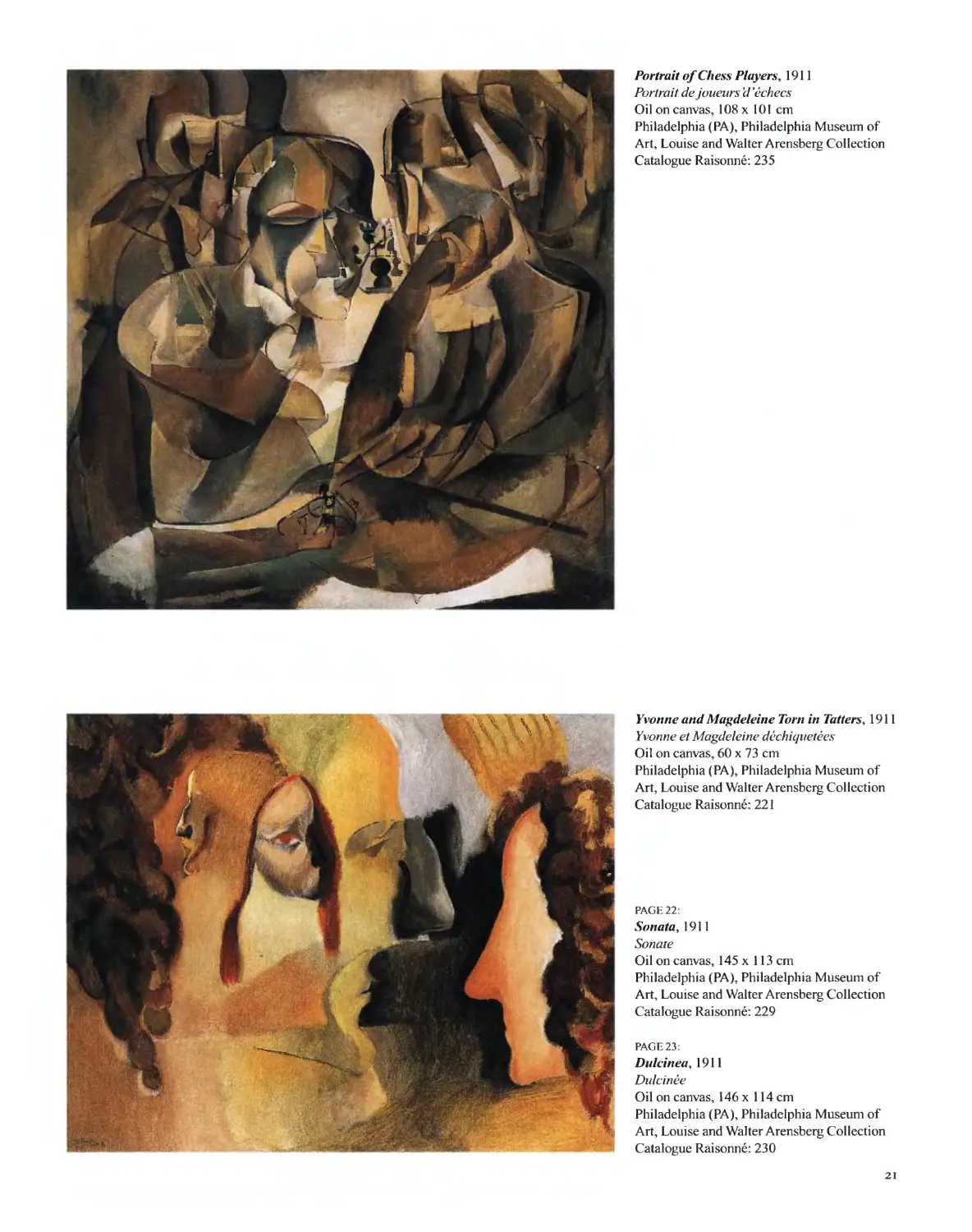
Portrait of Chess Players. 1911
Portrait de joueurs 'd 'echecs
Oil on canvas. 108 x 101 cm
Philadelphia (PA). Philadelphia Museum of
Art. Louise and Walter Arensberg Collection
Catalogue Raisonne: 235
'.
Yvonne and Magdeleine Torn in Tatters. 1911
Yvonne et Magdeleine dechiquetees
Oil on canvas. 60 x 73 cm
Philadelphia (PA), Philadelphia Museum of
Art, Louise and Walter Arensherg Collection
Catalogue Raisonne: 221
'.
PAGE 22:
Sonata, 1911
Sonate
Oil on canvas, 145 x 113 cm
Philadelphia (PA), Philadelphia Museum of
Art, Louise and Walter Arensberg Collection
Catalogue Raisonne: 229
"
PAGE 23:
Dulcinea, 1911
Du/cinee
Oil on canvas, 146 x 114 cm
Philadelphia (PA). Philadelphia Museum of
Art, Louise and Walter Arensherg Collection
Catalogue Raisonne: 230
'I,
21
t
........
....
I
,
\
F
l'
\
...
r-.
I J
1".
\
; \....
.1'
Sad Youllg Mall il1 a Traill, 1911
Jeune homme triste dans un train
Oil on canvas, affixed to cardboard
100 x 73 cm
Venice, Peggy Guggenheim Foundation
Catalogue Raisonne: 238
24
r )
WJ
,
..#" \
.
'\ '\
" \ .........
t
I I ' ! I
I
"- ,
,
'f . I d 'f
/1
.
\' -
" \
, \
'. '\
.
"' , \ \
\
,
, .
...-
, i
1,
'\
1
circle in the center of the picture is a group of dancers who appear to be
holding hands, very much like the small circle of dancers in the center
background of Matisse's painting The Joy of Life (1905-06, p. 19). The
Joy of Life was an important source even for Matisse himself, who de-
veloped other large compositions from it, such as The Dance of 1910
(p. 10). One of Duchamp's figures is seated under the circle, whose black
outlines break loose and rope down over it. Again, Matisse's pastoral
nudes may appear in translation here. Duchamp must have used many
other details from Matisse as well, such as the segmenting black lines,
the roughly triangular composition and the roof of tree-tops. Later, in the
last work of Duchamp's life, Etant donnes (pp. 85-89), Matisse's female
figures will come back to mind. Some of Duchamp's related torsos will
recall the energy and spread legs of Matisse's dancers, while the final
three-dimensional torso of Etant donnes (p.87) will resemble the heavy,
"headless" kissing female figure in the lower right-hand comer of The
Joy of Life.
The small Young Man and Girl in Spring (p. 18) is a little muddy in
spots and hard to decipher. Strangely enough, the owner of this painting,
Arturo Schwarz, who worked closely with Duchamp as a gallery-owner
and assembled the ceuvre catalogue of his work, interprets the circle as
containing only a single figure. This opinion has never been contradicted.
However, the inclusion of a ring of dancers suggesting joy would be logi-
cal, since Duchamp painted Young Man and Girl in Spring for his sister
Suzanne as a wedding gift and signed it "A toi ma chere Suzanne Mar-
cel". The inclusion of Matisse's The Joy of Life (p. 19) would have been
an appropriate (if not entirely heartfelt) wish that the painter Suzanne
Duchamp could have recognized and appreciated, even if her husband, a
phannacist, probably could not. As one of life's rites of passage, his youn-
ger sister's wedding may have been a touching or difficult experience for
Duchamp, although he never discussed this. Yet it seems that Duchamp's
preoccupation with transition, change, movement and distance began
around this time.
Towards the end of 1911, Duchamp would sometimes visit his brothers
and Frantisek Kupka in Puteaux, across the Seine to the west of Paris.
There he met, played chess and discussed art with Femand Leger, Roger
de la Fresnaye, Albert Gleizes, Jean Metzinger, Juan Gris and Alexander
Archipenko. One day, Raymond Villon-Duchamp asked a few of his
friends, as well as Duchamp, to paint small works to decorate his kitchen.
As an appropriate gift for the kitchen, Duchamp painted him a small Cof-
fee Mill (p.25) grinding away (see arrow), but also breaking apart and
spilling its coffee; it was his first "machine", a bit funny and out of kilter.
In 1911, Duchamp also executed several portraits of girls and women that
reflected his loose, perhaps not entirely respectful contact with members
of the Cubist group: Yvonne and Magdeleine Torn in Tatters (p. 21), a
painting of his youngest sisters, Sonata (p.22), showing his mother and
three sisters, and Dulcinee (p.23). Dulcinee was a woman who remained
unknown to Duchamp, but who he sometimes observed walking her dog
in Neuilly. He has stripped her bare in two of the figures, which all roughly
unite to a kind of faceted vase fonn, where the torsos poke out like thick
stems with flower-heads. Although an erotic scene, there is nothing erotic-
looking in the final product, and Dulcinee, for all her walking back and
forth, has become something of a still life. Clearly Duchamp was inter-
ested in motion as described by its static phases. The cinema and analytic
time photography (photochronographs) by Marey in France, and Eakins
and Muybridge in the United States, inspired him.
Sad Young Man in a Train (p.24), painted in December 1911, is a self-
portrait of Duchamp standing in the corridor of a train, on a trip from
Paris to Rouen, where his parents and sisters had moved in 1905. "There
are two aspects to this painting. One is the movement of the train, and the
other is the sad young man standing in the corridor and walking back and
forth, so that we have two parallel movements which correspond to one
another. In addition, there is the deformation of the young man's shape,
which I used to call elementary parallelism. It is a kind of fonnal decom-
position, a fanning out into linear panels that run parallel to each other
and defonn the subject. Thus he is stretched as if he were elastic. The
lines run parallel to each other and change only slightly to suggest the
desired form. I used the same method in Nude Descending a Staircase."9
Coffee Mill, 1911
Moulin a cafe
Oil on cardboard. 33 x 12.5 em
London, Tate Modern
Catalogue Raisonne: 237
i ','
I
-...
"(.
,-
.,l.. .'
.
1(1'\
", J:
'" ;' \
t..
..
,
. ',..
1
."
:
,
4
l
i
.,
<;r' . .;\
i ',I'
"
. . , ] ' i \ .
.... ' 1 ,
.' .'
. .'
" !.
. ;,\\
. f;:
. <
. "
" i
'h
.
II'I".
... . 0; ?<;..
.
I ' . tt!J' "
" , ,;' q:.;j-ll, . l
,'. . "t
'I
f,
.,
,;'
.:.! ",- .
.." I"
t
.t
.
._.
. .
.'.
:
; r
, ,\'H: ' \
'
,
.
25
\ ,,
u l
\ \ .\
',\
.....
I ' J '-- ..... ,
\ .. , ,.
I \
. .. .
/
,
- ,
i '
,.
\ J "'
'\ ..
,.. I' \
)' t \
I '-
\ \ \.
...
, \;
........... ,
:' .
'\, I .
\
-/ ..
..
\
- \
- -; . ...........
'"
\
.....
"
\. ) \ \\
..'
'"',\
,
\
\
\' -
I ;/ \\
,
"
\.
, \
. --- \
t [ 1-1
1-
- t
-1
-1
.
-.... ."
i'"
'" ... -:b::
<, " \.. " 1. .I . . '.'-.
\ \ . .' .,
, \.
'
t
-t -
I .,
. I
, t
-
- - ,
, . ,.
" .
(J 1i1-1 -;,
i;:
<
;-;'
( t ,-f_ t 1 ,
' ci @ ,
.
--......-
14
Nude Descending a Staircase (No.2) of 1912 (p.26) was the painting
that changed Marcel Duchamp's life. Like the sad young man, this "nude"
was a more radical and mechanized version of the anonymous figures
from Young Man and Girl in Spring (p.18). The figure hardly looked
nude because it hardly looked human. When Duchamp submitted it to the
Salon des Independants, it was coldly received. The Cubist painter and
theorist Albert Gleizes, who belonged to the hanging committee, asked
Duchamp's brothers, Jacques Villon and Raymond Duchamp-Villon, to
have him "voluntarily" withdraw it. It did not conform to what the Cubist
circle wanted for their representative exhibition. It seemed too "Futurist"
to them, since it contained movement. The Cubists wanted to clarify and
strengthen their position against other "isms" that were cropping up.
Embarrassed and serious, the elder brothers asked Duchamp to concede,
which he did without making a fuss. However, he was hurt. "[This affair]
helped me to totally escape the past, my own personal past. I said to my-
self, 'Well, if that's the way they want it, then there's no question about
me joining a group; one can only count on oneself, one must be a loner. '''10
Eadweard Muybridge
Humall Locomotioll, Pallel6I 6. 1887
Photograph. 22 x 33 cm
New York, Timothy Saum Collection
The photographer Eadweard Muybridge put
single. separately timed images together in a
series in order to make the phases of motion
visible. Muybridge enabled dynamic pro-
cesses in humans and animals to be perceived
in a manner that approximated reality, as did
also the physiologist Etienne-Jules Marey.
Influenced by such photographic analyses of
reality. the Italian Futurists began to make
"moving pictures".
If "7
1,
1)
1')- I'
Ot
-;.
,
l .
..., ) It ( f ' ,. t. " ,
. \ " ,.. /'/
. \ J.';',
' "\ \ jJ,J
\ \
:
\ ,
. ..-': I "
,
\
\- \
..
\ \
1 t \
i
,
<",
,.
--
Duchamp Descending a Staircase
LIFE MAGAZINE, 28 April 1952, New York
Photograph by Elias Elisofon
PAGE 26:
Nude De.'icendillg a Staircase (No.2). 1912
Nu descendant un escaliel; nO 2
Oil on canvas. 146 x 89 cm
Philadelphia (PA), Philadelphia Museum of
Art, Louise and Walter Arensberg Collection
Catalogue Raisonne: 242
27
\:'
""
""':
.
. .io
" \ .
\ ....
'.
"
"'"
"1&
,i.)
,<.
'1. . :.;
.\'
'
""
.... ..,
"1-'0
. '1-(.....
.,
Ii. ...,.....
.J
t #
.....
l
j .,.:\
-
,
I
-
,
,
r
'\ ).
".
'I J;),
. I,J
. .
\
I
" ''1
"it ."...-
." '"' <f
_.,
.
.. I :....-: .."
...- .
.
. \ . .' Qr
.' --.......,
' t-!- '
", >. :
, .. \,
",,' '
.....\ -'. '. , ..
f .;' ;.... " ". "t-
or' .:....
"
t,' .Jt
r.;". . . /i':;....
'."\ '-;'$: J'- .. '
_. . ..;.. .
'"
.....
_J't: -.41fc
.. . . :t.
1: ,,'\,. "'ill')
..... ........
.
.:.\'
. .
..i ,
N
..,....
..'
"... ,--: '.
.&.. : ...;, , '
'.... " . ' -".
,...... ....
tIo , /'t
"'(; .:t :;,l :
". ..-
-, . !a'.'
"....
>"
.""
a"
""
' ':> :i : . \-::
:1:,'"
.S(
".
... ..- ....'-. .
. ,
. .
.
'
,
t ·
.
.
'
oIIf ' !
. '
//I
" ,
.,.} '\ "
..... '\L.
. :...
.! . ---
_.
; ; : .
i ;' . ..
... . ....
:':" t .
'. '. \..0. .
..) ....
..
",.
,........
" 10.
.
.
...p. 4.sr:"
...
. -" :-
.....
-:;.ha ..4
-It . ;
!r' M. ,-
.- :e- .
, . ....: ,r..
, "
,..
."
..
'to ';. ....
,
, ....'"'
...
..
; !,
':. ... '"
. ,--.
,.
.q. ..' ','
y -"-
:
......
,
\:
,
..
..
-<..,. -
""'--
'
.
.
or,
.:: .....,. J"
.... ...
.
....
"
.......
i. \ .-
.... '-,......
'.
-\ -
,.......", "<
- ... "'" \:'"' "
- ." .\' .
: \ } ..., *.
't. " ': :11' '. .
..,:r:' \ .
.. .\.-...:
.. .'.
.: ' ....I "t '
..- \.... i.
; ..F
""' '-
.. \
On a Train of Thought
In 1912, Marcel Duchamp turned twenty-five years old; he was nearly
at the end of his career as a painter. During this year, one of immense
change, he was to begin traveling more, looking for inspiration outside of
the familiar Parisian art circles, and even outside of the visual arts as a
whole. Several writers were to be of particular importance, especially
those who had begun to experiment with language.
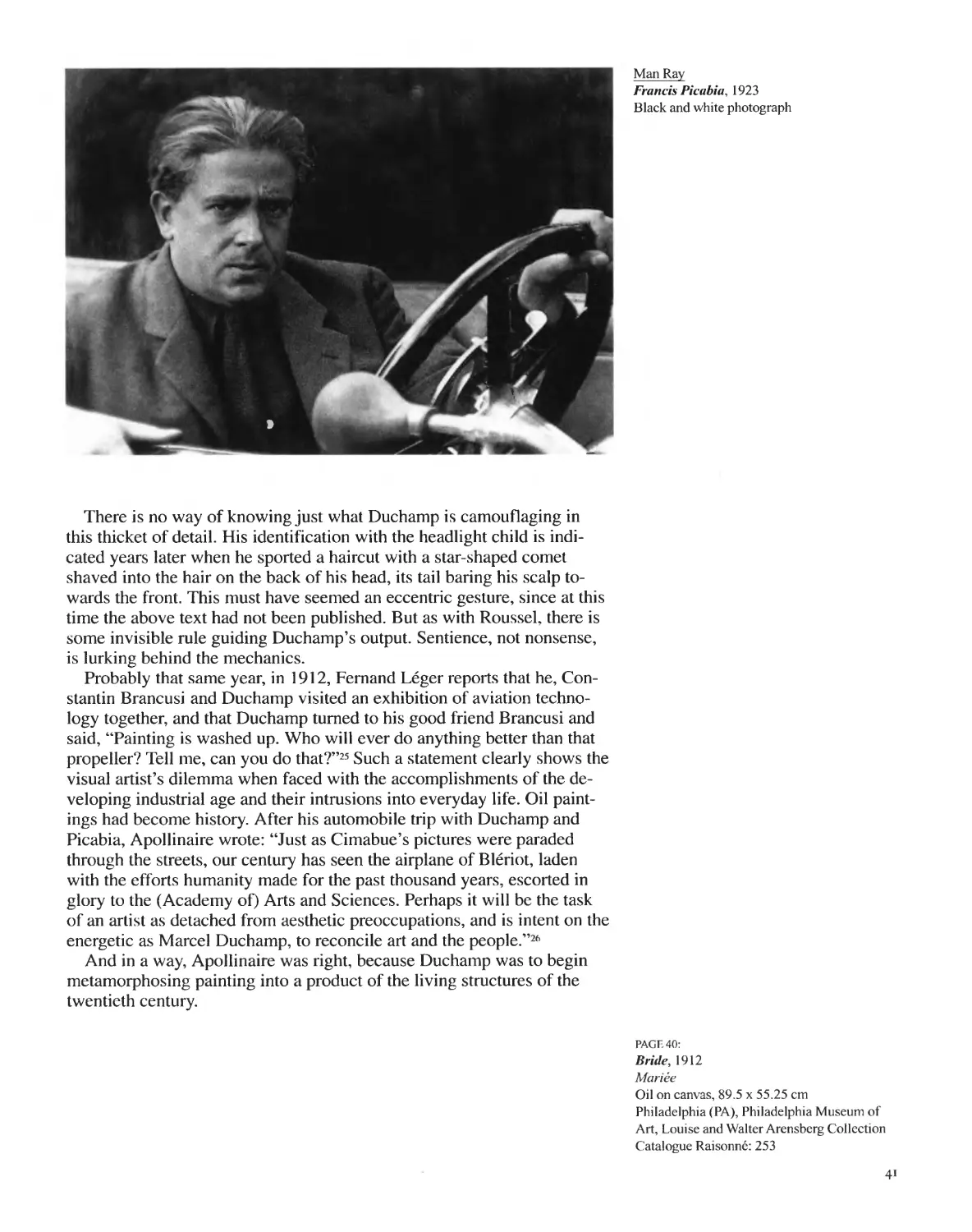
In October of 1911 at the Salon d' Automne, he had become acquainted
with Francis Picabia, who introduced him to a new kind of life outside of
the stolid circle of professional artists at Puteaux. Picabia became a good
friend and would remain one all his life. Duchamp felt drawn to this inno-
vative man after the disappointment with his elder brothers and the estab-
lished Cubists. In June of 1912, Duchamp attended a theater performance
with Picabia, Picabia's wife, Gabrielle Buffet-Picabia, and Apollinaire. It
was an experience that was to decisively change the whole of his art: a
stage adaptation of Raymond Roussel's novel Impressions d'Afrique (first
published in 1910). Years later, in an important interview with James
Johnson Sweeney, Duchamp said:
"Roussel was another great enthusiasm of mine in the early days. The
reason I admired him was because he produced something I had never
seen. That is the only thing that brings admiration from my innermost
being - something completely independent - nothing to do with the great
names or influences. Apollinaire first showed Roussel's work to me. It
was poetry. Roussel thought he was a philologist, a philosopher and meta-
physician. But he remains a great poet.
It was fundamentally Roussel who was responsible for my glass, The
Bride Stripped Bare By Her Bachelors, Even (pp.74/75). From his Im-
pressions d'Afrique I got the general approach. This play of his which
I saw with Apollinaire helped me greatly on one side of my expression.
I saw at once that I could use Roussel as an influence. I felt that as a
painter it was much better to be influenced by a writer than by another
painter. And Roussel showed me the way.
My ideal library would have contained all of Roussel's writings - Bris-
set, perhaps Lautreamont and Mallarme. Mallarme was a great figure.
This is the direction in which art should turn: to an intellectual expres-
sion, rather than to an animal expression. I am sick of the expression
'bete comme un peintre' - stupid as a painter."11
Roussel's image-laden writing is extremely difficult to follow, since
the plot spirals in on itself, becoming more and more complex, or per-
haps one should say his stories implode, creating entire universes of
detail. Roussel arrived at his ideas by using homophones - words that
\... , .,
" Ilcf)' (O:J'(7) 'tlJUH EL
\ )
.Impressions
\ .. .
-d 'Afr"ique
"
....,ltl.... . Dn"HI
'M. .-J_
...." i
-- rt ",
..- .
t' .\ I< I \
ALPIIONSE lI UI\I\I:. t 1111 tua
"f.ll. . U'A("I '-11411'" I. ".-,.
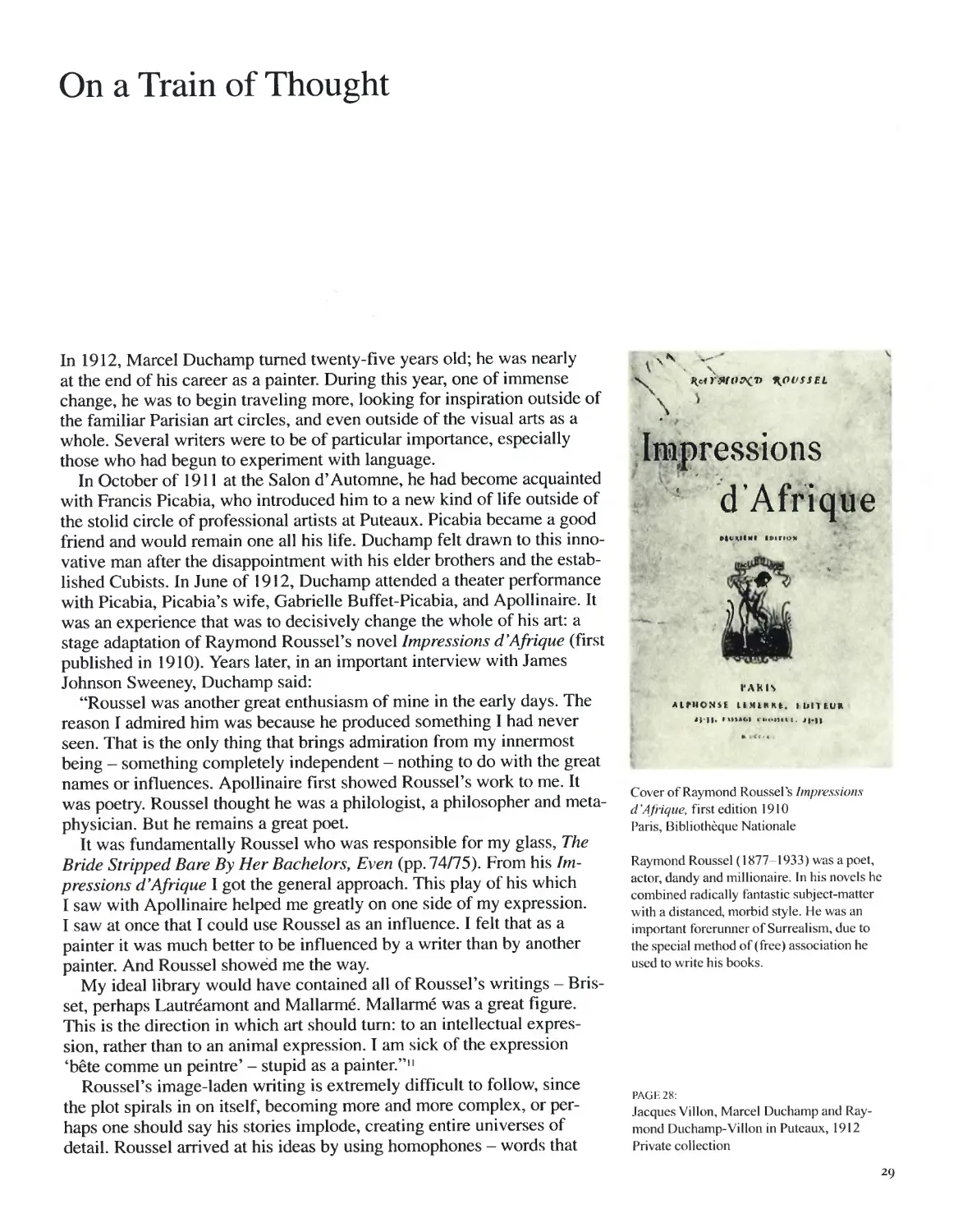
Cover of Raymond Roussel's Impressions
d 'Aji-ique, first edition 1910
Paris, Bibliotheque Nationale
Raymond Roussel (1877-1933) was a poet,
actor, dandy and millionaire. In his novels he
combined radically fantastic subject-matter
with a distanced morbid style. He was an
important forerunner of Surrealism, due to
the special method of (free) association he
used to write his books.
PAGE 28:
Jacques Vi lIon, Marcel Duchamp and Ray-
mond Duchamp- Villon in Putcaux, 1912
Private collection
29
The Killg amI Queell Surroullded by Swiji
Nudes, 1912
Le Roi et la Reine entoures de nus vites
Oil on canvas, 114.5 x 128.5 cm
Philadelphia (PA), Philadelphia Museum of
Art. Louise and Walter Arensberg Collection
Catalogue Raisonne: 248
PAGE 31:
Portmit ofGu.\'tave Camlel\ lW"other.
1911-12
Portrait de la mh'e de Gustave Candel
Oil on canvas, 61 x 43.5 cm
Private collection
Catalogue Raisonne: 241
3°
l
\
.'\
,
..........
'1
1 1 '
\.
''0
'-
\
-- ,..
{;
,.j
'G'
sound alike but have different meanings and origins. He chose the words
at random. For example, "empereur" became the three words "hampe"
(pole), "air" (wind), and "heure" (hour), which inspired "the windclock
of the land of Cockaigne". Another example: ''t. talon a platine", which
could mean "standard meter in platinum" or "stallion with the gift of the
gab" .12 Obviously, this could end in startling imagery for a stage produc-
tion, since Roussel was using the phonic projection of a phrase to throw a
shadow that he traced and gave a new identity. In a theater publication of
the period, a photograph shows the actors from Impressions d'Afrique
during Act III. They surround a glass cage, which is on a table. It has the
rhyming caption "Le ver de terre joueur de Cithare" (more or less, "The
earthworm player of the zither").13 Supposedly, the earthwonn's mercury-
containing secretions struck the chords of the instruments and so pro-
duced music - an idea that is arbitrary, absurd, but logical from the point
of phonetic grouping. Of course, if "earth", "player" and "zither" didn't
rhyme in French, the image would never have existed in the first place.
Perhaps the glass cage contained a snake instead of a worm; Duchamp,
at least, remembered one: "On the stage were only a window display
dummy and a snake that moved slowly; it was the absolute height of un-
usualness."14 One of Duchamp's notes for The Large Glass under the
heading "General notes for a hilarious picture" was "put the whole bride
under a glass case, or into a transparent cage."15 After seeing the play,
ideas began to collect that would slowly bring forth the staging of the
bride and her bachelors.
Alongside human characters, Roussel introduced at least partially hu-
manoid machines that could do things like fence or paint. An uncannily
agile fencing machine "consisted of a kind of grinding wheel, which,
tV
,/0( r
....."\'\. .c: I"'. f.J<ft. ;.p .
M.. ... jt.... #ul11".
-"--I--
."""
J'
,.
-:..1.
"..
I'
Ii.
_ - t
. ...,
L
\ !
· 1J r ' -.........
'! . .
T' . "t\
'\
.....
. ,\ '
\
\ ',:
\ ' \
\
. '-
, .
\
1 tif >
- -' . ..
, -- - .------
__:\I_ '.'
$<' \7.
I
!
---.'
1 -
-,
'4
,
.\
. !
4- ..... '
-- ""''' .
-- ,.;... - \1
- \'
'"
-
1
r
(
,.
\
." --
'. . 111 .... · O' ---
---. a...I1A_"' 1;..-;':1.t .-.:" 61N #"n.."J": '(-utLAr..'l'. _
l-
f '
"-
-.
I r
...... I
,,,;:;-"-
,--
. .,
-
j
'
t .
\, K t '
. _ -t I ' . ,.;,
., II
n
1\
\ \ ' " ,
:\
r
'" }
I .
.......... '
i
.:H-\"
I \
1
\.
\
t. y.. l.r........,,),:'X""'''' \,....
:, \-": --1".."......'1....
,
1\
. 1
'"
)
j....
./ ""'"'-..
f
?'
" .
"
£ 11.<.! /, "", ,, \
M ..S ''''',(..NM it;,
1'J-H.--4 .. r:-.. t -'$
" '2.. ..
:.,.;
......
\
iio
/"..'
\.
1
\,- -
" ---=- '*- '. .'
-")
.........
.to----=-,
---
- '- -
(
--....
.....
t' -
'
:' - .
: .;].'
powered by a pedal, could move an entire system of wheels. connecting
rods, levers and springs, forming an undecipherable metallic tangle; on
one side protruded a membered arm that ended in a hand holding a foil."16
Such a description also almost seems to fit the sad young man on a train
that Duchamp had just painted. Roussel's inventive machinery, his artifi-
cial scientific experiments and his perversion of sense in order to create
new meanings infected Duchamp's imagination. In addition, specific ideas
from Roussel's books recur periodically in Duchamp's art, such as an ap-
parently light statue that later proves to be heavy, (by sculptor Montalscott
in Roussel's Locus Solus of 1914), an apparatus that can make an artwork
using only the combined effects of weather (the Demoiselle in Locus
Solus) or a corporation formed to finance a game of chance (in Impressions
d'Afrique).
In the wake of Impressions d'Afrique, Duchamp began to "write". He
scribbled short notes to himself onto scraps of paper or the backs of gas
biHs, sometimes augmenting them with hurried sketches. These fragmen-
tary ideas were saved, and would serve as a source for The Large Glass
(pp.74/75). (Duchamp later published the notes - or at least part of them -
in facsimi1e form.) In addition, Duchamp continued to invent longer and
more enigmatic titles that pointed beyond his works themselves, although
it is not quite dear at what. Ironically, it is the length of Duchamp's titles
that now leads them to being shortened for purposes of discussion. For
example, his main earJy work, The Bride Stripped Bare By Her Bachelors.
Even is often simply called The Large Glass.
After having become acquainted with Roussel's work, Duchamp
planned a trip to Germany to visit a friend of his that he had first met in
Paris two years before. He spent most of his three-month trip in Munich.
"In those days I would have gone anywhere. Me going to Munich came
about because I had met a cow painter in Paris - I mean a German, who
painted cows, the best cows naturally, an admirer of Lovis Corinth and an
those people -, and when this artist said, 'Go to Munich' I got up and went
there and lived for months in a sman furnished room. There were two cafes
where the artists went. Kandinsky's book r On the Spiritual in Art (Ober
das Geistige in der Kunst), published in 1912 in Munich], was in an of the
stores and one could see paintings by Picasso in a ganery on Odeons-
platz." 17 Duchamp had taken German in school and could at least under-
stand the language. Once he even mentioned a German phrase in his notes,
and a first edition copy of On the Spiritual in Art, with annotations in it
probably made by Duchamp, was found in the library of Jacques Villon.
Duchamp never borrowed from Kandinsky, but he must have agreed
with his condemnation of the art market and the inflation of painting.
Kandinsky managed to sum up the problems against which Duchamp
was beginning to react: "With a greater or lesser degree of facility, vir-
tuosity and brio, objects are given life upon the canvas, which belong to
coarser or finer categories of 'painting'. The harmonization of the whole
upon the canvas is the path that leads to the work of art. This work is ob-
served with cold eyes and indifferent spirit. Connoisseurs admire the
'technique' (just as one admires a tightrope walker), enjoy the 'peinture'
(just as one enjoys pate).
Hungry souls go away hungry.
The great masses wander through the rooms, find the canvases nice
or great. The man who could have said something to his fellow man has
said nothing, and he who might have heard has heard nothing.
This condition of art is called l' art pour l' art. . .
PAGE 32 ABOVE:
The King and Queen Traversed by Swift
Nude..., 1912
Le Roi et la Reine traverses par des nus viles
Watercolor and gouache, 27.3 x 39 cm
Philadelphia (PA), Philadelphia Museum of
Art, Louise and Walter Arensberg Collection
Catalogue Raisonne: 246
PAGE 32 BFLOW:
The Bride Stripped Bare by the Bachelors,
1912
La mar;ee mise a nu par les ddihataires
Pencil and watercolor on paper,
23.8 x 32.1 cm
Paris, Musee National d' Art Moderne,
Centre Georges Pompidou
Catalogue Raisonne: 249
33
Box ofI9/4. 1914
Boite de 1914
Cardboard box with facsimiles of 16 handwrit-
ten notes and a drawing, each 25 x 18.5 em
Philadelphia (PA), Philadelphia Museum of
Art, Gift of Mme Marcel Duchamp
Catalogue Raisonne: 285
To Have the Apprellt;ce ;11 the SUII, 1914
Amir I'apprenti dans Ie soleil
Chinese ink and pencil on music-paper,
27.3 x 17.2 cm
Philadelphia (PA), Philadelphia Museum of
Art, Louise and Walter Arensberg Collection
Catalogue Raisonne: 284
IJ
"""'""--
- \U II,.. If &1iI.;ru...r.. .""toI'.fL ,..t L _
"......"",
3-1-
'"
.L=- ......::;...--:-
"-'t
J;1"- ;"
... _w.... -.- .....
..\IlIIoO."..11.......,*
....
'y
'-
.
\. ,'i '
'" . , .»
'\ ; ,,- \. \
\ "/ ....., . : .
\ \..., ....., ... ,.-
y ._ ... \..v. . ,
, '. .')<,
"
j
/
'-.;
'1'. .
\ !\ '-..........
l'r,1
1iI' .. \- .
\*
---
The artist seeks material rewards for his skill, his powers of invention
and observation. His aim becomes the satisfaction of his own ambition
and greed. Instead of a close col1aboration among artists, there is a
scramble for these rewards. There are complaints about competition and
overproduction. Hatred, bias, factions, jealousy and intrigue are the con-
sequences of this purposeless, materialist art."I!!
Little is known of Duchamp's time in Munich, but since his friend was
intent on showing him the sights as wel1 as acquainting him with the
night-life, he may have seen or heard of other theater productions, such
as the reviews of Frank Wedekind, a provocateur who exploited sexuality
for his appearances. Wedekind's standard first line to young women was
"Are you still a virgin?" He would even urinate and masturbate on stageY)
This was the spirit that would eventual1y evolve into Dada performance.
Duchamp never mentioned being influenced by Wedekind, but the latter
was a darling of the artistic community in Munich at the time. It is known
that Duchamp did the cultural "musts" and visited scenic places. He was
in the area of Neufahrn, for example, where the church is associated with
Saint Wilgefortis, an early Christian virgin princess who refused to marry
and miraculously grew a beard when stripped, as Christ was, by her ex-
ecutioners. 2o While in Germany, Duchamp certainly spent much time in
the museums. admiring particularly the tal1 nudes by Lucas Cranach. Per-
haps he even saw some paintings on glass that were a special form of
Bavarian folk art and inspired Kandinsky and his circle to paint similar
small format pictures.
In any case, it was in Munich that Duchamp began formulating his
ideas for his major work, The Bride Stripped Bare By Her Bachelors,
Even (pp.74/75). Duchamp executed several important oil paintings that
began to blend sexuality with transition and the movement of machinery.
One preliminary sketch, The Bride Stripped Bare by the Bachelors (p. 32
below), shows a figure in the center being attacked by two other figures
to its right and left. Lines suggest aggressive and violent motion. Next
.---
f
I
\
I
r - ' I
f
JfJ:. ., ' I
8!1 8
...
1 1 1-
f . 1:'1
r : :1/'
, A I,
?
"'-
)
A
I / /
Glider Containing a Water Mill in Neighbo-
ring Metals, 1913-15
Glissiere contenant un moulin a eall (en
metallx voisins)
Oil and semicircular glass, lead, lead wire,
147 x 79 cm
Philadelphia (PA), Philadelphia Museum of
Art. Louise and Walter Arensberg Collection
Catalogue Raisonne: 327
35
'"
-
" I
.
L
.:
! .
ABOVE:
9 Malic Molds, 1914-15
Neuf moules malic
Oil, lead wire, lead foil on glass between two
glass plates, 66 x 101.2 cm
Paris, Musee National d' Art Moderne,
Centre Georges Pompidou
Catalogue Raisonne: 328
Cemetery of Uniforms and Liveries (No.1),
1913
Cimetiere des un({ormes et livn!es. nO 1
Pencil on paper, 32 x 40.5 cm
Philadelphia (PA), Philadelphia Museum of
Art, Louise and Walter Arensberg Collection
Catalogue Raisonne: 271
3 6
I
;
j
-
\ ..
\
--
.
, j
,
t l
.
.
, .
.,
,
I..
I
--
1-
\
t - "--
,-
f
-<
.A.
." I
I
"
...
...
.
Duchamp explored the idea of the virgin in two drawings, which he
developed into the painting The Passage from Virgin to Bride, a beauti-
fully flesh and earth-colored composition. A vertical mechanical being
with a head, a spine, a pelvis and legs "moves" from left to right in a
poetic or metaphysical sense: "a passage in my life of painting. . . "21 Du-
champ painted The Passage from Virgin to Bride partly with his fingers,
and its surface is velvety and elegant in warm tones of brown, ochre and
coral against a dark background that gives the work an Old Master flavor.
Apparently, German religious paintings from the Middle Ages and Re-
naissance had made an impression on him, and he borrowed flesh tones
from Cranach. Again, one sees the strange combination of visceral and
mechanical forms that are important to Duchamp: long, thin columns con-
necting areas of volume and breaking at points into funnels, hinges and
segments as if to suggest manufactured parts. Pipe-like lines of approx-
imately equal length are repeatedly set as accents and directing forces.
After returning from Munich in October, Duchamp was to set off on
another trip, this time in an automobile with Francis Picabia, Gabrielle
Buffet-Picabia and Guillaume Apollinaire. It led the group through the
Jura mountains, but the journey was also an intellectual one that might be
described, in the words of Buffet-Picabia, as one of their "forays of de-
moralization, which were also forays of witticism and clownery. .. the
disintegration of the concept of art". 22 The notes Duchamp wrote during
this trip played with language. He avoided expected logic and sense, yet
maintained an absolutely serious. even explanatory tone. The notes are
worth quoting here at length to illustrate just how far Duchamp had dis-
tanced himself from recording reality, instead developing new "ugly"
qualities such as repetition and frustration.
"The chief of the 5 nudes extends little by little his power over the Jura-
Paris road. There is a little ambivalence: After having conquered the 5
nudes, this chief seems to enlarge his possessions, which give a false
meaning to the title. (He and the 5 nudes form a tribe for the conquest by
speed of this Jura-Paris road.) The chief of the 5 nudes increases little by
little his power over the Jura-Paris road. The Jura-Paris road, on the one
side, the 5 nudes one the chief, on another side, are the two terms of the
collision. This collision is the raison d' etre of the picture. To paint 5
nudes statically seems to me without interest, no more for that matter
than to paint the Jura-Paris road even by raising the pictorial interpreta-
tion of this entity to a state entirely devoid of impressionism. Thus the in-
terest in the picture results from the collision of these 2 extremes. . :'23
At other moments, Duchamp almost seems to be interpreting visual im-
pressions of his speeding through the countryside into an absurdly roman-
tic hypothesis:
"This headlight child could, graphically, be a comet, which would have
its tail in front, this tail being an appendage of the headlight child append-
age which absorbs by crushing (gold dust, graphically) this Jura-Paris
road...
This headlight will be the child-God, rather like the primitive's Jesus.
He will be the divine blossoming of this machine-mother. In graphic
form, I see him as a pure machine compared to the more human machine-
mother. He will have to be RADIANT WITH GLORY. And the graphic
means to obtain this machine-child, will find their expression in the use
of the purest metals for a construction based. . . on the concept of an end-
less screw,... serving to unite this headlight child-God, to his machine
mother, 5 nudes."2-t
... ..!fAIiOraC'TDaJl; ra..ul'CAlaS It........ CTCLU ec .4IWT.fttC....!'1: I_
vtruENTa D£ aPORTS
) I , , : ,=g:f "' -' :-" '=
I r I", - . ,l_¥-
. . . . ':':' .": ", __... . .._ _-;..J ':'.': .::.
. ; t i; :. :t: :- :,: ' I .: !.
- , i lTB, , ., "'::-: '___
l¥::=g E: .I.If _,{ .._ --: .__
; }j'2 ;; ff. !i:: .! <. :' :f::' t . ,.:---}
ft P" A T"L:JNS' II LOTT£s, COSTU t: DE . ;:::;;U[ \j. '-- .
ii' 'Ef:'" 'J : _
f.._._::r.::: C.:'::' :'=&:'I" ", r' - 'r
ff =1 : :f ' -:;, r 7 /
J ; . f:' "" fj
: _:; ,) \li1 i )
"..._ - I ..::.-' -'--- --' '._- .---.;...
.';:- ."'" ,. .. ._. . :.:....:= .;:. . ,.-.:-.....
Page from Manufacture... de Saint-Etienne,
from the year 1913, a famous French special-
ist catalogue for weapons and bicycles
The viewer is struck by the similarity between
Duchamp's bachelors and illustrations in con-
temporary fashion catalogues. There are defin-
ite correspondences between the forms Du-
champ uses in 9 Malic Molds and such illustra-
tions dating from the early twentieth century,
showing that he was obviously inspired by
them.
37
..',
\
\;
"
// \ \! -
"'.,
r...
1"
J
/
'!
.!
\
:-
- BROmJSE DE CIIOCOLAT - f9t4
1
I II:.
I '
" '
r t ' ,
"
I '
I " 1,
': ,t,
J
'I '
I, '
-". :
\ I i
\"
l t \
i/ I
, \\.\\ , J :'
, , .
" """'-' , ", - .
.,
','<J, ;
' : 1 ":
I .. t
-- \\It.' ',;:';' /1
. ;': ', '
, , r l
" ! t
/ .
, '
\.- : I /I I I I
l' \ 1 '
t I
. ]. I
1- 1 !
/ -,
/
. . . T"
, .
I
t
t
..
. J'
....,
\
\
\'
I
t,
\
I
I
"
"
'..
I' "ei' .A ', i'l ..... c'l i
' 1 .! I 11;1 ';-; >\. J
.d"'" :. ' Ii ? -.! ' V !
l I ,.'lb t.1 lL. ,."': ! '
i, \I d'RHIIIIP.1I - ",'I'- ' ", 1
I ",, 1', I1Jf _' ,t I
, , I!! f " .! ,'!1111' r. . .....)
.. . ' """ 1 ' ' I . 1 ' 1 ' . I I II. tuu ,.
I- .1' I I"! ,!I 111 1 '..111"
' I>rl ," "', g l '
'.' "'> HI '! I ! II : 1 .
. ' . . \ . ".IJ,!.r "' '. \. .
:J
Study for the Chocolate Grinder (No.2).
1914
Etude pour la Broyeuse de chocolat. nO 2
Oil and pencil on canvas. 73 x 60 cm
Di.isseldorf, Kunstsammlung Nordrhein-
Westfalen
Catalogue Raisonne: 289
Chocolate grinder, illustration from a cata-
logue,c.1920
Duchamp's composition is obviously based on
a functional machine, as was used at that time.
PAGE 3X:
Chocolate Gri"der (No.2), 1914
Broyeuse de chocolat. nO 2
Oil and thread on canvas, 65 x 54 cm
Philadelphia (PA), Philadelphia Museum of
Art, Louise and Walter Arensberg Collection
Catalogue Raisonne: 291
39
n. .
. --. ......=-
\
.
". .L .1/, .
".
"
"-
".
"
, ,
I ,
\
.t-(
"
I,!
. :. .
7 .
--
"'1 '
:1'
i'
1 '
'. \
,
.
There is no way of knowing just what Duchamp is camouflaging in
this thicket of detail. His identification with the headlight child is indi-
cated years later when he sported a haircut with a star-shaped comet
shaved into the hair on the back of his head, its tail baring his scalp to-
wards the front. This must have seemed an eccentric gesture, since at this
time the above text had not been published. But as with Roussel, there is
some invisible rule guiding Duchamp's output. Sentience, not nonsense,
is lurking behind the mechanics.
Probably that same year, in 1912, Fernand Leger reports that he, Con-
stantin Brancusi and Duchamp visited an exhibition of aviation techno-
logy together, and that Duchamp turned to his good friend Brancusi and
said, "Painting is washed up. Who will ever do anything better than that
propeller? Tell me, can you do that?"25 Such a statement clearly shows the
visual artist's dilemma when faced with the accomplishments of the de-
veloping industrial age and their intrusions into everyday life. Oil paint-
ings had become history. After his automobile trip with Duchamp and
Picabia, Apollinaire wrote: "Just as Cimabue's pictures were paraded
through the streets, our century has seen the airplane of Bleriot, laden
with the efforts humanity made for the past thousand years, escorted in
glory to the (Academy of) Arts and Sciences. Perhaps it will be the task
of an artist as detached from aesthetic preoccupations, and is intent on the
energetic as Marcel Duchamp, to reconcile art and the people. "26
And in a way, Apollinaire was right, because Duchamp was to begin
metamorphosing painting into a product of the living structures of the
twentieth century.
Man Ray
Francis Picabia, 1923
Black and white photograph
PAGE 40:
Bride, 1912
Marice
Oil on canvas, 89.5 x 55.25 cm
Philadelphia (PA), Philadelphia Museum of
Art, Louise and Walter Arensberg Collection
Catalogue Raisonne: 253
4 1
..
"'
,161
/
Breaking Free
Towards the end of 1912, Picabia used his connections to secure Du-
champ a librarian job in the Bibliotheque Sainte-Genevieve, where he
worked until May 1914. Duchamp was not only able to earn a small
hourly wage there, he could also withdraw from painting circles into the
realm of the scholar. He pursued subjects like mathematics and physics,
in which discoveries had been made that had recently shaken the founda-
tions of scientific thought. They were being heatedly discussed in artistic
and intellectual circles at the time, and were understood and applied with
varying degrees of precision.
The author most important for Duchamp's development was the mathe-
matician and physicist Henri Poincare, who published several theoretical
books during the first decade of the twentieth century. The books de-
scribe conceptual changes that occurred with the discovery of X-rays, the
phenomenon of radioactivity, of radium and especially of the electron
and its laws. In his concise book about Duchamp, the art historian Her-
bert Molderings has clearly described Poincare's importance for the
epoch and for Duchamp, who began to use a playful, skeptical brand of
physics to devalue rational science:
"All views on matter, its structure and motion had to undergo a revi-
sion. Physics had entered a stage of development that Poincare charac-
terized as a 'general breakdown of principles', as a 'period of doubt' and
'serious crisis' in science. The essence of this crisis was not only the dis-
integration of old physical laws and axioms, but rather in the fundamen-
tal doubt as to the possibility of objective scientific knowledge. Material-
ism, which formed the basis of the sciences in the nineteenth century,
was replaced by the philosophy of idealism and agnosticism. .. The philo-
sophy of agnosticism. which will predominate in modern science, there,
where the masses of humanity supposed it to consist of firm insights, will
form the crux of Duchamp's new art."27
Poincare explained that the laws believed to govern matter and its beha-
vior were created solely by " the minds that "understood" them. No theo-
rems could be considered true. "The things themselves are not what
science can reach. .. , but only the relations between things. Outside of
these relations there is no knowable reality."28 Although Duchamp him-
self did not say so, this sentence of Poincare's could be considered a leit-
motif for the rest of the artist's life. No single work of art he made from
this point on was meant to stand alone. All of his works echo, reflect and
project each other like Roussel's homophones. The tantalized art histo-
rian cannot reach a definitive stand, because there is no final position in
the relationships among the things Duchamp made and said. Several of
.).
" -
"
,oP' ,
.f' r
.r .
r
, -<let-'r
... ".. 9
!.J
..t1
)Qt. ......
':'
,. .
,-
'I
I . J'
1
'.
,'
-. .:..i
, ,'fi "
.. -
\ t .
.-
.
_..:.
--- --
,
- -, ".
!
-f;=
l
A
......
The Bibliothequc Sainte-Genevieve in Paris,
where Duchamp was employed in 1913 as a
librarian.
PAGE 42:
Man Ray
Marcel Dllchamp. 1916
Black and white photograph
Paris, Musee National d' Art Modeme, Centre
Georges Pompidou
43
Pharmacy, 1914
Pharmacie
Readymade: engraving retouched with
gouache, 26.2 x 19.3 cm
Private collection
Catalogue Raisonne: 283
4{
:
t
. i I. "J['
.
t-. '''
...f . '1. }.. . ....
.
.
0 "!' : ( .!.
.
.. '.. ..
:
- I I I
>
,
\? :
:I: ':."/ :
:-' ,c'.vt,r., .
,
\ .: . '-,tt.: \ ' ,,::'.. >' , . t". \;0> . t
.A
.....\ l\ . ,- .. ;
'" :
. .." 'I,.).
:" ',",
.':' )<
': I ':
l
. ' f ?' J::.r
,
'it
fl.' T, '. , ..\""
'.1;.
.,-: ..,
,. .:. ',:;{ :._
:... .(, '.
{:r"" f, ,
,'
:\,'
.:.<,,- : '-
' ' : ',' :, : ):-;;1; ','.' ,,
: "\f ,
f. .i.:.,,
-r.\('
, 'I
\: . ft..'
'. . -' \: \ -k;:,.. :. :
,.
J.
'1'
.
, . '. '.Ii:; ,.,' ..¥ ',- \. t. ' i 1\"-: J.'.{ ': 'i;'i't
'
'
:. ':;
:
"r, _'
'. ':'::>
"
'
' .;;;;i;
Z' .
", .'-..<:',
':l
::
1:/'
::-i.i
. J)'
" '1f"
" "V"'';''' VJ, ' , \.j..1J" 'St > ,.::-1.-.
i
,'-,:-
.
.'1 r' . ,
.:t..
';
,'.
11\ Sit
ft.. :.
\j
,1rt
"
i
' ,:' }.- 'I
: ..1 iX;
_ .JJt:i
i
'
:
; J :\:
,...
tj\.: ..
"'"" ":'1L -,f. ,: .
.- " /-.
t:
\'l
:1
', :! -" [ '1
,
: ' '.' .. -:"f'
.
t,.
, '.....-: 1 '; ) f.fi!. "
7
ft"
:';,
4\
" ;'l, " -. .
'.
" ,.
..:
i:",
' ;,
.-,.t. :',
' -,
.
.:),'. .r, ,'. i ....:. j .,1,., '",', _, J (" \ .1/,."
.. : .
"
..; ,J .
' '1-'...'.
: '::" '}
. ,- o! .:_
;;',,
<, .... '
I
';.," ",Vi ':,.. .
.
. ...,." ¥.... {,r'" ..'.1R' ] ' ... -yri'
,'c.<:_. , .. t. ',,"01"
"
W
':
" '. ,\
.'"J;l;J!fi
u ,,
:1
'
.\ .,'
.:: ..
:'t
:;. ", :' f, :'.;.Af.
...,.., .
/
'..{L....i--t"'i' .. ':t," ....... <r
" ... i-.. ,. .. ","
..'
s ,... lif
' " "',
..i" '. :c.' :!>. . - '. .
' \ 1(., .,i:<).o1iW:l&'x
'''''.1
;'. ::(
.. l
-; ::.;(i' :.
'. ;',: " H' -". ',' \."'
, '
:l, "". '
. 1:,./. .,,\i. , .:, 'I_J
..,
, -,' t 1 . ' 1 .
.
.
:,:;; .
';I
'; j
'_
!_
"J.I. . "
b " ::-. :::,
,
', ,.... , ""':"i' '. ..:.....'
. '.1,
,",...
;;i '\ '.' .' ,
. .' ...._.. .,'..
,
,' '
,.
;. .' .,'fs.;,:
:t
" .,,;\.,-b"
'. _
..,\' :;.'" ,.
,- .;.....
. Y \f'" '. ".-::," .m;' '.
..,
, . \
.
:.;:::- ,"".'.;1 :...
f::-':-:" .;'*:,;,; .... . .::
';,."" . ,,,' -t'
\ . ....!
... ..
. .t
.
"
1lf(l.t""r.", :"
. .. ...: I.i ;. .\ h,
.# (
'
. '}I}
t;r.
.f.., ,-
;-;;./ftt !S
:"!:".
\' :1-..:-',1-' ,.,
. - <": ;
' \ Wi'
, .' \ .. .'
--: \"'L;,
.,:..
'. . '.,,
<'" .'; :.' ';1;' .
:;f,
'f j
';i:
.."
\ -
.
.....;. . ..' ,-
.
r......"I. ,. L CI"
t .,;.
.
{ 'J... ' ..
".i'fr.. ./' "" Ii,', ..'!,
;-. I:; 'Jf:..f:":
':,.:
-[
..... I: '. . ; /:i. "
.:: t, \ V'f >i '-. - :: ' . ,".., : ;f'4:!1./ .1 t .' "'!
:::;" iJ :. .
'
.- /-"J,I ')f, . .
.'it'+'t-:"
: f. '-I 't 't' -:,'-, ,
,-. " .- .... ",
;),
: AL;.. >; 't.,: . i
. .:: :
" , ,)( . '1 .
.
;. :' ':..: . "'. . _ "" :
i. l
',:
. ,Y'.lt n
jp
';k-)'
':' ;
, 'l
jl { ' 'fJII' ..... '''.: . I ft-. j !'
., J..j
........ .
' , :' ri
,"r ... ;J...
tU '.'
"\';
:':"
'" f v
-' ,; ft,
, , ' J' "%
. -
''''."
. _ i:,> .-i:.it' I r:f-t... .'i..,' ,<: - . .
" I!P.";>;\;,..,.p. of -- -. 1f',I:I.\'f!!h,t...
.' : 1 11,: "f-
' ". t . .
'-\ " 1 / '4' ' .: . 'tF
' f :),.
,..Affg}
-..
-.;..... .'
. tr
(}f.w
( ',ff':! /
., : 'J{ . '.:',;,.
. ,
?- ,..;
>< ,I'J." ,.'
. l. ':-. .PIt
MAU
. .
fttL6L.'"L-ftkM.e
;', :,."
). ,. >\..' ',,' i.l .... i- . .'1; ,Jh. . I --
., '
\' ,.;..'... .' -{t. .' !t'.,- I . I' - _.
;f .
- ' , u .' '.
"; .
.
",' ''<''
''
:' ".11' :' :{ ,
,"'"
."I .1, \
his works - boxes containing exact replicas of his messy jottings and sket-
ches - consist of the atmosphere or fabric of ideas woven between writ-
ten comments. (The first box of replicated notes was published in an edi-
tion of four or five as early as 1914.) Later on in his life he would rep-
licate many of his important works in doll's house format and pack them
up into fold-out boxes so that they could be handled and considered in
close contact to one another. This is a radical change from the idea of a
work of art that ends with its completion.
In 1913-14, Duchamp made a strange object that was to remain one of
his favorite works and mark his break with art as it was known to that
day: the 3 stoppages etalon or 3 Standard Stoppages (pp.46/47). It wasn't
a sculpture and it wasn't a painting. It was a box containing an idea. one
application of that idea, and the "law" that resulted from it. Duchamp
conducted an experiment using three pieces of ordinary thread that were
one meter long. From a height of one meter, he let the threads fall onto
painted canvas surfaces, where they landed three successive times in
three random, undulating positions that are as graceful as the outline of
a Matisse nude. Duchamp glued them with varnish onto a painted bluish-
black monochrome canvas surface. The canvas strips were affixed to glass
plates and wooden slats were cut along one edge to echo the curve of the
strings. The glass plates and the wooden slats were fitted into a croquet
box. The title was printed in gold letters on three small leather signs glued
onto the dark stoppage backgrounds. Years later. two straight wooden
sticks marked with their length were added at Duchamp's suggestion
when the piece was shown in 1953 at the Museum of Modern Art in New
York. Duchamp appears to be following Poincare quite literally, who
presented a "School of the Thread" in four pages of a chapter on classical
mechanics. 29
The 3 Standard Stoppages became tools by which to measure and
create other lines, much like the boxed platinum standard meter kept at
the International Office for Measures and Weights in Sevres. One might
also think of Roussel's "Etalon a platine". Obviously, Duchamp's units of
measurement set new, humorously variable and arbitrary standards, but
standards they were. He immediately used them to determine distances
and locations on other works, such as the Network of Stoppages (1914,
p.48). And the Network of Stoppages. in turn. refers directly to the future
Large Glass (pp.74/75). As if this were not complicated enough, the
Network also incorporates an unfinished image of the past, namely a
larger version of Young Man and Girl in Spring from 1911 (p. 18), which
Duchamp had given to his sister Suzanne as a wedding gift and which
was influenced by Matisse.
During 1913, Duchamp had begun working on his first actual plans for
The Large Glass, some of which he made while chaperoning his married
sister Suzanne on a trip to Heme Bay, England. They are faint sketches
full of numbers and lines that recall mechanical drawing and architectural
plans. His studies of historical treatises on perspective, as well as of mod-
em geometry and dimension at the Bibliotheque Sainte-Genevieve,
helped him determine the proportions and appearance of the work, which
he would labor on intermittently for the next decade. Perhaps at first be-
cause he had no other canvas at hand. Duchamp took the older unfinished
work and used it as a background for his Network of Stoppages. How-
ever, instead of repainting it entirely, he diminished only the rims of the
original composition to reduce it to the half-scale proportions of the
planned glass. A layout of The Large Glass was penciled in over the
painting.
Then Duchamp tipped the canvas on its side. With the aid of the stop-
page slats. he drew lines that began on the lower right corner of the
canvas and branched out and up to the left. They cover what may be con-
sidered the "male" parts of the canvas: the zone of the uncompleted
young male figure from Spring, as well as the bachelor realm of the fu-
ture Large Glass. Under her arbor, the female figure of Spring is posi-
tioned in the zone of the coming bride. Here. in this old vision of para-
dise, the male and the female areas of the glass are not entirely separated.
On The Large Glass itself, the stoppages will be limited to the lower half,
the realm of the bachelors. The circles and numbers on the stoppages
mark the locations of what Duchamp termed in his notes the "nine malic
molds" (cf. p. 36), while the lines themselves have become nine "capil-
lary tubes".
Another image from 1913, the Chocolate Grinder, was an oil study for
}
'"
'..... J
:,r.' .
fl
..}f . ... . :,:
:.J-
. .
!
... ,.
,.."
. \
.' .
. It
, ".,
.f
_,J..
11'" ____I.-
"''';;::Z:-
Young Man Standing, 1909-10
Jeune homme debout
Chinese ink on paper, 43 x 28 cm
Paris, Jacques Caumont Collection
Catalogue Raisonne: I 70
PAGE 46/47:
3 Standard Stoppage..., 1913- 14
3 Stoppages etalon
Assemblage: in a croquet box (129.2 x 28.2 x
22.7 cm) are three threads at least 1 meter
long, glued to strips of canvas (120 x 18.4 cm).
The plates of glass are each assigned to a wood-
en slat, shaped to match the curves of the
threads.
New York, The Museum of Modern Art,
Katherine S. Dreier Bequest
Catalogue Raisonne: 282
45
I
'1. r
"'
! -
Ii:
-- ..:--=--= .4--- 2.
.
.
...........
. I
.
-.
@ .
(!it
-
:::
..l
\
:-
--
\
--
..i!-
=:!!!!C.._
"
-r
. "- -:-
.
, i -<So . e
- "'"}
.Jl£ -
'-- "'::- ,..
.
(\
.
"'
"
I
-J
t
.-
Network of Stoppages, 1914
Reseal/x des stoppages eta/on
Oil and pencil on canvas, 148.9 x 197.7 cm
New York, The Museum of Modern Art,
Abby Aldrich Rockefeller fund and gift of
Mrs. William Sisler
Catalogue Raisonne: 292
4 8
another of the principal elements of the bachelor realm. Duchamp had
seen a chocolate grinder at work in the window of a sweet shop in Rouen,
and adapted it for his own purposes by placing it on a short table with
curving legs. The sensual connotations of chocolate accompany the mech-
anical image, which became for Duchamp a metaphor for masturbation. A
second oil painting of the grinder (Chocolate Grinder No.2, p. 38) in-
cluded threads sewn into the canvas in an exact perspectival execution
( (914). The threads radiate out from the centers of the grinding drum sur-
faces like the spokes of a bicycle wheel. Duchamp was trying to eliminate
all painterly qualities from his production. "Through the introduction of
straight perspective and a very geometrical design of a definite grinding
machine like this one, 1 felt definitely out of the Cubist straightjacket. The
general effect is like an architectural, dry rendering of the chocolate grind-
ing machine purified of all past influences. It was to be placed in the
center of a large composition and was to be copied and transferred from
this canvas onto The Large Glass."30 There were also other, similarly
"dry" studies carried out with the material of glass itself, such as the
Glider Containing a Water Mill in Neighboring Metals (1913-15, p.35),
whose imagery is pressed between two semicircular panes of glass and
whose metal frame is mounted on a movable hinge that swings it out away
from the wall. The Glider is a surprisingly aesthetic work - beautiful in its
austerity and amazingly modem in its inclusion of technological forms.
While Duchamp was inventing the repertoire of forms for this major
work - the machinery and parts of the bachelors and the bride - he did
two strange things. He mounted a bicycle wheel on a stool, and kept it in
his studio, spinning it occasionally with his hand, just to watch it. He de-
nied any reason for this, simply saying, "I enjoyed looking at it, just as 1
enjoy looking at the flames dancing in a fireplace."31 Molderings has re-
cognized in it the type of device physicists use to demonstrate the effect
of angular momentum or prove the effect of centrifugal forces on a free
axis. 32 This Bicycle Wheel (p. 50) certainly bears a relationship to Du-
11
1..
. l._
" .
J.
- f
..;
""
1.
\.......
....,.,. -
:-...
t'---
..
... L
-' R
-or
. -\,.
.. -
"""""-- -- -..... - '"
:-I-
J,
\ .
I '.
\ ' t .
., . ." .......
'."" '-- .
. . ..' . ""
i.:"-'f'"
. t
"
. ...
..
.. "'-:.
1
._.. . fo.'
. '\,
. ., , -I
.,
j.
.r , ..,
, .
!:
, ..
J-
\
a
j.
r..'" t.
,;.
.
. .
I
, -
33 w." 61.
N....YOtk
tl917 I'
- .
. .
.1.,.
champ's rotating Coffee Mill (p. 25) and Chocolate Grinder, and also to
the circle of dancers in Young Man and Girl in Spring (p. 18). In addition,
however, its shape is roughly anthropomorphic; indeed, it resembles a
strange portrait Duchamp painted in 1911 of Gustave Candel's mother,
where an inert pedestal is combined with an animate head. It even seems
akin to a wheel-headed bachelor in his drawing for the Cemetery of Uni-
forms and Liveries (No.l) (1913, p.36). The phonetic collage of roue
(wheel) and sellette (stool) could make it a "little" portrait of Roussel. In
his notes, Duchamp refers to the bride several times as "the arbor-type".
Although this term also refers to trees, in both French and English it has
secondary meanings that associate it with a wheel mounted on a shaft,
which would connect the Bicycle Wheel directly to The Large Glass
(pp.74/75). The second strange thing Duchamp did was to purchase a
household bottle rack from a department store, which he also placed in
his studio with no intention of using it to dry bottles. As indifferent and
autonomous as its mass-produced shape appears, it has a presence both
skirted and phallic. These two objects kept Duchamp company while he
worked in his attic studio in Paris.
In the meantime, the painting rejected by the Cubists in 1912, Nude De-
scending a Staircase (No.2), was making Duchamp the most famous mod-
em artist in the United States. It had been selected for the Armory Show,
held in the 69th Regiment Armory building in New York, which included
about 1,500 works by American and European artists. The international sec-
tion got the most attention. Its viewers were surprised and bewildered at the
modern works that violated their sense of art. The most scandalous painting
was Duchamp's Nude. Because the enraged public could not recognize the
nude, it was likened to many things they thought they might have recog-
nized, such as an explosion in a brick factory or a pile of old golf clubs.
Critics made fun of the exhibition and encouraged the public to attend it as
if it were a circus. The international section of the exhibition was so con-
troversial that it traveled on to two other places, Chicago and Boston.
Although the general public was not capable of understanding the new
work, an elite group of wealthy, culturally interested Americans were hun-
gry for the European break with academic and traditional art. The inde-
pendently wealthy Picabia, who was able to afford to travel to the Ar-
Marcel Duchamp's atelier during the period
1917-18, West 67th Street, New York
Villiers-sous-Grez, Archives Duchamp
\
y. , ,\
'I -
I . I I, _ _:-
':tb
. ....
1\\
} 'i
.I I iJ
- /}
.: : ,_ :-- , _ _ :_ _ _ f '- \'a '
- \ ' .
J . f d:::',-"
,I, -:,, '--'"
: r 1'; ? :
. -'-..A-=- - " u L .:::. -:--=--;;-;;,,:..
... .---
l'ig. D.-Wheel Jack
-5f"
Drawing of a wheel jack. c. 1912
If one compares the wheel jack with
Duchamp's assemblage, the Bicycle Wheel, the
similarity between the two is immediately
apparent.
49
:\
---......, ... - -
,
"\
mory Show, was delighted by the sale of 300 of his paintings as well
as by the welcome he received. Duchamp, too, sold all four of his ex-
hibited paintings, which gave him enough money to finance a trip to the
United States in 1915. After the World War I was declared in 1914, Paris
became an unpleasant place for Duchamp, who was neither nationalistic
nor political. His brothers and many of his friends, including Apollinaire,
were in the army. Duchamp, who was exempted from the military for
health reasons, decided to emigrate to the still neutral United States.
When Duchamp arrived in New York, he was surprised to find that he
was a famous man. Immediately after his arrival, he met Walter and
Louise Arensberg, who became his main patrons and collectors. Du-
champ actually lived with them for several weeks, and after two moves,
he took an apartment in the ame house as the Arensbergs and lived there
for almost two years. Duchamp's payment for the rent was to be The
Large Glass (pp.74/75), ownership of which was eventually transferred
to the Arensbergs. This was the beginning of a forty-year friendship, dur-
ing which Duchamp helped Walter Arensberg build up a representative
collection of modem art, including all of the numerous Duchamp works
that are in the Philadelphia Museum of Art today.
Gabrielle Buffet-Picabia describes the Arensbergs as "generous and in-
telligent patrons of the arts, where at any hour of the night one was sure
of finding sandwiches, first-class chess players, and an atmosphere free
from conventional prejudice. The Arensbergs showed a sympathetic cu-
riosity, not entirely free from alarm, towards the most extreme ideas and
towards works that outraged every accepted notion of art in general and
of painting in particular." She continues, "We had found Marcel Du-
champ perfectly adapted to the violent rhythm of New York. He was
the hero of the artists and intellectuals, and of the young ladies who fre-
quented these circles. Leaving his almost monastic isolation, he flung
himself into orgies of drunkenness and every other excess. .. In art he
JIt-,J
/, I y-
",'
'..u....:!!- "i- ;",;." .t: . "1n' ."I-"X. j::\ (,11 .!:...t913...c;:; _
SEEINC,; NEW YORK WITH A CUBIST
The Rude DO&l:cndlnll II StalrClibU
(Kulik H .. .he Subwa»
Wt:
The Rude Descending a Staircase, a contempo-
rary cartoon on the Armory Show by 1. F. Bris-
wold from The Neu' York Evening SUIl,
20 March 1913
New York. The Museum of Modern Art
The Armory Show was the American public's
first confrontation with modern European
developments in art that led painting away
from showing recognizable objects. Duchamp's
contribution, Nude Descending a Staircase
(No.2). was widely attacked and caricatured.
Trap, 1917/1964
Trebuchet
Readymade: coat-rack plank made of wood
fixed to the floor, 11.7 x 100 cm, original lost
Numbered edition
Catalogue Raisonne: 350
PAGE 50:
Bicycle Wheel, 1913/1964
Roue de bicydel1e
Readymade: bicycle wheel. diameter 64.8 cm,
mounted on a stool, 60.2 cm high, original lost
Numbered edition
Catalogue Raisonnc: 278
51
\
\
\
\
\\
'
'>00.-. .
l
- . '. :.. . , ;:.' I.
-")..' . ...
l
, ':;: .!::"' :':: -
-'>,
I"';'
.F... ..
1- . II. .
.:"£ ......
"-.. .,\IIf
l
.. . .. . ..... . , .
I Go:'" r:' I., . ....j.-.(
-1
\ ....-
,
.'I."( t
, . '.
(\
., j
['
'-{-
J Il
- - ;
, ,II! '3t
. \ - . ;".
- t
\. \ .. ,
, ).;Y, ,
I ..
f .........
'J ,,\ \) --." ,
..-
,
\
'\ t
t
'-
c:.
0
\. : \
. ,
..
::a.... .
"
---
-
,.
,."
"
The first exhibition of the Bottle Rack in the Exposition Surrealiste d'Objets, Charles Ratton Gallery, Paris 1936
From the catalogue of the Bazar de I 'Hotel
de Ville, Paris 1912. Of the various types of
bottle racks available, Duchamp selected the
50-bottle-model.
PAGE 52:
Bottle Raclt., 1914/1964
Egouttoir (or Porte-bouteilles or Herisson)
Readymade: Bottle rack made of galvanized
iron, 64.2 cm
Numbered edition
Catalogue Raisonne: 306
£8OV
L
U. . J
.....:.;;.. f '.
\
i\
f
-', ..:}
. J
.'
. '
. ;
"T - .. ...... . . It .....
.
8 tGOUT'l'OIRS .......,.. .
I 0' __
'ORTE rv:
'7
.HANTI&A. .
J".anl' t..
'1"
:1"'14";: .PORT£aevrElLL£S. ,..y r."
d'''.''''I....i ',",-4Ib:t
..
-
.
I - to eoIA.;KlI'II:.....1
t...,.,,, 1"-",. 9tt...""WII'.'
'n...h"".t. . ,.,..... """'''''01 8.
" .....
3'-
..... \;
. -
:>I'''''''''''''.' ""*"
to.. '..'
..
&6.I
77i.
9:1.60 U.6.
.tof'h.....
53
Man Ray
Self-Portrait, 1924
Black and white photograph
Paris, Musee National d' Art Moderne,
Centre Georges Pompidou
From the biography of Man Ray: "Duchamp
had asked me to come to the apartment of the
proposed founder of the new museum, to dis-
cuss the project. When I arrived I was ushered
by a maid into a room lined with books and
modern paintings, mostly Expressionists. Here
and there stood a piece of sculpture on a ped-
estal. Presently, Duchamp arrived; shortly
after, the hostess entered: Katherine S. Dreier.
She was a large, blond woman with an air of
authority. I was introduced and she announced
that tea would be served. I fingered my pipe
in my pocket, but decided not to smoke. The
place was gleaming, immaculate. with no sign
of an ashtray.
Miss Dreier opened the session by declaring
that first a name had to be given to the new
venture. After a few suggestions, I had an idea
- I had come across a phrase in a French
magazine that had intrigued me: Societe An-
onyme - which I thought meant Anonymous
Society. Duchamp laughed and explained that
it was an expression used in connection with
certain large firms of limited responsibility -
the equivalent of incorporated. He further
added that he thought it was perfect as a name
for a modern museum."
5.J
'\
"
'\,,"'...... ,...
.. .
mQn
RQY
{ 92.Lf.
\..
was interested in finding new formulas with which to assault the tradition
of the picture and of painting; despite the pitiless pessimism of his mind,
he was personally delightful with his ironies. The attitude of abdicating
everything, even himself, which he charmingly displayed between two
drinks, his elaborate puns, his contempt for all values, even the sentimen-
tal, were not the least reason for the curiosity he aroused, and the attrac-
tion he exerted on men and women alike. "33
The writer Henri Roche described being at a dance with Duchamp:
"I was expecting a rather lonely evening, but couples started arriving,
young women disengaged themselves and sat down on the floor around
Marcel Duchamp; soon it was a dozen, who were quickly followed by
some of their partners. Duchamp asked two ladies to take care of me, and
soon 1 heard the following: three years ago, he had painted a painting for
the Armory Show entitled Nude Descending a Staircase. This picture was
considered by one half of America to be a work of the devil, while the
\
,..
. . ... ...
. r: . ... " . ." :,' . "
. ... ,. . .
. . . . .
... . II'
.. ,'..
......,
. ,I "
.....'111"
.. ..., .:C..\,. ':.. .
.. ..'. .. .
. . . It...
-----........ .' . t "..' .
-. .- , 1 , ..
.. , ' ." .
.. ';..,.
" .,'
,.'
, .
:':::::;::... .
. . ' . -. .,.. -. . . .
. .. .. .\. . .. . . . . #' .
. . .
.;. .. . '. ..'
..... ....,
. . I
: . {. ::.:.{<
, ",,_. . ... ,'III . .
I . ., .
.. . . .
. . .
. :.:. 0:' '
.. .
. . ... . ... : .
other half thought it a pioneering masterpiece. At this time, Marcel Du-
champ was the most famous Frenchman in New York, next to Napoleon
and Sarah Bernhardt."34
Duchamp was a success. However, nothing could tempt him to paint
any further, since he was already planning his Large Glass (pp. 74/75).
Not even when a gallery offered 10,000 dollars a year for his entire pro-
duction would he do so. Duchamp might have felt his work was in
danger of being sensationalized. It is interesting to note that around the
same time P.T. Barnum also offered Sarah Bernhardt the exact same
amount of money for her diseased leg, should it be amputated, since he
wanted to exhibit it. 35
Despite his initial fame, Duchamp soon disappeared into the closed fam-
ily of the intellectual avant-garde. Among the American artists Duchamp
quickly got to know was Man Ray, who often photographed him and his
work, and who collaborated with him on several projects. He would re-
Marcel Duchamp with Louise et Walter Arens-
berg in Iiollywood 1936
Philadelphia (PA), Philadelphia Museum of
Art. Louise and Walter Arensberg Collection
55
The apartment of Louise and Walter Arens-
berg in New York, c. 1918
Photograph by Charles Sheeler
Philadelphia (PA), Philadelphia Museum of
Art, Louise and Walter Arensberg Collection
\'
.,
-
-t ":-
,
,
"
If ..
.
'\
'.
, ,
.. ,
Marcel Duchamp, Bcatrice Wood and Francis
Picabia in Coney Island New York, 1917
Private collection
56
'I
I
I '
,
-
..o1£:JP ' .,"
".
,
-
-.. .,
".
main Duchamp's friend all of his life, and Man Ray's autobiography re-
veals that Duchamp's ideas influenced and guided him to a great extent.
A little later, Duchamp also met Katherine Dreier, who became his other
main patron, and with whom he and Man Ray founded the Societe An-
onyme. an organization for collecting and exhibiting modern art. Although
Duchamp gave some French lessons and dealt in art on a commission
basis, it was his wealthy patrons who kept him afloat in New York.
Despite his being a much sought-after guest. Duchamp settled down to
work on his Large Glass. a task that would be undertaken intermittently
until 1923, when the work was declared officially unfinished. In 1915, he
bought the rectangular plate-glass, laid it down horizontally on wooden
supports and began to mark the silhouettes of the mechanistic shapes
and objects he had designed for the piece. The figure of the bride came
first. Duchamp defined the contours with lead wire. which was affixed
with varnish to the glass the wrong way around; he worked only on the
reverse surface of the glass, which was meant to be viewed eventually
from the untouched smuoth side. One of the ideas behind working on
glass was its hygienic aspect. since the glass was to protect the images
from changes brought about hy air contact. In this context it is also inter-
esting to note that Duchamp had a bathtub in the middle of his studio for
a while. from which he could open his door through a system of pulleys.
just in case he needed to admit a guest during his bath. (A similar idea
had already been used by Buster Keaton in one of his films.)
It was only after he had spent some time working on the glass in New
York that Duchamp began to readjust his ideas about the Bicycle Wheel
and the Bottle Rack he had left back in Paris. In a letter to his sister Su-
zanne dated 15 January. 1916. Duchamp requested her to move his things
out of his studio in Paris. She was to take care of his belongings. and
store his art. Duchamp wanted Suzanne to write something on the Bottle
Rack. and he explained to her why:
"Now, when you went upstairs. you saw the bicycle wheel and a bottle
rack in my studio. I bought that as an already finished sculpture. And I
have an idea about the bottle rack: listen.
Here in New York I have bought some objects of a similar style and
called them 'readymade', you know enough English to understand the
meaning of 'already finished' that I have assigned to these objects - I
sign them and put an inscription on them in English. I'll give you a few
examples: I bought a big snow shovel upon which I wrote 'In advance of
the broken arm' . .. Don't try too hard to understand this in a romantic or
impressionistic or cubistic way - it doesn't have anything to do with that;
another 'readymade' is called 'Emergency in favor of twice' ... This
whole preamble is for one reason: Go get the bottle rack. I am making it
into a readymade from afar. On the inside of the bottom ring you will
write the inscription I will give you at the end here, using small letters
and painting them on with a brush and silver-white paint, and in the same
lettering you are to sign it as follows: Marcel Duchamp."36
Unfortunately. the page of the letter with the details of the inscription
is lost, and decades later Duchamp said he could no longer remember
what it was. Also, there is no way of knowing if Suzanne Duchamp ac-
tually inscribed it before both the bottle rack and the bicycle wheel/stool
assemblage got thrown away in the cleaning out of Duchamp's deserted
Paris studio. Although the Bottle Rack (p.52) is now dated to 1914,
the year in which Duchamp purchased it in a Parisian department store,
and his Bicycle Wheel assemblage (p.50) to 1913, conceptually these
two objects only became readymades in 1916 while he was working on
The Large Glass.
The first Readymade to be called such was the snow shovel from 1916
referred to in the letter above (p.58). [t hung down from the ceiling in
Duchamp's messy studio. The title, In Advance of the Broken Arm. remain
puzzling. suggesting something disabling and mysterious. The hanging
shovel shares the verticality of the Bicycle Wheel and the Bottle Rack, but -
"
: ( '
\\\ <.V'
, '\
o
"
?1
I
.Ji' ,,' : '
; , ""1
I . .
o
,i\1
,
i I
"
: I' :
.:.....
;"
, I
I
. .. ,
t
.;1
'"......,. .
:
.ih C.. I ',.IJ ;. ? :t : . .'
)....J- ....'" -'" .
.... ..........
"7.) ";;'.
,"
,;
The apartment of Louise and Walter Arens-
berg in New York, c. 1918
Photograph by Charles Sheeler
Philadelphia (PA), Philadelphia Museum of
Art. Louise and Walter Arensberg Collection
The Arensbergs tried to assemble as complete
a collection of Duchamp's art as possible.
Today, their collection forms the core of the
Duchamp works in the Philadelphia Museum
of Art.
57
, ,
I",.,.
: ,J
'"
..
,j
J
I.
t
I
Sculpture for Trm'elillg, 1918
Variable sculpture, colored rubber and string,
dimensions ad lib, original destroyed
Contemporary photograph
Catalogue Raisonne: 356
"
\.
\
,
"
I
.. . ..),
....At;
'I. \' ...
f "
-
I ....1 \ £I.
\
\
, ... .. \
J
......')a. .-
Four RemlJ'made..., 1964
Lithograph, 32 x 23.2 cm
Catalogue Raisonne: 591
111 Admllce of the Brokell Arm, 1915/1964
Readymade: snow shovel, wood and galva-
nized iron, 132 cm
Numbered edition
Catalogue Raisonnc: 332
59
..,.
or
-.
Man Ray
Cine-sketch: Adam and Eve (Marcel
Duehamp and Brogna Perlmutter-Clair), 1924
Photograph, 11.5 x 8.6 em
Private collection
Pi\G E (j I:
Sex Cylinder (Wa.\p), 1913
Pencil on paper, 26.7 x 20.4 cm
Paris, Musee National d'Art Mo<.lerne,
Centre Georges Pompidou
Catalogue Raisonne: 276
60
when considered in the context of The Large Glass (pp.74/ 75) - also
refers to the bride. As the drawing The Female Hanged Body shows, one
early version of the bride actually has a shovel at its center. The note ac-
companying this figure says, "At A, terminating the pole a kind of mortice
(look for the exact term), held by a bowl and permitting movement in all
directions of the pole agitated by the air currents." (Among the replicate
notes in what is known as the Green Box.) Duchamp
changed this idea into the movement of the bride's veil. The shovel be-
comes three wafting surfaces and refers to what Duchamp called "draft pis-
tons" or "nets", which also have small shafts from which they dangle. Simi-
larly, the Bottle Rack - tipped onto its crown of thorns - seems to reappear
in another sketch for the bride, serving as a model for the Sex Cylinder
(Wasp) (p. 61). Martin Kunz has recognized other readymade aspects of
The Large Glass, for example, the material of glass itself as an already
completed background, and the yellowish dust coloring the "sieves"
in the realm of the bachelors. 37
Duchamp's readymades have usually been considered apart from his
Large Glass, since they came into being spontaneously as individual ob-
jects, while The Large Glass was the culmination of the labor of many
years. However, the early readymades seem to have been chosen for their
abilities to serve as prototypes for elements of The Large Glass, or, think-
ing in the other direction, to transpose the ideas for The Large Glass into
the three-dimensional space of Duchamp's studio. (This idea makes the
paintings of the chocolate grinder seem like paintings of a readymade
Duchamp couldn't buy.) It is interesting that Duchamp did exhibit a
few of the early readymades in 1916 by simply hanging them up on the
coatrack of the gallery in question, which brought them into the associ-
ative sphere of clothing and bodies, as well as the hanging bride. There is
some evidence that the first readymades constituted a spatial ensemble.
Photographs of Duchamp's studio/living space show some of the ready-
mades suspended from his ceiling, nailed to the floor or set up in a cor-
ner. One of them, the Sculpture for Traveling (p.59), was a collapsible
sculpture made from colored strips of cut-up bathing caps. It stretched
through the space in abstract lines of movement, reminiscent of Du-
champ's self-portrait as a Sad Young Man in a Train (p.24), whom he
described as being almost "elastic". Such visual affinities suggest that
The Large Glass was meant to reflect an entirely emotionless dimension
of a highly personal realm.
· , ,I . . .:.. . .:. . \ . ._, : . . .- . : ... : , : ;J ' . . ; . : .. ' . r , .:j.... ' : . . .1-/ .
'\' - "';' ' ::;, : . b.:. " '.;.,"
\; "'lW r; ';' \'.-1, , P-
I \' 11: : 1, ,"', fV'>'\ \-;,, y ',..(
" Jc";,' IL-if/< .+ r \"J
L' .t '". i l "" f'" t 't .
: ..... I .' I'" \' I . f , '1 T \ . ..t'
!.:' . \ . ( . t. "-r f . . '(f /\',. Q \" '1 '0'\ -\.. .. .'Co \. . .
'. '1 " ". .. . . .' :' I.' i. . J . ', r J .' . I Hi '.
. ..: .... -"', . . ....:,:.. :. :. .. : r!o (1 " , "- ._ r""" d ",'1,.-1 U'- j ", .iJ'
c.. . .- "l-_ ......... li jJ , ''':-'' . f' .)
... ., ._..-...... ..---.' .... . -- .
- :- "' ' !' . . . ----.,-..... - .
..- '".
",, t', " .
) :; . ,., , ..
: t ;. t 'j :. ;'?" 1 .
. ._",..',a l' I J
. ,\ .,-..... \ .
i\ 0; ' ." · i
L - .'.;
. . \ i" .
. f . "r -..
.,."
:-._ -:- . ---.. .... . . i
.,........--:".._..._ -=----,
'f ,. t I ..' . " " ( '>.n
2 :r\ '.':'; ..: 2:.i
::::,"",": -=::-:- ...._:-..- "-:-;-.
( f4j "
." '.
....i '.. ..... . r i:i . ',..'.>
\
. :. \
. :' 'I I. .-
. " I . "
II..
!. I
. !
",
"
: .", -,
',' :.....
.:-: t ., " .'.
c
I
f!
, ,/0.....
,......_
"'-
.{.. .... .. (4,.
"
"'1...(. j Do". V t. .! )1 "
';) r;1:j, r:.:/.; . ' /" ,. ,! 'i
f f.-r...r: . '- J I..., . - ( .,,' c
:'''''r'' OJ i
I'l. -"i ..
.. ," ":>' ' I,. :., . u
. .."..-- . .
.. /. :
'-----... . ' :
/' ...... !.
,,;r " . '...,
. . "
.\1..
.
---"..,..
-.-"'-
". . .....,
.. , " T,,\'..... .
l.' ..r , ....., .
. !:"..)''') , . . -,\ . II" . .." -,-.' '.""
. 't, {...., ',}. I
p ;'
' v M ;
\ wttu
....l ,/ '",
(> 1 )' lA.t t.v.;1 .HI-l
-
...
, , -"".-- ---. · i , f.
' -.< - ,;" ! i+ : - d.: t 1!""'-.:i-r.«_,>_' 11. )_&-' 'f L Ct.v1rLi., '" i . tyv""
. ... . ,'l." \' eo {.,....,. . i 1.d.... - rf. r, ...j::.-:.....>:j...;: I \'. / t. ... L .. ( ,,;{ At. h' 1\.- \' \."l..li.
" 'f 11 ...... i.." I '-1 '7 "', l ' II,,' .
{'--"....:.. . 1....,) \. !... : '" 1" J" ( (.J 'JI-1.:'o', 1:"-.... .I'l..'::-::. ... t.{ '\,'\..I tV6t'\.,A. I . . ivu.'('\.'\ 'l.f
" -"'.......,.
. , ,.,...,...-;..... I /: ,
. ,, .. \. ......-} .... ...... c". t... . I _ .I t! t. '\.'\X'\.,' .fi.,'V'1( ..
---
.
,.J
...#.
j .;.#'; .
.:A); 1
.L
--r
--).
-to "\
J
J
I
-:..."....-
. ;'. ..
.. ).
I,
-.. -,.... ....
I
I
I
J
t
;1
\t
,,.....,'"
Major Accomplishments
The readymades - Duchamp's elimination of the individual, handmade
quality of art - changed in character, asserting their own qualities apart
from The Large Glass, though not from Duchamp himself. They almost
always have an autobiographical reference, however, their element of hu-
mor is even stronger. With Hidden Noise (1916, p. 64) is a ball of twine
screwed between two brass plates. Inside the twine, Walter Arensberg
placed an object unknown to Duchamp, while on the brass plates, Du-
champ inscribed two phrases whose meaning was hidden from Arensberg
by the deletion of letters. It rattles, but is secretive. Traveler s Folding Item
(1916, p.67) was the flexible black cover of an Underwood typewriter-
a handy work of art for taking on trips, as well as a teasing, skirt-like ref-
erence to a girlfriend of Duchamp's at the time, Beatrice Wood, whom he
also enjoyed teaching rude words in French.
The Unhappy Readymade (1919, p.63) was to be executed by his sis-
ter Suzanne on the occasion of her second marriage to the painter Jean
Crotti: she was to hang a geometry book out on her balcony so that the
wind could turn the pages and pick out the problems for the weather to
destroy. It eventually dissolved and was documented in a painting by
Suzanne. Made as a gift for Walter Arensberg, 50 cc of Paris Air (1919,
p.67) was a glass ampoule of medicine that was broken, emptied and
mended by a druggist in Paris, so that it contained Paris air. A postcard of
the Mona Lisa was penciled with a mustache and a goatee and awarded
the caption L.H. O. O. Q. (1919, p.65), which in French reads phonetically
"Elle a chaud au cuI" (She's got a hot ass). But the most amusing and the
most destructive readymade of all was Fountain (1917, p.66).
In 1917, a new Society for Independent Artists was founded in New
York, modeled after the Paris Salon des Independants. Anyone who paid
six dollars was allowed to submit two works. Duchamp was one of the
directors of the group, but he didn't like the organization and decided to
goad those responsible for hanging and placing the art objects. He sub-
mitted Fountain under a pseudonym.
Fountain was a urinal, the kind of urinal that, when installed in a pub-
lic bathroom, can only be used by standing urinating men. Without a
doubt, it was a mirage of standing urinating men and other spicy possi-
bilities that arose before the eyes of the society's hanging committee
when confronted by it. Duchamp had bought the urinal and simply placed
it on its flat side so that it would stand "erect". He signed the base, right
next to the hole for the plumbing: R. Mutt. Although the signature was in-
spired by the comic-strip characters Mutt and Jeff, and the "R." stood for
"Richard", French slang for "moneybags", the hanging committee prob-
t..; .
; , .;
.
'"..
.....
'"
.
.'
, ..... -':--
'
t
_
'\
g \I\1
I I ." I, \
,II{ -- t\
i'
.,
,rl\
\'\\\W'\\\ .
\\ilh\ \ \ \h\t\ \ \
\\\\
. / -.
. //;/ n ---!' 4
/1
--. . !II,
- II11
,-
. .......1jj/
.
f' '
,
-..,.
. '
:r..
Unhappy Read..Vlllade, 1919
Real
\'made 1I1alhcureux
Readymade: geometry textbook. Original
destroyed dimensions unknown
Black and white photograph, retouched by
Duchamp
Catalogue Raisonnc: 367
PAGF 62:
Marcel Duchamp at an exhibition of his work
in Pasadena Museum of Art. Los Angeles, 1963
Photograph by Julian Wasser
63
.
'-
s
ocs.
-
""-
...... <=:. _
c
_-...::s. ""-
-::;....
, "c:.... <-- "...... -<:;. -
- C:>........
-
-
.
,..
'
,J
,
I
J
.
=?
With Hiddell Noise, 1916
A bruit secret
Assisted readymade: ball of string between
two brass plates held together by four screws.
If the readymade is moved it makes a noise,
12.9 x 13 x 11.4 cm
Philadelphia (PA), Philadelphia Museum of
Art, Louise and Walter Arensberg Collection
Catalogue Raisonne: 340
PAGE 65:
Reproduction of L. H. O. O. Q., 1919/1940
from Box in a Valise (Boite en valise)
Assisted readymade: pencil on a reproduction
of the Mona Lisa, 19.7 x 12.4 cm
Philadelphia (PA), Philadelphia Museum of
Art, Louise and Walter Arensberg Collection
Catalogue Raisonne: 369c
> :.\;:
:.,. It iI_\_ "
'1-"
, "j'i;!:"
"..4' a-
,:,':"'
A'\k.::
.
,
.; ""f :
:."" "? ... .......... c
.
.i
;
f..t:.. .
_.. .'-:J:;>.
"C' ", , '
" \1_..".. :
..'.:f .
-
.. .
,
';'
"\, .j/'f::
',
"
"
':.:::;--.;:.....;;,. .> -
-
.
::
_
-c:,,
.
;!'.
-..
i.: ..
h. ."._';
'
t
i
.
.'-,fff:$l!f
-
'-
.'
. . .
, ';-i/ ;'" "'7:;:$
;£:"
, .
"
-
,
-
: :
:
,'
l :
< .; ;'.
J!iiJj7!ff
'
< t,Yf" ---
. .(j . " .' .1.
I ! I, I f I
'\. :J.
\
: ... , .
'7
...
;
oU -!
'
"",,
, .
" . ,-
, .....
Ii
.1
D 'i\\
)- ct.1\.
.'I"
1 1
0- 1) t
'\:a'-l
'!'
;p.. 'It
.... ......
*' 10.
.
.
.
\
u
\
:
.. ¥'
--
-
.,\..
n, erwoo.
J
ably thought first of a filthy cur. But Duchamp was also playing on the
real name of the company he bought it from, the "Mott Works" in New
York, which he changed slightly, in the manner typical of him.
Fountain never made it into the exhibition (the first problem would
have been the embarrassing question of the height of its placement), al-
though R. Mutt had paid his six dollars to show. It was also not mentioned
in the catalogue. Strangely enough, Katherine Dreier, who was familiar
with Duchamp's other readymades and a member of the hanging commit-
tee, didn't recognize his gesture behind the pseudonym. 38 Complaints were
made. Walter Arensberg was in on the prank, and offered to buy Fountain
to support the artist, but it couldn't be found. After a while the urinal was
discovered behind a partition wall, where it had waited out the entire dura-
tion of the exhibition. Alfred Stieglitz was persuaded to take an almost en-
nobling photograph of Fountain, which appeared in the second issue of
The Blind Man, a magazine published by Duchamp, Beatrice Wood and
H.-P. Roche. There, R. Mutt's case was defended with feigned innocence:
"Now Mr. Mutt's Fountain is not immoral, that is absurd, no more than a
bathtub is immoral. It is a fixture that you see every day in plumbers'
show windows. Whether Mr. Mutt with his own hands made the Fountain
or not has no importance. He CHOSE it. He took an ordinary article of
life, placed it so that its useful significance disappeared under the new title
and point of view - created a new thought for that object. "39
Strangely enough after all this, the original urinal was finally mis-
placed by Arensberg himself. Just like the Bicycle Wheel (p.50), the
Bottle Rack (p.52), In Advance of the Broken Arm (p.58) and other
readymades, it has since been replaced by replicas. The thought, not the
object, was saved.
Around 1920, the readymades became more complicated. Instead of
buying manufactured objects to inscribe and sign, Duchamp made (or
had someone make) several constructions or assemblages. Fresh Widow
(p.69) was a small model of what Americans call a French window. A
carpenter built it for Duchamp. It has cheery green casing and black
leather panes. The pun is obvious. A similar window was The Brawl at
Traveler
't Folding Item, 1916/1964
Readymade: typewriter dust-cover. by the
Underwood company, height 23 cm
Numbered edition
Catalogue Raisonne: 342b
50 n: of Paris Air. 1919
Air de Paris
Readymade: glass ampoule. height 13.5 cm.
circumference 20.5 cm
Philadelphia (PA), Philadelphia Museum of
Art. Louise and Walter Arensberg Collection
Catalogue Raisonne: 375
\
*:
_
....";
L'-
...-r
.
.'
r!:
,(
"t
PAGE 66:
Fountain. 1917/1964
Fontaine
Readymade: porcelain urinal,
36 x 48 x 61 cm
Numbered edition
Catalogue Raisonne: 345d
67
fi1
1-!i-r
H-r '..
.l
-
- -. ..: !
, I "
::0. I ,
" --- .... II
. - . H
I .
..
t.
! - - -=.
.. -
;;.....
': -
.. -
.-1
. .'
i , fr- ..1
. I : I
:.
.' \ ,I .
: i:
; r II.
, I }
I
.,.
..: I . I :
I
I .: i II':
1 1
oj! I \\
4 ' 'I
j
J 1 "
1= I' . 1 1
!I
· ' , r
_ I " ' , !, ;2
. :' .
. .
:-
,t, . .'
.. "
.- ,
- --- -,... ......... "'----.....
1I
--
"-:--:LCi .
...,,
,
-
.',
. ......
. ,I
:.
... _.,
h1
1:e ....... . ----.. !liiiiir. J
'I .....
.:!!!i!iiiII IIiii I
!II
-i-. I
...
. ""
, '. "1
r
f I
I
I
i
I
r
: I
, J I
',j'
I
1
l .1
'I
I
. r
!
"
I
'-I
_ . ___ --.J-
.c
"""'_.GI_"'" _0__ ______..".. "_2.0
------ --.:.---
Man Ray
Dlle/wmp as Rrose Selavy, c. 1920
Black and white photograph
Philadelphia (PA), Philadelphia Museum of
Art, The Samuel S. White lIT and Vera White
Collection
Catalogue Raisonne: 393
PAGE 6S:
The Brawl at AII.\"terlit:., 1921
La hagllrre d 'Allsterlit:::
Miniature window: oil on wood and glass,
62.8 x 28.7 x 6.3 cm .
Stuttgart, Staatsgalerie Stuttgart
Catalogue Raisonne: 397
PAGE 69:
Fresh Wit/mv, 1920
Miniature window: wood painted blue and
eight rectangles ofpolished leather, on a wood-
en board, 1.9 x 45.1 x 10.2 cm
New York, The Museum of Modern Art,
Katherine S. Dreier Bequest
Catalogue Raisonne: 376
7°
.
..
s
.(,.;..,..
.
Austerlitz (1921, p.68), whose panes still carry the glazier's marks - the
ready made initials of Suzanne Crotti, Duchamp's sister, with whom he
was staying in Paris at the time of its production.
Fresh Widow - a puzzle of seeing and not seeing, of female closed
openness, of sprightly death - was the first work Duchamp signed with
the name of his female alter ego, Rose Selavy, whom he invented in New
York in 1920. In a way, Rose Selavy became a work of art, although not
the pretty girl a transvestite might have tried to create. Duchamp dressed
up as a woman for a photograph by Man Ray of "Rose" (p.70); this for-
age into femaleness does not focus on the body, but rather on the inscrut-
able expression of Duchamp's hands and face. A calling card was printed
for Rose that read:
"PRECISION OCULISM
ROSE SELAVY
New YorkJParis
COMPLETE LINE OF
WHISKERS AND KICKS"
j
NT!
I
. t!'
, f
:..
(.;}.r.:. ;:::
;h
f:-. "
1!!-.- 1,
.,.,...
. -
"-'
q,.}
%-' -
'.0", '24f..
;.:.:'-A,-;:r:
"':
':" ,
JA- " .'
;otl
' I" ..
i.
:
:;,
:.'
, ,
i\:l:
"
:
l
.
_
,
'.:
i:j::
' :,,
:
r..""
):..
. r;:
;"
82,000 REWARD
F or information leading to the arrest of George
W. Welch. alias Bull. alias Pickens. etcetry.
etcetry. Operated Bucket Shop in New York under
name HOOKE. LYON and CINQUER. Height about
5 feet 9 inches. Weight about 180 pounds. Com-
plexion medium. eyes same. Known also under na-
me RROSE SELA VY
There had always been androgynous flashes in Duchamp's work. The
very first might be the drawing of Leo Tribout, the wife of one of Du-
champ's oldest friends, shown as a young man (1909-10; p.45 above),
followed by the young couple of Young Man and Girl in Spring (p. 18),
the nude on the staircase (p. 26), even the Bottle Rack (p.52), with its
curves and jutting parts, and certainly the be-whiskered Mona Lisa (p.65).
The choice of the name "Rose" could even be an indirect reference to the
poetic circle of roses invented by the famous Jewish lesbian, Gertrude
Stein. At any rate, Rose/Eros Selavy became a communicative personifi-
cation of this androgynous tendency. In an interview with Pierre Cabanne,
Duchamp commented:
"I wanted to change my identity and first I had the idea of taking on a
Jewish name. I was Catholic and this switch of religion already meant a
change. But I didn't find any Jewish name that I liked or that caught my
fancy, and suddenly I had the idea: why not change my sex? That was
much easier!
And that's where the name Rrose Selavy comes from. Today that
Wall/ed, $ 2,000 Reward, 1923
Rectified readymade: photocol1age on poster,
49.5 x 35.5 em
Private col1cction
Catalogue Raisonne: 403
Poster for the Retrospective at The Pasadena
Art Museum, 1963. It inspired Andy Warhol's
series Most Wlmted Men.
4 c:.,....
.".
4,
C!>'<- Y.-'
t!.
./ Jt..0
'
0':>
O
siLAVY
.11'_"._.. N. Y. Cit.
.'<.
VOUS POUR MOl?
(II
o
"
o
&0- 0 t..
it
o
(
1-0
::
"
ii'
J'lJll.
plJlIrllwi?, 1922
Printed suitcase labels for Rrose Sclavy,
6 x 12 em
New Haven (CT), Beinecke Rare Book and
Manuscript Library, Yale University Library
7 1
{
.....,.
.
'"
. "
,
.....
-.......
,
\.
\. ... -
- - .
.. , \,..-,
III" /IS t
I/ 11.'.<ef I' /II.'st
II I"'"'' ,'/11
/' I ,;/"/11 iJlI.<I
'I ,,,'sd e
JII ,',<I
'III'
d ,III !,<t,., /.'.111"11,;" i.III.....J.' III .'.<1
'f II,' $,i,'", i.sl ,I,' k ;,;,ii,.< /
'III a:.ni<
I1I:
t':IJ"" ..ef ,'", i;.1 "'"/.
",., /I.ct,'./ ""fd ,I //I l' sl"/II.'s,I.' "', .<I",'/.-", I' /I ,</ ''I/ll'sd'" III ,'..1 "II'" .fd,' "".d lIe'l' 1II1111.ft l'l,,,'s,'mlt(. s/lql/,'sd .'11/' .rl nr/.' ," 1m "1:'1 II ".yiJ, '11; ..;./1'//1, 'sll.'1I/ !.<I ,.,''k
111 "/ISI ilJl'
Ojll miqlll'sd i' 11/ i,.1 ,..'
' "! II I; oS till IIi' sl/(. IIi,' ..-1;'//1.' ..d ,.", :.d ..,' k 111"".<1 i'llI ,'S"" In ..sl i'/I'"
',i"lI/i,<I"d: I., ,11/., t i'l II I'ill" III'.,'! thlll,',H,.'1II j sl (1ft
7I/
' II sl i'l/(
sd" lilc:"I!q /Ii' sd"I1/;
I ".'/"lIt.. 11.<1 ilJ /I,' ..d 011/ 0/ i'l /I ,...d,' 71/ i sl ,;.' k III '
II.<I ii/ 1/":.,1, '1)'" sl i,/ II ,'..d,' III ;," ar/.' m" lI,ft i<J ,
(
'd el In ';;011 tJ 1I(',.d,' 71/ i.ft, ".,
"";11.<1 i'/OIcsl!011f"S/ ilJlli'Sde.",;,./. rl,. ,,"..1 i'I/I,'sd """.../II/11,',.-d.' '" i.. I ,.,-/.- "'''"..1 i./II,'."I ')"'e' sl i'III,...d':IIIis/"f!.,!!","..ti'jl' .r,) ,'''''','/
'III,...,I''111 i..I",
III {I IIsliq" csd l>!1,!' sl i'/ll..sd " . "I"$d II 111,'$1 i'll'" ..,1 ,'''' i.. i'll' I'.id.. III.' sl i'l 1I.'s,I, III i../,',' k li!,," <I i'I""..,I.: II' (" .!l i 'I"" ..ef 1'II
i..I" 1: ..
"'{I/Ufi'}llesdull/i'.f.1i'/I.... . ' ''''''.<li,.' ;'/I
,..<d"7I/,.:slf{II".slJ.-I1I
.d"'.kJIII 'II.lil/lli'!.r.,III,..<lf,iCl,..<I/I'lIiisl"d
,
JII,'IIS/iqlll'sdollil'&l"III.; . I: I "!"''''"'''
'';'='''' ,,-.-=-:-=-1: \ :.<I'IJ'
:.(ll'IIlr:;,,';i;li"'.<d'-fIIi,<I, ..Ii
1II011.diqll,.,rdollhSIi'1Ih . "Ii
..;.... : \
i,llT;r
C.E
;
ti'/IIr'sSf'
III..,.:ti'llll..<d
"'I;'<!"L'k
: 1II"IC
/
'/IIC..doIllI'S/
'lIC(; 111"11.< i
/'r1
1 . - {l.'tf .
',:.
.
,j
/i
!li..sd"/III..<li:IIIo,..d'I'"il:
!"L'
,
III {I"..I 1f1'1i'..dnlll.'SI "I ilL'. .. "UllllltJ" '
L:,,:r
tf.';, :.;jr:.
.'"
j;I! i../IIIII.,..,f,i""'.</I</'It'.fdrlJll.,,',wll
lIIOII,.-t;lflIL'sdOI!h',dil/lh'
'I'/I/!k
" . -+j;
x ;:: t;\. O :':C.
,<lill"t'.<tl(ll"..sii.llh:sd"/II'.<:"cJ.o
1II,'II.<.lil/lI,'YI/.;III.-sliq'IO' , A ,,,1
,.:,::';;'.. ""':'
;:;":::"
""",..';,
il
,/i'/""."l"""'$til/lI".fd"lIIist.'L'
mO Il.di Ilcsd,'III':Sliq" cs
,'.r.',"','(, Ih)....M "('H.,,..,,
Ml<lill'h'..dl'IIII'.di'/""StL'lIIisl{l{'k
- 1,"1/1$
'/I"'-'" " ft'6tJtffi
"III:'/I'"
. If III"". ''/D'EdM'(i'r't,'t'
'{:' 'R't/o"-
"".1 II'''IIS ''/'',....k.!iV
"¥ifi ',#'J'I.,C'
A I
"'II,<
,/"".<,Y,
trf'it1I11,'
jlo'/l/i..J,'"
""'IIS IcfiP.'!flP"I
.I
'fr,"
'J'j"'
i..rr.'.
et;,
IJf"II.d
. II
"""Il"'.illtl".
.,:faf"'"f.d,t'" .
C -- [J , :;:::::::
IIL'S,I,JM;>Y.
, ;D.;{}rll;
t;.,.
11:"11.' ,.tf}f,rdMP'ljir.f.r.r;,t;.
1tJ?,(.
I/! 1;1'. i'/Il.:.<IDBLIGl'lrI9,
/NY'''''t, '.:
m 11:"". i
lIpOl>ld'lat"ljOl'.d..1tIJi1r...
\lIP Q "'fill.,".
1,!,JJ'S '.. "..1 . .... j - ....", _
. 4 J /I'''IIS iql/....(f(l1,P\J
,.,i,i,'I'...
.611'\. .tiio 11:1111. i,
1',.;cffo'J,P.
/T.
,-:(;.ft-v,1t,Q."
."'''''.- 'i'/II.....tbBlJIGJI"ffONINY(i.sr; "
t
.' ,,
.III. 'iClicipJn'ld'lhft'l)Ib'oW''2Gifrl.'"
/' ,,:.JII.\ - I . 1'-
II I1I1Sli;ilh..
tll'/lh'.
li'/II,'.rd"lIIi,.'''
'1r
II:,.".. i,/I/,'.< '1t.o"tft.t:t"r'f!."/I".d l '" .
" "liS
./jj'F..tlNicJ'""h!'!c'klti.,o"
m,." s
'I 1/ udJIiJ!.ft!..l.'fItif:i 'j.Jl.li.,'" '.'
11'1-'11 ''t;I/,'sJ;'}:/.r-'rl;J
h's'I''lIIftT(.-
, "!
'IL' I-l'?
( 'OJ; .
ht "I..
('
;::'!.
I'
. ""'I/.rt
'llh'S' "",,'.<II</""S' ,'11/1.'111,'
::::;::
:/
:
:l;'
C
:";;;:WI"
1/"'11.< 'I}'II.<.I!'!"
,. .<I
,
,.,..t-",'r.<y""
":1'11.'
/1I...<,
Ht;t!:( l.r.Nl tfiiisllJi
.11: "'I,' i<S11'.ujWn III'lntf'Jt," '.t!'.-Mi.lr..('
Q)
-'
1
t
,.
..
l
,UN
.
t F; '(,
I .,
J
: .-. -'--
'-'-'--l
. I.
OB1I61TION:
;
b
T&'FltMiCS
. AU POR EuR 20%
:
;::::
':.::::::t,o ':
:.'::: f.:
I: UII.
". .
m"I/,f i'll/,',\'d.J'A9-Yl-i'f?,'r.r.,f!"lIIi.
/1 "
mOIl.
il/il.'f,..a'!hr
.rj,T.
,-.r;
''''l-49, I
"''''',oi'i'/,,,'slP.
(qil.7jIf)1N.1N1t
i, . j
III'I/I.
i
II\1..ci".I!I'lnt6r,aII'.uI'2lSij".f j
:;:
:::
:
JUh J :"1'
.J. .'
1/'1"'.. il/II.'.
tll
9M"'fiJ:1;
"lIIi,d( :
/111111.' iIJJl.F:cc/M.
{;Iir.
t;;JH
Ji..
.>, ,
/II.H/.f i'1"".r
BLIOI4f[I.ONlN
;';ll(1 , J
II'&>IU i
lIpOft'ld'll>i"l)'if,'.a"'2!5i.l;.ill' J
11\"IIS ..
,; nil . :"911-0 .
- J
I/IUII. i'lll".<d,JVilVJ.."E'i'iGill'liIi.dn I
1/',011 ic'iH;"{f'M,Octllf.f."
tf., f1,ij$1c I
,i"I11. / i,/II....cbBlJI(J;j
/(j)NINli;SI" I
I;' (III iC"lipt/n' W,it'iWc'.Ifci!'J':!!lifJ"
"till.' . . .
fllIlI..f .; t",
11,.01105 i'l II f.\'d'/Ro\9!ieJITII"Ek",i.d 1'( I
Ii OilS itfD.&'dMQ'Nm]Jt.'cuA:RJi..O" I
LI /II/'{ i'/II("
ifJBl!.f6UtpfON'N>I i.rt.II I
.1 "". !'C'&&iicJf(18-ii/iifl'\" "'2'5
-f
. I
II nil ". ., ....,',
IIInll
1 iq//csd OIlle'St iqll,'Sri.'1II i.f/..../..II/ oll,rll'III",
II tllI/l'.dl'l"C.f l'III,sloe (111 011.\1 "/'WS I1I1IC'sl.qlrl'sl cII/lslud: li'all,.1 i'III&'sdolllc.<1 i'l",'.sd "III i.d'l 'I
'" ol/.fl i ,. olllesl i<Jlle'sdclII is I o..k III (I,utir "N,l 0/;'" .r/iti'(c
.d':111 istoek III 011.<1 ilJII....d Ollll' SliQfll'sdcll1lstoc/.' ,:'1011,.' i"IIi' sdolll.'.<1 ;'1".:.cd"Jlli.fl
III IS
IIe'SC III'/
' I' L "'S "
. ..dP.:. r} '-" , (}t llli . kll' ,I .<1:. ,. '..)!
.: . ,.
,I,
; o{'k-II
I!I/...t
qlll'sdolll,..rI!If"{:,fil"III
.\I.,( II
I Oll,'
" . 'I"',/,' , ('sri I I Ai I" r
--;-'"
d.l 11 dC (I'" 'k,
,., . .
"iP
q". I
$tI'J,'!.:II';UIISII.'I
h'S(I.'IIII'St
rJlI/".f'/"I!'
f/{ll'A'
u...d " ) /
' I"'S 'P. 'I .,
;,; 'l'i
s, 0 III I.' <ljJf ""I
..tol'h!,Ollst'I]II,'"dulII",ft
"II"",lflll
,<I{) k
1/ /IS 'lilt. , .i. h' 6. .sln I. 11'.'1, ..' ,,' 'nil: ,', d
"
r 'dJIII;
tock1I:QI
lIil'I'\.
l'''IC..dll/lladL'IIII.rI "}..
. tu '>1. 1/. ..... ,.'. " "
,f"III('.di", (
C . Ii Oil,' 1M (\I " £J61'111
t/ocl
I't)IISfill"e',ri/olll£'.dil il.'sd,'lIIi,<1cd'
_
""';
".j. _ a....,...
sounds pretty good, because even names change with time, but then Rose
was a stupid name. The double "R" has to do with Picabia's picture CEil
Cacodylate, which was hanging in the bar 'Le Breuf sur Ie Toit' ... that Pi-
cabia wanted all of his friends to sign. I think I wrote 'Pi qu'habilla Rrose
Selavy' [phonetically 'Picabia l'arrose c'est la vie']."4o
The play on words "Eros c'est la vie" (Eros that's life) or "arroser la
vie" (drink it up, celebrate life) indicates a viewpoint that underlies Du-
champ's works. Because The Large Glass and his readymades do not
look overtly sexual or erotic, it is surprising to be referred back to this
allencompassing interest. However, Rose or Rrose Selavy did not only
make works of art, she also wrote bon mots, spoonerisms and puns that
were occasionally published, and they are often quite explicit. Michel Sa-
nouillet and Elmer Peterson have dedicated a whole chapter to them in
their book, Salt Seller - The Writings of Marcel Duchamp.41 Examples:
"Rrose Selavy trouve qu'un incesticide doit coucher avec sa mere
avant de la tuer; les punaises sont de rigueur."
("Rrose Selavy finds that an incesticide must sleep with his mother
before killing her; bed bugs are de rigueur.")
"Question d'hygiene intime:
Faut-il mettre la moelle de l'epee dans Ie poil de l'aimee?"
("Question of intimate hygiene:
Should you put the hilt of the foil in the quilt of the goil?")
"Abominables fourrures abdominales."
("Abominable abdominal furs.")
or the English, "My niece is cold because my knees are cold."
The sexuality of Rrose Selavy brings us finally to a consideration of
the two major works by Marcel Duchamp, The Bride Stripped Bare By
Her Bachelors, Even (1915-23, pp.74/75) and Etant donnes: r la chute
d'eau, 2° le gaz d'eclairage (Given: 1. The Wateifall, 2. The Illuminating
Gas; 1946-66, pp.85-89). Both of these works with long titles were ex-
ecuted over long periods of time. The first remained uncompleted, while
the existence of the second was divulged only after Duchamp's death in
October 1968. Today, the Philadelphia Museum of Art houses them, as
well as many other Duchamp works, which makes it the most important
museum collection of his art.
The Bride Stripped Bare By Her Bachelors, Even is too fragile to travel
for exhibition purposes, and it has been rebuilt several times. One of the
men who has reconstructed it, the artist Richard Hamilton, has written a
clear and concise report on the generation and execution of The Large
Glass, which grew out of his attempts to understand and reproduce it. 42
This is recommended reading for anyone looking for a point by point re-
capitulation of each individual detail. In his chapter on The Large Glass,
Robert Lebel suggests that Duchamp did not commit himself to an inflex-
ible concept, but was always tinkering around on the work, so that some-
times meanings overlap.43 To focus our understanding of his intent at least
somewhat, Duchamp published three boxes of replicated notes over the
years, which are relevant to The Large Glass, as well as to his ready-
mades and Etant donnes. Each box has its own title, and each was pro-
duced in an edition, similar to graphic works or books (the Box of 1914,
p.34), the Green Box and the White Box).
All three boxes of these notes were reprinted in Sanouillet and Peter-
son's book mentioned above. They suggest ideas and images, nullify
others, and weave a network of co-ordinates for locating the impulses
behind the bride, the bachelors, their machinery and witnesses. Perhaps
PAGE 72:
MOllte Carlo BOlld, 1924
Ohligations pour la roulette de Monte-Carlo
Photocollage with a photo of Marcel
Duchamp by Man Rayon colored lithograph
31.5 x 19.5 cm, no. 2/30
Private collection
Catalogue Raisonne: 406
Duchamp founded a society for a game of
chance - roulette - and sold bonds for 500
francs each to finance his playing. He
had developed a special system that he
thought would make profit possible. The
face of the bond uses a Man Ray photo of
Duchamp with a lathered head his hair
sculpted into the winged head of Mercury.
the Roman god of commerce and science.
and patron of thieves and vagabonds.
Francis Picabia
Portrait ofCe:.alll,e. c. 1920
No longer extant. Printed by Cannibale
(Paris), 25 April 1920
A lost work of Picabia using a stuffed monkey,
the traditional symbol of the painter as an imi-
tator of nature, on the one hand and of vice
and sin. on the other hand. Both a still life and
a portrait. this work is not exactly a flattering
reference to the artists in question.
.... ' b
' . ,-d '
t- .: (O
TMtt:
}i/CEZA'N
"
, oO.
.' ',". ' -,;- .""/\..., ' ",:
c.
, .
: :
'. ¥. ",,,,,..:"';'Ii::..
:t'
\:',":
"
".'
'
.,0
'<l:'
._"
"
'0:;
'-.
t'-
"" "
';:J:/:
rT"'1
3"
"0)
,:?!O '
.>:'"
".._
" '''
'',"
....
fl' \ .
,
:4,
":>,.:
;'\"
.a
,
.:
.
\:.
"
",f?C;"
'6'
.
....
'.;':-
\ A
...
, ,"
:....
73
...
..... --- ......
WI
",
'-.
, t
, I
=._
,,_I,
y;:.,-
,',..
\/
....,
(
,/
y' J
-.'->-". "
--
...---- ---:.
r
/'
/
: I . '
i I
:.-
/
f' -,/
I'
.r
-=-
. -
.
jr.; 4'
f) _.,. .1." -
e
rJ- .
.. --
...
i.I'"
I
r
'"
t
' .. -:'
, '""(c" r\.( I \I
'x, ,
'\y
I
" {
"
"
o
I ---
--
., .
- ,;
.
>..
-
-
-
'i: ..'--
\,/
'
..,-.:;
-f
\
\0'..-
......-.- -==---, , -- --
-- :).
.:::=::::_-
I
!
The Brit/e Stripped Bure By lIer Buche/or..., E.'ell
or The Lmxe G/w;s. 1915/1923
Oil. varnish. lead foil, lead wire and dust on two
glass plates mounted with aluminum, wood and
steel frames, 277 x 175.8 em
Philadelphia (PA), Philadelphia Museum of Art,
Katherine S. Dreier Bequest
Catalogue Raisonne: 404
!L
\i"
j,
..... .1
'I
.."
,
!>
).
. I
......
\{
.
.
.
\\
I \
"
,....
" '"
· T
--------,....--"'-<
I
"-.
f'
J....
'-
/'--
.,
- ------------ -
-
:j
I
,_' .Ii...
l .,-
......j.
,
.,y
' j
-' ,
_, I
-il If.'-
-a:;-ii' ...,..,_..:8 ,
__
2- --, . -
. =-
'\. ""'- II
-I
!
?""
I
....
-
,.
l.
. J j
o,!
I\-
><'
I
j
'r,
,.
...
"
I
T"'-:-
.
""I"
7(1
'\
-
i.:.
{ .
='" ,
,
"
-
--
::::;:;:::::-
"
.
. .............-
, t
1
." ,
j
-;\
", . ,
. Ir
"
. i ''',
!r,
\.
,..
-.-
.
I.
I
.,
f,
..,..,
-
....
11
..
..
I
;, Ji
---
I
"
.....
'< .; :
(
..:::::::
"
''''\
,
:,,,,
\/..
, ' :'
\\' ;
.
w
..,
.\-,.
'c
:
, .
,. ,
, ..
I ';:.-;... - .
.
...... '
".- ..............,..
""0
. ';..
--
- !-.=...-..... .. .-
:..... ..
K
.......-"*'-
.#\ "" ........
Barbara Dilley, Gus Solomons Jr., Carolyn
Brown, Merce Cunningham, David Behrmann,
and Sandra Nils at the first performance of
Cunningham's r"Valkaround Time. stage design
by Jasper Johns using motifs from Duchamp's
The Large Glass.
Buffalo, New York, 10 March 1968
Photograph by Oscar Bailay, New York,
Courtesy Cunningham Dance Foundation
PAGF 75:
The Large Gla......, 1915/1923
Installation in the Philadelphia Museum of Art
7 6
1.._. ..
..
while looking at the The Bride Stripped Bare By Her Bachelors, Even,
the viewer should take to heart the advice that Duchamp once gave to
his own bride when she asked him about the meaning of Picabia's wed-
ding gift, an artwork (to everyone's surprise, Duchamp was married
briefly for three months in 1927): "An artist expresses himself with his
soul, with the soul it must be assimilated. That's what counts."44 Du-
champ's belief in poetry is clearly still alive beneath his dislike of mind-
less art forms. While thinking about Duchamp's resurrection of the ar-
tist's soul, it is perhaps not irrelevant to note that in 1912, Odilon Redon
made an oil painting of an architecturally framed, large stained glass win-
dow that flowers above a pieta (The Cathedral, Munich, Pinakothek).
The Large Glass is something like a department store window in size,
and relates to the changing use of glass and metal in the architecture of
the time. However, Duchamp uses it as a non-referential surface upon
which some of the isolated components, such as the chocolate grinder
and the glider, are shown with painstakingly convincing perspective. One
is reminded of the disembodied reality reflected in store windows. In-
deed, a note dated 1913 from the White Box deals exclusively with shop
windows and ends with the comment, "No obstinacy, ad absurdum, of
hiding the coition through a glass pane with one or many objects of the
shop window. The penalty consists in cutting the pane and in feeling re-
gret as soon as possession is consummated. Q.E.D." And also, "I. Show
case with sliding glass panes - place some FRAGILE objects inside. - In-
convenience-narrowness-reduction of space, i.e. way of being able to ex-
periment in 3 dimensions as one operates on planes in plane geometry."
The Large Glass has been called a love machine, but it is actually a ma-
chine of suffering. Its upper and lower realms are separated from each
other forever by a horizon designated as the "bride's clothes". The bride
is hanging, perhaps from a rope, in an isolated cage, or crucified. The
bachelors remain below, left only with the possibility of churning, agon-
ized masturbation. Duchamp invents the working parts of these two sex-
ual machines, which are as arbitrary and absurd as the machinery of
Roussel which inspired them. Their mechanisms are so complicated that
they are usually accompanied by a diagram, which leaves the viewer feel-
ing a little helpless. In an artistic essay without punctuation, someone
named "davidantin" quite rightly wrote, "now duchamp takes fragments
of science his relation to science is that of a scavenger you reach in and
you say 'what a nice set of wires' and you pull them out and if you sur-
vive you say 'now doesn't that look great' ... duchamp takes all sorts of
physical laws they are physical laws in the sense that they are phrased
like such laws this does this in such a way the feeble cylinders actuate the
desire motor love gasoline you really don't know what he's talking
about. . ."45 Still, it is useful here to give a rough summary of their "func-
tioning". Some additional ideas for the machinery were never carried out
and exist only potentially in the notes.
The bride is made of several parts that supposedly work together like
the parts of a motor. The motor runs on self-secreted love gasoline, in-
spired by"Roussel's glass-caged worm, which created music with its me-
tallic secretions. Despite her mechanization, the bride is also called the
"arbor-type", recalling the young girl under the trees in Duchamp's paint-
ing, Young Man and Girl in Spring of 1911 (p. 18). The hanging figure, or
"Pendu femelle", derives from the Munich Bride painting (p.40). It has a
"halo", which blossoms out into stripped flesh, coral-colored with a tinge
of green. It corresponds to the comet's tail of the "headlight" child from
Duchamp's 1912 car trip through the Jura mountains, namely his inter-
pretation of the functioning headlight as a comet with, unusually, its tail
in front. Here, the veil-like halo appears to protrude roughly from the
bride's forehead. The headlight child was male; Duchamp compared him
with Jesus, as the divine blossoming of his mother, with whom he was to
be united, as well as with God. Since the notes refer to the bride's strip-
ping as a cinematic blossoming, a halo and a milky way, it is clear that
ideas are mixing here, as are the sexes of the bride and the headlight
child. The flesh-colored protruding veil takes on explicit male qualities.
The three wafting squares that so resemble the flat surface of the snow
shovel in In Advance of the Broken Arm (p.58) were derived from square
sections of net curtain - one meter by one meter - that Duchamp had
hung above a radiator and photographed as models. Although they have
become soft like a veil, he called them "draft pistons", which also have
male connotations in their mechanical functioning.
It is hard to say what the bride is doing, besides hanging and potentially
lusting to the degree her "feeble cylinders" (notes) will allow. She does,
however, have the potential of communication through inscriptions. Once
again, the readymades come to mind. A so-called letter box of the alphabet
provides the "hinge" between the vertical and horizontal parts of the bride.
There letters could be found to form an inscription moving across the
pistons towards the only sign of the bachelors within the bride's realm,
namely the shots drilled through the empty right side of the pane.
Marcel Duchamp, Henri Marceau and a
laborer during the installation of The Large
Glass in the Philadelphia Museum of Art on
19 July 1954
) ...\
1.
, .
IJ
r
It
, 1
"
JI
--..
"I
77
.....
.
\
--
,.
\
"
,
.,
8
ABOVE:
Disk.. Bearing Spiral..., 1923
Dislfues avec spirales
Ink and pencil on seven irregularly cut paper
disks, diameter from 21.6 to 3 1.7 cm,
mounted on blue paper disks. in turn mounted
on paper board 108.2 x 108.2 cm
Seattle (WA), Seattle Art Muscum, Eugene
Fuller Memorial Collcction
Cataloguc Raisonne: 405
PAGE 7X:
Rotary Glass Plute... (Precision Optic...), 1920
ROTative plalfue verre (optilfue de precision)
Five painted glass plates that rotate around a
mctal axis and appear to be a single circle
whenvicwed at a distance of one meter,
120.6 x 184.1 cm and 99 x 14 cm (glass plate)
New Ilaven (CT), Yale University Art Gallcry
Catalogue Raisonne: 379
,I)
'
II
.
"\ } ,
This was Duchamp s first motorized machine.
When it rotates, the lines painted on the five
plates appear as continuous concenlric circles.
Duchamp made several works experimenting
with the effect of motion on perception. Man
Ray teLLs an anecdote about one of Duchamp s
rotating machines in his autobiography: "Be-
sides devoting much time to chess, he was at
the time engaged in constructing a strange ma-
chine consisting of narrow panels of glass on
which were traced parts of a spiral, mounted
on a baLL-bearing axle connected to a motor.
The idea was that when these panels were set
in motion. revolving, they completed the spiral
when looked atfrom thefront. The day the ma-
chine was ready for the trial I brought around
my camera to record the operation. I placed
the camera where the spectator was supposed
to stand; Duchamp switched on the motor. The
thing began to revolve and I took the picture,
,!j
. t.
but the panels gained in speed due to the cen-
trifugal forces and he switched it off quickly.
Then he wanled to see the effect himself; tak-
ing his place where the camera was, I was di-
rected to stand behind where the motor was
and turn it on. The machine began to revolve
slowly, then gaining speed was whirling like
an airplane propeller. There was a great whin-
ing noise and suddenly the belt flew off the
motor or the axle and caught in the glass plates
like a lasso. There was a noise like an explo-
sion with glass flying in all directions. I felt
something hit the top of my head, but it was a
glancing blow and my hair cushioned the
shock. Duchamp was very pale and ran to me,
asking if I had been hurt. I expressed concern
only for the machine, on which he had spent
months. He ordered new panels and, with the
patience and obstinacy of a spider reweaving
its web, repainted and rebuilt the machine. "
79
J;(Jgue title page by Erwin Blumenfeld
July 1945
In its July 1945 issue, Vogue took a look at the
Museum of Modern Art, where The Large
Glass was exhibited for a period of three years
( 1943-1946). A fter the Second World War, the
Museum of Modern Art was able to resume its
full exhibition activity, and The Large Glass
briefly became one of the stars of the collec-
tion. Duchamp's hanging bride seems to have
been replaced by Vogue's more earthly model,
who looks down towards the bachelors with
slightly averted eyes.
\
-.-
. - :) -,
,
. 11
,:
'
(b11Ji !k Yutktte .' . /
'.
-.. M'" .,'.
. . {
'
Belle Haleille, 1921
Photocollage for a label of Belle Haleme.
Eau de J;(Jilette, 29.6 x 20 cm
Paris, Private collection
Catalogue Raisonnc: 388
80
....
o
\lid"II11UII('1' Fashions
.....
),. Ill(' \ lI't'lI111 of \lodt'l'II \..1
'.. "'
'
t.
...,.\\
\.
\ \
\
.
,".,.... ---1
! A.
'-:"\ .
'
f1f
'-.\:, .
.
I \
. \
- ,
-
. ;.
- ......
In
\II,
IR
'(n1\'
.'111\ I!II;;
\ l'ri,'" ;\;; CRill-;
IOC....... ...... ... ...... .-.... c.......
/
/
r
J
--?;-/" ;
I
I
\....h ....
\
(' ",1IU1.rl
I'"blisbal ",,-k
. "'11 ... <" nr ,..I1;,"r 1'I111'tf1"1N'i.... ;1 "ill I"
The realm of the bachelors is even more complicated, There are nine
of them crowded together to the left behind a strange framework. They
look like hanging articles of clothing; only one bachelor has a tiny, wheel-
like head tilted back in perspective. Duchamp calls them "malic molds"
("malic" for "male"), assigns professions to them in their "cemetery of
uniforms and liveries" and says they are to be filled with illuminating
gas. They are connected to the rest of the machine by their ejaculations
that travel in gas form from their head-regions along "capillary lines".
These lines have been adopted from the Network of Stoppages (p.48),
changed slightly so that they might be shown in perspective. Within the
"capillary lines", the gas changes into a solid that breaks into short
needles, which, in turn, ascend through the cone-shaped "sieves". These
sieves are colored by the dust that collected on their glass surface while
lying on the floor of Duchamp's studio for several months; a famous
photograph by Man Ray documents the "dust breeding" (p. 81). Duchamp
fixed the dust with varnish. During their passage through the sieves, the
ejaculate "spangles" become liquid and spiral down into a great splash,
the orgasm. At the same time, the strange framework signified as a
"chariot", "glider", "sleigh" and "slide" is gliding back and forth on its
runners, powered by an invisible waterfall turning the paddle-wheel. The
right side of the framework is affixed with scissor-like bars that open and
close with the movement of the "chariot". The chocolate grinder, resting
on a round table with curving legs ("Louis XV chassis"), is connected to
the threatening scissors at their joint. There doesn't seem to be any pas-
sage of energy here. As Duchamp suggested in his notes, the bachelor has
to grind his chocolate himself. The "oculist witnesses" to the extreme
right of the bachelors' domain personify the viewer.
Many questions remain open, not the least of which is why the bride has
so many bachelors and not a single husband. The passage of time is also
unclear, now after the shots that have pierced the bride's realm have rung
out. Although the machinery of the bride and her bachelors has the poten-
tial for movement, nothing visible is happening anymore. Duchamp called
the work a "delay in glass", which suits the atmosphere of waiting and
stillness. All of the energy and juices of the proposed activities remain hy-
pothetical or mythic. The full title is also puzzling. In French, the title ends
with "meme", which is always translated as the adverb "even". Of course,
as has often been noticed, phonetically it could also mean "m'aime", that
the bride "loves me". (This interpretation has supported an incest theory
coupling Duchamp with his sister Suzanne.) It appears Duchamp added
the "me me" to the title after his arrival in the United States in 1915, when
he was experiencing the disjointedness of the French language from the
point of view of someone trying to teach it to Americans. If "meme" were
understood as an adjective (Duchamp himself said it was an adverb), it
could mean "the same", such as "c'est la meme chose" (that's the same
-<
..
-'\
t.
...
fij
"It ....
i'"
""i
rt:.
.-
i
:t
-,. .
, ,'-
.
)...
;
;I.,.
j
,,-
j
tJ
\
,
-q
,
,11
y-
l.. -.1
....
.....
"
II> 7t'>.
. ,.
..
:.t . ..
,
.j"
;i ..
.""
,
.('".: \
1\.. ,
..
\
.
., .
..It.
..
"r..., t
.' . ."
r.
r:',
,
.. '..
.., .
t ..
" ..
,v
.., ...'
:. , -,' ...; .tc,\-'v' .
. J
.,'"
.J... a' ....", \..... ....
.1 ....,
c''\(
.a. · .," .
. :
"
.." , ..
r",
...
. '..
'" ,
'..
..
PAGE 82/83:
Box ill a Valise, 1935-41
Boite-en-valise
Cardboard box with miniature replicas. photo-
graphs and color reproductions of Duchamp's
work, 40,7 x 38.1 x 10.2 cm
Edition of 300 unnumbered copies.
Paris. Musee National d' Art Moderne.
Centre Georges Pompidou
Catalogue Raisonne: 484
Man Ray and Duchamp
Dust Breedillg. 1920
Elevage de pvltssiere
Black and white photograph. taken by Man
Ray at Duchamp's request without disturbing
the accumulated dust. 24 x 30.5 cm
Paris, Musee National d' Art Moderne,
Centre Georges Pompidou
(
,
\
.,
"
,
Jl ,
.
I
, \ ,
.....
.... , .,
. ,
,:..... .. . ..
"\"- ;: \ \ \.
.' .'
..' '. .
"Ji. ,
81
--;:...
"
._
,--- -;::::--:z
:::::=-
- c
--=-
r
it .
.
.. " '. I ." '" ..
,. ' \ \
'. , .... /., .. 'J, .-'
1.\ \,'
\ l\
\, \ .' . ,......
. ,.,. f ' \, . "
1
\
.; :.J
((
. : I: V-
" ,
'
:',
\
I .J
/
;..,,.
i , . '.,; 1\ I. ' ,
.
.:' '.'It, t ,--,1,\
\ -'
' I .
' / .\
' " I A" '\i\ \.
;It .I
:: \ "
'r
,
, . ; .\
{"'>/ "\'
'j',\
I 4
. \ . -,,' \ ',\ .'
""\,>
, .\'.\,.
", ,\ \
/" t
'
, ' " ..
" /- \ .
1,
J
I
" ',I,
'I
J
. '../
L,.o - - "
. '-
." N
.
,_". _=:!,
','
'.
..,.,.."
O
-;-C-:. .-_:......:
-
=<_ -, ...,,00-. .-;.,
.,;..
,. --
....".u .I,..tN",,,I..,,1 '"' r"lr"I;(.'
""u i le: NUl. '_"
I - N....II'. ,... "11. - Con. "'.n\IMrc
.;?;Ei:? f
:
,:
:, :
:. : :,:
'
'
.........- -.. -
..
;: .
.- "
,,
. ,..t "......, : ..
, .
-
'" .:, '. -:,':
, . J'
..
,
"
.to.... _
..... . '-
'...
...
': .
.... '. .:i;.,'"
_
.
..-. :
"
;4,
/I
I;'!tf "-
," 1
t., I.
, (
. \
- "
,
'.(
.
---
.
.. .
Sllrr ,,;
,Ie (/)ncil
.
....:rA,.;-
'i
t
1:/
C'
1
",.
-f,
s:
, .
<\'.
. . . .....7:<\
,
II,! ' . '-: "
./ ,
;
r
' j \
'I ..,.
t. . '
.
\
tl
I
'. -
t \
.. _
_ _'-..P
M
.:;-:
:JI'
. r
1 k
"';\ I :..
. 4/,
(' I -' r
!
1
I J -,- i, 1
"".."..,--
-
-J' "- "J.
-.
'1
......
..,-
" -
...
"
...,
_..
- . --
....../
/'"
.,,/
! /'
"
/
;'
,/
. _' .. T"f-.....-...
-
..:
\\iF=
'- - .
, ..--
.
,
&- h
"
fff
: .
-
-== ,.,
i - .
"'4:.
...
:....- - .
<=> .
--- -..
-..'
..!
\
cU::
..
-:."'
.....
-
'\
r4l{....n,f.
1/ "'q",..
I
f
f
I
--b
\
\
,
,
\
,.
""'=L
"-'c
}
-
;J
...-
l-r
"'..........". '.
'-'",OJ
< ,.
......
......,.
-.:
.-; -
7.
-'
;:.
--
...:;:::;-
-
""'! r
/I
f \
" ),--.
.........
-...
"'--..
,
i
l
----
f
. ,.
-
..-:' ,.,-
......=-
____.-T
Cc., ....r.
....
---
.Zi" n,'
,,::'
.-
b.;
1 H....y_.
I'"
Colt
0....,
l
l.
- - .... ..... '"--
PAGE 85:
Front view of the installation:
Given: I. The Waterfall, 2. The Illuminating
Ga..., 1946-66
Etant donm?s: JO la chute d'eau, 2° Ie gaz
d'i:clairage
Mixed media assemblage: an old wooden
door, bricks, velvet, wood leather stretched
on a metal frame, twigs, aluminum, iron,
glass, plexiglas, linoleum, cotton, electric
lights, gas lamp, motor, etc.
242.5 x 177.8 x 124.5 cm
Philadelphia (PA), Philadelphia Museum of
Art, Gift of the Cassandra Foundation
Catalogue Raisonne: 634
Folding cardboard model of Etant donnes, part
ofDuchamp's installation instructions, c. 1966
29.5 x 9.8 x 4.5 cm
1-
l
-J-
......r.-'
'\ \,...",
.. - .
"\.
. :OtlFt
r
0'
1;
,J
.
. 1
84
thing), "c'est moi-meme" (it's me), or "quand plusieurs verbes ont un
meme sujet" (when several verbs have the same subject). In any case, it
does seem possible that Duchamp hints the bride and the bachelors could
be diverging facets of the single person who invented them.
No one is in the position of deciding what events determined Du-
champ's psychological make-up. For the art historian, the most decisive
aspect of his concentration on sexuality was its communicative potential
as a universal human experience. Sexuality was for Duchamp a primary.
a core element - that existential legitimacy alJ progressive artists were
looking for at the beginning of the twentieth century. Lawrence Steefel,
the art historian with whom Duchamp was perhaps most frank, was once
told by the artist, "I want to grasp things with the mind the way the penis
is grasped by the vagina. "46 Steefel has written: "Seeking to distance him-
self from his own fantasies, Duchamp sought a means of converting
pathos into pleasure and emotion into thought. His mechanism of conver-
sion was a strange one, but essentially it consisted of inventing a 'dis-
placement game' that would project conflicts and distill excitements into
surrogate objects and constructs without which his mental equilibrium
might not have been sustained."47 And Duchamp once said to Steefel, "I
did not really love the machine. It was better to do it to machines than to
people, or doing it to me." Steefel then adds, "By letting machines and
mechanisms suffer outrageously, Duchamp could muster his energies
for survival and the pursuit of poetry."48 Duchamp's poetry remains un-
spoken as an atmosphere "between the lines"; it is always in the process
of recreating itself through the mixing and overlapping of forms, ideas
and emotions.
The Large Glass (pp.74/75) originally belonged to Walter Arensberg,
but when he moved to California, it entered Katherine Dreier's collection
because the cross-country journey was believed too dangerous for the
glass. For some reason, in 1926 it did travel to a show in Brooklyn, and
both panes were shattered during its return trip to Katherine Dreier.
Duchamp accepted the damage calmly and repaired it himself, growing
to love the chance arcs that crossed over his imagery as if they were an-
other incarnation of the 3 Standard Stoppages (p.46/47). His relationship
to The Large Glass had been loose enough for him not to finish it; he
simply stopped working on it in 1923. After that, he is said to have dedi-
cated himself mainly to the game of chess, with peripheral performances
in the sphere of art. From 1935 to 1940, he worked on replicating his
works for a boxed "portable museum", which meant assembling photo-
graphs and supervising reproductions of his work. The pictures on glass
were printed on sheets of transparent plastic, while three diminutive
copies of readymades were also produced. Duchamp might well have
been inspired by Gertrude Stein again, who had returned to the United
States after many years in Paris for a sensational series of lectures. In her
essay Pictures (1934) she had the following to say:
"There was a moment though when I worried about the Courbets not
being an oil painting but being a piece of country in miniature as seen in
a diminishing glass. One always does like things in little. Models of furni-
ture are nice, little flower pots are nice, little gardens are nice, penny
peep-shows are nice, magic lanterns are nice and photographs and
cinemas are nice and the mirrors in front of automobiles are nice because
they give the whole scene always in little and yet in natural colors like
the receiver of a camera. As I say one does quite naturally like things in
small, it is easy one has it all at once..."
- \\1\ \' \....1\
J \\\' \
J
---...---J
, "'
------,,-
.- .' ---,
------1 "'
--
.A.
-=
-.-1;- - ---. '
----J.
.
;J
I .
;._
.
.- .
J
: -.
1 -
f
I
,i1
I
.l
.J )
.! !
: Ii
, j ;
I " "' I
. ,
I'
I
'
. .
" ,
,l'J . I"
t 1
rl I
f 'j
! I
., I'
" ,J1:
.
-,
I . .
a
1 . .
, I
4- \ '
j
I
.
(
\
.1
, \
. '.
"'i
,4It
.
d
:. I
! "
\
(.
I J
,
r
.
'j
.
r.
/
r
t -
-.J ",
---
-----'-
-
..
.
.....-'. . :
1.>:---
-',
.
,.
I
--.;,,,......
't'
.
,-
",-'
.......
...--
-
. -' .,-
/
/
,/
((
\
,/ \-
)/' \ \
I \,
!'\
I \ ----
! \
- /
t .
i
. 1
,,-} '/
--
-1
\
/
))
\
\
"-
'\.
fj
/
!J
I
II . \ I
t ")
-r
/-::::?:"
....
'"
,.,,",
.-/
I
} /
/
1:
r
1
I
'1.0.
After digesting his whole work in this way, and emphasizing the inter-
relatedness of its separate parts within the microcosm of the box, instead
of stopping, Duchamp was ready for something new.
His last work, a "peep-show", was entitled Etant donnes: r la chute
d'eau, 2° Ie gaz d'eclairage (Given: 1. The Waterfall, 2. The Illuminating
Gas), here shortened to Etant donnes (pp. 85-89), and was carried out in
great secrecy in New York over a twenty-year period. (One person who
knew of the work and helped him was the woman he married in 1954,
Teeny Duchamp.) The title comes from one of his working notes pub-
lished in the Green Box. Although this indicates that it has come from the
same source of ideas as did The Large Glass and the readymades, it is as
shocking and immediate as The Large Glass is hermetic and distanced. In
his last work, Duchamp wanted to be sure of two things: that the hidden
eroticism of The Large Glass would turn into overt sexuality, and that the
viewer would be more aggressively challenged to leave his or her view-
86
The Bee Aller, January 1968
Le Bee Aller
Etching on handmade paper, 50.5 x 32.5 cm
Private collection
Catalogue Raisonne: 648
View through the door of the installation:
Given: I. The Waterfall, 2. The Illllminating
Gas, 1946
66
Etant donnes: JO la ehllte d'eall, 2° Ie gaz
d 'ec'lairage
Catalogue Raisonne: 634
i-
to.
J;
'" t, 'If.', ..
"\
,.1
\ '," , ' .
)' , .' JI
'.
" .
\
-r,..
'
't;
I
, .,'
;
.. - ,
,
. ".
f
:
)
\
P,'
:
,
:13.
:=t ...
'IJ,'
j
"
)'
I
'-'.-
.....!
"
, I
;
.
.
:, :j
point as passive recipient and actually become aware of the threat of sen-
tience. Etant donnes is a diorama whose subject-matter often results in it
being compared to a peep-show. However, it has just as much in common
with a lifelike exhibit in a Natural History Museum, where a deceased
wildlife specimen is stuffed and shown in a three-dimensional set-up of
its natural surroundings before a painted background.
Despite its size, it is quite possible to miss seeing Etant donnes. The
viewer going through the collection of the Philadelphia Museum of Art
will eventually reach a room that appears to be empty. On one wall there
are a pair of old, very worn wooden doors without a handle, surrounded
by brickwork. Only if the viewer gets closer to admire the patina of the
old wood, or somehow becomes curious about the closed doorway, will
he or she notice two tiny holes around eye level. A cursory look through
the holes rivets the viewer, evoking a strong feeling of alarm and helpless-
ness. There, directly before one, is a stripped female body lying on its
back, a heavy or swollen-looking woman whose long, messy blond hair
has fallen across her face, disguising her identity. She has been left for
dead in an overgrown clearing, yet she manages to hold aloft a glowing
gas lamp with her one visible arm. Her legs are spread wide apart, with
one foot so close to the viewer that it is not contained within the diorama.
It is this leg stretching towards the viewer that pulls his or her eyes di-
rectly towards the figure's open crotch. Duchamp has dispensed with her
pubic hair and genitals, so that only an indentation is visible between her
legs. Although she is obviously a woman, she has been strangely de-
sexed and somehow abused, without a bruise on her. In the background a
watery landscape atmospherically reminiscent of that of the Mona Lisa
suggests a distant and deserted comer of the earth - a source, but not a
pure or unequivocal one. (Duchamp had recently rehabilitated the Re-
naissance painting by "shaving" the Mona Lisa.)
There is no precedent for such brutal representation of reality in Du-
champ's work, even though its components seem familiar, for example,
the stripped woman who accompanied his work since Dulcinee (p.23),
..
a
i\ ....... ........:. ..
{
---
I
.......
,
,
\
,
-f.:..;
r
,- } .()--.;t-:
PAGE IHi:
Tire Illuminating Gas and tire Waterfall.
1948-49
Le gaz d'eclairage et la chute d'eau
Painted leather on plaster relief, 50 x 31 cm
Stockholm, Moderna Muscet
Catalogue Raisonne: 531
View from the back of Elan[ donnes.
Duchamp's last major work was carried out in
complete secrecy. He tinkered around with it
and continually improved it over a period of
about twenty years. The art world had assumed
that he had more or less given up making art.
The assemblage is handmade in a complex,
highly detailed fashion. For example, the fe-
male figure is covered with fine leather to
make the skin appear as realistic as possible.
89
m'ler & GilS 0" £..eIJ' Floor, 1959
Eau el ga= £Ilous les elages
Imitated Readymade: enameled plate
(15 x 20 em) on the cover of the de luxe edi-
tion of Robert Lebel's Sur Marcel DUc/llImp
Paris, Private collection
Catalogue Raisonnc: 560
yo
1
t
EAU
6AZ
f
t
J
A TOUS LE5 £TA6ES
1',1).
----
or the Bee Auer gas lamp of the type sketched by Duchamp as a boy. The
two givens - the waterfall and the illuminating gas - also playa role in
The Large Glass. In 1958. Duchamp cited them again on the cover he
designed for the deluxe edition of Robert Lebel's Duchamp monograph:
Eau & gaz if tous les itages (Water & Gas On Every) Floor; (p.90) was
an imitated Readymade that looked like the enamel signs affixed to
apartment buildings in late nineteenth-century France. It must have been
amusing for Duchamp to use the "omnipresent" Readymade to refer to
the still secret and uncompleted Etant donnes, in a gesture that was per-
haps similar to his hanging readymades on a gallery coatrack in 1916.
He referred to Etant donnes again with a strange etching executed in
the year of his death (p. 86). The outline drawing in the etching shows
almost exactly as much of the female figure from Etant donnes as the
viewer can see through the peek-holes in the wood. However, in the etch-
ing, the woman is not alone. Her right shoulder and upper torso disappear
behind a nude male companion, united with him somewhat like the two
kissing figures at the lower right in Matisse's painting The Joy of Life
(p. 19), which Duchamp had already used once as a partial inspiration for
Young Girl and Man in Spring in 1911 (p. 18). In Duchamp's etching,
the man is practically pillowing himself on the woman's abdomen, with
his hands folded behind his head. Yet, in contrast to the Matisse couple,
there is a feeling of distance between Duchamp's figures, as if a particu-
lar man were relaxing and considering a generic female, who remains un-
responsive, even numb. Of course, the image is also humorous, since the
Bec Auer gas lamp corresponds to the other implied erect element of the
composition, which the viewer cannot and ought not to see.
The etching seems to show a correspondence or union between the two
figures, although it is not the customary erotic joining that Matisse shows.
However, if the viewer completes Duchamp's line drawing in his or her
- -...I? k l..1,..,: ....... R.C." .(..(..t
'a..
",<'c---
L r 0 Q Q.
."""-..."'-....,..... . ,)"'.......,ft."""'1
L. H. O. O. Q., shaved. 1965
L. H. 0. 0. Q. Rasee
Playing card (8.8 x 6.2 cm,. mounted on
paper, 21 x 13.8 cm
New York. The Museum of Modern Art
Catalogue Raisonnc: 615
Self-Portrait ill Profile. 1958
Alltoponrait de profi!
Torn colored paper on hlack background,
14.9 x 14.9 cm
Paris, Private collection
Catalogue Raisonne: 557
9 1
A p. LIN'
ENAMEL ·
\1
)
I
I
J
..-"
.
..-
-- --- -- --------->-----
--.-- - -
,
iJj '", ,):
I , ;-;
)'
lW#' .
"
!I
I
)/ '
'I" I
;, , ! I".
I
" 1
: :P' 1 1 ,'[1 ;,',. .
, " it 1!
1j
;.\ , : ,1. 1 " .
I
11
IWL\ :\\' r
I Ill: " .K \ , '
, - . I, .
__ _.. ! Oft a
d I.'
; t
" d
".!. - .1
" 1/ r-Li
.,I';\.' ?':!.
..-. V
.Jj,
,'
'
e VJ; r"
.".
, :
11
'i;..
-
--,
,.I';
iI1'\
-"'0-- ::,_
I
-..;"
u
y
"Lr
,I
--
.'
u
. ...
-.0...;;;.
.r
j
':1----
4,
1-...-1"
.
1:
'A
:'I9;;"'
_B'''1 ": .....-_
n; JR 1id
" @
ii'TM
- :;J
]t:<{
.
Y
.
r
. I.
.
'-om 11M.
A
Ji " · ,
Apolinere Enameled, 1916-17
Rectified ready made, painted enamel sign,
24.4 x 33.9 cm
Philadelphia (PA), Philadelphia Museum of
Art, Louise and Walter Arensberg Collection
Catalogue Raisonne: 344
9 2
mind, energy dances in a circle along the lines of the man's arms, up to
the lamp, across to his (imagined) erection and back to its starting point
at the center of the image, the man's dark head. The back of his head and
the female figure's crotch are curiously aligned. At the same time, his in-
terest is not directed at her genitals, nor apparently at his own. His back
excludes any audience from entering the image, making clear that the
viewer of the etching is the voyeur. In the diorama of Etant donnes, the
male half of this union has withdrawn. The viewer is surprised again into
the role of voyeur - and this author finds it a very bitter one for the fe-
male audience. Duchamp violates the female body, but he is just as ob-
viously using it in a metaphoric way.
In 1916-17 in New York, Duchamp found a small enamel sign adver-
tising the Sapolin brand of paint, which he touched up slightly, turning it
into the readymade Apolinere Enameled (p. 92). Duchamp changed the
lettering and couldn't resist putting the little girl onto glass by penciling
the back of her head onto the mirror over the commode as a reflection.
Another reference to the Bride exists in the title, which recalls the snow
shovel in the readymade In Advance of the Broken Arm (p.58) when
pronounced with an American accent: "A pole in air". Duchamp must
have enjoyed the sexual innuendoes in the advertising image of an inno-
cent girl serenely brushing the stalwart bedpost with her wet little brush.
As the lettering to the lower right suggests, she has something to do
with "any act red", meaning perhaps the color, passion or readability, or
what is more likely, something between all those things. In Apolinere
Enameled, Duchamp had also dedicated a work to his Parisian acquaint-
ance, the poet and critic who had made Duchamp the subject of the last
chapter of his book about Cubist painters. However, in Apolinere En-
ameled, not only the mattress, but also the man is missing from the work
that names him with its inscription. Duchamp found someone who was
not there. Similarly, by first publishing the etched version of Etant
donnes including a male figure, Duchamp drew attention to its omission
in the diorama, which was made public only after his own physical depar-
ture from this world. In a way, the abandoned woman of Etant donnes is
Duchamp as an empty bed, or better yet, Rrose, the femaleness he wanted
to reach.
Among other things, Apollinaire wrote as early as 1913 that Duchamp
was trying to create an art "directed to wresting from nature, not intellec-
tual generalizations, but collective forms and colors, the perception of
which has not yet become knowledge" .49 Although no longer a "Cubist"
painter concerned with colors and forms, at the end of his life Duchamp's
goal does not seem to have changed. While negating the body of art, he
upheld its poetic spirit. He tried to cage the undefined, to use this world
in search of its projection into the next, to harness the illumination of
eroticism. In other words, why not sneeze?
Sonett II
Surgi de la croupe et du bond
D' une verrerie ephemere
Sans fleurir la veillee amere
Le col ignore s' interrompt.
Je crois bien que deux bouches n' ont
Bu, ni son amant ni ma mere,
Jamais a la me me Chimere,
Moi, sylphe de ce froid plafond!
Le pur vase d'aucun breuvage
Que l'inexhaustible veuvage
Agonise mais ne consent,
Naif baiser des plus funebres!
A rien expirer annon
ant
Une rose dans les tenebres.
Stephane Mallarme, 1887 50
....
't
.
#
-
.
,
@.
II
IJ:ullllI
, 'j- .
.
...,
h ..
'':'
' · ,.. ."',
:. 1"
' ,t ... ..
.
IlgtlIDummn
lmD
i
.....
-
.-.
The house of the Duchamp family in Blain-
ville, 1890-1900
] 887 Henri-Robert-Marcel Duchamp is
born near Blainville, Normandy, on 28 July,
the third of seven children in what is an
upper middle-class family; his indulgent
father is a notary. Duchamp's mother is
rather distant and unresponsive. The family
home is decorated with engravings and paint-
ings done by Duchamp's maternal grand-
father.
] 902 Duchamp begins painting.
1904 Finishes school and joins his elder
brothers in Paris. Enrolls in art school, but
spends most of his time playing billiards.
] 905 Duchamp draws cartoons for news-
papers. Finishes military service, and is
exempted from second year of service through
being employed as an "art worker".
] 91 0 Most important early works showing
influences by Cezanne and Fauvist painters.
1911 Overtones of Symbolism, Cubism and
Futurism in his work. Influenced by chrono-
photographs. Executes chess player paintings.
Also Sad Young Man in a Train (a self-portrait)
and oil sketch for Nude Descending a Staircase
First machine painting - Coffee Mill.
] 9] 2 A year of turning points. Paints Nude
Descending a Staircase, which he is asked to
9-t-
Chronology
. \
withdraw from the Salon des Independants. At-
tends opening of Futurist exhibition at Bern-
heim-Jeune Gallery and returns several times.
The chess paintings develop into The King and
Queen Surrounded by Swift Nudes.
Friendship with Picabia and Apollinaire, with
whom attends Raymond Roussel's Impressions
d'Afrique. Visits an acquaintance in Munich for
two months. Trip by car to the Jura mountains
with Picabia, Picabia's wife and Apollinaire.
Duchamp begins to write notes and save them.
I(
. It.
] 9 ] 3 Employed as a librarian at the Biblio-
theque Saime-Genevicve, Paris. Begins mech-
anical drawings, oil studies and notations that
will result in the complex work, The Bride
Stripped Bare By Her Bachelors. Even (The
Large Glass). Mounts a bicycle wheel on a
kitchen stool. Executes the work that helped him
break away from art as it was known until that
time: 3 Standard Stoppages.
In New York, Nude Descending a Staircase
creates a scandal, making Duchamp famous.
] 9] 4 Buys a bottle rack at a Paris depart-
ment store and puts it in his studio. Puhlishes
the first box of replicated notes.
] 9] 5 Arrives in New York on 15 June.
Meets patrons Walter and Louise Arensherg.
Made to feel welcome in the land of Charlie
Chaplin and Buster Keaton films, excellent
plumbing, and astoundingly engineered
bridges and skyscrapers.
Meets Man Ray, who becomes a lifelong
friend.
] 9] 6 Coins the term "readymade". Two rea-
dymades shown at the Bourgeois Art Gallery,
New York, by simply hanging them up on the
coat rack.
] 9] 8-] 9 Trip to Buenos Aires, where he
remains and joins chess club, referring to
himself as a "chess maniac".
Returns to Europe, visiting family and establish-
ing contact with Dada group in Paris.
] 920 Returns to New York, bringing the
ready made 50 cc of Paris Air back as a pres-
ent for Walter Arensberg. Works on Rotary
Glass Plates (Precision Optics), a motor-driven
construction for experimenting with optical
effects. Photographed by Man Ray as Rrose
Selavy.
1923 Stops working on The Large Glass.
Serious training for professional competition in
chess tournaments.
] 924-34 Travels, participates in chess
tournaments, co-authors book about chess
problems.
1934 Publishes the Green Box of replicated
notes and sketches.
1935 Produces set of six ROlOreliefs, to be
used on a rotating record player. Sold for three
dollars a set.
] 94] Official date of first publication of
Box in a Valise, a representative selection of his
work in miniature reproductions, packed up in a
fold-out box.
1946 Begins work on last major work,
Given: J. The Waterfall, 2. The Illuminating
Gas, which lasts 20 years.
1954 Marries Alexina (Teeny) Sattler, who
had previously been married to Pierre Matisse.
] 964 Galleria Schwarz, Milan, produces
thirteen readymades in an edition of eight
signed and numbered copies.
] 967 Publishes box of notes In the Infini-
tive (White Box).
] 968 Dies on 2 Octoher and is buried in
Rouen.
Notes
I "Marcel Duchamp" in: Marcel Duchamp. The Museum of
Modem Art and Philadelphia Museum of Art. Anne d'Hamon-
court and Kynaston McShine. cds. (a collection of various
essays and catalogue of the Duchamp collection of the Phila-
delphia Museum of Art). p. 295
2 Thomas Zaunschirm. Bereite.
MiidchenlReady-made.
Klagenfurt. 1983. p. 127 f.
3 Excerpts from poem Lifting llelly. 1915-1917. Gertrude
Stein. reprinted fully in: Zaunschirm (see note 2 above). abo
in: The Yale Gertrude Stein. New Haven and London. 1980
4 Walter Pach. Queer Thing Painting. Forty Years in the
World of Art. London. 1938. p. 163
5 "Marcel Duchamp" in: InKenieur du temp.
perdu, En-
tretiens QI'ec Pierre Cabanne. Paris. 1967. p.34
6 ibid.. p.9
7 Guillaume Apollinaire. "Watch out for the Paint! The Salon
des Independants - 6.000 Paintings are exhibited". in: Apolli-
naire on Art: Essays and Rel,ielVs 1902-1918, Leroy C.
Breunig. ed.. New York. 1972. p.71
8 See note I above. p.245
9 See note 5 above. p.49
10 ibid.. p.52
II Marcel Duchamp. interview with James Johnson Sweeney.
in: Salt Seller - The Writing
of Man'el Duchamp (Mar-
chand du Sell, Michel Sanouillet and Elmer Peterson. eds..
New York. 1973. p.126
12 See Marcel Duchamp. Palazzo Grassi exhibition catalogue.
Venice 1993. Ephemerides on Marcel Duchamp and Rrose
Sclavy. 1887-1968. compiled by Jennifer Gough-Cooper and
Jacques Caumont. dated from 10 June 1912
13 Magazine Le Theatre. bound volume exhibited in a glass
case in the above exhibition. p.23 (I912?)
14 See note 5 above. p.56
15 See note II above. p.30
16 Raymond Roussel. Afrikanische Impresswllell, Munich
1980 (author's English translation)
17 Marcel Duchamp. interview with Russell. printed dS Exile
at Large in: The Sunday TImes. London. 9 June 1968.
p.236
18 Wassily Kandinsky. Ober das Gei.
tiKe in der Kunst. Ins-
be.mndere in der Malerei. Munich 1912. Quoted here from
"On the Spiritual in An" in: Kandinsky. Complete Writings on
Art 1901-1942. Kenneth C. Lindsay and Peter Vergo. eds.,
London, 1982. p. 130
19 Rose Lee Goldberg. Performance - Live Art 1909 to the
Pre.
ent. New York. 1979. p.34
20 See note 12 above. I July 19]2
21 ibid.. 7 August 19]2
22 Gabrielle Buffet-Picabia. "Some Memories of Pre-Dada: Pi-
cabia and Duchamp" (1949) in: Roben Motherwell. cd.. The
Dada Painters and Poet.5: All Antholog\'. New York, 195],
p.257
23 See note 12 above. p.34
24 ibid., p.36
25 See note II above. p. 160
26 Guillaume Apollinaire.l.Rs Peintres Cubistes, Paris. 1913;
quoted here from: Herschel B. Chipp, Theories of Modern
Art. Berkeley, Los Angeles and London. 1968. p.246
27 Herbert Molderings. Marcel Duchamp - ParalVissen-
schcdi. das Ephemere und der Skeptizismu.
, Frankfurt a.M.!
Paris. 1987. pp.35-37. Quoted here from "Objects of Modem
Scepticism" in: The Definitely Unfini.
hecl Marcel Duchamp,
Thierry de Duve Cambridge (MA) and London. 1991. pp.244-
245
28 ibid.
29 See note 27 above. p.246
30 See note I above. p.272
31 ibid.. p.270
32 See note 27 above. p.248
33 See note 22 above. p.260
34 H.-P. Roche. "Erinnerungen an Marcel Duchamp" in: Ro-
bert Lebel. Duchamp - Von der Erscheinulig zur Konzep-
tion, Cologne. 1962, pp.168-169
35 Roger Shattuck, The Banquet Year.
- The Origins of the
Avant-garde ill France 1885 to World War I. New York,
1968. p.7
36 Marcel Duchamp, quoted in: Dieter Danie]s. Duchamp
und die Anderen. Cologne. 1992. pp.168-169
37 Martin Kunz. Marcel Duchamp - Wirkungsgeschichte
des "Ready-made" ZlVi.Khen 19/3 und 1919. Basle. 1975,
pp.12-13
38 Dieter Daniels, see note 35 above. p. 17M
39 The Blind Man, No.2. May 1917. New York
40 See note 5 above. p. III
41 See note II above. p. 103
42 Richard Hamilton, The Large Glass. see note I above.
p.57
43 Robert Lebel. see note 33 above. p.93
44 See note 12 above, 8 June 1927
45 davidantin. "Duchamp and Language" in: Marcel Du-
champ, see note I above. p. ] 12
46 Marcel Duchamp to Lawrence D. Steefel. Jr., quoted in: Ar-
turo Schwarz, The Complete Works of Marcel Duchamp.
London/New York. 1969, p.114
47 Lawrence D. Steetd. Jr.. "Marcel Duchamp and the Ma-
chine". in: Marcel Duchamp. see note I above. p.70
48 ibid., p.71
49 See note 26 above. p.245
50 Stephane Mallarme, (Eu
'res completes. Coli. La Pleiade,
Paris, ] 945. p.74, Translated as: Sprung from the leap and the
croup of a glassware ephemeral flowering no bitter vigil the
neck forgotten stops Sylph of this cold ceiling, I well believe
two mouths never. neither mother nor her lover, drank the same
fantasy! The VdSe pure of any potion save the widowhood un-
spent dies but docs not consent. naive kiss of the most dour! to
breathe an annunciation of a rose in the obscure.
Acknowledgements
Oscar Bailay, New York: 76
CNAC/MNAM Dist. RMN, Paris: 1,32,36,
43, 54, 61, 81, 82/83
David Hcald: 24
Walter Klein, Diisseldorf: 39
Paul Macapia: 79
Photograph I{I 1994 The Museum of Modern
Art, New York: 13,15,16,46/47,48,51,69,91
Cr' Philadelphia Museum of Art. Philadelphia:
16,17.21,22.23,26,30,32.34,35,36,38,40,
55,56,57.64,65,67,70,74,75,77,85.87,92
Julian Wasser: 20, 62
95