/


Tags: dictionary electrical engineering electronics electrical equipment radio electronics
Year: 2000




Text
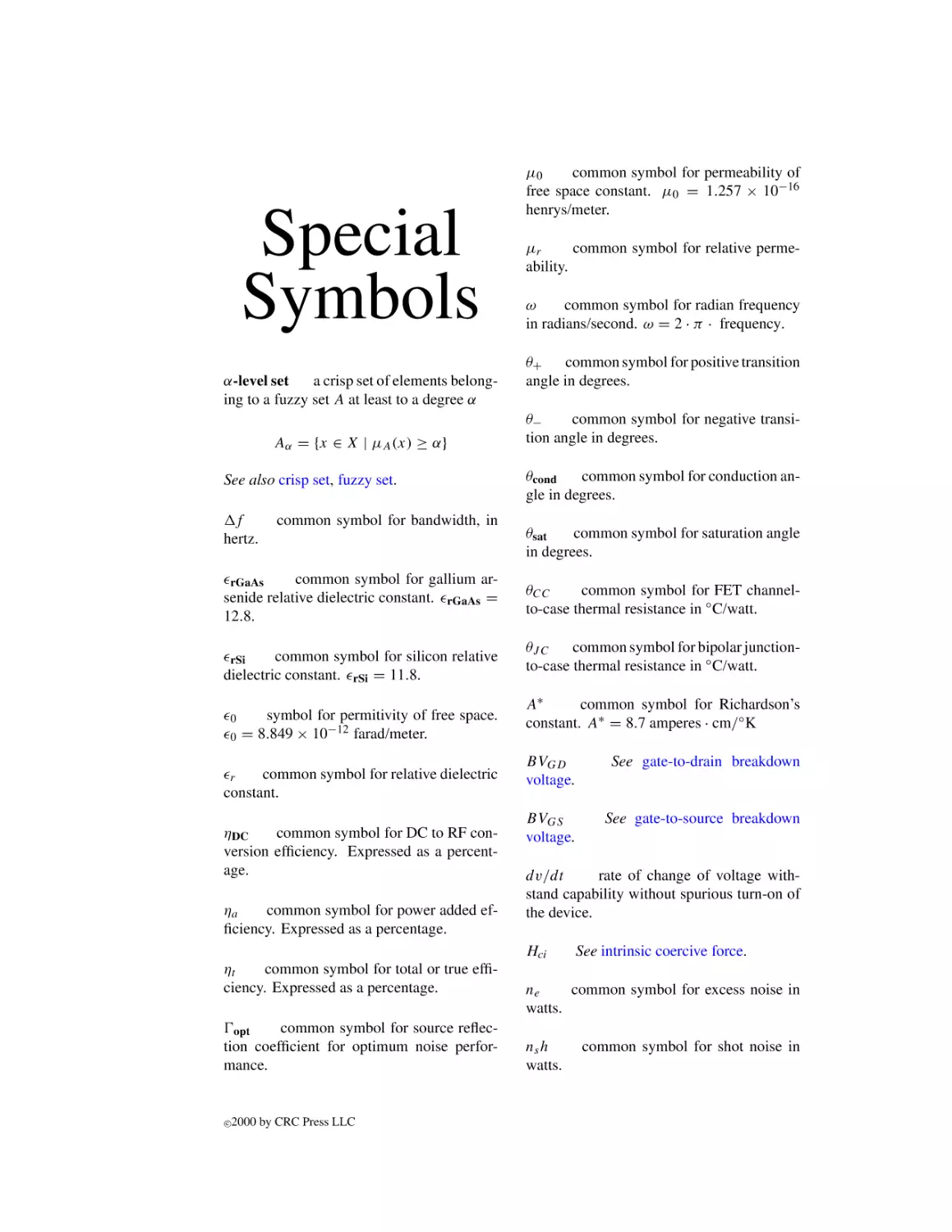
Special
Symbols
α-level set
a crisp set of elements belonging to a fuzzy set A at least to a degree α
Aα = {x ∈ X | µA (x) ≥ α}
See also crisp set, fuzzy set.
1f
hertz.
common symbol for bandwidth, in
common symbol for gallium arrGaAs
senide relative dielectric constant. rGaAs =
12.8.
common symbol for silicon relative
rSi
dielectric constant. rSi = 11.8.
0
symbol for permitivity of free space.
0 = 8.849 × 10⁻¹² farad/meter.
common symbol for relative dielectric
r
constant.
common symbol for DC to RF conηDC
version efficiency. Expressed as a percentage.
common symbol for power added efηa
ficiency. Expressed as a percentage.
common symbol for total or true effiηt
ciency. Expressed as a percentage.
common symbol for source reflec0opt
tion coefficient for optimum noise performance.
c
2000 by CRC Press LLC
µ0
common symbol for permeability of
free space constant. µ0 = 1.257 × 10⁻¹⁶
henrys/meter.
common symbol for relative permeµr
ability.
ω
common symbol for radian frequency
in radians/second. ω = 2 · π · frequency.
common symbol for positive transition
θ+
angle in degrees.
common symbol for negative transiθ−
tion angle in degrees.
common symbol for conduction anθcond
gle in degrees.
common symbol for saturation angle
θsat
in degrees.
common symbol for FET channelθCC
to-case thermal resistance in ◦ C/watt.
common symbol for bipolar junctionθJ C
to-case thermal resistance in ◦ C/watt.
common symbol for Richardson’s
A∗
constant. A∗ = 8.7 amperes · cm/◦ K
BVGD
voltage.
See gate-to-drain breakdown
BVGS
voltage.
See gate-to-source breakdown
dv/dt
rate of change of voltage withstand capability without spurious turn-on of
the device.
Hci
See intrinsic coercive force.
common symbol for excess noise in
ne
watts.
ns h
watts.
common symbol for shot noise in
nt
common symbol for thermal noise in
watts.
deux indices,” IRIA Rapport Laboria, No.
31, Sept. 1973.
10base2
a type of coaxial cable used to
connect nodes on an Ethernet network. The
10 refers to the transfer rate used on standard
Ethernet, 10 megabits per second. The base
means that the network uses baseband communication rather than broadband communications, and the 2 stands for the maximum
length of cable segment, 185 meters (almost
200). This type of cable is also called “thin”
Ethernet, because it is a smaller diameter cable than the 10base5 cables.
2-D Fornasini–Marchesini model
model described by the equations
10base5
a type of coaxial cable used to
connect nodes on an Ethernet network. The
10 refers to the transfer rate used on standard Ethernet, 10 megabits per second. The
base means that the network uses baseband
communication rather than broadband communications, and the 5 stands for the maximum length of cable segment of approximately 500 meters. This type of cable is also
called “thick” Ethernet, because it is a larger
diameter cable than the 10base2 cables.
10baseT
a type of coaxial cable used to
connect nodes on an Ethernet network. The
10 refers to the transfer rate used on standard
Ethernet, 10 megabits per second. The base
means that the network uses baseband communication rather than broadband communications, and the T stands for twisted (wire)
cable.
2-D Attasi model
by the equations
a 2-D model described
xi+1,j +1 = −A1 A2 xi,j + A1 xi+1,j
+ A2 xi,j +1 + Buij
yij = Cxij + Duij
i, j ∈ Z+ (the set of nonnegative integers).
Here xij ∈ R n is the local state vector,
uij ∈ R m is the input vector, yij ∈ R p is
the output vector, and A1 , A2 , B, C, D are
real matrices. The model was introduced by
Attasi in “Systemes lineaires homogenes a
c
2000 by CRC Press LLC
a 2-D
xi+1,j +1 = A0 xi,j + A1 xi+1,j
+ A2 xi,j +1 + Buij (1a)
(1b)
yij = Cxij + Duij
i, j ∈ Z+ (the set of nonnegative integers)
here xij ∈ R n is the local state vector,
uij ∈ R m is the input vector, yij ∈ R p is
the output vector Ak (k = 0, 1, 2), B, C, D
are real matrices. A 2-D model described by
the equations
xi+1,j +1 = A1 xi+1,j + A2 xi,j +1
+ B1 ui+1,j + B2 ui,j +1 (2)
i, j ∈ Z+ and (1b) is called the second 2-D
Fornasini–Marchesini model, where xij , uij ,
and yij are defined in the same way as for (1),
Ak , Bk (k = 0, 1, 2) are real matrices. The
model (1) is a particular case of (2).
2-D general model
a 2-D model described by the equations
xi+1,j +1 = A0 xi,j + A1 xi+1,j
+ A2 xi,j +1 + B0 uij
+ B1 ui+1,j + B2 ui,j +1
yij = Cxij + Duij
i, j ∈ Z+ (the set of nonnegative integers)
here xij ∈ R n is the local state vector, uij ∈
R m is the input vector, yij ∈ R p is the output
vector and Ak , Bk (k = 0, 1, 2), C, D are real
matrices. In particular case for B1 = B2 = 0
we obtain the first 2-D Fornasini–Marchesini
model and for A0 = 0 and B0 = 0 we obtain
the second 2-D Fornasini–Marchesini model.
2-D polynomial matrix equation
equation of the form
AX + BY = C
a 2-D
(1)
where A ∈ R k×p [s], B ∈ R k×q [s], C ∈
R k×m [s] are given, by a solution to (1) we
mean any pair X ∈ R p×m [s], Y ∈ R q×m [s]
satisfying the equation. The equation (1)
has a solution if and only if the matrices
[A, B, C] and [A, B, 0] are column equivalent or the greatest common left divisor of A
and B is a left divisor of C. The 2-D equation
AX + Y B = C
R k×p
R q×m [s],
(2)
are equivalent.
2-D Roesser model
a 2-D model described by the equations
#
"
" h #
h
xi+1,j
xij
A1 A2
B1
=
+
u
v
A3 A4
B2 ij
xi,j +1
xijv
i, j ∈ Z+ (the set of nonnegative integers),
" #
xh
yij = C ijv + Duij
xij
Here xijh ∈ R n1 and xijv ∈ R n2 are the horizontal and vertical local state vectors, respectively, uij ∈ R m is the input vector, yij ∈ R p
is the output vector and A1 , A2 , A3 , A4 , B1 ,
B2 , C, D are real matrices. The model was
introduced by R.P. Roesser in “A discrete
state-space model for linear image processing,” IEEE Trans. Autom. Contr., AC-20,
No. 1, 1975, pp. 1-10.
2-D shuffle algorithm an extension of the
Luenberger shuffle algorithm for 1-D case.
The 2-D shuffle algorithm can be used for
checking the regularity condition
det [Ez1 z2 − A0 − A1 z1 − A2 z2 ] 6 = 0
for some (z1 , z2 ) ∈ C×C of the singular general model ( See singular 2-D general model).
2000 by CRC Press LLC
2-D Z-transform
F (z1 , z2 ) of a discrete 2-D function fij satisfying the condition fij = 0 for i < 0 or/and j < 0 is
defined by
F (z1 , z2 ) =
R k×m [s]
C∈
A∈
[s], B ∈
are given, is called the bilateral 2-D polynomial matrix equation. By a solution to (2) we
mean any pair X ∈ R p×m [s], Y ∈ R k×q [s]
satisfying the equation. The equation has a
solution if and only if the matrices
A 0
AC
and
0 B
0 B
c
The algorithm is based on the row compression of suitable matrices.
∞
∞ X
X
−j
fij z1−i z2
i=0 j =0
An 2-D discrete fij has the 2-D Z-transform
if the sum
∞
∞ X
X
−j
fij z1−i z2
i=0 j =0
exists.
2DEGFET
See high electron mobility
transistor(HEMT).
2LG
See double phase ground fault.
3-dB bandwidth
for a causal low-pass
or bandpass filter with a frequency function
H (j ω) the frequency at which | H (j ω) |dB
is less than 3 dB down from the peak value
| H (ωP ) |.
3-level laser
a laser in which the most
important transitions involve only three energy states; usually refers to a laser in which
the lower level of the laser transition is separated from the ground state by much less than
the thermal energy kT. Contrast with 4-level
laser.
3-level system
a quantum mechanical
system whose interaction with one or more
electromagnetic fields can be described by
considering primarily three energy levels.
For example, the cascade, vee, and lambda
systems are 3-level systems.
4-level laser
a laser in which the most
important transitions involve only four energy states; usually refers to a laser in which
the lower level of the laser transition is separated from the ground state by much more
than the thermal energy kT . Contrast with
3-level laser.
45 Mbs DPCM for NTSC color video
a codec wherein a subjectively pleasing picture is required at the receiver. This does
not require transparent coding quality typical
of TV signals. The output bit-rate for video
matches the DS3 44.736 Megabits per second
rate. The coding is done by PCM coding the
NTSC composite video signal at three times
the color subcarrier frequency using 8 bit per
pixel. Prediction of current pixel is obtained
by averaging the pixel three after current and
681 pixels before next to maintain the subcarrier phase. A leak factor is chosen before
computing prediction error to main the quali-
c
2000 by CRC Press LLC
ty of the image. For example a leak factor of
31
32 the prediction decay is maintained at the
center of the dynamic range.
XL− = 128 +
31 −
X − 128 .
32
Finally, a clipper at the coder and decoder
is employed to prevent quantization errors.
90% withstand voltage
a measure of
the practical lightning or switching-surge impulse withstand capability of a piece of power
equipment. This voltage withstand level is
two standard deviations above the BIL of the
equipment.
A
a posteriori probability
statistics.
a priori probability
See posterior
See prior statistics.
A-mode display
returned ultrasound
echoes displayed as amplitude versus depth
into the body.
A-site
in a ferroelectric material with the
chemical formula ABO3 , the crystalline location of the A atom.
A/D
See analog-to-digital converter.
AAL
See ATM adaptation layer.
ABC
See absorbing boundary condition.
ABCD
propagation of an optical ray
through a system can be described by a simple 2×2 matrix. In ray optics, the characteristic of a system is given by the corresponding ray matrix relating the ray’s position from
the axis and slope at the input to those at the
output.
ABCD formalism
analytic method using
two-by-two ABCD matrices for propagating
Gaussian beams and light rays in a wide variety of optical systems.
ABCD law
analytic formula for transforming a Gaussian beam parameter from
one reference plane to another in paraxial optics, sometimes called the Kogelnik transformation. ABCD refers to the ABCD matrix.
ABCD matrix
the matrix containing
ABCD parameters. See ABCD parameters.
ABCD parameters
a convenient mathematical form that can be used to characterize
c
2000 by CRC Press LLC
two-port networks. Sometimes referred to
as chain parameters. ABCD parameters are
widely used to model cascaded connections
of two-port microwave networks, in which
case the ABCD matrix is defined for each
two-port network. ABCD parameters can
also be used in analytic formalisms for propagating Gaussian beams and light rays. Ray
matrices and beam matrices are similar but
are often regarded as distinct.
ABC parameters have a particularly useful property in circuit analysis where the
composite ABCD parameters of two cascaded networks are the matrix products of
the ABCD parameters of the two individual
circuits. ABCD parameters are defined as
AB
v2
v1
=
i1
i2
CD
where v1 and v2 are the voltages on ports one
and two, and i1 and i2 are the branch currents
into ports one and two.
aberration
an imperfection of an optical
system that leads to a blurred or a distorted
image.
abnormal event any external or programgenerated event that makes further normal
program execution impossible or undesirable, resulting in a system interrupt. Examples of abnormal events include system detection of power failure; attempt to divide by
0; attempt to execute privileged instruction
without privileged status; memory parity error.
abort
(1) in computer systems, to terminate the attempt to complete the transaction,
usually because there is a deadlock or because completing the transaction would result in a system state that is not compatible with “correct” behavior, as defined by a
consistency model, such as sequential consistency.
(2) in an accelerator, terminating the acceleration process prematurely, either by inhibiting the injection mechanism or by removing circulating beam to some sort of
dump. This is generally done to prevent injury to some personnel or damage to accelerator components.
ABR
See available bit rate.
absolute address
an address within an
instruction that directly indicates a location in
the program’s address space. Compare with
relative addressing.
absolute addressing
an addressing mode
where the address of the instruction operand
in memory is a part of the instruction so that
no calculation of an effective address by the
CPU is necessary.
For example, in the Motorola M68000 architecture instruction ADD 5000,D1, a 16-bit
word operand, stored in memory at the word
address 5000, is added to the lower word in
register D1. The address “5000” is an example of using the absolute addressing mode.
See also addressing mode.
absolute encoder
an optical device
mounted to the shaft of a motor consisting
of a disc with a pattern and light sources and
detectors. The combination of light detectors
receiving light depends on the position of the
rotor and the pattern employed (typically the
Gray code). Thus, absolute position information is obtained. The higher the resolution
required, the larger the number of detectors
needed. See also encoder.
absolute moment The pth order absolute
moment µp of a random variable X is the
expectation of the absolute value of X raised
to the pth power:
µp = E[|X|]p .
See also central moment, central absolute
moment. See also expectation.
absolute pressure
units to measure gas
pressure in a vacuum chamber with zero being a perfect vacuum. Normally referred to
as psia (pounds per square inch absolute).
c
2000 by CRC Press LLC
absolute sensitivity
denoted S(y, x), is
simply the partial derivative of y with respect
to x, i.e., S(y, x) = ∂y/∂x, and is used to
establish the relationships between absolute
changes. See sensitivity, sensitivity measure,
relative sensitivity, semi-relative sensitivity.
absolute stability
occurs when the network function H (s) has only left half-plane
poles.
absorber
generic term used to describe
material used to absorb electromagnetic energy.
Generally made of polyurethane
foam and impregnated with carbon (and fireretardant salts), it is most frequently used to
line the walls, floors and ceilings of anechoic
chambers to reduce or eliminate reflections
from these surfaces.
absorbing boundary condition (ABC)
a
fictitious boundary introduced in differential
equation methods to truncate the computational space at a finite distance without, in
principle, creating any reflections.
absorption
(1) process that dissipates energy and causes a decrease in the amplitude
and intensity of a propagating wave between
an input and output reference plane.
(2) reduction in the number of photons of a
specific wavelength or energy incident upon
a material. Energy transferred to the material
may result in a change in the electronic structure, or in the relative movement of atoms in
the material (vibration or rotation).
(3) process by which atoms or molecules
stick to a surface. If a bond is formed, it is
termed chemisorption, while the normal case
is physisorption. The absorption process proceeds due to, and is supported by, the fact that
this is a lower energy state.
absorption coefficient (1) in a passive device, the negative ratio of the power absorbed
(pabsorbed = pin −pout ) ratioed to the power in
(pin = pincident − preflected ) per unit length (l),
usually expressed in units of 1/wavelength or
1/meter.
(2) factor describing the fractional attenuation of light with distance traversed in a
medium, generally expressed as an exponential factor, such as k in the function e−kx ,
with units of (length)-1. Also called attenuation coefficient.
absorption cross section
energy absorbed by the scattering medium, normalized to the wavenumber. It has dimensions
of area.
absorption edge
the optical wavelength
or photon energy corresponding to the separation of valence and conduction bands in
solids; at shorter wavelengths, or higher photon energies than the absorption edge, the absorption increases strongly.
absorption grating
(1) a diffraction
grating where alternate grating periods are
opaque.
(2) an optical grating characterized by
spatially periodic variation in the absorption
of light. Absorption gratings are generally
less efficient than phase gratings.
absorption optical fiber
the amount of
optical power in an optical fiber captured
by defect and impurity centers in the energy
bandgap of the fiber material and lost in the
form of longwave infrared radiation.
AC
See alternating current.
AC bridge
one of a wide group of
bridge circuits used for measurements of resistances, inductances, and capacitances, and
to provide AC signal in the bridge transducers
including resistors, inductors, and capacitors.
The Wheatstone bridge can be used with
a sinusoidal power supply, and with an AC
detector (headphones, oscilloscope), one can
use essentially the same procedure for measurement of resistors as in DC applications.
Only a small number of other AC bridges are
used in modern electric and electronic equipment. A strong selection factor was the fact
that in a standard capacitor the electrical pa-
c
2000 by CRC Press LLC
rameter are closest to the parameters of an
ideal capacitor. Hence, not only a capacitance is measured in terms of capacitance (in
resistive ratio arms bridges), but the inductance as well is measured in terms of capacitance (Hay and Owen bridges).
The AC bridges with ratio arms that are
tightly coupled inductances allow measurement of a very small difference between currents in these inductances, and this fact is
used in very sensitive capacitance transducers.
AC circuit electrical network in which the
voltage polarity and directions of current flow
change continuously, and often periodically.
Thus, such networks contain alternating currents as opposed to direct currents, thereby
giving rise to the term.
AC coupling
a method of connecting two
circuits that allows displacement current to
flow while preventing conductive currents.
Reactive impedance devices (e.g., capacitors
and inductive transformers) are used to provide continuity of alternating current flow
between two circuits while simultaneously
blocking the flow of direct current.
AC motor
an electromechanical system that converts alternating current electrical power into mechanical power.
AC plasma display
a display that employs an internal capacitive dielectric layer
to limit the gas discharge current.
AC steady-state power
the average
power delivered by a sinusoidal source to a
network, expressed as
P =| V | · | I | cos(θ )
√
√
where 2· | V | and 2· | I | are the peak
values, respectively, of the AC steady-state
voltage and current at the terminals. θ represents the phase angle by which the voltage
leads the current.
AC/AC converter
a power electronics
device in which an AC input voltage of some
magnitude, frequency, and number of phases
is changed to an AC output with changes to
any of the previously mentioned parameters.
AC/AC converters usually rectify the input
source to a DC voltage and then invert the
DC voltage to the desired AC voltage.
ation error to a constraint on the gain of the
open loop system. The relevant equations
are ea = K1a and Ka = lims→inf ty s 2 q(s),
where q(s) is the transfer function model
of the open loop system, including the controller and the process in cascade, and s is
the Laplace variable. See also position error
constant, velocity error constant.
AC/DC converter
accelerator
(1) a positive electrode in a
vacuum tube to accelerate emitted electrons
from its cathode by coulomb force in a desired direction.
(2) a machine used to impart large kinetic
energies to charged particles such as electrons, protons, and atomic nuclei. The accelerated particles are used to probe nuclear
or subnuclear phenomena in industrial and
medical applications.
See rectifier.
AC-DC integrated system
a power system containing both AC and DC transmission
lines.
ACARS
aircraft communications addressing and reporting. A digital communications link using the VHF spectrum for
two-way transmission of data between an aircraft and ground. It is used primarily in civil
aviation applications.
ACC
See automatic chroma control.
accelerated testing
tests conducted at
higher stress levels than normal operation but
in a shorter period of time for the specific
purpose to induce failure faster.
accelerating power
the excess electric
power at a synchronous machine unit which
cannot be transmitted to the load because of
a short circuit near its terminals. This energy
gives rise to increasing rotor angle.
acceleration error
the final steady difference between a parabolic setpoint and the
process output in a unity feedback control
system. Thus it is the asymptotic error in position that arises in a closed loop system that
is commanded to move with constant acceleration. See also position error, velocity error.
acceleration error constant
a gain Ka
from which acceleration error ea is readily determined. The acceleration error constant is a concept that is useful in the design
of unity feedback control systems, since it
transforms a constraint on the final acceler-
c
2000 by CRC Press LLC
acceptable delay
the voice signal delay that results in inconvenience in the voice
communication. A typically quoted value is
300 ms.
acceptance
in an accelerator, it defines
how "large" a beam will fit without scraping into the limiting aperture of a transport
line. The acceptance is the phase-space volume within which the beam must lie to be
transmitted through an optical system without losses. From an experimenters point
of view acceptance is the phase-space volume intercepted by an experimenter’s detector system.
acceptor
(1) an impurity in a semiconductor that donates a free hole to the valence
band.
(2) a dopant species that traps electrons,
especially with regard to semiconductors.
access channel
a channel in a communications network that is typically allocated for
the purpose of setting up calls or communication sessions. Typically the users share the
access channel using some multiple access
algorithm such as ALOHA or CSMA.
access control
a means of allowing access to an object based on the type of access sought, the accessor’s privileges, and the
owner’s policy.
access control list
a list of items associated with a file or other object; the list contains the identities of users that are permitted
access to the associated file. There is information (usually in the form of a set of bits)
about the types of access (such as read, write,
or delete) permitted to the user.
access control matrix
a tabular representation of the modes of access permitted
from active entities (programs or processes)
to passive entities (objects, files, or devices).
A typical format associates a row with an active entity or subject and a column with an
object; the modes of access permitted from
that active entity to the associated passive entity are listed in the table entry.
access line
a communication line that
connects a user’s terminal equipment to a
switching node.
access mechanism
a circuit board or an
integrated chip that allows a given part of a
computer system to access another part. This
is typically performed by using a specific access protocol.
access protocol
a set of rules that establishes communication among different parts.
These can involve both hardware and software specifications.
access right
permission to perform an
operation on an object, usually specified as
the type of operation that is permitted, such
as read, write, or delete. Access rights can
be included in access control lists, capability
lists, or in an overall access control matrix.
access time
the total time needed to retrieve data from memory. For a disk drive
this is the sum of the time to position the
read/write head over the desired track and the
c
2000 by CRC Press LLC
time until the desired data rotates under the
head. (LW)
accidental rate
the rate of false coincidences in the electronic counter experiment
produced by products of the reactions of more
than one beam particle within the time resolution of the apparatus.
accumulation
(1) an increase in the majority carrier concentration of a region of
semiconductor due to an externally applied
electric field.
accumulator
(1) a register in the CPU
(processor) that stores one of the operands
prior to the execution of an operation, and
into which the result of the operation is
stored. An accumulator serves as an implicit
source and destination of many of the processor instructions. For example, register A
of the Intel 8085 is an accumulator. See also
CPU .
(2) the storage ring in which successive
pulses of particles are collected to create a
particle beam of reasonable intensity for colliding beams.
achievable rate region
for a multiple
terminal communications system, a set of
rate-vectors for which there exist codes such
that the probability of making a decoding error can be made arbitrarily small. See also
capacity region, multiple access channel.
achromatic the quality of a transport line
or optical system where particle momentum
has no effect on its trajectory through the system. In an achromatic device or system, the
output beam displacement or divergence (or
both) is independent of the input beam’s momentum. If a system of lenses is achromatic,
all particles of the same momentum will have
equal path lengths through the system.
ACI
See adjacent channel interference.
acknowledge
(1) a signal which indicates
that some operation, such as a data transfer,
has successfully been completed.
(2) to detect the successful completion of
an operation and produce a signal indicating
the success.
acoustic attenuation
the degree of amplitude suppression suffered by the acoustic wave traveling along the acousto-optic
medium.
acoustic laser
a laser (or maser) in which
the amplified field consists of soundwaves or
phonons rather than electromagnetic waves;
phonon laser or phaser.
acoustic memory
a form of circulating
memory in which information is encoded in
acoustic waves, typically propagated through
a trough of mercury. Now obsolete.
acoustic velocity
the velocity of the
acoustic signal traveling along the acoustooptic medium.
acoustic wave
a propagating periodic
pressure wave with amplitude representing
either longitudinal or shear particle displacement within the wave medium; shear waves
are prohibited in gaseous and liquid media.
acousto-optic cell
a device consisting of
a photo-elastic medium in which a propagating acoustic wave causes refractive-index
changes, proportional to acoustic wave amplitude, that act as a phase grating for diffraction of light. See also Bragg cell.
acousto-optic channelized radiometer
See acousto-optic instantaneous spectrum
analyzer in Bragg mode.
acousto-optic correlator
an optical system that consists of at least one acoustooptic cell, imaging optics between cells and
fixed masks, and photodetectors whose outputs correspond to the correlation function of
the acoustic wave signal within one cell with
c
2000 by CRC Press LLC
another signal in a second cell, or with fixed
signals on a mask.
acousto-optic deflector device
device
where acousto-optic interaction deflects the
incident beam linearly as a function of the
input frequency of the RF signal driving the
device.
acousto-optic device
descriptor of
acousto-optic cells of any design; generally
describes a cell plus its transducer structure(s), and may encompass either bulk,
guided-wave, or fiber-optic devices.
acousto-optic effect
the interaction of
light with sound waves and in particular the
modification of the properties of a light wave
by its interactions with an electrically controllable sound wave. See also Brillouin
scattering.
acousto-optic frequency excisor
similar
to an acousto-optic spectrum analyzer where
the RF temporal spectrum is spatially and selectively blocked to filter the RF signal feeding the Bragg cell.
acousto-optic instantaneous spectrum analyzer in Bragg mode device in which the
temporal spectrum of a radio frequency signal is instantaneously and spatially resolved
in the optical domain using a Fourier transform lens and a RF signal-fed Bragg cell.
acousto-optic modulator
a device that
modifies the amplitude or phase of a light
wave by means of the acousto-optic effect.
acousto-optic processor
an optical system that incorporates acousto-optic cells configured to perform any of a number of mathematical functions such as Fourier transform, ambiguity transforms, and other timefrequency transforms.
acousto-optic scanner
a device that uses
an acoustic wave in a photoelastic medium
to deflect light to different angular positions
based on the frequency of the acoustic wave.
acousto-optic space integrating convolver
device that is the same as an acousto-optic
space integrating convolver except that it implements the convolution operation.
acousto-optic space integrating correlator
an acousto-optic implementation of the correlation function where two RF signals are
spatially impressed on two diffracted beams
from Bragg cells, and a Fourier transform
lens spatially integrates these beams onto a
point sensor that generates a photo current
representing the correlation function.
acousto-optic spectrum analyzer
an
acousto-optic processor that produces at a
photodetector output array the Fourier decomposition of the electrical drive signal of
an acousto-optic device.
acousto-optic time integrating convolver
same as the acousto-optic time integrating
correlator, except implements the signal convolution operation. See acousto-optic time
integrating correlator.
acousto-optic time integrating correlator
an acousto-optic implementation of the correlation function where two RF signals are
spatially impressed on two diffracted beams
from Bragg cells, and a time integrating sensor generates the spatially distributed correlation results.
acousto-optic triple product processor
signal processor that implements a triple integration operation using generally both space
and time dimensions.
acousto-optic tunable filter (AOTF)
an
acousto-optic device that selects specific optical frequencies from a broadband optical
beam, depending on the number and frequencies of acoustic waves generated in the device.
c
2000 by CRC Press LLC
acousto-optics
the area of study of interaction of light and sound in media, and
its utilization in applications such as signal
processing and filtering.
ACP
See adjacent channel power.
acquisition
(1) in digital communications systems, the process of acquiring synchronism with the received signal. There
are several levels of acquisitions, and for a
given communication system several of them
have to be performed in the process of setting
up a communication link: frequency, phase,
spreading code, symbol, frame, etc.
(2) in analog communications systems,
the process of initially estimating signal parameters (for example carrier frequency offset, phase offset) required in order to begin
demodulation of the received signal.
(3) in vision processing, the process by
which a scene (physical phenomenon) is
converted into a suitable format that allows for its storage or retrieval. See also
synchronization.
across the line starter a motor starter that
applies full line voltage to the motor to start.
This is also referred to as “hard starting” because it causes high starting currents. Larger
motors require reduced voltage or “soft starting.”
ACRR
See adjacent channel reuse ratio.
ACSR
aluminum cable, steel-reinforced.
A kind of overhead electric power conductor made up of a central stranded steel cable
overlaid with strands of aluminum.
ACT
See anticomet tail.
action potential
a propagating change in
the conductivity and potential across a nerve
cell’s membrane; a nerve impulse in common
parlance.
activation function
in an artificial neural
network, a function that maps the net output
of a neuron to a smaller set of values. This
set is usually [0, 1]. Typical functions are the
sigmoid function or singularity functions like
the step or ramp.
active load
a transistor connected so as to
replace a function that would conventionally
be performed by a passive component such
as a resistor, capacitor, or inductor.
active contour
a deformable template
matching method that, by minimizing the
energy function associated with a specific
model (i.e., a specific characterization of the
shape of an object), deforms the model in
conformation to salient image features.
active load-pull measurement
a measurement method where transfer characteristics of a device can be measured by electrically changing the load impedance seen from
the device. In an active load-pull measurement, the load impedance is defined by using
an output signal from the device and an injected signal from the output of the device.
active device
a device that can convert
energy from a DC bias source to a signal at
an RF frequency. Active devices are required
in oscillators and amplifiers.
active filter
(1) a filter that has an energy gain greater than one, that is, a filter that
outputs more energy than it absorbs.
(2) a form of power electronic converter
designed to effectively cancel harmonic currents by injecting currents that are equal and
opposite to, or 180◦ out of phase with, the target harmonics. Active filters allow the output current to be controlled and provide stable operation against AC source impedance
variations without interfering with the system
impedance.
The main type of active filter is the series
type in which a voltage is added in series with
an existing bus voltage. The other type is the
parallel type in which a current is injected
into the bus and cancels the line current harmonics.
active impedance
the impedance at the
input of a single antenna element of an array with all the other elements of the array
excited.
active layer
See active region.
active learning
a form of machine learning where the learning system is able to interact with its environment so as to affect the
generation of training data.
c
2000 by CRC Press LLC
active logic
a digital logic that operates
all of the time in the active, dissipative region
of the electronic amplifiers from which it is
constructed. The output of such a gate is
determined primarily by the gate and not by
the load.
active magnetic bearing
a magnetic
bearing that requires input energy for stable
support during operation. Generally implemented with one or more electromagnets and
controllers.
active mixer a mixer that uses three terminal devices such as FET rather than diodes as
nonlinear element. One advantage of active
mixers is that they can provide conversion
gain.
active network
an electrical network
that contains some solid state devices such as
bipolar junction transistors (BJTs) or metaloxide-silicon field effect transistors (FETs)
operating in their active region of the voltage vs. current characteristic. To ensure that
these devices are operating in the active region, they must be supplied with proper DC
biasing.
active neuron
a neuron with a non-zero
output. Most neurons have an activation
threshold. The output of such a neuron has
zero output until this threshold is reached.
active power
See real power.
active power line conditioner
a device
which senses disturbances on a power line
and injects compensating voltages or currents
to restore the line’s proper waveform.
active RC filter
an electronic circuit
made up of resistors, capacitors, and operational amplifiers that provide well-controlled
linear frequency-dependent functions, e.g.,
low-, high-, and bandpass filters.
active redundancy
a circuit redundancy
technique that assures fault-tolerance by detecting the existence of faults and performing
some action to remove the faulty hardware,
e.g., by standby sparing.
active region
semiconductor material
doped such that electrons and/or holes are
free to move when the material is biased. In
the final fabricated device, the active regions
are usually confined to very small portions of
the wafer material.
active-high
(1) a logic signal having its
asserted state as the logic ONE state.
(2) a logic signal having the logic ONE
state as the higher voltage of the two states.
active-low
(1) a logic signal having its
asserted state as the logic ZERO state.
(2) a logic signal having its logic ONE
state as the lower voltage of the two states;
inverted logic.
actuator
(1) a transducer that converts
electrical, hydraulic, or pneumatic energy to
effective motion. For example in robots, actuators set the manipulator in motion through
actuation of the joints. Industrial robots
are equipped with motors that are typically
electric, hydraulic, or pneumatic. See also
industrial robot.
(2) in computers, a device, usually mechanical in nature, that is controlled by a
computer, e.g., a printer paper mechanism or
a disk drive head positioning mechanism.
c
2000 by CRC Press LLC
ACTV
vision.
See advanced compatible tele-
acuity
sharpness. The ability of the eye
to discern between two small objects closely
spaced, as on a display.
adaptability the capability of a system to
change to suit the prevailing conditions, especially by automatic adjustment of parameters
through some initialization procedure or by
training.
adaptation layer
control layer of a multilayer controller, situated above the direct
control layer and — usually — also above the
optimizing control layer, required to introduce changes into the decision mechanisms
of the layer (or layers) below this adaptation
layer; for example adaptation layer of the industrial controller may be responsible for adjusting the model used by the optimizing control and the decision rules used by the direct
(regulation) control mechanisms.
adapter
a typical term from personal
computers. A circuit board containing the
interface toward an additional peripheral device. For example, a graphic adapter (interface boards like EGA, VGA, CGA), a game
controller, a SCSI controller, a PCMCI interface, etc.
adaptive algorithm
(1) a method for adjusting the parameters of a filter to satisfy an
objective (e.g., minimize a cost function).
(2) an algorithm whose properties are adjusted continuously during execution with
the objective of optimizing some criterion.
adaptive antenna
antenna, or array of
antennas, whose performance characteristics
can be adapted by some means; e.g., the
pattern of an array can be changed when
the phasing of each of the array elements is
changed.
adaptive array
an array that adapts itself
to maximize the reception of a desired sig-
nal and null all interfering or jamming signals. This is achieved by finding the correct
weights (input excitations) to the elements
comprising the array.
adaptive coding
a coding scheme that
adapts itself in some fashion to its input or
output.
adaptive coding of transform coefficients
coding technique that is carried out by
threshold sampling and exploiting masking
effects by variable quantization for different blocks. High detail blocks are coded
with more quantization error than low detail blocks. This is done to take into account masking and boundary distortion effects. Transform coding becomes more attractive compared with DPCM when adaptive coding is used. The main drawback of
adaptive transform coding is its sensitivity
to transmission bit errors due to synchronization problems at the decoder. See also
DPCM.
adaptive control
a control methodology
in which control parameters are continuously
and automatically adjusted in response to
be measured/estimated process variables to
achieve near-optimum system performance.
adaptive critic
learning technique where
the system learns to evaluate the actions of a
system (usually a controller) so as to provide
a reinforcement signal that is an estimate of
the future value of the system’s current action.
adaptive FIR filter
a finite impulse response structure filter with adjustable coefficients. The adjustment is controlled by an
adaptation algorithm such as the least mean
square (LMS) algorithm. They are used
extensively in adaptive echo cancellers and
equalizers in communication systems.
adaptive fuzzy system
fuzzy inference
system that can be trained on a data set
through the same learning techniques used
for neural networks. Adaptive fuzzy systems
are able to incorporate domain knowledge
about the target system given from human
experts in the form of fuzzy rules and numerical data in the form of input–output data sets
of the system to be modeled. See also neural
network, fuzzy inference system.
adaptive intrafield predictors
a technique used for picture signal prediction based
on local properties of the signal or side information if portions of local properties have
not been transmitted. Intrafield methods require correlation with local information for
prediction purposes.
A common technique is to use a measure of the directional correlation based on
local pixels that have already been transmitted. A predictor is chosen from a set to give
minimum prediction error. For example, the
previous line or previous pixel can be used
for prediction, and the switching can then be
done as follows:
∩X = predictor for element X
A if kB − Ck < kA − Bk
=
C otherwise
adaptive differential pulse code modulation (ADPCM)
a modulation scheme in
which only the difference between successive
signal samples is encoded for transmission,
and the quantization of the coding is adapted
to the characteristics of the signal source.
An extension of this concept is called contour prediction where the direction of pixel A
is determined by searching among E, B, C,
or G.
adaptive filtering
a filtering strategy in
which filter coefficients or governing parameters evolve over time according to some updating strategy to optimize some criterion.
adaptive logic network
tree-structured
network whose leaves are the inputs and
whose root is the output. The first hidden
layer consists of linear threshold units and the
c
2000 by CRC Press LLC
remaining layers are elementary logic gates,
usually AND and OR gates. Each linear
threshold unit is trained to fit input data in
those regions of the input space where it is
active (i.e., where it contributes to the overall
network function).
the new pattern is added to that prototype’s
cluster and the prototype is adjusted so as
to move closer to the new input. If no prototype is acceptable, the pattern becomes a
new prototype around which a new cluster
may develop.
adaptive manipulator controller
a controller that uses an adaptation process which,
based on observation of the manipulator position and velocity, readjusts the parameters
in the nonlinear model until the errors disappear. An adaptive manipulator controller
is depicted in the figure below. Such a system would learn its own dynamic properties.
The adaptive manipulator control scheme
adaptive vector quantization
term that
refers to methods for vector quantization that
are designed to adaptively track changes in
the input signal.
ADC
See analog-to-digital converter.
ADCPM
See adaptive differential pulse
code modulation.
add instruction
a machine instruction
that causes two numeric operands to be added
together. The operands may be from machine
registers, memory, or from the instruction itself, and the result may be placed in a machine register or in memory.
adder
a logic circuit used for adding binary numbers.
Adaptive manipulator control scheme.
presented in the figure belongs to the joint
space control schemes. See also joint space
control.
adaptive predictor
a digital filter whose
coefficients can be varied, according to some
error minimization algorithm, such that it can
predict the value of a signal say N sampling
time intervals into the future. The adaptive
predictor is useful in many interference cancellation applications.
adaptive resonance theory (ART) network
A clustering network developed to allow the
learning of new information without destroying what has already been learnt. Each cluster is represented by a prototype and learning
is achieved by comparing a new input pattern with each prototype. If a prototype is
found that is acceptably close to that input,
c
2000 by CRC Press LLC
additive acousto-optic processing
acousto-optic signal processing where the
summation of acousto-optic modulated light
waves is used to implement the signal processing operation.
additive polarity
polarity designation of
a transformer in which terminals of the same
polarity on the low- and high-voltage coils
are physically adjacent to each other on the
transformer casing. With additive polarity, a
short between two adjacent terminals results
in the sum of the two coil voltages appearing
between the remaining terminals. Additive
polarity is generally used for transformers up
to 500kVA and 34.5kV. Larger units use subtractive polarity. See the diagram below. See
also subtractive polarity.
additive white Gaussian noise (AWGN)
the simplest form of channel degradation in
a communication system in which the source
2. A full decoder takes N bits and asserts
one of 2N outputs, and is used within memories (often within RAM chips themselves).
Transformer with additive polarity.
of errors in the channel can be modeled as
the addition of random noise with a Gaussian distribution and a constant (white) power
spectrum. See also thermal noise.
address
a unique identifier for the place
where information is stored (as opposed to
the contents actually stored there). Most storage devices may be regarded by the user as a
linear array, such as bytes or words in RAM
or sectors on a disk. The address is then just
an ordinal number of the physical or logical
position. In some disks, the address may be
compound, consisting of the cylinder or track
and the sector within that cylinder.
In more complex systems, the address
may be a “name” that is more relevant to the
user but must be translated by the underlying
software or hardware.
address aliasing
See cache aliasing.
address bus
the set of wires or tracks
on a backplane, printed circuit board, or integrated circuit to carry binary address signals between different parts of a computer.
The number of bits of address bus (the width
of the bus) determines the maximum size of
memory that can be addressed. Modern microchips have 32 address lines, thus 4 gigabytes of main memory can be accessed.
address decoder
logic that decodes an
address.
1. A partial decoder responds to a small
range of addresses and is used when recognizing particular device addresses on an I/O
address bus, or when recognizing that addresses belong to a particular memory module.
c
2000 by CRC Press LLC
address error
an exception (error interrupt) caused by a program’s attempt to access
unaligned words or long words on a processor that does not accommodate such requests.
The address error is detected within the CPU.
This contrasts with problems that arise in accessing the memory itself, where a logic circuit external to the CPU itself must detect and
signal the error to cause the CPU to process
the exception. Such external problems are
called bus errors.
address field
the portion of a program
instruction word that holds an address.
address generation interlock (AGI)
a
mechanism to stall the pipeline for one cycle
when an address used in one machine cycle
is being calculated or loaded in the previous
cycle. Address generation interlocks cause
the CPU to be delayed for a cycle. (AGIs
on the Pentium are even more important to
remove, since two execution time slots are
lost).
address locking
a mechanism to protect
a specific memory address so that it can be
accessed exclusively by a single processor.
address map a table that associates a base
address in main memory with an object (or
page) number.
address mapping
the translation of virtual address into real (i.e., physical) addresses for memory access. See also virtual
memory.
address register
a register used primarily
to hold the address of a location in memory.
The location can contain an operand or an
executable instruction.
address size prefix
a part of a machine
instruction that provides information as to the
length or size of the address fields in the instruction.
address space
an area of memory seen or
used by a program and generally managed as
a continuous range of addresses. Many computers use separate address spaces for code
and data; some have other address spaces
for system. An address space is usually subject to protection, with references to a space
checked for valid addresses and access (such
as read only).
The physical address space of a computer
(232 bytes, and up to 264 bytes) is often larger
than the installed memory. Some parts of the
address range (often at extreme addresses)
may be reserved for input–output device addresses. See also byte, memory, memory
mapped I/O.
address translation
See address mapping.
addressing
(1) in processors: a mechanism to refer to a device or storage location by
an identifying number, character, or group of
characters. That may contain a piece of data
or a program step.
(2) in networks, the process of identifying a network component, for instance, the
unique address of a node on a local area network.
addressing fault
an error that halts the
mapper when it cannot locate a referenced
object in main memory.
addressing mode
a form of specifying
the address (location) of an operand in an
instruction. Some of the addressing modes
found in most processors are direct or register
direct, where the operand is in a CPU register;
register indirect (or simply indirect), where
a CPU register contains the address of the
operand in memory; immediate, where the
operand is a part of the instruction. See also
central processing unit.
c
2000 by CRC Press LLC
addressing range
numbers that define
the number of memory locations addressable
by the CPU. For a processor with one address
space, the range is determined by the number
of signal lines on the address bus of the CPU.
adequate service
in terms of the blocking probability, term associated with a fixed
blocking. A typically quoted value may be
2. See also blocking.
adiabatic a system that has no heat transfer with the environment.
adiabatic cooling
a process where the
temperature of a system is reduced without
any heat being exchanged between the system and its surroundings. In particle beam
acceleration this term is used to describe the
process in the particle source storage ring
where beam emittances are reduced without
affecting beam energy.
adiabatic following
an approximation
made when some states in a quantum mechanical system respond to perturbations
more quickly than the other states. In this
approximation the rapidly responding states
are assumed to depend only on the instantaneous values of the other states and are said
to “follow” those states.
adiabatic passage a technique for the creation of a long-lived coherence in a quantum
mechanical system by manipulating electromagnetic field intensities so that the system
always remains in an eigenstate. In practice,
this involves changing field strengths on a
time scale slower than the inverse of the energy spacing between relevant eigenstates of
the system. For example, consider a lambda
system in which only one field is present initially and all population starts out in the uncoupled ground state. If a field is gradually
turned on to couple this initial state to the excited state, the system can remain transparent
by evolving in such a way that it is always
mathematically equivalent to the dark state
that would be produced by coherent popu-
lation trapping. Adiabatic passage is often
used for selective transfer of population between two long-lived states of a multistate
system, especially in cases where the twostep process of absorption followed by spontaneous decay (optical pumping) would tend
to populate many other states.
ple, for a network described by the nodal admittance matrix, its adjoint network is represented by the transposed admittance matrix
of the original network. The adjoint network
is a basic tool in the computer-aided sensitivity analysis of electronic and microwave
circuits.
adjacency graph
a graph in which each
node represents an object, component, or feature in an image. An edge between two nodes
indicates two components that are touching
or connected in the image.
adjustable-speed drive
See variable
speed DC drive, variable speed AC drive.
adjacent channel interference (ACI) the
interference caused by an adjacent frequency
band, e.g., in a system with frequency division duplex (FDD). Classified as either inband or out-of-band adjacent channel interference (ACI). The in-band ACI occurs when
the center frequency of interfering signal falls
within the band of the desired signal. The
out-of-band ACI occurs when the center frequency of interfering signal falls outside the
bandwidth of the desired signal.
adjacent channel leakage power
adjacent channel power.
See
adjacent channel power (ACP)
a power
of distortion components generated in adjacent channel, which is caused by a nonlinearity of high-power amplifier amplifying a digitally modulated signal such as QPSK, QAM,
etc. Adjacent channel power is defined as a
ratio of signal power in channel and leakage
power in adjacent channel.
admissible matrix
a matrix M − that can
be obtained by fixing the free parameters of
the matrix M at some particular values. M −
is said to be admissible with respect to M.
admittance
the reciprocal of the
impedance of an electric circuit.
admittance inverter
an idealized device or set of matrix parameters that functions electrically like a quarter-wave lossless
transmission line of characteristic impedance
J at each frequency, thus transforming the
load admittance (YLOAD ) by +90 degrees and
modifying the magnitude, resulting in an input admittance (Yin ).
Yin =
J2
Yload
admittance matrix
the inverse of the
impedance matrix in the method of moments.
ADP
See ammonium dihydrogen phosphate.
ADPCM
See adaptive differential pulse
code modulation.
adjacent channel reuse ratio (ACRR)
the reuse ratio between radio communication
cells using adjacent radio channels. See also
reuse ratio.
ADSL
line.
adjacent channels
radio channels occupying radio frequency allocations n and n±1.
adsorbent
the material of an adsorber,
for example, silica gel, alumina, and charcoal. Adsorbent materials are characterized
by high surface to volume ratio.
adjoint network
a network with an identical structure to the original one, but with
possibly different elements. As an exam-
c
2000 by CRC Press LLC
See asymmetric digital subscriber
adsorber (1) condensation of a gas on the
solid material.
(2) material that attracts and holds (by Van
der Waal forces) molecular layers of dense
gases (i.e., very near condensation temperatures) on porous high surface/volume ratio
materials.
ADTV
See advanced digital television.
advanced compatible television (ACTV)
an extended definition television system that
can operate with existing bandwidths on existing receivers and is compatible with the
NTSC broadcasting system. The ACTV system was proposed by the Advanced Television Research Consortium and was the first
high definition television (HDTV) system.
HDTV system was tested by the FCC July
17, 1992. The additional picture information
needed to increase the picture width and to
increase the resolution to the HDTV format
is transmitted in an augmented channel as
an alternative to simulcast transmission. See
Advanced Television Research Consortium.
advanced digital television (ADTV)
a high definition television (HDTV) digital
transmission television system was proposed
to the Federal Communications Commission
by the Advanced Television Research Consortium. The ADTV system introduced a
layered system to separately describe the digital transmission system, the video compression system, and the data packet transport
system. The video compression method uses
a MPEG++ standard that provides for compatibility with multimedia computing. See
Advanced Television Research Consortium.
advanced mobile phone system (AMPS)
a standard for a cellular radio communications network originally developed in the
1970s by AT&T and later adopted as an industry standard by the U.S.-based Telecommunications Industries Association (TIA). It
is the first cellular standard widely deployed
in North America. It is also referred to as the
analog cellular system. Frequency modulation with 30 kHz channels is used.
c
2000 by CRC Press LLC
Advanced Television Research Consortium
an organization consisting of David
Sarnoff Research Center, Thompson Consumer Electronics, North American Philips
Corporation, NBC, and Compression Laboratories.
aeolian vibration
a high-frequency mechanical vibration of electric power lines
caused by wind.
aerial cable
any fully-insulated electric
power cable which is carried overhead upon
poles, as opposed to the use of the more usual
overhead bare conductors.
aerodynamic head
AFC
See disk head.
See automatic frequency control.
affine transform
a geometric image
transformation including one or more translations, rotations, scales, and shears that is represented by a 4 × 4 matrix allowing multiple
geometric transformations in one transform
step. Affine transformations are purely linear and do not include perspective or warping
transformations.
AFM
See atomic force microscope.
AFT
See automatic fine tuning.
AFV
See audio follow-video switcher.
AGC
See automatic gain control or
automatic generation control.
agent
a computational entity that acts
on behalf of other entities in an autonomous
fashion.
agent-based system
an application
whose component are agents. See also
agent.
aggregation
an operation performed on
system variables whose purpose is to collect
them in a way enabling order and/or uncertainty reduction. For linear systems both
continuous-time and discrete-time state aggregation is obtained by linear transformation of the original state represented by an
aggregation matrix G endowed with the following properties:
GA = A∗ G; GB = B ∗ ; CG0 = C ∗ ;
where A, B, C are original system matrices
(respectively state, input, and output ones)
and A∗ , B ∗ , C ∗ are aggregated system matrices. The aggregation is an eigenvaluespreservation approach and it provides order
reduction by neglecting some of the system
modes.
For uncertainties, the aggregation defines
some deterministic measures for a set of uncertain variables. For stochastic model of
uncertainty the aggregation may be given by
mean value, higher stochastic models or other
statistical characteristics, while set membership uncertainties could be aggregated by
their maximal or minimal values, mass center
of the set or higher inertial moments.
AGI
See address generation interlock.
Aiken, Howard Hathaway
(1900–1973)
Born: Hoboken, New Jersey, U.S.A.
Aiken is best known as the inventor of
the Mark I and Mark II computers. While
not commercially successful, these machines
were significant in the development of the
modern computer. The Mark I was essentially a mechanical computer. The Mark II
was an electronic computer. Unlike UNIVAC ( See Eckert, John Presper) these machines had a stored memory. Aiken was a
professor of mathematics at Harvard. He was
given the assignment to develop these computers by the Navy department. Among his
colleagues in this project were three IBM scientists and Grace Hopper. It was while working on the Mark I that Grace Hopper pulled
the first “bug” from a computer.
air bridge
a bridge made of metal strip
suspended in air that can connect components
on an integrated circuit in such a way as to
c
2000 by CRC Press LLC
cross over another strip. Air bridges are also
used to suspend metalization in spiral inductors off of the semi-conducting substrate in a
way that can lead to improved performance
in some cases.
air capacitor
a fixed or variable capacitor
in which air is the dielectric material between
the capacitor’s plates.
air circuit breaker
a power circuit
breaker where the power contacts operate in
air. Some versions employ an air blast to
extend and clear the arc on contact opening,
while others employ arc chutes with magnetic or thermal assists.
air core transformer
two or more coils
placed so that they are linked by the same flux
with an air core. With an air core the flux is
not confined.
air gap
See magnetic recording air gap.
air ionization chamber
monitor neutron flux.
a device used to
air line
a coaxial transmission line in
which the volume between the inner and
outer conductors are air-filled.
air terminal
a lightning rod; any device
which extends upward into the air from a
structure for purposes of lightning protection.
air-blast circuit breaker a circuit breaker
in which the arc which forms between the
contacts on opening is extinguished with a
blast of high-pressure air.
air-gap line
the line that is obtained by
continuing the linear portion of the saturation
curve of a synchronous machine or a DC machine. The figure shows a plot of generated
voltage vs. field current at constant machine
speed. Initially, an increase in field current
yields a linear increase in the generated voltage, but as the iron becomes saturated, the
voltage rolls off. The air-gap line gives the
an iterative algorithm for solving a set of linear equations. A set of linear constraints is
specified. In each iteration one constraint is
applied to a linear equation. The constraints
are repeated in a cyclic fashion until convergence is reached. The linear constraints are
vectors in a vector space with specified basis
images for the type of problem to be solved.
Plot of generated voltage vs. field current at constant machine speed.
voltage that would be obtained without saturation.
air-gap voltage
the internal voltage of a
synchronous machine that is generated by the
air gap flux. Also referred to as the voltage
behind leakage reactance.
airline
a precision coaxial transmission
line with air dielectric used in a variety of
calibration techniques and measurements as
an impedance standard and to establish a reference plane.
airy disk
the central portion of the farfield optical diffraction pattern.
AlAs
aluminum arsenide.
algorithm
(1) a systematic and precise,
step-by-step procedure (such as a recipe, a
program, or set of programs) for solving a
certain kind of problem or accomplishing a
task, for instance converting a particular kind
of input data to a particular kind of output
data, or controlling a machine tool. An algorithm can be executed by a machine.
(2) in image processing, algorithms can be
either sequential, parallel, or ordered. In sequential algorithms, pixels are scanned and
processed in a particular raster-scan order.
As a given pixel is processed, all previously
scanned pixels have updated (processed) values, while all pixels not yet scanned have old
(unprocessed) values. The algorithm’s result
will in general depend on the order of scanning.
In a parallel algorithm, each pixel is processed independently of any changes in the
others, and its new value is written in a new
image, such that the algorithm’s result does
not depend on the order of pixel processing.
symbol for aluminum gallium
In an ordered algorithm, pixels are put in
an ordered queue, where priority depends on
some value attached to each pixel. At each
time step, the first pixel in the queue is taken
out of it and processed, leading to a possible modification of priority of pixels in the
queue. By default, an algorithm is usually
considered as parallel, unless stated otherwise.
algebraic reconstruction
the process of
reconstructing an image x from a noisecorrupted and blurred image y. An arbitrary
image is selected as the initial condition of
algorithmic state machine (ASM)
a sequential logic circuit whose design is directly
specified by the algorithm for the task the machine is to accomplish.
albedo
the ratio between the total scattered intensity and the whole extracted from
the incident light by scattering and absorption.
ALC
AlGaAs
arsenide.
c
See automatic level control.
2000 by CRC Press LLC
aliasing
(1) in signal processing, distortion introduced in a digital signal when it is
undersampled.
In all digital systems the signals should be
filtered before they are sampled to eliminate
signal components with frequencies above
the Nyquist frequency,
ωN = ωs /2 = π/T ,
where T is a sampling time, are eliminated.
If this filtering is not done, signal components
with frequencies
ω > ωN
will appear as low-frequency components
with the frequency
ωa = |((ω + ωN ) mod ωs ) − ωN |
The prefilters introduced before a sampler are
called anti-aliasing filters (common choices
are second- or fourth-order Butterworth, integral time absolute error (ITAE), or Bessel
filters).
(2) in computer graphics, distortion due
to the discrete nature of digital images that
causes straight lines to appear jagged.
(3) in computer software, a single object
having two different identities, such as names
in memory space. Aliasing can make it difficult to determine whether two names (or access paths to reach an object) that appear to be
different really access the identical object; a
system designed to find parallelism when two
accesses really reach different objects will
have trouble achieving correct (functional)
operation if aliasing is present.
alignment
(1) the requirement that a datum (or block of data) be mapped at an address with certain characteristics, usually that
the address modulo the size of the datum or
block be zero. For example, the address of a
naturally aligned long word is a multiple of
four.
(2) the act of positioning the image of a
specific point on a photomask to a specific
point on the wafer to be printed.
c
2000 by CRC Press LLC
(3) the process of determining the time or
phase shift of a certain signal so that part of
it may be matched with another signal. See
also image registration.
all-digital synchronization synchronization algorithm, where the analog-to-digital
conversion takes place as early as possible to
assist digital implementation of the synchronizer. In most cases, an all-digital synchronization approach leads to optimal maximum
likelihood algorithms.
all-optical network
an optical communications network where the role of electronics
is reduced to basic supervisory and control
functions. All-optical devices are used exclusively between the nodes to re-configure
the network which enables the greatest use of
fiber bandwidth.
all-optical switch
an optically addressed
device whose optical transmission can be
switched between two possible states by
changes in the incident optical power.
all-pass system
a system with unit magnitude and poles and zeroes that are complex
conjugate reciprocals of each other. An allpass system with a pole at z = a and a zero
at z = a1∗ is
Ha p(z) =
z−1 − a ∗
.
1 − az−1
alley arm
a crossarm meant for use in
an alleyway or other confined area in which
poles must be placed close to buildings. See
crossarm.
allocate
to create a block of storage of a
given size in some memory, which is not to
be used for any other purpose until expressly
freed.
allocation
allocate.
the act of allocating. See also
allocation of authority
process by which
the authority (scope of competence) is allocated to various decision units; this allocation
may result form the natural reasons or be a
product of system partitioning.
almost sure convergence
for a stochastic process, the property of the sample values
converging to a random variable with probability one (for almost all sample paths).
alnico
a permanent magnet material consisting mainly of aluminum, nickel, cobalt,
and iron, which has a relatively low-energy
product and high residual flux density. An
alnico is most suitable for high-temperature
applications.
ALOHA
a random access, multiple access protocol, originally developed by Norman Abramson at the University of Hawaii in
1970. A given user transmits a message when
the message is generated without regard for
coordination with the other users sharing the
channel. Messages involved in collisions are
retransmitted according to some retransmission algorithm. Literally, “aloha” is a greeting in the Hawaiian native language.
alpha channel
a grayscale image associated with the color channels of an image that
dictates the opacity/transparency of the corresponding color channel pixels. If the color
channels are multiplied by the alpha channel when stored, the image is referred to as
premultiplied; otherwise, it is known as unpremultiplied.
alpha particle
a subatomic particle
emitted by ceramic packaging materials that
causes soft errors in memory integrated circuits.
alpha particle noise
this type of noise
occurs exclusively in small semiconductor
capacitors, when an energetic alpha particle,
either from cosmic rays or from the packaging or substrate itself, traverses the capacitor, discharging it, thereby creating an error
c
2000 by CRC Press LLC
in the stored charge. Such an accumulation
of errors in a digital system has the effect of
creating a noise signal.
alpha-cut
the set of all crisp, or nonfuzzy,
elements whose membership function in A is
greater than or equal to a given value, α.
alphanumeric mode
relates to alphabetic characters, digits, and other characters
such as punctuation marks. Alphanumeric
is a mode of operation of a graphic terminal
or other input/output device. The graphics
terminal should toggle between graphic and
alphanumeric data.
alternate channel power
a measure of
the linearity of a digitally modulated system.
The amount of energy from a digitally transmitted RF signal that is transferred from the
intended channel to one which is two channels away. It is the ratio (in decibels) of the
power measured in the alternate channel to
the total transmitted power.
alternating current (AC)
a periodic current the average value of which over a period
is zero.
alternating current machine
an electromechanical system that either converts alternating current electrical power into mechanical power (AC motor), or converts mechanical power into alternating current electrical
power (AC generator, or alternator). Some
AC machines are designed to perform either
of these functions, depending on the energy
source to the dynamo.
alternator-rectifier exciter
a source of
field current of a synchronous machine derived from the rectified output voltage of an
alternator. The components of the exciter
consist of the alternator and the power rectifier (including possible gate circuitry), exclusive of all input control elements. The
rectifier circuits may be stationary, or rotate
with the alternator, which may be driven by
a motor, prime mover, or by the shaft of the
synchronous machine.
ALU
AM
See arithmetic and logic unit.
See amplitude modulation.
AM to PM conversion
phase variations
of an output signal, due to passing through an
active device, where the phase of the output
signal varies in response with the amplitude
of the input signal.
AM video the amplitude modulated video
carrier wave is produced by an amplitude
modulated video transmitter where the amplitude of the wave form varies in step with
the video signal similar to that shown in the
figure.
amateur radio
The practice and study of
electronic communications as an avocation;
most often referring to those persons possessing a license earned by examination (in the
U.S., the Federal Communications Commission grants such licenses).
ambient field
the background magnetic
field level existing in the environment, without contribution from specific magnetic field
sources.
c
2000 by CRC Press LLC
ambient temperature
the temperature
of the air or liquid surrounding any electrical
part or device. Usually refers to the effect
of such temperature in aiding or retarding removal of heat by radiation and convection
from the part or device in question.
ambiguity
in artificial intelligence, the
presence of more than one meaning or possibility.
Amdahl’s law
states that the speedup
factor of a multiprocessor system is given by
S(n) =
n
1 + (n − 1)f
where there are n processors and f is the fraction of computational that must be performed
sequentially (by one processor alone). The
remaining part of the computation is assumed
to be divided into n equal parts each executed
by a separate processor but simultaneously.
The speedup factor tends to 1/f as n → ∞,
which demonstrates that under the assumptions given, the maximum speedup is constrained by the serial fraction.
American National Standards Institute
(ANSI)
The U.S. organization that recommends standards for metrology, drawing
symbology and numerous other facets for
products and industries.
American standard code for information
interchange (ASCII)
a binary code comprised of seven digits, originally used to
transmit telegraph signal information.
ammeter
an instrument for measuring
electric current in amperes.
ammonia maser
first maser, invented by
Charles H. Townes. Such a maser operates
at microwave frequencies.
ammonium dihydrogen phosphate (ADP)
a strong linear electro-optic material. Its
chemical formula is NH4 H2 P O4 . See also
potassium dihydrogen phosphate (KDP).
amorphous alloy
a ferromagnetic material with very low coercive force (i.e., a narrow hysteresis loop). The material is formed
as a very thin ribbon, by freezing the molting
alloy before it can crystallize, thus providing
a random molecular orientation.
amortisseur winding
winding.
See damper
ampacity
the maximum current which
can be safely carried by a conductor under
specified conditions.
ampere interrupting rating
the interrupting rating of a device expressed in amps
(often rms symmetrical amps). See also
MVA interrupting rating.
Ampere is best known for his pioneering
work in the field of Electrodynamics. During
his emotionally troubled life, he held several
professorships: at Bourg, Lyon, and at the
Ecole Polytechnic in Paris. While Ampere
worked in several sciences, the work of the
Danish physicist Hans Christian Oerstad on
the electric deflection of a compass needle, as
demonstrated to him by Dominique Arago,
caused Ampere’s great interest in electromagnetism. His seminal work, Notes on the
Theory of Electrodynamic Phenomena Deduced Solely from Experiment, established
the mathematical formulations for electromagnetics including what is now known as
Ampere’s Law. It can be said that Ampere
founded the field of electromagnetics. He is
honored for this by the naming of the unit of
electric current as the ampere.
amperometric sensor
an electrochemical sensor that determines the amount of
a substance by means of an oxidation–
reduction reaction involving that substance.
Electrons are transferred as a part of the reaction, so that the electrical current through
the sensor is related to the amount of the substance seen by the sensor.
amplidyne
a special generator that acts
like a DC power amplifier by using compensation coils and a short circuit across its
brushes to precisely and fastly control high
powers with low level control signals.
∇ × H(r, t) =
amplified spontaneous emission spontaneous emission that has been enhanced in amplitude and perhaps modified in spectrum by
propagation through an amplifying medium,
usually the medium in which it was first generated.
Ampere, Andre Marie
Born: Lyon, France
amplifier
a circuit element that has a
linear input-output signal relationship, with
gain in voltage, current, and/or power. See
also balanced amplifier, feedback amplifier,
feedforward amplifier, laser amplifier, maser
amplifier, optical amplifier, single-ended
amplifier.
Ampere’s Law
a fundamental relationship in electromagnetic theory. In a
fairly general form it is expressed by one of
Maxwell’s equations,
∂D(r, t)
+ J(r, t)
∂t
where t is the time, r is the coordinate vector,
and the other vectors are defined as D(r, t)
electric displacement; H(r, t), magnetic field
strength; J(r, t), electric current density.
c
2000 by CRC Press LLC
(1775–1836)
Hex
00
01
02
03
04
05
06
07
08
09
0A
0B
0C
0D
0E
0F
10
11
12
13
14
15
16
17
18
19
1A
1B
1C
1D
1E
1F
c
Char
nul
soh
stx
etx
eot
enq
ack
bel
bs
ht
lf
vt
ff
cr
so
si
dle
dc1
dc2
dc3
dc4
nak
syn
etb
can
em
sub
esc
fs
gs
rs
us
2000 by CRC Press LLC
Hex
Char
20
21
22
23
24
25
26
27
28
29
2A
2B
2C
2D
2E
2F
30
31
32
33
34
35
36
37
38
39
3A
3B
3C
3D
3E
3F
sp
!
"
#
$
%
&
’
(
)
*
,
.
/
0
1
2
3
4
5
6
7
8
9
:
;
<
=
>
?
ASCII Code Chart
Hex
Char
40
41
42
43
44
45
46
47
48
49
4A
4B
4C
4D
4E
4F
50
51
52
53
54
55
56
57
58
59
5A
5B
5C
5D
5E
5F
@
A
B
C
D
E
F
G
H
I
J
K
L
M
N
O
P
Q
R
S
T
U
V
W
X
Y
Z
[
\
]
ˆ
_
Hex
60
61
62
63
64
65
66
67
68
69
6A
6B
6C
6D
6E
6F
70
71
72
73
74
75
76
77
78
79
7A
7B
7C
7D
7E
7F
Char
‘
a
a
c
d
e
f
g
h
i
j
k
l
m
n
o
p
q
r
s
t
u
v
w
x
y
z
{
|
}
˜
amplitron
a classic crossed-field amplifier in which output current is obtained
primarily by secondary emission from the
negative electrode that serves as a cathode
throughout all or most of the interaction
space.
amplitude
descriptor of the strength of a
wave disturbance such as an electromagnetic
or acoustic wave.
amplitude equations
a form of the
Schrödinger equation that describes the evolution of a quantum mechanical system in
terms of only the coefficients of the preferred
basis states. These coefficients are known
as quantum mechanical amplitudes and contain both magnitude and phase information.
Amplitude equations are often used to gain
physical insight into interactions of quantum
systems with electromagnetic fields. See also
Schrödinger wave equation (SWE).
amplitude linearity
qualitative measure
of the extent to which the output amplitude of a device is a faithful reproduction of
its input, with no new frequency harmonics
added. A perfectly linear device would output a scaled version of its input, where the
shape of the input waveform has been unaltered (i.e., there is no distortion of the input waveform). Viewed in the frequency domain, the output signal would contain only
those spectral components found in the input signal, and each frequency line would be
scaled by the same amount (i.e., by the gain
of the device).
amplitude modulation (AM) the process
of modulating a signal x(t) by a carrier wave
c(t) for transmission:
y(t) = c(t)x(t),
where y(t) is the signal to be transmitted.
c(t) is either a complex exponential of the
form
c(t) = ej (ωc t+θc )
c
2000 by CRC Press LLC
or a sinusoidal signal of the form
c(t) = cos(ωc t + θc ).
ωc is referred to as the carrier frequency. AM
has the effect of shifting the frequency spectrum of x(t) by ωc . The signal is recovered by
shifting the spectrum of x(t) back to its original form. See also frequency modulation.
amplitude response the magnitude of the
steady-state response of a fixed, linear system
to a unit-amplitude input sinusoid.
amplitude spectrum
the magnitude of
the Fourier transform |F (ω)|, −∞ < ω <
∞ of a signal f (t). For example, the amplitude spectrum of a rectangular pulse of unit
width is given in the following figure: See
also Fourier transform.
Amplitude spectrum.
amplitude stabilization circuit
a circuit
used to obtain a precise oscillation amplitude
of oscillators. These circuits are used in instrumentation when it is required to increase
the purity of output signal and reduce the frequency depression (especially in Meachembridge oscillator with crystal) of the main harmonic by higher harmonics (van der Pol effect). Three types of circuits are used:
1. An element of large inertia (tungsten
lamp, thermistor) is included in the circuit at
a point where it can change the magnitude of
feedback, but not affect the frequency.
2. A controlled resistor (usually an FET
operating in a triode regime) that is also part
of the feedback circuit (the DC control signal
is obtained with a rectifier and a filter of large
time constant).
3. An automatic gain control circuit where
the DC control signal obtained from a rectifier and filter is used to change the bias of
oscillator active element.
amplitude-modulated link a transmitter–
receiver system that utilizes amplitudemodulation for the transmission of signal frequencies.
amplitude-shift keying (ASK)
a modulation technique in which each group of
source bits determines the amplitude of the
modulated carrier.
AMPS
system.
AMR
analog
See advanced mobile phone
See automated meter reading.
See analog signal, analog data.
analog data
data represented in a continuous form with respect to continuous time,
as contrasted with digital data represented in
a discrete (discontinuous) form in a sequence
of time instant.
analog multiplier
a device or a circuit
that generates an analog output signal that is
proportional to the product or multiplication
of two analog input signals.
analog optical computing
optical computing that involves two-dimensional analog
operations such as correlation and complex
spatial frequency filtering primarily based
on the property of lens to perform twodimensional Fourier transform. In analog
optical computing, operations to be performed are matched with and based on already known optical phenomena.
c
2000 by CRC Press LLC
analog signal
a signal represented in a
continuous form with respect to continuous
time, as contrasted with digital signal represented in a discrete (discontinuous) form in
a sequence of time instant. See also analog
data.
analog signal conditioning
an interface
between the sensor or transducer output,
which represents an analog or physical world,
and the analog-to-digital converter.
analog-to-digital (A/D) conversion
a
method by which a continuously varying signal (voltage) is sampled at regularly occurring intervals. Each sample is quantized to a
discrete value by comparisons to preestablished reference levels. These quantized
samples are then formatted to the required
digital output (e.g., binary pulse code words).
The A/D converter is “clocked” to provide
updated outputs at regular intervals. In order
not to lose any baseband information, sampling must occur at a rate higher than twice
the highest incoming signal frequency component. See also Nyquist rate.
analog-to-digital (A/D) converter
a device that changes an analog signal to a digital
signal of corresponding magnitude. This device is also called an encoder, ADC, or A/C
converter.
analysis-by-synthesis coding
refers to
the class of source coding algorithms where
the coding is based on parametric synthetization of the source signal at the encoder. The
synthesized signal is analyzed, and the parameters that give the “best” result are chosen and then transmitted (in coded form).
Based on the received parameters the signal
is resynthesized at the receiver.
analysis filter
a filter in the analysis section of a sub-band analysis and synthesis system.
analyte
the substance being measured by
a chemical or bioanalytical sensor and instrumentation system.
analytic signal refers to a signal that has a
Fourier transform that is zero valued for negative frequencies; i.e., the signal has a onesided spectrum.
analytical Jacobian
a mathematical representation computed via differentiation of
the direct kinematic equation with respect to
the joint
q.i Formally one can write
h
h ivariables
J (q)
ẋ = ṗφ̇ = Jpφ (q) q̇ = JA (q)q̇ where the
∂k(q)
∂q .
See
analytical Jacobian is JA (q) =
external spacefor notation used in these equations. The analytical Jacobian is different
from the geometric Jacobian, since the endeffector angular velocity with respect to the
base frame is not given by φ̇. Both Jacobians
are related as J = TA (φ)JA where TA (φ) is
a matrix that depends on the particular representation of the orientation representation. In
particular TA (φ) is an identity matrix when
equivalent axis of rotation in the task space
is the same as the equivalent axis of rotation of the end-effector. See also geometric
Jacobian.
anamorphic lenses
a lens system having
a difference in optical magnification along
the two mutually perpendicular axes (vertical plane or tilt vs. horizontal plane or
panorama).
and
AND
the Boolean operator that implements the conjunction of two predicates. The
truth table for ∧ ≡ X and Y is
Y X∧Y
F F
T F
F F
T T
n-ary ands can be obtained as conjunction of
binary ands.
c
angle diversity a diversity technique used
in radio communications based on receiving
a signal over multiple arrival angles. The
signal components are typically affected by
uncorrelated fading processes and are combined in the receiver to improve performance.
The main combining methods are selection
diversity, equal gain combining, and maximal ratio combining.
angle modulation
a type of modulation
where either the frequency (FM) or the phase
(PM) of a carrier are varied.
angle of arrival (AOA)
the direction to
a source emitting a signal impinging on a
sensor array. Also called direction of arrival
(DOA).
angstrom
popular unit not officially recognized as part of the SI unit system. Equal
_ Named afto 10−10 meters. Abbreviated A.
_
ter Anders Angström (1814–1874).
angular alignment loss the optical power
loss in an optical connection between two optical fibers, between an optical source and a
fiber, or between an optical fiber and a detector caused by the angular misalignment of the
axes of the source and fiber, the two fibers,
or the fiber and detector.
angular frequency
the rate of change of
the phase of a wave in radians per second.
See AND.
X
F
F
T
T
AND gate
a device that implements the
Boolean AND operation. See AND.
2000 by CRC Press LLC
anisotropic
direction-dependent.
anisotropic diffraction
diffraction when
the refractive indices for the incident and
diffracted optical waves are different.
anisotropic diffusion
a process of progressive image smoothing as a function of a
time variable t, such that the degree and orientation of smoothing at a point varies according to certain parameters measured at
that point (e.g., gray-level gradient, curvature, etc.) in order to smooth image noise
while preserving crisp edges. The progressively smoothed image I (x, y, t) (where x, y
are spatial coordinates and t is time) satisfies
the differential equation
∂I /∂t = div(c∇I ),
where the diffusion factor c is a decreasing
function of the spatial gradient ∇I . When c
is constant, this reduces to the heat diffusion
equation
∂I /∂t = c1I.
Other mathematical formulations have been
given, where edge-preserving smoothing is
realized by a selective diffusion in the direction perpendicular to the gradient. See
also multiresolution analysis, mathematical
morphology.
anisotropic etch
an etch with an etch
rate that is direction-dependent. In wet etching, the direction dependence has to do with
crystallographic axis – some planes etch at
different rates than others.
anisotropic medium
(1) a medium in
which the index of refraction varies with
the light propagation direction within the
medium. In such a medium, the constitutive
relation involves a tensor.
(2) a medium that exhibits anisotropy. Examples are anisotropic crystals, ferrites in
the presence of a static magnetic field, and
plasma in the presence of a static magnetic
field.
anisotropic scatterer
inhomogeneous
medium, usually consisting of suspension of
anisotropic molecules, capable of producing
effects like birefringence or dichroism. As
such, its dielectric permittivity is a tensor acting differently upon each component of the
electromagnetic field.
anisotropy
(1) the degree of variation in
a property such as index of refraction with
light propagation direction.
c
2000 by CRC Press LLC
(2) dependence of the response of a
medium on the direction of the fields, for example, the x component of the electric displacement might depend in part on the y component of the fields.
annealing
a process often used in semiconductor processing to cause a change in
materials or device properties to improve the
circuit performance and/or reliability. See
also simulated annealing.
annealing schedule
specifies the sequence of temperature values that are to be
used in an application of simulated annealing and also specifies the number of parameter changes that are to be attempted at each
temperature.
annihilation a process in which a particle
and its anti-particle meet and convert spontaneously into photons.
annul bit
a bit that is used to reduce the
effect of pipeline breaks by executing the instruction after a branch instruction. The annul bit in a branch allows one to ignore the
delay-slot instruction if the branch goes the
wrong way. With the annul bit not set, the
delayed instruction is executed. If it is set,
the delayed instruction is annulled.
annular cathode
a cathode of a vacuum
tube with the shape of the emitting surface of
the cathode is annular. The annular cathode
can produce a hollow electron beam.
annular illumination
a type of off-axis
illumination where a doughnut-shaped (annular) ring of light is used as the source.
anode
the positive electrode of a device.
Contrast with cathode.
anomalous dispersion decrease of the index of refraction with increasing frequency;
tends to occur near the center of absorbing
transitions or in the wings of amplifying transitions.
ANSI
American National Standards Institute, a body which administers numerous
industrial standards in the USA including
several which pertain to electric utility construction practices. See American National
Standards Institute.
antenna
a device used to couple energy
from a guiding structure (transmission line,
waveguide, etc.) into a propagation medium,
such as free space, and vice versa. It provides
directivity and gain for the transmission and
reception of electromagnetic waves.
antenna beamwidth
the effective angular extent of the antenna radiation pattern
usually specified between points of fixed amplitude relative to the main lobe gain (e.g.,
−3 dB points).
antenna diversity
a diversity technique
based on the use of multiple antennas either
at the receiver (receiver antenna diversity) or
at the transmitter (transmitter antenna diversity) in a radio communication link. If the
separation of antennas is sufficient, the signal
components are affected by different fading
processes and are combined in the receiver
to improve performance. See also RAKE
receiver. Contrast with angle diversity.
antenna gain
the maximum ratio of an
antenna’s ability to focus or receive power in
a given direction relative to a standard; the
standard is usually an isotropic radiator or a
dipole. The gain includes the efficiency of
the antenna.
the antenna structure and noise received by
the antenna from external radiating sources.
antenna pattern
graph or chart representing the absolute or normalized antenna
gain as a function of angle (typically azimuth
or elevation) and used to describe the directional properties of an antenna. In the near
field, the antenna pattern is a function of the
distance from the antenna whereas in the far
field, the pattern is independent of distance
from the antenna.
antenna Q ratio of the energy stored to the
energy dissipated (ohmically or via radiation)
per cycle.
antenna synthesis
the process of determining or designing an antenna to yield
a given radiation pattern. Several synthesis
methods exist. Some are closed form solutions and some use numerical techniques.
anthropomorphic manipulator
a manipulator that consists of two shoulder joints,
one for rotation about a vertical axis and one
for elevation out of the horizontal plane, an
elbow joint with axis parallel to the shoulder
elevation joint, and two or three wrist joints at
the end of the manipulator (see figure). An
anthropomorphic manipulator is sometimes
called a jointed, elbow, or articulated manipulator.
antenna noise temperature
the effective
noise temperature of the antenna radiation resistance appearing at the antenna terminals.
At a given frequency, the antenna noise temPn
perature, Ta ( K), can be calculated as kB
where Pn is the noise power available at the
antenna terminals (W), k is Boltzmann’s constant (1.38 × 10⁻²³ J/0 K), and B is the bandwidth (Hz). The antenna noise is the result
of thermal noise generated in ohmic losses in
An anthropomorphic manipulator.
c
2000 by CRC Press LLC
anti-plugging
a feature to prevent a motor from reversing direction directly across
the line. The purpose of the anti-plugging
coil and contact is to prevent the motor from
starting in the opposite direction until the
speed has slowed enough where the current
and torque surges are within acceptable levels when changing direction.
anti-Stokes scattering
the scattering of
light accompanied by a shift to higher frequencies. Contrast with Stokes Law of light
scattering.
antialiasing filter
typically, a filter that
provides a prefiltering operation to ensure
that the frequency components of a signal
above the Nyquist frequency are sufficiently
attenuated so that, when aliased, they will
cause a negligible distortion to the sampled
signal. See also aliasing, Nyquist frequency.
anticollision radar
a type of radar, generally operating in the millimeter wave frequency range, used to prevent collision between moving vehicles.
anticomet tail (ACT)
a special type of
electron gun designed to handle highlights
by increasing beam current with a defocused
beam during line retrace.
antidependency
a potential conflict between two instructions when the second instruction alters an operand which is read by
the first instruction. For correct results, the
first instruction must read the operand before
the second alters it. Also called a write-afterread hazard.
antidots
regions of repulsive potential,
but which are configured so that particles
(usually electrons) can pass around the potential and proceed past it. In the limiting case,
a repulsive Coulomb potential is the simplest
antidot structure.
antiferromagnetic materials in which the
internal magnetic moments line up antiparal-
c
2000 by CRC Press LLC
lel, resulting in permeabilities slightly greater
than unity; unlike paramagnetic substances,
these materials exhibit hysteresis and have a
Curie temperature. Examples include manganese oxide, nickel oxide, and ferrous sulfide.
antifuse
a fuse-like device that when activated becomes low-impedance.
antiparticle
a particle having the same
mass as a given fundamental particle, but
whose other properties, while having the
same magnitude, may be of opposite sign.
Each particle has a partner called an antiparticle. For example, electrical charge in the
case of the electron and positron, magnetic
moment in the case of the neutron and antineutron. On collision a particle and its antiparticle may mutually annihilate with the
emission of radiation. Some properties of
the antiparticle will be identical in magnitude but opposite in sign to the particle it is
paired with.
antipodal
symmetry created by simultaneously mirroring an object in both the X and
Y axes.
antiproton
antiparticle to the proton. It
is a strongly interacting baryon carrying unit
negative charge. It has mass of 938 MeV and
carries spin 1/2.
antireflection coating
coating.
See antireflective
antireflective coating (ARC)
a coating
placed on top or below the layer of photoresist to reduce the reflection of light, and
hence reduce the detrimental effects of standing waves or thin film interference.
AOA
AOTF
See angle of arrival.
See acousto-optic tunable filter.
APART/PADE
a computer code for analysis of stray light in optical systems devel-
oped by the University of Arizona and BRO,
Inc.
APC-7 connector
common term for amphenol precision connector - 7mm. A “sexless” coaxial connector with butt contact between both the inner and outer conductors
capable of low standing wave ratios to frequencies up to 18 GHz.
APD
See avalanche photodiode.
aperiodic convolution the convolution of
two sequences. See convolution.
aperiodic signal
a signal that is not periodic, i.e., one for which x(t) 6= x(t + T ).
This means that the signal x(t) has a property
that is changed by a time shift T . See also
periodic signal.
aperiodic waveform
this phrase is used
to describe a waveform that does not repeat
itself in a uniform, periodic manner. Compare with periodic waveform.
aperture
(1) an opening to a cavity, or
wave-guide, from which radiation is either
received or transmitted. Typically used as
antenna or a coupling element.
(2) a physical space available for beam to
occupy in a device. Aperture limitations are
the physical size of the vacuum chamber; a
magnetic field anomaly may deflect the beam
so that the full available aperture cannot be
used.
aperture antenna
an antenna with a
physical opening, hole, or slit.
aperture correction
signal compensation used to correct the distortion caused by
the non-zero aperture of a scanning electron
beam. A standardized measure of the selectivity of a circuit or system. The −3 dB
(or half-power) band width is taken to be
the difference between the upper (f2 ) and
lower (f1 ) frequencies where the gain vs. fre-
c
2000 by CRC Press LLC
quency response curve has decreased −3 dB
from the passband reference gain. Note that
f1 and f2 define the response passband by
marking the points at which the output power
has decreased to one-half the value of the input power. For band widths extending down
to DC, the upper −3 dB frequency is cited as
the 3 dB bandwidth.
aperture coupling
a method of coupling
a transmission line to an antenna in which
fields leak through an aperture in a metallic
ground plane separating the line from the antenna.
aperture efficiency
a figure of merit that
determines how much of the incident energy
is captured by an aperture. It depends on the
physical dimensions of the aperture.
aperture problem
given a sequence of
images over time we would like to infer the
motion (optical flow) field. Based on local
image information (i.e., based on the values
of those pixels falling within some aperture)
only the component of motion along the graylevel gradient can be inferred; that the component of motion perpendicular to the graylevel gradient can only be known by resorting
to global methods is known as the aperture
problem. See optical flow, optical flux.
APL
APLC
See average picture level.
See active power line conditioner.
apodization
(1) a deliberate variation in
the transmission of an optical aperture as a
function of distance from the center or edges,
in order to control optical transfer functions.
(2) a deliberate variation in the strength of
a signal with time.
apparent concurrency within an interval
of time more than one process executes on a
computer, although at the instruction level,
instructions from only one process run at any
single point in time. See also concurrency.
apparent mean thermal conductivity
the effective thermal conductivity of an assemblage of material (Pearlite, super insulation) between specified temperatures.
apparent power
(1) in an AC system,
the product of voltage, E and current, I . Apparent power (or total power) is composed of
two mutually independent components — an
active component (real power), and a reactive component (imaginary power). Apparent power is denoted by S, and has the unit
of voltamperes.
(2) the scalar product of the voltage and
current delivered to the load. It can also be
expressed as the vector S = P + j Q, where
P = real power and Q = reactive power.
application-specific integrated circuit
(ASIC) an integrated circuit designed for
one particular application.
appropriate technology
the technology
that will accomplish a task adequately given
the resources available. Adequacy can be
verified by determining that increasing the
technological content of the solution results
in diminishing gains or increasing costs.
approximate coding
a process, defined
with respect to exact coding, that deals with
irreversible and information-lossy processing of two-level pictures to improve compression ratio with significant degradation of picture quality. Exact coding schemes depend
on the ability to predict the color of a pixel
or the progression of a contour from line to
line. Irreversible processing techniques try to
reduce prediction errors by maintaining the
continuity of the contours from line to line.
With predictive coding the number of pixels can be changed to reduce those having
nonzero prediction error. With block coding
the compression efficiency can be improved
by increasing the probability of occurrence
of the all zero block. The third approximate
block coding scheme is pattern matching. In
this scheme the identification codes of the
repeated patterns are transmitted to the re-
c
2000 by CRC Press LLC
ceiver. A library of patterns is maintained for
continuous checking. See also exact coding.
approximate reasoning
an inference
procedure used to derive conclusions from
a set of fuzzy if-then rules and some conditions (facts). The most used approximate
reasoning methods are based on the generalized modus ponens. See also fuzzy IF-THEN
rule, generalized modus ponens, linguistic
variable.
approximately controllable system
an infinite-dimensional stationary linear dynamical system where the attainable set K∞
is dense in the infinite-dimensional state
space X. The set is said to be approximately
controllable in [0, T ] if the attainable set
K(0, T ) is dense in the infinite-dimensional
state space X.
Approximate controllability in [0, T ] always implies approximate controllability.
The converse statement is not always true.
Ar+ laser
laser in which the active
medium consists of singly ionized argon
atoms. Ar+ lasers have several wavelengths
in the visible portion of the spectrum.
Arago, Dominique Francois
1853) Born: Estagel, France
(1786–
Arago is best known for the breadth and
the volume of his contribution to the study
of light and for his work with Ampere on the
development of electrodynamics. Arago discovered that iron could be magnetized by the
passage of current through a wire and, the
phenomenon of magnetic rotation. It was
left to Michael Faraday to properly explain
this phenomenon. Arago spent a significant
amount of time involved in politics and succeeded Jean Fourier as the permanent secretary to The Academy of Sciences in 1830. It
has been suggested that Arago’s enthusiasm
and work ethic were an inspiration to many
contemporary scientists.
arbiter
a unit that decides when multiple requestors may have access to a shared
resource.
arbitrary reference frame
a twodimensional space that rotates at an unspecified angular velocity ω. In electric machines/power system analysis, an orthogonal coordinate axis is established in this
space upon which fictitious windings are
placed. A linear transformation is established in which the physical variables of the
system (voltage, current, flux linkage) are
referred to variables of the fictitious windings. See also
rotor reference frame, stationary reference
frame, synchronous reference frame.
arbitration
ARC
See bus arbitration.
See antireflective coating.
arc detector
a device placed within a
microwave power tube or within one or more
of the external cavities of a microwave power
tube whose purpose is to sense the presence
of an overvoltage arc.
arc fault interrupter the mechanism that
breaks the fault current arc in a power circuit
breaker.
arc lamp
lamp made by driving a high
current across a gap between two electrodes.
Some types operate in air consuming the electrode, for example, a carbon arc in which
the electrode material is made as a rod and
fed into the discharge to replace what is consumed. Others operate in a vacuum envelop
that reduces the electrode consumption.
arc resistance
period of time that the surface of an insulating material can be submitted to the action of an electrical arc without
becoming conductive.
architecture
arcing fault
c
arcing ground a ground fault on a power
line which alternately clears and restrikes,
causing high, repetitive voltage surges.
areal density
a measure for the improvement in the capacity of a disk. It is the product of the number of tracks per inch and the
number of bits per inch, i.e., it is the number
of bits per square inch.
argon ion laser
See Ar+ laser.
argument
(1) an address or value that is
passed to a procedure or function call, as a
way of communicating cleanly across procedure/function boundaries.
(2) a piece of data given to a hardware
operator block.
arithmetic and logic unit (ALU)
a combinational logic circuit that can perform basic
arithmetic and logical operations on n-bit binary operands.
arithmetic coding a method (due to Elias,
Pasco, Rissanen and others) for lossless data
compression. This incremental coding algorithm works efficiently for long block lengths
and achieves an average length within one
bit of the entropy for the block. The name
comes from the fact that the method utilizes
the structures of binary expansions of the real
numbers in the unit interval.
arithmetic instruction
a machine instruction that performs computation, such as
addition or multiplication.
arithmetic operation
any of the following operations and combination thereof: addition, subtraction, multiplication, division.
See computer architecture.
See arcing ground.
2000 by CRC Press LLC
arithmetic radian center frequency
the
linear radian center frequency, it is the mid-
point between the higher (ωH ) and lower
(ωL ) band edges, expressed in units of radians/second. The band edges are usually
defined as the highest and lowest frequencies
within a contiguous band of interest at which
the loss equals LAmax , the maximum attenuation loss across the band.
ωH + ωL
ωoa =
2
arithmetic shift
a shift in which it is assumed that the data being shifted is integer
arithmetic in nature; as a result, the sign bit
is not shifted, thereby maintaining the arithmetic sign of the shifted result. See also
logical shift.
arithmetic–logic unit
logic unit.
See arithmetic and
arm a part of a robot. A robot is composed
of an arm (or mainframe) and a wrist plus
a tool. For many industrial robots the arm
subassembly can move with three degrees of
freedom. Hence, the arm subassembly is the
positioning mechanism. See also industrial
robot.
arm pin
a pin insulator .
ARMA See auto-regressive moving-average model.
armature
the magnetic circuit of a rotating electrical machine, including the main
current carrying winding, in which an alternating voltage is induced by the magnetic
field.
maximum allowable limit due to excessive
heating of the stator.
armature reaction
(1) in DC machines, a
distortion of the field flux caused by the flux
created by the armature current. Armature
reaction in a DC machine causes lower flux
at one pole-tip and higher flux at the other,
which may lead to magnetic saturation. It
also shifts the neutral axis, causing sparking
on the commutator.
(2) in AC synchronous machines, a voltage “drop” caused by the armature current.
In the steady state model of the synchronous
machine, the armature reaction is accounted
for by a component of the synchronous reactance.
armature voltage control
a method of
controlling the speed of a DC motor by varying the voltage applied to the armature while
keeping the voltage applied to the field circuit
constant.
armature winding
an arrangement of
coils carrying the main current, typically
wound on the stator of a synchronous machine or the rotor of a DC machine, in which
an alternating voltage is induced by the magnetic field.
armless construction a method of distribution line construction, often used for aesthetic purposes, in which pin insulators are
mounted on steel brackets bolted directly to
a utility pole without the use of a crossarm.
armature circuit
components of the machine that carry armature current. For example, in a DC machine the armature circuit could consist of the armature windings,
brushes, series field winding, compensating windings, interpoles, starting resistor(s),
main-line contacts, and overload sensor.
Armstrong oscillator
Hartley oscillators
are usually not used at VHF of higher frequencies. Similarly, the circuit is avoided at
very low audio frequencies. It is important
to distinguish the Hartley oscillator from the
Armstrong topology. In the Armstrong oscillator, no ohmic connection exists between the
two inductors. Instead, coupling is entirely
magnetic.
armature current limiting
a condition
wherein the stator currents are clamped at the
Armstrong, Edwin Howard
(1890–
1954) Born: New York, New York, U.S.A.
c
2000 by CRC Press LLC
Armstrong is best known as the developer
of frequency modulation (FM) radio and inventor of the superheterodyne receiver. Armstrong spent most of his career at Columbia
University. During his life, his inventions
made him quite wealthy. The superheterodyne receiver was purchased as a way for the
military to detect the spark plug ignitions of
approaching aircraft. Patent fights with Lee
DeForest and the difficulty in promoting FM
radio led to bitterness and frustration which
many felt led to his suicide.
ARQ
See automatic repeat request.
array
several antennas arranged together
in space and interconnected to produce a desired radiation pattern.
array factor
in antenna theory, the resulting radiation pattern of an array when
each antenna in the array is replaced by an
isotropic radiator.
array processor
an array of processor
elements operating in lockstep in response to
a single instruction and performing computations on data that are distributed across the
processor elements.
array signal processing
signal processing techniques used for extracting information based on signals from several (identical)
sensors, for example an antenna array consisting of several antenna elements.
arrester discharge current
in an arrester during a surge.
the current
arrester discharge voltage
in an arrester during a surge.
the voltage
ART network
theory network.
See adaptive resonance
artifact
an error or aberration in a signal
that is the result of aliasing, a quantization
error, some form of noise, or the distorting
c
2000 by CRC Press LLC
effects of some type of processing. See also
outlier.
artificial constraint
an additional constraint in accordance with the natural constraints to specify desired motion or force
application. An artificial constraint occurs
along the tangents and normals of the constraint surface. An artificial force constraint is specified along surface normals,
and an artificial position constraint along tangents and hence consistency with the natural constraints is preserved. See also natural
constraint.
artificial dielectric
a dielectric material
that has been modified to alter its properties. Common modifications include micromachining to remove material from the substrate under planar patch antenna to improve
radiation properties and the fabrication of periodic arrays of holes to realize guiding or
photonic bandgap structures.
artificial intelligence
the study of computer techniques that emulate aspects of human intelligence, such as speech recognition,
logical inference, and ability to reason from
partial information.
artificial neural network
a set of nodes
called neurons and a set of connections between the neurons that is intended to perform
intellectual operations in a manner not unlike that of the neurons in the human brain.
In particular, artificial neural networks have
been designed and used for performing pattern recognition operations. See also pattern
recognition, perceptron.
artificial neuron an elementary analog of
a biological neuron with weighted inputs, an
internal threshold, and a single output. When
the activation of the neuron equals or exceeds
the threshold, the output takes the value +1,
which is an analog of the firing of a biological
neuron. When the activation is less than the
threshold, the output takes on the value 0 (in
the binary case) or −1 (in the bipolar case)
representing the quiescent state of a biological neuron.
ten used to reduce aberrations in optical systems.
artificial skin
artificial skin is a device which, when pressed against the surface
by an object, causes local deformations that
are measured as continuous resistance variations. The latter are transformed into electrical signals whose amplitude is proportional
to the force being applied to any given point
on the surface of the material of the device.
assembler
(1) a computer program that
translates an assembly-code text file to an object file suitable for linking.
(2) a program for converting assembly
language into machine code.
ASAP/RABET
acronym for a computer
code for optical systems by BRO, Inc., for
standard optical analysis and stray-light analysis such as light-scattering.
ASCII
See American standard code for
information interchange.
ASCR See asymmetrical silicon controlled
rectifier.
ASIC
circuit.
See application-specific integrated
ASK
See amplitude-shift keying.
askarel
ASM
a trade name for an insulating oil.
See algorithmic state machine.
aspect ratio
(1) the size invariant ratio of
length to width for a rectangular box enclosing a shape, the orientation of the box being
chosen to maximize the ratio. This measure
is used to characterize object shapes as a preliminary to, or as a quick procedure for, object recognition.
(2) the ratio of width to height for an
image or display.
(3) in television or motion pictures, the
algebraic ratio of picture width to height. At
present, the television format in the United
States consists of a width to height ratio of 4
to 3.
aspheric
description of optical elements
whose curved surfaces are not spherical, of-
c
2000 by CRC Press LLC
assembly language
a programming language that represents machine code in a
symbolic, easier-to-read form. See also
assembler.
assert
(1) raising the voltage on a wire to
the “high” state, usually as a signal to some
other unit.
(2) to make an assertion.
assertion
(1) a Boolean expression for
stating the right behavior of the program or,
if hardware implemented, of a circuit.
(2) a logical expression specifying a program state that must exist or a set of conditions that program variables must satisfy at a
particular point during program execution.
associate mode
an operating mode of
content addressable memories, in which a
stored data item is retrieved that contains a
field that matches a given key.
associated reference directions
a
method assigning the current and voltage directions to an electrical element so that a positive current-voltage product always means
that the element is absorbing power from the
network and a negative product always means
that the element is delivering power to the
network. This method of assigning directions is used in most circuit simulation programs.
associative memory
a memory in which
each storage location is selected by its contents and then an associated data location can
be accessed. Requires a comparative with
each storage location and hence is more complex than random access memory. Used in
fully associative cache memory and in some
translation look-aside buffers or page translation tables of the hardware to support virtual
memory. Given the user-space address of a
page it returns the physical address of that
page in main memory. Also called content
addressable memory (CAM).
associative processor
a parallel processor consisting of a number of processing elements, memory modules, and input–output
devices under a single control unit. The capability of the processing elements is usually
limited to the bit-serial operations.
associativity
In a cache, the number of
lines in a set. An n-way set associative cache
has n lines in each set. (Note: the term
“block” is also used for “line.”)
astable multivibrator
the circuit that is
obtained from a closed-loop regenerative system that includes two similar amplifiers of
high gain connected with each other via coupling circuits with reactance elements. More
frequently are used RC-coupling circuits
(free-running RC-multivibrators, emittercoupled multivibrators), yet RL-circuits,
usually as transformer coils, may be used as
well (magnetic multivibrators).
astigmatism
a defect associated with optical and electrostatic lenses where the magnification is not the same in two orthogonal
planes; common where beam propagation is
not along the axis of rotation of the system.
asymmetric digital subscriber line (ADSL)
a digital subscriber line (DSL) in which the
rate from central switching office (CO) to
customer premise is much faster than the rate
from customer premise to CO.
asymmetric multiprocessor
(1) a machine with multiple processors, in which the
time to access a specific memory address is
different depending on which processor performs the request.
c
2000 by CRC Press LLC
(2) in contrast with a symmetric multiprocessor, asymmetric multiprocessor is a multiprocessor in which the processors are not
assigned equal tasks. The controller (master) processor(s) are assigning tasks to (slave)
processors and controlling I/O for them.
asymmetric multivibrator
a multivibrator where the output voltage represents a train
of narrow pulses. Most asymmetric multivibrators use a slow charge of a large timing capacitor by a small current (or via a large resistor) and a fast discharge of this capacitor via
a switch. The charge process determines the
duration of space; the mark duration, which
coincides with the time allowed for discharge
of the timing capacitor, is usually determined
by a small time constant of the circuit controlling the switch. Asymmetric multivibrators find applications in voltage-to-frequency
converters. Also called multivibrators with a
small mark/space ratio.
asymmetric resonator
standing-wave
resonator in which either the reflectivities or
the curvatures of the primary mirrors are unequal.
asymmetrical silicon controlled rectifier
(ASCR) (1) an inverter grade SCR fabricated to have limited reverse voltage capability. Fabrication with asymmetrical voltage blocking capability in the forward and
reverse direction permits reduction of turnon time, turn-off time, and conduction drop.
(2) a thyristor that has limited conduction in the reverse direction to gain increased
switching speed and low forward voltage
drop. See also silicon controlled rectifier
(SCR).
asymptotic 2-D observer
scribed by the equations
a system de-
zi+1,j +1 = F1 zi+1,j + F2 zi,j +1
+ G1 ui+1,j + G2 ui,j +1
+ H1 yi+1,j + H2 yi,j +1
x̂i,j = Lzi,j + Kyi,j
i, j ∈ Z+ (the set of nonnegative integers) is
called a full-order asymptotic observer of the
second generalized Fornasini–Marchesini 2D model
Exi+1,j +1 = A1 xi+1,j + A2 xi,j +1
+ B1 ui+1,j + B2 ui,j +1
yi,j = Cxi,j + Dui,j
that start “sufficiently close,” approach this
point in time. See also stable equilibrium.
asymptotically stable in the large
the
equilibrium state of a stable dynamic system
described by a first-order vector differential
equation is said to be asymptotically stable in
the large if its region of attraction is the entire
space <n . See also region of attraction.
i, j ∈ Z+ if
lim
i,j →∞
xi,j − x̂i,j = 0
for any ui,j , yi,j and boundary conditions
xi0 for i ∈ Z+ and x0j for j ∈ Z+ where
zi,j ∈ R n is the local state vector of the observer at the point (i, j ), uij ∈ R m is the
input, yi,j ∈ R p is the output, and xi,j ∈ R n
is the local semistate vector of the model, F1 ,
F2 , G1 , G2 , H1 , H2 , L, K, E, A1 , A2 , B1 , B2 ,
C, D are real matrices of appropriate dimensions with E possibly singular or rectangular.
In a similar way a full-order asymptotic observer can be defined for other types of the
2-D generalized models.
asymptotic stability
(1) an equilibrium
state of a system of ordinary differential
equations or of a system of difference equations is asymptotically stable (in the sense of
Lyapunov) if it is stable and the system trajectories converge to the equilibrium state as
time goes to infinity, that is, the equilibrium
xeq is asymptotically stable if it is stable and
x(t) → xeq as t → ∞ .
(2) a measure of system damping with regard to a power system’s ability to reach its
original steady state after a disturbance.
asymptotic tracking
refers to the ability of a unity feedback control to follow its
setpoint exactly with zero error once all transients have decayed away. Clearly this is only
achieved by stable systems.
asymptotically stable equilibrium
a stable equilibrium point such that all solutions
c
2000 by CRC Press LLC
asymptotically stable state
the equilibrium state of a dynamic system described by a
first-order vector differential equation is said
to be asymptotically stable if it is both convergent and stable. See also stable state and
convergent state.
asynchronous
not synchronous.
asynchronous AC systems
AC systems
either with different operating frequencies or
that are not in synchronism.
asynchronous bus
a bus in which the
timing of bus transactions is achieved with
two basic “handshaking” signals, a request
signal from the source to the destination and
an acknowledge signal from the destination
to the source. The transaction begins with
the request to the destination. The acknowledge signal is generated when the destination
is ready to accept the transaction. Avoids
the necessity to know system delays in advance and allows different timing for different transactions. See also synchronous bus.
asynchronous circuit
(1) a sequential
logic circuit without a system clock.
(2) a circuit implementing an asynchronous system.
asynchronous demodulation
a technique for extracting the information-carrying
waveform from a modulated signal without requiring a phase-synchronized carrier
for demodulation. See also synchronous
demodulation.
asynchronous machine
machine.
See induction
asynchronous operation
a term to indicate that a circuit can operate or a communication system can transmit information when
ready without having to wait for a synchronizing clock pulse.
asynchronous system
a (computer, circuit, device) system in which events are not
executed in a regular time relationship, that
is, they are timing-independent. Each event
or operation is performed upon receipt of a
signal generated by the completion of a previous event or operation, or upon availability
of the system resources required by the event
or operation.
asynchronous transfer mode (ATM)
method of multiplexing messages onto a
channel in which channel time is divided into
small, fixed-length slots or cells. In ATM
systems the binding of messages to slots is
done dynamically, allowing dynamic bandwidth allocation. ATM is asynchronous in
the sense that the recurrence of cells containing information from an individual user is not
necessarily periodic.
asynchronous updating
one unit at a
time is selected from within a neural network
to have its output updated. Updating an output at any time is achieved by determining
the value of the unit’s activation function at
that time.
AT bus
bus typically used in personal
computer IBM AT for connecting adapters
and additional memory boards. It is called
also 16 bit ISA bus since it presents a data bus
at 16 bit. It presents an additional connector
with respect to the classical ISA bus (at 8 bit)
of IBM PCs based on Intel 8088. See also
EISA.
Atanasoff, John Vincent
(1903– ) Born:
Hamilton, New York, U.S.A.
c
2000 by CRC Press LLC
Atanasoff is best known for his invention,
along with Clifford Berry, of the first digital computer, known as the ABC (AtanasoffBerry Computer). Unlike the many World
War II computer pioneers, Atanasoff’s interest in the topic dated to his Ph.D. thesis research at the University of Wisconsin.
After graduation Atanasoff taught physics
and mathematics at Iowa State College and
continued to work on the problem of solving lengthy calculation by electronic means.
Legend has it that Atanasoff worked out the
basic structure for his new machine while
having a drink at an Illinois road house.
Clifford Berry, an electrical engineer joined
Atanasoff to help with the construction of
the device based on Atanasoff’s ideas. John
Mauchly, another computer pioneer often
visited and consulted with Atanasoff. These
discussions resulted in a later lawsuit that established Atanasoff as the first person to build
an electronic digital computer.
ATM
See asynchronous transfer mode.
ATM adaptation layer (AAL)
a layer in
the ATM protocol hierarchy that adapts the
(small) cell-sized payloads to a form more
suitable for use by higher layer protocols. For
example, AAL5 performs segmentation and
reassembly to map between 48-byte payloads
and variable length data segments.
atmosphere
a convenient measure of
pressure. 1 std atm = 14.696 psia (pounds
per square inch absolute).
atmospheric attenuation decrease in the
amplitude of a signal propagating through the
atmosphere, due primarily to absorption and
scatter.
atmospheric duct
a thin layer of atmosphere near the earth that acts as a waveguide,
the electromagnetic field, trapped within the
duct, can travel over long distances with very
little attenuation.
atom
a particle of matter indivisible by
chemical means, which is chemically neutral.
It is the fundamental building block of the
chemical elements.
atomic beam
a source of atoms traveling primarily in one direction. In practice, atomic beams are usually realized by
the expansion of an atomic vapor into a vacuum through a small aperture. The resulting
expanding cloud of atoms is usually made
nearly unidirectional by a collimator that
blocks or otherwise removes all atoms not
propagating within a narrow range of angles.
atomic force microscope (AFM)
a
microscope in which a sharp probe tip is
scanned across a surface, with piezoelectric
ceramics being used to control position in
three dimensions. The lateral (in-plane, or xy) positions are raster scanned, while the vertical dimension is controlled by a feedback
circuit that maintains constant force. The image produced is a topograph showing surface
height as a function of position in the plane.
atomic instruction
an instruction that
consists of discrete operations that are all executed as a single and indivisible unit, without
interruption by other system events. See also
test-and-set instruction, atomic transaction.
atomic transaction the same as an atomic
instruction, except that the notion of being
atomic applies to a transaction, which may
be a sequence of operations, no intermediate states of which may be seen or operated
upon by another transaction. See also atomic
instruction.
atomic transition
coupling of energy
levels in an atom by means of absorption or
emission processes.
atomic vapor
a material composed of
atoms that preferentially exist as monomers
in the vapor phase.
c
2000 by CRC Press LLC
ATRC See Advanced Television Research
Consortium.
attachment
one of the events which precede a lightning stroke to the earth. Attachment occurs when the stepped leader from
the thundercloud makes contact with one of
several streamers which emanate from the
ground or structures on the earth. The return
stroke follows immediately. See streamer,
stepped leader, return stroke.
attachment process
a process that occurs
in lightning when one or more stepped leader
branches approach within a hundred meters
or so of the ground and the electric field at
the ground increases above the critical breakdown field of the surrounding air. At that time
one or more upward-going discharges is initiated. After traveling a few tens of meters,
one of the upward discharges, which is essentially at ground potential, contracts the tip of
one branch of the stepped leader, which is at
a high potential, completing the leader path
to ground.
attainable set for discrete system
the set
of all the possible ends of system trajectories
at time t1 starting from zero initial conditions
at time t0 . Denteod K(t0 , t1 ).
K(t0 , t1 ) is defined for zero initial state as
follows
K (k0 , k1 ) = x ∈ R n :
x=
j =k
1 −1
X
F (k1 , j + 1) B(j )u(j ) :
j =k0
u(j ) ∈ R m
Therefore, controllability in [k0 , k1 ] for
discrete dynamical system is equivalent to the
condition
K (t0 , t1 ) = R n
Using the concept of the attainable set it
is possible to express the remaining types of
controllability for discrete system.
attenuated total reflection
the phenomenon associated with the appearance of a
reflection minimum identified with the generation of surface waves at the metal — air
interface in a prism, air, metal arrangement.
attenuation
the exponential decrease
with distance, in the amplitude of an electric signal traveling along a very long transmission line due to losses in the supporting medium. In electromagnetic systems attenuation is due to conductor and dielectric
losses. In fiber optic systems attenuation
arises from intrinsic material properties (absorption and Rayleigh scattering) and from
waveguide properties such as bending, microbending, splices, and connectors.
the form
aj : U → {−1, 0, 1}n .
attribute set
a set of vectors (signals)
lying in metric space that possess prescribed
properties.
audio
science of processing signals that
are within the frequency range of hearing,
that is, roughly between 20 hertz and 20 kilohertz. Also, name for this kind of signal.
See absorption
audio channels
the portion of the circuit containing frequencies that correspond
to the audible sound waves. Audio frequencies range from approximately 15 hertz to
20,000 hertz.
attenuation constant
the real part of the
complex propagation constant for an electromagnetic wave.
audio coding
the process of compressing an audio signal for storage on a digital
computer or transmission over a digital communication channel.
attenuation coefficient
coefficient.
attenuator
a device or network that absorbs part of a signal while passing the remainder with minimal distortion.
attractor
an asymptotic state of a dynamical system of which there are three basic
types. Either (i) the system comes to rest and
the attractor is a fixed point in state space,
(ii) the system settles into a periodic motion
known as a limit cycle, or (iii) the system
enters a chaotic motion, in which case the
attractor is called strange.
attribute
a special function in Pawlak’s
information system. Pawlak’s information
system S is a pair (U, A) where the set U is
called the universe and has n members denoted xi , while the set A consists on m function on the universe U. These functions are
called the attributes and denoted aj . The attributes are vector-valued functions that may
be interpreted, for example, as issues under
negotiation by the members of the universe
U. An example of an attribute is a function of
c
2000 by CRC Press LLC
audio follow-video switcher (AFV)
a
switcher that simultaneously switches the
video and audio information. The term is
associated with the action of the audio signal
and corresponding video signal switching together.
augmented code a code constructed from
another code by adding one or more codewords to the original code.
aural subcarrier
in a composite television signal, the frequency division multiplexed carrier placed outside the visual passband that carries the audio modulation. In
the NTSC (United States) system, it is placed
4.5 Mhz higher than the visual carrier.
auto-regressive moving-average model
(ARMA)
the discrete-time input–output
model in which the current output depends
both on its past values (auto-regressive part)
and the present and/or past values of the input
(moving-average part).
autoassociative backpropagation network
a multilayer perceptron network that is
trained by presenting the same data at both
the input and output to effect a self-mapping.
Such networks may be used for dimensional
reduction by constraining a middle, hidden
layer to have fewer neurons than the input
and output layers.
autobank
an array of autotransformers .
autoconfiguration
a process that determines what hardware actually exists during
the current instance of the running kernel
at static configuration time. It is done by
the autoconfiguration software that asks the
devices to identify themselves and accomplishes other tasks associated with events occurring during the autoconfiguration of devices. For instance, PCI devices have autoconfiguration capabilities and do not have to
be configured by users.
autocorrelation
a measure of the statistical dependence between two samples of the
same random process. For a random process
X(t), the auto-correlation is the expectation
Rxx (t1 , t2 ) = E [X (t1 ) X (t2 )] .
See also cross-correlation.
autocorrelation function
the expected
value of the product of two random variables generated from a random process for
two time instants; it represents their interdependence. The Fourier transform of the
autocorreclation function is the power spectrum (power spectral density) for the random
process.
autocorrelator
a circuit that computes
the autocorrelation function.
autocovariance (1) for a random process
f (t), a measure of the variability of the meanremoved process:
h
i
Cf (t1 , t2 ) = E f (t1 )f (t2 )T
−E[f (t1 )]E[f (t2 )T ].
c
2000 by CRC Press LLC
(2) for a random vector x, a measure of the
mean-square variability of a random vector x
about its mean:
h
i
3x = E (x − E[x])(x − E[x])T .
See also autocorrelation, covariance.
autodecrementing
(1) an addressing
mode in which the value in a register is decremented by one word when used as an address.
(2) in high-level languages, operation
i −− ⇒ i = i − 1
where i is arbitrary variable, register or memory location.
(3) in machine code, more generally, the
processor decrements the contents of the register by the size of the operand data type;
then the register contains the address of the
operand. The register may be decremented
by 1, 2, 4, 8, or 16 for byte, word, longword, quadword, or octaword operands, respectively.
autoincrementing
(1) an addressing
mode in which the value in a register is incremented by one word when used as an address.
(2) in high-level languages: operation
i ++ ⇒ i = i + 1
where i is arbitrary variable, register or memory location.
(3) in machine code, after evaluating the
operand address contained in the register, the
processor increments the contents of the register by 1, 2, 4, 8, or 16 for a byte, word, longword, quadword, or octaword, respectively.
automated meter reading (AMR)
the
use of meters which have the capability of
transmitting at the least consumption information to the utility through some means of
electronic communication.
automatic
(1) property pertaining to a
process or a device that functions without intervention by a human operator under specified conditions.
(2) a spring-loaded tension sleeve into
which a conductor or other wire is inserted
for tensioning and attachment to a pole or
other fixture.
automatic allocation
allocation of memory space to hold one or more objects whose
lifetimes match the lifetime of the activation
of a module, such as a subroutine. Automatic
allocations are usually made upon entry to a
subroutine.
automatic black-level control
electronic
circuitry used to maintain the black levels of
the video signal at a predetermined level. The
black level reference is either derived from
the image or from the back porch of the horizontal blanking interval.
automatic chroma control (ACC)
ACC
is used to correct the level of the input chroma
signal. Typically, the ACC circuitry makes
corrections to the chroma, based on the relative degeneration of the color burst reference
signal, since this signal will have been subjected to the same degradation.
automatic circuit recloser
See recloser.
automatic fine tuning (AFT)
one of
the input circuits of a color television receiver specifically designed to maintain the
correct oscillator frequency of the tuner
for best color reproduction of the picture.
The circuit is sometimes called the automatic frequency control. See also automatic
frequency control (AFC).
automatic focusing
on an optical disk,
the process in which the distance from the objective focal plane of the disk is continuously
monitored and fed back to the disk control
system in order to keep the disk constantly in
focus.
automatic frequency control (AFC) (1)
an automatic feedback control system that
is used to maintain active power balance by
means of the speed governor system. In an
c
2000 by CRC Press LLC
interconnected system, scheduled power interchanges are maintained by means of controlling area generations.
(2) electronic circuitry used to keep the received signal properly placed within the desired IF frequency range. In televisions, the
AFC circuitry is also called the AFT or “automatic fine tuning” section. The AFC circuit
will generate an error signal if the input frequency to the IF drifts above or below the
IF frequency. The error signal is fed back
to vary the local oscillator frequency in the
tuner section. See also automatic fine tuning
(AFT).
automatic gain control (AGC)
a method
to control the power of the received signal
in order to be able to use the full dynamic
range of the receiver and to prevent receiver
saturation.
automatic generation control (AGC)
phrase describing the computer-based process by which electric utilities control individual generating stations to maintain system
frequency and net interchange of power on a
highly interconnected transmission grid. Automatic generation control (AGC) systems
monitor grid frequency, actual and scheduled
power flows, and individual plant output to
maintain balance between actual and scheduled power production, both within transmission control areas and at individual generating stations. Control is generally accomplished by adjusting the speed control (or
droop) characteristics of individual generating units. Control actions are determined by
planned production schedules and power exchange agreements among participating utilities.
automatic level control (ALC )
a feedback system where an RF signal from a
source is sampled, detected, and sent to a
voltage controlled attenuator to maintain a
constant amplitude output over a specified
band of frequencies.
automatic repeat request (ARQ)
an error control scheme for channels with feedback. The transmitted data is encoded for
error detection and a detected error results in
a retransmission request.
automatic tracking
on an optical disk,
the process in which the position of the disk
head relative to the disk surface is constantly
monitored and fed back to the disk control
system in order to keep the read/write beam
constantly on track.
automatic transfer switch
a self-acting
switch which transfers one or more load conductor connections from one power source to
another.
automatic voltage regulator (AVR)
an
automatic feedback control system that is responsible for maintaining a scheduled voltage either at the terminals of a synchronous
generator or at the high-side bus of the generator step-up transformer. The control is
brought about by changing the level of excitation.
automation
refers to the bringing together of machine tools, materials handling
process, and controls with little worker intervention, including
1. a continuous flow production process
that integrates various mechanisms to produce an item with relatively few or no worker
operations, usually through electronic control;
2. self-regulating machines (feedback)
that can perform highly precise operations in
sequence; and
3. electronic computing machines.
In common use, however, the term is often used in reference to any type of advanced
mechanization or as a synonym for technological progress; more specifically, it is usually associated with cybernetics.
automaton
(1) a fundamental concept
in mathematics, computer engineering, and
robotics.
c
2000 by CRC Press LLC
(2) a machine that follows sequence of instructions.
(3) any automated device (robots, mechanical and electromechanical chess automata).
Automata (plural of automaton) theory studies various types of automata, their properties and limitations. See
also cellular automaton, finite state machine
(FSM).
autonomic that part of the nervous system
which controls the internal organs.
autonomous operation operation of a sequential circuit in which no external signals,
other than clock signals, are applied. The
necessary logic inputs are derived internally
using feedback circuits.
autonomous system
a dynamic system
described by a first-order vector differential
equation that is unforced and stationary. In
other words, such a system is governed by an
equation of the form
ẋ(t) = f (x(t))
See also unforced system and stationary .
autoregressive (AR)
a pth order autoregressive process is a discrete random process that is generated by passing white noise
through an all-pole digital filter having p
poles. Alternatively, x[n] is a pth order AR
process if
x[n] =
n−1
X
α[i]x[i] + q[n].
i=n−p
Autoregressive processes are often used to
model signals since they exhibit several useful properties. See also moving average.
autotransformer
a power transformer
that has a single continuous winding per
phase, part of this winding being common
to both the primary and the secondary sides.
As a result, these voltages are not isolated
but the transformer is reduced in weight and
size. Autotransformers are most suited for
relatively small changes in voltage. Three
phase autotransformers are by necessity connected in a wye configuration.
autotransformer starter
a single threephase autotransformer or three single phase
transformer used to start induction motors at
a reduced voltage.
auxiliary memory
memory.
See secondary
auxiliary relay
a relay employed in
power system protection schemes that does
not directly sense fault presence and location. Typical auxiliary relays include lockout
relays, reclosing relays, and circuit breaker
anti-pump relays.
auxiliary winding
a winding designed to
be energized occasionally for a specific purpose, such as starting a single-phase motor.
The power to the winding may be controlled
by various means including a timer, centrifugal switch, current sensing relay, or voltage
(counter EMF) sensing relay.
availability
the probability that a system
is operating correctly and is available to perform list functions at the instant of time t.
Also defined as the value
1 − outage
See also outage.
available bit rate (ABR)
ATM congestion control algorithm that enables a source to
discover the bit rate available between it and
a destination in a network. The source transmits a resource manager cell containing the
desired bit rate; each switch this cell passes
through adjusts the bit rate down to what it
can support. Upon reaching the destination,
the cell contains the available bit rate and is
returned to the source.
c
2000 by CRC Press LLC
available power gain
ratio of power
available from a network to the power available from the source.
avalanche breakdown
process that occurs in a semiconductor space charge region
under a sufficiently high voltage such that the
net electron/hole generation rate due to impact ionization exceeds certain critical value,
causing the current to rise indefinitely due
to a positive feedback mechanism. The I-R
heating caused during this process can permanently degrade or destroy the material.
avalanche injection
the physics whereby
electrons highly energized in avalanche current at a semiconductor junction can penetrate into a dielectric.
avalanche photodiode (APD)
a photodiode (detector) that provides internal current
gain. Used in optical communication systems when there is limited optical power at
the receiver.
average optical power
time average of
the optical power carried by a non-CW optical beam.
average picture level (APL)
describes
the average (mean) changes in a video signal
due to a changing brightness of the visual image. The APL is typically expressed in terms
of a percentage (10-15% for dark pictures and
75-90% for bright pictures). Changes in the
APL can effect linearity unless DC restoration or clamping circuits are included in the
video circuitry.
average power
the average value, taken
over an interval in time, of the instantaneous
power. The time interval is usually one period of the signal.
average-value model
a mathematical
representation in which the average value of
variables are used to model a system. In electric machines and drives, system variables are
typically averaged over various switching in-
tervals. This eliminates the high-frequency
dynamics, but preserves the slower dynamics of the system.
averaging
the sum of N samples, images or functions, followed by division of
the result by N. Has the effect of reducing noise levels. See also blurring, image
smoothing, mean filter, noise smoothing,
noise suppression, smoothing.
AVR
See automatic voltage regulator.
AWG
American Wire Gauge, a system
of wire sizing used in the USA especially
in smaller conductors used in residential and
commercial wiring.
AWGN
noise.
See additive white Gaussian
axon
the conducting portion of a nerve
fiber — a roughly tubular structure whose
wall is composed of the cellular membrane
and is filled with an ionic medium.
c
2000 by CRC Press LLC
Ayrton, William Edward
(1847–1908)
Born: London, England
Ayrton is best known as the inventor of
a number of electrical measurement devices
and as an engineering educator. Ayrton’s
early work was with the Indian Telegraph
Service, after which he studied with William
Thomson (Lord Kelvin) in Glasgow. After several more telegraph assignments Ayrton traveled to Tokyo, where he established
the first electrical engineering teaching laboratory at the Imperial Engineering College.
Among his many inventions he is credited
with the ammeter and an improved voltmeter.
His wife Bertha was also an active researcher
and became the first woman to be admitted
to the Institute of Electrical Engineers.
azimuth recording
a recording scheme
whereby the data is recorded at an acute angle
from the direction of movement of the recording medium. Used in the recording scheme
of video information, FM radio, and audio in
VCRs.
B
B coefficient
See loss coefficient.
B-ISDN
See broadband integrated
services digital network.
B-mode display
returned ultrasound
echoes displayed as brightness or gray-scale
levels corresponding to the amplitude versus
depth into the body.
B-site
in a ferroelectric material with the
chemical formula ABO3 , the crystalline location of the B atom.
B-spline the shortest cubic spline consisting of different three-degree polynomial on
four intervals; it can be obtained by convolving four box functions.
Babbage, Charles
(1792–1871) Born:
Totnes, England
Babbage is best known for his ideas on
mechanical computation. Babbage is said to
have been disgusted with the very inaccurate
logarithm tables of his day, as well as appalled by the amount of time and people it
took to compute them. Babbage attempted
to solve the problem by building mechanical computing engines. The governmentfunded Difference Engine was beyond the
technology of the craftsman who attempted
to build it. Undeterred, Babbage followed
this failure with the larger and more complex
Analytical Engine (also unfinished). The
ideas behind the Analytical Engine formed
the basis for Howard Aiken’s 1944 Mark
I computer. Babbage’s assistant, Ada Augusta, the Countess of Lovelace and the poet
Lord Byron’s daughter, is honored as the first
programmer for her work and because her
meticulous notes preserved the descriptions
of Babbage’s machines.
c
2000 by CRC Press LLC
Babinet principle
principle in optics that
states that the diffraction patterns produced
by complementary screens are the same except for the central spot. It can be rigorously
proved both for acoustic and electromagnetic
waves. The Babinet’s principle for scalar
fields is the following: let p be the resultant field in z > 0 due to the incident field pi
from z < 0 and let pt be the total field when
the same incident wave falls on the complementary screen. Then, in z > 0,
p + pt = pi
back
in a motor, the end that supports the
major coupling or driving pulley.
back EMF
See counter-EMF.
back end
that portion of the nuclear fuel
cycle which commences with the removal of
spent fuel from the reactor.
back porch
a 4.7 microsecond region in
the horizontal blanking interval of the NTSC
composite video signal that contains a burst
of eight to ten cycles of the 3.579545 MHz
(3.58 MHz) color subcarrier. The back porch
occupies 7% of the total horizontal line time;
starting at the end of the horizontal line sync
signal and ending with the start of the video.
backbone
wiring that runs within and between floors of a building and connects localarea network segments together.
backfeed
in power distribution work,
power which flows from the secondary lines
into the primary lines through the distribution
transformer, e.g.,from an emergency generator connected to customer load.
backflash
an arc which forms along a
tower during a lightning strike due to high
tower or footing impedance.
background
(1) refers to the received
vector power level of an electromagnetic
measurement (usually radar cross section)
with no target present. The background
includes the collective unwanted power received from sources other than the desired
target under test such as positioners, foam
columns, fixtures necessary to support a target, and the room or ground environment.
The background level is vectorially subtracted from the received level with the target
present to obtain the raw data set for a particular target.
(2) any unwanted signal. The background
is a lower limit on the detection of small signals when devices are used to make a measurement in an experimental set up. The measurement is a superposition of events from the
experiment itself and events from all other
sources including the background.
software control, loading data to RAM when
it is needed and returning it to the backing
store when it has been unused for a while.
background noise the noise that typically
affects a system but is produced independent
of the system. This noise is typically due to
thermal effects in materials, interpreted as the
random motion of electrons, and the intensity
depends on the temperature of the material.
In radio channels, background noise is typically due to radiation that is inherent to the
universe and due mainly to radiation from
astronomical bodies. There is a fundamental lower bound on the intensity of such noise
which is solely dependent on the universe and
independent of antenna and receiver design.
See also thermal noise, noise temperature,
noise figure.
backplane bus
a special data bus especially designed for easy access by users and
allowing the connection of user devices to
the computer. It is usually a row of sockets,
each presenting all the signals of the bus, and
each with appropriate guides so that printed
circuit cards can be inserted. A backplane
differs from a motherboard in that a backplane normally contains no significant logic
circuitry and a motherboard contains a significant amount of circuitry, for example, the
processor and the main memory.
backing storage
See backing memory.
backoff
a technique used in amplifiers
when operated near saturation that reduces
intermodulation products for multiple carriers. In its implementation, the drive signal
is reduced or backed off. Input backoff is
the difference in decibels between the input
power required for saturation and that employed. Output backoff refers to the reduction in output power relative to saturation.
backplane
See backplane bus.
backplane optical interconnect
board-to-board optical interconnect.
See
background subtraction for images, the
removal of stationary parts of a scene by subtracting two images taken at different times.
For 1-D functions, the subtraction of a constant or slowly varying component of the
function to better reveal rapid changes.
backprojection
an operator associated
with the Radon transform
backing memory
the largest and slowest
level of a hierarchical or virtual memory, usually a disk. It is used to store bulky programs
or data (or parts thereof) not needed immediately, and need not be placed in the faster
but more expensive main memory or RAM.
Migration of data between RAM and backing memory is under combined hardware and
The backprojection operator is defined as
c
2000 by CRC Press LLC
Z
g(s, θ ) =
+inf ty
−inf ty
Z
+inf ty
−inf ty
f (x, y)
δ(x cos θ + y sin θ − s) dx dy.
Z
π
b(x, y) =
g(x cos θ + y sin θ, θ ) dθ.
0
b(x, y) is called the backprojection of
g(s, θ ). b(x, y) is the sum of all rays that
pass through the point (x, y).
backpropagation the way in which error
terms are propagated in a multilayer neural
network. In a single layer feedforward network, the weights are changed if there are differences between the computed outputs and
the training patterns. For multiple layer networks, there are no training patterns for the
outputs of intermediate (‘hidden’) layer neurons. Hence the errors between the outputs
and the training patterns are propagated to
the nodes of the intermediate neurons. The
amount of error that is propagated is proportional to the strength of the connection.
backpropagation algorithm
a supervised learning algorithm that uses a form
of steepest descent to assign changes to the
weights in a feedforward network so as to reduce the network error for a particular input
or set of inputs. Calculation of the modifications to be made to the weights in the output
layer allows calculation of the required modifications in the preceding layer, and modifications to any further preceding layers are
made a layer at a time proceeding backwards
toward the input layer; hence the name of the
algorithm.
backscatter
energy from a reflected electromagnetic wave. In optics, the optical energy that is scattered in the reverse direction
from the transmitted optical energy in an optical fiber transmission link or network. The
backscattered energy comes from impurities
in the fiber; mechanical or environmental effects that cause changes in the attenuation
in the fiber; connectors, splices, couplers,
and other components inserted into the optical fiber network; and faults or breaks in
the optical fiber.
backscattering
the reflection of a portion of an electromagnetic wave back in
the direction of the wave source. See also
backscatter.
backside bus
a term for a separate bus
from the processor to the second level cache
c
2000 by CRC Press LLC
(as opposed to the frontside bus connecting
to the main memory).
backward error recovery
a technique of
error recovery (also called rollback) in which
the system operation is resumed from a point,
prior to error occurrence, for which the processing was backed up.
backward wave interaction
interaction
between backward propagating microwave
electric fields against an electron stream and
the electron in the electron beam. The direction of propagating microwaves and the
direction of motion of electrons in the beam
are opposite each other.
backward wave oscillator (BWO)
a microwave oscillator tube that is based on a
backward wave interaction.
balanced
See balanced line.
balanced amplifier
an amplifier in which
two single-ended amplifiers are operated in
parallel with 90 degree hybrid. Balanced amplifiers feature a low voltage standing wave
ratio because of an absorption of reflected
power at the terminating resistor of the hybrids.
balanced code
a binary line code that
ensures an equal number of logic ones and
logic zeros in the encoded bit sequence. Also
called a DC-free code because the continuous
component of the power spectral density of
a balanced encoded sequence falls to zero at
zero frequency.
balanced line
symmetric multiconductor transmission line in which the voltage on
each conductor along the transmission line
has the same magnitude, but the phases are
such that the voltage would sum to zero. In
a two conductor transmission line, the voltages would be equal and 180 degrees out of
phase. This is the equivalent of a virtual
ground plane or zero E-field plane at the geometric center plane of the transmission line
cross section, or balanced with respect to virtual ground. Balanced wiring configurations
are often used to prevent noise problems such
as ground loops. Contrast with unbalanced
line.
balanced load
a load on a multi-phase
power line in which each line conductor sees
the same impedance.
balanced mixer a nonlinear 3-port device
(two inputs, one output) used to translate an
input signal’s frequency component either up
or down the frequency spectrum by generating the sum and difference of two or more
frequencies present at its inputs. The three
ports are termed RF (radio frequency), LO
(local oscillator), and IF (intermediate frequency). A balanced mixer translates the
frequency components found in the RF input signal to the IF output in such a manner
as to minimize the amount of LO noise arriving at the IF. This reduces the mixer’s overall noise figure and increases its sensitivity.
Other advantages of these mixers include improved local oscillator isolation and linearity
and higher power handling ability.
balanced modulator
a modulator in
which the carrier and modulating signal are
introduced so that the output contains the two
sidebands without the carrier.
balanced operation
in n-phase circuits
(n > 1), an operating condition in which the
voltages (currents) of the phases are equalamplitude sinusoids with phase-angles displaced by a specific angle φ. The angle (φ)
is a function of the number of phases (n). For
n = 2, φ = 90 degrees, for n = 3, φ = 120
degrees. In machine analysis the term “balanced” is also used to describe a machine that
has symmetrical phase windings.
balanced slope detector
an arrangement
of two detectors designed to convert an FM
signal to AM for detection. This is accomplished by setting the IF center frequency
so that it falls on the most linear portion
c
2000 by CRC Press LLC
of the response curve. Frequency changes
(FM) will result in corresponding amplitude
changes that are then sent to an AM detector.
The balanced version is two slope detectors
connected in parallel and 180 degrees out of
phase.
ball grid array (BGA)
a modern high
I/O count packaging method. It reduces the
package size and its pin-to-pin trace gap in
order to integrate more functions and reliability in a single space. It can have as many as
324 pins. BGA sockets are high speed, high
reliability, surface-mountable, and can be installed without soldering. The related terms
are PBGA—plastic ball grid array, CBGA—
ceramic ball grid array, TBGA—tape automated bonded ball grid array. The disadvantage of BGA packaging is that new tools and
skills are required to mount or replace the
chipset manually for repair purposes.
ballast
a starting and control mechanism for fluorescent and other types of gasdischarge lamps. Initially a ballast supplies
the necessary starting (or striking) voltage in
order to ionize the gas to establish an arc between the two filaments in the lamp. Once the
gas is ionized, the ballast controls the input
power and thus the light output to maximize
the efficiency and life of the lamp.
balun
a network for the transformation
from an unbalanced transmission line, system or device to a balanced line, system or
device. Baluns are also used for impedance
transformation. Derived from “balanced to
unbalanced.”
In antenna systems, baluns are used to
connect dipole-type antennas to coaxial cable, to balance the current on dipole armatures, and to prevent currents from exciting
the external surface of the coaxial shield.
See also balanced, unbalanced line.
band
reference name for a range of frequencies. Current defined bands include the
following.
Band Name
L-band
X
Ku
Ka
V
W
Reference Range
1.12 - 1.7 GHz
8.2 - 12.4 GHz
12.4 - 18 GHz
26.5 - 40 GHz
50 - 75 GHz
75 - 110 GHz
band gap
the energetic gap between the
conduction and valence band edges of a material (usually referred to semiconductors).
band stop filter
filter that exhibits frequency selective characteristic such that frequency components of an input signals pass
through unattenuated from input to output except for those frequency components coincident with the filter stop-band region, which
are attenuated. The stop-band region of the
filter is defined as a frequency interval over
which frequency components of the input
signal are attenuated.
band structure
the energy versus momentum relationship for an electron in a periodic crystal.
band-limited signal a signal x(t) is said to
be band limited if its Fourier transform X(ω)
is zero for all frequencies ω > ωc , where ωc
is called the cutoff frequency.
band-pass filter (1) a circuit whose transfer function, or frequency response, H (ω) is
zero or is very small for frequencies not in a
specified frequency band. In a strict sense
H (ω) = 0 for |ω| 6 ∈ [ω1 , ω2 ] for some
0 < ω1 < ω2 . Compare with low-pass
filter, high-pass filter, notch , band-reject filter.
(2) an electronic or electrical circuit which
has the response shown in the figure below.
There are two cut-off frequencies, ωL and ωH
. In the passband ωL < ω < ωH , | N (j ω) |
is constant. In the stopbands, ω < ωL and
ω > ωH , | N (j ω) | is very small and there
is practically no transmission of the signal.
c
2000 by CRC Press LLC
Band-pass filter response.
band-pass network
a configuration of
solely passive components or combination of
active and passive components that will attenuate all signals outside of the desired range
of frequency.
band-pass signal
a signal whose Fourier
transform or spectrum approaches zero outside a given frequency band. Ideally, the
spectrum should equal zero outside the band,
but this is difficult to achieve in practice. This
may be described mathematically as follows:
let X(ω) be the Fourier transform of the signal. Then, for a band-pass signal we have
X(ω) = 0 for |ω| 6∈ [ω1 , ω2 ], for some
0 < ω1 < ω2 .
band-reject filter
See band-stop filter.
band-stop filter
a filter which attenuates only within a finite frequency band and
leaves the signal unaffected outside this band.
See also band-pass filter, high-pass filter,
low-pass filter.
bandgap energy
in materials with band
energy levels, the minimum energy needed
to excite a charge carrier from a lower to an
upper band. See also absorption edge.
bandgap engineering
in materials such
as compound semiconductors and superlattice structures, the fabrication of materials
with specific bandgap energies by varying the
fractional proportions of the constituents and
by varying superlattice layer thicknesses.
bandgap narrowing
reduction of the forbidden energy gap of a semiconducting material due to the narrowing influence of impurities.
bandgap reference
a voltage reference
based on the 1.205 V bandgap voltage of silicon.
bandgap wavelength
the optical wavelength corresponding to a photon energy
equal to the bandgap energy.
bandlimited
a waveform is described as
bandlimited if the frequency content of the
signal is constrained to lie within a finite band
of frequencies. This band is often described
by an upper limit, the Nyquist frequency, assuming frequencies from DC up to his upper
limit may be present. This concept can be extended to frequency bands that do not include
DC.
bandwidth
(1) the frequency range of
a message or information processing system
measured in hertz.
(2) width of the spectral region over which
an amplifier (or absorber) has substantial
gain (or loss); sometimes represented more
specifically as, for example, full width at half
maximum.
(3) the property of a control system or
component describing the limits of sinusoidal input frequencies to which the system/component will respond. It is usually
measured at the half-power points, which are
the upper and lower frequencies at which the
output power is reduced by one half. Bandwidth is one measure of the frequency response of a system, i.e., the manner in which
it performs when sine waves are applied to
the input.
(4) the lowest frequency at which the ratio of the output power to the input power
of an optical fiber transmission system decreases by one half (3 dB) compared to the
ratio measured at approximately zero modulation frequency of the input optical power
source. Since signal distortion in an optical fiber increases with distance in an optical fiber, the bandwidth is also a function of
length and is usually given as the bandwidthdistance product for the optical fiber in mega-
c
2000 by CRC Press LLC
hertz per kilometer. See also
bandwidth-distance product.
bandwidth efficiency
the ratio of the
information rate in bits per second to the
required bandwidth in hertz for any digital
modulation technique.
bandwidth improvement (BI) a dB reading that is a comparison of the RF bandwidth
of a receiver to the IF bandwidth. Designated
as BI, it is 10 log Brf /Bif .
bandwidth-distance product
a measure
of the information carrying capacity of an optical fiber which emphasizes that the bandwidth is a function of distance. For example,
an optical fiber with a specification of 500
MHz-km bandwidth-distance product would
have a 500 MHz bandwidth over 1 km, a
50 MHz bandwidth over 10 km or a 1 GHz
bandwidth over 0.5 km. See also bandwidth,
optical fiber.
bang-bang control
control action
achieved by a command to the actuator that
tells it to operate in either one direction or the
other at any time with maximum energy.
Bang-bang control is an optimal or suboptimal piecewise constant control whose values are defined by bounds imposed on the amplitude of control components. The control
changes its values according to the switching
function which may be found using Pontryagin maximum principle. The discontinuity
of the bang-bang control leads to discontinuity of a value function for the considered
optimal control problem. Typical problems
with bang-bang optimal control include timeoptimal control for linear and bilinear control
systems.
Bardeen, John
(1908–1991) Born:
Madison, Wisconsin, U.S.A.
Bardeen is best known for his two Nobel
Prizes. The first prize he received was in
1956 for his development at Bell Labs, along
with Walter Brattain and William Schockley,
of the first transistor. When the three applied
for a patent for the device in 1948 they called
it a germanium transfer resistance unit; hence
the name transistor. This device was a significant step in the development of integrated
circuits. Bardeen’s second Nobel, which he
shared with Leon Cooper and John R. Schrieffer, was for his work at the University of
Illinois in describing the theory of superconductivity.
sponse to an applied field. The response to an
external magnetic field is randomly discontinuous as domains “stick,” and then release.
Barkhausen noise is particularly important in
very small heads and thin-film heads where
very few domains are involved; in larger
heads the effects of many domains tend to average out and Barkhausen noise is relatively
less important.
bare-hand
refers to a method of servicing energized overhead conductors in which
the line worker’s body is maintained at the
same potential as the conductor on which he
is working, thus enabling the conductor to be
contacted without danger of shock.
barrel distortion
a geometric distortion
of a raster display in which vertical lines appear to bow outward away from the display
center line. The bowing of the vertical lines
increases as the distance from the vertical
center increases. The appearance of these
vertical lines is similar to the staffs of a barrel. Barrel distortion is a result of the overcorrection for pincushion distortion.
BARITT
barrier injection transit time, a
microwave transit time device that uses injection over a forward biased barrier and transit
time delay through a reverse biased junction
to produce negative resistance at microwave
frequencies, useful in low power and selfoscillating mixer applications.
Barkhausen criterion
two conditions
placed on a feedback oscillator necessary for
sustained oscillation. The Barkhausen criterion states
1. The total loop amplitude transmission
factor must be at least unity.
2. The frequency of oscillation will be that
frequency characterized by a total loop phase
transmission factor of N 2π radians. N is either zero or an integer. Simply, for sustained
oscillation, a disturbance that makes a complete trip around the feedback loop of the oscillator must be returned at least as strong
as the original disturbance and in phase with
that disturbance.
Barkhausen effect
the series of irregular
changes in magnetization that occur when a
magnetic material is subjected to a change in
magnetizing force.
Barkhausen noise
noise arising in magnetic read heads because the interlocking
magnetic domains cannot rotate freely in re-
c
2000 by CRC Press LLC
barrel shifter
an implementation of a
shifter, which contains log2 (max number of
bits shifted) stages, where each stage shifts
the input by a different power of two number
of positions. It can be implemented as a combinational array with compact layout that can
shift the data by more than one bit using only
one gate. For instance, for a 4-bit word, it
can execute instructions shl, shl2, shl3, and
shl4. This shifter lends itself well to being
pipelined.
barrier layer
layer of deposited glass
adjacent to the inner tube surface to create a
barrier against OH diffusion.
barrier voltage
a voltage that develops
across the junction due to uncovered immobile ions on both sides of the junction. Ions
are uncovered due to the diffusion of carriers
across the junction.
Bartlett window
a triangular window
w[n] of width 2M defined as follows:
w[n] =
1/2[1 + cos(π n/M)], −M ≤ n ≤ M
0,
otherwise
Multiplying a signal x[n] by the finite duration window signal w[n] leads to the triangularly scaled, finite duration signal z[n] =
x[n]w[n], which is then processed. Windowing is used in the spectral analysis of measured signals and the design of finite impulse
response, linear time invariant systems.
baryon
a collective term for all strongly
interacting particles with masses greater than
or equal to the mass of the proton. These
include the proton, neutron, and hyperons.
base
(1) the number of digits in a number
system (10 for decimal, 2 for binary).
(2) one of the three terminals of a bipolar
transistor.
(3) a register’s value that is added to an
immediate value or to the value in an index
register in order to form the effective address
for an instruction such as LOAD or STORE.
base address
(1) an address to which
an index or displacement is added to locate
the desired information. The base address
may be the start of an array or data structure,
the start of a data buffer, the start of page in
memory, etc.
(2) as a simpler alternative to a full virtual memory, the code space or data space of
a program can be assumed to start at a convenient starting address (usually 0) and relocated in its entirety into a continuous range
of physical memory addresses. Translation
of the addresses is performed by adding the
contents of an appropriate base address register to the user address.
base dynamic parameters
a set of dynamic parameters that appear in the canonical equations of motion. Canonical equations of motion of robot dynamics do not include linearly dependent equations. These
are eliminated by making use of various procedures. As a result, dynamic equations of
motion contain only independent equations
which are used for the purpose of control.
Each base dynamic parameter is a linear combination of the inertial parameters of the in-
c
2000 by CRC Press LLC
dividual links. Base dynamic parameters are
subject to the identification in adaptive control schemes applied to robot control.
base frame
a frame attached to the nonmoving base of the manipulator. Sometimes
the base frame is called the reference frame.
base quantity
See per-unit system.
base register
the register that contains the component of a calculated address
that exists in a register before the calculation is performed (the register value in
“register+immediate” addressing mode, for
example).
base register addressing
addressing using the base register. Base register is the
same as base address register, i.e., a generalpurpose register that the programmer chooses
to contain a base address.
base speed
corresponds to speed at rated
torque, rated current, and rated voltage conditions at the temperature rise specified in the
rating. It is the maximum speed at which
a motor can operate under constant torque
characteristics or the minimum speed to operate at rated power.
base station
the fixed transceiver in a mobile communication system. See also fixed
station (FS).
base vector
direction.
a unit vector in a coordinate
baseband in communication systems, the
information-carrying signal that is modulated onto a carrier for transmission.
baseband signal
in digital communications, a signal that appears in the transmitter
prior to passband modulation. For example,
in the case
P of pulse amplitude modulation,
s(t) = i bi p(t − iT ) is a baseband signal,
where bi is the transmitted symbol at time i,
and p(t) is the baseband pulse shape (e.g.,
raised-cosine). See also low-pass signal.
ful for photorefractive and optical multibeam
coupling.
basic impulse insulation level (BIL)
a
measurement of the impulse withstand capability of a piece of electric power equipment
based on its ability to withstand 50% of impulses applied at the BIL voltage.
battery
one or more cells connected so
as to produce energy.
basic input–output system (BIOS)
part
of a low-level operating system that directly
controls input and output devices.
basic lightning impulse level (BIL)
the
strength of insulation in terms of the withstand voltage crest value using a standard
voltage level impulse.
basin of attraction
the region in state
space from which a dynamical system moves
asymptotically toward a particular attractor.
basis function
one of a set of functions
used in the transformation or representation
of some function of interest. A linear transformation T of continuous functions is of the
form
Z +inf ty
x(t)b(s, t) dt.
y(s) = T {x(t)} =
−inf ty
where b(s, t) is a basis function. For discrete
sequences T would be of the form
y[k] = T {x[n]} =
+inf
Xty
x[n]b[k, n].
baud
the signaling rate, or rate of state
transitions, on a communications medium.
One baud corresponds to one transition per
second. It is often confused with the data
transmission rate, measured in bits per second.
Numerically, it is the reciprocal of the
length (in seconds) of the shortest element
in a signaling code. For very low-speed
modems (up to 1200 bit/s) the baud rate and
bit rate are usually identical. For example, at
9600 baud, each bit has a duration of 1/9600
seconds, or about 0.104 milliseconds.
Modems operating over analog telephone
circuits are bandwidth limited to about 2500
baud; for higher user data speeds each transition must establish one or more decodable states according to amplitude or phase
changes. Thus, if there are 16 possible states,
each can encode 4 bits of user data and the
bit rate is 4 times the baud rate.
At high speeds, the reverse is true, with
run-length controlled codes needed to ensure reliable reception and clock recovery.
For example FDDI uses a 4B/5B coding in
which a “nibble” of 4 data bits is encoded
into 5 bits for transmission. A user data rate
of 100 Mbit/s corresponds to transmission at
125 Mbaud.
n=−inf ty
baud rate
The function to be transformed is projected
onto the basis function corresponding to the
specified value of the index variable s or k.
y(s) is the inner product of x(t) and the basis
function b(s, t). For the Laplace transform
b(s, t) = e−st , and for the Fourier transform b(ω, t) = e−j ωt . For the discrete-time
j 2π kn
Fourier transform b[k, n] = e N , and for
the Z-transform b[z, n] = z−n .
BaTiO3 (barium titanate) a ferroelectric
crystalline material that is particularly use-
c
2000 by CRC Press LLC
See baud.
Baum–Welch algorithm
the algorithm
used to learn from examples the parameters
of hidden Markov models. It is a special form
of the EM algorithm.
Bayes envelope function given a the prior
distribution of a parameter 2 and a decision function φ, the Bayes envelope function
ρ(F2 ) is defined as
ρ(F2 ) = min φr(F2 , φ),
where r(F2 , φ) is the Bayes risk function
evaluated with the prior distribution of the
parameter 2 and decision rule φ.
Bayes risk function with respect to a prior
distribution of a parameter 2 and a decision
rule φ, the expected value of the loss function
with respect to the prior distribution of the
parameter and the observation X.
Z Z
L[θ, φ(x)]
r(F2 , φ) =
2 X
fX|2 (x|θ)f|2 (θ ) dx dθ.
the loss function is the penalty incurred for
estimating the parameter 2 incorrectly. The
decision rule φ(x) is the estimated value of
the parameter based on the measured observation x.
Bayes’ rule
Bayes’ rule relates the conditional probability of an event A given B
and the conditional probability of the event
B given A:
P (A|B) =
P (B|A)P (A)
.
P (B)
Bayesian classifier
a Bayesian classifier
is a function of a realization of an observed
random vector X and returns a classification
w. The set of possible classes is finite. A
Bayesian classifier requires the conditional
distribution function of X given w and the
prior probabilities of each class. A Bayesian
classifier returns the wi such that P (wi |X) is
maximized. By Bayes’ rule
P (wi |X) = f racP (X|wi )P (wi )P (X).
Since P (X) is the same for all classes, it
can be ignored and the wi that maximizes
P (X|wi )P (wi ) is returned as the classification.
Bayesian detector
a detector that minimizes the average of the false-alarm and
miss probabilities, weighted with respect
to prior probabilities of signal-absent and
signal-present conditions.
c
2000 by CRC Press LLC
Bayesian estimation
an estimation
scheme in which the parameter to be estimated is modeled as a random variable with
known probability density function. See
Bayesian estimator.
Bayesian estimator
an estimator of a
given parameter 2, where it is assumed that
2 has a known distribution function and a
related random variable X that is called the
observation. X and 2 are related by a conditional distribution function of X given 2.
With P (X|2) and P (2) known, an estimate
of 2 is made based on an observation of X.
P (2) is known as the a priori distribution of
2.
Bayesian mean square estimator
for a
random variable X and an observation Y , the
random variable
X̂ = E[X|Y ],
where the joint density function fXY (x, y)
is known. See also mean-square estimation,
linear least squares estimator.
Bayesian reconstruction an algorithm in
which an image u is to be reconstructed from
a noise-corrupted and blurred version v.
v = f (H u) + η.
A prior distribution p(u|v) of the original image is assumed to be known. The equation
û = µu + Ru H T DRη−1 [v − f (H û)],
where Ru is the covariance of the image u,
Rη is the covariance of the noise η, and D is
the diagonal matrix of partial derivatives of
f evaluated at û. An initial point is chosen
and a gradient descent algorithm is used to
find the closest û that minimizes the error.
Simulated annealing is often used to avoid
local minima.
Bayesian theory
theory based on Bayes’
rule, which allows one to relate the a priori
and a posteriori probabilities. If P (ci ) is the
a priori probability that a pattern belongs to
class ci , P (xk ) is the probability of pattern
xk , P (xk |ci ) is the class conditional probability that the pattern is xk provided that it
belongs to class ci , P (ci |xk ) is the a posteriori conditional probability that the given
pattern class membership is ci , given pattern
xk , then
P (ci |xk ) =
P (xk |ci ) P (ci )
.
P (xk )
The membership of the given pattern is determined by
max P (ci |xk ) = max P (xk |ci ) P (ci ) .
ci
ci
Hence, the a posteriori probability can be
determined as a function of the a priori probability.
BCD
See binary-coded decimal.
BCH code
cyclic block forward error
control codes developed by Bose and Chaudhuri, and independently by Hocquenghem.
These codes are a superset of the Hamming
codes, and allow for correction of multiple
errors.
BCLA
beam intensity
the average number of
particles in a beam passing a given point during a certain time interval. For example the
number of protons (electrons) per pulse or
protons per second.
beam loading the beam being accelerated
by an RF cavity and it changes the gradient
and phase of the RF in the cavity.
beam mode
confined electromagnetic
field distributions of a propagating wave that
match the boundary conditions imposed by
a laser or aperture. For example, Hermite–
Gaussian or Laguerre–Gaussian.
beam parameter
one of several complex
numbers employed to characterize the propagation of a beam; most common parameter
combines in its real and imaginary parts the
phase front curvature and spot size of a Gaussian beam.
See block carry lookahead adder.
beam
(1) transverse spatial localization
of the power in a wave field.
(2) a slender unidirectional stream of particles or radiation.
beam cooling the process by which a particle beam’s phase space volume is reduced,
while conserving Liouville’s theorem (empty
spaces between particles exist). Beam cooling is manifest by a reduction in the transverse beam size (betatron cooling) or by a
smaller momentum spread (momentum cooling).
beam divergence
the geometric spreading of a radiated electromagnetic beam as it
travels through space.
c
beam hardening
a phenomenon that
occurs when a polychromatic X-ray beam
passes through a material. Lower energy
photons are absorbed more readily than
higher energy photons, increasing the effective energy of the beam as it propagates
through the material.
2000 by CRC Press LLC
beam pulsing
a method used to control
the power output of a klystron in order to improve the operating efficiency of the device.
beam roll a periodic change in horizontal
and/or vertical positions during spill. This
does not include changes caused by humans.
beam solid angle
a parameter that qualitatively describes the angular distribution of
radiated power from an antenna. The values range from very small numbers for very
focused antennas to 4π steradians for an
isotropic radiator.
beam stop a thick metal shield that moves
into the beam line to prevent beam from entering a specific area.
beam toroid
a device used for measuring beam intensities by measuring the magnetic field fluctuations produced by the passing beam. The magnetic field fluctuations
produce a current in a coil, that is wound
around a closed circular ring (torus) through
which the beam passes.
beam waist
position at which a beam is
most highly confined; for Gaussian beams in
real media the position at which the phase
fronts are flat.
beamformers system commonly used for
detecting and isolating signals that are propagating in a particular direction.
beamforming a form of filtering in spatial
rather than time domain to obtain a desired
spatial impulse response in order to suppress
or to reject signal components coming from
certain directions. The technique involves
directing one or more beams in certain directions by adjusting, for example, the element excitation of an array antenna. Used
in communications applications to suppress
other signals than the desired source signal.
Also termed spatial filtering.
beamline
a series of magnets placed
around a vacuum pipe that carry the proton
beam from one portion of the accelerator to
another. Also known as transport line.
beamsplitter
any of a number of passive
optical devices that divide an optical wavefront into two parts. Wavefront division may
be according to intensity, polarization, wavelength, spatial position, or other optical properties.
beamwidth
the angular width of the major lobe of a radiation pattern. It is usually
at the half-power level, i.e., 3 dB below the
peak of the major lobe. It can also be specified as the width between the nulls on either
side of the major lobe (BWFN).
c
2000 by CRC Press LLC
bearing currents
current flow in the
bearings of electrical machines, because of
electromagnetic unbalance in the machine
or from using high dv
dt inverters. The latter is able to charge up the stray capacitance
present between the stator and rotor and between the rotor and shaft and thus allows motor bearing currents to flow, with resulting
bearing damage.
beat frequencies
the two frequencies,
sum and difference frequencies, generated
during the heterodyning process or during the
amplitude-modulating process. For example, if a 500 kHz carrier signal is amplitudemodulated with a 1 kHz frequency, the beat
frequencies are 499 kHz and 501 kHz.
beat frequency oscillator
an adjustable
oscillator used in superheterodyne receivers
generating a frequency when combined with
the final IF produces a difference or beat frequency in audio range.
becky
a knot used to secure a handline.
bed of nails
a test fixture for automated
circuit qualification in which a printed wiring
board is placed in contact with a fixture that
contacts the board at certain nodes required
for exercising the assembly.
bel
See decibel.
Bell, Alexander Graham
(1847–1922)
Born: Edinburgh, Scotland
Bell is best know as the first patent holder
for a device to electronically transmit human
speech. Bell’s early interest in the mechanisms of speech come from living with his
grandfather, a London speech tutor. Work
with the deaf was to be a lifelong vocation
for Bell. Bell’s inventions were not limited
to the telephone. He was the first person to
transmit speech without wires, he invented
the gramophone, an early tape recorder, an
air-cooling system, an iron lung, and he had
several patents in telegraphy.
bell insulator
a type of strain insulator,
shaped like saucer with ribs on its lower side
and frequently used in insulator strings.
Bello functions
a group of alternative
methods of characterizing a wideband communication channel, named after their proposer, P. Bello. The four functions characterizing deterministic channels are the Input
Delay-spread Function, the Output Dopplerspread function, the Time-variant Transfer
Function and the Delay Doppler-spread function.
BEM
See boundary-element method.
benchmark
standard tests that are used
to compare the performance of computers,
processors, circuits, or algorithms.
bending loss
in a fiber depends exponentially on the bend radius R. It is proportional
to exp(−R/Rc ) where the critical radius
Rc =
a
2n (nco − ncl )
,
a is the fiber radius, nco is the refractive index
of the core, and ncl is the refractive index of
the cladding.
BER
See bit error rate.
Bernoulli distribution a random variable
X with alphabet {0, 1} and parameter α such
that its probability mass function is
p(x) = (1 − α)x α 1−x .
Bernoulli process
a binary valued,
discrete-time random process defined on an
index set corresponding to fixed increments
in time. A typical example is a sequence of
coin tosses where the values of the process
are denoted as “Heads” or “Tails” depending
on the outcome of the tosses. The output values of the process is a sequence of statistically
independent random variables with the same
probability distribution. The two outcomes
may or may not have equal probabilities.
c
2000 by CRC Press LLC
Berry, Clifford Edward
Berry is best
known as the co-developer, along with John
Vincent Atanasoff, of the first functioning
electronic digital computer. Berry was recommended to Atanasoff by the Dean of Engineering at Iowa State College as a most
promising student who understood the electronics well enough to help Atanasoff implement his ideas for a computing machine. Unfortunately, Berry’s contributions as a computing pioneer were not honored until after
his death.
beryllium oxide
a compound commonly
used in the production of ceramics for electrical applications and whose dust or fumes
are toxic.
Bessel beam
transverse wave amplitude distribution in which the radial variation is approximately describable in terms of
truncated Bessel functions; collimation for
Bessel beams is sometimes considered better than for more usual polynomial-Gaussian
beams.
Bessel functions
a collection of functions, denoted as Jν (x) and Yν (x), that satisfy
Bessel’s equation
x2
df
d 2f
2
2
+
x
−
ν
+
x
f =0,
dx
dx 2
where f is equal to either Jν or Yν ; ν is the
order of the function and x is its argument.
Typically, Bessel functions arise in boundary
value problems that are based upon a cylindrical coordinate system.
best-fit memory allocation
a memory allocator for variable-size segments must
search a table of available free spaces to find
memory space for a segment. In “best-fit” allocation, the free spaces are linked in increasing size and the search stops at the smallest
space of sufficient size. Compare with buddy
memory allocation.
beta function
a measure of beam width.
The beta function details how the beam
changes around the accelerator. There are
separate beta functions for the x and y planes.
The square root of bx is proportional to the
beam’s x-axis extent in phase space.
beta particle an electron or positron emitted from a radioactive source.
betatron oscillation
stable oscillations
about the equilibrium orbit in the horizontal
and vertical planes. First studied in betatron
oscillators, betatron oscillation is the transverse oscillation of particles in a circular accelerator about the equilibrium orbit. The
restoring force for the oscillation is provided
by focusing components in the magnetic field
that act to bend a particle that is off the equilibrium orbit back toward it.
Beverage antenna
simple traveling wave
antenna consisting of an electrically long horizontal wire above ground with a termination
resistance between the end of the wire and
ground equal to the characteristic impedance
of the wire/ground transmission line.
Bezout identity of 2-D polynomial matrices
a systems identity defined as follows:
let NR (z1 , z2 ), DR (z1 , z2 ) (NL (z1 , z2 ),
DL (z1 , z2 )) be two right (left) coprime polynomial matrices, then there exists a polynomial matrix in z2 , say ER (z2 ), (EL (z2 )) and
two polynomial matrices XR (z1 , z2 ),
YR (z1 , z2 ) (XL (z1 , z2 ), YL (z1 , z2 )) such that
XR (z1 , z2 ) DR (z1 , z2 )
+ YR (z1 , z2 ) NR (z1 , z2 ) = ER (z2 )
(NL (z1 , z2 ) YL (z1 , z2 )
+ DL (z1 , z2 ) XL (z1 , z2 ) = EL (z2 ))
BGA
BI
See ball grid array.
See bandwidth improvement.
bi-anisotropic media
(1) a class of material in which the electric and magnetic flux
densities, D and B, are each linearly related
to both the electric and magnetic field inten-
c
2000 by CRC Press LLC
sities, E and H, via dyadic constitutive parameters. The permittivity, permeability, and
magnetoelectric coupling parameters are tensor quantities.
(2) media for which the electric and magnetic fields displacements, D and B respectively, are related to the electric and magnetic
field strength E and H by general dyadics.
bi-isotropic media
media for which the
electric and magnetic fields displacements, D
and B, respectively, are scalarly dependent by
both the electric and magnetic field strength
E and H. For these media the constitutive
relations are
√
D = E + (χ − j κ) µ0 0 H
√
B = H + (χ + j κ) µ0 0 E
where is the permittivity, µ the permeability, and the subscript 0 refers to free-space.
Bi-isotropic media can be reciprocal (χ = 0)
or nonreciprocal (χ 6 = 0); nonchiral (κ = 0)
or chiral (κ 6= 0).
bi-stable
pertaining to a device with two
stable states, e.g., bi-stable multivibrator; circuit that has two possible output states and
that will remain in its current state without
requiring external inputs; a flip-flop.
bi-stable device
See flip-flop.
bias
the systematic (as opposed to random) error of an estimator.
bias current
the arithmetic average of
the currents that flow in the input leads of an
op-amp.
bias lighting
technique used in video
tubes to correct for undesirable artifacts such
as lag. Applying a uniform light source to
the surface of the tube (the photoconductive
layer) will create a bias current in the tube,
thereby minimizing the undesirable characteristics.
bias network
a key aspect of microwave
circuit design is to apply the proper DC bias
to the appropriate terminals of transistors
(e.g., FETs) without disturbing the AC microwave operation of the circuit. In some
cases, “on-chip” DC circuitry needs to be
designed so as to provide stable bias voltage/current conditions for the device even
when the chip DC supply voltages vary (due
to weakening batteries, etc.). The other aspect of bias network design is to isolate the
DC network from interfering with the AC or
RF/microwave operation of the circuit, and
vice-versa. In a lumped element design, this
is generally accomplished by a combination
of spiral inductors and MIM capacitors.
bias voltage or current
the DC power
applied to a transistor allowing it to operate
as an active amplifying or signal generating
device. Typical voltage levels in GaAs FETs
used in receivers are 1 to 7 volts between the
drain and source terminals, and 0 to −5 volts
on, or between, the gate and source terminals. For microwave systems, DC voltages
and currents, provided by batteries or AC/DC
converters required to “bias” transistors to
a region of operation where they will either
amplify, mix or frequency translate, or generate (oscillators) microwave energy. Since
energy can be neither created nor destroyed,
microwave energy amplification or creation
is accomplished at the expense of DC energy.
biasing the technique of applying a directcurrent voltage to a transistor or an active network to establish the desired operating point.
bible
Code.
nickname for the National Electrical
BIBO stability
See bounded-input
bounded-output stability.
BIBO stability of 2-D linear system
system described by the equation
yi,j =
j
i X
X
k=0 l=0
c
2000 by CRC Press LLC
gi−k,j −l uk,l
a
i, j ∈ Z+ (the set of nonnegative integers)
is said to be bounded-input bounded-output
(BIBO) stable if for every constant M > 0
there exist a constant N > 0 such that if
kuk,l k ≤ M for all k, l ∈ Z+ , then kyi,j k ≤
N for all i, j ∈ Z+ where uk,l ∈ R m is the
input, yi,j ∈ R p is the output, gi,j ∈ R p×m
is the matrix impulse response of the system
and kvk denotes a norm of the vector v. The
system is BIBO stable if and only if
∞
∞ X
X
gi,j < ∞
i=0 j =0
BIBS
See bounded-input bounded-state
stability.
BiCMOS
integrated circuit technology/process that incorporates bipolar and
complementary metal oxide semiconductor
devices on the same die.
bicycle
holes.
a chain-driven drill for boring
bidirectional bus
a bus that may carry
information in either direction but not in both
simultaneously.
bi-directional laser
a ring laser with both
clockwise and counter-clockwise circulating
waves. Useful as a rotation rate sensor.
bidirectional pattern
a microphone
pickup pattern resembling a figure eight, in
which the device is most sensitive to sounds
on either side of the pickup element.
bi-directional resonator
a standingwave resonator or a ring-resonator in which
the electromagnetic waves circulate in both
the clockwise and counter-clockwise directions.
bidirectional transducer
a surface
acoustic wave (SAW) transducer which
launches energy from both acoustic ports
which are located at either end of the transducer structure.
bidirectional transmission distribution
function (BTDF) the optical scattering function for transmissive optics. The scattering
function vs. angle is normalized to signal at
zero degrees and with respect to solid angle
of detector, including obliquity factor.
bifilar winding
a two-wire winding. It
is often utilized in stepper motors to permit a
unipolar power supply to produce alternating
magnetic poles by energizing only half of the
bifilar winding at any one time.
bifurcation
a term from Chaos Theory
referring to a sudden change in the qualitative
behavior of the solutions.
bifurcation diagram
a diagram where
the sampled variable is plotted versus a parameter. The sampling period is equal to the
source period. Similar to a Poincare map.
big endian
a storage scheme in which the
most significant unit of data or an address is
stored at the lowest memory address. For
example, in a 32-bit, or four-byte word in
memory, the most significant byte would be
assigned address i, and the subsequent bytes
would be assigned the addresses: i +1, i +2,
and i + 3. Thus, the least significant byte
would have the highest address of i + 3 in
a computer implementing the big endian address assignment. “Big endian” computers
include IBM 360, MIPS R2000, Motorola
M68000, SPARC, and their successors.
The little endian approach stores the least
significant unit at the lowest address. (The
terms big endian and little endian are taken
from Jonathan Swift’s satirical story, Gulliver’s Travels.
See also little endian.
BIL
See basic lightning impulse level and
basic impulse insulation level.
bilateral Laplace transform
a Laplace
transform of the form
Z
+∞f (t)e−st dt,
L{f } =
−∞
c
2000 by CRC Press LLC
where s is a complex number. See Laplace
transform.
bilateral Z-transform
the form
Zx =
+∞
X
a Z-transform of
x[n]z−n .
n=−∞
bilinear control systems
a class of nonlinear control system models that are linear
in state, output and control variables treated
separately but they contain the products of
those variables. Such models arose naturally
in modeling the number of chemical processes where the controls are flow rates that
appear in the system equations as products
with state variables. The bilinear control systems may also be used to model population
dynamics perturbed by control actions which
enter growth equations as multipliers of state
variables. Bilinear control systems can arise
also in connection with adaptive control nominally linear systems where uncertain parameters regarded as additional state variables leads to bilinear terms in model equations. Bilinear time-continuous control systems may be represented by the state equations having the form
ẋ = Ax + Bu +
m
X
Di ui x
i=1
where x is the state vector, u the control vector with components ui , i = 1, 2, . . . , m,
A, B, Di are matrices of the appropriate dimensions. See also population dynamics.
bilinear interpolation
interpolation of a
value in 2-D space from four surrounding values by fitting a hyperbolic paraboloid. The
value at (x, y), denoted f (x, y) is interpolated using f (x, y) = ax + by + cxy + d,
where a, b, c and d are obtained by substituting the four surrounding locations and values
into the same formula and solving the system
of four simultaneous equations so formed.
bilinear transformation
(1) conformal
mapping of the complex plane of the form
f (z) = az+b
cz+d , where the real values a, b,
c, d satisfy ad − bc 6 = 0. Also called linear
fractional transformation or Möbius transformation.
(2) a special case of (1) is a mapping from
the j ω axis in the s-plane to the unit circle
1−z−1
|z| = 1 in the z- plane, given by x = T2 1+z
−1 ,
where T is the time interval between samples.
Such bilinear transformations are used in
the design of recursive digital filters from
equivalent analogue filters in the following
procedure:
1. define characteristic digital frequencies
i .
2. prewarp these to analog frequencies ωi using ωi = T2 tan 2i T 1 ≤ i ≤ k.
3. design a suitable analog filter with frequencies ωi .
4. use the bilinear transformation to replace
1−z−1
s in the analog filter with s = T2 1+z
−1 .
matical operations for such codes are defined
over the finite or Galois field consisting of
two elements denoted by GF(2). The mathematical operations for such a Galois field
are addition and multiplication. For addition
over GF(2) one finds that
bimetal overload device
an overload device that employs a bimetal strip as the actuating element. The bimetal strip consists of
two metals bonded together. When heated,
the bimetal strip will bend due to the different coefficients of linear expansion of the two
metals. The bending operates a set of contacts that automatically removes the affected
load from the source of electrical power. See
also overload heater, overload relay.
binary erase channel
a channel where
an error detecting circuit is used and the erroneous data is rejected as erasure asking for
retransmission. The inputs are binary and
the outputs are ternary, i.e., 0, 1 and erasure.
Used for ARQ (automatic request for retransmission) type data communication.
bimodal histogram
a histogram with
two main groupings of values, such as the
sum of two displaced Gaussians. See also
histogram.
binary
(1) a signal or other information
item that has two possible states.
(2) representation of quantities in base 2.
binary code
a code, usually for error control, in which the fundamental information
symbols which the codewords consist of are
two-valued or binary and these symbols are
usually denoted by either “1” or “0,” Mathe-
c
2000 by CRC Press LLC
1 + 1 = 0, 1 + 0 = 1 and 0 + 0 = 0.
For multiplication over GF(2) one finds that
1 · 1 = 1, 1 · 0 = 0 and 0 · 0 = 0.
See also block coding, convolutional coding,
error control coding.
binary-coded decimal (BCD)
(1) a
weighted code using patterns of four bits to
represent each decimal position of a number.
(2) decimal digits 0 to 9, encoded by their
four-bit binary representation. Thus: 0 =
0000, 1 = 0001, 2 = 0010, 3 = 0011, 4 = 0100,
5 = 0101, 6 = 0110, 7 = 0111, 8 = 1000, 9 =
1001.
binary hypothesis testing
a special twohypothesis case of the M-ary hypothesis
testing problem. The problem is to assess the relative likelihoods of two hypotheses H1 , H2 , normally given prior statistics
P (H1 ), P (H2 ), and given observations y
whose dependence p(y|H1 ), p(y|H2 ) on the
hypotheses is known. The receiver operating characteristic is an effective means to
visualize the possible decision rules. See
also m-ary hypothesis testing.
See also
conditional statistic, prior statistics, posterior statistics.
binary image
an image whose pixels can
have only two values, 0 or 1 (i.e., “off” or
“on”). The set of pixels having value 1 (“on”)
is called the figure or foreground, while the
set of pixels having value 0 (“off”) is called
the background.
binary image coding
compression of
two-level (black/white) images, typically
documents. Bilevel coding is usually lossless and exploits spatial homogeneity by runlength, relative address, quadtree, or chain
coding. Also called bilevel image coding.
binary notation
See binary.
binary operator
any mathematical operator that requires two data elements with
which to perform the operation. Addition
and Logical-AND are examples of binary
operators; in contrast, negative signs and
Logical-NOT are examples of unary operators.
binary optics
optical filters constructed
with only two amplitude or two phase values to perform the functions of bulk optical
components such as lenses.
binary phase frequency modulation
converting signals from a binary-digit pattern [pulse form] to a continuous wave form.
FM is superseded by MFM (modified frequency modulation) is an encoding method
used in floppy disk drives and older hard
drives. A competing scheme, known as RLL
(run length limited), produces faster data access speeds and can increase a disk’s storage
capacity by up to 50 percent. MFM is superseded by RLL, which is used on most newer
hard drives.
binary phase grating
a diffraction grating where alternating grating lines that alter
the optical phase by 180◦ more than neighboring lines.
binary signal
a signal that can only have
two values: off and on, low and high, or zero
and one.
c
2000 by CRC Press LLC
binary symmetric channel
the binaryinput, binary-output symmetric channel,
where the channel noise and other disturbances cause statistically independent errors
in the transmitted binary sequence with average probability. The channel is memoryless.
binary tree
recursively defined as a set of
nodes (n1 , . . . nk ) one of which is designated
the root and the remaining k − 1 nodes form
at most two sub-trees.
binary tree predictive coding predictive
image coding scheme in which pixels are
ordered in a pyramid of increasingly dense
meshes. The sparsest mesh consists of subsamples of the original image on a widely
spaced square lattice; succeeding meshes
consist of the pixels at the centers of the
squares (or diamonds) formed by all preceding meshes. Each mesh has twice the number of pixels as its predecessor. Pixel values are predicted by non-linear adaptive interpolation from surrounding points in preceding meshes. The prediction errors, or differences, are quantized, ordered into a binary
tree to provide efficient coding of zeros, and
are then entropy coded.
binaural attribute
psychoacoustic effects (e.g., cocktail-party effect) that depend
on the fact that we have two ears.
binocular imaging
the formation of two
images of a scene from two different positions so that binocular vision can be performed, in a similar manner to the way humans deploy two eyes.
binocular vision
the use of two images
of a scene, taken (often simultaneously) from
two different positions, to estimate depth of
various point features, once correspondences
between pairs of image features have been
established.
binomial coefficients
the coefficients of
the polynomial resulting from the expansion
of (a + b)n . These coefficients are equal to
n!
n
,
=
k
k!(n − k)!
where n is the order of the polynomial and k
is the index of the coefficient. The kth coefficient is multiplied by the term a k bn−k .
binomial distribution
the binomial distribution is the distribution of a random variable Y that is the sum of n random variables
that are Bernoulli distributed.
Y = X1 + X2 + · · · + Xn .
The probability mass function of such a Y is
n
pk (1 − p)n−k ,
pY (k) =
k
i.e., the product of the polyphase transfer
function of the analysis and synthesis filters
is a pure delay. In general, the analysis and
synthesis filters are different, as opposed to
the situation for an orthogonal filter bank.
biorthogonal wavelet a generalization of
orthogonal wavelet bases, where two dual basis functions span two sets of scaling spaces,
Vj and V̂j , and two sets of wavelet spaces,
Wj and Ŵj , with each scaling space orthogonal to the dual wavelet space, i.e., Vj ⊥ Ŵj
and V̂j ⊥ Wj . See also biorthogonal filter
bank.
BIOS
See basic input–output system.
where p is the parameter of the Bernoulli distribution of any Xi .
bipolar
(1) a type of transistor that
uses both polarities of carriers (electrons and
holes) in its operation as a junction transistor.
bioanalytical sensor
a special case
of a chemical sensor for determining the
amount of a biochemical substance. This
type of sensor usually makes use of one
of the following types of biochemical reactions: enzyme-substrate, antigen-antibody,
or ligand-receptor.
(2) a type of data encoding that uses both
positive and negative voltage excursions.
bioluminescence
See luminescence.
biomass
General term used for wood,
wood wastes, sewage, cultivated herbaceous
and other energy crops, and animal wastes.
biomedical sensor
a device for interfacing an instrumentation system with a biological system such as biological specimen or an
entire organism. The device serves the function of detecting and measuring in a quantitative fashion a physiological property of the
biological system.
bipolar device
See bipolar.
bipolar junction transistor (BJT)
a
three-terminal nonlinear device composed of
two bipolar junctions (collector-base, baseemitter) in close proximity. In normal operation, the voltage between base and emitter
terminals is used to control the emitter current. The collector current either equals this
(with BC junction in reverse bias), or goes
into saturation (the BC junction goes into forward bias). Used for medium power (700 A)
and medium speed (10 kHz) applications.
biometric verifier
device that helps authenticate by measuring human characteristics.
In power electronics applications, BJTs
are typically operated as switches, in either
their fully on or off states, to minimize losses.
The base current flowing into the middle of
the device controls the on–off state, where
continuous base current is required to be in
the on state. A disadvantage is the low current gain.
biorthogonal filter bank a filter bank that
satisfies the perfect reconstruction condition,
The base current is generally much
smaller than collector and emitter currents,
but not negligible as in MOSFETs.
c
2000 by CRC Press LLC
bipolar memory memory in which a storage cell is constructed from bipolar junction
transistors. See also static random access
memory (SRAM).
bipolar neuron
a neuron with a signal
between −1 and +1.
bipolar transistor
transistor.
See bipolar junction
bipole
DC system with two conductors,
one positive and the other negative polarity.
The rated voltage of a bipole is expressed as
±100 kV, for example.
biquad
an active filter whose transfer
function comprises a ratio of second-order
numerator and denominator polynomials in
the frequency variable.
biquadratic transfer function
a rational function that comprises a ratio of secondorder numerator and denominator polynomials in the frequency variable.
bird’s beak
feature seen in crosssectional photomicrographs of silicon gate
transistors caused by encroachment of oxide
under the gate.
birefringence
The property of certain
materials to display different values of the
refractive index for different polarizations of
a light beam.
birefringent fiber
optical fiber that
has different speeds of propagation for light
launched along its (two distinct) polarization
axes.
birefringent material
material that can
be described by two or more refractive indices along the directions for principle axes.
birthmark
a stamp on a wooden utility
pole which denotes its manufacturer, date of
manufacture, size, and method of preservation.
c
2000 by CRC Press LLC
bispectra
computation of the frequency
distribution of the EEG exhibiting nonlinear
behavior.
bispectrum
the Fourier transform of the
triple correlation function. It preserves phase
information and uniquely represents a given
process in the frequency domain. It can be
used to identify different types of nonlinear
system response.
BIST
See built-in self-test.
bistable
pertaining to a device with two
stable states. Examples: bistable multivibrator, flip-flop. See also bistable system.
bistable device
See bistable.
bistable optical device
a device whose
optical transmission can take on two possible
values.
bistable system
an optical system where
the transmission can take on two possible values. See also bistable.
bistatic scattering
a measure of the reradiated power (back-scattered) from an illuminated target in the direction other than that
of the illuminating source.
bit
(1) the fundamental unit of information representation in a computer, short for
“binary digit” and with two values usually
represented by “0” and “1.” Bits are usually aggregated into “bytes” (7 or 8 bits) or
“words” (12–60 bits).
A single bit within a word may represent
the coefficient of a power of 2 (in numbers),
a logical TRUE/FALSE quantity (masks and
Boolean quantities), or part of a character or
other compound quantity. In practice, these
uses are often confused and interchanged.
(2) in Information Theory, the unit of information. If an event E occurs with a
probability P (E), it conveys information of
log2 (1/P (E)) binary units or bits. When
a bit (binary digit) has equiprobable 0 and
1 values, it conveys exactly 1.0 bit (binary
unit) of information; the average information
is usually less than this.
bit allocation the allocation of bits to symbols with the aim of achieving some compression of the data. Not all symbols occur with
the same frequency. Bit allocation attempts
to represent frequently occurring symbols
with fewer bits and assign more bits to symbols that rarely appear, subject to a constraint
on the total number of bits available. In
this way, the average string requires fewer
bits. The chosen assignment of bits is usually the one that minimizes the corresponding average coding distortion of the source
over all possible bit assignments that satisfy
the given constraint. Typically sub-sources
with larger variances or energy are allocated
more bits, corresponding to their greater importance. See also transform coding.
bit energy
the energy contained in
an information-bearing signal received at a
communications receiver per information bit.
The power of an information bearing signal
at a communications receiver divided by the
information bit rate of the signal. Usually
denoted by Eb as in the signal to noise ratio
Eb /N0 .
bit error rate (BER)
the probability of
a single transmitted bit being incorrectly determined upon reception.
bit line
used in, for example, RAM memory devices (dynamic and static) to connect
all memory cell outputs of one column together using a shared signal line. In static
RAM, the “bit” line together with its complemented signal “-bit” feeds a “sense amplifier” (differential in this case) at the bottom
of the column serving as a driver to the output
stage. The actual cell driving the bit line (and
-bit) is controlled via an access transistor in
each cell. This transistor is turned on/off by
a “word” line, a signal run across the cells in
each row.
c
2000 by CRC Press LLC
bit parallel
a method to transmit or process information in which several bits are
transmitted in parallel. Examples: a bit parallel adder with 4-bit data has 8 input ports for
them (plus an initial carry bit); an 8-bit parallel port includes true 8-bit bi-directional data
lines.
bit per second (bps)
measure of transfer rate of a modem or a bus or any digital
communication support. ( See also baud and
baud rate. bps and baud are not equivalent
since bps is a low-level measure and media;
thus, it includes the number of bits sent for the
low-level protocol, while baud is typically referred to a higher level of transmission).
bit period
the time between successive
bits in data transmission or data recording.
At the transmitter (or recorder) the timing is
established by a clock. At the receiver (or
reader) an equivalent clock must be recovered
from the bit stream.
bit plane
the binary N ×N image formed
by selecting the same bit position of the pixels when the pixels of an N × N image are
represented using k bits.
bit plane encoding
lossless binary encoding of the bit planes is termed bit plane
encoding. The image is decomposed into a
set of k, N × N bit planes from the least significant bit to k − 1 most significant bits and
then encoded for image compression.
bit rate
(1) a measure of signaling speed;
the number of bits transmitted per second.
Bit rate and baud are related but not identical. Bit rate is equal to baud times the number
of bits used to represent a line state. For example, if there are sixteen line states, each
line state encodes four bits, and the bit rate is
thus four times the baud. See also baud.
(2) the number of bits that can be transmitted per unit time.
bit serial
processing of one bit per clock
cycle. If word length is W , then one sample
or word is processed in W clock cycles. In
contrast, all W bits of a word are processed in
the same clock cycle in a bit-parallel system.
For example: a bit serial adder with 4bit data has one input signal for each of data
them, one bit for carry-in, and two 4-bit shift
registers for data.
black burst
a TV black video signal
containing horizontal and vertical sync, color
burst, and setup (i.e., a composite video black
signal). Black burst is also called “color
black.” A black burst signal is often used
in the video studio to provide synchronizing
pulses.
bit-line capacitance
the equivalent capacitance experienced in each “bit line” in a
RAM or ROM device. See also bit line.
black level
the portion of the video signal pertaining to the lower luminance (brightness) levels.
bit-oriented block transfer (bitBLT)
a
type of processing used mainly for video information characterized by minimal operations performed on large data blocks; a processor designed for such operations. bitBLT operations include transfers, masking,
exclusive-OR, and similar logical functions.
black start
the task of re-starting an isolated power system which is completely deenergized. Most generating plants require
substantial external electric power to start.
Thus a black start may be initiated by handstarting gas turbine generators or by opening
the gates of a hydroelectric generator somewhere in the system.
bit-serial system
serial data transfer.
a system that uses bit
bit-slice processor
a processor organization that performs separate computations (via
multiple processing units) separately upon
subsections of an incoming channel.
bitBLT
See bit-oriented block transfer.
bitmapped image
a digital image composed of pixels. Bitmapped images are
resolution-dependent, i.e., if the image is
stretched, the resolution changes. Also
called a raster image. See also image, pixel,
vector image.
bits per pixel
the number of bits used to
represent each pixel in a digital image. Typical grayscale images have 8 bits per pixel,
giving 256 different gray levels. True color
images have 24 bits per pixel, or 8 bits for
each of the red, green, and blue pixels. Compressed image sizes are often represented in
bits per pixel, i.e., the total number of bits
used to represent the compressed image divided by the total number of pixels.
BJT
c
See bipolar junction transistor.
2000 by CRC Press LLC
blackbody
theoretically contrived object
that gives rise to the so-called “black body radiation.” One might imagine a closed surface
object (say of metal) possessing one opening that connects the interior surface with the
outside world. When the object is heated, the
opening becomes a perfect “black” radiator.
Such radiation depends on temperature only.
blackout
total loss of power to the entire
power system.
blanket an insulating rubber mat which is
fitted temporarily over energized conductors
to protect nearby workers.
blanking
the electronic control circuitry
that blanks the television raster during horizontal and vertical retrace.
blanking time
the short time interval
when both switches in a leg of an inverter
bridge must be off in order to prevent short
circuiting the DC input. This is necessary because non-ideal switches cannot turn on and
off instantaneously. Thus, after one switch is
turned off in an inverter leg, the complimen-
tary switch is not turned on until the designated blanking time has elapsed.
blind deconvolution the recovery of a signal x[n] from y[n] — the convolution of the
signal with an unknown system h[n]:
y[n] = h[n] ∗ x[n].
Occasionally, some knowledge of h[n] is
available (e.g., that it is a high-pass or lowpass filter). Frequently, detailed knowledge
is available about the structure of x. See also
convolution.
blind via
a via connected to either the
preliminary side or secondary side and one
or more internal layers of a multilayer packaging and interconnecting structure.
blink in computer display systems, a technique in which a pixel is alternatively turned
on and off.
Bloch vector
a set of linear combinations
of density matrix elements, written in vector
form, that can often be related to specific observables in a quantum mechanical system.
For example, in two-level systems the Bloch
vector components are 2Re(ρ12 ), 2I m(ρ12 ),
and ρ11 − ρ22 , which are related to nonlinear refractive index, absorption, and population differences, respectively. The time evolution of two-level systems can be described
in terms of rotations of the Bloch vector.
block
a group of sequential locations held
as one unit in a cache and selected as whole.
Also called a line. See also memory block.
block cipher
an encryption system in
which a successive number of fundamental plaintext information symbols, usually
termed a block of plaintext information, are
encrypted according to the encryption key.
All information blocks are encrypted in the
same manner according to the transformation determined by the encryption key. This
implies that two identical blocks of plaintext
c
2000 by CRC Press LLC
information will always result in the same ciphertext when a particular block cipher is employed for encryption. See also encryption,
stream cipher.
block code
a mapping of k input binary
symbols into n output symbols.
block coding
(1) an error control coding
technique in which a number of information
symbols, and blocks, are protected against
transmission errors by adding additional redundant symbols. The additional symbols
are usually calculated according to a mathematical transformation based on the so-called
generator polynomial of the code. A block
code is typically characterized by the parameters (n, k), where k is the number of information symbols per data word, and n the final number of symbols in the code word after
the addition of parity symbols or redundant
symbols. The rate of a block code is given
by k/n.
Typically, the lower the rate of a code
the greater the number of errors detectable
and correctable by the code. Block codes
in which the block of information symbols
and parity symbols are readily discernable,
are known as systematic block codes. The
receiver uses the parity symbols to determine whether any of the symbols were received in error and either attempts to correct errors or requests a retransmission of
the information. See also automatic repeat
request, binary code, convolutional coding,
error control coding.
(2) refers to (channel) coding schemes
in which the input stream of information
symbols is split into nonoverlapping blocks
which then are mapped into blocks of encoded symbols (codewords). The mapping
only depends on the current message block.
Compare with trellis coding.
block diagram
a diagrammatic representation of system components and their interconnections. In elementary linear systems,
the blocks are often defined by transfer functions or state space equations while the inter-
connecting signals are given as Laplace transformations. Although the system blocks and
signals have the same mathematical form, the
blocks represent operators that act on the incoming signals while the signals represent
functions of time.
block matching the process of finding the
closest match between a block of samples in
a signal and a block of equal size in another
signal (or a different part of the same signal) over a certain search range. Closeness
is measured by correlation or an error metric
such as mean square error. Used in data compression, motion estimation, vector quantization, and template matching schemes.
block multiplexer channel
an I/O channel can be assigned to more than one data
transfer at a time. It always transfers information in blocks, with the channel released
for competing transfers at the end of a block.
See also byte multiplexer channel, selector
channel.
block transfer
the transmission of a significantly larger quantity of data than the minimum size an interconnect is capable of transmitting, without sending the data as a number
of small independent transmissions (the goal
being to reduce arbitration and address overhead).
block transform a transform that divides
the image into several blocks and treats each
block as an independent image. The transform is then applied to each block independently. This occurs in the JPEG standard image compression algorithm, where an image
is divided into 8 × 8 blocks and the DCT
is applied independently to each block. Usually the blocks do not overlap each other, that
is, they have no signal samples in common.
See also transform coding,
lapped orthogonal transform.
block truncation coding (BTC)
technique whereby an image is segmented into
n × n nonoverlaping blocks of pixels, and
c
2000 by CRC Press LLC
a two-level quantizer is designed for each
block. Encoding is essentially a local binarization process consisting of a n × n bit map
indicating the reconstruction level associated
with each pixel. Decoding is a simple process of associating the reconstructed value at
each pixel as per the bit map.
block carry lookahead adder (BCLA)
an adder that uses two levels of carry lookahead logic.
block-diagram simulator
a simulator
that allows the user to simulate systems as
a combination of block diagrams, each of
which performs a specific function. Each
function is described using a mathematical
equation or a transfer function.
blocked state
See blocking.
blocked-rotor current
current.
See locked-rotor
blocked-rotor test
an induction motor
test conducted with the shaft held so it cannot
rotate. Typically about 25% of rated voltage
is applied, often at reduced frequency and the
current is measured. The results are used to
determine the winding impedances referred
to the stator.
blocking
state entered if a new user finds
all channels or access mechanisms busy and
hence is denied service. Generally accompanied by a busy signal. The call blocking
probability may be given by the Erlang B or
Erlang C formula. See also adequate service,
multiple access interference (MAI).
blocking artifact
the visibility in an image of rectangular subimages or blocks after certain types of image processing. Also
called blocking effect distortion.
blocks world
a visual domain, typical
of early studies on machine vision, in which
objects are light, plane-faced solids over a
dark background.
blooming
an area of the target that is unstable due to insufficient beam current. The
area normally appears as a white puddle without definition. Insufficient beam currently
may be the result of low beam control setting.
blow up
a relatively sudden and usually
catastrophic increase in beam size generally
caused by some magnetic field error driving
the beam to resonance.
board
the physical structure that houses
multiple chips, and connects them with traces
(busses).
board-to-board optical interconnect
optical interconnection in which the source
and the detector are connected to electronic
elements in two separate boards.
BOB
See break-out box.
Bode diagram
Blumlein
a water-filled transmission line
that serves as a pulse generator using a wave
propagation principle. The line is folded over
on itself and is capable of voltage doubling
across its load due to having initially both
sides of the load on high potential.
Blumlein bridge
an AC bridge, two arms
of which are two serially connected tightly
coupled inductive coils. The point of connection of these coils is usually grounded, and
the coupling is arranged in such a way that
for the currents simultaneously entering or
leaving the other ends of the coils the voltage
drop between the ends is close to zero. If one
of the currents is entering and another is leaving, then the voltage drop is essential. This
creates a sensitive current-comparing bridge
having application in capacitance transducers.
blurring
(1) the defocusing effect produced by the attenuation of high-frequency
components, e.g., obtained by local averaging operators, possibly applied directionally
(motion blurring).
(2) the broadening of image features, relative to those which would be seen in an ideal
image, so that features partly merge into one
another, thereby reducing resolution. The effect also applies to 1-D and other types of
signal.
BNC connector
“Baby” N connector.
Commonly used coaxial connector with both
male and female versions used below microwave frequencies.
c
2000 by CRC Press LLC
See Bode plot.
Bode plot
a graphical characterization of the system frequency response:
the magnitude of the frequency response
|H (j ω)|, −∞ < ω < ∞ in decibels, and
the phase angle 6 H (j ω), −∞ < ω < ∞,
are plotted. For example, a system described
by the transfer function
H (s) =
s+1
Y (s)
=
F (s)
(s + 2)(s + 3)
has the Bode plot shown in the following figure. See also frequency response.
Bode plot.
Bode–Fano criteria
a set of rules for
determining an upper limit on the bandwidth
of an arbitrary matching network.
boiler
a steam generator that converts the
chemical energy stored in the fuel (coal, gas,
etc.) to thermal energy by burning. The heat
evaporates the feedwater and generates highpressure steam.
boiling water reactor
a nuclear reactor
from which heat is transferred in the form of
high-pressure steam.
bolted fault
a bolted fault is a short circuit fault with no fault resistance. Bolted
faults deliver the highest possible fault current for a given location and system configuration, and are used in selecting equipment
withstand and interrupting ratings and in the
setting of protective relays.
Boltzmann machine
in its simplest form,
a discrete time Hopfield network that employs stochastic neurons and simulated annealing in its procedure for updating output
values. More generally it can have hidden
units and be subjected to supervised training
so as to learn probabilities of different outputs for each class of inputs.
Boltzmann relation
relates the density
of particles in one region to that in an adjacent region, with the potential energy between both regions.
bond
gether.
that which binds two atoms to-
bond pad
areas of metallization on the IC
die that permit the connection of fine wires
or circuit elements to the die.
bonded magnet
a type of magnet
consisting of powdered permanent magnet
material, usually isotropic ceramic ferrite
or neodymium-iron-boron, and a polymer
binder, typically rubber or epoxy, this magnet
material can be molded into complex shapes.
bonding
the practice of ensuring a lowresistance path between metallic structures
such as water lines, building frames, and cable armor for the purpose of preventing lightning arcs between them.
c
2000 by CRC Press LLC
Boolean
an operator or an expression of
George Boole’s algebra (1847). A Boolean
variable or signal can assume only two values: TRUE or FALSE. This concept has been
ported in the field of electronic circuits by
Claude Shannon (1938). He had the idea to
use the Boole’s algebra for coding the status
of circuit: TRUE/FALSE as HIGH/LOW as
CLOSE/OPEN, etc.
Boolean algebra the fundamental algebra
at the basis of all computer operations. See
also the other definitions with Boolean as the
first word.
Boolean expression
an expression of
the Boole’s algebra, in which can appear
Boolean variables/signals and Boolean operators. Boolean expressions are used for describing the behavior of digital equipments
or stating properties/conditions in programs.
Boolean function
common designation
for a binary function of binary variables.
Boolean logic
the set of rules for logical
operations on binary numbers.
Boolean operator
the classical Boolean
operators are AND, OR, NOT. Other operators such as XOR, NAND, NOR, etc., can
be easily obtained based on the fundamental ones. In hardware these are implemented
with gates, see for example AND gate.
boost converter
a circuit configuration in
which a transistor is switched by PWM trigger pulses and a diode provides an inductorcurrent continuation path when the transistor
is off. During the transistor on-time, the current builds up in the inductor. During the
transistor off-time, the voltage across the inductor reverses and adds to the input voltage,
as a result, the output voltage is greater than
the input voltage.
A boost converter can be viewed as a
reversed buck converter. The output voltage vo is related to the input voltage vi by
vo = vi /(1 − d) and it can be controlled by
Boost converter.
varying the duty ratio d. Its main application is in regulated DC power supplies and
the regenerative braking of DC motors. Also
called a step-up converter.
boot
See bootstrap.
boot record
structure at the beginning of
a hard disk that specifies information needed
for the start up and initialization of a computer and its operating system. This record
is kept and displayed by the booting program.
bootstrap
(1) a technique using positive
feedback to change the effective impedance
at a node, for example, to reduce capacitance.
(2) to initialize a computer system into a
known beginning state by loading the operating system from a disc or other storage to
computer’s working memory. This is done by
a firmware boot program. Also called boot
for short.
boson
an integral spin particle to which
Bose-Einstien statistics apply. Such particles
do not follow the Pauli exclusion principle.
Photons, pions, alpha particles, and nuclei of
even mass numbers are examples of bosons.
bottle
slang for glass insulator.
bottom antireflective coating
an antireflective coating placed just below the photoresist to reduce reflections from the substrate.
bottom-up development
an application
development methodology that begins creating basic building blocks and uses them to
build more complex blocks for higher levels
of the system.
c
2000 by CRC Press LLC
bound mode
a type of mode of limited
spatial extension. Open waveguides can support, apart for a continuous spectrum, also
a few mode, which do not extend up to infinity since they decay exponentially outside
of a certain region. In an optical waveguide
this is a mode whose field decays monotonically in the direction transverse to propagation and which does not lose power to radiation. Bound modes can also be interpreted
in terms of guided rays and total internal reflection. Note: Except in a monomode fiber,
the power in bound modes is predominantly
contained in the core of the fiber. See also
continuous spectrum.
boundary
of points.
a curve that separates two sets
boundary bus one of a set of buses which
define the boundary between the portion of a
power system to be analyzed and the rest of
the system. Boundary buses are connected
to both the internal and external systems.
boundary condition
(1) the conditions
satisfied by a function at the boundary of its
interval of definition. They are generally distinguished in hard or soft also called Neumann (the normal derivative of the function
is equal to zero) or Dirichlet (the function
itself is equal to zero).
(2) the conditions satisfied from the electromagnetic field at the boundary between
two different media.
(3) rules that govern the behavior of electromagnetic fields as they move from one
medium into another medium.
boundary layer
a method of smoothing out a discontinuous controller or a sliding
mode state estimator. For example, a boundary layer version of the discontinuous controller
u = −U s(e)/|s(e)| = −U sign(s(e)),
where e is the control error and s is a function
of e, may have the form
−U sign(s(e)) if |s(e)| > ν
u=
−U s(e)/ν if |s(e)| ≤ ν,
where ν > 0 is called the boundary layer
width.
boundary layer controller
layer.
See boundary
boundary layer observer
layer state estimator.
See boundary
boundary layer state estimator
a continuous version of a sliding mode type state
estimator, that is, a sliding mode type state
estimator in which the right-hand side of the
differential equation describing the estimator is continuous due to the introduction of a
boundary layer to smooth out the discontinuous part of the estimator’s dynamics.
boundary scan
a technique for applying
scan design concepts to control/observe values of the signal pins of IC components by
providing a dedicated boundary-scan register
cell for each signal I/O pin.
boundary scan interface a serial clocked
interface used to shift in test pattern or test
instruction and to shift out test responses in
the test mode. Boundary scan interface comprises shift-in, shift-out, clock, reset, and test
select mode signals.
boundary scan path a technique that uses
a standard serial test interface to assure easy
access to chip or board test facilities such as
test registers (in an external or internal scan
paths) or local BIST. In particular it assures
complete controllability and observability of
all chip pins via shift in and shift out operations.
c
2000 by CRC Press LLC
boundary scan test
a technique for
applying scan design concepts to control/observe values of signal pins of IC components by providing a dedicated boundaryscan register cell for each signal I/O pin.
boundary value problem
a mathematical problem in which the unknown is a solution to a partial differential equation and is
subject to a set of boundary conditions on the
problem domain.
boundary values of 2-D general model
let xi,j be a solution (semistate vector) to the
2-D generalized model
xi+1,j +1 = A0 xi,j + A1 xi+1,j
+ A2 xi,j +1 + B0 ui,j
+ B1 ui+1,j + B2 ui,j +1
i, j ∈ Z+ (the set of nonnegative integers)
where ui,j ∈ R m is the input and Ak , Bk (k =
0, 1, 2) are real matrices of the model. The
vectors xi,j ∈ R n whose indices lie on the
boundary of the rectangle [0, N1 ] × [0, N2 ],
i.e., xi,0 ,
xi,N2 for 1 ≤ i ≤ N1 and
x0,j , xN1 ,j for 0 ≤ j ≤ N2 , are called
boundary values of the solution xi,j to the 2D general model. The boundary values may
be also given in other ways.
boundary-element method (BEM) a numerical method (integral equation technique)
well suited to problems involving structures
in which the dielectric constant does not vary
with space.
bounded control
See saturating control.
bounded distance decoding
decoding of
an imperfect t-error correcting forward error
correction block code in which the corrected
error patterns are limited to those with t or
fewer errors, even though it would be possible to correct some patterns with more than t
errors.
bounded function
a function x ∈ Xe is
said to be bounded if it belongs also to the
original (unextended) space X , where X is
a space of functions with its corresponding
extension Xe . See also extended space and
truncation.
bounded state
an equilibrium state xe
of a dynamic system is said to be bounded
if there exists a real number B = B(x0 , t0 ),
where x0 and t0 represent the initial values of
the state and time, respectively, such that
k x(t) k< B
∀t ≥ t0
Boyle macromodel
A SPICE computer
model for an op amp. Developed by G. R.
Boyle in 1974.
Boys camera
a rotating camera used to
photograph lightning and establish the multiplicity of individual flashes in a lightning
stroke.
BPI
bits per inch.
bps
See bit per second.
See also stable state.
bounded-input bounded-output (BIBO)
a signal that has a certain value at a certain instant in time, and this value does not
equal infinity at any given instant of time. A
bounded output is the signal resulting from
applying the bounded-input signal to a stable
system. See diagram below.
Bounded-input bounded-output system.
bounded-input bounded-output stability
a linear dynamic system where a bounded
input yields a bounded zero-state response.
More precisely, let be a bounded-input with
as the least upper bound (i.e., there is a fixed
finite constant such that for every t or k), if
there exists a scalar such that for every t (or
k), the output satisfies, then the system is said
to be bounded-input bounded-output stable.
bounded-input bounded-state (BIBS) stability
if for every bounded input ( See
BIBO stability), and for arbitrary initial conditions, there exists a scalar such that the resultant state satisfies, then the system is said
to be bounded-input bounded-state stable.
bounds fault
an error that holds the mapper whet it detects the offset requested into
an object exceeds the object’s size.
c
2000 by CRC Press LLC
Bragg angle
the required angle of incidence for light into a Bragg cell to produce
a single diffraction order of maximum intensity. The sine of the Bragg angle is approximately the light wavelength divided by the
grating.
Bragg cell
an acousto-optic cell designed
where only a single diffraction order is produced, generally by making the acoustic column thick along the light propagation direction.
Bragg cell radiometer
similar to an
acousto-optic spectrum analyzer in the Bragg
mode, but with generally much longer photointegration times such as via a long integration time photo detector array.
Bragg diffraction
the interaction of light
with a thick grating or acoustic wave, producing a single diffraction order with maximum
intensity.
Bragg diffraction regime
regime where
the acoustic beam width is sufficiently wide
to produce only two diffracted beams, i.e.,
the undiffracted main beam (also called the
zero order or DC beam), and the principal
diffracted beam.
Bragg scattering
the scattering of light
from a periodically varying refractive index
variation in a thick medium, so-called by
analogy to the Bragg scattering of X-rays
from the atomic arrays in a crystal. For in-
stance, an acousto-optic modulator can be
said to operate in the Bragg regime or alternatively in the Raman–Nath regime. See
also Raman–Nath diffraction regime.
braking operating condition in an electric
motor in which the torque developed between
the stator and rotor coils opposes the direction of rotation of the rotor. Typical braking
methods in DC machines include “plugging”
in which the polarity of either the field or
the armature coil, but not both, is reversed
while the rotor is turning, “dynamic braking” in which generator action in the armature is used to dissipate rotor energy through
a braking resistor, and “regenerative braking” in which generator action in the rotor
is used to dissipate rotor energy by returning electric power to the power source as the
rotor slows. Typical braking methods in AC
machines include switching of the phase sequence of the supply voltage, dynamic braking through the armature coils, and varying
the frequency of the AC supply voltage. See
also phase sequence.
braking resistor resistive elements which
can be switched into the electrical system to
create additional load in the event of a transient disturbance, thus limiting the generator
rotor acceleration such that the system can
more readily return to synchronism.
branch address
the address of the instruction to be executed after a branch instruction if the conditions of the branch are
satisfied. Also called a branch target address.
branch circuit
the three components of
an electrical circuit are source, load, and interconnecting circuit conductors. A branch
circuit is an electrical circuit designed to deliver power to the lowest-order load(s) served
on a facility. It includes the overcurrent device, circuit conductors, and the load itself.
branch current
of a circuit.
c
the current in a branch
2000 by CRC Press LLC
branch history table
a hardware component that holds the branch addresses of previously executed branch instructions. Used
to predict the outcome of branch instructions
when these instructions are next encountered.
Also more accurately called a branch target
buffer.
branch instruction
an instruction is used
to modify the instruction execution sequence
of the CPU. The transfer of control to another sequence of instructions may be unconditional or conditional based on the result of
a previous instruction. In the latter case, if
the condition is not satisfied, the transfer of
control will be to the next instruction in sequence. It is equivalent to a jump instruction,
although the range of the transfer may be limited in a branch instruction compared to the
jump. See also jump instruction.
branch line coupler
coupler comprised
of four transmission lines, each of 90◦ electrical length, arranged in a cascaded configuration with the end of the last transmission line
section connected to the beginning of the first
transmission line to form a closed path. The
input, coupled, direct, and isolated ports are
located at the connection point of one transmission line with the next one.
branch penalty
the delay in a pipeline
after a branch instruction when instructions
in the pipeline must be cleared from the
pipeline and other instructions fetched. Occurs because instructions are fetched into the
pipeline one after the other and before the
outcome of branch instructions are known.
branch prediction
a mechanism used to
predict the outcome of branch instructions
prior to their execution.
branch relation
the relationship between
voltage and current for electrical components. Common branch relations are Ohm’s
Law and the lumped equations for capacitors
and inductors. More complex branch relationships would be transistor models.
branch target buffer (BTB) a buffer that
is used to hold the history of previous branch
paths taken during the execution of individual branch instructions. The BTB is used
to improve prediction of the correct branch
path whenever a branch instruction is encountered.
The branch target buffer or branch target cache contains the address of each recent branch instruction (or the instructions
themselves), the address of the branch “target” and a record of recent branch directions.
The Pentium BTB is organized as an associative cache memory, with the address of the
branch instruction as a tag; it stores the most
recent destination address plus a two-bit history field representing the recent history of
the instruction.
branch target cache
buffer.
branch voltage
branch of a circuit.
See branch target
the voltage across a
Branly, Edouard Eugene
(1844–1940)
Born: Amiens, France
Branly is best known for his work in wireless telegraphy. Branly invented the coherer,
a detection device for radio waves. Branly
did much theoretical work in electrostatics,
electrodynamics, and magnetism. He did
not, however, develop the practical side of his
work, hence Marconi and Braun received the
Nobel Prize for work Branly had pioneered.
Brattain, Walter
(1902–1987) Born:
Amoy, China.
Brattain is best known as one of the developers of the transistor. In 1956 Brattain,
along with John Bardeen and William Shockley, received the Nobel Prize for their development of the point-contact transistor. It was
Brattain who, along with Bardeen, observed
the significant increase in power output from
a metal contact resulting from a small increase in current applied through a second
contact attached to the same germanium sur-
c
2000 by CRC Press LLC
face. This research led to the development of
integrated circuits.
Braun, Karl Ferdinand
(1850–1918)
Born: Fulda, Germany
Braun is best known for his invention of
the oscilloscope and for improvements to
Marconi’s telegraph. Braun was to share
the Nobel Prize in Physics with Marconi in
1909. Braun held a number of teaching posts
throughout Germany. His research resulted
in the principle of magnetic coupling, which
allowed significant improvements in radio
transmission. He discovered crystal rectifiers, which were a significant component in
early radio sets.
breadboard
a preliminary, experimental
circuit, board, device or group of them. It is
built only to investigate, test, analyze, evaluate, validate, determine feasibility, develop
technical data, and to demonstrate the technical principles related to a concept, device,
circuit, equipment, or system. It is designed
in a rough experimental form, only for laboratory use, and without regard to final physical appearance of a product.
breadth-first search
a search strategy for
tree or trellis search where processing is performed breadth first, i.e., the processing for
the entire breadth of the tree/trellis is completed before starting the processing for the
next step forward.
break frequency
the critical frequency
in a frequency - dependent response: especially that frequency which may separate two
modes of the response, e.g. the frequency
that defines where the low frequency region
ends and the midband response begins.
break point
See breakpoint.
break-out box (BOB)
a testing device
that allows the designer to switch, cross, and
tie interface leads. It often has LEDs to permit monitoring of the leads. Typical use is
for RS-232 interfaces.
breakaway points of the root loci
breakaway points on the root loci correspond to
multiple-order roots of the equation.
breakaway torque
minimum torque
needed to begin rotating a stationary load.
Breakaway torque represents the absolute
minimum starting torque specification for a
motor used to drive the load.
breakdown
as applied to insulation (including air), the failure of an insulator or insulating region to prevent conduction, typically because of high voltage.
breakdown strength
voltage gradient at
which the molecules of medium break down
to allow passage of damaging levels of electric current.
breakdown torque maximum torque that
can be developed by a motor operating at
rated voltage and frequency without experiencing a significant and abrupt change in
speed. Sometimes also called the stall torque
or pull-out torque.
breakdown voltage
the reverse biased
voltage across a device at which the current
begins to dramatically deviate and increase
relative to the current previously observed at
lower voltages close to the breakdown voltage. This effect is attributed to avalanche or
zener breakdown. It is usually specified at a
predetermined value of current.
In a diode, applying a voltage greater than
the breakdown voltage causes the diode to
operate in the reverse breakdown region.
breakpoint
(1) an instruction address at
which a debugger is instructed to suspend the
execution of a program.
(2) a critical point in a program, at which
execution can be conditionally stopped to
allow examination if the program variables
contain the correct values and/or other manipulation of data. Breakpoint techniques are
often used in modern debuggers, which pro-
c
2000 by CRC Press LLC
vide nice user interfaces to deal with them.
See also breakpoint instruction.
breakpoint instruction
a debugging instruction provided through hardware support
in most microprocessors. When a program
hits a break point, specified actions occur that
save the state of the program, and then switch
to another program that allows the user to examine the stored state. The user can suspend
the execution of a program, examine the registers, stack, and memory, and then resume
the program’s execution, which is very helpful in a program’s debugging.
breath noise
the noise that is commonly
produced when talking at the microphone. It
is due to breathing.
breeder reactor
a nuclear reactor in
which a non-fissile isotopes are converted to
fissile isotopes by irradiation. Ideally, such
a reactor produces more fissile products than
it consumes.
Bremsstrahlung
electromagnetic radiation, usually in the X-ray region of the spectrum produced by electrons in a collision with
the nucleus of an atom. Bremsstrahlung radiation is produced in regions of high electric
potential such as areas surrounding electrostatic septa and RF cavities. Bremsstrahlung
is German for breaking.
Brewster angle
the angle from normal at
which there is no reflection at a planar interface between two media. The Brewster angles for perpendicular and parallel polarizations are different. For nonmagnetic media,
in which the relative permeability is unity,
the Brewster angle for perpendicular polarization does not exist.
Brewster mode
a bound radiative surface mode when one of the media is a plasma
medium and has a positive dielectric function.
Brewster window
transmission window
oriented at Brewster’s angle with respect to
an incident light beam; light polarized in the
plane of incident experiences no reflection.
bridge
a simple device that connects
two or more physical local-area networks
(LANs). It forwards packets of data from
one LAN segment to another without changing it, and the transfer is based on physical
addresses only. The separate LAN segments
bridged this way must use the same protocol.
bridge balance condition
represents the
relationship between bridge circuit components when the current in the balance indicator is absent. Most of the technically useful
bridges include a regular connection (series,
parallel, series-parallel, or parallel-series) of
two two-ports. The condition of balance can
be reformulated in terms of two-port parameters, so that depending on structure, the sum
of two forward transfer parameters or the sum
of one forward and another backward transfer
parameter is equal to zero.
bridge calibration
used in bridge transducer applications. It is achieved connecting two auxiliary circuits to the bridge. One
circuit including two resistors and a potentiometer is connected in parallel to the bridge
power supply diagonal, and the potentiometer tap and one end of detector are connected
to the same bridge node. Sliding the tap,
one can eliminate the bridge offset. Another circuit, usually including a constant
and a variable resistor, is connected in series
with power supply. This circuit allows one
to change the voltage applied to the bridge,
and to establish the correspondence between
the maximal deflection of the detector and
maximum of the physical variable applied to
the bridge resistors playing the role of active
gauges.
bridge circuit
the circuit that includes
four lateral impedances, Z1 , Z2 , Z3 , Z4 , a
diagonal impedance Zo , and a voltage source
Eg of the output impedance Zg is an exam-
c
2000 by CRC Press LLC
ple of the so-called bridge circuit. This and
other similar circuits are characterized by the
bridge balance condition, which represents
a relationship between the bridge elements
when the current in the diagonal impedance
is absent (in the case shown this condition is
Z1 Z3 = Z2 Z4 ). The bridge circuits find application in instrumentation and transducers.
bridge linearization
necessary design
concern in transducer application of the
bridge circuits. It is achieved by reduction
of the bridge sensitivity in the bridges where
only one arm is a transducer. Linearization
can also be achieved with two transducers
providing the signals of opposite signs and
connected in the opposite arms of the bridge
or using a current source instead of the voltage source as a bridge power supply.
bridge rectifier
a full-wave rectifier to
convert ac to dc, that contains four rectifying
elements for single phase, and six elements
for three phase, connected as the arm of a
bridge circuit.
bridge sensitivity
the ratio of the variation of the voltage or the current through
the detector to the variation of the component that causes the disbalance of the bridge
circuit.
bridge-controlled multivibrators
using
switches in a two-operational amplifier or in
an amplifier-comparator multivibrator so that
the bridge is “rotated” each half of the period,
one can obtain control of the oscillation frequency by detuning a resistive bridge. The
circuit can be applied in sensors with limited
number of access wires.
bridging
works.
using bridges for local-area net-
brightness the perceived luminance or apparent intensity of light. This is often different from the actual (physical) luminance, as
demonstrated by brightness constancy, Mach
band, and simultaneous contrast.
brightness adaptation
the ability of the
human visual system (HVS) to shift the narrow range in which it can distinguish different light intensities over a large span of luminances. This permits the overall sensitivity
of the HVS to gray levels to be very large
even though the number of gray levels that
it can simultaneously differentiate is fairly
small. See also gray level, human visual
system (HVS), luminance.
broadband
a service or system requiring
transmission channels capable of supporting
bit rates greater than 2 Mbit/s.
brightness constancy the perception that
an object has the same brightness despite
large changes in its illumination. Thus a
piece of paper appears to be approximately
as white in moonlight as in sunlight, even
though the illumination from the sun may
be one million times greater than that from
the moon. See also brightness, human visual
system (HVS), illumination, simultaneous
contrast.
broadband emission
an emission having
a spectral distribution sufficiently broad in
comparison to the response of a measuring
receiver.
Brillouin flow
a stream of electron beam
emitted from an electron gun that is not exposed to a focusing magnetic field.
Brillouin frequency shift
the frequency
shift that a wave experiences in undergoing
Brillouin scattering. The shift can be to either
lower or higher frequency, and typically has
a value in the range 0.1 to 10 GHz. See also
Stokes scattering, anti-Stokes scattering.
Brillouin laser
acoustic maser in which
the amplification mechanism is considered to
be Brillouin scattering.
Brillouin scattering
the scattering of
light from sound waves. Typically in Brillouin scattering the sound waves have frequencies in the range 0.1 to 10 GHz, whereas
in acousto-optics the sound waves have frequencies <0.1 GHz. Brillouin scattering can
be either spontaneous or stimulated. See
also acousto-optic effect, spontaneous light
scattering, stimulated light scattering.
c
2000 by CRC Press LLC
broadband antenna
an antenna whose
characteristics (such as input impedance,
gain, and pattern) remain almost constant
over a wide frequency band. Two such types
of antennas are the log periodic and the biconical.
broadband integrated services digital network (B-ISDN)
a generic term that generally refers to the future network infrastructure that will provide ubiquitous availability
of integrated voice, data, imagery, and video
services.
broadband system
a broadband communication system is one that employs a high
data transmission rate. In radio terminology
it implies that the system occupies a wide radio bandwidth.
broadcast (1) the transfer of data to multiple receiver units simultaneously rather than
to just one other subsystem.
(2) a bus-write operation intended to be
recognized by more than one attached device.
broadcast channel
a single transmitter, multiple receiver system in which identical information is transmitted to each receiver, possibly over different channels. See
also interference channel, multiple access
channel.
broadcast channel allocations
a frequency of a width prescribed by a nation’s
communications governing agency that are
standardized throughout the country for use
in one-way electronic communication.
broadcast picture quality
the acceptable picture performance for NTSC terrestrial telecast signals. A panel of untrained
observers subjectively evaluates the NTSC
received picture and sound quality as signal
impairments are inserted into the broadcast
signal. The evaluation scores are used to
determine the values for objectionable signal impairment levels. The signal impairments tested are the video and audio signalto-noise ratios, the interference due to adjacent channel signals, the interference due to
co-channel signals, and the echoes (ghosts)
caused by multipath signals effects.
broadcasting
tiple receivers.
sending a message to mul-
broadside
when the pattern factor is
maximum in the H plane (for a dipole antenna along the z axis this is the plane where
theta=90 degrees).
broadside array
an array where the main
beam of the array is directed perpendicular
to the array axis. In many applications it is
desirable to have the maximum radiation of
an array directed normal to the axis of the
array.
broadside coupled microstrip lines
microstrip lines that share the same ground
plane but separated from each other in normal
direction to the ground plane. Both the microstrip lines are aligned at their centers along
the normal direction to the ground plane.
Brown book
See IEEE Color Books.
Brownian motion
a stochastic process
with independent and stationary increments.
The derivative of such a process is a white
noise process. A Brownian motion process
Xt is the solution to a stochastic differential
equation of the form
dX
= b(t, Xt ) + σ (t, Xt ) · Wt ,
dt
where Wt is a white noise process.
c
2000 by CRC Press LLC
brownout an intentional lowering of utility voltage to reduce loading on the system.
brush
a conductor, usually carbon or a
carbon–copper mixture, that makes sliding
electrical contact to the rotor of an electrical machine. Brushes are used with sliprings
on a synchronous machine to supply the DC
field and are used with a commutator on a DC
machine.
brush rigging
the components used to
hold the brushes of a rotating machine in
place, and to insure proper brush tension is
applied.
brush tension
the force required on the
brushes of a rotating machine to insure proper
contact between the brush and the commutator or slipring. Proper brush tension is usually provided by springs, and is specified in
the manufacturer’s technical manual of the
machine.
brushless DC motor
commutated machine.
brushless exciter
exciter.
See electronically
See rotating-rectifier
brushless rotary flux compressor
a rotating machine designed to deliver pulsed
output (1 MJ in 100 µs). The stator coils are
excited by an external capacitor bank. The
rotor is a salient structure that compresses
the flux resulting in amplification of the electric pulse, by converting the rotating kinetic
energy of the rotor to electrical energy.
BSO
abbreviation for bismuth silicon oxide, Bi4 SiO20 . A photoconductive insulating crystal that exhibits photorefractive effects. Useful in applications such as multibeam coupling and phase conjugation.
BTB
See branch target buffer.
BTC
See block truncation coding.
Buck converter.
Buck-boost converter.
BTDF
See bidirectional transmission distribution function.
BTMA
See busy tone multiple access.
See also ISMA.
bubble chamber
an instrument for rendering visible the tracks of ionizing particles.
It is characterized by a vessel filled with a superheated transparent liquid, commonly hydrogen or deuterium. The passage of an ionizing particle through this liquid is marked by
the appearance of a series of bubbles along
the particle trajectory. If the liquid is subjected to a magnetic field, as is usually the
case, the charged particle trajectories will be
curved, the curvature providing information
about the particles’ charge and momentum.
buck converter
a transistor is switched
by PWM trigger pulses and a diode provides
a current continuation path when the transistor is off, thus the input voltage is chopped.
A lowpass LC filter is used to attenuate the
switching ripple at the output. The input current to a basic buck converter is discontinuous; therefore, in many applications an LC
prefilter is applied to reduce EMI. The output voltage vo is related to the input voltage vi by vo = vi d and it can be controlled
by varying the duty ratio d. Isolated version
of a buck converter include forward, pushpull, halfbridge, and bridge converters. Also
called chopper or step-down converter.
c
2000 by CRC Press LLC
buck-boost converter
transformer.
See buck-boost
buck-boost transformer
a special purpose 2- or 4-coil transformer used to produce
modest increases or decreases in the utilization voltage at a load site. The low-voltage
coil(s), which typically have rated voltages
of 5% to 15% of the high-voltage coils, and
in use, the high- and low-voltage, coils, are
connected in series to produce an autotransformer arrangement. If primary voltage is applied to the high voltage coil and load voltage
is taken from the series coil combination, the
low-voltage coil adds to, or boosts, the load
utilization voltage. Conversely, reductions
in load utilization voltage occur when these
primary and secondary connections are reversed causing the low-voltage coil to buck
the supply voltage. A typical 4-coil buckboost transformer would have two 120 V primary coils and two 12 V secondary coils,
which could be used to produce voltage ratios of (120/132), (120/144), (240/252), and
(240/264).
In a basic buck-boost converter, the inductor accumulates energy from the input voltage source when the transistor is on and releases energy to the output when the transistor is off. It can be viewed as a buck converter
followed by a boost converter with topologic
simplification. In a buck-boost converter, the
output voltage vo is related to the input volt-
age vi by vo = vi d/(1 − d) and it can be
controlled by varying the duty ratio d. Note
that the output voltage is opposite polarity to
the input. Also called a buck-boost converter,
up-down transformer or up-down converter.
See also flyback converter.
bucket
a stable phase space area where
the particle beam may be captured and accelerated. An RF bucket is the stable region in
longitudinal phase space. The bucket width
gives the maximum phase error or timing error at the RF cavity, which a particle may
have, and still complete the whole acceleration cycle. The bucket height is the corresponding limit on momentum error.
bucket truck a motor truck equipped with
a shell or bucket at the end of a hydraulicallyoperated insulated arm. A line worker stands
in the bucket and is thus raised to gain access
to overhead conductors.
bucking fields
pounded.
See differentially com-
buddy memory allocation
a memory allocation system based on variable sized segments will usually allocate space for a new
segment from a free area somewhat larger
than necessary, leaving an unallocated fragment of the original space. In “buddy” allocation, this fragment cannot be used until its
adjacent allocated space is released. Buddy
allocation reduces memory fragmentation by
ensuring that available areas cannot be repeatedly subdivided.
Buff book
See IEEE Color Books.
buffer
a temporary data storage area in
memory that compensates for the different
speeds at which different elements are transferred within a system. Buffers are used
when data transfer rates and/or data processing rates between sender and receiver vary,
for instance, a printer buffer, which is necessary because the computer sends data to the
c
2000 by CRC Press LLC
printer faster than the data can be physically
printed. See also buffered input/output.
buffered input/output
input/output that
transfers data through a “buffer,” or temporary storage area. The main purpose of the
buffer is to reduce time dependencies of the
data and to decouple input/output from the
program execution. Data may be prepared
or consumed at an irregular rate, whereas the
transfer to or from disk is at a much higher
rate, or in a burst.
A buffer is used in “blocked files,” where
the record size as seen by the user does not
match the physical record size of the device.
buffering
(1) the process of moving data
into or out of buffers or to use buffers to
deal with input/output from devices. See also
buffer, buffered input/output.
(2) in optics, material surrounding the
optical fiber that provides the first layer of
protection from physical and environmental
damage. The buffering is usually surrounded
by one or more layers of jacketing material
for additional physical protection of the fiber.
bug
(1) an error in a programmed implementation (may be either hardware or software). Bugs may refer to errors in correctness or performance.
(2) a syntactical or logical error in a computer program. A name attributed to early
computers and electronic testing.
built-in logic block observer
technique
that combines the basic features of scan designs, pseudo-random test pattern generation, and test result signature analysis.
built-in self-test (BIST)
special hardware embedded into a device (VLSI chip or
a board) used to perform self testing. Online BIST assures testing concurrently with
normal operation (e.g., accomplished with
coding or duplication techniques). Off-line
BIST suspends normal operation and is carried out using built-in test pattern generator
and test response analyzer (e.g., signature analyzer).
bulb generator
a free-standing generator contained in a streamlined, waterproof
bulb-shaped enclosure and driven by a waterwheel resembling a ship’s propeller on a shaft
which extends from one end of the enclosure.
They are used in tidal power installations.
bulk power a term inclusive of the generation and transmission portions of the power
system.
bulk scattering
scattering at the volume
of an inhomogeneous medium, generally also
possessing rough boundaries. It is due to inhomogeneities in the refractive index.
bulk substation
a substation located on
a high-voltage transmission line which supplies bulk power to a non-generating utility.
bulldog
an attachment for a wire or hoist.
bump a localized orbit displacement created by vertical or horizontal correction element dipoles used to steer beam through
available aperture or around obstacles.
bunch
a group of particles captured in a
phase space bucket.
bundle the practice of paralleling several
conductors per phase in an overhead transmission line for the purpose of increasing ampacity and decreasing inductive reactance.
bundle spacer
a rigid structure which is
used to maintain the spacing of wires in a
bundled conductor on an overhead electric
power transmission line See bundle.
bundled services
utility services which
are sold together, like power transmission
and distribution services in non-deregulated
electric utilities.
c
2000 by CRC Press LLC
buried via
a via connected to neither the
primary side nor the secondary side of a multilayer packaging and interconnecting structure, i.e., it connects only internal layers.
burndown breakage of an overhead electric power line due to heating from excess
current.
burnup
a measure (e.g., megawattt-days
/ ton) of the amount of energy extracted from
each unit of fissile material invested in a nuclear reactor.
burn-in
component testing where infant
mortality failures (defective or weak parts)
are screened out by testing at elevated voltages and temperatures for a specified length
of time.
burst refresh
in DRAM, carrying out
all required refresh actions in one continuous sequence—a burst. See also distributed
refresh.
burst transfer
the sending of multiple related transmissions across an interconnect, with only one initialization sequence
that takes place at the beginning of the burst.
burstiness factor
used in traffic description, the ratio of the peak bit rate to the average bit rate.
bus
(1) a data path connecting the different subsystems or modules within a computer system. A computer system will usually have more than one bus; each bus will
be customized to fit the data transfer needs
between the modules that it connects.
(2) a conducting system or supply point,
usually of large capacity. May be composed
of one or more conductors, which may be
wires, cables, or metal bars (busbars).
(3) a node in a power system problem
(4) a heavy conductor, typically used with
generating and substation equipment.
bus admittance matrix
See Y-bus.
bus acquisition
the point at which a
bus arbiter grants bus access to a specific requestor.
bus arbiter
(1) the unit responsible for
choosing which subsystem will be given control of the bus when two or more requests
for control of the bus happen simultaneously.
Some bus architectures, such as Ethernet, do
not require a bus arbiter.
(2) the device that performs bus arbitration. See also bus arbitration.
bus arbitration
the process of determining which competing bus master should be
granted control of the bus. The act of choosing which subsystem will be given control of
the bus when two or more requests for control
of the bus happen simultaneously. The element that make the decision is usually called
the bus arbiter. See also bus priority.
bus architecture
a computer system architecture in which one or more buses are
used as the communication pathway between
I/O device controllers, the CPU, and memory.
See also channel architecture.
bus bandwidth
(1) the data transfer rate
in bits per second or bytes per second. In
some instances the bandwidth average rate
is given and in others the maximum rate is
given. It is approximately equal to the width
of the data bus, multiplied by the transfer rate
in bus data words per second. Thus a 32 bit
data bus, transferring 25 million words per
second (40 ns clock) has a bandwidth of 800
Mb/s.
The useful bandwidth may be lowered by
the time to first acquire the bus and possibly
transfer addresses and control information.
(2) the transfer rate that is guaranteed that
no user will exceed.
bus bar a heavy conductor, typically without insulation and in the form of a bar of rectangular cross-section.
bus broadcast
c
See broadcast.
2000 by CRC Press LLC
bus controller
the logic that coordinates
the operation of a bus.
A device connected to the bus will issue
a bus request when it wishes to use the bus.
The controller will arbitrate among the current requests and grant one requester access.
The bus controller also monitors possible errors, such as use of an improper address, a
device not releasing the bus, and control errors.
Bus control logic may reside in multiple
subsystems, distributed control, or may be
centralized in a subsystem. See also bus
cycle, bus master.
bus cycle
the sequence of steps involved
in a single bus operation. A complete bus cycle may require that several commands and
acknowledgments are sent between the subsystems in addition to the actual data that is
sent.
For example,
1. the would-be bus master requests
access to the bus
2. the bus controller grants the requester
access to the bus as bus master
3. the bus master issues a read command
with the read address
4. the bus slave responds with data
5. the master acknowledges receipt of the
data
6. the bus master releases the bus.
The first two steps may be overlapped with
the preceding data transfer.
See also bus controller, bus master.
bus differential relay
a differential relay
specifically designed to protect high power
buses with multiple inputs.
bus driver
the circuits that transmit a
signal across a bus.
bus grant
an output signal from a processor indicating that the processor has relinquished control of the bus to a DMA device.
bus hierarchy
a network of busses linked
together (usually multiple smaller busses
connected to one or more levels of larger
busses), used to increase the number of elements that may be connected to a highperformance bus structure.
bus idle
the condition that exists when
the bus is not in use.
bus impedance matrix
See Z-bus.
bus interface unit
in modern CPU implementations, the module within the CPU
directly responsible for interactions between
the CPU and the memory bus.
bus line
one of the wires or conductors
that constitute a bus. A bus line may be used
for data, address, control, or timing.
bus locking
the action of retaining control of a bus after an operation which would
normally release the bus at completion. In
the manipulation of memory locks, a memory
read must be followed by a write to the same
location with a guarantee of no intervening
operation. The bus must be locked from the
initial read until after the update write to give
an indivisible read/write to memory.
bus master
a bus device whose request
is granted by the bus controller and thereby
gains control of the bus for one or more cycles or transfers. The bus master may always
reside with one subsystem, or may be transferred between subsystems, depending on the
architecture of the bus control logic. See also
bus controller, bus cycle.
bus owner
the entity that has exclusive
access to a bus at a given time.
bus phase
a term applying especially to
synchronous buses, controlled by a central
clock, with alternating “address” and “data”
transfers. A single transfer operation requires the two phases to transfer first the address and then the associated data. Bus arbitration may be overlapped with preceding
operations.
c
2000 by CRC Press LLC
bus priority
rules for deciding the precedence of devices in having bus requests honored.
Devices issue requests on one of several
bus request lines, each with a different bus
priority. A high priority request then “wins”
over a simultaneous request at a lower priority.
The request grant signals then “daisy
chains” through successive devices along the
bus or is sent directly to devices in appropriate order. The requesting device closest to
the bus controller then accepts the grant and
blocks its propagation along the bus.
Buses may have handle interrupts and direct memory accesses with separate priority
systems.
bus protocol
(1) a set of rules that two
parties use to communicate.
(2) the set of rules that define precisely
the bus signals that have to be asserted by the
master and slave devices in each phase of a
bus operation.
bus request
an input signal to a processor
that requests access to the bus; a hold signal.
Competing bus requests are resolved by the
bus controller. See also bus controller.
bus slave
a device that responds to a request issued by the bus master. See also bus
master.
bus snooping
the action of monitoring
all traffic on a bus, irrespective of the address. Bus snooping is required where there
are several caches with the same or overlapping address ranges. Each cache must then
“snoop” on the bus to check for writes to addresses it holds; conflicting addresses may be
updated or may be purged from the cache.
Bus snooping is also useful as a diagnostic
tool.
bus state triggering
a data acquisition
mode initiated when a specific digital code is
selected.
bus tenure
the time for which a device
has control of the bus, so locking out other
requesters. In most buses, the bus priority applies only when a device completes its tenure;
even a low priority device should keep its
tenure as short as possible to avoid interference with higher priority devices. See also
bus priority.
bus transaction
the complete sequence
of actions in gaining control of a bus, performing some action, and finally releasing
the bus. See also bus cycle.
bus watching
See bus snooping.
bus width
the number of data lines in a
given bus interconnect.
bus-connected reactor
See shunt reactor.
bus yard an area of a generating station or
substation in which bus bars cf and switches
are located.
Bush, Vannevar
(1890–1974) Born: Everett, Massachusetts, U.S.A.
Bush is best know as the developer of early
electromechanical analog computers. His
“differential analyzer,” as it was called, arose
from his position as a professor of power
engineering at the Massachusetts Institute
of Technology. Transmission problems involved the solution of first- and second-order
differential equations. These equations required long and laborious calculations. His
interest in mechanical computation arose
from this problem. Bush’s machines were
used by the military during World War II to
calculate trajectory tables for artillery. Vannevar Bush was also responsible for inventing
the antecedent of our modern electric meter.
He was also scientific advisor to President
Roosevelt on the Manhattan Project.
bushing
a rigid, hollow cylindrical insulator which surrounds a conductor and which
extends through a metal plate such as a the
c
2000 by CRC Press LLC
wall of a transformer tank so as to insulate
the conductor from the wall.
bushing transformer
a potential transformer which is installed in a transformer
bushing so as to take advantage of the insulating qualities of that bushing.
busway
a specialized raceway which
holds un-insulated bus bars in a building.
busy tone multiple access (BTMA)
onym for idle tone multiple access.
syn-
busy waiting
a processor state in which
it is reading a lock and finding it busy, so it
repeats the read until the lock is available,
without attempting to divert to another task.
The name derives from the fact that the program is kept busy with this waiting and is not
accomplishing anything else while it waits.
The entire “busy loop” may be only 2 or 3
instructions.
“Busy waiting” is generally deplored because of the waste of processing facilities.
Butler matrix
a feed system (also called
beam-forming system), that can excite an antenna array so that it produces several beams,
all offset from each other by a finite angle.
The system makes use of a number of input
ports connected through a combination of hybrid junctions and fixed phase shifters.
Butterworth alignment
a common filter
alignment characterized by a maximally flat,
monotonic frequency response.
Butterworth filter
an IIR (infinite impulse response) lowpass filter with a squared
magnitude of the form:
|H (ω)|2 =
1
1 + ( jjωωc
2N
)
buzz stick
a tester for insulators, especially strain insulators in a string. It consists
of a pair of probes connected to each side
of a small sphere gap. When the probes are
touched to each terminal of a good insulator,
the gap will break down and emit a buzzing
sound.
common notation for FET gate-toBVGD
drain reverse breakdown voltage.
common notation for FET gate-toBVGS
source reverse breakdown voltage.
bw
common notation for radian bandwith
in radians per second.
common notation for fractional arithbwa
metic mean radian bandwidth in radians per
second.
common notation for fractional geobwg
metric mean radian bandwidth in radians per
second.
BWO
See backward wave oscillator.
BX cable
a flexible, steel-armored cable
used in residential and industrial wiring.
bypass
See forwarding.
bypass switch
a manually-operated
switch used to connect load conductors when
an automatic transfer switch is disconnected.
c
2000 by CRC Press LLC
byte
in most computers, the unit of memory addressing and the smallest quantity directly manipulated by instructions. The term
“byte” is of doubtful origin, but was used
in some early computers to denote any field
within a word (e.g., DEC PDP-10). Since
its use on the IBM “Stretch” computer (IBM
7030) and especially the IBM System/360 in
the early 1960s, a byte is now generally understood to be 8 bits, although 7 bits is also
a possibility.
byte multiplexer channel
an I/O channel that can be assigned to more than one
data transfer at a time and can be released
for another device following each byte transfer. (In this regard, it resembles a typical
computer bus.) Byte multiplexing is particularly suited to lower speed devices with
minimal device buffering. (IBM terminology) See also selector channel, multiplexer
channel.
byte serial
a method of data transmission
where bits are transmitted in parallel as bytes
and the bytes are transmitted serially. For example, the Centronics-style printer interface
is byte-serial.
C
c
common symbol for speed of light in
free space. c = 3 × 1010 cm/s.
common notation for FET gate-toCGD
drain capacitance.
common notation for FET gate-toCGS
source capacitance.
C-band
microwave frequency range,
3.95-5.85 Ghz.
C-element
a circuit used in an asynchronous as an interconnect circuit. The
function of this circuit is to facilitate the
handshaking communication protocol between two functional blocks.
cable
an assembly of insulated conductors, either buried or carried on poles (aerial
cable).
cable limiter
a cable connector that contains a fuse. Cable limiters are used to protect individual conductors that are connected
in parallel on one phase of a circuit.
cable tray a specialized form of raceway
used to hold insulated electric power cables
in a building.
cache
an intermediate memory store having storage capacity and access times somewhere in between the general register set and
main memory. The cache is usually invisible to the programmer, and its effectiveness
comes from being able to exploit program locality to anticipate memory-access patterns
and to hold closer to the CPU: most accesses
to main memory can be satisfied by the cache,
thus making main memory appear to be faster
than it actually is.
c
2000 by CRC Press LLC
A hit occurs when a reference can be satisfied by the cache; otherwise a miss occurs.
The proportion of hits (relative to the total
number of memory accesses) is the hit ratio of
the cache, and the proportion of misses is the
miss ratio. See also code cache, data cache,
direct mapped cache, fully associative cache,
set associative cache, and unified cache.
cache aliasing
a situation where two or
more entries (typically from different virtual
addresses) in a cache correspond to the same
address(es) in main memory. Considered undesirable, as it may lead to a lack of consistency (coherence) when data is written back
to main memory.
cache block
the number of bytes transferred as one piece when moving data between levels in the cache hierarchy or between main memory and cache). The term
line is sometimes used instead of block. Typical block size is 16-128 bytes and typical
cache size is 1-256 KB. The block size is
chosen so as to optimize the relationship of
the “cache miss ratio,” the cache size, and the
block transfer time.
cache coherence
the problem of keeping
consistent the values of multiple copies of a
single variable, residing either in main memory and cache in a uniprocessor, or in different caches in a multiprocessor computer.
In a uniprocessor, the problem may arise if
the I/O system reads and writes data into the
main memory, causing the main memory and
cache data to be inconsistent, or if there is
aliasing. Old (stale) data could be output
if the CPU has written a newer value in the
cache, and this has not been transported to
the memory. Also, if the I/O system has input a new value to main memory, new data
would reside in main memory, but not in the
cache.
cache hit
when the data referenced by the
processor is already in the cache.
cache line
a cache tag.
a block of data associated with
cache memory
See cache.
cache miss
a reference by the processor
to a memory location currently not housed in
the cache.
cache replacement
when a “cache miss”
occurs, the block containing the accessed location must be loaded into the cache. If this
is full, an “old” block must be expelled from
the cache and replaced by the “new” block.
The “cache replacement algorithm” decides
which block should be replaced. An example
of this is the “Least Recently Used (LRU)”
algorithm, which replaces the block that has
gone the longest time without being referenced.
cache synonym
See cache aliasing.
cache tag
a bit field associated with
each block in the cache. It is used to determine where (and if) a referenced block resides in the cache. The tags are typically
housed in a separate (and even faster) memory (the “tag directory”) which is searched
for in each memory reference. In this search,
the high order bits of the memory address
are associatively compared with the tags to
determine the block location. The number
of bits used in the tag depends on the cache
block “mapping function” used: “Directmapped,” “Fully associative,” or the “Blockset-associative” mapped cache.
CAD
calibration
the procedure of characterizing the equipment in place for a particular
measurement set-up relative to some known
quantity, usually a calibration standard traceable to the National Institute for Standards
and Technology (NIST).
calibration kits
designed for use with
vector network analyzers. With these kits
you can make error-corrected measurements
of devices by measuring known devices
(standards) over the frequency range of interest. Calibration standards include shorts,
open, sliding, and fixed loads.
calibration standards
a precision device used in the process of calibrating an EM
measurement system. It can be a standard
gain horn, an open, a short, a load, sphere,
etc., used to characterize an RCS, antenna,
or transmission line measurement system.
Most calibration standards are provided with
documentation that can be traced to a set of
standards at the NIST.
call instruction
(1) command within a
computer program that instructs the computer to go to a subroutine.
(2) an instruction used to enter a subroutine. When a call instruction executes, the
current program counter is saved on stack,
and the address of the subroutine (provided
by the call instruction) is used as the new program counter.
See computer-aided design.
cage-rotor induction motor an induction
motor whose rotor is occupied by copper or
aluminum bars, known as rotor bars, instead
of windings. Also commonly referred to as
a squirrel-cage induction motor.
calculating board
a single-phase scale
model of a power system that was used to
c
calculate power flows before the advent of
electronic computers.
2000 by CRC Press LLC
calorimeter
a device used to determine
particle energies by measuring the ionization
of a particle shower in a heavy metal, usually
iron and lead.
CAM
acronym for content-addressable
memory or computer-aided manufacturing.
See associative memory, computer-aided
manufacturing.
CAMAC
acronym for computer automated monitor and control — an internationally accepted set of standards for electronic
instrumentation, which specifies mechanical,
electrical, and functional characteristics of
the instrument modules.
camera
a device for acquiring an image,
usually in a photographic or electronic form
— in the latter case typically as a TV camera.
Cameras may operate in optical, infra red, or
other wavelength bands.
candlepower distribution
a curve, generally polar, representing the variation of luminous intensity of a lamp or luminaire in a
plane through the light center.
canned magnet
a magnet that is completely encased in its own vacuum jacket.
Canny edge detector
an edge detector
that uses an approximation to the optimal filter. See infinite symmetric exponential filter.
(2) a mathematical model by which the
perspective projection on an image plane of
a point in the 3-D world can be determined.
Canny operator an edge detector devised
by John Canny as the optimal solution to a
variational problem with three constraints.
The general solution obtained numerically
can be approximated in practical contexts by
the first derivative of a Gaussian. Canny operator usually refers to the extension to two
dimensions of this approximation, i.e., to use
of a set of oriented operators whose orthogonal cross sections are a Gaussian and the
derivative of a Gaussian. Its advantage is its
capability for allowing edges and their orientations to be detected to sub-pixel accuracy.
It uses a convolution with a Gaussian to reduce noise and a derivative to enhance edges
in the resulting smoothed image. The two
are combined into one step — a convolution
with the derivative of a Gaussian. A hysteresis thresholding stage is included, to allow
closed contours to remain closed.
can slang for a pole-top distribution transformer.
CAP
See carrierless amplitude/phase
modulation.
camera calibration
a process in which
certain camera parameters, or equivalently
some quantities that are required for determination of the perspective projection on an image plane of a point in the 3-D world, are calculated by using the known correspondence
between some points in the 3-D world and
their images in the image plane.
camera model
(1) the representation of
the geometric and physical features of a stereovision system, with relative references between the two camera coordinate systems,
and absolute references to a fixed coordinate
system.
candela (cd)
unit of measurement for luminous intensity (illuminating power in lumens/sr). The luminous intensity of 1/60 of
1 cm2 of projected area of a blackbody radiator operating at the temperature of solidification of platinum (2046K). Historically, the
unit of measurement for the light emitted by
one flame of a specified make of candle.
candle
See candela.
candle power
c
See candela.
2000 by CRC Press LLC
capability
an object that contains both a
pointer to another object and a set of access
permissions that specify the modes of access
permitted to the associated object from a process that holds the capability.
capability curve
See capability diagram.
capability diagram
also called capability curve. Graphical representation of the
complex power limits for safe operation of
a synchronous machine. The vertical axis is
average power P and the horizontal axis is
reactive power Q. The region of allowable
operation is determined by factors such as rotor thermal limit, stator thermal limit, rated
power of prime mover (alternator operation),
and stability torque limit.
capability list
a list of capabilities, usually associated with a process, defining a set
of objects and the modes of access permitted to those objects. Computer systems have
been designed to use capability lists to define
the memory environment for process execution.
capacitance
the measure of the electrical size of a capacitor, in units of farads.
Thus a capacitor with a large capacitance
stores more electrons (coulombs of charge)
at a given voltage than one with a smaller
capacitance.
In a multiconductor system separated by
nonconductive mediums, capacitance (C)
is the proportionality constant between the
charge (q) on each conductor and the voltage (V ) between each conductor. The total
equilibrium system charge is zero. Capacitance is dependent on conductor geometry,
conductor spatial relationships, and the material properties surrounding the conductors.
Capacitors are constructed as two metal
surfaces separated by a nonconducting electrolytic material. When a voltage is applied
to the capacitor the electrical charge accumulates in the metals on either side of the nonconducting material, negative charge on one
side and positive on the other. If this material is a fluid then the capacitor is electrolytic;
otherwise, it is nonelectrolytic.
capacitance bridge a circuit that includes
two branches which form a balanced drive
(two sinusoidal voltage sources connected
in series with common point grounded) and
two capacitances connected in series between
free ends of the voltage sources. The detector
of current (virtual ground of an operational
amplifier is a suitable choice) is connected
between the common point of the capacitors
c
2000 by CRC Press LLC
and ground. The circuit finds application in
capacitive sensors.
capacitive reactance
the opposition offered to the flow of an alternating or pulsating
current by capacitance measured in ohms.
capacitively coupled current
capacitively coupled field.
See
capacitively coupled field field applied to
the affected limb by electrodes touching the
skin (the current from the electrodes has both
displacement and conduction components).
capacitor bank
(1) an assembly at one
location of capacitors and all necessary accessories, such as switching equipment, protective equipment, and controls, required for
a complete operating installation.
(2) a group of (typically 3) capacitors
mounted on an electric power line for voltage boosting or power factor correction.
capacitor-start induction motor (CSIM)
a single-phase induction motor with a capacitor in series with its auxiliary winding,
producing nearly a 90◦ phase difference between the main winding and the auxiliary
winding currents at starting. This results in
a high starting torque, so this motor is used
for hard-to-start loads. The auxiliary winding and capacitor are removed from the circuit by a centrifugal switch as the machine
approaches operating speed.
capacity miss
a category of cache misses
denoting the case where the cache is not large
enough to hold all blocks needed during execution of a program. See also conflict miss,
cold start miss.
capacity region
for a multiple terminal communications system. The entire set
of rate-vectors for which there exist channel codes such that the probability of making a decoding error can be made arbitrar-
ily small. See also achievable rate region,
multiple access channel.
capture effect
a phenomenon found in
packet switched networks in which nonequal
powers in packet radio networks using contention protocols lead to higher throughputs.
In contention protocols used in packet radio networks, the transmitted packets are allowed to collide. If two packets collide and
one is significantly stronger in power, this
packet is more likely to be captured (detected) by the receiver.
capture range the range of input frequencies over which the PLL can acquire phase
lock.
capture register
internal register which,
triggered by a specified internal or external
signal, store or “capture” the contents of an
internal timer or counter.
carbon brush
a block of carbon used to
make an electrical contact to a rotating coil
via the commutator of a DC machine or the
slip rings of a synchronous machine.
linear gas
carbon dioxide (CO2 )
molecule consisting of one carbon and two
oxygen atoms, medium for an important class
of lasers.
carbon dioxide laser
laser in which the
amplifiying medium is carbon dioxide gas;
efficient, powerful, and commercially important laser that is pumped and configured in
many ways and has its principal output lines
in the mid-infrared.
carbon resistor thermometer
a carbon
resistor whose temperature sensitivity provides good temperature resolution.
carcinotron
a forward radial traveling
wave amplifier in which microwave signals
are fed to the radial slow wave structure.
c
2000 by CRC Press LLC
card
a printed circuit board that can be
plugged into a main board to enhance the
functionality or memory of a computer.
card cage
mechanical device for holding
circuit cards into a backplane.
cardinal series
the formula by which
samples of a bandlimited signal are interpolated to form a continuous time signal.
cardinal vowel according to English phonetician Daniel Jones, a vowel corresponding
to one of the extreme positions of the vowel
diagram.
carrier amplitude
amplitude of the radio frequency sinusoid used as a vehicle for
transporting intelligence from the sending
end of a communications link to the receiving end. For an AM, FM, or PM wave, the
peak amplitude of the spectral component in
the frequency domain about which symmetry exists. The carrier amplitude (as a function of time) contains a portion of the intelligence for angle modulation ( See frequency
modulation and phase modulation). In contrast, the carrier amplitude contains no information for AM or any of the SSB variations ( See amplitude modulation and single
sideband modulation), but is merely used as
a frequency marker.
carrier concentration the number of mobile charge carriers per unit volume, positive
(holes) or negative (electrons). In a semiconductor, both concentrations are present and
are modifiable by externally applied electric
fields.
carrier current communication
the use
of electric lines to carry communication signals.
carrier frequency
in pulse-width-modulated (PWM) switching schemes, the switching frequency that establishes the frequency
at which the converter switches are switched.
In sine-triangle PWM, the carrier frequency
is the frequency of the triangle waveform that
the control or modulating signal is compared
to.
carrier lifetime
the average duration an
electron or a hole stays in a certain state.
carrier phase
the phase of a sinusoidal
signal that is the carrier in a modulation
scheme such as AM, FM, SSB, etc. The carrier may be defined in the form A cos(ωc t +
φ). The carrier is specified by the parameters
A (amplitude), ωc (carrier frequency), and φ
(carrier phase).
carrier shift
the difference in frequency
between the steady state, mark, and space in
frequency shift keying (FSK) systems.
carrier signal
the RF signal in a communications system that has the modulating
signal superimposed on it. This signal may
have its frequency, amplitude, or phase varied
to form a modulated signal. Without modulation it is a simple RF signal.
Many communication systems rely on the
concept of sinusoidal amplitude modulation,
in which a complex exponential signal c(t)
has its amplitude multiplied (modulated) by
the information-bearing signal x(t). This
signal x(t) is typically referred to as the modulating signal and the signal c(t) as the carrier
signal. The modulated signal y(t) is then the
product of these two signals.
ing what is termed a “pilot tone” at the carrier
frequency.
carrier synchronization
a synchronization technique used in radio receivers. In all
radio receivers some sort of carrier frequency
synchronization is required; the phase synchronization is needed only if phase coherent
demodulation is desired. Can be categorized
as open and closed loop carrier synchronization.
carrier-sense multiple access (CSMA) a
random-access method of sharing a bus-type
communications medium in which a potential user of the medium listens before beginning to transmit. The channel sensing significantly reduces the probability of collisions.
Compare with ALOHA.
carrier-to-interference ratio (CIR) similar to signal-to-interference ratio but usually used in cellular communication systems
where the carrier refers to the signal of interest and the interference refers to interference
from other transmitters in the system. See
also signal-to-interference ratio.
carrier-to-noise ratio
the ratio of the amplitude of the carrier signal to that of the noise
in the IF bandwidth measured at any point
in the receiver before any nonlinear process
such as amplitude limiting or detection. The
carrier to noise ratio is typically expressed in
decibels.
y(t) = x(t)c(t)
carrier suppression
in SSB communications, the degree to which the carrier amplitude is reduced from its original value
out of the modulator. ( See also balanced
modulator. ) Carrier suppression is generally used as a method to significantly reduce the amount of unnecessary transmitted
power, based upon the fact that no information is contained within the carrier amplitude
in an AM waveform. It is sometimes desirable to only partly suppress the carrier, leav-
c
2000 by CRC Press LLC
carrierless amplitude/phase modulation
(CAP)
an implementation of a quadrature
amplitude modulation transmitter in which
the passband in-phase and quadrature signals
are generated directly via quadrature digital filters. A recent application for CAP is
high-speed digital subscriber lines. See also
quadrature amplitude modulation.
carry
overflow signal that occurs when
the sum of the operands at the inputs of the
adder equals the base. A binary adder, adding
1 + 1 will produce a sum of 0 and carry of 1.
carry bit
carry flag
See carry.
See carry.
carry look-ahead adder
high-speed
adder that uses extra combinational logic to
generate all carries in an m-bit block in parallel. A method of generating the signals corresponding to the carries (borrows) in an addition (subtraction) circuit that does not require
all the lower order carries to be determined;
a high-speed carry.
Cartesian-based control
the system depicted in the figure. Notice that inverse kinematics is embedded into the feedback control
loop. Due to the inverse kinematics calculations, Cartesian-based control is of greater
computational complexity. Here Xd , Ẋd ,
and Ẍd denote position, velocity, and acceleration of the desired trajectory in Cartesian
space. τ is a vector of generalized forces and
q is a vector of generalized positions.
cascade connection
a series connection
of amplifier stages or networks in which the
output of one feeds the input of the next.
cascade system
a 3-level system
containing high-, intermediate-, and lowenergy states.
Resembling a cascade,
these states are coupled, in that sequence,
by two electromagnetic fields. See also
cathodoluminescent.
cascode
a circuit technique in which the
current output of the collector (drain) of a
BJT (FET) is buffered by a common base
(common gate) amplifier stage. The purpose
is to increase the bandwidth and/or output
resistance.
cascode amplifier an amplifier consisting
of a grounded-emitter input stage that drives
a grounded-base output stage; advantages include high gain and low noise; widely used
in television tuners. See also cascode.
CASE
See computer-aided software
engineering.
Cartesian-based control scheme.
Cartesian product
a mathematical operation on two sets. The Cartesian product of
two sets, say A and B, denoted A × B, is the
set of all ordered pairs with the first element
of each pair an element of A and the other an
element of B. That is,
A × B = {(a, b) | a ∈ A and b ∈ B}
Cartesian space
See external space.
cartridge fuse
replaceable electrical
safety device in which metal melts and interrupts the circuit when the current exceeds
a preset limit in duration and magnitude.
c
2000 by CRC Press LLC
castellation
recessed metallized feature
on the edges of a chip carrier that interconnect
conducting surfaces or planes within or on the
chip carrier.
casual filter a filter of which the transition
from the passband to the stopband is gradual,
not ideal. This filter is realizable.
catadioptric
an optical system made up
of both refractive elements (lenses) and reflective elements (mirrors).
catastrophic code
a convolutional code
in which a finite number of code symbol errors can cause an unlimited number of decoded symbol errors.
catastrophic encoder
a convolutional
encoder with at least one loop in the statetransition diagram with zero accumulated
code symbol weight, at least one nonzero in-
formation symbol and not visiting the zero
state. After decoding, a finite number of
(channel) errors can result in an infinite number of errors (catastrophic error propagation).
catastrophic error propagation
when
the state diagram contains a zero distance
path from some nonzero state back to the
same state, the transmission of a 1 causes
an infinite number of errors. See also
catastrophic encoder.
catastrophic thermal failure an immediate, thermally induced total loss of electronic
function by a component or system.
catcher
a cavity resonator of a multicavity klystron proximate to the collector to
catch microwave energy from the bunched
electrons.
categoric input a nonnumeric (symbolic)
input, e.g., gender, color, which is usually fed
to a network using one-out-of-N coding.
catenation
symbols strung together to
form a larger sequence, as the characters in a
word and the digits in a number.
cathode
the negative electrode of a device. Contrast with anode.
cathode ray tube (CRT)
a vacuum tube
using cathode rays to generate a picture on a
fluorescent screen. These cathode rays are in
fact the electron beam deflected and modulated, which impinges on a phosphor screen
to generate a picture according to a repetitive pattern refreshed at a frequency usually
between 25 and 72 Hz.
cathodoluminescent
the property of luminescent crystals (phosphors) to emit visible light with bombarded electrons.
catoptric
an optical system made up of
only reflective elements (mirrors).
c
2000 by CRC Press LLC
CATV
See community-antenna television.
Cauchy distribution the density function
for a Cauchy distributed random variable X
is
1
fX (x) =
1 + x2
Note that the moments for this random variable do not exist, and that the cumulative distribution function is not defined. See also
probability density function, moment.
Caurer filter
See elliptic filter.
causal system
a system whose output
does not depend on future input; the output
at time t may depend only on the input signal {f (τ ) : τ ≤ t}. For example, the voltage measured across a particular element in a
passive electric circuit does not depend upon
future inputs applied to the circuit, and hence
is a causal system.
If a system is not causal, then it is noncausal. An ideal filter which will filter in real
time all frequencies present in a signal f (t)
requires knowledge of {f (τ ) : τ > t}, and is
an example of a noncausal system.
causality
a system H : Xe → Xe , or
equivalently, an operator that maps inputs
from the extended space Xe into outputs from
the same space where the output at time t
is not a function of future inputs. This can
be expressed using truncations as follows: A
system H is causal if
[H x(·)]T = [H xT (·)]T
∀x ∈ Xe
See also extended space and truncation.
cavity
(1) a fully enclosed, hollow conductor, in which only time-harmonic electromagnetic fields of specific frequencies (i.e.,
resonant frequencies) exist. Each resonant
frequency is identified by a collection of
numbers in conjunction with a mode designator of the transverse electric, transverse magnetic, or transverse electromagnetic type.
(2) in optics, region of space that is partially or totally enclosed by reflecting boundaries and that therefore supports oscillation
modes.
singular or rectangular. A pair (n1 , n2 ) of
positive integers n1 , n2 such that Tpq = 0
for p < −n1 and/or q < −n2 is called the
index of the model. Transition matrices Tpq
of the generalized 2-D model satisfy
cavity dumping
fast removal of energy
stored in a laser cavity by switching the effective transmission of an output coupling mirror from a low value to a high value.
n2
n1 X
X
for
cavity lifetime
one of several names used
to indicate the time after which the energy
density of an electromagnetic field distribution in a passive cavity maybe expected to
fall to 1/e of its initial value; the name photon lifetime is also common.
cavity ratio (CR)
a number indicating
cavity proportions calculated from length,
width, and height. It is further defined into
ceiling cavity ratio, floor cavity ratio, and
room cavity ratio.
cavity short
a grounded metal rod connecting the body of an RF cavity. By grounding the cavity, it is kept from resonating.
Cayley–Hamilton theorem for 2-D general
model
let Tpq be transition matrices defined by
A0 T−1,−1 + A1 T0,−1 + A2 T−1,0
+In for p = q = 0
ETpq = A0 Tp−1,q−1 + A1 Tp,q−1
+A2 Tp−1,q
f or p 6 = 0 and/or q 6 = 0
and
[Ez1 z2 − A0 − A1 z1 − A2 z2 ]−1
∞
∞
X
X
−(p+1) −(q+1)
=
Tpq z1
z2
p=−n1 q=−n2
Exi+1,j +1 = A0 xij + A1 xi+1,j + A2 xi,j +1
+ B0 uij + B1 ui+1,j + B2 ui,j +1
i, j ∈ Z+ (the set of nonnegative integers)
where xi,j ∈ R n is the semistate vector,
ui,j ∈ R m is the input, and E, Ak , Bk
(k = 0, 1, 2) real matrices with E possibly
c
2000 by CRC Press LLC
dpq Tp−k−1,q−t−1 = 0
p=0 q=0
k < 0 and m1 < k ≤ 2n1 − 1
t < 0 and m2 < t ≤ 2n2 − 1
where dpq are coefficients of the polynomial
det [Ez1 z2 − A0 − A1 z1 − A2 z2 ]
n2
n1 X
X
p q
dpq z1 z2
=
p=0 q=0
and m1 , m2 are defined by the adjoint matrix
adj [Ez1 z2 − A0 − A1 z1 − A2 z2 ]
m2
m1 X
X
j
Hij z1i z2
=
i=0 j =0
(m1 ≤ n − 1, m2 ≤ n − 1)
Cayley–Hamilton theorem for 2-D Roesser
model
let Tij be transition matrix defined
by
I (the identity matrix)
for i, j = 0
A1 A2
0 0
, T01 :=
Tij = T10 :=
0 0
A3 A4
T
+
T
T
for
i,
j ∈ Z+
T
10
i−1,j
01
i,j
−1
0 for i < 0 or/and j < 0
(Z+ is the set of nonnegative integers) of the
2-D of the Roesser model
#
"
" h #
h
xi+1,j
xij
A1 A2
B1
=
+
u
v
A3 A4
B2 ij
xi,j +1
xijv
i, j ∈ Z+ where xijh ∈ R n1 and xijv ∈ R n2
are the horizontal and vertical state vectors,
respectively, uij ∈ R m is the input vector,
and A1 , A2 , A3 , A4 , B1 , B2 are real matrices. The transition matrices Tij satisfy the
CCVT
See coupling capacitor voltage
transformer.
equation
n2
n1 X
X
aij Ti+h,j +k = 0
CD
i=0 j =0
for h = 0, 1, . . . and k = 0, 1, . . . where
aij are coefficients of the 2-D characteristic
polynomial
−A2
In1 z1 − A1
det
−A3
In2 z2 − A4
=
n2
n1 X
X
j
aij z1i z2
an1 n2 = 1
i=0 j =0
CB
CD
cd
See candela.
CD-I
See compact disk-interactive.
CD-ROM
a read-only compact disk. See
also compact disk.
See cumulative distribution function.
See Citizen’s band.
See chemical beam epitaxy.
CBR
See constant bit rate.
CCD
See charge-coupled device.
CCD memory
memory.
See charge-coupled-device
CDMA
access.
CCDF
See complementary cumulative
distribution function.
See cochannel interference.
CCIR See International Radio Consultative
Committee.
CCITT See Comité Consulatif International
Télégraphique et Téléphonique.
CCITT two-dimensional
a modified
relative element address designate scheme.
The position of each changing element on
the present line is coded with respect to the
changing element on the reference line or the
preceding changing element on the present
line. The reference line lies immediately
above the present line.
CCR
See cochannel reuse ratio.
CCS
See common channel signaling.
2000 by CRC Press LLC
See code division multiple
CdS
abbreviation for cadmium sulfide,
a photoconductor with good visible light response.
CEL
CELL
c
See critical dimension.
CDF
CBE
CCI
See compact disk, critical dimension.
See contrast enhancement layer.
See surface-emitting laser logic.
cell
(1) in mobile radio communications, the area serviced by one base station. One way of categorizing the cells is
according to their size. Cell sizes may range
from a few meters to many hundred kilometers. See also picocell, nanocell, nodal cell,
microcell, macro cell, large cell, megacell,
satellite cell.
(2) in ATM systems a small packet of fixed
length. The CCITT chose a cell size of 53bytes comprising a 5-byte header and 48-byte
payload for their ATM network.
cell library
a collection of simple logic
elements that have been designed in accordance with a specific set of design rules and
fabrication processes. Interconnections of
such logic elements are often used in semicustom design of more complex IC chips.
cell switching
means of switching data
among the ports (inputs and outputs) of a
switch such that the data is transferred in units
of a fixed size.
cell-cycle-specific control
a type of control arising in scheduling optimal treatment
protocols in the case when treated population is sensitive to the therapy only in chosen phases of its cell cycle. A mathematical
model of population dynamics used to solve
the problem of such control should be composed of subsystems sensitive and insensitive
to the drug. It may be achieved by the use
of compartmental models. Typical types of
perturbations of the cell cycle considered as
cel-cycle-specific control are as follows: cell
arrest, cell killing, and alteration of the transit
time. They could be applied for representation of cell synchronization, cell destruction,
and cell recruitment from the specific phase.
cellular automaton
system designed
from many discrete cells, usually assembled in one- or two-dimensional regular arrays, each of which is a standard finite
state machine. Each cell may change its
state only at fixed, regular intervals, and
only in accordance with fixed rules that depend on cells’ own values and the values of
neighbors within a certain proximity (usually
two- for one-dimensional, and four- for twodimensional cellular automata). Cellular automata are a base of cellular computers; fine
grain systems that are usually data-driven and
used to implement neural networks, systolic
arrays, and SIMD architectures.
cellular communications
traditionally,
an outside-of-building radio telephone system that allows users to communicate from
their car or from their portable telephone.
cellular manufacturing
grouping of
parts by design and/or processing similarities
such that the group (family) is manufactured
on a subset of machines which constitute a
cell necessary for the group’s production.
cellular spectral efficiency
the cellular
spectral efficiency of a system is defined as
c
2000 by CRC Press LLC
the sum of the maximum data rates that can be
delivered to subscribers affiliated to all base
stations in a re-use cluster of cells, occupying
as small a physical area as possible. Mathematically, the cellular spectral efficiency, η,
is defined as
Pr
η=
j =1
PK
i=1 Rij
BAcluster
bit/s/Hz/km2
where r denotes the number of cells in a reuse cluster, Rij denotes the data rate measured in bits/s at some predefined BER available to subscriber I in cell j of the re-use
cluster, B denotes the total bandwidth measured in hertz allocated to all cells in the reuse cluster, and Acluster denotes the physical
area, measured in square kilometers occupied
by the re-use cluster.
CELP
See code excited linear prediction.
center frequency
(1) the frequency of
maximum or minimum response for a bandpass or a bandstop filter, respectively; often
taken as the geometric mean of the lower and
upper cutoff frequencies.
(2) the frequency at the center of a spectrum display.
(3) the average frequency of the emitted
wave after modulation by a sinusoidal signal.
(4) the frequency of a non-modulated
wave. See also channel.
center of average an approach of defuzzification that takes the weighted average of the
centers of fuzzy sets with the weights equal
to the firing strengths of the corresponding
fuzzy sets.
center of gravity method
method.
See centroid
center of projection
the point within a
projector from which all the light rays appear to diverge; the point in a camera toward
which all the light rays appear to converge
before they cross the imaging plane or photographic plate.
central absolute moment
for random
variable x, the pth central absolute moment
is given by E[|x − E[x]|p . See also central
moment, absolute moment, expectation.
central limit theorem (CLT)
in probability, the theorem that the density function of
some function of n independent random variables tends towards a normal curve as n tends
to infinity, as long as the variances of the variables are bounded: 0 < σ ≤ vi ≤ γ < ∞.
Here σ and γ are positive constants, and vi is
the variance of the ith random variable. See
also Gaussian distribution.
central moment
for random variable X
the nth central moment is given by
Z ∞
2
(x − m)2 fX (x)dx
E[(X − m) ] =
−∞
where fX (x) is the probability density function of X. See also central absolute moment,
absolute moment. See also expectation.
central processing unit (CPU)
a part
of a computer that performs the actual data
processing operations and controls the whole
computing system. It is subdivided into two
major parts:
1. The arithmetic and logic unit (ALU),
which performs all arithmetic, logic, and
other processing operations,
2. The control unit (CU), which sequences
the order of execution of instructions, fetches
the instructions from memory, decodes the
instructions, and issues control signals to all
other parts of the computing system. These
control signals activate the operations performed by the system.
centralized arbitration
a bus arbitration
scheme in which a central bus arbiter (typically housed in the CPU) accepts requests
for and gives grants to any connected device,
wishing to transmit data on the bus. The connected devices typically have different prior-
c
2000 by CRC Press LLC
ities for bus access, so if more than one device wants bus access simultaneously, the one
with the highest priority will get it first. This
prioritization is handled by the bus arbiter.
centrifugal switch
a speed-sensitive
switch operated by centrifugal force, mounted
on the shaft of a motor, used to perform a circuit switching function. Used in single-phase
induction motors to disconnect the starting
winding when the motor approaches operating speed.
centripetal force
force that is present
during the robot motion. The force depends
upon the square of the joint velocities of the
robot and tend to reduce the power available
from the actuators.
centroid
(1) a region in the pattern space
to which a remarkable number of patterns belong.
(2) the center of a mass.
(3) description of the center of a particle
beam profile.
centroid defuzzification
a defuzzification scheme that builds the weighted sum of
the peak values of fuzzy subsets with respect
to the firing degree of each fuzzy subset. Also
called height defuzzification.
centroid method
a widely used method
of defuzzification whereby the centroid of the
membership function of the fuzzy set is used
as the defuzzified or crisp value. It is also
known as the center of gravity method or the
composite moments method.
centroidal profile
a method for characterizing and analyzing the shape of an object
having a well defined boundary. The centroid of the shape is first determined. Then
a polar (r, θ ) plot of the boundary is computed relative to this origin: this plot is the
centroidal profile, and has the advantage of
permitting template matching for a 2-D shape
to be performed relatively efficiently as a 1-D
process.
centrosymmetric medium
a material
that possesses a center of inversion symmetry. Of importance because, for example,
second-order nonlinear optical processes are
forbidden in such a material.
cepstrum inverse Fourier transform of the
logarithm of the Fourier power spectrum of a
signal. The complex cepstrum is the inverse
Fourier transform of the complex logarithm
of the Fourier transform of the signal.
ceramic ferrite
a relatively inexpensive
permanent magnet material with decent coercivity and low energy product that is composed of strontium or barium oxide and iron
oxide. Also called hard ferrite.
cerebellar model articulation (CMAC)
network
a feedforward network developed originally as a model of the mammalian cerebellum. Several variants now
exist, but basic operation involves the first
layer of the network mapping the input into a
higher-dimensional vector and a second layer
forming the network output by means of a
weighted sum of the first layer outputs. The
weights can be trained using the LMS rule.
Developed mainly for application in robotics,
it has also been used in pattern recognition
and signal processing. Often called a CMAC
network.
Cerenkov counter a detector for charged
particles. It consists essentially of a transparent medium such as a gas, which emits
Cerenkov radiation when a charged particle
passes through at a velocity greater than the
velocity of light in the medium. The mass of
a particle in a beam of known momentum can
be determined with such a counter by measuring the characteristic angle at which the
Cerenkov radiation is emitted.
Cerenkov radiation
light emitted when
a charged particle traverses a medium with a
velocity greater than the velocity of light in
the medium. The Cerenkov light is emitted
in a cone centered on the particle trajectory.
c
2000 by CRC Press LLC
The opening angle of this cone depends on
the velocity of the particle and on the velocity of light in the medium. The phenomenon
involved is that of an electromagnetic shock
wave and is the optical analogue of sonic
boom. Cerenkov radiation provides an important tool for particle detection.
certainty equivalence principle a design
method in which the uncertainties of process
parameters are not considered. Found in selftuning regulators where the controller parameters or the process parameters are estimated
in real-time and are then used to design the
controller as if they were equal to the true parameters. Although many estimation methods could provide estimates of parameter uncertainties, these are typically not used in the
control design.
CFD
CFIE
equation.
CGA
See crossed field devices.
See combined field integral
See color graphics adapter.
chain code a method for coding thin contours or lines, for example, in a bilevel picture, which encodes the direction of movement from one point to the next. For 8connected contours, a three-bit code may be
used at each point to indicate which of its
eight neighbors is the succeeding point.
chain matrix
See ABCD matrix.
chain parameters
See ABCD parameters.
chain reaction
a process in which highenergy neutrons emitted from fissile radioactive material are directed into more fissile
material such that more neutrons are emitted. The process creates heat which is used
to power thermal power plants.
chaining
when the output stream of one
arithmetic pipeline is fed directly into another
arithmetic pipeline; used in vector computers
to improve their performance.
chaining of fuzzy rules
a reasoning strategy which searches the knowledge base and
chain from rule to rule to form inferences and
draw conclusions. In forward chaining, a
chain of data-driven rules are evaluated for
which the conditional parts are satisfied to
arrive at the conclusion. Backward chaining is goal-driven in which subgoals are established, where necessary, through which a
chain of rules are selected, eventually satisfying the goal.
chamfer distance a digital distance based
on a chamfer mask, which gives the distance
between a pixel and those in its neighborhood; then the chamfer distance between two
non-neighboring pixels (resp., voxels) is the
smallest weighted length of a digital path
joining them. The word “chamfer” comes
from the fact that with such a distance a circle
is in fact a polygon. The n-dimensional Manhattan and chessboard distances are chamfer
distances; the Euclidean distance is not. In
the 2-D plane, the best chamfer distances are
given by the (3, 4) and (5, 7, 11) Chamfer
masks: in the (3, 4) mask, a pixel is at distance 3 from its horizontal/vertical neighbors
and at distance 4 from its diagonal neighbors, while in the (5, 7, 11) mask, it is at
distance 5 from its horizontal/vertical neighbors, at distance 7 from its diagonal neighbors, and at distance 11 from its neighbors
distant by 1 and 2 respectively along the two
axes. See chessboard distance, Euclidean
distance, Manhattan distance.
channel
(1) the medium along which data
travel between the transmitter and receiver in
a communication system. This could be a
wire, coaxial cable, free space, etc. See also
I/O channel.
(2) the conductivity path between the
source and the drain of a field effect transistor.
(3) a single path for transmitting electrical signals. Example 1: The band of fre-
c
2000 by CRC Press LLC
quencies from 50 Hz to 15 KHz (Channel A)
and 15 KHz to 75 KHz (Channel B) which
frequency modulate the main carrier of an
FM stereo transmitter. Example 2: A portion
of the electromagnetic spectrum assigned for
operation of a specific carrier from the FM
broadcast band (88 to 108 MHz) of frequencies 200 KHz wide designated by the center
frequency beginning at 88.1 MHz and continuing in successive steps to 107.9 MHz.
channel allocation
the act of allocating
radio channels to cells, base stations, or cell
sectors, in a radio network, also referred to
as frequency allocation, or frequency planning. The allocation typically follows an algorithm that attempts to maximize the number of channels used per cell and minimize
the interference in the network.
channel architecture
a computer system architecture in which I/O operations are
handled by one or more separate processors
known as channel subsystems. Each channel subsystem is itself made up of subchannels, in which control unit modules control
individual I/O devices. Developed by IBM,
and used primarily in mainframe systems, the
channel architecture is capable of a very high
volume of I/O operations.
channel capacity
a fundamental limit on
the rate at which information can be reliably
communicated through the channel. Also referred to as “Shannon capacity,” after Claude
Shannon, who first formulated the concept of
channel capacity as part of the noisy channel
coding theorem.
For an ideal bandlimited channel with additive white Gaussian noise, and an input average power constraint, the channel capacity
is C = 0.5 log(1 + S/N ) bit/Hz, where S/N
is the received signal-to-noise ratio.
channel code
a set of codewords used to
represent messages, introducing redundancy
in order to provide protection against errors
introduced by transmission over a channel.
See also source code.
channel coding
the process of introducing controlled redundancy into an information sequence mainly to achieve reliable
transmission over a noisy channel. Channel
coding can be divided into the areas of block
coding and trellis coding. Also called error
control coding. See also block coding, trellis
coding and convolutional coding.
channel command word
an “instruction” to an I/O channel. The commands consists of parameters (e.g., “operation,” “data
address,” “count”) giving the channel processor information on type of I/O operation
requested (e.g., “read” or “write”), where the
data is to be read or written, and the number
of bytes involved in the data transfer.
In the IBM mainframe architecture there
are six different types of channel control words: READ, READ BACKWARD,
WRITE, CONTROL, SENSE, and JUMP.
channel control word
command word.
See channel
channel encoder
a device that converts
source-encoded digital information into an
analog RF signal for transmission. The type
of modulation used depends on the particular digital audio broadcasting (DAB) system,
although most modulation techniques employ methods by which the transmitted signal can be made more resistant to frequencyselective signal fading and multipath distortion effects.
channel estimation
estimation of the radio channel parameters in the receiver. Typically delays, amplitudes, carrier phases, and
direction-of-arrivals need to be estimated depending on the receiver configuration. Channel estimation is a modern way to look at receiver synchronization based mainly on feedback control loops, since in principle any
method known to estimation theory can be
applied to achieve synchronization of the receiver over an unknown radio channel.
c
2000 by CRC Press LLC
channel I/O
an approach to I/O processing in which I/O operations are processed independent from the CPU by a channel system. See also channel architecture.
channel matched VQ
See channel
optimized vector quantization.
channel measurement
sounding.
See channel
channel modeling
the act of describing
the effect of the (radio) channel on the transmitted signal in a form suitable for mathematical analysis, computer simulation or hardware simulation. A channel model is a collection of channel characteristics essential to
the performance of the communication system under study, organized in such a way that
the basic performance trade-offs of the system can be analyzed or simulated without
having to construct prototypes or carry out
field tests.
channel optimized vector quantization
(COVQ)
a combined source-channel
code for block-based source coding (vector
quantization) and block channel coding. A
channel optimized vector quantizer can be
designed using a modified version (taking
channel induced distortion into account) of
the generalized Lloyd algorithm). Also referred to as channel matched VQ. See also
noisy channel vector quantization.
channel program
the set of channel control words that make up the instruction sequence that controls an I/O channel. See also
channel control word.
channel reliability function
the rate
function with infinitesimal error probability
expressed by
(1
0 ≤ R ≤ 41 C∞
2 C∞
2
√
√
E(R) =
C∞ − R 41 C∞ ≤ R ≤ C∞
for transmission of orthogonal or simplex
signal over infinite bandwidth AWGN chan-
nel. C∞ is the capacity of the infinite bandwidth white Gaussian noise channel, defined
as
Pav
bit/s .
C∞ =
No ln2
ing and mounting medium, as applicable.
channel robust vector quantization
a vector quantizer that has been made robust against channel errors. See also noisy
channel VQ.
See channel robust
channelizer
a system that decomposes an
RF signal into narrow-band output channels;
term often applied to acousto-optic spectrum
analyzers that are driven by RF frequency
signals. See also acousto-optic spectrum
analyzer.
channel sounding
the act of recording
from a real, physical channel a selected set of
characteristics describing the channel. This
involves transmitting a known signal to the
channel under study, and at the receiver processing the received signal to extract the required information, typically the impulse response or the transfer function of the channel.
chaos
(1) erratic and unpredictable dynamic behavior of a deterministic system that
never repeats itself. Necessary conditions for
a system to exhibit such behavior are that it be
nonlinear and have at least three independent
dynamic variables.
(2) in microelectronics, deterministic motion, in which the statistics are essentially
those of a Gaussian random process.
channel robust VQ
vector quantization.
channel spill
leakage of RF energy from
a radio channel n into a radio channel n ± i,
i ≥ 1, due to finite channel filter attenuation
outside of the bandwidth of n.
channel step
See frequency synthesizer.
channel subsystem
the I/O processing
component of a computer system conforming
to the channel architecture model.
channel waveguide
a light guide that is
either raised above or diffused into a substrate.
channel-to-case thermal resistance
the
proportionality constant (denoted θcc ) at thermal equilibrium between the temperature difference of the FET channel (Tchannel ) and a
specified case surface (Tcase ) to the dissipated
power in the channel (Pw ), in units of ◦ C/W .
The specified surface is usually the most effective in reducing the temperature. It includes the thermal resistance of the chip, die
attach material (solder or adhesive), packag-
c
2000 by CRC Press LLC
θcc =
Tchannel − Tcase
Pw
equilibrium
chaotic behavior
a highly nonlinear state
in which the observed behavior is very dependent on the precise conditions that initiated
the behavior. The behavior can be repeated
(i.e., it is not random), but a seemly insignificant change, such as voltage, current, noise,
temperature, rise times, etc., will result in
dramatically different results, leading to unpredictability. The behavior may be chaotic
under all conditions, or it may be well behaved (linear to moderately nonlinear) until some parametric threshold is exceeded, at
which time chaotic behavior is observed. In a
mildly chaotic system, noticeable deviations
resulting from small changes in the initial
conditions may not appear for several cycles
or for relatively long periods. In a highly
chaotic system, the deviations are immediately apparent.
character
(1) letter, number or symbol
as used on a computer keyboard.
(2) data type that represents an alphanumeric character as a group of bits, usually as
an eight-bit byte.
character recognition
recognition.
See optical character
character string
(1) a series of continuous bytes in memory, where each byte represents one character.
(2) data structure corresponding to ordered sequence of characters.
characteristic equation
the polynomial
equation that results when the characteristic
function is equated to zero. Its roots gives the
singularities of the transfer function model,
which in turn determine its transient behavior. Specifically, any root of the characteristic equation that has a negative real part
indicates a stable decaying transient, while
any root with a positive real part indicates an
unstable growing transient. Any root with
zero real part indicates a marginally stable
transient that neither decays nor grows. The
imaginary part of the root gives the frequency
of oscillation of the transient signal. See also
characteristic function.
characteristic function
(1) the name
given to the denominator polynomial of a
transfer function model. Through partial
fraction expansion of a transfer function and
subsequent inverse Laplace transformation,
it is obvious that the characteristics of the
system dynamics are defined by this function. For example, the transfer function
9
g(s) =
6 + 5s + s 2
has characteristic function
φ(s) = 6 + 5s + s 2 = (s + 2)(s + 3)
so its output response will contain terms like
y(t) = αe−2t + βe−3t + . . .
that are characteristic of the system itself.
(Other terms in the response are attributed
to the forcing input signal.)
See also
characteristic equation.
(2) a transformed probability density
function,
h
i
8x (ω) = E exp(j ωT x)
c
2000 by CRC Press LLC
useful in the analytic computation of higher
order moments and convolutions of probability densities.
characteristic impedance inherent property of a transmission line that defines the
impedance that would be seen by a signal
if the transmission line were infinitely long.
If a signal source with a “source” or “reference” impedance equal to the characteristic
impedance is connected to the line there will
be zero reflections.
characteristic loci
the plots of the eigenvalues of transfer function matrices, evaluated over a range of frequencies. These
traces, which are parametrized by frequency,
are shown on a single Nyquist plot and
used to predict the closed loop stability of
multiinput-multioutput systems, by application of the principle of the argument for complex variable functions. Unlike the Nyquist
plots for single-input-single-output systems,
an individual eigenvalue might not encircle
the plane an integral number of times, yet the
total encirclements of all the eigenvalues will
be an integral number.
characteristic polynomial and equation of
generalized 2-D model
the determinant
p (z1 , z2 )
= det [Ez1 z2 − A0 − A1 z1 − A2 z2 ]
n2
n1 X
X
j
aij z1i z2
=
i=0 j =0
(n1 , n2 ≤ rank E) is called the 2-D characteristic polynomial of the generalized 2-D
model
Exi+1,j +1 = A0 xij + A1 xi+1,j + A2 xi,j +1
+ B0 uij + B1 ui+1,j + B2 ui,j +1
i, j ∈ Z+ (the set of nonnegative integers)
where xij ∈ R n is the semistate vector, uij ∈
R m is the input vector, and E, Ak , Bk (k =
0, 1, 2) are real matrices with E possibly singular or rectangular.
R m is the input vector, and Ak , Bk (k = 1, 2)
are real matrices.
p(z1 , z2 ) = 0 is called the 2-D characteristic equation of the model.
p(z1 , z2 ) = 0 is called the 2-D characteristic equation of the model.
characteristic polynomial assignment of
2-D Roesser model
consider the 2-D
Roesser model
#
"
" h #
h
xi+1,j
xij
A1 A2
B1
=
+
uij
v
v
A
A
B
xi,j
x
3 4
2
ij
+1
characteristic polynomial of 2-D Roesser
model
the determinant
I z − A1
−A2
p (z1 , z2 ) = det n1 1
−A3
In2 z2 − A4
i, j ∈ Z+ (the set of nonnegative integers)
with the state-feedback
" #
xijh
+ vij
uij = K
xijv
=
i, j ∈ Z+ (the set of nonnegative integers)
where xijh ∈ R n1 , and xijv ∈ R n2 are the horizontal and vertical state vectors, respectively,
uij ∈ R m is the input vector, and A1 , A2 , A3 ,
A4 , B1 , B2 are real matrices.
p(z1 , z2 ) = 0 is called the 2-D characteristic equation of the model.
m×(n1 +n2 )
In1 z1 − A1 − B1 K1
−A2 − B1 K2
−A3 − B2 K1
In2 z2 − A4 − B2 K2
= pc (z1 , z2 ) =
n2
n1 X
X
j
dij z1i z2 dn1 n2 = 1
i=0 j =0
=
j
aij z1i z2 (ann = 1)
i=0 j =0
is called the 2-D characteristic polynomial of
the 2-D Fornasini–Marchesini model
xi+1,j +1 = A1 xi+1,j + A2 xi,j +1
+ B1 ui+1,j + B2 ui,j +1
i, j ∈ Z+ (the set of nonnegative integers)
where xij ∈ R n is the local state vector, uij ∈
c
2000 by CRC Press LLC
characterization
the process of calibrating test equipment, measuring, deembedding and evaluating a component or
circuit for DC RF and/or digital performance.
charge
a basic physical quantity that is a
source of electromagnetic fields.
characteristic polynomial of 2-D Fornasini–
Marchesini model
the determinant
p (z1 , z2 ) = det In z1 z2 − A1 z1 − Az2 z2
n2
n1 X
X
is called the 2-D characteristic polynomial of
the 2-D Roesser model
#
"
" h #
h
xi+1,j
xij
A1 A2
B1
=
+
u
v
A3 A4
B2 ij
xi,j +1
xijv
and vij ∈ R m is a new input vector. Given the
model and a desired 2-D characteristic polynomial of the closed-loop system pc (z1 , z2 ),
find a gain feedback matrix K such that
det
j
aij z1i z2 an1 n2 = 1
i=0 j =0
where xijh ∈ R n1 , and xijv ∈ R n2 are the horizontal and vertical state vectors, respectively,
uij ∈ R m is the input vector, and A1 , A2 , A3 ,
A4 , B1 , B2 are real matrices of the model,
K = [K1 , K2 ] ∈ R
n2
n1 X
X
charge carrier
a unit of electrical charge
that when moving, produces current flow. In
a semiconductor two types of charge carriers exist: electrons and holes. Electrons
carry unit negative charge and have an effective mass that is determined by the shape
of the conduction band in energy-momentum
space. The effective mass of an electron in a
semiconductor is generally significantly less
than an electron in free space. Holes have
unit positive charge. Holes have an effective
mass that is determined by the shape of the
valence band in energy-momentum space.
The effective mass of a hole is generally significantly larger than that for an electron. For
this reason, electrons generally move much
faster than holes when an electric field is applied to the semiconductor.
charge conservation
physical law (derived from Maxwell’s equations) indicating
that no change in the total charge within a
certain volume can exist without the proper
flow of charge (current) through that volume.
charge density
describes the distribution
of charge along a line, on a surface or in a
volume. May be discrete or continuous.
charge-coupled device (CCD)
a solidstate device used to record images. A CCD is
a digital device which counts the photons that
strike it by making use of the photoelectric
effect. In a typical CCD array, a large number
of such devices is collected into a 2-D grid.
Each device corresponds to a single pixel,
and the number of electrons in the device is
linearly related to the brightness or intensity
value at that point in the CCD.
charge-coupled device detector
a
charge-coupled device (CCD) connected to
photodetectors, where the photocharge is put
into the CCD potential wells for transport and
processing.
charge-coupled-device memory
largecapacity shift registers making use of chargecoupled devices (CCD), i.e., MOS devices
in which data bits are stored dynamically as
charge between a gate and the substrate. This
forms a multigate MOS transistors with the
source and drain terminals “stretched” apart,
and a number of gate terminals in between.
The first gate terminal (closest to the source)
inserts bits (charge) into the register, and
the following gates are controlled with overlapping clocks allowing the charge to move
along the array. At the far (drain) end, the bit
under the final gate terminal is detected as a
change in current.
charge-spring model
oscillator model.
c
2000 by CRC Press LLC
See electron
charging current that portion of an electric power line’s current which goes to charge
the capacitance of the line. The charging current is not available for power transmission.
chattering
fast switching. The term
comes from the noise generated by the sustained rapid opening and closing of a switching element. See also discontinuous control.
Chattuck coil
a finely wound solenoid
about a flexible, nonmagnetic core that is
usually used in conjunction with a fluxmeter
to measure magnetic potential between two
points; a magnetic analog of a voltmeter.
CHDL
See computer hardware description language.
Chebyshev alignment
a common filter
alignment characterized by ripples of equal
amplitude within the pass-band and a steep
rolloff in the vicinity of cutoff frequency.
Chebyshev filter
one of a class of commonly used low pass, high pass, band pass
and band stop filters with an equiripple
characteristic, designed to achieve relatively
rapid rolloff rates (See also Butterworth
filter) near cutoff frequencies, at the expense
of a loss of monotonicity in either the passbands or the stopbands.
checkerboarding
See fragmentation.
checkpoint
time in the history of execution at which a consistent version of the
system’s state is saved so that if a later event
causes potential difficulties, the system can
be restarted from the state that had been saved
at the checkpoint. Checkpoints are important for the reliability of a distributed system, since timing problems or message loss
can create a need to “backup” to a previous
state that has to be consistent in order for the
overall system to operate functionally.
checkpointing
method used in rollback
techniques in which some subset of the sys-
tem states (data, program, etc.) is saved at
specific points (checkpoints), during the process execution, to be used for recovery if a
fault is detected.
film of one material is deposited on the surface of another by using a radio frequency or
other electrical energy source to dissociate a
reactive gas.
checksum
checksum is a value used to
determine if a block of data has changed. The
checksum is formed by adding all of the data
values in the block together, and then finding the 2’s complement of the sum. The
checksum value is added to the end of the
data block. When the data block is examined
(possibly after being received over a serial
line), the sum of the data values and checksum should be zero.
chemically amplified resist
a type of
photoresist, most commonly used for deepUV lithography, which, upon post-exposure
bake, will multiply the number of chemical
reactions through the use of chemical catalysis.
checksum character
in data communication and storage devices, an extra character
is often added at the end of the data so that the
total number of ones in a block, including the
checksum character is even. The checksum
character is used to detect errors within the
data block.
chemical beam epitaxy (CBE)
a material growth technique that uses metal organic
molecules in high vacuum growth chamber and a controlled chemical reaction on a
heated substrate to grow a variety of II-VI,
III-V, and group IV materials with atomic
layer control. Used to create material structures for a variety of electronic and optical
devices using quantum wells, heterostructures, and superlattices. This growth technique combined aspects of both MBE and
MOCVD growth.
chemical laser
a laser in which the amplification results from one or more chemical reactions; potentially very powerful with
principal output lines in the mid-infrared.
chemical sensor
the interface device for
an instrumentation system that determines
the concentration of a chemical substance.
chemical vapor deposition (CVD) a process used in the manufacture of integrated
circuits or optical fibers whereby a thin solid
c
2000 by CRC Press LLC
chemiluminescence
light emitted as a
result of a chemical reaction.
Chernobyl
typically refers to a fire at a
nuclear power plant near Kiev in the Republic
of the Ukraine.
chessboard distance
the distance between discrete points arising from the
Given two discrete points
L∞ norm.
x = (x1 , . . . , xn ), y = (y1 , . . . , yn )
on an n-dimensional integer lattice, the
chessboard distance between x and y is
max {|x1 − y1 |, . . . , |xn − yn |}. So called
because it equals the number of moves made
by a King when going from one position to
another in the game of chess. See norm.
chi-squared distribution
a probability
distribution with n degrees of freedom and
probability density function
n
f (x) =
x 2 −1 e− x2 u(x)
n
2 2 0( n2 )
.
chip
(1) a small piece of semiconductor
material upon which miniaturized electronic
circuits can be built.
(2) an individual MMIC circuit or subsystem that is one of several identical chips that
are produced after dicing up an MMIC wafer.
(3) in direct-sequence spread-spectrum
transmission, the high bandwidth symbols,
or pulses making up the signature sequence.
They are used to spread the bandwidth of the
data in frequency. Usually the time duration
of these pulses are many times smaller than
that of the information symbols leading to
significantly greater spreading of the signal
bandwidth.
Cholesky decomposition
a matrix-algebraic theorem that states that, for any positive
definite square matrix A, there exists a lowerleft triangular matrix G such that A = G GT .
chip carrier
a low-profile rectangular
component package, usually square, whose
semiconductor chip cavity or mounting area
is a large fraction of the package size and
whose external connections are usually on all
four sides of the package.
chopper
chopper.
chip chart
this term is often used for
the “gray scale” chart used in the process of
aligning television camera systems. The gray
scale provides logarithmic reflectance relationships.
chip select
a control signal input to, e.g.,
a memory chip, used to make this particular
chip “active” in reading or writing the data
bus. Read or write is determined by another
control input signal: the “R/W-signal.” Typically, some of the high order bits from the
CPU’s address bus are decoded to form the
chip select signals.
chip-to-chip optical interconnect
optical interconnect in which the source and the
detector are connected to electronic elements
in two separate chips.
chirp
the varying in time of a carrier frequency signal. See also chirp function.
chirp function
a signal whose frequency
varies monotonically with time, e.g., a linear chirp possesses a linear-frequency or a
quadratic-phase variation.
chirp signal
See chirp function.
chirping
a shifting of the optical frequency often observed in modulated semiconductor lasers where the laser gain is modulated at high bandwidth; arises due to the
later portions of the modulating signal seeing
a different refractive index, or carrier density,
than the earlier portions.
c
2000 by CRC Press LLC
See buck converter and DC
chopper - depth of modulation
a marker
normally associated with the monitoring of
the depth of modulation of a television broadcast signal on a waveform monitor. The
chopper reference is used to set the 0% modulation point relative to the video signal. The
sync signal is typically at the 100% modulation level.
chroma
the portion of the video signal defining the color information in the image. The chroma signal is defined by changes
in the 3.579545 Mhz interlaced sinewave.
Phase changes create changes in color, peakto-peak changes in the sinewave alter the saturation of the color while changes in the DC
level of the chroma signal alter the luminance
(brightness).
chromatic aberration
(1) beam spreading due to different momentum of the particles that are being bent by the quadrupole
fields at different angles.
(2) the failure of a lens to simultaneously
focus all colors of light. It arises since the
refractive index of a material depends on the
wavelength of light.
chromaticity
(1) the ratio of tune spread
to momentum spread of the beam. Chromaticity affects the focusing and bending
properties of magnets by making them sensitive to particle momentum. This results in
focusing and bending dispersion of the beam
in a manner analogous to an optical system.
(2) specification of color stimuli. The
chromaticity coordinates are relative RGB
values correlated with hue and saturation.
chrominance
(1) the color information
in the video signal that is defined in terms of
hue and saturation.
(2) the component of color which is independent of, and complementary to luminance; chrominance is 2-D: for example, it
can be decomposed into hue and saturation.
See hue, intensity, luminance, saturation.
circuit
a physical device consisting of
an interconnection of elements, or a topological model of such a device. For example,
an electric circuit may be constructed by interconnecting a resistor and a capacitor to a
voltage source. A representation of this circuit is shown by the diagram in the figure.
chronaxie
the minimum duration of a
unidirectional square-wave current needed to
excite a nerve when the current magnitude is
twice rheobase.
CIE
See Commision International
d’Eclairage.
CIE diagram
the projection of the plane
(X + Y + Z) = 1 onto the XY plane, where
X, Y, Z are the respective tristimulus values
as defined by the CIE ( See tristimulus value
and Commision International d’Eclairage).
The CIE diagram shows all of the visible
chromaticity values and maps all colors with
the same chromaticity but different value (luminances) onto the same points.
CIM
turing.
CIR
See computer-integrated manufac-
See carrier-to-interference ratio.
circle detection
the location of circles in
an image by a computer. Often accomplished
with the Hough transform.
circle diagram
(1) graphical representation of the operation of an induction machine.
It is based on the approximate equivalent circuit and expresses stator and rotor current relations for all operating modes (motor, braking, generator) and all values of slip. Several
variations of the diagram exist.
(2) graphical representation of the power
flow through a transmission line. The maximum power flow through the line can be determined by the impedance of the line.
c
2000 by CRC Press LLC
Circuit example.
circuit (STM)
switching technology that
provides a direct connection between two
endpoints; data is transferred directly between the endpoints of a circuit without being
stored in any intermediate nodes.
circuit breaker
a circuit breaker is a device that makes and breaks the electrical contact between its input and output terminals.
The circuit breaker is capable of clearing fault
currents (tripping) as well as load currents.
The circuit breaker consists of power contacts with arc clearing capability and associated control and auxiliary circuits for closing
and tripping the breaker under the required
conditions.
circuit protection
devices or control
measures used to safeguard electrical circuits
from unsafe operating regions, such as overcurrents and overvoltages.
circuit switching
a method of communication in which a physical circuit is established between two terminating equipments
before communication begins to take place.
This is analogous to an ordinary phone call.
circuit-set a closed path where all vertices
are of degree 2, thus having no endpoints in
the path.
circuit-switched service
a telecommunications service, where the communications
resource is retained for the whole period of
communication. For example wired telephone services or mobile telephone services
in the first- and second-generation systems
can be classified to circuit-switched services.
circulant matrix
a square N × N
matrix M = {mi,j } such that mi,j =
m(i+n)modN,(j +n)modN ; that is, that each
row of M equals the previous row rotated
one element to the right. All circulant matrices are diagonalized by the discrete Fourier
transform.
circular cavity
a section of the circular
waveguide closed at both ends by conducting
plates.
circular convolution
tion.
See periodic convolu-
circular mil
the area of a circle which
measures 0.001 inch in diameter.
Used to specify the cross-sectional area of
a wire.
circular polarization
a polarization state
of a radiated electromagnetic field in which
the tip of the electric field vector traces a
circle as a function of time for a fixed position. The sense of rotation of the electric
field vector is either right-hand or left-hand
(clockwise or counter-clockwise).
circular register buffer
a set of general
purpose CPU registers organized to provide
a large number of registers, which may be accessed a few at a time. The group of registers
accessible at any particular time may be readily changed by incrementing or decrementing
a pointer, with wraparound occurring from
the highest numbered registers to the lowest
numbered registers, hence the name circular
c
2000 by CRC Press LLC
register buffer. There is overlap between the
groups of adjoining registers that are accessible when switching occurs. The overlapping
registers can be used for passing arguments
during subroutine calls and returns. The circular register buffer is a feature of the SPARC
CPU architecture. In the SPARC CPU there
are 256 registers, available 32 at a time, with
an overlap of eight registers above and eight
registers below the current group.
circular self-test path
a BIST technique
based on pseudorandom testing assured by
arranging flip-flops of a circuit (during test)
in a circular register in which each flip-flop
output is ex-ored with some circuit signal
and feeds the input of the subsequent flipflop. This register simultaneously provides
test pattern generation and test result compaction.
circularity measure the size invariant ratio of area divided by perimeter squared for
small shapes and much used as a preliminary
discriminant or measure of shape, so-called
because it is a maximum for circular objects.
circularly polarized light
light composed of two orthogonal polarizations that
are 90 degrees out of phase; the resultant light
amplitude vector thus rotates about the direction of propagation at the optical frequency.
circulator
a multiport nonreciprocal device that has the property that an electromagnetic wave incident in port 1 is coupled to port
2 only, an electromagnetic wave incident in
port 2 is coupled into port 3 only and so on.
CIRF
See cochannel interference reduction factor.
CISC processor
set computer.
See complex instruction
Citizen’s band (cb)
40 channels where
the carrier frequency is between 26.965 MHz
and 27.405 MHz established by the FCC for
short-distance personal or business communication.
city-block distance
a distance measure
between two real valued vectors (x1 , x2 , . . . ,
xn ) and (y1 , y2 , . . . , yn ) defined as
Dcity block =
n
X
|xi − yi |
i=1
City-block distance is a special case of
Minkowski distance when λ = 1. See also
Minkowski distance. Also called Manhattan distance.
cladding the optical material that concentrically surrounds the fiber core and provides
optical insulation and protection for the core.
The refractive index of the cladding must be
lower than that of the core material so that
optical power is guided through the fiber by
total internal reflection at the core-cladding
boundary. See also total internal reflection,
Snell’s Law.
clamping
the process of fixing either the
minima or maxima of a voltage.
Clapp oscillator
an oscillator whose frequency is determined by a tuned parallel LC
circuit with a split capacitance, i.e., two series
capacitances, in the capacitive branch and an
additional series tuning capacitance in the inductive branch. The Clapp oscillator is a variation of the Colpitts oscillator.
class
(1) in general, patterns are commonly discriminated into different categories
according to certain properties they share.
The categories in which a given set of patterns
are partitioned are referred to as classes.
(2) in object orientation, is an entity that
defines a set of objects which share the same
attributes and processes.
class fuse
See UL classes.
class A amplifier
an amplifier in which
the active device acts as a modulated current source biased midway between satura-
c
2000 by CRC Press LLC
tion and conduction cutoff. In a class A amplifier, as the amplitude of an applied sinusoidal signal is increased, the output will start
to clip at both ends simultaneously. This is
equivalent to a conduction angle of 360 degrees as long as the output signal is not clipping, which is avoided. This term is often
used to include any amplifier operating with
signal levels low enough such that signal clipping is not present (i.e., small signal conditions).
class A-B amplifier
most current source
amplifiers fall into this category, which includes all amplifiers biased somewhere between class A and class B. As the amplitude
of a sinusoidal signal is increased, the output
will start to cut off first. Further increases
will cause clipping due to saturation. Thus
the conduction angle is between 180 and 360
degrees, dependent on applied signal amplitude. Device saturation is usually avoided.
class B amplifier
an amplifier in which
the active device acts as a modulated current source biased at conduction cutoff. In
a class B amplifier, an applied sinusoidal signal will result in only half of the sinusoid
being amplified, while the remaining half is
cut off. Further increases in the signal amplitude will eventually cause the remaining
half of the signal to saturate and clip, which
is usually avoided. This is equivalent to a
conduction angle of 180 degrees, regardless
of signal amplitude.
class B-D amplifier
switched mode amplifier where the device is biased at cutoff,
and the input signal is large enough to drive
the amplifier into heavy saturation such that
only a small percentage of time is spent in
transition. The amplifier is literally switched
between cutoff and saturation, and thus the
saturation angle is a significant percentage
of the conduction angle, which is 180 degrees. The unfiltered, broadband output current waveform of a class B-D amplifier resembles a stepped squarewave. It is important to note that only frequency related infor-
mation (FM) is preserved in a class B-D amplifier, while all amplitude information (AM)
is lost. Usually, class B-D power amplifiers
are designed in a push-pull configuration to
take advantage of both halves of a cycle.
class B-E amplifier
transient switched
mode amplifier where the device is biased
at cutoff, the input signal is large enough
to drive the amplifier into heavy saturation
such that only a small percentage of time is
spent in transition, and the design is such
that during saturation the waveform is determined by the switch circuit transient response, while the waveform during cutoff is
determined by the transient response to the
entire circuit, including the load. The amplifier is literally switched between cutoff and
saturation, the transient responses are well
controlled, and thus the saturation angles approach the conduction angle, which is 180
degrees. The final tuned output current wave
form of a class B-E amplifier resembles an
ideal squarewave. It is important to note that
only frequency related information (FM) is
preserved in a class B-E amplifier, while all
amplitude information (AM) is lost.
class C amplifier
a current source amplifier biased beyond the conduction cutoff such
that operation will not begin until the input
signal reaches a specific amplitude, and results in less than half of an input sinusoid
being amplified. If the signal amplitude is
increased sufficiently, saturation and the associated clipping will occur. Thus the conduction angle is between 0 and 180 degrees,
regardless of amplitude. Device saturation is
usually avoided.
class D amplifier
switched mode amplifier where the device is biased somewhere
between class A and class B cutoff, and the
input signal is large enough to drive the amplifier from cut-off to heavy saturation such
that only a small percentage of time is spent in
transition. The amplifier is literally switched
between cutoff and saturation, and thus the
saturation angle is a significant percentage
c
2000 by CRC Press LLC
of the conduction angle, which is 180 degrees. The unfiltered, broadband output current waveform of a class D amplifier resembles a stepped squarewave. It is important
to note that only frequency related information (FM) is preserved in a class D amplifier, while all amplitude information (AM) is
lost. Usually, class D power amplifiers are
designed in a push-pull configuration to take
advantage of both halves of a cycle.
class E amplifier
a transient switched
mode amplifier where the device is biased
somewhere between class A and class B cutoff, the input signal is large enough to drive
the amplifier into heavy saturation such that
only a small percentage of time is spent in
transition, and the design is such that during saturation the waveform is determined by
the switch circuit transient response, while
the waveform during cutoff is determined by
the transient response to the entire circuit,
including the load. The amplifier is literally
switched between cutoff and saturation, the
transient responses are well controlled, and
thus the saturation angles approach the conduction angle, which is 180 degrees. The final tuned output current waveform of a class
E amplifier resembles an ideal squarewave.
It is important to note that only frequency related information (FM) is preserved in a class
E amplifier, while all amplitude information
(AM) is lost.
class E-F amplifier
a harmonic tuned or
harmonic reaction amplifier (HRA) in which
devices, biased for class B operation, are
arranged in a push/pull configuration, and
are utilized to inject each other with large
harmonic currents in order to modulate the
amplitude of the fundamental output current
through the device, resulting in improved
switching efficiency. The even order harmonics must be shorted at the output, while
the odd order harmonics must be provided an
open at the output.
class F amplifier
a high-efficiency operation in amplifiers. The class F amplifier has a
load impedance optimized not only for a fundamental wave but also for harmonic waves
to improve efficiency. An efficiency of the
class F amplifier is 100% under an ideal condition, where the optimum load impedance
for even harmonic waves is short and that for
odd harmonic waves is open.
class G amplifier
a frequency multiplying or harmonic amplifier biased somewhere
between class A and class C, in which the
input is tuned to the fundamental input frequency and the output is tuned to a frequency
multiple of the input.
class H amplifier
frequency mixing amplifier biased somewhere between class A
and class C, in which the inputs are tuned to
the input frequencies and the output is tuned
to either the sum or difference frequency.
class S amplifier
sampling or pulse width
modulation amplifier in which a sampling
circuit (or pulse width modulator), pulse amplifier and a low pass filter are cascaded.
The input signal is sampled at a significantly
higher rate than the input frequency (this requires a high frequency sampling signal),
and the original signal is transformed into
a constant amplitude pulse chain in which
the pulse widths are proportional to the original signal’s amplitude. The resulting pulse
chain is amplified using any of the highly efficient switching methods desired. The output
is then demodulated using a low pass filter,
replicating the original signal. It is important to note that rapid variations in the input
signal amplitude relative to the sampling signal will cause significant distortion or loss of
information.
classified VQ
quantization.
See classified vector
classified vector quantization (CVQ)
a vector quantization technique where different codebooks are developed based image
edge features. The codebook used to encode
a particular block is determined by a clas-
c
2000 by CRC Press LLC
sifier with differentiating capability between
the types of features. A number of codebooks
are developed each to encode blocks of pixels containing specific types of features. See
also vector quantization.
classifier
(1) given a set of patterns of
different classes, a classifier is a system capable of determining the membership of each
pattern.
(2) a method of assigning an object to one
of a number of predetermined classes.
clean cache block
a cache block (or
“line”) is clean if it is a copy of the information stored in memory. A clean block can be
overwritten with another block without any
need to save its state in memory.
clear
(1) to set the value of a storage
location to zero (often used in the context of
flip-flops or latches).
(2) clearing a bit (register) means writing
a zero in a bit (register) location. Opposite to
“set.”
clearing time
the total time required to
melt and clear, and thus totally open, a fusetype overcurrent device.
cleaved coupled cavity
semiconductor
laser configuration in which the amplifying
region has been cleaved to introduce a midcavity reflecting boundary; added reflector is
intended to improve mode-selectivity characteristics.
click noise
in a fading channel, the noise
associated with a threshold crossing. In a
fading radio channel situation, the moving
user crosses the standing wave patterns in
the propagation environment. As the user
crosses the minima, the service quality temporarily downgrades and, in analogue systems, is noticeable as clicking.
climbers two metal spikes, each of which
is strapped to the inside of a line worker’s
legs, pointing down near the ankle. Plunged
into the sides of a wooden utility pole, they
provide purchase for the worker to scale the
pole.
clipping
nonlinear distortion that occurs
when the input to an amplifier exceeds the
amplifier’s linear range. The amplifier output saturates at its limit, giving a “clipped”
appearance to the output waveform.
clock
(1) the oscillator circuit that generates a periodic synchronization signal.
(2) a circuit that produces a series of electrical pulses at regular intervals that can be
used for timing or synchronization purposes.
clock cycle
one complete event of a synchronous system’s timer, including both the
high and low periods.
clock doubling
a technique in which the
processor operates internally at double the
external clock frequency.
clock duty cycle
the percentage of time
that the electronic signal remains in the true
or 1 state.
clock pulse
a digital signal that, via its
rising edge or falling edge, triggers a digital circuit. Flip-flops and counters typically
require clock pulses to change state.
clock recovery
in synchronous systems,
the act of extracting the system clock signal
from the received sequence of information
symbols. See also symbol synchronization.
clock replacement algorithm
a page replacement algorithm described as follows: A
circular list of page entries corresponding to
the pages in the memory is formed. Each entry has a use bit which is set to a 1 when the
corresponding page has been referenced. A
pointer identifies a page entry. If the use bit
of the page entry is set to a 1, the use bit is reset to a 0 and the pointer advances to the next
entry. The process is repeated until an entry
is found with its use bit already reset, which
c
2000 by CRC Press LLC
identifies the page to be replaced. The pointer
advances to the next page entry for the next
occasion that the algorithm is required. The
word “clock” comes from viewing the pointer
as an arm of a clock. Also known as a firstin-not-used-first-out replacement algorithm.
clock skew the phenomenon where different parts of the circuit receive the same state
of clock signal at different times because it
travels in wires with different lengths. This
skew of the signals causes a processing element to generate an erroneous output. Distribution of the clock by means of optical fibers,
waveguides, a lens, or a hologram, eliminates
clock skew.
clock speed
the rate at which the timing circuit in a synchronous system generates
timing events.
closed convex set
a set of vectors C such
that of x, y ∈ C then λx + (1 − λ)y ∈ C for
all 0 ≤ λ ≤ 1.
closed kinematic chain
in vision engineering, a sequence of links which forms a
loop.
closed-loop control control action achieved
by a closed feedback loop, i.e., by measuring
the degree to which actual system response
conforms to desired system response and applying the difference to the system input to
drive the system into conformance.
closed-loop DC motor acceleration
the
use of sensors to provide feedback to the motor control circuit indicating the motor is actually accelerating before the starting resistors are removed from the armature circuit.
Two popular methods to sense motor acceleration are CEMF coils, and current sensing
coils.
closed-loop gain
the gain of an operational amplifier circuit with negative feedback applied (with the negative feedback
loop “closed”).
closed-loop optimal control
operation
or structure of the controller with the decision mechanism which, under uncertainty,
uses in the best possible way — with respect
to a given a priori criterion — all information available to the controller; in particular,
the closed-loop optimal control takes into account all future time instants at which new
decisions will be made; the best known example of a closed-loop optimal control rule is
the solution of the linear-quadratic-Gaussian
problem (LQG problem).
closed-loop system
any system having
two separate paths inside it. The first path
conducts the signal flow from the input of that
system to the output of that same system. The
second path conducts the signal flow from the
output to the input of the system, thus establishing a feedback loop for the system. See
the figure below for a general description of a
closed-loop system. The forward and back-
A closed-loop system.
ward signal path construct the closed loop,
which conduct the signal flow from the input
stage to the output stage and then back to the
input stage of that system.
closing
a basic morphological operation.
Given a structuring element B, the closing
by B is the composition of the dilation by B
followed by the erosion by B; it transforms
X into X • B = (X ⊕ B) B. The closing
by B is what one calls an algebraic closing;
this means that: (a) it is a morphological
filter; (b) it is extensive, in other words it can
c
2000 by CRC Press LLC
only increase an object. See dilation, erosion,
morphological filter, structuring element.
closing/opening filter
one of an important class of morphological filters. Let γ
and ϕ be opening and closing operators respectively. The following operators can be
obtained by composing γ and ϕ (i.e., by applying them in succession): γ ϕ, ϕγ , γ ϕγ ,
and ϕγ ϕ. These are all morphological filters, and collectively they are called closing/opening filters or opening/closing filters.
No further operators can be obtained by composing γ and ϕ. See closing, morphological
filter, opening.
clothes pin slang for a wood or plastic clip
used to secure a blanket to conductors.
CLT
See central limit theorem.
cluster
a group of data points on a space
or a group of communicating computer machines. A cluster of computers on a local
network can be installed to provide their service as a unique computer. This is frequently
used for building large data storage and Web
servers. In computer disks, a cluster consists
of a fixed number of sectors. Each sector
contains several bytes, for example 512.
cluster analysis
in pattern recognition,
the unsupervised analysis of samples to cluster them into classes based on (a) a distance
metric and (b) a clustering algorithm. Typical algorithms minimize a cluster criterion
(e.g., representation error) by grouping samples hierarchically or by iteratively reassigning samples to clusters. The K-means algorithm is an example of the latter. In the case of
2-D measurements, cluster analysis becomes
a method of image segmentation.
clustering
(1) any algorithm that creates
the major clusters from a given set of patterns.
(2) a method of unsupervised learning that
aims to discover useful structure in unlabeled
data by grouping similar patterns.
See hierarchical clustering.
See also
distance measure, similarity measure.
clutter
the name given to background
signals which are currently irrelevant to a detection system; clutter is a form of structured
noise.
CMA
See constant modulus algorithm.
CMAC network
See cerebellar model
articulation network.
CMMR
ratio.
See common mode rejection
CMOS
See complementary metal oxide
semiconductor.
CO
office.
abbreviation for central switching
CO2
See carbon dioxide.
CO2 laser
See carbon dioxide laser.
potential onto the second barrier, which results in the immediate inducing of a particle
tunneling through this latter barrier.
coarticulation
the transient process corresponding to the utterance of two phonemes.
It is due to the movement of the articulatory
organs between the different positions corresponding to the two phonemes.
coax
See coaxial cable.
coaxial cable
A transmission line formed
by two concentric conductors separated by a
dielectric designed to confine the fields and
their energy in the medium between said conductors. It is often used in applications where
signal interference between the cable and its
surrounds must be kept to a minimum. Also
called coax.
coaxial magnetron
a radial magnetron
where the anode and cathode are gradually
transformed into a coaxial line.
co-linear array
a phased array of straight
elements in which the axes of the elements lie
along a common line. The elements are typically center fed half-wave dipoles or folded
dipoles.
cochannel interference (CCI)
interference caused by radio transmitters operating
on the same radio frequency as that of a particular wanted radio frequency signal.
co-occurrence matrix
an array of numbers that relates the measured statistical dependency of pixel pairs. Co-occurrence matrices are used in image processing to identify
the textural features of an image.
cochannel interference reduction factor
(CIRF)
a key factor used to design a cellular system to avoid the cochannel interference.
co-prime polynomials
polynomials that
have no common factors. For example, polynomials (s 2 +9s+20) and (s 2 +7s+6) are coprime, while (s 2 + 5s + 6) and (s 2 + 9s + 14)
are not, since they have a common (s + 2)
factor.
co-tunneling
a cooperative process,
whereby electrons can tunnel through two series connected tunneling barriers. In this process, the tunneling of an electron through one
of the barriers causes a self-consistent shift of
c
2000 by CRC Press LLC
cochannel reuse ratio (CRR)
the reuse
ratio between radio communication cells using the same radio channels.
cochannels
radio channels occupying the
same radio frequency allocation n.
cochlea
a snail-shaped passage communicating with the middle ear via the round and
oval window. Its operation consists of transducing the acoustical vibration to nerve impulses, subsequently processed in the brain.
Cockroft–Walton circuit
a cascading
voltage multiplier invented in 1932 by John
Cockroft and Ernest Walton.
code
(1) a technique for representing information in a form suitable for storage or
transmission.
(2) a mapping from a set of messages into
binary strings.
code acquisition
the process of initial code synchronization (delay estimation)
between the transmitter and receiver in a
spread-spectrum system before the actual
data transmission starts. It usually requires
the transmission of a known sequence. See
also code tracking.
bol to the code rate, where the amount of information is determined in accordance with
Shannon’s definition of entropy. It is a fundamental measure of performance of a coding
algorithm.
code excited linear prediction (CELP) a
class of linear predictive speech coding methods where the excitation is composed of sample vectors from VQ codebooks.
code hopping
the use of a new spreading code for each transmitted bit in a spreadspectrum system. Compare with frequency
hopping.
code letter
See NEMA code letter.
code cache
a cache that only holds instructions of a program (not data). Code
caches generally do not need a write policy,
but see self-modifying code. Also called an
instruction cache. See also cache.
code rate in forward error control and line
codes, the ratio of the source word length to
the code word length, which is the average
number of coded symbols used to represent
each source symbol.
code combining
an error control code
technique in which several independently received estimates of the same codeword are
combined with the codeword to form a new
codeword of a lower rate code, thus providing
more powerful error correcting capabilities.
This is used in some retransmission protocols
to increase throughput efficiency.
code segment
area in a process’ virtual
address space used to contain the program’s
instructions.
code converter
a device for changing
codes from one form to another.
code division multiple access (CDMA)
a technique for providing multiple access to
common channel resources in a communication system. CDMA is based on spread spectrum techniques where all users share all the
channel resources. Multiple users are distinguished by assigning unique spreading codes
to each user. Traditionally, individual detection is accomplished at the receiver through
correlation or matched filtering.
code efficiency the unitless ratio of the average amount of information per source sym-
c
2000 by CRC Press LLC
code tracking
the process of continuously keeping the code sequences in the receiver and transmitter in a spread-spectrum
system synchronized during data transmission. See also code acquisition.
code V a widely employed computer code
for design of optical systems by Optical Research Associates.
codebook
a set of codevectors (or codewords) that represent the centroids of a given
pattern probability distribution. See also
vector quantization.
codebook design
a fundamental problem in vector quantization (VQ). The main
question addressed by codebook design is
how the codebook should be structured to
allow for efficient searching and good performance. Several methods (tree-structured,
product codes, M/RVQ, I/RVQ, G/SVQ,
CVQ, FSVQ) for codebook design are employed to reduce computational costs low.
See also vector quantization, tree structured
VQ.
codebook generation
a fundamental
problem in vector quantization. Codebooks
are typically generated by using a training set
of images that are representative of the images to be encoded. The best training image
to encode a single image is the image itself.
This is called a local codebook. The main
question addressed here is what codevectors
should be included in the codebook. See also
vector quantization.
codebook training the act of designing a
codebook for a source coding system. The
LBG algorithm is often used to design the
codebook for vector quantizers.
codec
word formed from encoder and
decoder. A device that performs encoding
and decoding of communications protocols.
coded modulation
an integrated modulation and coding approach for bandwidthconstrained channel where the redundancy
introduced by the code is compensated by
increasing the number of signals, for performance improvement without additional
bandwidth or transmission power.
codeword
the channel symbol assigned
by an encoder to a source symbol. Typically
the codeword is a quantized scalar or vector.
coding
the process of programming, generating code in a specific language. The process of translating data from a representation
form into a different one by using a set of
rules or tables. See also ASCII, EBCDIC,
binary.
coding at primary rates for videoconferencing See image coding for videoconferencing.
c
2000 by CRC Press LLC
coding gain
(1) the reduction in signalto-noise ratio required for a specified error
performance in a block or convolutional forward error control system as compared to an
uncoded system with the same information
rate, channel impairments, and modulation
and demodulation techniques. In a trellis
coded modulation system, it is the ratio of
the squared free distance in the coded system
to that of the uncoded system.
(2) the difference between the SNR/bit
(dB) required for an uncoded and a coded
system to attain the same arbitrary error probability. Depends on the code parameters and
also on the SNR per bit.
coding of graphics
use of a representation scheme for graphics. Graphics coding
is typically a two-level coding scheme. Both
exact and approximate methods are applicable to this type of coding. Run-length coding,
predictive coding, line-to-line predictive differential coding, and block coding are typical
for graphic coding.
coding of line drawings
use of a representation scheme for line drawings. Line
drawings are typically coded using chain
codes where the vector joining two successive pixels are assigned a codeword. Higher
efficiency is obtained by differential chain
coding in which each pixel is represented by
the difference between two successive absolute codes.
coding redundancy
See redundancy.
coefficient of thermal expansion (CTE)
mismatch
the difference between the coefficients of thermal expansion of two components, i.e., the difference in linear thermal
expansion per unit change in temperature.
(This term is not to be confused with thermal expansion mismatch).
coefficient of utilization (CU)
the ratio of the lumens reaching the working plane
to the total lumens generated by the lamp.
This factor takes into account the efficiency
and distribution of the luminaire, its mounting height, the room proportions, and the reflectances of the walls, ceiling, and floor.
coefficient sensitivity
let a transfer function be a ratio of polynomials
F (s) =
a0 + a1 s + . . . + am s m
N(s)
=
D(s)
d0 + d1 s + . . . + dn s n
in which the coefficients ai and di are real
and can be functions of an arbitrary circuit
element x. For such an element x one may
define the relative coefficient sensitivities as
follows:
i x
Saxi = ∂a
∂x a
i
i x
Sdxi = ∂d
∂x d
i
The relationship between the function sensitivity and coefficient sensitivities can be established as well.
coercive field
the electric field value at
which the polarization is zero when a ferroelectric material is cycled through the hysteresis loop. A material has a negative and a
positive coercive field and these are usually,
but not always, equal in magnitude to each
other.
coercive force
the demagnetizing field
applied to a permanent magnet that reduces
its magnetic induction to zero; the x-intercept
of the normal demagnetization curve. A
commonly listed material property that indicates magnet performance in static conditions.
coercivity
See coercive force. See also
intrinsic coercive force.
COGEN
See cogeneration.
cogeneration
(1) any of a number of
energy generation systems in which two (or
more) forms of energy are produced in forms
practical for use or purchase by an end user.
Typical systems produce electrical energy for
sale to a utility and process steam for local
space heating or other process uses. Cogen-
c
2000 by CRC Press LLC
eration designs are generally adopted to increase the overall efficiency of a power generation process.
(2) typically, the production of heat energy, e.g. to heat buildings, as an adjunct to
the production of electric power.
cognitive map
the cognitive map, introduced by R. Axelrod to study decision making processes, consists of points, or nodes,
and directed links between the nodes. The
nodes correspond to concepts. See also fuzzy
cognitive map.
coherence
(1) measure of the extent to
which knowledge of a field at one point in
space permits prediction of the field at another point.
(2) in an optical fiber.
(3) the coherence between two wide-sense
stationary random processes is equal to the
cross power spectrum divided by the square
root of the product of the two auto-power
spectra. The magnitude of the coherence so
defined is thus between 0 and 1.
coherence bandwidth
the bandwidth
over which the effect of communication
channel can be assumed constant. Signals of
bandwidth less than this can be transmitted
without significant distortion.
coherence distance
length.
See coherence
coherence length
distance over which
the amplitude and phase of a wave can be
predicted.
coherence time
the time over which the
effect of communication channel can be assumed constant. Signals of duration less than
this can be transmitted without significant
distortion.
coherency
a property of a control area
that has stiff interconnections between generators. Such an area thus may be described
with the use of only a single frequency state
variable.
because it uses a dissipative process to create,
rather than destroy, a quantum coherence.
coherent
integration where magnitude
and phase of received signals are preserved
in summation.
coil
a conductor shaped to form a closed
geometric path. Note that the coil will
not be a closed conducting path unless the
two ends of the coil are shorted together.
Coils may have multiple turns, and may have
various constructions including spool, preformed, and mush-wound. The coil may be
wrapped around an iron core or an insulating
form, or it may be self-supporting. A coil
offers considerable opposition to AC current
but very little to DC current.
coherent acousto-optical processor
acousto-optical (AO) signal processor where
the light is amplitude-modulated by the
acoustic wave in the AO device as opposed
to intensity or power modulated.
coherent detection
detection technique
in which the signal beam is mixed with a
locally generated laser beam at the receiver.
This results in improved receiver sensitivity
and in improved receiver discrimination between closely spaced carriers.
coherent illumination
a type of illumination resulting from a point source of light
that illuminates the mask with light from only
one direction. This is more correctly called
“spatially coherent illumination.”
coherent light
light having a relatively
long coherence length; laser light.
coherent optical communication
optical communication approaches where information is conveyed in the phase of the optical
signal, therefore requiring that the phase of
the optical sources be well controlled. See
also optical communications.
coherent population trapping
a technique for creating a quantum mechanical coherence in a lambda system by a dissipative
process. Ideally, the intermediate excited
state in the lambda system decays rapidly
compared to the other two states. The coherence arises because a particular linear combination of ground states is not coupled to
the excited state. Atoms accumulate into this
uncoupled superposition state by a process
analogous to optical pumping, thereby creating a quantum mechanical coherence. This
system often has counterintuitive properties,
c
2000 by CRC Press LLC
coil pitch
See coil span.
coil side
that portion of a motor or generator winding that cuts (or is cut by) lines
of magnetic flux and, thus, contributes to the
production of torque and Faraday EMF in the
winding.
coil span
the distance, measured either
in number of coil slots or in spatial (mechanical) degrees, between opposite sides of
a winding of an electric machine. A fullspan (full-pitch) winding is one in which the
winding span equals the span between adjacent magnetic poles. Windings with span less
than the distance between adjacent magnetic
poles are called short-pitch, fractional-pitch,
or chorded windings. Also called coil pitch.
cold plasma
a simplified model of the
plasma state where the effects that depend on
electron temperature are neglected. The particles are assumed to have no kinetic thermal
motion of their own. The particles are at rest
except for their induced velocities through
the action of the self consistent electromagnetic fields.
cold reserve
the state of an idle thermal
generating plant whose boilers and turbine
are cold and must be brought up to operating
temperature before power can be generated.
cold start
(1) a complete reloading of the
system with no reassumption. All executed
processes are lost.
(2) the starting of a computer system from
a power-off condition.
(3) the state from which a thermal generation unit must be brought after being in cold
reserve.
cold start miss
in a cache, a cold start
miss occurs when a computer program is referencing a memory block for the first time,
so the block has to be brought into the cache
from main memory. Also called first reference misses or compulsory misses. When
the cache is empty, all new memory block
references are cold misses. See also capacity
miss, conflict miss.
collapsible reel a take-up reel used in line
work which fits on the power-take-off of a
line truck.
collector wall
the collector of a bipolar transistor is located below the surface of
the substrate. The wall, or sidewall, is the
vertical boundary of the collector that meets
the substrate material. The boundary usually
forms a p-n junction that provides isolation
from.
collet
a circular spring fingerstock connection element for a power vacuum tube.
colliding-pulse-modelocked (CPM) laser
a dye laser resonator design for producing
femtosecond pulses; right and left travelling
pulses collide in a thin intracavity absorber.
collimated
beam with nearly flat phase
fronts and slow longitudinal variations of the
transverse amplitude distribution.
collinear geometry acousto-optical tunable filter
acousto-optical tunable filter
device where the acoustic and light waves
propagate in the same direction. Also abbreviated collinear geometry AOTF.
c
2000 by CRC Press LLC
collinear geometry AOTF
See collinear
geometry acousto-optical tunable filter.
collision (1) in a pipeline, a situation when
two or more tasks attempt to use the same
pipeline stage at the same time.
(2) in a hash table, when n + 1 different
keys are mapped by a hashing function to
the same table index (where n entries can be
stored).
collision broadening
broadening of
the spectral profile of an amplifying or absorbing transition due to inelastic or phaseinterrupting elastic collisions.
collision vector a binary number in which
the ith bit is a 1 if submitting a task into the
pipeline i cycles after a task will cause a collision.
color
visual sensation associated with the
wavelength or frequency content of an optical
signal.
color blooming
phenomenon where the
excess charge at a photo receptor can spread
to neighboring receptors, and change their
values in proportion to the overload. For
RGB cameras, this effect can modify not
only the luminance but also the chrominance
of pixels. See color clipping, chrominance,
luminance.
color burst
burst of eight to ten cycles of
the 3.579545 MHz (3.58 MHz) chrominance
subcarrier frequency that occurs during the
horizontal blanking of the NTSC composite
video signal. The color burst signal synchronizes the television receiver’s color demodulator circuits.
color clipping phenomenon where the intensity of the light on a photoreceptor exceeds
some threshold, the receptor becomes saturated and its response is no longer linear, but
limited to some bound. For RGB cameras,
this effect can modify not only the luminance
but also the chrominance of pixels. See color
blooming, chrominance, luminance.
color coding
the process of identifying
components’ values and tolerances by means
of a set of colored bands or dots.
color correction
in practical photometry it is known that the system used to measure luminescence will not possess the standard eye spectral response as specified by the
1931 International Commission on Illumination (CIE). The measurement “system” will
undoubtedly consist of a photodetector, an
optical filter and associated lenses. Unfortunately, system output is highly dependent on
its spectral response.
color difference signals
the chrominance signal component that results from
subtracting the luminance (Y) component
from a primary color. The luminance signal corresponds to the changes in brightness
as from a monochrome video signal. The
three primary colors for color television signals are located in Maxwell’s chromaticity
diagram. Red is at a wavelength of 0.7 micrometer, green at 0.546 micrometer and blue
at 0.436 micrometer. The luminance signal
component results from the matrix addition
of the primary colors. The matrix proportions are 30% red, 59% green, and 11% blue.
Two color difference signals, (R-Y) and (BY) are sufficient to convey all the information
necessary to reproduce full color at the TV receiver. The color difference signal (G-Y) can
be determined by proper proportions of the
(R-Y), (B-Y) and Y signals at the receiver.
color graphics adapter (CGA)
a video
adapter proposed by IBM in 1981. It is capable of emulating MDA. In graphic mode,
it allows one to reach 640 × 200 (wide per
high) pixels with 2 colors or 320 × 200 with
4 colors.
color image coding compression of color
images is usually done by transforming RGB
color space into a Y C1 C2 space, where Y rep-
c
2000 by CRC Press LLC
resents luminance and C1 and C2 are color
difference signals. The C1 and C2 signals are
then subsampled, but coded with the same
algorithm as the Y signal. Standard algorithms do not attempt to exploit correlations
between the three signals.
color matching
the process of mixing
three fixed and independent primary colors
so that an observer (trichromat) interprets the
formulation as being the same as a specified but arbitrary color. In color television,
the three primary colors are fixed at specific
wavelengths bands λR , λG , and λB corresponding to colors red, green, and blue.
color preference index (CPI)
measure
appraising a light source for appreciative
viewing of colored objects or for promoting
an optimistic viewpoint by flattery.
color representation
a method of defining a signal or an image pixel value to be
associated with a color index.
color saturation
a color with the dominant wavelength located at the periphery of
Maxwell’s chromaticity diagram. A fully
saturated color is pure because it has not been
contaminated by any other color or influence.
color signal
the portion of a modulated
signal that determines the colors of the intended output display.
color space
the space C within which
colors are represented in the image function
I : R2 → C.
color temperature
the color a black object becomes when it is heated. The standard color “white” occurs when a tungsten
filament is heated to a temperature of 6800
degrees Kelvin. The temperature of 6800 K
corresponds to a standard white raster as defined by the NTSC. The color temperature for
white is useful for comparing color matching and color decoding among different displays that use different color phosphors. The
standard “white” is obtained by mixing the
30% red, 59% green, and 11% blue color signals. Differences in the color saturation for
the different phosphors found in television
CRTs will modify the required proportions
of red, green, and blue to produce the standard “white.”
color-bar patterns
a standard color-bar
pattern for an NTSC video signal consisting
of a composite video signal containing a 77%
and a 100% white chip, and yellow, cyan,
green, magenta, red, blue, and black chips.
These patterns represent ideal color and luminance levels that can be input in a video
system for setting levels and verifying system performance.
Colpitts oscillator
a particular case of an
LC-oscillator when X1 and X2 are capacitors
(hence, Xm = 0), X3 an inductance.
column decoder
logic used in a directaccess memory (ROM or RAM) to select one
of a number of rows from a given column
address. See also two-dimensional memory
organization.
column distance the minimum Hamming
distance between sequences of a specified
length encoded with the same convolutional
code that differ in the first encoding interval.
column-access strobe
See two-dimensional memory organization.
comb filter
an electric wave filter that exhibits an amplitude versus frequency plot of
periodically spaced pass bands interspersed
with periodic stop bands. This plot resembles the teeth of an ordinary hair comb, from
which the filter derives its name.
comb function a function made of evenly
spaced, equal amplitude time or frequency
components (the Fourier transform of the
Comb function is another Comb function).
The comb function is useful for discretizing
continuous signals and can be represented
c
2000 by CRC Press LLC
as the infinite sum of delta functions evenly
spaced through time or frequency.
comb-line filter
filter consisting of parallel coupled transmission line resonators
where all resonators are grounded on one
side and capacitively loaded to ground on the
other. Adjacent resonators are grounded on
the same side. When fabricated as strip conductors in microstrip or stripline form, the
metalized patterns have the appearance of a
comb.
combination tone
various sum and difference frequency that are generated when
two intense monochromatic fields interact
with the same semiclassically described laser
medium.
combinational lock
interconnections of
memory-free digital elements.
combinational logic
a digital logic, in
which external output signals of a device are
totally dependent on the external input signals applied to the circuit.
combined cycle plant
a gas-turbine
power plant in which the exhaust gases are
used to heat water in a boiler to provide steam
to run a turbogenerator.
combined field integral equation (CFIE)
a mathematical relationship obtained by
combining the electric field integral equation
(EFIE) and magnetic field integral equation
(MFIE). It is normally used in electromagnetic scattering calculations from a conducting body to avoid non-physical interior resonances that appear by using either EFIE or
MFIE alone.
combined source-channel coding
a general term for approaches to source-channel
coding, where the source and channel codes
are combined into one overall code. In the literature, the term is also used, more loosely,
for approaches where (any kind of) joint optimization of the source and channel coding is
utilized. Also commonly referred to as joint
source-channel coding.
combo trouble-shooter
in combined
electric and gas utilities, a practice which is
growing in popularity is the use of combo
troubleshooters. The combo troubleshooter
is cross trained in both electric and gas service practices. The cross functionality permits more efficient deployment of resources.
come-a-long
a ratcheted winch or blockand-tackle for pulling conductors into place.
command
(1) directives in natural language or symbolic notations entered by users
to select computer programs or functions.
(2) instructions from the central processor
unit (CPU) to controllers and other devices
for execution.
(3) a CPU command, or a single instruction, ADD, LOAD, etc.
Commision International d’Eclairage
(CIE)
International standards body for
lighting and color measurement. Known in
English as the International Commission on
Illumination.
commit
the phase of a transaction in
which the new states are written to the global
memory or database. The commit phase
should not be started until it has been verified that performing the commit will not violate the system’s consistency requirements.
In most designs, the commit phase itself must
be performed under more strict locking than
the remainder of the transaction.
Comité Consulatif International Télégraphique et Téléphonique (CCITT) International Consultative Committee for Telegraphy and Telephony. This institution, based
in Geneva, Switzerland, issues recommendations concerning all fields related to telecommunications.
c
2000 by CRC Press LLC
common base amplifier
a single transistor BJT amplifier in which the input signal
is applied to the emitter terminal, the output
is taken from the collector terminal, and the
base terminal is connected to a constant voltage.
common centroid
a technique in
the physical design of integrated circuits
in which two transistors, which must be
matched, are actually composed of multiple
devices connected in parallel. By appropriately connecting the multiple devices, the effective center (“centroid”) of the two transistors can be located at the same point, thus
improving the matching in the presence of
nonidealities in the integrated circuit fabrication process. See also cross-quad.
common channel signaling (CCS)
a
technique for routing signaling information
through a packet-switched network.
common collector amplifier
a singletransistor BJT amplifier in which the input
signal is applied to the base terminal, the output is taken from the emitter terminal, and the
collector terminal is connected to a constant
voltage. Also referred to as an emitter follower, since the voltage gain of this configuration is close to unity (the emitter voltage
“follows” the base voltage).
common drain amplifier
a single transistor FET amplifier in which the input signal
is applied to the gate terminal, the output is
taken from the source terminal, and the drain
terminal is connected to a constant voltage.
Also referred to as a source follower, since
the voltage gain of this configuration is close
to unity (the source voltage “follows” the gate
voltage).
common emitter
a basic transistor amplifier stage whose emitter is common to both
input and output loops. It amplifies voltage,
current, and hence power.
common emitter amplifier
a singletransistor BJT amplifier in which the input
signal is applied to the base terminal, the output is taken from the collector terminal, and
the emitter terminal is connected to a constant
voltage.
common gate amplifier
a singletransistor FET amplifier in which the input
signal is applied to the source terminal, the
output is taken from the drain terminal, and
the gate terminal is connected to a constant
voltage.
common mode gain
for a differential
amplifier, the ratio of the output signal amplitude to the amplitude of a signal applied
to both the amplifier input terminals (in common). For an ideal differential amplifier, the
common mode gain would be zero; the deviation of a real differential amplifier from the
ideal is characterized by the common mode
rejection ratio (CMRR).
common mode noise
undesired electrical signals in lines that are equal in amplitude
and phase with respect to a reference ground.
Common mode voltages and currents can be
generated by power electronic switching circuits and can interfere with control or other
electronic equipment. Common mode currents will also sum into neutrals and grounding conductors, which may cause sensitive
fault current detection relays to trip.
common-channel interoffice signaling
the use of a special network, dedicated to signaling, to establish a path through a communication network, which is dedicated to the
transfer of user information.
common-mode coupling
pick-up from
an electromagnetic field that induces a
change in potential on both signal leads of
equal magnitude and phase relative to the
ground reference potential.
communication link
a point-to-point
communication system that typically involves a single information source and a single user. This is in contrast to a communications network, which usually involves many
sources and many users.
communication theory
theory.
See information
community-antenna television (CATV)
a television receiving and distribution system
in which signals from television stations and
sometimes FM stations are received by antennas, amplified, and then distributed to community subscribers via coaxial or fiber-optic
cable. The system is known as cable TV.
commutating inductance
in switched
circuits (converters, inverters, etc.), the inductance that is in series with the switching
elements during the process of commutation
from one topological state to another. This
inductance results in noninstantaneous commutation due to the fact that current in an
inductor cannot change instantaneously.
common mode rejection ratio (CMRR)
a measure of quality of an amplifier with differential inputs, defined as the ratio between
the common-mode gain and the differential
gain.
commutating winding
common source amplifier
a singletransistor FET amplifier in which the input
signal is applied to the gate terminal, the output is taken from the drain terminal, and the
source terminal is connected to a constant
voltage.
commutation
the process by which alternating current in the rotating coil of a DC
machine is converted to unidirectional current. Commutation is accomplished via a
set of stationary electrical contacts (brushes)
sliding over multiple, shaft-mounted electri-
c
2000 by CRC Press LLC
commutating pole
See interpole.
See interpole.
cal contacts that turn with the machine rotor. The contacts are the connection points
in a series-connected loop of the coils that
make up the rotor winding. The brushes,
sliding over these contacts, continually divide the loop into two parallel electrical paths
between the brushes.
The brushes are positioned such that they
make contact with those commutator segments that are connected to coils that are
moving through a magnetic neutral point between poles of the machine’s field flux. As a
result, all coils making up one parallel path
are always moving under a north magnetic
pole, and the others are always moving under
a south magnetic pole. The movement of the
commutator contacts underneath the brushes
automatically switches a coil from one path
to the other as it moves from a north pole region to a south pole region. Since the coils
in both paths move in the same direction, but
through opposite flux regions, the voltages
induced in the two paths are opposite. Consequently, the positive and negative ends of
each path occur at the same points in the series loop, which are at the points where the
brushes contact the commutator. The brush
positions, thus, represent a unidirectional (or
DC) connection to the rotating coil. See also
commutator.
the machine. It also, enables reversal of
current in the armature winding. See also
commutation.
commutation angle
time in electrical degrees from the start to the completion of the
commutation process. Also called overlap
angle.
compact range
an electromagnetic measurement facility in which far-field conditions are achieved by the use of an offset
parabolic reflector. The reflector is fed using
a source antenna or other subreflector system located at its focus. The term “compact”
range is used to describe the relative difference in its size compared to a true far-field
range requiring a large separation distance
between the source antenna and the device
under test to achieve the same far-field conditions.
commutativity
a property of an operation; an operation is commutative if the result of the operation is not affected by any
reordering of the operands of the operation.
Additions and multiplication are commutative, whereas subtraction and division are not.
commutator
a cylindrical assembly of
copper segments, insulated from each another, that make electrical contact with stationary brushes, to allow current to flow
from the rotating armature windings of a
DC machine to the external terminals of
c
2000 by CRC Press LLC
commutator film
an oxide layer on
the commutator surface, indicated by a dark
color or a “film,” that is required for proper
commutator action and full loading of the
machine. On a new DC machine commutator, or on a commutator that has just been
stoned, there is no “film” on the commutator.
It is advisable to refer to the manufacturer’s
technical manual for the proper procedure to
“break in” the commutator and develop the
film so the machine can be operated at rated
conditions.
compact disk (CD)
a plastic substrate
embossed with a pattern of pits that encode
audio signals in digital format. The disk is
coated with a metallic layer (to enhance its
reflectivity) and read in a drive (CD player)
that employs a focused laser beam and monitors fluctuations of the reflected intensity in
order to detect the pits.
compact disk-interactive (CD-I)
a specification that describes methods for providing
audio, video, graphics, text, and machineexecutable code on a CD-ROM.
compactness measure
an alternative
name for circularity measure.
compander
a point operation that logarithmically compresses a sample into fewer
bits before transmission. The inverse logarithmic function is used to expand the code
to its original number of bits before converting it into an analog signal. Typically used
in telecommunications systems to minimize
bandwidth without degrading low-amplitude
signals.
companding
a process designed to minimize the transmission bit rate of a signal by
compressing it prior to transmission and expanding it upon reception. It is a rudimentary data compression technique that requires
minimal processing.
companion matrix
the coefficient matrix in the state-equation representation of the
network describable by a linear differential
equation.
comparator (1) a logic element that compares two binary numbers (A and B) to determine if A = B, A < B, or A > B. An
exclusive NOR gate operates like a 1-bit comparator.
(2) a software tool that compares two computer programs, files, or sets of data to identify commonalities or differences. Typical
objects of comparison are similar versions of
source code, object code, data base files, or
test results.
compare instruction
an instruction used
to compare two values. The processor flags
are updated as a result. For example, the instruction CMP AL,7 compares the contents
of register AL with 7. The zero flag is set if
AL equals 7. An internal subtraction is used
to perform the comparison.
compartmental model
a dynamical
model used in analysis of biomedical, pharmacokinetic, and ecological systems. The
main idea in compartmental modeling is to
“lump” in reality distributed system into a
finite number of homogeneous, well-mixed
subsystems called compartments or pools,
which exchange materials with each other
and with the environment. Usually the com-
c
2000 by CRC Press LLC
partments are described by the first-order differential or difference equations, and in this
sense they form a system of state equations.
Although the most popular application of
compartmental models is in modeling population dynamics and other biomedical phenomena, they may be also used to describe
some engineering processes, e.g., distillation
columns. The case of linear time-invariant
compartments in which exchange rates are
proportional to the state of the donor compartments may be treated by Laplace transforms and transfer function analysis.
compatibility
(1) two different implementations of the same component whereby
they may both be used in a system with no
modification (often used in the context of new
microprocessors running software compiled
for older microprocessors).
(2) the capability of a functional unit to
meet the requirements of a specified interface.
compensated pulsed alternator (CPA)
See compulsator.
compensating winding
a winding found
in DC machines that is placed in the faces
of the main field poles, and connected in series with the armature winding, to produce
an mmf equal and opposite to the mmf of
the armature, thereby reducing the effect of
armature reaction.
compensation
(1) operations employed
in a control scheme to counteract dynamic
lags or to modify the transformation between
measured variables and controller output to
produce prompt stable response.
(2) the alteration of the dynamic behavior of a process by the addition of system blocks. These are usually connected
in cascade with the original process on either its input or its output variables, or both.
See also compensator, pre-compensator and
post-compensator.
compensator
a system block added to
an existing system (or process) to produce
a combined transfer function that improves
its performance when connected in a closed
loop configuration. See also compensation,
pre-compensator and post-compensator.
complementary arithmetic
a method of
performing integer arithmetic within a computer, in which negative numbers are represented in such a way that the arithmetic may
be performed without regard to the sign of
each number.
compensatory behavior
human dynamic behavior in which the operator’s actions are conditioned primarily by the closedloop man-machine system errors.
complementary cumulative distribution
function (CCDF)
a function describing the probability p(x) of achieving all outcomes in an experiment greater than x.
compensatory display
for the simplest
case, a display which shows only the difference between the desired input command and
the system output.
complementary metal oxide semiconductor (CMOS)
(1) refers to the process that
combines n-channel and p-channel transistors on the same piece of silicon (complementary). The transistors are traditionally made
of layers of metal, oxide, and semiconductor
materials, though the metal layer is often replaced by polysilicon. There are a number
of variations such as HCMOS, high-speed
CMOS which scales down the elements compared to the standard MOS process and thus
increases the speed and reduces the power
consumption for each transistor in the CPU.
(2) a CMOS memory device used in computers to store information that must be available at startup. The information is maintained in the device by a small battery.
compiler
a program that translates a
high level language program into an executable machine instruction program or other
lower-level form such as assembly language.
See also linker, assembler, interpreter,
cross-assembler, cross-compiler.
complement
(1) to swap 1’s for 0’s and
0’s for 1’s in a binary number.
(2) opposite form of a number system.
complement of a fuzzy set
the members
outside of a fuzzy set but within the universe
of discourse. Represented by the symbol ¬.
Let A be a fuzzy set in the universe of discourse X with membership function µA (x),
x ∈ X. The membership function of the
complement of A , for all x ∈ X, is
µ¬A (x) = 1 − µA (x)
See also complement, fuzzy set, membership
function.
complement operator
the logical NOT
operation. In a crisp (non-fuzzy) system, the
complement of a set A is the set of the elements that are not members of A. The fuzzy
complement represents the degree to which
an element is not a member of the fuzzy set.
c
2000 by CRC Press LLC
complete statistic
a sufficient statistic T
where every real-valued function of T is zero
with probability one whenever the mathematical expectation of that function of T is
zero for all values of the parameter. In other
words, if W is real-valued function, then T is
complete if
Eθ W (T ) = 0∀θ ∈ 2 ⇒ Pθ [W (T ) = 0]
= 1∀θ ∈ 2
completion unit
See retire unit.
complex amplitude
magnitude of a
nearly harmonic function, complex to include phase deviations from a reference
wave.
complex amplitude transmittance
transmittance of the complex amplitude,
square root of the intensity transmission.
complex beam parameter
parameter.
See beam
complex envelope
a low-pass complex
valued signal used to represent a real bandpass signal. The complex envelope is obtained from the analytic signal with center
frequency ωc by multiplying the analytic signal by e−j ωc t .
complex exponential signal
a signal of
the form x(t) = C exp j ωt, where C is a
constant and ω is the frequency in radians
per second.
complex frequency
a complex number
used to characterize exponential and damped
sinusoidal motion in the same way that an
ordinary frequency characterizes simple harmonic motion; designated by the constant s
corresponding to a motion whose amplitude
is given by Aest , where A is a constant and t
is time, and s = σ + j ω where σ is the real
part of s and ω is the imaginary part of s. ω
is also known as the real angular frequency.
complex instruction set computer (CISC)
a processor with a large quantity of instructions, some of which may be quite complicated, as well as a large quantity of different
addressing modes, instruction and data formats, and other attributes. The designation
was put forth to distinguish CPUs such as
those in the Motorola M68000 family and the
Intel Pentium from another approach to CPU
design that emphasized a simplified instruction set with fewer but possibly faster executing instructions, called RISC processors.
One CISC processor, the Digital VAX, has
over 300 instructions, 16 addressing modes,
and its instruction formats may take up 1 to
51 bytes.
A CISC processor usually has a relatively
complicated control unit. Most CISC processors are microprogrammed.
c
2000 by CRC Press LLC
One of the benefits of a CISC is that the
code tends to be very compact. When memory was an expensive commodity, this was a
substantial benefit. Today, speed of execution rather than compactness of code is the
dominant force.
See also microprogramming, reduced
instruction set computer processor.
complex number
a number consisting
of a real part and an imaginary part, usually
expressed in the form a + bi, where the “i” is
used to distinguish that b represents the complex part of the number. i is mathematically
defined as the positive root of −1.
complex power
a complex number that
represents electric power flow for an AC circuit. When expressed in rectangular form its
real part is average power P in watts and its
imaginary part is reactive power Q in reactive volt-amperes. When expressed in polar
form its magnitude is apparent power S in
volt-amperes and its angle is the power factor angle (the same angle as the impedance
angle for a passive load). See also apparent
power.
complex process (system)
term used
rather colloquially to denote controlled process (control system) possessing such characteristic features which, separately or jointly,
allow to treat this process (system) as a complex entity; the features worth consideration
are:
1. The process is large in a physical sense
— it occupies large space and there are large
distances among its different elements,
2. The model of the process is complicated and involves many variables, in particular control inputs,
3. The process is composed of several interacting subprocesses and there are identifiable local objectives and local sets of decision
variables,
4. The control problem is seen as complicated due to the nature of the control objectives and the way by which free inputs are
formed and influence the controlled process
— even when the underlying physical process does not seem to be complex.
to produce certain strength and/or electrical
characteristics.
complex propagation constant
propagation constant or wave number in a medium
with gain or loss.
composite maximum method
a method
of defuzzification in which the defuzzified
or crisp value is arrived at using the maximum value of the membership function of
the fuzzy set.
complex system
See complex process.
complex transmittance
the effect of a
medium on both optical phase and amplitude
of light traversing the medium.
complexity-constrained maximum-likelihood
the maximum of the likelihood
function given some quantifiable complexity constraint, M, i.e., max{p(y|x, M)}.
Breadth-first search algorithms can perform
complexity-constrained maximum-likelihood
detection on tree and trellis structured problems.
compliance matrix
for the arm end point
is defined formally by the following expression: JA K −1 JAT where JA is an analytical
Jacobian of the manipulator and K a positive
definite matrix describing joint stiffness of
the manipulator. Matrix K is invertible. Notice that the compliance matrix depends on
the structure of the manipulator and changes
with its position in Cartesian space. See also
stiffness of a manipulator arm and analytical
Jacobian.
compliant motion
motion of the manipulator (robot) when it is in contact with its
“environment,” such as writing on a chalkboard or assembling parts.
component mounting site
a location on
a packaging and interconnecting structure,
consisting of a land pattern and conductor
fan-out to additional lands for testing or vias,
used for mounting a single component.
composite
a material usually consisting
of a resin supporting fibers of a lightweight
fabric that may be woven and treated in order
c
2000 by CRC Press LLC
composite moments method
centroid method.
See
composite second order (CSO)
ratio
of the power in the second-order distortion
products to power in the carrier in a cable
television channel.
composite sync
a synchronizing signal consisting of both horizontal and vertical
sync information. Composite sync is used
for providing synchronizing pulses to video
equipment in the studio.
composite transform a transform that can
be factored into two or more transforms.
composite triple beat (CTB)
same as
composite second order but for third-order
distortion. See composite second order.
composite video
(1) a single video signal that contains luminance, color, and synchronization information. NTSC, PAL, and
SECAM are all examples of composite video
formats.
(2) the complete video signal. For B&W,
it consists of the picture signal, blanking
pulses, and synchronizing signals. For color,
color synchronizing and color picture information are added. See figure.
compositional rule of inference
generalization of the notion of function. Let X
and Y be two universes of discourse, A be a
fuzzy set of X, and R is a fuzzy relation in
X × Y . The compositional rule of inference
associates a fuzzy set B in Y to A in three
steps:
1. Cylindrical extension of A in X × Y ;
Computed torque control.
2. Intersection of the cylindrical extension
with R;
3. B is the projection of the resulting fuzzy
set on Y .
If we choose intersection as triangular
norm and union as triangular co-norm, then
we have the so-called max-min composition
B = A ◦ R, i.d.
i
_h
^
µR (x, y) .
µA (x)
µB (y) =
x
If we choose algebric product for triangular norm and union as triangular co-norm,
then we have the so-called max-product composition B = A˜◦R, i.d.
_
µB (y) =
[µA (x)µR (x, y)] .
x
The compositional rule of inference is the
principal rationale behind approximate reasoning.
See also approximate reasoning, cylindrical
extension of a fuzzy set, fuzzy relation,
intersection of fuzzy sets, projection of a
fuzzy set.
compound-connected DC machine
a
direct current machine with two field windings in which one field winding is connected
in series and one field winding is connected
in parallel (shunt) with the armature winding. The shunt winding may be connected
ahead of the series winding (long-shunt connection), or behind the series winding (shortshunt connection).
compound-rectifier exciter
a source of
field current of a synchronous machine derived from the phase voltages and currents of
c
2000 by CRC Press LLC
the machine. The phase voltages and currents
of the machine are fed through transformers,
then rectified in order to provide DC quantities to the field winding. The components of
the exciter are the transformers (voltage and
current), rectifiers (including possible gatecircuitry), and power reactors; exclusive of
all input control elements.
compression
(1) in information theory,
the compact encoding (with a smaller number
of bits) Ic of a digital image or signal I obtained by removing redundant or nonsignificant information, thus saving storage space
or transmission time. Compression is termed
lossless, if the transformation of I into Ic is
reversible, otherwise it is termed lossy.
(2) in signal processing, at given bias levels and frequency, the ratio between the small
signal power gain (poutSS /pincidentSS ) under
small signal conditions and the large signal
power gain (poutLS /pincidentLS ) at a given input
power, expressed in decibels. As the input
amplitude of a signal is increased, the output signal will eventually cutoff and/or clip
due to saturation, resulting in compression.
If the large signal is insufficiently large to
cause cutout and/or clipping, then the compression will be at or near 0 dB.
GCR = 10 log10 (poutSS /pincidentSS )
− 10 log10 (poutLS /pincidentLS )
compression coding
the lossy (irreversible) or loseless (reversible) process of
reducing the amount of digital information
required to represent a digital signal.
compression ratio
the ratio of the number of bits used to represent a signal before
compression to that used after compression.
Compton laser
free-electron laser in
which the amplification mechanism is considered to be Compton scattering.
compulsator
the compulsator (compensated pulsed alternator or CPA), is a specially
designed rotating electrical alternator with
a very low internal impedance that allows
it to produce large, repetitive pulses of current. These machines produce an alternating
current output whose frequency is dependent
upon the rotor speed and number of magnetic
poles in the CPA. Typical output voltages of
a CPA are 1,000–10,000 volts with output
currents of up to 5,000,000 amperes and frequencies of 100–1,000 hertz.
compulsory miss
See cut-off
computational electromagnetics the use
of modern digital hardware to obtain solutions to Maxwell’s equations and to visualize
these solutions.
computational intelligence
computing.
See soft
computed tomography (CT)
raphy.
See tomog-
computer
(1) an electronic, electromechanical, or purely mechanical device that
accepts input, performs some computational
operations on the input, and produces some
output.
(2) functional unit that can perform substantial computations, including numerous
arithmetic operations, or logic operations,
without human intervention during a run.
(3) general or special-purpose programmable system that is able to execute programs
automatically. It has one or more associ-
2000 by CRC Press LLC
computer architecture
an image of a
computing system as seen by a most sophisticated computer user and programmer. The
above concept of a programmer refers to a
person capable of programming in machine
language, including the capability of writing
a compiler. The architecture includes all registers accessible by any instruction (including
the privileged instructions), the complete instruction set, all instruction and data formats,
addressing modes, and other details that are
necessary in order to write any program. This
definition stems from the IBM program of
generating the 360 system in the early 1960s.
Contrast with computer organization. See
also Flynn’s taxonomy.
See cold start miss.
computational cut-off rate
rate.
c
ated processing units, memory, and peripheral equipment for input and output. Uses
internal memory for storing programs and/or
data.
computer communication network
collection of applications hosted on different
machines and interconnected by an infrastructure that provides intercommunications.
computer generated hologram
a hologram where the required complex amplitude
and phase functions are generated by computer and written onto an optical medium.
computer hardware description language
(CHDL)
examples include VHDL and
Verilog, current work in CHDL includes
mainly languages for verification, and extensions of existing languages for system description and analog design. CHDL conferences are organized every year.
computer model
a computer model of
a device consists of a mathematical/logical
model of the behavior of the device represented in the form of a computer program.
A good computer model reproduces all the
behaviors of the physical device in question
and can be confidently used to simulate the
device in a variety of circumstances.
computer organization describes the details of the internal circuitry of the computer
with sufficient detail to completely specifies the operation of the computer hardware.
Contrast with computer architecture.
computer relay
a protective relay that
digitizes the current and/or voltage signals
and uses a microprocessor to condition the
digitized signal and implement the operating
logic. See digital relay.
computer simulation
a set of computer
programs that allows one to model the important aspects of the behavior of the specific system under study. Simulation can aid
the design process by, for example, allowing
one to determine appropriate system design
parameters or aid the analysis process by, for
example, allowing one to estimate the end-toend performance of the system under study.
computer torque control
computed
torque control is depicted in figure. The feedback controller sends its output through the
inverse dynamic model. The feedback control law comprises and independent-joint PD
controller with velocity reference, plus the
desired acceleration. In the figure qd , q̇d , and
q̈d denote desired position, velocity, and acceleration vectors, respectively. q and q̇ denote measured generalized position and velocity vectors. Finally, Kp and Kd are positive definite constant PD controller matrices.
computer vision
See robot vision.
computer word
data path of a computer
(the size of virtual addresses); (1) datum consisting of the number of bits that forms the
fundamental registers, etc.; (2) sequence of
bits or characters that is stored, addressed,
transmitted, and operated as a unit within a
given computer. Computer words are one to
eight bytes long, but can be longer for special
applications.
computer-aided design (CAD)
field of
electrical engineering concerned with pro-
c
2000 by CRC Press LLC
ducing new algorithms/programs which aid
the designer in the complex tasks associated
with designing and building an integrated circuit. There are many subfields of electrical
CAD: simulation, synthesis, physical design,
testing, packaging, and semiconductor process support.
computer-aided engineering (CAE)
software tools for use by engineers.
computer-aided manufacturing (CAM)
manufacturing of components and products
when based heavily on automation and computer tools. See also computer-integrated
manufacturing.
computer-aided software engineering
(CASE)
a computer application automating the development of graphic and documentation of application design.
computer-integrated
manufacturing
(CIM)
manufacturing approach that
makes substantial use of computers to control
manufacturing processes across several manufacturing cells. See also computer-aided
manufacturing.
concatenated code
(1) a code that is constructed by a cascade of two or more codes,
usually over different field sizes.
(2) the combination of two or more forward error control codes that achieve a level
of performance with less complexity than a
single coding stage would require. Serially
concatenated coding systems commonly use
two levels of codes, with the inner code being
a convolutional code and the outer code being a Reed–Solomon code. Parallel concatenated codes improve performance through
parallel encoding and iterative serial decoding techniques. See also turbo code.
concentration gradient
carrier concentration.
a difference in
concentric resonator
usually a symmetric laser resonator in which the mirror spacing
Computer torque control.
is equal to twice the mirror curvature; mirrors
have a common center of curvature.
these flags to determine whether to branch or
not.
concept formation
the process of the incremental unsupervised acquisition of categories and their intentional descriptions.
The representative concept formation systems include EPAM, CYRUS, UNIMEM,
COBWEB, and SGNN. See also self-generating neural network.
condition code register
register that contains the bits that are the condition codes for
the CPU arithmetic or compare instructions.
concurrency
the notion of having multiple independent tasks available (tasks in this
definition means any work to be done, not a
formal computational entity).
conditionability of generalized 2-D model
a mathematical relationship of interest in
control systems.
The generalized 2-D model
concurrent processing
having one logical machine (which may be a multiprocessor) execute two or more independent tasks
simultaneously.
concurrent read and concurrent write
(CRCW)
shared memory model, in
which concurrent reads and writes are allowed.
concurrent read and exclusive write
(CREW) shared memory model, in which
concurrent reads but only exclusive writes are
allowed.
condenser lens
lens system in an optical
projection system that prepares light to illuminate the mask.
condition code
internal flag used in the
construction of CPUs. Many computers provide a mechanism for saving the characteristics of results of a particular calculation.
Such characteristics as sign, zero result, carry
or borrow, and overflow are typical of integer operations. The program may reference
c
2000 by CRC Press LLC
condition variable
a variable set as the
result of some arithmetic or logical comparison.
Exi+1,j +1 = A0 xij + A1 xi+1,j
+ A2 xi,j +1 + B0 uij
+ B1 ui+1,j + B2 ui,j +1
is called conditionable if no two distinct solutions to the model for the same input sequence uij for (i, j ) ∈ [0, N1 ] × [0, N2 ]
coincide in all their boundary values ( See
boundary values of 2-D general model),
where xij ∈ R n is the semistate vector uij ∈
R m is the input vector and E, Ak , Bk (k =
0, 1, 2) are real matrices with E possibly singular or rectangular.
conditional coding an approach to the solution of the problem of large code words and
lookup tables in block coding. In this scheme
one assumes that the receiver already knows
the components b1 , b2 , . . . bN −1 of N -tuple
b. Current component bN can now be coded
using this information. The assumption that
there is statistical dependence between pixels
is made.
conditional instruction
an instruction
that performs its function only if a certain
condition is met. For example, the instruction JNZ TOP only jumps to TOP if the zero
flag is clear (the “not zero” condition).
conditional statistic
a statistic premised
on the occurrence of some event. The probability of event E1 given that E2 has occurred
is denoted by p(E1 |E2 ). See also Bayes’
rule.
conditionally addressed ROM
readonly memory in which not every address can
be used to access a valid word. Usually implemented from a PLA.
conductance
(1) the reciprocal of resistance.
(2) a characteristic that describes the availability and the mobility of conduction electrons within a material. The values range
from zero for a perfect insulator to infinity
for a perfect conductor. The units are siemans.
(3) the ability of a substance to carry a
thermodynamic flow, such as current, heat,
energy, etc.
conducted emission
an RF current propagated through an electrical conductor.
(θ− ). Hence, the conduction angle θcond is
θcond = θ+ + θsat + θ−
conduction band
the lowest energy band
that is not completely occupied by electrons
in a crystalline solid. See also valence band.
conduction current
the drift of electrons
in a conductor (or of electrons and holes in a
semiconductor).
conduction electron
a free electron in
the conduction band of a semiconductor.
conductivity
(1) the reciprocal of resistivity.
(2) a measure of a material’s ability to conduct electrical current. Conductivity σ is the
ratio of the conduction current to the electric
field in Ohm’s Law:
Jc = σ E
conduit a pipe through which an electrical
cables are laid.
conducted noise
unwanted electrical signals that can be generated by power electronic switching circuits. Conducted noise
can travel through the circuit cables as
common-mode or differential mode currents
and can interfere with control circuits or other
electronic equipment.
cone beam
term describing the shape of
the beam formed with an X-ray source and
beam restricter. Because the source is a finite
distance from the target, beam divergence occurs because the photons in the beam are not
travelling along truly parallel paths. Processing can be applied to correct for the beam
shape during image reconstruction.
conduction angle
the period during
which a device is conducting, i.e., carrying
current. While the device could be a switch
or any other electrical element, such as inductor, phase coil, capacitor, resistor, this term is
primarily applied to power electronic switching devices, which are gated to operate for
some fraction of a power cycle.
The conduction angle is the sum of the
positive transition angle (θ+ ), the saturation
angle (θsat ), and the negative transition angle
cone of protection
a method used to determine the extent of protection to surrounding structures afforded by a tall, grounded
structure like a steel tower. Proposed prior
to the "rolling ball" model, this method suggests that any structure which can fit within a
right circular cone whose vertex is at the top
of the tower will be protected from lightning
strikes by that tower. The angle of the cone’s
vertex is a matter of some controversy. See
rolling ball.
c
2000 by CRC Press LLC
confidence interval
an interval around
the estimator. The interval contains the unknown parameter with this probability.
confidence level
a probability that indicates the quality of an experiment.
configuration
operation in which a set of
parameters is imposed for defining the operating conditions. The configuration of a personal computer regarding low-level features
is frequently called set-up. At that level, the
memory, the sequence of boot, the disk features, etc., are defined. The configuration
of a computer also involves that of its operating system. For example, per MS-DOS
see CONFIG.SYS and AUTOEXEC.BAT.
The configuration of applicative software depends on the software under configuration itself.
confinement
condition according to
which the amplitude of a beam falls to zero
at large distances from the beam axis.
confinement condition
See confinement.
confinement diagram
diagram showing the values of the mirror curvatures of a
two-mirror laser such that the electromagnetic modes are confined (satisfy the confinement condition); sometimes called a stability
diagram because beam confinement can be
associated with ray stability.
nel. It will not be interfered with by a transmission from another user. One way of
achieving this is to allocate the channel to
the users either statically of dynamically. In
static channel allocation schemes the channel
can be divided into exclusive sub-channels
in the time domain (TDMA), frequency domain (FDMA), code domain (CDMA), polarization domain (PDMA), or in the space
(SDMA). In the dynamic channel allocation
scheme, the channel is allocated on a demand
basis using a reservation scheme or token
passing.
conflicting goals
objectives of several
decision units in charge of given partitioned
system, for example objectives of local decision units in a large-scale system, which
would lead to mutually conflicting actions
of the decision makers; a conflict may also
arise between the objectives as perceived by
a supremal unit and the local objectives; conflict between local and, eventually, between
global and local objectives may or may not
be alleviated by using the coordination instruments.
confocal parameter
measure of the waist
size of a Gaussian beam, 2 pi times waist spot
size squared divided by wavelength; twice
the Rayleigh length.
confocal resonator
usually a symmetric
laser resonator in which the mirror spacing is
equal to the mirror curvature; mirrors have a
common focal point.
conflict miss
a cache miss category used
to denote the case where, if the cache is
direct-mapped or block-set-associative, too
many blocks map to a set leading to that
blocks can be expelled from the cache, even if
the cache is not full, and later retrieved again.
These are also called “collision misses.” See
also capacity miss.
conformal mapping
a transformation
w = f (z) defined on a domain D with anglepreserving properties. The method of conformal mapping finds application, for example,
in the quasi-static analysis of several transmission lines such as microstrips, coplanar
waveguides, etc.
conflict-free multiple access protocol
class of multiple access protocols in which
any transmission from a given user is guaranteed to have exclusive access to the chan-
confusion matrix
a matrix describing the
likelihood of misclassification.
Let ci , i = 1, . . . , n be the classes in
which a given set of patterns can be parti-
c
2000 by CRC Press LLC
tioned. Let eci ,cj be the percentage of patterns of class ci that are erroneously recognized as patterns
of class cj . The matrix
.
E = eci ,cj ∈ Rn,n is called a confusion
matrix. Of course
n
X
eci ,cj = 1
j =1
conjunction rule of inference
a rule of
reasoning which states that if two propositions A and B are both individually true, then
the combined proposition “A AND B” is also
true.
connect/disconnect bus
action.
See split trans-
connected component
a maximal-sized
connected region. Also termed “blob.”
congestion
a state of a packet-based system where too many packets are present in
the network and the overall performance degrades. To resolve the congestion, the system
must employ some form of congestion control. See also preventive congestion control
and reactive congestion control.
conical diffraction
a scattering phenomenon in photorefractive crystals in which
the scattered beam forms a cone of light.
When a laser beam of finite transverse
cross section passes through a photorefractive crystal, beam fanning often occurs. The
hologram formed by the incident beam and
the fanned light consists of a multitude of
gratings because the fanned light spans a
wide solid angle in space. When such a multitude of gratings is read out by a laser beam,
only a subset of these gratings matches the
Bragg condition with readout beam. The
wave vectors of the Bragg-matched readout beams form hollow cones in momentum
space. Therefore, conical diffractions are observed most of the time when fanning occurs.
Conical diffraction is also often referred to as
conical scatterings.
conical scattering
See conical diffraction.
conjugate symmetric transform a property of a real-valued function that relates to
its Fourier transform. If x(t) is a real-valued
function and its Fourier transform has the
property that X(−w) = X∗ (w), where ∗ denotes the complex conjugate. The transform
X(w) is said to be conjugate symmetric.
c
2000 by CRC Press LLC
connectedness
a graph or subgraph is
said to be connected if there is at least one
path between every pair of its vertices.
connection matrix
in a network of general topology, the connection matrix identifies how the circuit elements are connected
together.
connection weight
in neural networks,
within the processing element, an adaptive
coefficient associated with an input connection. It is also referred to as synaptic efficacy.
connection-oriented service
a mode of
packet switching in which a call is established prior to any information exchange taking place. This is analogous to an ordinary
phone call, except that no physical resources
need to be allocated.
connectionist model
one of many names
given to the learning systems. The notion
of learning systems has been developed in
the fields of artificial intelligence, cybernetics and biology. In its most ambitious
form learning systems attempt to describe or
mimic human learning ability. Attainment
of this goal is still far away. The learning
systems that have actually been implemented
are simple systems that have strong relations
to adaptive control. The learning systems
are also known under the names of neural
nets, parallel distributed processing models,
etc. Examples of learning systems most commonly used are perceptron, Boltzmann machine, Hopfield network. An interesting fea-
ture of the neural networks is that they operate in parallel and that they can be implemented in silicon. Using such circuits may
be a new way to implement adaptive control
systems.
connectionless service
a mode of packet
switching in which packets are exchanged
without first establishing a connection. Conceptually, this is very close to message
switching, except that if the destination node
is not active, then the packet is lost.
connectivity specifies that sets are considered to be connected. Generally it is based
on an adjacency relation between pixels (or
voxels), so that a set X is connected if and
only if for any p, q ∈ X there is a sequence
p0 , . . . , pn (n ≥ 0) such that p = p0 ,
q = pn , and for each k < n, pk is adjacent to
pk+1 . See pixel adjacency, voxel adjacency.
connectivity check
a computerized procedure applied to a semiconductor chip’s
physical layout database which verifies the
actual circuit on the chip is a correct implementation of the circuit described on the
schematic diagrams of the chip.
consistency
a correctness criterion based
on testing whether the result that is achieved
by a set of operations being performed in parallel is identical to the result that would be
obtained if the operations were performed sequentially without any overlap. Weaker tests
have been proposed in order to trade hardware complexity for software responsibility
and faster execution.
consistency of interests
situation in
which there are several decision units with
consistent goals. Compare with disagreement
of interests.
consistency principle
a principle from
possibility theory relating to the consistency
between probability and possibility which
states that the possibility of an event is always at least as great as its possibility.
c
2000 by CRC Press LLC
consistent estimator
an estimator whose
value converges to the true parameter value
as the sample size tends to infinity. If the
convergence holds with probability 1, then
the estimator is called strongly consistent or
consistent with probability 1.
consistent goals
objectives of several decision units in charge of a controlled partitioned system which, when followed, would
lead jointly to overall optimal decisions (actions) of these units; independent decision
makers contributing to common objectives,
with consistent goals, form a team.
constant angular velocity
normally used
in disk storage units where the disk platter
rotate at a constant rotational speed. Because
of this, and to have the same amount of data
in each track, sectors on the inner tracks are
more densely recorded than the outer tracks.
constant bit density
on a disk, recording
pattern in which the number of bits per unit
distance is the same over all tracks.
constant bit rate (CBR)
describes a traffic pattern in which the bits are sent at a fixed
or constant rate. An 8-bit analog to digital
converter sampling at 8 kilo-samples per second produces a CBR traffic stream with a bit
rate of 64 kbps.
constant gain circle
locus of input and
output impedance points plots on the Smith
chart that provide constant gain to an amplifier.
constant linear velocity
used for example, in some optical disks where the platter rotates at different speed, depending on the relative position of the referenced track. This allows more data to be stored on the outer tracks
than on the inner tracks. Because it takes time
to vary the speed of rotation, the method is
best suited for sequential rather than random
access. See also constant angular velocity.
constant modulus algorithm (CMA)
one of a number of algorithms (i.e., maximum ratio combining, Bartlett, Capon, and
LMS) proposed in the literature for the adaptation of the weights associated with each radiating element and for combining signals received on radiating elements.
constant-current transformer
two-coil
transformer with a moveable secondary coil
used to provide constant output current to
a variable load. Constant current is maintained by mounting both the primary and secondary coils on the center element of a shelltype core and allowing the secondary coil to
move up and down with changes in demand
for load current. Increasing current demand
due to a reduction in load impedance causes
the secondary coil to move away from the
primary coil. Increasing the coil separation
increases flux leakage and reduces the secondary output voltage. The reduced output
voltage counteracts the demand for more current. Increases in load impedance reverse the
process. Movement of the secondary coil is
controlled automatically by attaching the secondary coil to a counterweight and pulley assembly and orienting the coil windings such
that their flux directions oppose. Increases
in secondary current increase the magnetic
repulsion between the coils, which, aided by
the counterweight, moves the secondary coil
away from the primary. Reductions in secondary current produce the opposite effect.
constant-horse power drive
a variable
speed drive that is operating in a speed region
where it is capable of delivering rated power.
For DC machines, this region is above base
speed and is achieved by field weakening.
For AC induction motors, this region is above
rated speed and is achieved by increasing the
frequency of the applied voltage.
constant-torque drive
a variable-speed
drive that is operating in a speed region where
it is capable of maintaining rated torque. For
DC machines, this region is below base speed
and is achieved by reducing the applied arma-
c
2000 by CRC Press LLC
ture voltage. For AC induction motors, this
region is below rated speed and is achieved
by reducing the frequency of the applied voltage.
constitutive relation
describes the relation between the intensity vectors and the flux
density vectors in a medium.
constitutive relationships
a set of equations that couple the electric-field intensity E,
magnetic-field intensity H , the electric flux
density D, and the magnetic flux density B to
one another. For simple media, the constitutive relationships are D = E, and B = µH ,
where and µ are the scalar permittivity and
permeability of the medium, respectively.
constraining core
an internal supporting plane in a packaging and interconnecting
structure, used to alter the structure’s coefficient of thermal expansion.
constraint length in convolutional codes,
an indication of the number of source words
that affect the value of each coded word. Two
typical forms are:
1. A code with constraint length K, in
which the value of each coded word is affected by the present source word and up to
K − 1 previous source words.
2. The number of shifts over which a single message bit can influence the output of a
convolutional encoder.
constraint propagation
artificial intelligence technique in which a hypothesis generates constraints that reduce the search space
over the rest of the data. If no eventual contradiction is derived, then a “match” is achieved.
constructive algorithm
learning algorithm that commences with a small network
and adds neural units as learning proceeds
until the problem of interest is satisfactorily
accommodated.
constructive solid geometry
method by
which complex 3-D objects are defined as the
combination of simpler solids.
contact head
See disk head.
contact potential
the internal voltage
that exists across a p-n junction under thermal equilibrium conditions, when no external
bias voltage is applied.
contact printing
a lithographic method
whereby a photomask is placed in direct
contact with a photoresist coated wafer and
the pattern is transferred by exposing light
through the photomask into the photoresist.
contactor
electromechanically actuated
spring-loaded relay contacts normally used to
control lights, heat, or other non-motor loads.
In essence, it is an electromechanically operated switch that usually requires some form
of pilot device for its actuation.
containment building (1) a steel and concrete structure which encloses and isolates
the radioactive portion of a nuclear power
plant.
(2) a heavily re-inforced structure which
surrounds the reactor and other radioactive
portions of a nuclear power plant so as to contain radioactive gases or debris in the event
of an explosion.
containment vessel
the heavy steel
container which encloses the core of a
pressurized-water reactor cf in a nuclear
power plant.
content-addressable memory (CAM)
See associative memory.
sions are allowed to conflict when accessing
the communication channel. The conflict is
then resolved through the use of a static or dynamic conflict resolution protocol. Static resolution means that the conflict resolution is
based on some preassigned priority. A static
resolution can be probabilistic if the statistics
of the probabilities are fixed. A common example is the p-persistent ALOHA protocol.
The dynamic resolution allows for changing
the parameters of the conflict resolution algorithm to reflect the traffic state of the system.
A common example is the Ethernet protocol.
context
the privilege, protection and
address-translation environment of instruction execution.
context switching
an operation that
switches the CPU from one process to another, by saving all of the CPU registers for
the first and replacing them with the CPU
registers for the second.
context units a set of memory units added
to a feedforward network that receives information when an input is presented to the network and passes this information to the hidden layer when the next input is presented to
the network.
contingency analysis
a plan for dealing
with any of the probable faults which might
befall a particular electric power system, the
goal being to maintain power to the maximum number of customers and/or the most
critical customers.
contingency list
in security analysis, a
list, necessarily incomplete, of everything
which could possibly go wrong in a section
of an electric power system.
contention
additional latency incurred
as the result of multiple requestors needing
access to a shared resource, which can only
be used by one at a time.
contingency ranking the process of ranking the list of probable contingencies in order
of severity.
contention protocol
class of a multiple access protocol where the users transmis-
contingency selection the process of narrowing the list of probable contingencies, or
c
2000 by CRC Press LLC
disturbances, that can be further processed
and studied to determine the extent of security violations in the system.
continuity equation
axiom that charge
is a conserved quantity. In point-form, the
continuity equation is stated as
−
∂ρ
= ∇ · J,
∂t
where ρ is the charge density and J is the
current density.
continuous duty
National Electrical
Manufacturers Association (NEMA) classification describing an application in which a
machine operates for long periods of time at
relatively constant loads.
continuous Hopfield network
a Hopfield network with the same structure as the
discrete version, the one difference being the
replacement of the linear threshold units by
neurons with sigmoidal characteristics. Any
initial setting of the neuron outputs leads to a
motion in the network’s state space towards
an attractor which, so long as the weights in
the network are symmetric, is a fixed point.
This allows the network to be employed for
the solution of combinatorial optimization
problems (its main application) by arranging the network’s weights so that an optimal
solution lies at a fixed point of the network’s
dynamics. Compare with discrete Hopfield
network.
continuous rating
term often used to refer to the manufacturer’s nameplate ratings
for an electrical machine, which are the rated
operating conditions guaranteed by the manufacturer for continuous-duty operation. See
also continuous duty.
continuous signal
a continuous function
of one or more independent variables such
as time, that typically contains information
about the behavior or nature of some phenomenon.
c
2000 by CRC Press LLC
continuous spectrum
when an eigenvalue problem is defined over an infinite domain, the eigenvalues bunch together to form
a continuum or a continuous spectrum. This
concept is of fundamental importance for
open waveguides either of electromagnetic
or acoustic type.
continuous speech recognition
the process of recognizing speech pronounced naturally with no pauses between different words.
continuous system
gain.
See incremental
continuous time signal
See signal.
continuous time system
a process that
transforms continuous time input signals to
continuous time output signals. See also
system.
continuous tone image coding a process
that converts a digitized continuous tone image to a binary bit stream which has fewer
bits than the original image for the purpose
of efficient storage and transmission. See still
image coding.
continuous wave (CW) periodic and usually sinusoidal wave, in contrast to a pulsed
or modulated wave.
continuous-valued logic similarity
by
using the definition of the equivalence in
continuous-valued logic, similarity between
two variables x = (x0 , . . . , xn ) and y =
(y0 , . . . , yn ), all components of which are
continuous in the open interval (0, 1), can be
defined as
v
u n
uX
ρ
SC (x, y) = t
(e (xi , yi ))ρ
i=1
where ρ takes real value.
See equivalence in continuous-valued
logicfor definition of e(xi , yi ).
contour the edge that separates an object
from other objects and the background. It
must consist of one or several closed curves,
one for the outer contour, and the others (if
any) for the inner contours surrounding any
holes. See contour filling, contour following,
edge.
contour filling
an object contour is generally built with an edge detector, but such
a contour can be open, because some of its
pieces, not recognized by the edge detector,
may be missing. To close the contour, missing pieces can be added by an operator filling
small holes in a contour. See contour, edge
detection.
contour following
an operator which,
starting from a contour point, follows the
closed curve made by that contour. See
contour.
contrast
(1) a measure of the intensity
difference (ratio) between an object and the
image background.
(2) the difference in the perception of visual energy between picture white and picture black. The ratio between the darkest and
lightest portions of a TV picture.
contrast enhancement
alteration of
the contrast in an image to yield more
details or more information.
See also
contrast, histogram stretching, histogram
equalization.
contrast enhancement layer (CEL)
a
highly bleachable coating on top of the photoresist that serves to enhance the contrast of
an aerial image projected through it.
contrast rendition factor (CRF)
the ratio of visual task contrast with a given lighting environment to the contrast with sphere
illumination.
contrast sensitivity the responsiveness of
the human visual system to low contrast patterns. In psychophysics, the threshold contrast is the minimum contrast needed to distinguish a pattern (such as a spatial sinusoid)
c
2000 by CRC Press LLC
from a uniform field of the same mean luminance, and the contrast sensitivity is the
inverse of the threshold contrast. See also
human visual system.
control
intervention, by means of appropriate manipulated inputs, into the controlled
process in the course of its operation; some
form of observation of the actual controlled
process behavior is usually being used by the
controller.
control and status register (CSR)
an
internal CPU register that contains a packed
bit array of I/O control information. CSRs
can reside on I/O devices as well.
control bus
contains processor signals
used to interface with all external circuitry,
such as memory and I/O read/write signals,
interrupt, and bus arbitration signals.
control channel
the control channel
used to transmit network control information.
No user information is sent on this channel.
Compare with traffic channel.
control chart
plot of data over time indicating the fluctuation of the main statistical characteristics applied in statistical quality control. Control charts can be used to
determine if a process is in a state of statistical control by examining past data and to
determine control limits that would apply to
future data in order to check if the process
maintains in this state.
The individual observations are plotted
against three lines. The center one represents
an estimate of the process mean, standard
deviation or other statistic, two others represent the lower control limit (LCL) and the
upper control limit (UCL), respectively. If
the control charts are being used for the first
time, it is necessary to determine trial control limits.These limits should be revised if
the points outside them are traced to a special
cause which can be removed. The most frequently used control charts are X̄, s (mean,
standard deviation) and X̄, R (mean, range)
charts. Control charts are used to aid in identification of special causes of variation, reduction in product variability, and keeping
good records.
control horizon
end time of the control
interval over which the operation of the control system is considered; if the control interval is infinite then the control horizon is also
infinite.
control input
See manipulated input.
control instruction
machine instruction
that controls the actions of a processor such as
setting flags to enable specific modes of operation. Generally, control instructions do not
perform computations. Sometimes control
instructions include instructions that can effect sequential execution of a program, such
as branch instructions.
control interval
time interval over which
the operation of the control system is considered; control interval can be finite or infinite.
The notion of a control interval is essential
when the controlled process features various
accumulation phenomena.
control layer
part of the controller responsible for performing tasks associated
with a particular aspect of the control; particular control layer results from vertical decomposition of the controller into a multilayer control structure; the layers may differ
in their function, or the control interval considered, or both. Typical examples of control
layers would be regulation layer of a continuous industrial process (see direct control) and
set point control layer of such process. See
also optimizing control layer.
control line
in a bus, a line used in a
computer bus to administrate bus transfers.
Examples are bus request (a device wants to
transmit on the bus), or bus grant (the bus
arbiter gives a device transmit access on the
bus).
c
2000 by CRC Press LLC
control memory
a semiconductor memory (typically RAM or ROM) used to hold
the control data in a microprogrammed CPU.
This data is used to control the operation of
the data path (e.g., the ALU, the data path
busses, and the registers) in the CPU. If the
control memory uses RAM, the CPU is said
to be microprogrammable, which means that
the CPU’s instruction set can be altered by
the user and the CPU can thus “emulate” the
instruction set of another computer. Same as
control store and micromemory.
control policy
See control rule.
control problem
a design problem concerned with constructing a device called the
controller whose goal is to force the controlled variable of the plant or process to behave in a desired manner. The elements of
the control problem are control objective, a
model of the process to be controlled, admissible controllers, and a means of evaluating
the performance of a control strategy. See
also controller, controlled variable.
control rod
an assembly of neutronabsorbing material, typically boron, which is
extended into the core of a nuclear reactor to
dampen the chain reaction.
control rule
decision mechanism (sequence of such mechanisms), used — within
the considered control layer — to specify online the values of the control inputs; for example, the values of the manipulated inputs
in case of the direct control layer or the setpoint values in case of the optimizing control
layer. Also known as control policy.
control scene
initial entity, a given
“world,” which is then partitioned into the
controlled process and its (process) environment; control scene is the initial “world”
which is of interest to a control engineer or a
system analyst.
control store
See control memory.
control structure
essentially the same as
the control system; this term is used when
one wants to indicate that the controller is
composed of several decision units, suitably
interlinked; decision units of a control structure usually differ in their tasks, scope of authority and access to information; depending
on the context one speaks of a control structure or of a decision structure; decentralized
control, multilayer control, hierarchical control are examples of control structures.
control surface
any of the movable parts
such as tabs, panels, or wings that control
the depth of a submarine or the attitude of
a flight vehicle moving through the atmosphere. For example, the yaw angle of an
airplane is controlled by the rudder, the pitch
angle by the elevators, while the roll angle
by the ailerons. In fuzzy logic community,
control surface may mean a plot of a typical fuzzy logic controller output as a function of its two inputs. The inputs to a typical
fuzzy logic controller are the error between
the desired and the actual plant output, and
the change-in-error.
to uncertainty in the envisaged behavior of
the controlled process and, eventually, there
is uncertainty concerning the internal behavior of the controlled process; in particular
when the forecasted scenarios of the future
free input values tend to appear to be largely
different from the actual future free input realization.
controllability
(1) the property of a system that ensures the existence of bounded
control inputs to drive any arbitrary initial
state to any arbitrary final state in finite time.
For linear systems, an algebraic condition
that involves system and input matrices can
be used to test this property.
(2) the ability to establish the required test
stimuli at each node in a circuit by setting
appropriate values on the circuit inputs.
controllability at a given time
a characteristic of some dynamical systems. A linear
dynamical system is said to be controllable
at a given time if there exists a finite time t1 ,
such that it is controllable in a time interval
[t0 , t1 ].
control system
(1) the entity comprising the controlled process and the controller.
Control system is influenced by the environment of the process both through the free inputs to the process itself and through any current information concerning the behavior of
these free inputs that is made available to the
controller.
(2) an arrangement of interconnecting elements that interact and operate automatically
to maintain a specific system condition or
regulate a controlled variable in a prescribed
manner.
controllability condition for nonstationary discrete system
a condition found
in some dynamical systems. A linear dynamical nonstationary discrete-time system
is controllable in an interval [k0 , k1 ] if and
only if the controllability matrix
control transformer
a step-down transformer used to provide power to the control
portion of a power or motor circuit.
controllability in a fixed interval
a characteristic of some dynamical systems. A dynamical discrete system is said to be controllable in an interval [k0 , k1 ] if for any initial
state x(k0 ) ∈ R n and any vector x1 ∈ R n
there exists a sequence of admissible controls u(k), k = k0 , k0 + 1, . . . , k1 − 2, k1 − 1
such that the corresponding trajectory of the
control under uncertainty
operation of
the control system in a situation when there is
a significant uncertainty regarding current or
future values of the free inputs, which leads
c
2000 by CRC Press LLC
kX
1 −1
F (k1 , j + 1) B(j )B T (j )F T (k1 , j + 1)
j =k0
is nonsingular. See also dynamical linear
nonstationary discrete-time finite-dimensional
system.
dynamical system satisfies the condition
x (k1 , x (k0 ) , u) = x1
controllability in a given time interval
a characteristic of some dynamical systems.
A dynamical continuous system is said to be
controllable in a given time interval [t0 , t1 ] if
for any initial state
x (t0 ) ∈ R n
and any vector
x1 ∈ R n
there exists an admissible control
u ∈ L2 [t0 , t1 ] , R m
such that the corresponding trajectory of the
dynamical system x(t, x(t0 ), u) satisfies the
following condition:
x (t1 , x (t0 ) , u) = x1
controllability of nonstationary systems
a characteristic of some dynamical systems.
A linear dynamical nonstationary system is
controllable in time interval [t0 , t1 ] if and
only if the n × n dimensional controllability matrix
Z
W (t0 , t1 ) =
t1
t0
is nonsingular. See also dynamical linear
nonstationary
continuous-time
finitedimensional system.
controllability of stationary systems
a
characteristic of some dynamical systems. A
linear dynamical stationary system is controllable if and only if
h
i
rank B|AB|A2 B| . . . |Ak B| . . . |An−1 B = n
2000 by CRC Press LLC
controlled process
part of the control
scene that can be influenced by the manipulated inputs set by the controller and the free
inputs from the (process) environment; manipulated inputs will be set (adjusted) to realize specified control objectives. Control objectives can be stated in terms of constraints
imposed on specified quantities, in terms of
performance indices to be minimized or maximized, or in other form; free inputs to the
process from its environment do not depend,
by definition, on the process behavior.
controlled process model
model, usually stated in form of a set of differential or
difference equations, describing the behavior
of the controlled process as caused by its inputs; different models of the same controlled
process may be used for various purposes,
for steady-state control or for model-based
predictive control.
controlled rectifier
a rectifier that uses
switching elements that have forward voltage blocking capability to allow a variable
voltage DC output. See also thyristor.
controlled source
a voltage or current
source whose intensity is controlled by a circuit voltage or current elsewhere in the circuit. Also called dependent source.
F (t1 , t) B(t)
× B T (t)F T (t1 , t) dt
c
See also dynamical linear stationary
continuous-time finite-dimensional system.
controlled variable
(1) the quantity, usually the output of a plant or process, that is being controlled for the purpose of the desired
behavior, for example, transient response or
steady-state response.
(2) variable associated with the behavior
of the controlled process and such that one
wants this variable either to follow a desired
trajectory over a given time interval or to be
kept at a prescribed constant value, i.e., at a
specified set-point; introduction of a set of
controlled variables is necessary to define a
two-layer industrial controller with the reg-
ulation direct control layer and the set point
optimizing control layer.
See also controller.
controller
(1) the entity that enforces the
desired behavior — as specified by the control objectives — of the controlled process by
adjusting the manipulated inputs. The values
of these inputs are either predetermined or
decided upon (computed) using on-line, i.e.,
real time, decision mechanism of the controller — based on the currently available information. See also controlled variable.
(2) a device that generates the input to the
plant or process. The role of the controller
is to force the controlled variable of the plant
or process to behave in a desired manner.
(3) a unit that directs the operation of a
subsystem within a computer. For instance,
a disk controller interprets data access commands from host computer (via a bus), and
sends read/write, track seeking, and other
control signals to the drive. During this time,
the computer can perform other tasks, until the controller signals DATA READY for
transfer via the CPU bus.
convection current
a current in which
electrons are released for movement outside
of a material.
convective heat transfer
the process by
which a moving fluid transfers heat to or from
a wetted surface.
convergence the condition when the electron beams from a multi-beam CRT meet at a
single point. For example, the correct registration of the three beams in the color picture
tube.
convergence in probability
for some sequences of random numbers, the tendency to
a single number.
To wit, for a sequence of numbers xn , and
a random variable x, if for all > 0,
P {| xn − x |> } → 0
c
2000 by CRC Press LLC
for n → ∞, then the sequence xn tends to x
in probability.
convergent state
the equilibrium state of
a dynamic system described by a first order
vector differential equation is said to be convergent if there exists a δ = δ(t0 ), such that,
k x (t0 ) − xe k< δ ⇒ lim x(t) = xe
t→∞
See also stable state.
converter
a generic term used in the
area of power electronics to describe a rectifier, inverter, or other power electronic device
that transforms electrical power from one frequency and voltage to another.
convex fuzzy set
(1) a fuzzy set that has
a convex type of membership function.
(2) a fuzzy set in which all α-level sets are
convex. See also α-level set.
convolution
the mathematical operation
needed to determine the response of a system from its stimulus signal and its weighting
function. The convolution operation is denoted by the symbol “∗.” The convolution of
two continuous time signals f1 (t) and f2 (t)
is defined by
Z ∞
f1 (τ )f2 (t − τ )dτ
f1 (t) ∗ f2 (t) =
−∞
Z t
f1 (τ )f2 (t − τ )dτ if f1 (t), f2 (t)
=
0
= 0, t < 0
The integral on the right-hand side of the
above equation is called the convolution integral, and exists for all t ≥ 0 if f1 (t) and
f2 (t) are absolutely integrable for all t > 0.
f1 is the weighting function that characterizes the system dynamics in the time domain.
It is equivalent to the response of the system
when subjected to an input with the shape of a
Dirac delta impulse function. Laplace transformation of the weighting function yields
the transfer function model for the system.
The convolution of two discrete time signals f1 [k] and f2 [k] is defined by
f1 [k] ∗ f2 [k] =
∞
X
f1 [i]f2 [k − i]
i=−∞
=
k
X
f1 [i]f2 [k − i] if f1 [k], f2 [k] = 0, k < 0
i=0
The summation on the right-hand side of the
above equation is called the convolution sum.
Convolution is useful in computing the system output of LTIL systems.
convolution integral
superposition integral.
See convolution,
convolutional code
(1) a code generated
by passing the information sequence to be
transmitted through a linear finite-state shift
register and the coder memory couples the
currently processed data with a few earlier
data blocks. Thus the coder output depends
on the earlier data blocks that have been processed by the coder.
(2) a channel code based on the trellis coding principle but with the encoder function
(mapping) determined by a linear function
(over a finite alphabet). The name “convolutional code” comes from the fact that the
output sequence is a (finite alphabet) convolution between the input sequence and the
impulse response of the encoder.
convolutional coding
a continuous error control coding technique in which consecutive information bits are combined algebraically to form new bit sequences to be
transmitted. The coder is typically implemented with shift register elements. With
each successive group of bits entering the
shift register a new, larger set of bits are calculated for transmission based on current and
previous bits. If for every k information bits
shifted into the shift register, a sequence of n
bits are calculated, the code rate is k/n. The
length of the shift register used for storing
information bits is known as the constraint
length of the code. Typically, the longer the
c
2000 by CRC Press LLC
constraint length, the higher the code protection for a given code rate. See also block
coding, error control coding.
cooling tower
a reinforced-concrete,
spool-shaped structure in a thermal power
plant in which condenser cooling water
is itself cooled by convectively-driven air
streams.
Cooper, Leon Niels
(1930– ) Born: New
York, New York, U.S.A.
Cooper is best known for his work on superconductivity, resulting in a Nobel Prize
he shared with John Bardeen and J. Robert
Schrieffer. He postulated the idea that is now
known as Cooper pairs, as part of the explanation of why some metals loose their conductivity at very low temperatures.
coordinate system
a system for defining
the location of a point in space relative to
some reference point and for defining a set of
reference directions at each and every point
in space.
coordinated rotation digital computer
(CORDIC)
algorithm for calculating
trigonometric functions using only additions
and shift operations.
coordinating unit
See coordinator unit.
coordination
process of influencing —
by the coordinator — the local units in such
a way as to make their behavior or decisions consistent with the objectives of the
coordinator unit; coordination can be either
iterative or periodic; iterative coordination
plays an essential role in multilevel optimization. See also direct method, mixed method
coordination, price method coordination.
coordination by exception
coordination
performed only in unusual (emergency) situations, otherwise the control or decision making is designed to be fully decentralized.
coordination instrument
any means by
which the coordinator unit influences behavior or decisions of the subordinate (local)
units; coordination instruments are often expressed in terms of vectors of values assumed
by the coordination variables. In the case of
price method, the coordination variables are
the prices by which the interaction input and
output variables are multiplied.
coordination strategy
mechanism (algorithm) used to generate the values of the coordination instruments in the course of either
iterative or periodic coordination; in case of
iterative coordination, the convergence and
the speed of convergence of the coordination
strategy is of main concern; in case of periodic coordination, other issues are important
— these can be stability of the coordination
process as well as quantitative aspects of the
controlled process behavior.
coordinator unit control (decision) agent
in a hierarchical control structure, being in
charge of decisions (control instruments) influencing operation of the local decision
units; coordinator unit performs either iterative or periodic coordination of the local decisions; coordinator unit is often regarded as
the supremal unit of the hierarchical control
structure. Also called coordinating unit.
copolarized
the plane wave whose polarization is the same as that of the reference
plane wave (e.g., radiated wave from an antenna) is said to be copolarized (otherwise it
is crosspolarized).
copper jacket timer
a magnetic time-off
timer that can be used in definite time DC
motor acceleration starters and controllers.
The copper jacket relay functions by slowing
the dissipation of the magnetic field when the
coil is turned off. After a certain amount
of time the spring tension on the contactor overcomes the strength of the dissipating magnetic field — and causes the contacts to change state. Time delays with the
copper jacket timer are adjusted by adding,
c
2000 by CRC Press LLC
or removing, permeable shims between the
coil and copper jacket. The more shims in
place the slower the magnetic field dissipates,
hence the longer the time delay becomes.
copper loss
electric loss due to the resistance in conductors, windings, brush contacts or joints, in electric machinery or circuits. Also referred to as I 2 R, the losses are
manifested as heat.
coprime 2-D polynomial matrices
See
coprimeness of 2-D polynomial matrices.
coprime 2-D polynomials
ness of 2-D polynomials.
See coprime-
coprimeness of 2-D polynomial matrices
a mathematical relationship of interest in
control systems.
A 2-D polynomial matrix C(z1 , z2 ) (B(z1 ,
z2 )) is called a right (left) divisor of A(z1 , z2 )
if there exists a matrix B(z1 , z2 ) (C(z1 , z2 ))
such that
A (z1 , z2 ) = B (z1 , z2 ) C (z1 , z2 )
A 2-D polynomial matrix R(z1 , z2 ) (L(z1 ,
z2 )) is called a common right (left) divisor of
A(z1 , z2 ), and B(z1 , z2 ) if there exist two 2-D
polynomial matrices A1 (z1 , z2 ), B1 (z1 , z2 ),
(A2 (z1 , z2 ), B2 (z1 , z2 )) such that
A (z1 , z2 ) = A1 (z1 , z2 ) R (z1 , z2 )
and
B (z1 , z2 ) = B1 (z1 , z2 ) R (z1 , z2 )
(A (z1 , z2 ) = L (z1 , z2 ) A2 (z1 , z2 )
and
B (z1 , z2 ) = L (z1 , z2 ) B2 (z1 , z2 ))
A 2-D polynomial matrix P (z1 , z2 ),
(Q(z1 , z2 )) is called greatest common right
(left) divisor of A(z1 , z2 ) and B(z1 , z2 ) if
P (z1 , z2 ) (Q(z1 , z2 )) is a greatest right
(left) divisor of A(z1 , z2 ) and B(z1 , z2 ) and
any common right divisor of A(z1 , z2 ) and
B(z1 , z2 ) is a right divisor of P (z1 , z2 ).
2-D polynomial matrices A(z1 , z2 ), B(z1 ,
z2 ) are called factor right (left) coprime if
their greatest common right (left) divisor
is a unimodular matrix U (z1 , z2 ) (nonzero
detU (z1 , z2 ) ∈ R).
2-D polynomial matrices A ∈ R p×m
[z1 , z2 ], B ∈ R p×m [z1 , z2 ] (p+q ≥ m ≥ 1)
are called zero right coprime if there exists a
pair (z1 , z2 ) which is ha zero
i of all m × m
A
minors of the matrix B . The minor coprimeness of two 2-D polynomial matrices
implies their factor coprimeness.
coprimeness of 2-D polynomials a mathematical relationship of interest in control
systems.
A 2-D polynomial
p (z1 , z2 ) =
n2
X
ai (z1 ) z2i =
i=0
n1
X
j
aj (z2 ) z1
j =0
is called primitive if ai (z1 ), i = 1, 2, . . . , n2
and aj (z2 ), j = 1, 2, . . . , n1 are coprime
(have not a common factor). Two primitive
2-D polynomials are called factor coprime if
their greatest common divisor is a constant.
The primitive 2-D polynomials
a (z1 , z2 ) = an1 (z2 ) ā (z1 , z2 )
= an2 (z1 ) â (z1 , z2 )
b (z1 , z2 ) = bm1 (z2 ) b̄ (z1 , z2 )
= bm2 (z1 ) b̂ (z1 , z2 )
ā (z1 , z2 ) = z1n1 + ān1 −1 z1n1 −1 + · · ·
+ ā1 z1 + ā0 (āi = āi (z2 ))
â (z1 , z2 ) = z2n2 + ân2 −1 z2n2 −1 + · · ·
+ â1 z2 + â0 âi = âi (z1 )
b̄ (z1 , z2 ) = z1m1 + b̄m1 −1 z1m1 −1 + · · ·
+ b̄1 z1 + b̄0
b̄i = b̄i (z2 )
b̂ (z1 , z2 ) = z2m2 + b̂m2 −1 z2m2 −1 + · · ·
+ b̂1 z2 + b̂0 b̂i = b̂i (z1 )
are factor coprime if and only if
det B̄ n1 + ān1 −1 B̄ n1 −1 + · · ·
+ ā1 B̄ + ā0 Im1 6 = 0
c
2000 by CRC Press LLC
and
h
det B̂ n2 + ân2 −1 B̂ n2 −1 + · · ·
i
+ â1 B̂ + â0 Im2 6 = 0
or
det Ām1 + b̄m1 −1 Ām1 −1 + · · ·
+ b̄1 Ā + b̄0 In1 6 = 0
and
h
det Âm2 + b̂m2 −1 Âm2 −1 + · · ·
i
+ b̂1 Â + b̂0 In2 6= 0
where
0
0
Ā =
...
0
−ā0
0
0
 =
...
0
−â0
0
0
B̄ =
...
0
−b̄0
0
0
B̂ =
...
0
−b̂0
1
0
...
0
−ā1
0
1
...
0
−ā2
1
0
...
0
−â1
0
1
...
0
−â2
1
0
...
0
−b̄1
0
1
...
0
−b̄2
1
0
...
0
−b̂1
0
1
...
0
−b̂2
...
0
...
0
... ...
...
1
. . . −ān1 −1
...
0
...
0
... ...
...
1
. . . −ân2 −1
...
0
...
0
... ...
...
1
. . . −b̄m1 −1
...
0
...
0
,,, ...
...
1
. . . −b̂m2 −1
coprocessor
a processor that is connected
to a main processor and operates concurrently with the main processor, although under the control of the main processor. Coprocessors are usually special-purpose processing units, such as floating point, array, DSP,
or graphics data processors.
copy-back
in cache systems an operation that is the same as write-back—a write
operation to the cache that is not accompanied with a write operation to main memory.
In copy-back, the data is written only to the
block in the cache. This block is written to
main memory only when it is replaced by another block.
CORDIC
computer.
See coordinated rotation digital
core
(1) the operating image of a process (sometimes used to refer to the part residing in physical memory), often written to
disk if the program crashes (dumping core).
Since magnetized ferrite rings (cores) were
once used in main memory to store a single
bit each. The name remained and now core
memory means the same as main memory,
although currently, main memory is chipbased. See also magnetic core memory.
(2) the ferromagnetic portion of a transformer or electric machine on which the coils
are mounted. Typically made of laminated
magnetic material, encircled by the windings, that provides a low reluctance path for
magnetic flux.
(3) the central region of an optical fiber.
The refractive index of the core must be
higher than that of the cladding so that the
optical power is guided through the fiber by
total internal reflection at the core-cladding
boundary. The core refractive index may be
constant or may decrease with distance from
the axis to the cladding. See also graded
index and step index optical fiber.
(4) the section of a nuclear reactor in
which the chain reaction is contained, comprising fuel rods, control rods, moderator,
and coolant.
core lamination
See lamination.
core loss
loss in the ferromagnetic material comprising the core of an electric machine or transformer, composed of the sum
of hysteresis losses and eddy current losses.
These magnetic losses are caused by time
varying fluxes in a ferromagnetic structure.
Hysteresis losses are caused by friction in
c
2000 by CRC Press LLC
molecules as the dipoles in a structure change
direction of alignment in response to an applied alternating voltage, while eddy current
losses are resistive losses (I 2 R), due to circulating currents in the core.
core memory
memory.
See magnetic core
core-type transformer
a transformer in
which the magnetic circuit upon which the
windings are wound takes the form of a single
ring. When the coils are placed on the core,
they encircle the core. See also core.
coriolis forces
forces/torques that depend
upon the product of joint velocities.
corner cube antenna
a traveling wave
antenna typically four wavelengths long and
placed 1.2 wavelengths from the apex of a
90-degree corner reflector other used in the
submillimeter wave and terahertz frequency
range for mixers and detectors.
corner detection the detection of corners,
often with a view to locating objects from
their corners, by a process of inference, in
digital images.
corona
a visible glow discharge which
emanates from high-voltage conductors in regions of extremely high electric field intensity.
corona effect
flow of electrical energy
from a high-voltage conductor to the surrounding ionized air. This effect only becomes significant for potentials higher than
1000 V. This effect is characterized by a faint
glow, a crackling noise and conversion of atmospheric oxygen to ozone.
corona loss the electric power lost in high
voltage lines due to the radiation of energy
by corona discharge. See corona.
corona resistance
capacity of a material to bear the action of the corona effect.
This capacity is particularly important for
polymeric materials, which have to withstand
the chemical degrading effect promoted by
ozone generated by the corona effect. See
also corona effect.
corona ring
a toroidal metal ring connected to discontinuities on high-voltage
conductors to reduce local field intensity and
thus discourage the formation of corona discharge.
coronal projection
a projection image
formed on a plane parallel to the chest and
perpendicular to the transverse and sagittal
planes.
corporate feed
also known as parallel
feed, a method of feeding a phased array antenna in which the signal from a transmitter is
successively split until there are enough feedlines to carry the signal to each array element.
The name comes from the resemblance of the
feed structure to the organizational chart of a
corporation.
correction layer
control layer of a multilayer controller, usually situated above the
direct control layer and below the optimizing
control layer, required to make such modifications of the decisions supplied by the optimizing layer — before these decisions are
passed to the direct layer — that some specified objectives are met; for example, a correction layer of the industrial process controller
may be responsible for such adjustment of a
particular set point value that an important
constraint is satisfied by the controlled process variables — in case when the optimizing
layer is using inaccurate model of this controlled process.
correlation
(1) the mathematical operation of comparing the behavior of two signals
to determine how closely they are related. It
is usefully applied to system identification
when the input and output signals of a given
system are compared by correlation to give
the system transfer function model. The rel-
c
2000 by CRC Press LLC
evant equation is
ĝ(j ω) =
y(j ω)u∗ (j ω)
u(j ω)u∗ (j ω)
in terms of the FFTs of the input and output
signals. The ∗ superscript indicates the complex conjugate. As the system output y(t)
generally contains terms in addition to those
caused by the input u(t), its Laplace transform is
y(s) = g(s) × u(s) + d(s)
Thus the correlation of input and output can
enhance the accuracy of the estimate for the
system frequency response function g(j ω),
since the correlation function then yields
the following estimate of the actual process
model:
d(j ω)u∗ (j ω)
ĝ(j ω) = g(j ω) +
u(j ω)u∗ (j ω)
Clearly, the effect of the disturbance d(t) is
readily reduced if the input is chosen either
to be large in amplitude, compared to the disturbance, or to be pseudo-random so that it
does not correlate with the disturbance and
the second numerator becomes zero, by definition.
(2) the temporal or spatial function or
sequence resulting from integrating lagged
products of two signals, i.e., the products of
a signal with the time-inverted version of a
second signal at various relative delays with
respect to each other. If the two signals
are identical, a maximum correlation output
amplitude results at full overlap. See also
convolution.
correlation bandwidth
the frequency
for which the autocorrelation of the transfer
function reaches a given threshold, for example x% of the central value.
correlation coefficient
a measure of the
ability to predict one random variable x as the
linear function of another y. The correlation
coefficient
E[xy] − E[x]E[y]
ρ=
σx σy
satisfies −1 ≤ ρ ≤ 1, where |ρ| = 1 implies
a deterministic linear relationship between x
and y, and ρ = 0 implies lack of correlation.
See also correlation.
correlation detector
the optimum structure for detecting coherent signals in the presence of additive white Gaussian noise.
correlation function
a mathematical description that describes the common relationship between two processes. For a single
time dependent quantity, the autocorrelation
function describes the loss of information in
the process description of the quantity. See
autocorrelation function.
correlation peak detector
a photodetector array that detects and outputs only the
peak in a spatial correlation function.
correlation receiver
a receiver utilizing
the autocorrelation or cross-correlation properties of the transmitted signal to detect the
desired information from the received signal.
A correlation receiver is theoretically equivalent to a matched filter receiver. Correlation
receivers are often used in spread spectrum
systems and channel measurement systems.
correlation sidelobes
the correlation
function other than the peak; particularly
where signals are designed to give a sharply
peaked correlation function.
correlation similarity
the (unnormalized) correlation of two real vectors x =
(x0 , . . . , xn ) and (y0 , . . . , yn ) is defined as
their inner product:
C=
n
X
xi yi .
i=1
correlator
a circuit that calculates the
correlation function. See also correlation
function.
c
2000 by CRC Press LLC
correspondence problem the problem of
matching points in one image with their corresponding points in a second image.
corresponding point
a point, in a set of
images representing a different view of the
same scene, onto which the same physical
point in the real world is projected.
corrugated horn a horn with grooves on
its inner walls. The grooves create the same
boundary conditions on all four walls of the
horn. This results in the elimination of spurious diffraction at the edges of the horn aperture.
coset leader
each possible error pattern
of the code word representing the left-most
column of the standard array.
cosine modulated filter bank a filter bank
with each of its analysis filters and synthesis filters being the modulation of a low-pass
prototype filter by a cosine function. In the
frequency domain, it is equivalent to shifting
the low-pass prototype filter by different frequencies to form a bank of bandpass filters
covering the entire frequency band.
cosine roll-off filter
a filter that has an
impulse response which satisfies the Nyquist
I criterion for zero intersymbol interference.
The filter has the following transfer function.
1,
|ω| ≤ π(1−α)
T
cos2 T
4α
H (ω) =
π(1−α)
, π(1−α)
< |ω| < π(1+α)
|ω| −
T
T
T
0,
|ω| ≥ π(1+α)
T
where T is the transmitted symbol period and
α is a parameter that is known as the excess
bandwidth (0 ≤ α ≤ 1). The case α = 0
yields the ideal low-pass filter, and the case
α = 1 yields a filter referred to as the raised
cosine filter.
cosine transform
a transform that consists of a set of basis functions, which are cosine functions. Usually referred to as discrete
cosine transform. See also discrete cosine
transform.
cost function
a nonnegative scalar function that represents the cost incurred by an
inaccurate value of the estimate. Also called
penalty function.
Costas loop
a carrier synchronization
loop in a digital communications receiver that
uses a quadrature phase detector in place of
a conventional square-law device.
cotree
work.
the complement of a tree in a net-
Cotton–Mouton effect
second-order
anisotropic reciprocal magnetooptic effect
that causes a linearly polarized incident light
to transmit through as an elliptically polarized output light wave when the propagation
direction of the incident light is perpendicular to the direction of the applied magnetization of the magnetooptic medium. It is also
known as magnetic linear birefringence.
Coulomb blockade the situation in which
a particle has insufficient thermal energy to
allow the necessary energy exchange during
a tunneling process. Hence, the bias supply
must supply energy to the electron to account
for the stored energy change in tunneling,
which requires V > e/2C, where C is the
capacitance (eV << kBT ).
Coulomb force
electric force exerted on
an electrically charged body, which is proportional to the amount of the charge and the
electric field strength in which the charged
body is placed.
Coulomb’s Law
the force of repulsion/attraction between two like/unlike
charges of electricity concentrated at two
points in an isotropic medium is proportional
to the product of their magnitudes and inversely proportional to the square of the distance between them and to the dielectric constant of the medium.
Coulomb, Charles
Angouleme, France
c
2000 by CRC Press LLC
(1763–1806) Born:
Coulomb is best known for his study of
electric charge and magnetism resulting in
Coulomb’s Law, as well as his studies in friction. Coulomb also invented the torsion balance in 1777. He used this device in many
experiments. Coulomb began his career in
the military, but resigned when the French
Revolution began. His experience as a military engineer involved him in a wide variety of different projects. It also gave him
time to continue his own experimental work.
Coulomb’s law states that the force between
two charges is proportional to the product
of the charges and inversely proportional to
the square of the distance between the two
charges. Coulomb is honored by having his
name used as the unit of electric charge, the
coulomb.
counter
(1) a variable or hardware register that contains a value that is always incremented or decremented by a fixed amount,
and always in the same direction (usually incremented by one, but not always).
(2) a simple Moore finite state machine
that counts input clock pulses. It can be wired
or enabled to count up and/or down, and in
various codes.
counter-EMF
a voltage developed in an
electrical winding by Faraday’s Law that opposes the source voltage, thus limiting the
current in the winding.
counter-EMF starter a type of DC-motor
starter that reduces the resistance in the starting circuit as the voltage across the armature
rises.
counter-propagation learning
erarchical feature map.
See hi-
counter-rotating field theory mathematical theory in which a magnetic field with
stationary spatial direction but sinusoidally
varying magnitude is decomposed into two
constant-magnitude fluxes rotating in opposite directions. The angular velocity, ω, of
the rotating fluxes equals the time-domain
angular frequency of the stationary flux, and
the magnitude of the rotating fluxes is half
the magnitude of the stationary flux. Mathematically, this is described by the following
equation:
B cos θ sin ωt = 0.5B sin ωt − θ
+ 0.5B sin ωt + θ
where the left-hand term represents the timevarying flux magnitude along the spatial direction θ, and the right-hand terms represent
forward and backward rotating fields of constant magnitude rotating about θ . The following diagram illustrates this relationship.
Resolution of the stationary flux into two rotating fluxes allows induction machine performance to be analyzed using standard rotating field theories. The total machine performance is determined from the net result
of both rotating fluxes. Also called double
revolving-field theory.
counterpoise ground
buried conductor
routed under transmission lines designed to
achieve low earth electrode resistance.
coupled inductor two inductors within a
switching converter, which have similar voltage waveforms, are wound on the same magnetic core to steer the ripple from one winding to another. A typical example is a Ćuk
converter with an isolation transformer where
the input and output inductors are coupled
with the transformer to provide zero ripple
at the input and the output. See also Ćuk
converter.
coupled line filter
a type of microstrip
or stripline filter that is composed of parallel
transmission lines. Bandwidth is controlled
by adjusting the transmission line spacing.
Wider bandwidths are obtained by tighter
coupling. A two-port circuit is formed by
terminating two of the four ports in either
open or short circuits, which leaves ten possible combinations. Different combinations
are used to synthesize low-pass, bandpass, all
pass, and all stop frequency responses.
coupled lines the electromagnetic field of
two unshielded transmission lines in proximity can interact with each other to form
coupled lines. Usually three conductors are
needed. Examples of coupled lines are coupled microstrip lines and coupled striplines.
Counter-rotating field concept.
counter-torque
torque developed in opposition to the rotation of a machine. It is
produced as load current flows in the presence of and perpendicular to magnetic flux in
a machine that is generating electric power.
counterpoise
a ground wire buried beneath an overhead line to lower footing
impedance.
c
2000 by CRC Press LLC
coupled Riccati equations
a set of differential or algebraic matrix equations of
the Riccati type arising in the jump linear
quadratic problem which should be solved
simultaneously. The set of coupled differential Riccati equations has a form
K̇(i, t) + A(i)0 K(i, t) + K(i, t)A(i)
s
X
qij K(j, t) + Q(i)
j =1
− K(i, t)B(i)R(i)−1 B(i)0 K(i, t) = 0
for i ∈ S = {1, 2, . . . , s}, t ∈ [0, T ]
and terminal condition K(i, T ) = 0 where
A(i), B(i), Q(i), R(i) are, respectively, system and weighting, state and input matrices in
the mode i, and qij is the transition rate from
mode i to j . If the system is stochastically
√
stabilizable and the pairs (A(i),
Q(i)) are
√
observable for all i where Q(i) = C(i)
such that C(i)0 C(i) = Q(i), then the solution K(i, t) is finite for each i and
lim
T −t→∞
K(i, t) = K̂(i)
where K̂(i) is the set of solutions to the coupled algebraic Riccati equations:
A(i)0 K̂(i) + K̂(i)A(i) +
s
X
qij K̂(j )
j =1
+ Q(i) − K̂(i)B(i)R(i)−1 B(i)0 K̂(i) = 0
Coupled Riccati equations are also used in
N-person linear quadratic games. In this
case i = 1, 2, . . . , N is the number of the
player and the set of coupled differential matrix equations has the following form:
K̇(i, t) + A0 K(i, t) + K(i, t)A + Q(i)
− K(i, t)
jX
=N
BR(j )−1 B 0 K(j, t) = 0
j =1
for i ∈ {1, 2, . . . , N}, t ∈ [0, T ] and terminal condition K(i, T ) = 0 where A, B are,
respectively, state and input matrices in the
state equation, Q(i), R(i) are weighting state
and input matrices for the i-th player, and its
solution defines the gain in a Nash equilibrium in the game.
coupled wave equations
a special case
of Maxwell’s equations describing the propagation of two interacting electromagnetic
fields in a nonlinear material. For example,
in four wave mixing or optical phase conjugation, the probe and conjugate fields often
obey coupled wave equations.
coupler
(1) a passive, wavelengthinsensitive, fiber optic component that combines all inputs and distributes them to the
outputs with a defined splitting ratio. The
c
2000 by CRC Press LLC
most common types are termed fused taper
and dichroic.
(2) a device inserted into an optical fiber
communications link that is used to insert additional optical energy or signals onto the link
and/or tap off some of the energy or signal
on the link to another optical fiber. A coupler may also be used to combine power from
two or more input fibers into one output fiber
or to distribute the combined input power to a
number of output fibers. Couplers are made
in 1×N , N ×N , and N ×M (input) ×(output)
configurations where N and M are the number of fibers. The power combining and/or
splitting ratios can vary from 50%/50% (a 3
dB coupler) in a symmetric 2 × 2 coupler to
> 99%/ < 1% in an asymmetric coupler.
coupling capacitor voltage transformer
(CCVT) a potential transformer that uses
the impedance of a small capacitance to reduce the power line voltage to measureable
levels.
coupling factor
in a coupler, the ratio of
power in the coupled port to that applied at
the input port.
coupling efficiency
the efficiency to
which a signal can be coupled from one transmission line or resonator to another.
coupling field
a region of interaction
where energy is transferred between systems.
The energy may be transferred between systems of a similar nature (i.e., electrical–
electrical) or between systems of a different
nature (i.e., electrical–mechanical).
coupling loss
measure of the power dissipated as a result of coupling a signal from
one transmission line or resonator to another.
covariance The expectation of the product
of two mean-removed random quantities:
h
i
Cf g (t1 , t2 ) = E f (t1 )g(t2 )T
− E[f (t1 )]E[g(t2 )T ].
See also autocovariance, correlation, variance.
covert channel a mechanism by means of
which information can be communicated indirectly despite design features that prevent
direct communication. Many covert channels utilize side effects of operations, such
as effects on timing or scheduling that can
be seen from programs or processes that are
not supposed to be direct destinations of any
communications from a sender that in fact
performs operations that emit signals by affecting timing or scheduling within the system.
COVQ
See channel optimized vector
quantization.
cow magnet
a long, pill-shaped alnico
magnet that is placed in the second stomach
of a cow to capture ferrous debris and prevent
it from passing through the digestive system.
CPA acronym for compensated pulsed alternator. See compulsator.
CPI
See color preference index or cycles
per instruction.
CPM laser
laser.
CPU
See colliding-pulse-modelocked
See central processing unit.
CPU time the time that is required to complete a sequence of instructions. It equals to
the (cycle time) × (number of instructions)
× (cycles per instruction).
the Cramer-Rao bound with equality for all x,
it is efficient; if an efficient estimator exists,
it is the maximum likelihood estimator. See
also bias, maximum likelihood estimation.
crash an incorrect operation of computer
software or hardware leading to temporary or
permanent loss of part of the data.
CRC
CRC character
a type of error detection
code commonly used on disk and tape storage
devices. Data stored on a device using CRC
has an additional character added to the end
of the data that makes it possible to detect
and correct some types of errors that occur
when reading the data back.
CRC-code
code that employs cyclic redundancy checking. See cyclic redundancy
check.
CRCW
See concurrent read and concurrent write.
credit assignment problem
during neural network learning, the problem of determining how to apportion credit (blame) to
individual components for network behavior
that is appropriate (inappropriate) to the task
being learned.
crest factor the ratio of the peak value of
a signal to its RMS value.
CREW
write.
CRF
CR
See concurrent read and exclusive
See contrast rendition factor.
See cavity ratio.
Cramer-Rao bound
a lower bound on
the estimation error covariance for unbiased
estimators. In particular, the estimation error
covariance 3e (x), which is a function of the
unknown quantity x to be estimated, must
satisfy 3e (x) ≥ I (x), where I is the Fisher
information matrix. If an estimator achieves
c
See cyclic redundancy check.
2000 by CRC Press LLC
crisp set
in fuzzy logic and approximate
reasoning, this term applies to classical (nonfuzzy Boolean) sets that have distinct and
sharply defined membership boundaries. See
also fuzzy set.
critical refers to the state of a chain reaction which is self-sustaining but which pro-
duces just enough free neutrons to compensate for those lost to the moderator and leakage.
critical angle the incidence angle, defined
by Snell’s law, where the incident wave is totally reflected at the interface of two different
dielectric media.
critical band broadly used to refer to psychoacoustic phenomena of limited frequency
resolution in the cochlea. More specifically,
the concept of critical bands evolved in experiments on the audibility of a tone in noise
of varying bandwidth, centered around the
frequency of the tone. Increasing the noise
bandwidth beyond a certain critical value has
little effect on the audibility of the tone.
critical clearing angle
(1) following a
balanced three-phase fault at the stator terminals of a synchronous machine, the maximum value of the angular position of the rotor prior to the removal (clearing) of the fault
such that the rotor will obtain synchronous
speed without slipping poles following the
removal (clearing) of the fault. The corresponding time for the rotor to achieve this
angle is specified as the critical clearing time.
(2) the largest allowable angular deviation
from synchronism that may be borne by a
power system such that the system remains
stable: the edge of instability.
critical damping
the least amount of
damping such that the system does not freely
oscillate. For a characteristic equation of the
form:
s 2 + 2ζ ωn s + ωn2 ,
the system is critically damped if ζ = 1.0;
the roots of the characteristic equation are
repeated and real.
critical dimension (CD) the size (width)
of a feature printed in resist, measured at a
specific height above the substrate.
critical frequency the rate of picture presentation, as in a video system or motion pic-
c
2000 by CRC Press LLC
ture display, above which the presented image ceases to give the appearance of flickering. The critical frequency changes as a function of luminance, being higher for higher
luminance.
critical path a signal path from a primary
input pin to a primary output pin with the
longest delay time in a logic block.
critical point
See equilibrium point.
critical race
a change in two input variables that results in an unpredictable output
value for a bistable device.
critical region
a set of instructions for
a process that access data shared with other
processes. Only one process may execute the
critical region at a time.
critical section
See critical region.
critically sampled
Nyquist frequency.
sampling that at the
Crosby direct FM transmitter
after its
inventor, Murray Crosby. Also known as
the “serrasoid modulator.” Direct frequency
modulation (FM) of an inductor/capacitor
(LC) oscillator is essentially straightforward:
One of the frequency determining elements
value is varied in accordance with the baseband information.
cross chrominance
NTSC video artifact that causes luminance information to be
present in the decoded chroma signal (luminance crosses into chrominance). Cross
chrominance is a result of mixing high
frequency luminance information with the
chrominance information in the composite
video signal. An example of cross luminance is the rainbow pattern observed when
tweed or a herringbone pattern appears in a
TV scene.
cross color
See cross chrominance.
cross luma
See cross luminance.
cross luminance
NTSC video artifact
that causes chrominance information present
in the decoded luma signal (chrominance
crossed into luminance). Cross luminance
has the appearance similar to a zipper caused
by the color subcarrier. Television receivers
that use a line comb filter to separate luma and
chroma signals have cross-luminance components appearing on sharp horizontal edges.
Television receivers that use a band-pass filter for luma–chroma separation have crosschrominance components appearing on sharp
vertical edges.
cross modulation an undesired intermodulation of an electromagnetic carrier wave by
another electromagnetic carrier wave that is
either physically adjacent to it or near it in
terms of its radio frequency.
cross polar discrimination
the ratio
of co-polar to cross-polar received field
strengths in a depolarizing medium. Usually
expressed in decibels.
cross polar isolation the ratio between the
field received by an antenna with one polarization from co-polar and cross-polar transmissions. This expresses the receiver’s ability to detect one signal when dual-polarized
signals are transmitted through a depolarizing medium.
cross-compiler
a computer program that
translates a source code into machine or assembly code for a target machine different
from the one on which the cross-compiler
runs.
cross-correlation
a measure of the correlation or similarity of two signals. For
random processes x(t) and y(t), the crosscorrelation is given by: Rxy (t1 , t2 ) =
Ex(t1 )y(t2 ). See wide sense stationary
uncorrelated scattering channel.
cross-correlation function a function describing the degree of similarity between two
signals, as a function of time-shift between
the signals. See also correlation function.
cross-field theory
a conceptual way to
envision the operation of a single-phase induction motor. The rotor current is assumed
to produce a magnetic field electrically and
spatially orthogonal to the field produced by
the main stator winding, thus contributing to
a rotating magnetic field.
cross-polarization
the field component
orthogonal to the desired radiated field component (co-polar component).
cross-quad the simplest form of the common centroid concept, in which two matched
transistors are formed by connecting diagonally opposite devices in a two-by-two array
of transistors.
cross power spectrum
for two jointly
wide sense stationary random processes the
Fourier transform of their cross-correlation.
crossarm
a transverse, generally insulated member mounted horizontally on a utility pole. It carries insulators and allows wide
spacing of overhead conductors.
cross spectra
computation of the energy
in the frequency distribution of two different
electrical signals.
crossarm brace
a brace, often insulated,
which keeps a crossarm from rotating on its
attachment bolts.
cross-assembler a computer program that
translates assembly language into machine
code for a target machine different from the
one on which the cross-assembler runs.
crossbar switch
a structure that allows
N units to communicate directly with each
other, point to point. Which pairs are connected depends on how the switch is config-
c
2000 by CRC Press LLC
ured at that point in time. Crossbars are usually implemented for small (8 or less) numbers of nodes, but not always.
crowbar a triggered, shunt device that diverts the stored energy of the beam power
supply.
crossed field devices (CFD) radial or linear forward traveling wave amplifier or backward wave oscillator where radial or transverse DC accelerating electric fields are perpendicular to axial or longitudinal DC magnetic fields, respectively.
CRR
See cochannel reuse ratio.
CRT
See cathode ray tube.
crossing number
the even number obtained by adding the number of changes in
binary value on going once around a particular pixel location; crossing number is useful
for finding skeletons of shapes and for helping with their analysis: it is a measure of the
number of ‘spokes’ of an object emanating
from a specified location.
crossmodulation modulation of a desired
carrier by an undesired interfering signal due
to interaction of the two signals in one or
more nonlinear elements.
crossover frequency the frequency where
the magnitude of the open-loop gain is 1.
crossover point
a crossover point of a
fuzzy set A is the point in the universe of
discourse whose membership in A is 0.5.
crosspoint
a point at which two overlap
neighboring fuzzy sets have the same membership grade.
crosspoint level the membership grade of
a fuzzy set at a crosspoint.
crosstalk
(1) undesired coupling (resistive, capacitive, or inductive) from one signal wire or transmission line to a colocated
signal wire or transmission line.
(2) capacitative interference between two
parallel transmission lines, in which a signal
on one line affects a signal on the other line.
c
2000 by CRC Press LLC
crystal filter reference amplifier
a
generic phrase that refers to a cascade of amplifying stages coupled together with the aid
of crystal filter networks. Various topologies are available for the connection of these
crystals (lattice, bridged, hybrid, and ladder).
The outstanding feature of such an arrangement is that the amplitude versus frequency
and phase versus frequency characteristics
are essentially determined by the crystal arrangements.
crystal oscillator
an electronic circuit
used for generating a sinusoidal waveform
whose frequency is determined by a piezoelectric crystal device.
crystalline phase in crystalline materials
the constituent atoms are arranged in regular geometric ways; for instance in the cubic
phase the atoms occupy the corners of a cube
(edge dimensions ≈ 2–15 Å for typical oxides).
CSI
See current-source inverter.
CSIM
See capacitor-start induction motor.
CSMA
See carrier-sense multiple access.
CSMA-CA
CSMA with collision avoidance, a modification of the CSMA multiple
access protocol to make it suitable for use in a
radio environment. Prior to the transmission
of a message, a source and destination node
undertake an exchange of short messages to
ensure that the destination node is idle and
capable of receiving a transmission from the
source node. See also carrier-sense multiple
access.
CSMA/CD
CSMA with collision detection. A modification of the CSMA protocol,
where a user continues to monitor (sense) the
channel after it initiates its transmission to
determine if other terminals have also initiated transmissions. The terminal aborts the
transmission if it detects a collision. This
protocol is used in the local area network
specified in the standard IEEE 802.3, which
defines a local area computer network commonly referred to as the Ethernet. See also
carrier-sense multiple access.
CSO
See composite second order.
CSR
See control and status register.
CT
Ćuk converter
named after its inventor,
Slobodan Ćuk, this device can be viewed as a
boost converter followed by a buck converter
with topologic simplification. A capacitor is
used to transfer energy from the input to the
output. The output voltage vo is related to
the input voltage vi by vo = vi d/(1 − d) and
it can be controlled by varying the duty ratio
d. Note that the output voltage is opposite
polarity to the input.
See current transformer.
Ćuk converter.
CT2 (cordless telephone, 2nd generation).
A digital cordless communication system developed in the United Kingdom, which operates in the 864-868 MHz band and can provide both private and public cordless telephony services. CT2-based public telephony
services are often described as Telepoint services (q.v.). CT2 systems have 40 radio channels, each 100 kHz wide. Each radio channel
provides a duplex traffic channel using simple “ping-pong” TDD. The carrier bit rate
is 72 Kb/s, and CT2 terminals have a peak
transmit power of 10 mW.
CTB
See composite triple beat.
CTE See coefficient of thermal expansion
mismatch.
CU
See coefficient of utilization.
cubic voxel
See voxel.
cubical quad antenna
a parasitic array
antenna in which the elements are made of
square loops of wire with a perimeter of one
wavelength. These antennas are typically
used in the HF or VHF range and usually
have only two or three elements, resulting in
a structure that fills a roughly cubical volume.
c
2000 by CRC Press LLC
cumulative distribution function (CDF)
for a random variable x, the probability that x
is less than or equal to some value x, denoted
Fx (x). Fx (−∞) is zero and increases monotonically to Fx (+∞) = 1. For a continuous
probability density function p(x), the CDF
is
Z x
p(t)dt.
Fx (x) =
−∞
The CDF is used in image processing to
carry out histogram equalization. See also
histogram equalization, probability density
function.
cumulatively compounded a compoundwound DC machine in which the flux produced by the MMF of the shunt field winding and the flux produced by the MMF of the
series field winding are in the same direction.
Curie temperature
the temperature
above which a material ceases to be magnetic; at this temperature a ferromagnetic material becomes paramagnetic.
current
the flow of charge, measured in
amperes (1 ampere = 1 coulomb/s).
current density vector field
the field
(commonly denoted J ) that is related to the
electric field intensity vector field by the conductivity of the medium that the fields are located in. One of the quantities found on the
right side of Ampere’s Law. The units are
(amperes/square meter).
current distribution factor in economic
dispatch studies, the proportion of a power
line’s total current which is contributed by a
particular generating plant.
current fed inverter an inverter in which
the current is switched instead of the voltage
to create AC current from a DC source. A
large inductor is used to maintain a nearly
constant current on the DC side which is then
directed to the load in an alternating fashion
by the use of switching elements.
current feedback op-amp
an op-amp in
which the output voltage is controlled by the
current in the input stage, rather than the
voltage. The advantage of the current feedback op-amp is that (to first order) its closedloop performance is not subject to the gainbandwidth tradeoff that affects voltage feedback op-amps.
current gain
short-circuit current gain
that helps describe the physical operation of
the transistor. The current gain is the dimensionless ratio of the peak RF output current (Iout.pk ) to the peak incident RF current
(Iincident.pk ). Hence, current gain, GI is
GI =
Iout.pk
Iincident.pk
current limiting the output current is limited to a preset level even under a shorted
output condition. This can be accomplished
by reducing the output voltage to prevent the
current limit from being exceeded.
current limiting fuse
a fuse that limits
the level of fault current from that which is
available. It operates by developing a sub-
c
2000 by CRC Press LLC
stantial voltage across the fuse following the
melting of the fuse element.
current mirror
a configuration of two
matched transistors in which the output is a
current that is ideally equal to the input current. In the case of a BJT current mirror,
the collector of the first transistor is forced
to carry the input current. This establishes
a corresponding base-emitter voltage, which
is applied to the second transistor. If the two
devices are matched, then the collector current of the second transistor will equal that of
the first transistor, thus “mirroring” the input
current. This is a commonly used configuration in integrated circuits, which can take advantage of the inherent matching available by
fabricating the two transistors in close proximity to each other.
current regulator
a device used to control the magnitude and phase of the current
in DC, AC or other electrical variable speed
drives. May use different control strategies
like hysteresis current control or ramp comparison current control.
current source amplifier
the most common group of amplifiers is made up of current sourcing amplifiers, in which the active
device acts as a modulated current source.
All class A, B, A-B, and C amplifiers fit into
this general group. Parameters such as device
characteristics, quiescent bias point, RF load
line, and amplitude and waveform of the applied signal should be included with the class
definition, thus defining the major contributors to the physical actions taking place in
one of these amplifiers.
current source inverter
inverter.
See current fed
current source region
region of the IV curve(s) of a device in which the output
current is relatively constant (slope near zero)
for changing output voltage.
current transducer a device used to measure current in a variety of applications including variable speed drives. May give out a
current proportional to the measured current
or a voltage proportional to the measured current. Electrical isolation may be obtained by
using a current transformer (cannot be used
at DC) or a hall effect transducer that can be
used down to DC.
take turns providing the conducting path for
the current sources, and the current in the
timing capacitor changes direction each half
of the period. If the current sources are
controlled by an external voltage, the circuit
becomes a voltage-controlled multivibrator.
Current- and voltage controlled multivibrators are a vital part of phase-locked loops and
frequency synthesizers.
current transformer (CT)
(1) a transformer that is employed to provide a secondary current proportional to primary current flowing. The primary “winding” is often created by passing the system conductor
or bus bar through an opening in the device
and the secondary is typically rated at a standard value to match common meters and display units. Current transformers are used in
current measurement, protective relays, and
power metering applications. The load (meter) on a CT should never be removed without
first shorting the secondary of the CT, otherwise dangerous voltage levels may result
when the load is removed.
(2) a device which measures the instantaneous current through a conductor of an electric power line and transmits a signal proportional to this current to the power system’s
instrumentation.
current-limiting device
when operating
within its current-limiting range, a currentlimiting device is open in 0.25 cycle or less
and limits the maximum short-circuit current to a magnitude substantially less than
the short-circuit current available at the fault
point.
current unit
a protective relay that monitors the magnitude of a power transmission
line’s current flow.
current withstand rating
the current
withstand rating of a device is the maximum
short term current that can flow in the device
without causing damage. See ampacity.
current-controlled multivibrator a multivibrator with oscillation period controlled
by the current that is charging and discharging a timing capacitor. Most of the circuits
are based on two symmetric controlled current sources connected by a timing capacitor, and a steering circuit (connected between
power supply voltage and this capacitor),
which includes two switches. The switches
c
2000 by CRC Press LLC
current-mode control
the inductor current is sensed to control the pulse width.
The switch is turned on by a constant frequency clock and turned off when the inductor current reaches the control reference.
This method produces subharmonic oscillations if the steady-state duty ratio is greater
than or equal to 0.5. An artificial stabilizing
ramp is necessary to achieve stable control
over the full range of duty ratios. When the
slope of the ramp is equal to the falling slope
of the inductor current, one cycle response is
achieved. (i.e., the input perturbations are rejected, and the current reference is followed
within one cycle).
current-source inverter (CSI)
an inverter with a DC current input. Currentsource inverters are most commonly used in
very high power AC motor drives.
cursor
(1) the symbol on a computer
screen that indicates the location on the
screen that subsequent input will affect.
(2) a movable, visible mark used to indicate a position of interest on a display surface.
(ANSI).
curvature
a geometric property that describes the degree that a surface or a curve is
bent. The curvature of a curve is the magni-
tude of the rate of change of the unit tangent
vector with respect to arc length. The curvature of a surface is given in terms of a metric
tensor which embodies two principal (planar) curvatures, κ1 and κ2 . The curvature of
a surface is sometimes characterized by the
so-called Gaussian curvature κ = κ1 κ2 .
curvature function
a function that gives
curvature values at different locations of a
curve or surface.
cut-off frequency
the minimum frequency at which a waveguide mode will propagate energy with little or no attenuation.
CVD
See chemical vapor deposition.
CVQ
See classified vector quantization.
CW
cybernetics
(1) the field of control and
communication theory in general, without
specific restriction to any area of application
or investigation.
(2) the behavior and design of mechanisms, organisms, and/or organizations that
receive and generate information and respond to it in order to obtain a desired result.
cycle
cut-off rate
a measure of reliability of a
channel. At information rates below the cutoff rate, the probability of error averaged over
the ensemble of randomly selected codes can
be forced to zero exponentially with the block
length (for block codes), or constraint length
(trellis codes). The cut-off rate is less than or
equal to the channel capacity. Also known
as the computational cut-off rate, since for
trellis codes, it is at this rate that the expected number of computations required to
perform sequential decoding becomes unbounded.
cut-off wavelength the wavelength above
which a fiber exhibits single mode operation
(and below which exhibits multimode operation).
cutoff frequency
cutoff rate
See cut-off frequency.
See cut-off rate.
cut-out
a pole-mounted device which
contains a high-voltage fuse integral with
a disconnect switch. It is used to protect
and disconnect primary circuits in distribution work.
cutset a minimal subnetwork, the removal
of which cuts the original network into two
connected pieces.
c
2000 by CRC Press LLC
See continuous wave.
See clock cycle.
cycle stealing
an arrangement in which
a DMA controller or I/O channel, in order
to use the I/O bus, causes the CPU to temporarily suspend its use of the bus. The CPU
is said to hesitate. See also direct memory
access.
cycle time time required to complete one
clock cycle (usually measured in nanoseconds).
cycles per instruction (CPI)
a performance measurement used to judge the efficiency of a particular design.
cyclic access in devices such as magnetic
and optical disks (and older bubble memories) that store data on rotating media, the
property that any individual piece of data can
be accessed once during each cycle of the media.
cyclic code a linear block code where every cyclic shift of a codeword is another codeword in the same code. This property is an
outcome of the significant algebraic structure
that underlies these codes.
cyclic redundancy check (CRC)
(1)
is used to detect transmission errors over
communication channels in digital systems.
When using the CRC technique, the modulo-
2 sum of the message bits is calculated after
grouping them in a special way and then appended to the transmitted message and used
by the receiver to determine if the message
was received correctly. The number of bits
used in the CRC-sum is typically 8 or 16, depending on the length of the message and the
desired error-detection capability.
A value calculated from a block of data to
be stored or transmitted with the data block
as a check item. CRCs are generated using a
shift register with feedback and are described
by the length of the register and the feedback
terms used.
(2) a coding scheme for detecting errors
in messages. Given a polynomial C(x) of
order c − 1, and an m-bit message M(x) represented as a polynomial of order m − 1,
calculate R(x) = (x c M(x))/C(x), then
construct the transmitted message T (x) =
(x c M(x)) ⊕ R(x) which is exactly divisible
by C(x). Supposing E(x) represents any errors introduced during transmission, the receiver calculates (T (x) + E(x))/C(x). If
this is not zero, E(x) is non-zero and the received message is erroneous. If this is zero,
either no errors were introduced or E(x) is
such that the CRC is not strong enough to detect the error. A suitable choice of C(x) will
make this unlikely.
cycloconverter
a frequency changing
converter that synthesizes lower frequency
sine waves from portions of a polyphase set of
higher frequency sine waves. For example,
a three-phase, 400 Hz input could be used to
create a 60 Hz supply of any desired phase
order.
cyclotron frequency a frequency of electron oscillation in a cyclotron. A frequency
of circular motion of an electron under magnetic fields applied perpendicularly to the
plane of the circular motion.
cylinder
a stack of tracks where these
tracks are at a constant radial position (the
same track number) on a disk or disk pack.
c
2000 by CRC Press LLC
cylindrical extension of a fuzzy set let A
be a fuzzy set in a Cartesian product space Xi ,
and X n be another Cartesian product space
including Xi , then the cylindrical extension
of A in Xn is a fuzzy set in Xn , denoted as
cext (A; X n ), with membership function defined equal to membership in Xi . See also
fuzzy set, membership function, projection
of a fuzzy set.
cylindrical lens a lens that has curvature,
or optical focusing power, in one direction
only.
cylindrical microstrip line structure that
consists of an angular strip on a cylindrical
ground plane separated by a dielectric substrate. The cylindrical conductor acts as a
ground plane, the angular strip guides the
electromagnetic wave along the longitudinal
direction.
cylindrical stripline
the angular strip in
the homogeneous media between the two
cylindrical conductors. The inner and outer
conductors act as ground planes, the angular
strip guides the electromagnetic wave along
the longitudinal direction.
cylindrical wave
an electromagnetic
wave in which each wavefront (surface of
constant phase) forms a cylinder of infinite
length and propagates in toward or away from
the axis of the cylinder. A uniform cylindrical wave has the same amplitude over an
entire wavefront; a nonuniform cylindrical
wave has varying amplitude.
cylndrical-rotor machine a synchronous
machine with a cylindrical rotor containing
a distributed field winding and an essentially
uniform air-gap. This design is limited to two
and four pole machines (3600 and 1800 rpm
at 60 Hz) and is usually used in large generators. See also salient-pole rotor machine.
D
d axis
See direct axis.
D flip-flop
a basic sequential logic circuit, also known as bistable, whose output
assumes the value (0 or 1) at its D input when
the device is clocked. Hence it can be used as
a single bit memory device, or a unit delay.
D’Arsenval meter
a permanent-magnet
moving-coil instrument with a horseshoe
form magnet. It measures direct current only.
D-TDMA
See dynamic time division
multiple access.
D/A
DAC
See digital-to-analog converter.
See digital-to-analog converter.
Dahlin’s method
a synthesis procedure
for finding a digital control law that will produce a defined closed loop behavior for a
given process, when it is controlled in a feedback configuration. The synthesis equation
is
1 − e−T /λ z−N −1
k(z) =
1 − e−T /λ z−1 − 1 − e−T /λ z−N −1
1
×
g(z)
where k(z) is the pulse transfer function for
the synthesized controller, T is the sampling
time of the digital control loop, λ is the time
constant specified for the closed loop system,
NT is the process deadtime, and g(z) is the
pulse transfer function for the process.
daisy chain (1) a type of connection when
devices are connected in series.
(2) a hardware configuration where a signal passes through several devices. A signal
c
2000 by CRC Press LLC
will be passed through a device if that device is not requesting service, or not passed
through if the device is requesting service.
(3) an interrupt-prioritizing scheme in
which the interrupt acknowledge signal from
the CPU is connected in series through all
devices. A shared interrupt-request line connects all devices to the CPU with a single
common line. When one (or several) devices
activates its request line, the CPU will (after some delay) respond with an acknowledge to the first device. If this device did request an interrupt, it will be serviced by the
CPU. However, if the device did not request
an interrupt, the acknowledge is just passed
through to the next device in the daisy chain.
This process is repeated until the acknowledge signal has passed through all the connected devices on this chain. The scheme
implements prioritized service of interrupts
by the way the devices are electrically connected in the daisy chain: the closer a device
is to the CPU, the higher its priority.
A more general case exists where several
daisy chains are used to form priority groups,
where each chain has a unique priority. The
CPU will service interrupts starting with the
daisy chain having the highest priority. In
this scheme, any device may be connected to
more than one priority group (chain), using
the interrupt priority level appropriate for the
particular service needed at this moment.
DAMA protocol
See demand assign
multiple access protocol.
damage the failure pattern of an electronic
or mechanical product.
damped sinusoid a sinusoidal signal multiplied by a decaying. An example is x(t) =
10e−3t cos(10t).
damper winding
an uninsulated winding, embedded in the pole shoes of a synchronous machine, that includes several copper bars short-circuited by conducting rings
at the ends, used to reduce speed fluctuation
in the machine by developing an inductiontype torque that opposes any change in speed.
damping a characteristic built into electrical circuits and mechanical systems that prevents rapid or excessive corrections that may
lead to instability or oscillatory conditions.
damping coefficient
electrical torque
component in phase with the rotor speed.
damping factor
a measure of the ability
of the PLL to track an input signal step. Usually used to indicate the amount of overshoot
present in the output to a step perturbation in
the input.
damping ratio the ratio of the real part of
the resonant frequency to the undamped resonant frequency, in a second-order system.
dark current
a noise source in photodetectors, corresponding to undesired output
signals in the absence of light. The main
source of dark currents are ohmic leakage
due to imperfect insulation and thermionic
emission.
darkfield performance
the amount of
light that is blocked in a light valve projector
when a totally dark scene is being displayed.
This parameter is critical to good contrast ratio.
Darlington bipolar junction transistor
a combination of two bipolar junction transistors (BJT) where the emitter current of
one transistor drives the base of the second
transistor. The arrangement reduces the current required from the base driver circuit, and
the effective current gain of the combination
is approximately the product of individual
gains. The configuration can be made from
two discrete transistors or can be obtained as
a single integrated device.
dart leader
in lightning, a continuously
moving leader lowering charge preceding a
return stroke subsequent to the first. A dart
c
2000 by CRC Press LLC
leader typically propagates down the residual
channel of the previous stroke.
dashpot timer
a fluid time-on timer that
can be used in definite time DC motor acceleration starters and controllers. The dashpot
timer functions where a magnetic field forces
a piston to move within a cylinder when the
coil is energized. The movement of the piston
is limited by fluid passing through an orifice
on the piston. The amount of fluid passing
through the orifice is controlled by a throttle
value, which in turn determines the amount
of time delay. After the fluid pressure equalizes across the piston, movement stops and
contacts change state. The fluid can either
be air (pneumatic dashpot) or oil (hydraulic
dashpot). When the timer is deenergized, a
check valve allows the pressure to equalize
across the piston rapidly, thereby causing the
contacts to change state “immediately.”
data
any information, represented in binary, that a computer receives, processes, or
outputs.
data access fault
a fault, signaled in the
processor, related to an abnormal condition
detected during data operand fetch or store.
data acquisition (1) method used for capturing information and converting it to a form
suitable for computer use.
(2) process of measuring real-world quantities and bringing the information into a
computer for storage or processing.
data bottleneck
a computer calculation
in which the speed of calculation is limited
by the rate at which data is presented to the
processor rather than by the intrinsic speed of
the processor itself. Ultra high speed parallel
processors are very frequently limited in this
way.
data buffer
See buffer.
data bus set of wires or tracks on a printed
circuit or integrated circuit that carry binary
data, normally one byte at a time.
data cache
a small, fast memory that
holds data operands (not instructions) that
may be reused by the processor. Typical data
cache sizes currently range from 8 kilobytes
to 8 megabytes. See cache.
data path
the internal bus via which the
processor ships data, for example, from the
functional units to the register file, and vice
versa.
data pipeline
a mechanism for feeding a
stream of data to a processing unit. Data is
pipelined so that the unit processing the data
does not have to wait for the individual data
elements.
data communications equipment (DCE)
a device (such as a modem) that establishes,
maintains, and terminates a session on a network.
data preprocessing the processing of data
before it is employed in network training.
The usual aim is to reduce the dimensionality
of the data by feature extraction.
data compression theorem Claude Shannon’s theorem, presenting a bound to the optimally achievable compression in (lossless)
source coding. See also Shannon’s source
coding theorem.
data processing inequality
information
theoretic inequality, a consequence of which
is that no amount of signal processing on a
signal can increase the amount of information
obtained from that signal. Formally stated,
for a Markov chain X → Y → Z,
data dependency the normal situation in
which the data that an instruction uses or produces depends upon the data used or produced by other instructions such that the instructions must be executed in a specific order
to obtain the desired results.
I (X; Z) ≤ I (X; Y )
data detection
in communications, a
method to extract the transmitted bits from
the received signal.
data flow architecture
a computer architecture that operates by having source
operands trigger the issue and execution of
each operation, without relying on the traditional, sequential von Neumann style of
fetching and issuing instructions.
The condition for equality is that I (X; Y |Z) =
0, i.e., X → Z → Y is a Markov chain.
data reduction coding system
any algorithm or process that reduces the amount
of digital information required to represent a
digital signal.
data register
a CPU register that may be
used as an accumulator or a buffer register or
as index registers in some processors. In processors of the Motorola M68000 family, data
registers are separate from address registers
in the CPU.
data fusion
analysis of data from multiple sources — a process for which neural
networks are particularly suited.
data segment
the portion of a process’
virtual address space allocated to storing and
accessing the program data (BSS and heap,
and may include the stack, depending on the
definition).
data logger
a special-purpose processor
that gathers and stores information for later
transfer to another machine for further processing.
data stripe
storage methodology where
data is spread over several disks in a disk
array. This is done in order to increase the
throughput in disk accesses. However, la-
c
2000 by CRC Press LLC
tency is not necessarily improved. See also
disk array.
data structure
a particular way of organizing a group of data, usually optimized for
efficient storage, fast search, fast retrieval,
and/or fast modification.
data tablet
a device consisting of a surface, usually flat, and incorporating means
for selecting a specific location on the surface of the device and transmitting the coordinates of this location to a computer or other
data processing unit that can use this information for moving a cursor on the screen of
the display unit.
data terminal equipment (DTE)
a device, such as a subscriber’s computer, Exchange workstation, or Exchange central system, that controls data flow to and from a
computing system. It serves as a data source,
data sink, or both, and provides for the data
communication control function according to
protocols. Each DTE has an address that is
a 12-digit number uniquely identifying the
subscriber’s connection to the network. DTE
term is usually used when referring to the RS232C serial communications standard, which
defines the two end devices of the communications channel: the DTE and the DCE (data
communications equipment). The DCE is
usually a modem and the DTE is a UART
chip of the computer.
data-oriented methodology
an application development methodology that considers data the focus of activities because data
are more stable than processes.
database computer
a special hardware
and software configuration aimed primarily
at handling large databases and answering
complex queries.
dataflow computer
a form of computer
in which instructions are executed when the
operands that the instructions require become
available rather than being selected in se-
c
2000 by CRC Press LLC
quence by a program counter as in a traditional von Neumann computer. More than
one processor is present to execute the instructions simultaneously when possible.
Daubechies wavelets
a class of compactly supported orthogonal and biorthogonal wavelets, first proposed by Ingrid
Daubechies, that can be obtained by imposing sufficient conditions on wavelet filters.
daughter board
a computer board that
provides auxiliary functions, but is not the
main board (motherboard) of a computer system (and is usually attached to the motherboard).
dB
See decibel.
dBc ratio of the signal power (p) to a reference signal power (pref ), usually the modulation carrier signal, expressed in decibels
referenced to a carrier (dBc). Thus a harmonic signal that is 1/100th of the power in
a desired fundamental signal is at −20 dBc.
p
PdBd = 10 log10
pref
dBm
Power ratio in decibels referenced
to 1 milliwatt.
DBS
See direct broadcast satellite.
DBS receiver
electronic assembly that
accepts as input a microwave signal from a
satellite, containing transmitted TV signals
“modulated” onto the signal. The receiver
first amplifies the low-level signal, then processes the signal by first converting it to a
lower “IF” frequency and then demodulating
the signal to separate the TV signals from
the microwave carrier signal. A basic way of
looking at the relationship of the microwave
carrier to the TV signal is to think of the carrier signal as an envelope with a message
letter inside. The message letter is the TV
signal. Demodulation is the process of carefully removing the message from the enve-
lope (carrier). The noise figure of receiver
is a measure of the amount of noise that will
be added to the signal (carrier and TV signal)
by the receiver. If the receiver adds too much
noise, the result will be a snowy picture on
the TV screen.
dBW
ratio of the signal power in watts
(pwatts ) to a 1 W reference power, expressed
in decibels referenced to 1 W (dBW). Thus
1 watt signal power is equal to 0 dBW, and
−30 dBW is equal to 0 dBm.
p
watts
PdBW = 10 log10
1 · W att
DC
direct current. See DC current, DC
voltage.
DC block A circuit simulation component
that behaves like a capacitor of infinite value.
DC chopper
a DC to DC converter that
reduces the voltage level by delivering pulses
of constant voltage to the load. The average
output is equal to the input times the duty
cycle of the switching element.
DC circuit
electrical networks in which
the voltage polarity and directions of current
flow remain fixed. Thus such networks contain direct currents as opposed to alternating
currents, thereby giving rise to the term.
DC current constant current with no variation over time. This can be considered in
general terms as an alternating current (AC)
with a frequency of variation of zero, or a
zero frequency signal. For microwave systems, DC currents are provided by batteries
or AC/DC converters required to “bias” transistors to a region of operation where they
will either amplify, mix or frequency translate, or generate (oscillators) microwave energy.
DC drain conductance for an FET device
under DC bias, the slope of the output drain
to source current (IDS ) versus output drain
c
2000 by CRC Press LLC
to source voltage (VDS ) for a fixed gate to
source voltage (VGS ), expressed in siemens.
gd =
∂IDS
∂VDS
VGS = constant
DC generator commutator exciter
a
source of energy for the field winding of a
synchronous machine derived from a direct
current generator. The direct current generator may be driven by an external motor,
a prime mover, or by the shaft of the synchronous machine.
DC input power
the total DC or bias
power dissipated in a circuit, which is usually
dependent on signal amplitudes, expressed
in watts. This may include input bias, bias
filtering, regulators, control circuits, switching power supplies and any other circuitry
required by the actual circuit. These considerations should be explicitly specified, as
they will affect how efficiency calculations
are performed.
DC link the coupling between the rectifier
and inverter in a variable speed AC drive.
DC link capacitor
a device used on the
output of a rectifier to create an approximately constant DC voltage for the input to
the inverter of a variable speed AC drive.
DC link inductor an inductor used on the
output of a controlled rectifier in AC current
source drives to provide filtering of the input
current to the current source inverter. If used
in conjunction with a capacitor, then it is used
as a filter in voltage source drives.
DC load flow a fast method of estimating
power flows in an electric power system in
which the problem is reduced to a DC circuit,
with line impedances modeled as resistances
and all generator bus voltages presumed to
remain at their nominal values.
DC machine an electromechanical (rotating) machine in which the field winding is on
the stator and carries DC current, and the armature winding is on the rotor. The current
and voltage in the armature winding is actually AC, but it is rectified by the commutator
and brushes.
DC motor
a motor that operates from a
DC power supply. Most DC motors have a
field winding on the stator of the machine
that creates a DC magnetic field in the airgap.
The armature winding is located on the rotor
of the machine and the DC supply is inverted
by the commutator and brushes to provide an
alternating current in the armature windings.
DC motor drive
a converter designed to
control the speed of DC motors. Controlled
rectifiers are generally used and provide a
variable DC voltage from a fixed AC voltage. Alternatively, a chopper, or DC–DC
converter, can be employed to provide a variable DC voltage from a fixed DC voltage.
DC offset current
the exponentially decaying current component that flows immediately following a fault inception. DC offset is the result of circuit inductance, and is
a function of the point in the voltage wave
where the fault begins. The offset for a given
fault can range from no offset to fully offset
(where the instantaneous current peak equals
the full peak–peak value of the AC current).
DC restoration
reinsertion of lost DC
level information into a signal after using AC
signal coupling; in television applications,
the DC component of a composite video signal represents the average brightness of the
picture. After AC coupling of the composite video, the DC level includes the average
luminance signal plus the fixed average of
the sync and lanking signals, causing picture
level racking errors. For a positive video signal, the average value of mostly white scenes
will be slightly lower than it should be; for
mostly dark scenes, the DC average could become negative (due to the sync and blanking
signals) when it should be slightly positive.
Clamping circuits restore the DC average of
c
2000 by CRC Press LLC
the video by establishing the DC level of the
sync tips.
DC servo drive a feedback, speed control
drive system used for position control. Servos are used for applications such as robotic
actuators, disk drives, and machine tools.
DC test tests that measure a static parameter, for example, leakage current.
DC to RF conversion efficiency
dimensionless ratio of RF power delivered to the
load (pout ) versus total DC input power dissipated in the amplifier (pDC ). With the DC
to RF conversion efficiency given my ηDC
we have
pout
ηDC =
pDC
DC transconductance
for an FET device under DC bias, the slope of the output drain to source current (IDS ) versus input gate to source voltage (VGS ) for a fixed
drain to source voltage (VDS ), expressed in
siemens. Given by gm we have
gm =
∂IDS
∂VGS
VDS = constant
DC voltage constant voltage with no variation over time. This can be considered in
general terms as an alternating current (AC)
with a frequency of variation of zero, or a
zero frequency signal. For microwave systems, DC voltages are provided by batteries
or AC/DC converters required to “bias” transistors to a region of operation where they
will either amplify, mix or frequency translate, or generate (oscillators) microwave energy.
DC–AC inverter
See inverter.
DC–DC converter
a switching circuit
that converts direct current (DC) of one voltage level to direct current (DC) of another
voltage level. A typical DC–DC converter
includes switches, a low pass filter (to attenuate the switching frequency ripple), and
a load. The size of magnetic components
and capacitors can be reduced and bandwidth
can be increased when operating at high frequency. Most DC–DC converters are pulsewidth modulated (PWM), while resonant or
quasi-resonant types are found in some applications. Commonly used topologies include
the buck converter, boost converter, buckboost converter, and Ćuk converter. Isolation can be achieved by insertion of a high
frequency transformer.
DC-free code
DCA
See balanced code.
See dynamic channel assignment.
DCE See data communications equipment
or distributed computing environment.
DCS-1800 digital communication system–
1800 MHz. A micro-cell version of GSM
that operates at a lower transmitter power,
higher frequency band, and has a larger spectrum allocation than GSM, but in most other
respects is identical to GSM. The DCS-1800
spectrum allocation is 1710–1785 MHz for
the up-link and 1805–1880 MHz for the
down-link (i.e., 2 × 75 MHz). The peak
transmit power for portable DCS-1800 terminals is 1 W.
DCT
de-emphasis
refers to the receiving process of correcting the amplitude of certain signal components that have been “preemphasized” prior to transmission in order to
improve signal-to-noise (S/N) ratio. In commercial FM broadcast receivers, de-emphasis
is accomplished with a simple resistor capacitor lowpass filter that represents the in-
2000 by CRC Press LLC
dead band (1) the portion of the operating
range of a control device or transducer over
which there is no change in output.
(2) referring to an automatic controller behavior, a range of values of the controlled
variable in which no corrective action occurs.
This type of controller behavior is responsible for the time lag, called dead zone lag,
which can cause instability of the controlled
system if other conditions are present.
Also known as dead zone.
dead end an installation in which an electric power line terminates at a pole or tower,
typically for purposes of structural stabilty.
dead man
(1) a stand on which to rest a
utility pole when setting the pole by hand.
(2) a buried log used as a guy anchor.
See
de-assert
to return an enabling signal to
its inactive state.
c
de-regulation
the removal of some government controls on public utilities, generally
including the unbundling of certain services,
the dismantling of vertically-integrated utilities, and the introduction of competition
among various utility companies for customer services.
dead-end shoe
a fixture for securing a
wire or strain insulator to a utility pole.
See discrete cosine transform.
de Haas–Shubnikov oscillation
Shubnikov–de Haas oscillation.
verse transfer function characteristic of the
pre-emphasis network situated at the transmitter. See the figure for a de-emphasis network. See pre-emphasis.
dead tank breaker
a power circuit
breaker where the tank holding the interrupting chamber is at ground potential. Oil circuit breakers, for example, are typically dead
tank breakers.
dead zone
See dead band.
deadbeat 2-D observer
scribed by the equations
a system de-
zi+1,j +1 = F1 zi+1,j + F2 zi,j +1 + G1 ui+1,j
+ G2 ui,j +1 + H1 yi+1,j + H2 yi,j +1
x̂i,j = Lzi,j + Kyi,j
i, j ∈ Z+ (the set of nonnegative integers) is
called a full-order deadbeat observer of the
second generalized Fornasini–Marchesini 2D model
Exi+1,j +1 = A1 xi+1,j + A2 xi,j +1
+ B1 ui+1,j + B2 ui,j +1
yi,j = Cxi,j + Dui,j
i, j ∈ Z+ if there exists finite integers M, N
such that x̂i,j = xi,j for i > M, j > N , and
any uij , yij and boundary conditions xi0 for
i ∈ Z+ and x0j for j ∈ Z+ where zij ∈ R n
is the local state vector of the observer at the
point (i, j ), uij ∈ R m is the input, yi,j ∈
R p is the output, and xi,j ∈ R n is the local
semistate vector of the model, F1 , F2 , G1 ,
G2 , H1 , H2 , L, K, E, A1 , A2 , B1 , B2 , C, D
are real matrices of appropriate dimensions
with E possibly singular or rectangular, Z+
is the set of nonnegative integers. In a similar
way, a full-order asymptotic observer can be
defined for other types of the generalized 2-D
models.
deadbeat control of 2-D linear systems
given the 2-D Roesser model
#
"
" h #
h
xi+1,j
xij
A1 A2
B1
uij
=
+
v
v
A
A
B
xi,j
x
3 4
2
ij
+1
i, j ∈ Z+ (the set of nonnegative integers)
" #
xijh
yij = C1 C2
xijv
h
x0j
N1 ,
= 0 for j ≥
with boundary conditions
v = 0 for i ≥
find an input
N2 and xi0
vector sequence
6 = 0 for 0 ≤ i ≤ N1 , 0 ≤ j ≤ N2
uij =
= 0 for i > N1 and j > N2
such that the output vector yij = 0 for all
i > N1 and j > N2 where xijh ∈ R1n and
xijv ∈ R2n are the horizontal and vertical state
vectors, respectively, and A1 , A2 , A3 , A4 ,
C1 , C2 are real matrices.
c
2000 by CRC Press LLC
deadlock
a condition when a set of processes using shared resources or communicating with each other are permanently
blocked.
deadtime
the time that elapses between
the instant that a system input is perturbed
and the time that its output starts to respond
to that input.
debug to remove errors from hardware or
software. See also bug.
debug port the facility to switch the processor from run mode into probe mode to
access its debug and general registers.
debugger
(1) a program that allows interactive analysis of a running program, by
allowing the user to pause execution of the
running program and examine its variables
and path of execution at any point.
(2) program that aids in debugging.
debugging (1) locating and correcting errors in a circuit or a computer program.
(2) determining the exact nature and location of a program error, and fixing the error.
debuncher
a radio frequency cavity
phased so that particles at the leading edge
of a bunch of beam particles (higher momentum particles) are decelerated while the trailing particles are accelerated, thereby reducing the range of momenta in the beam.
Debye material
a dispersive dielectric medium characterized by a complexvalued frequency domain susceptibility function with one or more real poles. Water is an
example of such a material.
Debye media
See Debye material.
decade
synonymous with power of ten.
In context, a tenfold change in frequency.
decade bandwidth
10:1 bandwidth ratio
(the high-end frequency is ten times the low-
end frequency). The band edges are usually
defined as the highest and lowest frequencies
within a contiguous band of interest at which
the loss equals LAmax , the maximum attenuation loss across the band.
decay a transformation in which an atom,
nucleus, or subatomic particle changes into
two or more objects whose total rest energy
is less than the rest energy of the original
object.
decay heat
the fraction of the total energy obtained from a nuclear fission reaction
which is produced by delayed neutrons and
by the secondary decay of fission daughters.
decay length
the average distance a
species of a particle at a given energy travels
before decaying.
decay time in the absence of any pump or
other excitation mechanisms, the time after
which the number of atoms in a particular
state falls to 1/E of its initial value.
decentralized control a structure of largescale control systems based on system decomposition onto interconnected subsystems
in order to simplify control design. Decentralized control systems are usually designed
in the form of local feedback controllers and
are chosen to fit information structure constraints imposed by the decomposition.To
ensure robustness with respect to interconnections between subsystems, the local controllers should be robust and/or coordination
should ensure robustness of the overall system. See also decomposition.
decibel (dB)
a unit of measure that describes the ratio between two quantities in
terms of a base 10 logarithm. For example,
the ratio between the power level at the input and output of an amplifier is called the
power gain and may be expressed in decibels
as follows:
G(dB) = 10 log10 (Pout /Pin )
c
2000 by CRC Press LLC
Terms such as dBm, dBuV, dBW indicate
that the decibel measurement was made relative to an established standard. A common
power measure reference is 0 dBm, which is
defined to be 1 mW (milliwatt, 0.001W). A
common voltage reference is 1 µV (1 microvolt).
decimal from the number system that has
base 10 and employs 10 digits.
decimation
an operation that removes
samples with certain indexes from a discretetime signal and then re-indexes the remaining
samples. Most frequently, decimation refers
to keeping every nth sample of a signal. Also
know as down-sampling.
decision boundary a boundary in feature
space which separates regions with different
interpretations or classes, e.g., the boundary separating two adjacent regions characterizing the handwritten characters ‘E’ and
‘F’. In practice, the regions associated with
neighboring classes overlap; consequently
most decision boundaries lead to some erroneous classifications, so an error criterion is
used to select the “best” boundary. See also
classifier, Bayesian classifier.
decision directed
the use of previously
detected information bits in an estimator, detector, or adaption algorithm in an adaptive
filter. Usually improves performance compared to non-decision directed counterparts,
but introduces potential problems with error
propagation (erroneous bit feed back).
decision level
the boundary between
ranges in a scalar quantizer. On one side of
the decision level, input values are quantized
to one representative level; on the other side,
input values are quantized to a different representative level.
decision mechanism rules and principles
by which the information available to a given
decision unit (control unit) is processed and
transformed into a decision; typical decision
mechanisms within control systems are fixed
decision rule and optimization-based mechanism. Decision mechanisms can assume a
hierarchical form — one may then talk about
a hierarchical decision structure.
decision support system a system whose
purpose is to seek to identity and solve problems.
decision tree analysis
decomposing a
problem into alternatives represented by
branches where nodes (branch intersections)
represent a decision point or chance event
having probabilistic outcome. Analysis consists of calculating expected values associated with the chain of events leading to the
various outcomes.
decision-directed adaptation
a method
for adapting a digital equalizer in which decisions at the output of the equalizer are used
to guide the adaptive algorithm. See also
adaptive algorithm, LMS.
declaration phase or statement in which a
new variable is requested; the declaration of
a variable is based on the definition of its type
or class. This phase leads to a instantiation
of the variable.
decode cycle
the period of time during
which the processor examines an instruction
to determine how the instruction should be
processed. This is the part of the fetchdecode-execute cycle for all machine instruction.
decode history table
a form of branch
history table accessed after the instruction
is decoded and when the branch address is
available so that the table need only store a
Boolean bit for each branch instruction to indicate whether this address should be used.
decoder
(1) a logic circuit with N inputs
and 2N outputs, one and only one of which
is asserted to indicate the numerical value of
the N input lines read as a binary number.
c
2000 by CRC Press LLC
(2) a device for converting coded information to a form that can be understood by a
person or machine.
decoder source the coded signal input to
the decoder. In information theory the decoder source is modeled as a random process.
decoding (1) the act of retrieving the original information from an encrypted (coded)
data transmission.
(2) the process of producing a single output signal from each input of a group of input
signals.
(3) the operation of the decoder. The inverse mapping from coded symbols to reconstructed data samples. Decoding is the inverse of encoding, insofar as this is possible.
decomposition
(1) an operation performed on a complex system whose purpose
is to separate its constituent parts or subsystems in order to simplify the analysis or design procedures.
1. For large-scale systems, decomposition
is performed by neglecting links interconnecting subsystems. It is followed by design
of local control systems on the base of local
objectives and coordination, which enables
reaching global goals. See also decentralized
control.
2. For optimization algorithms, decomposition is reached by resolving the objective
function or constraints into smaller parts, for
example, by partitioning the matrix of constrains in linear programs followed by the solution of a number of low dimensional linear
programs and coordination by Lagrange multipliers.
3. For uncertainties, decomposition is performed to make their model trackable, for
example, by dividing them into matched
and mismatched parts. See also matching
conditions.
4. For linear time-invariant systems in
state form, Kalman’s decomposition is a
transformation of state matrix in a way that
indicates its controllable and observable,
controllable and unobservable, uncontrol-
lable and observable, and uncontrollable and
unobservable parts. See also controllability.
5. For matrix transfer functions, decomposition transforms it to the form composed
of specific blocks used in chosen design procedure. See also H infinity design.
(2) in fuzzy systems, if the fuzzy relation
R is a composition of the fuzzy relations A
and B, then the determination of A given B
and R is referred to as a decomposition of R
with respect to B.
decorrelation
the act of removing or
reducing correlation between random variables. For random vectors a discrete linear
transform is often used to reduce the correlation between the vector components.
decorrelator a linear code-division multiple-access receiver, which takes the data vector output from a bank of filters matched to
the desired users’ spreading sequences, and
multiplies by a matrix which is the inverse of
the spreading-sequence correlation matrix.
decoupled load flow a load-flow study in
which certain simplifying assumptions permit an accelerated solution.
decoupling problem for 2-D linear systems
given the 2-D Roesser model
#
"
" h #
h
xi+1,j
xij
A1 A2
B1
=
+
uij
v
v
A
A
B
xi,j
x
3
4
2
ij
+1
" #
xijh
yij = C1 C2
xijv
−A2 − B1 K2
In2 z2 − A4 − B2 K2
B1
H
×
B2
is diagonal and nonsingular, where xijh ∈ R n1
and xijv ∈ R n2 are horizontal and vertical
state vectors, respectively, and uij ∈ R m is
the input vector, vij ∈ R m is a new input
vector, yij ∈ R p is the output vector, and
A1 , A2 , A3 , A4 , B1 , B2 , C1 , C2 , are given
real matrices.
decrement
to reduce the value of a variable or content of a register by a fixed amount,
normally one.
decryption
a process, implemented in
hardware or software, for reconstructing data
previously coded by using a cryptography algorithm, that is encrypted data. These algorithms are typically based on keywords or
codes.
DECT
See digital European cordless
telephone.
deep-bar rotor a squirrel-cage induction
motor rotor in which the rotor bars are deep
and narrow, to make the effective resistance,
and therefore the torque, higher at starting.
deep-UV lithography
lithography using
light of a wavelength in the range of about
150 nm to 300 nm, with about 250 nm being
the most common.
i, j ∈ Z+ (the set of nonnegative integers),
find matrices K = [K1 , K2 ] and H (detH 6 =
0) of the control law
" #
xijh
+ H vij i, j ∈ Z+
uij = K
xijv
default the value or status that is assumed
unless otherwise specified.
such that the transfer function matrix of the
closed-loop system
Tc (z1 , z2 ) = C1 C2
I z − A1 − B1 − K1
× n1 1
−A3 − B2 − K1
deferred evaluation
a scheduling policy
under which a task is not scheduled until it
has been determined that the results of that
task are required by another task that is in
execution and cannot proceed without these
results.
c
2000 by CRC Press LLC
deferred addressing
ing.
See indirect address-
definite time DC motor acceleration
when DC motors accelerate during their starting sequence, starting resistors are removed
from the armature circuit in steps. In definite
time DC motor acceleration (also referred
to as open loop DC motor acceleration), the
starting resistors are removed in definite time
increments, whether the motor is actually accelerating or not.
was noted for controversial, and often poor,
business decisions.
definite-purpose motor
any motor design, listed and offered in standard ratings
with standard operating characteristics, with
special mechanical features for use under service conditions other than usual or for use on
a particular type of application.
defuzzification the process of transforming a fuzzy set into a crisp set or a real-valued
number.
definition
phase or statement in which a
new type, or a class, or a frame for variables
is defined. The definition of typed constant
is also typically allowed.
deflector
any of a number of optical devices that change the direction of an optical
beam, using mechanisms such as diffraction,
mechanical mirror motion, and refraction.
defocus the distance, measured along the
optical axis (i.e., perpendicular to the plane
of the best focus) between the position of
a resist-coated wafer and the position if the
wafer were at best focus.
defocusing quadrupole magnet a quadrupole magnet that focuses beam in the vertical
plane and defocuses in the horizontal plane.
DeForest, Lee (1873–1961) Born: Council Bluffs, Iowa, U.S.A.
DeForest is best known for his contributions to the development of radio communications. DeForest’s greatest invention was
called the audion triode. This vacuum tube
was based on an earlier patented tube developed by John A. Fleming. This tube, which
was both an amplifier and a rectifier, allowed
the development of radios, radar, television,
and some early computers. DeForest’s life
c
2000 by CRC Press LLC
deformable mirror device
a type of device for light modulation, especially spatial
light modulation, employing micromechanical structures, such as cantilevered mirrors
or mirrors with torsional motions, to deflect
incident light rays.
defuzzifier
a fuzzy system that produces
a crisp (non fuzzy) output from the results of
the fuzzy inference engine. The most used
defuzzifiers are
1. maximum defuzzifier that selects as its
output the value of y for which the membership of the output membership function
µB (y) is maximum;
2. centroid defuzzifier determines the center of gravity (centroid), y of B, and uses this
value as the output of the fuzzy inference system.
See also fuzzy inference engine, fuzzy
inference system.
degenerate common emitter
a combination of the common-emitter and emitterfollower stages with a very well-defined gain.
degenerate four-wave mixing
a fourwave mixing process in which all of the interacting waves have the same frequency. In
certain geometrical arrangements, this process leads to optical phase conjugation and
in addition can be for certain types of optical
information processing.
degenerate modes
two modes with different field structures having the same cutoff
frequency in a waveguide or the same resonant frequency in a cavity.
degenerate two-wave mixing
a special
case of two wave mixing in which the two
beams are of exactly the same frequency. In
two-wave mixing, if the two laser beams are
of the same frequency, a stationary interference intensity pattern is formed. This leads to
a stationary volume refractive index grating.
Such a kind of two-wave mixing is referred
to as degenerate two-wave mixing.
degradation
situation in which a signal
has been corrupted by noise, blurred by some
point-spread function or distorted in some
other fashion.
delay locked loop
See delay-locked loop.
delay power spectrum a function characterizing the spread of average received power
as a function of delay. Can be obtained from
the scattering function by integrating over the
Doppler shift variable. See also scattering
function, multipath propagation.
delay profile
See delay power spectrum.
degree of membership
the degree to
which a variable’s value belongs in a fuzzy
set. The degree of membership varies from
0 (no membership) to 1 (complete membership).
delay range the difference in arrival times
between the first and last significant component of the impulse response of a wideband
communication channel. Also known as the
total excess delay.
degree of mobility each prismatic or revolute joint has one degree of freedom and
provides the mechanical structure with a single degree of mobility.
delay resolution the capability, measured
in units of delay (seconds), of a signal used
for channel measurement to resolve received
signal components which arrive with different delays. If two signal components arrive at
the receiver with a delay separation less than
the delay resolution, they will be observed
as one signal, superimposed on each other.
The actual value of the delay resolution depends on the criterion by which two signal
components are defined to be resolved. An
approximate measure is given by the inverse
of the channel (or signal) bandwidth. See
also multipath propagation.
degrees of freedom
the number of independent position variables that have to be
specified in order to locate all parts of the
mechanism is defined as a number of degrees of freedom. Therefore, the degrees of
freedom is defined as the minimal number of
position variables necessary for completely
specifying the configuration of the mechanism.
degree of visual angle
the angle subtended by an object of a given width a given
distance away from the viewer.
delay (1) the time required for a signal to
propagate along a wire.
(2) the difference in the absolute angles
between a point on a wavefront at the device
output and the corresponding point on the incident input wavefront, expressed in seconds
or degrees. Delay can exceed 360 degrees.
Given by td , we have
td = θout − θin
delay angle
c
See firing angle.
2000 by CRC Press LLC
delay slot in a pipelined processor, a time
slot following a branch instruction. An instruction issued within this slot is executed
regardless of whether the branch condition is
met, so it may appear that the program is executing instructions out of order. Delay slots
can be filled (by compilers) by rearranging
the program steps, but when this is not possible, they are filled with “no-operation” instructions.
delay spread
a measure of the time
through which the duration of a transmitted
signal is extended by dispersion in a wideband communication channel. Usually measured as the RMS delay spread, i.e., the sec-
ond moment of the time-averaged channel
impulse response.
delay-line
a transmission line of the appropriate length to result in a specific time
delay. As an example, a line at 100 MHz that
is 90 degrees long (one-quarter wavelength)
will exhibit a time delay of 2 ns.
delay-locked loop (DLL)
(1) a pseudonoise (PN) sequence tracking loop typically
used in receivers for spread spectrum signals.
The tracking loop has two branches that correlate the received signal with two shifts of a
locally generated PN sequence: an advanced
and a retarded time shift of the phase of the
signal being tracked.
(2) a technique for symbol synchronization based on time-shifted and reversed correlation functions of the desired symbol waveform, which results in a control function with
an s-shape (termed an s-curve). The control
function is used in a feedback loop similar to
a PLL to adjust the timing of receiver clock
used in sampling the received signal. DLLs
are used, e.g., in spread-spectrum receivers
to maintain chip synchronization.
delayed AGC
control.
See delayed automatic gain
delayed automatic gain control
automatic gain control in which the control mechanism becomes effective only when the input
signal is larger than a predetermined level.
delayed branch instruction
a form of
conditional branch instruction in which one
(or executed irrespective of the outcome of
the branch). Then the branch takes effect.
Used to reduce the branch penalty.
delayed neutrons neutrons emitted by fission daughters after some time delay.
delectric resonator
an unmetallized dielectric object of high dielectric constant and
high quality factor that can function as an energy storage device.
c
2000 by CRC Press LLC
delta connection
a three-phase power
source or load in which the elements are connected in series and are thus represented on
a schematic diagram as a triangular configuration.
delta function
tion given by
in discrete-time, the func
δ[n] =
0 n 6= 0
1 n = 0.
In continuous-time, the (Dirac) delta “function” is not a function at all and, although
an abuse of mathematical rigor, is a tremendously important concept throughout signal
and system theory. The Dirac delta “function” is defined as
0 t 6= 0
δ(t) =
∞t =0
such that
Z
f (t)δ(t − to )dt = f (to )
delta gun
cathode ray tube (CRT) electron gun structure has the red, green, and blue
electron gun components configured in the
shape of an equilateral triangle; the structure
provides the smallest CRT neck size and has
the smallest deflection yoke diameter, but requires color registration (color convergence)
correction in both the horizontal and the vertical CRT face. See cathode ray tube.
delta modulation a special case of differential pulse code modulation (DPCM) where
the digital code-out represents the change, or
slope, of the analog input signal, rather than
the absolute value of the analog input signal.
A “1” indicates a rising slope of the input
signal. A “0” indicates a falling slope of the
input signal. The sampling rate is dependent
on the derivative of the signal, since a rapidly
changing signal would require a rapid sampling rate for acceptable performance.
delta modulation control
a pulse-time
modulation method transplanted from the
delta modulation in signal processing. The
difference between the control reference and
the switched signal is integrated and fed to
a Schmitt trigger. When the integrated value
reaches a predefined upper bound the switch
is turned off. When the integrated value
reaches a predefined lower bound the switch
is turned on.
demand assign multiple access protocol
telephone signalling mechanism in which the
access is established for the duration of a call.
delta rule
a supervised learning algorithm, based upon gradient descent, that was
developed for application to single-layer networks of linear threshold units. For each
input pattern x, the weight wij connecting
input xj to unit i is adjusted according to
Dwij = h(ti − wi · x)xj , where wi is the
vector of weights wij, ti is the target output
for unit i, and h is a positive constant. This
rule is also known as the Widrow–Hoff rule
and the LMS algorithm.
demand meter
an electric meter which
shows both the energy used and the peak
power demand in a given period.
delta–delta transformer
a three-phase
transformer connection formed by connecting three single-phase transformers in which
the windings on both the primary and the secondary sides are connected in series to form
a closed path.
delta-wye transform
a transformation
between delta and wye connections.
delta–wye transformer
a three-phase
transformer connection formed by connecting three single-phase transformers in which
the primary windings are connected in series
to form a closed path while one end of each
of the secondary windings is connected to a
common point (the neutral).
demagnetization
the act of removing a
device from being in a magnetic state, i.e.,
rearranging the atomic magnetic domains in
a disoriented fashion.
demagnetizing field
the magnetic field
produced by divergences in the magnetization of a magnetic sample.
c
2000 by CRC Press LLC
demand fetch
in a cache memory, the
name given to fetching a line from the memory into the cache on a cache miss when it is
requested and not before.
demand paging
condition where each
page in virtual memory is loaded into main
memory, after first being referenced by the
processor (i.e., not in advanced). The first
reference to each page will thus always cause
a “page fault” (page not in main memory).
After these initial page faults, most of the
pages needed by the program are in main
memory.
demodulation
the process by which a
modulated signal is recovered back to its
original form. It is the general process
of extracting the information-bearing signal
from another signal. Modulation is the general process of embedding an informationbearing signal into a second carrier signal. An important objective in modulation is
to produce a signal whose frequency range
is suitable for transmission over the communication channel to be used. See also
modulation.
DeMorgan’s theorem a formula for finding the complement of a Boolean expression.
It has two forms:
1. A ∨ B = A ∧ B
2. A ∧ B = A ∨ B
where A and B are Boolean variables and ∧
represents logical AND and ∨ represents logical OR and the overbar represents the logical
complement.
demultiplexer
a logic circuit with K inputs and I controls which steers the K inputs
to one set of 2I sets of output lines. Compare
with multiplexer.
matrix for adjacent coordinate frames has the
following form:
demultiplexing
the inverse operation of
multiplexing that enables the transmission of
two or more signals on the same circuit or
communication channel.
cos qi − cos αi sin qi sin αi sin qi ai cos qi
i−1 A = sin qi cos αi cos qi − sin αi cos qi ai sin qi
i
0
sin αi
cos αi
di
0
0
0
1
Denavit–Hartenberg notation
a system
that describes the translational and rotational
relationships between adjacent links. The
D-H representation results in 4 × 4 homogeneous transformation matrix representing
each link’s coordinate system at the joint with
respect to the previous link’s coordinate system. The D-H representation of a rigid link
depends on four geometric parameters associated with each link. Every coordinate
frame is assigned according to the three rules:
1. The zi−1 axis lies along the axis of motion of the ith joint.
2. The zi axis is normal to the zi−1 axis,
and pointing away from it.
3. The yi axis completes the right-handed
coordinate system as required.
Referring to the figure, the four D-H parameters are defined as follows:
• qi is the joint angle from the xi−1 axis to the
xi axis about the zi−1 axis (using the righthand rule),
• di is the distance from the origin of the
(i − 1)-th coordinate frame to the intersection of the zi−1 axis with the xi axis along
zi−1 axis,
• ai is the offset distance from the intersection
of the zi−1 axis with the xi axis to the origin
of the ith frame along the xi axis (in another
words it is the shortest distance between the
zi−1 and zi axes),
• αi is the offset angle from the zi−1 to the zi
axis about the xi axis (using the right-hand
rule).
For a revolute joint di , ai , and αi are called the
link parameters or joint parameters and remain constant. qi is called the joint variable.
For a prismatic joint, qi , ai , and αi are the link
parameters and remain constant, while di is
the joint variable. The D-H transformation
c
2000 by CRC Press LLC
denormalized number
nonzero number
whose leading significand bit is zero and
whose exponent has a fixed value. These
numbers lie in the range between the smallest
normalized number and zero.
density estimation
statistical methods
for estimating the probability density from
a given set of examples.
density function (DF)
an alternative
name for probability density function (PDF).
density matrix
representation for the
wave functions of quantum mechanics in
terms of binary products of eigenfunction expansion amplitudes; with ensemble averaging the density matrix representation is convenient for phenomenological inclusion of
relaxation processes.
density matrix formalism of quantum mechanics a mathematical formulation of the
theory of quantum mechanics more general
than those based on a description in terms
of a wavefunction or a state vector, because
it can treat situations in which the state of
the system is not precisely known. The density matrix formalism is often used in laser
physics and in nonlinear optics, for example,
under situations in which collisional dephasing effects are important.
dependability
system feature that combines such concepts as reliability, safety,
maintainability, performance, and testability.
dependency a logical constraint between
two operations based on information flowing among their source and/or destination
operands; the constraint imposes an ordering
on the order of execution of (at least) portions
of the operations. For example, if the first
operation in a sequential program produces a
result that is an operand of the second operation of the program, that second operation
cannot be performed until the first operation
has been completed, since its operand value
will not be available earlier.
dependent source
See controlled source.
depleted uranium
uranium in which the
proportion of fissile U-235 has been reduced
below useful levels.
depletion layer
space charge region or
layer adjacent to a semiconductor junction
where the majority carrier concentration has
been depleted or reduced below the thermal
equilibrium value.
The Denavit–Hartenberg parameters.
depletion mode
an FET that is on when
zero volts bias is applied from gate to source.
depolarization
(1) the change of the polarization state of a wave propagating through
an anisotropic medium.
(2) phenomenon that occurs when a wave
becomes partially or completely unpolarized.
(3) changing the original polarization of a
propagating wave into a different type.
depolarizing scattering change in the polarization of the light due to strong scattering.
A PUMA 560 robot arm illustrating joints, links, and
the D-H parameters.
deposited multi-chip module (MCM-D)
a multi-chip module built using the deposition and thin-film lithography techniques that
are similar to those used in integrated circuit
manufacturing.
depth in computer vision, the distance to a
surface, as perceived subjectively by the observer. Also, the number of bits with which
each pixel is represented in a digital image.
depth map a map of depth in a scene corresponding to each pair of coordinates in an
image of the scene.
c
2000 by CRC Press LLC
depth of field
the range of depths over
which objects in the field of vision are in acceptable focus.
depth of focus (DOF)
the total range of
focus that can be tolerated; that is, the range
of focus that keeps the resulting printed feature within a variety of specifications (such as
critical dimension, photoresist profile shape,
and exposure latitude).
depth of penetration
distance inside a
material interface that an impinging wave has
attenuated by 1/e where e = 2.7183 (Euler’s
constant).
depth-first search
a search strategy for
tree or trellis search where processing is performed depth first, i.e., a particular path is
processed through the depth of the tree/trellis
as long as it fulfills a certain threshold criterion (e.g., based on the Fano metric). If a path
fails the threshold test, a new path is considered. Also known as sequential search.
derating factor
the fraction (or percent)
of nominal rating to which a specified quantity must be reduced due to unusual operating conditions. Examples of conditions that
may require application of a derating factor
are high altitude, high ambient temperature,
frequent motor starting, and “plugging” operation of a motor.
derivative control control scheme whereby the actuator drive signal is proportional to
the time derivative of the difference between
the input (desired output) and the measured
actual output.
descrambling
the process of restoring a
transmitted signal to its original form commonly used in CATV systems. The positivetrap, negative-trap, and baseband are common methods of scrambling requiring such
a means to restore the signal to its original
form.
c
2000 by CRC Press LLC
descriptor an object describing an area of
space within memory. A descriptor contains
information about the origin and length of the
area.
desensitization
a reduction in a device
output signal power due to one or more additional signals that compress the device output, expressed as a negative ratio of the desensed signal output power to the output
power without the additional signals, in decibels.
D = −10 log10
pdesensed
pundesensed
design for testability
designing a semiconductor component such that it is easier
to feed it a set of test vectors that guarantees, or provides sufficient reassurance, that
the component was manufactured (and designed) correctly.
design model
a mathematical model that
is used to design a controller. The design
model may be obtained by simplifying the
truth model of the process. The truth model
is also called the simulation model. The truth
model is usually too complicated for controller design purposes. The controller performance is tested using the truth model. See
also truth model.
designed distance
the guaranteed minimum distance of a BCH forward error control code that is designed to correct up to t
errors.
destination operand where the results of
an instruction are stored, e.g., the instruction MOV AL,7 uses AL as the destination
operand (7 is the source operand).
destructive physical analysis (DPA) devices are opened and analyzed for process
integrity and workmanship.
destructive read reading process in which
the information is lost from memory after being read out.
detectability the property of a system concerning the existence of a stabilizing output
injection. For linear time-invariant systems,
it is characterized by the observability (see
the definition) of the unstable modes.
detective quantum efficiency (DQE)
of
a photodetector, the ratio of its quantum efficiency (Qe ) to its power noise factor (k),
i.e., DQE = 3DQe /k. This is a general
relationship that applies to electrical, photographic, and biological (e.g., the eye) types
of photodetectors.
detector (1) a device that converts RF input signals to a corresponding DC output signal.
(2) in optics, a circuit, usually containing
a diode that converts the intensity of light into
an electrical signal. Used in a variety of applications including power sensing, leveling,
and modulation envelope reproduction. See
also photodetector.
deterministic control of uncertain systems
an approach to the control of uncertain systems that is effective over a specified range
of the system parameter variations. These
methods do not require on-line identification
of the values of the system parameters to
yield the desired robust performance. No statistical information about uncertain parameters is required. The two main approaches
are variable structure sliding mode control
and Lyapunov theory approach.
developed torque
the torque created by
an electric motor including torque required
to overcome the friction and windage losses
of the motor. This value will be higher than
the shaft torque, which is actually delivered
to the load.
development
the process by which a liquid, called the developer, selectively dissolves a resist as a function of the exposure
energy that the resist has received.
deviation
a measure of the dispersion
among the elements in a set of data. Sometimes, a deviation is defined as failure to meet
the specified critical limits.
deviation ratio
the allowable frequency
deviation for an FM signal divided by the
highest modulating frequency.
device
a hardware entity that exists outside of the motherboard, and is accessed
through device drivers. Devices often relate
to I/O (floppy drives, keyboards, etc.).
device controller (1) a device used to connect a peripheral device to the main computer; sometimes called a peripheral controller.
(2) software subroutine used to communicate with an I/O device.
device driver program that controls an input/output device, usually providing a standard form of interface to the programs that
utilize the device. Device drivers perform
the basic functions of device operation.
deuteron
the nucleus of the deuterium
atom (an isotope of the hydrogen) consisting
of a proton and a neutron.
device register
register in an I/O device
that may be read or written by the processor
to determine status, effect control, or transfer
data.
developed power
the power converted
from electrical to mechanical form in an electric motor. The developed power of a motor
can be calculated from the developed torque
and motor speed.
device scaling
to increase device speed
and circuit density as well as reduce power
consumption, all three dimensions of transistors are reduced and the impurity concentrations increased by interrelated scale factors.
c
2000 by CRC Press LLC
dewar
a vacuum insulated, cryogenic radiation insulated, low conduction heat loss
vessel for cryogenic fluids. A dewar is used
for keeping material, chiefly liquids, cold or
hot. The common thermos bottle is an example of a dewar. In the accelerator business
dewars are often used to store large quantities
of cryogenic liquids.
DF
See dissipation factor.
DFB laser
See distributed feedback laser.
DFD
See displaced frame difference.
DFT
See discrete Fourier transform.
Dhrystone
See Dhrystone benchmark.
Dhrystone benchmark
synthetic benchmark program consisting of a representative
instruction mix used to test the performance
of a computer. Does not compute anything
in particular. Another synthetic benchmark
is the Whetstone benchmark.
DIAC a two-terminal AC device that, once
gated on by sufficient forward voltage, permits the flow of current until reverse biased.
It is often used as a trigger device to drive the
gate of other power electronic devices.
Diac’s delta function
See delta function.
diagnostic
(1) one of a set of tests to run
through a system that determines whether the
system is functioning correctly.
(2) pertaining to the detection and isolation of faults or failures. For example, a diagnostic message, a diagnostic manual.
diagonal clipping
distortion that occurs
in an AM demodulator (usually associated
with diode detection), where the capacitor
discharge time constant is set too long for the
detector to accurately follow fast changes in
the AM signal envelope. Sometimes referred
to as “failure to follow distortion,” diagonal
clipping can also occur in AM modulators
c
2000 by CRC Press LLC
when the intelligence bandwidth exceeds that
of the modulator.
diagonal dominance
a measure of
the amount of interaction that exists between variables in a multi-input–multioutput
(MIMO) system. It is quantified by Gershgorin circles or bands that are often plotted
on an inverse Nyquist array (or INA) diagram
that shows the frequency response matrix of
the system in a graphical form. Its practical
significance relates to the fact that a diagonally dominant system can be controlled by
multiple single variable controllers, whereas
a nondominant process might require sophisticated and costly multivariable techniques for effective control. See also inverse
Nyquist array.
diamagnetic
materials with magnetization directed opposite to the magnetizing
field, so that the permeability is less than one;
metallic bismuth is an example.
die an individual MMIC circuit or subsystem that is one of several identical chips that
are produced after dicing up an MMIC wafer.
dielectric (1) a medium that exhibits negligible or no electrical conductivity and thus
acts as a good electrical insulator.
(2) a medium characterized by zero conductivity, unity relative permeability, and a
relative permittivity greater than one. Also
known as an insulator.
Dielectries are usually used to separate
two conducting bodies such as to form a capacitor.
dielectric constant (1) a quantity that describes how a material stores and dissipates
electrical energy.
(2) ratio of the electrical capacity of a condenser, which has a given material as the dielectric, to the capacity of an identical condenser, but with air as the dielectric.
(3) permittivity of a medium normalized
to the permittivity of free space; a measure
of the response of a dielectric to an applied
electric field.
(4) an electric property of an insulator or
semi-conducting material, which describes
how differently electric fields will behave inside of the material as compared to air. As
an example, er = 12.9 for GaAs as compared to er = 1 for air. In integrated circuits,
an effective dielectric constant (eeff ) is used,
since the electric fields supported by the signals traveling through the conductors on the
circuit flow through both air and the insulator
or semiconductor simultaneously.
dielectric waveguide a waveguide that relies on differences in permittivity among two
or more materials to guide electromagnetic
energy without the need for ground planes or
metallic strips. Such guides of rectangular,
circular, elliptical, and other cross sections
are made of dielectric materials and used for
transmitting signals. Transmission is accomplished by the total internal reflection mechanism inside the waveguide.
dielectric discontinuity
interface between two media with different dielectric permittivity properties.
difference engine a mechanical calculator
developed by Babbage in 1823.
dielectric medium medium that is polarizable but relatively nonconducting.
dielectric resonator
an unmetallized dielectric object of high dielectric constant and
high quality factor that can function as an energy storage device.
dielectric resonator [stabled] oscillator
(DRO) a dielectric resonator is a cylindrically shaped piece of material, or “puck,” that
has the properties of having low-loss resonant
frequencies that are determined primarily by
the size of the cylinder. Placing a dielectric
resonator near a microstrip line can form a
resonant circuit that will frequency stabilize
a voltage-controlled oscillator.
dielectric resonator antenna (DRA)
an
antenna where a dielectric resonator is used
as the radiation element.
dielectric slug tuner system of two movable dielectric pieces of material placed on a
transmission line for the purpose of matching
a wide range of load impedances by means
of placing the dielectrics in proper positions.
dielectric step discontinuity the junction
between different dielectric waveguides.
c
2000 by CRC Press LLC
difference amplifier
amplifier.
See differential
difference equation
the mathematical
model of a LTIL discrete time system. See
also discrete time system, LTIL system.
difference of Gaussian filter a bandpass
filter whose point spread function is the difference of two isotropic Gaussians with different variances. The result is a “Mexican
hat” shape similar to the Laplacian of a Gaussian (See Marr-Hildreth operator). Various
physiological sensors, including some filters
in early vision, appear to have DOG point
spread functions.
difference-frequency generation
a second-order nonlinear optical process in which
two input beams are applied to a nonlinear
optical material and an output is produced at
the difference of the frequencies of the two
input beams.
difference-mode signal
if two arbitrary
signals v1 and v2 are applied to the inputs
of a differential amplifier, then the commonmode signal is the arithmetic average of the
two signals. That is,
(v1 + v2 )/2
differential amplifier
an amplifier intended to respond only to the difference be-
tween its input voltages, while rejecting any
signal common to both inputs.
The differential amplifier is designed such
that the difference between the two inputs is
amplified (high differential gain), while the
signals appearing at either individual input
(referenced to ground potential) sees a very
low gain (low common-mode gain, usually
loss). The differential amplifier is usually
used as the first component at the receiving
end of a communications link using twisted
pair cable (either shielded or unshielded) as
the transmission medium. This provides a
method to reject any common-mode noise
induced onto the twisted pair transmission
line, including common-mode noise falling
within the useful bandwidth of the communications link. The figure of merit for the
differential amplifier is its common mode rejection ratio (CMRR), computed by dividing
the differential-mode gain by the commonmode gain.
differential coding a coding scheme that
codes the differences between samples. See
predictive coding.
differential entropy the entropy of a continuous random variable. For a random variable X, with probability density function
f (x) on the support set S, the differential
entropy h(X) is defined as
Z
h(X) = −
S
f (x) log f (x)
provided the integral exists. Also written h(f ), emphasizing the sole dependence
upon the density. See also entropy, relative
entropy, mutual information.
differential gain
the amplification factor
of a circuit that is proportional to the difference of two input signals. The differential
gain may be expressed in percentage form
by multiplying the above amplification factor by 100, or in decibels by multiplying the
common logarithm of the differential gain by
20.
c
2000 by CRC Press LLC
differential inclusion
ferential equation,
a multivalued dif-
ẋ ∈ F(t, x) ,
where F(t, x) is a nonempty set of velocity
vectors at x ∈ Rn for each time t on some
time interval. The set F(t, x) can be viewed
as the set of all possible “velocities” ẋ(t) of a
dynamical system modeled by the multivalued, or multifunction, differential equation.
A solution x(t) is an absolutely continuous
function on some time interval whose velocity vector ẋ lies in the set F(t, x) for almost
all t. See also Filippov method.
differential kinematics
equation v =
J (q)q̇ can be interpreted as the differential
kinematics mapping relating the n components of the joint velocity vector to the r ≤ m
components of the velocity vector v of concern for the specific task. Here n denotes
number of degrees of mobility of the structure, m is the number of operational space
variables, and r is the number of operational
space variables necessary to specify a given
task. See also geometric Jacobian.
differential length vector the vector sum
of the differential length changes in each of
the three coordinate directions along a given
curve.
differential mode gain
for a differential
amplifier, the ratio of the output signal amplitude to the amplitude of the difference signal
between the amplifier input terminals.
differential pair
a two-transistor BJT
(FET) amplifier in which a differential input signal is applied to the base (gate) terminals of the two transistors, the output is
taken differentially from the collector (drain)
terminals, and the emitter (source) terminals
are connected together to a constant current
source. Also known as an emitter-coupled
pair (BJT) or source-coupled pair (FET). This
configuration is often used as the basis of the
differential input stage in voltage feedback
op-amps.
differential pair oscillator a device used
instead of a transistor in any LC-oscillator.
Two distinct advantages result from employing the differential pair as the active element.
The first is that the output signal may be taken
at the collector of transistor that is external
to the oscillator feedback loop, and second is
that, if a tuned circuit is used as a load, the distortion of the output signal is much less than
it would be for a single transistor oscillator.
The second advantage follows from the fact
that the differential pair collector currents do
not include even harmonic components and,
in addition, the amplitudes of existing highorder harmonics are smaller than they are for
a single transistor.
differential relay
a differential relay is
a protective relay that measures current going into a device from all sources by means
of a network of paralleled current transformers. Ideally, the operational current is zero for
normal conditions, and rises to a high value
(proportional to fault current) when a fault
comes on inside the differential zone. Differential relays are commonly applied in bus
protection, transformer protection, generator
protection, and large motor protection.
differential peak detector a circuit commonly used for the demodulation of FM signals; it utilizes two peak detectors, a differential amplifier and a frequency selective circuit. Also known as a balanced peak detector.
differential-mode coupling pick-up from
an electromagnetic field that induces a
change in potential on both signal leads of
equal magnitude but opposite phase relative
to the ground reference potential.
differential protection a protective relaying scheme in which the currents entering and
leaving the protected line or device are compared.
differentially compounded a compound
machine in which the flux produced by the
MMF of the shunt field winding and the
flux produced by the MMF of the series
field winding oppose each other. Most often obtained by incorrectly connecting the
machine, the differentially compounded machine may demonstrate very erratic behavior.
differential protection unit
a protective
unit based on the difference of currents flowing in and out of a protected zone.
differential pulse code modulation
(DPCM)
(1) a class of methods for
pulse code modulation (or scalar quantization) where (linear) prediction is used in order to utilize the temporal redundancy in the
source signal to enhance performance. Also
referred to as predictive PCM or predictive
SQ. See also pulse-code modulation, scalar
quantization, adaptive differential pulse code
modulation.
(2) in image processing, a lossy predictive
coding scheme. In this scheme m pixels in
a causal neighborhood of the current pixel is
used to estimate (predict) the current pixel’s
value. The basic components of the predictive coder comprises predictor, quantizer, and
code assigner.
c
2000 by CRC Press LLC
differential volume element
in a given
coordinate system, the product of the differential length changes in each of the three coordinate directions.
differentiator a filter that performs a differentiation of the signal. Since convolution
and differentiation are both linear operations,
they can be performed in either order.
(f ∗ g)0 (x) = f 0 (x) ∗ g(x) = f (x) ∗ g 0 (x).
Thus, instead of filtering a signal and then
differentiating the result, differentiating the
filter and applying it to the signal has the same
effect. This filter is called a differentiator.
A low-pass filter is commonly differentiated
and used as a differentiator.
diffracted beam
diffraction that takes
place when the wavelength of an incident
beam is short compared to the interaction
distance. Particles exhibit wave-like characteristics in their passage through matter. In
striking a target the incident beam scatters off
nucleons. The scattered waves then combine
according to the superposition principle, and
the peak of this scattered wave is called the
diffracted beam.
diffraction
(1) distortion of an electromagnetic wave due to the proximity of a
boundary or aperture.
(2) a bending or scattering of electromagnetic waves. Basically a redistribution within
a wavefront when it passes near the edge of
an opaque object.
(3) the propagation of light in the presence
of boundaries. It is the property of light that
causes the wavefront to bend as it passes an
edge.
diffraction angle angle corresponding approximately to the rate of spreading of an
electromagnetic wave that has been transmitted through an aperture; with Gaussian
beams the far field half angle for a radius
equal to the spot size.
diffuse density
signal that has uniform
energy density, meaning that the energy flux
is equal in all parts of a given region.
diffuse intensity
the energy scattered in
all directions out of the forward or specular
directions. Sometimes also called incoherent
component of the intensity.
diffuse multipath the result of multipath
propagation observed as overlapping signal
components, due to delay differences of multipath components being less than the delay
resolution of the signal. Observable in the delay power spectrum as a continuous distribution of power over delay. See also multipath
propagation, delay power spectrum.
diffuse scattering
the component of the
scattering from a rough surface that is not in
the specular direction. It is caused by reflections from local surfaces oriented in planes
different from that of the mean surface. See
also specular scattering.
diffuse transmittance
a transmitted signal that has uniform energy density.
diffraction coefficient
in the Geometric
Theory of Diffraction, the coefficient that is
proportional to the contribution to the scattered field due to the fringe currents near an
edge or corner of a scattering target.
diffusion a region of a semiconductor into
which a very high concentration of impurity
has been diffused in order to substantially increase the majority carrier concentration in
that region.
diffraction efficiency of Bragg cell
ratio of the intensity of the principal diffracted
beam to the intensity of the undiffracted
beam.
diffusion pump
second stage of the vacuum system. Hot oil showers the particles in
a vacuum and creates a better vacuum. After a mechanical (roughing) pump is used to
remove about 99.99% of the air in the beam
tube, the remaining air can then be removed
by a diffusion pump, down to about 1E −9
torr.
diffraction grating an array of reflecting
or transmitting lines that mutually enhance
the effects of diffraction.
diffraction loss loss from an electromagnetic beam due to finite aperture effects.
diffraction tomography
generalization
of computerized tomography incorporating
scattering effects.
c
2000 by CRC Press LLC
diffusion under field (DUF)
a local thin
layer of semiconductor with a very high carrier concentration located under and in contact with the collector of a vertical bipolar
transistor to provide a low-resistivity connection to it.
diffusive scattering
when the photon
mean free path is much smaller than the scatterer dimensions and then the energy is scattered uniformly in all directions.
DigiCipher HDTV system a high-definition television (HDTV) digital transmission
television system proposed to the FCC by
the American Television Alliance composed
of General Instruments and Massachusetts
Institute of Technology. The DigiCipher
HDTV proposal submitted to the FCC in August of 1991 was the first system to provide
an all digital television system that promised
spectrum compatibility with the existing television channel allocation. The system used
quadrature amplitude modulation (16-QAM)
digital transmission at a 4.88 MHz symbol
rate.
digital circuits or systems that employ two
valued (binary) signals denoted by the digits
0 and 1. Normally binary 1 is used to indicate
high/true and binary 0 to indicate low/false
(Positive Logic).
digital cellular radio cellular radio product designed to transmit its signals digitally.
digital communications
communication
techniques that employs binary bits to encode
information.
digital European cordless telephone
(DECT)
a digital microcell system operating in the 1.88–1.90 GHz band designed
to provide high-capacity wireless voice and
data services indoors and outdoors in small
local networks.
DECT systems use a
TDMA/FDMA multiple access scheme, with
10 radio frequency carriers, each 1728 kHz
wide, divided into 2 × 12 time slots. This
provides a total of 120 duplex traffic channels, with duplexing via TDD. The carrier bit
rate is 1152 kb/s. DECT portable terminals
have a peak transmit power of 250 mW.
digital filter
the computational process
or algorithm by which a sampled signal or
c
2000 by CRC Press LLC
sequence of numbers (acting as an input) is
transformed into a second sequence of numbers termed the output signal. The computational process may be that of low-pass filtering (smoothing), bandpass filtering, highpass filtering, interpolation, the generation of
derivatives, etc.
digital halftone halftone technique based
on patterns of same size dots designed to simulate a shade of gray between white paper and
full colorant coverage.
digital image (1) an array of numbers representing the spatial distribution of energy in
a scene obtained by a process of sampling
and quantization.
(2) a discrete-value function Iˆ(k, l) =
I (k1x, l1y) obtained by sampling, at equispaced positions, the continuous function
I (x, y) which measures image intensity at
position x, y of the image plane. I can be
single-valued for monochrome images or mvalued (usually m = 3) for color images.
digital modulation signal generator
an
RF signal generator capable of providing signals with digital modulation formats such
as Gaussian minimum shift keying (GMSK),
Pi/4 differential quadrature phase shift keying (DQPSK), and code division multiple access (CDMA).
digital optical computing
optical computing that deals with binary number operations, logic gates, and other efforts to eventually build a general-purpose digital optical
computer. In digital optical computing, new
optical devices are sought to replace elements
in an electronic computer. The digital optical computer may be primarily based on already known computer architectures and algorithms.
digital optics
digital data.
optical systems that handle
digital relay
a relay in which decisions
are made by a digital computer, typically a
microprocessor system.
digital serial processing
processing of
more than one but not all bits in one clock
cycle. If the digit size is W1 and the word
length is W , then the word is processed in
W/W1 clock cycles. If W1 = 1, then the
system is referred to as a bit-serial, and if
W1 = W , then the system is referred to as a
bit-parallel system. In general, the digit size
W1 need not be a divisor of the word length
W , since the least and most significant bits
of consecutive words can be overlapped and
processed in the same clock cycle.
digital signal processor (DSP)
microprocessor specifically designed for processing digital signals. DSPs are typically well
suited to perform multiplications and additions in chain, even in floating point. They
are less suitable for managing interrupts and
large amounts of memory. For reaching high
performance, a neat division between memory for data and memory for programs is
adopted, with the constraint of having a high
number of pins.
digital simulator
a simulator that allows
the user to check the function and perform a
timing analysis of a digital system.
digital subscriber line (DSL)
in telephony, a digital connection between a customer premise and a central switching office
(CO) using twisted-pair (copper) as the transmission medium. Although DSLs were originally introduced for narrowband ISDN applications (144 kbps), recent enhancements
of DSLs (definitions follow) now support a
broader range of higher-rate services.
digital sum variation
a measure of the
maximum possible imbalance in a line coded
sequence. Definitions vary; a common definition is the total number of running digital
sum values that can arise in the encoded sequence.
c
2000 by CRC Press LLC
digital tachometer a device with a sensor
that senses pulses from a rotating axis and
converts them to digital output calibrated in
rotations per minute (rpm).
digital voltmeter (DVM) a modern solidstate device capable of measuring voltage and
displaying the value in digitized form. The
term is also used loosely for the digital multimeter, which can also measure current and
resistance.
digital–optical computing that branch of
optical computing that involves the development of optical techniques to perform digital
computations.
digital-to-analog converter (DAC, D/A)
a device that changes a digital signal to an
analog signal of corresponding magnitude.
digital-video effects
application of digital technology to manipulate video information for production, to compress video data,
to transmit video signals, and to process or
transform video signals for various display
systems.
The original analog video is digitized for
application to computer-type circuits that can
produce effects such as video mixing or overlay; editing of video signals; compression
of video data; synchronizing video systems;
signal transformation and timebase correction for various display formats and signal
conversion back to analog form. The primary
video artifacts observed from the digitalvideo effects result from either digitizing to
an insufficient number of bits per picture element (pixel) or from too few samples for
the video block processing algorithms. Using fewer than 8 bits/pixel for each color
component will cause poor signal-to-noise
ratios and produce scenes that have the appearance of a poster or cartoon. The poster
appearance results from contours that are too
abrupt and from colors that are not smoothly
blended. Similarly, algorithms that process
large blocks of pixels tend to reduce resolution and produce blocks with color shifts.
digitization
a process applied to a continuous quantity that samples the quantity
first, say, in time or spatial domain, and then
quantizes the sampled value. For instance, a
continuous-time signal can be first sampled
and then quantized to form a digital signal,
which has been discretized in both time and
magnitude.
digitize the action of converting information from analog to digital form.
digitizer
See data tablet.
dilation a fundamental operation in mathematical morphology. Given a structuring
element B, the dilation by B is the operator transforming X into the Minkowski sum
X ⊕ B, which is defined as follows:
1. If both X and B are subsets of a space E,
X ⊕ B = {x + b | x ∈ X, b ∈ B}
2. If X is a gray-level image on a space E and
B is a subset of E, for every p ∈ E we have
(X ⊕ B)(p) = sup X(p − b)
b∈B
3. If both X and B are gray-level images on
a space E, for every p ∈ E we have
(X ⊕ B)(p) = sup [X(p − h) + B(h)]
h∈E
with the convention ∞ − ∞ = −∞ when
X(p − h), B(h) = ±∞. (In the two items
above, X(q) designates the gray-level of the
point q ∈ E in the gray-level image X.) See
erosion, structuring element.
dilation equation
π(t) =
the equation
inf
Xty
a(n)π(2t − n)
n=−inf ty
with π(t) being scaling function and a(n) being the coefficients. It states the fact that, in
multiresolution analysis, a scaling space is
contained in a scaling space with finer scale.
c
2000 by CRC Press LLC
Dill parameters three parameters, named
A, B, and C, that are used in the Dill exposure
model for photoresists. A and B represent
the bleachable and nonbleachable absorption
coefficients of the resist, respectively, and C
represents the first-order kinetic rate constant
of the exposure reaction. (Named for Frederick Dill, the first to publish this model.) Also
called the ABC parameters.
dilution transformer
one of several
hedges, (e.g., somewhat, quite, rather, and
sort of) that dilute the characteristics of a
fuzzy set.
diminished radix complement
form of
the complement representation of negative
numbers. In the binary system, the radix
complement is called the 2s complement and
the diminished radix complement is called
the 1s complement.
diode
a two-terminal device that permits
the flow of electric current in only one direction.
Diodes are most often constructed by
abutting n-type and p-type regions of a semiconductor, that has significantly higher electrical conductivity in one direction (forwardbiased) than the other (reverse-biased).
Diode devices may be specially designed
for low-power, high switching speed applications (signal diodes) or higher-power applications (rectifier diodes).
diode detector a device that by use of rectification and the use of inherent nonlinearity
separates a modulating signal from its carrier.
diode gun Plumbicon
a Plumbicon tube
with an electron gun that operates with positive voltage applied to G1 with respect to the
cathode. The diode gun principle provides a
finer beam spot size and lower beam temperature. This results in higher resolution and
improved lag performance compared to triode gun tubes. The diode gun also provides
a much higher current reserve for highlight
handling when used in conjunction with a dynamic beam control circuit.
diode laser
laser in which the amplification takes place in an electrically pumped
semiconducting medium. Also known as a
semiconductor laser or a heterojunction laser.
diode rectifier a circuit in which the output voltage is fixed by the circuit parameters
and the load. The direction of power flow is
not reversible. An example of a single-phase
diode-bridge rectifier with a capacitor filter
is shown. Note that the diodes are on only
for a short duration, while the rectified line
voltage is greater than the capacitor voltage.
dioptric
an optical system made up of
only refractive elements (lenses).
dip
DIP
See sag.
See dual in-line package.
DIP switch set of micro-switches (on/off
or deviators) that are compliant with the DIP
for the position of their pin (connections);
thus, they can be installed in standard sockets
for integrated circuits.
direct axis (d axis)
the magnetic axis of
the rotor field winding of a synchronous machine. The axis between the poles of a DC
machine.
direct axis magnetizing (armature) reactance
a reactance that represents all the
inductive effects of the d-axis stator current
of a synchronous machine, except for that
due to the stator winding leakage reactance.
In Park’s d-axis equivalent circuit of the synchronous machine, this reactance is the only
element through which both the stator and
rotor currents flow. Its value may be determined by subtracting the stator winding leakage reactance from the steady-state value of
the d-axis operational impedance or from the
geometric and material data of the machine.
direct axis synchronous reactance
the
sum of the stator winding leakage reactance
and the direct-axis magnetizing (armature)
reactance of a synchronous machine. This
represents the balanced steady-state value of
the direct-axis operational impedance of the
synchronous machine, and thus characterizes
the equivalent reactance of the machine during steady-state operation.
when the volume of integration includes the
point r0 . See delta function.
direct axis transient reactance
a value
that characterizes the equivalent reactance
of the d-axis windings of the synchronous
machine between the initial time following
a system disturbance (subtransient interval)
and the steady state. This reactance cannot be directly mathematically related to the
d-axis operational impedance. However, in
models in which the rotor windings are represented as lumped parameter circuits, the daxis transient reactance is expressed in closed
form as the sum of the stator winding leakage reactance, and the parallel combination
of the d-axis magnetizing reactance and the
field winding leakage reactance.
direct addressing address of the operand
(data upon which the instruction operates) of
the instruction is included as part of the instruction.
direct broadcast satellite (DBS)
refers
to TV signal transmission and distribution
from a base station up to a satellite, and then
down to consumers who have suitable satel-
dipole
See magnetic dipole.
dipole antenna
a straight wire, with two
arms, of oppositely pulsating charges, typically λ/2 or λ/4.
Dirac’s delta function
not actually a
function, Dirac’s delta function is defined
functionally by its property of “choosing” a
single value of the integrand when integrated:
Z
f (r0 ) = f (r)δ(r − r0 )dr
c
2000 by CRC Press LLC
lite receiving antennas and down-converter
receivers.
F (dB) = 10 log10 (SNRin /SN Rout )
direct burial (1) the practice of burying a
specially-armored power or communications
cable in a ditch without the use of a surrounding conduit.
(2) a term applied to any cable which is
meant for direct burial.
direct control bottom, first, control layer
of a multilayer controller, directly responsible for adjusting the manipulated inputs to the
controlled process; typical example of direct
control is the regulation layer of an industrial
control system, where the manipulated inputs
are used to make the controlled variables follow the desired set point values.
direct control layer
See direct control.
direct converter
a frequency converter
that converts an RF signal to a baseband signal directly in receivers. It converts a baseband signal to an RF signal directly in transmitters.
direct current machine
a DC machine
is an electromechanical dynamo that either
converts direct current electrical power into
mechanical power (DC motor), or converts
mechanical power into direct current electrical power (DC generator). Some DC machines are designed to perform either of these
functions, depending on the energy source to
the dynamo.
direct current motor a rotation machine
energized by DC electrical energy and used
to convert electrical energy to mechanical energy.
direct digital synthesizer
an oscillator
that generates sinusoidal wave by digital calculation and digital to analog conversion. It
can generate an arbitrary frequency signal in
a fine channel step.
c
2000 by CRC Press LLC
direct drive
ducer is used.
a drive in which no gear re-
direct drive robot
a mechanical arm
where all or part of the active arm joints are
actuated with the direct drive. Due to the fact
that many actuators are best suited to relatively high speeds and low torques, a speed
reduction system is required. Gears are the
most common elements used for reduction.
A robot with a gear mechanism is called a
geared robot. Gears are located at different
joints; therefore, usually geared robots have
a transmission system, which is needed to
transfer the motion from the actuator to the
joint.
direct dynamics
the direct dynamics
problem consists of determining the joint
generalized accelerations q̈(t) assuming that
joint generalized forces τ (k), joint positions
q(t), and joint velocities q̇(t) are known. Solution of the direct dynamics leads to the dynamic simulation which is defined as follows:
for a given set of joint generalized forces and
initial values of the joint positions and velocities integrate the equations of motion in order
to find a set of joint accelerations, velocities,
and positions. The dynamics simulation is
very useful for manipulator simulation.
direct fuzzy control the use of fuzzy control directly in the inner control loop of a
feedback control system.
direct kinematics
direct kinematics (or
forward kinematics) for an arbitrary manipulator and given the joint variables vector
q(t) = [q1 (t), q2 (t), . . . , qn (t)]T and the geometric link parameters finds the position and
orientation of the end-effector of the manipulator with respect to a reference coordinate
frame. The direct kinematics problem can
be solved by successive multiplication of the
D-H transformation matrices from the base
of the manipulator towards its end-effector.
More precisely the kinematics can be represented mathematically as a continuous map
assigning to every joint position (configu-
ration of the manipulator) a corresponding
position and orientation of the end-effector.
k : Q → E where Q and E are called, respectively, the inertial (joint) space and the
external space of the manipulator. Suppose
that a manipulator has r-revolute and (n − r)
prismatic joints. Then the internal space is
defined as Q = T r ×R n−r , where T r denotes
the r dimensional torus, and R n−r (n − r) dimensional space of real numbers.
direct mapped
See direct mapped cache.
direct mapped cache a cache where each
main memory (MM) block is mapped directly to a specific cache block. Since the
cache is much smaller than the MM, several
MM blocks map to the same cache block.
If, for example, the cache can hold 128
blocks, MM block k will map onto cache
block k modulo 128. Because several MM
blocks map onto the same cache block, contention may arise for that position. This is
resolved by allowing the new block to overwrite the old one, making the replacement
algorithm very trivial in this case.
In its implementation, a high-speed random access memory is used in which each
cache line and the most significant bits of its
main memory address (the tag) are held together in the cache at a location given by the
least significant bits of the memory address
(the index). After the cache line is selected by
its index, the tag is compared with the most
significant bits of the required memory address to find whether the line is the required
line and to access the line.
direct memory access (DMA)
used in
a computer system when transferring blocks
of information between I/O devices (e.g.,
disk memory) to/from the main memory
with minimal intervention from the CPU. A
“DMA controller” is used and can, after initiation by the CPU, take control of the address,
control, and data busses. The CPU initiates
the DMA controller with parameters such as
the start address of the block in main memory, number of bytes to be transferred, and
c
2000 by CRC Press LLC
the type of transfer requested (read or write).
The transfer is then completely handled by
the DMA controller, and the CPU is typically
notified by an interrupt when the transfer service is completed. While the DMA transfer
is in progress, the CPU can continue executing the program doing other things. However, as this may cause access conflicts of the
busses between the CPU and the DMA controller, a “memory bus controller” handles
prioritized bus requests from these units. The
highest priority is given to the DMA transfer, since this normally involves synchronous
data transfer that cannot wait (e.g., a disk or
tape drive). Since the CPU normally originates the majority of memory access cycles,
the DMA control is considered as “stealing”
bus cycles from the CPU. For this reason, this
technique is normally referred to as “cycle
stealing.”
direct method Lyapunov’s second method
of investigating the stability of dynamical
systems. The method is called a direct
method because no knowledge of the solution of the differential equations modeling a
dynamical system is required when investigating the stability of an equilibrium solution.
See also equilibrium solution and stability.
direct method coordination
coordination by the direct method amounts to iterating
the coordination variables (direct coordination instruments) defined as the interaction
inputs and outputs and, if needed, any other
variables that, when fixed, provide for independence of the local decision problems. The
results of these problems are used by the coordinator to check whether its objectives are
satisfied — if not, then the direct coordinating instruments are changed (iterated), etc.
direct modulation modulation of the optical intensity output from a semiconductor
diode laser by direct modulation of the bias
current.
direct scattering theory predicts the distribution of scattered intensity from knowl-
edge of the structure of the inhomogeneous
medium.
direct semiconductor
a semiconductor
whose band gaps are between electronic
states with the same momentum, thus allowing optical transitions to occur between them.
direct sequence
refers to a technique for
digital spread spectrum modulation. The
data symbol is modulated by a higher-rate
pseudo-random sequence. The resulting signal is thus at a higher rate, or equivalently,
occupies a larger bandwidth. This is denoted
direct sequence spreading.
direct stroke (1) a lightning strike which
terminates on a piece of equipment
(2) an approach to the design of overhead electric transmission lines which assumes that only direct strokes to the line will
be disruptive to a power system.
direct write lithography
a lithography
method whereby the pattern is written directly on the wafer without the use of a mask.
direct-access storage
storage in which
an item can be accessed without having to
first access all other items that precede it in
the storage; however, sequential access may
be required to a few preceding systems. An
example is a disk, in which blocks may be
accessed independently, but access to a location within a block is preceded by access
to earlier locations in the block. See also
sequential-access storage.
direct-axis subtransient open-circuit time
constant a constant that characterizes the
initial decay of transients in the d-axis variables of the synchronous machine with the
stator windings open-circuited. The interval
characterized is that immediately following
a disturbance, during which the effects of all
amortisseur windings are considered. A detailed (derived) closed-form expression for
the subtransient open-circuit time constant of
a machine with a single d-axis amortisseur
c
2000 by CRC Press LLC
windings is obtained by taking the reciprocal
of the smallest root of the denominator of the
d-axis operational impedance. An approximate (standard) value is often used, in which
it is assumed the field winding resistance is
very small and the detailed expression simplified.
direct-axis subtransient reactance
the
high-frequency asymptote of the d-axis operational impedance of a synchronous machine. This value characterizes the equivalent reactance of the d axis of the machine
during the initial time following a system
disturbance. In models in which the rotor
windings are represented as lumped parameter circuits, the d-axis subtransient reactance
is expressed in closed form as the sum of the
stator winding leakage reactance, and the parallel combination of the d-axis magnetizing
reactance and the d-axis rotor leakage reactances.
direct-axis subtransient short-circuit time
constant a constant that characterizes the
initial decay of transients in the d-axis variables of the synchronous machine with the
stator windings short-circuited. The interval characterized is that immediately following a disturbance, during which the effects
of amortisseur windings are considered. A
detailed (derived) closed-form expression for
the subtransient short-circuit time constant of
a machine with a single d-axis amortisseur
winding is obtained by taking the reciprocal
of the largest root of the numerator of the daxis operational impedance. An approximate
(standard) value is often used, in which it is
assumed the field winding resistance is small
and the detailed expression simplified.
direct-axis transient open-circuit time
constant a constant that characterizes the
decay of transients in the d-axis variables
of the synchronous machine with the stator
windings open-circuited. The interval characterized is that following the subtransient interval, but prior to steady-state, during which
the effects of the amortisseur windings are
small (possibly negligible). A detailed (derived) closed-form expression for the transient open-circuit time constant of a machine
with a single d-axis amortisseur winding is
obtained by taking the reciprocal of the smallest root of the denominator of the d-axis operational impedance. An approximate (standard) value is often used, in which it is assumed the amortisseur winding resistance is
infinite and the detailed expression simplified.
direct-axis transient short-circuit time
constant a constant that characterizes the
decay of transients in the d-axis variables
of the synchronous machine with the stator windings short-circuited. The interval
characterized is that following the subtransient interval, but prior to steady-state, in
which the effects of the amortisseur windings are small (possibly negligible). A detailed (derived) closed-form expression for
the short-circuit transient time constant is obtained by taking the reciprocal of the smallest root of the numerator of the d-axis operational impedance. An approximate (standard) value is often used, in which it is assumed the amortisseur winding resistance is
infinite and the detailed expression simplified.
direction cosine similarity
between two
variables x = (x0 , ..., xn ) and y = (y0 , ...,
yn ), it is defined as
cos θ =
(x, y)
kx kky k
where (x, y) is the inner product of x and y
and k x k is the Euclidean norm of x.
direction line
a curve to which the given
field is tangential at every point on the curve.
Also called stream line or flux line.
direction of arrival
See angle of arrival.
directional coupler a passive, 3 or 4 port
device used to sample a portion of the forward
(incident) signal or the reverse (reflected) sig-
c
2000 by CRC Press LLC
nal, or both (dual directional coupler) in an
RF, microwave, or mmW circuit. Directional
couplers are usually described in terms of
coupling factor and directivity. The coupling
factor describes what fraction of the incident
(or reflected) power appears at the desired
coupled port. Directivity describes the fraction of power coupled to the same port due to
reverse power in the main arm of the coupler.
directional overcurrent relay
an overcurrent relay that operates only for overcurrents flowing in the tripping direction. Direction sensing is typically done with respect
to a voltage or current signal, which is not
affected by fault location.
directional power relay
a protective relay that operates for power flow in a given
direction. Applications are in cases where
normal power flow is in one direction, including anti-motoring protection on a turbinegenerator and fault backfeed protection on
parallel step-down transformers.
directivity
the maximum ratio of an antenna’s ability to focus or receive power in
a given direction relative to a standard; the
standard is usually an isotropic radiator or a
dipole. Only depends on the radiation pattern
shape and does not include the efficiency of
the antenna.
directory
a table used in the directory
method to maintain cache coherence in multiprocessors. Contains entries identifying the
caches that hold copies of memory locations.
directory look-aside table (DLT)
translation lookaside buffer.
See
Dirichlet conditions
a set of conditions
guaranteeing that a signal x(t) will be equal
to the N-term Fourier approximation of x(t)
as N → ∞ except at isolated values of t for
which x(t) is discontinuous. The conditions
are that
(1) the signal x(t) must be absolutely integrable,
(2) x(t) must have a finite number of maxima and minima during a period, and (3) x(t)
must have a finite number of (finite) discontinuities in any finite interval of time.
disconnect switch
a manually operated
switching device used to disconnect circuit
conductors and their associated load(s) their
source of electrical power.
dirty bit
a status bit used to indicate if a
block (e.g., cache block, page, etc.) at some
level of the memory hierarchy has been modified (written) since it was first loaded in.
When the block is to be replaced with another block, the dirty bit is first checked to
see whether the block has been modified. If
it has, the block is written back to the next
lower level. Otherwise, the block is not written back.
discontinuity effect an appropriate equivalent circuit model for discontinuities that
have a tendency to disturb the electric and
magnetic fields in their vicinity.
dirty page a page in memory that has been
altered since last loaded into main memory.
See also dirty bit.
disable
action that renders a device incapable of performing its function; the opposite
of enable.
disagreement of interests
situation in
which there are several decision units with
conflicting goals. Compare with consistency
of interests.
disassembler
a computer program that
can take an executable image and convert it
back into assembly code.
discontinuity manifold
surface.
See sliding
discontinuous control
the control law
that is allowed to vary discontinuously to account for sudden switching. An example of
a discontinuous controller is
u = −U sign(s(e)) ,
where e is a control error and s is a function
of e, where
−1 if s < 0
sign(s) =
1 if s > 0.
discrete cosine transform (DCT) a popular format for video compression. The spatial
signal is expanded in a cosine series, where
the higher frequencies represent increased
video resolution.
The forward 2-D DCT of an n × n block
is defined as
n−1 n−1
disc
See magnetic disk.
“disk.”
Also spelled
4C(u)C(v) X X
f (j, k)
n2
j =0 k=0
(2k + 1)vπ
(2j + 1)uπ
cos
cos
2n
2n
F (u, v) =
DISC Cerenkov counter
stands for differential isochronous self-collimating Cerenkov and the inverse is defined as
counter. This device is used to identify partin−1
n−1 X
cles over a wide range of masses and can also
X
C(u)C(v)F (u, v)
f
(j,
k)
=
be used to give an independent calibration of
j
=0
k=0
the average momentum of a beam line.
(2k + 1)vπ
(2j + 1)uπ
cos
cos
disco
contraction of "distribution com2n
2n
pany," a firm which owns the electric distriwhere C(w) = √1 for w = 0 and 1 for
bution network in a service area but neither
2
w = 1, 2, . . . , n − 1.
generates nor transmits electric power.
c
2000 by CRC Press LLC
For images that exhibit high pixel to pixel
correlation, the DCT is indistinguishable
from the Karhunen–Loeve transform (KLT).
There is a family of DCTs, of which the
DCT-II described above is the one commonly
used. These other types of DCT, specifically
the DCT-IV, are sometimes used in calculating fast transforms. The N = 8 element
DCT is particularly important for image data
compression and is central to the JPEG and
MPEG standards. As a matrix, the 8-element
DCT is as in the figure for DCT .
discrete data channel
the concatenation
of all communication system elements between and including the modulator and demodulator.
discrete Fourier transform (DFT)
the
sum of complex exponentials representing
a sampled sequence. This transform is obtained to represent a reasonable approximation of a signal for which only a finite sample
exists. Defined as
X(x) =
N−1
X
x(n)e−j (2π/N )nk
n=0
where x(n) represents a sequence of finite
samples of a signal; N is the number of samples in the sequence.
discrete fuzzy set a fuzzy set that includes
only those sample points of a continuous variable.
discrete Hadamard transform
Hadamard transform.
See
discrete Hopfield network a single layer,
fully connected network that stores (usually
bipolar) patterns by setting its weight values
wij equal to the (i, j ) entry in the sum of the
outer products of the patterns. The network
can be used as an associative memory so long
as the number of stored patterns is less than
about 14% of the number of neural elements.
Compare with continuous Hopfield network.
c
2000 by CRC Press LLC
discrete multipath
the result of multipath propagation observed as clearly separable, discrete signal components, seen in the
delay power spectrum as a set of discrete
peaks at various delays. See also multipath
propagation, delay power spectrum, specular
reflection.
discrete network
an electronic network
composed of separate, i.e., individual, components.
discrete sine transform (DST)
a unitary
transform mapping N samples g(n) to N coefficients G(k) according to:
r
N −1
nkπ
2 X
G(k) =
g(n) sin
N +1
N +1
n=0
with inverse
r
g(n) =
N −1
nkπ
2 X
G(k) sin
N +1
N +1
k=0
As with the discrete cosine transform there
is a family of DSTs, the other members of
which are rarely used. While the DST is
closely related to the DCT, the latter is the
form which has attained supremacy for image data compression.
discrete spectrum
the eigenvalues of a
differential equation with real coefficients
and finite boundary conditions form a discrete spectrum. By extension, also the modes
of closed waveguides originate a discrete
spectrum.
discrete time Fourier series
representation of a periodic sequence xn with period N
by the sum of a series of harmonically related
complex exponential sequences:
xn =
N −1
j 2π kn
1 X
Xk e N .
N
k=0
The Xk are the Fourier series coefficients, obtained by
Xk =
N
−1
X
n=0
xn e−
j 2π kn
N
.
0.3536 0.3536 0.3536 0.3536 0.3536 0.3536 0.3536
0.4904 0.4157 0.2778 0.0975 −0.0975 −0.2778 −0.4157
0.4619 0.1913 −0.1913 −0.4619 −0.4619 −0.1913 0.1913
0.4517 −0.0975 −0.4904 −0.2778 0.2778 0.4904 0.0975
0.3536 −0.3536 −0.3536 0.3536 0.3536 −0.3536 −0.3536
0.2778 −0.4904 0.0975 0.4157 −0.4157 −0.0975 0.4904
0.1913 −0.4619 0.4619 −0.1913 −0.1913 0.4619 −0.4619
0.0975 −0.2778 0.4157 −0.4904 0.4904 −0.4157 0.2778
0.3536
−0.4904
0.4619
−0.4517
0.3536
−0.2778
0.1913
−0.0975
Discrete cosine transform (DCT).
discrete time signal
a signal represented
by samples at discrete moments of time (usually regularly spaced). The samples may take
values from a continuous range, so the term
is usually used to differentiate a sampled analog signal from a digital signal which is quantized. See signal.
discrete time system a process that transforms discrete time input signals to discrete
time output signals.
discrete time white Gaussian noise noise
samples modeled as independent and identically distributed Gaussian random variables.
discrete Walsh-Hadamard transform
See Hadamard transform.
discrete wavelet transform (DWT)
a
computation procedure that calculates the coefficients of the wavelet series expansion for
a given finite discrete signal.
discriminator a circuit whose output voltage varies in magnitude and polarity in direct
proportion to the difference between the input voltage and a standard signal. A discriminator that converts phase deviations at the
input to a linearly proportionate variation in
output voltage is called a phase discriminator
and is used in FM detection.
in order to position the read/write head(s)
over the correct disk track.
disk arm a mechanical assembly that positions the head over the correct track for
reading or writing a disk device. The arm
is not movable on a fixed-head disk, but is on
a moving-head disk.
disk array
a number of disks grouped
together, acting together as a single logical
disk. By this, multiple I/O requests can be
serviced in parallel, or that the bandwidth of
several disks can be harnessed together to service a single logical I/O request.
disk cache a buffer memory area in main
memory used to hold blocks of data from disk
storage. The cache can hide much of the rotational and seek latencies in disk accesses
because a complete data block (disk sector)
is read or written together. Disk caches are
normally managed by the machine’s operating system, unlike a processor cache, which
is managed by hardware.
disk capacitor
a small single-layer ceramic capacitor with a dielectric insulator
consisting of conductively silvered opposing
surfaces.
See magnetic disk. Also spelled
disk controller
unit that carries out the
actions required for the proper operations of
a disk unit.
disk actuator
a mechanical device that
moves the disk arms over the disk surface(s)
disk drive
assembly consisting of electronics and mechanical components, to control disk and disk-head movement and to ex-
disk
“disc.”
c
2000 by CRC Press LLC
change data, control, and status signals with
an input/output module, as required for the
proper reading or writing of data to or from
a disk. The head disk assembly plus all the
associated electronics.
disk format the (system-dependent) manner in which a track of a disk is partitioned
so as to indicate for each sector: the identity,
the start and end, synchronization information, error-checking information, etc. A disk
must be formatted before any initial writing
can take place.
disk head
read/write head used in a disk
drive. Such a head may be fixed-gap, in
which the head is positioned at a fixed distance from the disk surface; contact-head, in
which the head is always in contact with the
surface; and aerodynamic, in which the head
rests lightly on the surface when the disk is
motionless but floats a small distance above
when the tape is rotating. Typically, contact
heads are used in floppy disks, and aerodynamic head are used in Winchester disks.
In earlier systems, “fixed-head disks” having one read/write head per track were used
in some disk systems, so the seek time was
eliminated. However, since modern disks
have hundreds of tracks per surface, placing
a head at every track is no longer considered
an economical solution.
disk latency
time between positioning a
read/write head over a track of data and when
the beginning of the track of data passes under the head.
disk operating system (DOS)
a set of
procedures, services, and commands that can
be used by the computer user for managing
its resources with a special attention to disks
managing. The most famous DOS for personal computers is the MS-DOS (MicrosoftDOS). It is a mono-task and mono-user operating system.
disk pack a stack of disk platters that can
be removed for off-line storage.
c
2000 by CRC Press LLC
disk platter
metal disks covered with a
magnetic material for recording information.
disk scheduling
algorithms used to reduce the total mechanical delays in disk accesses, as seen by a queue of simultaneous I/O requests. E.g., if a “shortest-seektime-first” scheduling algorithm is used, seek
times can be reduced. That is, among the
queue of pending I/O requests, the one next
serviced is the one requiring the shortest
seek time from the current location of the
read/write head. The disk scheduling algorithm is run by the computer operating system.
disk sector
the smallest unit that can be
read or written on a track; adjacent sectors
are separated by a gap. A typical track has
10–100 sectors.
disk spindle
a stack of disk platters.
disk striping
the notion of interleaving
data across multiple disks at a fine grain, so
that needed data can be accessed from all the
disks simultaneously, thus providing much
higher effective bandwidth.
disk track
connectric circle over which
a read/write head moves; adjacent tracks are
separated by a gap. A typical disk has hundreds to thousands of tracks.
diskette
a floppy disk is a flexible plastic
diskette coated with magnetic material. It is
a smaller, simpler, and cheaper form of disk
storage media than the hard disk, and also
easily removed for transportation.
disocclusion the uncovering of an object.
See occlusion.
disparity in binocular vision, the relative
difference of position of an object with respect to a background between the left and
right images. It is usually measured in minutes of arc.
dispatch
the determination of the power
output of each plant in an electric power system.
dispersed generation problem
in economic dispatch calculations, the task of accounting for the production capacity of cogeneration or dispersed sources such as photovoltaic or wind generation plants.
dispersion
(1) a characteristic of a
medium in which the propagation velocity
of a wave varies as a function of signal frequency.
As a pulse propagates through an optical
fiber, its chromatic components will spread
out or “disperse” in time. This phenomenon
limits the distance between optical regenerators in fiber communication systems. There
are four sources of dispersion: modal dispersion, material dispersion, waveguide dispersion, and nonlinear dispersion.
(2) the variation of the index of refraction
of a material as a function of wavelength.
dispersion compensator
a device that
compensates for the accumulated chromatic
dispersion in a fiber optic transmission system. Three main schemes exist: fiber grating
dispersion compensators, dispersion compensating fiber, and phase conjugation or
mid-span spectral inversion.
dispersion diagram a plot of propagation
constant versus frequency.
dispersion of authority
a situation in
which the decisions, for example, decisions
concerned with the manipulated inputs to the
controlled process, are distributed between
several (control) decision units; dispersion
of authority may result either from natural,
legislative, or other reasons, or may appear
due to design of the controller; decentralized
control, in particular, is based on the dispersion of authority between the local decision
units. Also known as dispersion of control.
c
2000 by CRC Press LLC
dispersion of control
authority.
See dispersion of
dispersion shifted fiber single mode optical fibers with zero dispersion in the 1550 nm
telecommunications window. Prior to 1985,
single mode optical fibers were designed to
have zero dispersion in the 1310 nm telecommunications window.
dispersive medium
(1) a medium for
which the permittivity or the permeability (or
both) are frequency dependent.
(2) in optics, medium in which the index of refraction varies significantly with frequency.
displaced frame difference (DFD)
the
difference between a given digital image
frame and its estimate obtained by using the
motion compensation technique. It is useful
in image (sequence) data compression and
motion estimation.
displacement current a field quantity that
describes the completion of a circuit when a
conducting path is not present.
displacement parameter
complex parameter representing the displacement of the
amplitude and phase centers of a Gaussian
beam from the axis of an optical system.
display
a device that provides a visual
non-permanent display of system input and
or output. Common display technology includes CRT (cathode ray tube), LED (light
emitting diode), PDP (plasma display panel),
EL (electroluminescense) and LCD (liquid
crystal display).
dissipated power the power dissipated as
a heat, which is defined by subtracting an RF
output power from a DC input power.
dissipation
the phenomenon associated
with the attenuation of a propagating wave in
a medium with material losses.
dissipation factor (DF)
the ratio of the
effective series resistance of a capacitor to its
reactance at a specified frequency measured
in percentage. Also known as loss tangent.
dissipation power (1) ratio of real power
(in phase power) to reaction power (shifted
90◦ out of phase).
(2) the ratio of the imaginary to real parts
of the complex permittivity, expressed as a
dimensionless ratio.
dissipative half-space
used for analysis of complex systems, it is constructed by
dividing the infinite space in two by some
convenient fashion. The resulting two halfspaces can both be infinite, or one finite and
one infinite. The resulting half-space is then
filled with a dissipative material (other than
a perfect insulator or conductor).
dissipator a form of air terminal which is
meant to prevent lightning strikes to a structure by reducing the surface charge on the
earths’s surface in the immediate region of
the structure.
distance See chamfer distance, chessboard
distance, Euclidean distance, Hamming
distance, Hausdorff distance, inter-feature
distance, Mahalanobis distance, Manhattan
distance.
distance between symbol strings a measure of the difference between two symbol
strings. The most frequently used distance
measures between two strings include Hamming distance, edit or Levenshtein distance,
and maximum posterior probability distance.
See also Hamming distance, edit distance,
maximum posterior probability distance.
distance measure
a function d(x, y) defined on a metric space, such that
d(x, y) ≥ 0, where = holds iff x = y,
d(x, y) = d(y, x), and
d(x, y) ≤ d(s, z) + d(z, y).
See also similarity measure.
c
2000 by CRC Press LLC
distance profile
for convolutional codes,
the minimum Hamming weight of all sequences of a specific length emerging from
the zero state. A distance profile for one code
is superior to that of another if
1. all values of the distance profiles of the
two codes up to a certain depth p (lower than
the constraint length) are equal; and
2. the superior distance profile code has
higher values of the distance profile for all
depths above the given depth p.
distance protection
relaying principle
based upon estimating fault location (distance) and providing a response based upon
the distance to the fault.
distance relay
See impedance relay.
distance resolution
delay resolution
mapped into the spatial domain, measured in
units of distance (meters). Each unit of time
delay corresponds to a unit of distance d traveled by the radio wave through the equation
d = cτ,
where τ is the delay and c is the speed of
light. Distance resolution gives the smallest
difference in path length resolved by a signal.
Is also a measure of the spatial resolution capability of a signal (or measurement system).
distance transform a map of all the pixels
in a shape showing the closest distance of
each point in the shape from the background;
also, an image in which the distance maps of
all the shapes in the image are indicated. See
also distance.
distortion
(1) addition of an unwanted
component to an electronic signal.
(2) undesired change in a signal’s amplitude and/or phase as the result of it passing
through an active nonlinear circuit. Numerous figures of merit have been adopted to describe various aspects of signal distortion.
distortion cross modulation
nonlinear
distortion of a system or carrier signal char-
acterized by the appearance in the output
of frequencies equal to the sum and difference of the desired carrier’s frequency and
the unwanted cross modulating carrier’s frequency. Although harmonic components are
also caused to be present, they are not usually
a part of measurements of this effect.
distortion factor
tortion.
See total harmonic dis-
distortion-rate theory
theory.
See rate-distortion
distributed amplifier
(1) composed of
two main artificial transmission-line sections
consisting of series inductors and shunt capacitors, which are usually supplied by the
FET transistor. Excellent bandwidth performers are obtainable and the amplifier can
be designed as wideband low-noise amplifiers and are relatively easy to simulate and
fabricate.
(2) the input and output capacitance of
the active devices can be absorbed into distributed circuits (i.e., transmission lines) to
obtain a very broad bandwidth.
distributed antenna typically consists of
a set of discrete radiators fed by a common
cable from a single signal source.
distributed arbitration
a scheme used
for bus arbitration where multiple bus masters can access the bus. Arbitration is not
done centrally (by a bus arbiter), but instead
done in a distributed fashion. A mechanism
to detect when more than one master tries to
transmit on the bus is included. When this
happens, one (or all) stops transmitting and
will reattempt the transmission after a short
(e.g., random) time delay.
Compare with centralized arbitration.
distributed computing
an environment
in which multiple computers are networked
together and the resources from more than
one computer are available to a user. See
also distributed computing environment.
c
2000 by CRC Press LLC
distributed computing environment (DCE)
an industry-standard, comprehensive, and
integrated set of services that supports the
development, use, and maintenance of distributed computing technologies. DCE is independent of the operating systems and network types. It provides interoperability and
portability across heterogeneous platforms,
and provides security services to protect and
control access to data. DCE also provides
services that make it easy to find distributed
resources; for instance, directory service, a
DCE component, is a central repository for
information about resources in a distributed
system. Distributed time service (DTS), another DCE component, provides a way to
synchronize the times on different hosts in
a distributed system. DCE gives a model for
organizing widely scattered users, services,
and data. It runs on all major computing platforms and is designed to support distributed
applications in heterogeneous hardware and
software environments. Particularly important for the World Wide Web and security of
distributed objects.
distributed computing system
a system
whose different parts can run on different
processors.
distributed control
a control technique
whereby portions of a single control process
are located in two or more places.
distributed element
a circuit element in
which dimension is not negligible relative to
the wavelength. The characteristics of a distributed element depend upon a dimension
such as a length.
distributed feedback laser (DFB) a laser
source where the optical feedback is distributed throughout the length of the gain
medium. Feedback then occurs through
Bragg diffraction, and the laser operates in
only one optical mode.
distributed generation
small power
plants at or near loads and scattered throughout the service area.
distributed memory denotes a multiprocessor system where main memory is distributed across the processors, as opposed
to being equally accessible to all. Each
processor has its own local main memory
(positioned physically “close”), and access
to other processors’ memory takes place
through passing of messages over a bus. The
term “loosely coupled” could also be used to
describe this type of multiprocessor architecture to contrast it from shared-memory architectures, which could be denoted as “strongly
coupled.”
distributed memory architecture a multiprocessor architecture in which physical
memory is distributed among the processing
nodes, as opposed to being in a central location, equidistant from all processors.
distributed refresh in a DRAM, carrying
out refresh operations one at a time, at regular
intervals. Requires that all rows be refreshed
in a time less that the time before which any
given row needs to be refreshed. See also
burst refresh.
distributed sample scrambling
a modification of the reset scrambling technique in
which information regarding the state of the
scrambling sequence generator is embedded
into the encoded sequence in a distributed
fashion for purposes of synchronizing the descrambling sequence generator.
distribution (1) the possibility to execute
different parts of a system on different processors.
(2) that class of electric power system
work which is concerned with the distribution of electric power within a load area such
as a residential or commercial area, or within
an industrial installation. The distribution
circuit extends from the local substation and
terminates at the customer’s meter.
c
2000 by CRC Press LLC
distribution function
distribution function.
See cumulative
distribution management system (DMS)
a system that helps manage the status of the
distribution network, crews and their work
flow, system safety, and abnormal conditions.
distribution switchboard
a switchboard
used in the distribution system, typically
within a building.
distribution transformer
a transformer
designed for use on a power distribution system (typically 2.4 kV to 34.5 kV) to supply
electrical power to a load at the proper utilization voltage.
disturbance
a sudden change or a sequence of changes in the components or the
formation of a power system. Also called
fault.
disturbance decoupling of generalized 2-D
linear systems given the second generalized 2-D Fornasini–Marchesini model with
disturbances
Exi+1,j +1 = A1 xi+1,j + A2 xi,j +1
+ B1 ui+1,j + B2 ui,j +1
+ H1 zi+1,j + H2 zi,j +1
yij = Cxij
i, j ∈ Z+ (the set of nonnegative integers),
find a state-feedback uij = Kxij such that
the output yij is not affected by the disturbances for i, j ∈ Z+ where xij ∈ R n , uij ∈
R m , yij ∈ R p , zij ∈ R q are semistate vector, input vector, output vector, and disturbance vector, respectively, and E, Ak , Bk ,
Hk (k = 1, 2, ) are real matrices with E possibly singular or rectangular.
dithering
computer technique allowing
the display and printing of gray-level images
on devices having a small number of available colors (generally two, as in black-andwhite CRTs and printers). The two main approaches are matrix dithering, where a matrix
of black and white dots is associated with
each gray-level, and error-diffusion dithering, where each gray-level pixel in turn is
assigned an available color, and the error is
spread to its unprocessed neighbors (as in the
Floyd-Steinberg) method. See halftone.
divergence the angle that the trajectory of
each particle makes with the beam axis. Accelerator systems always try to reduce beam
divergence.
divergence theorem let us consider a volume V bounded by a surface S and an outer
normal n. Let also F be a vector function
which, together with its partial derivatives,
is continuous at all points of V and S. The
divergence theorem states that
Z
Z
V
divFdx =
S
F · ndS .
The above equation may also be used to define the divergence.
diversity combining
a communication
technique that combines the signals received through different, possibly independent channels. The most common methods
of combining are maximum-ratio combining,
equal gain combining, selection combining,
and switched combining.
strongest signal among the copies received.
The weaker signals are simply ignored.
divide by zero
error occurring when a
division per zero is operated. This case is
mathematically undefined. In many cases,
this problem is detected directly at level of
microprocessor that activates an exception
and leaving true a status flag. The exception can be managed for recovering the error
and avoiding the interruption of the program
execution. Also known as divide per zero.
divide per zero
See divide by zero.
divider
functional unit consisting of
circuits that implement either integer or
floating-point division.
DLL
See delay-locked loop.
DLT
directory look-aside table. See also
translation lookaside buffer.
DMA
DMS
See direct memory access.
See distribution management system.
DOA
direction of arrival. See also angle
of arrival.
DOF
See depth of focus.
diversity frequency
a method for increasing the reliability of digital communications in which multiple copies of the signal, or other types of redundant information, are transmitted. Frequency diversity
implies that the received signal occupies a
much wider bandwidth than the minimum
bandwidth needed to carry the information.
domain
module or area of execution that
is to be kept isolated from other domains; a
domain may have special properties that define the nature of the isolation and the limits
on communication to and from the domain.
In the context of secure system design, a domain may be an execution of a process that
has specific security attributes.
diversity path a form of diversity in which
multiple copies of the signal are created via
different paths from the transmitter to receiver.
dominant mode the mode of a waveguide
having the lowest cutoff frequency or of a
cavity having the lowest resonant frequency.
diversity selection
a form of diversity
reception in which the receiver selects the
c
2000 by CRC Press LLC
don’t care
a function that can be taken
either as a minterm or a maxterm at the convenience of the user.
donor
an impurity in a semiconductor
that donates a free electron to the conduction
band.
door
See lid.
dopant
an impurity substance (such as
phosphorus or boron) added in very small
controlled quantities to a semiconductor base
material (such as silicon or gallium arsenide),
thereby changing the material conduction
characteristics by modifying electron and/or
hole concentration. A donor dopant is one
that gives rise to electrons and an acceptor
dopant is one that gives rise to holes.
doping
the process of introducing impurity atoms into pure silicon to change its electrical properties. The impurities may be either n-type (introducing an additional conducting electron) or p-type (introducing the
absence of a conducting electron, also called
a “hole”).
Doppler broadened lineshape function
spectral function that results from Doppler
shifts caused by the velocity distribution of
atoms or molecules in a gas; a Gaussian function for a Maxwellian velocity distribution.
Doppler broadening
broadening of a
spectral line due to Doppler shifts caused by
the random motion of atoms or molecules in
a vapor.
Doppler effect
See Doppler shift.
Doppler filter a filter used to resolve targets from each other and from extraneous returns from other objects (called clutter) by
filtering in the velocity or Doppler domain.
So-called because the Doppler effect causes
frequency shifts proportional to velocity variations in tracked objects.
Doppler frequency a shift in frequency of
the returned power from a target as a result of
the target’s motion relative to the illuminating
source.
c
Doppler linewidth
characteristic width
of a Doppler-broadened spectral line; usually
the full width at half maximum when the line
is Gaussian.
2000 by CRC Press LLC
Doppler power spectrum
a function
characterizing the spread of average received
power as a function of Doppler shift. Can be
obtained from the scattering function by integrating over the delay variable. See also
scattering function, multipath propagation.
Doppler radar
radar-based technique
used in measuring the velocity of a moving
target or wind by measuring the Doppler shift
(Doppler effect).
Doppler shift
a frequency shift in a received signal caused by time-variant transmission delay, or equivalently time-variant
propagation path length. This in turn is
caused by movement of terminals with respect to each other, or by movement of reflecting objects. In optics, frequency shifts
imposed on laser beams such as when used
in laser radar or when diffracted by an acoustic wave.
The Doppler shift depends on the frequency of the signal and the angle of arrival of
the signal relative to the direction of movement of the receiver. For a signal consisting of a range of frequencies, each frequency
component will experience a different shift.
Hence the received signal will have a different bandwidth than the transmitted signal
(Doppler dispersion).
For a tone (continuous-wave) signal of frequency f , the Doppler shift fD observed on
a single propagation path of changing length
is given by
fv
,
fD =
c
where v is the rate (in m/s) of path length
change, and c is the speed of light.
Also known as Doppler effect.
Doppler spread
the increase of bandwidth of a signal due to doppler shifting of
multipath energy arriving at a mobile receiver
from differing directions.
Doppler-free spectroscopy
a spectroscopic technique in which two or more light
fields are used to produce a spectral line that
is not Doppler shifted or Doppler broadened.
For example, in the case of lambda systems
or vee systems, this requires that the electromagnetic fields co-propagate, whereas for
cascade systems, the fields must counterpropagate.
DOS
See disk operating system.
dose to clear
the amount of exposure
energy required to just clear the resist in a
large clear area for a given process.
dosimeter
an instrument used for measuring or evaluating the absorbed dose of radiation. It may depend on the measurement
of ionization for its operation or may simply
involve the darkening of a piece of photographic film ("film badge").
dot pitch the center-to-center distance between adjacent green phosphor dots of the
red, green, blue triad in a color display.
dot-matrix printer
a printer that produces readable characters by imprinting a
large number of very small dots.
dots per inch (DPI) a measure of the density of line-printer plots in dots per inch.
double bridge a Wheatstone bridge modification designed to increase the precision
of measurements for low-value resistors. To
avoid the error due to resistance of the connection (called yoke) between the unknown
resistor and the standard resistor, the ends of
the unknown resistor and the standard resistor are connected to the balance detector (usually a galvanometer for this type of bridge)
via two small resistors, the ratio of which is
the same as the ratio of resistors in the ratio
arms. Then the yoke resistance is eliminated
c
2000 by CRC Press LLC
from the balance condition and the unknown
resistor can be found using the same formula
as in an ordinary Wheatstone bridge.
double buffering
(1) generally, any
buffering scheme where two identical memory images are used. One memory image
is used to hold received data, while data is
simultaneously read from the other memory
image.
(2) in terminal-to-computer communication scheme where a number of remote terminals are connected to a single computer
through a “multiplexer.” This unit connects
n low-speed bit-serial transmission lines onto
a single high-speed bit-serial line (running n
times faster) using STDM (synchronous time
division multiplex) of the connection. In the
multiplexer, each low-speed line is connected
to a “one-character buffer,” converting the received low-speed bitstream to a high-speed
bitstream using two shift-registers (buffers).
The first one receives the low-speed line character bits (8 bits), clocked by the low-speed
“receive clock.” When a complete character has been received, it is moved to the
second shift-register, where it is stored until it can be shifted out on the high-speed
line on the appropriate time slot. Meanwhile, the next character is assembled in the
first shift-register. For full-duplex operation
(simultaneous two-way communication), a
similar structure is needed for the opposite
(computer-to-terminal) connection.
double conversion
the process where an
incoming RF signal is mixed with a local oscillator (LO) signal to produce the first intermediate frequency (IF). This IF is then mixed
with a second fixed LO to produce a second
IF signal.
double conversion receiver
a receiver
that uses two heterodyne operations before detection generating two intermediate frequencies, first intermediate frequency
(IF) and second IF, respectively. See also
intermediate frequency.
double heterostructure dye laser laser in
which the amplification takes place in a dye;
a broadly tunable laser.
double lambda system
a quantum mechanical system composed of two interacting lambda systems that share common lower
states. A double lambda system is also a double vee system. Double lambda systems can
be used to construct resonant closed loop interactions in which some linear combination
of the phases of the four fields is constant in
time.
double line to ground fault
phase ground fault.
See double
double phase ground fault
a fault with
two transmission lines being connected to the
ground.
double revolving-field theory
rotating field theory.
See counter-
double sideband modulation (DSB)
a
modulation scheme resulting in a spectrum
consisting of the carrier frequency, one signal
that is the sum of the carrier and the modulating signal, and one signal that is the difference between the carrier and the modulating
signal.
double tuned a circuit, amplifier, or other
device having a response that is the same as
two single-tuned circuits.
double word
data block that contains
twice the number of bits as the machine word
size in a microprocessor.
double-cage rotor
See dual-cage rotor.
double-frequency recording
recording code.
See magnetic
double-line contingency
a malfunction
of a power system which involves the simultaneous failure of two transmission lines.
c
2000 by CRC Press LLC
double-sided assembly
a packaging and
interconnecting structure with components
mounted on both the primary and secondary
sides.
double-sided disk
a disk in which both
sides of a platter are covered with magnetic
material and used for storing information.
doublet a system of two quadrupole magnets in close proximity and with opposite
polarity used to simultaneously constrain
the beam size in two dimensions at some
point downstream. Doublet (Quadrupole)
is a beam optical system consisting of two
quadrupoles of opposite sign, which provides
net particle focusing in all planes.
doubly-fed induction motor
an induction motor with a wound-rotor. The rotor
and stator windings are connected to separate sources of electric energy. The machine
can be used as a generator to provide frequency conversion or precise speed control
in the motor-mode.
down-sampling
See decimation.
downconductor the cable which connects
an air terminal or lightning rod to ground. See
air terminal.
download
to bring data from a remote
source to local storage.
downstream
in power distribution work,
the direction in which power flows, i.e., towards the load.
DPA
See destructive physical analysis.
DPCM
See differential pulse code
modulation.
DPCM encoding
code modulation.
DPI
DPLL
See differential pulse
See dots per inch.
See dual phase-locked loop.
DQE
See detective quantum efficiency.
drift
(1) movement of free carriers in a
semiconductor due to the electric field.
DRA
See dielectric resonator antenna.
(2) the relatively uninpaired fluctuation
of adaptive filter coefficients in the direction of least sensitivity along the eigenvector
corresponding to the minimum eigenvalue is
known as coefficient drift.
drain terminal of an FET (usually identical in structure to the source) to which electrons flow. Electrons in the FET channel flow
down the drain, and current flow is defined as
the negative direction of electron movement,
since electrons are negative. In p-channel
FETs, current flows from source to drain. In
n-channel FETs, current flows from drain to
source. The drain is usually considered to be
the metal contact at the surface of the die.
drain conductance
the increase in drain
current when the magnitude of the applied
FET drain-to-source voltage is increased.
Mathematically, the derivative of drain current with respect to drain voltage.
drain saturation current
the drain-tosource current flow through the JFET under
the conditions that VGS = 0 and | VDS |>|
VP | such that the JFET is operating in the
active or saturated region.
Coefficient drift can be a problem if this
eigenvalue gets very small, as coefficients
can drift out of the allowed region. Also
important as random, often temperatureinduced, fluctuations in the output levels of
DC amplifiers.
drift chamber
a series of chambers used
to detect particle trajectories. They are similar to multi-wire proportional chambers, except the wire spacing is increased. The correlation between the position of an ionized
track produced by a charged particle and the
time of appearance of an electric pulse at the
wire is used to measure the distance of the
trajectory from the wires.
drift space
space where electrons move
due only to their inertia.
drain-source leakage the current flowing
in the channel of a MOSFET when its gate
and source are shorted together. The magnitude of the leakage current is strongly influenced by the applied drain-source voltage,
the gate length and substrate doping concentration.
drip-proof machine a machine with ventilating openings constructed in such a way
that drops of liquid or solid particles falling
on it, at an angle less than 15 degrees from
the vertical, can enter the machine neither
directly nor by striking on it, run along a horizontal or inwardly inclined surface.
drain-to-source voltage (VDS)
potential difference between the FET drain and
source terminals, this voltage determines the
device operational region and limits the output power. For an n-channel device this voltage is normally positive, and negative for a
p-channel device. Magnitudes usually range
up to as high as 10 V for a low noise device
and much higher for power devices.
drive circuit
a circuit that produces gate
trigger pulses, of desired level and timing, to
turn on and off active switches (just turn on
for natural-commutated switches) in switching circuits.
DRAM
memory.
DRO
See dielectric resonator (stabled)
oscillator.
c
See dynamic random access
2000 by CRC Press LLC
driving-point admittance the admittance
measured at the antenna terminals when the
antenna is in free space (not loaded).
dropout
equipment misoperation due to
an interruption, noise, or sag.
dropout compensation
signal compensation provided when a loss of information
from magnetic tape defects occurs during
VCR tape playback. Signal dropouts result
from oxide or dust interfering with the tapehead to tape contact when the VCR is in
the record or the playback operational mode.
A horizontal delay line stores the luminance
signal of the previous line that is used to replace the lost video information. The signal dropout is detected as a loss of the tape
playback. FM signal activates an electronic
switch. The switch substitutes the stored delay line contents into the video path to compensate for the lost video from the tape playback.
dropout current
the current at which a
magnetically-operated device will revert to
its de-energized position.
DSB
See double sideband modulation.
DSI
See discrete sine transform.
DSL
See digital subscriber line.
DSP
See digital signal processor.
DTE
See data terminal equipment.
DTW
See dynamic time warping.
dual control an adaptive control that performs two different functions at the same
time: one that applies probing signals to
learn more about the system dynamics and
the other that tries to keep the output at a desired value.
dual functions mathematical relationship
between two sets used to represent a signal. If
a signal s(t) can be represented
X by a complete
an π(t)n , there
set {πn (t)}, i.e., s(t) =
n
dropout voltage
the voltage level where
proper equipment operation is hindered.
Drude material
a frequency-dependent
dielectric whose complex permittivity is described by an equation with two poles, one of
them at w = 0. A collisional plasma is an example of such a material duration–bandwidth
reciprocity relation.
Drude media
See Drude material.
drum memory
an old form of backing
memory. Similar to magnetic disks in operation, but here the magnetic film is deposited
on the surface of a drum, instead of a disk.
dry-type transformer a transformer that
is cooled by circulating air or gas through or
around the transformer housing.
DS-CDMA direct sequence code division
multiple access. See also direct sequence and
code division multiple access.
c
2000 by CRC Press LLC
must exist a dual set {π̂n (t)} such that the
expansion coefficients an =< s(t), π̂n (t) >.
πn (t) and π̂n (t) are called dual functions. As
a special case, if the set {πn (t)} is orthonormal, then it is its own dual.
dual in-line package (DIP)
a standard
case for packaging integrated circuits. The
package terminates in two straight, parallel rows of pins or lead wires. This standard has been more recently substituted by
surface-mount standards. Compare with
single in-line packaging.
dual mode filters
filters realized by using two resonances inside the same cavity,
hence allowing saving of space, volume, and
weight.
dual phase-locked loop (DPLL)
programmable, low-jitter, low-power, and highperformance devices. DPPLs are capable
of synthesizing two low-jitter clocks with
user-selected, industry-standard frequencies,
phased-locked to the system reference tim-
ing. They accept a wide range of popular telecom and networking input frequencies and
can be programmed to generate a range of
output frequencies. Used for wide area network (WAN) and ISDN applications.
dual port memory
memory system that
has two access paths; one path is usually used
by the CPU and the other by I/O devices.
dual-cage rotor
a three-phase induction
motor rotor with two separate squirrel cage
windings, that give the effect of varying rotor resistance. The outer cage has high resistance to obtain high starting torque, while
the inner cage has low resistance to reduce
losses at full load.
dual-element fuse a fuse constructed with
two different types of fusible elements in series. One element is designed to melt very
quickly in the presence of fault current. The
other is designed to melt after a time delay
when exposed to overload conditions. The
fusible elements are somewhat similar in operation to the thermal and magnetic elements
of an inverse-time circuit breaker. Dualelement and time-delay are often used interchangeably.
duality property of Fourier transform
the property that results from the symmetry
between the Fourier transform synthesis and
analysis equations. To illustrate, let f (w)
be the Fourier transform of the time function g(t) (f (w) = F {g(t)}). Substituting
t for w in f gives the time function f (t).
Applying a Fourier transform to f (t) gives
the function 2πg(−w), a frequency domain
function similar to the original time function
1
F {f (t)}).
g(t) (g(−w) = 2π
DUF
See diffusion under field.
dump an area of steel and dense concrete
into which unwanted particle beam can be
steered so that its energy can be dissipated
in a safe and controlled manner. The dump
resistor is switched into the magnet/capacitor
c
2000 by CRC Press LLC
circuit in order to dissipate the stored energy
in the magnets/capacitors.
duoplasmatron
a type of ion-producing
source that develops protons by extracting
positive ions from an arc struck in hydrogen
gas.
duplex
a method of winding the armature of a commutated electric machine such
that the number of parallel electrical paths
between brushes is double that provided by a
simplex winding. Duplex windings are constructed by placing consecutive coils in alternate coil slots and continuing the winding
twice around the rotor, filling the empty slots
on the second pass. The result is two complete, identical windings between brush positions rather than the one winding that is produced when coils are placed in adjacent slots.
See also simplex, multiplex, reentrancy.
duplex channel
two-way simultaneous
(and independent) data communication, e.g.,
between a computer and remote terminals.
duplex ultrasound simultaneous display
of speed versus time for a chosen region and
the two-dimensional B-mode image.
duplication with complementary logic
fault detection based on circuit duplication
and comparison. One module is designed using positive logic and the other module uses
negative logic. This assures detecting common mode faults.
dust cover a cover to protect the terminals
of a pad-mount transformer.
dust-ignition-proof machine
a machine
designed with a casing or specialized enclosure to safely contain any internal ignition or flammable substances or components, and prevent them from igniting external flammables such as explosive gases, vapors, and dust particles.
DUT
device under test.
duty cycle (1) the ratio of the turn-on time
of a semiconductor switch to the sum of the
turn-on and turn-off times;
Turn-on / (Turn-on + Turn-off)
(2) the mode of operation that an electric machine is classified, in consideration of
thermal limits, e.g., continuous operation, intermittent operation.
Also known as duty ratio.
duty ratio
See duty cycle.
DVM
See digital voltmeter.
DWT
See discrete wavelet transform.
DX-center stands for defect unknown(X)/
complex. Name originally given to defects that caused persistent photoconductivity (PPC) in GaAs. The term is now commonly applied to similar defects in both
III-V and II-VI compound semiconductors.
The presently accepted interpretation of the
microscopic nature of the DX-center is a
large deformation associated with a negatively charged substitutional impurity.
dyadic decomposition wavelet decomposition in which the dilation is a dyadic number, i.e., 2j with j being the decomposition
level; this corresponds to a octave frequency
band division in the frequency domain.
dyadic Green’s functions
Green’s functions that relate together vector field quantities.
of a subroutine; this allocation is performed
upon entry to the subroutine.
dynamic beam control
a circuit in a
camera designed to instantaneously increase
beam current to handle highlights in a scene.
dynamic brake
the braking operation of
a machine by extracting electrical energy and
then dissipating it in a resistor.
dynamic braking since AC motors do not
have separate field excitation, dynamic braking is accomplished by continuing to excite
the motor from the drive. This causes a generative current to the drives DC intermediate
bus circuit. The dynamic brake resistors are
then placed across the DC bus to dissipate the
power returned. The brake resistor is usually
switched by a transistor or other power switch
controlled by the drive.
dynamic channel assignment (DCA)
a
technique of assigning or reassigning radio
channels in a communications system in order to respond to current interference or propagation conditions. Such assignment or reassignment may be made before or during radio
transmission. DCA is typically implemented
in a distributed fashion, with mobile terminals and/or fixed cell sites taking measurements to determine local interference levels,
and then applying an algorithm to choose the
best radio channel on which to initiate or reassign communication.
dyed resist
a photoresist with an added
nonphotosensitive chemical that absorbs
light at the exposing wavelength.
dynamic convergence
the process of
making the electron beam fall on a specified
surface during scanning, as in the case of a
CRT. This process is necessary for all threegun CRTs that do not have in-line video displays or CRTs.
dynamic allocation allocation of memory
space that is determined during program execution. Dynamic allocation can be used to
designate space on the stack to store objects
whose lifetimes match the execution interval
dynamic linking
deferring the determination of the association between a symbol
used in a program module and the object to
which it refers until that object must be accessed (i.e., during program execution).
c
2000 by CRC Press LLC
dynamic load line graphical plot showing
the instantaneous relationship between voltage across and current through a transistor
when driven by an input AC signal.
dynamic matching
similarity.
See variational
dynamic memory allocation
the runtime assignment of small units of memory to
an active program. Used typically to support
growing structures such as lists.
dynamic path reconnect
used in IBM’s
high-end computer systems to allow a “subchannel” to change its channel path each time
it cycles through a disconnect/reconnect with
a given device. This enables it to be assigned
to another available path, rather than just wait
for the currently allocated path to become
free.
dynamic programming
introduced by
Bellman, one of the best known methods for
solving the optimal control problems. A recursive method to compute the optimal control as a function of the state, dynamic programming is used in multistage systems by
working backward from the final stage.
Dynamic programming is based on The
Optimality Principle. The Principle says that
optimal control strategy has the feature that
regardless of initial state and initial decision,
decision in the next step must form an optimal control strategy with respect to the final
state of the previous decisions. This principle
allows us to find an optimal strategy in a numerical way. The principle serves to limit the
number of potentially optimal control strategies that must be investigated. It also implies
that optimal control strategies must be determined by working backward from the final
stage.
dynamic random access memory (DRAM)
a semiconductor memory using one capacitor and one access transistor per cell (bit).
The information is stored dynamically on a
small charge on the cell capacitance, and can
c
2000 by CRC Press LLC
be read or written through the “access transistor” in the cell. Since the charge will
slowly leak away (through semiconductor
junctions), the cells need to be “refreshed”
once every few milliseconds. This is typically done using on-chip circuitry. DRAMs
have very high storage density, but are slower
than SRAMs (static RAMs). See also burst
refresh, distributed refresh.
dynamic range refers to the range of input
signal amplitudes over which an electronic
device will operate within a set of specified
parameters. Usually expressed in decibels.
In a communications receiver, the upper end
of the dynamic range is determined by the
largest tolerable input signal, while the lower
end is set by the receiver’s sensitivity. The
sensitivity is the minimum discernible signal
for a specific signal-to-noise ratio (SNR). See
also signal-to-noise ratio.
dynamic reconfiguration changes of optical paths from sources to detectors which
are instantly controllable. Paths of optical
signals are controlled and changed by an optical crossbar switch that is usually a spatial
light modulator.
dynamic scattering
procedure to study
the change of state of atoms and molecules by
analyzing the frequency shift and fluctuations
of scattered light.
dynamic scheduling
(1) creating the execution schedule of instructions at run-time
by the hardware, which provides a different
schedule than strict program order (i.e., a processor issues instructions to functional units
out of program order). The processor can dynamically issue an instruction as soon as all
its operands are available and the required execution unit is not busy. Thus, an instruction
is not delayed by a stalled previous instruction unless it needs the results of that previous
instruction.
(2) changing the software program schedule dynamically depending on data or operating conditions.
(3) automatic adjustment of the multiprocessing program at run time that reflects the
actual number of CPUs available presently.
For instance, a DO loop with 100 iterations is automatically scheduled as 2 blocks
with 50 iterations on a two-processor system, as 10 blocks with 10 iterations on a
ten-processor system, and as one block on a
single-processor machine. This enables one
to run multiprocessor programs on singleprocessor computers.
dynamic simulation
See direct dynamics.
dynamic stability
a measure of a power
system to return to a pre-disturbance steadystate condition following a disturbance.
dynamic system
See static system.
dynamic time division multiple access
(D-TDMA) time division multiple access
scheme in which the channels are assigned
dynamically. See also time division multiple
access.
dynamic time warping
in problems of
temporal pattern recognition, each exemplar
can be regarded as a sequence of vectors.
The process of pattern matching requires to
carry out an optimal alignment of the vectors
composing the sequences so as to minimize
a proper distance. For example, in automatic
speech recognition, the problem of isolated
word recognition requires producing an optimal alignment between the incoming word
to be classified and a reference template. Let
where c(k) = [ik , jk ], such that the distance
K
. X
(ai(k) − bj(k) )2
d(A, B) ==
k=1
is minimum. The optimization must take
place under the following conditions:
1. monotonic condition
i(k) ≥ i(k − 1) and j (k) ≥ j (k − 1)
2. boundary conditions
i(1) = k(1) = 1
i(K) = M
j (K) = N
3. non-skip condition i(k) − i(k − 1) ≤ 1 and
j (k) − j (k − 1) ≤ 1
4. efficiency condition
|i(k) − j (k)| < Q
The solution of this problem can be obtained by Belmann’s dynamic programming.
The algorithm that produces the optimal template alignment is referred to as dynamical
time warping (DTW).
dynamic time warping (DTW)
a recognition technique based on nonlinear time
alignment of unknown utterances with reference templates.
dynamical
linear
nonstationary
continuous-time finite-dimensional system
a system described by the linear
ordinary differential state-equation
x 0 (t) = A(t)x(t) + B(t)u(t)
and the linear algebraic output equation
y(t) = C(t)x(t) + D(t)u(t)
where
A = [a1 , . . . , aM ]
B = [b1 , . . . , bN ]
is the state vector,
Rp )
be two sequences of vectors (ai , bi ∈
that must be aligned optimally. Formally, determining the optimal alignment consists of
finding a warping function
C = c1 , . . . , cK
c
2000 by CRC Press LLC
x(t) ∈ R n
u(t) ∈ R m
is the input vector,
y(t) ∈ R q
in the following manner:
is the output vector.
u ∈ L2loc ([t0 , ∞), R m )
is an admissible control, A(t) is n×n dimensional matrix, with piecewise-continuous elements, B(t) is n × m dimensional matrix,
with piecewise-continuous elements, C(t) is
q × n dimensional matrix with piecewisecontinuous elements, D(t) is q × m dimensional matrix with piecewise-continuous elements. The solution of the state equation has
the form
x(t, x(t0 ), u) = F (t, t0 )x(t0 )
Z t
F (t, s)B(s)u(s)ds
+
F (k, k) = Inxn for k ∈ Z
F (k, j ) = F (k, j + 1)A(j )
= A(k − 1)A(k − 2) . . . A(j + 1)A(j )
for k > j .
dynamical linear stationary continuoustime finite-dimensional system
a system described by the linear differential stateequation
x 0 (t) = Ax(t) + Bu(t)
(1)
and the linear algebraic output equation
y(t) = Cx(t) + Du(t)
t0
where F (t, s) is n × n dimensional transition
matrix for a dynamical system.
where
dynamical linear nonstationary discretetime finite-dimensional system a system
described by the linear difference state equation
is the state vector,
x(t) ∈ R n
u(t) ∈ R m
is the input vector,
x(k + 1) = A(k)x(k) + B(k)u(k)
(1)
and the linear algebraic output equation
y(k) = C(k)x(k) + D(k)u(k)
where x(k) ∈ R n is the state vector, u(k) ∈
R m is a control vector, y(k) ∈ R q is an output vector, and A(k), B(k), C(k), and D(k)
are matrices of appropriate dimensions with
variable coefficients. Solution of the difference state equation (1) has the form
x(k, x(k0 ), u) = F (k, k0 )x(k0 )
+
j =k−1
X
F (k, j + 1)B(j )u(j )
j =k0
where F (k, j ) is n×n dimensional transition
matrix defined for all
k≥j
c
2000 by CRC Press LLC
y(t) ∈ R q
is the output vector, A, B, C, and D are
constant matrices of appropriate dimensions.
The transition matrix of (1) has the form
F (t, s) = eA(t−s) .
dynamical linear stationary discrete-time
finite-dimensional system
a system described by the linear difference state equation
x(k + 1) = Ax(k) + Bu(k)
(1)
and the linear algebraic output equation
y(k) = Cx(k) + Du(k)
where x(k) ∈ R n is a state vector, u(k) ∈ R m
is a control vector, y(k) ∈ R q is an output
vector, and A, B, C, and D are constant matrices of appropriate dimensions. The transition matrix of (1) has the form F (k, j ) =
Ak−j .
dynamical systems with delays a system
described by the linear state equation
x 0 (t) = A0 x(t) + A1 x(t − h) + Bu(t) (1)
where x(t) is n-dimensional vector, u(t) is
m-dimensional control vector, and A0 , A1 ,
and B are constant matrices of appropriate dimensions and h > 0 is a constant delay. For
a given admissible control and initial data,
the above differential equation (1) with deviating argument has a unique solution derived
by the method of steps.
The state space for dynamical sys(2)
tem (1), X = W1 ([−h, 0], R n ), is infinitedimensional Sobolev space of absolutely
continuous functions defined on [−h, 0] with
values in R n and with square integrable
derivatives.
Linear unbounded operator connected
with the dynamical system (1) generates the
solution in the state space X and has infinite number of eigenvalues each of finite
multiplicity. The corresponding eigenfunctions may form the basis in the infinitedimensional state space X.
It should be stressed that it is possible
to consider another type of linear dynamical
systems with delays, namely systems with
multiple delays, systems with delays in the
control or neutral dynamical systems with delayed derivative.
c
2000 by CRC Press LLC
dynamo
a term used to describe any of
a variety of rotating machines that convert
mechanical to electrical energy, or less commonly, electrical to mechanical energy. Dynamos typically consist of a stationary structure, called the stator, supporting a rotating
element called the rotor. Energy conversion
occurs via Faraday induction. A field winding (or in some smaller machines, permanent
magnets) is mounted on one of the mechanical structures and produces a magnetic flux.
An armature winding is mounted on the other
structure, and rotation of the rotor produces
relative motion between the field flux and
the coils of an armature winding, inducing
a Faraday voltage in the armature coil. This
Faraday induced voltage is the source of electrical energy at the dynamo output.
dynamometer
a rotating device used to
measure the steady-state torque and power
output of rotating machines. Dynamometers
generally provide precise control of the load
torque applied to a test machine, and power
output is determined through precise speed
measurements.
nically erasable programmable read-only
memory.
E
E modes the wave solutions with the zero
magnetic field component along the direction
of propagation. Also known as transverse
magnetic (TM) modes.
E plane in measuring an antenna’s radiation pattern, the plane that contains the current in the element and therefore the electric
field intensity vector field. This plane is perpendicular to the H plane cut.
E-beam excitation
excitation.
See electron beam
E-plane sectoral horn
a horn antenna
where the aperture is formed by flaring the
walls in the direction of the E plane. The Hplane dimension is left unchanged from that
of the waveguide feed.
early stopping a technique applied to network training that is aimed at assuring good
generalization performance. Training on a
finite set of data eventually leads to overfitting, and this can be avoided by periodically assessing generalization performance
on a set of test data. As training proceeds,
network performance on both the training set
and the test set gradually improves, but eventually performance on the test set begins to
deteriorate, indicating that training should be
stopped. The set of network weights that give
the best performance on the test data should
be employed in the trained network.
early vision the set of (mainly perceptual)
processes occurring at an early stage of the
vision process, typically at the retinal level.
EAROM
electrically alterable programmable read-only memory. See also electro-
c
2000 by CRC Press LLC
earth electrode system a network of electrically interconnected rods, plates, mats, or
grids installed for the purpose of establishing
a low-resistance contact with earth. The design objective for resistance to earth of this
subsystem should not exceed 10 .
Earth station the interface point for communications to and from a satellite. An earth
station (also known as a hub) consists of an
antenna and transmit and receive subsystems.
earth wire
an overhead wire which is
maintained at ground potential for purposes
of lightning shielding and system grounding.
earthing
See grounding.
EBCDIC
See extended binary-codeddecimal inter-change code.
ebullient heat transfer
the heat transfer
process associated with the formation and release of vapor bubbles on a heated surface.
ECC
See error-correcting code.
ECG
See electrocardiography.
echo cancellation
technique that removes the unwanted effects that result from
impedance mismatch. Echo cancellation frequently makes use of adaptive filtering algorithms that can be realized by digital filters.
echo canceller
in telephony, a filter that
removes echoes caused by leakage of the
transmitted signal through a hybrid. The hybrid is the interface between two wire (local) and four wire (long-distance) facilities,
and separates inbound and outbound signals.
Echo cancellers are used in analog telephony
to cancel echoes from signals that traverse
the entire round-trip connection, and in fullduplex voiceband modems, where the echo is
due to leakage through the near-end hybrid.
echo width
in a 2-D scattering problem,
the width needed to capture the exact amount
of incident power, that when the scattering
body is replaced by a cylinder, and the cylinder radiates the captured power, the amount
of power received at a specified point is the
same as that received if the scattering body is
not replaced. Echo width is the 2-D analog of
radar cross section in 3-D. The units of echo
width are meters.
Eckert, John Presper
Eckert is best
known as one of the designers of ENIAC
(Electronic Numerical Integrator And Calculator), an early computer. Like many computer pioneers during World War II, Eckert
was looking for more efficient ways of calculating trajectory tables for artillery and ranging systems for radar. Eckert graduated from
the University of Pennsylvania and remained
there to work with John Mauchly. Eckert and
Mauchly later formed a company and continued to develop and refine their machine.
Eckert eventually sold the company to what
would become the Sperry Rand Corporation.
Here he produced UNIVAC I (Universal Automatic Computer), one of the first commercially successful computers. The chief improvement of this machine over its predecessors was in its use of a stored memory.
ECL
ecliptic
sun.
eddy current brake
a braking device in
which energy is dissipated as heat by generating eddy currents.
eddy current drive a magnetic drive coupled by eddy currents induced in an electrically conducting member by a rotating permanent magnet, resulting in a torque that is
linearly proportional to the slip speed.
eddy current loss
the energy wasted in
sustaining undesirable eddy currents in an
electrical conductor.
EDFA
See erbium doped fiber amplifier.
edge
(1) a local intensity discontinuity,
often corresponding to the boundary of an
object, in an image. See also graph.
(2) a substantial change, over a small distance, in the values of an image’s pixels —
typically in the gray level values. Edges can
be curved or straight and are important because they are often the boundaries between
objects in an image.
See emitter-coupled logic.
plane of earth’s orbit around the
economic dispatch
a generation scheme
in which units are utilized such that the greatest profit is generated for the utility.
economic interchange
an arrangement
between interconnected electrical power systems whereby a system can meet its load demand by buying power from one or more
of the other systems in the interconnection
group.
ectopic beat
a heart beat that originates
from other than the normal site.
c
eddy current a circulating current in magnetic materials that is produced as a result of
time-varying flux passing through a metallic
magnetic material.
2000 by CRC Press LLC
edge condition an electric/magnetic field
perpendicular to a dielectric/metallic edge
shows a singular behavior referred to as the
edge condition.
edge coupled microstrip lines
the microstrip lines that have the same ground plane
and are on the same dielectric substrate and
are parallel to each other. The coupling is
mainly due to the fringing fields at the edges
of the lines.
edge detection
the location of edges in
an image by computer. See also Canny
operator, gradient edge detector,
Marr-Hildreth operator, Sobel operator,
straight edge detection.
edge elements the basis functions that are
associated with the edges of the discretizing
elements (such as triangles, tetrahedrals, etc.)
in a numerical method such as finite element
method.
Edison Electric Institute
a trade group
of investor-owned public electric utilities in
the USA.
edge enhancement
a type of image processing operation where edges are enhanced
in contrast, such as by passing only the high
spatial frequencies in an image.
Dedit = min{a + b + c}
edge guide
two conductor transmission
lines in which one of the conductors is a thin
sheet of width substantially larger than the
gap to the second conductor. The guided
wave is largest at the edge or boundary of
the thin sheet conductor, standing across to
the second conductor, and propagating in the
direction of the thin sheet conductor edge or
boundary.
edge-sensitive pertaining to a bistable device that uses the edge of a positive or negative pulse applied to the control input, to
latch, capture, or store the value indicated by
the data inputs.
edge-triggered
See edge-sensitive.
Edison, Thomas Alva
Born: Milan, Ohio, U.S.A.
(1847–1931)
Edison is best known as the holder of 1069
patents secured during his lifetime. Among
these were patents for the phonograph and
the incandescent filament lamp. Edison was
largely self-taught. His early interest in communication devices stemmed from his employment as a telegraph operator. He used
the profits from the sale of his first invention,
a “stock ticker,” to set up a lab in Newark,
New Jersey. Always a shrewd commercial
developer, he followed the invention of the
light bulb with work on developing efficient
generators to power these bulbs. Edison is
considered the archetypal American inventive genius.
c
2000 by CRC Press LLC
edit distance
the edit distance between
two string A and B is defined as
where B is obtained from A with a replacements, b insertions, and c deletions. There is
an infinite number of combinations {a, b, c}
to achieve this. One of the ways to find the
minimum from these is dynamic programming. Edit distance is also called Levenshtein distance.
EEG
See electroencephalography.
EEPROM
See electronically erasable
programmable read-only memory.
effective address
(1) the computed address of a memory operation.
(2) the final actual address used in a program. It is usually 32 or 64 bits wide.
The effective address is created from the
relative address within a segment (that is, relative to the base of a segment), which has had
applied all address modification specified in
the instruction word. Depending on the configuration of the memory management unit,
the effective address may be different from
the real address used by a program, i.e., the
address in RAM, ROM, or I/O space where
the operation occurs.
(3) when a memory location is referenced
by a machine instruction, the actual memory
address specified by the addressing mode is
called the effective address. For example, if
an instruction uses an indirect mode of addressing, the effective address is to be found
in the register or memory location whose address appears in the instruction.
effective aperture a figure of merit for an
antenna giving the equivalent aperture size
required to intercept from a field of uniform
power density an amount of power equal to
that received by the antenna placed in the
same field. At a given wavelength, the effective aperture is directly proportional to the
gain.
effective dielectric constant
(1) simple
and single dielectric constant used to describe
a complicated configuration of media with a
variety of dielectric constants in an equivalent model.
(2) the resulting computational effects
of having two dielectric materials in a microstrip transmission line.
effective radiated power (ERP)
the effective power output from an antenna in a
specified direction, including transmitter output power, transmission line loss, and antenna power gain.
efficiency (1) the ratio of the input power
to the output power. It is a figure of merit for
the energy cost effectiveness of a device.
(2) in antennas, the ratio of the power radiated to the input power. This term is sometimes defined with the mismatch loss (1−γ 2 )
included in the total efficiency of the antenna;
other times, it is omitted from the calculation.
effective isotropic radiated power
the
product of the total radiated power by the directive gain of the antenna.
efficient estimator an unbiased estimator
which achieves the Cramer-Rao bound. See
also Cramer-Rao bound.
effective isotropically radiated power
(EIRP)
in antenna theory, the amount of
power needed by an isotropic radiator to produce the same radiation intensity at a receiver
as the original antenna in the main beam direction. EIRP, which is expressed in decibelmeters or decibel-watts, can be calculated by
multiplying power supplied to an antenna by
its directive gain in the desired direction. See
also effective radiated power.
EFIE
See electric field integral equation.
EGA
See enhanced graphics adaptor.
EIA
Electronics Industry Association.
effective length
the ratio of the voltage induced across an antenna terminating impedance divided by the incident field
strength.
effective mass
an approach whereby a
particular response is described using classical equations by defining an effective mass
whose value differs from the actual mass. For
example, an electron in a lattice responds differently to applied fields than would a free
electron or a classical particle.
effective permittivity a simple and single
permeability constant used to describe a complicated configuration of media with a variety of permeability constants in an equivalent
model.
c
2000 by CRC Press LLC
eigenfunction the name given to an eigenvector when the eigenvectors arise as solutions of particular types of integral equation.
See also eigensystem, eigenvector.
eigenfunction expansion
a method used
to expand a given field in terms of eigenfunctions. It is particularly used in modal analysis
of waveguide discontinuities.
eigenstate
a linear combination of quantum mechanical basis states that is constant
in time. A quantum mechanical system starting in an eigenstate will remain unchanged in
time except for an overall phase. The phase
varies as the product of the eigenvalue and
time. Quantum mechanical eigenstates are
analogous to normal modes of coupled oscillator systems in classical mechanics.
eigensystem a system where the output of
a system is the input function multiplied by a
constant. See also eigenfunction, eigenvalue,
eigenvector.
eigenvalue
the multiplicative scalar associated with an eigenfunction or an eigenvector. For example, if Ax = λx, then λ
is the eigenvalue associated with eigenvector x. If A is a covariance matrix, then λ
represents the variance of one of the principal components of A. See also eigensystem,
eigenvector, principal component.
eigenvalue assignment
a technique that,
given a set of desired eigenvalues, has the
objective to compute a constant state feedback gain K such that the closed-loop state
equation has precisely these eigenvalues.
eigenvector
for a linear system A, any
vector x whose direction is unchanged when
operated upon by A. See also eigensystem,
eigenvalue.
eight connected
See pixel adjacency.
eighteen connected
See voxel adjacency.
Einstein coefficients
coefficients introduced by Einstein to represent the spontaneous decay rate, A, and the stimulated emission or absorption coefficient, B, in the presence of an electromagnetic energy density or
intensity.
EIRP
power.
See effective isotropically radiated
EISA
See extended industry standard
architecture.
elastic scattering (1) a scattering process
in which energy is conserved.
(2) the state in which there is no energy transfer between the light wave and the
scattering medium, and hence no frequency
change.
elasto-optic effect the change in refractive
index of a medium due to mechanical forces.
Also known as the photoelastic effect.
c
2000 by CRC Press LLC
elastomer a polymer material that can undergo reversible shape changes, expanding
or contracting under influence of an applied
electric field; often used for mechanical light
modulation devices.
elbow in URD work, the termination of a
buried cable where it attaches to the distribution transformer.
electret
a material similar to ferroelectrics, but charges are macroscopically
separated and thus are not structural. In some
cases the net charge in the electrets is not
zero, for instance when an implantation process was used to embed the charge.
electric charge
a basic physical quantity
that is a source of electromagnetic fields. The
units of electric charge are coulombs.
electric charge density the fundamental,
macroscopic source of the electromagnetic
field that quantifies the average number of
discrete electric charges per unit volume. SI
units are coulombs per cubic meter.
electric current density
a source vector in electromagnetics that quantifies the
amount of electric charge crossing some
cross–sectional area per unit time. The direction of the electric current density is in
the direction of electric charge motion. SI
units are amperes per square meter.
electric field in a region of space, if a test
charge q experiences a force F then the region is said to be characterized by an electric
field of intensity E given by
E=
F
q
electric field integral equation (EFIE)
the integral equation based on the boundary
condition of the total electric field. It is often
used in moment method description of microstrip circuits and metallic antennas. See
also moment method.
electric field intensity a force field that is
a measure of the magnitude and direction of
the force imparted upon a discrete charge normalized to the discrete charge’s value. Depends on material characteristics. The units
are volts per meter.
electric flux density
basic electromagnetic field quantity used to describe the effects of permeable matter to the electric field;
it is expressed in SI units of coulombs per
square meter.
electric furnace
a method of smelting
metals and applying high heat for industrial
processes which makes use of the heat from
an electric arc struck between (typically) carbon electrodes.
electric permittivity
tensor relationship
between the electric field vector and the electric displacement vector in a medium with no
hysteresis; displacement divided by the electric field in scalar media.
electric polarization vector
an auxiliary vector in electromagnetics that accounts
for the creation of atomic dipoles in a dielectric material due to an applied electric
field. Macroscopically, the electric polarization vector is equal to the average number
of electric dipole moments per unit volume.
Mathematically, P = D − 0 E, where D is
the electric flux density, E is the electric field
intensity, and 0 is the free space permittivity.
SI units are coulombs per square meter.
electric susceptibility tensor relationship
between the electric field vector and the electric polarization vector in a medium with no
hysteresis. It is the polarization divided by
the permittivity of free space and the electric
field in scalar media.
electric vector potential a vector function
that is used to derive solutions for electric and
magnetic fields.
c
2000 by CRC Press LLC
electric vehicle
a vehicle powered by an
electrical energy storage device such as batteries.
electrical breakdown
See breakdown.
electrical degrees
a convenient way of
representing the distance around the circumference of a machine with two poles spanning
the entire 360◦ of the circumference,
Electrical Degree = Pairs of poles
× Mechanical Degree
electrical network
a collection of interconnected electrical devices.
electrical tree
a microscopic cracking
pattern which forms in the insulation of electric power cables which are not exposed to
water See tree, water tree.
electrically alterable read-only memory
(EAROM)
a PROM device that can be
erased electronically. More costly than the
EPROM (erasable PROM) device, which
must be erased using ultra-violet light.
electrically erasable programmable readonly memory (EEPROM)
a nonvolatile
semiconductor memory, it is used at the
place of PROM or EPROM. They can be
programed and erased by electrical means.
electro-acoustic smart material
one of
several materials that have self-adaptive characteristics in their acoustic behavior (such
as transmission, reflection, and absorption of
acoustical energy) in response to an external
stimulus applied as a function of the sensed
acoustical response.
electro-optic coefficient a parameter that
describes the change in refractive index in a
medium with application of an electric field.
The linear electro-optic coefficient describes
media where the index change is linearly related to applied field; the quadratic electrooptic coefficient describes media where the
index change is related to the square of the
applied field, i.e., the Kerr effect.
electro-optic device
any device that uses
the electro-optic effect, such as for optical
beam modulation and deflection.
electro-optic effect
an optical phenomenon in certain types of crystals in which the
application of an applied electric field results
in a change in the dielectric tensor, or equivalently a change in the refractive index of
the medium. In the linear electro-optic effect, the resulting change in refractive index
is proportional to the electric field strength; in
the quadratic electro-optic effect, the resulting change in refractive index is proportional
to the square of the electric field strength.
The linear electric-optic effect was first studied by F. Pockels in 1893.
electro-optic modulator
a device that
uses the electro-optic effect to alter the temporal and spatial character of a light beam.
electro-optic scanner
a device that uses
the electro-optic effect to scan a light beam
across a range of angles.
electro-optic smart materials
materials
in which optical properties are changed selfadaptively with an external electric stimulus
proportional to the sensed optical characteristics.
electro-optic switch a device that uses the
electro-optic effect to switch a light beam on
or off.
electro-optic wave retarder a device that
will retard the phase of an optical beam by a
fixed amount using the electro-optic effect;
in particular, the retardation of one polarization component of the light beam using the
electro-optic effect in a birefringent material.
c
2000 by CRC Press LLC
electroacoustics
science of interfacing
between acoustical waves and corresponding
electrical signals. This includes the engineering of transducers (e.g., loudspeakers and microphones), but also parts of the psychology
of hearing, following the notion that it is not
necessary to present to the ear signal components that cannot be perceived.
electrocardiography (ECG)
the device
(electrocardiograph) or the output (electrocardiogram) depicting the body surface
recording of the electrical activity of the
heart.
electroencephalography (EEG)
recordings of the electrical potentials produced by
the brain.
electroluminescence
a general term for
optical emission resulting from the passage
of electric current.
electrolyte
current-conducting solution
between two electrodes or plates of a capacitor, at least one of which is covered by a
dielectric.
electrolytic capacitor
a capacitor solution between two electrodes or plates of a
capacitor, at least one of which is covered by
a dielectric.
electromagnet a magnet that employs an
electric current in a coil to produce a magnetic field.
electromagnetic compatibility (EMC)
the ability of a system or equipment to
operate within design tolerances in its intended environment, with adjacent systems
and equipment, and with itself, so that the
effect of any electromagnetic disturbances
produced by the systems or equipment is reduced.
electromagnetic energy
energy contained in electromagnetic fields and associated polarizable and magnetizable media.
electromagnetic environmental effects
encompasses all electromagnetic disciplines,
including electromagnetic compatibility
(EMC); electromagnetic interference (EMI);
electromagnetic vulnerability (EMV); electromagnetic pulse (EMP); radiation hazard
(RADHAZ) (hazard of electromagnetic radiation to personnel, ordnance, and fuels
(HERP, HERO, HERF)); lightning, p-static;
electrostatic discharge (ESD), and emission
control (EMCON).
electromagnetic interference (EMI) (1)
any electromagnetic disturbance that interrupts, obstructs, or otherwise degrades or
limits the effective performance of electronics/electrical equipment. It can be induced
intentionally, as in some forms of electronic
warfare, or unintentionally, as a result of a
spurious emissions and responses, intermodulation products, and the like. Additionally,
EMI may be caused by atmospheric phenomena, such as lightning and precipitation static
and non-telecommunication equipment, such
as vehicles and industry machinery.
(2) unwanted high-frequency electrical
signals, also known as radio frequency interference (RFI), which can be generated by
power electronic circuits switching at high
frequencies. The signals can be transmitted by conduction along cables (450 kHz to
30 MHz) or by radiation (30 MHz to 40 GHz)
and can interfere with control or other electronic equipment.
electromagnetic radiation
an electromagnetic wave created by the acceleration or
deceleration of charge.
electromagnetic smart materials
materials such as shielding materials, radarabsorbing materials (RAMs), and electromagnetic surface materials, in all of which
some electromagnetic properties can be
adaptively controlled by means of an external
stimulus dictated by the sensed electromagnetic response.
electromagnetic spectrum the frequency
and wavelength of electromagnetic radiation.
We have the following classification reported
in the figure, while the microwave frequency
band designations is reported in the table.
electromagnetic susceptibility a device’s
failure to perform appropriately if there is an
electromagnetic disturbance.
electromagnetic torque
the torque produced in a machine by the interaction of the
magnetic fields and/or by the varying reluctance principle where the field attempts to
maximize its intensity in a machine during
electromechanical energy conversion.
electromagnetic vulnerability (EMV)
the inability of a device, equipment, or system to perform without degradation when
subjected to electromagnetic environment of
a specified power level and frequency range.
electromagnetic interference filter a filter used to reduce or eliminate the electromagnetic interference (EMI) generated by
the harmonic current injected back onto the
input power bus by switching circuits. The
harmonic current is caused by the switch
action that generates switch frequency ripple, voltage and current spikes, and highfrequency ringing. Generally called an EMI
filter.
electromagnetic wave propagation
the
phenomenon of electromagnetic energy propagating in the form of waves of the coupled
electric and magnetic field intensity vectors.
electromagnetic pulse (EMP)
a large
impulsive-type electromagnetic wave generated by nuclear or chemical explosions.
electromagnetically induced transparency
a technique to render optically dense media
transparent by using a long-lived quantum
c
2000 by CRC Press LLC
electromagnetic wave wave in which the
electric and magnetic variables are solutions
of the Maxwell–Heaviside equations.
Electromagnetic spectrum.
mechanical coherence. Depending on the
quantum mechanical system, electromagnetically induced transparency can be viewed as
a special case of effects such as Fano interference or coherent population trapping applied
to optically dense media.
electromagnetics
the study of the effect
of electric charges at rest and in motion.
electromechanical equation a basic nonlinear equation that governs the rotational dynamics of a synchronous machine in stability
studies. The equation is given by
2H d 2 δ/ωs dt 2
where H is a constant defined as the ratio of the kinetic energy in megajoules at
synchronous speed to the machine rating in
MVA, ωs is the synchronous speed in rads
per second, and δ is the load angle expressed
in electrical degrees. Various forms of the
swing equation serve to determine stability
of a machine within a power system. Solution of the swing equation yields the load
c
2000 by CRC Press LLC
angle δ as a function of time. Examination of
all the Swing curves (plot of δ w.r. to time)
shows whether the machines will remain in
synchronism after a disturbance. See also
swing equation.
electromechanical relay
a protective relay that uses electrical, magnetic, and mechanical circuits to implement the operating
logic.
electron band a range or band of energies
in which there is a continuum (rather than a
discrete set as in, for example, the hydrogen
atom) of allowed quantum mechanical states
partially or fully occupied by electrons. It
is the continuous nature of these states that
permits them to respond almost classically
to an applied electric field.
electron beam excitation electron impact
excitation due to a free electron beam rather
than, for example, the conduction electrons
in a gas discharge; permits high-pressure excitation without arcing.
Microwave frequency band designations
Frequency
Wavelength
IEEE Radar Band Designation
Old
New
1–2 GHz
30–15 cm
L
D
2–3 GHz
15–10 cm
S
E
3–4 GHz
10–7.5 cm
S
F
4–6 GHz
7.5–5 cm
C
G
6–8 GHz
5–3.75 cm
C
H
8–10 GHz
3.75–3 cm
X
I
10–12.4 GHz
3–2.42 cm
X
J
12.4–18 GHz
2.42–1.67 cm
Ku
J
18–20 GHz
1.67–1.5 cm
K
J
20–26.5 GHz
1.5–1.13 cm
K
K
26.5–40 GHz 1.13 cm–7.5 mm Ka
K
40–300 GHz
7.5–1.0 mm
mm
electron beam lithography
lithography
performed by exposing resist with a focused
beam of electrons.
electron beam welding
a welding process that produces coalescence of metals with
the heat obtained from a concentrated beam
composed primarily of high-velocity electrons impinging on the surfaces to be joined.
electron collision frequency the average
number of collisions per second an electron
has with heavy particles in a medium such as
plasma.
electron impact excitation
excitation of
an atom or molecule resulting from collision
by an electron.
electron multiplication the phenomenon
where a high-energy electron strikes a surface and causes additional electrons to be
emitted from the surface. Energy from the
incident electron transfers to the other electrons to cause this. The result is electron gain
proportional to the incident electron energy.
electron oscillator model simplified classical model for an atomic or molecular
medium in which the charges are assumed
to be bound together by springs rather than
quantum mechanical potentials; provides
c
2000 by CRC Press LLC
good qualitative explanation for absorption
and dispersion.
electron plasma
a plasma medium in
which electrons are the mobile charge carriers and the ions form the stationary compensating positive charge background.
electron wave
the wave described by
Bloch function solutions to the problem of
an electron in a periodic lattice of ions.
electron-beam lithography
refers to a
lithographic (or photographic) process in
which the exposure energy is provided by the
energy carried by a beam of focused electrons
rather than by photons (light).
electronic bottleneck
the factor limiting
the speed and capacity of a fiber optic communication network is ultimately the link between photons of light and the electronics
required to transmit or receive and process
them. In order to exploit the full bandwidth
capacity of a single-mode optical fiber an optical network should minimize the number of
optical to electrical conversions and instead
process the signals in the optical domain.
electronic brake
a power electronic system designed to decelerate a motor. For an
induction machine, the brake supplies DC
current to the stator winding, producing a
stationary magnetic field, negative slip, and
braking torque.
bars and in its need for the rotor position information in real time.
electronic motor starter starter in which
solid state devices provide reduced voltage
to the motor for starting, thus limiting the
starting current.
electronically erasable programmable
read-only memory (EEPROM)
a term
used to denote a programmable read-only
memory where the cells are electronically
both written and erased. Also known as
electrically alterable read-only memory. See
also electronically programmable read-only
memory.
electronic nonlinear response
the nonlinear optical response resulting from the motion of bound electrons. It is characterized
by moderately large response and very short
(several fs) response times.
electronic overload device
an overload
device that employs an electronic circuit
to sense motor voltage and current for the
purpose of providing precise motor overload protection. See also overload heater,
overload relay.
electronic switch an electronic circuit that
controls analog signals with digitary (binary)
signals.
electronic transition
alteration in the
electronic structure of a material such that
one electron temporarily changes its energy
level through the absorption or emission of
energy.
electronic warfare
contention for the
control of the electromagnetic (EM) spectrum, to allow active and passive EM sensing
and communications while denying the same
ability to adversaries. Includes deceptive EM
techniques.
electronically commutated machine
a
DC machine with rotor-mounted permanent
magnets, and concentrated (square) stator
windings. The machine fundamentally behaves like a DC machine with linear speed
and torque characteristics, and hence is also
called a brushless DC machine. The machine is distinguished from conventional DC
machines in its substitution of a six-switch
inverter for brushes and copper commutator
c
2000 by CRC Press LLC
electronically programmable read-only
memory (EPROM) Programmable readonly memory that is electronically written but
requires ultraviolet light for erasure.
electroplastic effect
plastic deformation
of metals with the application of high-density
electric current.
electroplastic smart material
material
with smart properties of elastic deformation
changes proportional to a controlled electric
current applied in proportion to the sensed
deformation.
electrorheological property property exhibited by some fluids that are capable of altering their flow characteristics depending on
an externally applied electric field.
electrorheological smart fluid fluid with
smart flow characteristics dictated to change
self-adaptively by means of an electric field
applied in proportion to the sensed flow parameters.
electrorheological smart material
material with smart properties of elastic deformation changes proportional to a controlled
electric current applied in proportion to the
sensed deformation.
electroslag welding
a welding process
that produces coalescence of metals with
molten slag that melts the filler metal and the
surfaces of the parts to be joined.
electrostatic discharge (ESD)
the discharge of a body through a conducting path
between two pins of an IC. Circuits located
at the inputs and outputs of ICs protect the
internal devices from ESD events.
electrostatic precipitator a method of extracting dust from stack gases or ventilating
systems in which ions are laid on the dust
particles by high-voltage electrodes and then
attracted electrostatically into a trap.
ellipse detection the detection of ellipses
in digital images, often with a view to locating elliptical objects or those containing
ellipses; ellipse detection is also important
for the location of circular features on real
objects following orthographic projection or
perspective projection.
ellipsometry measurement of the changes
of light polarization produced by scattering.
elliptic
electrostatic voltmeter
a voltmeter, typically used for voltages in the kilovolt range,
in which the pointer is moved by the electrostatic attraction of a pair of metal plates
across which the voltage to be measured is
applied.
electrostriction the tendency of materials
to become compressed in the presence of an
applied electric field. The change in density
is proportion to the square of the electric field
strength. This process leads to an increase in
the refractive index of the material, describable by δn = n2 I , where n2 is the (positive)
coefficient of the nonlinear refractive index
and I is the intensity of the field in units of
power per unit area. For condensed matter, a
typical value of n2 is 10−20 m2 /W.
element factor in antenna theory, that part
of the radiation pattern that is governed by the
geometrical shape of the antenna that constrains the current.
Elias’ upper bound
for any (n, k) block
code, the minimum distance is bounded
asymptotically as
dmin
≤ 2A(1 − A)
n
where the parameter A is related to the code
rate through the equation
k
= 1 + A log2 A + (1 − A) log2 (1 − A)
n
1
0≤A≤
2
c
2000 by CRC Press LLC
See elliptic filter.
elliptic filter (1) filter with an equal ripple
passband frequency response, but in which
the stop band also exhibits an equal ripple
(peaks) stopband response. Also known as a
Caurer filter.
(2) member of a class of low pass, high
pass, band pass and band stop filters with an
equiripple characteristic, designed to achieve
optimally rapid rollof rates near cutoff frequencies ( See also Butterworth filter and
Chebyshev filter) at the expense of a loss
of monotonicity in both the passbands and
the stopbands. For example, an elliptic low
pass filter design is equiripple in the passband
and stopband, and has a squared magnitude
response of the form
|H (j w)|2 =
1
1 + 2 UN2 (w/wc )
,
where UN (w) is a Jacobian elliptic function.
elliptical polarization
the polarization
state of a radiated electromagnetic field in
which the tip of the electric field vector traces
an ellipse as a function of time for a fixed position. The sense of rotation of the electric
field vector is either right-hand or left-hand
(clockwise or counter-clockwise). Circular
polarization and linear polarization are special cases of elliptical polarization.
embedded computer
(1) a computing
machine contained in a device whose purpose is not to be a computer. For example,
the computers in automobiles and household
appliances are embedded computers.
(2) a device, consisting of a microprocessor, firmware (often in EPROM), and/or
FPGAs/EPLDs, which is dedicated to specific functions, and becomes an inseparable
component of a device or system, in contrast
to devices that are controlled by stand-alone
computers. Embedded computers use embedded software, which integrates an operating system with specific drivers and application software. Their design often requires special software–hardware codesign
methods for speed, low power, low cost, high
testability or other special requirements.
(3) software that is part of a larger system
and performs some of the requirements of
that system; e.g., software used in an aircraft
or rapid transit system. Such software does
not provide an interface with the user. See
firmware.
embedded computer system See embedded computer, embedded system.
embedded passives
3-D packaging solution, consisting of embedding passive elements into the mounting substrate, for increasing the packaging efficiency.
embedded system
software that is part
of a larger system and performs some of the
requirements of that system; e.g., software
used in an aircraft or rapid transit system.
Such software does not provide an interface
with the user. See also firmware.
EMC
See electromagnetic compatibility.
EMI
See electromagnetic interference.
EMI filter
ence filter.
See electromagnetic interfer-
emission credit a scheme in the USA for
the control of nitrous oxide and sulfur dioxide emissions from industrial plants. A utility
can purchase from the government the right
to emit a certain quantity of pollutant. If it
does not emit this amount, the credit can be
sold on the market to another plant which
c
2000 by CRC Press LLC
may need to emit some pollutant. The resale
value of the pollution credit forms a financial incentive for a facility to emit as little
pollution as possible.
emissivity
the fraction of the power incident on a material that is reradiated after
being absorbed by the material. For a material in thermal equilibrium, the emissivity is
equal to the absorptivity.
emitter follower
amplifier.
See common collector
emitter-coupled logic (ECL) a very high
speed bipolar transistor logic circuit family.
emitter-coupled pair
pair.
EMP
See differential
See electromagnetic pulse.
empirical distribution function
histogram.
See
empirical model
mathematical model
based on curve-fitting specific mathematical
functions to measured data, rather than on
device physics. Empirical models generally
have a low to midrange modeling valuation
coefficient.
EMTP
the Electro-Magnetic Transient
Program, a computer program which simulates an electric power system such that its
response to disturbances may be accurately
predicted.
emulate executing a program compiled to
one instruction set on a microprocessor that
uses an incompatible instruction set, by translating the incompatible instructions while the
program is running.
emulation
a model that accepts the same
inputs and produces the same outputs as a
given system. To imitate one system with
another. Contrast with simulation.
emulation mode state describing the time
during which a microprocessor is performing
emulation.
emulator
(1) the firmware that simulates
a given machine architecture.
(2) a device, computer program, or system
that accepts the same inputs and produces the
same outputs as a given system. Compare
with simulator.
EMV
See electromagnetic vulnerability.
encapsulation property of a program that
describes the complete integration of data
with legal process relating to the data.
enclosure
a box, cabinet, wall, fence,
barrier, or other means designed to protect
personnel from accidentally contacting energized electrical parts and to protect the electrical parts from physical damage.
encoder
(1) a device that directly creates
a digital signal based on an analog value.
(2) a logic circuit with 2N inputs and N
outputs, the outputs indicating the number of
the one input line that is asserted.
(3) a device used to obtain positional information. The encoder uses a disk mounted
on the shaft of a rotating machine and a light
source. The combination provides lights
pulses that can be decoded to provide the angular position of the motor. See also absolute
encoder and incremental encoder.
encoding
(1) the act of placing information to be transmitted in a form that can be
transmitted over a particular medium and will
be recognizable by the receiver. See also
coding.
(2) in computing systems, to represent
various pieces of information by a defined
sequence of the binary digits 0 and 1, called
bits. To apply the rules of a code.
encryption
the transformation employed
to transform information to be transmitted
(plaintext) into a format that is unintelligible
c
2000 by CRC Press LLC
(ciphertext or a cryptogram). The ciphertext
can then be transmitted via a communication
channel without revealing the contents of the
plaintext. This is achieved by means of an
encryption key. A system for performing encryption is also known as a cipher. The information to be encrypted is referred to as plaintext, and the encrypted message resulting
from encryption is referred to as ciphertext.
The intended receiver of the ciphertext also
has the encryption key, and by having both
the ciphertext and the encryption key available, the original plaintext can be recovered.
See also encryption key, block cipher, stream
cipher, public key cryptography, private key
cryptography.
encryption key
a codeword used for decryption of ciphertext into plaintext in encryption systems. Ciphertext can then be
transmitted via a communication channel
without revealing the contents of the plaintext. The plaintext can only be recovered by
someone in possession of the encryption key.
See also encryption, block cipher, stream
cipher.
end bell the cap that forms the end of the
stator housing for an electric machine with a
cylindrical frame.
end-around carry
technique used in
one’s complement arithmetic, in which a carryover of the result of an addition or subtraction beyond the leftmost bit during addition (or subtraction) is “wrapped around” and
added to the result.
end-effector
a part found at the free
end of the chain of the links which form
a manipulator. Position and orientation of
the manipulator are referred to the endeffector. The frame attached the end-effector
is known as end-effector frame. The endeffector can be a gripper or it can be attached to the end-effector. The orthonormal
end-effector frame consists of three unit vectors a-approach (it approaches the object) oorientation (which is normal to the sliding
plane between the fingers of the gripper),
and n-normal vector to two others so that the
frame (n, o, a) is right-handed.
energy band
continuous interval of energy levels that are allowed in the periodic
potential field of the crystalline lattice.
end-fire the pattern factor is maximum in
the E plane (for a dipole antenna along the
z axis, this is the plane where θ = 0 or 180
degrees).
energy banking pertaining to the maintenance of a thermal unit on hot reserve.
end-fire array
a linear phased array antenna in which the amplitudes and phases of
the element excitations are adjusted such that
the direction of maximum radiation is along
the axis passing through the center of the array elements.
endian
an adjective used with a qualifier
to indicate how long values are constructed
from smaller values that reside in memory. A
“big-endian” machine constructs long values
by placing the smaller parts from the lower
addresses at the left end of the value (the
“big” end).
endoscope
remote imaging system used
by physicians to examine a patient’s internal
organs. The cylindrical rod is placed either
through an existing opening in the body or
through a small incision. The rod contains an
illuminating fiber optic bundle and an optical
system to deliver the image to a video monitor. In a conventional endoscope, the image
is transmitted through a series of lenses to
a camera outside of the patient. In an electronic endoscope the image is collected by a
CCD camera positioned inside the patient.
endpoint detection
the process of isolating spoken words, typically used subsequently for word recognition.
ends
a crimped-type wire connector.
energy
that which does work or is capable of doing work. In electrical systems, it
is generally a reference to electrical energy
measured in kilo-watt hours.
c
2000 by CRC Press LLC
energy compaction
in a transformation,
the concentration of the input signal energy
into a relatively small part of the transformed
signal. A linear transform of a random vector
compacts the signal energy when the energy
or variance of a small number of transform
coefficients is large relative to the variance of
the other coefficients.
energy conservation
the conservation of
energy between the input and output of a system; i.e., the energy of the output signal is
equal to that of the input signal to within
a constant factor. A unitary or orthogonal
transform conserves energy in that the energy
or magnitude of the output vector is equal to
that of the input vector.
energy gap the width of the energy interval between the top of the valence band and
the bottom of the conduction band.
energy level
one of the specific values
possible for the energy of an electron in an
atom or molecule.
energy product
the product of the magnetic flux density, B and magnetic field intensity, H at any operating point on the normal
demagnetization curve, indicating the energy
delivered by the magnet. The maximum energy product is commonly used to designate
varying grades of materials.
energy relaxation time the characteristic
time for energy loss to scattering processes.
energy signal
a continuous time signal
f (t) is an energy signal if
Z
∞
−∞
f (t)2 dt < ∞ .
For example, the signal f (t) = e−t , t ≥ 0 is
an energy signal. The signal f (t) = 1 is not
an energy signal. The definition has practical significance if the signal f is a voltage,
or current, applied to an electric circuit, as
shown in the figure. The energy dissipated
by the circuit is given by
Z
1 inf ty
v(t)2 dt .
R −∞
A discrete time signal is an energy signal
in the controller.
Maxtor.
Originally designed by
enhancement
improvement of signal
quality without reference to a model of signal degradation. See restoration, image
enhancement.
enhancement mode
an FET that is off
when zero volts bias is applied from gate to
source.
if
∞
X
ENI
See equivalent noise current.
f (k)2 < ∞ .
ENR
k=−∞
energy-density spectrum
for a continuous time signal x(t) the function |X(w)|2 ,
where X(w) is the Fourier Transform of
x.
The function |X(w)|2 is referred
to as an energy-density spectrum because
1|X(w0 )|2 is proportional to the energy in
the signal x in a bandwidth 1 around the
frequency w0 . Analogously, a discrete time
signal x[n] has an energy-density spectrum
|X()|2 .
enhanced backscattering peak of the angular distribution of scattered intensity in the
retroreflection direction, due to multiple scattering of light in dense volumes or very rough
boundaries.
enhanced graphics adaptor (EGA)
a
video adapter proposed by IBM in 1984. It is
capable of emulating CGA and MDA. It can
reach 43 lines with 80 columns. In graphic
mode, it can reach 640 × 350 pixels (wide per
high) with 16 colors selected from a pallet of
64.
See excess noise ratio.
enriched uranium
uranium which contains 1.5% to 5% of fissile U-235 and is thus
suitable for use in power reactors.
enrichment the process of increasing the
ratio of one isotope of a chemical element,
e.g. fissile uranium, to another, less desirable
isotope, e.g. non-fissile uranium.
ensemble processor
a parallel processor
consisting of a number of processing elements, memory modules, and input/output
devices under a single control unit. It has
no interconnection network to provide interprocessor or processor-memory communications.
entity a software process that implements
a part of a protocol in a computer communication network.
See
entity relationship diagram
a diagram
that describes the important entities in a system and the ways in which they are interrelated.
enhanced small disk interface (ESDI)
mass storage device interface similar to MFM
and RLL except that the clock recovery circuits are in the peripheral device rather than
entropy
information theoretic quantity
representing the amount of uncertainty in
guessing the value of a random variable. For
a discrete random variable X, with probability mass function p(x) defined on the support
enhanced small device interface
enhanced small disk interface.
c
2000 by CRC Press LLC
set S, the entropy, H (X) is defined as
X
p(x) log p(x)
H (X) = −
x∈S
Also written H (p), emphasizing the sole dependence upon the mass function. See also
differential entropy, relative entropy, mutual
information.
entropy coding
a term generally used as
equivalent to lossless source coding. The
name comes from the fact that lossless source
coding can compress data at a rate arbitrarily
close to the entropy of the source.
entropy estimation noiseless source coding theorem states that the bit rate can be
made arbitrarily close to the entropy of the
source that generated the image. Entropy estimation is the process of characterizing the
source using a certain model and then finding the entropy with respect to that model.
The major challenge here is to approximate
the source structure as close as possible while
keeping the complexity of the model and the
number of parameters to a minimum.
entry mask
bit pattern associated with a
subroutine entry point to define which processor registers will be used within the subroutine and, therefore, which should be saved
upon entry to the subroutine. Some processor designs perform this state saving during
the execution of the instruction that calls a
subroutine.
entry point instruction that is the first instruction in a subroutine.
ENV
envelope delay
the time it takes for a
specific reference point on the envelope of
a modulated wave to propagate between two
points in a circuit or transmission system. In
a time invariant system, the envelope delay is
the derivative (i.e., rate of change) of phase
(in radians) with respect to angular frequency
(also in radians) as the envelope of the signal passes between two points in the system.
Also referred to as time delay.
envelope detection a device that produces
an output waveform that is proportional to
the real envelope of its input, i.e., when the
input is A(t)cos(2πfc t + θ (t), the output is
v(t) = CA(t) with C a constant.
envelope detector the optimum structure
for detecting a modulated sinusoid with random phase in the presence of additive white
Gaussian noise.
environment
a set of objects outside the
system, a change in whose attributes affects,
and is affected by, the behavior of the system.
environmental dispatch
a generation
scheme in which units are committed so as
to minimize disturbance to the natural environment.
epipolar line in stereo vision, the intersection of an image plane with an epipolar plane,
which is the plane identified by a point P and
the centers of projection of the two cameras.
See equivalent noise voltage.
envelope
the imaginary waveform produced by connecting the peak values of a
modulated carrier wave. For AM, the amplitude of the carrier sinusoid is a function of
time
e(t) = E(t) sin(ωc + θ )
where E(t) is a function of the intelligence.
In this case, the envelope of the resulting dou-
c
ble sideband AM waveform, e(t), is a scaled
representation of the intelligence.
2000 by CRC Press LLC
epitaxial layer
a doped layer of semiconducting material grown on the surface of
a prepared semiconductor substrate. Various methods are utilized, resulting in a very
thin and dimensionally well controlled active
layer for fabricating semiconductor devices.
“Epi” parts generally are more uniform and
perform better than ion implanted devices,
but are also more expensive to fabricate.
EPROM
See erasable programmable
read-only memory.
equal area criterion
a criterion used often in power system studies whenever the
stability of a single machine system needs
to be determined without actually solving
the swing equation. It is a direct approach.
See also electromechanical equation or swing
equation.
equal gain combining
a method of diversity combining in which the outputs of
several communication channels are first cophased and then summed. The resulting signal has increased mean power and reduced
fade depth. See also angle diversity, antenna
diversity.
equal ripple in-band power gain or power
loss vs. frequency response in which the minimum dips are equal in power and maximum
peaks are equal in power.
equalization a method used in communication systems to compensate for the channel
distortion introduced during signal transmission.
equalizer
a device used at the receiver
(typically a digital filter) that attempts to suppress or cancel intersymbol interference.
equalizer adaptive an equalizer that automatically adjusts its parameters to suppress
or cancel intersymbol interference. In the
case of a digital filter, the parameters are the
filter coefficients, which are adapted to minimize a cost criterion (e.g., mean-squared error).
equalizer decision-feedback a nonlinear
digital filter that consists of a linear prefilter
P (z) for suppressing precursor intersymbol
interference, and a feedback filter F (z) for
suppressing postcursor intersymbol interference.
c
2000 by CRC Press LLC
equalizer minimum mean squared error
(MMSE) a digital equalizer (filter) in
which the coefficients are selected to minimize the mean-squared error between the
transmitted symbols and the filter outputs.
equalizer transversal an equalizer that is
implemented as a finite impulse response digital filter. Also called a “tapped-delay line.”
equalizer zero-forcing
an equalizer in
which the parameters are adjusted to eliminate intersymbol interference (at the expense
of enhancing the noise).
equalizing pulse interval
series of 12
sync pulses inserted in the vertical blanking interval of each field of the NTSC composite video signal. The equalizing pulse
makes a transition between the composite
signal blanking level and the sync level at
one-half horizontal line intervals. The duration at the sync level is 3.575 ± 0.425 percent
of the horizontal line time (0.45 to 0.5 times
the horizontal sync). There are three horizontal lines of equalizing pulses (6 pulses)
preceding the vertical synchronization signal
and 3 horizontal lines of equalizing pulses (6
pulses) following the vertical synchronization interval. The equalizing pulse interval
repeats every field of 262.5 horizontal lines.
equalizing pulses
in an encoded video
signal, a series of 2× line frequency pulses
occurring during vertical blanking, before
and after the vertical synchronizing pulse.
Different numbers of equalizing pulses are
inserted into different fields to ensure that
each field begins and ends at the right time
to produce proper interlace. The 2× line rate
also serves to maintain horizontal synchronization during vertical blanking.
equiband
a complex method of chrominance signal demodulation, that does not require dissimilar filters and delay equilization;
it most frequently utilizes a bandwidth of 800
KHz.
equilibrium manifold
See sliding surface.
equilibrium point
for a continuous-time
system dx/dt = f (t, x), a constant solution
x ∗ such that f (t, x ∗ ) = 0. For a discretetime system x(k + 1) = f (k, x(k)), a constant solution x ∗ such that x ∗ = f (k, x ∗ ).
equilibrium solution consider a dynamic
system described by a first-order vector differential equation of the form
ẋ(t) = f (x(t), t, u(t))
If there exists a vector xe such that
f (xe , t, 0) = 0
∀t
then whenever x(t) = xe , the system is said
to be in equilibrium and xe is called an equilibrium state.
equilibrium state
See equilibrium solution.
equipment hazard
a possible source of
peril, danger, risk, or difficulty.
equiripple filter a filter designed using an
iterative algorithm, for example, Remez exchange algorithm, to minimize the maximal
deviation from the desired magnitude frequency response in both passband and stopband for a given filter length. It has equal
amplitude ripples within the passband and
stopband. See also Chebyshev filter.
equivalence in continuous-valued logic
similar to equivalence in conventional logic
equivalence in continuous-valued logic between two variables x and y, which are continuous in the open interval (0, 1), can be defined as
e(x, y) =
max{min(x, y), min((1 − x), (1 − y))} .
See equivalence in logic.
c
2000 by CRC Press LLC
equivalence in logic for two Boolean variables x and y, defined as
(x ≡ y) = (x̄ ∧ ȳ) ∨ (x ∧ y)
equivalence theorem an electromagnetic
theorem: If the tangential magnetic and electric fields are known everywhere on some
closed surface S, then these fields may be replaced with equivalent electric and magnetic
surface currents, respectively. These equivalent currents will produce the same field
structure exterior to S as the original fields
and the null field internal to S.
equivalent circuit a combination of electric circuit elements chosen to represent the
performance of a machine or device by establishing the same relationships for voltage,
current, and power.
equivalent control
an algorithm used
to determine a system’s dynamics when restricted to a sliding surface. The method
entails combining the solution to an algebraic equation involving the time derivative
of the function describing the sliding surface
and the dynamical system’s model. See also
variable structure system and sliding mode
control.
equivalent current
a theoretical current
used to obtain the scattered field from a surface or discontinuity. The equivalent current
is formulated to represent the actual physical currents so as to result in an equivalent
scattered field.
equivalent impedance
the impedance of
the windings of an electromagnetic machine
reflected to one side (component) of the machine. For example, in a transformer, the
equivalent impedance consists of the combined leakage reactances and resistances of
the primary and secondary.
equivalent noise current (ENI)
a noise
current source that is effectively in parallel with either the noninverting input termi-
nal (ENI+ ) or the inverting input terminal
(ENI− ) and represents the total noise contributed by the op amp if either input terminal
is open circuited.
equivalent noise temperature
an alternative way of describing the noise properties
of two port networks.
equivalent noise voltage (ENV)
a noise
voltage source that is effectively in series
with either the inverting or noninverting input terminal of the op amp and represents the
total noise contributed by the op amp if the
inputs were shorted.
equivalent reactance the reactance of the
windings of an electromagnetic machine reflected to one side (component) of the machine. See also equivalent impedance.
equivalent resistance the resistance of the
windings of an electromagnetic machine reflected to one side (component) of the machine. See also equivalent impedance.
equivalent source
fictitious source used
in the equivalence theorem.
equivalent sphere illumination (ESI) the
level of sphere illumination that would produce task visibility equivalent to that produced by a specific lighting environment.
equivalent system dynamics a dynamical
system model resulting from substituting the
equivalent control into the plant’s modeling
equation. The equivalent system’s trajectory
is confined to a surface that is parallel to the
sliding surface if the system’s initial condition is off the sliding surface. If the initial
condition is on the sliding surface, then the
equivalent system’s trajectory will stay on the
sliding surface.
erasable optical disk
a magneto-optical
disk that can be both read/written and
erased. A thermo-magneto process is used
for recording and erasure of information.
c
2000 by CRC Press LLC
The recording process uses e.g., the “laser
power modulation” or the “magnetic field
modulation” technique.
erasable programmable read-only memory (EPROM)
a nonvolatile chip memory, it is used in the place of PROM. EPROMs
presents a glass on the case that allows one
to see the chip. They can be erased by exposing the chip at the ultraviolet light for
typically 20 minutes. Once erased they can
be reprogrammed. The programming has
to be performed by using a special algorithm and a supplementary Vpp . Also called
UVPROM. See also electronically erasable
programmable read-only memory.
erasure
in a forward error control system, a position in the demodulated sequence
where the symbol value is unknown. Depending on the quality of the received signal
when no decision is made on a particular bit,
the demodulator inserts an erasure in the demodulated data. Using the redundancy in the
transmitted data, the decoder attempts to fill
in the positions where erasures occurred. See
binary erase channel.
erbium doped fiber amplifier (EDFA)
an optical amplifier based on the rare-earth
erbium that can amplify optical signals in
the 1550 nm telecommunications window.
The useful gain region extends from approximately 1530 nm to 1565 nm.
EREW
writes.
See exclusive reads and exclusive
ergodic process a process that has all possible ergodic properties.
For process X(t) when the time average
Z
lim (1/T )
T →∞
T /2
−T /2
X(t)dt
exists and equals the corresponding expected
value E [X(t)], it is said that X(t) is ergodic
in the mean. There are ergodic properties associated with the mean, autocorrelation, and
power spectral density as well as all finiteorder joint moments.
ergodicity stochastic processes for which
ensemble averages can be replaced by temporal averages over a single realization are
said to be ergodic. For a stochastic process to be ergodic, a single realization must
in the course of time take on configurations
closely resembling the entire ensemble of
processes. Stationary filtered white noise is
considered ergodic, while the sinusoidal process A cos(wt + φ) with random variables A
and φ is not.
Erlang B
a formula (or mathematical
model) used to calculate call blocking probability in a telephone network and in particular in cellular networks. This formula was
initially derived by A. K. Erlang in 1917, a
Danish pioneer of the mathematical modeling of telephone traffic, and is based on the
assumption that blocked calls are forever lost
to the network. See also Erlang C.
Erlang C
similar to Erlang B, the formula is based on a traffic model where the
call arrival process is modeled as a Poisson
process, the call duration is of variable length
and modeled as having an exponential distribution. The system is assumed to have a
queue with infinite size that buffers arriving
calls when all the channels in the switch are
occupied. The model is based on the assumption that blocked calls are placed in the queue.
Erlang capacity
maximum number of
users in the system which leads to the maximum allowable blocking probability (for example, 2%).
erosion
an important basic operation in
mathematical morphology. Given a structuring element B, the erosion by B is the operator transforming X into the Minkowski difference X B, which is defined as follows:
1. If both X and B are subsets of a space E,
X
c
B = {z ∈ E | ∀b ∈ B, z + b ∈ X}
2000 by CRC Press LLC
2. If X is a gray-level image on a space E and
B is a subset of E, for every p ∈ E we have
(X
B)(p) = inf X(p + b)
b∈B
3. If both X and B are gray-level images on
a space E, for every p ∈ E we have
(X B)(p) = inf X(p + h) − B(h)
h∈E
with the convention ∞ − ∞ = +∞ when
X(p + h), B(h) = ±∞. (In the two items
above, X(q) designates the gray-level of the
point q ∈ E in the gray-level image X.) See
dilation, structuring element.
ERP
See effective radiated power.
error
(1) manifestation of a fault at logical level. For example, a physical short or
break may result in logical error of stuck-at-0
or stuck-at-1 state of some signal in the considered circuit.
(2) a discrepancy between a computed,
observed, or measured value or condition and
the true, specified, or theoretically correct
value or condition. See bug,
exception.
error control coding
See channel coding.
error-correcting code (ECC)
code used
when communication data information in and
between computer systems to ensure correct
data transfer. An error correcting code has
enough redundancy (i.e., extra information
bits) in it to allow for the reconstruction of
the original data, after some of its bits have
been the subject of error in the transmission.
The number of erroneous bits that can be reconstructed by the receiver using this code
depends on the Hamming distance between
the transmitted codewords. See also error
detecting code.
error correction capability
of a code is
bounded by the minimum distance and for an
(n, k) block code, it is given by t = [(dmin −
1)/2], where [x] denotes the largest integer
contained in x.
error detecting code
code used when
communication data information in and between computer systems to ensure correct
data transfer. An error detecting code has
enough redundancy (i.e., extra information
bits) in it to allow for the detection of the
original data, after some of its bits have been
the subject of error in the transmission. The
number of erroneous bits that can be detected
by the receiver using this code depends on the
Hamming distance between the transmitted
codewords. See also error-correcting code.
error detection
the process of detecting
if one or more errors have occurred during a
transmission of information. Channel codes
are suitable for this purpose. The family of
CRC-codes are an example of channel codes
specially designed for error detection. See
also error detecting code.
error detection capability the capability
of a code to detect error is bounded by the
minimum distance, and for an (n, k) block
code, it is given by dmin − 1.
error extension
the multiplication of errors that might occur during the decoding of a
line coded sequence, or during the decoding
of a forward error control coded sequence
when the number of symbol errors exceeds
the error correction capability of the code.
error function
mathematical function
over some interval in which a calculated result is compared to a known quantity (usually
data) by utilizing a difference quantity to determine how well the mathematical function
replicates the known quantity over that interval. Most error functions utilize an area or
least squares difference function.
error latency length of time between the
occurrence of an error and the appearance of
the resulting failure.
c
2000 by CRC Press LLC
error recovery process of regaining operational status and restoring system integrity
after the occurrence of an error with the use
of special hardware and software facilities.
error state diagram
a diagram that illustrates all possible error events with respect to an assumed reference event, e.g., an
error sequence compared to a reference sequence, both produced by a finite state machine. All possible sequences that diverge
and later merge with the reference sequence
are accounted for in the diagram. The transfer function of the error state diagram can
be used for performance evaluation of detection/decoding algorithms working on noise
outputs from a finite state machine.
error-correction
the mechanism by
which a receiving circuit is able to correct errors that have occurred in an encoded
transmission. See also Hamming code,
error-correcting code.
ESD
ESDI
ESI
See electrostatic discharge.
See enhanced small disk interface.
See equivalent sphere illumination.
ESPRIT
acronym for estimation of signal parameters via rotational invariance techniques. A subspace-based estimation technique based on two identical, displaced sensor arrays.
estimation in adaptive control, a key role
is played by on-line determination of process
parameters. A recursive parameter estimator
is present in many adaptive control schema
such as self-tuning regulator (explicitly) or
model-reference adaptive controller (implicitly).
Usually, parameters estimation is viewed
in the broader context of system identification formed by selection of model structure, experiment design, parameters estimation, and validation. In adaptive control, the
parameters vary continuously, and it is nec-
essary to estimate them recursively. A basic
technique used for parameters estimation is
the Least Squares Method. This method is
particularly useful if the model has the property of being linear in the parameters.
estimator
any function of the sample
points. Hence, an estimator is a random variable. To be useful, an estimator must have a
good relationship to some unknown quality
that we are trying to determine by experiment.
etching
a reactive process where material is removed from a semiconductor device
or printed circuit board. Usually a photosensitive material is exposed through a photomask, and either a wet chemical process or
a dry plasma process is used to selectively
remove material to leave a particular pattern
behind after the etch process is completed.
Ethernet
a standard for interconnecting
devices on a local area network (LAN).
Euclidean distance
a distance measure
between two real valued vectors (x1 , x2 , . . . ,
xn ) and (y1 , y2 , . . . , yn ) defined as
v
u n
uX
DEuclidean = t (xi − yi )2
i=1
Euclidean distance is the special case of
Minkowski distance when λ = 2. See also
Minkowski distance.
Euler number
a topological invariant of
an object having an orientable surface. Assuming that the surface is endowed with the
structure of a graph with vertices, edges, and
faces (where two neighboring faces have in
common either a vertex or an edge with its
two end-vertices, their interiors being disjoint): the Euler number is V − E + F ,
where V , E, and F are respectively the number of vertices, edges and faces; this number
V − E + F does not depend on the choice
of the subdivision into vertices, edges, and
faces. For a bounded 2-D object in a Eu-
c
2000 by CRC Press LLC
clidean or digital plane, the Euler number
is equal to the number of connected components of that object, minus the number of
holes in it. For 2-D binary digital figures on
a bounded grid, the Euler number can easily
be computed by counting the number of occurrences of some local configurations of on
and off pixels. Also called genus.
eureka
in a multiprocessor system, a coordination (synchronization) operation generating a completion signal that is logically
ORed among all processors participating in
an asynchronously parallel action. The interpretation and name come from its use in
systems that delegate various portions of a
search space to different processing modules.
A processor executes the eureka operation
when it has found the desired object or value;
this can serve as a signal for the others to abort
their attempts to find a solution.
eutectic alloy composition with minimum
melting temperature at the intersection of two
solubility curves.
eutectic alloy overload device
an overload device that employs a melting alloy as
the actuating element. See also overload
heater, overload relay.
EUV lithography lithography using light
of a wavelength in the range of about 5 to
50 nm, with about 13 nm being the most common. Also called soft X-ray lithography.
even function a real-valued function x(t)
in which x(−t) = −x(t) for all values of t.
Compare with odd function.
even mode impedance
characteristic
impedance of a transmission line when a single and certain even mode exists on it.
even order response
a circuit gain or
insertion loss versus frequency response in
which there are an even number of peaks in
the ripple pattern, due to an even number of
paired elements in the circuit. Even order cir-
cuits exhibit a peak for each element pair and
a loss equal to Lamax (maximum attenuation
loss across the band) at DC (low pass) or at
ω0 (band pass).
even signal
a signal that has even symmetry. If x(t) is an even signal, it satisfies
the condition x(t) = x(−t). See also odd
signal.
even-mode characteristic impedance
characteristic impedance of a circuit due to
an even-mode current or voltage excitation.
Often applied in the context of a transmission line coupler where the even-mode excitation consists of applying equal amplitude
voltages or currents of identical phase on two
conductors. The resulting impedance under
this excitation is defined as the even mode
characteristic impedance.
even-order response circuit gain or insertion loss versus frequency response in which
there are an even number of peaks in the ripple pattern, due to an even number of paired
elements in the circuit. Even-order circuits
exhibit a peak for each element pair and a
loss equal to Lamax (maximum attenuation
loss across the band) at DC (low pass) or at
ωo (band pass).
event
(1) a nonsequential change in the
sequencing of macroinstructions in a computer. Events can be caused by a variety of
factors such as external or internal interrupts
(traps) or branch statements.
(2) a specific instance taken from some
sample space, normally with an associated
probability or probability density; also commonly an idealized infinitesimal point in
(x, y, z, t) space at which some occurrence is
taken to happen. For example, a flash of light
at time t0 at position (x0 , y0 , z0 ) — event
(x0 , y0 , z0 , t0 ) — will lead at a later time t1
to a wave of light passing a point (x1 , y1 , z1 )
— namely event (x1 , y1 , z1 , t1 ).
event table
table listing all events, and
their corresponding effects as well as re-
c
2000 by CRC Press LLC
actions to them. Exception conditions/responses table is a special type of event table.
exact absolute controllability
a dynamical system where the attainable set
K∞ is equal to the whole state space
(2)
W1 ([−h, 0], R n ).
exact coding
coding methods that reproduce the picture at the receiver without any
loss. This method is also called informationlossless or exact coding techniques. Four
methods of exact coding are run-length coding, predictive coding, line-to-line predictive
differential coding, block coding. However,
several coding schemes use these in a hybrid
manner.
exact controllability of infinite dimensional system an infinite dimensional system where the attainable set K∞ is equal to
the whole state space X.
exception
(1) an unusual condition arising during program execution that causes the
processor to signal an exception. This signal
activates a special exception handler that is
designed to handle only this special condition. Division by zero is one exception condition. Some vendors use the term “trap” to
denote the same thing.
(2) an event that causes suspension of normal program execution. Types include addressing exception, data exception, operation
exception, overflow exception, protection exception, underflow exception.
exception handler a special block of system software code that reacts when a specific type of exception occurs. If the exception is for an error that the program can recover from, the program can recover from the
error and resume executing after the exception handler has executed. If the programmer
does not provide a handler for a given exception, a built-in system exception handler will
usually be called, which will result in terminating the process that caused the exception.
Finally, the reaction to exception can be halt-
ing of the system. As an example, a bus error
handler is the system software responsible for
handling bus error exceptions.
excess delay the arrival times of a component of the impulse response of a wideband
communication channel relative to the first
arriving component. Hence the total excess
delay, the difference in arrival time between
the first and last significant components.
excess loss
the ratio of the actual propagation loss between two antennas to the free
space loss for two antennas separated by the
same distance in a vacuum. Usually expressed in decibels.
excess noise
(1) thermal noise in excess
or exceeding thermal noise at 290◦ K. The excess noise ratio (ENR) is the ratio of the excess noise to the noise at 290◦ K, expressed
in decibels.
(2) Noise in excess of the thermal noise
(ne ), which is a function of the device, frequency and bias current, also known as 1/f ,
1/fa , flicker or popcorn noise. This noise
rapidly dies off such that above a few megahertz it becomes insignificant. It is a major
concern in generating phase noise in oscillators.
T − 290◦ K
EN R = 10 log10
290◦ K
ne = f device, 1/f a , Ibias
excess noise ratio (ENR)
a noise source
used in noise figure measurements. ENR is
the ratio of the source’s noise power when it is
on to the noise power when it is off. The ENR
values are entered and stored in the noise figure meter to calibrate a measurement.
excess-N representation
method of representing floating point numbers, in which a
positive or negative exponent is stored as a
positive integer by adding the value N to it.
For example, in excess-128 representation,
an exponent of −40 would be stored as the
value 88.
c
2000 by CRC Press LLC
exchangeable disk
See removable disk.
excimer a molecule formed by the excited
state of one atom and one or more other atoms
that remains a molecule only as long as the
excited state lifetime.
excimer laser
laser using a gas or gases
to create an excited dimer (e.g., KrF), usually
resulting in pulsed deep-UV radiation.
excitation population of excited states of
a laser medium at the expense of some energy
source.
excitation system
the DC voltage source
and its accompanying control and protection
systems connected to the synchronous generator rotor.
exciter a DC source that supplies the field
current to produce a magnetic flux in an electric machine. Often it may be a small DC
generator, placed on the same shaft of the
electrical machine.
exciting current
the current drawn by a
transformer primary with its secondary open
circuited. It is the vector sum of the core loss
current Ic and the magnetizing branch current Im . The exciting current Ie is also the
current measured in the open circuit test on
a transformer. The exciting current is calculated as the ratio of the primary induced
EMF and the impedance of the tank circuit.
On load, it is equal to the difference between
the primary and reflected secondary currents
of the transformer.
exciton laser
laser (or laser-like system)
in which the amplified field consists of excitons rather than electromagnetic waves or
photons.
exclusive OR
Boolean binary operator
typically used for comparing the status of
two variables or signals. Sometimes written
“XOR.” The truth table for ⊕ ≡ X XOR Y
is as follows:
X
F
F
T
T
Y X⊕Y
F F
T
T
F T
T F
exclusive reads and exclusive writes
(EREW) shared memory model, in which
only exclusive reads and exclusive writes are
allowed.
execution cycle
sequence of operations
necessary to execute an instruction.
execution time
amount of time it takes
a computation (whether an instruction or an
entire program) to complete, from beginning
to end. Time during which an instruction or a
program is executed. The portion of one machine cycle needed by a CPU’s supervisorycontrol unit to execute an instruction.
execution unit
in modern CPU implementations, the module in which actual instruction execution takes place. There may
be a number of execution units of different
types within a single CPU, including integer processing units, floating point processing units, load/store units, and branch processing units.
exhaustive search
a search through all
possibilities before deciding on what action
to take. For example, for the maximumlikelihood (exhaustive search) detection of
a sequence of k bits, all 2k possible bit sequences are considered and the one with the
largest likelihood is selected.
expanded memory
expanded memory
specification, EMS, was born for adding
memory to PCs (the so-called LIM-EMS).
PCs were limited in memory to 640 kb even
if the 8088/8086 CPU’s limit is 1 Mb. Thus,
in order to overcome this limit, the additional
memory was added by using a paging mechanism: up to four windows of 16 kb of mem-
c
2000 by CRC Press LLC
ory included into the 640 kb to seen up to
8 Mb of memory divided into pages of 16 kb.
To this end, special memory boards were
built. Currently, the MS-DOS is still limited
to 640 kb, but the new microprocessors can
address even several gigabytes over the first
megabyte. Thus, to maintain the compatibility with the previous version and the adoption
of the MS-DOS, the presence of expanded
memory is simulated by means of specific
drivers.
expectation the integral of a function with
respect to some probability measure. If f (·)
is a deterministic function and x is random,
governed by probability density p(x), then
Z
E[f (x)] =
∞
−∞
f (x)p(x)dx.
expected value of a random variable ensemble average value of a random variable
that is given by integrating the random variable after scaling by its probability density
function (weighted average) over the entire
range.
expert system
a computer program that
emulates a human expert in a well-bounded
domain of knowledge.
explicit value a value associated with the
bit string according to the rule defined by the
number representation system being used.
explosion-proof machine National Electrical Manufacturers Association (NEMA)
classification describing an electrical machine that is totally enclosed and whose enclosure is designed to withstand an internal
explosion of a specified gas or vapor that may
accumulate within the enclosure. The specification also requires that the design prevent
ignition of the specified gas or vapor surrounding the enclosure due to sparks, flashes,
or explosions of the specified gas within the
enclosure.
exponent
(1) the field within a floatingpoint format that determines the power to
which the mantissa should be raised.
(2) a shorthand notation for representing
repeated multiplication of the same base. 24
is exponential notation to multiply two by
itself four times : 22 = 2 · 2 · 2 · 2 = 16. 4
is called the exponent, indicating how many
times the number 2, called the base, is used
as a factor.
(3) the component of a binary floatingpoint number that signifies the integer power
of two by which the significand is multiplied
in determining the value of the represented
number.
exponential distribution
a probability
density function having the following exponential behavior:
−λx
x≥0
λe
f (x) =
0 x<0
where λ > 0. This distribution can describe a number of physical phenomena, such
as the time for a radioactive nucleus to decay, or the time for a component to fail.
See also probability density function, Cauchy
distribution, Gaussian distribution.
exponential stability
(1) the property of
an asymptotically stable equilibrium solution
that guarantees an exponentially decreasing
(to zero) norm in time of the difference between the solution and the equilibrium point.
(2) a special case of uniform asymptotic
stability of an equilibrium point of ẋ =
f(t, x).
exposure the process of subjecting a resist
to light energy (or electron energy in the case
of electron beam lithography) for the purpose
of causing chemical change in the resist.
exposure dose
See exposure energy.
exposure energy
the amount of energy
(per unit area) that the photoresist is subjected
to upon exposure by a lithographic exposure
system. For optical lithography, it is equal
c
2000 by CRC Press LLC
to the light intensity times the exposure time.
Also called exposure dose.
exposure field
the area of a wafer that is
exposed at one time by the exposure tool.
express feeder
a feeder to which laterals
are connected only at some distance from the
substation. These thus traverse areas fed by
other feeders and are used to supply concentrated loads or new subdivisions. See feeder,
lateral.
expulsion fuse a fuse used on primary distribution lines which extinguishes the arc that
results when it blows by explosively ejecting
the fuse wire from its enclosure.
expulsion tube arrester
a gapped lightning arrester which establishes the powerfollow arc in a tube lined with a substance
which generates a sufficient quantity of gas
when heated to blow out the arc. See power
follow, lightning arrestor.
expurgated code a code constructed from
another code by deleting one or more codewords from the original code.
extended binary-coded-decimal interchange code (EBCDIC)
character code
developed by IBM and used in mainframe
computers. It is closely related to the Hollerith code for punched cards.
extended code
a code constructed from
another code by adding additional symbols
to each codeword. Thus an (n, k) original
code becomes an (n + 1, k) code after the
adding of one redundant symbol.
extended industry standard architecture
(EISA)
a bus architecture designed for
PCs using an Intel 80386, 80486, or Pentium
microprocessor. EISA buses are 32 bits wide
and support multiprocessing. The EISA bus
was designed by IBM competitors to compete with micro channel architecture (MCA).
EISA and MCA are not compatible with each
other, the principal difference between EISA
and MCA is that EISA is backward compatible with the ISA bus (also called the AT
bus), while MCA is not. Therefore, computers with an EISA bus can use new EISA
expansion cards as well as old AT expansion
cards, while computers with an MCA bus can
use only MCA expansion cards.
extended Kalman filter
state estimation
method based on linearization (see the definition) of nonlinear system and measurement
equations about the current state estimate.
The forms of both the filter gain and estimation error covariance equations are similar
to those in the Kalman filter (see the definition). However, due to the linearization about
the current state estimate, both equations are
dependent on the current state estimate and
cannot be calculated off-line.
extended memory
in PCs, the memory
located over the first megabyte of memory.
This kind of memory is seen in the PC as
continuous. Operating systems such as Windows NT, LINUX, and OS/2 are capable of
working in protected mode, and thus at 32
bits. When MS-DOS is adopted to allow the
exploitation of this memory as EMS, special
software drivers have to be used. This overcomes the limit of 640 kb imposed by the
real-mode and adopted by MS-DOS.
extended source a (light) source in which
rays are emitted from a large source area.
Compare with point source.
extended space
for a space of functions X , another space of functions, denoted
Xe , defined as the space of all functions
whose truncation belongs to X . See also
truncation.
extended storage
See solid state disk.
extension principle
a basic identity for
extending the domain of nonfuzzy or crisp
relations to their fuzzy counterparts.
c
2000 by CRC Press LLC
external cavity klystron
a klystron device in which the resonant cavities are located
outside the vacuum envelope of the tube.
external event event occurring outside the
CPU and I/O modules of a computer system
that results in a CPU interrupt. Examples include power fail interrupts, interval timer interrupts, and operator intervention interrupts.
external fragmentation in segmentation,
leaving small unusable areas of main memory that can occur after transferring segments
into and out of the memory.
external interrupt a signal requesting attention that is generated outside of the CPU.
external memory
a computer.
secondary memory of
external modulation
modulation of the
optical intensity using an optical intensity
modulator to modulate a constant power
laser.
external space the space of allowable positions and orientations of the end-effector
of the manipulator. In general the external space, with the special Euclidean group
SE(3) ∼
= SO(3) × R 3 , consists of rotations
(SO(3)) and translations (R 3 ) in R 3 . The external space is called as Cartesian space, testoriented space, or operational space by many
roboticians. Some people mean by Cartesian space the space in which the position of
a point is given with three numbers, and in
which the orientation of a body is given by
three numbers. This is because in order to
position and orient a body in Cartesian space
we need 6 coordinates. In general orientation is specified by 3 × 3 orientation matrix
that forms orthonormal vectors. Orientation
can be specified in terms of a minimal representation describing the rotation of the endeffector frame with respect to the reference
frame, e.g., Euler angles or rotation about
an arbitrary axis and equivalent angle. Then
manipulator position and orientation is m×1
vector, with m ≤ n (n denotes number of degrees of freedom). Using minimal representation of the orientation matrix, direct kinematics equationcan be written in the followφ
ing form: x =
= k(q) where φ is a set
p
of vectors for minimal representation and p
denotes three position coordinates.
external stability
stability concepts related to the input–output behavior of the system.
externally vented machine classification
describing an electrical machine constructed
with an open frame in which ventilation air
is forced through the machine by blower(s)
mounted outside the machine enclosure.
extinction angle time in electrical degrees
from the instant the current in a valve reaches
zero (end of conduction) to the time the valve
voltage changes sign and becomes positive.
c
2000 by CRC Press LLC
extinction cross section
the sum of the
scattering and the absorption cross sections.
extrapolation
one of several methods to
estimate the values of a sequence r(k) for
lags |k| > p from the given values of r(k)
for |k| ≤ p.
extrinsic
associated with the outside or
exterior. In devices and device modeling,
extrinsic refers to that part of the device or
model associated with the passive structures
that provide interconnects and contacts to
other components, but are still considered a
part of the device.
extrinsic fiber optic sensor
a fiber optic
sensor where the fiber delivers light to and
from a sensing element external to the fiber.
Chemical sensors are an example where the
sensing element exhibits a change in optical property such as absorption, fluorescence
or phosphorescence upon detection of the
species to be measured.
F
fH
common notation for higher band edge
frequency in hertz.
common notation for lower band edge
fL
frequency in hertz.
Fabry–Perot etalon
interferometer consisting of two highly reflecting flat or spherical mirrors; only resonant frequencies are
transmitted.
Fabry–Perot laser
a laser source where
the gain medium is placed within a Fabry–
Perot cavity, which provides feedback into
the laser medium. Several simultaneous lasing modes are supported in such cavities.
Fabry–Perot resonator any open (as opposed to a cavity) resonator, usually the assembly of two parallel plates resembling the
optical Fabry–Perot interferometer. See also
standing-wave resonator.
Fabry–Perot structure
Fabry–Perot
etalon or interferometer that has an optically
nonlinear medium in its cavity.
facsimile
the process of making an exact copy of a document through scanning of
the subject copy, electronic transmission of
the resultant signals modulated by the subject
copy, and making a record copy at a remote
location.
facsimile encoding a bilevel coding method applied to the encoding and transmission
of documents. Facsimile systems may include support for grayscale image coding too,
which is described under still image coding.
FACTS
system.
c
See flexible AC transmission
2000 by CRC Press LLC
fading channel
signal fluctuation caused
by multiple propagation paths over a radio
channel is called fading. May be categorized
as fast fading or slow fading, depending on
the rate of fading with respect to the information symbol rate. May also be categorized as
frequency selective or frequency nonselective, depending on the transfer function of
the radio channel. See also fading margin,
fading Rayleigh, fading Rician.
fading margin
the margin by which the
average signal-to-noise ratio (SNR) in a radio communications link is over-designed,
in order to compensate for variations in the
short-term SNR that occur due to fading of
the signal. The signal fading is typically due
to multipath propagation, which arises due
to the presence of multiple reflectors in the
radio link. Utilizing diversity schemes and
transmitter power control are typically employed in order to reduce the fading margin
required in a radio system.
fading rate the rate at which the received
signal level crosses the median signal level
in a downward direction (i.e., with a negative
slope). It is usually expressed in fades per
second or fades per minute, depending on the
actual rate of fading.
fading Rayleigh in mobile wireless communications, wide fluctuations in received
signal strength (e.g., swings of 30 – 40 dB)
and phase caused by scattering of the transmitted signal off of surrounding objects. The
scattering induces a Gaussian distribution on
the in-phase and quadrature signal components, so that the received signal envelope has
a Rayleigh distribution. See also Rayleigh
distribution.
fading Rician similar to Rayleigh fading,
the only difference being that a direct lineof-sight component is present in the received
signal in addition to the scattered signal. The
received signal envelope has a Rician distribution. See also Rice distribution.
fail safe pertaining to a circuit, for a set of
faults, if and only if for any fault in this set and
for every valid input code either the output is
correct or assumes some defined safe state.
fail-stop processor a processor that does
not perform incorrect computation in the
event of a fault. Self-checking logic is often used to approximate fail-stop processing.
failure manifestation of an error at system
level. It relates to execution of wrong actions,
nonexecution of correct actions, performance
degradation, etc.
failure mechanism
a physical or chemical defect that results in partial degradation
or complete failure of a product.
fairness
(1) the concept of providing
equivalent or near-equivalent access to a
shared resource for all requestors.
(2) a fair policy requires that tasks,
threads, or processes are allowed access to
a resource for which they compete.
(3) the degree to which a scheduling or allocation policy is equitable and nondiscriminatory in granting requests among processes
competing for access to limited system resources such as memory, CPU, or network
bandwidth.
fall time (1) in digital electronics, the period of duration of the transition of a digital
signal from a stable high-voltage level to a
stable low-voltage level.
(2) in optics, the time interval for the
falling edge of an optical pulse to transition
from 90% to 10% of the pulse amplitude. Alternatively, values of 80% and 20% may be
used.
falling edge (1) the region of a waveform
when the wave goes from its high state to its
low state.
(2) the high-to-low transition in voltage of
a time-varying digital signal.
c
2000 by CRC Press LLC
false color
the replacement of a color in
a colored image by a different color, usually
not present in the original image. Used to
highlight regions or distinguish pixels of similar colors. See also pseudo color.
false sharing
the situation when more
than one processor accesses different parts of
the same line in their caches but not the same
data words within the line. This can cause
significant performance degradation because
cache coherence protocols consider the line
as the smallest unit to be transferred or invalidated.
fan beam reconstruction
reconstruction
of a computed tomography image from projections created by a point source that emits
a fan- or wedge-shaped beam of radiation.
Fan beam reconstruction enables data to be
gathered much more quickly than by using
a linear beam to produce parallel projections. See also computed tomography, image
reconstruction, projection, Radon transform.
fan-in (1) the number of inputs to a module. This is usually used in connection with
logic gates.
(2) multiple inputs of a channel. If the
channel is a bus, only an input is allowed
at a time. When N light beams are combined with an optical element, only 1/N of
the power of each beam finds its way into the
combined beam. Large fan-in is quite impractical for VLSI, because it uses a unique
discrete channel for each input and current
flows are limited by transistor capacitance.
fan-out (1) the limit to the number of loading inputs that can be reliably driven by a
driving device’s output.
(2) multiple outputs of a bus. A signal
is distributed into multiple channels. With a
fan-out of N, each channel receives only 1/N
of the light power. Large fan-out is quite impractical for VLSI, because it uses a unique
discrete channel for each output and current
flows are limited by transistor capacitance.
Fano algorithm a sequential decoding algorithm for decoding of trellis codes.
the wavelength. Also called the Fraunhofer
region.
Fano mode a bound nonradiative surface
mode that propagates along an interface and
decays in a nonoscillatory manner in a direction perpendicular to the propagation. Such
a mode occurs when one of the media is a
plasma medium and has a negative dielectric
function. A metal at optical frequency is an
example of such a medium.
far pointer a pointer to a far segment. In
80 × 86 architecture, a far pointer specifies
the segment address and the offset.
Fano’s inequality
information theoretic
inequality bounding the probability of incorrectly guessing the value of one random variable based on observation of another. If Pe
is the probability of incorrectly guessing a
random variable X ∈ X , based upon observation of the random variable Y , then
H (Pe ) + Pe log(|X − 1) ≥ H (X|Y )
Named after its discoverer, R. M. Fano
(1952). Used in proving the weak converse to
the channel coding theorem (Shannon’s second theorem).
Fano’s limit theoretical limit relating the
achievable gain and bandwidth of a given
passive lossless matching network when terminated in an arbitrary load impedance.
far field (1) that region of space in which
the electric field and magnetic field components of an electromagnetic wave are related
by the impedance of free space. The far field
is generally considered to begin no closer
to the NIER source than a distance of several wavelengths or several times the antenna
aperture.
(2) that region of the field of a certain
source where the angular field distribution
depends in a known way from the distance
of the source. Generally, in free space, if we
consider as a source an antenna with maximum overall dimension D, assumed large
compared to the wavelength, the far-field region is commonly taken to exist at distances
greater than 2D 2 /λ from the antenna, λ being
c
2000 by CRC Press LLC
far-field pattern
graph or chart representing the absolute or normalized antenna
gain as a function of angle (typically azimuth
or elevation) and used to describe the directional properties of an antenna in the far field
(Fraunhofer region).
far-infrared (FIR)
spectral region often
considered to range from about 10 to 100 micrometers.
farad the basic unit of measure in capacitors. A capacitor charged to 1 volt with a
charge of 1 coulomb (1 ampere flowing for
1 second) has a capacitance of 1 farad.
Faraday effect the rotation of the plane of
polarization of a high-frequency signal (microwave RF, optical field) in the presence of
a magnetic field.
Faraday rotation
(1) rotation in the direction of polarization experienced by a wave
traveling through an anisotropic medium.
Important examples of media in which the
phenomenon occurs include the earth’s ionosphere and ferrites biased by a static magnetic
field.
(2) depolarization caused in a plasma
(e.g., the ionosphere) resulting from interaction between the ions of the plasma and the
magnetic field of the wave.
(3) rotation in the polarization vector
experienced by a wave after it propagates
through a gyromagnetic medium.
Faraday rotator
a magneto-optical device that changes the orientation plane of
polarized light when it passes parallel to a
magnetic field through a substance with pronounced absorption lines.
Faraday shield
an electrostatic (E field)
shield made up of a conductive or partially
conductive material or grid. A Faraday cage
or screen room is effective for protecting inside equipment from outside radiated RF energies.
Faraday’s law
one of Maxwell’s equations that describes the fundamental relationship between induced voltage and a timevarying magnetic field. For a conducting
coil, the induced voltage is proportional to the
time rate of change in the magnetic flux linking the coil. This change may be produced
either by actual variation of field strength or
by relative motion between coil and field. See
also Maxwell’s equations.
Faraday, Michael
(1791–1867) Born:
Newington, Surrey, England
Faraday is best known as the greatest experimental physicist of the 19th century. It
was Faraday who invented the electric motor, generator, and transformer, and first described electromagnetic induction and the
laws of electrolysis. Faraday had no formal schooling, although he attended many
lectures. The most inspirational of these lectures were by the famed chemist Sir Humphry
Davy. Faraday became Davy’s assistant and
thus began an extraordinary career as an experimentalist. Faraday’s contributions are
recognized by the use of his name as the unit
of electrical capacitance, the farad in the SI
system, and the Faraday constant in electrolysis.
farm
See processor farm.
fast Fourier transform (FFT)
a computational technique that reduces the number
of mathematical operations in the evaluation
of the discrete Fourier transform (DFT) to
N log2 N.
fast neutrons
neutrons emitted from
fission reactions which travel at velocities
higher than the average velocity of atoms under random thermal motion.
c
2000 by CRC Press LLC
fast packet networks
networks in which
packets are transferred by switching at the
frame layer rather than the packet layer. Such
networks are sometimes called frame relay
networks. Current thinking views frame relay as a service, rather than transmission,
technology.
fast reactor
a reactor which maintains a
critical chain reaction with fast neutrons and
which does not require a moderator.
father wavelet the scaling function in the
coarsest resolution in wavelet analysis.
fault
(1) in hardware, a physical defect
or imperfection of hardware. Typical circuit
faults are shorts opens in conductor, defects
in silicon, etc. See also disturbance.
(2) in software, the manifestation of an
error.
fault avoidance
a technique used to prevent or limit fault occurrence (for example,
with signal shielding, fan-out limitation, and
power dissipation decrease).
fault confinement
technique that limits
the spread of fault effects to some area of
the system and prevents propagation of these
effects to other areas.
fault coverage
the measure of test quality expressed as the percentage of detected
faults.
fault detection the process of locating distortions or other deviations from the ideal,
typically during the process of automated visual inspection, e.g., in products undergoing
manufacture.
fault indicator
a small indicating unit
equipped with a permanent magnet and pivoting pointer which is hung on a transmission
line suffering intermittent faults of unknown
origin. After a fault occurs, fault indicators
are inspected. Each shows the presence and
direction of a fault, thus allowing the defect
to be located.
fault kva
fault kilovolt-amps (kva) is the
fault level expressed in terms of volt-amps
rather than amps. One advantage of using
volt-amps rather than amps is that the same
flow is experienced on both sides of a transformer when expressed in volt-amps, while
the flow changes due to the transformer turns
ratio when it is expressed in amps. Voltamps for a three-phase fault are expressed
as 1.73 × rms line-line voltage × rms symmetrical fault current. Volt-amps for a single
phase fault are defined as 1.73 × rms lineline voltage × rms symmetrical current in the
faulted phase.
fault latency
the length of time between
the occurrence of a fault and the appearance
of an error.
fault masking
a technique that hides the
effects of faults with the use of redundant
circuitry or information.
fault mva
fault megavolt-amps (mva) is
the fault level expressed in terms of volt-amps
rather than amps. One advantage of using
volt-amps rather than amps is the same flow
is experienced on both sides of a transformer
when expressed in volt-amps, while the flow
changes due to the transformer turns ratio
when it is expressed in amps. Volt-amps for
a three-phase fault are expressed as 1.73 ×
rms line-line voltage × rms symmetrical fault
current. Volt-amps for a single phase fault are
defined as 1.73 × rms line-line voltage× rms
symmetrical current in the faulted phase.
fault prevention any technique or process
that attempts to eliminate the possibility of
having a failure occur in a hardware device
or software routine.
fault resistance the resistance that occurs
at the point of fault due to voltage drop across
an arc or due to other resistance in the fault
path.
c
2000 by CRC Press LLC
fault secure
pertaining to a circuit, with
respect to a set of faults, if and only if for
any fault in this set, and any valid input code
the output is a non-code or correct code (the
output is never an invalid code). The circuit
is considered to operate properly if the output
is a code word.
fault simulation
an empirical method
used to determine how faults affect the operation of the circuit and how much testing is
required to obtain the desired fault coverage.
fault tolerance
correct execution of a
specified function in a circuit (system), provided by redundancy despite faults. The redundancy provides the information needed to
negate the effects of faults.
fault tree
the identification and analysis
of conditions and factors that cause or contribute to the occurrence of a defined undesirable event, usually one that significantly affects system performance, economy, safety,
or other required characteristics.
fault-tolerant control system
a system
that exhibits stability and acceptable performance in the presence of component faults
(failures) or large changes in the system that
resemble failures.
fax abbreviation for a machine that makes
and transmits facsimiles. See facsimile.
FCA
See fixed channel assignment.
FCM
See fuzzy cognitive map or fuzzy
c-means.
FCT
See field controlled thyristor.
FDD
See frequency division duplex.
FDDI
See fiber distributed data interface.
FDM
See frequency division multiplexing.
FDMA
access.
FDTD
See frequency division multiple
See finite difference time domain.
feature
a measurable characteristic of an
object in an image. Simple examples would
be area, perimeter, and convexity. More complex features use vectors; examples include
moments, Fourier descriptors, projections,
and histogram based features. Features are
frequently used to recognize classes of object, and sets of simple features can be collected into a vector for this purpose. Using
both area and perimeter, for instance, one can
quickly distinguish between a circle and a triangle. May also refer to a characteristic of
a whole image: such a feature could then be
used in image database analysis.
feature detection the detection of smaller
features within an image with a view to inferring the presence of objects. This type
of process is cognate to pattern recognition.
Typically, it is used to locate products ready
for inspection or to locate faults during inspection. A feature can be detected by finding points having optimal response to a given
combination of local operations such as convolutions or morphological operators. See
also object detection.
feature extraction
a method of transforming raw data, which can have very high
dimensionality, into a lower dimensional representation that still contains the important
features of the data.
feature map
a fixed geometrical structure (often two dimensional) for unsupervised learning that maps the input patterns
to different output units in the structure so
that similar input patterns always trigger
nearby output units topographically. See
also self-organizing system, self-organizing
algorithm.
feature measurement
the measurement
of features, with the aim of recognition or
c
2000 by CRC Press LLC
inspection to determine whether products are
within acceptable tolerances.
feature orientation
measurement of the
orientation of features, either as part of the
recognition process or as part of an inspection
or image measurement process.
feature recognition
the process of locating features and determining what types
of features they are, either directly or indirectly through the location of sub-features
followed by suitable inference procedures.
Typically, inference is carried out by application of Hough transforms or association
graphs.
feature size the characteristic size of electronic components on a die.
FEC
See forward error correction.
feedback
(1) signal or data that is sent
back to a commanding unit from a control
process output for use as input in subsequent
operations. In a closed-loop system, it is the
part of the system that brings back information on the process condition under control.
(2) the provision of a path from the output
to the input of a system, such that the output
may be made a function of both the input and
the previous outputs of the system.
(3) the technique of sampling the output
of an amplifier and using that information to
modify the amplifier input signal. A portion
of the output is “fed back” to the input. Positive feedback occurs when the output is added
to the input; negative feedback occurs when
the output is subtracted from the input. Negative feedback, invented by communications
engineer Harold Black in 1928, usually results in a gain–bandwidth tradeoff: decreasing and stabilizing the amplifier gain, while
increasing the bandwidth. According to Norbert Wiener, feedback is a method of controlling a system by reinserting into it the results
of its past performance.
feedback amplifier
a circuit configuration of amplifiers that has a feedback path.
A negative feedback configuration is commonly used in amplifiers for its stable performance, where a portion of the output signal
is added to the input signal at 180 degrees out
of phase. There are two types of basic feedback configurations: parallel feedback and a
series feedback.
feedback control
the regulation of a response variable of a system in a desired manner using measurements of that variable in the
generation of the strategy of manipulation of
the controlling variable.
feedback decoding
a majority-logic decoding method for decoding of convolutional
codes.
feedback linearization
a method of using feedback to cancel out nonlinearities in
a dynamical system model so that the resulting closed-loop system model is linear. The
method uses tools from differential geometry. See also Lie derivative.
feedback oscillator electronic circuits designed to provide specific signals of desired
waveshape. The feedback oscillator should
be envisioned as two basic network subsystems: the active portion (amplifier) and the
passive (or feedback, FB) portion. The output of one subsystem is connected to the input of the other and vice versa. The passive
network is lossy but provides the important
function of establishing the necessary electrical phase shift to establish oscillation at
the desired frequency. See also Barkhausen
criterion.
feeder
overhead lines or cables that are
used to distribute the load to the customers.
They interconnect the distribution substations with the loads.
feeder circuit
an electrical circuit designed to deliver power from the service
equipment or separately derived system to
c
2000 by CRC Press LLC
the branch circuit panelboard(s) on a facility. For large systems, there may be more
than one level of feeder circuits. See also
branch circuit.
feedforward amplifier
a circuit configuration of low distortion amplifiers where a
distorted voltage extracted from the output
signal is fed again to the output port so as to
cancel the distorted voltage included in the
output signal.
feedforward control
a form of compensation in which the measurement of a disturbance is used to take preventative control
action before the effect of the disturbance is
noted at the system output (and then only
compensated by feedback control action). A
typical feedforward control configuration is
shown in the figure. The controller is designed to have the same effect as the cascade
combination of the process and process D.
A typical feedforward control configuration.
feedforward network
neural network.
See feedforward
feedforward neural network one of two
primary classifications of neural networks
(the other is recurrent). In a feedforward
neural network the x-vector input to the single functional layer of processing elements
(this input typically occurs via a layer of input units) leads to the y-vector output in a
single feedforward pass. An example of the
feedforward neural network is a multilayer
perceptron.
female connector
a connector presenting receptacles for the insertion of the corresponding male connector that presents pins.
fenestration any opening or arrangement
of opening (normally filled with media for
control) for the admission of daylight.
Ferranti, Sebastian Ziani de
(1864–
1930) Born: Liverpool, Lancashire, England
Ferranti is best known for developing systems of high-voltage AC power systems. The
generating and transmission systems he designed still form the basis for most modern
power systems. As a principal in the London
Electric Supply Corporation, Ltd., Ferranti
demonstrated that high-voltage AC current
could be distributed and then stepped down
for use in a more efficient and economical
system than the smaller DC current systems
then operating. Ferranti invented a number
of other devices and systems as a consultant
and in his own company. He was named president of the Institute of Electrical Engineers
in 1911.
ferrite
a term applied to a large group
of ceramic ferromagnetic materials usually
consisting of oxides of magnesium, iron, and
manganese. Ferrites are characterized by
permeability values in the thousands and are
used for RF transformers and high Q coils.
ferrite beads
small toroids made of ferrites which are slipped over a conductor in
order to suppress RF currents. The beads act
as RF chokes at high frequencies.
ferrite core
a magnetic core made up
of ferrite (compressed powdered ferrromagnetic) material, having high resistivity and
low eddy current loss.
ferrite core memory
memory.
See magnetic core
ferrite material
a material that has very
low conductivity (σ ) and very large permeability (µ). Its properties can be altered when
c
2000 by CRC Press LLC
an external magnetic field is applied. It is
used in ferrite loaded loop antennas, for example, to increase the flux through the loop
antenna.
ferroelectric material
a polar dielectric
in which the crystallographic orientation of
the internal dipole moment can be changed
by the application of an electric field.
ferrofluid
iron based solution employed
in voice coil/pole piece gap improving magnetic flux and power handling capacity.
ferromagnetic
materials in which internal magnetic moments spontaneously line up
parallel to each other to form domains, resulting in permeabilities considerably higher
than unity (in practice, 1.1 or more); examples include iron, nickel, and cobalt.
ferroresonance
a resonant phenomenon
involving inductance that varies with saturation. It can occur in a system through the
interaction of the system capacitance with
the inductance of, for example, that of an
open-circuited transformer. Ferroresonance
resembles, to some extent, the normal resonance that occurs wherever L-C circuits are
encountered. If the capacitance is appreciable, ferroresonance can be sustaining or result in a limited over voltage enough to damage the cable or the transformer itself.
ferroresonant transformer
a transformer that is designed to operate as a tuned
circuit by resonating at a particular frequency.
Fessenden, Reginald Aubrey
(1866–
1932) Born: East Bolton, Quebec, Canada
Fessenden is best known as a radio pioneer who described the principle of amplitude modulation and the heterodyne effect.
Fessenden became the chief scientist at Edison’s laboratory and then spent two years
with Westinghouse. He later held teaching
posts at Purdue University and Western University of Pennsylvania (now the U. of Pitts-
burgh.) During his career, Fessenden was the
holder of over 500 patents — only Edison had
more.
FET
See field-effect transistor.
fetch cycle
the period of time during
which an instruction is retrieved from memory and sent to the CPU. This is the part of the
fetch–decode–execute cycle for all machine
instruction.
fetch on demand
fetch on miss
See fetch policy.
See fetch policy.
fetch policy
policy to determine when a
block should be moved from one level of a
hierarchical memory into the next level closer
to the CPU.
There are two main types of fetch policies: “fetch on miss” or “demand fetch policy” brings in an object when the object is
not found in the top-level memory and is required; “prefetch” or “anticipatory fetch policy” brings in an object before it is required,
using the principle of locality. With a “fetch
on miss” policy, the process requiring the objects must wait frequently when the objects
it requires are not in the top-level memory.
A “prefetch” policy may minimize the wait
time, but it has the possibility of bringing in
objects that are never going to be used. It
also can replace useful objects in the top-level
memory with objects that are not going to be
used. See also cache and virtual memory.
The prefetching may bring data directly into
the relevant memory level, or it may bring it
into an intermediate buffer.
fetch-and-add instruction
for a multiprocessor, an instruction that reads the content of a shared memory location and then
adds a constant specified in the instruction,
all in one indivisible operation. Can be used
to handle multiprocessor synchronizations.
fetch–execute cycle the sequence of steps
that implement each instruction in a com-
c
2000 by CRC Press LLC
puter instruction set. A particular instruction
is executed by executing the steps of its specific fetch–execute cycle. The fetch part of
the cycle retrieves the instruction to be executed from memory. The execution part of
the cycle performs the actual task specified
by the instruction. Typically, the steps in a
fetch–execute cycle are made up of various
combinations of only three operations:
1. the movement of data between various
registers in the machine,
2. the addition of the contents of two registers or the contents of a register plus a constant with the results stored in a register, and,
less frequently,
3. shift or rotate operations upon the data
in a register.
fetching
the process of reading instructions from a stored program for execution.
FFT
See fast Fourier transform.
FH-CDMA frequency hopping code division multiple access. See frequency hopping
and code division multiple access.
FIB
See focused ion beam.
fiber Bragg grating
a distributed Bragg
reflector written by ultraviolet light in the
core of a photosensitive optical fiber. Multiple weak Fresnel reflections coherently add
in phase to produce a strong reflection over a
well defined narrow band of wavelengths.
fiber cladding
the region of an optical
fiber having a lower index of refraction than
the core region, to allow confinement of light
in the core.
fiber distributed data interface (FDDI)
an American National Standards Institute
standard for 100 megabits per second fiberoptic local-area networks. Incorporates token processing and supports circuit-switched
voice and packetized data. For its physical
medium, it uses fiber optic cable, in a dual
counter-rotating ring architecture.
fiber optic bundle
an optical system to
deliver the image to a video monitor. In a
conventional endoscope, the image is transmitted through a series of lenses to a camera outside of the patient. In an electronic
endoscope the image is collected by a CCD
camera positioned inside the patient.
the device under question. Waveform fidelity
degradation is most often characterized by a
change in signal shape (time domain), or a
change in the relative scaling of its frequency
components as the signal propagates through
the circuit or system (frequency domain). See
also amplitude linearity.
fiber optic sensor a sensor employing an
optical fiber to measure chemical composition or a physical parameter, such as temperature, pressure, strain, vibration, rotation
or electromagnetic fields. Light is launched
down a fiber to a transducer or sensing element that alters the properties of the light in
response to the parameter being measured.
The altered light is returned back down a fiber
to a detector.
field
(1) the member of an electrical machine that provides the main magnetic flux,
which then interacts with the armature causing the desired machine operation (i.e., motor
or generator).
(2) a description of how a physical quantity varies as a function of position and possibly time.
See also electric field, finite field.
fiber Raman amplifier provides amplification of signals through stimulated Raman
scattering in silica fibers. Raman amplification differs from stimulated emission in that
in stimulated emission, a photon of the same
frequency as the incident photon is emitted
where as in the case of Raman amplification,
the incident pump photon looses energy to
create another photon at a lower frequency.
fiber-optic cable
a glass fiber cable that
conducts light signals and can be used in token ring local area networks and metropolitan area networks. Fiber optics can provide
higher data rates than coaxial cable. They are
also immune to electrical interference.
fiber-optic interconnect
interconnect
that uses an optical fiber to connect a source
to a detector. An optical fiber is used for
implementing a bus. The merits are large
bandwidth and high speed of propagation.
fidelity
a qualitative term used to describe how closely the output amplitude of
a device faithfully reproduces that of its input. Faithful reproduction here refers to the
preservation of those characteristics of the input signal (e.g., amplitude, frequency, and/or
phase shift) essential to proper operation of
c
2000 by CRC Press LLC
field circuit
a set of windings that produces a magnetic field so that the electromagnetics induction can take place in electric
machines.
field controlled thyristor (FCT) a thyristor controlled by change in the magnitude of
the field current.
field current control
a method of controlling the speed of a DC motor by varying
the field resistance, thus producing a change
in the field current.
field discharge resistor a resistor used to
dissipate the energy stored in the inductance
of a field winding. It may be a standard power
resistor that is connected across the winding
just prior to opening the supply switch, or
a permanent non-linear resistive device that
has high resistance at normal voltage but low
resistance when voltage rises at switching.
field loss protection
a fault-tolerant
scheme used in electric motors. Some DC
motor control circuits provide field loss protection in the event the motor loses its shunt
field. Under a loss of field, DC motors may
overspeed causing equipment damage and/or
personal injury. In a motor controller that
has field loss protection, a sensor determines
when the shunt field has lost current flow,
then secures the motor before an overspeed
condition occurs.
field oxide
an insulating silicon oxide
layer used in integrated circuits to electrically
isolate components.
field memory
video memory required to
store the number of picture elements for one
vertical scan (field) of video information of
an interlaced scanned system.
The memory storage in bits is computed
by multiplying the number of video samples
made per horizontal line times the number
of horizontal lines per field (vertical scan)
times the number bits per sample. A sample consists of the information necessary to
reproduce the color information.
Storage requirements can be minimized
by sampling the color video information consisting of the luminance (Y) and the two color
difference signals, (R - Y) and (B - Y). The
color signal bandwidth is less than the luminance bandwidth that can be used to reduce
the field memory storage requirements. Four
samples of the luminance (Y) signal is combined with two samples of the (R - Y) signal
and two samples of the (B - Y) signal. The
preceding video sampling technique is designated as 4:2:2 sampling and reduces the field
memory size by one-third. Field memory for
NTSC video sampled at 4 times the color subcarrier frequency at 8 bits/pixel would require
3.822 megabits of RAM when 4:2:2 sampling
is used.
field propagator
the analytical description of how electromagnetic fields are related
to the sources that cause them. Common
field propagators in electromagnetics are the
defining Maxwell equations that lead to differential equation models, Green’s functions
that produce integral equation models, optical propagators that lead to optics models,
and multipole expansions that lead to modal
models.
field mill
a measuring instrument for
electric fields consisting of a rotary array
of blades which revolves near a capacitive
pickup. The AC variation of the pickup’s
output is proportional to the electric field in
the region near the instrument in the direction
of the rotor axis.
field orientation
a term related to
the vector control of currents and voltages that enables direct control of machine torque in AC machines.
Vector
control refers to the control of both the
amplitude and phase angle, and the control
results in a desired spatial orientation of the
electromagnetic fields in the machine.
c
2000 by CRC Press LLC
field rate the rate at which a field of video
is generated. The field rate for NTSC television is 59.94 fields per second consisting of
alternating even and odd fields. Each field
consists of 262.5 lines of video, generating
the even or odd numbered lines of video.
field reversing
a method of achieving a
reversal of rotation of a DC motor by reserving the field flux.
field singularity
See edge condition.
field strength
in general terms the magnitude of the electric field vector (in volts
per meter) or the magnitude of the magnetic
field vector (in ampere-turns per meter). As
used in the field of EMC/EMI, the term is
applied only to measurements made in the
far field and is abbreviated as FS. For measurements made in the near field, the term
electric field strength (EFS) or magnetic field
strength (MFS) is used, according to whether
the resultant electric or magnetic field, respectively, is measured.
field weakening
a method of achieving
speed increase in DC motors by reducing the
field flux (increasing field circuit resistance).
field-by-field alignment
a method of
alignment whereby the mask is aligned to the
wafer for each exposure field (as opposed to
global alignment).
field-effect transistor (FET)
a majoritycarrier device that behaves like a bipolar transistor with the important difference that the
gate has a very high input impedance and
therefore draws no current.
An active device with three terminals —
gate, source, and drain — in the active (amplifier) mode of operation, the drain current is
related to the gate-source voltage. The relationship is usually approximated by a square
law, but there are significant deviations from
the square law depending on factors such as
device geometry. The FET can also be used
as a switch, with the gate-source voltage controlling the “on/off” state of the conducting
channel between source and drain terminals.
The input resistance at the gate is extremely
high (usually of order tens of megaohms) and
the gate current is negligibly small (usually
of order picoamperes or less).
There are various families of FETs, including MOSFETs and JFETs. Within each
family, there are two types of FET, n-channel
and p-channel (named for the sign of the majority carriers that form the current conducting path between source and drain).
Some FETs also have a fourth terminal,
the “substrate” or “body” terminal. The pn junctions between the substrate and the
drain and source terminals should be reversebiased to insure proper device operation.
field-oriented control
speed control of
an induction motor obtained by varying the
magnitude and orientation of the airgap magnetic field. This is also referred to as vector
control and requires sensing of the rotor position. Vector controllers allow the induction
motor to operate very much like a DC motor, including development of rated torque at
zero speed.
field-programmable gate array (FPGA)
(1) a programmable logic device that consists
of a matrix of programmable cells embedded
in a programmable routing mesh. The combined programming of the cell functions and
routing network define the function of the device.
c
2000 by CRC Press LLC
(2) a gate array with a programmable
multi-level logic network. Reprogrammability of FPGAs make them generic hardware and allow them to be reprogrammed to
serve many different applications. FPGAs
consist of SRAMS, gates, latches, and programmable interconnects.
FIFO
See first-in-first-out.
FIFO memory
commonly known as a
queue. It is a structure where objects are
taken out of the structure in the order they
were put in. Compare this with a LIFO memory or stack. A FIFO is useful for buffering
data in an asynchronous transmission where
the sender and receiver are not synchronized:
the sender places data objects in the FIFO
memory, while the receiver collects the objects from it.
figure of merit
performance evaluation
measure for the various target and equipment
parameters of a sonar system. It is a subset of
the broader sonar performance given by the
sonar equations, which includes reverberation effects.
file format
the structure of the computer
file in which an image is stored. Often the
format consists of a fixed-size header followed by the pixel values written from the
top to the bottom row and within a row
from the left to the right column. However,
it is also common to compress the image.
See also Graphics Interchange Format, header,
image compression, tagged image file format
(TIFF).
Filippov method a definition of a solution
to a system of first-order differential equations with discontinuous right-hand side,
ẋ = f(t, x) ,
proposed by A. F. Filippov. A vector function x(t) defined on the interval [t1 , t2 ] is
a solution to the above system of differential equations in the sense of Filippov, if it
is absolutely continuous and for almost all
t ∈ [t1 , t2 ],
ẋ(t) ∈ F(t, x) ,
where F(t, x) is an appropriately constructed
convex set. See also differential inclusion.
fill-in
when solving a set of sparse linear equations using Gaussian elimination, it
is possible for a zero location to become
nonzero. This new nonzero is termed a fill-in.
FILO
See first-in-last-out.
filter
(1) a network, usually composed
of inductors and capacitors (for lumped circuit), or transmission lines of varying length
and characteristic impedance (for distributed
circuit), that passes AC signals over a certain frequency range while blocking signals
at other frequencies. A bandpass filter passes
signals over a specified range (flow to fhi),
and rejects frequencies outside this range.
For example, for a DBS receiver that is to receive satellite transmitted microwave signals
in a frequency range of 11 GHz to 12 GHz,
a band-pass filter (BPF) would allow signals in this frequency range to pass through
with minimum signal loss, while blocking all
other frequencies. A low-pass filter (LPF)
would allow signals to pass with minimum
signal loss as long as their frequency was
less than a certain “cutoff frequency” above
which significant signal blocking occurs.
(2) an operator that transforms image intensity I x of pixel x into a different intensity
Iˆx, depending on the values of a set of (usually neighboring) pixels (which may or may
not include x). Filtering is performed to enhance significant features of an image or to
remove nonsignificant ones or noise.
filter bank
a set of filters consisting of a
bank of analysis filters and a bank of synthesis filters. The analysis filters decompose input signal spectra into a number of
directly adjacent frequency bands for further
processing, and the synthesis filters recombine the signal spectra from different frequency bands.
c
2000 by CRC Press LLC
filtered backprojection an algorithm for
image reconstruction from projections. In
the filtering part of the algorithm, the projections are measured, their Fourier transforms computed, and the transforms are
multiplied (filtered) by a weighting function. In the backprojection part, the inverse Fourier transforms of the weighted
projections are computed and summed to
yield the reconstructed image. Filtered backprojection is the reconstruction algorithm
currently used by almost all commercial
computed tomography scanners. See also
Fourier transform, image reconstruction,
projection, Radon transform, reconstruction,
tomography.
filtering
(1) an estimation procedure in
which the present value of the state vector
(see the definition) is estimated based on the
data available up to the present time.
(2) the process of eliminating object, signal or image components which do not match
up to some pre-specified criterion, as in the
case of removing specific types of noise from
signals. More generally, the application of an
operator (typically a linear convolution) to a
signal.
fin efficiency a thermal characteristic of an
extended surface that relates the heat transfer
ability of the additional area to that of the
base area.
final test
electrical test performed after
assembly to separate “good” devices from
“bad.”
finesse measure of the quality of a FabryPerot interferometer; free spectral range divided by linewidth (full width at half maximum).
finger stick
an insulated stick like a hotstick used to actuate a disconnect-switch atop
a pole.
finite difference method
a numerical
technique for solving a differential equation
wherein the differential equation is replaced
by a finite difference equation that relates the
value of the solution at a point to the values
at neighboring points.
finite difference time domain (FDTD) a
numerical technique for the solution of electromagnetic wave problems that involves the
mapping of the Maxwell equations onto a finite difference mesh and then following the
time evolution of an initial value problem.
This technique is widely used to investigate
the performance of a complex RF structures.
finite differences
a method used to numerically solve partial differential equations
by replacing the derivatives with finite increments.
finite element
a numerical technique for
the solution of boundary value problems that
involves the replacement of the set of differential equations describing the problem under consideration with a corresponding set
of integral equations. The area or volume of
the problem is then subdivided with simple
shapes such as triangles and an approximation to the desired solution with free parameters is written for each subregion and the resulting set of equations is minimized to find
the final solution. This approach is useful
for solving a variety of problems on complex
geometries.
finite field a finite set of elements and two
operations, usually addition and multiplication, that satisfy a number of specific algebraic properties. In honor of the pioneering
work by Evariste Galois, finite fields are often called Galois fields and denoted GF (q),
where q is the number of elements in the field.
Finite fields exist for all q which are prime
or the power of a prime.
finite impulse response (FIR) filter
any
filter having an impulse response that is
nonzero for only a finite period of time (therefore having a frequency response consisting
only of zeros, no poles). For example, every
c
2000 by CRC Press LLC
moving average process can be written as the
output of a FIR filter driven by white noise.
See also impulse function, moving
average, infinite impulse response (IIR) filter.
See recursive filter.
finite state machine (FSM) a mathematical model that is defined in discrete time and
has a finite number of possible states it can
reside in. At each time instance, an input,
x, is accepted and an output, y, and a transition from the current state, Sc , to a new state,
Sn , are generated based on separate functions
of the input and the current state. A finite
state machine can be uniquely defined by a
set of possible states, S, an output function,
y = f (x, Sc ), and a transition function, Sn =
g(x, Sc ). An FSM describes many different
concepts in communications such as convolutional coding/decoding, CPM modulation,
ISI channels, CDMA transmission, shiftregister sequence generation, data transmission and computer protocols. Also known as
finite state automata (FSA), state machine.
finite state VQ (FSVQ)
a vector quantizer with memory. FSVQ form a subset of
the general class of recursive vector quantization. The next state is determined by the
current state Sn together with the previous
channel symbol un by some mapping function.
Sn+1 = f (un , Sn ) , n = 0, 1, . . .
This also obeys the minimum distortion property
−1
α(x, s) = min d(x, β(u, s))
with a finite state S = [α1 , α2 , . . . , αk , such
that the state Sn can only take on values in S.
The states can be called by names in generality.
finite wordlength effect any perturbation
of a digital filter output due to the use of finite precision arithmetic in implementing the
filter calculations. Also called quantization
effects.
finite-extent sequence
the discrete-time
signals with finite duration. The finite-extent
sequence {x(n)} is zero for all values of n
outside a finite interval.
first order system
the system that can
be described by a linear first-order difference
equation. The output of the first-order system
y(n) is equal to a linear combination of the
past output value y(n−1) and the input value
x(n), i.e.,
y(n) = αx(n) + βy(n − 1).
FIR
See far-infrared, finite impulse
response filter.
firing angle
time in electrical degrees
from the instant the valve voltage is positive
to the application of firing pulse to the valve
(start of conduction). Also called delay angle.
firm power
an amount of electric power
intended to be available at all times to a commercial customer, regardless of system conditions.
firm real-time
See firm real-time system.
firm real-time system a real-time system
that can fail to meet one or more deadlines
without system failure. Compare with soft
real-time, hard real-time.
firmware
software that cannot be modified by the end user.
first difference for a sequence {x(n)} the
sequence obtained by simply subtracting its
(n − 1)th element from its nth element, i.e.,
y(n) = x(n) − x(n − 1)
first order hold (FOH) for a signal f (k),
the sequence of straight lines connecting the
sample points of f (k). It interpolates the
values between two adjacent samples f (k)
and f (k + 1) using a linear approximation
given by
t − kTs
Ts
(x((k + 1)Ts ) − x(kTs )).
x(t) = x(kTs ) +
c
2000 by CRC Press LLC
first-fit memory allocation
a memory
allocation algorithm used for variable-size
units (e.g., segments). The “hole” selected is
the first one that will fit the unit to be loaded.
This hole is then broken up into two pieces:
one for the process and one for the unused
memory, except in the unlikely case of an
exact fit, there is no unused memory.
first-in-first-out (FIFO)
a queuing discipline whereby the entries in a queue are
removed in the same order as that in which
they joined the queue.
first-in-last-out (FILO)
a queuing rule
whereby the first entries are removed in the
opposite order as that in which they joined
the queue. This is typical of Stack structures
and equivalent to last-in-first-out (LIFO).
first-swing stability
criterion to determine transient stability by use of the swing
equation. The rotor angle immediately
following a severe disturbance usually increases. The criterion states that if the rotor angle swings back and decreases a short
time after the disturbance, then the system is
first-swing stable.
Fisher information
a quantitative measurement of the ability to estimate a specific
set of parameters. The Fisher information
J (θ ) is defined by
∂ ln fθ (y) 2
∂θ
2
∂ ln fθ (y)
= − Eθ
∂ 2θ
J (θ ) = Eθ
where Y is a N -dimensional vector indexed
by a vector of parameters θ . See also
Cramer-Rao bound.
fissile material
an isotope which has a
significant probability of undergoing nuclear
fission, e.g., U235, plutonium-239, thorium232, and enriched uranium.
fission the nuclear reaction in which a single heavy nucleus is split into two or more
lighter nucleii called "daughter" products and
emit highly energetic sub-atomic particles
plus energy in the process.
fixed channel assignment (FCA) a technique of assigning radio channels in a communications system in a fixed and predetermined way in accordance with predicted
rather than actual interference and propagation conditions. Such assignments are not
changed during radio transmission.
fixed losses that component of the copper
losses in DC shunt, short-shunt, and longshunt machines’ field circuit, that does not
vary with change in the load current. With
a fixed field power supply, it is an accepted
industry agreement to not consider the losses
in the field circuit rheostat in computing the
efficiency and hence consider the field losses
as fixed losses.
fixed point
See equilibrium point.
fixed reference D/A converter the analog
output is proportional to a fixed (nonvarying)
reference signal.
fixed resolution hierarchy an image processing scheme in which the original and reconstructed image are of the same size. Pixel
values are refined as one moves from level
to level. This is primarily used for progressive transmission. Tree-structured VQ and
transform-based hierarchical coding are two
of the fixed resolution hierarchies.
fixed shunt
c
See shunt capacitor.
2000 by CRC Press LLC
fixed station (FS) that part of a radio communications system that is permanently located in a given geographical location. Another name for the base station in a cellular
radio telephone network.
fixed termination
a broadband termination of a specific nominal impedance, usually
50 ohms, used to terminate the signal path of
a transmission line. Fixed terminations are
used in the calibration of network analyzers
and general microwave measurements.
fixed-gap head
See disk head.
fixed-head disk
a disk in which one
read/write head unit is placed at every track
position. This eliminates the need for positioning the head radially over the correct
track, thus eliminating the “seek” delay time.
Rarely used today because modern disks consist of hundreds of tracks per disk surface,
making it economically infeasible to place a
head unit at every track.
fixed-length instruction the machine language instructions for a computer all have the
same number of bits.
fixed-point processor
a processor capable of operating on scaled integer and fractional data values.
fixed-point register
a digital storage element used to manipulate data in a fixedpoint representation system whereby each
bit indicates an unscaled or unshifted binary
value. Common encoding schemes utilized
in fixed-point registers include Unsigned Binary, Sign-Magnitude, and Binary Coded
Decimal representations.
fixed-point representation
(1) a number representation in which the radix point
is assumed to be located in a fixed position, yielding either an integer or a fraction
as the interpretation of the internal machine
representation. Contrast with floating-point
representation.
(2) a method of representing numbers as
integers with an understood slope and origin. To convert a fixed-point representation
to its value, multiply the representation by
the slope (called the DELTA in Ada) and
add the origin value. Fixed-point representation provides fast computations for data items
that can be adequately represented by this
method.
FLA
flashover arcing between segments of the
commutator of a DC machine. Flashover
may occur due to distortion of the airgap flux
as a result of heavy overloads, rapidly changing loads, or operation with a weak main
field.
See full load amperage.
flag (1) a bit used to set or reset some condition or state in assembly language or machine language. For instance, the inheritance
flag, and the interrupt flag. As an example,
each maskable interrupt is enabled and disabled by a local mask bit. An interrupt is
enabled when its local mask bit is set. When
an interrupt’s trigger event occurs, the processor sets the interrupt’s flag bit.
(2) a variable that is set to a prescribed
state, often “true” or “false,” based on the
results of a process or the occurrence of a
specified condition. Same as indicator.
flag register
(1) a register that holds a
special type of flag.
(2) a CPU register that holds the control
and status bits for the processor. Typically,
bits in the flag register indicate whether a numeric carry or overflow has occurred, as well
as the masking of interrupts and other exception conditions.
flash EEPROM
See flash memory.
flash memory
a family of singletransistor cell EPPROMs. Cell sizes are
about half that of a two-transistor EEPROM,
an important economic consideration. Bulk
erasure of a large portion of the memory array
is required.
The mechanism for erasing the memory is
easier and faster that needed for EEPROM.
This allowed their adoption for making memory banks on PCMCIA for replacing hard
disks into portable computers. Recently, also
used for storing BIOS on PC main boards. In
c
this way, the upgrading of BIOS can be made
by software without opening the computer by
non-specifically skilled people.
2000 by CRC Press LLC
flat address a continuous address specification by means of a unique number. Operating systems such as Windows NT, OS/2 and
Mac OS use such a type of address. MS-DOS
adopts the real-mode that adopts a segmented
memory.
flat fading
channel.
See frequency nonselective
flat pack
a component with two straight
rows of leads (normally on 0.050-in centers)
that are parallel to the component body.
flat panel display
a very thin display
screen used in portable computers. Nearly all
modern flat-panel displays use liquid crystal
display technologies. Most LCD screens are
backlit to make them easier to read in bright
environments.
flat topping a distortion mechanism in an
amplifying stage in which the stage is unable
to faithfully reproduce the positive peaks of
the output signal. Reasons for such problems
include poor regulation of the plate voltage
supply.
flat voltage start
the usual initial assumption made when beginning a powerflow study. All voltages are assumed to be
1.0 p.u., and all angles are assumed to be
zero.
flat-compounded characteristic of certain
compound-wound DC generator designs in
which the output voltage is maintained essen-
tially constant over the entire range of load
currents.
Fleming, John Ambrose
(1849–1945)
Born: Lancaster, Lancashire, England
Fleming is best known as the inventor of
the thermionic diode valve, also known as the
Fleming valve. This valve was later adapted
by Lee DeForest into a form of vacuum tube
he called the Audion Triode. Fleming was
an avid experimentalist as well as a solid theoretician. He began his studies under James
Clerk Maxwell and ended up consulting for
Edison, Swan, and Ferranti, as well as Marconi. Thus Fleming can be considered one of
the earliest pioneers in the field of radio and
television electronics.
Fletcher-Powell algorithm
an iterative
algorithm of Fletcher and Powell (1963) for
finding a local minimum of the approximation error. In its original form, the FletcherPowell algorithm performs an unconstrained
minimization.
flexible AC transmission system a transmission scheme in which each power line is
maintained at its optimal impedance, generally by means of thyristor-controlled series
compensators.
flexible link
opposite to rigid link, is
subject to elastic deformations of its structure. Basic assumption is that its model is
described by the so-called Euler–Bernoulli
beam equations of motion in which of second
or higher order in the deformation variables
are neglected.
flexible manipulator
member of a class
of robot manipulators with flexible links. See
flexible link.
flexible manufacturing systems (FMS)
manufacturing systems that deal with highlevel distributed data processing and automated material flow using computer-controlled machine tools, robots, assembly robots
and automated material handling, etc., with
c
2000 by CRC Press LLC
the aim of combining the benefits of a highly
productive transfer line, and a highly flexible
job shop.
flexure node
standing wave pattern in
loudspeaker membrane caused by applied energy.
flicker
the apparent variation of lighting
luminance over time to an observer.
(2) the apparent visual interruptions produced in a TV picture when the field (one
half of a TV frame) frequency is insufficient to completely synchronize the visual
images. Occurs when the field rate is too low
and the biologic characteristic of the human
eye known as the persistence of vision does
not give the illusion of continuous motion.
Flicker is eliminated if the field rate exceeds
50 to 60 Hz.
(3) repetitive sags and swells in the electric service voltage, often accompanied by
periodic harmonic distortion.
flicker fusion
the perception by the human visual system of rapidly varying lights
(flicker) as being steady (fused). Flicker fusion is why fluorescent lights and scenes in
movies and television appear to have constant
illumination.
flicker noise occurs in solid-state devices
and vacuum tubes. Its power varies inversely
with frequency; therefore, it is also called
1/f noise.
flip-chip for microwave
a packaging interconnection, in which the chips are bonded
with contact pads, face down by solder bump
connection. The solder bumps support the
weight of the chip and control the height of
the joint. It is a very good approach for highfrequency packages.
flip-flop
a basic digital device capable of
storing one bit of information (1 or 0). In
an “edge-triggered” flip/flop, information is
stored in the device at the transition (positive
or negative) of a clock-signal. A flip/flop is
typically constructed using two “latches” in
series. The first one (the “master”) opens and
closes by one clock-phase, and the second
(the “slave”) opens and closes using another
(non-overlapping) phase. A flip/flop may be
implemented using a static or dynamic logic
style. In the latter case, the size is only half
of the static version, but the information is
lost (due to leakage) after some time, needing “refresh” (or storing new data) for proper
operation.
float switch a switch that is operated by a
fluid level in a tank or process channel.
floating point characteristic
part of a
number that represents the exponent.
floating point operation arithmetic operation (e.g., add or multiply) involving floating point numbers (i.e., numbers with decimal points).
floppy disk
a flexible plastic disk coated
with magnetic material. Enclosed in a cardboard jacket having an opening where the
read/write head comes into contact with the
diskette. A hole in the center of the floppy
allows a spindle mechanism in the disk drive
to position and rotate the diskette. A floppy
disk is a smaller, simpler, and cheaper form
of disk storage media, and is also easily removed for transportation.
Floquet mode
a solution to Maxwell’s
equations that can be supported by an infinite,
periodic structure.
Floquet’s theorem
a basic theorem underlying the theory of wave propagation in
periodic structures.
flow dependency
flow diagram
floating-point operations per second
(FLOP) a measure of processing speed, as
in megaFLOPs or gigaFLOPs.
floating-point register
a register that
holds a value that is interpreted as being in
floating-point format.
floating-point representation in floatingpoint notation, a number is represented as a
fractional part times a selected base (radix)
raised to a power. This is the counterpart
of scientific notation used in digital systems.
The decimal equivalent of the floating-point
value can be written N.n = f × r e where
f is the fraction or mantissa and e is a positive or negative integer called the exponent.
Contrast with fixed-point representation.
floating-point unit a circuit that performs
floating point computations, which is generally addition, subtraction, multiplication, or
division.
FLOP
second.
c
See floating-point operations per
2000 by CRC Press LLC
See true data dependency.
See flowchart.
flowchart
a traditional graphic representation of an algorithm or a program, in using
named functional blocks (rectangles), decision evaluators (diamonds), and I/O symbols
(paper, disk) interconnected by directional
arrows which indicate the flow of processing. Also called flow diagram.
flower pot
a cover for the bushing of a
pad-mount transformer.
fluidized bed combustion
a method of
solid-fuel combustion in which the fuel, usually coal, is pulverized and mixed with a ballasting substance and burned on a bed of pressurized air. If the ballasting agent is crushed
limestone, sulfur from the coal is absorbed
and carried out as solid ash.
fluorescence
emission of light from an
electronically excited state that was produced
by absorption of radiation with a wavelength
shorter than the emitted light. Fluorescence
emission is a quantum mechanically allowed
transition between electronic levels of the
Flyback converter.
same spin state, resulting in emission of light
with a very short lifetime, typically nanoseconds.
fluorescent lamp
typically a lamp made
by exciting a low pressure discharge in mercury vapor and other gases; mercury, when
excited in the discharge, predominantly emits
257 nm radiation (ultraviolet) which is absorbed by a phosphor on the inside wall of the
lamp tube; the phosphor fluoresces, emitting
a white light spectrum in the visible.
fluoroscopy a mounted fluorescent screen
on which the internal structure or parts of
an optically opaque object may be viewed
as shadows formed by the transmission of Xrays through the object.
flush the act of clearing out all actions being processed in a pipeline structure. This
may be achieved by aborting all of those actions, or by refusing to issue new actions to
the pipeline until those present in the pipeline
have left the pipeline because their processing has been completed.
flux
(1) lines that indicate the intensity
and direction of a field. Intensity is usually
represented by the density of the lines.
(2) a measure of the intensity of free neutron activity in a fission reaction, closely related to power, the product of neutron den-
c
2000 by CRC Press LLC
sity and neutron velocity, e.g., neutrons per
square cm per second.
flux density lines of magnetic flux per unit
area, measured in tesla; 1T = 1W b/m2 .
flux line
See direction line.
flux linkage
quantity that indicates the
amount of flux associated with a coil. Flux
linkage is denoted by the symbol λ and
expressed in Webers (Wb) or Weber-Turns
(Wb-t). For a single turn coil, flux linkage is
the same as the flux. Flux linkages of an N
turn coil are N φ Wb-t.
fluxmeter an instrument that measures the
change in magnetic flux within a coil by integrating the induced voltage with respect to
time.
flyback converter the isolated version of
the buck-boost converter. In this case, the
transformer is also an inductor that stores energy when the transistor is on and releases
energy to the output when the transistor is off.
The primary and the secondary of the transformer conduct alternately. The advantage of
this topology is that through the addition of
a second winding on the input inductor, i.e.,
to form a transformer, electrical isolation is
achieved. This type of transformer is called a
flyback transformer or flyback inductor. See
also buck-boost transformer.
Flynn’s Taxonomy
Single-Instruction Stream
Multiple-Instruction Stream
flyback inductor
flyback transformer
Single-Data Stream
Multiple-Data Stream
von Neumann architecture/uniprocessors
RISC
Systolic processors
Wavefront processors
Pipelined architectures
Very long instruction word processors
Dataflow processors
Transputers
See flyback converter.
See flyback converter.
flying head disk a disk storage device that
uses a read/write head unit “flying” over (i.e.,
very closely above) the disk surface on a thin
air bearing. Used e.g., in “Winchester” disks
(a sealed “hard disk”). This is in contrast to,
e.g., floppy disks, where the head unit is actually in physical contact with the disk when
reading or writing. See also disk head.
Flynn’s taxonomy a classification system
that organizes computer processor types as
either single-instruction stream or multipleinstruction stream and either single-data
stream or multiple-data stream. The four
resultant types of computer processors are
known as SISD, MISD, SIMD, and MIMD
(see table below). Due to Michael J. Flynn
(1966).
flywheel a heavy wheel placed on the shaft
of an electrical machine for storing kinetic
energy. A flywheel may be used to help damp
speed transients or, to help deliver energy to
impact loads such as a punch press.
FM
FMS
See frequency modulation.
See flexible manufacturing systems.
FM sound a carrier wave whose instantaneous frequency is varied by an amount proportional to the instantaneous amplitude of
the sound input modulating signal.
c
2000 by CRC Press LLC
focal length distance from a lens or mirror
at which an input family of parallel light rays
will be brought to a focus.
focus the position of the plane of best focus of the optical system relative to some reference plane, such as the top surface of the
resist, measured along the optical axis (i.e.,
perpendicular to the plane of best focus).
focus of attention the center of the region
detected by a visual attention mechanism,
which is the first stage of a pattern recognition system that is aimed to detect regions
where a target object is likely to be found.
focus of expansion
(1) in optical flow
computation, the point into which the velocity field lines of a translating object converge.
(2) the point in an image from which
feature points appear to be diverging when
the camera is moving forward or objects are
moving toward the camera.
focus-exposure matrix
the variation of
linewidth (and possibly other parameters) as
a function of both focus and exposure energy.
The data is typically plotted as linewidth
versus focus for different exposure energies,
called the Bossung plot.
focused ion beam (FIB)
a lithography
technique similar to electron beam lithography in which a stream of charged ions is
raster-scanned to produce an image in a resist.
focuser
a focusing electrode for an electron steam in a vacuum tube.
FOH
See first order hold.
fold-over distortion
the names given to
the phenomena associated with the generation of an erroneously created signal in the
sampling process are called “fold-over” distortion or aliasing. Sampling a signal exhibits many of the same properties that a
“mixer” circuit in RF communications possesses. The mathematical relationship for a
mixer circuit and a sampling circuit is expressed by the trigonometric identity
sin A·sin B = .5 cos(A−B)−.5 cos(A+B)
From the equation it is evident that if the
A radian frequency is not twice the B radian
frequency, then the A − B term will produce
a signal whose radian frequency is less than
B’s. This created signal will appear within
the original frequency bandwidth. These error signals can be minimized by incorporating an anti-aliasing filter (i.e., a low-pass filter) on the input to the sample-and-hold circuit. The anti-aliasing filter bandlimits the
input frequencies so that fold-over distortion
or aliasing is minimized.
folded sideband an FM method used frequently in video tape recording (VTR) systems. The term refers to the fact that there is
no corresponding upper sideband to the one
existing sideband.
folding
the technique of mapping many
tasks to a single processor.
foldover
a form of distortion in a digital
communications system which occurs when
the minimum sampling rate is less that two
times the analog input signal frequency.
footing impedance
the electrical impedance between a steel tower and distant earth.
foot-candle the unit of illuminance when
the foot is taken as the unit of length. It is the
illuminance on a surface one square foot in
area on which there is a uniformly distributed
flux of one lumen.
c
2000 by CRC Press LLC
force manipulability ellipsoid
a model
that characterizes the end-effector forces
and/or torques, F , that can be generated
with the given set of joint forces and/or
torques, τ , with the manipulator in a given
posture. Mathematically assuming that the
joint forces and/or torques, satisfy the equation τ T τ = 1, the ellipsoid (taking into account kineto-static duality) can be written as
follows: F T (J J T )F = 1. Here, J denote
geometric Jacobian of the manipulator. See
also kineto-static duality.
forced commutation
the use of external
circuitry to artificially force a current zero,
thus allowing a diode or thryistor to turn off.
forced interruption
an interruption in
electric supply caused by human error, inappropriate equipment operation, or resulting
from situations in which a device is quickly
taken out of service by automatic or manual
switching operations.
forced outage
the unscheduled interruption of electric power to a portion of a power
system due to equipment failure, weather
conditions, or other mishaps.
forced outage rate
a measure of performance usually applied to generation units. It
is the ratio of equipment down-time vs. the
total time that the unit is available for operation.
forced system a dynamic system is said to
be forced if it is excited by a nonzero external
source.
foreground (1) a process that is currently
the process interacting with the user in a shell,
as opposed to background processes, which
get suspended when they require input from
the user.
(2) a term describing a Unix command that
is using your terminal for input and output,
so that you will not get another Unix prompt
until it is finished.
(3) the foreground of a window is a single
color or a pattern. The foreground text or
graphics is displayed against the background
of the window.
fork
(1) the action of a process creating
another (child) process without ending itself.
(2) in Unix, fork is a process that can create a new copy of itself (a child) that has its
own existence until either it terminates (or is
killed) or its parent terminates. The prepare
handler is called before the processing of the
fork subroutine commences. The parent handler is called after the processing of the fork
subroutine completes in the parent process.
The child handler is called after the processing of the fork subroutine completes in the
child process.
form
term used to indicate the structure
and dimensions of a multiterm equation without details within component terms.
formants the main frequencies that result
from typical short-time spectral analysis of
vowels. Depending on the application, two
or three formants are commonly extracted.
forming gas
a mixture of hydrogen and
nitrogen (typically 5% hydrogen and 95% nitrogen), typically used in the post-metal annealing process in wafer fabrication.
forward channel
also referred to as forward link, it is the radio link (channel) in a
cellular or microcellular network where the
base station is the transmitter and the mobile
terminal is the receiver. In the case of cellular networks, the term is synonymous with
down-link. The mobile to base station link is
known as the reverse link or up-link.
forward converter an isolated version of
a buck converter. The primary and the secondary of the transformer conduct at the same
time. The transformer does not store energy.
An additional winding with a diode is often
used to reset the magnetizing energy when
the transistor is off.
c
2000 by CRC Press LLC
forward error correction (FEC)
an error control system used for simplex channels (only a forward channel) where the
channel code is used to determine the most
likely transmitted sequence of information
symbols. Compare with automatic repeat
request.
forward error recovery a technique (also
called roll-forward) of continuing processing
by skipping faulty states (applicable to some
real-time systems in which occasional missed
or wrong responses are tolerable).
forward voltage the voltage across the device when the anode is positive with respect
to the cathode.
forward wave
in a traveling wave tube,
microwaves propagate in the same direction
with electrons in the electron beam. Electromagnetic waves travel in the positive direction of the coordinate system.
forward–backward procedure
an efficient algorithm for computing the probability of an observation sequence from a hidden
Markov model.
forwarding
(1) sending a just-computed
value to potential consumers directly, without requiring a write followed by a read.
(2) to immediately provide the result of
the previous instruction to the current instruction, at the same time that the result is written
to the register file. Also called bypass.
Foster’s reactance theorem
states that
the driving-point impedance of a network
composed of purely capacitive and inductive
reactances is an odd rational function of frequency.
Foster–Seeley discriminator
similar to
the balanced slope detector. A circuit used
to convert an incoming FM signal to a related AM signal to provide a demodulation
process.
Forward converter.
foundry
for semiconductor manufacturing, a vendor providing wafer processing.
protection should shut down the motor in the
event of field loss.
four connected
four-quadrant operation
(1) a signed
representation of electrical or mechanical
variables in the phase plane in order to situate the different modes for energy transfer.
This term can be used both for power electronics and electrical machines. For electrical variables, the four-quadrant operation is
defined by the voltage–current (or current–
voltage) characteristic with the two variables
expressed as instantaneous or mean values.
For mechanical variables, the term is defined
by the torque–speed (or speed–torque) characteristic with the same time-domain representation as previously explained. The energy transfer is defined with electrical power
in the voltage–current curve and with mechanical power in the torque–speed curve.
The four-quadrant operation is related to re-
See pixel adjacency.
four-level laser
laser in which the most
important transitions involve only four energy states; usually refers to a laser in which
the lower level of the laser transition is separated from the ground state by much more
than the thermal energy kT (contrast with
three-level laser).
four-point starter a manual motor starter
that requires a fourth terminal for the holding
coil. Because of its independent holding coil
circuit, it is possible to vary the current in the
field circuit independently of the holding coil
circuit. The disadvantage is that the motor
starter holding relay will not drop out with
loss of the field; however, proper overcurrent
c
2000 by CRC Press LLC
versible power in electromechanical systems.
For example, in the case of power electronics,
the four-quadrant operation is defined only
with electrical variables to visualize the way
of energy transfer in a static converter. For
electrical machines, the same operation can
be defined with electrical variables at the input (motor) or at the output (generator) and
also with mechanical variables at the output
(motor) or at the input (generator).
(2) the four combinations of forward/
reverse rotation and forward/reverse torque
of which a regenerative drive is capable. These are: motoring: forward rotation/forward torque; regeneration: forward
rotation/reverse torque; motor: reverse rotation/reverse torque; and regeneration: reverse rotation/forward torque.
four-wave mixing
a nonlinear optical
phenomenon in which four optical beams interact inside nonlinear media or photorefractive crystals. When four beams of coherent
electromagnetic radiation intersect inside a
nonlinear or photorefractive medium, they
will, in general, form six interference patterns and induce six volume refractive index
gratings in the medium. The presence of the
index gratings will affect the propagation of
these four beams. This may lead to energy
coupling. The coupling of the four optical
beams is referred to as four-wave mixing. In
one of the most useful four-wave mixing configurations, the four beams form two pairs
of counterpropagating beams. In this particular configuration, some of the refractive
index gratings are identical in their grating
wavevectors. This leads to the generation of
phase conjugate waves. Four-wave mixing
is a convenient method for the generation of
phase conjugated waves.
four-way interleaved splitting a resource
into four separate units that may be accessed
in parallel for the same request (usually in the
context of memory banks).
Fourier amplitude
the amplitude
angle (modulo 2π) taken by the Fourier trans-
c
2000 by CRC Press LLC
form. Specifically, given the Fourier transform F(f ) = A(f )(u) exp(i 8(f )(u)),
then A(f ) represents the amplitude. See
Fourier transform.
Fourier filter
a filter, or mask, placed in
the Fourier transform plane.
Fourier binary filter
a filter placed in
the Fourier plane of an optical system constructed with only two amplitude or two
phase values.
Fourier integral
the integral that yields
the Fourier transform of an absolutely integrable function f over n-dimensional Euclidean space:
Z
F(f )(u) = f (x) exp[−i u · x] dx
where the frequency u is expressed in radians. See also Fourier transform.
Fourier optics optical systems that utilize
the exact Fourier transforming properties of
a lens.
Fourier optics relay lens
a lens system
that produces the exact Fourier transform of
an image. Two such relay lens will reproduce
an image without any phase curvature.
Fourier phase
the phase angle (modulo
2π) taken by the Fourier transform. Specifically, given the Fourier transform F(f ) =
A(f )(u) exp(i 8(f )(u)), then 8(f ) represents the phase. See Fourier transform.
Fourier phase congruence for a 1-D realvalued signal f and a point p, the Fourier
phase that the signal f would have if the origin were shifted to p; in other words, it is the
Fourier phase of f translated by −p. The
congruence between the phases at p for the
various frequencies — in other words the degree by which those phases at p are close to
each other — can be measured by
f (p)2 + H(f )(p)2 ,
where H(f ) is the Hilbert transform of f .
See Fourier amplitude, Fourier phase, Hilbert
transform.
Fourier plane a plane in an optical system
where the exact Fourier transform of an input
image is generated.
Fourier series
Let f (t) be a continuous
time periodic signal with fundamental period
T such that
f (t) =
∞
X
cn ej ω0 t , −∞ < t < ∞
n=−∞
where ω0 is the fundamental frequency, c0
is a real number, and cn , n 6= 0 are complex numbers. This representation of f (t) is
called the exponential Fourier series of f (t).
The coefficients cn are called the Fourier coefficients and are given by
Z
1
f (t)e−j ω0 t dt, n = 0, ±1,
cn =
T T
±2, . . .
The function f (t) can also be expressed as
∞
X
f (t) = c0 + (an cos(nω0 t)+bn sin(nω0 t))
n=1
with Fourier coefficients an and bn determined from
Z
2
f (t) cos(nω0 tdt), n = 1,
an =
T T
2, 3, . . .
Z
2
f (t) sin(nω0 tdt), n = 1,
bn =
T T
2, 3, . . .
This representation of f (t) is called the
trigonometric Fourier series of f (t). A signal f (t) has a Fourier series if it satisfies
Dirichlet conditions, given by (i) f (t) is absolutely integrable over any period, (ii) f (t)
is piecewise continuous over any period, and
d
f (t) is piecewise continuous over any
(iii) dt
period. Virtually all periodic signals used in
c
2000 by CRC Press LLC
engineering applications have a Fourier series.
Fourier transform a linear mathematical
transform from the domain of time or space
functions to the frequency domain. The discrete version of the transform (DFT) can be
implemented with a particularly efficient algorithm (fast Fourier transform or FFT). The
discrete Fourier transform of a digital image
represents the image as a linear combination
of complex exponentials.
The Fourier transform of a continuous
time period signal f (t) is given by
Z ∞
F (ω) =
f (t)e−j ωt dt, −∞ < ω < ∞ .
−∞
If the signal f (t) is absolutely integrable and
is well behaved, then its Fourier transform
exists. For example, the rectangular pulse
signal
1, − T2 ≤ t < T2
f (t) =
0, otherwise
has Fourier transform F (w) = ω2 sin ωT
2 .
The inverse Fourier transform of a signal
is given by
Z ∞
1
F (ω)ej ωt dω
f (t) =
2π −∞
See also optical Fourier transform, two-dimensional Fourier transform.
Fourier, Jean Baptiste Joseph
(1768–
1830) Born: Auxerre, France
Fourier is best known for the development
of new mathematical tools. The Fourier series, which describes complex periodic functions, and the Fourier integral theorem, which
allows complex equations to be broken into
simpler trigonometric equations for easier solution, are named in honor of their discoverer.
Fourier was an assistant lecturer under the
great mathematicians Joseph Lagrange and
Gaspard Monge at the Ecole Polytechnique
in Paris. He also served in a number of positions in Napoleon’s government, eventually
resigning in protest. His contributions to the
field of electrical engineering are well recognized.
Fowler–Nordheim oscillation
oscillations in internal field emission tunneling current due to quantum interference.
Fox and Li method
iterative diffraction
integral method for calculating the electromagnetic modes of a laser resonator.
FPC coefficients
the parameters of the
linear system that performs the linear prediction of a given stochastic process.
FPGA
array.
FQO
See field-programmable gate
See four-quadrant operation.
fractal
from the Latin fractus, meaning
broken or irregular, a fractal is a rough geometric shape that is self-similar over multiple scales, i.e., its parts are approximate
copies of larger parts, or ultimately of the
whole. Magnifying a fractal produces more
detail. Fractals are good models of many natural phenomena such as coast lines, clouds,
plant growth, and lightning as well as artificial items such as commodity prices and
local-area network traffic. See also fractal
coding.
fractal coding
the use of fractals to
compress images. Regions of the image
are represented by fractals, which can then
be encoded very compactly. Fractal coding provides lossy compression that is independent of resolution and can have extremely high compression ratios, but it is
not yet practical for general images. Some
of the methods are covered by patents. See
also compression, compression ratio, fractal,
image compression, image resolution, lossy
compression, model based image coding,
spatial resolution, vector image.
c
2000 by CRC Press LLC
fractional arithmetic mean radian bandwidth
dimensionless ratio of the bandwidth (bw = ωH − ωL ) to the arithmetic radian center frequency (ωoa ). The band edges
are usually defined as the highest (ωH ) and
lowest (ωL ) frequencies within a contiguous band of interest at which the loss equals
LAmax , the maximum attenuation loss across
the band.
bwa =
ωH − ωL
2 (ωH − ωL )
=
ωoa
ωH + ω L
fractional Brownian motion
a nonstationary generalization of Brownian motion;
it is a zero-mean Gaussian process having
the following covariance:
E [BH (t)BH (s)] =
σ 2 2H
|t| + |s|2H − |t − s|2H .
2
This process has interesting self-similarity
and spectral properties; it is a fractal with
dimension D = 2 − H . See also Brownian
motion.
fractional discrimination coding
a preprocessing scheme where the images are processed with fractional discrimination functions and then coded. This method of coding
enables efficient local feature based encoding
of pictures while preserving global features.
This is a type of contextual coding scheme.
fractional geometric mean radian bandwidth
dimensionless ratio of the bandwidth (bw = ωH − ωL ) to the geometric radian center frequency (ωoa ). The band edges
are usually defined as the highest (ωH ) and
lowest (ωL ) frequencies within a contiguous band of interest at which the loss equals
LAmax , the maximum attenuation loss across
the band.
bwa =
ωH − ωL
(ωH − ωL )
=√
ωoa
ωH + ω L
fractional horsepower
National Electrical Manufacturers Association (NEMA)
classification describing any “motor built in
a frame smaller than that having a continuous
rating of 1 horsepower, open type, at 1700 to
1800 rpm.”
fractional rate loss
for frame-by-frame
transmitted convolutionally encoded data,
the fraction of overhead (compared to the size
of the frame) needed to put the encoder into
a known state.
fragmentation
waste of memory space
when allocating memory segments for processes. Internal fragmentation occurs when
memory blocks are rounded up to fix block
sizes, e.g., allocated in sizes of power of 2
only. E.g., if 35 K of data is allocated a 64 K
block, the difference (64 − 35 = 29K) is
wasted. External fragmentation occurs between allocated segments, as a result of allocating different sized segments for processes
entering and leaving memory. This latter
fragmentation is also called checkerboarding.
frame (1) a set of four vectors giving position and orientation information.
(2) the basic element of a video sequence.
The standard frame rate for TV standards
is 25 frames/s (European standards, e.g.,
PAL and SECAM) or 30 frames/s (U.S. and
Japanese standards, e.g., NTSC).
(3) in paging systems, a memory block
whose size equals the size of a page. Frames
are allocated space according to aligned
boundaries, meaning that the last bits of the
address of the first location in the frame will
end with n zeros (binary), where n is the exponent in the page size. Allocating frames
for pages makes it easy to translate addresses
and to choose a frame for an incoming page
(since all frames are equivalent).
(4) time interval in a communication system over which the system performs some periodic function. Such functions can be multiple access functions (e.g., TDMA multiple access frame) or speech-processing functions (e.g., speech coding frame, interleaving
frame, or error control coding frame).
c
2000 by CRC Press LLC
(5) single image; component of a sequence of images which, displayed rapidly
in succession, give the illusion of a moving
picture. In video a frame represents a single
complete scan of the image; it often consists
of two interlaced fields.
frame grabber a device that is attached to
an electronic camera and which freezes and
stores images digitally, often in gray-scale or
color format, typically in one or three 8-bit
bytes per pixel respectively.
frame memory
video memory required
to store the number of picture elements for
one complete frame of electronically scanned
video information. The memory storage in
bits can be computed by multiplying the
number of video samples made per horizontal
line, times the number of horizontal lines per
field (vertical scan), times the number bits per
sample, times the number of fields/frame. A
sample consists of the information necessary
to reproduce the color information.
The NTSC television system consists of
two interlaced fields per frame. Storage requirements are usually minimized by sampling the color video information consisting
of the luminance (Y ) and the two color difference signals, (R − Y ) and (B − Y ). The color
signal bandwidth is less than the luminance
bandwidth that can be used to reduce the field
memory storage requirements. Four samples
of the luminance (Y ) signal is combined with
two samples of the (R − Y ) signal and two
samples of the (B − Y ) signal. The preceding video sampling techniques is designated
as 4:2:2 sampling and reduces the field memory size by one third.
The number of memory bits that are required to store one NTSC frame is two times
the number of bits required to store one
NTSC field. Field memory for NTSC video
sampled at 4 times the color subcarrier frequency at 8 bits/pixel would require 7.644
megabits of RAM when 4:2:2 sampling is
used.
frame processing
image processing applied to frames or sequences of frames.
frame rate in analog and digital video, the
rate per second at which each frame or image is refreshed. The NTSC (National Television Systems Committee) rate for analog
television is 30 frames per second.
frame store
a device that stores images
digitally, often in gray-scale or color format,
typically in one or three 8-bit bytes per pixel
respectively; a frame store often incorporates, or is used in conjunction with, a frame
grabber.
frame synchronization
a method to obtain rough timing synchronization between
transmitted and received frames. The degree
of synchronization obtained depends on the
level of frame synchronization (super-frame,
hyper-frame). The level of frame synchronism also determines the actual method and
the place where the synchronism takes place.
frame synchronizer
(1) a time-base corrector effective over one frame time. Video
data may be discarded or repeated in oneframe increments; in the absence of an input,
the last received frame is repeated, thus producing a freeze-frame display.
(2) a device that stores video information
(perhaps digitally) to reduce the undesirable
visual effect caused by switching nonsynchronous sources.
Franklin, Benjamin
(1706–1790) Born:
Boston, Massachusetts, U.S.A.
Franklin was best known as the greatest American statesman, scientist, and entrepreneur of his day. He was the person
who described electric charge, introduced
the terms “positive” and “negative” as descriptive of charges, and described the fundamental nature of lightening. Franklin received no formal training in the sciences.
His printing business gave him the financial security necessary to carry out numerous fundamental experiments on the nature
c
2000 by CRC Press LLC
of electricity. The results of these experiments were later given theoretical validation
by Michael Faraday. Franklin’s political contributions to the United States were also extraordinary. Amazingly, this additional responsibility did not deter Franklin from numerous other experiments and inventions in
a variety of fields.
Fraunhofer region
See far field.
free distance the minimum Hamming distance between two convolutionally encoded
sequences that represent different valid paths
through the same code trellis. The free distance equals the maximum column distance
and the limiting value of the distance profile.
free electron laser
laser in which the active medium consists of electrons that are
subject to electric and magnetic fields but are
not associated with atoms or molecules.
free input
a quantity influencing the
controlled process from outside, generated
within the process environment, and being
beyond direct or indirect influence of the controller; a free input is defined by a continuous
trajectory over given time interval or by a sequence of values at given time instants.
free input forecasting process of predicting — at a given time — future values of the
free input; these future values can be predicted in different forms: single future free
input trajectory (scenario) over a specified
time interval (forecasting interval); bunch of
possible scenarios over specified time interval, (or intervals) — eventually with attached
weights; stochastic model valid at the considered forecasting time and other. Free input
forecasting can be essential for making most
of the decisions concerning current values of
the manipulated inputs.
free input model
model, usually stated
in form of a set of differential or difference
equations, describing the behavior of the free
inputs; for example, ARMA process is often
used as the free input model. Usually free input model is driven by a white noise stochastic process or by a sequence of set bounded
— but otherwise time-independent — quantities.
free running frequency the frequency at
which an oscillator operates in the absence
of any synchronizing input signal. The frequency is usually determined by a time constant from externally connected resistance
and capacitance.
free space loss the propagation loss experienced between two isotropic antennas in a
vacuum resulting from spreading of power
over spherical wavefronts centered at the
transmitting antenna and from the finite aperture of the receiving antenna. The free space
loss increases proportional to the square of
the distance from the antenna and the square
of the frequency.
free system
frequency the repetition rate of a periodic
signal used to represent or process a communication signal. Frequency is expressed in
units of hertz (Hz). 1 Hz represents one cycle per second, 1 MHz represents one million
cycles per second, and 1 GHz represents one
billion cycles per second.
frequency chirp
a monotonic change in
optical frequency with time; often used for
laser radar ranging in analogy with conventional radar and for ultrashort pulse generation via pulse compression or autocorrelation. See also chirp signal.
frequency compensation
the modification of the amplitude–frequency response of
an amplifier to broaden the bandwidth or to
make the response more nearly uniform over
the existing bandwidth.
See unforced system.
free-page list a linked-list of information
records pointing to “holes” (i.e., free page
frames) in main memory.
free-space interconnect interconnect using optical elements such as lenses, gratings,
and holograms, in which optical signals may
cross each other in the space. The main
advantages are high interconnection density
and parallelism, and dynamic reconfiguration.
free-wheeling diode a diode connected in
parallel with the load of a half-wave rectifier
to prevent the return of energy from the load
to the source. Due to the stored energy in
the inductive load, the current must continue
after the source voltage becomes negative.
The free-wheeling diode provides a path for
the current to circulate and allows the diode
or SCR in the rectifier to turn off.
c
Fremdhold integral equation a linear integral equation wherein the limits of integration are fixed.
2000 by CRC Press LLC
frequency converter an equipment or circuit that converts an RF signal to an intermediate (IF) signal in receivers. It converts an
IF signal to an RF signal in transmitters.
frequency correlation function
a function characterizing the similarity of a received signal with respect to a shift in frequency.
frequency deviation in a frequency modulated system, the number of hertz the carrier
is varied during the modulation process.
frequency domain
representation of a
signal by frequency components, such as its
Fourier transform.
frequency domain sampling
a procedure that is a dual of the time-domain sampling theorem, whereby a time-limited signal
can be reconstructed from frequency-domain
samples.
frequency distortion caused by the presence of energy storage elements in an amplifier circuit. Different frequency components have different amplifications, resulting
in frequency distortion, and the distortion is
specified by a frequency response curve.
frequency division duplex (FDD) a technique based on the allocation of two separate
frequency bands for the transmission in both
directions in a link. FDD typically requires a
guard band between the two frequency bands
in order to eliminate interference between the
transmitter and receiver at a terminal. In a
full duplex communication system, information flows simultaneously in both directions
between two points.
frequency division multiple access
(FDMA)
a multiple-access technique
based on assigning each user a unique frequency band upon which transmission takes
place. See also time division multiple access,
code division multiple access.
frequency division multiplexing (FDM)
refers to the multiplexing of signals by shifting each signal to a different frequency band.
See also frequency division multiple access.
frequency domain storage
an optical
data storage technique in which individual bits are stored by saturating or bleaching spectral holes into an inhomogeneously
broadened absorption spectrum. Usually,
this hole burning is accomplished using electromagnetic fields of discrete frequencies.
The maximum frequency domain storage
density is given by the ratio of inhomogeneous width to homogeneous width of the
absorption spectrum.
frequency hopping
a system where the
carrier frequency used for modulation is
changed according to some predetermined
hopping pattern. The receiver hops according to the same pattern in order to retrieve the
information. If the rate of change is lower or
equal to the data rate, the process is known
c
2000 by CRC Press LLC
as slow frequency hopping, otherwise as fast.
Frequency hopping is used for counteracting
intentional interference, frequency selective
fading, and as a multiple access technique
(FH-CDMA).
frequency independent antenna antenna
with very large bandwidths. Upper frequency can be about 40 times higher than
the lower frequency. Examples: spiral and
log periodic antennas.
frequency modulation (FM) angle modulation in which the instantaneous frequency
of a sine-wave carrier is caused to depart from
the carrier frequency by an amount proportional to the instantaneous value of the modulating wave.
frequency nonselective channel
a radio
channel that has a uniform transfer function
over the bandwidth of information signal. In
such a channel, fading leads to reduced SNR
at the receiver, but does not lead to distortion
of the symbol shape and hence intersymbol
interference.
frequency pulling
shift of the frequency
of a laser oscillation mode from the empty
cavity or nondispersed cavity frequency toward the center frequency of the amplifying
transition.
frequency regulation
the change in the
frequency of an unloaded generator with respect to its frequency in a fully-loaded state.
Typically applied to small, isolated power
systems such as emergency power units.
frequency relay a protective relay which
monitors the frequency of the electric power
system.
frequency resolution
a measure of the
ability of a system to resolve different frequencies in a signal. As the frequency resolution increases, more finely-spaced frequency
components can be resolved. The time resolution of a system is roughly inversely pro-
portional to the frequency resolution; the uncertainty principle places a lower bound on
the time-frequency resolution product.
frequency response
consider a system
with transfer function given by
H (s) =
Y (s)
.
F (s)
The term frequency response is used to denote H (j ω), (commonly written H (ω)). The
frequency response is often used in describing the steady-state (stable) system response
to a sinusoidal input. For example, in the
case of a stable continuous-time system with
input signal f (t) = A cos(ωt), the steadystate output signal is given by
yss (t) = A|H (j ω) cos(ωt + 6 H (j ω) .
The term |H (j ω)|, −∞ < ω < ∞, is
called the magnitude response. The term
6 H (j ω), −∞ < ω < ∞, is called the
phase response. The magnitude and phase
responses are typically represented in the
form of a Bode plot. See also Bode plot,
transfer function.
frequency reuse a way to increase the effective bandwidth of a satellite system when
available spectrum is limited. Dual polarizations and multiple beams pointing to different
earth regions may utilize the same frequencies as long as, for example, the gain of one
beam or polarization in the directions of the
other beams or polarization (and vice versa)
is low enough. Isolations of 27–35 dB are
typical for reuse systems.
frequency reuse cluster
a group of
cells in a cellular communications network
wherein each frequency channel allocated to
the network is used precisely once (i.e., in one
cell of the group). The size of the frequency
reuse cluster is one of the major factors that
determines the spectral efficiency and ultimately the capacity of a cellular network. For
a given channel bandwidth, the smaller the
cluster size, the higher the network capacity.
c
2000 by CRC Press LLC
frequency selective filter
a filter that
passes signals undistorted in one or a set
of frequency bands and attenuate or totally
eliminate signals in the remaining frequency
bands.
frequency selective surface (FSS)
filter made of two-dimensional periodic arrays
of apertures or metallic patches of various
shapes. Several layers can be used to obtain
a structure with a set of desired spectral properties.
frequency shift keying (FSK) (1) an encoding method where different bits of information are represented by various frequencies; used for spread-spectrum signal encoding for security and reduced interchannel interference.
(2) a digital modulation technique in
which each group of successive source bits
determines the frequency of a transmitted sinusoid.
frequency space
the transformed space
of the Fourier transform.
frequency synchronization
the process
of adjusting the frequency of one source so
that it exactly matches that of another source:
more specifically, so that n periods of one
frequency are exactly equal to m periods of
the other frequency, for integral n and m. See
also phase-locked loop.
frequency synthesizer
an oscillator that
produces sinusoidal wave with arbitrary frequency. In common cases, generated frequencies are allocated with a frequency spacing called the channel step.
frequency variation
tric supply frequency.
a change in the elec-
frequency-modulation recording
magnetic recording code.
See
fresh fuel
nuclear fuel which has never
participated in a nuclear reaction and is thus
only slightly radioactive.
Fresnel region the region in space around
an antenna at which the fields have both transverse and radial components and the antenna
pattern is dependent on the distance from the
antenna. The Fresnel, or near-field, region
is typically taken to be r < 2D 2 /λ, where
r is the distance from the antenna, D is the
maximum dimension of the antenna, and λ is
the wavelength.
Fresnel zone
an indicator of the significant volume of space occupied by a radio
wave propagating along a line-of-sight path
between the transmitter and receiver. At an
arbitrary point which is at distance d1 from
the transmitter and at distance d2 from the
receiver, along the axis joining the transmitter and the receiver, a radio wave with
wavelength λ occupies a volume, which at
that point between the transmitter and the receiver, has a radius which is given by the radius of the first Fresnel zone. The radius of
the first Fresnel zone is given by
s
λd1 d2
R=
d1 + d2
From this equation one can see that the significant volume occupied by a radio wave is
essentially ellipsoidal. In order for a transmitter and receiver to communicate successfully, it is important for this volume to be
kept free from any obstruction, especially at
microwave frequencies.
fricative
a phoneme pronounced when
constricting the vocal tract so as the air
flow becomes turbulent and the corresponding frequency spectrum looks like a broadband noise. The utterances with frication
can occur with or without phonation. When
phonation also occurs, the presence of formants can be detected in the spectrum.
Friis transmission formula
a formula
used to compute the received signal power in
c
2000 by CRC Press LLC
a radio communication link given the amount
of power transmitted, the effective apertures
or gains of the transmit and receive antennas,
the distance between the antennas, and the
wavelength.
fringing
the portion of the flux at the air
gap in a magnetic circuit that does not follow
the shortest path between the poles.
frit a relatively low softening point material of glass composition.
Fritchman model N-state Markoff model
describing N error states of a channel.
frog
the top of a tower.
front end (1) an initial processing unit that
provides a user interface and/or reformats
input data for subsequent computations on
a special-purpose or high-performance back
end processor.
(2) the portion of the compiler that does
machine-independent analysis.
front of a motor
the end of a motor that
is opposite to the major coupling or driving
pulley.
front porch video blanking level duration
of approximately 1.27 microseconds contained within the horizontal blanking interval of the composite NTSC signal. The front
porch duration is 2% of the total horizontal
line time, starting at the end of a horizontal
line of video signals and ending at the beginning of the horizontal line sync signal.
frontside bus
the term used to describe
the main bus connecting the processor to the
main memory (cf. backside bus).
frustrated total reflection
total reflection.
FS
See fixed station.
See attenuated
FSA finite state automata. See finite state
machine.
FSK
See frequency shift keying.
FSM
See finite state machine.
FSS
FSVQ
See frequency selective surface.
See finite state vector quantizer.
fuel cell
an electrochemical device in
which the chemical energy of a conventional
fuel converted directly and efficiently into
low voltage, direct current electrical energy.
fuel cycle
(1) the operating time of a nuclear reactor between shutdowns for refueling.
(2) the life cycle of nuclear fuel, e.g., raw
materials, to fresh fuel, to irradiated fuel, to
spent fuel, to recycling, and finally to residual
waste.
fuel pool a large vat of water used to store
both fresh and spent nuclear fuel at the reactor
site.
fuel rod long, thin canister, typically made
of zirconium or other metal, which contains
the radioactive fuel in a nuclear reactor core.
fulgurite a vitrified tube of fused sand created by power fault arcs or lightning strikes
to sandy soil.
full adder
a combinational logic circuit
that produces a two-bit sum of three one-bit
binary numbers.
full bridge amplifier
a class-D amplifier
based on a full-bridge inverter configuration.
full load amperage (FLA) a value, found
on the nameplate of an induction motor, indicating the expected current drawn by the
motor when operating at rated voltage and
load.
c
2000 by CRC Press LLC
full permutation symmetry
susceptibility.
See nonlinear
full rank Jacobian
a Jacobian matrix
where dim(R(J )) = r, dim(N (J )) = n − r.
At a singular configuration of the Jacobian,
one has dim(R(J )) + dim(N (J )) = n independently of the rank of the matrix J .
See null space of the Jacobian and range of
Jacobian.
full-load amperage the current measured
at the input of an electrical apparatus which
has a rated variable at the output. The fullload amperage is also defined as a value that
permits the system to operate in a safe condition if it is equal to the rated value. The
full-load amperage is equal to the rated value
if and only if the voltage is at its rated value.
The full load is defined with the electrical
power in the case of transformers, generators, or power electronics converters and it is
defined with the mechanical power for electrical motors.
full-load speed
the speed of a motor that
produces rated power when operating at rated
voltage and, for AC motors, frequency.
full-load torque the torque of a motor that
is producing rated power at rated speed.
full-wave analysis
the rigorous computation of electromagnetic fields without approximations (apart for numerical discretization) is often referred to as full-wave analysis.
full-wave control
both the positive and
negative half cycle of the waveforms are controlled.
full-wave rectifier
a device that passes
positive polarity portions of a signal and reverses negative polarity portions of an AC
signal. Ideally, for a sinusoidal input vi (t) =
Vm cos(ωt), the output of an ideal full-wave
rectifier is vo (t) = |Vm cos(ωt)|.
full width at half max (FWHM)
the
width of a distribution function (i.e., the horizontal distance between two points having
the same vertical coordinate) defined at a
vertical position halfway between the maximum and minimum. This value exists for
certain functions that are of interest as possible point spread functions (e.g., Gaussian,
Moffat function) and gives a rough idea of
the amount of blur to be expected.
fully associative cache
a cache block
mapping technique where a main memory
block can reside in any cache block position.
A number of bits from the address received
from the CPU is compared in parallel with
the cache tags to see if the block is present
in the cache. Although costly to implement,
and impractical for large cache sizes, it is
the most flexible mapping method. See also
cache, direct mapped cache, and associativity.
function
a programming construct that
creates its own frame on a stack, accepting arguments, performing some computation, and
returning a result.
function sensitivity in a circuit described
by the function F (s, x) where s is a complex
variable, and x is a passive or active element
in the circuit realization of the function, the
equation
(s, x) x
SFx (s,x) = ∂F ∂x
F (s, x)
Under conditions of sinusoidal steady state,
when s = j ω, the function F (j ω, x) is described by the sensitivity
S
F (j ω,x)
x
=
F (j ω,x)
Re x
|F (j ω,x)|
+
x
S
=S
SFx (j ω,x)
+ j Im
(j ω, x)
j ∂argF∂x/x
Thus, the real part of the function sensitivity
gives the relative change in the magnitude
response, and the imaginary part gives the
change in the phase response, both with respect to a normalized element change.
c
2000 by CRC Press LLC
function test
a check for correct device
operation generally by truth table verification.
function-oriented design a design methodology based on a functional viewpoint of a
system starting with a high-level view and
progressively refining it into a more detailed
design.
functional block
ASICs designed using
this methodology are more compact than either gate arrays or standard cells because
the blocks can perform much more complex
functions than do simple logic gates.
functional decomposition
processes into modules.
the division of
functional redundancy checking
an error detection technique based on checking
bus activity generated by a processor (master) with the use of another slave processor
which monitors this activity.
functional unit a module, typically within
a processor, that performs a specific limited
set of functions. The adder is a functional
unit.
fundamental component
the first order
component of a Fourier series of a periodic
waveform.
fundamental frequency for a continuous
time periodic signal, f (t) with fundamental
period T (seconds), ω0 = 2π/T (rad/sec).
See also periodic signal.
fundamental mode (1) operating mode of
a circuit that allows only one input to change
at a time.
(2) lowest order mode of a laser cavity;
usually refers to a Gaussian transverse field
distribution without regard to the longitudinal mode order.
fuse
an overcurrent device that employs
one or more fusible elements in series. The
fusible element(s) are designed to melt and
interrupt the circuit when current above a
threshold value flows in the circuit.
fuse coordination
the process of matching the fuse or circuit breaker interruption capability to overload current and short-circuit
current and insuring that the protective device
closest to a fault opens first so as to minimize
the service interruption.
fuse cutout a primary distribution voltage
level fuse that employs a replaceable fusible
link and provides a means of disconnect. The
interrupting rating of a fuse cutout can be
somewhat lower than that of a power fuse,
however.
fuse link used in nonerasable programmable memory devices. Each bit in the memory device is represented by a separate fuse
link. During programming, the link is either
“blown” or left intact to reflect the value of
the bit. See also fusible link ROM.
fuse reducer an adapter that allows fuses
to be installed in fuseclips designed for larger
fuses.
fuse saving the practice of tripping distribution line reclosers or circuit breakers on
a fast trip to beat sectionalizing fuses that
are protecting laterals. The following reclose will restore all load. If the fault remains following the fast trip(s), subsequent
slow trip(s) will allow the fuse to operate on
a permanent fault on the lateral. Fuse saving
decreases the customer outage rate but causes
more sags to customers in a fault situation.
fused disconnect a disconnect switch that
also employs fuse(s) for the purpose of overcurrent protection.
fusible link ROM read-only memory using fuse links to represent binary data. See
also fuse link.
c
2000 by CRC Press LLC
fusion
a nuclear reaction in which two
light nuclei are combined into a heavier nucleus with a release of energy. Fusion power
reactors have been proposed but as yet never
successfully constructed.
Futurebus
a bus specification standardized by the IEEE, originally defined for CPUmemory data transfers.
fuzz stick
a short hot-stick.
fuzzification
a procedure of transforming a crisp set or a real-valued number into a
fuzzy set.
fuzzifier
a fuzzy system that transforms
a crisp (nonfuzzy) input value in a fuzzy set.
The most used fuzzifier is the singleton fuzzifier, which interprets a crisp point as a fuzzy
singleton. It is normally used in fuzzy control
systems. See also fuzzy inference system,
fuzzy singleton.
fuzziness the degree or extent of imprecision that is naturally associated with a property, process or concept.
fuzzy adaptive control
adaptive control involving fuzzy logic concepts or fuzzy
control involving adaptation. Examples of
such control are self-organizing fuzzy control, model reference fuzzy adaptive control,
and fuzzy self-tuning control.
fuzzy aggregation network artificial neural network that can be trained to produce a
compact set of fuzzy rules with conjunctive
and disjunctive antecedents. An aggregation
operator is used in each node.
fuzzy algorithm
an ordered set of fuzzy
instructions which upon execution yield an
approximate solution to a specified problem.
Examples of fuzzy algorithms include fuzzy
c-mean clustering, fuzzy-rule-based classification, etc.
fuzzy AND
See triangular norm.
fuzzy approximation
an action or process of using a fuzzy system to approximate
a nonlinear function or mapping.
fuzzy associative memory
a look-up table constructed from a fuzzy IF-THEN rule
base and inference mechanism to define a relationship between the input and output of a
fuzzy controller, or a fuzzy system. See also
fuzzy inference system.
fuzzy automata
based on the concept of
fuzzy sets, a class of fuzzy automata is formulated similar to Mealy’s formulation of finite
automata.
fuzzy basis functions a set of fuzzy membership functions or their combinations in a
fuzzy system that form a basis of a function
space, normally for function approximation.
fuzzy behavioral algorithm
a relational
algorithm that is used for the specific purpose
of approximate description of the behavior of
a system.
fuzzy C the C programming language incorporating fuzzy quantities and fuzzy logic
operations.
fuzzy c-means (FCM)
a fuzzy version
of the commonly used K-means clustering
algorithm. The main feature of FCM is that
a type of membership function is utilized in
computing a distance measure. Also called
fuzzy ISODATA.
fuzzy clustering a method used to cluster
data into subsets based on a distance or similarity measure that incorporates fuzzy membership functions.
fuzzy cognitive map (FCM)
nonlinear
dynamical systems whose state trajectories
are constrained to reside in the unit hypercube
[0, 1]n . The components of the state vector
of an FCM stand for fuzzy sets or events that
occur to some degree and may model events,
actions, goals, etc. The trajectory of an FCM
c
2000 by CRC Press LLC
can be viewed as an inference process. For
example, if an FCM’s trajectory starting from
an initial condition x(0) converges to an equilibrium state A, then this can be interpreted
as the FCM providing an answer to a question
“What if x(0) happens?” In this sense it can
be interpreted that the FCM stores the rule
“IF x(0) THEN the equilibrium A.” FCMs
were introduced by B. Kosko.
fuzzy complement
the complement of a
fuzzy set A is understood as NOT (A).
fuzzy concentration the concentration of
a fuzzy set produces a reduction by squaring
the membership function of that fuzzy set.
fuzzy conditional statement
an IFTHEN statement of which either the antecedents or consequent(s) or both may be
labels of fuzzy sets. Also know as fuzzy rule,
linguistic fuzzy model, linguistic rules. See
fuzzy IF-THEN rule.
fuzzy control
the application of fuzzy
logic and fuzzy inference rules utilizing
knowledge elicited from human experts in
generating control decisions for the control of
processes. More specifically, a means of expressing an operator’s knowledge of controlling a process with a set of fuzzy IF-THEN
rules and linguistic variables.
fuzzy control system stability stability of
a fuzzy control system that normally includes
a plant to be controlled and a fuzzy controller.
fuzzy controller
devices for implementing fuzzy control, normally including the following components: a fuzzifier to transform
a crisp real-valued number to a fuzzy set; a
fuzzy rule base to define IF-THEN control
rules; a fuzzy inference engine to combine
the IF-THEN rules; and a defuzzifier to transform a fuzzy set to a crisp real-valued number.
fuzzy controller design
a process of
determining a fuzzy controller including a
fuzzifier, a fuzzy rule base, a fuzzy inference
engine, and a defuzzifier.
tative measure of ambiguity to the problems
of gray-tone image enhancement.
fuzzy decision rule
fuzzified antecedents.
fuzzy estimation
an action or process
of deducing state variables from given input
and output measurements in a fuzzy dynamic
state space model.
a decision rule with
fuzzy decision tree
a decision tree with
fuzzy decision functions.
fuzzy decision tree algorithm
an algorithm to generate a fuzzy decision tree, such
as the branch-bound-backtrack algorithm.
fuzzy decisional algorithm a fuzzy algorithm that serves to provide an approximate
description of a strategy or decision rule.
fuzzy definitional algorithm
a finite set
of possible fuzzy instructions that define a
fuzzy set in terms of other fuzzy sets (and
possibly itself, i.e., recursively).
fuzzy digital topology an extension of the
topological concepts of connectedness and
surroundness in a digital picture using fuzzy
subsets.
fuzzy dilation
an operator that increases
the degree of belief in each object of a fuzzy
set by taking the square root of the membership function.
fuzzy dynamic model
model involving
fuzzy logic concepts and system dynamics.
A typical example is a hierarchical model
with a higher level of fuzzy inference rules
and a lower level of analytical linear dynamic
equations.
fuzzy dynamic system
system involving
fuzzy logic concepts and system dynamics.
A typical example is a fuzzy control system
with a dynamic plant and a fuzzy controller.
fuzzy entropy
the entropy of a fuzzy set
is a functional to measure the degree of fuzziness of a fuzzy set based on Shannon’s function. It has been applied to provide a quanti-
c
2000 by CRC Press LLC
fuzzy expert system
a rule-based system for approximate reasoning in which rules
have fuzzy conditions and their triggering are
driven by fuzzy matching with fuzzy facts.
See also fuzzy inference system.
fuzzy filter
a filter involving fuzzy logic
concepts. A typical example is a filter
constructed from a number of local filters
through fuzzy membership functions.
fuzzy gain scheduling
gain scheduling
involving fuzzy logic concepts. A typical
example is the use of a number of fuzzy IFTHEN rules to adjust a controller gain.
fuzzy generational algorithm a fuzzy algorithm serves to generate rather than define
a fuzzy set. Possible applications of generational algorithms include generation of handwritten characters and generation of speech.
fuzzy geometry a way to describe an image by fuzzy subsets.
fuzzy global control
a fuzzy control for
an overall plant or a control based on a fuzzy
global model that consists of a number of
local models smoothly connected through a
set of membership functions.
fuzzy global model
a fuzzy dynamic
model consisting of a number of local linear
models or simple nonlinear models smoothly
connected through a set of nonlinear membership functions.
fuzzy grammar
an attributed grammar
that uses fuzzy primitives as the syntactic
units of a language.
fuzzy H-infinity control
H-infinity control involving fuzzy logic concepts or fuzzy
control to achieve an H-infinity controller
performance index.
fuzzy H-infinity filter an H-infinity filter
involving fuzzy logic concepts or a fuzzy filter to achieve an H-infinity filter performance
index.
fuzzy hierarchical systems
fuzzy systems of hierarchical structures. A typical
example is a two-level fuzzy system with
a higher level of fuzzy inference rules and
lower level of analytical linear models.
fuzzy identification
a process of determining a fuzzy system or a fuzzy model. A
typical example is identification of fuzzy dynamic models consisting of determination of
the number of fuzzy space partitions, determination of membership functions, and determination of parameters of local dynamic
models.
fuzzy IF-THEN rule
rule of the form
IF x is A THEN y is B
where A and B are linguistic values defined
by fuzzy sets on universe of discourse X and
Y respectively (abbreviated as A −→ B).
The statement “x is A” is called the antecedent or premise, while “y is B” is called
the consequence or conclusion. A fuzzy IFTHEN rule can be defined as a binary fuzzy
relation. The most common definition of a
fuzzy rule A −→ B is as A coupled with B,
i.e.,
R = A −→ B = A × B ,
or
µA×B (x, y) = µA (x) ? µB (y) ,
where ? is a triangular norm.
See also fuzzy relation, fuzzy set, linguistic
variable, triangular norm.
fuzzy implication
rule.
c
2000 by CRC Press LLC
See fuzzy IF-THEN
fuzzy inference a fuzzy logic principle of
combining fuzzy IF-THEN rules in a fuzzy
rule base into a mapping from a fuzzy set in
the input universe of discourse to a fuzzy set
in the output universe of discourse. A typical
example is a composition inference.
fuzzy inference engine
a device or component carrying out the operation of fuzzy inference, that is, combining fuzzy IF-THEN
rules in a fuzzy rule base into a mapping
from a fuzzy set in the input universe of discourse to a fuzzy set in the output universe of
discourse. See also approximate reasoning,
fuzzy inference system, fuzzy rule.
fuzzy inference system
a computing
framework based on fuzzy set theory, fuzzy
IF-THEN rules, and approximate reasoning.
There are two principal types of fuzzy inference systems:
1. Fuzzy inference systems mapping
fuzzy sets into fuzzy sets (pure fuzzy inference systems) that are composed of a knowledge base containing the definitions of the
fuzzy sets and the database of fuzzy rules
provided by experts; and a fuzzy inference
engine that performs the fuzzy inferences.
2. Fuzzy inference systems performing
non-linear mapping from crisp (nonfuzzy) input data to crisp (nonfuzzy) output data. In
the case of a Mamdani fuzzy system, in addition to a knowledge base and a fuzzy inference engine, there is a fuzzifier that represents real-valued inputs as fuzzy sets, and
a defuzzifier that transforms the output set to
a real value. In the case of a Sugeno fuzzy
system, special fuzzy rules are used, giving a
crisp (nonfuzzy) conclusion, and the output
of the system is given by the sum of those
crisp conclusions, weighted on the activation
of the premises of rules. Some fuzzy systems of this type hold the universal function
approximation property.
See also defuzzifier, fuzzifier, fuzzy
set, fuzzy IF-THEN rule, fuzzy reasoning,
Sugeno fuzzy rule, universal function approximation property.
range. A typical example is a fuzzy model of
Takagi–Sugeno–Kang type.
Pure fuzzy inference system.
fuzzy local system fuzzy system in a sense
of local region of plant operation range. A
typical example is a fuzzy system of Takagi–
Sugeno–Kang type.
Mamdani fuzzy system.
fuzzy logic
introduced by Zadeh (1973),
gives us a system of logic that deals with
fuzzy quantities, the kind of information humans manipulate that is generally imprecise and uncertain. Fuzzy logic’s main
characteristics is the robustness of its interpolative reasoning mechanism. See also
approximate reasoning, linguistic variable,
modifier, generalized modus ponens.
fuzzy input–output model
input–output
models involving fuzzy logic concepts. A
typical example is a fuzzy dynamic model
consisting of a number of local linear transfer functions connected by a set of nonlinear
membership functions.
fuzzy integral
an aggregation operator
used to integrate multiattribute fuzzy information. It is a functional defined by using
fuzzy measures, which corresponds to probability expectations. Two commonly used
fuzzy integrals are Sugeno integral and Choquet integral.
fuzzy intensification
an operator that increases the membership function of a fuzzy
set above the crossover point and decreases
that of a fuzzy set below the crossover point.
fuzzy intersection
the fuzzy intersection
is interpreted as “A AND B,” which takes
the minimum value of the two membership
functions.
fuzzy ISODATA
fuzzy logic system a system of logic that
deals with fuzzy quantities, that are unprecise
and uncertain.
fuzzy measure
a subjective scale used to
express the grade of fuzziness similar to the
way probability measure is used to express
the degree of randomness. An example of
fuzzy measure is gλ -fuzzy measure proposed
by Sugeno.
fuzzy membership function
function
of characterizing fuzzy sets in a universe
of discourse which takes values in the interval [0, 1]. Typical membership functions include triangular, trapezoid, pseudotrapezoid, and Gaussian functions.
See fuzzy c-means.
fuzzy local control
fuzzy control in a
sense of local region of plant operation range,
which is a key feature of fuzzy control. A
typical example is a local control based on a
local fuzzy dynamic model.
fuzzy local model
a fuzzy model in
a sense of local region of plant operation
c
fuzzy logic controller controller based on
a fuzzy logic system. See also fuzzy logic
system.
2000 by CRC Press LLC
fuzzy minus the minus operation applied
to a fuzzy set to give an intermediate effect
of dilation. See also fuzzy plus.
fuzzy model
system.
See also fuzzy inference
fuzzy model-based control fuzzy control
based on various kinds of mathematical or
linguistic models. A typical example is control of dynamic systems based on dynamic
fuzzy models, which consist of a number
of local linear models smoothly connected
through a set of nonlinear membership functions.
fuzzy modeling combination of available
mathematical description of the system dynamics with its linguistic description in terms
of IF-THEN rules. In the early stages of
fuzzy logic control, fuzzy modeling meant
just a linguistic description in terms of IFTHEN rules of the dynamics of the plant
and the control objective. Typical examples of fuzzy models in control application
includes Mamdani model, Takagi–Sugeno–
Kang model, and fuzzy dynamic model.
fuzzy neural control a control system that
incorporates fuzzy logic and fuzzy inference
rules together with artificial neural networks.
fuzzy neural network
artificial neural
network for processing fuzzy quantities or
variables with some or all of the following
features: inputs are fuzzy quantities; outputs
are fuzzy quantities; weights are fuzzy quantities; or the neurons perform their functions
using fuzzy arithmetic.
fuzzy neuron
a McCulloch–Pitts neuron
with excitatory and inhibitory inputs represented as degrees between 0 and 1; output is
a degree to which it is fired.
fuzzy nonlinear control
nonlinear control involving fuzzy logic concepts or fuzzy
control with application to nonlinear systems.
fuzzy number
a convex fuzzy set of the
real line such that
1. it exists exactly one point of the real line
with membership 1 to the fuzzy set;
2. its membership function is piecewise
continuous.
In fuzzy set theory, crisp (nonfuzzy) numbers are modeled as fuzzy singletons.
c
2000 by CRC Press LLC
See also convex fuzzy set, fuzzy singleton.
fuzzy observer
a device to estimate the
states of a dynamic system, involving fuzzy
logic concepts. A typical example is an observer constructed from a number of local
observers through fuzzy membership functions.
fuzzy operator
logical operator used on
fuzzy sets for fuzzy reasoning. Examples are
the complement (NOT), union (OR), and the
intersection (AND).
fuzzy optimal control optimal control involving fuzzy logic concepts or fuzzy control
to achieve an optimal control performance index.
fuzzy optimal filter optimal filter involving fuzzy logic concepts or fuzzy filter to
achieve an optimal filter performance index.
fuzzy OR
See triangular co-norm.
fuzzy output feedback
fuzzy control
based on feedback of a plant output. This
is closely related to fuzzy dynamic models.
fuzzy parameter estimation
a method
that uses fuzzy interpolation and fuzzy extrapolation to estimate fuzzy grades in a fuzzy
search domain based on a few cluster centergrade pairs. An application of this method is
to estimate mining deposits.
fuzzy partition
partition of a plant operating space based on fuzzy logic concepts. A
typical example is a partition of a state space
by overlapping subspaces which are characterized by a set of fuzzy membership functions.
fuzzy pattern matching a pattern matching technique that applies fuzzy logic to deal
with ambiguous or fuzzy features of noisy
point or line patterns.
fuzzy plus
the operation of plus applied
to a fuzzy set to give an intermediate effect
of concentration. See also fuzzy minus.
fuzzy PROLOG the PROLOG programming language incorporating fuzzy quantities and fuzzy logic operations.
fuzzy proposition a proposition in which
the truth or falsity is a matter of degree.
fuzzy reasoning
approximate reasoning
based on fuzzy quantities and fuzzy rules.
See also approximate reasoning.
fuzzy relation a fuzzy set representing the
degree of association between the elements
of two or more universes of discourse. See
also fuzzy set.
fuzzy relational algorithm
a fuzzy algorithm that serves to describe a relation or
relations between fuzzy variables.
fuzzy relational matrix
a matrix whose
elements are membership values of the corresponding pairs belonging to a fuzzy relation.
fuzzy relaxation
a relaxation technique
with fuzzy membership functions applied.
fuzzy restriction
a fuzzy relation that
places an elastic constraint on the values that
a variable may take.
fuzzy rule
See fuzzy IF-THEN rule.
fuzzy rule bank
a collection of all fuzzy
rules that are arranged in N-dimensional
maps.
fuzzy rule base
a set of fuzzy IF-THEN
rules. It is a central component of a fuzzy
system and defines major functions of a fuzzy
system.
fuzzy rule minimization
a technique to
simplify the antecedent and consequent parts
of rules and to reduce the total number of
rules.
c
2000 by CRC Press LLC
fuzzy rule-based system
system based
on fuzzy IF-THEN rules, or another name
for fuzzy systems. See also fuzzy inference
system.
fuzzy rules of operation a system of relational assignment equations for the representation of the meaning of a fuzzy proposition.
fuzzy self-tuning
self-tuning based on
fuzzy logic concepts or fuzzy systems with
some kind of self-tuning strategy or adaptation.
fuzzy set introduced by L. Zadeh (1965).
A fuzzy set A in a universe of discourse X is
characterized by a membership function µA
which maps each element of X to the interval [0, 1]. A fuzzy set may be viewed as a
generalization of a classical (crisp) set whose
membership function only takes two values,
zero or unity. See also crisp set, membership
function.
fuzzy singleton
a fuzzy set of membership value equal to 1 at a single real-valued
point and 0 at all other points in the universe
of discourse. See also membership function,
fuzzy set.
fuzzy sliding mode control
a combination of available mathematical description of
the system dynamics with its linguistic description in terms of IF-THEN rules. In the
early stages of fuzzy logic control, fuzzy
modeling meant just a linguistic description
in terms of IF-THEN rules of the dynamics
of the plant and the control objective. See
also TSK fuzzy model and fuzzy system.
fuzzy space
the region containing the
fuzzy sets created by set theoretic operations,
as well as the consequent sets produced by
approximate reasoning mechanisms.
fuzzy state feedback fuzzy control based
on feedback of plant states.
fuzzy state space model
fuzzy dynamic
models in state space format. A typical example is a set of local linear state space models smoothly connected through a set of nonlinear membership functions.
fuzzy system
a fuzzy system is a set of
IF-THEN rules that maps the input space,
say X, into the output space Y . Thus, the
fuzzy system approximates a given function
F : X → Y by covering the function’s graph
with patches, where each patch corresponds
to an IF-THEN rule. The patches that overlap are averaged. See also fuzzy inference
system.
c
2000 by CRC Press LLC
fuzzy thresholding algorithm
a thresholding algorithm with a threshold selected
based on fuzzy measure.
fuzzy tuning
the tuning of a control system using fuzzy logic and fuzzy rules.
fuzzy union an operator that take the maximum value of the membership grades.
FWHM
See full width at half max.
medium is a gallium-arsenide semiconductor
alloy.
G
G (giga)
a prefix indicating a quantity of
109 . For instance, a gigabyte (GB) of storage
is 1,000,000,000 (typically implemented as
23 0) bytes.
common notation for compression.
GCR
See compression.
common notation for DC drain congd
ductance.
common notation for current gain. GI
GI
is dimensionless.
gm common notation for DC transconductance.
common notation for power gain in
GP
decibels.
common notation for transducer gain
GT
in amperes/volt.
common notation for voltage gain.
GV
GV is dimensionless.
G-line a line of the mercury spectrum corresponding to a wavelength of about 436 nm.
GaAlSb/InGaAlAsSb
nearly lattice
matched semiconductor heterostructure system capable of “staggered” band lineups in
which the electrons and holes congregate in
separate layers. Unique transport properties are utilized in optical devices and tunnel
structures.
GaAs
periodic table symbol for gallium
arsenide. See gallium arsenide.
GaAs laser
a semiconductor laser for
wavelengths in the near infrared. The active
c
2000 by CRC Press LLC
GaAs/AlGaAs
most commonly grown
semiconductor epitaxial heterostructure due
to its lattice match, common anion, and existing technology base of GaAs devices.
Gabor transform
a short-time Fourier
transform in which the window function is
the Gaussian function.
gain (1) the ratio of the output variable of
a device to its input variable. For calculation
purposes, the dimensionality of the gain is
simply the unit of the output variable divided
by the unit of the input variable. The gain of
a device is a dimensionless value only when
the electrical units of both the input and output variables are the same (e.g., voltage gain,
current gain, power gain, etc.). In this case,
a gain greater than one indicates an increase
from input to output, while a value for gain
less than one is indicative of a decrease (or
attenuation). The overall gain of several cascaded components is found by multiplying
the individual gains of each component in the
system. Gain is often expressed in decibels
to facilitate calculation of cascaded gains in
a system. See also decibel.
(2) the ratio of the radiation intensity of
a particular antenna to that of an isotropic
radiator, in the same direction and at the same
distance.
gain circles
circles of constant gain plotted on the Smith chart that can be used to
graphically impedance match a device to
achieve a desired gain. The circles are generated by plotting on the Smith chart the solution for the source reflection coefficient, 0s ,
or load reflection coefficient, 0L , in the transducer gain equation for a fixed value of
G=
|S21 |2 1−|0S |2 1−|0L |2
|(1−S11 0S )(1−S22 0L )−S12 S21 0L 0S |2
for a fixed value of Gt , where S11 , S22 , S12 ,
and S21 are the scattering parameters for the
device.
gain coefficient
factor multiplying distance in a formula for the exponential amplitude or intensity growth of a wave in an
unsaturated amplifying medium.
gain compensation
this deals with the
assumption in motion estimation in interframe coding that illumination is spatially
and temporally uniform. Under these assumptions, the monochrome intensities b(zt)
and b(zt − τ ) of two consecutive frames are
related by b(zt) and b(z − D, t − τ ) where τ
is the time between two frames, D is the twodimensional translation vector. Often this assumption about uniform illumination is not
correct. In some situations, a multiplicative
factor called gain is used to change the intensity. This is called gain compensation. This
results in estimating D using gradient-type
algorithms to minimize the square of the prediction error.
gain focusing
focusing or collimation of
an electromagnetic beam by the profile of the
gain; gain guiding.
gain guided laser diode
electrically
pumped semiconductor laser in which the
mode fields are confined in the transverse direction by the profile of the gain.
gain medium
medium for which an output electromagnetic wave has more power
than the corresponding input, essential for
laser operation.
gain ripple
difference between the
maximum gain (Gmax = 10 log10 [poutmax /
pincident ]) and the minimum gain across the
band (Gmin = 10 log10 [poutmin /pincident ]),
expressed in decibels. The band edges are
usually defined as the highest and lowest frequencies within a contiguous band of interest at which the gain equals the minimum
c
2000 by CRC Press LLC
required passband gain.
Gripple = Gmax − Gmin
poutmax
= 10 log10
pincident
poutmin
− 10 log10
pincident
gain saturation reduction in gain that occurs when the intensity of a laser field depletes the population inversion.
gain switching rapid turn-on of the gain in
a laser oscillator for the purpose of producing
a large output pulse.
gain–bandwidth product
for amplifiers
based on a voltage-feedback op-amp, increasing the closed-loop gain causes a proportional decrease to the closed-loop bandwidth; thus the product of the two is a constant. This constant is called the gain–
bandwidth product, and is a useful figure-ofmerit for the performance of the op-amp.
gain-guided laser laser in which the mode
fields are confined in the transverse direction
by the profile of the gain.
gain-shape vector quantization (GSVQ)
See shape-gain vector quantization.
gain-transfer measurement method
common antenna gain measurement scheme
in which the absolute gain of the antenna under test is determined by measuring its gain
relative to a gain standard (i.e., antenna with
accurately known gain).
GaInN/AlInN rapidly evolving semiconductor heterostructure system with ability to
emit light in the green and blue regions of the
spectrum for long-lifetime LEDs and lasers.
Galerkin’s method
in an integral equation technique used to solve a numerical electromagnetic problem, the method in which
the expansion and testing functions are the
same.
gallium arsenide (GaAs)
a composite
widely used in the fabrication of active elements.
gallium phosphide (GaP) (1) a semiconductor for high-speed electronics and that is
part of the family of III-V compounds for
semiconductor lasers.
(2) an acousto-optic material with good
acousto-optic figure of merit and with
low acoustic attenuation for high-bandwidth
acousto-optic cells.
galloping
a low-frequency vibration of
electric power lines caused by wind.
Galois field a finite field with q elements
denoted as GF(q), important in the study of
cyclic codes. See also finite field.
Galvani, Luigi
(1737–1798)
Born: Bologna, Italy
Galvani is best known for the use of
his name in the description of zinc plating,
or “galvanizing” metals. Galvani was an
anatomist who studied the flow of electricity in frog’s legs when metal contacts were
applied. Many of Galvani’s ideas were later
proved incorrect by Alessandro Volta. However, his pioneering work was honored by
the reference to Galvanic current as an early
name for electric current. Andre Ampere
also honored him by naming his current measurement apparatus a galvanometer.
gamma camera a device that uses a scintillation crystal to detect gamma photons for
radionuclide imaging. Also known as a scintillation camera.
gamma correction
inside a CRT, the luminance of a pixel is represented by a voltage V ; however, the luminance of the ray
produced by that voltage is not proportional
to V , but rather to V γ , where γ is a devicedependent constant between 2 and 2.5. It is
thus necessary to compensate for this effect
by transforming the luminance L into L1/γ ;
this is called gamma correction. Some CCD
c
2000 by CRC Press LLC
cameras implement gamma correction directly on the signal that they generate. Some
computer monitors allow modification of the
factor γ or gamma correction through software.
gamma rays electromagnetic radiation of
very high energy (greater than 30 keV) emitted after nuclear reactions or by a radioactive
atom when its nucleus is left in an excited
state after emission of alpha or beta particles.
gamma-ray laser laser producing its output in the gamma-ray region of the spectrum,
often considered to be any wavelength below
about 0.1 angstrom; graser, not yet demonstrated.
ganged operation of a multiple phase device with all phases operated simultaneously.
GaP
See gallium phosphide.
gap filler
a low-power transmitter that
boosts the strength of transmitted DAB RF
signals in areas that normally would be shadowed due to terrain obstruction. Gap fillers
can operate on the same frequency as DAB
transmissions or on alternate channels that
can be located by DAB receivers using automatic switching.
gapless arrester
a lightning arrester
which is distinguished from a gapped arrester
by having a continuous conductive path between the conductor and ground.
gapped arrester
a lightning arrester
whose conducting path contains a gas- or airfilled spark gap which must be broken down
by the lightning impulse voltage.
garbage
an object or a set of objects that
can no longer be accessed, typically because
all pointers that direct accesses to the object
or set have been eliminated.
garbage collection
the process by which
the memory, a program no longer uses, is
automatically reclaimed and reused. Relying on garbage collection to manage memory simplifies the interfaces between program components. Two main methods used
to implement garbage collection are reference counting and mark-and-sweep.
garbage collector
a software run-time
system component that periodically scans
dynamically allocated storage and reclaims
allocated storage that is no longer in use
(garbage).
gas cable
an electric power cable which
is pressurized with an insulating gas, typically sulfur hexaflouride, for its primary insulation.
gas capacitor
a capacitor whose dielectric is composed of a high-pressure gas, often nitrogen or an electronegative gas such as
sulfur hexaflouride.
gas circuit breaker
a circuit breaker in
which the arc between the contacts is extinguished by immersion in or a blast of an electronegative gas.
gas discharge excitation electron impact
excitation or pumping of a laser medium occurring as a result of collisions between the
lasing atoms or molecules and the discharge
electrons.
gas dynamic excitation
excitation or
pumping of a laser medium occurring as a result of heating followed by rapid expansion
and cooling of a gaseous laser medium.
gas insulated switchgear
circuit breakers and switches whose primary insulation is
compressed gas.
gas laser
laser in which the amplifying
medium is a gas.
gas metal arc welding (GMAW) a welding process that produces coalescence of metals by heating them with an arc between
c
2000 by CRC Press LLC
a consumable filler metal electrode and the
parts to be joined. The process is used with
shielding gas and without the application of
pressure.
gas substation
an electric power substation in which the conductors are insulated
from each other and the ground by a highpressure gas, generally sulfur hexaflouride.
gas tungsten arc welding (GTAW)
a
welding process that produces coalescence of
metals by heating them with an arc between
a nonconsumable tungsten electrode and the
parts to be joined. The process is used with
shielding gas and without the application of
pressure. Filler may or may not be used.
gate
(1) a logical or physical entity
that performs one logical operation, such as
AND, NOT, or OR.
(2) the terminal of a FET to which controls
the flow of electrons from source to drain. It
is usually considered to be the metal contact
at the surface of the die. The gate is usually
so thin and narrow that if any appreciable
current is allowed to flow, it will rapidly heat
up and self-destruct due to I-R loss. This
same resistance is a continuing problem in
low noise devices, and has resulted in the creation of numerous methods to alter the gate
structure and reduce this effect.
gate array
a semicustom integrated circuit (IC) consisting of a regular arrangement
of gates that are interconnected through one
or more layers of metal to provide custom
functions. Generally, gate arrays are preprocessed up to the first interconnect level
so they can be quickly processed with final
metal to meet customer’s specified function.
gate length
the length in microns of that
portion of the FET channel, as measured in
the direction of channel current flow, that can
be pinched off by application of the proper
control bias. Gate lengths are usually on the
order of 0.1 to 2 microns. The fmax of a FET
is inversely proportional to the gate length.
If the length is very short (less than 0.05 microns for GaAs), then quantum effects play a
role in device operation.
gate turn off device (1) any power semiconductor switching device which can turned
off with a signal to its gate.
(2) a thyristor capable of gate-turn-off operation.
gate turnoff thyristor a thyristor that can
be turned off with a negative gate current
while conducting current in the forward direction.
gate width
the width in microns of that
portion of a FET channel associated with a
single gate, as measured in the direction orthogonal to channel current flow, that can be
pinched off by application of the proper control bias. A single FET structure may include
many subcells placed in parallel with each
other, resulting in a much higher gate periphery for more power (i.e., 4 individual FETs,
each with a gate of 100 microns, may be paralleled together to form a 4 × 100 micron
FET with a gate periphery of 400 microns).
gate-to-drain breakdown voltage
the
breakdown voltage of the reverse biased gateto-drain junction of an FET. Usually it is
specified at a predetermined value of current
per millimeter of gate periphery.
gate-to-drain capacitance
the capacitance between the gate and drain terminals
of a FET. It is formed primarily by the capacitance of the FET’s physical interconnect
structure (extrinsic fixed capacitance) and by
the depleted region capacitance (intrinsic capacitance), which is a function of voltage and
temperature.
gate-to-source breakdown voltage
the
breakdown voltage of the reverse-biased
gate-to-source junction of an FET. Usually it
is specified at a predetermined value of current per millimeter of gate periphery.
c
2000 by CRC Press LLC
gate-to-source capacitance
the capacitance between the gate and source terminals
of a FET. It is formed primarily by the capacitance of the FET’s physical interconnect
structure (extrinsic fixed capacitance) and by
the depleted region capacitance (intrinsic capacitance), which is a function of voltage and
temperature.
gate-to-source voltage
the potential difference between the FET gate and source
terminals, this voltage controls the channel
from saturation to pinchoff. This voltage is
normally negative for an n-channel FET, and
positive for a p-channel FET. However, either of these devices can be operated in a
slightly enhanced mode, allowing low-level
excursions of the opposite polarity.
gateway
See router.
Gauss’ law
fundamental law of electromagnetic field that states that the total electric/magnetic flux through a closed surface
is equal to the total electric/magnetic charge
enclosed.
Gauss’ theorem
See divergence theorem.
Gaussian aperture aperture in which the
transmission profile is a Gaussian function of
radius.
Gaussian approximation an approximation used in statistics where the distribution of
a sum of random variables is approximated
by the Gaussian distribution. Such an approximation is based on the central limit theorem of probability.
Gaussian beam
electromagnetic beam
solution of the paraxial wave equation in
which the field has spherical phase fronts and
is a Gaussian function of distance from the
beam axis.
Gaussian distribution a probability density function characterized by a mean µ and
covariance 6:
f (x) = (2π)−N/2 |6|−1/2
exp −(x − µ)T 6 −1 (x − µ)/2 ,
where |6| represents the determinant of 6
and N represents the dimensionality of x. If
x is scalar then the above function simplifies
considerably to its more familiar form:
1 (x − µ)2
1
exp −
.
f (x) = √
2
σ2
2πσ
The Gaussian distribution is tremendously
important in modeling signals, images, and
noise, due to its convenient analytic properties and due to the central limit theorem.
See also probability density function, mean,
covariance. See also Cauchy distribution,
exponential distribution.
Gaussian elimination the standard direct
method for solving a set of linear equations.
It is termed direct because it does not involve
iterative solutions. Variations of this scheme
are used in most circuit simulators.
Gaussian mirror mirror in which the reflection profile is a Gaussian function of radius.
Gaussian noise a noise process that has a
Gaussian distribution for the measured value
at any time instant.
Gaussian process
(1) a random process
where the joint distribution of a set of random
variables X1 , X2 , . . . , Xn determined as values of the process at the points t1 , t2 , . . . , tn
is an n-variate Gaussian distribution for all
sets of points t1 , t2 , . . . , tn , and all values of
the integer n.
(2) a random (stochastic) process x(t) is
Gaussian if the random variables x(t1 ), x(t2 ),
. . . , x(tn ) are jointly Gaussian for any n.
Gaussian pulse
pulse in which the field
is a Gaussian function of time from the pulse
maximum.
c
2000 by CRC Press LLC
Gaussian sphere
unit sphere, with an
associated spherical coordinate system, normally used to represent orientations.
gaussmeter an instrument to measure the
flux density due to a magnetic field.
Ge
See germanium.
geared robot an arbitrary robot equipped
with gears is called a geared robot. See direct
drive robot.
genco
a contraction of "generating company," which is a company which generates
electric power but does not engage in transmission or distribution activities.
gender an adapter presenting two male or
two female connectors for reversing the type
of cable connector. Connectors can be of the
same type or not.
general response formula for 2-D Roesser
model
the solution to the 2-D Roesser
model
"
#
h
xi+1,j
=
v
xi,j
+1
" h #
xij
B1
A 1 A2
+
u (1a)
A3 A4
B2 ij
xijv
i, j ∈ Z+ (the set of nonnegative integers)
" #
xh
(1b)
yij = [C1 , C2 ] ijv + Duij
xij
h , j ∈ Z and
with boundary conditions x0j
+
v
xi0 , i ∈ Z+ is given by
" #
i
X
xijh
0
Ti−p,j
=
v
xp0
xijv
p=1
+
j
X
Ti,j −q
q=1
+
j
i X
X
h
x0q
0
Ti−p−1,j −q
p=0 q=0
(2)
B1
0
+ Ti−p,j −q−1
0
B2
upq
where xijh ∈ R n1 and xijv ∈ R n2 are the horizontal and vertical state vectors, uij ∈ R m is
the input vector, yij ∈ R p is the output vector, A1 , A2 , A3 , A4 , B1 , B2 , C1 , C2 , D are
given real matrices, and the transition matrix
Tpq is defined by
Tpq
x0q
+ Ti−1,j −q−1 [A0 , B0 ]
u0q
x00
(2)
+ Ti−1,j −1 [A0 , B0 ] +
u00
In for p= q = 0
A1 A2
for p = 1, q = 0
0 0
0 0
=
for p = 0, q = 1 and
A
3 A4
T10 Ti−1,j + T01 Ti,j −1 for
i,
j ∈ Z+ (i + j > 0)
0 for p < 0 or/and q < 0
Substitution of (2) into (1b) yields the response formula.
where xi,j ∈ R n is the semistate local vector,
ui,j ∈ R m is the input vector, E, Ak , Bk
(k = 0, 1, 2) C, D are given real matrices
with E possibly singular and the transition
matrices Tp q are defined by
A0 T−1,−1 + A1 T0,−1
+A2 T−1,0 + I for p = q = 0
ETpq = A0 Tp−1,q−1 + A1 Tp,q−1
+A2 Tp−1,q
for p 6 = 0 and/or q 6 = 0
and
[Ez1 z2 − A0 − A1 z1 − A2 z2 ]−1
∞
∞
X
X
−(p+1) −(q+1)
=
Tpq z1
z2
p=−n1 q=−n2
general response formula for generalized
2-D model
the solution xij to the generalized 2-D model
Exi+1,j +1 = A0 xij + A1 xi+1,j + A2 xi,j +1
+ B0 uij + B1 ui+1,j
+ B2 ui,j +1
(1a)
(1b)
yij = Cxij + Duij
i, j ∈ Z+ (the set of nonnegative integers)
with admissible boundary conditions xi0 , i ∈
Z+ and x0j , j ∈ Z+ is given by
xij =
+n2
i+n
X1 jX
Ti−p−1,j −q−1 B0
p=1 q=1
+ Ti−p,j −q−1 B1
+ Ti−p−1,j −q B2 upq
+
i+n
X1
Ti−p,j −1 [A1 , B1 ]
p=1
xp0
+ Ti−p−1,j −1 [A0 , B0 ]
up0
+
i+n
X2
Ti−1,j −q [A2 , B2 ]
q=1
c
2000 by CRC Press LLC
pair (n1 , n2 ) of positive integers n1 , n2 such
that Tpq = 0 for p < −n1 and/or q < −n2
is called the index of the model. Substitution
of (2) into (1b) yields the response formula.
general-purpose motor
term often used
to describe National Electrical Manufacturers Association (NEMA) class B, and less
often class B, induction motors. Generalpurpose motors are those typically used when
relatively low starting currents, low slip,
good speed regulation, moderate starting
torque, and high efficiency are the predominant concerns.
general-purpose register
a register that
is not assigned to a specific purpose, such
as holding condition codes or a stack pointer,
but that may be used to hold any sort of value.
General-purpose registers are typically not
equipped with any dedicated logic to operate on the data stored in the register.
general-use switch
a manually operated
switching device designed for general use. It
is designed to interrupt rated current at rated
voltage.
generalization
the process of inferring
rules and taking decisions after a learning
phase has taken place. The process is supposed to take place on data not used during
learning.
generalized cone data structure for volumetric representations, generated by sweeping an arbitrarily-shaped cross section along
a 3-D line called the “generalized cone axis.”
generalized delta rule the weight update
rule employed in the backpropagation algorithm.
generalized Lloyd algorithm (GLA)
a
generalization of the Lloyd (or Lloyd–Max)
algorithm for scalar quantizer design to optimal design of vector quantizers. See also
K-means algorithm.
generalized modus ponens
generalization of the classical modus ponens based on
the compositional rule of inference.
Let be a fuzzy rule A −→ B, that can
be interpreted as a fuzzy relation R, and a
fuzzy set A0 , then the compositional rule of
inference maps a fuzzy set
B 0 = A0 ◦ R = A0 ◦ (A −→ B)
that can be interpreted as
premise1:
x is A0
(fact)
premise2 :
if x is A then y is B
(fuzzy rule)
consequence : y is B 0
(conclusion)
For example, if we have the fuzzy rule
“If the tomato is red then it is ripe,” and we
know “The tomato is more or less red” (fact),
the generalized modus ponens can infer “The
tomato is more or less ripe.”
See also compositional rule of inference,
fuzzy inference, fuzzy relation, linguistic
variable, modifier.
generator
in electrical systems, any of
a variety of electromechanical devices that
c
2000 by CRC Press LLC
convert mechanical power into electrical
power, typically via Faraday induction effects between moving and stationary currentcarrying coils and/or magnets. Electrostatic
generators use mechanical motion to physically separate stationary charges to produce
a large electrostatic potential between two
electrodes.
generator coherency
a group of generators where the rotor angles swing in synchronism with one another following a disturbance. Usually, generators in close electrical proximity and at some distance from
the fault tend to be coherent.
generator differential relay
a generator differential relay is a differential relay
specifically designed for protection of electric power generators. Variations include allowances for split-phase winding machines.
generator inertia constant
a term proportional to the combined moment of inertia
of the turbine-generator mass.
generator matrix
a matrix used to describe the mapping from source word to code
word in a linear forward error control code.
The mapping is described through multiplication of the source word by this matrix using
element-wise finite field arithmetic. A linear
code is completely specified by its generator
matrix.
generator polynomial uniquely specifies
a cyclic code and has degree equal to the number of the parity bits in the code. For an (n, k)
cyclic code, it is the only code word polynomial of minimum degree (n − k).
genetic algorithm
an optimization technique that searches for parameter values by
mimicking natural selection and the laws
of genetics. A genetic algorithm takes a
set of solutions to a problem and measures
the “goodness” of those solutions. It then
discards the “bad” solutions and keeps the
“good” solutions. Next, one or more genetic
operators, such as mutation and crossover,
are applied to the set of solutions. The “goodness” metric is applied again and the algorithm iterates until all solutions meet certain
criteria or a specific number of iterations has
been completed. See also optimization.
genlock
a shortened term for “generator
lock,” meaning that one sync generator system is locked to another. When video systems are genlocked, sync and burst information is the same for both systems.
geodesic lens
a lens composed of circularity symmetric spherical depression (or
dimples) in the surface of a thin-film waveguide. In this type of lens, light waves are confined in the waveguide and follow the longer
curved path through the lens region. Waves
propagating near the center of the lens travel
a longer path than waves near the edge, modifying the wave front so that focusing can
occur.
geometric distribution
a discrete probability density function of a random variable
x that has the form
p{x = k} = p(1 − p)k k = 0, 1, 2, . . . .
This is the probability that k independent trials, each with probability of success p and
failure 1 − p, fail before one succeeds. See
also probability density function.
geometric Jacobian
the Jacobian (or
more precisely the Jacobian matrix, but
roboticists usually shorten it to simply Jacobian) is a mapping from velocities in joint
space (generalized velocities) to velocities
in Cartesian space. This mapping is written in the form v = J (q)q̇ where v is a
six-dimensional vector of linear and angular velocities of the end-effector and q̇ is
a vector of generalized velocities q̇(t) =
[q̇1 (t), q̇2 (t), . . . , q̇n (t)]T . The Jacobian has
dimensions 6 × n. All points in which the
Jacobian is not invertible are called singularities of the mechanism or singularities. The
c
2000 by CRC Press LLC
Jacobian is defined for an arbitrary manipulator and depends on its geometric parameters
(more precisely, Denavit–Hartenberg parameters). See also analytical Jacobian.
geometric radian center frequency
the
logarithmic radian center frequency, it is the
logarithmic mid-point between the higher
(ωH ) and lower (ωH ) band edges, expressed
in radians/second. The band edges are usually defined as the highest and lowest frequencies within a contiguous band of interest at which the loss equals LAmax , the maximum attenuation loss across the band.
√
ωOG = ωH · ωL
or
log10 (ωOG ) =
log10 (ωH ) + log10 (ωL )
2
geometric theory of diffraction
a correction to geometrical optics that includes
diffracted fields due to corners or edges
and accounts for energy diffracted into the
shadow region.
geometric transformation
transforms
the pixel co-ordinates of an image to effect
a change in the spatial relationships of elements in the image. The change often takes
the form of a stretching or warping of the
image.
geometrical optics
a high-frequency
technique using ray tracing for tubes of rays
to determine incident, reflected, and refracted
fields. Most useful in real media when the
wave amplitude varies slowly compared to
the wavelength.
geosynchronous orbit
an orbit 22,753
miles above the earth in which an object will
orbit the earth once every 24 hours above the
equator and will appear to be stationary from
the earth’s surface.
geothermal energy thermal energy in the
form of hot water and steam in the earth’s
crust.
germanium (Ge)
an optical material for
construction of components and systems at
infrared wavelengths, especially in the 8 to 14
micron region. Also, an acousto-optic material for infrared wavelengths.
Gershgorin circle
measures the relative
size of the off-diagonal elements in a transfer
function matrix at a given frequency. When
evaluated over a range of frequencies, these
circles sweep out a band, centered on the
diagonal elements, that is used in the prediction of closed loop stability for multiinput–multi-output systems. This theory is
based on Gerhsgorin’s theory on the bounds
of matrix eigenvalues. See also diagonal
dominance and inverse Nyquist array.
GFCI
GFI
See ground-fault circuit interrupter.
See ground fault interrupter.
GFLOP
See gigaflop.
ghosting
the formation of an image in
which a ghost image (i.e., a similar, fainter,
slightly displaced image) appears superimposed on the intended image; ghosts result
from a form of crosstalk, and typically arise
by radio transmission via an alternative path
occurring as a result of random reflection.
giant magnetoresistance effect
huge
change in electrical resistance with relatively
small change in magnetic field exhibited by
multilayers of many combinations of metallic materials. Used in the next generation of
hard disk memory.
Gibbs phenomenon
the rippling phenomenon in the reconstruction of a function
around a discontinuity based on the Fourier
series of the function. Specifically, given a
discontinuous periodic function f which is
square-integrable on its period, the Fourier
series of f converges to f in the square mean
sense. When the periodic function corresponding to the n first terms of that Fourier
series is built, then ripples appear at the vicinity of each discontinuity of f . When n tends
to infinity, these ripples tend to zero in the
square mean sense, but their maximum amplitude does not tend to zero; this produces
an overshoot by a factor of 1.1789797 and
an undershoot by a factor of 0.9028233. A
similar effect arises for a square-integrable
nonperiodic function reconstructed from its
Fourier transform. The phenomenon causes
ringing around edges in low bit rate image
coding. See Fourier integral, Fourier series,
norm.
Gibbs random field
a class of random
fields described by normalized exponentials
of potential functions over cliques. Let S =
s1 , s2 , . . . be points on a lattice, and let ω ∈
be a sample of a random field on this lattice.
Points on the lattice interact with other lattice
points in a local, predefined manner; that is,
the energy of the lattice is given by the sum
of the energies of locally-interacting sets of
points in the lattice: each such set of points
is known as a clique C ∈ C. Specifically,
the energy of clique C in sample ω is VC (ω),
where V is a potential function depending
only upon the points in C. Then the total
energy of a sample ω is given by
X
VC (ω).
E(ω) =
C∈C
giant pulse
large output pulse from a
laser oscillator that results when the cavity
losses are quickly raised from a high value
holding a pumped laser below threshold to
low value bringing the laser above threshold
(Q-switching or loss-switching) or when the
gain occurs in the form of a short pulse (gain
switching).
c
2000 by CRC Press LLC
With this definition, a probability measure π
is a Gibbs random field if
π(omega) =
where Z =
constant.
P
ω
1 −E(ω)/T
e
Z
e−E(ω)/T is a normalization
Gibson mix an analysis of computer machine language instructions that concluded
that approximately 1/4 of the instructions accounted for 3/4 of the instructions executed
on a computer.
GIF
See Graphics Interchange Format.
gigaflop (GFLOP)
1000 million floating
point operations per second.
Gilbert cell
a four-transistor configuration combining the differential pair and current mirror concepts. With appropriate signal conditioning at the input and output terminals, the cell can be used for many analog
signal processing applications such as analog
multiplication.
Gilbert, William
(1544–1603) Born:
Colchester, Essex, England
Gilbert is best remembered as an early
investigator into electric charge and magnetism. He is also considered by many
to be the inventor of the modern scientific
method. This is due to his rigorous experimental methodology, and the detailed records
he kept on his investigations. Isaac Newton and Francis Bacon both acknowledged
his contributions in this regard. Gilbert was,
by training, a physician and held the post of
royal physician in the courts of Elizabeth I
and James I.
Givens transformation a transformation,
proposed by Givens, that transforms a general matrix to a triangular form. The Givens
transformations Gij θ are functions of three
parameters. Transforming a vector b, a =
Gij θ b; then an = bn for all n 6 = i, n 6 = j ,
and the two-vector [ai aj ] is equal to the rotation of vector [bi bj ] by an angle θ in the
plane. Givens rotations can be used to successively set elements of a matrix to zero by
an appropriate selection of ij θ.
GKS
See graphical kernel system.
GLA
See generalized Lloyd algorithm.
c
2000 by CRC Press LLC
glass laser laser in which the host medium
for doping with laser atoms is a glass.
glitch (1) an incorrect state of a signal that
lasts a short time compared to the clock period of the circuit. The use of “glitch” in describing power systems is generally avoided.
See also hazard.
(2) slang for a transient that causes equipment crashes, loss of data, or data errors.
global alignment
a method of alignment
where the mask is aligned globally to the
whole wafer (as opposed to field-by-field
alignment).
global interconnection
interconnection
in which every source is connected to all
detectors and every detector is connected to
all sources. Global interconnection is easily
implementable using optics because, unlike
electrons, photons do not interact with each
other, and an optical system is inherently a
parallel processor.
global memory
in a multiprocessor system, memory that is accessible to all processors. See also local memory, distributed
memory.
global minimum a point at which a function attains its lowest value over the domain
of its arguments.
global observability of generalized 2-D
model
the generalized 2-D model
Exi+1,j +1 = A1 xi+1,j + A2 xi,j +1
+ B1 ui+1,j + B2 ui,j +1
yij = Cxij
is called globally observable if any of its
global semistates
X(q) := xi−q,−i , i = . . . , −1, 0, 1, . . . ;
q = 0, 1, . . .}
can be calculated using future outputs and
inputs of the model, i.e.,
U (k) := ui+k,−i , i = . . . , −1, 0, 1, . . . ;
k = 0, 1, . . .}
Y (k) := yi+k,−i , i = . . . , −1, 0, 1, . . . ;
k = 0, 1, . . .} for k ≥ q
global positioning system (GPS) system
of 18 primary satellites in medium earth orbit,
distributed so that at least four are simultaneously visible from each point on the globe;
typically used in timing and positioning applications.
global reconstructibility of generalized 2D model
the generalized 2-D model
Exi+1,j +1 = A1 xi+1,j + A2 xi,j +1
+ B1 ui+1,j + B2 ui,j +1
yij = Cxij
is called globally reconstructible if any of its
global semistates
X(q) := xi−q,−i , i = . . . , −1, 0, 1, . . . ;
q = 0, 1, . . .}
may be calculated using past outputs and inputs of the model, i.e.,
U (k) := ui+k,−i , i = . . . , −1, 0, 1, . . . ;
k = 0, 1, . . .}
Y (k) := yi+k,−i , i = . . . , −1, 0, 1, . . . ;
k = 0, 1, . . .} for k ≤ q
Global System for Mobile Communications (GSM)
a set of systems specifications that describe the Pan European digital mobile cellular radio system. This set of
13 recommendations describe service, synchronization, hardware, operating and maintenance characteristics for the system.
globally asymptotically stable equilibrium
an asymptotically stable equilibrium (see the
definition) with a region of attraction (see the
definition) equal to <n (n-dimensional real
Euclidean space).
c
2000 by CRC Press LLC
globally asymptotically stable state
asymptotically stable in the large.
See
glove
in power line work, this refers to
conductors which are energized with voltages low enough to be safely contacted by
workers wearing suitable rubber gloves, to
the range of voltages at which the practice is
allowed, and to the gloves themselves.
GMAW
See gas metal arc welding.
GMSK
Gaussian.
See minimum-shift keying
goat head
the top of a tower.
Gold book
See IEEE Color Books.
Gold sequences
a set of spreading sequences developed by the coding theorist R.
Gold in 1966 that are typically used in a multiple access system utilizing direct sequence
spread spectrum. The set of Gold sequences
is the solution of a problem in sequence design, where the criteria is the minimization of
the maximum cross-correlation between any
two sequences in the set under all possible
cyclic shifts of one sequence relative to the
other. See also cross-correlation.
Gompertz dynamics the simplest nonlinear, with sigmoidal growth function, model
of population dynamics. The unperturbed
growth of population is described by the firstorder differential equation
x
max
ẋ = gxln
x
where x is an average number of individuals
in the population with maximal value (the
so-called plateau population) xmax and g is
a positive growth parameter. The Gompertz
equation may be simplified using the dimensionless scaling
x
max
y = ln
x
which leads to a linear equation of the form
ẏ = −gy
The simplest way to introduce perturbations
to the dynamics represented by affine control actions is to add a bilinear term into the
Gompertz equation
x
max
− kux
ẋ = gln
x
where u is a control variable and k represents
a perturbed population loss (or growth) parameter. By applying the dimensionless scaling, the equation could be once more transformed into the linear one with respect to
variable y. The unperturbed Gompertz dynamics could also be represented by two firstorder differential linear equations
ẋ = q(t)x; q̇ = −gq; x(0) = x0 ; q(0) = q0
with x0 e
−
q0
g
= xmax .
Gordon–Haus limit
expresses the maximum performance of a soliton-based communication system as a bitrate-length product.
GOS
See grade of service.
governor
a device connected to a rotating machine by which the speed-regulating
system is automatically adjusted to maintain
constant speed under various load conditions.
usually refers to variations transverse to the
direction of propagation, and quadratic transverse variations are especially important.
graded index fiber an optical fiber where
the core refractive index varies from a maximum at its center to a minimum value at the
core-cladding interface. The profile is typically designed so that all modes of a multimode fiber propagate at approximately the
same velocity. See also step index fiber.
graded index lens
cylindrical optical elements with a refractive-index profile across
the cross section of the element to provide the
transfer; lens in which the transmitted waves
are focused or defocused by transverse variations of the index of refraction rather than
by transverse variations of the thickness.
graded index optical fiber
an optical
fiber with a refractive index in the core
that decreases monotonically from the fiber
axis to the interface between the core and
cladding. The index usually goes from
a higher value in the center of the core
to a lower value of refractive index at the
core/cladding interface. See also graded
index profile.
governor power flow
the inherent response of prime movers or governors to a
change in the operating condition of the
power system in an attempt to balance the
power equation. All generators participate at
some level in the change, with larger generators picking up relatively larger amounts.
graded index optics optical elements that
use a refractive-index profile across the crosssection of the element, typically a cylinder,
to provide particular transfer functions as for
lenses; the profile is generally produced by
ion implantation. Also called GRIN optics.
GPS
graded index profile
an index of refraction in an optical fiber core that decreases
with distance from the core axis out to the
core/cladding boundary. The variation of the
index of refraction with the radial distance
from the fiber axis can be given approximately as a power law.
See global positioning system.
grade of service (GOS)
a probabilistic
measure of service or equipment availability
in a telecommunications network, expressed
as the probability of a particular service (e.g.,
a completed telephone connection) being denied at request time.
graded index medium in which the index
of refraction varies as a function of position;
c
2000 by CRC Press LLC
gradient a vector function denoted by ∇f
or grad f , where f is a continuous, differentiable scalar function. For a 2-D function
f (x, y), the gradient is
∂f
∂x
∇f = ∂f
∂y
The magnitude of this gradient is
s
2 2
∂f
∂f
+
.
|∇f | =
∂x
∂y
In image processing, the term gradient often
refers to the magnitude of the gradient. See
also Sobel operator.
gradient descent
a method for finding
the minimum of a multidimensional function
f (x). The technique starts at some point and
advances towards the minimum by iteratively
moving in a direction opposite to that of the
gradient:
xi+1 = xi − α
∂f
∂x
where α is some scalar, usually set empirically. See also gradient, optimization.
gradient edge detector
an edge detector that defines an edge to be present at a
pixel only if the magnitude of the gradient at
that pixel is greater than some threshold. See
also edge, edge detection, gradient, Sobel
operator.
gradient index optics
optical components, e.g., optical fibers, within which the
refractive index changes gradually between
two extremes.
gradient space a 2-D representation of the
orientation of a 3-D surface in space, in which
the two components of a point P ≡ (p, q) are
the first-order partial derivatives of a surface
of the form z = f (x, y).
Gram-Schmidt orthogonalization
a recursive procedure for whitening (decorrelating) a sequence of random vectors. See also
whitening filter.
c
2000 by CRC Press LLC
grammar
an ordered 4-tuple (G =
T , V , P , S), where T is said to be the set of
terminals, V is the set of variables or nonterminals, P a set of production rules and
S ∈ V is called the start symbol. Terminals
are the symbols with which the strings of the
language are made. For example, T may be
the English alphabet, the ASCII character set,
or the set {0, 1}. Non-terminals are symbols
that are replaced by a string of zero or more
terminals and non-terminals. The production
rules specify which strings can be used to replace non-terminals. The symbol S is the first
symbol with which every production starts.
All the strings that can be generated from S
using rules in P are said to be in L(G), the
language of G.
example: Let G be the grammar (T , V , P , S)
such that
T = {a, b}
V = {S}
where S is the start symbol and
P = {S → aSb, S → }
where is the empty string. The language
L(G) is the set of all strings of the form
a n bn . The → symbol signifies that S can
be replaced with whatever follows the arrow.
grant signal a control signal on a bus that
gives permission to control the bus to another
module.
graph
a couple G = (E, V ) where V is
a set of nodes and E ⊆ V × V is a set of
edges. Graphs are widely used in modeling
networks, circuits, and software.
graph search
an optimization technique
used to find the minimum cost path from a
starting point to a goal point, through a graph
of interconnected nodes. Each link between
nodes has an associated path cost, which must
be selected based on the problem of interest.
See also optimization.
graphic adapter
an adapter for interfacing the computer toward a monitor. See
MDA, CGA, EGA, VGA.
gravitational torque torque that depends
upon the position of the robot in the gravitational field.
graphic controller
Gray book
See graphic adapter.
graphical kernel system (GKS)
a standard for computer graphics recognized by
both ANSI and ISO. GKS defines the manipulation of graphic objects, including their
visualization, print, etc. All manipulation is
performed by regarding the graphic adoption
as a independent device driver. In this way,
GKS applications can be executed on different kinds of graphics adapters.
graphics
the discipline dealing with the
generation of artificial images by a computer.
Its two main aspects are geometric modeling,
whose subject is the computational representation of the geometry and topology of objects and scenes, and rendering, which studies the generation of images from the interaction of light and objects. Graphics has been
generalized to the synthesis of animated image sequences, in which case one speaks of
computer animation. Also called computer
graphics, image synthesis.
Graphics Interchange Format (GIF)
a
popular image-file format that compresses
the image with LZW coding. See also
file format, image compression, Lempel-ZivWelch (LZW) coding.
The Graphics Interchange Format(c) is the
Copyright property of CompuServe Incorporated. GIF(sm) is a Service Mark property of
CompuServe Incorporated.
grating
See diffraction grating.
grating lobe a lobe in an antenna radiation
pattern whose peak amplitude is equal to that
of the main lobe.
grating spectrometer
an instrument that
provides a spectral decomposition of a optical source using a diffraction grating to give
spatial dispersion of wavelengths.
c
2000 by CRC Press LLC
See IEEE Color Books.
Gray code
a code in which each of a
sequence of code words differs by one bit
from the preceding one, and the assigned
value of each code word is one more than
that of the preceding one. Such a code
avoids glitches (i.e., sharp momentary unwanted spikes) when, in an electromechanical system, the sensors giving the code words
are imperfectly aligned. For example, one
possible three-bit Gray code is:
000 001 011 010 110 111 101 100.
gray level the individual numerical value
corresponding to a particular degree of
brightness in a digital image, often on an 8bit gray scale consisting of 256 gray levels
stretching from pure black to pure white.
gray level co-occurrence
a means of
measuring texture and other brightness variations in digital images by generating matrices
which tabulate the frequencies with which
different gray levels co-exist at different distance vectors from each other.
gray level saturation
the restriction of
image gray scale so that intensities above a
certain level become fixed at the white level
corresponding to the highest numerical value
available within the current storage capacity,
typically one byte, of each pixel.
gray scale (1) an optical pattern in discrete
steps between light and dark.
(2) intrinsic modulation property of the
marking technology that enables dots of either different size or intensity to be printed.
(3) in digital images, a method used to
represent varying levels of brightness. Typically, gray images use 8-bit gray level for the
gray scale so that for each picture element, 0
represents pure black and 255 represent pure
Gray code
decimal digit 0
000
Gray code
1
001
white with other gray levels in between these
extremes.
grayscale
Green book
See gray scale.
See IEEE Color Books.
Green’s function
the function that satisfies a given differential equation having as
source term a Dirac delta function. See delta
function.
2
011
3
010
4
110
GRIN optics
5
111
See graded index optics.
grip
a twisted wire tie which secures a
wire to an insulator or other fixture.
grip teeth
a set of jaws which secures a
wire to a hoist or come-a-long cf so that it can
be pulled into place.
gripple
See gain ripple.
Green’s theorems consider a closed, regular, surface S bounding a volume V where
the two scalar functions φ and ψ, continuous
together with their first and second derivatives throughout V and on the surface S, are
defined. Green’s first identity states
Z
Z
∇ψ · ∇φ dV +
ψ∇ 2 φ dV =
V
V
Z
∂φ
ψ
dS
∂n
S
grooved media
on an optical disk, the
embossment of the disk surface with grooves
such that the disk tracks are either the grooves
themselves or the regions between the groves.
while Green’s second identity takes the form
Z
ψ∇ 2 φ − φ∇ 2 ψ dV
V
Z
Z
∂φ
∂ψ
dS − φ
dS
= ψ
∂n
S
S ∂n
ground bounce a transient variation in the
potential of the ground terminal of a logic device caused by variations in the supply current acting on the ground impedance of the
circuit as seen by the device. Usually caused
by simultaneous turnon of the pullup and
pulldown sections of totem-pole outputs.
which is frequently referred to as Green’s theorem.
grey level
See gray level.
grey scale
See gray scale.
grid refers to the regular array of vertical
and horizontal wires used for interconnecting
the chip.
grid array a technique for combining the
output of amplifiers or oscillators in space
by using a two-dimensional spatial array of
elements placed on a uniformly spaced grid.
c
2000 by CRC Press LLC
ground
(1) an earth-connected electrical
conducting connection that may be designed
or non-intentionally created.
(2) the electrical “zero” state, used as the
reference voltage in computer systems.
ground bounce noise ground bounce occurs when a large number of semiconductor circuit components are mounted on a
common semiconductor chip substrate, so
that they are imperfectly insulated from each
other. In normal operation the substrate
should act as an insulator; however, during
certain unusual fluctuations in signal levels,
the systems power and ground connections
can experience fluctuations, which affect the
performance of each component in a random way that has the characteristics of noise,
much like capacitive coupling.
ground current
the current that flows in
a power system in a loop involving earth and
(in some usages) other paths apart from the
three phases.
ground fault interrupter
a protective
device used in commercial and residential
wiring which monitors equipment connected
to an electrical outlet and shuts off the power
when a ground fault in the equipment is detected.
ground fault neutralizer
an inductor
connected between the neutral of Y windings
of a generator or transformer and ground. It
is tuned to the machine’s capacitance so as to
minimize ground fault current.
ground lamp indicator lamp on electrical
distribution switchboards that darkens when
a ground condition exists on one (or more) of
the busses.
rent above a threshold value (several milliamperes) and then interrupt the source of
electrical power by opening a circuit breaker
or a set of contacts. GFCIs are designed for
personnel protection and are generally available in the form of circuit breakers and receptacles.
ground-signal-ground (GSG) (1) configuration of the contact tips of a coplanar microwave probe. A single signal contact is positioned in the center of two parallel ground
plane contacts.
(2) a network of wires buried in the earth
around a electric power transmission line
tower to reduce footing impedance.
grounded system
an electrical distribution system in which one of the normal
current-carrying conductors, often the neutral, is intentionally grounded.
grounding
ground loop an undesired conductive path
between two conductive bodies in a radial
grounding system that are connected to a
common ground.
ground plane
a perfectly or highly conducting half space beneath an antenna. Also,
an unetched layer of metal on a printed circuit
board over which microstriplines and printed
antennas are formed.
See ground.
grounding transformer
a transformer
connected to an otherwise ungrounded threephase system for the purpose of providing a
path for ground current flow. Zig-zag transformers and grounded wye-delta transformers can be used as grounding transformers.
group code
a recording method used for
6250 bpi (bits per inch) magnetic tapes.
ground rod a metallic, rod-type electrode
designed to be driven into the earth. It serves
as an earth connection for grounding purposes. Other types of earth electrodes include buried plates, rings, and grids. For
buildings, its primary function is to keep the
entire grounding system at earth potential.
group decision support system a special
decision support system used in support of
groups of decision makers that might be geographically dispersed.
ground wave a vertically polarized TEM
wave propagating close to the ground. It
is one of the three modes of propagation
(ground, sky, and space waves).
group detection
a special strategy for
multiuser detection in a multiple access system. The users get divided into a number
of detection groups according to an appropriate criterion. The users in the designated
first group are detected using a predetermined
detection technique; the corresponding mul-
ground-fault circuit interrupter (GFCI)
a device designed to detect ground-fault cur-
c
2000 by CRC Press LLC
group delay
the derivative of the radian
phase with respect to frequency.
tiple access interference generated by this
group of users is estimated, and then subtracted from the received signal. This detection and cancellation is continued successively until all users in all groups are detected.
group velocity
(1) a quantity proved to
indicate (in most dispersive media) the speed
of energy propagation of wavepackets.
(2) in an optical fiber, the speed at which a
signal superimposed on an optical wave propagates.
Groupe Special Mobile (GSM) a digital
cellular communications network standard
developed in Europe in the 1980s and now
implemented in many countries throughout
the world. The acronym originally denoted
Groupe Special Mobile, after the Frenchbased group that developed the system. Now
the acronym denotes Global System for Mobile. GSM is one of a group of systems that
are usually referred to as second-generation
cellular systems. The system uses 200 kHz
channels, GMSK modulation and frequency
hopping. GSM transmits digitally encoded
speech at a rate of approximately 13 kbps
and makes extensive use of channel errorcorrecting codes.
GSG
GSVQ
gain-shape vector quantization.
See shape-gain vector quantization.
GTO
guard digits those extra digits of the significand in a floating-point operand that must
be retained in order to allow correct normalization and rounding of the result’s significand.
guarded machine
classification describing an electrical machine constructed with an
open frame in which rotating components or
live electrical parts are guarded by screens.
Screen openings are restricted so that a rod
with a diameter of 0.75 inches cannot contact
any part within 4 inches of the guarded opening, and a rod with a diameter of 0.5 inches
cannot contact any part more than 4 inches
inside the guarded opening.
guide wavelength the distance over which
the fields of propagating modes repeat themselves in a waveguide.
guided scrambling
an extension of the
self-synchronizing scrambling line code procedure in which the source bit stream is augmented with appropriately valued bits prior
to scrambling in order to ensure that the
scrambled sequence contains good line code
properties.
See gas tungsten arc welding.
See gate turnoff thyristor.
guaranteed cost control
a methodology
of robust controller design whose objective
is to ensure that the value of the performance
index for the real system represented by the
family of models with uncertainty changing within a given set is guaranteed to be
not greater than a given value. Guaranteed
c
guard band a design technique for a color
CRT intended to improve the purity performance of the device by making the lighted
area of the screen smaller than the theoretical
tangency condition of the device geometry.
See ground-signal-ground.
GSM
See Global System for Mobile Communications.
GTAW
cost control techniques are usually applied to
nominally linear systems and quadratic cost
functionals.
2000 by CRC Press LLC
guided wave interconnect
a means for
connecting electrical systems such as computers and computer circuit boards optically,
using optical fibers and optical circuits of
channel waveguides.
guy a wire which extends at an angle from
a utility pole to the ground in order to brace
the pole against toppling due to unbalanced
forces from the utility lines it supports.
guy anchor one of several appliances used
to hold a guy under tension in the earth.
guy guard
c
a metal or plastic plate or tube
2000 by CRC Press LLC
mounted on a guy wire at ground level to
increase the visibility of the wire and decrease its ability to cut into a person or object
pressed against it.
H
H
case the problem may be attacked by linearquadratic game theoretic approach resulting
in a set of Riccati equations. H∞ (H infinity) methods may be used in robust stabilization, robust performance design, disturbance
attenuation, optimal tracking, model following, optimal sensitivity design, etc.
See horizontal.
H infinity design
H ∞ design
a group of robust controller
design methods based on the methodology
of the Hardy space H∞ consisting of all
complex-valued functions of complex variable that are analytic and bounded in the
open right half-plane. The least bound that
may be imposed on this function is its H∞
norm. Since the open right half-plane may
be replaced by the imaginary axis j ω, H∞
methods provide a direct generalization of
the classical frequency domain approach to
control system design.
A standard problem is to design a controller that ensures the internal stability of the
closed-loop system and minimizes the H∞
norm of the transfer function between the inputs (reference signals, disturbances) and errors. Since this transfer function is equal to
the sensitivity function, such design results
in optimal sensitivity. The standard problem
is then transformed into an equivalent modelmatching problem with a fixed, possibly unstable transfer function derived from the plant
and a “free parameter” stable compensator
to be chosen. The compensator is found by
minimization of the supremum over all frequencies of the modeling error. Finally, an
optimal (or suboptimal) controller is synthesized based on the found optimal (or suboptimal) solution to the model-matching problem. To meet specific dynamic objectives the
transfer functions are modified by pre- and
postfilters in the form of frequency dependent
weighting functions. Although the primary
problem is formulated in frequency domain,
it may be solved both by input–output and
state space techniques. In the former case the
algorithms are based on spectral and inner–
outer factorizations and approximation theorems for complex functions. In the latter
c
2000 by CRC Press LLC
See H∞ design.
H modes
the wave solutions with zero
electric field component in the direction of
propagation. Also known as transverse electric (TE) modes.
H parameters characterizes a microwave
network with an arbitrary number of ports by
relating the total voltages and currents at the
ports.
H-D curve
H-mode
See Hurter–Driffield curve.
See transverse electric wave.
H-plane
in measuring an antenna’s radiation pattern, the plane that is perpendicular
to the current in the element and therefore
contains the magnetic field intensity vector
field. This plane is perpendicular to the electric field (E) plane cut.
H-plane sectoral horn
a horn antenna
where the aperture is formed by flaring the
walls in the direction of the H-plane. The
electric field (E) plane dimension is left unchanged from that of the waveguide feed.
H-tree
a popular clock distribution tree
topologically that resembles the H shape. It
introduces the least amount of clock skew
compared to other distribution topologies.
Haar transform
unitary transform mapping N samples g(n) to N coefficients G(k)
in a way that corresponds to repeated twopoint averaging and two-point differencing.
The 2 × 2 Haar transform is
1
1 1
H2 = √
2 1 −1
The scaling factor allows the same matrix to
be used for the inverse transform. The 4 × 4
Haar transform can be interpreted as follows:
first apply the 2 × 2 transform to two independent pairs of samples; then apply the
2×2 transform to the two average coefficients
just computed. Larger Haar transforms are
constructed by continuing this process recursively.
The Haar transform yields coefficients
equal to the subband values generated by
dyadic decomposition with the Haar wavelet.
This transform has achieved rather less use
than the other transforms in this family,
such as the Discrete Cosine, Fourier and
Hadamard transforms.
Haar wavelet
the orthonormal wavelet
−1
). Analysis and synpair ( √1 , √1 ), ( √1 , √
2
2
2
2
thesis pairs are identical. This is the most
compact wavelet pair. Dyadic subband decomposition with the Haar wavelets yields
coefficients equal to those from the Haar
transform.
Haas effect
states that the first sound
heard will mask subsequent short delay arriving sounds, the combination appearing as
a louder source. Also called law of the first
wavefront.
hacker
a person who explores computer
and communication systems, usually for intellectual challenge, commonly applied to
those who try to circumvent security barriers (crackers).
Hadamard matrix an n×n matrix H with
elements ±1 is a Hadamard matrix of order n
if H H T = nI , i.e., the rows are all mutually
orthogonal, as are the columns. Hadamard
matrices can only exist for n = 1, 2 or n an
integer multiple of 4. Hadamard matrices of
order 2i can be constructed by the recursion
H1 = (1)
Hn Hn
H2n =
Hn −Hn
c
2000 by CRC Press LLC
These are known as the Sylvester matrices.
Because of their properties, Hadamard matrices find application in the theory of error control codes, and code division multiple access.
Named after Jacques Salomon Hadamard
(1865–1963). See also orthogonal, Walsh
cover.
Hadamard transform
a unitary transform mapping N samples g(n) to N coefficients G(k) according to the transform matrix
HN , where
1
1 1
H2 = √
2 1 −1
and larger arrays are formed by the recursive
definition
!
HN HN
1
2
2
.
HN = √
2 H N −H N
2
2
The inverse transform is identical. The
Hadamard transform was formerly used for
data compression because its entries are all
1 or −1, allowing computation without multiplications. In this context it is now superseded by the discrete cosine transform. See
also Walsh–Hadamard transform.
half adder a logic circuit that produces the
sum and carry outputs for two input signals.
A half adder has no carry input.
half bridge amplifier a class-D amplifier
based on a half-bridge inverter configuration.
Not suitable for amplification of DC to lowfrequency signals because the capacitor leg
cannot provide unidirectional current.
half subtracter
a logic circuit that provides the difference and borrow outputs for
two input signals. A half subtracter has no
borrow input.
half-band filter
a filter whose evenindexed coefficients are all zeros except the
one in the filter center.
half-height point
a point at which the
membership grade is equal to 0.5.
half-life the average time needed for half
the nuclei of a radioactive element to decay.
halogen
one of the halide atoms known
for being highly reactive.
half-power bandwidth
the frequency at
which a lowpass filter amplitude response
falls to √1 of the DC response is known as the
2
half-power point. The two-sided half-power
bandwidth is twice the half-power point.
halt instruction
an instruction (typically
privileged) that causes a microprocessor to
stop execution.
half-wave rectifier
a device that passes
positive polarity portions of a signal and
blocks negative polarity portions of an AC
signal. Ideally, for a sinusoidal input vi (t) =
Vm cos(ωt), the output equals the input while
the input is positive and is zero while the input is negative.
half-wave symmetry a periodic function
that satisfies x(t) = −x(t − T /2).
half-wave voltage the voltage required to
produce an amount of refractive index change
in a medium that will retard the phase of a
traversing optical wave.
halftone technique of simulating continuous tones by varying the amount of area covered by the colorant. Typically accomplished
by varying the size of the printed dots in relation to the desired intensity.
Hall effect
the phenomenon whereby
charge carriers are displaced perpendicularly
to their drift velocity when current flows in
the presence of a magnetic field. The resulting shift in carriers inside the conductor
or semiconductor produces a transverse Hall
voltage that is proportional to the strength of
the magnetic field (for constant current).
Hall measurement a semiconductor characterization that uses a crossed electric and
magnetic field to yield information on the
conductivity of a test sample.
Hall probe
a device with a Hall effect
transducer to sense a magnetic field.
c
2000 by CRC Press LLC
Hamming code
an encoding of binary
numbers that permit error detection and correction first discovered by Richard Hamming
at Bell Laboratories.
A Hamming code is a perfect codes with
code word length n = 2m −1 and source word
length k = n−m for any m > 2. A Hamming
code can correct an error involving a single
bit in the binary number. It can also detect
an error involving two bits. See also parity.
Hamming distance
the number of digit
positions in which the corresponding digits
of two binary words of the same length differ. The minimum distance of a code is the
smallest Hamming distance between any pair
of code words. For example, if the sequences
are 1010110 and 1001010, then the Hamming distance is 3.
Hamming net
a pattern recognition network that has a set of prototype patterns
stored in its weights. A given input pattern
is identified with the prototype whose Hamming distance from the input pattern is least.
Hamming weight the number of nonzero
symbols in a given sequence of symbols.
Hamming window
a tapering function
used to truncate functions spectrally or in the
time domain (i.e., in frequency it is a specifically formed low pass filter). It is defined as
w(x) = 0.54 + 0.46 ∗ cos(2 ∗ π ∗ x/xo )|x| <
xo /2. The Hamming window sacrifices filter sharpness at the cutoff frequency for a
smoother stop band behavior.
hand
See end-effector.
hand-held computer a small lightweight
computer that performs functions such as
electronic mail, handwriting recognition for
taking notes, and holding addresses and appointments. Also called a “palm-top.”
hand-off
in a cellular system, the process by which the mobile terminal switches
from communicating with one base station
to a communication with neighboring base
station as the mobile travels through the different radio cells.
handline
a rope used to pull tools and
equipment from an assistant on the ground to
a worker atop a utility pole.
handover
See hand-off.
handshaking I/O protocol in which a device wishing to initiate a transfer first tests the
readiness of the other device, which then responds accordingly. The transfer takes place
only when both devices are ready.
handwritten character recognition
the
process of recognizing handwritten characters that are clearly separated.
Hankel transform the 2-D Fourier transform of a function with circular symmetry
and arises in the analysis of optical systems.
The (zero-order) Hankel transform F (ρ) of
a function f (r) for r ≥ 0 is
Z
∞
F (ρ) = 2π
rf (r)J0 (2πρr)dr
0
and the (zero-order) inverse Hankel transform is
Z ∞
ρF (ρ)J0 (2πρr)dρ,
f (r) = 2π
0
where J0 (r) is the zero-order Bessel function
of the first kind, i.e.,
J0 (r) =
1
π
Z
π
cos(r sin θ )dθ.
0
See also Fourier transform.
c
2000 by CRC Press LLC
Hanning window a raised cosine window
function whose impulse response is
wn =
0.5 + 0.5 cos(nπ/N ) |n| < N
0
|n| ≥ N.
hard bake
the process of heating the
wafer after development of the resist in order
to harden the resist patterns in preparation
for subsequent pattern transfer. Also called
postbake.
hard bug
a name for a crimped copper
wire connector.
hard contaminant
a contaminant or foreign object which is at least partly opaque to
X-radiation: typical hard contaminants are
pieces of metal, glass or stone.
hard decision
demodulation that outputs
a q-ary value for each demodulated symbol
in a sequence of q-ary symbols. See also soft
decision.
hard disk
a rigid magnetic disk used for
storing data. A typically nonremovable collection of one or more metallic disks covered by a magnetic material that allows the
recording of computer data. The hard disk
spins about its spindle while an electromagnetic head on a movable arm stays close to
the disk’s surface to read from or write to the
disk. Each disk is read and written on both
above and below. N disks are read/written by
using 2N heads. The information is stored by
cylinders, circular segments of the collection
of the disks. Cylinders are divided in sectors
as a pie. The mean time to access data is
typically close to 10 msec.
Generally, hard disks are the backing
memory in a hierarchical memory. See also
floppy disk.
hard fault
hard ferrite
See permanent fault.
See ceramic ferrite.
hard magnetic material a ferromagnetic
material that retains its magnetization when
the magnetizing field is removed; a magnetic
material with significant coercivity.
hard real-time
See hard real-time system.
hard real-time system a real-time system
in which missing even one deadline results in
system failure. Compare with soft real-time,
firm real-time.
hard X-ray
having sufficient photon energy to penetrate “hard” material; usually
more than about 15 keV.
hard-decision decoding
decoding of encoded information given symbol decisions
of the individually coded message symbols.
Compare with soft-decision decoding.
hardware
computer constructs that have
a physical manifestation.
hardware accelerator
a piece of hardware dedicated to performing a particular function (such as image convolution or
matrix-vector products) which would otherwise be performed in software. Although
much less flexible, dedicated hardware implementations can give significant speed improvements over software, and are especially
useful for real-time applications.
hardware interrupt
an interrupt generated by a hardware device, for example, keyboard, the DMA, PIC, the serial adapter, the
printer adapter, etc. Other hardware interrupts can be generated by the control unit or
by the ALU, for example, for the presence of
a division per zero, for attempting to execute
an unknown instruction. This last class of
hardware interrupts is called internal exception.
c
2000 by CRC Press LLC
hardware noise
radio frequency emissions due to arcing of utility lines at defective
connectors.
harmonic (1) the name associated with a
number used to denote the frequency components that exist in a certain fourier series
representation for a certain function of time
f (t). The Fourier series representation is
given
f (t) =
∞
X
Fn ∗[cos (nωo t) + j sin (nωo t)]
n=−∞
where
n = 0, 1, 2, 3, . . ., ωo = 2π/T , j =
√
−1, T is the period of the function f (t),
Fn is the coefficient of the Fourier series for
a certain value of n:
1st harmonic has Fn = F1 and
[cos (1ω0 t) + j sin (1ω0 t)]
2nd harmonic has Fn = F2 and
[cos (2ω0 t) + j sin (2ω0 t)]
3rd harmonic has Fn = F3 and
[cos (3ω0 t) + j sin (3ω0 t)]
etc.
(2) sinusoidal component of a periodic
waveform that has a frequency equal to an
integer multiple of the basic frequency (or
fundamental frequency). Thus the third harmonic of a power system voltage in the U.S.
has a frequency of 3×60, or 180 Hz. For electric systems powered by sinusoidal sources,
harmonics are introduced by nonlinear devices such as saturated iron cores and power
electronic devices.
harmonic amplifier
a type of amplifier
that utilizes various forms of harmonic and
mixing actions. These amplifiers may pump
up the fundamental by increasing the switching efficiency of the active device. Others
may actually be used as frequency multipliers
or frequency converters (mixers). All class
F, G, and H amplifiers fit into this general
group. Parameters such as device characteristics, quiescent bias point, RF load line, significant harmonic and/or mixing frequencies,
and amplitude and waveform of the applied
signal(s) should be included with the class
definition, thus defining the major contributors to the physical actions taking place in
one of these amplifiers.
harmonic analysis
the branch of mathematics dealing with the decomposition of
signal functions as a linear combination of
basis functions which represent “waves” of
various frequencies. When the basis functions are sines and cosines each with a frequency that is an integer multiple of the
signal’s frequency, we have trigonometric
harmonic analysis, in other words classical
Fourier analysis, which provides the amplitudes and phases of the constituent sinusoids.
( See Fourier transform. ) With other basis
functions, for example wavelets, we have
non-trigonometric harmonic analysis ( See
wavelet, wavelet transform). Abstract harmonic analysis studies the generalization of
Fourier analysis to abstract spaces.
harmonic balance technique one of several techniques for analyzing nonlinear circuits. The nonlinear circuit is divided into
two portions of linear and nonlinear elements, and a portion of linear elements is calculated in a frequency domain and a portion
of nonlinear elements is calculated in a time
domain, respectively. The calculated voltages or currents at connecting nodes of these
portions are balanced by using Fourier transforming or inverse Fourier transforming.
harmonic component
a Fourier component of order greater than one of a periodic
waveform.
harmonic content
the internally generated, harmonically related spectral output
from a device or circuit. Harmonic energy
is that energy that is at exact multiples of
the fundamental frequency, generated by the
c
2000 by CRC Press LLC
nonlinearities within the device or circuit acting on the fundamental frequency.
harmonic converter
found in a microwave receiver, this component uses the
technique of harmonic mixing to convert the
RF signal to a lower IF frequency for further processing. Harmonic converters can be
used as part of a vector network analyzer.
harmonic distortion
caused by the nonlinear transfer characteristics of a device or
circuit. When a sinusoidal signal of a single
frequency (the fundamental frequency) is applied at the input of a nonlinear circuit, the
output contains frequency components that
are integer multiples of the fundamental frequency (harmonics). The resulting distortion
is called harmonic distortion.
harmonic frequency
integral multiples
of fundamental frequency. For example, for
a 60-Hz supply, the harmonic frequencies are
120, 180, 240, 300, . . ..
harmonic generation
in nonlinear optics, the process in which a laser beam interacts with a material system to produce
new frequency components at integer multiples of the frequency of the incident beam.
Under carefully controlled circumstances,
the lower-order harmonics (e.g., second and
third) can be generated with high (> 50%) efficiency. Under different circumstances, harmonics as high as the 30th can be generated.
harmonic load-pull measurement
a
measurement method where transfer characteristics of a device at the fundamental
frequency can be measured by electrically
changing the load impedance at harmonic
frequencies.
harmonic orthogonal set the set of functions ej ωt . It is called harmonic because
each basis function is a harmonic of a certain frequency and because the inner product
between any two functions is zero:
R +∞ j ω t j ω t
1 e
2 dt = 0, ω 6 = ω
1
2
−∞ e
R +∞
−∞
ej ωt1 ej ωt2 dω = 0, t1 6 = t2 .
harmonic tuning the process of tuning an
amplifier circuit to a frequency that is an integral multiple of the fundamental frequency
at which the circuit would normally operate.
harmonically pumped mixer
mixer
where the intermediate frequency (IF) signal is at a frequency which is the sum or
difference of the RF and an integer multiple (usually two) of the LO (local oscillator)
frequency.
Hartley oscillator a particular case of LCoscillators when X1 + X2 + 2Xm is realized
as a single tapped coil, and X3 is a capacitor.
Well suited for variable-frequency operation
by varying a single capacitor.
Hartley oscillators are usually not used at
VHFs of higher frequencies. Similarly, the
circuit is avoided at very low audio frequencies. It is important to distinguish the Hartley
oscillator from the Armstrong topology. In
the Armstrong oscillator, no ohmic connection exists between the two inductors. Instead, coupling is entirely magnetic.
Harvard architecture a computer design
feature where there are two separate memory units: one for instructions and the other
for data only. The name originates from an
early computer development project at Harvard University in the late 1940s. Compare
with Princeton architecture.
hash table a table storing a mapping function whose domain is sparsely used and that is
accessed by indices that are computed from
the search field (“key”) using a many–one
mapping (called a hash function). Hash tables are used for many memory and name
mapping functions, such as symbol tables in
assemblers and compilers.
hashed page table
a page table where
the translation of each virtual page number
is stored in a position determined by a hash
function applied to the virtual page number.
c
2000 by CRC Press LLC
This technique is used to reduce the size of
page tables.
hashing the act of translating a search key
into a table index using a many–one mapping.
See also hash table.
Hausdorff distance an important distance
measure, used in fractal geometry, among
other places. Given a distance function d
defined on a Euclidean space E, one derives
from it the Hausdorff distance Hd on the family of all compact (i.e., bounded and topologically closed) subsets of E; for any two
compact subsets K, L of E, Hd (K, L) is the
least r ≥ 0 such that each one of K, L is contained in the other’s dilation by a closed ball
of radius r, that is:
[
[
Br (p) and L ⊆
Br (p),
K⊆
p∈L
p∈K
where
Br (p) = {q ∈ E | d(p, q) ≤ r}.
Hayes-compatible modem
refers to a
modem when it is capable of responding at
the commands of modems made by Hayes
Microcomputer Products. The Hayes set of
commands represents a sort of standard for
modems.
haystack response
bandpass frequency
response characterized by flat midband response with sloping sides.
hazard a momentary output error that occurs in a logic circuit because of input signal
propagation along different delay paths in the
circuit.
hazardous location
a classification system used to define locations that are susceptible to fire and explosion hazards associated
with normal electrical arcing. A class I hazardous location contains a flammable concentration of flammable vapors. A class II
hazardous location contains a combustible
concentration of combustible dusts. A class
III hazardous location contains an ignitable
concentration of ignitable fibers.
hazardous outage
an outage which has
been assessed to have potential life threatening consequences. The criteria for a hazardous outage varies considerably from one
utility to another. In some cases arcing lines
is sufficient for a hazardous outage. Other
utilities would consider at least fire or explosion to qualify an outage as hazardous.
haze tails
when self-converging deflection yokes are used on a CRT, overfocusing
occurs on the vertical center line of the beam
spot. Around the periphery of the screen, this
produces a hazy area above and below the
spot, referred to as haze tails. This degrades
picture contrast.
HBMT
See hybrid bipolar MOS thyristor.
HBT
See heterojunction bipolar transistor.
HDA
See head disk assembly.
HDSL
line.
See high-speed digital subscriber
HDTV
See high definition television.
head
an electromagnet that produces
switchable magnetic fields to read and record
bit streams on a platter’s track.
head disk assembly (HDA) collection of
platters, heads, arms, and acutators, plus the
air-tight enclosing of a magnetic disk system.
head-medium gap
the distance between
the read–write head and the disk in magnetic
or optical disk memory devices.
header (1) a data structure containing control information that is placed at the head
of a datagram; when placed at the end of a
c
2000 by CRC Press LLC
datagram this is referred to as a trailer. Addressing information and checksum are examples of the control information contained
in a header.
(2) a section of an image file, usually of
fixed size and occurring at the start of the file,
that contains information about the image,
such as the number of rows and columns and
the size of each pixel.
heap
data storage structure that accepts
items of various sizes and is not ordered.
Contrast with stack.
heat sink
aluminum mountings of various shapes and sizes used for cooling power
semiconductor devices. Heat sinks can be
cooled by either natural convection or a fan,
and heat dissipation can be improved by a
coating of black oxide or if the heat sink is
made with fins.
heater
See overload heater.
Heaviside characteristic
an activation
function according to which the neuron output takes on the value unity when its weighted
input exceeds (or equals) the neural threshold
value and zero otherwise.
Heaviside, Oliver
London, England
(1850–1925) Born:
Heaviside is best known for his theoretical work in electrical engineering. Much
of his work is contained in his three-volume
work called Electromagnetic Theory. The final volume was published in 1912. Heaviside
extended and improved the works of Hamilton and Maxwell and deduced the concepts
of capacitance, impedance, and inductance.
Heaviside was self-taught and irascible. At
first, much of his work was dismissed as unorthodox or too theoretical to be of practical
value. Heaviside is best known in physics for
his correct prediction of the existence of the
ionosphere.
heavy water
water in which a heavy isotope of hydrogen substitutes for the hydrogen
atoms.
Hebb’s principle to update the weights of
the simple feedforward neural network (e.g.,
perceptron) a very simple idea, called Hebb’s
principle, can be used. The principle states
the following: Apply a given pattern to the
inputs and clamp the outputs to the desired
response, then increase the weights between
nodes that are simultaneously excited. This
principle was formulated by Hebb in 1949, in
an attempt to model neural networks. Mathematically it can be expressed as follows:
wij (t + 1) = wij + γ ui (t) yj0 (t) − yj (t)
where yj0 is the desired response and yj is
the response of the network. By regarding
the weights as parameters, one may treat the
above formula as a gradient method for parameters estimation.
Hebbian algorithm in general, a method
of updating the synaptic weight of a neuron
wi using the product of the value of the ith
input neuron, xi , with the output value of the
neuron y. A simple example is:
wi (n + 1) = wi (n) + αy(n)xi (n)
where n represents the nth iteration and α is
a learning-rate parameter.
Hebbian learning a method of modifying
synaptic weights such that the strength of a
synapic weight is increased if both the presynaptic neuron and postsynapic neuron are active simultaneously (synchronously) and decreased if the activity is asynchronous. In artificial neural networks, the synaptic weight
is modified by a function of the correlation
between the two activities.
hedge
a special linguistic term by which
other linguistic terms are modified. Examples are very, fairly, more or less, and quite.
height defuzzification
defuzzification.
c
2000 by CRC Press LLC
See centroid
heirarchical coding
coding where image data are encoded to take care of different
resolutions and scales of the image. Additional data is transmitted from the coder to
refine the image search. See also progressive
transmission.
heirarchical interpolation
a technique
of forming image pyramids. In this method,
pixels are interpolated to higher levels in the
hierarchy. Thus, only the interpolated pixels
need a residual in order to be reconstructed
exactly, since the subsampled pixels are already correct.
helical antenna a wire antenna that is helical in shape. Typically, the helical antenna
is fed by a coaxial cable, the outer conductor of which is connected to a ground plane
and the inner conductor of which protrudes
through the ground plane and is shaped in the
form of a helix. Since a helical antenna emits
an elliptically polarized wave when operating in axial mode, it is often used in satellite
communication applications.
helical beam tube
a backward wave amplifier based on interaction between a forward helical electron beam launched into
a waveguide and backward traveling microwave in the waveguide.
helical scan tape a magnetic tape in which
recording is carried out on a diagonal to the
tape, by a head that spins faster than the tape
movement. Popular for VCRs, camcorders,
etc., as it improves recording density and tape
speed.
helium neon laser neon laser in which excitation of the neon atoms occurs primarily
by collisions with electron-impact-excited
helium atoms; the first gas laser, and especially important for its CW visible oscillation
lines.
Helmholtz coils a pair of coaxial coils of
the same diameter that are spaced one radius
apart. They are used to generate a field of
uniform strength or to measure the magnetic
moment of a magnet.
Helmholtz equation a partial differential
equation mathematically described by
∇ 2 + k 2 φ = 3Df ,
where ∇ 2 is the Laplacian, k is the wavenumber, f is the forcing function, and φ is the
equation’s solution.
HEMT
transistor.
See high electron mobility
Henry, Joseph
Henry is best known as
the first Director (1846) of the Smithsonian
Institution, and President of the National
Academy of the Sciences. Henry was largely
self-taught, but his early experiments garnered him sufficient recognition to become a
Professor of Natural Philosophy at New Jersey College (now Princeton). Henry’s early
experiments resulted in the development of a
practical electric motor and a relay later quite
important in telegraphy.
hermetic seal
a seal that is such that the
object is gas-tight (usually a rate of less than
1 × 10⁻⁶ cc/s of helium).
Hermite form of 2-D polynomial matrix
denote by F m×n (z1 ) [z2 ] (F m×n [z1 ] [z2 ])
the set of m × n polynomial matrices in z2
with coefficients in the field F (z1 ) (polynomial coefficients in z1 ). 2-D polynomial matrix A(z1 , z2 ) ∈ F m×n [z1 , z2 ] of
full rank has Hermite form with respect to
c
2000 by CRC Press LLC
F m×n [z1 ] [z2 ] if
a11 a12 ...
0 a22 ...
... ... ...
0 0 ...
0 0 ...
... ... ...
0 0 ...
a a ...
AH (z1 , z2 ) = 11 12
0 a22 ...
... ... ...
0 0 ...
a11 a12 ...
0 a22 ...
... ... ...
0 0 ...
if m < n
a1n
a2n
...
ann
if m > n
0
...
0
a1n
a2n
if m = n
...
ann
a1m ... a1n
a2m ... a2n
... ... ...
amm ... amn
where degz2 aii > degz2 aki for k 6 = i (degz2
denotes the degree with respect to z2 ). In a
similar way, the Hirmite form of A(z1 , z2 )
with respect to F [z1 ] [z2 ] can be defined.
A(z1 , z2 ) can be reduced to its Hermite form
AH (z1 , z2 ) by the use of elementary row
operations or equivalently by premultiplication by suitable unimodular matrix U (z1 , z2 )
(det U (z1 , z2 ) ∈ F (z1 )), i.e., AH (z1 , z2 ) =
U (z1 , z2 )A(z1 , z2 ). See for example, T.
Kaczorek, Two-Dimensional Linear Systems,
Springer-Verlag, Berlin, 1985.
Hermite Gaussian beam
electromagnetic beam solution of the paraxial wave
equation in which the field is a product of
a Hermite-polynomial and a Gaussian function of distance from the beam axis.
Hermitian matrix
a square matrix that
equals its conjugate transpose.
hertz
a measure of frequency in which
the number of hertz measures the number of
occurrences (of whatever is being measured)
per second.
Hertz dipole
a straight, infinitesimally
short and infinitesimally thin conducting filament with uniform current distribution. The
current amplitude is usually assumed to vary
sinusoidally in time.
Hertz, Heinrich Rudolf
(1857-1894)
Born: Hamburg, Germany
Hertz is best known as the person who discovered radio waves. Hertz had several professorships including posts at Berlin, Kiel,
Karlsruhe, and Bonn. Hertz’s work was both
theoretical and experimental. He succeeded
in proving important elements of Maxwell’s
equations, and was able to demonstrate that
radio waves could be generated. He died
early from a degenerative bone disease. We
honor his name by referring to the hertz as a
unit of frequency.
Hertzian dipole
See Hertz dipole.
Hertzian potential potentials used for the
computation of electromagnetic field. By using the Hertzian vector potentials of electric
and magnetic type 5e , 5h , respectively, the
fields are expressed as
E = k 2 5e + ∇∇ · 5e − j ωµ∇ × 5h
H = j ωε∇ × 5e + k 2 5h + ∇∇ · 5h
where is the dielectric permittivity, µ the
√
magnetic permeability, and k = ω µ, with
ω denoting the angular frequency.
heterodyne detection method of measuring the frequency content of an optical signal in which that signal is combined with a
known CW reference signal from a local oscillator by means of a square-law detector;
sometimes provides a more direct and sensitive representation of the frequency content
of a signal than homodyne detection.
heterodyne receiver a receiver where the
low-level RF signal is mixed with a local
oscillator signal to produce an intermediate
frequency (IF). The IF frequency is usually
between 10 to 100 MHz. It can be amplified with a low noise amplifier. Heterodyne
receivers have much better sensitivity and
noise characteristics than direct detection receivers.
c
2000 by CRC Press LLC
heterogeneous having dissimilar components in a system; in the context of computers, having different types or classes of machines in a multiprocessor or multicomputer
system.
heterojunction
a junction between two
crystals of different bulk composition, typically referring to semiconductor–semiconductor interfaces. The prototype example is
AlAs/GaAs.
heterojunction bipolar transistor (HBT)
proposed by Shockley (U.S. Patent 2569347).
heterojunction field effect transistor
(HFET)
a field effect transistor that uses
a heterojunction in the channel parallel to
the current flow direction to improve the
carrier transport by separating the dopant
from conduction region. Other names for
this device include MODFET, (MOdulation
Doped Field Effect Transistor and HEMT,
High Electron Mobility Transistor.
heterojunction laser
See diode laser.
heterostructure
refers to a composite
structure in which two dissimilar materials
are chemically joined at a common interface.
Examples are GaAs-AlGaAs, metal on semiconductor, oxide on semiconductor, etc.
Heuristic special problem-specific knowledge that can be used to help direct a search
efficiently towards an appropriate, though
possibly suboptimal, solution. See heuristic
search.
heuristic search
a search that uses problem-specific knowledge in the form of heuristics in an effort to reduce the size of the search
space or speed convergence towards a solution. Heuristic searches sacrifice the guarantee of an optimal solution for reduced search
time.
hexadecimal notation
expressing numbers in base-16 format. See also hexadecimal
number system.
hexadecimal number system
the numbering system that uses base-16, commonly
used in computer systems. The digits 10–15
are generally represented by the letters A–F.
hexagonal pixel
See pixel.
HFET
See heterojunction field effect
transistor.
HgCdTe
semiconductor alloy important
as the active photoconductive or photovoltaic
element in mid- to long-wavelength infrared
detectors.
HgTe/CdTe
heterostructure combination
with properties similar to the HgCdTe alloy,
but with added tailorability from the ability
to modify properties such as band gap layer
by layer.
hi-bi fiber
optical fiber with high linear birefringence. Light launched on one of
the fiber’s polarization axes will maintain its
polarization state as it propagates along the
length of the fiber.
hidden layer a layer of neurons in a multilayer perceptron network that is intermediate
between the output layer and the input layer.
hidden Markov model (HMM)
a
discrete-time, discrete-space dynamical system governed by a Markov chain that emits a
sequence of observable outputs, usually one
output (observation) for each state in a trajectory of such states. More formally, a HMM
is a five-tuple (X , O , A, B, π), where X
is a finite set of possible states, O is a finite
set of possible observations, A is a set of transition probabilities, B is a set of observation
probabilities, and π is an initial state distribution.
c
2000 by CRC Press LLC
hidden station problem problem related
to multiple access protocols in mobile environment where two mobile stations may not
be able to detect each other’s transmission,
leading to the possibility of a transmission
collision.
hidden unit a neural unit in a network that
has no direct connection to either the network
inputs or to the network outputs.
hierarchical clustering a clustering technique that generates a nested category structure in which pairs or sets of items or categories are successively linked until every
item in the data set is connected. Hierarchical clustering can be achieved agglomeratively or divisively. The cluster structure generated by a hierarchical agglomerative clustering method is often a dendrogram, but it can be also as complex as
any acyclic directed graph. All concept
formation systems are hierarchical clustering systems, including self-generating neural networks. See also clustering, concept
formation, self-generating neural network.
hierarchical coding
coding a signal at
several resolutions and in order of increasing
resolution. In an hierarchical image coder
an image is coded at several different sizes
and in order of increasing size. Typically,
the smaller sized images are used to encode
the larger size images to obtain better compression.
hierarchical control
operation or structure of the control system, where the controller, or the given control layer, is composed of several local decision units coordinated ( See coordination) by a supremal unit
(coordinator unit); hierarchical control in the
above narrow sense is tantamount to the multilevel control, yet the term hierarchical control is also used in broader meaning — covering both multilevel and multilayer control as
well as integrated multilayer–multilevel control structures occurring in large industrial
and environmental applications.
hierarchical feature map a hybrid learning network structure also called counterpropagation network that consists of a unsupervised (hidden) layer and a supervised
layer. The first layer uses the typical (instar) competitive learning, the output will be
sent to the second layer, and an outstar supervised learning is performed to produce the result. See also counter-propagation learning,
outstar training.
Kohonen calls a feature map that learns hierarchical relations as a “hierarchical feature
map.”
hierarchical memory
also known as
multi-level memory. The organization of
memory in several levels of varying speed
and capacity such that the faster memories lie
close to the processor and slower memories
lie further away from the processor. Faster
memories are expensive, and therefore are
small. The memories that lie close the processor store the current instruction and data
set of the processor. When an object is not
found in the memories close to the processor, it is fetched from the lower levels of the
memory hierarchy. The top levels in the hierarchy are registers and caches. And the
lowest level in the hierarchy is the backing
memory, which is usually a disk.
high byte
the most significant byte of a
multibyte numeric representation.
high definition television (HDTV)
a set
of standards for broadcast television that
incorporate all-digital transmission, greatly
improved audio and video quality, audio and
video compression, and integration of data
with television audio and video.
high electron mobility transistor (HEMT)
a depletion-mode field-effect transistor in
which the channel is a two-dimensional electron gas at a heterointerface. Other names:
MODFET, TEGFET, and 2DEGFET.
high frequency emphasis filter
a bandlimited filter whose frequency response in-
c
2000 by CRC Press LLC
creases with frequency. Typically such a filter would have unity gain or less at low frequencies.
high order interleaving in memory interleaving, using the most significant address
bits to select the memory module and least
significant address bits to select the location
within the memory module.
high pass filter
filter exhibiting frequency selective characteristic that allows
high-frequency components of an input signal to pass from filter input to output unattenuated; all lower frequency components are
attenuated.
high phase order (HPO) polyphase systems that contain 6, 9, or more phases —
rather than the standard three-phase system.
HPO systems may be used to provide a means
of transmitting more electrical power down
existing right-of-ways than three-phase systems, without an increase in transmission
voltage, and without an increase in EMF levels at the edge of the right-of-way.
high rupturing capacity (HRC)
a term
used to denote fuses having a high interrupting rating. Most low-voltage HRC-type fuses
have an interrupting rating of 200 kA RMS
symmetrical.
high side
pertains to the portion of a circuit connected to the higher voltage winding
of a power transformer.
high state
a logic signal level that has a
higher electrical potential (voltage) than the
other logic state. For example, the high state
of TTL is defined as being greater than or
equal to 2.0 V.
high-impedance state
the third state of
tri-state logic, where the gate does not drive
or load the output line. See tri-state circuit.
high-level transmitter
a transmitter in
which the modulation process takes place at
a point where the power level is at or near the
output power.
high-level vision
the highest stage of vision, leading to the full extraction of the 3-D
information and to its exploitation for the description and understanding of the scene.
high-loss resonator
a resonator having a
high value of loss (usually diffraction loss)
per round trip; unstable resonator.
high-pass filter
a filter that has a transfer function, or frequency response, whose
values are small for frequencies lower than
some intermediate frequency. A filter whose
impulse response is a high-pass signal.
high-pass signal
a signal whose Fourier
transform, or power spectral density, is a
small value for all frequency components that
are less than some intermediate frequency
value. As a formal definition, if X(ω) is
the Fourier transform of the signal x(t), then
X(ω) = 0 for |ω| < B, for some B > 0.
Compare with band-pass signal.
high-performance metal oxide semiconductor (HMOS) technology
a variation
of the MOS process that scales down devices
to achieve higher speed and thus lower power
consumption in integrated circuits.
high-rate quantization theory
a theory
developed by Bennet, Schutzenberger, Zador
and others. The theory analyzes and predicts
the performance of (infinitely) fine quantization (high-rate quantization).
high-resistance grounded system
an
electrical distribution system in which the
neutral is intentionally grounded through
a high resistance.
The high-resistance
grounded wye system is an alternative to
solidly grounded and ungrounded systems.
High-resistance grounding will limit ground
fault current to a few amperes, thus removing the potential for arcing damage inherent
in solidly grounded systems.
c
2000 by CRC Press LLC
high-speed carry
in an arithmetic logic
unit, a carry signal that is generated separately from the generation of the result and is
therefore faster; a lookahead carry.
high-speed digital subscriber line (HDSL)
a digital subscriber line (DSL) in which two
twisted-pairs provide a rate of 1.544 Mbps
(T1 rate) in both directions (full-duplex).
Each twisted-pair provides a full-duplex connection of 784 kbps. (This is larger than
1.544/2 Mbps due to the duplication of a synchronization bit).
high-speed metal oxide semiconductor
(HMOS) technology
See high-performance metal oxide semiconductor technology.
high-stability diode gun Plumbicon
a
diode gun Plumbicon tube with electrostatic
focus and magnetic deflection, which uses a
high-stability electrode structure evaporated
and bonded to the tube envelope.
high-voltage DC (HVDC) transmission
transmission of electric power (at typically
500–1500 kV) using DC rather than AC. This
can be desirable for several reasons:
1. For economic reasons when a large
amount of power is to be transmitted over
a long distance, i.e., 300–400 miles, or via
underwater cables;
2. For the connection of asynchronous AC
systems; and
3. Improved transient stability and dynamic damping of the electrical system oscillations.
higher-order mode
mode that spatially
varies faster than the fundamental in a cavity,
or waveguide.
higher-order unit
a neural unit whose
input connections provide not the usual
weighted linear sum of the input variables but
rather a weighted polynomial sum of those
variables.
highway
See bus.
Hilbert space an inner product space with
the additional property that is a complete
metric space. An inner product space is a
linear space on which an inner product is defined, while completeness means that there
are no “missing” vectors arbitrarily close to
but not included in the space.
Hilbert transform
a transform that relates the real and imaginary parts of a complex quantity, such as the index of refraction.
For f , a function of one real variable, the
transform H(f ) defined as follows:
Z
1
f (x − t)
dt.
H(f )(x) = lim
ε→0 π |t|≥ε
t
An alternate formula, which coincides with
the previous one, except possibly on a zeromeasure set of points of discontinuity of f ,
is:
Z
t
1 +∞
f (x−t) 2
dt.
H(f )(x) = lim
ε→0 π −∞
t + ε2
When f is square-integrable, the Fourier
transforms F(f ) and F(H(f )) of f and
H(f ) are related by:
F(H(f ))(u) = −i sign(u)F(f )(u)
almost everywhere; thus for positive frequencies, the Fourier phase is shifted by −π/2;
in particular, f and H(f ) have the same L2
norm. See Fourier amplitude, Fourier phase,
Fourier transform.
histogram
(1) a plot of the frequency of
occurrence of the gray levels in an image.
(2) the frequency distribution of a set of
numbers. In image processing, the distribution of the gray levels in an image, typically
plotted as the number or percentage of pixels at a certain gray level vs. the gray levels.
If the ordinate is the ratio of the number of
pixels at a gray level to the total number of
pixels, the histogram is an approximation of
the probability density function of the gray
levels. See also probability density function.
c
2000 by CRC Press LLC
histogram equalization
a technique for
computing an image gray level transformation to redistribute the pixel intensity values
and “flatten” the pixel intensity histogram.
Histogram equalization can be used to enhance the contrast of the image. Also called
histogram leveling, histogram flattening. See
also contrast enhancement, histogram.
histogram modeling
(1) making the histogram of an image have another shape, for
example, the flat line produced by histogram
equalization. This procedure is usually not
automatic, i.e., the shape is usually specified
by a person. Also called histogram modification or histogram specification. See also
histogram equalization.
(2) the fitting of a function to a histogram
in order to obtain an analytical expression
that approximates the histogram.
histogram sliding
the addition of a constant to all pixels in an image to brighten or
darken the image. A positive constant makes
the histogram slide (translate) to the right; a
negative constant makes it slide to the left.
See also histogram.
histogram stretching
expansion or contraction of the gray-level histogram of an image in order to enhance contrast. Usually performed by multiplying or dividing all pixels
by some constant value. See also contrast
enhancement, histogram.
hit the notion of searching for an address
in a level of the memory hierarchy and finding
the address mapped (and the data present) in
that level of the hierarchy. Often applies to
cache memory hierarchies.
hit rate
the percentage of references to
a cache that find the data word requested in
the cache. Also the probability of finding the
data and given by
number of times required word found in cache
total number references
Also known as hit ratio.
hit ratio
See hit rate.
hit–miss ratio in cache memory, the ratio
of memory access requests that are successfully fulfilled within the cache to those that
require access to standard memory or to an
auxiliary cache.
hit–miss transform a class of transforms
in image processing that locate objects larger
than some specific size, S1 , and smaller than
some size S2 .
HL7
a data communications protocol for
interfacing components of a hospital information system.
HMIC
circuit.
See hybrid microwave integrated
HMM
See hidden Markov model.
HMOS
See high-performance metal
oxide semiconductor technology.
hold signal an input signal to a processor
indicating that a DMA device is requesting
the use of the bus. Also called bus request.
hold time
the time required for the data
input(s) to be held stable prior to (or after)
the control input changes to latch, capture, or
store the value indicated by the data inputs.
hold-up time
the time duration that the
output voltage is maintained, within specification, during an interruption of the input
power. Typical hold-up time is one to three
line cycles.
hole fictitious positive charge representing
the motion of electrons in the valence band of
a semiconductor; the number of holes equals
the number of unoccupied quantum states in
the valence band.
hole mobility
See spatial hole burning,
spectral hole burning.
Hollerith card
a punched card used for
data storage. Developed by Herman Hollerith for use in the 1890 U.S. census, these
cards were widely used for early computer
data storage. Now obsolete.
Hollerith code
an encoding of data
where the data is represented by a pattern of
punched holes in a card.
Hollerith, Herman
(1860–1929) Born:
Buffalo, New York, U.S.A.
Hollerith is best known for his development of a tabulating machine using punched
cards for entering data. This machine was
used to tabulate the 1890 U.S. census. The
success of this machine spurred a number of
other countries to adopt this system. The
company Hollerith formed to develop and
market his ideas became one of several companies that merged to form IBM, International Business Machines. Hollerith’s initial
interest in automatic data processing probably stems from his work as an assistant to
several census preparers at Columbia University. The success of Hollerith’s work gives
him claim to the title of the father of automated data processing.
hollow beam
low core.
hollow cathode
a negative electrode
formed using a section of hollow tube; used
in low pressure discharges.
hologram medium that, when illuminated
optically, provides a three-dimensional image of stored information, sometimes called
holograph.
holograph
hole burning
localized reduction in gain
of a laser amplifier due to saturation by an
intense signal; localization may be in space
or frequency.
c
2000 by CRC Press LLC
an electron beam with hol-
See hologram.
holographic data storage
a technique
used to store multiple images, or 2-D arrays of digital information, as multiplexed
holograms in an optically sensitive material. Multiplexing techniques include angle, frequency, and spatial position. Angle
and frequency multiplexing techniques are
based on Bragg selectivity where angle multiplexing favors transmission geometries and
frequency multiplexing favors reflection geometries.
holographic interconnect
free-space interconnect that uses holograms to control optical paths from sources to detectors. The
hologram provides the interconnection by
forming the intentionally distorted image of
the source array on the detector array. A
hologram can be viewed as a combination of
gratings. Each grating directs a light beam
passing through it to a new direction. The
hologram can be displayed by a spatial light
modulator to achieve dynamic reconfiguration.
holography
the science of making and
reading holograms.
homodyne detection
method of measuring the frequency content of an optical signal
in which that signal is combined with itself
by means of a square-law detector; simpler
but sometimes less informative and sensitive
representation of the frequency content of a
signal than heterodyne detection.
homogeneous
having all nodes or machines in a multiprocessor or multicomputer
be of the same type or class.
homogeneous broadening spectral broadening of a transition in a laser medium due
to irreversible dephasing processes like spontaneous emission, collisions, photon interactions, or spin exchange.
homogeneous coordinate representation
the representation of an N–component position vector by an (N + 1)–component vector is called homogeneous coordinate representation. For example, a vector p =
T
is represented by an augpx , py , pz
c
2000 by CRC Press LLC
mented vector wpx , wpy , wpz , w in the
homogeneous coordinate representation. In
the homogeneous transformation matrix it is
assumed that w = 1.
homogeneous coordinates
a 2-D point
(x, y) with a third coordinate point (x, y, W ),
where W is a constant typically 1. Points
represented in homogeneous coordinates allow for translation, rotation and scaling to be
applied as multiplications of transformation
matrices and row vectors. Without homogeneous coordinates, translations are treated
as additions while scaling and rotation are
treated as multiplications.
homogeneous linear estimator
an estimator that is a homogeneous linear function
of the data.
homogeneous medium
optical medium
in which none of the properties (e.g., gain,
index of refraction, etc.) are functions of position.
homogeneous solution
a system of linear constant-coefficient differential equations has a complete solution that consists
of the sum of a particular solution and a homogeneous solution. The homogeneous solution satisfies the original differential equation with the input set to zero. Analogous
definitions exist for difference equations.
homogeneous transformation matrix
a
4 × 4 matrix that maps a position vector expressed in homogeneous coordinates from
one coordinate system to another coordinate system (reference coordinate frame). A
homogeneous transformation matrix has the
form
nx ox ax px
ny oy ay py
R3×3 p3×1
=
T =
nz oz az pz
01×3 1
0 0 0 1
where R3×3 represents the rotation matrix,
which consists of three unit vectors n (normal), o (orientation), a (approach). The
orientation matrix is an orthonormal matrix.
p3×1 represents the position vector of the origin of the rotated coordinate system with respect to the reference system. 01×3 is 1 × 3
zero vector.
homojunction a junction between regions
of the same bulk material that differs in the
concentration of dopants. The typical example is the n-p diode.
homomorphic filter
an image enhancement technique based upon the illuminationreflectance model. The homomorphic filter assumes the image function f (x, y) is
the combination of two functions i(x, y) and
r(x, y). By taking the natural log of the images the components are separated and can
be processed separately; the reflectance of an
image usually contains high frequency components while the illumination component
tends to vary slowly (the low frequencies);
thus, the filter applied to the logarithm image should affect the low and high frequency
components differently. The most common
use for the filter is to enhance images by compressing the brightness range while increasing contrast; the filter applied in this case is
a circularly symmetric high pass filter with
the stop band magnitude < 1 and pass band
magnitude > 1.
homopolar machine
generator.
homopolar magnetic bearing a magnetic
bearing in which the rotating member always
experiences a magnetic field of the same polarity.
homothetic a copy of a signal that retains
the original shape, but is scaled in size. For
a signal x(t), the homothetic xλ (t) = x(λt)
retains the shape of x(t) but is scaled along
the t axis as a function of the parameter λ.
Typically used in association with structuring
elements in mathematical morphology.
homotopy method
a technique for solving nonlinear algebraic equations F (x) = 0
based on higher-dimensional function embedding and curve tracing. The idea is to
construct a parameterized function such that
at one parameter value, say λ = λ0 , the system of equations is easy to solve or has one
or more known solutions, and at another parameter value, say λ = λf , the system of
equations is identical to that of the system
of interest, F (x) = 0. A homotopy method
may then be interpreted as geometric curve
following through solution space from the
known solutions of the “easy” problem to the
unknown solutions of F (x) = 0.
Hopfield memory
homomorphic signal processing the processing of signals from a nonadditive model
under a tranformation which renders the
model additive. For example, a logarithmic
transformation may be used to transform a
multiplicative noise model into an additive
noise model.
homopolar generator
an electromagnetic generator in which the magnetic flux
passes in the same direction from one magnetic member to the other over the whole of
a single air gap area. Such generators have
been built to supply very large pulsed currents.
c
2000 by CRC Press LLC
See homopolar
See Hopfield model.
Hopfield model a neural algorithm capable of recognizing an incomplete input. Also
known as Hopfield memory.
Hopfield suggested that an incomplete input can be recognized in an iterative process,
in which the input is gradually recognized
in every cycle of the iteration. The iteration
is completed when the input finally matches
with a stored memory. The Hopfield model
is a sort of associative memory. A hologram can also be directly used as associative
memory. The main difference of the nonneural holographic associative memory and
the Hopfield model is as follows. The direct holographic associative memory is one
step and its signal-to-noise ratio depends on
the incompleteness of the input that cannot be
improved. The Hopfield model is an iterative
process involving a nonlinear operation, such
as thresholding in which the signal-to-noise
ratio of the input can be improved gradually
during the iterative process. A large number of optical systems have been proposed
to implement the Hopfield model, including
the first optical neural networks. Those optical implementations are primarily based on
optical matrix-vector or tensor-matrix multiplication.
hopping sequence
See frequency hopping.
horizontal (H)
in television signals, H
may refer to any of the following: the horizontal period or rate, horizontal line of video
information, or horizontal sync pulse.
horizontal microinstruction
a microinstruction made up of all the possible microcommands available in a given CPU. In practice, some encoding is provided to reduce the
length of the instruction.
Hopfield network
a recurrent, associative neural network with n processing elements. Each of the processing elements receives inputs from all the others. The input
that a processing element receives from itself is ignored. All of the processing elements output signals are bipolar. The network has an energy function associated with
it; whenever a processing element changes
state, this energy function always decreases.
Starting at some initial position, the system’s state vector simply moves downhill on
the network’s energy surface until it reaches
a local minimum of the energy function.
This convergence process is guaranteed to be
completed in a fixed number of steps. See
also continuous Hopfield network, discrete
Hopfield network.
horizontal polarization
a term used to
identify the position of the electric field vector of a linearly polarized antenna or propagating EM wave relative to a local reference,
usually the ground or horizon. A horizontally polarized EM wave is one with its electric field vector aligned parallel to the local
horizontal.
Hopper, Grace Murray
(1906–1992)
Born: New York, New York, U.S.A.
horizontal sync pulse
a blacker-thanblack signal level contained within the horizontal blanking interval of the composite
NTSC signal. The horizontal sync pulse
duration is 7.5 ± 0.5 percent of the horizontal line time and an amplitude of 25%
of the peak-to-peak video signal. The horizontal sync pulse frequency is 15750 Hz
monochrome and 15734 Hz for color NTSC
television formats. The NTSC modified the
monochrome horizontal frequency slightly to
interleave the color subcarrier and to provide
an integer relationship of 286 between the
horizontal rate and the 4.5 MHz sound carrier.
Hopper is best known as the author of
the first compiler. Hopper began her career
as a mathematics professor at Vassar College. During WW II she volunteered for service and was assigned to work at Harvard
with Howard Aiken on the Mark I computer.
She later joined J. Presper Eckert and John
Mauchly working on the UNIVAC computer.
It was at this time she wrote the first compiler.
Her compiler and her views on computer programming significantly influenced the development of the first “English-like” business
computer language, COBOL.
c
2000 by CRC Press LLC
horizontal rate
the rate at which a line
of video is drawn; for NTSC television, the
horizontal frequency is 15,734.264 Hz for a
rate of 63.5 µs/line (the same as line rate).
horizontal scanning in radar systems, the
rotation of the antenna parallel to the horizon.
In video display systems, the process of examining or displaying an image with multiple
horizontal lines.
During the equalizing pulse interval, the
horizontal sync pulse rate is doubled and the
pulse width is halved. Accurate horizontal
synchronizing the video display is preserved
throughout the NTSC frame by measuring
the horizontal line time between the blanking
level to the sync level transitions.
horn antenna an aperture antenna formed
by a waveguide that has been flared out on
one end.
horn gap
a V-shaped spark gap which
provides a method of extinguishing a powerfollow arc by allowing the arc to climb the
sides of the V until it is too long to be maintained.
horsepower-rated switch a manually operated switching device designed for motor
circuit applications. It is designed to interrupt the rated overload current at rated voltage of a motor with a horsepower rating that
is less than or equal to the horsepower rating
of the switch.
hose
an energized conductor.
hot electron an electron in the conduction
band of a semiconductor having a superthermal kinetic energy.
hot electron bolometer
a superconducting resistor structure that uses rapid heating
and cooling of electrons by an RF field to
produce a time varying resistance, useful as
a mixer element at submillimeter and THz
frequencies.
hot electron transistor
a transistor, usually fabricated from heterostructure materials, that uses electron transport over an en-
c
hot line work
work performed on energized electric power lines. See glove, hot
stick, bare-hand.
hot reserve
the state of an idle thermal
generating plant whose boilers and turbines
are hot and can thus be quickly brought into
service.
hot restart reassumption, without loss, of
all operations in the system from the point of
detected fault.
hot standby
a technique for achieving
fault tolerance that requires having a backup
computer running in parallel with the primary
computer so that the backup may take over,
if the primary should fail.
hot stick
an insulated pole used by line
workers to make connections to and otherwise manipulare energized overhead conductors.
See line hose.
host
a computer that is the one responsible for performing a certain computation or
function.
hot
ergy step to obtain high electron velocities
and hopefully high speed operation.
2000 by CRC Press LLC
hot tap
a clamp, applied with a hot stick
that connects a branch circuit to an existing conductor and typically applied while the
system is energized.
hot wire
an energized conductor, particularly as opposed to a neutral or ground
wire, both of which are typically maintained
at ground potential
hot-carrier diode
diode.
See Schottky barrier
Hotelling transform
a transformation
whose basis vectors are the eigenvectors of
the covariance matrix of the random vectors.
See also Karhunen–Loeve transform.
Hough transform (1) template-matching
method for detecting straight lines and curves
in gray level images: given a family of
curves, the output of the transform is the set
of such curves that are present in the image.
(2) a transform that transforms image features and presents them in a suitable form as
votes in a parameter space, which may then
be analyzed to locate peaks and thereby infer
the presence of desired arrangements of features in the original image space: typically,
Hough transforms are used to locate specific
types of object or shape in the original image. Hough transform detection schemes are
especially robust.
Householder transformation a matrix Q
that maps each vector to its reflection through
a defined hyperplane; specifically,
Q=I −2
uuT
uT u
reflects through the plane having normal vector u.
HPA
acronym for high-power amplifier.
HPO
See high phase order.
HRC
See high rupturing capacity.
HSI/HSV System a system whereby color
is represented by hue, saturation, and intensity or value, hence the acronym. This system
tends to be more intuitive for users than the
other two since it is similar to an artist’s tint,
shade and tone. The HSV hexcone is created
in a cylindrical coordinate system, where hue
is the angle around the vertical axis, value is
the height along the vertical axis and saturation is the perpendicular distance from the
vertical axis. See also saturation.
HTC
See hydro-thermal coordination.
HTGR acronym for high temperature gascooled reactor.
hue
one of the characteristics that distinguishes one color from another. Hue defines
color on the basis of its position in the spectrum (red, blue, green, yellow, etc.). Hue is
c
2000 by CRC Press LLC
one of the three characteristics of television
color. Hue is often referred to as tint. In
NTSC and PAL video signals, the hue information at any particular point in the picture
is conveyed by the corresponding instantaneous phase of the active video subcarrier.
hue saturation intensity (HSI)
a color
model based on the specification of hue (H),
saturation (S), and intensity (I). A useful and
convenient property of this model is the fact
that intensity is separate from the color components. The hue and saturation components
(together referred to as chromaticity) relate
closely to color perception in humans, however the HSI intensities are linear and do not
correspond to those observed by the eye. The
conversion from RGB to HSI goes as
H = arccos (0.5((R − G)
p
+ (R − B))/ ((R − G)2
+ ((G − B) ∗ (R − B))
S = 1 − (3/(R + G + B))
∗ (min{R, G, B})
I = (R + G + B)/3
See also RGB, color space.
Huffman coding
(1) a method for lossless source coding that constructs the code of
minimum average length for a random variable. The method is optimal in the sense that
no other method can give a higher compression rate. It is capable of achieving the bound
on compression given by the source coding
theorem. It is due to D. A. Huffman (1952).
(2) a variable length coding scheme whose
codewords are generated from the probability distribution of the source. Decoding a
Huffman codeword corresponds to traversing an unbalanced binary tree according to
the value (0 or 1) of each bit in the word; the
leaves of the tree are the source symbols, with
the most probable ones being the shortest distance from the root of the tree. Huffman coding achieves an average code rate equal to the
source entropy if and only if all the probabilities are negative powers of 2. In general
it achieves less compression than arithmetic
coding but is easier to implement.
Huffman encoding
See Huffman coding.
Huygen’s principle is often used as an approximate technique for solving diffraction
and antenna radiation problems. See also
equivalence theorem, equivalent source.
hum bars horizontal black and white bars
that extend over the entire TV picture and
usually drift slowly through it. Hum bars are
caused by an interfering power line frequency
or one of its harmonics.
HVC color coding technique whereby the
HVS contrast sensitivity functions for different wavelengths are taken into account for
compressing the color planes independently
with different sets of parameters.
human visual system (HVS)
the collection of mechanisms in humans which process
and interpret the visual world. These mechanisms include the eye, the retina, the optic
nerve, the visual cortex, and other parts of the
brain.
HVDC transmission
DC transmission.
hunting
a mechanical oscillation in the
speed of a synchronous machine due to
changes in the load. Damper windings are
used to reduce the hunting by providing a
torque that opposes the change in speed.
Hurter–Driffield (H-D) curve
the standard form of the H-D or contrast curve is
a plot of the relative thickness of resist remaining after exposure and development of a
large clear area as a function of log-exposure
energy. The theoretical H-D curve is a plot
of log-development rate versus log-exposure
energy. (Hurter and Driffield are the two scientists who first used a related curve in 1890.)
Hurwitz matrix a square matrix with real
elements and whose all eigenvalues have negative real parts.
Hurwitz polynomial a polynomial p(s) =
an s n +an−1 s n−1 +an−2 s n−2 +· · ·+a0 , where
all of the ai ’s are either real or complex numbers, is said to be Hurwitz if all of its roots
have negative real part.
Huygen’s principle
a principle stating
that each point of a wave front can be considered to be a source of a secondary spherical
wave that combines with the other secondary
spherical waves to form a new wave front.
c
2000 by CRC Press LLC
See high-voltage
hybrid bipolar MOS thyristor (HBMT)
like its transistor cousin, it is an advanced device designed to take advantage of the unique
characteristics of both bipolar devices (high
current capability with low forward voltage drop) and MOS device (high switching
speeds with low gate drive requirements).
hybrid circuit
a circuit based on at least
two different technologies. For instance, a
circuit built by using solid state circuits and
tubes.
hybrid computer
a computer based on
at least two different technologies. For instance, a computer presenting both digital
and analog circuits and signals.
hybrid coupler
generally a four port circuit, which has an electrical response such
that a signal applied to port one is divided
equally in amplitude between ports three and
four. The phase of the signals at ports three
and four are either 0, 90, or 180 degrees apart,
dependent on the type of hybrid coupler. Port
two is completely isolated, and no signal appears at this port.
hybrid magnetic bearing an active magnetic bearing that also incorporates permanent magnets, thus reducing energy consumption and improving performance.
hybrid microwave integrated circuit
(HMIC)
a planar assembly that com-
The hybrid position/force controller.
bines different circuit functions formed by
strip or microstrip transmission lines printed
onto a dielectric substrate and incorporating
discrete semiconductor solid state devices
and passive distributed or lumped circuit elements, interconnected with wire bonds.
hybrid mode
a solution to Maxwell’s
equations for a particular structure that is neither TE nor TM.
hybrid numerical method a method that
makes use of two or more different techniques (e.g., mode matching and finite differences) in order to efficiently solve a given
boundary value problem. See also finite
differences, mode matching.
hybrid parameters
circuit parameters
used especially in transistor models; when
referring to a two-port, they relate the voltage at port 1 with its current, and the voltage
at port 2 with the current of port 2 with its
voltage, and the current at port 1 according
to the equation
V1 = h11 I1 + h12 V2
I2 = h21 I1 + h22 V2
hybrid position/force controller
a general hybrid position/force controller is presented in the figure. The hybrid controller
consists of two subcontrollers. One is a position controller and the second is a force controller. Trajectory generator inputs a Cartesian path in terms of position, velocity, and
acceleration. Fd is a desired external force
associated with the task in Cartesian space.
Matrix S is a selection matrix with ones and
zeros on the diagonal. Where a one is present
c
2000 by CRC Press LLC
in S, a zero is present in S 0 , and position control is in effect. It is assumed that joint positions, velocities, and accelerations are measured. Next they are transformed via kinematical computations to Cartesian positions,
velocities, and accelerations. Desired and
actual parameters are compared in position
controller. Desired and measured forces are
compared in force controller. Finally, manipulator is controlled at the joint force and/or
torque level.
hybrid redundancy a technique combining active and passive redundancy. Passive
redundancy prevents generation of error results, and active redundancy improves fault
tolerance capabilities by replacing faulty
hardware with spare elements.
hybrid stepper motor
a stepper motor
that combines the rotor design characteristics
of variable-reluctance and permanent magnet
stepper motors. Hybrid stepper motor rotors
consist of an axially magnetized cylindrical
permanent magnet capped on each pole by
toothed, soft iron caps. Teeth on the caps are
displaced with respect to each other to provide stepping control. Hybrid stepper motors
combine the higher torque capability of permanent magnet motors with the higher step
resolution of variable-reluctance motors.
hydroelectric generator
large, threephase synchronous alternator powered by a
water-driven turbine. See also generator.
hydro-thermal coordination the practice
of manipulating water levels in the reservoirs
of a power system’s hydroelectric plants with
respect to the generation levels of the thermal
plants in the system with the objective of minimizing generation costs, as well as satisfying
waterway considerations such as water conservation, flood control capacity, recreation,
and environmental requirements.
hydrophone
receiving sensors that convert sound energy into electrical or opti-
cal energy (analogous to underwater microphones).
hydropower
conversion of potential energy of water into electricity using generators
coupled to impulse or reaction water turbines.
hyperpolarizability
a measure of the
nonlinear optical response of an atom or
molecule. The hyperpolarizability of order
nγ (n) is defined by the relation p(n) =
Cγ (n)E n , where E is the electric field
strength of the applied laser field and p(n) is
the nth order contribution to the dipole moment per molecule. C is a coefficient of order
unity whose definition is different among different workers.
hysteresis
(1) the phenomenon that the
magnetic state of a substance is dependent
upon its magnetic history, so that its magnetization for an increasing magnetizing force
differs from that for a decreasing magnetizing force.
(2) the characteristic of magnetic materials that causes the trajectory of the flux density vs. field intensity curve as the intensity is
increased to be different from that when the
intensity is decreased, giving rise to a loss,
which is proportional to the area enclosed by
the two trajectories.
hysteresis brake
a braking device utilizing hysteresis to provide a constant braking
torque irrespective of slip speed.
hysteresis control
a time-optimal feedback control method in which the control
variable reaches a reference value in the
shortest possible time and then stays within
a prescribed hysteresis band around the set
point through manipulation of the system
state between two configurations. The actual variable is compared with the reference
value, and if the error exceeds the hysteresis
c
2000 by CRC Press LLC
band, then the control input is changed such
that the control variable is forced to decrease.
On the other hand, if the actual variable falls
below the hysteresis band then the control
input is changed such that the control variable
increases in magnitude.
hysteresis curve
a graph describing the
relationship between the magnetic flux density and the magnetic field intensity in a (usually ferromagnetic) material.
hysteresis drive
coupling.
See hysteresis torque
hysteresis loss the energy loss due to hysteresis in a magnetic material subjected to a
varying magnetic field.
hysteresis motor
any of a variety of
single-phase AC motors that use the hysteresis properties of hard magnetic materials to
develop torque. Stator windings of a hysteresis motor can be of any design that produces
a rotating flux within the machine. Motion of
the rotating flux over the rotor magnetizes the
hard magnetic material on the rotor; however,
the hysteresis characteristics of the material
cause the alignment of magnet flux to lag
the rotating stator flux. This misalignment
produces rotor torque. Because of the nature of the torque production, hysteresis motors operate at synchronous speed and have
a constant torque characteristic, which permits them to synchronize any load that they
can accelerate.
hysteresis torque coupling
a magnetic
drive in which the magnetizing stator magnet
drives a rotor of hysteresis material through
the complete hysteresis cycle once per rotation, resulting in a constant torque characteristic irrespective of relative speed.
Hz
hertz. See frequency.
difference transparent to both ends.
I
I and Q
the I and Q signals are used in
video transmission to generate a chroma phasor or vector. By varying the amplitude of the
I and Q signals, all colors in the visible spectrum can be generated and transmitted. The I
and Q signals are derived from the RGB signals where I = .6R − 0.28G − 0.32B, Q =
.21R − .52G + .31B.
IDC
DC current in amperes.
IINp
peak input current in amperes.
IOUTp
peak output current in amperes.
IDS
FET channel current.
I&P
See interconnections and packaging.
I-V characteristics
the charts describing
the current through a diode as a function of
its voltage bias.
I/O
input/output. Operations or devices
that provide data to or accept data from a
computer.
I/O bandwidth the data transfer rate into
or out of a computer system. Measured in
bits or bytes per second. The rate depends
on the medium used to transfer the data as
well as the architecture of the system. In
some instances the bandwidth average rate
is given and in others the maximum rate is
given. See also I/O throughput.
I/O buffer a temporary storage area where
input and output are held. Having I/O buffers
frees a processor to perform other tasks while
the I/O is being done. Data transfer rates
of the processor and an I/O device are, in
general, different. The I/O buffer makes this
c
2000 by CRC Press LLC
I/O bus
a data path connecting input or
output devices to the computer.
I/O card
a device used to connect a peripheral device to the main computer; sometimes called an I/O controller, I/O interface,
or peripheral controller.
I/O channel
See input/output channel,
subchannel I/O.
I/O command one of the elementary types
of commands that a computer can execute.
I/O commands are typically used to initiate I/O operations, sense completion of commands, and transfer data. Not all computers have I/O commands. See also memory
mapped I/O.
I/O controller (1) a device used to connect
a peripheral device to the main computer;
sometimes called an I/O card.
(2) the software subroutine used to communicate with an I/O device. See also I/O
routine.
I/O device a physical mechanism attached
to a computer that can be used to store output from the computer, provide input to the
computer, or do both.
I/O interface
a device used to connect
a peripheral device to the main computer;
sometimes called an I/O card or I/O controller.
I/O interrupt a signal sent from an input
or output device to a processor that the status
of the I/O device has changed. An interrupt
usually causes the computer to transfer program control to the software subroutine that
is responsible for controlling the device. See
also interrupt-driven I/O.
I/O port
(1) a register designed specifically for data input–output purposes.
(2) the place from which input and output occurs in a computer. Examples include
printer port, serial port, and SCSI port.
I/O processor
an input/output processor
with a unique instruction set, dedicated to
performing I/O operations exclusively, thus
alleviating the burden off the CPU. It usually
has a separate local bus for I/O operations
data traffic, thus permitting the CPU to access memory on the main system bus without interruption. For example, the Intel 8086
CPU has an 8089 I/O processor associated
with it. Both can operate simultaneously, in
parallel.
I/O register
a special storage location
used specifically for communicating with input/output devices.
I/O routine
a function responsible for
handling I/O and transferring data between
the memory and an I/O device. See also I/O
controller.
I/O system
the entire set of input/output
constructs, including the I/O devices, device
drivers, and the I/O bus.
I/O throughput
the rate of data transfer between a computer system and I/O devices. Mainly determined by the speed of the
I/O bus or channel. Throughput is typically
measured in bits/second or bytes/second. In
some instances, the throughput average rate
is given and in others the maximum rate is
given. See also I/O bandwidth.
I/O trunk
See I/O bus.
I/O unit the equipment and controls necessary for a computer to interact with a human operator or to access mass storage devices or to communicate with other computer
systems over communication facilities.
I-line a line of the mercury spectrum corresponding to a wavelength of about 365 nm.
c
2000 by CRC Press LLC
IA
See index assignment.
IAEA International Atomic Energy Agency,
an organization which monitors nuclear materials and energy.
IC
ICE
See integrated circuit.
See in-circuit emulator.
ideal filter
(1) a system that completely
rejects sinusoidal inputs of the form x(t)4 =
A cos ωt, −∞ < t < ∞, for ω within a certain frequency range, and does not attenuate
sinusoidal inputs whose frequencies are outside this range. There are four basic types of
ideal filters: low-pass, high-pass, band-pass,
and bandstop.
(2) a filter that has zero gain in the stopband, a constant, usually unity, gain in the
passband, and a zero transition band width. A
1-D ideal lowpass filter has unity gain for frequencies less than or equal to the cutoff frequency, and zero gain for frequencies greater
than the cutoff frequency. An ideal filter is
unrealizable in practice.
ideal operating amplifier an op amp having infinite gain from input to output, with
infinite input resistance and zero output resistance and insensitive to the frequency of
the signal. An ideal op amp is useful in firstorder analysis of circuits.
ideal transformer a transformer with zero
winding resistance and a lossless, infinite
permeability core resulting in a transformer
efficiency of 100 percent. Infinite permeability would result in zero exciting current and
no leakage flux. For an ideal transformer, the
ratio of the voltages on the primary and secondary sides would be exactly the same as
the ratio of turns in the windings, while the
ratio of currents would be the inverse of the
turns ratio.
ideality factor the factor determining the
deviation from the ideal diode characteristic
m = 1. At small and large currents m ≈ 2.
idempotent
an operator is idempotent if
applying it twice gives the same result as applying it only once; mathematically speaking, if ψ is the operator and X the object to which it is applied, this means that
ψ(ψ(X)) = ψ(X).
idler wave the additional, often unwanted,
output wave produced by an optical parametric oscillator designed to generate a signal
wave.
IEC
See International Electro-technical
Commission.
IEEE
See Institute of Electrical and
Electronics Engineers.
IEEE Color Books
a series of seven
books related to industrial and commercial power systems containing recommended
IEEE/ANSI standards and practices. The
books are color-coded as to subject as follows:
Gray: Power systems in commercial
buildings
Green: Grounding industrial and commercial power systems
Brown: Power system analysis
Gold: Design of reliable industrial and
commercial power systems
Orange: Emergency and standby power
for industrial and commercial power systems
Red: Electric distribution practice in industrial plants
Buff: Protection and coordination of industrial and commercial power systems.
IEEE float encoding
See NaN.
IEEE representation
an encoding convention for the representation of floatingpoint values within computing systems.
IEEE Standard 754 the specification that
defines a standard set of formats for the representation of floating-point numbers.
IF
c
See intermediate frequency.
2000 by CRC Press LLC
IF amplifier
an amplifier having high
and controllable gain with a sharp band-pass
characteristic centered around the intermediate frequency (IF).
IGBT See insulated gate bipolar junction
transistor.
ignitron
a high-voltage mercury switch.
The device is found in modulators used to
dump the capacitor bank voltage in the event
of a PA crowbar. An ignitron passes electrical
current to a pool of liquid mercury at ground
potential.
II-VI semiconductor
binary semiconductor made from elements in the periodic
table two columns to the “left” and “right” of
silicon, e.g., CdTe, ZnS, etc.
IID
See independent and identically
distributed.
III-V semiconductor
a binary semiconductor made from elements from columns III
and V in the periodic table.
illumination
(1) in vision science, the
amount of light per unit area delivered to a
surface and accounting for the spectral sensitivity of the human eye.
(2) informally, the amount of light falling
on an object. Also called illuminance. See
also luminance.
(3) the effect of a visible radiation flux
received on a given surface. Illumination is
measured by the illuminance, which is the luminous flux received by surface unit, usually
expressed in lux. One lux equals 1 lumen/m2 .
illumination system the light source and
optical system designed to illuminate the
mask for the purpose of forming an image
on the wafer.
ill-posed problem
a problem whose solution may not exist, may not be unique, or
may depend discontinuously on the data. (A
problem is well-posed if it can be shown that
its solution exists, is unique, and varies continuously with perturbation of the data. If
any of the three conditions does not hold, the
problem is ill-posed.)
to cope with the storage and transmission of
prodigious amounts of image data. See still
image coding and video codingfor methods.
image
information stored digitally in a
computer, often representing a natural scene
or other physical phenomenon, and presented
as a picture. The brightness at each spot in
the picture is represented by a number. The
numbers may be stored explicitly as pixels or
implicitly in the form of equations. See also
bitmapped image, image acquisition, image
processing, imaging modalities, pixel, vector
image.
image coding for videoconferencing this
is also called coding at primary rates for
videoconferencing. In North America and
Japan, one of the most plentiful is the DSI rate
of 1.544 Mb/s. In Europe, the corresponding
rate is 2.044 Mb/s. The main difference is
that in videoconferencing the video camera
is fixed and picture data is produced only if
there are moving objects in the scene. Typically, the amount of moving data is much
smaller than the stationary area.
image acquisition
the conversion of
information into an image. Acquisition
is the first stage of an image processing
system and involves converting the input
signal into a more amenable form (such
as an electrical signal), and sampling and
quantizing this signal to produce the pixels in the image.
Hardware, such as
lenses, sensors and transducers are particularly important in image acquisition. See
also analog-to-digital converter, digitization,
image, pixel, quantization, sample.
image analysis
the extraction of information from an image by a computer. The
results are usually numerical rather than pictorial and the information is often complex,
typically including the recognition and interpretation of objects in or features of the image.
image classification
the division by a
computer of objects in an image into classes
or groups. Each class contains objects with
similar features. Also, the division of the
images themselves into groups according to
content.
image coding the usual reasons for coding
messages lie in the areas of data compression and data security. However, the main
motivation for recoding images is to achieve
the high rates of data compression required
c
2000 by CRC Press LLC
image compression representation of still
and moving images using fewer bits than
the original representation. See still image
coding and video coding for methods.
image compression or coding
the process of reducing the number of binary digits
or bits required to represent the image.
image correlation
the calculation of the
correlation function where the two signal inputs are images.
image degradation
blurring of an image
wavefront due to scattering as it passes an
inhomogeneous medium, e.g., astronomical
images due to atmospheric scattering.
image dissector a nonstorage photoemission device used as a light detector in early
television camera tubes. Electron streams,
emitted by light striking a photocathode
film, are focused on a plane containing a
small aperture into a photomultiplier structure. Scanning is accomplished by magnetically deflecting the electron stream across the
aperture.
image enhanced mixer
mixer that operates on the principle of terminating the
image frequency component at an optimal
impedance level that improves the conversion
loss of the mixer. The optimal impedance termination allows the image product to remix
with the LO frequency component such that
the down-converted signal is in phase with
the IF component and thus increases its magnitude. The image spectral component is at a
frequency that is either the sum or difference
of the LO and IF components.
image enhancement processing an image
to improve its appearance, or to make it more
suited to human or machine analysis. Enhancement is based not on a model of degradation (for which, See restoration) but on
qualitative or subjective goals such as removing noise and increasing sharpness. Contrast
stretching, edge emphasis, and smoothing are
examples of enhancement techniques.
image feature
image pixels.
an attribute of a block of
image frequency rejection ratio ratio of
output for the image frequency below that
for the desired signal when both image and
desired signal levels at the input are the same.
image frequency response output generated in a superheterodyne receiver due to an
undesired signal with a frequency spaced by
twice the IF from desired frequency.
image fusion the merger of images taken
with different imaging modalities or with different types of the same modality, for example, different spectral bands. See also
multispectral image.
image guide
a type of dielectric waveguide based on a dielectric rod waveguide with
a conducting plate placed at the plane of symmetry.
image hierarchy
a way to organize the
image data in order of importance. Each
level corresponds to a reconstructed image
at a particular resolution or level of quality.
Generally, they are classified into fixed and
variable resolution hierarchies.
c
2000 by CRC Press LLC
image impedance
the input impedance
into a passive 2-port device when that device
is terminated in an infinite chain of identical devices connected to both ports such that
each port is connected to the same port (i.e.,
port 1 connects to port 1 and port 2 connects
to port 2 throughout the infinite chain, giving a perfect match). The impedance looking
into port 1 is ZI 11 , and into port two is ZI 22 .
For a uniform transmission line, the image
impedances are equal to each other and also
equal to the characteristic impedance of the
line.
image processing
the manipulation of
digital images on a computer, usually done
automatically (solely by the computer) but
also semi-automatically (the computer with
the aid of a person). The goal of the processing may include compressing the image,
making it look better, extracting information
or measurements from it or getting rid of
degradations. See also image acquisition,
image analysis, image classification, image
compression, image enhancement, image
recognition, image restoration.
image recognition
the identification and
interpretation of objects in an image. Image recognition is a higher-level process that
requires more intelligence than other parts
of image processing such as image enhancement. Artificial intelligence, neural nets or
fuzzy logic are often used. See also artificial
intelligence, artificial neural network, fuzzy
logic, classifier, image classification, image
understanding, pattern recognition.
image reconstruction
(1) the process of
obtaining an image from nonimage data that
characterizes that image.
(2) the conversion of a digital image to a
continuous one suitable for display. See also
analog-to-digital converter, interpolation.
(3) in tomography, the reconstruction of a
spatial image from its projections. See also
computed tomography, Radon transform.
image registration
the spatial alignment
of a pair of images, which may involve correcting for differences in translation, rotation,
scale, deformation or perspective. Especially
important in binocular vision.
image rejection filter
a filter usually
placed before a mixer to preselect the frequency, which when “mixed” with the local
oscillator frequency, will down-convert to the
desired intermediate frequency. In the absence of an image rejection filter, there are
two RF frequencies, which when mixed with
the local oscillator frequency flo , will downconvert to the intermediate frequency fif .
Specifically, these are given by flo + fif and
flo − fif . For example, if the local oscillator
frequency is 10 GHz and the local oscillator frequency is 1 GHz, then signals at both
11 GHz and 9 GHz will produce an intermediate frequency signal of 1 GHz without an
image rejection filter.
image resolution a measure of the amount
of detail that can be present in an image. Spatial resolution refers to the amount a scene’s
area that one pixel represents, with a smaller
area being a higher resolution. Brightness
resolution refers to the amount of luminance
or intensity that each gray level represents,
with a smaller amount being a higher resolution.
image restoration (1) recovery of the amplitude and/or the phase of an image wavefront, degraded on scattering, by either digital or optical procedures, e.g., deconvolution,
inverse scattering, or speckle interferometry
techniques.
(2) the removal of degradations in an image in order to recover the original image.
Some typical image degradations and possible causes are: blurring (intervening atmosphere or media, optical abberrations, motion), random noise (photodetectors, electronics, film grain), periodic noise (electronics, vibrations) and geometric distortions (optical abberrations, angle of image
c
2000 by CRC Press LLC
capture). See also degradation, motion
compensation, noise, noise suppression.
image reversal
a chemical process by
which a positive photoresist is made to behave like a negative photoresist.
image segmentation
the division of an
image into distinct regions, which are later
classified and recognized. The regions are
usually separated by edges; pixels within a
region often have similar gray levels. See
also edge detection, image classification,
image recognition.
image smoothing the reduction of abrupt
changes in the gray levels of an image. Usually performed by replacing a pixel by the
average of pixels in some region around
it. Also called image averaging. See also
smoothing.
image theory a solution technique for determining the fields radiated by sources in
the presence of material boundaries; typically the boundary is between a dielectric
and a perfect electric conductor. The equivalence theorem is used to generate an equivalent problem in a homogeneous medium with
image sources that provide the same boundary conditions as the original problem.
image transform
the conversion of
the image from the spatial domain to another domain, such as the Fourier domain. It is often easier and more effective to carry out image processing such
as image enhancement or image compression in the transformed domain. See also
block transform, cosine transform, discrete
Fourier transform (DFT), discrete Hadamard
transform, discrete Hadamard transform,
discrete cosine transform (DCT), discrete
sine transform (DST), discrete wavelet
transform (DWT), distance transform, Fourier
transform,Haartransform,Hadamardtransform,
Hankel transform, Hilbert transform, Hotelling
transform, Hough transform, Karhunen–Loeve
transform (KLT), medial axis transform
(MAT), Radon transform, separable image
transform, sine transform, slope transform,
top hat transform, transform, Walsh transform,
wavelet transform.
image understanding
the interpretation
by a computer of the contents of an image.
The process seeks to emulate people’s ability to intelligently extract information from
or make conclusions about the scene in an
image. Also called image interpretation.
imaginary power
See reactive power.
imaging modalities
the general physical quantity that the pixels in an image
represent; the type of energy an image
processing system converts during image
acquisition. The most common modality is visible light, but other modalities include invisible light (infrared or xray), sound (ultrasound) and magnetism
(nuclear magnetic resonance). See also
computed tomography (CT), fluoroscopy,
image acquisition, magnetic resonance imaging
(MRI), multispectral image, nuclear magnetic
resonance, positron emission tomography
(PET), synthetic aperture radar (SAR),
tomography, ultrasound, X-ray image.
IMC
See internal model control.
immediate addressing
an addressing
mode where the operand is specified in the
instruction itself. The address field in the instruction holds the data required for the operation.
immediate operand a data item contained
as a literal within an instruction.
immersed flow a flow of electrons emitted
from an electron gun exposed to the focusing
magnetic fields.
immittance a response function for which
one variable is a voltage and the other a current. Immittance is a general term for both
c
2000 by CRC Press LLC
impedance and admittance and is generally
used where the distinction is irrelevant.
immunity to a disturbance an equipment
or systems capability to operate if an electromagnetic disturbance occurs.
impact excitation
excitation of an atom
or molecule resulting from collision by another particle such as an electron, proton, or
neutron.
IMPATT diode
acronym for impact
avalanche and transit time diode. Negative
resistance device used at high frequencies
used to generate microwave power. Typically
used in microwave cavity oscillators.
impedance
(1) electrical property of a
network that measures its ability to conduct
electrical AC current for a given AC voltage. Impedance is defined as the ratio of
the AC voltage divided by the AC current
at a given point in the network. In general,
impedance has two parts: a real (resistive)
part and an imaginary (inductive or capacitive “reactive”) part. Unless the circuit is
purely resistive (made up of resistors only),
the value of impedance will change with frequency.
(2) in an antenna, usually defined at the
input to an antenna, the impedance is the ratio of the applied (or induced) voltage to the
current flowing into (or out of) the antenna
input. More generally, it is defined as the ratio of the electric field to the magnetic field.
impedance inverter
circuit whose input
impedance, when terminated with a load, is
inversely proportional to said load impedance
— typically implemented with a quarterwave transmission line.
impedance matching one of the main design activities in microwave circuit design.
An impedance matching network is made up
of a combination of lumped elements (resistors, capacitors, and inductors), or distributed elements (transmission lines of vary-
ing characteristic impedance and length).
Impedance matching networks transform
network impedance from one value to another. For example, on the input to a low
noise transistor, the impedance of an incoming 75 ohm transmission line would be transformed by the input matching network to
the impedance Zopt, required to achieve the
minimum noise figure of the transistor. The
Smith chart is a tool commonly used by microwave engineers to aid with impedance
matching.
impedance matching network
a combination of reactive elements connected between a circuit and a load that transforms
the load impedance into another impedance
value to achieve improved performance such
as maximum power transfer, reduced reflections, or optimum noise performance.
impedance matrix
the matrix formed in
the method of moments by expanding the
electric current in a series of basis functions,
expressing the electric field in terms of the
current, and taking the inner product with a
set of testing functions. The resulting matrix
equation is of the form
[Vm ] = [Zmn ] [In ]
where [Vm ] represents the known excitation,
[Zmn ] is the impedance matrix, and [In ] is
the unknown current.
impedance measurement
measurement
of the impedance (ratio of voltage to current)
at a circuit port.
impedance parameters
circuit parameters relating the voltages across the ports of
a multiport to the port currents.
impedance relay
a protective relay that
senses the operational impedance at a location, i.e., the ratio of voltage to current at
any given time. During fault conditions on
the protected line, the impedance relay will
sense the impedance (distance in ohms) between the location of the relay and the fault.
c
2000 by CRC Press LLC
Typical impedance relay characteristics are
mho and reactance. Impedance relays are
widely used in sensing phase faults on transmission lines. Ground impedance relays are
available that measure the distance to a single phase to ground fault using a modified
technique. Also known as distance relay.
impedance scaling modifying a filter circuit to change from a normalized set of element values to other usually more practical
element values by multiplying all impedance
by a constant equal to the ratio of the desired (scaled) impedance to the normalized
impedance.
impedance standard substrate (ISS)
a
substrate, usually made of alumina, containing thin film gold calibration standards used
in the calibration of vector network analyzers
used in conjunction with microwave coplanar
probes.
impedance transformation
See matching.
implicant
a first-order implicant is a pair
of logically adjacent minterms. A secondorder implicant is a set of logically adjacent
first-order implicants, and so on.
implication
a rule of reasoning which
states that the truth of a proposition or condition implies the truth of another. A common
implication rule is of the form “If A then B.”
implied addressing
a form of addressing where the register or memory address is
not specified within the instruction but is assumed.
imprecise interrupt
an implementation
of the interrupt mechanism in which instructions that have started may not have completed before the interrupt takes place, and
insufficient information is stored to allow the
processor to restart after the interrupt in exactly the same state. This can cause problems, especially if the source of the interrupt
is an arithmetic exception. See also precise
interrupt.
imprecision
a sense of vagueness where
the actual value of a parameter can assume
the specified value to within a finite tolerance
limit.
impressed current
a current generated
from an independent source. Often used to
represent antennas.
impulse response
the output of a linear time-invariant system when the input is
a pulse of short time duration. The system
can be entirely characterized by the impulse
response.
In the case of a continuous time system
with input f (t), the impulse signal δ(t) is
defined as
(i)
δ(t) = 0, t 6= 0
Z
δ(t)dt = 1, for any > 0,
(ii)
−
improper modes
in open waveguides
the eigenfunctions relative to the continuous
spectrum, which are defined over an infinite
interval, are often referred to as improper
modes.
impulse
a unit pulse. See also impulsive
transient, surge.
impulse breakdown a test of electrical insulation in which lightning or switching impulses are applied.
impulse function
a function I (n) whose
value is non-zero at sample position n = 0,
and zero elsewhere. The unit impulse function δ(n) is unity at sample position n = 0
and zero elsewhere. A shifted impulse is also
termed an impulse. See also Dirac’s delta
function.
impulse generator
(1) an electronic
device delivering single pulses of various
shapes, preferably square.
(2) a high-voltage trigger generator.
impulse noise
refers to a noise process
with infrequent, but very large, noise spikes;
it is also known as shot noise or Salt and Pepper noise. The phrase “Impulsive noise” is
frequently used to characterize a noise process as being fundamentally different from
Gaussian white noise, in being derived from a
probability density function with very heavy
(long) tails. Applying impulsive noise to an
image leaves most pixels unaffected, but with
some pixels very bright or dark.
c
2000 by CRC Press LLC
and the impulse response is the zero state system response to an input f (t) = δ(t). In
the case of a discrete time system with input
f [k], the impulse signal is defined as
(i) δ[k] = 1, k = 0
(ii) δ[k] = 0, k 6 = 0 ,
and the impulse response is the zero state system response to input f [k] = δ[k].
impulse train a signal that consists of an
infinitely long series
P of Dirac delta functions
with period T : ∞
n=−∞ δ(t − nT ). This signal can be used to sample a continuous-time
waveform.
impulsive transient
a rapid frequency
variation of voltage or current during steadystate operation in which the polarity is mostly
unidirectional.
in-circuit emulator (ICE)
a device that
replaces the processor and provides the functions of the processor plus testing and debugging functions.
in-line gun
a CRT electron gun structure
that has the red, green, and blue electron gun
components aligned in a horizontal plane.
The in-line gun structure requires color registration (color convergence) correction in the
vertical CRT face plate axis only.
in-order issue
the situation in which instructions are sent to be executed in the order
that the instructions appear in the program.
in-phase signal
in quadrature modulation, the signal component that multiplies
cos 2πfc t, where fc is the carrier frequency.
where the supremum is taken over all
x1 , x2 ∈ Xe and all real numbers T for which
x1T 6 = x2T . See also extended space, gain.
INA
incremental model
small-sign differential (incremental) semiconductor diode
equivalent RC circuit of a diode, biased in
a DC operating point.
See inverse Nyquist array.
incandescent lamp a lamp made by heating a metal filament in vacuum; not a burning
candle.
incident power
power in an electromagnetic wave that is traveling in an incident direction.
incoherent illumination
a type of illumination resulting from an infinitely large
source of light that illuminates the mask with
light from all possible directions. This is
more correctly called spatially incoherent illumination.
incoherent light
light in which detailed
knowledge of the fields at one point in space
does not permit prediction of the fields at another point.
increment
to add a constant value (usually 1) to a variable or a register. Pointers to
memory are usually incremented by the size
of the data item pointed to.
incremental encoder
similar to an absolute encoder, except there are several radial
lines drawn around the disc, so that pulses of
light are produced on the light detector as the
disc rotates. Thus incremental information
is obtained relative to the starting position.
A larger number of lines allows higher resolution, with one light detector. A once per
rev counter may be added with a second light
detector. See also encoder.
incremental gain a system H : Xe → Xe
is said to be Lipschitz continuous, or simply
continuous, if there exists a constant 0(H ) <
∞, called incremental gain, such that
0(H ) = sup
c
k(H x1 )T − (H x2 )T k
k(x1 )T − (x2 )T k
2000 by CRC Press LLC
incremental passivity
a system H :
Xe → Xe is said to be incrementally passive if
hH x1 − H x2 , x1 − x2 iT ≥ 0
∀x1 , x2 ∈ Xe
See also extended space, inner product space,
and passivity.
incremental resistance the slope dV /dI
of the I-V characteristic of a circuit element.
incremental strict passivity a system H :
Xe → Xe is said to be incrementally strictly
passive if there exist δ such that
hH x1 − H x2 , x1 − x2 iT ≥
δ hx1 − x2 , x1 − x2 iT
∀x1 , x2 ∈ Xe
See also extended space, inner product space,
passivity, strict passivity, and incremental
passivity.
incrementally linear system
a system
that has a linear response to changes in the
input, i.e., the difference in the outputs is a
linear (additive and homogeneous) function
of the difference in the inputs. See also linear
system.
independence
a complete absence of
any dependence between statistical quantities. In terms of probability density functions
(PDFs), a set of random quantities are independent if their joint PDF equals the product
of their marginal PDFs:
px1 ,x2 ,... (x1 , x2 , . . .) = px1 (x1 )·px2 (x2 )·. . . .
Independence implies uncorrelatedness. See
also correlation.
See also probability
density function.
independent and identically distributed
(IID) a term to describe a number of random variables, each of which exhibits identical statistical characteristics, but acts completely independently, such that the state or
output of one random variable has no influence upon the state or output of any other.
independent event
event with the property that it gives no information about the
occurrence of the other events.
independent identically distributed process
a random process x[i], where x[i]
and x[j ] are independent for i 6 = j , and
where the probability distribution p(x[i]) for
each element of the process is not a function of i. See also independence, probability
density function, random process.
independent increments process
a random process x(t), where the process increments over non-overlapping periods are independent. That is, for ti < si , si ≤ ti+1 ,
then
(x(s1 ) − x(t1 )) , (x(s2 ) − x(t2 )) , . . .
are all independent. See also independence,
random process.
independent joint control
control of a
single joint of a robot while all the other joints
are fixed.
storage) influence the reproduction fidelity as
little as possible.
index grating through the photorefractive
effect. This volume index grating is referred
to as a photorefractive grating. The photoinduced refractive index grating can also be
erased by the illumination of another beam
of light. See also index-guided laser diode.
index of fuzziness an index to measure the
degree of ambiguity of a fuzzy set by computing the distance between the fuzzy set and
its nearest ordinary set.
index of refraction
(1) a parameter of a
medium equal to the ratio of the velocity of
propagation in free space to the velocity of
propagation in the medium. It is numerically
equal to the square root of the product of the
relative permittivity and relative permeability
of the medium.
(2) in optics, a complex quantity describing the optical transmission properties of a
medium; the real part corresponds to the ratio of speed of light in vacuum to the speed of
light in the medium, while the imaginary part
corresponds to attenuation of the light by the
medium.
index register register used to index a data
structure in memory; the starting address of
the structure will be stored in a base register.
Used in indexed addressing.
index-guided laser
electrically pumped
semiconductor laser in which the mode fields
are confined in the transverse direction by the
profile of the index of refraction.
index that part of memory address used to
access the locations in the cache, generally
the next most significant bits of the address
after the tag.
index-guided laser diode
guided. laser.
index assignment (IA) each reproduction
vector in a (vector) quantizer is represented
by an index that is transmitted or stored. The
index assignment problem is the problem of
assigning indices to reproduction vectors, in
such a way that errors in the transmission (or
indexed addressing
an addressing mode
in which an index value is added to a base
address to determine the location (effective
address) of an operand or instruction in memory. Typically, the base address designates
the beginning location of a data structure in
c
2000 by CRC Press LLC
See index-
memory such as a table or array and the index value indicates a particular location in
the structure.
induced voltage
voltage produced by a
time-varying magnetic flux linkage. See also
Faraday’s law.
indexing
See indexed addressing.
indicator
See flag.
inductance a parameter that describes the
ability of a device to store magnetic flux. The
units are henrys per meter.
indirect addressing
an addressing mode
in which an index value is added to a base
address to determine the location (effective
address) of an operand or instruction in memory. Typically, the base address designates
the beginning location of a data structure in
memory such as a table or array and the index value indicates a particular location in the
structure. Also known as deferred addressing.
indirect weld parameters (IWP)
a collection of parameters that establish the welding equipment setpoint values. Examples
include voltage, current, travel, speed, electrode feed rate, travel angle, electrode geometry, focused spot size, and beam power.
indiscernibility relation
in Pawlak’s information system S = (U, A) whose universe U has n members denoted x, y, z, . . .
and the set A consisting of m attributes aj , the
indiscernibility relation on U with respect to
the set B ⊆ A defines the partition U/B of U
into equivalence classes such that x, y ∈ U
belong to the same class of U/B if for every
attribute a ∈ B,
a(x) = a(y).
induction furnace
a method of smelting
or heating metals with eddy currents induced
by a high-frequency coil surrounding the crucible.
induction generator
an induction machine operated as a generator. If the machine
is connected to an AC system and is driven
at greater than synchronous speed, the machine can convert mechanical energy to electrical form. The induction generator requires
a source of reactive power.
induction machine
classification of any
of a variety of electrical machines in which an
AC current in the stator coils is used to produce a rotating magnetic flux that, by Faraday
action, induces an AC voltage in a set of coils
(the induction coils) on the machine’s rotor.
The rotor coils are shorted to cause a second
AC current to flow in the rotor coils, which
produces, in turn, a second rotating flux. The
interaction of the rotor- and stator-produced
fluxes creates torque.
induction motor
See induction machine.
induction regulator
voltage transformer.
See induction
In terms of negotiations, the partition U/B
may be interpreted as the partition of the inverse U into blocks of negotiators that have
the same opinion on all of the issues of B.
induction theorem
states that if the incident tangential magnetic and electric fields
are known everywhere on some closed surface, then these fields may be replaced with
equivalent electric and magnetic surface currents.
induced emission
enhanced emission of
electromagnetic radiation due to the presence
of radiation at the same frequency; also called
stimulated emission.
induction voltage transformer specially
constructed transformer with a rotating primary coil that is used to provide voltage regulation on individual power circuits. The sec-
c
2000 by CRC Press LLC
ondary of an induction regulator is mounted
on the stationary shell of cylindrical core, and
the primary is mounted on a movable, center
rotor. In the neutral position, the magnetic
axes of the primary and secondary coils are
oriented 90 degrees to each other, reducing
the magnetic coupling to zero. In this position, energizing the primary does not induce
voltage in the secondary; however, rotating
the primary coil in either direction from the
neutral position creates mutual flux linkage
and causes a secondary voltage to appear.
Rotation in one direction causes secondary
voltage to be in phase with the primary; rotation in the opposite direction causes secondary voltage to be out of phase with the
primary. Voltage regulation is provided by
connecting the primary coil across the line to
be regulated and connecting the secondary
coil in series with the load. By positioning
the primary coil based on load demand in
the line, secondary voltage can be used to
adjust line voltage either up or down. Induction regulators are also equipped with a
short-circuited coil mounted on the primary
in spatial quadrature with the primary coil. In
the neutral position, this coil has maximum
coupling with the secondary coil, which minimizes the inductive reactance in the load line
due to the secondary coil.
inductive coupling
a means of transferring electrical energy from one part (area)
of a circuit to another part without requiring any ohmic (wire) connection. Instead,
magnetic flux linkages couple two inductors
(coils). The coils must be in close proximity
in order to establish sufficient mutual inductance.
inductive discontinuity a type of discontinuity that exhibits an inductive, or quasiinductive, behavior. As an example, magnetic plane iris in metallic rectangular waveguides produces this type of response.
inductor
a two-terminal electrical element that satisfies a prescribed algebraic relationship in the flux-current (φ − I ) plane.
c
2000 by CRC Press LLC
industrial inspection the use of computer
vision in manufacturing, for example, to look
for defects, measure distances and sizes, and
evaluate quality. See also computer vision,
inspection system.
industrial robot
a mechanical structure
or manipulator that consists of a sequence of
rigid body (links) connected by means of articulation joints. A manipulator is characterized by an arm, a wrist, and an end-effector.
Motion of the manipulator is imposed by actuators through actuation of the joints. Control and supervision of manipulator motion is
performed by a control system. Manipulator
is equipped with sensors that measure the status of the manipulator and the environment.
inelastic scattering situation where there
is energy exchange between the impinging
wave and the medium. Inelastic scattering
also produces frequency shifts.
inertia constant
the energy stored in
an electric machine running at synchronous
speed and given in megajoules per megavoltampere of machine rating.
inertial confinement a method of initiating and containing the plasma of a fusion reaction by illuminating a pellet of solid heavy
hydrogen with powerful laser beams from all
directions simultaneously.
inference engine a reasoning mechanism
for manipulating the encoded information
and rules in a knowledge base to form inferences and draw conclusions.
infinite bus an electrical supply with such
large capacity that its voltage (and frequency,
if AC) may be assumed constant, independent of load conditions. If a machine’s capacity is small relative to the electric supply
system to which it is connected, it may be
assumed to be operating on an infinite bus.
infinite impulse response (IIR) filter
any filter having an impulse response of infi-
nite length, therefore having a frequency response with at least one pole. In direct contrast with finite impulse response (FIR) filters, IIR filters employ feedback, which leads
to an impulse response of infinite extent; consequently a causal IIR filter will depend on
all previous inputs. As a simple example, every autoregressive process can be expressed
as the output of an IIR filter driven by white
noise. See also finite impulse response filter,
autoregressive .
infinite symmetric exponential filter
(ISEF) one type of optimal edge detecter.
In two dimensions, the filter is
f (x, y) = a × e
−p(|x|+|y|)
The resulting edge detector has excellent localization and signal-to-noise ratio. Compare with Canny edge detector.
infinite-dimensional dynamical system
a linear stationary system described by the
following abstract ordinary differential state
equation:
where pk is the probability of the symbol
xk . The expected value of the information
of the symbols is the first order entropy of
the source.
information gain
for an attribute in a set
of objects to be classified, a measure of the
importance of the attribute to the classification. The information gain Gi of the ith attribute Ai of a set of n objects S in the classification is defined as
Gi = I (S) − Ei
where I (S) is the expected information (or
entropy) for the classification and Ei is the
expected information required for the value
of Ai to be known. I (S) is defined as
I (S) = −
x(t, x(0), u) = S(t)x(0)
Z t
S(t − s)Bu(s)ds
+
n
c=1
log2
nc
n
where Nc is the total number of classes in the
classification, and nc is the number of objects
in the cth class Cc . Ei is defined as
x 0 (t) = Ax(t) + Bu(t)
where x(t) is the state vector that belongs to
infinite-dimensional Banach space X, u(t)
is the input vector that belongs to infinitedimensional Banach space U , A is a linear
generally unbounded operator that is a generator of a strongly continuous semigroup of
linear bounded operators S(t) : X → X, for
t > 0, B : u → x is a linear bounded operator. The solution of the state equation has
the form
Nc
X
nc
Ei =
Ni
X
nik
k=1
n
I (Sik )
where Sik is the subset of S in which Ai of all
objects takes its kth value, Ni is the number
of values Ai can take, nik is the number of
objects in Sik , and the information required
in Sik is
I (Sik ) = −
Nc
X
nikc
c=1
nik
log2
nikc
nik
where nikc is the number of objects in Sik
belonging to class Cc .
0
information a mathematical model of the
amount of surprise contained in a message.
For a discrete random source with a finite
number of possible symbols or messages the
information associated with the symbol xk is
Ik = − log2 (pk )
c
2000 by CRC Press LLC
information hiding
a program design
principle that makes available to a function
only the data it needs.
information theory
theory relating the
information content of a message to its representation for transmission through electronic
media. This subject includes the theory of
coding, and also topics such as entropy, modulation, rate distortion theory, redundancy,
sampling.
infrared detector semiconductor or other
material with a measurable change, usually,
but not always, in electrical conductivity,
when exposed to infrared light.
infrared (IR)
invisible electromagnetic
radiation having wavelengths longer than
those of red light; often considered to range
from about 0.7 micrometers to 100 micrometers.
infrared laser
laser producing its output
in the infrared region of the spectrum.
InGaAs/InAlAs/InP
lattice matched
semiconductor heterostructure system used
for
1. optical fiber communications sources
and detectors, and
2. high-speed electronic circuits.
inhomogeneous broadening
spectral
broadening of a transition in a laser medium
due to intrinsic differences between the constituent atoms or molecules.
inhomogeneous medium medium whose
constitutive parameters are functions of position. For example, in optical media, the
properties of gain, index of refraction, etc.,
might be functions of position.
initial rest
a system satisfies an initial
rest assumption if the output of the system
is zero until the input of the system becomes
nonzero (x(t) = 0, t ≤ t0 ⇒ y(t) = 0, t ≤
t0 ). Systems described by linear constantcoefficient differential or difference equations are causal, linear, and time invariant if
at initial rest.
initialize
(1) to place a hardware system
in a known state, for example, at power up.
(2) to store the correct beginning data in a
data item, for example, filling an array with
zero values before it is used.
inheritance in object orientation, the possibility for different data types to share the
same code.
injection electroluminescence
refers to
the case where the electroluminescence the
injection of carriers across a p-n junction.
inhibit
to prevent an action from taking
place; a signal that prevents some action from
occurring. For example, the READY signal
on a memory bus for a read operation may inhibit further processing until the data item has
become available, at which time the READY
signal is released and the processor continues.
injection laser diode semiconductor laser
in which amplification is achieved by injection of holes or electrons into the active region.
inhibit sense multiple access (ISMA) protocol
multiple access protocol attempting to solve the hidden station problem. In
ISMA, the base station transmits an “idle”
signal at the beginning of a free slot. Each
user has to monitor this signal before it attempts to access the base station. ISMA
is sometimes called busy tone multiple access (BTMA). See also busy tone multiple
access.
c
2000 by CRC Press LLC
injection locking
two oscillators can be
injection-locked together by providing small
coupling between them. In that case, the
phase relation between the two oscillators is
going to be constant over time.
inner product space
over the field F , H
is an inner product space if it is a linear space
together with a function h, i : H × H → F ,
such that
1. hx, yi = hy, xi, ∀x, y ∈ H.
2. hλx + µy, zi = λhx, zi + µhy, zi,
∀x, y, z ∈ H, ∀λ, µ ∈ F .
3. hx, xi ≥ 0.
4. hx, xi = 0 if and only if x = 0.
The field F could be either the real or the
complex numbers.
input data conveyed to a computer system
from the outside world. The data is conveyed
through some input device.
input admittance
the inverse of input
impedance, measured in mhos.
input backoff
See backoff.
input buffer
a temporary storage area
where input is held. An input buffer is necessary when the data transfer rate from an input device is different from the rate at which
a computer system can accept data. Having
an input buffer frees the system to perform
other tasks while waiting for input.
input current shaping
a technique to
force the line current to assume the same
shape as the line voltage of a rectifier in order
to achieve low harmonic distortion and high
power factor correction.
input device
a peripheral unit connected
to a computer system, and used for transferring data to the system from the outside
world. Examples of input devices include
keyboard, mouse, and light pen.
input impedance
(1) when a voltage is
applied to a conducting material, a current
will flow through the material. The ratio of
the voltage to the current is known as the input impedance and is a complex number with
magnitude measured in units of ohms. See
also Ohm’s Law.
(2) impedance seen when looking into the
input terminals of an antenna.
input layer a layer of neurons in a network
that receives inputs from outside the network.
In feedforward networks, the set of weights
connected directly to the input neurons is often also referred to as the input layer.
c
2000 by CRC Press LLC
input neuron
a neuron in a network that
receives inputs from outside the network. In
feedforward networks, the set of weights connected directly to the input neurons is often
also referred to as the input layer.
input register
a register to buffer transfers to the memory from the I/O bus. The
transfer of information from an input device
takes three steps:
1. from the device to its interface logic,
2. from the interface logic to the input register via the I/O bus, and
3. from the input register to the memory.
input return loss negative ratio of the reflected power to the incident power at the
input port of a device, referenced to the
source or system impedance, expressed in
decibels. The negative sign results from the
term “loss.” Thus, an input return loss of
20dB results when 1/100th of the incident
power is reflected.
input routine
(1) a function responsible
for handling input and transferring the input
to memory.
(2) the software subroutine used to communicate with an input device. See also I/O
controller and I/O routine.
input stability circle
circular region
shown graphically on a Smith chart that defines the range of input impedance terminations for which an active device or circuit remains unconditionally stable, and those regions for which it is potentially unstable, at
a particular frequency.
input vector a vector formed by the input
variables to a network.
input-output curve
a plot of the rate of
fuel consumption vs. the power output for a
thermal generating plant.
input–output equivalence of generalized
2-D system matrices the 2-D polynomial
Exi+1,j +1 = A0 xij + A1 xi+1,j
+ A2 xi,j +1 + B0 uij
+ B1 ui+1,j + B2 ui,j +1
yij = Cxij + Duij
suddenly connected to a power source. The
inrush current may be larger in magnitude
than the steady-state full-load current. The
transient response is short in time and the
electrical equipment generally supports the
inrush current, provided it does not happen
frequently. For a single transient, the thermal limit of the equipment is not reached, but
if it is switched on and switched off several
times within a short period, the temperature
can rise very quickly. In case of transformers, the inrush current is not sinusoidal even
if the voltage is due to the hysteresis of the
ferromagnetic core.
i, j ∈ Z+ (the set of nonnegative integers)
where xij ∈ R n is the semistate local vector,
uij ∈ R m is the input vector, yij ∈ R p is the
output vector and E, Ak , Bk (k = 0, 1, 2), C,
D are real matrices with E possibly singular
or
Two system matrices Si :=
i
h rectangular.
Pi −Qi
for i = 1, 2 are called input–output
C i Di
insertion loss
(1) worst-case loss of the
device across the stated frequency range. The
loss due to the insertion of the unit in series
with a signal path.
(2) transmission loss of an RF or microwave component or system, typically
measured in decibels.
matrix
P −Q
C D
P := Ez1 z2 − A0 − A1 z1 − A2 z2
Q := B0 + B1 z1 + B2 z2
is called the system matrix of the generalized
2-D model
equivalent if C1 P1−1 Q1 +D1 = C2 P2−1 Q2 +
D2 .
input-output stability
system condition
where bounded outputs are obtained as a response to bounded inputs. See also bounded
function.
input/output channel (I/O channel)
input/output subsystem capable of executing a
program, relieving the CPU of input/outputrelated tasks. The channel has the ability to execute read and write instructions
as well as simple arithmetic and sequencing instructions that give it complete control over input/output operations. (IBM terminology) See also direct memory access,
selector channel, multiplexer channel.
input/output port
a form of register designed specifically for data input/output purposes in a bus-oriented system.
INR
See interference to noise ratio.
inrush current
the transient current
drawn by an electrical apparatus when it is
c
2000 by CRC Press LLC
insolation
incident solar radiation.
inspection system
an image processing
system, usually automatic or semi-automatic,
that performs industrial inspection.
instantaneous
the range of 0.5 to 30 cycles of the supply frequency.
instantaneous contact
the contacts of a
contactor or relay that open or close with no
time delay.
instantaneous frequency (1) the time rate
of change of the angle of an angle-modulated
wave.
(2) the frequency of radiation at some chosen instant of time; the rate of change of phase
in radians per second, divided by 2π .
instantaneous overcurrent relay
an
overcurrent relay that operates with no intentional delay following sensing of a power
frequency overcurrent, i.e., a current above
its set point.
instantaneous power
power in an AC or
modulated signal at a given instant in time.
instantaneous-trip circuit breaker
essentially an inverse-time circuit breaker with
the thermal element removed. It will only
trip magnetically in response to short-circuit
currents. Thus, it is often referred to by other
names, such as magnetic circuit breaker and
magnetic-only circuit breaker.
instar
See instar configuration.
instar configuration
a term used for a
neuron fed by a set of inputs through synaptic
weights. An instar neuron fires whenever a
specific input pattern is applied. Therefore,
an instar performs pattern recognition. See
also instar training. Compare with outstar
configuration.
instar training
an instar is trained to respond to a specific input vector and to no
other. The weights are updated according to
wi (t + 1) = wi (t) + µ(xi − wi (t))
where xi is the ith input, wi (t) the weight
from input xi , µ is the training rate starting
from about 0.1 and gradually reduced during
the training. See also instar configuration.
Compare with outstar training.
Institute of Electrical and Electronics Engineers (IEEE)
a professional organization of electrical engineers and computer scientists. The world’s largest professional organization.
instruction specification of a collection of
operations that may be treated as an atomic
entity with a guarantee of no dependencies
between these operations.
instruction access fault
a fault, signaled
in the processor, related to abnormal instruction fetches.
instruction cache
c
2000 by CRC Press LLC
See code cache.
instruction counter the memory register
within a computer that maintains the location
of the next instruction that will be fetched
for execution. This register is also called a
program counter.
instruction decoder the part of a processor that takes instructions as input and produces control signals to the processor registers as output. All processors must perform this function; some perform it in several
steps, with part of the decoding performed
before instruction issue and part after.
instruction decoder unit in modern CPU
implementations, the module that receives an
instruction from the instruction fetch unit,
identifies the type of instruction from the
opcode, assembles the complete instruction
with its operands, and sends the instruction
to the appropriate execution unit, or to an instruction pool to await execution.
instruction fetch unit
in modern CPU
implementations, the module that fetches instructions from memory, usually in conjunction with a bus interface unit, and prepares
them for subsequent decoding and execution
by one or more execution units.
instruction field
a portion of an instruction word that contains a specified value,
such as a register address, a 16-bit immediate
value, or an operand code.
instruction format
the specification of
the number and size of all possible instruction
fields in an instruction-set architecture.
instruction issue
the sending of an instruction to functional units for execution.
instruction pipeline
a structure that
breaks the execution of instruction up into
multiple phases, and executes separate instructions in each phase simultaneously.
instruction pointer another name for program counter, the processor register holding
the address of the next instruction to be executed.
instruction pool
in modern CPU implementations, a holding area in which instructions that have been fetched by an instruction
fetch unit await access to an execution unit.
instruction prefix
a field within a program instruction word used for some special purpose. Found only rarely. The Intel
X86 architecture occasionally uses instruction prefixes to override certain CPU addressing conventions.
instruction reordering
a technique in
which the CPU executes instructions in an
order different from that specified by the program, with the purpose of increasing the overall execution speed of the CPU.
instruction repertoire
set.
See instruction
instruction scheduling
the relocation
of independent instructions, which is done
to maximize instruction-level parallelism
(and/or minimize instruction stalls).
instruction set the instruction set of a processor is the collection of all the machinelanguage instructions available to the programmer. Also known as instruction repertoire.
instruction window
for an out-of-order
issue mechanism, a buffer holding a group
of instructions being considered for issue to
execution units. Instructions are issued from
the instruction window when dependencies
have been resolved.
tering applications. The essential features
are accurate input to output ratios for the
measured parameter and minimal burden (or
load) on the circuit being tested. See also
current transformer, voltage transformer.
insulated gate bipolar junction transistor
(IGBT)
a hybrid electronic switch that
has the high input impedance and high speed
characteristic of a MOSFET with the conductivity characteristic (low saturation voltage)
of a bipolar transistor.
insulation class
specification of insulating material. Primarily determined by the
maximum temperature that the material can
withstand. The class of insulating system
used in a transformer or electrical machine
is a key factor in determining its rated load.
insulation coordination
the practice of
selecting the insulation of a power system such that breakdowns from overvoltages
(such as from a lightning strike) will occur at
points where the least harm will result.
insulation resistance
measured value of
electrical resistance of the insulation of a
product or device.
insulator
a device designed to separate
and prevent the flow of current between conductors. Properties of the dielectric (insulating) material and geometry of the insulator determine maximum voltage and temperature ratings.
insulator string
a chain of two or more
strain insulators that are coupled together to
increase the total insulation level of the assembly.
instruction-level parallelism the concept
of executing two or more instructions in parallel (generally, instructions taken from a sequential, not parallel, stream of instructions).
integer a fixed-point, whole number value
that is usually represented by the word size
of a given machine.
instrument transformer
a two-winding
transformer designed and optimized for me-
integer unit
in modern CPU implementations, a type of execution unit designed
c
2000 by CRC Press LLC
specifically for the execution of integer-type
instructions.
make a circuit on one monolithic slab of
semiconductor material.
integral control control scheme whereby
the signal that drives the actuator equals the
time integral of the difference between the
input/desired output and the measured actual
output.
integrated optics
also known as guidedwave optics; generally, describes the devices
that couple to fiber optics, but does not include the fibers.
integral equation
a type of equation
where the unknown function appears under
an integral. When this is the only place that
the unknown appears, the integral equation is
commonly called a first-kind equation, while
if the unknown also appears outside the integral, it is a second-kind integral equation.
One-dimensional examples are
Z b
K(s, t)x(t)dt
y(s) = λ
a
and
Z
x(s) = y(s) + λ
a
b
K(s, t)x(t)dt
where λ is a possibly complex scalar parameter and y(s) is known (often called the driving term); x(t) is the unknown function and
K(s, t) is the known kernel. The above are
linear Fredholm integral equations of the first
and second kind, respectively.
integral horsepower motor a motor built
in a frame as large as or larger than that of
a motor of open construction having a continuous rating of one horsepower at 1700–
1800 rpm.
integrated AOTF acousto-optical tunable
filter device using integrated wave guide optics and surface acoustic waves (SAWs) for
acousto-optical interaction.
integrated circuit (IC)
(1) an assembly
of miniature electronic components simultaneously produced in batch processing, on or
within a single substrate, that performs an
electronic circuit function.
(2) many transistors, resistors, capacitors,
etc., fabricated and connected together to
c
2000 by CRC Press LLC
integrated project support environment
a software engineering environment supporting all the stages of the software process
from initial feasibility studies to operation
and maintenance.
integrated services digital network (ISDN)
a network that provides end-to-end digital
connectivity to support a wide range of services, including voice and nonvoice services,
to which users have access by a limited set
of standard multipurpose user–network interfaces.
integrating A/D device that takes an analog input signal and integrates it over time
to produce a digital signal that represents the
area under the curve, or the integral.
integrator
for an input of x(t) and an outRt
put of −∞ x(τ )dτ , is one of the basic signal
processing building blocks. Integrators can
be implemented using operational amplifiers.
integrity (of data) (1) a belief in the truth
of the information represented by a set of
data.
(2) a condition stating that the information
in a set of data does satisfy a set of logical
constraints (the integrity constraints).
intelligence the aggregated and processed
information about the environment, including potential adversaries, available to commanders and their staff.
intelligent control
a sensory-interactive
control structure incorporating cognitive
characteristics that can include artificial intelligence techniques and contain knowledgebased constructs to emulate learning behav-
ior with an overall capacity for performance
and/or parameter adaptation. Intelligent control techniques include adaptation, learning,
fuzzy logic, neural networks, genetic algorithm, as well as their various combinations.
intelligent material
See smart material.
intelligibility objective quantitative measure of speech perception.
intensifying transformer
one of a class
of hedges — for example very, extremely
— which intensifies the characteristics of a
fuzzy set.
intensity
a measure of the strength of a
light field. Two different definitions of intensity are commonly encountered. Especially in the discipline of radiometry, intensity is usually defined to be power per unit
solid angle. Alternatively, especially in laser
physics, define intensity to be power per unit
area. The intended definition can usually be
deduced from context or from dimensional
analysis.
sity of the field in units of power per unit
area.
inter-area mode oscillation this mode of
oscillation is characterized by the swinging
of many machines in one part of the system
against machines in other parts. These oscillations are caused by the presence of weak
ties between two or more areas.
inter-cell interference
the interference
caused by the transmitters in a cellular communications system (base station or mobile
terminal) on a receiver of interest where the
interfering transmitters are located on cells
other than the receiver cell. Compare with
intra-cell interference.
inter-feature distance
the distance between a pair of feature points in an image,
often used to help identify the object, or (in
conjunction with other measures of this type)
to infer the presence of the object.
intensity average spatially or temporally
averaged value of the intensity.
inter-record gap
the space between two
records of data stored on a magnetic medium
such as a tape. This space helps preventing
interference between the two records. It can
also contain markers marking the beginning
and end of the records.
intensity modulation
alteration of the
power level of an optical beam, usually to
impose information onto the beam.
interaction region a region where an electron beam and microwaves transfer energy to
each other.
intensity optical
same as optical power
per unit area; time-average value of the
Poynting vector E ×H measured in watts per
meter squared, sometimes also representable
as the energy density times the speed of light.
interaural attribute
attribute of ear input signals (e.g., localization in the horizontal
plane) that depend on differences between, or
ratios of measures of, two ear input signals.
intensity-dependent refractive index the
property of many materials that the measured
value of the refractive index depends on the
intensity of the light field used to perform
the measurement. Typically, the refractive
index changes by an amount describable by
δn = n2 I , where n2 is the coefficient of the
nonlinear refractive index and I is the inten-
c
2000 by CRC Press LLC
interconnect
the physical manifestation
of an interconnection network.
interconnection density
number of interconnection channels per unit area or unit
volume. The interconnection density of optical interconnects is high because unlike electrons, light beams can cross each other without any change.
interconnection network
the combination of switches and wires that allows multiple processors in a multiprocessor or multicomputer to communicate.
interconnections and packaging (I&P)
elements of the electrical signal transmission
path from the driver chip to the receiver chip.
Various elements that make up I&P are chip
wirebonds and package pins, circuit boards,
connectors, motherboards, and cables.
interdigital capacitor
a capacitor consisting of two pieces of electrodes that have
multiple fingers. Each finger of these electrodes is adjacently arranged in turn with a
narrow gap. It utilizes the gap capacitance
between adjacent fingers.
interdigital filter filter consisting of parallel coupled transmission line resonators
where each resonator is grounded on one side
and is either open-circuited or capacitively
loaded to ground on the other side. Adjacent resonators are grounded on the opposite
ends.
interface
the set of rules specified for
communicating with a defined entity.
interface state for a semiconductor device
such as a transistor, a region where trapping
of charge carriers can occur at the interface
between regions of differing electrical properties.
interface trap
energy level at the insulator/semiconductor interface that can trap
electrons or holes. The occupation of these
traps follow Fermi statistics.
interference
(1) a process in which two
waves interact. Interference occurs when the
complex properties of the wave are combined
instead of simply their two amplitudes. The
wave interference can be constructive when
they both have the same phase, or destructive
when they have opposite phases.
c
2000 by CRC Press LLC
(2) a disturbance on a communication system caused by the presence of a signal, or
small number of signals, of man made origin.
The interference may be due to the presence
of signals external (other systems) or internal
(e.g., multiple access interference) to the system of interest. Compare with background
noise.
(3) an interaction whereby a process that
is supposed to be independent (and isolated)
from another process does indeed perform
some action that has an effect visible from the
second process. Interference can be caused
by direct writing to the state of the second
process or by indirect effects, such as by monopolizing the use of a system module.
(4) any external electrical or electromagnetic disturbance which causes an undesired
response or degradation of the desired signal.
(5) the mutual influence of two waves
or vibrations of any kind, producing certain characteristic distorting phenomena, is
known as interference. For example, radiofrequency interference (RFI) or crosstalk and
intersymbol interference (ISI) caused by interference between successive pulses in an
optical fiber.
interference cancellation
a signal processing technique where an interfering signal is estimated, regenerated based on the estimate, and then canceled from the received
signal, leaving a potential interference-free,
desired signal. Examples are multiple access interference cancellation, co-channel interference cancellation, echo cancellation.
interference channel a multiple transmitter, multiple receiver communications system in which each received signal is a (possibly non-deterministic) function of two or
more transmitted signals. See also broadcast
channel, multiple access channel.
interference to noise ratio (INR) the total
interference measured at a receiver divided
by the receiver noise power. The INR is a
useful measure for comparing the interfer-
ence distributions between different types of
radio systems.
interframe
referring to the use of more
than a single image frame (e.g., an algorithm
that differences successive image frames or
detects frame-to-frame motion). See also
intraframe.
interframe coding
(1) the process of
coding the difference of consecutive video
frames based on motion estimation, instead
of the frames themselves.
(2) image coding schemes that utilize the
temporal correlation between image frames.
interframe coding 3-D
in situations
where motion picture film or television images need to be coded, three-dimensional
transform coding is used. In this approach,
the frames are coded L at a time and partioned into L × L × L blocks per pixel prior
to transformation.
interframe hybrid transform coding
L × L blocks of pixels are first 2-Dtransformed. The resulting coefficients are
then DPCM (interframe) coded and transmitted to the receiver. This is then reversed at the
receiver for reconstruction. In the interframe
hybrid transform coding, the DC components
are determined exclusively by the amount of
spatial detail in the picture.
interframe prediction
this technique
uses a combination of pixels from the present
field as well as previous fields for prediction.
For scenes with low detail and small motion,
field difference prediction appears to perform
better than frame difference prediction.
interharmonic component the frequency
component that is not an integer value of the
periodic supply waveform.
interior permanent magnet machine
a
permanent magnet machine in which the permanent magnets are buried in the rotor iron.
With this construction the airgap is small, al-
c
2000 by CRC Press LLC
lowing the airgap flux to be reduced by current control. This allows an operating mode
in which the top speed of the motor can be as
much as five times the base speed, and is one
of the main features of this motor.
interlaced
See interlaced scanning.
interlaced scanning
a system of television and video scanning whereby the downward rate of travel of the scanning electron
beam is increased by sending every other line
whereby field 1 (odd field) is superimposed
on field 2 (even field) to create one picture
frame. Interlaced scanning is used to reduce
flicker.
interleaved memory
a memory system
consisting of several memory modules (or
banks) with an assignment of addresses that
makes consecutive accesses fall into different modules. This increases the effective
memory bandwidth, as several memory requests can be satisfied (concurrently by several modules) in the same time as it would
take to satisfy one memory requests. For
example, a simple arrangement (sequential
interleaving), which favors sequential access, is to assign address k to memory bank
k mod N , where N is the number of modules employed: the reference stride is 1, so
consecutive requests are to different bands.
There are other schemes for assigning addresses to banks, all of which schemes aim
to (for nonunit strides) give the same performance as with a stride of 1. These include skewed addressing, which is similar to
sequential interleaving but with a fixed displacement (the skew) added to the chosen
module number; dynamic skewed addressing, in which the skew is variable and determined at run-time; pseudo-random skewing, in which the module number is chosen
on a pseudo-random basis; prime-number interleaving, in which the number of modules
employed is prime relative to the degree of
interleaving; and superinterleaving, in which
the number of modules exceeds the degree of
interleaving.
interleaved storage
the notion of breaking storage into multiple pieces that may be
accessed simultaneously by the same request,
increasing the bandwidth from the storage.
interleaving
(1) regular permutation of
symbols usually used to split bursts of errors
caused by channels with memory (e.g., fading channels) making a coding scheme designed for memoryless channels more effective. The two main categories are block interleaving and convolutional interleaving. The
inverse process is called deinterleaving.
(2) a characteristic of a memory subsystem such that successive memory addresses
refer to separately controlled sections or
banks of memory. Sequential accesses to interleaved memory will activate the banks in
turn, thus allowing higher data transfer rates.
interlock
the mechanism that stalls a
pipeline while a result needed in the pipeline
is being produced.
intermediate frequency (IF)
(1) the frequency produced when two signals are combined in a mixer circuit.
(2) an operating frequency of an internal
stage used in a superheterodyne system. This
frequency is converted from radio frequency
by using a local oscillator and a mixer for
receivers. From this frequency, radio frequency is converted by using a local oscillator and a mixer for transmitters.
intermediate-level vision the set of visual
processes related to the perception/description of surfaces and of their relationships in
a scene.
intermodulation
the heterodyning (or
mixing) of at least two separate and distinct
electrical signals within a nonlinear system.
For two waves mixing together, the resultant
intermodulation products are given by
FI M = P F1 + QF2
where FI M is the resultant intermodulation
product frequency, P and Q are integers
(zero, positive, or negative), and the order,
R, of the intermod is given by
R =| P | + | Q |
intermodulation distortion in optical devices, nonlinear transfer functions that result
from the interaction of multiple signal components among each other. Strong signal
components lead to levels of distortion that
limit the low end of a device dynamic range.
intermodulation intercept point a figure
of merit for intermodulation product suppression, measured in decibels.
internal bus a bus used to connect internal
components of a computer system, such as
processors and memory devices.
internal forwarding
a mechanism in a
pipeline that allows results from one pipeline
stage to be sent directly back to one or more
waiting pipeline stages. The technique can
reduce stalls in the pipeline.
internal fragmentation in paging, the effect of unused space at the end of a page. On
average the last page of a program is likely to
be 50% full. Internal fragmentation increases
if the page size is increased.
intermittent fault
a fault that appears,
disappears, and then reappears in a repeated
manner.
internal memory
puter.
intermodal distortion
distortion in the
temporal shape of an optical signal transmitted through an optical fiber caused by the differential time delays between the numerous
modes propagating in a multimode fiber.
internal model control (IMC)
a feedback control structure in which the output
from a model of the process is subtracted
from the process output to form the feedback signal. Using this loop configuration as
c
2000 by CRC Press LLC
main memory of a com-
transfer function
g(s) =
Internal model control structure.
a theoretical construct, the design of closed
loop controllers (which is a difficult nonlinear mathematical problem) becomes equivalent to the design of an open loop controller
(which is a simpler linear problem). IMC is
a special case of Q-parametrization or Youla
parametrization of all stabilizing controller,
and is closely related to the Smith Predictor invented in the late 1950s. Unstable processes need to be stabilized first by an inner
loop before application of this theory. Practical designs for processes subjected to input disturbances should be checked for internal performance. See also inverse response
compensator.
4
1 + 7s
when controlled in a unity feedback configuration by the digital control law
k(z) =
0.794(z − 0.842)
z−1
illustrates clearly the difference between
the traditional concept of performance and
that of internal performance. The control
loop has good performance in the traditional
sense, as its response to a setpoint change
(at time t = 0) and an output disturbance (at
t = 10) is much faster than the open loop system, yet its internal performance is poor since
it rejects input disturbances sluggishly (after
t = 20). The concept is particularly important for processes subjected to input disturbances in which the closed loop is faster or
more damped than the open loop process itself. See also internal stability.
internal model principle in process control, one of the most common problems is
regulation. This implies the importance of
considering the attenuation of disturbances
that act on the process. One of the many
ways of dealing with disturbances is called
internal model principle.
Using the internal model principle, the
pole placement procedure can be modified
to take disturbances into account. In many
cases, the disturbances have known characteristics, which can be captured by assuming
that the disturbance in the process model is
generated by some dynamical system. Using internal model principle implies that a
model of the disturbance is included in the
controller.
internal performance defines the performance of a feedback system to stimuli that
enter the loop at internal points. Naive designs may produce automatic control loops
that have good performance in the traditional
sense, yet exhibit poor internal performance.
As an example, the process modeled by the
c
2000 by CRC Press LLC
Illustration of the difference between performance
and internal performance.
internal photoemission
emission of energetically excited electrons or holes over a
energy barrier into its contacting collector by
a process in which the emitting electrons or
holes are optically excited from the ground
state of the contacting emitter.
internal quantum efficiency
the product of injection efficiency and radiative effi-
ciency corresponds to the ratio of power radiated from the junction to electrical power
supplied.
internal stability
defines the stability of
a system to signals that enter the loop at all
possible points. The difference between the
traditional concept of stability and the modern concept of internal stability is illustrated
by the open loop control configuration, which
is internally unstable yet might easily have
been classified as stable under the traditional
definition. The relevant equations are
y = g(s)k(s) × e + g(s) × v
1
1
×e+
×v
=
s+1
s−1
where blocks g(s) and k(s) are transfer functions, signals e and v are inputs, signal u is an
internal variable, and signal y is the output.
Clearly the relationship between y and e is
stable, while that between y and v remains
unstable. The traditional definition of stability would have missed the latter phenomena.
Exactly the same effect is observed when the
above system is put into closed loop. The
concept of internal stability relates closely to
those of controllability and observability in
state space theory of dynamic systems. See
also internal performance.
respective national telecommunication systems to provide a worldwide telecommunications network. It operates under the auspices of the International Telecommunication Union (ITU). After each plenary assembly, the ITU publishes recommendations that
deal with point-to-point radio relay systems.
A purpose of those recommendations is to
make the performance of such systems compatible with metallic line systems that follow
the CCITT (The International Telegraph and
Telephone Consultative Committee) recommendations.
internet
a network formed by the interconnection of networks.
interpixel redundancy
the tendency of
pixels that are near each other in time or space
redundancy to have highly correlated gray
levels or color values. Reducing interpixel
redundancy is one way of compressing images. See also image compression.
interpolation (1) the process of finding a
value between two known values on a chart
or graph.
(2) the reconstruction of missing signal
samples based on observed samples. Frequently, the conversion of a discrete signal to
a discrete signal on a finer time step or (in the
limit) to a continuous signal.
interpolative coding
involve interpolation.
coding schemes that
International Electro-technical Commission (IEC) the international standards and
conformity assessment body for all fields of
electrotechnology.
interpolative vector quantization (IRVQ)
technique in which a subsample of the interpolated original image is used to form the
predicted image, and then a residual image
is formed based upon this prediction. This
approach reduces blocking artifacts by using
a smooth prediction image.
International Radio Consultative Committee (CCIR)
one of two international
committees that exist for the purpose of carrying out studies of technical and other problems related to the interworkings of their
interpole a set of small poles located midway between the main poles of a DC machine, containing a winding connected in series with the armature circuit. The interpole
improves commutation by neutralizing the
Illustration of internal stability.
c
2000 by CRC Press LLC
flux distortion in the neutral plane caused by
armature reaction.
interpreter
a computer program that
translates and immediately performs intended operations of the source statements
of a high-level language program.
interprocess communication (IPC)
the
transfer of information between two cooperating programs. Communication may take
the form of signal (the arrival of an event) or
the transfer of data.
interrupt
an input to a processor that
signals the occurrence of an asynchronous
event. The processor’s response to an interrupt is to save the current machine state and
execute a predefined subprogram. The subprogram restores the machine state on exit,
and the processor continues in the original
program.
interrupt descriptor table
used in protected mode to store the gate descriptors for
interrupts and exceptions.
interrupt disable (1) a state in which interrupts to the CPU are held, but not processed. In most systems it is possible to
disable interrupts selectively, so that certain
types of interrupts are processed, while others are disabled and held for later processing.
(2) the operation that changes the interrupt
state of the CPU from enabled to disabled.
interrupt enable
(1) a state in which interrupts to the CPU can be processed.
(2) the operation that changes the interrupt
state of the CPU from disabled to enabled.
interrupt handler
a predefined subprogram that is executed when an interrupt occurs. The handler may perform input or output, save data, update pointers, or notify other
processes of the event. The handler must return to the interrupted program with the machine state unchanged.
c
2000 by CRC Press LLC
interrupt line
a wire carrying a signal to
notify the processor of an external event that
requires attention.
interrupt mask
a bit or a set of bits that
enables or disables the interrupt line to be
transmitted at the interrupt detector circuit
(inside or outside the CPU). The mechanisms
of masking are typically implemented into
interrupt controllers.
interrupt priority
a value or a special
setting that specifies the precedence to serve
the corresponding interrupt with respect to
other interrupt signals.
interrupt service
the steps that make up
the operation by which the CPU processes
an interrupt. Briefly, the CPU suspends execution of its current program and branches
to a special program known as an interrupt
handler or interrupt routine to take appropriate action. Upon completion of the interrupt
service, the CPU will take one of a number of
actions, depending on circumstances: it can
1. return to the previous task if conditions
permit;
2. process other pending interrupts, or
3. request further action from the operating system.
interrupt-driven I/O
an input/output
(I/O) scheme where the processor instructs
an I/O device to handle I/O and proceeds to
execute other tasks; when the I/O is complete,
the I/O device will interrupt the processor
to inform completion. An interrupt-driven
I/O is more efficient than a programmed I/O
where the processor busy-waits until the I/O
is complete.
interruptible load
a load, typically of
a commercial customer, which by contract
may be interrupted by the utility for purposes
of system stability.
interrupting capacity
rating.
See interrupting
interrupting rating for a circuit breaker,
fuse, or switch, the maximum fault level that
the device can safely interrupt. The interrupting rating can be expressed in terms of amps
or volt-amps.
interval polynomial
a polynomial
p(s, a) = a0 + a1 s + a2 s 2 + · · · + an s n
with the uncertain coefficient vector
a = [a0 , a1 , a2 , . . . , an ]
interruption
See sustained interruption,
momentary interruption, temporary interruption.
intersection of fuzzy sets
a logic operation, corresponding to the logical AND operation, forming the conjunction of two sets. In
a crisp (non-fuzzy) system, the intersection
of two sets contains the elements which are
common to both. In fuzzy logic, the intersection of two sets is the set with a membership
function which is the smaller of the two.
Denoted ∩, fuzzy intersection is more rigorously defined as follows. Let A and B be
two fuzzy sets in the universe of discourse
X with membership functions µA (x) and
µB (x), x ∈ X. The membership function
of the intersection A ∩ B, for all x ∈ X, is
µA∩B (x) = min{µA (x), µB (x)}
See also fuzzy set, membership function.
intersubband laser
a type of quantum
well laser in which the lasing transition couples states that are accessible to a single type
of carrier, (i.e., either electrons or holes).
intersymbol interference (ISI)
the distortion caused by the overlap (in time) of adjacent symbols.
intersymbol interference postcursor intersymbol interference caused by the causal
part of the channel impulse response h(t)
(i.e., h(t), t > 0). For each transmitted symbol, postcursor intersymbol interference is
contributed from preceding transmitted symbols.
intertie
c
another name for tie line.
2000 by CRC Press LLC
that may take values from the n + 1 dimensional rectangle
A = a|ai ∈ ai− ; ai+ , i = 0, 1, 2, . . . , n
intra-cell interference
interference arising in a cellular communication system that
due to other transmitters (base stations or mobile terminals) in the same cell. Compare
with inter-cell interference.
intra-chip optical interconnect
optical
interconnect in which the source and the detector are connected to electronic processing
elements in a single chip.
intrafield predictor for television a technique used to deal with problems caused in
TV signal prediction. In particular, problems due to lack of correlation because of the
presence of chrominance components. One
method of overcoming such difficulties is to
sample the composite signal at integral multiples of subcarrier frequencies. Predictors can
be designed to match the bimodal spectrum
of the composite signal to predict the baseband luminance and modulated chromiance
with one predictor.
intraframe
image or video processing
method that operates within a single frame
without reference to other frames. See also
interframe.
intraframe coding image coding schemes
that are based on an intraframe restriction,
that is, to separately code each image in a
sequence.
intramodal distortion
distortion in the
temporal shape of an optical signal transmitted through an optical fiber caused by the
wavelength dispersion of a propagating mode
due to the finite spread of wavelengths in the
optical source used to transmit the signal.
intrinsic
term associated with the inside
or interior. In devices and device modeling,
intrinsic refers to that part of the device or
model associated with the active semiconductor structures that control device operation, or provide the desired functions.
intrinsic coercive force
the demagnetizing field required to reduce the intrinsic induction to zero; the x-intercept of the intrinsic demagnetization curve. This quantity is
used to gage the field required to magnetize
a material and its ability to resist demagnetization.
intrinsic demagnetization curve the second quadrant portion of the hysteresis loop
generated when intrinsic induction (Bi ) is
plotted against applied field (H ), which is
mathematically related to the normal curve;
most often used to determine the effects of
demagnetizing (or magnetizing) fields.
intrinsic fiber optic sensor
a fiber optic sensor where a property of the fiber itself
responds to the measured parameter. Examples include microbend and interferometric
sensors.
intrinsic image
an image onto which
physical properties of the imaged scene (e.g.,
range, orientation, reflectance) are mapped.
intrinsic impedence
(1) the impedance
presented when a source is open-circuited.
(2) a characteristic parameter associated
with a medium that is the ratio of the magnitudes of the transverse components of the
electric field intensity and magnetic field intensity for a wave propagating in a given direction. It has units of ohms.
intrinsic induction
the vector difference
between the magnetic induction and the applied external magnetic field, or the magnetic
c
2000 by CRC Press LLC
field established by the magnetic material itself.
intrinsic permutation symmetry
See
symmetries of nonlinear susceptibility.
intrinsic semiconductor
a semiconductor material in which the number of holes
equals the number of electrons.
invalid entry
an entry in a table, register or module that contains data that is not
consistent with the global state. Invalidity is
used in cache coherence mechanisms.
invariant subspace of generalized 2-D
model
a linear subspace V of the local
state space X that satisfies certain conditions.
It is called an (E, A, B)- invariant subspace
of the generalized 2-D model
Exi+1,j +1 = A1 xi+1,j + A2 xi,j +1
+ B1 ui+1,j + B2 ui,j +1
i, j ∈ Z+ (the set of nonnegative integers) if
A1
B1
V ⊂ EV × EV + I m
A2
B2
in product space X × X where xij ∈ R n is
the local semistate vector, uij ∈ R m is the
input vector, and E, Ak , Bk (k = 1, 2) are
real matrices. There exists a state feedback
uij = Kxij , i, j ∈ Z+ such that
A1
B1
+
K V ⊂ EV × EV
A2
B2
if and only if V is an (E, A, B)-invariant subspace of the model.
inverse Chebychev filter
filter that exhibits an inverse Chebychev response in the
stop-band region. That is, in the stop-band
region of the filter, the gain of the filter as a
function of frequency is equal ripple in magnitude. This is in contrast with many other
types of filters, which in the filter stop-band
region exhibit a gain response that is monotonic with frequency.
inverse dynamics
the inverse dynamics
problem consists of determining the joint
generalized forces τ (t) (acting at the joints
of the manipulator) needed to generate the
motion specified by the joint generalized position q(t), velocities q̇(t), and accelerations
q̈(t). The inverse dynamics solution is used
in model based control algorithms for manipulators.
inverse dynamics linearizing control inverse dynamics linearizing control is an operational space control scheme that uses a feedback control signal that leads to the system
of double integrators. In this case, nonlinear
dynamics of the manipulator is compensated
and the inverse dynamics linearizing control
allows full trajectory tracking in the operational space.
of the manipulator and the geometric link
parameters with respect to the reference coordinate system, calculates a set of desired
joint variables vector. The inverse kinematics problem has usually multiple solutions.
In general, the inverse kinematics can be
solved using algebraic, interactive, or geometric methods.
inverse Laplace transform
transform.
See Laplace
inverse filter
for a linear time invariant
(LTI) filter, the filter which, when cascaded
with it produces white noise output for a
white noise input. The inverse filter of an
LTI filter with impulse response h(n) has impulse response a(n), where h(n) ∗ a(n) =
δ(n). Alternatively, in the frequency domain,
the inverse filter A(z) satisfies the relation
A(z)H (z) = 1. The inverse filter A(z) is
said to whiten the filter h(n) to produce δ(n)
inverse Nyquist array (INA) an array of
Nyquist plots of the elements of the inverse
frequency response matrix Q̂(j ω) of a multiinput–multi-output transfer function model
Q(s) of an open loop multivariable system. Each diagonal graph can be viewed as
a single-input–single-output inverse Nyquist
diagram from which the stability of the multivariable system can be deduced, under certain conditions relating to diagonal dominance. A typical INA diagram, for a MIMO
system with two inputs and two outputs,
clearly shows the individual polar plots and
the Gershgorin circles forming a band with
canters along the diagonal elements. Rosenbrock, H. H., Computer-Aided Control System Design, Academic Press, London, 1974.
See also Gershgorin circle.
inverse Fourier transform
transform.
inverse Nyquist plot
a graphical representation of the complex function
See Fourier
inverse homogeneous transformation matrix
in general, the inverse of the homogeneous transformation matrix describes the
reference coordinate frame with respect to
the transformed frame and has the form
nx ny nz −p · n
ox oy oz −p · o
T −1 =
ax ay az −p · a
0 0 1
1
where “·” denotes a scalar product between
two vectors.
inverse kinematics problem for a desired
position and orientation of the end-effector
c
2000 by CRC Press LLC
q̂(j w)
which is the inverse of the frequency response
model of the open loop transfer function system q(s) that is connected in a unity feedback
control loop. The stability of the resulting
closed loop system is deduced by the principle of the argument applied to this complex
function.
inverse problem
essentially, the problem of inverting a “forward” system. More
specifically, suppose we have some system
S(x) parameterized in terms of x, and suppose we can define observations
y = O(S(x)).
Typical inverse Nyquist array diagram.
Then the “forward” problem is the deduction
of y (or its statistics) based on knowledge of
x. The “inverse” problem is the deduction of
x (or its statistics) based on knowledge of y
(and possibly given prior statistics for x).
inverse response compensator
a feedback control configuration in which the dynamics of the process are canceled by a cascade pre-compensator that includes a model
of the process. The block diagram for an inverse response compensator is shown in the
figure. Other configurations based on the
Block diagram for an inverse response compensator.
model are also possible. For example, the inner control loop might easily have been a state
space control law, with or without asymptotic
setpoint tracking.
inverse scattering theory yields physical
parameters of the inhomogeneous medium
from knowledge of the scattered intensity
distribution.
inverse system
the inverse of a system
S1 that transforms input signals x into output
signals y is the system S2 that, when placed
in series with S1 , results in a larger cascade
c
2000 by CRC Press LLC
that leaves the input signal unchanged (x in,
x out). See also invertible system.
inverse translation buffer (ITB) a device
to translate a real address into its virtual addresses, to handle synonyms. Also called a
reverse translation buffer and an inverse mapper.
inverse wavelet transform a computation
procedure that calculates the function using
the coefficients of the wavelet series expansion of that function.
inverse-time circuit breaker
a circuit
breaker in which the allowed current and time
are inversely proportional. It contains a thermal element and a magnetic element in series. The thermal element is designed to
trip as a result of heating over time in response to overload currents, while the magnetic element is designed to trip magnetically,
with no intentional time delay, in response to
short-circuit currents. Also called a thermalmagnetic circuit breaker.
inversion when a positive (negative) voltage is applied between a conductor and a ptype (n-type) semiconductor separated by a
thin dielectric layer, the majority carrier holes
(electrons) are repelled and minority carrier
electrons (holes) are trapped at the surface.
inversion layer
an equilibrium layer of
minority carriers at a semiconductor surface
or interface.
inversion population usually the density
of atoms or molecules in the higher state of a
laser transition minus the density in the lower
state.
inversion symmetry
the study of how
the physical properties of a material change
under the hypothetical inversion of the coordinate of each particle through the origin of the coordinate system. See also
centrosymmetric medium.
inversionless laser
a laser that operates
without the need for a population inversion.
In general, there are two types of inversionless lasers: those that have a hidden inversion in some eigenstate basis and those that
do not. Raman and Mollow lasers can be included in the category of hidden inversion.
Lasers in the category of no hidden inversion are possible because it is polarization,
not population, that produces gain. These
lasers generally require at least three quantum mechanical states (for example, lambda
and vee systems) and make simultaneous use
of Raman-like gain as well as induced transparency of the type associated with coherent population trapping or Fano interference.
Oscillators based on parametric gain, for example optical parametric oscillators or phase
conjugate oscillators, are generally not considered inversionless lasers.
inverted magnetron
a radial magnetron
in which the anode structure is at inside and
the cathode structure is at outside.
inverted page table
the number of entries in a conventional page table in a virtual
memory system is the number of pages in the
virtual address space. In order to reduce the
size of the page table, some systems use an
inverted page table that has only as many entries as there are pages in the physical memory, and a hashing function to map virtual to
physical addresses in nearly constant time.
inverter
(1) switching circuit that converts direct current to alternating current.
c
2000 by CRC Press LLC
An inverter can be classified as a naturalcommutation type or a self-commutation
type.
The output AC of a naturalcommutated inverter is synchronized to the
AC line. This type of inverter is a thyristor rectifier in a reversed order. The output
AC of a self-commutated inverter is independent, i.e., both the frequency and amplitude
may be controlled. Commonly used selfcommutated inverters include square-wave
inverters and PWM inverters.
(2) a physical or logical gate that changes
a signal from high to low, or low to high.
invertibility of generalized 2-D linear system
let
T = T (z1 , z2 )
= C [Ez1 , z2 − A0 − A1 z1 − A2 z2 ]−1
× (B0 + B1 z1 + B2 z2 ) + D
be the transfer matrix of the generalized 2-D
model
Exi+1,j +1 = A0 xij + A1 xi+1,j + A2 xi,j +1
+ B0 uij + B1 ui+1,j
+ B2 ui,j +1
yi,j = Cxij + Duij
i, j ∈ Z+ (the set of nonnegative integers)
where xij ∈ R n is the local semistate vector,
uij ∈ R m is the input vector, yij ∈ R p is the
output vector and E, Ak , Bk (k = 0, 1, 2) C,
D are real matrices with E possibly singular.
The model is called (d1 , d2 )-delay invertible
if there exists a generalized 2-D model.
Ēzi+1,j +1 = F0 zij + F1 zi+1,j + F2 zi,j +1
+ G0 yij + G1 yi+1,j
+ G2 yi,j +1
uij = H zij + Jyij
with transfer matrix
TL = TL (z1 , z2 )
−1
= H Ēz1 , z2 − F0 − F1 z1 − F2 z2
× (G0 + G1 z1 + G2 z2 ) + J
0
such that TL T = z1−d1 z2−d2 , where zij ∈ R n
is the local semistate vector, Ē, Fk , Gk (k =
0, 1, 2) H , J real matrices, and d1 , d2 are
nonnegative integers.
IPP
Independent Power Producers, who
produce electrical energy but who are not
owned by utility companies.
IR
invertible system
a system S1 is invertible if there exists a system S2 such that,
when S1 and S2 are placed in series, the larger
cascaded system leaves the input unchanged
(x in, x out). For example, the multiplier
y(t) = k ∗ x(t) is invertible with an inverse
system y(t) = x(t)/k, while the absolute
value function y(t) = |x(t)| is not. See also
inverse system.
ion beam lithography
lithography performed by exposing resist with a focused
beam of ions.
ion implantation
a high-energy process,
usually greater than 10 keV, that injects ionized species into a semiconductor substrate.
Often done for introducing dopants for device fabrication into silicon with boron, phosphorus, or arsenic ions.
ionic transition coupling of energy levels
in an ion by means of absorption or emission
processes.
ionized vapor
a gaseous vapor in which
the atoms are ionized, usually by electron impact or by photoionization.
ionizing radiation
the process in which
sufficient energy is emitted or absorbed to
cause the generation of electron-hole pairs.
ionosphere
consists of several layers of
the upper atmosphere, ranging in altitude
from 100 to 300 km, containing ionized particles. The ionization is due to the effect
of solar radiation, particularly ultraviolet and
cosmic radiation, on gas particles. The ionosphere serves as reflecting layers for radio
(sky) waves.
IPC
c
See interprocess communication.
2000 by CRC Press LLC
See infrared.
IRE (1) a unit equal to 1/140 of the peakto-peak amplitude of a video signal, which is
typically 1 V. The 0 IRE point is at blanking
level, with the sync tip at −40 IRE and white
extending to +100 IRE.
(2) Institute of Radio Engineers, an organization preceding the IEEE, which defined
the unit IRE.
iron core transformer
a transformer
where the magnetic core is iron or principally
iron. Two classes of iron cores are iron alloy and powdered iron. Iron alloy cores are
usually restricted to low-frequency applications (2 kHz or less) because of eddy current losses. Powdered iron cores are used
at higher frequencies because they consist of
small iron particles electrically isolated from
each other with significantly greater resistivity than laminated cores, and thus lower eddy
current losses.
irradiated fuel
nuclear fuel which has
been part of a nuclear reaction and is thus
highly radioactive.
irreducible polynomial
a polynomial
f (x) with coefficients in Gallois field GF (q)
that can not be factored into a product of
lower-degree polynomials with coefficients
in GF (q).
irreversible loss a reduction in the magnetization of a permanent magnet that can only
be recovered by remagnetizing the material,
usually caused by temperature extremes, reversing fields, or mechanical shock.
IRVQ
See interpolative vector quantization.
IS-54
an interim standard of the U.S.based Telecommunications Industries Asso-
ciation (TIA) for a digital cellular communication system. One of a set of digital cellular
systems commonly classified as second generation cellular systems. A standard originally designed to succeed the AMPS cellular standard. This interim standard has now
been finalized in the standard known as IS136. The standard is based on the use of the
same channel structure as the AMPS standard (30 kHz channels), similar frequency
reuse and concept of hand-off, but with the
use of a digital modulation scheme, known
as π/4-shifted DQPSK, to transmit a digital
signal at the rate of approximately 47 kbps
on a 30 kHz channel. This signal typically
carries three digital voice signals encoded at
the rates of 8 kbps, excluding additional overhead bits that are used for the purpose of error
correction.
IS-95
an interim standard of the U.S.based Telecommunications Industries Association (TIA) for digital cellular communication systems. One of a set of systems
commonly classified as second-generation
cellular systems. The standard is based
on spread spectrum modulation employing
CDMA. This standard makes use of the concepts of power control, soft hand-offs, pilot signals, pilot phase offsets, orthogonal
CDMA, and Walsh functions.
ISDN
network.
ISEF
filter.
ISI
See integrated services digital
See infinite symmetric exponential
See intersymbol interference.
ISMA
See inhibit sense multiple access
protocol.
ISO
(1) International Standards Organization.
(2) Independent System Operator, an entity created to operate power generation and
transmission systems but which does not own
these facilities.
c
2000 by CRC Press LLC
iso-dense print bias
the difference between the dimensions of an isolated line and
a dense line (a line inside an array of equal
lines and spaces) holding all other parameters
constant.
isodata a special elaboration of K-means
used for clustering.
isofocal bias
the difference between the
desired resist feature width and the isofocal
linewidth.
isofocal linewidth the resist feature width
(for a given mask width) that exhibits the
maximum depth of focus.
isokeraunic map a map which denotes the
variation of lightning activity over an area by
making use of observations of the incidence
of thunder.
isolated a power electronic circuit that has
ohmic isolation between the input source and
the load circuit.
isolated buck-boost converter
converter.
See flyback
isolated I/O
an I/O system that is electrically isolated from where it is linked to.
Isolated I/O is often found in embedded systems used for control.
isolation (1) the separation of a part from
other parts of the system so that the effects of
undesired changes in the system are not seen
by the separated part.
(2) a figure (usually expressed in decibels)
to describe how well a transmitting device
(source) and receiving device (receiver) are
separated electrically; the amount of (usually
undesirable) signal appearing at the receiver
from the transmitting source from an undesirable signal path such as leakage in a coupler,
mutual coupling, or multipath.
isolation switch
See bypass switch.
isolation transformer a transformer, typically with a turns ratio of 1:1, designed to
provide galvanic isolation between the input
and the output.
issue the act of initiating the performance
of an instruction (not its fetch). Issue policies
are an important design consideration in systems that use parallelism and execution out
of program order to achieve more speed.
isolator
(1) a two-port passive device
based on the Faraday effect. Signals passing
in one direction suffer minimal loss, however,
in the reverse direction they are strongly attenuated.
(2) in optics, a device inserted in an optical
fiber that prevents optical power from flowing
in the reverse direction from the transmitted
power. Optical fiber isolators can be made
either dependent or independent of the polarization direction of the optical energy in the
fiber.
iterative coordination
coordination process concerned with exchange of information
between the coordinator and the local decision (control) units, which — after a number
of iterations — leads to the local solutions
being satisfactory from the overall (coordinator) point of view; iterative coordination is
used in multilevel optimization, in particular
in the direct method and the price method.
isotope a variant of an element whose nucleus contains a greater or lesser number of
neutrons but the same number of protons as
the base element.
iterative decoding
decoding technique
that uses past estimates to provide additional information to improve future estimates. Used in the decoding of turbo-codes.
isotropic antenna
a fictitious reference
antenna which radiates power equally in all
directions. Such an antenna cannot be realized exactly in practice.
isotropic medium
medium in which the
constitutive parameters are not a function of
the vector direction of the electric or magnetic fields. In such a medium, the constitutive parameters are scalar quantities, and
there is no magnetoelectric coupling.
iterative selection
a thresholding algorithm based on a simple iteration. First select a simple threshold (say, 128) and segment the image, computing the mean of the
black and white pixels along the way. Next,
calculate a new threshold using the midpoint
between the black and white pixels as just
computed. Next, repeat the entire process,
using the new threshold to perform the segmentation. The iteration stops when the same
threshold is used on two consecutive passes.
ISS
IWP
c
See impedance standard substrate.
2000 by CRC Press LLC
ITB
See inverse translation buffer.
See indirect weld parameters.
J
Jacobian inverse control
one of the
Cartesian-based control schemes. The Jacobian inverse control is presented in the figure.
In this scheme, the end-effector location in
the operational space is compared with desired quantity and an error 1X is computed.
Assuming that deviation is small 1X can be
transformed into corresponding joint space
deviation, 1q, through the inverse of the manipulator analytical Jacobian. The gains correspond to the joint stiffness, which is constant for each joint. See also Cartesian-based
control.
is transformed into the joint space generalized forces, τ , through the transpose of the
Jacobian. See also Cartesian-based control,
Jacobian inverse control.
JANTX
a prefix denoting that the military specification device has received extra
screening and testing, such as a 100% 168-h
burn-in.
JANTXV
a JANTX part with an added
precapsulation visual requirement.
Jensen’s inequality for a function f , convex on the support X and a random variable
X ∈ X,
Ef (x) ≤ f (EX) ,
provided the expectation exists. Named after
its discoverer, Danish mathematician Johan
L. W. V. Jensen (1859–1925).
jet
a gas turbine peaking generator See
peaking unit.
Jacobian inverse control scheme.
JFET
Jacobian transpose control scheme.
Jacobian of the manipulator
a matrix
that maps the joint velocities into end effector
velocities.
Jacobian transpose
from a mathematical point of view, the transpose of the Jacobian. Jacobian transpose can be used in
inverse kinematics algorithm with operation
space error as a feedback.
Jacobian transpose control
depicted in
the figure. In this case the operational
space error, 1X, is calculated first. Output of the gains block, F , can be treated
as the elastic force generated by a generalized spring. This operational space force
c
2000 by CRC Press LLC
See junction field-effect transistor.
JFET oscillator
device often used as the
active element in any of the LC-oscillators.
A special attention deserves using JFET as
the active element of the tuned-gate oscillator. In this configuration, the tuned circuit
is not loaded by the FET, its loading due
to the transistor output impedance is exceptionally small, and the Miller effect is also
minimized. This oscillator can be clampbiased, and the oscillation amplitude may be
stabilized with the FET operating completely
within its square-law region.
jitter
a signal sample is temporarily displaced by an unknown, usually small, interval.
JK flip-flop
device that uses two inputs
(J and K) to control the state of its Q and
Q0 outputs. A negative edge-sensitive clock
input samples J and K and changes the out-
puts accordingly. The simplified truth
table for the JK flip flop is as follows:
J
0
0
0
0
1
1
1
1
Johnson noise
K
0
0
1
1
0
0
1
1
Q
0
1
0
1
0
1
0
1
Q0
0
1
0
0
1
1
1
0
See thermal noise.
joint a lower-pair joint connects two links
and it has two surfaces sliding over one another while remaining in contact. Six different lower-pair joints are possible: revolute (rotary), prismatic (sliding), cylindrical,
spherical, screw, and planar. Of these, only
rotary and prismatic joints are common in
manipulators. Each has one degree of freedom.
joint detection
See multi-user detection.
Joint Electron Device Engineering Council (JEDEC)
a part of the EIA.
joint flexibility small deformations characterized as being concentrated at the joints
of the manipulator. We often refer to this situation by the term “elastic joints” in lieu of
flexible joints. As an example, joint flexibility can be a dynamic, time-varying displacement that is introduced between the position
of the driving actuator and that of the driven
link. This is due to presence of transmission
elements such as harmonic drives transmission, belts, and long shafts.
joint offset
the relative displacement between two successive links in a robotic arm.
Joint Photographic Experts Group (JPEG)
(1) group that standardizes methods for
still picture compression. Baseline JPEG
compression uses an 8 × 8 discrete cosine
c
2000 by CRC Press LLC
transform, quantization and zigzag ordering of transform coefficients, combined runlength/value coding, and Huffman or Arithmetic lossless coding.
(2) a still picture compression method that
uses the spectral components of an image to
perform compression. The JPEG baseline
must be present in all JPEG modes of operation which use DCT. See also JPEG.
joint source-channel coding
source-channel coding.
See combined
joint space a position and orientation of a
manipulator of n degrees of freedom is specified as a result of the forward kinematics
problem. This set of variables is called as
the n × 1 vector. The space of all such joint
vectors is referred to as joint space.
joint space control
depicted in the figure. The joint space control scheme consists
of the trajectory conversion, which recalculates the desired trajectory from the operational space (Xd , Ẋd , Ẍd ) into the joint space
(qd , q̇d , q̈d ). Then, a joint space controller
is designed that allows tracking of the reference inputs. Notice that only joint inputs are
compared with joint positions, velocities, and
accelerations. The joint space control does
not influence the operational space variables
which are controlled in an open-loop fashion
through the manipulator mechanical structure. Joint space control is usually a singleinput–single-output system; therefore, manipulator with n degrees of freedom has n
such independent systems. A single-input–
single-output system has PI (proportionalintegral), PD (proportional-derivative), or
PID (proportional-integral-derivative) structure. These schemes do not include dynamics of the manipulator. Dynamics of the manipulator can be included in, for example,
computed torque control. See also computer
torque control.
joint stiffness
arm.
See stiffness of a manipulator
jump instruction
an instruction that
causes an unconditional transfer of control to
a different instruction sequence in memory.
Joint space control scheme.
Joint Tactical Information Distribution
System (JTIDS)
system that uses spread
spectrum techniques for secure digital communications; used for military applications.
joint time frequency analysis (JTFA)
techniques the aim of which is to represent and characterize a signal in time and
frequency domain simultaneously by using
different kinds of transformation and kernel
functions.
joint transform correlator a type of optical correlator that employs two parallel paths,
one for each signal, instead of an in-line cascade.
joystick
an input device in the form of a
control lever that transmits its movement in
two dimensions to a computer. Joysticks are
often used in games for control. They may
also have a number of buttons whose state
can be read by the computer.
JPEG
Group.
See Joint Photographic Experts
JPEG baseline
See Joint Photographic
Experts Group baseline.
JPEG DCT there are two DCT modes of
JPEG, the sequential DCT mode and the progressive DCT-based mode. In the sequential
mode the image components are coded individually or in blocks by a single scan in one
pass. In the progressive mode several scans
are taken to code parts of the quantized DCT
coefficients.
JTFA
See joint time frequency analysis.
JTIDS
See Joint Tactical Information
Distribution System.
c
2000 by CRC Press LLC
jump linear quadratic problem
optimal control problem in which a controlled
process is modeled by linear system with
Markov jumps and a control objective is
to minimize an average quadratic criterion
given by
Z T
[x 0 (t)Q(ξ(t))x(t)
J = E{
0
+ u0 (t)R(ξ(t))u(t)]dt|x(0), ξ(0)}
where x(t), u(t), ξ(t) denote, respectively,
process state, process control, and mode,
and matrices R, Q are real valued, symmetric respectively positive definite and positive
semidefinite weighting matrices of respective
dimensions T is finite or infinite control horizon and E is an averaging operator. In the finite time case the optimal control law is given
as
u(t) = p(x(t), ξ(t), t) = −P (ξ(t), t)x(t)
for each ξ(t) taking value in finite set S =
{1, 2, . . . , s} where
P (ξ, t) = R(ξ )−1 B 0 (ξ )K(ξ, t)x(t)
where for each ξ(t) = i matrices K(i, t) are
the unique positive semidefinite solutions of
differential coupled Riccati equations. Assuming that the system is stochastically stabilizable
√ and for each ξ(t) = i the pairs
(A(i), Q(i)) are observable, then for infinite control interval T → ∞ the solution
of the jump linear quadratic (JLQ) problem
is given by the optimal steady state control:
u(t) = p̂(x(t), ξ(t))
= −P̂ (ξ(t))x(t)
= −R(ξ )−1 B 0 (ξ )K̂(ξ )x(t)
where for each ξ(t) = i matrices K̂(i) are
the unique positive semidefinite solutions of
algebraic coupled Riccati equations. This solution may be also found as the steady-state
value of K(i, t). See also linear systems with
Markov jumps.
jumper
a plug or wire used for setting
the configuration of system. It can be used
for changing the hardware configuration by
forcing some line to be high or low. It is used
to change software configuration (especially
on embedded systems) when the status of the
jumper is read by the microprocessor.
jumping jack
a voltmeter.
junction capacitance
change in charge
of immobile ions in the depletion region of
a diode corresponding to a change in reverse
bias voltage on a diode.
junction field-effect transistor (JFET) a
type of FET in which the high input resistance
c
2000 by CRC Press LLC
at the gate is achieved by use of a reverse
biased p-n junction between the gate and the
drain-source channel.
junction-to-case thermal resistance
the
proportionality constant at thermal equilibrium between the temperature difference of
the bipolar device junction (Tjunction ) and a
specified case surface (Tcase ) to the dissipated
power in the junction (pw ), in units of C ◦ /W .
The specified surface is usually the most effective in reducing the temperature. It includes the thermal resistance of the chip, die
attach material (solder or adhesive), packaging and mounting medium, as applicable.
θj c =
Tjunction − Tcase
Pw
equilibrium
K
K (1) symbol for the Linville stability factor, a dimensionless quantity.
(2) abbreviation for 1024 (not for 1000).
K-factor rating
an indication of a transformer’s capability to provide a specified
amount of harmonic content in its load current without overheating. K-factor rated
transformers typically use thinner laminations in the core to reduce the eddy current
losses, larger conductors to reduce skin effect, and for three-phase transformers a larger
neutral conductor to conduct zero-sequence
harmonic currents.
K-means algorithm
(1) a clustering algorithm known from the statistical literature
(E. W. Forgy, 1965), that relies on the same
principles as the Lloyd algorithm and the generalized Lloyd algorithm.
Given a set of patterns and K, the number
of desired clusters, K-means returns the centroid of the K clusters. In a Pascal-like, the
algorithm runs as follows:
function K-Means(Patterns:set-of-pattern):
Centroids;
begin repeat
for h = 1 to N do
Assign point h to class k for which the distance (xh −
µk )2 is a minimum
For k = 1 to K do
Compute µ[k] (average of the assigned points)
until no further change in the assignment
(2) statistical clustering algorithm. N, mcomponent training vectors v1 . . . vN are to
be approximated by k prototypes w1 . . . wk ,
for example, in vector quantization. After
initialization of the wi , randomly, uniformly
or in some other way, the algorithm iterates
the following two steps: 1. associate vi with
prototypes according to a closest distance criterion (e.g., minimum euclidean distance);
2. find the mean vector of all the vi associated
with a particular prototype wj , and move that
prototype to the mean point. Iteration ceases
when there is no more movement of prototypes or according to some other stopping
condition.
K-nearest neighbor algorithm a method
of classifying samples in which a sample is
assigned to the class which is most represented among the k nearest neighbors; an extension of the nearest neighbor algorithm.
Kaczmarz’s algorithm
the recursive
least-squares algorithm has two sets of state
variables, parameters vector and covariance
matrix, which must be updated at each step.
For large dimension, the updating of the covariance matrix dominates the computing effort. Kaczmarz’s projection algorithm is one
simple solution that avoids updating the matrix at the cost of slower convergence. The
updating formula of the least squares algorithm using the Kaczmarz’s algorithm has the
form
θ̂ (t) = θ̂ (t − 1)
φ(t)
(y(t) − φ T (t)θ̂ (t − 1))
+ T
φ (t)φ(t)
end
The algorithm requires an initialization
that consists of providing K initial points,
which can be chosen in many different ways.
Each of the N given points is assigned to
one of the K clusters according to the Euclidean minimum distance criterion. The average in the clusters is computed and the algorithm runs until no further reassignment of
the points to different clusters occurs.
c
2000 by CRC Press LLC
where θ̂ is parameter’s estimates vector, φ is
regressor vector. This approach is also called
the normalized projection algorithm.
Kaiser window
(
w[n] =
a function defined by
1
I0 [β(1−[(n−α)/α]2 ) 2 ]
I0 (β)
0
if 0 ≤ n ≤ M
otherwise
where M is the length of the filter minus one,
α= M
2 and β is a term that depends on the
desired ripple level of the filter.
Kalman decomposition of linear systems
one of several decompositions for linear systems.
Every linear, stationary finite-dimensional
continuous-time dynamical system can be
decomposed into four subsystems: controllable and observable, controllable and unobservable, uncontrollable and observable,
uncontrollable and unobservable. This decomposition does not depend on any nonsingular transformations in the state space
R n . The transfer function matrix always describes only the controllable and observable
part of the dynamical system and does not depend on any nonsingular transformations in
the state space R n . Similar statements hold
true for linear stationary finite-dimensional
discrete-time dynamical systems.
Kalman filter
the method of recursively
estimating the state vector of a linear dynamic
system based on noisy output measurements.
This method combines the knowledge of system parameters, statistical characteristics of
initial state, process and measurement noises,
and the current measurement to update the
existing estimate of the state. Kalman filter
is the minimum variance filter if the initial
state and the noises are Gaussian distributed;
otherwise, it is the linear minimum variance
filter. In addition to providing the expected
value of the state conditional on the measurement, this filter generates the estimation error
covariance, which signifies the uncertainty
associated with this estimate. This covariance can be calculated off-line before running
the filter.
Kanerva memory
a sparse distributed
memory developed for the storage of highdimensional pattern vectors. Memory addresses are randomly generated patterns, and
a given pattern is stored at the address that is
closest in terms of Hamming distance. Patterns are usually bipolar, and those stored at
c
2000 by CRC Press LLC
the same address are added together. Suitable thresholding of this sum allows a close
approximation to individual patterns to be recalled, so long as the memory is not overloaded.
Karhunen–Loeve transform (KLT)
an
optimal image transform in an energypacking sense.
If the images are transformed by y = Ax,
then the corresponding quadratic term associated with the covariance matrix becomes
x0 A0 RAx. Hence the image uncorrelation is
reduced to finding A such that
A0 RA = 3 = diag(λ1 , . . . , λn ) .
This equation can be solved by finding in
the following three steps.
1. Solve equation |R − λI| = 0 (find the
R’s eigenvalues).
2. Determine the n solutions of (R −
λi I)ai = 0 (eigenvectors).
3. Create the desired transformation A as
follows:
A = [a1 , . . . , an ] .
In this transform a limited number of
transform coefficients are retained. These
coefficients contain a larger fraction of the
total energy in the image. This transform is
heavily dependent on the image features and
requires a covariance function estimate for
performing the transform. See also discrete
cosine transform.
Karnaugh map a mapping of a truth table
into a rectangular array of cells in which the
nearest neighbors of any cell differ from that
cell by exactly one binary input variable.
KCL
See Kirchoff’s current law.
kcmil
See circular mil.
KDP
See potassium dihydrogen phosphate.
kernel
(1) the term for the portion of the
operating system that operates in privileged
mode.
(2) the set of basis functions for a transformation.
(3) the set of convolution weights for filtering.
Kerr coefficients describes the quadratic
electro-optic effect, particularly for gases and
liquids.
Kerr effect the quadratic electro-optic effect, particularly in the case for gases and
liquids.
key (1) in a table, the value used to select
the desired entry (or entries).
(2) in an access control system, a value
held by a process to permit it to make access
to certain objects within the system.
key point detection
a technique usually
employed in specialized linear or morphological filters designed for measuring graylevel changes in several directions. A key
point is an isolated image point corresponding to a peculiar physical or geometrical phenomenon in the scene from which the image
arises; it can be for example a corner, a line
termination, a junction, a bright or dark spot,
etc. Key points are distinguished from edges
by two properties: they are sparse and display
strong gray-level variations in two or more directions (while edge points are grouped into
lines, and have gray-level variations essentially in the direction normal to that line). See
edge. See also salient feature.
key punch a device with a keyboard used
for storing data in paper cards or paper tapes
by punching holes. The pattern of holes
punched across these cards or tapes represent
the data keyed in. Now obsolete.
keyboard an input device with a set of buttons (or keys) through which characters are
input to a computer. In addition to the keys
for inputing characters, a keyboard may also
c
2000 by CRC Press LLC
have function keys and special keys, such as
power-on or print-screen.
keyboard controller the device controller
that processes keyboard input. Because of its
importance, I/O from the keyboard controller
is often handled differently from other I/O
processes, with its own direct connection to
the CPU.
keystone distortion
a distortion that
presents an image in the shape of a trapezoidal. For projection television displays,
off-axis projections of the red and blue tubes
can cause keystone distortion. For direct
view television displays, unequal deflection
sensitivities for the two sections of the deflection yoke can result in keystone distortion. A
horizontal trapezoid is the result of the vertical yoke deflection sensitivities. Similarly, a
vertical trapezoid is the result of the horizontal yoke deflection sensitivities.
KGD
See known good die.
Kharitonov theorem
the most popular
necessary and sufficient condition of robust
stability for characteristic interval polynomials. It states that robust stability of uncertain
linear time-invariant system with characteristic interval polynomial p(s, a) is stable if
and only if the following four polynomials
have all roots endowed with negative parts:
p1 (s) = a0+ +a1− s+a2− s 2 +a3+ s 3 +a4+ s 4 +...
p2 (s) = a0+ +a1+ s+a2− s 2 +a3− s 3 +a4+ s 4 +...
p3 (s) = a0− +a1+ s+a2+ s 2 +a3− s 3 +a4− s 4 +...
p4 (s) = a0− +a1− s+a2+ s 2 +a3+ s 3 +a4− s 4 +...
where ai− , ai+ are bounds for coefficients of
the characteristic interval polynomial. The
polynomials are called Kharitonov polynomials, and the required property could be
checked by four Routh–Hurwitz tests. Some
generalizations of this result for dependent
coefficient perturbations and more general
zero location regions are known.
Kilby, Jack St. Clair
(1923– ) Born:
Jefferson City, Missouri, U.S.A.
Kilby is best known as the person who
first suggested and then implemented the
concept of integrating transistors, with capacitors and resistors, on a single silicon
wafer. This concept, simple-sounding today, formed the basis for the first early integrated circuits. Kilby’s employer, Texas
Instruments, launched a patent suit against
Fairchild Industries to establish their and
Kilby’s claim to the technology. The court
ruled in favor of Robert Noyce and Fairchild.
Despite this, Kilby is universally recognized
for his pioneering work, especially in the
practical implementation of IC technology.
kilovar
See VAR.
kilovolt-ampere (KVA) a measure of apparent power, often in the rating of a piece
of equipment or the measure of an electrical
load, which is obtained by multiplying the
device voltage in kilovolts by the current in
amperes.
kilowatt-hour (KWH) a measure of electrical energy: 1000 watts delivered for one
hour.
kinematic calibration
a procedure to
finding accurate estimates of Denavit–Hartenberg parametersfromaseriesofmeasurements
of the manipulator’s end-effector locations.
See also Denavit–Hartenberg notation.
kinematic singularity
a point for which
the geometric Jacobian is not invertible. In
other words, those configurations at which
Jacobian is rank-deficient are termed kinematic singularities. As a consequence, in singular configurations infinite solutions to the
inverse kinematics problem may exist. From
practical point of view small velocities in the
operation space will cause large velocities in
the joint space.
c
2000 by CRC Press LLC
kinematically simple manipulator a manipulator where some or all link offset angles
equal 0, −90◦ , or 90◦ and link distances and
offsets equal zero. Kinematically simple manipulators are found in most of the industrial
robots. For these robots, forward kinematics
problem can be solved in a closed form solution and dynamics equations are the simplest.
See also Denavit–Hartenberg notation.
kinetic energy
energy of motion.
kinetic energy conservation principle
any change of kinetic energy of an electron
is transformed into a change in electric potential energy with which the electron is interacting, and vice versa.
kineto-static duality
the static relationship combined with the differential kinematics equation defines a kineto-statics duality.
For the description of differential kinematics.
See differential kinematics. The static relationship describes the end point force and
equivalent joint generalized force balance assuming that we neglect gravity and friction
at the joints. This relationship is described
by the transpose of the manipulator Jacobian
and has the form τ = J T F , where F is a
vector of exerted end point forces and τ is a
vector of joint generalized forces. As a consequence of the last definition, the following
properties can be defined.
1. The range of J T is the subspace R(J T )
in R n of the joint forces and/or torques that
can balance the end-effector forces, in the
given manipulator posture.
2. The null of J T is the subspace N (J T ) in
R T of the end-effector forces and/or torques
that do not require any balancing joint generalized forces, in the given manipulator posture.
Kirchhoff, Gustav Robert
(1824–1887)
Born: Konigsberg, Germany
Kirchhoff is best known for discovering
the laws that govern electric flow in networks,
known now as Kirchhoff’s laws. Kirchhoff is
also famous as the inventor of spectroscopy,
and his theoretical work led to the quantum theory of matter. Kirchhoff first held a
teaching post in Berlin, followed by appointments in Breslau and Heidelberg. In the latter
two universities, Kirchhoff had very fruitful
collaborations with Robert Bunsen. Kirchhoff’s studies in electricity provided a foundation for Maxwell and Lorenz’s description
of electromagnetic theory.
Kirchoff’s current law (KCL)
a fundamental law of electricity that states that the
sum of the currents entering and exiting a circuit node must be equal to 0.
Kirchoff’s laws laws that govern the relationships between voltages/currents in a circuit/network. See also Kirchoff’s voltage
law, Kirchoff’s current law.
Kirchoff’s voltage law (KVL)
a fundamental law of electricity that states that the
sum of the voltage drops and rises in a closed
loop must equal 0.
Kleinman symmetry
See symmetries of
nonlinear susceptibility.
KLT
See Karhunen–Loeve transform.
klydonograph
a measuring instruments
for high-voltage impulses which makes use
of Lichtenburg figures impressed on photographic film.
klystrode
an amplifier device for UHFTV signals that combines aspects of a tetrode
(grid modulation) with a klystron (velocity
modulation of an electron beam). The result
is a more efficient, less expensive device for
many applications. (Klystrode is a trademark
of EIMAC, a division of Varian Associates.)
knife-edge diffraction
classical diffraction model defined by the interaction of
a propagating electromagnetic wave with a
perfectly conducting, infinitely thin obstructing boundary. Knife-edge diffraction is often
c
2000 by CRC Press LLC
used is terrain propagation calculations as an
approximation for hills and ridges.
knob-and-tube wiring a form of residential wiring, now obsolete, in which lightlyinsulated wires are supported on porcelain insulators (knobs) or porcelain bushings
(tubes) through joists or studs.
knowledge engineering
the process of
developing an expert system.
Knowlton’s technique
a pyramidal type
of hierarchical approach, in which a reversible transformation takes adjacent pairs
of k-bit pixel values and maps it into a k-bit
composite value and a k-bit differentiator.
known good die (KGD) bare silicon chips
(die) tested to some known level.
Kogelnik transformation
law.
See ABCD
Köhler illumination
a method of illuminating the mask in a projection imaging
system whereby a condenser lens forms an
image of the illumination source at the entrance pupil (entrance aperture) of the objective lens, and the mask is at the exit pupil of
the condenser lens.
Kohonen network a 2-dimensional array
of neurons with each neuron connected to the
full set of network inputs. Learning is unsupervised: the neuron whose vector of input
weights is closest to an input vector adjusts
its weights so as to move closer to that input
vector; the neuron’s neighbors in the array
adjust their input weights similarly. As a result, clusters of weights in different parts of
the array tend to respond to different types of
input.
Kolmogorov complexity
the minimum
length description of a binary string that
would enable a universal computer to reconstruct the string.
Kraft inequality
a theorem from information theory that sets a restriction on instantaneous codes (codes where no codeword is
a prefix of any other codeword, i.e., a code
containing 0 and 01 is not an instantaneous
code). The Kraft inequality states that for an
instantaneous code over an alphabet with size
D and codeword lengths l1 , l2 , l3 , . . . , lm the
following must be true:
m
X
D −li <= 1.
i=1
Kramer drive
an electric drive system
in which the output of the driven frequency
converter is fed to the slip rings of the wound
rotor. Unlike its predecessor Leblanc system,
the variable transformer is connected to the
wound rotor slip rings instead of to the line.
Kramer’s generalization a sampling theory based on other than Fourier transforms
and frequency.
Kramers–Kronig relations
relates the
real and imaginary components of the index
of refraction of a medium. See also Hilbert
transform.
Kronecker delta function
The discretetime unit impulse function defined as δij = 1
for i = j , δij = 0 for i 6 = j . See also delta
function.
ku-band
frequency band of approximately 11–12 GHz.
c
2000 by CRC Press LLC
Kubo formula
a fundamental relationship, developed by Ryogo Kubo, between,
e.g., the conductance and the current fluctuations. The Kubo formula is an example of
the fluctuation–dissipation theorem in statistical physics, in which the average value of
the current (conductance) is determined by
an integral over the correlation function of
the current fluctuations.
Kullback–Liebler distance
entropy.
See relative
Kuroda’s identities
four identities are
used to achieve practical microwave filter implementation by using redundant transmission line sections.
kVA
See kilovolt-ampere.
Kvhler illumination
a method of illuminating the mask in a projection imaging
system whereby a condenser lens forms an
image of the illumination source at the entrance pupil (entrance aperture) of the objective lens, and the mask is at the exit pupil of
the condenser lens.
KVL
KWH
See Kirchoff’s voltage law.
See kilowatt-hour
term effect, and should not be confused with
image retention, image burn, or sticking.
L
L-band frequency band of approximately
1–2 GHz.
L-L
See line to line fault.
label
a tag in a programming language
(usually assembly language, also legal in C)
that marks an instruction or statement as a
possible target for a jump or branch.
labeling
(1) the computational problem
of assigning labels consistently to objects or
object components (segments) appearing in
an image.
(2) a technique by which each pixel within
a distinct segment is marked as belonging to
that segment. One way to label an image
involves appending to each pixel of an image the label number or index of its segment.
Another way is to specify the closed contour
of each segment and to use a contour filling
technique to label each pixel within a contour.
ladder diagram (1) the connection of the
coils and contacts used in a control circuit
shown one line after the other that looks like
a ladder.
(2) a visual language for specifying the
Boolean expressions, which are the core of
the control law of PLC.
laddertron a microwave vacuum tube oscillator with a slow-wave structure coupled
to a single-cavity resonator.
lag the inability of an imaging tube to respond to instantaneous changes in light. For
measurement purposes, lag has two components: rise lag is the response time from dark
to light, whereas decay lag is the response
time from light to dark. Lag is a very short-
c
2000 by CRC Press LLC
lag circuit a simple passive electronic circuit designed to add a dominant pole to compensate the performance of a given system. A
lag circuit is generally used to make a system
more stable by reducing its high-frequency
gain and/or to improve its position, velocity, or acceleration error by increasing the
low frequency gain. A nondominant zero is
included in the lag circuit to prevent undue
destabilization of the compensated system by
the additional pole.
lag network
a network where the phase
angle associated with the input–output transfer function is always negative, or lagging.
lag-lead network
the phase shift versus
frequency curve in a phase lag-lead network
is negative, or lagging, for low frequencies
and positive, or leading, for high frequencies.
The phase angle associated with the input–
output transfer function is always positive or
leading.
Lagrange formulation
a formulation
where the equations of motion are derived in a
systematic way by choosing a set of generalized coordinates, forming the Lagrangian of
the mechanical system (as a difference of total kinetic energy and potential energy of the
system) and by solving the Lagrange equations
∂L
d ∂L
−
= τi
dt ∂ q̇i
∂qi
i = 1, . . . , n
where L stands for Lagrangian, qi is the generalized coordinate, q̇i is its derivative, and
τi is a generalized force, and n denotes number of degrees of freedom of the mechanical system. Last equations establish the relations existing between the generalized forces
applied to the manipulator and the joint positions, velocities, and accelerations in so
called closed form. See also Newton–Euler
recursive algorithm.
Lagrange stable state
See bounded state.
Lagrangian interpolation a classic interpolation procedure used in numerical analysis. The sampling theorem is a special case.
Laguerre polynomial
a solution to the
differential equation xy 00 + (1 − x)y 0 +
ny = 0. Laguerre polynomials L0 (x) =
1, L1 (x) = 1 − x, L2 (x) = 1 − 2x + x 2 /2,
and L3 = 1−3x +3x 2 /2−x 3 /6. Additional
Laguerre polynomials may be obtained from
the recursion formula (n+1)Ln+1 (x)−(2n+
1 − x)Ln (x) + Ln−1 (x) = 0.
Laguerre–Gaussian beam
electromagnetic beam solution of the paraxial wave
equation in which the field is a product of
a Laguerre polynomial and a Gaussian function of distance from the beam axis.
Lamb dip
decrease in output power of a
Doppler-broadened standing-wave laser oscillator as a function of length tuning when
the resonant frequency is within approximately one homogeneous linewidth of gain
center; results from the interaction of both
the right and left travelling waves with the
same atoms for line-center tuning.
lambda system a 3-level system in which
the lowest two energy states are coupled by
electromagnetic fields to a common intermediate state of higher energy. This system is
so named because schematic representations
of it often look like the capital Greek letter
lambda, 3.
Lambert’s cosine law
a law stating that,
for a ideal matte (Lambertian) surface, the
apparent brightness of the surface is proportional to the cosine of the angle of incidence
and independent of both the angle of reflection and the phase angle between the incident
and reflected beams.
Lambertian source
a source whose directional emission pattern follows Lambert’s
law; a cosine variation.
c
2000 by CRC Press LLC
Lambertian surface
a surface with perfect diffusion properties, i.e., for which the
reflectance function depends only on the angle of incidence of illumination.
laminate multi-chip module (MCM-L)
a multi-chip module built using advanced
PCB manufacturing techniques.
lamination
a thin sheet of metal used to
build up the core of an electromagnetic device. Laminations are insulated from each
other to reduce the losses associated with
eddy currents.
land pattern
a combination of lands intended for the mounting, interconnection,
and testing of a particular component.
Landauer formula
describes the conductance as a fundamental property of wave
(electron) transmission through a structure.
Lange coupler
four coupled lines used
with interconnections to provide tight coupling. A practical implementation to increase
the coupling between edge-coupled lines by
using several lines parallel to each other, so
that the fringing fields at edges of the line
contribute to coupling.
Langevin, Paul
(1872–1946) Born:
Paris, France
Langevin is best known as the developer of
echolocation, which is the precursor to modern sonar. Langevin was the first to describe
paramagnetism and diamagnetism.
LAOS
See light-amplifying optical switch.
lap winding an armature winding on a DC
machine in which the two ends of each coil
are connected to adjacent bars on the commutator ring. The lap winding provides “P ”
parallel paths through the armature winding,
where P is the number of poles in the machine.
Laplace’s equation
a partial differential equation mathematically described by
∇ 2 φ = 0, where ∇ 2 is the Laplacian and
φ is the equation’s solution.
Laplace, Pierre-Simon, Marquis de
(1749–1827) Born: Beaumont-en-Auge,
Normandy, France
Laplace is best known for his development of basic tools of mathematical analysis including the Laplace transform, the
Laplace theorem, and the Laplace coefficients. Laplace studied in Paris with the great
mathematician Jean d’Alembert. Laplace
was heavily involved in politics throughout
his career and held many government posts.
Laplace’s theoretical work was heavily in the
field of celestial mechanics. He helped to establish the mathematical basis for the field
and in doing so confirmed significant parts
of Newton’s work.
Laplace transform
the transform of a
function f (t) given by
Z ∞
f (t)e−st dt
F (s) =
−∞
where s = a +j ω is a complex variable. The
one sided or unilateral Laplace transform is
given by the same equation except that the
lower limit is 0 and not −∞. The region
of convergence of the Laplace integral is a
vertical strip R in the s-plane. The inverse
Laplace transform is given by
Z
f (t) = 1/(2πj ) F (s)est ds
L
where L is a vertical line in R. The Fourier
Transform of f (t) is given by F (j ω).
Laplacian operator the second-order operator, defined in Rn as ∇ 2 = ∂ 2 /∂x12 +
· · · + ∂ 2 /∂n2 . The zero crossings of an image to which the Laplacian operator has been
applied usually correspond to edges, as in
such points a peak (trough) of the first derivative components can be found. Also simply
called the Laplacian.
c
2000 by CRC Press LLC
Laplacian pyramid a set of Laplacian images at multiple scales used in pyramid coding. An input image G1 is Gaussian lowpass
filtered and downsampled to form G2 . Typically G2 is one quarter the size of G1 , i.e., it
is downsampled by a factor of 2 in each direction. G2 is upsampled and Gaussian lowpass
filtered to form R1 which is then subtracted
from G1 to give L1 . The process then repeats
using G2 as input. The sets of multiresolution images so generated are called “pyramids”: G1 . . . Gn form a Gaussian pyramid;
L1 . . . Ln form a Laplacian pyramid.
lapped orthogonal transform (LOT)
a
critically sampled block transform, where the
blocks overlap, typically by half a block.
Equivalently the LOT is a critically sampled
filter bank, where typically the filter lengths
are equal to twice the number of channels or
filters. The LOT was motivated by reducing
the blocking effect in transform coding by using overlapping blocks. A cosine modulated
filter bank is a type of LOT.
large cell cell with the radius of 5–35 km
(such as those found in Groupe Special Mobile systems). See also cell.
large disturbance
a disturbance for
which the equation for dynamic operation
cannot be linearized for analysis.
large-scale integration (LSI)
(1) term
usually used to describe the level of integration at which entire integrated circuits can be
placed on a single chip.
(2) an integrated circuit made of hundreds
to thousands of transistors.
large-scale process (system)
partitioned
complex process (system) composed of several sub-processes (subsystems) that are either physically interconnected or must be
considered jointly due to the nature of the
control objectives.
LASCR
See light-activated silicon
controlled rectifier
laser acronym that stands for light amplification by stimulated emission of radiation.
Usually refers to an oscillator rather than an
amplifier; commonly also refers to similar
systems that operate at non-optical frequencies or with nonelectromagnetic wave fields.
laser amplifier usually refers to a medium
that amplifies light by the process of stimulated emission; sometimes refers to amplification of some other field (nonoptical electromagnetic, phonon, exciton, neutrino, etc.)
or some other process (nonlinear optics, Brillouin scattering, Raman scattering, etc.).
laser array
systematic distribution of
lasers intended to provide more power than a
single laser.
laser beam
localized electromagnetic
field distribution produced by a laser.
laser efficiency output power from a laser
divided by the input power (sometimes the
pump power into the laser medium and sometimes the wall-plug power).
laser medium
the material in a laser that
emits light; it may be a gas, solid, or liquid.
laser oscillator oscillator usually producing an optical frequency output and usually
based on amplification by stimulated emission in a resonant cavity.
laser pumping
mechanism for obtaining
a population inversion in a laser medium; the
use of a laser beam to pump another laser.
laser transition
transition in a medium
that has the capability of exhibiting more
stimulated emission than absorption or spontaneous emission.
last-in-first-out (LIFO)
out.
See first-in-last-
latch a small temporary holding cell for a
value, the value on the input wires is buffered
upon occurrence of some event, such as a
clock pulse or rising edge of a separate latch
signal.
latency
(1) total time taken for a bit to
pass through the network from origin to destination.
(2) the time between positioning a read/write
head over a track of data and when the beginning of the track of data passes under the
head.
lateral (1) a lateral on a primary distribution line is a short tap from the main distribution line which serves a local set of loads.
Single phase laterals are common in residential districts.
(2) a three-phase or single-phase power
line which supplies the distribution transformers along a street. See feeder.
lateral inhibition
in the human visual
system, the inhibitory effect between nearby
cells which acts to enhance changes (temporal or spatial) in the stimulus.
laser threshold the condition under which
the round-trip gain in a laser is equal to the
round-trip loss.
lateral superlattice refers to a lithographically defined structure in which a periodic
(superlattice) potential is induced onto the
surface of a normal semiconductor (or metallic) system. Since the periodic potential is induced in the lateral variations of the surface,
it is called a lateral superlattice.
laser transient a time-dependent laser behavior such as mode-locking, loss switching, spontaneous pulsations, relaxation oscillations.
lateral wave wave generated by a beam of
bounded extent incident at an angle close to
the critical angle. It manifests by producing
a lateral shift of the bounded reflected wave.
c
2000 by CRC Press LLC
lattice constant the length of the sides of
the three dimensional unit cell in a crystal.
lattice structure a filter used in linear prediction that has two outputs, the forward prediction error fm [n] and the backward prediction error gm [n]. These two error signals are
defined recursively:
and drain-source impedance ro is shown as
an example; it can be substituted by a bipolar
transistor; this essentially does not change
the results), a load resistor, and three reactances (if X1 and X2 are coils, the mutual
reactance Xm should be considered as well).
The frequency of oscillation is given by
the condition
fm [n] = fm−1 [n] + Km gm−1 [n − 1]
∗
fm−1 [n] + gm−1 [n − 1]
gm [n] = Km
X1 + X2 + X3 + 2Xm = 0
where the Km are the called the lattice coefficients of the predictor.
and the threshold condition for self-starting
is
lattice vector quantization
(1) a structured vector quantizer where the reproduction vectors are chosen from a highly regular
geometrical structure known as a “lattice.”
The method is employed mainly because of
the reduction in storage capacity obtained
(compared to optimal vector quantization).
(2) vector quantization, where codewords
represent prototype vectors arranged in a regular lattice in n-dimensional space.
lattice VQ
See lattice vector quantization.
law of excluded middle a logical law stating that for Boolean variable X, X must be
either Z or not Z.
law of the first wavefront
effect.
See Haas
gm
X2 + Xm
ro RL
≥
ro + RL
X1 + Xm
If X1 is a tuned coil in the gate, X2 is the drain
coil, 2Xm is the mutual inductance between
the two coils, the circuit is called tuned-gate
oscillator, if the single tuned circuit is moved
into the drain, the circuit is called tuned-drain
oscillator. Other frequently used configurations are Colpitts oscillator and Hartley oscillator.
LCD
LCI
LCLV
LDD
See liquid crystal display.
See load-commutated inverter.
See liquid crystal light valve.
See lightly doped drain.
layout
specifies the position and dimension of the different layers of materials as
they would be laid on the silicon wafer.
lead
a conductive path, usually selfsupporting; the portion of an electrical component that connects it to outside circuitry.
LC-oscillator
a type of oscillator that is
practical at the frequencies above 50 kHz and
up to 500 MHz, where it is rational to use
high-Q tuned circuits for frequency selection (as a result, sometimes they are called
tuned-circuit oscillators). It is impossible to
classify all circuits of LC-oscillators, yet a
wide group of LC-oscillators are reduced to
the circuit that includes one active device (a
FET characterized by transconductance gm
lead circuit
a simple passive electronic
circuit designed to add a dominant zero to
compensate the performance of a given system. It is generally used to make an oscillatory system more damped. A nondominant
pole must be included to make the circuit
causal. This pole also limits the high frequency gain of the lead circuit, thereby avoiding excessive amplification and transmission
of undesirable noise.
c
2000 by CRC Press LLC
lead frame the metallic portion of the device package that makes electrical connections from the die to other circuitry.
antenna in places such as tunnels and mines
where the range of radio propagation is limited. Compare with distributed antenna.
lead lanthanum zirconium titanate (PLZT)
a quadratic electro-optic material where the
refractive index changes quadratically with
applied electric field. Commonly available
as a hot-pressed polycrystalline ceramic, although single-crystal film is being developed.
leaky modes
leader an elongated region of ionized gas
that extends from one electrode to another
just before a high-voltage breakdown.
leader-follower game
equilibrium.
See Stackelberg
leading-edge triggered
pertaining to a
device that is activated by the leading edge
of a signal.
leakage the flux in a magnetic circuit that
does not do any useful work.
leakage flux the flux that does not link all
the turns of a winding or in coupled circuits,
flux that links one winding but not another.
For example, the magnetic flux produced by
the primary winding of a transformer that is
not coupled to the secondary winding.
leakage reactance
the amount of inductive reactance associated with leakage flux.
The leakage flux is the flux which traverses in
paths farther from the designated paths such
as the magnetic core in transformers and the
air gap in electric machines and constitutes
the non-useful flux. The electric circuit symbol of leakage reactance is Xl . It is a function
of the leakage inductance and the frequency
of operation. Higher values of leakage reactance affect the regulation and efficiency of
the system. Xl is expressed in ohms.
leaky feeder an antenna consisting of a cable that continuously radiates a signal from
all points along the entire length of the cable.
Such a cable is typically used as the radiating
c
2000 by CRC Press LLC
See tunneling modes.
leaky wave
a wave that radiates signal power out of an imperfectly closed and
shielded system. Open waveguides are
able, under certain circumstances, to produce leaky waves, which can be used for radiation purposes. In this case, a leaky antenna couples power in small increments per
unit length, either continuously or discretely,
from a bound mode of the open waveguide.
learning
in neural networks, the collection of learning rules or laws associated with
each processing element. Each learning law
is responsible for adapting the input–output
behavior of the processing element transfer
function over a period of time in response to
the input signals that influence the processing element. This adaptation is usually obtained by modification of the values of variables (weights) stored in the processing element’s local memory.
Sometimes neural network adaptation and
learning can take place by creating or destroying the connections between processing
elements. Learning may be also achieved by
replacing the transfer function of a processing element by a new one.
learning law
See learning rule.
learning rate
a parameter in a learning
rule which determines the amount of change
for a parameter during the current iteration.
While a large value may increase the rate of
learning, it may also prevent a learning algorithm from converging.
learning rule in neural networks, an equation that modifies the connection weights in
response to input, current state of the processing element, and possible desired output
of the processing element.
learning vector quantization (LVQ)
a
supervised learning algorithm first proposed
by Kohonen that uses class information to
move the Voronoi vectors slightly, so as to
improve the quality of the classifier decision
regions.
The training algorithm for LVQ is similar to its unsupervised counterpart with supervised error correction. After the winner
is found, the weights of the winner and its
neighbors will be updated according to the
following rules:
If the class is correct,
least squares
an approach to determining the optimal set of free parameters w
E
of an input-output mapping yE = FE (E
x , w),
E
whereby the square of the difference between
the output of the function yE and the desired
output dE is minimized.
least squares algorithm
an adaptive algorithm that adjusts the weights of a digital
filter to minimize a least squares (LS) cost
criterion. For equalization, this cost criterion
is
i
X
wi−k |bk − yk |2
k=1
wi (t + 1) = wi (t) + α · (xi (t) − wi (t)) ,
otherwise
wi (t + 1) = wi (t) − α · (xi (t) − wi (t)) ,
See also self-organizing system, self-organizing algorithm.
least mean square (LMS) algorithm
in some cases of parameter estimation for
stochastic dynamic systems, it is not feasible to use the least squares based algorithms
due to the computational effort involved in
updating and storing the P (t) (probability)
matrix. This is especially so when the number of parameters is large. In this case, it
is possible to use a variant of the stochastic
gradient algorithm — the least mean square
(LMS) algorithm, which has the form
θ̂(t + 1) = θ̂(t) + φ(t)(y(t + 1)
− φ T (t + 1)θ̂ (t))
where θ̂ is a parameter’s estimates vector, φ
is a regressor vector.
least recently used (LRU) algorithm
a
replacement algorithm based on program locality by which the choice of an object (usually a page) to be removed is based on the
longest time since last use. The policy requires bookkeeping of essential information
regarding the sequence of accesses, which
may be kept as LRU bits or as an LRU stack.
c
2000 by CRC Press LLC
where bk is the transmitted symbol, yk is the
filter output, both at time i, and where w is
an exponential weighting factor which discounts past data.
least squares filter
the optimal filter,
in the least squares sense, for restoring a
corrupted signal. Specifically, given observations of a signal x[n], the least squares
filter
P produces the x̂[n], which minimizes
E[ |x[n]− x̂[n]|2 ]. See also Wiener filter.
least squares solution
the set of free parameters that satisfies the least squares criterion.
least-significant bit (LSB)
in a binary
word, a bit with the lowest wight associated
with it.
least-square-error fit an algorithm or set
of equations resulting from fitting a polynomial or other type curve, such as logarithmic,
to data pairs such that the sum of the squared
errors between data points and the curve is
minimized.
LED
See light emitting diode.
LEF
See lighting effectiveness factor.
left-hand circular polarization the state
of an electromagnetic wave in which the electric field vector rotates anticlockwise when
viewed in the direction of propagation of the
wave.
left–right models typical hidden Markov
models adopted in automatic speech recognition. The state diagram for these models is
a directed acyclic graph, that is, there are no
cycles apart from self-loops.
legacy system
applications that are in a
maintenance phase but are not ready for retirement.
Legendre functions a collection of functions, typically denoted as Pν (x) and Qν (x),
that satisfy Legendre’s equation:
d 2f
df
+ ν(ν + 1)f = 0 ,
(1 − x ) 2 − 2x
dx
dx
where f is equal to either Pν or Qν ; ν is
the order of the function and x is its argument. Typically, Legendre functions arise in
boundary value problems that are based upon
a spherical coordinate system.
2
Leibniz’s formula a formula that is satisfied by the three types of Lie derivatives,
L[f,g] h = h∇h, [f, g]i = Lg Lf h − Lf Lg h .
Leibniz, Gottfried Wilhelm
(1646–
1716) Born: Leipzig, Germany
Leibniz is best known for his work in
mathematics. Leibniz’s work was an important contribution to the development of
differential calculus and logic. Leibniz also
improved Pascal’s early calculating machine,
extending its capacity to include multiplication and division. Leibniz’ later years were
embittered by the charge that he had plagiarized some of Isaac Newton’s work on the
development of the calculus. Subsequent investigations have proved this charge to be
baseless.
Lempel–Ziv coding
coding.
See Ziv–Lempel
Lempel–Ziv compression
Lempel coding.
c
2000 by CRC Press LLC
See Ziv–
Lempel-Ziv-Welch (LZW) coding
a
variant of the dictionary-based coding scheme
invented by Ziv and Lempel in 1978 (LZ78),
where strings of symbols are coded as indices
into a table. The table is built up progressively from the input data, such that strings
already in the table are extended by one symbol each time they appear in the data.
lengthened code a code constructed from
another code by adding message symbols to
the codewords. Thus an (n, k) original code
becomes, after the adding of one message
symbol, an (n + 1, k + 1) code.
lens optical element for focusing or defocusing electromagnetic waves.
lens aberrations any deviation of the real
performance of an optical system (lens) from
its ideal performance. Examples of lens aberrations include coma, spherical aberration,
field curvature, astigmatism, distortion, and
chromatic aberration.
lens array a two-dimensional array of (often small) lenses fabricated on a single substrate.
lens design
the mathematical determination of the parameters of the optical elements
in an optical instrument or system required
to satisfy its performance goals. Rays are
traced through the system to predict its performance and then changes of one or more
parameters are made to improve its performance. Now performed using computer software packages.
lenslet array interconnect free-space interconnect that uses lenslet arrays to control
optical paths from sources to detectors. Each
lenslet images the source array onto the detector array. It has no property of dynamic
reconfiguration.
lenslike medium beam propagation medium in which the gain and index of refraction
may have linear or quadratic variations with
distance away from the optical axis.
level crossing rate
See fading rate.
level-1 cache in systems with two separate
sets of cache memory between the CPU and
standard memory, the set nearest the CPU.
Level-1 cache is often provided within the
same integrated circuit that contains the CPU.
In operation, the CPU accesses level-1 cache
memory; if level-1 cache memory does not
contain the required reference, it accesses
level-2 cache memory, which in turn accesses
standard memory, if necessary.
level-2 cache
in systems with two separate sets of cache memory between the CPU
and standard memory, the set between level-1
cache and standard memory.
level-sensitive pertaining to a bistable device that uses the level of a positive or negative pulse to be applied to the control input,
to latch, capture, or store the value indicated
by the data inputs.
level-triggered
See level-sensitive.
Levenshtein distance
LFSR
See edit distance.
See linear-feedback shift register.
Liapunoff
See Lyapunov, Alexandr M.
Liapunov
See Lyapunov, Alexandr M.
Lichtenburg figure a pattern produced on
a powder-coated flat electrode or upon photographic film held between a pair of flat electrodes subjected to a high voltage impulse
as from a lightning stroke. Impulse polarity,
magnitude and waveform can be estimated
by examination of its characteristic pattern.
lid
the fuse-holder portion of a cut-out.
Lie derivative
cial derivatives.
c
one of three types of spe-
2000 by CRC Press LLC
1. The derivative of a vector field with
respect to a vector field that is also known
as the Lie bracket. If f, g : Rn → Rn are
two differentiable vector fields, then their Lie
bracket is
[f, g] =
∂g
∂f
g−
f,
∂x
∂x
∂g
∂f
and ∂x
are the Jacobian matrices of
where ∂x
the vector fields f and g, respectively. Often
the negative of the above is used.
2. The derivative of a function h with respect to a vector field f defined as
Lf h = h∇h, fi = (∇h)T f ,
where ∇h : Rn → Rn is the gradient of h.
3. The derivative of dh = (∇h)T with
respect to the vector field,
∂∇h T
∂f
+ (∇h)T
f
.
Lf (dh) =
∂x
∂x
See also Leibniz’s formula.
lifetime broadening a spectral line broadening mechanism that is a consequence of
the finite lifetime of the excited state. Numerically, the lifetime broadened linewidth
is equal to the inverse lifetime of the excited
state.
LIFO
See first-in-last-out.
lift-off process
a lithographic process by
which the pattern transfer takes place by coating a material over a patterned resist layer,
then dissolving the resist to “lift off” the material that is on top of the resist.
light emitting diode (LED)
a forwardbiased p-n junction that emits light through
spontaneous emission by a phenomenon
termed electroluminescence.
light guide
system of lenses, mirrors,
graded index, or graded gain media that has
the capability of overcoming diffraction and
guiding an electromagnetic wave at optical
frequencies.
light loss factor (LLF) the ratio of the illumination when it reaches its lowest level at
the task just before corrective action is taken,
to the initial level if none of the contributing
loss factors were considered.
light pen
an input device that allows the
user to point directly to a position on the
screen. This is an alternative to a mouse.
Unlike a mouse, a light pen does not require
any hand/eye coordination skills, because the
users point to where they look with the pen.
light scattering (1) spreading of the light
as it passes or is reflected by an optically inhomogeneous medium.
(2) the process in which a beam of
light interacts with a material system and
becomes modified in its frequency, polarization, direction of propagation, or other
physical property. See also spontaneous
light scattering, stimulated light scattering,
Brillouin scattering, Raman scattering.
light valve
See spatial light modulator.
light-activated silicon controlled rectifier
a silicon controlled rectifier in which the
gate terminal is activated by an optical signal rather than an electrical signal.
light-amplifying optical switch (LAOS)
vertically integrated heterojunction phototransistor and light emitting diode that has
latching thyristor-type current-voltage characteristics.
lighting effectiveness factor (LEF)
the
ratio of equivalent sphere illumination to ordinary measured or calculated illumination.
lighting system any scheme used for illuminating a scene, usually for acquisition by a
digital system. Illumination is crucial to digital images, since even illumination gradients
that cannot be perceived by the eye can have
an influence on the results of digital processing. For inspection tasks and document digitization, a uniform, reproducable, high level
c
2000 by CRC Press LLC
of lighting is usually required. Other applications have other requirements for uniformity,
frequency, and intensity.
Structured lighting schemes are used to
collect multiple images of a scene each having different illumination .
Strobe lights can be used to effectively
freeze motion, and are useful for many visual
inspection tasks. See also structured light.
lightly doped drain (LDD)
in an MOS
transistor, an extension to the source/drain
diffusion that is separated slightly from the
gate region which contains lower doping
than that used for the source/drain diffusions.
Since the source and drain diffusions are
heavily doped, the lightly doped extension
tends to increase the width of the depletion region around the drain which lowers the electric field intensity, to increase the breakdown
voltage of the drain region of deep submicron
devices.
lightning arrestor
a voltage-dependent
resistor which is connected in parallel with
lightning-susceptible electrical equipment.
It provides a low-resistance electrical path to
ground during overvoltage conditions, thus
diverting destructive lightning energy around
the protected equipment.
lightning choke
one of several arrangements of conductors, usually a single or
multi-turn coil, used to reduce lightning currents by increasing a power line’s impedance
at lightning frequencies.
lightwave communications optical communications techniques that used guided
wave optical devices and fiber optics.
lightwave technology
technology based
on the use of optical signals and optical fiber
for the transmission of information.
likelihood ratio
the optimum processor
for reducing a set of signal-detection mea-
surements to a single number for subsequent
threshold comparison.
likelihood ratio test a test using the likelihood ratio that can be used along with threshold information to test different informationcontent hypotheses. An example of a signal
detection problem is the demodulation of a
digital communication signal, for which the
likelihood ratio test may be used to decide
which of several possible transmitted symbols has resulted in a given received signal.
limit cycle
undamped but bounded oscillations in a power system caused by a disturbance.
limited-look-ahead control
predictive
control policy whereby — unlike in the case
of open-loop-feedback control — the decision mechanism used at each intervention
instant takes into account one or more, but
not all, remaining future interventions; this
in particular means that such decision mechanism requires the usage of at least two scenarios of the future free input values over the
considered prediction interval.
limiter
an equipment or circuit that has
a function to keep output power constant. It
can also be used to protect other circuits not
to be overdriven.
limiting spatial resolution
for an imaging photodetector, the maximum number of
black and white bar pairs of equal width and
spacing that can be resolved per unit length,
usually given in units of line-pairs per millimeter.
Linde–Buzo–Gray (LBG) algorithm (1)
an algorithm for vector quantizer design, due
to Y. Linde, A. Buzo and R. M. Gray (1980).
The procedure is based on the principles of
the generalized Lloyd algorithm and the Kmeans clustering algorithm.
(2) an iterative method for designing a
codebook for a vector quantizer using a set
of training data that is representative of the
c
2000 by CRC Press LLC
source to be coded. Otherwise known as the
generalized Lloyd algorithm or K-means algorithm.
line
(1) on a bus structure, one wire of
the bus, which may be used for transmitting a
datum, a bit of an address, or a control signal.
(2) in a cache, a group of words from
successive locations in memory stored in
cache memory together with an associated
tag, which contains the starting memory reference address for the group.
(3) a power-carrying conductor or group
of conductors.
line broadening
nonzero spectral width
of an absorbing or emitting transition; caused
by many physical effects.
line code modification of the source symbol stream in a digital communication system
to control the statistics of the encoded symbol stream for purposes of avoiding the occurrence of symbol errors that may arise due
to limitations of practical modulation and demodulation circuitry. Also called recording
codes or modulation codes.
line conditioner
See power conditioner.
line detection the location of lines or line
segments in an image by computer. Often
accomplished with the Hough transform.
line drop compensator
a multiplytapped autotransformer equipped with a loadsensing relay which will adjust the line voltage to compensate for the impedance drop in
the circuit between the device and the load
center.
line hose split rubber tubing which is applied over energized electric conductors as
temporary insulation to protect nearby workers.
line impedance stabilization network
(LISN)
a network designed to present a
defined impedance at high frequency to a de-
vice under test, to filter any existing noise
on the power mains, and to provide a 50-
impedance to the noise receiver.
line of sight (LOS)
the shortest possible straight line that can be envisioned, regardless of possible obstacles in the way, between a transmitter and a receiver. If a line of
sight between transmitter and receiver is not
blocked, the strongest signal will be received
from the line-of-sight direction.
line outage distribution factor
a ratio
used in contingency analysis. Given two parallel lines in a power system called x and y,
assume that line y is removed from service.
The line outage distribution factor of line x
for the outage of line y is the ratio of the
change in power flow on line x to the flow on
line y before the outage.
line rate
See horizontal rate.
line shape function shape of the spectrum
of an emission or absorption line.
line spread function
the response of a
system to a 2-D input consisting of a single
line. If the system is linear and space invariant, its output to any image with a 1-D pattern
is a sum of weighted line spread functions.
Such patterns are often used in vision experiments. See also linear shift invariant system,
point spread function, space invariance.
line to line fault
a fault on a three phase
power line in which two conductors have become connected.
line width
width of the spectrum of an
emission or absorption line; often full width
at half maximum, but other definitions also
used.
line-connected reactor
line-current harmonic
interference filter.
c
2000 by CRC Press LLC
line-impact printer
a printer that prints
a whole line at a time (rather than a single
character). An impact printer has physical
contact between the printer head and the paper through a ribbon. A dot-matrix printer is
an impact printer, whereas an ink-jet printer
is not. A line-impact printer is both a line
and impact printer.
line-reflect-match (LRM) calibration
an error correction scheme (calibration)
where the calibration standards used are
a transmission line, a reflect load, and a
matched load. Line-reflect-match (LRM)
two-port calibration requires a line standard
(1 picosecond line), reflect standard (open
circuit is preferred, short circuit is optional),
and match standard (50 ohm load). The LRM
technique is similar to the TRL technique, except the reference impedance is determined
by a load instead of a transmission line. It
has the advantages of self-consistency, requires only two standards to contact, and has
no bandwidth limitations.
line-reflect-reflect-match (LRRM) calibration
an extension of line-reflect-match
(LRM) calibration. The second reflect standard in LRRM is used for correcting the inductance caused by the match standard.
line-to-line run-length difference coding
a coding scheme for graphics. In this approach, correlation between run-lengths in
successive lines is taken into account. Differences between corresponding run-lengths
of successive scan lines are transmitted.
line-to-line voltage
a voltage measurement of a three phase line made between any
two conductors.
linear
a circuit or element in which
the output spectrum is proportional through
See shunt reactor.
gain(s), attenuation(s) and delay(s) to the input spectrum, and in which no spectral shift,
conversion or generation takes place. True
See electromagnetic linearity is seldom encountered in the real
world, but often used in approximate descrip-
tions, thereby promoting understanding and
simplifying computation.
linear approximation any technique used
for the purpose of analysis and design of nonlinear systems. For example, one way of analyzing the stability of a system described by
nonlinear differential equations is to linearize
the equations around the equilibrium point of
interest and check the location of the eigenvalues of the linear system approximation.
linear block code a block coding scheme
for which the mapping can be described by a
linear transformation of the message block.
The transformation matrix is referred to as
the generator matrix.
linear code
a forward error control code
or line code whose code words form a vector space. Equivalently, a code where the
element-wise finite field addition of any two
code words forms another code word.
linear constant-coefficient equation
a
general Nth-order linear constant-coefficient
differential equation is of the form
N
X
0
d k y(t) X d k x(t)
=
bk
dt k
dt k
0
ak y[n − k] =
0
M
X
bk x[n − k]
0
Linear constant-coefficient equations at initial rest are linear time invariant and causal,
and can be conveniently analyzed using
transform techniques.
linear dynamic range of Bragg cell
regime of cell operation where the amplitude
of the principal diffracted beam is approximately proportional to the acoustic signal
amplitude modulating the acousto-optic interaction medium.
c
linear generator
See linear machine.
linear interpolation
linear interpolation
is a procedure for approximately reconstructing a function from its samples, whereby
adjacent sample points are connected by a
straight line.
linear least squares estimator (LLSE)
the linear estimator x̂ = Ky + c,
where matrix K and vector c are chosen to minimize the expected squared error
E (x̂ − x)T (x̂ − x) . The general LLSE
solution to estimate a random vector x based
on measurements y is given by
x̂(y) = E[x] + cov(x, y)
· cov(y, y)−1 · (y − E[y])
where “cov” represents the covariance operation. See also least squares, covariance,
expectation, minimum mean square estimator.
M
ak
while an N th-order linear constant-coefficient
difference equation is of the form
N
X
linear filter
a filter whose output signal
is a linear function of the input (that is, input
and output are related via a convolution). See
also convolution, linear system.
2000 by CRC Press LLC
linear load
an electrical load with a current that is linearly proportional to the voltage
supplied.
linear machine
a machine in which the
moving member constitutes linear motion instead of the more conventional rotary motion.
Each of the rotary machine types can be produced in linear versions. The most widely
known use of linear motors are in the field
of transportation, where the stator is usually
the moving vehicle and the conducting rotors
are the rails. In these machines, the induced
currents provide levitation in addition to providing the main propulsion.
linear medium
(1) medium in which the
constitutive parameters are not functions of
the electric or magnetic field amplitudes.
(2) medium in which any response is directly proportional in magnitude to the magnitude of the applied field.
linear motor
See linear machine.
linear multistep method
this is a class
of techniques for solving ordinary differential equations which is widely used in circuit
simulators.
linear network
a network in which the
parameters of resistance, inductance and capacitance are constant with respect to voltage
or current or the rate of change of voltage or
current and in which the voltage or current
of sources is either independent of or proportional to other voltages or currents, or their
derivatives.
linear phase system where the phase shift
produced by the filter at frequency w is a linear function of w (6 H (w) = dw). If a signal
x(t) is passed through a unit magnitude, linear phase filter with slope d, the output signal
will be x(t + d), the input signal time-shifted
by d seconds.
linear polarization a polarization state of
a radiated electromagnetic field in which the
tip of the electric field vector remains on a
line and does not rotate as a function of time
for a fixed position.
linear prediction for a stochastic process,
the prediction of its samples based upon determining a linear model capable of estimating the samples with minimal quadratic error.
linear prediction based speech coding
See linear predictive coding.
linear predictive coding
speech coding
methods where short-term redundancy of the
speech signal is removed by linear prediction
analysis prior to encoding. See also adaptive
differential pulse code modulation.
c
2000 by CRC Press LLC
linear predictor
a predictor that uses
a weighted sum of K previous samples of
the original signal with αi , i = 1, . . . , K as
weights.
linear quadratic control
for a linear deterministic plant, the problem of determining
the control structure that minimizes the performance index.
Given a plant in the form of the state-space
equation
ẋ(t) = Ax(t) + Bu(t)
The associated performance index is the
quadratic form
J =
1
x(T )S(T )x(T )
2
Z
1 T T
+
(x (t)Qx(t) + uT (t)Ru(t)dt
2 t0
with symmetric weighting matrices S(T ) ≥
0, Q ≥ 0, R > 0. Both plant and weighting matrices can be functions of time. Linear quadratic control is the problem of determining the control uo (t) on (t0 , T ) that minimizes the performance index J with x(T )
free and T fixed. Also called LQ control.
linear quadratic Gaussian control
for
a plant, the problem of finding the control
structure that minimizes the expected cost.
The linear stochastic plant is given in the
following state-space form:
ẋ(t) = Ax(t) + Bu(t) + Gw(t)
with white noise w(t) and x(t0 ) a random
variable. The associated performance index
is the quadratic form
J =
1 T
x (T )S(T )x(T )
2
Z
1 T T
(x (t)Qx(t) + uT (t)Ru(t)dt
+
2 t0
with symmetric weighting matrices S(T ) ≥
0, Q ≥ 0, R > 0. The plant and weighting
matrices can be functions of time. It is desired to determine the control uo on (t0 , T )
which minimizes the expected cost
j = E(J )
with x(T ) free and T fixed. This problem is
called the linear quadratic Gaussian control.
linear response the characteristic of many
physical systems that some output property
changes linearly in response to some applied
input. Such systems obey the principle of
linear superposition.
linear scalar quantization
See uniform
scalar quantization. Also known as linear
SQ.
linear scrambler
a linear one-to-one
mapping of a codeword, c, of length n onto
a new codeword, cc , also of length n. cc is
determined as cc = S c, where S is the linear
scrambler matrix. This matrix is full rank
and, for the binary case, has all binary entries. In the binary case, modulo-2 arithmetic
is performed.
linear separation
the process of determining the hyper plane that separates a given
set of patterns according to their membership. Of course, such separation can only be
obtained once the patterns are linearly separable.
linear shift invariant (LSI) system a linear discrete-time system T [], with y[n] =
T [x[n]] and y[n − n0 ] = T [x[n − n0 ]].
See also linear system, linear time invariant
system, shift invariance.
linear SQ
See uniform scalar quantization.
linear susceptibility the coefficient χ relating the polarization P of a material system (assumed to exhibit linear response) to
the applied electric strength E according to
P = χ E.
c
2000 by CRC Press LLC
linear system
the systems in which
the components exhibit linear characteristics,
i.e., the principle of superposition applies.
Strictly speaking, linear systems do not exist
in practice; they are idealized models purely
for the simplicity of theoretic analysis and
design. However, the system is essentially
linear when the magnitude of the signals in a
control system are limited to a range in which
the linear characteristics exist.
More formally, consider a system with
zero initial conditions such that any two input/output signal pairs {f1 , y1 } and {f2 , y2 }
satisfy the system equation. The system is
additive if the input/output pair {f1 +f2 , y1 +
y2 } also satisfies the system equation. The
system is homogeneous if for any real constant C, the input/output pair {Cf1 , Cy1 } satisfies the system equation. The system is
linear if it is additive and homogeneous. In
other words, for any real constants C1 and C2 ,
the input/output pair {C1 f1 + C2 f2 , C1 , y1 +
C2 y1 } satisfies the system equation. If a system is not linear, then it is nonlinear. The
theory of linear systems is well-developed,
hence many tools exist for the analysis of system behavior. In practice, nonlinear systems
are often approximated by a linear model so
that the tools may be exploited.
linear systems with Markov jumps
a
class of piecewise deterministic processes
that follows linear dynamics between random
jumps of parameters that in turn can be described by finite-state Markov processes. In
the continuous-time case, linear systems with
Markov jumps could be modeled by linear
state equations of the form:
ẋ(t) = A(ξ(t))x(t) + B(ξ(t))u(t)
where t ∈ [0, T ], T being finite or infinite control horizon, x(t) ∈ Rn is the process state, u(t) ∈ Rm is the process control,
A, B are real valued matrices of respective
dimensions depending on the random process {ξ(t)}. This process is a continuous-time
discrete-state Markov process taking values
in a finite set S = {1, 2, . . . , s} called mode
with transition probability matrix P = {pij }
given by
pij = P r(ξ(t + δt)
= j |ξ(t) = i) = qij δt + O(δt)
if i 6 = j and
pii = 1 + qii δt + O(δt)
where δt > 0, qij is the intensitivity or transition rate from i to j if i 6 = j and
qii = −qi = −
s
X
qij
j =1,j 6 =i
Linear systems with Markov jumps may
serve as models for continuous-time processes subject to abrupt changes in parameter values because of component failures,
sudden shifts in environment or subsystems
connections. Generally, linear systems with
jumps are hybrid in the sense that their state
combines a part taking values from continuous space (process state) and a part that takes
values from discrete space (mode).
linear threshold unit
a neural element
that computes the weighted sum of its inputs
and compares that sum to a threshold value.
If the sum is greater than (or equal to) the
threshold, the output of the element takes on
the value +1. Otherwise, the output takes on
the value 0 (in a binary system) or −1 (in a
bipolar system).
linear time invariant (LTI) system a linear system T [], with y(t) = T [x(t)] and
y(t − t0 ) = T [x(t − t0 )]. See also linear
system, linear shift invariant system (LSI),
shift invariance.
linear time-invariant lumped-parameter
(LTIL) system
a continuous system that
can be described by an ordinary differential
equation with real constant coefficients. A
single loop RLC circuit is an example of a
linear time-invariant lumped-parameter system (LTIL), with the following differential
c
2000 by CRC Press LLC
equation relating the input voltage f (t) to
the output loop current y(t):
L
d 2y
1
df
dy
+ y=
+R
2
dt
C
dt
dt
A discrete time system is a LTIL system if
it can be modeled by a difference equation
with real constant coefficients. For example, the following LTIL difference equation
represents a discrete time approximation of a
differentiator:
y[k] =
1
(f [k] − f [k − 1])
T
A large number of physical systems are LTIL
systems. Since the theory for modeling and
analysis of such systems is well developed,
LTIL systems are often used to approximately model physical processes in order to
simplify the mathematical analysis.
linear transformation
a transformation
operator A which satisfies superposition,
A(x1 + x2 ) = Ax1 + Ax2
and homogeneity
A(λx1 ) = λAx1 .
For a discrete linear transform A is a matrix and x1 and x2 are vectors. Any matrix transform is linear. See linear system,
superposition.
linear-feedback shift register (LFSR)
a
shift register formed by D flip-flops and exclusive OR gates, chained together, with a
synchronous clock.
linear-quadratic game
one of a class
of noncooperative infinite dynamic games
with state equations linear with respect to
state variables x and players actions ui ; i =
1, 2, . . . , N and cost functions quadratic with
respect to those variables with weighting matrices semipositive definite for the state and
positive definite for the players actions. The
existence and uniqueness of the open-loop
hood of a point by a linear equation. This is
obtained by keeping only the first order terms
in the Taylor series expansion of the nonlinearities about this point.
Nash equilibrium in such games is guaranteed under assumptions on the existence of
a unique solution for respectively defined
coupled Riccati equations. The equilibrium
strategies appear to be linear functions of the
associated state trajectories. The existence
and linear form for the feedback Nash strategies could be guaranteed by the existence of
positive semidefinite solution to the relevant
coupled Riccati equations but it does not attribute an uniqueness features to the solution set. For the zero-sum linear-quadratic
games, the situation becomes simpler both
in discrete-time and continuous-time cases.
The saddle point strategies could be found
by solving standard Riccati equations, and
whenever both open-loop and closed-loop
solutions do exist they generate the same state
trajectories. For example, in the continuoustime zero-sum linear-quadratic game defined
by the state equation
where f = f0 + 1f (and f0 is the value of
f at a given operating point).
The small displacement characteristics
are then approximated as
ẋ = Ax + B1 u1 + B2 u2
g(f ) − g(f0 ) = 1g = g 0 (f0 )1f
and the quadratic cost functional
Z
1 T 0
(x Qx + u01 u1 + u02 u2 )dt
J =
2 0
the saddle point strategies are given by
ui = (−1)i Bi0 K(t)x; i = 1, 2
where K(t) is a unique symmetric bounded
solution to the matrix differential Riccati
equation
K̇ +A0 K +KA+Q−K(B1 B10 −B2 B20 ) = 0
with K(T ) = 0.
linearity
a property of a system if that
system obeys the principle of superposition.
In other words, if the output y(t) is a function
of the input x(t), i.e., y(t) = f (x(t)), and
if x(t) = αx1 (t) + βx2 (t), then for a linear
system, y(t) will be = αy1 (t)+βy2 (t) where
y1 (t) = f (x1 (t)) and y2 (t) = f (x2 (t)).
linearization
approximation of a nonlinear evolution equation in a small neighbor-
c
2000 by CRC Press LLC
linearized machine equations state equations obtained by linearizing the nonlinear
voltage and electromagnetic torque equations of induction or synchronous machines.
The state variables can be either currents, or
flux linkages. The linearization can be accomplished using a Taylor series expansion
of the machine variables about an operating
point, i.e.,
g(f ) = g(f0 ) + g 0 (f0 )1f
+ higher order terms
The linearized equations are typically manipulated into a standard state model form
dx
= Ax + Bu
dt
y = Cx + Du
and are used for Eigensystem, stability, and
control analysis and design.
linearizer
an equipment or circuit that is
used to reduce distorted components generated in nonlinear amplifiers such as travelingwave tube amplifier (TWTA) or solid state
power amplifier (SSPA). There are various
kinds of linearizers, such as predistortion,
feedback, and feedforward types.
lineman utility employee working on primary facilities, distribution class equipment,
as opposed to customer service level facilities.
linguistic hedge
See modifier.
linguistic variable variable for which values are not numbers, but words or sentences
in a natural or artificial language. In fuzzy
set theory, the linguistic values (or terms) of
a linguistic variable are represented by fuzzy
sets in an universe of discourse. In the example shown in the figure, the linguistic variable
is speed, the universe of discourse is associated to the base variable s, and the fuzzy sets
(through the plot of their membership functions) associated to the linguistic values low,
medium, and high.
blocks that are to fit into particular regions in
memory, and resolves all external (and possibly internal) references to other segments
of a program and to libraries of precompiled
program units.
Linville stability factor the inverse of the
Rollett stability factor (K), C is a measure of
potential stability in a 2-port circuit operating under small signal conditions, but standalone is insufficient to guarantee stability. A
2-port circuit that is matched to a positive
real source and load impedance is unconditionally stable if 0 < C < 1, B1 > 0 (port 1
stability measure) and B2 > 0 (port 2 stability measure). The design must provide sufficient isolation from the RF input and output
ports to the bias ports to allow a reasonable
interpretation of the “2-port” device criteria.
Definition of the linguistic variable speed.
C=
See also membership function, fuzzy set.
link (1) the portion of the compilation process in which separate modules are placed together and cross-module references resolved.
(2) a linkage (joint) in a manipulator arm.
link inertial parameters
for a manipulator arm, consists of six parameters of the
inertia tensor, three parameters of its center
of mass multiplied by mass of the link (more
precisely, three components of the first order moment) and mass of the link. Dynamic
properties of each link are characterized by
10 inertial parameters. They appear in the
dynamic equations of motion of the manipulator.
linkage flux
also called magnetizing or
mutual flux. In a magnetically coupled circuit such as a transformer, the linkage flux
is the flux that links all the windings. For
example, in a transformer the magnetic flux
produced by the primary winding which is
coupled to the secondary winding.
linker a computer program that takes one
or more object files, assembles them into
c
2000 by CRC Press LLC
2· | s12 · s21 |
1
=
K
1− | s11 |2 − | s22 |2 + | 1 |2
where 1 = s11 · s22 − s12 · s21 .
Lipschitz condition
for a vector function f : <n −→ <n , where <n is the ndimensional real Euclidean space, the condition
kf (x) − f (y)k ≤ bkx − yk
where k.k is any vector norm in n and b,
which is called the Lipschitz constant, is a
positive real number.
Lipschitz continuous system
mental gain.
See incre-
liquid crystal
class of organic polymeric
materials made up of elongated molecules
that show various degrees of order in one,
two, and three dimensions.
liquid crystal display (LCD)
the screen
technology commonly used in notebook and
smaller computers.
liquid crystal light valve (LCLV) a type
of optically addressed spatial light modulator
that uses twisted nematic liquid crystal material and a photosensitive layer for optical
inputs.
liquid crystal on silicon (SLM) a type of
electrically addressed spatial light modulator
using liquid crystal material on top of a VLSI
silicon circuit used for electrical signal input
and signal preprocessing.
liquid laser
laser in which the active
medium is a liquid, dye lasers being the most
common example.
LISN
See line impedance stabilization
network.
list decoding
decoding procedure in
which the decoder, instead of producing a
single estimate of the transmitted codeword,
yields a list of candidate codewords, for example the L most likely.
list of capabilities usually associated with
a process, defining a set printed circuit board
that can be plugged into a main board to enhance the functionality or memory of a computer.
literal
a data type consisting of alphanumeric data.
lithium niobate (LiNbO3 ) a strong linear
electro-optic material, also strongly piezoelectric and possessing high acousto-optic
figure of merit with low acoustic attenuation.
lithography (1) for a semiconductor manufacturing process, the process of printing
images of the various circuit layers on the
wafer via a photographic technique. The
technique uses a radiation source, such as
light, electrons, or X-rays, to generate a pattern in a radiation-sensitive material. The
radiation-sensitive material is illuminated
through a mask, that prevents certain portions
of the material from being exposed. Exposed
material is changed chemically such that it is
c
2000 by CRC Press LLC
either removed by or resistant to a solution
used to develop the image.
(2) a method of producing three-dimensional
relief patterns on a substrate (from the Greek
lithos, meaning stone, and graphia, meaning
to write).
little endian
a memory organization
whereby the byte within a word with the
lowest address is the least significant, and
bytes with increasing address are successively more significant. Opposite of big endian. Sometimes believed (with no merit)
to be either the “right” or the “wrong” memory organization, hence the name (cf. Swift’s
Gulliver’s Travels).
For example, in a 32-bit, or four-byte word
in memory, the most significant byte would
be assigned address i, and the subsequent
bytes would be assigned the addresses i − 1,
i − 2, and i − 3. Thus, the least significant
byte would have the lowest address of i − 3
in a computer implementing the little endian
address assignment. See also big endian.
live insertion
the process of removing
and/or replacing hardware components (usually at the board level) without removal of
system power and without shutting down the
machine.
live tank breaker a power circuit breaker
where the tank holding the interrupting
chamber is not at ground potential. SF6 circuit breakers, for example, are typically live
tank breakers.
livelock
a condition where attempts by
two or more processes to acquire a resource
run indefinitely without any process succeeding.
LLF
See light loss factor.
Lloyd–Max scalar quantization a scalar
quantizer designed for optimum performance
(in the minimum mean squared error sense).
The method, and the corresponding design
algorithm, are due to S. P. Lloyd (1957) and
J. Max (1960). Also referred to as PDFoptimized quantization, since the structure
of the scalar quantizer is optimized to “fit”
the probability density function (PDF) of the
source.
Lloyd–Max SQ
quantization.
LLSE
LMS
See Lloyd–Max scalar
See linear least squares estimator.
See least mean square algorithm.
LMS algorithm
algorithm.
LNA
See least mean square
See low noise amplifier.
load balancing
the process of trying to
distribute work evenly among multiple computational resources.
load break device
any switch, such as
a circuit breaker or sectionalize capable of
disconnecting a power line under load.
load buffer a buffer that temporarily holds
memory-load (i.e., memory-write) requests.
load bypass
a read (or load) request that
bypasses a previously issued write (store)
request. Read requests stall a processor,
whereas writes do not. Therefore highperformance architectures permit load bypass. Typically implemented using writebuffers.
load center
the geographic point within
a load area, used in system calculations,
at which the entire load could be concentrated without affecting the performance of
the power system.
load flow study
See power flow study.
load frequency control
the purpose of
load frequency control is to maintain the
power system frequency at its nominal value
while maintaining the correct outputs on individual generators to satisfy the loading on
c
2000 by CRC Press LLC
the system. As the load varies, the inputs
to the generator prime movers must be controlled to keep the generation in balance with
the loads.
load instruction
an instruction that requests a datum from a virtual memory address, to be placed in a specified register.
load line
with a slope, also known as the
permeance coefficient, determined solely by
the geometry of the magnetic circuit, this line
intersects with the normal demagnetization
curve to indicate a magnet’s operating point.
load mismatch
the load impedance does
not match the device output impedance, resulting in power reflection. A perfect match
occurs when the real parts of the load and
device output impedance are equal and the
reactive parts cancel or resonate, resulting
in maximum power transfer. The magnitude
of the load mismatch is usually expressed in
terms VSWR, reflection coefficient or return
loss.
load tap changer (LTC)
a tapped transformer winding combined with mechanically
or electronically switched taps that can be
changed under load conditions. The load tap
changer is used to automatically regulate the
output of a transformer secondary as load and
source conditions vary.
load torque
the resisting torque applied
at the motor shaft by the mechanical load that
counterbalances the shaft torque generated
by the motor and available at the shaft.
load-break device
any switch which can
be opened while the circuit is loaded
load-commutated inverter (LCI)
an inverter in which the commutating voltages are
supplied by the load circuit.
load-pull
the systematic variance of the
magnitude and phase of the load termination
of a device under test.
load-pull measurement
See active loadpull measurement, harmonic load-pull measurement.
load/store architecture
a system design
in which the only processor operations that
access memory are simple register loads and
stores.
load/store unit
a computer based on the
load/store architecture.
loaded Q
dimensionless ratio of the
average over any period of time (T =
1/frequency) of the ratio of the maximum energy stored (Umax ) to the power absorbed or
dissipated (pabsorbed = pin − pout ) in a passive component or circuit, including external
loading effects, expressed as a dimensionless
ratio. For most applications, the higher the
Q, the better the part.
local area network a network of computers and connection devices (such as switches
and routers) that are located on a single site.
The connections are direct cables (such as
UTP or optical fiber) rather than telecommunication lines. The computer network in a
university campus is typically a local area
network.
local bus
the set of wires that connects a
processor to its local memory module.
local controllability of generalized 2-D
model the generalized 2-D model
Exi+1,j +1 = A0 xij + A1 xi+1,j + A2 xi,j +1
+ B0 uij + B1 ui+1,j + B2 ui,j +1
i, j ∈ Z+ (the set of nonnegative integers)
is called locally controllable in the rectangle
[0, N1 ] × [0, N2 ] if for admissible boundary conditions xi0 for i ∈ Z+ and x0j for
j ∈ Z+ , there exists a sequence of inputs uij
for 0 ≤ i ≤ N1 + n1 and 0 ≤ j ≤ N2 + n2
such that xN1 N2 = 0 where xij ∈ R n is
the local semistate vector, uij ∈ R m is the
input vector, E, Ak , Bk (k = 0, 1, 2) are
real matrices with E possibly singular, and
c
2000 by CRC Press LLC
(n1 , n2 ) is the index of model. See also local
reachability of generalized 2-D model.
local decision unit control agent or a part
of the controller associated with a given subsystem of a partitioned system; local decision
unit is usually in charge of the local decision
variables and is a component of a decentralized or a hierarchical control system.
local decision variable control inputs associated with a given subprocess (subsystem)
of the considered partitioned process (system); local decision variables can be either
set locally by local decision unit, or globally
by a centralized controller.
local field effect
effect associated with
the distinction that occurs in condensed matter between the spatially averaged electric
field and the field that acts on a representative molecule of the material system. A
consideration of local field effects leads to
the Lorentz–Lorenz and Clausius–Mossotti
relations.
local memory
memory that can be accessed by only one processor in a multiprocessor or distributed system. In many multiprocessors, each processor has its own local
memory. See also global memory.
local minimum a minimum of a function
that is not the global minimum.
local mode oscillation
this mode of oscillation is associated with the swinging of
units at a generating station with respect to
the rest of the power system. The oscillations are thus localized to within a small part
of the system.
local observability of 2-D Fornasini–
Marchesini model
the 2-D Fornasini–
Marchesini model
xi+1,j +1 = A1 xi+1,j + A2 xi,j +1
+ B1 ui+1,j + B2 ui,j +1
yij = Cxij
i, j ∈ Z+ (the set of nonnegative integers)
is called locally observable in the rectangle
[0, N1 ] × [0, N2 ] if there is no local states
x10 6 = 0 and x01 6 = 0 such that for zero inputs
uij for 0 ≤ i ≤ N1 and 0 ≤ j ≤ N2 and zero
boundary conditions xi0 = 0 for i ≥ 2 and
x0j for j ≥ 2 the output is also zero yij = 0
for 0 ≤ i ≤ N1 and 0 ≤ j ≤ N2 . The model
is locally observable in [0, N1 ] × [0, N2 ] if
and only if
CT10
..
.
CTN1 −1,0
CT01
.
..
rank
[A1 , A2 ] = 2n
CT0,N −1
2
CT11
..
.
CTN1 −1,N1 −1
where the transition matrix Tij of the model
is defined by
In for i = j = 0
Tij = A1 Ti−1,j + A2 Ti,j −1
Tij =
for i, j ≥ 0 (i + j 6= 0)
Tij = 0 for i < 0 or/and j < 0
local observability of 2-D Roesser model
the 2-D Roesser model
#
"
" h #
h
xi+1,j
xij
A1 A2
B1
=
+
uij
v
v
A
A
B
xi,j +1
xij
3 4
2
" #
xh
yij = C ijv
xij
i, j ∈ Z+ (the set of nonnegative integers)
is called locally observable in the rectangle
[0, N1 ] × [0, N2 ] if there is no local initial state x00 6 = 0 such that for zero inputs
uij = 0 for 0 ≤ i ≤ N1 and 0 ≤ j ≤ N2 and
h = 0 for j ≥ 1
zero boundary conditions x0j
v = 0 for i ≥ 1, the output is also zero
and xi0
yij = 0 for 0 ≤ i ≤ N1 and 0 ≤ j ≤ N2
where xijh ∈ R n1 and xijv ∈ R n2 are the horizontal and vertical local state vectors, respectively, uij ∈ R m is the input vector, yij ∈ R p
c
2000 by CRC Press LLC
is the output vector, and A1 , A2 , A3 , A4 , B1 ,
B2 , C are real matrices. The model is locally
observable in [0, N1 ] × [0, N2 ] and only if
C
CT10
CT01
..
.
=n
rank
CTij
..
.
CTN1 N2
where the transition matrix is defined by
I for i = j = 0
A1 A2
for i = 1, j = 0 ;
0 0
0 0
Tij =
for i = 0, j = 1 and
A3 A4
T10 Ti−1,j + T01 Ti,j −1 for
i, j ∈ Z+ (i + j 6 = 0)
Tij = 0 for i < 0 or/and j < 0
local oscillator (1) an oscillator or circuit
that produces a periodic signal whose function is to be utilized in the demodulation of
a received radio signal. This periodic signal is typically a sinusoid and the oscillator
is typically located in a radio receiver. The
tuning of the radio to a given channel, or station, typically involves the tuning of the local
oscillator. The local oscillator is part of the
radio frequency (RF) front end of a radio receiver and is an important component in a
heterodyne receiver.
(2) the signal applied to a mixer circuit
that is of a sufficient level to bias the diodes
within the mixer into a nonlinear region so
that the mixing process may occur.
local oxidation of silicon (LOCOS)
masked oxidation of silicon to provide electronic isolation between devices. Made possible by relatively slow oxidation of silicon
nitride, which is used as a mask.
local reachability of generalized 2-D model
the generalized 2-D model
Exi+1,j +1 = A0 xij + A1 xi+1,j
+ A2 xi,j +1 + B0 uij
+ B1 ui+1,j + B2 ui,j +1
i, j ∈ Z+ (the set of nonnegative integers)
is called locally reachable in the rectangle
[0, N1 ] × [0, N2 ] if for admissible boundary conditions xi0 , i ∈ Z+ and x0j , j ∈ Z+
and every vector xf ∈ R n there exists a sequence of inputs uij for 0 ≤ i ≤ N1 + n1
and 0 ≤ j ≤ N2 + n2 such that xN1 N2 = xf ,
where xij ∈ R n is the local semistate vector, uij ∈ R m is the input vector, E, Ak , Bk
(k = 0, 1, 2) are real matrices with E possibly singular. The model is locally reachable
in [0, N1 ] × [0, N2 ] if and only if
h
rank M0 , M11 , . . . , MN̄1 , M12 , . . . , MN̄2 ,
1
2
i
M11 , . . . , M1N̄2 , M21 , . . . , MN̄1 ,N̄2 = n
M0 = TN1 −1,N2 −1 B0 ,
Mp1 := TN1 −p,N2 −1 B1 + TN1 −p−1,N2 −1 B0
for p = 1, . . . , N̄1 = N1 + n1
Mq2 := TN1 −1,N2 −q B2 + TN1 −1,N2 −q−1 B0
for q = 1, . . . , N̄2 = N2 + n2
Mpq := TN1 −p−1,N2 −q−1 B0
+ TN1 −p,N2 −q−1 B1 + TN1 −p−1,N2 −q B2
p = 1, . . . , N̄1
for
q = 1, . . . , N̄2
and the transition matrix Tpq is defined by
ETpq
A0 T−1,−1 + A1 T0,−1
+A2 T−1,0 + I for p = q = 0
= A0 Tp−1,q−1 + A1 Tp,q,−1
+A2 Tp−1,q
for p 6 = 0 and/or q 6 = 0
and
[Ez1 z2 − A0 − A1 z1 − A2 z2 ]−1
∞
∞
X
X
−(p+1) −(q+1)
=
Tpq z1
z2
p=−n1 q=−n2
c
2000 by CRC Press LLC
pair (n1 , n2 ) of positive integers n1 , n2 such
that Tpq = 0 for p < −n1 and/or q < −n2
is called the index of the model.
local stability
See stable state.
local wavelength
distance between the
phase fronts of a non-planewave signal inferred from measurements that are local in
space; 2 pi over the magnitude of the local propagation constant, which is the gradient of the total phase. See also wavelength,
instantaneous frequency.
locality
one of two forms of program
memory relationships.
1. Temporal locality: if an object is being
used, then there is a good chance that the
object will be reused soon.
2. Spatial locality: when an object is being
used, there is a good chance that objects in
its neighborhood (with respect to the memory
where these objects are stored) will be used.
These two forms of locality facilitate the
effective use of hierarchical memory. Registers exploit temporal locality. Caches exploit both temporal and spatial locality. Interleaved memories exploit spatial locality.
See also sequential locality.
localization refers to the “trapping” of an
electron into a potential well minimum, so
that the wave function ceases to be describable by a propagating wave. This localization
can be “strong” localization such as when an
electron is trapped by an ionized donor or
other ionized potential, or “weak” localization in which it is induced by a “self” interference effect. See also weak localization.
lock
a synchronization variable, used in
shared-memory multiprocessors, that allows
only one processor to hold it at any one time,
thus enabling processors to guarantee that
only one has access to key data structures or
critical sections of code at any one time.
lock range the range of frequencies in the
vicinity of the voltage controlled oscillator
(VCO) free-running frequency over which
the VCO will, once locked, remain synchronized with the signal frequency. Lock range
is sometimes called tracking bandwidth.
lock-in amplifier
a system for detecting weak, noisy periodic signals based on
Synchronous detection, and incorporating all
the other components necessary for recording the amplitude profile of the weak incoming signal, including input AC amplifier,
diode or other detectors, low-pass filter, DC
amplifier, and any special filters. Such instruments are nowadays constructed with increasing amounts of digital and computerized
circuitry, depending on the frequency of operation.
lockout relay
an auxiliary relay which
is operated by protective relay(s) that in
turn opens the appropriate circuit breakers or
other fault clearing devices. The lockout relay will remain in the trip position until manually reset, and is used in protective zones
where temporary faults are unusual and the
potential for equipment damage is high.
LOCOS
See local oxidation of silicon.
log periodic antenna broadband antenna
designed using physical dimensions (lengths,
spacings, diameters, etc.) that vary logarithmically. The result of such designs is an antenna whose performance parameters (e.g.,
input impedance) is periodic with respect to
the logarithm of the frequency.
lock-out
phenomenon exhibited during
channel switching that results from a fast automatic gain control (AGC) system interacting with the horizontal automatic frequency
control (AFC), thereby reducing the pull-in
range of the AFC system.
log-likelihood function
the likelihood
function of y given x is the conditional
PDF, p(y|x). The log-likelihood function
is the logarithm of the likelihood function,
log(p(y|x)).
lock-up-free cache
cache.
log-normal distribution
tribution with density
See nonblocking
locked-rotor current
the current drawn
by an induction motor when the shaft is not
moving and rated voltage is applied. The
starting current is essentially equal to the
locked rotor current and may be as much as
eight times the rated current of the machine.
locked-rotor torque the torque produced
in an induction motor when the rotor is locked
and rated AC voltage is applied to the stator.
locking
See bus locking.
lockout
the condition following fault
clearing when the circuit will not attempt a
reclose. Transformers, generators, and buses
typically trip once and lockout immediately.
Transmission lines and distribution lines will
generally attempt one or more recloses, and
will lockout if the fault remains following the
last reclose in the sequence.
c
2000 by CRC Press LLC
probability dis-
p
2
2
f (x) = 1/( (2π )σ x)e−((log x−µ) /(2σ ))
where µ and σ are the mean and standard
deviation of the logarithm.
logarithmic quantization
a method for
non-linear scalar quantization where the input signal is transformed logarithmically and
then coded using uniform quantization. The
transformation is utilized to enhance performance for sources having nonuniform probability distribution, and to give robustness towards varying input signal dynamics.
logic analyser a machine that can be used
to send signals to, and read output signals
from, individual chips or circuit boards.
logic circuit
a circuit that implements a
logical function, such as AND, OR, NAND,
NOR, NOT, or XOR. (DB)
logic gate a basic building block for logic
systems that controls the flow of pulses.
logic level the high or low value of voltage
variable that is assigned to be a 1 or 0 state.
logical operation
the machine-level instruction that performs Boolean operations
such as AND, OR, and COMPLEMENT.
logical register
long code
in a spread-spectrum system,
a (periodic) spreading code (spreading sequence) with a period (substantially) longer
than a bit duration. See also short code.
See voltage variation.
long integer
an integer that has double
the number of bits as a standard integer on
a given machine. Some modern machines
define long integers and regular integers to
be the same size.
long-term stability a measure of a power
system’s long-term response to a disturbance
after all post-disturbance transient oscillations have been damped out, often associated
with boiler controls, power plant and transmission system protection, and other longperiod factors.
longitudinal excitation
laser pumping
process in which the pump power is introduced into the amplifying medium in a direction parallel to the direction of propagation of
the resulting laser radiation.
longitudinal mode term (somewhat misleading) used in referring to the longitudinal
structure or index of the mode of a laser oscillator.
c
longitudinal phase velocity phase velocity of microwave propagation in the axial direction of a slow-wave structure of traveling
wave tube.
See virtual register.
logical shift
a shift in which all bits of
the register are shifted. See also arithmetic
shift.
long duration
longitudinal modelocking
forcing the
longitudinal modes of a laser oscillator to be
equally spaced in frequency and have a fixed
phase relationship; useful for obtaining very
short and intense pulsations.
2000 by CRC Press LLC
longitudinal redundancy check an error
checking character written at the end of each
block of information on a track of magnetic
tape. The character is calculated by counting
the number of one on a track and adding either an additional one or zero in the character
so that the total number of ones in the block
is even.
longitudinal section
electric and magnetic modes (LSE, LSM) are alternative
choices for the electromagnetic potentials.
For a waveguiding structure, the most common choices are potentials directed in the
propagation direction (i.e., TE and TM
modes). Sometimes, especially when layered dielectric are present, it is more convenient to consider the LSE, LSM potential,
perpendicular to the longitudinal section.
look-ahead carry the concept (frequently
used for adders) of breaking up a serial computation in which a carry may be propagated along the entire computation into several parts, and trying to anticipate what the
carry will be, to be able to do the computation in parallel and not completely in series.
look-up table model
a model in which
measured data is stored in a data base, allowing the user to access the data and interpolate or extrapolate performance based on that
data. S-parameter data is an example that is
encountered frequently in RF and microwave
design. Sophisticated look-up tables may reduce the data by polynomial curve fitting and
retaining only the coefficients. Look-up table
models generally have a very low modeling
valuation coefficient.
loop gain the combination of all DC gains
in the PLL.
lookahead
for conditional branches, a
strategy for choosing a probable outcome of
the decision that must be made at a conditional branch, even though the conditions are
not known yet, and initiates “speculative” execution of the instructions along the corresponding control path through the program.
If the chosen outcome turns out to be incorrect, all effects of the speculative instructions
must be erased (or, alternately, the effects are
not stored until it has been determined that
the choice was correct). Some lookahead
mechanisms attempt execution of both possibilities from a conditional branch, and others
will cascade lookahead choices from several
conditional branches that occur in close proximity in the program flow.
loop network
lookbehind
for an instruction buffer, a
means of holding recently executed instructions in a buffer within the control unit of a
processor to permit fast access to instructions
in a loop.
loop (1) a set of branches forming a closed
current path, provided that the omission of
any branch eliminates the closed path.
(2) a programming construct in which the
same code is repeated multiple times until a
programmed condition is met.
loop analysis
See mesh analysis.
loop antenna
a two-terminal, thin wire
antenna for which the terminals are close to
one another and for which the wire forms a
closed path.
See ring network.
loop primary feeder
a feeder in a distribution system which forms a loop around the
load area.
loop system a secondary system of equations using loop currents as variables.
loop-set
See circuit-set.
loosely coupled multiprocessor a system
with multiple processing units in which each
processor has its own memory and communication between the processors is over some
type of bus.
Lorentz force
the mutually perpendicular force acting on a current-carrying element
placed perpendicular to a magnetic field.
Lorentz medium a frequency-dependent
dielectric whose complex permittivity is described by an equation with a second-order
Lorentz pole involving a resonant frequency
and a damping constant. Some optical materials and artificial dielectrics may require several Lorentz poles to describe their behavior
over the frequency band of interest.
Lorentz theorem for isotropic and reciprocal media, the Lorentz reciprocity theorem
states that, in a source-free region bounded
by a surface S, the electromagnetic fields produced by two sources, denoted by subscripts
a, b, satisfy the equation
I
(Ea × Hb − Eb × Ha ) dS = 0
S
loop feeder
a closed loop formed by a
number of feeders. The resulting configuration allows a load area to be served without
interruption if one feeder should fail.
loop filter
the filter function that follows
the phase detector and determines the system
dynamic performance.
c
2000 by CRC Press LLC
Lorentz, Hendrik Antoon
(1853–1928)
Born: Arnhem, Holland
Lorentz is best known for his work in
electromagnetic theory. Along with Pieter
Zeeman, he shared the 1902 Nobel Prize for
Physics. His theoretical work was in the extension and refinement of Maxwell’s theory.
Lorentz’s work was an essential cornerstone
in Einstein’s, Special Theory of Relativity.
Lorentzian line shape
the shape of a
spectral line that results from certain physical mechanisms, such as the finite lifetime of
the upper level of an atomic transition. It is
characterized by broad wings, that decrease
as the inverse square of the frequency separation from line center.
Lorentzian lineshape function spectrum
of an emission or absorption line that is a
Lorentzian function of frequency; characteristic spectrum of homogeneously broadened
media.
Lorenz, Ludwig Valentin
(1829–1891)
Born: Elsinore, Denmark
Lorenz was not well known. He did, however, do significant work on electromagnetic
theory, on the continuous loading method for
cables, and for the acceptance of the ohm as
the resistance standard.
LOS
See line of sight.
loss (1) decrease of intensity of an electromagnetic wave due to any of several physical
mechanisms. See also attenuation.
(2) a term for electric power which does
not register on the consumer’s electric meter, e.g., through ohmic losses in transmission
lines, iron losses in transformers, or theft.
loss coefficient a factor used in economic
dispatch calculations that relates power line
losses to the power output of generating
plants.
loss factor
the product of the dielectric
constant and the power factor.
loss-of-field relay a protection relay used
to trip a synchronous generator when the excitation system is lost. Loss of excitation
causes the generator to run as an induction
generator drawing reactive power from the
system. This can cause severe system voltage reductions and damage to stator due to
excessive heating.
lossless coding
coding.
lossless compression
compression process wherein the original data can be recovered from the coded representation perfectly, i.e., without loss. Lossless compressors either convert fixed length input symbols into variable length codewords (Huffman and arithmetic coding) or parse the input into variable length strings and output
fixed-length codewords (Ziv-Lempel coding). Lossless coders may have a static or
adaptive probability model of the input data.
See also entropy coding.
lossless predictive coding a lossless coding scheme that can encode an image at a
bit rate close to the entropy of the mth-order
Markov source. This is done by exploiting
the correlation of the neighboring pixel values.
lossless source coding
source coding
methods (for digital data) where no information is “lost” in the coding, in the sense that
the original can be exactly reproduced from
its coded version. Such methods are used, for
example, in computers to maximize storage
capacity. Compare with lossy coding.
lossless source encoding
source coding.
lossy coding
loss of service
the complete loss of electric power exclusive of sags, swells, and impulses.
loss tangent
c
See dissipation factor.
2000 by CRC Press LLC
See lossless source
See lossless
See lossy source coding.
lossy compression
compression wherein
perfect reconstruction of the original data is
not possible. Aims to minimize signal degradation while achieving maximum compres-
sion. Degradation may be defined according
to signal error or subjective impairment.
lossy encoding
See lossy source coding.
lossy source coding
refers to noninvertible coding, or quantization. In lossy source
coding information is always lost, and the
source data cannot be perfectly reconstructed
from its coded representation. Compare with
lossless source coding.
lossy source encoding
coding.
LOT
See lossy source
See lapped orthogonal transform.
low byte
the least-significant 8 bits in a
larger data word.
low level waste
nuclear waste such as
gloves and towels which have comparatively
low radioactivity.
low noise amplifier (LNA)
(1) an amplifier that boosts low-level radio/microwave
signal received without adding substantial
distortions to the signal.
(2) an amplifier in which the primary
cause of noise is due to thermally excited
electrons and is designed to introduce minimum internally generated noise.
tenuated; all high-frequency components are
attenuated.
(2) a filter that passes signal components
whose frequencies are small and blocks (or
greatly attenuates) signal components whose
frequencies are large. For the ideal case, if
H (ω) is the frequency response of the filter,
then H (ω) = 0 for |ω| > B, and H (ω) = 1
for |ω| < B. The parameter B is the bandwidth of the filter. A filter whose impulse
response is a low-pass signal.
low resistance grounded system an electrical distribution system in which the neutral
is intentionally grounded through a low resistance. Low resistance grounding will limit
ground fault current to a value that significantly reduces arcing damage but still permits automatic detection and interruption of
the fault current.
low side
pertains to the portion of a circuit which is connected to the lower-voltage
winding of a power transformer.
low state
a logic signal level that has a
lower electrical potential (voltage) than the
other logic state. For example, the low state
of TTL is defined as being less than or equal
to 0.4 V.
low order interleaving in memory interleaving, using the least significant address
bits to select the memory module and most
significant address bits to select the location
within the memory module.
low voltage holding coil
a holding coil
that keeps the main-line contactor closed on
low voltage conditions. Controllers that contain this feature are used in places where the
motor is vital to the operation of a process,
and it is necessary to maintain control of the
motor under low voltage conditions.
low output capacitance Plumbicon tube
a picture tube designed to reduce the capacitance of the target to ground, resulting in an
improved signal-to-noise ratio.
low-level transmitter
a transmitter in
which the modulation process takes place at a
point where the power level is low compared
to the output power.
low-pass filter
(1) filter exhibiting frequency selective characteristic that allows
low-frequency components of an input signal to pass from filter input to output unat-
low-level vision the set of visual processes
related to the detection of simple primitives,
describing raw intensity changes and/or their
relationships in an image.
c
2000 by CRC Press LLC
low-pass equivalent (LPE) model
a
method of representing bandpass signals and
systems by low-pass signals and systems.
This technique is extremely useful when developing discrete time models of bandpass
continuous-time systems. It can substantially reduce the sampling rate required to
prevent aliasing and does not result in any
loss of information. This, in turn, reduces the
execution time required for the simulation.
This modeling technique is closely related
to the quadrature representation of bandpass
signals.
low-pass signal
a signal whose Fourier
transform has frequency components that are
small for frequencies greater than some intermediate frequency value. To define mathematically, let X(ω) be the Fourier transform
of the signal then X(ω) = 0 for |ω| > B,
for some B > 0. In the strict sense, if B is
the smallest value for which the above holds,
then B is the bandwidth of the signal.
low-power TV (LPTV)
a television service authorized by the FCC to serve specific
confined areas. An LPTV station may typically radiate between 100 and 1000 W of
power, covering a geographic radius of 10 to
15 miles.
low-pressure discharge
a discharge in
which the pressure is less than a torr or a
few torrs; low-pressure gases can be easily
excited, giving spectra characteristic of their
energy structure.
lower frequency band edge
the lower
cutoff frequency where the amplitude is equal
to the maximum attenuation loss across the
band.
lower side frequency
the difference frequency that is generated during the heterodyning process or during the amplitudemodulating process. For example, if a 500
kHz carrier signal is amplitude-modulated
with a 1 kHz frequency, the lower side frequency is 499 kHz.
c
2000 by CRC Press LLC
LPE model
model.
LPTV
See low-pass equivalent
See low-power TV.
LQ control
See linear quadratic control.
LRM calibration
calibration.
See line-reflect-match
LRRM calibration
See line-reflectreflect-match calibration.
LRU
See least recently used algorithm.
LRU bits
a set of bits that record the
relative recency of access among pairs of
elements that are managed using an LRU
replacement policy. If n objects are being managed, the number of bits required is
n(n − 1)/2. Upon each access, n bits are
forced into certain states; to check one of the
objects to determine whether it was the least
recently accessed, n bits need to be examined.
LRU replacement
algorithm.
See least recently used
LRU stack a stack-based data structure to
perform the bookkeeping for a least recently
used (LRU) management policy. An object
is promoted to the top of the stack when it is
referenced; the object that has fallen to the
bottom of the stack is the least recently used
object.
LS algorithm
See least squares algorithm.
LSB
See least-significant bit.
LSI
See large-scale integration.
LTC
See load tap changer and tap
changing under load.
LTI
See linear time invariant system.
LTIL system
See linear time-invariant
lumped-parameter system.
lumen
the SI unit of illumination measurement. Also, the hollow interior of a
blood vessel or airway.
luminance
(1) formally, the amount of
light being emitted or reflected by a surface of
unit area in the direction of the observer and
taking into account the spectral sensitivity of
the human eye.
(2) the amount of light coming from a
scene. See also candela.
(3) part of the video signal that provides
the brightness information; often designated
as the “Y ” component in RGB systems where
Y = .3R + .59G + .11B.
luminance ratio the ratio between the luminance of two areas in the visual field.
luminescence emission of light caused by
relaxation of an electron excited to a higher
energy level. Excitation of the electron may
have occurred as a result of light absorption
(fluorescence or phosphorescence), a chemical reaction (chemiluminescence), or from
some living organisms (bioluminescence).
luminosity the ratio of luminous flux (total visible energy emitted) to the corresponding radiant flux (total energy emitted) usually
in lumens per watt.
luminous efficiency
the measure of the
display output light luminance for a given
input power, usually measured in lumens per
watt, which is equivalent to the nit.
lumped element
a circuit element of inductors, capacitors, and resistors; its dimension is negligible relative to the wavelength.
LVQ
See learning vector quantization.
Lyapunov, Alexandr M.
(1857–1918)
also transliterated as Liapunov or Liapunoff.
Russian mathematician noted for his contri-
c
2000 by CRC Press LLC
butions to the stability of dynamical systems.
His most influential work is titled The General Problem of the Stability of Motion, and it
was published in 1892 by the Kharkov Mathematical Society. Lyapunov was a student
of Chebyshev at St. Petersburg, and taught
at the University of Kharkov from 1885 to
1901. He became academician in applied
mathematics at the St. Petersburg Academy
of Sciences. See also direct method.
Lyapunov equation
in statistics and linear systems theory a set of equation-classes
that describe system evolution. In each case,
P , Q are symmetric positive definite; A, B
are arbitrary. The continuous-time algebraic
Lyapunov equation:
0 = AP + P AT + BQB T .
The discrete-time, time-dependent Lyaponov
equation:
P (t+1) = A(t)P (t)AT (t)+B(t)Q(t)B T (t).
The discrete-time algebraic Lyanpunov equation:
P = AP AT + BQB T .
See also Riccati equation.
Lyapunov function
corresponding to an
equilibrium state xeq ∈ Rn of the system ẋ =
f(t, x) is a continuously differentiable function V = V (t, x) such that V (t, xeq ) = 0,
it is positive in a neighborhood of xeq , that
is, V is positive definite with respect to xeq ,
and the time derivative of V evaluated on the
trajectories of the system ẋ = f(t, x) is negative semidefinite with respect to xeq . For
the discrete-time model, x(k + 1) = f(k, x),
continuous differentiablity is replaced with
continuity, and the time derivative V̇ is replaced with the first forward difference 1V .
The existence of a Lyapunov function for a
given equilibrium state implies that this equilibrium is stable in the sense of Lyapunov. If
the time derivative, respectively the forward
difference, of V is negative definite with respect to the equilibrium, then this equilibrium
is asymptotically stable in the sense of Lyapunov.
Lyapunov’s direct method
nov’s second method.
Lyapunov function candidate
for an
equilibrium state of ẋ = f(t, x), its Lyapunov
function candidate is any continuously differentiable function V = V (t, x) that is positive definite with respect to the equilibrium
xeq . For an equilibrium state of the discretetime system x(k + 1) = f(k, x), a Lyapunov
function candidate is any continuous function
V = V (k, x) that is positive definite with respect to the equilibrium state.
Lyapunov’s first method the method that
allows one to assess the stability status of an
equilibrium point of a nonlinear system based
on stability investigation of the equilibrium
point of the linearized version of that system.
This method is also called Lyapunov’s indirect method.
Lyapunov stability also known as stability in the sense of Lyapunov; concerned with
the behavior of solutions of a system of differential, or difference, equations in the vicinity
of its equilibrium states. The concept of stability in the sense of Lyapunov can be related
to that of continuous dependence of solutions
upon their initial conditions. An equilibrium
state is stable in the sense of Lyapunov if the
system trajectory starting sufficiently close to
the equilibrium state stays near the equilibrium state for all subsequent time. Formally,
the equilibrium state xeq ∈ Rn of the system
ẋ = f(t, x), or the system x(k +1) = f(k, x),
is stable, in the sense of Lyapunov, if for
any ε > 0 there exists a δ = δ(t0 , ε) such
that if the initial condition x(t0 ) is within δneighborhood of xeq , that is,
kx(t0 ) − xeq k < δ ,
then the system trajectory x(t) satisfies
kx(t) − xeq k < ε
for all t ≥ t0 , where k · k is any Hölder norm
on Rn .
Lyapunov surface the set of all points x ∈
<n (n-dimensional real Euclidean space) that
satisfy V (x) = positive real number, where
V (x) is a Lyapunov function.
c
2000 by CRC Press LLC
Lyapunov’s indirect method
nov’s first method.
See Lyapu-
See Lyapu-
Lyapunov’s second method
the method
of stability assessment that relies on the use of
energy-like functions without resorting to direct solution of the associated evolution equations. This is also called Lyapunov’s direct
method.
LZ77
refers to string-based compression
schemes based on Lempel and Ziv’s 1977
method. An input string of symbols that
matches an identical string previously (and
recently) transmitted is coded as an offset
pointer to the previous occurrence and a copy
length.
LZ78
refers to string-based compression
schemes based on Lempel and Ziv’s 1978
method. A dictionary of prefix strings is
built at the encoder and decoder progressively, based on the message. The encoder
searches the dictionary for the longest string
matching the current input, then encodes that
input as a dictionary index plus the literal
symbol which follows that string. The dictionary entry concatenated with the literal is
then added to the dictionary as a new string.
sets of feedback connections. For a shift register with n stages, the maximum sequence
period is equal to 2n − 1.
M
M
common notation for the number of
modes in a step index fiber, given by
M=
V2
2
where V is the fiber parameter.
M (mega) abbreviation for 1,048,576 (not
for 1 million).
M-algorithm reduced-complexity breadthfirst tree search algorithm, in which at most
M tree nodes are extended at each stage of
the tree.
m-ary hypothesis testing the assessment
of the relative likelihoods of M hypotheses
H1 , H2 , . . . , HM . Normally we are given
prior statistics P (H1 ), . . . , P (HM ) and observations y whose dependence p(y|H1 ),
. . . , p(y|HM ) on the hypotheses are known.
The solution to the hypothesis testing problem depends upon the stipulated criterion;
possible criteria include maximizing the posterior probability (MAP) or minimizing the
expected “cost” of the decision (a cost Cij
is assigned to the selection of hypothesis j
when i is true). See also binary hypothesis
testing. See also conditional statistic, a priori statistics,a posteriori statistics, maximum
a posteriori estimator.
Mach band a perceived overshoot (lighter
portion) on the light side of an edge and an
undershoot (darker portion) on the dark side
of the edge. The Mach band is an artifact
of the human visual system and not actually present in the edge. See also brightness,
simultaneous contrast.
machine code
the machine format of a
compiled executable, in which individual instructions are represented in binary notation.
machine interference
the idle time experienced by any one machine in a multiplemachine system that is being serviced by an
operator (or robot) and is typically measured
as a percentage of the total idle time of all the
machines in the systems to the operator (or
robot) cycle time.
machine language the set of legal instructions to a machine’s processor, expressed in
binary notation.
machine vision
macro
See robot vision.
See macroprogram.
See multi-phase
macro cell a cell in a cellular communication system that has a size that is significantly
larger than the cell size of a typical cellular
system. Macro cells are sometimes designed
with the base station being located in a satellite. Macro cells typically cover large areas
such as rural areas in cases where the user
density is low.
m-sequence maximal length sequence. A
binary sequence generated by a shift register
with a given number of stages (storage elements) and a set of feedback connections,
such that the length of the sequence period
is the maximum possible for shift registers
with that number of stages over all possible
macro diversity
a diversity technique,
used in a cellular communication system,
that is based on the transmission of multiple copies of the same signal from transmitters that have a separation that is a significant fraction of the coverage area of a cell.
Macro diversity also refers to the concept in
a cellular system where coverage at a par-
m-phase oscillator
oscillator.
c
2000 by CRC Press LLC
ticular location may be obtained from multile transmitters, typically utilizing different
frequency channels. Macro diversity is typically utilized to overcome the type of signal
fading typically known as shadow fading.
macro shadowing
shadowing due to the
obstacles in the propagation path of the radio
wave. See also micro shadowing.
macroinstruction
a short code-like text,
defined by the programmer, that the assembler or compiler will recognize and that will
result in an inline insertion of a predefined
block of code into the source code.
macroprogram
structions.
a sequence of macroin-
macrotiming diagram
a graphical display showing how the waveforms vary with
time but with a time scale that does not have
sufficient resolution to display the delays introduced by the individual basic elements of
the digital circuit.
MAD
See maximal area density.
made electrode
a ground electrode for a
lightning rod which has been especially constructed for the purpose, as opposed to using
a building frame or water pipe for the purpose.
magic T
See magic tee.
magic T junction
maglev
See magnetic levitation.
magnet any object that can sustain an external magnetic field.
magnetic actuator
any device using a
magnetic field to apply a force.
magnetic bearing
a component of a machine that uses magnetic force to provide
non-contact support for another component
moving relative to it.
magnetic bias
a constant magnetic field
on which is superimposed a variable, often
sinusoidal, perturbation magnetic field in devices like magnetic bearings.
magnetic brake any device using a magnetic field to retard motion.
magnetic charge density
a fictitious
source of the electromagnetic field that quantifies the average number of discrete magnetic charges (also fictitious) per unit volume.
The magnetic charge density is often introduced in problems where duality and equivalence concepts are employed.
See magic tee junction.
magic tee
a combination of E-plane (series) and H-plane (shunt) tees forming a hybrid waveguide junction. Typically used to
split or couple two microwave signals that are
in or out of phase in the same wave guide.
Also called a hybrid tee.
magic tee junction a four-port microwave
device, that couples the input signal at port 1
equally into ports 2 and 3, but not into port
4. Input signal at port 3 is coupled equally
c
into ports 1 and 4, but not into port 2, etc. At
microwave frequency, the waveguide junction that makes up this device involves three
magnetic plane arms and one electric field
plane arm resembling T and hence is called
magic tee junction.
2000 by CRC Press LLC
magnetic circuit
the possible flux paths
within a system consisting of a source of flux
(electromagnets, permanent magnets), permeable flux carrying materials (steel, nickel)
and non-flux carrying materials (aluminum,
air).
magnetic clamp
a device employing a
magnetic field to deliver a clamping action.
magnetic core memory
a persistent, directly addressable memory consisting of an
array of ferrite toruses (cores) each of which
stores a single bit. Now obsolete.
value. Depends on material characteristics.
The units are amperes per meter.
magnetic current density
a fictitious
source vector in electromagnetics that quantifies the amount of magnetic charge (also
fictitious) crossing some cross-sectional area
per unit time. The magnetic current density
is often introduced in problems where duality and equivalence concepts are employed.
The direction of the magnetic current density
is in the direction of magnetic charge motion.
SI units are volts per square meter.
magnetic flux
the integral of the component of magnetic flux density perpendicular
to a surface, over the given surface.
magnetic damper
any device using a
magnetic field to damp motion.
magnetic flux density
a vector quantifying a magnetic field, so that a particle carrying unit charge experiences unit force when
traveling with unit velocity in a direction perpendicular to the magnetic field characterized
by unit magnetic flux density. It has the units
of volt-seconds per square meter in the SI
system of units.
magnetic head
magnetic dipole
an arrangement of one
or more magnets to form a magnet system
that produces a magnetic field with one pair
of opposite poles.
magnetic disk
a persistent, randomaccess storage device in which data is stored
on a magnetic layer on one or both surfaces
of a flat disk. See also hard disk, floppy disk,
diskette.
magnetic drive
coupling.
See magnetic torque
magnetic drum
a persistent storage device in which data is stored on a magnetic
layer on the surface of a cylinder. Now obsolete.
magnetic field magnetic force field where
lines of magnetism exist.
magnetic field integral equation (MFIE)
used in the method of moments to solve for
the surface current on an object in terms of the
incident magnetic field. The MFIE is valid
only for closed surfaces.
magnetic field intensity a force field that
is a measure of the magnitude and direction
of the force imparted upon an elemental current normalized to the elemental current’s
c
2000 by CRC Press LLC
See read/write head.
magnetic induction
the flux density
within a magnetic material when driven by
an external applied field or by its self demagnetizing field, which is the vector sum of the
applied field and the intrinsic induction.
magnetic leakage
See leakage.
magnetic length the effective distance between the north and south poles within a magnet, which varies from 0.7 (alnico) to 1.0 (NdFeB, SmCo, hard ferrite) times the physical
length of the magnet.
magnetic levitation
(1) noncontact support of an object using magnetic forces. Abbreviated as maglev.
(2) a method of melting metals without
contacting a surface. A cone-shaped highfrequency coil produces eddy currents in the
metal which are strong enough to both suspend and melt it, generally in a neutral atmosphere.
(3) one of several techniques of suspending a driveshaft within a bearing so that no
contact is made between the shaft and other
surfaces. See magnetic bearing.
(4) one of several techniques for suspending a railroad train above its tracks so that
wheels are not needed. Typically, superconducting magnets are needed, and propulsion
is by a linear induction motor cf whose armature lies along the rails.
magnetic loss losses in magnetic flux in a
magnetic circuit, primarily due to magnetic
leakage and fringing. See also core loss.
magnetic moment for a current-carrying
coil in an external magnetic field, the ratio
of the torque sensed by the coil to the flux
density of the external field. In permanent
magnets, the product of the polar flux and the
magnetic length; the product of the intrinsic
flux density and the magnet volume.
magnetic monopole a magnet system that
produces a magnetic field of a single polarity.
Although nonexistent, may be approximated
by one pole of a very long magnet.
magnetic motor starter motor starter that
uses electromechanical devices such as contactors and relays.
magnetic orientation the preferred direction of magnetization for an anisotropic magnetic material.
magnetic overload an overload sensor in
a motor controller used to shut off the motor
in event of an over current condition. With a
magnetic overload, the sensor uses a magnetic coil to sense the overload condition,
then trips the overload contact(s). See also
overload heater, overload relay.
magnetic permeability
tensor relationship between the magnetic field vector and
the magnetic flux density vector in a medium
with no hysteresis; flux density divided by
the magnetic field in scalar media.
magnetic polarization vector
an auxiliary vector in electromagnetics that accounts
for the presence of atomic circulating currents in a material. Macroscopically, the
magnetic polarization vector is equal to the
average number of magnetic dipole moments
per unit volume.
c
2000 by CRC Press LLC
magnetic quardrupole
See quadrupole.
magnetic recording air gap
term referring to two aspects of a magnetic recording
system.
1. The gap between the poles of a
read/write head is often referred to as the “air
gap.” Even though filled with a solid, it is
magnetically equivalent to an air gap. With a
recorded wavelength of λ, and a head gap of
d, the read signal varies as sin(π x)/x where
x = λ/d. The gap must then have d < λ/2
for reliable reading.
2. The space between the head and the
recording surface is also referred to as an “air
gap.” The signal loss for a head at height h
from the surface is approximately 55h/λ dB;
if d = λ/5 the loss is 11 dB.
High recording densities therefore require
heads “flying” very close to the recording surface and at a constant height – 0.1 µm or
less in modern disks. Such separations are
achieved by shaping the disk head so that its
aerodynamics force it to fly at the correct separation.
magnetic recording code
method used
to record data on a magnetic surface such as
disk or tape. Codes that have been used include return-to-zero (RZ), in which two signal pulses are used for every bit — a change
from negative to positive pulse (i.e., magnetization in the “negative” direction) is used for
a stored 0, a change from a positive to a negative pulse (i.e., magnetization in the “positive” direction) is used for a stored 1, and
a return to the demagnetized state is made
between bits; non-return-to-zero (NRZ), in
which a signal pulse occurs only for a change
from 1 to 0 or from 0 to 1; non-return-to-zeroinverted (NRZI), in which a positive or negative pulse is used for — a sign change occurs
for two consecutive 1s — and no pulse is used
for a 0; double frequency (DF) (also known as
frequency modulation (FM)), which is similar to NRZI but which includes an interleaved
clock signal on each bit cell; phase encoding
(PE), in which a positive pulse is used for a 1
and a negative pulse is used for a 0; return-to-
bias (RB), in which magnetic transitions are
made for 1s but not for 0s, as in NRZI, but
with two transitions for each 1; and modifiedreturn-to-bias (MRB), which is similar to RB,
except that a return to the demagnetized state
is made for each zero and between two consecutive 1s.
RZ is self-clocking (i.e., a clock signal
is not required during readout to determine
where the bits lie), but the two-signals-per-bit
results in low recording density; also, a 0 cannot be distinguished from a “dropout” (i.e.,
absence of recorded data). NRZ is not selfclocking and there requires a clocking system for readout; it also requires some means
to detect the beginning of a record, does not
distinguish between a dropout and a stored
bit with no signal, and if one bit is in error,
then all succeeding bits will also be in error
up to the next signal pulse. NRZI has similar properties to NRZ, except that an error in
one bit does not affect succeeding bits. PE is
self-clocking.
magnetic resonance imaging (MRI) (1)
a form of medical imaging with tomographic
display that represents the density and bonding of protons (primarily in water) in the tissues of the body, based upon the ability of
certain atomic nuclei in a magnetic field to
absorb and reemit electromagnetic radiation
at specific frequencies. Also called nuclear
magnetic resonance.
(2) an imaging modality that uses a pulsed
radio frequency magnetic field to selectively
change the orientation of the magnetization
vectors of protons within the object under
study. The change in net magnetic moment as
the protons relax back to their original orientation is detected and used to form an image.
magnetic saturation
the condition in a
magnetic material when an increase in the
magnetizing force does not result in a useful increase in the magnetic induction of the
material.
c
2000 by CRC Press LLC
magnetic separator
a device employing
magnetic fields to separate magnetic materials from nonmagnetic ones.
magnetic stabilization
the act of purposely demagnetizing a magnet with reverse
fields or a change in temperature so that no
irreversible losses are experienced when the
magnet operates under similar conditions in
the field.
magnetic susceptibility
the ratio of the
magnetization to the applied external field.
Tensor relationship between the magnetic
field vector and the magnetization vector in
a medium with no hysteresis; magnetization
divided by the permeability of free space and
the magnetic field in scalar media. It is an
indicator of how easily a material is magnetized and has no units in the SI system of units
(pure number).
magnetic suspension
levitation.
See magnetic
magnetic tape
a polyester film sheet
coated with a ferromagnetic powder, which
is used extensively in auxiliary memory. It
is produced on a reel, in a cassette, or in a
cartridge transportation medium. Often used
for backups.
magnetic torque coupling any device utilizing a magnetic field to transmit torque.
magnetic vector potential
an auxiliary
field used to simplify electromagnetic computations. This field satisfies a wave equation, the curl of this field is related to the
magnetic field intensity vector field, and the
divergence of this field is specified by some
gage which is to be specified in each problem.
magnetic-tape track
each bit position
across the width of a magnetic tape read/write
head, running the entire length of the tape.
magnetization curve
curve.
See hysteresis
magnetizing current the current required
to magnetize the different parts of a magnetic
circuit. It is calculated as the ratio of the total
magnetomotive force (F ) and the number of
turns (N). More or less in transformers, and
AC synchronous and induction machines, the
magnetizing current is the current through the
magnetizing inductance. Denoted by Im , it
is calculated as the ratio of the induced EMF
across the magnetizing inductance to its magnetizing reactance Xm .
magneto plasma
a plasma medium that
in the presence of a static magnetic field behaves like an anisotropic dielectric medium
whose dielectric function is a tensor.
magnetohydrodynamic MHD machine
a form of electric machine in which a stream
of electrically conductive gas or liquid is
passed through pairs of orthogonally positioned magnetic poles and electrodes. In an
MHD generator, the fluid is forced by the
prime mover to produce a DC across the electrodes. In the MHD motor, a current across
the electrodes through the fluid forces the
stream to flow.
magneto-hydrodynamic (MHD) generator a heat-to-electricity conversion device
with an intermediate kinetic energy stage.
In the MHD generator, a partially conducting gas is heated by a fuel-fired source or
a nuclear reactor to convert the heat energy
to kinetic energy, and then passed between
the poles of an electromagnet, which converts some of the kinetic energy to electrical energy. The electrical energy is collected
through a pair of electrodes situated in the
gas channel.
magneto-optic Bragg cell a magnetically
tunable microwave signal processing device
that uses optical Bragg diffraction of light
from a moving magneto-optic grating generated by the propagation of magnetostatic
waves within the magnetic medium.
c
2000 by CRC Press LLC
magneto-optic modulator any of a class
of light modulators that use magneto-optic
effects, such as Faraday rotation for light
modulation.
magneto-optical Kerr effect the rotation
of the plane of polarization of a linearly polarized beam of light upon reflection from
the surface of a perpendicularly magnetized
medium.
magneto-resistive head
head.
See read/write
magnetoimpedance the change in impedance of a ferromagnetic conductor experiencing a change in applied magnetic field.
magnetomotive force (MMF) a magnetic
circuit term referring to that phenomenon that
pushes magnetic flux through the reluctance
of the circuit path. MMF is analogous to
the concept of electromotive force (voltage)
in an electric circuit. For a magnetic core
with a single coil of N turns, carrying current
I , the MMF is N I , with units of amperes
(sometimes expressed as ampere-turns).
magnetoresistance the change in electrical resistance in a conducting element experiencing a change in applied magnetic field.
This is most pronounced when the magnetic
field is perpendicular to current flow.
magnetostriction
a change in the length
of a ferromagnetic material as the flux
changes under the influence of an applied
magnetic field, or resulting from domain formation after cooling from above Curie temperature. In an AC device, the steel in the
core expands and contracts twice each cycle, creating audible noise (e.g., transformer
hum).
magnetostrictive smart material one of
a class of materials with self-adaptively modifiable elastic properties in response to a magnetic field applied in proportion to sensed
stress–strain information.
magnetotransport motion of electrons or
holes in a conducting material in the presence
of an applied magnetic field.
magnetron
any arrangement of magnets
in a sputter deposition or etch system that
provides the magnetic field required to trap
electrons in closed loops near the cathode,
thus enhancing deposition/etch rates.
and that ∀i = 1, . . . , n Ri = R (the same
covariance matrices). Hence, the previously defined decision rule reduces straightforwardly to a distance evaluation where one
looks for arg maxi (x − µi )0 Ri−1 (x − µi ).
This distance is commonly referred to as the
Mahalanobis distance. See also weighted
Euclidean distance.
MAI
See multiple access interference.
magnitude
(1) the absolute value of a
scalar.
(2) the norm of a vector, i.e., the square
root of the sum of the squares of the vector
components.
mailbox
an operating system abstraction
containing buffers to hold messages. Messages are sent to and received from the mailbox by processes.
magnitude response
the magnitude of
the frequency response of a system. See
frequency response.
main beam
in antenna theory, the direction in which the global maximum of the radiation pattern occurs.
magnitude scaling a procedure for changing the values of network elements in a filter
section without affecting the voltage ratio or
current ratio transfer function of the section.
Resistors and inductors are multiplied by the
parameter a, while capacitors are divided by
a. If 1 < a < ∞, then the magnitudes of the
impedances are increased.
main memory
ory hierarchy.
magnitude squared coherence (MSC) a
measure of the degree of synchrony between
two electrical signals at specific frequencies.
magnon
medium.
a polariton in a magnetic
Mahalanobis distance
a distance measure used in certain decision rules.
Let p(x, ci ) be the probability distribution
that pattern x belong to class ci . A commonly used decision rule is that of looking
for arg maxi p(x, ci ). Furthermore, let us assume that p(x|ci ) is Gaussian, that is
1
p(x|ci ) = √
(2π)n det Ri
1
exp − (x − µi )0 Ri−1 (x − µi )
2
c
2000 by CRC Press LLC
the highest level of mem-
main switch
a switch which controls all
power to a building’s wiring or other electric
installation.
mains voltage European term for the voltage at the secondary of the distribution transformer.
mainframe
a large centralized machine
that supports hundreds of users simultaneously.
maintainability the probability that an inoperable system will be restored to an operational state within the time t.
maintenance the changes made on a system to fix errors, to support new requirements, or to make it more efficient.
major hysteresis loop for a magnetic material, the loop generated as intrinsic or magnetic induction (Bi or B) is plotted with respect to applied field (H ) when the material
is driven from positive saturation to negative
saturation and back, showing the lag of induction with respect to applied field.
at given time instants. Also known as control
input.
major orbit
a larger helical orbit of an
electron beam in a gyrotron.
manipulator workspace
a manipulator
workspace defines all existing manipulator
positions and orientations that can be obtained from the inverse kinematics problem.
The lack of a solution means that the manipulator cannot attain the desired position and
orientation because it lies outside of the manipulator’s workspace.
majority carrier an electron in an n-type
or a hole in a p-type semiconductor.
majority-logic decoding
a simple, and
in general suboptimal, decoding method for
block and convolutional codes based on the
orthogonality of the parity-check sums.
male connector
a connector presenting
pins to be inserted into a corresponding female connector that presents receptacles.
MAN
See metropolitan-area network.
management by exception
tion by exception.
Manhattan distance
distance.
See coordina-
See city-block
manipulability measure is a kind of distance of the manipulator from singular configuration. Mathematically
it is defined as
p
follows: W (q) = det(J (q)J T (q)), which
vanishes at a singular configuration. It is
clear that by maximizing this measure, redundancy is exploited to move away from
singularities. Partial derivative of the manipulability measure with respect to a vector of
generalized positions allows to define an arbitrary vector of joint velocities in the inverse
kinematics problem for redundant manipulators.
manipulated input a quantity influencing
the controlled process from outside, available
to the controller and used to meet the control
objectives; attributes of the inflowing streams
of material, energy, or information may serve
as manipulated inputs. A manipulated input is defined by a continuous trajectory over
given time interval or by a sequence of values
c
2000 by CRC Press LLC
Manley–Rowe criteria
relations.
See Manley–Rowe
Manley–Rowe relations relations among
the intensities of optical fields interacting in a
nonlinear material. These can be understood
in terms of the discrete nature of the transfer of energy in terms of the emission and
absorption of photons.
mantissa
the portion of a floating-point
number that represents the digits. See also
floating-point representation.
manually-controlled shunt capacitors a
bank of shunt capacitors that are controlled
via SCADA signals from an operating center as opposed to local automatic control by
voltage sensing.
MAP
See maximum a posteriori estimator.
MAP estimator
estimator.
See maximum a posteriori
mapping
the assignment of one location
to a value from a set of possible locations.
Often used in the context of memory hierarchies, when distinct addresses in a level of
the hierarchy map a subset of the addresses
from the level below.
MAR
See memory address register.
Marconi, Guglielmo
Bologna, Italy
(1874–1937) Born:
Marconi is best known for work that led to
the development of the commercial radio industry. Marconi’s many experiments with radio waves (long wavelength electromagnetic
radiation) led to many communications innovations. Marconi traveled to England to find
support for his ideas, and there formed the
Marconi Wireless Telegraph Company, Ltd.
In 1909, Marconi shared the Nobel Prize for
physics with K. F. Braun. Marconi’s most famous demonstration came in 1901 when he
was able to send the first Morse-coded message from the Pondhu, Cornwall, England to
St. Johns, Newfoundland, Canada.
Markov chain
a particular case of a
Markov process, where the samples take on
values from a discrete and countable set.
Markov chains are useful signal generation
models for digital communication systems
with intersymbol interference or convolutional coding, and Markov chain theory is
useful in the analysis of error propagation in
equalizers, in the calculation of power spectra
of line codes, and in the analysis of framing
circuits.
Markov model
a modeling technique
where the states of the model correspond to
states of the system and transitions between
the states in the model correspond to system
processes.
Markov process
a discrete-time random
process, {9k } , that satisfies p(ψk+1 |ψk ,
ψk−1 , . . .) = p(ψk+1 |ψk ). In other words,
the future sample ψk+1 is independent of past
samples ψk−1 , ψk−2 , . . . if the present sample 9k = ψk is known.
Markov random field an extension of the
definition of Markov processes to two dimensions. Consider any closed contour 0, and
denote by 0i and 0o the points interior and
exterior to 0, respectively. Then a process
ψ is a Markov random field (MRF) if, conditioned on ψ(0), the sets ψ(0i ) and ψ(0o )
c
2000 by CRC Press LLC
are independent. That is,
p(ψ(0i ), ψ(0o )|ψ(0)) =
p(ψ(0i )|ψ(0)) · p(ψ(0o )|ψ(0)).
See also Markov process, conditional statistic.
Marr-Hildreth operator (1) edge-detection operator, also called Laplacian-ofGaussian or Gaussian-smoothed-Laplacian,
defined by
2)
1
x 2 + y 2 −(x 2 +y
2σ 2
(1 −
)e
.
∇ 2G = − √
σ2
2π σ 3
It generates a smoothed isotropic second
derivative. Zero crossings of the output correspond to extrema of first derivative and thus
include edge points. (2) The complete edge
detection scheme proposed by Marr and Hildreth, including use of the ∇ 2 G operator at
several scales (i.e., gaussian variances), and
aggregation of their outputs.
Marx generator
a high-voltage pulse
generator capable of charging capacitors in
parallel and discharging them in series.
maser acronym for microwave amplification by stimulated emission of radiation.
maser amplifier
usually refers to a
medium that amplifies microwaves by the
process of stimulated emission; sometimes
refers to amplification of some other field
(nonoptical electromagnetic, phonon, exciton, neutrino, etc.) or some other process
(nonlinear optics, Brillouin scattering, Raman scattering, etc.).
maser oscillator
oscillator usually producing a microwave frequency output and
usually based on amplification by stimulated
emission in a resonant cavity.
mask (1) in digital computing, to specify
a number of values that allow some entities in
a set, and disallow the others in the set, from
being active or valid. For example, masking
an interrupt.
(2) for semiconductor manufacturing, a
device used to selectively block photolithographic exposure of sensitized coating used
for preventing a subsequent etching process
from removing material. A mask is analogous to a negative in conventional photography.
(3) a glass or quartz plate containing information (encoded as a variation in transmittance and/or phase) about the features to be
printed. Also called a photomask or a reticle.
(4) in image processing, a small set of pixels, such as a 3×3 square, that is used to transform an image. Conceptually, the mask is
centered above every input pixel, each pixel
in the mask is multiplied by the corresponding input pixel under it and the output (transformed) pixel is the sum of these products. If
the mask is rotated 180◦ before the arithmetic
is performed, the result is a 2-D convolution
and the mask represents the impulse response
function of a linear, space-invariant system.
Also called a kernel. See also convolution,
impulse response, kernel.
mask aligner
a tool that aligns a photomask to a resist-coated wafer and then exposes the pattern of the photomask into the
resist.
mask biasing the process of changing the
size or shape of the mask feature in order for
the printed feature size to more closely match
the nominal or desired feature size.
mask set
consists of the dozen or so
(varies with process and company) individual
masks that are required to complete a MMIC
wafer fabrication from start to finish. Examples of masks or mask levels are “first level
metal” (defines all the primary metal structure on the circuit), “capacitor top plate” (defines the pattern for the metal used to form the
top plate of MIM capacitors), and “dielectric
etch” (defines areas where dielectric (insulator) material will be removed after coating
the entire wafer with it).
maskable interrupt interrupt that can be
postponed to permit a higher-priority interrupt by setting mask bits in a control register.
See also nonmaskable interrupt.
masking
a phenomenon in human vision
in which two patterns P1 and P1 + P2 cannot
be discriminated even though P2 is visible
when seen alone. P1 is said to mask P2 .
mass storage
of data.
a storage for large amounts
massively parallel architecture
a computer system architecture characterized by
the presence of large numbers of CPUs that
can execute instructions in parallel. The
largest examples can process thousands of
instructions in parallel, and provide efficient
pathways to pass data from one CPU to another.
mask blank
a blank mask substrate
(e.g., quartz) coated with an absorber (e.g.,
chrome), and sometimes with resist, and used
to make a mask.
massively parallel processor
a system
that employs a large number, typically 1000
or more, of processors operating in parallel.
mask linearity the relationship of printed
resist feature width to mask feature width for
a given process.
master
the system component responsible for controlling a number of others (called
slaves).
mask programming
programming a
semiconductor read-only-memory (ROM)
by modifying one or more of the masks used
in the semiconductor manufacturing process.
master boot record
a record of the disk
containing the first code and table that are
loaded at the bootstrap of the computer. It is
read even before the partition table sector.
c
2000 by CRC Press LLC
master control relay (MCR)
used in
programmable logic controllers to secure entire programs, or just certain rungs of a program. An MCR will override any timer condition, whether it be time-on or time-off, and
place all contacts in the program to a safe
position whenever conditions warrant.
matching
when referring to circuits, the
process by which a network is placed between a load and a transmission line in order to transform the load impedance to the
characteristic impedance of said line and thus
eliminate the presence of standing waves on
the line.
master copy
in coherence protocols, the
copy of the object that is guaranteed to hold
the “correct” contents for the object. Coherence protocols can be designed around the
tagging of master copies. The master copy
can be read (rather then the copy in slower
memory) to speed program execution, and it
can be written, provided that all other copies
are invalidated. See also MESI protocol.
matching condition the condition that requires that the uncertainties affect the plant
dynamics the same way as the control input
does. For example, in the following model of
a dynamical system, the matching condition
is satisfied,
master-oscillator-power-amplifier
(MOPA)
laser system in which the output from a highly stabilized low-power laser
oscillator is amplified by one or more highpower laser amplifiers.
master–slave flip-flop
a two-stage flipflop in which the first stage buffers an input
signal, and on a specific clock transition the
second stage captures and outputs the state
of the input.
matched filter a filter matched to a certain
known signal waveform. The matched filter
is the complex conjugate of the known signal waveform. If the known signal waveform
falls in the matched filter, the output sample
at the optimum sampling instant gives the received signal energy.
matched load
load that does not reflect
any energy back into the transmission line.
It could be a load equal to the characteristic
impedance of the transmission line or a structure with electromagnetic absorbing properties.
matched uncertainty
condition.
c
2000 by CRC Press LLC
See matching
ẋ = Ax + B(u + d),
where the vector function d models matched
uncertainties.
matching conditions conditions imposed
on the structure of the uncertainty, which may
be viewed as the assumption that uncertainty
drives the state equations not stronger than
a control variable. For linear systems, the
matching conditions are given as the assumptions imposed on the perturbations of system
matrices 1A, 1B and disturbances Cv(t) in
the following way:
1A = BD; 1B = BG; C = BF
where D, G, F are unknown but bounded
matrices and B is an input matrix. It enables
to describe the uncertain linear system by the
following state equation:
ẋ = Ax + B(u + e)
where e is the entire system uncertainty
moved into the input of the system.
matching elements
elements such as
posts, screws, etc., often used in order to
achieve the desired reflection coefficient of
a given microwave component.
matching network an electric circuit designed to maximize the transfer of electric
power from an electrical source to an electrical load. Maximum power is transferred
from a source with an output impedance
that is the complex conjugate of the input impedance of the load it is driving. A
matching network is connected between a
source and its load. Its input impedance is
the complex conjugate of the source output
impedance, while its output impedance is the
complex conjugate of the load impedance,
thereby matching the source to the load and
ensuring maximum transfer of power.
matching stub
matching technique that
employs short-circuited (or open-circuited)
sections of transmission lines as reactive elements.
material dispersion
wavelength dependence of the pulse velocity. It is caused by the
refractive index variation with wavelength of
glass.
math coprocessor
a separate chip, additional to the CPU, that offloads many of the
computation-intensive tasks from the CPU.
mathematical modeling
a mathematical
description of the interrelations between different quantities of a given process. In particular, a mathematical description of a relation between the input and output variables of
the process. See also truth model and design
model.
mathematical morphology
an algebraic theory of non-linear image transformations based on set-theoretical (or latticetheoretical) operations, which is generally
considered as a counterpart to the classical
linear filtering approach of signal processing. This methodology in image processing
arose in 1964 through the works of Matheron and Serra at Fontainebleau (France),
was developed in the seventies by Sternberg
at Ann Arbor (Mich.), and became internationally known in the eighties. It has been
successfully applied in various fields requiring an analysis of the structure of materials from their images, for example biomedical microscopy, stereology, mineralogy, pet-
c
2000 by CRC Press LLC
rography. See closing, dilation, erosion,
morphological operator, opening.
matrix
an n by m matrix is an array of
n×m numbers of height n and width m representing a linear map from an m-dimensional
space into an n-dimensional space. An ex
23
ample of a 2 × 2 real matrix is A =
.
56
See also circulant matrix, Hermitian matrix,
orthogonal matrix, positive definite matrix,
positive semi-definite matrix, singular
matrix, Toeplitz matrix.
matrix addressing
the control of a display panel consisting of individual lightproducing elements by arranging the control system to address each element in a
row/column configuration.
matrix element
in quantum mechanics,
the expectation value of a quantum mechanical operator that is associated with a particular pair of basis states. The term matrix element derives from the fact that the expectation values associated with all possible pairs
of states can be written as a matrix.
matrix of configuration of information system
in Pawlak’s information system S =
(U, A) whose universe U has n members xi
and the set A consists of attributes aj , the elements of the universe are linked with each
other. Connections between the elements of
the universe U may be given, for example,
by a function
ϕ : U × U → {−1, 0, 1}.
The pair (U, ϕ) is called the configuration
of the information system S. The matrix of
the information system S is an n × n matrix
whose elements are
cij = ϕ xi , xj .
matrix optics
formalism for the analysis and synthesis of optical systems in which
each system element is represented by a ma-
trix, the overall system being representable
as a product of the elemental matrices.
multiplying the bits per inch in a disk track
times the number of tracks per inch of media.
matrixing
in a color television transmitter, the process of converting the three
color signals (red, green, blue) into the colordifference signals that modulate the chrominance subcarrier. In a color TV receiver,
the process of converting the color-difference
signals into the red, green, and blue signals.
maximally flat a circuit response in which
the low-pass prototype attenuation loss (expressed in decibels) has a smooth response.
Mauchley, John Graham
(1907–1980)
Born: Cincinnati, Ohio, U.S.A.
Mauchley is best known as one of the designers of ENIAC, an early electronic computer. It was Mauchley, in 1942, who wrote a
proposal to the Army for the design of a calculating machine to calculate trajectory tables for their new artillery. Mauchley was
a lecturer at the Moore School of Electrical
Engineering at the time. The school was
awarded the contract and he and J. Presper Eckert were the principal designers of
ENIAC. They later went on to form their own
company. Mauchley was the software engineer behind the development of one of the
first successful commercial computers, UNIVAC I.
max operation
an operation on two or
more variables where the resultant value is
formed by taking the largest value, or maximum, among these variables.
Max–Lloyd scalar quantization
Lloyd–Max scalar quantization.
Max–Lloyd SQ
quantization.
See
See Lloyd–Max scalar
max-min composition
a frequently used
method of composition of two fuzzy relations
which, as the name implies, makes use of the
min operation followed by the max operation.
maximal area density (MAD) for a magnetic disk, the maximum number of bits that
can be stored per square inch. Computed by
c
2000 by CRC Press LLC
maximally flat delay (MHD) filter a filter
having a time delay that is as flat (constant) as
possible versus frequency while maintaining
a monotonic characteristic.
maximum a posteriori probability
the
probability of a certain outcome of a random
variable given certain observations related to
the random variable, i.e., x was transmitted
and y was received, then P (x|y) is the a posteriori probability. The maximum a posteriori probability is found by considering all
valid realizations of x.
For example, between two strings A and
B it is defined as
DMP P = P r{B|A}
where P r(B|A) is the probability that A is
changed into B. Sometimes called maximum
posterior probability (MPP) even though,
strictly speaking, it is a similarity rather than
distance measure.
maximum a posteriori (MAP) estimator
to estimate a random x by maximizing its
posterior probability; that is,
x̂MAP = argx maxp(x|y),
where y represents an observation. x is explicitly modeled as a random quantity with
known prior statistics. See also maximum
likelihood estimation, Bayesian estimation.
See also Bayes’ rule , prior statistics, posterior
statistics.
maximum accumulated matching a defuzzification scheme for a classification problem in which a pattern is assigned to the class
outputed by the rules that accumulates the
maximum firing degree.
maximum distance separable (MDS) code
an (n, k) linear binary or nonbinary block
code, with minimum distance dmin = n −
k + 1. Except for the trivial repetition codes,
there are no binary MDS codes. Nonbinary
MDS codes such as Reed–Solomon codes do
exist.
maximum effective aperture in antenna
theory, the ratio of the time-average power
available at the terminals of an antenna due
to power incident in the direction of the main
beam that is polarized for maximum reception to the time-average power density of the
incident field.
maximum entropy a procedure that maximizes the entropy of a signal process.
maximum entropy inequality
an information theoretic inequality, upper bounding
the possible value of entropy for probability
distributions subject to certain moment constraints. A common example states that for
any probability density function f (x), subject
R 2to a power2 (second moment) constraint,
x f (x) ≤ σ ,
h(f ) ≤
1
h(2πeσ 2 ) .
2
See also differential entropy.
maximum entropy restoration
an iterative method of image restoration. At each
iteration, an image is chosen whose Fourier
transform agrees with that of the principal solution, i.e., the model of degradation, while
maximizing the entropy.
maximum excitation limiter a controller
that is used to limit the maximum amount
of field current, or over-excitation, at a synchronous generator. This excitation limit is
set by rotor winding heating limit.
maximum input power the maximum incident RF power that will be applied to a component or circuit without either damage or
performance degradation, expressed in watts.
c
2000 by CRC Press LLC
The user normally will specify whether it
is damage or degradation that is important.
If performance degradation is, then how the
degradation is manifested should be specified.
maximum likelihood estimation to estimate an unknown x by maximizing the conditional probability of the observations; that
is,
x̂ML = argx maxp(y|x)
where y represents an observation. x is
considered unknown; it is not a statistical
quantity. See also maximum a posteriori
estimator, Bayesian estimation, Bayes’ rule,
prior statistics.
maximum matching
a defuzzification
scheme for a classification problem in which
a pattern is signed to the class outputed by the
rule that achieve the maximum firing degree.
maximum permissible exposure (MPE)
the limit adopted by a standards-setting body
for exposures of unlimited duration. Generally, some allowance is made in the standard
for time and/or space averaging of higher exposure conditions.
maximum posterior probability distance
See maximum a posteriori probability.
maximum rated FET gate-to-source voltage
the maximum gate-to-source voltage that the device is designed to function
without damage due to breakdown, as determined by the device manufacturer. The actual breakdown voltage may be much larger
than this voltage, dependent process variation and manufacturer derating criteria and
margins. This voltage rating is usually in the
−2.0 volt (low noise devices) to −10 volt
(power devices) range.
maximum stable gain (MSG)
the maximum gain derived from a transistor, which
is obtained after making a stable condition
by adding some excess loss elements for the
case when a simultaneous matching for input
and output of the transistor causes an unstable condition.
maximum stable power gain
figure of
merit specified as the maximum value of
transducer gain for which stability factor K
is equal to one. Equivalently, this represents
the maximum value of transducer gain of a
circuit or device when the device is terminated with impedance values, or by using
other methods such as feedback, and so on,
such that K is equal to one.
maximum transducer power gain maximum value of transducer power gain a circuit or device exhibits; occurs when the input and output ports of the circuit are terminated with simultaneous conjugate match
conditions. The transducer power gain is defined as the ratio of power delivered to a load
to the power available from the source.
maximum-likelihood
the maximum of
the likelihood function, p(y|x) or equivalently, the log-likelihood function. Maximumlikelihood is an optimality criterion that is
used for both detection and estimation.
maximum-likelihood decoding a scheme
that computes the conditional probability for
all the code words given the received sequence and identifies the code word with
maximum conditional probability as the
transmitted word. Viterbi algorithm is the
simplest way to realize maximum-likelihood
decoding.
Heaviside equations because Heaviside first
wrote them in their familiar vector form.
For fictitious magnetic current density J
and charge density ρ, electric field E, magnetic field H , µ is the permeability and is
the dielectric constant or permittivity.
Maxwell’s equations take on the following
form:
∇ ×E =
∂B
∂t
(Faraday’s law of induction)
∇ ×H =
∂D
∂t
+ J (Ampere’s law)
∇ ·B =0
∇ ·D =q
where E is electric field strength, D is electric
flux density, H is magnetic field strength, B
is magnetic flux density, J is current density
and q is volume charge density.
Maxwell, James Clerk
(1831–1879)
Born: Edinburgh, Scotland
Maxwell is best known as the greatest
theoretical physicist of the 19th century. It
was Maxwell who discovered, among other
things, that light consisted of waves. He developed the fundamental equations describing electromagnetic fields in his work, A Dynamical Theory of the Electromagnetic Field,
published in 1864. Maxwell also gave us the
mathematical foundation for the kinetic theory of gases. Maxwell’s life was cut short
by cancer, and thus he was unable to see
his greatest theoretical propositions proven
by experiment.
maxterm
a Boolean sum term in which
each variable is represented in either true or
complement form only once. For example,
x +y 0 +w+z0 is a maxterm for a four variable
function.
MBE
See molecular beam epitaxy.
MBP
See morphotropic phase boundary.
Maxwell’s equations a set of four vector
equations published in 1873 that govern the
generation and time evolution of electromagnetic fields of arbitrary electric source distributions. Sometimes called the Maxwell–
McCulloch–Pitts neuron originally a linear threshold unit that responded with a binary output at time t + 1 to an input applied
at time t. In current usage, usually a linear
threshold unit.
c
2000 by CRC Press LLC
MCM
a unit of area used to specify the
cross-sectional area of a wire, equal to 1000
circular mils .
steep phase frequency response of the bridge
near the oscillation frequency which coincides with the crystal series-mode frequency.
MCM-D
mean
MCM-L
See deposited multi-chip module.
See laminate multi-chip module.
MCP
See motor circuit protector.
MCR
See master control relay.
MCT
See metal-oxide semiconductor
controlled thyristor.
MDA
See monochrome display adapter.
MDR
See memory data register.
MDS code
separable code.
MDT
See maximum distance
See mobile data terminal.
Meachem bridge
a bridge circuit where
one of the arms (the reactance arm) is a series connection of an inductance, a capacitor, and a resistor, all three other arms are
resistors. The Meachem bridge has a very
steep phase frequency characteristics in the
vicinity of the reactance arm resonance frequency. The steepness increases with higher
Q-factor of the reactance arm and better tuning of the bridge balance at the resonance
frequency. This combination of the bridge
and reactance selectivity properties has secured the main application of the Meachem
bridge as the feedback circuit of high precision crystal oscillators.
Meachem-bridge oscillator
an oscillator where the Meachem bridge is used in the
amplifier feedback. This circuit is usually
used in design of high-frequency stability
crystal oscillators where the bridge reactance
branch is substituted by a crystal. Tuning
of the bridge allows to obtain an extremely
c
2000 by CRC Press LLC
See mean value.
mean delay
the time interval between
transmission of a pulse through a wideband
communication channel and the instant corresponding to the centroid of its power-delay
profile.
mean ergodic theorem
a mathematical
theorem that gives the necessary and/or sufficient conditions for a random process to be
ergodic in mean. Let x(n) be a wide-sense
stationary random process with autocorrelation sequence cx (k). A necessary and sufficient condition for x(n) to be ergodic in the
mean is
lim
N −>∞
N
−1
X
cx (k) = 0.
k=0
The sufficient conditions for x(n) to be ergodic in the mean are that
cx (0) < ∞ and
lim cx (k) = 0.
k−>∞
mean filter
a filter that takes the mean
of the various input signal components, or in
the case of an image, the mean of all the pixel
intensity values within the neighborhood of
the current pixel.
mean free path the length of the straight
line segment travelled by a photon between
two successive hits at scattering centers of an
inhomogeneous medium.
mean of a random variable
value of a random variable.
See expected
mean of a stochastic process
the expected value of a stochastic process at some
point in time.
mean of max method
a method of defuzzification in which the resultant defuzzi-
fied quantity is obtained from the mean of the
maximum grades of membership.
mean opinion score (MOS) (1) a subjective measure of the human-perceived quality
of a particular telecommunication parameter,
e.g., transmitted voice quality. Assessed by
methodical exposure of human test subjects
to stimuli corrupted with a known level of
technical imperfection, and then requesting
the test subjects to rate the stimuli on a subjective quality scale.
(2) a subjective method of quantitatively
assessing the quality of signals. Subjects rate
the quality of presented signals (e.g., images)
on a quality or impairment scale. The mean
of these ratings is calculated as the mean
opinion score.
mean pyramids
the approach of forming hierarchies by averaging over blocks of
pixels (typically 2 × 2), thus eliminating the
difficulties associated with subsampling approaches.
mean squared error (MSE)
measure of
the difference between a discrete time signal
xi , defined over [1 . . . n], and a degraded, restored or otherwise processed version
P of the
signal xˆi , defined as MSE = n1 ni=1 (xi −
xˆi )2 . MSEPis sometimes normalized by dividing by ni=1 (xi )2 .
mean time to failure (MTTF)
given as
the expected working lifetime for a given
part, in a given environment, as
Z ∞
r(t)dt
MTTF =
0
where r(t) is a reliability function for the part.
If the failure rate λ1 is constant, then
MTTF =
1
.
λ
mean time to repair (MTTR)
a prediction for the amount of time taken to repair a
given part or system.
c
2000 by CRC Press LLC
mean value
the expected value of a random variable or function. The mean value of
a function f is defined as
Z ∞
mf = E(f ) =
fp(f )df
−∞
where p(f ) is the probability density function of f . See also expectation.
mean-q convergence for a stochastic process, the property that the mean of the absolute difference between that process and
some random variable, raised to the qth
power (q > 0) approaches zero in time.
mean-square estimation
an estimation
scheme in which the cost function is the
mean-square error.
mean/residual
vector
quantization
(MRVQ)
an image coding technique
where a prediction is made of the original image based on a limited set of data, and then a
residual image is formed by taking the difference between the prediction and the original
image. Prediction data are encoded using a
scalar quantizer and the residual image is encoded using a vector quantizer.
mean/residual VQ
vector quantization.
See mean/residual
measurement system the sum of all stimulus and response instrumentation, device
under test, interconnect, environmental variables, and the interaction among all the elements.
mechanical degree the spatial angle of the
stator of a machine, expressed in radians or
degrees. Mechanical degree also represents
one revolution of the rotor (360◦ ).
mechanical loss
See rotational loss.
mechanical power
energy per unit time
associated with mechanical motion. For linear motion, it is force × speed; for rotational
motion, it is torque x rotational speed. In SI
units, P = ωT , where P is in watts, T is in
newton-meters, and ω is in rads per second.
medial axis transform (MAT)
medial axis.
media-access control
a sublayer of the
link layer protocol whose implementation is
specific to the type of physical medium over
which communication takes place and which
controls access to that medium.
median filter
a filter that takes the median of the various input signal components
or, in the case of an image, the median of all
the pixel intensity values within the neighborhood of the current pixel, the median being defined as the center value of the ordered
signal components.
medial axis a subset of blob pixels that are
centers of maximal lines, squares, or disks
contained in the blob.
let X be a non-empty bounded set in a Euclidean space; assume that X is topologically
closed, in other words it contains its border
∂X. For every point x in X, the Euclidean
distance d(x, Xc ) of x to the complement Xc
of X is equal to the distance d(x, ∂X) of x
to the border ∂X; let B(x) be the closed ball
of radius d(x, ∂X) centered about x; it is the
greatest closed ball centered about x and included in X. The medial axis transfor is the
operation transforming X into its medial axis
or distance skeleton S(X) which can be defined in several ways:
1. S(X) is the set of points x such that B(x) is
not included in B(y) for any other y in X; in
other words B(x) is, among all balls included
in X, maximal for the inclusion.
2. S(X) is the set of points x such that B(x)
intersects ∂X in at least two points.
3. S(X) is the set of points x at which the
distance function f (x) = d(x, ∂X) is not
differentiable.
These three definitions coincide up to closure, in the sense that the three skeletons that
they define may be different, but have the
same topological closure. When X is connected and has a connected interior, its skeleton S(X) is also connected and has the same
number of holes as X.
For digital figures and a digital distance d,
one uses only the first definition: the skeleton
S(X) is the set of centers of maximal “balls”
(in the sense of distance d) included in X;
but then the skeleton of a connected set is
no longer guaranteed to be connected. See
distance, morphological skeleton.
c
2000 by CRC Press LLC
See
medical imaging
a multi-disciplinary
field that uses imaging scanners to reveal
the internal anatomic structure and physiologic processes of the body to facilitate
clinical diagnoses. See also X-ray, CT,
magnetic resonance imaging, ultrasound,
positron emission tomography, and radiography.
medium-scale integration (MSI)
(1) an
early level of integration circuit fabrication
that allowed approximately between 12 and
100 gates on one chip.
(2) a single packaged IC device with 12 to
99 gate-equivalent circuits.
megacell
a cell with the radius of 20–
100 km. See also cell.
megaflop (MFLOP) one million floating
point operations per second. Usually applied
as a measurement of the speed of a computer
when executing scientific problems and describes how many floating point operations
were executed in the program.
meggar
a power system device for measuring high-voltage insulation or ground connections.
mel scale
the mel is the unit of pitch.
Mellin transform a transform often arises
in the study of wideband signals. The Mellin
transform FM (s) of a function f (t) defined
on the positive real axis 0 < t < ∞ is
Z ∞
f (t)t s−1 dt.
FM (s) =
0
The integral in general only exists for complex values of s = a + b for a1 < a < a2 ,
where a1 and a2 depend on the function f (t).
melting time the time required for current
to melt the fusible element of a fuse.
membership function a possibility function, with values ranging from 0 to 1, that describes the degree of compatibility, or degree
of truth, that an element or object belongs to
a fuzzy set. A membership function value
of 0 implies that the corresponding element
is definitely not an element of the fuzzy set
while a value of 1 implies definite membership. Values between 0 and 1 implies a fuzzy
(non-crisp) degree of membership.
Rigorously, let µ(.) be a membership
function defining the membership value of
an element x of an element of discourse X to
a fuzzy set. If A is a fuzzy set, and x is an
element of A, then the membership function
takes values in the interval [a, b] of the real
line (µA (x) : X ⇒ [a, b] , a, b ∈ <).
Usually, fuzzy sets are modeled with a
normalized membership function (µA (x) :
X ⇒ [0, 1]). Some examples of membership functions are shown in the figure. If A is
membrane
the functional boundary of a
cell. Nerve cells possess membranes that are
excitable by virtue of their nonlinear electrical conductance properties.
membrane probe
used for performing
high power on wafer test for large periphery
MMIC power amplifiers and discrete devices
with non-50-W interfaces.
memory (1) area for storing computer instructions and data for either short-term or
long-term purposes.
(2) the property of a display pixel that
allows it to remain stable in an initially established state of luminance. Memory gives
a display high luminance and absence of
flicker.
memory access time the time from when
a read (i.e., load) request is submitted to
memory to the time when the corresponding data becomes available. Usually smaller
than the memory cycle time.
memory address computation the computation required to produce an effective
memory address; may include indexing and
translation from a virtual to a physical address.
memory address register (MAR)
a register inside the CPU that holds the address of
the memory location being accessed while
the access is taking place.
Membership function: some examples of normalized fuzzy sets.
a crisp (nonfuzzy) set, µA (x) is 1 if x belongs
to A and 0, otherwise ( µA (x) : U ⇒ {0, 1}).
See also crisp set, fuzzy set.
membership grade
the degree to which
an element or object belongs to a fuzzy set. It
is also referred to as degree of membership.
c
2000 by CRC Press LLC
memory alignment
matching data to
the physical characteristics of the computer
memory. Computer memory is generally addressed in bytes, while memories handle data
in units of 4, 8, or 16 bytes. If the “memory
width” is 64 bits, then reading or writing an
8 byte (64 bit) quantity is more efficient if
data words are aligned to the 64 bit words
of the physical memory. Data that is not
aligned may require more memory accesses
and more-or-less complex masking and shifting, all of which slow the operations.
Some computers insist that operands be
properly aligned, often raising an exception
or interrupt on unaligned addresses. Others
allow unaligned data, but at the cost of lower
performance.
memory allocation
the act of reserving
memory for a particular process.
memory bandwidth the maximum amount
of data per unit time that can be transferred
between a processor and memory.
memory bank
a subdivision of memory
that can be accessed independently of (and
often in parallel with) other memory banks.
memory bank conflict
conflict when
multiple memory accesses are issued to the
same memory bank, leading to additional
buffer delay for such accesses that reach the
memory bank while it is busy serving a previous access. See also interleaved memory.
memory block
contiguous unit of data
that is transferred between two adjacent levels of a memory hierarchy. The size of a
block will vary according to the distance from
the CPU, increasing as levels get farther from
the CPU, in order to make transfers efficient.
memory bounds register register used to
ensure that references to memory fall within
the space assigned to the process issuing the
references; typically, one register holds a
lower bound, another holds the corresponding upper bound, and accesses are restricted
to the addresses delimited by the two.
memory cell
a part in a semiconductor memory holding one bit (a zero or a
one) of information. A memory is typically
organized as a two-dimensional matrix of
cells, with “word lines” running horizontally
through the rows, and “bit lines” running vertically connecting all cells in that column together. See also bit line.
c
2000 by CRC Press LLC
memory compaction the shuffling of data
in fragmented memory in order to obtain
sufficiently large holes. See also memory
fragmentation.
memory cycle the sequence of states of a
memory bus or a memory (sub-)system during a read or write. A memory cycle is usually uninterruptible.
memory cycle time
the time that must
elapse between two successive memory operations. Usually larger than the memory access time.
memory data register (MDR)
a register
inside the CPU that holds data being transferred to or from memory while the access is
taking place.
memory density
the amount of storage
per unit; specifically, the amount of storage
per unit surface or per chip.
memory element
a bistable device or element that provides data storage for a logic
1 or a logic 0.
memory fragmentation
See internal
fragmentation, external fragmentation.
memory hierarchy
memory.
memory interleaving
memory.
See hierarchical
See interleaved
memory latency the time between the issue of a memory operation and the completion of the operation. May be less than the
time for a memory cycle.
memory management unit (MMU)
a
hardware device that interfaces between the
central processing unit (CPU) and memory,
and may perform memory protection, translation of virtual to physical addresses, and
other functions. An MMU will translate vir-
tual addresses from the processor into real
addresses for the memory.
of one item of data to memory (same as memory reference).
memory mapped I/O
I/O scheme in
which I/O control and data “registers” and
buffers are locations in main memory and
are manipulated through the use of ordinary
instructions. Computers with this architecture do not have specific I/O commands. Instead, devices are treated as memory locations. This simplifies the structure of the
computer’s instruction set.
memory reference instruction
an instruction that communicates with virtual
memory, writing to it (store) or reading from
it (load).
memory mapping
(1) the extension of
a processor-generated address into a longer
address, in order to create a large virtual address or to extend a virtual address that is
too short to address all of real memory when
translated.
(2) the mapping between the logical memory space and the physical memory space,
i.e., the mapping of virtual addresses to real
addresses.
memory module
a physical component
used in the implementation of a memory. See
also memory bank, interleaved memory.
memory partitioning when multiple processes shares the physical main memory, the
memory is partitioned between the processes.
If the partitioning is static, and the amount of
main memory for each process is not changed
during the execution, the memory partitioning is fixed, otherwise it is said to be dynamic.
memory port
unit.
an access path to a memory
memory protection
a method for controlling access to memory; e.g., a process
may have no access, or read-only access, or
read/write access to a given part of memory.
The control is typically provided by a combination of hardware and software.
memory reference
a read of one item of
data (usually a word) from memory or a write
c
2000 by CRC Press LLC
memory refresh
the process of recharging the capacitive storage cells used in dynamic RAMs. DRAMs must have every row
accessed within a certain time window or the
contents will be lost. This is done as a process more or less transparent to the normal
functionality of the memory, and affects the
timing of the DRAM.
memory select line
a control line used
to determine whether a unit of memory will
participate in a given memory access.
memory stride
the difference between
two successive addresses presented to memory. An interleaved memory with a simple
assignment of addresses performs best when
reference strides are 1, as the addresses then
fall in distinct banks.
memory swapping
the transfer of memory blocks from one level of the memory hierarchy to the next lower level and their replacement with blocks from the latter level.
Usually used to refer to pages being moved
between main memory and disk.
memory width the number of bits stored
in a word of memory. The same as the width.
memory word
the total number of bits
that may be stored in each addressable memory location.
memoryless system a system whose output at any instant in time depends only on the
input at that instant of time. The impulse response of a linear, time-invariant, memoryless system is the impulse itself, multiplied
by a constant. See also impulse,impulse re-
sponse , linear time invariant (LTI)
system, system, system with memory.
mesopic
formally, a description of luminances under which both human rod and
cone cells are active. The mesopic luminance
MEMS See microelectromechanical system. range lies between the photopic and scotopic
ranges. Informally, describing twilight luminances. See also photopic, scotopic.
MEMS for microwave See microelectromechanical system for microwave.
message passing in object orientation, the
exchange of messages between objects.
mercurous chloride
an acousto-optic
material with very slow acoustic velocity
message switching
a service-oriented
and thus very high theoretical acousto-optic
class of communication in which messages
figure-of-merit. The slow acoustic velocity
are exchanged among terminating equipment
also gives potential for high time-bandwidth
by traversing a set of switching nodes in a
deflectors.
store-and-forward manner. This is analogous
to an ordinary postal system. The destination
mercury delay-line memory See ultrasonic terminal need not be active at the same time
memory.
as the originator in order that the message
exchange take place.
meridional ray
a ray that is contained in
a plane passing through the fiber axis.
message-passing system
a multiprocesMESFET See metal-electrode semiconductor field-effect transistor.
mesh analysis a circuit analysis technique
in which KVL is used to determine the mesh
currents in a network. A mesh is a loop that
does not contain any loops within it.
mesh networks
an interconnection network in which processors are placed in a twodimensional grid of wires, with processors at
the intersections of the wires in the x and y
dimensions. “Mesh” is occasionally used to
refer to similar networks of higher than two
dimensionality.
meshed network a complete interconnection of all nodes in a network by means of
point-to-point links. They are usually a combination of ring and star networks.
MESI protocol
a cache coherence protocol for a single bus multiprocessor. Each
cache line exists in one of four states, modified (M), exclusive (E), shared (S), or invalid
(I). (BW)
c
2000 by CRC Press LLC
sor system that uses messages passed among
the processors to coordinate and synchronize
the activities in the processors.
messenger cable
a fully-insulated threephase aerial cable in which three individual insulated conductors are carried on insulated looms hung upon a bare messenger
wire. Such cable is used frequently in distribution work.
messenger wire
a grounded wire which
is used to structurally support an aerial cable.
metabolic process
the method by which
cells use oxygen and produce carbon dioxide
and heat.
metadyne
a DC machine with more than
two brush sets per pair of poles. The additional brushes are located in the direct axis
for the armature MMF to provide most of the
excitation for higher gains.
metal halide
molecule formed by the reaction of metals and halogen atoms.
metal-electrode semiconductor field-effect
transistor (MESFET)
a specific type of
FET that is the dominant active (amplifying) device in GaAs MMICs. An FET is
composed of three terminals called the gate,
drain, and source, and a conducting “channel.” In an amplifier application, the source
is connected to ground, and DC bias is applied between the drain and source causing
a current to flow in the channel. The current
flow is controlled and “modulated” by the AC
or DC voltage applied to the gate.
metal–insulator–metal (MIM) capacitor
a capacitor, which has a thin insulator layer
between two metal electrodes. Generally,
this capacitor is fabricated in semiconductor process, and this insulator layer provides
high capacitance. Two extreme behaviors of
a capacitor are that it will act as an open
circuit to low frequencies or DC (zero frequency), and as a short frequency at a sufficiently high frequency (how high is determined by the capacitor value). Also called a
thin film capacitor.
metal-organic chemical vapor deposition
(MOCVD or OMCVD) a material growth
technique that uses metal organic molecules
in an atmospheric or low pressure growth
chamber and a controlled chemical reaction
on a heated substrate to grow a variety of IIVI, III-V, and group IV materials with atomic
layer control. Used to create material structures for a variety of electronic and optical devices using quantum wells, heterostructures
and superlattices (for example, TEG, TMG,
and TEA).
metal-oxide semiconductor (MOS)
the
basic structure in an insulated-gate fieldeffect transistor. In this technology, a layered capacitor, with the added property of
applying a voltage of a proper polarity,
causes the underlying semiconductor to be
switched from n-type to p-type or vice versa.
MOS technology has been responsible for the
mainstream of integrated circuit technology
for many years.
c
2000 by CRC Press LLC
metal-oxide semiconductor controlled
thyristor (MCT)
a voltage-controlled
four-layer (pnpn) device for medium power
(700 A) and medium speed (20 kHz) applications, with projections to 2000 A and
100 kHz. Unlike transistors, MCTs can only
be on or off, with no intermediate operating
states. The MCT has high current handling
capabilities, a low forward voltage drop, and
low gate drive requirements (no large negative gate current required for turn off).
metal-oxide semiconductor field-effect
transistor (MOSFET)
a transistor that
uses a control electrode, the gate, to capacitively modulate the conductance of a surface
channel joining two end contacts, the source
and the drain. The gate is separated from the
semiconductor body underlying the gate by
a thin gate insulator, usually silicon dioxide.
The surface channel is formed at the interface
between the semiconductor body and the gate
insulator. Used for low power (200 A) and
high speed (1 MHz) applications.
In power electronics applications, MOSFETs are typically operated as switches, in
either their fully on or off states, to minimize
losses. The gate is insulated from the semiconductor portion to enable faster switching.
A gate-source voltage permits a current to
flow between the drain and the source, where
continuous gate voltage is required to be in
the on-state. The primary disadvantage is the
high forward voltage drop. The “metal” in
MOSFET refers to the gate electrode, which
was fabricated from a metal in early MOSFETs, but is now typically fabricated from a
material such as polysilicon.
metal-oxide semiconductor memory
memory in which a storage cell is constructed from metal-oxide semiconductor.
Usually called MOS memory.
metal-oxide varistor a voltage-dependent
resistor frequently used to protect electronic
devices from overvoltages due to lightning
or switching surges. The resistance of the
device drops to a few ohms if the voltage applied across it exceeds a calibrated value.
metallization
the deposited thin metallic
coating layer on a microcircuit or semiconductor.
meteor burst communication VHF radio
communication using the reflective properties of the ionized trails that burning meteorite bursts leave in the atmosphere.
method of moments (MOM) a common
procedure used in order to solve integral and
differential equations. The unknown function is expanded on a complete (but not necessarily orthogonal) set of functions, often
called basis functions or expansion set. This
expansion is truncated after a finite number of
terms, N. The original functional equation is
then tested, i.e., multiplied and integrated, by
another set of functions, often called weighting or testing functions, hence reducing the
original functional equation to a matrix equation suitable for numerical computation. The
common choice of taking the same set of
functions for the expansion and test is often
referred to as Galerkin version of the moment
method. See also integral equation.
method of successive projections
an iterative procedure for modifying a signal so
that the modified signal has properties which
match an ideal objective.
metric (1) a measure of goodness against
which items are judged.
(2) methodologies for the measurement of
software features including matters as performance and cost estimation.
metrology the process of measuring structures on the wafer, such as the width of a
printed resist feature.
metropolitan-area network (MAN)
a
computer communication network spanning
a limited geographic area, such as city; sometimes features interconnection of LANs.
c
2000 by CRC Press LLC
Mexican-hat function a function that resembles the profile of a Mexican hat. According to anatomy and physiology, the lateral interaction between cells in mammalian
brains has a Mexican-hat form, that is, excitatory between nearby cells and inhibitory at
longer range with strength falling off with
distance. According to this phenomenon,
Kohonen proposes a training algorithm for
self-organizing system to update not only the
weights of the winner but also the weights
of its neighbors in competitive learning. See
also self-organizing algorithm.
MFD filter
filter.
MFIE
See maximally flat delay
See magnetic field integral equation.
MFLOP
MHD
generator .
See megaflop.
See
magneto-hydrodynamic
MHz megahertz, or millions of operations
per second.
micro cell a cell in a cellular communications system having a size (or cell radius) that
is significantly smaller than the cell size of a
typical cellular system. Such systems have
cells with radii that are at most a few hundred meters and utilize base stations placed
at heights that are of the order of the height
of the mobile terminal.
micro diversity
a diversity technique,
used in a cellular where multiple antennas are separated by distances equal to a
few wavelengths and the diversity transmission/reception is utilized to overcome the
effect of multipath fading. Compare with
macro diversity
micro shadowing shadowing due to both
the orientation with respect to transmitter and
receiver. See also macro shadowing.
micro-stepping
a control technique —
also called mini-stepping — that results in
a finer positioning resolution than can be obtained with simple on/off control of the phase
currents of a stepper motor. The practical
implementation of micro-stepping requires
the accurate and continuous control of all the
phase currents of the step motor.
microbending sharp curvatures involving
local fiber axis displacements of a few micrometers and spatial wavelengths of a few
millimeters. Microbending causes significant losses.
microcell a low-power radio network that
transmits its signal over a confined distance.
microchannel diode
a high-frequency
planar monolithic Schottky barrier diode
structure fabricated with micromachining
that has very small parasitics and is used as
a millimeter or submillimeter wave mixer or
harmonic multiplier.
microchannel-plate spatial light modulator (MSLM)
an optically addressed
spatial light modulator. When input light is
incident onto a photocathode on the writein side of the MSLM, a photoelectron image is formed, which is multiplied to about
hundred thousand times by the microchannel plate. The resulting charge pattern will
in turn affect the second layer, which is the
LiNbO3 crystal plate having electro-optic effect. The refractive index of the crystal plate
is now modulated by the electric charge pattern. When output light passes through the
crystal plate, the phase of output light is modulated by the varying refractive index of the
crystal plate. Since the LiNbO3 is birefringence, phase modulation becomes polarization modulation. Polarization modulation is
visualized as intensity variation using a polarizer. The generation of electric charge and its
effect to the crystal layer are nonlinear. Their
combined effect has thresholding capability
that can be utilized for constructing optical
logic gates.
c
2000 by CRC Press LLC
microchannel-plate spatial light modulator logic gate an optical logic gate utilizing thresholding capability of a microchannelplate spatial light modulator (MSLM).
microcode a collection of low-level operations that are executed as a result of a single
instruction being issued.
microcommand an n-bit field specifying
some action within the control structure of a
CPU, such as a gate open or closed, function
enabled or not, control path active or not, etc.
microcomputer
a computer whose CPU
is a microprocessor chip, and its memory and
I/O interface are LSI or VLSI chips.
microcontroller an integrated circuit chip
that is designed primarily for control systems
and products. In addition to a CPU, a microcontroller typically includes memory, timing
circuits, and I/O circuitry. The reason for
this is to permit the realization of a controller
with a minimal quantity of chips, thus achieving maximal possible minituarization. This
in turn, will reduce the volume and the cost
of the controller. The microcontroller is normally not used for general-purpose computation as is a microprocessor.
microelectromechanical system (MEMS)
micrometer-scale devices fabricated as discrete devices or in large arrays using integrated circuit fabrication techniques. Movable compact micromechanical or optomechanical structures and microactivators made
using batch processing techniques.
microelectromechanical system (MEMS)
for microwave
a new multidisciplinary
technology field with enormous potential for
various applications, including microwave.
MEMS are fabricated by integrated circuit
processing methods and commonly include
sensors and actuators with physical dimensions of less than 1 mm on a side.
microinstruction
the set of microcommands to be executed or not, enabled or not.
Each field of a microinstruction is a microcommand.
microlithography
lithography involving
the printing of very small features, typically
on the order of micrometers or below in size.
micromachine
a fabrication process that
uses integrated circuit fabrication techniques
such as diffusion, oxidation, wet and dry
etching to realize mechanical and electrical
structures such as resonators, membranes,
cavities, waveguide structures and a variety
of thermal, medical, and chemical transducers.
micromemory
See control memory.
microphone a device that converts acoustical signals into electrical signals.
microprocessor
or VLSI chip.
a CPU realized on an LSI
microprogram
a set of microcode associated with the execution of a program.
microprogramming the practice of writing microcode for a set of microinstructions.
microscopy
an imaging modality that
uses optical light, laser light, electrons, or another radiation source to illuminate a sample.
The image is formed by gathering reflected
and scattered energy.
microsensor
a sensor that is fabricated
using integrated circuit and micromachining
technologies.
microstrip a transmission line formed by
a printed conductor on top of a conductivebacked dielectric. It is often used in highfrequency, printed circuit board applications.
microstrip antenna
a radiating element
consisting of a conducting patch formed on
c
2000 by CRC Press LLC
the surface of a dielectric slab, which in turn
lies on a ground plane. Microstrip antennas
are usually printed on circuit boards and fed
by microstriplines etched on the same board.
Also called microstrip patch antenna.
microstrip patch antenna
antenna.
See microstrip
microtiming diagram a graphical display
showing how the waveforms vary with time
but with a time scale that has sufficient resolution to display clearly the delays introduced
by the individual basic elements of the digital
circuit.
microwave
term used to refer to a radio
signal at a very high frequency. One broad
definition gives the microwave frequency
range as that from 300 MHz to 300 GHz.
microwave coplanar probe
a specially
designed test probe for measuring devices
from DC to microwave frequencies using
a wafer probe station. The probe tip is
constructed using coplanar waveguide to
present a highly controlled impedance (usually 50 ohms) to a device under test.
microwave engineering
the engineering
of devices in the frequency range from 1 GHz
to 1000 GHz corresponding to the wavelengths from 30 cm down to 0.3 mm.
microwave transition analyzer a device
that can combine the functionality of several
dedicated measurement instruments. It is a
pulsed RF measurement system that operates
in the time domain like a high frequency sampling oscilloscope. Using the fast Fourier
transform, the information can be converted
into frequency domain. It can operate as a
sampling oscilloscope, pulsed network analyzer, and a spectrum analyzer.
mid-term stability
refers to system responses which are shorter than long-term cf
but shorter than transient cf response, generally associated with maximum excitation
limiters, load tap changers and other slowacting devices.
Mie scattering
electromagnetic theory
that describes the scattering of light by
spheres.
mildly nonlinear
a circuit or element in
which the output spectrum is made up of
two parts, the first of which is proportional
through gain(s), attenuation(s) and delay(s)
to the input spectrum, and the second in
which spectral shift(s), conversion(s) or generation(s) takes place in an orderly and predictable way. Most real-world circuits and
elements are mildly nonlinear at some level
of excitation within hyperspace, and all active devices are mildly nonlinear.
Miller capacitance
an excess amount of
capacitance that appears in parallel with the
input of an inverting amplifier stage.
Miller effect
the increase in the effective
grid-cathode capacitance of a vacuum tube or
a transistor due to the charge induced electrostatically on the grid by the anode through the
grid–anode capacitance.
Miller oscillator
the name is usually applied to crystal oscillators with one active
device (usually a FET with the source AC
grounded) where the crystal is connected between the gate and ground. The crystal is
used like an inductor, another tunable parallel LC-circuit in the drain is used as an inductor as well, and the capacitance between
the drain and gate (Miller capacitance hence
the name) is used as a third reactance of LCoscillator. The circuit becomes similar to
Hartley oscillator.
Miller’s rule
a semi-empirical rule, of
good but not exact validity, which states that
the value of the nonlinear susceptibility of order n for a given material is proportional to
n + 1 products of the linear susceptibility of
that material.
c
2000 by CRC Press LLC
millimeter wave an electromagnetic wave
in the part of the electromagnetic spectrum
that has a wavelength on the order of a
millimeter. This band is centered at about
300 GHz.
MIM capacitor
capacitor.
See metal–insulator–metal
MIMD
See multiple instruction multiple
data architecture.
MIMO system
See multi-input–multioutput system. See also single-input–singleoutput system.
min operation
an operation on two or
more variables where the resultant value is
formed by taking the smallest value, or minimum, among these variables.
min-max control a class of control algorithms based on worst-case design methodology in which control law is chosen in such a
way that it optimizes the performance under
the most unfavorable possible effect of parameter variations and/or disturbances. The
design procedure can be viewed as a zerosum game with control action and uncertainty
as the antagonistic players. In the case of
linear models and quadratic indices, the minmax control could be found by solving zerosum linear-quadratic games. Minimax operations may be performed on cost functionals,
sensitivity functions, reachability sets, stability regions or chosen norms of model variables.
mini-stepping
See micro-stepping.
minicell
a cell with a radius of 300 m to
2 km, typically for pedestrian mobile users.
See also cell.
minimal orientation representation
minimal orientation representation describes
the rotation of the end-effector frame with
respect to the base frame, e.g., Euler angles
(there exists a set of 12 Euler angles). Mini-
mal orientation representation usually has to
be calculated through the computation of the
elements of the rotation matrix i.e., n, o, and
a vectors. See external space.
minimal realization
for linear stationary finite-dimensional continuous-time dynamical system, is a set of four matrices
A, B, C, D that form state and output equations in the state space R n with minimal dimension n. A minimal realization of linear stationary dynamical system is always
controllable and observable. The similar
statements hold true for linear stationary
finite-dimensional discrete-time dynamical
systems.
minimax estimate the optimum estimate
for the least favorable prior distribution.
minimum discernible signal
a signal
power level equal to the noise power, usually
expressed in watts or decibels. Thus measuring the system output power with no signal
applied, and then increasing the input signal
power until a 3 dB increase is observed results in the signal power being equal to the
noise power (i.e., S/N = 1). Also called the
minimum detectable signal.
minimum distance
in a forward error
control block code, the smallest Hamming
distance between any two code words. In
a convolutional code, the column distance at
the number of encoding intervals equal to the
constraint length.
minimum energy control of generalized
2-D model
given the generalized 2-D
model
Exi+1,j +1 = A0 xij + A1 xi+1,j + A2 xi,j +1
+ B0 uij + B1 ui+1,j + B2 ui,j +1
i, j ∈ Z+ (the set of nonnegative integers)
with admissible boundary conditions xi0 , i ∈
Z+ , x0j , j ∈ Z+ and the performance index
I (u) :=
N̄2
N̄1 X
X
i=0 j =0
c
2000 by CRC Press LLC
uTij Qij
N̄1 := N1 + n1 ; N̄2 := N2 + n2
find a sequence of inputs uij for 0 ≤ i ≤ N̄1
and 0 ≤ j ≤ N̄2 that transfers the model to
the desired final state xf ∈ R n , xN1 N2 = xf
and minimizes the performance index I (u)
where xij ∈ R n is the local semistate vector uij ∈ R m is the input vector, E, Ak ,
Bk (k = 0, 1, 2) are given real matrices,
Q ∈ R m×m symmetric and positive definite
weighting matrix and (n1 , n2 ) is the index
of the model. See also local reachability of
generalized 2-D model.
minimum energy control of linear systems
a design problem such that for a given initial
and final condition, find a control that steers
dynamical system on a given time interval
from initial conditions to final conditions and
has minimum energy. Minimum energy control problem has a solution for every controllable linear (continuous or discrete) dynamical system. This solution strongly depends
on system parameters and the given initial
and final states.
minimum excitation limiter a controller
that is used to limit the minimum amount of
field current, or under-excitation, at a synchronous generator. This excitation limit is
set by stability limit.
minimum free distance
for any convolutional code, it is the minimum Hamming
distance between the all-zero path and all the
paths that diverge from and merge with the
all-zero path at a given node of the trellis diagram.
minimum mean square error (MMSE)
a common estimation criterion which seeks
to minimize the mean (or expected) squared
error,
i
h
E = E eT e
where e represents the error.
minimum mean square estimator (MMSE)
a broad class of estimators based on minimizing the expected squared error criterion. Both
the Linear least squares estimator and the
Bayesian least squares estimator are special
cases. See also minimum variance unbiased
estimator, linear least squares estimator,
Bayesian least squares estimator, maximum
a posteriori estimator, maximum likelihood
estimation.
minimum noise factor
for an active circuit or device, occurs when the input terminal
is terminated with an impedance which produces the minimum noise factor.
minimum phase system a system that has
all poles and zeroes inside the unit circle. It is
called minimum phase because the poles and
zeroes inside the unit circle cause the group
delay, which is the derivative of the phase of
the signal to be minimized.
minimum polynomial
for a given element α of a field, and for a subfield F , the
polynomial of smallest degree, with coefficients in F having α as a root. The set of roots
of a minimum polynomial form a conjugacy
class that is defined by the polynomial.
minimum time-to-clear
time.
See clearing
minimum time-to-melt
time.
See melting
minimum variance unbiased estimator
an estimator θ̂ of a parameter θ is said to have
minimum variance and to be unbiased if
E θ̂ = θ
and
E(θ̂ − θ)2 ≤ E(θ̃ − θ )2 ,
where θ̃ is any other estimator of θ .
minimum-shift keying (MSK)
a variant of FSK in which the separation between
transmitted frequencies is 1/(2T ), where T
is the symbol duration. In addition, the initial phase associated with each bit is adjusted
so that phase transitions between successive
bits are continuous.
c
2000 by CRC Press LLC
minimum-shift keying Gaussian (GMSK)
a variant of MSK in which the transmitted frequency makes smooth transitions between the frequencies associated with the input bits. A GMSK signal can be generated
when the input to the voltage-controlled oscillator (VCO) is a PAM signal with a Gaussian baseband pulse shape.
minisub
in European usage, a miniature
substation.
Minkowski distance
between two real
valued vectors (x1 , x2 , . . . , xn ) and (y1 , y2 ,
. . . , yn ) a difference measure given by
!1
n
λ
X
|xi − yi |λ
DMinkowski =
i=1
minor hysteresis loop
a hysteresis loop
generated within the major hysteresis loop
when a magnetic material is not driven to full
positive or negative saturation.
minority carrier a hole in an n-type or an
electron in a p-type semiconductor.
minterm a Boolean product term in which
each variable is represented in either true or
complement form. For example, u · v 0 · w · z0
is a minterm for a four-variable function.
MIPS millions of instructions per second,
a measure of the speed of a computer.
mirror
optical element that reflects and
may also transmit incident light rays and
beams; used to provide feedback in laser oscillators.
mirroring fault tolerance architecture for
managing two or more hard disks as a unique
disk by replicating the same data on all the
disks in the mirroring system. The system
also includes mechanism for verifying that
all disks contain the same information.
MISD See multiple instruction single data
architecture.
See multi-input–single-output
nologies on the same packaging and interconnecting structure.
miss
the event when a reference is made
to an address in a level of the memory hierarchy that is not mapped in that level, and the
address must be accessed from a lower level
of the memory hierarchy.
mixer a nonlinear device containing either
diodes or transistors, the function of which is
to combine signals of two different frequencies in such a way as to produce energy at
other frequencies. In a typical down converter application, a mixer has two inputs and
one output. One of the inputs is the modulated carrier RF or microwave signal at a
frequency frf , the other is a well controlled
signal from a local oscillator or VCO at a frequency flo . The result of down conversion is
a signal at the difference frequency frf −flo ,
which is also called the intermediate frequency fif . A filter is usually connected to
the output of the mixer to allow only the desired IF frequency signal to be passed on for
further processing. For example, for an RF
frequency of 10.95 GHz (=10,950 MHz) and
an LO frequency of 10 GHz (=10,000 MHz),
the IF frequency would be 950 MHz.
MISO
system.
miss probability the probability of falsely
announcing the absence of a signal.
miss rate the percentage of references to a
cache that do not find the data word requested
in the cache, given by 1 − h where h is the
hit rate. Also miss ratio.
miss ratio
See miss rate.
missile terminal guidance seeker
located in the nose of a missile, a small radar
with short-range capability that scans the area
ahead of the missile and guides it during the
terminal phase toward a target such as a tank.
mix-and-match lithography
a lithographic strategy whereby different types of lithographic imaging tools are used to print different layers of a given device.
mixed A/D simulator
a simulator that is
capable of simulating combined analog and
digital circuitry.
mixed method coordination
in case of
any mixed method both direct coordination
instruments — as in the direct method — and
the dual coordination instruments — as in the
price method — are used by the coordinator
to modify local decisions until the coordination objectives are met; different combinations of direct and dual coordination instruments may be used, and so a variety of mixed
methods can be conceived.
mixed mounting technology
a component mounting technology that uses both
through-hole and surface-mounting tech-
c
2000 by CRC Press LLC
mixing amplifier
ML
See harmonic amplifier.
See maximum likelihood estimation.
MLR
See multilayer resist.
MMF
See magnetomotive force.
MMIC
See monolithic microwave
integrated circuit.
MMSE
See minimum mean square
estimator or minimum mean square error.
MMU
See memory management unit.
MMX register a register designed to hold
as many as eight separate pieces of integer
data for parallel processing by a special set
of MMX instructions. An MMX register can
hold a single 64-bit value, two 32-bit values, four 16-bit values, or eight-byte integer
values, either signed or unsigned. In implementation, each MMX register is aliased to a
corresponding floating-point register. MMX
technology is a recent addition to the Intel
Pentium architecture.
MNOS acronym for metal-nitride-oxidesi. A structure used in a type of nonvolatile
memory device in which the oxide is sufficiently thin to permit electron/hole tunneling
while the nitride and the nitrode/oxide interface are used to store charge.
mobile data terminal (MDT) a computer
terminal installed in a service vehicle which,
through some wireless link, communicates
work order information between the crews
and their dispatch center.
mobile station that part of a radio communications system, which is not permanently
located in a given geographical location.
MOCVD
See metal-organic chemical
vapor deposition.
modal analysis
the decomposition of a
solution to an electromagnetic analysis problem into a linear combination (weighted sum)
of elementary functions called modes. The
elementary functions are usually orthogonal;
typical functions used include sine and cosine
functions for problems cast in rectangular coordinates, Bessel functions for cylindrical coordinates, and spherical Bessel functions for
spherical coordinates.
This technique can be used in order to find
the field produced by an arbitrary source inside a waveguide, be it open or closed, or
to find the scattering matrix relative to the
discontinuity between different waveguides.
See also eigenfunction expansion.
modal expansion
mobile charge
the charge due to the free
electrons and holes.
mobile ion
a charged ionic species that
is mobile in a dielectric. In metal-oxide-si
(MOS) devices, Na+ is most often the source
of the mobile ions.
mobile robot
a wheeled mobile robot is
a wheeled vehicle which is capable of an
autonomous motion because it is equipped
for its motion, with actuators that are driven
by an on-board computer. Therefore mobile
robot does not have an external human driver
and is completely autonomous.
mobility electron mobility µn = (2LK)/
(Cox W ) where
Cox = capacitance per unit area of the
gate-to-channel capacitor for which the oxide layer serves as a dielectric.
L = length of the channel
W = width of the channel
µn = the mobility of the electrons in the
induced n channel
K = constant.
proton mobility µp ∼
= µn /2.
c
2000 by CRC Press LLC
modal solution
See modal analysis.
See modal analysis.
modality
(1) a part of a computer’s instruction that specifies how another part of
the instruction is interpreted.
(2) a specific medical imaging technique,
such as X-ray CT, magnetic resonance imaging, or ultrasound, that is used to acquire an
image data set.
modality-specific a task that is specific to
a single sense or movement pattern.
mode
(1) one possible wave solution of
an infinite number of time–harmonic wave
solutions that exist in a waveguide or transmission line. Each mode is identified by a
collection of numbers and is usually designated in electromagnetics as either transverse
electric, transverse magnetic, or transverse
electromagnetic.
(2) electromagnetic field distributions that
match the boundary conditions imposed by a
laser or other cavity.
See also propagating mode, cladding,
tunneling modes, leaky modes, multi-mode
optical fiber, single-mode fiber.
mode chart
a graphical illustration of
the variation of effective refractive index (or
equivalently, propagation angle θ) with normalized thickness d/λ for a slab waveguide
or normalized frequency V for an optical
fiber.
(2) the appreciation that all image coding
relies on some model of the source, and the
categorization of methods according to the
type of model. In this scheme, definition 1 is
termed “known-object coding” or “semantic
coding.”
mode field radius the radius at which the
electric field in a single mode fiber falls to
1/e of its value at the center of the core.
model reference control
the control
scheme in which the controlled system is
made to mimic the behavior of a reference
model system that possesses ideal behavioral
characteristics.
mode filter a filter that takes the mode of
the distribution containing the various input
signal components or, in the case of an image,
the mode of the distribution of all the pixel
intensity values within the neighborhood of
the current pixel. Complications can arise
from the sparsity of the local pixel intensity
distribution, and the mode should be that of
the underlying rather than the actual intensity
distribution.
mode matching a particular type of modal
analysis referred to the analysis of a junction between different waveguides, where the
modal expansion on one side of the junction
is matched to the modal expansion on the
other side of the junction.
mode-locking
forcing the modes of a
laser oscillator to be equally spaced in frequency and have a fixed phase relationship;
sometimes also occurs spontaneously. See
also longitudinal modelocking, transverse
mode-locking.
model based image coding
(1) image
compression using stored models of known
objects at both encoder and decoder, the encoder using computer vision techniques to
analyze incoming images in terms of the
models, and the decoder using computer
graphics techniques to re-synthesize images
from the models. The transmitted data are
model parameters that describe at a relatively
high level, the motion of the model parts. For
example, if the stored model is of a human
head, the transmitted data may be muscle
flexions.
c
2000 by CRC Press LLC
model-based predictive control
predictive control.
See
modeling
the process of creating a suitable description that emulates the performance or characteristics of the actual item
being modeled, over some portion of the device hyperspace. Modeling involves all or
parts of model creation, device characterization, de-embedding, parameter extraction,
verification, validation, valuation and documentation. See also mathematical modeling,
fuzzy modeling.
modem
abbreviation for modulatordemodulator. A device containing a modulator and a demodulator. The modulator converts a binary stream into a form suitable for
transmission over an analog medium such as
telephone wires or (in the case of a wireless
modem) air. The demodulator performs the
reverse operation, so two modems connected
via an analog channel can be used to transfer
binary data over the (analog) channel.
modem-FEC coding error control coding
(ECC), applied to a digital signal such that
feedforward error correction (FEC), can be
used in the modem, thus detecting and often
correcting transmission errors.
moderator
a material contained in a nuclear reactor core which slows down neutrons to thermal energies, primarily by neutron scattering.
MODFET
acronym for modulation
doped FET. See high electron mobility
transistor.
modified nodal formulation a modification of the classical nodal formulation which
allows any network to be described. The
modification consists of adding extra equations and unknowns when an element not normally modeled in classical nodal analysis is
encountered.
modified signed-digit computing a computing scheme in which a number is represented by modified signed-digit. This number system offers carry free addition and subtraction. Instead of 0 and 1, numbers are represented by −1, 0, and 1 for the same radix
2. If a number is represented by 0 and 1,
we may need carry in the addition. However,
since the number can be represented by three
possibilities −1, 0, and 1, the addition and
subtraction can be directly performed without carry following a specific trinary logic
truth table for this number system.
modified z-transform
a z-transform of
signals and systems that contain nonzero
deadtime τ in the range
0≤τ <T
where T is the sampling interval. Modified z-transforms are usually derived from
fundamental principles and given as separate
columns in z-transform tables for standard
functions.
modified-return-to-bias recording
magnetic recording code.
See
modifier
an operation that modifies the
membership of a fuzzy set. Examples of
modifiers are
1. very A = µcon(A) (u) = (µA (u))2 (concentration);
2. more or less A = µdil(A) (u) =
(µA (u)).5 (dilatation).
See also fuzzy set, linguistic variable.
c
2000 by CRC Press LLC
modular network a network whose overall computation is carried out by subnetworks
whose outputs are combined in some appropriate way. The term is most commonly
applied to networks that partition the input
space so that the subnetworks operate on “local” data, but is also applied to the case where
a problem can be decomposed into successive
tasks, each being implemented by a suitable
subnetwork.
modularity
design principle that calls
for design of small, self-contained unit that
should lead to maintainability.
modulated filter bank
a filter bank obtained by shifting the spectrum of a prototype low pass filter in the frequency domain
to cover the entire frequency band. Different
properties can be obtained by using different modulation schemes and imposing other
conditions. Cosine-modulated filter banks
are the most commonly used modulated filter
banks.
modulating signal
the baseband source
signal used to encode information onto a carrier wave by varying one or more of its characteristics (e.g., the amplitude, frequency, or
phase of a sinusoid; or the amplitude, width,
repetition rate, or position of each pulse in a
periodic pulse train).
modulation (1) variation of the amplitude
or phase of an electromagnetic wave.
(2) the process of encoding an informationcarrying waveform onto a carrier waveform, typically in preparation for transmission. See amplitude modulation, frequency
modulation, phase modulation.
modulation efficiency
ratio of the baseband bit rate to the transmission bandwidth
after modulation.
modulation index for an angle-modulated
signal, the modulation index is the ratio of the
maximum modulation deviation to the modulating frequency, and represents the maxi-
mum phase deviation in the modulating signal.
modulation property
a property of the
Fourier transform in which the Fourier transform of a modulated signal c(t)ej wo t is equal
to C(w − wo ), where C(w) is the Fourier
transform of c(t).
modulation transfer function (MTF) for
an imaging system the Fourier transform of
the system line spread function. The MTF
describes the spatial frequency resolution of
the system.
modulator
device that varies the amplitude or phase of an electromagnetic wave.
modus ponens a rule of reasoning which
states that given that two propositions, A and
A ⇒ B (implication), are true, then it can be
inferred that B is also true.
modus tollens
a rule of reasoning which
states that if a proposition B is not true and
given that A ⇒ B, then it can be inferred that
A is also not true.
Moire pattern image caused by a combination of two effects, sampling rate and reconstruction filter shape; they occur in image
signals when two conditions are met. First,
when the sampling frequency is close to the
Nyquist Frequency for the signal (i.e., two
times the highest frequency in the image signal). Second, the cutoff frequency of the reconstruction filter is located beyond one half
the sampling frequency (e.g., a first order filter). These two problems result in mirror
images of frequency components around the
sampling frequency causing banding in the
image signal. The Moire effect is seen in
practical applications due to real world problems of finite filter lengths and errors in sampling rates.
molded case circuit breaker
a lowvoltage air circuit breaker that includes thermal and/or magnetic overcurrent sensing
c
2000 by CRC Press LLC
which directly trips the breaker. The molded
case circuit breaker is nearly always manually closed, opened, and reset.
molecular beam
a source of molecules
traveling primarily in one direction. In practice, molecular beams are usually realized by
expansion of an atomic or molecular vapor
into a vacuum through a small aperture. The
resulting expanding cloud of molecules is
usually made nearly unidirectional by a collimator that blocks or otherwise removes all
molecules not propagating within a narrow
range of angles.
molecular beam epitaxy (MBE)
a material growth technique that uses atomic or
molecular beams in an ultra high vacuum
chamber to grow a variety of II-VI, III-V, and
group IV materials with atomic layer control. Individual molecules or atoms are excited from heated sources (effusion cells) and
attach to the substrate in an ordered manner.
High quality growth is achieved when the surface diffusion coefficient is sufficiently high
that the atoms can arrange themselves coherently on the surface.
Used to create material structures for a variety of electronic and optical devices using
quantum wells, heterostructures, and superlattices.
molecular transition coupling of energy
levels in an atom by means of absorption or
emission processes.
molecular vapor a material composed of
molecules in the vapor phase.
Mollow gain
gain that originates when
a 2-level system is driven by a strong, near
resonant, electromagnetic field.
MOM
See method of moments.
moment
a statistic of a random variable.
For example, the first moment is called the
mean. In general, the nth moment is given
by
mn = E(XT n) =
Z
∞
−∞
x n X(x)dx,
where fX (x) is the probability density function of X. Moments are often used to aid
the recognition of shapes. See also
probability density
function.
moment method
See method of moments.
momentary interruption
a loss of voltage of less than 0.1 pu for a time period of
0.5 cycles to 3 seconds.
momentary monitoring
the duration at
supply frequency from 30 cycles to 3 seconds.
momentary overvoltage
an increase in
voltage above the system’s specified upper
limit for more than a few seconds. Generally
a rather loosely-defined term.
momentum relaxation time
the characteristic time for loss of momentum or velocity
due to scattering processes.
monaural attribute attribute of ear input
signals (e.g., timbre, loudness) that require
only one ear to be detected.
monitor
(1) the main display device of a
personal computer. Usually uses cathode ray
tube (CRT) or liquid-crystal display (LCD)
technology.
(2) a computer program providing basic
access to the register contents and memory
locations, usually for debugging purposes.
monitor display
See monitor.
monochromatic light
light that has only
one frequency component.
monochrome display adapter (MDA)
a
monocrome video adapter with 25 lines and
supporting 80 columns, proposed by IBM in
1981.
monocular vision
a vision model in
which points in a scene are projected onto
a single image plane.
monolayer
one atomic or, in the case of
materials such as GaAs, diatomic layer of
atoms.
monolithic microwave integrated circuit
(MMIC)
integrated circuits made of gallium arsenide (GaAs), silicon, or other semiconducting materials where all of the components needed to make a circuit (resistors, inductors, capacitors, transistors, diodes, transmission lines) are formed onto a single wafer
of material using a series of process steps.
Attractive features of MMICs over competing hybrid (combination of two or more
technologies) circuits are that a multitude of
nearly identical circuits can be processed simultaneously with no assembly (soldering)
using batch processing manufacturing techniques. A disadvantage is that circuit adjustment after manufacture is difficult or impossible. As a consequence, significantly more
effort is required to use accurate computeraided-design (CAD) techniques to design
MMICs that will perform as desired without
adjustment. Of course, eventually assembly and packaging of MMICs is performed
in order to connect them into a system such
as a DBS receiver. MMICs are only costeffective for very high volume costs, because
the cost of the initial design is very high, as
is the cost of wafer manufacture. These costs
can only be recovered through high volume
manufacture. (The word “monolith” refers
to a single block of stone that does not (in
general) permit individual variations).
monopole
monochrome the representation of an image, analog or digital, using only one color
and black.
c
2000 by CRC Press LLC
See magnetic monopole.
monopole antenna
an antenna consisting of a straight conducting rod, wire, or
other structure oriented perpendicularly to a
ground plane and fed at the junction of the
structure and the ground plane.
monostatic scattering
the reflection of a
portion of an electromagnetic wave back in
the direction of the wave source. Monostatic
scattering is measured by having the transmitter and receiver collocated.
Monte Carlo method
a numerical technique that replaces a deterministic description of a problem with a set of random descriptions that have been chosen based on distributions that match the underlying physical
description of the problem. This technique is
widely used to investigate transport and terminal characteristics in small semiconductor
structures.
Moore’s law the observation that the number of transistors on a typical chip doubles
about every 18 months. Named for Gordon Moore, one of the founders of Fairchild
Semiconductor and Intel.
MOPA
fier.
See master-oscillator-power-ampli-
MOPS acronym for millions of operations
per second.
morphological duality
a morphological
property. There are three standard meanings of duality for morphological operators:
1. Order-theoretic duality: To any property
or concept corresponds the dual property or
concept, where the relations ⊆, ≤ and operations ∪, ∩, sup, inf, etc., are replaced by their
duals ⊇, ≥ and ∩, ∪, inf, sup, etc.
2. Duality under complementation (or graylevel inversion): Let ψ be a morphological
operator, and let N be the operation transforming an image I into its negative N (I )
(when I is a set, N (I ) is its complement,
while when I is a gray-level numerical function, N (I ) has the gray-level inverted at each
point). Then the dual of ψ is the operator ψ ∗
arising from applying ψ to the negative of an
c
2000 by CRC Press LLC
image; in other words ψ ∗ transforms I into
N (ψ(N (I ))).
3. Adjunction duality: The dilation and erosion by B, namely δB : X 7 → X ⊕ B and
εB : X 7 → X B, form an adjunction, which
means that for every X, Y we have
δB (X) ≤ Y ⇐⇒ X ≤ εB (Y ),
“the dilation of X is below Y if and only if
X is below the erosion of Y .” This relation
constitutes a bijection between the family of
dilations and that of erosions, and it can thus
be considered as a duality between them.
In the latter two cases, duality inverts the
ordering relation ≤ between operators. See
dilation, erosion, morphological operator.
morphological filter a morphological operator ψ that is both:
1. idempotent: applying it twice gives the
same result as applying it only once; mathematically speaking, given an object X, we
have ψ(ψ(X)) = ψ(X);
2. increasing: it preserves the ordering relation ≤ between objects; given two objects
X and Y , X ≤ Y implies ψ(X) ≤ ψ(Y ).
Openings and closings are morphological filters. See closing, morphological operator,
opening.
morphological operator
an operation
for transforming images, which does not
arise from the traditional signal processing
methodology using linear filters and Fourier
analysis but which is rather based on settheoretical operations. Such an operator for
sets (binary images) combines union, intersection, translation, and sometimes complementation. For numerical functions (graylevel images), union and intersection are replaced by supremum and infimum (upper and
lower envelope), while gray-level inversion
takes partially the role of set complementation. However morphological operators for
gray-level images can be visualized by applying the corresponding morphological operator for binary images to the umbra of a graylevel image. See closing, dilation, erosion,
mathematical morphology, opening, umbra.
morphological processing low-level processing technique for binarized images involving the shrinking or growing of local image regions to remove noise and reduce clutter.
shifts. See linear shift invariant system,
morphological operator.
morphological skeleton
an archetypal
stick figure that internally locates the central
axis of an image.
Let B be the closed ball of unit radius centered about the origin; for any radius r ≥ 0,
let rB be the homothetic of B by factor r
(thus rB is the closed ball of radius r centered about the origin). Given a non-empty
bounded set X in a Euclidean space and a
point p in X, p is the center of a closed ball
of radius r, which is included in X, but not
contained in a larger ball included in X, if
and only if
morphotropic phase boundary (MPB)
materials that have a MPB assume a different crystalline phase depending on the composition of the material. The MPB is sharp
(a few percent in composition) and separates
the phases of a material. It is approximately
independent of temperature in PZT.
morphology
logy.
See mathematical morpho-
MOS
See mean opinion score or metaloxide semiconductor.
MOS memory
See metal-oxide semiconductor memory.
p ∈ X rB and ∀ε > 0, p ∈
/ (X rB)◦εB.
Here and ◦ denote the erosion and opening
operations respectively. The medial axis of
X is the set of all points p such that there is
some r ≥ 0 for which this equation holds.
The morphological skeleton is defined in the
same way, except that it does not restrict itself
to the isotropic Euclidean ball: take the same
formula above, but consider in it the set B to
be any convex, bounded, and topologically
closed structuring element instead of the unit
ball.
For sets in digital space, the above approach is simplified as follows: For r =
0, 1, 2, . . ., one takes a bounded digital structuring element Br , with B0 being restricted
to the origin, and Br increasing with r; the
morphological skeleton is made of all pixels
p such that there is some integer r ≥ 0 for
which
p∈X
Br
and
p∈
/ (X
Br ) ◦ B1 .
See erosion, medial axis transform, opening,
structuring element.
morphological system a non-linear counterpart of linear shift invariant systems, based
on morphological operators which are invariant under both spatial and gray-level
c
2000 by CRC Press LLC
MOSFET
See metal-oxide semiconductor field effect transistor.
MOSIS
acronym for metal-oxide semiconductor implementation service.
See
metal-oxide semiconductor.
mother wavelet
the wavelet from which
wavelets in different scales are obtained by
the translation and dilation operations. See
also father wavelet.
motherboard
in a computer, the main
printed circuit board which contains the basic
circuits and to which the other components
of the system are attached. See also daughter
board.
motion analysis determination of the motion of objects from sequences of images. It
plays important roles in both computer vision
and image sequence processing. Examples
for the latter include image sequence data
compression, image segmentation, interpolation, image matching, and tracking.
motion blur blur that is due to the motion
of an object: it frequently arises when images
containing moving objects are grabbed by an
insufficiently rapid digitizer.
motion compensation
generation of a
prediction image, an interpolated or extrapolated frame, from pixels, blocks, or regions
from known frames, displaced according to
estimates of the motion between the known
frames and the target frame.
motion estimation (1) process of estimating the displacement of moving objects in a
scene.
(2) strictly, the estimation of movement
within a video sequence, including camera
movement and the independent motion of objects in the scene. In practice, refers to the
determination of optical flow (the spatiotemporal variation of intensity) which may not
correspond to real movement (when, for example, an object moves against a background
of the same color). Gradient-based methods
are based on the expansion of a Taylor series for displaced frame difference yielding
an “optical flow constraint equation”. This
must be combined with other constraints to
yield a variational problem whose solution
requires the iterative use of spatial and temporal derivatives. Block-matching methods
rely on finding minimum error matches between blocks of samples centered on the
point of interest. Frequency-based techniques measure phase differences to estimate
motion.
motion measurement
the measurement
of velocities. Usual motion measurement
techniques such as optical flow give incomplete and unstable results which must be
regularized by comparing velocities over a
whole moving object (the latter must first be
segmented).
motion segmentation the decomposition
of a scene into different objects according to
the variation of their velocities. Motion segmentation requires the measurement of velocities across the scene.
c
2000 by CRC Press LLC
motion stereo
a specific case in motion
estimation in which the 3-D scene is stationary and the only camera is in rigid motion.
motion vector a vector displacement representing the translation of a pixel, block, or
region between two frames of video, usually determined by optical flow calculation or
block matching (see motion estimation). For
instance, in the case of dense motion field,
say, an optical flow field, a motion vector is
assigned to each pixel on the image plane. In
the case of block matching for image coding,
a motion vector is assigned to each block. In
the case of computer vision, a motion vector
sometimes refers to the velocity of a point or
an object in the 3-D space. Sometimes motion vectors are referred to as displacement
vectors.
motional time constant
a material parameter that is inversely proportional to the
product of the frequency and Q-factor for a
particular mode.
motor
an electromechanical device that
converts electrical energy from a DC or an
AC source into mechanical energy, usually
in the form of rotary motion.
motor circuit
the three components of
an electrical circuit are source, load, and interconnecting circuit conductors. A motor
circuit is an electrical circuit designed to deliver power to a motor. It includes the overcurrent protective devices, controller, disconnect switch, circuit conductors, and the motor
itself, as shown in the figure.
motor circuit protector (MCP)
a listed
combination motor controller containing an
adjustable instantaneous-trip circuit breaker
and coordinated motor overload protection. MCPs can provide short-circuit and
bolted ground-fault protection via the circuit
breaker magnetic element, overload protec-
motor-generator set
a set consisting of
a motor mechanically coupled to and driving
one or more generators. The set used to be
employed for AC-to-DC or DC-to-AC power
conversion or voltage level or frequency conversion. Solid-state conversion units are replacing motor-generator sets in most applications.
A typical electric motor circuit.
tion via the overload device, motor control,
and disconnecting means all in one assembly.
motor control center
an enclosure with
one or more sections containing motor control units that have a common power bus.
motor control circuit a circuit containing
devices such as the start/stop switches, mainline coil, main-line sealing contacts, overload contacts, timers and timer contacts, limit
switches, antiplugging devices, and anything
else used to control devices in the motor circuit.
motor current signature analysis the use
of the currents of an electric machine to provide diagnostic or other information on the
health of the machine, coupling, or load.
motor operated switch a switch operated
by a motor that is capable of being controlled
from a remote location.
motor starter an electric controller, either
manual or automatic, for accelerating a motor
from rest to normal speed and for stopping the
motor.
c
2000 by CRC Press LLC
mouse an I/O device with a trackball used
to produce signals which are interpreted as
x/y coordinates. It is used as locator device,
as are the joystick, trackball and tablet. The
mouse is the most commonly used locator
for working with windowing systems for its
similarity with the movements of the hand,
metaphor or the moving hand.
A mouse may present 1, 2, or 3 buttons.
The actions associated to the pressing of buttons can lead to draw objects, select objects,
activate menu, delete objects, etc. The action of pressing is called “click.” Rapidly
double-clicking the mouse produces a different, program-dependent effect.
MOV
See metal-oxide varistor.
move instruction
a computer instruction
that transfers data from one location to another within a computing system. The transfer may be between CPU registers, between
CPU registers and memory or I/O interface
in either direction. Some systems (such
as Motorola M68000) permit transfer by a
move instruction between memory locations
(memory-to-memory transfer).
moving average an Nth order moving average relationship between an input x and
output y takes the form
y[n] =
N
−1
X
αi x[n − i].
i=0
A moving average process is any process
y which can be expressed as the mov-
ing average of white noise x.
autoregressive.
See also
Moving Picture Experts Group (MPEG)
group that standardizes methods for moving picture compression. MPEG-1 and
MPEG-2 are very flexible generic standards
for video coding, incorporating audio and
system-level multiplex information. They
use block-based motion-compensated prediction on 16 × 16 “macroblocks,” and
residue coding with the 8 × 8 discrete cosine transform. Frames types are intraframes
(coded without reference to other frames),
P frames (where the prediction is generated
from preceding I and P frames), and B frames
(where the prediction is generated bidirectionally from surrounding I and P frames).
MOVPE
See metal-organic chemical
vapor deposition.
MOX mixed oxide fuel, containing a mixture of U235 and PU239 oxides as the fissile
material.
MPE
MPEG
Group.
See maximum permissible exposure.
See Moving Picture Experts
MPP distance
See maximum a posteriori probability.
MPPC
See mutually pumped phase
conjugator.
MQW
MRI
See multiple quantum well.
See magnetic resonance imaging.
MRVQ
See
quantization.
mean/residual
vector
MSB in a binary word, a bit with the highest weight associated with it.
MSC
c
See magnitude squared coherence.
2000 by CRC Press LLC
MSE
See mean squared error.
MSG
See maximum stable gain.
MSI
See medium-scale integration.
MSK
See minimum-shift keying.
MSLM
See microchannel-plate spatial
light modulator.
MSLM logic gate See microchannel-plate
spatial light modulator logic gate.
MTF
See modulation transfer function.
MTTF
See mean time to failure.
MTTR
See mean time to repair.
MUI
multi-user interference.
multiple access interference.
See
multi-carrier communications
a communications method where the bandwidth
is subdivided into several smaller frequency
bands. Either the same information is transmitted over all subbands or different information is transmitted either simultaneously
of successively over these bands. By doing
so, the detrimental effects of frequency selective fading can be minimized.
multi-carrier modulation
a modulation
technique in which the channel is divided into
narrow frequency bins (subchannels), and input bits are multiplexed into substreams, each
of which is transmitted over a particular subchannel. The bit rates and transmitted powers associated with the substreams can be selected to maximize the total transmitted bit
rate, subject to a total average power constraint, and also to achieve a desired transmitted spectrum.
multi-input–multi-output system (MIMO)
also known as multivariable (MV) systems.
A system that can transform two or more input signals to two or more output signals.
multi-input–single-output system (MISO)
a system which can transform two or more
input signals to one output signal. See
also single-input–single-output system and
multiple-input–multiple-output system.
multi-mode code a line code where each
source word is represented by a code word selected from a set of alternatives. Code words
are selected according to a predefined criterion, which may depend in part on the statistics of the encoded sequence, thereby causing
the same source word to be represented by a
number of different code words throughout
the encoded sequence.
multi-mode fiber
an optical fiber with a
relatively large core diameter in which more
than one and usually from several hundred to
several thousand modes may propagate. The
optical fiber may be either a step index or a
graded index fiber.
multi-mode optical fiber
fiber.
See multi-mode
multi-mode oscillation
oscillation in
more than a single cavity mode.
multi-phase oscillator
an oscillator that
provides m sinusoidal voltages shifted with
respect to each other by 2π/m phase angle.
It is obtained by connection of m similar isolated phase-shifting circuits in a loop. The
outputs of isolating stages provide the required output voltages. These oscillators are
usually used in instrumentation where lightweight auxilliary three-phase power supplies
are required. Also called m-phase oscillator.
multi-resolution analysis
analysis.
See multi-scale
multi-scale analysis the analysis or transformation of a signal using analysis basis Functions or analysis filters with differing time resolutions or spatial resolutions.
Equivalently the basis functions have differing frequency resolutions. This is in contrast
c
2000 by CRC Press LLC
to the continuous or discrete Fourier transform whose analysis basis functions all have
(roughly) the same frequency and time resolution. For discrete multi-resolution analysis a multi-level filter bank is often used: the
discrete wavelet transform being a classic example. See also multiscale.
multi-user CDMA
a term that has been
used to denote a CDMA system where the
multiple access interference is used constructively in the receiver to enhance performance
and not treated merely as interfering noise as
for the conventional single-user receiver. In
principle, any CDMA system is multi-user
CDMA, since it supports multiple users.
multi-user detection
joint detection of
the data symbols for all the users in a multiple access system, as opposed to single-user
detection where the data symbol for each user
is detected individually.
multi-user detector a detector in a spread
spectrum multiple access system or CDMA
system where the data bits from all the users
are detected using a joint detection algorithm.
Such a detector typically has significantly
better performance (results in lower bit error
probabilities) in comparison to a detector that
detects the various signals individually and,
in detecting a bit from a given user, treats
all the other signals (from other users) as a
composite source of interference.
multi-user interference (MUI)
multiple access interference.
See
multi-user receiver a spread spectrum or
CDMA receiver that utilizes a multi-user detector.
multi-variable system (MV)
input–multi-output system.
See multi-
multibus a standard system bus originally
developed for use in Intel’s Microcomputer
Development System (MDS). This standard
gives a full functional, electrical, and me-
chanical specification for a backplane bus
through which a number of circuit boards
may be interconnected. A full range of devices may be involved, including computers,
memory boards, I/O devices, and other peripherals.
multichannel acousto-optic device acousto-optic device with multiple independent
transducers bonded to the acousto-optic
medium to introduce multiple independent
acoustic signals in the device.
multigrid
an efficient numerical algorithm for solving large sets of linear equations Ax = b, particularly for “stiff” (nearly
singular) A. The algorithm defines a hierarchy of grids, with interpolation and decimation operations defined between successive
grids in the hierarchy. A system of equations
Ag xg = bg is defined on each grid g: the
systems on finer grids yield higher resolution
solutions, however coarser grids yield much
faster convergence times. Various empirical
strategies have been devised which dictate
the order in which different grids are used
to contribute to the final solution. See also
interpolation, decimation, multiscale.
multigrid block matching a block matching technique that is carried out with a hierarchical structure, known as a multigrid structure. In the highest hierarchical level an image may be decomposed into large blocks
each with equal size. Each block in a higher
level is further equally decomposed into subblocks, forming the next level. The block
matching is first applied to the highest level.
The matching results obtained are then propagated to the next hierarchical level. That
is, the matching results obtained in the highest level are utilized as initial estimates and
refined in the second highest level. This
process continues until the last hierarchical
level. It is noted that the term multigrid
block matching is sometimes intermixed with
multiresolution block matching in the literature. In the strict sense they are different. In
the former, different levels in the hierarchical
c
2000 by CRC Press LLC
structure have the same resolution, while in
the latter, different levels have different resolutions.
multilayer control operation or structure
of the control system with the (multilayer)
controller decomposed into two or more control layers; usually in case of the controller
with two control layers one uses the terms
two-layer control and two-layer controller.
Typically within the multilayer control hierarchy the frequency of interventions made by
control layers decreases as one moves up the
hierarchy.
multilayer perceptron
an artificial neural network consisting of an input layer, possibly one or more hidden layers of neurons
(perceptrons), and an output layer of neurons.
Each layer receives input from the previous
layer and the outputs of the neurons feed into
the next layer.
multilayer resist (MLR) a resist scheme
by which the resist is made up of more than
one layer, typically a thick conformal bottom layer under a thin imaging layer, possibly with a barrier layer in between.
multilayered medium
a medium composed by several different layers of dielectric
materials. Such media find wide application
for both microwave and optical integrated circuits.
multilevel cache
a cache consisting of
two or more levels, (typically) of different
speeds and capacities. See also hierarchical
memory.
multilevel code
in this scheme each bit
(level) of a signal is encoded with different
error correction codes of same block length.
It has inherent unequal error protection capability.
multilevel control
operation or structure
of the control system, where the controller, or
the given control layer, is composed of sev-
eral local decision units coordinated (see coordination) by a supremal unit (coordinator
unit); the number of levels can be greater than
two — in this case decision units situated at
an intermediate level are supremal (coordinating) units for the subordinated lower level
units and at the same time are local units as
perceived by the level above; the term multilevel control is equivalent to the hierarchical
control, when the latter term is used in the
narrow sense.
One can introduce a multiparameter sensitivity row vector
h
SFx (s,x) = SFx1(s,x) SFx2(s,x) . . . SFxn(s,x)
i
To characterize and compare the vectors
of this type one introduces different vector
measures that are called sensitivity indices.
Sometimes these sensitivity indices are considered as multiparameter sensitivities.
See hierarchical
multipath (1) propagation of electromagnetic waves along various paths from the
transmitter to the receiver.
multilevel optimization
decision mechanism (or operation of such mechanism)
whereby the decisions are made by solving a large-scale optimization problem, partitioned (decomposed) into several smaller
problems; in a two-level optimization case
local decisions are influenced by the coordinator — in the process of iterative coordination until overall satisfactory decisions are
worked out; in a three-level or in a multilevel
case the coordinating unit of the higher level
coordinates the decisions of several subordinate units, which themselves can be coordinating units for the lower levels.
(2) interference of electromagnetic waves
due to multiple propagation paths (e.g., direct
wave plus ground reflection).
multilevel memory
memory.
multimedia a generic category of computer-controlled media that combines text,
sound, video, animation, and graphics into
a single presentation. An example of multimedia would be an electronic encyclopedia
in CD-ROM format.
multiparameter sensitivity appears as an
effort to introduce generalized functions that
represent the influence of all circuit elements.
If the circuit function depends on more than
one component, then F (s, x1 , x2 , . . . , xn ) =
F (s, x) and one may write that
n
X F (s,x) dxi
dF (s, x)
= d ln F (s, x) =
Sxi x
F (s, x)
i
i=1
c
2000 by CRC Press LLC
multipath propagation
the process by
which a radio signal propagates from the
transmitter to the receiver by way of multiple propagation paths. Depending on the frequency range employed in transmission, the
physical propagation phenomena contributing to multipath propagation include reflections from terrain and man-made obstacles,
diffraction and refraction. Multipath propagation leads, similar to acoustic echoes, into
multiple replicas of the transmitted signal
to be received, each having experienced potentially different delays, attenuations, and
phase shifts.
multiple access channel a multiple transmitter, single receiver communication system, in which the received signal is a (possibly non-deterministic) function of all transmitted signals. See also broadcast channel,
interference channel, two-way channel.
multiple access interference (MAI) also
multi-user interference (MUI). Interference
between users in a multiple access system
stemming from nonorthogonality between
users, e.g., nonorthogonal code sequences in
CDMA or (partially) overlapping frequency
bands (FDMA) or time-slots (TDMA).
multiple dwell detector
a detector typically used in spread spectrum PN sequence
acquisition (i.e., PN sequence synchronization) where the detection process is carried
out in stages. In the PN code acquisition
process, in a spread spectrum receiver, the receiver makes a hypothesis about the correct
PN code phase and then tests the hypothesis
by correlating the received signal with a locally generated version with a phase equal to
the hypothesized phase. If the value of the resulting correlation is less than a given threshold value, then the receiver examines a new
phase. If the correlation is greater than the
threshold value, then the receiver continues
the examination of the same PN code phase
by performing a further correlation with the
same phase in a detection stage commonly
referred to as the confirmation stage.
multiple instruction multiple data (MIMD)
architecture
a parallel processing system architecture where there are more than
one processors and where each processor performs different instructions on different data
values.
In an optical computer implementation,
this can be done with a lenslet array, a hologram array, or a set of beamsplitters.
multiple instruction single data (MISD)
architecture
a parallel processing architecture where more than one processor performs different operations on a single stream
of data, passing from one processor to another.
multiple quantum well (MQW)
collection of alternating thin layers of semiconductors (e.g, GaAs and AlGaAs) that results
in strong peaks in the absorption spectrum
which can be shifted with an applied voltage.
multiple reflection algorithm
a technique for the solution of nonlinear devicecircuit interactions that uses a time domain
representation of the nonlinear device waveforms and a frequency domain representation
of the linear circuit waveforms coupled to-
c
2000 by CRC Press LLC
gether with an ideal zero length transmission
line.
multiple scattering
strong interaction,
with multiple hits, of the light wave with a
highly inhomogenous medium. This produces large changes both in the amplitude,
phase, and state of polarization of the wave.
multiple signal classification (MUSIC) a
method in array processing for estimating parameters such as direction of arrival (DOA),
based on estimating the noise subspace and
exploiting the fact that the true signal (with
the true parameters) belongs to the signal
subspace (the orthogonal complement to the
noise subspace).
multiple sub-Nyquist encoding (MUSE)
a technique used in Japanese HDTV systems.
multiple-access time-division
a method
for allowing many users to communicate simultaneously with a single receiver by assigning transmissions to different time slots.
The channel, which is shared among the
users, is divided into successive frames,
which are subdivided into time slots. Each
user (or packet) is assigned a specific time
slot within the current frame.
multiple-input–multiple-output system
a system that transforms two or more input signals to two or more output signals.
Also known as SISO system and singlevariable (SV) system. See also system,
single-input–single-output system.
multiple-operand instruction
a computer instruction that contains two or more
data elements that are used while executing
the instruction, i.e., ADD Z, X, Y is a multiple
operand instruction that specifies the values
of X and Y are added together and stored into
Z.
multiple-stage decision making decision
making involving future operation of the system, as in the case of closed-loop feedback
control or limited-lookahead control, where
possible future measurements and decision
interventions are taken into account when
considering the decision taken at a given
time.
multiplex
(1) to use a single unit for
multiple purposes, usually by time sharing
or frequency sharing. See also multiplexer,
multiplexing.
(2) the armature winding of a commutated electrical machine in which multiple,
identical coil windings are placed on the rotor. In general, the number of the “plex”
describes the total number of parallel windings between brush positions and, thus, also
the multiplier on the number of parallel paths
between brushes that would be provided by
a simplex winding. For example, a duplex
winding will have twice as many parallel
electrical paths between brushes as a simplex winding, a triplex winding will have
three times the number of paths, etc. See
also simplex, duplex, reentrancy.
multiplexer a combinational logic device
with many input channels and usually one
output, connecting one and only one input
channel at a time to the output.
multiplexer channel
a computer I/O
subsystem that allows multiple slow to
medium speed devices to transfer data to or
from the computer concurrently. See also
byte multiplexer channel, block multiplexer
channel, selector channel.
multiplexing (1) the process of transmitting a large number of information units over
a smaller number of channels or lines. For
example, if we have N independent signals
that we want to transmit, then without using
a multiplexer we need N independent channels to do so. Using a multiplexer to control
the flow of these signals in only one channel
reduces the number of wires, thus decreasing
cost and increasing efficiency. Multiplexing
is the superimposition of multiple signals to
make up one signal. This is done to make
c
2000 by CRC Press LLC
Multiplexing.
the transmission of the signals efficient. Signals are multiplexed at the sending end of
communication systems, and demultiplexed
at the receiving end, in order to obtain the
original signals.
(2) of or being a communication system
that can simultaneously transmit two or more
messages on the same circuit or radio channel.
multiplication pattern for arrays of similar elements, it is the product of the pattern
of a single element and the array factor of the
array.
multiplicative acousto-optic processing
acousto-optic signal processing where the
light is repeatedly modulated by a sequence
of acousto-optic devices to result in a multiplication operation of the individual light
amplitude or intensity modulations.
multiplier
an electronic system or computer software which performs the multiplication calculation.
multiplying D/A
a D/A conversion process where the output signal is the product
of a digital code multiplied times an analog
input reference signal. This allows the analog reference signal to be scaled by a digital
code.
multipoint bus
a bus to which multiple
components may be attached. The PCI bus
is an example of a multipoint bus. See also
point-to-point bus.
multiport
cess ports.
a circuit presenting multiple ac-
multiport memory
one memory module can be accessed by two devices simultaneously. One example is a video memory,
which is interfaced to a graphics co-processor
as well as the video interface of the monitor.
multiresolution analysis analysis method
that decompose a signal into components at
different resolution level; the fine to coarse
features are revealed in the fine to coarse resolution components.
multiprocessor
a computer system that
has more than one internal processor capable of operating collectively on a computation. Normally associated with those systems
where the processors can access a common
main memory.
There are some additional stipulations for
a “genuine multiprocessor:”
1. It must contain two or more processors of
approximately comparable capabilities.
2. All processors share access to a common,
shared memory.
3. All processors share access to common I/O
facilities.
4. The entire system is controlled by a single
operating system (OS).
See also multiple instruction multiple
data architecture, operating system, shared
memory architecture.
multiresolution coding
coding schemes
that involve a multiresolution structure.
multiprogramming a system that allows
the processor to execute two or more programs concurrently.
multipulse converter
a three-phase converter that generates more than six pulses of
DC per cycle. Multiple converters are connected so that the harmonics generated by
one converter are canceled by harmonics produced by other converters, in order to reduce
the line harmonics and improve the system
power quality.
multirate finite impulse response filter
a finite impulse response (FIR) filter in which
the sampling rate is not constant.
multirate signal processing
a system in
which there is at least one change of sampling
rate. Typically an input signal is split into two
or more sub-signals each with a sampling rate
lower than the input signal.
c
2000 by CRC Press LLC
multiscale characterized by a parameterization or decomposition in scale, as opposed
to (for example) time or frequency, in particular, an algorithm that computes or analyzes
a function or an image at multiple resolutions. See also wavelet, multigrid, Laplacian
pyramid, quadtree, resolution.
multispectral image
an image that contains information from more than one range
of frequencies. In this sense, an RGB color
image is multispectral in that it contains red,
green, and blue information. More usually,
multispectral refers to frequencies of such
number and type that it presents difficulties in
interpretation and display. Adding infrared,
ultraviolet, and radar information to an RGB
image creates a problem, since the data cannot be simply drawn on a display. The use of
many frequencies also provides a wealth of
information sometimes needed to make fine
distinctions between regions in an image, especially in satellite imagery. See also data
fusion, sensor fusion.
multispeed motor
a motor that can be
operated at any one of two or more definite
speeds. For DC and induction motors, the
speed settings are practically independent of
the load, although the speed may vary with
load for certain types of motors. Multispeed
induction motors typically have two or more
sets of windings on the stator with a different
number of poles, one of which is excited at
any given time.
multistage depressed collector klystron
a specially designed klystron in which decreasing voltage zones cause the electron
beam to be reduced in velocity before striking
the collector element. The effect is to reduce
the amount of heat that must be dissipated by
the device, improving operating efficiency.
multistage detection
an iterative detection strategy where increasingly more reliable tentative decisions are made for each iteration (stage) of the detection algorithm.
multistage interconnection network
an
interconnection network built from small
switches (often with fan-in and fan-out of 2);
if 2n modules are connected on each side of
the network, 2n stages are required.
multistage subset decoding
in this
scheme decoding is done, first on the lowest partition level of the signal set and then
gradually on the higher level with decoded information flow from the lower to the higher
level.
multistage vector quantization a method
for constrained vector quantization where
several quantizers are cascaded in order to
produce a successively finer approximation
of the input vector. Gives loss in performance, but lower complexity than optimal
(single-stage) vector quantization.
mutual coupling
electromagnetic interaction between the elements in a phased array antenna in which the radiation from one
element causes distortion of the current distributions or aperture field distributions of the
other elements. Feed network mutual coupling occurs when the amplitude and phase
of the excitation at a feed point are altered
by the presence of reflected waves in the network.
mutual exclusion a synchronization problem requiring that two or more concurrent activities do not simultaneously access a shared
resource.
mutual inductance
the property that exists between two current-carrying conductors
when the magnetic lines of force from one
link with those from another.
mutual information
information theoretic quantity representing the amount of
information given by one random variable
about another. For two discrete random variables X and Y , with joint probability mass
function p(x, y) and marginal probability
mass functions p(x) and p(y), respectively,
the mutual information I (X; Y ) is given by
I (X; Y ) =
multistage VQ
quantization.
See multistage vector
multithreaded several instruction streams
or threads execute simultaneously.
multitone testing
a measurement technique whereby an audio system is characterized by the simultaneous application of a
combination of sine waves to a device under
test.
MUSE
See multiple sub-Nyquist encoding.
MUSIC
See multiple signal classification.
c
2000 by CRC Press LLC
XX
x∈X y∈Y
p(x, y) log
p(x, y)
p(x)p(y)
where X and Y are the support sets of X and
Y respectively. See also differential entropy,
relative entropy.
mutually pumped phase conjugator
(MPPC)
a phase conjugator in which
two phase conjugate waves are generated simultaneously when two beams are incident
into the phase conjugator. With a mutually pumped phase conjugator, two incident
laser beams mutually pump the photorefractive medium and produce two phase conjugate waves. There are many physical mechanisms that can yield mutually pumped phase
conjugation, for example, MPPC via selfoscillation in four-wave mixing, MPPC with
stimulated scattering, MPPC with ring resonator, etc.
MV
multi-variable system. See multiinput–multi-output system.
MVA interrupting rating
the interrupting rating of a device expressed in terms of
megavolt-amperes. The conversion between
fault volt-amps and fault current in threephase systems is V A = 1.73 — operating
c
2000 by CRC Press LLC
RMS line-line voltage — largest phase fault
current expressed in RMS symmetrical amperes. Power circuit breakers can have separate MVA and maximum current interrupting ratings, with adjustments when the circuit
breaker is operated below rated voltage.
MWIR laser a laser producing light in the
midwavelength (2 – 5 micron) range, useful
in chemical species identification and other
applications.
N
n-channel MOSFET
a MOSFET where
the source and drain are composed of heavily doped n-type semiconductor regions on a
p-type surface. Electrons form drain-source
current when the applied gate and substrate
potentials invert the p-type surface between
them.
n-well
a region of n-type semiconductor
located at the surface of a p-type substrate
(or larger P-well) usually created in order to
contain p-channel MOSFETs.
NA
See numerical aperture.
Nakagami fading a general model of fading used in the modeling of radio communication channels, introduced by Nakagami in
1960, which includes as a special case the
Rayleigh model of fading.
NaN
acronym for not a number. Used in
IEEE floating-point representations to designate values that are not infinity or zero or
within the bounds of the representation.
NAND gate
a logic circuit that performs
the operation equivalent to the AND gate followed by the inverter. The output of a NAND
gate is low only if all inputs are high.
nano
prefix for metric unit that indicates
division by one billion.
nanocell
also cell.
cell of radius up to 10 m. See
nanoelectronics
a future integrated circuit technology characterized by minimum
lateral feature sizes in the range 1 – 100
nanometers. Also pertains to ICs utilizing
quantum devices.
c
2000 by CRC Press LLC
nanolithography
Lithography involving
the printing of ultra-small features, typically
on the order of nanometers in size.
nanometer
a metric measure of distance
equivalent to one billionth of a meter.
narrow band referring to a bandwidth of
300 hertz or less.
narrow-band fading fading in which the
communication channel amplitude can be assumed independent of fading. Occurs when
the transmitted signal bandwidth is considerably less than the coherence bandwidth of
the channel.
narrow-band filter
narrow-band filters
are those which pass signals undistorted in
one or a set of narrow frequency bands and
attenuate or totally eliminate signals in the
remaining frequency bands.
narrow band FM
frequency modulation
scheme where the ratio of peak frequency deviation to the frequency of the modulating
signal is smaller than 0.2.
narrow-band interference (NBI)
interference from a source that occupies a
smaller bandwidth that the desired signal.
One example is a single sinusoid (or a
narrow-band communication system) interfering with a wide-band system, possibly a
spread-spectrum system.
nasal
a sonorant phone that is produced
with the vocal tract closed and the velum
open. Nasals have a formant-like spectrum,
but much information is carried out during
the transition for the opening of the velum.
Hence, the design of very effective automatic systems for the recognition of particular nasals (e.g., /m/, /n/) must take into
account these brief transitions.
Nash equilibrium a noncooperative equilibrium in nonzero-sum games defined by an
outcome for each player that cannot be im-
proved by altering his decision unilaterally.
The roles of all players are symmetric in the
sense that they make their decisions independently and none of them dominates any other.
If Ji , i = 1, 2, . . . , N is a cost function of
ith player in N-person game and di his strategy then N-tuple d1∗ , d2∗ , . . . , dN∗ constitutes
a Nash equilibrium solution if
J1 d1∗ , d2∗ , . . . , dN∗ ≤ J1 d1 , d2∗ , . . . , dN∗
J2 d1∗ , d2∗ , . . . , dN∗ ≤ J2 d1∗ , d2 , . . . , dN∗
..
.
JN d1∗ , d2∗ , . . . , dN∗ ≤ JN d1∗ , d2∗ , . . . , dN
for any admissible di ; i = 1, 2, . . . , N. The
nonzero-sum game may admit more than one
Nash equilibrium solution with outcomes
different in each case. Since the total ordering among N-tuples of numbers does not exist, it is usually not possible to declare one
of them as the most favorable. Nevertheless,
some of strategies may be viewed as better
than other ones if the respective outcomes
are in partial order. With this notion of betterness, a Nash equilibrium strategy N-tuple
is admissible if there exists no better one. In
the case when the game is played, many times
in the same conditions, the Nash equilibrium
may be defined for average values of the cost
functional and mixed strategies.
NASTRAN a widely used computer code
for mechanical and structural analysis, such
as for opto-mechanical and thermal analyses.
National Electrical Code (NEC)
a standard for electrical construction, published
by the National Fire Protection Association
(NFPA 70-1). The National Electrical Code
is often adopted by local jurisdictions and
used by their electrical inspectors.
National Electrical Manufacturers Association (NEMA)
an electrical trade association that establishes standards for electrical equipment. In the case of electric motors, NEMA establishes standard frame sizes,
starting torque, starting current, and other
quantities for a given horsepower machine.
c
2000 by CRC Press LLC
National Fire Protection Association
(NFPA) sponsor and publisher of the National Electrical Code and other safety standards.
National Television System Committee
(NTSC)
a body that recommended the
standard for colored television broadcasts in
the U.S. in 1953. NTSC video contains 525
lines, a field rate of 59.94 fields/second, a
horizontal frequency of 15,734.264 Hz, and
an interlaced color subcarrier frequency of
3.579545 MHz. The NTSC format is also in
use by many countries other than the U.S.
natural broadening
spectral broadening of a transition in a laser medium due
to spontaneous decay; sometimes called lifetime broadening.
natural commutation
commutation of
current from one switching device to another
in a power electronics converter at the instant
the incoming voltage has a higher potential
than that of the outgoing wave, without the
aid of any commutation circuitry. See also
commutation.
natural constraint constraint that results
from the particular mechanical and geometric characteristics of the task configuration.
Used to define a particular situation occurring
between the manipulator end-effector and the
work environment. These constraints are defined in terms of linear and angular velocities and forces and/or torques that are specified to execute the task. Natural constraints
are intrinsically associated with the particular task. For example, consider a task that
an end-effector moves along a rigid surface
and is not free to move through that surface.
In this particular situation, a natural position
constraint exists. In addition, if the surface
is frictionless, the end-effector is not free to
apply arbitrary force tangent to the surface,
and hence a natural force constraint exists.
natural frequency
the frequency of any
oscillating term in the response of the linear
system which is due to the initial value of
that system. For linear time invariant systems the total response of the system can
be represented as the sum of the zero-input
response plus the zero state response. The
characteristic polynomial of a system (representing the zero input response), Q(λ) =
(l − l1 )(l − l2 ) . . . (l − ln ) = 0 has n roots;
these roots are called the Natural frequencies.
Natural frequencies are also known as the
characteristic values, eigenvalues, and characteristic roots of the system.
natural laser
nearest neighbor algorithm a method of
classifying samples in which a sample is assigned to the class of the nearest training set
pattern in feature space, a special case of the
K-nearest neighbor algorithm.
NEC
See National Electrical Code.
Necker cube
a classical example of ambiguous wireframe geometrical figures. The
Necker cube can take either of two perspectives, as it were seen from above or from below.
a laser occurring in nature.
nautical mile (nm) 1,852 meters, exactly.
Approximately 1 minute of arc on the earth’s
surface.
NBI
See narrow-band interference.
NDR
See negative differential resistance.
near field (1) in antennas, the electromagnetic field that is in the vicinity of an antenna
where the angular field distribution is dependent on the distance from the antenna.
(2) in optics, region close to a diffracting
aperture where neither the form nor the size
of a transmitted beam have changed significantly from their values at the aperture.
near infrared light in the wavelength region of the infrared electromagnetic spectrum which is adjacent to the visible spectrum. The spectral range of the near infrared
region is typically considered to be 700 –
2500 nm.
NEESLA
See nonuniformly excited
equally spaced linear array.
negation operator
operator.
See complement
negative definite function
a scalar function V (x, t) where −V (x, t) is positive definite.
negative differential resistance (NDR)
a condition where the slope of the current vs.
voltage characteristic is negative. Negative
differential devices include quantum devices
such as tunnel diodes and resonant tunneling
structures. Negative differential resistance
can also be obtained in a variety of circuit
topologies.
negative photoresist a photoresist whose
chemical structure allows for the areas that
are exposed to light to develop at a slower
rate than those areas not exposed to light.
near–far effect large dissimilarities in received power from different users, thereby
causing trouble in detecting the weaker users.
Commonly found in DS-CDMA systems.
negative resistance oscillator
oscillator
circuit that functions based on an active device where the device is biased under certain
conditions and terminated with impedance
levels such that it exhibits a negative resistance at a particular frequency or frequency
range.
near–far resistant a device, e.g., a detector or parameter estimator, that is insensitive
to the near–far effect.
negative semidefinite function
a scalar
function V (x, t), where −V (x, t) is positive
semi-definite.
c
2000 by CRC Press LLC
negative sequence the set of balanced but
reverse sequence (acb) components used in
symmetrical component analysis. Normal
load currents contain no negative sequence
current.
negative sequence overcurrent relay
a
protective relay that senses and operates on
negative sequence overcurrent. Typical applications include the sensing of unbalanced
faults and the protection of synchronous and
induction machines from rotor overheating.
negative transition angle the angular portion of the time based output signal that has
a negative slope, expressed in degrees. This
quantity could be loosely interpreted as the
“trailing edge” angle.
negative-positive-zero (NPO)
an ultrastable temperature coefficient (± 30 ppm/◦ C
from −55◦ to 125◦ C) temperature-compensating capacitor.
negative-sequence impedance the impedance offered by a circuit when negativesequence currents alone flow through it, expressed in ohms. The impedance is complex, with its real part being the circuit resistance and imaginary part, which is a function
of frequency and inductance referenced as
negative-sequence reactance, also expressed
in ohms.
negative-sequence reactance
inductive
reactance offered by a circuit for the flow of
negative-sequence currents alone. Expressed
in ohms, the inductive reactance is a function
of frequency and the inductance of the circuit
to negative-sequence current flow. See also
negative-sequence impedance.
neighborhood in self-organizing system
an area surrounding the winner in selforganizing competitive learning. According
to so-called Mexican-hat interaction between
the brain cells, Kohonen proposes that weight
updating should be conducted not only for
the winner but also for its neighbors. See
c
2000 by CRC Press LLC
also Mexican-hat function, self-organizing
algorithm.
neighborhood operation
an operation,
such as averaging or median filtering, that is
dependent upon the locality of samples in a
signal, not the signal as a whole. Also called
a window operation. See windowing.
NEMA
See National
Manufacturers Association.
Electrical
NEMA code letter
the nameplate letter designation used to indicate the input
kilowatt-amp rating of a motor under lockedrotor, or starting conditions.
NEMA size
a standard-size device,
such as a motor controller. The NEMA
size establishes the rating of the device.
See also National Electrical Manufacturers
Association.
NEMA type for induction motors NEMA
establishes five types of induction motors (A,
B, C, D, and E) that have different torquespeed characteristics to account for various
types of loads.
nematic the type of liquid crystal in which
the molecular chains align; such alignment
can be controlled across the liquid crystal if
it can be constrained at the boundaries.
nematic liquid crystal one of the state of
liquid crystal materials, where the elongated
liquid crystal molecules are all oriented in the
same direction within a layer. The molecules
can be reoriented with an external electric
field, allowing use in displays and spatial
light modulators. See also liquid crystal on
silicon, twisted nematic.
neocognitron a biologically inspired hierarchical network developed primarily for the
recognition of spatial images. The network
has up to nine layers. The lower layers respond to simple features and the higher layers
respond to more complex features. Learning
can be unsupervised or supervised.
neodymium-iron-boron
a high energy
magnetic material composed of the three
nominal elements and other additives, characterized by a high residual induction and
high coercivity. NdFeB has a high magnetic
temperature coefficient, which is undesirable
for high-temperature use.
neper
a natural logarithm of a ratio.
nested structure an information structure
in which each player has an access to the
information acquired by all his precedents,
i.e., players situated closer to the beginning
of the decision process. If the difference between the information available to a player
and his closer precedent involves only his
actions, then the structure is ladder-nested.
This structure enables decomposition of the
decision process onto static games that in turn
results in recursive procedure for its solution.
For dynamic infinite discrete-time decision
processes, the ladder-nested structure results
in the classical information pattern.
nested subroutine a subroutine called by
another subroutine. The programming technique of a subroutine calling another subroutine is called nesting.
network analyzer a test system that measures RF or microwave devices in terms of
their small signal characteristics. The results
are typically presented as two-port parameter
matrices such as s-parameters, y-parameters,
or z-parameters.
network distribution system
a distribution system in which each load is supplied by
more than one path.
network function
the ratio H (s) of the
Laplace transform of the output function to
the Laplace transform of the input function.
See also transfer function.
c
2000 by CRC Press LLC
network interface card (NIC) the physical device or circuit used to interface the network with a local workstation or device.
network measurement division (NMD)
connector
a special coaxial connector type developed by Hewlett Packard for
test cables used in conjunction with an sparameter test set.
network pruning
(1) the removal from
a network of interconnections and/or neural
units that are identified (after training) as being either unnecessary or unimportant. After
pruning, the network must be retrained.
(2) the process of cutting out nodes or
unwanted connections in a neural network,
to save computation or computational hardware. See also artificial neural network.
network time constant
minimum of the
allowable transfer delay and the time required
to fill up the buffer in the node. The NTC is
indicative of how long transients last inside a
network node. The NTC is the interval over
which network traffic must be averaged.
network weight a scalar value representing the strength of the connection between
the output of one neuron and the input of another.
neural network
a parallel distributed information processing structure consisting of
processing elements, called neurons, interconnected via unidirectional signal channels
called connections. Neurons can possess a
local memory and can carry out localized information processing operations. Each neuron has a single output connection. The neuron output signal can be of any mathematical type desired. The information processing
that goes on within each processing element
can be defined arbitrarily, with the restriction
that it must be completely local (it depends
only on the current values of the input signals arriving at the processing element and
on values stored in the processing element’s
local memory, e.g., weights).
neural tree
a tree-structured neural network. Such networks arise in the application
of certain kinds of constructive algorithm.
neuro-fuzzy control system control system involving neural networks and fuzzy systems, or fuzzy neural networks. See also
adaptive fuzzy system.
Newton’s method
a class of numerical root-finding methods; that is, to solve
f (x) = 0. The methods are based on iteratively approximating f using a low order
polynomial and finding the roots of the polynomial. The most commonly used first-order
method iterates the following equation:
xn+1 = xn −
neuron
a nerve cell. Sensory neurons
carry information from sensory receptors in
the peripheral nervous system to the brain;
motor neurons carry information from the
brain to the muscles.
neutral axis
the axis near which the direction of the velocity of armature conductors is exactly parallel to the magnetic flux
lines so that the EMF induced in the conductors is zero. This axis, also referenced as the
magnetic neutral axis, shifts in the direction
of rotation of the machine as a generator or
motor. The amount of shift depends on the
armature current and hence on the load of the
machine.
neutral a conductor which completes the
electric circuit from the load to the source
in three-phase Y-connected and single phase
AC electric power systems, typically at or
near the potential of the earth.
neutral plane
See neutral axis.
neutral zone
in permanent magnets, a
plane through which all lines of flux are parallel to the direction of magnetization, i.e.,
the plane between north and south poles.
neutrino laser
laser in which the amplified field consists of neutrinos rather than
electromagnetic waves; suggested importance in the early universe.
where f 0 represents the derivative of f .
Newton–Euler recursive algorithm used
in robotics, to calculate joint generalized
forces as a result of two recursions along
the kinematical structure of the robot. First
one, a forward recursion, calculates spatial
velocities and accelerations from the base of
the manipulator towards its tip. Second one,
a backward recursion calculates the spatial
forces and torques along the structure in the
opposite direction. Projection of the spatial
force and torques at the joint axis results in
the generalized force at the joint. The resulting Newton–Euler equations of motion are
not in closed form as opposite to the result of
using Lagrange formalism to the dynamical
system of the robot itself. See also Lagrange
formulation.
Newton–Raphson method
a numerical
method for finding the solution to a set of simultaneous nonlinear equations. Variations
of this method are commonly used in circuit
simulation programs.
Neyman–Pearson detector
a detector
that minimizes the miss probability within
an upperbound constraint on the false-alarm
probability.
NFPA
See National Fire Protection
Association.
nibble
New York City blackout
a particularly
disastrous failure of the power system in New
York City in 1977.
c
2000 by CRC Press LLC
f (xn )
f 0 (xn )
four bits of information.
nibble-mode DRAM
an arrangement
where a dynamic RAM can return an extra
three bits, for a total of four bits (i.e., a nibble), with every row access.
The typical organization of a DRAM includes a buffer to store a row of bits inside
the DRAM for column access. Additional
timing signals allow repeated accesses to the
buffer without a row-access time. See also
two-dimensional memory organization.
NIC
See network interface card.
Nichols chart
in control systems, a plot
showing magnitude contours and phase contours of the return transfer function referred
to ordinates of logarithmic loop gain and abscissae of loop phase angle.
night vision
See n-channel MOSFET.
no fetch on write
strategy in the writethrough cache policy where a line is not
fetched from the main memory into the cache
on a cache miss if the reference is a write reference. Also called non-allocate on write, as
space is not allocated in the cache on write
misses.
no load tap changer
device that provides for changing the tap position on a
tapped transformer when the transformer is
de-energized. Different taps provide a different turns ratio for the transformer.
no voltage holding coil a holding coil that
keeps the main-line contactor closed on zero
voltage conditions. DC motor controllers
that contain this feature are used in places
where the motor is vital to the operation of
a process. These controllers can maintain
c
no-op
a computer instruction that performs no operation. It can be used to reserve
a location in memory or to put a delay between other instruction execution.
See nonmaskable interrupt.
NMR
nuclear magnetic resonance. See
magnetic resonance imaging.
NMOS
no-load test measurement of input parameters of an induction motor while running at
nearly synchronous speed, with zero output
on the shaft. This test is used to determine the
magnetizing reactance of the motor equivalent circuit. See also open-circuit test.
See scotopic vision.
NMD connector See network measurement
division connector.
NMI
control to the motor under momentary line
power loses, by using the CEMF of the coasting armature to keep power to the main-line
coil/contactor. If power to the motor controller is not restored within a short period
of time, the motor coasts to a speed where it
can no longer keep the main-line contactor
closed. At this point, the m-coil drops out
to insure starting resistors are placed back in
the circuit.
2000 by CRC Press LLC
no-write allocate
part of a write policy
that stipulates that if a copy of data being updated are not found in one level of the memory hierarchy, space for a copy of the updated
data will not be allocated in that level. Most
frequently used in conjunction with a writethrough policy.
nodal cell
cell with a radius of up to 300
m. Typically an isolated cell acting as a high
capacity network node. See also cell.
nodal system a secondary system of equations using nodal voltages as variables.
node
a symbol representing a physical
connection between two electrical components in a circuit. See also graph.
node analysis a circuit analysis technique
in which KCL is used to determine the node
voltages in a network.
noise
(1) any undesired disturbance,
whether originating from the transmission
medium or the electronics of the receiver it-
self, that gets superimposed onto the original
transmitted signal by the time it reaches the
receiver. These disturbances tend to interfere
with the information content of the original
signal and will usually define the minimum
detectable signal level of the receiver.
(2) any undesired disturbance superimposed onto the original input signal of an
electronic device; noise is generally categorized as being either external (disturbances superimposed onto the signal before it
reaches the device) or internal (disturbances
added to the signal by the receiving device
itself). See also noise figure, noise power
ratio. Some common examples of external
noise are crosstalk and impulse noise as a result of atmospheric disturbances or manmade
electrical devices. Some examples of internal noise include thermal noise, shot noise,
1/f noise, and intermodulation distortion.
noise bandwidth
an equivalent bandwidth, WN , of a system expressed as
R inf
|H (ω)|2
,
WN = 0
|H (ω0 |2
where H (ω) is the transfer function of the
system and ω0 is the central frequency.
noise circles circles of constant noise figure plotted on the Smith chart. These circles
can be used to graphically impedance match
a device to achieve a desired noise figure.
noise clipping
a process by which high
noise peaks are clipped or limited to eliminate most of their energy, thereby removing
the worst effects of impulse noise.
noise factor
See noise figure.
noise figure an indication of the contribution of that component or system to the level
of noise observed at the output. The noise
figure therefore gives an idea of the amount
of noise generated within the component or
system itself. It is usually expressed in decibels (dB) and is given by the ratio of the input
signal-to-noise ratio to the output signal-to-
c
2000 by CRC Press LLC
noise ratio of the component or system. This
is defined as
1
Noise Figure (NF) =
(S/N )input
.
(S/N )output
In decibels this is given by:
(S/N )input
1
[NF]dB = 10 log10
(S/N )output
noise figure meter
a system that makes
accurate noise figure readings possible. It
measures the amount of the noise added by a
device. Noise figure is the ratio of the signalto-noise ratio at the input of a device to the
signal-to-noise ratio at the output of that device.
noise floor
the lowest input signal power
level which will produce a detectable output
signal in an electrical system. Noise floor is
determined by the thermal noise generated in
the electrical system.
noise immunity
a logic device’s ability
to tolerate input voltage fluctuation caused
by noise without changing its output state.
noise power
the amount of power contained within a noise signal. The noise power
can be found by integrating the power spectral density (PSD) of the noise signal over
all possible frequencies. If the power spectral density is given by S(ω), the power, p,
contained in the noise signal, is then given by
Z ∞
1 1
S(ω)dω .
p=
2π −∞
In most cases, noise signals are bandwidth
limited to between say ω1 and ω2 and in these
cases the noise power will be given by
Z ω2
1 1
S(ω)dω .
p=
2π ω1
Generally, the power spectral density is expressed in watts per hertz (W/Hz) and the
noise power is expressed in watts. See also
noise, noise spectrum.
noise power ratio (NPR)
intermodulation distortion product generated in nonlinear transfer components such as high power
amplifiers (HPAs) amplifying multiple carriers. It is defined as a ratio of an averaged
power of white noise having a narrow notch,
which represents multiple carriers, to an averaged power falling into a narrow bandwidth
of notch.
noise rejection
the ability of a feedback
control system to attenuate (reduce) the amplitude of any unwanted signal generated by
the measurement of its output variable.
noise smoothing
any process by which
noise is suppressed, following a comparison
of potential noise points with neighboring intensity values, as for mean filtering or median
filtering.
noise spectrum
indicates the frequency
components in a noise signal. For ideal
thermal noise (AWGN), the spectrum is flat
across all frequencies and is referred to as
the noise power spectral density expressed in
watts per hertz (W/Hz). See also noise, noise
power.
noise subspace
in an orthogonal decomposition of a space, the orthogonal complement to the signal subspace.
noise suppression
any process by which
noise is eliminated or suppressed: a more
general term than noise smoothing, since it
includes such processes as noise clipping and
band-pass filtering.
noise temperature an alternate representation of noise power. It is generally accepted
that noise is the result of the random motion of electrons within components in electronic systems. The greater the temperature
of a component, the greater the random motion of electrons within the component, and
this causes an increased instantaneous noise
current to be present within the component.
With an increase in noise current, the noise
c
2000 by CRC Press LLC
power also increases. The noise power generated within a component at T Kelvin, over
a bandwidth of B hertz is given by
p = kT B
with k = 1.38 × 10⁻²³ J/K, which is Boltzmann’s constant.
From this equation, it is clear that a component at absolute zero temperature (0 K),
generates no noise power. Therefore, given
a particular bandwidth, B noise power can
also be expressed as a temperature in Kelvin
(K).
noise whitening a process by which noise
whose power spectrum is not white (i.e., not
identical at all frequencies) is brought to this
condition, e.g., by means of a frequency dependent filter.
noiseless source coding
source coding.
See lossless
noiseless source coding theorem
states
that any source can be losslessly encoded
with a code whose average number of bits
per source symbol is arbitrarily close to, but
not less than, the source entropy in bits.
noisy channel vector quantization a general term for methods in vector quantizer
transmission for noisy channels. See also
channel robust vector quantization, channel
optimized vector quantization, channel
matched VQ, redundancy-free channel coding.
noisy channel VQ
vector quantization.
noisy source coding
coding.
See noisy channel
See lossy source
nominal voltage a number given to a system to name its classification of voltage, such
as rated values.
non-binary codes codes in which the fundamental information units or symbols as-
sume more than two values. This is in contrast to binary codes, for which the fundamental information symbols are two-valued
or binary, only. See also binary code, block
code, convolutional code.
non-customer-call call placed by passerby
to utility, either emergency personnel or otherwise, to indicate that a scenario exists
which is potentially disrupting electrical service.
non-return-to-zero inverted recording
See magnetic recording code.
non-return-to-zero recording
netic recording code.
non-time delay fuse
fuse.
See mag-
See single-element
non-transposition refers to a three-phase
electric power transmission line whose conductors are not transposed See transposition.
nonallocate on write
write.
See no fetch on
nonblocking cache a cache that can handle access by the processor even though a
previous cache miss is still unfinished.
noncausal system
See causal system.
noncollinear geometry AOTF
See noncollinear geometry acousto-optical tunable
filter.
noncooperative game
one of a class of
decision processes in which decision makers
(players) pursue their own interests, which
are at least partly conflicting with others’. A
conflicting situation or collision of interests
results the situation in which a player has to
make a decision and each possible one leads
to a different outcome valued differently by
all players. Depending on the number of decision makers involved in the process, the
game may be two-person or multi-person; depending on how the outcome is viewed by the
players, the process may be a zero-sum game
(only two-person) or a nonzero-sum game
(two- or multi-person). If the order in which
the decisions are made is important, a game
is dynamic, if not it is static. Dynamics of
the game is usually related to the access of
the decision makers to different information.
Regarding the number of possible decisions
available to the decision makers, a game is
finite or infinite (in this case, the number of
possible actions is usually a continuum). Dynamic games are usually formulated in extensive form, which for finite games leads to a
finite tree structure, while for infinite ones,
involves difference (in discrete-time) or differential (in continuous-time) equations describing an evolution of the underlying decision process.
noncoherent
integration where only the
magnitude of received signals is summed.
nondegenerate network
a network that
contains neither a circuit composed only of
capacitors and/or independent or dependent
voltage sources nor a cutset composed only
of inductors and/or independent or dependent
current sources.
noncollinear geometry acousto-optical tunable filter
an acousto-optical tunable filter (AOTF) device that operates similar to a
Bragg cell where the incident light and acoustic wave are not collinear and the diffracted
light can be spatially separate from the incident light.
nondegenerate two-wave mixing a general case of two wave mixing in which the
two beams are of different frequencies. In
two-wave mixing, if the frequencies of the
two laser beams are different, the interference fringe pattern is no longer stationary. A
moving volume refractive index grating can
noncentrosymmetric medium
symmetric medium.
c
2000 by CRC Press LLC
See centro-
still be induced provided that the intensity
fringe pattern does not move too fast. The
amplitude of the refractive index modulation
decreases as the speed of the fringe pattern
increases. This is related to the finite time
needed for the formation of the refractive index grating in the photorefractive medium.
Such a kind of two-wave mixing is referred
to as nondegenerate two-wave mixing.
nondestructive readout
when data are
read from a particular address in a memory
device, the contents of the memory at that
address remain unaltered after the read operation.
nondispersive medium medium in which
the index of refraction does not vary significantly with frequency.
nonfuzzy output
a function of the firing degrees and the fuzzy outputs of fired
fuzzy rules regardless of what defuzzification
method is used.
nonhomogeneous linear estimator
an
estimator which is a nonhomogeneous linear
function of the data.
noninteraction of photons
the nature of
photons that they do not interact to each other.
Unlike electrons governed by Coulomb’s
law, a photon cannot affect another photon. A
light beam passes through another light beam
without any change. If photons interacted as
electrons do, the image we see from one direction would be distorted by other streams
of photons, and we would never understand
what we see. The noninteraction of photons
provides parallelism and enables us viewing
in free space. On the other hand, it makes
controlling or switching light using light impossible.
noninvasive sensor
the interface device
of an instrumentation system that measures a
physiologic variable from an organism without interrupting the integrity of that organism. This device can be in direct contact with
c
2000 by CRC Press LLC
the surface of the organism or it can measure
the physiologic quantity while remaining remote from the organism.
noninvertible system
system.
See invertible
nonlinear dielectric property the distinct
dependence of the electric permittivity of certain dielectric materials on the intensity of an
applied electric field.
nonlinear distortion
a change in signal
properties due to circuit transmission characteristics not being completely linear. This
may result in changes in the relative amplitude or phase of the various frequency components of the signal or may result in intermodulation.
nonlinear effect
effect that cannot be
written as linear functions of the driving
fields
nonlinear electro-acoustic property
nonlinear interaction between the atomic displacement and the electric field experienced
in certain materials that would cause modulation effects resulting in the generation of
new sideband frequencies (called Raman frequencies).
nonlinear electro-optic property
nonlinear changes in the refractive index of
certain optically transparent materials with
change(s) in the externally applied electric
field.
nonlinear filter
See linear filter.
nonlinear load
an electrical load operating in the steady state that has a current that
is not continuous or in which the impedance
changes during each cycle of the supply voltage.
nonlinear magnetic property
nonlinear
dependence of the magnetic susceptibility of
certain materials on the intensity of an applied magnetic field.
nonlinear mean-square estimate the optimum estimate under the mean-square performance criterion.
nonlinear medium medium in which the
constitutive parameters are not functions of
the electric or magnetic field amplitudes.
nonlinear model
a small signal model
that includes internal components, essentially voltage controlled current sources and
capacitors, which depend on the applied voltages to the transistors. Nonlinear models are
quite useful for understanding the behavior
of transistors.
nonlinear optics
(1) the study of optical phenomena that occur through the use of
light fields (e.g., laser beams) sufficiently intense to modify the optical properties of a
material system. From a formal perspective,
these phenomena are nonlinear in the sense
that the material polarization depends on the
applied electric field strength in a nonlinear
manner.
(2) optical processes in materials capable
of producing output light with wavelengths
different from that of the input light.
nonlinear response
the characteristic of
certain physical systems that some output
property changes in a manner more complex
than linearly in response to some applied input.
nonlinear Schrödinger equation
the
fundamental equation describing the propagation of short optical pulses through a nonlinear medium, so-called because of a formal
resemblance to the Schrödinger equation of
quantum mechanics.
nonlinear susceptibility
a quantity describing the nonlinear optical response of a
material system. More precisely, the nonlinear susceptibility of order n, often des-
c
2000 by CRC Press LLC
ignated χ n , is defined through the relation
P n = cχ n E n , where E is the applied electric field strength and P n is the nth order contribution to the polarization. The coefficient
c is of order unity and differs depending on
the conventions used in defining the electric
field strength. The nonlinear susceptibility
of order n is a tensor of rank n + 1.
nonlinear system
a system that does not
obey the principle of superposition.
The superposition principle states that if
y(t) = f (x(t)), y1 (t) = f (x1 (t))
and
y2 (t) = f (x2 (t))
and if
x(t) = αx1 (t) + βx2 (t)
then
y(t) = αy1 (t) + βy2 (t)
See also linear system.
nonlinear-optic logic gate
an optical
logic gate utilizing thresholding capability of
nonlinear-optic materials.
nonlinear-optic material a material from
the following group: GaAs, ZnS, ZnSe,
CuCl, InSb, InAs, and CdS. When these
transparent materials are illuminated with input light, their refractive indices depend nonlinearly on the illuminating light intensity.
The relation of refractive index and illuminating intensity resembles a threshold function. The phase of output light transmitting
through the nonlinear material will be modulated by the refractive index of material. The
phase modulation is translated into intensity
variation using an interferometer.
nonlinearity
response of a medium that
is not directly proportional in magnitude to
the magnitude of applied fields.
nonlocal optics due to spatial dispersion,
the dielectric function of a material may depend on the wave vector. In such a case, the
relation between the electric field and the current density will be nonlocal. The nonlocal
effect will play an important role in modeling
the interaction of electromagnetic waves with
metals when the frequency of the electromagnetic wave is around the plasma frequency of
the metal.
nonmaskable interrupt (NMI)
an external interrupt to a CPU that cannot be
masked (disabled) by an instruction. See also
maskable interrupt.
nonorthogonal projection
a nonorthogonal projection is a projection of a vector c
onto a vector b in a direction orthogonal to
g = Qg b, where Qg is an arbitrary rotation
matrix in the plane spanned by b and c. It is
defined as
!
bT Qg c
b
cb =
bT Qg b
nonorthogonal wavelets
wavelet.
See orthogonal
nonparabolic band
refers to an energy
band in which the energy dependence upon
the momentum deviates from the classical
quadratic behavior.
nonparametric estimation an estimation
scheme in which no parametric description of
the statistical model is available.
nonradiating dielectric (NRD) waveguide
a rectangular dielectric waveguide bound by
two infinite parallel metallic plates. The dielectric constant and the separation between
the plates is chosen such that the electromagnetic wave is above cut-off and propagating
in the dielectric, and is below cut-off outside
the dielectric, and does not radiate out of the
parallel plates.
nonrecurring engineering (NRE)
costs
the foundry charges the ASIC customer.
These costs include engineering time, making the masks, fabricating one lot of wafers,
c
2000 by CRC Press LLC
and packaging and testing the prototype
parts.
nonrecursive equation
equation.
See recursive
nonredundant number system
the system where for each bit string there is one and
only one corresponding numerical value.
nonremovable disk
See removable disk.
nonrigid body motion
motion.
nonsaturated region
nonseparable data
See rigid body
See ohmic region.
See separable data.
nonstate variable
network variable that
is not a state variable.
nonuniform sampling
sampling.
See uniform
nonuniformly excited equally spaced linear array (NEESLA)
an antenna array
in which all the centers of the antennas are
collinear and equally spaced, but each antenna can have a unique harmonic amplitude
and can have a unique phasing.
nonunity feedback the automatic control
loop configuration shown in the figure.
Nonunity feedback configuration.
nonvolatile
See nonvolatile memory.
nonvolatile memory (1) memory that retains its contents even when the power supply
is removed. Examples are secondary memory and read-only memory.
(2) the class of computer memory that retains its stored information when the power
supply is cut off. It includes magnetic tape,
magnetic disks, flash memory, and most
types of ROM.
nonvolatile
random-access
memory
(NVRAM)
SRAM or DRAM with nonvolatile storage cells. Essentially each storage cell acts as a normal RAM cell when
power is supplied, but when power is removed, an EEPROM cell is used to capture
the last state of the RAM cell and this state
is restored when power is returned.
nonzero-sum game
one of a class of
games in which the sum of the cost functions of the players is not constant. A number of players is not limited to two as in
zero-sum games, and in this sense one may
distinguish between two-person and multiperson nonzero-sum games. Since the objectives of the players are not fully antagonistic, cooperation between two or more decision makers may lead to their mutual advantage. However, if the cooperation between
the players is not admissible because of information constraints, lack of faith, or impossibility of negotiation, the game is noncooperative and an equilibrium may be defined in
a variety of ways. The problem of solving
the nonzero-sum game differs from that of
the zero-sum game. The most natural solution is Nash equilibrium, which is relevant
to the saddle point equilibrium in zero-sum
games. Its main feature is that there is no
incentive for any unilateral deviation by any
one of the players and their roles are symmetric. If one of the players has the ability to
enforce his strategy on the other ones, then
a hierarchical equilibrium called von Stackelberg equilibrium is rational. Yet another
solution for the player is to protect himself
against any irrational behavior of the other
players and adopt min-max strategy by solving a zero-sum game, although the original
is nonzero-sum.
c
2000 by CRC Press LLC
NOR gate a logic circuit that performs the
operation equivalent to the OR gate followed
by the inverter. The output of a NOR gate is
low when any or all inputs are high.
norator
an idealized two-terminal network element for which the voltage across
it and the current through it are determined
by the network to which it is connected.
norm
a vector space V , a norm is a realvalued function N defined on V , satisfying
the following requirements for every v, w ∈
V and scalar λ:
1. N (0) = 0 and for v 6 = 0, N (v) > 0.
2. N (λv) = |λ|N (v).
3. N (v + w) ≤ N (v) + N (w). The most
usual norms are the L1 , L2 , and L∞ norms;
for a vector x with n coordinates x1 , . . . , xn
we have
kxk1 =
kxk2 =
n
X
|xk |,
k=1
n
X
|xk |2
1/2
,
k=1
n
and kxk∞ = max |xk |;
k=1
for a function f defined on a set E, these
norms become
Z
|f (x)| dx,
kf k1 =
E
Z
1/2
|f (x)|2 dx
,
kf k2 =
E
and
kf k∞ = min{r ≥ 0 | |f (x)|
≤ r almost everywhere}.
Given a norm N , the function d defined by
d(x, y) = N (x − y) is a distance function
on V . See chessboard distance, Euclidean
distance, Manhattan distance.
normal demagnetization curve
the second quadrant portion of the hysteresis loop
generated when magnetic induction (B) is
plotted against applied field (H ), which is
mathematically related to the intrinsic curve;
used to determine the performance of a magnet in a magnetic circuit.
normal dispersion
increase of index of
refraction with increasing frequency; tends
to occur near the center of amplifying transitions or in the wings of absorbing transitions.
normal distribution
distribution.
See Gaussian
normal tree
a tree that contains all the
independent voltage sources, the maximum
number of capacitors, the minimum number
of inductors, and none of the independent
current sources.
normal vector
a vector perpendicular to
the tangent plane of a surface. Also, a vector which is geometrically perpendicular to
another vector.
normalization
(1) the process of reformatting a floating point number into a standard form at the completion of a floating point
arithmetic operation.
(2) the process of equalizing signal energies, amplitudes, or other features prior to
comparison.
normalized number
a floating-point
number in which the most significant digit of
the significand (mantissa) is non-zero. In the
IEEE 754 floating-point standard, the normalized significands are larger than or equal
to 1, and smaller than 2.
normally closed contact contact of a contactor that is closed when the coil of the contactor is deenergized and opened when the
coil is energized.
normally closed, time to close a relay that
is closed when the power to its actuator is off,
but has a time delay to close when power is
removed from the actuator. When power is
applied, the relay immediately opens.
c
2000 by CRC Press LLC
normally open contact
a contact that is
open under normal operating conditions and
closes when an action is initiated in its controller. For a contact that is part of a relay,
the contact remains open when the relay is
deenergized and closes when the relay is energized.
normally open, time to close
a time delay relay that is open when the power to its
actuator is off. When power is applied to
the actuator, the relay remains open for an
adjustable time delay, after which it closes.
When power is removed from the actuator,
the relay opens immediately.
Northeast blackout
a 1965 failure of
much of the power grid in the northeastern
states of the USA.
Norton theorem
states that the voltage
across an element that is connected to two terminals of a linear, bilateral network is equal
to the short-circuit current between these terminals in the absence of the element, divided
by the admittance of the network looking
back from the terminals into the network,
with all generators replaced by their internal
admittances.
NOT a Boolean operation that returns the
1’s complement of the data to which it is applied.
notch a disturbance of the normal voltage
waveform of duration less than 0.5 cycles,
is of a polarity that is opposite to the waveform and is hence subtracted from the normal
waveform with respect to the peak value of
the disturbance voltage.
Noyce, Robert N.
(1927–1990) Born:
Denmark, Iowa, U.S.A.
Noyce is best known as one of the
founders and co-chair of Intel Corporation, and a developer of the first commercially successful microchip, along with Gordon Moore. Noyce began his career with
William Shockley’s short-lived company. He
and other engineers split with Shockley and
formed Fairchild Semiconductor. Fairchild
was the first of the very successful “Silicon
Valley” high-tech firms. Noyce’s patent on
the microchip was challenged by Jack Kilby
and Texas Instruments. A court ruled in favor
of Noyce, although it is commonly accepted
that the original ideas were Kilby’s.
nuclear power plant
a thermal electric
power plant in which the heat for steam turbines is produced by nuclear fission.
NPO
See negative-positive-zero.
NPR
See noise power ratio.
nuclear reactor (1) an apparatus designed
to facilitate, contain, and control a nuclear
chain reaction.
(2) any heat-producing array of fissile radioactive materials constructed so as to produce a controlled chain-reaction.
NRC
the Nuclear Regulatory Commission, a US regulatory body which oversees
civilian power reactors.
NRD waveguide
dielectric waveguide.
NRE
See nonrecurring engineering.
NuBus
an open bus specification developed at MIT and used by several companies.
It is a general-purpose backplane bus, designed for interconnecting processors, memory, and I/O devices.
nuclear fuel
fissile material, including
natural uranium, enriched uranium, and some
plutonium prepared for use in a nuclear reactor.
nuclear fuel management the process of
managing the degree of enrichment, the timing of insertion into the core, and the placement and possible relocation of fuel within
the core during the lifetime of the fuel.
nuclear magnetic resonance
the phenomenon in which the resonant frequency of
nuclear spin is proportional to the frequency
of an applied magnetic field. See magnetic
resonance imaging.
2000 by CRC Press LLC
null
a point on the radiation pattern that
corresponds to zero or minimum values.
See nonradiating
NTSC
See National Television System
Committee.
c
nuclear reaction a reaction which causes
changes in the nucleus of an atom, thus
changing elements to another element or isotope, usually with the release of energy.
null controllability
a dynamical system
that is controllable to zero end state. In
many cases, null controllability is equivalent to controllability. This is always true
for linear finite-dimensional continuous-time
dynamical system. However, in discrete
case, controllability may be the stronger notion than null controllability. In this case,
the two concepts are equivalent if and only
if rank(A) = n. For dynamical systems
with delays, these two notions are essentially
different. For infinite-dimensional systems
the relations between null controllability and
controllability depend on the properties of the
semigroup S(t) generated by the operator A.
null space
the set of vectors that are orthogonal to every vector of a set forming vector space. For an (n, k) code, the dimension
of the null space is n − k.
null space of the Jacobian
the subspace
N (J ) in R n of joint generalized velocities
that do not produce any end-effector velocity,
in the given manipulator posture. Nonzero
subspace for a redundant manipulator allows
to handle redundant degrees of freedom. The
existence of nonzero subspace allows for redundant manipulator to generate internal motions of the manipulator structure that do not
change the end-effector position and orientation. As a consequence allows manipulator
reconfiguration into more dexterous postures
for execution of a given task.
null steering
a technique used to form
an antenna’s radiation pattern in such a way
that there is no radiation in the direction of
an interfering signal. This technique has
been used with great success, for example,
where CDMA systems have been overlaid
with fixed microwave communication systems.
null-to-null bandwidth
the width of the
main lobe of a signal or system transfer function in the frequency domain.
nullator
an idealized two-terminal network element that conducts no current and
yet maintains zero volts across itself. This
element is often used to represent a virtual
connection.
number system
the representation of
numbers as a sequence of digits with an interpretation rule which assigns a value to each
sequence. The conventional number systems
are fixed-radix and positional systems, where
the digit in position i has a weight of r i , where
r is the radix.
numerical aperture (NA) a parameter describing the light-gathering capacity of an optical fiber. It is defined as the sine of half the
maximum angle of light acceptance into the
fiber
√
NA = nco − ncl
where nco is the refractive index of the core,
and ncl is the refractive index of the cladding.
Also used as a measure of the maximum
angle of the cone of light entering or emerging from an optical fiber.
numerical methods
methods useful for
obtaining quantitative solutions of electromagnetic and microwave problems that have
been expressed mathematically, including
c
2000 by CRC Press LLC
the study of the errors and bounds on errors
in obtaining such solutions.
NUREG a contraction for Nuclear Regulations, which are published by the NRC.
NVRAM
memory.
nybble
See nonvolatile random-access
See nibble.
Nyquist A/D converter
A/D converter
that samples analog signals that have a maximum frequency that is less than the Nyquist
frequency. The Nyquist frequency is defined
as one-half of the sampling frequency. If a
signal has frequencies above the Nyquist frequency, a distortion called aliasing occurs.
To prevent aliasing, an antialiasing filter with
a flat passband and very sharp roll-off is required.
Nyquist band
for pulse (or quadrature)
amplitude modulation, the frequency band
which is the support of the Nyquist pulse
shape. For a symbol rate of 1/T , the Nyquist
band is the interval −1/(2T ) to 1/(2T ).
Nyquist criterion
in analog-to-digital
conversion, the stipulation that the bandwidth
of the sampling frequency must be greater
than twice the bandwidth of the frequency of
the signal being sampled.
Nyquist frequency
See Nyquist rate.
Nyquist I criterion the Nyquist I criterion
for zero inter-symbol interference states that
if h(t) is the signaling pulse and the symbol
period is T , then we must have h(kT ) = 1
for k = 0 and 0 for k 6= 0, where k is an
integer.
Nyquist noise
See thermal noise.
Nyquist plot
a parametric frequency response plot with the real part of the transfer
function on the abscissa and the imaginary
part of the transfer function on the ordinate.
Nyquist pulse
for pulse (or quadrature)
amplitude modulation, the minimum bandwidth pulse which satisfies the Nyquist I criterion. Given a symbol rate 1/T , the Nyquist
pulse is T −1 sin(πt/T )/(πt/T ), which has
two-sided bandwidth 1/T .
Nyquist rate
the lowest rate at which recovery of an original signal from its sampled
signal is possible. If the highest frequency
of the analog signal is fH , the Nyquist frequency is the frequency of the samples fS for
proper recovery of the signal at the receiving
end.
f Nyquist = fS should be > 2fH
c
2000 by CRC Press LLC
In digital transmission systems, the analog
signal is transformed to a digital signal using
an A/D converter.
Nyquist sampling theorem
fundamental signal processing theorem that states that
in order to unambiguously preserve the information in a continuous-time signal when
sampled, the sampling frequency, fs = 1/T ,
must be at least twice the highest frequency
present in the signal. See also aliasing.
O
object
in object-orientation, an instance
of a class definition.
object based coding
video compression based on the extraction, recognition,
and parameterization of objects in the scene.
Unknown-object coding finds geometrical
structures representing 2D or 3D surfaces
and codes these areas and their movement
efficiently. Known-object coding relies on
the detection of objects for which the system
has a high-level structural model. See model
based image coding.
object code a file comprising an intermediate description of a program segment.
object detection
the detection of objects
within an image. This type of process is
cognate to pattern recognition. Typically,
it is used to locate products ready for inspection or to locate faults during inspection.
An object usually denotes a larger characteristic in an image, such as an alignment of
points, a square, a disk, or a convex portion
of a region, etc.; its detection involves nonlocal image transforms, such as the Hough
transform or the medial axis transform. See
edge detection, Hough transform, key point
detection, medial axis transform. See also
feature detection.
object measurement the measurement of
objects, with the aim of recognition or inspection to determine whether products are
within acceptable tolerances.
object orientation
measurement of the
orientation of objects, either as part of the
recognition process or as part of an inspection
or image measurement process.
c
2000 by CRC Press LLC
object recognition the process of locating
objects and determining what types of objects
they are, either directly or indirectly through
the location of sub-features followed by suitable inference procedures. Typically, inference is carried out by application of Hough
transforms or association graphs.
object type
the type of an object determines the set of allowable operations that can
be performed on the object. This information
can be encoded in a “tag” associated with the
object, can be found along an access path
reaching to the object, or can be determined
by the compiler that inserts “correct” instructions to manipulate the object in a manner
consistent with its type.
object-oriented analysis
a method of
analysis that examines requirements from the
perspective of the classes and objects found
in the problem domain.
object-oriented design a design methodology viewing a system as a collection of objects with messages passed from object to object.
object-oriented methodology
an application development methodology that uses
a top-down approach based on a decomposition of a system in a collection of objects
communicating via messages.
object-oriented programming
objectoriented programming or task-level programming allows the user to command desired
subgoals of the task directly, rather that to
specify the details of every action the robot
is to take. In another words, task-level programming describes the assembly task as a
sequence of positional goals of the objects
rather than the motion of the robot needed
to achieve these goals, and hence no explicit
robot motion is specified. Task-oriented programming is the most advanced programming system for robots. Not many industrial
robots are equipped with such a system.
objective function
when optimizing a
structure toward certain result, i.e., during
optimization routines, the objective function
is a measure of the performance which should
be maximized or minimized (to be extremized). See also optimization of microwave
networks.
objective lens
a well-corrected lens of
high numerical aperture, similar to a microscope objective, used to focus the beam of
light onto the surface of the storage medium.
The objective also collects and recollimates
the light reflected from the medium.
observability (1) the property of a system
that ensures the ability to determine the initial
state vector by observing system outputs for
a finite time interval. For linear systems, an
algebraic criterion that involves system and
output matrices can be used to test this property. See also observability conditions.
(2) the ability to determine the signal value
at any node in a circuit by applying appropriate input states to the circuit and observing
its outputs.
observability conditions
a linear finitedimensional continuous and stationary dynamical system is observable if and only if
2
rank C T AT C T AT C T
n−1
T
T
|. . .| A
C =n
It should be pointed out that observability of
stationary dynamical systems does not depend on the length of time interval.
observer an algorithm to estimate the state
variables from the input and output variables
of the system.
OCC
See one-cycle control.
occlusion
(1) the hiding or partial hiding
of an object by another object or objects in
a scene. The pattern of occlusion depends
c
2000 by CRC Press LLC
on the viewpoint, as well as on the relative
positions of the objects.
(2) is the hiding of one object by another.
In images of scenes, occluded objects are invisible and irrelevant unless their presence
can be inferred, e.g., by motion analysis: partially visible objects are often said to be occluded, though strictly speaking they are partially occluded. Occlusion and disocclusion
of objects in the 3-D space add difficulties
to motion analysis and structure estimation
related problems. For instance, when occlusion takes place, some motion information
will be lost, while as disocclusion takes place,
some areas that are originally occluded will
become newly visible. Often no previous information will be available regarding these
areas, thus making analysis more difficult.
occupancy of energy levels
number of
atoms (or molecules, holes, electrons, etc.)
per unit volume occupying an energy state.
OCR
See optical character recognition.
octal number system
a number system
consists of eight digits from 0 to 7; it is also
referred to as base 8 system.
octave
a frequency ratio of two.
octave filter bank
a filter bank with octave spaced subbands. That is any given subband has twice the bandwidth of the adjacent
lower frequency subband, except for the subband adjacent to the lowpass subband. The
discrete wavelet transform is an octave-band
filter bank.
octtree
the 3-dimensional generalization
of the quadtree, it gives a representation of a
volumetric image as a tree, where each parent
node has 8 children nodes and each leaf node
has a label corresponding to the color of the
corresponding region. It is built recursively
as follows. The root node corresponds to the
whole image; if all voxels are of the same
color, then this node receives that color’s label, and is a leaf; otherwise, we subdivide the
image into 8 sub-images whose dimensions
are half of those of the whole image, and each
smaller image corresponds to a node which is
child of the root. Each of the 8 children nodes
is the root of a sub-tree which is the octtree
of the corresponding sub-image; thus: if the
sub-image has all its voxels of the same color,
this node is a leaf to which the color’s label
is attached, otherwise we subdivide this subimage into 8 smaller sub-images, to each of
which corresponds a child node of the actual
node. This recursive subdivision ends when
one reaches a sub-image of a single color,
giving a leaf node with the corresponding label. See quadtree.
odd function
a real-valued function x(t)
in which x(−t) = −x(−t) for all values of
t. Compare with even function.
odd order response a circuit gain or insertion loss versus frequency response in which
there are an odd number of peaks in the ripple pattern, due to an odd number of paired
elements in the circuit. Odd order circuits
exhibit a peak for each element pair and a
peak equal to LAmin (minimum attenuation
loss across the band) at DC (low pass) or at
wo (band pass).
odd signal
See odd function.
even function.
See also
odd-mode characteristic impedance
characteristic impedance of a circuit due to
an odd-mode current or voltage excitation.
Often applied in the context of a transmission line coupler where the odd-mode excitation consists of applying equal amplitude
but opposite polarity voltages or currents on
two conductors. The resulting impedance
under this excitation is defined as the oddmode characteristic impedance.
ODP
See open drip-proof.
ODP code
code.
c
See optimum distance profile
2000 by CRC Press LLC
OEIC
circuit.
See optoelectronic integrated
Oersted, Hans Christian
(1777–1851)
Born: Rudkobing, Langeland, Denmark
Oersted is best known as the discoverer
of electromagnetism. Oersted was a strong
teacher and did much to bring Danish science up to world-class standards. Oersted
predicted the magnetic effect of electric current in 1813, but was unable to prove it until
1820. The publication of his results spurred
the work of Faraday and Ampere. Oerstad
went on to make other contributions in other
sciences. He did not, however, return to his
study of electricity.
OFD code
code.
See optimum free distance
OFDM See orthogonal frequency division
multiplex.
off-axis illumination
illumination that
has no on-axis component, i.e., that has no
light which is normally incident on the mask.
Examples of off-axis illumination include annular and quadrupole illumination.
off-line error detection techniques of detecting faults by device testing (e.g., with the
use of BIST) such that the device is allowed
to perform useful work while under test.
off-line testing testing process carried out
while the tested circuit is not in use.
offset
a sustained derivation or error due
to an inherent characteristic of positioning
controller action. The difference exists at any
time between the set point and the value of
the controlled variable.
offset short
a short circuit impedance
standard with a phase offset from the reference plane used in the process of calibrating
vector network analyzers.
offset voltage for an ideal differential pair
or op-amp, zero output corresponds to zero
differential input. In reality, some nonzero
input called the “offset voltage” is required
for the output to be zero. This means that in
the presence of an offset voltage error, a zero
input will produce a nonzero output. Offset
voltage is caused primarily by mismatch in
the two transistors of a differential pair. See
also common centroid.
Ohm’s Law
a fundamental law which
states that the voltage across a resistance is
directly proportional to the current flowing
through it. The constant of proportionality is
known as the resistance.
This concept can be generalized to include
the relationship between the voltage and current in all situations, including alternating
voltages and currents. In this case, all the
quantities are measured as complex numbers,
known as phasors, that are functions of frequency. This broadens the basic definition
of resistance, which is a real number measured in ohms, to that of impedance, which
is a complex number with magnitude measured in ohms and phase angle in degrees.
The real part of the complex number representing impedance is the resistance while the
imaginary part is the reactance. Ohm’s Law
is a central concept to most electrical engineering theories.
Ohm, Georg Simon
(1789–1854) Born:
Erlangen, Germany
Ohm is best known for his discovery of
what we now call Ohm’s Law. Ohm held a
variety of teaching posts at secondary schools
as well as universities. In 1827 he published
his greatest work, Die Galvanische Kette.
Along with Andre Ampere, Ohm was the first
to publish rigorously mathematical and theoretical work on electricity. Ohm’s famous
law states that current in a resistor is proportional to the applied voltage and inversely
proportional to the resistance. Ohm’s work
was initially scorned because it lacked the
experimental evidence. Worldwide acclaim
changed Ohm’s fortunes several years later.
c
2000 by CRC Press LLC
He is honored by having his name used as
the unit of resistance, the ohm, and the unit
of conductivity, the mho.
ohmic contact a heavily doped and/or low
barrier height metal to semiconductor interface or contact that has a very low resistance
relative to the remainder of the device, such
that the device performance is not significantly degraded. At lower doping levels, the
ohmic contact is described by Ohm’s Law,
while at higher doping levels, tunneling dominates.
ohmic loss
a term used to describe the
power dissipated due to the finite conductivity of the metallic structure of an antenna,
waveguide, transmission line, etc.
ohmic medium
a medium in which conductivity is independent of the applied field.
ohmic region
the voltage-controlled resistance region of operation of a transistor.
Also referred to as the triode region, nonsaturated region, and pinch-off region. This
region is in effect up to the point that the channel of the transistor is completely depleted of
charge carriers.
oil circuit breaker a power circuit breaker
that uses oil as an insulating and arc-clearing
medium.
oil-filled transformer
a transformer in
which the magnetic core and the windings are
submerged in an insulating oil. In addition to
serving as an insulator, the oil provides a heat
exchange medium to cool the transformer.
oil-paper insulation an insulation scheme
used in transformers and cables in which conductors are insulated with heavy paper impregnated with a dielectric oil.
OLAP
processor.
OLE
See optical linear algebraic
See optical logical etalon.
OMCVD
See metal-organic chemical
vapor deposition.
omnidirectional antenna an antenna that
radiates power equally in all directions in
at least one plane through its radiation center, but whose radiation pattern may vary for
other such planes.
on-line error detection a real-time detection capability that is performed concurrently
with useful work (e.g., parity checkers, comparators in duplicated systems).
on-line memory memory that is attached
to a computer system.
on-line optimization interval time interval over which optimization of the decisions
required to be made by the considered decision mechanism at a particular time instant
during the control system operation is performed; setting of the on-line optimization
interval is one of the essential decisions during design of a controller with the modelbased predictive control mechanism.
on-line testing
concurrent testing to detect errors while circuit is in operation.
on–off keying (OOK)
a binary form of
amplitude modulation in which one of the
states of the modulated wave is the absence
of energy in the keying interval (the “off”
state). The “on” state is represented by the
presence of energy in the modulated wave.
on-wafer measurements
electrical measurements made using a wafer probe station
by directly contacting the device under test
using special test probes.
one decibel desensitization point
a reduction in a device output signal power by
one decibel due to one or more additional
signals that compress the device output.
one’s complement (1) a representation of
integer numbers in which a data word is orga-
c
2000 by CRC Press LLC
nized such that negative numbers all contain
a binary “one” in the leftmost bit while positive numbers contain a “zero” in the leftmost
bit, and in which the negative numbers are the
bit-by-bit inverse of their positive equivalent.
(2) the operation of inverting a data word
so that all ones become zeros and vice versa.
one-cycle control (OCC)
the switched
signal is sensed to control the pulse timing
such that the error between the control reference and the average value of the switched
signal is zero in each cycle. In a constant frequency implementation, the switch is turned
on by a constant frequency clock. The output
of the switch is integrated and compared to
a reference; when the reference is reached,
the switch is turned off and the integrator is
reset. One-cycle control achieves zero error
within each cycle under steady-state or transient conditions. In addition, this method effectively rejects input perturbations, corrects
switching errors, and provides high linearity.
one-dimensional coding scheme a scheme
in which a run of consecutive pixels of the
same gray scale is combined together and
represented by a single code word for transmission.
Scan lines are coded as “white” or “black,”
which alternate along the line. The scans are
assumed to begin with white and are padded
with white if this is not the case. Generally,
run-length coding is a one-dimensional coding scheme.
one-dimensional correlator
a correlator
where both input signals are one dimensional,
such as temporal signals.
one-dimensional space integrating correlator
a correlator where a single lagged
product of two input signals is performed at
a given instant and integrated spatially, such
as with a lens onto a single photodetector. A
series of such operations are performed for
each lag value to give a temporal sequence
that is the correlation function.
one-gun color display
a color CRT in
which a single electron gun produces one
electron beam that is controlled to produce
the proper excitation of each of the three color
phosphors.
one-level memory
an arrangement of
different (in terms of speed, capacity, and
medium) types of memory such that the programmer has a view of a single flat memory
space. See also hierarchical memory, virtual
memory.
one-level storage
purely resistive, another, which is frequently
called “toggling” circuit, includes a reactance
(capacitor or coil). The circuit is normally
in its stable state; by an external pulse it is
transferred in its quasi-stable state, and the
toggling circuit helps to preserve the quasistable condition for the “timing-out” time.
Then the circuit returns to its normal state.
one-step-ahead control
the control
method to drive the value of the d-step-ahead
output, where d is the inherent time delay of
the system, to its desired level in one step.
See one-level memory.
one-line diagram
an abbreviated schematic representation of a power system in
which three-phase transmission lines are
shown as single lines between principal circuit components and from which circuit parameters are often omitted.
ontogenic network a network that adapts
its topology during training through the addition or deletion, as appropriate, of connections and neurons, until the problem of interest is satisfactorily accommodated. Learning
can be either supervised or unsupervised.
OOK
one-out-of-N coding
a method of training neural networks in which the input vector and/or the output vector have only one
nonzero element (usually equal to unity) for
each training example.
one-port device
an electrical network in
which only one external terminal is available
for analysis. Antennas can be modeled as
one-port devices.
one-port oscillator
a device in a class
of circuits in which the amplifying device
and its nonlinearity are lumped into a single, reactance-free, controlled source. The
oscillations in this approach are most successfully found using the harmonic balance
method (especially when the nonlinearity can
be approximated by a polynomial) or by the
phase plane methods (for second-order systems).
one-shot multivibrator
a circuit that
is obtained from a closed-loop regenerative
bistable system including two similar amplifiers connected by coupling circuits. In
one-shot multivibrator, one of the circuits is
c
2000 by CRC Press LLC
op-amp
OPC
See on–off keying.
See operational amplifier.
See optical proximity correction.
opcode
a part of an assembly language
instruction that represents an operation to be
performed by the processor. Opcode was
formed from the contraction of “operational”
and “code.”
open circuit impedance
the impedance
into an N-port device when the remaining
ports are terminated in open circuits.
open drip-proof (ODP)
pertaining to a
ventilated machine whose openings are constructed to prevent drops of liquid or solid
particles falling on the machines at an angle
less than 15◦ from the vertical from entering
the machine either directly or by rolling along
a horizontal or inwardly inclined surface of
the machine.
open kinematic chain
a chain that consists of one sequence of links connecting two
ends of the chain.
open loop gain
See open-loop gain.
open system architecture a layered architectural design that allows subsystems and/or
components to be readily replaced or modified; it is achieved by adherence to standardized interfaces between layers.
open systems interconnection (OST) model
a framework for organizing networking technology developed by the International Standards Organization (ISO). Generally called
the OSI model.
open waveguide
a type of waveguides
whose cross section is not bounded by perfect electric conductor, i.e., a waveguide for
which the boundary value problem is on an
infinite domain. A few examples are optical fiber, microstrips, coplanar waveguides,
dielectric waveguides.
open-circuit test
a transformer test conducted by applying nominal voltage on the
low voltage side while keeping the high voltage side open. By measuring the power in,
current, and voltage, the magnetizing reactance of the transformer equivalent circuit
can be determined.
open-circuit quarter-wave transmission
line
transmission line of ninety degrees
electrical length where one end of the line
is terminated in an open-circuit impedance.
The properties of the transmission line result in the non-open circuited end to exhibit
a short-circuit impedance.
trolled by the system inputs only, and no account is taken of the actual system output.
open-loop gain the gain of an operational
amplifier with no feedback applied (with the
negative feedback loop “open”).
open-loop-feedback control
predictive
control policy with repetitively used decision
mechanism, that at a given time instant, considers current state of the controlled process
— or the current estimate of this state — and
computes the values of the control inputs for
the next intervention instant or interval by
performing an open-loop optimization of the
process operation over specified prediction
(optimization) interval. The open-loop optimization can be defined as an open-loop
stochastic optimization problem or as a deterministic optimization problem using a single forecast of the free inputs over specified
prediction interval; other forms of open-loop
optimization problems can also be defined.
Model-based-predictive control, widely used
as an industrial standard, is usually realized
in the form of the open-loop-feedback control.
opening
for structuring element B, the
composition of the erosion by B followed by
the dilation by B; it transforms X into X ◦
B = (X B)⊕B. The opening by B is what
one calls an algebraic opening; this means
that: (a) it is a morphological filter; (b) it
is anti-extensive, in other words it can only
decrease an object. See dilation, erosion,
morphological filter, structuring element.
open-delta transformer
a connection
similar to a delta–delta connection, except
that one single-phase transformer is removed.
It is used to deliver three-phase power using
only two single-phase transformers. The normal capacity of the open-delta transformer is
reduced to 57.7% of its delta rating.
operand
specification of a storage location that provides data to or receives data
from the operation.
open-loop control system
a control system in which the system outputs are con-
operand address register
the internal
CPU register that points to the memory loca-
c
2000 by CRC Press LLC
operand address
the location of an element of data that will be processed by the
computer.
tion that contains the data element that will
be processed by the computer.
operating point
See set point.
operating system
a set of programs that
manages the operations of a computer. It
oversees the interaction between the hardware and the software and provides a set of
services to system users.
operating temperature the ambient case
temperature to which a device or circuit is exposed during operation under all supply bias
and RF signal conditions, at which it must
meet all specified requirements unless otherwise called out. The operating temperature
range is the minimum to maximum operating
temperatures of the device.
operation
specification of one or a set
of computations on the specified source
operands placing the results in the specified
destination operands.
operational amplifier
a high-gain DCcoupled amplifier with a differential input
and single-ended output. In nearly all amplifier applications, the op-amp is used with
negative feedback (“closed-loop”), so that
the closed-loop gain of the amplifier depends
primarily on the feedback network components, and not on the op-amp itself. It is
widely used as a basic building block in electronic designs. Abbreviated as “op-amp.”
operational control
control or decision
making activity that requires, or in some instances may require, a human operator (dispatcher) to approve — or modify — automatically computed decisions before they are
actually implemented; such a situation is typical in production management, in control of
supply and environmental systems, at upper
layers of process control systems.
operational impedance
a representation
in which the impedance of a system is expressed as a function of the Heaviside op-
c
2000 by CRC Press LLC
erator p = d/dt or the Laplace operator
s = j ω. In the modeling of synchronous
machines, the Park’s transformed stator flux
linkages per second are often expressed in
terms of impedances Xq (p), and Xd (p),
termed the quadrature- and direct-axis operational impedances, respectively. Using these,
the dynamics of the rotor windings are represented within the operational impedances,
and therefore the rotor of a synchronous machine can be considered as either a distributed
or lumped parameter system.
operational space
See external space.
operational space control
based control.
See Cartesian-
operator
See Canny operator, Laplacian
operator, Marr-Hildreth operator, morphological operator, Sobel operator.
opposition effect
of light.
See weak localization
optical adder
an optical device capable
of performing the function of arithmetic addition using binary signals. It can be constructed using a series of cascaded full adders
where carry has to ripple through each full
adder from least significant bit to most significant bit. It can also be constructed using
cascaded layers. Each layer consists of a series of half adders. Carry also has to ripple
through the cascaded layers. It is also known
as digital adder.
optical addition
adding operation using
light. Two incoherent light beams have intensities A and B, respectively. When two
beams are combined, i.e., illuminating the
same area, the resultant intensity is A + B.
optical amplifier amplifier of electromagnetic waves at optical frequencies, usually by
the process of simulated emission or nonlinear optics. See laser amplifier.
optical beam
beam of electromagnetic
power at optical frequencies.
optical bistability the property of certain
nonlinear optical system to possess two possible output states for a given input state. In
one typical example, the bistable optical device has the form of a third-order nonlinear
optical material placed inside of an optical
cavity, and the device can display two possible different transmitted intensities for certain values of the input intensity.
optical bus
an optical channel used for
transmitting a signal from a source to one or
more detectors. A bus allows only the same
interchange of information to take place at
different detectors. A source is connected to
many detectors.
optical cavity resonant structure for maintaining oscillation modes at optical frequencies.
optical character recognition (OCR)
a
process in which optically scanned characters
are recognized automatically by machine. It
is widely utilized in document storage, processing and management.
optical circulator a four-ports optical device that can be used to monitor or sample
incident light (input port) as well as reflected
light (output port) with the two other unidirectional coupling ports.
optical communications communication
of information at optical carrier frequencies.
There are two general categories:
1. free-space, such as with lasers and optical modulators, and
2. guided-wave, such as over optical fiber
and using guided lightwave devices.
optical computer
(1) a general purpose
digital computer that uses photons as an electronic computer uses electrons. The technology is still immature. The nonlinear operations that must be performed by a processor
c
2000 by CRC Press LLC
in computer are difficult to implement optically.
(2) an analog optical processor capable of
performing computations such as correlation,
image subtraction, edge enhancement, and
matrix-vector multiplication that are usually
performed by an electronic digital computer.
Such a computer is usually very specific and
inflexible, but well adapted to its tasks.
optical computing
the use of optics to
aid in any type of mathematical computation.
Categories of optical computing include.
1. analog processing such as using optical
Fourier transforms for spectral analysis and
correlation,
2. optical switching and interconnection
using nonlinear, e.g., bistable, optical devices, and
3. use of optical devices in digital computers.
optical demultiplexer
a device that directs an input optical signal to an output port
depending on its wavelength.
optical disk
a disk on which data are
stored optically. Data are written by altering the reflectivity of the surface, and read
by measuring the surface reflection of a light
source. Storage is organized in the same way
as on a magnetic disk, but higher storage density can be achieved.
optical disk track
the region on a compact disk in which pits or other features are located to store digital data. CD-ROM pit sizes
are approximately 0.5 microns in width and
from 0.8 to 3.6 microns in length, depending
on the number of ones and zeros represented
by the length. The track-to-track spacing is
1.6 microns.
optical energy
energy of an electromagnetic wave oscillating at optical frequencies.
See also energy, electromagnet.
optical expert system
an expert system
that utilizes optical devices for performing
logic operations. An expert system mostly
requires logic gates to perform inferences.
In an optical expert system, not only discrete
optical logic gates are used, but the parallelism and capability of performing matrixvector multiplication of optical processor are
exploited as well. Sequential reasoning in an
electronic expert system is replaced by parallel reasoning in an optical expert system, so
its speed can be increased substantially. As
with the optical computer, it is still immature.
optical fiber
a single optical transmission fiber usually comprised of a cylindrical
core (5–100 mm diameter) in which the light
is guided of higher index of refraction surrounded concentrically by a cladding (125–
250 mm diameter) with a lower index of refraction. More properly defined as an optical
waveguide. Some optical fibers may have
multiple concentric cores and/or claddings.
Optical fibers made be of all glass, all plastic, or a combination of glass core and plastic
cladding construction. Optical glass fibers
may be silica- or fluoride-based glass.
optical fiber signal distortion a change in
the temporal shape of an optical signal transmitted through an optical fiber caused by a
combination of wavelength effects (dispersion) and multimode and polarization effects.
The wavelength effects include material dispersion, profile dispersion, and waveguide
dispersion. The multi-mode effects cause
distortion by the differential time delays between the various modes propagating in a
multimode fiber. The polarization effect
causes distortion by the differential time delay between the two polarizations of a single
mode.
optical flow the 2-D field of apparent velocities of pixels on an image plane; i.e., the
raw motion information arising from the displacement of points in the visual (optical)
field. Let each image point p have an intensity I and a velocity v = (vx , vy ), which are
both functions of p and time t, where the velocity represents the image plane projection
c
2000 by CRC Press LLC
of the point’s 3-dimensional velocity. Under
the assumption that the point’s intensity does
not change along its trajectory, it follows that
(∂I /∂x)vx + (∂I /∂y)vy + (∂I /∂z)vz
+∂I /∂t = ∇I · v + ∂I /∂t = 0.
See also aperture problem.
optical flux
See optical flow.
optical Fourier transform
the implementation of the Fourier transform using
the transform properties of a lens, spatial
light modulators, such as acousto-optic modulators, to generate the optical input information, and photodetector arrays to detect the optical field representing the Fourier
transform.
See also Fourier transform,
two-dimensional Fourier transform.
optical full adder an optical device forming part of an adder and able to receive three
inputs, augend, addend, and carry from the
previous stage, and deliver two outputs, sum
and carry. Several logic gates are required to
provide the sum and the carry.
optical gain
increase in the amplitude of
an optical signal with propagation distance in
an optical amplifier.
optical guided-wave device an optical device that transmits or modifies light while it
is confined in a thin-film optical waveguide.
optical half adder an optical device forming part of an adder and able to receive two
inputs, augend and addend, and deliver two
outputs, sum and carry. The sum is the XOR
function of two inputs, and the carry is the
AND function of two inputs. An optical half
adder consists of an optical XOR gate and an
optical AND gate. It is also known as onedigit adder.
optical inference engine
expert system.
See optical
optical integrated circuit
guided wave
optics on a single substrate. If also incorporating active and electrical devices, also
known as opto-electronic integrated circuit
(OEIC).
optical interconnect an optical communication system in an electronic computer that
consists of three primary parts:
1. sources,
2. optical paths with switches or spatial
light modulators, and
3. detectors.
An optical signal from a source of an array
of sources is transmitted to a detector of an array of detectors in optical interconnects. The
transmitted optical signal from the source is
converted from an electronic signal. The detector in turn reverts the optical signal into
an electronic signal. The merits of optical
interconnects include large bandwidth, high
speed of light propagation (the velocity of
electric signals propagating in a wire depends
on the capacitance per unit length), no interferences, high interconnection density and
parallelism, and dynamic reconfiguration.
optical invariant
a parameter that remains constant throughout an optical system.
A consequence of the optical invariant is that
the product of numerical aperture and magnification in the system is constant.
optical isolator
a unidirectional optical
device that only permits the transmission of
light in the forward direction. Any reflected
light from the output port is blocked by the
device from returning to the input port with
very high extinction ratio.
optical Kerr effect
See Kerr effect.
optical linear algebraic processor (OLAP)
an optical processor that performs specific
matrix algebraic operations as fundamental
building blocks for optical computation and
signal processing.
c
2000 by CRC Press LLC
optical lithography
lithography method
that uses light to print a pattern in a photosensitive material. Also called photolithography.
optical logic logic operations, usually binary, that are performed optically.
optical logic gate
an optical device for
performing Boolean logic operations. The
basic idea is that since a computer is built by
Boolean logic gates, if we can make optical
logic gates, then we can eventually build a
complete optical computer. Since light does
not affect light, it cannot directly perform
nonlinear operations represented by sixteen
Boolean logic gates. A thresholding device is
required if intensities of two input beams are
simply added in the logic gate. For example,
to perform AND operation, 00-0, 01-0, 10-0,
11-1, the threshold is set at 2. Only when both
beams have high intensities, the output is 1.
Otherwise, the output is 0. To perform OR
operation, 00-0, 01-1, 10-1, 11-1, the threshold is set at 1. The gate can be constructed
by directing two input light beams onto the
same detector. After passing through an electronic thresholding device, the resulting electric signal from the detector shows the logic
output. To implement optical logic gate without using electronic circuit, optical thresholding devices such as MSLM or nonlinear optic
materials can be used.
optical logical etalon (OLE) pulsed nonlinear Fabry–Perot etalon that requires two
wavelengths (λ1 = signal, λ2 = clock).
optical maser
laser.
early equivalent name for
optical matrix–matrix multiplication an
operation performing matrix–matrix multiplication using optical devices. For two-bytwo matrices A and B, the matrix–matrix
multiplication produces two-by-two matrix
C, whose elements are
lc11 = a11 b11 + a12 b21
c12 = a11 b12 + a12 b22
c21 = a21 b11 + a22 b21
c22 = a21 b12 + a22 b22
An optical implementation is as follows. Matrix elements b12 , b22 , b11 , and b21 are represented by four vertical lines on a spatial light
modulator. Matrix A is represented by a twoby-two source array. Two images of matrix
A are generated by an optical means, for example, two lenslets. An image of A covers
two lines of b12 and b22 , another image of A
covers lines b11 and b21 . Using two cylindrical lenses, light passing through the spatial
light modulator is focused into four points
at the four corners of a square representing
c11 , c12 , c21 , and c22 . Various optical arrangements for implementing matrix–matrix
multiplication have been proposed. Optical
matrix–matrix multiplication is needed for
solving algebraic problems, which could be
faster than an electronic computer because of
parallel processing.
optical matrix-vector multiplication an
operation performing matrix–vector multiplication using optical devices. For matrix
W and vector X, the matrix–vector multiplication produces vector Y , whose elements
are
y1 = w11 x1 + w12 x2 + w13 x3
y2 = w21 x1 + w22 x2 + w23 x3
y3 = w31 x1 + w32 x2 + w33 x3
A simple coherent optical processor to implement this operation is as follows. Vector
elements x1 , x2 , and x3 are represented by the
transmittance of three vertical lines on a first
spatial light modulator. A collimated coherent light beam passes through the first spatial
light modulator. The modulated light then
passes through a second spatial light modulator displaying three-by-three squares with
transmittances of w11 to w33 . Two spatial
light modulators are aligned such that the vertical line x1 covers three squares of w11 , w21 ,
w31 , line x2 covers w12 , w22 , w32 , and line x3
covers w13 , w23 , w33 . The light passing the
c
2000 by CRC Press LLC
second spatial light modulator is focused by a
cylindrical lens to integrate light in horizontal
direction. In other words, w11 x1 , w12 x2 , and
w12 x3 are summed up at a point on the focal line of cylindrical lens. A detector placed
at this point will produce y1 . Two other detectors will provide y2 and y3 in a similar
way. Various optical arrangements are possible to implement matrix–vector multiplication, including correlators. Optical matrix–
vector multiplication is important for crossbar switch and neural networks. It can also
be used for finding eigenvalues and eigenvectors, solving linear equations, and computing
the discrete Fourier transform.
optical modulator
device or system that
modulates the amplitude or phase of an optical signal.
optical multiplication
multiplying operation using light. A light beam has intensityA. When the beam passes through a transparency with transmittance B, the intensity
of transmitting light beam is AB.
optical neural network optical processor
implementing neural network models and algorithms. A neural network is an information
processing system that mimics the structure
of the human brain. Two features of neural networks are recognition capability and
learning capability. In recognizing process,
the neural net is formulated as
X
xi + θj
zj = f
ji
where zj is the output of the j th neuron, wj i
is the interconnection weight between the ith
input neuron and the j th neuron, xi is the input coming from the ith input neuron, θj is
the bias in the j th neuron, and f is a nonlinear transfer function. Notice that zj and
xi are binary. Nonlinear transfer function f
could simply be a threshold function. The
formation of interconnection weight matrix is
called learning process. It appears that in recognizing process, the neural network has to
perform a matrix–vector multiplication and a
nonlinear operation. The matrix–vector multiplication can be easily performed using an
optical system. However, the nonlinear operation can not be performed by optical means.
It may be performed using electronic circuits. For two-dimensional neural processing, tensor–matrix multiplication is needed,
which can also be realized by optical means.
optical parametric oscillator a nonlinear
optical device that can produce a frequencytunable output when pumped by a fixedfrequency laser beam. The device consists
of a second-order nonlinear optical crystal
placed inside of an optical resonator as well
as additional components for precise control
of the output characteristics. When pumped
by a laser beam at the pump frequency ωp , it
produces two output frequencies, one at the
signal frequency ωs and one at the so-called
idler frequency ωi , where ωp = ωs + ωi .
optical path
optical elements in the path
of the laser beam in an optical drive. The path
begins at the laser itself and contains a collimating lens, beam shaping optics, beam splitters, polarization-sensitive elements, photodetectors, and an objective lens.
optical path length
the distance an incident photon travels within a material before it emerges and impinges on a detector.
The path may be directly through the material, in which case the pathlength will equal
the thickness of the light absorbing material, or may involve scattering due to heterogeneous structures, causing the pathlength
to exceed the material’s thickness (effective
pathlength).
optical phase conjugation an optical process in which a time reversed replica of the incident wave is generated. The time-reversed
replica is identical to the incident wave, except the direction of propagation. Optical
phase conjugation can be achieved by using
a deformable mirror whose mirror surface
matches exactly the wavefront of the incident
c
2000 by CRC Press LLC
wave. For example, consider the reflection of
a spherical wave from a spherical mirror with
an identical radius of curvature. The reflected
wave is a time-reversed replica of the incident
wave. Optical phase conjugation can also be
obtained by using optical four-wave mixing,
stimulated Brillouin scattering (SBS) in nonlinear media. In optical phase conjugation
via four-wave mixing, the nonlinear medium
is pumped by a pair of counterpropagating
beams. When a signal beam is incident into
the medium, a phase conjugate beam is generated which is a time-reversed replica of the
incident beam.
optical potential transformer (OPT)
a
potential transformer that uses a voltagesensitive optical device, typically in conjunction with optical fibers, to avoid the need for
the heavy insulation required of electromagnetic or capacitive potential transformers.
optical processing
processing.
See optical signal
optical proximity correction (OPC)
a
method of selectively changing the shapes of
patterns on the mask in order to more exactly obtain the desired printed patterns on
the wafer.
optical proximity effect proximity effect
that occurs during optical lithography.
optical pumping excitation of an atom or
molecule resulting from absorption of optical frequency electromagnetic radiation; the
electromagnetically assisted accumulation of
population into or out of one or more states
of a quantum mechanical system. In practice, this generally involves selective absorption of the electromagnetic field to populate
an excited state, followed by a less selective
decay into more than one ground state. For
example, a system having ground state spin
sublevels can be optically pumped by circularly polarized light into a single ground state
spin sublevel. In a multilevel system, more
selective transfer of population from one state
to another can be achieved by adiabatic passage.
optical rectification
the second-order
nonlinear optical process in which a material
develops a static electric field in response to
and proportional to the square of the strength
of an applied optical field.
optical repeater
optoelectric device that
receives a signal and amplifies it and retransmits it. In digital systems, the signal is regenerated.
optical representation of binary numbers
the representation of binary numbers 0 and
1 using light. Since an optical detector is
sensitive to light intensity, it is a very logical
choice to represent binary numbers 0 and 1
with dark and bright states or low and high
intensity, respectively. However, some difficulty would occur when 1 has to be the output from 0, because no energy can be generated for 1 from 0 without pumping light.
Binary numbers 0 and 1 can be represented
by a coded pattern instead of the intensity of
a single spot. They can also be represented
by two orthogonal polarizations, although the
final states should be converted to intensity,
which is the only parameter that can be detected by a detector.
optical resonator electromagnetic cavity
designed to have low loss at optical frequencies.
optical signal processing the use of light
with optical devices to process signals and
images. These systems exploit the high
bandwidths and inherent parallelism offered
by optical components.
optical soliton
a pulse that propagates
without change in shape through a dispersive nonlinear optical medium as a consequence of an exact balance between dispersive and nonlinear effects. The propagation
of such a pulse is described by the nonlinear
Schrödinger equation.
c
2000 by CRC Press LLC
optical switching a process in which one
optical beam is controlled by another optical
wave or by an electro-optical signal.
optical tensor–matrix multiplication an
operation performing tensor–matrix multiplication using optical devices. For tensor
W and matrix X, the tensor–matrix multiplication produces matrix Y , whose elements
are
y11 = w1111 x11 + w1112 x12 + w1211 x21
+ w1212 x22
y12 = w1121 x11 + w1122 x12
+ w1221 x21 + w1222 x22
y21 = w2111 x11 + w2112 x12 + w2211 x21
+ w2212 x22
y22 = w2121 x11 + w2122 x12
+ w2221 x12 + w2222 x22
An incoherent optical processor can implement this operation as follows. The two-bytwo matrix
x11 x12
x21 x22
represented by four LEDs is imaged by a
lenslet onto a part of the tensor that is a twoby-two matrix
w1111 w1112
w1211 w1212
represented by a spatial light modulator.
Light passing through the spatial light modulator is integrated by another lenslet to
provide y11 . Thus, two sets of two-bytwo lenslet arrays with four LEDs and a
spatial light modulator displaying all tensor elements as four matrices are sufficient
to perform this tensor–matrix multiplication. Various optical arrangements can implement tensor–matrix multiplication. Optical tensor–matrix multiplication is important
for two-dimensional neural networks.
optical time domain reflectometry (OTDR)
device used to locate faults or determine attenuation in a length of optical fiber. The
technique relies on launching a pulse of light
into the fiber and measuring the backward
scattered power with time, which is then related to distance along the fiber.
optical transfer function
the normalized Fourier transform of the incoherent point
spread function, i.e.,
R∞ R∞
H (ωx , ωy ) =
−∞ −∞ h(x, y) exp[−i(ωx x + ωy y)]dxdy
R∞ R∞
−∞ −∞ h(x, y)dxdy
where h(x, y) is a point spread function
which represents the image intensity response to a point source of light. See
also modulation transfer function, impulse
response, point spread function.
optical time-domain reflectometer optical
fiber
an instrument capable of launching
optical pulses into an optical fiber transmission link or network, detecting the backscattered optical pulses, and displaying these
backscattered pulses as a function of distance. Used to measure optical fiber length,
attenuation, connector and splice losses, and
to detect faults in optical fiber networks.
optically inhomogeneous medium a medium whose refractive index randomly varies
either in space, in time, or in both. It produces
scattering of the light transmitted or reflected
at it.
optimal decision
the best decision, from
the point of view of given objectives and
available information, that could be taken
by the considered decision (control) unit;
the term optimal decision is also used in a
broader sense — to denote the best decision that can be worked out by the considered decision mechanism, although this decision mechanism may itself be suboptimal.
An example is model-based optimization as
a decision mechanism at the upper layer of a
two-layer controller for the steady-state process — the results of this optimization will
be referred to as the optimal decisions.
c
2000 by CRC Press LLC
optimal sensitivity minimal, in the sense
of the H∞ norm, value of the sensitivity
function found using H infinity design (H∞ )
techniques. For single-input–single-output
systems, the H∞ norm is simply the peak
magnitude of the gain of the sensitivity function. In the multi-input–multi-output case, it
is expressed by the maximal singular value of
the sensitivity matrix function. To meet the
design objectives, the optimal sensitivity is
found for the sensitivity function multiplied
by left and right weighting functions. It enables one to specify minimum bandwidth frequency, allowable tracking error at selected
frequencies, the shape of sensitivity function
over selected frequency range, and maximum
allowed peak magnitude.
optimization
determining the values
of the set of free parameters that minimizes or maximizes an objective function. The minimization or maximization
may be subject to additional constraints. See
also gradient descent, graph search, genetic
algorithm, minimax estimate, relaxation
labeling, simulated annealing.
optimization of microwave networks
the procedure used in the design of a microwave system in order to maximize or minimize some performance index. May entail
the selection of a component, of a particular
structure, or a technique. See also objective
function.
optimizing control layer
operation or
structure of the control layer of a multilayer
controller, usually situated above the direct
control layer, where the objective of the decision mechanism is to minimize (or maximize) a given performance function associated with the control system operation; typical example of optimizing control is the set
point control of an industrial process concerned with optimal operation of this process in the steady state conditions. See also
steady-state control.
optimum combining
a technique for
weighted addition of the output of several
communication channels where the weights
are chosen to maximize the ratio between the
desired signal and the sum of the interference and noise in combined output. Used
in adaptive antenna systems. See also angle
diversity, antenna diversity.
optimum coupling choice of output coupling mirror reflectivity that yields the largest
output power from a laser oscillator.
optimum distance profile (ODP) code
a convolutional code with superior distance
profile given the code rate, memory, and alphabet size. Optimum distance profile codes
are suitable if, e.g., sequential decoding is
used.
optimum free distance (OFD) code
a
convolutional code with the largest possible
free distance given the code rate, memory,
and alphabet size.
optode
a fiber optic sensor used to determine the concentration of a particular chemical species present in the sensor’s environment by utilizing spectroscopic changes in a
sensing element placed at the end of the optical fiber.
optoelectronic integrated circuit (OEIC)
opto-electronic device combining optical
and electrical devices on a common substrate.
This includes combinations of semiconductor lasers, modulators, photodetectors, and
electrical processing circuitry.
optoelectronics
the interaction of light
and electrons in which information in an electrical signal is transferred to an optical beam
or vice versa, e.g., as occurs in optical fiber
communications components.
optrode
See optode.
opus sweep
an amplifier large signal stability test in which a signal within the pass-
c
2000 by CRC Press LLC
band is held constant in both frequency and
power such that compression is achieved. A
second signal operated at a much smaller
level is then injected and swept across the
entire frequency band, observing the gain of
this small signal through the compressed amplifier. Sharp gain peaks in this small signal
response are indications of large signal stability problems. The test is dependent on bias
conditions, large signal frequency, large signal compression, and amplifier source and
load impedance.
OR the Boolean operator that implements
the disjunction of two predicates. The true
table for ∨ ≡ X OR Y is
X
F
F
T
T
Y X∨Y
F F
T T
F T
T T
n-ary ORs can be obtained as disjunction of
binary ORs.
OR gate
a logic circuit that performs the
OR operation. The output of the gate is high
if one or all of its inputs are high.
oral cavity
the human cavity where
speech is produced and where the articulations of the speech organs makes it possible
to produce different sounds.
Orange book
See IEEE Color Books.
ordinary refractive index
the refractive
index that is invariant with light direction,
affecting one particular optical polarization
component.
ordinary wave polarization component of
a light wave that is affected by the ordinary
refractive index.
organic LED
diode.
See organic light emitting
organic light emitting diode
a group
of recently developed organic material that
emits light in response to electrical input. Although lower in efficiency, they have greater
manufacturing flexibility than semiconductor LED.
orientation for an orthonormal coordinate
frame attached to an object, the direction of
the three axes of the frame relative to the base
orthonormal coordinate frame.
orthogonal
for two signals or functions,
the condition that their inner product is zero.
For example, two real continuous functions
s1 (t) and s2 (t) are orthogonal if
Z
s1 (t)s2 (t) dt = 0
quence. The set of sequences can be represented as the rows of a matrix. In such a
case for a given column of the matrix, the
elements are distinct.
orthogonal matrix a matrix A whose inverse is AT ; that is, AT A = I , where I is
the identity matrix. More generally, A is a
unitary matrix if its inverse is AH (that is, the
complex-conjugate transpose); consequently
a real unitary matrix is an orthogonal matrix.
Although not recommended, the phrase “orthogonal matrix” is sometimes used to refer
to a unitary matrix.
orthogonal projection for a vector c onto
a vector b, the orthogonal projection is
cb =
orthogonal code division multiple access
scheme
a code division multiple access
scheme (CDMA), i.e., a spread spectrum system with multiple users, where the PN sequences utilized by the different users are orthogonal sequences. In such a system, the
multiple access interference is zero. The orthogonal sequences can be obtained from the
rows of a Hadamard matrix, for example.
orthogonal CDMA
See orthogonal code
division multiple access scheme.
orthogonal filter bank a biorthogonal filter bank whose polyphase transfer functions
of the analysis and synthesis filters satisfy
F (z) = H T (z−1 ).
orthogonal frequency division multiplex
(OFDM) a frequency division multiplex
scheme where the subcarriers for each of the
frequency divided bands (subbands) are orthononal to each other. This allows for spectral overlap between successive subbands.
orthogonal hopping sequences
a set of
frequency hopping sequences (hopping patterns) for which no two sequences have the
same value for a given position in the se-
c
2000 by CRC Press LLC
bT c
b
bT b
orthogonal set of functions for real signal
set fm (t) over [t1 , t2 ] such that
Z t2
0 m 6= n
fm (τ )fn (τ )dτ =
1 m=n
t1
orthogonal functions are necessary for transforms such as the FFT, or the DCT.
orthogonal transform a transform whose
basis functions are orthogonal. See orthogonalset of functions.Thetransformmatrixofa
discrete orthogonal transform is an orthogonal matrix. Sometimes orthogonal transform
is used to refer to a unitary transform. Orthogonal real transforms exhibit the property
of energy conservation.
orthogonal wavelet
wavelet functions
that form orthogonal basis by translation and
dilation of a mother wavelet.
orthographic projection
a form of projection in which the rays forming an image
are modeled as moving along parallel paths
on their way to the image plane: usually the
paths are taken to be orthogonal to the image
plane. Orthographic projection suppresses
information on depth in the scene. A limiting case of perspective projection.
orthonormal functions
an orthogonal
signal set fm (t) on [t1 , t2 ] such that
Z
t2
t1
|fm (t)| dt = 1
for all m.
orthonormal transform
transform.
See orthogonal
oscillation condition
(1) condition that
must be satisfied for an active circuit or device to exhibit a stable frequency oscillation.
For a stable oscillation to be achieved, a condition is placed on the impedance presented
to the active device, the impedance exhibited by the active device, and the derivative
of these impedances with respect to both frequency and voltage.
(2) requirement that the electromagnetic
field in a laser oscillator be self-sustaining including all loss and gain elements; also subconditions on self-consistency of amplitude,
phase, polarization, and frequency.
oscillation frequency
frequency produced by a laser oscillator, including effects
of the optical cavity, active medium, and any
other elements in the cavity.
oscillation threshold
condition under
which unsaturated gain is equal to loss.
oscillator
(1) a circuit that generates a
repetitive series of pulses at a certain frequency.
(2) an amplifier that has an output for zero
input, i.e., it is providing an output signal
even though there is no signal applied at the
input.
oscillatory transient
a rapid change
in frequency (not power frequency) during
steady state that is bipolar for voltage or current.
c
2000 by CRC Press LLC
oscillograph
a continuous recording of
the waveforms of an electric power line, formerly made with a cathode-ray tube but currently with a digital signal recorder, kept updated to record abnormalities during switching operations and fault conditions.
OSI model
tion model.
OTDR
metry.
See open systems interconnec-
See optical time domain reflecto-
OTDR optical fiber
See optical time
domain reflectometry, optical fiber.
OTP
one-time programmable.
programmable read-only memory.
See
out-of-order issue the situation in which
instructions are sent to be executed not necessarily in the order that they appear in the
program. An instruction is issued as soon as
any data dependencies with other instructions
are resolved.
out-of-step
an abnormal condition when
generators in a power system cannot operate
in synchronism.
out-of-step relay
a protective relay that
senses that a synchronous generator has
pulled out of step, and is operating at a frequency different than the system frequency.
outage
(1) the percentage of time or area
for which a communication system does not
provide acceptable quality.
(2) loss of power from all or part of a
power system.
outage inferencing the act of identifying
the probable location of an outage based on
information received from customer trouble
calls and power monitoring units.
outlier
a statistically unlikely event in
which an observation is very far (by several
standard deviations) removed from the mean.
Also refers to points which are far removed
from fitted lines and curves. In experimental
circumstances, “outlier” frequently refers to
a corrupt or invalid datum.
output backoff
See backoff.
output block
when the processor writes
a large amount of data to its output, it writes
one block, a certain amount of data, at a time.
That amount is referred to as an output block.
output buffer
when the processor writes
to its output device, it must make sure that device will be able to accept the data. One common technique is that the processor writes to
certain memory addresses, the output buffer,
where the output device can access it.
output dependency
the situation when
two sequential instructions in a program
write to the same location. To obtain the desired result, the second instruction must write
to the location after the first instruction. Also
known as write-after-write hazard.
output device
a device that presents the
results sent to the user, and typical output devices are the screen and the printer. (According to some interpretations, it also includes
the stable storage where the processor saves
data.)
output filter
a lowpass filter used to attenuate the switching ripple at the output of
switching circuits to a tolerable level.
output impedance the ratio of the drop in
voltage to the current drawn is known as the
output impedance of the electric source and
is measured in units of ohms.
output neuron layer
a neuron (layer of
neurons) that produces the network output
(outputs). In feedforward networks, the set
of weights connected directly to the output
neurons is often also referred to as the output
layer.
c
2000 by CRC Press LLC
output power
(1) the difference in the
power available under perfectly matched
conditions and the reflected power taking the
output return loss into account, expressed in
watts.
(2) in lasers, the useful output from a laser
oscillator.
output return loss
negative ratio of the
reflected power to the incident power at the
output port of a device, referenced to the
load or system impedance, expressed in decibels. The negative sign results from the term
“loss.” Thus an output return loss of 20 dB
results when 1/100th of the incident power is
reflected.
output routine
low-level software that
handles communication with output devices.
Handles the formatting of data as well as
eventual protocols and timings with the output devices.
output swing for a semiconductor device,
the difference between the output high voltage and the output low voltage.
output vector a vector formed by the output variables of a network.
outstar configuration
consists of neurons driving a set of outputs through synaptic weights. An outstar neuron produces a
desired excitation pattern to other neurons
whenever it fires. See also outstar training,
instar configuration.
outstar rule
a learning rule that incorporates both Hebbian learning and weight decay. A weight is strengthened if its input signal and the activation of the neuron receiving
the signal are both strong. If not, its value
decays. A similar rule exists for instars, but
has found less application.
outstar training
neuron training where
the weights are updated according to
wi (t + 1) = wi (t) + ν (yi − wi (t))
where ν is the training rate starting from
about 1 and gradually reduced to 0 during
the training. See also instar configuration.
of synchronous motor, a leading component
of the armature current is present and the machine operates at a leading power factor.
over-compounded a compound DC generator in which the terminal voltage increases
as load current increases. Extra turns are
added in the series winding to generate the
additional voltage after compensating for the
armature voltage drop and the armature resistance drop.
overflow
a data condition in arithmetic
operations of signed numbers where the magnitude of a result exceeds the number of bits
assigned to represent the magnitude. The result changes the sign bit, thus, making the
result incorrect.
overcurrent
(1) current in a circuit that
exceeds a preset limit.
(2) motor current magnitude in the normal
circuit path exceeding the full-load current.
overcurrent protection (1) the act of protecting electrical and electronic devices or
circuits from a dangerous amount of input
current.
(2) the effect of a device operative on excessive current.
overcurrent relay
a protective relay that
operates when fed a current larger than its
minimum pick-up value.
overdamped
more damping than a critically damped system. For a characteristic
equation of the form:
s 2 + 2ζ ωn s + ωn2
the system is overdamped if ζ < 1.0; the
roots of the characteristic equation are complex conjugate pairs.
overexcited the condition where the field
winding current is greater than a rated value
that produces the rated MMF in the armature.
With a synchronous or a DC machine, the
excitation current is a direct current in the
field windings.
If a machine is overexcited, the excess
MMF must be counterbalanced in the armature. In the case of a DC motor, the overexcitation is counterbalanced by the increase of
armature current, which is translated by the
increase of both torque and speed. In the case
c
2000 by CRC Press LLC
overlap angle
See commutation angle.
overlapped execution processing several
instructions during the same clock pulses.
overlay
(1) in wireless communications,
refers to a modulated signal (communication
scheme) that occupies an RF channel that is
already occupied by other signals. The classical example is that of a spread spectrum
signal that is (spectrally) placed on top of a
set of narrow band channels that carry narrow band signals. The wideband spread spectrum signal has a low power spectral density;
hence the overlay scheme can coexist with
the narrow band signals occupying the frequency band.
(2) a vector describing the positional accuracy with which a new lithographic pattern
has been printed on top of an existing pattern
on the wafer, measured at any point on the
wafer. Also called registration.
overload
a situation that results in electrical equipment carrying more than its rated
current. Placing too much electrical load on
a generator or too much mechanical load on
a motor would cause an overload.
overload heater
a term used to describe
the thermal sensors that detect motor overload currents. Usually located on the motor
starter, the heaters cause the overload relay
to operate.
overload protection
a protective device
which opens the circuit to a piece of electri-
cal equipment or power line in the event of
current exceeding the upper design limit.
overload relay
a device designed to detect and interrupt motor overload conditions.
Motor overload relays may be actuated by
thermal (temperature), magnetic (current), or
electronic (voltage and current) sensors.
overmoded the condition of a waveguide
at a frequency where two or more modes are
above cutoff (propagating).
overmodulation technique used in pulsewidth-modulated (PWM) switching schemes
to obtain a higher output voltage. Overmodulation occurs when the control (or modulation) signal magnitude exceeds the magnitude of the triangle carrier signal that it is
being compared to and the number of pulses
begin to drop out. This does introduce greater
output voltage distortion.
oversampling
sampling a continuoustime signal at more than the Nyquist frequency.
oversampling converter
A/D converter
that samples frequencies at a rate much
higher than the Nyquist frequency. Typical
oversampling rates are 32 and 64 times the
sampling rate that would be required with the
Nyquist converters.
overshoot the amount by which an output
value momentarily exceeds the ideal output
value for an underdamped system.
c
2000 by CRC Press LLC
overstress failure
failure mechanisms
due to a single occurrence of a stress event
when the intrinsic strength of an element of
the product is exceeded.
overvoltage
a voltage having a value
larger than the nominal voltage for a duration greater than 1 minute.
overvoltage relay
a protective relay that
operates on overvoltage.
over-excitation limiter
excitation limiter.
See maximum
oxidation
for a semiconductor manufacturing process, the process of growing silicon
dioxide on a silicon wafer subjected to elevated temperature in an oxygen-containing
environment.
oxide charge
the charge in the oxide,
which may be grown in, or may be introduced
by charge injection from, external sources or
by ionizing radiation. Its presence in the oxide of a MOS device causes a shift in the
flatband voltage and the threshold voltage.
oxide trap
a defect, impurity, or disordered bond in the oxide that can trap an electron or a hole.
P
P
commonly used symbol for power in
watts or milliwatts.
PDC
watts.
common symbol for DC power in
Pinput common symbol for power input to
a device in watts.
Pload common symbol for power delivered
to the load.
Pref common symbol for power reference
level in watts or milliwatts.
p-channel MOSFET
a MOSFET where
the source and drain are composed of heavily doped p-type semiconductor regions in
a n-type surface. Holes form drain-source
current when the applied gate and substrate
potentials invert the n-type surface between
them.
P-I-N photodiode
a photodiode (detector) in which a layer of intrinsic (undoped)
material is added between the p-n junction.
This has the effect of increasing the amount
of incident optical power absorbed in the device and hence the efficiency in converting
optical power into electrical current.
p-n junction
(1) a junction between regions of the same bulk material that differ in
the concentration of dopants, n-type on one
side and p-type on the other.
(2) metallurgical interface of two regions
in a semiconductor where one region contains impurity elements that create equivalent positive charge carriers (p-type) and the
other semiconductor region contains impurities that create negative charge carriers (ntype).
c
2000 by CRC Press LLC
(3) a physical region where n-type and ptype materials are in contact ( See doping).
The diode is based on a single p-n junction.
P-well
a region of p-type semiconductor
located at the surface of a n-type substrate
(or larger N-well) usually created in order to
contain n-channel MOSFETs.
P1dB
acronym for 1 dB compression
power. This gives a measure of the maximum signal power level that can be processed
without causing significant signal distortion
or saturation effects. Technically, this refers
to the power level at the input or the output of
a component or system at which the saturation of active devices like transistors causes
the gain to be compressed by 1 dB from the
linear gain.
PAC learning
a supervised learning
framework in which training examples x are
randomly and independently drawn from a
fixed, but unknown, probability distribution
on the set of all examples. Each example
is labeled with the value f (x) of the target
function to be learned. A PAC (probably,
approximately correct) learning algorithm is
one which, on the basis of a finite number
of examples, is able, with high probability,
to learn a close approximation to the target
function.
package
in MMIC technology, die or
chips have to ultimately be packaged to be
useful. An example of a package is the T07
“can.” The MMIC chip is connected within
the can with bond wires connecting from pads
on the chip to lead pins on the package. The
package protects the chip from the environment and allows easy connection of the chip
with other components needed to assemble
an entire system, such as a DBS TV receiver.
packed decimal a data format for the efficient storage and manipulation of real numbers, similar to BCD, with digits stored in
decimal form, two per byte.
packet
a unit of data which is sent over
a network. A packet comprises a payload
containing some data, and either a header or
a trailer containing control information.
packet reservation multiple access
(PRMA)
a user transmitting a packet in
a particular slot will have the corresponding
slot reserved in the next frame. The base
station will broadcast the state of the slots
(reserved and free for contention) at the beginning of each frame.
packet switching means of switching data
among the ports (inputs and outputs) of a
switch such that the data is transferred in units
of variable size.
page
See virtual memory.
page fault event that occurs when the processor requests a page that is currently not in
main memory. When the processor tries to
access an instruction or data element that is
on a page that is not currently in main memory, a page fault occurs. The system must
retrieve the page from secondary storage before execution can continue.
page frame
a contiguous block of memory locations used to hold a page. See also
virtual memory.
See split transaction.
page miss penalty
when a page miss occurs, the processor will manage the load of
the requested page as well as the potential
replacement of another page. The time involved, which is entirely devoted to the page
miss, is referred to as the page miss penalty.
pad (1) a device (network) that impedance
matches and/or attenuates. Typically used to
refer to a coax attenuator.
(2) a concrete foundation, usually prefabricated and used to support power transformers in underground residential distribution work.
page offset
the page offset is the index
of a byte or a word within a page, and is
calculated as the physical as well as virtual
address modulus of the page size.
packet-switched bus
pad-mount transformer
a heavilyenclosed distribution transformer mounted at
grade level upon a concrete slab or pad.
Pade approximation a pole-zero approximation of deadtime based on the expansion
e−sτ =
1−θ +
1+θ +
1 2
2! θ
1 2
2! θ
−
−
1 3
3! θ
1 3
3! θ
+ ... +
+ ... +
1 n
n! θ
1 n
n! θ
+ ...
+ ...
where θ = sτ/2. When the infinite series
in both numerator and denominator are truncated to m terms, the approximation contains
m zeros and m poles and is known as the mth
order Pade approximation to deadtime. This
formula allows pole-zero methods like root
locus or pole placement which cannot normally deal with system containing deadtime,
to be applied to such systems.
c
2000 by CRC Press LLC
page printing a printing technique where
the information to be printed on a page is
electronically composed and stored before
shipping to the printer. The printer then prints
the full page nonstop. Printing speed is usually given in units of pages per minute (ppm).
page replacement
at a page miss, when
a page will be loaded into the main memory,
the main memory might have no space left
for that page. To provide space for that new
page, the processor will have to choose a page
to replace.
page table
a mechanism for the translation of addresses from logical to physical in a
processor equipped with virtual memory capability. Each row of the page table contains
a reference to a logical block of addresses
and a reference to a corresponding block of
physical storage. Every memory reference is
translated within the CPU before storage is
accessed. The page table may itself be stored
in standard memory or may be stored within a
special type of memory known as associative
memory. A page table stored in associative
memory is known as a translation lookaside
buffer.
page-fault-frequency replacement a replacement algorithm for pages in main memory. This is the reciprocal of the time between
successive page faults. Replacement is according to whether the page-fault frequency
is above or below some threshold.
page-mode DRAM a technique that uses
a buffer like a static RAM; by changing the
column address, random bits can be accessed
in the buffer until the next row access or refresh time occurs.
This organization is typically used in
DRAM for column access. Additional timing signals allow repeated accesses to the
buffer without a row-access time. See also
two-dimensional memory organization.
page-printing printer a human-readable
output device used for producing documents
in a written form. The printer stores a whole
page in memory before printing it (e.g., a
laser printer).
paged segmentation
the combination of
paging and segmentation in which segments
are divided into equal sized pages. Allows
individual pages of a segment rather than the
whole segment to be transferred into and out
of the main memory.
paged-segment
a segment partitioned
into an integral number of pages.
paging
the process of transferring pages
between main memory and secondary memory.
paging channel
a channel in a wireless
communication system used to send paging
messages. Paging messages are typically
used to set up telephone calls and also to
c
2000 by CRC Press LLC
send control messages to terminals that are
involved in a communication session.
Pagourek–Witsenhausen paradox
the
best known result concerning comparison of
performance sensitivity between open-loop
and closed-loop nominally optimal systems.
The result provides the somewhat deceptive
answer to a question of what is the deviation of the performance index for a closedloop and open-loop implementations of nominally optimal control systems due to parameter deviations from its nominal value (for
which the optimal control has been calculated). The answer considered either obvious or paradoxical can be expressed as follows: the infinitesimal sensitivity of the performance index expressed by its first variation caused by a variation of the parameter
vector is the same whether an open-loop or
a closed-loop implementation of the nominally optimal control is used. The result primary found for linear-quadratic problem has
been generalized for nonlinear time-varying
sufficiently smooth optimal control problems
with free terminal state.
PAL See phase alternate line or programmable array logic.
PAM
See pulse amplitude modulation.
PAM system
system.
See prism | air | metal
panelboard
an assembly of one or more
panel units containing power buses, automatic overcurrent protective devices, that is
placed in a cabinet or cutout box located in
or flush on a wall. The assembly can only
be accessed from the front and may contain
switches for operation of light, heat, or power
circuits. See switchboard.
pantograph
an apparatus for applying
sliding contacts to the power lines above an
electric railroad locomotive.
paper tape strips of paper capable of storing or recording information, most often in
the form of punched holes representing the
values. Now obsolete.
Papoulis’ generalization a sampling theory applicable to many cases wherein signal samples are obtained either nonuniformly
and/or indirectly.
parabolic index profile
quadratic transverse variation of the index of refraction;
leads to analytic solutions of the paraxial
equations for rays and beams.
parabolic reflector
a reflecting surface
defined by a paraboloid of revolution or section of a paraboloid of revolution.
paraelectric
the nonpolar phase into
which the ferroelectric transforms above Tc ,
frequently called the paraelectric phase.
parallel adder
a logic circuit that adds
two binary numbers by adding pairs of digits
starting with the least significant digits. Any
carry generated is added with the next pair
of digits. The term “parallel” is misleading,
since all the digits of each numbers are not
added simultaneously.
parallel architecture
a computer system architecture made up of multiple CPUs.
When the number of parallel processors is
small, the system is known as a multiprocessing system; when the number of CPUs
is large, the system is known as a massively
parallel system.
parallel bus
a data communication path
between parts of the system that has one line
for each bit of data being transmitted.
parallel computing
computing performed on computers that have more then one
CPU operating simultaneously.
c
2000 by CRC Press LLC
parallel computing system
a system
whose parts are simultaneously running on
different processors.
parallel data transfer
the data transfer
proceeds simultaneously over a number of
paths, or a bus with a width of multiple bits,
so that multiple bits are transferred every cycle. A technique to increase the bandwidth
over that of serial data transfer.
parallel feed
parallel I/O
See corporate feed.
See parallel input/output.
parallel I/O interface
I/O interface consisting of multiple lines to allow for the simultaneous transfer of several bits. Commonly used for high-speed devices, e.g., disk,
tape, etc. See also serial I/O interface.
parallel input/output generic class of input/output (I/O) operations that use multiple
lines to connect the controller and the peripheral. Multiple bits are transferred simultaneously at any time over the data bus.
parallel interference cancellation a multiple access interference cancellation strategy
for CDMA based on multistage detection. In
the first stage, tentative decisions are made
for each user in parallel. For each user, an
estimate of the resulting multiple access interference is made and substracted from the
received signal. In the succeeding stage, a
more reliable tentative decision can then be
made for each user. This proceeds successively for a predetermined number of stages.
parallel manipulator
manipulator that
consists of a base platform, one moving platform and various legs. Each leg is a kinematic chain of the serial type, whose end links
are the two platforms. Parallel manipulators
contain unactuated joints, which makes their
analysis more complex than those of serial
type. A paradigm of parallel manipulators
is the flight simulator consisting of six legs
actuated by hydraulic pistons.
parallel paths
the number of separate
paths through the armature winding that exist between the brushes of a DC machine.
In a DC machine’s armature, the conductors
and coils are placed in their slots and connected to the commutator using either the
lap winding method or the wave winding
method. The number of conductors that are
connected in parallel depend on the number
of poles the machine has, and whether the
winding connections are lap or wave. For the
lap wound armature, the number of parallel
paths is found by multiplying the number of
poles by the number of revolutions it takes to
fill all the slots of the armature. The number
of revolutions it takes to fill the slots is known
as the machine’s “plex” value. In a simplex
wound armature, the “plex” value is 1, duplex
has a “plex” value of 2, triplex has a “plex”
value of 3, and so on. For the wave wound
armature, the number of parallel paths is two
times the “plex” value. This same concept
can also be applied to AC machinery.
parallel plate waveguide
a type of
waveguide formed by two parallel metallic
plates separated by a certain distance. It supports propagation of several types of modes:
the TEM mode and the TE and TM mode
families.
parallel port
a data port in which a collection of data bits are transmitted simultaneously.
parallel processing
(1) an environment
in which a program is divided into multiple
threads of control, each of which is capable
of running simultaneously, at the same time
instant.
(2) processing carried out by a number
of processing elements working in parallel,
thereby speeding up the rate at which operations on large data sets such as images can be
achieved. Often used in the design of realtime systems.
parallel transmission the transmission of
multiple bits in parallel.
c
2000 by CRC Press LLC
parallel-to-serial conversion
a process
whereby data, whose bits are simultaneously
transferred in parallel, is translated to data
whose bits are serially transferred one at a
time. During the translation process, some
timing information may be included (such as
start and stop bits) or is implicitly assumed.
parallel-transfer disk a disk in which it is
possible to simultaneously read from or write
to multiple disk surfaces. Advantageous in
providing high data transfer rates.
parallelism
the possibility to simultaneously execute different parts of a system on
different processors.
Although parallelism can be found in
many electronic computing systems, parallelism is the inherent property of an optical
system. For example, a lens, the simplest optical system, forms the whole image at once
and not point-by-point or part-by-part. If the
image consists of one million points, the lens
processes one million data in parallel.
parallelogram mechanism
a manipulator that has a kinematic chain of the serial
type and part of its kinematic chain forms a
closed kinematic chain.
paramagnetic
materials with permeability slightly greater than unity. Sodium, potassium, and oxygen are examples.
parameter coding
also called vocoding.
In parameter coding, the signal is analyzed
with respect to a model of the vocal mechanism and the parameters of the model are
transmitted.
parameter estimation
the procedure of
estimation of model parameters based on the
model’s response to certain test inputs.
parameter matrix
an N × N matrix of
complex linear parameters which describe
the behavioral relationships between the N
ports of a circuit or network. The most commonly utilized parameter matrices are con-
ductance (G), impedance (Z), admittance
(Y ), (H ), scattering (S), chain (ABCD) and
scattering chain (8), all of which can be readily transformed from one to another through
simple algebraic manipulations. Any set of
these parameters are referenced to given port
source and/or load impedance, at fixed input
frequencies and fixed power levels.
parameter space a domain formed by all
possible values of the given parameters.
parametric amplification
a nonlinear
optical process in which a signal wave of
frequency ωs and a higher-frequency pump
wave of frequency ωp propagate through
a second-order nonlinear optical material,
leading to the amplification of the signal
wave and the generation of an idler wave
of frequency ωp − ωs . See also optical
parametric oscillator.
parametric coding
refers to the class of
signal compression methods that are based
on a criterion where parameters, or features,
of the signal are extracted and coded. Contrasts waveform coding techniques, since the
reproduced waveform can be (analytically)
quite different from the input, but will still
be a subjectively (in terms of vision or hearing) good, even indistinguishable, replica of
the input signal.
parametric fixed form control rule control rule given in a predeclared form, with a
number of parameters to be tuned; tuning of
those parameters can be performed either offline, prior to control rule implementation, or
on-line. A classical example of a parametric
fixed form control rule is PID industrial controller; another example is a neural network
based control rule with a number — usually
large — of parameters of the network to be
tuned.
parametric oscillator
ric oscillator.
c
2000 by CRC Press LLC
See optical paramet-
parasitic capacitance the generally undesirable and not-designed-for capacitance between two conductors in proximity of one
another.
parasitic inductance the generally undesirable and not-designed-for inductance associated with a conductor, or path of current
on a conductor.
parasitic reactance
the generally undesirable and not-designed-for reactance associated with one or more conductors in a circuit.
parasitic resistance
the generally undesirable and not-designed-for resistance associated with a conductor, or path of current on
a conductor.
paraxial approximation
neglect of the
second derivative of the nearly plane-wave
amplitude in the direction of propagation; makes possible analytic solutions for
diffracting beams.
paraxial optics
formalism for optics in
which the paraxial approximation is employed.
paraxial ray
ray propagating so nearly
parallel to the z axis that its length can be considered equal to the z propagation distance.
paraxial ray equation
set of secondorder differential equations in the propagation distance for the trajectory of a light ray
propagating almost parallel to a fixed axis.
paraxial wave solution of the scalar wave
equation in the paraxial approximation.
PARCOR coefficients
tion parameters.
See partial-correla-
parity property of a binary sequence that
determines if the number of 1’s in the sequence is either odd or even.
parity bit
an extra bit included in a binary sequence to make the total number of
1’s (including itself) either odd or even. For
instance, for the following binary sequence
101, one would insert a parity bit P(odd)=1
to make the total number of 1’s odd; a parity
bit P(even)=0 would be inserted to make this
number even. See also error detecting code.
parity check matrix a matrix whose rows
are orthogonal to the rows in the generator
matrix of a linear forward error control block
code. A nonzero result of element-wise finite field multiplication of the demodulated
word by this matrix indicates the presence of
symbol errors in the demodulated word.
Is generated from the parity check polynomial of any linear (n, k) code and has dimension of (n − k × n). It is used by the
decoder for error detection by checking the
parity bits.
parity detection circuit
a parity check
logic incorporated within the processor to facilitate the detection of internal parity errors
(reading data from caches, internal buffers,
external data, and address parity errors).
parity-check code
code.
a binary linear block
Park’s transformation a change of variables represented by a linear matrix multiplication used in the analysis of electric machines. See rotor reference frame.
parking
on a bus, a priority scheme that
allows a bus master to gain control of the bus
without arbitration.
parse tree the tree that is used for parsing
strings of a given language.
Parseval’s equation
theorem.
See Parseval’s
Parseval’s theorem
a relationship that
states that the integral of the square of the
magnitude of a periodic function is the sum
c
2000 by CRC Press LLC
of the square of the magnitude of each harmonic component.
Rigorously, suppose that two continuous
time signals f1 (t) and f2 (t) have corresponding Fourier transforms F1 (ω) and F2 (ω),
and that F2 (ω) is the complex conjugate of
F2 (ω). Then Parseval’s theorem states that
Z ∞
f1 (t)f2 (t)dt =
−∞
Z ∞
1
F1 (ω)F2 (ω)dω .
2π −∞
If f1 (t) = f2 (t), then the left-hand side of
the above equation provides an expression of
the energy of a signal, which can be related
to its Fourier transform as follows:
Z ∞
Z ∞
1
f (t)2 dt =
|F (ω)|2 dω .
2π
−∞
−∞
parsing
the process of detecting whether
a given string belongs to a given language,
typically represented by grammars.
partial coherence
the ratio of the sine
of the maximum half-angle of illumination
striking the mask to the numerical aperture
of the objective lens. Also called the degree
of coherence, coherence factor, or the pupil
filling function, this term is usually given the
symbol s.
partial element equivalent method
an
integral equation technique in which the electromagnetic problem is reduced to a lumped
circuit problem by defining some regions in
space associated with a node in the lumped
circuit. This method takes electric field interactions in the original problem into account
by finding (through the integral equations)
either a capacitor to ground at infinity and
a summation of current controlled current
sources or a capacitor connected in series
to a summation of voltage controlled voltage sources. The magnetic field interactions
are taken into account by finding an inductance in series with a summation of current
controlled voltage sources which is placed
between nodes.
partial fraction expansion
the method
of partial fraction expansion consists of taking a function that is the ratio of polynomials
and expanding it as a linear combination of
simpler terms of the same type. This tool
is useful in inverting Fourier, Laplace or ztransforms and in analyzing linear time invariant systems described by linear constantcoefficient differential or difference equations.
partially coherent illumination
a type
of illumination resulting from a finite size
source of light that illuminates the mask with
light from a limited, nonzero range of directions.
partial restoration refers to the situation
where not all customers who are part of a
larger outage can have power restored.
Utilities typically make efforts to restore
power to all customers, but situational factors may dictate that the restoration process
proceed in stages.
partial-correlation parameters
the parameters that are obtained when solving the
autocorrelation equations for the problem of
linear prediction.
partially decorrelating noise whitening
the process of transforming the matchedfiltered sufficient statistic of a CDMA signal
into a corresponding sufficient statistic which
is affected by uncorrelated (white) noise and
is partially decorrelated, i.e., the resulting
sufficient statistic for a K-user system is described by
x = Fd + n ,
where x is a length K column vector of sufficient statistics, F is a K × K lower left triangular matrix, d is a length K column vector
of data symbols, and n is a length K column
vector of AWGN noise samples.
participation factor
the ratio of the
change in the power output of a generator
versus the total change in power demand.
The participation factor of each generator in
c
2000 by CRC Press LLC
a power system is found in the solution of the
economic dispatch problem.
partition noise
electrical noise generated within a vacuum tube when the electron
stream hits obstacles and is divided.
partition table
a table that enables the
grouping of states into equivalent sets.
partitioned process
controlled process
that is considered as consisting of several
sub-processes that can be interconnected;
process partitioning is an essential step in
control problem decomposition — for example, before decentralized or hierarchical control can be introduced. The term “partitioned
system” is used when one is referring to the
partitioned control system, but is also often
used to denote just the partitioned controlled
process.
passband (1) the range of frequencies, or
frequency band, for which a filter passes the
frequency components of an input signal.
(2) the frequency difference between the
higher and lower band edges, expressed in
radians/second. The band edges are usually
defined as the highest and lowest frequencies
within a contiguous band of interest at which
the loss equals the maximum attenuation loss
across the band. Compare with stopband.
passband edge
the frequency at which
the signal becomes significantly attenuated;
typically the frequency at which the signal
is attenuated at 3 dB from the maximum response.
passband ripple
difference between the
maximum attenuation loss and the minimum
attenuation loss across the band, expressed
in decibels. This parameter is also known
as the loss attenuation in ratio form. The
band edges are usually defined as the highest
and lowest frequencies within a contiguous
band of interest at which the loss equals the
maximum attenuation loss across the band.
passivation
the process in which an insulting dielectric layer is formed over the
surface of the die. Passivation is normally
achieved by thermal oxidation of the silicon
and a thin layer of silicon dioxide is obtained
in this manner. Other passivation dielectric
coatings may also be applied, such as silicon
glass.
passive backplane
in printed circuit
boards, a circuit board in which other boards
are plugged, which contains no active circuit
elements to control signal quality.
passive filter a filter circuit that uses only
passive components, i.e., resistors, inductors,
and capacitors. These circuits are useful at
higher frequencies and as prototypes for ladder filters that are active.
passive magnetic bearing
a magnetic
bearing that does not require input energy for
stable support during operation. Generally
implemented using permanent magnets.
passive network
an electronic circuit
made up of passive elements. Passive elements are capacitors, resistors and inductors,
and have no gain characteristics.
passive optical network a network where
the optical fiber plays the role of a broadband, passive interconnect, and the functions
of switching and control are made using electronics.
passive redundancy a circuit redundancy
technique which assures fault masking by
error correcting codes or N-modular redundancy with voting.
passivity naturally associated with power
dissipation. It can be defined for linear as
well as nonlinear systems. A formal definition of passivity requires a representation of
systems by an operator mapping signals to
signals. The signal space under consideration is assumed to be extended L2 space with
c
2000 by CRC Press LLC
a scalar product defined by
Z ∞
hx|yi =
x(s)y(s)ds
0
A system with input u and output y is passive
if
hx|yi ≥ 0
The system is input strictly passive if there
exists ε > 0 such that
hx|yi ≥ εkuk2
and output strictly passive if there exists ε >
0 such that
hx|yi ≥ εkyk2
path the space curve that the manipulator
end-effector moves along from the initial location (position and orientation) to the final
location is called the path. Notice that the
path is a pure geometric description of motion. Path can be specified in the joint space
or in the operational space.
path-delay testing any one of several possible techniques to verify that signal transitions created by one clock event will travel
through a particular logic/path in a subcircuit, IC component, or system and will reach
their final steady-state values before a subsequent clock event.
path-set
the set of all edges in a path.
patrolling
in overhead power lines, action taken when the location of a fault is not
known. The crew will typically follow overhead spans until the location of the outage is
found.
pattern
a plot of the distribution of radiated power. Typically, the pattern consists
of a main lobe (major lobe), in which most
of the radiated power is confined, and a number of progressively weaker sidelobes (minor
lobes).
pattern classification
assignment of a
pattern (typically a vector of measurements
or a feature derived from measurements) to a
class.
pattern matching
(1) the detection, in
an image, of a subimage in which pixel values are structured according to a predefined
schema.
(2) a process by which patterns may be
recognized, potentially and sometimes in
practice by template matching, but otherwise
by inference following the location of features. Typically, inference is carried out by
application of Hough transforms or association graphs.
pattern recognition
the feature extraction, clustering, and classification processes
associated with assigning meaning to measurements. There are statistical, syntactic
and structural methods for pattern recognition, and neural network methods are often
considered as a subset of pattern recognition.
pattern sensitive
integrated circuits in
which an error may result from a certain data
pattern being encountered.
pattern synthesis
the process of designing an antenna such that its radiation characteristics meet desired specifications.
patterning
the processes of lithography
(producing a pattern that covers portions of
the substrate with resist) followed by etching
(selective removal of material not covered by
resist) or otherwise transferring the pattern
into the substrate.
cepts, events, goals, political parties, individuals, states, etc. The set U is called the universe. The elements of the set A, denoted aj ,
j = 1, . . . , m, are called the attributes. The
attributes are vector-valued functions. For
example,
aj : U → {−1, 0, 1} .
An example of a simple information system
is shown in the following table.
x1
x2
x3
x4
Pawlak’s information system
a system
model denoted S can be viewed as a pair
S = (U, A), where U = {x1 , . . . , xn } is a
nonempty finite set of objects. The elements
of U may be interpreted, for example, as con-
c
2000 by CRC Press LLC
a2
0
0
1
1
a3
0
1
1
1
The first component of a1 being −1 may
mean that x1 is opposed to the issue a1 , while
x4 support a1 , etc. Such data can be collected
from newspapers, surveys, or experts.
payload
the portion of a packet that is
neither the header nor the trailer and is either
user- or protocol-specific data.
PC
See program counter, personal
computer.
PC-relative addressing
an addressing
mechanism for machine instructions in which
the address of the target location is given by
the contents of the program counter and an
offset held as a constant in the instruction
added together. Allows the target location to
be specified as a number of locations from
the current (or next) instruction. Generally
only used for branch instructions.
PCA
pause instruction
an assembly language
instruction whose execution causes a momentary pause in program execution.
a1
-1
0
0
1
See principal component analysis.
PCB
See printed circuit board. polychlorinated biphenyls.
PCBA
acronym for printed circuit board
assembly.
PCM
See pulse-code modulation.
PCN
network.
See personal communications
x(t), maxt |x(t)|2 . The maximum instantaneous power of a signal.
PCS
services.
See personal communications
peak signal to noise ratio (PSNR) objective distortion measure of the difference between a discrete time signal xi , defined over
[1 . . . n], and a degraded, restored or otherwise processed version of the signal xˆi , defined as
PDC
See personal digital cellular.
PDF
See probability density function.
PDF-optimized scalar quantization
Lloyd–Max scalar quantization.
PDMA
access.
See
See polarization division multiple
PDP
See piecewise deterministic process.
PDU
See protocol data unit.
PE
See processing element.
peak accumulation mode
an operating feature of digital storage oscilloscope in
which the maximum and minimum excursions of the waveform are displayed for a
given point in time.
peak detector an electronic circuit which
outputs a DC voltage which indicates the
peak amplitude of an alternating waveform.
peak let-through current
the maximum
value of the available short-circuit current
that is let through a current-limiting fuse. See
also current limiting fuse.
peak output power
the instantaneous
peak power delivered to a load, expressed
in watts. It is simply the maximum power
at any instant in time taken during the total time period being considered. This term
is often used when a device or application
is subjected to time-varying signals such as
pulse modulation.
peak power
the maximum value of the
square of the absolute value of a signal over
the duration of the signal; i.e., for the signal
c
2000 by CRC Press LLC
2 n
xmax
dB
2
i=1 (xi − xˆi )
P SNR = 10log10 Pn
PSNR differs from the standard signal to
noise ratio by using the square of the signal’s maximum value rather than its variance
in the numerator. In image coding, this value
is often assumed to be 255, for 8-bit images.
peaking generator (1) a utility generating
unit, typically driven by a gas-fired turbine,
available to rapidly come on line when the
system demand reaches its highest levels.
(2) a generator used by a plant to reduce
the peak demand drawn in a given period of
time (typically during a one-month interval).
peaking unit a generator used only to supply peak periods of electric power demand.
Pearl Street Station
the first investorowned electric utility plant, started by Edison
in 1882 in New York City. It provided lowvoltage, DC electric service to 85 customers
with an electric load of 400 lamps.
PEB
See post-exposure bake.
PEC
See perfect electric conductor.
pel
a picture element that has been encoded as black or white, with no gray scale
in between.
pellicle
a thin, transparent membrane
placed above and/or below a photomask to
protect the photomask from particulate contamination. Particles on the pellicle are significantly out of focus, and thus have a much
reduced chance of impacting image quality.
penalty function
See cost function.
penstock
a water tube that feeds the turbine. It is used when the slope is too steep
for using an open canal.
pentode
vacuum tube with five active
electrodes: cathode, control grid, screen
grid, suppressor grid, plate.
per-unit system
a dimensionless system
for expressing each quantity in terms of a
fractional part of a “base” value, often the
nominal or rated value of the system. Typical
electrical calculations require four base quantities (voltage, current, impedance, and apparent power), any two of which may be chosen arbitrarily. The per-unit system greatly
simplifies calculations in electrical systems
containing transformers with non-unity turns
ratios, making the voltage differences transparent.
percent impedance the per-unit impedance
expressed as a percentage on a certain MVA
and voltage base.
percent system a variation of the per-unit
system in which the ratios expressing system
quantities are expressed as a percentage of
the base quantity.
perceptron one of the earliest neural algorithms demonstrating recognition and learning ability. Since the output of neuron is binary, the neuron can classify an input into
two classes, A and B. The perceptron model
containing a singlePneuron is expressed as
follows:
z = 1, if
wi xi > T and z = 0,
P
if
wi xi < T where z is the output, xi is
an input, wi is an element of the interconnection weight matrix, and T is a generalized threshold. If the interconnection weight
matrix is known, an input vector (xi ) can be
classified into A or B according to the result
of z. On the other hand, the interconnection
weight matrix can be formed if a set of input vectors (xi ) and their desired outputs z
are known. The process of forming the inter-
c
2000 by CRC Press LLC
connection weight matrix from known input–
output pairs is called learning. The perceptron learning is as follows. First, the weight
wi and the threshold T are set to small random values. Then the output z is calculated
using a set of known input. The calculated z
is compared with the desired output t. The
change of weight is then calculated as follows: δwi = η(t − z)xi where η is the gain
term that controls the learning rate, which is
between 0 and 1. The learning rule determines that the corrected weight is
wi = wi (old) + δwi
The process is repeated until (t −z) = 0. The
whole learning process is completed after all
input–output pairs have been tested with the
network. If the combination of inputs are linearly separable, after a finite number of steps,
the iteration is completed with the correct interconnection weight matrix. Various optical
systems have been proposed to implement the
perceptron, including correlators.
The original perceptron was a feedforward network of linear threshold units with
two layers of weights, only one layer of
which (the output layer) was trainable, the
other layer having fixed values.
perceptron convergence procedure a supervised learning technique developed for
the original perceptron. If the output yi of
unit i in the output layer is in error, its input weights, wij , are adjusted according to
Dwij = h(ti − yi )xj , where ti is the target
output for unit i and h is a positive constant
(often taken to be unity); xj is the output of
unit j in the previous layer which is multiplied by weight wij and then fed to unit i in
the output layer.
perceptual coding involves the coding of
the contextual information of the image features by observing the minimum perceptual
levels of the human observer.
perfect code
a t-error correcting forward
error control block code in which the number of nonzero syndromes exactly equals the
number of error patterns of t or fewer errors.
Hamming codes and Golay codes are the only
linear nontrivial perfect codes.
perfect electric conductor (PEC) a conductor that has infinite conductivity or zero
resistivity.
perfect reconstruction
the condition
states that the output of a filter bank is a delayed version of the corresponding input. In
other words, there are no aliasing and (phase
and magnitude) distortions for the output of
this filter bank.
perfect shuffle
interconnects that connect sources 1, 2, 3, 4, 5, 6, 7, 8 to detectors
1, 5, 2, 6, 3, 7, 4, 8, respectively. The operation divides 1, 2, 3, 4, 5, 6, 7, 8 into two
equal parts 1, 2, 3, 4 and 5, 6, 7, 8 and then
interleaves them. The size of the array must
be 2n . The array returns to its original order after n operations. When the option to
exchange pairs of neighboring elements is
added to a perfect shuffle network, any arbitrary permutation of the elements is achievable.
performability the probability that a system is performing at or above some level of
performance, L, at the instant of time t.
periodic convolution
a type of convolution that involves two periodic sequences.
Its calculation is slightly different from that
of discrete linear convolution in that it only
takes summations of the products within one
period instead of taking summations for all
possible products. Circular convolution is
an operation applied to two finite-length sequences. In order to make its result equal
to that of the linear convolution, the two sequences have to be zero-padded appropriately. These two zero-padded sequences can
then serve as periods to formulate two periodic sequences. At this time, the result of
the periodic convolution is equal to circular
convolution.
c
2000 by CRC Press LLC
periodic coordination
coordination process occurring when a sequence of control
decisions is required over a given time interval and these decisions are directly made
by the local units but the operation of these
units is periodically adjusted by the coordinator; an example is operation of an industrial
process controller with several independent
regulators, which at specified time instants
are provided with new parameters or additive
compensation signals so as to achieve better
results from the overall point of view, for example, to achieve better transient responses
to the changes of the free inputs.
periodic signal
a continuous time signal
f (t) with period T ≥ 0 such that
f (t) = f (t + T ) for all − ∞ < t < ∞ .
The smallest such T is its fundamental period. For example, the signal
f (t) = A sin(ωt + φ)
is periodic with fundamental period 2π/ω.
Let T be a positive integer. A discrete
time signal f [k] is periodic with period T if
f [k] = f [k + nT ] for all integers k.
The smallest such T is its fundamental period. For example, f [k] = cos[ π2 k] is periodic with period 4. On the other hand,
f [k] = cos(k) is not periodic, as a positive
integer T does not exist to satisfy the definition.
If a signal is not periodic, then it is aperiodic.
periodic structure structure consisting of
successive identically similar sections, similarly oriented, the electrical properties of
each section not being uniform throughout.
Note that the periodicity is in space and not in
time. The analysis of infinite periodic structure is significantly simplified by the Floquet’s theorem. See also Floquet’s theorem.
periodic waveform
phrase used to describe a waveform that repeats itself in a uniform, periodic manner. Mathematically, for
the case of a continuous-time waveform, this
characteristic is often expressed as x(t) =
x(t ± kT ), which implies that the waveform
described by the function x(t) takes on the
same value for any increment of the kT ,
where k is any integer and the characteristic value T > 0, describes the fundamental
period of x(t). For the case of the discretetime waveform, we write x(n) = x(t ± kN ),
which implies that the waveform x(n) takes
on the same value for any increment of sample number kN, where k is any integer and the
characteristic value integer N > 0 describes
the fundamental period of x(n).
peripheral
an ancillary device to a computer that generally provides input/output capabilities.
peripheral adapter a device used to connect a peripheral device to the main computer; sometimes called an I/O card, I/O controller, or peripheral controller.
peripheral control unit
a device used to
connect a peripheral device to the main computer; sometimes called an I/O card, I/O controller, or peripheral controller.
peripheral controller
control unit.
See peripheral
peripheral device a physical mechanism
attached to a computer that can be used to
store output from the computer, provide input
to the computer, or do both. See also I/O
device.
peripheral processor
a computer that
controls I/O communications and data transfers to peripheral devices. It is capable of
executing programs much like a main computer. See also I/O channel.
peripheral transfer
a data exchange between a peripheral device and the main computer.
c
2000 by CRC Press LLC
peripheral unit
a physical mechanism
attached to a computer that can be used to
store output from the computer, provide input to the computer, or do both. See also I/O
device.
permalloy
a family of ferromagnetic alloys consisting of iron, nickel, and molybdenum that saturate at moderate flux density
levels and have a low coercive force.
permanent fault
a fault that remains in
existence indefinitely if no corrective actions
are taken.
permanent magnet (PM)
a magnet that
produces an external magnetic field by virtue
of the alignment of domains inside the material and retains its magnetism after being
subjected to demagnetizing fields.
permanent magnet AC motor a generic
term used to describe both permanent magnet
synchronous motors and brushless DC motors.
permanent magnet brushless DC machine
a machine that is similar in structure to a permanent magnet synchronous machine, containing armature windings on the stator and
permanent magnets on the rotor. The permanent magnet brushless DC machine, however, is characterized by a trapezoidal flux
density distribution in the airgap instead of
the sinusoidal distribution of the synchronous
machine. In operation, a DC voltage is applied sequentially to the stator coils to create
a rotating field that pulls the rotor with it. To
correctly operate, the brushless DC machine
requires sensors to determine the rotor position so that the proper stator phases may be
excited.
permanent magnet DC machine
a DC
machine in which the field excitation in the
stator is provided by permanent magnets instead of electromagnets.
permanent magnet DC motor
permanent magnet DC machine.
See
permanent magnet machine
a machine
that uses permanent magnets to establish the
field. In DC machines, the permanent magnets are placed on the stator, while on AC
synchronous machines they are placed on the
rotor.
permanent magnet stepper motor
a
stepper motor that has a permanent magnet
assembly on the rotor.
permanent magnet synchronous machine
a polyphase AC motor with rotor mounted
permanent magnets and sinusoidal distribution of stator phase windings. The field windings in the rotor are replaced by permanent
magnets to provide the field excitation in
these machines.
permanent split-capacitor (PSC) motor
a induction motor that operates from a singlephase supply. The motor contains two phase
windings in quadrature; however, one of
them has a capacitor in series with it to create a phase shift between the winding currents. Both windings and the capacitor operate continuously so the machine acts like a
two-phase machine when running at its operating speed, producing less vibration and
noise than a single-phase motor. Since the capacitor runs continuously, it is sized smaller
than the capacitor used in a capacitor-start
induction motor (CSIM). Thus, the PSC motor produces a lower starting torque than the
CSIM.
permeability tensor relationship between
the magnetic field vector and the magnetic
flux density vector in a medium with no hysteresis; flux density divided by the magnetic
field in scalar media. Permeability indicates
the ease with which a magnetic material can
be magnetized. An electromagnet with a
higher permeable core material will produce
a stronger magnetic field than one with a
c
2000 by CRC Press LLC
lower permeable core material. Permeability
is analogous to conductance, when describing electron flow through a material. See also
reluctance.
permeameter
making use of Hall effect
gaussmeters, search coils, and flux meters,
the permeameter, or hysteresigraph, records
the major hysteresis loop of a material, from
which its basic material properties can be determined: residual induction, coercivity, energy product, saturation flux density, and recoil permeability.
permeance
the magnetic analog for conductance, indicating the ease with which
magnetic flux will follow a certain path,
which can be approximated by calculations
based purely on magnetic circuit geometry.
permeance coefficient
the slope of the
load line for a magnetic circuit, determined
solely by physical geometry of the magnet
and permeable materials around it; the ratio
of magnetic induction (B) and applied field
(H ) at the operating point.
permission
permittivity
See access right.
See electric permittivity.
persistent current a current circulating in
a closed structure without applied potential.
Examples are the supercurrent in a superconducting magnet and the current in a closed
mesoscopic ring in a magnetic field.
persistent spectral hole burning spectral
hole burning with a long lifetime, usually on
the scale of seconds or longer.
personal computer
a general term for
a microcomputer used for such purposes as
word processing, email, financial management, and game playing. While, the acronym
“PC” is applied to microcomputers used both
for business and personal use, the term “personal computer” is more usually applied to
those used by individuals or families at home.
personal communications network (PCN)
a telecommunications network designed to
provide services to a person rather than a geographic location. The network may comprise
a range of different technologies from end to
end and contains within it intelligence to enable the communication to be directed to the
appropriate terminal or device carried with
the person.
See also perspective projection. This type of
distortion is also called foreshortening.
personal communications services (PCS)
a mobile telephone service with an essential
urban and suburban coverage characterized
by low cost pocket terminals, communications at a price comparable to a cable telephone, and distribution of the services and
products to the general public. This definition is independent of the technology used.
PCS is the proposed next generation of
wireless network services, providing voice
communication services similar to today’s
cellular services, only with smaller cells,
lower power, and cheaper rates.
perspective projection
projection of a
3-D object on a plane, termed “projection
plane,” as if it were imaged by an ideal pinhole camera located in a point termed “center
of perspective.”
personal digital cellular (PDC) one type
of digital cellular phone system. PDC is
800 MHz/1.5 GHz band, FDD, TDMA system, and it handles 1/4p shift QPSK modulated signal with 32 kbit/s. This cellular system was developed and operated in Japan.
personal handy phone system (PHS)
a
digital microcell system designed in Japan
that operates in the 1.9 GHz band. PHS provides cordless telephone or telepoint services
similar to other digital cordless technologies,
such as CT2. The spectrum allocation for
PHS is 1895–1918 MHz. There are 77 radio channels, each 300 kHz wide and divided
into 2 × 4 time slots. This provides a total of
308 duplex traffic channels, with duplexing
via TDD. The carrier bit rate is 384 kb/s, and
PHS terminals have a peak transmit power of
80 mW.
perspective distortion
a type of object
distortion that results from projecting 3-D
shapes onto 2-D image planes by convergence of rays towards a center of projection:
c
2000 by CRC Press LLC
perspective inversion
a property of perspective projection in which planar (typically
silhouetted) objects that are not perpendicular to the axis of projection will appear, in the
absence of additional information, to have either of two possible orientations in space.
perspective transformation
a matrix
transformation that represents the perspective projection of objects in 3-D scenes into
2-D images or the projection of one 2-D image into another 2-D image. Perspective
transformations are conveniently carried out
using 4 × 4 matrices representing homogeneous co-ordinate transformations.
perturbations of controllable systems
the set of controllable linear stationary
continuous-time finite-dimensional dynamical systems is dense and open in the set of
all linear stationary continuous-time finitedimensional dynamical systems with the
same state and input dimensions.
PET
See positron emission tomography.
Petersen coil
another term for a ground
fault neutralizer.
petticoat another name for shed, a feature
of an insulator.
PFN
See pulse forming network.
PGA
See field-programmable gate array.
phantom
an artificial target, sometimes
designed to mimic the size, shape, and attenuation characteristics of actual tissue, that is
used to test and calibrate imaging hardware
and software.
culated as
6
phase (1) a notion used extensively in interpreting complex quantities such as Fourier
series, Fourier transforms etc. Given a complex number c = x + iy = r cos φ + ir sin φ,
then r represents the magnitude of c and φ the
phase.
(2) a horizontal translation parameter of
the signal. Given a sinusoidal signal s(t) =
Asin(2πf t + φ), then f represents the frequency (in Hz) of s and φ the phase.
phase alternate line (PAL) a color television system that inverts the (R-Y) color signal
on alternate lines. The color burst is located
on the back porch of the composite video signal and the phase alternates every line for
identification of the (R-Y) difference signal
phase. The color demodulator uses the shift
in the color burst phase and the (R-Y) phase
reversals to eliminate any hue changes caused
by phase errors. The PAL color demodulation method eliminates the tint control but
does cause desaturated colors.
The vertical scan parameters for the PAL
television system are based on the European
power line frequency of 50 Hz. The different
PAL standards in existence in different countries allow for a slightly wider video bandwidth. The primary PAL system parameters
(with the allowed bandwidth variance) are
Vertical Fields Frequency
Number of Interlaced Fields
Vertical Frame Frequency
Number of Horizontal Lines/Frame
Horizontal Scan Frequency
Video Bandwidth
Color Subcarrier Frequency
Sound Modulation
RF Channel Bandwidth
50 Hz
2
25 Hz
625
15,625 Hz
5 to 6 MHz
4.433618 MHz
FM
7 to 8 MHz
[* Alternative definitions for the 3 television systems that you may enjoy]
[NTSC - Never Twice the Same Color, SECAM - System Essentially Contrary to the
American Method, PAL - Perfect At Last]
phase angle
the angle in the complex
plane of a complex value x = a + j b cal-
c
2000 by CRC Press LLC
b
x = arctan .
a
phase angle meter meter used to measure
the phase angle difference between two AC
quantities. In power systems, typical meters
use perpendicular moving coils to measure
the phase angle between an AC current and
an AC voltage. More accurate devices typically measure the time interval between zero
crossings of the two input signals.
phase breaking the process by which the
quantum mechanical phase, which is related
to energy, of a particle is destroyed. The
most common example is the inelastic scattering due to electron–electron and electron–
phonon interactions.
phase coded modulation (PCM)
a form
of angle modulation. The modulated wave,
s(t), is given by:
s(t) = Ac cos[2πfc t + kp m(t)],
where m(t) is the message signal, fc is the
carrier frequency, and kp is the phase sensitivity of the modulator.
phase comparator
often referred to as
a phase detector; a three-port device that
produces an analog output proportional to
the phase difference between its two inputs.
Since both inputs are periodic, the relative
output voltage (or current) as a function of
input phase difference (i.e., the transfer function) is also periodic; the shape of the transfer function (sometimes called the “output
characteristic” of the phase detector) depends
upon the particular technique used to accomplish the phase detection. These include
sinusoidal, triangula, and sawtooth shape
factors. Analog/digital implementation, required linearity, and range of input phase difference are primary factors in determining a
suitable output characteristic for a specific
phase comparator application.
phase comparison relay
a phase comparison relay is a protective relay used on
transmission lines which operates by comparing phase angles of signals generated at
opposite ends of the line. They employ a
dedicated communications channel to make
the comparison. The signals compared are
typically corresponding phase currents or sequence currents.
phase delay
the difference in the absolute angles between a point on a wavefront at
the device output and the corresponding point
on the incident input wavefront, expressed in
seconds or degrees. The delay can exceed
360 degrees.
See phase
phase detector gain
the ratio of the DC
output voltage of the phase detector to the
input phase difference. This is usually expressed in units of volts per radian.
phase conjugation
a technique for providing dispersion compensation that relies on
spectral inversion of the optical signal using a nonlinear process known as four-wavemixing.
phase deviation
the peak difference between the instantaneous angle of the modulated wave and the angle of the carrier. In
the case of a sinusoidal modulating function,
the value of the phase deviation, expressed in
radians, is equal to the modulation index.
phase conjugate mirror
conjugator.
phase conjugator
an optical set-up or
system that can generate the time-reversed
replica of the incident wave. Phase conjugators play an important role in many optical
systems that require the transmission of optical waves through scattering media such as
atmosphere, optical fibers. Photorefractive
crystals such as BaTiO3 , SBN, BSO are by
far the most efficient media for the generation
of phase conjugate waves.
phase constant a constant, which is generally complex, that is important in the study
of electromagnetic waves. The phase constant is equal to the frequency of excitation
of the wave times 2 times pi times the square
root of the product of the permeability and
the permittivity of the medium that the wave
is traveling in. Also called propagation constant or wavenumber.
phase control
a method for controlling
the amount of power delivered to a load by
varying the delay angle. This controls the
delay between the instant when the voltage
across the power semiconductor goes positive and the actual start in conduction of the
device.
c
2000 by CRC Press LLC
phase discriminator
a device for detecting the phase deviation of a phase modulated
signal.
phase distortion
problem that occurs
when the phase shift in the output signal of an
amplifier is not proportional to the frequency.
phase error
the difference in phase between two sinusoidal waveforms having the
same frequency.
phase grating
an optical grating characterized by a spatially periodic variation in the
refractive index of a medium.
phase interrupting collision
a collision
that interrupts the phase of the wavefunctions
of lasing atoms and consequently broaden
their emission spectra.
phase locked loop
a device containing a
voltage controlled oscillator, a synchronous
detector and a low-pass filter, arranged in a
feedback loop so that the oscillator output
can be made to lock onto a weak incoming
periodic signal such as a radio wave. Also of
use in frequency synchronization.
phase matching
the condition that the
phase of the nonlinear polarization bears a
spatially fixed relation to that of the optical
field generated by the polarization. This condition is a requirement for high efficiency in
nonlinear optical generation processes.
phase modulation a type of angle modulation whereby information is encoded onto
a carrier wave by modifying its phase angle
as a function of time in proportion to the intelligence signal amplitude.
phase modulator
phase of a signal.
a device that alters the
phase noise
frequency variation in a carrier signal that appears as energy at frequencies other than the carrier frequency.
phase only binary filter
transmission or
reflection phase plate in which neighboring
regions differ in phase shift by pi radians.
phase parameter complex parameter representing corrections to the gain and phase of
a Gaussian beam.
phase plane
space.
a two-dimensional state
phase plate
transparent medium that introduces different phase shifts to different
transverse regions of an optical wave for the
purpose of introducing or reducing phase or
amplitude structure on the wave; often having only two phase shift values differing by
π.
phase sensitive detection
detection.
See synchronous
phase sensitive measurement
measurement in which the phase of an AC signal is
tracked in a feedback loop in order to improve
detection sensitivity. The most common examples are phase-locked loops in control systems and lock-in amplifier measurements in
electronics. In the latter, a small AC signal is added to the bias voltage supply, and
this signal is then detected in any measured
quantity with an amplifier whose phase can
be varied to “lock onto” that of the initial AC
signal. This effectively mixes the two AC
signals, and their difference (at DC) is used to
characterize the measurement. The effective
bandwidth is determined by the bandwidth at
the DC level.
phase sequence
describes the rotational
orientation of the voltage phasors in a 3phase electrical power system. A positive
phase sequence, designated by the nomenclature ABC, indicates a 3-phase connection
in which the B phase voltage lags the A phase
voltage by 120 degrees, and the C phase voltage leads the A phase voltage by 120 degrees.
A negative phase sequence, designated by
ACB, reverses this relationship so that the
B phase leads the A phase, and the C phase
lags the A phase. See also phase sequence
indicator.
phase sequence indicator
device used
to detect the phase sequence of a 3-phase
electrical power system. See also phase
sequence.
phase portrait many different trajectories
of a second-order dynamical system plotted
in the phase plane.
phase shift a time displacement of a waveform with respect to another waveform of the
same frequency.
phase response the way in which a system
alters the phase of an input sinusoid.
phase shifter
a device that changes the
phase angle between two buses in a power
system. Conventional phase shifters are special autotransformers in with each phase voltage in connected in series with a variable
component of voltage from another phase.
phase ripple
the variation in phase response across the operating bandwidth of an
optical or electrical device.
c
2000 by CRC Press LLC
By adjusting the variable component, the
phase angle can be changed. Newer phase
shifters are built with power electronic devices. Phase shifters are often used in antenna arrays.
phase spectrum
the phase angle of the
Fourier transform 6 F (ω), −∞ < ω < ∞
of a signal f (t). For example, the phase
spectrum of a rectangular pulse of unit width
is given in the figure. See also Fourier
transform.
phase-locked loop (PLL) (1) a circuit for
synchronizing a variable local oscillator with
the phase of a feedback portion of that oscillator so as to operate at a constant phase angle
relative to the reference signal source. May
be categorized as 1st, 2nd, 3rd, and so on,
order loops according to the number of integrators in the so-called loop filter. The number of integrators is one less than the order of
the loop. This loop is used for demodulators,
frequency synthesizers, and timing recovery
circuits.
(2) a closed-loop feedback control system
where the feedback signal is a phase variation
of the signal frequency rather than a voltage
or a current.
phase-only filter an optical mask imposes
a pattern of phase variations over an image
passing through it; used frequently in image
correlators.
Phase spectrum.
phase velocity
the velocity, at a given
frequency, and for a given mode, of an
equiphase surface in the direction of propagation. In other words, it is the velocity at
which an observer travelling in the propagation direction should move in order to see
the phase unchanged. It can be greater than
the speed of light, since no transportation of
energy is actually involved.
phase-controlled converter
converter in
which the power devices are turned off at the
natural crossing of zero voltage in AC to DC
conversion applications.
phase-controlled oscillator
a voltage
controlled oscillator whose output frequency
is determined by some type of phase difference detecting circuitry. See also phase
error.
c
2000 by CRC Press LLC
phase-matching conditions
in waveguides formed by two or more different media, the phase-matching condition states the
phase velocity along the propagation direction in the different media should be the same.
phase-shift keying (PSK)
an information encoding method that uses changes in
the phase of the signal carrier.
phase-shifting mask a mask that contains
a spatial variation not only in intensity transmittance but phase transmittance as well.
phase-to-phase fault
a fault with two
transmission lines being short circuited.
phased array
See phased array antenna.
phased array antenna
an antenna composed of an aperture of individual radiating
elements. Beam scanning is implemented by
changing the phases of the signals at the antenna elements with the weights remaining
fixed as the beam is steered.
phasor
a complex number representing
the amplitude and phase of a sinusoidal function.
photochemistry
chemical reactions that
occur as a result of electronically exciting at
least one of the reactant molecules with light.
phoneme the smallest units in phonemics.
Phonemes are produced by different manners
of articulation (e.g., plosives, fricatives, vowels, liquids, nasals). The automatic speech
recognition on large lexicons is often based
on the recognition of units like phonemes in
order to break the complexity of the global
recognition process, from speech frames to
words and sentences.
photodetector device capable of producing or modifying an electrical signal in proportion to the amount of light falling on the
active area of the device.
phonemics the study of sound units in the
framework of descriptive linguistics. Basically, unlike phonetics, the sounds are studied by taking into account the language and
not only observable features in the signal.
phones
the smallest units in phonetics,
where the emphasis is placed on observable,
measurable characteristics of the speech signal.
phonetic knowledge
knowledge of the
acoustic structure of phones. It is of fundamental importance for the design of effective
automatic speech recognition systems.
phonetics the study of the acoustic sounds
where the emphasis is placed on observable,
measurable characteristics of the speech signal.
photoelastic effect mechanical strain in a
solid causes a change in the index of refraction that can affect the phase of a light wave
traveling in the strain medium.
photoelectric effect
the phenomenon
whereby light of sufficiently short wavelength falls on the emitter electrode of a photocell and causes electrons to be emitted from
the electrode.
photogalvanic effect
effect.
photolithography
phonon maser
See acoustic laser.
phosphorescence emission of light from a
long-lived electronically excited state. Phosphorescent emission is a quantum mechanically forbidden transition between electronic
levels of different spin states.
c
2000 by CRC Press LLC
See optical lithography.
photoluminescence the process by which
light is emitted from solids, atoms, gases, after excitation by an additional light source.
The input light excites electrons to higher
energy states, and as they relax they emit
light (through electron-hole recombination)
whose frequency is characteristic of the statistical properties of the carriers.
photomask
phonon
a quantized packet of energy associated with material lattice vibrations that
have been excited by an incident photon.
See photovoltaic
See mask.
photon
a minimum energy quantum of
light energy proportional to the frequency of
the radiation.
photon echo (1) an optical field emitted by
a macroscopic polarization that has been generated by reversing the dephasing process in a
material having an inhomogeneously broadened spectrum.
(2) complex output pulses that are generated when two intense input pulses interact
with the same semiclassically described laser
medium.
photon lifetime
See cavity lifetime.
photon noise
fundamental noise due to
the quantum nature of light; a statistical variation in optical intensity due to measurements of discrete number of photons.
photopic formally, a description of luminances under which human cone cells are active. Informally, describing daylight luminances.
photorefractive beam fanning
a photorefractive phenomenon in which a beam of
coherent light is scattered into a fanned pattern by a photorefractive crystal (e.g., barium
titanate, lithium niobate). When a laser beam
passes through a photorefractive crystal, significant scattering often occurs. The scattered light appears to be asymmetrical with
respect to the beam except for propagation
along the c-axis. For laser beams of moderate power, the scattered light appears to develop slowly in time and eventually reaches a
steady-state scattering pattern. This is known
as photorefractive beam fanning. The beam
fanning originates from an initial scattering
due to crystal imperfections. The initially
scattered light is amplified due to the physical overlap and the energy coupling between
the incident beam and the scattered beam.
Beam fanning often occurs in highly efficient
photorefractive media, even if the material is
near-perfect. Photorefractive beam fanning
plays an important role in the initiation of
many phase conjugators and resonators, even
through the fanning itself can be a source of
noise in many experimental measurements.
photorefractive crystal crystalline solids
that exhibit photorefractive effect. The
photorefractive effect is observed in many
electro-optic crystals, including BaTiO3 ,
KNbO3 , LiNbO3 , Sr1−x Bax xNb2 O6 (SBN),
Ba2−x Srx K1−y Nay Nb5 O15 (KNSBN),
Bi12 SiO20 (BSO), Bi12 GeO20 (BGO), GaAs,
c
2000 by CRC Press LLC
InP, CdTe, etc. These crystals are referred
to as photorefractive crystals. They are by
far the most efficient medium for the generation of phase conjugation and real-time
holography using relatively low intensity levels (e.g., 1 W/cm2 ). In addition to the efficient holographic response, beam coupling
known as two-wave mixing also occurs naturally in photorefractive crystals.
photorefractive effect in the broad sense,
any optical process in which the refractive index of a material system is modified by an optical field. More precisely, a particular nonlinear optical process in which loosely bound
charges are redistributed within a crystalline
material in response to an incident light field,
thereby producing a static electric field, and
modifying the refractive index of the material
by the linear electro-optic effect. Changes in
refractive index upon exposure to a light pattern in certain materials such as BSO, lithium
niobate, and barium titanate. A manifestation of the electro-optic effect on a microscopic scale due to spatial charge transport.
photorefractive grating
a refractive index grating often produced by using the illumination of two coherent laser beams, having
sufficient photon energy, in photorefractive
crystals.
photoresist a photosensitive material that
forms a three-dimensional relief image by exposure to light and allows the transfer of the
image into the underlying substrate (for example, by resisting an etch).
photoresist contrast a measure of the resolving power of a photoresist, the photoresist contrast is defined in one of two ways.
The measured contrast is the slope of the standard H-D curve as the thickness of resist approaches zero. The theoretical contrast is the
maximum slope of a plot of log-development
rate versus log-exposure energy (the theoretical H-D curve). The photoresist contrast is
usually given the symbol g.
photovoltaic effect
a photoelectric phenomenon in certain photorefractive crystals,
for example, LiNbO3 , BaTiO3 , LiTaO3 , in
which the illumination of light leads to the
generation of electric current along certain
direction in the crystals. This leads to the accumulation of charges on the surfaces of the
crystals, causing an open circuit voltage.
physical sensor an interface device at the
input of an instrumentation system that quantitatively measures a physical quantity such
as pressure or temperature.
photovoltaics
conversion of insolation
into DC electricity by means of solid state
p-n junction diodes.
physical vapor deposition
a process in
which a conductive or insulating film is deposited on a wafer surface without the assistance of chemical reaction. Examples are
vacuum evaporation and sputtering.
PHPS
PHS
See personal handy phone system.
See personal handy phone system.
physical address
See real address.
physical medium
the communication
channel over which signals are transmitted.
Broadcast media, in which all stations receive each transmission, are primarily used
in local-area networks. Common media are
optical fibers, coaxial cable, twisted copperwire pairs, and airwaves.
physical model
a mathematical model
based on device physics. Physical models
generally have a mid-range to high modeling
valuation coefficient.
physical optics
a high-frequency technique to approximate electromagnetic scattering from an object by representing the
smooth, electrically large parts of the object
by equivalent currents at the object’s surface.
physical page number
the page-frame
address (in main memory) of a page from
virtual memory.
physical placement of logic (PPL) a design entry method between full custom and
standard cell. It begins at the block diagram
level where the detailed block specification
and the corresponding layout are done simultaneously. PPL is targeted at the occasional
designer.
c
2000 by CRC Press LLC
physical theory of diffraction
a correction to physical optics that includes diffracted
fields due to edges and corners.
pickup current the specified value that, if
exceeded, causes the relay to act on its contact and cause a circuit breaker action. It is
the threshold current for system protection,
and a magnitude above this is considered a
fault or abnormal condition.
pickup voltage
See pickup current.
picocell
cell with radius of a few meters.
See also cell.
picture description language a language
in which parts of scenes are labelled and
their relative positions are described in a special symbolic form. Typical relationships
between objects are “inside,” “adjacent to,”
“underneath,” and so on. Such a language
can be parsed and interpreted symbolically
to build up a meaningful understanding of
the picture.
picture–carrier
the carrier frequency of
1.25 MHz above the lower frequency limit
of a standard NTSC television signal (luminance carrier in color TV).
PID control
See proportional-integralderivative control.
piecewise deterministic process (PDP) a
class of Markov stochastic processes that follow deterministic dynamics between random
jumps. A generator of piecewise determin-
istic process (PDP) is an integro-differential
operator. Roughly speaking PDPs may be
characterized by three functions:
pig tail
a type of hot stick that can slide
over an overhead conductor.
1. deterministic dynamics between jumps
driven by a differential equation,
piggyback board
2. jump intensity,
3. jump magnitude probabilistic distribution.
PDPs can be used to describe some queueing, storage, and renewal processes. Moreover, they may also be applied in modeling
control processes in the presence of failures,
abrupt changes of working conditions, jumping deterioration of quality of working plants,
as well as inventory and maintenance systems. The important class of PDPs is produced by linear systems with Markov jumps.
Pierce gun
an electron gun with which
the focusing electrode is tilted 67.5◦ from the
axis of the electron beam and the accelerator
anode is also tilted forward to produce a rectilinear flow of an electron beam.
Pierce oscillator
usually, an FET crystal oscillator where the crystal is connected
between gate and drain. The crystal is used
like an inductor, the source of the FET is AC
grounded, and the gate-source capacitance of
the device and drain-source capacitance are
used as parts of the LC-oscillator similar to
Colpitts oscillator.
piezoelectric pertaining to a material that
possesses a noncentrosymetric crystal structure that will generate charge on the application of a mechanical stress. As in the case of
a pyroelectric materials, this can be detected
as either a potential difference or as a charge
flowing in an external circuit.
piezoelectric transducer device that converts electric signals to ultrasonic waves, and
vice versa, by means of the piezoelectric effect in solids.
pig
c
slang for line hose See line hose.
2000 by CRC Press LLC
See daughter board.
pigtail
short electrical conductor used to
connect the brushes of an electrical motor or
generator to the external electrical connections of the machine.
pilot carrier
a means of providing a carrier at the receiver, which matches the received carrier in phase and frequency. In this
method, which is employed in suppressed
carrier modulation systems, a carrier of very
small amplitude is inserted into the modulated signal prior to transmission, extracted
and amplified in the receiver, and then employed as a matching carrier for coherent detection.
pilot sequence a spreading code sequence
used in a CDMA cellular network such as IS95 to facilitate the PN code synchronization
and coherent demodulation of the received
signal. In the most typical case, the pilot
sequence is utilized in the forward channel,
i.e., transmission by the base station.
pin
the electronic connection that allows
connection between an integrated circuit or
circuit board and some socket into which it
is plugged.
PIN diode
a diode with a large intrinsic
region sandwiched between p- and n-doped
semiconducting regions.
pin insulator
an electric insulator which
is concentric with a hollow, threaded hole
so that it can be screwed onto a steel pin
mounted on a utility pole or crossarm.
pinch effect the collapse of a hollow conductor due to the magnetic effects of very
large currents. Sometimes observed in cable
shields which have been struck by lightning.
pinch resistance
the resistance of a fully
depleted channel of a junction field effect
transistor (JFET).
pinch-off region
See ohmic region.
pinch-off voltage the gate-to-source voltage at which the channel current is reduced
to a very small predetermined level specified
in milliamperes per millimeter. The effect
is caused by carrier depletion of the channel
area.
pincushion distortion the geometric distortion present in an image in which both horizontal and vertical lines appear to collapse
toward the display center. For a CRT image system, pincushion distortion is a result
of the interaction of the long face plate radius of curvature and the short radius from
the deflection center to the face plate. The
interaction causes the top, bottom, left, and
right raster center points to be closer to the
center of the CRT face plate deflection than
the top left, top right, bottom left, and bottom
right raster corners. Consequently, a square
grid has the appearance of a pin cushion.
pipe cable a paper-insulated high-voltage
electric power transmission cable laid within
a rigid steel pipe containing pressurized insulating oil.
pipe flush
systems that fetch streams of
data or instructions sometimes have to interrupt the stream when an unusual event occurs.
When this happens, the pipeline containing
the stream of instructions or data must be
emptied before execution can continue; this
is called flushing the pipe.
pipeline chaining a design approach used
in computers whereby the output stream of
one arithmetic pipeline is fed directly into
another arithmetic pipeline. Used in vector
computers to improve their performance.
pipeline interlock
a hardware mechanism to prevent instructions from proceeding
c
2000 by CRC Press LLC
through a pipeline when a data dependency
or other conflict exists.
pipeline processor
a processor that executes more than one instruction at a time, in
pipelined fashion.
pipelined bus
See split transaction.
pipelined cache
a cache memory with a
latency of several clock cycles that supports
one new access every cycle. A new access
can be started even before finishing a previous one. The access to the cache is divided
into several stages whose operation can be
overlapped. For instance, the cache can be
pipelined to speed up write accesses: tags
and data are stored in independently addressable modules so that the next tag comparison
can be overlapped with the current write access. Read accesses are performed in a single
cycle (tag and data read at the same time).
pipelining a technique to increase throughput. A long task is divided into components,
and each component is distributed to one processor. A new task can begin even though the
former tasks have not been completed. In the
pipelined operation, different components of
different tasks are executed at the same time
by different processors. Pipelining leads to
an increase in the system latency, i.e., the time
elapsed between the starting of a task and the
completion of the task.
pitch
commonly used by physicists and
musicians, defined with reference to the frequency. Given two signals with frequencies
f1 and f2 , the difference in pitch is defined
by 1200 log2 ff21 . See also coil pitch.
pitch angle an angle between a tangent to
a helix and another tangent to a cylinder that
contains the helix and is perpendicular to the
cylinder axis at a common tangential point
on the helix.
pitch factor in an electric machine, the ratio of the fractional pitch in electrical degrees
to the full pitch, also in electrical degrees.
The main beam of the array can be steered towards any point in its half space.
pivoting
when applying Gaussian elimination to solve a set of simultaneous linear
equations, the natural solution order is sometimes varied. The process of varying the natural solution order is termed pivoting. Pivoting is used to avoid fill-in and to maintain
the accuracy of a solution.
planar doped barrier
a material growth
technique that allows control of doping on a
single atomic layer, rather than the more conventional doping over a thicker region. This
technique is used for bandstructure control in
heterojunction transistors and is also used in
the fabrication of planar doped barrier detector diodes.
pixel
contraction of “picture element:”
each sample of a digital image, i.e., a
square or rectangular area of size 1x ×
1y of constant intensity, located at position
(k1x, l1y) of the image plane. Also called
pel.
planar magnetron
a permanent magnet
arrangement consisting of a steel base on
which an outer ring of one polarity surrounds
an inner ring or island of the opposite polarity,
creating a magnetic flux “tunnel” for trapping
electrons in the sputtering process.
pixel adjacency
the property of pixels
being next to each other. The adjacency
of pixels is ambiguous and is defined several ways. Pixels with four-adjacency or
four-connected pixels share an edge. Pixels
with eight-adjacency or eight-connected pixels share an edge or a corner. See also chain
code, connectivity, pixel.
pixel density
a parameter that specifies
how closely the pixel elements are spaced on
a given display, usually a color display.
PLA
See programmable logic array.
placement
a placement routine determines an optimal position on the chip for a set
of cells in a way that the total occupied area
and the total estimated length of connections
are minimized.
planar array
in addition to placing elements along a line to form a linear array, one
can position them on a plane to form a planar array. For example, a circular array is a
special form of planar array, where the elements are placed along a circle that is usually
located on a horizontal plane. Planar arrays
provide additional variables that can be used
to control and shape the array’s beam pattern.
c
2000 by CRC Press LLC
planar mirror
an optically flat mirror,
the flatness generally specified as a fractional
number of optical wavelengths.
planar–optic interconnect
an interconnect in which optical signals travel along
zigzag path in a transparent substrate with
a source and a detector array, and other optical elements such as mirrors, gratings, and
holograms. All optical elements on the substrate can be fabricated by lithographic techniques. The merits are compact packaging,
easy alignments, large heat removal capacity, and suitability for integration with optoelectronic devices.
plane earth loss the propagation loss experienced when isotropic transmit and receive antennas are operated in the vicinity of
a flat reflecting plane. Frequently used as an
approximation for propagation over Earth’s
surface.
plane wave
(1) an electromagnetic wave
in which each wavefront (surface of constant
phase) forms a plane of infinite extent and
propagates in a direction perpendicular to the
wavefront. A uniform plane wave has the
same amplitude over an entire wavefront; a
nonuniform plane wave has varying amplitude.
(2) a wave having as equiphase surface
a plane. It is commonly represented by the
functional dependence expj (ωt−k·r) where ω
is the angular frequency, t is the time, r is
the position vector, and k is the wave vector. Sometimes monochromaticity is also implied.
plane-parallel resonator
a laser resonator in which the mirrors are flat and parallel to each other.
planned outage an interruption in service
to consumers which has been caused by a sequence of events which were pre-planned by
the utility, for example to perform maintenance or construction.
plasma
the fourth state of matter comprised of positive ions and negative electrons of equal and sufficiently high density
to nearly cancel out any applied electric field.
Not to be confused with blood plasma.
PLC
See programmable logic controller,
power line conditioner.
PLD
See programmable logic device.
PLL
See phase-locked loop.
plosives sounds produced when the vocal
tract, completely shut off at a certain point,
is subsequently reopened so as a small explosion occurs. The “silence” that precedes
the explosion can either be voiced or voiceless. In the first case we have voiced plosives
(/b/, /d/, /g/), while in the second case we
have voiceless plosives (/p/, /t/, /k/).
plossl an eyepiece consisting of four lens
elements, a pair of cemented doublets facing
each other in a symmetrical configuration.
Plotkin’s upper bound
for any (n, k)
linear block code, the minimum distance is
bounded asymptotically as, for n → ∞
1−
plasma frequency
a critical frequency
in a plasma (e.g., ionosphere) below which
radio waves cannot propagate through the
plasma. Usually, in the ionosphere for an
f > fp the wave gets refracted towards
Earth.
plasmon
a polariton in a plasma medium.
plastic
a term for a flexible roll-on polymer insulation layer.
plate
the positive electrode or anode in a
vacuum tube.
platinotron a strap feed starting radial Mtype backward wave oscillator.
platter
See disk platter.
plausibility function a function that gives
a measure of plausibility or belief.
c
2000 by CRC Press LLC
k
n
≥2
d
n
plug fuse a small fuse with a threaded base
designed to be installed in a mated screw-type
receptacle. Plug fuses are rated 125 V and are
typically applied on branch circuits in ratings
of 15 A, 20 A, and 30 A. Type S plug fuses
are designed to prevent overfusing.
plug-in board a printed-circuit board that
can be plugged into another board or module
to provide some functionality.
plugging
a procedure to bring a threephase motor to an abrupt stop by reversing
the direction of the rotating magnetic field in
the airgap. The reversal is accomplished by
reversing two of the phase connections to the
motor.
Plumbicon tube
a type of camera tube
first developed in the 1960s by Philips.
PLZT
titanate.
PM
See lead lanthanum zirconium
See permanent magnet.
PMA
See post-metal anneal.
PMA system
system.
See prism | air | metal
PMN
generic name for electrostrictive
materials of the lead (Pb) magnesium niobate
family.
PMOS
PMU
PN
acronym for P-channel MOSFET.
See power monitoring unit.
See pseudo-noise.
PN code
See pseudo-noise code tracking.
PN code tracking
tracking.
See pseudo-noise code
PN sequence pseudo-noise sequence. See
spreading sequence.
Pockels coefficients
denotes the strength
of the linear effect in electro-optic materials.
Named after the pioneer researcher F. Pockels.
Pockels effect
change in refractive index
in noncentrosymmetric materials upon application of an electric field. Same as the linear
electro-optic effect. Named after the pioneer
researcher F. Pockels. See also electro-optic
effect.
Pockels readout optical modulator
(PROM)
an optically addressed spatial
light modulator device using the electro-optic
effect in BSO.
Poincaré sphere
a conceptual aid in
which the state of polarization is represented
by a point on a sphere. For example,
points along the equator correspond to linear
polarization (horizontal, vertical, or slant),
c
2000 by CRC Press LLC
the poles correspond to circular polarization
(right-hand for upper pole and left-hand for
lower pole), and all other points correspond
to elliptical polarization.
point feature
a small feature that can be
regarded as centered at a point, so that interfeature distances can be measured, as part of
a process of inspection, or prior to a process
of inference of the presence of an object from
its features. Commonly used point features
include corners and small holes, or fiducial
marks (e.g., on printed circuit boards). See
also salient feature, key point detection.
point operation an image processing operation in which individual pixels are mapped
to new values irrespective of the values of any
neighboring pixels.
point process a type of image processing
in which the enhancement at any pixel depends only on the gray level at that pixel. This
is in contrast to an operation whose value depends on the location of the pixel or on the
values of neighboring pixels. See also gray
level, neighborhood operation.
point source a light source so small that its
size and shape cannot be determined from the
characteristics of the light emanating from it.
The light emitted has a spherical wave front
and is spatially coherent.
point spread function (PSF)
multidimensional impulse response. Output of a
multidimensional system when a point function (δ−function) is input.
point-to-point bus a bus that connects and
provides communication capability between
two, and only two, components. It should
be noted that buses support communications
within the CPU, as well as external to the
CPU. Most internal buses are point-to-point
buses. In contrast, see also multipoint bus.
point-to-point motion
in the point-topoint motion, the manipulator has to move
from an initial to a final joint configuration
in a given time tf .
pointer
in programming languages, a
variable that contains the address of another
variable.
poison any material or process which absorbs neutrons and thus dampens a nuclear
fission reaction, e.g., control rods.
Poisson counting process
process.
Poisson process
a random point process
denoting the occurrence of a sequence of
events at discrete points in time. The time
difference between the different events is a
random variable. For a given time interval of
length T , the number of events (points in the
process) is a random variable with Poisson
distribution given by the following probabilk −λT
ity law P [N = k] = (λT )k!e , where N is
the number of events that occur in the interval
of length T , and λ is the expected number of
occurrences of events per unit time. The time
interval between any two events is a random
variable with exponential distribution given
by F (τ ) = 1 − e−λτ , τ > 0.
Poisson’s equation
a partial differential
equation that expresses the relation between
the scalar potential V and the charge density
at any point ρ. Mathematically described by
∇ 2 V = ρ , where ∇ 2 is the Laplacian, ρ
is the forcing function, V is the equation’s
solution, and is the dielectric constant of
the medium.
2000 by CRC Press LLC
polarity
the notation used in the assignment of voltages. In DC generators, the polarity of the armature voltage can be reversed
by either reversing its field current or by rotating the generator in reverse direction.
See Poisson
Poisson distribution a probability distribution widely used in system modeling. A
non-negative integer-valued random variable
X is Poisson-distributed if Prob(X = k) =
e−a a k /k!, where a is a positive parameter
sometimes called the intensity of the distribution. For example, the number of ‘purely’
random events occurring over a time interval
of t often follows a Poisson distribution with
parameter a proportional to t.
c
polariton
term originally used to designate the polarization field particles analogous
to photons. It is currently used to denote the
coupling of the electromagnetic field with the
polar excitations in solids.
polarization
(1) the shape traced out by
the tip of the electric field vector as a function
of time and the sense in which it is shaped.
(2) a description of the form of the temporal variation of the electric field vector of
a light field. In general, the polarization state
can be described by the ellipse that tip of the
electric field vector traces each optical cycle.
Commonly encountered limiting forms are
linear polarization and circular polarization.
(3) the response of material systems, an
applied light field by developing a time varying dipole moment. The response is described quantitatively in terms of the dipole
moment per unit volume, which is known as
the polarization vector.
(4) description of the direction and motion
of the electric field vector of a wave. Plane
waves may be linearly or elliptically (including circularly) polarized.
polarization controller
a device that alters only the polarization state of the incident
light.
polarization distortion
distortion in the
temporal shape of an optical signal transmitted through an optical fiber caused by the differential time delay between the two polarizations of each propagating mode. Usually
of significance only in a single mode fiber.
polarization diversity
the use of at least
two antennas with different polarization characteristics in a depolarizing medium so as to
produce communication channels with substantially uncorrelated fading characteristics.
polarization division multiple access
(PDMA) a multiple access technique where
user channels are separated in the polarization domain of the transmitted signal
(horizontal–vertical for linear polarization
and left–right for circular polarization).
polarization ellipse
the most general
form of polarization specification in which
the polarization of an electromagnetic wave
is completely specified by the orientation and
axial ratio of the polarization ellipse and by
the sense of rotation (right-hand or left-hand).
polarization logic gate
an optical logic
gate using polarization modulating devices.
Polarization modulating devices include
MOSLM (magneto-optic spatial light modulator), LCTV (liquid crystal television),
LCLV (liquid crystal light valve), MSLM
(microchannel-plate spatial light modulator).
These devices are very useful in performing
XOR and XNOR operations. The basic operation is as follows. Two devices represent
inputs A and B, respectively. When a beam
of light passes through the first device, its polarization is rotated according to input A. The
beam then passes through the second device
resulting that its polarization is either rotated
further away or rotated back according to input B. To perform other logic operations, an
additional thresholding device is necessary
whether it is based on optical addition or multiplication.
polarization loss also called polarization
mismatch. It occurs when the polarization of
the incident wave is different than the polarization of the receiving antenna.
polarization maintaining fiber a “single
mode” fiber that supports two (linearly polarized) orthogonal modes.
polarization mismatch
loss.
See polarization
polarization vector
that part of the flux
density attributable to orientation of bound
c
2000 by CRC Press LLC
charges inside a dielectric by an applied electric field. It is also the electric dipole moment
per unit volume inside the dielectric and is
equal to the product of the electric susceptibility and the applied electric field intensity.
polarization-sensitive device device that
exhibits behavior dependent on the polarization of the incident electromagnetic wave.
A polarizing filter exhibits transmission as
a function of the polarization of the light incident on it.
polarized capacitor
an electrolytic capacitor in which the dielectric film is formed
on only one metal electrode. The impedance
to the flow of current is then greater in one
direction than in the other. Reversed polarity
can damage the part if excessive current flow
occurs.
pole
(1) the root s of the denominator
D(s) = 0, for irreducible rational func(s)
tion X(s) = N
D(s) at which points X(s) become unbounded. Rational functions important to signal processing applications include Laplace transforms; the pole locations
of Laplace transforms provide valuable information on system stability and other behaviors.
(2) the values of a complex function which
cause the value of the function to equal infinity (positive or negative). The poles are
all natural frequencies of vibration, or resonances of the circuit described by the equation, but occur at infinite (finite if loss is
present) attenuation. They are properties of
the function itself, and are not influenced by
any other elements in the system (immune to
load pulling).
(3) one end of a magnet or electromagnet
in electrical machines, created by the flux of
the machine.
pole line
any power line which is carried
overhead on utility poles.
pole of 2-D transfer matrix
plex numbers (p1 , p2 )
a pair of com-
N(z1 , z2 )
d(z1 , z2 )
N(z1 , z2 ) ∈ R p×m [z1 , z2 ]
T (z1 , z2 ) =
that are the root of the 2-D polynomial
d(z1 , z2 ), i.e., d(p1 , p2 ) = 0, where
R p×m [z1 , z2 ] is the set of p × m polynomial
matrices in z1 and z2 with real coefficients.
pole pitch the angular distance (normally
in electrical degrees) between the axes of two
poles in an electrical machine.
pole top pin
a steel pin onto which a pin
insulator is screwed.
pole-coefficient sensitivity
when a coefficient dk of the polynomial D(s) = d0 +
d1 s + d2 s 2 + . . . is a variable parameter then
the roots of the polynomial are functions of
this parameter. If these roots are simple, one
can use the pole-coefficient sensitivity
Sdk (pi ) = ∂d∂p/di
k
k
= −dk
pik
0
D (pi )
The pole-coefficient sensitivity is frequently
used in evaluation of active circuit stability.
pole-top transformer
generally a distribution transformer which is mounted atop a
utility pole near the customer.
pole-zero plot
a graphical representation
of a Laplace transform is known as a polezero plot. Except for a scale factor, the numerator and denominator polynomials in a
(s)
rational Laplace transform X(s) = N
D(s) can
be specified by their roots. Thus, marking the
location of the roots of N(s) and D(s) in the
s-plane provides a powerful way of visualizing a Laplace transform. Pole-zero plots are
used extensively in signal processing design
and analysis, e.g., to determine the stability
of a system function.
polled interrupt
a mechanism in which
the CPU identifies an interrupting device
c
2000 by CRC Press LLC
by polling each device. See also vectored
interrupt.
polling sequencing through a group of peripheral devices and checking the status of
each. This is typically done to determine
which device(s) are ready to transfer data.
polychlorinated biphenyls
chemical
compounds added to insulating oils to improve stability and insulating capability.
polygon detection
the detection of polygon shapes, often from corner signals or from
straight edges present in an image. Polygon detection is important when locating machined parts in images, e.g., prior to robot assembly tasks. See also rectangle detection,
square detection.
polygonalization
a method of representing a contour by a set of connected straight
line segments; for closed curves, these segments form a polygon.
polymer membrane
type of structure
used to mechanically modulate light.
polynomial warp polynomial warping is
a type of commonly used image processing
operation designed to modify an image geometrically. This type of operation is useful when an image is subject to some unknown physical spatial distortion, and then
measured over a rectangular array. The objective is then to perform a spatial correction
warp to produce a corrected image array.
polyphase filter bank a filter bank where
the filters are implemented in terms of their
polyphase representation. The decimators
can be moved ahead of the polyphase filters in
the analysis section, thereby reducing computation.
polyphase representation
a sequence
representation. A sequence H (z) can be represented by the summation of M sequences
Ek (z) or Rk (z) as
H (z) =
M−1
X
z−k Ek (zM ) Type I polyphase.
k=0
or
H (z) =
M−1
X
z−(M−1−k) Rk (zM )
k=0
Type II polyphase.
polyphase system
electrical system that
has more than one phase, which are separated
by angles of 360◦ /n, where n is the number
of phases. For example, three phase systems
are polyphase systems where the three phases
are separated by 120 electrical degrees from
each other. A six-phase system is a polyphase
system where each successive phase is separated by 60 electrical degrees from the other.
polysalicide
a variation in the formation
of polysilicide where the metal is deposited
after the polysilicon and reacted with the silicon during a subsequent thermal annealing
cycle.
polysilicon
a polycrystalline or amorphous form of silicon deposited on the surface of a wafer during integrated circuit fabrication. In modern technologies, it most often
forms the MOSFET gate, the bipolar emitter,
the plates of a capacitor or a resistor.
pop instruction
an instruction that retrieves contents from the top of the stack and
places the contents in a specified register.
popcorning a plastic package crack or delamination that is caused by the phase change
and expansion of internally condensed moisture in the package during reflow soldering,
which results in stress the plastic package
cannot withstand.
population dynamics
a variety of models used to describe evolution, growth, kinetics, and dynamics of diverse populations. Population dynamics models may
c
2000 by CRC Press LLC
be stochastic or deterministic, discrete or
continuous, differential or integral, and
cover a number of mathematical tools from
ordinary differential and difference equations, through partial differential, integrodifferential, functional and integral equations
to particle systems, cellular automata, neural
networks and genetic algorithms. The type of
the model depends on the type of population,
the objective of modeling, available data,
knowledge of phenomena, etc. The most
often modeled and analyzed populations include human and animal populations for demographic and epidemiologic purposes, cell
populations including cancer, blood, bone
marrow, eukaryotic cells, virus, bacteria,
fungi, genomes, and biomolecules. Control problems in population dynamics may
be formulated in terms of optimal treatment
protocols (for example cell-cycle-specific
control), vaccination, harvesting strategies,
modulation of growth and so on. The simplest models are found by clustering distributed in reality systems into lumped compartments. It leads to compartmental models of population dynamics. Linear models
could be obtain under hypotheses of Malthusian (exponential) growth of the population.
If, however, such a model is used to describe
the evolution of the population under control (for example treatment by drugs, vaccination, harvesting), the model is no longer
linear, and the simplest class of control models that could be used is given by bilinear control systems. Since real populations never
grow unboundedly, more realistic models are
given by nonlinear models with saturation
effects. The simplest nonlinear differential
models represent logistic, Pearl–Verlhurst,
Michaelis–Menton, and Gompertz dynamics.
population inversion usually the density
of atoms or molecules in the higher state of a
laser transition minus the density in the lower
state.
population of energy level
number or
density of atoms or molecules in an energy
state.
troller and the process in cascade. See also
acceleration error constant and velocity error
constant.
population trapping
optical pumping
into a noninteracting state or states of a quantum mechanical system.
position sensor
a device used to detect
the position of the rotor with respect to the
stator. The most commonly used position
sensors for electric motors are Hall effect devices, encoders, and resolvers with resolverto-digital converters.
porous silicon
noncrystalline silicon
grown so as to produce porous, sponge-like
structures that seem to enhance optical emission.
port
(1) a terminal pair.
(2) a place of connection between one
electronic device and another.
(3) a point in a computer system where
external devices can be connected.
port protection device device in line with
modem that intercepts computer communication attempts and requires further authentication.
portability
the possibility to move software to another hardware/operating system
environment without changes.
position error the final steady difference
between a step function setpoint and the process output in a unity feedback control system. Thus it is the asymptotic error in position that arises in a closed loop system that
is commanded to maintain a constant position. See also acceleration error and velocity
error.
position error constant
a gain Kp from
which the position error ep is readily determined. It is a concept that is useful in the design of unity feedback control systems, since
it transforms a constraint on the final error
to a constraint on the gain of the open loop
system. The relevant equations are
ep =
1
lim
and Kp =s → ∞ q(s)
1 + Kp
where q(s) is the transfer function model
of the open loop system, including the con-
c
2000 by CRC Press LLC
position servo
a servo where mechanical shaft position is the controlled parameter.
See also servo.
positioner
a mechanical device used to
move an antenna or target to a desired position for measurement purposes. Positioners
can be single or multi-axis and are usually
controlled by computers and automated measurement equipment.
positive 2-D Roesser model
the 2-D
Roesser model
"
#
" h #
h
xi+1,j
xij
A1 A2
B1
=
+
u
v
A3 A4
B2 ij
xi,j +1
xijv
" #
xh
yij = C ijv + Duij
xij
i, j ∈ Z+ (the set of nonnegative integers) is
called positive if for all boundary conditions
h ∈ R n1 , j ∈ Z , and x v ∈ R n2 , i ∈ Z
x0j
+
+
+
+
i0
m , i, j ∈
and all inputs sequences uij ∈ R+
n1
n2
, xijv ∈ R+
for
Z+ we have xijh ∈ R+
p
p
i, j ∈ Z+ and yij ∈ R+ for i, j ∈ R+ where
n is the set of n-dimensional vectors with
R+
nonnegative components and xijh and xijv are
horizontal and vertical state vectors, respectively. The 2-D Roesser model is positive if
and only if all entries of the matrices A1 , A2 ,
A3 , A4 , B1 , B2 , C, and D are nonnegative.
positive definite function
a scalar function V (x) with continuous partial derivatives
with respect to the components of the vector
x where
1. V (0) = 0.
2. V (x) > 0 whenever x 6= 0.
positive definite matrix a symmetric matrix A such that x T Ax > 0 for any vector x
not identically zero. The eigenvalues of a
positive definite matrix are all strictly greater
than zero.
positive photoresist
a photoresist whose
chemical structure allows for the areas that
are exposed to light to develop at a faster rate
than those areas not exposed to light.
of positive-sequence currents alone. The
positive-sequence reactance is a function of
the operating frequency of the circuit and the
inductance of the circuit to positive-sequence
currents.
positivity
a system H : X → X where
hx, H xi →≥ 0
∀x ∈ X
See also inner product space, and passivity.
positive real (PR) function
a rational
function H (s) of the complex variable s =
σ + ω is said to be positive real (PR) if it
satisfies the following properties:
1. H (s) is a real number whenever s is a
real number, and
2. Re[H (s)] ≥ 0 whenever Re[s] > 0,
where Re[·] represents the real part of [·].
positron emission tomography (PET)
(1) a form of tomographic medical imaging
based upon the density of positron-emitting
radionuclides in an object.
(2) an imaging modality that uses injected positron-emitting isotopes as markers
for physiological activity. The isotopes emit
pairs of gamma photons which are detected
using a gamma camera and coincidence detector.
positive semidefinite
a scalar function
V (x, t) with continuous partial derivatives
with respect to all of its arguments is said
to be positive semi-definite if
1. V (0, t) = 0.
2. V (x, t) ≥ 0 whenever x 6= 0.
possibility theory
a theory evolved from
the concepts of fuzzy sets and approximate
reasoning which provides a mathematical
framework for possibility analysis.
POST
positive semi-definite matrix a symmetric matrix A such that x T Ax >= 0 for any
vector x. The eigenvalues of a positive semidefinite matrix are all greater than or equal to
zero.
positive sequence the set of balanced normal (abc) sequence components used in symmetrical components. Balanced load currents, for example, are strictly positive sequence.
positive transition angle the angular portion of the time-based output signal (in degrees) that has a positive slope. This quantity
could be loosely interpreted as the “leading
edge” angle.
positive-sequence reactance
the inductive reactance offered by a circuit to the flow
c
2000 by CRC Press LLC
See power on self-test.
post insulator
an electrical insulator
which is supported by its firmly-bolted base,
either in an upright position or cantilevered
out horizontally from a utility tower.
post-apply bake
See prebake.
post-compensator
a compensator positioned on the process output signal. For
MIMO systems, a given compensator will
have a different effect depending on whether
it is positioned before or after the process.
Hence the importance of the prefix “post.”
See also compensation, compensator, and
pre-compensator.
post-exposure bake (PEB) the process of
heating the wafer immediately after exposure
in order to stimulate diffusion of the products
of exposure and reduce the effects of standing waves. For a chemically amplified resist,
this bake also causes a catalyzed chemical
reaction.
post-metal anneal (PMA) a process used
in semiconductor processing after metallization to improve device properties and circuit
performance. Typically it is performed at a
modest temperature (300–450 C◦ ) in a forming gas (e.g., 5% hydrogen with 95% nitrogen) ambient.
postbake
See hard bake.
posterior statistics the empirical statistics
of a random quantity (scalar, vector, process,
etc.), based on the a priori statistics supplemented with experimental or measured observations. See also prior statistics, Bayes’
rule.
postfix
See postfix notation.
monium dihydrogen phosphate (ADP). Its
chemical form is KH2 P O4 .
potential
an auxiliary scalar or vector
field that mathematically simplifies the solution process associated with vector boundary
value problems. See also Hertzian potential.
potential coil
a long, finely wound,
straight coil, similar in operation to a Chattuck coil, that is used with a fluxmeter to measure magnetic potential difference between a
point in a magnetic field and a flux-free point
in space.
potential source rectifier exciter a source
of energy for the field winding of a synchronous machine obtained from a rectified
stationary AC potential source. The AC potential can be obtained from the machine
phase voltages, or from an auxiliary source.
The components of the exciter are the potential source transformer and the rectifiers
(including possible gate-circuitry).
postfix notation a notational or programming scheme in which both operands of a
two-operand operation are written before the
operator is specified. Example: ab+ is the
postfix representation of a sum; this could be
implemented in a programming model based
upon an evaluation stack by the operation sequence PUSH a, PUSH b, ADD. Postfix notation is used in programming zero-address
computers.
potential transformer (PT)
a device
which measures the instantaneous voltage of
an electric power line and transmits a signal
proportional to this voltage to the system’s
instruments. See voltage transformer.
postincrementation
an assembly language addressing mode in which the address
is incremented after accessing the memory
value. Used to access elements of arrays in
memory.
potentiometric sensor
a chemical sensor that measures the concentration of a substance by determining the electrical potential between a specially prepared surface and
a solution containing substance being measured.
pot head a fork-shaped transition between
a three-phase buried cable and an overhead
three-phase electric power line.
potassium dihydrogen phosphate (KDP)
a strong linear electro-optic material, belonging to the same crystal class as am-
c
2000 by CRC Press LLC
potentially unstable
active circuit or device, where particular impedance termination placed on its input and/or output ports
causes it to become unstable and oscillates.
Potier reactance
the leakage reactance
obtained in a particular manner from a test
on a synchronous machine at full load with
a power factor of zero lagging. The test requires little power but supplies the excitation
for short circuit and for normal rated volt-
age both at full-load current at zero power
factor. The Potier reactance is determined
by a graphical manner from the open circuit
characteristic and the short circuit point for
full-load current.
power (1) a measurable quantity that is the
time rate of increase or decrease in energy.
Units are in watts.
(2) ratio of energy transferred from one
form to another (i.e., heat, radio waves, light,
etc.) to the time required for the transfer,
expressed in watts.
power added efficiency
dimensionless
ratio of RF power delivered from a device to
the load minus the input incident RF power
versus the total DC power dissipated in the
device.
power amplifier
amplifier operating at
either audio or radio frequency range delivering power to a termination such as speaker,
antenna, or resistive load.
power angle the angular displacement of
the rotor from the stator rotating magnetic
field while the machine is on load. The power
angle is also the angle between the terminal
voltage Vt of a synchronous machine and the
generated voltage Eg or Em , respectively, for
a generator or motor. This angle denoted by
δ is also referenced as power angle or torque
angle or the load angle in a synchronous machine. It signifies the limits of the machine
to remain in synchronism. See also torque
angle.
power angle curve a curve shown the relationship between the active power output
of a generator and its power angle.
power broadening
increase in linewidth
of a homogeneously broadened transition due
to stimulated emission.
power conditioner
a device designed to
suppress some or all electrical disturbances
including overvoltages, undervoltages, volt-
c
2000 by CRC Press LLC
age spikes, harmonics, and electromagnetic
interference (EMI). Example power conditioners are active filters for the reduction
of harmonics, metal-oxide varistors (MOVs)
and isolation transformers for the protection
against voltage spikes, and EMI filters.
power control (1) the use of a mechanism
to adjust a transmitter’s power, usually in order to improve the overall performance of a
communications network.
(2) in CDMA, a technique to increase the
radio capacity. This is due to the fact that
a CDMA system is interference-limited and
that all users in a cell operate at the same
frequency. The power control scheme used
at the forward link of each cell can reduce the
interference to the other adjacent cells. The
less the interference generated in a cell, the
higher the capacity.
(3) in a TDMA system, used to reduce cochannel interference or interference in adjacent cells. By having all cells (which operate at different frequencies with a cell reuse
factor of 7 for a TDMA system) at approximately the same power, interference is reduced.
power density generally refers to the average power density, which is a measure of
the power per unit area of a propagating EM
wave. Mathematically, it is defined as the
time average of the Poynting vector.
power disturbance
a variation of the
nominal value of the voltage or current.
power divider
passive electronic circuit
consisting of one input and two or more outputs. A signal applied to the input is divided
into equiphase output signals, generally of
equal amplitude.
power factor
in an AC system, the ratio
of the (active component) real power P to the
apparent power S; it is given by the cosine of
the angle subtended by S on the real, P axis.
See also apparent power, real power, reactive
power.
power factor correction
the addition of
reactive load to bring the combined power
factor nearer unity. Since most industrial
loads are inductive, capacitors are often employed as passive devices for power factor
correction.
power fault arc
an arc through soil
extending from a power lines’s lightning
ground to a buried, grounded structure.
These may form when lightning strikes an
energized overhead electric power line.
power flow studies solutions of transmission line active and reactive power flow and
bus voltages giving system load.
power flow study
the circuit solution of
an electric power system which yields the
voltage of each bus and thus the power flows
throughout the system.
power follow a fault condition, especially
through a lightning arrester, in which power
line current flows along a path through air
or other insulation broken down by a high
voltage impulse such as a lightning stroke to
a conductor. See power fault arc.
power follow transformer
a rugged,
high-current power transformer used in tests
of lightning arresters to test the arrester’s
power follow arc suppression capability.
power flux density
a vector that gives
both the magnitude and direction of an electromagnetic field’s power flow. The units are
watts per square meter.
power fuse
a protective device that consists of a fusible element and an arc quenching medium. An overload or fault current
in the fuse melts the fusible element, which
creates an arc. The quenching medium then
interrupts the current at a current zero, and
prevents the arc from restriking.
power gain
dimensionless ratio of RF
power delivered to a load versus the input in-
c
2000 by CRC Press LLC
cident RF power, normally expressed in decibels. Thus a power gain of 100 is expressed
as 20 dB.
power line conditioner (PLC) equipment
installed on the customer’s side of the meter to eliminate momentary over- and undervoltages to critical loads.
power monitoring unit (PMU)
a device
that is installed in at a consumer’s site that
will indicate to the utility whether or not an
outage condition exists. The units commercially available at the present time typically
have the facility to call power off and power
on status to a central facility via a telephone
link.
power noise factor
for a photodetector,
the ratio of signal-to-noise power ratio at the
input (SNPRin ) to the signal-to-noise power
ratio at its output (SNPRout ). If the power
noise factor is denoted by k, then
k=
SNPRin
SNPRout
power on self-test (POST) a series of diagnostic tests performed by a machine (such
as the personal computer) when it powers on.
power optical power carried by an optical
frequency beam.
power output
oscillator.
useful output from a laser
power quality
(1) the concept of maintaining appropriate voltage and current waveforms and frequency in transmission, distribution, and generation systems, and usually taken to mean undistorted and balanced
waveforms.
(2) a measure of an electric supply to meet
the needs of a given electrical equipment application. As delivered by the utility, power
quality is the faithfulness of the line voltage
to maintain a sinusoidal waveform at rated
voltage and frequency.
power signal
suppose that f (t) is a continuous time signal and let
PT =
1
2π
Z
T
−T
f (t)2 dt
represent the power dissipated by f (t) during the interval [−T , T ]. The signal f (t) is
a power signal if limT →∞ PT exists and satisfies
0 < P lim PT < ∞ .
T →∞
Furthermore, limT →∞ PT is the average
power of the signal. Notice that an energy
signal is not a power signal since necessarily
limT →∞ PT = 0.
Suppose that f [k] is a discrete time signal
and let
PT =
T
1 X
f (tk)2 .
2T
k=−T
The signal f [k] is a power signal if
limT →∞ PT exists and satisfies
0 < P lim PT < ∞ .
T →∞
(2) the power spectral density function of
a signal is its power spectrum.
power spectrum
(1) a representation of
power contributed by each harmonic of the
spectrum.
(2) for a wide sense stationary random
process is the Fourier transform of the autocorrelation function. The power spectrum is
a measure of the average power of a random
process as a function of frequency. The expected value of the periodogram tends to the
power spectrum as the periodogram window
length tends to infinity.
power splitter passive device that accepts
an input signal and delivers multiple outputs
with equal power.
power supply
an electronic module that
converts power from some power source to
a form which is needed by the equipment to
which power is being supplied.
power supply unit (PSU)
supply.
See power
Furthermore, limT →∞ PT is the average
power of the signal. All discrete time periodic signals are power signals. See also
energy signal, periodic signal.
power system damping
a torque action
which works to reduce power system oscillations as time progresses.
power spectral analysis
computation of
the energy in the frequency distribution of an
electrical signal.
power system oscillation variations in the
machine rotor angle caused by small disturbances in the system. The oscillations are
usually at low frequency.
power spectral density (1) a function associated with a random process that specifies the distribution of the signal power over
the different frequency components of the
spectrum of the random process. The integral of the power spectral density function is the average power of the signal. The
Wiener–Khinchine theorem states that the
power spectral density SX (ω) of a random
process X(t) is equal to the Fourier transform
of the autocorrelation function RX (τ ) of the
process;
i.e., for the process X(t) SX (ω) =
R∞
−j ωτ dτ , where j 2 = −1.
R
(τ
−∞ X )e
c
2000 by CRC Press LLC
power system security an operational index that determines the capability of a system
to withstand equipment failures and external
disturbances. It could be measured by the
reserve capacity available or the number of
operating constraint violations under a given
prevailing condition or under a contingent
probability of disturbances.
power system stabilizer a control device
that provides an additional input signal to the
AVR to damp power system oscillations.
power transfer function any function of
input to output power in ratio form, expressed
as a dimensionless ratio.
power transformer
a transformer that is
used to transmit power from one voltage level
to another. Power transformers can be of either single phase or three phase design, and
include either two or three windings.
Poynting vector
a vector, proportional
to the cross product between the electric
and magnetic field intensity vectors, indicating the density and flow of electromagnetic
power.
PPL
See physical placement of logic.
PR function
See positive real function.
practical intrafield predictor
technique
used to improve the image quality. In
practical intrafield predictors, several issues are considered. For example, in twodimensional images, prediction may not lead
to significant improvements in entropy of the
prediction error; however, there is a decrease
in the peak prediction error. By choosing
proper coefficients, it is possible to get improved prediction and a decay of the effects
of the transmission bit errors in the reconstructed picture.
practical stability
boundedness.
See uniform ultimate
practical stabilization
deterministic approach to robust systems design based on the
use of Lyapunov functions. Design feedback control law ensures desirable behavior
of the systems for all admissible variations of
bounded uncertainty in the following sense.
There exists a neighborhood of the origin
B(d) such that
1. For any initial condition there exists a
solution of the state equation for the closedloop system in the given time interval.
c
2000 by CRC Press LLC
2. All solutions for a given set of initial
conditions can be extended over infinite time
interval.
3. All solutions are uniformly bounded
for the given set of initial conditions ( See
uniform boundedness).
4. All solutions for the given set of initial
conditions are uniformly ultimately bounded
with respect to a ball B(d0 ) with d0 > d ( See
ultimate boundedness).
5. All solutions from the ball B(d0 ) are
uniformly stable.
If the given set of initial conditions could
be extended to the whole state space, then
the closed-loop system is globally practically
stable for the designed control law.
PRAM model a multiprocessor model in
which all the processors can access a shared
memory for reading or writing with uniform
cost.
Prandtl number a nondimensional characteristic of fluids, relating the rate of momentum diffusion to heat diffusion.
praseodymium doped fiber amplifier
optical amplifier based on the rare-earth element praseodymium used to amplify signals
in the 1310 nm telecommunications window.
The region of useful gain is 1300–1350 nm.
preamplifier
an amplifier connected to
a low level signal source to present suitable
input and output impedances and to provide
gain so that the signal may be further processed without appreciable degradation in the
signal-to-noise ratio. A preamplifier may
include provisions for equalization and frequency discrimination.
prebake the process of heating the wafer
after application of the resist in order to drive
off the solvents in the resist. Also called softbake and post-apply bake.
pre-compensator
a compensator positioned on the process input signal. For
MIMO systems, a given compensator will
have a different effect depending on whether
it is positioned before or after the process.
Hence the importance of the prefix “pre-.”
See also compensation, compensator, and
post-compensator.
pre-emphasis
a technique of processing baseband signals through a network that
provides a frequency-dependent amplitude
transfer characteristic.
precise interrupt
an implementation of
the interrupt mechanism such that the processor can restart after the interrupt at exactly
where it was interrupted. All instructions that
have started prior to the interrupt should appear to have completed before the interrupt
takes place and all instructions after the interrupt should not appear to start until after
the interrupt routine has finished. Compare
with imprecise interrupt.
predecrementation
an addressing mode
using an index or address register in which the
contents of the address are reduced “decremented” by the size of the operand before
the access is attempted.
predicate
a logical expression that is to
be evaluated, often to determine whether an
important condition is satisfied. For example, “IF speed is high THEN reduce input
supply.”
prediction (1) an estimation procedure in
which a future value of the state (see the definition) is estimated based on the data available up to the present time.
(2) in branching, the act of guessing the
likely outcome of a conditional branch decision. Prediction is an important technique for
speeding execution in overlapped processor
designs. Increasing the depth of the prediction (the number of branch predictions that
can be unresolved at any time) increases both
the complexity and speed.
predictive coding
compression of a signal by coding differences between samples
c
2000 by CRC Press LLC
and predictions from previously coded values. For example, in still image coding, a predictive encoder may predict a pixel by taking
the average of the pixel’s left neighbor and
its above neighbor. With raster-order coding
these values are already available in the decoder, which can form the same prediction.
The difference or prediction error values may
be quantized. Their probability density function is approximately Laplacian, and further
compression can therefore be achieved with
entropy coding. Also called differential pulse
code modulation.
predictive control control policy (scheme),
realized at a given control layer, involving
repetitive usage of a decision mechanism
based upon considering, at each intervention instant, the future operation of the controlled process (or the control system as a
whole) over specified period of time (prediction interval). Usually, predictive control
involves the use of optimization-based decision tools and of the free input forecasting;
predictive control is the term describing a variety of possible control schemes, in particular open-loop-feedback control and limitedlook-ahead-control.
predictive pyramid
a limited amount of
data is used to form a prediction image, and
then the difference between the predicted image and the original image is used to form a
residual image. This can then further be iterated to form a pyramid of residuals called
the Laplacian pyramid.
predictive scalar quantization
differential pulse code modulation.
predictive SQ
modulation.
See
See differential pulse code
predictive vector quantization
the generalization of scalar predictive coding to
vector coding. See differential pulse code
modulation.
predictive VQ
modulation.
See differential pulse code
predistorter predistortion type linearizer
used to compensate the distortion component
generating at high power amplifier (HPA).
Since the predistorter adds the distortion
component to the signal at 180 degrees out
of phase, the distortion components, generated in predistorter and HPA, are canceled
out at the output of the HPA.
prefetch
See fetch policy.
prefetch queue
in the CPU, a queue of
instructions that has been prefetched prior to
being needed by the CPU.
prefetching
in the CPU, the act of fetching instructions prior to being needed by the
CPU. See also fetch policy.
preformat information such as sector address, synchronization marks, servo marks,
etc., embossed permanently on the optical
disk substrate.
preincrementation
an assembly language addressing mode in which the address
is incremented prior to accessing the memory value. Used to access elements of arrays
in memory.
preliminary breakdown
an electrical
discharge in the cloud that initiates a cloudto-ground flash.
preprocessing
a series of image enhancements and transformations performed
to ease the subsequent image analysis process through, e.g., noise removal or feature
extraction/enhancement.
pressure broadening spectral broadening
of a transition in a laser medium due to elastic
or inelastic collisions.
c
2000 by CRC Press LLC
pressure vessel
a steel tank which encloses the core of a nuclear reactor and is
generally filled with coolant under pressure.
pressurized water reactor (PWR) a nuclear reactor which uses liquid water under
pressure for a primary coolant and moderator.
preventive congestion control
protocols
that control the system and user traffic parameters so that the probability of a congestion
is minimized. See also congestion.
price method coordination coordination
by the price method amounts to iterating the
coordination variables (dual coordination instruments) defined as the vector of prices by
which the local interaction inputs to the subprocesses as well as their outputs are multiplied and added to the local performance criteria; these local criteria are then minimized
with respect to the local decisions and the
results are passed to the coordinator. The coordinator iterates the values of prices until
the interaction equations and, if needed, any
other coupling constraints are satisfied.
primal sketch a hierarchical image representation that makes explicit the amount and
disposition of the intensity changes in the image. At the lowest levels of the representation, primitives just describe raw intensity
changes and their local geometrical structure;
at the higher levels they represent groupings
and alignments of lower-level ones.
primary
(1) the source-side winding.
(2) refers to the portion of a nuclear power
plant containing the reactor and its equipment.
primary coolant
the medium used to remove energy, in the form of heat, from a nuclear reactor core, e.g., water, helium, or liquid metal.
primary feeder
See feeder.
primary system of equations a system of
algebraic and differential equations obtained
by applying the Kirchhoff’s current and voltage laws and the element I-V relations.
primary voltage in power distribution the
voltage at the primary winding of the distribution transformer.
primary winding
the transformer winding connected to the energy source.
More specifically, the principal component
is the direction of the eigenvector associated
with the largest eigenvalue of the covariance
matrix of the random vector (or the sample
covariance of a sample set). More generally,
the n principal components of a distribution
are the eigenvectors corresponding to the n
largest eigenvalues. Principal components
are frequently used for data clustering, pattern analysis, and compression.
principal component analysis (PCA)
a technique applied to n-dimensional data
vectors with the aim of finding a set of morthogonal vectors (typically m
n) that
account as much as possible for the data’s
variance. PCA can be carried out in an unsupervised fashion by implementing a norSee interleaved malized version of Hebb’s rule on m-linear
neural units.
prime mover the system that provides the
mechanical power input for a mechanical-toelectrical energy conversion system (generator), e.g., the diesel engine of an engine–
generator set.
prime-number interleaving
memory.
primitive polynomial a polynomial p(x)
of degree m that gives a complete table of
2m distinct symbols containing 0 and 1. The
reciprocal of the primitive polynomial is also
primitive. See also irreducible polynomial.
primitive-based coding edges, lines, and
other local features of images. Schemes to
detect such primitives, then use them to code
the image. For example, edges may be used
to segment the image into regions which are
then independently coded as simple surfaces,
while the boundaries are compressed with a
chain code.
principal point the point at which the optical axis of the lens in a camera meets the
image plane: also, the corresponding point
in the image.
principle of locality
See locality.
also sequential locality.
See
principle of superposition
in a linear
electrical network, the voltage or current in
any element resulting from several sources
acting together is the sum of the voltages or
currents from each source acting alone.
Princeton architecture
a computer architecture in which the same memory holds
both data and instructions. This is contrasted
with the Harvard architecture, in which the
program and data are held in separate memories.
printed circuit board (PCB)
a substrate
made from insulating material that has one or
more sandwiched metallic conductor layers
applied that are etched to form interconnecting traces useful for interconnecting components.
principal axis the optical axis of a lens or
camera, usually normal to the image plane.
printer
an output device for printing results on paper.
principal component
notionally, the direction of greatest variability of a random
vector or among a set of sample vectors.
prior statistics
the statistics of a random
quantity (scalar, vector, process etc.) before any experimental or measured knowl-
c
2000 by CRC Press LLC
edge of the quantity is incorporated. See also
posterior statistics.
prioritization coding
a coding scheme
whereby the position of the symbol in the
data steam indicates its weight.
priority encoder an encoder with the additional property that if several inputs are asserted simultaneously, the output number indicates the numerically highest input that is
asserted.
prism | air | metal (PAM) system
the
two-interface model of an ATR (attenuated
total reflection) system comprised of prism |
air | metal. Commonly known as PAM system.
prismatic joint
a joint characterized by
a translation that is the relative displacement
between two successive links. This translation is sometimes called the joint offset.
private key cryptography also known as
secret key cryptography. In such a cryptographic system, the secret encryption key is
only known to the transmitter and the receiver
for whom the message is intended. The secret key is used both for the encryption of the
plaintext and for the decryption of the ciphertext. See also public key cryptography.
privileged instruction an instruction that
can be executed only when the CPU is in privileged mode.
privileged mode
a mode of execution of
machine instructions in the CPU in which
certain special instructions can be executed
or data accessed that would otherwise be prohibited. See also user mode.
PRMA
access.
See packet reservation multiple
probabilistic metric space
a generalization of the notion of metric spaces onto the
uncertain systems by replacing a metric on a
c
2000 by CRC Press LLC
given set S by a distance distribution function F , and a triangle inequality by a generalized inequality defined by triangle function τ . A distance distribution functions between two elements p, q ∈ S is defined as
a real function Fpq whose value Fpq (x) for
any real number x is interpreted as the probability, the membership function, or the grade
of membership (depending on the type of the
uncertainty model) that the distance between
p and q is less than x. The simplest distance
distribution function is given by the unit step
(Heaviside) function 1 as follows:
Fpq (x) = 1(x − d(p, q))
where d is a standard metric. Then a probabilistic metric space reduces to the standard
metric space. More precisely, a probabilistic metric space (PMS) is defined as a triple
(S, F, τ ) endowed with the following properties:
Fpq (x) = 1(x) ⇐⇒ p = q
Fpq = Fqp
Fpr ≥ τ Fpq , Fqr
for all p, q, r ∈ S. The types of the distribution function and the triangle function are
related to the model of uncertainty and the
way of composition of the standard operations in the model.
probabilistic neural network a term applied loosely to networks that exhibit some
form of probabilistic behavior but also applied specifically to a type of network developed for pattern classification based upon statistical techniques for the estimation of probability densities.
probability density function (PDF) (1) a
function describing the relative probability of
outcomes of an experiment. For experiments
with discrete outcomes, the PDF is analogous
to a relative frequency histogram. For experiments with continuous outcomes, the PDF
analogous to a relative frequency histogram
where the category bin widths are reduced to
zero. The total area underneath a PDF must
always be unity.
(2) the derivative of the cumulative distribution function (when the derivative exists).
More formally, for a random x and any probabilistic event A, the probability density function px (x) satisfies
Z
Pr(x ∈ A) =
A
dpx (x).
See also cumulative distribution function.
procedure
a self-contained code sequence designed to be re-executed from different places in a main program or another
procedure. See also call instruction, return
instruction.
procedure call in program execution, the
execution of a machine-language routine, after which execution of the program continues
at the location following the location of the
procedure call.
process
the context, consisting of allocated memory, open files, network connections, etc., in which an operating system
places a running program.
process control block (PCB)
an area
of memory containing information about the
context of an executing program. Although
the PCB is primarily a software mechanism
used by the operating system for the control
of system resources, some computers use a
fixed set of process control blocks as a mechanism to hold the context of an interrupted
process.
process environment
part of the control
scene that is outside of the controlled process;
within this environment are formed the uncontrolled, free inputs to the process. Specified quantities related to the environment may
be observed and used by the controller, for
example, when performing free input forecasting.
c
2000 by CRC Press LLC
process interaction
a stream of energy,
material, or information exchanged between
the sub-processes of a large-scale process.
Relevant attributes of those streams are, respectively, interaction inputs or interaction
outputs. Interactions are described by the interaction equations, which relate interaction
inputs to a given subprocess to interaction
outputs from other subprocesses.
process monitor
in semiconductor manufacturing, wafers processed at a particular
process step to permit the quality or some
other attribute of the step to be monitored.
For example, in a photolithographic etching
process, a process monitor would be a wafer
exposed and etched that permits the physical
dimensions of the resulting etched layer to be
monitored and measured.
process state
the set of information required to resume execution of a process without interfering with the results of the computation.
process swap
the act of changing the execution point from one process to another.
process window a window made by plotting contours corresponding to various specification limits as a function of exposure and
focus. One simple process window, called
the critical dimension (CD) process window,
is a contour plot of the high and low CD specifications as a function of focus and exposure. Other typical process windows include
sidewall angle and resist loss. Often, several process windows are plotted together to
determine the overlap of the windows.
process-oriented analysis
a method of
analyzing application transformation processing as the defining characteristic of applications.
processing amplifier
high-performance
amplifier that regenerates as well as amplifies
the signal being processed.
processing element (PE)
a processing
module, comprising at least a control section,
registers, and arithmetic logic, in a multiprocessor system. A processing element may be
capable of operating as a stand-alone processor.
processing ensemble a collection of processors under control of a single control unit.
processing gain
See spreading gain.
processor element
See processing element.
processor farm
a collection or ensemble of processing elements to which parallel processing tasks are assigned and distributed for concurrent execution. In this
model, tasks are distributed, “farmed out,” by
one “farmer” processor to several “worker”
processors, and results are sent back to the
farmer. This arrangement is suitable for applications that can be partitioned into many
separate, independent tasks. The tasks are
large and the communications overhead is
small.
processor status word
a register in the
CPU that stores a collection of bits that, taken
as a group, indicate the status of the machine
at a given period of time.
product code two-dimensional burst and
random error correcting code in the form of
a matrix with each row and column are code
words of two different linear codes.
product of sums (PS)
the AND combination of terms, which are OR combinations
of Boolean variables.
program counter (PC)
a CPU register
that contains the address in memory of the
next instruction to be fetched and executed.
program status word (PSW) a combination program counter and status-flag register
provided in IBM mainframe computers.
c
2000 by CRC Press LLC
programmable array logic (PAL)
a
programmable logic array with no OR array,
but with a fixed set of OR gates into which
are fed sets of product terms.
programmable gate array (PGA)
field-programmable gate array.
See
programmable logic array (PLA) a programmable logic device that consists of an
AND array forming logical products of the
input literals and an OR array that sums these
products to form a set of output functions.
programmable logic controller (PLC)
a microprocessor based system comprised of
a set of modules for acquiring signals from
environment and other for producing effects
on the environment. These effects are typically used for controlling electromechanical machines by means of actuators (motors,
heating element, etc.). The rules for specifying the control law are Boolean expressions. These sequentially and cyclically are
executed. More complex PLCs allow the description of the control law by means of ladder diagram.
programmable logic device (PLD) an integrated circuit able to implement combinational and/or sequential digital functions defined by the designer and programmed into
this circuit.
programmable radio system
radios
based on digital waveform synthesis and digital signal processing to allow simultaneous
multiband, multiwaveform performance.
programmable
read-only
memory
(PROM) a semiconductor memory device
that has a primary function of storing data in a
nonvolatile fashion that can be programmed
to contain predetermined data by means other
than photomasking. PROMs may be onetime programmable (OTP) or may be either
UV or electrically eraseable, depending on
the particular semiconductor process technology used for manufacturing.
programmed I/O
transferring data to or
from a peripheral device by running a program that executes individual computer instruction or commands to control the transfer. An alternative is to transfer data using
DMA.
progressive coding ordering of coded values such that the original signal can be recovered progressively. For example, in transform coding of a picture, transmission of the
zero sequency coefficients for all blocks first,
rather than transmission of all coefficients for
the first block first. This allows the receiver to
generate an approximate reconstruction early
in the reception of data.
progressive scan
method of scanning a
display on a horizontal line-by-line basis in
strict sequence during one vertical sweep of
the scanning beam/element. Each scan provides one complete video frame, and interlaced fields do not occur in either the production or display of the picture element sequence. Also known as sequential scan.
progressive transmission
partial information of an image is transmitted. At each
stage, an approximation of the original image
is reconstructed at the receiver. The quality
of the reconstructed image improves as more
information is received.
projection
in signal and image processing, the conversion of an n-dimensional signal into an n−1 dimensional version through
some integration in the continuous case, or
some summation in the discrete case. For
instance, a 2-D image can be viewed as a
(perspective) projection of 3-D scene via a
camera. Another example exists in computed
tomography. There a projection is a line integral along a straight ray.
projection of a fuzzy set for fuzzy set Q in
a Cartesian product Xn , Xn = X1 ×· · ·×Xn ,
the, fuzzy set subspace R in X i of Xn , (i <
n). The projection is usually denoted R =
proj (Q; X i ), in Xm with membership func-
c
2000 by CRC Press LLC
tion obtained as the supremum of the membership function for the dimensions to be
eliminated. See also cylindrical extension of
a fuzzy set, fuzzy set, membership function.
projection printing a lithographic method
whereby the image of a mask is projected
onto a resist-coated wafer.
projection receiver
multiple-access receiver technique in which users are estimated
by first projecting the received signal onto
the null space of the unwanted or interfering
users.
projection television system
a TV system in which a small but very bright image
is optically projected onto a large viewing
screen.
projective invariant a measure that is independent of the distance and direction from
which a particular class of object is viewed,
under perspective projection. The cross ratio is an important type of projective invariant, which is constant for four collinear
points viewed under perspective projection
from anywhere in space. Projective invariants are important in helping with egomotion
(e.g., automatic guidance of a vehicle) and for
initiating the process of object recognition in
3-D scenes.
PROM
See programmable read-only
memory, Pockels readout optical modulator.
prompt critical a nuclear reaction which
can maintain criticality without the contribution of delayed neutrons, i.e., the sort of reaction which takes place in nuclear weapons.
propagating mode pattern of electromagnetic field with most of the energy contained
in the core of the fiber that is sustained for
long distances in an optical fiber (a few kilometers to 10’s of kilometers) with only the
amplitude of the electromagnetic field gradually decreasing while the shape of the mode
remains constant.
propagating wave
a wave that exhibits a
spatial shift as time advances. Mathematically, a propagating wave is described by
f (t − r/vp ), where f is some function, t
is the temporal variable, r is the spatial variable, and vp is the phase velocity of the wave.
propagation delay time
delay.
propagation
the motion of electromagnetic waves through a medium or free space.
propagation mode
(1) in radio communication, refers to the manner in which radio signals propagate from the transmitting
antenna to the receiving antenna. Radio
waves can be reflected from the ionized layers within the ionosphere. Scatter modes of
propagation also exist, and in these modes,
propagation from the transmitting to receiving antennas is largely the result of scattering
of the radio waves by dust and other particles
in the troposphere. The ionized trails of meteors can also act as scatterers.
(2) in waveguides, used at microwave frequencies, propagation mode refers to the arrangement of electrical and magnetic fields
within the waveguide. Modes can be classified as being transverse electric (TE) or transverse magnetic (TM), depending on whether
the electric field or magnetic field is transverse to the direction of wave propagation
within the waveguide. The mode that exists
for the lowest frequency that can be transmitted by the waveguide is known as the dominant mode of the waveguide.
propagation constant
a complex constant whose real part is the wave attenuation
constant (nepers attenuation per unit length)
and whose imaginary part is the wave phase
constant (radian phase shift per unit length).
See also phase constant.
propagation delay
(1) the delay between transmission and reception of a signal.
Caused by the finite velocity of electromagnetic propagation.
(2) the delay time between the application of an input signal to a chain of circuit
elements and the appearance of the resulting
output signal.
(3) the time it takes for a transistor switch
to respond to an input signal, symbolized tpd .
It is calculated between the 50% rise point to
the 50% fall point or vice-versa (see graph of
typical inverter gate).
See propagation
propagation factor
the ratio of the electric field intensity in a medium to its value if
the propagation took place in free space.
propagation path
the route along which
a radio wave propagates from the transmitting antenna to the receiving antenna. If this
is a straight line, the path is a line of sight
path. Otherwise, reflection, diffraction, and
other phenomena may change the direction
of propagation so that the path can be envisioned as made up of several straight-line
segments. See also line of sight, multipath
propagation.
Propagation delay for a typical inverter gate.
The time from when the input logic level
to a device is changed until the resultant output change is produced by that device.
c
2000 by CRC Press LLC
proper 2-D transfer matrix
transfer matrix
N (z1 , z2 )
d(z1 , z2 )
N (z1 , z2 ) ∈ R p×m [z1 , z2 ]
T (z1 , z2 ) =
the 2-D
dz1 ,z2 =
n2
n1 X
X
j
dij z1i z2
i=0 j =0
is called proper if dn1 ,n2 6 = 0 (d(z1 , z2 ) is
acceptable) and
degz1 nij (z1 , z2 ) ≤ n1
degz2 nij (z1 , z2 ) ≤ n2
for i = 1, . . . , p; j = 1, . . . , m ;
where nij (z1 , z2 ) are the entries of N (z1 , z2 )
and degz1 (degz2 ) denotes the degree with respect to z1 (z2 ).
proper mode
a mode as obtained from a
boundary value problem defined over a finite
interval and relative to a second-order differential equation with real coefficients. See
also improper modes.
proper subgraph a subgraph that does not
contain all of the edges of the given graph.
proportional control
control scheme
whereby the actuator drive signal is proportional to the difference between the input/desired output and measured actual output.
proportional-integral-derivative (PID) control
a control scheme whereby the signal
that drives the actuator equals the weighted
sum of
1. the difference,
2. time integral of the difference, and
3. time derivative of the difference between the input and the measured actual output.
It is a widely used control scheme in industry that can be tuned to give satisfactory
performance based on knowledge of dominant system time constant.
protection
control access to information
in a computer’s memory, consistent with a
particular policy or mechanism. Ring numbering was introduced in the Multics system
as one basis for limiting access and protecting information. The term “security” is used
c
2000 by CRC Press LLC
when the constraints and policies are very restrictive.
protection fault
an error condition detected by the address mapper when the type
of request is not permitted by the object’s access code.
protective relay
a device that monitors
the condition of the electric power system
and determines the presence of faults or other
system anomalies. The protective relay monitors current flow, voltage level, or other parameter. When it operates due to a fault or
other event, it initiates a trip signal intended
to open the appropriate circuit breaker(s) or
other protective devices.
protective relaying a unit for discriminating normal operating condition from faulted
conditions in power systems.
protocol
See bus protocol.
protocol data unit (PDU) the unit of exchange of protocol information between entities. Typically, a PDU is analogous to a
structure in C or a record in Pascal; the protocol in executed by processing a sequence
of PDUs.
protocol spoofing
a technique used by
VSAT networks to reduce the network delay. The satellite network emulates the host
computer front-end processor at the VSAT
locations and emulates the multiple cluster
controllers at the hub location.
prototype filter
a low-pass filter that is
modulated to form a modulated filter bank.
prototyping
building an engineering
model of all or part of a system to prove that
the concept works.
proximity effect a variation in the size of
a printed feature as a function of the sizes and
positions of nearby features.
proximity printing a lithographic method
whereby a photomask is placed in close proximity (but not in contact) with a photoresist
coated wafer and the pattern is transferred by
exposing light through the photomask into
the photoresist.
pruning self-generating neural network
a methodology for reducing the size of selfgenerating neural network (SGNN).
During SGGN training, the network may
grow very quickly, and some parts of the network may become useful in neither training nor classification, and the weights of
these parts of the neurons of the network
never change after some training stage. We
call these parts of the network dead subnets. It is obvious that the dead subnets of
the network should be pruned away to reduce the network size and improve the network performance. One way to achieve this
is to check the weights of each neuron in
the network to see whether they have been
changed since last training epoch (or during the last few epochs). If they are unchanged, the neuron may be evidently dead
and should be removed from the network. If
a neuron is removed from an SGNN, all of
its offspring should also be removed. See
also self-generating neural network, training
algorithm of self-generating neural network.
PS
PSC
See product of sums.
See permanent split-capacitor motor.
PSC motor
motor.
See permanent split-capacitor
pseudo code
a technique for specifying
the logic of a program in an English-like language. Pseudo code does not have to follow
any syntax rules and can be read by anyone
who understands programming logic.
pseudo color the display in color of graylevel pixels to make certain gray-level pixels
c
2000 by CRC Press LLC
or gray level patterns more visible. Typical
pseudocoloring schemes are
1. displaying all pixels in a range of gray
levels in one color;
2. displaying each gray level at a fixed interval in a different color to produce colored
contour lines;
3. displaying the entire gray-level range as
a rainbow. Pseudocoloring is usually carried
out by look-up tables. See also false color,
look-up table model (LUT).
pseudo-exhaustive testing a testing technique that relies on various forms of circuit
segmentation and application of exhaustive
test patterns to these segments.
pseudo-noise (PN)
describes a class of
pseudo-randomly generated processes that
exhibit the statistical properties of noise.
pseudo-noise code phase
the starting
symbol of a pseudo-noise (PN) code with respect to some time reference in the system.
In the IS-95 CDMA system, the same PN
code with different PN code phases (typically
multiples of 64 code symbols, or chips) is assigned as the pilot sequence for different base
stations. See also spreading code.
pseudo-noise code tracking
the act of
accurately generating a local pseudo-noise
(PN) code signal whose phase (timing relative to some reference time) accurately tracks
the phase of an incoming PN code signal.
pseudo-noise sequence
sequence.
See spreading
pseudo-operation in assembly language,
an operation code that is an instruction to the
assembler rather than a machine-language instruction.
pseudo-QMF
a cosine-modulated filter
bank with the prototype filter being evenlength symmetric spectral factor of an Mth band filter. The aliasing of the adjacent
bands is cancelled while the aliasing of nonadjacent bands is very small.
PT
potential transformer. See voltage
transformer.
pseudo-random
describes a process that
has the statistical properties of being random, but is deterministic and can be recreated
given the requisite properties of its generator.
PU-239 a man-made, fissile element suitable for use in nuclear weapons as well as
power reactors.
pseudo-random pattern generator
device that generates a binary sequence of patterns where the bits appear to be random in
the local sense (1 and 0 are equally likely),
but they are repeatable (hence only pseudorandom).
public key cryptography
two different
keys are used for the encryption of the plaintext and decryption of the ciphertext. Whenever a transmitter intends sending a receiver
a sensitive message that requires encryption,
the transmitter will encrypt the message using a key that the receiver makes available
publically to anyone wanting to send them
encrypted messages. On receiving the encrypted message, the receiver applies a secret
key and recovers the original plaintext information sent by the transmitter. In contrast
to secret key cryptography, public key cryptography does not suffer from the problem of
having to ensure the secrecy of a key. See
also private key cryptography.
pseudo-random skewing
memory.
See interleaved
pseudo-random testing
(1) a testing
technique (often used in BISTs) that bases
on pseudo-randomly generated test patterns.
Test length is adapted to the required level of
fault coverage.
(2) a technique that uses a linear feedback shift register (LFSR) or similar structure
to generate binary test patterns with statistical distribution of values (0 and 1), across
the bits; these patterns are generated without
considering the implementation structure of
the circuit to which they will be applied.
PSK
See phase-shift keying.
PSNR
See peak signal to noise ratio.
PSU
supply.
power supply unit.
PSW
See power
pull-in time
the time required by an automatic frequency control (AFC) system to
lock or stabilize after a frequency change.
pull-in torque
the amount of torque
needed to change a synchronous motor’s operation from induction to synchronous when
self-started.
See program status word.
psychovisual redundancy
the tendency
of certain kinds of information to be relatively unimportant to the human visual
system. This information can be eliminated without significantly degrading image quality, and doing so is the basis for
some types of image compression. See
also image compression, Joint Photographic
Experts Group (JPEG), quantization matrix.
c
public key cryptosystem system that uses
a pair of keys, one public and one private, to
simplify the key distribution problem.
2000 by CRC Press LLC
pull-out torque
the maximum value of
torque that an AC motor can deliver. An induction motor operating at the pull-out torque
will operate at maximum slip, and loading it beyond the pull-out torque will cause
the motor to stall. Synchronous motors remain at synchronous speed up to the pull-out
torque. Exceeding the pull-out torque for a
synchronous machine will lead to pole slipping and destruction of the machine.
pull-up torque the minimum torque generated by an AC motor as the rotor accelerates from rest to the speed of breakdown
torque. For an induction motor, this value
usually is less than the locked-rotor torque,
and thus establishes the maximum load that
can be started.
pulse
a sudden change of an electrical
value of short duration with a quick return
to the original value. A pulse injects a short
sharp burst of energy into a system and is
usually quantified by its area rather than its
amplitude or its duration. In the limit as the
amplitude tends to infinity and the duration
to zero, it approaches the Dirac delta function
whose Laplace transform is unity.
pulse amplitude modulation (PAM)
a
process in which an analog signal is sampled,
the sampled values are then used to modulate
the amplitudes of pulses. PAM is one type of
analog pulse modulation, which is different
from pulse code modulation.
pulse broadening
See pulse distortion.
pulse code modulation (PCM) a process
in which an analog signal is sampled, the
sampled value is then quantized, the quantized level is (usually binary) encoded, and
finally the code is represented by pulses exhibiting amplitude, phase or frequency modulation.
pulse compression technique of correlating identically coded signals, such as chirp
signals, to produce a sharply peaked correlation function, the peak width being much
shorter than that of the original coded pulses
by a ratio equal to the time-bandwidth of the
coded signals.
pulse distortion a spreading or lengthening of the temporal shape of an optical signal
transmitted through an optical fiber caused
by a combination of wavelength effects (dispersion) and multimode and polarization ef-
c
2000 by CRC Press LLC
fects. Also called pulse broadening.
pulse Doppler
a coherent radar, usually
having high pulse repetition rate and duty
cycle and capable of measuring the Doppler
frequency from a moving target. Has good
clutter suppression and thus can see a moving
target in spite of background reflections.
pulse forming network (PFN) (1) a transmission line with different impedance along
its length.
(2) a lumped element circuit consisting of
inductors and capacitors designed to deliver
a square pulse.
pulse number of a converter
number of
ripples in DC voltage per cycle of AC voltage.
A three-phase, two-way bridge is a six-pulse
converter.
pulse propagation time and space dependence of a travelling electromagnetic pulse.
pulse shape
refers to the time domain
characteristics of a pulse that is typically used
to transmit data symbols over a channel. In
most cases the pulse is shaped using a transmitter filter so that it satisfies the Nyquist I
criterion for zero intersymbol interference.
pulse spreading increase with time or distance of the length of a propagating electromagnetic pulse.
pulse width width of the temporal region
over which a pulse has significant amplitude;
sometimes represented more specifically as,
for example, full width at half maximum.
pulse width modulated inverter
an inverter that uses pulse width modulation to
create AC voltages from a DC supply. See
also pulse-width modulation.
pulse-code modulation (PCM) (1) a digital encoding technique whereby an analog
signal is converted into a sequence of digital
words in a periodic pulse train. The PCM
process starts by bandlimiting the analog input waveform to one half the sampling rate
( See aliasing). The analog signal is periodically sampled, using flat-top PAM ( See
pulse amplitude modulation). The height of
each pulse is then quantized (estimated at
an integer value) using an analog-to-digital
converter, with the number of discrete quantizing levels determined by the resolution of
the ADC used. The integer number associated with each sample is converted into binary format, then serially transmitted (MSB
first). Note that for an 8-bit resolution ADC,
each amplitude sample from the original analog waveform requires a sequence of 8 data
bits in the output pulse train to represent it;
as such, the output data clock rate must be
at least eight times faster than that of the
clock used to sample the analog input waveform. See also analog-to-digital conversion
and quantization.
(2) in image processing, a system that
transmits quantized amplitudes of each pixel.
Each pixel is assigned a unique binary word
of finite length. Coding of image intensity samples in this manner is called pulse
code modulation or PCM. In the case of the
DPCM, the difference resulting from the subtraction of the prediction and the actual value
of the pixel is quantized into a set of L discrete amplitude levels. See also differential
pulse code modulation.
(3) in color signal encoding, PCM digitization of R, G, and B using full bandwidth for
each component is common practice, as the
PCM signals can be used for filtering, storage, compression, etc. But PCM encoding of
color signals may not always use all the R,
G, and B signals. However, if all the components R, G, B have the same bandwidth then
fewer bits are used to quantize the red and
blue compared with the green signal.
pulse-echo ultrasound using a probe containing a transducer to generate a short ultrasound pulse and receive echoes of that pulse,
associated with specular reflection from interfaces between tissues or scattering from
c
2000 by CRC Press LLC
inhomogeneities within the tissue, to form a
display of tissue backscatter properties.
pulse-width modulated inverter
a selfcommutated inverter where the amplitude
and frequency of the output are controlled
by PWM. The switching frequency is generally much higher than the output frequency
to ensure a smooth output waveform. In the
following example, PWM is performed by
comparing a sine reference with a triangle
carrier. The output before and after the lowpass filter is shown in the figure.
Waveforms of a PWM inverter.
pulse-width modulated switch an active
switch driven by a pulse-width modulated
(PWM) pulse train.
pulse-width modulation (PWM)
a control technique used in variable speed DC,
AC, or other electrical variable speed drives
to control the harmonic content of the applied voltage or current. Typically, the pulse
width is modulated in three ways, trailingedge modulation, leading-edge modulation,
and double-edge modulation. Most popular
is sinusoidal PWM for AC drives.
PWM is most frequently used in switching
converter technology as the drive signal for
active switching elements.
pulsed laser
laser designed to produce
its output in the form of isolated or periodic
pulses that may be either long or short compared to the length of the laser cavity.
pulsed network
a network that conveys
information between neurons by means of
pulse streams. The information may be
coded using conventional pulse modulation
techniques or by using random bit streams,
in which case the information is coded into
the statistics of the stream.
pulsed response the response of a system,
or circuit to a pulsed input signal.
pumping
process for achieving population inversion and gain in a laser medium;
process for providing energy to an arbitrary
nonlinear optical system; process in which
input energy is used to obtain a population
inversion in a laser medium.
punched card
a method, now obsolete, used to represent data and programs
as cardboard cards where the values were
represented by punched holes at appropriate
places.
punctured code a code constructed from
another code by deleting one or more coordinates from each codeword. Thus an (n, k)
original code becomes an (n−1, k) code after
the puncturing of one coordinate.
punctured convolutional code
a code
where certain symbols of a rate 1/n convolutional code are periodically punctured or
deleted to obtain a code of higher rate. Because of its simplicity, it is used in many
cases, particularly in variable rate and highspeed applications. Compare with punctured
code.
c
2000 by CRC Press LLC
puncturing
periodic deletion of code
symbols from the sequence generated by a
forward error control convolutional encoder,
for purposes of constructing a higher rate
code. Also, deletion of parity bits in a forward error control block code.
pure ALOHA
type of multiple access
protocol. Any user is allowed to transmit
at any time. The possible collisions result
in destroyed packets. Destroyed packets
are retransmitted at a later time. See also
ALOHA.
pure longitudinal wave
ultrasonic plane
wave in which the particle motion is parallel
to the wave vector and for which energy flow
is parallel to the wave vector.
pure procedure a procedure that does not
modify itself during its own execution. The
instructions of a pure procedure can be stored
in a read-only portion of the memory and can
be accessed by many processes simultaneously.
pure shear wave
ultrasonic plane wave
in which the particle motion is parallel to the
wave vector and for which energy flow is perpendicular to the wave vector.
purity
in a color display, the production
of red image content (only) by the red picture signal, blue image content (only) by the
blue picture signal, and green image content
(only) by the green picture signal. Picture
impurity may be due to a color phosphor being excited by an inappropriate color electron
beam.
Purkinje region the region of light intensity where, as illumination is reduced slowly
enough to allow the eye to adapt, sensitivity to long wave light (red–orange) decreases
more rapidly than sensitivity to short wave
light (blue–violet).
pursuit behavior
the human operator’s
outputs depend on system errors, as in com-
pensatory behavior, but may also be direct functions of system inputs and outputs.
The human response pathways make the
man–machine system a combined open-loop,
closed-loop system.
pushdown stack a data structure containing a list of elements that are restricted to
insertions and deletions at one end of the list
only. Insertion is called a push operation and
deletion is called a pull operation.
pursuit display
in the simplest case, a
display that shows input command, system
output, and the system error as separable entities.
PV bus
See voltage-controlled bus.
PWM
See pulse-width modulation.
push brace a rigid brace, typically another
utility pole, which is angled against a utility
pole to serve the purpose of a guy where a
guy cannot be placed.
push instruction an instruction that stores
the contents of specified register/s on the
stack.
push–pull amplifier
an amplifier made
up of two identical class B amplifiers operated as a balanced pair (180 degrees out of
phase with each other) into a common load,
resulting in each amplifier operating over alternating half cycles of the input signal, and
having the output signal combined such that
full cycles are dissipated across the load. Odd
order harmonics are present at the load, while
even order harmonics are suppressed, resulting in an output signal that is an odd order
multiple of the input frequency (either a fundamental frequency amplifier or an odd order
frequency multiplier).
push–push amplifier
an amplifier made
up of two identical class B amplifiers operated as a balanced pair (180 degrees out of
phase with each other) into a common load,
resulting in each amplifier operating over alternating half cycles of the input signal, and
having the output signal combined such that
rectified half cycles are dissipated across the
load. Even order harmonics are present at
the load, while odd order harmonics are suppressed, resulting in an output signal that is
an even order multiple of the input frequency
(even order frequency multiplier).
c
2000 by CRC Press LLC
PWM inverter
inverter.
PWM switch
switch.
PWR
See pulse-width modulated
See pulse-width modulated
See pressurized water reactor.
pyramid coding any compression scheme
that repeatedly divides an image into two subbands, one, a lowpass representation that is
subsampled and used as input for the next
level, and the other an error (difference) image. A small lowpass image plus a pyramid of difference images of increasing size is
generated, allowing the lowpass information
to be coded accurately with few codewords,
and the highpass information to be coded
with coarse quantization. See also Laplacian
pyramid.
pyramidal horn a horn antenna where the
aperture is formed by flaring the walls in both
the E-plane and the H-plane. The flare angles
for the E-plane and H-plane can be adjusted
independently.
pyroelectric a polar dielectric material in
which the internal dipole moment is temperature dependent. This leads to a change in the
charge balance at the surface of the material
which can be detected as either a potential
difference or as a charge flowing in an external circuit.
pyrolytic grid
a grid structure made of
pyrolytic (oriented) graphite that is laser-cut
to the proper geometry for use in a power
vacuum tube.
pyrosensitive smart material
material
that self-adaptively (smartly) manages the
electromagnetic surface characteristics of
active surfaces constituted by pyrosensitive inclusions, in response to an external
c
2000 by CRC Press LLC
temperature-inducing stimulus applied per
the feedback information on electromagnetic
characteristics.
PZT generic name for piezoelectric materials of the lead (Pb) zirconate titanate family.
a zero-mean Gaussian signal in the presence
of additive Gaussian noise is of this form.
Q
quadratic gain profile
gain that varies
quadratically with distance away from the
axis of an optical medium.
q
unit of electric charge. q = 1.602 ×
10−19 coulombs.
quadratic index profile
index of refraction that varies quadratically with distance
away from the axis of an optical medium.
Q
quadratic measure of sensitivity
when
the multiparameter sensitivity row vector is
known and the components xi have tolerance
constants i (these are considered to be positive numbers), i.e.,
See quality factor.
q axis
See quadrature axis.
QL common symbol loaded quality factor.
QL is dimensionless.
common signal for unloaded quality
QU
factor. QU is dimensionless. See also quality
factor.
Q-factor
a figure of merit that represents
the ratio of stored to dissipated energy per
cycle.
Q-switching
rapid increase in the quality of a laser cavity from below threshold to
above threshold for the purpose of obtaining
a large output optical pulse; also called lossswitching.
QAM
See
modulation.
QOS
quadrature
amplitude
See quality of service.
quad tree a tree data structure used to represent an image, where each node is a square
subset of the image domain. The root represents the whole image domain, which is subsequently subdivided in square subsets until
all pixels in each node have the same value,
i.e., until all nodes become “pure.”
quadratic detector a detector that makes
use of the second-order statistical structure
(e.g., the spectral characteristics) of measurements. The optimum structure for detecting
c
2000 by CRC Press LLC
xi0 (1 − i ) ≤ xi ≤ xi0 (1 + i )
then the quadratic measure of sensitivity is
defined as
Z ω2 X
n
F (j ω,x) 2 2
(ReSxi
) i dω
MQ =
ω1
[
]
i=1
quadratic media
propagation media in
which the gain and/or index of refraction vary
quadratically with distance away from the
axis.
quadratic phase coupling
a measure of
the degree to which specific frequencies interact to produce a third frequency.
quadratic stabilizability
a property of a
dynamical (possibly uncertain) system that
could be stabilized using state feedback designed via a quadratic Lyapunov function. If
the system is linear, then it is usually required
that it could be quadratically stabilizable via
linear feedback. It means that there exists
such a linear in state x feedback control law
and a positive definite matrix P that the resulting closed-loop system has the property
that the derivative of the Lyapunov function
V (x) = x 0 P x is negative definite for all possible uncertainties. The suitable matrix P
may be found, for example, by solving a respective game type Riccati equation or parametrically scaled linear matrix inequalities.
quadrature
a condition where there is a
90 degree separation between items. That is,
they are at right angles to one another.
quadrature amplitude modulation (QAM)
a modulation technique in which the incoming symbols are split into two substreams,
which are modulated in quadrature. In the
conventional implementation, the “in-phase”
symbols are modulated by cos 2πfc t, and
the “quadrature” symbols are modulated by
sin 2πfc t, so that the transmitted phases associated with the two substreams differ by
π/2.
quadrature axis (q axis)
an axis placed
90 degrees ahead of the direct axis of a synchronous machine. See direct axis.
quadrature axis magnetizing armature reactance a reactance that represents all the
inductive effects of the q-axis stator current
of a synchronous machine, except for that
due to the stator winding leakage reactance.
In Park’s q-axis equivalent circuit of the synchronous machine, this reactance is the only
element through which both the stator and
rotor currents flow. Its value may be determined by subtracting the stator winding leakage reactance from the steady-state value of
the q-axis operational impedance or from the
geometric and material data of the machine,
using expressions described in.
quadrature axis magnetizing reactance
See quadrature axis magnetizing armature
reactance.
quadrature axis subtransient open circuit
time constant
a constant that characterizes the initial decay of transients in the qaxis variables of the synchronous machine
with the stator windings open-circuited. The
interval characterized is that immediately following a disturbance during which the effects
of all amortisseur windings are considered.
A detailed (derived) closed-form expression
for the subtransient open-circuit time constant of a machine with two q-axis amortis-
c
2000 by CRC Press LLC
seur windings is obtained by taking the reciprocal of the smallest root of the denominator
of the q-axis operational impedance. An approximate (standard) value is often used, in
which it is assumed one amortisseur winding
resistance is very small relative to the other
and the detailed expression simplified. Expressions for the q-axis subtransient opencircuit time constant of a machine with two
q-axis amortisseur windings are derived in.
quadrature axis subtransient reactance
the high-frequency asymptote of the q-axis
operational impedance of a synchronous machine. The reactance characterizes the equivalent reactance of the q-axis windings of the
machine during the initial time following a
system disturbance. In models in which the
rotor windings are represented as lumped parameter circuits, the q-axis subtransient reactance is expressed in closed form as the sum
of the stator winding leakage reactance, and
the parallel combination of the q-axis magnetizing reactance and the q-axis rotor amortisseur leakage reactances.
quadrature axis synchronous reactance
the sum of the stator winding leakage reactance and the q-axis magnetizing (armature)
reactance of a synchronous machine. This reactance represents the balanced steady-state
value of the q-axis operational impedance of
the synchronous machine.
quadrature axis transient reactance
a
value that characterizes the equivalent reactance of the q-axis windings of the synchronous machine between the initial time
following a system disturbance (subtransient
interval) and the steady state. This reactance
cannot be directly mathematically related to
the q-axis operational impedance. However,
in models in which the q-axis contains two
amortisseur windings and the rotor windings
are represented as lumped parameter circuits,
the q-axis transient reactance is expressed in
closed form as the sum of the stator winding
leakage reactance, and the parallel combination of the q-axis magnetizing reactance and
the primary q-axis amortisseur winding leakage reactances.
demodulation. The term quadrature multiplexing is sometimes also referred to as
quadrature carrier multiplexing.
quadrature detector
mixer in a FM receiver where the output voltage is a function
of the original modulation of two carrier inputs that are 90 degrees apart in phase.
quadrature phased signals two independent signals that have identical frequencies
and have a fixed 90-degree phase difference.
quadrature distortion
interference in
signal transmission caused by phase error in
the reference carrier.
quadrature signal
in quadrature modulation, the signal component that multiplies
sin 2πfc t, where fc is the carrier frequency.
quadrature FM demodulator
FM demodulation of two carrier inputs that are 90
degrees apart in phase.
quadrature spreader a device that takes
an information signal and two independent
PN sequences (two spreading codes) to produce two baseband direct sequence spread
spectrum signals. These signals constitute
the modulation signals for a quadrature modulation scheme.
quadrature hybrid a directional coupler
that accepts an input signal and delivers two
equal power outputs that are 90 degrees out
of phase.
quadrature modulation
a modulation
scheme that involves the modulation of two
sinusoidal carriers with a 90-degree phase
difference by two independent message signals. The two carriers are typically represented as A cos(ωc t) (the in-phase carrier) and A sin(ωc t) (the quadrature carrier), where ωc is the carrier frequency.
The modulated signal is written as s(t) =
Amc (t) cos(ωc t + φ) + Ams (t) sin(ωc t + φ),
where mc (t) and ms (t) are the in-phase and
quadrature modulating signals and φ is a random phase.
quadrature multiplexing
a type of multiplexing technique, in which two message
signals m1 (t) and m2 (t) are transmitted on
the same carrier frequency with two quadrature carriers Ac cos 2πfc t and Ac sin 2πfc t.
That is, the quadrature multiplexed signal,
also known as quadrature amplitude modulated signal, is
v(t) = Ac m1 (t) cos 2πfc t
+ Ac m2 (t) sin 2πfc t.
It is noted that the term quadrature indicates
a 90◦ phase difference between the two carriers. For the demodulation refer to quadrature
c
2000 by CRC Press LLC
quadrature-axis subtransient short-circuit
time constant a constant that characterizes
the initial decay of transients in the q-axis
variables of the synchronous machine with
the stator windings short-circuited. The interval characterized is that immediately following a disturbance, during which the effects of all amortisseur windings are considered. A detailed (derived) closed-form
expression for the subtransient short-circuit
time constant of a machine with two q-axis
amortisseur windings is obtained by taking
the reciprocal of the largest root of the numerator of the q-axis operational impedance. An
approximate (standard) value is often used,
in which it is assumed one amortisseur winding resistance is small relative to the other
and the detailed expression simplified.
quadrature-axis transient open-circuit
time constant a constant that charaterizes
the decay of transients in the q-axis variables
of the synchronous machine with the stator
windings open-circuited. The interval characterized is that following the subtransient interval, but prior to steady-state, during which
the fastest q-axis rotor circuit dynamics have
subsided. A detailed (derived) closed-form
expression for the transient short-circuit time
constant of a machine with two q-axis amortisseur windings is obtained by taking the reciprocal of the smallest root of the denominator of the q-axis operational impedance. An
approximate (standard) value is often used, in
which it is assumed one amortisseur winding
resistance is infinite and the detailed expression simplified.
quadrature-axis transient short-circuit
time constant
a constant that characterizes the decay of transients in the q-axis variables of the synchronous machine with the
stator windings short-circuited. The interval characterized is that following the subtransient interval, but prior to steady-state,
during which the transients of the fastest dynamic q-axis rotor circuits have subsided. A
detailed (derived) closed-form expression for
the transient short-circuit time constant of a
machine with two q-axis amortisseur windings is obtained by taking the reciprocal of
the smallest root of the numerator of the qaxis operational impedance. An approximate
(standard) value is often used, in which it is
assumed one amortisseur winding resistance
is infinite and the detailed expression simplified.
quadrupole
a magnet system that produces a pair of dipoles with like poles opposite each other.
quadrupole illumination
a type of offaxis illumination where four circles of light
are used as the source. These four circles are
spaced evenly around the optical axis.
quadtree
a quadtree represents structure in an image by repeatedly subdividing
squares into quarters until each square is homogeneous. Quadtrees can be used for facsimile coding, for representing contiguous
regions in primitive-based coding or for representing motion vector distributions. In facsimile, where the image consists of black and
white values only, three codewords are required: S, B, W , meaning split-block, blackblock and white-block. Starting from large
c
2000 by CRC Press LLC
squares, each is analyzed and an appropriate
codeword generated. If the codeword is S,
then the same process is applied recursively
to the four quarter-size blocks.
quadword
words.
a data unit formed from four
qualification all activities that ensure that
the nominal design and manufacturing specifications will meet or exceed the reliability
goals.
qualitative robustness
an estimation
scheme in which we optimize performance
for the least favorable statistical environment
among a specified statistical class.
quality factor (Q) measure of the persistence of damped oscillations in a resonator;
2π times the energy stored in an oscillating
system divided by the energy lost in one cycle of the oscillations. Q is a measure of the
precision of the frequency selectivity of an
electrical resonator or filter. Q is dimensionless.
quality of service (QOS) a means of specifying the level of service provided by a network or required by a user of the network.
Typical QOS parameters include bandwidth,
delay, jitter, and error rate.
quantization
(1) the process of converting amplitude values that can take on many
different values (infinitely many for analog
signals) into a finite (or more coarse) representation. Quantization is necessary in digital processing of inherently analog signals,
such as voice or image. See also lossy source
coding, analog-to-digital conversion.
(2) aspects of particle properties related to
their wavelike nature as described by quantum mechanics.
(3) dividing a signal value into equally
sized portions, known as quanta.
(4) conversion of a continuous range of
values into a number of discrete levels, for example in analog-to-digital conversion; con-
version of finely spaced discrete values into
more coarsely spaced values, e.g., in data
compression.
and Q(x) is the rounding of x to the nearest level), then the mean-squared quantiza2
tion error is 1
12 .
quantization matrix
a matrix of numbers in the JPEG compression scheme that
specifies the amount by which each discrete
cosine transform coefficient should be reduced. The numbers are based on the human contrast sensitivity to sinusoids and are
such that coefficients corresponding to frequencies that people are not very sensitive to
are reduced or eliminated. See also contrast
sensitivity, discrete cosine transform, Joint
Photographic Experts Group, human visual
system, psychovisual redundancy.
quantum coherence
a condition that exists when a quantum mechanical system is
in a linear combination of two or more basis states. The polarization produced when
a 2-level atom interacts with a resonant electromagnetic field is an example of a quantum
coherence.
quantization of transform coefficients
technique that exploits the statistical redundancy in transform coefficients and also
the subjective redundancy in pictures using
transform coding. Unlike DPCM, quantization of transform coefficients affects every
pixel in the transformed block. There is a
spreading of the quantization error, thus making the design of transform coefficients quantizers quite different from that of DPCM.
quantum effect
macro effect on carrier
movement created by the confinement of the
carriers within very small dimensions along
the direction of current flow (length). When
the length dimension starts to approach an
appreciable portion of the mean-free carrier
path length, then odd things start to happen.
This effect is somewhat analogous to the transition between low RF and microwave theory.
quantizer
a device that performs quantization (sense (1)). A quantizer takes an
analog input signal and produces a discrete
valued output signal. The number of possible levels in the output signal typically determines the error incurred in the quantization
process. The output of the quantizer is typically encoded into a binary number.
quantizer characteristics
the performance of a scalar quantizer Q is typically
characterized by its mean-squared quantization error
i Z
h
2
E (Q(x) − x) = (Q(x)−x)2 fX (x)dx,
where fX (x) represents the probability distribution of the input X. In the special case
where X is uniformly distributed, and where
Q is a uniform quantizer (that is, the interval
between successive quantization levels is 1,
c
2000 by CRC Press LLC
quantum dot a particle of semiconductor
material having all dimensions comparable
to an average free carrier Bloch wavelength.
quantum efficiency
the ratio of the average number of free electrons produced in
the photodetector per photon. Since this is a
quantized process, some photons produce no
free electrons, while other photons produce
one or more free electrons when their energy
is absorbed in the photodetector. Quantum
efficiency is usually denoted Qe .
quantum electronics
the field of study
of the interactions of electromagnetic fields
with matter, with emphasis placed on interactions that cannot be described classically.
quantum hall effect
quantization of the
Hall resistivity observed in two-dimensional
high-mobility semiconductor systems, caused
by novel many-body effects.
quantum interference
the enhancement
or suppression of a transition in a quantum
mechanical system that arises when there are
multiple paths from the initial to the final
state.
mostly maintained during the time in which
the carrier is in the active volume.
quantum limit
the minimum number of
photons that on average must be received in
an optical communication system for a specified error probability (usually 10−9 ). Using on–off keying and an ideal photon counting receiver, the quantum limit is approximately 10 photons/bit.
quasi-Fermi levels
energy levels that
specify the carrier concentration inside a
semiconductor under nonequilibrium conditions.
quantum mottle
See speckle.
quantum numbers
a group of integrating constants in a solution of Schrödinger’s
equation.
quantum well infrared photodetector
mid- to long-wavelength photodetector exploiting optically induced transitions between confined quantum well states. Amenable to focal plane array manufacture due
to compatibility with GaAs epitaxial growth
and processing techniques.
quantum well laser a laser that uses quantum wells as the gain medium.
quantum wire
a piece of semiconductor
having two dimensions comparable to an average free carrier Bloch wavelength, the other
dimension being much larger.
quarter-wave symmetry a periodic function that displays half-wave symmetry and is
even symmetric about the 1/4 and 3/4 period
points (the negative and positive lobes of the
function).
quasi-linear nearly linear, easily approximated as linear with insignificant errors.
Many circuits, elements and devices operated
under small signal conditions are considered
quasi-linear for many parameters or applications. A low noise amplifier under small
signal operation still exhibits signal distortion (nonlinearity), but the gain characteristics can be determined from S-parameters,
which are linear, with little or no error.
quasi-optics
a low loss method of transmission and manipulation of millimeter and
sub-millimeter waves.
quasi-TEM
a mode of a structure comprising multiple dielectrics that behaves like
the TEM mode of an equivalent structure
comprising a single material with an appropriate effective dielectric constant. In certain types of transmission lines, for example, microstrip lines, the propagating waves
are not pure TEM waves. Therefore, the
general static approximations cannot be applied; however, in most practical cases one
can make an approximation by assuming that
the fields are quasi-TEM. In this case, good
approximation for the phase velocity, propagation constant, and impedance is obtained.
quarter-wave transformer
a piece of
transmission line with an electrical length of
1/4 of the operating frequency wave length
(or odd multiple) used for impedance matching.
quasiquantum device
electron device in
which the principle of the device function is
more easily explainable by quantum mechanics than by Newtonian classical dynamics.
quasi-ballistic motion in a metal or semiconductor in which the scattering is infrequent, and for which the phase coherence is
queue a data structure maintaining a firstin-first-out discipline of insertion and removal. Queues are useful in many situations,
c
2000 by CRC Press LLC
particularly in process and event scheduling.
See also FIFO memory.
quick gun
a tool for installing crimped
wire connectors.
quincunx
five points, four at the corners
of a square and one in the center.
quincunx lattice a horizontally and vertically repeated pattern of quincunxes, which
is identical to a square lattice oriented at
45 deg.
c
2000 by CRC Press LLC
quincunx sampling the downsampling of
a 2-D or 3-D signal on a quincunx lattice by
removing every even sample on every odd
line and every odd sample on every even line.
In the frequency domain, the repeat spectrum
centers also form a quincunx lattice. Quincunx sampling structures have been used for
TV image sampling on the basis that they
limit resolution on diagonal frequencies but
not on horizontal and vertical frequencies.
R
RS
commonly used symbol for source
impedance.
commonly used symbol for transforRT
mation ratio.
R-ALOHA
RL
See reservation ALOHA.
Typical symbol for load resistance.
Rabi frequency
the characteristic coupling strength between a near-resonant electromagnetic field and two states of a quantum mechanical system. For example, the
Rabi frequency of an electric dipole allowed
transition is equal to µE/hbar, where µ is the
electric dipole moment and E is the maximum electric field amplitude. In a strongly
driven 2-level system, the Rabi frequency is
equal to the rate at which population oscillates between the ground and excited states.
race condition a situation where multiple
processes access and manipulate shared data
with the outcome dependent on the relative
timing of these processes.
raceway
a channel within a building
which holds bare or insulated conductors.
radar
an instrument that transmits electromagnetic waves and receives properties of
the reflected electromagnetic wave from the
target, which can be used to determine the
nature and distance to the target. Radar is an
acronym that stands for radio detection and
ranging.
radar cross section (RCS)
a measure of
the reflective strength of a radar target; usually represented by the symbol s, measured
in square meters, and defined as 4π times the
c
2000 by CRC Press LLC
ratio of the power per unit solid angle scattered in a specific direction of the power unit
area in a plane wave incident on the scatterer
from a specified direction.
RADHAZ radiation hazards to personnel
as defined in ANSI/C95.1-1991 IEEE Standard Safety Levels with Respect to Human
Exposure to Radio Frequency Electromagnetic Fields, 3 kHz to 300 GHz.
radial basis function network
a fully
connected feedforward network with a single hidden layer of neurons each of which
computes a nonlinear decreasing function of
the distance between its received input and
a “center point.” This function is generally
bell-shaped and has a different center point
for each neuron. The center points and the
widths of the bell shapes are learned from
training data. The input weights usually have
fixed values and may be prescribed on the
basis of prior knowledge. The outputs have
linear characteristics, and their weights are
computed during training.
radial intensity histogram
a histogram
of average intensities for a round object in
circular bands centered at the center of the
object, with radial distance as the running index. Such histograms are easily constructed,
and, suitably normalised, form the basis for
scrutinizing round objects for defects, and
for measuring radius and radial distances of
cylindrically symmetrical features.
radial system a network of straight wires
or other conductors radiating from the base
of a vertical monopole antenna that simulates
the presence of a highly conducting ground
plane beneath the antenna. Typically, radial wires are approximately a quarter wavelength long and are arranged to have equiangular spacing between them. The radial wire
ends at the base of the monopole are electrically bonded together and to one conductor
of the feedline.
radiated emission
an electromagnetic
field propagated through space.
radiating aperture a basic element of an
antenna that in itself is capable of effectively
radiating or receiving radio waves. Typical
example of a radiating apertures are a slot,
and horn antennas or a truncated metallic
waveguide.
radiation
the phenomenon by which
sources generate energy, which propagates
away from them in the form of waves.
radiation boundary condition (RBC)
a
boundary condition that is imposed to truncate the computational domain of a differential equation method so that it satisfies the
Sommerfield radiation condition.
radiation condition
the condition that
specifies the field behavior at infinity; in fact,
for an unbounded domain it is necessary to
specify the field behavior on the surface at
infinity. By assuming that all sources are
contained in a finite region, only outgoing
waves must be present at large distances from
the sources; hence the field behavior at large
distances from the sources must meet the
physical requirement that energy travel away
from the source region. This requirement is
the Sommerfield “radiation condition” and
constitutes a boundary condition on the surface at infinity. Let us denote with A any
field component transverse to the radial distance r and with k the free-space wavenumber. The transverse field of a spherically
diverging wave in a homogeneous isotropic
medium decays as 1/r at large distances r
from the source region; locally, the spherical wave behaves like a plane wave travelling in the outward r direction. As such, each
field component transverse to r must behave
like exp(−j kr)/r; this requirement may be
phrased mathematically as
lim r
r→∞
c
∂A
+ j kA = 0
∂r
2000 by CRC Press LLC
radiation efficiency in antenna theory, the
ratio of radiated power to the amount of input
power to the antenna. Has a value between 0
and 1, inclusive.
radiation intensity
in antenna theory, a
far-field quantity that is a function of angle
that gives the level of radiation in a specific
direction. Radiation intensity is the radial
component of the time average Poynting vector with all the terms associated with the distance from the antenna normalized out. The
units are watts per square radian.
radiation pattern a plot of the far-field radiation as a function of the angle phi or theta
while the other angle is held constant. A radiation pattern can be either polar or rectangular, and can be either logarithmic or linear.
radiative broadening
a spectral line
broadening mechanism that arises due to
spontaneous decay of the excited state.
radiative heat transfer
the process by
which long-wave electromagnetic radiation
transports heat from a surface to its surroundings.
radio astronomy the study of celestial objects based on the investigation of their radio
frequency electromagnetic waves spectrum.
radio frequency (RF) a general term used
to refer to radio signals in the general frequency range from thousands of cycles per
second (kHz) to millions of cycles per second
(MHz). It is also often used generically and
interchangeably with the term microwave to
distinguish the high frequency AC portion of
a circuit or signal from the DC bias signal
or the downconverted intermediate frequency
(IF) signal.
radio frequency choke
an inductance (a
coil of wire) intended to present a very high
impedance at radio frequencies. Such frequencies span the range of kilohertz to hundreds of megahertz.
radio frequency integrated circuit (RFIC)
integrated circuit designed to operate at radio frequencies as amplifiers, mixers, oscillators, detectors or combinations of above.
Typically, RFICs are configured for specific
application to operate as a complete RF system.
radius of curvature
one of the parameters characterizing the reflecting surface of a
spherical mirror.
radio frequency interference (RFI)
electromagnetic phenomenon that either directly or indirectly contributes to degradation in the performance of a receiver or other
RF system, synonymous with electromagnetic interference. See also electromagnetic
interference.
radix complement
in a system that uses
binary (base 2) data negative numbers, can be
represented as the two’s complement of the
positive number. This is also called a true
complement.
radio horizon the maximum range, from
transmitter to receiver on Earth’s surface, of
direct (line-of-sight) radio waves. This is
greater than the optical horizon, because the
radio waves follow a curved path as a result
of the continuous refraction it undergoes in
the atmosphere.
radio local loop
See wireless local loop.
radio waves
electromagnetic radiation
suitable for radio transmission in the range
of frequencies from about 10 kHz to about
300 Mhz.
radiography
an imaging modality that
uses an X-ray source and collimator to create
a projection image. The image intensity is
proportional to the transmitted X-ray intensity.
radiology
the monitoring and control of
radioactivity, especially in regard to human
exposure, in a nuclear power plant.
radiometer a passive receiver that detects
energy from a transmitting source or reradiated energy from a target. Typically, radiometers are used in remote sensing applications.
c
2000 by CRC Press LLC
radix
the base number in a number system. Decimal (radix 10) and binary (radix 2)
are two example number systems.
Radon transform the Radon transform of
a function f (x, y), r(d, φ) is its line integral
along a line inclined at angle φ from the y
axis and at a distance d from the origin.
radwaste
a contraction for "radioactive
waste," usually referring to mildly radioactive sludge removed from the coolant in a
nuclear reactor.
RAID
disks.
See redundant array of inexpensive
RAKE receiver
a receiver type in which
the received signal from each (or a few dominating) resolvable propagation ray is individually demodulated and subsequently combined into one decision variable according
to some criterion. RAKE receivers are commonly used in wideband transmission systems such as spread-spectrum systems where
the large bandwidth allows several rays to be
resolved, thus creating a diversity gain (frequency diversity).
RAM
See random access memory.
RAM neuron
a random access memory
with n inputs and a single output. The inputs define 2n addresses and presentation of
a particular input vector allows the contents
of the 1-bit register at that address to be read,
or to be written into. Training consists of
writing 1s or 0s into the 1-bit registers, as
required for the various input vectors in the
training set.
RAMA
access.
ram’s head
tower
See resource auction multiple
the top of a transmission line
Raman echo
a type of photon echo in
which the stimulated emission is assisted by
a Raman transition.
Raman laser
laser in which the amplification mechanism is considered to be Raman
scattering.
Raman scatter
frequency-shifted light
scatter, utilized as powerful analytical chemistry technique.
Raman scattering
scattering of light by
means of its interactions with the vibrational
response of a molecular system. The scattered light is typically shifted to lower frequencies ( See Stokes Law); the frequency
shift is equal to the vibrational frequency
of the molecule, typically 101 3 to 101 4
Hz. In spontaneous Raman scattering ( See
spontaneous light scattering), the scattered
light is emitted in nearly all directions. In
stimulated Raman scattering ( See stimulated
light scattering), the scattered light is emitted
in the form of an intense beam. The emitted
beam tends to be intense because it experiences large amplification by an amount given
by egI L , where g is the gain factor of stimulated Raman scattering, I is the intensity of
the incident laser beam in units of power per
unit area, and L is the length of the interaction
region.
Raman, Sir Chandrasekhara Venkata
(1888–1970) author of 500 articles and independent investigator of light scatter and
acoustics. Winner of a Nobel Prize for the
discovery of Raman scattering.
c
2000 by CRC Press LLC
Raman–Nath diffraction
in acoustooptics, the regime where many diffraction orders exist due to the thinness of the acoustic
grating relative to the acoustic wavelength in
the direction of light.
Raman–Nath diffraction regime regime
where the acoustic beam width is sufficiently
narrow to produce many diffracted beams
with significant power.
Raman–Nath mode acousto-optic spectrum analyzer
similar to the acoustooptic (AO) Bragg-mode spectrum analyzer,
but uses illumination at normal incidence to
the face of the AO cell that results in multiple diffracted orders, with the two first order
beams being used at the Fourier plane to obtain the input RF signal spectrum.
Raman–Nath scattering
the scattering
of light from a periodically varying refractive index variation in a thin medium, as contrasted with Bragg scattering, for instance in
the operation of an acousto-optic modulator.
ramp
a linear function of grey level,
usually connecting two contrasting regions.
Named after its appearance in one dimension,
it is often used as one model of an edge.
Ramsey fringe the spectral feature generated when a quantum mechanical transition
is excited by two identical-frequency, timeseparated electromagnetic pulses. Ramsey
fringes are used in cesium atomic beam
clocks.
random access (1) term describing a type
of memory in which the access time to any
cell is uniform.
(2) a method for allowing multiple users
to access a shared channel in which transmissions are not coordinated (or perhaps are
partially coordinated) in time or frequency.
random access device
access.
See random
random access memory (RAM)
directaccess read/write storage in which each addressable unit has a unique hardwired addressing mechanism. The time to access a
randomly selected location is constant and
not dependent on its position or on any previous accesses. The RAM has a set of k address
lines (m = 2k ), n bidirectional data lines, and
a set of additional lines to control the direction of the access (read or write), operation
and timing of the device.
RAM is commonly used for the main
memory of a computer and is said to be static
if power has to be constantly maintained in
order to store data and dynamic if periodic
absences of power do not cause a loss of
data. RAM is usually volatile. See also static
random access memory, dynamic random
access memory, nonvolatile random-access
memory.
random behavior
response without a
spectral or amplitude pattern or relationship
to the excitation. The excitation may be internal, and may be thermal in nature.
random coding
coding technique in
which codewords are chosen at random according to some distribution on the codeword
symbols. Commonly a tool used in the development of information theoretic expressions.
random logic
a digital system constructed with logic gates and flip-flops
and other basic logic components interconnected in an non-specific manner. See also
microprogramming.
random process
a mathematical procedure for generating random numbers to
a specific rule called a process, x which
is defined on continuous x(t), t ∈ Rn ,
or discrete x(k), k ∈ Z n space / time.
The value of the process at each point in
space or time is a random vector. See also
random variable, random vector.
See
also correlation, covariance, autocorrelation,
autocovariance.
c
2000 by CRC Press LLC
random replacement algorithm
in a
cache or a paging system, an algorithm that
chooses the line or page in a random manner. A pseudo-random number generators
may be used to make the selection, or other
approximate method. The algorithm is not
very commonly used, though it was used in
the translation buffers of the VAX11/780 and
the Intel i860 RISC processor.
random signal a signal X(t) that is either
noise N (t), an interfering signal s(t), or a
sum of these:
X(t) = s1 (t)+· · ·+sm (t)+N1 (t)+· · ·+Nn (t)
random testing the process of testing using a set of pseudo-randomly generated patterns.
random variable a continuous or discrete
valued variable that maps the set of all outcomes of an experiment into the real line (or
complex plane). Because the outcomes of
an experiment are inherently random, the final value of the variable cannot be predetermined.
random vector
a vector (typically a column vector) of random variables. See also
random variable, random process.
randomized decision rule
a hypothesis
decision/classification rule that is not deterministic (that is, the measurement or observation does not uniquely determine the decision). Although typically not useful given
continuous observations, a randomized rule
can be necessary given discrete observations.
See also receiver operating characteristics
curve.
range filter
an edge detection filter that
finds edges by taking the difference between
the maximum and minimum values in a local region of the image. The range filter also
accepts a weight mask the size of the local
image region that controls pixel values before they enter the minimum and maximum
calculations. The weight mask allows edges
in certain directions to be searched for.
range image
an image in which the intensity of point x is a function of the distance
between x and the corresponding point in the
scene (object) projected on the image plane.
range of Jacobian denoted J , it is defined
as a subspace R(J ) in R r of the end-effectorvelocities that can be generated by the joint
velocities, in the given manipulator posture.
See full rank Jacobian.
rank filter
an image transform used in
mathematical morphology. Assume that to
every pixel p one associates a window W (p)
containing it. Let k be an integer > 1 which
is less than or equal to the size of each window W (p). The rank filter with rank k and
windows W (p) transforms an image I into
a filtered image I 0 whose gray-level I 0 (p)
at pixel p is defined as the k-th least value
among all initial gray-levels I (q) for q in the
window W (p). In a dual version, the k-th
greatest value is selected. When each W (p)
is the translate by p of a structuring element
W of size n, three particular cases are noteworthy:
1. k = 1: the rank filter is the erosion by W .
e,
2. k = n: the rank filter is the dilation by W
the symmetric of W .
3. n is odd and k = (n + 1)/2: the rank
filter is a median filter. See dilation, erosion,
median filter, structuring element.
rare gas one of the rare gases specified in
the periodic table, He, Ne, Ar, Kr, Xe.
rare gas halides
excimer molecule
formed by a reaction of a rare gas atom and
a halogen atom: e.g., XeF, ArF, KrF.
rare gas molecule
excimer molecule
formed by a reaction of an excited and a neutral rare gas atom, usually with a third atom
present. For example, Ar2 , Kr2 .
c
2000 by CRC Press LLC
rare gas oxides
an excimer molecule
formed by the reaction of a rare gas atom
and an oxygen atom.
rare-earth magnet a magnet that has any
of the rare-earth elements in its composition.
Typically stronger than other magnet materials, these include neodymium iron boron and
samarium cobalt.
rare-earth permanent magnet
magnet
made of compounds of iron, nickel, and
cobalt with one or more of the rare-earth elements such as samarium. These materials
combine the high residual flux density of the
alnico-type materials with greater coercivity
than ferrites.
raster
a predetermined pattern of scanning lines used to provide uniform coverage
of the area used for displaying a television
picture.
raster coordinates
coordinates in a display system that specifically identify a physical location on the display surface.
raster graphics a computer graphics system that scans and displays an image periodically in a raster, or left-to-right, top-tobottom fashion.
raster image
See bitmapped image.
raster width
(1) physical distance between raster lines on a display surface and
between distinguishable points in the same
raster line; the two distances are frequently
different.
(2) the physical distance between raster
lines on a display surface and between distinguishable points in the same raster line.
The two distances are frequently different.
rate distortion function
the minimum
rate at which a source is represented by one
of a set of discrete points.
rate distortion theory
a theory aimed
at quantifying the optimum performance of
source coding systems. Using information
theory, for several source models and distortion measures, rate distortion theory provides
the optimum distortion function and the optimum rate function. The distortion function
is optimum in that the distortion for a given
rate is the theoretical minimum value of distortion for encoding the source at the given or
lower rate. The rate function is optimum in
that the rate at a given distortion is the minimum possible rate for coding the source at
the given or lower distortion.
rate equation approximation
assumption, in a semiclassical model for the interaction of light with atoms, that all fields and
populations change negligibly within the coherence time of the wave functions, loses all
information about the phase of the fields and
wave functions.
rate equation model
model for the interaction of light with atoms in which the
atoms are represented only by their populations or population densities and the electromagnetic field is represented only by its intensity, power, energy, or photon density.
rate equations
coupled ordinary nonlinear differential equations governing the interaction of an electromagnetic field (represented by an intensity, energy density, or photon density) with an atomic or molecular laser
medium (represented by populations of the
energy states); phase information relating to
the fields and wavefunctions is absent from
these equations.
rate split multiple access
coding technique for the multiple-access channel in
which each user splits their information
stream into two or more streams, which
are independently encoded. These encoded
streams are multiplexed according to some
rule prior to transmission. Used to show that
time-sharing is not required to achieve cer-
c
2000 by CRC Press LLC
tain points in the capacity region of multiple
access channels.
rate-adaptive digital subscriber line
(RDSL)
a digital subscriber line (DSL)
in which the rates in each direction are adjusted according to the quality of the channel.
In general, longer loops are associated with
lower rates.
rate-compatible punctured convolutional
(RCPC) code
one of a family of punctured convolutional codes derived from one
low-rate convolutional parent code by successively increasing the number of punctured
symbols, given that the previously punctured symbols should still be punctured (ratecompatibility). These codes have applications in, for example, variable error protection systems and in hybrid automatic repeat
request schemes using additional transmitted
redundancy to be able to correctly decode a
packet. Also called RCPC code.
rate-distortion theory Claude Shannon’s
theory for source coding with respect to a
fidelity criterion, developed during the late
1940s and the 1950s. Can be viewed as
a generalization of Shannon’s earlier theory
(late 1940s) for channel coding and information transmission. The theory applies to
the important methods for vector quantization and predicts the theoretically achievable
optimum performance.
rated voltage the voltage at which a power
line or electrical equipment is designed to operate.
ratio detector
a circuit for recovering
(demodulating) baseband information (usually audio) from a frequency modulated (FM)
wave.
rational function
a function that is the
ratio of two polynomials. Rational functions often arise in the solution of differential
equations by Laplace transforms. See also
Laplace transform.
ray one of a family of lines (rays) used to
represent the propagation of an electromagnetic wave; most useful in real media when
the wave amplitude varies slowly compared
to the wavelength (see geometrical optics).
ray equation
set of second-order differential equations governing the trajectory of a
light ray propagating along an arbitrary path.
ray optics
approximate representation of
electromagnetic wave propagation in terms
of light rays, most useful in real media when
the wave amplitude varies slowly compared
to the wavelength.
ray tracing
(1) a high-frequency electromagnetic analysis technique in which the
propagation path is modeled by flux lines or
“rays.” The ray density is proportional to
the power density, and frequently, bundles of
these rays are called ray tubes.
(2) a rendering technique in which the
paths of light rays reaching the viewpoint are
computed to obtain realistic images. Given
a 3-D description of a scene as a collection
of surfaces characterized by different optical
properties, rays are traced backward from the
viewpoint through the image plane until they
hit one of the surfaces or go off to infinity.
ray transfer matrix real two-by-two matrix governing the transformation of the ray
displacement and slope with respect to a fixed
axis.
Rayleigh criterion
a method of distinguishing between rough and smooth surfaces
in order to determine whether specular reflection will occur. A surface is considered smooth if the phase difference between
waves reflected from the surface is less than
ninety degrees.
Rayleigh distribution the probability distribution of the magnitude of a complex quantity whose real and imaginary parts are independent Gaussian random variables with zero
mean. Frequently used to approximate multi-
c
2000 by CRC Press LLC
path fading statistics in non-line-of-sight mobile radio systems.
Rayleigh length
distance over which the
spot size of a Gaussian beam increases from
its value at the beam waist to a value 2.5
larger; a measure of the waist size of a Gaussian beam, π times waist spot size squared
divided by wavelength; half of the confocal
parameter.
Rayleigh noise
the envelope of a zero
mean, wide-sense stationary, narrowband
Gaussian noise process. The probability density function of a sinusoid in narrowband
noise is a generalized Rayleigh distribution,
−
z2
p(z) = σz e 2σ 2 , z ≥ 0. Also known as a
Rician distribution.
Rayleigh scattering (1) theory for the interaction between light and a medium composed of particles whose size is much smaller
than the wavelength. According to it, the
scattering cross section is proportional to the
fourth power of the wavelength of the scattered light. This explains both the red and
blue colors of the sky.
(2) an intrinsic effect of glass that contributes to attenuation of the guided optical
wave. The effect is due to random localized
variations in the molecular structure of the
glass which acts as scattering centers.
Rayleigh–Ritz procedure
a procedure
for solving functional equations. See also
moment method.
Rayleigh-wing scattering of light
the
scattering of light with no change in central
frequency, and with moderate (of the order
of 101 1 Hz) broadening of spectrum of the
light. Rayleigh-wing scattering occurs when
light scatters from anisotropic molecules.
RBC
See radiation boundary condition.
RC time constant
the time needed for
signal traveling from an end to the other end
of a wire is constant when the wire and the
whole chip is scaled down. As the length
of a wire shrinks by a factor of k and the
cross-sectional area of the wire is reduced by
a factor of k 2 , the capacitance of the wire decreases by a factor of k while the resistance
increases by a factor of k. The RC time remains constant, and thus the input charging
time remains the same, independent of scaling. Consequently, the scaling down of the
chip cannot increase the speed of the chip if
wire is used. Optical interconnects can speed
up the chip.
with delays, these two notions are essentially
different. For infinite-dimensional systems,
the relations between reachability and controllability depend on the properties of the
semigroup S(t) generated by the operator A.
RCPC code See rate-compatible punctured
convolutional code.
reactance modulator
modulator normally using phase or frequency modulation
where the reactance of the circuit is dependent on changes in the input modulating voltage.
RCS
See radar cross section.
RCT
See reverse conducting thyristor.
RDSL
line.
See rate-adaptive digital subscriber
re-entrancy
term describing the number
of times that a multiplex armature winding
of a commutated machine closes upon itself
via the commutator ring. For example, duplex windings can be either singly or doubly re-entrant. In a doubly re-entrant duplex winding, the ends of the two winding
circuits close only on themselves and not
on each other, creating two distinct circuits
through the commutator and two distinct circuit closures. Conversely, in a singly reentrant duplex winding, the two windings are
connected in series through the commutator
ring creating only a single circuit closure.
reachability
a term that indicates that a
dynamical system can be steered from zero
initial state to any final state in a given time interval. For many dynamical systems, reachability is equivalent to controllability. This
is always true for linear finite-dimensional
continuous-time dynamical systems. However, in discrete case, controllability may be
the stronger notion than reachability. In this
case, the two concepts are equivalent if and
only if rank A = n. For dynamical systems
c
2000 by CRC Press LLC
reactance grounded an electrical system
in which the neutral is intentionally grounded
through a reactance. Frequently used in
the neutral of generators and transformers to
limit the magnitude of line to ground fault
currents.
reaction a functional in electromagnetics
that relates a set of fields and sources to one
another. Reaction concepts are often used in
the discussion of field reciprocity.
reaction range sum of end-to-end roundtrip delay and processing time.
reactive compensation
process of counteracting the reactive component of a device
by means of capacitors and inductors. Both
series and shunt compensation are prevalent.
reactive congestion control in packet networks, a congestion control system whose
actions are based on actual congestion occurrence.
reactive ion etching
the process of etching materials by the use of chemically reactive ions or atoms. Typically, the reactive
ions or atoms are generated in a RF plasma
environment or in a microwave discharge.
reactive load
a load that is purely capacitive or inductive.
reactive matching
impedance transformation achieved by employing a matching
network constructed of only reactive elements.
reactive near field
the region close to an
antenna where the reactive components of the
electromagnetic fields from charges on the
antenna structure are very large compared to
the radiating fields. Considered negligible at
distances greater than a wavelength from the
source (decay as the square or cube of distance). Reactive field is important at antenna
edges and for electrically small antennas.
reactive power
(1) electrical energy per
unit time that is alternately stored, then released. For example, reactive power is associated with a capacitor charging and discharging as it operates on an AC system.
Symbolized by Q, with units of volt-amperes
reactive (VAR), it is the imaginary part of the
complex power.
(2) the power consumed by the reactive
part of the load impedance, calculated by
multiplying the line current by the voltage
across the reactive portion of the load. The
units are vars (volt-ampere reactive) or kilovars.
reactor a container where the nuclear reaction takes place. The reactor converts the
nuclear energy to heat.
reactor containment
building.
See containment
reactor core an array of nuclear fuel rods
that are arranged so as to encourage a chain
reaction and thus heat water to supply a power
for the steam turbine in a nuclear power plant.
reactor refueling
the process of shutting
down a nuclear reactor for maintenance and
fuel replacement, typically every 12 to 24
months.
read ahead
on a magnetic disk, reading
more data than is nominally required, in the
hope that the extra data will also be useful.
c
2000 by CRC Press LLC
read instruction
an assembly language
instruction that reads data from memory or
the input/output system.
read phase
the first portion of a transaction during which the executing process
obtains information that will determine the
outcome of the transaction. Any transaction
can be structured so that all of the input information is obtained at the outset, all the
computation is then performed, and finally
all results are stored (pending functionality
checks based on the locking protocols in use).
read-after-write hazard
dependency.
See true data
read-modify-write cycle a type of memory device access that allows the contents at a
single address to be read, modified, and written back without other accesses taking place
between the read and the write.
read-mostly memory memory primarily
designed for read operations, but whose contents also can be changed through procedures
more complex and typically slower than the
read operations. EPROM, EEPROM, and
flash memory are examples.
read-only (ROM) memory semiconductor memory unit that performs only the read
operation; it does not have the write capability. The contents of each memory location is
fixed during the hardware production of the
device and cannot be altered. A ROM has
a set of k input address lines (that determine
the number of addressable positions 2k ) and
a set of n output data lines (that determine
the width in bits of the information stored in
each position). An integrated circuit ROM
may also have one or more enable lines for
interconnecting several circuits and make a
ROM with larger capacity. Plain ROM does
not allow erasure, but programmable ROM
(PROM) does. Static ROM does not require a
clock for proper operation, whereas dynamic
ROM does. See also random access memory,
programmable read-only memory.
read/modify/write
an uninterruptible
memory transaction in which information is
obtained, modified, and replaced, under the
assurance that no other process could have
accessed that information during the transaction. This type of transaction is important
for efficient implementations of locking protocols.
real-time clock
a hardware counter that
records the passage of time.
read/write head
conducting coil that
forms an electromagnet, used to record on
and later retrieve data from a magnetic circular platter constructed of metal, plastic, or
glass coated with a magnetizable material.
During the read or write operation, the head
is stationary while the platter rotates beneath
it. The write mechanism is based on the
magnetic field produced by electricity flowing through the coil. The read mechanism is
based on the electric current in the coil produced by a magnetic field moving relative to
it.
realization for a linear continuous or discrete stationary finite-dimensional dynamical system, a set of four constant matrices
A, B, C, D of the state and output equations.
The matrices may be calculated using certain
algorithms. The realization is said to be minimal if the dimension n of the square matrix
A is minimal.
Less common are magnetoresistive heads,
which employ noninductive methods for
reading. A system that uses such a head requires an additional (conventional) head for
the writing. See also disk head, magnetic
recording code.
real address the actual address that refers
to a location of main memory, as opposed
to a virtual address that must first be translated. Also called a physical address. See
also memory mapping, virtual memory.
real power
consider an AC source connected at a pair of terminals to an otherwise
isolated network. The real power, equal to
the average power, is the power dissipated
by the source in the network.
real-time
refers to systems whose correctness depends not only on outputs, but
the timeliness of those outputs. Failure to
meet one or more of the deadlines can result in system failure. See also soft real-time
system, firm real-time system, hard real-time
system.
c
2000 by CRC Press LLC
real-time computing
support for environments in which response time to an event
must occur within a predetermined amount of
time. Real-time systems may be categorized
into hard, firm, and soft real-time.
realization problem for 2-D Fornasini–
Marchesini model
a problem in control. The transfer matrix T (z1 , z2 ) of the 2-D
Fornasini–Marchesini model
xi+1,j +1 = A1 xi+1,j + A2 xi,j +1
+ B1 ui+1,j + B2 ui,j +1
yij = Cxij + Duij
(1)
i, j ∈ Z+ (the set of nonnegative integers) is
given by
T (z1 , z2 ) = C [I z1 z2 − A1 z1 − A2 z2 ]−1
× (B1 z1 + B2 z2 ) + D
(2)
where xij ∈ R n is the local state vector,
uij ∈ R m is the input vector, yij ∈ R p is
the output vector, and Ak , Bk (k = 1, 2) are
real matrices. Matrices
A! , A2 , B1 , B2 , C, D
(3)
are called a realization of a given transfer
matrix T (z1 , z2 ) if they satisfy (2). A realization (3) is called minimal if the matrices A1 and A2 have minimal dimension
among all realizations of T (z1 , z2 ). The
(minimal) realization problem can be stated
as follows. Given a proper transfer matrix
T (z1 , z2 ) ∈ R p×m (z1 , z2 ), find matrices (3)
(with minimal dimension of A1 and A2 ) that
satisfy (2).
realization problem for 2-D Roesser model
the transfer matrix T (z1 , z2 ) of the 2-D
Roesser model
#
"
" h #
h
xi+1,j
xij
A1 A2
=
v
v
A
A
xi,j
x
3
4
ij
+1
B1
u (1)
+
B2 ij
" #
xh
yij = C ijv + Duij
xij
i, j ∈ Z+ (the set of nonnegative integers) is
given by
−1
−A2
I z − A1
T (z1 , z2 ) = C n1 1
−A3
In2 z2 − A4
B1
×
+D
(2)
B2
where xijh ∈ R n1 and xijv ∈ R n2 are the horizontal and vertical state vectors, uij ∈ R m is
the input vector, and yij ∈ R p is the output
vector. Matrices
B1
A 1 A2
, B=
, C, D (3)
A=
A3 A4
B2
are called a realization of a given transfer matrix T (z1 , z2 ) if they satisfy (2). A realization (3) is called minimal if the matrix A has
minimal dimension amongst all realizations
of T (z1 , z2 ). The (minimal) realization problem can be stated as follows. Given a proper
transfer matrix T (z1 , z2 ) ∈ R p×m (z1 , z2 ),
find matrices (3) (with minimal dimension
of A) that satisfy (2).
received signal strength indicator (RSSI)
ratio of signal power level for a single frequency or a band of frequencies to an established reference; the reference is typically
1 mW, and the resultant value is expressed in
decibels. RSSI is often used in mobile communications to make assessments such as to
which base station a call should be connected
or which radio channel should be used for
communication.
receiver noise thermal (Boltzmann-type)
noise in a receiver, a function of its physi-
c
2000 by CRC Press LLC
cal temperature above absolute zero and the
noise bandwidth of the receiver’s electronic
devices. Receiver noise causes finite receiver
sensitivity. See also thermal noise.
receiver operating characteristics curve
plot of the probability of detection (likelihood of detecting the object when the object is present) versus the probability of
false alarm (likelihood of detecting the object
when the object is not present) for a particular
processing system.
receiver sensitivity
the minimum radio
signal power at the input to a receiver that results in signal reception of some stated quality.
reciprocity (1) a consequence of Maxwell’s
equations, stipulating the phenomenon that
the reaction of the sources of each of two
different source distributions with the fields
generated by the other are equal, provided the
media involved have certain permeability and
permittivity properties (reciprocal media).
Referring to reciprocal circuits, reciprocity
states that the positions of an ideal voltage
source (zero internal impedance) and an ideal
ammeter (infinite internal impedance) can
be interchanged without affecting their readings.
(2) in antenna theory, the principal that the
receive and transmit patterns of an antenna
are the same.
reciprocity in scattering law according to
which the source and detector points can be
exchanged, providing the source amplitude
and phase are preserved.
reciprocity theorem in a network consisting of linear, passive impedances, the ratio of
the voltage introduced into any branch to the
current in any other branch is equal in magnitude and phase to the ratio that results if
the positions of the voltage and current are
interchanged.
recloser a self-contained device placed on
distribution lines that senses line currents and
opens on overcurrent. Reclosing is employed
to reenergize the protected line segment in
the case of temporary faults. Reclosers have
the capability for fast tripping for fuse saving, and slow tripping to allow sectionalizing
fuse operation for faults on laterals. The recloser will retrip on permanent faults and go
on to lockout. Reclosers are suitable for pole
mounting on overhead lines.
be generalized to gray-level images by a morphological operator applying such a reconstruction on the gray-level slices of the image.
reclosing relay an auxiliary relay that initiates circuit breaker closing in a set sequence
following fault clearing. Reclosing relays are
typically employed on overhead lines where
a high proportion of the faults are temporary.
recording density
number of bits stored
per linear inch on a disk track. In general, the
same number of bits are stored on each track,
so that the density increases as one moves
from the outermost to the innermost track.
recoil permeability
the average slope of
the minor hysteresis loop, which is roughly
the slope of the major hysteresis loop at zero
applied field (H ), and is most often used to
determine the effect of applying and removing a demagnetizing field to and from a magnetic material.
recovery action that restores the state of a
process to an earlier configuration after it has
been determined that the system has entered a
state which does not correspond to functional
behavior. For overall functional behavior, the
states of all processes should be restored in a
manner consistent with each other, and with
the conditions within communication links or
message channels.
recombination
the process in which an
electron neutralizes a hole. Sometimes this
process causes light emission (i.e., through
radiative recombination), and sometimes it
doesn’t (i.e., through nonradiative recombination).
recombination X-ray laser
an X-ray
laser made by gain from an inverted population where the upper level is inverted due
to recombining ions and electrons.
reconstruction
the process of forming a
3-D image from a set of 2-D projection images. Also applies to the formation of a 2D image from 1-D projections. See image
reconstruction, tomographyand computed
tomography.
reconstruction from marker in a binary
image, this is the operation extracting all connected components having a non-empty intersection with a marker. This operation can
c
2000 by CRC Press LLC
record
unit of data, corresponding to a
block, sector, etc., on a magnetic disk, magnetic tape, or other similar I/O medium.
recording code a line code optimized for
recording systems. See also line code.
rectangle detection the detection of rectangle shapes, often by searching for corner signals, or from straight edges present
in an image. Rectangle detection is important when locating machined parts in images,
e.g., prior to robot assembly tasks. See also
polygon detectionand square detection.
rectangular cavity a section of rectangular waveguide closed on both ends by conducting plates.
rectangular window (1) in finite impulse
response (FIR) filter design, the rectangular window constituting the most straightforward window function used usually as a reference in studying other window functions.
It is defined as 1 within an even interval centered at the origin and 0 elsewhere.
(2) in image processing, an rectangular
area centered at a pixel under consideration.
This area is known as a window, or a mask,
or a template. A square window of size 3 × 3
is used most often. See also neighborhood
operation.
rectifier a circuit that changes an AC voltage to DC. Switching elements or diodes are
used to create the DC voltage. Diode rectifiers and thyristor rectifiers are the two most
commonly used rectifiers.
recurrent coding
tional coding.
old name for convolu-
recurrent network a neural network that
contains at least one feedback loop.
recursion the process whereby a program
calls itself. See also recursive procedure.
recursive equation
that is of the form
y(k) =
i=m
X
a difference equation
ai x(k − i) −
i=0
i=n
X
bi y(k − i)
recursive filter
a digital filter that is recursively implemented. That is, the present
output sample is a linear combination of the
present and past input samples as well as the
previously determined outputs. Traditionally, the term recursive filter is closely related
to infinite impulse filter. In a nonrecursive
filter the present output sample is only a linear combination of the present and past input
samples.
See recursive procedure.
recursive method
method that estimates
local displacements iteratively based on previous estimates. Iterations are performed at
all levels, as in every pixel, each block of pixels, along scanning line, from line to line, or
from frame to frame.
c
2000 by CRC Press LLC
recursive self-generating neural network
(RSGNN)
a recursive version of selfgenerating neural network (SGNN) that can
discover recursive relations in the training
data. It can be used in applications such
as natural language learning/understanding,
continuous spoken language understanding,
and DNA clustering/classification, etc. See
also self-generating neural network.
Red book
See IEEE Color Books.
i=1
where ai and bi are some proper real constants. When all the bi = 0, it is called a
nonrecursive equation.
recursive function
recursive procedure a procedure that can
be called by itself or by another program that
it has called; effectively, a single process can
have several executions of the same program
alive at the same time. Recursion provides
one means of defining functions.
The recursive definition of the factorial
function is the classic example:
if n = 0
factorial(n) = 1
else
factorial(n) = n * factorial (n−1)
red head
another name for a hot tap.
reduced characteristic table
a tabular
representation used to illustrate the operation
of various bistable devices.
reduced instruction set computer (RISC)
processor
relatively simple control unit
design with a reduced menu of instructions
(selected to be simple), data and instructions
formats, addressing modes, and with a uniform streamlined handling of pipelines.
One of the particular features of a RISC
processor is the restriction that all memory
accesses should be by load and store instructions only (the so called load/store architecture). All operations in a RISC are registerto-register, meaning that both the sources and
destinations of all operations are CPU registers. All this tends to significantly reduce
CPU to memory data traffic, thus improving performance. In addition, RISCs usually
have the following properties: most instructions execute within a single cycle, all in-
structions have the same standard size (32
bits), the control unit is hardwired (to increase speed of operations), and there is a
CPU register file of considerable size (32 registers in most systems, with the exception of
SPARC with 136 and AMD 29000 with 192
registers).
Historically, the earliest computers explicitly designed by these rules were designs
by Seymour Cray at CDC in the 1960s. The
earliest development of the RISC philosophy
of design was given by John Cocke in the late
1970s at IBM. However, the term RISC was
first coined by Patterson et al. at the University of California at Berkeley to describe
a computer with an instruction set designed
for maximum execution speed on a particular
class of computer programs. Patterson and
his team of researchers developed the first
single-chip RISC processor.
Compare with complex instruction set
computer.
reduced-order model
a mathematical
representation of a system that is obtained by
neglecting portions of a more explicit (detailed) model. In large-scale power system
analysis, this term is typically used to indicate a model derived by neglecting the electric transients in the stator voltage equations
of all machines and in the voltage equations
of power system components connected to
the stators of the machines.
reduced-voltage motor starter
a device designed to safely connect an electric
motor to the power source while limiting
the magnitude of its starting current. Various electromechanical configurations may
be used: primary resistor, delta-wye, partwinding (requires special motor or dual voltage windings). Power electronic devices may
also be utilized to gradually increase the applied voltage to system levels. The complete
starter must also include fault and overload
protection.
redundancy
(1) the use of parallel or series components in a system to reduce the
c
2000 by CRC Press LLC
possibility of failure. Similarly, referring
to an increase in the number of components
which can interchangeably perform the same
function in a system. Sometimes it is referred
to as hardware redundancy in the literature to
differentiate from so called analytical redundancy in the field of FDI (fault detection and
isolation/identification). Redundancy can increase the system reliability.
(2) in robotics, the number n degrees
of mobility of the mechanical structure, the
number m of operational space variables,
and the number r of the operational space
variables necessary to specify a given task.
Consider the differential kinematics mapping
v = J (q)q̇ in which v is (r ×1) vector of endeffector velocity of concern for the specific
tasks and J is r ×n Jacobian matrix. If r < n,
the manipulator is kinematically redundant
and has (n−r) redundant degrees of mobility.
Manipulator can be redundant with respect to
a task and nonredundant with respect to another. See also redundant manipulator.
redundancy encoding any digital encoding scheme which takes advantage of redundancy in the digital signal. For example, in
run-length encoding, a gray scale digital image is represented by the gray level of a pixel
and the number of times adjacent pixels with
that gray level appear. So an image containing large regions of a single gray level can be
represented with a great reduction in digital
information.
redundancy statistics model
refers to
statistical similarities such as correlation and
predictability of data. Statistical redundancy
can be removed without destroying any information.
redundancy-free channel coding
refers
to methods for channel robust source coding
where no “explicit” error protection is introduced. Instead, knowledge of the source and
source code structure is utilized to counteract
transmission errors (for example, by means
of an efficient index assignment).
redundant array of inexpensive disks
(RAID) standardized scheme for multipledisk data base systems viewed by the operating system as a single logical drive. Data is
distributed across the physical drives allowing simultaneous access to data from multiple
drives, thereby reducing the gap between processor speeds and relatively slow electromechanical disks. Redundant disk capacity can
also be used to store additional information to
guarantee data recoverability in case of disk
failure (such as parity or data duplication).
The RAID scheme consists of six levels (0
through 5), RAID0 being the only one that
does not include redundancy.
redundant manipulator the manipulator
is called redundant if more degrees of mobility are available than degrees of freedom
required for the execution of a given task. See
also differential kinematics, redundancy.
redundant number system
the system
in which the numerical value could be represented by more than one bit string.
Reed switch a magnetomechanical device
composed of two thin slats of ferromagnetic
material within a hermetically sealed capsule
that attract each other when an external magnetic field (from an electromagnet or permanent magnet) induces opposite poles at the
overlapping ends of both slats.
Reed–Solomon code
an extension of
BAH codes to nonbinary alphabets developed by Driving Reed and Gustave Solomon
independently of the work by Bose, Chaudhuri, and Hocquenghem. Arguably, the most
widely used of any forward error control
code.
memory for more than one invocation of the
program (each with its own data), rather than
separate copies of a program for each invocation. The read and write operations must
be timed so that the correct results are always
available and the results produced by an invocation are not overwritten by another one.
reference black level picture signal level
corresponding to a specified maximum limit
for black peaks.
reference frame
reference impedance
impedance to
which scattering parameters are referenced.
reference matrix a triangular array of bits
used to implement the least recently used algorithm in caches. When the ith line is referenced, all the bits in the ith row are set to a 1
and then all the bits in the ith column are set
to a 0. Having 0s in the jth row and 1s in the
jth column identifies the jth line as the least
recently used line.
reference monitor
a functional module
that checks each attempt to access memory
to determine whether it violates the system’s
security policy, intercepting it if a violation
is imminent. The memory management unit
can provide this service, provided that the
access control information contained there is
known to be consistent with the security policy.
reference node one node in a network that
is selected to be a common point, and all other
node voltages are measured with respect to
that point.
reference point
reentrancy
the characteristic of a block
of software code that, if present, allows the
code in the block to be executed by more than
one process at a time.
reentrant
a program that uses concurrently exactly the same executable code in
c
2000 by CRC Press LLC
See base frame.
See set point.
reference white in a color matching process, a white with known characteristics used
as a reference. According to the trichromatic theory, it is possible to match an arbitrary color by applying appropriate amounts
of three primary colors.
reference white level picture signal level
corresponding to a specified maximum limit
for white peaks.
(300 − 75)/(300 + 75) = 0.6, which means
that 60% of the energy received from the antenna.
reflectance
the physical property of matter to reflect light, defined (punctually) as the
ratio between the intensity I (x) of a point x
of an image and the irradiance L(x) in the
same point.
reflection grating
a diffraction grating
that operates in reflection, i.e., the diffracted
light is obtained by reflecting off the grating.
reflected power
power in the reflected
part of an electromagnetic wave.
reflective notching an unwanted notching
or feature size change in a photoresist pattern
caused by the reflection of light off nearby
topographic patterns on the wafer.
reflected wave the result that ensues when
a high-speed electromagnetic wave reaches
the end of a transmission line, when the line
is not terminated with an impedance matching the surge impedance of the line. When a
surge reaches an open circuited line terminal,
the reflected voltage wave equals the incident
voltage wave, resulting in a doubling of the
level of the voltage surge at that point.
reflectivity
a property that describes the
reflected energy as a function of the incident
energy of an EM wave and a material body.
The property may be quantified in terms of
the magnitude of the reflection coefficient or
the ratio of the incident to the reflected field.
reflection in electromagnetic wave propagation, the change in direction of propagation
of a plane wave due to the wave being incident on the surface of a material. Typically,
the effect is greater in the case of a material
that has a high electrical conductivity.
reflector antenna
an antenna comprised
of one or more large reflecting surfaces used
to focus intercepted power around a small
region where a primary feed antenna is then
used to input the power to the receiver electronics. Also used to transmit power in narrow angular sectors.
reflection coefficient
(1) the ratio of the
reflected field to the incident field at a material interface.
(2) another way of expressing the impedance. The reflection coefficient is defined
as how much signal energy would be reflected at a given frequency. Like impedance,
the reflection coefficient will vary with frequency if inductors or capacitors are in the
circuit. The reflection coefficient is always
defined with respect to a reference or characteristic impedance (= (Z − Z0 )/(Z + Z0 )).
For example, the characteristic impedance
of one typical TV transmission line is 75
ohms, whereas another type of TV transmission line has a characteristic impedance
of 300 ohms. Hooking up a 75-ohm transmission line to a 300-ohm transmission line
will result in a reflection coefficient of value
c
2000 by CRC Press LLC
reflectometer
reflected power.
reflex klystron
tube oscillator.
instrument that measures
a high-power microwave
refraction
the process undertaken by
an electromagnetic wave wherein the wave
changes direction of propagation as it is incident on the edge of a material. The wave
undergoes a “bending” action, sometimes referred to as knife edge refraction, and the
“bending” angle is less than 90 degrees. Refraction may also occur as a wave propagates
through a media such as the atmosphere.
refractive index a parameter of a medium
equal to the ratio of the velocity of propagation in free space to the velocity of propagation in the medium. It is numerically equal to
the square root of the product of the relative
permittivity and relative permeability of the
medium. See also index of refraction.
erosion, image segmentation, mathematical
morphology.
refractivity
region of absolute convergence
the set
of complex numbers s for which the magnitude of the Laplace transform integral is
finite. The region can be expressed as
the refractive index minus 1.
refractory period
a period of time after the initiation of an action during which
further excitation is impossible (absolute refractory period) or requires a greater stimulus
(relative refractory period).
refresh refers to the requirement that dynamic RAM chips must have their contents
periodically refreshed or restored. Without a
periodic refresh, the chip loses its contents.
Typical refresh times are in the 5–10 millisecond range. See also memory refresh.
refresh cycle
(1) a periodically repeated
procedure that reads and then writes back the
contents of a dynamic memory device. Without this procedure, the contents of dynamic
memories will eventually vanish.
(2) the period of time taken to “refresh” a
portion of a dynamic RAM chip’s memory.
See also refresh.
refresh period
the time between the beginnings of two consecutive refresh cycles
for dynamic random access memory devices.
regeneration the process of returning energy back into a system during a portion of
the machine’s operating cycle.
regeneration loop
a water purification
system used to maintain proper conditions of
the cooling liquid for a power vacuum tube.
regenerative braking
a method for extracting kinetic energy from the load, converting it back to electricity, and returning it
to the supply. Used widely in electric train
drives and electric vehicles.
region growing
the grouping of pixels
or small regions in an image into larger regions. Region growing is one approach
to image segmentation. See also dilation,
c
2000 by CRC Press LLC
σ+ < Re(s) < σ−
where σ+ and σ− denote real parameters that
are related to the causal and anticausal components, respectively, of the signal whose
Laplace transform is being sought. Re(s)
represents the real part of s.
region of asymptotic stability
of attraction.
See region
region of attraction the region around an
equilibrium state of a system of differential
or difference equations such that the trajectories originating at the points in the region
converge to the equilibrium state. Trajectories starting outside the region of attraction of
the given equilibrium state may “run away”
from that equilibrium state.
region of convergence (ROC) (1) an area
on a display device where the image displayed meets an accepted criteria for raster
coordinate deviation. See region of absolute
convergence.
(2) the set of complex numbers s = a +
j b for which the magnitude of the Laplace
transform integral is finite. The region can
be expressed as:
σ− < Real(s) < σ+ ,
where σ− and σ+ denote real parameters that
are related to the causal and anticausal components, respectively, for the signal whose
Laplace transform is being sought.
(3) the set of complex numbers z = est
for which the magnitude of the z-transform
sum is finite. The region can be expressed
as:
R− < |z| < R+ ,
where R− and R+ denote real parameters that
are related to the causal and anticausal components, respectively, for the signal whose ztransform is being sought.
region of interest (ROI)
a restricted set
of image pixels upon which image processing operations are performed. Such a set of
pixels might be those representing an object
that is to be analysed or inspected.
region of support
the region of variable
or variables where the function has non-zero
value.
register
a circuit formed from identical
flip-flops or latches and capable of storing
several bits of data.
register alias table
See virtual register.
register direct addressing an instruction
addressing method in which the memory address of the data to be accessed or stored is
found in a general purpose register.
register window
in the SPARC architecture, a set or window of registers selected out
of a larger group.
registration the process of aligning multiple images obtained from different modalities, at different timepoints, or with different
image acquisition parameters. See fusion.
regression the methods that use backward
prediction error as input to produce an estimation of a desired signal. Quantitatively,
the regression of y on X, denoted by r(y), is
defined as the first conditional moment, i.e.,
r(y) = E(X|y).
regular controllability
a dynamical system is said to be regularly controllable in time
interval [t0 , t1 ] if every dynamical system of
the form
x 0 (t) = Ax(t)x(t) + bj uj (t)
j = 1, 2, . . . , m
register file a collection of CPU registers
addressable by number.
is controllable where bj is the j th column
of the matrix B and uj (t) is the j th scalar
admissible control.
register indirect addressing
an instruction addressing method in which the register
field contains a pointer to a memory location
that contains the memory address of the data
to be accessed or stored.
regular cue
any regular recurring
point/element of a signal that can be used to
signal the start of a new signal sequence; e.g.,
the leading edge of a 60-Hz square wave is a
regular cue.
register renaming
dynamically allocating a location in a special register file for an
instance of a destination register appearing in
an instruction prior to its execution. Used to
remove antidependencies and output dependencies. See also reorder buffer.
regular form
a particular form of the
state space description of a dynamical system. This form is obtained by a suitable
transformation of the system state. The regular form is useful in control design.
register transfer notation
a mathematical notation to show the movement of data
from one register to another register by using
a backward arrow. Notation used to describe
elementary operations that take place during
the execution of a machine instruction.
c
2000 by CRC Press LLC
regularization
a procedure to add a constraint term in the optimization process that
has a stabilizing effect on the solution.
regulation the change in voltage from noload to full-load expressed as a percentage of
full-load voltage.
regulator
a controller designed to maintain the state of the controlled variable at
a constant value, despite fluctuations of the
load.
reinforcement learning
learning on the
basis of a signal that tells the learning system
whether its actions in response to an input (or
series of inputs) are good or bad. The signal
is usually a scalar, indicating how good or
bad the actions are, but may be binary.
rejection criteria
criteria such as poor
surface texture, existence of scratch marks,
and out-of-tolerance distance measures, which
constitute reasonable grounds for rejecting a
product from a product line.
relational model
a logical data structure based on a set of tables having common
keys that allows the relationship between data
items to be defined without considering the
physical database organization.
relative addressing an addressing mechanism for machine instructions in which the
address of the target location is given by the
contents of a specific register and an offset
held as a constant in the instruction added
together. See also PC-relative addressing,
index register, base address.
relative-address coding in facsimile coding, represents the transition between levels
on a particular scan line relative to transitions on the preceding scan line. A relativeaddress coding system has a pass mode codeword for indicating where a pair of transitions on the previous line does not have corresponding transitions on the current line and
a runlength coding mode applied when there
is no nearby suitable transition on the previous line. CCITT Group IV facsimile uses a
form of relative-address coding.
relative controllability
a dynamical system with delays in which for a given time
interval [0, t1 ] if for any initial condition
(x(0), x0 ) and any final vector x1 ∈ R n there
c
2000 by CRC Press LLC
exists an admissible control u(t), t ∈ [0, t1 ],
such that the corresponding trajectory satisfies the condition
x (t1 , x(0), x0 , u) = x1
relative entropy
information theoretic
quantity representing the “distance” between
two probability distribution functions. Also
known as the Kullback–Liebler distance. For
two probability mass functions p(x) and
q(x), the relative entropy D(p||q) is given
by
D(p||q) =
X
p(x) log
p(x)
.
q(x)
This quantity is only a pseudo-distance, as
D(p||q) 6 = D(q||p).
relative intensity noise
noise resulting
from undesirable fluctuations of the optical
power detected in an optical communication
system.
relative permeability
the complex permeability of a material divided by the permeability of free space: µr = µ/µ0 .
relative permittivity the complex permittivity of a material divided by the permittivity
of free space: r = /0 .
relative refractive index difference
the
ratio (n21 − n22 )/2n21 ≈ (n1 − n2 )/n1 where
n1 > n2 and n1 and n2 are refractive indices.
relative sensitivity
defined as follows:
∂y x
Syx (y, x) = ∂x
y
y
denoted Sx (y, x) and
=
∂y/y
∂ln y
=
∂x/x
∂ln x
It is usually used to establish the approximate
relationship between the relative changes
δy = 1y/y and δx = 1x/x. Here 1y and
1x are absolute changes. If these relative
changes are small, one writes that
y
δy ≈ Sx δx
y
This relationship assumes that Sx is different
y
from zero. If Sx = 0, the relative changes δy
and δx may be independent. The properties
of relative sensitivity established by differentiation only are tabulated and may be found
in many textbooks and handbooks. See also
absolute sensitivity, sensitivity, sensitivity
measure, semi-relative sensitivity.
relaxation
(1) a general computational
technique where computations are iterated
until certain parameter measurements converge to a set of values.
(2) the response of a linear time invariant system can be represented as the sum of
the zero-input response (system response to
a zero input function) plus the zero-state response (system response to an input function when the system is in the zero state).
Relaxation is the process of putting a system into its zero-state, i.e., all initial conditions are zero and there are no internal energy
stores. A system is considered relaxed if it is
in the zero state. See also relaxation labeling,
optimization.
relaxation labeling
an iterative mathematical procedure in which a system of values is processed, e.g., by mutual adjustment
of adjacent or associated values, until a stable
state is attained. Especially useful for achieving consistent optimal estimates of pixel intensities or deduced orientation values for
points on the surface of an object. See also
relaxation, optimization.
relaxation oscillations
the damped output oscillations that occur in some laser oscillators when they are perturbed from steady
state.
relaxation time the time in which the initial distribution of charge will diminish to 1/e
of its original value.
relay a device that opens or closes a contact when energized. Relays are most commonly used in power systems, where their
function is to detect defective lines or appa-
c
2000 by CRC Press LLC
ratus or other abnormal or dangerous occurrences and to initiate appropriate control action. When the voltage or current in a relay
exceeds the specified “pickup” value, the relay contact changes its position and causes
an action in the circuit breaker. A decision is
made based on the information from the measuring instruments and relayed to the trip coil
of the breaker, hence the name “relay.” Other
relays are used as switches to turn on or off
equipment.
relay channel a multiterminal channel in
which the receiver observes the transmitted
signal through two channels: one direct to
the transmitter, the other via an intermediate
transmitter/receiver pair.
reliability
the probability that a component or system will function without failure
over a specified time period, under stated
conditions.
reliability criteria a set of operating conditions that the system operator adheres
to in order to guarantee secure operation.
relocatability the capability for a program
to be loaded into any part of memory that is
convenient and still execute correctly.
relocation register register used to facilitate the placement in varying locations of data
and instructions. Actual addresses are calculated by adding program-given addresses to
the contents of one or more relocation registers.
reluctance the resistance to magnetic flux
in a magnetic circuit; analogous to resistance
in an electrical circuit.
reluctance motor a motor constructed on
the principle of varying reluctance of the air
gap as a function of the rotor position with
respect to the stator coil axis. The torque
in these motors arises from the tendency of
the rotor to align itself in the minimum re-
luctance position along the length of the air
gap.
reluctance torque the type of torque a reluctance machine’s operation is based upon.
A reluctance torque is produced in a magnetic
material in the presence of an external magnetic field, which makes it to line up with the
external magnetic field. An induced field due
to fringing flux develops a torque that eventually twists the magnetic material around to
align itself with the external field.
remanent coercivity
the magnetic field
required to produce zero remanent magnetization in a material after the material was
saturated in the opposite direction.
remanent magnetism
magnetism.
See residual
remanent polarization the residual or remanent polarization of a material after an applied field is reduced to zero. If the material
was saturated, the remanent value is usually
referred to as the polarization, although even
at smaller fields a (smaller) polarization remains.
remanence
(1) in a ferromagnetic material, the value of the magnetic flux density
when the magnetic field intensity is zero.
(2) the magnetic induction (B) of a magnet
after the magnetizing field is removed and
an air gap (hence self-demagnetizing field)
is introduced to the magnetic circuit. Also
called retentivity or residual induction.
remote sensing
the use of radar, satellite
imagery, or radiometry to gather data about
a distant object. Usually, the term refers to
the use of microwaves or millimeter waves
to map features or characteristics of planetary
surfaces, especially the Earth’s. Applications
include military, meteorological, botanical,
and environmental investigations.
remote terminal unit (RTU)
hardware
that gathers system-wide real-time data from
c
2000 by CRC Press LLC
various locations within substations and generating plants for telemetry to the energy
management system.
removable disk disk that can be removed
from disk drive and replaced, in contrast with
a non-removable disk, which is permanently
mounted. See also exchangeable disk.
rename register
See virtual register.
rendering (1) the preparation of the representation of an image to include illumination,
shading, depth cueing, coloring, texture, and
reflection.
(2) common techniques include Phong
and Gouraud shading; more complex rendering models such as raytracing and radiosity
emphasize realistic physics models for calculating light interactions and texture interactions with objects.
renewable fuse
a fuse consisting of a
reusable cartridge and a fusible element that
can be replaced.
reorder buffer
a set of storage locations
provided for register renaming for holding
results of instructions. These results may
be generated not in program order. At some
stage, the results will be returned to the true
destination registers.
repeatability the ability of a sensor to reproduce output readings for the same value of
measurand, when applied consecutively and
under the same conditions.
repeater
electromagnetic device that receives a signal and amplifies it and retransmits it. In digital systems, the signal is regenerated.
repetition coding the simplest form of error control coding. The information symbol
to be transmitted is merely repeated an uneven number of times. A decision regarding
the true value of the symbol transmitted is
then simply made by deciding which symbol
occurred the greatest number of times.
representation singularity of φ
a set of
orientations for which the determinant of the
transformation matrix in the analytical Jacobian vanishes. See also analytical Jacobian.
representative level
one of the discrete
output values of a quantizer used to represent
all input values in a range about the representative level. See also decision level.
reprocessing the recycling of reactor fuel
by separation into fissile, non-fissile, radioactive and non-radioactive components such
that wastes can be isolated and fissile material re-used to make more reactor fuel.
repulsion–induction motor
a singlephase motor designed to start as a repulsion
motor, then run as an induction motor. The
rotor has a DC-type winding with brushes
shorted together, in addition to the normal
squirrel cage winding. Although it is an expensive design, it provides excellent starting torque with low starting current (similar
to a universal motor) and relatively constant
speed under load.
requirements analysis
a phase of software development life cycle in which the
business requirements for a software product
are defined and documented.
reset scrambling a technique of randomizing a source bit sequence by adding the
sequence to a pseudo-random bit stream using element-wise modulo-2 arithmetic. The
source sequence is recovered at the decoder through addition of the demodulated
bit stream with the same pseudo-random sequence. The pseudo-random sequences are
usually generated with linear feedback shift
registers which must be aligned with a reset or framing signal in order to recover the
source sequence accurately.
reset time
for a line recloser or circuit breaker, a time begins when the device
successfully recloses following a temporary
fault. After the reset time elapses, the fault
cycle is considered over, and any subsequent
fault will be treated as the first fault in a new
cycle.
residential loop
two radial sources coming in to an open point used for switching.
residual current circuit breaker
European term for ground fault interrupter.
residual error
the degree of misfit between an individual data point and some
model of the data. Also called a “residual”.
residual inductance
See remanence.
reservation ALOHA (R-ALOHA)
a
class of multiple access control protocol in
which the user transmits the first packet in
random access fashion. If successful, the
user will have a fixed part of the channel capacity allocated.
residual magnetism a form of permanent
magnetism, referring to the flux remaining in
a ferromagnetic material after the MMF that
created the flux is removed. For example,
if a bar of steel is surrounded by a coil and
current is applied to the coil, the steel bar will
create a magnetic field due to the rotation of
the domains in the steel. After the current is
removed, some of the domains will remain
aligned, causing magnetic flux.
reservation station
storage locations
placed in front of functional units and provided to hold instructions and associated
operands when they become available. Used
in a superscalar processor.
residual overcurrent relay
an overcurrent relay that is connected to sense residual current. Residual current is the sum of
the three phase currents flowing in a current
transformer secondary circuit, and is propor-
c
2000 by CRC Press LLC
tional to the zero sequence current flowing in
the primary circuit at that point.
residual pyramid
See predictive pyramid.
residual vector quantization
polative vector quantization.
See inter-
resistivity (1) the product of the resistance
of a given material sample times the ratio of
its cross-sectional area to its length.
(2) an electrical material property described by a tensor constant indicating the
impedance of free electron flow in the material. Resistivity relates the electric field
strength to the conduction current, and can
be expressed as the inverse of the conductivity.
resistance ratio of the potential of an electrical current applied to a given conductor to
the current intensity value.
resistance ground a grounding scheme in
which the neutral of Y-connected machines
is connected to ground through a resistance
such that ground-fault currents are limited.
resistance grounded
See low resistance
grounded system, high-resistance grounded
system.
resistive mixer
a device used to convert
microwave frequencies to intermediate frequencies. Depending on the frequency of
microwaves to be converted, the intermediate frequencies can be UHF, VHF, or HF.
resolution
(1) the act of deriving from a
sound, scene, or other form of intelligence,
a series of discrete elements from which the
original may subsequently be reconstructed.
The degree to which nearly equal values of a
quantity can be discriminated.
(2) the fineness of detail in a measurement.
For continuous systems, the minimum increment that can be discerned.
c
2000 by CRC Press LLC
(3) the ability to distinguish between two
units of measurement.
(4) the number of pixels per linear unit (or
per dimension) in a digital image.
(5) the smallest feature of a given type that
can be printed with acceptable quality and
control.
(6) refers to the ability to resolve two point
targets which are closely spaced in time or
frequency. For a linear system, resolution
can be measured in terms of the width of the
output pulse produced by a point target. In
imaging applications, resolution refers to the
number of independently detectable, controllable or displayable points.
resolvable component
a component of a
signal that exists in a group of components (a
sum of signals) such that the amplitude of the
component can be approximately determined
by correlation of the overall signal with a
component signal of unit amplitude. Typically, the different signal components are delayed versions of the same signal received at
a receiver in a channel with multipath propagation. The different delay components are
then resolvable if the relative delay between
any two components is greater than the reciprocal of the transmitted signal bandwidth.
resolver
an electric machine that is used
to provide information about the position of
a motor-driven system. The shaft of the resolver is connected to the main motor either
directly or through gears. The rotor contains
a single winding, while the stator typically
contains two windings in quadrature. One
stator winding and the rotor winding are excited, while the remaining stator winding is
shorted. When the resolver is rotated by the
main motor, voltages are produced in the stator windings that can be used to determine
the position. For multi-turn systems, two resolvers (coarse and fine) may be required.
resonance
in an RLC circuit, the resonance is the state at which the reactance of
the inductor, XL , and the reactance of the
capacitor, XC , are equal.
XL = 2πfL
XC = 1/(2πfC )
resonance fluorescence the modified fluorescence produced when a quantum mechanical system is strongly driven by one or
more near-resonant electromagnetic fields.
resonance Raman system
Raman systems that have a near-resonant intermediate
state. Resonance Raman systems are sometimes referred to as lambda systems and can
exhibit coherent population trapping.
resonant
in any circuit or system under
excitation, the frequency at which a pair of
reactive components cancels (pole or zero)
resulting in a natural mode of vibration.
resonant antenna linear antennas that exhibit current and voltage standing wave patterns formed by reflections from the open end
of the wire.
resonant cavity cavity with reflecting surfaces or mirrors that can support low-loss oscillations. By closing a metallic waveguide
by two metallic surfaces perpendicular to its
axis, a cylindrical cavity is formed. Resonant
modes in this cavity are designated by adding
a third subscript so as to indicate the number of half-waves along the axis of the cavity. When the cavity is a rectangular parallelepiped, the axis of the cylinder from which
the cavity is assumed to be made should
be designated, since there are three possible
cylinders out of which the parallelepiped may
be made. More generally, each closed cavity may sustain a discrete infinity of resonant
field distributions.
resonant frequency
(1) a frequency at
which the input impedance of an device is
nonreactive, since the capacitive and inductive stored energy cancel each other.
(2) an oscillation frequency of the modes
of a resonator.
c
2000 by CRC Press LLC
resonant link inverter
an inverter that
uses a resonant circuit to convert a constant
DC voltage to a pulsating DC voltage. The
switching elements in the inverter are then
turned off during the times that the input voltage is zero, a technique referred to as softswitching. Resonant switching techniques
reduce the switching losses and allow high
switching frequency operation to reduce the
size of magnetic components in the inverter
unit.
resonant tunneling
refers to the process
of resonant enhancement of electron tunneling by intermediate energy states. In the simplest case, it occurs when incoming electrons
coincide in energy with the states created in
the well.
resonator (1) circuit element or combination of elements, which may be either lumped
or distributed, that exhibit a resonance(s) at
one or more frequencies. Generally, a resonant condition coincides with the frequency
where the impedance of the circuit element(s)
is only resistive.
(2) cavity with reflecting surfaces designed to support low-loss oscillation modes.
See also bi-directional resonator, concentric
resonator, confocal resonator, high-loss
resonator, plane-parallel resonator, ring
resonator, standing-wave resonator,
unidirectional resonator, unstable resonator.
resonator stability
perturbation stability
of an axial light ray in a resonator; boundedness of ray trajectories; corresponds to confinement of the resonator modes; not the
same as mode stability (unstable resonators
have stable modes).
resource auction multiple access (RAMA)
a multiple access protocol that stipulates
part of the frame for contention. Unlike
PRMA and D-TDMA, the contention is not
performed by an ALOHA-type of protocol
but by an auction — a tree-sorting type of
algorithm.
resource conflict
the situation when a
component such as a register or functional
unit is required by more than one instruction simultaneously. Particularly applicable
to pipelines.
response formula for general 2-D model
the solution to the general 2-D model
xi+1,j +1 = A0 xij + A1 xi+1,j + A2 xi,j +1
+B0 uij + B1 ui+1,j + B2 ui,j +1 (1a)
(1b)
yij = Cxij + Duij
i, j ∈ Z+ (the set of nonnegative integers)
with boundary conditions xi0 , i ∈ Z+ and
x0j , j ∈ Z+ is given by
xij =
j
i X
X
Ti−p−1,j −q−1 B0
restoration
the act of restoring electric
service to a consumer’s facility. A distinction is made between restoration and
repair as repair implies that whatever was
the cause of the outage has been corrected,
whereas restoration implies that the power
was restored but it may have been through
some means other than a repair, for example through switching. See also image
restoration.
restore instruction an assembly language
instruction that restores the machine state of
a suspended process to the active state.
retentivity
reticle
See remanence.
See mask.
p=1 q=1
+ Ti−p,j −q−1 B1 + Ti−p−1,j −q B2 upq retiming the technique of moving the delays around the system. Retiming does not
i
X
alter the latency of the system.
+
Ti−p,j −1 [A1 B1 ]
p=1
xp0
(2)
up0
+ Ti−p−1,j −1 [A0 B0 ]
+
j
X
Ti−1,j −q [A2 B2 ]
retire unit
in modern CPU implementations, the module used to assure that instructions are completed in program order, even
though they may have been executed out of
order.
q=1
x0q
+ Ti−1,j −q−1 [A0 B0 ]
u0q
x
+ Ti−1,j −1 [A0 B0 ] 00
u00
where xij ∈ R n is the local state vector, uij ∈
R m is the input vector, Ak , Bk (k = 0, 1, 2)
are given real matrices, and the transition matrix Tpq is defined by
I for p = q = 0
A0 Tp−1,q−1 + A1 Tp,q−1
+A2 Tp−1,q for p, q ≥ 0
Tpq =
(p + q 6 = 0)
0 for p < 0 or/and q < 0
Substitution of (2) into (1b) yields the response formula.
restart the act of restarting a hardware or
software process.
c
2000 by CRC Press LLC
retrace blanking
blanking of a display
during vertical retrace to prevent the retrace
line from showing on the display.
retrace switch electronic method used to
blank a display during retrace blanking.
retrace time
amount of time that a
blanked vertical retrace takes for a display
device. Note that this time is less than the
time the display is blanked.
retrograde channel for a MOSFET semiconductor device, the channel region whose
doping is less at the surface of the channel
than it is at some depth below the surface.
retry
a repetition of an operation, disturbed by a transient fault, to obtain good
result.
return address the address of an instruction following a Call instruction, where the
program returns after the execution of the
Call subroutine.
return difference matrix at the input
the transfer function matrix relating the difference between the injected and the returned signal in a feedback loop that has been
opened at the input. This transfer function
matrix characterizes the effect of closing the
loop and is the mathematical entity that is
central to numerous control engineering theories. For a nonunity feedback configuration
with both pre- and postcompensation, it is
given by
1 + F GK(s)
See also return difference matrix at the
output.
return difference matrix at the output
the transfer function matrix relating the difference between the injected and the returned signal in a feedback loop that has been
opened at the output. For a nonunity feedback configuration with both pre- and postcompensation, it is given by
1 + GKF (s)
See also return difference matrix at the input.
return instruction
an instruction, when
executed, gets the address from the top of the
stack and returns the program execution to
that address.
return loss usually expressed in decibels,
it is the magnitude of the reflection coefficient; the return loss is a measure of the power
reflected due to impedance mismatch of an
antenna or other device.
return stroke
in lightning, the upward
propagating high-current, bright, potential
discontinuity following the leader that discharges to the ground some or all of the
charge previously deposited along the channel by the leader.
c
2000 by CRC Press LLC
return-to-bias recording
recording code.
See magnetic
return-to-zero recording
recording code.
See magnetic
reusability the possibility to use or easily
adapt the hardware or software developed for
a system to build other systems.
reuse
programming modules are reused
when they are copied from one application
program and used in another. Reusability is a
property of module design that permits reuse.
reuse ratio
the ratio of the physical distance between the centers of radio communication cells and the nominal cell radius.
This term is usually used with reference to
the reuse of particular radio channels (e.g.,
cochannel reuse ratio).
reverberation
inhomogeneities, such as
dust, sea organisms, schools of fish, and sea
mounds on the bottom of the sea, form mass
density discontinuities in the ocean medium.
When an acoustic wave strikes these inhomogeneities, some of the acoustic energy is
reflected and reradiated. The sum total of
all such reradiations is called reverberation.
Reverberation is present only in active sonar,
and in the case where the object echoes and
is completely masked by reverberation, the
sonar system is said to be “reverberationlimited.”
reverse breakdown
the diode operating
region in which significant current flows from
cathode to anode, due to an applied voltage
exceeding the breakdown voltage.
reverse breakdown region
the region of
the I-V curve(s) of a device in which the device is operating in avalanche or zener breakdown.
reverse breakdown voltage
breakdown region.
See reverse
reverse conducting thyristor (RCT)
a
variety of asymmetric silicon controlled rectifier in which the diode is integrated into the
thyristor structure.
reverse engineering
the reverse analysis
of an old application to conform to a new
methodology.
reverse generation-recombination current
part of the reverse current in a diode
caused by the generation of hole-electron
pairs in the depletion region. This current
is voltage-dependent because the depletion
region width is voltage-dependent.
reverse isolation device or circuit loss in
a path that is the reverse of the path normally
desired, expressed as the power ratio in decibels of the RF power delivered to a load at
the input port versus the RF power incident
at the output port. The negative sign results
from the term “loss.”
reverse leakage current a nondestructive
current flowing through a capacitor subjected
to a voltage of polarity opposite to that normally specified.
reverse link
reversible temperature coefficient
for
permanent magnets, a quantity that indicates
the reversible change in magnetic induction
with temperature.
reversing a motor that can be run in either
direction through the use of suitable switches
or contactors.
reversing motor starter
a motor controller capable of accelerating a motor from
rest to normal speed in either direction of
rotation. Some reversing motor starters can
go directly from forward to reverse (or vice
versa), while others must be stopped before
a reversal of direction can take place. Both
electromechanical and electronic reversing
starters are available.
revolute joint
a joint characterized by a
rotation angle that is the relative displacement between two successive links.
See uplink.
reverse saturation current
part of the
reverse current in a diode caused by diffusion
of minority carriers from the neutral regions
to the depletion region. This current is almost
independent of the reverse voltage.
reverse translation buffer
translation buffer.
See inverse
reverse voltage the voltage across the device when the anode is negative with respect
to the cathode.
reversible
a motor capable of running in
either direction, although it may be necessary to rewire the connections to the motor
to change the direction of rotation. See also
reversing.
c
reversible loss
a decrease in magnetic
induction (B) of a permanent magnet when
subjected to thermal or magnetic demagnetization that is fully recovered (without remagnetization) when the detrimental conditions
are removed.
2000 by CRC Press LLC
revolving field the magnetic field created
by flow of a set of balanced three-phase currents through three symmetrically displaced
windings. The created field revolves in the
air-gap of the machine at an angular velocity corresponding to the synchronous speed
of the machine. The revolving field theory is
the basis of functioning of synchronous and
induction machines.
Reynolds number
a nondimensional parameter used to determine the transition to
turbulence in a fluid flowing in pipes or past
surfaces.
RF
See radio frequency.
RF amplifier amplifier capable of providing gain at radio frequencies.
RF choke a large-valued inductor that exhibits a large reactance at the operating frequency that effectively blocks the RF signal.
RF input power
the difference between
incident power and reflected power at the
input into a device or circuit, expressed in
watts. The specific point in the design at
which RF input power will be measured is
important, since it will affect gain and efficiency calculations.
RF output power
the difference in the
power available under perfectly matched
conditions and the reflected power taking the
output return loss into account, expressed in
watts. This is the RF power delivered to the
load.
RF quadrature part of a radio frequency
receiver that contains circuits that can be
tuned/varied to pass a desired signal carrier
wave while rejecting other signals or carriers.
RF quadrature demodulation radio frequency demodulation of a signal that was
produced by two signals separated in phase
by 90 degrees.
RF quadrature modulation
radio frequency modulation of a signal that is produced by two signals separated in phase by
90 degrees.
RF tuner
the part of a radio frequency
receiver that contains circuits that can be
tuned/varied to pass a desired signal carrier
wave while rejecting other signals or carriers.
RFI
resented in Cartesian coordinates as a unit
cube, where the origin represents black and
the point (1, 1, 1) represents white. See also
color space.
rheobase the minimum current necessary
to cause nerve excitation — applicable to a
long duration current (e.g., several milliseconds).
rib waveguide a type of dielectric waveguide formed by several planar layers of dielectric media; the upper layer, instead of
being planar, presents a ridge (rib) where the
field is mostly confined. Used in integrated
optics.
Riccati equation a class of equations that
arises frequently in statistics and linear systems theory, describing the evolution of the
statistics of measured systems. As with the
Lyapunov equation, several types exist. In
each case, P , Q, R are symmetric positive
definite; A, B, C are arbitrary.
Continuous-time, time-varying Riccati
Equation:
Ṗ = A(t)P (t) + P (t)AT (t)
+ B(t)Q(t)B T (t)
− P (t)C ( t)R −1 (t)C(t)P (t).
Continuous-time algebraic Riccati Equation:
0 = AP + P AT + BQB T − P C T R −1 CP .
Discrete-time algebraic Riccati Equation:
P = AP AT + BQB T
−1
− AP C T CP C T + R
CP AT .
See radio frequency interference.
See also Lyapunov equation, Kalman filter.
RFIC
circuit.
See radio frequency integrated
RGB
the most widely used image representation, where color is represented by
the combination of the three primary colors of the additive light spectrum ( See also
tristimulus value). The RGB space is rep-
c
2000 by CRC Press LLC
Rice distribution
the probability distribution of the magnitude of a complex quantity whose real and imaginary parts are independent Gaussian random variables with
nonzero mean. Frequently used to approximate multipath fading statistics in line-ofsight mobile radio systems.
Rice factor
for a Rice-distributed signal, the parameter giving the ratio of the
power of the static (direct) signal component
to the power of the remaining signal components. The remaining signal components
(which follow a Rayleigh distribution) are often referred to as the diffuse signal. The Rice
factor is a parameter of the Rician probability
density function. See also fading Rician.
Rician distribution
ridge detection
See Rayleigh noise.
See edge detection.
right hand circular polarization
the
state of an electromagnetic wave in which the
electric field vector rotates clockwise when
viewed in the direction of propagation of the
wave.
rigid body motion
motion of bodies that
are assumed not to change their shape at all,
i.e., deformation is absent or is neglected. In
contrast, non-rigid body motion takes deformation into consideration.
rigid link
See flexible link.
ring bus a power transmission scheme in
which a region is supplied by a continuous,
closed loop of power transmission lines.
ring coupler
a type of planar 180 degree
hybrid that can easily be constructed in planar
(micro strip or stripline) form.
ring network
a network topology where
all nodes are connected in a loop. The topology is resilient to breaks in the loop as traffic can be rerouted in either direction. Also
known as loop network.
ring numbering
for access control, protection scheme in which every memory object is assigned a set of ring numbers and
every executing process is assigned a number. The legality of an access attempt is determined by numeric comparisons between
the execution ring number and the ring num-
c
bers of the object to be accessed. A typical
design assigns more privilege to lower numbers, where the system programs reside. If
there are three access modes (execute, read,
write), three numbers (e, r, w) are assigned
to each object. Let p denote the ring number of the executing process. Then execute is
permitted if p < e, read if p < r, and write
if p < w. This scheme is simple to explain,
but does not support general access control
policies, since they cannot be mapped to a
linear sequence of integer values.
2000 by CRC Press LLC
ring resonator
resonator in which for
much of the mode volume the electromagnetic waves are described in terms of travelling rather than standing waves. Since the
ring has no open ends, radiative losses are
very small. In such a resonator, the mode
volume of the electromagnetic waves are
described in terms of travelling rather than
standing waves.
ringing
(1) the phenomena in discretetime (sampled data) systems in which a system containing a single pole on the negative
real axis in the z-plane can oscillate with a
period of twice the sampling interval. Mathematically, this discrete effect can be related
back to the discontinuity that exists along the
negative real axis in the z-plane.
(2) in image processing, the occurrence of
ripples near edges in an image processed by
a lowpass filter with a steep transition band.
ripple
the AC (time-varying) portion of
the output signal from a rectifier circuit.
ripple current
the total amount of alternating and direct current that may be applied
to an electrolytic capacitor under stated conditions.
ripple-carry adder
a basic n-bit adder
that is characterized by the need for carries to
propagate from lower- to higher-order stages.
RISC See reduced instruction set computer
processor.
rise time
the time required for a digital
signal to make the transition from a “low”
value to a “high” value.
rise time degradation
a measure of the
slowing down of the pulse as it passes through
an I&P element. It includes both the increase
in risetime of the pulse, as well as loss in
amplitude.
rising edge
in a clock or data signal, that
portion of the signal that denotes the change
from the “low” state to the “high” state.
RLL
See run-length limited code.
RMS
See root-mean-squared error.
RMS delay spread
delay spread.
See root-mean-squared
RMS Doppler spread
squared Doppler spread.
See root-mean-
RMS gain ripple
gain ripple.
See root-mean-squared
RMS phase ripple
phase ripple.
See root-mean-squared
RMS power
power.
See root-mean-squared
RMW memory cycle
write cycle.
See read-modify-
robot
a term originated from the Chech
word robota, meaning work.
A definition used by the Robot Institute
of America gives a more precise description of industrial robots: “A robot is a reprogrammable multifunctional manipulator
designed to move materials, parts, tools, or
specialized devices, through variable programmed motions for the performance of a
variety of tasks.”
The British Robot Association defines
a robot as “A reprogrammable device designed to both manipulate and transport parts,
c
2000 by CRC Press LLC
tools or specialized manufacturing implements through variable programmed motions
for the performance of specific manufacturing tasks.”
robot programming language
a computer programming language that has special features which apply to the problems
of programming manipulators. Robot programming is substantially different from traditional programming. One can identify several considerations that are typical to any
robot programming method: The objects
to be manipulated by a robot are threedimensional objects; therefore, a special type
of data is needed to operate an object. Robots
operate in a spatially complex environment.
The description and representation of threedimensional objects in a computer are imprecise. Also, sensory information has to
be monitored, manipulated, and properly utilized. Robot programming languages can be
divided into three categories:
1. Specialized manipulator languages
built by developing a completely new language. An example is the VAL language developed by Unimation, Inc.
2. Robot library for an existing computer
language. It is a popular computer language
augmented by a library of robot-specific subroutines. An example is PASRO (Pascal for
Robots) language.
3. Robot library for a new general-purpose
language. These robot programming languages have been developed by first creating a new general purpose language, and
then supplying a library of predefined robotspecific subroutines. An example is AML
language developed by IBM.
robot vision a process of extracting, characterizing, and interpreting information from
images of a three-dimensional world. This
process is also called as machine or computer
vision.
robot-oriented programming
using a
structured programming language that incorporates high-level statements and has the
characteristics of an interpreted language, in
order to obtain an interactive environment allowing the programmer to check the execution of each source program statement before
preceding to the next one. Robot-oriented
programming incorporates the teaching-bydoing method, but allows an interaction of
the environment with physical reality. See
also teaching-by-showing programming.
robust control control of a dynamical system so that the desired performance is maintained despite the presence of uncertainties
and modeling inaccuracies.
robust controller design a class of design
procedures leading to control systems that are
robust in the sense of required performance.
Robust design is a feedback process involving robustness analysis. A specific technique
used in robust controller design depends on
the type of model describing a system and
its uncertainty, control objective, and a set of
admissible controllers. The first requirement
is to ensure robust stability; this could be followed by guaranteed cost, disturbance rejection, robust poles localization, target sets or
tubes reachability, or other demands.
Ackermann’s three basic rules of robust
controller design are as follows:
1. Require robustness of control system
only for physically motivated parameter values and not with respect to arbitrarily assumed uncertainties of the model.
2. When you close a loop with actuator
constraints, leave a slow system slow and
leave a fast system fast.
3. Be pessimistic in analysis; then, you
can afford to be optimistic in design.
See also worst-case design, min-max
control, practical stabilization, guaranteed
cost control, H infinity design.
robust estimation
an estimation scheme
in which we optimize performance for the
least favorable statistical environment among
a specified statistical class.
c
2000 by CRC Press LLC
robust fuzzy controller a fuzzy controller
with robustness enhancement or robust controller with fuzzy logic concepts.
robust fuzzy filter
a fuzzy filter with robustness enhancement or robust filter with
fuzzy logic concepts.
robust stability a property of the family of
models for the system with uncertainty which
ensures that it remains stable for all possible
operating conditions for uncertain variables
ranging over their sets. For time-invariant
linear systems with uncertainty, robust stability means that the family of characteristic
polynomials generated by uncertain parameters defined over the operating sets has all
roots endowed with negative real parts. See
Kharitonov theorem.
For nonlinear systems, robust stability could be checked by
some techniques based on direct Lyapunov
method or Popov criterion. In some cases,
the requirement of robust asymptotic stability
may be weakened by more realistic practical
stability or ultimate boundedness demand.
See also practical stabilization.
robust statistics
the study of methods
by which robust measures may be extracted
from statistical or numerical data, thereby
excluding measurements which are unlikely
to be reliable and weighting other measurements appropriately, thereby increasing the
accuracy of finally assessed values. Of specific interest is the systematic elimination
of outliers from the input data. See also
robustness, median filter.
robustness
(1) a control system quality
of keeping its properties in the admissible
range in spite of disturbances and other environmental perturbations as well as uncertainties in the system model. The most frequent requirements deal with robust stability
and robust performance expressed, for example, in terms of guaranteed cost. Robust
systems have the property of being insensitive to changes in the model parameters as
well as external disturbances. Usually the
system robustness is reached via robust controller design, although systems could be robust in some sense (for example, robustly stable) without use of any special design techniques. It is, for example, well known that
for the majority of real-world plants, standard PID controller suitably tuned ensures
sufficient robustness. Nevertheless, in many
situations, robustness can be guaranteed only
by sophisticated design techniques such as
H infinity design, min-max control, practical stabilization, guaranteed cost control, and
others.
(2) the property of a process that results in
its being able to suppress the effects of noisy
or unreliable data, thereby arriving at reliable
measures or interpretations, and degrading
gracefully as more and more unreliable data
is included. With image data, robust procedures are those which are able to detect objects without becoming confused by partial
occlusions, noise, clutter, object breakages,
and other distortions.
ROC See receiver operating characteristics
curve, region of convergence.
ROI
See region of interest.
rollback
1− | s11 |2 − | s22 |2 + | 1 |2
1
=
C
2· | s12 · s21 |
where 1 = s11 · s22 − s12 · s21 .
c
rolloff
band.
transition from pass-band to stop-
ROM
See read-only memory.
Romex cable
a heavily insulated, nonarmored cable used in residential wiring.
root locus the trajectory of the roots of an
algebraic equation with constant coefficient
when a parameter varies.
root sensitivity
the dependence of the
poles and zeros of a lumped parameter circuit function on the circuit elements.
Let a lumped parameter circuit function
be represented as
See backward error recovery.
Rollett stability factor the inverse of the
Linville stability factor (C), K is a measure
of potential stability in a 2-port circuit operating under small signal conditions, but standalone is insufficient to guarantee stability. A
2-port circuit that is matched to a positive
real source and load impedance is unconditionally stable if K > 1, B1 > 0 (port 1
stability measure), and B2 > 0 (port 2 stability measure). The design must provide sufficient isolation from the RF input and output
ports to the bias ports to allow a reasonable
interpretation of the “2-port” device criteria.
K=
rolling ball
a method of determining the
lightning protection to nearby structures afforded by a tall, well-grounded structure like
a steel tower. A shpere with a radius of 45 meters is imagined rolled against the tower. Any
structure which can fit within the space defined by the sphere’s point of contact with the
earth, the base of the tower, and the sphere’s
point of contact with the tower is considered
to be protected by the tower against lightning
strikes. See cone of protection.
2000 by CRC Press LLC
F (s) =
Q
am m
(s − zi )
Qni=1
dn i=1 (s − pi )
where zi are zeros and pi are poles. If F (s) is
also a function of the circuit element x, the location of these poles and zeros will depend on
this element. This dependence is described
by the semirelative root sensitivities
i
Sx (zi ) = x ∂z
∂x
i
Sx (pi ) = x ∂p
∂x
The calculation of these sensitivities is simplified when zeros and poles are simple (not
multiple). For example, for a simple pole pi ,
the denominator of the circuit function satisfies the relationship
D (pi ) = D1 (pi ) + xD2 (pi ) = 0
Also known as RMS power or average power.
and one can find that
i
Sx (pi ) = x ∂p
∂x
= −x
D2 (pi )
D 0 (pi )
where D 0 (pi ) is the derivative of the polynomial D(p) calculated at the point pi . For
multiple poles, the calculation of the root sensitivity is more involved. The relationship
between the function sensitivity and poles
and zeros sensitivities can also be established.
rotate
a logical operation on a data element that shifts each bit one position to the
left or right. The bit at the end of the location is transferred to the opposite end of the
element.
rotating excitation system
an excitation
system derived from rotating AC or DC machines. The output of the system is still DC
and connected to the rotor.
root-mean-squared delay spread a measure of the width of a delay power spectrum.
Computed for the delay power spectrum in
a similar fashion as the standard deviation is
computed for a probability density function.
Usually known as RMS delay spread.
rotating wave approximation
assumption in a semiclassical model for the interaction of light with atoms that all populations,
field amplitudes, and polarization amplitudes
change negligibly within one optical cycle.
root-mean-squared Doppler spread
a
measure of the width of a Doppler power
spectrum. Computed for the Doppler power
spectrum like the standard deviation is computed for a probability density function. Also
known as RMS Doppler spread.
rotating-rectifier exciter
an AC generator, with rotating armature and stationary
field, whose output is rectified by a solidstate device located on the same shaft to supply excitation to a larger electrical machine,
also connected to the same shaft.
root-mean-squared (RMS) error
square root of the mean squared error.
the
root-mean-squared gain ripple
the difference of the root-mean-squared (RMS) values of the power gain peaks and gain dips
relative to the RMS power across a specified
band.
root-mean-squared phase ripple the difference of the root-mean-squared (RMS) values of the phase peaks and phase dips relative to a best fit linear phase response across
a specified band.
root-mean-squared power
the average
power, expressed in watts, delivered to the
load over a complete period of time (T ), as
if the current and voltage were constant over
that time period.
PRMS =
c
1
T
2000 by CRC Press LLC
Z
0
T
p · dt .
rotational latency
the time it takes for
the desired sector to rotate under the head
position before it can be read or written.
rotational loss
one of several losses in a
rotating electric machine that are primarily
due to the rotation of the armature and include the friction and windage losses. Also
called mechanical loss. They can be determined by running the machine as a motor at
its rated speed at no load, assuming the armature resistance is negligible.
rotational position sensing a mechanism
used in magnetic disks, whereby the disk interrupts the I/O controller when the desired
sector is under the read/write head. Used to
recognize the different sectors in a track and
synchronize the different bits in a sector.
rotational transition
transition between
rotational states of a molecule.
Rotman lens
a constrained cylindricallens antenna over a wide instantaneous bandwidth as derived by W. Rotman and P. Franchi
(1980). The antenna configuration consists
of a stripline lens and line feed. The lens layers can use a microstrip printed-circuit construction. Microstrip lines interconnect radiating elements.
rotor the rotating part of an electrical machine including the shaft, such as the rotating
armature of a DC machine or the field of a
synchronous machine.
rotor power developed
the amount of
power developed by the rotor. In DC machines, the developed power, frequently denoted by Pd , is calculated as the product of
the induced EMF Ea and the armature current
Ia . In induction machines, the rotor power
developed is obtained by subtracting the rotor copper losses from the air gap power.
rotor power input
represents the total
power delivered from the armature coil of an
induction motor across the air gap to the rotor via the air gap magnetic flux. It is represented, on a per-phase basis, by
RP I = Is2 R2eq /s
= Is2 R2eq + Is2 R2eq (1 − s)/s
power input and rotor power losses. See also
rotor power input.
rotor reference frame a two-dimensional
space that rotates at the electrical angular
velocity of a specified machine rotor. In
electric machines/power system analysis, an
orthogonal coordinate axis is established in
this space upon which fictitious windings are
placed. A linear transformation is derived
in which the physical variables of the system (voltage, current, flux) are referred to
variables of the fictitious windings. See also
Park’s transformation,
arbitrary reference frame, synchronous
reference frame, stationary reference frame.
rotor speed
quantification of the rotational operation of the moving part of a rotating electrical machine. The rotor speed is
measured either in SI units in radians per second (rad/s) or in practical units in revolutions
per minute (rev/min).
rough surface surface whose corrugation
is random and appreciable compared with the
light wavelength so as to produce light scattering. It is commonly characterized by the
root mean square and the correlation length
of the random height profile.
where Is is the armature coil current, R2eq
is the equivalent per-phase rotor resistance
reflected to the armature, and s is the rotor
slip speed. The first term on the right-hand
side represents the ohmic heating power dissipated in the rotor windings, and the second
term represents the conversion of electrical
to mechanical power by the rotor. See also
rotor power loss.
round-robin arbitration a technique for
choosing which of several devices connected
to a bus will get control of the bus. After a
device has had control of the bus, it is not
given control again until all other devices on
the bus have been given the opportunity to get
control in a predetermined order. The opportunity to get control of the bus circulates in a
predetermined order among all the devices.
rotor power loss represents the portion of
the power transferred across the air gap to the
rotor of an induction motor that is lost either
through ohmic heating of the rotor windings
or due to friction and windage losses in the
rotor. The mechanical power available at the
motor shaft is the difference between rotor
rounding
an operation that modifies a
floating-point representation considered infinitely precise in order to fit the required
final format. Common rounding modes include round to nearest, round toward zero,
and round toward positive or negative infinity.
c
2000 by CRC Press LLC
router a node, connected to multiple networks, that forwards packets from one network to another. It is much more complex
than bridges that work between networks
having compatible protocols. Also called a
gateway.
routing given a collection of cells placed
on a chip, the routing routine connects the
terminals of these cells for a specific design
requirement.
row decoder logic used in a direct-access
memory (ROM or RAM) to select one of
a number of rows from a given row address. See also two-dimensional memory
organization.
row-access strobe
See two-dimensional
memory organization.
RS flip-flop
a single-bit storage element,
usually formed by connecting two NOR or
NAND gates in series. RS stands for reset–
set. For state variable Q and next state variable Q0 , the simplified truth table is given as
R
0
0
0
0
1
1
1
1
S
0
0
1
1
0
0
1
1
Q
0
1
0
1
0
1
0
1
Q0
0
1
0
0
1
1
X
X
the symbol “X” is used to denote an unknown
state for the flip-flop. See also JK flip-flop.
RS-170A technical standard developed by
the Electronics Industry Association that describes in detail the relationship between vertical, horizontal, and subcarrier components
within a video signal. The standard permits
synchronization of two or more video signals.
RS-422
technical standard developed by
the Electronics Industry Association that defines the exact physical, electrical, and func-
c
2000 by CRC Press LLC
tional characteristics for a 40-pin connector that links a computer to communication
equipment.
RSGNN
See recursive self-generating
neural network.
RSSI
See received signal strength indicator.
RTB
reverse translation buffer.
inverse translation buffer.
RTU
See
See remote terminal unit.
rubbers
personal protective wear for
line workers, including insulating gloves,
sleeves, and rubber boots.
ruby amplifying medium employed in the
first man-made optical frequency laser.
ruby laser
quency laser.
first man-made optical fre-
run winding the main winding of a singlephase induction motor.
run-length coding
the assignment of a
codeword to each possible run of 0s (white
pel sequence) or run of 1s (black pel sequence) in a scan of the subject copy.
run-length encoding
limited code.
See run-length
run-length limited (RLL) code
a line
code that restricts the minimum and/or maximum number of consecutive like-valued
symbols that can appear in the encoded symbol sequence.
running digital sum
the difference between cumulative totals of the number of
logic 1s and number of logic 0s in a binary
sequence. It is a common measure in the performance of a line code.
running integral for the function
R t x(t), the
running integral, y(t) is y(t) = −∞ x(τ )dτ .
An example of
R t a running integral is the unit
step u(t) = −∞ δ(τ )dτ , where δ(t) is the
unit impulse function.
c
2000 by CRC Press LLC
as probability distributions on the spaces of
pure strategies.
S
S-100
a 100-pin bus formerly used by
computer hobbyests and experimenters.
S-matrix
See scattering matrix.
S-parameters
See scattering parameters.
S-plane
the domain of the Laplace transform F (s) of a complex-valued function
f (t). Since s is a complex number, the domain of F (s) is the complex plane. The line
s = j ω, where ω is a real number, corresponds to where F (s) is the Fourier transform
of f (t).
S/H
See sample-and-hold amplifier.
saddle a U-shaped piece of wire which is
crimped to a main conductor so that a hot tap
cf. can be readily attached at a later time.
saddle-point equilibrium an equilibrium
in zero-sum game constituted by a pair of security strategies of the players. The necessary and sufficient condition for existence of
the saddle point is equality of the security levels for both players. If Ji denotes a cost function of the zero-sum game and di ; i = 1, 2 a
strategy of the ith player, then a pair d1∗ , d2∗
is in saddle-point equilibrium iff
J d1∗ , d2 ≤ J d1∗ , d2∗ ≤ J d1 , d2∗
for all admissible (d1 , d2 ). Depending of the
type of game, the meaning of the cost functional and strategies and the specific conditions for the existence of the saddle point may
vary. If the equilibrium in pure strategies
does not exist and the game is played many
times in the same conditions, then the saddle
point may be defined for average values of the
cost function and for mixed strategies defined
c
2000 by CRC Press LLC
Safe Medical Devices Act (SMDA)
a
public law that imposes reporting requirements on “device-user facilities” including hospitals, ambulatory surgical facilities,
nursing homes, and outpatient clinics. They
are required to report information that “reasonably suggests” the probability that a medical device has caused or contributed to the
death, serious injury, or serious illness of a
patient at that facility.
Safeguard a program administered by the
International Atomic Energy Agency comprising procedures and inspections which assure that fissile materials from power reactors
are not diverted to nuclear weapons use.
safety
the probability that a system will
either perform its functions correctly or will
discontinue its functions in a well-defined,
safe manner.
safety-critical system a system that is intended to handle rare unexpected, dangerous
events.
sag
a decline ranging from 0.1 to 0.9 pu
in RMS voltage or current at the supply frequency for a time period of 0.5 cycles to
1 minute.
Sagittal projection
a projection of a
3-dimensional object onto a 2-dimensional
plane which intersects the object in a front to
back direction dividing the objects into right
and left halves. Typically with reference to
an animal or human body.
Sagnac interferometer
a common path
interferometer devised by Georges Sagnac to
measure the ether wind, then adapted as an
optical gyroscope, and most recently utilized
for hyperspectral imaging. A Sagnac interferometer is composed of two coils of optical fiber arranged so that light from a single
source travels clockwise in one and counterclockwise in the other.
low-speed designs with short axial length and
large diameter.
Sagnac logic gate
an all-optical gate
based on a Sagnac interferometer.
salt and pepper noise
SAM
Sagnac, Georges
(1869–1928) Born:
French scientist and professor at the University of Lille and the University of Paris,
active in the investigation of radiation produced by X-rays, and the optics of interference. The inventor of the common path
Sagnac interferometer.
sail switch
a device used in control systems that detects the flow of air, or other gas,
and causes a relay to open or close as a result
of the motion of the sail.
salient feature a characteristic often local
feature on an object which can be detected
and used as part of the process of inferring
the presence of an object from its features.
Typical salient features include point features
such as corners and small holes, or fiducial
marks (e.g., on printed circuit boards), but
may in addition include large-scale straightforwardly detected features such as large circular holes which can also aid the inference
process.
salient-pole drive
drive.
See synchronous
salient-pole rotor machine
AC motor/generator design in which the rotor is constructed of outward-projecting pole pieces
mounted on a shaft-mounted central spider
assembly. Spider assemblies are typically
spoked. Pole pieces are built up from laminated sheets, which are bolted together between a pole shoe on the outer end and dovetail fixture on the inner end. The dovetails
are keyed into slots on the spider to mount the
pole pieces to the rotor. Rotor windings are
generally constructed from preformed, insulated coils that are fit over the pole pieces
during assembly. Salient rotors are typically
c
2000 by CRC Press LLC
See impulse noise.
See standard additive model.
samarium cobalt
a brittle, high-energy
magnetic material that is best known for
its performance at high temperatures, which
comes in two compositions, SmCo5 and a
higher energy Sm2 Co17 .
sample a single measurement that is taken
to be representative of the measured property
over a wider area, frequency range, or time
period. When recording digital sound, a sample is a voltage measurement that reflects the
intensity of the acoustic signal at a particular moment, and has a time period associated
with it, that is, the sample represents the signal until the next measurement is made. In a
digital image, a sample is a single measurement of light intensity at a particular point
in the scene, and that measurement is used to
represent the actual but unmeasured intensity
at nearby points.
sample complexity
the number of training examples required for a learning system
to attain a specified learning goal.
sample space the set of all possible samples of a signal, given the particular parameters of the sampling scheme.
sample-and-hold
amplifier.
See sample-and-hold
sample-and-hold amplifier (SHA)
a
unity gain amplifier with a mode control
switch where the input of the amplifier is connected to a time-varying signal. A trigger
pulse at the mode control switch causes it to
read the input at the instance of the trigger
and maintain that value until the next trigger
pulse. Usually the signal is electrical, but
other forms, such as optical and mechanical
forms, are possible. Also denoted S/H.
sample-and-hold circuit
a device with a
mode control switch that causes reading the
input at the instance of the trigger and maintaining that value until the next trigger pulse.
sampling rate
sampling
the act of turning a timecontinuous signal into a signal that is timediscrete or time-discontinuous. See the following diagrams, where TS is the sampling
period.
SAR
See synthetic aperture radar or
specific absorption rate.
The sampling process.
In order to maintain frequency components of interest in the time-discontinuous
signal, the Nyquist sampling criterion needs
to be satisfied. This criterion states that the
rate of sampling of the time-continuous signal has to be at least twice as great as the
frequency of the signal component with the
highest frequency which is of interest in the
time-continuous signal. Sampling is very
common in digital recording and digital communication systems.
sampling frequency
in analog-to-digital
conversion, the rate or frequency at which an
analog signal is sampled and converted into
a digital signal.
sampling function
a mathematical function used when sampling a signal. In particular, a sampling function S(t) can be multiplied by the continuous function to be sampled, F (t), to obtain the sampled version of
F . S is most often a collection of equally
spaced impulses.
sampling period the period for which the
sampled variable is being held constant.
sampling process
c
2000 by CRC Press LLC
See sampling.
See sampling frequency.
sampling theorem
sampling theorem.
See Shannon’s
satellite cell
cell with the radius larger
than 500 km where the cell is controlled by
a satellite. See also cell.
satellite imagery
the acquisition of pictures of the earth from space. Satellite imagery can be used to enhance maps, collect resource inventories (e.g., forestry, water, land use), assess environmental impact,
appraise damage following a disaster, and
collect information on the activities of humans. Satellite imagery tends to be multispectral, including a wide range of optical
frequencies and, more recently, infrared and
radar. See also remote sensing.
saturable absorber the nonlinear optical
phenomenon in which the absorption coefficient of a material decreases as the intensity
of the light used to measure the absorption
increases.
saturable absorption
the effect of there
being less absorption in a material for larger
values of the incident illumination.
saturated gain value of the gain in a saturable amplifier for a particular value of intensity.
saturated logic logic gates whose output
is fully on or fully off, determined principally
by the external circuit.
saturating control a controller producing
a bounded control signal. Finite limits on
the magnitude of the control signals that are
provided by the actuators are due to the fact
that the actuators are physical devices and
as such are subject to physical constraints.
Thus, the actuator saturates, that is, it has
“limited authority.”
since the device must conduct before it can
saturate.
saturation (1) the failure of the output to
increase as fast as the input.
For example, often the current regulator
used in variable-speed drives is unable to
track the commanded current because of insufficient voltage difference between the motor back EMF and the supply.
In an amplifier, saturation results in a reduction of gain in an amplifier or loss in an
absorber due the intensity of the signal being
amplified or absorbed.
In ferromagnetic circuits, the magnetic
flux initially increases linearly with the applied magnetomotive force (MMF), but eventually most of the domains in the ferromagnetic material become aligned, and the rate of
increase in flux decreases as the MMF continues to increase. See figure below. See also
saturation flux density.
saturation flux density
the maximum
value of intrinsic induction (Bi ) beyond
which an increase in magnetizing field yields
no further improvement, indicating that all
magnetic moments in the material have been
aligned.
saturation intensity
the intensity of a
beam of light above which saturation effects become appreciable. See also saturable
absorption.
saturation magnetization
the magnetic
moment per unit volume of a material when
the magnetization in the sample is aligned
(saturated) by a large magnetic field.
saturation parameter
reciprocal of the
value of intensity for which the gain of an
amplifying medium or the loss of an absorbing medium is reduced to one half of its unsaturated value.
saturation polarization
the value to
which the externally measured electrical
dipole moment of a ferroelectric body tends
when subjected to an external electrical field
greater than the coercive field.
save instruction
an assembly language
instruction that saves information about the
currently executing process.
Saturation effect in a ferromagnetic circuit.
SAW
(2) with respect to color, the amount or
purity of the color seen. A pure color is said
to be fully saturated, and the saturation decreases as white is added to the mix. The
color “pink,” for example is a less saturated
version of “red.”
saturation angle
the angular portion of
the time-based output signal (in degrees) over
which the device is saturated. It is always
less than or equal to the conduction angle,
c
2000 by CRC Press LLC
See surface acoustic wave.
SAW device
device.
See surface acoustic wave
saw-tooth coupler transmission line coupler consisting of two parallel transmission
lines placed in close proximity to one another.
The adjacent edges of the two transmission
lines are shaped in a notch or saw-tooth pattern to equalize the phase velocity of the even
and odd mode voltage components.
SCA
See subsidiary communication
authorization and station control error.
SCADA acronym for supervisory control
and data acquisition. A system which measures critical power system parameters (e.g.,
voltage, power flow, circuit breaker status,
and generator outputs) at remote points in an
electric power system and transmits the data
to a central control site where these conditions may be monitored.
scalable video coding
compression of
video such that transmission at different data
rates, or reception by decoders with differing performance, is possible merely by discarding or ignoring some of the compressed
bitstream, i.e., without recoding the data.
The compressed data are prioritized such
that low-fidelity reconstruction is possible
from the high-priority data alone; addition
of lower-priority data improves the fidelity.
scalar network analyzer
a test instrument designed to measure and process only
the magnitude of transmitted and reflected
waves. Used to measure such microwave
characteristics as insertion loss, gain, return
loss, SWR, and power.
scalar processor
a CPU that dispatches
at most one instruction at a time.
scalar quantization (SQ)
(1) quantization of a scalar entity (a number; as opposed
to vector quantization), obtained, e.g., from
sampling a speech signal at a particular timeinstant. Each input value to the quantizer is
assigned a reproduction value, chosen from
a finite set of possible reproductions. A device performing scalar quantization is called
a (scalar) quantizer.
(2) a type of quantization in which a scalar
quantity is quantized into another scalar
quantity.
scalar wave
wave that can be described
by a single scalar function of space and time.
c
2000 by CRC Press LLC
scalar wave equation in optics, a simplification of the Maxwell–Heaviside equations
that governs a single scalar function representing an electromagnetic wave; sometimes
a complex equation if the waves are harmonic
in time.
scale
(1) a property of an image relating
the size of a pixel in the image to the size of
the corresponding sampled area in the scene.
A large scale image shows object features in
more detail than a small scale image. ( See
also resolution. )
(2) to change the size (i.e., enlarge or
shrink) of an image or object while maintaining the overall proportions.
(3) one of two parameters of a wavelet, the
other being translation. The scale specifies
the duration of the wavelet.
scaled processor architecture (SPARC)
name for a proprietary class of CPUs.
scaling function the solution to the multiscale equation; it can be obtained by iterating
a low pass filter in the two-channel filter bank
an infinite number of times.
scan design a technique whereby storage
elements (i.e., flip-flops) in an IC are connected in series to form a shift-register structure that can be entered into a test mode to
load/unload data values to/from the individual flip-flops.
scan line in a digital image, a contiguous
set of intensity samples reflecting one row or
column of the image. A class of image processing algorithms, called scan line or scan
conversion methods, looks at the image one
or two scan lines at a time in order to achieve
the goal.
scan tape
See helical scan tape.
scan-based testing
a mechanism for accessing all the data in a hardware module by
treating it as one long shift register and then
shifting the data out of the module one bit at
a time. A device with this capability can also
be set to any desired state by shifting in the
desired state. The method can also be applied
to software objects.
scan-test path
a technique that enhances
circuit observability and controllability by
using a register with shift (in test mode) and
parallel load (during normal operation) capabilities.
scanner
(1) a device used for scanning
written documents or printed pictures by
tracing light along a series of many closely
spaced parallel lines.
(2) any device that deflects a light beam
through a range of angles, using mechanisms such as diffraction from electro-optic
or acousto-optic gratings or mechanical deflectors.
(3) a type of projection printing tool
whereby the mask and the wafer are scanned
past the small field of the optical system that
is projecting the image of the mask onto the
wafer.
scanning process for converting attributes
of a display at raster coordinate locations,
such as color and intensity, into a fixed set of
numerical attributes for manipulation, transmission, or storage of the display.
scanning tunneling microscope extremely sensitive method for measuring atomic position at a surface by monitoring the electron
current due to tunneling between a moveable
metal tip and the surface semiconductor.
scara manipulator a robot with three parallel revolute joints allowing it to move and
orient in a plane (q1 , q2 , q3 ) with a fourth
prismatic joint (q4 ) for moving the endeffector normal to the plane. Usually scara
manipulators can move very fast and they are
used to assemble the parts.
scattering
(1) the process by which a
radio wave experiences multiple reflections
c
2000 by CRC Press LLC
A scara manipulator.
from a surface or a volume of the propagation medium.
(2) the area of electromagnetics that deals
with finding the total fields in a region that
contains an incident field and one or more objects (scatters) in the region. The total field is
the sum of the incident field when no objects
are present, plus the additional field produced
when the objects are present.
scattering cross section total energy scattered in all directions, normalized to the
wavenumber squared. It has dimensions of
area.
scattering function
the scattering function is a function of two variables, delay and
Doppler shift, characterizing the spread of
average received signal energy over time and
frequency. In a nondispersive channel (no
multipath and no Doppler shift), the scattering function is simply an impulse at zero delay and zero Doppler shift.
scattering holography
recovery of the
phase of the scattered light by means of its
interference with a reference beam, both emanating from the same coherent source, such
as the same laser beam.
scattering matrix
a n × n square matrix
S of complex numbers used to relate an array of incident waves, a, and one of reflected
waves, b, for an n-port network representing a waveguide component or discontinuity. Generally, each matrix element (called
a scattering parameter) is the amplitude of
a reflected or transmitted wave to that of an
incident wave. The subscripts of a typical
coefficient Sij refer to the output and input
ports related by the coefficient. These coefficients are generally frequency-dependent
and are relative at a specified set of input and
output reference planes. The scattering matrix is defined with respect to a specific set of
port terminations (normalizations).
Physical interpretations can be given to
the scattering coefficients; for example, Sij2
is the fraction of available power at port i
due to a source at port j . The incident and
reflected wave amplitudes at port i, ai , and
bi , respectively, are obtained from the voltage
and current, Vi , Ii , at the same port as
1
|ReZi |−1/2 (Vi + Zi Ii )
2
1
bi = |ReZi |−1/2 Vi − Zi∗ Ii
2
ai =
where Zi is the reference impedance and the
asterisk denotes the complex conjugate. It is
also known as S-matrix.
scattering parameters
parameters that
characterize a microwave network with an
arbitrary number of ports by relating the voltage waves incident on the ports to those reflected from the ports. Also known as Sparameters. The scattering parameters are
often represented in terms of a scattering matrix. See also scattering matrix.
scattering resonance
sharp increase (or
decay) of the scattered energy as a function
of either frequency or observation direction,
as for the glory or the rainbow.
scatterometer a device to measure the angular distribution of scattered intensity. Its
main component contains a photodetector
mounted over a goniometer.
scene analysis the process of analyzing a
3-D scene from 2-D images. Typically, this
process will involve object and feature detection, inference of the presence of objects from
c
2000 by CRC Press LLC
their features, projective invariance properties, analysis of the play of light on surfaces,
including approaches such as texture analysis, and many other types of procedure.
scheduler
a part of the operating system
for a computer that decides the order in which
programs will run.
scheduling
in an operating system,
scheduling of CPU time among competing
processes.
schematic
a diagram that shows how an
electronic device is constructed.
schematic capture a design entry method
wherein the designer draws the schematic of
the desired circuit using a library of standard
cells. The program outputs a netlist of the
schematic.
schematic diagram a circuit diagram, divorced of biasing subcircuits, that depicts
only the dynamic signal flow paths of an electronic circuit.
Schmoo plot
an X-Y plot giving the
pass/fail region for a specific test while varying the parameters in the X and Y coordinates.
Schottky barrier diode
a two-terminal
junction barrier device formed by a junction
of a semiconductor and a metal. These diodes
are widely used in integrated circuit applications and in very high frequency mixer and
multipliers. Also called hot-carrier diode.
Schottky contact a metal-to-semiconductor
contact where, in order to align the Fermi levels on both sides of the junction, the energy
band forms a barrier in the majority carrier
path.
Schottky noise
See shot noise.
Schrödinger wave equation (SWE)
an
important relationship in quantum mechanics
that describes the energy states of electrons.
In its time-independent form it is expressed
as
(h/2π )2
= ∇ 2 φn + (En + qV ) φn = 0
2m
where φn is the wave function corresponding
to the subband n whose minimum energy is
En , V is the potential of the region, m is the
particle mass, and h and q are Planck’s constant and the electronic charge, respectively.
Schur matrix
a square matrix with real
elements and whose all eigenvalues have absolute values less than one.
scientific visualization
the use of computer graphics techniques to represent complex physical phenomena and multidimensional data in order to aid in its understanding
and interpretation.
scintillation
the variation of electromagnetic signal strength with time due to random
changes in time of refractive index of the atmosphere. Apparent at optical frequencies
as the twinkling of stars.
scoreboard term originally used for a centralized control unit in the CDC 6600 processor which enabled out-of-order issue of instructions. The scoreboard unit held various
information to detect dependencies. Now
sometimes used for the simpler mechanism
of having a single valid bit associated with
each operand register.
scotopic
formally, a description of luminances under which human rod cells are active. Informally, describing dim or nighttime luminances.
scotopic vision
vision in the eye determined by the number of and condition of the
rods in the eye. Also called night vision.
SCP
See service control point.
SCR
See silicon controlled rectifier.
c
2000 by CRC Press LLC
scram
the emergency shutdown of a nuclear reactor by the rapid insertion of all control rods. The term is attributed to Enrico
Fermi.
scrambling
randomization of a symbol
sequence using reversible processes that do
not introduce redundancy into the bit stream.
See also reset scrambling, self-synchronizing
scrambling.
scrubber
a means of removing sulfur
dioxide from coal-burning power plant exhaust gas by forcing it through a chemical
solution.
SCSI
See small computer systems interface.
SDH
See synchronous digital hierarchy.
SDRAM
RAM.
SDS
See synchronous dynamic
See structured distribution systems.
seal-in relay
an auxiliary relay that remains energized through one of its own contacts, which bypasses the initiating circuit until deenergized by some other device.
sealing current
the current necessary to
complete the movement of the armature of
a magnetic circuit closing device from the
position at which the contacts first touch each
other.
sealing voltage
the voltage necessary to
complete the movement of the armature of
a magnetic circuit closing device from the
position at which the contacts first touch each
other.
search coil a solenoid that is wound with
an air core or around a magnet or permeable
component of a magnetic circuit to measure
the change of flux within the coil; used with
a fluxmeter.
SECAM
See sequential color and memory.
second harmonic component
the signal
component of a periodic signal whose frequency is twice the fundamental frequency.
second order discrete time system a discrete system for which the difference between the input and output signals is of second order.
second order system
a continuous time
system described by a second order differential equation.
second-harmonic generation the process
in which a laser beam of frequency ω interacts with a material system to produce a beam
at frequency 2ω by means of the second-order
susceptibility. Under carefully controlled
circumstances, more than 50% of the incident intensity can be converted to the second
harmonic. See also harmonic generation.
second-order susceptibility
a quantity,
often designated χ 2 , describing the secondorder nonlinear optical response of a material system. It is defined through the relation P 2 = Cχ 2 E 2 , where E is the applied electric field strength and P 2 is the
2nd-order contribution to the material polarization. The coefficient C is of order unity
and differs depending on the conventions
used in defining the electric field strength.
The second order susceptibility is a tensor of
rank 3, and describes nonlinear optical processes such as second-harmonic generation,
sum- and difference-frequency generation,
and optical rectification. See also nonlinear
susceptibility.
secondary
(1) the load-side winding.
(2) refers to the portion of a nuclear
power plant containing non-radioactive components such as turbines and generators.
c
secondary cache
a buffer element between slow-speed peripheral devices, such as
disks, and a high-speed computer.
2000 by CRC Press LLC
secondary distribution system
a distribution system in which a significant the subdivision of power to customers is done on the
secondary, or low-voltage side of the distribution transformer, as opposed to the practice of assigning a small distribution transformer to each customer or small group of
customers.
secondary memory
generic term used
to refer to any memory device that provides
backup storage besides the main memory.
Secondary memory is lower-level, larger capacity, and usually a set of disks.
Only data and programs currently used by
the processor reside in main memory. All
other information (not needed at a specific
time) is stored in secondary memory and is
transferred to main memory on a demand basis. It is the highest (big but slow) level in
the memory hierarchy of modern computer
systems.
secondary resistor a resistor connected to
the rotor of a wound-rotor induction machine
to permit variation of the effective rotor resistance. By varying the resistance, machine
characteristics may be optimized for starting
or varying load conditions.
secondary selective service
a redundant
electric service in a critical load is supplied by
two distribution transformers, each of which
is served by a separate, independent distribution primary circuit.
secondary service refers to areas serviced
by skywaves and not subject to objectionable
interference.
secondary side that side of the packaging
and interconnecting structure farthest from
layer number one. (Also called the soldier
side in through-hole component mounting
technology.)
secondary storage
See secondary memory.
secondary system of equations a system
of algebraic and differential equations obtained from the primary system of equations
by transformation of network variables.
secondary voltage
in power distribution
work the voltage at the secondary of the distribution transformer.
secondary voltage control
an automatic
voltage control scheme that is similar in function to the automatic voltage regulator, but its
purpose is to control a bus voltage which need
not have a synchronous generator connected
at the bus.
secondary winding the transformer winding to which the loads are connected. See
also primary winding.
sectionalizer
a switch placed in distribution lines and programmed to open during a
line dead time. The sectionalizer will sense
the presence of current surges due to faults,
and is programmed to open after a set number
of faults occur during a short period of time.
When the fault is cleared by the protecting
recloser or circuit breaker, the sectionalizer
will open, allowing the recloser or breaker to
successfully reenergize the portion of the line
upstream from the sectionalizer.
sectionalizing fuse a sectionalizing fuse is
a fuse employed on the primary distribution
system to isolate laterals from the main feeder
in the event of a fault on that lateral.
sectionalizing switch a switch on primary
distribution systems used to isolate laterals
and segments of main feeder lines. On radial
distribution systems, sectionalizing switches
are placed to allow rerouting of power to minimize extended outages following a line segment failure.
sector
c
See disk sector.
2000 by CRC Press LLC
sector mapping
a cache organization in
which the cache is divided into sectors where
each sector is composed of a number of consecutive lines. A complete sector is not transferred into the cache from the memory; only
the line requested. A valid bit is associated
with each line to differentiate between lines
of the sector that have been transferred and
lines from a previous sector. Originally appeared in the IBM System/360 Model 85.
sectorization
the action of modifying an
omnidirectional antenna in a cellular system
so that it is replaced by a number of directional antennas each having a radiation pattern approximately covering a sector of a circle. Common examples in cellular systems
are those of sectorization with three sectors
per cell (120 degree sectors) and sectorization with six sectors per cell (60 degree sectors).
security
the ability of the power systems to sustain and survive planned and unplanned events without violating operational
constraints.
security analysis
SEED
See contingency analysis.
See self-electro-optic device.
seek time the time that it takes to position
the read/write device over a desired track of
information.
segment a region in computer memory defined by a segment base, stored in a segment
base register and, usually, a segment limit,
stored in a segment limit register. See also
virtual memory.
segment mapping table
a memory table
within a computer that is used to translate logical segment addresses into physical memory
addresses.
segment register a register that stores the
base, or starting memory address, of a memory segment.
segment table a table that is used to store
information (e.g., location, size, access permissions, status, etc.) on a segment of virtual
memory.
segmentation
(1) an approach to virtual memory when the mapped objects are
variable-size memory regions rather than
fixed-size pages.
(2) the partitioning of an image in mutually exclusive elements in which visual features are homogeneous. Region-based segmentation relies on the analysis of uniformity
of grey level or color; contour-based segmentation relies on the analysis of intensity discontinuities.
segmentation-based coding
a coding
scheme that is based on segmentation. See
segmentation.
segmented architecture
in computer architecture, a scheme whereby the computer’s
memory is divided up into discontinuous segments.
selective controllability a dynamical system is said to be selectively controllable with
respect to the ith state variable by j th control variable in [t0 , t1 ] if all the dynamical systems with scalar admissible controls
uj (t), j = 1, 2, . . . , m have the ith state
variable xi (t), i = 1, 2, . . . , n controllable
in [t0 , t1 ].
selective fuse coordination
coordination.
See fuse
selectivity
the ability of a receiver to receive only its desired band of frequencies and
reject those on either side. This not only improves the signal properties but also the noise
characteristics of the receiver.
c
2000 by CRC Press LLC
selector channel I/O channel that handles
only one I/O transaction at a time. Normally
used for high-speed devices such as disks and
tapes. See also multiplexer channel.
self organizing map (SOM) a neural network that transforms a multi-dimensional input to a 1- or 2-D topologically ordered discrete map. Each neuron has a weight vector
w
E j and for a given input xE, the output is the
index of the neuron with minimum Euclidean
distance. During training, the weights are updated as
w
E j (n + 1) =
w
E j (n) + α(n)[E
x−w
E j (n)], Cj ∈ N(Ci , n)
w
E j (n),
Ci 6∈ N(Cj , n)
where α is a learning parameter in the range
0 < α < 1, and N (Ci , t) is the set of classes
which are in the neighborhood of the winning
class Ci at time t. Initially, the neighborhood
may be quite large during training, e.g., half
the number of classes or more. As the training progresses, the size of the neighborhood
shrinks until, eventually, it only includes the
one class.
self-arbitrating bus
a communication
bus that is capable of resolving conflicting
requests for access to the bus.
self-bias
a technique employed whereby
a transistor only needs a single bias supply voltage between the drain terminal and
ground. This is commonly accomplished by
placing a parallel combination of a resistor
and capacitor between the source terminal
and ground.
self-biased amplifier an amplifier that utilizes a voltage-controlled current source as
the active device (such as a MESFET), and
in which a series resistive feedback element
in the DC current path creates the DC voltage
required to control the quiescent bias point,
thereby resulting in the need for a single bias
supply.
self-checking pertaining to a circuit, with
respect to a set of faults, if and only if it is
fault-secure and self-testing.
self-commutated
See natural commutation.
self-demagnetizing field a field inside of
a permanent magnet that is opposed to its own
magnetization, which is due to internal coupling of its poles following the introduction
of an air gap in the magnetic circuit.
self-electro-optic device (SEED)
a bistable device that is a PIN photodetector and
also an optical modulator; the intrinsic region
is generally constructed as a quantum-well
stack. Detection of light alters the electrical bias on the PIN, which in turn alters the
transmission through the device; the optical
transmission change exhibits hysteresis and
a two-state transmission character.
self-focusing
focusing of an electromagnetic beam in a nonlinear medium by the gain
or index profile resulting from the action of
the beam on the medium.
self-generating neural network (SGNN)
networks of self-organizing networks, each
node network of which is an incomplete selforganizing network. For this kind of network
of neural networks, not only the weights of
the neurons but also the structure of the network of neural networks are learned from the
training examples.
SGNN can be as complex as acyclic directed graph, but the most frequently used
SGNN takes a tree structure and is called a
self-generating neural tree (SGNT), which
is very similar to self-organizing tree but
with much higher ratio of neuron utilization.
Since many fewer neurons participate in the
competition during the training and classification, the speed of SGNT is much faster.
SGNN has found applications in diagnosis of communication networks, image/video
coding, large-scale Internet information services, and speech recognition. See also
c
2000 by CRC Press LLC
self-generating neural tree, self-organizing
neural tree.
self-generating neural tree (SGNT)
a
simplified version of self-generating neural
network with a tree structure. SGNT is normally much faster in training and classification, but with less descriptive power compared with the corresponding SGNN because
of its simple topological structure. However, if the number of network nodes is the
same, SGNT has the same descriptive power,
higher ratio of neuron utilization, higher
speed, and may end up with higher accuracy,
since large-scale networks can be generated
and trained quickly. See also self-generating
neural network, self-organizing neural tree.
self-modifying code
a program using a
machine instruction that changes the stored
binary pattern of (usually) another machine
instruction in order to create a different
instruction which will be executed subsequently. Definitely not a recommended practice and not supported on all processors.
self-organizing algorithm
a training algorithm for a self-organizing system consisting of the following main steps:
1. Calculate the similarities of the training
vector to all the neurons in the system and
compare them to find the neuron closest to
the training vector, i.e., the winner.
2. Update the weights of the winner and
its neighborhood according to
wi (t + 1) = wi (t) + α (xi (t) − wi (t)) ,
where wi (t) is the ith weight of the neuron
at time t, xi (t) is the ith component of the
training vector at t, and α is a training rate.
The neighborhood of the winner starts from a
bigger area and reduces gradually during the
training period.
self-organizing neural tree (SONT)
a
tree-like network of self-organizing neural
networks, each node of which is a Kohonen network. Each of the neurons in the
higher level networks has its child network
in the lower level of the tree hierarchy. The
training method is similar to that of Kohonen’s method, but is conducted hierarchically. From the top (root) of the tree down,
the winner of the current self-organizing network is found as the closest neuron to the
training example. The weights of the winner
and its neighbors are updated, and then the
child network of the winner will be selected
as the current network for further examination until a leaf node network is encountered. This kind of network of neural networks can be useful for complex hierarchical
clustering/classification. However, the utilization of the neurons may become poor as
the network size growing if the uniform tree
structure is adopted. The utilization may be
improved if carefully designed structure is
used but how to obtain an optimum structure remains an issue. Self-generating neural
network (SGNN) may be a solution to this
problem. See also self-organizing system,
self-generating neural network.
self-organizing system
a class of unsupervised learning systems that can discover
for itself patterns, features, regularities, correlations, or categories contained in the training data, and organize itself so that the output
reflects these discovery.
self-phase modulation
the nonlinear optical process in which a pulse of light traveling through a material characterized by an
intensity-dependent refractive index undergoes spectral broadens as a result of the timevarying phase shift imparted on the beam.
self-pumped phase conjugator (SPPC)
a phase conjugator that does not require the
external pumping beams. Optical four-wave
mixing is a convenient method for the generation of phase conjugate waves. However,
the process requires a pair of counterpropagating pump beams. With a self-pumped
phase conjugator, an incident beam will
pump the photorefractive medium and generate its own phase conjugate wave. There
are many physical mechanisms that can yield
c
2000 by CRC Press LLC
self-pumped phase conjugation, for example, SPPC with resonators, SPPC with semiresonators, SPPC with stimulated backward
scattering, etc.
self-synchronizing scrambling
a technique that attempts to randomize a source bit
stream by dividing it by a scrambling polynomial using arithmetic from the ring of polynomials over GF (2). Descrambling is performed with only bit-level synchronization
through continuous multiplication of the demodulated sequence by the same scrambling
polynomial. The division and multiplication
procedures can be implemented with simple
shift registers, enabling this technique to be
used in very high bit rate systems.
self-test
a test that a module, either hardware or software, runs upon itself.
self-test and repair
a fault-tolerant technique based on functional unit active redundancy, spare switching, and reconfiguration.
self-testing
pertaining to a circuit, for a
set of faults, if and only if for any fault in
this set there exists a valid input code such
that the circuit output is noncorrect (does not
belong to the valid output codes, i.e., can be
detected with a code checker).
Selfoc lens
a type of gradient-index lens,
using a refractive-index profile across the
cross section of the element, typically a cylinder; the profile is generally produced by implantation. See also gradient index optics.
selsyn
See synchro.
semaphore
a synchronization primitive
consisting of an identifier and a counter,
on which two operations can be performed:
lock, to decrease a counter, and unlock, to
increase a counter.
semi-classical model
model for the interaction of light with atoms or molecules in
which the atomic or molecular wave func-
tions are described by Schrödinger’s equation, while the electromagnetic fields are
described by the Maxwell–Heaviside equations.
semi-guarded machine
a machine in
which some of the ventilating openings, usually in the top half, are guarded as in the case
of a guarded machine to prevent accidental
contact with hazardous parts, but the others
are left open.
semi-insulator
See semiconductor.
semi-magnetic semiconductor semiconductor alloy or superlattice, usually from the
II-VI columns of the periodic table, in which
there is a concentration of magnetically active atoms such as manganese that introduce
new magneto-optical and magneto-transport
properties.
semi-relative sensitivity
one of two sensitivity measures used in circuit and system
theory. These are
∂y
Sx (y, x) = x ∂x
=
∂y
∂y
=
∂x/x
∂lnx
which is frequently denoted by Sx , and
∂y
Sy (y, x) = y1 ∂x
=
∂y/y
∂lny
=
∂x
∂x
which is also denoted by Sy . Both these
quantities are used in a way similar to using relative sensitivity. See also absolute
sensitivity, relative sensitivity, sensitivity,
sensitivity measure.
semi-rigid cable
a coaxial cable with a
solid metal outer-conductor. Typically used
where the cable is bent to fit the application
only once.
semiconductor
a material in which electrons in the outermost shell are able to migrate from atom to atom when a modest
amount of energy is applied. Such a material
is partially conducting (can support electrical current flow), but also has properties of
c
2000 by CRC Press LLC
an insulator. The amount of current conduction that can be supported can be varied by
“doping” the material with appropriate materials, which results in the increased presence
of free electrons for current flow. Common
examples are silicon and GaAs. Also called
semi-insulator.
semiconductor device a transistor, resistor, capacitor, or integrated circuit made from
a semiconductor material.
semiconductor diode laser laser in which
the amplification takes place in an electrically
pumped semiconducting medium.
semiconductor laser
See diode laser.
semiconductor laser amplifier semiconductor laser in which feedback from the end
facets or other reflecting surfaces is unimportant.
semiconductor laser oscillator a laser oscillator in which the amplification takes place
in a semiconducting medium.
semiorthogonal wavelets wavelets whose
basis functions in the subspaces are not orthogonal but the wavelet and scaling subspaces spanned by these basis functions are
orthogonal to each other.
sense amplifier in a memory system, circuitry to detect and amplify the signals from
selected storage cells.
sensitivity a property of a system indicating the combined effect of component tolerances on overall system behavior, the effect
of parameter variations on signal perturbations and the effect of model uncertainties
on system performance and stability. For
example, in radio technology, sensitivity is
the minimum input signal required by the receiver to produce a discernible output.
The sensitivity of a control system could
be measured by a variety of sensitivity functions in time, frequency or performance do-
mains. A sensitivity analysis of the system
may be used in the synthesis stage to minimize the sensitivity and thus aim for insensitive or robust design. See also robustness,
robust controller design, objective function.
sensitivity bound
a lower or upper limit
on the sensitivity index for a system.
Such a bound exists, for example, for filters whose passive elements are limited to
resistors, capacitors, and ideal transformers,
and whose active elements are limited to
gyrators (characterized by two gyration resistances considered different in sensitivity
calculations), and active voltage and current
controlled voltage and current sources.
sensitivity function a measure of sensitivity of signals or performance functions due to
parameter variations or external signals (disturbances, controls). For small changes in
parameters, sensitivity functions are partial
derivatives of signals or performance functions with respect to the parameters and could
be found from linearized models of the system model under study.
For linear systems, the sensitivity functions in semilogarithmic form could be obtained from the original system model in
some special nodes of its block scheme called
sensitivity points. Moreover, for linear timeinvariant feedback systems, sensitivity may
be defined in frequency domain both for
small and large parameter deviations. One
way to do this is to compare the output errors due to plant parameter variations in the
open-loop and closed-loop nominally equivalent systems. The resulting sensitivity function or for multi-input–multi-output systems,
sensitivity matrix S(j ω) is given by a return
difference function or its matrix generalization, i.e.,
S(j ω) = (I + K(j ω))−1
where K(j ω) is an open-loop frequency
transfer function (respectively matrix) and I
is a unit matrix of appropriate dimension. In
the single-input–single-output systems and
c
2000 by CRC Press LLC
for the small variations, S is equal to the classical differential logarithmic sensitivity function defined by Bode. See also sensitivity
index, sensitivity invariant.
sensitivity index
a sensitivity measure.
For the multiparameter sensitivity row vector
one can determine the following two characteristics:
1. the worst-case sensitivity index
ν(F ) =
n
X
i=1
F (j ω,x)
ReSxi
2. the quadratic sensitivity index
#
" n
1/2
X
F (j ω,x) 2
ReSxi
ρ(F ) =
i=1
These two are used most frequently in sensitivity comparisons, yet other indices, for
example, for the case of random circuit parameters, can be derived as well. See also
sensitivity function, sensitivity invariant.
sensitivity invariant
feature of a circuit
or system that is insensitive.
Let a circuit function be F (s, x) where
x = [x1 , x2 , . . . , xn ]t is a vector of circuit
parameters. A sensitivity invariant exists for
this circuit if there is a relationship
n
X
SFxi(s,x) = k
i=1
F (s,x)
is a component of a multiparamxi
Here S
eter sensitivity row vector and k is a constant.
In most of cases, this constant can have one
of three possible values, namely, 1, 0, and
−1. The sensitivity invariants are useful to
check the sensitivity calculations. See also
sensitivity, sensitivity function, sensitivity
bound.
sensitivity measure
a number used to
characterize and compare circuits the functions of which depends of more than one
component. They are used when the components of multiparameter sensitivity row vector and the circuits component tolerances are
known. The most frequently used are worstcase measure and quadratic measure of sensitivity. See also sensitivity, sensitivity index.
sensitivity reduction reducing sensitivity
is very desirable in active filter realization.
Some general suggestions, at the stage of approximation, ensuring that filter realizations
will have low sensitivities to component variations include the following:
1. Increasing the order of approximation
and introducing a redundancy.
2. Using predistorted (tapered) specifications in the vicinity of the passband edge.
3. Using transfer functions with a limited
value of the maximum Q of the transfer function poles. The realization itself gives the circuits lower sensitivities if the filter is realized
as the doubly terminated lossless structure or
its active equivalent.
sensor a transducer or other device whose
input is a physical phenomenon and whose
output is a quantitative measurement of that
physical phenomenon. Physical phenomena
that are typically measured by a sensor include temperature or pressure to an internal,
measurable value such as voltage or current.
sensor alignment alignment of sensors so
as to correct the time delay differences arising
from spatial differences.
sensorless control
a control method in
which mechanical sensors are replaced by an
indirect estimation of the required variable.
separability the separable property for the
signal or system such that the signal or system
representation can be expressed by the product of component terms, each depending on
fewer independent variables.
separable data
a 2-D signal that can be
written as a product of two 1-D signals.
separable filter
a filter that can be applied in two or more operations without any
change in overall function, thereby gaining
c
2000 by CRC Press LLC
some computational advantage. In particular, a 2-D mean filter can be re-implemented
identically as two orthogonal 1-D mean filters, and is therefore separable. However,
a 2-D median filter is non-separable, as its
action is not in general identical to that of
two orthogonal 1-D median filters. See also
separable transform.
separable image transform
a 2-D separable transform used to transform images.
separable kernel
for a 2-D transform a
kernel that can be written as the product of
two 1-D kernels. For higher dimension transforms a separable kernel can be written as the
product of several 1-D kernels. See separable
transform.
separable transform a 2-D transform that
can be performed as a series of two 1-D transforms. In this case the transform has a separable kernel. The 2-D continuous and discrete
Fourier transforms are separable transforms.
In higher dimensions a separable transform
is one that can be performed as a series of
1-D transforms. See also separable filter.
separately excited DC machine
a DC
machine where the field winding is supplied
by a separate DC source. Separately excited
generators are often used in feedback control systems when control of armature voltage over a wide range is required.
sequency
in a transform, the number of
zero-crossings of a particular basis function.
By extension used to refer to the transform
coefficient that corresponds to a particular
basis function. For example, in the discrete
cosine transform the zero sequency coefficient is the one for which the basis function
is flat (and therefore has no zero crossings),
often called the DC coefficient. Sequency is
roughly analogous to frequency; higher sequency basis functions correspond to higher
frequency components of signal energy.
sequential-access storage
storage, such
as magnetic tape, in which access to a given
location must be preceded by access to all
locations before the one sought. See also
random access device.
sequence (012) quantities
symmetrical components computed from phase (abc)
quantities. Can be voltages, currents, and/or
impedances.
sequencer
a programmable logic array
(PLA) that has a set of flip-flops for storage
of outputs that can be fed back into the PLA
as inputs, enabling the implementation of a
finite state machine.
sequential access
data stored on devices
such as magnetic tape must be accessed by
first moving the media to a particular location
and then reading or writing the information.
Information cannot be accessed directly; a
sequential search must be done first.
sequential detection
a detection algorithm for tree or trellis structured problems
based on depth-first tree/trellis search. See
also depth-first search.
sequential fault a fault that causes a combinational circuit to behave like a sequential
one.
sequential locality part of the principle of
(spatial) locality, that refers to the situation
when locations being referenced are next to
each other in memory. See also principle of
locality.
sequential logic
a digital logic in which
the present state output signals of a circuit
depend on all or part of the present state output signals fed back as input signals as well
as any external input signals if they should
exist.
sequential scan
sequential color and memory (SECAM)
a color television system that transmits the
two (B - Y) and (R - Y) color difference signals on alternate horizontal lines as a constant
amplitude FM subcarrier. A one-line memory in the receiver allows reconstruction of
the color signals on all lines. The SECAM
system requires no color controls. The vertical scan parameters for the SECAM television system are based on the European power
line frequency of 50 Hz. The SECAM system parameters are shown in the table.
sequential consistency
the situation
when any arbitrary interleaving of the execution of instructions from different programs
does not change the overall effect of the programs.
sequential decoding
a suboptimum decoding method for trellis codes. The decoder
finds a path from the start state to the end
state using a sparse search through the trellis. Two basic approaches exist: depth-first
algorithms and breadth-first algorithms.
c
2000 by CRC Press LLC
See progressive scan.
serial bus a data communication path between parts of the system that has a single
line to transmit all data elements.
serial I/O interface I/O interface consisting of a single line over which data is transferred one bit at a time. Commonly used for
low-speed devices, e.g., printer, keyboard,
etc. See also parallel I/O interface.
serial operation data bits on a single line
are transferred sequentially under the control
of a single signal.
serial port
a communications interface
that supports bit by bit data transmission.
serial printing printing is done one character at a time. The print head must move
across the entire page to print a line of characters. The printer may pause or stop between
characters. Printing speed is usually given in
units of characters per second (cps).
SECAM
Vertical Fields Frequency
Number of Interlaced Fields
Vertical Frame Frequency
Number of Horizontal Lines/Frame
Horizontal Scan Frequency
Video Bandwidth
Color Subcarrier Frequency
Sound Modulation
RF Channel Bandwidth
serial transmission
a process of data
transfer whereby one bit at a time is transmitted over a single line.
series equalizer
in a single-loop feedback system, a series equalizer is placed in
the single loop, generally at a point along
the forward path from input to output where
the equalizer itself consumes only a small
amount of energy.
series feed
a method of feeding a phased
array antenna in which the element feedpoints are located at even or uneven spacings along a single transmission line. Unless
phase shifters are placed in the line between
elements, the phase shift between elements
changes with frequency.
series feedback with reference to a threeterminal device or grounded amplifier, the
application of an electrical element in series with the device or amplifier to ground,
thereby causing some of the output signal to
be fed back in series with the input signal.
series field
a field winding of a DC machine consisting of a few turns of thick wire,
connected in series with the armature and carrying full armature current.
series resonant converter
a power converter that uses a series resonant tank circuit.
It has high efficiency from full load to part
load, and transformer saturation is avoided
due to the series blocking capacitor. The
c
2000 by CRC Press LLC
50 Hz
2
25 Hz
625
15,625 Hz
6 MHz
4.433618 MHz
FM
(AM in France)
8 MHz
major problem with the series resonant converter is that it requires a very wide change
in switching frequency to regulate the load
voltage, and the output filter capacitor must
carry high ripple current.
series-connected DC machine
a direct
current machine in which the field winding
is connected in series with the armature winding.
serif
a small ancillary pattern attached to
the original pattern on a mask (usually at the
corners) in order to improve the printing fidelity of the pattern.
service control point (SCP)
an online, real-time, fault-tolerant, transactionprocessing database that provides call-handling information in response to network
queries.
service drop the wire which extends from
the street to the customer’s electric meter.
service entrance
the point at which the
electric power service drop enters a building.
service management system (SMS)
an
operations support system that administers
customer records for the service control
point.
service primitive the name of a procedure
that provides a service; similar to the name
of a subroutine or procedure in a scientific
subroutine library.
servo
See servomechanism.
servo drive
an automatic control system
in which position, speed, or torque are the
control variables.
servomechanism
a closed-loop control
system consisting of a motor driven by a
signal that is a function of the difference
between commanded position and/or rate
and measured actual position and/or rate to
achieve the conformance. Usually a servomechanism contains power amplification
and at least one integrating element in the
forward circuit.
session
an instance of one or more protocols that provides the logical endpoints
through which data can be transferred.
set associative cache
a cache in which
line or block from main memory can only
be placed in a restricted set of places in the
cache. A set is a group of two or more blocks
in the cache. A block is first mapped onto
a set (direct mapping defined by some bits
of the address), and then the block can be
placed anywhere within the set (fully associative within a set). See also direct mapped,
fully associative cache.
set partitioning rules for mapping coded
sequences to points in the signal constellation
that always result in a larger Euclidean distance for a trellis-coded modulation system
than for an encoded system, given appropriate construction of the trellis. Used in coded
modulation for optimizing the squared Euclidean distance.
set point (1) a specified constant value of
the controlled variable of a dynamical process that a controller is required to maintain.
The controller must generate a control signal
that drives the controlled variable to the set
point and keeps it there, once it is reached.
The set point is often referred to as reference
point or operating point. In aircraft flight
c
2000 by CRC Press LLC
control, the set point is also called the trim
condition.
(2) the intersection of the load line and the
normal B-H curve, indicating the flux density
and energy a permanent magnet is delivering
to a given magnetic circuit geometry.
set-associative cache
a cache that is divided into a number of sets, each set consisting of groups of lines and each line having its
own stored tag (the most significant bits of the
address). A set is accessed first using the index (the least significant bits of the address).
Then all the tags in the set are compared with
that of the required line to find whether the
line is in the cache and to access the line. See
also cache, direct mapped, and associativity.
set-membership uncertainty a model of
uncertainty in which all uncertain quantities
are unknown except that they belong to given
sets in appropriate vector spaces. The sets are
bounded and usually compact and convex.
The estimation problem in this case becomes
one of characterizing the set of states consistent both with the observations received
and the constraints on the uncertain variables.
Control objectives are usually formulated in
terms of worse-case design tasks, target sets
reachability, guaranteed cost control, robust
stability or practical stabilization of the uncertain systems.
For linear systems with energy-type ellipsoidal constraints imposed on the uncertain variables representing initial conditions,
additive disturbances and observation noises
solution of the state estimation problem is
given by the estimator similar to the Kalman
filter, and a control problem in the form of
min-max optimization of a given quadratic
criterion leads to the linear-quadratic game.
In the case of instantaneous ellipsoidal constraints, the exact solution of estimation and
control problems is difficult to obtain, nevertheless, by bounding recursively the sets of
possible state approximating ellipsoids leading to suboptimal filtering and control laws
similar to the optimal ones for the energytype constraints.
Generally, efficient results might be found
only for bounding sets parameterized by a
little number of parameters. Except for the
ellipsoids, such property is endowed only by
polyhedral sets bounding uncertain variables.
In this case, efficient results could be reached
by the use of linear programming algorithms.
settling time
(1) the time required for a
signal to change from one value to another.
(2) refers to the time that it takes stable
transients of a dynamic system to decay to a
negligible amplitude. This can be quantified
to the time it takes an exponential transient
mode to decay to a band that is ±37%, ±5%,
or ±2% of its initial value. See also time
constant.
setup a video term relating to the specified
base of an active picture signal. In NTSC, the
active picture signal is placed 7.5 IRE units
above blanking (0 IRE). Setup is the separation in level between the video blanking and
reference black levels.
setup time
SF6
See hold time.
See sulfur hexaflouride.
SF6 circuit breaker
a power circuit
breaker where sulfur hexaflouride (SF6 ) gas
is used as an insulating and arc clearing agent.
SGNN
See self-generating neural network.
SGNT
See self-generating neural tree.
SGVQ
See shape-gain vector quantization.
SHA
See sample-and-hold amplifier.
shaded pole
a magnetic pole-face in
which part of the pole is encircled by a
shorted conductor (usually copper). The flux
through the encircled portion will be out of
phase with the flux through the other portion.
Shaded pole motors use the phase shift to pro-
c
2000 by CRC Press LLC
duce a quasi-rotating magnetic field which
develops a weak torque, suitable primarily
for small fans. In AC relays, shaded poles are
used to prevent chatter (the attempted opening and subsequent closing each time the flux
passes through zero).
shaded-pole motor a single-phase induction type motor that uses shaded poles on the
stator to create a weak quasi-rotating magnetic field. Shaded-pole motors are only built
in small fractional horsepower sizes and produce a very low starting torque that is suitable only for fan-type loads. See also shaded
pole.
shadow casting logic gate an optical logic
gate originally using shadow casting technique. The principle of shadow casting logic
gate can be explained as follows. First, NOT
A and NOT B are generated from inputs A
and B. Second, four products of AB, A (NOT
B), (NOT A) B, and (NOT A) (NOT B) are
produced by passing a light beam through
two transparencies that could be spatial light
modulators representing A and B, A and NOT
B, NOT A and B, and NOT A and NOT B.
Third, the four products are added optically.
The sixteen combination of four products are
the sixteen Boolean logic operations.
shadowing (1) excess propagation loss resulting from the blocking effect of obstacles
such as buildings, trees etc.
(2) the statistical variation of propagation
loss in a mobile system between locations the
same distance from a base station, usually
described by a lognormal distribution.
shaft torque
the component of the motor generated electromagnetic torque available at the shaft of the motor after overcoming the operational losses of the motor during the electromechanical energy conversion
process.
Shannon, Claude (1916–1989)
considered to be the founding father of modern electronic communications theory. His contribu-
tions include the application of Boolean algebra to analyze and optimize switching circuits and, in his classic paper “The Mathematical Theory of Communication,” established the field of information theory by developing the relationship between the information content of a message and its representation for transmission through electronic
media.
Shannon information
the information
content of an event x with a probability of
occurrence of p(x) defined as
I (x) = − log p(x).
The unit of I (x) depends on the base of the
logarithm - “bits” for base 2, “nats” for the
natural logarithm. See also entropy.
Shannon’s law
fundamental relationship
of information theory, which states that the
lower bound on the average code-word length
for coding a discrete memoryless source
is given by the source entropy. See also
entropy.
Shannon’s sampling theorem this mathematical theorem states that when an analog
signal is sampled, there is no loss of information and the analog signal can be reconstructed by low-pass filtering, if and only if
the largest (absolute value) frequency present
in that signal does not exceed the Nyquist
frequency, this being half the sampling frequency.
Shannon’s source coding theorem a major result of Claude Shannon’s information
theory. For lossy source coding, it gives a
bound to the optimal source coding performance at a particular rate (“rate” corresponds
to “resolution”). The theorem also says that
the bound can be met by using vector quantization of (infinitely) high dimension. For
lossless source coding, the theorem states
that data can be represented (without loss of
information) at a rate arbitrarily close to (but
not lower than) the entropy of the data. See
also rate-distortion theory.
c
2000 by CRC Press LLC
shape analysis
the analysis of shapes of
objects in binary images, with a view to object or feature recognition. Typically, shape
analysis is carried out by measurement of
skeleton topology or by boundary tracking
procedures including analysis of centroidal
profiles.
shape from the recovery of the 3-D shape
of an object based on some feature (e.g.,
shading) of its (2-D) image.
shape measure
a measure such as circularity measure (compactness measure), aspect ratio, or number of skeleton nodes, that
may be used to help characterize shapes as a
preliminary to, or as a quick procedure for,
object recognition.
shape-gain vector quantization (SGVQ)
a method for vector quantization where the
magnitude (the gain) and the direction (the
shape) of the source vector are coded separately. Such an approach gives advantages
for sources where the magnitude of the input
vector varies in time.
shape-memory effect
mechanism by
which a plastically deformed object in the
low-temperature martensitic condition regains its original shape when the external
stress is removed and heat is applied.
shape-memory smart materials include
three categories, namely shape-memory alloys (SMA), shape-memory hybrid composites (SMHC), and shape-memory polymers
(SMP).
shaping
a traffic policing process that
controls the traffic generation process at the
source to force a required traffic profile.
shared memory
characteristic of a multiprocessor system: all processors in the system share the access to main memory. In a
physically shared–memory system, any processor has access to any memory location
through the interconnection network.
shared memory architecture a computer
system having more than one processor in
which each processor can access a common
main memory.
ter or memory location is either shifted into
a flag register, used to set a condition flag,
or dropped, depending on implementation of
the instruction. See also rotateinstruction.
sharpening
the enhancement of detail in
an image. Processes that sharpen an image also tend to strengthen the noise in it.
See also edge enhancement, gradient, image
enhancement, Laplacian operator, noise,
Sobel operator.
shift invariance a characteristic of a property that in some domain it is invariant to displacements within that domain. Particularly
important sorts of shift invariance are space
invariance and time invariance. The impulse
response of a system is independent of the
spatial (or temporal) location of the impulse.
SHDTV
television.
See super high definition
shed
a circular roof-like feature of an
electrical insulator which presents a long
electrical leakage path while permitting the
drainage of rainwater.
sheet resistance
lateral resistance of an
area of thin film in the shape of a square.
shell-type transformer
a power transformer in which the magnetic circuit surrounds and normally encloses a greater portion of the electrical winding.
shield wire (1) a ground wire placed above
an electric transmission line to shield the conductors from lightning strokes.
(2) a ground wire buried directly above
a buried communications cable for lightning
protection.
shielding effectiveness
a measure of the
reduction or attenuation in the electromagnetic field strength at a point in space caused
by the insertion of a shield between the source
and that point. Typically expressed in decibels: SE = 20 log10 (E1 /E2 ) dB, where E1 =
field strength measured without shield and
E2 = field strength measured after shielding
is applied.
shift instruction
a program instruction
in which data in a register or memory location is shifted one or more bits to the left or
right. Data shifted off the end of the regis-
c
2000 by CRC Press LLC
shift register
a register whose contents
can be shifted to the left or right.
sifting property the ability of the impulse
function to select a particular value of another
function. In discrete time
x(n) =
∞
X
x(n)δ(n − i).
i=−∞
In continuous time
Z ∞
x(s)δ(t − s)ds.
x(t) −
−∞
Shockley, William
(1910–1989) Born:
London, England
Shockley is best known as one of the developers of the transistor. In 1956 Shockley,
John Bardeen, and Walter Brattain received
the Nobel Prize for their work. Schockley
led the group at Bell Labs responsible for the
semiconductor research that led to the development of the “point-contact transistor.”
In later life, Shockley became known for his
public pronouncements on various political
and genetic issues.
Shoeffler sensitivity
when the multiparameter sensitivity row vector is known, then
the measure of this vector determined as
ρ 2 (F ) =
n
X
i=1
SFxi(j ω,x)
2
is called Shoeffler multivariable sensitivity.
short circuit
a condition on the power
system where energized conductors come in
contact (or generate an arc by coming in close
proximity) with each other or with ground, allowing (typically large) fault currents to flow.
of material into another.
Schottky noise.
short circuit admittance
the admittance
into an N-port device when the remaining
ports are terminated in short circuits. For port
1 of a 2-port device, it is the input admittance
into port 1 when port 2 is shorted.
Shubnikov–de Haas oscillation quantum
oscillations in resistance as a function of applied magnetic field.
short circuit gain–bandwidth product a
measure of the frequency response capability of an electronic circuit. When applied to
bipolar circuits, it is nominally the signal frequency at which the magnitude of the current
gain degrades to one.
short code
in a spread-spectrum system, periodic spreading code (spreading sequence) with a period equal to a bit duration.
See also long code.
short duration
See voltage variation.
short-circuit protection the beneficial effect provided by an overcurrent device when
it acts to interrupt short-circuit current.
short-circuit test
a transformer test conducted by placing a few percent of rated voltage on the voltage side while the low voltage
winding is shorted. By measuring the voltage, current, and input power, it is possible to
calculate the equivalent winding impedance
for the transformer equivalent circuit.
Also known as
shotgun a specialized hot stick that is used
to install a hot tap.
shunt
(1) a device having appreciable
impedance connected in parallel across other
devices or apparatus and diverting some of
the current from it. Appreciable voltage exists across the shunted device or apparatus,
and an appreciable current may exist in it.
(2) an inductive element connected across
a power line or bus. Those connected to buses
are known as bus-connected reactors, while
those connected across a power line are called
line-connected reactors.
shunt capacitor
a capacitor or group of
capacitors which are placed across an electric
power line to provide a voltage increase or to
improve the power factor of the circuit. A
switchable shunt may be disconnected from
the circuit when conditions warrant, while a
fixed shunt is permanently connected to the
power line.
shunt DC machine
a DC machine with
the field winding connected in shunt with
the armature. In shunt generators, residual
magnetism must be present in the machine
iron in order to initiate the generation process. These machines are also known as selfexcited, since they supply their own excitation.
shortened code
a code constructed from
another code by deleting one or more message symbols in each message. Thus an
(n, k) original code becomes an (n−1, k −1)
code after the deleting of one message symbol.
shunt field
a field winding of a DC machine consisting of many turns of fine wire,
connected in parallel with the armature circuit. It may be connected to the same source
as the armature or a separate source.
shot noise
noise voltage developed at internal device boundaries, such as solid-state
junctions, where charges cross from one type
shunt peaking
use of a peaking coil in a
parallel tuned circuit branch connecting the
output load of one amplifier stage to the in-
c
2000 by CRC Press LLC
put load of the following stage, in order to
compensate for high frequency loss due to
the distributed capacitance of the two stages.
shunt reactor a reactor intended for connection in shunt to an electric system to draw
inductive current.
Si
periodic table symbol for silicon. See
silicon.
Si/SiGe/SiGeC
silicon-based alloy system providing band offsets that enable heterostructures that can be utilized for heterojunction transistor design and quantum confinement.
side lobe level
the ratio of a local maximum in a radiation pattern to the global maximum (main beam) of the radiation pattern.
sideband the signal produced when a carrier signal is modulated. They may be one
single sideband, one set of upper and lower
sidebands, or a series of sidebands whose
number is dependent on the modulation index of the modulation system being used.
sidelobe a lobe in an antenna radiation pattern apart from the main lobe and any grating
lobes. Sidelobes have peak amplitudes less
than that of the main lobe.
sidelobe level (SLL)
the peak amplitude
of a sidelobe relative to the peak amplitude of
the main lobe. The SLL is usually expressed
as the number of decibels below the main
lobe peak.
Siemens, Ernst Werner von
(1816–
1892) Born: Lenthe, Hanover, Germany
Siemens is best known for the German
and British companies that bear his name.
Siemens was a strong believer in basic research, as well as an avid inventor. His
early inventions included an improved guttapercha wrapped telegraph cable that allowed
his companies to secure a number of lucrative
cable contracts. His discovery of the dynamo
c
2000 by CRC Press LLC
principle, and his use of this in heavy-current
applications, allowed his companies to become pioneers in devices to generate electricity and rail applications. Siemens’ belief in
basic research made him a champion of standards and research institutions that he helped
to establish.
SiGe
in order to increase the speed of Si
semiconductor devices without compromising on Si’s ease of device processing, SiGe
heterostructures can be used.
sigma-delta A/D conversion
an oversampling A/D conversion process where
the analog signal is sampled at rates much
higher (typically 64 times) than the sampling
rates that would be required with a Nyquist
coverter. Sigma-delta modulators integrate
the analog signal before performing the delta
modulation. The integral of the analog signal is encoded rather than the change in the
analog signal, as is the case for traditional
delta modulation. A digital sample rate reduction filter (also called a digital decimation
filter) is used to provide an output sampling
rate at twice the Nyquist frequency of the
signal. The overall result of oversampling
and digital sample rate reduction is greater
resolution and less distortion compared to a
Nyquist coverter process.
sigma-delta modulation
a method for
scalar quantization, similar in principle to
delta modulation but somewhat more sophisticated. Employed in, e.g., compact-disk
players.
sigmoid function a compressive function
that maps inputs less than -1 to approximately
zero, inputs greater than 1 to approximately
1 and maps values from -1 to 1 into the range
0 to 1. A common sigmoid function is
1
x
1 + e− T
.
Sigmoid functions are often used as activation functions in neural nets. See also
activation function.
sigmoidal characteristic
a widely used
type of activation function, especially in networks trained using schemes like backpropagation that are based upon gradient descent.
The most common functions used are the arctan, tanh, and logistic functions, with appropriate variations for binary and bipolar variables.
represent the above voltage sampled every
0.5 seconds, as shown in the figure.
sign flag a bit in the condition code register
that indicates whether the numeric result of
the execution of an instruction is positive or
negative (1 for negative, 0 for positive).
sign-magnitude representation
a number representation that uses the most significant bit of a register for the sign and the remaining bits for the magnitude of a binary
number.
signal a real or complex function, f (t) of a
time variable t. If the domain is the real line
t ∈ R, or an interval of the real line, then
the signal is a continuous time signal. For
example, f (t) could represent the magnitude
of a voltage applied to a circuit, as shown in
the figure.
Discrete time signal.
signal averaging
an averaging process
that is used to enhance signals and suppress
noise, thereby improving the signal-to-noise
ratio. See also averaging.
signal conditioning a process that is used
to improve the appearance or effectiveness
of a signal, either by suppressing noise or by
transforming the signal into a more suitable
form. This latter category includes image
enhancement. Signal conditioning is often
appropriate in preparing signals for recognition.
signal constellation
in digital communications, the set of transmitted symbols represented as points in Euclidean space. For example, the signal constellation for (uncoded)
quadrature amplitude modulation is a set of
points in the complex plane.
signal decimation
See decimation.
Continuous time signal.
If the domain is a discrete set {k, k =
0, 1, 2, . . .}, then the signal is a discrete time
signal. Discrete time signals commonly arise
in engineering applications by sampling a
continuous time signal, in control and filtering applications. For example, f [k] could
c
2000 by CRC Press LLC
signal detection
a signal in noise.
detecting the presence of
signal flow graph
graphical representation of the relationships between a set of independent input variables that are linearly related to a set of dependent output variables.
signal level the value of a signal at a particular place and time.
signal processing
a generic term that
refers to any technique that manipulates the
signal, including but not limited to signal
averaging, signal conditioning and signal
recognition. When applied to images, it is
normally referred to as image processing, the
term signal processing usually being reserved
for 1-D signals.
signal recognition the recognition of signals by appropriate analysis, often with the
help of filters such as matched filters or frequency domain filters.
signal recovery the process of extraction
of signals from a background of noise or clutter, often in situations, where the signal-tonoise ratio is so low that matched filters, synchronous detectors or lock-in amplifiers have
to be used. See also synchronous detection.
signal reference subsystem
this subsystem provides the reference points for all signal grounding to control static charges, noise,
and interference. It may consist of any one
or a combination of the lower frequency network, higher frequency network, or hybrid
signal reference network.
signal restoration
the restoring of data
that has been corrupted by instrumentation
dynamics and noise.
signal subspace
in an orthogonal decomposition of a space, the part to which
the desired signal belongs. See also noise
subspace.
signal transfer point (STP)
a packet
switch found in the common-channel signaling network; it is used to route signaling messages between network access nodes such as
switches and SCPs.
signal variance
c
See variance.
2000 by CRC Press LLC
signal-to-interference ratio (SIR) the ratio of the average power of the signal component to the average power of the interference
component in a case where an informationbearing signal of interest has been corrupted
by interfering signals.
signal-to-noise plus interference ratio
(SNIR)
the ratio of total signal power to
the sum of total noise power and total interference power at a receiver. The SNIR is
a more complete indicator of received signal quality than either SIR or SNR, where
the relative contribution of receiver noise and
external sources of interference are either
unknown or widely varying. It is a unitless quantity. See also signal-to-noise ratio,
signal-to-interference ratio.
signal-to-noise ratio (SNR)
the ratio of
the average power of the information signal
component to the average power of the noise
component in a signal consisting of the sum
of an information signal component and a
corrupting noise component. It is a unitless
quantity.
signaling
procedures used to control (set
up and clear down) calls and connections
within a telecommunication network.
signaling system 7 (SS7)
a communications protocol used in common-channel signaling networks.
signature
a characteristic easily computed feature or function by which a particular object or signal may be at least tentatively
identified. An example is the centroidal profile for an object having a well defined boundary.
signature analysis
(1) a test where the
responses of a device over time are compared
to a characteristic value called a signature,
which is then compared to a known good one.
(2) an analysis of the signature to extract
the desired (signal) information.
signed-digit representation a fixed-radix
number system in which each digit has a sign
(positive or negative). In a binary signeddigit representation, each digit can assume
one of the values −1, 0 and 1.
significand
the mantissa portion of a
floating-point number in the IEEE 754
floating-point standard. It consists of an implicit or explicit leading integer bit and a fraction.
the function
+1 t > 0
t =0
sgn(t) = 0
−1 t < 0.
off, with no intermediate operating states like
transistors. The SCR acts as a switch that
is turned on by a short current pulse to the
gate, provided that the device is in its forward
blocking state. Once latched on, the gate current can be removed and the device will remain on until the anode current goes negative,
or the current through the SCR becomes less
than its designated holding current. A disadvantage is that a commutation circuit is often
needed for forced turn-off (forced commutation).
signum function
Used in modeling numerous types of system
functions.
SIL
See surge impedance loading.
silicon
most common element in the
earth’s crust and a type IV (from periodic
table of elements) semiconductor material.
The bipolar carriers, both holes (p dopants) or
electrons (n dopants) are roughly in proportion to each other, resulting in nearly equal
currents in the same direction. They move
at about half the speed of comparable GaAs
unipolar carriers. The thermal resistance is
also about half that of GaAs.
Silicon has an indirect band gap of 1.11
eV, density-of-states masses of 1.1 times the
free-electron mass for the conduction band
and 0.56 for the valence band.
silicon compiler
a set of software programs intended to start with design equations
and output the corresponding GDS2 data.
Silicon compilers are currently used to translate a standard cell design from one set of
design rules to another or to create a new set
of standard cells.
silicon controlled rectifier (SCR)
a current controlled four-layer (pnpn) device for
high power (3000 A) and low speed (500
Hz) applications. SCRs can only be on or
c
2000 by CRC Press LLC
an amorphous
silicon dioxide (SiO2 )
compound of silicon and oxygen with a resistivity of 1014 to 1017 ohm-cm and a bandgap
of 8.1 eV. Essential as a dielectric and insulator for silicon devices.
silicon nitride (SiN4 ) for a semiconductor
manufacturing process, a compound formed
of silicon and nitrogen that is deposited and
etched back to provide a masking layer appropriate for withstanding subsequent high
temperature processing such as oxidation.
SIMD
See single-instruction stream,
multiple-data stream.
similarity between symbol strings
distance between symbol strings.
See
similarity measure
the reciprocal concept of distance measure. See distance
measure.
similarity of 2-D system matrices
system matrices
Pi −Qi
i = 1, 2 ,
Si =
Ci Di
two
of the same dimensions (See input–output
equivalence of 2-D system matrices) where
there exists a nonsingular matrix M such that
P1 −Q1
C1 D 1
=
M −1 0
0 I
P2 −Q2
C2 D 2
M 0
0 I
The transfer matrix Ti (z1 , z2 ) = Ci Pi−1 Qi +
Di (i = 1, 2) and the characteristic polynomial det Pi are invariant under the similarity.
SIMM
See single in-line memory module.
simple medium
a medium that is linear,
isotropic, homogeneous, and time-invariant.
simplex term used to describe a method of
winding the armature of a commutated electric machine in which consecutive coils are
placed in adjacent coil slots around the periphery of the rotor. In a lap winding, this
produces two parallel electrical path between
brushes for each pole pair. In a wave winding, a simplex arrangement produces two parallel electrical paths between brushes regardless of the number of poles. See also duplex,
multiplex.
simulated annealing
an optimization
technique that seeks to avoid local minima by
allowing the search trajectory to follow paths
that not only decrease the objective function
but also sometimes increase it. The probability that an increase in the objective function is allowed by the technique is governed
by a quantity that is analogous to temperature. The scheme commences with a high
temperature, under which the probability of
allowing increases in the objective function
is high, and the temperature is gradually reduced to zero, and from then on no further
increases in the function are allowed. See
also annealing.
simulation
See computer simulation.
simulation model
computer simulation.
See truth model or
simulator
a program used to predict the
behavior of a circuit.
Simulators may be transistor level, gate
level, behavioral level, analog, digital, unit
delay, timing, or various combinations.
simulcast systems
systems that simultaneously broadcast over two or more different frequency channels or modes of broadcast
signals.
c
2000 by CRC Press LLC
simultaneous contrast
the phenomenon
in which the brightness (perceived luminance) of a region on a dark background is
greater than the brightness of an identical region on a light background. Illustrates that
brightness (perceived luminance) is different from lightness (actual luminance). See
also brightness, brightness constancy, human
visual system, Mach band.
SiN4
See silicon nitride.
sinc function
the relation:
this function is defined by
sin π t
.
πt
A scaled sinc function is the impulse response
of an ideal lowpass filter.
sinc(t) =
sine transform
usually refers to the discrete sine transform. It also refers to a continuous time transform similar to the Fourier
transform.
sine-squared pulse
pulse string made
from a standard sinewave with an added DC
component equal to one-half of the peak-topeak value of the sine wave. The pulse string
is, therefore, always positive in value.
sinewave brushless DC
a permanent
magnet brushless motor with sinusoidally
distributed stator phase windings. More
commonly known as permanent magnet synchronous machine.
single dwell detector a detector in a communications receiver based on a decision on a
transmitted symbol being made after a single
correlation of the received signal with a reference signal. Compare with multiple dwell
detector.
single electron transistor
solid state device that performs electronic functions using
a single transistor’s electron.
single in-line memory module (SIMM) a
miniature circuit board that contains memory
chips and can be plugged into a suitable slot
in a computer motherboard in order to expand
the physical memory.
single in-line packaging (SIP) a method
of packaging memory and logic devices on
small PCBAs with a single row of pins for
connection.
single layer perceptron an artificial neural network consisting of a single layer of
neurons (perceptrons) with an input layer.
See also multilayer perceptron, perceptron.
single line to ground fault
a fault on a
three phase power line in which one conductor has become connected to ground.
single machine infinite bus system
a
model of a power system consisting of a single generator working into an infinite bus
which represents the remainder of the system.
single mode
single frequency resonance
of a cavity that is usually associated with a
unique field distribution.
single phase to ground fault
line to ground fault.
See single
single photon emission computed tomography (SPECT)
a form of tomographic
medical imaging based upon the density
of gamma ray-emitting radionuclides in the
body.
single precision
floating point numbers
that are stored with fewer rather than more
bits. Often refers to numbers stored in 32 bits
rather than 64 bits.
single scattering
weak interaction of the
light wave with the medium. This occurs
when this is weakly inhomogeneous. This
process yields low changes in the phase and
amplitude of light, and no variation in its state
of polarization.
c
2000 by CRC Press LLC
single sideband modulation (SSB)
a
method of amplitude modulation in which
only one of the sidebands (upper or lower)
is transmitted. This method can potentially
double the capacity of a single channel.
single variable system
single-output system.
See single-input–
single-address computer
a computer
based on single-address instructions.
single-address instruction
a CPU instruction defining an operation and exactly
one address of an operand or another instruction.
single-chip microprocessor
a microprocessor that has additional circuitry in it that
allows it to be used without additional support chips.
single-electron tunneling the name given
to very small capacitors with thin insulators
so that tunneling can occur through this insulator. When the capacitor is small, it is possible that the energy change for the tunneling of
one electron is larger than the thermal energy,
so that fluctuations cannot support the tunneling. In this case, an external source must
provide the energy needed for the tunneling
process, which occurs usually (in these very
small capacitors of order < 10–18 F) by the
transfer of a single charge from one plate to
the other.
single-element fuse
a fuse that is constructed with a single fusible element. It
does not meet the standard definition of timedelay.
single-ended amplifier
an amplifier that
has only one signal path and only one set of
input and output ports.
single-input–single-output (SISO) system
a system that transforms one input signal
to one output signal. Also known as sin-
gle variable (SV) system. See also system,
multiple-input–multiple-output system.
rent and shut down the motor after some time
delay.
single-instruction stream, multiple-data
stream (SIMD)
a parallel computer architecture in which a collection of data is processed simultaneously under one instruction.
Example in optics is imaging by a lens.
single-pole reclosing the practice of clearing a fault which appears on one phase of
a three-phase electric power line by disconnecting and reclosing only that phase as opposed to opening and reclosing all three phase
conductors.
single-instruction stream, single data
stream (SISD)
a processor architecture
performing one instruction at a time on a single set of data. Same as uniprocessor.
single-layer network
a feedforward network consisting of input units connected directly to the output units. Thus, the network
has a single layer of weights and no hidden
units.
single-mode fiber
an optical fiber with a
relatively small diameter in which only one
mode may propagate. However, this mode
may have two orthogonal states of polarization that propagate unless a polarization
maintaining optical fiber is used.
single-mode optical fiber
relatively thin
fiber that has low loss for one mode and much
higher losses for all other modes. See also
Flynn’s taxonomy.
single-phase inverter
an inverter with a
single-phase AC voltage output. Half-bridge
and full-bridge configurations are commonly
used.
single-phase rectifier
a rectifier with a
single-phase AC voltage input. See also
half-wave rectifier and full-wave rectifier.
single-phasing
a condition that occurs
when a three-phase motor has an open circuit occur in one of the three lines. The motor
continues to operate with one line to line voltage as a single-phase motor, with an increase
in noise, vibration, and current. Proper overload protection should detect the higher cur-
c
2000 by CRC Press LLC
single-pole double-throw (SPDT)
a
switch that has a common port and two output
ports. Among these two ports, only one selected port can be connected to the common
port.
single-pole single-throw (SPST) a switch
that has a pair of input–output ports. By
changing its status, the switch works as short
or open circuit.
single-sided assembly
a packaging and
interconnecting structure with components
mounted only on the primary side.
single-stage decision making
decision
making involving future operation of the
system, as in the case of open-loop feedback control, where no future measurements
and decision interventions are assumed when
considering the decision taken at a given
time.
single-step to operate a processor in such
a way that only a single instruction or machine memory access cycle is performed at a
time, enabling the user to examine the status
of processor registers and the flags. A common debugging method for small machines.
single-tuned circuit
a circuit which is
tuned by varying only one of it’s components,
e.g., an IF transformer in which only the secondary coil (rather than both primary and secondary) is tuned.
single-valued
a function of a single variable, x(t), which has one and only one value
y0 = x(t0 ) for any t0 . The square root is
an example of a function that is not singlevalued.
singular 2-D Attasi-type model
model described by the equations
a 2-D
Exi+1,j +1 = −A1 A2 xij + A1 xi+1,j
+ A2 xi,j +1 + Buij
yij = Cxij + Duij
i, j ∈ Z+ (the set of nonnegative integers) is
called singular 2-D Attasi-type model, where
xij ∈ R n is the local semistate vector, uij ∈
R m is the input vector, yij ∈ R p is the output vector, and E, A1 , A2 , B, C, D are real
matrices with E singular (det E = 0 if E is
square or rectangular).
singular 2-D Fornasini–Marchesini-type
model a 2-D model described by the equations
Exi+1,j +1 = A0 xij + A1 xi+1,j
+ A2 xi,j +1 + Buij (1a)
(1b)
yij = Cxij + Duij
i, j ∈ Z+ (the set of nonnegative integers)
is called the first singular 2-D Fornasini–
Marchesini-type model, where xij ∈ R n is
the local semistate vector, uij ∈ R m is the
input vector, yij ∈ R p is the output vector,
E, Ak (k = 0, 1, 2), B, C, D are real matrices with E singular (det E = 0 if E is square
or rectangular). An 2-D model described by
the equations
Exi+1,j +1 = A1 xi+1,j + A2 xi,j +1
+ B1 ui+1,j + B2 ui,j +1
and (1b) is called the second singular 2D Fornasini–Marchesini-type model, where
xij , uij , and yij are defined in the same way
as for (1), E, A1 , A2 , B1 , B2 are real matrices
with E singular.
singular 2-D general model
described by
a 2-D model
Exi+1,j +1 = A0 xij + A1 xi+1,j
+ A2 xi,j +1 + B0 uij + B1 ui+1,j + B2 ui,j +1
yij = Cxij + Duij
c
2000 by CRC Press LLC
i, j ∈ Z+ (the set of nonnegative integers)
is called singular 2-D general model, where
xij ∈ R n is the local semistate vector, uij ∈
R m is the input vector, yij ∈ R p is the output vector, E, Ak , Bk (k = 0, 1, 2), C, D
are real matrices with E singular (det E = 0
if E is square or rectangular). In particular
case for B1 = B2 = 0 we obtain the first singular 2-D Fornasini–Marchesini-type model
and for A0 = 0 and B0 = 0 we obtain the
second singular 2-D Fornasini–Marchesinitype model.
singular 2-D Roesser-type model
model described by
"
E
#
a 2-D
" h #
xij
A 1 A2
B1
=
u
+
v
A3 A4
B2 ij
xij
"
#
h
xij
yij = C
+ Duij
v
xij
h
xi+1,j
v
xi,j
+1
i, j ∈ Z+ (the set of nonnegative integers)
is called singular 2-D Roesser type model,
where xijh ∈ R n1 and xijv ∈ R n2 are horizontal and vertical semistate vector, respectively,
uij ∈ R m is the input vector, yi,j ∈ R p is the
output vector, E, A1 ,A2 ,A3 ,A4 , B1 , B2 , C, D
are real matrices with E singular (det E = 0
if E is square or rectangular). In particular
case for E = I we have 2-D Roesser model.
singular matrix a square matrix A is singular if its rows (or columns) are not linearly
independent. Singular matrixes cannot be inverted, have zero determinants, and have linearly dependent columns and rows.
singular perturbation
for a dynamical
system, a state-space model in which the
derivatives of some of the states are multiplied by a small positive parameter ε,
ẋ = f(t, x, z, ε)
εż = g(t, x, z, ε)
The parameter ε represents the parasitic elements such as small masses, inertias, capacitances, inductances, etc. The system properties undergo a discontinuous change when
the perturbation parameter ε is set to zero
since the second differential equations becomes an algebraic, or a transcendental equation
0 = g(t, x, z, 0).
The singular perturbation methods are used
in the analyses of high-gain nonlinear control
systems as well as variable structure sliding
mode control systems.
singular value decomposition (SVD)
useful decomposition method for matrix inverse and pseudoinverse problems, including
the least-squared solution of overdetermined
systems. SVD represents the matrix A in the
1
form A = U 3 2 V , where 3 is a diagonal
matrix whose entries are the singular values
of A, and U and V are the row and column
eigenvector systems of A. Any matrix can
be represented in this way. In image processing, SVD has been applied to coding, to
image filtering, and to the approximation of
non-separable 2-D point spread functions by
two orthogonal 1-D impulse responses.
singularity a location in the workspace of
the manipulator at which the robot loses one
or more DOF in Cartesian space, i.e., there
is some direction (or directions) in Cartesian
space along which it is impossible to move
the robot end effector no matter which robot
joints are moved.
sinusoid
a periodic signal x(t) =
cos(ωt + θ ) where ω = 2πf with frequency
in hertz.
sinusoidal amplitude modulation amplitude modulation where the carrier signal is a
sinusoid. See amplitude modulation, carrier
signal.
sinusoidal coding parametric speech coding method based on a speech model where
the signal is composed of sinusoidal components having time-varying amplitudes, frequencies and phases. Sinusoidal coding is
mostly used in low bit rate speech coding.
sinusoidal signal
a signal of the form
x(t) = A sin(2πf t + θ )
where A is the amplitude and θ is the phase
angle.
sinusoidal steady-state response
response of a circuit a sine wave input as
t → ∞. The output then has two components, a magnitude and a phase, that are the
magnitude and the phase of the transfer function itself for s = j ω.
sinusoidal–Gaussian beam
electromagnetic beam in which the transverse field distribution is describable in terms of sinusoidal
and Gaussian functions.
singularity function
a function-like operation that is not a proper function in the
analytic sense. This is because it has a point
at which the function or its derivative is infinite or is undefined. In particular, the Dirac
delta function is defined as:
∞m=0
δ(t) =
0 otherwise.
SISD See single-instruction stream, single
data stream.
Other examples are the step function and the
ramp function.
SISO
system.
sintered magnet magnet made from powdered materials that are pressed together and
then heated in an oven to produce desired
shapes and magnetic properties.
SISO system
output system.
c
2000 by CRC Press LLC
SiO2
See silicon dioxide.
SIP
See single in-line packaging.
SIR
See signal-to-interference ratio.
SIT
See single-input–single-output
See single-input–single-
See static induction transistor.
site diversity the combination of received
signals at widely separated locations having
substantially different propagation paths to
the transmitter. The resultant signal has reduced fading depth and therefore higher quality communication is possible. Often used in
Earth–satellite link to overcome the effects of
scintillation and rain fading.
SITH
See static induction thyristor.
six connected
See voxel adjacency.
size distribution the size distribution of a
family of objects is a function measuring the
number or volume of all objects in any size
range. In mathematical morphology, this notion is developed by analogy with a family
of sieves: each sieve retains objects larger
than a given size, and lets smaller objects
go through; when two sieves are put in succession, this is equivalent to using the finest
sieve. This idea is formalized by taking a
one-parameter family of morphological operators γr (r > 0) such that for all objects
X, Y and r, s > 0, one has
1. γr (X) ≤ X, that is, γr is anti-extensive;
2. X ≤ Y implies that γr (X) ≤ γr (Y ), that
is, γr is increasing;
3. γr (γs (X)) = γmax(r,s) (X). In particular, each γr is an algebraic opening, and
for s > r we have γs (X) ≤ γr (X). See
mathematical morphology, morphological
operator, opening.
skeleton
(1) the set of arcs, enclosing a
region, resulting from the successive application of a thinning operator on the region.
(2) a shape representation consisting of a
connected set of pixel locations of unit width
running along the centers of the object limbs.
This is a natural representation, where (a)
limbs are of approximately uniform width
and (b) the width is unimportant for shape
analysis, so that all the shape topology is embedded in the skeleton. The prime application relates to interpretation of hand-drawn
characters and script.
c
2000 by CRC Press LLC
skeletonization a procedure, usually thinning, that produces an image skeleton.
skew
(1) an arrangement of slots or conductors in squirrel cage rotors so that they are
not parallel to the rotor axis.
(2) in computer buses, a condition where
values on certain bus lines have slightly
different transmission times than values on
other lines of the same bus. See also tape
skew.
skewed addressing
memory.
See interleaved
skewed symmetry
the nonperpendicular
appearance of a symmetry-axes system for
an object, when the plane of the object is not
perpendicular to the line of sight from the
viewpoint.
skewing
(1) the bending of a curve away
from it’s original shape.
(2) In a differential amplifier, the offset
between two signals.
skin depth
for a lossy material, the distance at which electromagnetic fields experience one neper of attenuation. For a good
conductor, the skin depth is given by
1
√
π µf σ
where f is the frequency, µ is the permeability, and σ is the conductivity.
skin effect the tendency of an alternating
current to concentrate in the areas of lowest
impedance.
skinny minnie
a telescoping fiberglass
pole with interchangeable tools mounted at
its end. It can be extended sufficiently to
allow a line worker to service cut-outs and
similar pole-top equipment from the ground.
skip instruction
an assembly language
instruction that skips over the next instruction
without executing it.
sky wave
a wave that propagates into the
ionosphere. It undergoes several reflections
and refractions before it returns back to Earth.
slab waveguide
a dielectric waveguide
useful for theoretical studies and for approximating other types of waveguide such
as the rib waveguide.
See rib waveguide.
slant angle
also called “dip angle”; the
angle by which a plane slants or dips away
from the frontal plane of the observer.
sleeve (1) rubber cover for a line worker’s
arms.
(2) a type of wire connector.
slew rate
the rate of variation of an AC
voltage in terms of volts per second.
In an op-amp, if the signal at the op-amp
output attempts to exceed this limit, the opamp cannot follow and distortion (“slew rate
limiting”) will result.
slice
See wafer.
SLG
See single line to ground fault.
slicer a device that estimates a transmitted
symbol given an input that is corrupted by
(residual) channel impairments. For example, a binary slicer outputs 0 or 1, depending
on the current input.
sliding correlation
a principle of operation of a correlation receiver in channel measurement, where pseudo-random sequences
are utilized. The transmitted signal consists
of a carrier modulated (typically employing
phase shift keying) by a pseudorandom sequence. The received signal is correlated
(multiplied) by a similar reference signal,
in which the pseudorandom sequence has a
clock rate slightly lower than in the transmitted signal. The difference in clock frequencies causes the relative phase (chip position)
of the pseudorandom sequences to slide by
each other. The output of a sliding corre-
c
2000 by CRC Press LLC
lator is a time-scaled version of the autocorrelation function of the pseudorandom sequence.
The time-scaling factor depends on the
difference of the clock frequencies, and typically cannot be lower than 1000 without significant distortion in the resulting correlation
function. This sets an upper bound to the rate
of producing complete autocorrelation functions, making sliding correlation not ideally
suited to measurement of channels with fast
time variance. A sliding correlator must be
implemented using analogue signal processing. See also stepping correlation.
sliding mode
the motion of a dynamical
system’s trajectory while confined to a sliding surface.
sliding mode control
a discontinuous
control in which a sliding mode is deliberately induced. The design of a sliding mode
controller consists of two phases. In the first
phase, a sliding surface is specified by a designer. Then, in the second phase, feedback
gains are selected so that the controlled system’s trajectories are driven toward the sliding surface. The role of a sliding mode controller is to drive the system’s trajectories to
the surface and to maintain them on the surface, in sliding mode, for all subsequent time.
While in sliding, the system is not affected by
matched uncertainties. Furthermore, the system in sliding is governed by a reduced set of
differential equations. This is called the order reduction, and it is a very useful feature
in designing sliding mode controllers.
sliding mode domain
a sliding mode
domain D where for each ε > 0 there
exists a δ > 0 such that any trajectory
starting in the n-dimensional δ-neighborhood
of 1 may leave the n-dimensional εneighborhood of 1 only through the ndimensional ε-neighborhood of the boundary
of 1.
sliding mode observer
state estimator.
See sliding mode
sliding mode state estimator
state estimators of uncertain dynamical plants in
which the error between the state estimate
and the actual state exhibits sliding mode behavior on a sliding surface in the error space.
sliding surface a surface in the state space
specified by a designer of a variable structure
sliding mode controller. The role of a sliding
mode controller is to drive the system’s trajectories to the surface and to maintain them
on the surface for all subsequent time. Alternative terms for sliding surface are switching
surface, discontinuity manifold, equilibrium
manifold.
sliding termination
a precision airdielectric coaxial transmission line that consists of a moveable, tapered termination used
as an impedance standard for calibrating vector network analyzers and in other precision
microwave measurement applications.
sliding window
in an ARQ protocol,
the (sliding) window represents the sequence
numbers of transmitted packets whose acknowledgments have not been received. After an acknowledgement has been received
for the packet whose sequence number is at
the tail of the window, its sequence number is
dropped from the window and a new packet
whose sequence number is at the head of the
window is transmitted, causing the window
to slide one sequence number.
sliding-mode control
a bang-bang control technique that confines the state space
trajectory to the vicinity of a sliding line.
Assuming a second-order system, the sliding line is defined as ax1 + bx2 = 0, where
x1 and x2 are the state variables and a and
b are constant coefficients determined by the
desired control law. The sliding line exists
if the trajectories of the subcircuits on either
side of the line are directed toward the sliding
line. The sliding line is stable if the motions
along the sliding line are toward an operation
point. The ideal overall trajectory is independent of the trajectories of the subcircuits.
c
2000 by CRC Press LLC
slip
in an induction motor, slip is defined as the ratio of the slip speed to the synchronous speed. The slip speed is the difference between the synchronous speed and
the speed of the rotor. See also synchronous
speed.
slip frequency
the frequency of the rotor induced currents in an induction machine.
Denoted by fsl , the slip frequency is given by
slip × stator frequency (fs ) and is the prime
frequency used in slip frequency control of
induction machines.
slip power recovery control a method of
controlling the speed of a wound rotor induction machine by recovering the slip frequency power from the rotor to an AC power
source or mechanical shaft through the converter connected to the rotor windings of the
motor. Slip power recovery control reduces
the losses that occur with rotor resistance
control.
slip-ring contact
a rotating, brush-contacted ring electrode connected to one end of
a coil in an AC generator.
SLL
See sidelobe level.
SLM See spatial light modulator or liquid
crystal on silicon.
slope detector
a circuit consisting of an
LC tuned circuit, a detector diode, and a filter
circuit that has an IF set to be on the most linear portion of the response curve. The circuit
converts FM to AM by having the frequency
changes from the FM signal cause the signals to move up and down the response curve
which results in amplitude variations.
slope transform
transform that plays for
morphological operators a role which is to
some extent analogous to that of the Fourier
transform for linear shift invariant systems.
We consider a space E of points x and a space
F of slopes α, such that the (bilinear) scalar
product hα, xi is well-defined (for example
E, resp. F , can be either a Euclidean or a digital space). We consider functions on E or F
having real or ± ∞ values. Here the analog
of the cisoid function is the linear function
lα of slope α defined by lα (x) = hα, xi. For
any function f on E one defines its slope
transform S∨ (f ) and its lower slope transform S∧ (f ) by
S∨ (f )(α) = sup f (x) − hα, xi
x∈E
There is a variant theory of slope transforms„ where S∨− (f ) is a multivalued function, and for which an exact inverse transform
exists.
slot a space between the teeth used to place
windings in electrical machines.
slot pitch
the angular distance (normally
in electrical degrees) between the axes of two
slots.
and
S∧ (f )(α) = inf f (x) − hα, xi .
x∈E
The counterpart for dilations and erosions of
the convolution theorem in Fourier analysis
is given by
S∨ (f ⊕ g) = S∨ (f ) + S∨ (g)
and
S∧ (f
g) = S∧ (f ) − S∨ (g).
For any function ψ on F one defines the adjoint upper slope transform S∨− (ψ) and the
adjoint lower slope transform S∧− (ψ) by
S∨− (ψ)(x) = inf ψ(α) + hα, xi
α∈F
and
S∧− (ψ)(x) = sup ψ(α) + hα, xi .
α∈F
Contrarily to the Fourier inversion formula
in Fourier analysis, the adjoint upper/lower
slope transform does not provide an exact
inversion of the upper/lower slope transform; for every function f on E, S∨− (S∨ (f ))
is the concave hull of f , in other words
the lower envelope of all linear functions
lα + c (α ∈ F , c real) which are ≥
f , while S∧− (S∧ (f )) is the convex hull of
f , in other words the upper envelope of
all linear functions lα + c which are ≤
f . See dilation, erosion, Fourier transform,
linear shift invariant system, morphological
operator.
c
2000 by CRC Press LLC
slotless motor
permanent magnet brushless DC motor in which stator teeth are removed and the resulting space is partially
filled with copper. The slotless construction
permits an increase in rotor diameter within
the same frame size, or alternatively an increase in electric loading without a corresponding increase in current density.
slotted ALOHA a multiple access protocol. In slotted ALOHA, time is divided into
frames. Any user is allowed to transmit during any frame. The possible collisions result
in retransmission at a later time. See also
pure ALOHA.
slotted line coax or waveguide with a longitudinal slot that accommodates a voltage
probe that can measure the voltage anywhere
along the slot. Typically used to measure
standing wave ratio (SWR).
slow start a congestion control algorithm
that rapidly determines the bandwidth available to a transmitter by doubling the number
of packets sent each round trip until losses
are detected. This algorithm is “slow” when
compared to the alternative of sending packets at the maximum rate achievable by the
transmitter.
slow wave
a wave whose phase velocity
is slower than the velocity of light. For example, for suitably chosen helixes the wave
can be considered to travel on the wire at the
velocity of light, but the phase velocity is less
than the velocity of light by the factor that the
pitch is less than the circumference. Slow
wave may also be present on structures like
coplanar waveguides.
slow-wave structure
a short microwave
transmission line in a traveling wave tube in
which the longitudinal phase velocity of traveling microwave is slowed down to almost
equal speed of electrons in the interacting
electron beam of the tube.
slowly varying envelope approximation
neglect of the second time and/or space
derivatives in the wave equation governing
nearly monochromatic/nearly plane-wave
electromagnetic fields.
slowness surface
a plot of the reciprocal
of the phase velocity as a function of direction
in an anisotropic crystal.
SMA connector
a subminiature coaxial
connector with both male and female versions capable of an upper frequency limitation of about 26 GHz.
small computer systems interface (SCSI)
a high-speed parallel computer bus used
to interface peripheral devices such as disk
drives.
small disturbance
a disturbance for
which the equation for dynamic operation
can be linearized for analysis.
small disturbance stability
power system stability under small disturbances, which
can be studied by using linearized power system models.
small gain theorem a sufficient condition
for the robust stability of the closed-loop system. It requires the open-loop operator of
the system to have a norm less than one. For
linear systems, the small gain theorem guarantees well possedness while in the nonlinear case it should be assumed. The theorem
may be highly conservative for structured uncertainties. In some cases the conservatism
c
2000 by CRC Press LLC
could be decreased by the use of structured
norms.
small scale integration (SSI)
an early
level of integration circuit fabrication that allowed approximately between 1 and 12 gates
on one chip.
small signal amplifier amplifier designed
for amplifying very low level signals. Typically, small signal amplifiers have an AC signal magnitude that is 1/10 the DC value and
operate under class A amplifier biasing conditions.
small-signal stability
stability.
See dynamic
smart antenna
a set of antennas used
in an intelligent way in one receiver to improve the performance of a communication
link. See also beamforming, space division
multiple access.
smart card credit-card-sized device containing a microcomputer, used for securityintensive functions such as debit transactions.
smart material
one of a class of materials and/or composite media having inherent
intelligence together with self-adaptive capabilities to external stimuli applied in proportion to a sensed material response. Also
called intelligent material.
smart pixel an element in an array of light
detectors that contains electronic signal processing circuitry in addition to the light detector; a spatial light modulator in which each
pixel is controlled by a local electronic circuit. Smart pixels are fabricated with VLSI
technology. Each light modulating pixel is
connected to its own tiny electronic circuit
adjacent to the pixel. The circuit may consist
of detector, switching or logic circuit, memory, and source or additional shutter. It is
an advanced, optically addressed spatial light
modulator and still immature.
smart sensor
sensor with inherent intelligence via built-in electronics.
smart structural material
material in
which the mechanical (elastic) properties can
be modified adaptively through the application of external stimuli.
model with the deadtime term removed. The
controller is designed to control model two,
thereby allowing faster closed loop responses
than would otherwise have been possible.
See also internal model control.
SMM
See sub-millimeter.
SMB connector
a subminiature coaxial
connector with snap-on mating and typical
upper frequency limit of 10 GHz.
smoothing (1) an estimation procedure in
which a past value of the state vector (see
the definition) is estimated based on the data
available up to the present time.
SMDA
See Safe Medical Devices Act.
SMIB
system
See single machine infinite bus
(2) the removal from an image (signal) of
high-frequency components obtained, e.g.,
through a convolutional averaging or Gaussian filter, usually performed to remove additive speckle noise.
Smith chart
a graphical polar plot of the
voltage reflection coefficient superimposed
on a plot of two families of circles, with one
family representing the real part of a complex
impedance (admittance) and the other family
representing the imaginary part of the complex impedance (admittance). A Smith chart
can be used for many tasks including visualizing transmission line equations as well as
matching loads to transmission lines, finding
lengths and placements of stub tuners (both
single and double stub tuners), finding the
voltage standing wave ratio on a transmission
line, and finding the reflection coefficient at
any point on the transmission line.
Smith predictor
a control scheme designed to deal with processes that contain
significant dead-time in their responses. Its
block diagram configuration is where model
Snell’s Law
the law that gives the angles
of reflection and refraction of a plane electromagnetic wave when the wave is incident
on a boundary between two media.
Block diagram configuration for the Smith predictor.
one is an exact replica of the process under control, while model two is the same
c
2000 by CRC Press LLC
(3) any process by which noise is suppressed, following a comparison of potential
noise points with neighboring intensity values, as for mean filtering and median filtering. Also, a process in which the signal is
smoothed, e.g., by a low-pass filter, to suppress complexity and save on storage requirements.
SMS
See service management system.
SMT
See surface mount technology.
snake
See active contour.
Consider a plane wave impinging on a surface between two media with different dielectric constants: part of the incident power will
be transmitted to the other region, while part
will be reflected. Let us denote the angle of
reflection by θ1r , the angle of transmission by
θ2t , and the angle of incidence by θ1i . We also
denote the electric permittivity and the magnetic permeability by , µ, respectively; the
subscripts 1, 2 refer to the particular medium
under consideration. The angle of reflection
is equal to the angle of incidence, i.e.,
θ1r = θ1i
and the Snell’s Law states that
√
√
µ1 1 sin θ1i = µ2 2 sin θ2t
SNIR
ratio.
See signal-to-noise plus interference
snoop
in hardware systems, a process of
examining values as they are transmitted in
order to possibly expedite some later activity.
snooping bus
a multiprocessor bus that
is continuously monitored by the cache controllers to maintain cache coherence.
snow noise
noise composed of small,
white marks randomly scattered throughout
an image. Television pictures exhibit snow
noise when the reception is poor.
SNR
See signal-to-noise ratio.
snubber an auxiliary circuit or circuit elements used to control the rate of rise or
fall of the current flowing into a power electronic device or the rate of fall of the voltage
across the device during turn-off. Snubbers
are used to limit dv/dt and di/dt and eliminate ringing in a switching circuit during
switching transients. Both dissipative and
nondissipative snubbers are used. See also
soft switching.
snubber circuit
See snubber.
Sobel operator a common digital approximation of the gradient ∇f , often used in
edge detection. It is specified by the pair of
convolution masks
∂f
∂x
−1 0 1
≈ −2 0 2
−1 0 1
∂f
∂y
≈
−1 −2 −1
0 0 0.
1 2 1
The respective mask responses, gx , gy , are
components of the local vector gradient, from
c
2000 by CRC Press LLC
which edge magnitude and direction can be
calculated straightforwardly.
sodium-cooled reactor
a nuclear reactor
in which the heat is removed from the core by
means of circulating liquid metallic sodium.
soft computing is an association of computing methodologies centering on fuzzy
logic, artificial neural networks, and evolutionary computing. Each of these methodologies provide us with complementary and
synergistic reasoning and searching methods
to solve complex, real-word problems. See
also fuzzy logic, neural network.
soft contaminant
a contaminant that to
first order is not absorbed by X-rays, and
which therefore tends to remain undetected
in X-ray images: typical soft contaminants
are rubber, wood and many types of plastic (though much depends on the particular
atomic composition of the material).
soft decision
demodulation that outputs
an estimate of the received symbol value
along with an indication of the reliability
of that value. It is usually implemented by
quantizing the received signal to more levels
than there are symbol values.
soft facimile
for low-capacity channels,
images are transmitted and displayed in a
progressive (stage by stage) manner. A crude
representation is first transmitted and then details are added at each stage. This is referred
to as soft facimile. See also progressive
transmission.
soft fault
See transient fault.
soft hand-off
a hand-off scheme in a
CDMA cellular system such as that specified by the IS-95 standard where signal transmission occurs through multiple base stations during the hand-off process. The multiple signal components received from the
different base stations are combined using
some type of diversity combining. See also
hand-off, IS-95.
soft X-ray lithography
lithography.
soft iron a term used to describe iron that
has a low coercivity. Note that soft refers to
the magnetic properties of the material, not
necessarily the physical properties.
softer hand-off
similar to the concept of
soft hand-off except that it involves transmission/reception through multiple antenna sectors of the same cell as opposed to multiple
base stations. In contrast to soft hand-off,
softer hand-off need not involve the mobile
telephone system switch in the hand-off process.
soft magnetic material
a magnetic material that does not retain its magnetization
when the magnetizing field is removed; a material with low coercivity and high permeability.
soft real-time
See soft real-time system.
soft real-time system
a real-time system
in which failure to meet deadlines results in
performance degradation but not necessarily
failure. Compare with firm real-time, hard
real-time.
soft switching
the control of converter
switching in order to utilize device and component parasitics and resonance conditions to
enable zero current switching (ZCS) or zero
voltage switching (ZVS), thereby reducing
switching losses, stress and EMI. Typically
this is performed with additional resonant
components and switches that are activated
only during the switching transients.
Soft switching also allows higher switching frequencies in order to reduce the converter size and weight, thus increasing the
power density.
softbake
See prebake.
soft-decision decoding
decoding of encoded information given an unquantized (or
finely quantized) estimate of the individually
coded message symbols (for example, the
output directly from the channel). Compare
with hard-decision decoding.
soft-starter
a motor starter that provides
a ramp-up of voltage supplied to the motor
at starting with the objective of reducing the
starting current and torque.
c
2000 by CRC Press LLC
See EUV
software design
a phase of software development life cycle that maps what the system is supposed to do into how the system
will do it in a particular hardware/software
configuration.
software development life cycle a way to
divide the work that takes place in the development of an application.
software engineering
systematic development, operation, maintenance, and retirement of software.
software evolution the process that adapts
the software to changes in the environment
where it is used.
software interrupt a machine instruction
that initiates an interrupt function. Software
interrupts are often used for system calls, because they can be executed from anywhere in
memory and the processor provides the necessary return address handling. Also known
as a supervisor call instruction (SVC) (IBM
mainframes) or INT instruction (Intel X86).
software reengineering the reverse analysis of an old application to conform to a new
methodology.
soil electrode
an electrical connection to
the soil, often in the form of a metal stake
driven into the earth.
solar–thermal–electric conversion
collection of solar energy in thermal form using
flat-plate or concentrating collectors and its
conversion to electrical form.
ics, and magnetics to implement the operating logic.
solder duration
solid state ultraviolet laser an ultraviolet
laser made from a solid state or semiconductor material, e.g., Nd:LaF3, Ce:LaF.
See solder profile.
solder profile
the time versus temperature profile required to properly solder a
connection without damaging the component
to either side of the connection, and without leaving any defects in the solder joint.
The solder profile will include preheating,
ramp-up, time at solder reflow temperature,
ramp-down, and any relevant limits in time
and temperature. The profile will be specific
to a given system (components, materials,
plating, fluxes or gases, solder type, surface
preparation, etc.).
solder temperature
sole
See solder profile.
a nonemitting cathode.
solenoid
a wound cylindrical and magnetic material assembly used typically for
producing linear motions.
solid laser
laser in which the amplifying
medium is a solid.
solid state disk (SSD)
very largecapacity, but slow, semiconductor memory
that may be used as a logical disk, extended
main memory, or as a logical cache between main memory and conventional disk.
SSD is typically constructed from DRAM
and equipped with a battery to make it nonvolatile. First used in IBM 3090 and CrayXMP computer systems.
solid state UV laser
ultraviolet laser.
solidly grounded
an electrical distribution system in which one of the normal
current-carrying conductors, often the neutral, is intentionally connected to ground with
no impedance other than that of the conductor comprising the connection.
solidly grounded system
a grounding
scheme in which the neutral wire of a power
system is connected to ground at frequent intervals so as to minimize the impedance between neutral and ground.
soliton
an optical pulse that preserves its
shape while propagating by balancing fiber
dispersion and nonlinearity.
soliton transmission system often termed
the fifth generation of fiber optic communication systems. See also soliton.
solution domain
electromagnetic fields
can be represented as a function of time, or
a time-domain description, or as a function
of frequency using a (usually) Fourier transform, which produces a frequency-domain
description.
SOM
solid state laser laser in which the amplifying medium is a solid, sometimes considered to exclude semiconductor lasers.
solid state power amplifier (SSPA)
a
high-power, multistage amplifier using semiconductor devices.
solid state relay
a protective relay that
employs analog electronics, logic electron-
c
2000 by CRC Press LLC
See solid state
See self organizing map.
sonar acronym for “sound navigation and
ranging” adopted in the 1940s, involves the
use of sound to explore the ocean and underwater objects.
sonar equation
SONET
See figure of merit.
See synchronous optical network.
sonorant
the class of phonemes with a
formant-like spectrum. For example, vowels
and nasals exhibit a spectrum that is based on
formants.
SONT
SOP
See self-organizing neural tree.
See sum of products.
sound carrier
in a TV signal, the FM
carrier that transmits the audio part of the
program.
sound velocity profile (SVP) description
of the speed of sound in water as a function
of water depth.
source
(1) refers to the signal generator/device that generates the RF, microwave,
or micromilliwatt frequencies.
(2) the terminal of a FET from which electrons flow (electrons in the FET channel flow
from the source, and current flow is always in
the negative direction of electron movement,
since electrons are negative). It is usually
considered to be the metal contact at the surface of the die.
source code (1) software code written in a
form or language meant to be understood by
programmers. Must be translated to object
code in order to run on a computer.
(2) a set of codewords used to represent
messages, such that redundancy is removed,
in order to require less storage space or transmission time.
source coding the process of mapping signals onto a finite set of representative signal
vectors referred to as codewords.
source compression
See source coding.
source encoder
a device that substantially reduces the data rate of linearly digitized audio signals by taking advantage of
the psychoacoustic properties of human hearing, eliminating redundant and subjectively
irrelevant information from the output sig-
c
nal. Transform source encoders work entirely within the frequency domain, while
time-domain source encoders work primarily in the time domain. Source decoders
reverse the process, using various masking
techniques to simulate the properties of the
original linear data.
2000 by CRC Press LLC
source follower
amplifier.
See common drain
source operand
in ALU operations, one
of the input values.
source routing method of routing packets
in which the entire route through the network
is prepended to the packet. From any node in
the route, the next entry in the source root determines the node to which the packet should
next be forwarded.
source-coupled pair
pair.
See differential
space division multiple access (SDMA)
multiple access technique where the users’
channels are separated into spot-beams with
highly directional or adaptive antennas allowing reuse of time and frequency resources
between users. Used in conjunction with
FDMA/TDMA/CDMA.
space invariance
a system which a shift
(translation) in the spatial coordinates for all
inputs yields the same output except for an
identical shift. Thus, in two dimensions, for
an input I (x, y), output O(x, y) and system
S, if
O(x − x0 , y − y0 ) = S{I (x − x0 , y − y0 )}
for all (x0 , y0 ) and all inputs I (x, y), the system S is space invariant.
spacer cable
cable.
SPARC
another name for messenger
See scaled processor architecture.
spark gap
a pressurized high-current
switch using a principle of electric field disruption to start the electron flow.
sparse equation
when a set of linear simultaneous equations has very few nonzeros in any row, the system is said to be
sparse. Normally for a system to be considered sparse, less than 10% of the possible
entries should be nonzero. For large integrated circuits, less than 1% of the possible
entries are nonzero.
sparse matrix a rectangular array of numbers, most of whose elements are zero or null.
sparse vector
in computer instruction
processing, a matrix in which most elements
have such small values that are treated as zeros. Special representation schemes can be
used to save memory space, with a cost of
increased execution time to access single elements of the matrix.
spatial coherence
See coherence.
spatial dispersion
occurs in a medium
when its dielectric function depends on the
wave number.
spatial domain
the representation of a
signal, usually an image, as a function of spatial coordinates. See also frequency domain.
spatial filtering a technique used to either
filter out interfering signals in a communication system, or as a multiple access technique
that enables two or more subscribers, controlled by the same base station to use the
same time, frequency and code resources on
the grounds of their physical location or spatial separation. See also beamforming.
spatial frequency
the variables of the 2D Fourier transform of a function of spatial
coordinates are referred to as horizontal and
vertical spatial frequencies. The spatial frequency of a 2-D sinusoidal signal in a given
c
2000 by CRC Press LLC
dimension is the number of cycles per unit
distance in that dimension.
spatial hole burning
spatially localized
reduction in the gain of a laser amplifier due
to saturation by an intense signal; transverse
spatial hole burning due to the transverse
beam profile is distinguished from longitudinal spatial hole-burning due to the standing
wave nature of the fields and possibly also
to high gain per pass; spatial relaxation (or
cross-relaxation) reduces spatial hole burning.
spatial light modulator (SLM)
a device
that alters both the spatial and temporal character of a light beam. A three-port device
with input, readout, and control or modulation ports. Modulation signals can be applied either electrically, i.e., an electrically
addressed spatial light modulator, or optically, i.e., optically addressed spatial light
modulator. Also called a light valve.
spatial light modulator in optical computing
a device for modulating amplitude or
phase of light passing through it. If the input
signal is a light beam, it is called optically addressed spatial light modulator. If the input
signal is electronic, it is called electrically addressed spatial light modulator. Light modulation is usually based on the electro-optic
effect. In optical computing, an optically addressed spatial light modulator is a device
used as a medium for controlling or switching
light using light. Since a light beam cannot
directly affect another light beam, a spatial
light modulator is required. The modulation
process can be seen, first, as the modulating light affecting the spatial light modulator; then the affected spatial light modulator
modulates another light beam.
spatial locality
See locality.
spatial power combining the power generated from many devices can be combined
coherently into space. These techniques are
used in order to alleviate circuit losses at high
microwave frequencies.
on who is supposed to use the verification
system.
spatial redundancy
the redundancy between samples of an image or random process
that is a function of spatial coordinates. Images typically exhibit a high degree of spatial
redundancy which can be exploited to obtain
a high compression ratio.
SPEC
See System Performance and
Evaluation Cooperative.
spatial resolution
(1) the ability to resolve two closely spaced points or a periodic
pattern. Rayleigh proposed the criterion that
two stars could be resolved when the maximum in the image pattern from one star coincides with the first minimum in the other.
Units of spatial resolution are lines or line
pairs per millimeter.
(2) a measure of the ability of a system
to resolve spatial details in a signal. For a
discrete image, spatial resolution generally
refers to the number of pixels per unit length,
giving possibly different horizontal and vertical spatial resolutions. See also frequency
resolution.
special-purpose digital signal processor
digital signal processor with special feature
for handling a specific signal processing application, such as FFT.
spawn
to create a new process within a
multitasking computing system.
SPDT
See single-pole double-throw.
speaker identification a task that consists
of identifying which speaker (of a closed set)
pronounced a given portion of speech signal.
The basic assumption is that no speaker different from the defined closed set is considered. The emphasis is on the discrimination
of the given speakers, whereas no strong rejection constraints are commonly required.
speaker verification
a task that, unlike
speaker identification, the speaker set for this
problem is open. As a consequence, one has
to verify the given speaker against any potentional impostor that is not known in advance.
Basically, one cannot rely on the knowledge
of the probability distribution of the “negative examples,” since there is no restriction
c
2000 by CRC Press LLC
SPEC benchmarks
suites of test programs created by the System Performance
and Evaluation Cooperative.
specific absorption rate (SAR) the deposition of energy over time into a body. The
units are generally watts per kilogram of body
mass. This is the attribute on which findings
by various researchers can be compared and
on which the exposure standards base their
guidelines.
specific inductive capacity
constant.
See dielectric
specification a statement of the design or
development requirements to be satisfied by
a system or product.
speckle (1) grainy light pattern that results
when coherent light scatters from a rough surface.
(2) granular image noise due to fluctuations in the number of photons arriving at an
image sensor. Speckle often occurs in nightvision equipment and X-ray images. Also
called quantum mottle.
speckle pattern grainy appearance of the
intensity of scattered light due to random interference. The grain size is inverse of the
illuminated area of the scattering medium in
wavelength units.
SPECT
See single photon emission
computed tomography.
spectral completeness
characteristic of
a linear dynamical system whose eigenfunctions connected with eigenvalues form a basis
in the state space. Spectral completeness depends on the matrix A1 . System is spectrally
complete if and only if
rankA1 = n
spectral controllabillity a linear dynamical system characteristic where every subsystem connected with an eigenvalue is controllable.
spectral density function
the Fourier
transform of the covariance for a wide-sense
stationary process.
spectral domain
the transform domain
obtained by taking a Fourier transform in order to solve a boundary value problem. This
technique is particularly convenient for the
analysis of microstrip circuits and antennas.
spectral hole burning
a technique used
to render an absorbing material transparent
at select frequencies by bleaching a portion
of the (inhomogeneously broadened) absorption spectrum.
spectral linewidth
See line width.
spectral quantum efficiency
for a photodetector, the ratio of the average number of
free electrons produced per monochormatic
input photon of wavelength λ. The relationship between spectral quantum efficiency
(Qe (λ)), wavelength (λ) is
S(λ) = (124) (Qe (λ)) /λ
where S(λ), (Qe (λ)), and λ are given in units
of milliamperes per watt, percentage, and
nanometers, respectively.
spectral representation
domain.
See spectral
spectrometer optical instrument that disperses broadband light into its component
wavelengths, allowing the measurement of
light intensity at each individual wavelength.
Spectrometers may use prisms or gratings for
wavelength dispersion and any of a variety
of light detectors including photomultiplier
tubes or charge-coupled devices.
spectroscopy
the measurement of the
intensities of wavelength dispersed light to
identify a chemical component or measure
its concentration.
spectrum
(1) a range of electromagnetic
energy ordered in accordance with their relative periodicity.
(2) the magnitude of the Fourier transform
of a (deterministic) signal. The word spectrum is also used to refer to the power spectrum of a random process.
spectrum analyzer
a test system that
measures RF or microwave devices in terms
of signal frequency and signal power.
spectrum reuse reusing frequencies over
and over again in a confined area, resulting
in more efficient utilization and higher radio
network capacity.
specular
See specular reflection.
specular intensity
the energy reflected
from a rough surface in the specular direction. Sometimes called coherent component
of the scattered intensity.
specular reflection
(1) the process by
which a radio wave reflects from an electrically “even” surface experiencing changes
only in amplitude, phase, and polarization,
comparable to light reflecting from a mirror.
(2) the part of an electromagnetic wave
that is reflected in the direction specified by
Snell’s law of reflection.
specular scattering
spectral width
c
See line width.
2000 by CRC Press LLC
See specular reflection.
specular transmittance
the effect on a
signal passing through a diffusely transmitting surface such as that the signal scattered
in all directions.
speculative execution
a CPU instruction
execution technique in which instructions are
executed without regard to data dependencies. See also lookahead.
speech activity factor the fraction of time
for which a speech signal is nonzero-valued,
over a long period of time. Zero-valued
speech time segments occur as a result of
pauses in the speech process. The speech
activity factor is an important concept in the
theory of statistical multiplexing of voice signals in a telephone switch. It is also an important concept in the IS-95 CDMA cellular
system.
speech analysis
process of extracting
time-varying parameters from the speech signal that represent a model for speech production.
speech coding source coding of a speech
signal. That is, the process of representing a
speech signal in digital form using as low rate
(in terms of, e.g., bits per second) as possible.
speech compression
the encoding of a
speech signal into a digital signal such that
the resulting bit rate is small and the original speech signal may be reproduced with
as little distortion as possible. The transformation of a coded speech signal into another
coded speech signal of lower bit rate in such
a way that there is insignificant loss in speech
quality of the decoded and play-back signal.
speech enhancement
improvement of
perceptual aspects of speech signals.
speech preprocessing
the first step in all
problems of speech processing. In preprocessing, the objective is to condition the signal so as to come up with more compressed
and informative representations. Within por-
c
2000 by CRC Press LLC
tions of about 10 ms (frames), in practice the
speech signal turns out to be quasi-stationary.
For each frame, all relevant speech preprocessing approaches return a vector of parameters that make it possible to reconstruct the
signal. Speech preprocessing is mainly carried out by using frequential approaches (e.g.,
the short-time Fourier transform) or linear
prediction.
speech recognition the process of recognizing speech portions carrying out linguistic information. The recognition can involve
phonemes, single and connected words. Because of the crucial role of time, most
successful approaches to automatic speech
recognition are currently based on HMM
(hidden Markov models) that incorporate
very naturally the time dimension.
speech recognizer
speech recognition.
system for performing
speech synthesis
the process of turning
information into synthesized speech. When
the synthesis involves restrictive linguistic
domains (e.g., announcements in railway stations), the process often consists simply of
playing back speech recorded in EPROM
memories using proper coding (e.g., ADPCM). However, if one makes no restrictions
on the information to synthesize, only artificial speech production is possible, which is
commonly based on systems that predict phonetic units from linguistic information.
speech synthesizer
ing speech synthesis.
system for perform-
speech understanding the process of understanding the meaning of a given portion
of speech containing one or more sentences.
Unlike speech recognition, the problem is
not that of translating spoken to written units
(e.g., words), but to extract the meaning.
Models of speech understanding cannot simply be based on the recognition of linguistic
units, but must also take into account the domain semantics.
speed droop a linear characteristic that is
provided to governors of two or more units
operating in parallel for stable load division
in case of load increase.
speed of light (1) a scalar constant in vacuum roughly equal to 3 × 10⁸ meters per second.
(2) the phase velocity representing the rate
of advance of the phase front of a monochromatic light wave.
speed range the minimum and maximum
speeds at which a motor must operate under
constant or variable torque load conditions.
A 4:1 speed range for a motor with a top speed
of 1800 rpm means that the motor must be
able to operate as low as 450 rpm and still
remain within regulation specifications. The
controllable speed range of a motor is limited
by the ability to deliver required torque below
base speed without additional cooling.
speed regulation the variation of the output speed of an electromechanical device as
the load on the shaft is increased from zero
to some specified fraction of the full load or
rated load. Usually expressed as a percentage
of the no-load speed. A large speed regulation is most often considered as a bad regulation from a control point of view.
speed sensor
a device used to detect the
speed of the rotor of an electric machine. Optical (strobe) and electromagnetic tachometers are commonly used.
speed servo a servo where the speed is the
controlled parameter. See also servo.
speed-power product
an overall performance measurement that is used to compare
the various logic families and subfamilies.
speedup factor the ratio of execution time
for a problem on a single processor using
the best sequential algorithm to the execution time on a multiprocessor using a parallel
algorithm under consideration. Provides a
c
2000 by CRC Press LLC
performance measure for the parallel algorithm and the multiprocessor.
spent fuel
irradiated fuel whose fissile
component has been reduced such that it is
no longer useful as reactor fuel.
sphere gap
a spark gap whose electrodes are metal spheres. A sphere gap with
carefully-calibrated electrode spacing is used
as a measuring instrument for voltages in the
kilovolt to megavolt range.
spherical mirror
a mirror in which the
reflecting surface is spherical.
spherical wave
an electromagnetic wave
in which each wavefront (surface of constant
phase) forms a sphere and propagates in toward or away from the center of the sphere. A
uniform spherical wave has the same amplitude over an entire wavefront; a nonuniform
spherical wave has varying amplitude.
spherical wrist a wrist where all of its revolute axes intersect at a single point. Such
a wrist is typically thought of as mounted
on a three-degree-of-mobility arm of a sixdegree-of-mobility manipulator. For manipulators with a spherical wrist it is possible
to solve the inverse kinematics from the arm
separately from the inverse kinematics for
the spherical wrist. This is equivalent to the
inverse kinematics problem subdivided into
two subproblems, since the solution for the
position is decoupled from that for the orientation.
SPICE
a computer simulation program
developed by the University of California,
Berkeley, in 1975. Versions are available
from several companies. The program is particularly advantageous for electronic circuit
analysis, since DC, AC, transient, noise, and
statistical analysis is possible.
spike
See surge.
spike suppressor
any of several devices
e.g., metal-oxide varistors that clamp shortduration power line overvoltages to an acceptable level.
spillover
phenomenon that occurs when
radiation from a feed extends past the reflector edges and is not intercepted by the reflector.
spin echo
an oscillating electromagnetic
field emitted by a macroscopic orientation of
atomic or nuclear spins, generated by reversing the dephasing process in an inhomogeneously broadened material.
spin coating the process of coating a thin
layer of resist onto a substrate by pouring a
liquid resist onto the substrate and then spinning the substrate to achieve a thin uniform
coat.
spin lock
a mutual exclusion mechanism
where a process spins in an infinite loop waiting for the value of a variable to indicate a
resource availability.
spindle
See disk spindle.
spiral computed tomography (CT)
an
imaging modality that uses a rotating X-ray
source and detector revolving around a continuously moving gantry. As viewed from
the gantry, the X-ray source appears to travel
in a spiral. A continuous set of projection
images is gathered around the spiral and is
interpolated to obtain traditional transverse
cross-section images. Also known as helical
CT.
spiral CT
See spiral computed tomography.
spiral inductor
an integrated circuit implementation of a common electrical element
that stores magnetic energy. Two extreme behaviors of an inductor are that it will act as a
short circuit to low frequency or DC energy,
and as an open circuit to energy at a suffi-
c
2000 by CRC Press LLC
ciently high frequency (how high is determined by the inductor value). In an MMIC,
a spiral inductor is realized by a rectangular
or circular spiral layout of a narrow strip of
metal. The value of the inductance increases
as the number of turns and total length of
the spiral is increased. Large spiral inductors are very commonly used as “bias chokes”
to isolate the DC input connection from the
RF circuit. Since a large valued inductor essentially looks like an open circuit to high
frequency RF/microwave energy, negligible
RF/microwave energy will leak through and
interact with the DC bias circuitry.
splice
a permanent connection between
two fibers made by melting or fusing the two
fibers together in an electric arc or gas flame.
Or they may be held together in a variety of
mechanical devices that align the two fiber
cores. In fusion splicing, connections can be
achieved with losses < 0.1 dB.
spline (1) a continuous function, interpolating a set of data points pi , that is composed of segments, having pi and pi+k as
extremes. The segments are linked together
in such a way that the continuity constraint is
satisfied.
(2) piecewise polynomial, with a smooth
fit between the pieces.
spline wavelet
of a spline.
wavelet that is in the form
split and merge
procedure often used in
image or signal segmentation. The procedure involves splitting, iteratively applied if
needed, the inhomogeneous regions of an image or sections of a discrete signal and followed by merging similar regions or sections
is a split and merge.
split transaction
a bus transaction (e.g.,
memory read or write) in which a request and
the corresponding response are sent in two
different bus transactions.
SPM laser
See synchronously pumpedmodelocked laser.
spontaneous decay
process by which an
atom or molecule in the absence of outside
influence undergoes a transition from one energy state to another lower state.
spontaneous emission radiation resulting
when an atom or molecule in the absence of
outside influence undergoes a transition from
one energy state to another lower state. Contrast with stimulated emission.
spontaneous lifetime
coefficient representing the time after which a population of
isolated atoms in an excited state may be expected to fall to one over e of its initial value,
transition lifetime.
spontaneous light scattering
scattering
of light from thermally produced refractive
index variations, e.g., spontaneous Brillouin
scattering and spontaneous Raman scattering.
spontaneous polarization
the internal
electrical dipole moment of ferroelectric
crystal.
spontaneous pulsations
periodic or chaotic pulsations in the output of a laser oscillator when there is no modulation of the laser
excitation or cavity loss.
spool
(1) acronym for “simultaneous peripheral operation on-line.” Area managed
by a process (called a spooler) where data
from slow I/O operations are stored in order to allow their temporal overlapping with
other operations.
(2) a cylindrical ceramic insulator, typically used for secondary conductors in distribution work.
spooler
See spool.
spooling
sending printer output to a secondary storage device, such as a disk, rather
c
2000 by CRC Press LLC
than directly to the printer. This is done because disk devices can accept data at a much
higher rate than printers.
spot size
the 1/e amplitude radius of the
electromagnetic field of a Gaussian beam,
squeezed light.
SPPC
SPR
See self-pumped phase conjugator.
See strictly positive real.
SPR function
function.
See strictly positive real
spread-spectrum
a modulation procedure in which the spectrum of an information
bearing signal is spread by some techniques
such as multiplication by a pseudo-noise sequence. The result is a signal with much
wider bandwidth that has better protection
again interference.
spread-spectrum multiple-access
a
multiple-access system in which each sender
transmits their data using a frequency bandwidth significantly greater than the information bandwidth of the signal.
spreading code
a sequence used for
spreading the spectrum of the information
signal in a spread-spectrum system, commonly done either by direct multiplication
of the faster-varying spreading signal with
the data sequence (direct-sequence, DS), or
by hopping the carrier-frequency (frequencyhopping, FH). Also known as spreading sequence. See also short code, long code.
spreading gain in a spread-spectrum system, the number of dimensions used for transmitting the signal divided by the number of
dimensions actually needed if spreading was
not used. This is approximately equal to the
ratio between the bandwidth after spreading
and the bandwidth before spreading. In a
BPSK system, it is equal to the number of
chips per bit in a direct sequence system.
Also called processing gain.
spreading sequence
SPST
See spreading code.
See single-pole single-throw.
spur a conductor which branches off of a
main line.
spur-free dynamic range of Bragg cell
regime of Bragg cell f1 + f2 multifrequency
drive condition given by the ratio of the
diffracted light intensity at the true frequency
spatial/spectral locations f1 or f2 to the intensity of the intermodulation products at
2f1 − f2 and 2f2 − f1 .
spurious
undesired, nonharmonically related, nonrandom signals or spectral content generated internal to a nonlinear circuit.
Generally, spurious signals are created by internal mixing of multiple input signals, by internally generated oscillations, and by combinations thereof.
spurious interrupt
terrupt.
SQ
unwanted, random in-
See scalar quantization.
square detection
gle detection.
square pixel
a special case of rectan-
See pixel.
square-law detector
the square-law behavior for detector diodes is the usual operating condition, but can only be obtained over a
restricted range of input powers. If the input
power is too large, small-signal conditions
will not apply, and the output will become
saturated and approach a linear, and then a
constant, i versus p characteristic. At very
low signal levels, the input will be lost in the
noise floor of the device.
c
square-wave a waveform of square shape
which is usually periodic with known periodicity. Often used as a test signal.
2000 by CRC Press LLC
square-wave brushless DC motor a permanent magnet brushless DC motor with
concentrated stator phase windings. The
concentrated windings create a square wave
flux distribution across the air gap and a
trapezoidal shaped back-EMF.
square-wave inverter a self-commutated
inverter with a square-wave output. The
frequency is set by the switching frequency
while the amplitude may be controlled by adjusting the input DC voltage.
squelch
to automatically reduce the gain
of the audio amplifier of a receiver in order
to suppress background noise when no input
signal is being received. The circuit performing this function is called the squelch circuit,
and it acts as a controllable receiver input
switch to allow reception of strong signals
and block the weak and noisy signals.
squeeze-on
a large crimped connector
which requires a special press for installation.
squirrel-cage induction motor an induction motor in which the secondary circuit (on
the rotor) consists of bars, short-circuited by
end rings. This forms a squirrel cage conductor structure, which is disposed in slots in
the rotor core. See also cage-rotor induction
motor.
SRAM
See static random access memory.
SS7
See signaling system 7.
SSB
See single sideband modulation.
SSD
See solid state disk.
SSI
See small scale integration.
SSPA
See solid state power amplifier.
stability
(1) the condition of a dynamic
or closed-loop control system in which the
output or controlled variable always corresponds, at least approximately, to the input
or command within a limited range. In most
devices, this is a measure of the inherent ability of the circuit to avoid internally generated
oscillations.
In oscillators, stability denotes the ability
of the circuit to maintain a stable internally
generated amplitude and frequency. The circuit components, bias, loading, drive and environmental conditions, and possible variations therein, must be accounted for. See also
Linville stability factor and Rollett stability
factor.
(2) in electronic drives, the ability of a
drive to operate a motor at constant speed
(under varying load), without hunting (alternately speeding up and slowing down). It is
related to both the characteristics of the load
being driven and electrical time constants in
the drive regulator circuits.
stability circles
circles plotted on the
Smith chart that graphical indicate the regions of instability for an RF device.
stability criteria
boundaries on regions
of stable and unstable behavior in laser parameter space.
stability factors
two factors, K and B1,
that specify the necessary and sufficient conditions for a linear circuit or device to be conditionally or unconditionally stable when the
input and output ports are terminated in arbitrary impedances. For unconditional stability, factors K must be greater than unity, and
B1 must simultaneously be greater than 0.
stability limit
the maximum power flow
possible through a point in a power system if
the system is to remain stable. See transient
stability, steady-state stability.
c
2000 by CRC Press LLC
stability of 2-D Fornasini–Marchesini model the second 2-D Fornasini–Marchesini
model
xi+1,j +1 = A1 xi+1,j + A2 xi,j +1
+ B1 ui+1,j + B2 ui,j +1
i, j ∈ Z+ (the set of nonnegative integers) is
called asymptotically stable if for zero inputs
uij = 0 i, j ∈ Z+ and bounded kX0 k we
have limi→∞ kXi k = 0, where xij ∈ R n is
the local state vector, uij ∈ R m is the input
vector,
Xk := xij : i + j = k; i, j ∈ Z+
kXi k = sup kx(i − k, k)k
k∈Z+
and kxk denotes the Euclidean norm of x.
The model is asymptotically stable if and
only if
i
h
det In − A1 z1−1 − A2 z2−1 6= 0
for kz1−1 k ≤ 1, kz2−1 k ≤ 1.
stability of 2-D Roesser model
the 2-D
Roesser model
#
"
" h #
h
xi+1,j
xij
A1 A2
B1
=
+
u
v
A3 A4
B2 ij
xi,j +1
xijv
i, j ∈ Z+ (the set of nonnegative integers)
" #
xh
yij = C ijv + Duij
xij
is called asymptotically stable if for zero inputs uij = 0, i, j ∈ Z+ and bounded Xh :=
h || and X v := sup
v
supj ∈Z+ ||x0j
j ∈Z+ ||xi0 ||
we have bounded supj ∈Z+ ||xij || and
limi,j →∞ ||xij || = 0, where xijh ∈ R n1
and xijv ∈ R n2 are the horizontal and vertical state vectors, uij ∈ R m is the input vector, yij ∈ R p is the output vector,
A1 ,A2 ,A3 ,A4 ,B1 ,B2 ,C, D are real matrices,
and kxk denotes the Euclidean norm of x.
The model is asymptotically stable if and
only if
I − A1 z1−1 −A2 z1−1
6= 0
det n1
−A3 z2−1 In2 − A4 z2−1
for
z1−1 ≤ 1,
z2−1 ≤ 1
such that the closed-loop system is asymptotically stable, i.e.,
stability study
the determination of conditions which will cause a power system to
become unstable so that these conditions can
be avoided or corrected.
stabilizability
the property of a system
concerning the existence of a stabilizing state
feedback or output feedback control. For linear systems, it is characterized as the controllability (see the definition) of all the unstable
modes.
stabilization of linear 2-D systems
the
2-D Roesser model
#
"
" h #
h
xi+1,j
xij
A1 A2
B1
uij
=
+
v
v
A
A
B
xi,j
x
3
4
2
ij
+1
i, j ∈ Z+ (the set of nonnegative integers)
" #
xh
yij = [C1 C2 ] ijv + Duij
xij
is called stabilizable by state feedback
" #
xh
uij = [K1 K2 ] ijv
xij
if there exists K1 ∈ R m×n1 and K2 ∈ R m×n2
such that the closed-loop system is asymptotically stable, i.e.,
I − (A1 + B1 K1 ) z1−1
det n1
− (A3 + B2 K1 ) z2−1
− (A2 + B1 K2 ) z1−1
6= 0
In2 − (A4 + B2 K2 ) z2−1
for z1−1 ≤ 1,
z2−1 ≤ 1
where xijh ∈ R n1 and xijv ∈ R n2 are the horizontal and vertical state vectors, respectively,
uij ∈ R m is the input vector and yij ∈ R p
is the output vector, A1 , A2 , A3 , A4 , B1 , B2 ,
C1 , C2 , D are real matrices. Similarly, the
model is called stabilizable by output feedback uij = Fyij if there exists F ∈ R m×p
c
2000 by CRC Press LLC
In1 − (A1 + B1 F C1 ) z1−1
− (A3 + B2 F C1 ) z2−1
− (A2 + B1 F C2 ) z1−1
6= 0
In2 − (A4 + B2 F C2 ) z2−1
det
for z1−1 ≤ 1, z2−1 ≤ 1
stabilized beam current
the amount of
beam current required to stabilize the target
when a given amount of light is incident on
the target. The beam current is normally set
at two times picture white.
stable
a system characteristic in which
the transients all decay to zero in finite time
is said to be stable. If any transient term
grows with time, then the system is unstable. If the transient persists, then the system
is marginally stable. (An oscillator is a common example of marginal stability.)
Much of control engineering theory deals
with the problem of classifying closed-loop
systems into those that are stable and those
that are unstable, with marginally stable systems defining the boundary between the two.
stable equilibrium
an equilibrium point
(see the definition) such that all solutions that
start “sufficiently close,” stay “close” in time.
If the point is not stable, it is called unstable.
stable state
(1) the equilibrium state of
a dynamic system described by a first-order
vector differential equation is said to be stable
if given > 0 there exists a δ = δ(, t0 ), such
that
k x (t0 ) − xe k< δ ⇒k x(t) − xe k<
∀t ≥ t0
(2) in storage elements, being in a condition that is highly unlikely to undergo a spontaneous transition to another state.
stable system
a system is stable if the
output of the system is bounded for all
bounded inputs. See also bounded-input
bounded-output stability.
stack
a hardware or software data structure in which items are stored in a last-infirst-out manner, similar to a cafeteria plate
dispenser.
stack algorithm
a sequential decoding
algorithm for the decoding of convolutional
codes, proposed by Zigangirov in 1966.
stack architecture
computer.
See zero-address
ers and followers. Thus, the definition of
the Stackelberg equilibrium is uniquely and
clearly set only for two-person decision problems, but it could be adopted for any given
hierarchical structure. If J1 , J2 denote cost
functions of leader and the follower, respectively, and d1 , d2 their admissible strategies,
then the set R(d1 ) defined as: {d (admissible
for the follower): J2 (d1 , d) ≤ J2 (d1 , d2 ) for
each admissible d2 } is called the optimal response or rational reaction set of the follower.
Then a strategy d1∗ is a Stackelberg strategy
for the leader if
J1∗ = max ∗ J1 d1∗ , d2
d2 ∈R(d1 )
stack machine
See zero-address computer.
≤ max J1 (d1 , d2 )
d2 ∈R(d1 )
stack pointer a register in a processor that
holds the address of the top of the stack memory location. The address varies as information is stored on or retrieved from the stack;
it always points to the top of the stack.
stack program concept a class of CPU or
data structure in which items are stored in a
last-in-first-out manner, similar to a cafeteria
plate dispenser.
stacked microstrip antenna a microstrip
patch configuration where two or more
patches are stacked on top of each other separated by one or more dielectric layers. Typically, the lower patch is fed directly and the
upper patch is electromagnetically coupled
to the lower patch. This arrangement results
in improved bandwidth compared to that of
a single layer microstrip patch antenna.
Stackelberg equilibrium
a hierarchical
equilibrium solution in non-zero-sum games
in which one of the players has the ability to
force his strategy on the other players. The
player who holds the powerful position is
called the leader, while the other players who
react to the leader’s strategy are called the
followers. In the case of multiperson games,
there exists a variety of possible multilevel
decision making structures with many lead-
c
2000 by CRC Press LLC
for all admissible d1 . J1∗ is the Stackelberg
cost of the leader and any d2∗ ∈ R(d1∗ ) is
an optimal strategy for the follower that is
in equilibrium with d1∗ . The pair (d1∗ , d2∗ )
is a Stackelberg solution and corresponding
values of the cost functions give the Stackelberg equilibrium outcome. The Stackelberg
outcome of the leader may be lower than his
Stackelberg cost. If the rational reaction set
of the follower is a singleton, then they are
equal and they are not worse than the outcome that could be achieved by the leader in
the Nash equilibrium if it exists. See also
Nash equilibrium.
Stackelberg game
equilibrium.
See Stackelberg
stacking factor
a design factor for the
core of an electromagnetic device that accounts for the effects of the insulating material on the surface of laminations. The
stacking factor gives the percentage of crosssectional area of the core that is actually ferromagnetic material. Usually expressed as
the ratio of the thickness of the laminations
without the coating to the thickness with the
coating.
stall a pause in processing instructions in
a pipeline, usually caused by a data dependency or resource conflict. Instructions in
the pipeline before the condition causing the
stall are prevented from proceeding through
the pipeline.
standard additive model (SAM) a fuzzy
system that stores IF-THEN rules that approximate a function F : X → Y . In a
simple SAM, the rules may have the form
“IF x = Aj THEN y = Bj ,” where x ∈ X,
y ∈ Y , and Aj , Bj are fuzzy sets. The SAM
then computes the output F (x) given the input x using a centroidal defuzzifier. An example of a centroidal defuzzifier is
P
aj (x)cj
,
F (x) = P
aj (x)
where aj is a membership function of the
fuzzy set Aj and cj is the centroid of the
fuzzy set Bj . The term SAM was coined by
B. Kosko. See also fuzzy system.
standard array decoding
during decoding of a forward error correction code, the
process of associating an error pattern with
each syndrome by way of a look-up table.
standard cell an element of a standard cell
library designed using rules from the targeted
wafer fabricator. Standard cells are usually
designed to be of constant height and variable width with interconnection points located along the bottom and possibly the top
of the cell. This is done to facilitate use of an
auto-place-and-route program.
standing wave (1) the phenomenon where
waves propagating in opposite directions interfere and result in diminished, or eliminated, energy transfer.
(2) class of laser resonators (often having
only two mirrors) in which the right and left
waves are largely overlapping.
standing wave effect caused by standing
waves of light intensity in the resist, this is
horizontal, periodic ridges formed along the
sides of a resist profile.
c
2000 by CRC Press LLC
standing wave pattern
a pattern of the
envelope of the wave resulting from interference of two same-frequency waves travelling
in opposite directions.
standing wave ratio (SWR)
the ratio of
the magnitudes of the incident to reflected
signal levels for a traveling wave. The SWR
has a value between one and infinity inclusive.
standing-wave laser a class of lasers (often having only two mirrors) in which the
right and left waves are largely overlapping.
standing-wave resonator
superposition
of equal amplitude right and left travelling
waves. One of a class of laser resonators
(often having only two mirrors) in which the
right and left waves are largely overlapping.
Also called a Fabry–Perot resonator.
standstill frequency response test
a test
in which the rotor of a machine is held fixed,
and the appropriate windings are energized
over a frequency range large enough to determine machine parameters.
star connection
See Y connection.
star network
a network topology where
a central node broadcasts radially to all subscribers. The central node is a vulnerable element on which the whole network depends.
star–star transformer
transformer.
See wye-wye
Stark broadening inhomogeneous spectral broadening of a transition in a laser
medium due to Stark shifts that vary among
the laser atoms or molecules in the medium.
start bit the first bit (low) transmitted in an
asynchronous serial transmission to indicate
the beginning of the transmission.
starting torque
the torque at zero speed
obtained at the very beginning of the starting
process of an electrical machine. The condition to obtain the rotation of the rotor is that
the starting torque has to be greater than the
load torque at zero speed.
state space model a set of differential and
algebraic equations defining the dynamic behavior of systems. Its generic form for linear
continuous-time systems is given by
starvation
a condition when a process is
indefinitely denied access to a resource while
other processes are granted such access.
d
x(t) = Ax(t) + Bu(t)
dt
y(t) = Cx(t) + Du(t)
state
a set of data, the values of which
at any time t, together with the input to the
system at the time, determine uniquely the
value of any network variable at the time t.
state automaton
See finite state machine.
state diagram
(1) a form of diagram
showing the conditions (states) that can exist
in a logic system and what signals are required to go from one state to another state.
(2) a simple diagram representing the
input–output relationship and all possible
states of a convolutional encoder together
with the possible transitions from one state
to another. Distance properties and error rate
performance can be derived from the state
diagram.
state equations
equations formed by the
state equation and the output equation.
state feedback
the scheme whereby the
control signal is generated by feeding back
the state variables through the control gains.
state machine
a software or hardware
structure that can be in one of a finite collection of states. Used to control a process
by stepping from state to state as a function
of its inputs. See also finite state machine.
state plane
See phase plane.
state space conditional codec
an approach where the number of codes is much
less than with conditional coding. The previous N − 1 pixels are used to determine the
state sj . Then the j th variable word-length
is used to code the value.
c
2000 by CRC Press LLC
where u(t) is the system input signal, x(t) is
its internal or state space variable, and y(t) is
its output. Matrices A, B, C, D of real constants define the model. The internal variable
is often a vector of internal variables, while
in the general multivariable case all the input
and output signals are also vectors of signals.
Although not identically equivalent, the state
space model can be related to the transfer
function (or transfer function matrix) model
by
G(s) = C[sI − A]−1 B + D
assuming that the initial conditions on all internal variables are zero. The Laplace variable is denoted by s. Similar equations, based
on difference and algebraic equations, define state space model for linear discrete-time
(digital) dynamic systems.
xt+1 = Axt + But
yt = Cxt + Dut
See also transfer function.
state space variable the internal variable
(or state) in a state space model description of
a dynamic process. These internal variables
effectively define the status or energy locked
up in the system at any given instant in time
and hence influence its behavior for future
time.
state transition diagram
a component
of the essential model; it describes eventresponse behaviors.
state variable one of a set of variables that
completely determine the system’s status in
the following sense: if all the state variables
are known at some time t0 , then the values
of the state variables at any time t1 > t0 can
be determined uniquely provided the system
input is known for. The vector whose components are state variables is called the state
vector. The state space is the vector space
whose elements are state vectors.
state vector
variables.
a vector formed by the state
state-space averaging
a method of obtaining a state-model representation of a circuit containing switching elements by averaging the state models of all the switched
topologies.
state-space averaging model
a smallsignal dynamic modeling method for PWM
switching circuits. The circuit is viewed as
two linear subcircuits, one with the switch
on and one with the switch off. A duty-ratio
weighted average of the state-space equations for the two subcircuits is then linearized
and used to obtain the small-signal transfer
function for the switching circuit.
static excitation system an excitation system derived from solid state devices such as
thyristors that convert the AC terminal voltage to DC before application to the rotor.
static induction thyristor (SITH) a selfcontrolled power device with high switching frequency. The structure is similar to
the static induction transistor (SIT) (hence,
not really a thyristor), but has an additional
p-layer added to the anode side. It is a
normally-on device with the n-region saturated with a minority carrier. The device does
not have reverse blocking capability.
static induction transistor (SIT) a highpower, high-frequency device that is essentially a solid-state version of the triode vacuum tube. It is a normally-on device, and a
negative gate voltage holds it off. The current ratings of the SIT can be up to 300 A,
1200 V, and the switching frequency can be
as high as 100 kHz.
c
2000 by CRC Press LLC
static prediction a method of branch prediction that relies of the compiler selecting
one of the two alternative instructions for after the branch instruction (either the next instruction or that at the target location specified in the branch instruction). A bit is provided in the branch instruction, which is set
to a 0 for one alternative and 1 for the other
alternative. The processor then follows this
advice when it executes the branch instruction.
static random access memory (SRAM)
random access memory that, unlike dynamic
RAM, retains its data without the need to be
constantly refreshed.
static system a system whose output does
not depend upon past or future input is a
static, or memoryless system. For example,
consider a voltage vin (t) applied to an amplifier with gain K that yields the output
vout (t) = Kvin (t) .
The output voltage at a particular instant in
time depends only on the input applied at that
same instant, thus the amplifier is a static system. If a system is not static, then it is a
system with memory, or a dynamic system.
static var compensator
a device for fast
reactive compensation, either inductive or
capacitive, brought about by thyristor-based
control of an effective shunt susceptance. It
is typically used to regulate voltage at a bus
on the high voltage transmission system.
static VAR regulator
also called a static
VAR compensator. A nonrotating electrical
device designed to adjust the reactive power
flow of an AC power system. It typically
consists of a reactive load (either inductive
or capacitive) and a series electronic switch
(thyristor) that controls the reactive power.
static-column DRAM
DRAM that is organized in the same manner as a page-mode
DRAM but in which it is not necessary to tog-
gle the column access strobe on every change
in column address.
station battery
a battery used to provide
operating energy for the protective relay operations and to initiate circuit breaker operations in a generating station. The battery is
necessary, as the equipment must work reliably during severe voltage sags and outages
on the AC system.
station control error
in economic dispatch studies, the difference between the desired generation of all plants in a control area
and the actual generation of those plants.
station insulator
refers to a large-sized
insulator used in substations.
stationarity interval the interval of either
time (temporal stationarity interval) or space
(spatial stationarity interval) over which the
conditions required for a WSSUS approximation is valid. That is, the stationarity interval is the period of time or spatial separation over which the scattering function of
the channel, and consequently also the delay
and Doppler power spectra, stays fixed. This
requires that the significant scatterers should
remain the same.
stationary
a dynamic system described
by a first-order vector differential equation
that does not depend explicitly on time. In
other words, such a system is governed by an
equation of the form
ẋ(t) = f (x(t), u(t))
stationary process
a stochastic process
x(t), for which the joint probability distribution of x(t1 ) and x(t2 ) depends only on
|t1 − t2 |.
stationary reference frame a two-dimensional space that is fixed (nonrotational). In
electric machines/power system analysis, an
orthogonal coordinate axis is established in
this space upon which fictitious windings are
c
2000 by CRC Press LLC
placed. A linear transformation is derived in
which the physical variables of the system
(voltage, current, flux) are referred to variables of the fictitious windings.
statistical quality control
methods of
quality improvement based on statistical
techniques. The main idea is to use statistical
methods for identification of unusual variations of the controlled process and to pinpoint the causes of such variations. By collecting data at every stage of the production
process and statistical analysis of those data
( See control chart), the process is maintained in a state of statistical control. The
main difference between the statistical quality control and quality inspection is that the
latter enables only quality control while the
former leads to quality improvement. This in
turn results in increased productivity.
statistical multiplexing
multiplexing of
a number of variable bit rate (VBR) sources.
A result of statistical multiplexing is that for
a sufficiently large number of VBR sources,
the aggregate bit rate is less than the sum of
the peak bit rates of the individual sources.
statistical pattern recognition
methods
for carrying out the recognition of patterns on
the basis of statistical analysis. These methods are typically based on the learning of unknown pattern probability distributions from
examples.
statistical sensitivity
a statistic derived
from statistical interpretation of the variation
of the circuit function, F (s, x) around the
average value x.
Let F (s, x) be a circuit function that depends on a random parameter x. Then the
statistical sensitivity can be approximated as
∂F (s, x)
F (s, x) ≈ F s, x + x − x
∂x
x=x
The values x, F (s, x), and ∂F (s, x)/∂x
calculated at x = x are considered constants (the last one is usually denoted as
∂F (s, x)/∂x). If instead of x and F (s, x)
are used, their relative deviations from the
average values, namely δx = (x − x)/x and
∂F (s) = (F − F )/F , one obtains that
"
δF (s) ≈
∂F s, x
x
∂x
F s, x
#
δx =
SxF (s,x) δx
Hence, in the first-order approximation the
random variables δF (s) and δx are proportional. Then this equation is interpreted statistically. For example, on the j ω axis the
averages of δF (j ω) and δx are related by
F (j ω,x)
µδx
x
µδF ≈ S
The relationships for other statistical parameters can be obtained as well.
statistical spectral compression
a common approach to compression used in picture
coding. In this approach, the statistical redundancy of the image is exploited and the
compression is also obtained by coding the
spectral components of the transformed image.
stator the portion of a motor that includes
and supports the stationary active parts. The
stator includes the stationary portions of the
magnetic circuit and the associated windings
and leads.
cess in a required operating point. Steadystate control structure may be composed of
several control layers, including direct regulatory layer, optimization layer and, eventually, other layers; steady-state control is
widely used in chemical and power industries.
steady-state gain
the gain that a system
applies to DC (constant) input signals.
steady-state error the difference between
the desired reference signal and the actual
signal in steady state, i.e., when time approaches infinity.
steady-state response
in network analysis, a condition that the response reaches a
constant value with respect to the independent variable. In control system studies, it is
more usual to define steady state as the fixed
response at infinity with respect to the fixed
input under the stable circumstances.
steady-state stability
a power system
is steady-state stable if it reaches another
steady-state operating point after a small disturbance. See dynamic stability.
steepest descent algorithm
descent.
See gradient
status callback a request made by a consumer for the utility to give them a phone call
which indicates the change of status of their
service request. An example of this would be
calling the consumer once a crew has arrived
on the scene of an outage or has located the
root cause of an outage.
steering vector
in an antenna array, the
complex weights associated with each antenna element to form a specific radiation
pattern are called the steering vector, since
these weights steer the radiation pattern in a
specified direction.
status register
a register in a processor
that holds the status of flags; individual bits
in the register represent flag status.
Steinmetz constant
a constant n that relates the area of the hysteresis loop of a magnetic material to the maximum flux density
in the material.
steady-state control operation and mechanisms of the control system in which the
main objective is to keep the controlled process in the condition where the state variables relevant to the controlled process performance are constant — i.e., to keep the pro-
c
2000 by CRC Press LLC
n
Ah = Kh Bmax
where Ah is the area of the hysteresis loop,
Kh is a constant of the material, Bmax is the
maximum flux density, and n is the Steinmetz
constant.
step and repeat camera
See stepper.
step edge an idealized edge across which
the luminance profile takes the form of a
step function, i.e., a line separating two regions having different average gray-levels.
See edge.
step index fiber
a type of optical fiber
where there is an abrupt transition from the
core to cladding region, each region having
a different refractive index; optical fiber in
which the a homogeneous core region has
a higher index of refraction than a homogeneous cladding region, in contrast to a graded
index fiber. This configuration is more typical of single mode fibers, than multimode
fibers, which suffer from modal dispersion
effects.
step index optical fiber
fiber.
See step index
step response the output of a linear timeinvariant system when the inputs are varied
as a step signal.
step size when solving for the transient behavior of an electrical circuit, the associated
differential equations are solved at specific
points in time. The difference between two
adjacent solution time points is known as the
step size.
step-and-scan
a type of projection printing tool combining both the scanning motion
of a scanner and the stepping motion of a
stepper.
step voltage in power system safety studies, the voltage measured across two points
on the ground which are separated by a distance equal to an average person’s step while
walking over the area in question.
step-down converter
step-up converter
c
2000 by CRC Press LLC
stepped leader
in lightning, a discharge
following the preliminary breakdown that
propagates from a cloud toward the ground in
a series of intermittent luminous steps with
an average speed of 105 to 106 m/s. Negatively charged leaders clearly step, while
positively charged leaders are more pulsating than stepped.
stepper
a type of projection printing tool
that exposes a small portion of a wafer at
one time, and then steps the wafer to a new
location to repeat the exposure. Also called
a step-and-repeat camera.
stepping correlation a principle of operation of a correlation receiver in channel measurement, where pseudo-random sequences
are utilized. The transmitted signal consists
of a carrier modulated (typically employing
phase-shift keying) by a pseudo-random sequence. The received signal is correlated
(multiplied) by an exact replica of the transmitted signal by stepping the chip position
of the reference signal with respect to the received signal through all or part of the chip
positions. The output of a stepping correlator
is a time-scaled version of the autocorrelation
function of the pseudo-random sequence, or
a part of it. The time-scaling factor depends
on the rate with which all the chip positions
of interest can be stepped. The rate of producing autocorrelation functions can be made
much higher than in sliding correlation. See
also sliding correlation.
stereo imaging
See binocular imaging.
stereo vision a vision model in which imaged objects are projected onto two image
planes, to extract depth information from the
scene. See also binocular vision.
stereospecific
directional covalent bonding between two atoms.
See buck converter.
See boost converter.
sticky bit the least significant guard digit
in floating-point representations. It is an indicator bit obtained through a logical “OR”
operation of the discarded bits, indicating
whether at least one of the discarded bits was
equal to 1.
stiction
in variable-speed drives, the initial static friction that must be overcome
when the load is at rest.
stiff system when an electrical circuit has
widely separated time constants, the circuit
is said to be stiff. The system of equations
associated with the circuit is known as a stiff
system, and special numerical methods must
be used to maintain stability and accuracy
when simulating a stiff system.
stiffness
as applied to a tie-line between generators, a low-impedance connection which forces the two generators to run in
synchronization regardless of load variations
on one or the other.
stiffness control in stiffness control a generalized joint force and/or torque is generated
in response to small position error as to a constant task space stiffness matrix. See also
stiffness matrix.
stiffness matrix the stiffness matrix of the
arm endpoint is the inverse of the compliance
matrix. See also compliance matrix.
stiffness of a manipulator arm
an attribute of a robot arm.
Assume that a force is applied to the endeffector of a manipulator arm. The endeffector will deflect by an amount that depends on the stiffness of the arm and the force
applied. In other words, the stiffness of the
arm’s end-effector determines the strength of
the manipulator arm. Usually, actuator itself has a limited stiffness determined by its
feedback control system, which generates the
drive torque based on the discrepancy between the reference position and the actual
measured position. We model the stiffness by
a spring contact that relates the small deformation at the joint to the force or torque trans-
c
2000 by CRC Press LLC
mitted through the joint itself. It is called the
joint stiffness. See also stiffness matrix.
still image
stationary image or single
frame as opposed to moving image or video.
Includes photographic images, natural images, medical images, remote sensing images. Usually implies multilevel (grayscale
or color) rather than bilevel.
still image coding
compression of a still
image. A coder consists of the four steps:
data representation (typically by transform,
decomposition into subbands or prediction),
quantization (in which data is approximated
or discarded according to some measure of
its importance), clustering of nulls (in which
runs or blocks of zero values are coded compactly), entropy coding (in which the statistical properties of the data are exploited in
lossless compression).
stimulated emission
enhanced emission
of electromagnetic radiation due to the presence of radiation at the same frequency; also
called induced emission.
stimulated light scattering
scattering of
light from refractive index variations that
are produced or amplified by the interaction of laser light with the material system,
e.g., stimulated Brillouin scattering and stimulated Raman scattering.
stirrup
See saddle.
stochastic ARMA (ARMAX) model
a
generalized ARMA model in which the uncertain environmental effects are included as
an independent noise input.
stochastic independence
independence
of two random variables or two random processes.
stochastic neuron
an artificial neuron
whose activation determines the probability
with which its output will enter one of its
two possible states. The most commonly
used expression for the probability that the
neuron output y takes on the value +1 is
P r {y = +1} = 1/(1 + e−2net/T ), where net
represents the activation of the neuron and T
is a quantity analogous to temperature that
controls the uncertainty in the neuron output.
When T is infinite, a positive activation leads
to an output of +1 with probability 0.5, and
when T is zero, a positive activation leads to
an output of +1 with probability 1.0.
stochastic process
a collection of vector
random variables defined on a common probability space and indexed by either the integers (discrete stochastic process) or the real
numbers (continuous stochastic process). A
stochastic process x = x(t) is a vector function of both time t and the sample path.
stochastic sampling
a type of sampling
that varies the time intervals between samples. Stochastic sampling allows for a signal to be sampled at a lower apparent sampling frequency achieving equal results to a
signal sampled at a much higher sampling
frequency. The apparent benefits of stochastic sampling are counterbalanced by the fact
that the sampling interval, since it is changing, must be recorded in addition to the signal
samples, to reconstruct the signal correctly.
stochastic signal processing
the branch
of signal processing that models and manipulates signals as stochastic processes rather
than as deterministic or unknown functions.
See also signal processing. See also random
process.
Stokes Law of light scattering the statement that the scattering of light is typically
accompanied by a shift to lower (not higher)
frequencies.
Stokes scattering See Stokes Law of light
scattering and Raman scattering.
Stokes theorem
let A(r) be any vector function of position, continuous together
with its first derivative throughout an arbi-
c
2000 by CRC Press LLC
trary surface S bounded by a contour C, assumed to be resolvable into a finite number
of regular arcs. Stokes theorem states that
Z
I
A(r) · d` = [∇ × A(r)] · n dS
C
S
where d` is an element of length along C and
n is a unit vector normal to the positive side of
the element area dS. This relationship may
also be considered as an equation defining
the curl.
stopband the band of frequencies in a filter or application at which substantial attenuation or suppression is required relative to
a passband. Stop band filtering is utilized
to eliminate known high-level signals, which
will disrupt system operation. Compare with
passband.
stopband edge the frequency at which the
attenuation of a signal diminishes; typically
the frequency at which the signal is attenuated at 3 dB from the maximum response.
stop bit
the last bit (high) transmitted in
an asynchronous serial transmission to indicate the end of a character. In some serial
transmissions, one and a half to two bits are
used as stop bits.
storage temperature the maximum nonoperating long-term temperature that a device or assembly will be exposed to or stored
at without experiencing permanent degradation or damage.
store
(1) the act of placing a value into
storage.
(2) the place where data and instructions
are stored.
store instruction
a machine instruction
that copies the contents of a register into
a memory location. Compare with load
instruction.
stored program computer
a computer
system controlled by machine instructions
stored in a memory; the instructions are executed one after the other unless otherwise
directed.
streak camera
a camera that performs
one-dimensional imaging while also measuring the temporal evolution of the image.
STP
stream
the sequence of data or instructions that flows into the CPU during program
execution.
See signal transfer point.
straight edge detection
the location of
straight edges in an image by computer. Often accomplished with the Hough transform.
strain semiconductors, strained either by
external forces or due to lattice mismatched
epitaxial growth, have modified band structures, especially the band gap and effective
masses.
strain insulator an insulator which forms
an insulated tensile link between two conductors in overhead line work.
strained layer superlattices
epitaxially
grown lattice mismatched alternating layers, usually designed to optimize a desirable
property such as band gap, effective mass,
quantum confinement, etc.
strained-layer laser diode
ting laser diode.
surface emit-
stranded cost
a facility like a nuclear
power plant which cannot be charged to
ratepayers after electric utility de-regulation
takes place.
strap
a conducting ring that ties tips of
poles of magnetron or magnetron-like devices in a specified fashion for microwave
potential and phase equalization.
stream cipher an encryption system or cipher in which the information symbols comprising the plaintext are transformed into ciphertext individually. An important property
of a stream cipher is that like-valued plaintext symbols are not necessarily transformed
into the same ciphertext. A stream cipher
normally acts in an additive sense and in the
case of bits being encrypted, the information
bits Xn are added modulo-2 to the bits, Zn ,
generated by the so-called running-key generator. The ciphertext Yn is therefore given
by Yn = Xn ⊕ Zn , n = 1, 2, . . . , N, where
the plaintext consists of N bits and ⊕ denotes
modulo-2 addition. Generally, the running
key bits and the encryption key bits are not the
same. The encryption key merely specifies
the mechanism used to generate the runningkey bits. Such a mechanism could be a number of linear feedback shift registers whose
outputs are combined to form the runningkey bits. See also block cipher, encryption.
stream line
See direction line.
strap fed device
strapped magnetronlike device that operates by microwaves fed
through the strapping such as amplitron amplifies and platinotron oscillators.
streamer
a precursor of the high-voltage
electrical breakdown of a gas which consists of a linked series of local electron
avalanches forming a finger-like structure extending from one electrode toward another.
Before a lightning strike, streamers extend
from points on the earth up towards the thundercloud.
stray light analysis a computation to determine the intensity of unwanted light at various locations in an optical system, combining factors such as diffraction, surface scatter,
spurious reflections, and optical design.
strength duration curve a curve expressing the functional relationship between the
threshold of excitation of a nerve fiber and
the duration of a unidirectional square-wave
electrical stimulus.
c
2000 by CRC Press LLC
strict consistency
the situation when a
processor reads a shared variable and obtains
the value produced by the most recent write
to the shared variable irrespective of the processor that did the write operation.
strict equivalence of 2-D system matrices
two 2-D system matrices
Pi −Qi
i = 1, 2
Si =
Ci Di
( See also input–output equivalence of
generalized 2-D system matrices) of the
same dimensions are called strictly equivalent if
P2 −Q2
N L
M0
P1 −Q1
=
C1 D1
C2 D2
0 I
K I
holds for M, N unimodular matrices and K,
L polynomial matrices. The transfer matrix
Ti (z1 , z2 ) = Ci Pi−1 Qi + Di and the degree
of det Pi are invariant under the strict equivalence, i.e., T1 = T2 and deg det P1 =
deg det P2 .
strict passivity
a system H : Xe → Xe
where there exists a δ > 0 such that
hx, H xiT →≥ δhx, xiT →
∀x ∈ Xe
See also extended space, inner product space,
and passivity.
strictly Hurwitz polynomial
polynomial.
See Hurwitz
strictly positive real (SPR)
a rational
transfer function G(s) with real coefficients
such that
ReG(s) ≥ 0
for
Res ≥ 0
A transfer function G is strictly positive real
if G(s−ε) is positive real for some real ε > 0.
A rational transfer function G(s) with real
coefficients is strictly positive real if and only
if the following conditions hold.
1. The function has no poles in the right
half-place.
c
2000 by CRC Press LLC
2. The function has no poles or zeros on
the imaginary axis.
3. The real part of G is nonnegative along
the iω axis.
strictly positive real function
positive real.
See strictly
strictly proper transfer matrix
transfer matrix
a 2-D
N (z1 , z2 )
d (z1 , z2 )
N (z1 , z2 ) ∈ R p×m [z1 , z2 ]
n2
n1 X
X
j
dij z1i z2
d (z1 , z2 ) =
T (z1 , z2 ) =
i=0 j =0
such that dn1 ,n2 6= 0 (d(z1 , z2 ) is acceptable) and degz1 nij (z1 , z2 ) < n1 ,
degz2 nij (z1 , z2 ) < n2 for i = 1, . . . , p;
j = 1, . . . , m, where nij (z1 , z2 ) are the entries of N (z1 , z2 ) and degz1 (degz2 ) denotes
the degree with respect to z1 (z2 ).
strictness attribute of a function whereby
one can compute the value error whenever
one or more of their arguments have the value
error.
stride
the spacing (measured in memory address space) between the addresses of
consecutive elements of a vector that are accessed during the execution of a program
loop. If the stride is one, all elements are
accessed in order; if it is two, every other element is skipped. See also memory stride.
stripline
a transmission line formed by a
printed conductor sandwiched between two
conductive-backed dielectrics.
strong inversion the range of gate biases
corresponding to the “on” condition of the
MOSFET. At a fixed gate bias in this region,
for low drain-to-source biases, the MOSFET
behaves as a simple gate-controlled resistor.
At larger drain biases, the channel resistance
can increase with drain bias, even to the point
that the current saturates or becomes independent of drain bias.
strong localization of light
confinement of light inside a highly inhomogeneous
medium due to very strong scattering.
strong SPR function
real function.
See strictly positive
strong strictly positive real function
strictly positive real function.
structural pattern recognition
methods
for carrying out the recognition of pattern on
the basis of a structured representation. For
instance, in many interesting problems, the
patterns can effectively be given linguistic
descriptions based on grammars.
structure estimation determination of the
structure of objects, i.e., the 3-D coordinates
of surface points of objects, from sequences
of images. It is a task sometimes closely related to motion estimation.
structured cell
an element of a standard
cell library designed using rules from the targeted wafer fabricator. Structured cells are
integral multiples of a unit cell with interconnection points on all four sides of the cell.
Structured cells normally interconnect simply by being placed next to another structured
cell. Unwanted connections are broken as
opposed to desired connections being made.
structured distribution systems (SDS) a
topology that advocates cabling saturation of
a desired environment to accommodate all
potential personnel movements and reconstructions within that office.
structured light
patterns of light projected onto objects which are to be viewed by
2000 by CRC Press LLC
structured matrix a matrix whose entries
are either zeros or independent free parameters.
See
structural controllability a dynamically
where for a structured pair of matrices (A, B)
there exists an admissible pair (A− , B − ) that
is controllable.
c
cameras and interpreted by computer. For example, a grid of parallel straight lines of light
projected on to a curved object will appear
from a separate viewpoint to be curved and
will provide information on the 3-D shape of
the object.
structured noise noise that is not random
but that is typically periodic, or contains elements of some unwanted signal. This category of noise includes clutter, crosstalk, easily recognized spikes, and so on.
structured uncertainty
low-order parameter perturbations or unmodeled variations represented by a family of models with
uncertain parameters ranging within a prespecified set. In the case of linear systems
with models in frequency domain, an uncertain system with structured uncertainties is
represented by a family of rational matrices
with given the highest order and a prespecified set for each uncertain parameter. In the
state space counterpart, an uncertain system
with structured uncertainties is represented
by a family of matrices (in the state equations
of known dimensions depending on uncertain
parameters from the prespecified set).
structuring element
an image or shape
that is used in a morphological operator as
a probe interacting with the image to be analyzed, leading thus to a transformation of
that image. It can be either a set of points
(a colorless shape), or a gray-level image (a
shape with a gray-level profile on it). In
contrast with the natural image to be processed, the structuring element is chosen by
the user and generally has a small support.
See morphological operator.
stub
a short section of transmission line,
usually short-circuited or open-circuited at
one end, designed to present a specific im-
pedance at the other end. Stubs are typically
employed as impedance matching elements.
stub tuner
matching network, either
double-stub or triple-stub, used to match all
load admittances.
stuck-at fault
a fault model represented
by a signal stuck at a fixed logic value (0 or
1).
stuck-open
in logic circuits, refers to a
fault wherein the value of a signal is “stuck”
at the open-circuit value.
sub-band coding (1) a method for source
coding where the input signal is divided into
frequency sub-bands, through the use of,
e.g., a filter bank. The sub-bands are then
quantized separately. Such methods utilize
the fact that most real-world signals contain low amounts of information in some
frequency regions and much information in
other. Hence, enhanced compression can be
obtained by focusing (only) on “important”
frequency regions.
(2) image coding scheme in which the
image is first filtered to create a set of images containing a limited range of frequencies. These images are down sampled and
encoded using one or more coders. The reverse is carried out at the receiver to reconstruct the original image.
sub-band pyramid
sub-band coding using quadrature mirror filters (QMF) provides
a natural hierarchical structure and is called
sub-band pyramid. This is quite similar to
the Laplacian pyramid.
sub-block
a part of a cache line that can
be transferred to or from the cache and memory in one transaction. This is applicable
in the cases where the complete line cannot
be transferred in one transaction. Each subblock requires a valid bit.
sub-millimeter (SMM) the portion of the
electromagnetic spectrum corresponding to
c
2000 by CRC Press LLC
wavelengths less than a millimeter, but longer
than those of the long-wave infrared (> 20–
30 µm).
subband analysis decomposition of a signal into a set of subbands by using a filter
bank, followed by an appropriate subsampling. See also subband synthesis.
subband coding
See sub-band coding.
subband signal
the outputs of subband
analysis are referred to as subband signals.
subband synthesis
a process in which a
signal is generated from the subband signals
through upsampling and filtering. See also
subband analysis.
subchannel I/O
the portion of a channel subsystem that consists of a control unit
module, the connections between the channel subsystem and the control unit module,
and the connections between the control unit
module and the devices under its control. In
earlier versions of the IBM channel architecture, the subchannel was known as an I/O
channel.
subcircuit
a simulation approach that allows an efficient description of repetitive circuitry.
subjective contour illusory contours perceived by the visual system even in the presence of no real intensity change. A typical
example is Kanisza triangle.
submersible transformer
a transformer,
used in underground distribution work,
which is capable of operation while submerged in water.
subroutine
a group of instructions written to perform a task, independent of a main
program; can be accessed by a program or
another subroutine to perform the task.
subroutine call and return (IE)
the
subroutine call is a specialized JUMP or
BRANCH instruction that provides a means
to return to the instruction following the call
instruction after the subroutine has been completed. A RETURN instruction is usually
provided for this purpose.
subsampling pyramid
a spatial domain
hierarchy is generated by repeatedly subsampling the original image data. The reconstruction at any level simply uses the subsampled points from all previous levels in
conjunction with the new points from the current level.
subsidiary communication authorization
(SCA) services for paging, data transmission, specialized foreign language programs,
radio readings services, utility load management and background musing using multiplexed subcarriers from 53–99 kHz in connection with broadcast FM.
subspace based algorithm based on splitting the whole space into two orthogonal complements, the signal and noise subspaces, and exploiting properties of the desired signal in these two subspaces. See also
MUSIC, ESPRIT, signal subspace, noise
subspace.
substation
a junction point in the electric network. The incoming and outgoing
lines are connected to a busbar through circuit breakers.
a silicon or other semiconductor wafer that
has electronic components interconnected to
perform a circuit function. See also wafer.
subsynchronous resonance
an electric
power system condition where the electric
network exchanges energy with a turbine
generator at one or more of the natural frequencies of the combined system below the
synchronous frequency of the system.
subthreshold
the range of gate biases
corresponding to the “off” condition of the
MOSFET. In this regime, the MOSFET is not
perfectly “off” but conducts a leakage current
that must be controlled to avoid circuit errors
and power consumption.
subtracter
ues.
a circuit that subtracts two val-
subtractive polarity polarity designation
of a transformer in which terminals of the
same polarity on the low- and high-voltage
coils are physically opposite each other on
the transformer casing. With subtractive polarity, a short between two adjacent terminals results in the difference of the two coil
voltages appearing between the remaining
terminals. Subtractive polarity is generally
used on transformers larger than 500 kVA and
higher than 34.5 kV. Smaller units use additive polarity. See the diagram below. See
also additive polarity.
substation battery a battery used to provide operating energy for the protective relay
operations and to initiate circuit breaker operations in a generating substation. The battery
is necessary, as the equipment must work reliably during severe voltage sags and outages
on the AC system.
Transformer with subtractive polarity.
substrate
a dielectric or semiconductor
slab over which active devices, planar transmission lines, and circuit components are
fabricated. This can be a PCB, a ceramic, or
c
2000 by CRC Press LLC
subtransient current
the fault current
that flows during the subtransient period
when the generator and motor apparent
impedances are their respective subtransient
impedances.
subtransient impedance
the series impedance that a generator or motor exhibits
during the subtransient period, typically the
first few cycles of a fault. Subtransient
impedances are generally used in calculating
fault currents for determining instantaneous
relay settings.
subtransient open-circuit time constant
See quadrature-axis transient open-circuit
time constant and direct-axis subtransient
open-circuit time constant.
subtransmission
the circuits which connect bulk power substations to distribution
substations.
subway transformer
another name for a
submersible transformer.
sub-critical the state of a fission chain reaction which is not self-sustaining because an
insufficient number of neutrons are produced
at each fission.
successive approximation
an A/D conversion process that systematically evaluates
the analog signal in n steps that produce an
n-bit code. The analog signal is successively
compared to determine the digital code, beginning with the determination of the most
significant bit of the code.
successive cancellation
multiple-access
receiver technique in which users are estimated one by one, first subtracting previously
estimated data from the received signal.
sudden pressure relay
a protective relay that senses the internal pressure in a
transformer tank, and operates on sudden
changes in this pressure. These sudden pressure changes reliably indicate a fault inside
the tank.
c
2000 by CRC Press LLC
sufficient statistic
for a parameterized
family of probability distributions f (x; θ ),
depending upon some parameter θ , it is a
common problem to estimate θ from observation of a sample, X drawn according to an
unknown member of this family. A statistic
S(X) is called a sufficient statistic of X for θ
if it retains all the information available in X
for the estimation of θ .
Sugeno fuzzy rule
a special fuzzy rule
in the form if x is A and y is B then z =
f (x, y) where “if x is A and y is B” is the
antecedent, A and B are fuzzy sets, and the
consequent is the crisp (nonfuzzy) function
z = f (x, y). See also fuzzy IF-THEN rule,
fuzzy inference system.
sulfur hexaflouride
a heavy, highlyelectronegative gas used as a high-voltage,
self-healing insulation.
sum of products (SOP)
a standard form
for writing a Boolean equation that contains product terms (input variables or signal names either complemented or uncomplemented ANDed together) that are logically summed (ORed together).
sum-frequency generation the process in
which two light beams of frequencies ω1 and
ω2 interact with a nonlinear optical material
to produce a beam at frequency ω3 = ω1 +ω2
by means of the second-order susceptibility.
super high definition television (SHDTV)
television at resolutions of 2000 × 2000 pixels and higher.
super-critical the state of a nuclear fission
reaction which more neutrons are produced
than are necessary to compensate for neutron
absorbtion and leakage.
super-resolution
the process of combining data from multiple, similar images of the
same object to form a single image with increased spatial resolution.
supercomputer
at any given time, the
most powerful class of computer available.
superconducting magnetic bearing
a
magnetic bearing utilizing levitation between
a magnet and a superconductor.
superconductivity
a state of matter
whereby the correlation of conduction electrons allows a static current to pass without
resistance and a static magnetic flux to be excluded from the bulk of the materials.
superheterodyne receiver most receivers
employ the superheterodyne receiving technique, which consists of either downconverting or up-converting the input signal
to some convenient frequency band, called
the intermediate frequency band, and then extracting the information (or modulation) by
using an appropriate detector. This basic receiver structure is used for the reception of all
types of bandpass signals, such as television,
FM< AM< satellite, and radar signals.
superinterleaving
superconductor
a material that loses all
electrical resistance below a certain temperature. Superconductors prevent externally applied magnetic fields from penetrating their
interior. They are considered perfect diamagnetic materials. Once the externally applied
field exceeds a critical value, the materials
revert back to a nonsuperconducting status.
superdirectivity
a condition of a phased
array in which the excitation of the array
elements is adjusted to obtain a directivity
greater than that achievable with uniform excitation. Such antennas are often impractical, because high excitation currents are usually required, leading to ohmic losses that
more than offset the additional directivity.
Superdirective antennas also typically have
high reactive fields and thus exhibit very narrow bandwidth.
superfluorescence
usually refers to the
enhanced spontaneous emission that occurs
due to self-organization into a coherent state
by a system of atoms or molecules.
superheater
a heat exchanger that increases the steam temperature to about
1000 degrees F. It is heated by the flue gases.
superheterodyne
an architecture used in
virtually all modern-day receivers. In the
early days of radio, tuned stages of amplification were cascaded in order to secure a
sufficiently high level of signal for detection
(demodulation).
c
2000 by CRC Press LLC
See interleaved memory.
superlattice
a stack of ultrathin layers
of material. Layer thicknesses are sufficiently thin to produce quantum-confined effects, typically 100–1000 angstroms; generally, there are two different layer compositions, and the superlattice is built with layer
composition in an alternating scheme.
supernode
a cluster of nodes, interconnected with voltage sources, such that the
voltage between any two nodes in the group
is known.
superparamagnetism
a form of magnetism in which the spins in small particles
are exchange coupled by may be collectively
switched by thermal energy.
superpipelined processor
a processor
where more than one instruction is fetched
during a cycle in a staggered manner. That
is, in an n-issue superpipelined processor, an
instruction is fetched every 1/n of a cycle.
For example, in the MIPS R4000, which is
two-issue superpipeline, a new instruction is
fetched every half cycle. Thus, in effect, the
instruction pipeline runs at a frequency double than the system (in the R4000 the pipeline
frequency is 100 MHz, while the external frequency is 50 MHz). Superpipeline processors usually have a relatively deep pipeline,
of about 7 stages or more (8 stages on the
R4000).
superpipelining
a pipeline design technique in which the pipeline units are also
pipelined internally so that multiple instructions are in various stages of processing
within the units. The clock rate is increased
accordingly.
superpolish
methods for producing a
surface of low RMS roughness, typically
10 angstroms RMS or less; methods include
special mechanical, chemical, and ion polishing techniques.
superposition
erty that
for a system T [], the prop-
T [a1 x1 (t) + a2 x2 (t)] =
a1 t[x1 (t)] + a2 t[x2 (t)].
superposition coding
multiple-access
channel coding technique in which each user
encodes independently, such that at the receiver, the transmitted signals may be estimated using successive cancellation. See
also successive cancellation.
superposition integral
for a linear shiftinvariant system characterized by an impulse
response, h(t), the output, y(t), for a given
input, x(t), is calculated as
Z ∞
x(s)h(t − s)ds.
y(t) =
−∞
mented both on CISC (Pentium) and RISC
(61164) processors.
supervised learning
(1) a procedure in
which a network is trained by comparing its
output, in response to each training data item,
with a target value (label) for that item. Network weights are adjusted so as to reduce the
differences between outputs and targets until
these differences reach acceptable values.
(2) a training technique in statistical pattern recognition or artificial neural networks
in which the training set includes a predefined
desired output.
supervised learning for self-generating
neural network
there are two ways for
supervised learning in SGNN. The first is the
same as that of supervised learning for a selforganizing system. The second is to make
use of information gains of the attributes
to the classification. That is, use the inner
product of the training vector and the information gain vector corresponding to its attributes to train the network. Experiments
show that this way of supervised learning
for SGNN can significantly improve both the
performance of the network and the training speed. See also self-generating neural
network, information gain, learning vector
quantization.
supervised learning for self-organizing
system See learning vector quantization.
Also called the convolution integral.
superradiance
usually refers to the
strongly enhanced spontaneous emission that
is emitted by a coherently prepared system of
atoms or molecules.
superscalar processor a processor where
more than one instruction is fetched, decoded, and executed simultaneously. If n
instructions are fetched and processed simultaneously, it is called an n-issue superscalar
processor. For example, the Pentium is a twoissue, and the DEC 61164 is a four-issue superscalar processor. This feature was imple-
c
2000 by CRC Press LLC
supervised neural network
neural network that requires input–output pairs to form
the interconnection weight matrix of a network. The Hopfield model, perceptron, and
backpropagation algorithm are supervised
neural networks.
supervisor call instruction (SVC)
software interrupt.
See
supervisor instructions
processor instructions that can be executed when the processor is running in supervisor mode. The
separation of supervisor instructions is re-
supervisor mode one of two CPU modes,
the other being user mode. Sometimes called
privileged mode, this mode allows access to
privileged system resources such as special
instructions, data, and registers.
surface acoustic wave (SAW) device
in
this device, electrical signals are converted
to acoustic signals, processed, and then converted back to electrical energy. Due to their
small propagation velocity, acoustic waves
have small wavelengths; thereby, one can
construct miniature high performance components such as filters using SAW devices.
supervisor state
one of two CPU states,
the other being user state. When the CPU is
in supervisor state, it can execute privileged
instructions.
surface impedance the impedance exhibited by the surface of a conductor/dielectric
due to the variation in its conductivity with
frequency.
support of a fuzzy set
the crisp set of
all points x in X with membership positive
(µA (x) > 0), where A is a fuzzy set in the
universe of discourse X. See also fuzzy set,
membership function.
surface mount technology (SMT)
the
electrical connection of components to the
surface of a conductive pattern without component lead holes.
quired to isolate the system’s control information from tampering by user programs.
supporting plane a planar structure that is
an external support for a packaging and interconnecting structure, used to alter the structure’s coefficient of thermal expansion.
supremal decision unit
control agent or
a part of the controller of the partitioned system, which perceives the objectives and the
operation of this system as a whole and is
concerned with following these overall objectives; in case of a large-scale system with
hierarchical multilevel (two-level) controller,
the coordinator unit is often regarded as the
supremal decision unit.
supremum operator
an operation that
gives the least upper bound function. For
example, if S is the supremum of a set A,
then S is the upper bound of A, and no value
less than S is an upper bound of A.
surface acoustic wave (SAW)
a surface
acoustic wave (also known as a Rayleigh
wave) is composed of a coupled compressional and shear wave. On a piezoelectric
substrate, there is also an electrostatic wave
that allows electroacoustic coupling. The
wave is confined at or near the surface and
decays away rapidly from the surface.
c
2000 by CRC Press LLC
surface mounting
technology.
surface plasmon
plasma medium.
See surface mount
a surface polariton in a
surface polariton a polariton that propagates as a wave along the interface between
two media.
surface rendering
See rendering.
surface roughness the RMS value of the
peaks and valleys in the profile of a solid surface. High frequency currents flow near the
skin of conductors due to a skin effect phenomenon. Therefore, high frequency currents follow the contours on the surface of
conductors. For this reason, surface roughness should be minimized so the patch of current flow is as short as possible.
surface scattering scattering at the rough
boundary between two media of different refractive index.
surface texture
See texture, texture
analysis, texture modeling.
surface wave a wave that propagates with
dissipation in one direction and exponentially
decays (without propagating) in the other directions. Most of the field is contained within
or near the interface.
Surface waves are supported, for example,
by a dielectrically coated conductor or by a
corrugated conductor.
surface-emitting laser logic (SELL)
a device that integrates a phototransistor
with a low-threshold vertical-cavity surfaceemitting laser.
surface-mounted package
in both electrical and mechanical devices, a mounting
technique between chip and substrate using
solder joints between pads on the two surfaces. The advantage is that higher circuit
densities can be achieved on the board.
surge
a short-duration (microsecond to
millisecond) increase in power line voltage.
Also called a spike or an impulse.
surge arrestor
a device that limits overvoltages by conducting large currents in response to an overvoltage. Surge arrestors are
typically connected line to ground in transmission and primary distribution systems.
They can be employed in a variety of connections in secondary distribution, and can be
necessary in communications, sensing, and
control circuits.
surge impedance
the ratio of voltage to
current on that line for a high speed wave
propagating down the line. The surge impedance of a line is a constant which depends
on the line geometry and conductor characteristics. On power transmission lines, these
waves are typically generated by lightning
strokes, circuit breaker switching, etc. Also
called characteristic impedance.
surge impedance loading (SIL)
of a
transmission line, the characteristic impedance with resistance set to zero (resistance is
assumed small compared to reactance). The
c
2000 by CRC Press LLC
power that flows in a lossless transmission
line terminated in a resistive load equal to
the line’s surge impedance is denoted as the
surge impedance loading of the line.
surge response voltage
the voltage that
appears at the output terminals of surge protection equipment and is seen by loads connected to that device both during and after a
surge condition.
surge tank an empty vessel located at the
top of the penstock. It is used to store water surge when the turbine valve is suddenly
closed.
susceptibility
the part of the permittivity or permeability that is attributable to the
electromagnetic behavior of the medium. In
a linear, isotropic medium, the electric susceptibility is numerically equal to the relative permittivity minus one, and the magnetic susceptibility is equal to the relative
permeability minus one. See also electric
susceptibility.
sustained interruption
all interruptions
that are not momentary. Generally used
when referring to long duration voltage interruptions of greater than 1 minute.
SV system
single variable system. See
also single-input–single-output system.
SVC supervisor call instruction. See also
software interrupt.
SVD
See singular value decomposition.
SVP
See sound velocity profile.
Swan, Joseph
(1828–1914) Born: Sunderland, England
Swan is best known as the inventor of the
incandescent lamp. During his life he acquired seventy patents in many areas. He
was a devoted experimentalist with interests
in photography, the development of miner’s
lamps, batteries, electroplating, and artificial
silk. Swan teamed with Edison in 1883 to
form the Edison and Swan United Electric
Light Company after Edison’s suit for patent
infringement was dismissed. J. W. Starr and
W. E. Staite were the early pioneers who inspired Swan to research that led to his knighthood in 1904.
trolled. See also single-pole single-throw,
single-pole double-throw, transmit/receive
switch, all-optical switch.
(2) a device comprising a number of input and output ports and circuitry to switch
packets from one input port to one or more
output ports based on the addressing information contained in the packet header.
swap in assembly language, an instruction
that swaps two values one for the other.
switchboard
literally, a large panel or
board upon switches were mounted in early
electrical systems.
SWE
See shunt capacitor.
See Schrödinger wave equation.
sweep generator a frequency source that
can be setup to sweep from a start frequency
to a stop frequency in a specified time interval.
swell
a voltage or current RMS value at
supply frequency that increases for a time period from 0.5 cycles to 1 minute.
swing curve a sinusoidal variation of a parameter, such as the critical dimension or the
dose-to-clear, as a function of resist thickness
caused by thin film interference effects.
swing bus in power-flow studies, a bus in
the power system which is assigned unknown
real and reactive power so as to compensate
for losses in the system.
swing equation
a nonlinear differential equation utilized in determining the dynamics of synchronous machines. See also
electromechanical equation.
switch
(1) a device that allows current flow when closed and provides isolation when open. The switch provides similar functions to the circuit breaker, but cannot interrupt fault currents. Some switches
are capable of making and breaking load
currents, while others are only able to
break charging current. Switches can be
either manually controlled or motor con-
c
switchable shunt
2000 by CRC Press LLC
switched combining
a method of diversity combining in which the receiver is
switched between alternative communication channels to find the channel that yields
the best signal quality. See also angle
diversity, antenna diversity.
switched reluctance machine
a doubly
salient, singly excited electrical machine that
contains a different number of poles on the
stator and rotor. Since there are a different
number of poles on the rotor and stator, only
one stator phase can be aligned at a time with
the rotor.
When operated as a motor, the stator
phases are sequentially switched on and off
to pull the rotor into alignment with them.
This requires knowledge of the rotor position to properly excite the stator phases. The
switched reluctance machine can also operate
as a generator. In this case the stator windings
are charged with a current as the rotor comes
into alignment. When the current reaches
a determined level, the windings are reconnected to send current out of the machine.
As the rotor is driven, the inductance drops,
causing an increase in current.
This type of machine requires an external
capacitor bank, switches and diodes in each
phase, and a sophisticated control system to
operate.
switched-mode power supply
switching power supply.
See
switching amplifier
a type of amplifier
that utilizes switching between the cutoff and
saturated states to minimize the time in the
lossy transition states, thus achieving high
efficiencies. All class D, E, and S amplifiers fit into this general group. Parameters such as device characteristics, quiescent
bias point, RF load line, significant harmonic
and/or mixing frequencies, and amplitude
and waveform of the applied signal(s) should
be included with the class definition, thus
defining the major contributors to the physical actions taking place in one of these amplifiers.
switching flow graph model
a largesignal dynamic modeling method for PWM
switching circuits. The circuit is viewed as
two linear sub-circuits, one with the switch
on and one with the switch off. Flow graphs
are obtained for the subcircuits and then combined using switching branches to form a
switching flow graph. The switching flow
graph provides a graphical representation of
the dynamic switching circuit from which the
large-signal, small-signal, and steady-state
behaviors can be extracted.
switching frequency
the frequency at
which converter switches are switched. In
sine-triangle PWM switching applications,
the switching frequency is defined by the triangle wave frequency, i.e., the carrier frequency.
switching node a computer or computing
equipment that provides access to networking services.
switching order
procedure which includes the sequence of switching operations
to shift load.
switching power supply a power supply,
with one or more outputs, based on switching
converters. The output(s) may be regulated
via a control technique.
switching surface
c
2000 by CRC Press LLC
See sliding surface.
switching surge
a momentary overvoltage in a power system which results from
energy stored in the magnetic filed of a long
power line being injected into the system at
the instant that the line is switched out of service.
switching time
the time required for an
entity to change from one state to another.
SWR
See standing wave ratio.
symbol error rate
a fundamental performance measure for digital communication
systems. The symbol error rate is estimated
as the number of errors divided by the total number of demodulated symbols. When
the communication system is ergodic, this is
equivalent to the probability of making a demodulation error on any symbol.
symbol synchronization
a technique to
determine delay offset or rate of symbol arrival from the received signal. Can be based
on either closed or open loop methods.
symbolic substitution
substitution logic gate.
See symbolic
symbolic substitution logic gate
an optical logic gate using a specific algorithm developed for optical computing called symbolic substitution. In symbolic substitution,
one or more binary input data are together
represented by an input pattern. In its original method, four identical patterns are duplicated from the input pattern. The four patterns are shifted to different directions. The
shifted patterns are added. The added pattern is thresholded. The previous procedure
is then repeated. The thresholded pattern is
split into four identical patterns. The four
identical patterns are shifted to different directions and then combined as output patterns. All these steps are equivalent to first,
recognizing input pattern, and then substituting it with output pattern. In the improved
method, input pattern can be substituted with
output pattern using two correlators, the first
correlator for recognition and the second for
generating output pattern, or using a holographic associative memory. Output pattern
can be any of sixteen Boolean logic operations or their combinations.
symmetric half plane field
the class of
image models which can be implemented recursively pixel by pixel. That is, if the pixels
in an image are ordered lexicographically (either by rows or by columns), then a symmetric half plane model is one in which a pixel
p is a function of only those pixels preceding
p in the ordering. See also Markov random
field.
symmetric multiprocessor
a multiprocessor system where all the processors, memories, and I/O devices are equally accessible
without master–slave relationship.
symmetric resonator
a standing-wave
resonator with identical right and left mirrors; usually refers to the mirror curvatures
and not the mirror transmissions.
symmetrical component
the method by
which unbalanced three-phase power system
operation (particularly unbalanced fault performance) can be efficiently analyzed. Symmetrical components convert unbalanced line
currents and voltages to three sets of balanced
sequence components: positive sequence,
negative sequence, and zero sequence.
The transformed phasor variables f+−0s
are obtained by applying the appropriate Fortescue transformation to any multiphase set of phasor variables. Denoted,
f+s , f−s , f0s , these are the positive sequence, negative sequence, and zero sequence components, respectively. The variables are so named because any unbalanced
set of currents can be expressed (in phasor
form) in terms of
1. a balanced set of currents with magnitude i+s that has a phase sequence which
produces counterclockwise rotor rotation in
a machine (positive sequence).
c
2000 by CRC Press LLC
2. a balanced set of phasor currents with
magnitude i−s that has a phase sequence
which produces clockwise rotor rotation in
a machine (negative sequence), and
3. a set of three equal phasors with magnitude f0 (zero sequence) which does not produce rotor rotation in machine.
symmetrical fault
another term for a
three-phase fault, a fault in which all three
conductors of a three-phase power line are
short-circuited together. System faults are
symmetrical and can be analyzed by using
single phase circuit.
symmetrical fault current
the total current flowing to a fault less the DC offset current. In many cases, fault current calculations
are expressed in terms of symmetrical amps.
symmetries of nonlinear susceptibility
the elements of the nonlinear susceptibility
tensor are not all independent. For instance,
any rotational symmetries of the material
medium will be reflected in tensor properties
of the susceptibility. In addition, there are
symmetries that depend on the frequency dependence of the susceptibility. For instance,
intrinsic permutation symmetry states that
the susceptibility is unchanged under simultaneous interchange of two input frequencies
and two input tensor indices. Likewise, full
permutation symmetry states that the susceptibility is unchanged under simultaneous interchange of two frequencies and two tensor
indices, input and output considered interchangeably. Kleinman symmetry states that
the susceptibility is unchanged under interchange any two tensor indices, input and output considered interchangeably.
sync distribution a system that allows for
the distribution of sync pulses to multiple devices.
sync generator (1) signal generator that is
designed to produce a specified signal waveform in order to synchronize a specific electronic device or system.
(2) an electronic unit used to generate the
sync (synchronizing) information used in a
video signal. Sync generators typically provide signals, such as horizontal sync, vertical sync, composite sync, and blanking. The
sync generator signals are used in a video
facility to keep all video signals properly
aligned with each other.
sync interval
the time period between
neighboring sync pulses.
sync separator
electronic circuitry used
to separate the horizontal and vertical sync
information that are contained in a composite
video or composite sync signal.
sync tip the sync level that represents the
peaks of the sync signal.
sync-locking
a condition in which a circuit will continue to follow the sync pulse
even with variations in amplitude and phase.
synchro
also called a selsyn (for selfsynchronous). An AC servo machine used in
pairs primarily for remote sensing and shaft
positioning applications. Its construction is
essentially that of a wound-rotor induction
machine with either a single-phase or 3-phase
rotor winding. Various stator and rotor interconnections are possible, depending on desired function and required torque.
synchro-check relay
a device used to
monitor the frequency and phase angle of
the voltages across an open circuit breaker.
Synchro-check relays are commonly used to
prevent breaker closing or reclosing on excessive voltage or frequency difference.
synchronization (1) a situation when two
or more processes coordinate their activities
based upon a condition.
(2) the process of determining (usually
channel) parameters from a received signal,
for example carrier frequency offset, carrier
phase, or symbol timing.
c
2000 by CRC Press LLC
synchronized CDMA
a CDMA system
where all the users are time-synchronized,
i.e., the signals associated with all users arrive at the receiver with identical time delays.
synchronizing coefficient electrical torque
component in phase with the rotor angle.
synchronizing relay a relay that monitors
the voltage across an open circuit breaker to
determine the frequency and phase relationship of the voltage sources on either side of
the breaker. Synchronizing relays are used
on generator breakers to bring the generator to the system frequency and to match the
phase angle between the generator and system prior to closing the breaker.
synchronous
an operation or operations
that are controlled or synchronized by a
clocking signal.
synchronous bus a bus in which bus transactions are controlled by a common clock
signal and a fixed number of clock periods is
allocated for specific bus transactions. Compare with asynchronous bus.
synchronous circuit
a sequential logic
circuit that is synchronized with a system
clock.
synchronous condenser
an unloaded,
over-excited synchronous motor that is used
to generate reactive power.
synchronous demodulation
a form of a
phase sensitive angle demodulation in which
local oscillator is synchronized or locked in
frequency and phase to the incoming carrier
signal.
synchronous detection
demodulation
scheme using a balanced modulator to translate the center frequency of an IF signal down
to DC (i.e., zero Hz). A local oscillator (LO)
tuned to the IF center frequency is injected
into one of the input ports of the balanced detector, while the AM or SSB signal contain-
ing the information is applied to the other.
When used in this manner, the LO is often referred to as a beat frequency oscillator
(BFO). Low-pass filtering the output results
in retrieval of the intelligence signal, superimposed upon a DC voltage (or current, dependent upon the actual device). The DC
value may either be discarded via high-pass
filtering, or used as a received signal strength
indicator for use in automatic gain control
circuits.
synchronous digital hierarchy (SDH) an
international interface specification for highspeed optical fiber transmission networks
that allows different manufacturers’ equipment to be interconnected with full maintenance and signal transparency. Specifies the
optical parameters and the basic rates and formats of the signal. Emphasizes protection
from faults and fast restoration of service after service interrupts.
synchronous drive a magnetic drive characterized by synchronous transmission of
torque, typically using a salient pole structure. There is no slip between the driver and
the follower.
synchronous dynamic RAM (SDRAM)
a type of dynamic random access memory
with an added synchronizing clock signal that
allows for burst mode access of a series of
successive bits. See also dynamic random
access memory.
synchronous machine
an AC electrical
machine that is capable of delivering torque
only at one specific speed (ns ), which is determined by the frequency of the AC system (f )
and the number of poles (P ) in the machine.
The relationship between synchronous speed
and the other variables is
ns = 120f/P
synchronous motor
an AC motor in
which the average speed of normal operation
is exactly proportional to the frequency to
c
2000 by CRC Press LLC
which it is connected. A synchronous motor generally has rotating field poles that are
excited by DC.
synchronous operation an operation that
is synchronized to a clocking signal.
synchronous optical network (SONET)
a U.S. interface specification for high-speed
optical fiber transmission networks that allows different manufacturers’ equipment to
be interconnected with full maintenance and
signal transparency. SONET emphasizes
protection from faults and fast restoration of
service after service interrupts.
synchronous reactance the inductive reactance of the armature windings in synchronous machines under steady-state conditions. Designated by the symbol Xs , expressed in ohms per phase, the synchronous
reactance is a function of the stator inductance and the frequency of the stator currents.
synchronous reference frame
a twodimensional space that rotates at an angular velocity corresponding to the fundamental frequency of the physical stator variables (voltage, current, flux) of a system.
In electric machines/power system analysis,
an orthogonal coordinate axis is established
in this space upon which fictitious windings are placed. A linear transformation is
derived in which the physical variables of
the system (voltage, current, flux) are referred to variables of the fictitious windings. See also
arbitrary reference frame, rotor reference
frame, stationary reference frame.
synchronous reluctance machine a type
of synchronous machine that has no rotor
winding. The rotor consists of salient poles,
which causes the reluctance to vary as a function of position around the airgap. When operated as a motor, a rotating magnetic field is
established by the stator windings that causes
a reluctance torque on the rotor as the path
of lowest permeability stays aligned with the
peak of the stator flux wave.
synchronous reluctance motor
a synchronous motor that depends on a reluctance
variation on the rotor for the mechanism of
torque production. The rotor shape is designed to provide a high difference in the reluctances between the d and q axes.
synchronous speed speed of the rotating
magnetic flux produced by three-phase currents in stationary coils in three-phase AC
machines. The synchronous speed is calculated by a knowledge of the number of poles
of the machine and the frequency of the stator
currents as
Ns = 120fs /P
synchronous transfer mode
a method
of multiplexing messages onto a channel in
which each period of time (also called a
frame) on the channel is divided into a number of slots; one slot is allocated to each
source for the transmission of messages, and
a slot’s worth of data from each source is sent
every period.
synchronous updating all units in a neural network have the values of their outputs
updated simultaneously.
synchronously pumped-modelocked (SPM)
laser a laser in which periodic pump pulsations arrive at the amplifying medium of a
laser oscillator in synchrony with the circulating mode-locked pulses, a standard technique for obtaining sub-picosecond pulsations.
synchroscope a device used to determine
the phasor angle between two 3-phase systems. It is normally used to indicate when
two systems are in phase so that they can be
connected in parallel.
syndrome
bit pattern used for errordetection and correction that is formed by
c
2000 by CRC Press LLC
multiplying the received vector by the paritycheck matrix. Any two n-tuples that have the
same syndrome can differ at most by a code
word.
synonym
in a virtual addressed cache,
when a real address has more than one virtual address, the name given to the virtual
addresses.
syntax
the part of a formal definition of
a language that specifies legal combinations
of symbols that make up statements in the
language.
synthesis filter
a bank of filters that
recombines the components decomposed
by analysis filters from different frequency
bands.
synthesizer
a software program that creates GDS2 data from a hardware description
language specification such as VHDL or Verilog.
synthetic aperture radar (SAR)
a technique for overcoming the need for large
antennas on side-looking airborne radar
(SLAR) systems. The effect of a large antenna is synthesized by using Doppler shifts
to classify the return signals, generating a
very small effective beamwidth. The process
is quite similar to that of holography, since
the amplitude and frequency of the signals is
recorded over time.
synthetic diamond
diamond grown artificially, usually as a film, for industrial purposes such as hardness, thermal conductivity,
or optical properties.
system
a physical process or device that
transforms an input signal to an output signal.
For example, the following figure describes
a system consisting of a RC circuit with an
input of voltage, and an output of measured
voltage across the capacitor:
Often the behavior of systems is governed
by a physical law, which when applied yields
system NFdB = 10 log10
System example.
a mathematical description of the behavior.
For example, application of Kirchoff’s voltage law and Ohm’s Law leads to the following differential equation description of the
above electric circuit input/output behavior:
1
1
d
y(t) +
y(t) =
f (t)
dt
RC
RC
system bus
in digital systems, the main
bus over which information flows.
system identification
a field of control
engineering dealing with the derivation of
mathematical models for the dynamics of
processes, often by a detailed study of its input and output signals. It includes the design
of experiments for enhancing the accuracy of
the models.
system implementation
a phase of software development life cycle during which a
software product is integrated into its operational environment.
system interaction
a stream of energy,
material, or information exchanged between
the sub-systems of a large-scale system. Relevant attributes of those streams are, respectively, interaction inputs or interaction outputs). Interactions are described by the interaction equations, which relate interaction
inputs to a given subsystem to interaction outputs from other subsystems.
system noise factor
a value, in decibels,
representing the ratio of the signal-to-noise
ratio (S/N) appearing at the input of a system
to that appearing at the output.
c
2000 by CRC Press LLC
S/Ninput
S/Noutput
where S/N is the ratio (not in decibels) of
the signal power to noise power at a given
temperature. This value indicates the amount
of signal-to-noise degradation from input to
output of a system of components. If the S/N
and power gain of each individual component
in the system is known, then Friis’ formula
can be used to predict the overall system noise
factor:
system NFdB = 10 log10 NR1
+ (NR2 − 1) /PG1
+ (NR3 − 1) / (PG1 × PG2 )
+ (NR4 − 1) / [PG1 × PG2 × PG3 ] + · · ·
+ (NRn − 1) / PG1 × PG2 . . . PG(n−1)
where all values for S/N and power gain are
in ratio (non-decibel) format, and the noise
ratio, NR, of each stage is defined as NR
= (S/Ninput )/(S/Noutput ). Also referred to as
system noise figure.
System Performance and Evaluation Cooperative (SPEC)
a cooperative formed
by four companies, Apollo, Hewlett-Packard,
MIPS, and Sun Microsystems, to evaluate
smaller computers.
system transfer function
the result of
sending a known test signal (often an impulse
function or sine wave) through a system and
defines what a system will do when presented
with an input signal. Test signals often must
be varied in frequency since system transfer functions are often frequency dependent
(e.g., a stereo amplifier or speakers).
system with memory a system whose output at time t depends on the input at other
times (and possibly including) that instant t.
If the output of the system at time t depends
only on the input to the system at time t the
system is said to be memoryless.
systematic code
a code for which the
information sequence itself is a part of the
coded sequence. For block codes, it is common to assume that the information sequence
is the first (or last) part of the codeword.
systems engineering
an approach to the
overall life cycle evolution of a product or
system. Generally, the systems engineering
process comprises a number of phases. There
are three essential phases in any systems engineering life cycle: formulation of requirements and specifications, design and development of the system or product, and deployment of the system. Each of these three basic
c
2000 by CRC Press LLC
phases may be further expanded into a larger
number. For example, deployment generally comprises operational test and evaluation, maintenance over an extended operational life of the system, and modification
and retrofit (or replacement) to meet new and
evolving user needs.
systolic
flow of data in a rhythmic fashion from a memory through many processors,
returning to the memory just as blood flows
from and to the heart.
T
connection. However, while the voltage connections to the primary of the teaser coil are
made at the 86.6% tap, the secondary voltage is taken from the full coil. This produces
two equal secondary voltages with a 90 degree phase difference, as illustrated in the diagram. See also teaser transformer.
T
common symbol for temperature, usually expressed in degrees Kelvin.
T-bracket
a metal frame which holds a
lightning arrester and a cut-out to the top of
a utility pole.
T-connection term often used to describe,
with some ambiguity, two distinct transformer connections — one to simply convert
voltage levels in a 3-phase power system, and
the other to convert between 3-phase and a
2-phase voltages. Both connections use only
two single-phase transformers, one called the
main and the other the teaser, arranged in a T
configuration. Details of each configuration
are described below. These connections are
also often referred to as Scott connections,
since they were first proposed by Charles F.
Scott.
Conversion of 3-phase voltage levels: In
this configuration, the main transformer in
the T-connection is a center-tapped unit that
is connected between two lines of the threephase system. The teaser transformer is connected between the center-tap of the main
transformer and the third line of the 3-phase
power system. Additionally, the coils of the
teaser transformer have 86.6% of the turns
in the corresponding coils in the main transformer. The result is a balanced three-phase
voltage on the secondary. In most applications, the main and teaser transformers are
actually identical, full voltage units with center taps and two 86.6% taps, one with respect
to each terminal. This allows main and teaser
units to be interchanged, plus it provides for
true, 3-phase, 4-wire system with a neutral
connection. This is illustrated in the diagram.
Conversion of 3-phase to 2-phase voltage:
The main and teaser transformers in this connection are arranged as they are in the Scott
c
2000 by CRC Press LLC
Scott transformer connection.
T transformer connection.
t-conorm
t-norm
See triangular co-norm.
See triangular norm.
T/R switch
TAB
See transmit/receive switch.
See tape automated bonding.
tableau formulation a method for formulating the equations governing the behavior
of electrical networks. The tableau method
simply groups the KVL, KCL, and branch
relationships into one huge set of equations.
taboo channels
channels that the FCC
does not currently assign in order to avoid
interference from adjacent channels.
tachometer a instrument used to measure
the speed of a rotating device. Several types
of tachometers are available. Friction devices are placed against the shaft of the device
being measured. Others used magnetic variation or reflected light pulses to determine the
speed. Tachometer generators are mounted
on the shaft of the device being measured and
provide a voltage proportional to the speed.
Tach generators are often used in servo systems.
tachometer-generator
a small generator
that is connected to the shaft of a rotating
machine and produces an output voltage directly proportional to the rpm of the machine.
Typically used for closed-loop speed control.
tag (1) that part of a memory address held
in a direct mapped or set associative cache
next to the corresponding line, generally the
most significant bits of the address.
(2) a field attached to an object to denote
the type of information stored in the object.
The tag can flag control objects to prevent
misuse. Tags can be used to identify the type
of each object and thereby to simplify the
instruction set, since, for example, only one
ADD instruction would be necessary if each
numeric object were tagged with its type (integer vs. real, for example).
(3) a temporary sign which is affixed to a
network device to identify particular instructions. An example of this might be placing a
tag which indicates "Do Not Close" on a cir-
c
cuit breaker which has been opened to permit
downstream work.
2000 by CRC Press LLC
tagged image file format (TIFF)
a popular image-file format that is very flexible. TIFF can hold compressed or uncompressed images, or different types of pixels,
and is usable on different operating systems.
See also file format, image compression,
Lempel-Ziv-Welch coding.
tail biting a frame-by-frame transmission
scheme for which the data is convolutionally encoded so that the encoder begins and
ends in the same state, which, however, is unknown to the decoder. The advantage of this
scheme is that no tail (overhead) is added to
the data to force the encoder into a (by the decoder) known state. Compare with fractional
rate loss.
Takagi–Sugeno–Kang fuzzy model
a
fuzzy model that was studied by Takagi,
Sugeno, and Kang. It is called the TSK or
just TS fuzzy model, and it can be viewed as a
special case of SAM. See also fuzzy system.
take-off
See spur.
tangential sensitivity
amount of input
signal power to a two-port network to produce the output signal-to-noise power ratio
unity.
Tanimoto similarity
defined as
ST =
kx
k2
for vectors x and y,
(x, y)
+ k y k2 −(x, y)
where (x, y) is the inner product of x and y
and k x k is the Euclidean norm of x.
tank
the container for the coils and core
of a transformer, which is usually oil-filled
for insulation and cooling.
tap a connection (actually one of several)
to a coil, allowing the number of turns in the
coil to be varied.
tap changer
a device to change the tap
setting on a transformer coil, allowing voltage control. See also tap, tap changing under
load.
tap changing under load (TCUL) a type
of transformer in which the output voltage
can be adjusted while the load is connected
to the transformer. The voltage is adjusted
by changing the turns ratio of the primary
and secondary coils. That, in turn, is accomplished by bringing out connections (taps) at
several points on the coil. Changing from one
tap to another either adds or subtracts turns
from the coil and raises or lowers the voltage,
respectively.
tape automated bonding (TAB)
a manufacturing technique in which leads are
punched into a metal tape, chips are attached
to the inside ends of the leads, and then the
chip and lead frame are mounted on the MCM
or PCB.
tape skew misalignment of magnetic tape
during readout, leading to a difference between bits positions as written and as recognized for reading. Generally not a serious
problem for low recording density or low tape
speed; otherwise, a correction is required,
e.g., by the use of “deskewing buffers.”
tape-wound core
a ferromagnetic core
constructed by winding ribbon-like steel instead of stacking thicker, punched lamination. Usually used for higher frequency devices, or where it is desired to reduce the eddy
current losses.
tapered mirror
mirror in which the reflection profile varies across the mirror surface; useful for discriminating against highorder transverse modes in a resonator. See
also variable reflectivity mirror.
tapped delay line a realization of a digital
filter which represents a unit time delay by
unit spatial difference in a transmission line.
c
2000 by CRC Press LLC
TAR
See top antireflective coating.
target architecture
the architecture of a
system that is being emulated on a different
(host) architecture.
task-level programming
oriented programming.
task-oriented space
See object-
See external space.
TCSC
See thyristor-controlled series
compensator.
TCUL
See tap changing under load.
TDD
See total demand distortion or time
division duplexing.
TDM
See time division multiplexing.
TDMA
access.
See time division multiple
TE mode
See transverse electric mode.
TE polarizaion
polarization.
TE wave
See transverse electric
See transverse electric wave.
TEA laser See transverse-excitation-atmospheric laser.
teaching-by-doing
ing programming.
See teaching-by-show-
teaching-by-showing programming
a
programming technique in which the operator guides the manipulator manually or by
means of a teach pendant along the desired
motion path. During this movement, the
data read by joint position sensors (all robots
are equipped with joint position sensors) are
stored. During the execution of the motion
(playing back), these data are utilized by
the joint drive servos. Typical applications
of this kind of programming are spot welding, spray painting, and simple palletizing.
Teaching-by-doing does not require special
programming skill and can be done by a plant
technician. Each industrial robot is equipped
with these capabilities. Also called teachingby-doing.
team decision
decision taken independently by several decision makers being in
charge of a given process (or a decision problem) and forming a team, i.e., contributing to
a commonly shared goal.
teaser coil
See teaser transformer.
teaser transformer
one of two singlephase transformers used to make up a Scott
or T-connection transformer. The teaser
transformer is connected between one line
of the three-phase voltage system and the
center-tap of the main transformer in the Tconnection. Also called teaser coil. See also
T-connection.
tee-structured VQ
A method for structured vector quantization, where the input
signal is successively classified and coded in
a manner described by a mathematical structure known as a “tree.”
TEGFET
transistor.
See high electron mobility
telepoint
a generic term used to describe
public-access, cordless, telephone systems.
TEM wave
wave.
See transverse electromagnetic
TEM00 mode term sometimes used to describe the fundamental Gaussian beam mode,
though this mode has small longitudinal components of the electric and magnetic field vectors.
temperate plasma
a preferred term used
to describe the “cold plasma” to convey the
following limits on the thermal velocity of
the electrons. The electron thermal velocity
is much less than the phase velocity of the
wave in the medium but much greater than
the induced velocity increments produced by
the electromagnetic fields.
temperature coefficient of resistance the
change in electrical resistance of a resistor per
unit change in temperature.
template a pattern, often in the form of a
mask, that can be used to locate objects and
features in an image. For large objects which
might appear in many orientations, this procedure is very computation intensive, and it
is normal to use small templates to search
just for features, and then infer the presence
of the objects. Template matching is commonly performed for tasks such as edge detection and corner detection.
television (1)literally, seeing at a distance.
(2) representation and transmission of
moving images electrically ( See also video).
(3) receiver for displaying such pictures.
template mask a mask that forms a pixellated template of an object or feature, and
which may then be used for template matching. See also template.
Tellegen’s theorem states the orthogonality of v, i0 and of v0 , i for two different networks, N and N 0 , with identical topologies,
i.e., with the same directed graph and with
v, i the branch quantities of network N and
v0 , i0 the branch quantities of network N 0 .
template matching a technique in which
a model and an optimization method are used
to deform a template to a study in order to find
the best match for the purpose of detection or
recognition.
TEM
wave.
c
See transverse electromagnetic
2000 by CRC Press LLC
temporal alignment the process of aligning two sequences by using dynamic programming.
temporal averaging averaging a signal in
the time domain. For discrete signals, temporal averaging by a finite impulse response
filter is a way to smooth out the signal.
temporal frequency a frequency that represents the change of an image with time;
temporal frequency components can result
from motion between completed images or
from the methods used to construct a complete image. A monochrome interlaced television frame requires two (2) fields or 30 Hz
temporal frequency in constructing a complete monochrome television frame. Similarly, the NTSC color subcarrier frequency is
interlaced with the horizontal line frequency
and creates a 15 Hz temporal frequency component to the color television frame.
temporal locality
See locality.
temporal resolution the ability to resolve
two closely spaced targets in the time domain. See also resolution.
temporary fault
a fault that will not reoccur if the equipment is deenergized and
then reenergized. An example of a temporary fault is when a lightning stroke causes
an uninsulated overhead line to arc over an
insulator, with no equipment damage.
temporary interruption a loss of voltage
of less than 0.1 pu for a duration of 3 seconds
to 1 minute.
terahertz (THz)
hertz.
a frequency unit, 1012
terminal bushing
See bushing.
termination
a circuit element or device
placed at the end of a transmission line that
reflects and/or absorbs signal energy.
terminator
(1) a device connected to the
physical end of a signal line that prevents the
unwanted reflection of the signal back to its
source.
c
2000 by CRC Press LLC
(2) a data item in a stream that marks the
end of some portion or all of the data.
ternary logic digital logic with three valid
voltage levels.
tertiary winding
a third winding on a
transformer. A tertiary winding may be used
to obtain a second voltage level from the
transformer. For example, in a substation it
may be necessary to have low voltage power
for the substation equipment in addition to
the distribution voltage. Another application
of a tertiary winding is in a wye-wye threephase transformer. Here the tertiary is connected in delta, to provide a path for the triple
harmonic components of the exciting current
and prevent distortion of the phase voltages.
tesla a unit of magnetic flux density equal
to one weber per square meter, i.e., one voltsecond per square meter. Denoted by T. The
unit is named in honor of Nikola Tesla, an
early pioneer in the electric industry, who is
most commonly credited with building the
first practical induction motor.
Tesla, Nikola
(1856–1943) Born: Smiljan, Croatia
Tesla is best known as the electrical pioneer who championed the use of alternating current. When Tesla first came to the
United States he worked for Edison. He
soon split with Edison, because Tesla approached invention from a theoretical standpoint, whereas Edison was a “trial and error” type experimentalist. Together with
his financial backer, George Westinghouse,
they battled with Edison, who championed
the use of direct current for electrifying the
world. Tesla is also known for his many inventions including the Tesla coil and the AC
induction motor. It was Westinghouse who
made a fortune from Tesla’s inventions. Tesla
was known for his eccentricities and died a
recluse in New York City.
tesselation in the Euclidean plane, a subdivision of that plane into polygonal cells
which cover the whole of it, and such that
two neighboring cells have disjoint interiors
(in other words they have in common either
a vertex, or a side with its two end-vertices).
When the cells are isometric regular polygons, one of the following three cases occurs:
1. Each cell is a regular hexagon and has 6
neighboring cells each having a side in common with it.
2. Each cell is a square and has 8 neighboring cells, of which 4 have a side in common
with it, and 4 have a vertex in common with
it.
3. Each cell is an equilateral triangle and
has 12 neighboring cells, of which 3 have a
side in common with it, 3 have a vertex in
common with it in such a way that the two
neighboring cells are symmetric with respect
to the common vertex, and 6 have a vertex in
common with it but without symmetry with
respect to the common vertex.
The tesselation of the plane into regular
cells is a mathematical model of the subdivision of an image into pixels, and the corresponding digital space is made of the centers of all the cells. In both the hexagonal
and square tesselations, there is a vector basis
such that the cell centers coincide with points
with integer coordinates. Modern technology accords with Cartesian tradition in favoring the square tesselation, but the hexagonal tesselation has a simpler topology (with
fewer neighboring cells, and all of the same
type), which simplifies certain types of algorithm — such as thinning algorithms. See
also pixel adjacency.
test point (1) a physical contact for a hardware device that can be monitored with an
external test device.
(2) a data element within a software module that is accessible to an external test module.
test register a register used in the processor to ease testing of some functional blocks
(e.g., cache memory) by simplifying accesses
to their internal states.
test response compaction
the process
of reducing the test response to a signature.
Common compaction techniques use signal
transition counting, accumulated addition,
CRC codes, etc.
test set
specialized sets of instruments
used to verify the operation of relays, fault
indicators, or other instrumentation.
test vectors a test scheme that consists of
pairs of input and output. Each input vector
is a unique set of 1s and 0s applied to the chip
inputs and the corresponding output vector is
the set of 1s and 0s produced at each of the
chip’s output.
test-and-set instruction
an atomic instruction that tests a Boolean location and if
FALSE, resets it to TRUE. See also atomic
instruction.
test access port a finite state machine used
to control the boundary scan interface.
testability
the measure of the ease with
which a circuit can be tested. It is defined by
the circuit controllability and observability
features.
test fixture
a device or software module
that is attached to another device or module
so that tests can be run on the unit in question.
testing
a phase of software development
life cycle during which the application is exercised for the purpose to find errors.
test function
testing function one of a set of functions
used in the method of moments to multiply
both sides of the integral equation (in which
the current has been expanded in a set of basis functions) to form a matrix equation that
See moment method.
test pattern
input vector such that the
faulty output is different from the fault-free
output.
c
2000 by CRC Press LLC
can be solved for the unknown current coefficients.
in the form of a cylinder or rectangular prism
protruding from the base surface.
textural edgedness a measure of the mean
edge contrast at every position in an image,
where the average is taken over a significant
region so as to smooth out small scale variations, thereby providing an indication of the
type of texture present.
thermal light
light generated by spontaneous emission, such as when a group of
excited atoms or molecules drops to a lower
energy state in a random and independent
manner emitting photons in the process; contrasted with laser light.
textural energy a measure of the amount
of statistical, periodic or structural variation
at a location in a texture, ‘energy’ being a
suitable square-law unit corresponding to the
variance imposed on the mean intensity at
that location in the texture.
thermal management the process or processes by which the temperature of a specified component or system is maintained at the
desired level. Also called thermal control.
texture
quantitative measure of the variation of the intensity of a surface that can be
described in terms of properties such as regularity, directionality, smoothness/coarseness,
etc.
texture analysis
the process of analyzing textures that appear at various positions
in images. The term also includes the process of demarcating the boundaries between
different textural regions and leads on to the
interpretation of visual scenes.
texture modeling the process of modeling
a texture with a view to (a) later recognition
or (b) generating a similar visual pattern in a
graphics or virtual reality display. Textures
are usually partly random in nature, and texture models usually involve statistical measures of the intensity variations.
THD
thermal neutrons
neutrons which move
at the same velocity as the random thermal
motions of the atoms of the ambient medium.
thermal reactor
a reactor which maintains a critical reaction with thermal neutrons.
thermal resistance
a thermal characteristic of a heat flow path, establishing the
temperature drop required to transport heat
across the specified segment or surface; analogous to electrical resistance.
See total harmonic distortion.
thermal control
See thermal management.
thermal expansion mismatch
the absolute difference in thermal expansion of two
components.
thermal fin an extension of the surface are
in contact with a heat transfer fluid, usually
c
thermal noise a noise process that affects
communication channels and electrical circuits which is due to the random motion of
electrons in materials and more specifically
resistors. In such a circuit, the resistor produces a level of noise that is proportional to
the resistance of the component, the ambient
temperature, and the bandwidth of the circuit. Also known as Johnson, Nyquist, or
white noise.
2000 by CRC Press LLC
thermionics direct conversion of thermal
energy into electrical energy by using the
Edison effect (thermionic emission).
thermit welding
a welding process that
produces coalescence of metals by heating
them with superheated liquid metal from a
chemical reaction between a metal oxide and
aluminum with or without the application of
pressure.
thermomagnetic process
the process of
recording and erasure in magneto-optical media, involving local heating of the medium by
a focused laser beam, followed by the formation or annihilation of a reverse-magnetized
domain. The successful completion of the
process usually requires an external magnetic
field to assist the reversal of the magnetization.
thermomagnetic recording
recoding
method used with magneto-optical disks. It
involves first using a focused laser beam to
heat the disk surface and then forming or annihilating magnetized domains.
thermometer coding a method of coding
real numbers in which the range of interest
is divided into nonoverlapping intervals. To
code a given real number, say x, the interval
in which x lies is assigned the value +1, as
are all intervals containing numbers less than
x. All other intervals are assigned the value
0 (in the binary case) or −1 (in the bipolar
case).
thick lens lens inside of which internal ray
displacements and beam profile evolution are
too large to be neglected.
thickening image operator that symmetrically enlarges an image around a skeleton to
eventually produce an image that had been
previously reduced to the skeleton by thinning. Compare with thinning.
thin film capacitor
metal capacitor.
See metal–insulator–
thin lens lens inside of which internal ray
displacements and beam profile evolution are
so small that they may be neglected.
thinning
image operator that clears,
somehow symmetrically, all the interior border pixels of a region without disconnecting
the region. Successively applying a thinning
operator results in a set of arcs forming a
skeleton. Compare with thickening.
c
2000 by CRC Press LLC
third rail a method of transmitting power
to an electric locomotive. An insulated steel
rail is laid along the railbed just outside the
traction rails. This third rail is maintained
at (typically) 600 volts DC by the railroad
power supply, and contact is made to the locomotive by a shoe which slides atop the rail.
Ground return is through the traction rails.
third-harmonic generation
the process
in which a laser beam of frequency ω interacts with a nonlinear optical system to
produce a beam at frequency 3ω. See also
harmonic generation.
third-order intercept (TOI) point
this
gives a measure of the power level where
significant undesired nonlinear distortion of
a communication signal will occur. It is related to the maximum signal that can be processed without causing significant problems
to the accurate reproduction of the desired
information (e.g., TV signal). Technically,
the TOI is the hypothetical power in decibelmeter at which the power of the “third-order
intermodulation” nonlinear distortion product between two signals input to a component
would be equal to the linear extrapolation of
the fundamental power.
third-order susceptibility a quantity, often designated χ 3 , describing the third-order
nonlinear optical response of a material system. It is defined through the relation P 3 =
Cχ 3 E 3 , where E is the applied electric field
strength and P 3 is the 3rd order contribution
to the material polarization. The coefficient
C is of order unity and differs depending on
the conventions used in defining the electric
field strength. The third-order susceptibility
is a tensor of rank 4 and describes nonlinear
optical processes including third harmonic
generation, four-wave mixing, and the intensity dependent refractive index. See also
nonlinear susceptibility.
Thomson, William (Lord Kelvin)
1907) Born: Belfast, Ireland
(1824–
Thomson is best known as a physicist who
championed the absolute temperature system
that now bears his name (Kelvin). Thomson did significant work to expand Faraday’s ideas. It was Thomson’s work that
Maxwell would extend into his seminal publications on electromagnetics. Thomson received a knighthood for his theoretical suggestions for the use of low-voltage signals in
the trans-Atlantic telegraph cable. Thomson
was proved correct when on a third attempt, a
cable was laid and worked. An earlier highvoltage cable had failed.
thoriated pertains to a metal to which the
element thorium has been added.
thrashing
in a paging system, the effect
of excessive and continual page transfers that
can occur because the memory is overcommitted and programs cannot obtain sufficient
main memory.
thread
in software processes, a thread of
control is a section of code executed independently of other threads of control within
a certain program.
three-antenna gain measurement method
technique based on Friis transmission formula in which the gain of each of three different antennas is calculated from a measurement of three insertion loss values (corresponding to all three combinations of antenna
pairs) and the calculated propagation loss between the antenna pairs.
switch pole in each phase. If the criteria previously listed are met, the lamps will all be
dark. If there is a difference in voltage, the
lamps will glow. If there is a difference in frequency, the lamps will alternately glow and
go dark in unison. Finally, if the two sides
have different phase rotations, the lamps will
blink sequentially as only one phase can be
aligned at a time. In order to synchronize
the two systems, it is necessary to close the
contactor when the phase-shift is minimum,
which means that the three lights are dark.
three-level laser
laser in which the most
important transitions involve only three energy states; usually refers to a laser in which
the lower level of the laser transition is separated from the ground state by much less
than the thermal energy kT . Contrast with
four-level laser.
three phase fault a fault on a three phase
power line in which all three conductors have
become connected to each other and possibly
the ground as well.
Three-Mile Island
typically refers to a
cooling failure at a nuclear power plant on the
Susquehanna River in central Pennsylvania,
USA in 1979.
three-phase inverter
an inverter with a
three-phase AC voltage output.
three-gun color display
a color-TV picture tube having a separate gun for each primary color (red, green, and blue).
three-lamp synchronizing a method used
to connect a three-phase power system in parallel to another one. In order to connect two
systems, they must have the same voltage
magnitude, frequency, and phase-shift. To
determine that is the case, an open switch is
connected between the phases of the two systems and a lamp is connected across the open
c
2000 by CRC Press LLC
Three-phase inverter.
three-phase rectifier
a rectifier with a
three-phase AC voltage input.
three-point starter
a manual DC motor
starter in which a handle is pulled to start
the motor. The motion of the handle causes a
contact to move across a variable resistance in
the armature circuit to limit the starting current. When the handle is moved to its fullest
extent, the resistance is out of the armature
circuit and an electromagnet holds the handle in place. With a three-point starter, the
electromagnet is in series with the shunt field
and loss of the field will shut down the motor. The disadvantage is that if it is desired to
weaken the field for speed control, the motor
starter may drop out. Also, the three-point
starter cannot be used on a series DC motor.
three-point tracking
a tracking error reduction technique in which the preselector
and local oscillator have trimmed capacitors
added in parallel to the primary tuning capacitor and the local oscillator has an additional padder capacitor in series with the tuning coil.
three-state circuit
See tri-state circuit.
three-terminal line a branched transmission line with three ends, each of which is
terminated with circuit breakers such that all
three breakers must trip to clear a fault anywhere in the line.
sistor there are two wires, the first of which is
connected to the detector and the second is to
the adjacent resistor of the bridge. Other arrangements are possible as well. The goal is
to reduce the errors introduced by the long
wires while measuring the remote resistor
value.
threshold
(1) the limiting value of some
variable of interest.
(2) the condition under which the unsaturated round-trip gain in a laser is equal to the
loss.
(3) that point at which the indication exceeds the background or ambient.
threshold coding
a coding scheme in
transform coding in which transform coefficients are coded only if they are larger than
a selected threshold.
threshold current the current in an electrically pumped laser that is necessary for the
unsaturated round-trip gain to be equal to the
loss.
threshold decoding
a special form of
majority-logic decoding of block or convolutional codes.
three-terminal device
an electronic device that has three contacts, such as a transistor.
threshold inversion population inversion
that provides an unsaturated round-trip gain
in a laser equal to the loss.
three-winding transformer
a transformer with three windings, typically primary, secondary, and tertiary. Common three
phase, three winding transformers employ
wye connected primary and secondary windings and a delta connected tertiary winding.
In some cases, an autotransformer is used to
form the primary–secondary combination.
threshold sample selection
in transform
coders, quantization could be nonadaptive
from block to block, where a percentage p of
coefficients transmitted could vary according
to spatial activity. To avoid large reconstruction errors as in coefficient reduction used by
zonal selection, a threshold is chosen. Only
the coefficients whose values are above the
threshold are quantified and encoded.
three-wire method
in the three-wire
method, the remote resistor (which plays the
role of active gauge) is connected to the
bridge circuit by three wires. One end of this
resistor is connected by one wire to the bridge
power supply node; at another end of the re-
c
2000 by CRC Press LLC
threshold voltage when applied between
the gate and source of a MOSFET, the voltage, VT, that results in an inversion of the
charge carrier concentration at the silicon surface.
thresholding any technique involving decision making based on certain deliberately
selected value(s) known as threshold(s). For
an example, refer to threshold coding. These
techniques are also often utilized in image segmentation: specifically, thresholding
groups of pixels into black and white based
on a numerical value; pixel levels below the
value (threshold) become black, those above
become white.
through via
a via that connects the primary side and secondary side of a packaging
and interconnecting structure.
through-reflect-line calibration
a network analyzer two-port probe calibration
technique. A TRL two-port calibration requires a thru standard, reflect (open circuit is
preferred, short is optional), and one or more
lines (transmission lines). It has the advantages of self-consistency and it requires electrically simple standards.
throughput
the amount of flow per unit
time. Generally refers to information flow.
thumper
slang for a time-domain reflectometer used to detect and locate defects in
buried electric power cables.
thyratron
(1) gas-filled triode in which
the voltage on the grid can trigger ionization
of the gas in the tube. Once the gas is ionized, current flows from cathode to anode until the potential across the two falls below a
certain level. In Linac (a linear accelerator),
the thyratrons are used as high-voltage relays
in the chopper power supplies and in the RF
modulators to trigger the ignitrons.
(2) an electronic tube containing low pressure gas or metal vapor in which one or more
electrodes start current flow to the anode but
exercise no further control over its flow.
thyristor
a controllable four-layer (pnpn) power semiconductor switching device
that can only be on or off, with no intermedi-
c
2000 by CRC Press LLC
ate operating states like transistors. See also
silicon controlled rectifier.
thyristor rectifier
a rectifier where the
switches are thyristors. Thyristors are turned
on by a gate trigger signal, and turned off by
natural commutation. The output voltage is
controllable by adjusting the firing angle α of
the trigger signal. The direction of the power
flow is reversible when an inductive load is
used. When the average power flow is from
DC to AC (α > π/2), the rectifier is said to
be operating in the line-commutated inverter
mode.
thyristor-controlled phase angle regulator
a phase shifting device used in transmission
systems. The phase angle change is brought
about by thyristor-based control.
thyristor-controlled series compensator
a capacitor bank installed in series with
an electric power transmission line in which
each capacitor is placed in parallel with a
thyristor device. Each capacitor may thus be
switched in or out of the line for some variable portion of the AC cycle so as to maintain
the line’s maximum power-carrying ability
under varying load conditions.
Ti sapphire laser laser in which the active
medium is sapphire with titanium substituted
for some of the aluminum atoms, important
for its large bandwidth in the visible spectrum.
tie switch
a disconnect switch used on
feeders and laterals to reconfigure distribution circuits to allow for line maintenance.
tiepoint
a point in an input image whose
corresponding point in a transformed image
is known. Tiepoints are often used to specify transformations in which the locations
of transformed pixels change, as in geometric transformations and morphing. See also
geometric transformation.
tier
a group of cellular network cells of
similar distance from some specific central
cell. The tier number is the number of cell
radii distant that the tier is from the central
cell.
TIFF
See tagged image file format.
tightly coupled multiprocessors
a system with multiple processors in which communication between the processors takes
place by sharing data in memory that is accessible to all processors in the system.
tilt angle
the angle by which a surface
slants away from the viewer’s frontal plane.
time constant
mathematically, the time
required for the exponential component of
a transient response (input as the step function) to decay to 37% (1/e) of its initial
value, or rise to 63% (1 − 1/e) of its final
value, where e is the mathematical constant
2.718281828 . . . .
In electronic circuits, the time constant is
often related directly to the circuit RC value
(i.e., the product of the resistance in ohms and
the capacitance in farads) or to its L/R value
(i.e., the ratio of the inductance in henrys to its
resistance in ohms). See also settling time.
In a control system transfer function factor, T is the time constant and is equal to
where f is the corner frequency in the bode
plot. A closed-loop control system commonly has more than one time constant.
time correlation function
a function
characterizing the similarity of a received signal with respect to a shift in time. See also
correlation.
time delay
a time-current response characteristic, established by national standards,
which means that a time-delay fuse is designed to carry five times rated current for 10
seconds before opening. See also envelope
delay.
c
time diversity
a way to try to obtain uncorrelated received signals to improve the
performance of the system by transmitting
the signals in different time instants. Interleaving is one way to implement time diversity.
2000 by CRC Press LLC
time division duplexing (TDD)
a technique for achieving duplex (i.e., two-way)
communication. One direction of transmission is conducted within specific segments of
time, and the reverse direction of transmission is conducted within different segments
of time.
time division multiple access (TDMA) a
technique for sharing a given communication
resource amongst a number of users. The
available communication resource is divided
into a number of distinct time segments, each
of which can then be used for transmission by
individual users. Sometimes used in cellular
and personal communications applications.
time division multiplexing (TDM) refers
to the multiplexing of signals by taking
rounds of samples from the signals. Each
round consists of one sample from each signal, taken as a snapshot in time. See also time
division multiple access.
time domain the specification of a signal
as a function of time; time as the independent
variable.
time domain analysis
a type of simulation that allows the user to predict the circuit
response over a specified time range. The result of the simulation is a graph of amplitude
against time.
time domain storage an optical data storage technique in which time-dependent information is stored as a Fourier transform
in an inhomogeneously broadened spectral
hole burning material. This is usually accomplished with photon echoes or spin echoes.
The maximum storage density is given by
the ratio of inhomogeneous to homogeneous
widths of the absorption spectrum.
time frequency analysis any signal analysis method that examines the frequency properties of a signal as they vary over time.
time hopping
a type of spread spectrum
wherein the transmission of the signal occurs
as bursts of pulses in time. Each burst has a
random starting time and may have a fixed or
random duration.
time invariance
a special case of shift
invariance, applying in the time domain. In
particular, the impulse response of a system is
independent of the time at which the impulse
occurs. See also space invariance.
time invariant channel
a communication channel for which the impulse response
and transfer function are independent of time.
Strictly time-invariant channels do not exist
in practice, but many communication channels can be regarded as time invariant for observation intervals of practical interest.
time invariant system a system with zero
initial conditions for which any input f (t)
applied at a time t − τ will simply result in
a time shift of the output y(t) to y(t − τ ).
For example, a RC circuit with relationship
between loop current f (t) and output voltage
y(t) described by
y(t) = Rf (t) +
1
C
Z
t
−∞
f (τ )dτ
is time invariant.
A system that is not time invariant is time
varying, or time variant. For example, a system described by
y[k] = kf [k]
the relay will operate more slowly than downstream relays or fuses, and more quickly than
upstream relays or transformer fuses. Relay
and fuse curves are generally displayed on
time-current curves.
time response the system response in the
time domain when a reference input signal
is applied to a system. The time response of
a control system is usually divided into two
parts: the transient response and the steadystate response.
time shift for a signal x(t) a displacement
in time t0 . The time shift is given by x(t −t0 ).
time slot in time-division multiple access
(TDMA), a time segment during which a designated user transmits, or control information
is transmitted. In time-division multiplexing
(TDM), each time slot carries bits associated
with a particular call, or control information.
time stability
the degree to which the
initial value of resistance is maintained to a
stated degree of certainty under stated conditions of use over a stated period of time.
Time stability is usually expressed as a percent or parts per million change in resistance
per 1000 hours of continuous use.
time variant channel
a communication
channel for which the impulse response and
transfer function are functions of time. All
practical channels are time-variant, providing the observation interval can be arbitrarily
long. See also fading channel.
time variant system system in which the
parameters vary with time. In practice, most
physical systems contain time varying elements.
is time varying.
time overcurrent (TOC) relay
an overcurrent relay that has intentional, selectable,
time delay. The time delay is chosen so that
c
2000 by CRC Press LLC
time varying system
a system not exhibiting time invariance. In particular, one in
which the impulse response varies as a function of the time at which the impulse occurs.
time–bandwidth product (1) in an acousto-optic deflector, the product of the acousticwave propagation time across the optical
beam and the electrical bandwidth for optical diffraction; equivalent to the number of
independent resolvable spots for the acoustooptic deflector. For coded signals such as
chirp signals, the signal duration times the
bandwidth of the signal; equivalent to the
pulse compression ratio obtained in autocorrelation. See also pulse compression.
(2) the product of a signal’s duration and
bandwidth approximates the number of samples required to characterize the signal.
time-current characteristic curve
(1) a
relay time-current curve is a curve showing
the time versus current characteristic of a
time overcurrent (TOC) relay.
(2) a fuse time-current curve shows the
melting and clearing times of a given fuse or
family of fuses.
(3) a coordination time-current curve
shows the relationship of the operating and
clearing characteristics of coordinating devices (TOC relays and fuses) on a power system.
time-current curve
characteristic curve.
time-delay fuse
See time-current
See dual-element fuse.
time-delay neural network
a multilayer
feed-forward network in which the output is
trained on a sequence of inputs of the form
x(t), x(t − D), . . . , x(t − mD), where x(.)
is, in general, a vector. By specifying the
required output at sufficient times t, the network can be trained (using backpropagation)
to recognize sequences and predict time series.
time-delay relay relay that responds with
an intentional time delay.
1. in control circuits, time-delay relays are
used to cause a time delay in the state of the
relay when power is applied or removed to
the relay actuator;
c
2000 by CRC Press LLC
2. in power system protective relays, the
response time usually depends on the magnitude of the measured value. If the measured
value is a large multiple of the pickup value,
then the relay operates or trips after a short
time delay. For smaller multiples of pickup,
the relay trips after a longer time delay.
time-dependent dielectric breakdown
breakdown of a dielectric is marked by a sudden increase in current when an electric field
is applied. The breakdown does not occur
immediately upon application of the electric
field, but at a period of time later that depends exponentially upon the magnitude of
the field.
time-invariant system
the system in
which the parameters are stationary with respect to time during the operation of the system.
time-of-arrival the time instant of the arrival of the first signal component to the radio
receiver. See also propagation delay.
time-to-close contact
a contact in which
the desired time to close the contactor could
be set by the user.
time-to-open contact
a contact in which
the desired time to open the contactor could
be set by the user.
timeout
the concept of allowing only a
certain specified time interval for a certain
event. If the event has not occurred during the
interval, a timeout has said to have occurred.
timer
timing
signals.
a circuit that records a time interval.
the temporal relationship between
timing diagram
a diagram showing a
group of signal values as a function of
time. Used to express temporal relationships
among a series of related signals.
timing error
an error in a system due
to faulty time relationships between its constituents.
tin whisker
a hairlike single crystal
growth formed on the metallization surface.
tint the intensity of color. The name for a
non-dominant color.
TLB
See translation lookaside buffer.
TLM
See transmission line measurement.
TM wave
See transverse magnetic wave.
TMI
refers to an accident at the Three
Mile Island nuclear plant in 1979.
TOC relay
See time overcurrent relay.
Toeplitz matrix
a matrix with the property that it is symmetric and the i, j th element
is a function of (i − j ). The Toeplitz nature
of autocorrelation matrices of wide-sense stationary discrete time random processes is exploited extensively in minimum mean square
error prediction/estimation algorithms.
toggle change of state from logic 0 to logic
1, or from logic 1 to logic 0, in a bistable
device.
TOI point
point.
See third-order intercept
token
device that generates or assists in
generation of one-time security code/passwords.
token bus a method of sharing a bus-type
communications medium that uses a token
to schedule access to the medium. When a
particular station has completed its use of the
token, it broadcasts the token on the bus, and
the station to which it is addressed takes control of the medium. Also called token ring.
c
2000 by CRC Press LLC
token ring
See token bus.
Tokomak
an experimental power reactor
that uses fusion, in which the hot plasma is
contained and compressed with a magnetic
field.
tolerance
(1) the total amount by which
a quantity is allowed to vary; thus the tolerance is the algebraic difference between the
maximum and minimum limits.
In the design of microwave component, it
is important to perform a tolerance analysis
in order to ascertain if a given component
will also satisfy specifications when taking
manufacturing tolerances into account.
(2) the amount of error allowable in an
approximation.
Tomlinson precoding
a transmitter precoding method that compensates for intersymbol interference introduced by a dispersive channel. The purpose is to move the
feedback filter F (z) of a decision-feedback
equalizer to the transmitter. The purpose of
the mod2M operation is to satisfy the transmitted power constraint.
tomography
the process of forming a
cross-sectional view of an object by irradiating it from many directions and deducing from the transmitted energies the interior
structure of the object. This latter process
is known as reconstructing an image from
its projections. Tomography can provide a
very detailed map of the inside of an object
and has revolutionized medical diagnostics.
Also known as computed tomography (CT).
See also projection, fan beam reconstruction,
Radon transform.
tone control a resistance-capacitance network used to alter the frequency response
of an amplifier by accentuating or attenuating the bass or treble portion of the audiofrequency spectrum. See figure.
top surface imaging
a resist imaging
method whereby the chemical changes of exposure take place only in a very thin layer at
the top of the resist.
tone control
tool space
space of a 6 × 1 vector representing the positions and orientations of the
tool or end effector of the robot.
top-down development
an application
development methodology that begins at a
high level of abstraction and works through
successively more detailed levels.
top antireflective coating (TAR)
a thin
film coated on top of the photoresist used to
reduce reflections from the air–resist interface and thus reduce swing curves.
top hat transform
a transform used in
mathematical morphology. Let A be a structuring element centered about the origin, and
for every pixel p, let Ap be its translate by p.
The top hat transform measures the extent by
which in a given gray-level image I the graylevels of pixels in Ap are higher than those in
the portion surrounding Ap . One way is to
take the arithmetical difference I − (I ◦ A)
between I and the opening I ◦ A of I by A;
in a dual form, one takes the arithmetic difference (I • A) − I between the closing I • A
of I by A and I . Another method considers
a second structuring element B which forms
a ring surrounding A, and at each pixel one
computes the arithmetic difference between a
“representitive” gray-level in Ap (either minimum, maximum, median, or average) and a
“representitive” gray-level in Bp (either minimum, maximum, median, or average). See
closing, opening, structuring element.
c
2000 by CRC Press LLC
topological map an organization of nodes
in which the similarity of any two nodes is a
function of their distance from each other on
the map. For example, with a 2-dimensional
grid, Euclidean distance can be used as the
distance between two nodes. Used in the selforganizing map.
topology preserving skeleton result of an
operation transforming a digital figure into
a one-pixel wide skeleton having the same
“topology,” in other words, whose connected
components and holes correspond in a oneto-one way with those of the figure. This is
generally achieved by homotopic thinning.
The medial axis transform or distance skeleton preserves the topology of a figure (binary
image) in the Euclidean case, but not in the
digital case; the same defect arises with the
morphological skeleton. See also thinning,
thickening.
tornadotron
lical beam.
a gyrotron with a simple he-
toroidal deflection yoke magnetic deflection yoke wound on a toroid core containing a split winding; one-half winding placed
on opposite sides of the toroid. The yoke
winding interconnection creates an opposing
flux from each winding within the toroid and
an aiding flux within the toroid inner diameter that causes the deflection of the electron
beam. The toroid deflection yoke has a low
inductance for compatibility with semiconductor deflection systems and permits precise
control of the winding placement to obtain a
uniform magnetic deflection field. A horizontal toroidal deflection yoke, in combination with the in-line electron gun, permits the
construction of an inherent self-converging
color TV display system.
torque
the product of a force acting at a
distance. The output of an electric motor.
torque angle
the displacement angle between the rotor and rotating magnetic flux
of the stator due to increases in shaft load
in a synchronous machine. See also power
angle.
torque pulsation
oscillating torque produced by the interaction between the air gap
flux, consisting mainly of the fundamental component, and the fluxes produced by
harmonics in the rotor. Torque pulsations
can stimulate complex mechanical vibrations
that can flex and damage rotor and turbine elements.
torque ripple
in variable speed motor
drives, refers to the torque not being smooth
as the rotor moves from one position to another. Torque ripple may be produced from
space harmonics within the machine or time
harmonics generated by the supply.
torque servo
a servo where the output
torque is the controlled variable and the operating speed depends on the load torque. See
also servo.
torus a donut-shaped magnetic core used
in electric transformers.
total demand distortion (TDD)
an index that quantifies the amount of distortion in
the voltage or current waveform with respect
to the maximum 60-Hz demand load current
IML over a 15–30 minute demand period.
v
uX
u
Ih 2
t
%T DDi = 100 ×
IML
h6=1
total efficiency dimensionless ratio of the
total RF power delivered to a load versus the
total DC and RF incident power into the amplifier.
c
2000 by CRC Press LLC
total harmonic distortion (THD)
an index that quantifies the amount of distortion in
the voltage or current waveform with respect
to the fundamental component.
v
uX 2
u
Ih
%T DDi = 100 × t
I1
h6 =1
total harmonic distortion disturbance level
an electromagnetic disturbance level due to
all emissions from equipment in a system.
This is expressed as a ratio of the RMS value
of the harmonic content to the RMS of the
fundamental and is calculated as a percentage of the fundamental component.
total internal reflection
when light is
incident on a boundary between two media
from the one having the higher refractive index, n1 , then the angle of refraction is larger
than the angle of incidence. At an angle
of incidence times arc sin(n2 /n1 ) the light
is totally reflected and remains in the denser
medium.
total reflection
the phenomenon where a
wave impinging on a certain medium interface is totally reflected without being damped
by and without penetrating the boundary
medium.
totem-pole output the standard output of
transistor–transistor logic (TTL) gates consisting of two bipolar junction transistor in series between the source voltage and common.
In normal operation, either one is driven into
saturation while the other is at cutoff; alternating these conditions changes the output
logic level.
touch input a means for selecting a location on the surface of the display unit using
a variety of technologies that can respond to
the placing of a finger or other pointing device on the surface. These are essentially data
panels placed either on the display surface or
between the user and the display surface.
touch screen
a specialized type of video
display where a control circuit is actuated
when areas of the display are touched by ones
finger or similar object. The types of touch
screen technology include capacitive overlay,
force vector, guided acoustic wave, resistive
overlay, scanning infrared, strain gage and
surface acoustic wave.
touch voltage used in power system safety
studies, the voltage between any two conductive surfaces which can be touched simultaneously by a person.
tower
a structure for elevating electric
transmission lines, distinguished from a pole
cf by its greater height and structural complexity.
TPBVP in optimal control
two-point
boundary value problem resulting from necessary conditions for control optimality given
by the Pontryagin maximum principle. For
continuous-time control systems described
by the state equation in the form
ẋ = f (x, u, t); x (t0 ) = x0
with performance index defined as
Z tf
L(x, u, t)dt + q x tf , tf
J =
t0
where x, u are respectively state and control vectors, [t0 , tf ] is an optimization horizon and f, L, q are sufficiently smooth functions of appropriate dimensions, the TPBVP
is given by the state equation and costate
equation defined as follows:
∂H (x, u, p, t) 0
;
∂x
0
∂q x tf , tf
p tf =
∂x
ṗ = −
where H (x, u, p, t) = L(x, u, t)+p0 (t)f (x,
u, t) is a Hamiltonian, p is a costate vector,
u should be found by minimizing the Hamiltonian with x found from the state equation
driven by the optimal u.
c
2000 by CRC Press LLC
trace length
the physical distance between electronic components connected by
a circuit path.
trace loading
cuit path.
the electronic load on a cir-
tracing
in software engineering, the process of capturing the stream of instructions,
referred to as the trace, for later analysis.
track a narrow annulus or ring-like region
on a disk surface, scanned by the read/write
head during one revolution of the spindle; the
data bits of magnetic and optical disks are
stored sequentially along these tracks. The
disk is covered either with concentric rings
of densely packed circular tracks or with one
continuous, fine-pitched spiral track. See
also magnetic disk track, optical disk track,
magnetic tape .
track buffer a memory buffer embedded
in the disk drive. It can hold the contents of
the current disk track.
trackball
the earliest version of an input
device using a roller ball, differing from the
mouse in that the ball is contained in a unit
that can remain in a fixed position while the
ball is rotated. It is sometimes referred to
as an upside-down mouse, but the reverse is
more appropriate, as the trackball came first.
tracking conduction along the surface of
an insulator and especially the establishment
of a carbonized conduction path along the
surface of a polymer insulator.
tracking bandwidth
See lock range.
traffic channel
a channel in a communication network that is used to carry the
main information or service, which is typically voice, data, video, etc. Compare with
control channel.
traffic decomposition the decomposition
approximates the steady-state behavior of the
traffic by “decomposing” it into long- and
short-term behavior.
trailing edge
when a pulse waveform
switches from high to low, it is called a trailing edge.
trailing-edge triggered
a device that is
activated by the trailing edge of a signal.
trainability
the property of an algorithm
or process by which it can be trained on sample data and thus rendered adaptable to different situations. See also training procedure,
supervised learning, unsupervised learning.
training algorithm of self-generating neural network
given as follows:
1. Initially, the network contains nothing.
When the first training example comes in, the
system creates a neuron for it.
2. When a new training example comes
in, the neurons in the hierarchy are examined
for similarity to the training example, hierarchically from the root(s). Each time, the last
winner and all the neurons in its child networks are examined to find a new winner. If
the new winner is the old winner, the examination stops and the old winner is the final
winner; otherwise, the new winner and its
child network are examined until a leaf node
is found to be the winner. During this process, the weights of all the winners and their
neighbors should be updated according to the
same rule as that of self-organizing network.
After the final winner is found, the network
structure should be updated according to the
following rules:
3. If the winner is a terminal node (i.e., it
has no child network(s)), generate two new
neurons, and copy the training vector and
the original winner into them, respectively.
Make them as two neurons in a new child
network of the updated winner.
If the winner is a nonterminal node (i.e., it
has a child network), generate only one neuron, copy the training vector into it, and put
it in the child network of the updated winner.
c
2000 by CRC Press LLC
4. Repeat the above process until all the
training examples are exhausted. One training epoch has been completed at this point,
and more than one epoch may be required for
the network of neural networks to reach an
equilibrium. See also self-generating neural
network.
training procedure the method of calculating the set of free parameters of a function
given a set of training data.
training sequence
a sequence of transmitted symbols known at the receiver, which
is used to train an adaptive equalizer or echo
canceller.
training set
data used as the basis for
determining the best set of free parameters. Typically used in iterative training algorithms.
trajectory
a path on which a time law is
specified for instance in terms of velocities
and/or accelerations at each point.
trajectory planning a trajectory planning
algorithm is the path description, the path
constraints imposed by manipulator dynamics as inputs and position, velocity, and accelerations of the joint (end-effector) trajectories as the outputs. See also path.
transceiver a device that can serve as both
transmitter and receiver.
transco
contraction of "transmission
company," a firm which owns electric power
transmission lines but does not engage in
power generation or distribution.
transconductance
a quantity used to
specify a field-effect transistor, defined as the
differential change in drain current upon a
differential change in gate voltage.
transducer a device that converts a physical quantity into an electrical signal. Typically, transducers are electromechanical en-
ergy conversion devices used for measurement or control. Transducers generally operate under linear input-output conditions and
with relatively small signals. Examples include microphones, pickups, and loudspeakers.
transducer gain ratio of the power delivered to the load to the power available from
the source.
transducer power gain
gain.
See transducer
transfer characteristic curve one of a set
of device curves derived from the expression
for the output current as a function of the
input voltage.
transfer function
(1) a mathematical
model that defines the relationship between
the output and the input of a linear system.
It is usually expressed as the ratio of the
Laplace transform of the output function divided by the Laplace transform of the input
function. A typical transfer function model
has the form
g(s) =
b0 + b1 s + b2 s 2 + b3 s 3 + · · · + bm s m
a0 + a1 s + a2 s 2 + a3 s 3 + · · · + am s m
without deadtime, or
g(s) =
b0 + b1 s + b2 s 2 + b3 s 3 + · · · + bm s m −sτ
e
a0 + a1 s + a2 s 2 + a3 s 3 + · · · + am s m
with deadtime. The numerator and denominator polynomials are co-prime and the coefficients are real constants. For causality,
the order of the numerator polynomial must
not exceed that of the denominator (m ≤ n
). For larger systems with multiple inputs
and outputs, the concept is generalized to a
transfer function matrix in which each (i, j )
element is a simple transfer function that defines how output (i) is affected by input (j ).
Although not uniquely defined, it is possible
to transform any transfer function or transfer
c
2000 by CRC Press LLC
function matrix to a state space model having the same input–output behavior. See also
state space model. Equivalent pulse transfer function models exist for digital (discretetime) systems:
g(z) =
b0 + b1 z + b2 z2 + b3 z3 + · · · + bm zm
a0 + a1 z + a2 z2 + a3 z3 + · · · + am zm
where the polynomials are based on the ztransform. Though not as common, these
can also be collected into matrices for MIMO
systems to form pulse transfer function matrices. See also z-transform and modified
z-transform.
(2) the Fourier transform of the output signal divided by the Fourier transform of the
input signal. Alternatively, the Fourier transform of the impulse response function.
transfer matrix
of linear stationary continuous time dynamical system, K(s) represents controllable and observable part of dynamical system and is defined by the equality
K(s) = C(sI − A)−1 B + D
for systems with m inputs and q outputs K(s)
is q × m dimensional matrix.
transfer rate a measure of the number of
bits that can be transferred between devices
in a unit of time.
transfer time
in a hierarchical memory
system, the time required to move a block
between two levels.
transform the process of converting data
from one form into another. Often used to
signify a system that rotates the coordinate
axes. Examples of transforms include the
Fourier transform and the discrete Fourier
transform. A discrete linear transform can
be described as a product of the input vector
with a transform matrix. See also transform
kernel.
transform coding
a method for source
coding similar to subband coding. The input signal is transformed into an alternative
representation, using an invertible transform
(e.g., the Fourier transform), and the quantization is then performed in the transform
domain. The method utilizes the fact that
enhanced compression can then be obtained
by focusing (only) on “important” transform
parameters.
to secondary voltages are related by the turns
ratio of the coils. The corresponding currents
are related inversely by the same ratio.
transform kernel
a function that is multiplied with an input function: the result of
which is integrated or summed to form a
transformed output. For example in the definition of the continuous Fourier transform
the kernel is e−j ωt and in the definition of
the discrete Fourier transform the kernel is
e−j 2π nm/N .
transformer fuse a fuse employed to isolate a transformer from the power system in
the event of a transformer fault or heavy overload.
transform vector quantization
the generalization of scalar transform coding to vector coding. See also transform coding.
transform VQ
quantization.
See transform vector
transform-based heirarchical coding
use of heirarchically compacted image energies to allow recognizable reconstruction
with a relatively small amount of data.
transformation ratio
dimensionless ratio of the real parts of the load and source
impedance.
transformed circuit
an original circuit
with the currents, voltages, sources, and passive elements replaced by transformed equivalents.
transformer a device that has two or more
coils wound on an iron core. Transformers
provide an efficient means of changing voltage and current levels, and make the bulk
power transmission system practical. The
transformer primary is the winding that accepts power, and the transformer secondary is
the winding that delivers power. The primary
c
2000 by CRC Press LLC
transformer differential relay
a differential relay specifically designed to protect
transformers. In particular, transformer differential relays must deal with current transformer turns ratio error and transformer inrush and excitation current.
transformer vault
a fireproof enclosure
in which power transformers containing oil
must be mounted if used underground or indoors.
transient
(1) the behavior exhibited by a
linear system that is operating in steady state
in moving from one steady state to another.
For stable systems, the transient will decay
while for unstable system it will not, and
thus the latter never reach another steadystate operation. See also settling time and
time constant.
(2) any signal or condition that exists only
for a short time.
(3) an electrical disturbance, usually on a
power line.
(4) refers to momentary overvoltages or
voltage reductions in an electric power system due to lightning, line switching, motor
starting, and other temporary phenomena.
transient current
the fault current that
flows during the transient period when the
machine apparent impedance is the transient
impedance.
transient fault
a fault that can appear
(e.g., caused by electrical noise) and disappear within some short period of time.
transient impedance
the series impedance that a generator or motor exhibits fol-
lowing the subtransient period but prior to the
steady-state situation.
transient open-circuit time constant See
quadrature-axis transient open-circuit time
constant and direct-axis transient open-circuit
time constant.
transient operation a power system operating under abnormal conditions because of
a disturbance.
transient reactance the reactance offered
for the transient currents in synchronous machines. Referred to by the symbol Xs0 , the
transient reactance is a function of the stator frequency and the transient inductance.
Xs0 is comparatively smaller in comparison
to the steady-state inductive reactance of the
machine.
pass and stop bands are critical. A longer filter length generally implies that the filter can
have a steeper transition band to a similarly
shaped shorter length filter.
transition lifetime
coefficient representing the time after which a population of atoms
in an excited state may be expected to fall
to 1/e of its initial value due to stimulated
and spontaneous processes as well as inelastic collisions. See also spontaneous lifetime,
transition rate.
transition matrix of 2-D Fornasini–
Marchesini model
for
xi+1,j +1 = A1 xi+1,j + A2 xi,j +1
+ B1 ui+1,j + B2 ui,j +1
i, j ∈ Z+ (the set of nonnegative integers) is
defined
as follows:
transient short-circuit time constant
See quadrature-axis subtransient short-circuit
In for i = j = 0
time constant and direct-axis transient short
A1 Ti,j −1 + A2 Ti−1,j
circuit time constant.
Tij =
for i, j ∈ Z+ (i + j 6= 0)
0 for i < 0 or/and j < 0
transient stability
the ability of a power
where xij ∈ R n is the local state vector, uij ∈
system to remain stable following a system
R m is the input vector, Ak , Bk (k = 1, 2) are
disturbance.
real matrices.
transient suppressor a device connected
transition matrix of 2-D general model
to a piece of sensitive electrical equipment
for
to reduce the amplitude of transient voltage
excursions, thus protecting the equipment.
xi+1,j +1 = A0 xij + A1 xi+1,j
transistor–transistor logic (TTL) a tran+ A2 xi,j +1 + B0 uij
sistor technology in which the output of a
+ B1 ui+1,j + B2 ui,j +1
logic gate is amplified in going from 0 to 1
as well as from 1 to 0.
i, j ∈ Z+ (the set of nonnegative integers) is
defined
as follows:
transit time
the average time in seconds
required for an electron to move between two
I for i = j = 0
specified surfaces.
A0 Ti−1,j −1 + A1 Ti,j −1 + A2 Ti−1,j
Tij =
for
i, j ∈ Z+ (i + j 6 = 0)
transition band
the portion of the fre
0
for
i < 0 or/and j < 0
quency spectrum where a filter changes from
The transition matrix of the first 2-D
a stop filter to a pass filter or vice versa. The
Fornasini–Marchesini model is defined in the
steepness of the transition band is often a
same way.
measure of the quality of a filter, where the
c
2000 by CRC Press LLC
transition matrix of 2-D Roesser model
denoted Tij ,
#
"
" h #
h
xi+1,j
xij
A1 A2
B1
=
+
u
v
A3 A4
B2 ij
xi,j +1
xijv
i, j ∈ Z+ (the set of nonnegative integers) is
defined as follows:
In for i =
j =0
A
A
1
2
for i = 1, j = 0
0 0
0 0
for i = 0, j = 1 and
Tij =
A
3 A4
T10 Ti−1,j + T01 Ti,j −1
for i, j ∈ Z+ (i + j 6= 0)
0 for i < 0 or/and j < 0
where xijh ∈ R n1 and xijv ∈ R n2 are the horizontal and vertical state vectors, uij ∈ R m is
the input vector, A1 , A2 , A3 , A4 , B1 , B2 are
real matrices.
transition rate
rate at which atoms undergo transitions from one level to another
due to stimulated and spontaneous processes
as well as inelastic collisions; reciprocal of
transition lifetime.
transition region
the region of the I-V
curve(s) of a device between the ohmic region
and the current source region, in which the
slope of the I-V curve(s) is rapidly changing
as it transitions from the resistance region to
the current source region.
translation
a geometric transformation
which simply adds an offset to the pixel coordinates of an image.
translation lookaside buffer (TLB)
essentially a small fully associative addresscache used to provide fast address translation
for the most used virtual addresses. The TLB
is associatively searched on a virtual address,
and in the event of a hit, it returns the corresponding real address. In the event of a miss,
if the addressed page is in main memory, then
a TLB entry is made for it; otherwise the page
is first brought in after a page fault and then
the TLB entry is made. In either case, the
c
2000 by CRC Press LLC
TLB eventually returns a real address. The
TLB may be fully associative, set associative,
or hashed.
translator an unattended television or FM
broadcast repeater that receives a distant signal and retransmits the picture and/or audio
locally on another channel.
transmission (1) the act of sending information from one location to another.
(2) transformation of an optical wave incident on a surface that passes a portion of
the wave to the medium behind the surface.
(3) that class of electric power system
work which is concerned with the transport
of electric power from the generator to the
area of consumption. The circuits of interest
typically extend at the generating station and
terminate at the local substation.
transmission coefficient
a number that
describes the relative amplitude and phase of
the transmitted wave with respect to the incident wave. The term is usually used in the
context of wave transmission at a material
interface or transmission line.
transmission grating
a diffraction grating that operates in transmission, i.e., the
diffracted light is obtained by shining light
through the grating.
transmission line
(1) an arrangement of
two or more conductors used to convey electromagnetic energy from one point to another.
(2) conductive connections that guide signal power between circuit elements.
transmission line coupler
passive coupler composed of two or more transmissions
spaced closely together where the proximity of the transmission lines allows signals
to be coupled or transferred in part from one
line to the other. The electrical length of the
transmission lines is usually one quarter of a
wavelength.
transmission line filter
a microwave device that is made up of sections of transmission lines so as to act as a filter in the microwave frequency range.
transmission line measurement (TLM)
an experimental technique to measure the
specific contact resistance of a metal ohmic
contact on a semiconductor with a set of variable spaced transmission lines.
transmission line parameters
parameters that describe the electrical response of a
transmission line. These consists of one describing the characteristic impedance (ζ ) and
another describing the complex propagation
constant (γ ). The complex propagation constant is sometimes defined independently in
terms of two separate parameters, one defining the real part (α) and a second one defining
the imaginary part (β) of the complex constant.
transmission line resonator
formed by a transmission line.
resonator
transmission matrix
for a microwave
network, a matrix that gives the output quantities in terms of the input quantities, when
the input/output quantities are linearly dependent. When voltages and currents are chosen,
it is called voltage–current transmission matrix. If incident and reflected waves are chosen, it is called wave amplitude transmission
matrix.
transmission system
a transmission system transfers the motion from the actuator to
the joint.
transmissivity
a property that describes
the transmitted energy as a function of the
incident energy of an EM wave and a material body. The property may be quantified in
terms of the magnitude of the transmission
coefficient or the ratio of the incident to the
transmitted field.
c
2000 by CRC Press LLC
transmit/receive (T/R) switch
a singlepole double-throw (SPDT) switch, connected
to the antenna feed. It is used to prevent destruction of the receiver from the transmit RF
power.
transmittance
ratio of the complex amplitude of a transmitted wave to the complex amplitude of the corresponding incident
wave at a transmitting surface.
transmitter
equipment used to generate
an RF carrier signal, modulate this signal and
radiate it into space.
transparent code
a code in which the
complement of every codeword also is a
codeword.
transparent mode
a mode of a bistable
device where an output responds to data input
signal changes.
transposition (1) the practice of twisting
a three-phase power line so that, for example,
phase A takes the place on the tower formerly
occupied by phase B, phase B takes the place
of phase C, and phase C occupies the former
position of phase A.
(2) a point on a three-phase electric power
line where the conductors are physically
transposed for purposes of improving circuit
balance
transputer
a class of CPU designed and
manufactured by Inmos Corporation. The
transputer was specifically designed to be
used in arrays for parallel processing.
transverse electric (TE)
referring to
fields or waves in which the electric field has
nonzero vector components only in the plane
perpendicular (transverse) to a specified axis,
usually a coordinate axis.
transverse electric mode mode having no
longitudinal component of the electric field
(no component in the direction of propagation). Generally referred to as TE mode.
transverse electric polarization
polarization state of a transverse electric (TE)
mode. Also called TE polarization.
transverse electric wave electromagnetic
waves polarized so that the electric field intensity vector is perpendicular to the direction of propagation. The wave solutions have
zero electric field component in the direction
of propagation. Also known as TE-wave or
H-mode.
transverse electromagnetic (TEM)
referring to fields or waves in which both the
electric and magnetic fields have nonzero
vector components only in the plane perpendicular (transverse) to a specified axis, usually a coordinate axis. In a TEM wave, the
electric and magnetic fields are perpendicular
to each other and to the direction of propagation.
transverse electromagnetic mode
electromagnetic wave propagation mode in
which electric and magnetic fields are transverse to the direction of propagation (i.e., no
radial field components). TEM mode propagation is a characteristic of antenna radiation in the far-field and of transmission-line
propagation below the cutoff frequency of the
higher order modes.
transverse electromagnetic wave
the
electric and magnetic field components along
in the direction of propagation are zero. Abbreviated TEM wave.
transverse excitation laser pumping process in which the pump power is introduced
into the amplifying medium in a direction
perpendicular to the direction of propagation
of the resulting laser radiation.
transverse magnetic (TM)
referring to
fields or waves in which the magnetic field
has nonzero vector components only in the
plane perpendicular (transverse) to a specified axis, usually a coordinate axis.
c
2000 by CRC Press LLC
transverse magnetic wave
the wave solutions with zero magnetic field component
in the direction of propagation. Also known
as TM wave and E-modes.
transverse mode
term (somewhat misleading) used in referring to the transverse
structure or indices of the mode of a laser
oscillator.
transverse mode-locking
forcing the
transverse modes of a laser to be equally
spaced in frequency and have a fixed phase
relationship; useful for obtaining a scanning
output beam oscillator.
transverse resonance a technique used in
order to find the modes of closed waveguides.
transverse-excitation-atmospheric (TEA)
laser
high pressure (sometimes atmospheric pressure or higher) gas laser excited
by a discharge in which the current flow is
transverse to the direction of propagation of
the laser beam; useful for very high power
pulsed applications.
trap
(1) in microelectronics, an imperfection in a semiconducting material that can
capture a free electron or hole.
(2) in computers, a machine operation
consisting of a hardware-generated interrupt
or subroutine call that is invoked in the case of
some error condition, for example, encountering an unimplemented instruction code in
the instruction stream. See also exception.
TRAPATT diode
acronym for trapped
plasma avalanche transit time, a microwave
diode that uses a high field generated
electron-hole plasma and the resulting diffusion of these carriers to the contacts to create
a microwave negative resistance, used as high
power, high efficiency RF power sources.
trapezoidal pattern
a signal produced
on an oscilloscope by applying an amplitude
modulated signal to the horizontal input and
the modulating signal to the vertical input.
By measuring the maximum and minimum
height of the resulting trapezoid, the modulation index may be obtained.
tree structure robots
a set of rigid bodies connected by joints forming a topological
tree is called a tree structure robot.
trapped wave
tree structured vector quantization
scheme to reduce the search processes for
finding the minimum distortion codevector
using a tree structured codebook, where each
node has m branches and there are p =
logm Nc levels of the tree. Abbreviated tree
structured VQ.
See bound mode.
traveling wave an electromagnetic signal
that propagates energy through space or a dielectric material.
traveling wave amplifier the principle of
traveling-wave amplification is a technique
for increasing the gain-bandwidth product of
an amplifier. The input and output capacitances of discrete transistors are combined
with lumped inductors and form artificial
transmission lines, coupled by the transductances of the devices. The amplifier can be
designed to give a flat, lowpass response up
to very high frequencies. Sometimes called
a traveling wave tube amplifier (TWTA).
traveling wave excitation
a method of
pumping in which the excitation travels along
the lasing axis at or near the velocity of light
in order to pump short-lived transitions just
prior to stimulation.
traveling wave tube amplifier (TWTA)
See traveling wave amplifier.
tree
(1) a connected subgraph of a given
connected graph G which contains all the vertices of G but no circuits.
(2) a form of microscopic cracking which
forms in flexible cable insulation. It is typically a precursor of insulation failure. See
water tree, electrical tree.
tree code a code produced by a coder that
has memory.
tree coding
coding.
See tree structured
tree wire
a thinly-insulated conductor
used in distribution work along tree-lined
streets. The insulation is sufficient to withstand a brush from a tree branch.
tree-search
algorithms for searching
through a tree-structured problem based on
a certain cost function, or metric, increment
associated with each branch of the tree.
trellis code
a (channel) coding scheme
in which the relation between information
symbols and coded symbols is determined
by a finite-state machine. The current block
of information symbols and the state (in
the finite-state machine) uniquely determine
the block of coded output symbols as well
as the next state. Thus, trellis coding can
be viewed as generalized block coding for
which the encoder function depends on the
current as well as previous blocks of nonoverlapping information symbols. In the
class of trellis codes we, for example, find
convolutional codes, trellis-coded modulation and continuous-phase modulation. See
also convolutional code.
old name for convolutional
tree network
limited connection of subscriber nodes to a central control or distribution unit via other subscriber nodes in the
network.
c
tree structured VQ
vector quantization.
2000 by CRC Press LLC
trellis coded modulation a forward error
control technique in which redundancy is introduced into the source stream through an increase in number of symbol values rather than
an increase in the number of symbols. Developed by G. Ungerboeck in the late 1970s,
this approach has found widespread use in
systems with limited bandwidth.
power control with resistive loads, such as in
light dimmers.
trellis coding
triangle function a binary operation τ on
distance distribution functions that is commutative, associative, and nondecreasing in
each place, i.e., satisfying the following relationships:
See trellis code.
trellis diagram
in convolutional codes
and trellis coded modulation, a graphical
depiction of all valid encoded symbol sequences, and the basis for the Viterbi decoding algorithm.
τ (F, G) = τ (G, F ) ;
τ (F, G) ≤ τ (H, K)
trellis search
an algorithm for searching
through a trellis-structured problem based on
a certain cost function, or metric, increment
associated with each branch of the trellis.
⇐ F ≤ H, G ≤ K ;
τ (τ (F, G), H ) = τ (F, τ (G, H ));
τ (F, 1) = F ;
trellis vector quantization
a method for
structured vector quantization, where the input signal is classified and coded in a manner
described by a mathematical structure known
as a “trellis.” Abbreviated trellis VQ.
for any distance distribution functions F , G,
H , K and the unit step function 1. The triangle functions defines a triangle inequality
in the given probabilistic metric space. The
most important triangle functions are defined
by convolutions or are induced by triangular
norms.
trellis VQ
See trellis vector quantization.
trench isolation
condition in which parasitic MOSFETs are formed between transistors sharing a common substrate when
polysilicon or metal layers run between the
two.
tri-state circuit
a logic circuit that can
assume three output states, corresponding to
ZERO, ONE, and OFF. Tri-state circuits are
used to place signals on a bus where only one
signal source is allowed to be active at a time.
Using this type of device, there may be several sources that have the ability to send signals to the same receiver, at different times.
tri-state logic
See tri-state circuit.
triac a power switch that is functionally a
pair of converter-grade thyristors connected
in anti-parallel. Triacs are mainly used in
phase control applications such as dimmer
switches for lighting. Because of the integration, the triac has poor reapplied dv/dt, poor
gate current sensitivity at turn-on, and longer
turn-on time. They are primarily used for AC
c
2000 by CRC Press LLC
triangular co-norm
denoted +̇, is a two
place function from [0, 1] × [0, 1] to [0, 1].
The most used triangular co-norm is the
union ∨ defined as
µA∨B = max {µA (x), µB (x)} ,
where A and B are two fuzzy sets in the universe of discourse X.
The triangular co-norm is used as disjunction in the approximate reasoning, and reduces to the classical OR, when applied to
two crisp (nonfuzzy) sets.
See also approximate reasoning, fuzzy
set.
triangular norm (1) in fuzzy systems, denoted ?, a two place function from [0, 1] ×
[0, 1] to [0, 1]. The most used triangular
norms are the intersection ∧ and the algebric
product · defined as
µA∧B = min {µA (x), µB (x)} , and
µA·B = µA (x)µB (x),
where A and B are two fuzzy sets in the universe of discourse X.
The triangular norm is used as conjunction
in the approximate reasoning, and reduces to
the classical AND. when applied to two crisp
(nonfuzzy) sets.
See also approximate reasoning, fuzzy
set.
(2) in control, a function T from the closed
unit square into the closed unit interval endowed with the following properties:
triple transit echo (TTE) a multiple transit echo received at three times the main SAW
signal delay time. The echo is caused due to
the bidirectional nature of SAW transducers
and the electrical and/or acoustic mismatch
at the respective ports. This is a primary delay signal distortion which can cause filter
distortion, especially in bidirectional transducers and filters.
T (a, b) = T (b, a); T (a, b) ≤ T (c, d)
⇐ a ≤ c, b ≤ d ;
triplen harmonics the frequency components which have a frequency of multiple of
three times the frequency of the fundamental. These voltages are in phase in all three
windings of a three-phase transformer and
peak simultaneously. Delta connection on
the other side provides a closed path for the
flow of triple harmonic currents.
T (a, 1) = a; T (T (a, b), c) = T (a, T (b, c)) ;
for all a, b, c, d ∈ [0, 1]. The most important triangular norms (t-norms) are defined
by product of two numbers, operation of taking the smaller one of two numbers and a
family of Ts given by
!
(s a − 1) s b − 1
Ts (a, b) = logs 1 +
s−1
t-norms are used to define a triangle inequality in the family of probabilistic metric spaces
called statistical metric spaces, which may be
considered as uncertain counterparts of metric spaces. Different triangular norms are
used as composition operators in fuzzy systems, although the standard operation is defined by minimum.
triangular window
See Bartlett window.
trigger in oscilloscopes and logic analyzers, the “trigger” signal is used to notify the
system that a certain event has occurred, and
data acquisition should commence.
trim condition
See set point.
trinocular vision a vision model in which
points in a scene are projected onto three different image planes.
triode region
See ohmic region.
trip coil a solenoid in a circuit breaker that
initiates breaker opening when energized.
c
2000 by CRC Press LLC
triplex cable
a cable used for residential or commercial service drops consisting
of two or three insulated conductors spiralled
around a bare neutral wire which provides
support for the cable.
tristimulus value one value in tristimulus
color theory. Tristimulus color theory stems
from the hypothesis that the human eye has
three types of color receptors (cones) that
have peak sensitivity in the red, green and
blue visible light wavelengths respectively.
The tristimulus color values are a set of three
values X, Y, and Z which replace the red,
green, and blue intensities with a weighted
integral which calculates a spectral energy
over the range of visible wavelengths of light
for each value; the integrals allow for colors to be represented purely additively, while
representing colors via red, green and blue
intensities often requires a subtractive interaction between the “primaries.”
troposphere the region of the atmosphere
within about 10 km of the Earth’s surface.
Within this region, the wireless radio channel
is modified relative to free space conditions
by weather conditions, pollution, dust particles, etc. These inhomogeneities act as point
scatterers, which deflect radio waves down-
ward to reach the receiving antennas, thereby
providing tropospheric scatter propagation.
trouble ticket a complaint made by a customer regarding service. Its origins trace
back to a paper work request which was given
to the service representative.
true complement
in a system that uses
binary (base 2) data negative numbers, the
true complement can be represented as 1’s
complement of the positive number. This is
also called a radix complement.
true concurrency
See concurrency.
Compare with apparent concurrency.
true data dependency
the situation between two sequential instructions in a program when the first instruction produces a
result that is used as an input operand by the
second instruction. To obtain the desired result, the second instruction must not read the
location that will hold the result until the first
has written its results to the location. Also
called a read-after-write dependency and a
flow dependency.
true efficiency
See total efficiency.
truncation for a function x(t), truncation
is another function, usually denoted xT (t),
defined as follows:
x(t) t ≤ T
xT (t) =
0 t >T
See also extended space.
truncation error when numerically solving the differential equations associated with
electrical circuits, approximation techniques
are used. The errors associated with the use
of these methods are termed truncation error.
Controlling the local and global truncation
errors is an important part of a circuit simulator’s task. Limits on these errors are often
given by the user of the program.
trunk a communication line between two
switching nodes.
c
2000 by CRC Press LLC
truth model
a very detailed mathematical description of a process to be controlled.
The truth model is also called the simulation
model, since it is used in simulation studies
of the process. See also design model.
truth table a listing of the relationship of
a circuit’s output that is produced for various
combinations of logic levels at the inputs.
TS fuzzy model
Kang fuzzy model.
See Takagi–Sugeno–
TSK fuzzy model
Kang fuzzy model.
See Takagi–Sugeno–
TTE
See triple transit echo.
TTL
See transistor–transistor logic.
tube leak
a crippling mishap in a steam
power plant. High-pressure steam leaks from
a cracked boiler tube with sufficient energy
to cut adjacent tubes.
tunable laser
laser in which the oscillation frequency can be tuned over a wide
range.
tuned-circuit oscillators
tor.
See LC-oscilla-
tuner
a circuit or device that may be set
to select one signal from a number of signals
in a frequency band.
tuning elements
generally lossless elements (probes, screw, etc.) of adjustable
penetration extending through the wall of the
waveguide or cavity resonator. By changing
their position the reflection coefficient is adjusting. See also matching elements.
tunnel diode
a PN diode structure that
uses band to band tunneling to produce a
terminal negative differential resistance, also
called an Esaki diode after its inventor L.
Esaki.
tunneling a physical phenomenon whereby
an electron can move instantly through a thin
dielectric.
tunneling modes
in an optical fiber,
modes that are intermediate in attenuation
between propagating modes and cladding
modes and may be sustained between 10’s
to 100’s of meters.
turbidity inverse of the length over which
the energy of the light transmitted in the forward direction decays to e−1 times its incidence value.
turbo code
the parallel concatenated
convolutional coding technique introduced
by Berrou, Glavieux, and Thitimajshima in
1993. These codes achieve astonishing performance through parallel encoding of the
source symbol sequence and iterative serial decoding of the demodulated symbol sequence.
turbogenerator
a generator driven by a
steam-turbine engine.
turn-off snubber
an auxiliary circuit or
circuit element (consisting of a resistor and
capacitor) used in power electronic systems
to reduce the dv/dt during turn off.
a Y-Y and a delta-Y transformer in order to
cancel the characteristic 5th and 7th harmonics of the 6-pulse converters. The lowest
characteristic harmonics with twelve-pulse
converters under balanced conditions are the
11th and 13th harmonics. The converters are
connected in parallel on the AC side and in
either series or parallel on the DC side, depending on the required DC output voltage.
twenty-six connected
See voxel adjacency.
twin-T bridge
represents a parallel connection of two T-shape two-ports. Each such
two-port includes three impedances: two
impedances are connected in series between
input and output of the two-port, and the third
impedance is connected between ground and
the common point of two series impedances.
The most important in applications is a twinT bridge where one two-port is a series connection of two resistors and a capacitor is
connected between their common point and
ground; the other two-port is a series connection of two capacitors and a resistor is
connected between their common point and
ground. This circuit is used as a passive rejection filter, and as a feedback circuit of some
active filters and oscillators.
turns ratio the ratio of the number of turns
between two coupled windings, e.g., for a
transformer, it is the ratio of number of turns
of the primary winding to the number of turns
of the secondary windings. For an induction
machine, it is the ratio of the number of turns
of the stator winding to the number of turns
of the rotor winding.
twin-T bridge oscillator
an oscillator
where the twin-T bridge is used as a feedback
circuit of an amplifier. The twin-T bridge
has a very steep phase-frequency response in
the vicinity of the bridge rejection frequency,
and, with proper design, this may provide
high indirect frequency stability. The most
problem-free design requires that the bridge
transfer function has complex-conjugate zeros slightly shifted from j ω-axis into the right
half of s-plane. The amplifier should have a
negative gain compensating the bridge losses
at the oscillation frequency, which is close to
the bridge rejection frequency.
twelve-pulse converter
the combination
of two 6-pulse converters connected through
twisted nematic the alignments of the nematic planes are rotated through 90 degrees
turn-on snubber
an auxiliary circuit or
circuit element (usually an inductor) used in
power electronic systems to reduce the rate
of rise or fall of the turn-on or turn off current
to protect the power electronic device.
c
2000 by CRC Press LLC
across the crystal by constraining alignments
to be orthogonal at the boundaries.
twisted nematic liquid crystal
layered
electro-optic material that can be switched
between an electric-field-aligned state and
the natural state with progressive rotation of
polarization direction between layers, used in
thicknesses to rotate light polarization by 90
degrees between polarizers, to produce light
modulation.
two-address computer
one of a class of
computers using two or fewer address instructions.
two-address instruction a class of assembly language ALU instruction in which the
two operands are located in memory by their
memory addresses. One of the two addresses
is also used to store the result of the ALU operation.
two-and-a-half-D sketch
a representation of the input image which is augmented
at every position by information relating to
3-D structure and which is deemed to constitute a significant step on the way to human
image interpretation. The name arises as the
basic representation is still 2-D, whereas it
is tagged with all available 3-D information:
it is important in forming a bridge between
early (i.e., low level) visual processes and
high level vision. It is strongly associated
with the name of its developer, the late David
Marr.
two-antenna gain measurement method
technique based on Friis transmission formula in which the gain of each of two assumed to be identical antennas is calculated
from a measurement of the insertion loss between the two antennas and the calculated
propagation loss.
two-band filter bank
filter bank.
c
2000 by CRC Press LLC
See two-channel
two-beam coupling
any of several nonlinear optical processes involving two optical
beams in which energy is transferred from
one beam to the other.
two-channel coding
a coding scheme in
which a signal is decomposed into two parts:
low frequency and high frequency components. The low frequency component is undersampled and the high frequency component is coarsely quantized, thus saving data.
It can be viewed as a special example of subband coding.
two-channel filter bank a filter bank that
has one high frequency band and one low
frequency band in both analysis and synthesis
filters.
two-degree-of-freedom system
a linear
robust controller can consist of two independent parts. The feedback part’s transfer function Gf b is typically chosen so that disturbances acting on the process are attenuated
and the closed-loop system is insensitive to
process variations. The feedforward part’s
transfer function Gff is then chosen to the
desired response to command signals. Such
a system is called a two-degree-of-freedom
system because the controller has two transfer functions that can be chosen independently.
two-dimensional acousto-optic processor
an acousto-optic signal processing system
typically utilizing the two orthogonal dimensions (e.g., x and y) of Cartesian space to
implement space and/or time based integration.
two-dimensional correlator
a correlator where both input signals are twodimensional, such as images.
two-dimensional Fourier transform
an
operation performed optically by a lens on an
image placed at the front focal plane of the
lens; the complex Fourier transform output
is represented by the light at the back focal
plane.
rectly loadable object code because all the
label values are determined in the first pass.
two-dimensional joint transform correlator
a type of optical correlator that employs two parallel paths, one for the input
image and one for the reference image, instead of an in-line cascade. See also joint
transform correlator.
two-phase clock
having two separate
clock signals, one high while the other is low,
and vice-versa.
two-dimensional memory organization
memory organization in which the arrangement on a single chip reflects the logical arrangement of memory. In the most straightforward case, each address is presented at
once in its entirety and decoded by a single
decoder. However, to reduce the number of
pins required for addressing, the address may
be split into two parts that are then sent in sequence on the same lines. Then during the
row access strobe, one part is used to select a
“row” of the memory, and during the column
access strobe the other part is used to select
a “column” of the selected “row.” The “row”
output may be held in a buffer and the “column” access then applied to the contents of
the buffer.
In a two-and-a-half dimensional organization, the bits of each word are spread across
several chips — one bit per chip in the most
extreme case. Each chip is then equipped
with two decoders, each of which decodes
part of a split address in order to carry out a
selection on the chip.
two-lamp synchronizing
the process to
connect two three-phase power systems in
parallel using the same procedure as for
three-lamp synchronizing except that lamps
are placed across only two phases of the
switch. See also three-lamp synchronizing.
two-pass assembler
an assembler program that makes two passes through the
source code to produce its output. The first
pass determines all the referenced addresses
and the second pass produces the assembled
code. A two-pass assembler can produce di-
c
2000 by CRC Press LLC
two-photon absorption
a nonlinear optical process in which two photons are removed simultaneously from a laser beam as
an atom makes a transition from its ground
to its excited state. The rate at which such
events occur is proportional to the square of
the intensity of the laser beam.
two-port
a network with four accessible
terminals grouped in pairs, for example, input pair, output pair.
two-port memory a memory system that
has two access paths; one path is usually used
by the CPU and the other by I/O devices. This
is also called dual port memory.
two-quadrant a drive that can operate as a
motor as well as a generator in one direction.
two-quadrant operation
operation of
a motor with a controller that can provide
power to run the motor and absorb power
from the motor during deceleration (regenerative braking). Two quadrant operation
provides improved efficiency if the motor is
started and stopped frequently.
two-scale relation
in general, a linear
combination of the scaling functions of a
wavelet. It shows clearly how the function
behaves at different resolutions. A general
two-scale relation could be expressed as
ψ
+∞
X
t
=
hk ψ(t − k)
2
k=−∞
where ψ is the scaling function and the h are
the coefficients that define the wavelet.
two-terminal
a network with two accessible terminals.
two-wave mixing a nonlinear optical process in which two beams of coherent light interact inside nonlinear media or photorefractive crystals. When two beams of coherent
electromagnetic radiation intersect inside a
nonlinear medium of a photorefractive crystal, the periodic variation of the intensity due
to interference will induce a volume refractive index grating. The presence of such a
refractive index grating will then affect the
propagation of these two beams. This may
lead to energy coupling. The coupling of the
two beams in nonlinear media is referred to
as two-wave mixing.
two-way channel two terminal channel in
which both terminals simultaneously transmit and receive using the same channel, thus
disturbing each other’s transmissions.
two-way interleaved in memory technology, a technique that provides faster access
to memory values by interleaving memory
values in two separate modules.
c
2000 by CRC Press LLC
TWTA traveling-wave tube amplifier. See
traveling wave amplifier.
type-N connector named after P. Neill of
Bell labs, this coaxial connector has both a
male and female version. The outer diameter
of the female connector is approximately 5/8
inch with an upper frequency range of about
18 GHz.
typical sequence
for a given probability
mass function p(x), a particular sequence of
length n chosen i.i.d. according to p(x) is
typical if its empirical distribution is deemed
close to the true distribution. This notion is
also generalized to include the comparison
of functions of the true and empirical distributions. For example, entropy–typical sequences are used in proving coding theorems
in information theory.
U
UART See universal asynchronous receiver/
transmitter.
ubitron
a millimeter wave high-power
quasiquantum generator with relativistically
high-speed electron beam. Millimeter waves
are generated due to quantum transition between two energy states of electrons and amplified due to the velocity modulation and kinetic energy transfer principles.
UCA
See uniform circular array.
UDT
See unidirectional transducer.
UEESLA
See uniformly excited equally
spaced linear array.
UEP code
code.
See ultra-high frequency.
UHF power in television, the band of frequencies ranging from 300MHz to 3 GHz.
UL
ULA
See Underwriters Laboratory.
See uniform linear array.
UL classes
a classification system established by Underwriters Laboratory (UL)
for the purpose of defining certain operating characteristics of low voltage fuses. UL
classes include G, J, L, CC, T, K, R, and H.
ULSI
c
ultra-high frequency (UHF)
electromagnetic spectrum with frequencies between
300 MHz and 3000 MHz or wavelengths between 10 cm and 100 cm. Also called as
decimetric waves.
ultra-large-scale integration (ULSI)
an
integrated circuit made of millions of transistors.
See unequal error protection
Ufer ground
a term, named for engineer
Herb Ufer, used to describe concrete-encased
earth electrodes (e.g., rebars in a building’s
foundation footers).
UHF
ultimate boundedness the property of the
solutions of a system equation, guaranteeing
that for “small” perturbations in the equation, the solution will eventually be “small”
in time.
A solution x : [t0 , ∞] → R n ; x(t0 ) = x0
is said to be uniformly ultimately bounded
with respect to a given set S if there exists
a nonnegative constant time T (x0 , S), ∞ independent of t0 such that x(t) ∈ S for all
t ≥ t0 + T (x0 , S). In other words, ultimate uniform boundedness guarantees that
the state of the system enters and remains in
the given neighborhood of the origin after a
finite time interval.
See ultra-large-scale integration.
2000 by CRC Press LLC
ultrasonic memory
obsolete form of
memory, in which data was stored as ultrasonic sound recirculating through a column
of mercury. Also called mercury delay-line
memory.
ultrasound an imaging modality that uses
reflected high-frequency sound energy to image the interface between materials with different acoustic impedances.
ultraviolet
a term referring to wavelengths shorter than 400 nm, but longer than
30 nm. The region 400–300 nm is the near
ultraviolet, 300–200 is the middle ultraviolet; and 200–30 nm is the far ultraviolet or
vacuum.
ultraviolet laser
laser producing its output in the ultraviolet region of the spectrum.
umbra transform
a morpohological
transform used for visualization of operations
on gray-level images. Let the gray-level image F be a function E → T , where E is the
set of points and T the set of gray-levels. The
umbra of F is the set
U (F ) = {(h, v) ∈ E × T | v ≤ F (h)
and v 6 = ± ∞}.
cal phase windings.
operation.
See also balanced
unbiased estimate
an estimate x̂ of x
which is not subject to any systematic bias;
that is,
E x̂ − x = 0 .
See also expectation, bias.
The behavior of a morphological operator on
gray-level functions can be visualized by applying the corresponding operator for sets to
the umbras of the gray-level functions. See
morphological operator.
umbrella cell
a cell that covers the same
geographical area as a number of micro- or
picocells, and is aimed at supplying seamless
service to subscribers with high mobility in
these areas.
unary operation
an operation a computer performs that involves only one data
element. The complement and increment operations are examples of such an operation
while ADD is an example of an operation
that requires two data elements.
unbalanced line
refers to a signal carrying line where one of the conductors is connected to ground. Contrast with balanced
line.
unbalanced magnetic pull a phenomenon
in electric machines arising from the rotor not
being symmetrical with respect to the stator
or the axis of the rotor and stator not being
coincident. Results in a higher pulling force
on the side with the smaller airgap, resulting
in additional bearing stresses.
unbalanced operation in an n-phase system (n > 1), a condition in which the phase
voltages (currents) are either
1. not equal-amplitude sinusoids or
2. have phase angles displaced by a value
other than that specified for balanced operation.
The term “unbalanced” is also used to
describe a machine that has unsymmetri-
c
2000 by CRC Press LLC
unbundling
a feature of utility deregulation in which services which were formerly bundled together are sold separately to
the customer.
uncertain dynamical system model
a
mathematical model of a dynamical system
that includes the system’s uncertainties or
disturbances. A possible tool to model an
uncertain system is to use a differential inclusion,
ẋ ∈ F(t, x) .
Another example of an uncertain dynamical
system model is
ẋ = Ax + Bu + h(t, x, u) ,
where the vector function h models the
system’s uncertainties. See also matching
condition and unmatched uncertainty.
unconditional branch an instruction that
causes a transfer of control to another address
without regard to the state of any condition
flags.
uncontrolled rectifier
a rectifier circuit
employing switches that do not require control signals to operate them in their “on” or
“off” states.
underexcited
a condition of operating a
synchronous machine, in which the current
to the DC field winding is insufficient to establish the required magnetic flux in the airgap. As a result, the machine requires reactive power from the AC system. An underexcited synchronous motor operates at a
lagging power factor, as it appears as an inductive load to the AC system. An underexcited synchronous generator operates with
a leading power factor, since it must deliver
power to a leading (capacitive) system.
underflow a condition in a floating-point
system where the result of an operation is
nonzero yet too small in absolute value to be
properly represented in the system.
underfrequency relay
a protection device that curtails loads in an area that is deficient in generation. Lower generation compared to load demands give rise to lower frequency and a frequency threshold can be used
by the relay to initiate load shedding in order
to balance generation and demand.
underground distribution
a class of
electric power distribution work, typically
used in densely-populated urban business
districts, in which conductors are carried
in conduits under streets between manholes
and submersible distribution transformers
are mounted in underground vaults.
underground residential distribution
practices involved in the underground distribution of electric power to residential subdivisions through direct-buried cables and pad
mound transformers.
underlay
in a wireless communication
system this refers to a system where a transmitter which covers a small area (small cell)
transmits a signal that occupies the same
spectrum as the main system. Such an underlay cell may block out coverage of the main
system service in the small cell.
undervoltage
a voltage that is less than
nominal for a time greater than 1 minute.
undetected error probability
in a linear
block code, the probability that a receiver will
not be able to detect the presence of transmission errors in received codewords. The transmission of codewords from a linear block
code, C, via a communication channel can
be expressed as follows:
x =y+e
with y codewords from the code C and x
words received via the channel. e denotes
error words generated by the channel during transmission of the codewords. The receiver will only detect the presence of errors
if x 6∈ C, i.e., if the received words are not
codewords from the code C. Undetected errors occur only if e ∈ C, in which case the
linearity property of the codes causes x ∈ C
although x 6= y. The undetected error probability is, therefore, strongly related to the
nature of errors in the communication channel as well as the particular block code used.
See also block code.
unequal error protection (UEP) code
a
code in which certain digits of a codeword are
protected against a greater number of errors
than other digits in the codeword.
unfolding
the technique of transforming
a program that describes one iteration of an
algorithm to another equivalent program that
describes iterations of the same algorithm.
unforced system a dynamic system where
all of the external sources of excitation are
identically zero.
undervoltage relay a protective relay that
operates on low voltage or loss of voltage.
ungrounded system
an electrical distribution system in which there is no intentional
connection between a current-carrying conductor and ground.
Underwriters Laboratory
an insurance
industry testing agency that establishes standards for and conducts testing of electrical
equipment.
uniaxial medium
a medium whose permittivity and/or permeability is characterized
by a 3 × 3 diagonal matrix where two of the
three elements are the same.
c
2000 by CRC Press LLC
Unibus
bus standard used by Digital
Equipment Corporation for its PDP and VAX
computers.
a b = b(d) < ∞ so that for each solution
x(t) starting from the initial condition x(t0 )
such that kx(t0 )k ≤ d,
unidirectional bus a group of signals that
carries information in one direction. Example: The address bus of the microprocessor is
unidirectional; it carries address information
in one direction — from the microprocessor
to memory or peripheral.
kx(t)k ≤ b for all t ≥ 0
unidirectional laser
ring laser in which
either the clockwise or counter-clockwise
circulating wave is negligible.
unidirectional resonator
ring resonator
in which the electromagnetic waves circulate
in either the clockwise or counter-clockwise
direction but not both.
unidirectional transducer (UDT)
a
transducer capable of launching energy from
primarily one acoustic port over a desired
bandwidth of interest.
unified cache
a cache that can hold both
instructions and data. See also cache.
unified power flow controller
a device
for both series and shunt reactive compensation, brought about by thyristor-based control.
unified transaction
a transaction, which
can be a hardware instruction or a program
segment, that performs a read-modify-write
operation, that is allowed to complete without
interruption by other processes.
uniform array an array where the antenna
elements that make up the array are uniformly
spaced. Typical examples of this are the linear array and circular array.
uniform boundedness
a property of dynamical systems possessing solutions of state
equations uniformly bounded.
The solutions of ẋ = f(t, x) are uniformly
bounded if for any given d > 0, there exists
c
2000 by CRC Press LLC
where k · k is any Hölder norm on Rn .
uniform chromaticity scale
a chart,
which allows for the quick calculation of the
X, Y, and Z tristimulus values of the CIE colorimetry system.
uniform circular array (UCA)
in array
processing, an array with evenly spaced sensors placed on the perimeter of a circle.
uniform controllability
a dynamical
where it is controllable in any time interval
[t0 , t1 ].
uniform distribution a probability distribution in which all events
are equiprobable,
R∞
i.e., p(x) = k subject to −∞ p(s)ds = 1.
uniform length coding
a coding scheme
that assigns the same number of bits to different messages no matter what probabilities
the messages assume.
uniform linear array (ULA) in array processing, an array with evenly spaced sensors
placed on a straight line.
uniform memory access refers to a class
of shared memory multiprocessor systems
in which accesses to all parts of the shared
memory take the same time independently
of which processor makes the access.
uniform plane wave
a special class of
electromagnetic problems where the E and
H field are locally contained in a plane, and
in each local plane, the E and H fields have a
constant value over all that plane.
uniform sampling the sampling of a continuous signal at a constant sampling frequency.
uniform scalar quantization a structured
scalar quantizer where the distance between
reproduction levels is a given fixed number.
Also known as uniform SQ.
uniform SQ
See uniform scalar quantization.
uniformly convergent state
the equilibrium state of a dynamic system described by a
first-order vector differential equation where
there exists a δ, independent of the t0 , such
that
k x (t0 ) − xe k< δ ⇒ lim x(t) = xe
t→∞
uniform stability
the constant equilibrium solution xeq ∈ Rn of ẋ = f(t, x) or
x(k + 1) = f(k, x) is uniformly stable, in the
sense of Lyapunov, if for any ε > 0, t0 ≥ 0,
there corresponds δ = δ(ε) independent of
t0 such that
x(t) − xeq < ε
for t ≥ t0 whenever
x (t0 ) − xeq < δ ,
where k · k is any Hölder norm on Rn .
uniform ultimate boundedness
the solutions of ẋ = f(t, x), x ∈ Rn , are uniformly ultimately bounded, or practically stable, with respect to the ball
Br = {x : kxk ≤ r} ,
if for every d > 0, there exists T (d) > 0 such
that for each solution x(t) starting from the
initial condition x(t0 ) such that kx(t0 )k ≤ d,
x(t) ∈ Br for t ≥ T (d) ,
where k · k is any Hölder norm on Rn . See
also uniform boundedness.
uniform variate
pseudo-random variate
generated by computer that is equally likely
to be any place within a fixed interval, usually
[0, 1].
uniformly asymptotically stable state
the equilibrium state of a dynamic system
described by a first-order vector differential
equation is said to be uniformly asymptotically stable if it is both uniformly convergent
and uniformly stable. See also uniformly
stable state and uniformly convergent state.
c
2000 by CRC Press LLC
See also convergent state.
uniformly excited equally spaced linear array (UEESLA) an antenna array in which
all the centers of the antennas are collinear
and equally spaced and each antenna has a
constant harmonic value but each antenna can
have a unique phasing.
uniformly stable equilibrium an equilibrium point of a nonautonomous system where
the solutions that start “sufficiently close,”
stay “close” in time irrespective of the choice
of initial time.
uniformly stable state
the equilibrium
state of a dynamic system described by a
first-order vector differential equation where
if given > 0 there exists a δ = δ(), independent of the initial t0 , such that
k x (t0 ) − xe k< δ ⇒k x(t) − xe k<
∀t ≥ t0
See also stable state.
unilateral gain
special case of the transducer power gain of a 2-port network. The
transducer power gain is the ratio of the
power delivered to the load to the power
available from the source. The unilateral gain
is the nonreciprocal case of transducer power
gain (S12 = 0).
unilateral transducer power gain a special case of transducer power gain, GT u ,
where S12 = 0.
unimplemented instruction
(1) a numeric pattern in an instruction stream that
does not correspond to any defined machine
instruction.
A typical UPS.
2) a type of trap operation executed by a
processor when an unimplemented instruction is encountered.
uninterrupted power supply (UPS)
(1)
a power supply designed to charge an energy storage medium, while providing conditioned output power, during the presence of
input power and to continue providing output power for a limited time when the input
to the supply is removed. These power supplies are typically used in critical applications
to prevent shut-down of these systems during
power failures, power surges, or brownouts.
(2) a device that provides protection for
critical loads against power outages, overvoltages, undervoltages, transients, and harmonic disturbances. A typical UPS is a rectifier supplied battery bank for energy storage,
and a PWM inverter-filter system to convert
a DC voltage to a sinusoidal AC output. UPS
systems can be on-line, as shown in the figure, where the UPS inverter powers the load
continuously, or off-line where the load is
connected directly to the utility under normal
operation and emergency power is provided
by the UPS.
union
See union operator.
union of fuzzy sets
the fuzzy analogy to
set the set-theoretic union.
Let A and B be two fuzzy sets in the universe of discourse X with membership functions µA (x) and µB (x), x ∈ X. The membership function of the union A ∪ B , for all
x ∈ X, is
µA∪B (x) = max {µA (x), µB (x)}
See also fuzzy set, membership function.
union operator
c
a logical OR operator.
2000 by CRC Press LLC
In a crisp (nonfuzzy) system, the union
of two sets contains elements which belongs
to either one or both of the sets. In fuzzy
logic, the union of two fuzzy sets is the fuzzy
set with a membership function which is the
larger of the two. See also union of fuzzy
sets.
unipolar neuron neuron with output signal between 0 and +1.
uniprocessor See single-instruction stream,
single data stream.
uniquely decodeable
a channel code
where the correct message sequence can always be recovered uniquely from the coded
sequence as observed through the channel.
Of particular interest for multiple access
channels. See also multiple access channel,
zero-error capacity.
uniqueness of solution to generalized 2-D
model
the generalized 2-D model with
variable coefficients
Ei+1,j +1 xi+1,j +1 = A0ij xij + A1i+1,j xi+1,j
+ A2i,j +1 xi,j +1 + Bij0 uij
1
2
+ Bi+1,j
ui+1,j + Bi,j
+1 ui,j +1
i, j ∈ Z+ (the set of nonnegative integers) has the unique solution in the rectangle [0, N1 ] × [0, N2 ] for any sequence uij
for 0 ≤ i ≤ N1 , 0 ≤ j ≤ N2 and any
boundary conditions xi0 for 0 ≤ i ≤ N1
and x0j for 0 ≤ j ≤ N2 if and only if the
matrix F 0 is nonsingular, where xij ∈ R n
is the local semistate vector, uij ∈ R m is
the input vector Eij , Akij , Bijk (k = 0, 1, 2)
are real matrices with Eij possibly singular
0
(rectangular), F is defined by the equation
0 0
F x = Gu + H x0 which follows from the
model for i = 0, 1, . . . , N1 − 1;
j = 0, 1, . . . , N2 − 1,
h
iT
0
0
0
,
x := x0T1 , x2T , . . . , xNT1
h
i
0
0
T
T
T
, xi2
, . . . , xiN
,
xi := xi1
2
h
iT
u = uT0 , uT1 , . . . , uTN1
,
h
iT
,
ui := uTi0 , uTi1 , . . . , uTiN2
h
T
T
T
T
T
, x01
, . . . , x0N
, x10
, x20
,
x0 := x00
2
iT
T
. . . , xN
10
uniqueness theorem of electromagnetics
a theorem stating that the solutions to
Maxwell’s equations are unique, given certain boundary conditions (for the differential form of the equations) or certain initial
conditions (for the integral form of the equations). As an example, if the electric field
and magnetic field satisfy Maxwell’s equations in some volume V of lossy material and
if the tangential fields satisfy a prescribed set
of boundary conditions on the surface S that
defines V , then the solution for the electric
and magnetic fields is the only one (i.e., the
unique one). Note: The uniqueness theorem
only requires one of the following three conditions:
1. knowledge of the tangential electric
field on all of S,
2. knowledge of the tangential magnetic
field on all of S, or
3. knowledge of the tangential electric
field on part of S and the tangential magnetic
field on the remaining part of S.
unit commitment problem
the task of
minimizing the cost of production by deciding which of several thermal generating
plants in a power system should be kept generating, on hot reserve or on cold reserve.
unit delay in discrete time systems the delay of a signal by a single sample interval, i.e.,
x(n − 1). Under the z-transform, z−1 X(z).
unit impulse function
a very short pulse
such that its value is zero for t 6= 0 and the
“force” of the pulse is 1.
In discrete time: δ(n) = 1 for n = 0,
δ(n) = 0 for n 6 = 0. See also Kronecker
delta function. In continuous time: δ(t) = 0
c
2000 by CRC Press LLC
R
for t 6 = 0 and δ(s)ds = 1 for > 0. See
also Dirac’s delta function.
unit step
See unit step function.
unit step function
a mathematical function whose amplitude is zero for all values of
time prior to a certain instant and unity for
all values of time afterwards. The unit step
signal is the integral of the unit impulse function. That is, the function u(t) which is 1 for
all t ≥ t0 and 0 for all t < t0 .
unitarity in scattering law expressing the
conservation of energy from the incident light
to that scattered and absorbed by an inhomogeneous medium.
unitary transform a transform whose inverse is equal to the complex conjugate of its
transpose.
unity feedback the automatic control loop
configuration shown in the figure.
Unity feedback configuration.
universal asynchronous receiver/transmitter (UART) a standard interface often
used in small computer systems, to buffer
and translate between the parallel word format used by the CPU and the aynchronous
serial format used by slow I/O devices.
universal coding
coding procedure that
does not require knowledge of the source
statistics and yet is asymptotically optimal.
A typical example is Ziv–Lempel coding.
universal function approximation property
uniform approximation of any real
continuous nonlinear function to arbitrary
level of accuracy in a compact set. It has been
demonstrated that some relevant model of
soft-computing (such as multilayer perceptrons, radial basis functions networks, and
fuzzy systems) hold this property.
See also fuzzy system, multilayer
perceptron, radial basis function network.
universal fuzzy approximator
a fuzzy
system approximator in a sense that it can
approximate any nonlinear function to any
degree of accuracy on any compact set.
universal fuzzy controller
a fuzzy controller in a sense that it can control any nonlinear plant as long as the plant can be controlled
by a smooth nonlinear control law.
universal source coding
refers to methods for source coding that do not rely on
explicit knowledge of the source statistics.
One important method for universal lossless
source coding is Ziv–Lempel coding.
universal synchronous/asynchronous receiver/transmitter (USART)
a logic device that performs the data link layer functions, such as serializing, deserializing, parity generation and checking, error checking,
and bit stuffing, of a serial transmission protocol for either synchronous or asynchronous
transfer modes.
universe of discourse
term associated
with a particular variable or groups of variables, it is the total problem space encompassing the smallest to the largest allowable
nonfuzzy value that each variable can take.
unloaded Q
dimensionless ratio of the
average over any period of time (T =
1/frequency) of the ratio of the maximum energy stored (Umax) to the power absorbed or
dissipated in a passive component or circuit,
discounting any external effects. An ideal
resistor has an unloaded Q of zero, and ideal
capacitors or inductors have an uloaded Q of
infinity. For most applications, the higher the
unloaded Q the better the part.
c
2000 by CRC Press LLC
unmatched uncertainty a dynamical system model in which the vector function that
models uncertainties in the system does not
satisfy the matching condition as, for example, in the system model
ẋ = Ax + Bu + h(t, x, u) ,
where the function h may model system uncertainties such as modeling uncertainties,
input connection uncertainties, or additive
disturbances.
unmodeled dynamics in control systems
design, it is often assumed that the true process is compatible with the model used in parameter estimation. However, it frequently
happens that the true process is more complex than the estimated model. This is often referred to as unmodeled dynamics. The
problem is complex, and a careful analysis
is lengthy. If a controller is able to control
processes with unmodeled dynamics and/or
disturbances, we say that the controller is robust.
unpolarized if the amplitude of the wave
in plane perpendicular to the direction of
propagation appears to be oriented in all directions with equal probability, the wave is
said to be unpolarized. Unpolarized electromagnetic waves are generated by atomic processes.
unprivileged mode
one of two CPU
modes, the other being privileged mode.
Sometimes called user mode, this mode prohibits access to certain instructions, data, and
registers.
unsharp masking
an edge enhancement
technique that subtracts a blurred version of
an image from the input image. See also edge
enhancement.
unsigned integer an integer numeric representation in which only positive numbers
are represented. For example, a 16-bit unsigned integer has a range of 0 to 65535.
unstable
(1) a circuit or circuit element
that is likely to change state spontaneously
within a short period of time.
(2) a system that is not stable.
unstable resonator resonator in which an
axial light ray is unstable with respect to perturbations, and ray trajectories become unbounded; does not imply unstable modes (unstable resonators have stable modes); highloss resonator.
unstable state
the equilibrium state of
a dynamic system described by a first-order
vector differential equation is said to be unstable if it is not stable. See also stable state.
unstructured uncertainty
high-order
variations or unknown disturbances characterized usually by a set of norm-bounded perturbations introduced into a fixed nominal
plant.
For linear systems with a model in frequency domain, an uncertain system is represented by a class of plants composed of a
nominal known rational matrix and unknown
but stable one whose norm is bounded by an
absolute value of known rational function.
never appeared, it will be stored in an appropriate location, which is close to similar
inputs and far from different inputs. An example of unsupervised neural network is the
Kohonen self-organizing map, which can be
implemented using an adaptive correlator. A
correlator has been long used in optical processing for measuring the similarity between
two inputs.
unsymmetrical fault
a fault on a threephase power line in which the fault current is not equal in all three phases,
e.g., a single-line-to-ground, double-line-toground or line-to-line fault.
unsymmetrical load a load which forces
the currents in the three-phase power line
which supplies it to be unequal.
up-down converter
transformer.
See buck-boost
up-down counter a register that is capable
of operating like a counter and can be either
incremented or decremented by applying the
proper electronic signals.
unsupervised learning (1) learning from
unlabeled data. The learning system seeks
to identify structure in the data by clustering
similar input patterns.
(2) a training technique in statistical pattern recognition or artificial neural networks
in which the training set does not include a
predefined desired output.
up-down transformer
transformer.
unsupervised neural network
neural
network that does require predetermined output to form the interconnection weight matrix of a network. If no input–output pairs are
known and a number of inputs are available,
we can only memorize them in an organized
order. Similar inputs are memorized in locations close to each other and different inputs
are stored in locations far from each other.
The network is able to recognize an input that
has already appeared before. If the input has
upconverter
special type of microwave
mixer that outputs the sum frequency signals
of the input microwave RF frequency and the
LO frequency. The up-conversion is useful
if the microwave carrier frequency needs to
be altered.
c
2000 by CRC Press LLC
See buck-boost
upconversion a nonlinear optical process
in which a beam of light is shifted to higher
frequency, for instance, through the process
of sum-frequency generation.
uplink
in a cellular system, the communication link from the mobile to the central
base station. See also downlink. Also called
reverse link.
upper frequency band edge
the upper
cutoff frequency where the amplitude is equal
to the maximum attenuation loss across the
band.
upper side frequency the sum frequency
that is generated during the heterodyning process or during the amplitude-modulating process. For example, if a 500 kHz carrier signal is amplitude-modulated with a 1 kHz frequency, the upper side frequency is 501 kHz.
UPS
See uninterrupted power supply.
upsampling
a system that inserts L − 1
zeros between the samples of an input signal
to form an output signal. An L-fold upsampler followed by an appropriate lowpass filter
produces an output signal that is an interpolated form of the input signal, at L times the
sampling rate. Upsampling also often refers
to the operation of the upsampler and the lowpass filter together.
URD
See underground residential
distribution.
USART
See universal synchronous/
asynchronous receiver/transmitter.
use bit in a paging system, a bit associated
with a page entry in a lookup table which
indicates that the page has been referenced
since the last time the bit was reset. The bit
is reset when it is read.
user mode
in a multitasking processor,
the mode in which user programs are executed. In user mode, the program is prevented from executing instructions that could
possibly disrupt the system and also from accessing data outside the user’s specified area.
user state
a computer mode in which a
user program is executing rather than a systems program.
c
2000 by CRC Press LLC
Some computers have two modes of operation: the system state is used when parts
of the computer’s operating system are executing and the user state is used when the
computer is executing application programs.
user-visible register
an alternative name
for general purpose registers, emphasizing
the fact that these registers are accessible to
the instructions in user programs. The counterpart to user-visible registers are registers
that are reserved for use by privileged instructions, particularly within the operating
system.
utility interface
the interface of the utility with power electronic systems. Utility
interface issues include maintaining power
quality with the proliferation of large power
electronic loads in power system networks
and the utility applications of power electronics for flexible AC transmission systems
(FACTS).
UV cure
a post-development process by
which the resist patterns are exposed to deepUV radiation (and often baked at the same
time) in order to harden the resist patterns
for subsequent pattern transfer. The UV cure
is a replacement for the hard bake step.
utilization factor
the ratio of the maximum demand on the system vs the rated capacity of the system.
utilization voltage the voltage across the
power input terminals of a piece of electrical
equipment.
UVPROM
See erasable programmable
read-only memory.
vacuum insulation any insulation scheme
which depends upon the dielectric capabilities of a high vacuum.
V
vagueness
a property indicating the lack
of specifics and clarity and which is allied to
imprecision and fuzziness.
V parameter
describes the number of
modes M in an optical fiber.
V = 2 pi
a
NA
λo
where a is the fiber core radius, λ is the wavelength, and NA is the fiber’s numerical aperture. V < 2.405 for single-mode operation.
Often referred to as normalized frequency.
V system
See vee system.
common notation for peak-toVINp−p
peak input voltage in volts.
common notation for the peakVOUTp−p
to-peak output voltage in volts.
common notation for the FET drainVDS
to-source voltage.
common notation for the FET gateVGD
to-drain voltage.
common notation for the FET gateVGS
to-source voltage.
V-curves
the characteristic curves that
show the variation of the armature current
versus the field current in synchronous motors.
V-V transformer
transformer.
See
open-delta
vacuum capacitor a capacitor with a vacuum between its plates.
vacuum circuit breaker
a power circuit
breaker where a vacuum chamber is used as
an insulating and arc clearing medium.
c
2000 by CRC Press LLC
valence band
the lower of the two partially filled bands in a semiconductor. See
also conduction band.
valid bit
a bit used in caches and virtual
memories that records whether the cached
item or page contains valid data.
validation (1) in electronic active and passive device modeling, the pass/fail process in
which a completed, ready to use model is
used in a simulation, then compared to an intended application, and is determined to suitably predict reality.
(2) a review to establish the quality of a
software product for its operational purpose.
validation set
the set of data to evaluate
the performance of a system that was trained
on a separate set of data.
valuation in electronic active and passive
device modeling, valuation is a measure of
the intrinsic value of a model in predicting a
new application, condition or change in the
device. The most valuable model (assigned a
valuation coefficient of 1.0) would be a complete omnipotent physical based model that
could be utilized to predict exact circuit response. The least valuable model (assigned a
valuation coefficient of 0.0) such as a lookup
table, would only be able to predict a circuit
response to a specific set of conditions for a
very specific device excited in a specific way.
van de Graf generator
a high-voltage
device that generates high static voltages on
a sphere. It is driven by a mechanical belt,
which delivers the charges.
van der Pol oscillator an oscillator or oscillating system described by the equation
d 2x
2 dx
+x =0
−
µ
1
−
x
dt
dt 2
This equation is mentioned in almost any
book on oscillators or on nonlinear mechanics. The reason is that this equation is relatively simple, yet it successfully lumps together two rather complex processes associated with oscillators, namely, the process
of generation of periodic waveform and the
process of automatically stabilizing the amplitude of this wave. The attempts to improve
the solutions of the van der Pol equation and
to apply to design of low-distortion oscillators can be traced to recent publications.
Vander Lugt filter encoded optical mask
for representing, in the Fourier-transform
domain, the reference or library functions
needed in an image correlator; encoding is
performed holographically.
vanishing point the point in the perspective projection plane in which a system of
3-D parallel lines converge.
Vapnik–Chervonenk (VC) dimension a
measure of the expressive power of a learning system with binary or bipolar outputs.
For neural networks it is closely related to
the number of weights in the network. For
single-layer networks it is simply equal to
the number of weights (including biases) but
for multilayer and other networks, analytic
expressions for VC dimension are not available.
vapor cooling
a cooling technique for
power vacuum tubes utilizing the conversion
of hot water to steam as a means of safely
conducting heat from the device and to a heat
sink.
VAR
See volt-ampere-reactive.
varactor a reverse biased PN or Schottky
diode that uses the voltage variable depletion
c
2000 by CRC Press LLC
region as a tuning element or as a nonlinear
frequency multiplier.
varactor diode
a diode designed to have
a repeatable and high capacitance vs. reverse
voltage characteristic. A two terminal semiconductor device in which the electrical characteristic of primary interest is the voltage
dependent capacitance.
varactor tuner
a tuning circuit at the input of a television receiver that uses a varactor diode. The tuning capability comes from
the characteristic of a varactor, or varicap, to
function as a voltage-sensitive capacitance.
variable bit rate (VBR) describes a traffic pattern in which the rate at which bits are
transmitted varies over time; such patterns
are also referred to as bursty. VBR sources
often result from compressing CBR sources,
for example, a 64 kbps voice source in its raw
form has a constant bit rate; after compression by removing the silence intervals, the
source becomes VBR.
variable frequency drive
electric drive
system in which the speed of the motor can be
varied by varying the frequency of the input
power.
variable length code
to exploit redundancy in statistical data, and to reduce average number of bits per word luminance levels having high probability are assigned short
code words and those having low probability are assigned longer code words. This is
called variable length coding or entropy coding. See also entropy coding.
variable loss
machine loss that changes
with a change in the mode of machine operation such as loading, temperature and current. For example, in a transformer, the winding losses are a function of the load current,
while the core losses are almost independent
of the load current.
variable polarity plasma arc welding (VPPAW) a welding process that produces coalescence of metals by heating them with a
constricted variable polarity arc between an
electrode and the parts to be joined (transferred arc) or between the electrode and the
constricting nozzle (transferred arc). Shielding is obtained from the hot, ionized gas
issuing from the torch as well as from a
normally employed auxiliary shielding gas
source. Pressure is not applied and filler
metal may or may not be added.
voltage to create a DC voltage that is then inverted to the desired frequency and number
of phases.
variable reflectivity mirror
mirror in
which the reflection profile varies across
the mirror surface; useful for discriminating
against high-order transverse modes in a resonator. See also tapered mirror.
variable speed drive
See variable speed
AC drive or variable speed DC drive.
variable reluctance machine salient pole
machine consisting of stators having concentrated excitation windings and a magnetic rotor devoid of any windings, commutators, or
brushes. The machine operates on the principle of varying reluctance along the length
of the air gap. Torque is produced by the tendency of the rotor to align itself with the stator produced flux waves in such a way that
the stator produced flux-linkages are maximized. The motor operates continuously in
either direction of rotation with closed loop
position feedback.
variable resolution hierarchy
an approach where images corresponding to the
levels of the hierarchy vary in spatial resolution. This results in a pyramid structure
where the base of the pyramid represents
the full resolution and the upper levels have
lower resolution.
variable speed AC drive
an AC motor
drive that is capable of delivering variable
frequency AC power to a motor to cause it to
operate at variable speeds. Induction motors
and synchronous motors are limited to operation at or near synchronous speed when
a particular frequency is applied. Variable
speed drives rectify the incoming AC source
c
2000 by CRC Press LLC
variable speed DC drive a DC motor controller that allows the DC motor to operate
over a wide speed range. A common type
of variable speed DC drive uses a separately
excited DC motor. Armature voltage control is used to provide operation below base
speed, and field weakening is used to provide
operation above base speed.
variable structure system
a dynamical
system whose structure changes in accordance with the current value of its state. A
variable structure system can be viewed as a
system composed of independent structures
together with a switching logic to switch between each of the structures. With appropriate switching logic, a variable structure system can exploit the desirable properties of
each of the structures the system is composed
of. A variable structure system may even
have a property, such as asymptotic stability,
that is not a property of any of its structures.
variable-length instruction
the fact that
the machine language instructions for a computer have different numbers of bits with the
length dependent on the type of instruction.
variance
the mean-squared variability of
a random variable about its mean:
Z ∞
2
(x − µ)2 p(x)dx
σ =
−∞
where σ 2 is the variance, µ is the mean and
p(x) is the probability density function. See
also covariance, correlation.
variational formula
a formula that provides the sought unknown quantity a in terms
of another unknown quantity b. The advantage is in the fact that, for variational formulas, an error in b provide only a modest error
in a. Hence, by approximating b we can get
a fairly good estimate of a.
is usually expressed in units of radians per
second per volt.
variational problem a problem in which
solving a differential equation is equivalent to
seeking a function that minimizes an integral
expression.
VCP
See visual comfort probability.
VDS
See drain-to-source voltage.
variational similarity
between two vectors x = (x1 , . . . , xn ) and y = (y1 , . . . , ym )
is the match score in the following dynamic
matching procedure:
Suppose the current point is (xi , yj ). The
next point to match should be selected from
(xi+1 , yj ), (xi+1 , yj +1 ), and (xi+1 , yj +2 ). If
there is one match only among them, take it
as the current match point and go on in the
same manner. If there is no match, select
(xi+1 , yj +1 ). If there is more than one match
including (xi+1 , yj +1 ), select (xi+1 , yj +1 ),
otherwise, select (xi+1 , yj +2 ). This process
continues until at least one of the vectors is
exhausted.
During the above procedure, if there is at
least one match in one step increase the match
score by 1.
Varsharmov–Gilbert bound
the lower
bound on the minimum distance of linear
(n, k) code asymptotically satisfies
dmin
≥α
n
where α is given by
1
k
= 1+α log2 α+(1−α) log2 α 0 ≤ α ≤
n
2
vault
See transformer vault
VBR
See variable bit rate.
VC dimension
dimension.
VCO
See Vapnik–Chervonenk
See voltage-controlled oscillator.
VCO gain
the ratio of the VCO output
frequency to the DC control input level. This
c
2000 by CRC Press LLC
VDSL
See very high-speed digital
subscriber line.
vector
a quantity having both magnitude
and direction.
vector controlled induction motor
a
variable speed controller and motor in which
the magnetizing and torque producing components of current are controlled separately.
Some vector drives requires rotor position
sensors. Vector controlled induction motors
can operate over a wider speed range, and
may produce rated torque even at zero speed,
much like a DC motor. Thus, vector controlled induction motors are often used for
applications that might otherwise require a
DC motor drive.
vector field
when the field needed to describe some physical phenomenon has several components, it is customary to represent
such a field by a vector function V(x, y, z)
which depends on the space coordinates
x, y, z.
vector image
an image consisting of
mathematical descriptions of the objects in
the scene, e.g., equations for lines and curves.
The image is independent of resolution so it
can be stretched, rotated and skewed with no
degradation. Vector images are often used
in CAD applications. See also bitmapped
image, CAD, image.
vector network analyzer a microwave receiver designed to measure and process the
magnitude and phase of transmitted and reflected waves from the linear network under
test.
vector operation
a hardware instruction
that performs multiple similar operations on
data arranged in one or more arrays.
when addition and multiplication are defined
in terms of element-wise operations from the
finite field of code symbol values.
vector processor
a computer architecture with specialized function units designed
to operate very efficiently on vectors represented as streams of data.
vector stride
the number of consecutive
memory addresses from the beginning of one
element to the next of a vector stored in memory. Also used to refer to the difference in
vector index between two consecutively accessed vector elements.
vector quantization (VQ)
quantization
applied to vectors or blocks of outputs of a
continuous source.
Each possible source block is represented
by a reproduction vector chosen from a finite set (the “codebook”). According to ratedistortion theory, vector quantization (VQ)
is able to perform arbitrarily close to the theoretical optimum if the lengths of the input
blocks are permitted to grow without limit.
The method was suggested by Claude Shannon in his theoretical work on source coding (during the late 1940s and the 1950s),
but has found practical importance first in recent years (during the 1980s and 1990s) because of the relatively high complexity of implementation and design compared to scalar
methods. Also referred to as “block source
coding with a fidelity criterion.”
vector quantization encoding an encoding scheme whereby an image is decomposed
into n dimensional image vectors. Each image vector is compared with a collection of
representative template or codevector from
a previously generated codebook. The best
match codevector is chosen using a minimum
distortion rule. Then the index of the codevector is transmitted. At the receiver this is
used with a duplicate codebook to reconstruct
the image. Usually called VQ encoding.
vector quantizer (VQ) a device that performs vector quantization.
vector space
an algebraic structure comprised of a set of elements over which operations of vector addition and scalar multiplication are defined. In a linear forward error
control code, code words form a vector space
c
2000 by CRC Press LLC
vector wave
wave that cannot be adequately described in terms of a single field
variable.
vector wave equation
an equation (or
more specifically, a set of scalar equations)
governing the various components of a vector wave, the Maxwell–Heaviside equations,
for example.
vectored interrupt
an interrupt request
whereby the processor is directed to a predetermined memory location, depending on
the source of the interrupt, by the built-in internal hardware. In the X86 processors, the
addresses are stored in an array in memory
(a mathematical vector) and indexed by the
interrupt number. In the 8080 and Z80, the
interrupt number becomes part of a CALL
instruction with an implied address that is executed on an interrupt cycle.
vectorscope
an oscilloscope-type device
used to display the color parameters of a
video signal. A vectorscope decodes color
information into R-Y and B-Y components,
which are then used to drive the X and Y axis
of the scope. The total lack of color in a video
signal is displayed as a dot in the center of the
vectorscope. The angle, distance around the
circle, magnitude, and distance away from
the center indicate the phase and amplitude
of the color signal.
vee system
a 3-level system in which the
highest two energy states are coupled by electromagnetic fields to a common, intermediate, lower state. This system is so named
because schematic representations of it often
look like a capital letter V.
velocity error
the final steady difference
between a ramp setpoint and the process output in a unity feedback control system. Thus,
it is the asymptotic error in position that arises
in a closed loop system that is commanded
to move with constant velocity. See also
acceleration error and position error.
velocity error constant
a gain Kv from
which the velocity error ev is readily determined. It is a concept that is useful in the design of unity feedback control systems since
it transforms a constraint on the final error
to a constraint on the gain of the open loop
system. The relevant equations are
1
lim
and Kv =s → ∞ sq(s)
ev =
Kv
where q(s) is the transfer function model
of the open loop system, including the controller and the process in cascade. See also
acceleration error constant and position error
constant.
velocity filtering
means for discriminating signals from noise or other undesired signals because of their different apparent velocities.
velocity flow field
the velocity field calculated in optical flow computation.
velocity manipulability ellipsoid
an ellipsoid that characterizes the end-effector velocities that can be generated with the given
set of joint velocities, with the manipulator
in a given posture.
Consider a set of generalized joint velocities q̇ of constant, unit norm q̇ T q̇ = 1. Taking into account the differential kinematics
J and properties of the pseudo-inverse of
the geometrical Jacobian, the unit norm can
be rewritten as follows: v T (J J T )−1 v = 1,
which is the equation of the points on the
surface of an ellipsoid in the end-effector velocity space.
c
2000 by CRC Press LLC
velocity of light
in vacuum, a constant
equal to 2.997928 × 10⁸ meters/second. In
other media, equal to the vacuum value divided by the refractive index of the medium.
velocity saturation a physical process in
a semiconductor where the carrier velocity
becomes constant independent of the electric
field due to high energy scattering and energy
loss, compared to low electric field transport
where the velocity is linearly related to the
field by the mobility.
verification
the process of proving that
the implementation of hardware or software
meets the published system requirements.
verification kit
known impedance standards traced to NIST, other than calibration
standards, used to verify the calibrated performance of a vector network analyzer system.
Versa Module Europe bus (VME bus) a
standardized processor backplane bus system
originally developed by Motorola. The bus
allows multiple processors to share memory
and I/O devices.
vertical cavity laser semiconductor laser
in which the electromagnetic fields propagate
in a direction perpendicular to the amplifying
plane (the vertical direction).
vertical deflection the direction of an entity is caused to move by some physical action; commonly describes the vertical movement of an electron beam caused by electrostatic or magnetic forces applied to produce
a required scan. Magnetic deflection is frequently used with a CRT video display and
requires a large deflection angle.
vertical microinstruction
a field that
specifies one microcommand via its op code.
In practice, microinstructions that typically
contain three or four fields are called vertical.
vertical polarization a term used to identify the position of the electric field vector of
a linearly polarized antenna or propagating
EM wave relative to a local reference, usually
the ground or horizon. A vertically polarized
EM wave is one with its electric field vector
aligned perpendicular to the local horizontal.
vertical roll
in television, the apparent
continuous upward or downward movement
of the picture, resulting from the lack of synchronization between the transmitter and receiver.
vertical sync pulse a signal interval of the
NTSC composite video signal provided for
the synchronization of the vertical deflection
system; the vertical sync interval has a duration of three horizontal lines and is serrated
with six pulses. The vertical sync interval
starts after six equalizing pulses (3 horizontal line periods) that identify the beginning
of the vertical blanking interval. The vertical
serration preserves the horizontal line synchronization information during the vertical
sync pulse interval with the one-half horizontal line time-signal transition from the composite video blanking signal level to the sync
signal level. The serrated vertical pulse duration is at the blanking level for 7 ± 1% of
the horizontal line time.
vertically integrated utility
a utility in
which generation, transmission, and distribution divisions are all owned by a single entity.
very high-speed digital subscriber line
(VDSL)
a digital subscriber line (DSL)
that provides very high rates (13 Mbps,
26 Mbps, and 52 Mbps) through short subscriber loops (1 to 3 kft). A VDSL may support asymmetric rates between the customer
premise and the central office.
very-large-scale-integration (VLSI) (1)
a technology that allows the construction and
interconnection of large numbers (millions)
of transistors on a single integrated circuit.
c
2000 by CRC Press LLC
(2) an integrated circuit made of tens of
thousands to hundreds of thousands of transistors.
very long instruction word (VLIW)
a
computer architecture that performs no dynamic analysis on the instruction stream and
executes operations precisely as ordered in
the instruction stream.
very small aperture terminal (VSAT)
a small earth station suitable for installation
at a customer’s premises. A VSAT typically
consists of an antenna less than 2.4 m, an
outdoor unit to receive and transmit signals,
and an indoor unit containing the satellite and
terrestrial interface units.
vestigial sideband
(1) a portion of one
sideband in an amplitude modulated signal,
remaining after passage through a selective
filter.
(2) Amplitude modulated signal in which
one sideband has been partially or largely
suppressed.
(3) The small amount of energy emitted in
the unused sideband in a single-sided transmitter.
VGA
VHF
power.
See video graphics adapter.
very high frequency.
See VHF
VHF power in television, the band of frequencies ranging from 30MHz to 300MHz.
VHSIC
acronym for very high speed integrated circuit.
via
a hole in the insulator between two
metal layers on a multilayer integrated circuit that is etched and filled with a conducting
material so that the two metal layers are electrically connected. Via resistance is typically
less than 10 ohms.
via hole
hole chemically etched from the
back of a MMIC wafer and filled with metal
in such a way as to allow an electrical connection between the backside of a wafer and
the topside of the wafer.
vibration damper
any of a number of
devices mounted on a power line to reduce
vibrations caused by wind.
vibrational transition transition between
vibrational states of a molecule.
video
(1) representation of moving images for storage and processing. Often used
interchangeably with television. In particular, “video signal” and “television signal” are
synonyms.
(2) a particular stored sequence of moving
images, e.g., on a tape or within a database.
video amplifier
(1) in television, the
wideband stage (or stages) that amplifies the
picture signal and presents it to the picture
tube.
(2) A similar wideband amplifier, such as
an instrument amplifier or preamplifier having at least a 4-MHz bandwidth.
video coding compression of moving images. Coding can be done purely on an Intraframe (within-frame) basis, using a still
image coding algorithm, or by exploiting
temporal correlations between frames (interframe coding). In the latter case, the encoder
estimates motion between the current frame
and a previously-coded reference frame, encodes a field of motion vectors that describe
the motion compactly, generates a motioncompensated prediction image and codes the
difference between this and the actual frame
with an intraframe residue coder — typically
the 8 × 8 discrete cosine transform. The
decoder receives the motion vectors and encoded residue, constructs the prediction picture from its stored reference frame and adds
back the difference information to recover the
frame. See also MPEG.
video compression
c
2000 by CRC Press LLC
See video coding.
video graphics adapter (VGA)
a video
adapter proposed by IBM in 1987 as an evolution of EGA. It is capable of emulating EGA,
CGA, and MDA. In graphic mode, it allows
to reach 640×480 pixels (wide per high) with
16 colors selected from a pallet of 262144,
or 320×240 with 256 colors selected from a
pallet of 262144.
video RFI undesired radio-frequency signals that compete with the desired video signal.
video signal the video signal in the U.S. is
defined by the NTSC standard. See National
Television System Committee.
video signal processing The area of specialization concerned with the processing of
time sequences of image data, i.e., video.
video transmission
the combined
amplitude-modulated carrier, sync, and blanking pulses that make up a video signal.
virtual address (1) an address that refers
to a location of virtual memory.
(2) the address generated by the processor
in a paging (virtual memory) system. Compare with real address.
virtual channel
a concept used to describe unidirectional transport of ATM cells
associated by a common unique identifier
value.
virtual circuit an abstraction that enables
a fraction of a physical circuit to be allocated
to a user. To a user, a virtual circuit appears
as a physical circuit; multiple virtual circuits
can be multiplexed onto a single physical circuit.
virtual connection a representation of the
circuit between the input leads of an ideal
op-amp. The voltage across and the current
through a virtual connection are both zero.
If one input lead of an ideal op-amp is con-
nected to ground, the virtual connection is
often termed a virtual ground.
virtual DMA
DMA in which virtual addresses are translated into real addresses during the I/O operation.
virtual instrument an instrument created
through computer control of a collection of
instrument resources with analysis and display of the data collected.
virtual machine
a process on a multitasking computer that behaves as if it were a
stand-alone computer and not part of a larger
system.
virtual memory
main memory as seen
by the processor, i.e., as defined by the
processor-generated addresses, in contrast
with real memory, which is the memory actually installed or that is immediately addressable.
The virtual memory corresponds to the
secondary storage, and data is automatically transferred to and from real memory
as needed. In paged virtual memory, secondary memory is divided into fixed-size
pages that are automatically moved to and
from page frames of real memory; the division is not logical and is usually invisible to
the programmer. In segmentation, the divisions (known as segments) are logical and
of variable-sized units that are much larger
than pages. Segments are generally much
larger than pages: 16–24 KB versus 0.5–4
KB. Many machines combine both paging
and segmentation.
Since secondary memory is much larger
than main memory, virtual memory presents
the programmer with the view of a main
memory that appears to be larger than it actually is. Virtual memory also facilitates automatic transfer of data, protection, accommodation of growing structures, efficient management of main-memory, and long-term
storage.
c
2000 by CRC Press LLC
virtual memory interrupt
interrupt that
occurs when an attempt is made to access an
item of virtual memory that is not loaded into
main memory.
virtual page number
in a paged virtual
memory system, this is the part of the memory addresses that points to the page that is
accessed, while the rest of the address points
to a particular part of that page.
virtual path
a concept used to describe
the unidirectional transport of virtual channels that are associated by a common identifier value.
virtual reality
three or more dimensionality of computer-generated images, which
gives the user a sense of presence (i.e., a firstperson experience) in the scene.
virtual register one of a bank of registers
used as general purpose registers to hold the
results of speculative instruction execution
until instruction completion. Virtual registers are used to prevent conflicts between instructions that would normally use the same
registers. See also speculative execution.
virtually addressed cache a cache memory in which the placement of data is determined by virtual addresses rather than physical addresses. This scheme has the advantage of decreasing memory access times by
avoiding virtual address translation for most
accesses. The disadvantage is that data stored
in the cache may have different virtual addresses in different processes (aliasing).
visible associated with the wavelength region that can be seen by the human eye; often considered to range from about 400 to
700 nanometers.
visible light
electromagnetic radiation in
the visible portion of the spectrum, roughly
400 to 700 nanometers.
visual comfort probability (VCP)
this
rating is based in terms of the percentage
of people who will be expected to find the
given lighting system acceptable when they
are seated in most undesirable locations.
visual display unit
a common means of
input/output to/from a computer. Consists of
a CRT and a keyboard.
visual perception
the perception of a
scene as observed by the human visual system: it may differ considerably from the actual intensity image because of the nonlinear
response of the human visual system to light
stimuli.
visual space the complete set of all possible images on a specific set of sampling and
quantization parameters. Any specific image
would be a member of this large space. For
a 2 × 2 bi-level image, the space contains 16
members. Allowing all 3 × 3 bi-level images
increases the size of the space to 512 (number of quantized levels raised to the power
M, where M is the total number of pixels in
the image).
Viterbi algorithm
an algorithm for finding the most probable sequence given that
data can be modeled by a finite-state Markov
model. For example, used in maximum likelihood decoding of trellis codes and in equalization.
VLIW
See very long instruction word.
VLSI
See very-large-scale-integration.
voice
means for enabling a computer or
data processing system to recognize spoken
commands and input data and convert them
into electrical signals that can be used to
cause the system to carry out these commands or accept the data. Various types of
algorithms and stored templates are used to
achieve this recognition.
c
2000 by CRC Press LLC
voice activity
stimuli that can be used to
optimize channel capacity. The human voice
activity cycle is typically 35%. The rest of
the time we are either listening or pausing. In
a multiple access scenario such as CDMA,
all users are sharing the same radio channel. When users assigned to the channel are
not talking, all other users on the same channel benefit with less interference. Thus, the
voice activity cycle reduces mutual interference by 65%, tripling the true channel capacity. CDMA is not the only technology that
takes advantage of this phenomenon.
voice coil
the bobbinless coil transducer
element of a dynamic microphone.
voice compression
compression.
See
speech
voicing classification of a speech segment
as being voiced (i.e., produced by glottal excitation), unvoiced (i.e., produced by turbulent air flow at a constriction), or some mix
of those two.
volatile pertaining to a memory or storage
device that loses its storage capability when
power is removed.
volatile device
a memory or storage device that loses its storage capability when
power is removed.
volatile memory
memory that loses its
contents when the power supply is removed.
Examples include most types of RAM.
volt-ampere-reactive (VAR)
a unit of
power equal to the reactive power in a circuit carrying a sinusoidal current when the
product of the root-mean-square value of the
voltage (expressed in volts), the root-meansquare value of the current (expressed in amperes), and the cosine of the phase angle between the voltage and the current, equals one;
the unit of reactive power in the International
System. Also expressed as megavars and
kilovars.
voltage collapse the rapid and uncontrollable drop of bus voltage due to a slight increase in load at the bus, generally characterized by inadequate reactive support in a
high-load area.
voltage variation — long duration
a
change of voltage RMS value from nominal
for a time period greater than 1 minute, and
can be used with the words showing a magnitude change such as overvoltage, or undervoltage.
Volta, Alessando (Corte)
Born: Como, Italy
(1745–1827)
Volta is best known for the invention of
a number of practical devices including the
first battery (voltaic pile), a simple electrometer for measuring current and electrophorus. Volta was not a theoretical physicist,
but a good researcher. He was able to follow up Benjamin Franklin’s early work and
that of Luigi Galvani by devising devices and
experiments that allowed him to explore the
physics. Volta is honored by having his name
used as the unit of electromotive force, the
volt.
voltage the potential to do work, voltage is
the ratio of the energy available to the charge,
expressed in volts.
voltage coefficient of resistance
the
change in resistance per unit change in voltage, expressed as a percentage of the resistance at 10% of rated voltage.
voltage and current transmission matrix
a matrix representation for a two port network that provides the voltages and current
at one port as a function of the voltages and
current at the other port. Also known as chain
matrix.
voltage change a deviation of the peak or
RMS voltage between two levels that are of
some fixed duration.
c
2000 by CRC Press LLC
voltage controlled oscillator
controlled oscillator.
voltage dip
See voltage-
See sag.
voltage distortion a change from a nominal clean sinusoidal waveform.
voltage drop
the difference in potential
between the two ends of the resistor measured in the direction of flow current. The
voltage drop is V = I R, where V is voltage
across the resistor, I is the current through
the resistor, and R is the resistance.
voltage fed inverter
inverter.
See voltage source
voltage feedback op-amp
an op-amp in
which the output voltage is controlled by the
differential input voltage multiplied by the
open-loop gain. A voltage feedback op-amp
has very high input resistance (the current in
either input is ideally negligibly small), low
output resistance, and large open loop gain.
Ideally, the bandwidth would be infinite; in
practice, the finite bandwidth leads to a gain–
bandwidth tradeoff in the closed loop performance of amplifiers using voltage feedback
op-amps. Thus increasing the closed-loop
gain causes a proportional decrease in the
closed-loop bandwidth.
voltage fluctuation
voltage variations.
refers to a series of
voltage gain
dimensionless ratio of the
peak-to-peak RF output voltage versus the
peak-to-peak RF input voltage.
voltage instability proximity index
an
index that gives an indication of the amount
of real or reactive power margin available in
the system before a voltage collapse occurs.
voltage interruption
the removal of the
supply voltage from any phase, which is of
momentary, sustained, of temporary duration.
voltage multiplier an electronic device or
circuit for multiplying the peak DC value of
an input AC signal. A rectifying circuit that
produces a direct voltage whose amplitude is
approximately equal to a multiple of the peak
amplitude of the applied alternating voltage.
Voltage doublers are commonly used in consumer electronic products that are designed
for use in both U.S. and European markets.
voltage protection
the output voltage is
limited to protect the load from an overvoltage condition. This can be accomplished
by shunting the power-supply output or shutting down the drive circuit for the active
switches in a switching supply if the output
voltage exceeds a preset value.
voltage rating the maximum voltage that
may be applied to the resistor.
voltage reference a functional block that
ideally provides a constant output voltage independent of external influences such as supply voltage, loading, or temperature. Commonly used voltage references are based on
the bandgap voltage of silicon (bandgap reference) or the reverse breakdown of a zener
diode.
voltage regulating relay
a voltage regulating relay senses RMS voltage level and
issues commands to devices such as load tap
changers, which then adjust the tap position
to bring the voltage back to the desired level.
no-load voltage, resulting in negative voltage
regulation. Such a condition may lead to instability and is undesirable.
voltage regulator similar to a voltage reference, but provides more output current at a
less precisely controlled voltage. Primarily
used to “clean up” (regulate) a varying input
voltage to provide circuitry with a constant
power supply voltage.
voltage source inverter a power converter
that takes a DC voltage from a battery or the
output of a rectifier and supplies a voltage
of controllable and variable frequency and
magnitude to a single or multiphase load. See
also current source inverter.
voltage spread
the difference between a
power system’s specified maximum and minimum voltages.
voltage stability a measure of power system stability which considers the system’s capacity to support a given load.
voltage standing wave ratio (VSWR)
another way of expressing impedance mismatch resulting in signal reflection. With respect to reflection coefficient G, the VSWR
may be expressed mathematically as
VSWR =
1+ | G |
1− | G |
See also reflection coefficient.
voltage regulation
the change in delivered voltage from a generator or transformer
from no-load to full-load. Voltage regulation is usually expressed as a percentage of
the no-load voltage. For a DC generator, the
voltage will always drop as the load increases
and the voltage regulation will be a positive
quantity. For AC generators and transformers, voltage regulation is the difference in the
magnitude of the no-load and full-load voltages (ignoring phase angles). For capacitive
(leading power factor) loads, the full-load
voltage may have a higher magnitude than the
c
2000 by CRC Press LLC
voltage transfer function
any function
of input to output voltage in ratio form, expressed as a dimensionless ratio. The input
voltage may be the source voltage or the input voltage, which differ due to mismatch.
The output voltage may be the load voltage
or maximum output voltage, which also differ due to mismatch. Other voltages could
also be ratioed, such as the input and output
voltages of a MESFET. The voltage gain of
a device is a specific case of a voltage transfer function. Regardless of the voltages used,
they should be explicitly specified or confusion will result.
voltage transformer an instrument transformer specially designed and optimized for
voltage measurement and power metering
applications. The primary winding is rated
to match the system voltage and the secondary is typically rated at a standard value
to match common meters and display units.
Also called a potential transformer.
voltage unbalance
refers to the greatest
change of the polyphase voltages from the
average polyphase voltage divided by the average polyphase voltage.
voltage unit
a protective unit (in protective relaying) whose operation depends exclusively on the magnitude of voltage.
voltage variation – short duration
a
change of the voltage RMS value from nominal for a time period from 0.5 cycles to
1 minute, and can be used with the words
sag, swell, and interruption for magnitude
changes, and the words instantaneous, momentary, of temporary for showing duration.
voltage-behind-reactance model
a representation of a machine in which the stator
voltage equations are modeled as a voltage
source in series with a reactance (and typically a resistance). The voltage source represents the back emf present on the stator windings due to the coupling between the stator
and rotor circuits. In synchronous machine
modeling, several different voltage-behindreactance models have historically been used,
wherein approximations are used to represent
the machine in various detail.
voltage-controlled bus
in power-flow
analysis of an electric power system, a bus
at which the real power, voltage magnitude,
and limits on reactive power are specified. A
bus connected to a generator will be so represented.
c
2000 by CRC Press LLC
voltage-controlled oscillator (VCO)
(1)
an oscillator where the frequency can be controlled by an external voltage. These oscillators can be divided into three categories:
1. Oscillators based on analog computer
simulation of an oscillating system with
quasi-static variable frequency.
2. Oscillators based on quasi-static variation of frequency using voltage-controlled
capacitance of semiconductor diodes or varactors.
3. Oscillators based on control of charge–
discharge currents in current-controlled multivibrators with further nonlinear waveshaping of the triangular wave.
(2) an oscillator whose frequency is designed to be controlled primarily by the amplitude of the applied voltage. The VCO
is one of the building blocks making up the
phase-locked-loop circuit.
voltage-source inverter (VSI)
with a DC voltage input.
an inverter
Volterra integral equation
a linear integral equation wherein the limits of integration are functions of position.
Volterra series
a series expansion of
a nonlinear function around a point. The
Volterra series method is a generalization of
the power-series method useful for analyzing harmonic and intermodulation distortion
due to frequency-dependent nonlinearities in
a device.
voltmeter
an instrument for measuring a
potential difference between different points
of an electrical circuit. Units are volts.
volts/hertz control
a method of speed
control of induction machines, used below
rated speed. When the volts/hertz ratio is
kept constant, the current through the stator
windings remains almost the same, except for
very low speeds; hence, the available torque
remains constant, but the speed changes due
to change in frequency.
volume plasmon
plasma medium.
a volume polariton in a
volume polariton a polariton that propagates in unbounded medium, also referred to
as a bulk mode, wave by 180 degrees.
volume scattering
the reflection of electromagnetic waves from a collection of particles or transitions in media properties distributed throughout a three-dimensional region. Particles may or may not be immersed
or imbedded in a dielectric medium. See also
surface scattering.
volumetric scattering
scattering.
(1903–1957) Born:
von Neumann is best known for his role in
the development of the theory of stored program flexible computers. He is honored by
the reference to von Neumann machines as a
theoretical class of computers. von Neumann
also invented the idea of game theory. As a
mathematician, von Neumann published significant work on logic, the theory of rings,
operators, and set theory. His work, The
Mathematical Foundations of Quantum Mechanics, was significant in the mathematical
justification of that field. von Neumann was a
brilliant mathematician and physicist whose
theoretical contributions are fundamental to
modern physics and electrical engineering.
He was the youngest member of the Institute
of Advanced Studies at Princeton, and did
important work on the Manhattan project.
c
2000 by CRC Press LLC
vowel diagram
the articulation of different vowels is strongly based on the position
of the tongue, which can be high/low and
front/back. The diagram defined by these
two dimensions is called vowel diagram.
voxel the 3-D analogue of a pixel; abbreviation of Volumetric Picture Element. Mathematically it is a point in 3-D space having
integer coordinates; concretely, it can also
be interpreted as a cube of unit size centered
about that point. See pixel.
See volume
von Neumann architecture
a stored
program computer design in which data
and instructions are stored in the same
memory device and accessed similarly.
See also Princeton architecture.
See
single-instruction stream, single data stream.
von Neumann, John
Budapest, Hungary
voting circuit a circuit that provides faulttolerance by comparing its inputs and taking
a majority vote in case of disagreement.
voxel adjacency one of three types of adjacency relations defined on voxels:
1. 6-adjacency: two voxels are 6-adjacent
if they differ by 1 in one coordinate, the other
two coordinates being equal; equivalently,
the two unit cubes centered about these voxels have one face in common.
2. 18-adjacency: Two voxels are 18-adjacent
if they differ by 1 in one or two coordinates, the remaining coordinates being equal;
equivalently, the two unit cubes centered
about these voxels have one face or one edge
in common.
3. 26-adjacency: Two voxels are 26-adjacent
if they differ by 1 in one, two, or three coordinates, the remaining coordinates being
equal; equivalently, the two unit cubes centered about these voxels have one face, one
edge, or one vertex in common. In these definitions, the numbers 6, 18, and 26 refer to
the number of voxels that are adjacent to a
given voxel. See pixel adjacency, voxel.
VP-PAW
welding.
See variable polarity plasma arc
VQ
See vector quantization or vector
quantizer.
VQ encoding
encoding.
See vector quantization
VSAT
VSI
c
See very small aperture terminal.
See voltage-source inverter.
2000 by CRC Press LLC
VSWR
VT
See voltage standing wave ratio.
See potential transformer.
decorrelation capability and is simple to implement.
W
wafer
a thin slice of semiconductor material on which semiconductor devices are
made. Also called a slice or substrate.
wafer fab the facility (building) in which
semiconductor devices are fabricated. Also
called a semiconductor fabrication facility.
wafer scale integration
most integrated
circuits are cut from a large slice of material
called a wafer. With wafer scale integration,
the entire slice of material is used to create a
complex circuit.
wafer sort a preliminary electrical test of
each die while still on the wafer to eliminate
most of the bad die before they are assembled.
wait state a bus cycle during which a CPU
waits for a response from a memory or inputoutput device.
Waltz filtering also termed “Boolean constraint propagation”; a method of simplifying
certain tree-search problems. It was originally developed to solve the computer vision
problem of labeling each edge of a line drawing in order to give a 3-D description of the
represented object.
WAN
See wide-area network.
Ward–Leonard drive an adjustable voltage control drive system for the speed control
of DC machines, whereby variable voltage
is supplied to the armature, while maintaining constant voltage across the shunt or separately excited fields. The variable voltage
is obtained from a motor-generator set. The
Ward–Leonard drive was frequently used in
elevators.
warm start
(1) reassumption, without
loss, of some processes of the system from
the point of detected fault.
(2) the restart of a computer operating
system without going through the power-on
(cold) boot process.
wall clock a device providing the time of
day; contrast processor clock. Elapsed wall
clock time for a process does not correspond
with processor time because of time used in
system functions.
watchdog processor a processor that observes some process and signals an alert if a
certain event happens or fails to happen.
Walsh cover
mutually orthogonal sequences used in direct-sequence code division multiple access, obtained from the rows
of a Hadamard matrix. See also Hadamard
matrix.
watchdog timer
a simple timer circuitry
that keeps track of proper system functioning
on the basis of time analysis. If the timer is
not reset before it expires, a fault is signaled,
e.g., with an interrupt.
Walsh transform
transform.
water resistivity
a measure of the purity
of cooling liquid for a power tube, typically
measured in megohms per centimeter.
See Walsh–Hadamard
Walsh–Hadamard transform (WHT)
a transform that uses a set of basis functions containing values that are either +1 or
−1, and are determined from the rows of
the Hadamard matrices. This has a modest
c
2000 by CRC Press LLC
water tree a microscopic cracking pattern
which forms in the insulation of cables which
are immersed in water or direct-buried in the
earth. See tree.
watercourse
a line on a surface f (x, y)
which represents a watershed of the inverted
surface −f (x, y). The line of steepest descent from a saddle point to a minimum is a
watercourse. Watercourses meet watersheds
at saddle points.
watershed
a line on a surface f (x, y),
typically an image, which divides it into
“catchment areas.” Within a catchment area,
lines of descent all connect to the same minimum point. The line of steepest ascent from
a saddle point to a maximum is a watershed.
Watersheds often correspond to ridges.
Watson, Thomas J., Jr.
Watson is best
known as the president of IBM who led the
company into a dominant position in the computer industry. Watson took over his father’s
company, changed the structure, and moved
the company away from the card tabulating
business in which they held a dominant position. Watson Jr. oversaw the development of
the IBM System/360 machines, which were
to give the company a dominant position in
computing.
Watson, Thomas J., Sr.
(1874–1956)
Born: Cambell, New York, U.S.A.
Watson is best known as the president
of IBM (International Business Machines).
While Watson was not a technical person, his
position as head of IBM put him in a position
of supporting the development of a number
of devices, both electronic and mechanical,
leading to the development of the modern
computer industry.
Watson-Watt, Robert Alexander (1892–
1973) Born: Brechin, Angus, Great Britain
Watson-Watt is most famous for his pioneering work in the development of radar.
Watson-Watt’s work is based on the principles elucidated by Faraday, Maxwell, and
Hertz.
A German physicist, Christian
Hulsmeyer had filed a patent in 1904 for an
earlier device. Lack of enthusiasm from the
German government and the governments in
France and the United States gave the En-
c
2000 by CRC Press LLC
glish, who supported Watson-Watt, a clear
edge in this field. Watson-Watt filed his
patent application in 1919. His device proved
invaluable to the Allies in World War II.
watt
units.
unit of power in the SI system of
Watt, James
(1736–1819) Born: Greenock, Scotland, U.K.
Watt is best known for his work in the development of efficient steam power. Watt
began his career as an instrument maker.
When asked to fix a troublesome Newcomen
engine, he began to make improvements.
Watt eventually partnered with industrialist
Matthew Boulton to form a steam engine
company. Watt is credited with having devised the horsepower system. The unit of
power, the watt, is named in his honor.
watt-VAR meter
meter capable of simultaneously measuring the real and reactive
power delivered to an AC load.
wattmeter
an instrument for measuring
electric power in watts. A wattmeter requires connections to measure both the current through and the voltage across the load
being measured.
wave equation
equation governing the
evolution of a wave; in electromagnetics any
of several equations or equation sets starting
from the most general, nonlinear multivariable differential Maxwell–Heaviside equations and ranging down to the simplest firstorder rate equations.
wave impedance
the ratio of the transverse electric and magnetic fields inside a
waveguide.
wave optics formalism for optics in which
the fields are represented as wave phenomena, in contrast to other ray or particle optics
models.
wave plate transparent anisotropic medium
that introduces polarization-dependent phase
shifts on an optical wave.
wave polarization
a description of the
time-varying behavior of the electric field
vector as some fixed point in space. Elliptical
polarization is the most general polarization
and special cases include linear and circular
polarizations.
wave propagation
the transfer of energy
by electromagnetic radiation.
wave winding
an armature winding on a
DC machine in which the two ends of each
coil are connected to bars on opposite sides
of the commutator ring. The wave winding
provides two parallel paths through the armature winding, regardless of the number of
poles in the machine.
waveform coding
refers to the class of
signal compression methods that are based
on a criterion where the input waveform is
to be resembled as closely as possible according to some criterion, e.g., minimum
squared error, by the reproduced coded version. Waveform coding contrasts parametric
coding techniques.
waveform distortion refers to a deviation
from a steady-state clean sine waveform.
waveform interpolation coding
parametric speech coding method where a characteristic waveform, a prototype waveform,
is extracted from the speech signal at regular time instants and the intermediate signal is
interpolated. Waveform interpolation coding
is mostly used in low bit rate speech coding.
bounded region of the structure. Although
most waveguides utilize a hollow or dielectric filled conductive metal tube, a solid dielectric rod in which the dielectric constant
of the rod is very much different from the dielectric constant of the surrounding medium
can also be used to guide a wave. Waveguides
rapidly attenuate energy at frequencies below
the waveguide lower cut-off frequency, and
are limited in bandwidth at the upper end of
the frequency spectrum due to wave attenuation as well as undesired mode propagation.
waveguide interconnect
interconnect
that uses a waveguide to connect a source
to a detector. A waveguide is used for implementing a bus. The merits are large bandwidth, high speed of propagation, and compatibility with integrated optics and optoelectronics.
waveguide laser a laser in which amplification occurs within a waveguide that is confining the laser modes in the transverse direction.
wavelength
a constant that describes the
distance a periodic wave must travel in order to repeat itself. For example, if v(z, t)
is a periodic wave and if the wave travels a
distance λ, then v(z + λ, t) = v(z, t).
wavelength division multiplexing (WDM)
a technique to increase capacity and throughput of systems by using a number of wavelength channels simultaneously.
wavefront front of a wave; often a surface
of constant phase.
wavelet
a basis function that is obtained
by translating and dilating a mother wavelet;
it has such properties as smoothness, timefrequency localization, orthogonality, and/or
symmetry.
waveguide
a system of conductive or dielectric materials in which boundaries and
related dimensions are defined such that
electromagnetic waves propagate within the
wavelet coding coding a signal by coding
the coefficients of the wavelet transform of
the signal. The discrete wavelet transform is
often used in image compression.
c
2000 by CRC Press LLC
wavelet packet
a family of scaling functions and wavelets by translation and dilation
of a mother wavelet and a scaling function
following a binary tree structure.
wavelet shrinkage a non-parametric estimation method to remove noise from a signal
by shrinking wavelet coefficients of a signal
towards zero.
wavelet transform
a computational procedure that to represent a given function x(t)
by basis function φ, calculates
Z inf ty
t −b
1
x(t)φ(
)dt,
x(a, b) = √
a
|a| −inf ty
where a and b are real numbers. See also
inverse wavelet transform.
wavenumber
a constant that relates the
spatial rate of change of phase for a propagating wave. The wavenumber is mathematically equal to 2π/λ, where λ is the wavelength. SI units are radians per meter. See
also phase constant.
WDM
See
multiplexing.
wavelength
division
weak interconnection
a connection between two power systems which has a high
impedance and thus allows local disturbances
at either end to threaten the synchronization
of the two systems.
weak localization
the name given to a
process of self-interference of carriers in a
mesoscopic system in which the transport is
quasi-ballistic. A significant fraction of the
carriers can be scattered by impurities back to
their initial position in phase space, at which
point they interfere with each other leading
to an additional resistance. Since the scattering path can be traversed in either direction (which are time reversed paths of one another), it is said that the additional resistance
is made up of continual interference between
the two time-reversed paths. A small magnetic field breaks up this equivalence of the
c
2000 by CRC Press LLC
two paths and eliminates the weak localization contribution to the resistance.
weak localization of light
enhanced
backscattering; sometimes also called opposition effect.
weak SPR function
positive real function.
See weak strictly
weak strictly positive real function
a
rational function H (s) = n(s)/d(s) of the
complex variable s = σ + ω that satisfies
the following properties:
1. a(s) is a Hurwitz polynomial.
2. Re[H ( ω)] > 0 for all ω ≥ 0.
3. The degrees of the numerator and denominator polynomials differ by, at most,
one.
4. If ∂(b) > ∂(a), then limω→∞ [H ( ω)]/
ω > 0, where ∂(b) denotes the degree of the
polynomial b and similarly for a.
wearout failure failure mechanism caused
by monotonic accumulation of incremental
damage beyond the endurance of the product.
Weber, Wilhelm
(1804–1891) Born:
Wittenberg, Germany
Weber is best known as the person who
deduced that electricity consists of charged
particles. Weber held several university appointments including professorships at Gottingen, where he had a very productive collaboration with Karl Gauss. Weber insisted
on precision in his mathematical and experimental work. He developed a number of
very precise measurement instruments. His
efforts helped establish a sound foundation
for the study of electricity and magnetism.
He is honored by having his name used as
the SI unit of magnetic flux density, the weber.
Weber’s law
an experimental result that
states that the smallest luminance increment
1L at which a region of luminance L + 1L
is just discernible from a background of lu-
minance L is such that the ratio 1L/L is
constant. See also brightness constancy,
simultaneous contrast.
weighting filter a standardized filter used
to impart predetermined characteristics to
noise measurements in an audio system.
wedge ring detector
a special photodetector structure consisting of wedge elements
and annular half-ring shaped elements, each
set covering a semicircle. This structure detects feature without regard to scale with the
wedges, and without regard to rotational orientation with the annuli.
weightless network
networks that are
trained, not by changing weight values, but
by modifying the contents of a memory device, usually a RAM.
weight decay
a technique employed in
network training that aims to reduce the number of interconnections in the final, trained
network. This is achieved by penalizing the
weights in some way such that they have a
tendency to decay to zero unless their values
are reinforced.
weight initialization the choosing of initial values for the weights in a neural network
prior to training. Most commonly small random values are employed so as to avoid symmetries and saturated sigmoids.
weight sharing a scheme under which two
or more weights in a network are constrained
to maintain the same value throughout the
training process.
weighted Euclidean distance for two real
valued vectors x = (x1 , x2 , . . . , xn ) and y =
(y1 , y2 , . . . , yn ), defined as
q
Dψ (x, y) = (x − y)T ψ(x − y) ,
where ψ is the inverse of the covariance matrix of x and y, and T denotes the transpose.
See also Mahalanobis distance.
weighted mean squared error (WMSE)
a generalization of the mean squared error.
weighted residual a different form of the
moment method. See also moment method.
weighted similarity
Euclidean distance.
c
2000 by CRC Press LLC
See weighted
Welch bound
lower bound on the total squared cross correlation of a multi-set
of sequences. For N complex–valued sequences si , i = 1, 2, . . . , N, each of energy
si∗ .si = L,
N
N X
X
i=1 j =1
si∗ .sj
2
≥ K 2L .
Westinghouse, George
(1846–1914)
Born: Central Bridge, New York, U.S.A.
Westinghouse is best known as a financier
and industrialist during America’s age of
great commercial expansion. What is less
known today is that Westinghouse’s fortune
was based on his early inventions in the railroad industry. His braking system was eventually adopted in most rail cars. Westinghouse went on to secure over 400 patents
in the rail and the gas distribution industries. Before hiring Tesla and buying his
patents, Westinghouse had been a champion
of alternating current for power distribution.
His company provided illumination for the
great Chicago Exposition of 1893. Before
his death, Westinghouse was to lose control
of the companies that bear his name. Undaunted, he returned to the laboratory for a
number of additional years of invention.
wet etching
a process that uses liquid
chemical reactions with unprotected regions
of a wafer to remove specific layers of the
substrate.
wet withstand test
a withstand test that
is conducted under conditions which include
simulated rain or fog.
Weyl identity an expansion of a spherical
wave in terms of plane waves is known as the
Weyl identity and may be written as
Z ∞ Z ∞ −j (kx x+ky y)−j kz |z|
e
j
e−j kr
=−
r
2π −∞ −∞
kz
dkx dky
Wheatstone bridge a bridge circuit where
all arms are resistors. The condition of balance in the circuit is used for precise measurement of resisors. In this case, one of
the arms is an unknown resistor, another arm
is a standard resistor (usually a variable resistor box), and two other arms (called ratio
arms) are variable resistors with a well determined ratio. When the condition of balance is achieved, one can calculate the unknown resistor multiplying the standard resistor value by the ratio of ratio arms resistors. The precision of measurements is
0.05% for the range 10 ohms to 1 megohm.
The Wheatstone bridge is used for resistor
measurements at DC and AC (in the universal impedance bridges).
Moreover, the Wheatstone bridge is
widely used in resistive transducers where
one or more arms is substituted by resistors
the resistance of which depends on a physical
variable (temperature, pressure, force, etc.).
In these applications, the deflection from balance is used for measurement of the physical
variable.
whetstone
the speed of a processor as
measured by the Whetstone benchmark.
white noise the noise that in its spectrum
contains constant energy per unit bandwidth
independent of frequency. See also thermal
noise.
whitening filter a filter that whitens noise,
i.e., one that brings noise whose power spectrum is not white into this condition, e.g., by
means of a frequency dependent filter. Noise
whitening is a vital precursor to matched filtering.
WHT
See Walsh–Hadamard transform.
wide band
property of a tuner, amplifier,
or other device that can pass a broad range of
frequencies.
wide band FM
frequency modulation
scheme where the ratio of peak frequency deviation to the frequency of modulating signal
is larger than 0.2.
wide sense stationary uncorrelated scattering (WSSUS) channel
a randomly
time-variant channel whose first- and secondorder statistics (means and correlation functions) are independent of time and frequency.
The frequency independence translates into
the uncorrelated scattering requirement. In a
WSSUS multipath channel, the random process pertaining to a signal caused by any resolvable scatterer (reflector) is:
1. wide sense stationary, i.e., its mean
and correlation functions are independent of
time, and
2. uncorrelated with any other scatterer’s
contribution.
Whetstone benchmark a benchmark test
program for scientific computers originally
written in Fortran at Whetstone Laboratories,
England.
wide-area network (WAN)
a computer
communication network spanning a broad
geographic area, such as a state or country.
whisker contact diode
a technique for
mounting very high frequency diodes in a
waveguide that involves a thin pointed wire
or whisker that acts as both an antenna into
the guide and as a bias contact.
wide-sense stationary process a stochastic process x(t) for which the mean m(t) =
m = constant and the covariance C(t1 , t2 ) is
a function of only | t1 − t2 |. In this case, we
write C(t1 , t2 ) = C(T ) where T = t1 − t2 .
c
2000 by CRC Press LLC
Widrow-Hoff learning rule
a gradient descent learning rule for calculating the
weight vector w
E for a linear discriminant
which minimizes the squared error objective
function. The vector w
E is modified as
x )E
x
w(n
E + 1) = w(n)
E
+ α(n)(d − w
E T (n)E
where xE is an input vector, d is the desired
output, and w(n)
E
is the weight vector at iteration n.
Wien bridge
a bridge circuit where one
arm is a series connection of a resistor and capacitor, another arm is a parallel connection
of a resistor and capacitor (these two arms are
called reactance arms), and two other arms
(called ratio arms) are resistors. The balance
detector is connected between the common
point of ratio arms and the common point of
reactance arms, a sinusoidal voltage source
is connected to another bridge diagonal. The
Wien bridge was initially designed as a frequency measuring circuit; now the main part
of its application is the Wien bridge oscillator.
Wien bridge oscillator
(1) an oscillator
where the Wien bridge is used in the amplifier feedback. The frequently used circuit includes equal resistors and equal capacitors in reactance branches of the bridge;
this arrangement provides easy continuous
tuning of the oscillation frequency. Tuning of the bridge providing high indirect frequency stability of oscillations is easily combined with application of an operational amplifier as oscillator active element. The circuit of amplitude control is also easily attached. All these advantages provide wide
spread of Wien bridge oscillators in high and
low radio frequency ranges of applications.
(2) a form of feedback oscillator that uses
a noninverting amplifier along with a feedback path that produces a phase shift of zero
degrees at the operating frequency. The feedback network contains only two reactive elements of the same type.
c
2000 by CRC Press LLC
Wiener, Norbert (1894-1964)
mathematician whose contributions include Brownian motion, stochastic processes, generalized functions, harmonic analysis, control
theory, and optimal filtering. Established the
field of cybernetics, author of “Cybernetics:
or Control and Communication in the Animal
and the Machine.”
Wiener filter
filter that attempts to reduce signal noise by separating and suppressing the power spectrum of the noise
from the power spectrum of the signal. The
uncertainty in the estimation of the noise
power spectrum will cause the signal to be
smoothed. Also known as the least-mean
square filter.
Wilkinson coupler
a coupler that splits
a signal into a number of equiphase and
equiamplitude parts. It provides isolation between output terminals by connecting resistors between each output terminal and a common junction. A coaxial type coupler was
first proposed by Dr. Wilkinson. In recent
years, not only coaxial type but also MIC
(microwave integrated circuit) type Wilkinson couplers are practically used for various
kinds of microwave circuits.
Williams tube memory a memory device
based on electric charges being stored on the
screen of a cathode ray tube. Now obsolete.
Wilson central terminal
reference point
for forming most of the standard ECG leads.
It is the average of the right arm, the left arm,
and the left potentials. It is a time-varying
reference.
Winchester disk a type of magnetic disk
for data storage. Its characteristic property
is that the disk and the read-write head are
placed in a hermetically sealed box. This
allows higher recording density as the readwrite head can be moved closer to the disk
surface. See also disk head.
wind–electric conversion the process by
which wind (mechanical) energy is converted
to electrical energy, usually by the use of
wind turbine.
wind farm a plot of land on which several
power-generating windmills are placed.
wind power generator a system that utilizes the energy in the wind to generate electricity. The energy in the wind drives a wind
turbine which acts as the prime mover for the
generator. A wind turbine operates at a variable speed, and an appropriate electric machine and controller converts the mechanical
energy into electrical energy and pumps it
into a utility grid.
winding
a conductive path, usually wire,
inductively coupled to a magnetic core or
cell.
winding factor
a design parameter for
electric machines that is the product of the
pitch factor and the distribution factor.
window
any appropriate function that
multiplies the data with the intent to minimize the distortions of the Fourier spectra.
window operation
an image processing
operation in which the new value assigned to
a given pixel depends on all the pixels within
a window centered at that pixel location.
windowing the process of opening a window.
In signal processing, it is common to open
only a certain restricted portion of the available data for processing at any one time: such
a portion is called a window or sometimes a
mask or neighborhood. For instance, in FIR
filter design, a technique known as windowing is used for truncation in order to design
an FIR filter. The design of window becomes
crucial in the design.
In image processing, it is a common practice that a square window of (for example)
3 × 3 pixels is opened centered at a pixel
c
2000 by CRC Press LLC
under consideration. In this window operation, the gray level of the pixel is replaced
by a function of its original gray level and
the gray levels of other pixels in the window.
Different functions represent different operations: in particular, they will be suitable for
different filtering or shape analysis tasks. See
also median filter, thinning.
Windscale incident a nuclear power plant
accident at the Windscale plant in Great
Britain.
winner-take-all network
a network in
which learning is competitive in some sense;
for each input a particular neuron is declared the “winner” and allowed to adjust its
weights. After learning, for any given input,
only one neuron turns on.
wiped joint a fused joint used in splicing
lead-sheathed cables.
wipe system
in television, a system that
allows the fading in of one channel of video as
a second channel of video is faded out without loss of sync.
wired OR
a circuit that performs an OR
operation by the interconnection of gate outputs without using an explicit gate device.
An open collector bus performs a wired OR
function on active-low signals.
wireframe
(1) 3-D object representation
containing only edge and vertex information.
It may produce ambiguous images (e.g., the
Necker cube).
(2) a model that approximately represents
a solid object by using several hundreds of
triangles. It is used in applications such as
facial coding, facial recognition and industrial component mensuration.
wireless local area network (WLAN)
a
computer network that allows the transfer of
data without wired connections.
wireless local loop a wireless connection
(using a radio link) between a subscriber terminal (for example, a telephone) and the local
exchange of the public switched network.
withstand rating
the maximum voltage
that electrical equipment can safely withstand, without failure, under specified test
conditions.
world modeling
describes the geometric and physical properties of the object (including the robot) and represents the state
of the assembly of objects in the workspace.
World modeling makes it possible to implement many of the features of a task-level programming system. See also object-oriented
programming.
WORM
withstand test a test of an insulator’s ability to withstand a high voltage of some specified waveform.
WLAN
WMSE
error.
See wireless local area network.
See weighted mean squared
word parallel
processing of multiple
words in the same clock cycle.
wordspotting
detection or location of
keywords in the context of fluent speech.
See write once read many.
worst-case design a family of control design algorithms in which parameter perturbations and/or disturbances are estimated to behave in the most unfavorable way from control objective point of view. This assumption leads usually to various min-max control
algorithms based on static min-max, noncooperative game theory or H infinity design.
Since the worst-case estimates are conservative, the resulting controllers, although robust, may be in some sense too pessimistic.
See also robust controller design.
work flow management
the process to
monitor work progress through any number
of departments.
worst-case measure of sensitivity for the
multiparameter sensitivity row vector with
components xi having tolerance constants i
(these are considered to be positive numbers),
i.e.,
work function
amount of energy necessary to take out an electron from a material.
xi0 (1 − i ) ≤ xi ≤ xi0 (1 + i )
working set
the collection of pages,
w(t, T ), referenced by a process during the
time interval (t − T , t).
working-set policy
a memory allocation
strategy that regulates the amount of main
memory per process, so that the process is
guaranteed a minimum level of processing
efficiency.
workstation a computer system designed
for engineering design calculations, characterized by (comparatively) large main memory, high floating point computational speed,
and a high resolution graphic display system.
It is used primarily in engineering and scientific applications.
c
2000 by CRC Press LLC
we have
Z
MW =
ω2
ω1
n
X
i=1
F (j ω,x)
xi
ReS
!
i dω
wound rotor induction motor an induction motor in which the secondary circuit
consists of a polyphase winding or coils connected through a suitable circuit. When provided with slip rings, the term slip-ring induction motor is used.
wraparound (1) a phenomenon in signal
processing that occurs in the discrete case
when signals are not properly manipulated.
For instance, in circular convolution, if the
length of signals is not properly chosen, i.e.,
there are not sufficient zeros appended at the
end of the signals, the so-called wraparound
error will take place, that is, the contributions
from different periods will overlap.
(2) the returning to a zero state when a
register or pointer at its maximum value is
incremented or one at its minimum value is
decremented.
(3) a condition code or indicator that may
be set, or a program segment that is executed
when a register wraps around.
wraps
pre-formed wire grips or ties for
mechanically joining overhead conductors to
insulators.
Wratten filter a light filter for separating
colors. It is available in transparent sheets of
various colors and is useful in photography
and in several phases of electronics, including the operation of color meters and color
matchers.
wrist for a manipulator, refers to the joints
in the kinematic linkage between the arm and
hand (or end-effector). Usually, wrist allows
an orienting the manipulator. Therefore, the
main role of the wrist is to change the orientation of the hand (or end-effector). See also
spherical wrist.
write allocate
part of a write policy that
stipulates that if a copy of data being updated
is not found in one level of the memory hierarchy, space for a copy of the updated data will
be allocated in that level. Most frequently
used in conjunction with a write-back policy.
write broadcast a protocol for maintaining cache coherence in multiprocessor systems. Each time a shared block in one cache
is updated, the modification is broadcast to
all other caches. Also referred to as write
update.
write buffer
a buffer that stores memory
write requests from a CPU. The write request
in the buffer are then served by the memory system as soon as possible. Reduces the
c
2000 by CRC Press LLC
number of processor wait cycles due to long
latency write operations.
write instruction
a processor instruction
that stores information into memory from a
processor register or a higher level cache.
write invalidate
a protocol for maintaining cache coherence in multiprocessor systems. Each time a shared block in one cache
is updated, a message is sent that invalidates
(removes) copies of the same block in other
cache memories. This is a more common
alternative than write broadcast protocols.
write once read many (WORM) used to
refer for memory devices that allow data to
be written once after device fabrication, and
to be read any number of times. A typical
example is PROM.
write policy
determines when copies of
data are updated in a memory hierarchy. The
two most common write policies are write
through and write back (copy back).
write through
a write policy that stipulates that when a copy of data is updated at
one level of a memory hierarchy, the same
data are also updated in the next outer level.
Write through is usually only used in lowlevel caches. Its advantages are that it is fast
and simple to implement, and that it always
guarantees that the next level of the memory
hierarchy has a valid copy of all data. Its
main disadvantage is that it generates much
data traffic to the next level.
write update
See write broadcast.
write-after-read hazard
dependency.
See anti-
write-after-write hazard
dependency.
See output
write-back
See copy-back.
write-back cache
See copy-back.
write-through cache
when a location in
the cache memory is changed, the corresponding location in main memory is also
changed.
written-pole motor a single-phase motor
that uses a coil to write poles on the magnetic
rotor. The advantage of the written-pole motor is that it draws much lower starting current, allowing much larger single-phase motors. The development of this motor has been
sponsored by the Electric Power Research Institute.
Wronskian
matrix whose determinant
is used to test the linear independence of
solutions to differential equations (such as
Maxwell’s equations).
WSSUS channel See wide sense stationary
uncorrelated scattering channel.
wye connection
See Y connection.
wye-connection
a three phase source or
load connected in the form of Y.
wye-delta starter
a motor starter that
starts a three-phase AC motor in wye or star
configuration so that the motor starts on approximately 58% of normal voltage, with a
two-thirds reduction in starting current. As
the motor approaches operating speed, the
windings are reconfigured in delta configuration so that full voltage is applied for normal
operation. The transition from star to delta
c
2000 by CRC Press LLC
is performed with the help of timer settings
and contactors.
wye-delta transformer
a connection of
a three-phase transformer with one primary
and one secondary which can be considered
as three similar single-phase transformers.
The primary is connected in wye, that is one
terminal from each phase is connected to neutral and one to a line voltage. The secondary
is connected in delta, with each phase connected between two line voltages.
wye-wye transformer
a three-phase
transformer with both the primary and secondary coils connected in wye. This connection is considered undesirable, due to the
triple harmonics in the exciting current. To
maintain balance load voltages under varying
loads, it is necessary to solidly connect the
primary and secondary neutrals to ground.
This may allow some secondary current to
flow on the primary neutral and may also
cause interference with parallel communication lines.
wye-wye-delta transformer
a threephase transformer in which the primary and
secondary coils are connected in wye. In order to overcome the problems with the wyewye connection, a set of tertiary coils are connected in delta to provide a path for the triple
harmonic components of the exciting current
to circulate.
X
X-raser
See X-ray laser.
X-ray
short wavelength electromagnetic
radiation; often considered to range from
about 0.1 to 100 Å.
X-ray image a digital image whose pixels
represent intensities of x-rays. The x-rays
may come from artificial sources (medical
images) or arise naturally (astronomy). Also
important in modern inspection systems. See
also imaging modalities, medical imaging.
c
2000 by CRC Press LLC
X-ray laser
a laser that has emission
shorter than 30 nm (soft X-rays) or shorter
than ≈ 1 Å (hard X-rays); laser producing its
output in the X-ray region of the spectrum.
Also called an X-raser.
X-ray lithography
lithography using
light of a wavelength in the range of about
0.1 to 5 nm, with about 1 nm being the most
common, usually taking the form of proximity printing.
XOR
See exclusive OR.
XOR gate
a logic gate that performs the
exclusive-OR function. Exclusive OR is defined for two inputs as one or the other being
true but not both.
Y
Y connection a three-phase source or load
which is connected such that the elements are
connected in parallel and are thus represented
in a schematic diagram in a Y or star–shaped
configuration.
Y-bus a matrix which contains the admittance of each element in an electric power
system.
y-parameters the input and output admittances that are used to characterize a two port
device (network).
YAG
See yttrium aluminum garnet.
Yagi–Uda array
a wire antenna array
consisting of three key components:
1. a dipole antenna (roughly a half wavelength in length) that connects the antenna to
a source or load,
2. a reflector element (slightly longer than
the dipole antenna), which is a wire that
is placed behind, but not connected to, the
dipole antenna, and
3. director elements (slightly shorter than
the dipole antenna), which are wires that are
placed in front of, but not connected to, the
dipole antenna. The Yagi–Uda array is commonly used in the reception of television signals.
yield percentage of acceptably good chips
to the total chips considered at a certain level
of a MMIC process. High yield is one of the
most important parameters of a cost-efficient
process. DC yield refers to the percentage of
chips that behave appropriately to the appli-
c
2000 by CRC Press LLC
cation of DC biasing voltages and currents (
See also bias voltage or current). RF yield
refers the percentage of chips that properly
process RF/microwave signals.
YIG
See yttrium iron garnet.
YIG filter
See yttrium iron garnet filter.
YIG resonator
resonator.
See yttrium iron garnet
YIQ
the standard format used in U.S.
color television. In this standard the image is coded as; Y (luminance), I (phase)
and Q (quadrature phase) can be calculated
from RGB values as follows: Y = 0.30R +
0.59G+0.11B, I = 0.28G+0.59R−0.32B
and Q = −0.53G + 0.21R + 0.31B.
yttrium aluminum garnet (YAG)
host
material for rare-earth ions, such as neodymium, used for laser systems. Basis for important laser media when doped with appropriate ions, especially neodymium; output
frequencies mostly in the near infrared. Also
written YAlG.
yttrium iron garnet (YIG)
a ferrite often used in microwave devices. This material
(Y3 Fe5 O12 ) has a complicated cubic crystal
structure with eight formula units per cell.
The five Fe ions per formula unit are distributed between antiparallel sublattices, giving the material its ferrimagnetic structure.
yttrium iron garnet filter a tunable filter
employing externally biased YIG and operating near its ferrimagnetic resonance.
yttrium iron garnet resonator
a tunable resonator employing externally biased
YIG and operating near its ferrimagnetic resonance.
zener diode. Zener breakdown occurs when
the electric field in the depletion layer increases to the point where it can break covalent bonds and generate electron-hole pairs.
Z
Z
ZL
See impedance.
common symbol for load impedance.
common symbol for source impeZS
dance.
Z-bus a matrix which contains the impedance of each element in an electric power system.
z-parameters the input and output impedances that are used to characterize a two port
device (network).
z-transform
a mathematical transformation that can be applied to a differential equation of a system in order to obtain the system’s transfer function. The z-transform is
defined as
Z {f (n)} = F (Z) =
∞
X
f (n)z−n
n=0
where n is the series of discrete samples,
f (n) is the series of sample values corresponding to the discrete samples.
The z-transform can also be written in
terms of the Laplace transform variable (s)
and the sampling period (T ) as
z = eT s
ZCS
See zero current switching.
Zeeman broadening
inhomogeneous
spectral broadening of a transition in a laser
medium due to Zeeman shifts that vary
among the laser atoms or molecules in the
medium.
zener breakdown
the electrical breakdown occurring on the reverse biasing of a
c
2000 by CRC Press LLC
zener diode
a pn-junction diode that has
an abrupt rise in current at a reverse-bias voltage Vz , which is usually between 3 to 6 volts.
Zener diodes are deliberately fabricated to
operate in the reverse breakdown region at a
specified voltage and are often used in voltage reference or voltage regulator circuits.
zero
the values of a complex function
which cause the value of the function to equal
zero. The zeros are all natural frequencies
of vibration, or resonances of the circuit described by the equation. They are influenced
by all elements in the circuit, and will move
with any circuit element change (susceptible
to load pulling).
zero coprimeness of 2-D polynomial matrices
2-D polynomial matrices A ∈
F p×m [z1 , z2 ], B ∈ F q×m [z1 , z2 ] (p + q ≥
m ≥ 1) are called zero right coprime if there
exists a pair (z1 , z2 ) that is a zero of all m×m
minors of the matrix
A
B
2-D polynomial matrices A ∈ F m×p [z1 , z2 ],
B ∈ F m×q [z1 , z2 ] are called zero left coprime if the transposed matrices AT , B T are
zero right coprime.
zero crossing
a point where a function
changes sign; in a digital image I , a point x
for which I (x) > 0 and I (x + 1x) < 0 for
some 1x, or vice versa.
zero current switching (ZCS)
the control of converter switches such that the switch
is turned on or off only when the current
through it is zero at the switching instant.
This is typically achieved through the use of
some form of LC resonance.
zero divide
See divide by zero.
zero flag
a bit in the condition code register that indicates whether the result of the
last arithmetic or logic instruction is zero (1
for zero, 0 for not zero).
G (z1 , z2 ) := Ez1 z2 − A0 − A1 z1 − A2 z2
B (z1 , z2 ) := B0 + B1 z1 + B2 z2
if rank
S z10 , z20 < n + min(m, p)
zero input response (ZIR)
the response
of a system to initial conditions (i.e., to the
initial energy present in the system) only. For
example, the zero input response (ZIR) of
the RC circuit shown in the figure is the signal yzir (t), t ≥ 0 to the initial voltage across
the capacitor, with zero voltage applied at the
source.
where xij ∈ R n is the semistate vector, uij ∈
R m is the input vector, yij ∈ R p is the output
vector, Ak , Bk (k = 0, 1, 2), C, D are real
matrices with E possibly singular. A zero of
2-D transfer matrix. ( See also zero of 2-D
transfer matrix) is always zero of the system.
RC circuit zero input response.
zero of 2-D transfer matrix
plex numbers (z10 , z20 )
a pair of com-
N (z1 , z2 )
,
d (z1 , z2 )
N (z1 , z2 ) ∈ R p×m [z1 , z2 ]
T (z1 , z2 ) =
that satisfy the condition that the rank of
the matrix N(z10 , z20 ) drops below the normal
rank of the polynomial matrix N (z1 , z2 ), i.e.,
rank N z10 , z20 < min(m, p)
where R p×m [z1 , z2 ] is the set p × m polynomial matrices in z1 and z2 with real coefficients.
zero of generalized 2-D linear system
pair of complex numbers (z10 , z20 )
a
Exi+1,j +1 = A0 xij + A1 xi+1,j + A2 xi,j +1
+ B0 uij + B1 ui+1,j + B2 ui,j +1
yij = Cxij + Duij
with the system matrix
G (z1 , z2 ) −B (z1 , z2 )
S (z1 , z2 ) =
C
D
c
2000 by CRC Press LLC
zero order hold (ZOH)
a procedure that
samples a signal x(t) at a given sampling instant and holds that value until the succeeding
sampling instant.
zero padding technique where a discrete
finite length signal is padded by adding some
number of zeros at the end of the signal. The
discrete Fourier transform of a zero padded
signal has more frequency samples or components than that of a nonzero padded signal, although the frequency resolution is not
increased. Zero padding is also sometimes
used with the discrete Fourier transform to
perform a convolution between two signals.
zero phase filter
a filter whose Fourier
transform is purely real. In this way the phase
response is zero. A filter considered as a signal has zero phase if it is an even signal.
zero sequence the set of in-phase components used in symmetrical component analysis. Zero sequence currents are closely associated with ground current in a grounded
wye system, and do not directly flow in an
ungrounded delta system.
zero state response (ZSR)
the response
of a system with zero initial conditions (i.e.,
zero initial energy present in the system) to
an applied input. For example, in the following circuit, the zero state response (ZSR) is
the signal yzsr (t), t ≥ 0 when the input voltage f (t) is applied, and there is zero initial
voltage across the capacitor.
RC circuit zero state response.
zero voltage switching (ZVS) the control
of converter switches such that the switch is
turned on or off only when the voltage across
it is zero at the switching instant. This is
typically achieved through the use of some
form of LC resonance.
zero-address computer
a class of computer based on zero-address instructions.
Stack-based calculators use zero-address
computers and can be programmed using
postfix notation.
zero-address instruction
a class of assembly language ALU instruction in which
the operands are kept on a first-in-first-out
stack in the CPU, and thus require no explicit
addresses.
zero-coefficient sensitivity analysis technique used for evaluation of circuit functions
strongly dependent on zero locations (some
bridge circuits and bridge oscillators). Zerocoefficient sensitivity is introduced in a way
similar to pole-coefficient sensitivity.
zero-error capacity
for a given channel,
the highest information transmission rate,
such that there exists channel codes with decoding error probability identically zero. See
also capacity region.
zero-sequence reactance
the reactive
component of the zero sequence impedance.
See also symmetrical component.
zero-sum game
one of a wide class of
noncooperative two-person games in which
the sum of the cost functions of the decision
makers is identically zero. In the zero-sum
games, cooperation between players is impossible because the gain of one player is a
loss of the other one. Thus, the game is char-
c
2000 by CRC Press LLC
acterized by only one cost function, which is
minimized by the first player and maximized
by the second one. To the zero-sum game one
could also transform a constant-sum game in
which the sum of the cost functions is constant. The solution in the zero-sum games
has a form of saddle-point equilibrium, and
roughly speaking it exists for problems in
which max and min operations on the cost
function commute. In zero-sum games without equilibrium in pure strategies it is possible to find saddle point in mixed strategies if
the game is played many times in the same
conditions. The resulting outcomes are average gains or losses of the players.
zig-zag ground
(1) a grounding arrangement which is used to supply single phase
grounded circuits from an ungrounded threephase delta connected electric power line.
(2) the winding arrangement within a
grounding transformer.
zinc oxide arrester
a lightning arrester
that consists of a stack of ZnO disks stacked
within a vented porcelain tube. See gapless
arrester.
zip a file format and a set of data compression algorithms used to store one or more files
in a single file. Originally devised by Phil
Katz and placed in the public domain.
ZIR
See zero input response.
Ziv–Lempel (ZL) coding
a method for
lossless source coding, due to J. Ziv and A.
Lempel (1977). ZL coding is capable of
achieving the bound given by the source coding theorem. Commonly used to compress
computer files. See also LZ77, LZ78, and
Lempel-Ziv-Welch coding.
ZL coding
ZOH
See Ziv–Lempel coding.
See zero order hold.
zonal coding
a coding scheme in transform coding in which only those transform
coefficients located in a specified zone in the
transform domain are coded. For its counterpart, refer to threshold coding.
zonal sampling in threshold sample selection it is difficult to transmit to the receiver
which coefficients were sent and which were
not. In zonal coding, all coefficients are
transmitted in order of increasing spatial frequency or some other predetermined order
and a end-of-block code-word is sent when
all code words are below the threshold. See
also threshold sample selection.
zone of protection the area of a power system for which a particular set of protective relays has primary protection responsibility. In
typical cases, operation of any of these relays
will open circuit breakers which will isolate
this zone. Each major power system component (line, transformer, bus, generator) has a
separate zone of protection.
c
2000 by CRC Press LLC
zone plate a Fresnel optical circular grating that produces the spatial frequencies to
measure the resolution and the performance
of telephoto- graphic or television systems.
A moving Fresnel zone plate can measure the
performance of line- or frame-based comb
filters, the performance of scan converters,
and the scan aperture of television images.
zone recording
a technique that allows
the number of sectors per track on a magnetic
disk to vary with the radius of the track. The
tracks are divided into several zones, such
that the number of sectors per track is determined by the maximum possible bit density
on the innermost track in each zone.
ZSR
See zero state response.
ZVS
See zero voltage switching.